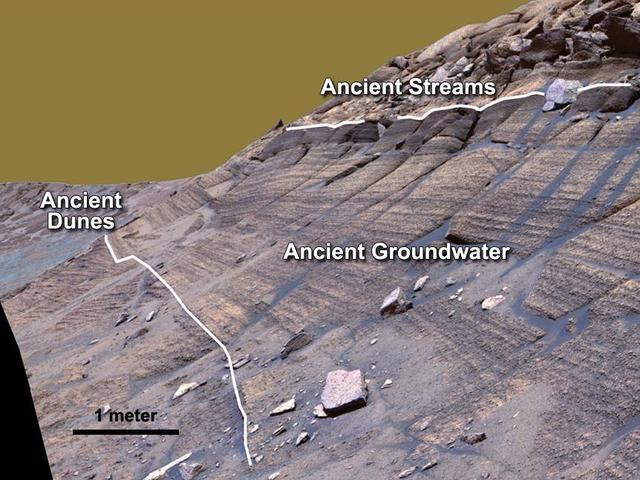
NASA Mars Exploration Rover Opportunity studied layers in the Burns Cliff slope of Endurance Crater in 2004. The layers show different types of deposition of sulfate-rich sediments. Opportunity panoramic camera recorded this image.

NASA Office of Communications Deputy Chief Patrick Lynch, left, introduces, from left to right, NASA Program Executive Melissa Morris, NASA Project Manager Rich Burns, Lockheed Martin Program Manager Sandy Freund, OSIRIS-REx Deputy Curation Lead Kevin Righter, and University of Arizona OSIRIS-REx Principal Investigator Dante Lauretta, during an OSIRIS-REx sample return press conference, Wednesday, Aug. 30, 2023, at the Department of Defense's Utah Test and Training Range. The sample was collected from the asteroid Bennu in October 2020 by NASA’s OSIRIS-REx spacecraft and will return to Earth on September 24th, landing under parachute at the Utah Test and Training Range. Photo Credit: (NASA/Keegan Barber)

Space Foundation Chief Executive Officer Thomas E. Zelibor, Rear Admiral, USN (Ret.); left, Mike Moreau, Deputy Project Manager, Space Science Mission Operations, NASA Goddard Space Flight Center; NASA Associate Administrator for Science Thomas Zurbuchen; Sandra Freund, OSIRIS-REx Mission Operations Manager, Lockheed Martin Space; Pete Antreasian, OSIRIS-REx Navigation Team Chief, KinetX; University of Arizona OSIRIS-REx Principal Investigator Dante Lauretta; Rich Burns, Project Manager, Space Science Mission Operations, NASA Goddard Space Flight Center, right, pose for a photograph during the awarding of the 2022 John L. “Jack” Swigert, Jr., Award for Space Exploration given to the OSIRIS-REx team by the Space Foundation during the 37th Space Symposium, Monday, April 4, 2022, in Colorado Springs, Colorado. The John L. “Jack” Swigert, Jr., Award for Space Exploration recognizes extraordinary accomplishments by a company, space agency, or consortium of organizations in the realm of space exploration and discovery. The award honors the memory of astronaut John L. “Jack” Swigert, Jr., one of the inspirations for the creation of Space Foundation. Photo Credit: (NASA/Bill Ingalls)

Smoke from the burning oil fields to the north of Kuwait City, seen on the south shore of Kuwayt Bay, almost totally obscures the view of the tiny, but oil rich, nation of Kuwait (30.0N, 48.0E). During the brief war between Iraq and the Allied forces, many of the oil wells in Kuwait were destroyed and set afire. For several months, those fires burned out of control, spewing wind borne smoke and ash for hundreds of miles.

Smoke from the burning oil fields to the north and south of Kuwait City, seen on the south shore of Kuwayt Bay almost totally obscures the view of the tiny, but oil rich, nation of Kuwait (29.0N, 48.0E). During the brief war between Iraq and the Allied forces, many of the oil wells in Kuwait were destroyed and set afire. For several months, those fires burned out of control, spewing wind borne smoke and ash for hundreds of miles.
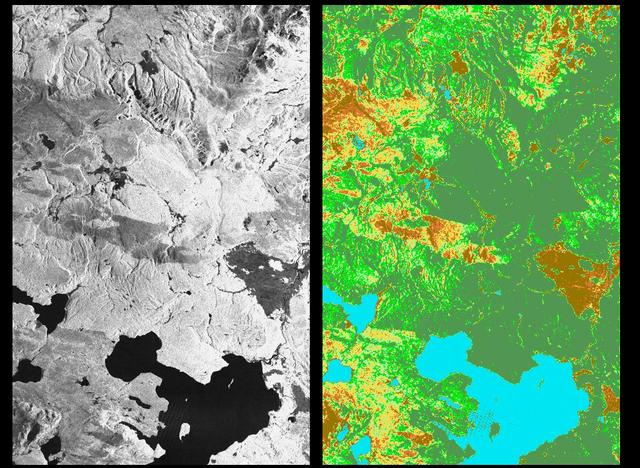
These two radar images show the majestic Yellowstone National Park, Wyoming, the oldest national park in the United States and home to the world's most spectacular geysers and hot springs. The region supports large populations of grizzly bears, elk and bison. In 1988, the park was burned by one of the most widespread fires to occur in the northern Rocky Mountains in the last 50 years. Surveys indicated that 793,880 acres of land burned. Of that, 41 percent was burned forest, with tree canopies totally consumed by the fire; 35 percent was a combination of unburned, scorched and blackened trees; 13 percent was surface burn under an unburned canopy; 6 percent was non-forest burn; and 5 percent was undifferentiated burn. Six years later, the burned areas are still clearly visible in these false-color radar images obtained by the Spaceborne Imaging Radar-C/X-band Synthetic Aperture Radar on board the space shuttle Endeavour. The image at the left was obtained using the L-band radar channel, horizontally received and vertically transmitted, on the shuttle's 39th orbit on October 2, 1994. The area shown is 45 kilometers by 71 kilometers (28 miles by 44 miles) in size and centered at 44.6 degrees north latitude, 110.7 degrees west longitude. North is toward the top of the image (to the right). Most trees in this area are lodge pole pines at different stages of fire succession. Yellowstone Lake appears as a large dark feature at the bottom of the scene. At right is a map of the forest crown, showing its biomass, or amount of vegetation, which includes foliage and branches. The map was created by inverting SIR-C data and using in situ estimates of crown biomass gathered by the Yellowstone National Biological Survey. The map is displayed on a color scale from blue (rivers and lakes with no biomass) to brown (non-forest areas with crown biomass of less than 4 tons per hectare) to light brown (areas of canopy burn with biomass of between 4 and 12 tons per hectare). Yellow indicates areas of canopy burn and mixed burn with a biomass of between 12 to 20 tons per hectare; light green is mixed burn and on-burn forest with a biomass of 20 to 35 tons per hectare; and green is non-burned forest with a biomass of greater than 35 tons per hectare. Forest recovery from the fire seems to depend on fire intensity and soil conditions. In areas of severe canopy burn and poor soil conditions, crown biomass was still low in 1994 (indicated by the brown areas at the center left), whereas in areas of mixed burn with nutrient-rich soils, seen west of Yellowstone Lake, crown biomass has increased significantly in six years (indicated by the yellow and light green areas). Imaging fire-affected regions with spaceborne radar illustrates SIR-C/X-SAR's keen abilities to monitor regrowth after a fire. Knowing the amount of carbon accumulated in the atmosphere by regenerating forest in the 20 to 50 years following a fire disturbance is also a significant factor in understanding the global carbon cycle. Measuring crown biomass is necessary to evaluate the effects of past and future fires in specific regions. http://photojournal.jpl.nasa.gov/catalog/PIA01741
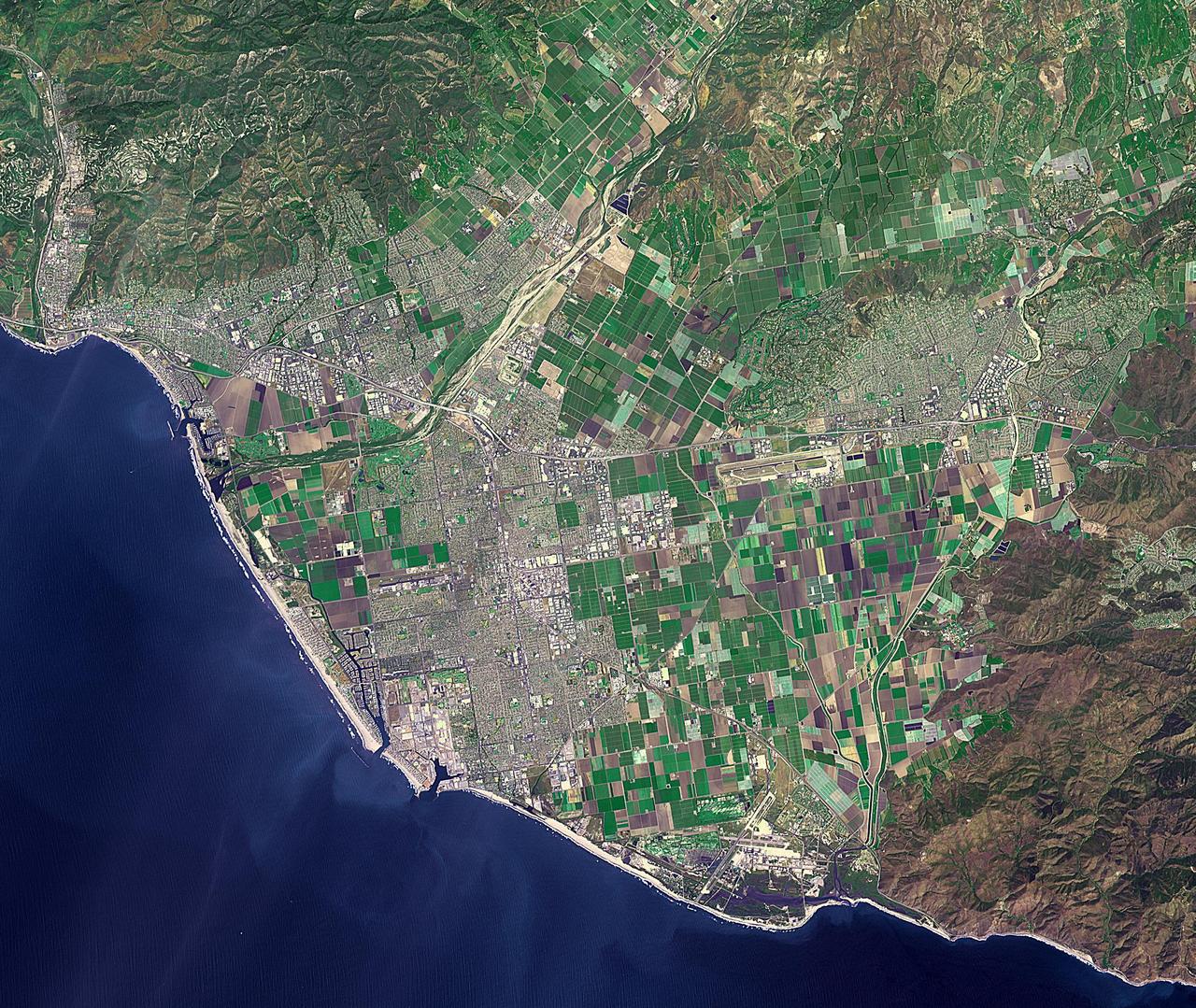
Ventura, California has a coastal site, set against hills and flanked by two rivers. Archaeologists have found remnants of human settlements dating back 10,000 years. When the Spaniards arrived at the end of the 18th century, they found the Chumash people and the Shisholop Village (Wikipedia). In 1782 Junipero Serra founded Mission San Buenaventura. Rich agricultural lands and the more recent discovery of oil led to economic growth. In late 2017, the Thomas Fire spread through the downtown and nearby communities, eventually burning over 270,000 acres. The image was acquired April 27, 2016, covers an area of 28.8 by 34.1 kilometers, and is located at 34.2 degrees north, 119.1 degrees west. https://photojournal.jpl.nasa.gov/catalog/PIA22841

Lockheed Martin Program Manager Sandy Freund, second from left, answers questions from reporters during an OSIRIS-REx sample return press conference, Wednesday, Aug. 30, 2023, at the Department of Defense's Utah Test and Training Range. The sample was collected from the asteroid Bennu in October 2020 by NASA’s OSIRIS-REx spacecraft and will return to Earth on September 24th, landing under parachute at the Utah Test and Training Range. Photo Credit: (NASA/Keegan Barber)

NASA's Hubble Space Telescope (HST) precisely measured the mass of the oldest known planet in our Milky Way Galaxy bringing closure to a decade of speculation. Scientists weren't sure if the object was a planet or a brown dwarf. Hubble's analysis shows that the object is 2.5 times the mass of Jupiter, confirming that it is indeed a planet. At an estimated age of 13 billion years, the planet is more than twice the age of Earth's 4.5 billion years. It formed around a young, sun-like star barely 1 million years after our universe's birth in the Big Bang. The ancient planet resides in an unlikely, rough neighborhood. It orbits a peculiar pair of burned-out stars in the crowded core cluster of more than 100,000 stars. Its very existence provides evidence that the first planets formed rapidly, within a billion years of the Big Bang, and leads astronomers to conclude that planets may be very abundant in our galaxy. This artist's concept depicts the planet with a view of a rich star filled sky.
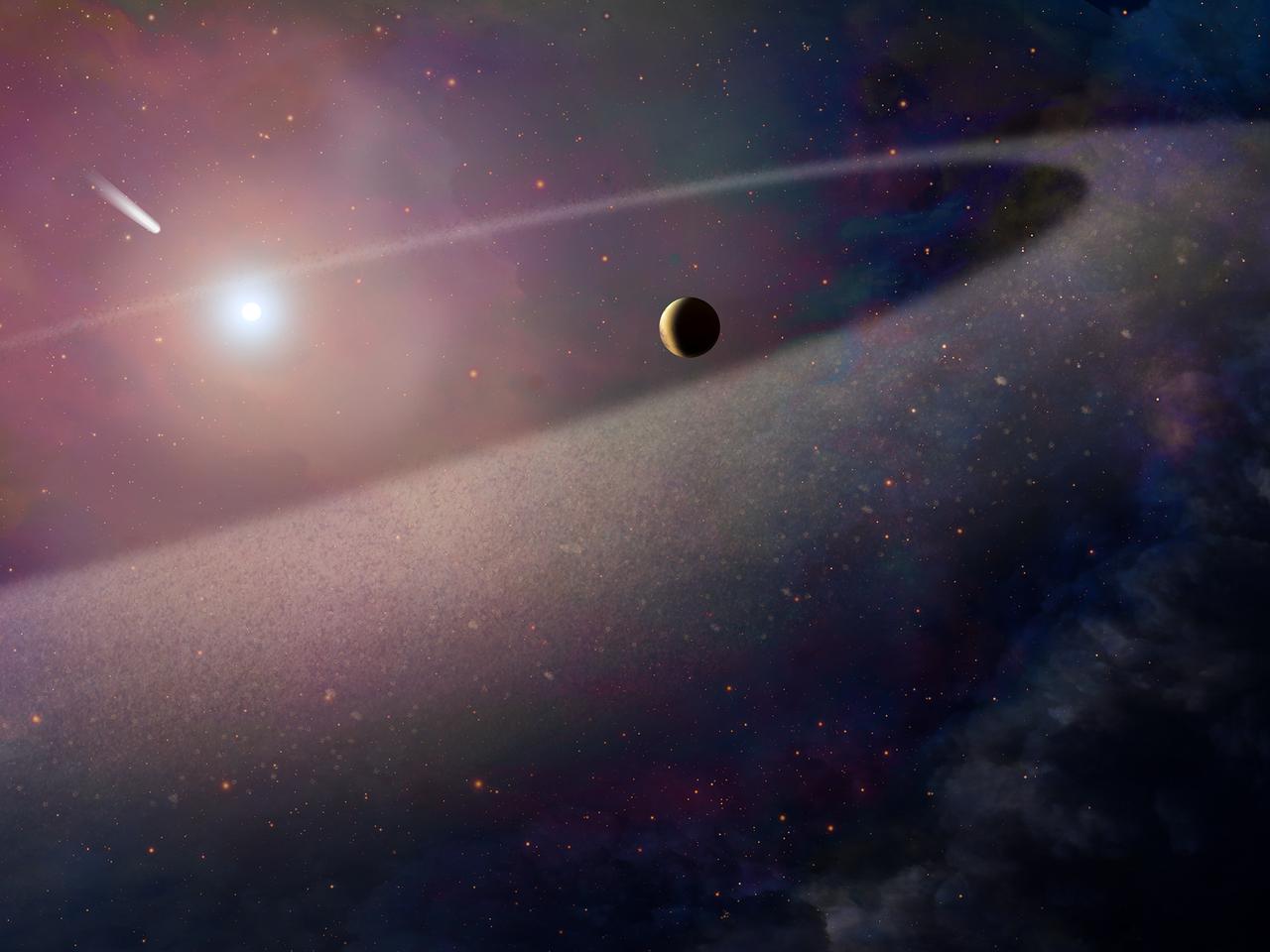
For the first time, scientists using NASA’s Hubble Space Telescope have witnessed a massive object with the makeup of a comet being ripped apart and scattered in the atmosphere of a white dwarf, the burned-out remains of a compact star. The object has a chemical composition similar to Halley’s Comet, but it is 100,000 times more massive and has a much higher amount of water. It is also rich in the elements essential for life, including nitrogen, carbon, oxygen, and sulfur. These findings are evidence for a belt of comet-like bodies orbiting the white dwarf, similar to our solar system’s Kuiper Belt. These icy bodies apparently survived the star’s evolution as it became a bloated red giant and then collapsed to a small, dense white dwarf. Caption: This artist's concept shows a massive, comet-like object falling toward a white dwarf. New Hubble Space Telescope findings are evidence for a belt of comet-like bodies orbiting the white dwarf, similar to our solar system's Kuiper Belt. The findings also suggest the presence of one or more unseen surviving planets around the white dwarf, which may have perturbed the belt to hurl icy objects into the burned-out star. Credits: NASA, ESA, and Z. Levay (STScI) <b><a href="http://www.nasa.gov/audience/formedia/features/MP_Photo_Guidelines.html" rel="nofollow">NASA image use policy.</a></b> <b><a href="http://www.nasa.gov/centers/goddard/home/index.html" rel="nofollow">NASA Goddard Space Flight Center</a></b> enables NASA’s mission through four scientific endeavors: Earth Science, Heliophysics, Solar System Exploration, and Astrophysics. Goddard plays a leading role in NASA’s accomplishments by contributing compelling scientific knowledge to advance the Agency’s mission. <b>Follow us on <a href="http://twitter.com/NASAGoddardPix" rel="nofollow">Twitter</a></b> <b>Like us on <a href="http://www.facebook.com/pages/Greenbelt-MD/NASA-Goddard/395013845897?ref=tsd" rel="nofollow">Facebook</a></b> <b>Find us on <a href="http://instagrid.me/nasagoddard/?vm=grid" rel="nofollow">Instagram</a></b>

This image, taken by the NASA/ESA Hubble Space Telescope, shows the colorful "last hurrah" of a star like our sun. The star is ending its life by casting off its outer layers of gas, which formed a cocoon around the star's remaining core. Ultraviolet light from the dying star makes the material glow. The burned-out star, called a white dwarf, is the white dot in the center. Our sun will eventually burn out and shroud itself with stellar debris, but not for another 5 billion years. Our Milky Way Galaxy is littered with these stellar relics, called planetary nebulae. The objects have nothing to do with planets. Eighteenth- and nineteenth-century astronomers called them the name because through small telescopes they resembled the disks of the distant planets Uranus and Neptune. The planetary nebula in this image is called NGC 2440. The white dwarf at the center of NGC 2440 is one of the hottest known, with a surface temperature of more than 360,000 degrees Fahrenheit (200,000 degrees Celsius). The nebula's chaotic structure suggests that the star shed its mass episodically. During each outburst, the star expelled material in a different direction. This can be seen in the two bowtie-shaped lobes. The nebula also is rich in clouds of dust, some of which form long, dark streaks pointing away from the star. NGC 2440 lies about 4,000 light-years from Earth in the direction of the constellation Puppis. The material expelled by the star glows with different colors depending on its composition, its density and how close it is to the hot central star. Blue samples helium; blue-green oxygen, and red nitrogen and hydrogen. Credit: NASA, ESA, and K. Noll (STScI), Acknowledgment: The Hubble Heritage Team (STScI/AURA) <b><a href="http://www.nasa.gov/audience/formedia/features/MP_Photo_Guidelines.html" rel="nofollow">NASA image use policy.</a></b> <b><a href="http://www.nasa.gov/centers/goddard/home/index.html" rel="nofollow">NASA Goddard Space Flight Center</a></b> enables NASA’s mission through four scientific endeavors: Earth Science, Heliophysics, Solar System Exploration, and Astrophysics. Goddard plays a leading role in NASA’s accomplishments by contributing compelling scientific knowledge to advance the Agency’s mission. <b>Follow us on <a href="http://twitter.com/NASAGoddardPix" rel="nofollow">Twitter</a></b> <b>Like us on <a href="http://www.facebook.com/pages/Greenbelt-MD/NASA-Goddard/395013845897?ref=tsd" rel="nofollow">Facebook</a></b> <b>Find us on <a href="http://instagrid.me/nasagoddard/?vm=grid" rel="nofollow">Instagram</a></b>
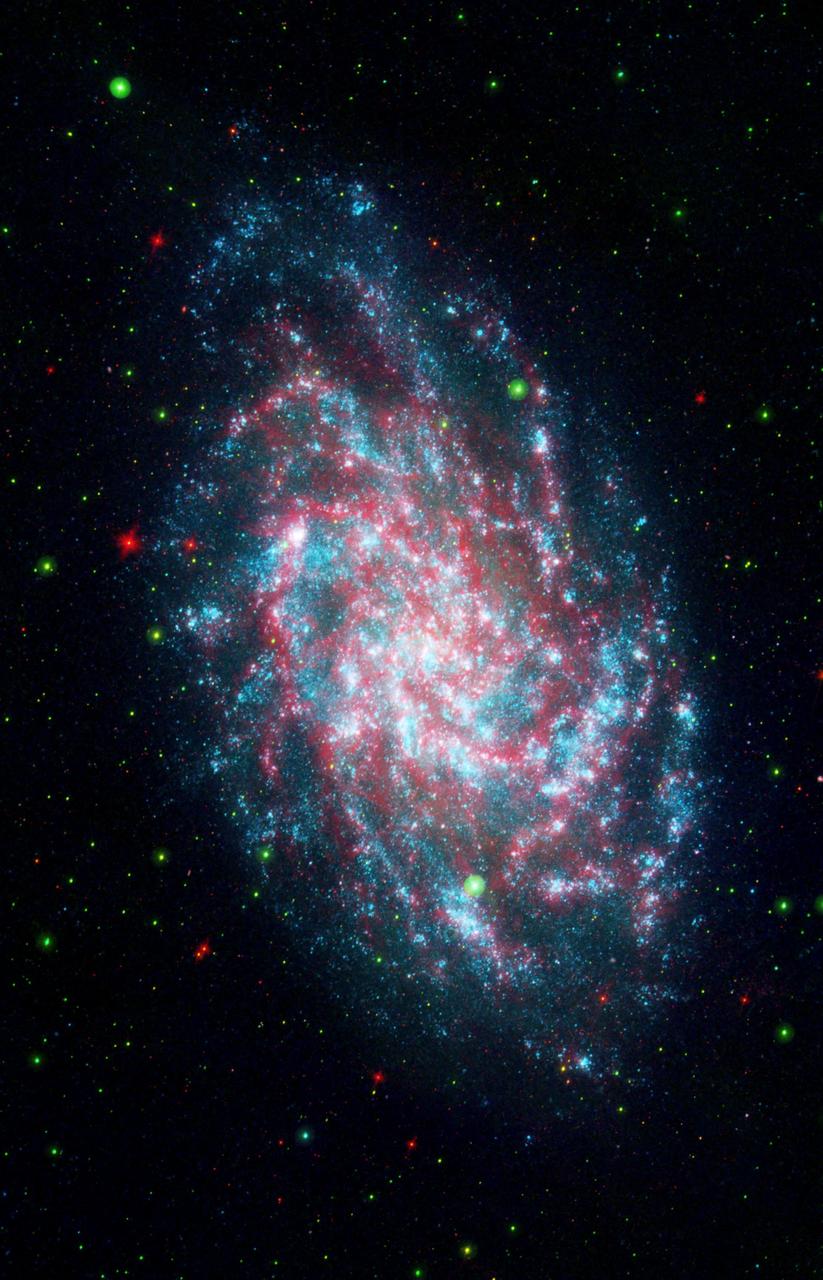
NASA Galaxy Evolution Explorer Mission celebrates its sixth anniversary studying galaxies beyond our Milky Way through its sensitive ultraviolet telescope, the only such far-ultraviolet detector in space. Pictured here, the galaxy NGC598 known as M33. The mission studies the shape, brightness, size and distance of distant galaxies across 10 billion years of cosmic history, giving scientists a wealth of data to help us better understand the origins of the universe. One such object is pictured here, the galaxy NGC598, more commonly known as M33. This image is a blend of the Galaxy Evolution Explorer's M33 image and another taken by NASA's Spitzer Space Telescope. M33, one of our closest galactic neighbors, is about 2.9 million light-years away in the constellation Triangulum, part of what's known as our Local Group of galaxies. Together, the Galaxy Evolution Explorer and Spitzer can see a broad spectrum of sky. Spitzer, for example, can detect mid-infrared radiation from dust that has absorbed young stars' ultraviolet light. That's something the Galaxy Evolution Explorer cannot see. This combined image shows in amazing detail the beautiful and complicated interlacing of the heated dust and young stars. In some regions of M33, dust gathers where there is very little far-ultraviolet light, suggesting that the young stars are obscured or that stars farther away are heating the dust. In some of the outer regions of the galaxy, just the opposite is true: There are plenty of young stars and very little dust. Far-ultraviolet light from young stars glimmers blue, near-ultraviolet light from intermediate age stars glows green, and dust rich in organic molecules burns red. This image is a 3-band composite including far infrared as red. http://photojournal.jpl.nasa.gov/catalog/PIA11998