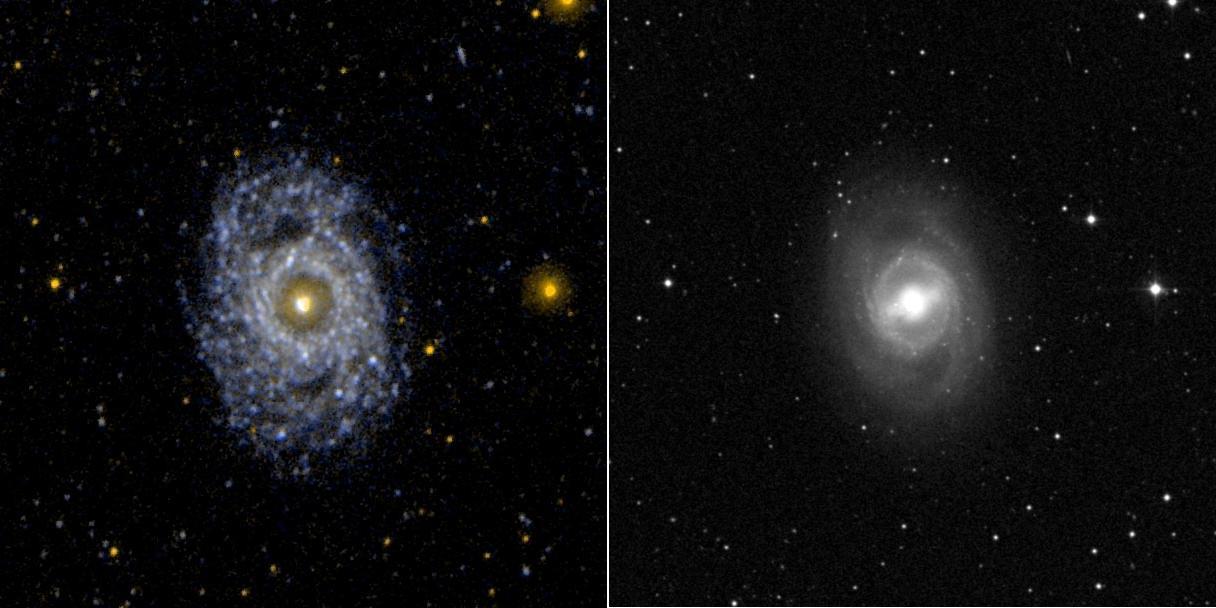
This ultraviolet image from NASA Galaxy Evolution Explorer left and visual image right of the face on barred and ringed spiral galaxy NGC 3351 M95.
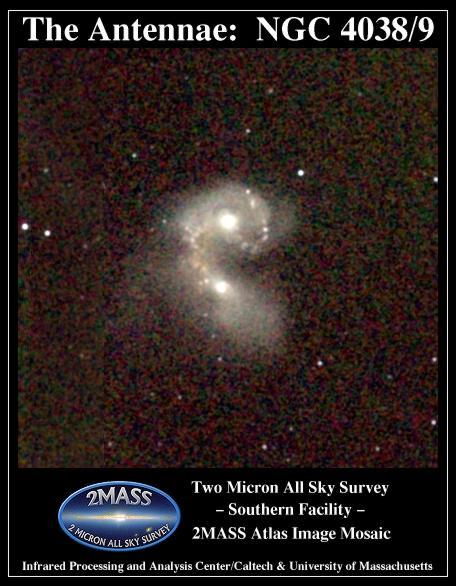
Atlas Image mosaic, covering 7 x 7 on the sky of the interacting galaxies NGC 4038 and NGC 4039, better known as the Antennae, or Ring Tail galaxies. The two galaxies are engaged in a tug-of-war as they collide.
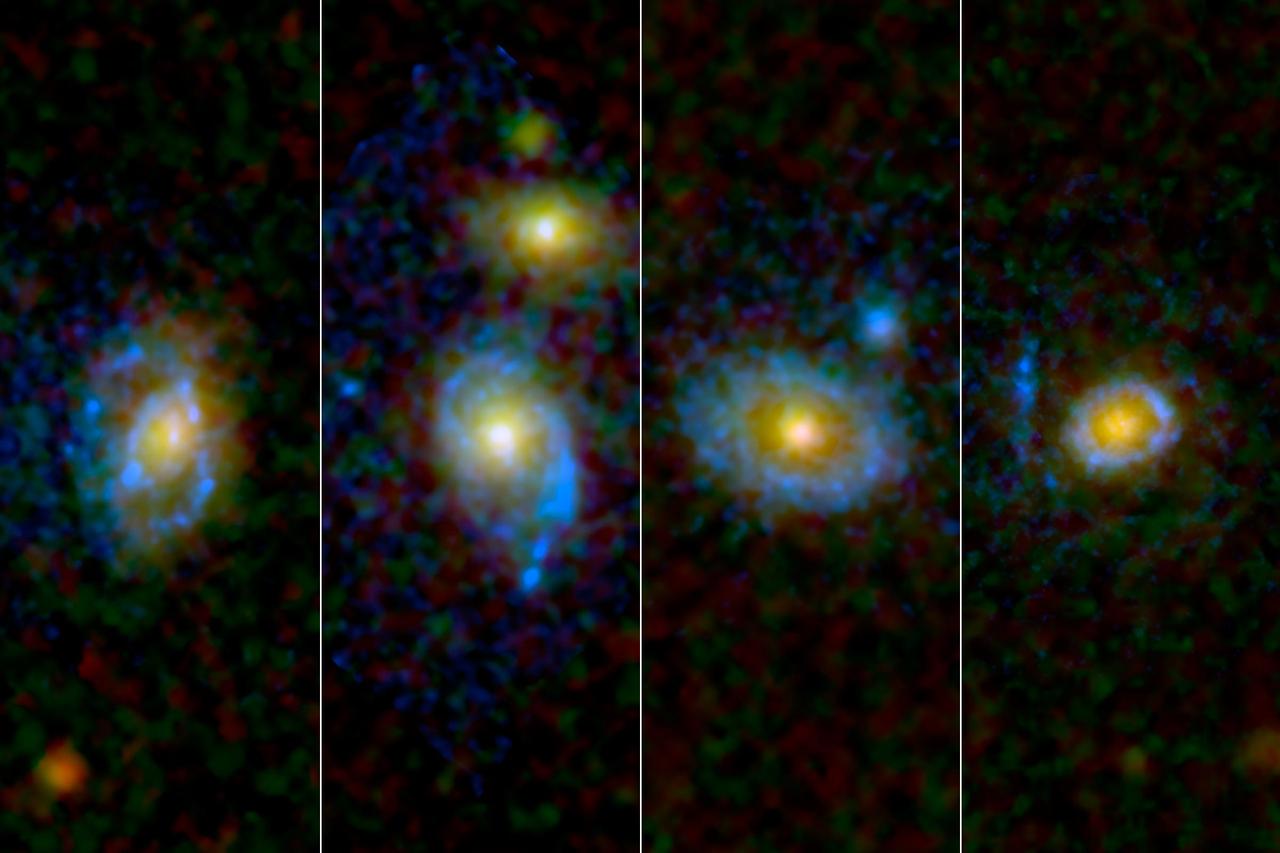
Astronomers have found unexpected rings and arcs of ultraviolet light around a selection of galaxies, four of which are shown here as viewed by NASA and the European Space Agency Hubble Space Telescope.
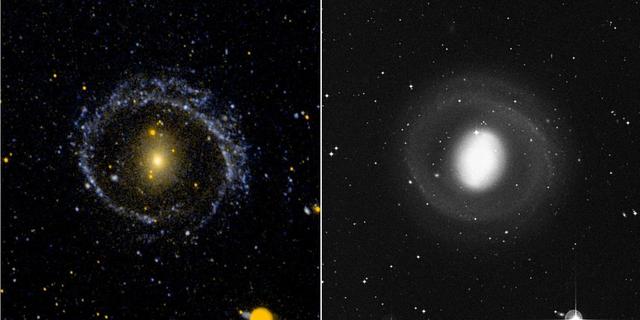
This ultraviolet image left and visual image right from NASA Galaxy Evolution Explorer is of the barred ring galaxy NGC 1291. The VIS image is dominated by the inner disk and bar. The UV image is dominated by the low surface brightness outer arms.
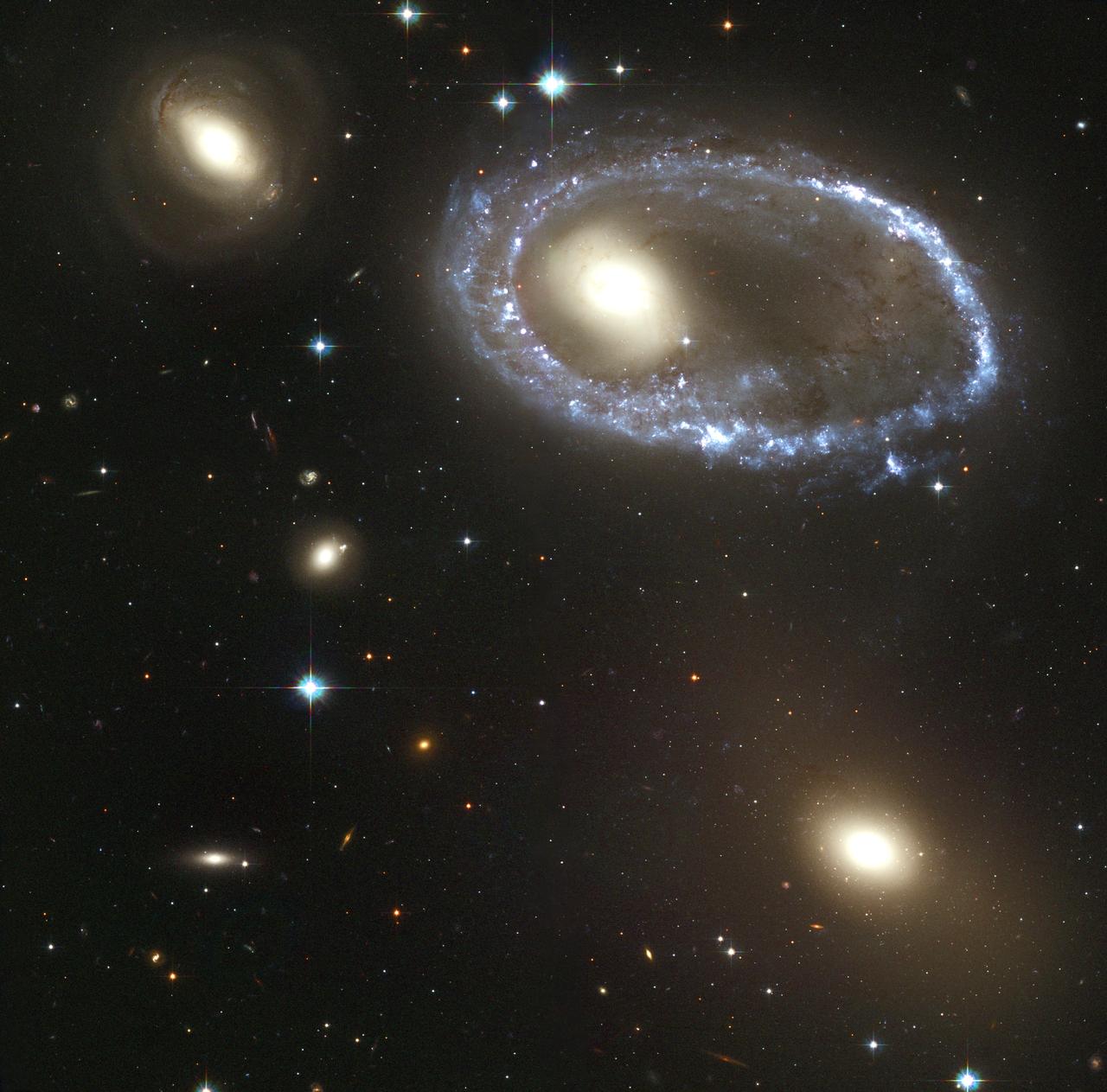
Released to commemorate the 14th anniversary of NASA’s Hubble Space Telescope (HST) is the image of a galaxy cataloged as AM 0644-741. Resembling a diamond encrusted bracelet, the ring of brilliant blue star clusters wraps around a yellowish nucleus of what was once a normal spiral galaxy. Located 300 million light years away in the direction of the southern constellation Dorado, the sparkling blue ring is 150,000 light years in diameter, making it larger than our entire home galaxy, the Milky Way. Ring galaxies are a striking example of how collisions between galaxies can dramatically change their structure, while triggering the formation of new stars. Typically one galaxy plunges directly into the disk of another one. The ring that pierced through this galaxy’s ring is out of the image but is visible in larger-field images. The soft galaxy visible to the left of the ring galaxy is a coincidental background galaxy which is not interacting with the ring. Rampant star formation explains why the ring is so blue. It is continuously forming massive, young, hot stars. Another sign of robust star formation is the pink regions along the ring. These are rare clouds of glowing hydrogen gas, fluorescing because of the strong ultraviolet light from the newly formed stars. The Hubble Heritage Team used the Hubble Advanced Camera for Surveys to take this image using a combination of four separate filters that isolate blue, green, red, and near-infrared light to create the color image.
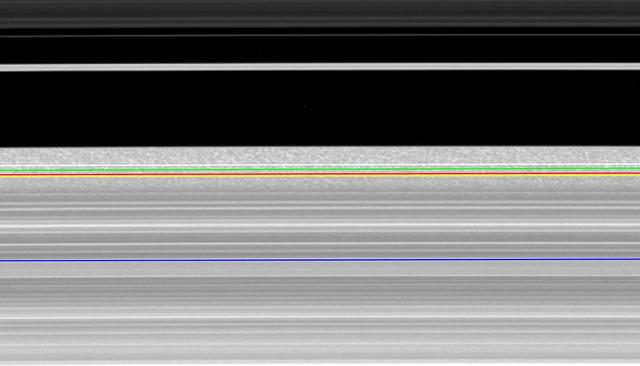
Keeping a close watch on the outer portion of Saturn B ring, NASA Cassini spacecraft records the complex inward and outward movement of the edge of the ring. This ring movement resembles the suspected behavior of spiral disk galaxies.
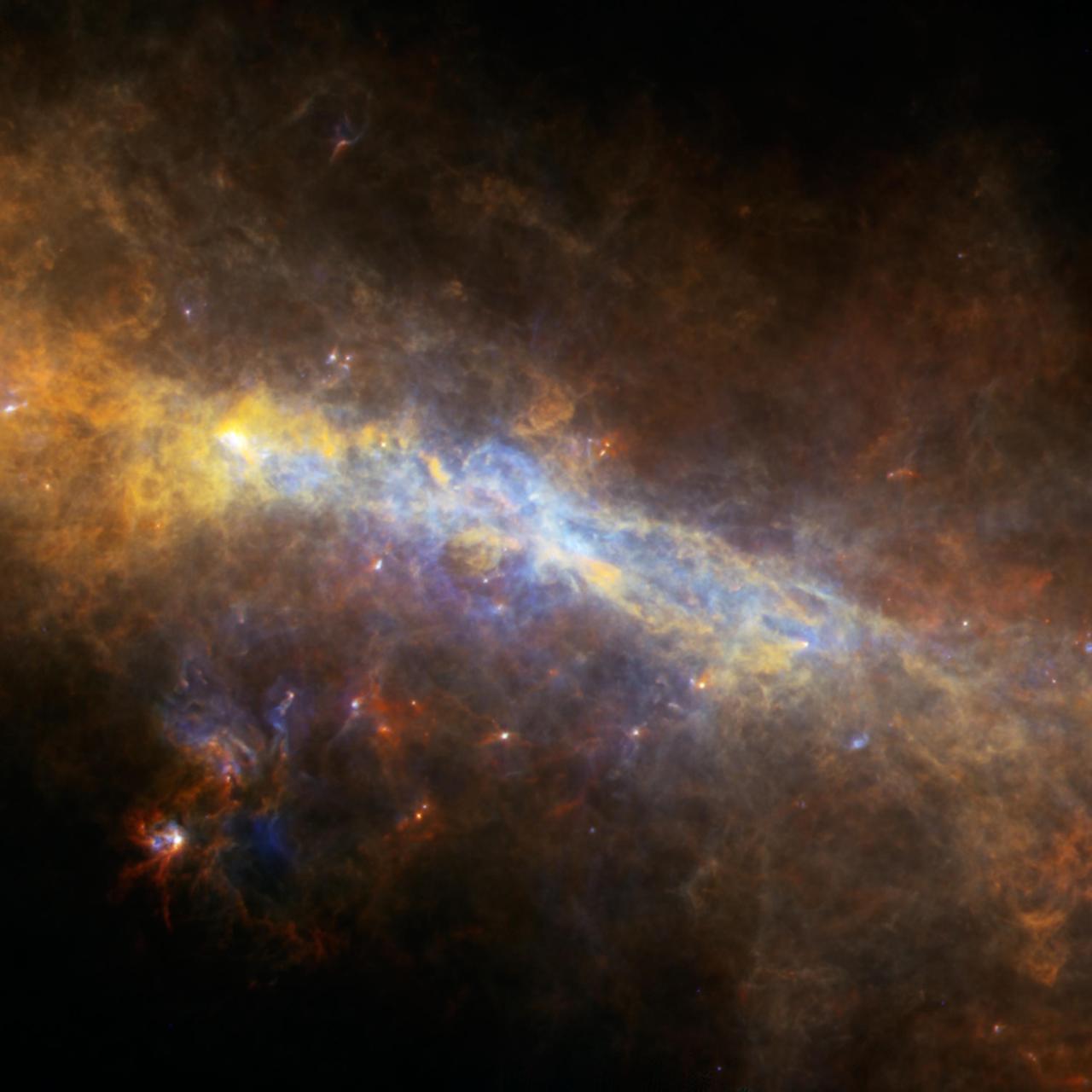
This image from ESA Herschel Space Observatory reveals a suspected ring at the center of our galaxy is warped for reasons scientists cannot explain. The ring is twisted so that part of it rises above and below the plane of our Milky Way galaxy.
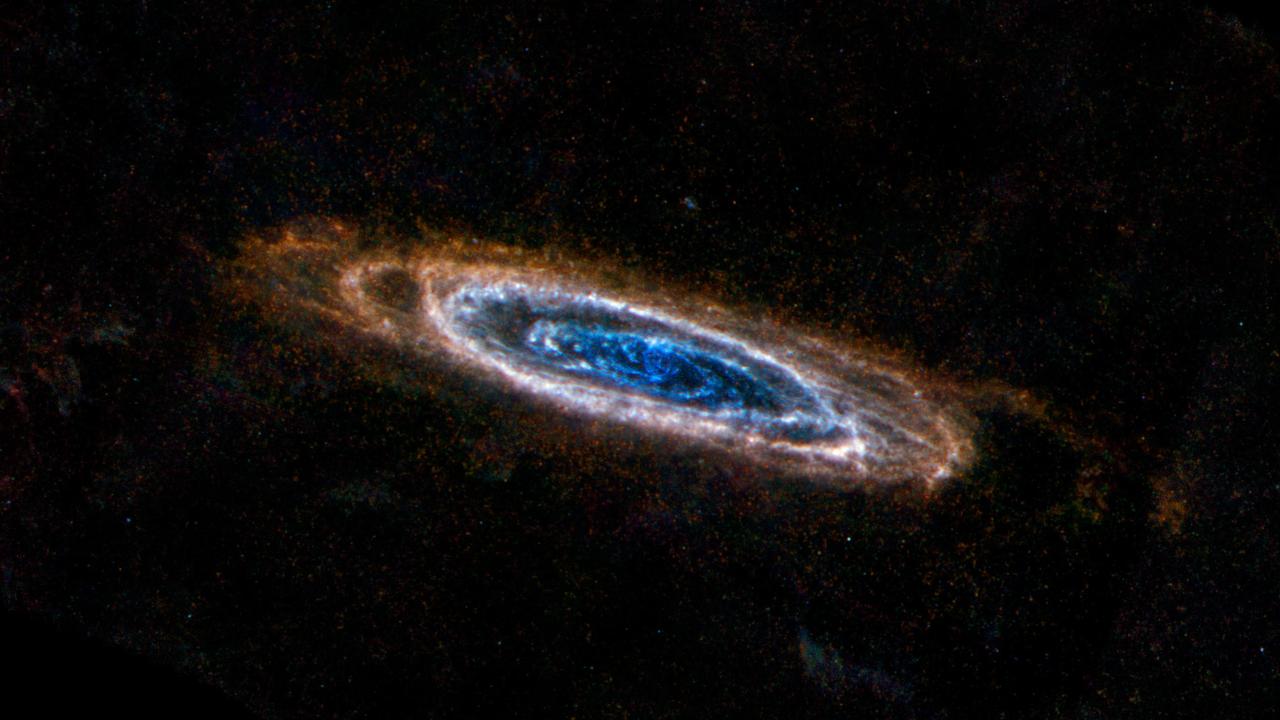
The ring-like swirls of dust filling the Andromeda galaxy stand out colorfully in this new image from the Herschel Space Observatory.
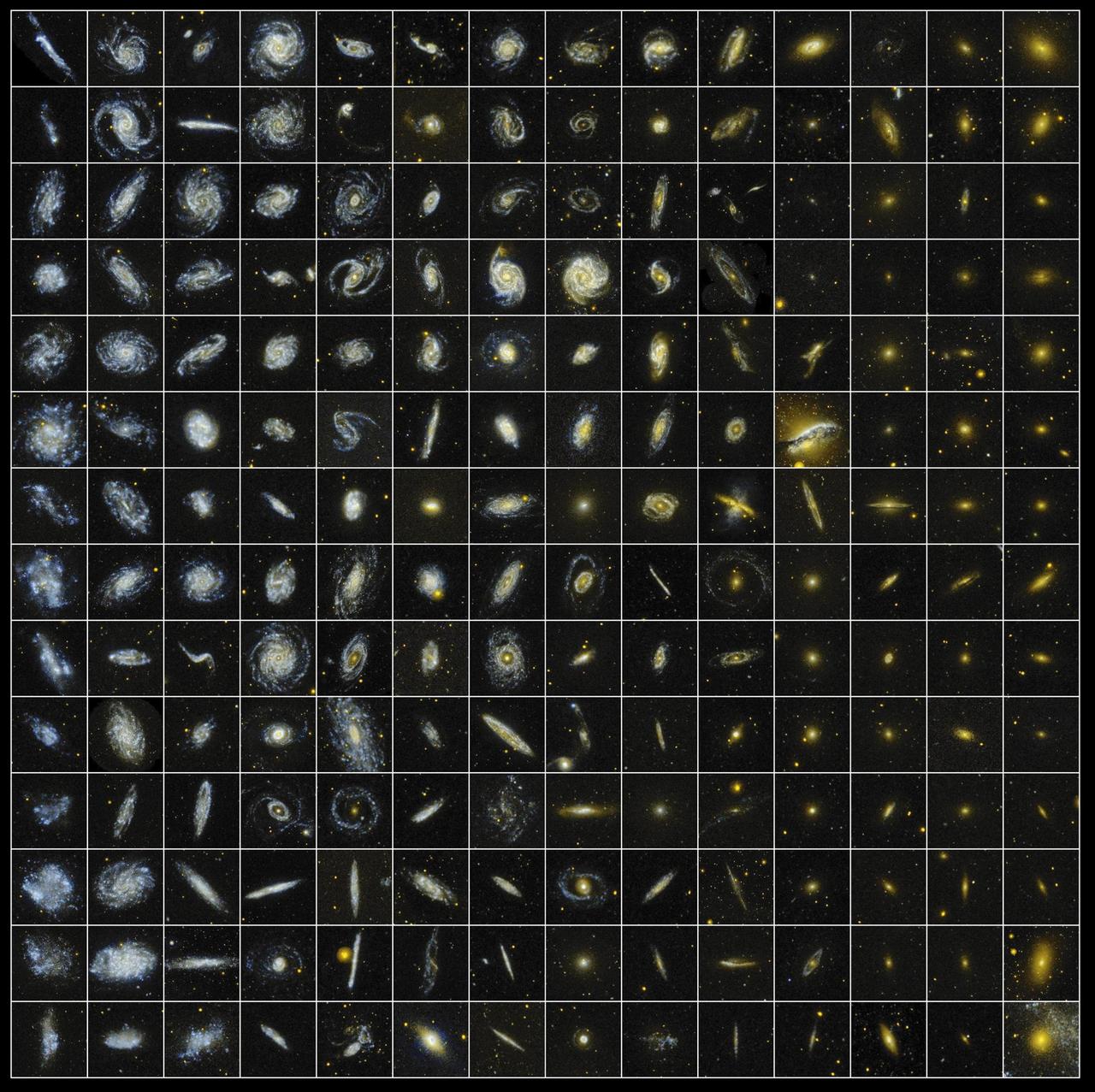
From sparkling blue rings to dazzling golden disks and mined from NASA Galaxy Evolution Explorer Survey of Nearby Galaxies data, these cosmic gems were collected with the telescope sensitive ultraviolet instruments.

This false-color composite image shows the Cartwheel galaxy as seen by NASA Galaxy Evolution Explorer, where the first ripple appears as an ultraviolet-bright blue outer ring.
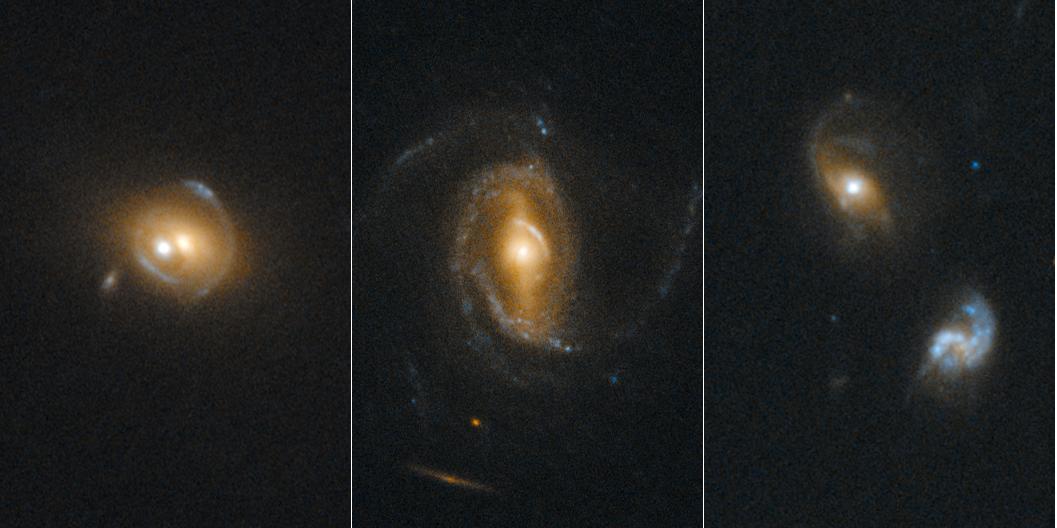
NASA Hubble Space Telescope sharp view was used to look for gravitational arcs and rings which are produced when one galaxy acts as a lens to magnify and distort the appearance of another galaxy behind it.
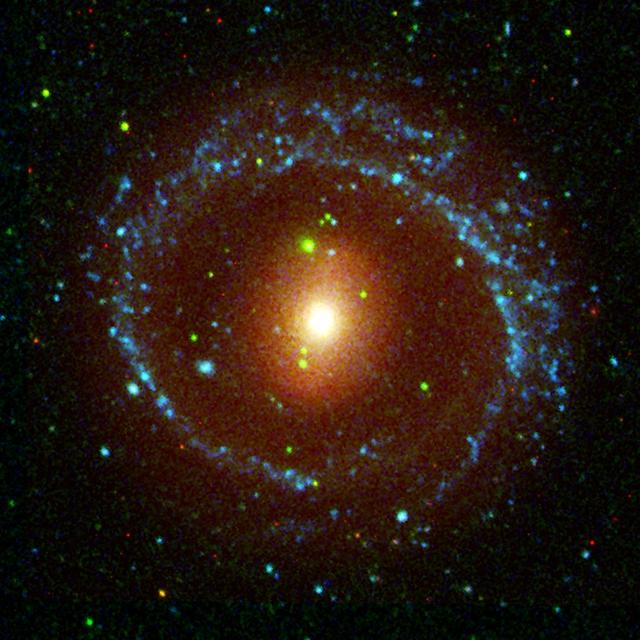
This image from NASA Galaxy Evolution Explorer shows the galaxy NGC 1291, located about 33 million light-years away in the constellation Eridanus. NGC 1291 is notable for its unusual inner bar and outer ring structure.
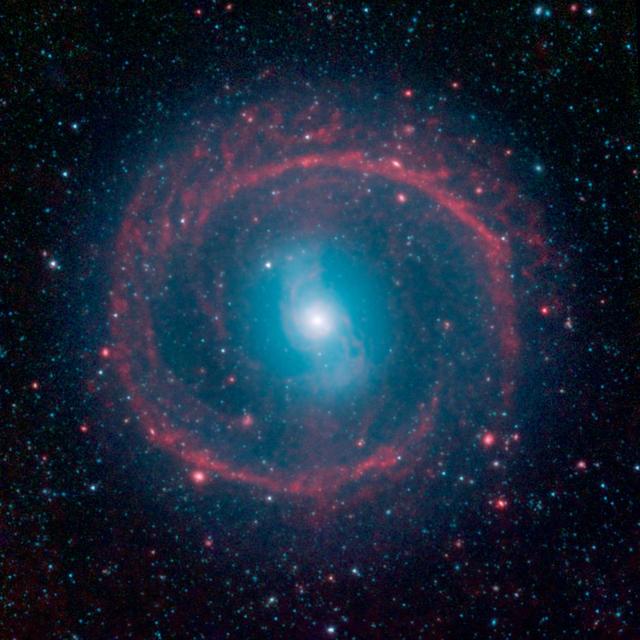
This image from NASA Spitzer Space Telescope shows where the action is taking place in galaxy NGC 1291. The outer ring, colored red, is filled with new stars that are igniting and heating up dust that glows with infrared light.
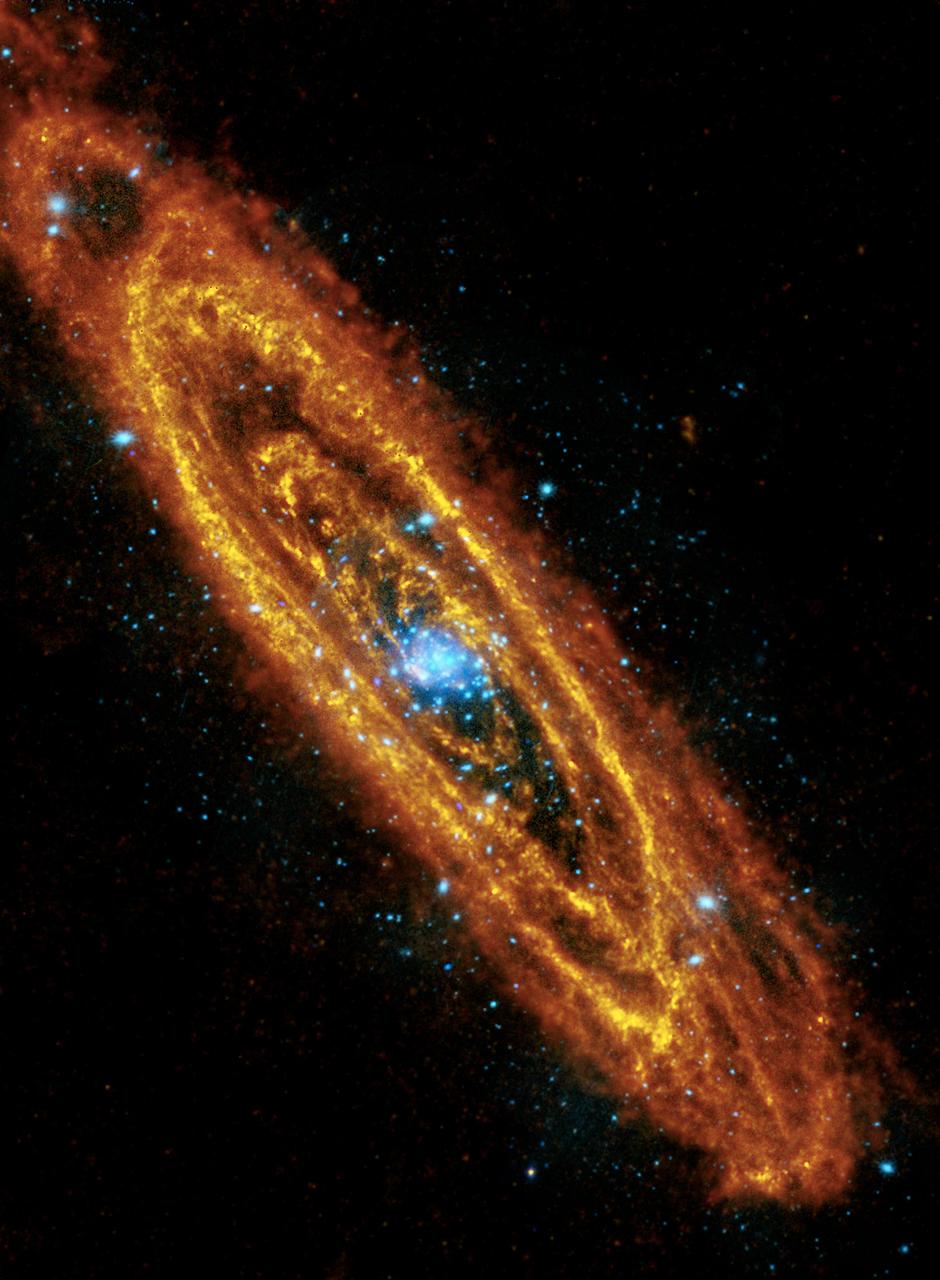
This mosaic of the Andromeda spiral galaxy highlights explosive stars in its interior, and cooler, dusty stars forming in its many rings. This is a combination of observations from the Herschel Space Observatory and the XMM-Newton telescope.

This false-color image from NASA Spitzer Space Telescope shows a distant galaxy yellow that houses a quasar, a super-massive black hole circled by a ring, or torus, of gas and dust.
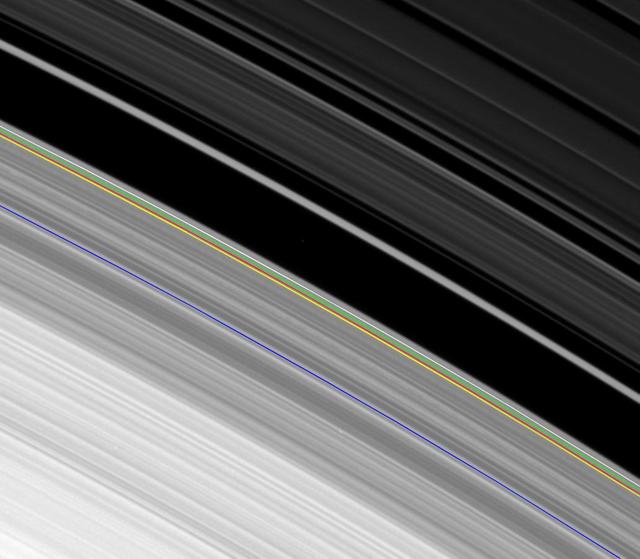
This image obtained by NASA Cassini spacecraft of the outer edge of Saturn?s B ring, reveals the combined effects of a tugging moon and oscillations that can naturally occur in disks like Saturn rings and spiral galaxies.
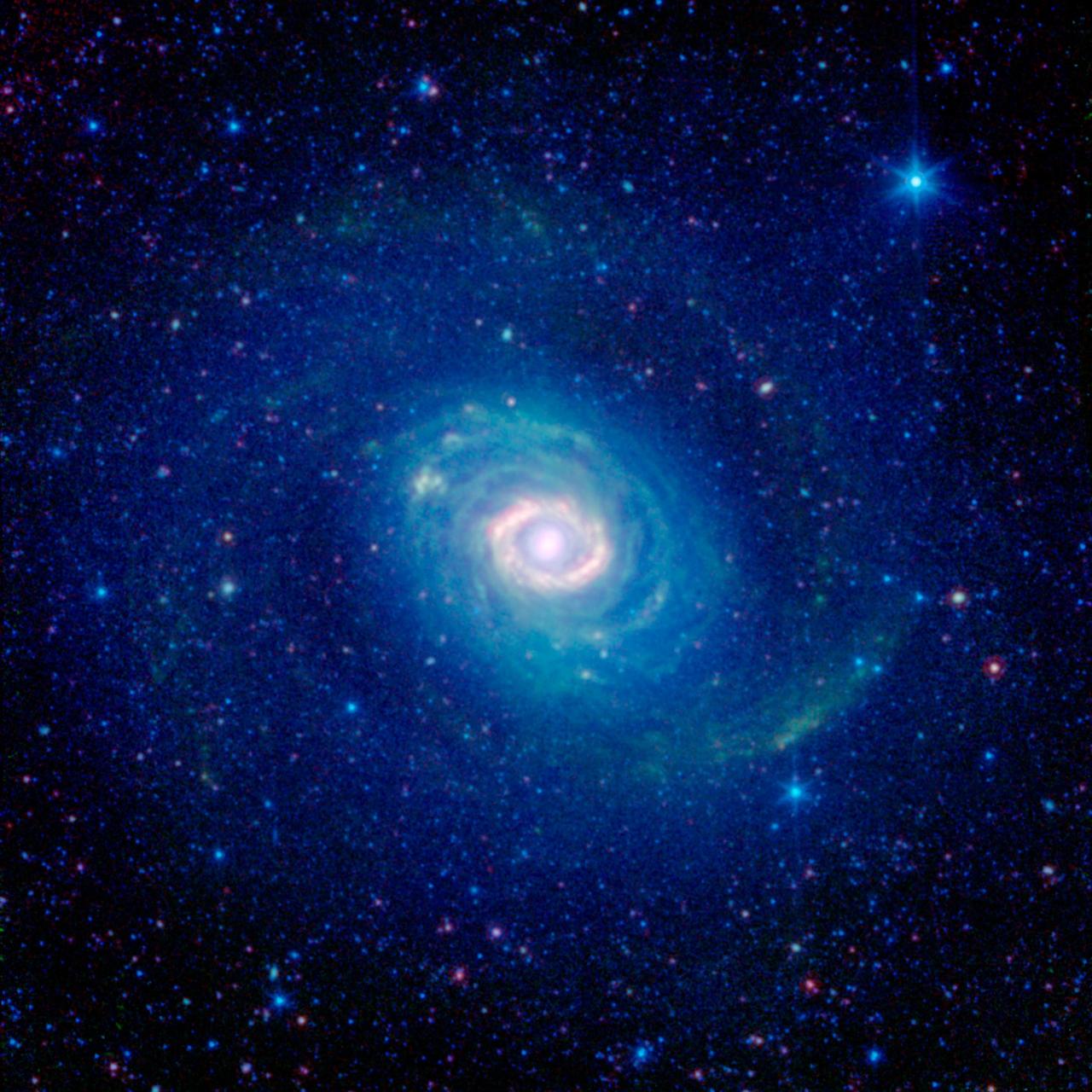
How many rings do you see in this new image of galaxy Messier 94, also known as NGC 4736? At first glance one might see a number of them, astronomers believe there is just one. This image was captured in infrared light by NASA Spitzer Space Telescope.
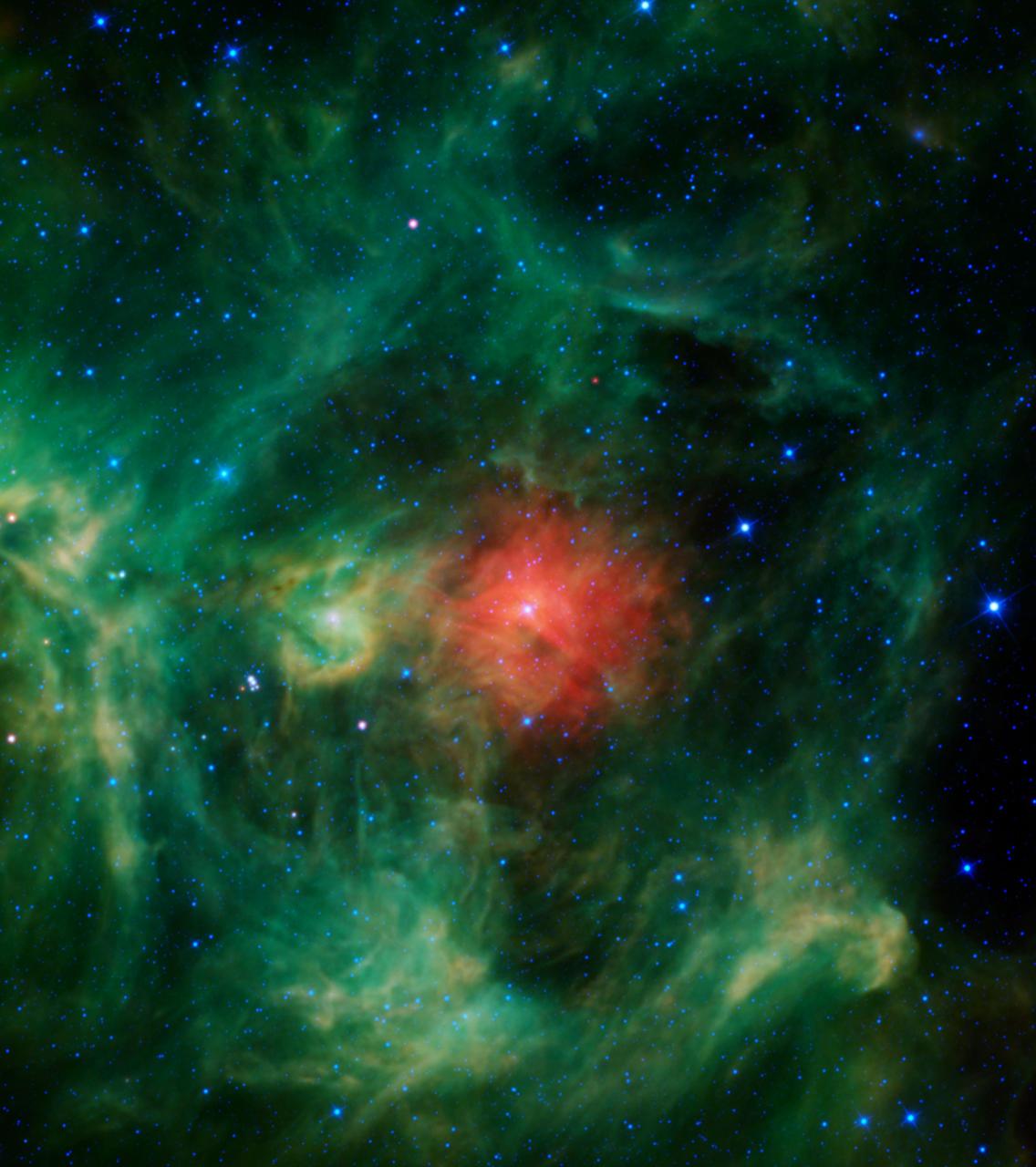
NASA Wide-field Infrared Survey Explorer mission presents the Wreath nebula. The nebula official name is Barnard 3, or IRAS Ring G159.6-18.5. Regions similar to this nebula are found near the band of the Milky Way galaxy in the night sky.
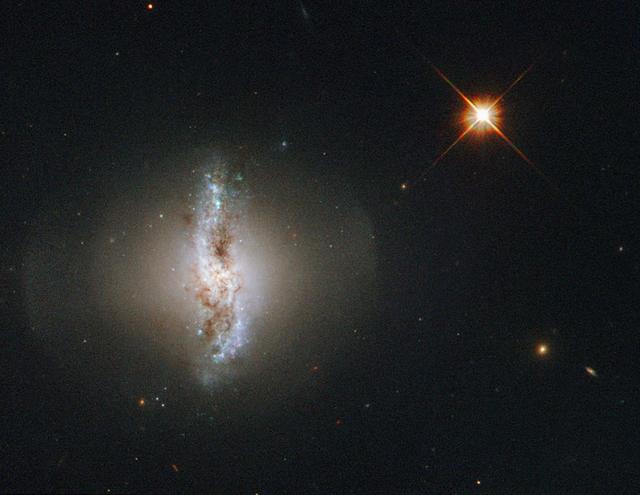
This Picture of the Week shows Arp 230, also known as IC 51, observed by the NASA/ESA Hubble Space Telescope. Arp 230 is a galaxy of an uncommon or peculiar shape, and is therefore part of the Atlas of Peculiar Galaxies produced by Halton Arp. Its irregular shape is thought to be the result of a violent collision with another galaxy sometime in the past. The collision could also be held responsible for the formation of the galaxy’s polar ring. The outer ring surrounding the galaxy consists of gas and stars and rotates over the poles of the galaxy. It is thought that the orbit of the smaller of the two galaxies that created Arp 230 was perpendicular to the disk of the second, larger galaxy when they collided. In the process of merging the smaller galaxy would have been ripped apart and may have formed the polar ring structure astronomers can observe today. Arp 230 is quite small for a lenticular galaxy, so the two original galaxies forming it must both have been smaller than the Milky Way. A lenticular galaxy is a galaxy with a prominent central bulge and a disk, but no clear spiral arms. They are classified as intermediate between an elliptical galaxy and a spiral galaxy. Credit: ESA/Hubble & NASA, Acknowledgement: Flickr user Det58 <b><a href="http://www.nasa.gov/audience/formedia/features/MP_Photo_Guidelines.html" rel="nofollow">NASA image use policy.</a></b> <b><a href="http://www.nasa.gov/centers/goddard/home/index.html" rel="nofollow">NASA Goddard Space Flight Center</a></b> enables NASA’s mission through four scientific endeavors: Earth Science, Heliophysics, Solar System Exploration, and Astrophysics. Goddard plays a leading role in NASA’s accomplishments by contributing compelling scientific knowledge to advance the Agency’s mission. <b>Follow us on <a href="http://twitter.com/NASAGoddardPix" rel="nofollow">Twitter</a></b> <b>Like us on <a href="http://www.facebook.com/pages/Greenbelt-MD/NASA-Goddard/395013845897?ref=tsd" rel="nofollow">Facebook</a></b> <b>Find us on <a href="http://instagrid.me/nasagoddard/?vm=grid" rel="nofollow">Instagram</a></b>
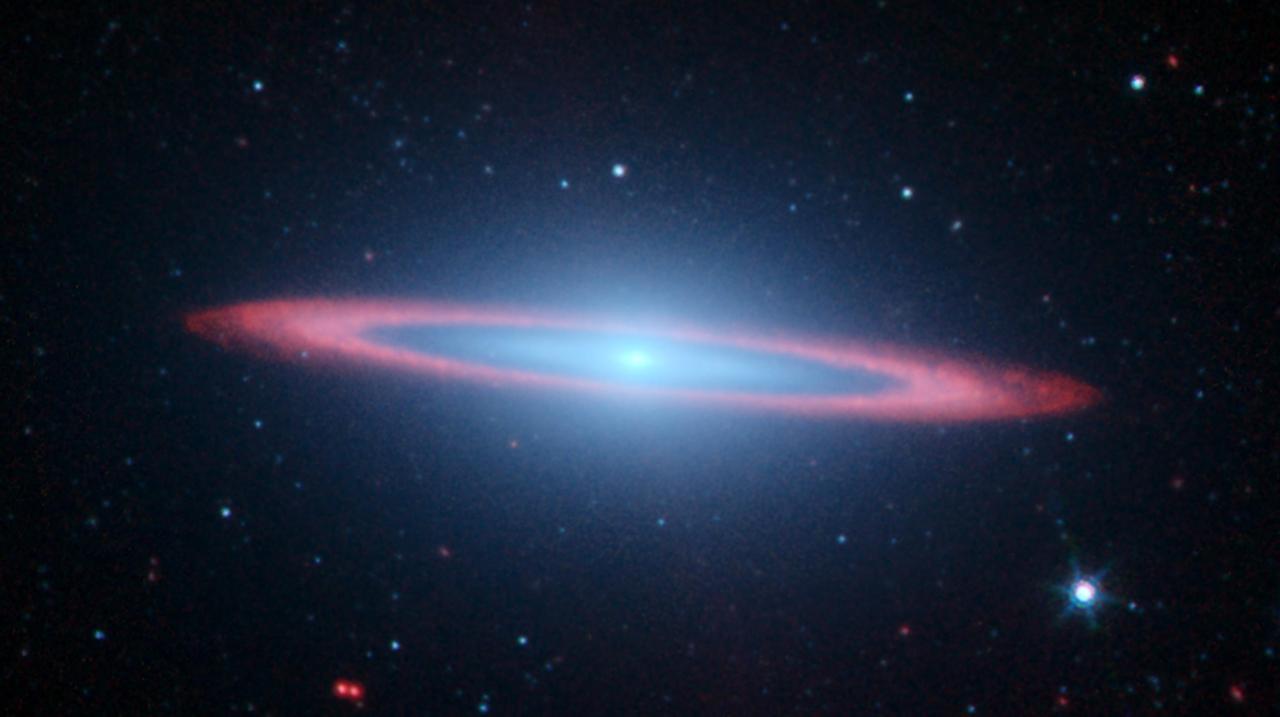
NASA's Spitzer Space Telescope set its infrared eyes on one of the most famous objects in the sky, Messier 104, also called the Sombrero galaxy. In this striking infrared picture, Spitzer sees an exciting new view of a galaxy that in visible light has been likened to a "sombrero," but here looks more like a "bulls-eye." Recent observations using Spitzer's infrared array camera uncovered the bright, smooth ring of dust circling the galaxy, seen in red. In visible light, because this galaxy is seen nearly edge-on, only the near rim of dust can be clearly seen in silhouette. Spitzer's full view shows the disk is warped, which is often the result of a gravitational encounter with another galaxy, and clumpy areas spotted in the far edges of the ring indicate young star-forming regions. Spitzer's infrared view of the starlight from this galaxy, seen in blue, can pierce through obscuring murky dust that dominates in visible light. As a result, the full extent of the bulge of stars and an otherwise hidden disk of stars within the dust ring are easily seen. The Sombrero galaxy is located some 28 million light years away. Viewed from Earth, it is just six degrees south of its equatorial plane. Spitzer detected infrared emission not only from the ring, but from the center of the galaxy too, where there is a huge black hole, believed to be a billion times more massive than our Sun. This picture is composed of four images taken at 3.6 (blue), 4.5 (green), 5.8 (orange), and 8.0 (red) microns. The contribution from starlight (measured at 3.6 microns) has been subtracted from the 5.8 and 8-micron images to enhance the visibility of the dust features. http://photojournal.jpl.nasa.gov/catalog/PIA07899

In the center of this image, taken with the NASA/ESA Hubble Space Telescope, is the galaxy cluster SDSS J1038+4849 — and it seems to be smiling. You can make out its two orange eyes and white button nose. In the case of this “happy face”, the two eyes are very bright galaxies and the misleading smile lines are actually arcs caused by an effect known as strong gravitational lensing. Galaxy clusters are the most massive structures in the Universe and exert such a powerful gravitational pull that they warp the spacetime around them and act as cosmic lenses which can magnify, distort and bend the light behind them. This phenomenon, crucial to many of Hubble’s discoveries, can be explained by Einstein’s theory of general relativity. In this special case of gravitational lensing, a ring — known as an Einstein Ring — is produced from this bending of light, a consequence of the exact and symmetrical alignment of the source, lens and observer and resulting in the ring-like structure we see here. Hubble has provided astronomers with the tools to probe these massive galaxies and model their lensing effects, allowing us to peer further into the early Universe than ever before. This object was studied by Hubble’s Wide Field and Planetary Camera 2 (WFPC2) and Wide Field Camera 3 (WFC3) as part of a survey of strong lenses. A version of this image was entered into the Hubble’s Hidden Treasures image processing competition by contestant Judy Schmidt. Image Credit: NASA/ESA
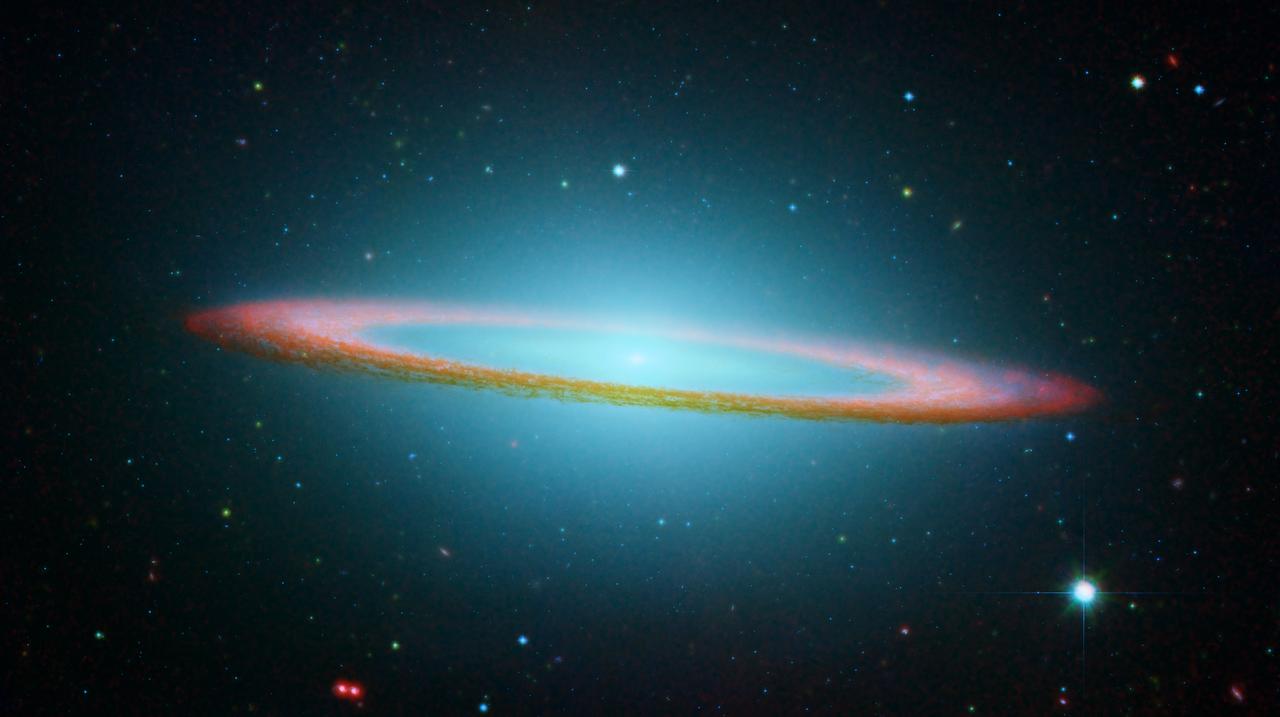
The razor sharp eye of the Hubble Space Telescope (HST) easily resolves the Sombrero galaxy, Messier 104 (M104). 50,000 light-years across, the galaxy is located 28 million light-years from Earth at the southern edge of the rich Virgo cluster of galaxies. Equivalent to 800 billion suns, Sombrero is one of the most massive objects in that group. The hallmark of Sombrero is a brilliant white, bulbous core encircled by the thick dust lanes comprising the spiral structure of the galaxy. As seen from Earth, the galaxy is tilted nearly edge-on. We view it from just six degrees north of its equatorial plane. This rich system of globular clusters is estimated to be nearly 2,000 in number which is 10 times as many as in our Milky Way galaxy. Similar to the clusters in the Milky Way, the ages range from 10-13 billion years old. Embedded in the bright core of M104 is a smaller disk, which is tilted relative to the large disk. The HST paired with the Spitzer infrared telescope, offers this striking composite capturing the magnificence of the Sombrero galaxy. In the Hubble view, the galaxy resembles a broad-rimmed Mexican hat, whereas in the Spitzer striking infrared view, the galaxy looks more like a bulls eye. The full view provided by Spitzer shows the disk is warped, which is often the result of a gravitational encounter with another galaxy, and clumpy areas spotted in the far edges of the ring indicate young star forming regions. Spitzer detected infrared emission not only from the ring, but from the center of the galaxy as well, where there is a huge black hole believed to be a billion times more massive than our Sun. The Marshall Space Flight Center (MSFC) had responsibility for design, development, and construction of the HST.
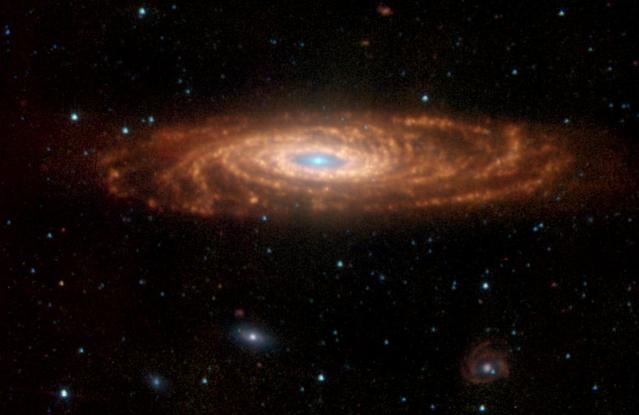
NASA's Spitzer Space Telescope has captured these infrared images of a nearby spiral galaxy that resembles our own Milky Way. The targeted galaxy, known as NGC 7331 and sometimes referred to as our galaxy's twin, is found in the constellation Pegasus at a distance of 50 million light-years. This inclined galaxy was discovered in 1784 by William Herschel, who also discovered infrared light. The evolution of this galaxy is a story that depends significantly on the amount and distribution of gas and dust, the locations and rates of star formation, and on how the energy from star formation is recycled by the local environment. The new Spitzer images are allowing astronomers to "read" this story by dissecting the galaxy into its separate components. The image, measuring 12.6 by 8.2 arcminutes, was obtained by Spitzer's infrared array camera. It is a four-color composite of invisible light, showing emissions from wavelengths of 3.6 microns (blue), 4.5 microns (green), 5.8 microns (yellow) and 8.0 microns (red). These wavelengths are roughly 10 times longer than those seen by the human eye. The infrared light seen in this image originates from two very different sources. At shorter wavelengths (3.6 to 4.5 microns), the light comes mainly from stars, particularly ones that are older and cooler than our Sun. This starlight fades at longer wavelengths (5.8 to 8.0 microns), where instead we see the glow from clouds of interstellar dust. This dust consists mainly of a variety of carbon-based organic molecules known collectively as polycyclic aromatic hydrocarbons. Wherever these compounds are found, there will also be dust granules and gas, which provide a reservoir of raw materials for future star formation. One feature that stands out in the Spitzer image is the ring of actively forming stars that surrounds the galaxy center (yellow). This ring, with a radius of nearly 20,000 light-years, is invisible at shorter wavelengths, yet has been detected at sub-millimeter and radio wavelengths. It is made up in large part of polycyclic aromatic hydrocarbons. Spitzer measurements suggest that the ring contains enough gas to produce four billion stars like the Sun. Three other galaxies are seen below NGC 7331, all about 10 times farther away. From left to right are NGC 7336, NGC 7335 and NGC 7337. The blue dots scattered throughout the images are foreground stars in the Milky Way; the red ones are galaxies that are even more distant. The Spitzer observations of NGC 7331 are part of a large 500-hour science project, known as the Spitzer Infrared Nearby Galaxy Survey, which will comprehensively study 75 nearby galaxies with infrared imaging and spectroscopy. http://photojournal.jpl.nasa.gov/catalog/PIA06322

Image release September 2, 2010 ABOUT THIS IMAGE: This image shows the entire region around supernova 1987A. The most prominent feature in the image is a ring with dozens of bright spots. A shock wave of material unleashed by the stellar blast is slamming into regions along the ring's inner regions, heating them up, and causing them to glow. The ring, about a light-year across, was probably shed by the star about 20,000 years before it exploded. An international team of astronomers using the Hubble Space Telescope reports a significant brightening of the emissions from Supernova 1987A. The results, which appear in this week's Science magazine, are consistent with theoretical predictions about how supernovae interact with their immediate galactic environment. The team observed the supernova remnant in optical, ultraviolet, and near-infrared light. They studied the interaction between the ejecta from the stellar explosion and a glowing 6-trillion-mile-diameter ring of gas encircling the supernova remnant. The gas ring was probably shed some 20,000 years before the supernova exploded. Shock waves resulting from the impact of the ejecta onto the ring have brightened 30 to 40 pearl-like "hot spots" in the ring. These blobs likely will grow and merge together in the coming years to form a continuous, glowing circle. "We are seeing the effect a supernova can have in the surrounding galaxy, including how the energy deposited by these stellar explosions changes the dynamics and chemistry of the environment," said University of Colorado at Boulder Research Associate Kevin France of the Center for Astrophysics and Space Astronomy. "We can use these new data to understand how supernova processes regulate the evolution of galaxies." Discovered in 1987, Supernova 1987A is the closest exploding star to Earth to be detected since 1604 and it resides in the nearby Large Magellanic Cloud, a dwarf galaxy adjacent to our own Milky Way Galaxy. Credit: NASA, ESA, K. France (University of Colorado, Boulder), and P. Challis and R. Kirshner (Harvard-Smithsonian Center for Astrophysics) <b><a href="http://www.nasa.gov/centers/goddard/home/index.html" rel="nofollow">NASA Goddard Space Flight Center</a></b> is home to the nation's largest organization of combined scientists, engineers and technologists that build spacecraft, instruments and new technology to study the Earth, the sun, our solar system, and the universe. <b>Follow us on <a href="http://twitter.com/NASA_GoddardPix" rel="nofollow">Twitter</a></b> <b>Join us on <a href="http://www.facebook.com/pages/Greenbelt-MD/NASA-Goddard/395013845897?ref=tsd" rel="nofollow">Facebook</a></b>
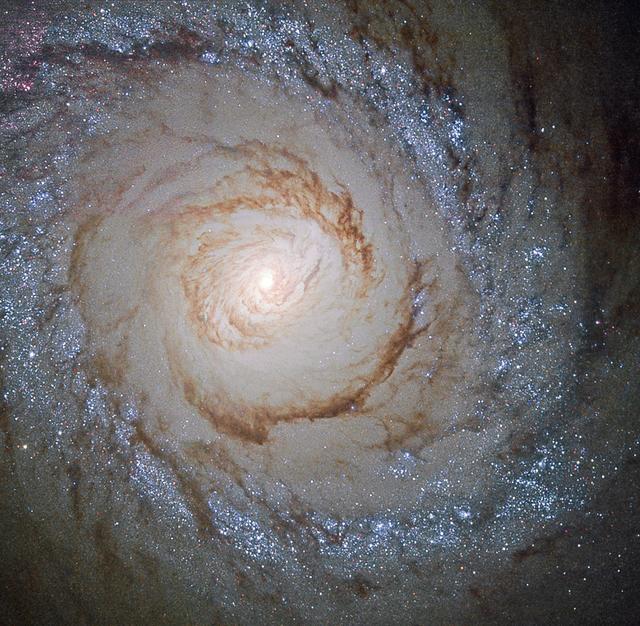
This image shows the galaxy Messier 94, which lies in the small northern constellation of the Hunting Dogs, about 16 million light-years away. Within the bright ring around Messier 94 new stars are forming at a high rate and many young, bright stars are present within it – thanks to this, this feature is called a starburst ring. The cause of this peculiarly shaped star-forming region is likely a pressure wave going outwards from the galactic centre, compressing the gas and dust in the outer region. The compression of material means the gas starts to collapse into denser clouds. Inside these dense clouds, gravity pulls the gas and dust together until temperature and pressure are high enough for stars to be born.
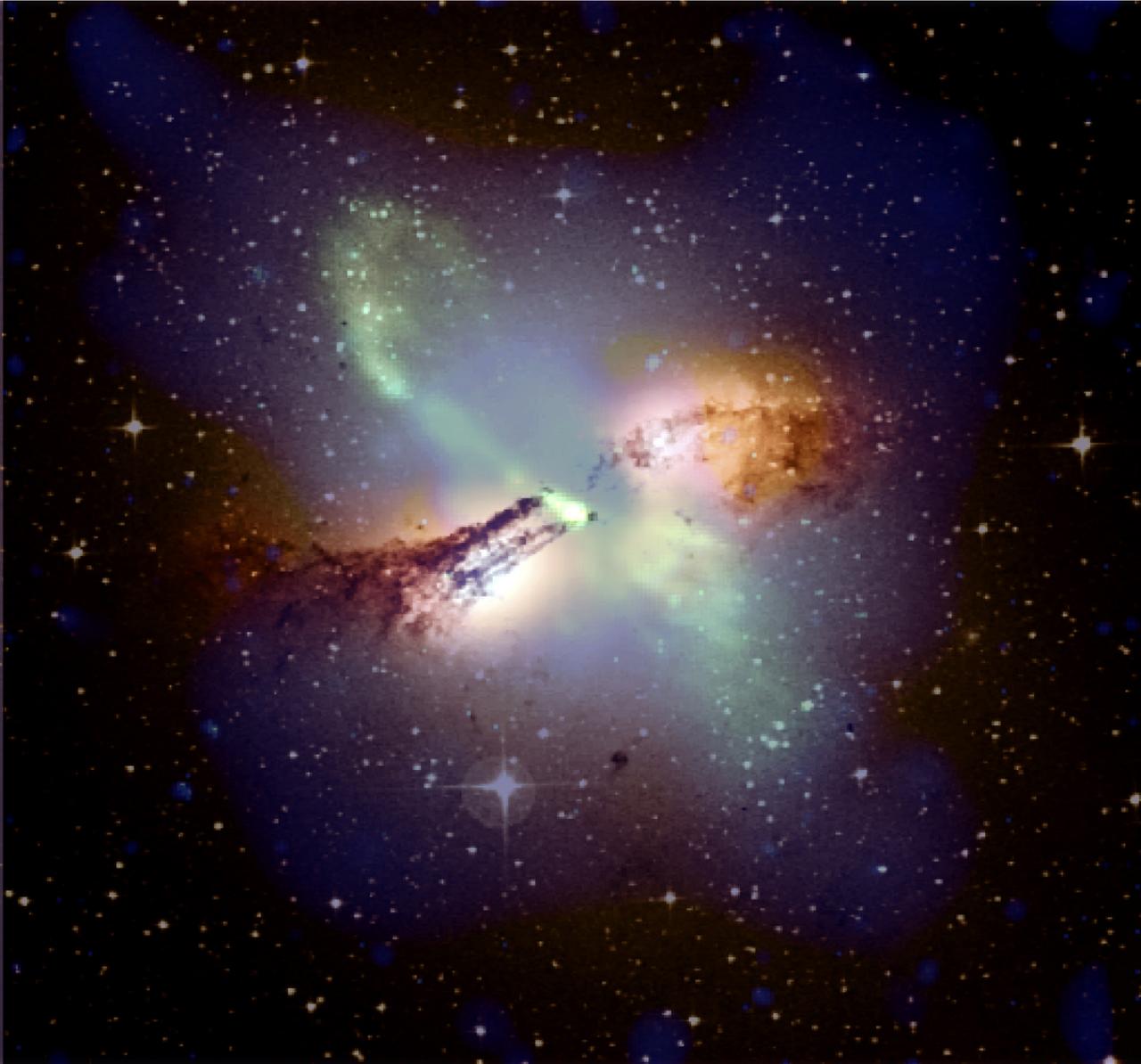
This is a photo taken by NASA's Chandra X-ray Observatory that reveals the remains of an explosion in the form of two enormous arcs of multimillion-degree gas in the galaxy Centaurus A that appear to be part of a ring 25,000 light years in diameter. The size and location of the ring suggest that it could have been an explosion that occurred about 10 million years ago. A composite image made with radio (red and green), optical (yellow-orange), and X-ray data (blue) presents a sturning tableau of a turbulent galaxy. A broad band of dust and cold gas is bisected at an angle by opposing jets of high-energy particles blasting away from the supermassive black hole in the nucleus. Lying in a plane perpendicular to the jets are the two large arcs of x-ray emitting multi-million degree gas. This discovery can help astronomers better understand the cause and effect of violent outbursts from the vicinity of supermassive black holes of active galaxies. The Chandra program is managed by the Marshall Space Flight Center in Huntsville, Alabama.
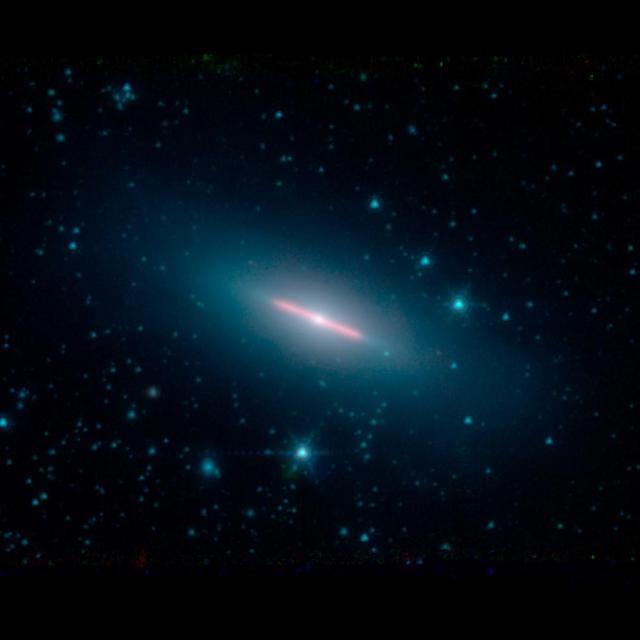
Galaxy NGC 5866 lies 44 million light-years from Earth and has a diameter of roughly 60,000 light-years — a little more than half the diameter of our own Milky Way galaxy. From our viewpoint, NGC 5866 is oriented almost exactly edge-on, yielding most of its structural features invisible. Spitzer detects infrared light, and the red color here corresponds to a wavelength typically emitted by dust. The clean edges of the dust emission from NGC 5866 indicate that there is a very flat ring or disk of dust circling the outer region of the galaxy. Spitzer took this image during its "cold" mission, which ended in 2009. The colors represent three infrared wavelengths captured by the Infrared Array Camera instrument. Blue light corresponds to a wavelength of 3.6 microns, produced mainly by stars; green corresponds to 4.5 microns, and red corresponds to 8 microns. https://photojournal.jpl.nasa.gov/catalog/PIA23129
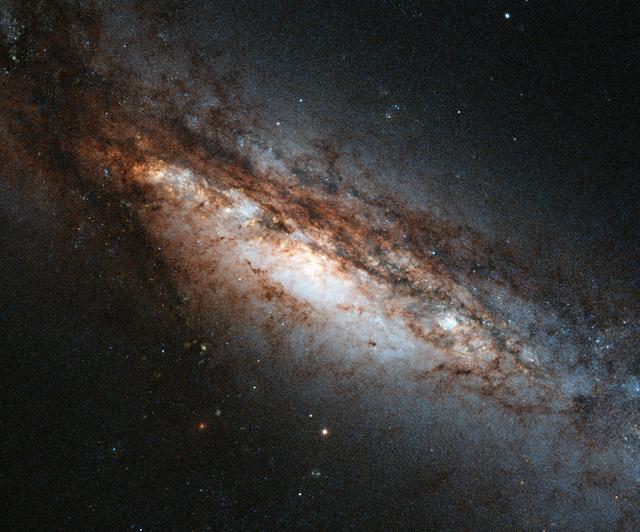
This new Hubble image shows a peculiar galaxy known as NGC 660, located around 45 million light-years away from us. NGC 660 is classified as a "polar ring galaxy," meaning that it has a belt of gas and stars around its center that it ripped from a near neighbor during a clash about one billion years ago.The first polar ring galaxy was observed in 1978 and only around a dozen more have been discovered since then, making them something of a cosmic rarity. Unfortunately, NGC 660’s polar ring cannot be seen in this image, but the image has plenty of other features that make it of interest to astronomers – its central bulge is strangely off-kilter and, perhaps more intriguingly, it is thought to harbor exceptionally large amounts of dark matter. In addition, in late 2012 astronomers observed a massive outburst emanating from NGC 660 that was around ten times as bright as a supernova explosion. This burst was thought to be caused by a massive jet shooting out of the supermassive black hole at the center of the galaxy. Credit: Hubble/NASA/European Space Agency <b><a href="http://www.nasa.gov/audience/formedia/features/MP_Photo_Guidelines.html" rel="nofollow">NASA image use policy.</a></b> <b><a href="http://www.nasa.gov/centers/goddard/home/index.html" rel="nofollow">NASA Goddard Space Flight Center</a></b> enables NASA’s mission through four scientific endeavors: Earth Science, Heliophysics, Solar System Exploration, and Astrophysics. Goddard plays a leading role in NASA’s accomplishments by contributing compelling scientific knowledge to advance the Agency’s mission. <b>Follow us on <a href="http://twitter.com/NASA_GoddardPix" rel="nofollow">Twitter</a></b> <b>Like us on <a href="http://www.facebook.com/pages/Greenbelt-MD/NASA-Goddard/395013845897?ref=tsd" rel="nofollow">Facebook</a></b> <b>Find us on <a href="http://instagram.com/nasagoddard?vm=grid" rel="nofollow">Instagram</a></b>

This is an illustration of a supermassive black hole, weighing as much as 21 million suns, located in the middle of the ultradense galaxy M60-UCD1. The dwarf galaxy is so dense that millions of stars fill the sky as seen by an imaginary visitor. Because no light can escape from the black hole, it appears simply in silhouette against the starry background. The black hole's intense gravitational field warps the light of the background stars to form ring-like images just outside the dark edges of the black hole's event horizon. Combined observations by the Hubble Space Telescope and Gemini North telescope determined the presence of the black hole inside such a small and dense galaxy. More info: Astronomers using data from NASA’s Hubble Space Telescope and ground observation have found an unlikely object in an improbable place -- a monster black hole lurking inside one of the tiniest galaxies ever known. The black hole is five times the mass of the one at the center of our Milky Way galaxy. It is inside one of the densest galaxies known to date -- the M60-UCD1 dwarf galaxy that crams 140 million stars within a diameter of about 300 light-years, which is only 1/500th of our galaxy’s diameter. If you lived inside this dwarf galaxy, the night sky would dazzle with at least 1 million stars visible to the naked eye. Our nighttime sky as seen from Earth’s surface shows 4,000 stars. The finding implies there are many other compact galaxies in the universe that contain supermassive black holes. The observation also suggests dwarf galaxies may actually be the stripped remnants of larger galaxies that were torn apart during collisions with other galaxies rather than small islands of stars born in isolation. “We don’t know of any other way you could make a black hole so big in an object this small,” said University of Utah astronomer Anil Seth, lead author of an international study of the dwarf galaxy published in Thursday’s issue of the journal Nature. Seth’s team of astronomers used the Hubble Space Telescope and the Gemini North 8-meter optical and infrared telescope on Hawaii’s Mauna Kea to observe M60-UCD1 and measure the black hole’s mass. The sharp Hubble images provide information about the galaxy’s diameter and stellar density. Gemini measures the stellar motions as affected by the black hole’s pull. These data are used to calculate the mass of the black hole. Black holes are gravitationally collapsed, ultra-compact objects that have a gravitational pull so strong that even light cannot escape. Supermassive black holes -- those with the mass of at least one million stars like our sun -- are thought to be at the centers of many galaxies. The black hole at the center of our Milky Way galaxy has the mass of four million suns. As heavy as that is, it is less than 0.01 percent of the Milky Way’s total mass. By comparison, the supermassive black hole at the center of M60-UCD1, which has the mass of 21 million suns, is a stunning 15 percent of the small galaxy’s total mass. “That is pretty amazing, given that the Milky Way is 500 times larger and more than 1,000 times heavier than the dwarf galaxy M60-UCD1,” Seth said. One explanation is that M60-UCD1 was once a large galaxy containing 10 billion stars, but then it passed very close to the center of an even larger galaxy, M60, and in that process all the stars and dark matter in the outer part of the galaxy were torn away and became part of M60. The team believes that M60-UCD1 may eventually be pulled to fully merge with M60, which has its own monster black hole that weighs a whopping 4.5 billion solar masses, or more than 1,000 times bigger than the black hole in our galaxy. When that happens, the black holes in both galaxies also likely will merge. Both galaxies are 50 million light-years away. The Hubble Space Telescope is a project of international cooperation between NASA and the European Space Agency. NASA's Goddard Space Flight Center in Greenbelt, Maryland, manages the telescope. The Space Telescope Science Institute (STScI) in Baltimore conducts Hubble science operations. STScI is operated for NASA by the Association of Universities for Research in Astronomy, Inc., in Washington. For images and more information about Hubble, visit: <a href="http://www.nasa.gov/hubble" rel="nofollow">www.nasa.gov/hubble</a> <b><a href="http://www.nasa.gov/audience/formedia/features/MP_Photo_Guidelines.html" rel="nofollow">NASA image use policy.</a></b> <b><a href="http://www.nasa.gov/centers/goddard/home/index.html" rel="nofollow">NASA Goddard Space Flight Center</a></b> enables NASA’s mission through four scientific endeavors: Earth Science, Heliophysics, Solar System Exploration, and Astrophysics. Goddard plays a leading role in NASA’s accomplishments by contributing compelling scientific knowledge to advance the Agency’s mission. <b>Follow us on <a href="http://twitter.com/NASAGoddardPix" rel="nofollow">Twitter</a></b> <b>Like us on <a href="http://www.facebook.com/pages/Greenbelt-MD/NASA-Goddard/395013845897?ref=tsd" rel="nofollow">Facebook</a></b> <b>Find us on <a href="http://instagram.com/nasagoddard?vm=grid" rel="nofollow">Instagram</a></b>
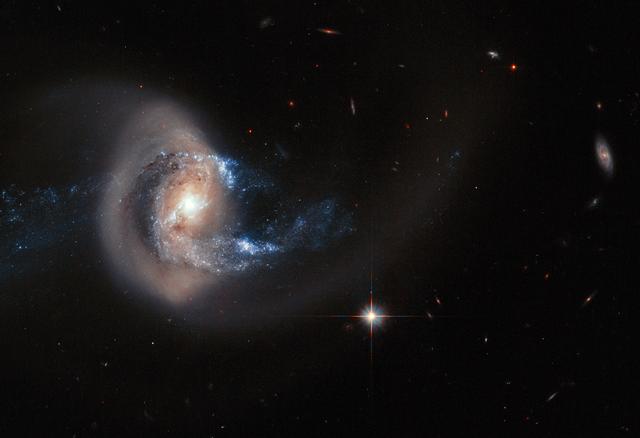
This NASA Hubble Space Telescope photo of NGC 7714 presents an especially striking view of the galaxy's smoke-ring-like structure. The golden loop is made of sun-like stars that have been pulled deep into space, far from the galaxy's center. The galaxy is located approximately 100 million light-years from Earth in the direction of the constellation Pisces. The universe is full of such galaxies that are gravitationally stretched and pulled and otherwise distorted in gravitational tug-o'-wars with bypassing galaxies. The companion galaxy doing the "taffy pulling" in this case, NGC 7715, lies just out of the field of view in this image. A very faint bridge of stars extends to the unseen companion. The close encounter has compressed interstellar gas to trigger bursts of star formation seen in bright blue arcs extending around NGC 7714's center. The gravitational disruption of NGC 7714 began between 100 million and 200 million years ago, at the epoch when dinosaurs ruled the Earth. The image was taken with the Wide Field Camera 3 and the Advanced Camera for Surveys in October 2011. Credit: NASA and ESA. Acknowledgment: A. Gal-Yam (Weizmann Institute of Science) <b><a href="http://www.nasa.gov/audience/formedia/features/MP_Photo_Guidelines.html" rel="nofollow">NASA image use policy.</a></b> <b><a href="http://www.nasa.gov/centers/goddard/home/index.html" rel="nofollow">NASA Goddard Space Flight Center</a></b> enables NASA’s mission through four scientific endeavors: Earth Science, Heliophysics, Solar System Exploration, and Astrophysics. Goddard plays a leading role in NASA’s accomplishments by contributing compelling scientific knowledge to advance the Agency’s mission. <b>Follow us on <a href="http://twitter.com/NASAGoddardPix" rel="nofollow">Twitter</a></b> <b>Like us on <a href="http://www.facebook.com/pages/Greenbelt-MD/NASA-Goddard/395013845897?ref=tsd" rel="nofollow">Facebook</a></b> <b>Find us on <a href="http://instagram.com/nasagoddard?vm=grid" rel="nofollow">Instagram</a></b>
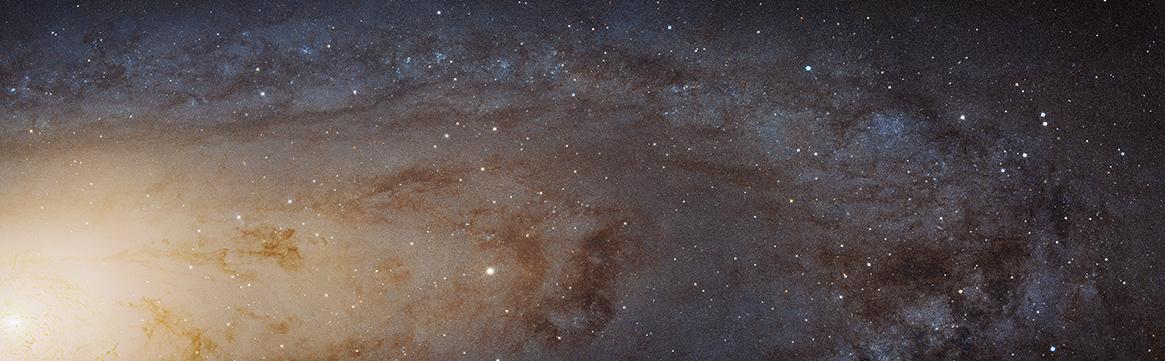
The largest NASA Hubble Space Telescope image ever assembled, this sweeping bird’s-eye view of a portion of the Andromeda galaxy (M31) is the sharpest large composite image ever taken of our galactic next-door neighbor. Though the galaxy is over 2 million light-years away, The Hubble Space Telescope is powerful enough to resolve individual stars in a 61,000-light-year-long stretch of the galaxy’s pancake-shaped disk. It's like photographing a beach and resolving individual grains of sand. And there are lots of stars in this sweeping view -- over 100 million, with some of them in thousands of star clusters seen embedded in the disk. This ambitious photographic cartography of the Andromeda galaxy represents a new benchmark for precision studies of large spiral galaxies that dominate the universe's population of over 100 billion galaxies. Never before have astronomers been able to see individual stars inside an external spiral galaxy over such a large contiguous area. Most of the stars in the universe live inside such majestic star cities, and this is the first data that reveal populations of stars in context to their home galaxy. Hubble traces densely packed stars extending from the innermost hub of the galaxy seen at the left. Moving out from this central galactic bulge, the panorama sweeps from the galaxy's central bulge across lanes of stars and dust to the sparser outer disk. Large groups of young blue stars indicate the locations of star clusters and star-forming regions. The stars bunch up in the blue ring-like feature toward the right side of the image. The dark silhouettes trace out complex dust structures. Underlying the entire galaxy is a smooth distribution of cooler red stars that trace Andromeda’s evolution over billions of years. Because the galaxy is only 2.5 million light-years from Earth, it is a much bigger target in the sky than the myriad galaxies Hubble routinely photographs that are billions of light-years away. This means that the Hubble survey is assembled together into a mosaic image using 7,398 exposures taken over 411 individual pointings. Read more: <a href="http://1.usa.gov/1y0i3H8" rel="nofollow">1.usa.gov/1y0i3H8</a> Credit: NASA, ESA, J. Dalcanton, B.F. Williams, and L.C. Johnson (University of Washington), the PHAT team, and R. Gendler <b><a href="http://www.nasa.gov/audience/formedia/features/MP_Photo_Guidelines.html" rel="nofollow">NASA image use policy.</a></b> <b><a href="http://www.nasa.gov/centers/goddard/home/index.html" rel="nofollow">NASA Goddard Space Flight Center</a></b> enables NASA’s mission through four scientific endeavors: Earth Science, Heliophysics, Solar System Exploration, and Astrophysics. Goddard plays a leading role in NASA’s accomplishments by contributing compelling scientific knowledge to advance the Agency’s mission. <b>Follow us on <a href="http://twitter.com/NASAGoddardPix" rel="nofollow">Twitter</a></b> <b>Like us on <a href="http://www.facebook.com/pages/Greenbelt-MD/NASA-Goddard/395013845897?ref=tsd" rel="nofollow">Facebook</a></b> <b>Find us on <a href="http://instagram.com/nasagoddard?vm=grid" rel="nofollow">Instagram</a></b>
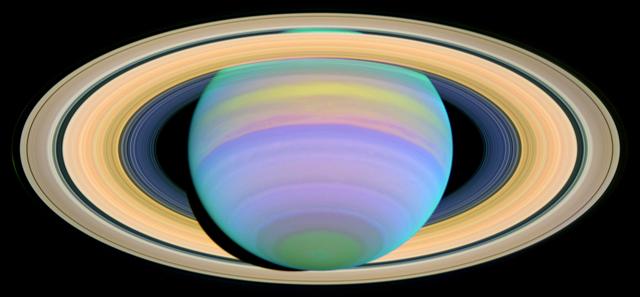
Saturn's Rings in Ultraviolet Light Credit: NASA and E. Karkoschka (University of Arizona) The Hubble Space Telescope is a project of international cooperation between NASA and the European Space Agency. NASA's Goddard Space Flight Center manages the telescope. The Space Telescope Science Institute conducts Hubble science operations. Goddard is responsible for HST project management, including mission and science operations, servicing missions, and all associated development activities. To learn more about the Hubble Space Telescope go here: <a href="http://www.nasa.gov/mission_pages/hubble/main/index.html" rel="nofollow">www.nasa.gov/mission_pages/hubble/main/index.html</a>
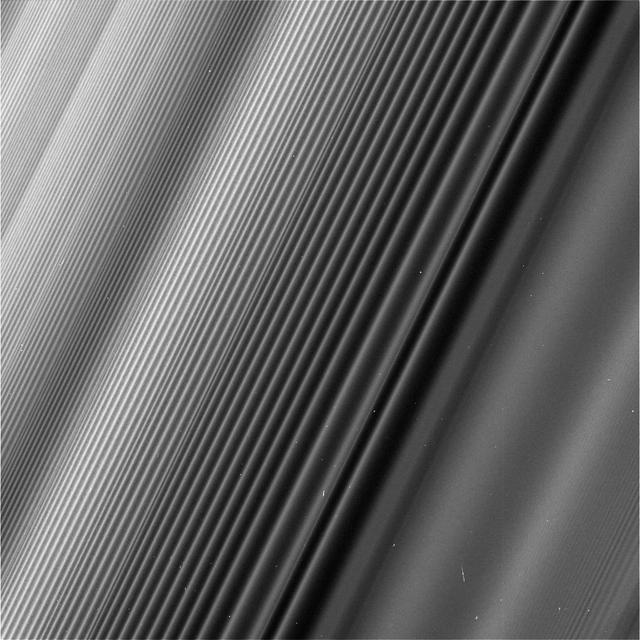
This view from NASA's Cassini spacecraft shows a wave structure in Saturn's rings known as the Janus 2:1 spiral density wave. Resulting from the same process that creates spiral galaxies, spiral density waves in Saturn's rings are much more tightly wound. In this case, every second wave crest is actually the same spiral arm which has encircled the entire planet multiple times. This is the only major density wave visible in Saturn's B ring. Most of the B ring is characterized by structures that dominate the areas where density waves might otherwise occur, but this innermost portion of the B ring is different. The radius from Saturn at which the wave originates (toward lower-right in this image) is 59,796 miles (96,233 kilometers) from the planet. At this location, ring particles orbit Saturn twice for every time the moon Janus orbits once, creating an orbital resonance. The wave propagates outward from the resonance (and away from Saturn), toward upper-left in this view. For reasons researchers do not entirely understand, damping of waves by larger ring structures is very weak at this location, so this wave is seen ringing for hundreds of bright wave crests, unlike density waves in Saturn's A ring. The image gives the illusion that the ring plane is tilted away from the camera toward upper-left, but this is not the case. Because of the mechanics of how this kind of wave propagates, the wavelength decreases with distance from the resonance. Thus, the upper-left of the image is just as close to the camera as the lower-right, while the wavelength of the density wave is simply shorter. This wave is remarkable because Janus, the moon that generates it, is in a strange orbital configuration. Janus and Epimetheus share practically the same orbit and trade places every four years. Every time one of those orbit swaps takes place, the ring at this location responds, spawning a new crest in the wave. The distance between any pair of crests corresponds to four years' worth of the wave propagating downstream from the resonance, which means the wave seen here encodes many decades' worth of the orbital history of Janus and Epimetheus. According to this interpretation, the part of the wave at the very upper-left of this image corresponds to the positions of Janus and Epimetheus around the time of the Voyager flybys in 1980 and 1981, which is the time at which Janus and Epimetheus were first proven to be two distinct objects (they were first observed in 1966). Epimetheus also generates waves at this location, but they are swamped by the waves from Janus, since Janus is the larger of the two moons. This image was taken on June 4, 2017, with the Cassini spacecraft narrow-angle camera. The image was acquired on the sunlit side of the rings from a distance of 47,000 miles (76,000 kilometers) away from the area pictured. The image scale is 1,730 feet (530 meters) per pixel. The phase angle, or sun-ring-spacecraft angle, is 90 degrees. https://photojournal.jpl.nasa.gov/catalog/PIA21627

Tidal disruption event Every galaxy has a black hole at its center. Usually they are quiet, without gas accretions, like the one in our Milky Way. But if a star creeps too close to the black hole, the gravitational tides can rip away the star’s gaseous matter. Like water spinning around a drain, the gas swirls into a disk around the black hole at such speeds that it heats to millions of degrees. As an inner ring of gas spins into the black hole, gas particles shoot outward from the black hole’s polar regions. Like bullets shot from a rifle, they zoom through the jets at velocities close to the speed of light. Astronomers using NASA’s Hubble Space Telescope observed correlations between supermassive black holes and an event similar to tidal disruption, pictured above in the Centaurus A galaxy. Certain galaxies have shining centers, illuminated by heated gas circling around a supermassive black hole. Matter escapes where it can, forming two jets of plasma moving near the speed of light. To learn more about the relationship between galaxies and the black holes at their cores, go to NASA’s Hubble Space Telescope: <a href="http://www.nasa.gov/mission_pages/hubble/main/" rel="nofollow">www.nasa.gov/mission_pages/hubble/main/</a> -------------------------------- Original caption: A team of astronomers using the Hubble Space Telescope found an unambiguous link between the presence of supermassive black holes that power high-speed, radio-signal-emitting jets and the merger history of their host galaxies. Almost all galaxies with the jets were found to be merging with another galaxy, or to have done so recently. Credit: NASA/ESA/STScI <b><a href="http://www.nasa.gov/audience/formedia/features/MP_Photo_Guidelines.html" rel="nofollow">NASA image use policy.</a></b> <b><a href="http://www.nasa.gov/centers/goddard/home/index.html" rel="nofollow">NASA Goddard Space Flight Center</a></b> enables NASA’s mission through four scientific endeavors: Earth Science, Heliophysics, Solar System Exploration, and Astrophysics. Goddard plays a leading role in NASA’s accomplishments by contributing compelling scientific knowledge to advance the Agency’s mission. <b>Follow us on <a href="http://twitter.com/NASAGoddardPix" rel="nofollow">Twitter</a></b> <b>Like us on <a href="http://www.facebook.com/pages/Greenbelt-MD/NASA-Goddard/395013845897?ref=tsd" rel="nofollow">Facebook</a></b> <b>Find us on <a href="http://instagrid.me/nasagoddard/?vm=grid" rel="nofollow">Instagram</a></b>
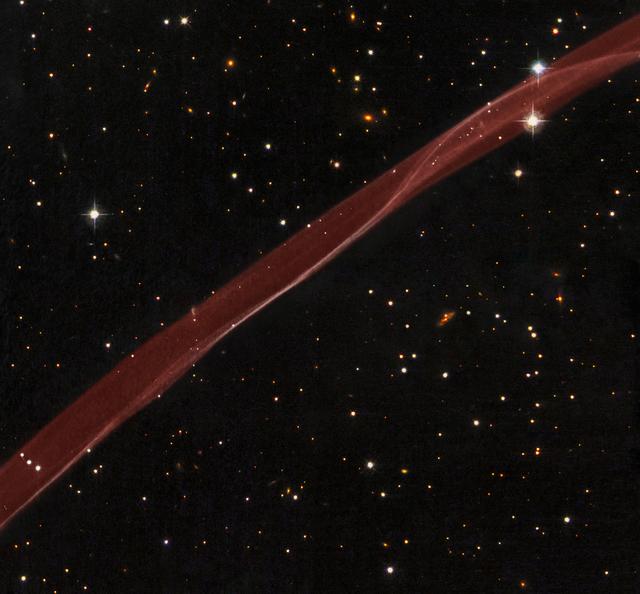
Release date: July 1, 2008 SN 1006 Supernova Remnant (Hubble) A delicate ribbon of gas floats eerily in our galaxy. A contrail from an alien spaceship? A jet from a black-hole? Actually this image, taken by NASA's Hubble Space Telescope, is a very thin section of a supernova remnant caused by a stellar explosion that occurred more than 1,000 years ago. On or around May 1, 1006 A.D., observers from Africa to Europe to the Far East witnessed and recorded the arrival of light from what is now called SN 1006, a tremendous supernova explosion caused by the final death throes of a white dwarf star nearly 7,000 light-years away. The supernova was probably the brightest star ever seen by humans, and surpassed Venus as the brightest object in the night time sky, only to be surpassed by the moon. It was visible even during the day for weeks, and remained visible to the naked eye for at least two and a half years before fading away. It wasn't until the mid-1960s that radio astronomers first detected a nearly circular ring of material at the recorded position of the supernova. The ring was almost 30 arcminutes across, the same angular diameter as the full moon. The size of the remnant implied that the blast wave from the supernova had expanded at nearly 20 million miles per hour over the nearly 1,000 years since the explosion occurred. In 1976, the first detection of exceedingly faint optical emission of the supernova remnant was reported, but only for a filament located on the northwest edge of the radio ring. A tiny portion of this filament is revealed in detail by the Hubble observation. The twisting ribbon of light seen by Hubble corresponds to locations where the expanding blast wave from the supernova is now sweeping into very tenuous surrounding gas. The hydrogen gas heated by this fast shock wave emits radiation in visible light. Hence, the optical emission provides astronomers with a detailed "snapshot" of the actual position and geometry of the shock front at any given time. Bright edges within the ribbon correspond to places where the shock wave is seen exactly edge on to our line of sight. Today we know that SN 1006 has a diameter of nearly 60 light-years, and it is still expanding at roughly 6 million miles per hour. Even at this tremendous speed, however, it takes observations typically separated by years to see significant outward motion of the shock wave against the grid of background stars. In the Hubble image as displayed, the supernova would have occurred far off the lower right corner of the image, and the motion would be toward the upper left. SN 1006 resides within our Milky Way Galaxy. Located more than 14 degrees off the plane of the galaxy's disk, there is relatively little confusion with other foreground and background objects in the field when trying to study this object. In the Hubble image, many background galaxies (orange extended objects) far off in the distant universe can be seen dotting the image. Most of the white dots are foreground or background stars in our Milky Way galaxy. This image is a composite of hydrogen-light observations taken with Hubble's Advanced Camera for Surveys in February 2006 and Wide Field Planetary Camera 2 observations in blue, yellow-green, and near-infrared light taken in April 2008. The supernova remnant, visible only in the hydrogen-light filter was assigned a red hue in the Heritage color image. Credit: NASA, ESA, and the Hubble Heritage Team (STScI/AURA) Acknowledgment: W. Blair (Johns Hopkins University) To learn more about the Hubble Space Telescope go here: <a href="http://www.nasa.gov/mission_pages/hubble/main/index.html" rel="nofollow">www.nasa.gov/mission_pages/hubble/main/index.html</a> <b><a href="http://www.nasa.gov/audience/formedia/features/MP_Photo_Guidelines.html" rel="nofollow">NASA image use policy.</a></b> <b><a href="http://www.nasa.gov/centers/goddard/home/index.html" rel="nofollow">NASA Goddard Space Flight Center</a></b> enables NASA’s mission through four scientific endeavors: Earth Science, Heliophysics, Solar System Exploration, and Astrophysics. Goddard plays a leading role in NASA’s accomplishments by contributing compelling scientific knowledge to advance the Agency’s mission. <b>Follow us on <a href="http://twitter.com/NASAGoddardPix" rel="nofollow">Twitter</a></b> <b>Like us on <a href="http://www.facebook.com/pages/Greenbelt-MD/NASA-Goddard/395013845897?ref=tsd" rel="nofollow">Facebook</a></b> <b>Find us on <a href="http://instagram.com/nasagoddard?vm=grid" rel="nofollow">Instagram</a></b>
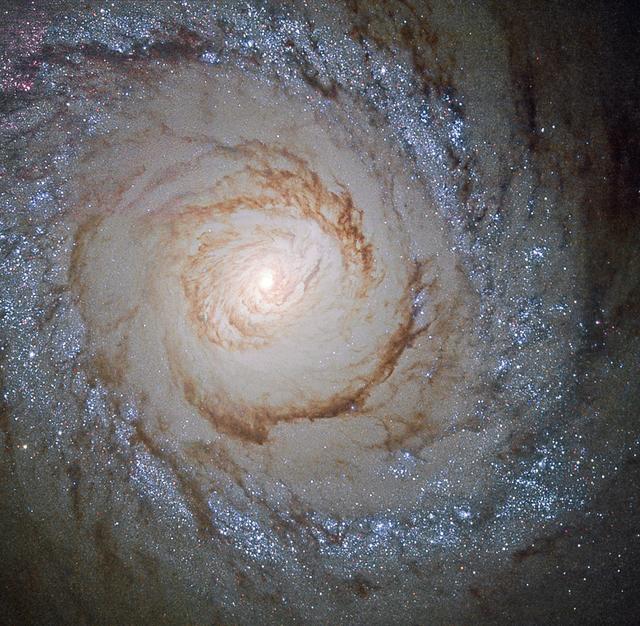
This image shows the galaxy Messier 94, which lies in the small northern constellation of the Hunting Dogs, about 16 million light-years away. Within the bright ring or starburst ring around Messier 94, new stars are forming at a high rate and many young, bright stars are present within it. The cause of this peculiarly shaped star-forming region is likely a pressure wave going outwards from the galactic center, compressing the gas and dust in the outer region. The compression of material means the gas starts to collapse into denser clouds. Inside these dense clouds, gravity pulls the gas and dust together until temperature and pressure are high enough for stars to be born. Image credit: ESA/NASA <b><a href="http://www.nasa.gov/audience/formedia/features/MP_Photo_Guidelines.html" rel="nofollow">NASA image use policy.</a></b> <b><a href="http://www.nasa.gov/centers/goddard/home/index.html" rel="nofollow">NASA Goddard Space Flight Center</a></b> enables NASA’s mission through four scientific endeavors: Earth Science, Heliophysics, Solar System Exploration, and Astrophysics. Goddard plays a leading role in NASA’s accomplishments by contributing compelling scientific knowledge to advance the Agency’s mission. <b>Follow us on <a href="http://twitter.com/NASAGoddardPix" rel="nofollow">Twitter</a></b> <b>Like us on <a href="http://www.facebook.com/pages/Greenbelt-MD/NASA-Goddard/395013845897?ref=tsd" rel="nofollow">Facebook</a></b> <b>Find us on <a href="http://instagrid.me/nasagoddard/?vm=grid" rel="nofollow">Instagram</a></b>

The Blue Ring Nebula was discovered in 2004 by NASA's Galaxy Evolution Explorer (GALEX) mission. Astronomers think the nebula was created by the merger of two stars, and that we are seeing the system a few thousand years after the merger, when evidence of the collision is still apparent. The blue light in the image shows the debris cloud created by the merger. As the hot cloud of material expanded into space and cooled down, it formed hydrogen molecules that collided with the interstellar medium (the particles occupying the space between stars). These collisions caused the hydrogen molecules to radiate far-ultraviolet light, which was detected by GALEX. Yellow indicates near-ultraviolet light, also detected by GALEX, which is emitted by the star at the center of the nebula and many surrounding stars. Infrared light observed by NASA's Wide-field Infrared Survey Explorer (WISE) is also shown in red, and is primarily emitted by the central star. Detailed analysis of the WISE data revealed a ring of debris around the star – further evidence of a merger. Magenta indicates optical light — light visible to the human eye — collected using the Hale Telescope. This light comes from the shockwave at the front of the expanding debris cones. The optical light helped astronomers discover that the nebula actually consists of two cones moving away from the central star. The base of one cone is moving almost directly toward Earth, while the other is moving almost directly away, and the magenta light outlines the two bases. The blue region in the image shows where the cones overlap; the non-overlapping regions are too faint for GALEX to see. Figure A shows the orientation of the cones to Earth and the way they appear to overlap. https://photojournal.jpl.nasa.gov/catalog/PIA23867

Image release June 22, 2010 A spectacular new NASA/ESA Hubble Space Telescope image — one of the largest ever released of a star-forming region — highlights N11, part of a complex network of gas clouds and star clusters within our neighbouring galaxy, the Large Magellanic Cloud. This region of energetic star formation is one of the most active in the nearby Universe. The Large Magellanic Cloud contains many bright bubbles of glowing gas. One of the largest and most spectacular has the name LHA 120-N 11, from its listing in a catalogue compiled by the American astronomer and astronaut Karl Henize in 1956, and is informally known as N11. Close up, the billowing pink clouds of glowing gas make N11 resemble a puffy swirl of fairground candy floss. From further away, its distinctive overall shape led some observers to nickname it the Bean Nebula. The dramatic and colourful features visible in the nebula are the telltale signs of star formation. N11 is a well-studied region that extends over 1000 light-years. It is the second largest star-forming region within the Large Magellanic Cloud and has produced some of the most massive stars known. It is the process of star formation that gives N11 its distinctive look. Three successive generations of stars, each of which formed further away from the centre of the nebula than the last, have created shells of gas and dust. These shells were blown away from the newborn stars in the turmoil of their energetic birth and early life, creating the ring shapes so prominent in this image. Beans are not the only terrestrial shapes to be found in this spectacular high resolution image from the NASA/ESA Hubble Space Telescope. In the upper left is the red bloom of nebula LHA 120-N 11A. Its rose-like petals of gas and dust are illuminated from within, thanks to the radiation from the massive hot stars at its centre. N11A is relatively compact and dense and is the site of the most recent burst of star development in the region. Other star clusters abound in N11, including NGC 1761 at the bottom of the image, which is a group of massive hot young stars busily pouring intense ultraviolet radiation out into space. Although it is much smaller than our own galaxy, the Large Magellanic Cloud is a very vigorous region of star formation. Studying these stellar nurseries helps astronomers understand a lot more about how stars are born and their ultimate development and lifespan. Both the Large Magellanic Cloud and its small companion, the Small Magellanic Cloud, are easily seen with the unaided eye and have always been familiar to people living in the southern hemisphere. The credit for bringing these galaxies to the attention of Europeans is usually given to Portuguese explorer Fernando de Magellan and his crew, who viewed it on their 1519 sea voyage. However, the Persian astronomer Abd Al-Rahman Al Sufi and the Italian explorer Amerigo Vespucci recorded the Large Magellanic Cloud in 964 and 1503 respectively. Credit: NASA, ESA and Jesús Maíz Apellániz (Instituto de Astrofísica de Andalucía, Spain) To learn more about Hubble go to: <a href="http://www.nasa.gov/mission_pages/hubble/main/index.html" rel="nofollow">www.nasa.gov/mission_pages/hubble/main/index.html</a> <b><a href="http://www.nasa.gov/centers/goddard/home/index.html" rel="nofollow">NASA Goddard Space Flight Center</a></b> is home to the nation's largest organization of combined scientists, engineers and technologists that build spacecraft, instruments and new technology to study the Earth, the sun, our solar system, and the universe.

This Chandra X-Ray Observatory image of the mysterious superstar Eta Carinae reveals a surprising hot irner core, creating more questions than answers for astronomers. The image shows three distinct structures: An outer, horseshoe shaped ring about 2 light-years in diameter, a hot inner core about 3 light-months in diameter, and a hot central source less than a light-month in diameter which may contain the superstar. In 1 month, light travels a distance of approximately 489 billion miles (about 788 billion kilometers). All three structures are thought to represent shock waves produced by matter rushing away from the superstar at supersonic speeds. The temperature of the shock-heated gas ranges from 60 million degrees Kelvin in the central regions to 7 million degrees Kelvin on the outer structure. Eta Carinae is one of the most enigmatic and intriguing objects in our galaxy. Between 1837 and 1856, it increased dramatically in brightness to become the most prominent star in the sky except for Sirius, even through it is 7,500 light-years away, more than 80 times the distance to Sirius. This "Great Eruption," as it is called, had an energy comparable to a supernova, yet did not destroy the star, which faded to become a dim star, invisible to the naked eye. Since 1940, Eta Carinae has begun to brighten again, becoming visible to the naked eye. Photo credit: NASA/CXC/SAO
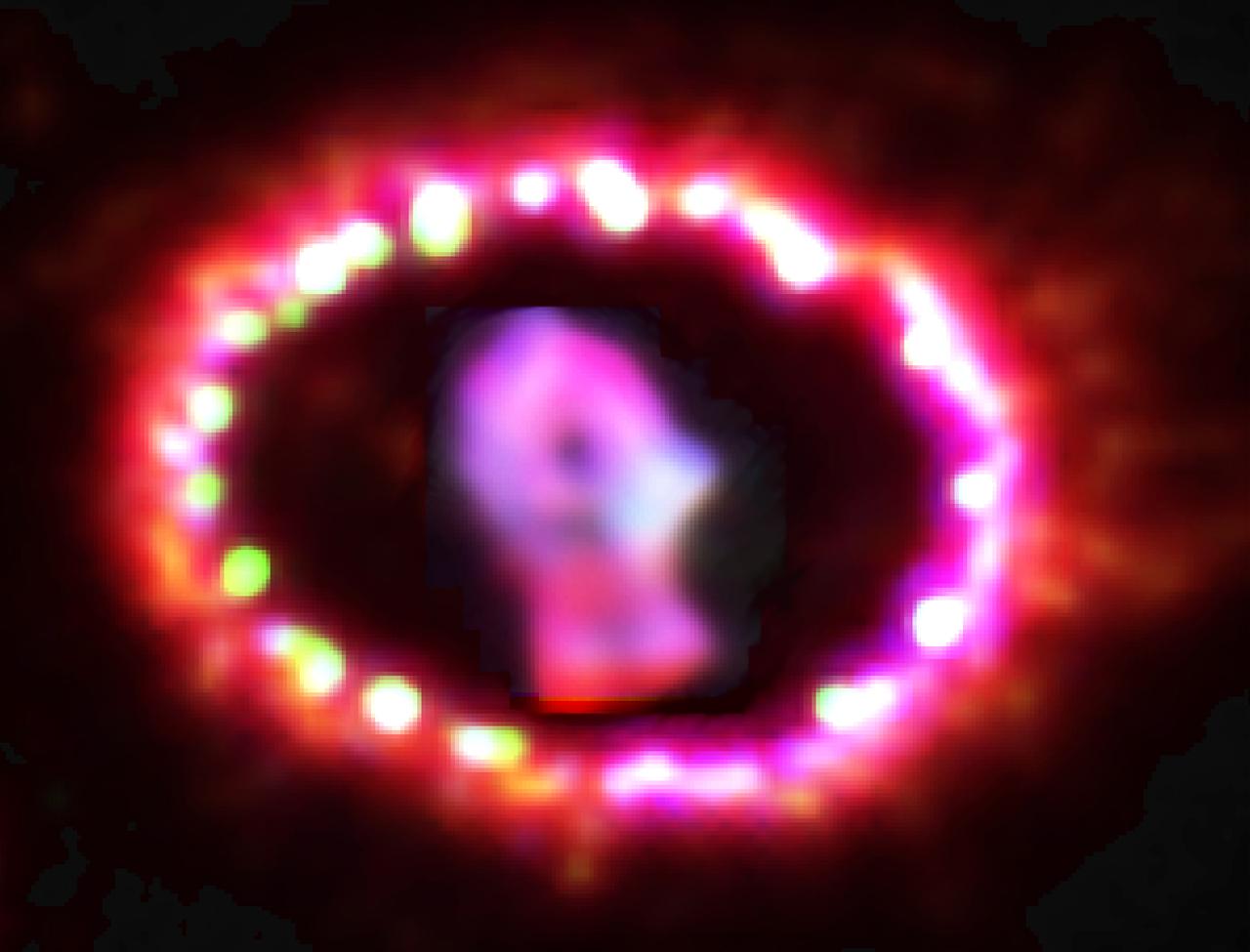
NASA image release June 10, 2011 Astronomers using NASA's Hubble Space Telescope are witnessing the unprecedented transition of a supernova to a supernova remnant, where light from an exploding star in a neighboring galaxy, the Large Magellanic Cloud, reached Earth in February 1987. Named Supernova 1987A, it was the closest supernova explosion witnessed in almost 400 years. The supernova's close proximity to Earth has allowed astronomers to study it in detail as it evolves. Now, the supernova debris, which has faded over the years, is brightening. This means that a different power source has begun to light the debris. The debris of SN 1987A is beginning to impact the surrounding ring, creating powerful shock waves that generate X-rays observed with NASA's Chandra X-ray Observatory. Those X-rays are illuminating the supernova debris and shock heating is making it glow in visible light. The results are being reported in the June 9, 2011, issue of the journal Nature by a team including Robert Kirshner of the Harvard-Smithsonian Center for Astrophysics (CfA), who leads a long-term study of SN 1987A with Hubble. Since its launch in 1990, the Hubble telescope has provided a continuous record of the changes in SN 1987A. Credit: NASA, ESA, and P. Challis (Harvard-Smithsonian Center for Astrophysics) <b><a href="http://www.nasa.gov/centers/goddard/home/index.html" rel="nofollow">NASA Goddard Space Flight Center</a></b> enables NASA’s mission through four scientific endeavors: Earth Science, Heliophysics, Solar System Exploration, and Astrophysics. Goddard plays a leading role in NASA’s accomplishments by contributing compelling scientific knowledge to advance the Agency’s mission. <b>Follow us on <a href="http://twitter.com/NASAGoddardPix" rel="nofollow">Twitter</a></b> <b>Join us on <a href="http://www.facebook.com/pages/Greenbelt-MD/NASA-Goddard/395013845897?ref=tsd" rel="nofollow">Facebook</a></b> <b>Find us on <a href="http://web.stagram.com/n/nasagoddard/?vm=grid" rel="nofollow">Instagram</a></b>
![This image from NASA Spitzer Space Telescope, shows the wispy filamentary structure of Henize 206, is a four-color composite mosaic created by combining data from an infrared array camera IRAC. The LMC is a small satellite galaxy gravitationally bound to our own Milky Way. Yet the gravitational effects are tearing the companion to shreds in a long-playing drama of 'intergalactic cannibalism.' These disruptions lead to a recurring cycle of star birth and star death. Astronomers are particularly interested in the LMC because its fractional content of heavy metals is two to five times lower than is seen in our solar neighborhood. [In this context, 'heavy elements' refer to those elements not present in the primordial universe. Such elements as carbon, oxygen and others are produced by nucleosynthesis and are ejected into the interstellar medium via mass loss by stars, including supernova explosions.] As such, the LMC provides a nearby cosmic laboratory that may resemble the distant universe in its chemical composition. The primary Spitzer image, showing the wispy filamentary structure of Henize 206, is a four-color composite mosaic created by combining data from an infrared array camera (IRAC) at near-infrared wavelengths and the mid-infrared data from a multiband imaging photometer (MIPS). Blue represents invisible infrared light at wavelengths of 3.6 and 4.5 microns. Note that most of the stars in the field of view radiate primarily at these short infrared wavelengths. Cyan denotes emission at 5.8 microns, green depicts the 8.0 micron light, and red is used to trace the thermal emission from dust at 24 microns. The separate instrument images are included as insets to the main composite. An inclined ring of emission dominates the central and upper regions of the image. This delineates a bubble of hot, x-ray emitting gas that was blown into space when a massive star died in a supernova explosion millions of years ago. The shock waves from that explosion impacted a cloud of nearby hydrogen gas, compressed it, and started a new generation of star formation. The death of one star led to the birth of many new stars. This is particularly evident in the MIPS inset, where the 24-micron emission peaks correspond to newly formed stars. The ultraviolet and visible-light photons from the new stars are absorbed by surrounding dust and re-radiated at longer infrared wavelengths, where it is detected by Spitzer. This emission nebula was cataloged by Karl Henize (HEN-eyes) while spending 1948-1951 in South Africa doing research for his Ph.D. dissertation at the University of Michigan. Henize later became a NASA astronaut and, at age 59, became the oldest rookie to fly on the Space Shuttle during an eight-day flight of the Challenger in 1985. He died just short of his 67th birthday in 1993 while attempting to climb the north face of Mount Everest, the world's highest peak. http://photojournal.jpl.nasa.gov/catalog/PIA05517](https://images-assets.nasa.gov/image/PIA05517/PIA05517~medium.jpg)
This image from NASA Spitzer Space Telescope, shows the wispy filamentary structure of Henize 206, is a four-color composite mosaic created by combining data from an infrared array camera IRAC. The LMC is a small satellite galaxy gravitationally bound to our own Milky Way. Yet the gravitational effects are tearing the companion to shreds in a long-playing drama of 'intergalactic cannibalism.' These disruptions lead to a recurring cycle of star birth and star death. Astronomers are particularly interested in the LMC because its fractional content of heavy metals is two to five times lower than is seen in our solar neighborhood. [In this context, 'heavy elements' refer to those elements not present in the primordial universe. Such elements as carbon, oxygen and others are produced by nucleosynthesis and are ejected into the interstellar medium via mass loss by stars, including supernova explosions.] As such, the LMC provides a nearby cosmic laboratory that may resemble the distant universe in its chemical composition. The primary Spitzer image, showing the wispy filamentary structure of Henize 206, is a four-color composite mosaic created by combining data from an infrared array camera (IRAC) at near-infrared wavelengths and the mid-infrared data from a multiband imaging photometer (MIPS). Blue represents invisible infrared light at wavelengths of 3.6 and 4.5 microns. Note that most of the stars in the field of view radiate primarily at these short infrared wavelengths. Cyan denotes emission at 5.8 microns, green depicts the 8.0 micron light, and red is used to trace the thermal emission from dust at 24 microns. The separate instrument images are included as insets to the main composite. An inclined ring of emission dominates the central and upper regions of the image. This delineates a bubble of hot, x-ray emitting gas that was blown into space when a massive star died in a supernova explosion millions of years ago. The shock waves from that explosion impacted a cloud of nearby hydrogen gas, compressed it, and started a new generation of star formation. The death of one star led to the birth of many new stars. This is particularly evident in the MIPS inset, where the 24-micron emission peaks correspond to newly formed stars. The ultraviolet and visible-light photons from the new stars are absorbed by surrounding dust and re-radiated at longer infrared wavelengths, where it is detected by Spitzer. This emission nebula was cataloged by Karl Henize (HEN-eyes) while spending 1948-1951 in South Africa doing research for his Ph.D. dissertation at the University of Michigan. Henize later became a NASA astronaut and, at age 59, became the oldest rookie to fly on the Space Shuttle during an eight-day flight of the Challenger in 1985. He died just short of his 67th birthday in 1993 while attempting to climb the north face of Mount Everest, the world's highest peak. http://photojournal.jpl.nasa.gov/catalog/PIA05517