
Caption: In this composite image, visible-light observations by NASA’s Hubble Space Telescope are combined with infrared data from the ground-based Large Binocular Telescope in Arizona to assemble a dramatic view of the well-known Ring Nebula. Credit: NASA, ESA, C.R. Robert O’Dell (Vanderbilt University), G.J. Ferland (University of Kentucky), W.J. Henney and M. Peimbert (National Autonomous University of Mexico) Credit for Large Binocular Telescope data: David Thompson (University of Arizona) ---- The Ring Nebula's distinctive shape makes it a popular illustration for astronomy books. But new observations by NASA's Hubble Space Telescope of the glowing gas shroud around an old, dying, sun-like star reveal a new twist. "The nebula is not like a bagel, but rather, it's like a jelly doughnut, because it's filled with material in the middle," said C. Robert O'Dell of Vanderbilt University in Nashville, Tenn. He leads a research team that used Hubble and several ground-based telescopes to obtain the best view yet of the iconic nebula. The images show a more complex structure than astronomers once thought and have allowed them to construct the most precise 3-D model of the nebula. "With Hubble's detail, we see a completely different shape than what's been thought about historically for this classic nebula," O'Dell said. "The new Hubble observations show the nebula in much clearer detail, and we see things are not as simple as we previously thought." The Ring Nebula is about 2,000 light-years from Earth and measures roughly 1 light-year across. Located in the constellation Lyra, the nebula is a popular target for amateur astronomers. Read more: <a href="http://1.usa.gov/14VAOMk" rel="nofollow">1.usa.gov/14VAOMk</a> <b><a href="http://www.nasa.gov/audience/formedia/features/MP_Photo_Guidelines.html" rel="nofollow">NASA image use policy.</a></b> <b><a href="http://www.nasa.gov/centers/goddard/home/index.html" rel="nofollow">NASA Goddard Space Flight Center</a></b> enables NASA’s mission through four scientific endeavors: Earth Science, Heliophysics, Solar System Exploration, and Astrophysics. Goddard plays a leading role in NASA’s accomplishments by contributing compelling scientific knowledge to advance the Agency’s mission. <b>Follow us on <a href="http://twitter.com/NASA_GoddardPix" rel="nofollow">Twitter</a></b> <b>Like us on <a href="http://www.facebook.com/pages/Greenbelt-MD/NASA-Goddard/395013845897?ref=tsd" rel="nofollow">Facebook</a></b> <b>Find us on <a href="http://instagram.com/nasagoddard?vm=grid" rel="nofollow">Instagram</a></b>

NASA Spitzer Space Telescope finds a delicate flower in the Ring Nebula, as shown in this image. The outer shell of this planetary nebula looks surprisingly similar to the delicate petals of a camellia blossom.

The Blue Ring Nebula was discovered in 2004 by NASA's Galaxy Evolution Explorer (GALEX) mission. Astronomers think the nebula was created by the merger of two stars, and that we are seeing the system a few thousand years after the merger, when evidence of the collision is still apparent. The blue light in the image shows the debris cloud created by the merger. As the hot cloud of material expanded into space and cooled down, it formed hydrogen molecules that collided with the interstellar medium (the particles occupying the space between stars). These collisions caused the hydrogen molecules to radiate far-ultraviolet light, which was detected by GALEX. Yellow indicates near-ultraviolet light, also detected by GALEX, which is emitted by the star at the center of the nebula and many surrounding stars. Infrared light observed by NASA's Wide-field Infrared Survey Explorer (WISE) is also shown in red, and is primarily emitted by the central star. Detailed analysis of the WISE data revealed a ring of debris around the star – further evidence of a merger. Magenta indicates optical light — light visible to the human eye — collected using the Hale Telescope. This light comes from the shockwave at the front of the expanding debris cones. The optical light helped astronomers discover that the nebula actually consists of two cones moving away from the central star. The base of one cone is moving almost directly toward Earth, while the other is moving almost directly away, and the magenta light outlines the two bases. The blue region in the image shows where the cones overlap; the non-overlapping regions are too faint for GALEX to see. Figure A shows the orientation of the cones to Earth and the way they appear to overlap. https://photojournal.jpl.nasa.gov/catalog/PIA23867

This side-by-side comparison shows observations of the Southern Ring Nebula in near-infrared light, at left, and mid-infrared light, at right, from NASA’s Webb Telescope. This scene was created by a white dwarf star – the remains of a star like our Sun after it shed its outer layers and stopped burning fuel though nuclear fusion. Those outer layers now form the ejected shells all along this view. In the Near-Infrared Camera (NIRCam) image, the white dwarf appears to the lower left of the bright, central star, partially hidden by a diffraction spike. The same star appears – but brighter, larger, and redder – in the Mid-Infrared Instrument (MIRI) image. This white dwarf star is cloaked in thick layers of dust, which make it appear larger. The brighter star in both images hasn’t yet shed its layers. It closely orbits the dimmer white dwarf, helping to distribute what it’s ejected. Over thousands of years and before it became a white dwarf, the star periodically ejected mass – the visible shells of material. As if on repeat, it contracted, heated up – and then, unable to push out more material, pulsated. Stellar material was sent in all directions – like a rotating sprinkler – and provided the ingredients for this asymmetrical landscape. Today, the white dwarf is heating up the gas in the inner regions – which appear blue at left and red at right. Both stars are lighting up the outer regions, shown in orange and blue, respectively. The images look very different because NIRCam and MIRI collect different wavelengths of light. NIRCam observes near-infrared light, which is closer to the visible wavelengths our eyes detect. MIRI goes farther into the infrared, picking up mid-infrared wavelengths. The second star more clearly appears in the MIRI image, because this instrument can see the gleaming dust around it, bringing it more clearly into view. The stars – and their layers of light – steal more attention in the NIRCam image, while dust plays the lead in the MIRI image, specifically dust that is illuminated. Peer at the circular region at the center of both images. Each contains a wobbly, asymmetrical belt of material. This is where two “bowls” that make up the nebula meet. (In this view, the nebula is at a 40-degree angle.) This belt is easier to spot in the MIRI image – look for the yellowish circle – but is also visible in the NIRCam image. The light that travels through the orange dust in the NIRCam image – which look like spotlights – disappear at longer infrared wavelengths in the MIRI image. In near-infrared light, stars have more prominent diffraction spikes because they are so bright at these wavelengths. In mid-infrared light, diffraction spikes also appear around stars, but they are fainter and smaller (zoom in to spot them). Physics is the reason for the difference in the resolution of these images. NIRCam delivers high-resolution imaging because these wavelengths of light are shorter. MIRI supplies medium-resolution imagery because its wavelengths are longer – the longer the wavelength, the coarser the images are. But both deliver an incredible amount of detail about every object they observe – providing never-before-seen vistas of the universe. For a full array of Webb’s first images and spectra, including downloadable files, please visit: https://webbtelescope.org/news/first-images NIRCam was built by a team at the University of Arizona and Lockheed Martin’s Advanced Technology Center. MIRI was contributed by ESA and NASA, with the instrument designed and built by a consortium of nationally funded European Institutes (The MIRI European Consortium) in partnership with JPL and the University of Arizona.
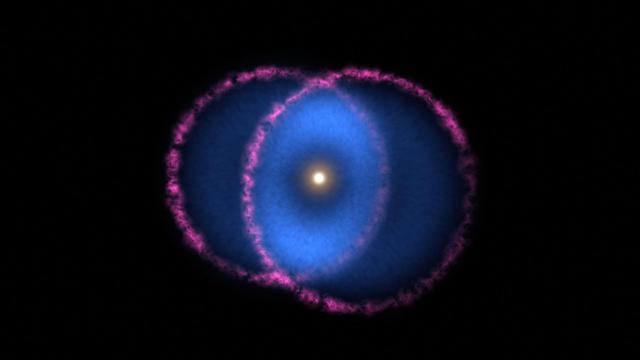
The Blue Ring Nebula is thought to be the product of two stars merging into one. The collision of the bodies ejected a cloud of hot debris into space. A disk of gas orbiting the larger star cut the cloud in half, creating two cones that are moving away from the star in opposite directions. The base of one cone is moving almost directly toward Earth, while the other is moving almost directly away. Magenta represents optical light from the shockwave at the front of the expanding debris cones, outlining the two cone bases at their widest points. Blue represents far-ultraviolet light (not visible to the human eye) and comes from gas behind the shockwave. As the gas expands and cools, it forms hydrogen molecules that interact with the interstellar medium and emit only far-ultraviolet light. These emissions are visible only where the cones overlap (as seen from Earth), forming the blue ring around the central star. Movie available at https://photojournal.jpl.nasa.gov/catalog/PIA23868
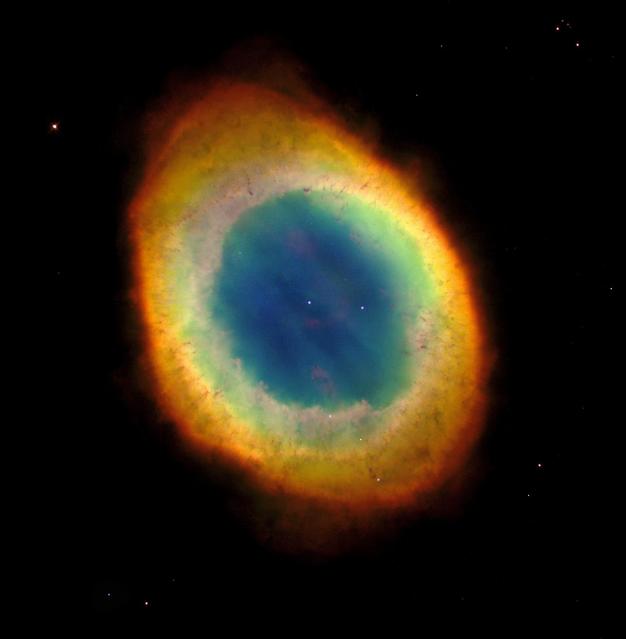
NASA Hubble Space Telescope captured this sharpest view yet of the most famous of all planetary nebulae: the Ring Nebula M57. The colors are approximately true colors.
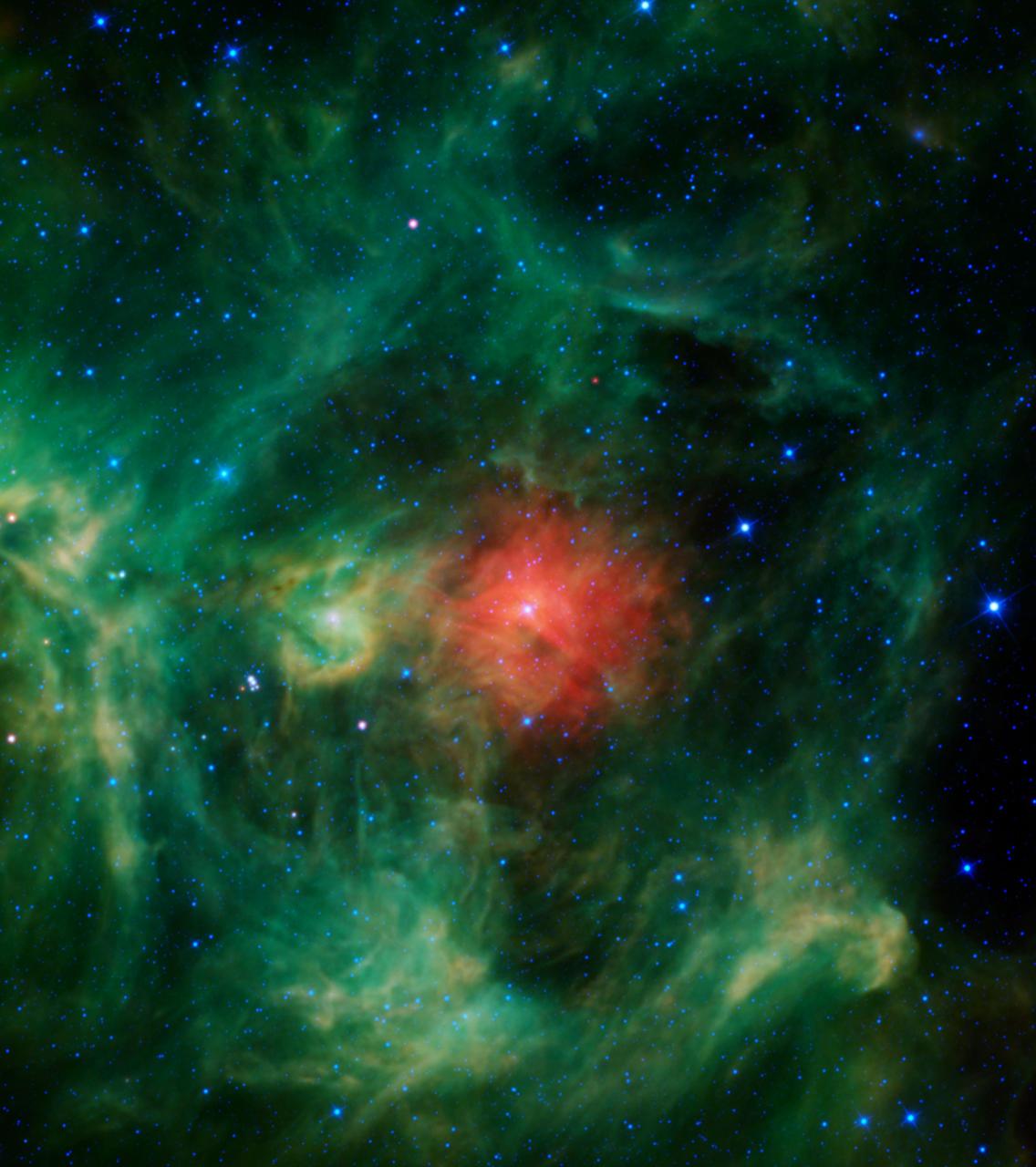
NASA Wide-field Infrared Survey Explorer mission presents the Wreath nebula. The nebula official name is Barnard 3, or IRAS Ring G159.6-18.5. Regions similar to this nebula are found near the band of the Milky Way galaxy in the night sky.

Cassini briefly turned its gaze from Saturn and its rings and moons to marvel at the Carina Nebula, a brilliant region 8,000 light years from our solar system and more than 200 light years across

This composite picture is a seamless blend of ultra-sharp NASA Hubble Space Telescope (HST) images combined with the wide view of the Mosaic Camera on the National Science Foundation's 0.9-meter telescope at Kitt Peak National Observatory, part of the National Optical Astronomy Observatory, near Tucson, Ariz. Astronomers at the Space Telescope Science Institute assembled these images into a mosaic. The mosaic was then blended with a wider photograph taken by the Mosaic Camera. The image shows a fine web of filamentary "bicycle-spoke" features embedded in the colorful red and blue gas ring, which is one of the nearest planetary nebulae to Earth. Because the nebula is nearby, it appears as nearly one-half the diameter of the full Moon. This required HST astronomers to take several exposures with the Advanced Camera for Surveys to capture most of the Helix. HST views were then blended with a wider photo taken by the Mosaic Camera. The portrait offers a dizzying look down what is actually a trillion-mile-long tunnel of glowing gases. The fluorescing tube is pointed nearly directly at Earth, so it looks more like a bubble than a cylinder. A forest of thousands of comet-like filaments, embedded along the inner rim of the nebula, points back toward the central star, which is a small, super-hot white dwarf. The tentacles formed when a hot "stellar wind" of gas plowed into colder shells of dust and gas ejected previously by the doomed star. Ground-based telescopes have seen these comet-like filaments for decades, but never before in such detail. The filaments may actually lie in a disk encircling the hot star, like a collar. The radiant tie-die colors correspond to glowing oxygen (blue) and hydrogen and nitrogen (red). Valuable Hubble observing time became available during the November 2002 Leonid meteor storm. To protect the spacecraft, including HST's precise mirror, controllers turned the aft end into the direction of the meteor stream for about half a day. Fortunately, the Helix Nebula was almost exactly in the opposite direction of the meteor stream, so Hubble used nine orbits to photograph the nebula while it waited out the storm. To capture the sprawling nebula, Hubble had to take nine separate snapshots. Planetary nebulae like the Helix are sculpted late in a Sun-like star's life by a torrential gush of gases escaping from the dying star. They have nothing to do with planet formation, but got their name because they look like planetary disks when viewed through a small telescope. With higher magnification, the classic "donut-hole" in the middle of a planetary nebula can be resolved. Based on the nebula's distance of 650 light-years, its angular size corresponds to a huge ring with a diameter of nearly 3 light-years. That's approximately three-quarters of the distance between our Sun and the nearest star. The Helix Nebula is a popular target of amateur astronomers and can be seen with binoculars as a ghostly, greenish cloud in the constellation Aquarius. Larger amateur telescopes can resolve the ring-shaped nebula, but only the largest ground-based telescopes can resolve the radial streaks. After careful analysis, astronomers concluded the nebula really isn't a bubble, but is a cylinder that happens to be pointed toward Earth. http://photojournal.jpl.nasa.gov/catalog/PIA18164

After barely 2 months in space, the Chandra X-Ray Observatory (CXO) took this sturning image of the Crab Nebula, the spectacular remains of a stellar explosion, revealing something never seen before, a brilliant ring around the nebula's heart. The image shows the central pulsar surrounded by tilted rings of high-energy particles that appear to have been flung outward over a distance of more than a light-year from the pulsar. Perpendicular to the rings, jet-like structures produced by high-energy particles blast away from the pulsar. Hubble Space Telescope images have shown moving knots and wisps around the neutron star, and previous x-ray images have shown the outer parts of the jet and hinted at the ring structure. With CXO's exceptional resolution, the jet can be traced all the way in to the neutron star, and the ring pattern clearly appears. The image was made with CXO's Advanced Charge-Coupled Device (CCD) Imaging Spectrometer (ACIS) and High Energy Transmission Grating. The Crab Nebula, easily the most intensively studied object beyond our solar system, has been observed using virtually every astronomical instrument that could see that part of the sky

This glowing emerald nebula seen by NASA Spitzer Space Telescope is named RCW 120; this region of hot gas and glowing dust can be found in the murky clouds encircled by the tail of the constellation Scorpius.
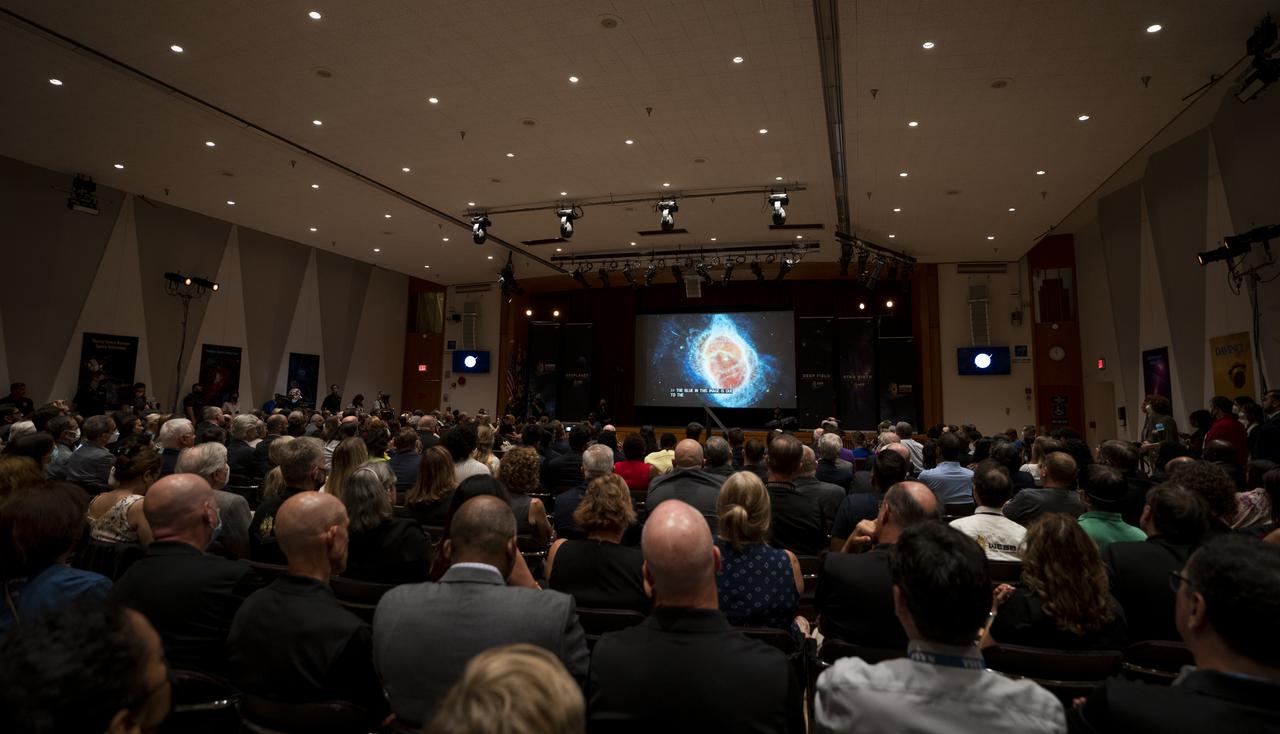
One of the images captured by NASA’s James Webb Space Telescope of the planetary nebula cataloged as NGC 3132, and known informally as the Southern Ring Nebula, is seen on a screen as members of the media and guests watch the broadcast releasing the first full-color images from NASA’s James Webb Space Telescope, Tuesday, July 12, 2022, at NASA’s Goddard Space Flight Center in Greenbelt, Md. The first full-color images and spectroscopic data from the James Webb Space Telescope, a partnership with ESA (European Space Agency) and the Canadian Space Agency (CSA), are a demonstration of the power of Webb as the telescope begins its science mission to unfold the infrared universe. Photo Credit: (NASA/Taylor Mickal)
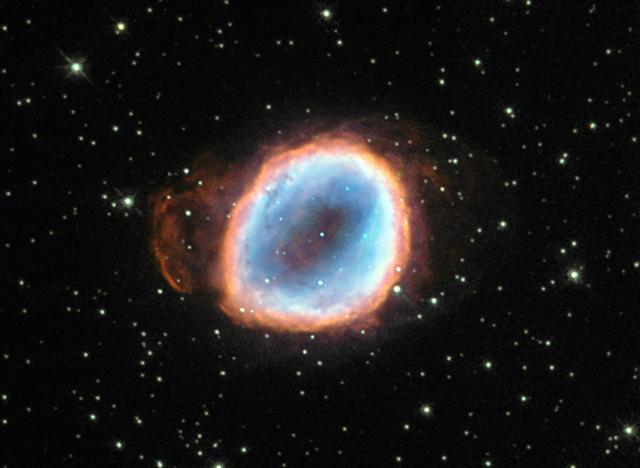
A dying star’s final moments are captured in this image from the NASA/ESA Hubble Space Telescope. The death throes of this star may only last mere moments on a cosmological timescale, but this star’s demise is still quite lengthy by our standards, lasting tens of thousands of years! The star’s agony has culminated in a wonderful planetary nebula known as NGC 6565, a cloud of gas that was ejected from the star after strong stellar winds pushed the star’s outer layers away into space. Once enough material was ejected, the star’s luminous core was exposed and it began to produce ultraviolet radiation, exciting the surrounding gas to varying degrees and causing it to radiate in an attractive array of colours. These same colours can be seen in the famous and impressive Ring Nebula (heic1310), a prominent example of a nebula like this one. Planetary nebulae are illuminated for around 10 000 years before the central star begins to cool and shrink to become a white dwarf. When this happens, the star’s light drastically diminishes and ceases to excite the surrounding gas, so the nebula fades from view. A version of this image was entered into the Hubble’s Hidden Treasures basic image competition by contestant Matej Novak.

This planetary nebula's simple, graceful appearance is thought to be due to perspective: our view from Earth looking straight into what is actually a barrel-shaped cloud of gas shrugged off by a dying central star. Hot blue gas near the energizing central star gives way to progressively cooler green and yellow gas at greater distances with the coolest red gas along the outer boundary. Credit: NASA/Hubble Heritage Team ---- The Ring Nebula's distinctive shape makes it a popular illustration for astronomy books. But new observations by NASA's Hubble Space Telescope of the glowing gas shroud around an old, dying, sun-like star reveal a new twist. "The nebula is not like a bagel, but rather, it's like a jelly doughnut, because it's filled with material in the middle," said C. Robert O'Dell of Vanderbilt University in Nashville, Tenn. He leads a research team that used Hubble and several ground-based telescopes to obtain the best view yet of the iconic nebula. The images show a more complex structure than astronomers once thought and have allowed them to construct the most precise 3-D model of the nebula. "With Hubble's detail, we see a completely different shape than what's been thought about historically for this classic nebula," O'Dell said. "The new Hubble observations show the nebula in much clearer detail, and we see things are not as simple as we previously thought." The Ring Nebula is about 2,000 light-years from Earth and measures roughly 1 light-year across. Located in the constellation Lyra, the nebula is a popular target for amateur astronomers. Read more: <a href="http://1.usa.gov/14VAOMk" rel="nofollow">1.usa.gov/14VAOMk</a> <b><a href="http://www.nasa.gov/audience/formedia/features/MP_Photo_Guidelines.html" rel="nofollow">NASA image use policy.</a></b> <b><a href="http://www.nasa.gov/centers/goddard/home/index.html" rel="nofollow">NASA Goddard Space Flight Center</a></b> enables NASA’s mission through four scientific endeavors: Earth Science, Heliophysics, Solar System Exploration, and Astrophysics. Goddard plays a leading role in NASA’s accomplishments by contributing compelling scientific knowledge to advance the Agency’s mission. <b>Follow us on <a href="http://twitter.com/NASAGoddardPix" rel="nofollow">Twitter</a></b> <b>Like us on <a href="http://www.facebook.com/pages/Greenbelt-MD/NASA-Goddard/395013845897?ref=tsd" rel="nofollow">Facebook</a></b> <b>Find us on <a href="http://instagram.com/nasagoddard?vm=grid" rel="nofollow">Instagram</a></b>
![Some of the most breathtaking views in the Universe are created by nebulae — hot, glowing clouds of gas. This new NASA/ESA Hubble Space Telescope image shows the centre of the Lagoon Nebula, an object with a deceptively tranquil name. The region is filled with intense winds from hot stars, churning funnels of gas, and energetic star formation, all embedded within an intricate haze of gas and pitch-dark dust. Nebulae are often named based on their key characteristics — particularly beautiful examples include the Ring Nebula (heic1310), the Horsehead Nebula (heic1307) and the Butterfly Nebula (heic0910). This new NASA/ESA Hubble Space Telescope image shows the centre of the Lagoon Nebula, otherwise known as Messier 8, in the constellation of Sagittarius (The Archer). The inspiration for this nebula’s name may not be immediately obvious — this is because the image captures only the very heart of the nebula. The Lagoon Nebula’s name becomes much clearer in a wider field view (opo0417i) when the broad, lagoon-shaped dust lane that crosses the glowing gas of the nebula can be made out. Another clear difference between this new image and others is that this image combines both infrared and optical light rather than being purely optical(heic1015). Infrared light cuts through thick, obscuring patches of dust and gas, revealing the more intricate structures underneath and producing a completely different landscape [1]. However, even in visible light, the tranquil name remains misleading as the region is packed full of violent phenomena. The bright star embedded in dark clouds at the centre of this image is known as Herschel 36. This star is responsible for sculpting the surrounding cloud, stripping away material and influencing its shape. Herschel 36 is the main source of ionising radiation [2] for this part of the Lagoon Nebula. This central part of the Lagoon Nebula contains two main structures of gas and dust connected by wispy twisters, visible in the middle third of this image (opo9638). These features are quite similar to their namesakes on Earth — they are thought to be wrapped up into their funnel-like shapes by temperature differences between the hot surface and cold interior of the clouds. The nebula is also actively forming new stars, and energetic winds from these newborns may contribute to creating the twisters. This image combines images taken using optical and infrared light gathered by Hubble’s Wide Field Planetary Camera 2. Credit: NASA, ESA, J. Trauger (Jet Propulson Laboratory) <b><a href="http://www.nasa.gov/audience/formedia/features/MP_Photo_Guidelines.html" rel="nofollow">NASA image use policy.</a></b> <b><a href="http://www.nasa.gov/centers/goddard/home/index.html" rel="nofollow">NASA Goddard Space Flight Center</a></b> enables NASA’s mission through four scientific endeavors: Earth Science, Heliophysics, Solar System Exploration, and Astrophysics. Goddard plays a leading role in NASA’s accomplishments by contributing compelling scientific knowledge to advance the Agency’s mission. <b>Follow us on <a href="http://twitter.com/NASAGoddardPix" rel="nofollow">Twitter</a></b> <b>Like us on <a href="http://www.facebook.com/pages/Greenbelt-MD/NASA-Goddard/395013845897?ref=tsd" rel="nofollow">Facebook</a></b> <b>Find us on <a href="http://instagrid.me/nasagoddard/?vm=grid" rel="nofollow">Instagram</a></b>](https://images-assets.nasa.gov/image/GSFC_20171208_Archive_e000671/GSFC_20171208_Archive_e000671~small.jpg)
Some of the most breathtaking views in the Universe are created by nebulae — hot, glowing clouds of gas. This new NASA/ESA Hubble Space Telescope image shows the centre of the Lagoon Nebula, an object with a deceptively tranquil name. The region is filled with intense winds from hot stars, churning funnels of gas, and energetic star formation, all embedded within an intricate haze of gas and pitch-dark dust. Nebulae are often named based on their key characteristics — particularly beautiful examples include the Ring Nebula (heic1310), the Horsehead Nebula (heic1307) and the Butterfly Nebula (heic0910). This new NASA/ESA Hubble Space Telescope image shows the centre of the Lagoon Nebula, otherwise known as Messier 8, in the constellation of Sagittarius (The Archer). The inspiration for this nebula’s name may not be immediately obvious — this is because the image captures only the very heart of the nebula. The Lagoon Nebula’s name becomes much clearer in a wider field view (opo0417i) when the broad, lagoon-shaped dust lane that crosses the glowing gas of the nebula can be made out. Another clear difference between this new image and others is that this image combines both infrared and optical light rather than being purely optical(heic1015). Infrared light cuts through thick, obscuring patches of dust and gas, revealing the more intricate structures underneath and producing a completely different landscape [1]. However, even in visible light, the tranquil name remains misleading as the region is packed full of violent phenomena. The bright star embedded in dark clouds at the centre of this image is known as Herschel 36. This star is responsible for sculpting the surrounding cloud, stripping away material and influencing its shape. Herschel 36 is the main source of ionising radiation [2] for this part of the Lagoon Nebula. This central part of the Lagoon Nebula contains two main structures of gas and dust connected by wispy twisters, visible in the middle third of this image (opo9638). These features are quite similar to their namesakes on Earth — they are thought to be wrapped up into their funnel-like shapes by temperature differences between the hot surface and cold interior of the clouds. The nebula is also actively forming new stars, and energetic winds from these newborns may contribute to creating the twisters. This image combines images taken using optical and infrared light gathered by Hubble’s Wide Field Planetary Camera 2. Credit: NASA, ESA, J. Trauger (Jet Propulson Laboratory) <b><a href="http://www.nasa.gov/audience/formedia/features/MP_Photo_Guidelines.html" rel="nofollow">NASA image use policy.</a></b> <b><a href="http://www.nasa.gov/centers/goddard/home/index.html" rel="nofollow">NASA Goddard Space Flight Center</a></b> enables NASA’s mission through four scientific endeavors: Earth Science, Heliophysics, Solar System Exploration, and Astrophysics. Goddard plays a leading role in NASA’s accomplishments by contributing compelling scientific knowledge to advance the Agency’s mission. <b>Follow us on <a href="http://twitter.com/NASAGoddardPix" rel="nofollow">Twitter</a></b> <b>Like us on <a href="http://www.facebook.com/pages/Greenbelt-MD/NASA-Goddard/395013845897?ref=tsd" rel="nofollow">Facebook</a></b> <b>Find us on <a href="http://instagrid.me/nasagoddard/?vm=grid" rel="nofollow">Instagram</a></b>

NASA image release April 27, 2012 The NASA/ESA Hubble Space Telescope has been at the cutting edge of research into what happens to stars like our sun at the ends of their lives. One stage that stars pass through as they run out of nuclear fuel is called the preplanetary or protoplanetary nebula stage. This Hubble image of the Egg Nebula shows one of the best views to date of this brief but dramatic phase in a star’s life. The preplanetary nebula phase is a short period in the cycle of stellar evolution, and has nothing to do with planets. Over a few thousand years, the hot remains of the aging star in the center of the nebula heat it up, excite the gas, and make it glow as a subsequent planetary nebula. The short lifespan of preplanetary nebulae means there are relatively few of them in existence at any one time. Moreover, they are very dim, requiring powerful telescopes to be seen. This combination of rarity and faintness means they were only discovered comparatively recently. The Egg Nebula, the first to be discovered, was first spotted less than 40 years ago, and many aspects of this class of object remain shrouded in mystery. At the center of this image, and hidden in a thick cloud of dust, is the nebula’s central star. While we can’t see the star directly, four searchlight beams of light coming from it shine out through the nebula. It is thought that ring-shaped holes in the thick cocoon of dust, carved by jets coming from the star, let the beams of light emerge through the otherwise opaque cloud. The precise mechanism by which stellar jets produce these holes is not known for certain, but one possible explanation is that a binary star system, rather than a single star, exists at the center of the nebula. The onion-like layered structure of the more diffuse cloud surrounding the central cocoon is caused by periodic bursts of material being ejected from the dying star. The bursts typically occur every few hundred years. The distance to the Egg Nebula is only known very approximately, the best guess placing it at around 3,000 light-years from Earth. This in turn means that astronomers do not have any accurate figures for the size of the nebula (it may be larger and further away, or smaller but nearer). This image is produced from exposures in visible and infrared light from Hubble’s Wide Field Camera 3. Credit: ESA/Hubble, NASA <b><a href="http://www.nasa.gov/audience/formedia/features/MP_Photo_Guidelines.html" rel="nofollow">NASA image use policy.</a></b> <b><a href="http://www.nasa.gov/centers/goddard/home/index.html" rel="nofollow">NASA Goddard Space Flight Center</a></b> enables NASA’s mission through four scientific endeavors: Earth Science, Heliophysics, Solar System Exploration, and Astrophysics. Goddard plays a leading role in NASA’s accomplishments by contributing compelling scientific knowledge to advance the Agency’s mission. <b>Follow us on <a href="http://twitter.com/NASAGoddardPix" rel="nofollow">Twitter</a></b> <b>Like us on <a href="http://www.facebook.com/pages/Greenbelt-MD/NASA-Goddard/395013845897?ref=tsd" rel="nofollow">Facebook</a></b> <b>Find us on <a href="http://instagrid.me/nasagoddard/?vm=grid" rel="nofollow">Instagram</a></b>
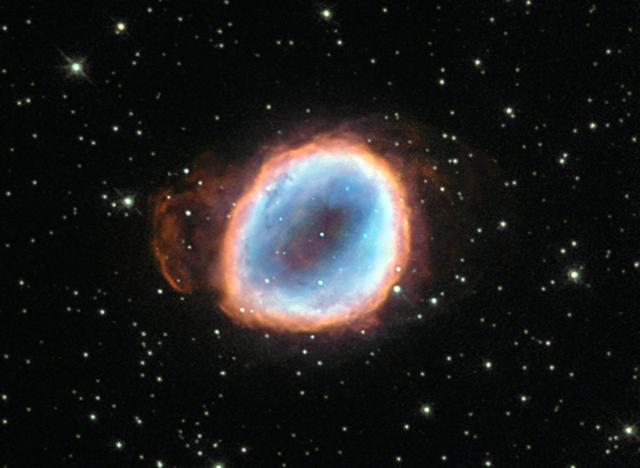
A dying star’s final moments are captured in this image from the NASA/ESA Hubble Space Telescope. The death throes of this star may only last mere moments on a cosmological timescale, but this star’s demise is still quite lengthy by our standards, lasting tens of thousands of years! The star’s agony has culminated in a wonderful planetary nebula known as NGC 6565, a cloud of gas that was ejected from the star after strong stellar winds pushed the star’s outer layers away into space. Once enough material was ejected, the star’s luminous core was exposed, enabling its ultraviolet radiation to excite the surrounding gas to varying degrees and causing it to radiate in an attractive array of colors. These same colors can be seen in the famous and impressive Ring Nebula (heic1310), a prominent example of a nebula like this one. Planetary nebulae are illuminated for around 10,000 years before the central star begins to cool and shrink to become a white dwarf. When this happens, the star’s light drastically diminishes and ceases to excite the surrounding gas, so the nebula fades from view. Credit: ESA/Hubble & NASA, Acknowledgement: Matej Novak <b><a href="http://www.nasa.gov/audience/formedia/features/MP_Photo_Guidelines.html" rel="nofollow">NASA image use policy.</a></b> <b><a href="http://www.nasa.gov/centers/goddard/home/index.html" rel="nofollow">NASA Goddard Space Flight Center</a></b> enables NASA’s mission through four scientific endeavors: Earth Science, Heliophysics, Solar System Exploration, and Astrophysics. Goddard plays a leading role in NASA’s accomplishments by contributing compelling scientific knowledge to advance the Agency’s mission. <b>Follow us on <a href="http://twitter.com/NASAGoddardPix" rel="nofollow">Twitter</a></b> <b>Like us on <a href="http://www.facebook.com/pages/Greenbelt-MD/NASA-Goddard/395013845897?ref=tsd" rel="nofollow">Facebook</a></b> <b>Find us on <a href="http://instagrid.me/nasagoddard/?vm=grid" rel="nofollow">Instagram</a></b>

The Cat's Eye Nebula, one of the first planetary nebulae discovered, also has one of the most complex forms known to this kind of nebula. Eleven rings, or shells, of gas make up the Cat's Eye. The full beauty of the Cat's Eye Nebula is revealed in this detailed view from NASA's Hubble Space Telescope. The image from Hubble's Advanced Camera for Surveys (ACS) shows a bull's eye pattern of eleven or even more concentric rings, or shells, around the Cat's Eye. Each 'ring' is actually the edge of a spherical bubble seen projected onto the sky -- that's why it appears bright along its outer edge. Observations suggest the star ejected its mass in a series of pulses at 1,500-year intervals. These convulsions created dust shells, each of which contain as much mass as all of the planets in our solar system combined (still only one percent of the Sun's mass). These concentric shells make a layered, onion-skin structure around the dying star. The view from Hubble is like seeing an onion cut in half, where each skin layer is discernible. The bull's-eye patterns seen around planetary nebulae come as a surprise to astronomers because they had no expectation that episodes of mass loss at the end of stellar lives would repeat every 1,500 years. Several explanations have been proposed, including cycles of magnetic activity somewhat similar to our own Sun's sunspot cycle, the action of companion stars orbiting around the dying star, and stellar pulsations. Another school of thought is that the material is ejected smoothly from the star, and the rings are created later on due to formation of waves in the outflowing material. Credit: NASA, ESA, HEIC, and The Hubble Heritage Team (STScI/AURA) Acknowledgment: R. Corradi (Isaac Newton Group of Telescopes, Spain) and Z. Tsvetanov (NASA) The Hubble Space Telescope is a project of international cooperation between NASA and the European Space Agency. NASA's Goddard Space Flight Center manages the telescope. The Space Telescope Science Institute conducts Hubble science operations. Goddard is responsible for HST project management, including mission and science operations, servicing missions, and all associated development activities. To learn more about the Hubble Space Telescope go here: <a href="http://www.nasa.gov/mission_pages/hubble/main/index.html" rel="nofollow">www.nasa.gov/mission_pages/hubble/main/index.html</a> <b><a href="http://www.nasa.gov/audience/formedia/features/MP_Photo_Guidelines.html" rel="nofollow">NASA image use policy.</a></b> <b><a href="http://www.nasa.gov/centers/goddard/home/index.html" rel="nofollow">NASA Goddard Space Flight Center</a></b> enables NASA’s mission through four scientific endeavors: Earth Science, Heliophysics, Solar System Exploration, and Astrophysics. Goddard plays a leading role in NASA’s accomplishments by contributing compelling scientific knowledge to advance the Agency’s mission. <b>Follow us on <a href="http://twitter.com/NASAGoddardPix" rel="nofollow">Twitter</a></b> <b>Like us on <a href="http://www.facebook.com/pages/Greenbelt-MD/NASA-Goddard/395013845897?ref=tsd" rel="nofollow">Facebook</a></b> <b>Find us on <a href="http://instagram.com/nasagoddard?vm=grid" rel="nofollow">Instagram</a></b>

Image released 11 Aug 2011. The "Necklace Nebula" is located 15,000 light-years away in the constellation Sagitta (the Arrow). In this composite image, taken on July 2, 2011, Hubble's Wide Field Camera 3 captured the glow of hydrogen (blue), oxygen (green), and nitrogen (red). The object, aptly named the Necklace Nebula, is a recently discovered planetary nebula, the glowing remains of an ordinary, Sun-like star. The nebula consists of a bright ring, measuring 12 trillion miles wide, dotted with dense, bright knots of gas that resemble diamonds in a necklace. <a href="http://www.nasa.gov/mission_pages/hubble/science/necklace-nebula.html" target="_blank" rel="nofollow"></a> <b>Credit:</b> NASA, ESA, and the Hubble Heritage Team (STScI/AURA) <b><a href="http://www.nasa.gov/centers/goddard/home/index.html" rel="nofollow">NASA Goddard Space Flight Center</a></b> enables NASA’s mission through four scientific endeavors: Earth Science, Heliophysics, Solar System Exploration, and Astrophysics. Goddard plays a leading role in NASA’s accomplishments by contributing compelling scientific knowledge to advance the Agency’s mission. <b>Follow us on <a href="http://twitter.com/NASA_GoddardPix" rel="nofollow">Twitter</a></b> <b>Like us on <a href="http://www.facebook.com/pages/Greenbelt-MD/NASA-Goddard/395013845897?ref=tsd" rel="nofollow">Facebook</a></b> <b>Find us on <a href="http://web.stagram.com/n/nasagoddard/?vm=grid" rel="nofollow">Instagram</a></b>
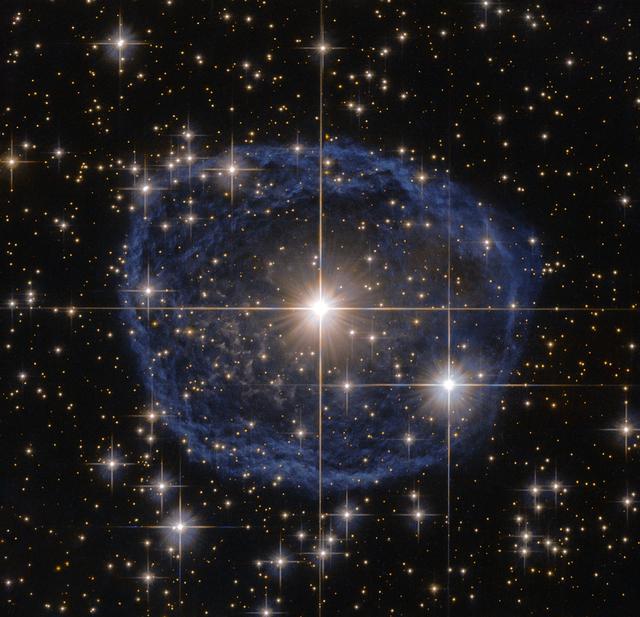
A large blue bubble with a bright star in the center on a black background filled with stars Sparkling at the center of this beautiful NASA/ESA Hubble Space Telescope image is a Wolf–Rayet star known as WR 31a, located about 30,000 light-years away in the constellation of Carina (The Keel). The distinctive blue bubble appearing to encircle WR 31a is a Wolf–Rayet nebula — an interstellar cloud of dust, hydrogen, helium and other gases. Created when speedy stellar winds interact with the outer layers of hydrogen ejected by Wolf–Rayet stars, these nebulae are frequently ring-shaped or spherical. The bubble — estimated to have formed around 20,000 years ago — is expanding at a rate of around 220,000 kilometers (136,700 miles) per hour! Unfortunately, the lifecycle of a Wolf–Rayet star is only a few hundred thousand years — the blink of an eye in cosmic terms. Despite beginning life with a mass at least 20 times that of the sun, Wolf–Rayet stars typically lose half their mass in less than 100,000 years. And WR 31a is no exception to this case. It will, therefore, eventually end its life as a spectacular supernova, and the stellar material expelled from its explosion will later nourish a new generation of stars and planets. Image credi: ESA/Hubble & NASA, Acknowledgement: Judy Schmidt
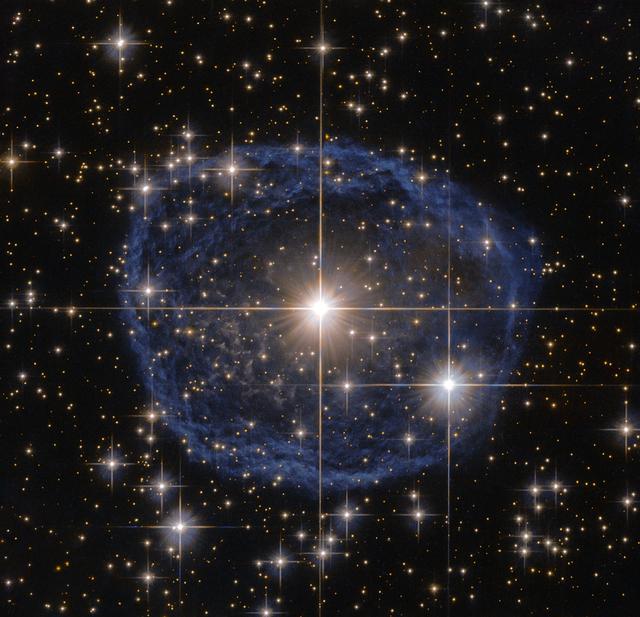
Sparkling at the centre of this beautiful NASA/ESA Hubble Space Telescope image is a Wolf–Rayet star known as WR 31a, located about 30 000 light-years away in the constellation of Carina (The Keel). The distinctive blue bubble appearing to encircle WR 31a, and its uncatalogued stellar sidekick, is a Wolf–Rayet nebula — an interstellar cloud of dust, hydrogen, helium and other gases. Created when speedy stellar winds interact with the outer layers of hydrogen ejected by Wolf–Rayet stars, these nebulae are frequently ring-shaped or spherical. The bubble — estimated to have formed around 20 000 years ago — is expanding at a rate of around 220 000 kilometres per hour! Unfortunately, the lifecycle of a Wolf–Rayet star is only a few hundred thousand years — the blink of an eye in cosmic terms. Despite beginning life with a mass at least 20 times that of the Sun, Wolf–Rayet stars typically lose half their mass in less than 100 000 years. And WR 31a is no exception to this case. It will, therefore, eventually end its life as a spectacular supernova, and the stellar material expelled from its explosion will later nourish a new generation of stars and planets.
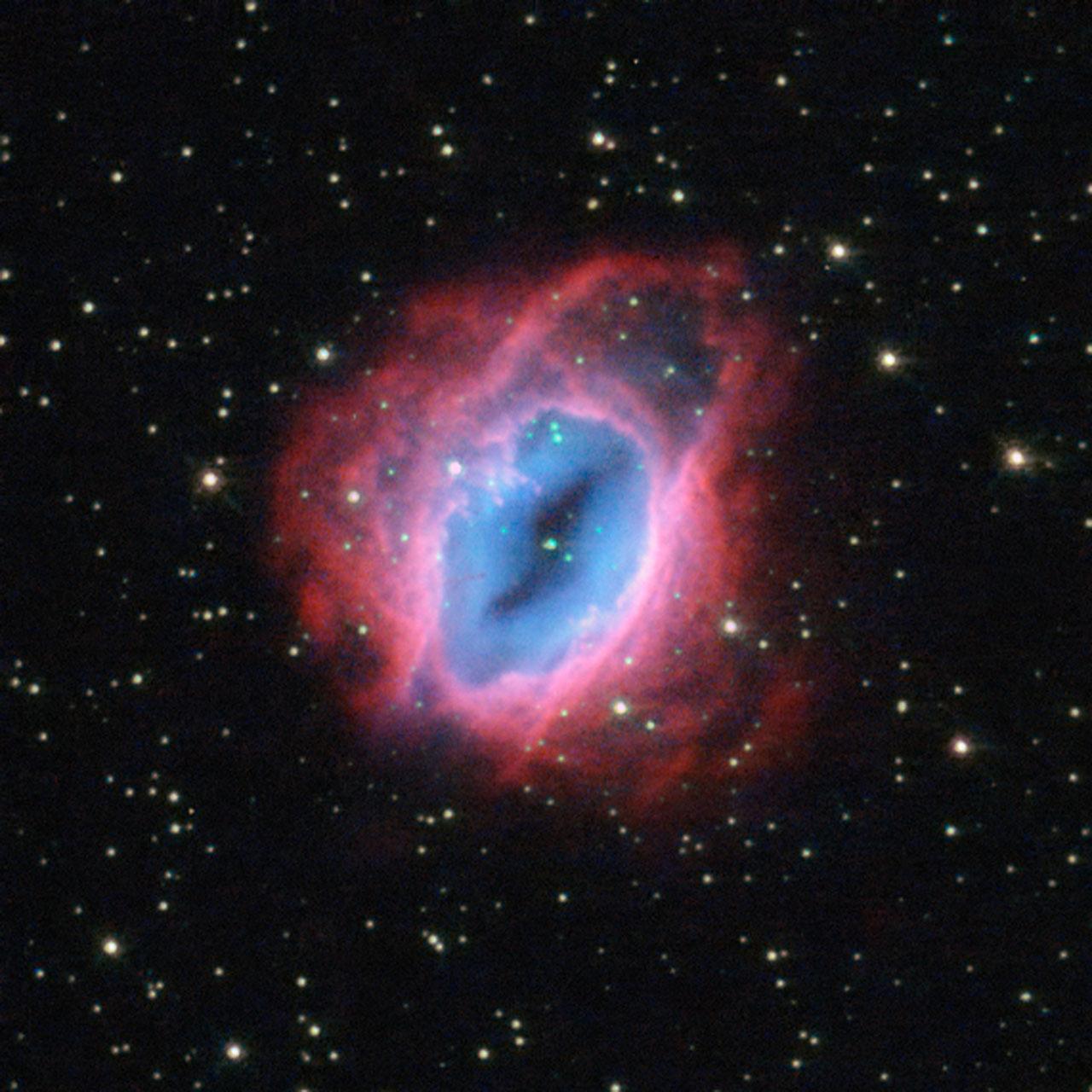
It may look like something from "The Lord of the Rings," but this fiery swirl is actually a planetary nebula known as ESO 456-67. Set against a backdrop of bright stars, the rust-colored object lies in the constellation of Sagittarius (The Archer), in the southern sky. In this image of ESO 456-67, it is possible to see the various layers of material expelled by the central star. Each appears in a different hue - red, orange, yellow, and green-tinted bands of gas are visible, with clear patches of space at the heart of the nebula. It is not fully understood how planetary nebulae form such a wide variety of shapes and structures; some appear to be spherical, some elliptical, others shoot material in waves from their polar regions, some look like hourglasses or figures of eight, and others resemble large, messy stellar explosions - to name but a few. Image Credit: ESA/Hubble and NASA <b><a href="http://www.nasa.gov/audience/formedia/features/MP_Photo_Guidelines.html" rel="nofollow">NASA image use policy.</a></b> <b><a href="http://www.nasa.gov/centers/goddard/home/index.html" rel="nofollow">NASA Goddard Space Flight Center</a></b> enables NASA’s mission through four scientific endeavors: Earth Science, Heliophysics, Solar System Exploration, and Astrophysics. Goddard plays a leading role in NASA’s accomplishments by contributing compelling scientific knowledge to advance the Agency’s mission. <b>Follow us on <a href="http://twitter.com/NASA_GoddardPix" rel="nofollow">Twitter</a></b> <b>Like us on <a href="http://www.facebook.com/pages/Greenbelt-MD/NASA-Goddard/395013845897?ref=tsd" rel="nofollow">Facebook</a></b> <b>Find us on <a href="http://instagram.com/nasagoddard?vm=grid" rel="nofollow">Instagram</a></b>

Taken by the Wide Field Planetary Camera 2 (WFPC2) of the Hubble Space Telescope (HST), this image of MyCn18, a young planetary nebula located about 8,000 light-years away, reveals its true shape to be an hourglass with an intricate pattern of "etchings" in its walls. The arc-like etchings could be the remnants of discrete shells ejected from the star when it was younger, flow instabilities, or could result from the action of a narrow beam of matter impinging on the hourglass walls. According to one theory on the formation of planetary nebulae, the hourglass shape is produced by the expansion of a fast stellar wind within a slowly expanding cloud, which is denser near its equator than near its poles. Hubble has also revealed other features in MyCn18 which are completely new and unexpected. For example, there is a pair of intersecting elliptical rings in the central region which appear to be the rims of a smaller hourglass. This picture has been composed from three separate images taken in the light of ionized nitrogen (represented by red), hydrogen (green) and doubly-ionized oxygen (blue). The results are of great interest because they shed new light on the poorly understood ejection of stellar matter which accompanies the slow death of sun-like stars. An unseen companion star and accompanying gravitational effects may well be necessary in order to explain the structure of MyCn18. The Marshall Space Flight Center (MSFC) had responsibility for design, development, and construction of the HST.
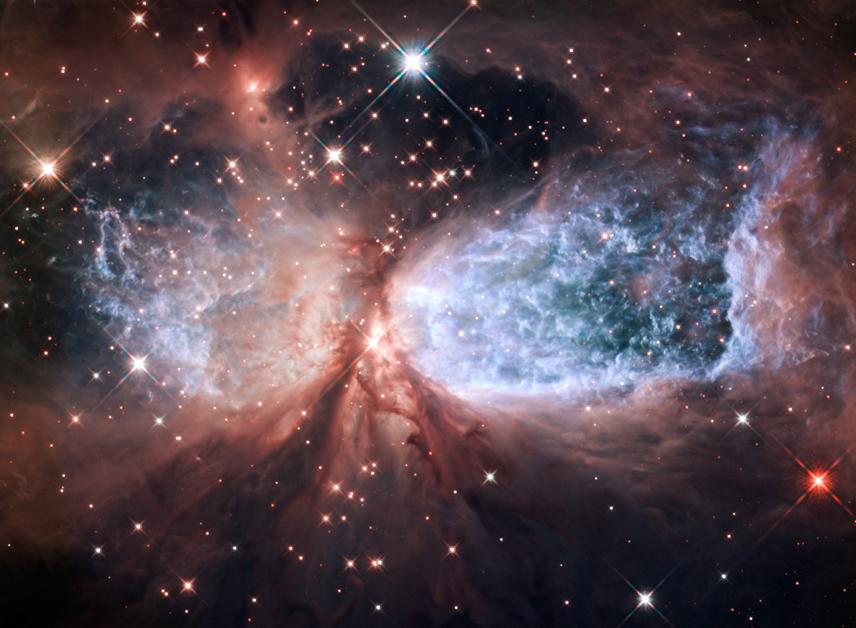
The bipolar star-forming region, called Sharpless 2-106, looks like a soaring, celestial snow angel. The outstretched “wings” of the nebula record the contrasting imprint of heat and motion against the backdrop of a colder medium. Twin lobes of super-hot gas, glowing blue in this image, stretch outward from the central star. This hot gas creates the “wings” of our angel. A ring of dust and gas orbiting the star acts like a belt, cinching the expanding nebula into an “hourglass” shape. To read more about this image go to: <a href="http://www.nasa.gov/mission_pages/hubble/science/snow-angel.html" rel="nofollow">www.nasa.gov/mission_pages/hubble/science/snow-angel.html</a> Credit: NASA, ESA, and the Hubble Heritage Team (STScI/AURA) <b><a href="http://www.nasa.gov/audience/formedia/features/MP_Photo_Guidelines.html" rel="nofollow">NASA image use policy.</a></b> <b><a href="http://www.nasa.gov/centers/goddard/home/index.html" rel="nofollow">NASA Goddard Space Flight Center</a></b> enables NASA’s mission through four scientific endeavors: Earth Science, Heliophysics, Solar System Exploration, and Astrophysics. Goddard plays a leading role in NASA’s accomplishments by contributing compelling scientific knowledge to advance the Agency’s mission. <b>Follow us on <a href="http://twitter.com/NASA_GoddardPix" rel="nofollow">Twitter</a></b> <b>Like us on <a href="http://www.facebook.com/pages/Greenbelt-MD/NASA-Goddard/395013845897?ref=tsd" rel="nofollow">Facebook</a></b> <b>Find us on <a href="http://instagrid.me/nasagoddard/?vm=grid" rel="nofollow">Instagram</a></b>

Image release June 22, 2010 A spectacular new NASA/ESA Hubble Space Telescope image — one of the largest ever released of a star-forming region — highlights N11, part of a complex network of gas clouds and star clusters within our neighbouring galaxy, the Large Magellanic Cloud. This region of energetic star formation is one of the most active in the nearby Universe. The Large Magellanic Cloud contains many bright bubbles of glowing gas. One of the largest and most spectacular has the name LHA 120-N 11, from its listing in a catalogue compiled by the American astronomer and astronaut Karl Henize in 1956, and is informally known as N11. Close up, the billowing pink clouds of glowing gas make N11 resemble a puffy swirl of fairground candy floss. From further away, its distinctive overall shape led some observers to nickname it the Bean Nebula. The dramatic and colourful features visible in the nebula are the telltale signs of star formation. N11 is a well-studied region that extends over 1000 light-years. It is the second largest star-forming region within the Large Magellanic Cloud and has produced some of the most massive stars known. It is the process of star formation that gives N11 its distinctive look. Three successive generations of stars, each of which formed further away from the centre of the nebula than the last, have created shells of gas and dust. These shells were blown away from the newborn stars in the turmoil of their energetic birth and early life, creating the ring shapes so prominent in this image. Beans are not the only terrestrial shapes to be found in this spectacular high resolution image from the NASA/ESA Hubble Space Telescope. In the upper left is the red bloom of nebula LHA 120-N 11A. Its rose-like petals of gas and dust are illuminated from within, thanks to the radiation from the massive hot stars at its centre. N11A is relatively compact and dense and is the site of the most recent burst of star development in the region. Other star clusters abound in N11, including NGC 1761 at the bottom of the image, which is a group of massive hot young stars busily pouring intense ultraviolet radiation out into space. Although it is much smaller than our own galaxy, the Large Magellanic Cloud is a very vigorous region of star formation. Studying these stellar nurseries helps astronomers understand a lot more about how stars are born and their ultimate development and lifespan. Both the Large Magellanic Cloud and its small companion, the Small Magellanic Cloud, are easily seen with the unaided eye and have always been familiar to people living in the southern hemisphere. The credit for bringing these galaxies to the attention of Europeans is usually given to Portuguese explorer Fernando de Magellan and his crew, who viewed it on their 1519 sea voyage. However, the Persian astronomer Abd Al-Rahman Al Sufi and the Italian explorer Amerigo Vespucci recorded the Large Magellanic Cloud in 964 and 1503 respectively. Credit: NASA, ESA and Jesús Maíz Apellániz (Instituto de Astrofísica de Andalucía, Spain) To learn more about Hubble go to: <a href="http://www.nasa.gov/mission_pages/hubble/main/index.html" rel="nofollow">www.nasa.gov/mission_pages/hubble/main/index.html</a> <b><a href="http://www.nasa.gov/centers/goddard/home/index.html" rel="nofollow">NASA Goddard Space Flight Center</a></b> is home to the nation's largest organization of combined scientists, engineers and technologists that build spacecraft, instruments and new technology to study the Earth, the sun, our solar system, and the universe.
![Floating at the center of this new Hubble image is a lidless purple eye, staring back at us through space. This ethereal object, known officially as [SBW2007] 1 but sometimes nicknamed SBW1, is a nebula with a giant star at its center. The star was originally twenty times more massive than our sun, and is now encased in a swirling ring of purple gas, the remains of the distant era when it cast off its outer layers via violent pulsations and winds. But the star is not just any star; scientists say that it is destined to go supernova. Twenty-six years ago, another star with striking similarities went supernova — SN 1987A. Early Hubble images of SN 1987A show eerie similarities to SBW1. Both stars had identical rings of the same size and age, which were travelling at similar speeds; both were located in similar HII regions; and they had the same brightness. In this way SBW1 is a snapshot of SN1987a's appearance before it exploded, and unsurprisingly, astronomers love studying them together. At a distance of more than 20 000 light-years it will be safe to watch when the supernova goes off. If we are very lucky it may happen in our own lifetimes. Credit: ESA/NASA, acknowledgement: Nick Rose <b><a href="http://www.nasa.gov/audience/formedia/features/MP_Photo_Guidelines.html" rel="nofollow">NASA image use policy.</a></b> <b><a href="http://www.nasa.gov/centers/goddard/home/index.html" rel="nofollow">NASA Goddard Space Flight Center</a></b> enables NASA’s mission through four scientific endeavors: Earth Science, Heliophysics, Solar System Exploration, and Astrophysics. Goddard plays a leading role in NASA’s accomplishments by contributing compelling scientific knowledge to advance the Agency’s mission. <b>Follow us on <a href="http://twitter.com/NASA_GoddardPix" rel="nofollow">Twitter</a></b> <b>Like us on <a href="http://www.facebook.com/pages/Greenbelt-MD/NASA-Goddard/395013845897?ref=tsd" rel="nofollow">Facebook</a></b> <b>Find us on <a href="http://instagram.com/nasagoddard?vm=grid" rel="nofollow">Instagram</a></b>](https://images-assets.nasa.gov/image/GSFC_20171208_Archive_e001260/GSFC_20171208_Archive_e001260~small.jpg)
Floating at the center of this new Hubble image is a lidless purple eye, staring back at us through space. This ethereal object, known officially as [SBW2007] 1 but sometimes nicknamed SBW1, is a nebula with a giant star at its center. The star was originally twenty times more massive than our sun, and is now encased in a swirling ring of purple gas, the remains of the distant era when it cast off its outer layers via violent pulsations and winds. But the star is not just any star; scientists say that it is destined to go supernova. Twenty-six years ago, another star with striking similarities went supernova — SN 1987A. Early Hubble images of SN 1987A show eerie similarities to SBW1. Both stars had identical rings of the same size and age, which were travelling at similar speeds; both were located in similar HII regions; and they had the same brightness. In this way SBW1 is a snapshot of SN1987a's appearance before it exploded, and unsurprisingly, astronomers love studying them together. At a distance of more than 20 000 light-years it will be safe to watch when the supernova goes off. If we are very lucky it may happen in our own lifetimes. Credit: ESA/NASA, acknowledgement: Nick Rose <b><a href="http://www.nasa.gov/audience/formedia/features/MP_Photo_Guidelines.html" rel="nofollow">NASA image use policy.</a></b> <b><a href="http://www.nasa.gov/centers/goddard/home/index.html" rel="nofollow">NASA Goddard Space Flight Center</a></b> enables NASA’s mission through four scientific endeavors: Earth Science, Heliophysics, Solar System Exploration, and Astrophysics. Goddard plays a leading role in NASA’s accomplishments by contributing compelling scientific knowledge to advance the Agency’s mission. <b>Follow us on <a href="http://twitter.com/NASA_GoddardPix" rel="nofollow">Twitter</a></b> <b>Like us on <a href="http://www.facebook.com/pages/Greenbelt-MD/NASA-Goddard/395013845897?ref=tsd" rel="nofollow">Facebook</a></b> <b>Find us on <a href="http://instagram.com/nasagoddard?vm=grid" rel="nofollow">Instagram</a></b>
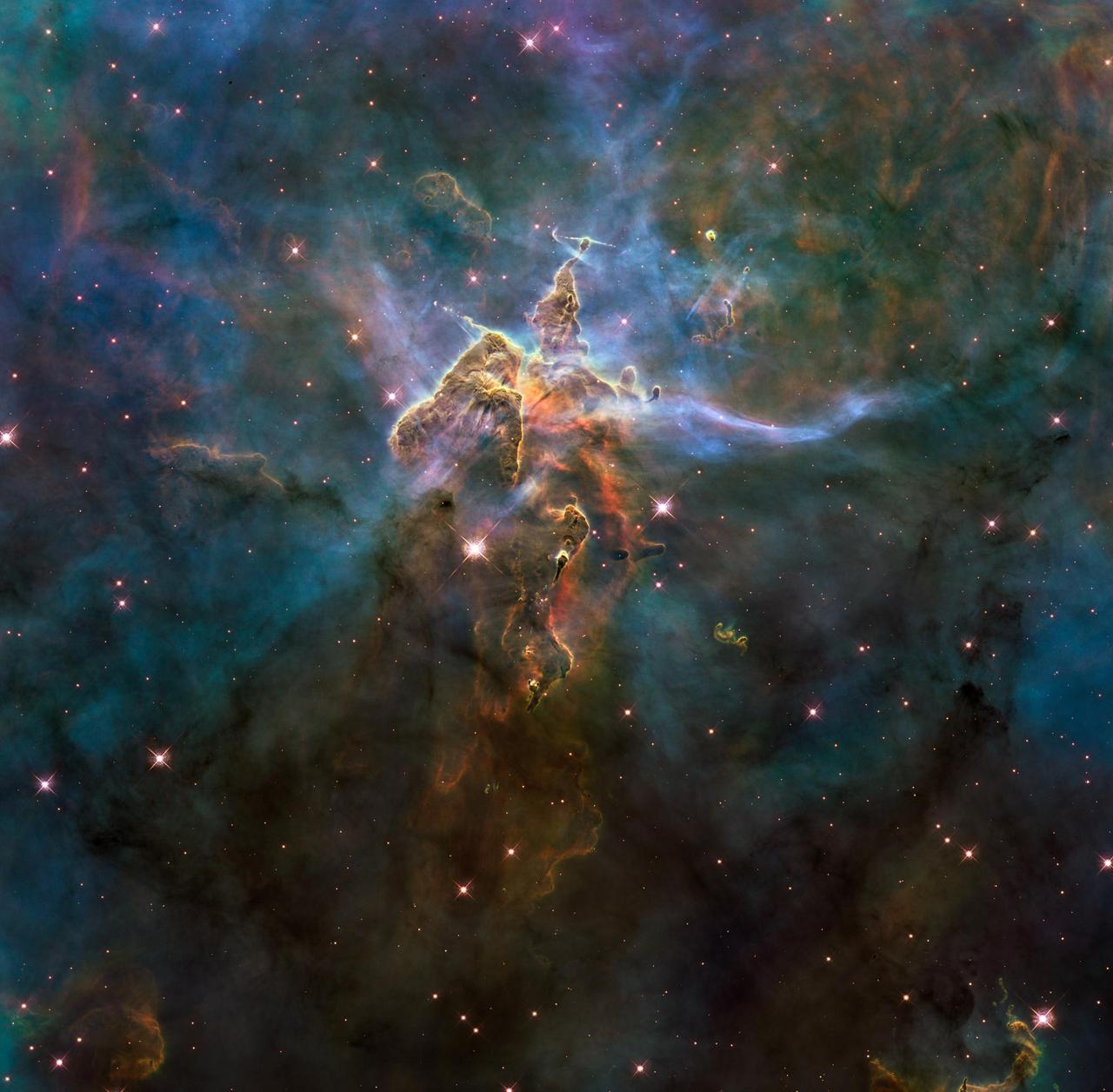
NASA image release April 22, 2010 This craggy fantasy mountaintop enshrouded by wispy clouds looks like a bizarre landscape from Tolkien's "The Lord of the Rings" or a Dr. Seuss book, depending on your imagination. The NASA Hubble Space Telescope photograph, which is stranger than fiction, captures the chaotic activity atop a three-light-year-tall pillar of gas and dust that is being eaten away by the brilliant light from nearby bright stars. The pillar is also being assaulted from within, as infant stars buried inside it fire off jets of gas that can be seen streaming from towering peaks. This turbulent cosmic pinnacle lies within a tempestuous stellar nursery called the Carina Nebula, located 7,500 light-years away in the southern constellation Carina. The image marks the 20th anniversary of Hubble's launch and deployment into Earth orbit. Scorching radiation and fast winds (streams of charged particles) from hot newborn stars in the nebula are shaping and compressing the pillar, causing new stars to form within it. Streamers of hot ionized gas can be seen flowing off the ridges of the structure, and wispy veils of dust, illuminated by starlight, float around its peaks. The pillar is resisting being eroded by radiation much like a towering butte in Utah's Monument Valley withstands erosion by water and wind. Nestled inside this dense mountain are fledgling stars. Long streamers of gas can be seen shooting in opposite directions off the pedestal at the top of the image. Another pair of jets is visible at another peak near the center of the image. These jets are the signpost for new star birth. The jets are launched by swirling disks around the stars, as these disks allow material to slowly accrete onto the stars' surfaces. Hubble's Wide Field Camera 3 observed the pillar on Feb. 1-2, 2010. The colors in this composite image correspond to the glow of oxygen (blue), hydrogen and nitrogen (green), and sulfur (red). Object Names: HH 901, HH 902 Image Type: Astronomical Credit: NASA, ESA, and M. Livio and the Hubble 20th Anniversary Team (STScI) To read learn more about this image go to: <a href="http://www.nasa.gov/mission_pages/hubble/science/hubble20th-img.html" rel="nofollow">www.nasa.gov/mission_pages/hubble/science/hubble20th-img....</a> <b><a href="http://www.nasa.gov/centers/goddard/home/index.html" rel="nofollow">NASA Goddard Space Flight Center</a></b> is home to the nation's largest organization of combined scientists, engineers and technologists that build spacecraft, instruments and new technology to study the Earth, the sun, our solar system, and the universe.

Peering deep into the core of the Crab Nebula, this close-up image reveals the beating heart of one of the most historic and intensively studied remnants of a supernova, an exploding star. The inner region sends out clock-like pulses of radiation and tsunamis of charged particles embedded in magnetic fields. The neutron star at the very center of the Crab Nebula has about the same mass as the sun but compressed into an incredibly dense sphere that is only a few miles across. Spinning 30 times a second, the neutron star shoots out detectable beams of energy that make it look like it's pulsating. The NASA Hubble Space Telescope snapshot is centered on the region around the neutron star (the rightmost of the two bright stars near the center of this image) and the expanding, tattered, filamentary debris surrounding it. Hubble's sharp view captures the intricate details of glowing gas, shown in red, that forms a swirling medley of cavities and filaments. Inside this shell is a ghostly blue glow that is radiation given off by electrons spiraling at nearly the speed of light in the powerful magnetic field around the crushed stellar core. The neutron star is a showcase for extreme physical processes and unimaginable cosmic violence. Bright wisps are moving outward from the neutron star at half the speed of light to form an expanding ring. It is thought that these wisps originate from a shock wave that turns the high-speed wind from the neutron star into extremely energetic particles. When this "heartbeat" radiation signature was first discovered in 1968, astronomers realized they had discovered a new type of astronomical object. Now astronomers know it's the archetype of a class of supernova remnants called pulsars - or rapidly spinning neutron stars. These interstellar "lighthouse beacons" are invaluable for doing observational experiments on a variety of astronomical phenomena, including measuring gravity waves. Observations of the Crab supernova were recorded by Chinese astronomers in 1054 A.D. The nebula, bright enough to be visible in amateur telescopes, is located 6,500 light-years away in the constellation Taurus. Credits: NASA and ESA, Acknowledgment: J. Hester (ASU) and M. Weisskopf (NASA/MSFC) <b><a href="http://www.nasa.gov/audience/formedia/features/MP_Photo_Guidelines.html" rel="nofollow">NASA image use policy.</a></b> <b><a href="http://www.nasa.gov/centers/goddard/home/index.html" rel="nofollow">NASA Goddard Space Flight Center</a></b> enables NASA’s mission through four scientific endeavors: Earth Science, Heliophysics, Solar System Exploration, and Astrophysics. Goddard plays a leading role in NASA’s accomplishments by contributing compelling scientific knowledge to advance the Agency’s mission. <b>Follow us on <a href="http://twitter.com/NASAGoddardPix" rel="nofollow">Twitter</a></b> <b>Like us on <a href="http://www.facebook.com/pages/Greenbelt-MD/NASA-Goddard/395013845897?ref=tsd" rel="nofollow">Facebook</a></b> <b>Find us on <a href="http://instagrid.me/nasagoddard/?vm=grid" rel="nofollow">Instagram</a></b>
![This image from NASA Spitzer Space Telescope, shows the wispy filamentary structure of Henize 206, is a four-color composite mosaic created by combining data from an infrared array camera IRAC. The LMC is a small satellite galaxy gravitationally bound to our own Milky Way. Yet the gravitational effects are tearing the companion to shreds in a long-playing drama of 'intergalactic cannibalism.' These disruptions lead to a recurring cycle of star birth and star death. Astronomers are particularly interested in the LMC because its fractional content of heavy metals is two to five times lower than is seen in our solar neighborhood. [In this context, 'heavy elements' refer to those elements not present in the primordial universe. Such elements as carbon, oxygen and others are produced by nucleosynthesis and are ejected into the interstellar medium via mass loss by stars, including supernova explosions.] As such, the LMC provides a nearby cosmic laboratory that may resemble the distant universe in its chemical composition. The primary Spitzer image, showing the wispy filamentary structure of Henize 206, is a four-color composite mosaic created by combining data from an infrared array camera (IRAC) at near-infrared wavelengths and the mid-infrared data from a multiband imaging photometer (MIPS). Blue represents invisible infrared light at wavelengths of 3.6 and 4.5 microns. Note that most of the stars in the field of view radiate primarily at these short infrared wavelengths. Cyan denotes emission at 5.8 microns, green depicts the 8.0 micron light, and red is used to trace the thermal emission from dust at 24 microns. The separate instrument images are included as insets to the main composite. An inclined ring of emission dominates the central and upper regions of the image. This delineates a bubble of hot, x-ray emitting gas that was blown into space when a massive star died in a supernova explosion millions of years ago. The shock waves from that explosion impacted a cloud of nearby hydrogen gas, compressed it, and started a new generation of star formation. The death of one star led to the birth of many new stars. This is particularly evident in the MIPS inset, where the 24-micron emission peaks correspond to newly formed stars. The ultraviolet and visible-light photons from the new stars are absorbed by surrounding dust and re-radiated at longer infrared wavelengths, where it is detected by Spitzer. This emission nebula was cataloged by Karl Henize (HEN-eyes) while spending 1948-1951 in South Africa doing research for his Ph.D. dissertation at the University of Michigan. Henize later became a NASA astronaut and, at age 59, became the oldest rookie to fly on the Space Shuttle during an eight-day flight of the Challenger in 1985. He died just short of his 67th birthday in 1993 while attempting to climb the north face of Mount Everest, the world's highest peak. http://photojournal.jpl.nasa.gov/catalog/PIA05517](https://images-assets.nasa.gov/image/PIA05517/PIA05517~medium.jpg)
This image from NASA Spitzer Space Telescope, shows the wispy filamentary structure of Henize 206, is a four-color composite mosaic created by combining data from an infrared array camera IRAC. The LMC is a small satellite galaxy gravitationally bound to our own Milky Way. Yet the gravitational effects are tearing the companion to shreds in a long-playing drama of 'intergalactic cannibalism.' These disruptions lead to a recurring cycle of star birth and star death. Astronomers are particularly interested in the LMC because its fractional content of heavy metals is two to five times lower than is seen in our solar neighborhood. [In this context, 'heavy elements' refer to those elements not present in the primordial universe. Such elements as carbon, oxygen and others are produced by nucleosynthesis and are ejected into the interstellar medium via mass loss by stars, including supernova explosions.] As such, the LMC provides a nearby cosmic laboratory that may resemble the distant universe in its chemical composition. The primary Spitzer image, showing the wispy filamentary structure of Henize 206, is a four-color composite mosaic created by combining data from an infrared array camera (IRAC) at near-infrared wavelengths and the mid-infrared data from a multiband imaging photometer (MIPS). Blue represents invisible infrared light at wavelengths of 3.6 and 4.5 microns. Note that most of the stars in the field of view radiate primarily at these short infrared wavelengths. Cyan denotes emission at 5.8 microns, green depicts the 8.0 micron light, and red is used to trace the thermal emission from dust at 24 microns. The separate instrument images are included as insets to the main composite. An inclined ring of emission dominates the central and upper regions of the image. This delineates a bubble of hot, x-ray emitting gas that was blown into space when a massive star died in a supernova explosion millions of years ago. The shock waves from that explosion impacted a cloud of nearby hydrogen gas, compressed it, and started a new generation of star formation. The death of one star led to the birth of many new stars. This is particularly evident in the MIPS inset, where the 24-micron emission peaks correspond to newly formed stars. The ultraviolet and visible-light photons from the new stars are absorbed by surrounding dust and re-radiated at longer infrared wavelengths, where it is detected by Spitzer. This emission nebula was cataloged by Karl Henize (HEN-eyes) while spending 1948-1951 in South Africa doing research for his Ph.D. dissertation at the University of Michigan. Henize later became a NASA astronaut and, at age 59, became the oldest rookie to fly on the Space Shuttle during an eight-day flight of the Challenger in 1985. He died just short of his 67th birthday in 1993 while attempting to climb the north face of Mount Everest, the world's highest peak. http://photojournal.jpl.nasa.gov/catalog/PIA05517