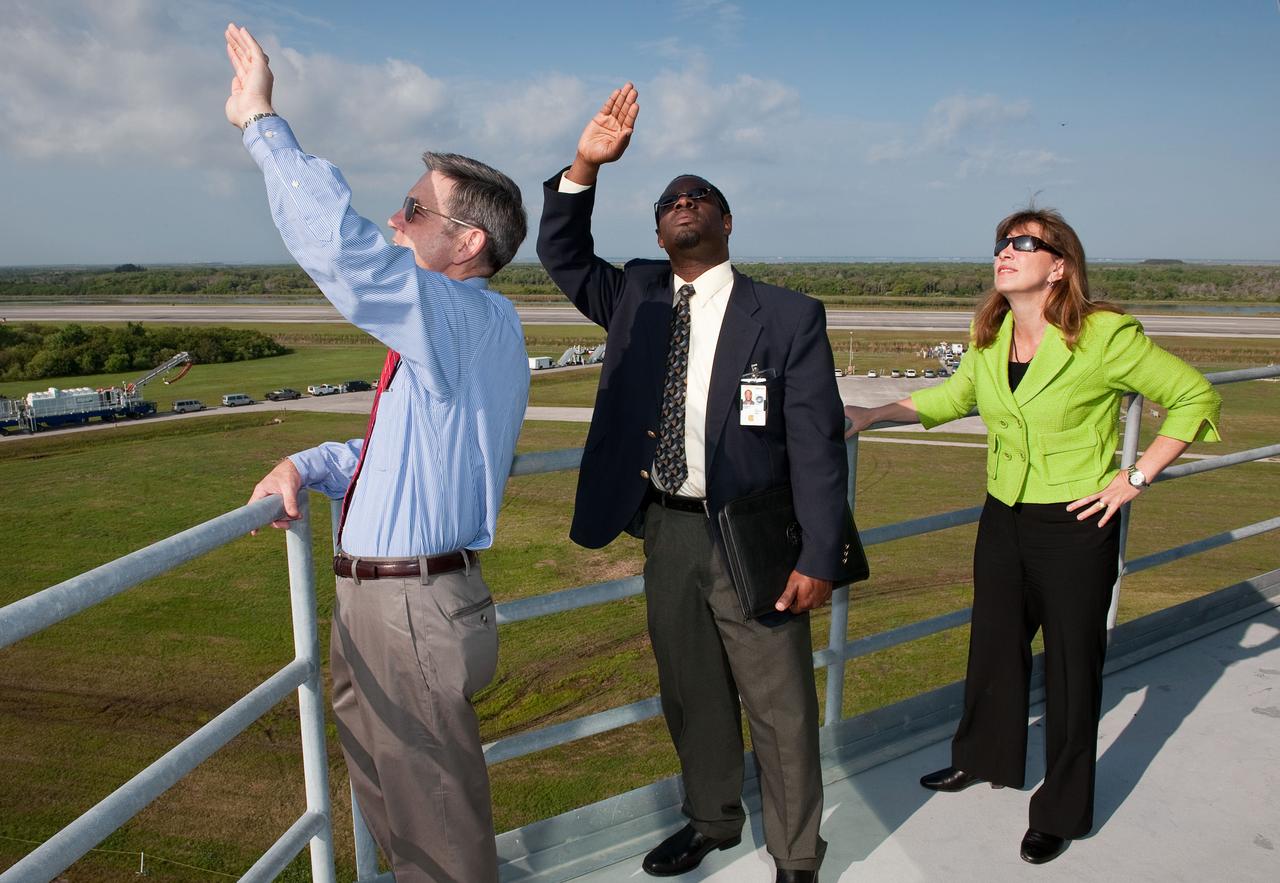
STS131-S-087 (20 April 2010) --- NASA Kennedy Space Center Director Bob Cabana, left, Special Assistant to the Director Robert Hubbard, center, and NASA Deputy Administrator Lori Garver scan the sky for the space shuttle Discovery as it approaches for landing at the Kennedy Space Center in Cape Canaveral, Florida, on April 20, 2010. Discovery and the STS-131 mission crew, NASA astronauts Alan Poindexter, commander; James P. Dutton Jr., pilot; Dorothy Metcalf-Lindenburger, Rick Mastracchio, Stephanie Wilson, Clayton Anderson and Japanese astronaut Naoko Yamazaki, all mission specialists, returned from their mission to the International Space Station. Photo credit: NASA/Bill Ingalls
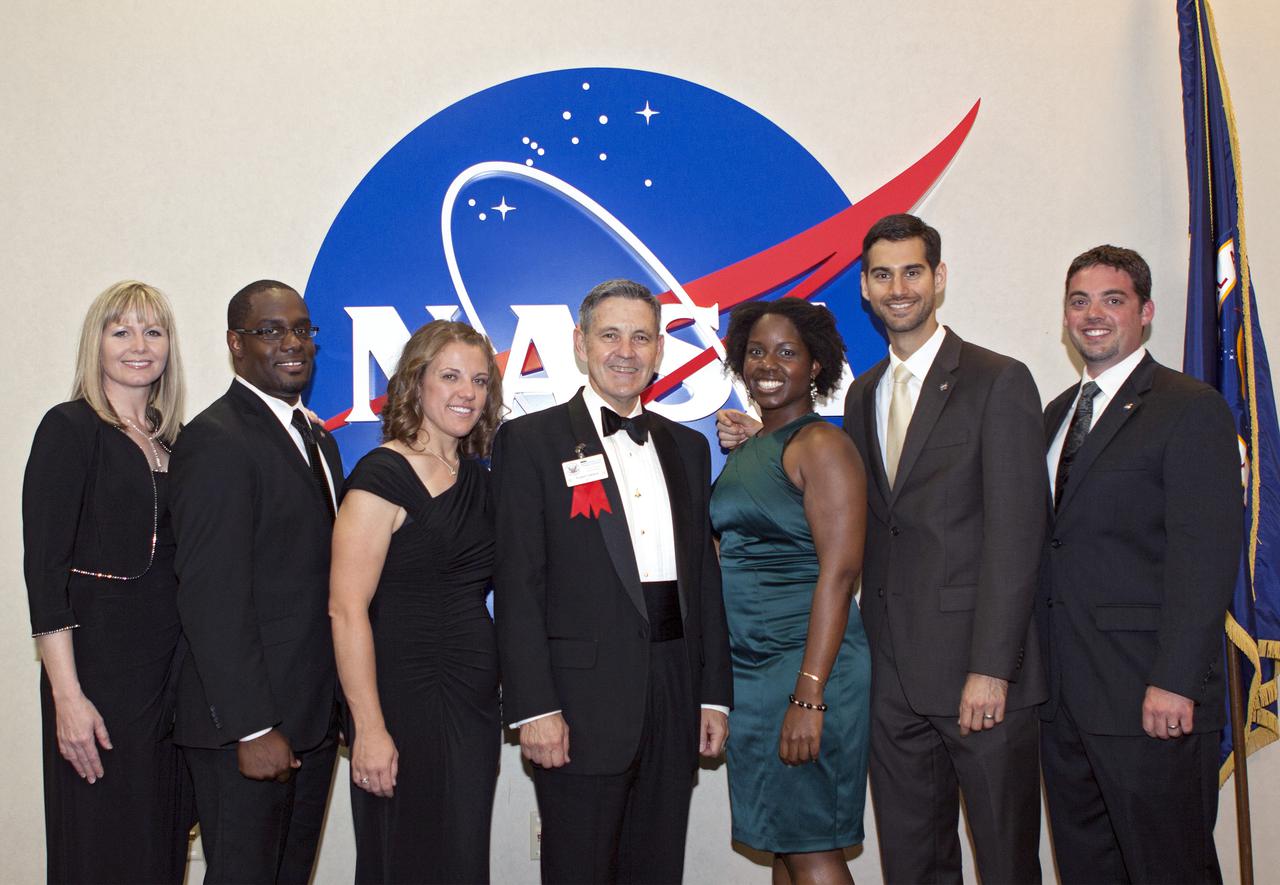
CAPE CANAVERAL, Fla. – At NASA’s Kennedy Space Center Visitor Complex in Florida, center director Bob Cabana poses with current and former interns. From the left are Joy Burkey, Robert Hubbard, Carla Koch, Cabana, LaKeesha Flowers, Michael Miller and Michael Masters. A former U.S. Marine Corps aviator and NASA astronaut, Cabana was honored at the gala Debus Award Dinner. Named for the spaceport’s first director, the Debus Award was created to recognize significant achievements and contributions made in Florida to American aerospace efforts. The Debus Award was created by the space club's Florida committee to recognize significant achievements and contributions made in Florida to American aerospace efforts. Photo credit: NASA_Jim Grossmann
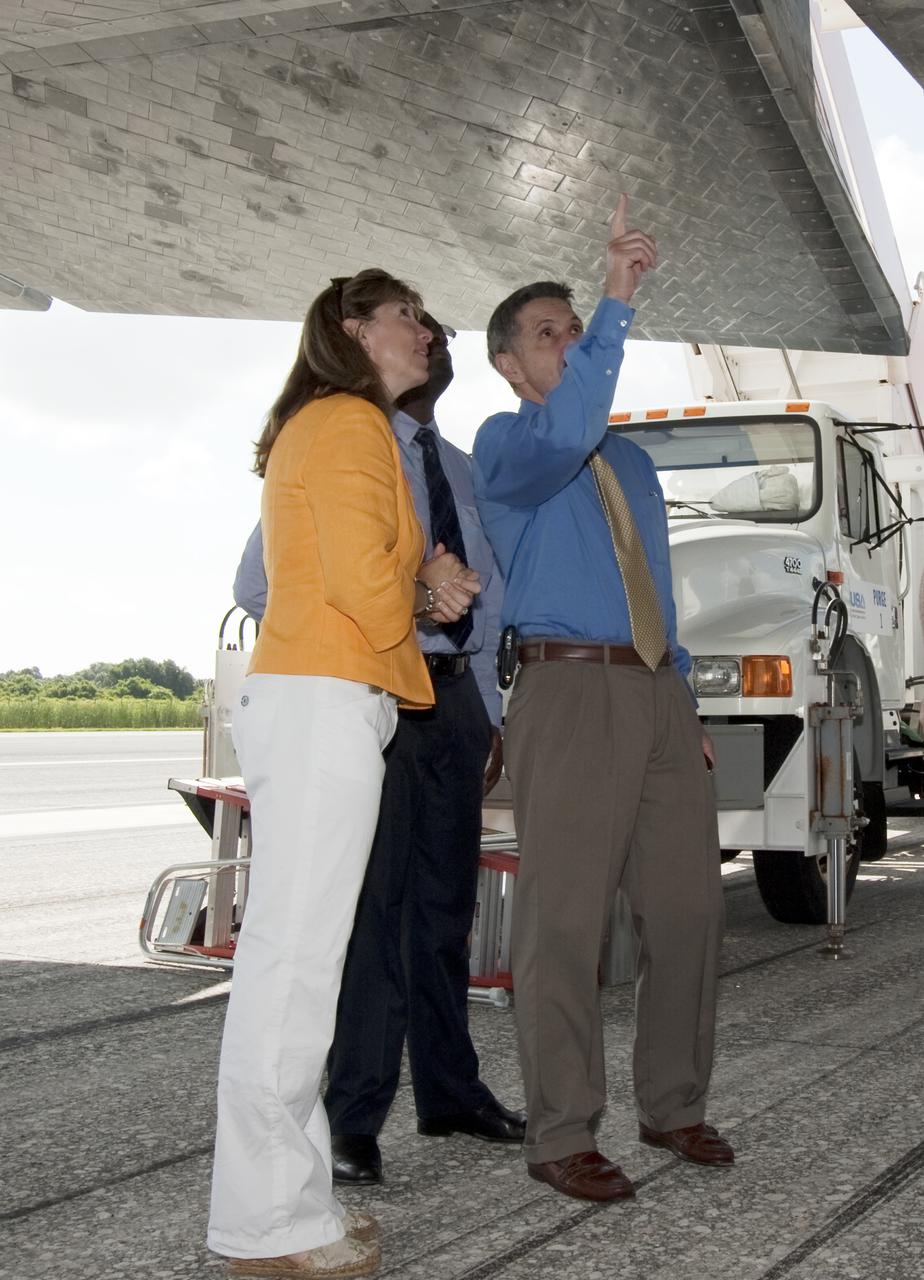
CAPE CANAVERAL, Fla. - At NASA's Kennedy Space Center in Florida, NASA Deputy Administrator Lori Garver, left, Robert Hubbard, assistant to Kennedy's center director, and Kennedy Center Director Bob Cabana check out space shuttle Atlantis' thermal protection system on the Shuttle Landing Facility. Atlantis wrapped up its 4.8-million-mile STS-132 mission to the International Space Station at 8:48 a.m. EDT. The six-member STS-132 crew carried the Russian-built Mini Research Module-1 to the space station. STS-132 is the 34th shuttle mission to the station, the 132nd shuttle mission overall and the last planned flight for Atlantis. For information on the STS-132 mission and crew, visit www.nasa.gov_mission_pages_shuttle_shuttlemissions_sts132_index.html. Photo credit: NASA_Kim Shiflett
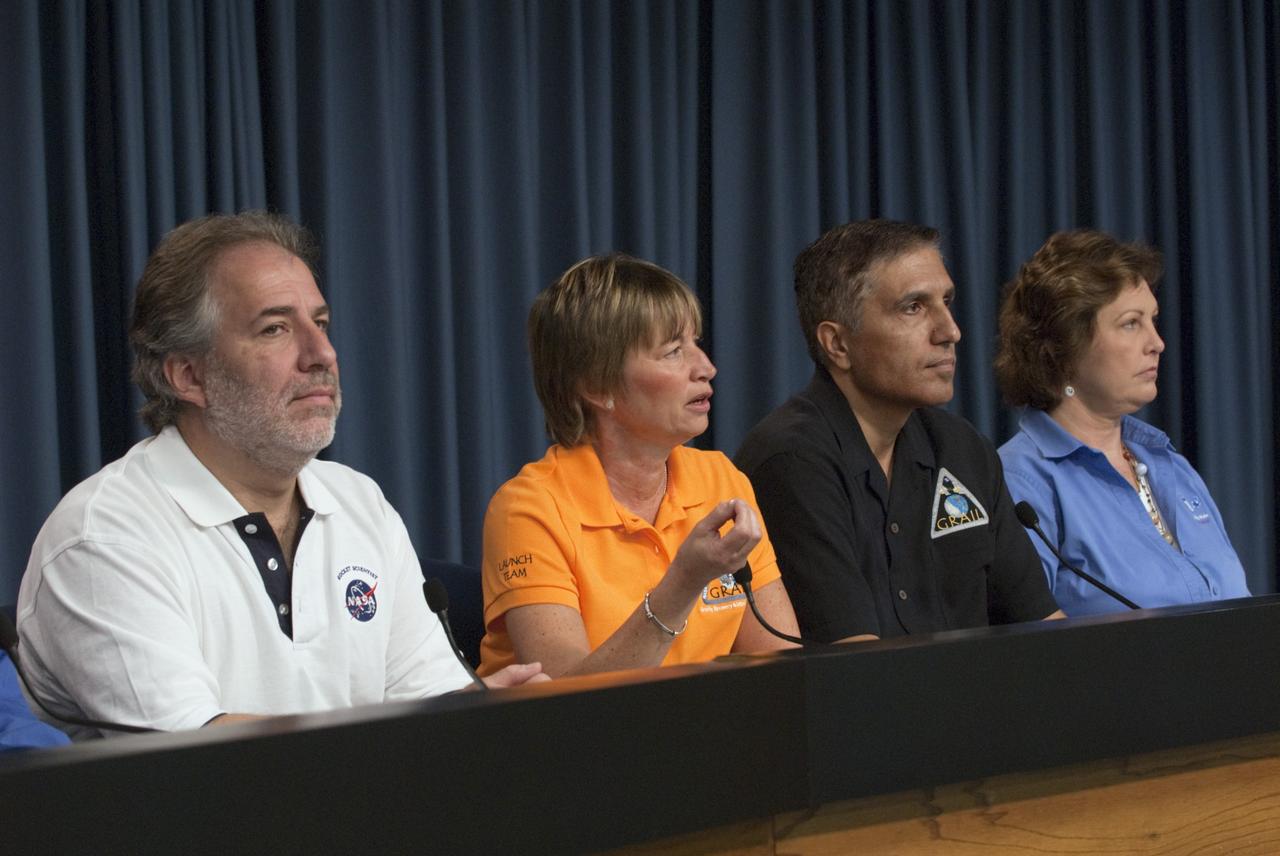
CAPE CANAVERAL, Fla. – – A Gravity Recovery and Interior Laboratory (GRAIL) mission science briefing is held in the NASA Press Site auditorium at NASA's Kennedy Space Center in Florida. From left are Robert Fogel, NASA’s GRAIL program scientist; Maria Zuber, GRAIL principal investigator with the Massachusetts Institute of Technology; Sami Asmar, GRAIL deputy project scientist, NASA’s Jet Propulsion Laboratory; and Leesa Hubbard, teacher in residence, Sally Ride Science, San Diego. GRAIL is scheduled to launch Sept. 8 aboard a United Launch Alliance Delta II Heavy rocket from Cape Canaveral Air Force Station in Florida. GRAIL will fly twin spacecraft in tandem around the moon to precisely measure and map variations in the moon's gravitational field. The mission will provide the most accurate global gravity field to date for any planet, including Earth. This detailed information will reveal differences in the density of the moon's crust and mantle and will help answer fundamental questions about the moon's internal structure, thermal evolution, and history of collisions with asteroids. The aim is to map the moon's gravity field so completely that future moon vehicles can safely navigate anywhere on the moon’s surface. For more information, visit http://www.nasa.gov/grail. Photo credit: NASA/Kim Shiflett
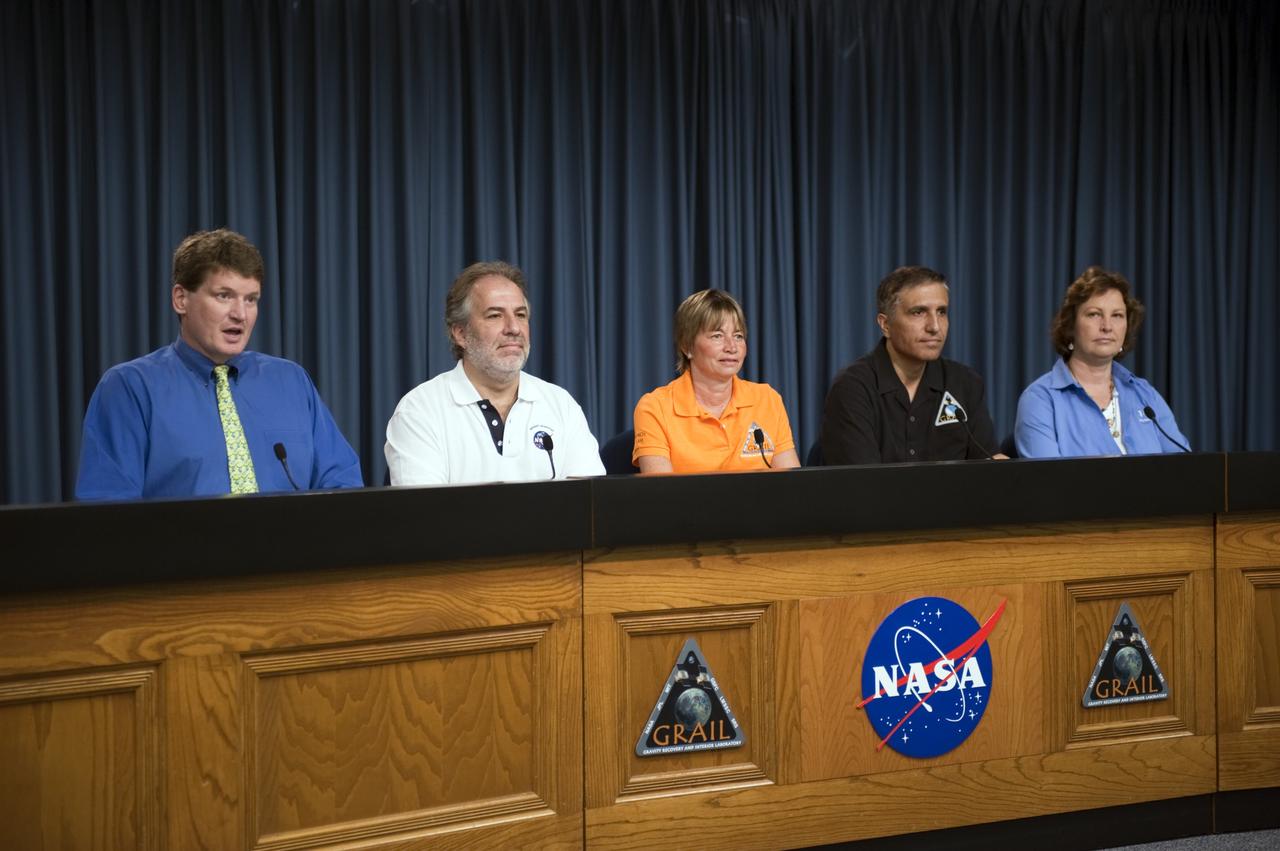
CAPE CANAVERAL, Fla. – – A Gravity Recovery and Interior Laboratory (GRAIL) mission science briefing is held in the NASA Press Site auditorium at NASA's Kennedy Space Center in Florida. From left are DC Agle, NASA Public Affairs; Robert Fogel, NASA’s GRAIL program scientist; Maria Zuber, GRAIL principal investigator with the Massachusetts Institute of Technology; Sami Asmar, GRAIL deputy project scientist, NASA’s Jet Propulsion Laboratory; and Leesa Hubbard, teacher in residence, Sally Ride Science, San Diego. GRAIL is scheduled to launch Sept. 8 aboard a United Launch Alliance Delta II Heavy rocket from Cape Canaveral Air Force Station in Florida. GRAIL will fly twin spacecraft in tandem around the moon to precisely measure and map variations in the moon's gravitational field. The mission will provide the most accurate global gravity field to date for any planet, including Earth. This detailed information will reveal differences in the density of the moon's crust and mantle and will help answer fundamental questions about the moon's internal structure, thermal evolution, and history of collisions with asteroids. The aim is to map the moon's gravity field so completely that future moon vehicles can safely navigate anywhere on the moon’s surface. For more information, visit http://www.nasa.gov/grail. Photo credit: NASA/Kim Shiflett