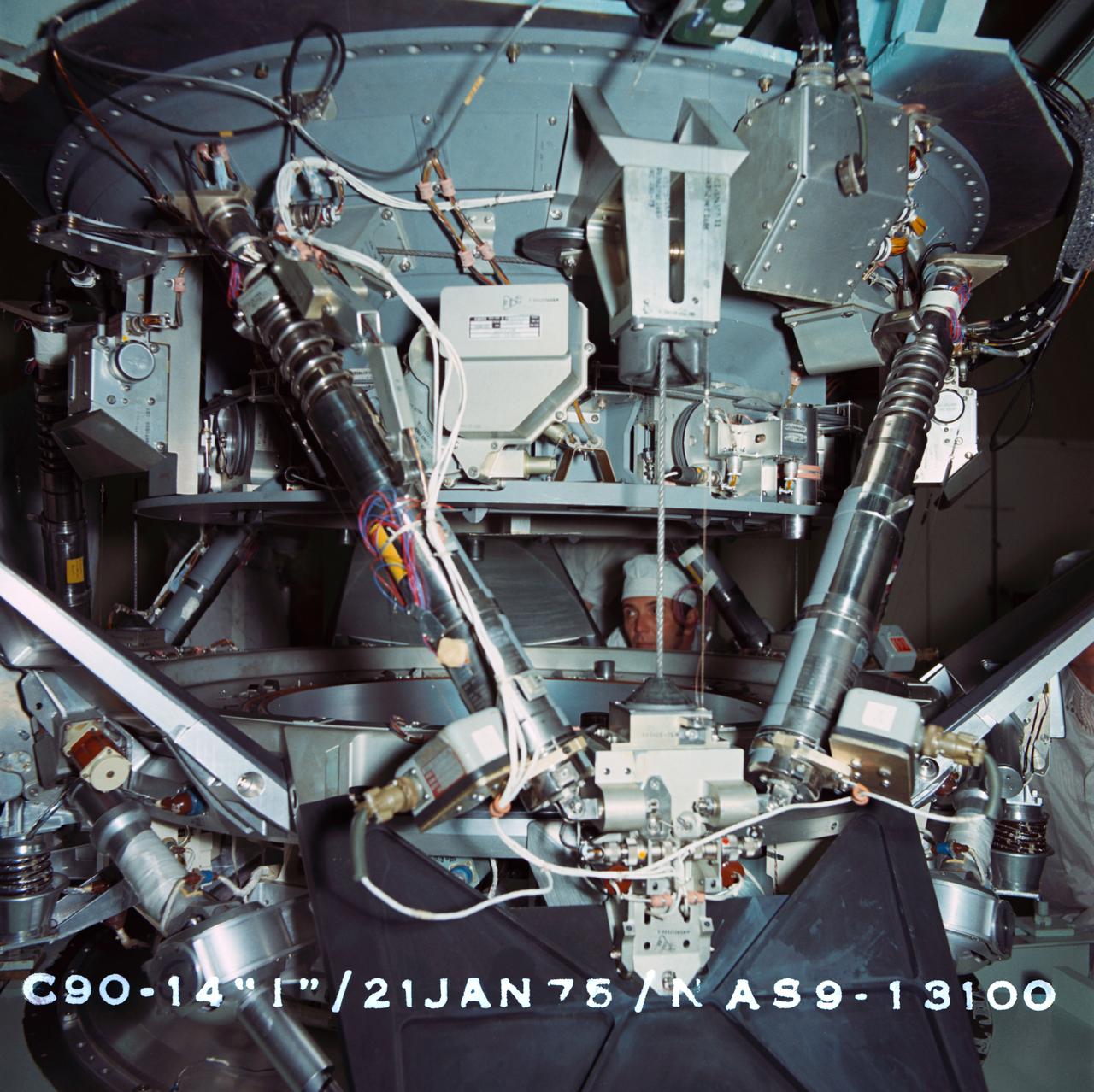
S95-02815 (21 Jan. 1975) --- Soviet junior researcher Y.G. Pobrov observes testing of the Apollo-Soyuz docking system at Rockwell International's plant in Downey, California. The United States' Docking System 3 (DS-3) here is being positioned onto the USSR's CA-4 system during a Pin and Socket Alignment Test. DS-5 has been designated as the prime flight article for the joint U.S.-USSR Apollo-Soyuz Test Project (ASTP) docking mission in Earth orbit, scheduled for July 1975.
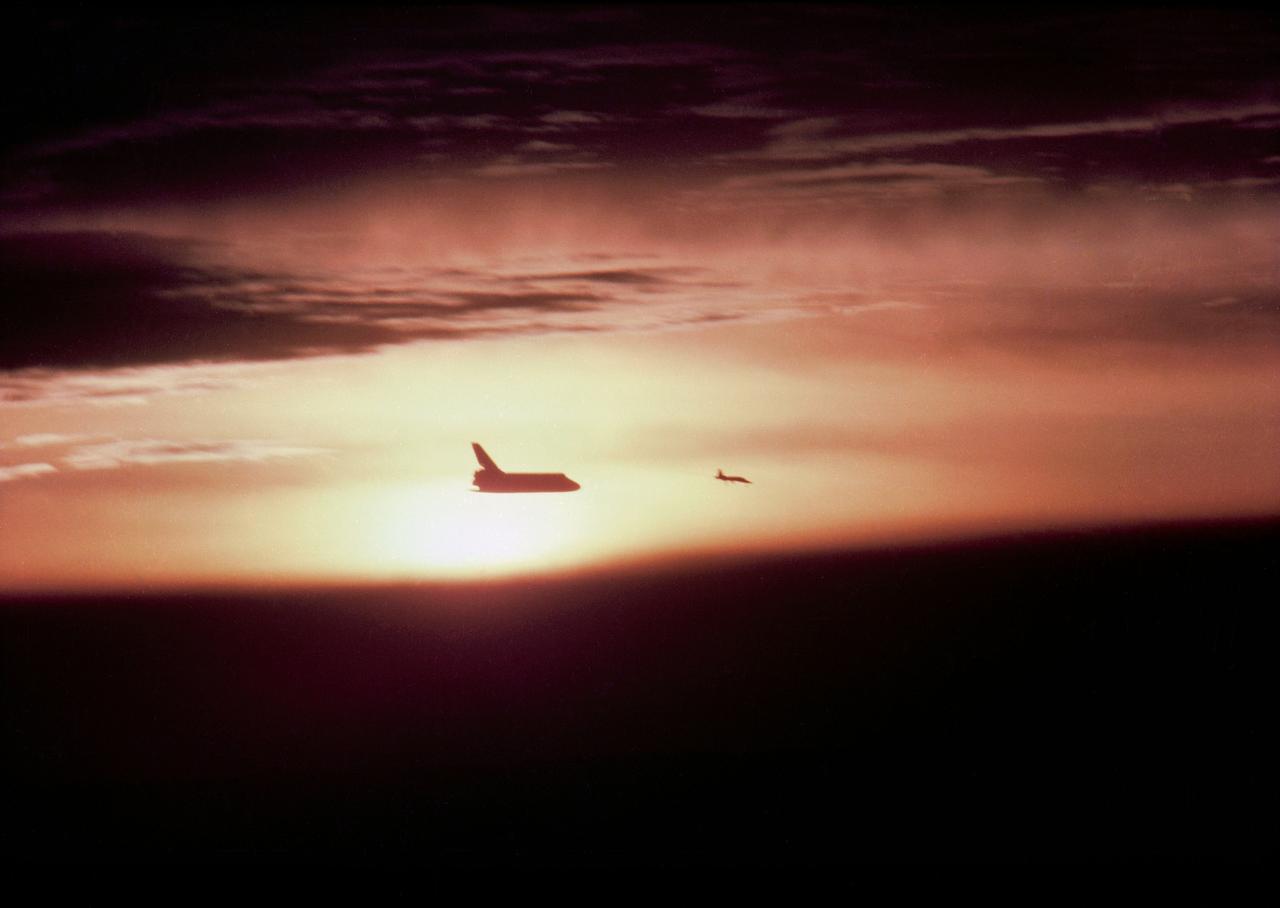
Aerial view of Orbiter "Columbia" as you look into the Sun, taken by Erik Simonsen, Rockwell International, 11/16/1982. 1. STS-5 - LANDING (INTO THE SUN) EAFB, CA
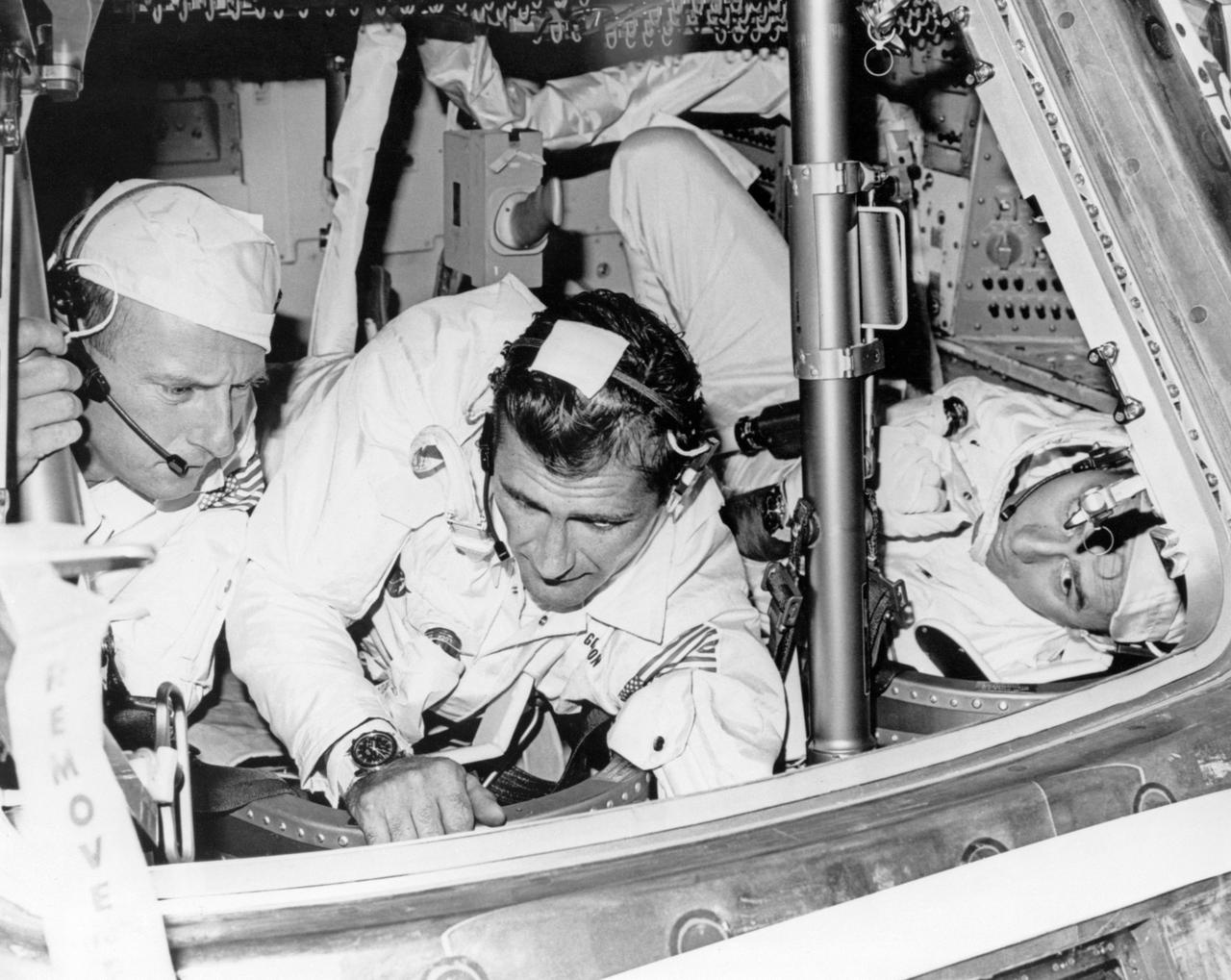
S69-53716 (1969) --- The prime crew of the Apollo 12 lunar landing mission is photographed during spacecraft checkout activity at North American Rockwell Space Division at Downey, California. Left to right, are astronauts Charles Conrad Jr., commander; Richard F. Gordon Jr., command module pilot; and Alan L. Bean, lunar module pilot.
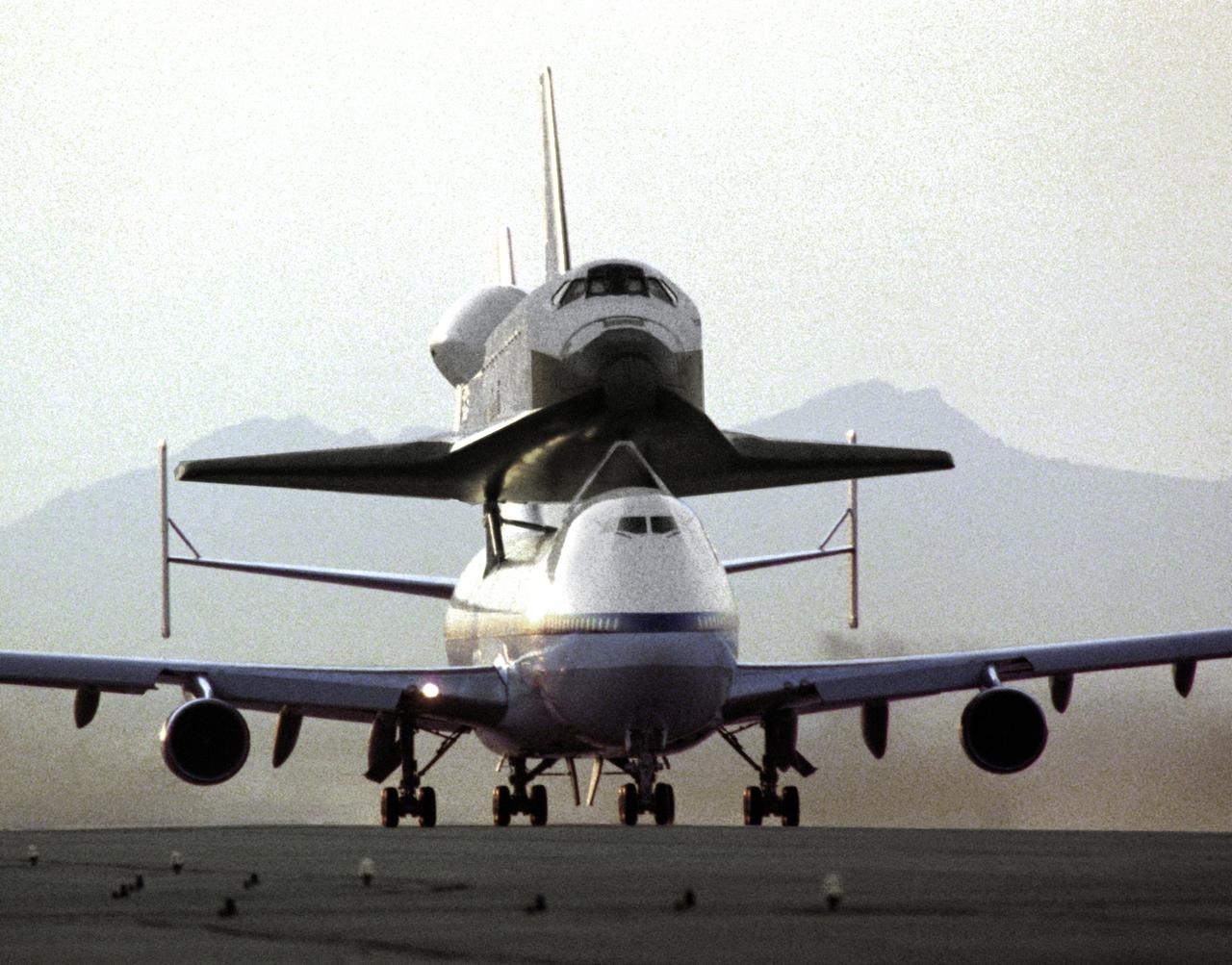
NASA's 747 Shuttle Carrier Aircraft No. 911, with the space shuttle orbiter Endeavour securely mounted atop its fuselage, taxies to the runway to begin the ferry flight from Rockwell's Plant 42 at Palmdale, California, where the orbiter was built, to the Kennedy Space Center, Florida. At Kennedy, the space vehicle was processed and launched on orbital mission STS-49, which landed at NASA's Ames-Dryden Flight Research Facility (later redesignated Dryden Flight Research Center), Edwards, California, 16 May 1992. NASA 911, the second modified 747 that went into service in November 1990, has special support struts atop the fuselage and internal strengthening to accommodate the added weight of the orbiters.
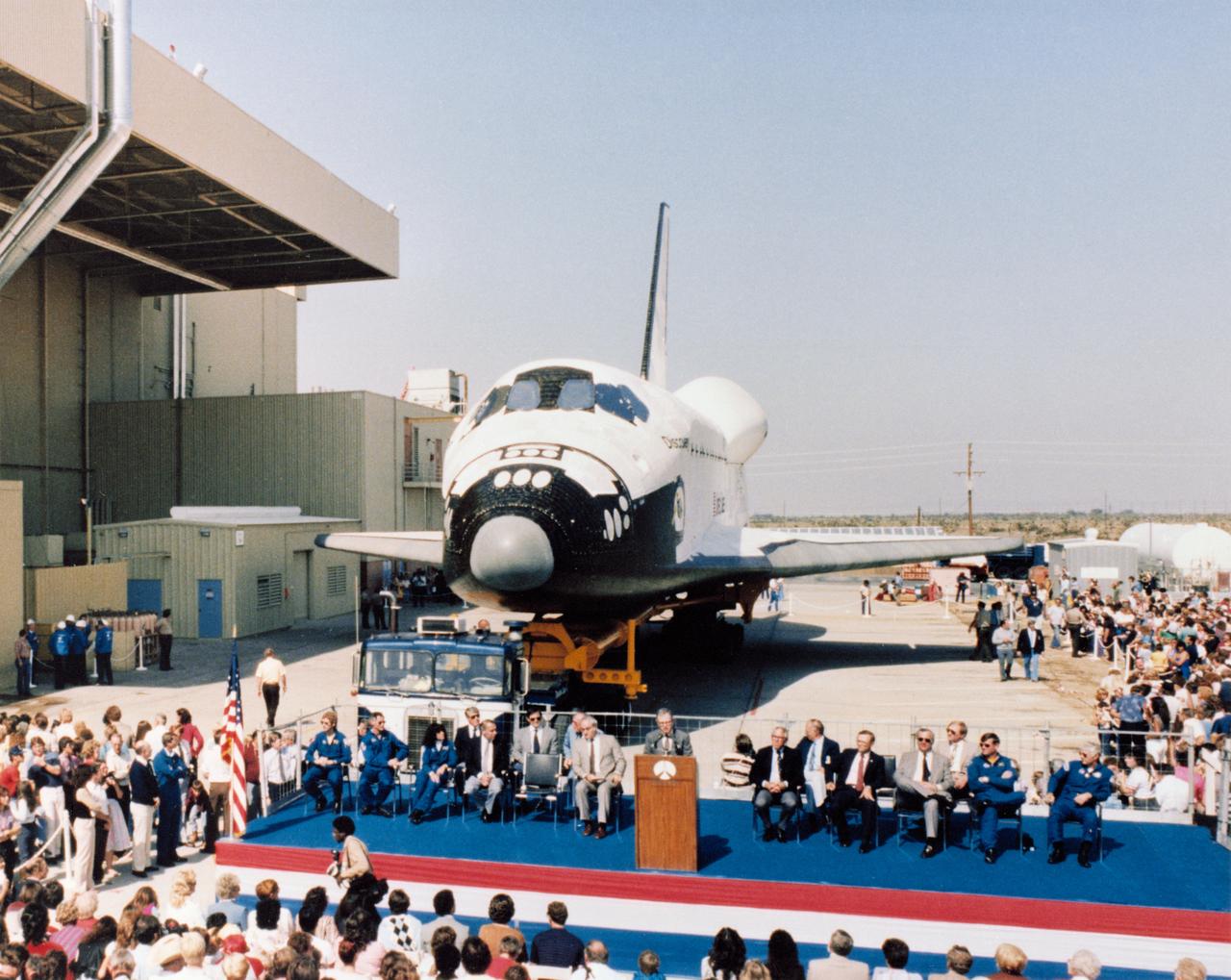
S84-30898 (16 Oct 1983) --- NASA Space Shuttle Orbiter 103, Discovery, is rolled out in formal ceremonies at the Rockwell International Palmdale, California, facility. On hand to greet the vehicle and the public are members of the 41-D crew--the first team of astronauts to man the new vehicle. Scheduled for a spring or summer flight in 1984 are astronauts Henry W. Hartsfield (right), commander; Michael L. Coats (second right), pilot; and Judith A. Resnik, Richard M. (Mike) Mullane and Steven A. Hawley (on left of stage), all mission specialists. Don Beall of Rockwell International (at lectern) prepares to introduce Dr. Rocco A. Petrone, president of Rockwell's Space Transportation Systems Division.
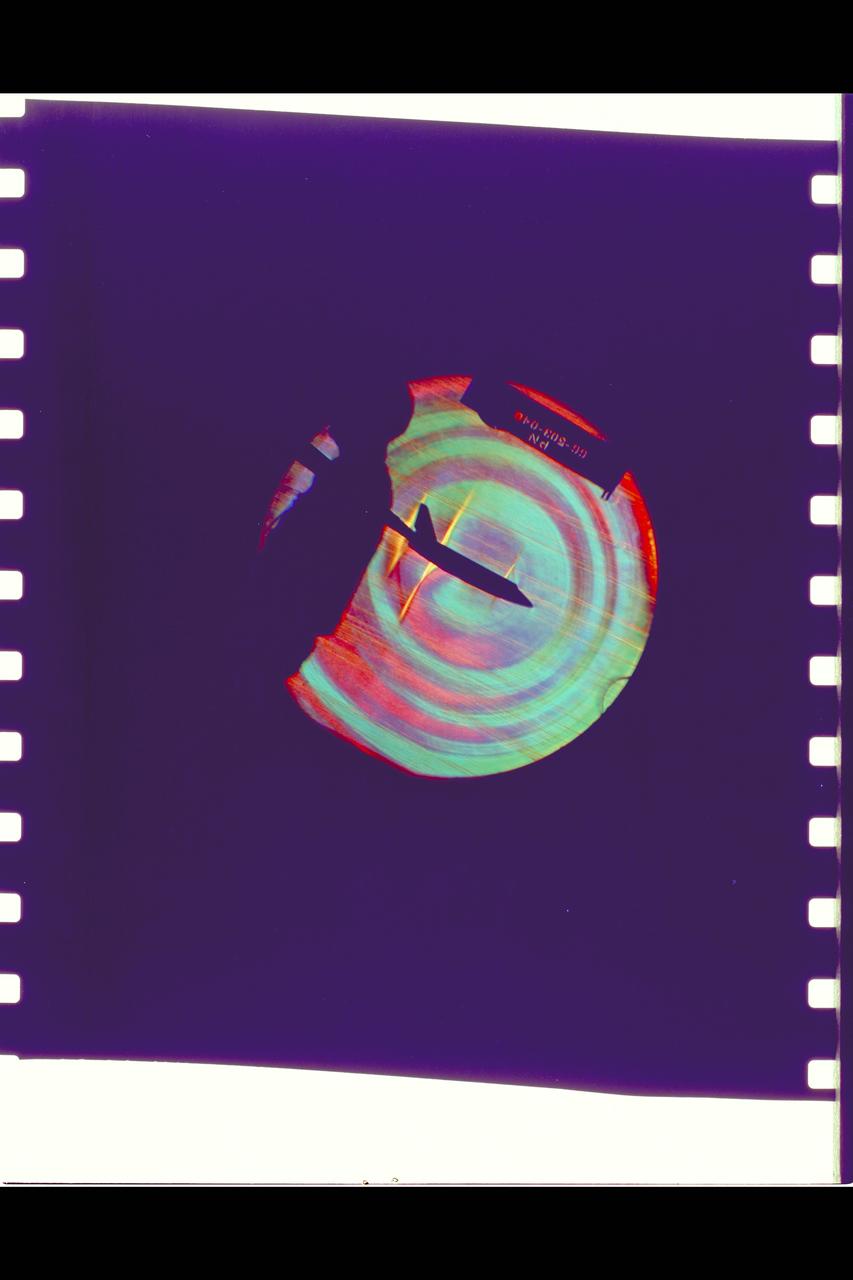
MSC Space Shuttle Stability and Control Characteristics. Schlieren of North American Rockwell Straight Wing orbiter approximate Mach .95
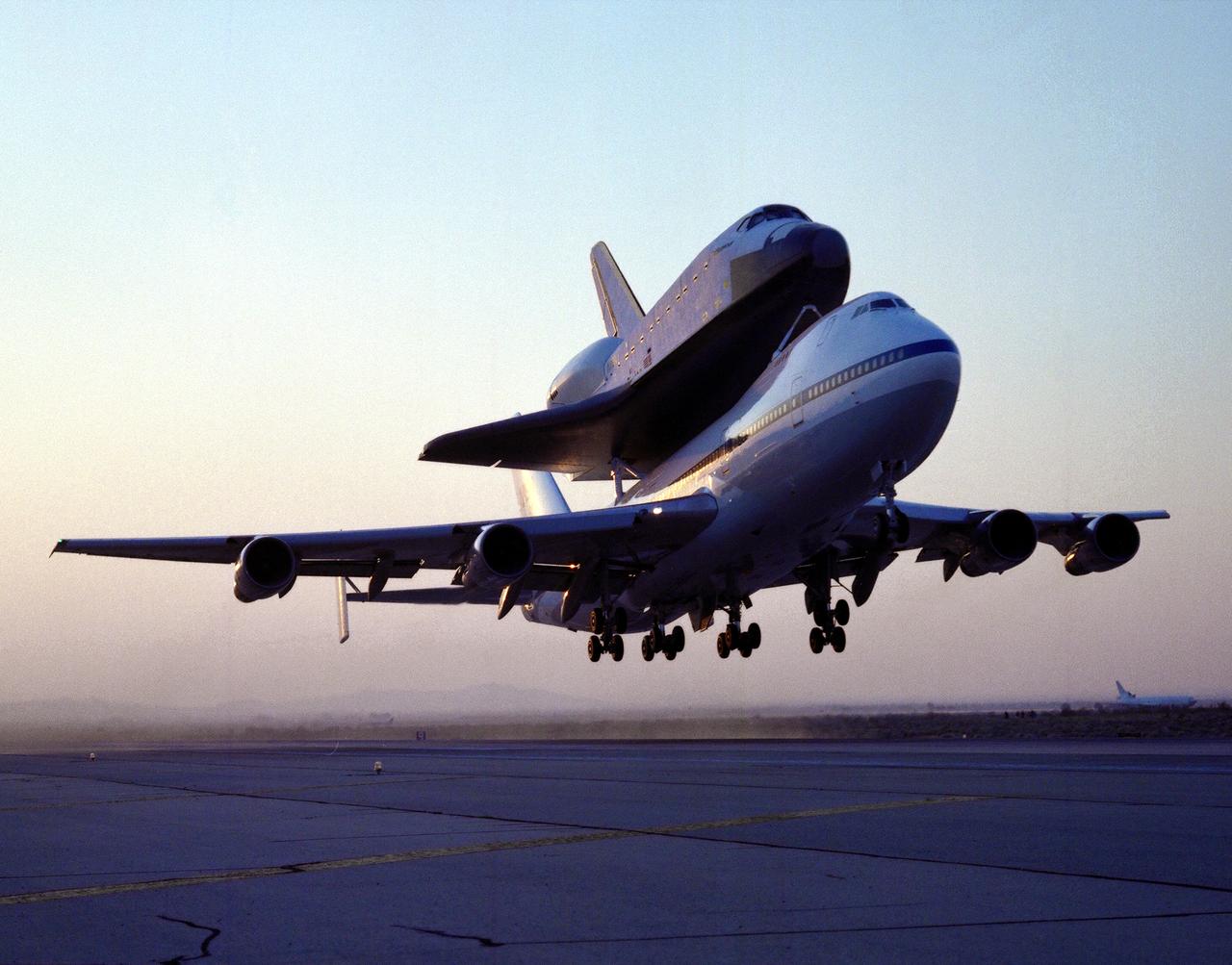
NASA's 747 Shuttle Carrier Aircraft No. 911, with the space shuttle orbiter Endeavour securely mounted atop its fuselage, begins the ferry flight from Rockwell's Plant 42 at Palmdale, California, where the orbiter was built, to the Kennedy Space Center, Florida. At Kennedy, the space vehicle was processed and launched on orbital mission STS-49, which landed at NASA's Ames-Dryden Flight Research Facility (later redesignated Dryden Flight Research Center), Edwards, California, 16 May 1992. NASA 911, the second modified 747 that went into service in November 1990, has special support struts atop the fuselage and internal strengthening to accommodate the added weight of the orbiters.

Pictured here is an artist's depiction of Rockwell's Vertical Landing Single-Stage-to-Orbit (SSTO) Reusable Launch Vehicle (RLV) deploying a satellite concept. The development of the RLV is essential in the cost reduction of future space travel.
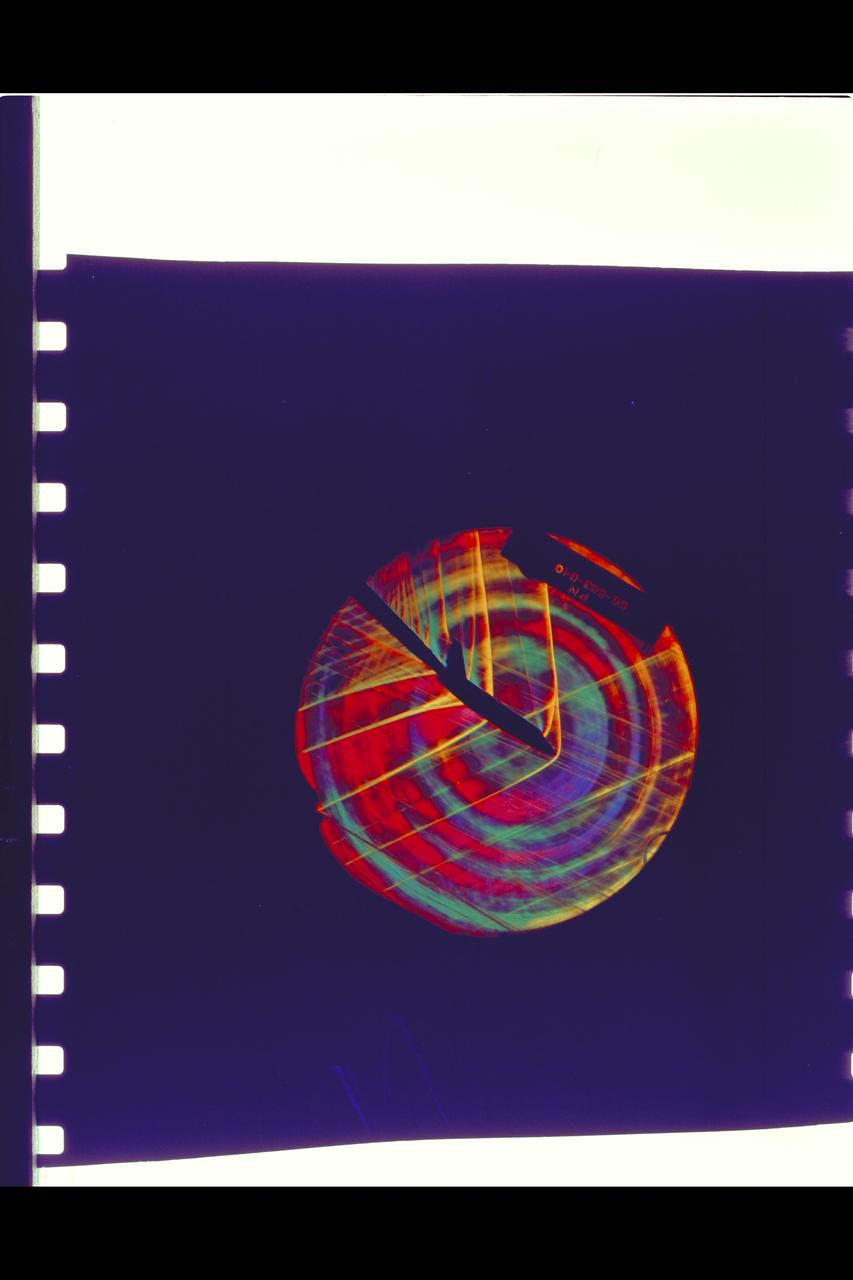
MSC Space Shuttle Stability and Control Characteristics. Schlieren of North American Rockwell Straight Wing orbiter approximate Mach .95 6ft w.t. Test-66-503
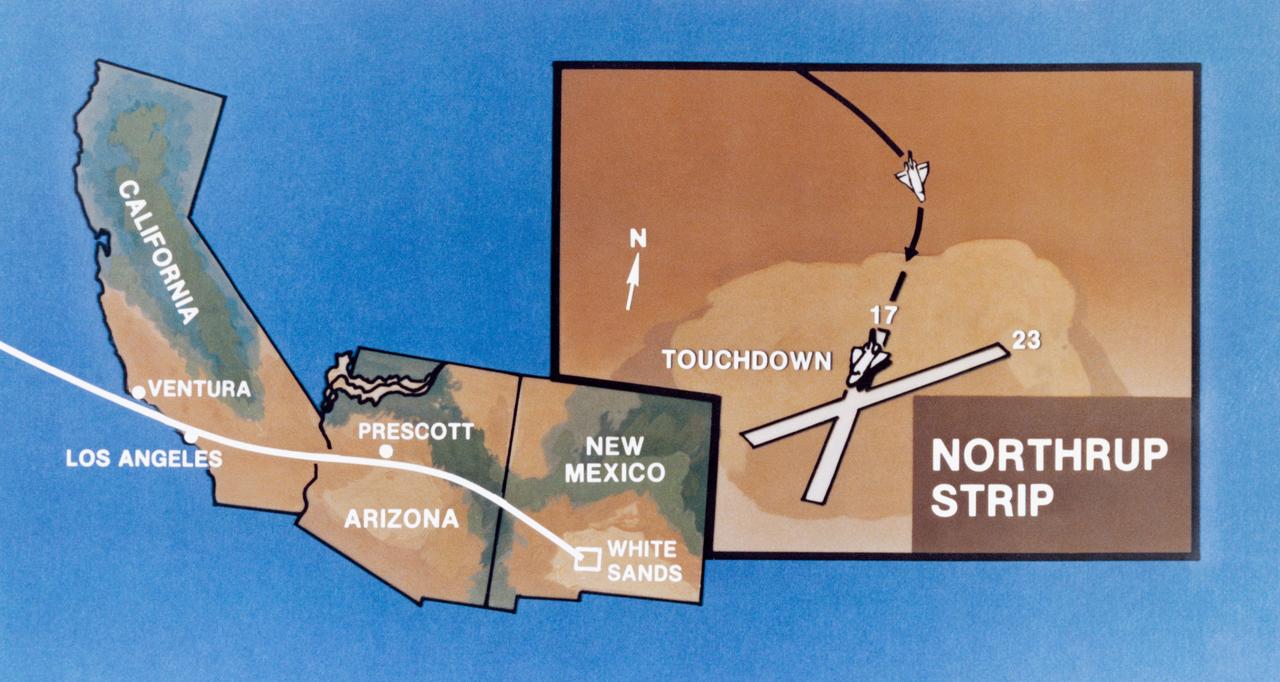
Art Concept of the End-of-Mission Approach and Landing at WSTF, NM, from Rockwell. 1. ART CONCEPT - STS-3 LANDING 2. STS-3 - LANDING WSTF, NM Also available in 4x5 B&W
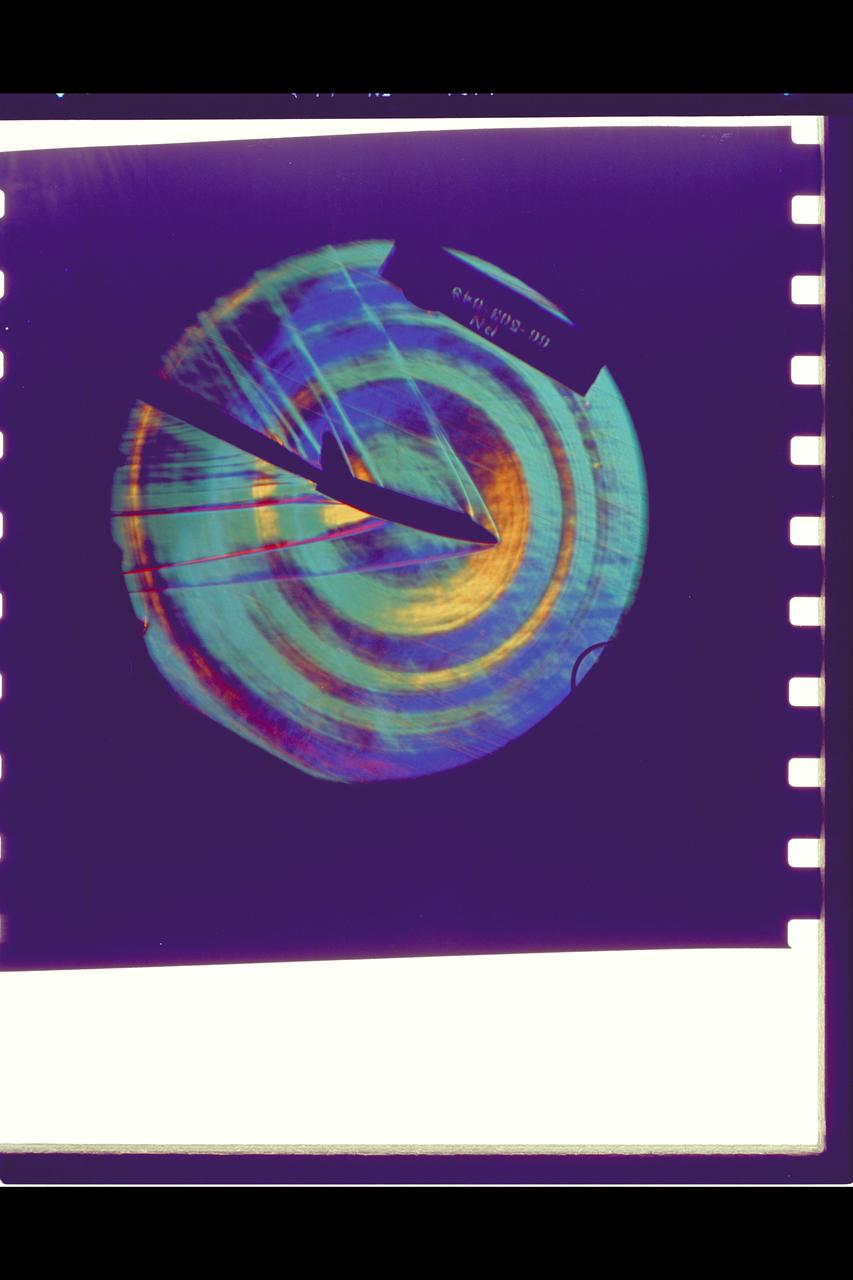
MSC Space Shuttle Stability and Control Characteristics. Schlieren of North American Rockwell Straight Wing orbiter approximate Mach .95 6ft w.t. test-66-503
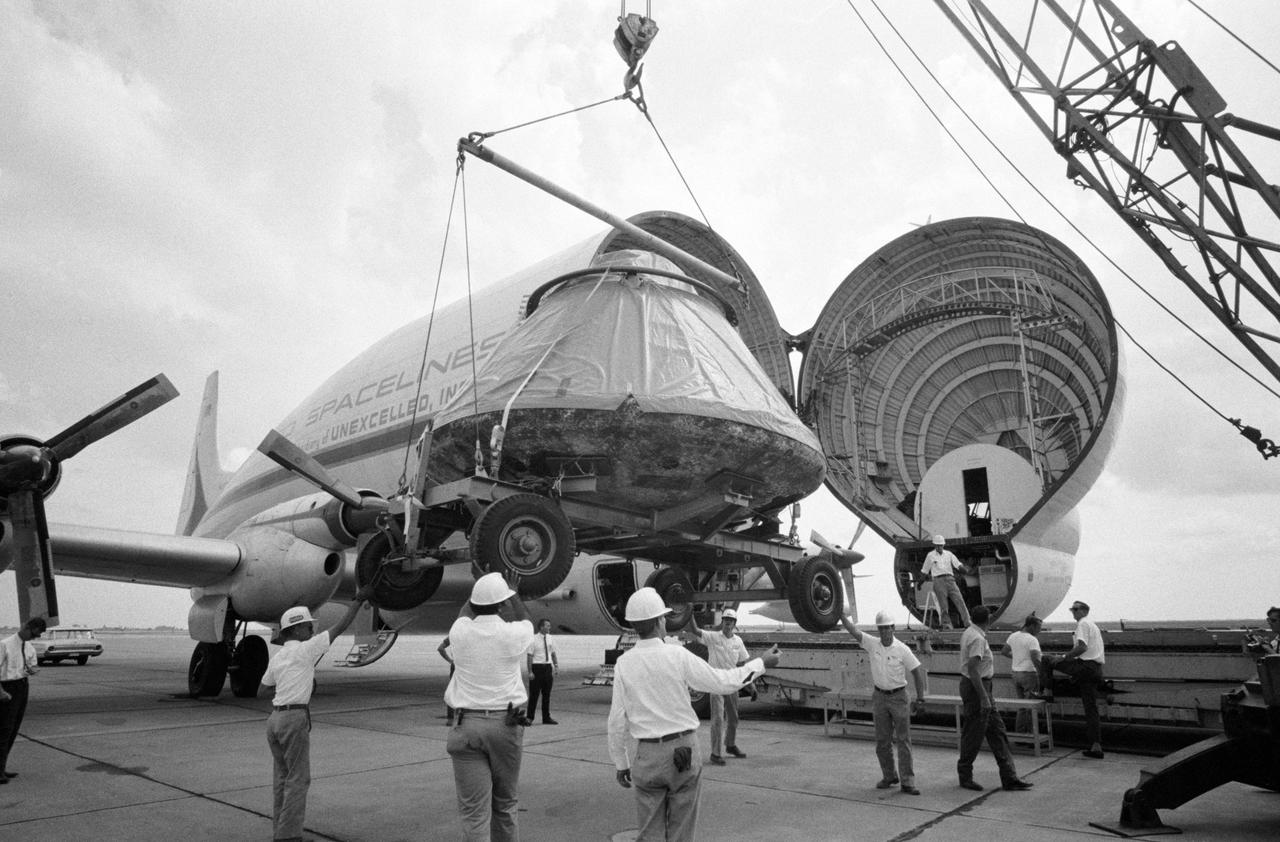
S69-41985 (14 Aug. 1969) --- The Apollo 11 spacecraft Command Module (CM) is loaded aboard a Super Guppy Aircraft at Ellington Air Force Base for shipment to the North American Rockwell Corporation at Downey, California. The CM was just released from its postflight quarantine at the Manned Spacecraft Center (MSC). The Apollo 11 spacecraft was flown by astronauts Neil A. Armstrong, commander; Michael Collins, command module pilot; and Edwin E. Aldrin Jr., lunar module pilot, during their lunar landing mission. Note damage to aft heat shield caused by extreme heat of Earth reentry. North American Rockwell is the prime contractor for the Apollo Command and Service Modules (CSM).
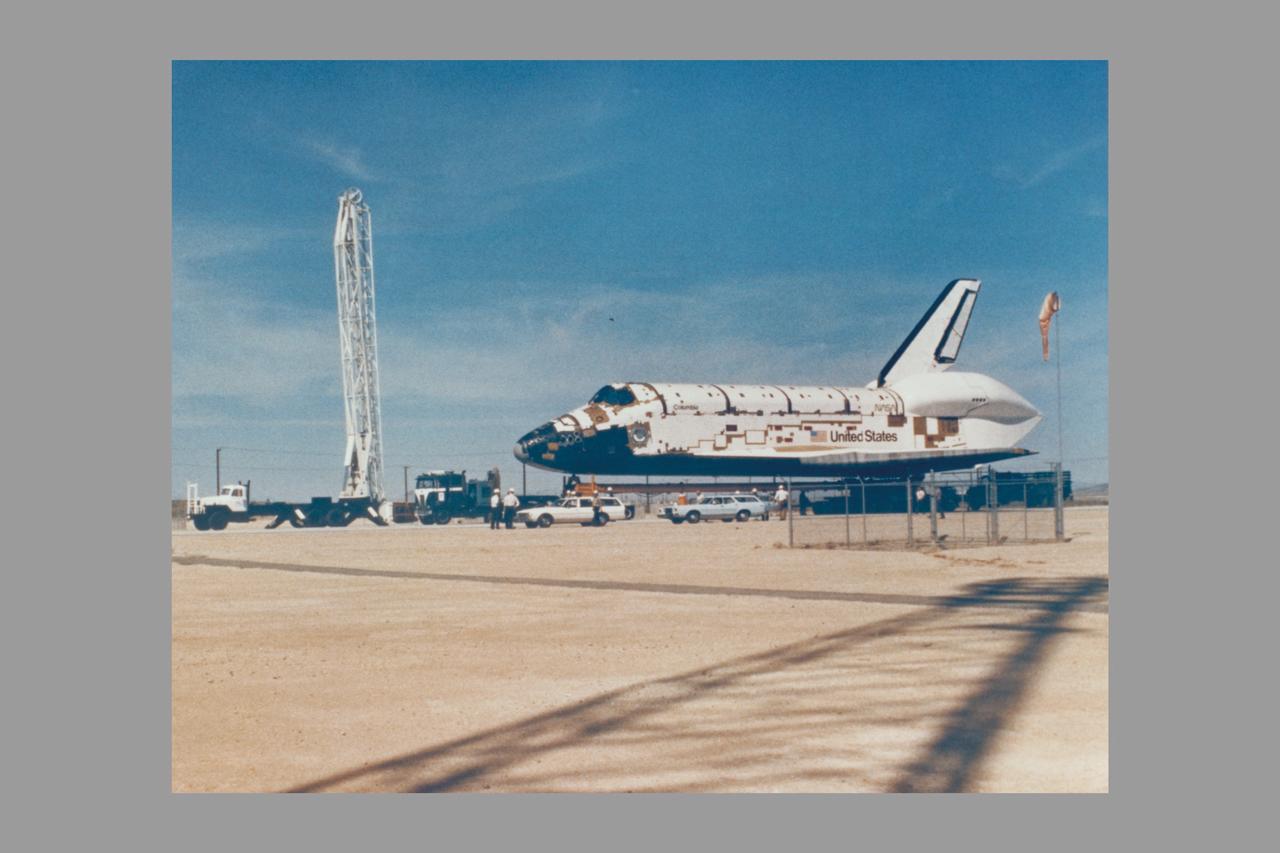
SPACE SHUTTLE ORBITER COLUMBIA 102 IS SHOWN BACKING OUT OF ITS MANUFACTURING FACILITY AT PALMDALE, CA THE ROCKWELL INTERNATIONAL SPACE DIVISION PLANT, ENROUTE TO DRYDEN FLIGHT RESEARCH CENTER. THIS ORBITER WILL BE THE FIRST SHUTTLE SPACECRAFT THAT WILL CARRY TWO ASTRONAUTS, JOHN YOUNG AND RICHARD CRIPPEN, INTO EARTH ORBITAL TEST FLIGHT IN LATE 1979.
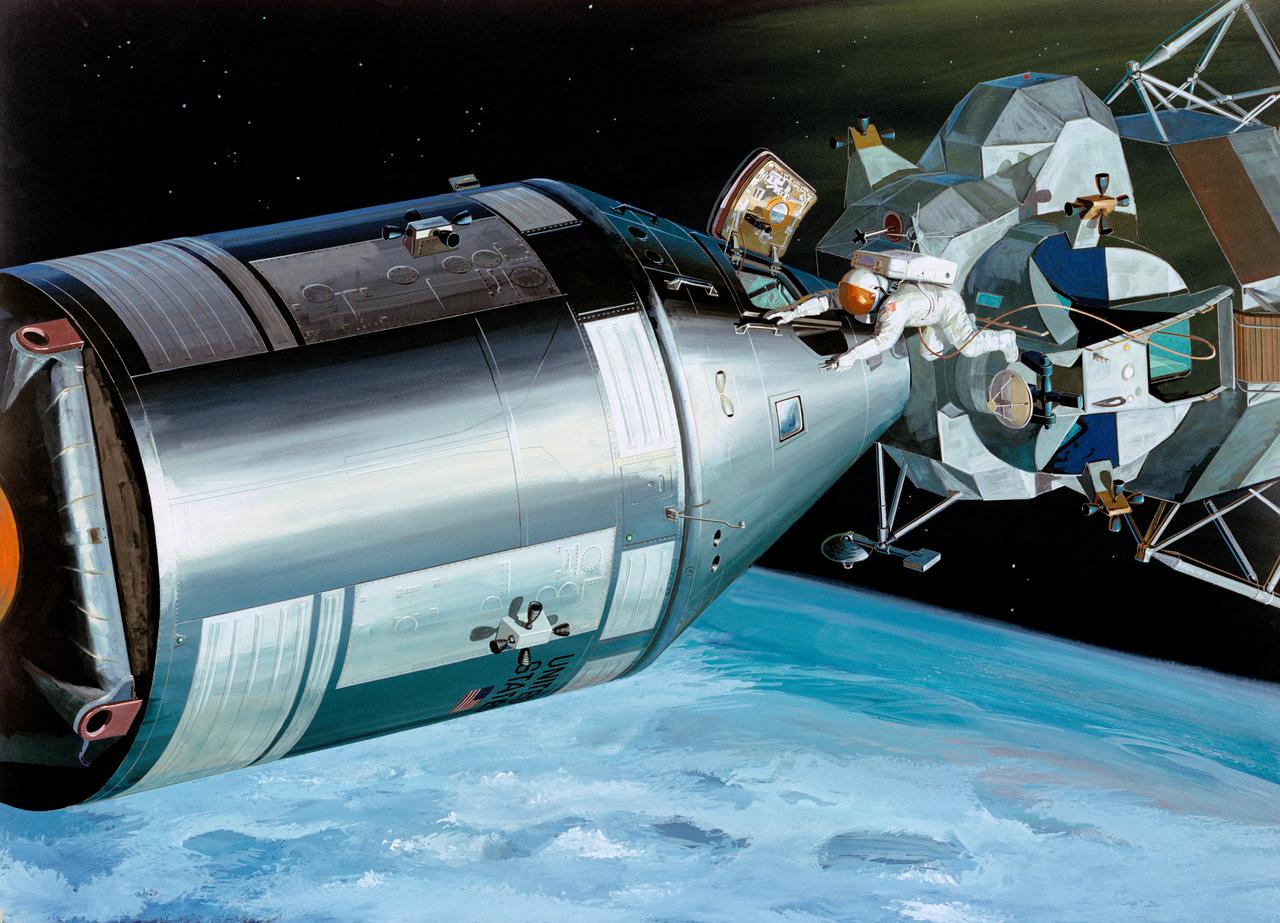
S69-18547 (1969) --- North American Rockwell artist's concept illustrating a part of the planned Apollo 9 extravehicular activity on the fourth day of the mission as the Command and Service Modules are docked to the Lunar Module. The figure performing the EVA represents astronaut Russell L. Schweickart, Apollo 9 lunar module pilot.
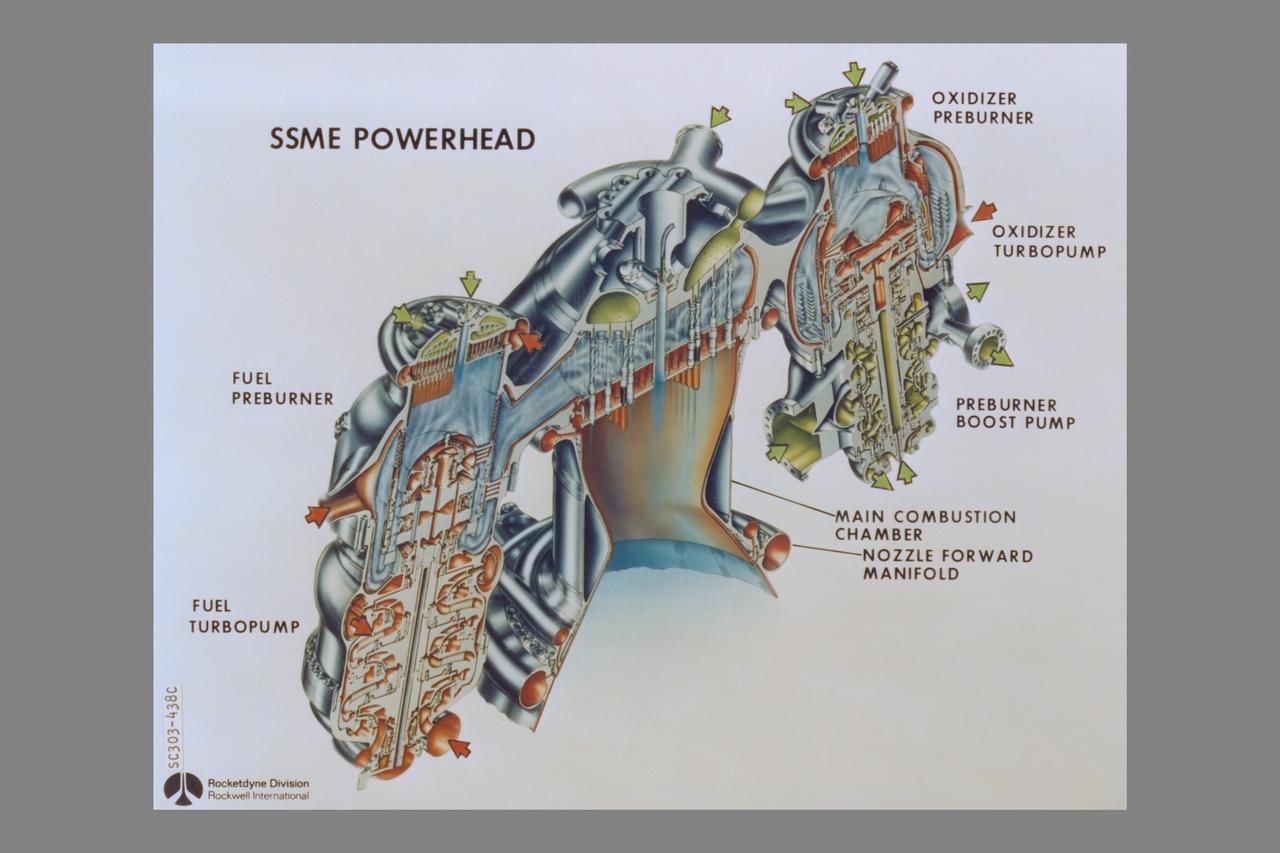
cutaway Rockwell International Space Shuttle Main Engines: Powerhead (Left side - fuel preburner, fuel trubopump - Center - Main Combustion Chamber, nozzle forward manifold - Right side - oxidizer preburner, oxidizer turbopump, preburner boost pump)

S68-41156 (August 1968) --- North American Rockwell Corporation artist's concept depicting the Apollo Command Module, oriented in a blunt and forward attitude, reentering Earth's atmosphere after returning from a trip to the moon. Cutaway view illustrates position of the three astronauts in the Command Module.

A workman reams holes to the proper size and aligment in the Space Shuttle Main Engine's main injector body, through which propellants will pass through on their way into the engine's combustion chamber. Rockwell International's Rocketdyne Division plant produced the engines under contract to the Marshall Space Flight Center.
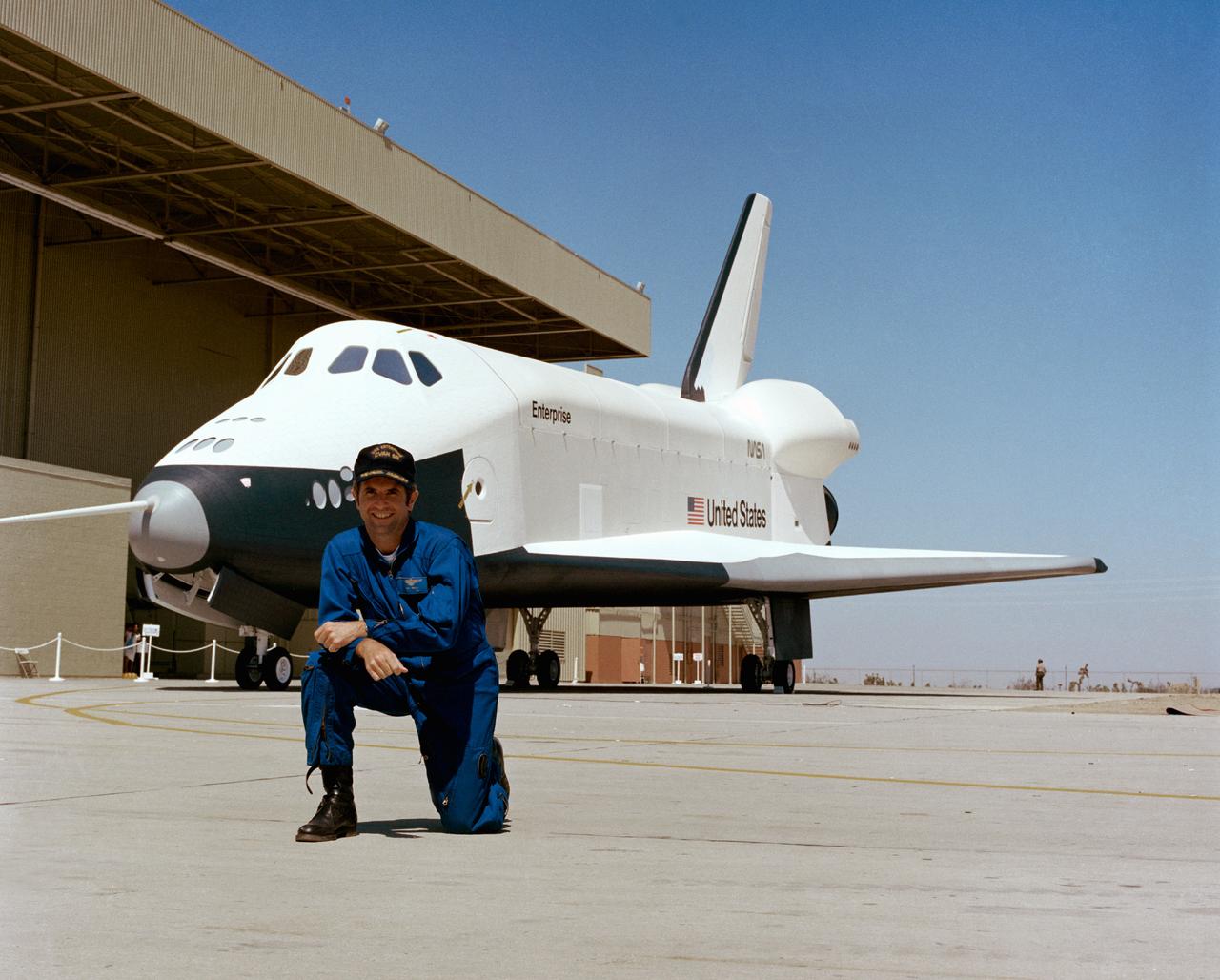
S76-29569 --- Astronaut Richard H. Truly, pilot of the second crew for the Space Shuttle Approach and Landing Tests (ALT), is photographed at the Rockwell International Space Division's Orbiter assembly facility at Palmdale, California on the day of the rollout of the Shuttle Orbiter 101 "Enterprise" spacecraft. The DC-9 size airplane-like Orbiter 101 is in the background.

John Tribe, retired Apollo engineer, North American Rockwell, speaks during a ceremony renaming Kennedy Space Center’s launch control center to the Rocco A. Petrone Launch Control Center on Feb. 22, 2022. Petrone was instrumental in America’s first voyages to the Moon and headed the Apollo program. He died in 2006 at the age of 80.
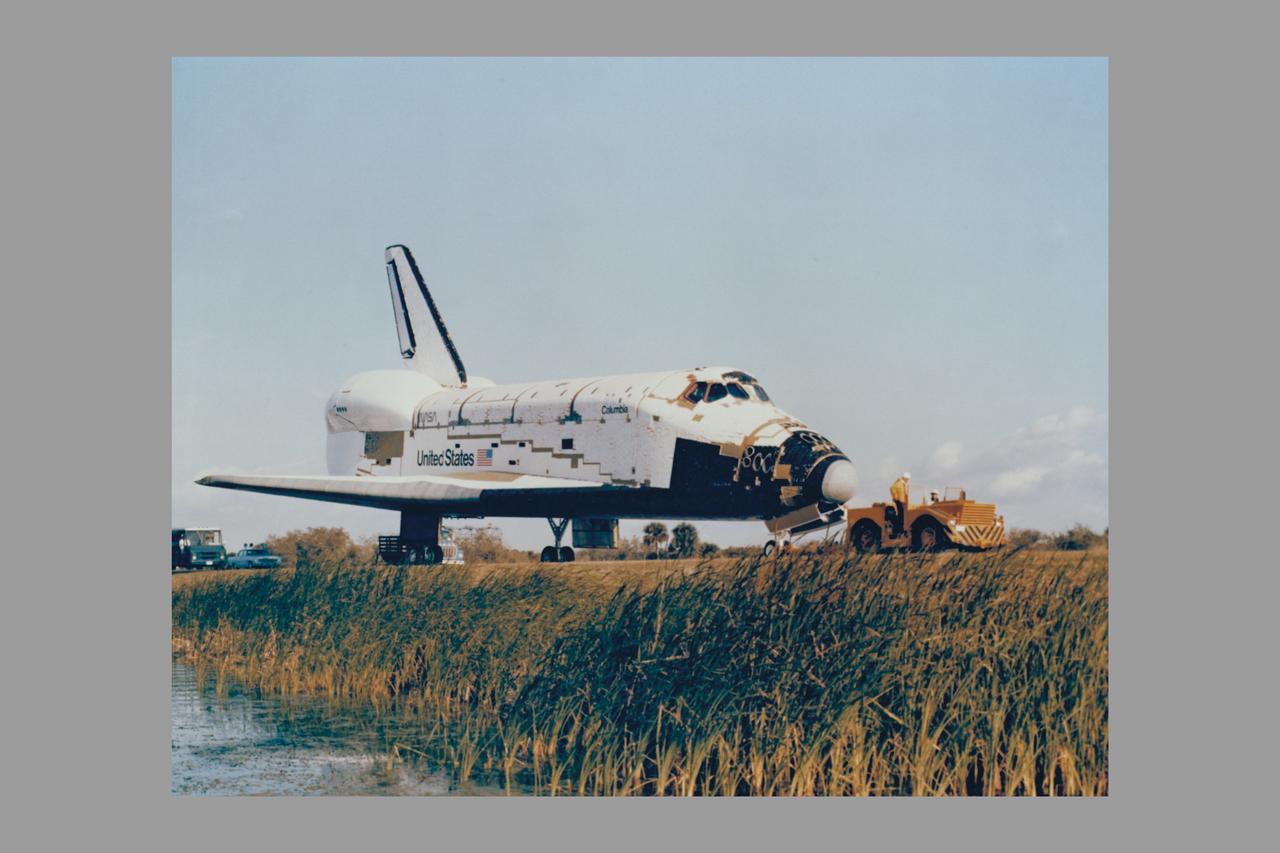
Space Shuttle Orbiter 102 Columbia is shown backing out of its manufacturing facililty at Palmdale, CA, the Rockwell international Space Division Plant, enroute to Dryden Flgiht Research Center. This Orbiter will be the first shuttle spacecraft that will carry two astronauts, John Young and Richard Crippen, into earth orbital test flight in late 1979.
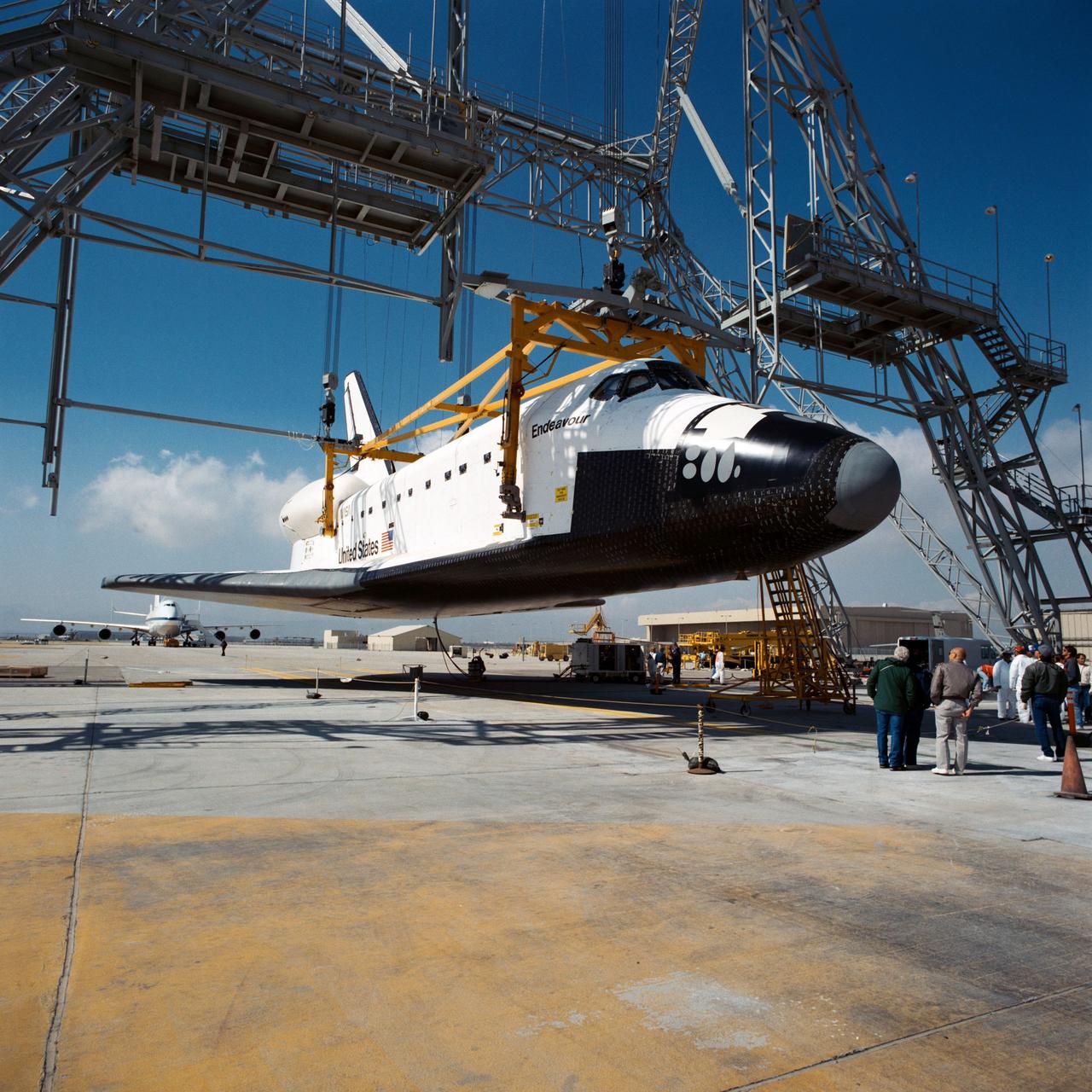
PALMDALE, Calif. -- S91-39487 -- A Rockwell worker at the space shuttle's Palmdale Final Assembly Facility in Palmdale, Calif., takes a technical documentation image of space shuttle Endeavour as it is prepared for its first ferry flight to NASA's Kennedy Space Center in Florida aboard the agency's Shuttle Carrier Aircraft, or SCA, designated NASA 911. Endeavour is scheduled to return to California in 2012, where it will be on public display at the California Science Center in Los Angeles. Its ferry flight across America is targeted for mid-September. Endeavour was the last space shuttle added to NASA’s orbiter fleet. During the course of its 19-year career, Endeavour spent 299 days in space during 25 missions. For more information on shuttle transition and retirement work, visit http://www.nasa.gov/transition. Photo credit: NASA/ Rockwell International Space Systems Division
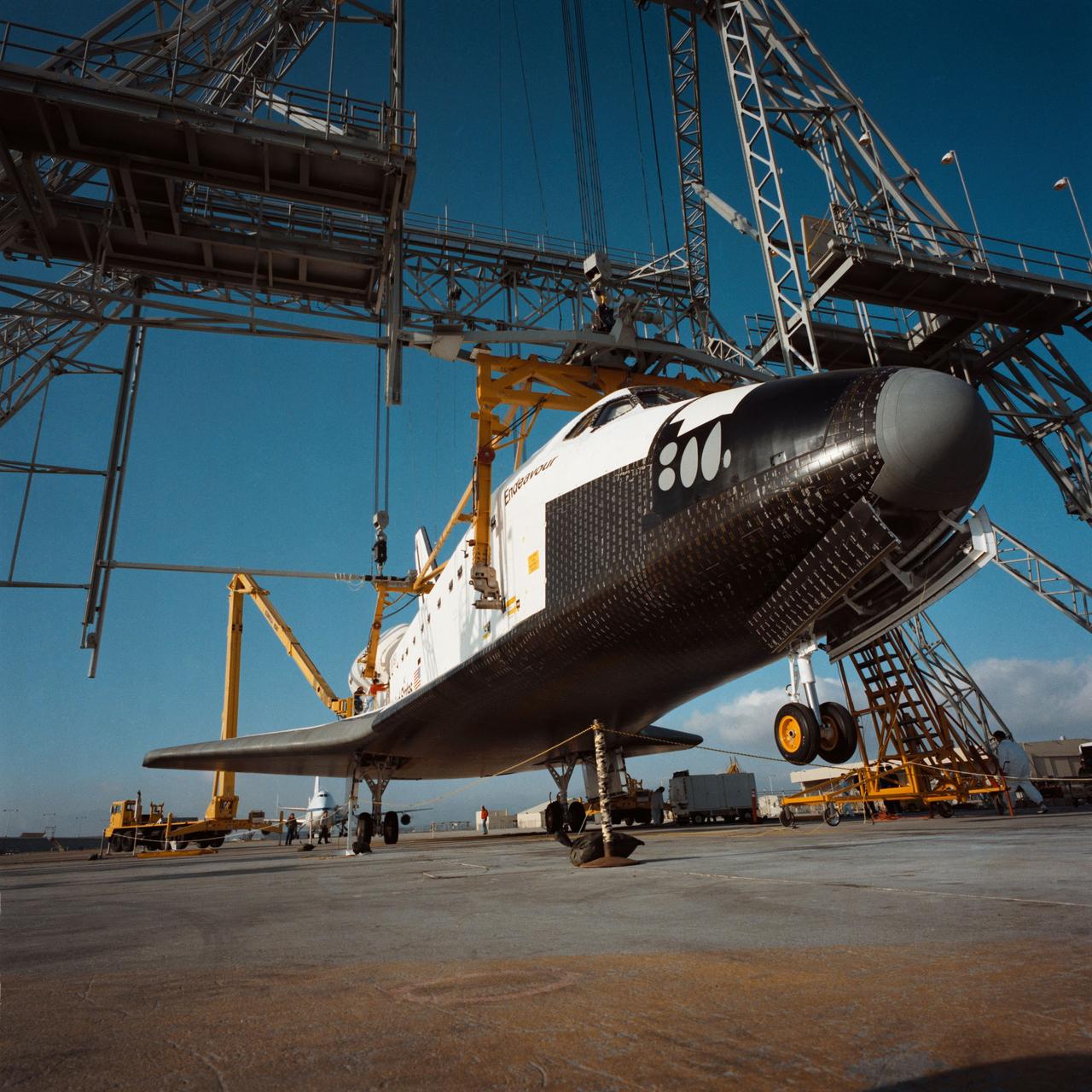
PALMDALE, Calif. -- S91-39486 -- A Rockwell worker at the space shuttle's Palmdale Final Assembly Facility in Palmdale, Calif., takes a technical documentation image of space shuttle Endeavour as it is prepared for its first ferry flight to NASA's Kennedy Space Center in Florida aboard the agency's Shuttle Carrier Aircraft, or SCA, designated NASA 911. Endeavour is scheduled to return to California in 2012, where it will be on public display at the California Science Center in Los Angeles. Its ferry flight across America is targeted for mid-September. Endeavour was the last space shuttle added to NASA’s orbiter fleet. During the course of its 19-year career, Endeavour spent 299 days in space during 25 missions. For more information on shuttle transition and retirement work, visit http://www.nasa.gov/transition. Photo credit: NASA/ Rockwell International Space Systems Division
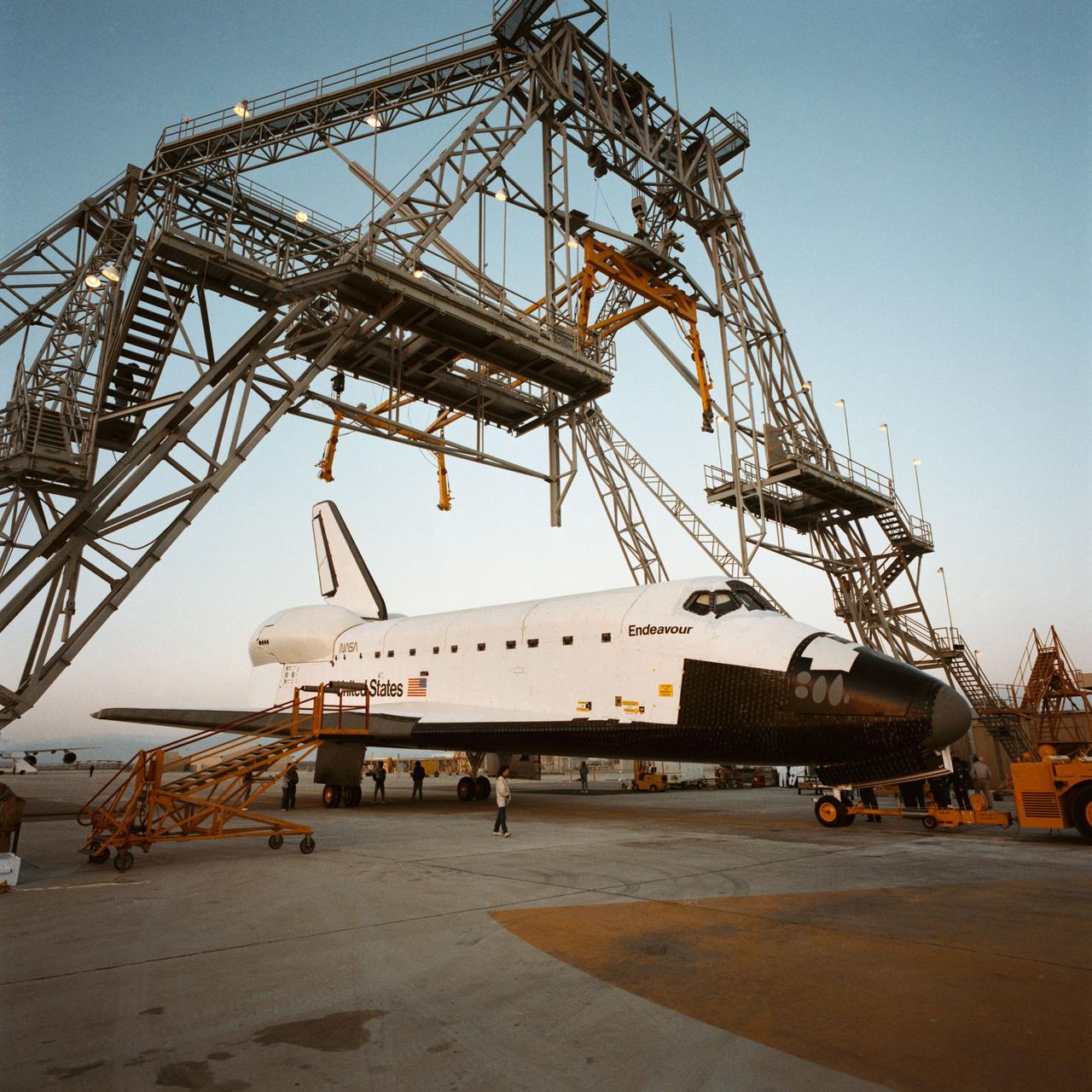
PALMDALE, Calif. -- S91-39480 -- A Rockwell worker at the space shuttle's Palmdale Final Assembly Facility in Palmdale, Calif., takes a technical documentation image of space shuttle Endeavour as it is prepared for its first ferry flight to NASA's Kennedy Space Center in Florida aboard the agency's Shuttle Carrier Aircraft, or SCA, designated NASA 911. Endeavour is scheduled to return to California in 2012, where it will be on public display at the California Science Center in Los Angeles. Its ferry flight across America is targeted for mid-September. Endeavour was the last space shuttle added to NASA’s orbiter fleet. During the course of its 19-year career, Endeavour spent 299 days in space during 25 missions. For more information on shuttle transition and retirement work, visit http://www.nasa.gov/transition. Photo credit: NASA/ Rockwell International Space Systems Division
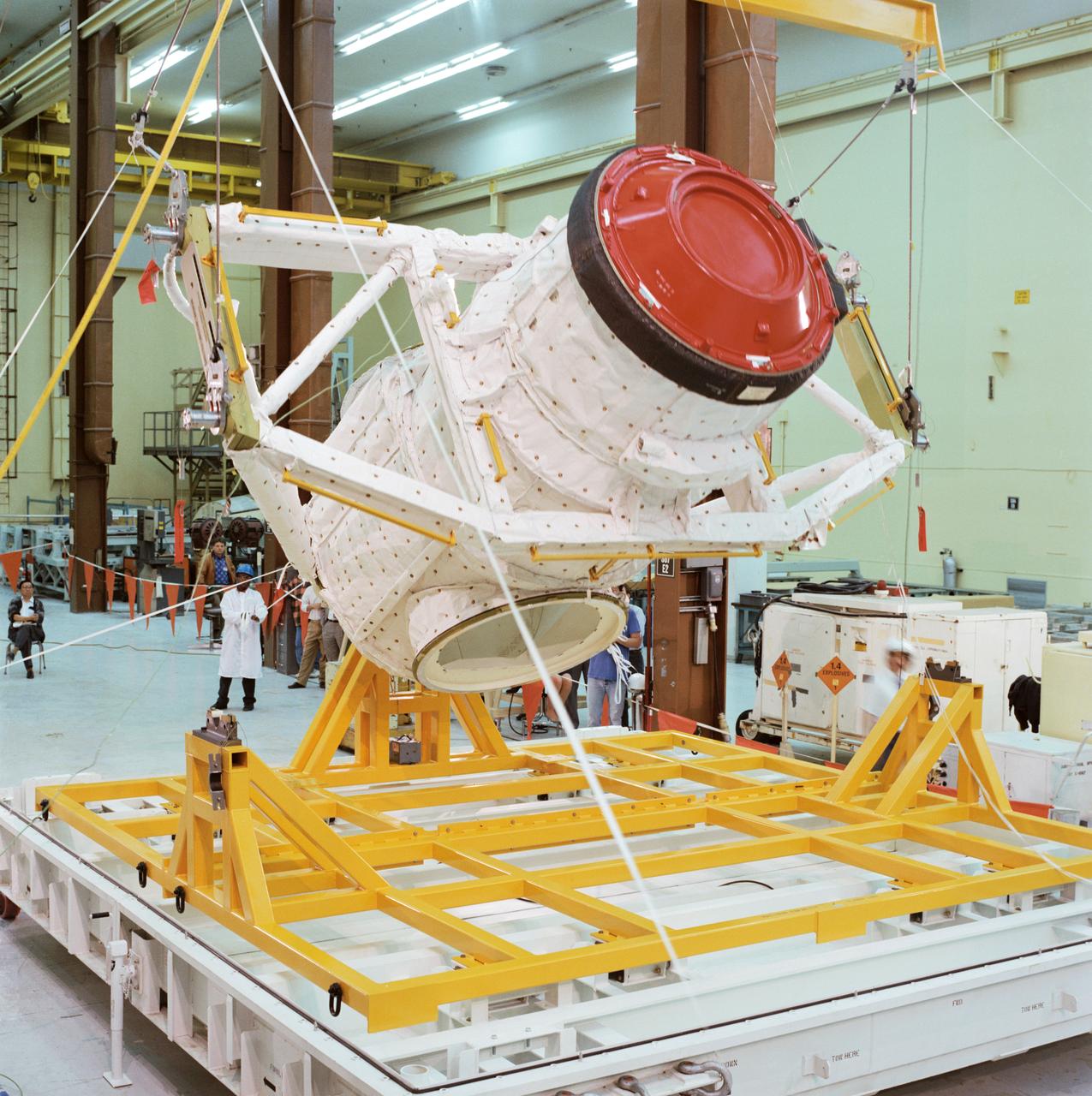
S95-00057 (15 Nov 1994) --- In Rockwell's Building 290 at Downey, California, the external airlock assembly/Mir docking system is rotated into position for crating up for shipment to the Kennedy Space Center (KSC) in Florida. Jointly developed by Rockwell and RSC Energia, the external airlock assembly and Mir docking system will be mounted in the cargo bay of the Space Shuttle Atlantis to enable the shuttle to link up to Russia's Mir space station. The docking system contains hooks and latches compatible with the system currently housed on the Mir's Krystall module, to which Atlantis will attach for the first time next spring. STS-71 will carry two Russian cosmonauts, who will replace a three-man crew aboard Mir including Norman E. Thagard, a NASA astronaut. The combined 10-person crew will conduct almost five days of joint life sciences investigations both aboard Mir and in the Space Shuttle Atlantis's Spacelab module.
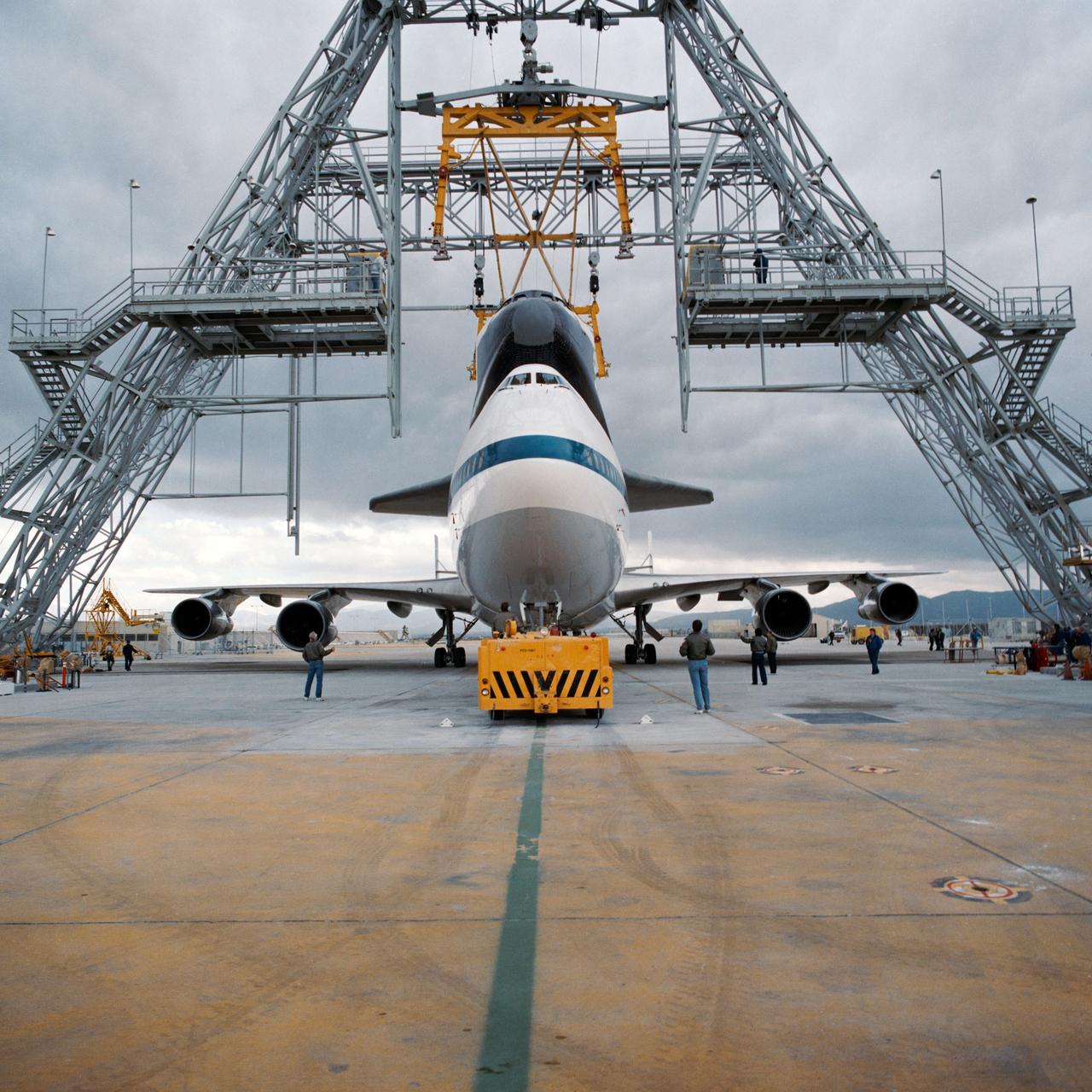
PALMDALE, Calif. -- S91-39477 -- A Rockwell worker at the space shuttle's Palmdale Final Assembly Facility in Palmdale, Calif., takes a technical documentation image of space shuttle Endeavour as it is mated to the agency's Shuttle Carrier Aircraft, or SCA, designated NASA 911, in preparation for its first ferry flight to NASA's Kennedy Space Center in Florida. Endeavour is scheduled to return to California in 2012, where it will be on public display at the California Science Center in Los Angeles. Its ferry flight across America is targeted for mid-September. Endeavour was the last space shuttle added to NASA’s orbiter fleet. During the course of its 19-year career, Endeavour spent 299 days in space during 25 missions. For more information on shuttle transition and retirement work, visit http://www.nasa.gov/transition. Photo credit: NASA/ Rockwell International Space Systems Division
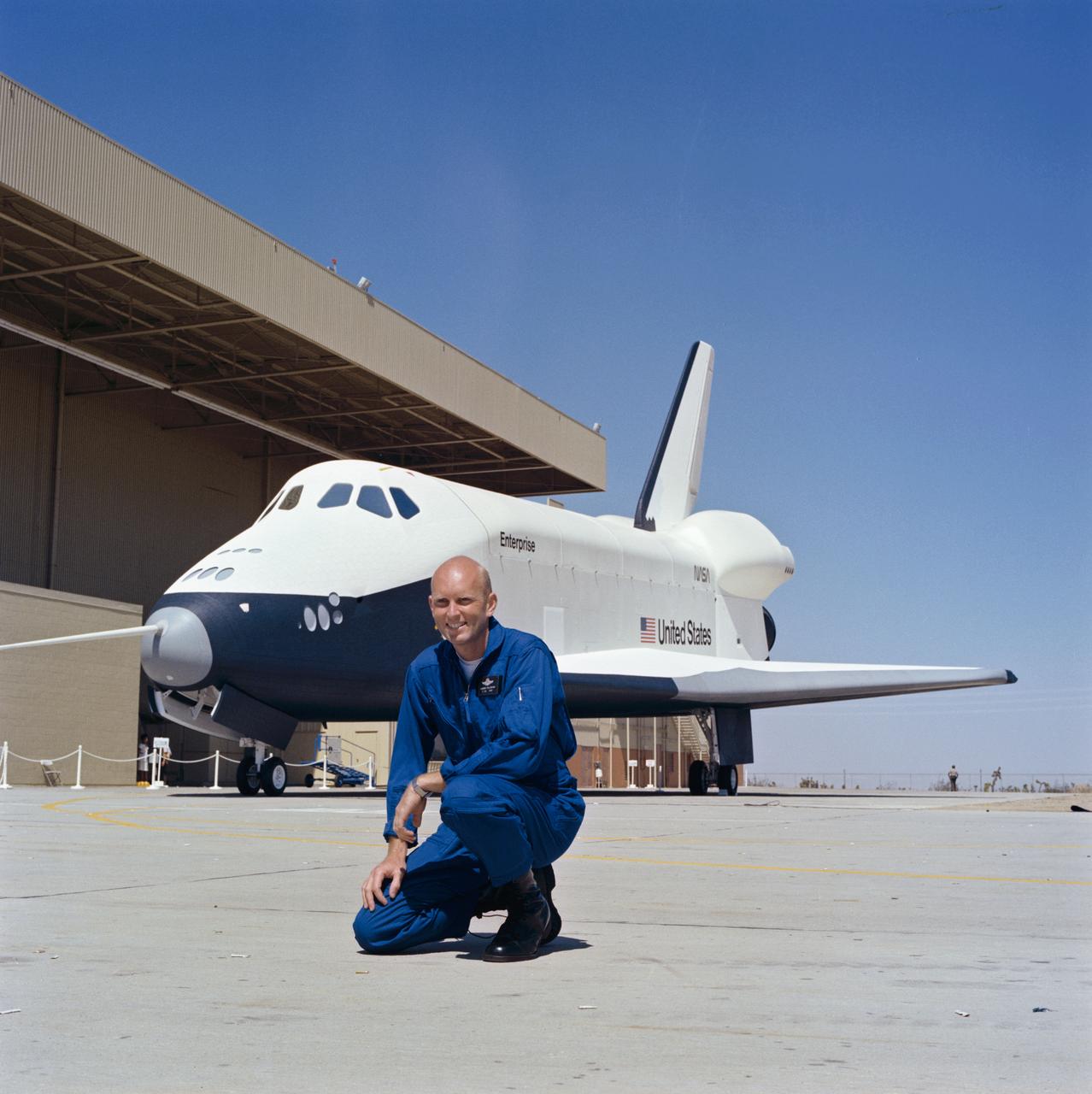
S76-29559 (17 Sept 1976) --- Astronaut C. Gordon Fullerton, pilot of the first crew for the Space Shuttle Approach and Landing Tests (ALT), is photographed at the Rockwell International Space Division's Orbiter assembly facility at Palmdale, California on the day of the rollout of the Shuttle Orbiter 101 "Enterprise" spacecraft. The DC-9 size airplane-like Orbiter 101 is in the background.
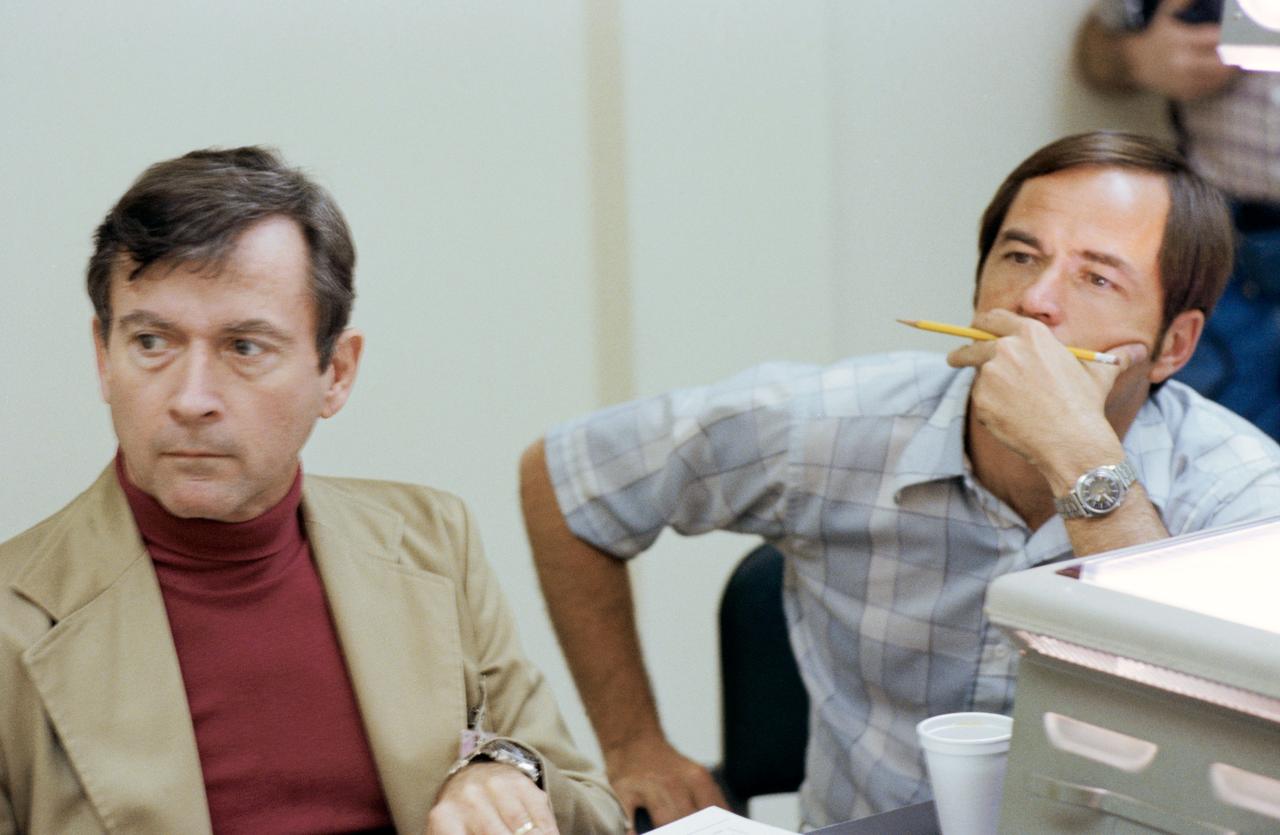
S81-29619 (6 April 1981) --- STS-1 astronauts John W. Young, left, and Robert L. Crippen direct their attention to a chart on a screen in a small briefing room at NASA's Johnson Space Center (JSC). They are taking part in a three-way telephone conference call, which involved engineers at JSC and at the Rockwell International facility in California. Later this week the two will man the space shuttle orbiter Columbia for STS-1. Photo credit: NASA
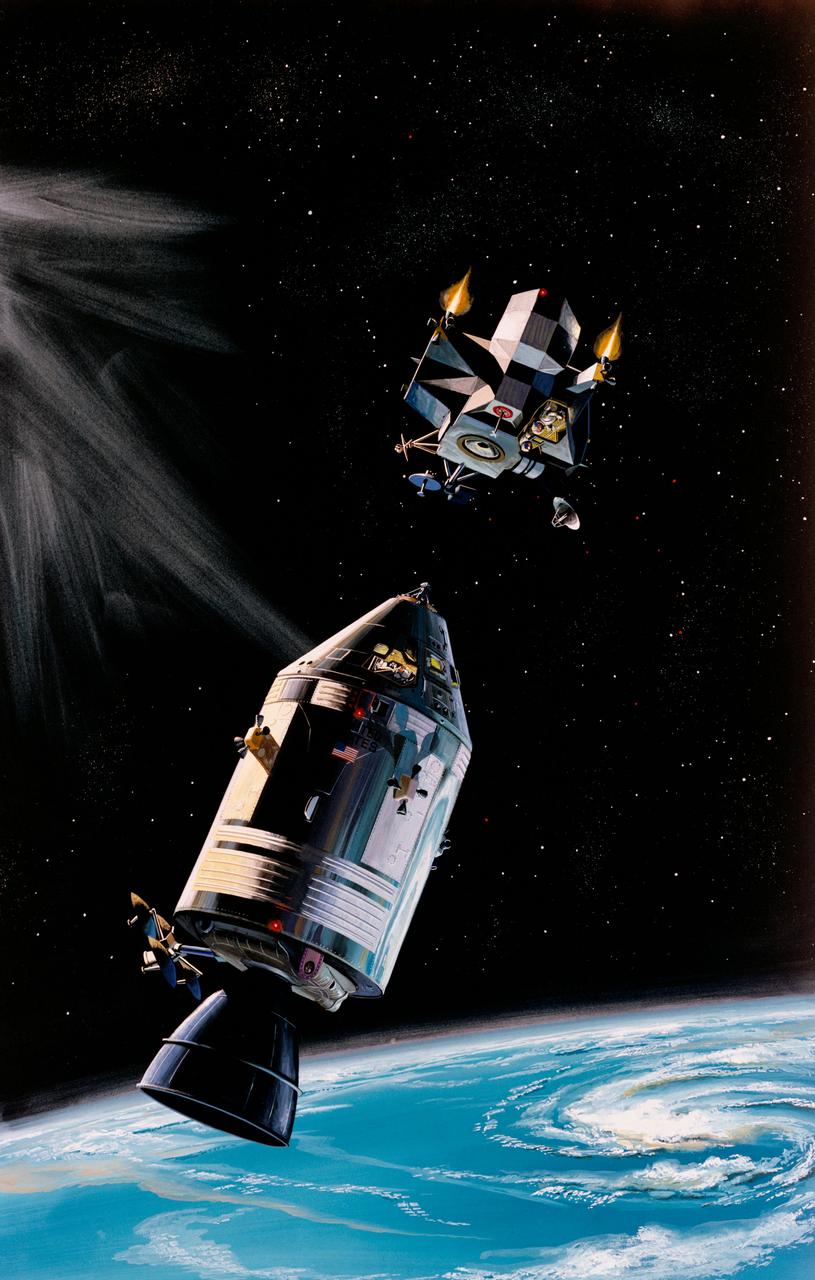
S69-18546 (February 1969) --- North American Rockwell artist's concept illustrating the docking of the Lunar Module ascent stage with the Command and Service Modules during the Apollo 9 mission. The two figures in the Lunar Module represent astronauts James A. McDivitt, Apollo 9 commander; and Russell L. Schweickart, lunar module pilot. The figure in the Command Module represents astronaut David R. Scott, command module pilot. The Apollo 9 mission will evaluate spacecraft lunar module systems performance during manned Earth-orbital flight.

S76-29557 (17 Sept 1976) --- The two members of the first crew for the Space Shuttle Approach and Landing Tests (ALT) are photographed at the Rockwell International Space Division's Orbiter assembly facility at Palmdale, California on the day of the rollout of the Shuttle Orbiter 101 "Enterprise" spacecraft. They are Astronauts Fred W. Haise Jr. (left), commander; and C. Gordon Fullerton, pilot. The DC-9 size airplane-like Orbiter 101 is in the background.
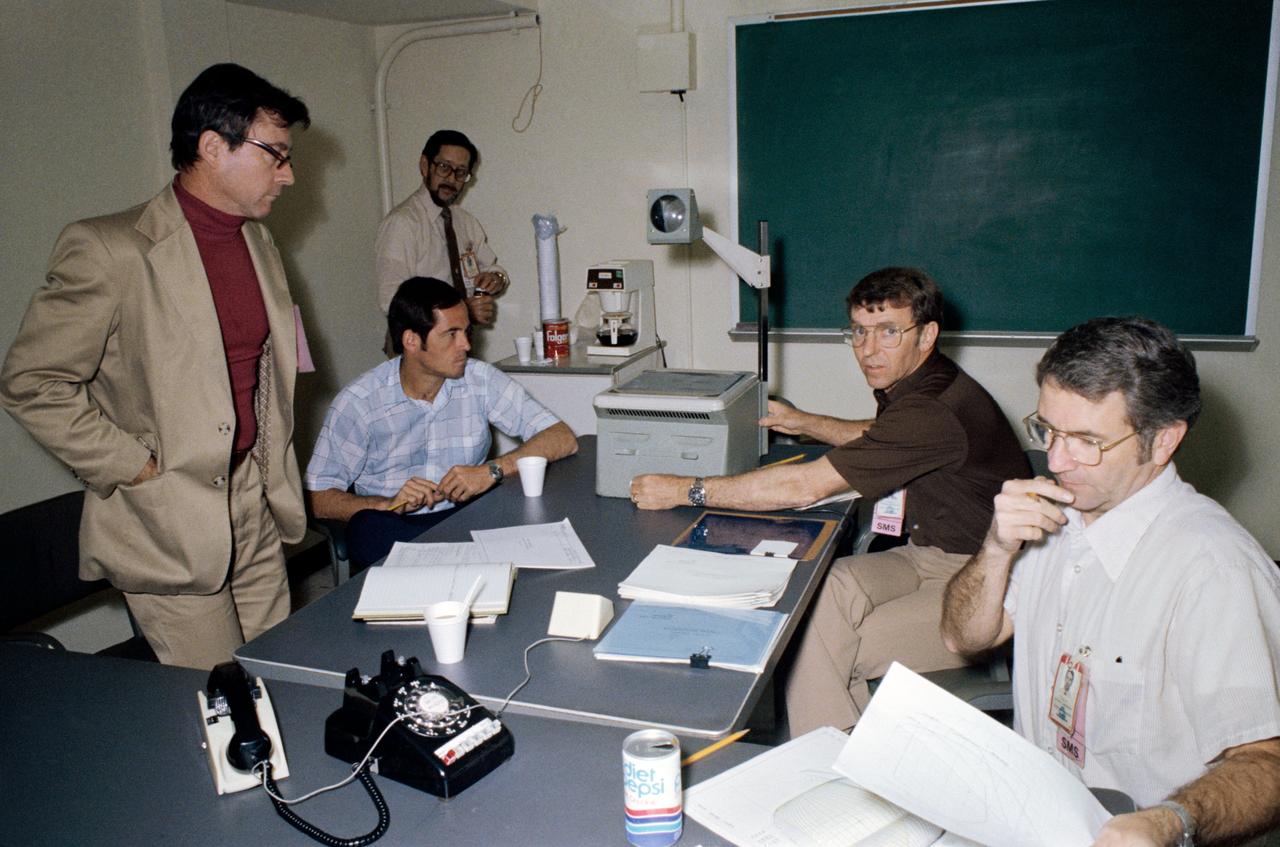
S81-29620 (6 April 1981) --- Prime and backup crew members for STS-1 take part in a briefing with engineers located in another building at NASA's Johnson Space Center (JSC) and with Rockwell International representatives in California via telephone. Astronauts John W. Young, left, and Robert L. Crippen, second from left, are STS-1 prime crewmen. Backup crewmen are astronauts Joe H. Engle, second from right, and Richard H. Truly. Photo credit: NASA
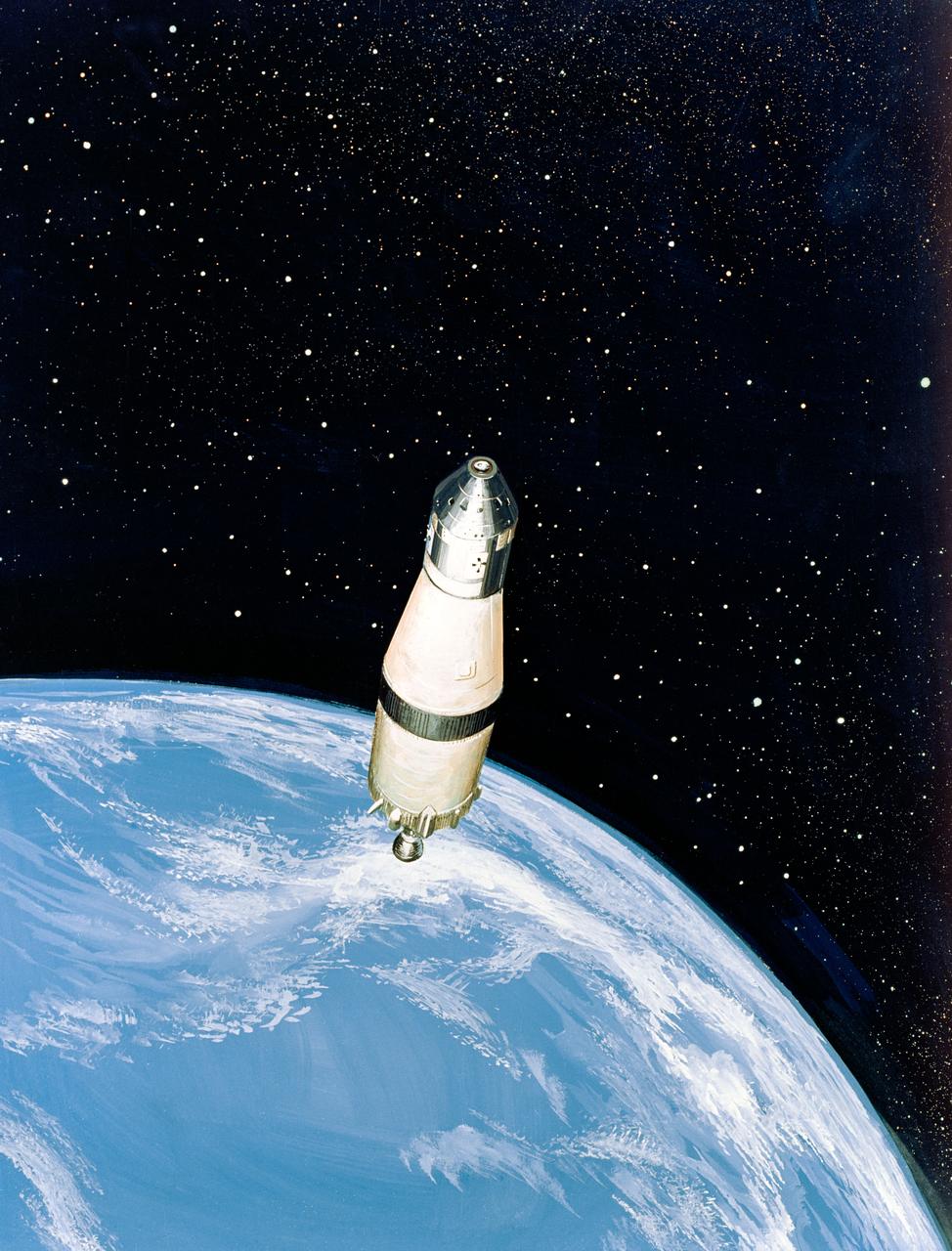
S68-51304 (December 1968) --- North American Rockwell artist's concept illustrating a phase of the scheduled Apollo 8 lunar orbit mission. Here, the Apollo 8 spacecraft Command and Service Modules (CSM), still attached to the Saturn V (S-IVB) third stage, heads for the moon at a speed of about 24,300 miles per hour. The trajectory, computed from the Saturn V's third stage instrumentation unit, provides a "free return" to Earth around the moon.

S68-51302 (December 1968) --- North American Rockwell artist's concept illustrating a phase of the Apollo 8 lunar orbit mission. Here, after 20 hours of lunar orbit, Apollo 8 astronauts start the 20,500-pound thrust engine and head for home. The service module engine will fire about three minutes, starting up while the spacecraft is at the darkened, backside of the moon and blocked from communication with Earth.

S69-30520 (April 1969) --- A North American Rockwell Corporation artist's concept depicting the Apollo 10 Lunar Module descending to 50,000 feet for a close look at a lunar landing site. The Command and Service Modules remain in lunar orbit. The landing area is Site 2 on the east central part of the moon in southwestern Sea of Tranquility (Mare Tranquillitatis). The site is about 62 miles east of the rim of the crater Sabine and 118 miles west-southwest of the crater Maskelyne. Apollo 11 is scheduled to be the first lunar landing mission.
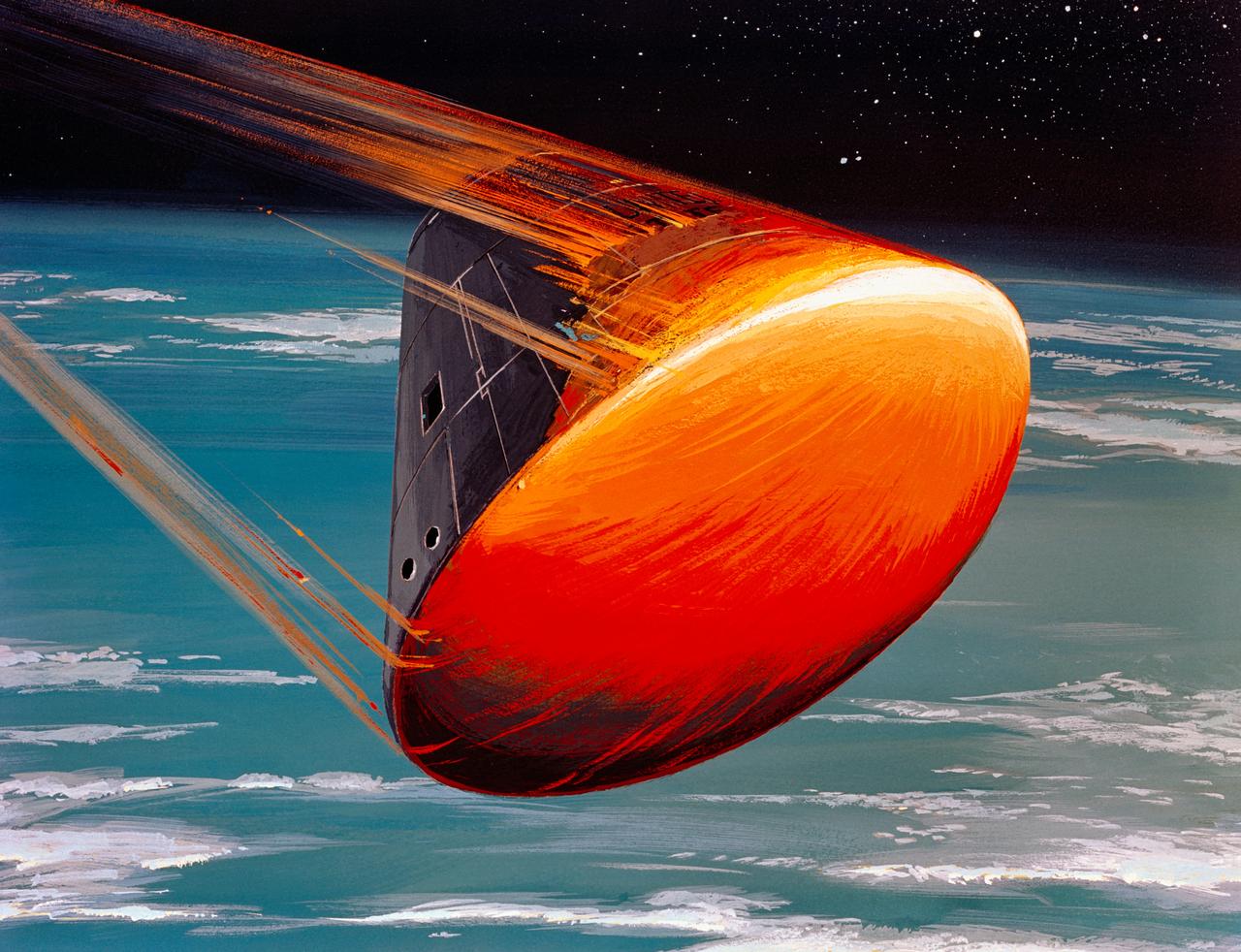
S68-55292 (August 1968) --- A North American Rockwell Corporation artist's concept depicting the Apollo Command Module (CM), oriented in a blunt-end-forward attitude, re-entering Earth's atmosphere after returning from a lunar landing mission. Note the change in color caused by the extremely high temperatures encountered upon re-entry.
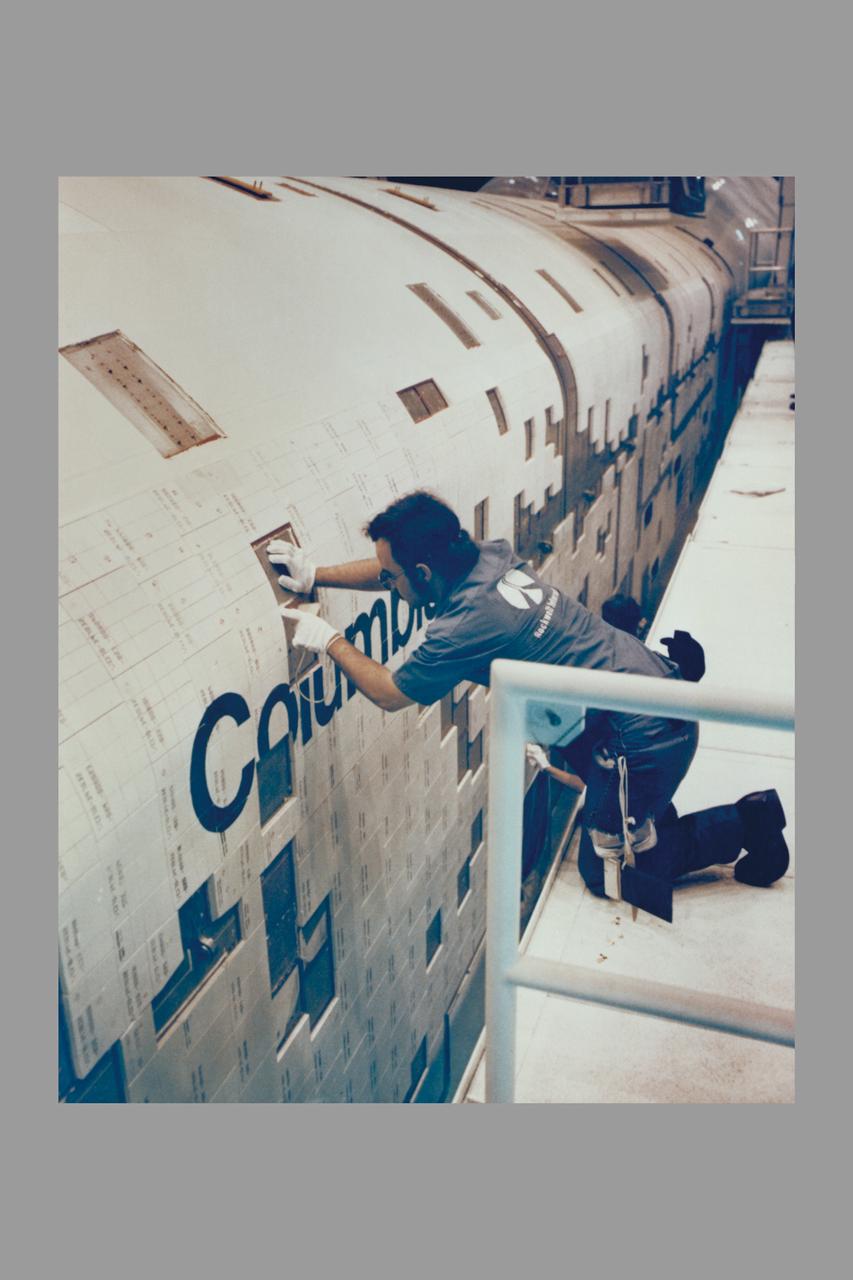
ROCKWELL INTERNATIONAL TECHNICIANS MOUNT SOME OF THE NEARLY 8,000 CERAMIC-COATED TILES THAT REMAIN TO BE INSTALLED ON THE EXTERNAL SURFACES OF THE SPACE SHUTTLE ORBITER COLUMBIA TO COMPLETE THE THERMAL PROTECTION SYSTEM THAT WILL ABSORB THE INTENSE HEAT OF REENTERING THE EARTH'S ATMOSPHERE AFTER A MISSION IN SPACE. TILE INSTALLATION IS DONE ON AN AROUND-THE-CLOCK BASIS IN THE ORBITER PROCESSING FACILITY WHERE COLUMBIA, THE FIRST IN A NEW BREED OF MANNED, REUSABLE SPACECRAFT, IS BEING READIED FOR THE FIRST LAUNCH OF THE SPACE SHUTTLE LATER THIS YEAR.
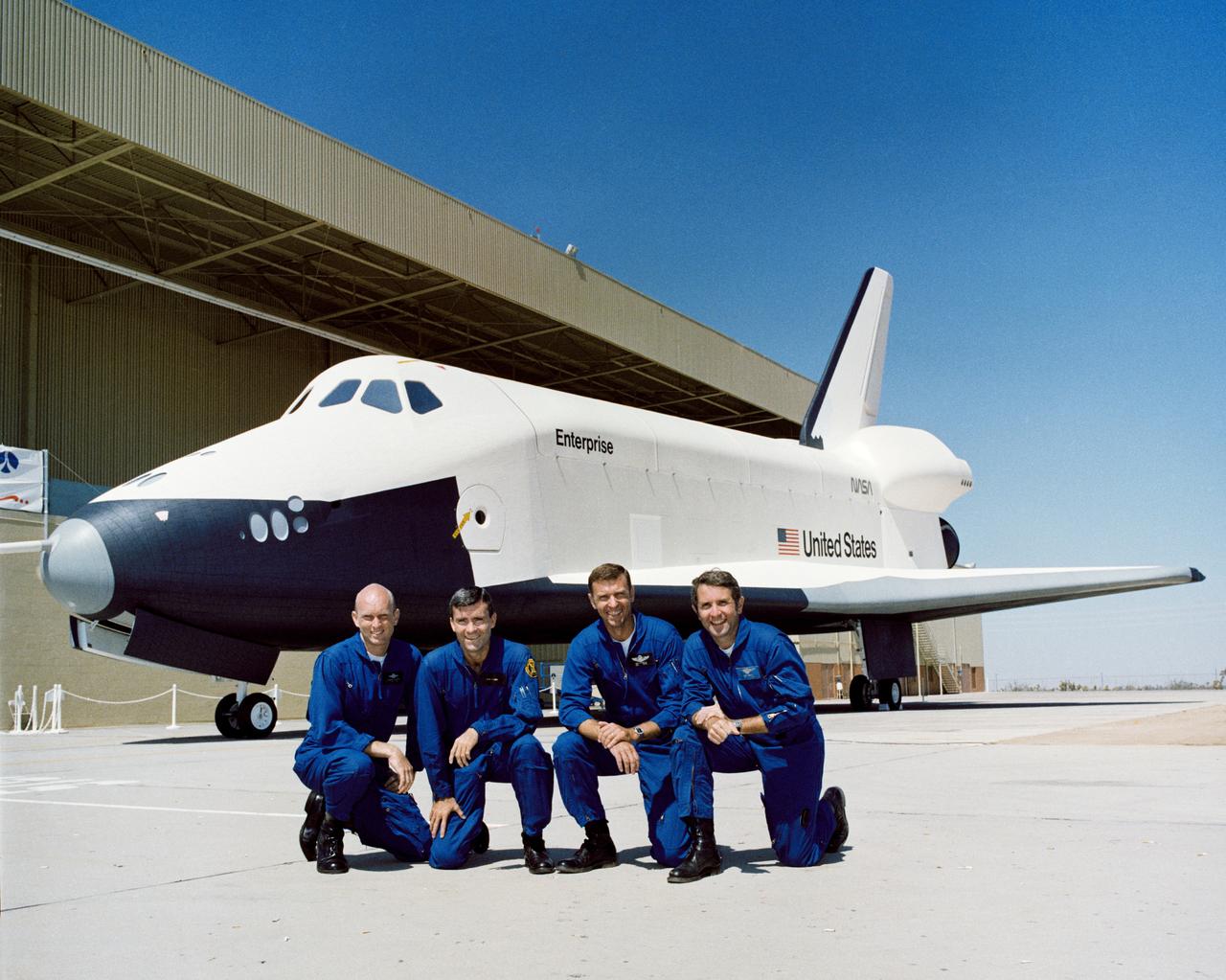
S76-29562 --- The two crews for the Space Shuttle Approach and Landing Tests (ALT) are photographed at the Rockwell International Space Division's Orbiter assembly facility at Palmdale, California on the day of the rollout of the Shuttle Orbiter 101 "Enterprise" spacecraft. They are, left to right, Astronauts C. Gordon Fullerton, pilot of the first crew; Fred W. Haise Jr., commander of the first crew; Joe H. Engle, commander of the second crew; and Richard H. Truly, pilot of the second crew. The DC-9 size airplane-like Orbiter 101 is in the background.
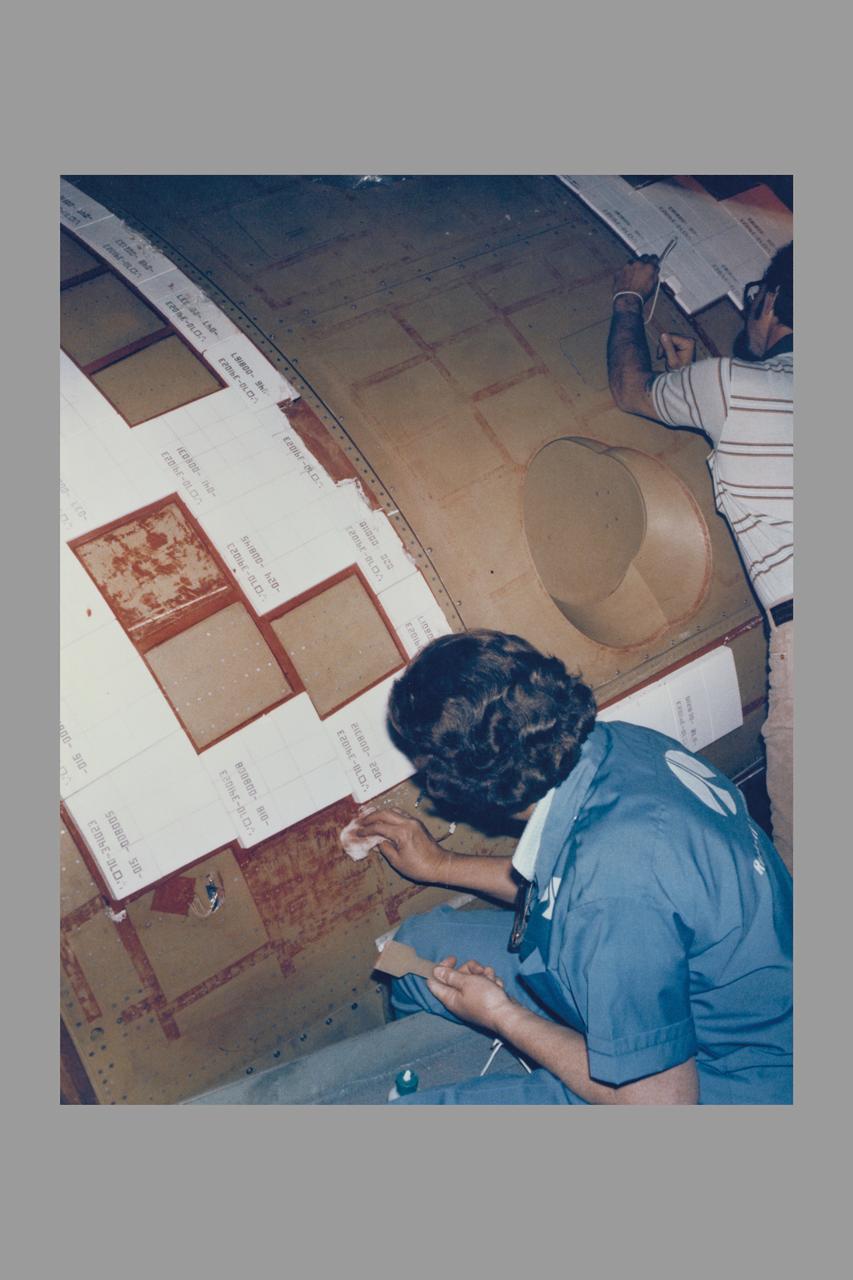
ROCKWELL INTERNATIONAL TECHNICIANS MOUNT SOME OF THE NEARLY 8,000 CERAMIC-COATED TILES THAT REMAIN TO BE INSTALLED ON THE EXTERNAL SURFACES OF THE SPACE SHUTTLE ORBITER COLUMBIA TO COMPLETE THE THERMAL PROTECTION SYSTEM THAT WILL ABSORB THE INTENSE HEAT OF REENTERING THE EARTH'S ATMOSPHERE AFTER A MISSION IN SPACE. TILE INSTALLATION IS DONE ON AN AROUND-THE-CLOCK BASIS IN THE ORBITER PROCESSING FACILITY WHERE COLUMBIA, THE FIRST IN A NEW BREED OF MANNED, REUSABLE SPACECRAFT, IS BEING READIED FOR THE FIRST LAUNCH OF THE SPACE SHUTTLE LATER THIS YEAR.
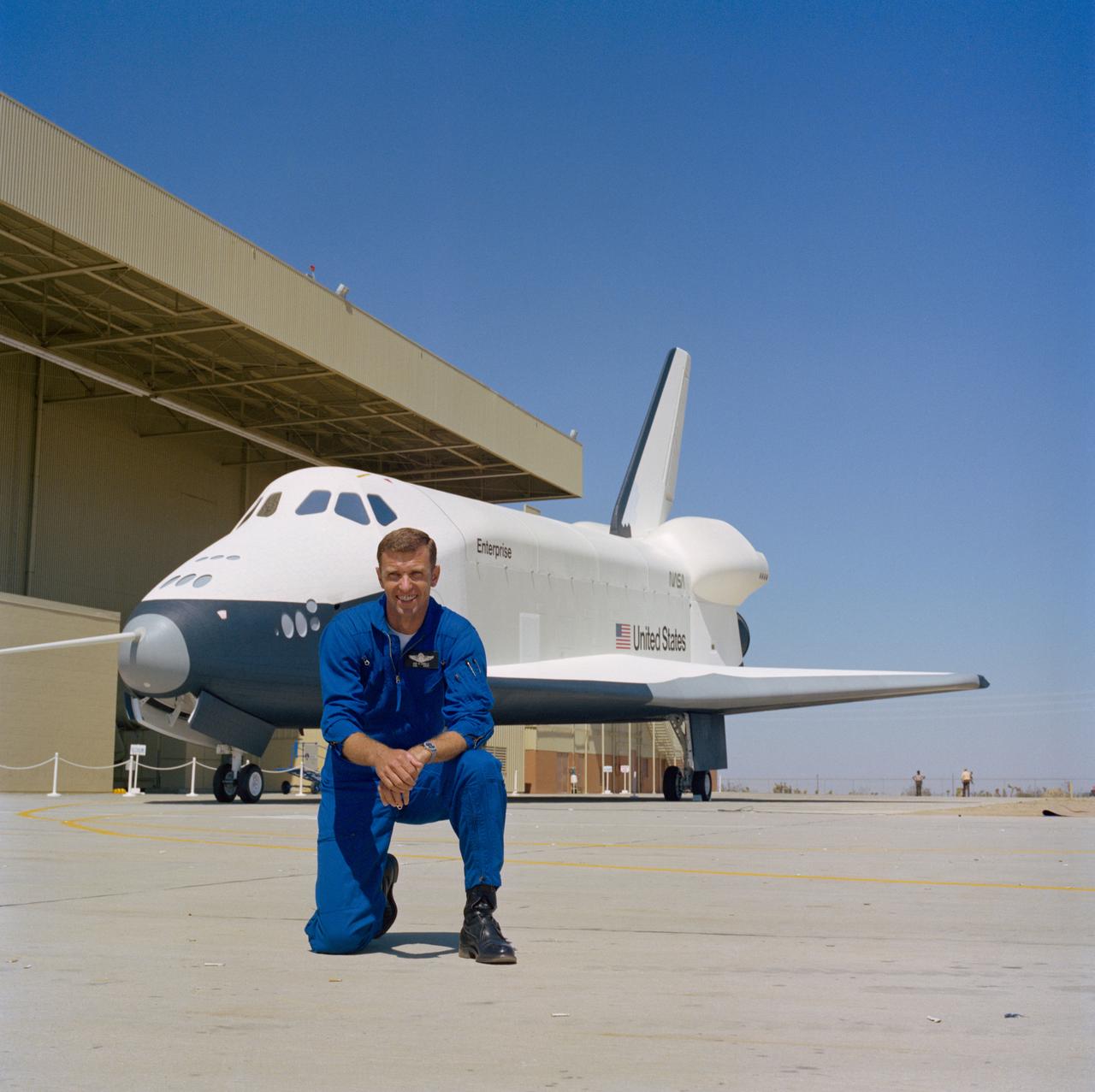
S76-29560 (17 Sept 1976) - - - Astronaut Joe H. Engle, commander of the second crew for the Space Shuttle Approach and Landing Tests (ALT), is photographed at the Rockwell International Space Division?s Orbiter assembly facility at Palmdale, California on the day of the roll out of the Space Shuttle Orbiter 101 ?Enterprise? spacecraft. The DC-size airplane-like Orbiter 101 is in the background.

S77-28210 (13 Sept 1977) --- Astronauts Joe H. Engle (face down), commander, and Richard H. Truly (face partially obscured by Engle), pilot, are greeted by Rockwell technicians following egress from the shuttle Orbiter 101 "Enterprise." They had just completed a five-minute, 31-second unpowered free flight in the "Enterprise," the second of a series of such flights, conducted on September 13, 1977, at the Dryden Flight Research Center (DFRC) and Edwards Air Force Base.
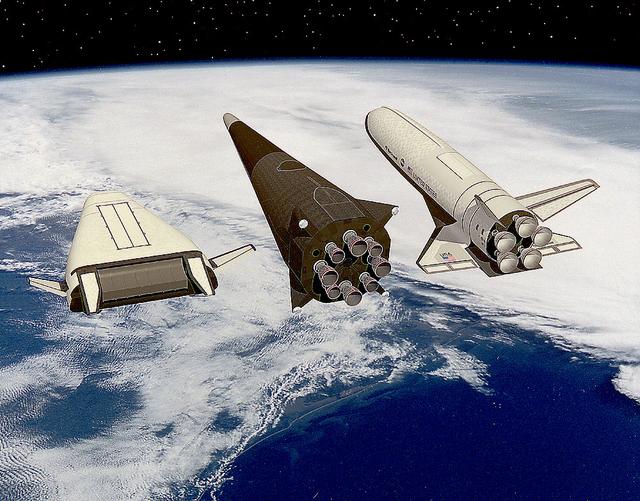
Artist John Frassanito's concept of three Single-Stage-to-Orbit (SSTO) Reusable Launch Vehicles (RLV's). Depicted from the left are: The Lockheed-Martin lifting body configuration that uses an integrated linear aerospike main engine; the McDornell Douglas vertical landing configuration; and the Rockwell wing body configuration that uses liquid oxygen and hydrogen bell engines.
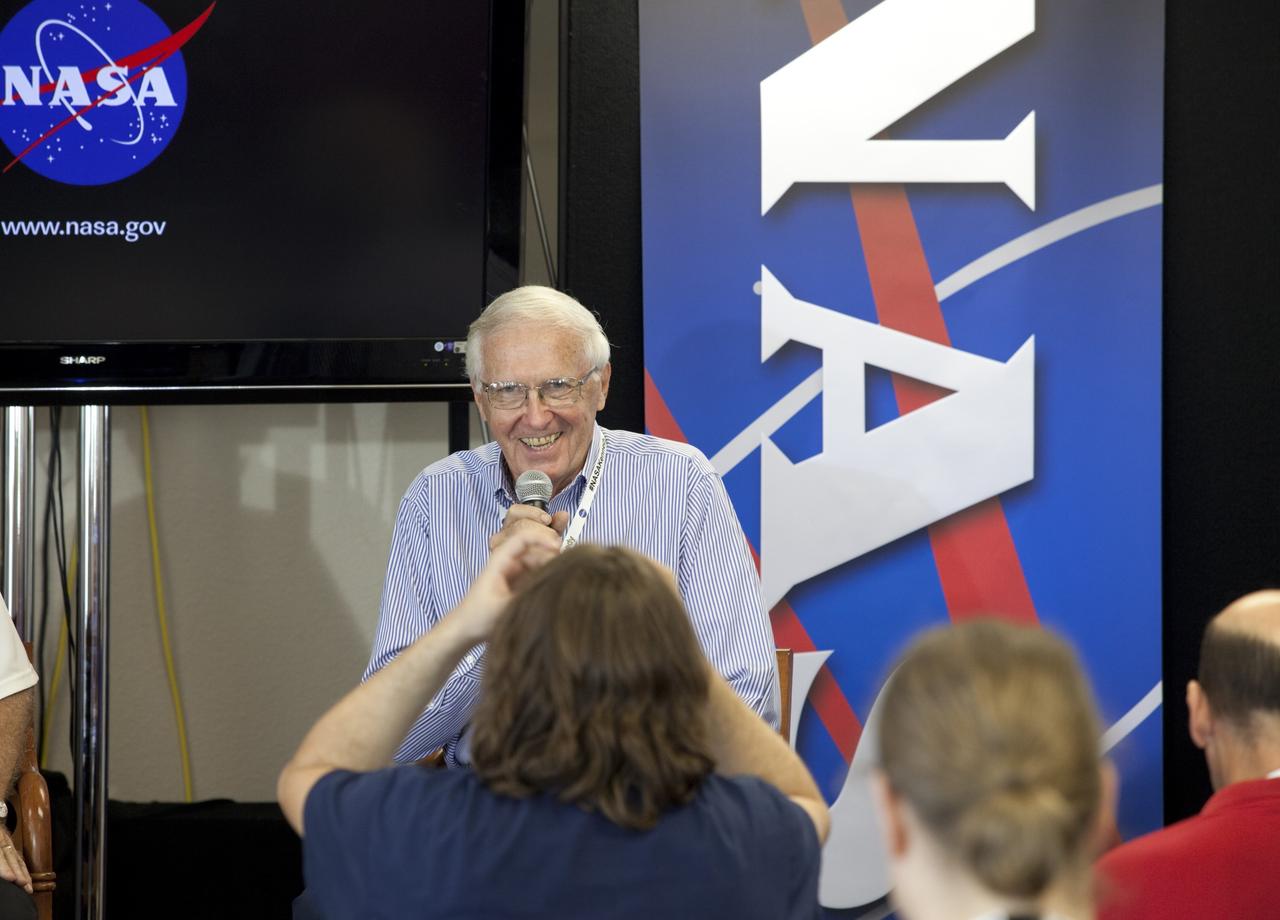
CAPE CANAVERAL, Fla. -- Lee Solid, a retired senior executive with Rockwell and Boeing, speaks to about 45 of NASA’s social media followers for two days of presentations on the Kennedy Space Center's past, present and future. The social media participants gathered at the Florida spaceport on Aug. 2 and 3, 2012 to hear from key former and current leaders who related stories of the space agency's efforts to explore the unknown. It was the first social media event totally run by Kennedy. Photo credit: NASA/ Gianni Woods
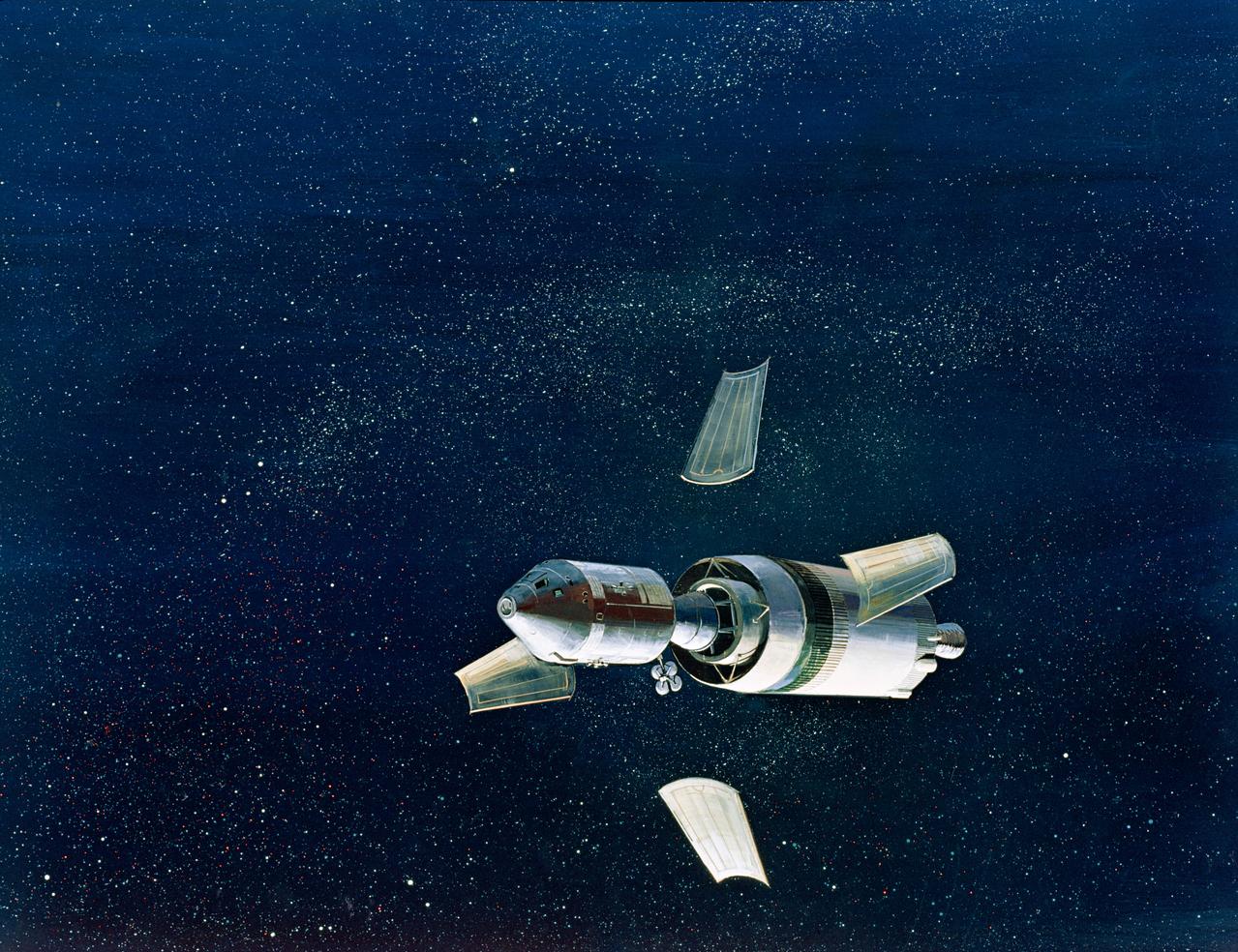
S68-51306 (December 1968) --- North American Rockwell artist's concept illustrating a phase of the scheduled Apollo 8 lunar orbit mission. Here, the Apollo 8 spacecraft lunar module adapter (SLA) panels, which have supported the Command and Service Modules, are jettisoned. This is done by astronauts firing the service module reaction control engines. A signal simultaneously deploys and jettisons the panels, separating the spacecraft from the SLA and deploying the high gain (deep space) antenna.
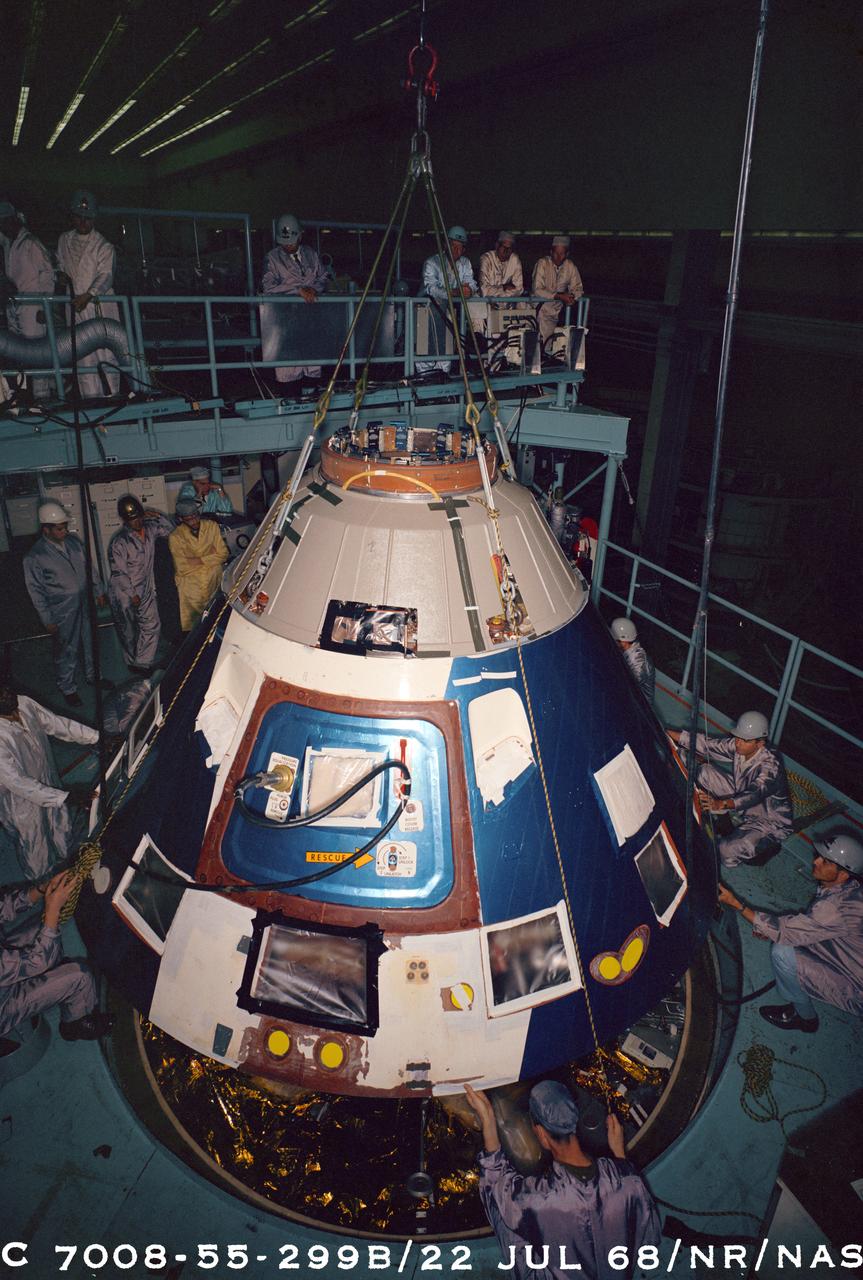
S68-42486 (22 July 1968) --- Wide-angle view of Apollo Command Module 103 during de-stacking from Service Module in Stand 2C.
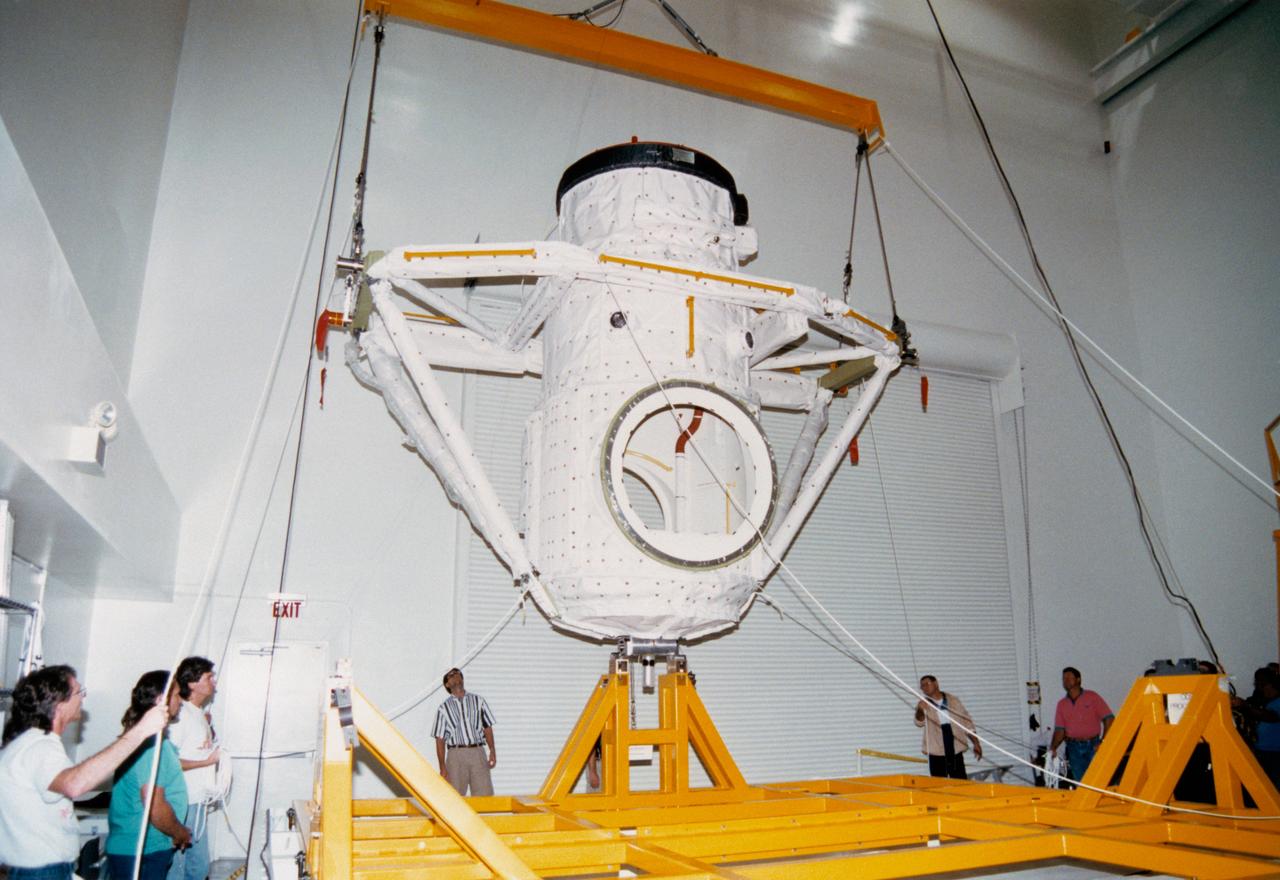
S94-47810 (2 Dec. 1994) --- Lockheed Space Operations Company workers in the Extended Duration Orbiter (EDO) Facility, located inside the Vehicle Assembly Building (VAB), carefully hoist the Orbiter Docking System (ODS) from its shipping container into a test stand. The ODS was shipped in a horizontal position to the Kennedy Space Center (KSC) from contractor Rockwell Aerospace's Downey plant. Once the ODS is upright, work can continue to prepare the hardware for the first docking of the United States Space Shuttle and Russian Space Station MIR in 1995. The ODS contains both United States-made and Russian-made hardware. The black band is Russian-made thermal insulation protecting part of the docking mechanism, also Russian-made, called the Androgynous Peripheral Docking System (APDS). A red protective cap covers the APDS itself. Other elements of the ODS, most of it protected by white United States-made thermal insulation, were developed by Rockwell, which also integrated and checked out the assembled Russian-United States system.
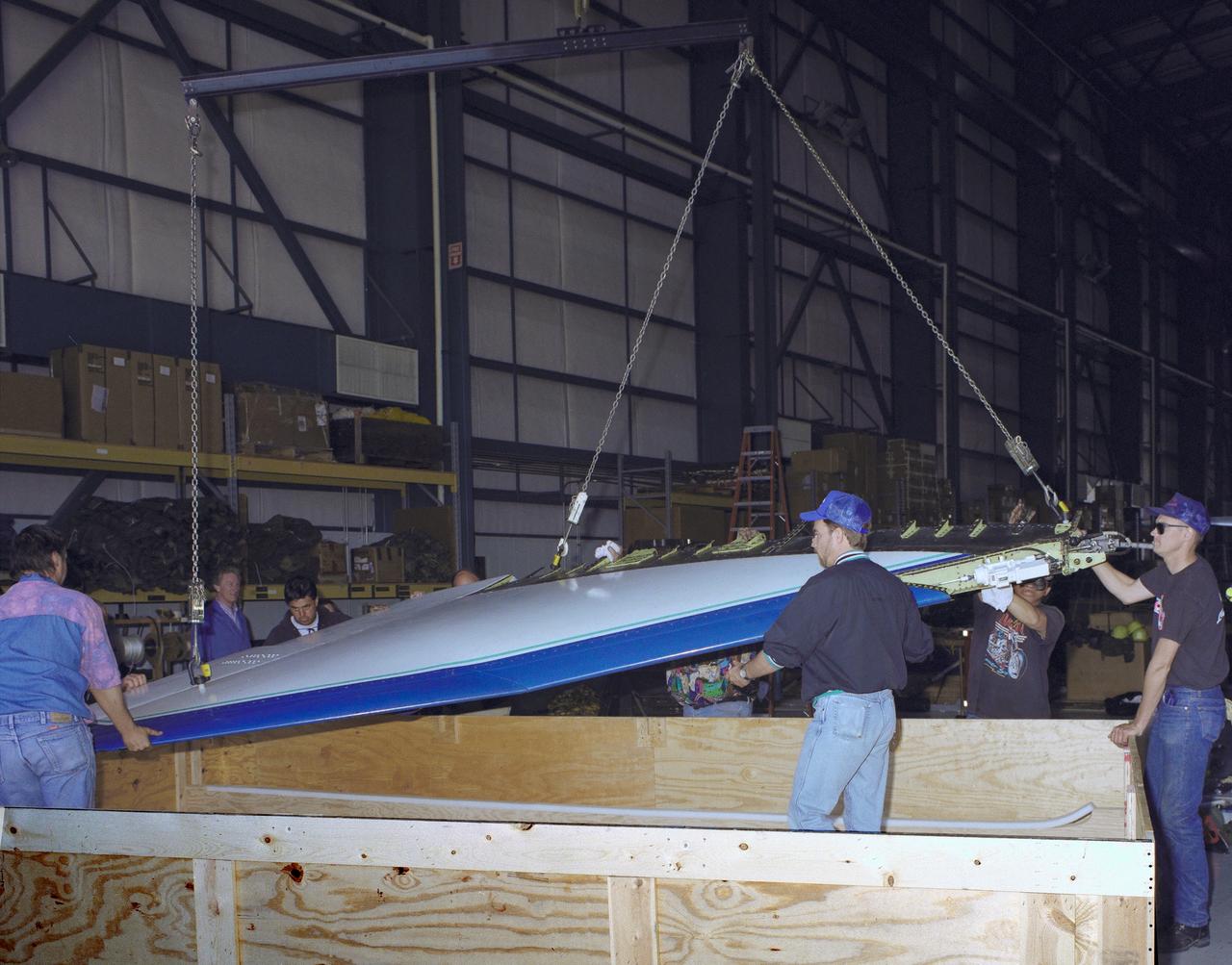
The right wing of the X-31 Enhanced Fighter Maneuverability Technology Demonstrator Aircraft is seen here being put into a shipping container May 18, 1995, at NASA's Dryden Flight Research Center, Edwards, California, by U.S. and German members of the program. To fit inside an Air Force Reserve C-5 transport, which was used to ferry the X-31 to Europe on May 22, 1995, the right wing had to be removed. Manching, Germany, was used as a staging base to prepare the aircraft for participation in the Paris Air Show. At the air show on June 11 through the 18th, the X-31 demonstrated the value of using thrust vectoring (directing engine exhaust flow) coupled with advanced flight control systems to provide controlled flight at very high angles of attack. The aircraft arrived back at Edwards in an Air Force Reserve C-5 on June 25, 1995, and off loaded at Dryden the 27th. The X-31 aircraft was developed jointly by Rockwell International's North American Aircraft Division (now part of Boeing) and Daimler-Benz Aerospace (formerly Messerschmitt-Bolkow-Blohm), under sponsorship by the U.S. Department of Defense and the German Federal Ministry of Defense.
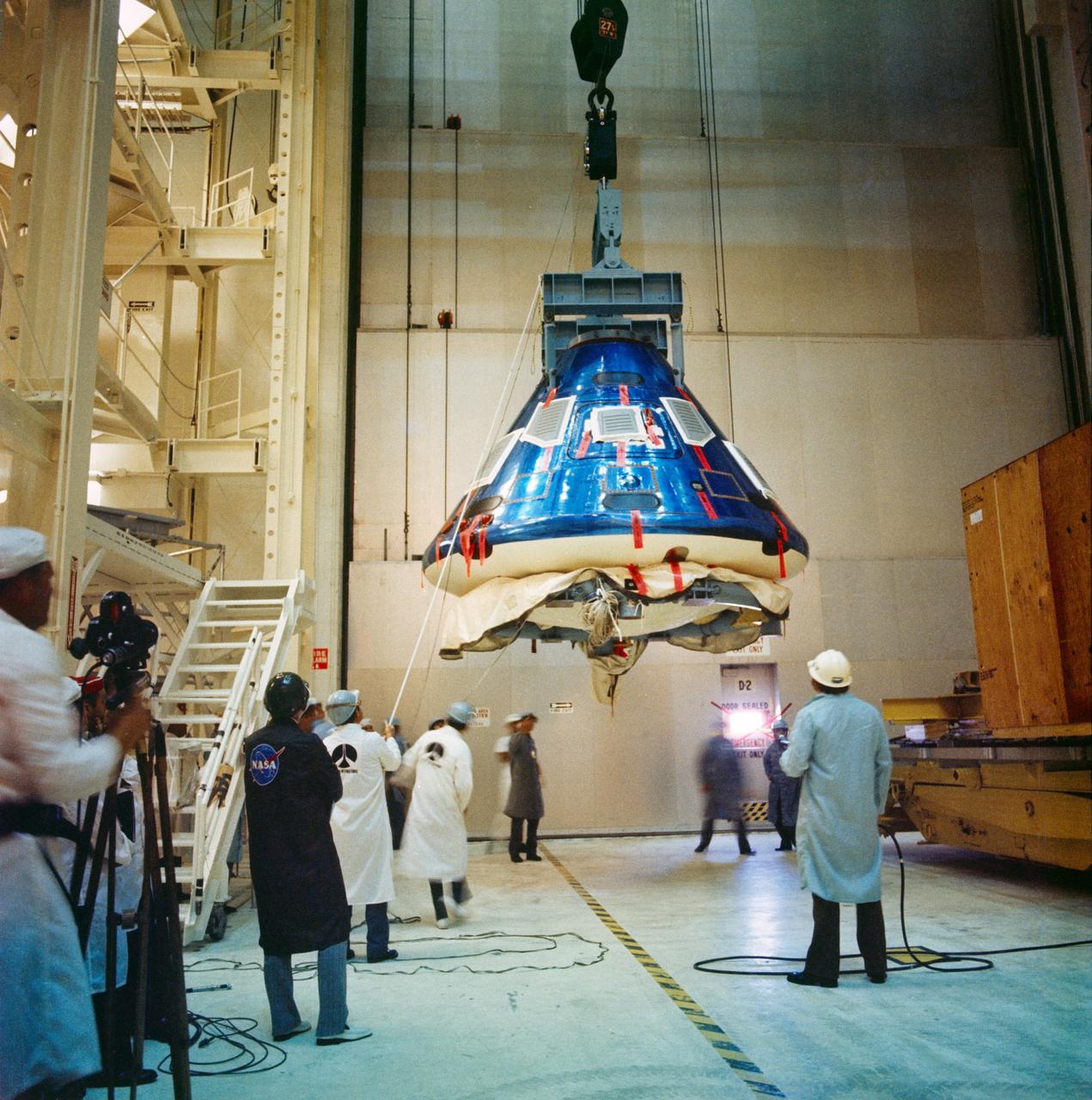
S74-32049 (8 Sept. 1974) --- The Apollo Command Module for the Apollo-Soyuz Test Project mission goes through receiving, inspection and checkout procedures in the Manned Spacecraft Operations Building at the Kennedy Space Center. The spacecraft had just arrived by air from the Rockwell International plant at Downey, California. The Apollo spacecraft (Command Module, Service Module and Docking Module), with astronauts Thomas P. Stafford, Vance D. Brand and Donald K. Slayton aboard, will dock in Earth orbit with a Soviet Soyuz spacecraft during the joint U.S.-USSR ASTP flight scheduled for July 1975. The Soviet and American crews will visit one another?s spacecraft.
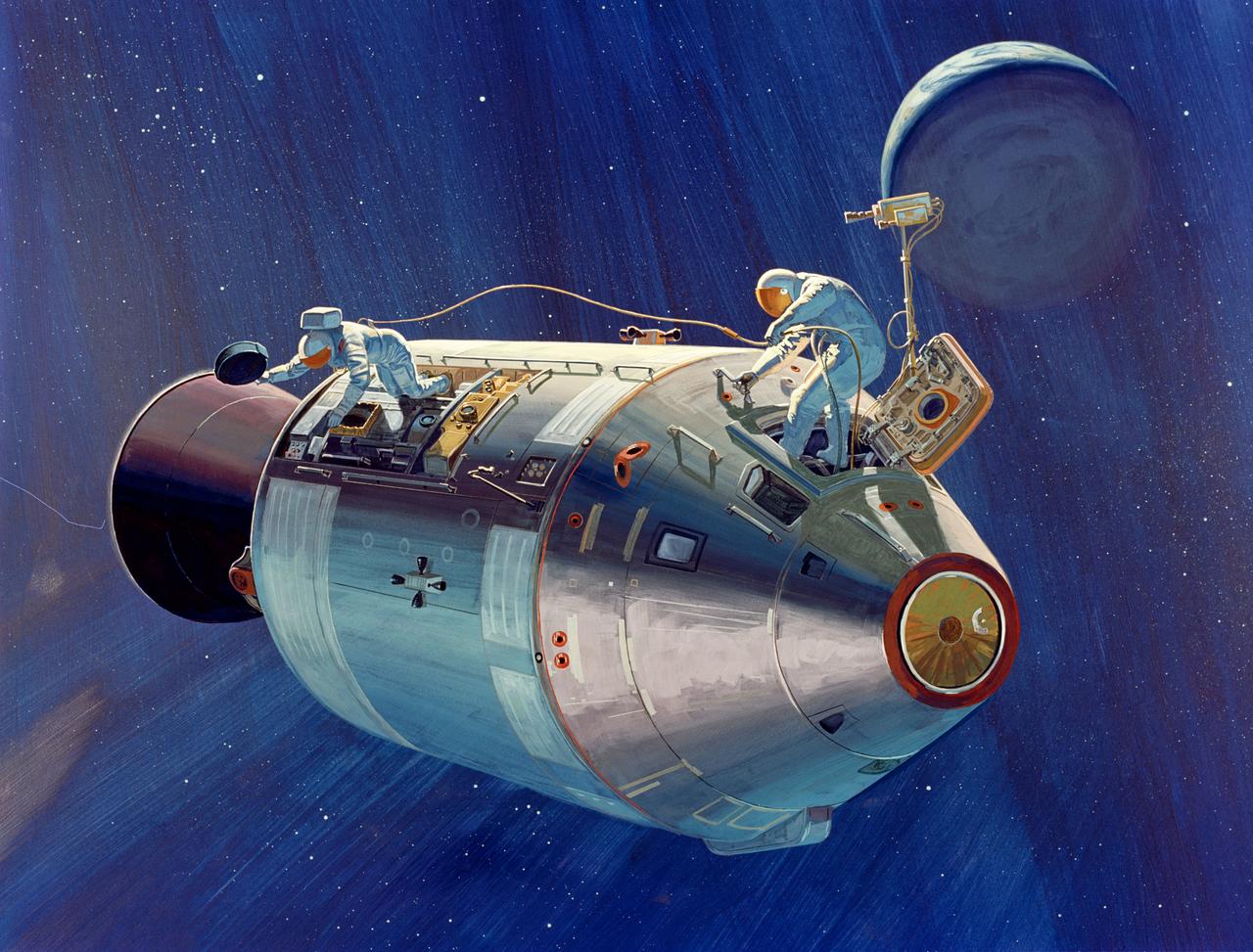
S71-39614 (July 1971) --- An artist's concept of the Apollo 15 Command and Service Modules (CSM), showing two crewmembers performing a new-to-Apollo extravehicular activity (EVA). The figure at left represents astronaut Alfred M. Worden, command module pilot, connected by an umbilical tether to the CM, at right, where a figure representing astronaut James B. Irwin, lunar module pilot, stands at the open CM hatch. Worden is working with the panoramic camera in the Scientific Instrument Module (SIM). Behind Irwin is the 16mm data acquisition camera. Artwork by North American Rockwell.
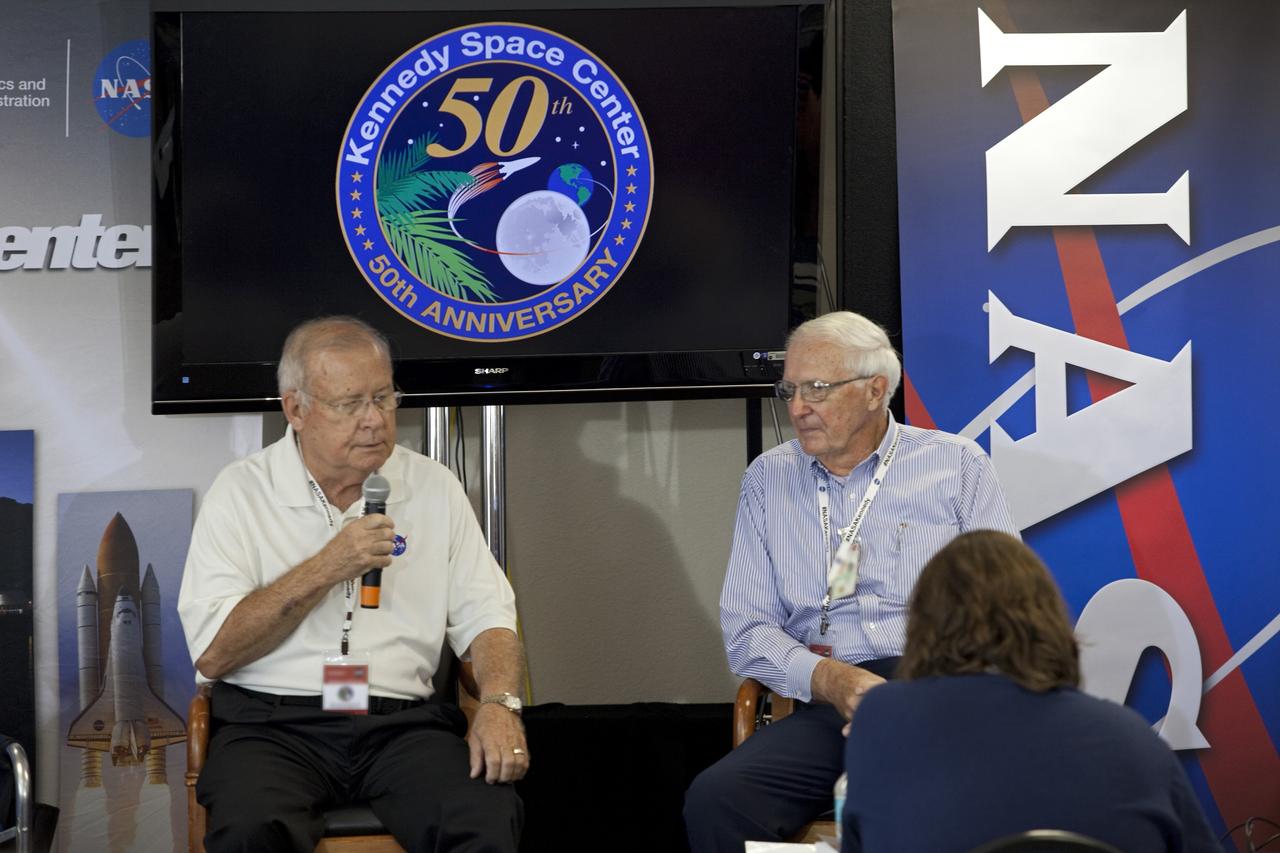
CAPE CANAVERAL, Fla. -- Former Kennedy Space Center Director Jay Honeycutt, left, is joined by Lee Solid, a retired senior executive with Rockwell and Boeing, in speaking to about 45 of NASA’s social media followers for two days of presentations on the Kennedy Space Center's past, present and future. The social media participants gathered at the Florida spaceport on Aug. 2 and 3, 2012 to hear from key former and current leaders who related stories of the space agency's efforts to explore the unknown. It was the first social media event totally run by Kennedy. Photo credit: NASA/ Gianni Woods
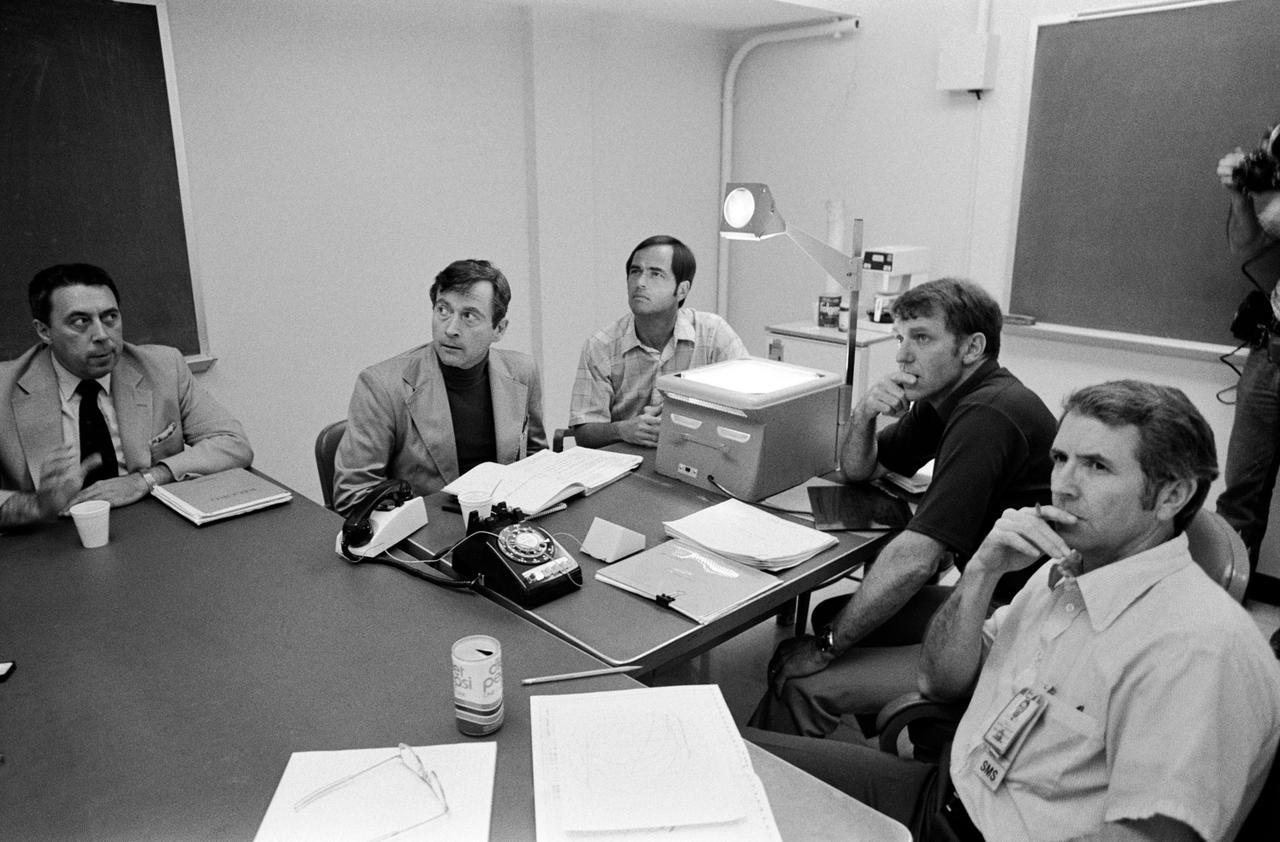
S81-29618 (6 April 1981) --- STS-1 prime and backup astronaut crew members look at visuals during a coordinated teleconference with engineers. Seated at the table in a briefing room at NASA's Johnson Space Center are, clockwise from the left, George W.S. Abbey, Director of Flight Operations, John W. Young, Robert L. Crippen, Joe H. Engle and Richard H. Truly. Young and Crippen are prime crewmen preparing to man the Columbia later this week for the flight of STS-1. Rockwell International engineers in California as well as JSC engineers participated in this telecon. Photo credit: NASA
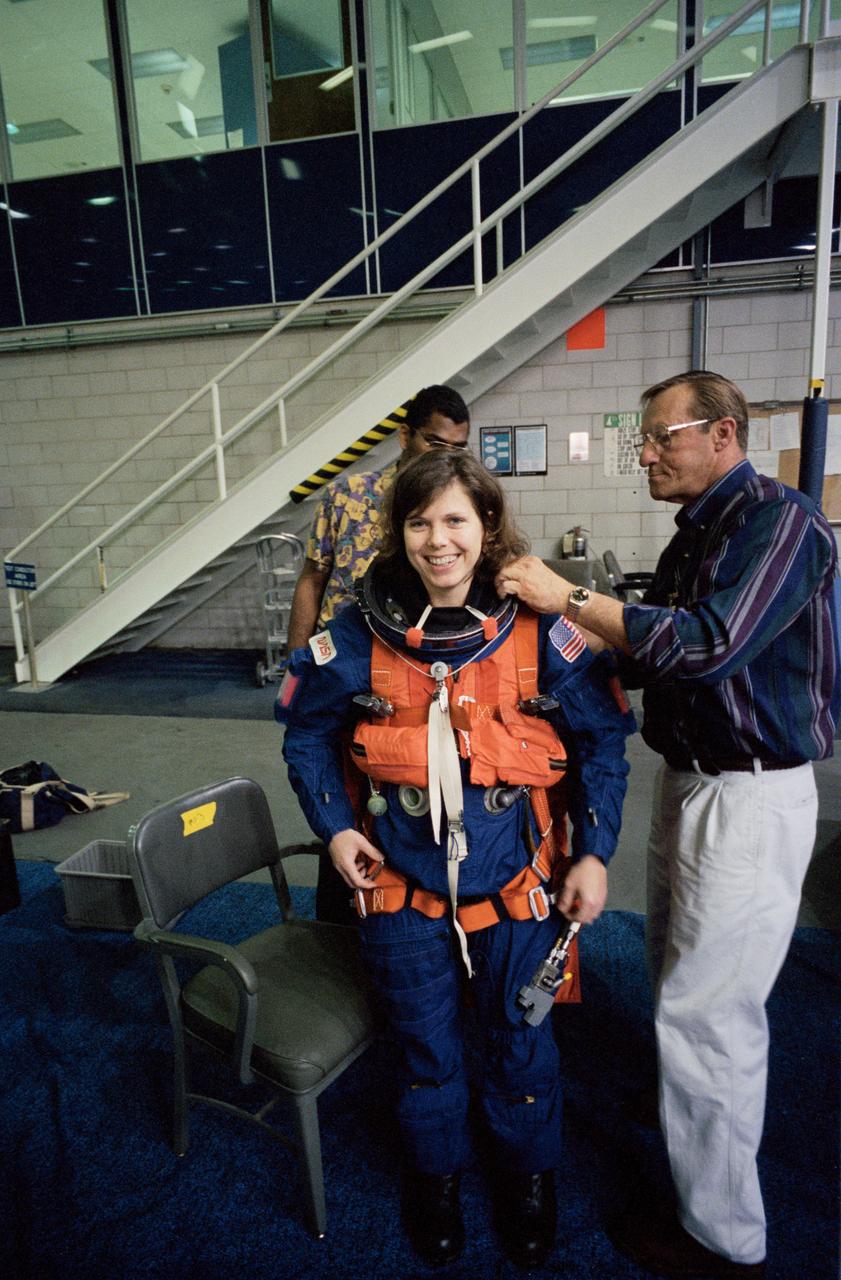
S95-03469 (16 FEB 1995) --- Attired in a training version of the Shuttle launch and entry garment, astronaut Mary Ellen Weber gets help with the final touches of suit donning during a training session at the Johnson Space Center's (JSC) Weightless Environment Training Facility (WET-F). Helping out is Rockwell's William L. Todd (right), while Staffon Isaacs looks on. Training as a mission specialist for the STS-70 mission, Weber was about to rehearse emergency bailout. The crew members made use of a nearby 25-feet deep pool to practice parachute landings in water and subsequent deployment of life rafts.
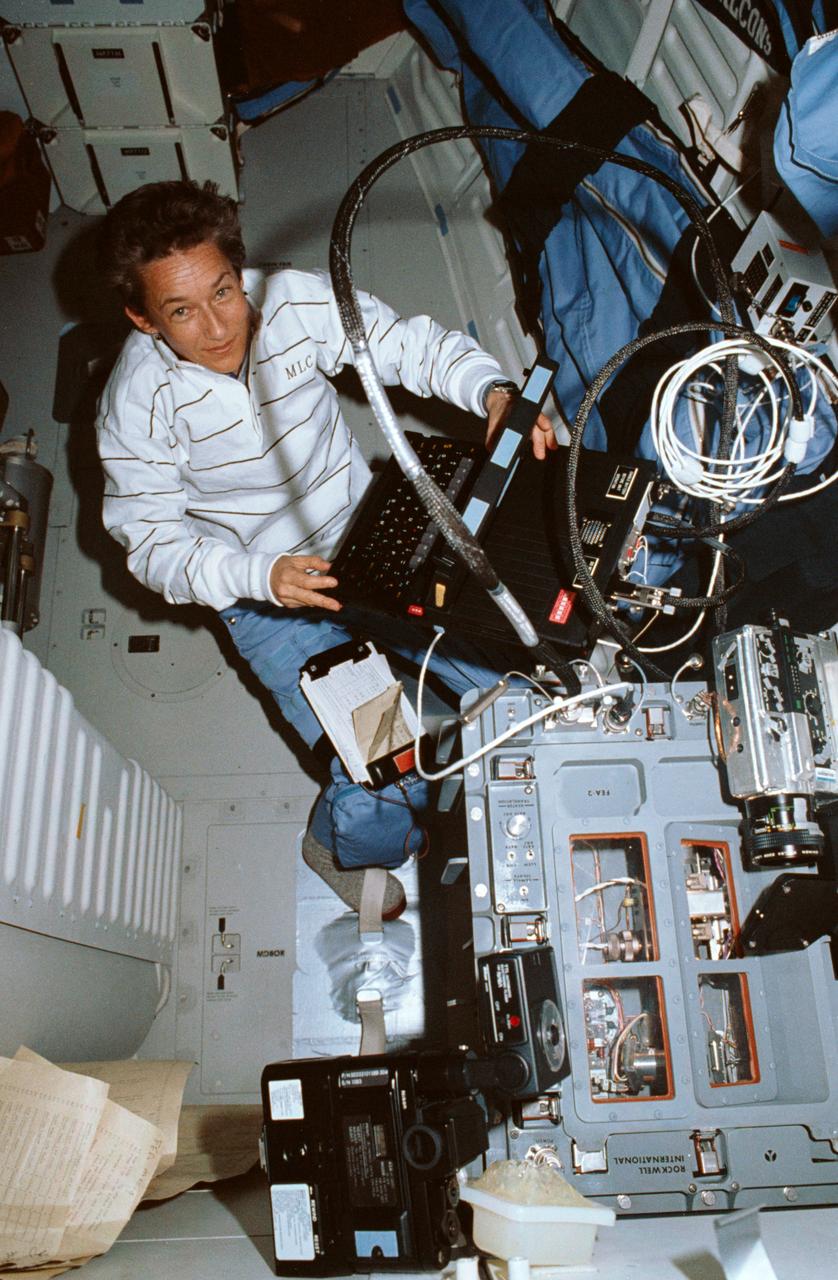
STS030-02-018 (4-8 May 1989) --- A 35mm overall scene of the operations devoted to the fluids experiment apparatus (FEA) aboard Atlantis for NASA’s STS-30 mission. Astronaut Mary L. Cleave, mission specialist, is seen with the computer which is instrumental in the carrying out of a variety of materials science experiments. Rockwell International is engaged in a joint endeavor agreement with NASA’s Office of Commercial Programs in the field of floating zone crystal growth and purification research. The March 1987 agreement provides for microgravity experiments to be performed in the company’s Microgravity Laboratory, the FEA. An 8 mm camcorder which documented details inside the apparatus is visible at bottom of the frame.
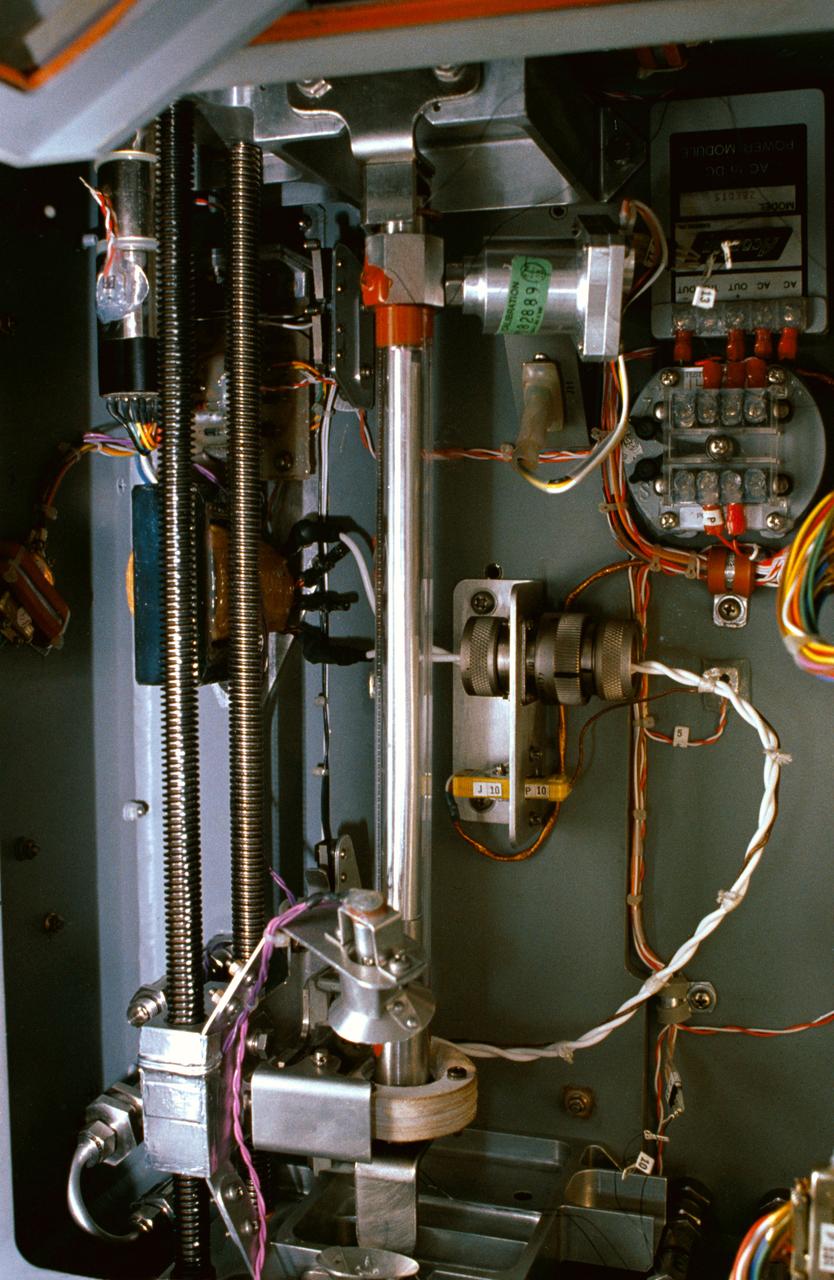
STS030-01-015 (4-8 May 1989) --- A 35mm close-up view of the Fluids Experiment Apparatus (FEA) aboard Atlantis for NASA’s STS-30 mission. Rockwell International is engaged in a joint endeavor agreement with NASA’s Office of Commercial Programs in the field of floating zone crystal growth and purification research. The March 1987 agreement provides for microgravity experiments to be performed in the company’s Microgravity Laboratory, the FEA. Crewmembers, especially Mary L. Cleave, devoted a great deal of onboard time to the monitoring of various materials science experiments using the apparatus.
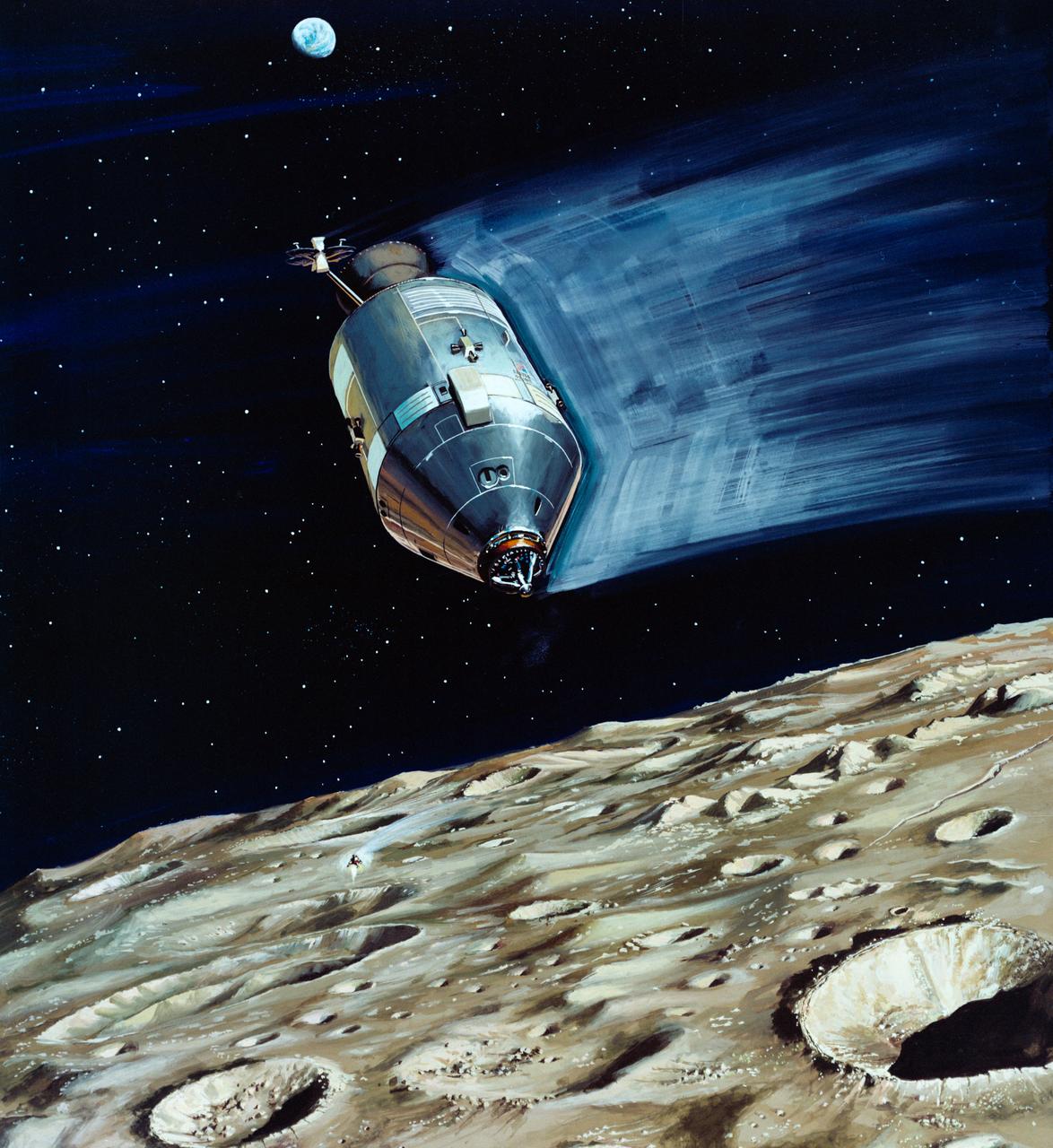
S70-31898 (March 1970) --- A North American Rockwell artist?s concept depicting the Apollo 13 Lunar Module (LM) descending to the Fra Mauro landing site as the Command and Service Module (CSM) remains in lunar orbit. Astronaut Thomas K. Mattingly II, command module pilot, will photograph the LM?s descent from the CSM. Astronauts James A. Lovell Jr., commander, and Fred W. Haise Jr., lunar module pilot, will descend in the LM to explore the moon. Apollo 13 will be NASA?s third lunar landing mission.
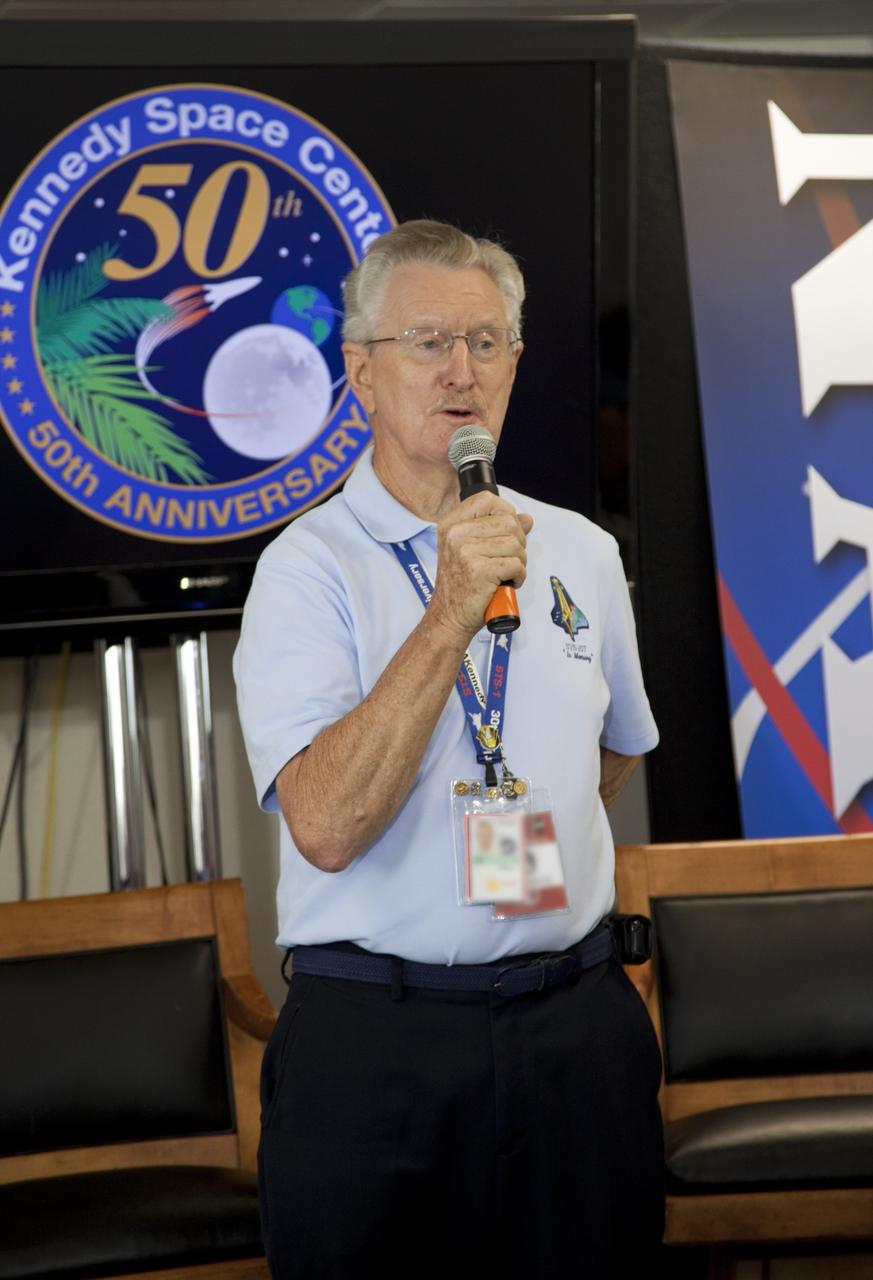
CAPE CANAVERAL, Fla. -- John Tribe, retired chief engineer for Boeing/Rockwell Launch Support Services, speaks to about 45 of NASA’s social media followers for two days of presentations on the Kennedy Space Center's past, present and future. The social media participants gathered at the Florida spaceport on Aug. 2 and 3, 2012 to hear from key former and current leaders who related stories of the space agency's efforts to explore the unknown. It was the first social media event totally run by Kennedy. Photo credit: NASA/ Gianni Woods
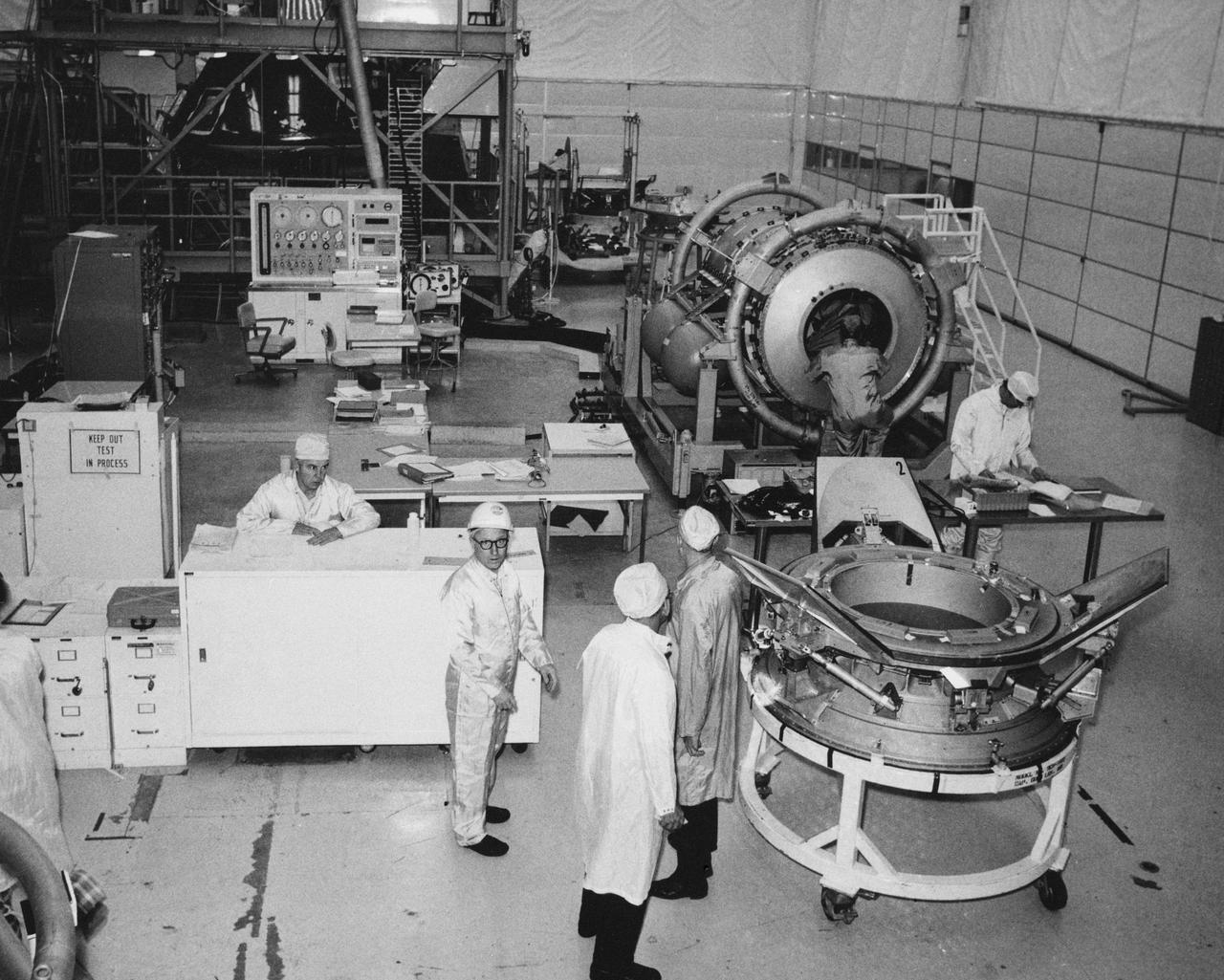
S74-28295 (September 1974) --- American-built hardware for the joint U.S.-USSR Apollo-Soyuz Test Project mission undergoes pre-delivery preparations in the giant clean room at Rockwell International Corporation?s Space Division at Downey, California. The U.S. portion of the ASTP docking system is in the right foreground. In the right background is the cylindrical-shaped docking module, which is designed to link the Apollo and Soyuz spacecraft when they dock in Earth orbit next summer. In the left background is the Apollo Command Module which they will carry the three American astronauts into Earth orbit. Photo credit: NASA
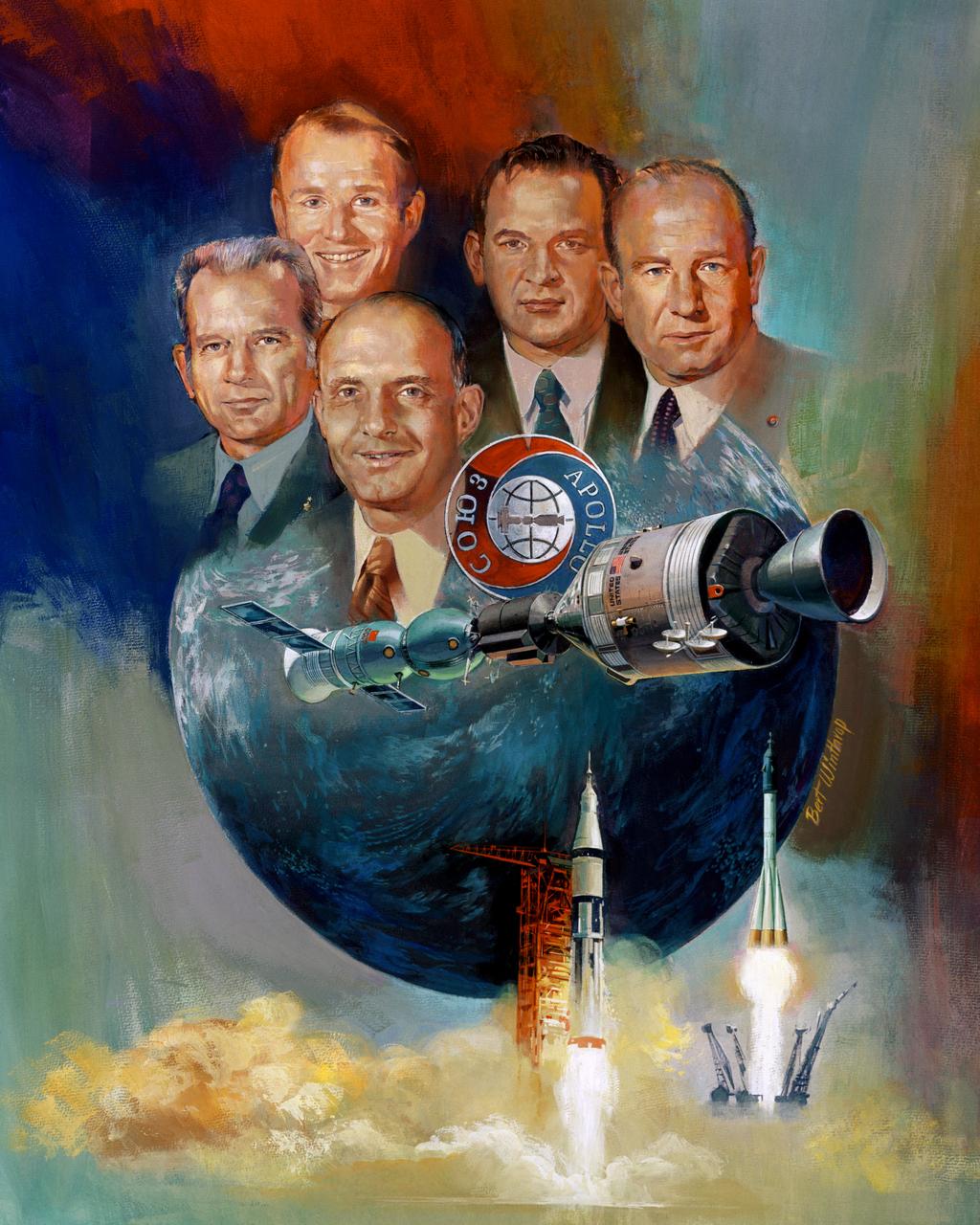
S75-25941 (April 1975) --- An Apollo-Soyuz Test Project (ASTP) symbolic painting by artist Bert Winthrop of Rockwell International Space Division, Downey, California. The artwork is composed of the ASTP mission insignia, the docked Apollo-Soyuz spacecraft, and portraits of the five ASTP prime crewmen, all superimposed against Earth's sphere in the center of the picture. The launches of both the American ASTP space vehicle (on left) and the Soviet ASTP space vehicle are depicted in the lower right corner. The five crewmen are, clockwise from the ASTP emblem, astronaut Thomas P. Stafford, commander of the American crew; astronaut Donald K. Slayton, docking module pilot of the American crew; astronaut Vance D. Brand, command module pilot of the American crew; cosmonaut Valeriy N. Kubasov, engineer on the Soviet crew; and cosmonaut Aleksey A. Leonov, commander of the Soviet crew. The joint U.S.-USSR ASTP docking mission in Earth orbit is scheduled for July 1975.
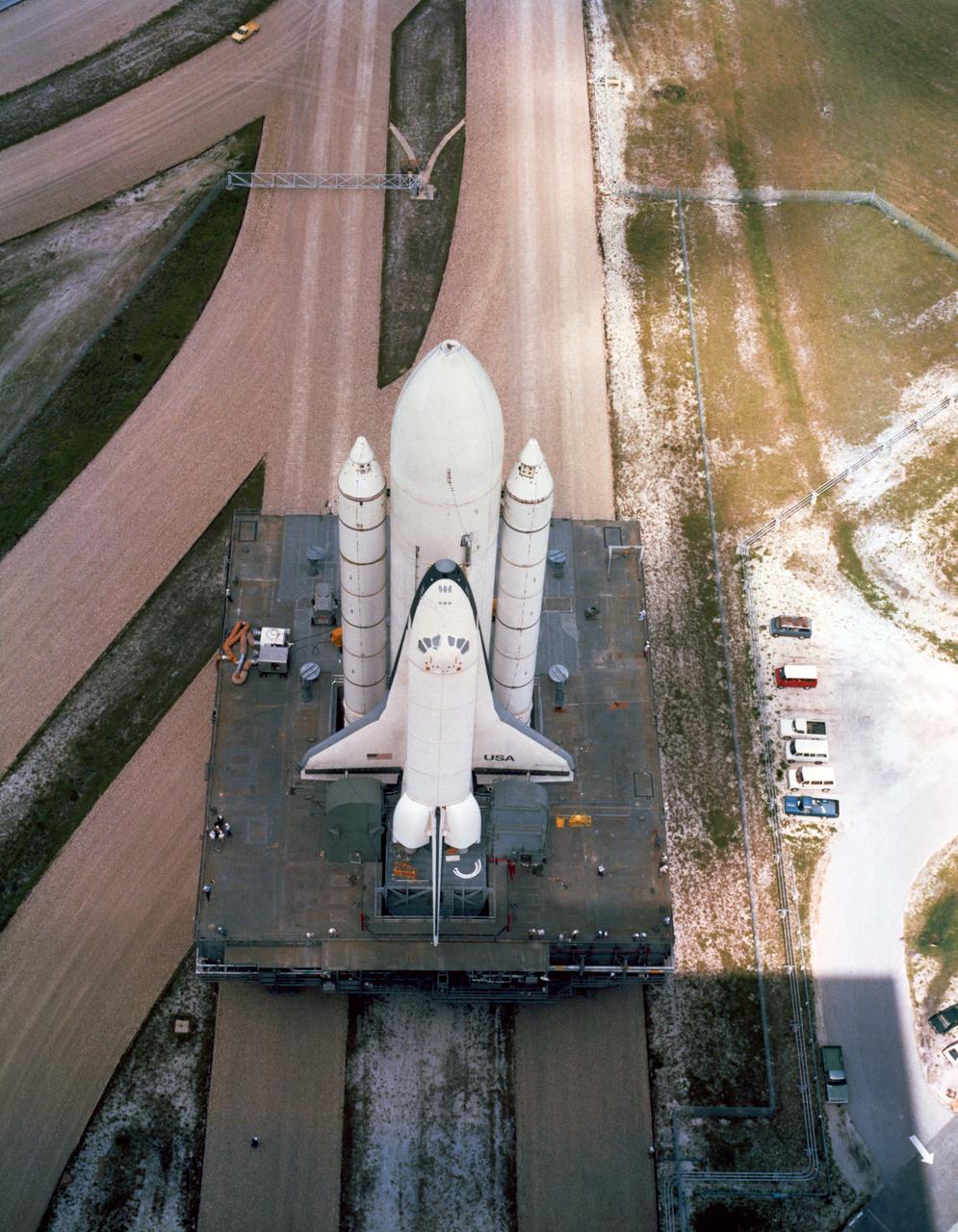
S79-35236 (23 July 1979) --- The space shuttle orbiter 101 Enterprise is seen in this high angle view as it is being moved from Pad A, Launch Complex 39 at the Kennedy Space Center (KSC) to the Vehicle Assembly Building (VAB). Though only 3.5 miles separate the launch pad and the VAB, the journey of the orbiter, its solid rocket boosters and external tank takes more than 11 hours. The move back to the VAB represents the end of several weeks of fit and function checks performed on the vehicle, prepatory to eventual launch readiness of the first actual flight vehicle in the orbiter flight test (OFT) series -- the Columbia. The SRB/ET/Enterprise cluster will soon be taken apart inside the VAB and the orbiter will be taxied back to the Palmdale, California manufacturing facility of Rockwell International. Photo credit: NASA
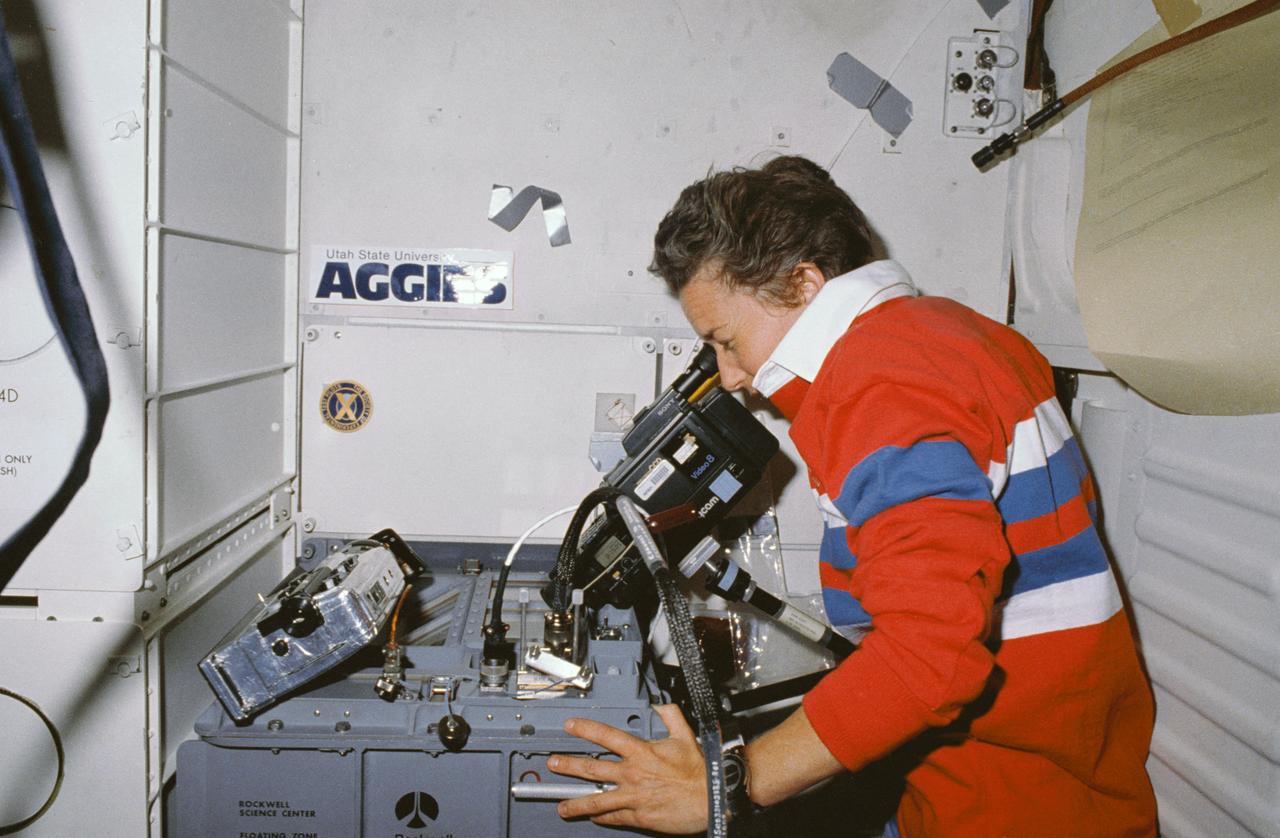
STS030-10-002 (8 May 1989) --- STS-30 Mission Specialist Mary L. Cleave operates 8mm video camcorder at Fluids Experiment Apparatus 2 (FEA-2) (SK73-000102) unit located in aft middeck locker onboard Atlantis, Orbiter Vehicle (OV) 103. Two 8mm video camcorders are positioned above FEA-2 unit to record experiment titled "Floating Zone Crystal Growth and Purification". Rockwell International (RI) through its Space Transportation Systems Division, Downey, California, is engaged in a joint endeavor agreement (JEA) with NASA's Office of Commercial Programs in the field for floating zone crystal growth research. Utah State University Aggies decal appears on aft bulkhead above FEA-2 unit.
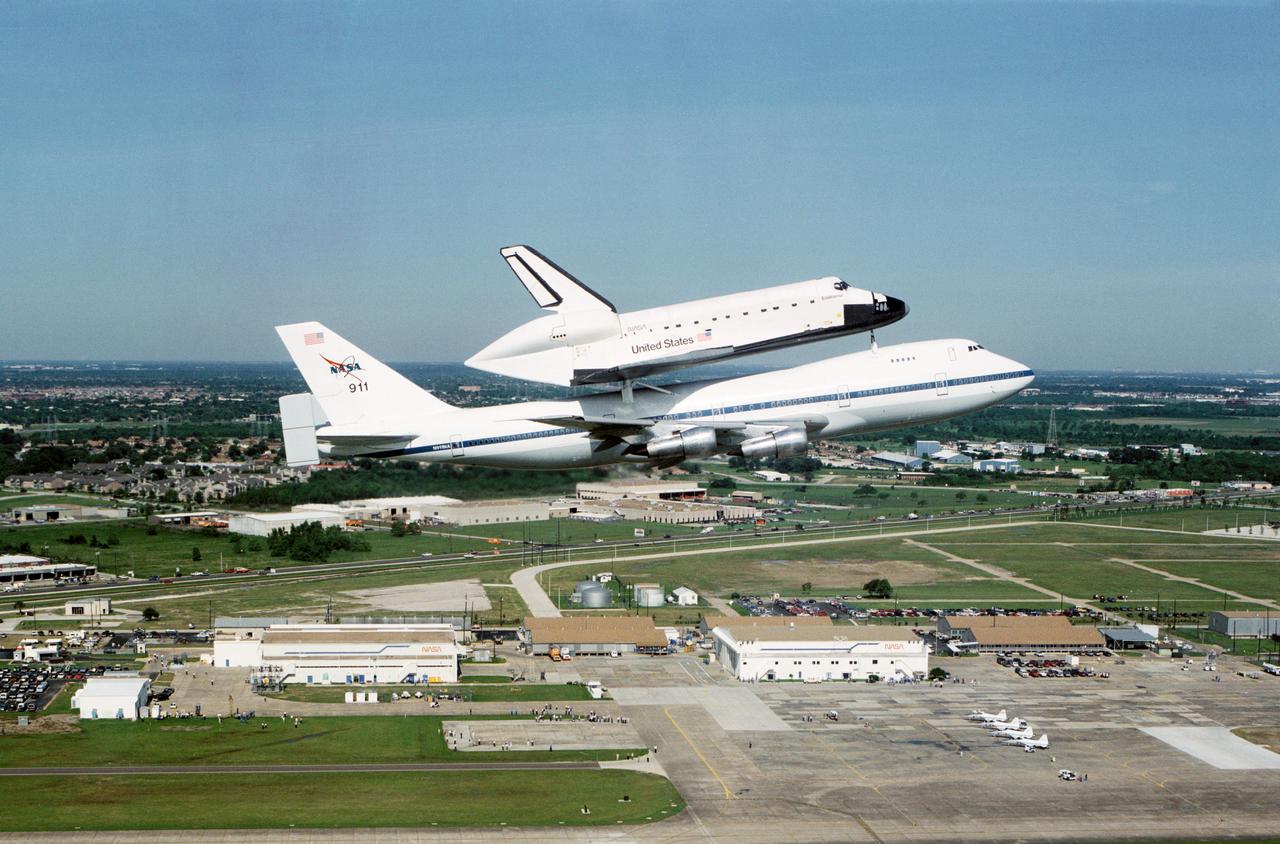
S91-36097 (6 May 1991) --- Air to air view of Endeavour, Orbiter Vehicle (OV) 105, atop a Shuttle Carrier Aircraft (SCA) NASA 911, a modified Boeing 747, approaches touchdown for a brief stopover at Ellington Field, near JSC. Visible below the spacecraft/aircraft combination are the NASA T-38 flight line, NASA aircraft hangars and facilities, and a runway. OV-105 rolled out at Rockwell's Palmdale facility on 04-25-91 to once more bring to four the total of NASA Shuttles available for flight assignment. The spacecraft and aircraft-tandem left Houston later on this day headed for another stop in Mississippi before landing in Florida on 05-07-91. This photograph was taken from a T-38 aircraft by Sheri J. Dunnette of JSC's Image Science Division (ISD).
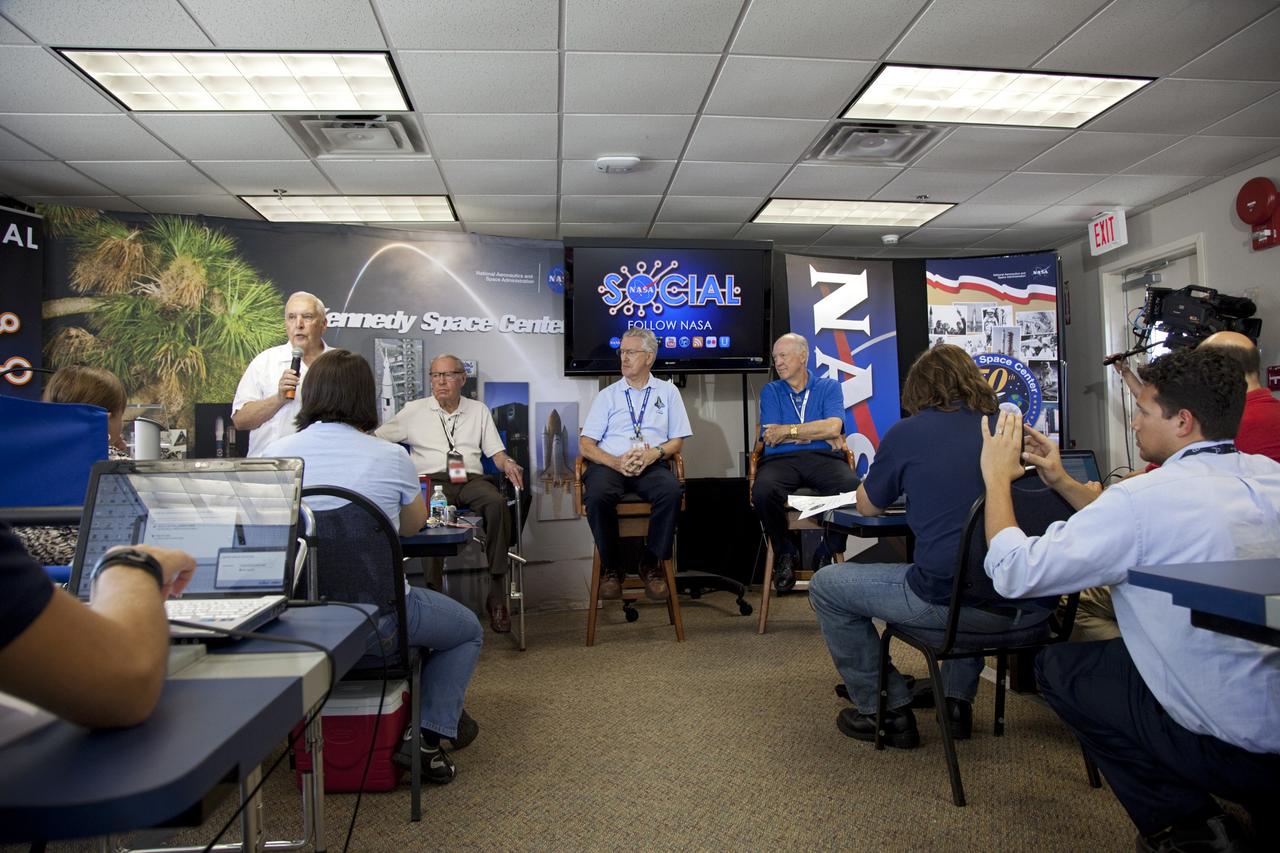
CAPE CANAVERAL, Fla. -- From the left, former NASA Director of Public Affairs Hugh Harris is joined by Jack King, former NASA chief of Public Information, John Tribe, retired chief engineer for Boeing/Rockwell Launch Support Services, and Roy Tharpe, president of Space Gateway Support, speak to about 45 of NASA’s social media followers for two days of presentations on the Kennedy Space Center's past, present and future. The social media participants gathered at the Florida spaceport on Aug. 2 and 3, 2012 to hear from key former and current leaders who related stories of the space agency's efforts to explore the unknown. It was the first social media event totally run by Kennedy. Photo credit: NASA/ Gianni Woods
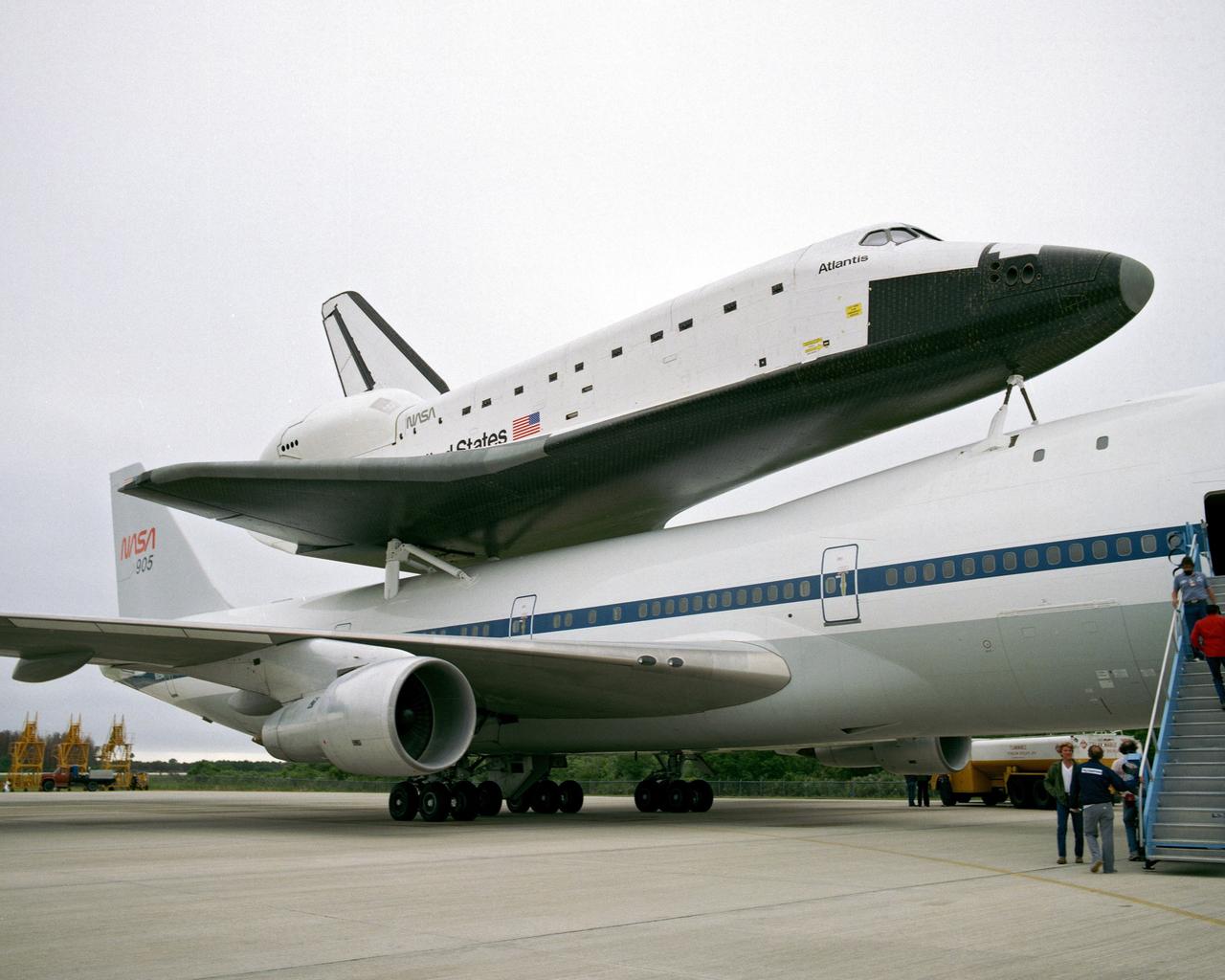
CAPE CANAVERAL, Fla. – At the Kennedy Space Center in Florida, the new space shuttle, Atlantis, arrives at the Shuttle Landing Facility. The shuttle is mounted atop the Shuttle Carrier Aircraft, a modified Boeing 747. Over the next seven months Atlantis will be prepared for its maiden voyage, STS-51J. Atlantis, NASA's fourth space-rated shuttle, was named after the two-masted boat that served as the primary research vessel for the Woods Hole Oceanographic Institute in Massachusetts from 1930 to 1966. The boat had a 17-member crew and accommodated up to five scientists who worked in two onboard laboratories, examining water samples and marine life. Like its predecessors, Atlantis was constructed by Rockwell International in Palmdale, Calif. The spacecraft was transported over land from Palmdale to Edwards Air Force Base on April 3, 1985 for the cross-country ferry flight to Kennedy. For more: http://www.nasa.gov/centers/kennedy/shuttleoperations/orbiters/atlantis-info.html Photo credit: NASA/Louie Rochefort
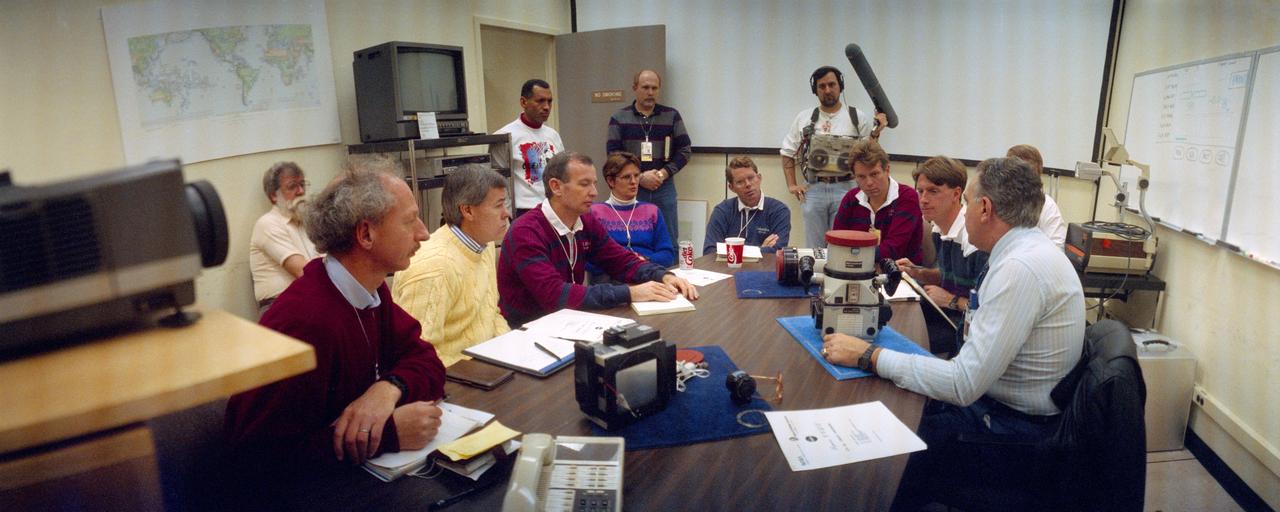
S92-26522 (Feb 1992) --- Crewmembers assigned to NASA's STS-45 mission are briefed on the use of the Linhof camera in the flight operations facility at the Johnson Space Center (JSC). Charles F. Bolden, mission commander, stands at left. Other crewmembers (seated clockwise around the table from lower left) are Dirk Frimout of Belgium representing the European Space Agency as payload specialist; Charles R. (Rick) Chappell, backup payload specialist; Brian Duffy, pilot; Kathryn D. Sullivan, payload commander; David C. Leestma, mission specialist; Byron K. Lichtenberg, payload specialist; and C. Michael Foale, mission specialist. James H. Ragan (far right), head of the flight equipment section of the flight systems branch in JSC's Man Systems Division, briefs the crewmembers. Donald C. Carico, of the crew training staff and Rockwell International, stands near Bolden. The camera, used for out-the-window observations, is expected to be used frequently on the Atmospheric Laboratory for Applications and Science (ATLAS-1) mission, scheduled for a March date with the Space Shuttle Atlantis.
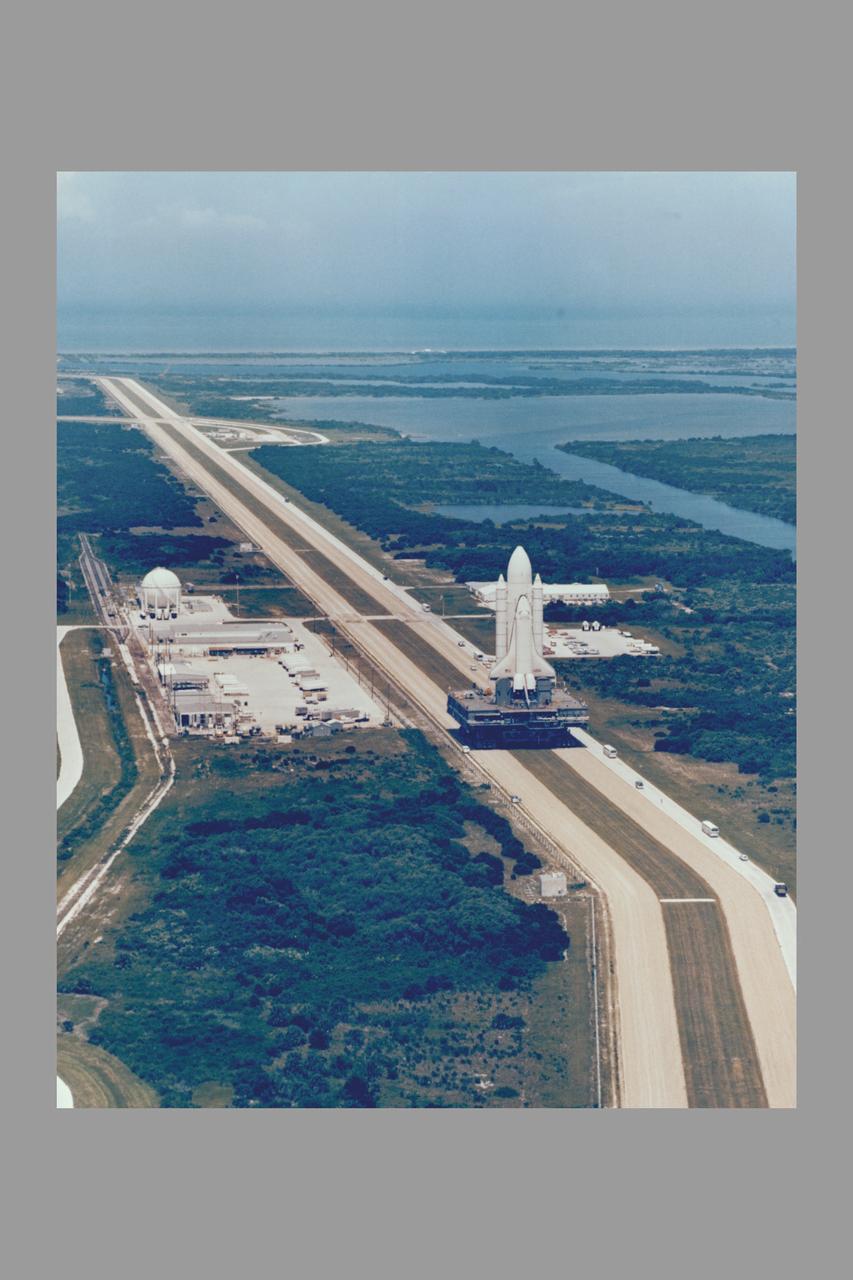
Space Shuttle Orbiter Enterprise, mated to a 15-story-tall external propellant tank and twin inert solid rocket boosters on top of a Mobile Launcher Platform, is rolled back to the Vehicle Assembly Building from Lauch Complex 39's Pad A July 23 at the completion of nearly three months of fit and function checks at the shuttle launch site as part of the exercise designed to help clear the way for the liftoff of its sister ship Columbia. The massive Crawler Transporter began moving its 11 million pound load the 3.5 miles from pad A to the VAB at 10:23 a.m. and reached the doorway to High Bay 1 at 3:48p.m. following serveral days of fit checks of modified extermiable platforms in the assembly bay, the nonlaunchable shuttle will be destacked. Enterprise will be returned to Rockwell International and stripped of parts for integration into orbiter destined for space, while the external tank and solid booster will be returned to their respective prime contractors and refurbished for use on a later shuttle mission.
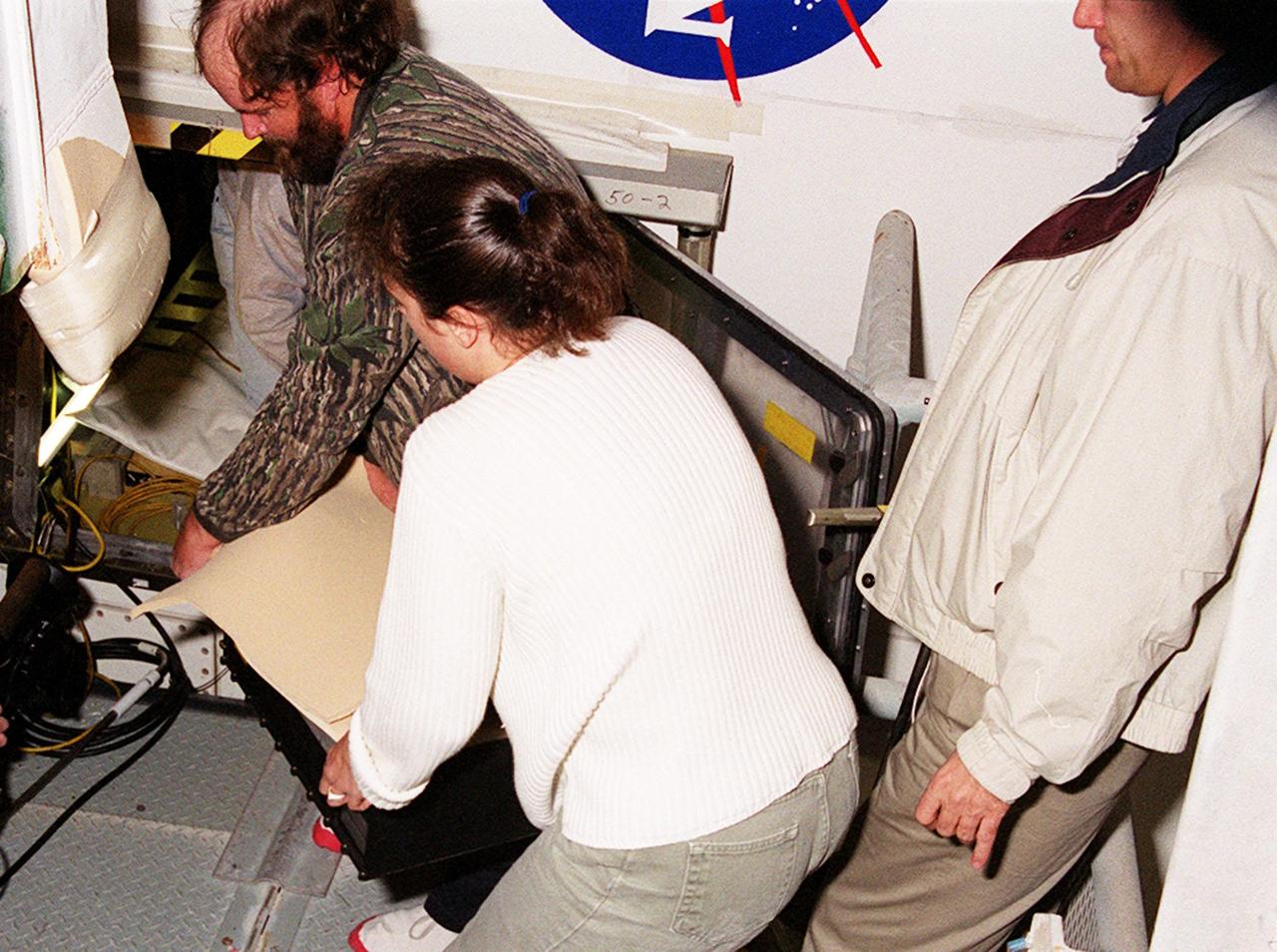
KENNEDY SPACE CENTER, FLA. -- Workers carry away the faulty Enhanced Main Events Controller (E-MEC) from Shuttle Endeavour at Launch Pad 39A. The E-MEC became suspect during the Jan. 31 launch countdown and mission STS-99 was delayed when NASA managers decided to replace it. Each Shuttle carries two enhanced master events controllers (E-MECs), which provide relays for onboard flight computers to send signals to arm and fire pyrotechnics that separate the solid rockets and external tank during assent. Both E-MECs are needed for the Shuttle to be cleared for flight. Currently Endeavour and Columbia are the only two orbiters with the E-MECs. Built by Rockwell's Satellite Space Electronics Division, Anaheim, Calif., each unit weighs 65 pounds and is approximately 20 inches long, 13 inches wide and 8 inches tall. Previously, three Shuttle flights have been scrubbed or delayed due to faulty MECs: STS-73, STS-49 and STS-41-D. The next scheduled date for launch of STS-99 is Feb. 11 at 12:30 p.m. EST
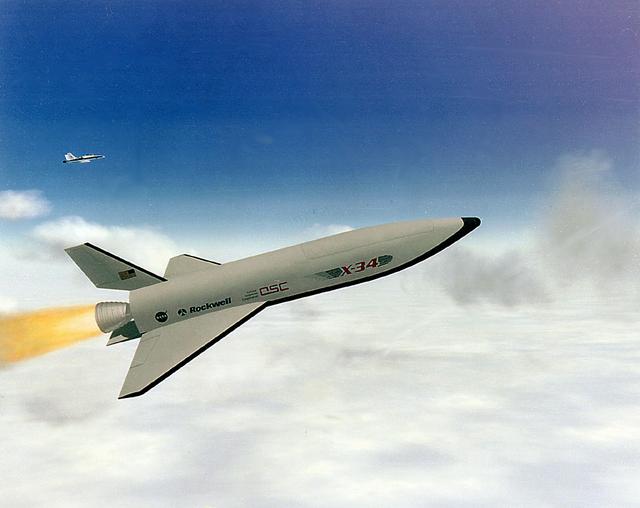
The X-34 Reusable Launch Vehicle (RLV) concept is pictured here. NASA plarned to utilize the X-34 small reusable booster for research of Reusable Launch Vehicle (RLV) technologies that may be applicable to future larger RLV's. It was being developed cooperatively by Orbital Science Corporation, Rockwell International Corporation, and NASA. The objectives of the X-34 program were to significantly reduce launch costs for small payloads and to provide a test bed for NASA RLV technology. The X-34 would be launched from a 747 shuttle carrier aircraft. After delivering its payload (booster by an upper stage) to orbit, it would land autonomously on the same runway from which the 747 departed. The X-34 vehicle was powered by a liquid oxygen tank (LOX) and an RP-1 liquid Fastrac engine that was designed and built by Marshall Space Flight Center. The X-34 would be capable of speeds up to Mach 8 and altitudes of 250,000 feet. The X-34 program was cancelled in 2001.
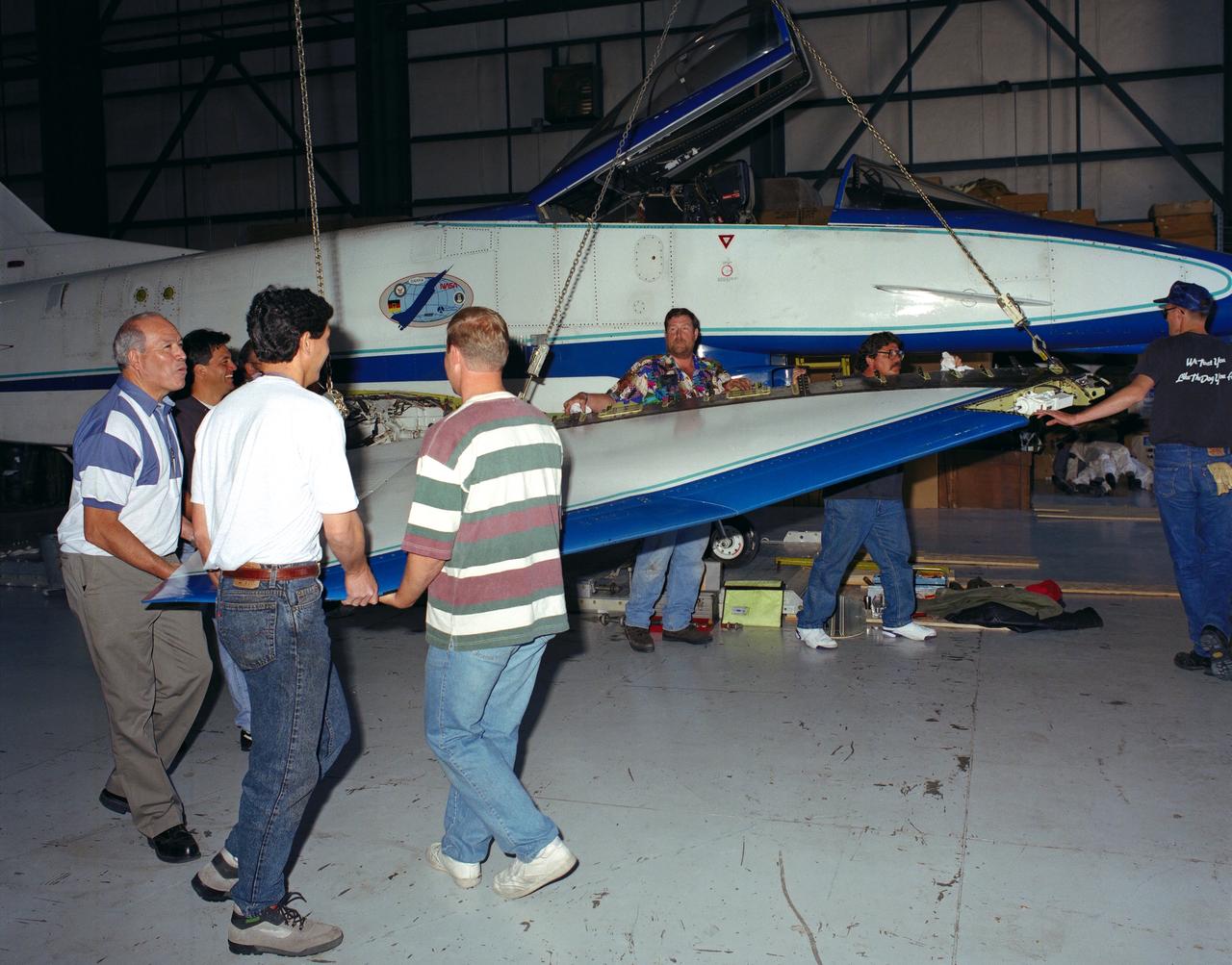
U.S. and German personnel of the X-31 Enhanced Fighter Maneuverability Technology Demonstrator aircraft program removing the right wing of the aircraft, which was ferried from Edwards Air Force Base, California, to Europe on May 22, 1995 aboard an Air Force Reserve C-5 transport. The X-31, based at the NASA Dryden Flight Research Center was ferried to Europe and flown in the Paris Air Show in June. The wing of the X-31 was removed on May 18, 1995, to allow the aircraft to fit inside the C-5 fuselage. Officials of the X-31 project used Manching, Germany, as a staging base to prepare the aircraft for the flight demonstration. At the air show, the X-31 demonstrated the value of using thrust vectoring (directing engine exhaust flow) coupled with advanced flight control systems to provide controlled flight at very high angles of attack. The aircraft arrived back at Edwards in a Air Force Reserve C-5 on June 25, 1995 and off loaded at Dryden June 27. The X-31 aircraft was developed jointly by Rockwell International's North American Aircraft Division (now part of Boeing) and Daimler-Benz Aerospace (formerly Messerschmitt-Bolkow-Blohm), under sponsorship by the U.S. Department of Defense and the German Federal Ministry of Defense.
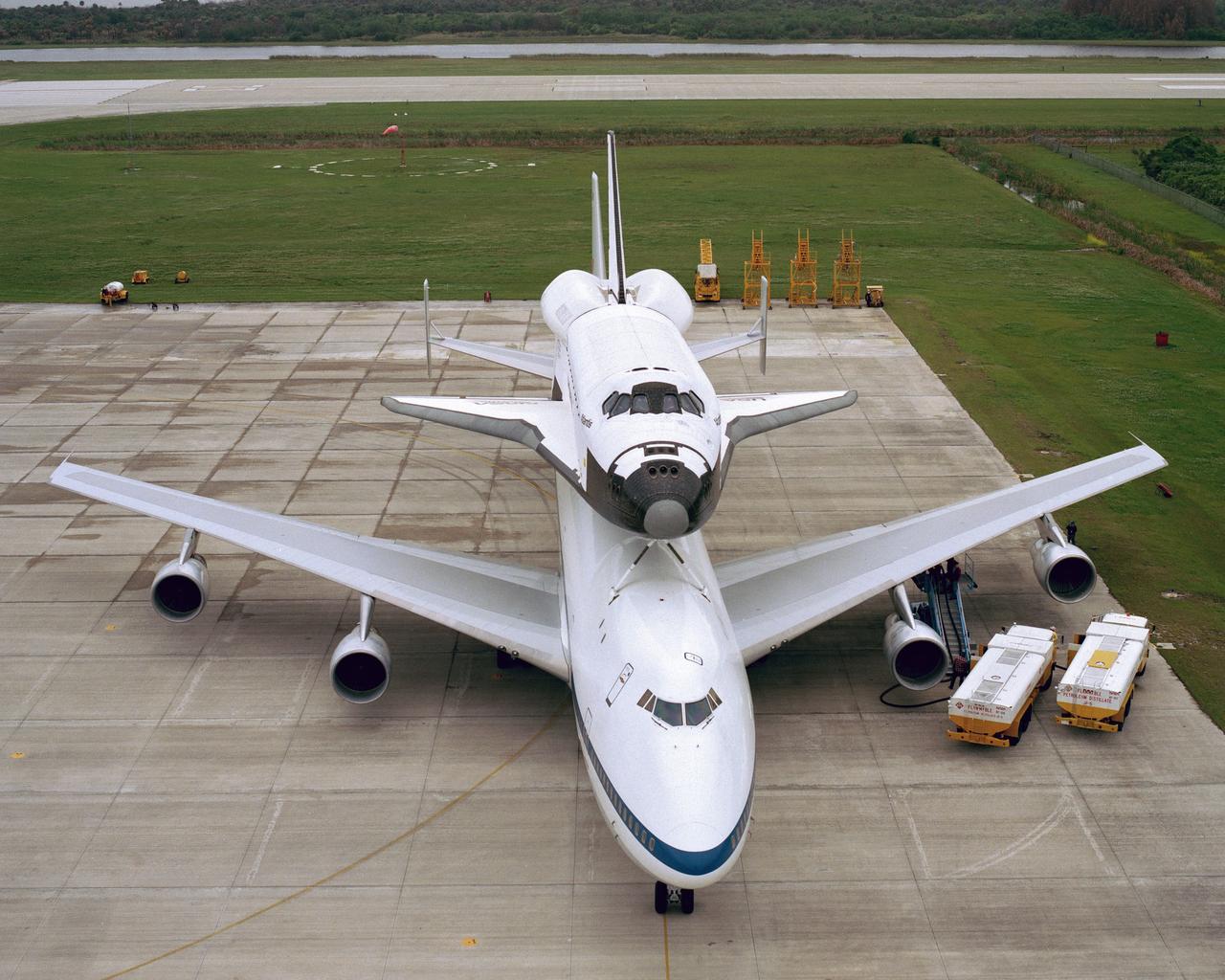
CAPE CANAVERAL, Fla. – At the Kennedy Space Center in Florida, the new space shuttle, Atlantis, arrives at the Shuttle Landing Facility. The shuttle is mounted atop the Shuttle Carrier Aircraft, a modified Boeing 747. Over the next seven months Atlantis will be prepared for its maiden voyage, STS-51J. Atlantis, NASA's fourth space-rated shuttle, was named after the two-masted boat that served as the primary research vessel for the Woods Hole Oceanographic Institute in Massachusetts from 1930 to 1966. The boat had a 17-member crew and accommodated up to five scientists who worked in two onboard laboratories, examining water samples and marine life. Like its predecessors, Atlantis was constructed by Rockwell International in Palmdale, Calif. The spacecraft was transported over land from Palmdale to Edwards Air Force Base on April 3, 1985 for the cross-country ferry flight to Kennedy. For more: http://www.nasa.gov/centers/kennedy/shuttleoperations/orbiters/atlantis-info.html Photo credit: NASA/Louie Rochefort
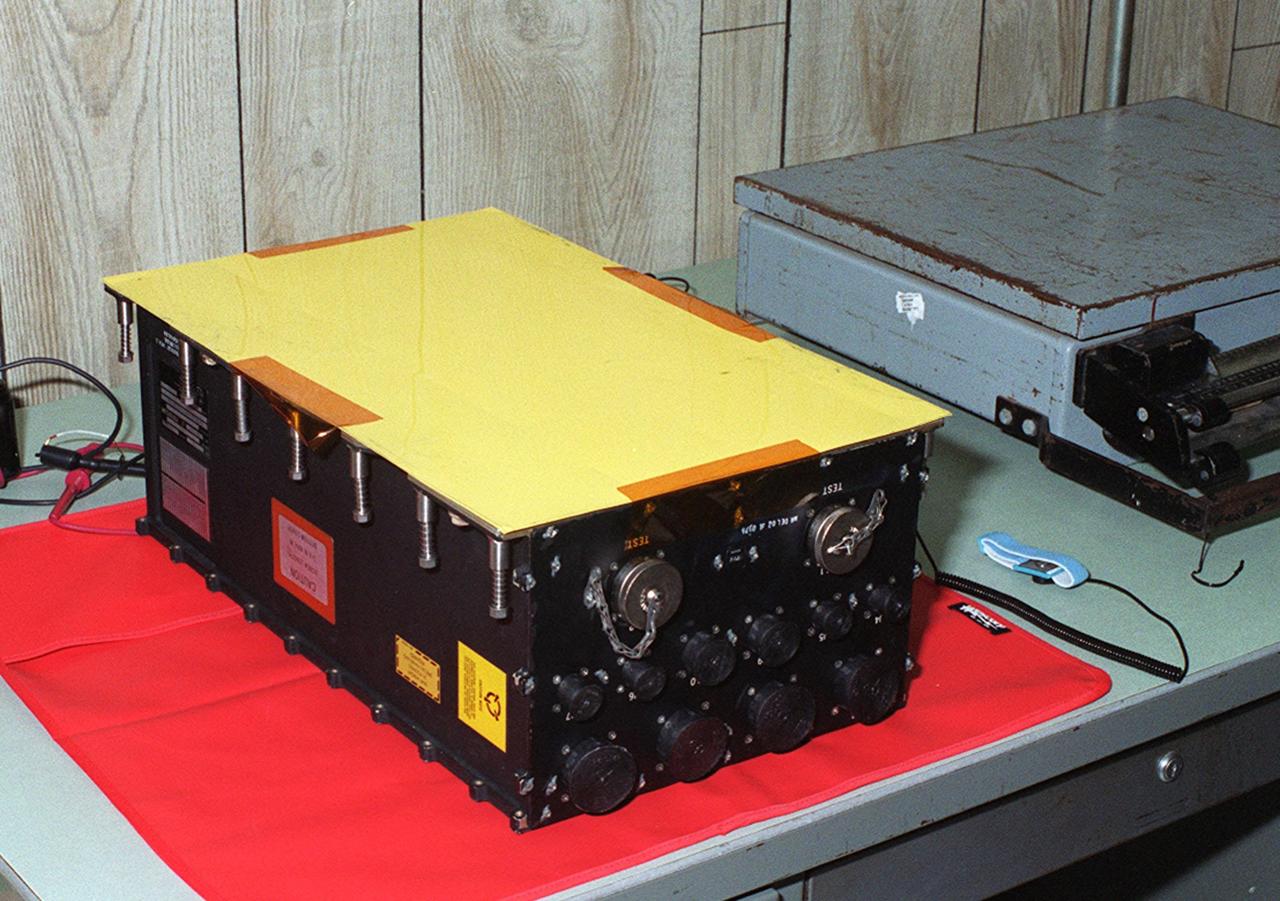
KENNEDY SPACE CENTER, FLA. -- A new Enhanced Main Events Controller (E-MEC) for Shuttle Endeavour sits on a table in a Quality trailer in the Launch Pad 39B area. The original E-MEC in Endeavour became suspect during the Jan. 31 launch countdown and mission STS-99 was delayed when NASA managers decided to replace it. Each Shuttle carries two enhanced master events controllers (E-MECs), which provide relays for onboard flight computers to send signals to arm and fire pyrotechnics that separate the solid rockets and external tank during assent. The E-MECs are located in the orbiter's aft compartment and both are needed for the Shuttle to be cleared for flight. Currently Endeavour and Columbia are the only two orbiters with the E-MECs. Built by Rockwell's Satellite Space Electronics Division, Anaheim, Calif., each unit weighs 65 pounds and is approximately 20 inches long, 13 inches wide and 8 inches tall. Previously, three Shuttle flights have been scrubbed or delayed due to faulty MECs: STS-73, STS-49 and STS-41-D. Before workers can begin E-MEC replacement efforts at the launch pad, cryogenic reactants must be offloaded from the orbiter and Space Shuttle ordnance disconnected. The next scheduled date for launch of STS-99 is Feb. 11 at 12:30 p.m. EST
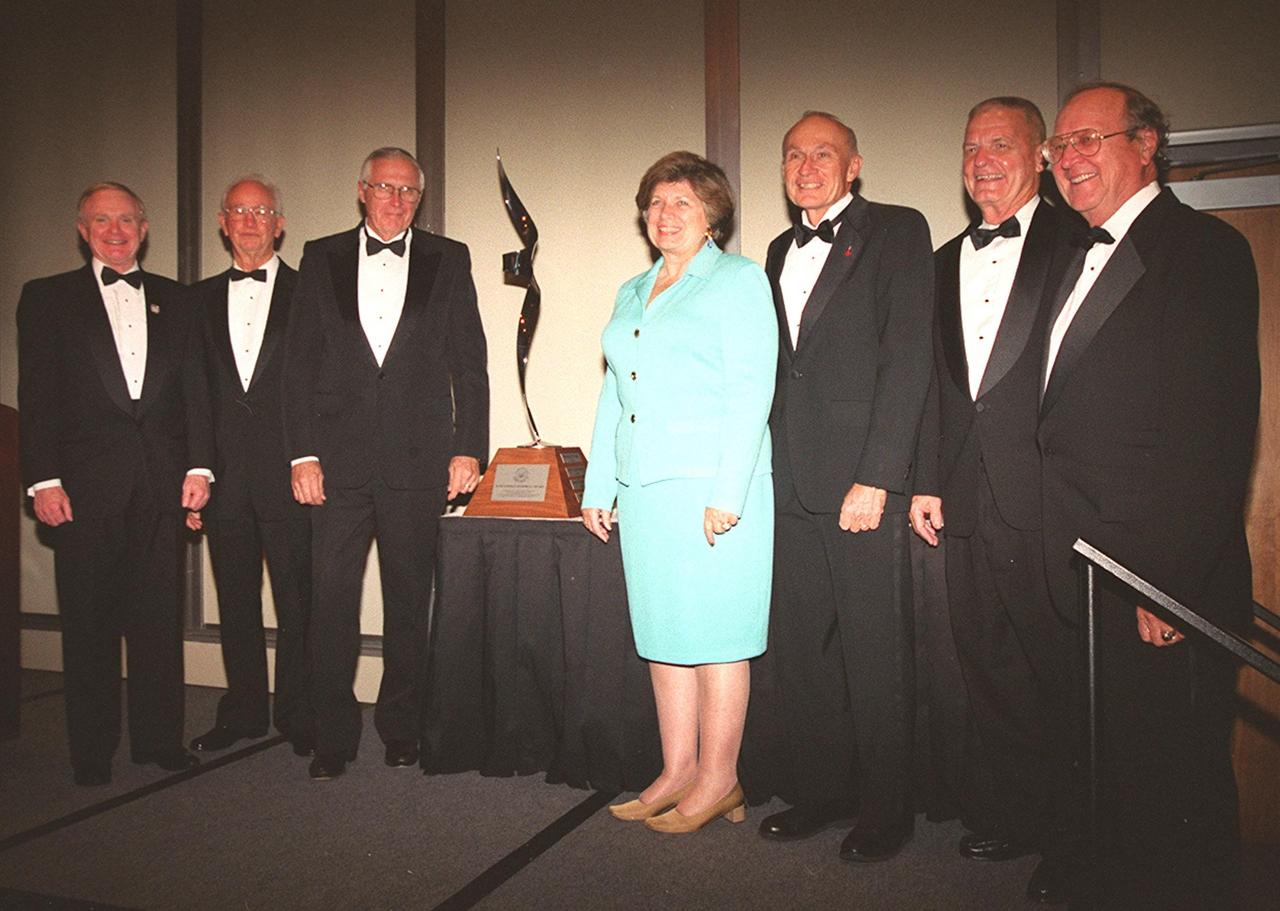
The 12th annual Dr. Kurt H. Debus Award Dinner gathered these distinguished guests: (from left), Center Director Roy Bridges, who received the 2001 Dr. Kurt H. Debus Award, Maxwell King, Lee Solid, JoAnn Morgan, Bob Sieck, Forrest McCartney and Ernie Briel. Solid is the former vice president and general manager of Space Systems Division, Florida Operations, Rockwell International. Morgan is the director of KSC’s External Relations & Business Development Directorate; Bob Sieck is the former director of Shuttle Processing at KSC. McCartney, center director of KSC from 1986-1991, received the first Debus award ever given to a KSC director. Bridges was given the honor for his progressive, visionary leadership and contributions to space technology and exploration. The Florida Committee of the National Space Club presented the award. The Debus Award was first given in 1980. Created to recognize significant achievements and contributions made in Florida to the American aerospace effort, the award is named for the KSC’s first Director, Dr. Kurt H. Debus
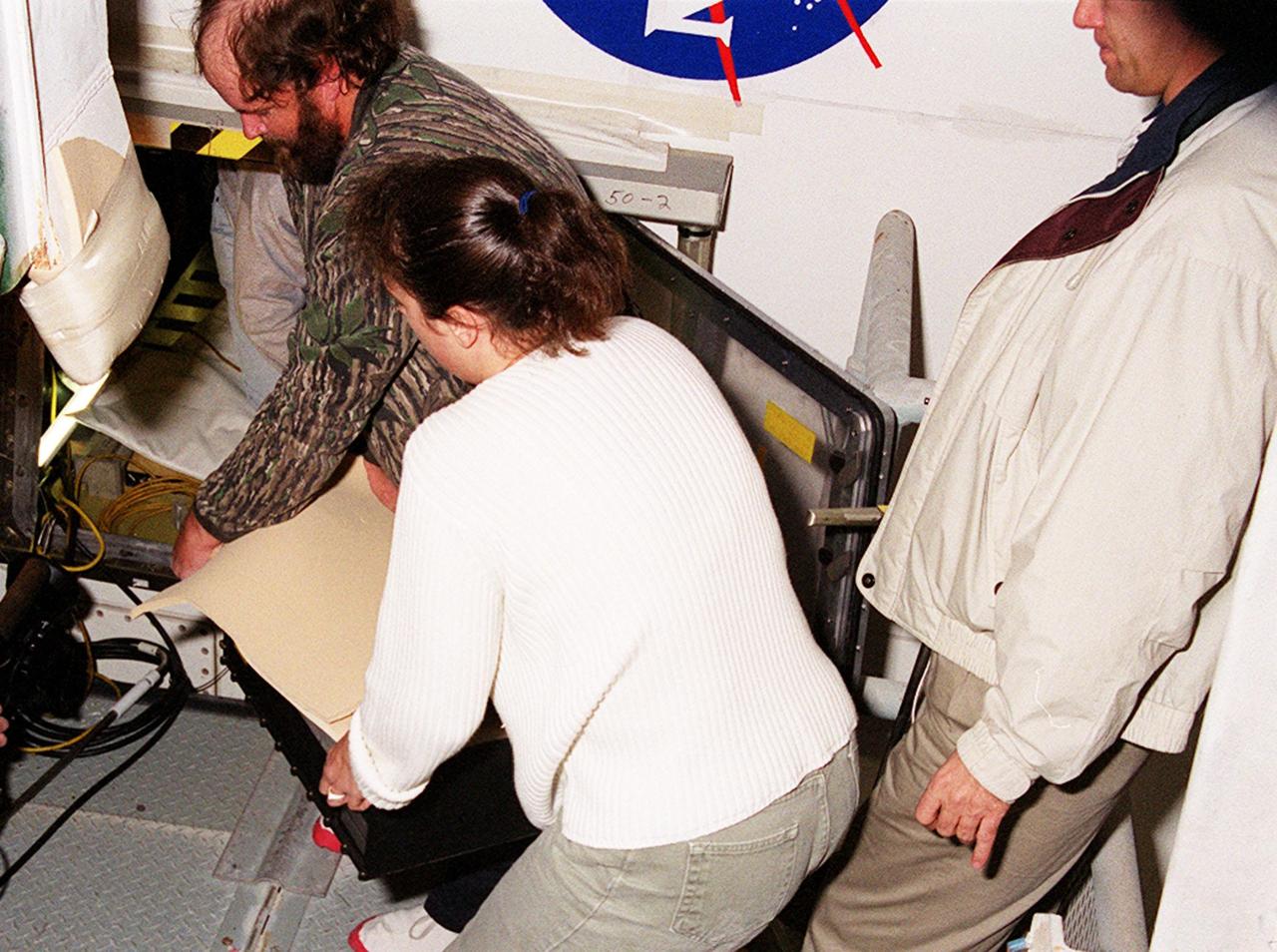
KENNEDY SPACE CENTER, FLA. -- Workers carry away the faulty Enhanced Main Events Controller (E-MEC) from Shuttle Endeavour at Launch Pad 39A. The E-MEC became suspect during the Jan. 31 launch countdown and mission STS-99 was delayed when NASA managers decided to replace it. Each Shuttle carries two enhanced master events controllers (E-MECs), which provide relays for onboard flight computers to send signals to arm and fire pyrotechnics that separate the solid rockets and external tank during assent. Both E-MECs are needed for the Shuttle to be cleared for flight. Currently Endeavour and Columbia are the only two orbiters with the E-MECs. Built by Rockwell's Satellite Space Electronics Division, Anaheim, Calif., each unit weighs 65 pounds and is approximately 20 inches long, 13 inches wide and 8 inches tall. Previously, three Shuttle flights have been scrubbed or delayed due to faulty MECs: STS-73, STS-49 and STS-41-D. The next scheduled date for launch of STS-99 is Feb. 11 at 12:30 p.m. EST
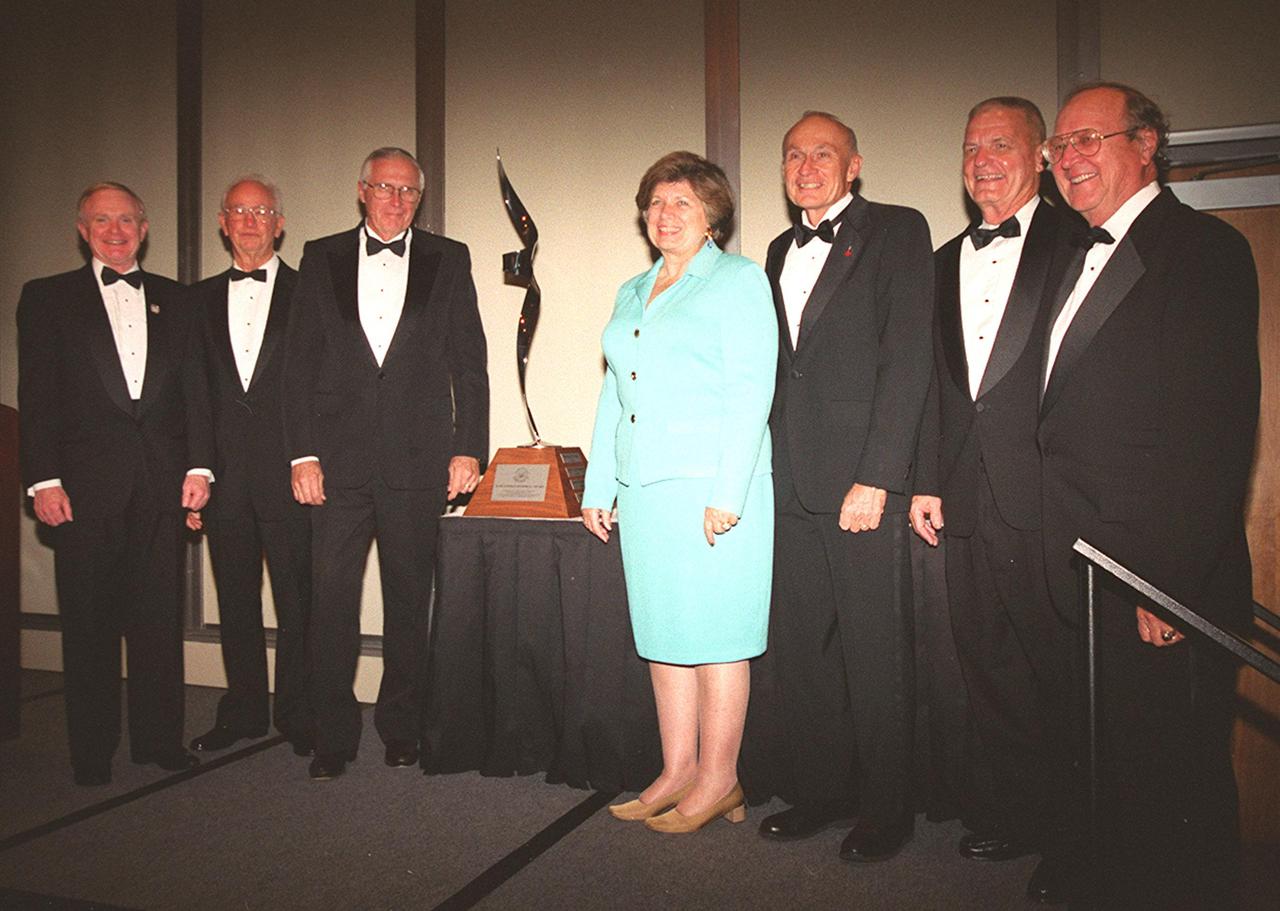
The 12th annual Dr. Kurt H. Debus Award Dinner gathered these distinguished guests: (from left), Center Director Roy Bridges, who received the 2001 Dr. Kurt H. Debus Award, Maxwell King, Lee Solid, JoAnn Morgan, Bob Sieck, Forrest McCartney and Ernie Briel. Solid is the former vice president and general manager of Space Systems Division, Florida Operations, Rockwell International. Morgan is the director of KSC’s External Relations and Business Development Directorate; Bob Sieck is the former director of Shuttle Processing at KSC. McCartney, center director of KSC from 1986-1991, received the first Debus award ever given to a KSC director. Bridges was given the honor for his progressive, visionary leadership and contributions to space technology and exploration. The Florida Committee of the National Space Club presented the award. The Debus Award was first given in 1980. Created to recognize significant achievements and contributions made in Florida to the American aerospace effort, the award is named for the KSC’s first Director, Dr. Kurt H. Debus
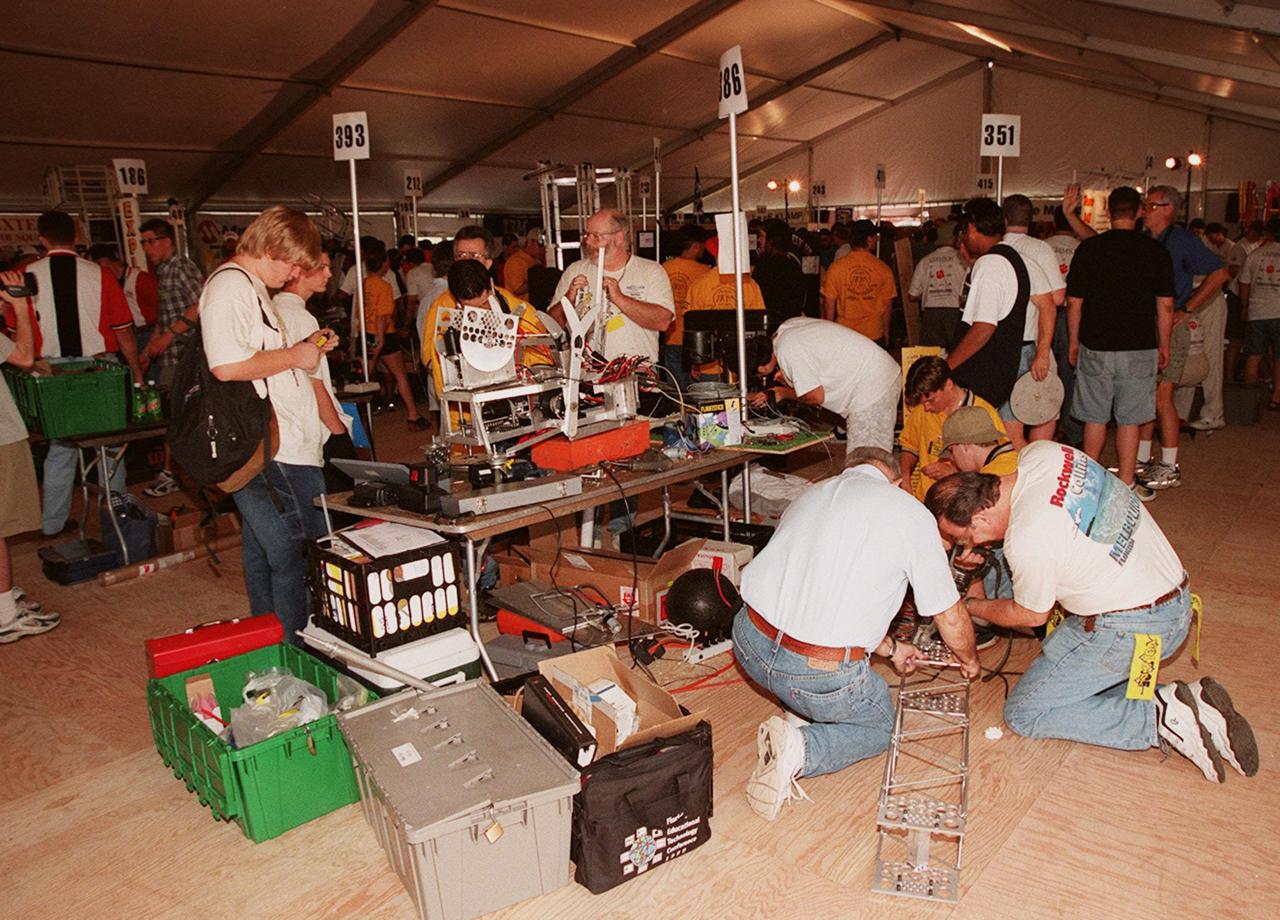
Team 393 from Morristown, Ind., sets up its robot on a table to prepare it for the FIRST (For Inspiration and Recognition of Science and Technology) Southeast Regional competition March 9-11 at the KSC Visitor Complex. KSC is co-sponsoring the team, The Bee Bots, from Morristown Junior and Senior High Schools. On the floor at right is team 386, known as Voltage: The South Brevard First Team. This team is made up of students from Eau Gallie, Satellite, Palm Bay, Melbourne, Bayside and Melbourne Central Catholic High Schools. They are sponsored by KSC as well as Harris Corp., Intersil Corp., Interface & Control Systems. Inc. and Rockwell Collins. Teams of high school students are testing the limits of their imagination using robots they have designed, with the support of business and engineering professionals and corporate sponsors, to compete in a technological battle against other schools' robots. Of the 30 high school teams competing at KSC, 16 are Florida teams co-sponsored by NASA and KSC contractors. Local high schools participating are Astronaut, Bayside, Cocoa Beach, Eau Gallie, Melbourne, Melbourne Central Catholic, Palm Bay, Rockledge, Satellite, and Titusville
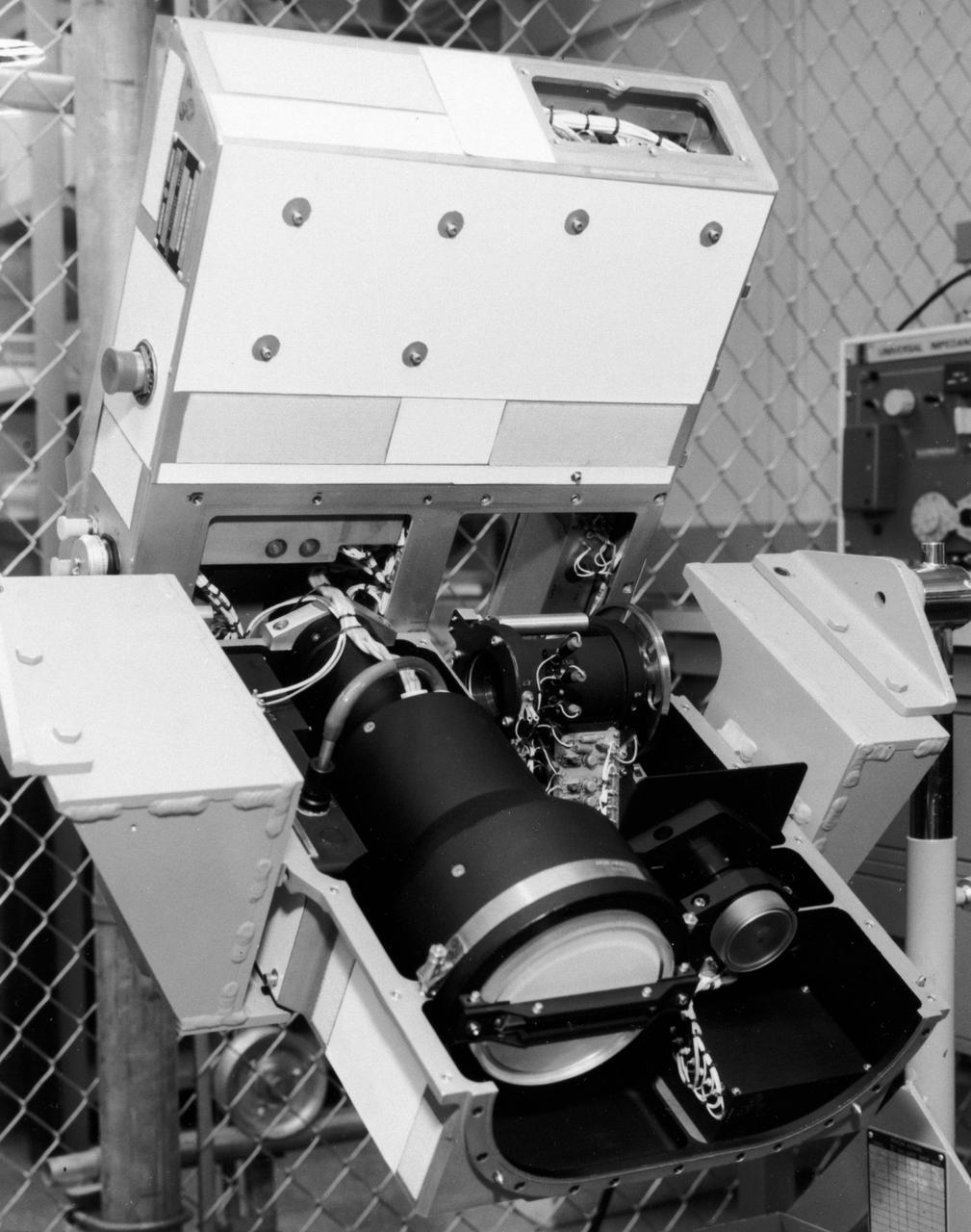
S72-49482 (November 1972) --- The Optical Recorder of the Lunar Sounder Experiment (S-209) which will be mounted in the SIM bay of the Apollo 17 Service Module. The three functional parts of the Lunar Sounder are the optical recorder, the coherent synthetic aperture radar, and the antennas, a retractable dipole for HF and a yagi for VHF. The Lunar Sounder will probe three-quarters of a mile below the moon's surface from the orbiting Apollo 17 spacecraft. Electronic data recorded on film will be retrieved by the crew during trans-Earth EVA. Geologic information on the lunar interior obtained by the sounder will permit scientific investigation of underground rock layers, lava flow patterns, rille (canyon) structures, mascon properties, and any areas containing water. A prototype lunar sounder has been flight tested in aircraft over selected Earth sites to confirm the equipment design and develop scientific analysis techniques. The Lunar Sounder Experiment was developed by North American Rockwell's (NR) Space Division for NASA's Manned Spacecraft Center to provide data for a scientific investigation team with representatives from the Jet Propulsion Laboratory, University of Utah, University of Michigan, U.S. Geological Survey, and NASA Ames Research Center.
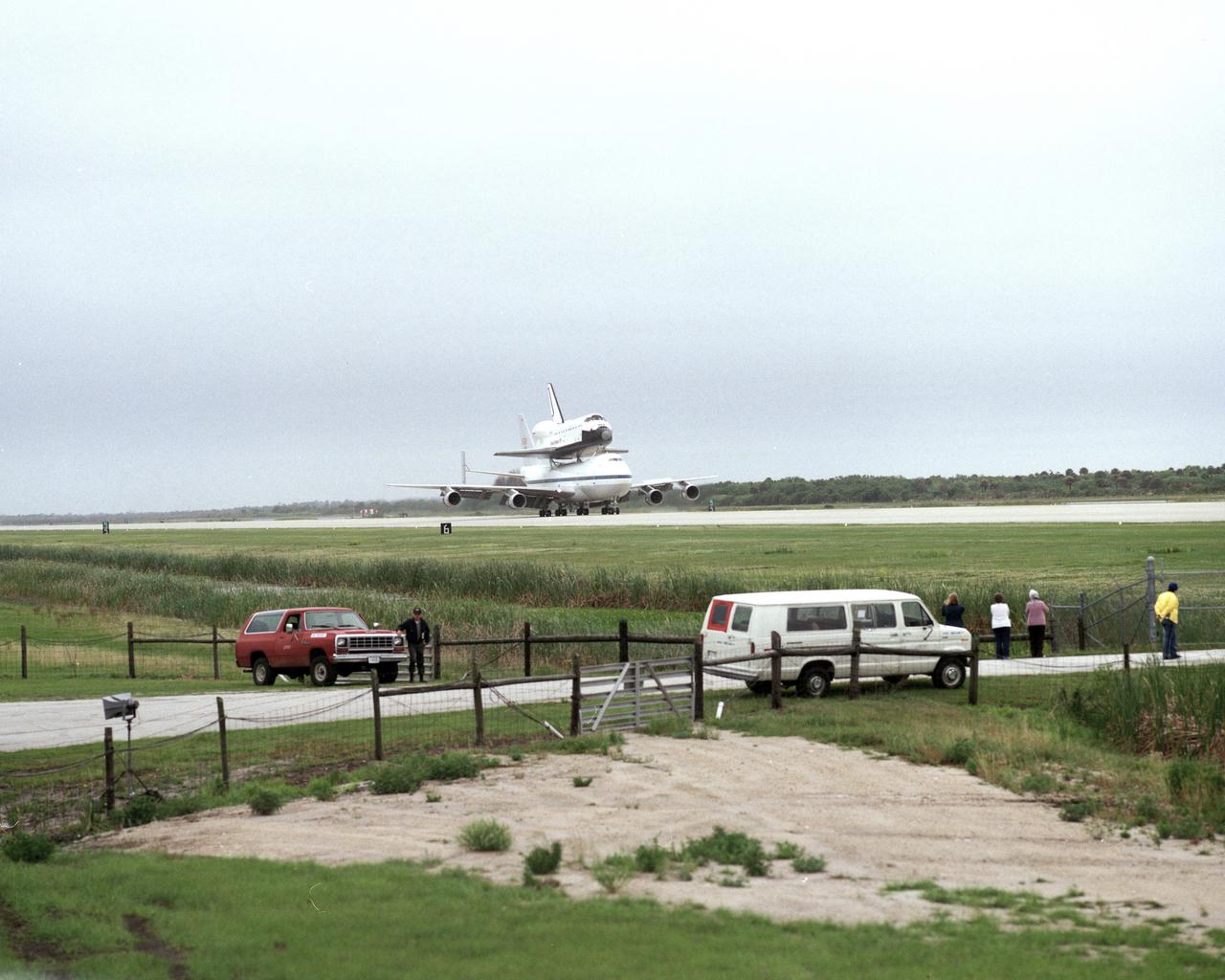
CAPE CANAVERAL, Fla. – At the Kennedy Space Center in Florida, the new space shuttle, Atlantis, arrives at the Shuttle Landing Facility. The shuttle is mounted atop the Shuttle Carrier Aircraft, a modified Boeing 747. Over the next seven months Atlantis will be prepared for its maiden voyage, STS-51J. Atlantis, NASA's fourth space-rated shuttle, was named after the two-masted boat that served as the primary research vessel for the Woods Hole Oceanographic Institute in Massachusetts from 1930 to 1966. The boat had a 17-member crew and accommodated up to five scientists who worked in two onboard laboratories, examining water samples and marine life. Like its predecessors, Atlantis was constructed by Rockwell International in Palmdale, Calif. The spacecraft was transported over land from Palmdale to Edwards Air Force Base on April 3, 1985 for the cross-country ferry flight to Kennedy. For more: http://www.nasa.gov/centers/kennedy/shuttleoperations/orbiters/atlantis-info.html Photo credit: NASA/Louie Rochefort
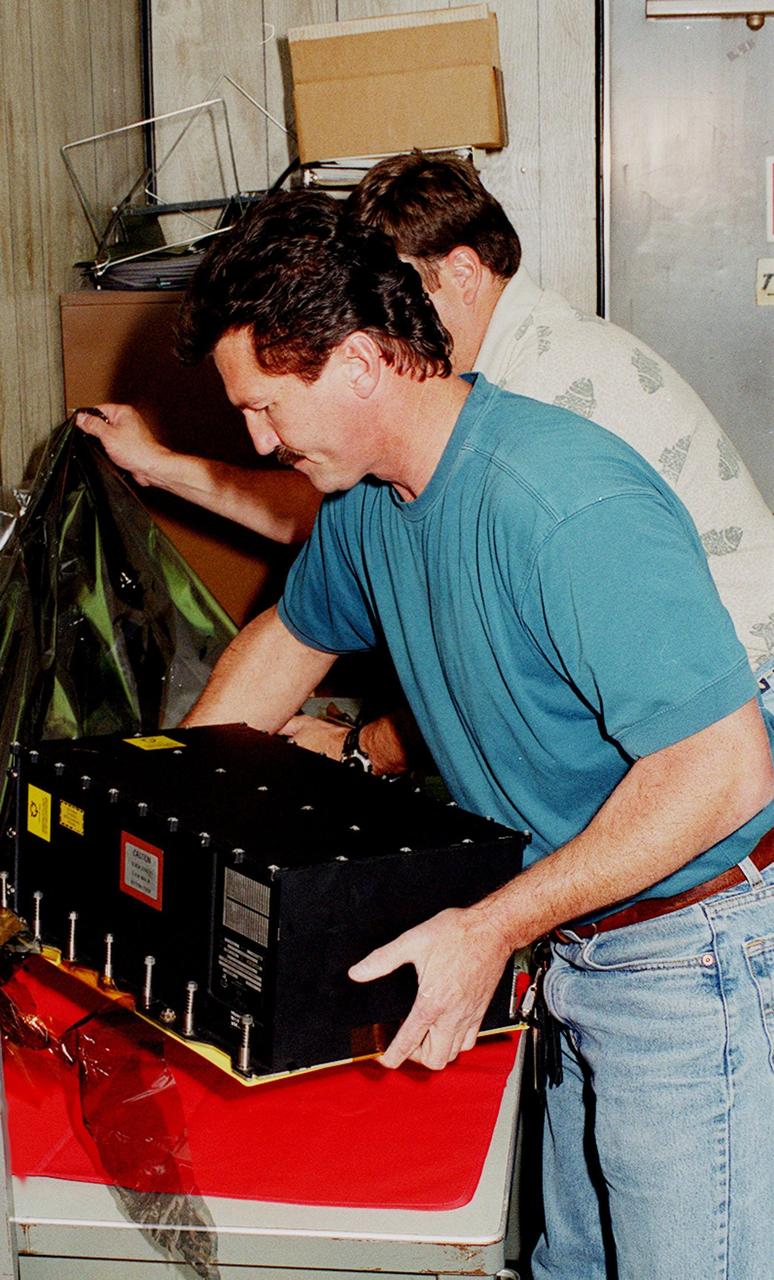
KENNEDY SPACE CENTER, FLA. -- Workers in a Quality trailer in the Launch Pad 39B Area unwrap a new Enhanced Main Events Controller (E-MEC) to be installed in Shuttle Endeavour. The original E-MEC in Endeavour became suspect during the Jan. 31 launch countdown and mission STS-99 was delayed when NASA managers decided to replace it. Each Shuttle carries two enhanced master events controllers (E-MECs), which provide relays for onboard flight computers to send signals to arm and fire pyrotechnics that separate the solid rockets and external tank during assent. The E-MECs are located in the orbiter's aft compartment and both are needed for the Shuttle to be cleared for flight. Currently Endeavour and Columbia are the only two orbiters with the E-MECs. Built by Rockwell's Satellite Space Electronics Division, Anaheim, Calif., each unit weighs 65 pounds and is approximately 20 inches long, 13 inches wide and 8 inches tall. Previously, three Shuttle flights have been scrubbed or delayed due to faulty MECs: STS-73, STS-49 and STS-41-D. Before workers can begin E-MEC replacement efforts at the launch pad, cryogenic reactants must be offloaded from the orbiter and Space Shuttle ordnance disconnected. The next scheduled date for launch of STS-99 is Feb. 11 at 12:30 p.m. EST

CAPE CANAVERAL, Fla. – At the Kennedy Space Center in Florida, the new space shuttle, Atlantis, arrives at the Shuttle Landing Facility. The shuttle is mounted atop the Shuttle Carrier Aircraft, a modified Boeing 747. Over the next seven months Atlantis will be prepared for its maiden voyage, STS-51J. Atlantis, NASA's fourth space-rated shuttle, was named after the two-masted boat that served as the primary research vessel for the Woods Hole Oceanographic Institute in Massachusetts from 1930 to 1966. The boat had a 17-member crew and accommodated up to five scientists who worked in two onboard laboratories, examining water samples and marine life. Like its predecessors, Atlantis was constructed by Rockwell International in Palmdale, Calif. The spacecraft was transported over land from Palmdale to Edwards Air Force Base on April 3, 1985 for the cross-country ferry flight to Kennedy. For more: http://www.nasa.gov/centers/kennedy/shuttleoperations/orbiters/atlantis-info.html Photo credit: NASA/Louie Rochefort
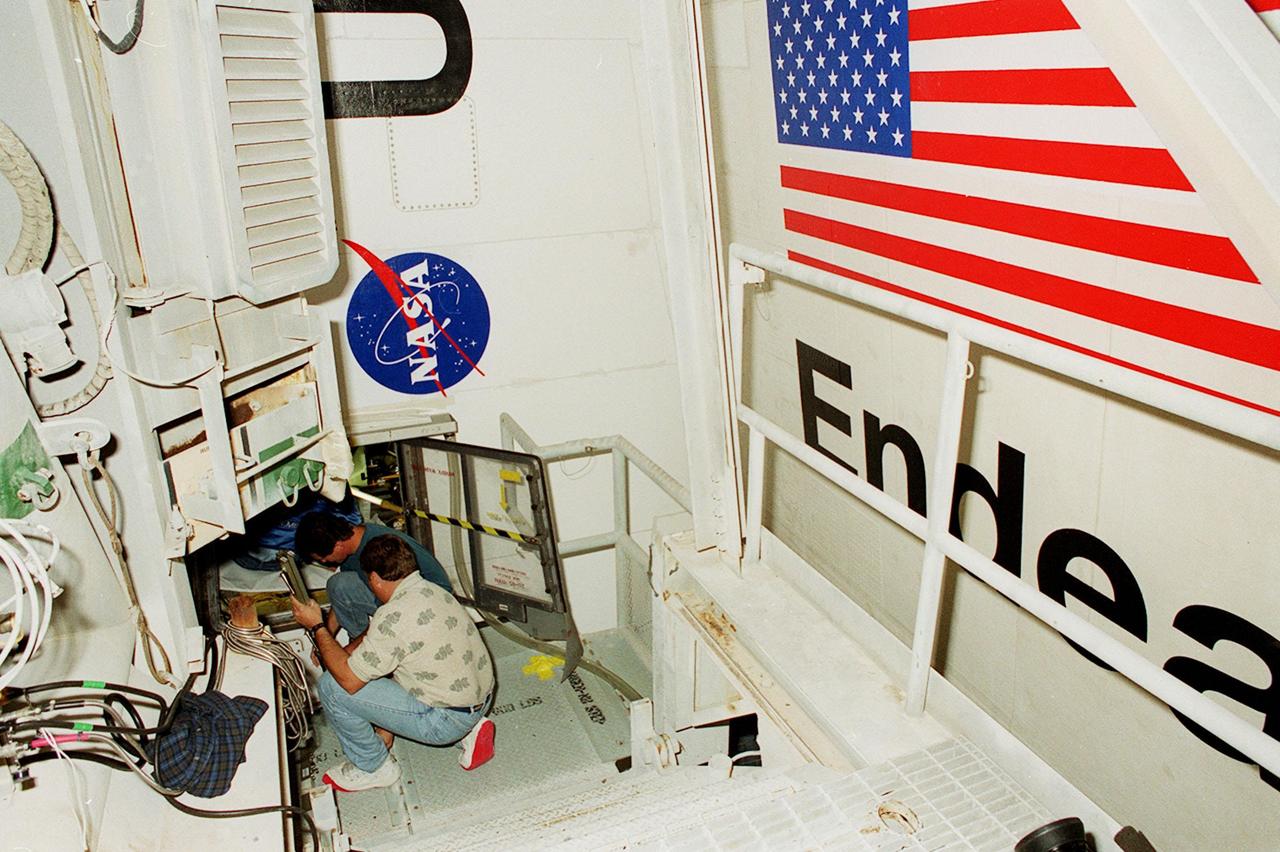
KENNEDY SPACE CENTER, FLA. -- Technicians work in the aft compartment of Shuttle Endeavour's payload bay, where a new Enhanced Main Events Controller (E-MEC) will be installed. The original E-MEC in Endeavour became suspect during the Jan. 31 launch countdown and mission STS-99 was delayed when NASA managers decided to replace it. Each Shuttle carries two enhanced master events controllers (E-MECs), which provide relays for onboard flight computers to send signals to arm and fire pyrotechnics that separate the solid rockets and external tank during assent. Both E-MECs are needed for the Shuttle to be cleared for flight. Currently Endeavour and Columbia are the only two orbiters with the E-MECs. Built by Rockwell's Satellite Space Electronics Division, Anaheim, Calif., each unit weighs 65 pounds and is approximately 20 inches long, 13 inches wide and 8 inches tall. Previously, three Shuttle flights have been scrubbed or delayed due to faulty MECs: STS-73, STS-49 and STS-41-D. Before workers can begin E-MEC replacement efforts at the launch pad, cryogenic reactants had to be offloaded from the orbiter and Space Shuttle ordnance disconnected. The next scheduled date for launch of STS-99 is Feb. 11 at 12:30 p.m. EST
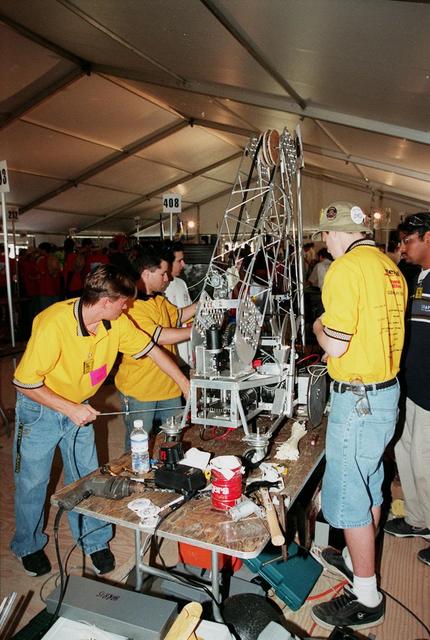
Voltage: The South Brevard FIRST Team (386) works on their robot, Sparky. The team of students from Eau Gallie, Satellite, Palm Bay, Melbourne, Bayside and Melbourne Central Catholic high schools was co-sponsored by Intersil Corp., Harris Corp., NASA Kennedy Space Center, Rockwell Collins and Interface & Control Systems, Inc. Students from all over the country are at the KSC Visitor Complex for the FIRST (For Inspiration and Recognition of Science and Technology) Southeast Regional competition March 9-11 in the Rocket Garden. Teams of high school students are testing the limits of their imagination using robots they have designed, with the support of business and engineering professionals and corporate sponsors, to compete in a technological battle against other schools' robots. Of the 30 high school teams competing, 16 are Florida teams co-sponsored by NASA and KSC contractors. Local high schools participating are Astronaut, Bayside, Cocoa Beach, Eau Gallie, Melbourne, Melbourne Central Catholic, Palm Bay, Rockledge, Satellite, and Titusville
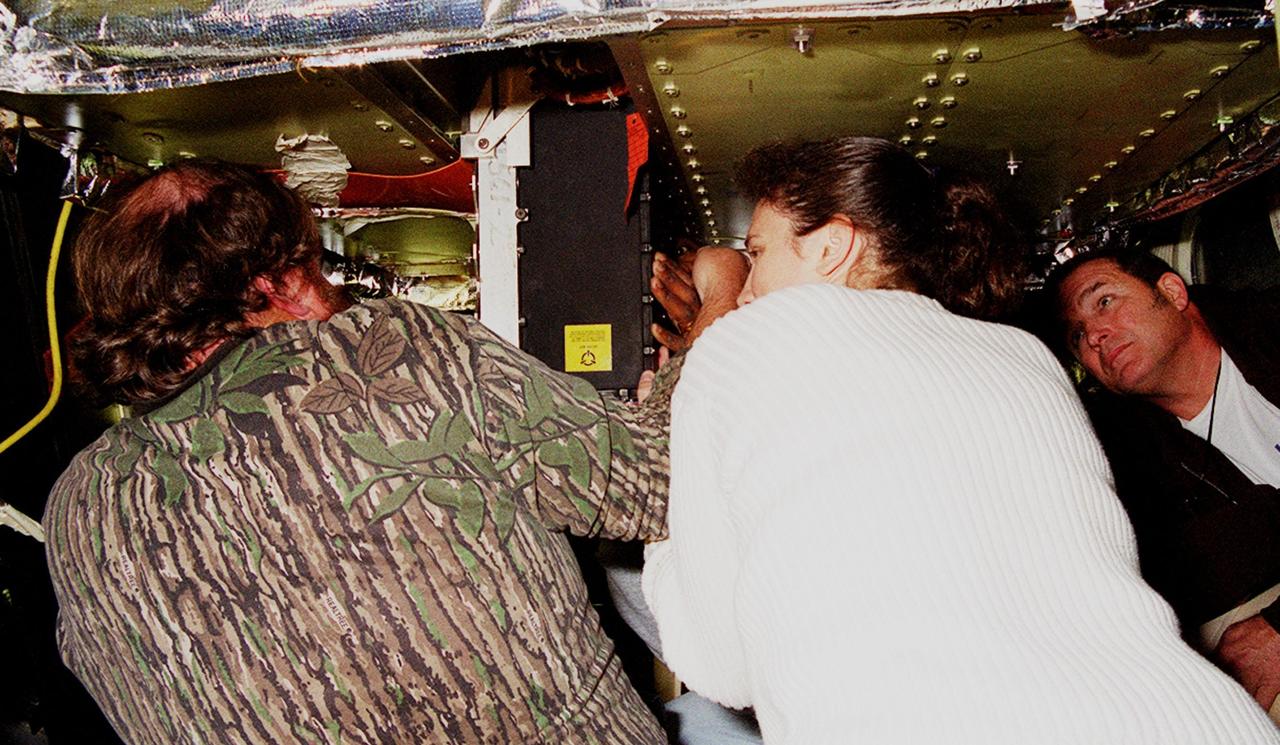
KENNEDY SPACE CENTER, FLA. -- Technicians remove a faulty Enhanced Main Events Controller (E-MEC) from Shuttle Endeavour at Launch Pad 39A. The E-MEC became suspect during the Jan. 31 launch countdown and mission STS-99 was delayed when NASA managers decided to replace it. Each Shuttle carries two enhanced master events controllers (E-MECs), which provide relays for onboard flight computers to send signals to arm and fire pyrotechnics that separate the solid rockets and external tank during assent. Both E-MECs are needed for the Shuttle to be cleared for flight. Currently Endeavour and Columbia are the only two orbiters with the E-MECs. Built by Rockwell's Satellite Space Electronics Division, Anaheim, Calif., each unit weighs 65 pounds and is approximately 20 inches long, 13 inches wide and 8 inches tall. Previously, three Shuttle flights have been scrubbed or delayed due to faulty MECs: STS-73, STS-49 and STS-41-D. The next scheduled date for launch of STS-99 is Feb. 11 at 12:30 p.m. EST
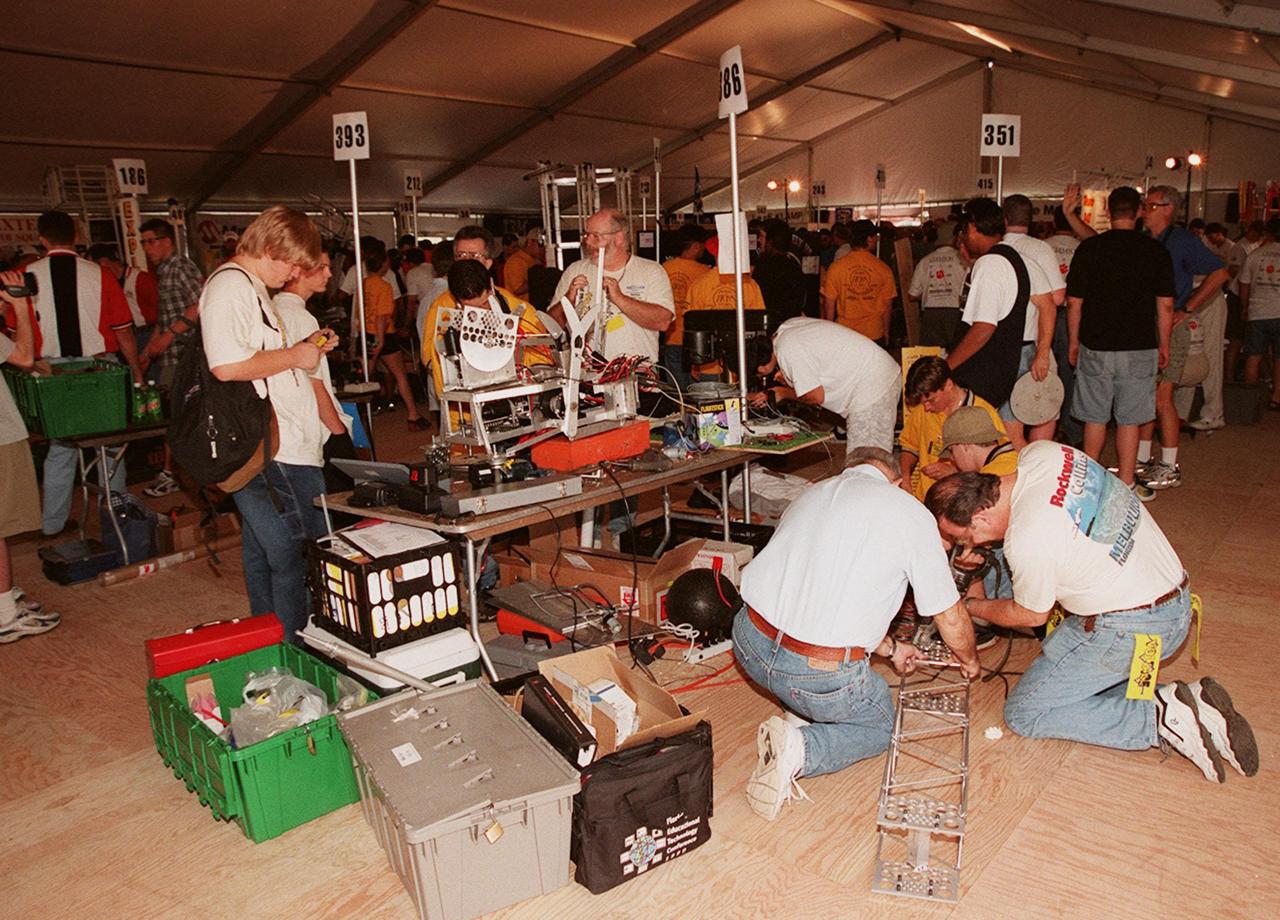
Team 393 from Morristown, Ind., sets up its robot on a table to prepare it for the FIRST (For Inspiration and Recognition of Science and Technology) Southeast Regional competition March 9-11 at the KSC Visitor Complex. KSC is co-sponsoring the team, The Bee Bots, from Morristown Junior and Senior High Schools. On the floor at right is team 386, known as Voltage: The South Brevard First Team. This team is made up of students from Eau Gallie, Satellite, Palm Bay, Melbourne, Bayside and Melbourne Central Catholic High Schools. They are sponsored by KSC as well as Harris Corp., Intersil Corp., Interface & Control Systems. Inc. and Rockwell Collins. Teams of high school students are testing the limits of their imagination using robots they have designed, with the support of business and engineering professionals and corporate sponsors, to compete in a technological battle against other schools' robots. Of the 30 high school teams competing at KSC, 16 are Florida teams co-sponsored by NASA and KSC contractors. Local high schools participating are Astronaut, Bayside, Cocoa Beach, Eau Gallie, Melbourne, Melbourne Central Catholic, Palm Bay, Rockledge, Satellite, and Titusville
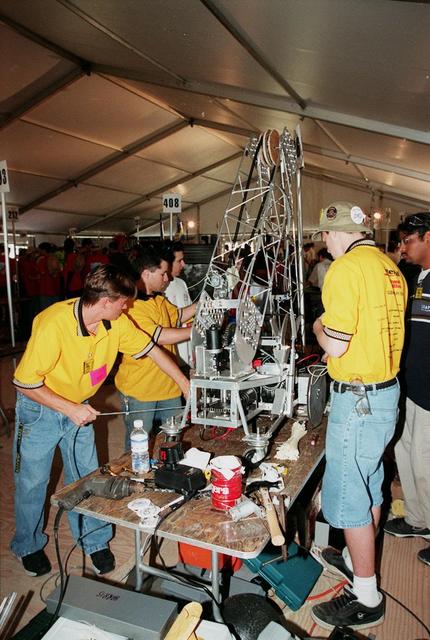
Voltage: The South Brevard FIRST Team (386) works on their robot, Sparky. The team of students from Eau Gallie, Satellite, Palm Bay, Melbourne, Bayside and Melbourne Central Catholic high schools was co-sponsored by Intersil Corp., Harris Corp., NASA Kennedy Space Center, Rockwell Collins and Interface & Control Systems, Inc. Students from all over the country are at the KSC Visitor Complex for the FIRST (For Inspiration and Recognition of Science and Technology) Southeast Regional competition March 9-11 in the Rocket Garden. Teams of high school students are testing the limits of their imagination using robots they have designed, with the support of business and engineering professionals and corporate sponsors, to compete in a technological battle against other schools' robots. Of the 30 high school teams competing, 16 are Florida teams co-sponsored by NASA and KSC contractors. Local high schools participating are Astronaut, Bayside, Cocoa Beach, Eau Gallie, Melbourne, Melbourne Central Catholic, Palm Bay, Rockledge, Satellite, and Titusville

KENNEDY SPACE CENTER, FLA. -- Workers in a Quality trailer in the Launch Pad 39B Area unwrap a new Enhanced Main Events Controller (E-MEC) to be installed in Shuttle Endeavour. The original E-MEC in Endeavour became suspect during the Jan. 31 launch countdown and mission STS-99 was delayed when NASA managers decided to replace it. Each Shuttle carries two enhanced master events controllers (E-MECs), which provide relays for onboard flight computers to send signals to arm and fire pyrotechnics that separate the solid rockets and external tank during assent. The E-MECs are located in the orbiter's aft compartment and both are needed for the Shuttle to be cleared for flight. Currently Endeavour and Columbia are the only two orbiters with the E-MECs. Built by Rockwell's Satellite Space Electronics Division, Anaheim, Calif., each unit weighs 65 pounds and is approximately 20 inches long, 13 inches wide and 8 inches tall. Previously, three Shuttle flights have been scrubbed or delayed due to faulty MECs: STS-73, STS-49 and STS-41-D. Before workers can begin E-MEC replacement efforts at the launch pad, cryogenic reactants must be offloaded from the orbiter and Space Shuttle ordnance disconnected. The next scheduled date for launch of STS-99 is Feb. 11 at 12:30 p.m. EST
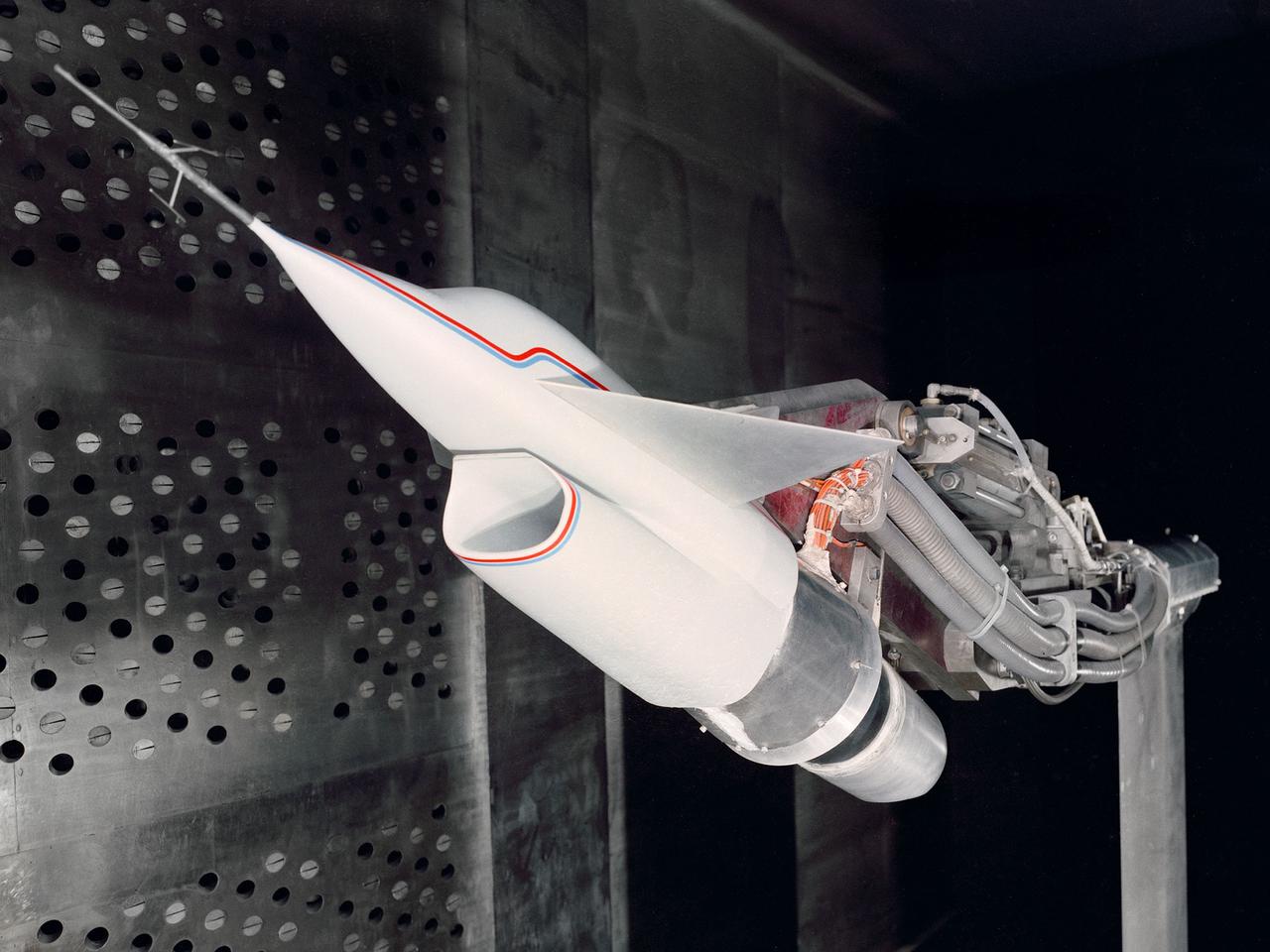
A Highly Maneuverable Aircraft Technology (HiMAT) inlet model installed in the test section of the 8- by 6-Foot Supersonic Wind Tunnel at the National Aeronautics and Space Administration (NASA) Lewis Research Center. Engineers at the Ames Research Center, Dryden Flight Research Center, and Rockwell International designed two pilotless subscale HiMAT vehicles in the mid-1970s to study new design concepts for fighter aircraft in the transonic realm without risking the lives of test pilots. The aircraft used sophisticated technologies such as advanced aerodynamics, composite materials, digital integrated propulsion control, and digital fly-by-wire control systems. In late 1977 NASA Lewis studied the HiMAT’s General Electric J85-21 jet engine in the Propulsion Systems Laboratory. The researchers charted the inlet quality with various combinations anti-distortion screens. HiMAT employed a relatively short and curved inlet compared to actual fighter jets. In the spring of 1979, Larry Smith led an in-depth analysis of the HiMAT inlet in the 8- by 6 tunnel. The researchers installed vortex generators to battle flow separation in the diffuser. The two HiMAT aircraft performed 11 hours of flying over the course of 26 missions from mid-1979 to January 1983 at Dryden and Ames. Although the HiMAT vehicles were considered to be overly complex and expensive, the program yielded a wealth of data that would validate computer-based design tools.
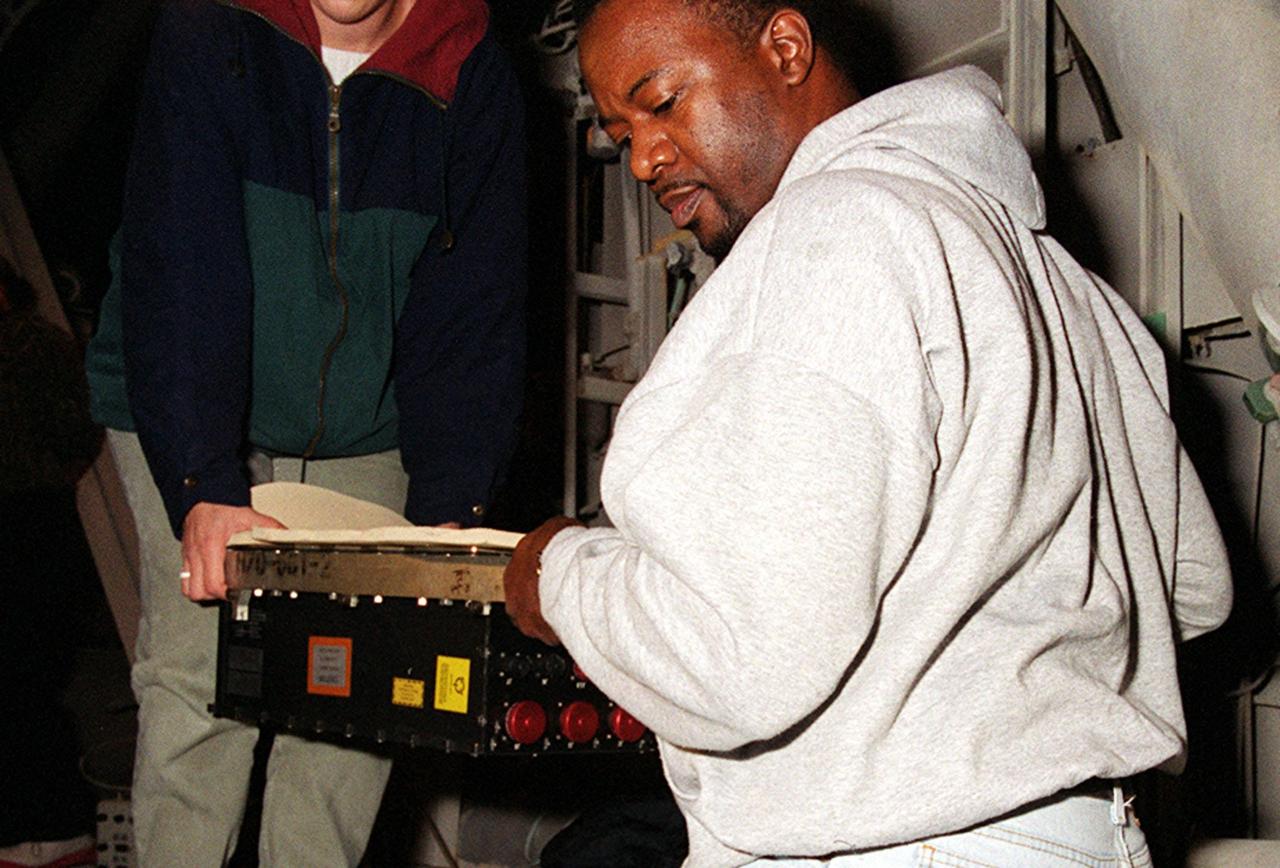
KENNEDY SPACE CENTER, FLA. -- Workers carry the replacement Enhanced Main Events Controller (E-MEC) to Shuttle Endeavour at Launch Pad 39A for installation in the aft compartment of the payload bay. The original E-MEC became suspect during the Jan. 31 launch countdown and mission STS-99 was delayed when NASA managers decided to replace it. Each Shuttle carries two enhanced master events controllers (E-MECs), which provide relays for onboard flight computers to send signals to arm and fire pyrotechnics that separate the solid rockets and external tank during assent. Both E-MECs are needed for the Shuttle to be cleared for flight. Currently Endeavour and Columbia are the only two orbiters with the E-MECs. Built by Rockwell's Satellite Space Electronics Division, Anaheim, Calif., each unit weighs 65 pounds and is approximately 20 inches long, 13 inches wide and 8 inches tall. Previously, three Shuttle flights have been scrubbed or delayed due to faulty MECs: STS-73, STS-49 and STS-41-D. The next scheduled date for launch of STS-99 is Feb. 11 at 12:30 p.m. EST

KENNEDY SPACE CENTER, FLA. -- Technicians work in the aft compartment of Shuttle Endeavour's payload bay, where a new Enhanced Main Events Controller (E-MEC) will be installed. The original E-MEC in Endeavour became suspect during the Jan. 31 launch countdown and mission STS-99 was delayed when NASA managers decided to replace it. Each Shuttle carries two enhanced master events controllers (E-MECs), which provide relays for onboard flight computers to send signals to arm and fire pyrotechnics that separate the solid rockets and external tank during assent. Both E-MECs are needed for the Shuttle to be cleared for flight. Currently Endeavour and Columbia are the only two orbiters with the E-MECs. Built by Rockwell's Satellite Space Electronics Division, Anaheim, Calif., each unit weighs 65 pounds and is approximately 20 inches long, 13 inches wide and 8 inches tall. Previously, three Shuttle flights have been scrubbed or delayed due to faulty MECs: STS-73, STS-49 and STS-41-D. Before workers can begin E-MEC replacement efforts at the launch pad, cryogenic reactants had to be offloaded from the orbiter and Space Shuttle ordnance disconnected. The next scheduled date for launch of STS-99 is Feb. 11 at 12:30 p.m. EST
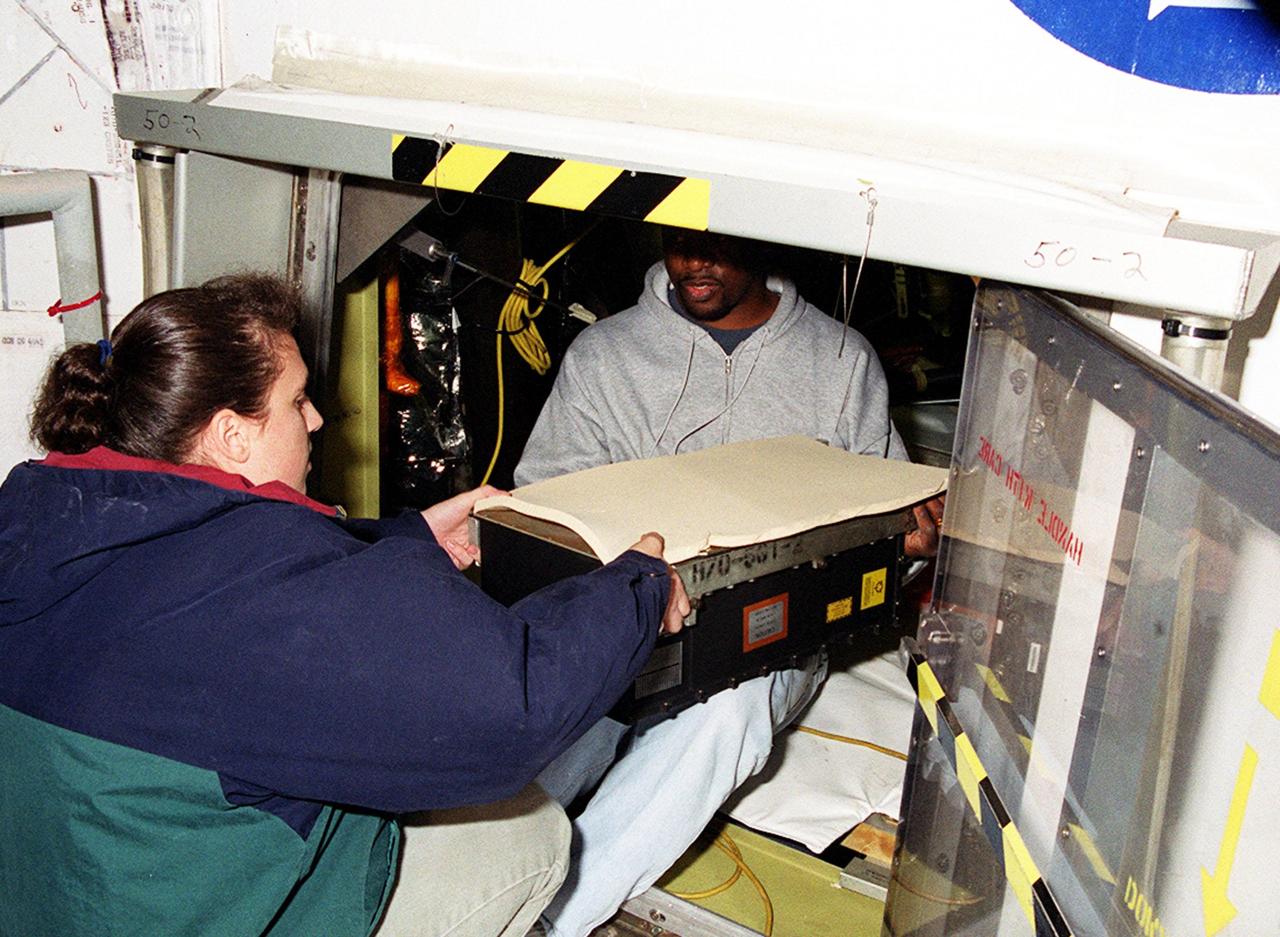
KENNEDY SPACE CENTER, FLA. -- At Launch Pad 39A, workers move the replacement Enhanced Main Events Controller (E-MEC) into Shuttle Endeavour's aft compartment in the payload bay. The original E-MEC became suspect during the Jan. 31 launch countdown and mission STS-99 was delayed when NASA managers decided to replace it. Each Shuttle carries two enhanced master events controllers (E-MECs), which provide relays for onboard flight computers to send signals to arm and fire pyrotechnics that separate the solid rockets and external tank during assent. Both E-MECs are needed for the Shuttle to be cleared for flight. Currently Endeavour and Columbia are the only two orbiters with the E-MECs. Built by Rockwell's Satellite Space Electronics Division, Anaheim, Calif., each unit weighs 65 pounds and is approximately 20 inches long, 13 inches wide and 8 inches tall. Previously, three Shuttle flights have been scrubbed or delayed due to faulty MECs: STS-73, STS-49 and STS-41-D. The next scheduled date for launch of STS-99 is Feb. 11 at 12:30 p.m. EST
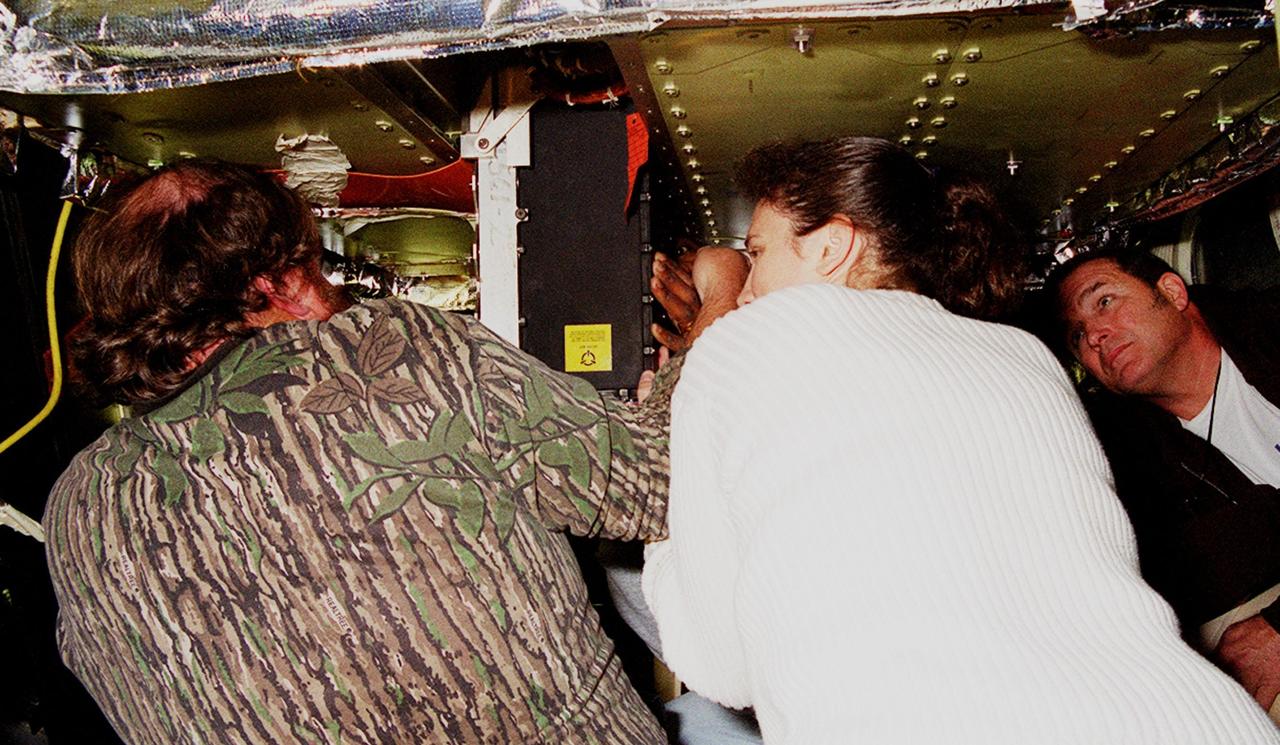
KENNEDY SPACE CENTER, FLA. -- Technicians remove a faulty Enhanced Main Events Controller (E-MEC) from Shuttle Endeavour at Launch Pad 39A. The E-MEC became suspect during the Jan. 31 launch countdown and mission STS-99 was delayed when NASA managers decided to replace it. Each Shuttle carries two enhanced master events controllers (E-MECs), which provide relays for onboard flight computers to send signals to arm and fire pyrotechnics that separate the solid rockets and external tank during assent. Both E-MECs are needed for the Shuttle to be cleared for flight. Currently Endeavour and Columbia are the only two orbiters with the E-MECs. Built by Rockwell's Satellite Space Electronics Division, Anaheim, Calif., each unit weighs 65 pounds and is approximately 20 inches long, 13 inches wide and 8 inches tall. Previously, three Shuttle flights have been scrubbed or delayed due to faulty MECs: STS-73, STS-49 and STS-41-D. The next scheduled date for launch of STS-99 is Feb. 11 at 12:30 p.m. EST
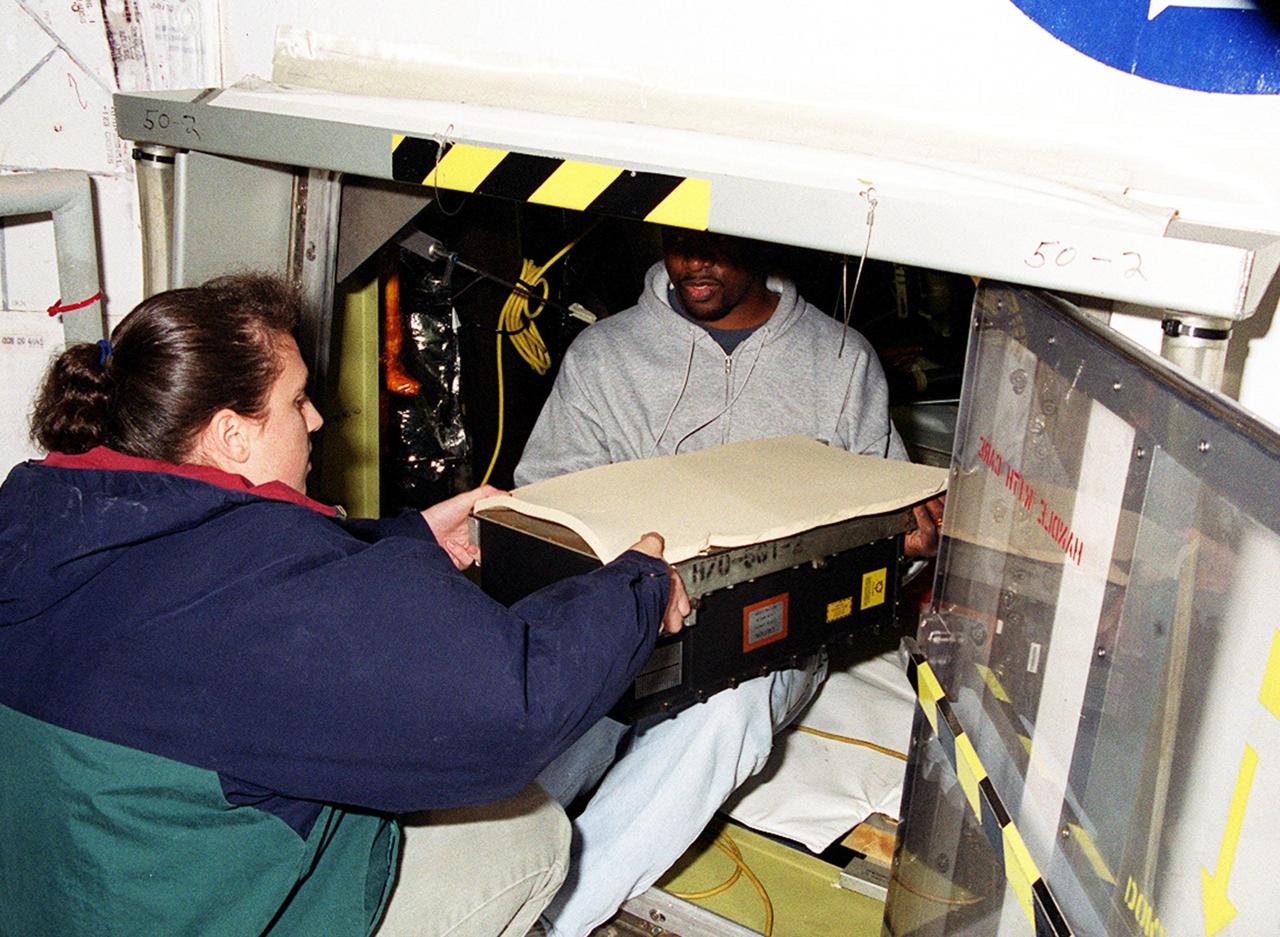
KENNEDY SPACE CENTER, FLA. -- At Launch Pad 39A, workers move the replacement Enhanced Main Events Controller (E-MEC) into Shuttle Endeavour's aft compartment in the payload bay. The original E-MEC became suspect during the Jan. 31 launch countdown and mission STS-99 was delayed when NASA managers decided to replace it. Each Shuttle carries two enhanced master events controllers (E-MECs), which provide relays for onboard flight computers to send signals to arm and fire pyrotechnics that separate the solid rockets and external tank during assent. Both E-MECs are needed for the Shuttle to be cleared for flight. Currently Endeavour and Columbia are the only two orbiters with the E-MECs. Built by Rockwell's Satellite Space Electronics Division, Anaheim, Calif., each unit weighs 65 pounds and is approximately 20 inches long, 13 inches wide and 8 inches tall. Previously, three Shuttle flights have been scrubbed or delayed due to faulty MECs: STS-73, STS-49 and STS-41-D. The next scheduled date for launch of STS-99 is Feb. 11 at 12:30 p.m. EST
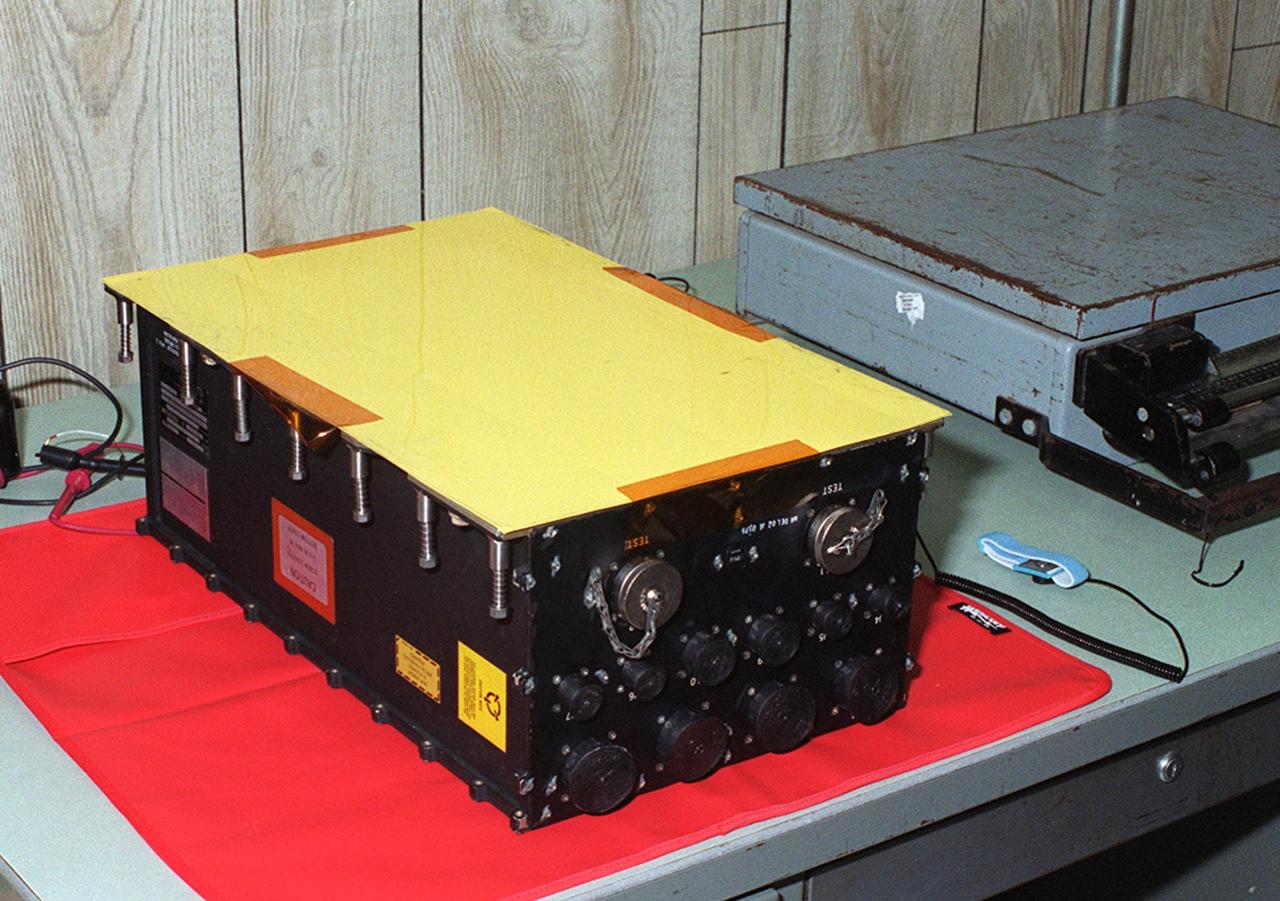
KENNEDY SPACE CENTER, FLA. -- A new Enhanced Main Events Controller (E-MEC) for Shuttle Endeavour sits on a table in a Quality trailer in the Launch Pad 39B area. The original E-MEC in Endeavour became suspect during the Jan. 31 launch countdown and mission STS-99 was delayed when NASA managers decided to replace it. Each Shuttle carries two enhanced master events controllers (E-MECs), which provide relays for onboard flight computers to send signals to arm and fire pyrotechnics that separate the solid rockets and external tank during assent. The E-MECs are located in the orbiter's aft compartment and both are needed for the Shuttle to be cleared for flight. Currently Endeavour and Columbia are the only two orbiters with the E-MECs. Built by Rockwell's Satellite Space Electronics Division, Anaheim, Calif., each unit weighs 65 pounds and is approximately 20 inches long, 13 inches wide and 8 inches tall. Previously, three Shuttle flights have been scrubbed or delayed due to faulty MECs: STS-73, STS-49 and STS-41-D. Before workers can begin E-MEC replacement efforts at the launch pad, cryogenic reactants must be offloaded from the orbiter and Space Shuttle ordnance disconnected. The next scheduled date for launch of STS-99 is Feb. 11 at 12:30 p.m. EST
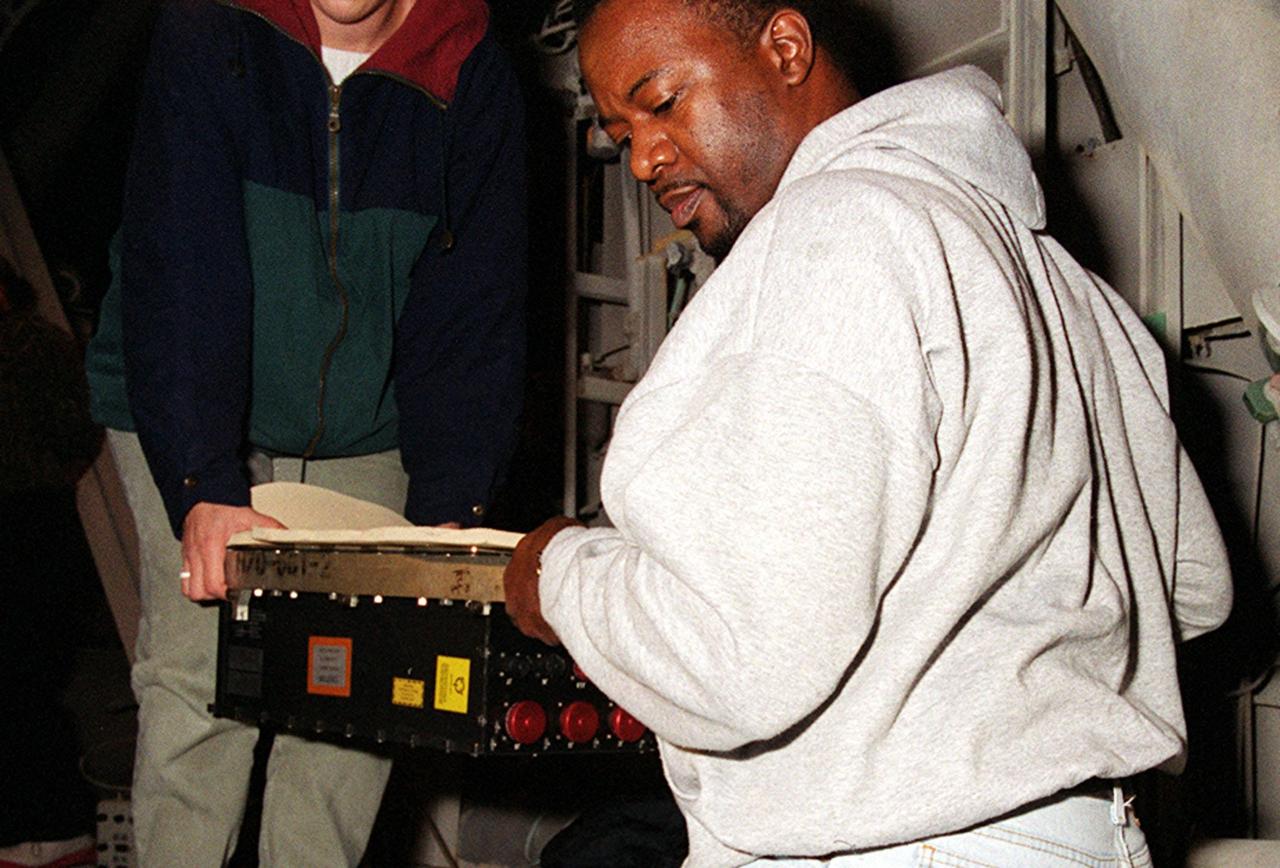
KENNEDY SPACE CENTER, FLA. -- Workers carry the replacement Enhanced Main Events Controller (E-MEC) to Shuttle Endeavour at Launch Pad 39A for installation in the aft compartment of the payload bay. The original E-MEC became suspect during the Jan. 31 launch countdown and mission STS-99 was delayed when NASA managers decided to replace it. Each Shuttle carries two enhanced master events controllers (E-MECs), which provide relays for onboard flight computers to send signals to arm and fire pyrotechnics that separate the solid rockets and external tank during assent. Both E-MECs are needed for the Shuttle to be cleared for flight. Currently Endeavour and Columbia are the only two orbiters with the E-MECs. Built by Rockwell's Satellite Space Electronics Division, Anaheim, Calif., each unit weighs 65 pounds and is approximately 20 inches long, 13 inches wide and 8 inches tall. Previously, three Shuttle flights have been scrubbed or delayed due to faulty MECs: STS-73, STS-49 and STS-41-D. The next scheduled date for launch of STS-99 is Feb. 11 at 12:30 p.m. EST
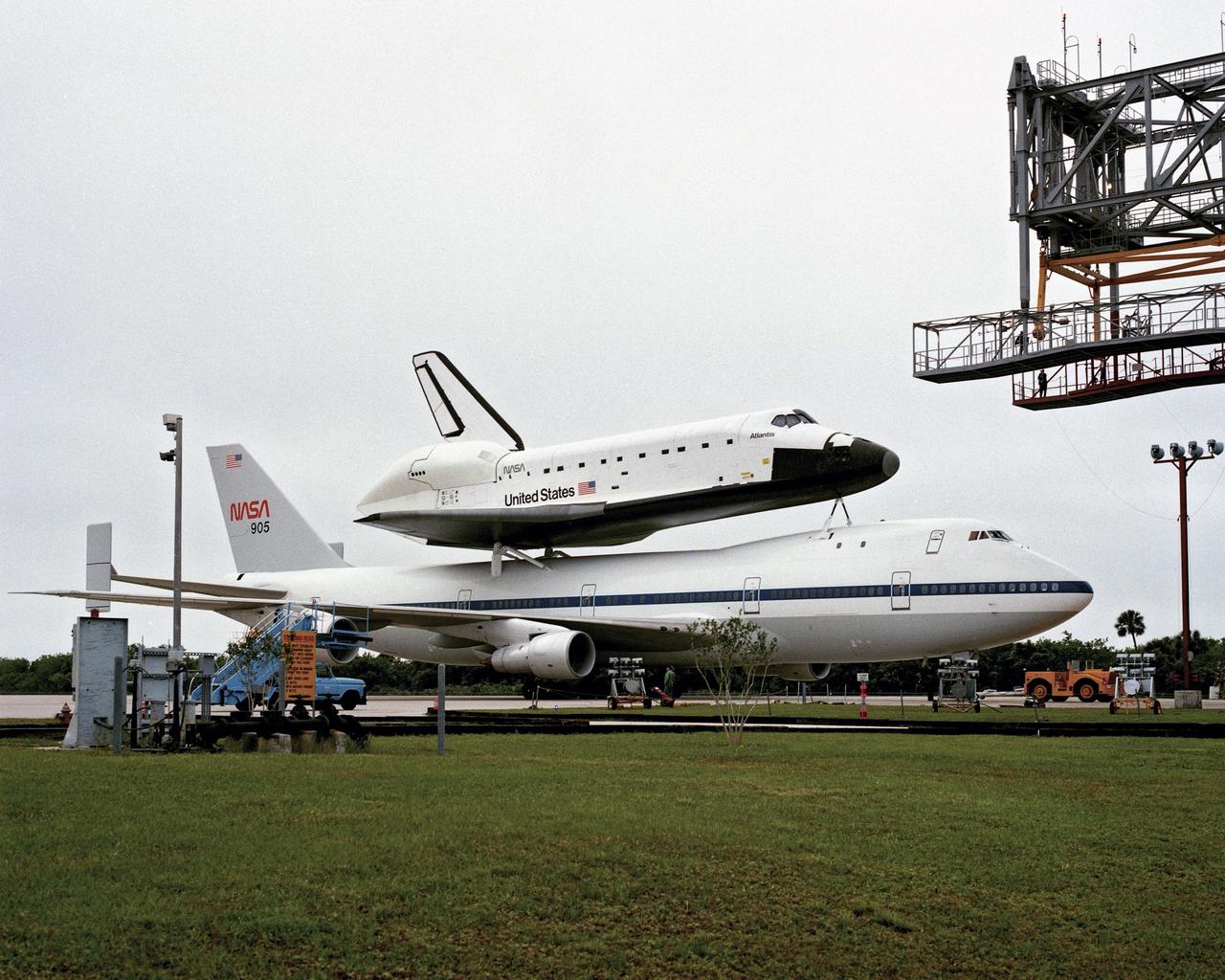
CAPE CANAVERAL, Fla. – At the Kennedy Space Center in Florida, the new space shuttle, Atlantis, arrives at the Shuttle Landing Facility. The shuttle is mounted atop the Shuttle Carrier Aircraft, a modified Boeing 747. Over the next seven months Atlantis will be prepared for its maiden voyage, STS-51J. Atlantis, NASA's fourth space-rated shuttle, was named after the two-masted boat that served as the primary research vessel for the Woods Hole Oceanographic Institute in Massachusetts from 1930 to 1966. The boat had a 17-member crew and accommodated up to five scientists who worked in two onboard laboratories, examining water samples and marine life. Like its predecessors, Atlantis was constructed by Rockwell International in Palmdale, Calif. The spacecraft was transported over land from Palmdale to Edwards Air Force Base on April 3, 1985 for the cross-country ferry flight to Kennedy. For more: http://www.nasa.gov/centers/kennedy/shuttleoperations/orbiters/atlantis-info.html Photo credit: NASA/Louie Rochefort
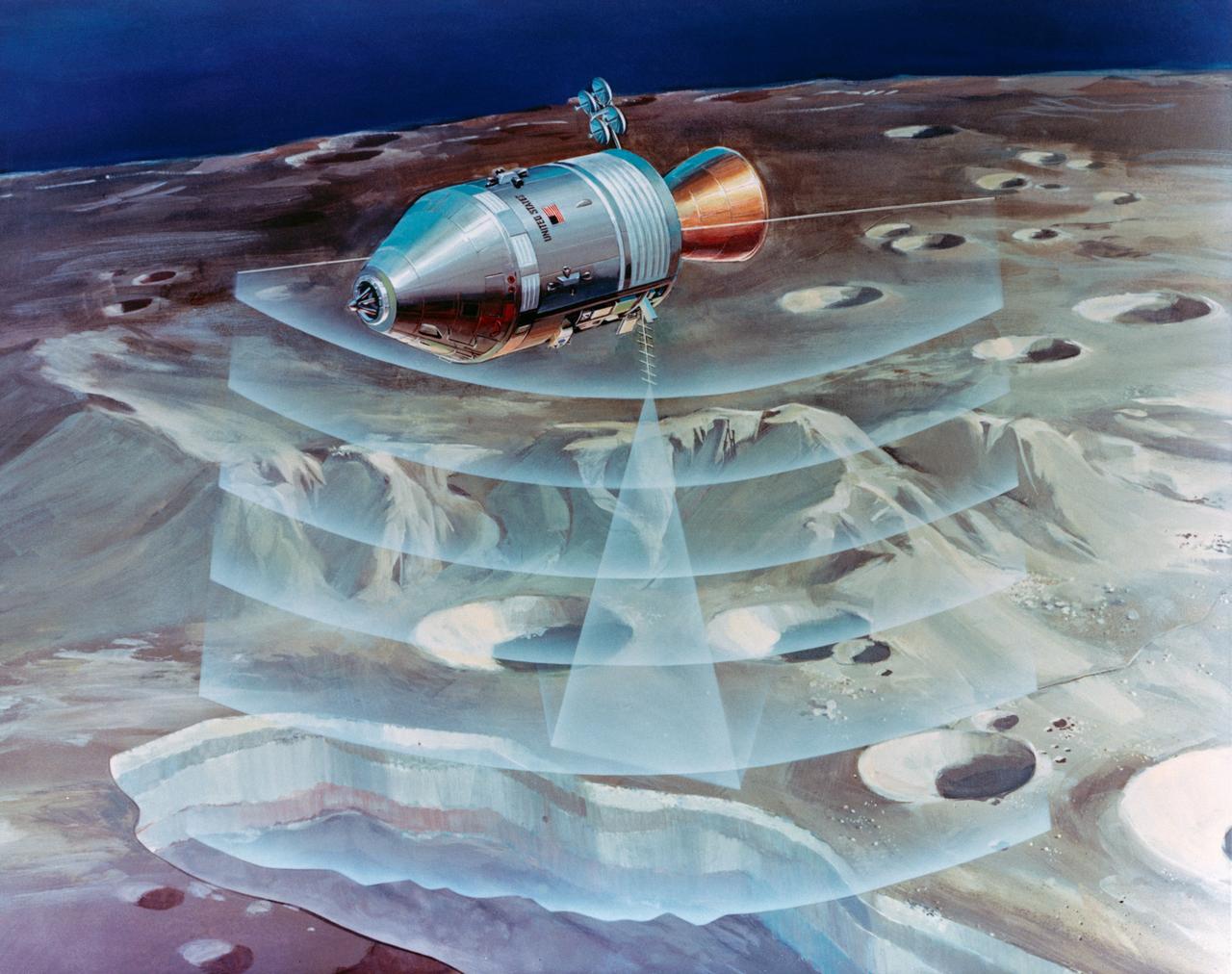
S72-53472 (November 1972) --- An artist's concept illustrating how radar beams of the Apollo 17 lunar sounder experiment will probe three-quarters of a mile below the moon's surface from the orbiting spacecraft. The Lunar Sounder will be mounted in the SIM bay of the Apollo 17 Service Module. Electronic data recorded on film will be retrieved by the crew during trans-Earth EVA. Geologic information on the lunar interior obtained by the sounder will permit scientific investigation of underground rock layers, lava flow patterns, rille (canyon) structures, mascon properties, and any areas containing water. A prototype lunar sounder has been flight tested in aircraft over selected Earth sites to confirm the equipment design and develop scientific analysis techniques. The Lunar Sounder Experiment (S-209) was developed by North American Rockwell's (NR) Space Division for NASA's Manned Spacecraft Center to provide data for a scientific investigation team with representatives from the Jet Propulsion Laboratory, University of Utah, University of Michigan, U.S. Geological Survey, and NASA Ames Research Center.
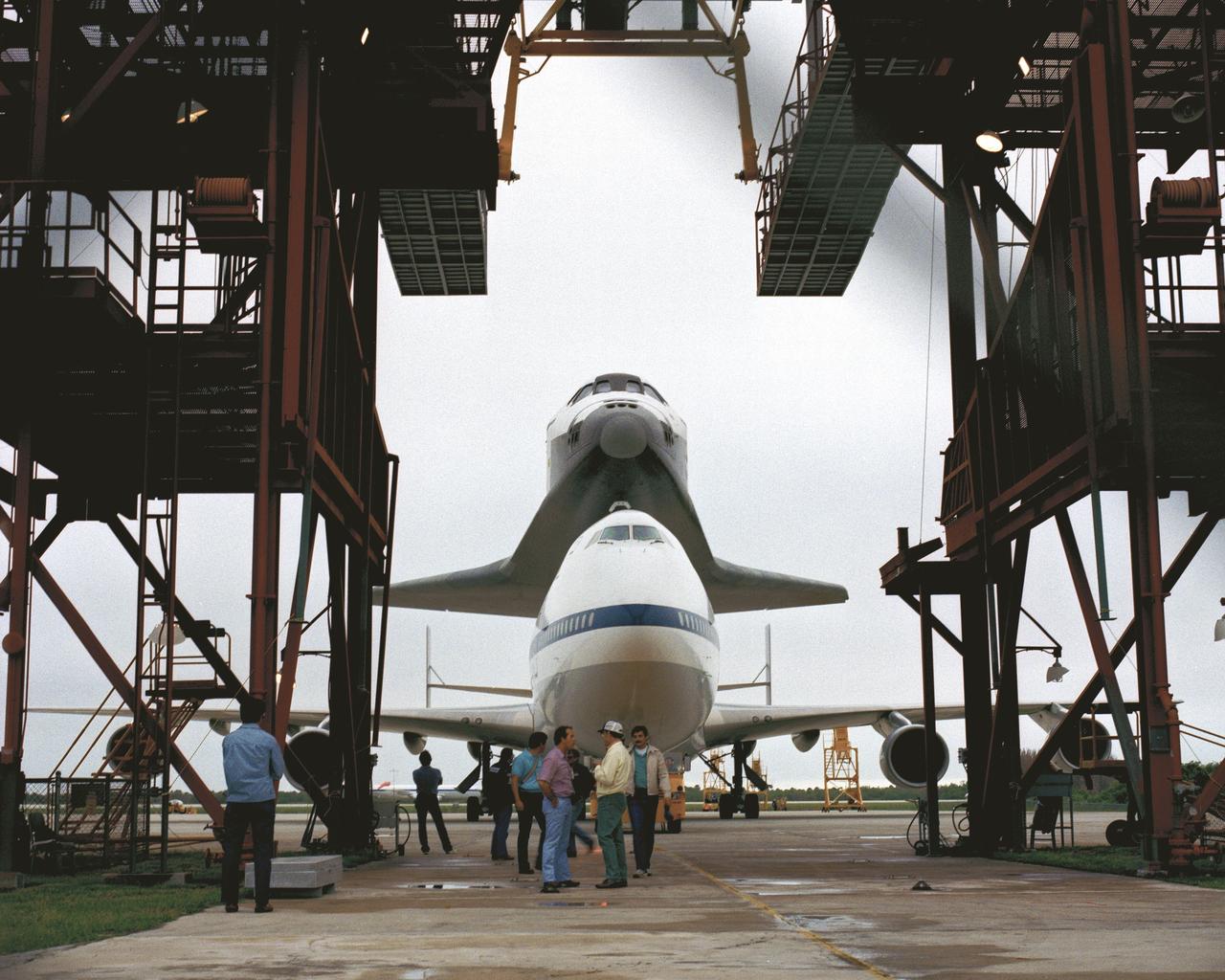
CAPE CANAVERAL, Fla. – At the Kennedy Space Center in Florida, the new space shuttle, Atlantis, arrives at the Shuttle Landing Facility. The shuttle is mounted atop the Shuttle Carrier Aircraft, a modified Boeing 747. Over the next seven months Atlantis will be prepared for its maiden voyage, STS-51J. Atlantis, NASA's fourth space-rated shuttle, was named after the two-masted boat that served as the primary research vessel for the Woods Hole Oceanographic Institute in Massachusetts from 1930 to 1966. The boat had a 17-member crew and accommodated up to five scientists who worked in two onboard laboratories, examining water samples and marine life. Like its predecessors, Atlantis was constructed by Rockwell International in Palmdale, Calif. The spacecraft was transported over land from Palmdale to Edwards Air Force Base on April 3, 1985 for the cross-country ferry flight to Kennedy. For more: http://www.nasa.gov/centers/kennedy/shuttleoperations/orbiters/atlantis-info.html Photo credit: NASA/Louie Rochefort
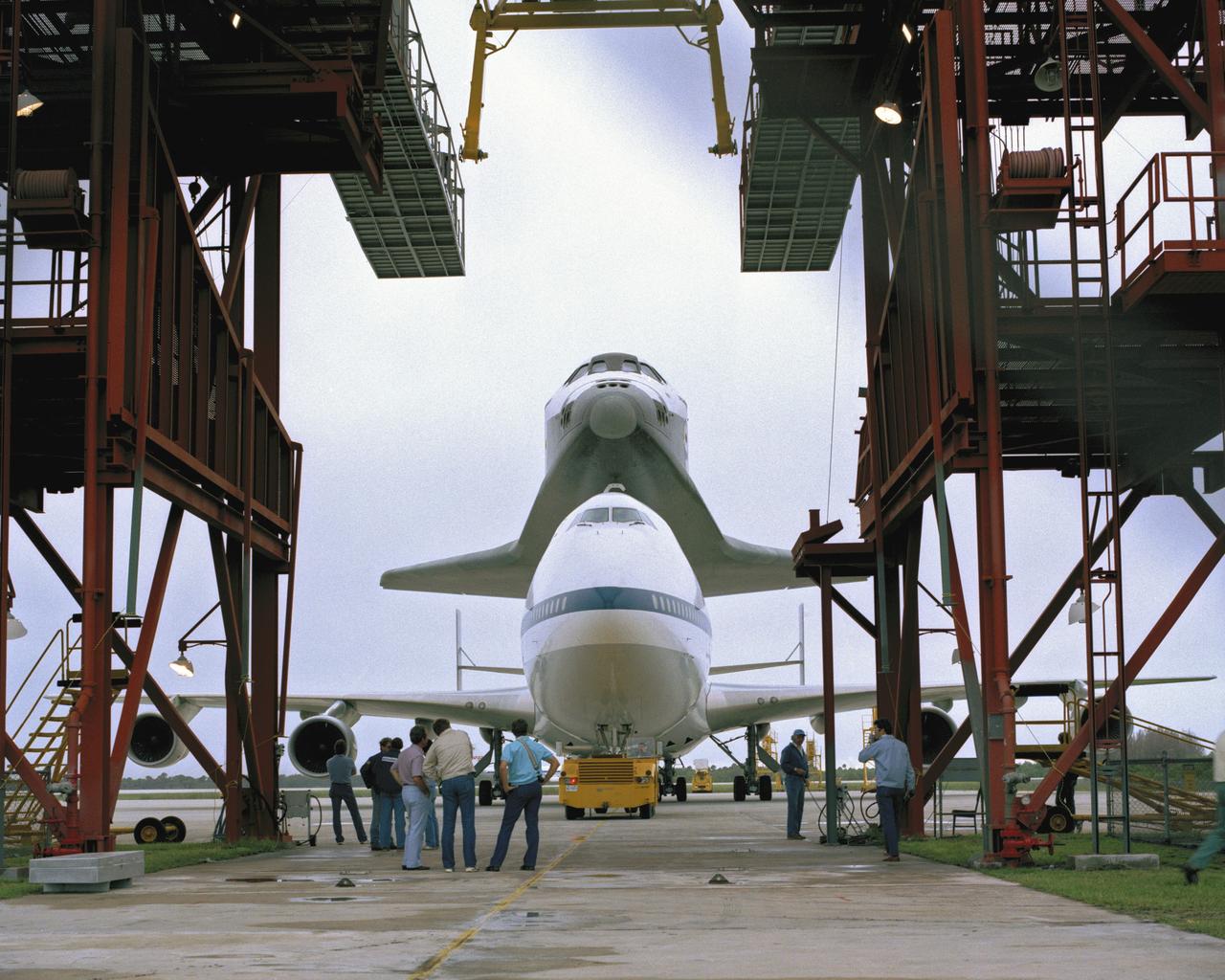
CAPE CANAVERAL, Fla. – At the Kennedy Space Center in Florida, the new space shuttle, Atlantis, arrives at the Shuttle Landing Facility. The shuttle is mounted atop the Shuttle Carrier Aircraft, a modified Boeing 747. Over the next seven months Atlantis will be prepared for its maiden voyage, STS-51J. Atlantis, NASA's fourth space-rated shuttle, was named after the two-masted boat that served as the primary research vessel for the Woods Hole Oceanographic Institute in Massachusetts from 1930 to 1966. The boat had a 17-member crew and accommodated up to five scientists who worked in two onboard laboratories, examining water samples and marine life. Like its predecessors, Atlantis was constructed by Rockwell International in Palmdale, Calif. The spacecraft was transported over land from Palmdale to Edwards Air Force Base on April 3, 1985 for the cross-country ferry flight to Kennedy. For more: http://www.nasa.gov/centers/kennedy/shuttleoperations/orbiters/atlantis-info.html Photo credit: NASA/Louie Rochefort
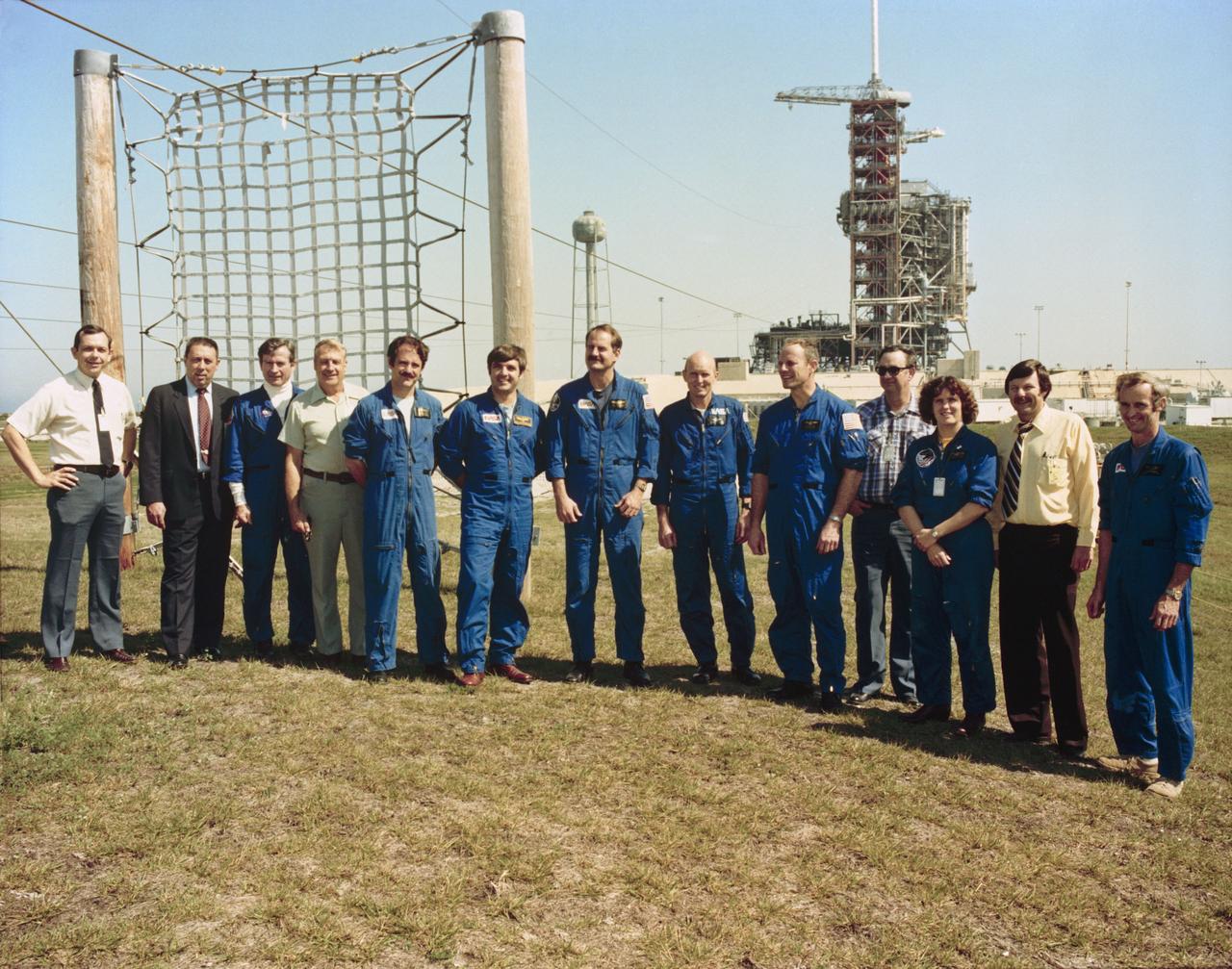
S82-28457 (19 Feb. 1982) --- Member of the JSC astronaut corps., STS-3 vehicle integration test (VIT) team and other personnel pose for a photograph at the completion of a countdown demonstration test (CDDT) and safety briefings at Launch Pad 39A, Kennedy Space Center (KSC). Participants are, from the left, Wilbur J. Etbauer, engineer with the VIT team; George W. S. Abbey, director of flight operations at JSC; astronaut John W. Young, chief of the astronaut office at JSC; Jack Fleming of Rockwell International; mission specialist-astronaut John M. Lounge; astronaut Daniel C. Brandenstein; mission specialist-astronaut James D. Van Hoften; astronauts C. Gordon Fullerton and Jack Lousma, prime crew for STS-3; Olan J. Bertrand, VIT team member; mission specialist-astronaut Kathryn D. Sullivan; Richard W. Nygren, head of the VIT team; and astronaut Donald E. Williams. The space shuttle Columbia is obscured by its service structure on Launch Pad 39A in the background. Part of slide-wire type emergency escape system is visible in the picture. Photo credit: NASA
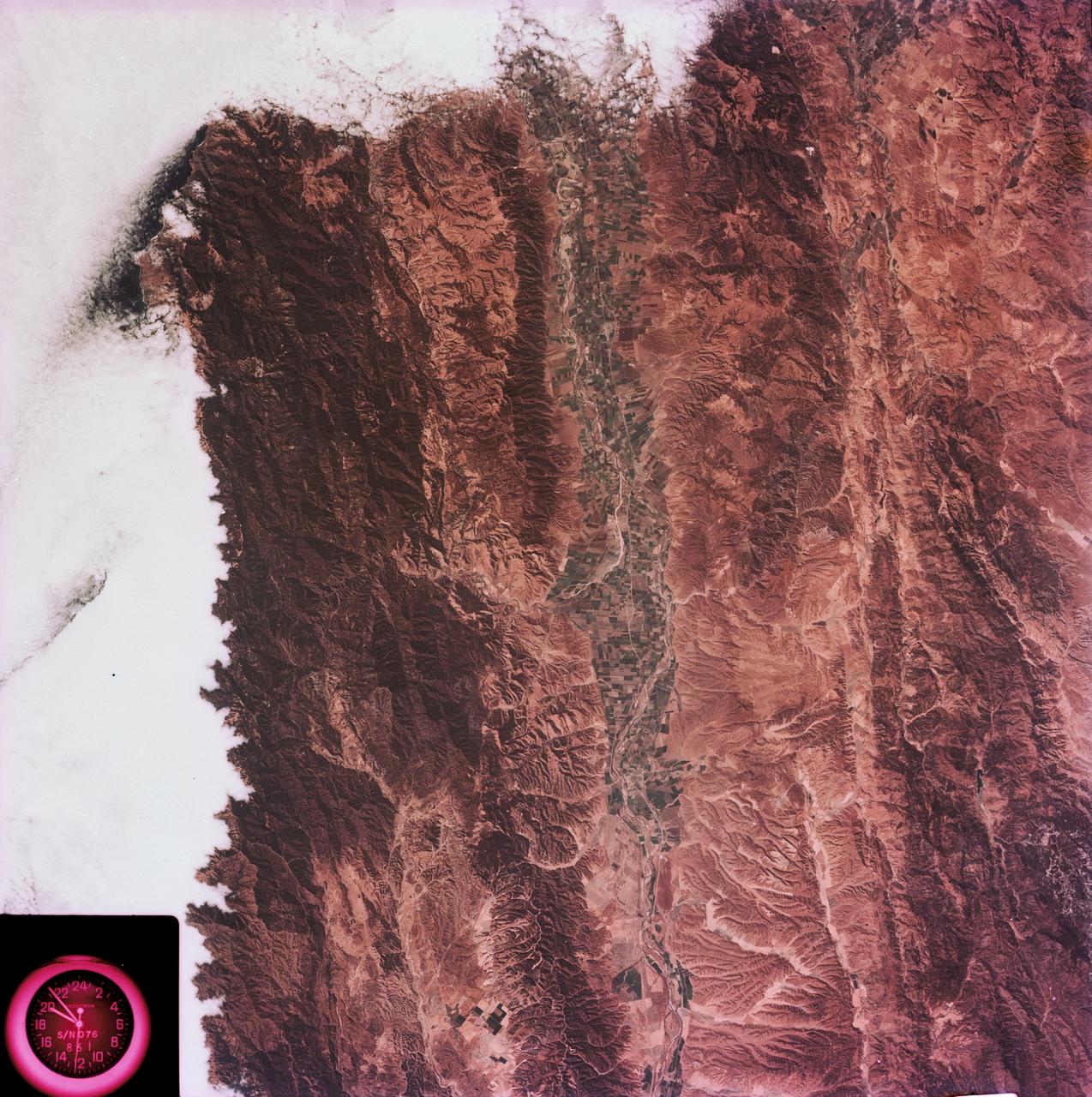
SL3-88-004 (July-September 1973) --- A vertical view of the Salinas River Valley area south of Monterey Bay, California area is seen in this Skylab 3 Earth Resources Experiments Package S190-B (five-inch Earth terrain camera) photograph taken from the Skylab space station in Earth orbit. The valley is an irrigated agricultural area, and is indicated by the dark-green and light-gray rectangular patterns in the centre of the picture. The city of Salinas is barely visible under the cloud cover at the top (north) end of the valley. The dark mass on the left (west) side of the valley is the Santa Lucia mountain range. The Big Sur area is on the left and partly covered by clouds. The Diablo Range forms the dark mass in the lower right (southeast) corner of the photograph. The town of Hollister is the gray area in the dark-green rectangular farm tracts which occupy the floor of the San Benito Valley in the upper right (northeast) corner of the photograph. The Salinas River flows northwestward toward Monterey Bay. The towns of Soledad, Greenfield and King City appear as gray areas along U.S. 101 in the Salinas Valley. The geology of the area is complex, and has been racked by several earthquakes resulting from movement along the San Andreas and subsidiary faults. Here, the surface expression of the San Andreas Fault can be traced from a point just west of Hollister at the contrast of dark brown and tan to a point about one inch left of the lower right (southeast) corner of the picture. Subsidiary faults are indicated by the curving trend of the rocks along the right side. The photograph will provide detailed information on land use patterns (Dr. R. Colwell, University of California, Berkeley) and fault tectonics (Dr. P. Merifield, Earth Science Res., Inc. and Dr. M. Abdel-Gawad, Rockwell International). Federal agencies participating with NASA on the EREP project are the Departments of Agriculture, Commerce, Interior, the Environmental Protection Agency and the Corps of Engineers. All EREP photography is available to the public through the Department of Interior’s Earth Resources Observations Systems Data Center, Sioux Falls, South Dakota, 57198. Photo credit: NASA
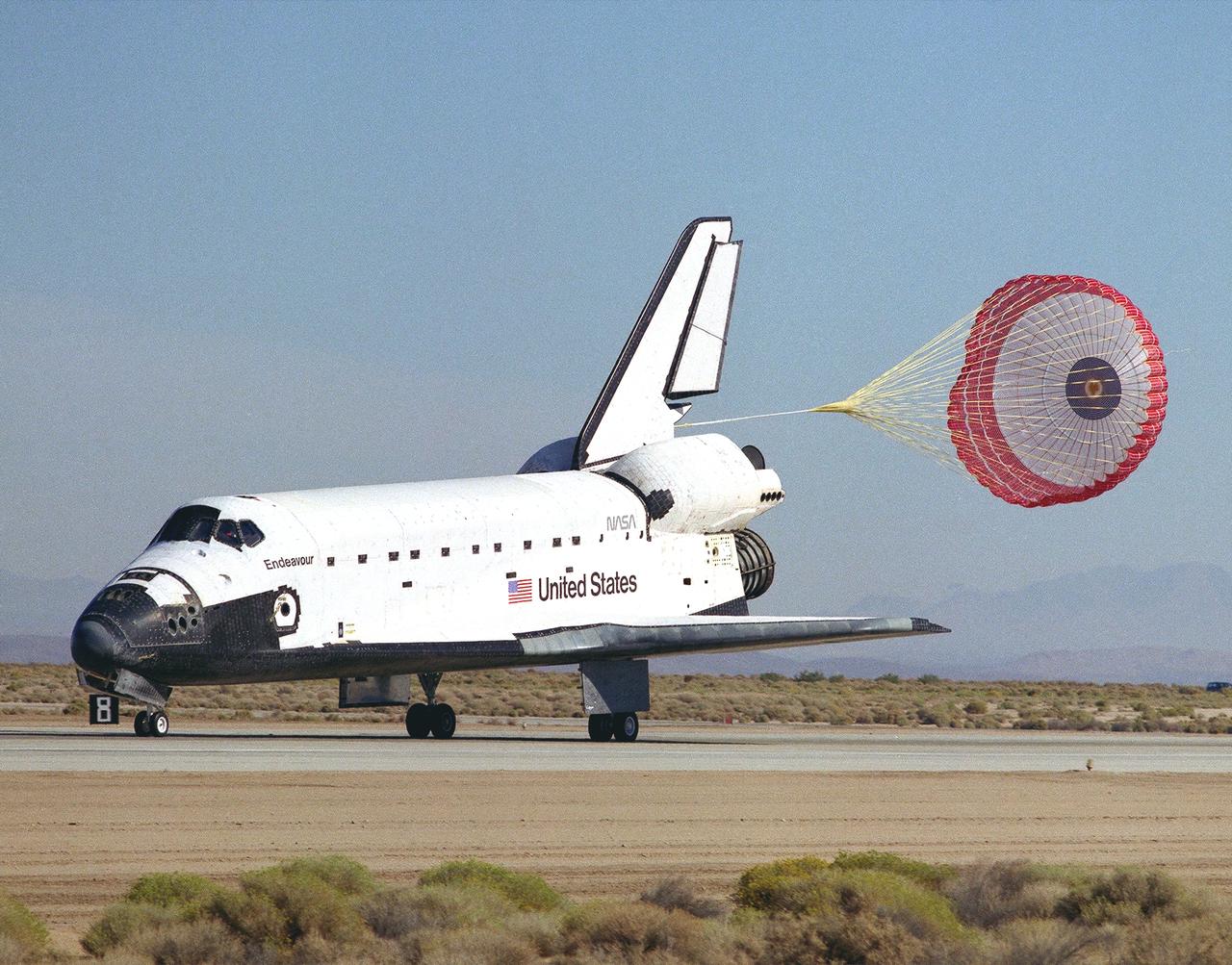
A drag chute slows the shuttle Endeavour after landing on runway 22 at Edwards, California, to complete the highly successful STS-68 mission dedicated to radar imaging of the earth's surface as part of NASA's Mission To Planet Earth program. The landing was at 10:02 a.m. (PDT) 11 October 1994, after waiving off from the Kennedy Space Center, Florida, earlier that morning due to adverse weather at Kennedy. The Endeavour crew was originally scheduled to land at Kennedy the morning of 10 October, but mission planners decided early in the flight to extend the mission by one day. Mission commander was Michael A. Baker and the pilot was Terrence W. Wilcutt. The four mission specialists were Thomas D. Jones, payload; Steven L. Smith; Daniel W. Bursch; and Peter J.K. Wisoff.

The space shuttle Atlantis atop NASA's 747 Shuttle Carrier Aircraft (SCA) during takeoff for a return ferry flight to the Kennedy Space Center from Edwards, California. The STS-66 mission was dedicated to the third flight of the Atmospheric Laboratory for Applications and Science-3 (ATLAS-3), part of NASA's Mission to Planet Earth program. The astronauts also deployed and retrieved a free-flying satellite designed to study the middle and lower thermospheres and perform a series of experiments covering life sciences research and microgravity processing. The landing was at 7:34 a.m. (PST) 14 November 1994, after being waved off from the Kennedy Space Center, Florida, due to adverse weather.
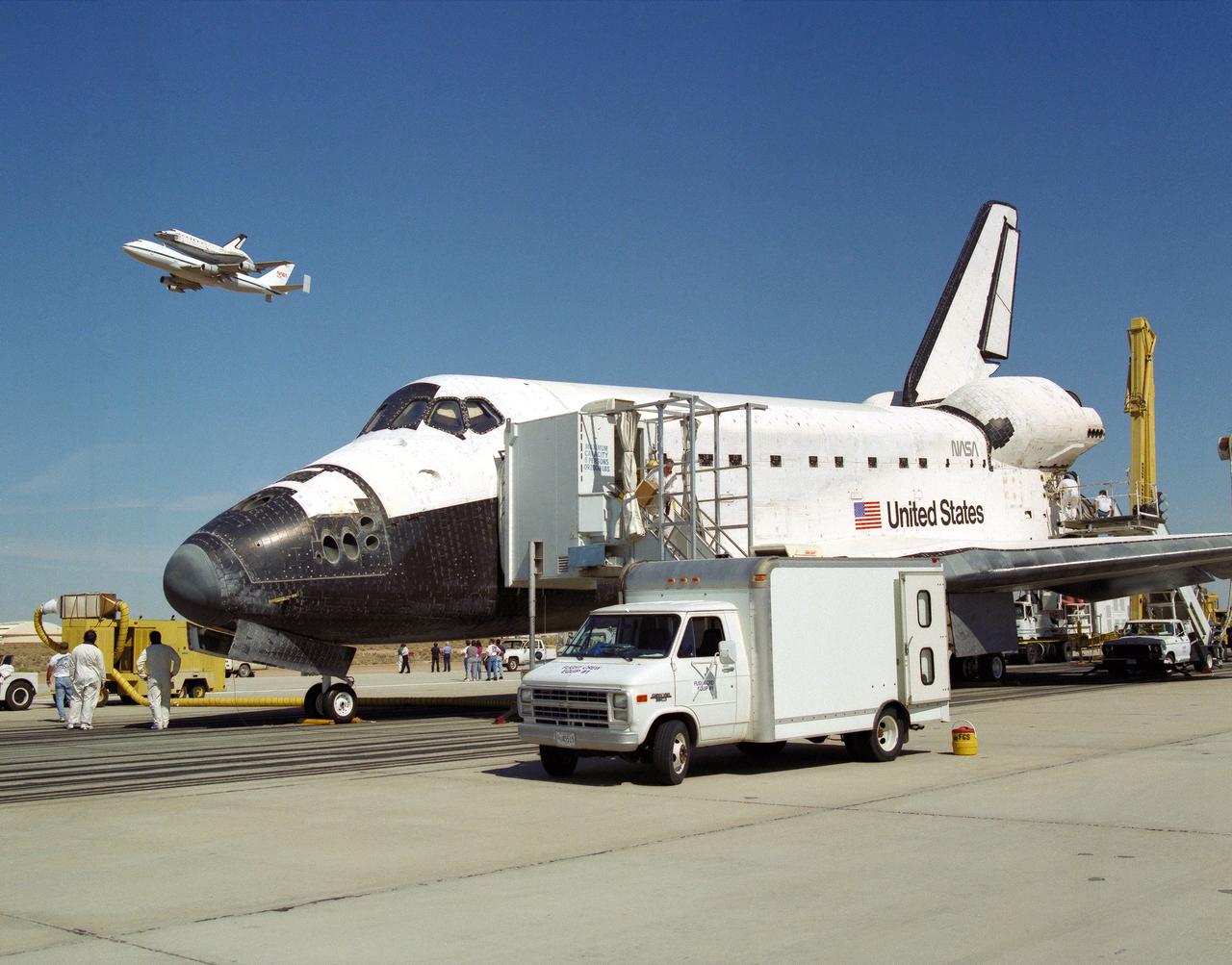
The space shuttle Endeavour receives a high-flying salute from its sister shuttle, Columbia, atop NASA's Shuttle Carrier Aircraft, shortly after Endeavor’s landing 11 October 1994, at Edwards, California, to complete mission STS-68. Columbia was being ferried from the Kennedy Space Center, Florida, to Air Force Plant 42, Palmdale, California, where it will undergo six months of inspections, modifications, and systems upgrades. The STS-68 11-day mission was devoted to radar imaging of Earth's geological features with the Space Radar Laboratory. The orbiter is surrounded by equipment and personnel that make up the ground support convoy that services the space vehicles as soon as they land.

The Space Shuttle Enterprise, the nation's prototype space shuttle orbiter, before departing NASA's Dryden Flight Research Center, Edwards, California, at 11:00 a.m., 16 May 1983, on the first leg of its trek to the Paris Air Show at Le Bourget Airport, Paris, France. Seen here atop the huge 747 Shuttle Carrier Aircraft (SCA), the first stop for the Enterprise was Peterson AFB, Colorado Springs, Colorado. Piloting the 747 on the Europe trip were Joe Algranti, Johnson Space Center Chief Pilot, Astronaut Dick Scobee, and NASA Dryden Chief Pilot Tom McMurtry. Flight engineers for that portion of the flight were Dryden's Ray Young and Johnson Space Center's Skip Guidry. The Enterprise, named after the spacecraft of Star Trek fame, was originally carried and launched by the 747 during the Approach and Landing Tests (ALT) at Dryden Flight Research Center.