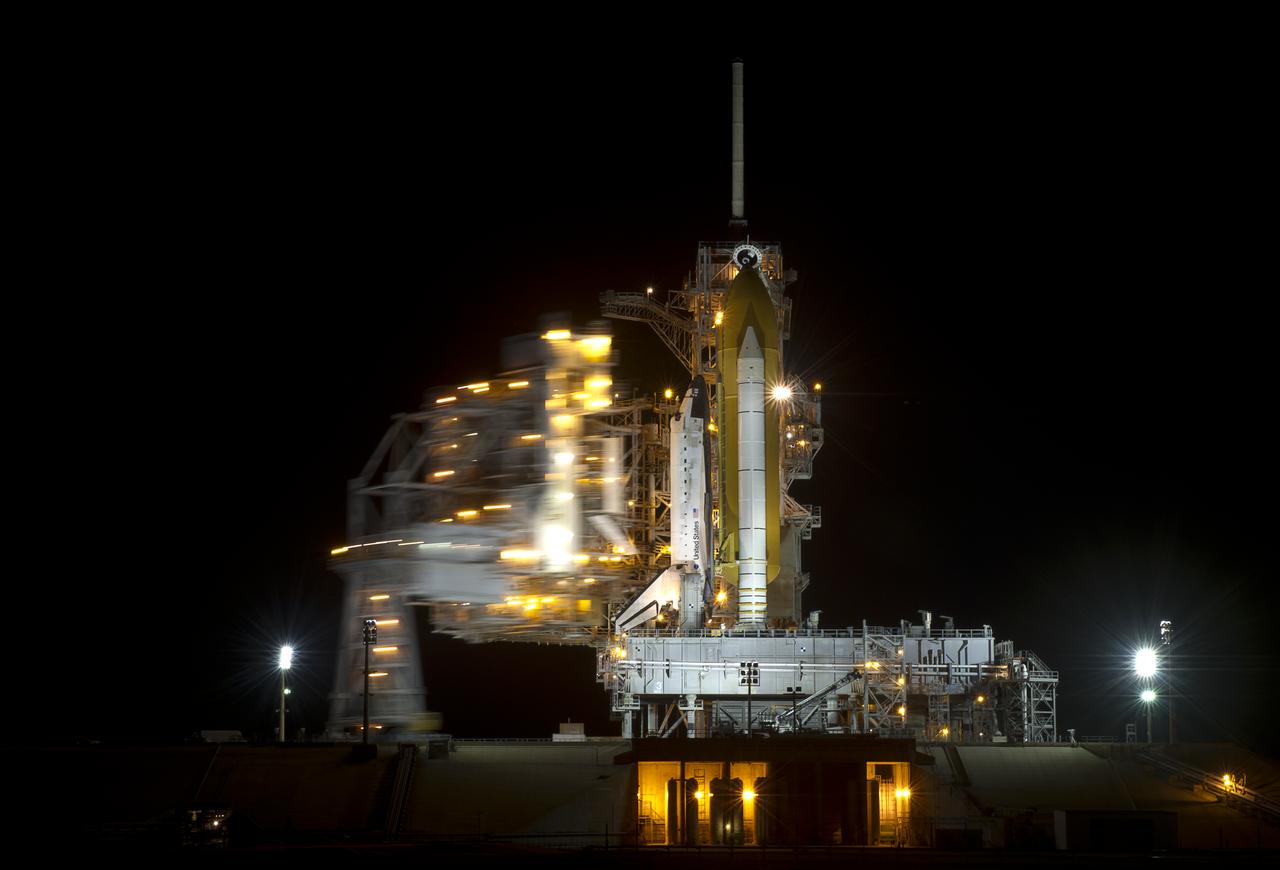
The space shuttle Discovery is seen on launch Pad 39a as the Rotating Service Structure (RSS) is rolled back on Wednesday, Nov. 3, 2010 at the NASA Kennedy Space Center in Cape Canaveral, Fla. During space shuttle Discovery's final spaceflight, the STS-133 crew members will take important spare parts to the International Space Station along with the Express Logistics Carrier-4. Photo Credit: (NASA/Bill Ingalls)
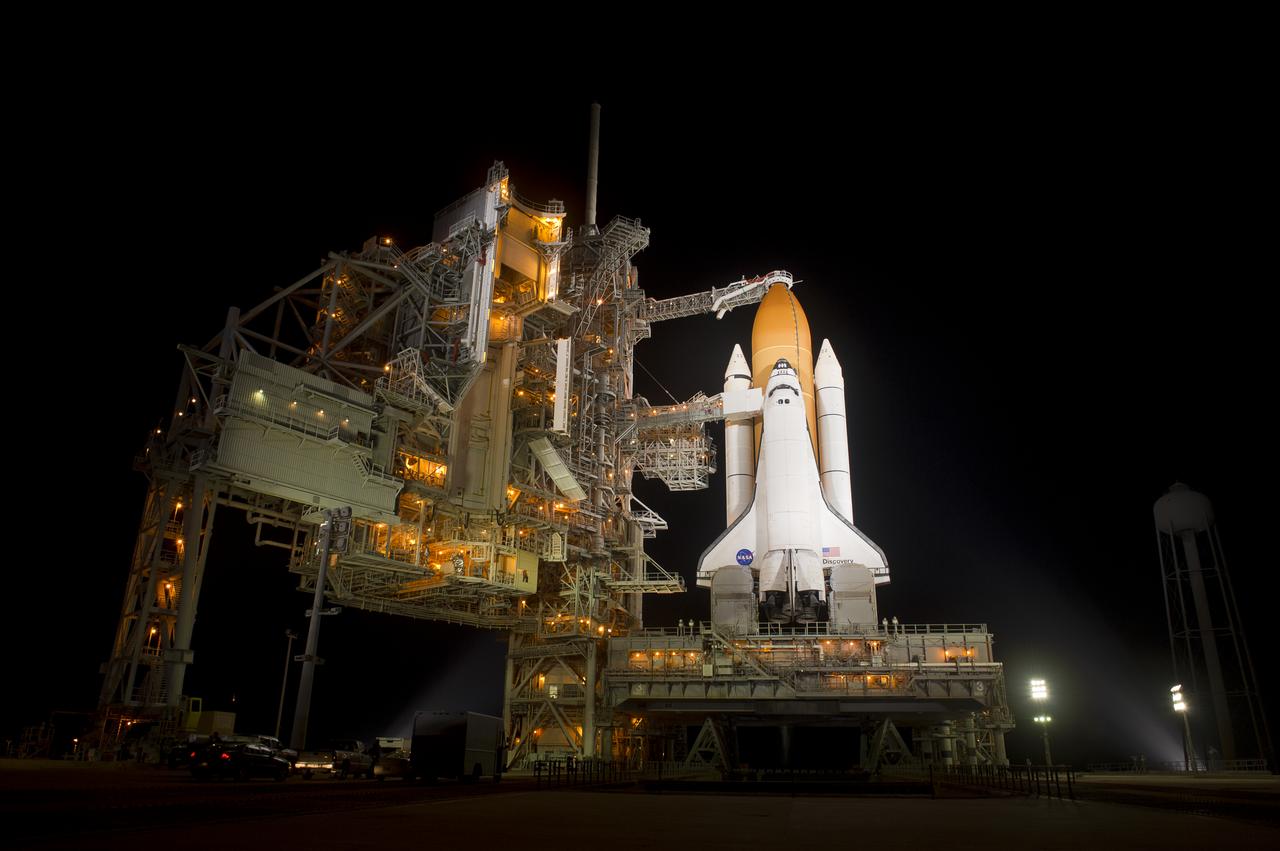
The space shuttle Discovery is seen on launch Pad 39a after the Rotating Service Structure (RSS) is rolled back on Wednesday, Nov. 3, 2010 at the NASA Kennedy Space Center in Cape Canaveral, Fla. During space shuttle Discovery's final spaceflight, the STS-133 crew members will take important spare parts to the International Space Station along with the Express Logistics Carrier-4. Photo Credit: (NASA/Bill Ingalls)
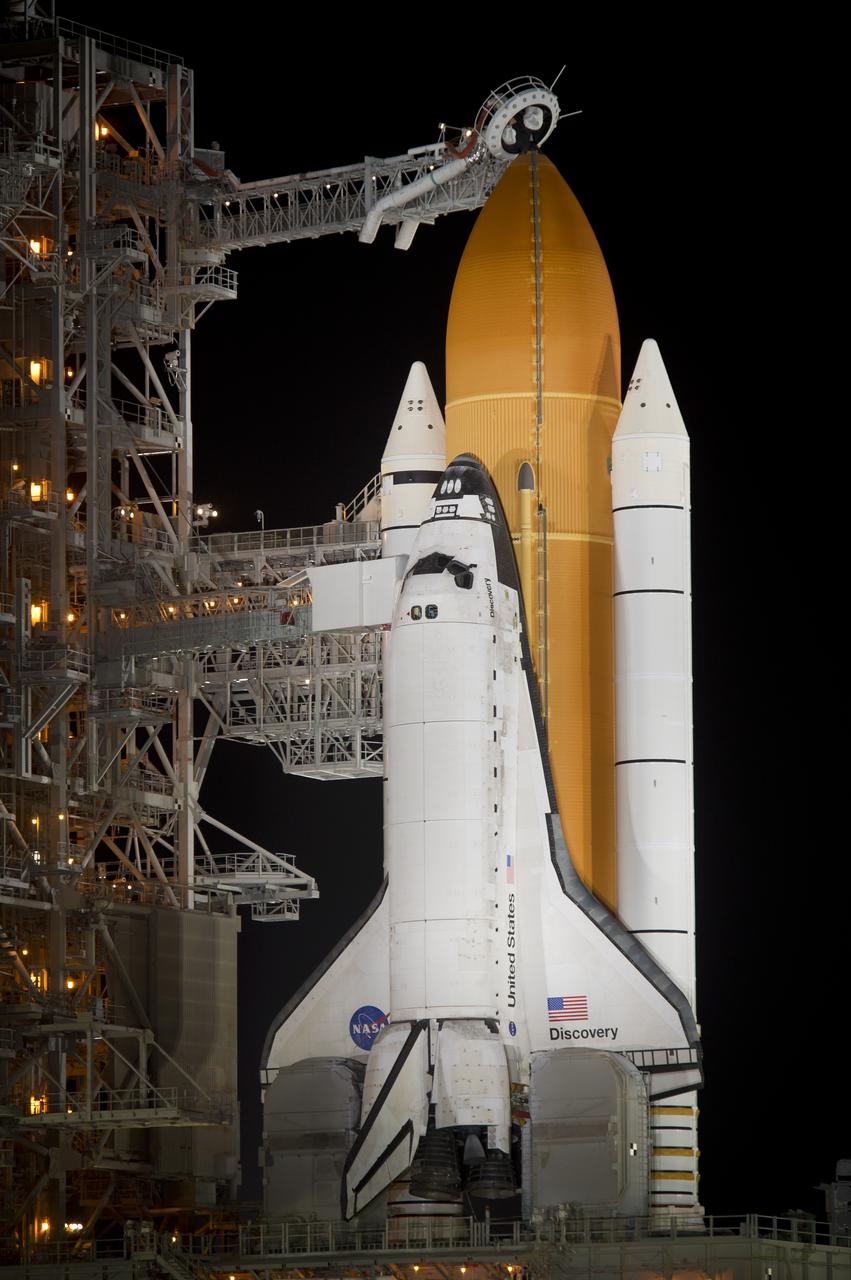
The space shuttle Discovery is seen on launch Pad 39a after the Rotating Service Structure (RSS) is rolled back on Wednesday, Nov. 3, 2010 at the NASA Kennedy Space Center in Cape Canaveral, Fla. During space shuttle Discovery's final spaceflight, the STS-133 crew members will take important spare parts to the International Space Station along with the Express Logistics Carrier-4. Photo Credit: (NASA/Bill Ingalls)
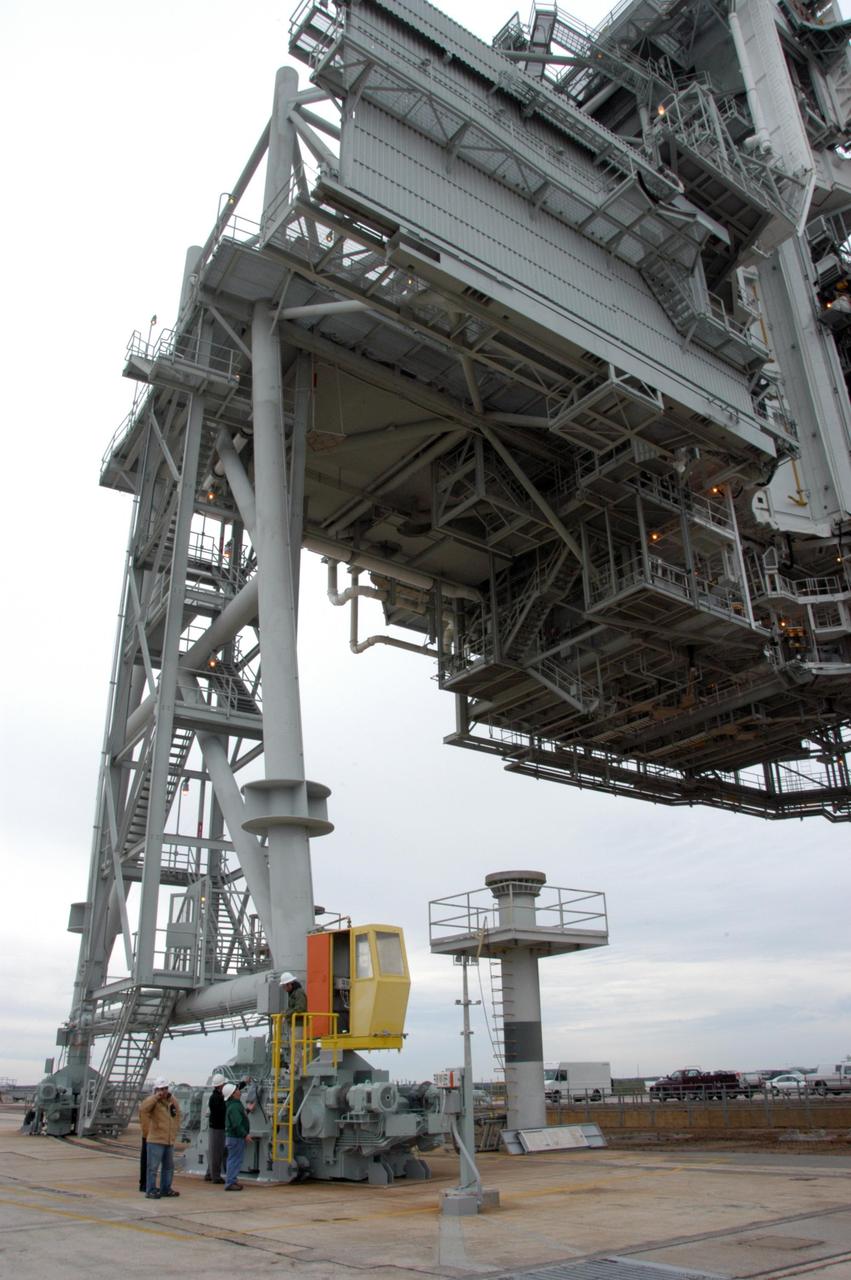
KENNEDY SPACE CENTER, FLA. -- Workers on Launch Pad 39A get ready to begin the movement of the rotating service structure above them. The RSS has not been rotated for more than a year during the maintenance and upgrades on the pad. Some of the work included sandblasting the structure to remove rust and repainting. In addition, the RSS was jacked up and a new upper-bearing race assembly installed where the RSS pivots against the fixed service structure and a half-inch steel plate added. Pad 39A is being made ready for its first launch in four years, the upcoming STS-117 on March 15. Photo credit: NASA/George Shelton
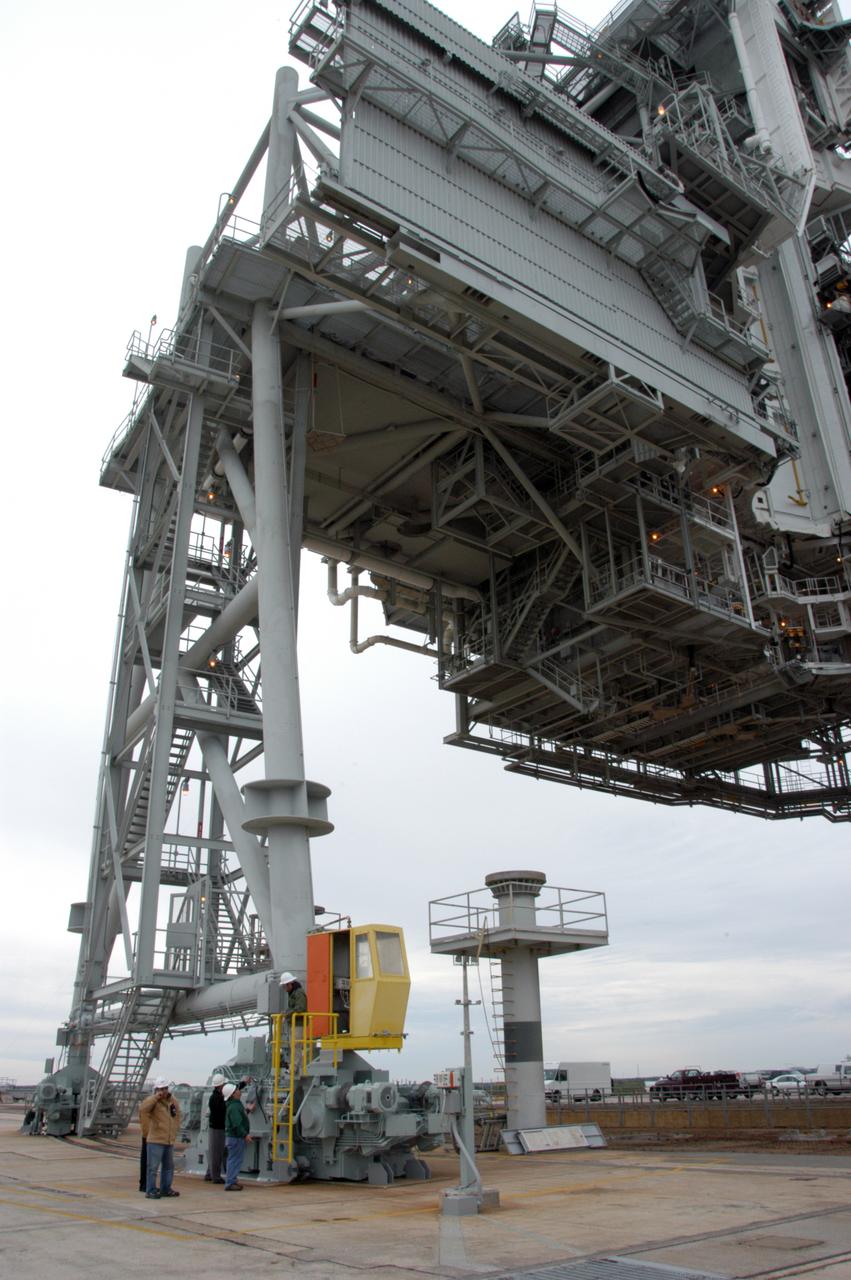
Workers on Launch Pad 39A get ready to begin the movement of the rotating service structure above them. The RSS has not been rotated for more than a year during the maintenance and upgrades on the pad. Some of the work included sandblasting the structure to remove rust and repainting. In addition, the RSS was jacked up and a new upper-bearing race assembly installed where the RSS pivots against the fixed service structure and a half-inch steel plate added. Pad 39A is being made ready for its first launch in four years, the upcoming STS-117 on March 15.
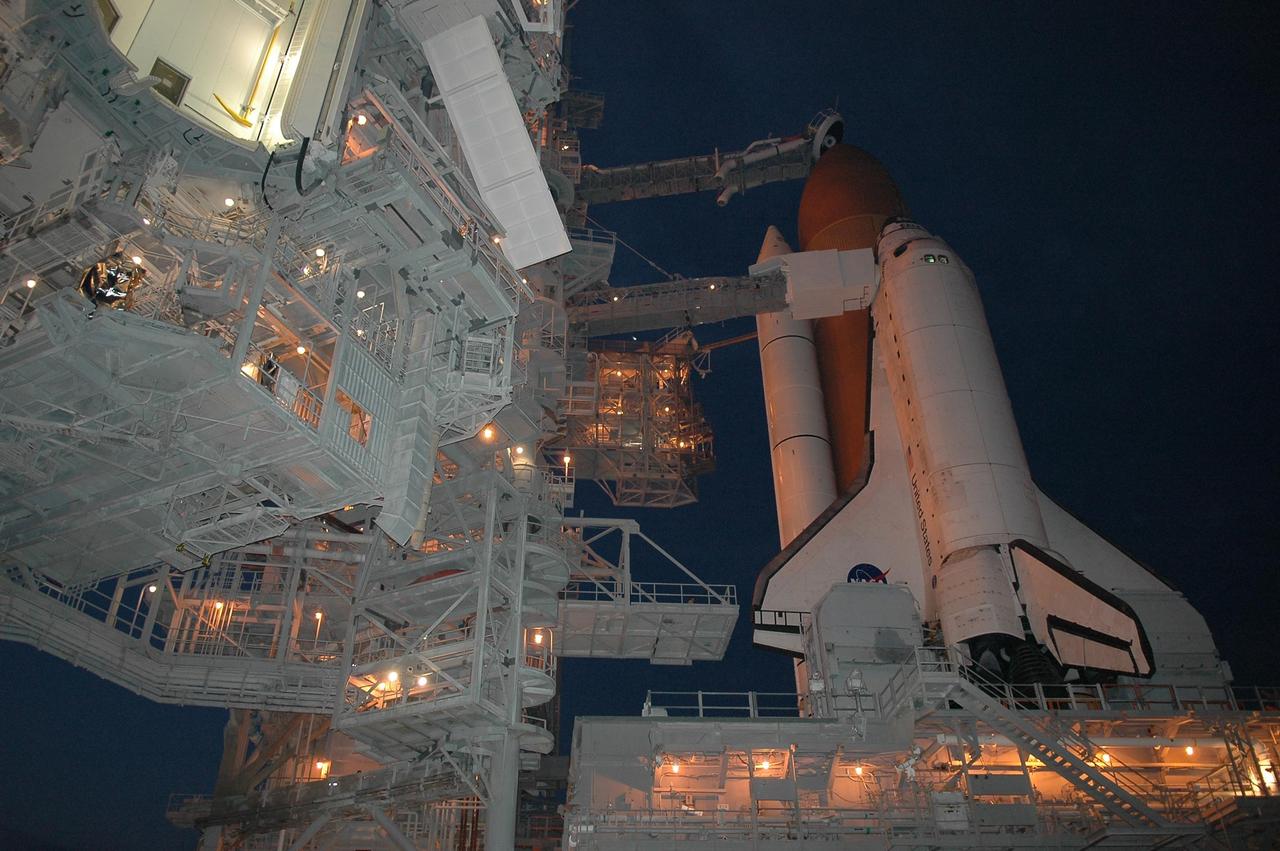
KENNEDY SPACE CENTER, FLA. - After rollback of the rotating service structure (RSS) on Launch Pad 39B, Space Shuttle Discovery stands bathed in lights from the RSS and fixed service structure. The rollback was in preparation for launch July 1 on mission STS-121. Extending toward the cockpit of the shuttle is the orbiter access arm with the White Room extended. The White Room provides access into the orbiter for the astronauts. The RSS provides protected access to the orbiter for changeout and servicing of payloads at the pad. The structure is supported by a rotating bridge that pivots about a vertical axis on the west side of the pad's flame trench. The hinge column rests on the pad surface and is braced to the fixed service structure. Support for the outer end of the bridge is provided by two eight-wheel, motor-driven trucks that move along circular twin rails installed flush with the pad surface. The track crosses the flame trench on a permanent bridge. The RSS is 102 feet long, 50 feet wide and 130 feet high. The structure has orbiter access platforms at five levels to provide access to the payload bay while the orbiter is being serviced in the RSS. Each platform has independent extendable planks that can be arranged to conform to a payload's configuration. This mission is the 115th shuttle flight and the 18th U.S. flight to the International Space Station. Photo credit: NASA/Kim Shiflett
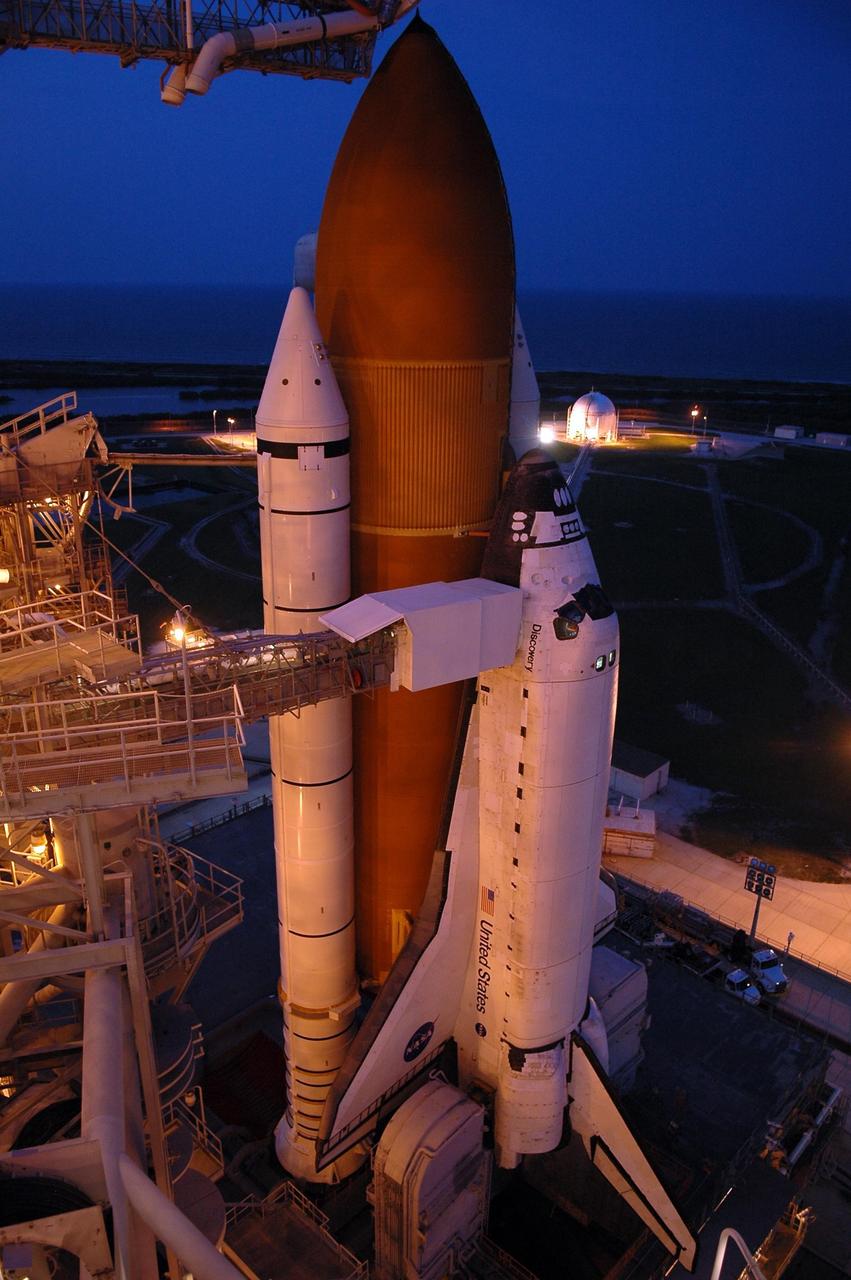
KENNEDY SPACE CENTER, FLA. - After rollback of the rotating service structure (RSS) on Launch Pad 39B, Space Shuttle Discovery stands bathed in lights from the RSS and fixed service structure. The rollback was in preparation for launch July 1 on mission STS-121. Extending toward the cockpit of the shuttle is the orbiter access arm with the White Room extended. The White Room provides access into the orbiter for the astronauts. The RSS provides protected access to the orbiter for changeout and servicing of payloads at the pad. The structure is supported by a rotating bridge that pivots about a vertical axis on the west side of the pad's flame trench. The hinge column rests on the pad surface and is braced to the fixed service structure. Support for the outer end of the bridge is provided by two eight-wheel, motor-driven trucks that move along circular twin rails installed flush with the pad surface. The track crosses the flame trench on a permanent bridge. The RSS is 102 feet long, 50 feet wide and 130 feet high. The structure has orbiter access platforms at five levels to provide access to the payload bay while the orbiter is being serviced in the RSS. Each platform has independent extendable planks that can be arranged to conform to a payload's configuration. This mission is the 115th shuttle flight and the 18th U.S. flight to the International Space Station. Photo credit: NASA/Kim Shiflett
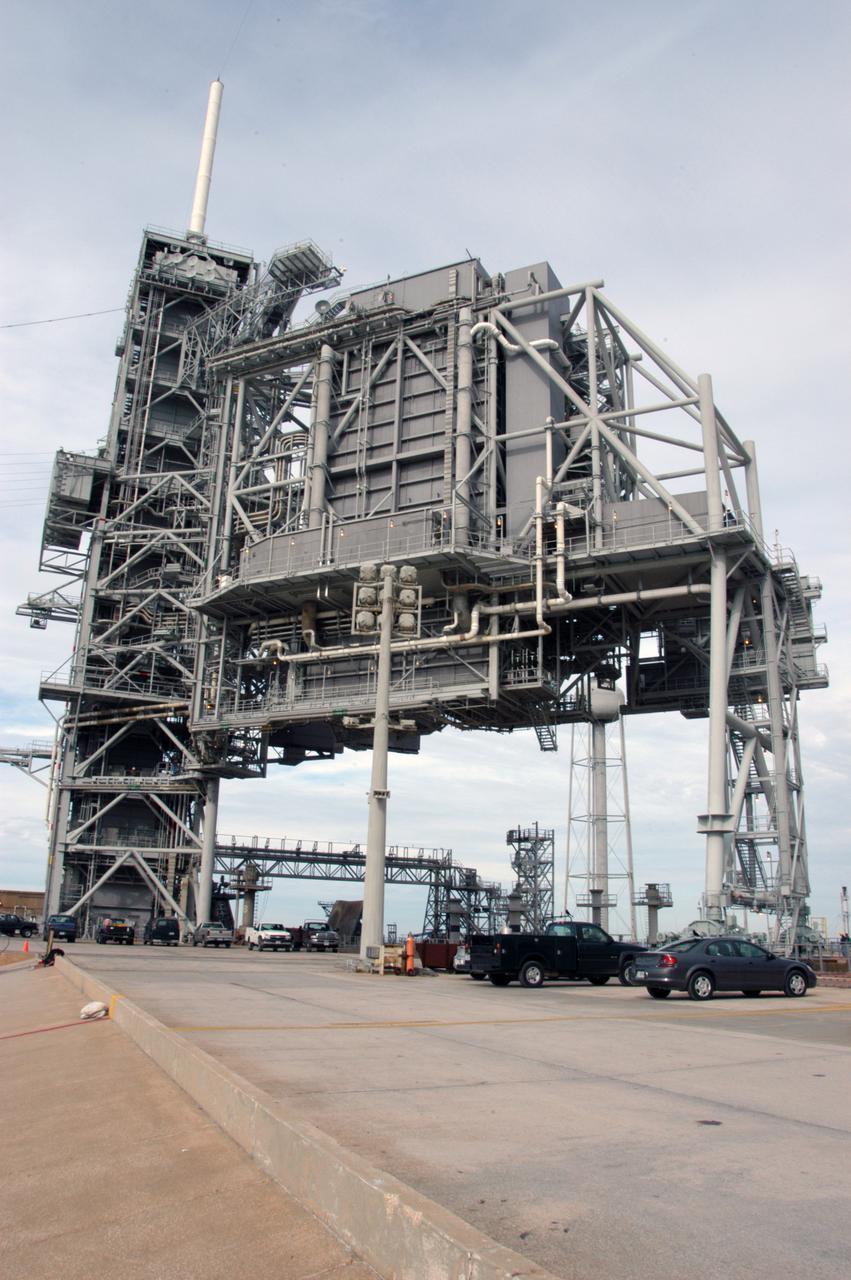
The rotating service structure on Launch Pad 39A is being moved for the first time in more than a year due to maintenance and upgrades on the pad. Some of the work included sandblasting the structure to remove rust and repainting. In addition, the RSS was jacked up and a new upper-bearing race assembly installed where the RSS pivots against the fixed service structure and a half-inch steel plate added. Pad 39A is being made ready for its first launch in four years, the upcoming STS-117 on March 15.
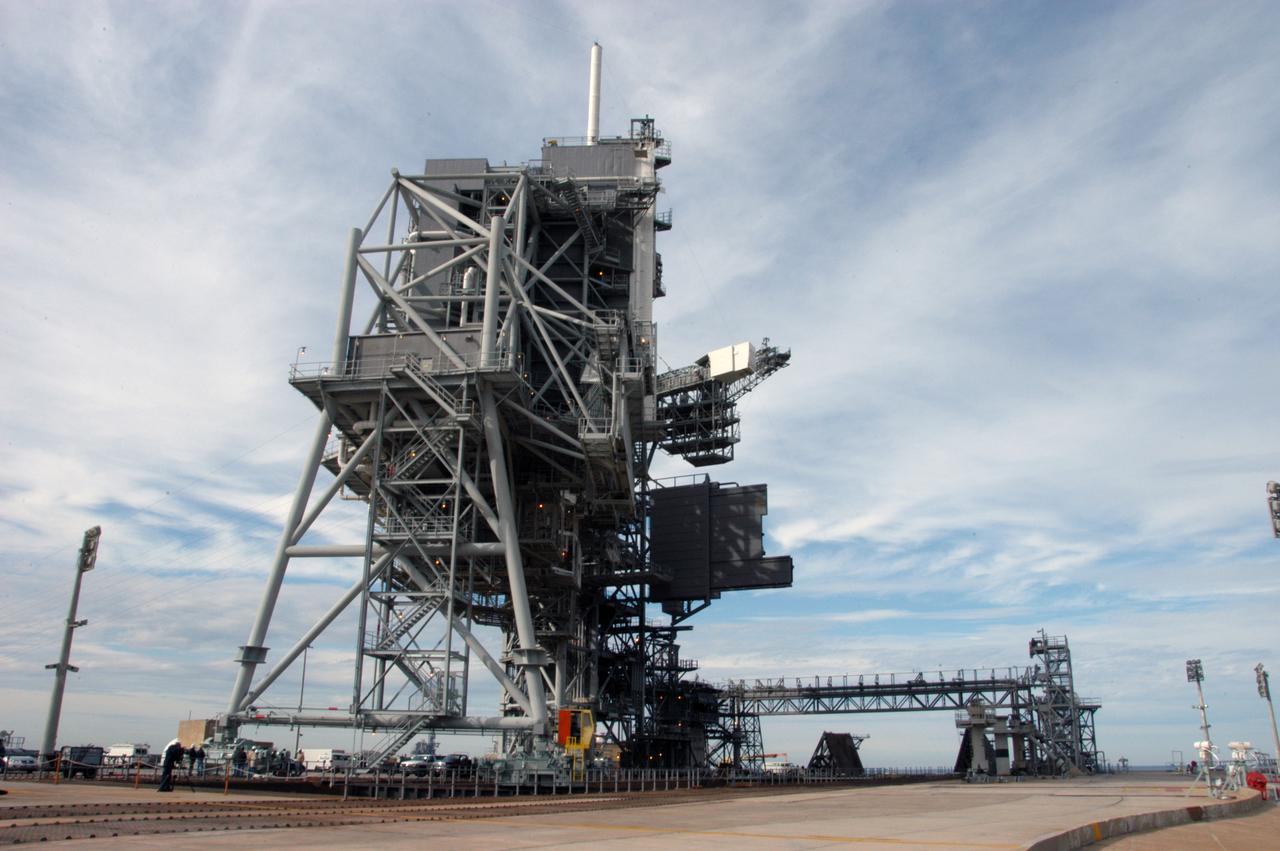
The rotating service structure on Launch Pad 39A is being moved for the first time in more than a year due to maintenance and upgrades on the pad. Some of the work included sandblasting the structure to remove rust and repainting. In addition, the RSS was jacked up and a new upper-bearing race assembly installed where the RSS pivots against the fixed service structure and a half-inch steel plate added. Pad 39A is being made ready for its first launch in four years, the upcoming STS-117 on March 15.
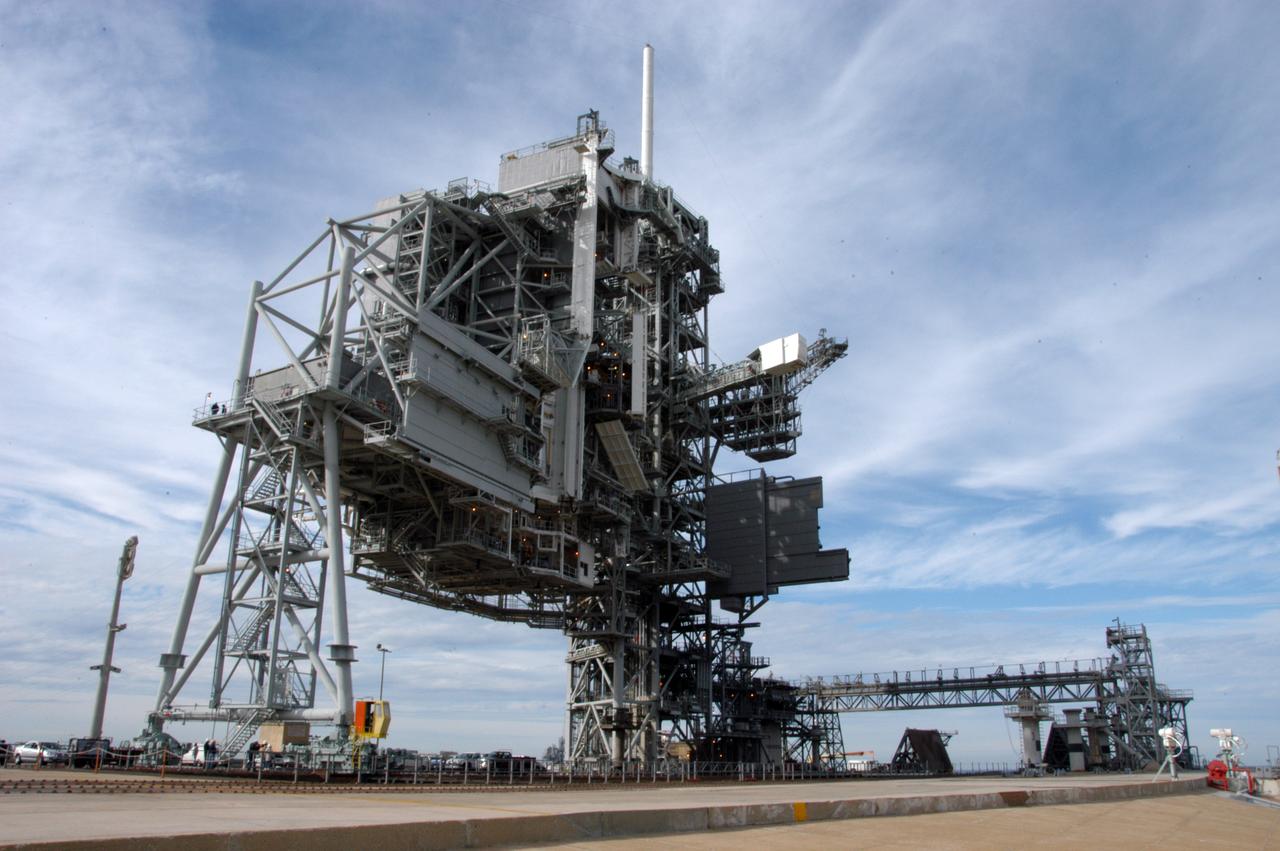
The rotating service structure on Launch Pad 39A has moved for the first time in more than a year due to maintenance and upgrades on the pad. Some of the work included sandblasting the structure to remove rust and repainting. In addition, the RSS was jacked up and a new upper-bearing race assembly installed where the RSS pivots against the fixed service structure and a half-inch steel plate added. Pad 39A is being made ready for its first launch in four years, the upcoming STS-117 on March 15.
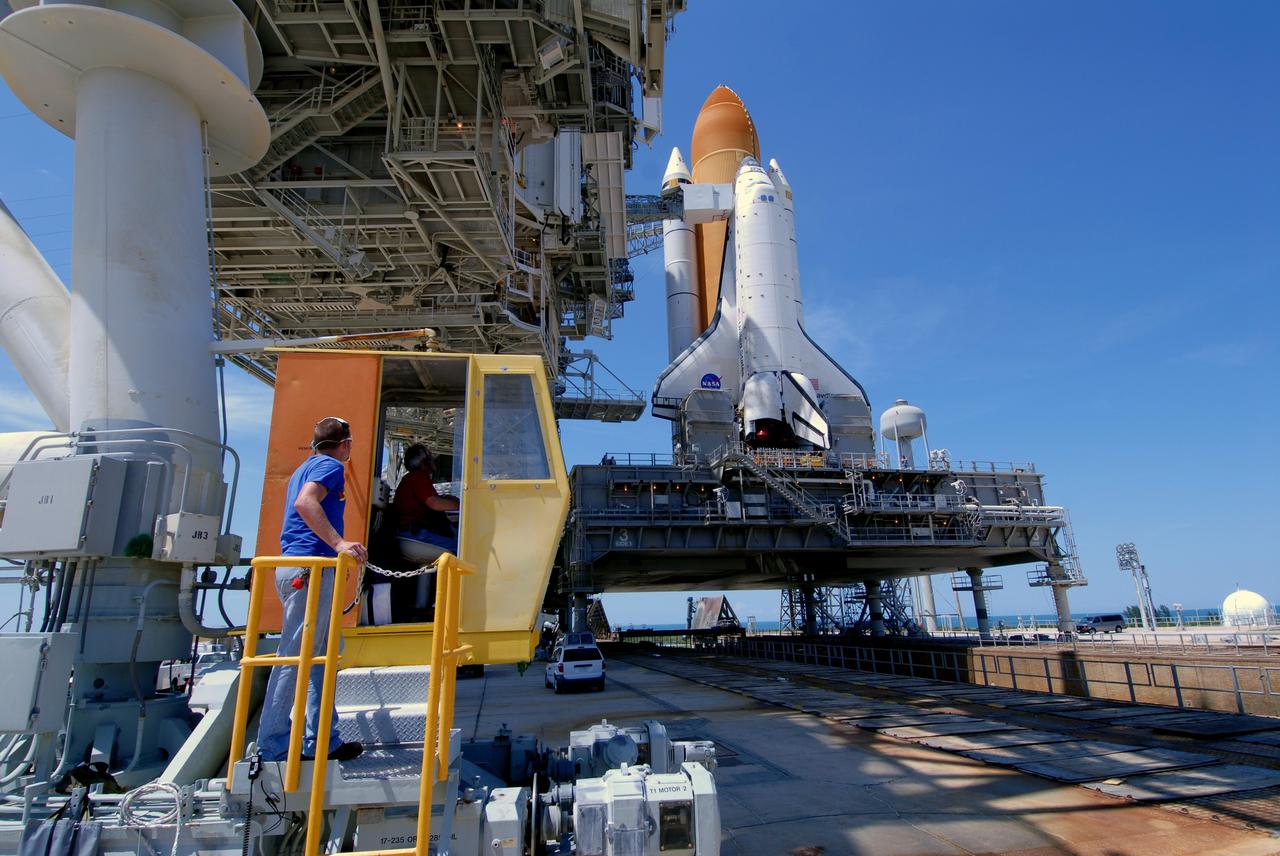
CAPE CANAVERAL, Fla. – On Launch Pad 39A at NASA's Kennedy Space Center in Florida, workers prepare to drive the truck that moves the rotating service structure, or RSS. The RSS will be moved around space shuttle Endeavour. The RSS provides protected access to the shuttle for changeout and servicing of payloads at the pad. The structure is supported by a rotating bridge that pivots about a vertical axis on the west side of the pad's flame trench. The RSS rotates through 120 degrees (one-third of a circle) on a radius of 160 feet. Support for the outer end of the bridge is provided by two eight-wheel, motor-driven trucks that move along circular twin rails installed flush with the pad surface. The track crosses the flame trench on a permanent bridge. Endeavour is targeted to launch June 13 on its STS-127 mission to the International Space Station. Photo credit: NASA/Tim Jacobs
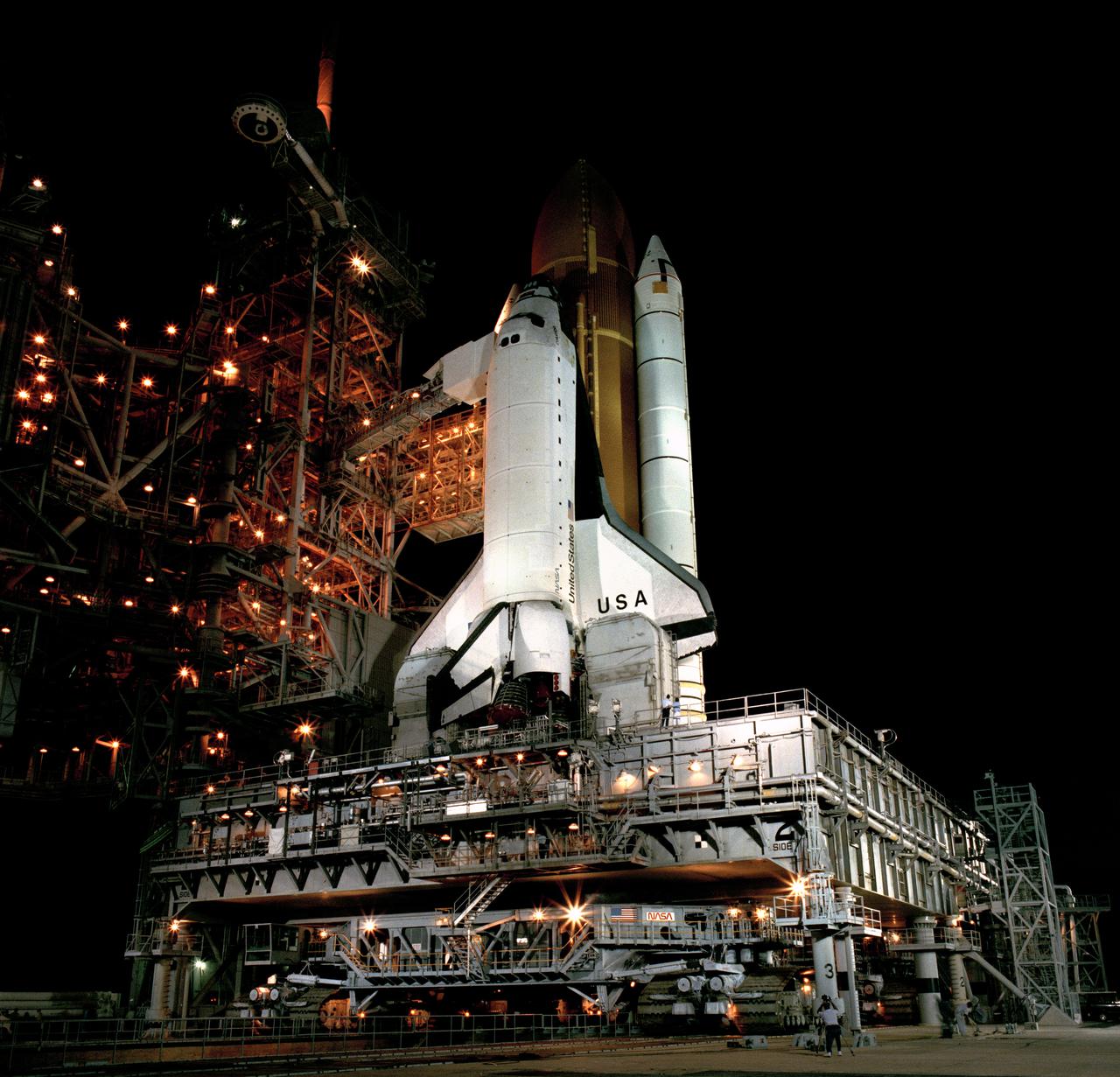
CAPE CANAVERAL, Fla. -- Aerial view of the STS-28 vehicle, space shuttle Columbia, on Launch Pad 39B after rollout, prior to the Rotating Service Structure, or RSS, move. Photo credit: NASA
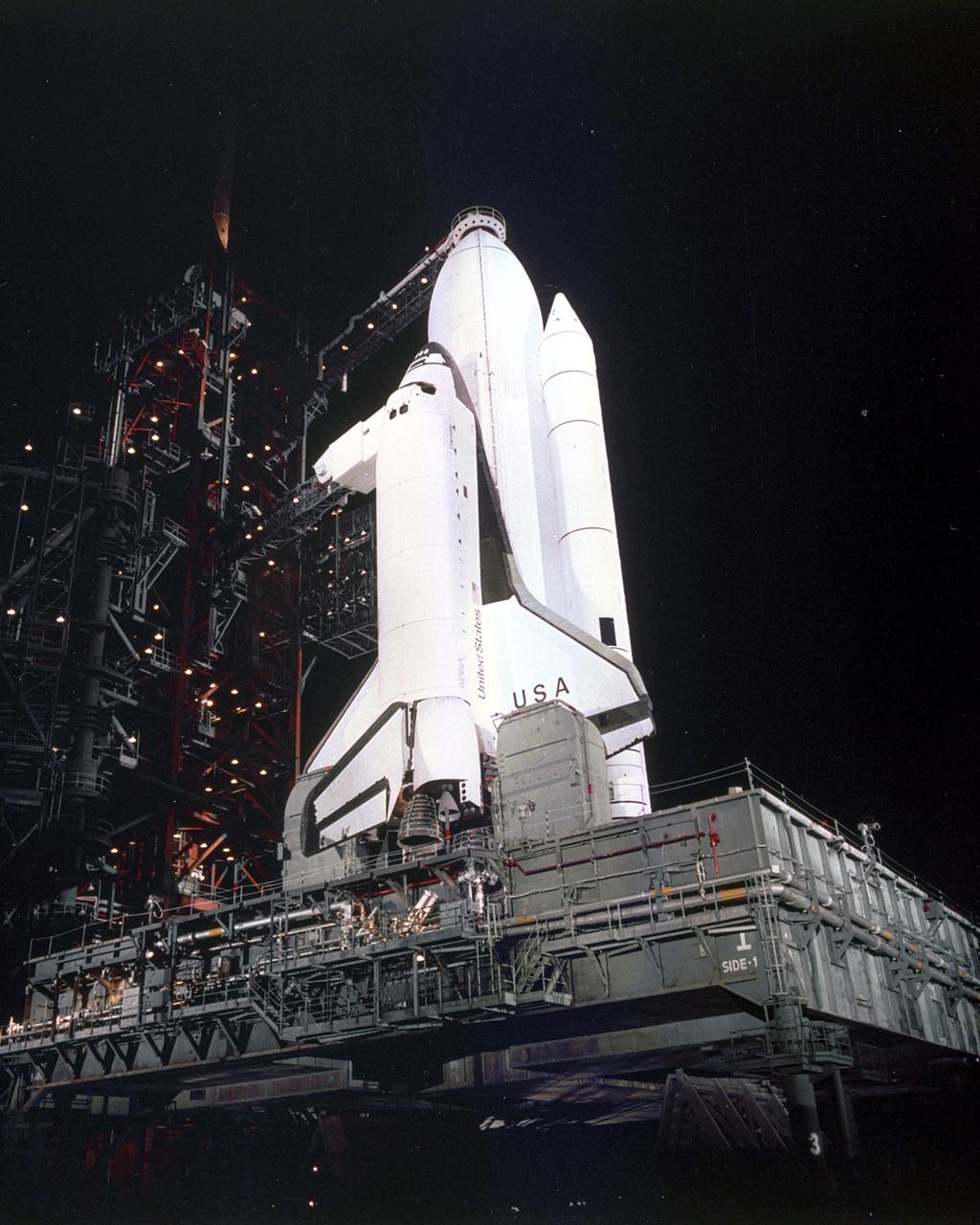
KENNEDY SPACE CENTER, FLA. - The Space Shuttle Columbia, (STS-1) stands poised for its maiden flight into space from Launch Pad A, Complex 39, following retraction of the Rotating Service Structure (RSS).
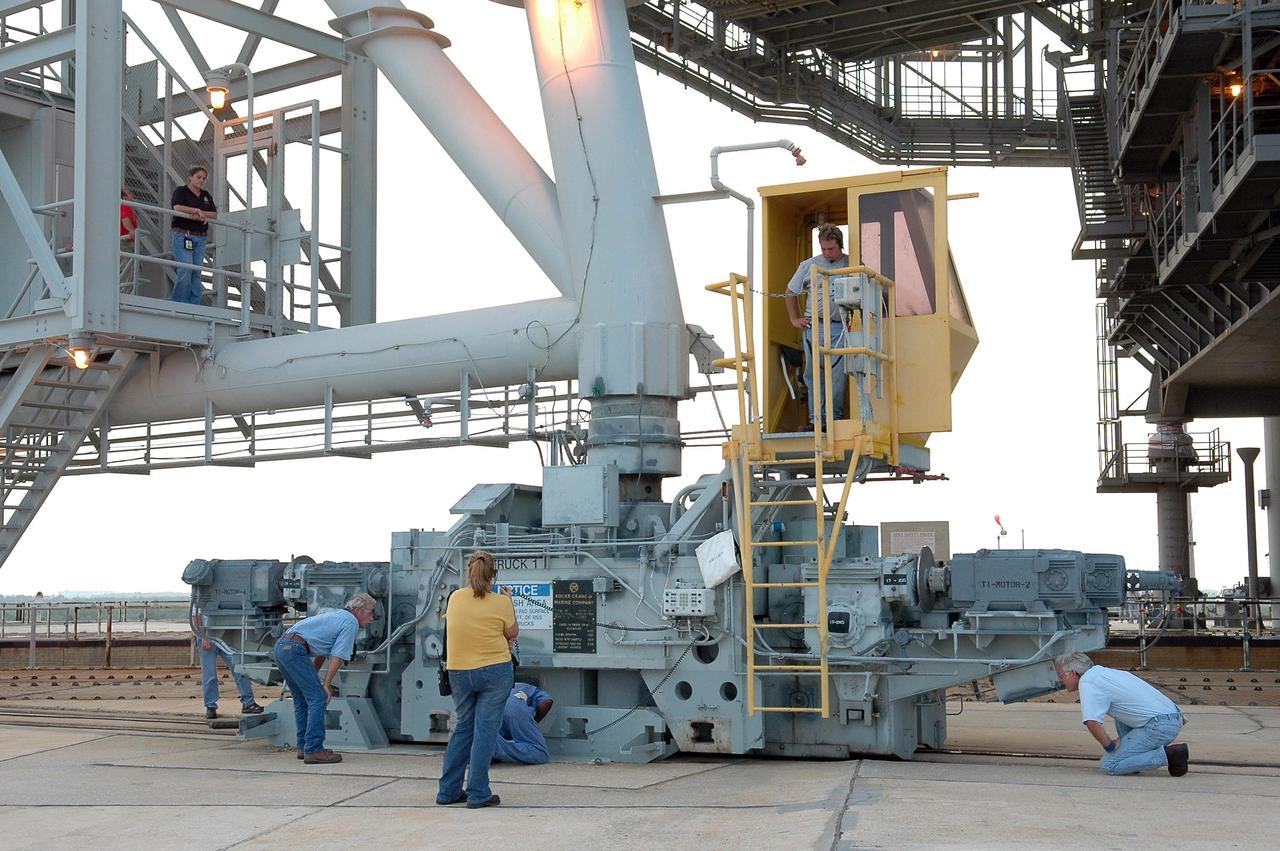
KENNEDY SPACE CENTER, FLA. - On Launch Pad 39B, workers check one of the two trucks that move the rotating service structure (RSS). In preparation for the July 1 launch of Space Shuttle Discovery on mission STS-121, the RSS is being rolled away from the shuttle. The RSS provides protected access to the orbiter for changeout and servicing of payloads at the pad. The structure is supported by a rotating bridge that pivots about a vertical axis on the west side of the pad's flame trench. The hinge column rests on the pad surface and is braced to the fixed service structure. Support for the outer end of the bridge is provided by two eight-wheel, motor-driven trucks that move along circular twin rails installed flush with the pad surface. The track crosses the flame trench on a permanent bridge. The RSS is 102 feet long, 50 feet wide and 130 feet high. The structure has orbiter access platforms at five levels to provide access to the payload bay while the orbiter is being serviced in the RSS. Each platform has independent extendable planks that can be arranged to conform to a payload's configuration. This mission is the 115th shuttle flight and the 18th U.S. flight to the International Space Station. Photo credit: NASA/Kim Shiflett
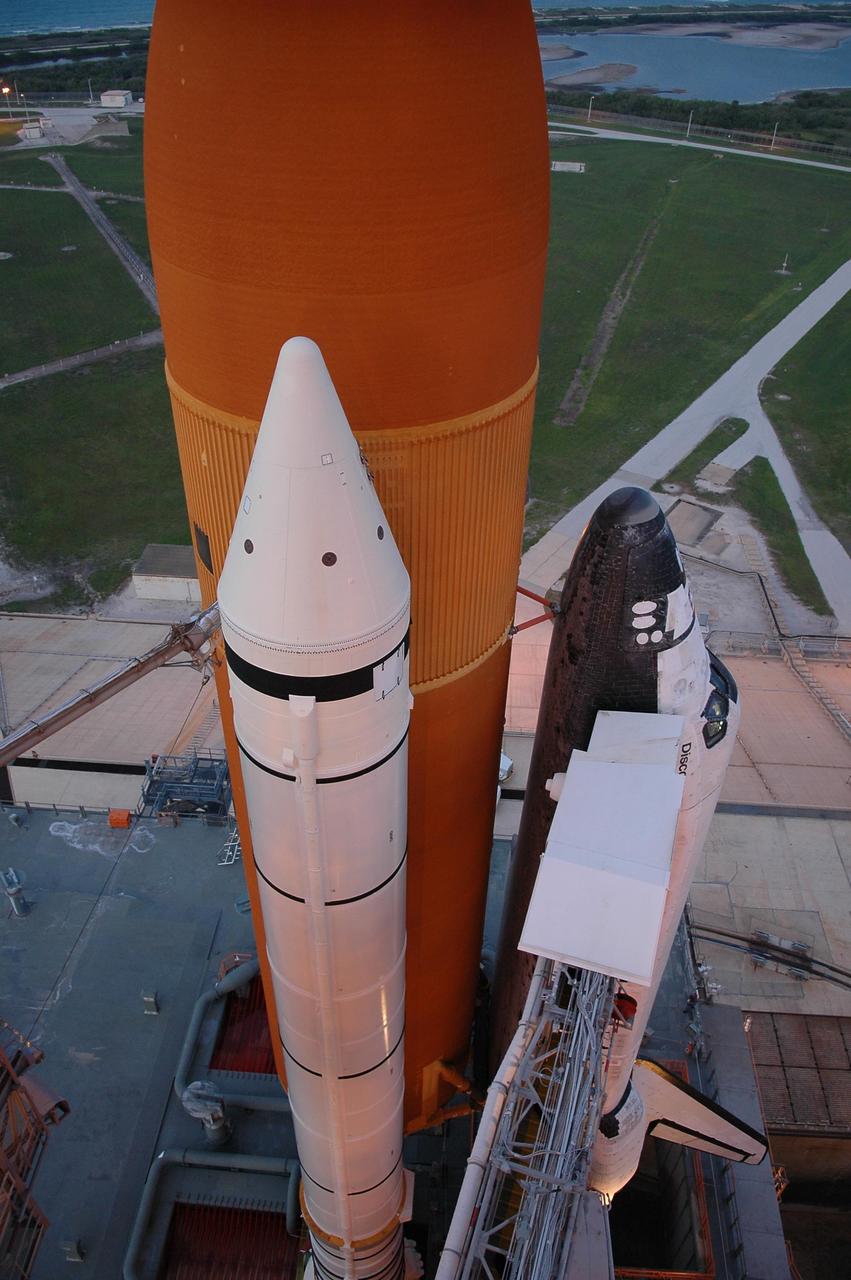
KENNEDY SPACE CENTER, FLA. - Viewed from an upper level of the fixed service structure on Launch Pad 39B, Space Shuttle Discovery looms over the pad and surrounding area after rollback of the rotating service structure (RSS). The rollback was in preparation for launch July 1 on mission STS-121. Extending toward the cockpit of the shuttle is the orbiter access arm with the White Room extended. The White Room provides access into the orbiter for the astronauts. The RSS provides protected access to the orbiter for changeout and servicing of payloads at the pad. The structure is supported by a rotating bridge that pivots about a vertical axis on the west side of the pad's flame trench. The hinge column rests on the pad surface and is braced to the fixed service structure. Support for the outer end of the bridge is provided by two eight-wheel, motor-driven trucks that move along circular twin rails installed flush with the pad surface. The track crosses the flame trench on a permanent bridge. The RSS is 102 feet long, 50 feet wide and 130 feet high. The structure has orbiter access platforms at five levels to provide access to the payload bay while the orbiter is being serviced in the RSS. Each platform has independent extendable planks that can be arranged to conform to a payload's configuration. This mission is the 115th shuttle flight and the 18th U.S. flight to the International Space Station. Photo credit: NASA/Kim Shiflett
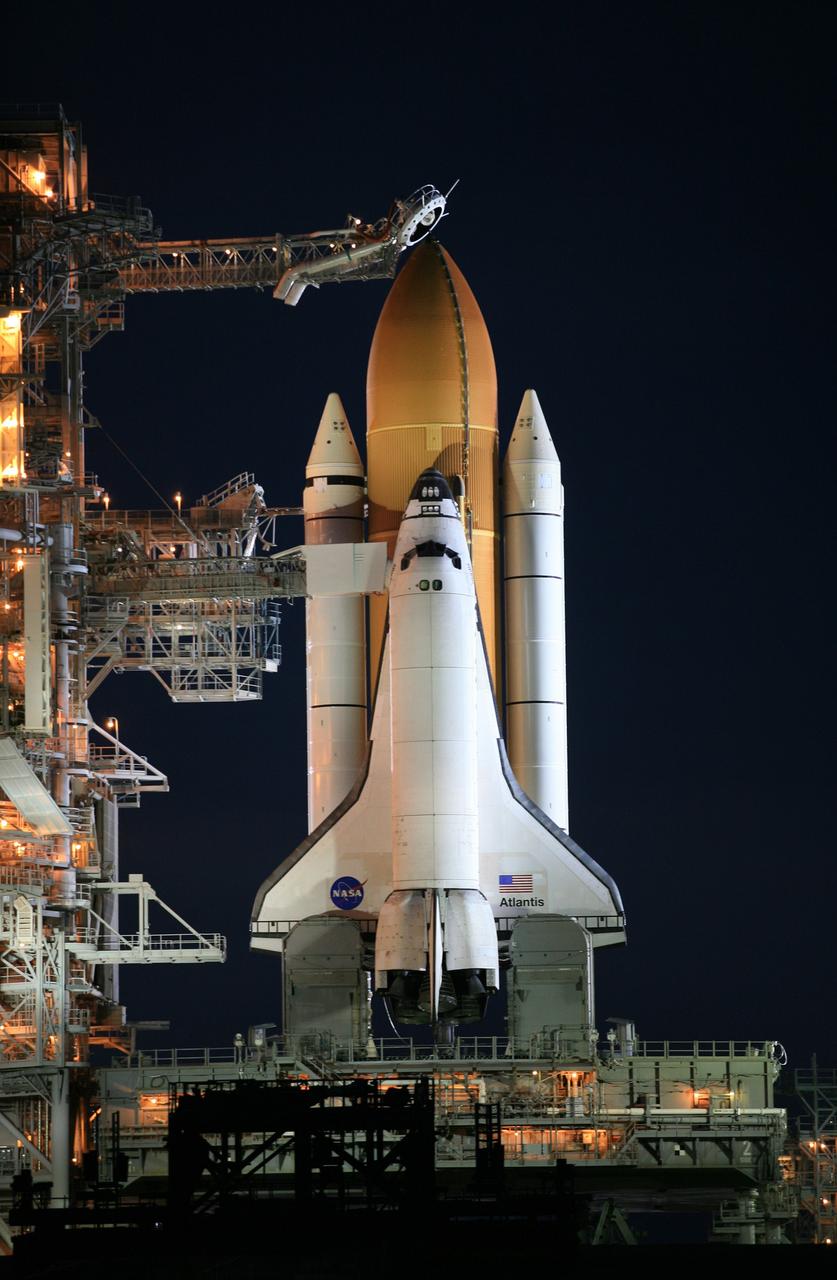
CAPE CANAVERAL, Fla. – Night falls on Launch Pad 39A at NASA's Kennedy Space Center in Florida following rollback of the pad’s rotating service structure, or RSS, from around space shuttle Atlantis. The RSS is retracted in preparation for Atlantis’ liftoff on the STS-125 mission to service NASA's Hubble Space Telescope. The rotating structure provides protected access to the shuttle for changeout and servicing of payloads at the pad. After the RSS is rolled back, the orbiter is ready for fuel cell activation and external tank cryogenic propellant loading operations. Atlantis' crew will service NASA's Hubble Space Telescope for the fifth and final time. The flight will include five spacewalks during which astronauts will refurbish and upgrade the telescope with state-of-the-art science instruments. As a result, Hubble's capabilities will be expanded and its operational lifespan extended through at least 2014. Launch is scheduled for 2:01 p.m. EDT on May 11. Photo credit: NASA/Dimitri Gerondidakis
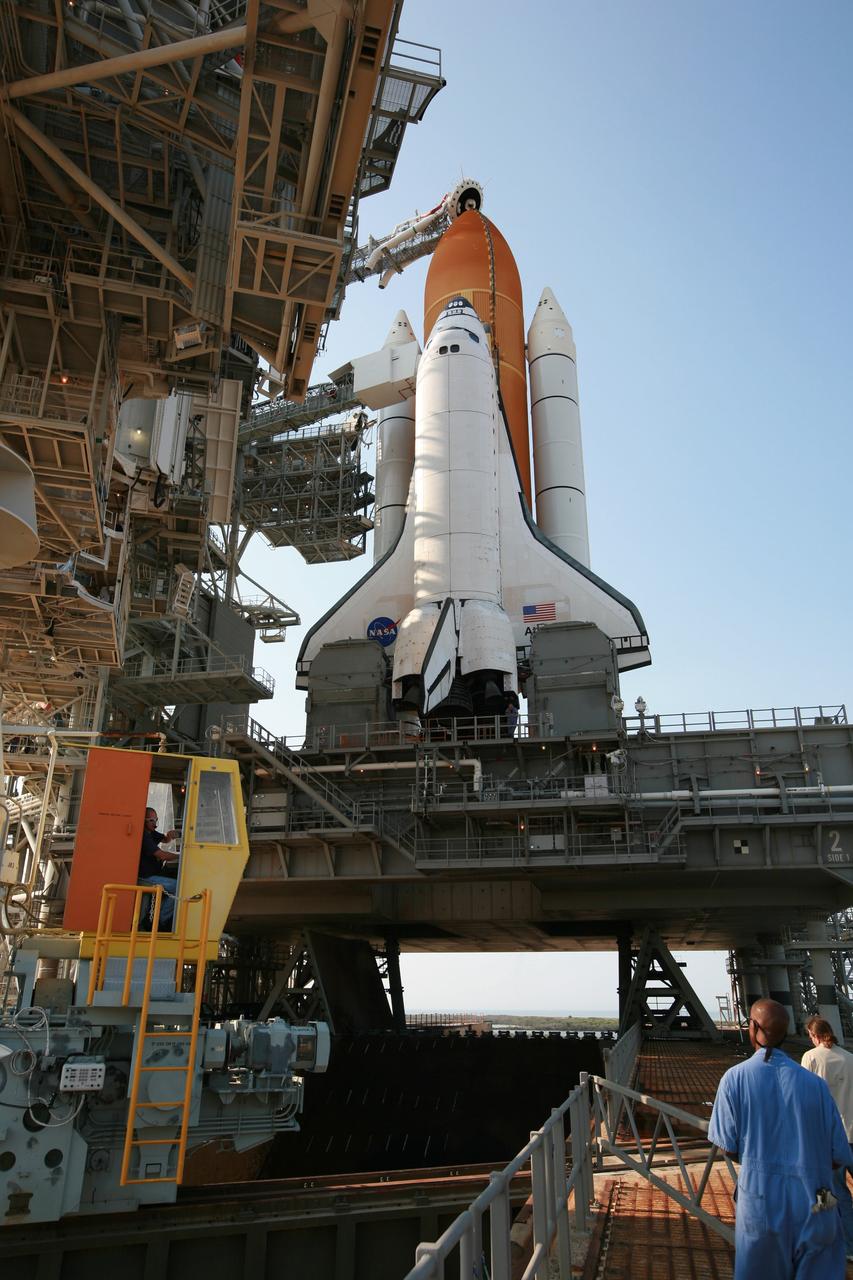
CAPE CANAVERAL, Fla. – On Launch Pad 39A at NASA's Kennedy Space Center in Florida, workers look on as the rotating service structure, or RSS, is rolled back from space shuttle Atlantis. The RSS is retracted in preparation for Atlantis’ liftoff on the STS-125 mission to service NASA's Hubble Space Telescope. The rotating structure provides protected access to the shuttle for changeout and servicing of payloads at the pad. After the RSS is rolled back, the orbiter is ready for fuel cell activation and external tank cryogenic propellant loading operations. Atlantis' crew will service NASA's Hubble Space Telescope for the fifth and final time. The flight will include five spacewalks during which astronauts will refurbish and upgrade the telescope with state-of-the-art science instruments. As a result, Hubble's capabilities will be expanded and its operational lifespan extended through at least 2014. Launch is scheduled for 2:01 p.m. EDT on May 11. Photo credit: NASA/Dimitri Gerondidakis
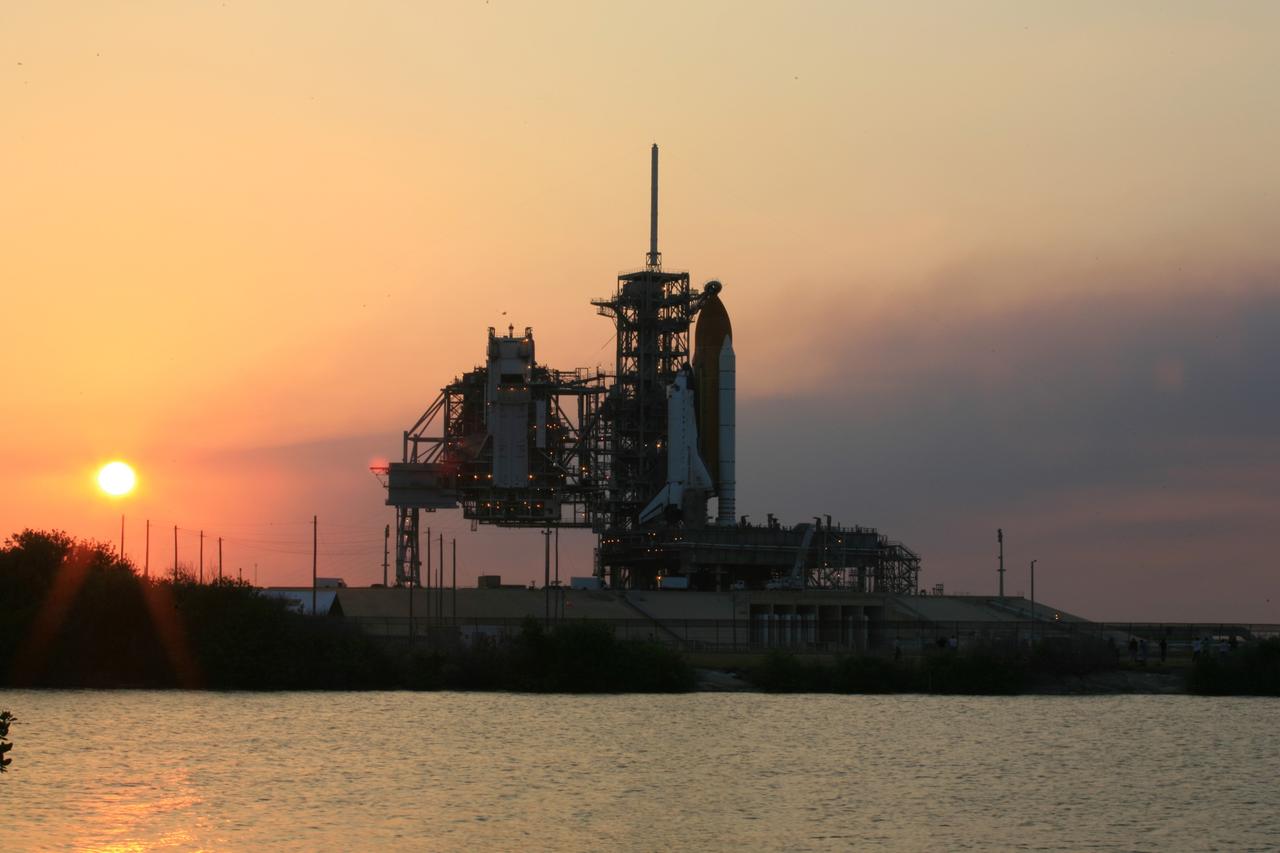
CAPE CANAVERAL, Fla. – The sun sets on Launch Pad 39A at NASA's Kennedy Space Center in Florida following rollback of the pad’s rotating service structure, or RSS, from around space shuttle Atlantis. The RSS is retracted in preparation for Atlantis’ liftoff on the STS-125 mission to service NASA's Hubble Space Telescope. The rotating structure provides protected access to the shuttle for changeout and servicing of payloads at the pad. After the RSS is rolled back, the orbiter is ready for fuel cell activation and external tank cryogenic propellant loading operations. Atlantis' crew will service NASA's Hubble Space Telescope for the fifth and final time. The flight will include five spacewalks during which astronauts will refurbish and upgrade the telescope with state-of-the-art science instruments. As a result, Hubble's capabilities will be expanded and its operational lifespan extended through at least 2014. Launch is scheduled for 2:01 p.m. EDT on May 11. Photo credit: NASA/Dimitri Gerondidakis
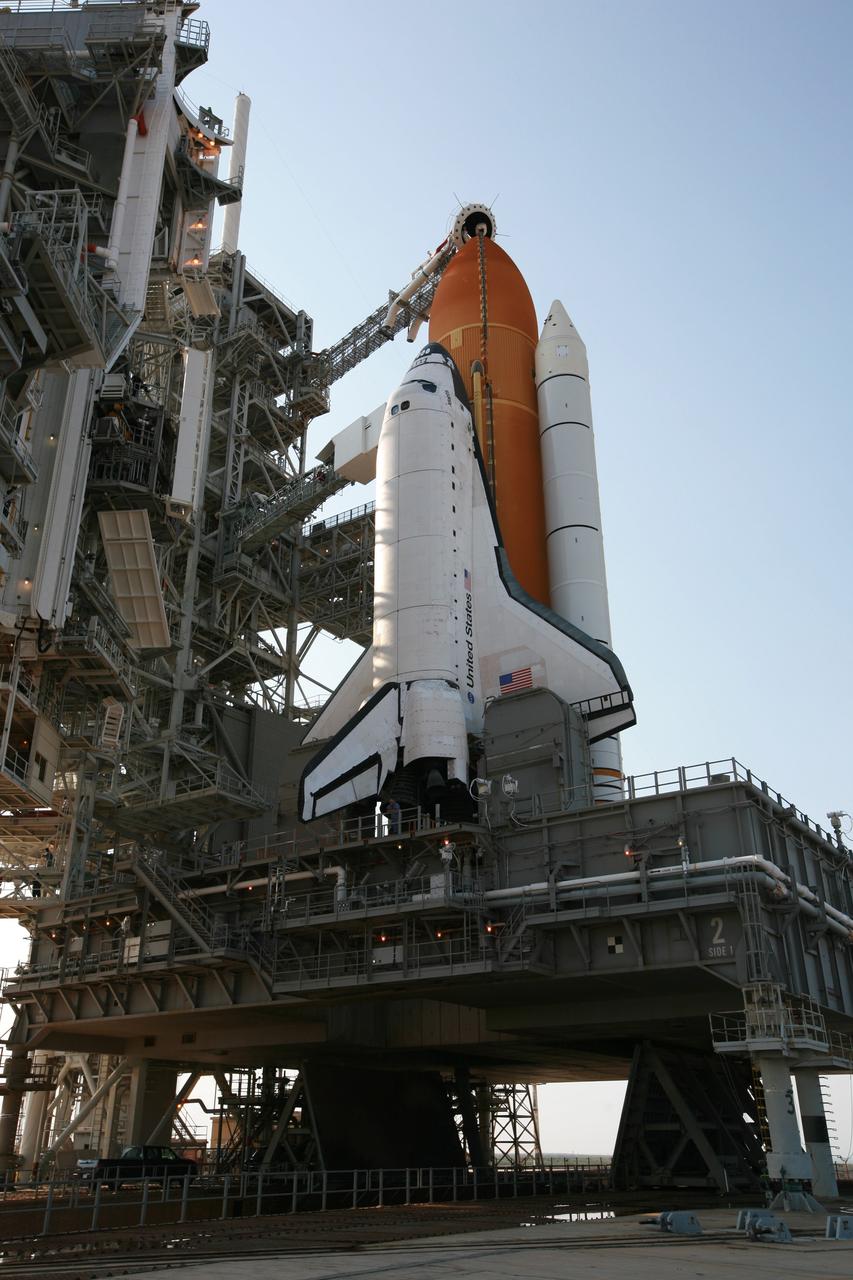
CAPE CANAVERAL, Fla. – On Launch Pad 39A at NASA's Kennedy Space Center in Florida, space shuttle Atlantis is revealed after the rotating service structure, or RSS, has been rolled back. The RSS is retracted in preparation for Atlantis’ liftoff on the STS-125 mission to service NASA's Hubble Space Telescope. The rotating structure provides protected access to the shuttle for changeout and servicing of payloads at the pad. After the RSS is rolled back, the orbiter is ready for fuel cell activation and external tank cryogenic propellant loading operations. Atlantis' crew will service NASA's Hubble Space Telescope for the fifth and final time. The flight will include five spacewalks during which astronauts will refurbish and upgrade the telescope with state-of-the-art science instruments. As a result, Hubble's capabilities will be expanded and its operational lifespan extended through at least 2014. Launch is scheduled for 2:01 p.m. EDT on May 11. Photo credit: NASA/Dimitri Gerondidakis
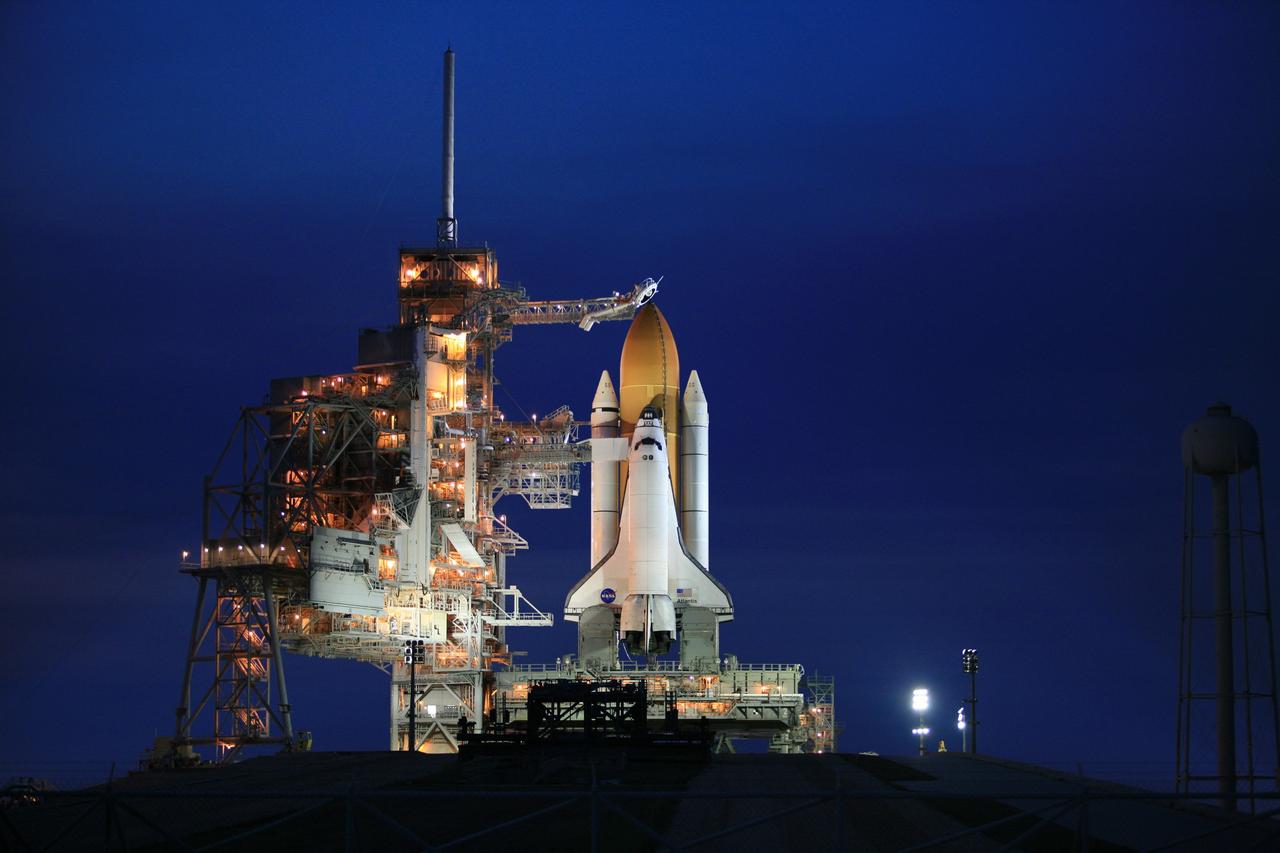
CAPE CANAVERAL, Fla. – Night falls on Launch Pad 39A at NASA's Kennedy Space Center in Florida following rollback of the pad’s rotating service structure, or RSS, revealing space shuttle Atlantis in all its glory. The RSS is retracted in preparation for Atlantis’ liftoff on the STS-125 mission to service NASA's Hubble Space Telescope. The rotating structure provides protected access to the shuttle for changeout and servicing of payloads at the pad. After the RSS is rolled back, the orbiter is ready for fuel cell activation and external tank cryogenic propellant loading operations. Atlantis' crew will service NASA's Hubble Space Telescope for the fifth and final time. The flight will include five spacewalks during which astronauts will refurbish and upgrade the telescope with state-of-the-art science instruments. As a result, Hubble's capabilities will be expanded and its operational lifespan extended through at least 2014. Launch is scheduled for 2:01 p.m. EDT on May 11. Photo credit: NASA/Dimitri Gerondidakis
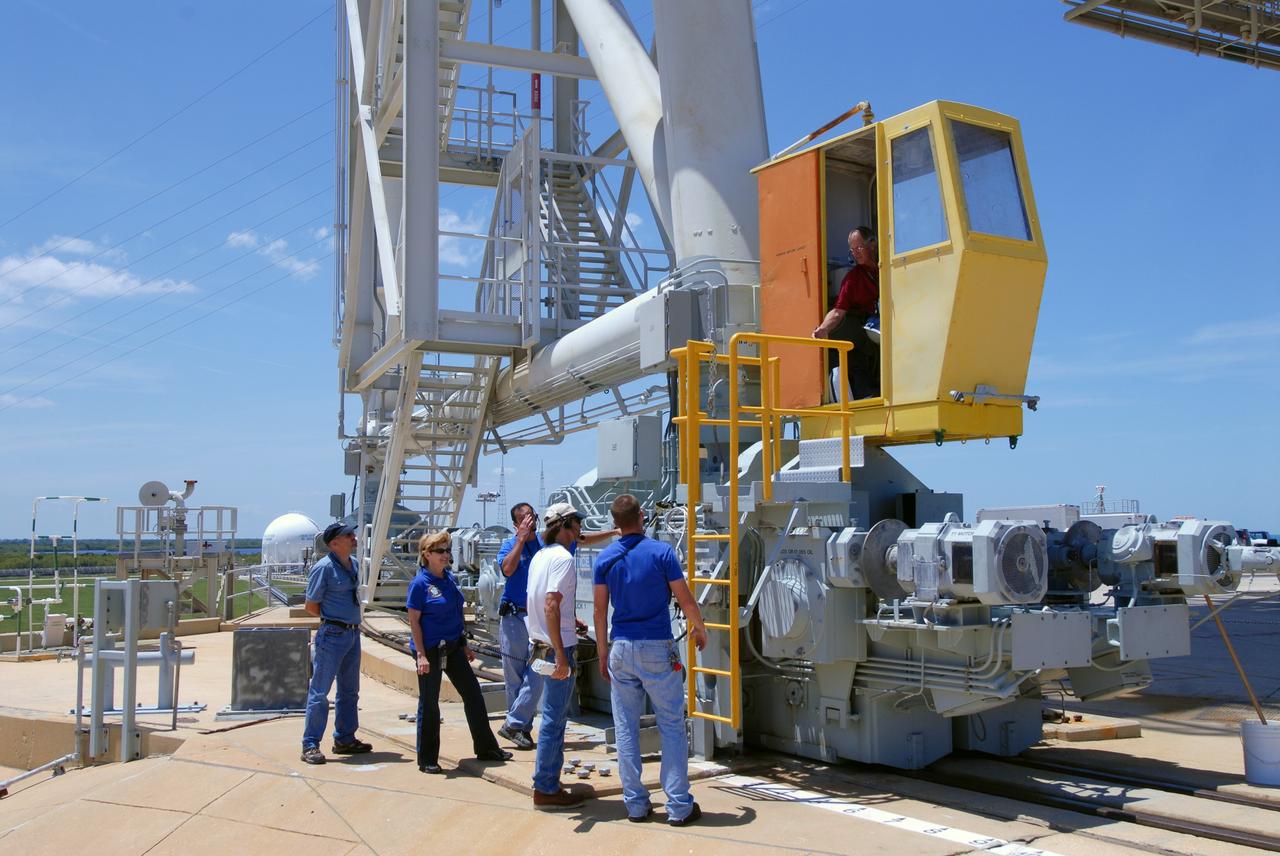
CAPE CANAVERAL, Fla. – On Launch Pad 39A at NASA's Kennedy Space Center in Florida, workers talk to the driver of the rotating service structure, or RSS, before it is moved around space shuttle Endeavour. The RSS provides protected access to the shuttle for changeout and servicing of payloads at the pad. The structure is supported by a rotating bridge that pivots about a vertical axis on the west side of the pad's flame trench. The RSS rotates through 120 degrees (one-third of a circle) on a radius of 160 feet. Support for the outer end of the bridge is provided by two eight-wheel, motor-driven trucks that move along circular twin rails installed flush with the pad surface. The track crosses the flame trench on a permanent bridge. Endeavour is targeted to launch June 13 on its STS-127 mission to the International Space Station. Photo credit: NASA/Tim Jacobs
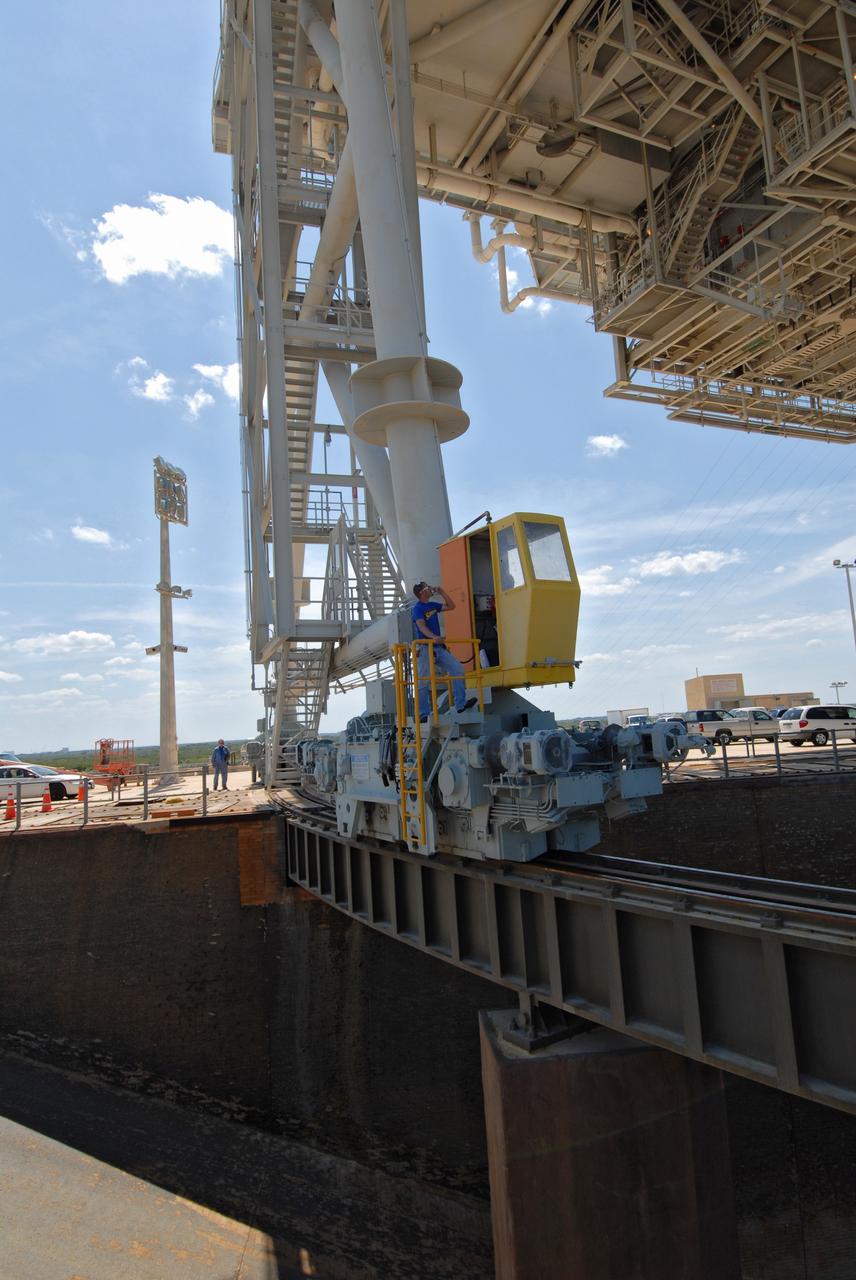
CAPE CANAVERAL, Fla. – On Launch Pad 39A at NASA's Kennedy Space Center in Florida, workers begin closing the rotating service structure, or RSS, around space shuttle Endeavour. The RSS provides protected access to the shuttle for changeout and servicing of payloads at the pad. The structure is supported by a rotating bridge that pivots about a vertical axis on the west side of the pad's flame trench. The RSS rotates through 120 degrees (one-third of a circle) on a radius of 160 feet. Support for the outer end of the bridge is provided by two eight-wheel, motor-driven trucks that move along circular twin rails installed flush with the pad surface. The track crosses the flame trench on a permanent bridge. Endeavour is targeted to launch June 13 on its STS-127 mission to the International Space Station. Photo credit: NASA/Tim Jacobs
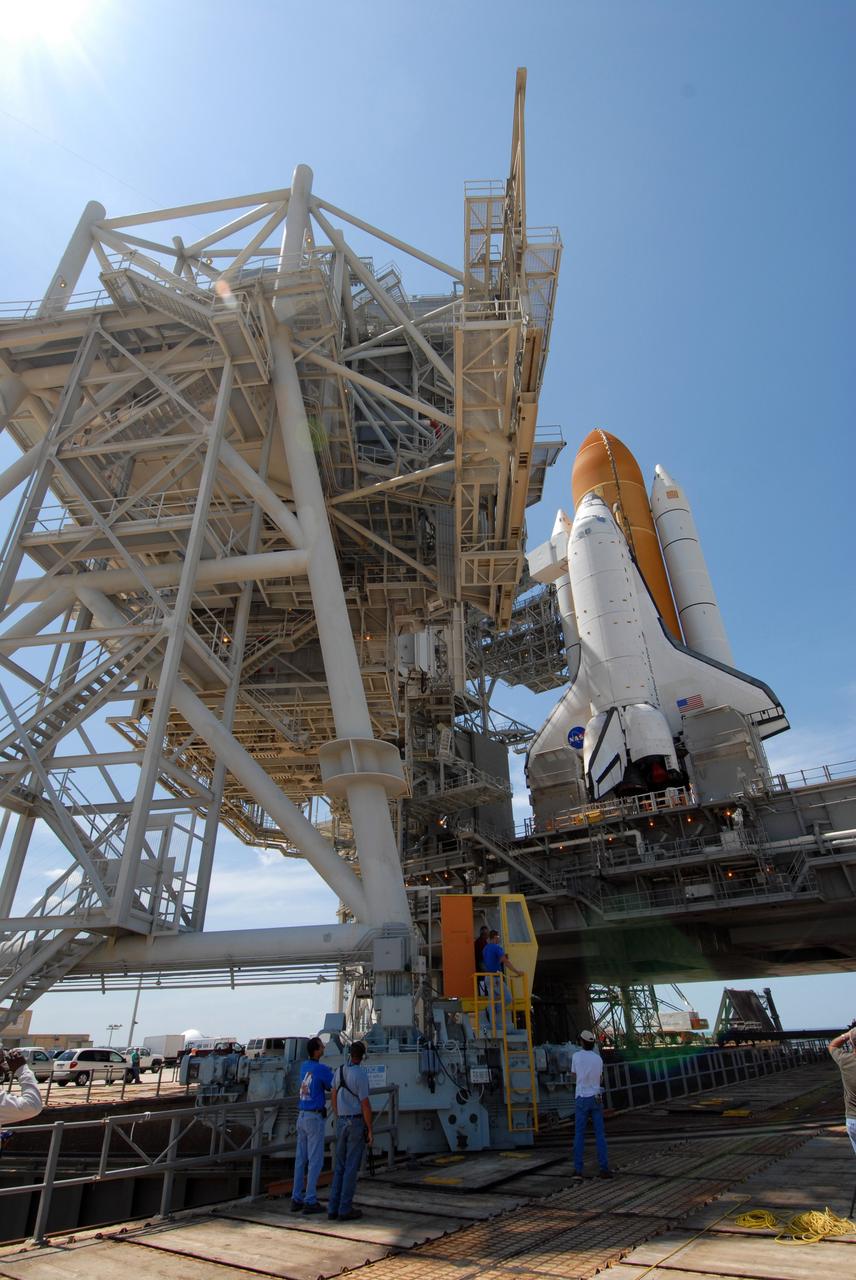
CAPE CANAVERAL, Fla. – On Launch Pad 39A at NASA's Kennedy Space Center in Florida, workers keep watch as the rotating service structure, or RSS, is moved to enclose space shuttle Endeavour. The RSS provides protected access to the shuttle for changeout and servicing of payloads at the pad. The structure is supported by a rotating bridge that pivots about a vertical axis on the west side of the pad's flame trench. The RSS rotates through 120 degrees (one-third of a circle) on a radius of 160 feet. Support for the outer end of the bridge is provided by two eight-wheel, motor-driven trucks that move along circular twin rails installed flush with the pad surface. The track crosses the flame trench on a permanent bridge. Endeavour is targeted to launch June 13 on its STS-127 mission to the International Space Station. Photo credit: NASA/Tim Jacobs
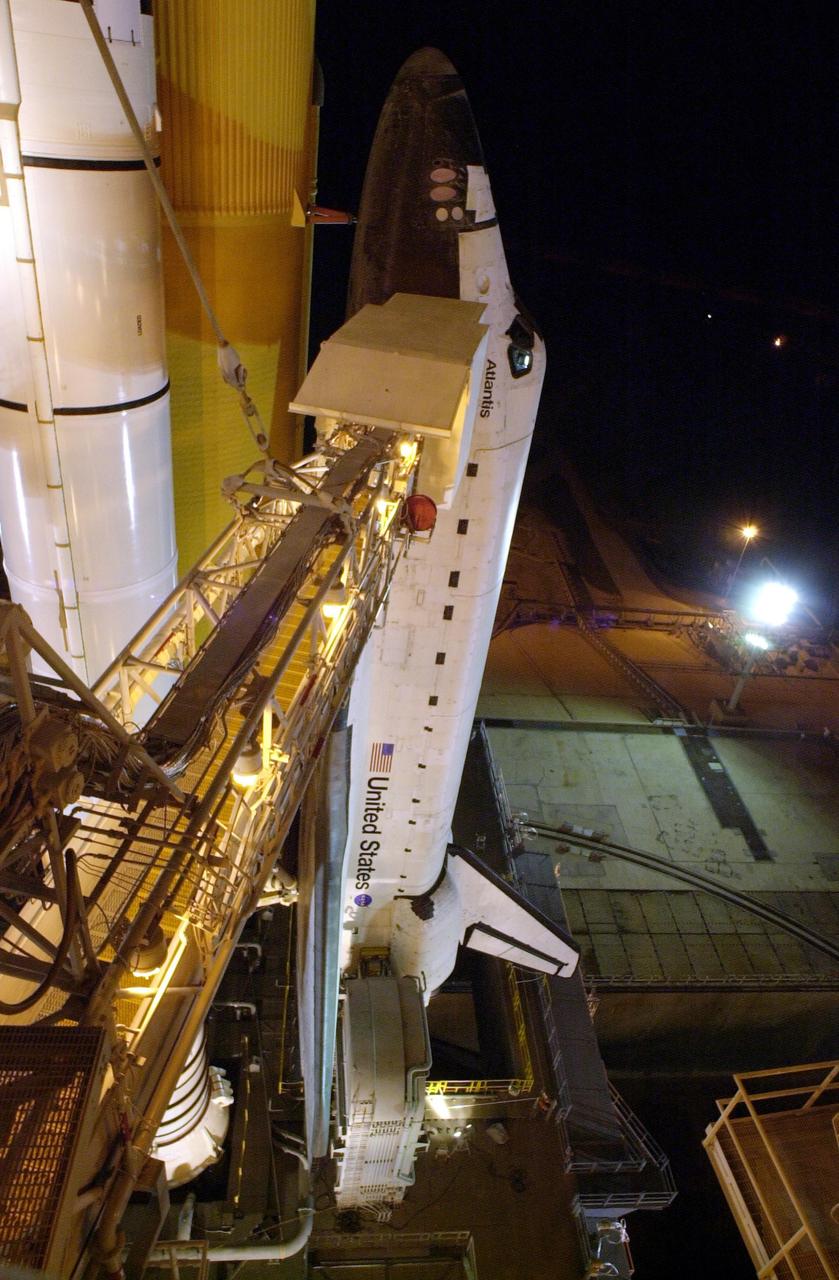
KENNEDY SPACE CENTER, FLA. -- With the Rotating Service Structure rolled back, Space Shuttle Atlantis stands ready for launch on mission STS-110. The Orbiter Access Arm extends from the Fixed Service Structure (FSS) to the crew compartment hatch, through which the STS-110 crew will enter Atlantis. The RSS provides protected access to the orbiter for changeout and servicing of payloads at the pad. The structure has access platforms at five levels to provide access to the payload bay. The FSS provides access to the orbiter and the RSS. . Mission STS-110 is scheduled to launch April 4 on its 11-day mission to the International Space Station
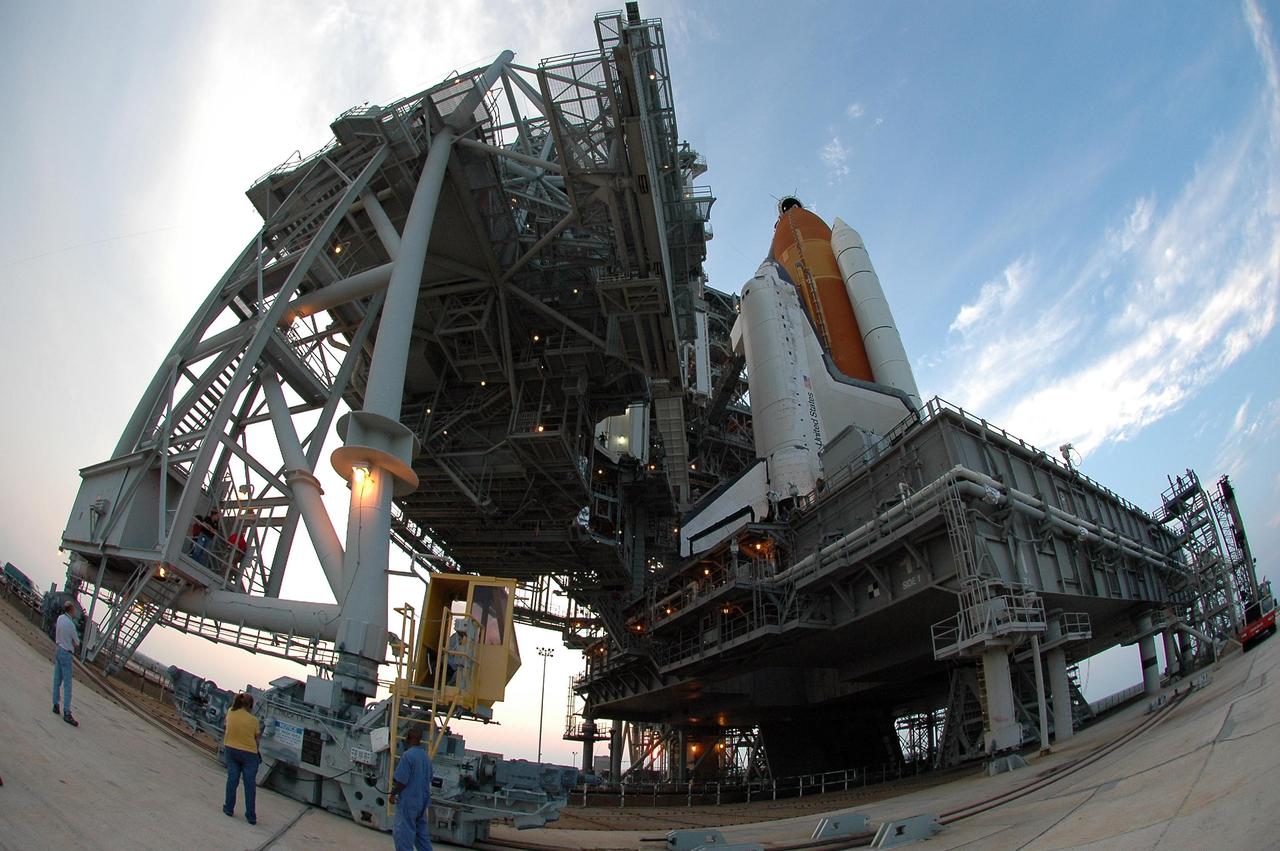
KENNEDY SPACE CENTER, FLA. - A fish-eye camera lens captures the movement of the rotating service structure (RSS) at left as it moves away from Space Shuttle Discovery in preparation for the July 1 launch from Launch Pad 39B. The RSS provides protected access to the orbiter for changeout and servicing of payloads at the pad. The structure is supported by a rotating bridge that pivots about a vertical axis on the west side of the pad's flame trench. The hinge column rests on the pad surface and is braced to the fixed service structure. Support for the outer end of the bridge is provided by two eight-wheel, motor-driven trucks that move along circular twin rails installed flush with the pad surface. The track crosses the flame trench on a permanent bridge. The RSS is 102 feet long, 50 feet wide and 130 feet high. The structure has orbiter access platforms at five levels to provide access to the payload bay while the orbiter is being serviced in the RSS. Each platform has independent extendable planks that can be arranged to conform to a payload's configuration. This mission is the 115th shuttle flight and the 18th U.S. flight to the International Space Station. Photo credit: NASA/Kim Shiflett
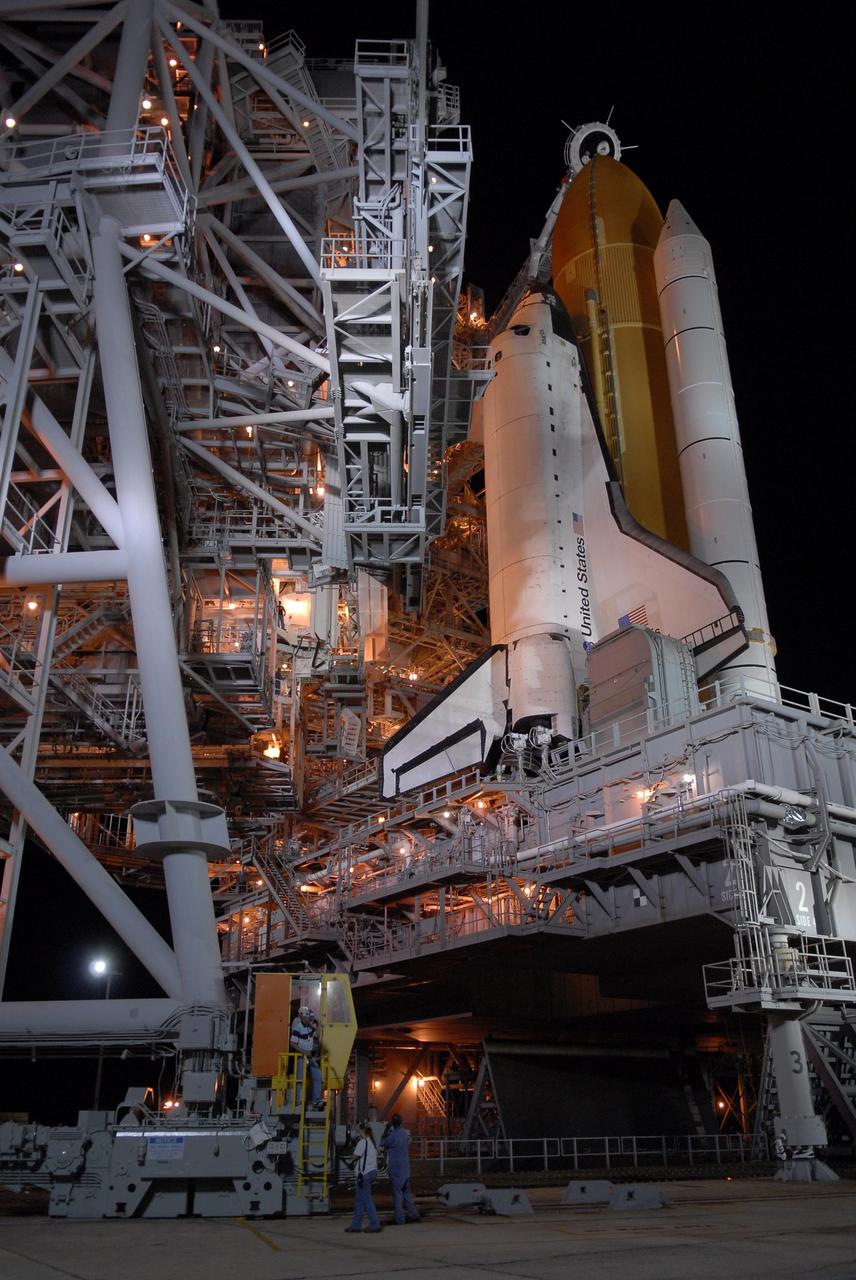
KENNEDY SPACE CENTER, FLA. -- Rollback of the rotating service structure, or RSS, begins on Launch Pad 39A, revealing Space Shuttle Atlantis, bathed in lights. Rollback is one of the milestones in preparation for the launch of mission STS-117 on June 8 and started at 10:56 p.m. EDT. The RSS provides protected access to the orbiter for changeout and servicing of payloads at the pad. The structure is supported by a rotating bridge that pivots about a vertical axis on the side of the pad's flame trench. The hinge column rests on the pad surface and is braced to the fixed service structure. Support for the outer end of the bridge is provided by two eight-wheel, motor-driven trucks that move along circular twin rails installed flush with the pad surface. The track crosses the flame trench on a permanent bridge. The RSS is 102 feet long, 50 feet wide and 130 feet high. The structure has orbiter access platforms at five levels to provide access to the payload bay while the orbiter is being serviced in the RSS. Each platform has independent extendable planks that can be arranged to conform to a payload's configuration. This mission is the 118th shuttle flight and the 21st U.S. flight to the International Space Station and will deliver and install the S3/S4 truss segment, deploy a set of solar arrays and prepare them for operation. Photo credit: NASA/Kim Shiflett
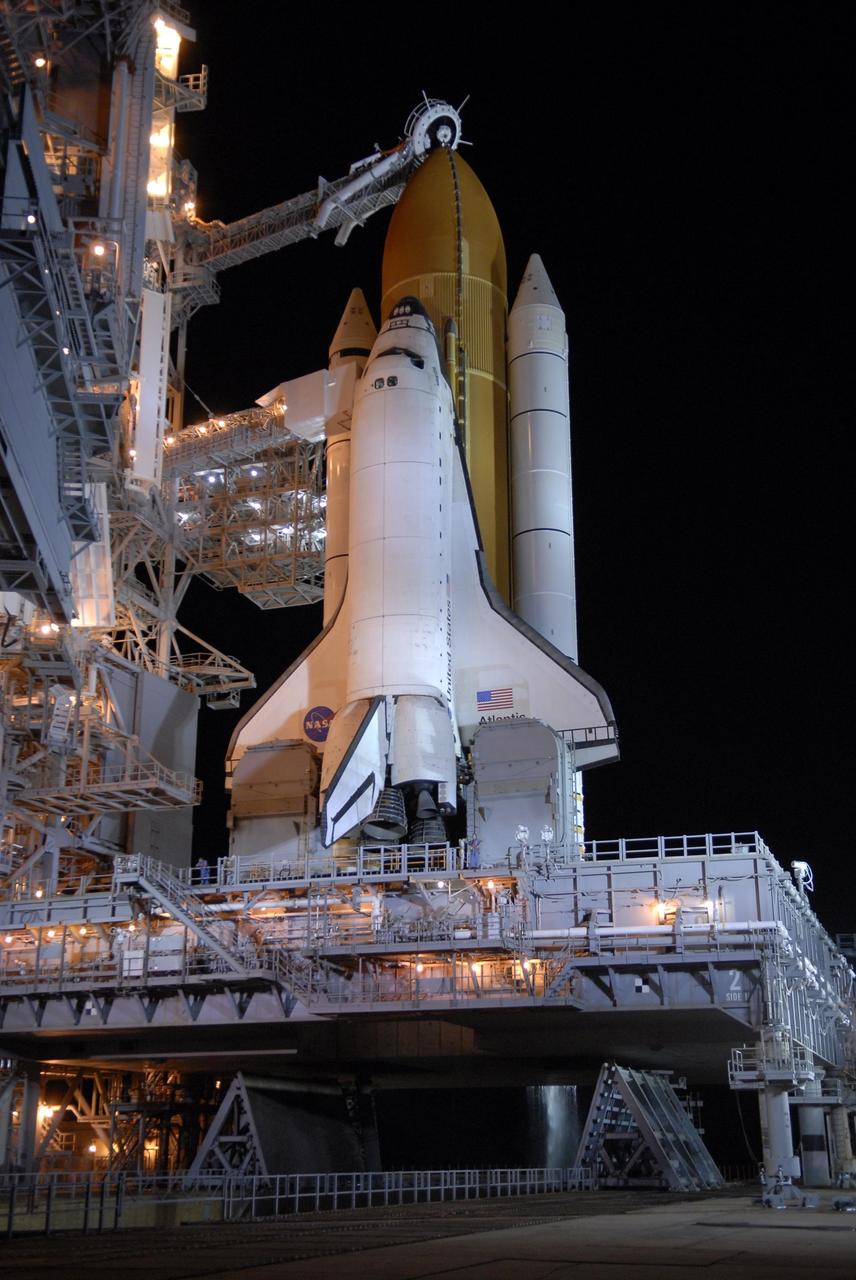
KENNEDY SPACE CENTER, FLA. -- After rollback of the rotating service structure, or RSS, on Launch Pad 39A, Space Shuttle Atlantis stands bathed in lights. Rollback is one of the milestones in preparation for the launch of mission STS-117 on June 8. Rollback started at 10:56 p.m. and was complete at 11:34 p.m EDT. The RSS provides protected access to the orbiter for changeout and servicing of payloads at the pad. The structure is supported by a rotating bridge that pivots about a vertical axis on the side of the pad's flame trench. The hinge column rests on the pad surface and is braced to the fixed service structure. Support for the outer end of the bridge is provided by two eight-wheel, motor-driven trucks that move along circular twin rails installed flush with the pad surface. The track crosses the flame trench on a permanent bridge. The RSS is 102 feet long, 50 feet wide and 130 feet high. The structure has orbiter access platforms at five levels to provide access to the payload bay while the orbiter is being serviced in the RSS. Each platform has independent extendable planks that can be arranged to conform to a payload's configuration. This mission is the 118th shuttle flight and the 21st U.S. flight to the International Space Station and will deliver and install the S3/S4 truss segment, deploy a set of solar arrays and prepare them for operation. Photo credit: NASA/Kim Shiflett
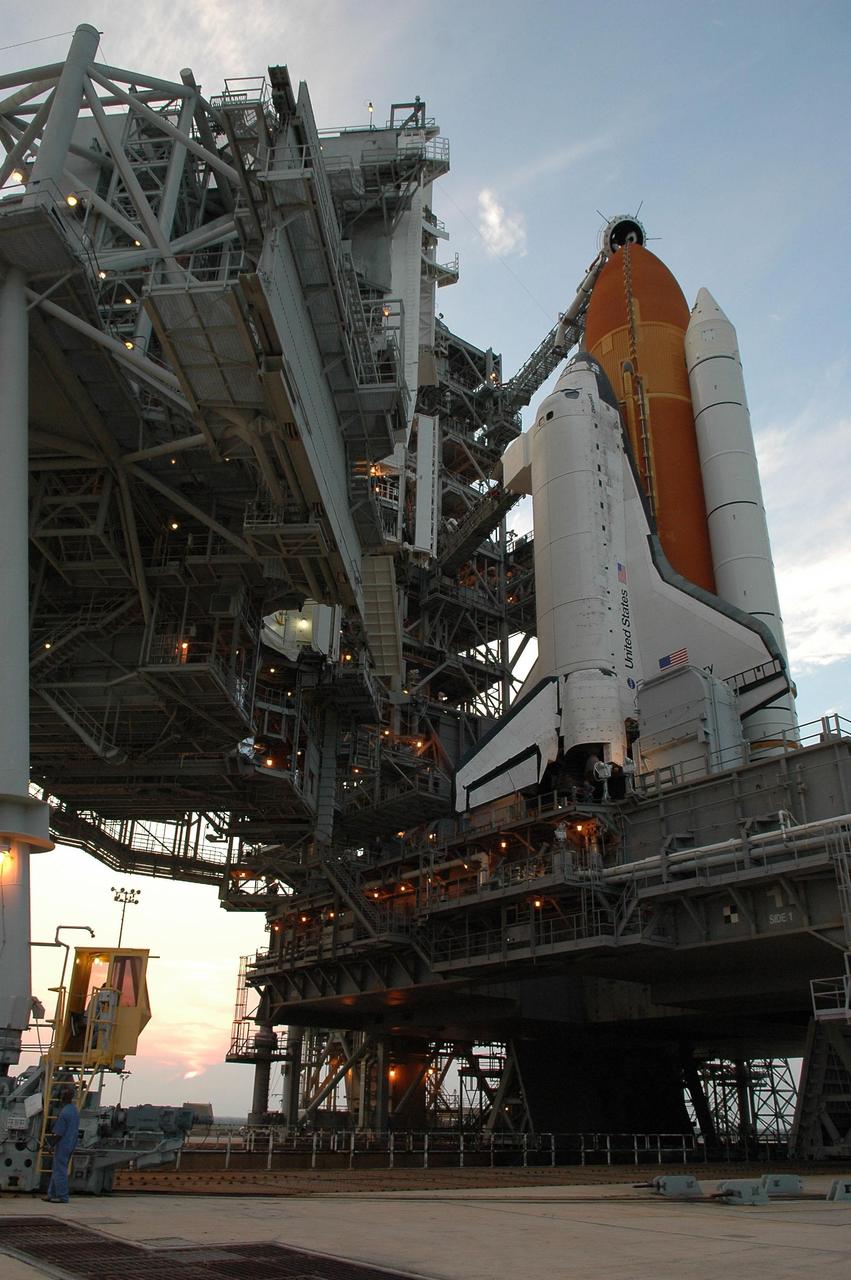
KENNEDY SPACE CENTER, FLA. - In preparation for the July 1 launch of Space Shuttle Discovery on mission STS-121, the Launch Pad 39B rotating service structure (RSS) enclosing the shuttle rolls away. The RSS provides protected access to the orbiter for changeout and servicing of payloads at the pad. The structure is supported by a rotating bridge that pivots about a vertical axis on the west side of the pad's flame trench. The hinge column rests on the pad surface and is braced to the fixed service structure. Support for the outer end of the bridge is provided by two eight-wheel, motor-driven trucks that move along circular twin rails installed flush with the pad surface. The track crosses the flame trench on a permanent bridge. The RSS is 102 feet long, 50 feet wide and 130 feet high. The structure has orbiter access platforms at five levels to provide access to the payload bay while the orbiter is being serviced in the RSS. Each platform has independent extendable planks that can be arranged to conform to a payload's configuration. This mission is the 115th shuttle flight and the 18th U.S. flight to the International Space Station. Photo credit: NASA/Kim Shiflett
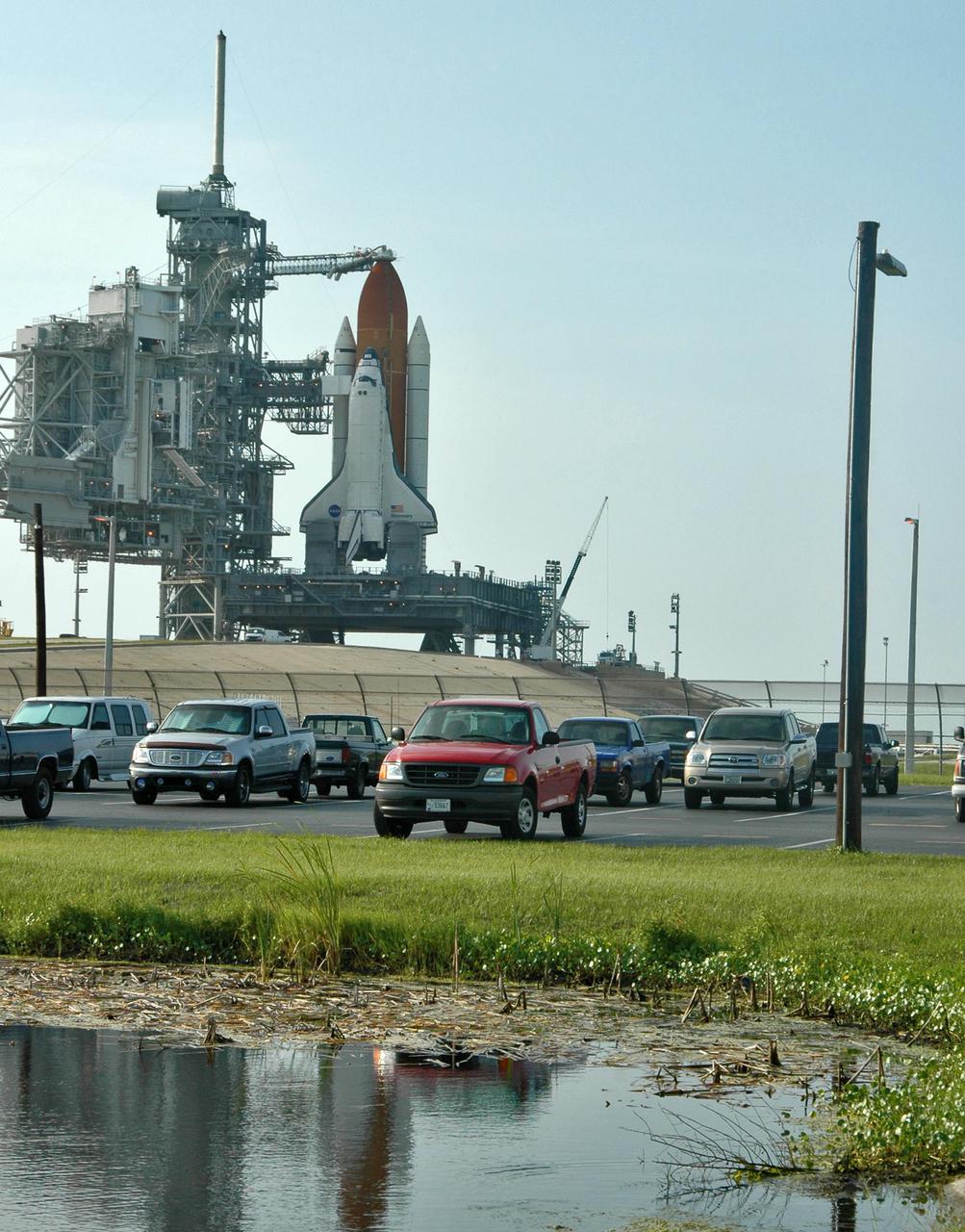
KENNEDY SPACE CENTER, FLA. - Space Shuttle Discovery in full launch configuration is revealed after the Rotating Service Structure (RSS) was rotated back at Launch Pad 39B at NASA Kennedy Space Center. Rollback of the RSS is a major preflight milestone, typically occurring during the T-11-hour hold on L-1 (the day before launch). Discovery is scheduled to lift off on the historic Return to Flight mission STS-114 at 10:39 a.m. EDT July 26 with a crew of seven.
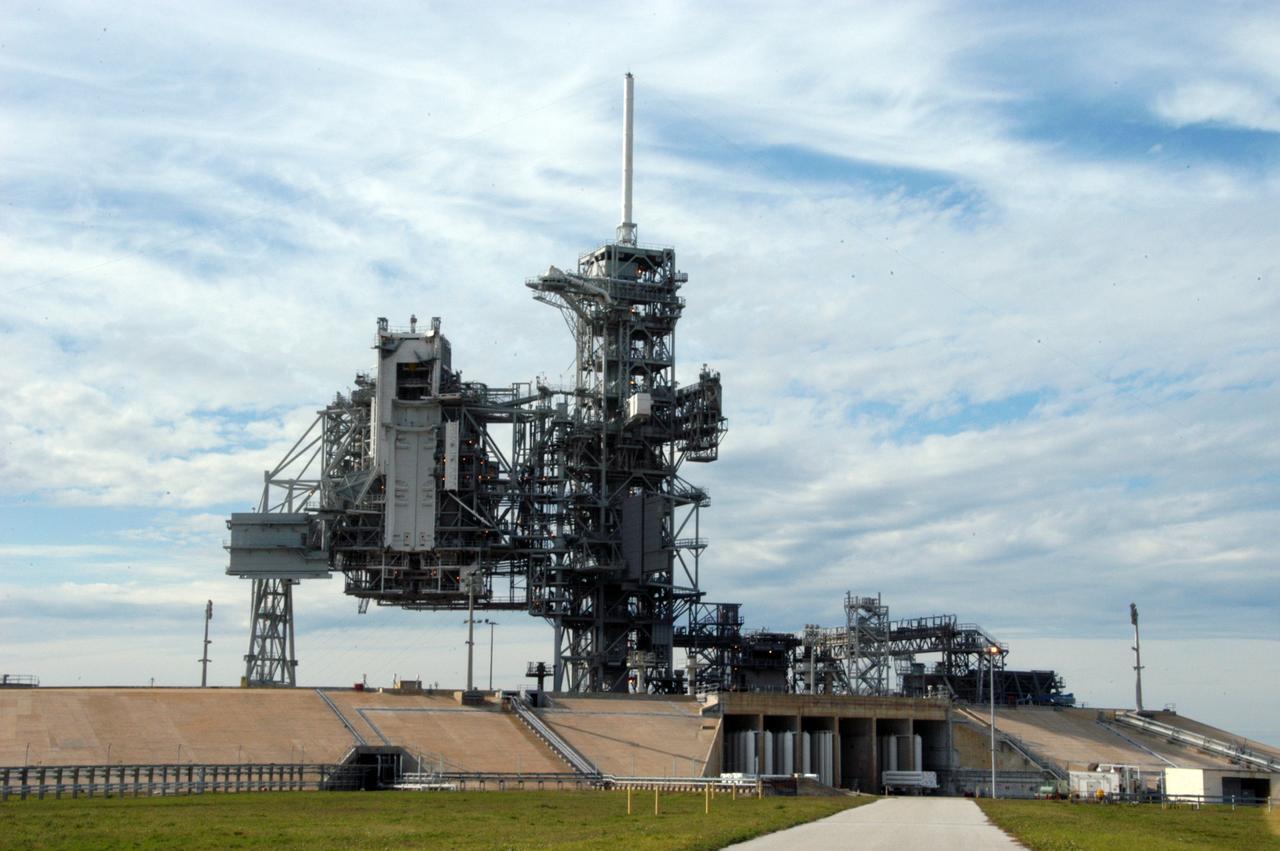
The rotating service structure on Launch Pad 39A has been fully opened for the first time in more than a year due to maintenance and upgrades on the pad. Some of the work included sandblasting the structure to remove rust and repainting. In addition, the RSS was jacked up and a new upper-bearing race assembly installed where the RSS pivots against the fixed service structure and a half-inch steel plate added. Pad 39A is being made ready for its first launch in four years, the upcoming STS-117 on March 15. Photo credit: NASA/George Shelton

KENNEDY SPACE CENTER, FLA. -- The rotating service structure on Launch Pad 39A has been fully opened for the first time in more than a year due to maintenance and upgrades on the pad. Some of the work included sandblasting the structure to remove rust and repainting. In addition, the RSS was jacked up and a new upper-bearing race assembly installed where the RSS pivots against the fixed service structure and a half-inch steel plate added. Pad 39A is being made ready for its first launch in four years, the upcoming STS-117 on March 15. Photo credit: NASA/George Shelton
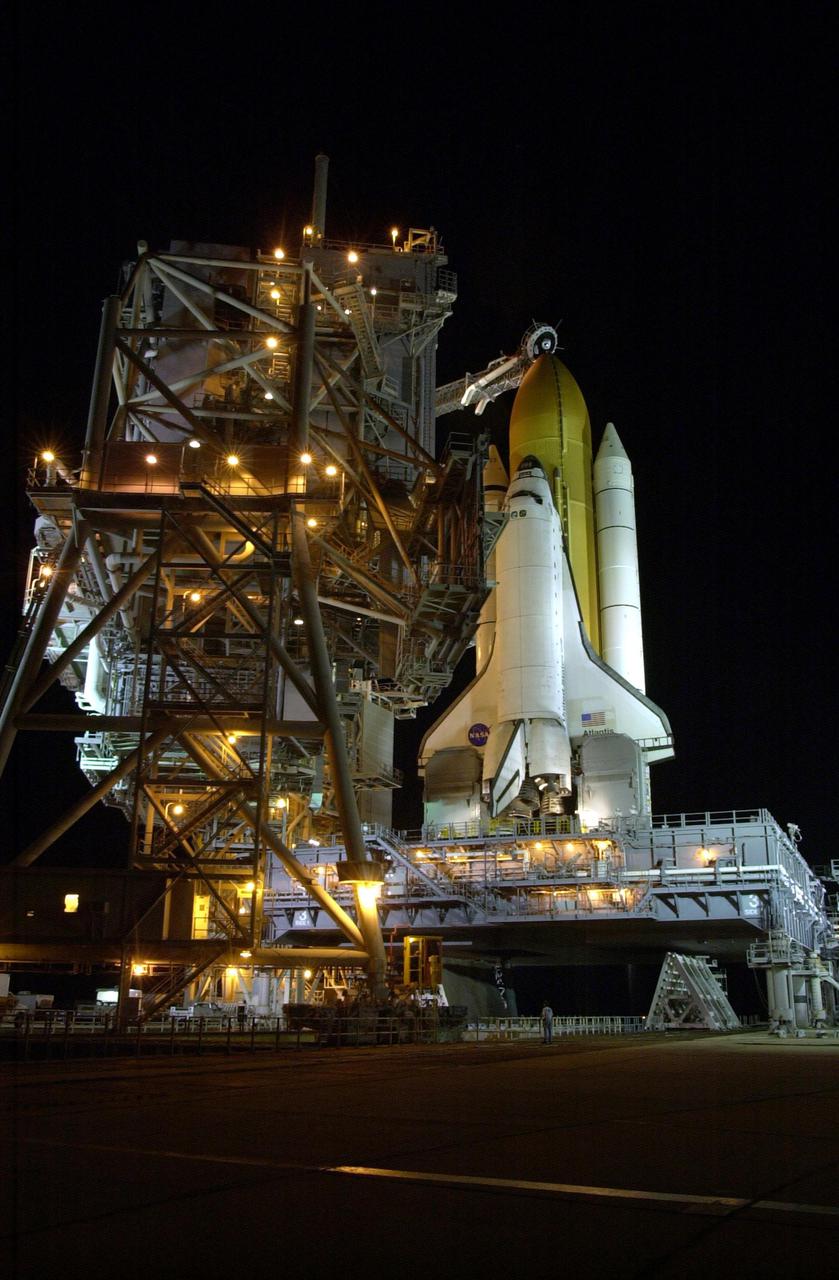
KENNEDY SPACE CENTER, FLA. -- In preparation for launch of Space Shuttle Atlantis on mission STS-110, the Rotating Service Structure (RSS) rolls back into launch position. The RSS provides protected access to the orbiter for changeout and servicing of payloads at the pad. The structure has access platforms at five levels to provide access to the payload bay. The Shuttle rests on the Mobile Launcher Platform (MLP), which straddles the flame trench below. The flame trench is part of the Flame Deflector System that insulates pad structures from the intense heat of a launch. Mission STS-110 is scheduled to launch April 4 on its 11-day mission to the International Space Station
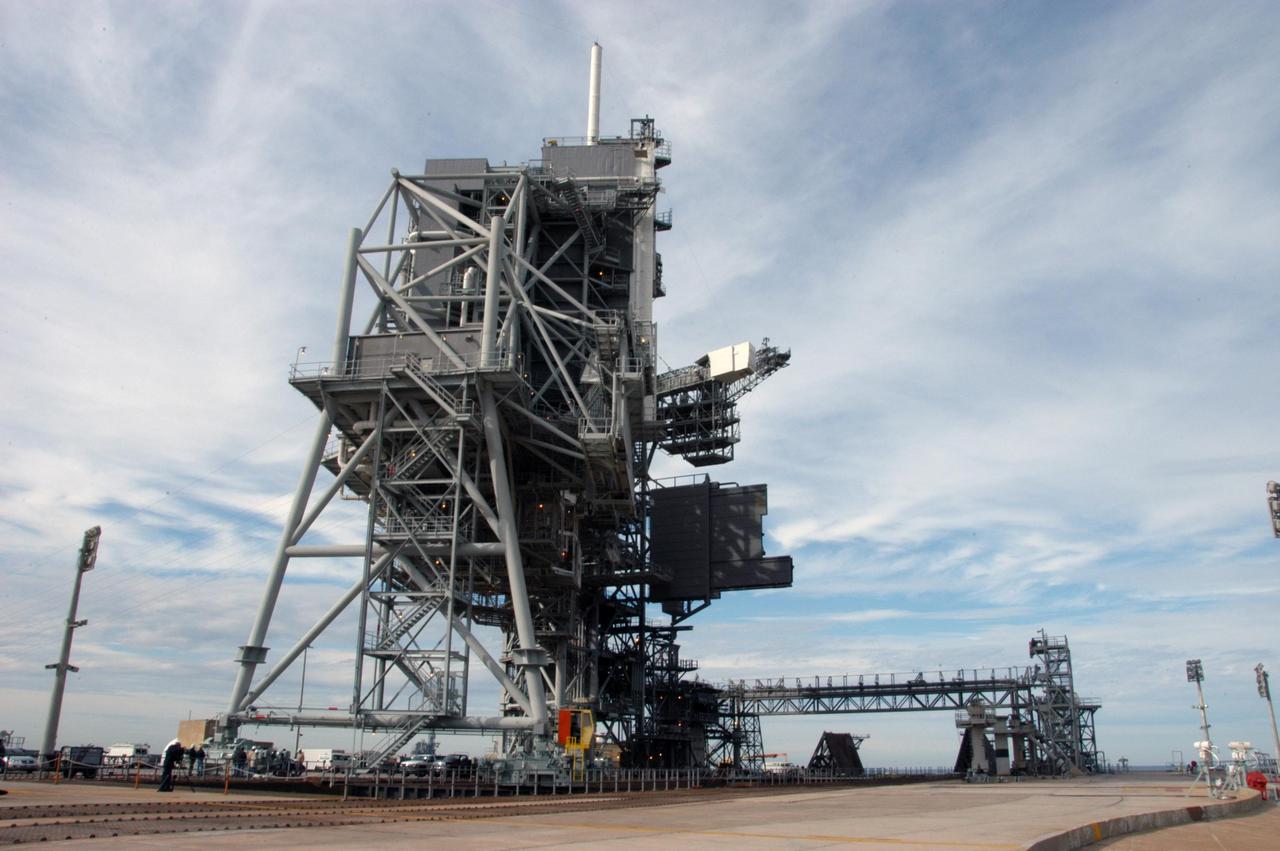
KENNEDY SPACE CENTER, FLA. -- The rotating service structure on Launch Pad 39A is being moved for the first time in more than a year due to maintenance and upgrades on the pad. Some of the work included sandblasting the structure to remove rust and repainting. In addition, the RSS was jacked up and a new upper-bearing race assembly installed where the RSS pivots against the fixed service structure and a half-inch steel plate added. Pad 39A is being made ready for its first launch in four years, the upcoming STS-117 on March 15. Photo credit: NASA/George Shelton
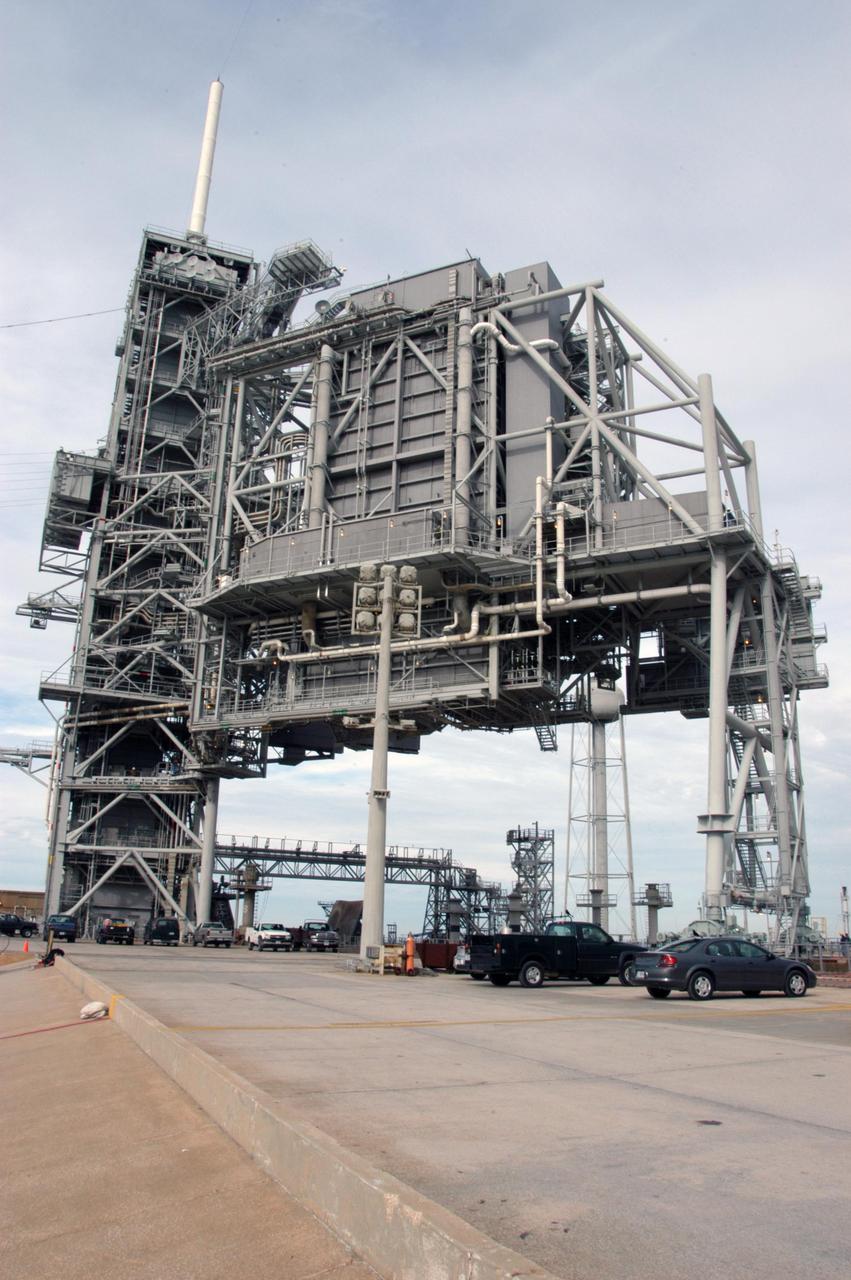
KENNEDY SPACE CENTER, FLA. -- The rotating service structure on Launch Pad 39A is being moved for the first time in more than a year due to maintenance and upgrades on the pad. Some of the work included sandblasting the structure to remove rust and repainting. In addition, the RSS was jacked up and a new upper-bearing race assembly installed where the RSS pivots against the fixed service structure and a half-inch steel plate added. Pad 39A is being made ready for its first launch in four years, the upcoming STS-117 on March 15. Photo credit: NASA/George Shelton
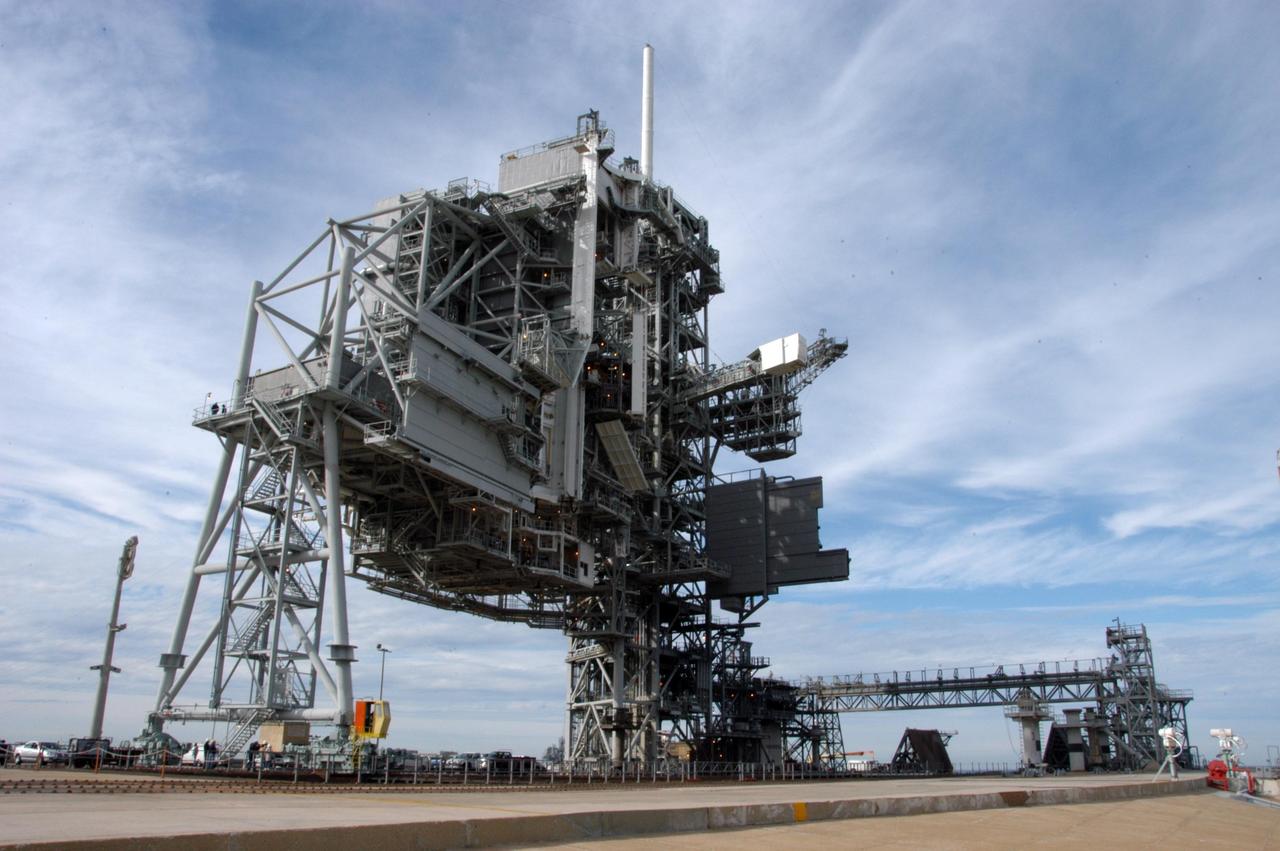
KENNEDY SPACE CENTER, FLA. -- The rotating service structure on Launch Pad 39A has moved for the first time in more than a year due to maintenance and upgrades on the pad. Some of the work included sandblasting the structure to remove rust and repainting. In addition, the RSS was jacked up and a new upper-bearing race assembly installed where the RSS pivots against the fixed service structure and a half-inch steel plate added. Pad 39A is being made ready for its first launch in four years, the upcoming STS-117 on March 15. Photo credit: NASA/George Shelton
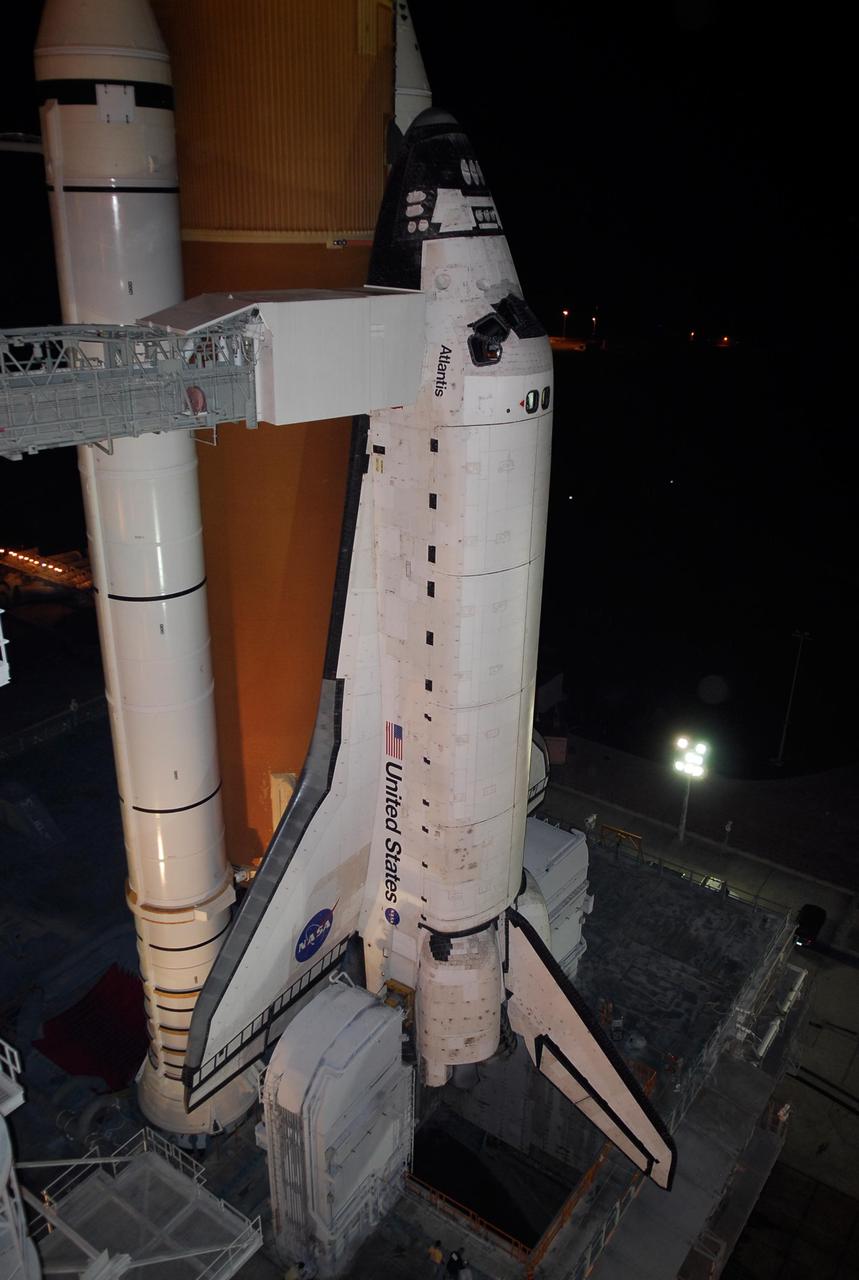
KENNEDY SPACE CENTER, FLA. -- On Launch Pad 39A at NASA's Kennedy Space Center, the orbiter access arm, which extends from the Fixed Service Structure, is positioned against space shuttle Atlantis following the rollback of the rotating service structure, or RSS. Movement of the RSS began at 7:27 p.m. EST. The RSS provides protected access to the orbiter for crew entry and servicing of payloads at the pad. Rollback of the pad's RSS is one of the milestones in preparation for the launch of mission STS-122, scheduled for 2:45 p.m. EST on Feb. 7. This will be the third launch attempt for Atlantis since December 2007 to carry the Columbus Laboratory to the International Space Station. Beneath the shuttle is the mobile launcher platform which supports the shuttle until liftoff. Photo credit: NASA/Kim Shiflett
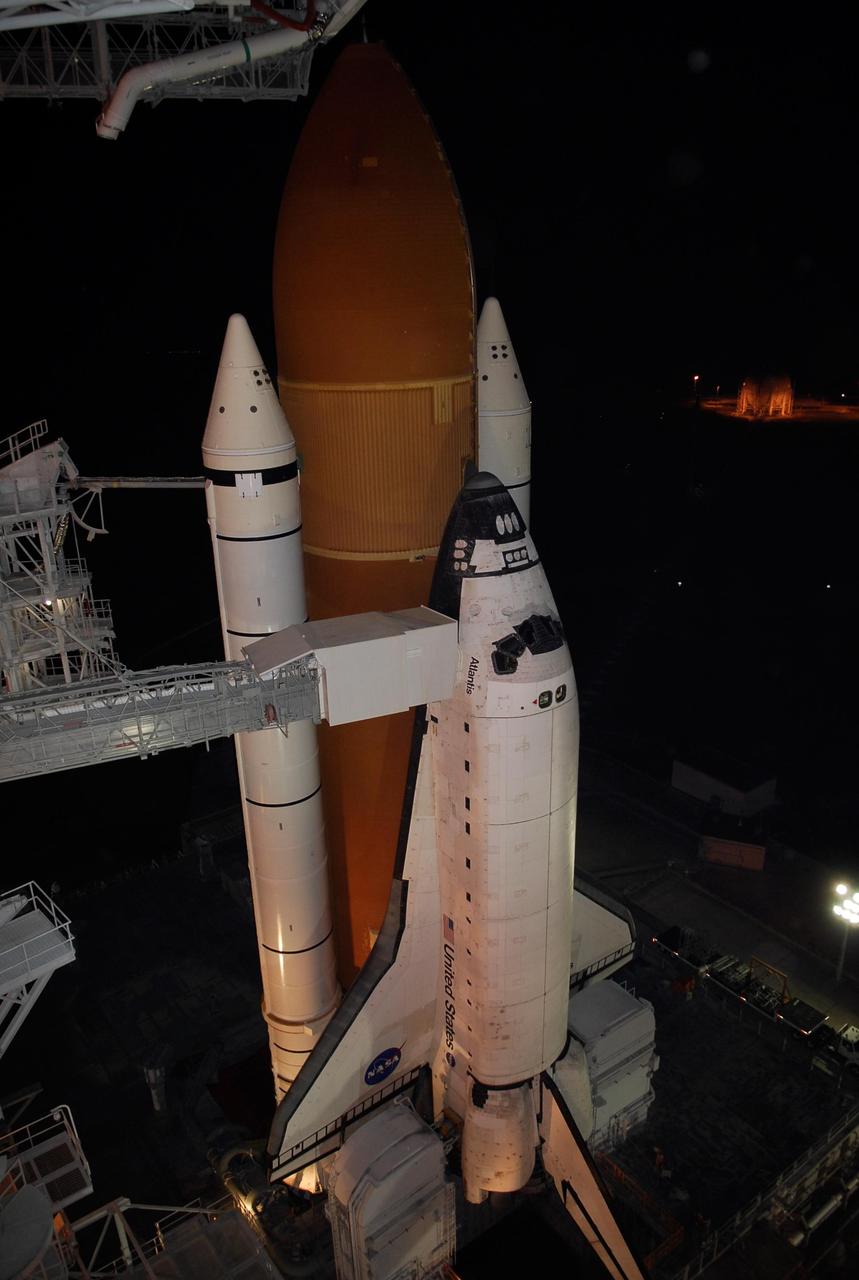
KENNEDY SPACE CENTER, FLA. -- On Launch Pad 39A at NASA's Kennedy Space Center, the orbiter access arm, which extends from the Fixed Service Structure, is positioned against space shuttle Atlantis following the rollback of the rotating service structure, or RSS. Movement of the RSS began at 7:27 p.m. EST. The RSS provides protected access to the orbiter for crew entry and servicing of payloads at the pad. Rollback of the pad's RSS is one of the milestones in preparation for the launch of mission STS-122, scheduled for 2:45 p.m. EST on Feb. 7. This will be the third launch attempt for Atlantis since December 2007 to carry the Columbus Laboratory to the International Space Station. Beneath the shuttle is the mobile launcher platform which supports the shuttle until liftoff. Photo credit: NASA/Kim Shiflett
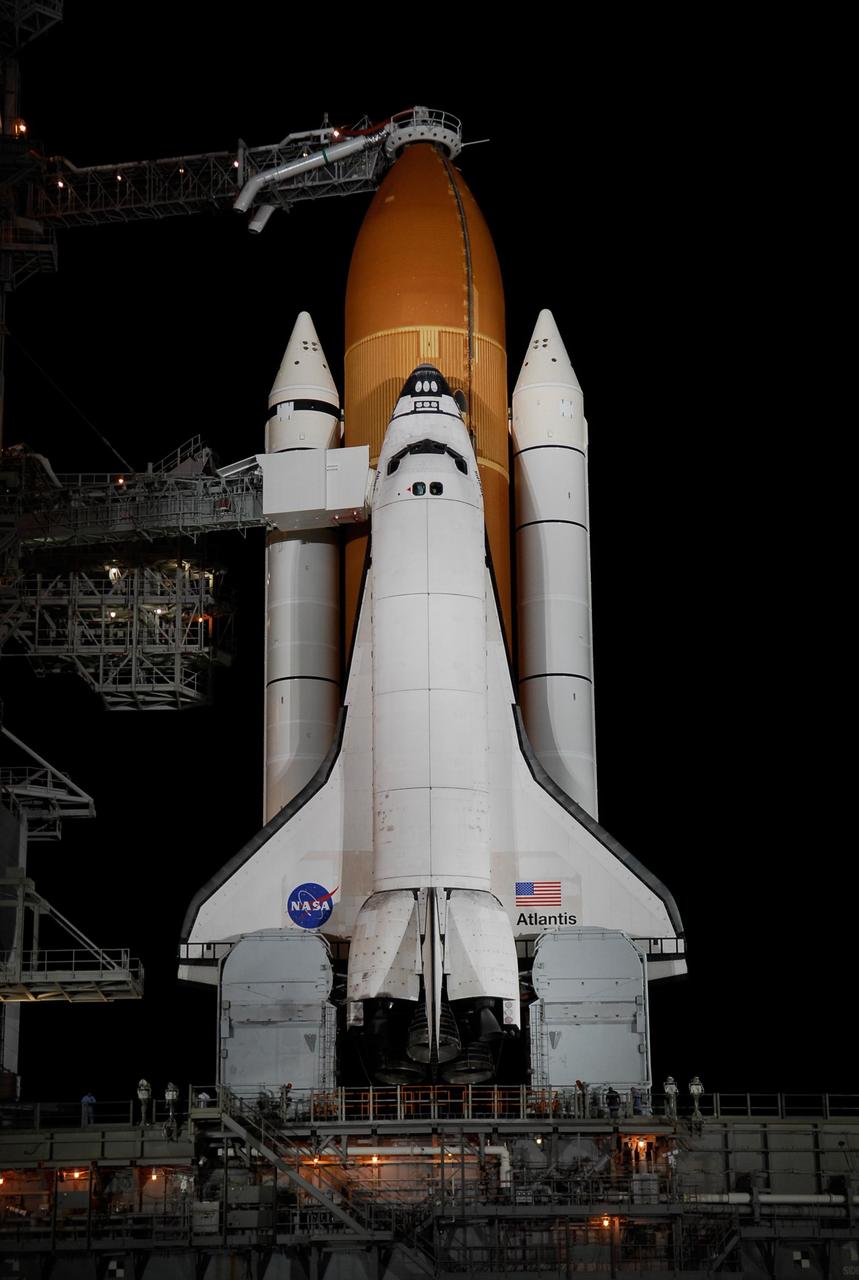
KENNEDY SPACE CENTER, FLA. -- On Launch Pad 39A at NASA's Kennedy Space Center, the orbiter access arm, which extends from the Fixed Service Structure, is positioned against space shuttle Atlantis following the rollback of the rotating service structure, or RSS. Movement of the RSS began at 7:27 p.m. EST. The RSS provides protected access to the orbiter for crew entry and servicing of payloads at the pad. Rollback of the pad's RSS is one of the milestones in preparation for the launch of mission STS-122, scheduled for 2:45 p.m. EST on Feb. 7. This will be the third launch attempt for Atlantis since December 2007 to carry the Columbus Laboratory to the International Space Station. Beneath the shuttle is the mobile launcher platform which supports the shuttle until liftoff. Photo credit: NASA/Kim Shiflett
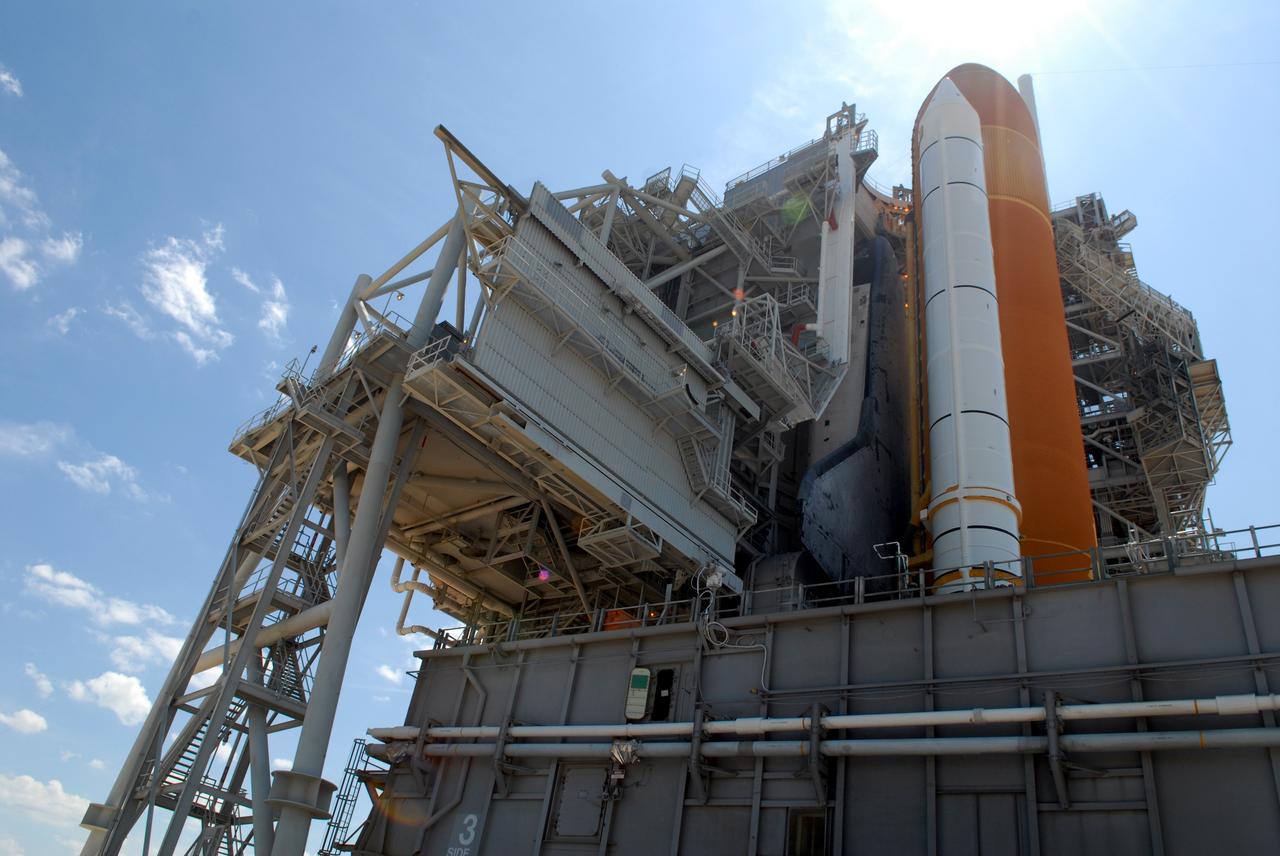
CAPE CANAVERAL, Fla. – Viewed from the side of Launch Pad 39A at NASA's Kennedy Space Center in Florida, the rotating service structure has been moved into place around space shuttle Endeavour. The RSS provides protected access to the shuttle for changeout and servicing of payloads at the pad. The structure is supported by a rotating bridge that pivots about a vertical axis on the west side of the pad's flame trench. The RSS rotates through 120 degrees (one-third of a circle) on a radius of 160 feet. Support for the outer end of the bridge is provided by two eight-wheel, motor-driven trucks that move along circular twin rails installed flush with the pad surface. The track crosses the flame trench on a permanent bridge. Endeavour is targeted to launch June 13 on its STS-127 mission to the International Space Station. Photo credit: NASA/Tim Jacobs
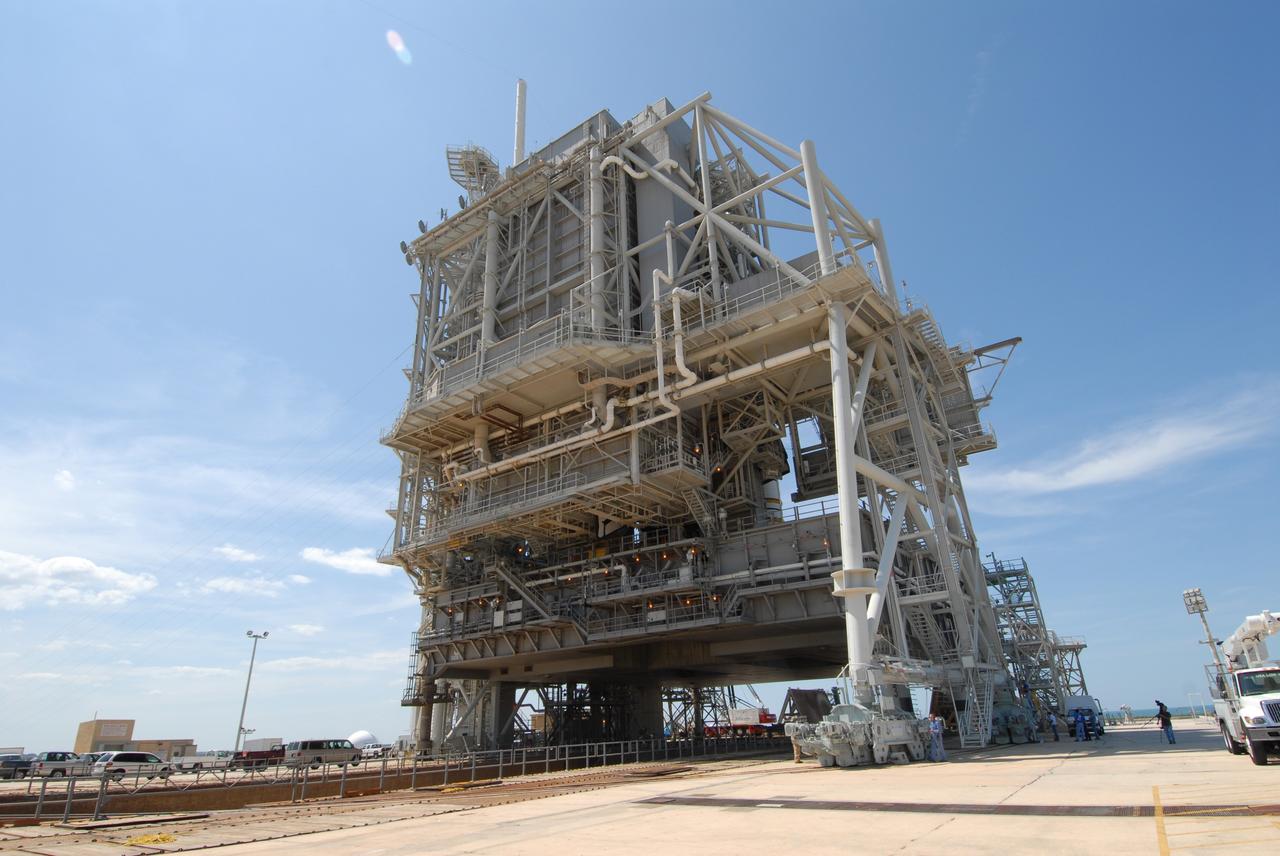
CAPE CANAVERAL, Fla. – On Launch Pad 39A at NASA's Kennedy Space Center in Florida, the rotating service structure has been moved into place around space shuttle Endeavour. The RSS provides protected access to the shuttle for changeout and servicing of payloads at the pad. The structure is supported by a rotating bridge that pivots about a vertical axis on the west side of the pad's flame trench. The RSS rotates through 120 degrees (one-third of a circle) on a radius of 160 feet. Support for the outer end of the bridge is provided by two eight-wheel, motor-driven trucks that move along circular twin rails installed flush with the pad surface. The track crosses the flame trench on a permanent bridge. Endeavour is targeted to launch June 13 on its STS-127 mission to the International Space Station. Photo credit: NASA/Tim Jacobs
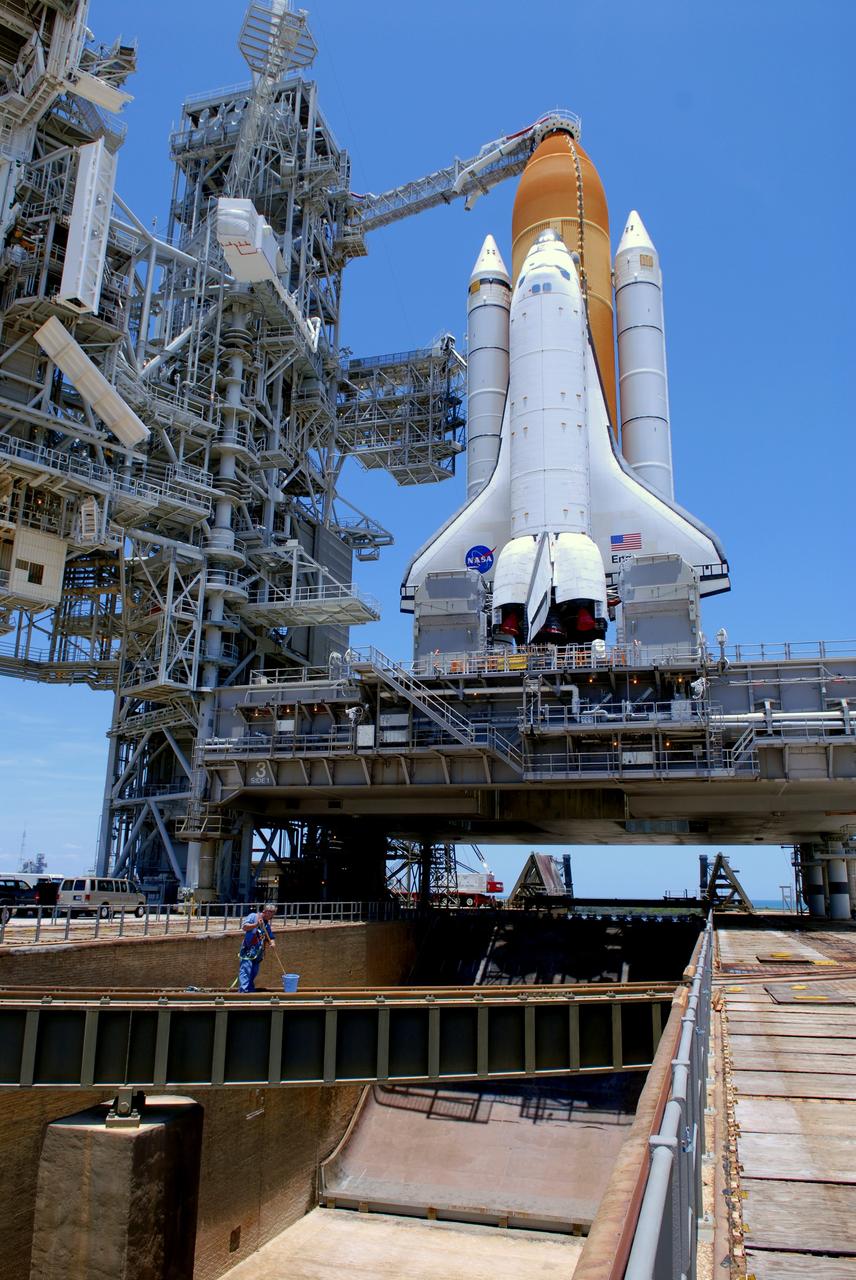
CAPE CANAVERAL, Fla. – On Launch Pad 39A at NASA's Kennedy Space Center in Florida, a worker prepares the rail for the closing of the rotating service structure around space shuttle Endeavour. The RSS provides protected access to the shuttle for changeout and servicing of payloads at the pad. The structure is supported by a rotating bridge that pivots about a vertical axis on the west side of the pad's flame trench. The RSS rotates through 120 degrees (one-third of a circle) on a radius of 160 feet. Support for the outer end of the bridge is provided by two eight-wheel, motor-driven trucks that move along circular twin rails installed flush with the pad surface. The track crosses the flame trench on a permanent bridge. Endeavour is targeted to launch June 13 on its STS-127 mission to the International Space Station. Photo credit: NASA/Tim Jacobs
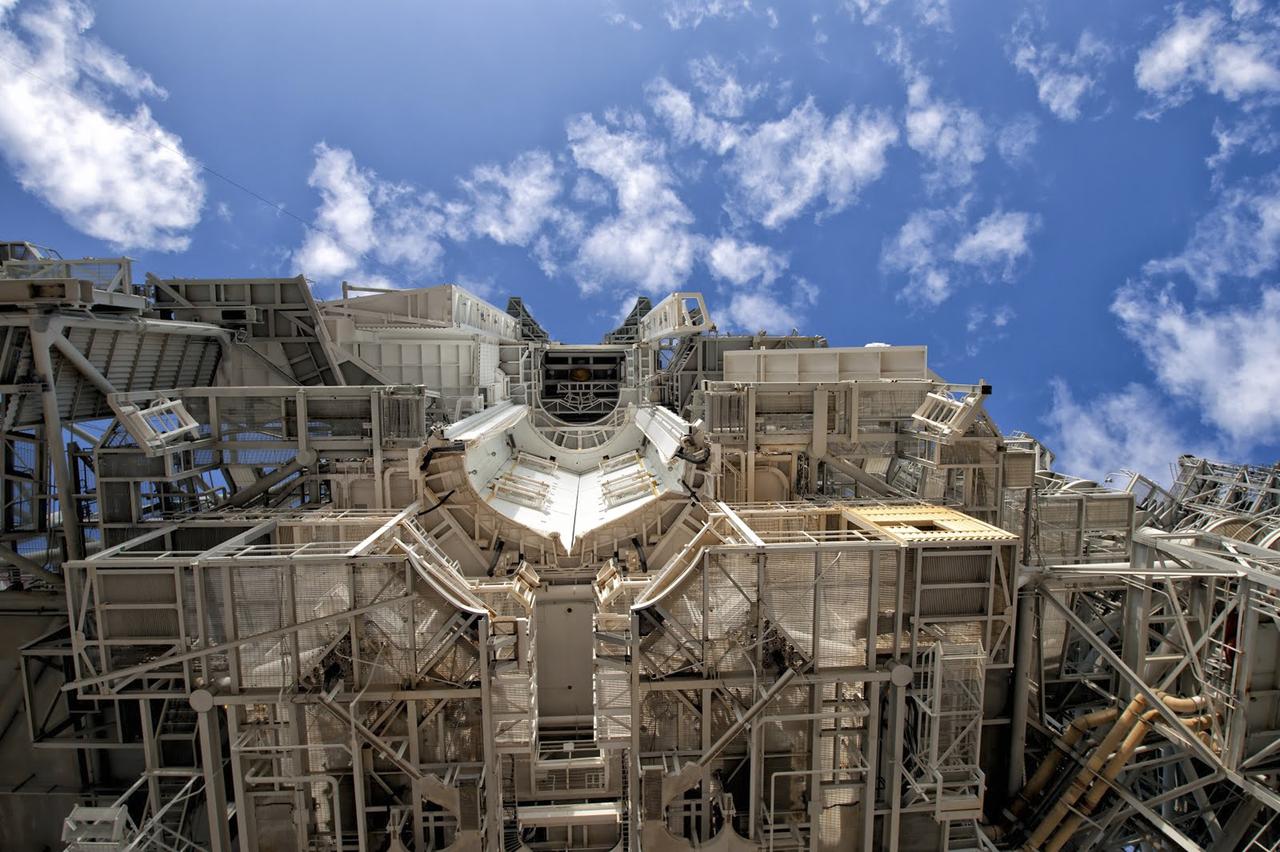
CAPE CANAVERAL, Fla. – As seen on Google Maps, the Rotating Service Structure at Launch Complex 39A at NASA's Kennedy Space Center housed space shuttle payloads temporarily so they could be loaded inside the 60-foot-long cargo bay of a shuttle before launch. The RSS, as the structure was known, was hinged to the Fixed Service Structure on one side and rolled on a rail on the other. As its name suggests, the enclosed facility would rotate into place around the shuttle as it stood at the launch pad. Once in place, the RSS protected the shuttle and its cargo. Google precisely mapped the space center and some of its historical facilities for the company's map page. The work allows Internet users to see inside buildings at Kennedy as they were used during the space shuttle era. Photo credit: Google/Wendy Wang
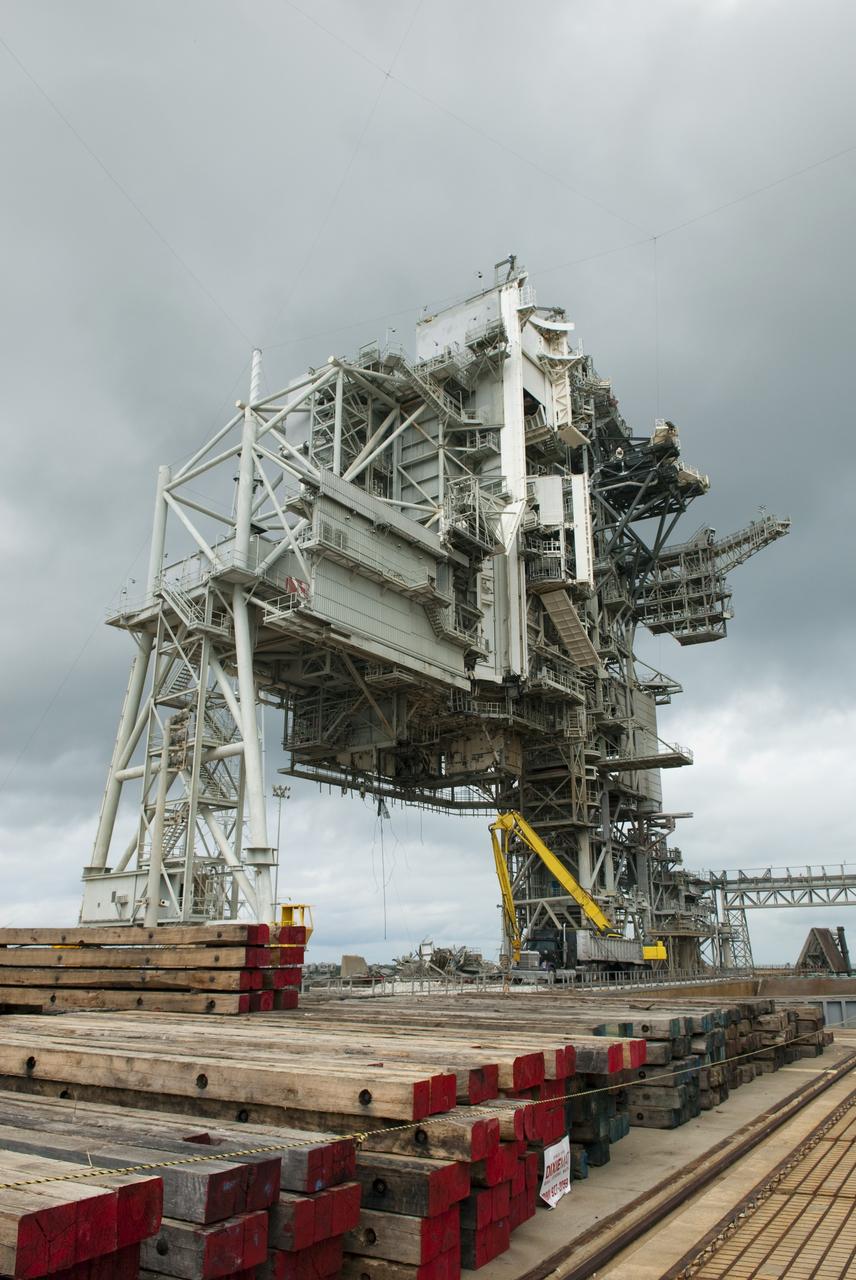
CAPE CANAVERAL, Fla. -- At NASA's Kennedy Space Center in Florida, crews are dismantling the rotating service structure (RSS) on Launch Pad 39B. Sand, reinforcing steel and large wooden mats were put down under the RSS to protect the structure's concrete from falling debris during deconstruction. Starting in 2009, the structure at the pad was no longer needed for NASA's Space Shuttle Program, so it is being restructured for future use. The new design will feature a "clean pad" for rockets to come with their own launcher, making it more versatile for a number of vehicles. The new lightning protection system, consisting of three lightning towers and a wire catenary system will remain. Photo credit: NASA/Jim Grossmann
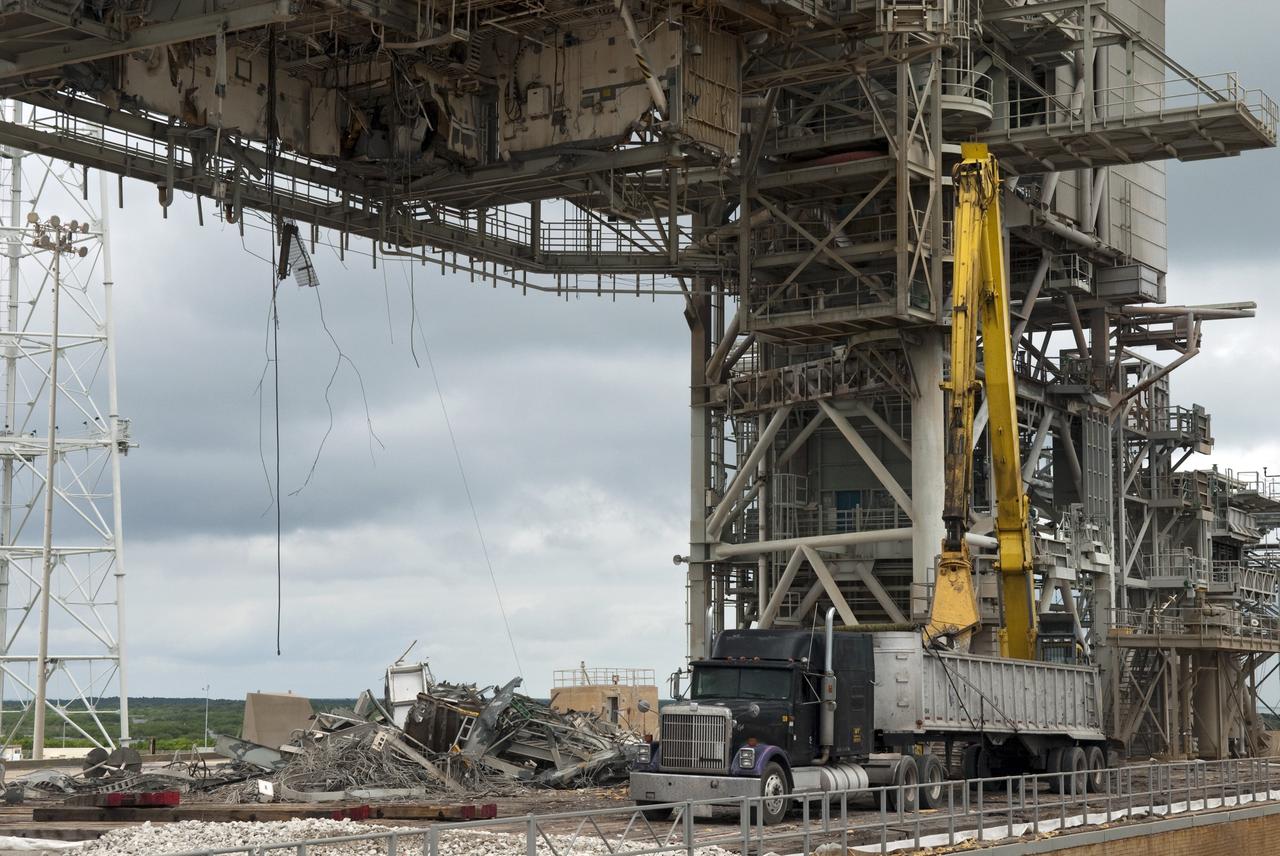
CAPE CANAVERAL, Fla. -- At NASA's Kennedy Space Center in Florida, the rotating service structure (RSS) on Launch Pad 39B is being dismantled. Sand, reinforcing steel and large wooden mats were put down under the RSS to protect the structure's concrete from falling debris during deconstruction. Starting in 2009, the structure at the pad was no longer needed for NASA's Space Shuttle Program, so it is being restructured for future use. The new design will feature a "clean pad" for rockets to come with their own launcher, making it more versatile for a number of vehicles. The new lightning protection system, consisting of three lightning towers and a wire catenary system will remain. Photo credit: NASA/Jim Grossmann

CAPE CANAVERAL, Fla. -- At NASA's Kennedy Space Center in Florida, the rotating service structure (RSS) on Launch Pad 39B is being dismantled. Sand, reinforcing steel and large wooden mats were put down under the RSS to protect the structure's concrete from falling debris during deconstruction. Starting in 2009, the structure at the pad was no longer needed for NASA's Space Shuttle Program, so it is being restructured for future use. The new design will feature a "clean pad" for rockets to come with their own launcher, making it more versatile for a number of vehicles. The new lightning protection system, consisting of three lightning towers and a wire catenary system will remain. Photo credit: NASA/Jim Grossmann
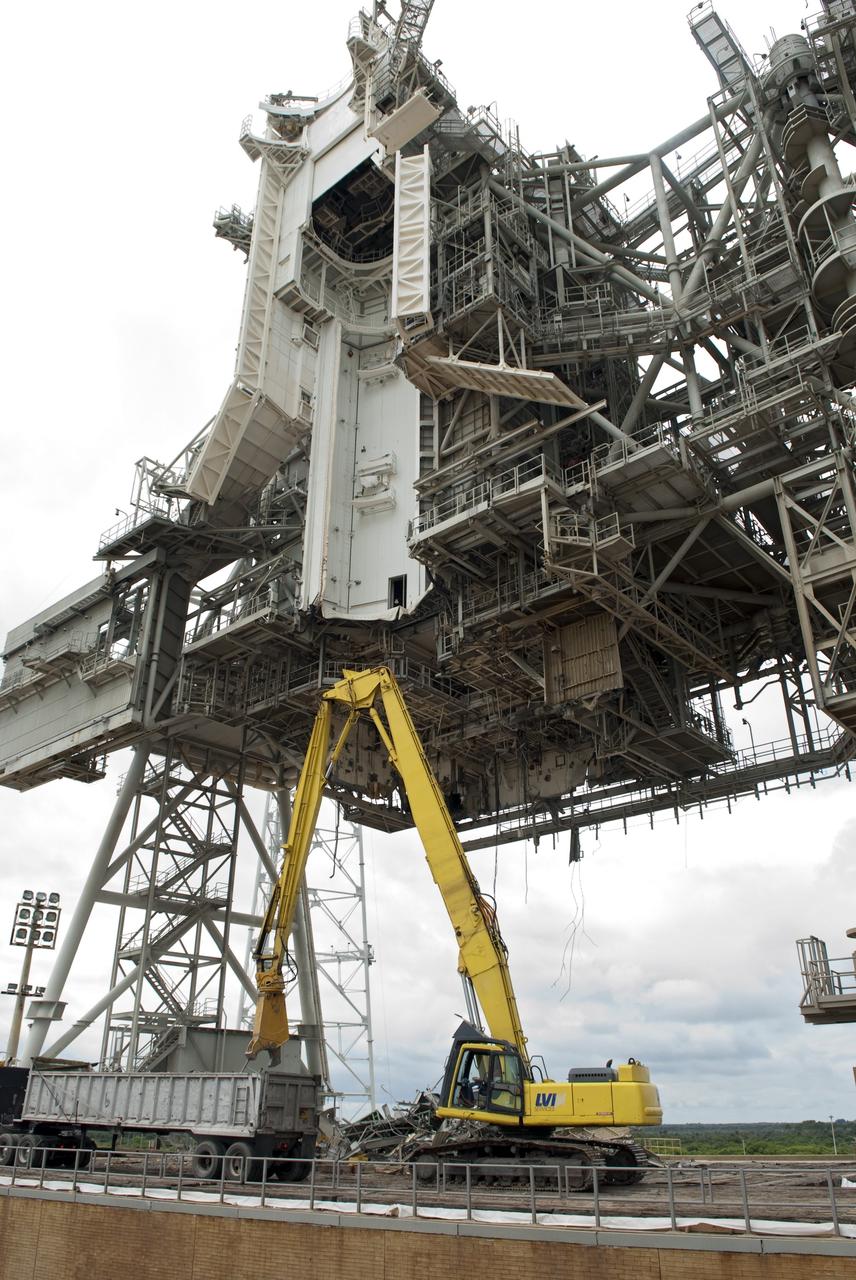
CAPE CANAVERAL, Fla. -- At NASA's Kennedy Space Center in Florida, crews are dismantling the rotating service structure (RSS) on Launch Pad 39B. Sand, reinforcing steel and large wooden mats were put down under the RSS to protect the structure's concrete from falling debris during deconstruction. Starting in 2009, the structure at the pad was no longer needed for NASA's Space Shuttle Program, so it is being restructured for future use. The new design will feature a "clean pad" for rockets to come with their own launcher, making it more versatile for a number of vehicles. The new lightning protection system, consisting of three lightning towers and a wire catenary system will remain. Photo credit: NASA/Jim Grossmann
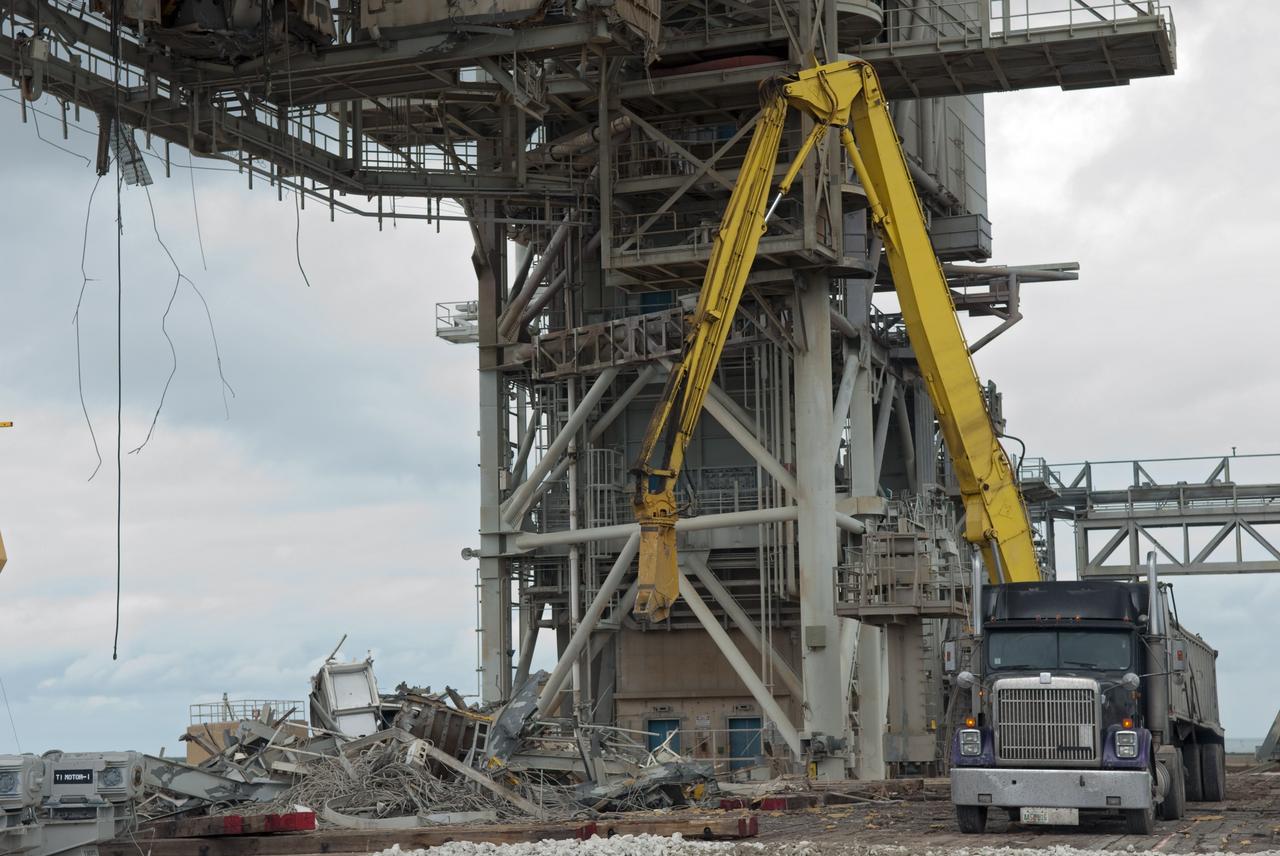
CAPE CANAVERAL, Fla. -- At NASA's Kennedy Space Center in Florida, the rotating service structure (RSS) on Launch Pad 39B is being dismantled. Sand, reinforcing steel and large wooden mats were put down under the RSS to protect the structure's concrete from falling debris during deconstruction. Starting in 2009, the structure at the pad was no longer needed for NASA's Space Shuttle Program, so it is being restructured for future use. The new design will feature a "clean pad" for rockets to come with their own launcher, making it more versatile for a number of vehicles. The new lightning protection system, consisting of three lightning towers and a wire catenary system will remain. Photo credit: NASA/Jim Grossmann
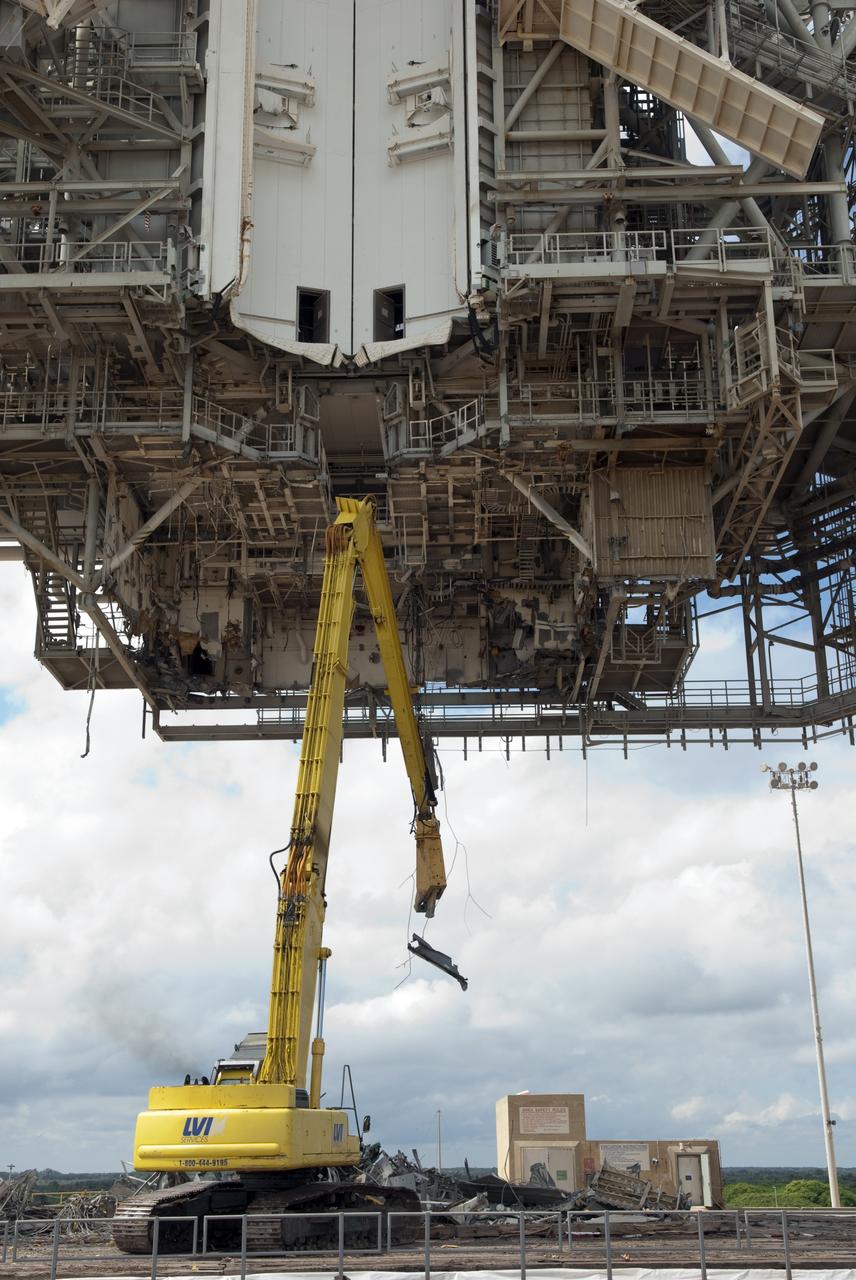
CAPE CANAVERAL, Fla. -- At NASA's Kennedy Space Center in Florida, crews are dismantling the rotating service structure (RSS) on Launch Pad 39B. Sand, reinforcing steel and large wooden mats were put down under the RSS to protect the structure's concrete from falling debris during deconstruction. Starting in 2009, the structure at the pad was no longer needed for NASA's Space Shuttle Program, so it is being restructured for future use. The new design will feature a "clean pad" for rockets to come with their own launcher, making it more versatile for a number of vehicles. The new lightning protection system, consisting of three lightning towers and a wire catenary system will remain. Photo credit: NASA/Jim Grossmann
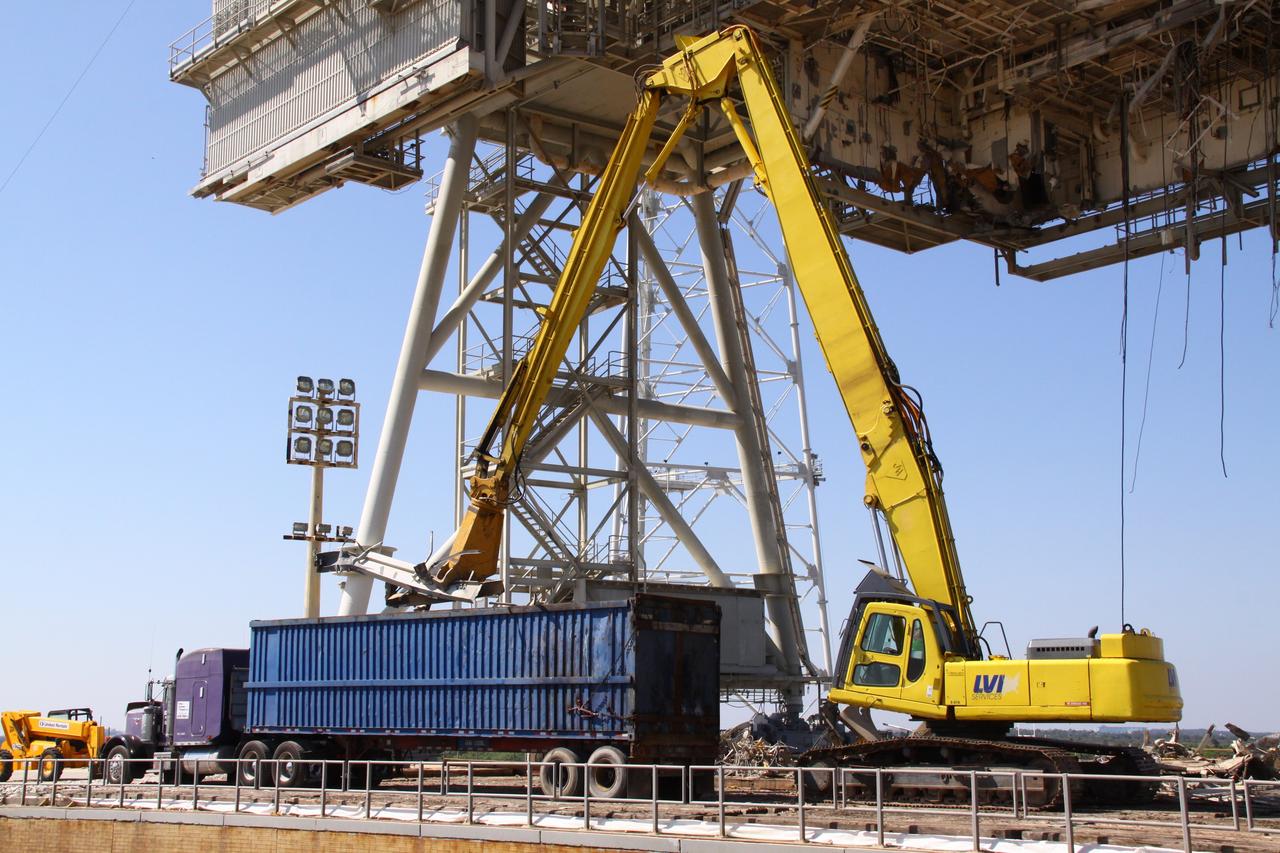
CAPE CANAVERAL, Fla. -- At NASA's Kennedy Space Center in Florida, crews continue dismantling the rotating service structure (RSS) on Launch Pad 39B. Sand, reinforcing steel and large wooden mats were put down under the RSS to protect the structure's concrete from falling debris during deconstruction. Starting in 2009, the structure at the pad was no longer needed for NASA's Space Shuttle Program, so it is being restructured for future use. The new design will feature a "clean pad" for rockets to come with their own launcher, making it more versatile for a number of vehicles. The new lightning protection system, consisting of three lightning towers and a wire catenary system will remain. Photo credit: NASA/Jack Pfaller
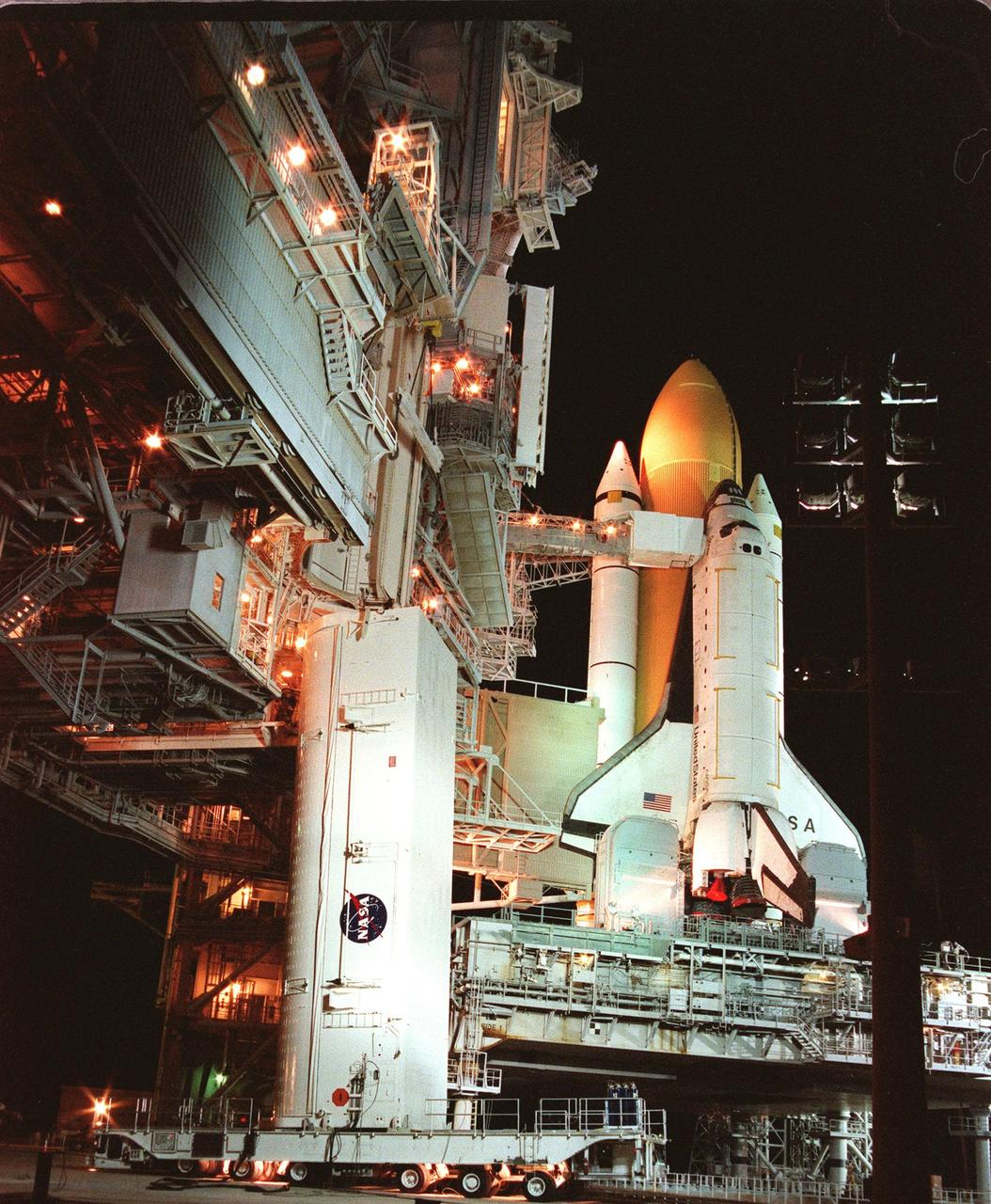
KENNEDY SPACE CENTER, FLA. -- The payload canister containing the Chandra X-ray Observatory is prepared for its ascent up the Rotating Service Structure (RSS). The canister arrived at the pad on the payload canister transporter below it. The canister will be lifted up to the Payload Changeout Room in the RSS where it will be relieved of its cargo. After the RSS rotates to a position behind Space Shuttle Columbia (at right), the observatory will then be installed vertically in the orbiter payload bay. The world's most powerful X-ray telescope, Chandra will allow scientists from around the world to see previously invisible black holes and high-temperature gas clouds, giving the observatory the potential to rewrite the books on the structure and evolution of our universe. Chandra is the primary payload on mission STS-93, scheduled to launch no earlier than July 20 aboard Space Shuttle Columbia (right)
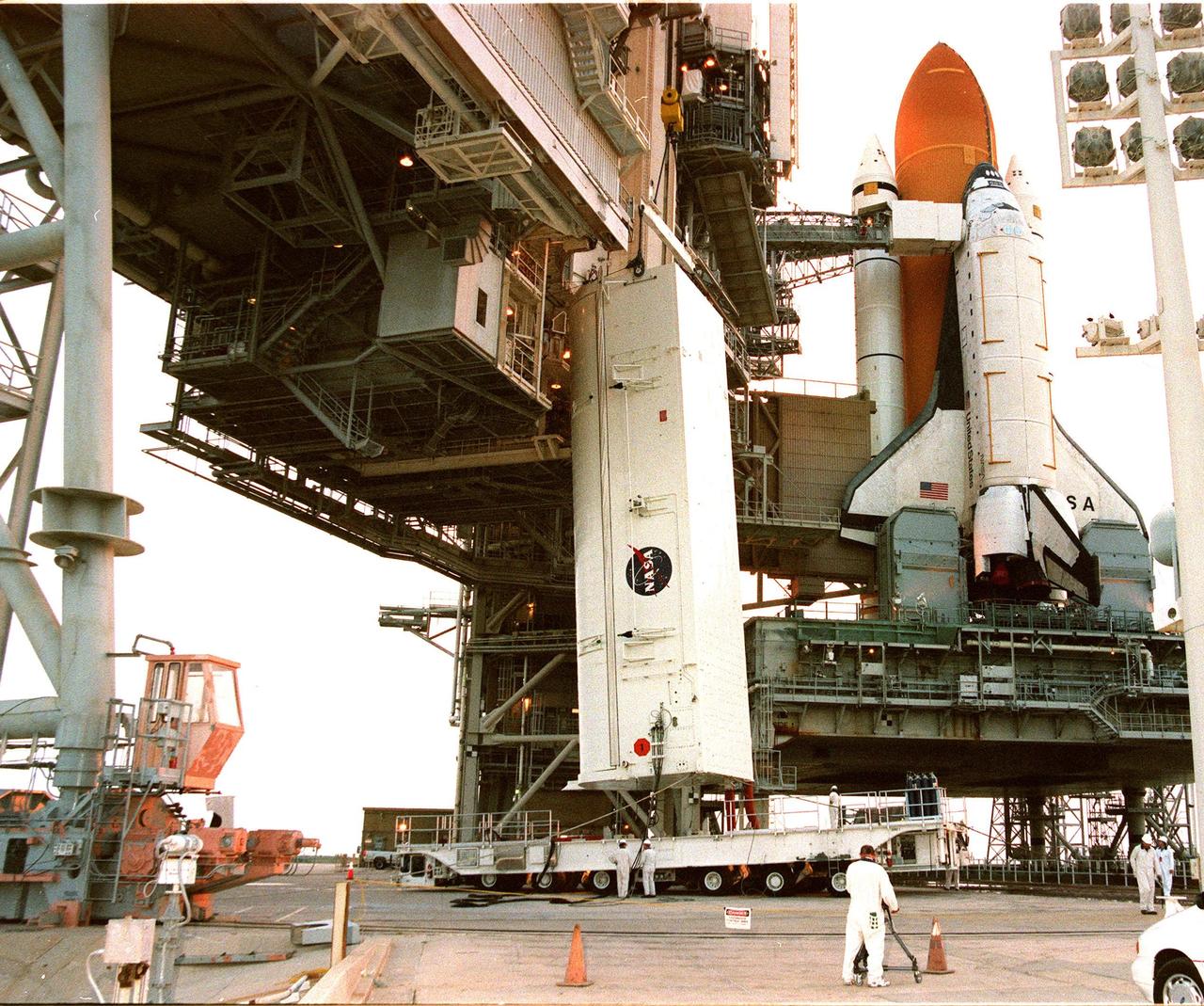
KENNEDY SPACE CENTER, FLA. -- In the early morning daylight, the payload canister containing the Chandra X-ray Observatory begins its ascent up the Rotating Service Structure (RSS). The canister arrived at the pad on the payload canister transporter below it. The canister will be lifted up to the Payload Changeout Room in the RSS where it will be relieved of its cargo. After the RSS rotates to a position behind Space Shuttle Columbia (at right), the observatory will then be installed vertically in the orbiter payload bay. The world's most powerful X-ray telescope, Chandra will allow scientists from around the world to see previously invisible black holes and high-temperature gas clouds, giving the observatory the potential to rewrite the books on the structure and evolution of our universe. Chandra is the primary payload on mission STS-93, scheduled to launch no earlier than July 20 aboard Space Shuttle Columbia (right)
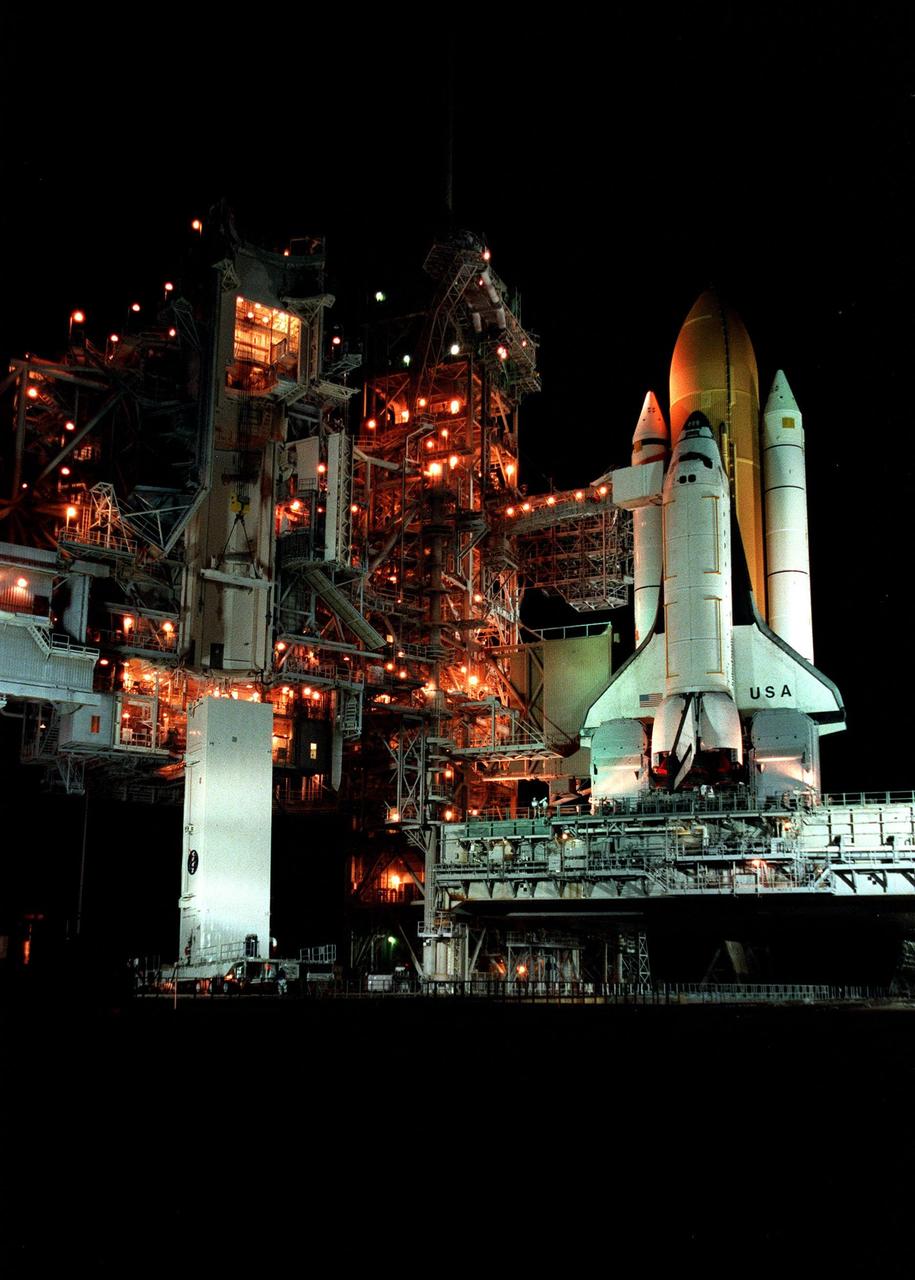
KENNEDY SPACE CENTER, FLA. -- Hours before dawn, the payload canister transporter delivers its cargo (lower left) to Launch Pad 39B, below the Rotating Service Structure (RSS). Inside the canister is the Chandra X-ray Observatory, primary payload on mission STS-93, scheduled to launch no earlier than July 20 aboard Space Shuttle Columbia (right). The canister will be lifted up to the Payload Changeout Room in the RSS where it will be relieved of its cargo. After the RSS rotates to a position behind Columbia, the observatory will then be installed vertically in the orbiter payload bay. The world's most powerful X-ray telescope, Chandra will allow scientists from around the world to see previously invisible black holes and high-temperature gas clouds, giving the observatory the potential to rewrite the books on the structure and evolution of our universe
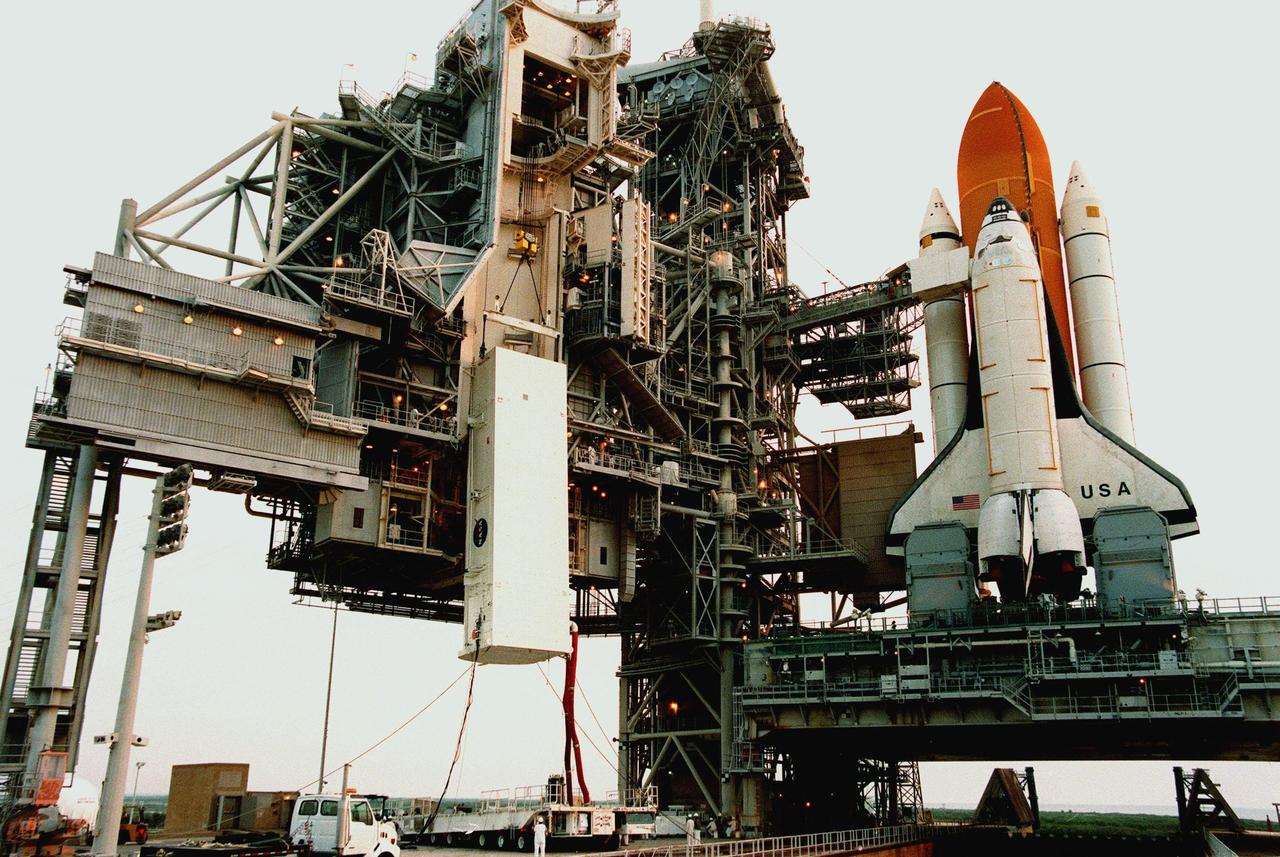
KENNEDY SPACE CENTER, FLA. -- In the early morning, the payload canister containing the Chandra X-ray Observatory, with umbilical hoses still attached, is lifted up the Rotating Service Structure (RSS). The hoses provide a controlled environment during the transfer. The canister arrived at the pad on the payload canister transporter below it. The canister will be lifted up to the Payload Changeout Room in the RSS where it will be relieved of its cargo. After the RSS rotates to a position behind Space Shuttle Columbia (at right), the observatory will then be installed vertically in the orbiter payload bay. The world's most powerful X-ray telescope, Chandra will allow scientists from around the world to see previously invisible black holes and high-temperature gas clouds, giving the observatory the potential to rewrite the books on the structure and evolution of our universe. Chandra is the primary payload on mission STS-93, scheduled to launch no earlier than July 20 aboard Space Shuttle Columbia (right)
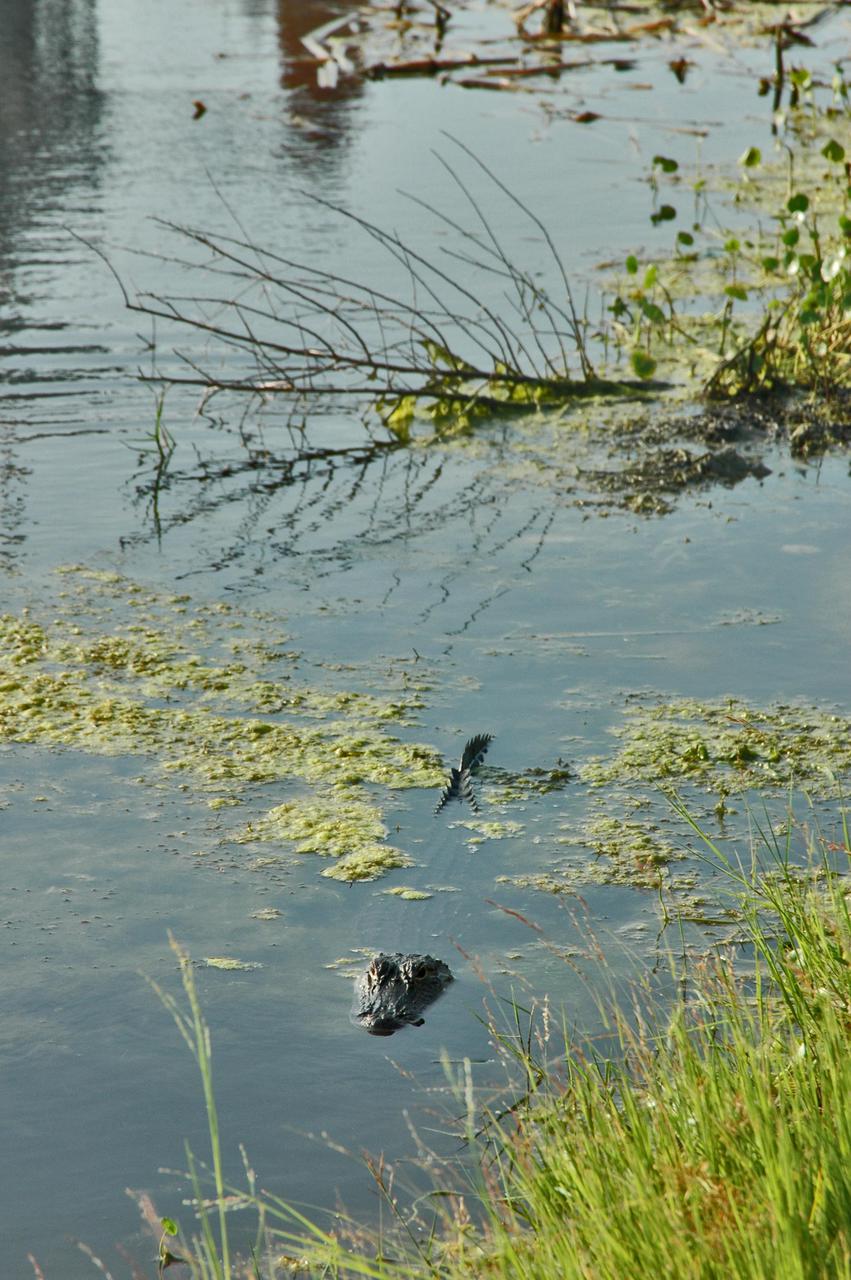
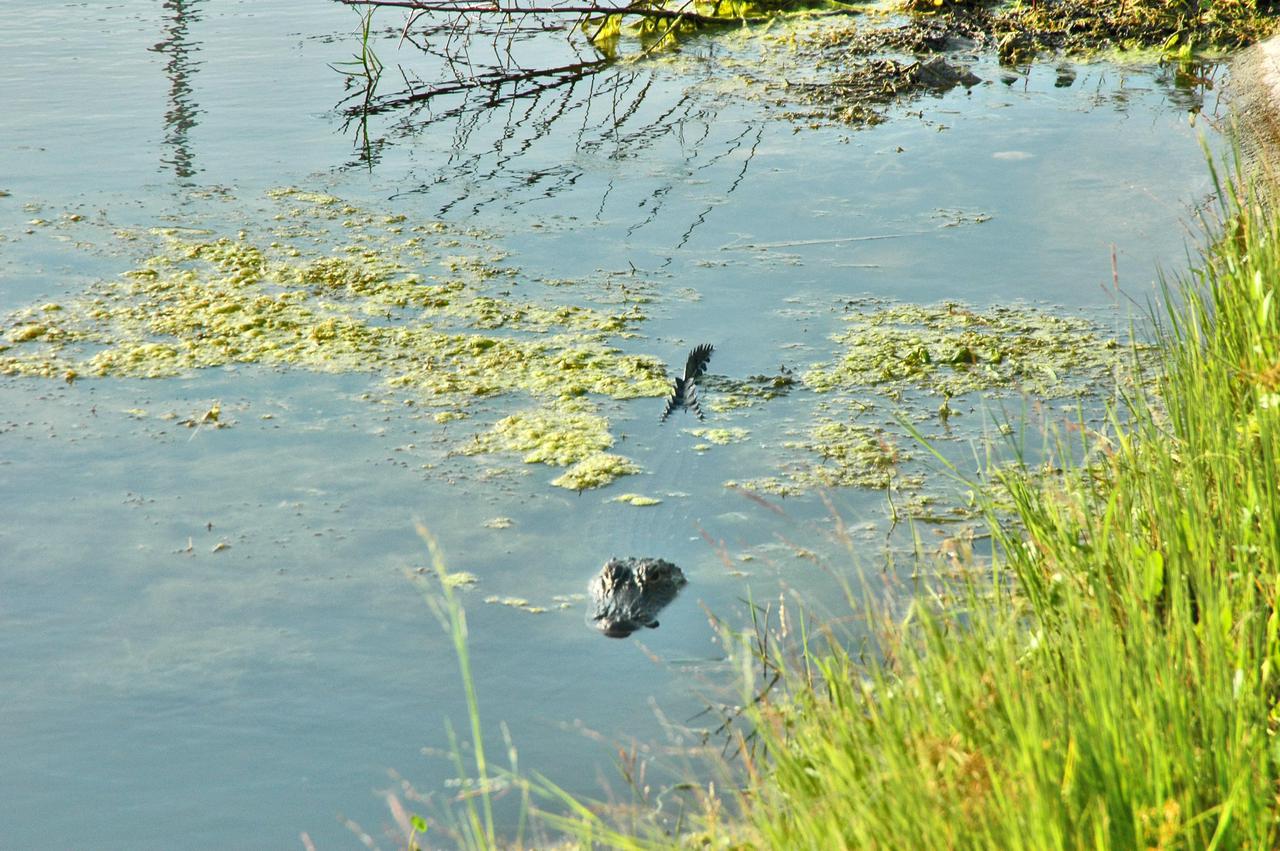
KENNEDY SPACE CENTER, FLA. - In a pond near Launch Pad 39B, an alligator lurks near the tall grass. Nearby is Space Shuttle Discovery, in full launch configuration after rollback of the Rotating Service Structure (RSS). Rollback of the RSS is a major preflight milestone, typically occurring during the T-11-hour hold on L-1 (the day before launch). Discovery is scheduled to lift off on the historic Return to Flight mission STS-114 at 10:39 a.m. EDT July 26 with a crew of seven.
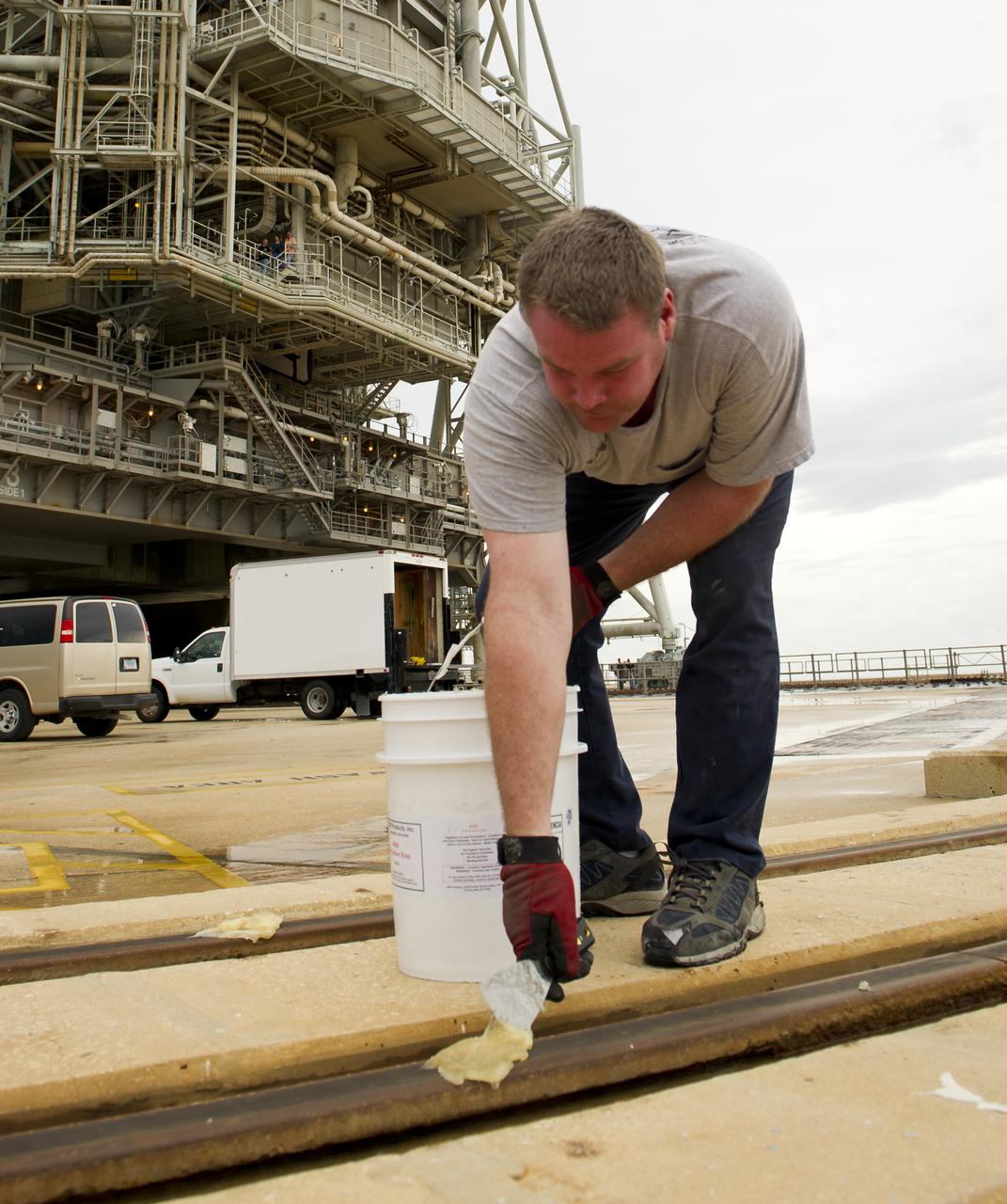
Launch pad worker Chris Cassidy lays down grease on the tracks of the rotating service structure (RSS) on launch pad 39a prior to the RSS being rolled back to reveal the space shuttle Atlantis on Thursday, July 7, 2011 at the NASA Kennedy Space Center in Cape Canaveral, Fla. Space shuttle Atlantis is set to liftoff Friday, July 8, on the final flight of the shuttle program, STS-135, a 12-day mission to the International Space Station. Photo Credit: (NASA/Bill Ingalls)
KENNEDY SPACE CENTER, FLA. - In a pond near Launch Pad 39B, an alligator lurks near the tall grass. Nearby is Space Shuttle Discovery, in full launch configuration after rollback of the Rotating Service Structure (RSS). Rollback of the RSS is a major preflight milestone, typically occurring during the T-11-hour hold on L-1 (the day before launch). Discovery is scheduled to lift off on the historic Return to Flight mission STS-114 at 10:39 a.m. EDT July 26 with a crew of seven.
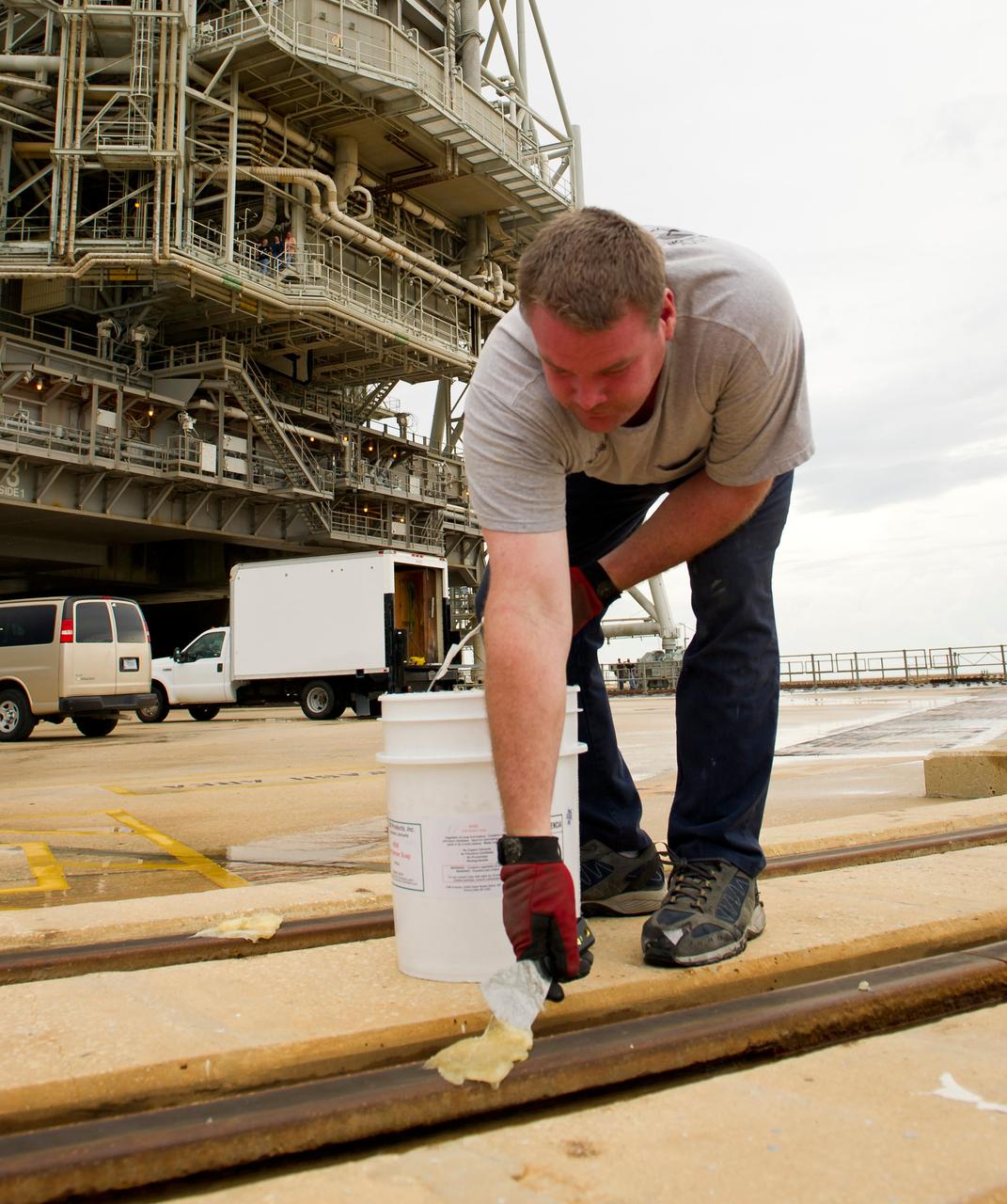
Launch pad worker Chris Cassidy lays down grease on the tracks of the rotating service structure (RSS) on launch pad 39a prior to the RSS being rolled back to reveal the space shuttle Atlantis on Thursday, July 7, 2011 at the NASA Kennedy Space Center in Cape Canaveral, Fla. Space shuttle Atlantis is set to liftoff Friday, July 8, on the final flight of the shuttle program, STS-135, a 12-day mission to the International Space Station. Photo Credit: (NASA/Bill Ingalls)
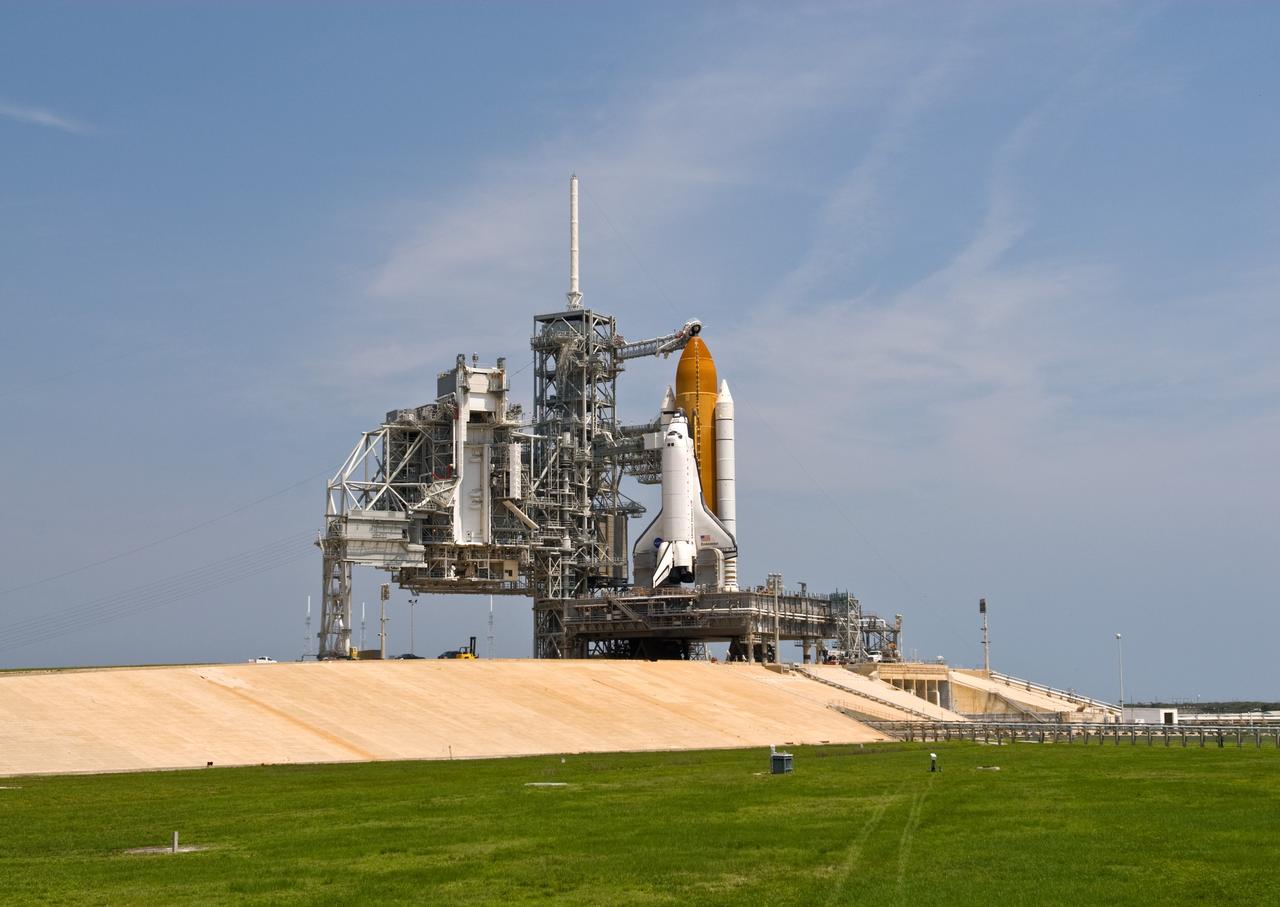
CAPE CANAVERAL, Fla. – The open rotating service structure, or RSS (left), on Launch Pad 39A at NASA's Kennedy Space Center in Florida reveals space shuttle Endeavour poised for launch. The RSS was rotated to its open position in preparation for Endeavour's liftoff June 13 on the STS-127 mission with a crew of seven. First motion was at 10:39 a.m. EDT and completed at 11:18 a.m. The rotating structure provides protected access to the shuttle for changeout and servicing of payloads at the pad. It is supported by a rotating bridge that pivots on a vertical axis on the west side of the pad's flame trench. After the RSS is rolled back, the orbiter is ready for fuel cell activation and external tank cryogenic propellant loading operations. The launch will be Endeavour's 23rd flight. The shuttle will carry the Japanese Experiment Module's Exposed Facility, or JEM-EF, and the Experiment Logistics Module-Exposed Section, or ELM-ES, on STS-127. The mission is the final of three flights dedicated to the assembly of the Japan Aerospace Exploration Agency's Kibo laboratory complex on the space station. Endeavour's launch is scheduled for June 13 at 7:17 a.m. EDT. Photo credit: NASA/Jim Grossmann
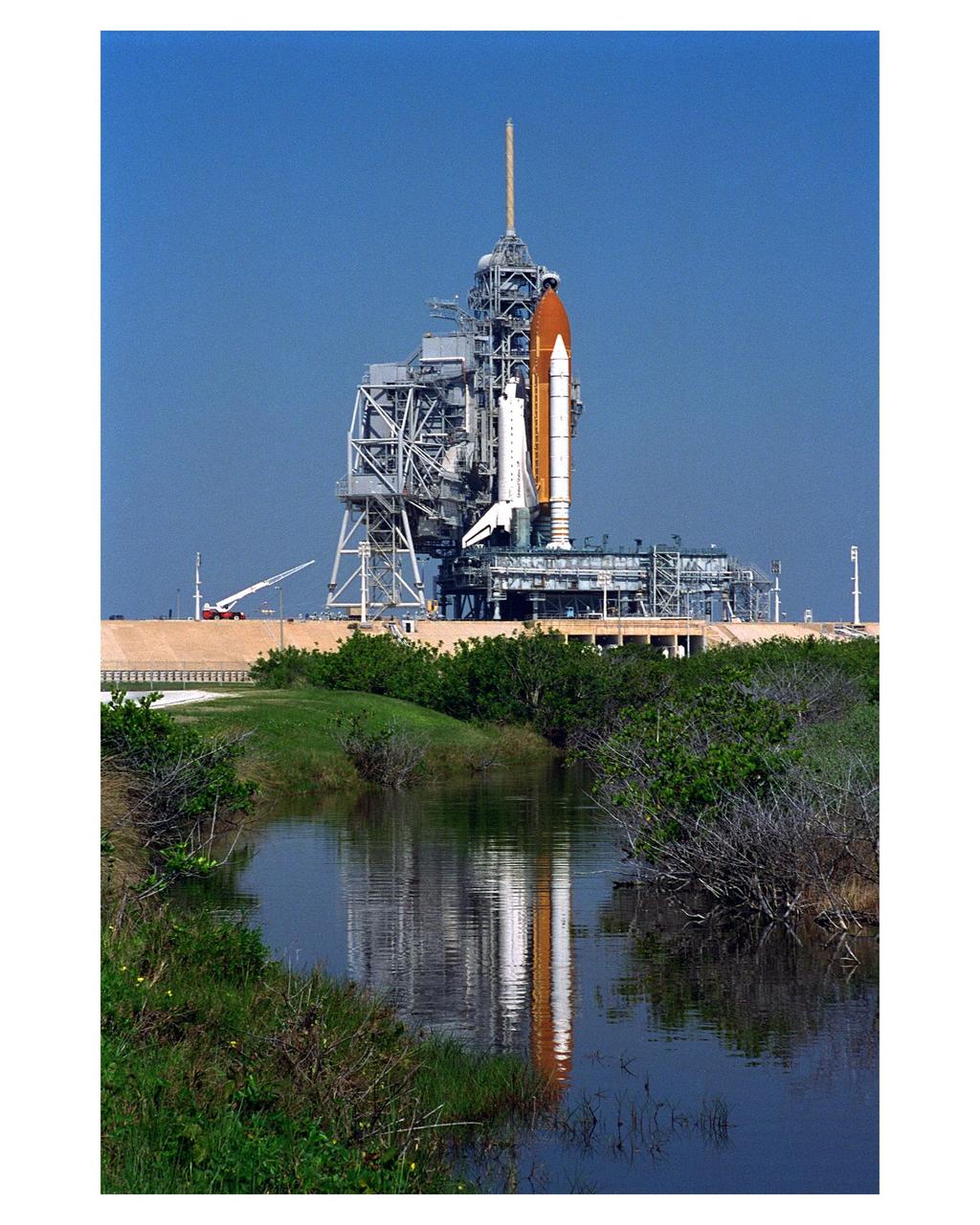
The Space Shuttle Atlantis in full launch configuration is reflected in water around Launch Pad 39A as the Rotating Service Structure (RSS) is rotated back to the park position. Rollback of the RSS is a major preflight milestone, typically occurring during the T-11-hour hold on L-1 (the day before launch). Atlantis and its crew of seven are in final preparations for liftoff on Mission STS-84, the sixth of nine planned dockings of the Space Shuttle with the Russian Space Station Mir. Launch is scheduled at about 4:08 a.m. during an approximately 7-minute launch window. The exact liftoff time will be determined about 90 minutes prior to launch, based on the most current location of Mir
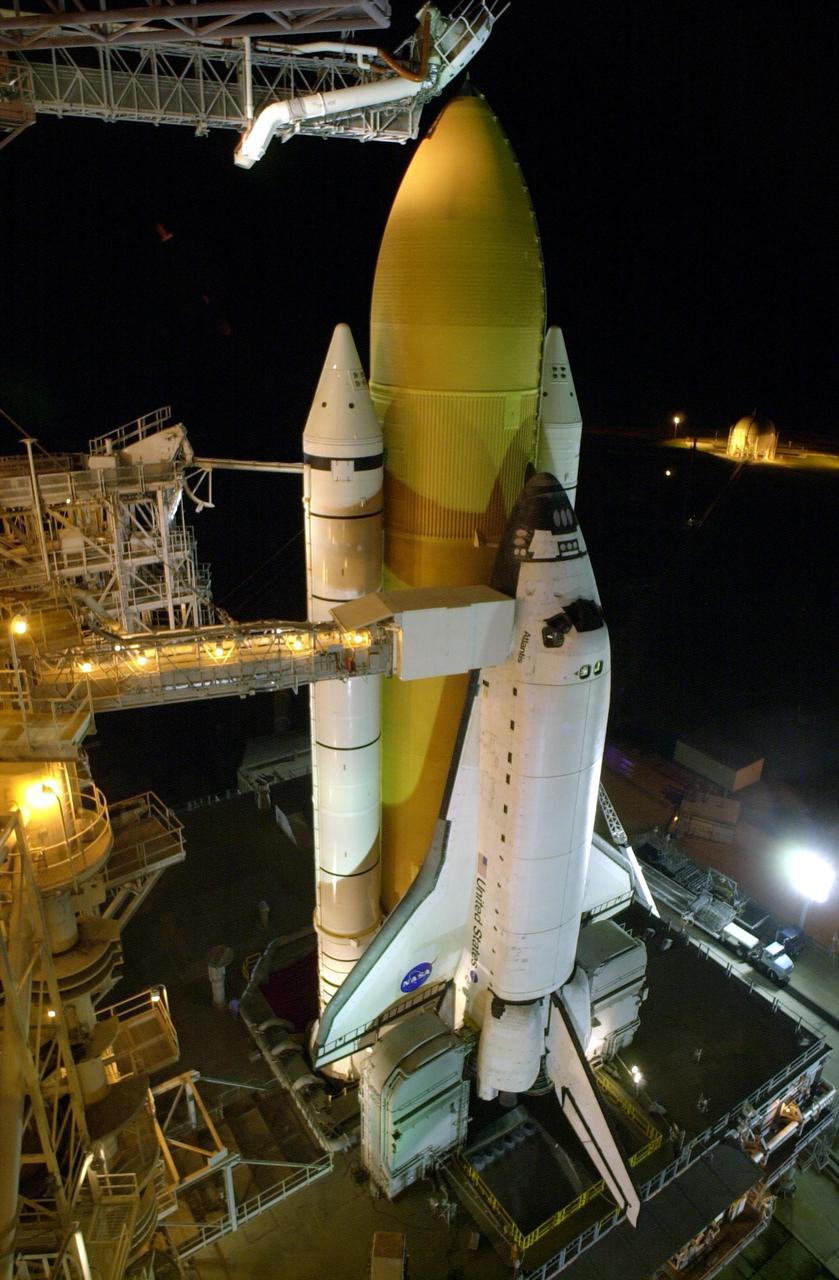
KENNEDY SPACE CENTER, FLA. -- With the Rotating Service Structure rolled back, Space Shuttle Atlantis stands ready for launch on mission STS-110. The Orbiter Access Arm extends from the Fixed Service Structure (FSS) to the crew compartment hatch, through which the STS-110 crew will enter Atlantis. Above the golden external tank is the vent hood (known as the "beanie cap") at the end of the gaseous oxygen vent arm. Vapors are created as the liquid oxygen in the external tank boil off. The hood vents the gaseous oxygen vapors away from the Space Shuttle vehicle. The RSS provides protected access to the orbiter for changeout and servicing of payloads at the pad. The structure has access platforms at five levels to provide access to the payload bay. The FSS provides access to the orbiter and the RSS. Mission STS-110 is scheduled to launch April 4 on its 11-day mission to the International Space Station
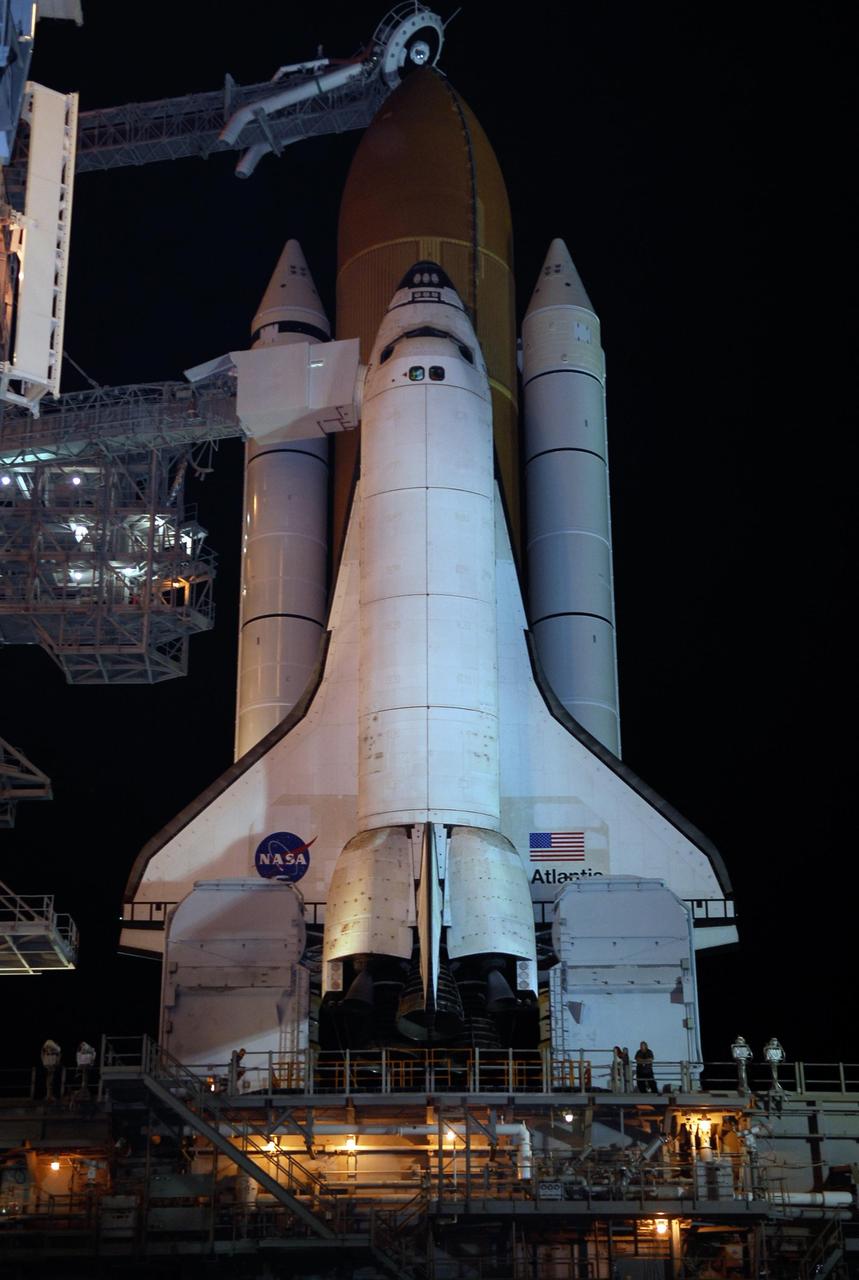
KENNEDY SPACE CENTER, FLA. -- Space shuttle Atlantis is revealed on Launch Pad 39A at NASA's Kennedy Space Center after the rotating service structure, or RSS, at left of the pad, has been rolled back. Movement of the RSS began at 7:27 p.m. EST. The RSS provides protected access to the orbiter for crew entry and servicing of payloads at the pad. Rollback of the pad's RSS is one of the milestones in preparation for the launch of mission STS-122, scheduled for 2:45 p.m. EST on Feb. 7. This will be the third launch attempt for Atlantis since December 2007 to carry the Columbus Laboratory to the International Space Station. Beneath the shuttle is the mobile launcher platform which supports the shuttle until liftoff. Photo credit: NASA/Kim Shiflett
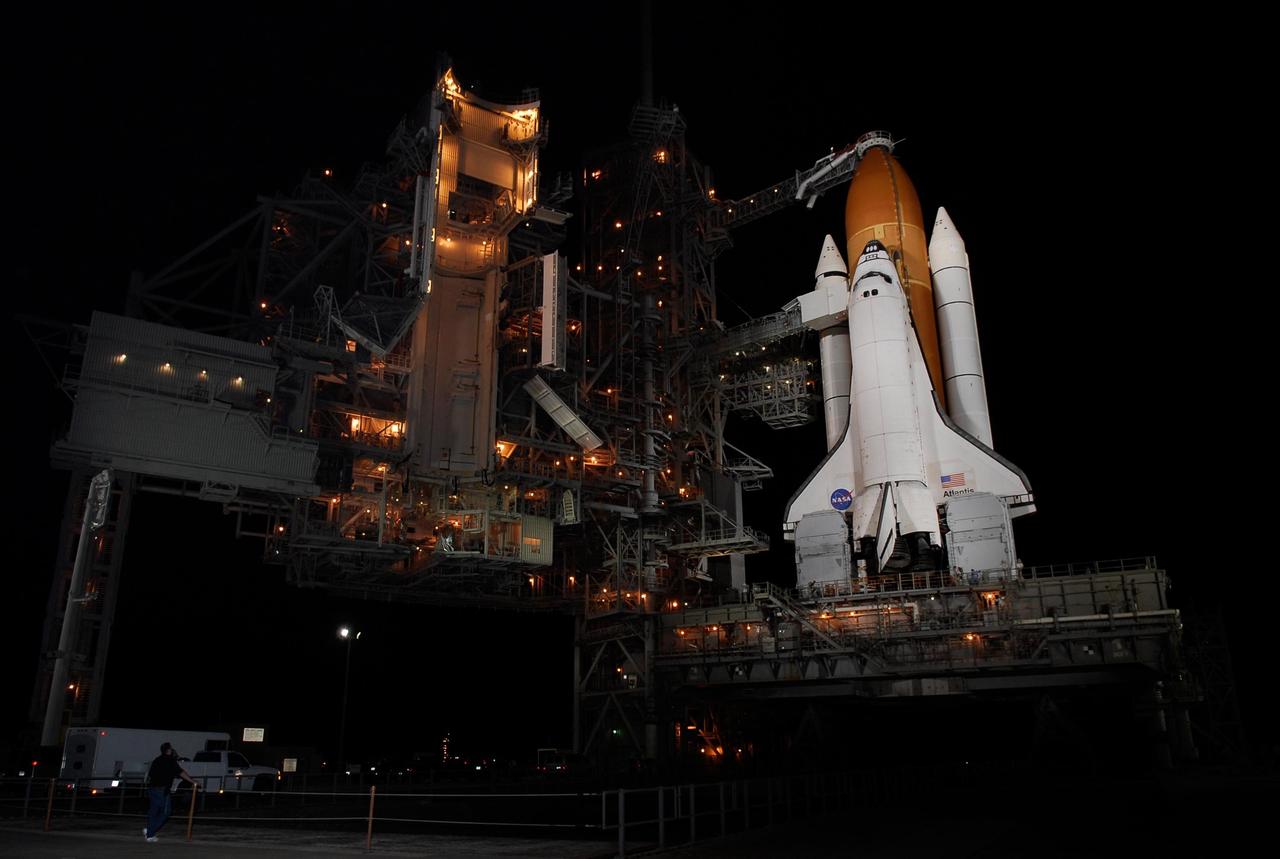
KENNEDY SPACE CENTER, FLA. -- On Launch Pad 39A at NASA's Kennedy Space Center, the rotating service structure, or RSS, at left, has been moved from around space shuttle Atlantis, revealing an empty Payload Changeout Room. Movement of the RSS began at 7:27 p.m. EST. The RSS provides protected access to the orbiter for crew entry and servicing of payloads at the pad. Rollback of the pad's RSS is one of the milestones in preparation for the launch of mission STS-122, scheduled for 2:45 p.m. EST on Feb. 7. This will be the third launch attempt for Atlantis since December 2007 to carry the Columbus Laboratory to the International Space Station. Beneath the shuttle is the mobile launcher platform which supports the shuttle until liftoff. Photo credit: NASA/Kim Shiflett
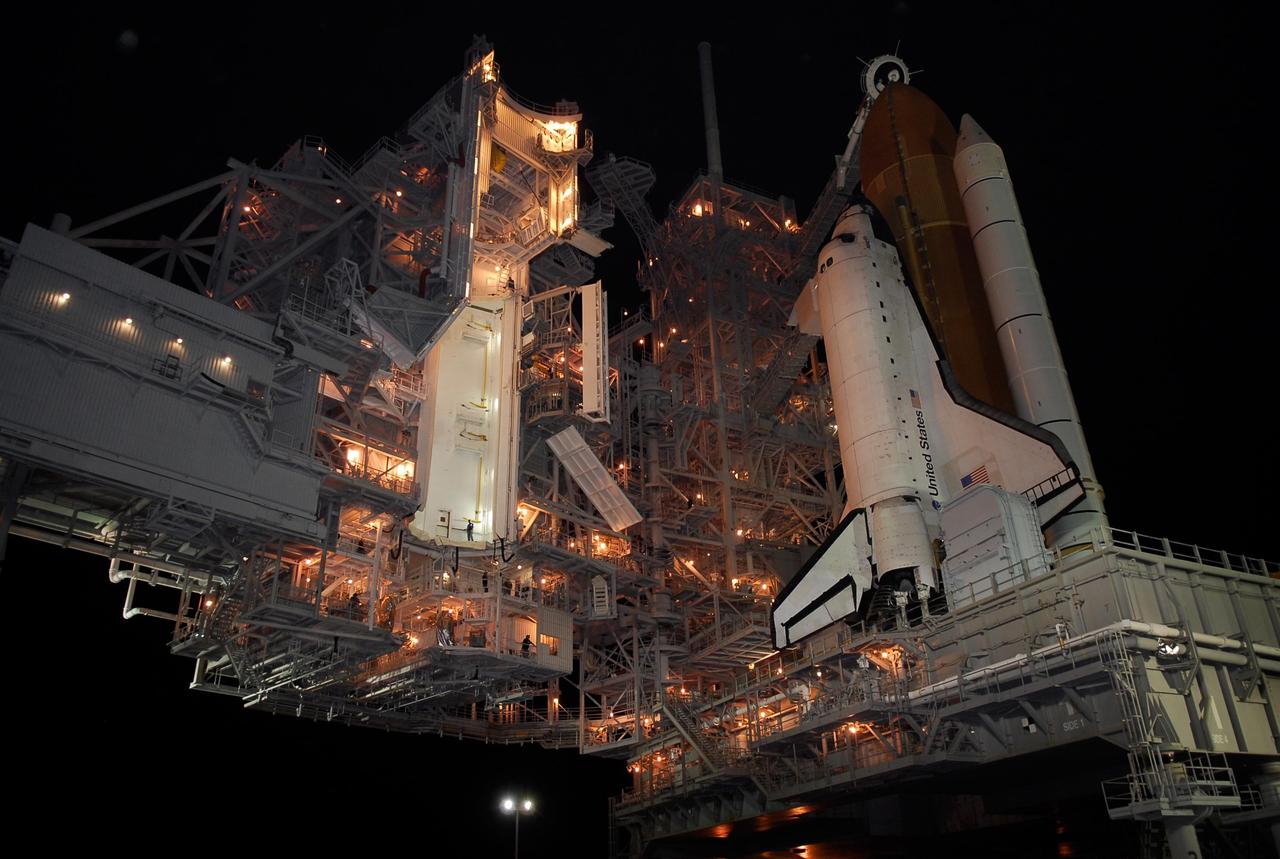
KENNEDY SPACE CENTER, FLA. -- Lights on Launch Pad 39A at NASA's Kennedy Space Center reveal space shuttle Atlantis following the rollback of the rotating service structure, or RSS. Movement of the RSS began at 7:27 p.m. EST. The RSS provides protected access to the orbiter for crew entry and servicing of payloads at the pad. Rollback of the pad's RSS is one of the milestones in preparation for the launch of mission STS-122, scheduled for 2:45 p.m. EST on Feb. 7. This will be the third launch attempt for Atlantis since December 2007 to carry the Columbus Laboratory to the International Space Station. Beneath the shuttle is the mobile launcher platform which supports the shuttle until liftoff. Photo credit: NASA/Kim Shiflett
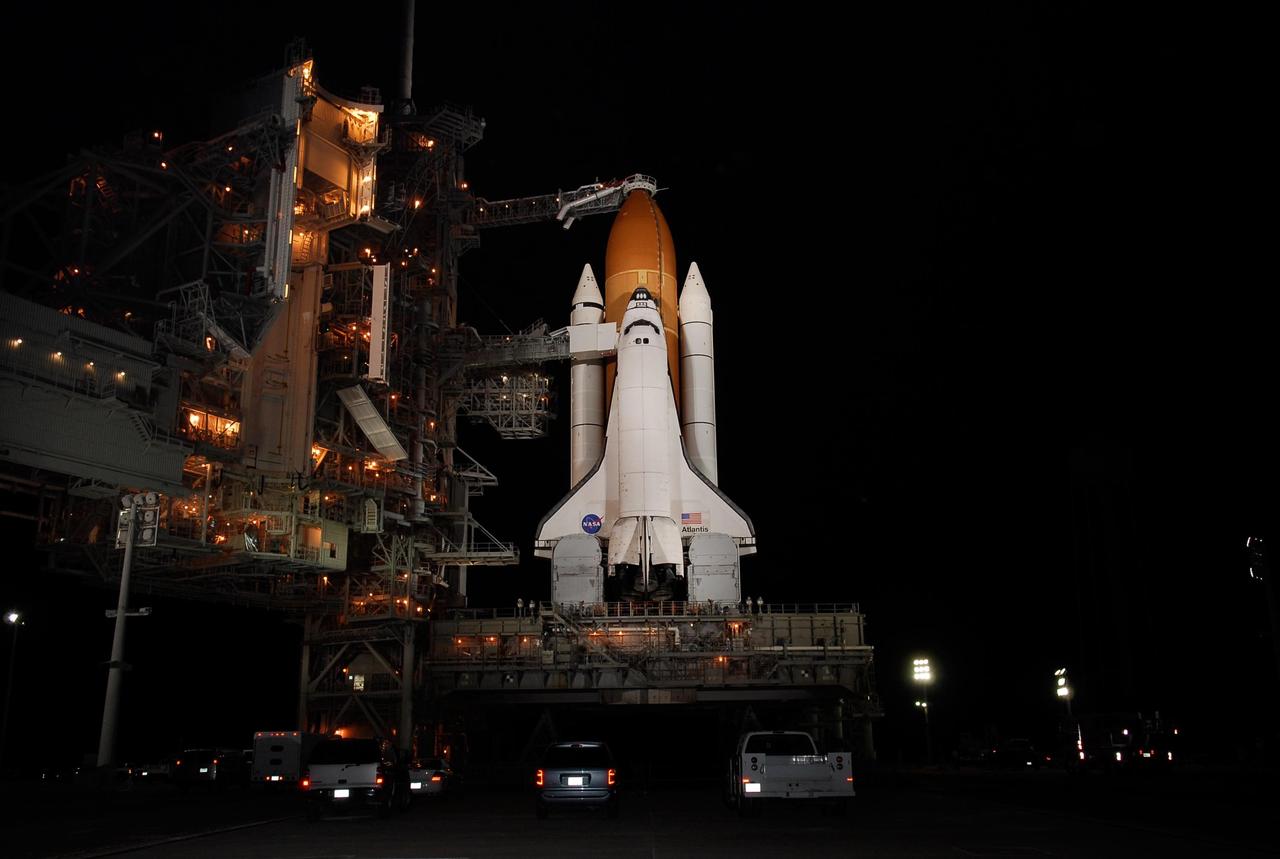
KENNEDY SPACE CENTER, FLA. -- On Launch Pad 39A at NASA's Kennedy Space Center, the rotating service structure, or RSS, at left, has been moved from around space shuttle Atlantis, revealing an illuminated Payload Changeout Room. Movement of the RSS began at 7:27 p.m. EST. The RSS provides protected access to the orbiter for crew entry and servicing of payloads at the pad. Rollback of the pad's RSS is one of the milestones in preparation for the launch of mission STS-122, scheduled for 2:45 p.m. EST on Feb. 7. This will be the third launch attempt for Atlantis since December 2007 to carry the Columbus Laboratory to the International Space Station. Beneath the shuttle is the mobile launcher platform which supports the shuttle until liftoff. Photo credit: NASA/Kim Shiflett
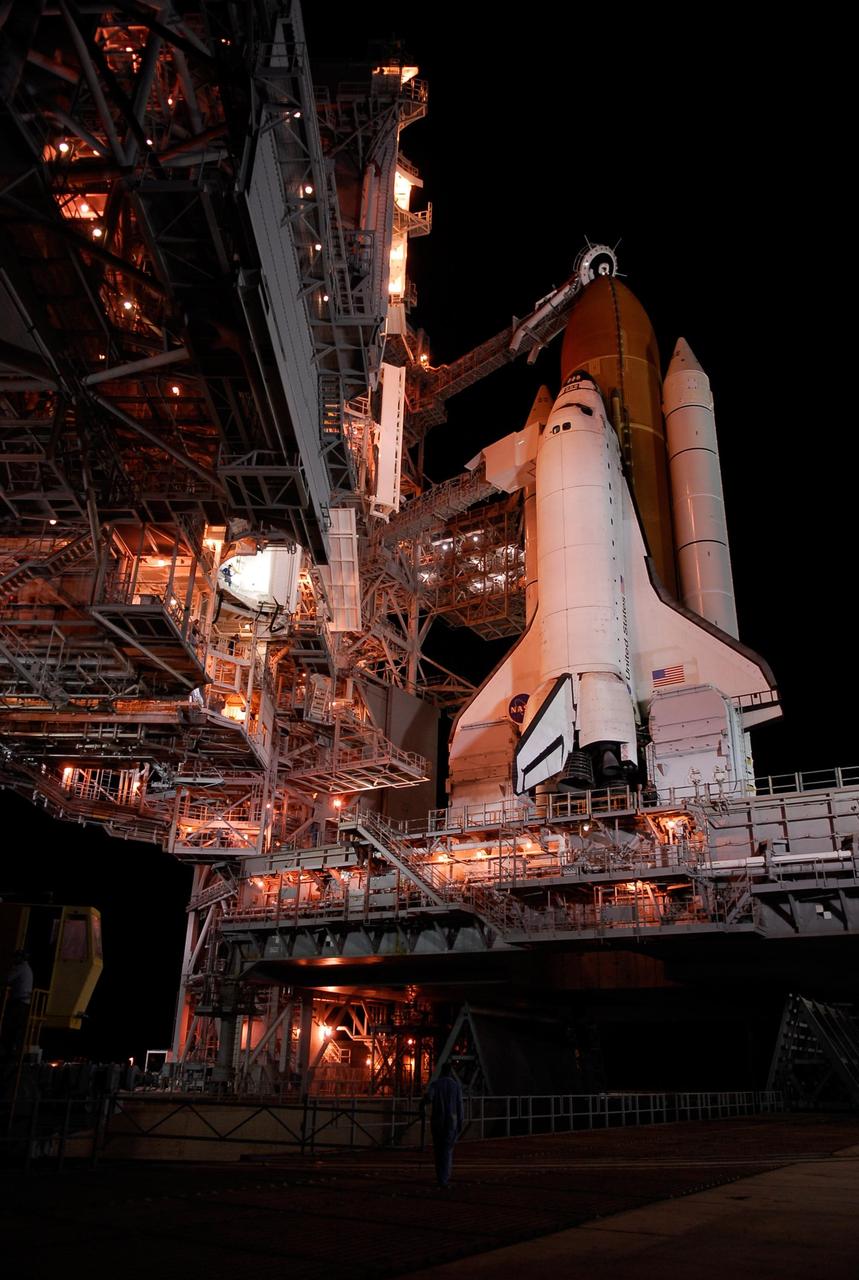
KENNEDY SPACE CENTER, FLA. -- Space shuttle Atlantis is revealed on Launch Pad 39A at NASA's Kennedy Space Center after the rotating service structure, or RSS, at left of the pad, has been rolled back. Movement of the RSS began at 7:27 p.m. EST. The RSS provides protected access to the orbiter for crew entry and servicing of payloads at the pad. Rollback of the pad's RSS is one of the milestones in preparation for the launch of mission STS-122, scheduled for 2:45 p.m. EST on Feb. 7. This will be the third launch attempt for Atlantis since December 2007 to carry the Columbus Laboratory to the International Space Station. Beneath the shuttle is the mobile launcher platform which supports the shuttle until liftoff. Photo credit: NASA/Kim Shiflett
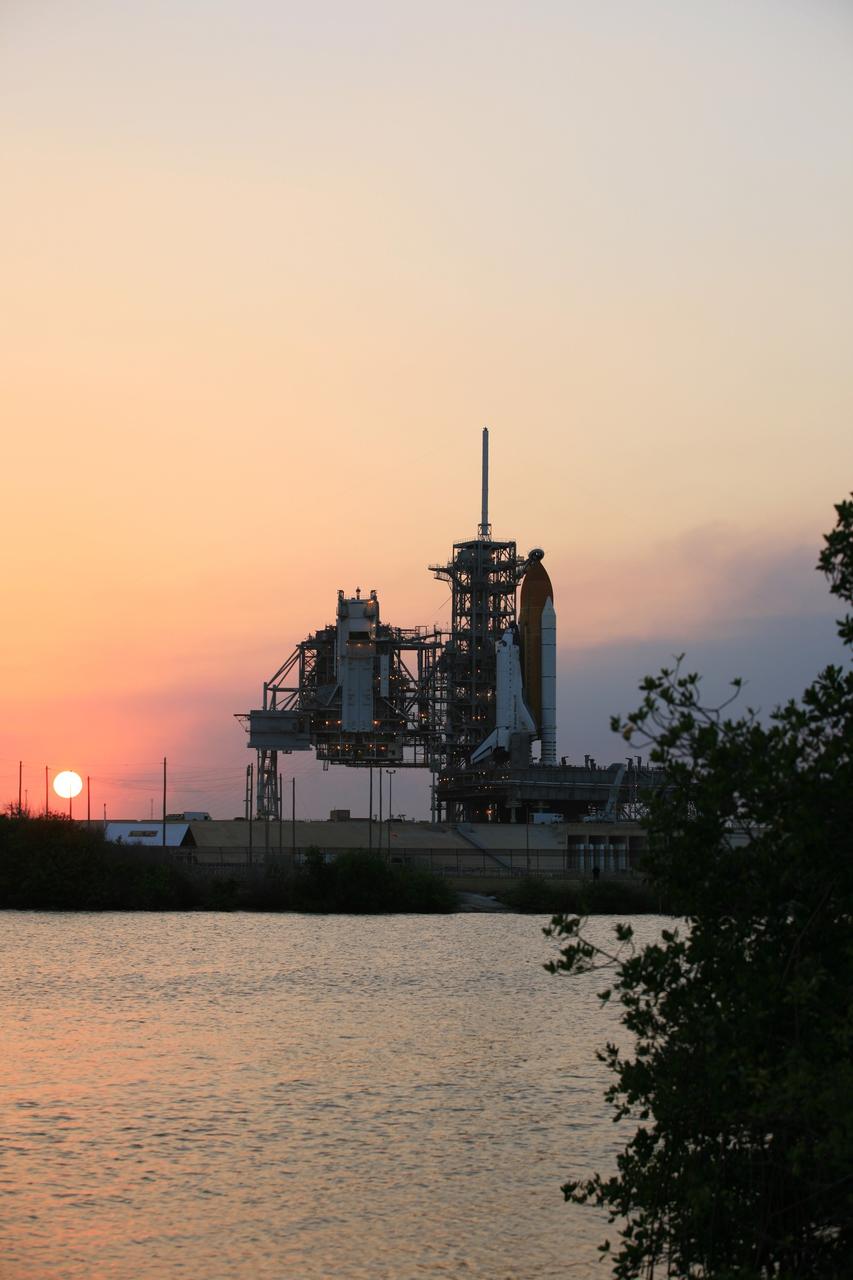
CAPE CANAVERAL, Fla. – The sun sets on a beautiful balmy evening over Launch Pad 39A at NASA's Kennedy Space Center in Florida following rollback of the pad’s rotating service structure, or RSS, from around space shuttle Atlantis. The RSS is retracted in preparation for Atlantis’ liftoff on the STS-125 mission to service NASA's Hubble Space Telescope. The rotating structure provides protected access to the shuttle for changeout and servicing of payloads at the pad. After the RSS is rolled back, the orbiter is ready for fuel cell activation and external tank cryogenic propellant loading operations. Atlantis' crew will service NASA's Hubble Space Telescope for the fifth and final time. The flight will include five spacewalks during which astronauts will refurbish and upgrade the telescope with state-of-the-art science instruments. As a result, Hubble's capabilities will be expanded and its operational lifespan extended through at least 2014. Launch is scheduled for 2:01 p.m. EDT on May 11. Photo credit: NASA/Dimitri Gerondidakis
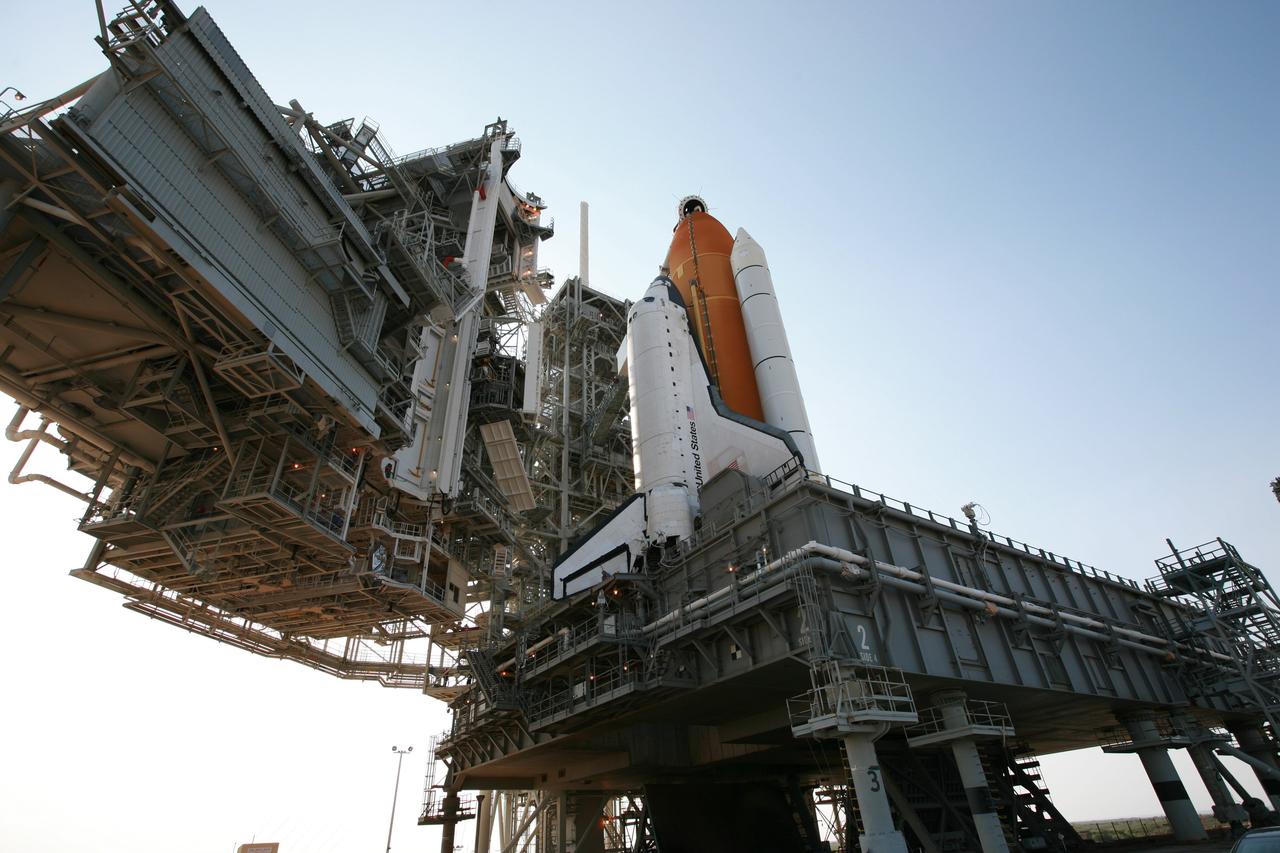
CAPE CANAVERAL, Fla. – On Launch Pad 39A at NASA's Kennedy Space Center in Florida, space shuttle Atlantis seems to tower above the mobile launcher platform after the pad’s rotating service structure, or RSS, has been rolled back. The RSS is retracted in preparation for Atlantis’ liftoff on the STS-125 mission to service NASA's Hubble Space Telescope. The rotating structure provides protected access to the shuttle for changeout and servicing of payloads at the pad. After the RSS is rolled back, the orbiter is ready for fuel cell activation and external tank cryogenic propellant loading operations. Atlantis' crew will service NASA's Hubble Space Telescope for the fifth and final time. The flight will include five spacewalks during which astronauts will refurbish and upgrade the telescope with state-of-the-art science instruments. As a result, Hubble's capabilities will be expanded and its operational lifespan extended through at least 2014. Launch is scheduled for 2:01 p.m. EDT on May 11. Photo credit: NASA/Dimitri Gerondidakis
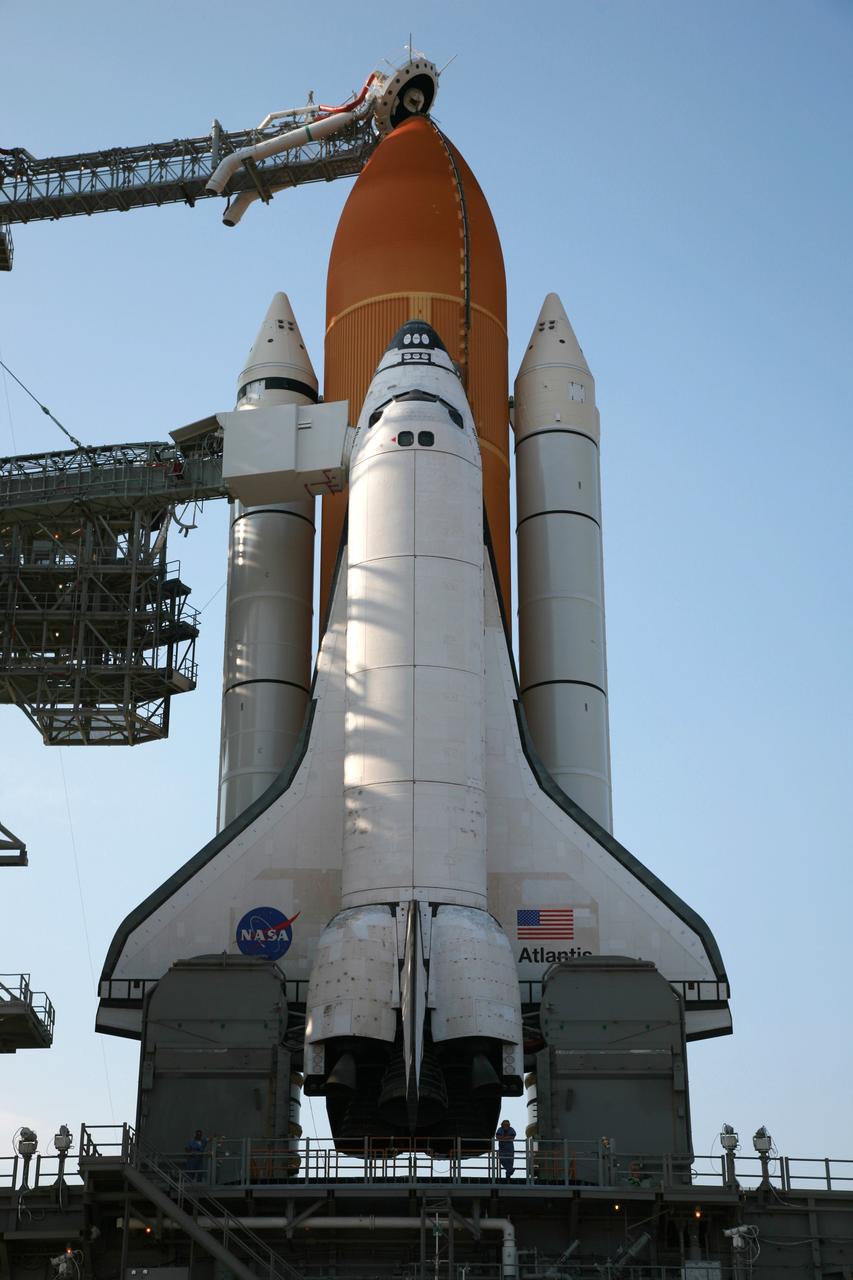
CAPE CANAVERAL, Fla. – On Launch Pad 39A at NASA's Kennedy Space Center in Florida, the oxygen vent hood, called the "beanie cap," is positioned above the external tank of space shuttle Atlantis following the rollback of the rotating service structure, or RSS. The RSS is retracted in preparation for Atlantis’ liftoff on the STS-125 mission to service NASA's Hubble Space Telescope. The rotating structure provides protected access to the shuttle for changeout and servicing of payloads at the pad. After the RSS is rolled back, the orbiter is ready for fuel cell activation and external tank cryogenic propellant loading operations. Atlantis' crew will service NASA's Hubble Space Telescope for the fifth and final time. The flight will include five spacewalks during which astronauts will refurbish and upgrade the telescope with state-of-the-art science instruments. As a result, Hubble's capabilities will be expanded and its operational lifespan extended through at least 2014. Launch is scheduled for 2:01 p.m. EDT on May 11. Photo credit: NASA/Dimitri Gerondidakis

CAPE CANAVERAL, Fla. – On Launch Pad 39A at NASA's Kennedy Space Center in Florida, the oxygen vent hood, called the "beanie cap," is positioned above the external tank of space shuttle Atlantis following the rollback of the rotating service structure, or RSS. The RSS is retracted in preparation for Atlantis’ liftoff on the STS-125 mission to service NASA's Hubble Space Telescope. The rotating structure provides protected access to the shuttle for changeout and servicing of payloads at the pad. After the RSS is rolled back, the orbiter is ready for fuel cell activation and external tank cryogenic propellant loading operations. Atlantis' crew will service NASA's Hubble Space Telescope for the fifth and final time. The flight will include five spacewalks during which astronauts will refurbish and upgrade the telescope with state-of-the-art science instruments. As a result, Hubble's capabilities will be expanded and its operational lifespan extended through at least 2014. Launch is scheduled for 2:01 p.m. EDT on May 11. Photo credit: NASA/Dimitri Gerondidakis
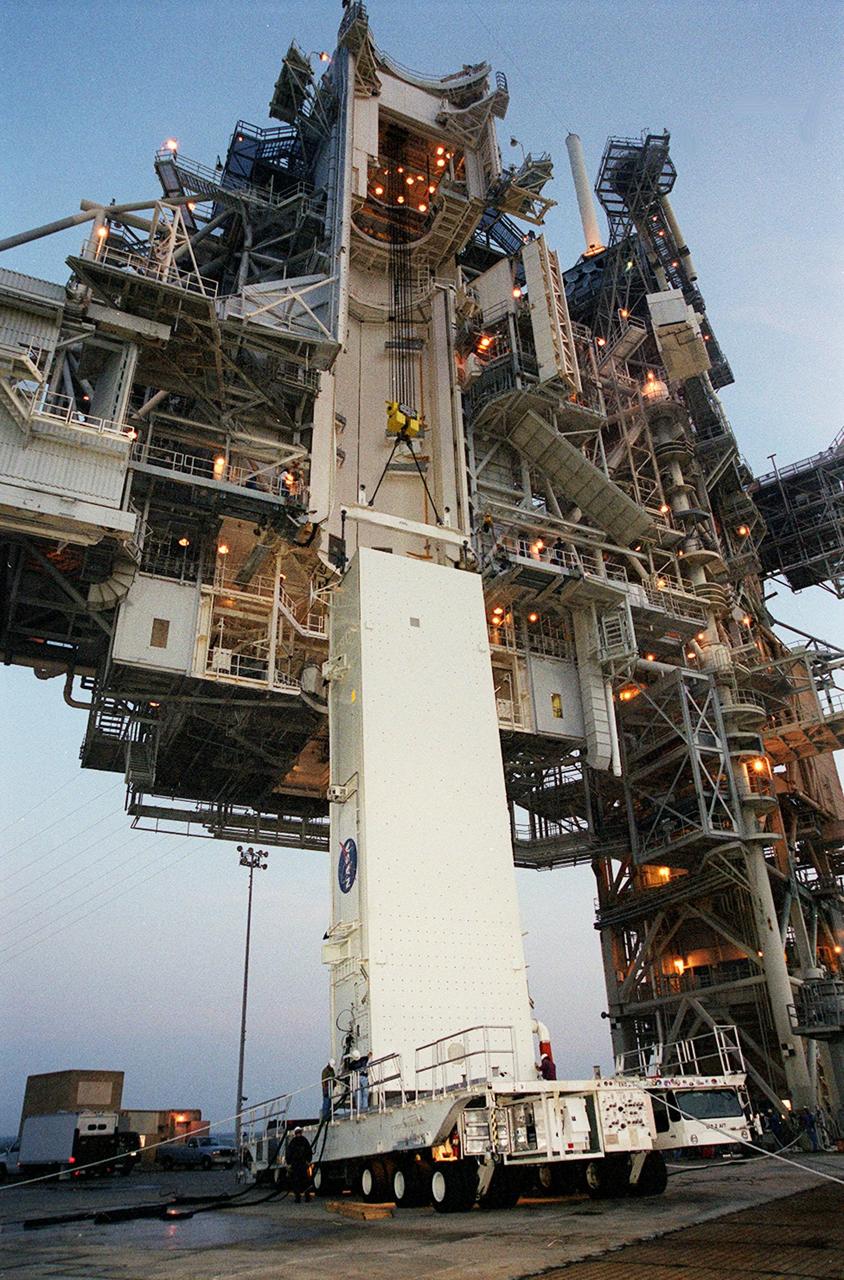
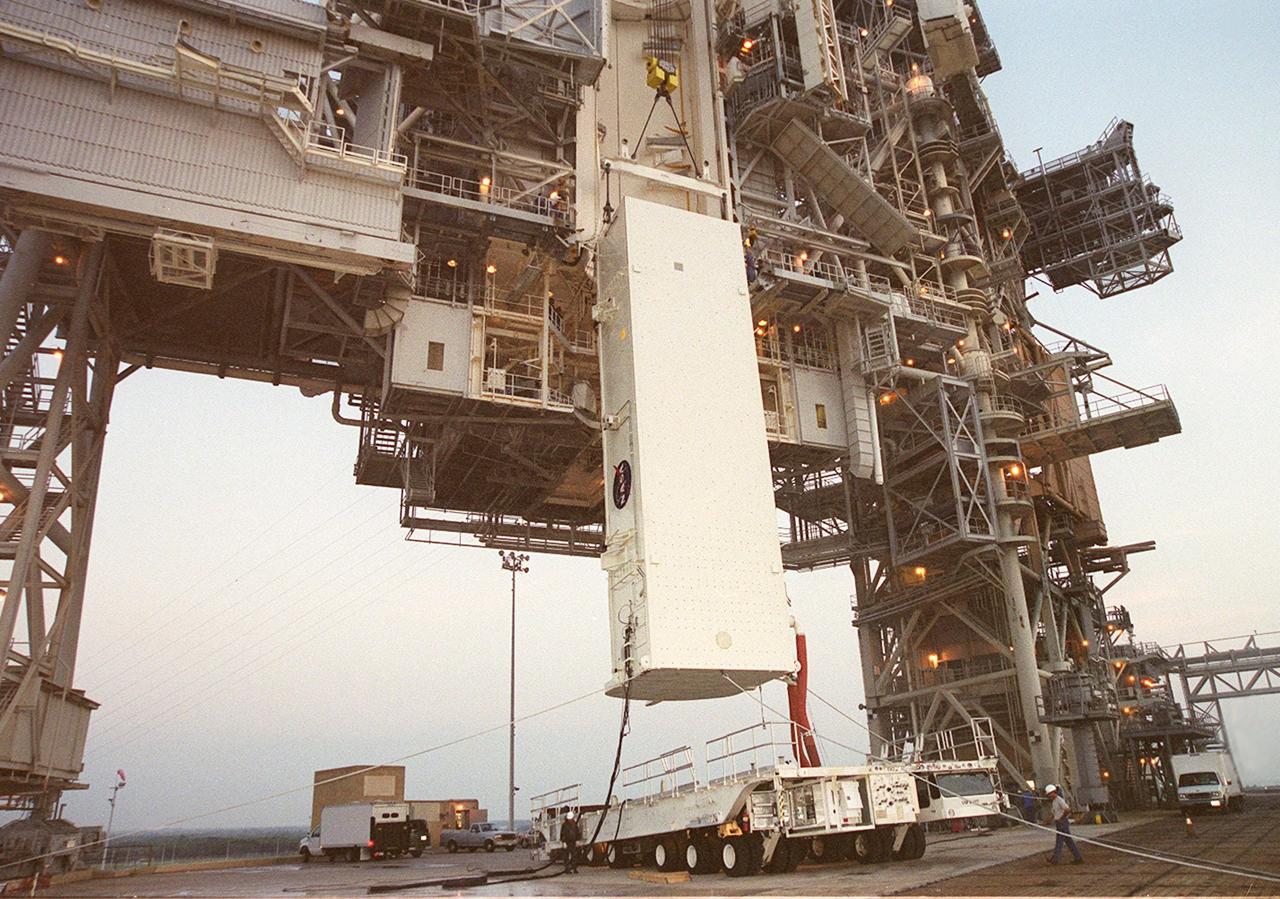
KENNEDY SPACE CENTER, Fla. -- The payload canister arrives at the Rotating Service Structure (RSS) on Launch Pad 39B. The canister with its cargo of the SPACEHAB module and Integrated Cargo Carrier will be lifted up into the Payload Changeout Room near the top of the RSS for transfer to the payload bay of Shuttle Atlantis for mission STS-106. The PCR provides an environmentally controlled facility for the transfer. The 11-day mission to the International Space Station will include service module support tasks on orbit, transfer supplies and outfit the Space Station for the first long-duration crew. Atlantis is scheduled to launch Sept. 8 at 8:31 a.m. EDT.

KENNEDY SPACE CENTER, FLA. -- With umbilical lines still attached, the payload canister is hoisted up alongside the Rotating Service Structure (RSS) on Launch Pad 39B. The canister with its cargo of the SPACEHAB module and Integrated Cargo Carrier will be moved into the Payload Changeout Room (PCR) near the top of the RSS for transfer to the payload bay of Shuttle Atlantis for mission STS-106. The PCR provides an environmentally controlled facility for the transfer. The 11-day mission to the International Space Station will include service module support tasks on orbit, transfer supplies and outfit the Space Station for the first long-duration crew. Atlantis is scheduled to launch Sept. 8 at 8:31 a.m. EDT
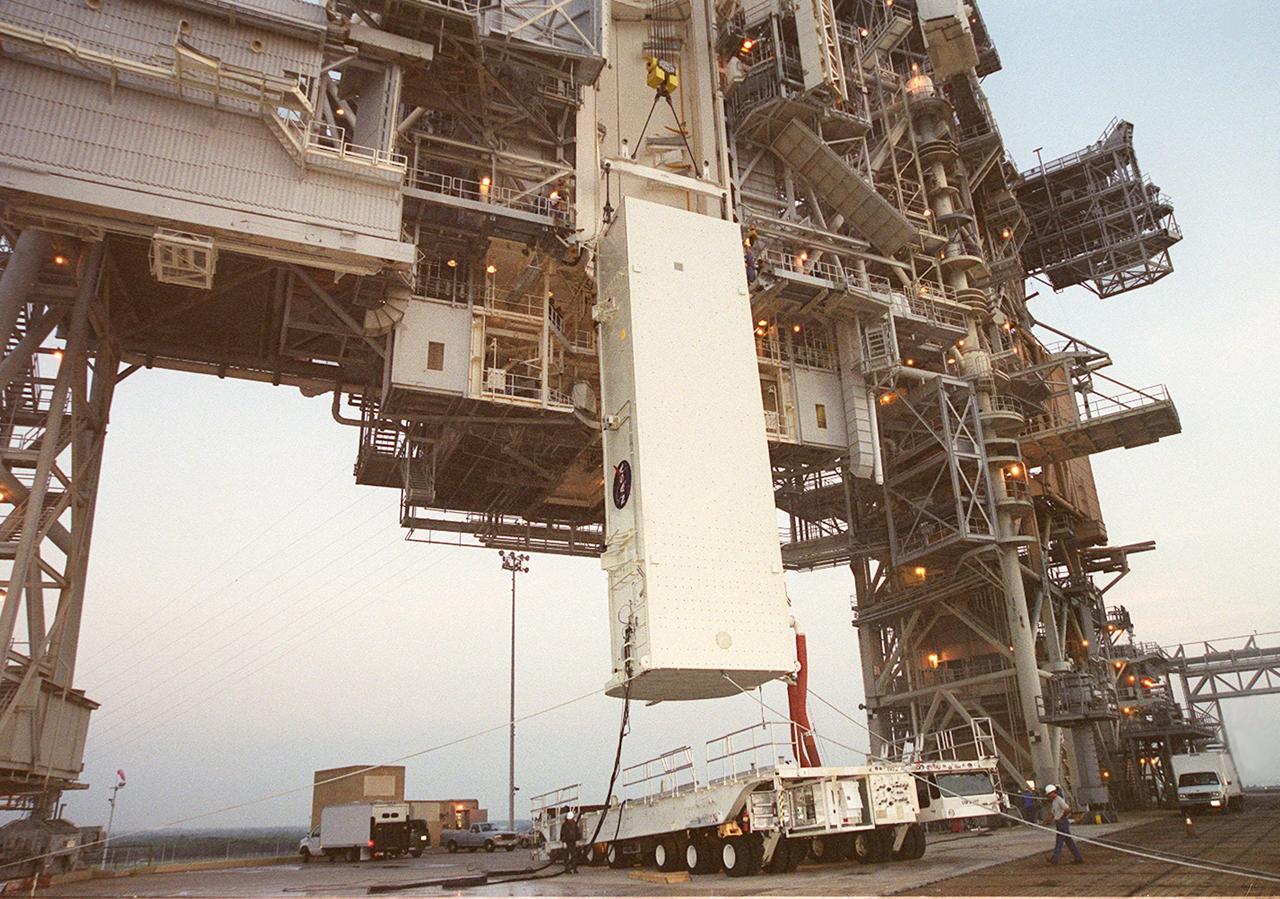
KENNEDY SPACE CENTER, Fla. -- The payload canister is hoisted up alongside the Rotating Service Structure (RSS) on Launch Pad 39B. The canister with its cargo of the SPACEHAB module and Integrated Cargo Carrier will be moved into the Payload Changeout Room near the top of the RSS for transfer to the payload bay of Shuttle Atlantis for mission STS-106. The PCR provides an environmentally controlled facility for the transfer. The 11-day mission to the International Space Station will include service module support tasks on orbit, transfer supplies and outfit the Space Station for the first long-duration crew. Atlantis is scheduled to launch Sept. 8 at 8:31 a.m. EDT.
KENNEDY SPACE CENTER, Fla. -- The payload canister is hoisted up alongside the Rotating Service Structure (RSS) on Launch Pad 39B. The canister with its cargo of the SPACEHAB module and Integrated Cargo Carrier will be moved into the Payload Changeout Room near the top of the RSS for transfer to the payload bay of Shuttle Atlantis for mission STS-106. The PCR provides an environmentally controlled facility for the transfer. The 11-day mission to the International Space Station will include service module support tasks on orbit, transfer supplies and outfit the Space Station for the first long-duration crew. Atlantis is scheduled to launch Sept. 8 at 8:31 a.m. EDT.
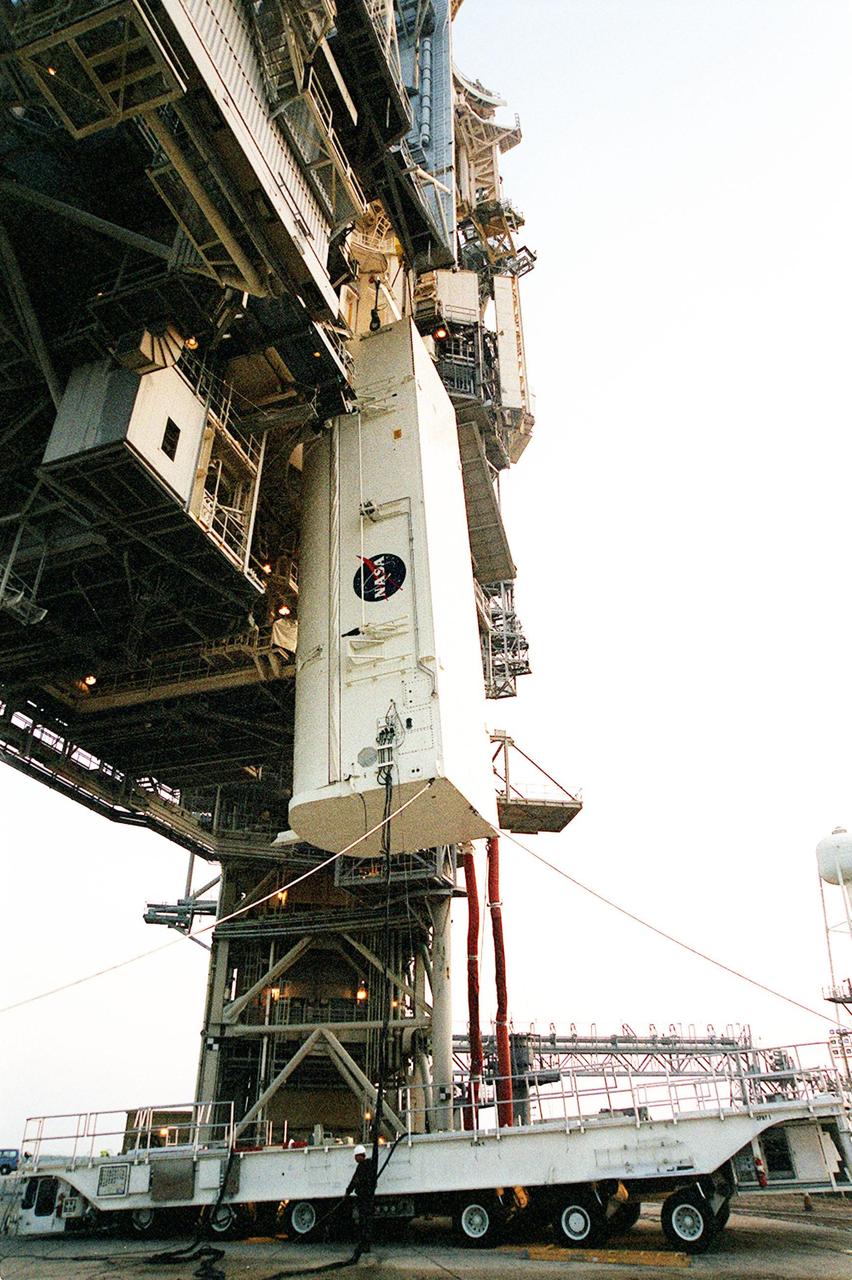
With umbilical lines still attached, the payload canister is hoisted up alongside the Rotating Service Structure (RSS) on Launch Pad 39B. The canister with its cargo of the SPACEHAB module and Integrated Cargo Carrier will be moved into the Payload Changeout Room (PCR) near the top of the RSS for transfer to the payload bay of Shuttle Atlantis for mission STS-106. The PCR provides an environmentally controlled facility for the transfer. The 11-day mission to the International Space Station will include service module support tasks on orbit, transfer supplies and outfit the Space Station for the first long-duration crew. Atlantis is scheduled to launch Sept. 8 at 8:31 a.m. EDT.
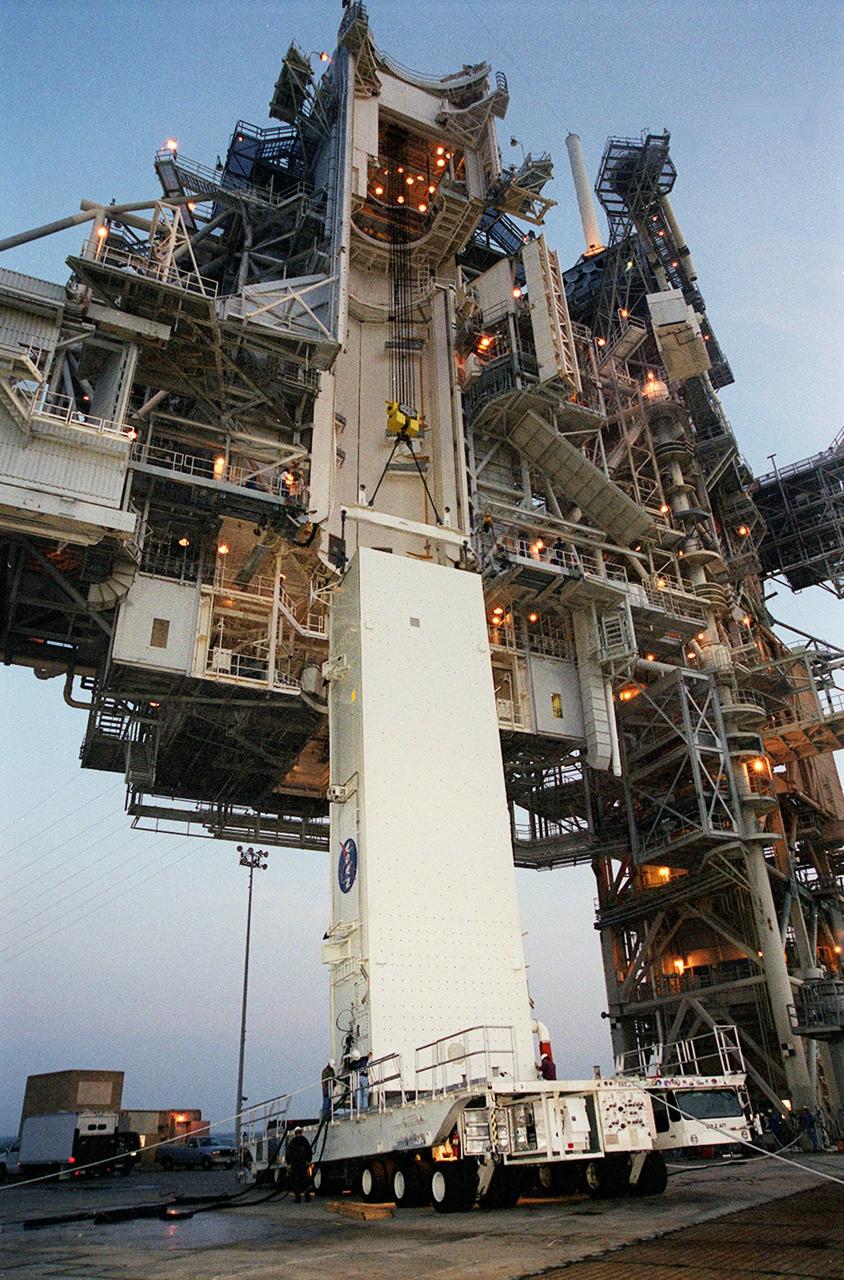
KENNEDY SPACE CENTER, Fla. -- The payload canister arrives at the Rotating Service Structure (RSS) on Launch Pad 39B. The canister with its cargo of the SPACEHAB module and Integrated Cargo Carrier will be lifted up into the Payload Changeout Room near the top of the RSS for transfer to the payload bay of Shuttle Atlantis for mission STS-106. The PCR provides an environmentally controlled facility for the transfer. The 11-day mission to the International Space Station will include service module support tasks on orbit, transfer supplies and outfit the Space Station for the first long-duration crew. Atlantis is scheduled to launch Sept. 8 at 8:31 a.m. EDT.
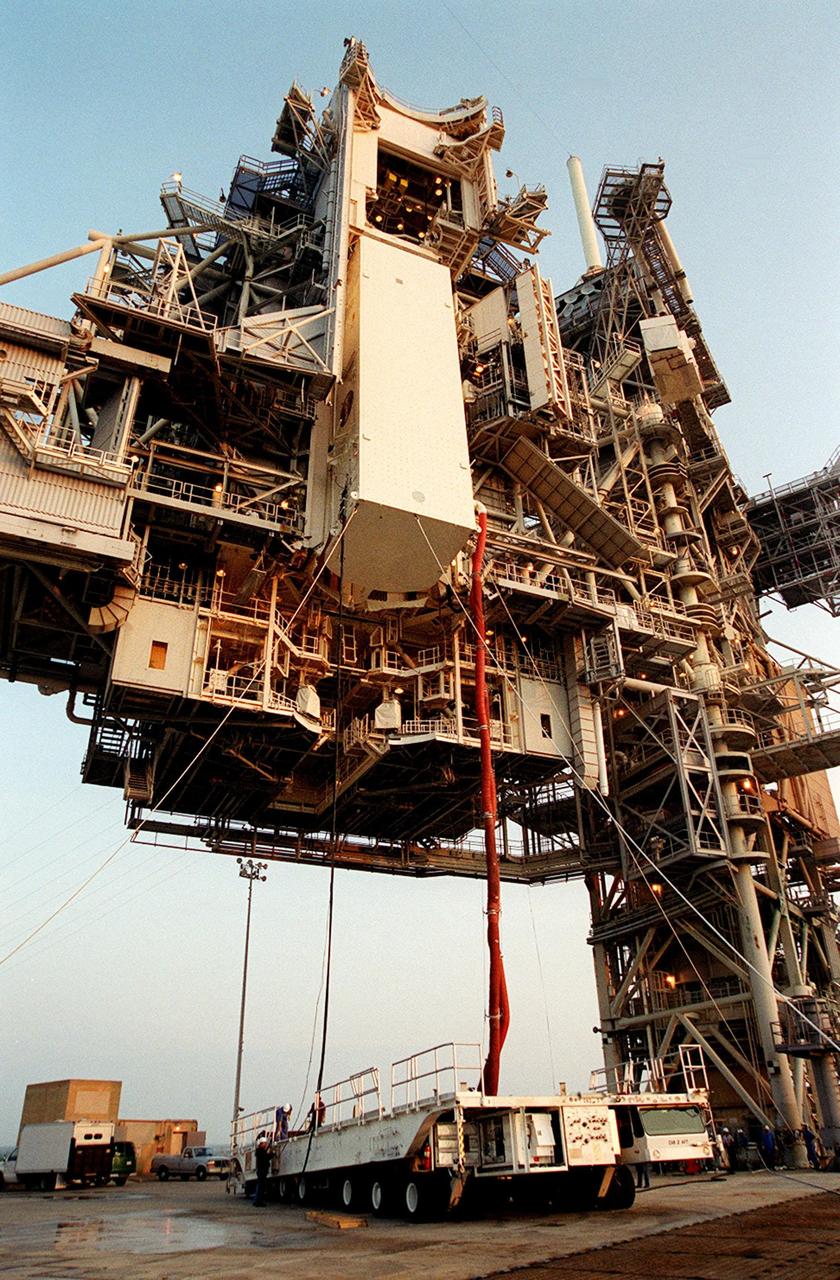
KENNEDY SPACE CENTER, FLA. -- With umbilical lines still attached, the payload canister is hoisted up alongside the Rotating Service Structure (RSS) on Launch Pad 39B. The canister with its cargo of the SPACEHAB module and Integrated Cargo Carrier will be moved into the Payload Changeout Room (PCR) near the top of the RSS for transfer to the payload bay of Shuttle Atlantis for mission STS-106. The PCR provides an environmentally controlled facility for the transfer. The 11-day mission to the International Space Station will include service module support tasks on orbit, transfer supplies and outfit the Space Station for the first long-duration crew. Atlantis is scheduled to launch Sept. 8 at 8:31 a.m. EDT
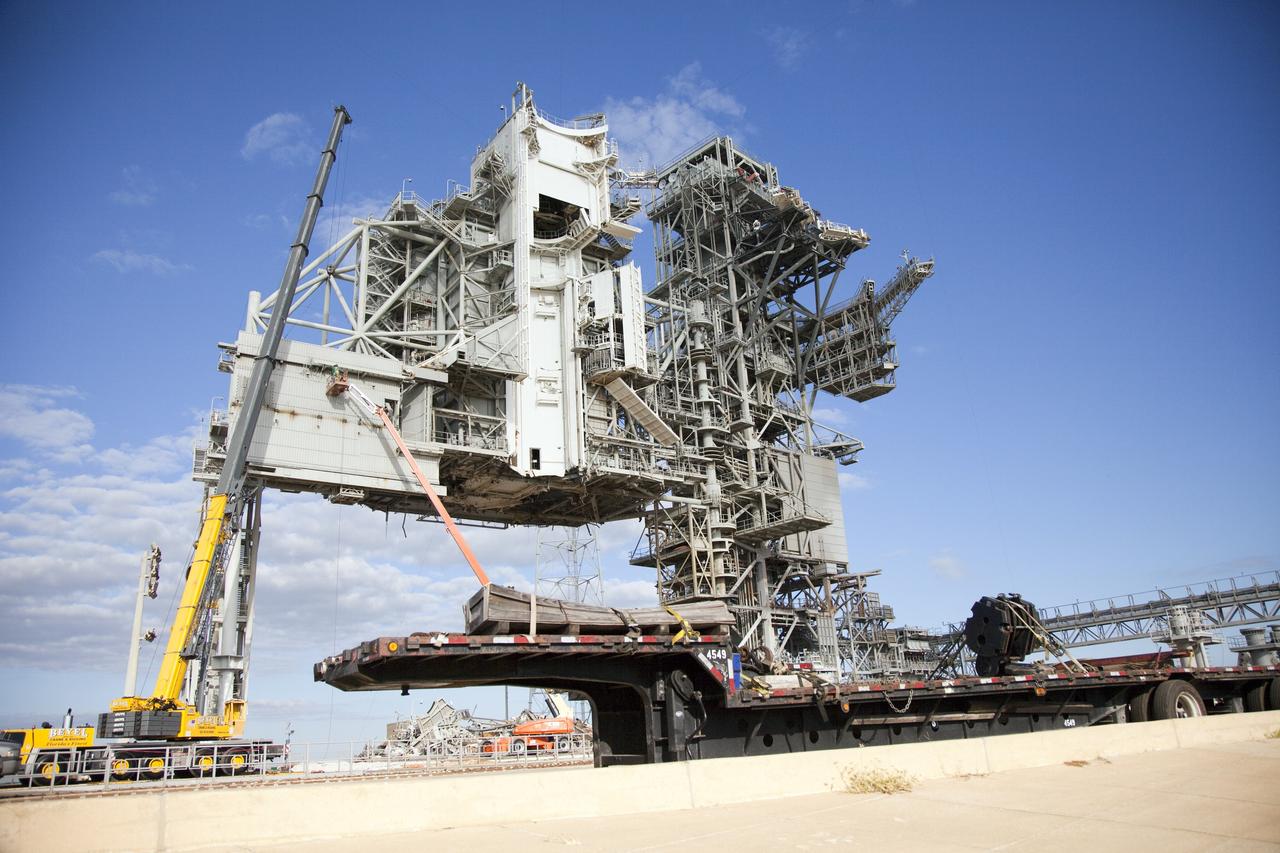
CAPE CANAVERAL, Fla. -- At NASA's Kennedy Space Center in Florida, the rotating service structure (RSS) on Launch Pad 39B is being dismantled. Starting in 2009, the structure at the pad was no longer needed for NASA's Space Shuttle Program, so it is being restructured for future use. The new design will feature a "clean pad" for rockets to come with their own launcher, making it more versatile for a number of vehicles. For information on NASA's future plans, visit www.nasa.gov. Photo credit: NASA/Frankie Martin
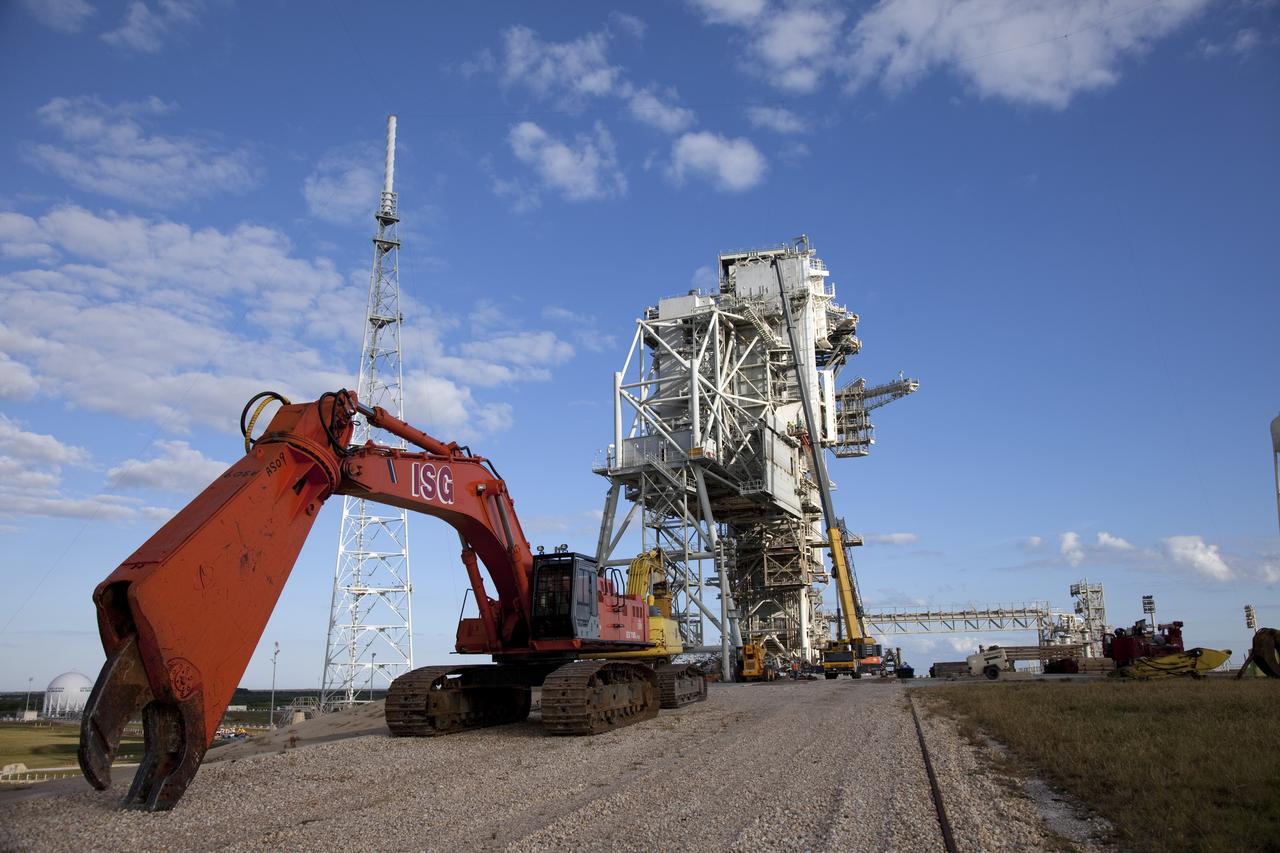
CAPE CANAVERAL, Fla. -- At NASA's Kennedy Space Center in Florida, the rotating service structure (RSS) on Launch Pad 39B is being dismantled. Starting in 2009, the structure at the pad was no longer needed for NASA's Space Shuttle Program, so it is being restructured for future use. The new design will feature a "clean pad" for rockets to come with their own launcher, making it more versatile for a number of vehicles. The new lightning protection system, left, will remain. For information on NASA's future plans, visit www.nasa.gov. Photo credit: NASA/Frankie Martin
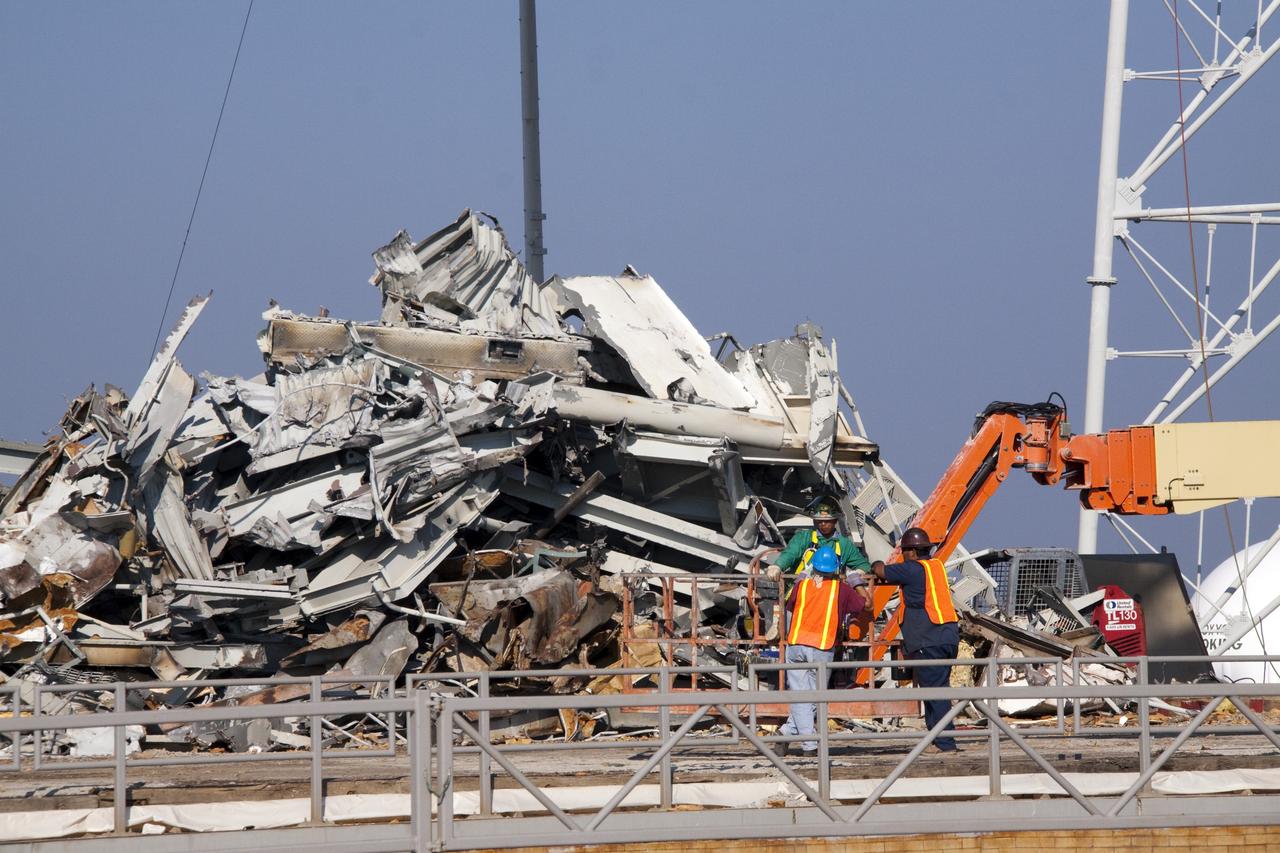
CAPE CANAVERAL, Fla. -- Rubble begins to build as the rotating service structure (RSS) on Launch Pad 39B is dismantled at NASA's Kennedy Space Center in Florida. Starting in 2009, the structure at the pad was no longer needed for NASA's Space Shuttle Program, so it is being restructured for future use. The new design will feature a "clean pad" for rockets to come with their own launcher, making it more versatile for a number of vehicles. For information on NASA's future plans, visit www.nasa.gov. Photo credit: NASA/Jack Pfaller
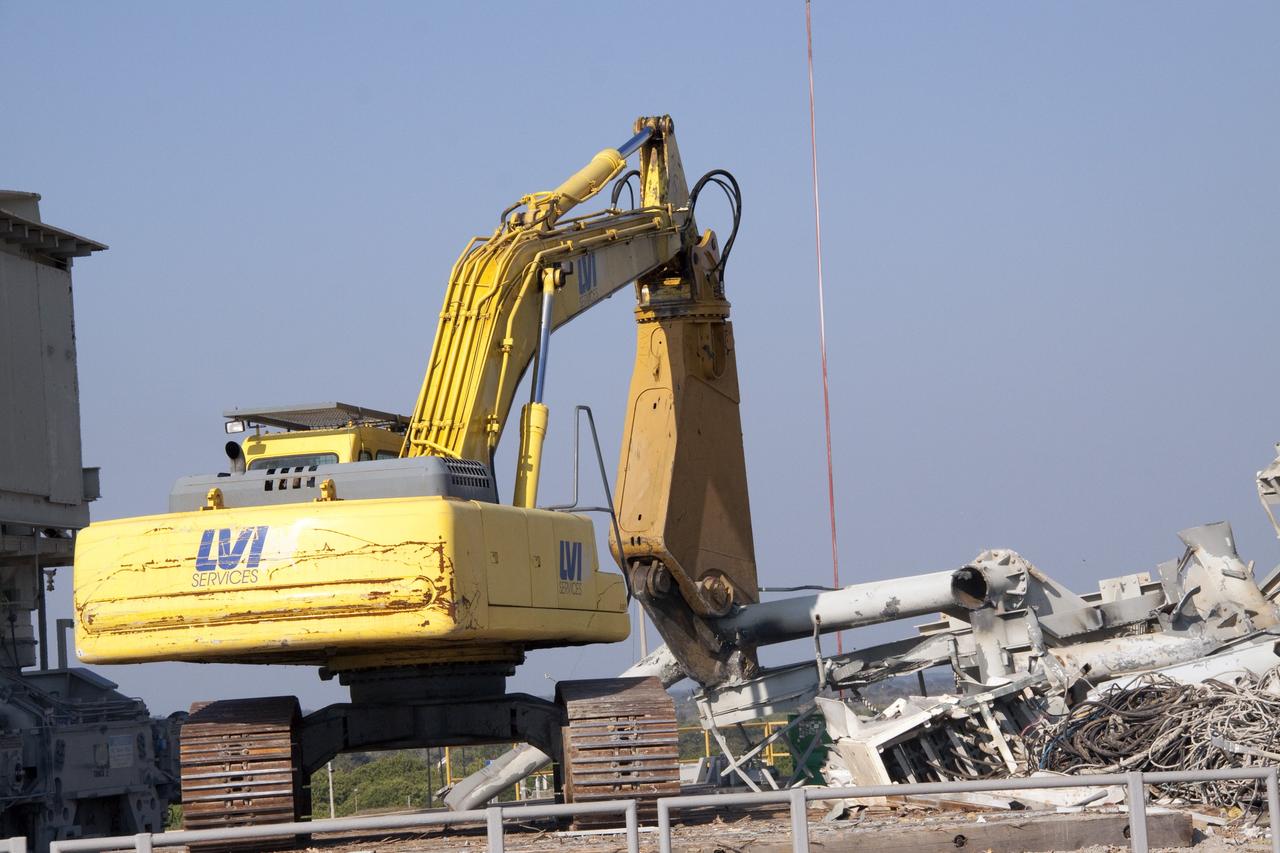
CAPE CANAVERAL, Fla. -- Rubble begins to build as the rotating service structure (RSS) on Launch Pad 39B is dismantled at NASA's Kennedy Space Center in Florida. Starting in 2009, the structure at the pad was no longer needed for NASA's Space Shuttle Program, so it is being restructured for future use. The new design will feature a "clean pad" for rockets to come with their own launcher, making it more versatile for a number of vehicles. For information on NASA's future plans, visit www.nasa.gov. Photo credit: NASA/Jack Pfaller
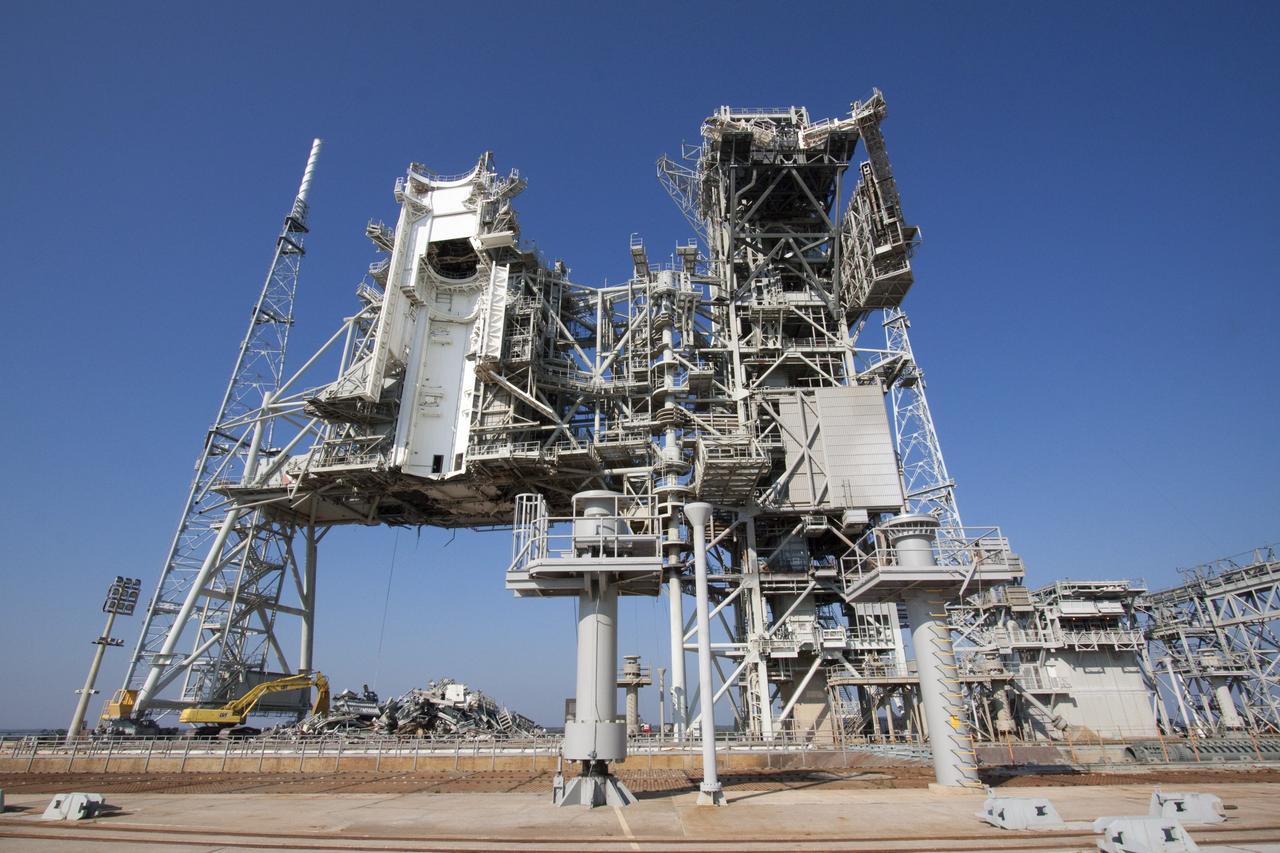
CAPE CANAVERAL, Fla. -- Rubble begins to build as the rotating service structure (RSS) on Launch Pad 39B is dismantled at NASA's Kennedy Space Center in Florida. Starting in 2009, the structure at the pad was no longer needed for NASA's Space Shuttle Program, so it is being restructured for future use. The new design will feature a "clean pad" for rockets to come with their own launcher, making it more versatile for a number of vehicles. For information on NASA's future plans, visit www.nasa.gov. Photo credit: NASA/Jack Pfaller
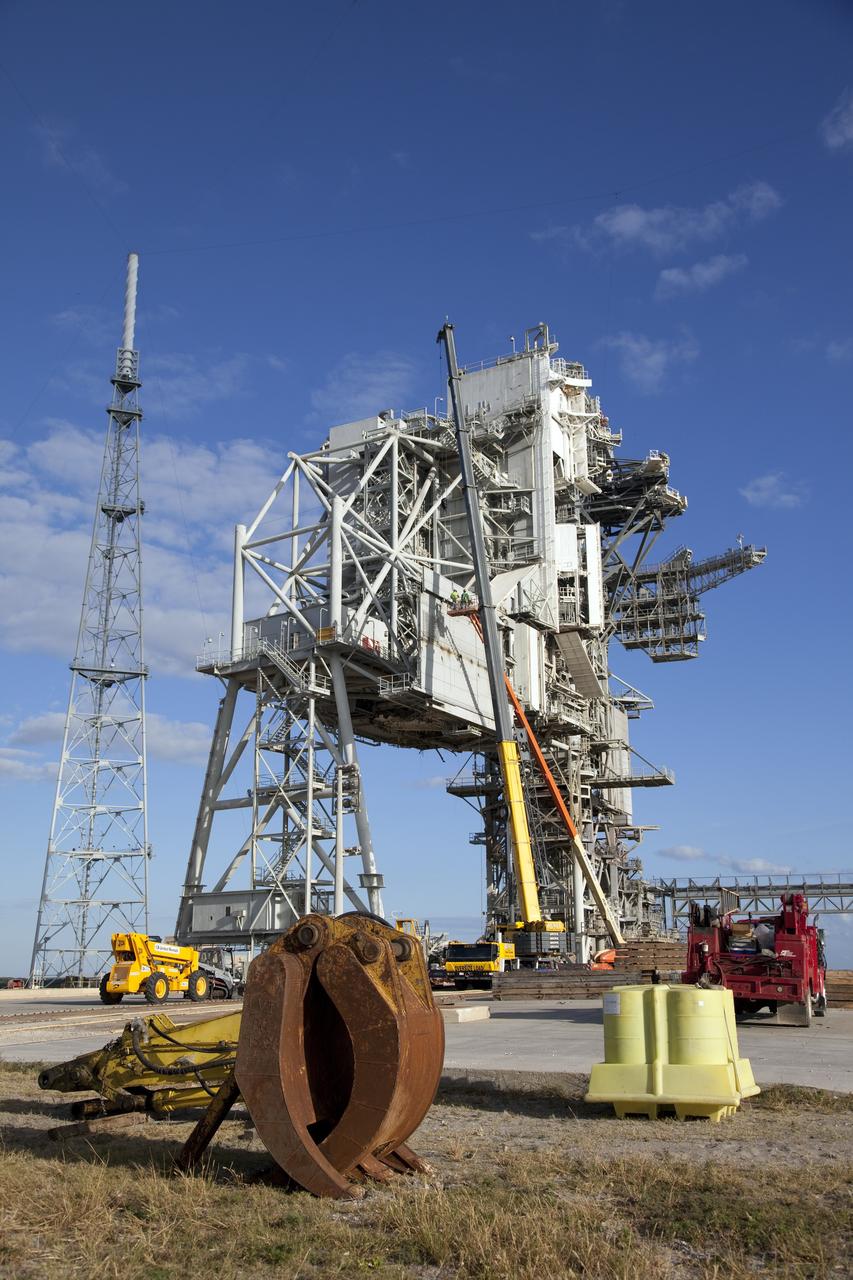
CAPE CANAVERAL, Fla. -- At NASA's Kennedy Space Center in Florida, the rotating service structure (RSS) on Launch Pad 39B is being dismantled. Starting in 2009, the structure at the pad was no longer needed for NASA's Space Shuttle Program, so it is being restructured for future use. The new design will feature a "clean pad" for rockets to come with their own launcher, making it more versatile for a number of vehicles. The new lightning protection system, left, will remain. For information on NASA's future plans, visit www.nasa.gov. Photo credit: NASA/Frankie Martin
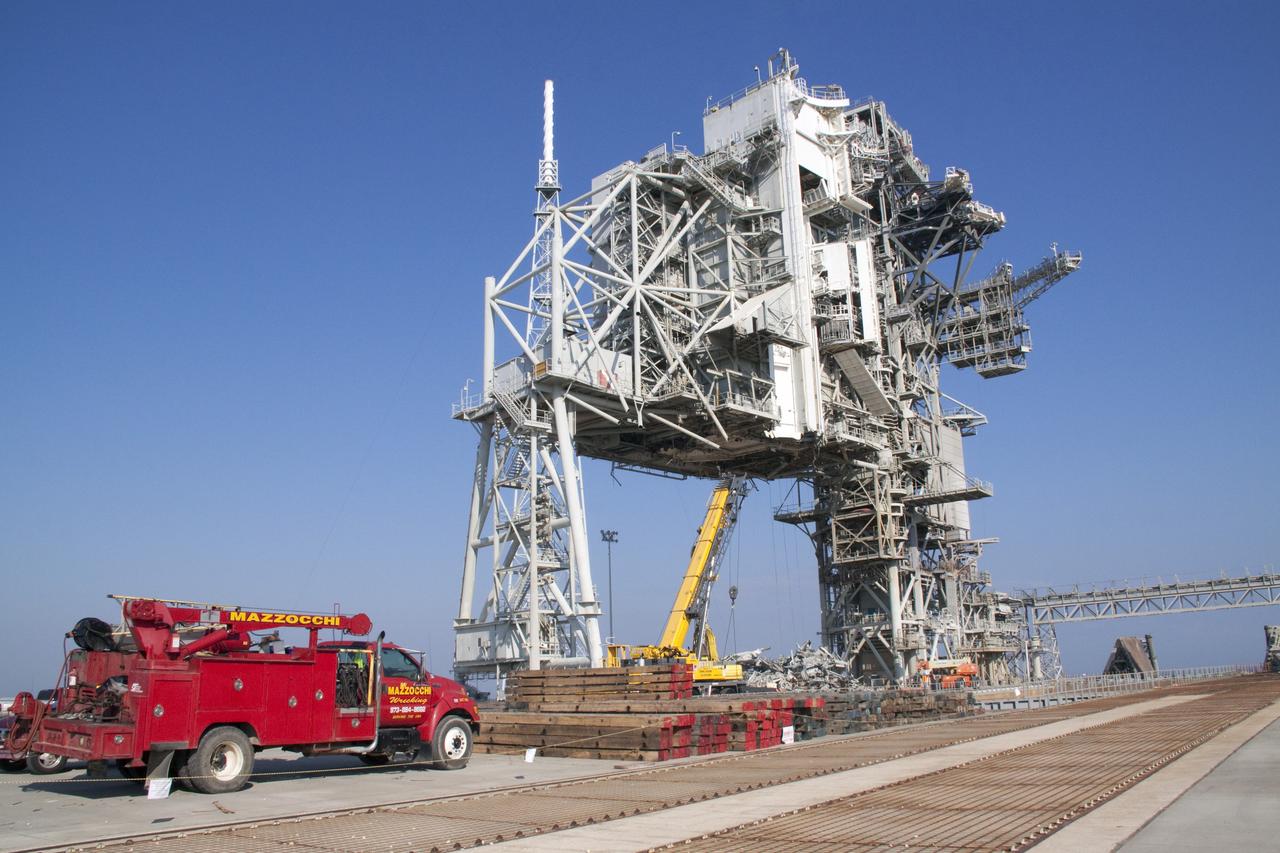
CAPE CANAVERAL, Fla. -- At NASA's Kennedy Space Center in Florida, the rotating service structure (RSS) on Launch Pad 39B is being dismantled. Starting in 2009, the structure at the pad was no longer needed for NASA's Space Shuttle Program, so it is being restructured for future use. The new design will feature a "clean pad" for rockets to come with their own launcher, making it more versatile for a number of vehicles. For information on NASA's future plans, visit www.nasa.gov. Photo credit: NASA/Jack Pfaller
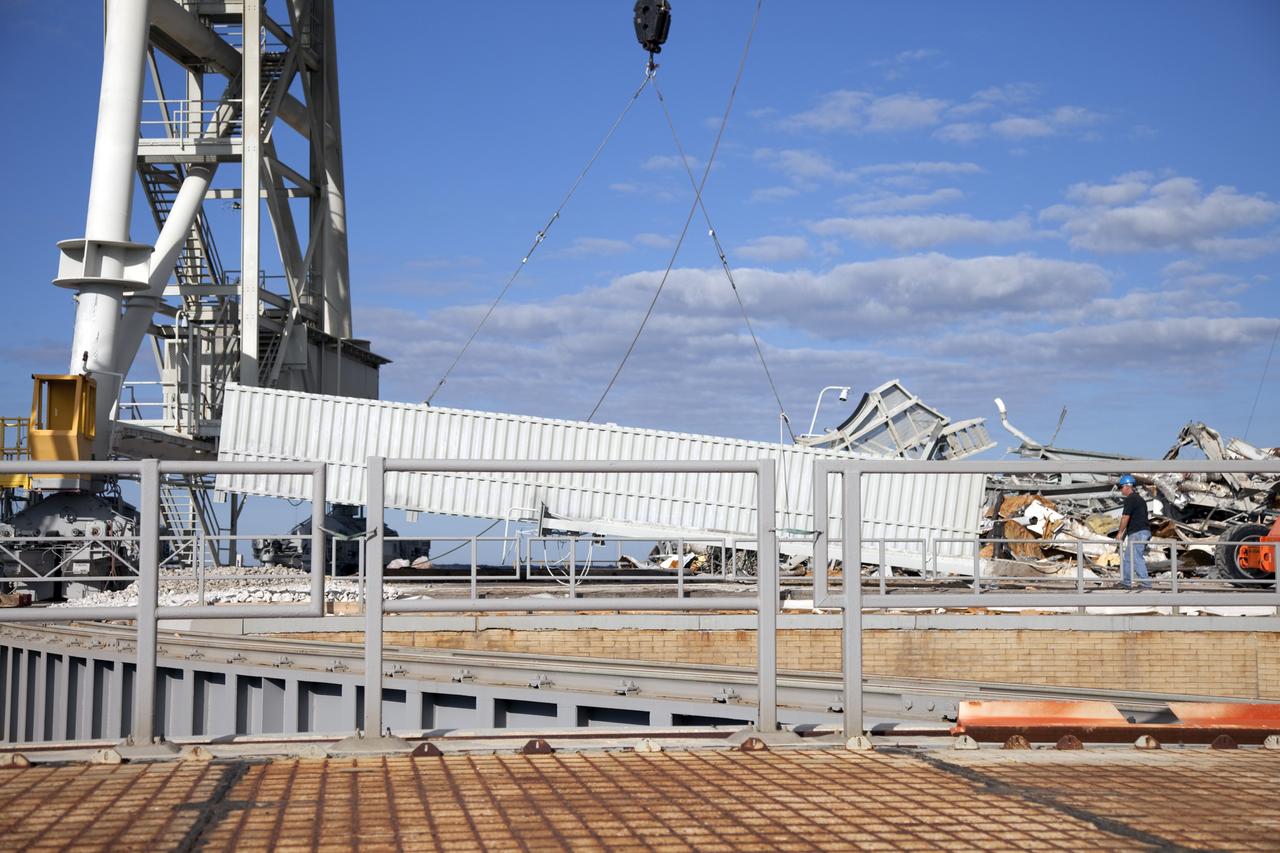
CAPE CANAVERAL, Fla. -- At NASA's Kennedy Space Center in Florida, the rotating service structure (RSS) on Launch Pad 39B is being dismantled. Starting in 2009, the structure at the pad was no longer needed for NASA's Space Shuttle Program, so it is being restructured for future use. The new design will feature a "clean pad" for rockets to come with their own launcher, making it more versatile for a number of vehicles. For information on NASA's future plans, visit www.nasa.gov. Photo credit: NASA/Frankie Martin
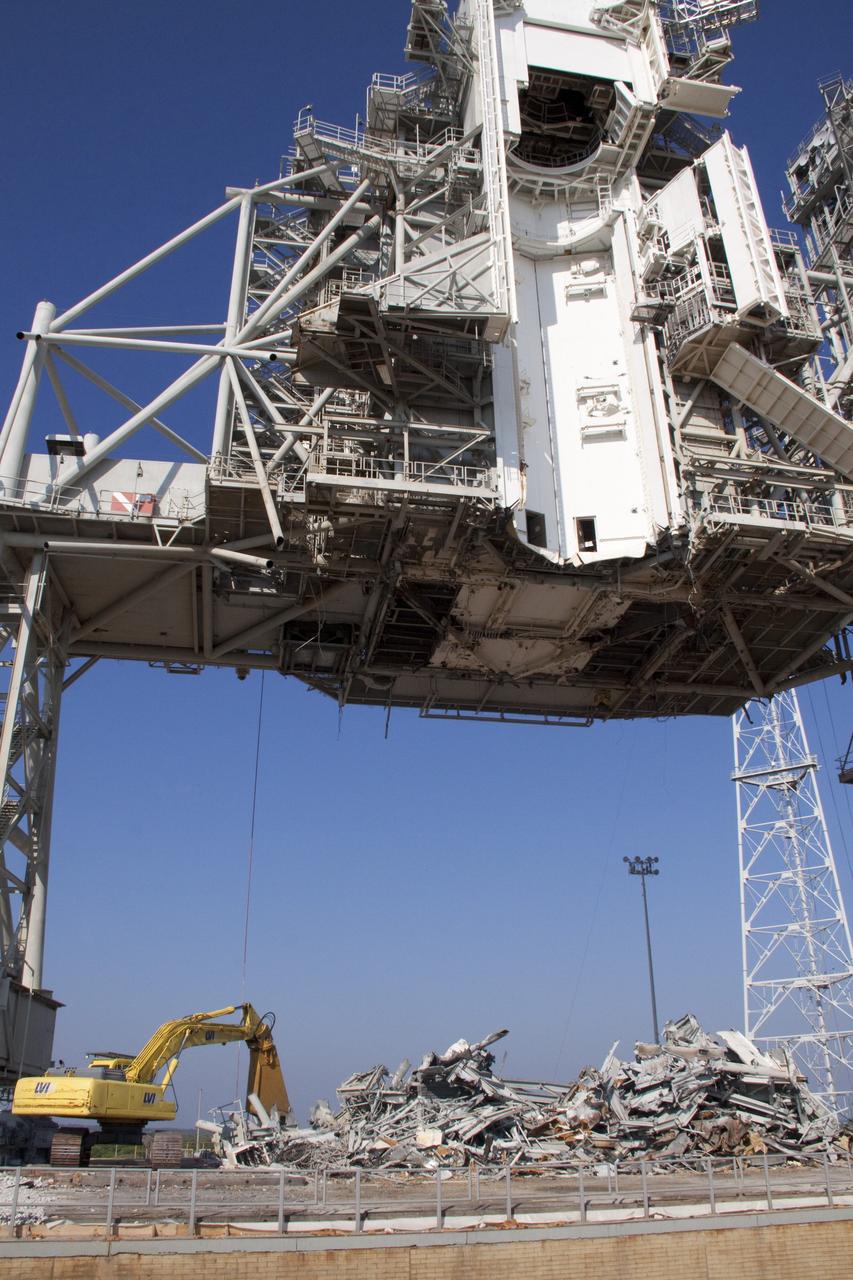
CAPE CANAVERAL, Fla. -- Rubble begins to build as the rotating service structure (RSS) on Launch Pad 39B is dismantled at NASA's Kennedy Space Center in Florida. Starting in 2009, the structure at the pad was no longer needed for NASA's Space Shuttle Program, so it is being restructured for future use. The new design will feature a "clean pad" for rockets to come with their own launcher, making it more versatile for a number of vehicles. For information on NASA's future plans, visit www.nasa.gov. Photo credit: NASA/Jack Pfaller
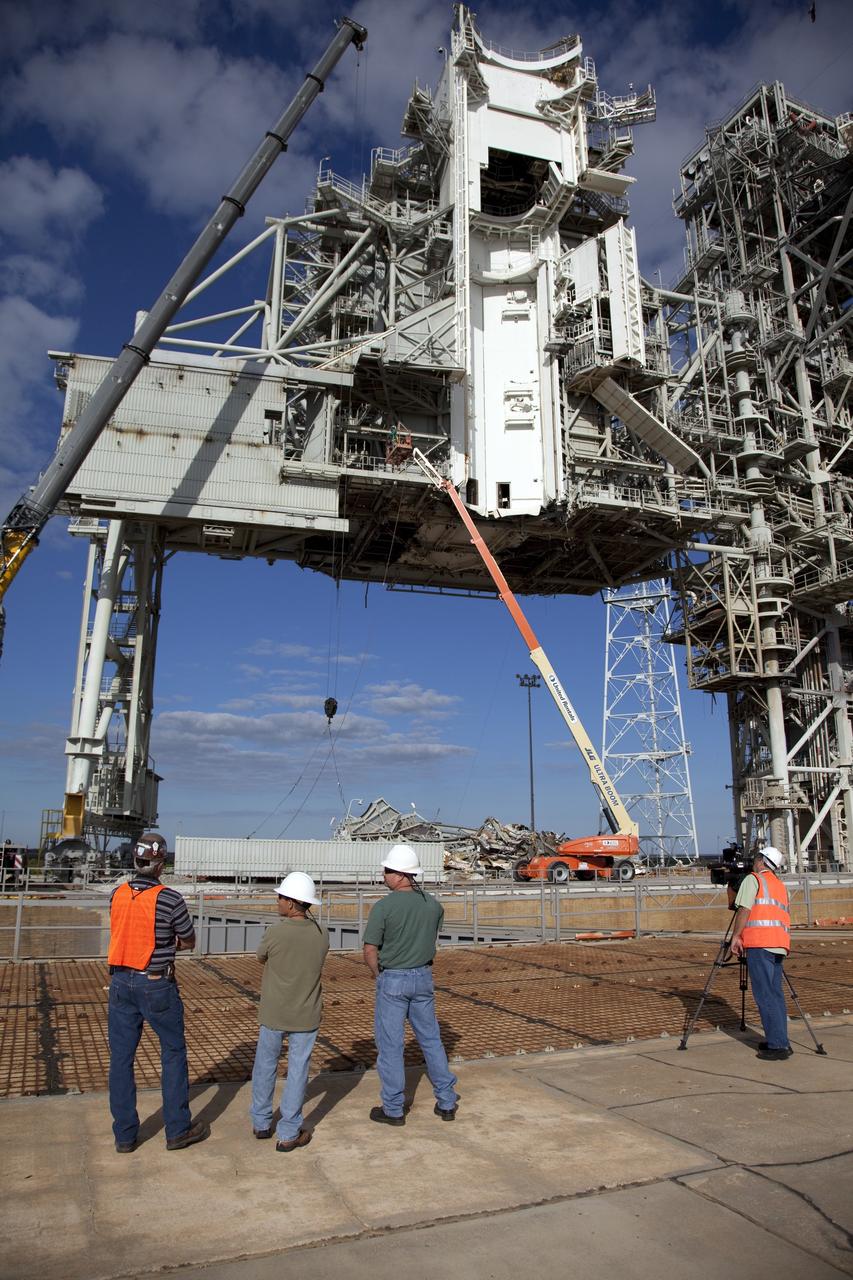
CAPE CANAVERAL, Fla. -- At NASA's Kennedy Space Center in Florida, the rotating service structure (RSS) on Launch Pad 39B is being dismantled. Starting in 2009, the structure at the pad was no longer needed for NASA's Space Shuttle Program, so it is being restructured for future use. The new design will feature a "clean pad" for rockets to come with their own launcher, making it more versatile for a number of vehicles. For information on NASA's future plans, visit www.nasa.gov. Photo credit: NASA/Frankie Martin
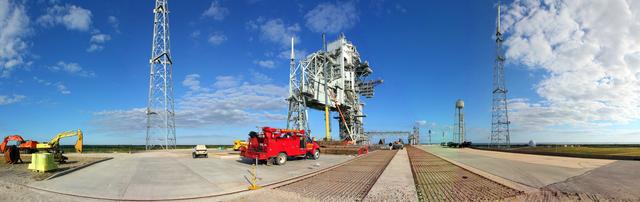
CAPE CANAVERAL, Fla. -- At NASA's Kennedy Space Center in Florida, the rotating service structure (RSS) on Launch Pad 39B is being dismantled. Starting in 2009, the structure at the pad was no longer needed for NASA's Space Shuttle Program, so it is being restructured for future use. The new design will feature a "clean pad" for rockets to come with their own launcher, making it more versatile for a number of vehicles. For information on NASA's future plans, visit www.nasa.gov. Photo credit: NASA/Frankie Martin
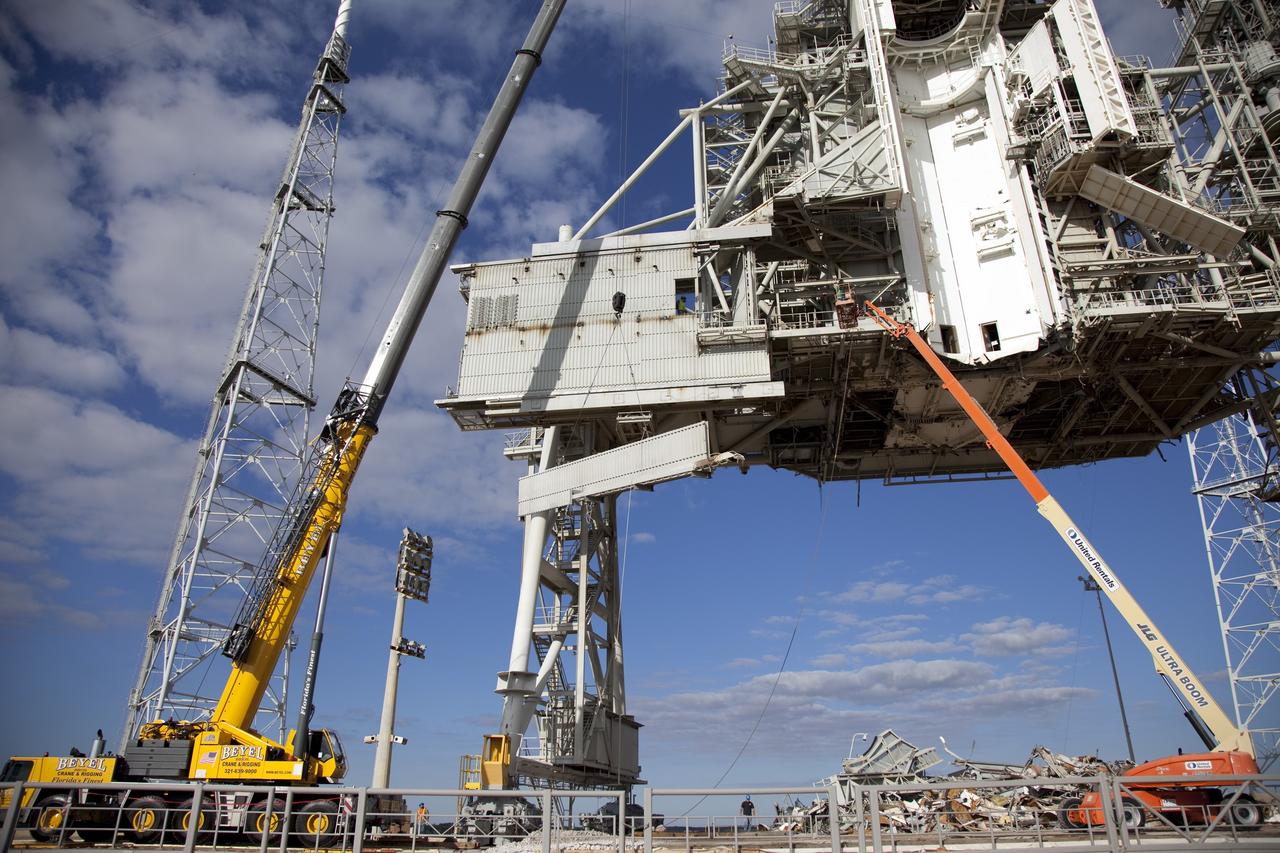
CAPE CANAVERAL, Fla. -- At NASA's Kennedy Space Center in Florida, the rotating service structure (RSS) on Launch Pad 39B is being dismantled. Starting in 2009, the structure at the pad was no longer needed for NASA's Space Shuttle Program, so it is being restructured for future use. The new design will feature a "clean pad" for rockets to come with their own launcher, making it more versatile for a number of vehicles. The new lightning protection system, left, will remain. For information on NASA's future plans, visit www.nasa.gov. Photo credit: NASA/Frankie Martin

CAPE CANAVERAL, Fla. -- At NASA's Kennedy Space Center in Florida, the rotating service structure (RSS) on Launch Pad 39B is being dismantled. Starting in 2009, the structure at the pad was no longer needed for NASA's Space Shuttle Program, so it is being restructured for future use. The new design will feature a "clean pad" for rockets to come with their own launcher, making it more versatile for a number of vehicles. The new lightning protection system, left, will remain. For information on NASA's future plans, visit www.nasa.gov. Photo credit: NASA/Frankie Martin
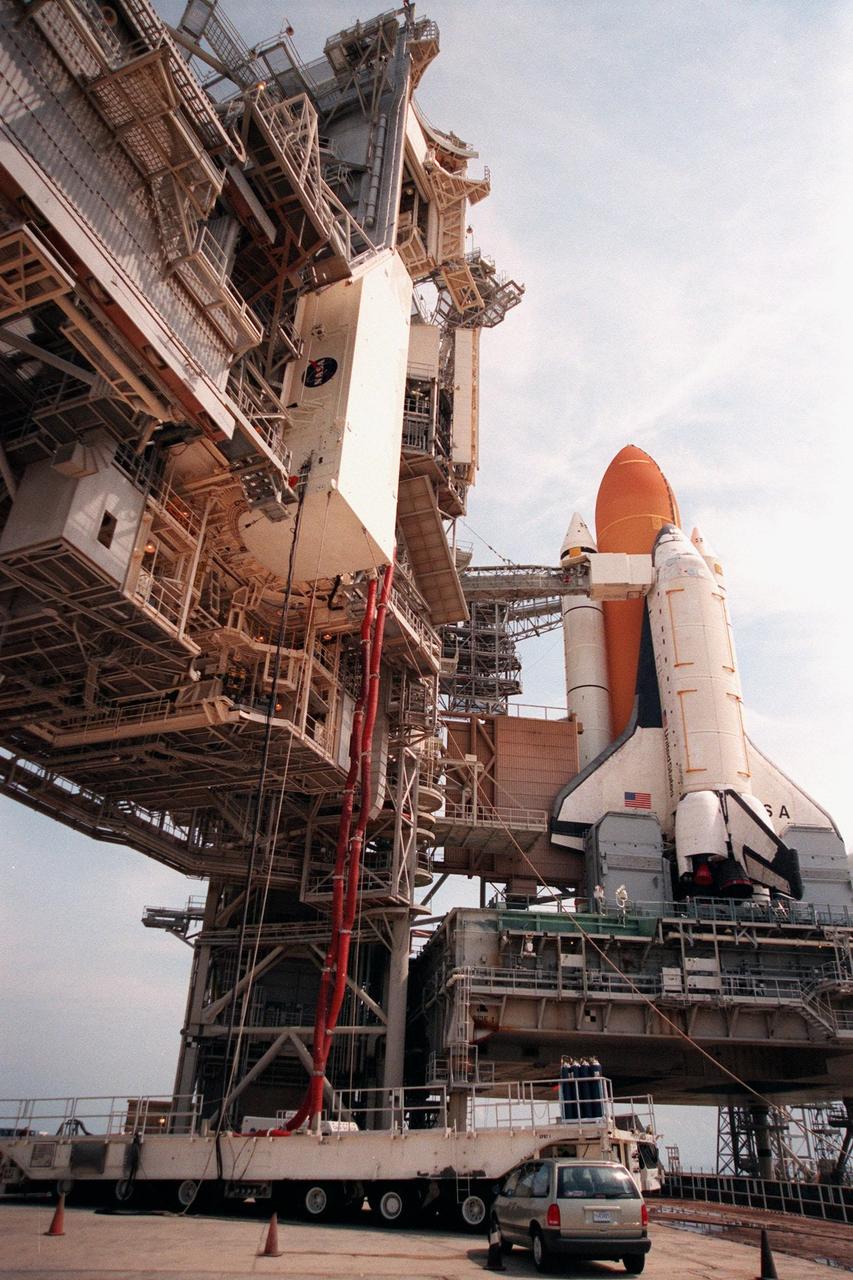
KENNEDY SPACE CENTER, FLA. -- At Launch Pad 39B, the payload canister carrying the Chandra X-ray Observatory nears the end of its ascent up the Rotating Service Structure (RSS) to the Payload Changeout Room. Umbilical hoses, which maintain a controlled environment for the observatory, are still attached to the payload canister transporter below that transferred the payload from the Vertical Processing Facility. The observatory will be moved into the payload bay of the Space Shuttle Columbia, seen in the background, after the RSS rotates to a position behind Columbia. The world's most powerful X-ray telescope, Chandra will allow scientists from around the world to see previously invisible black holes and high-temperature gas clouds, giving the observatory the potential to rewrite the books on the structure and evolution of our universe. Chandra is scheduled for launch no earlier than July 20 aboard Space Shuttle Columbia, on mission STS-93
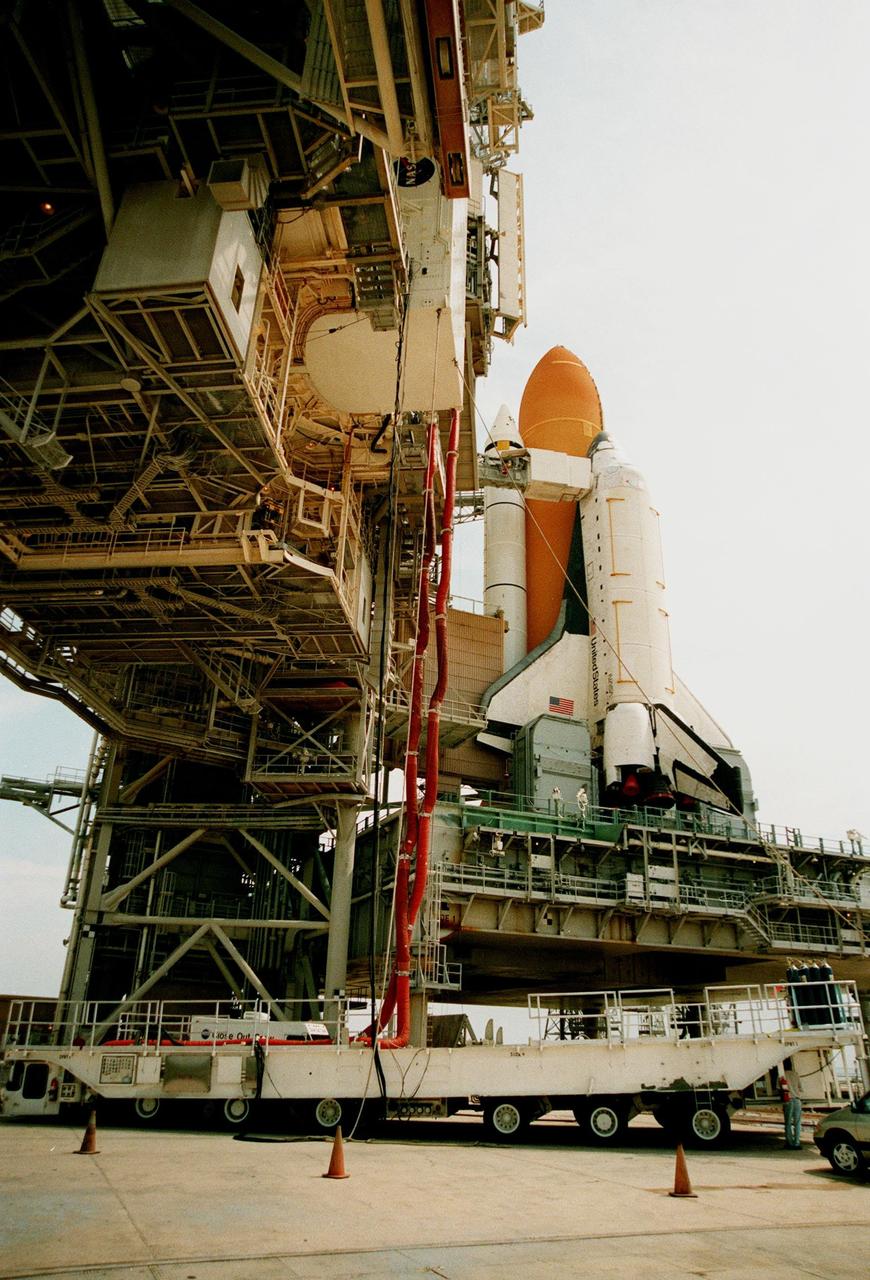
KENNEDY SPACE CENTER, FLA. -- At Launch Pad 39B, the payload canister carrying the Chandra X-ray Observatory begins its ascent up the Rotating Service Structure (RSS) to the Payload Changeout Room. Umbilical hoses, which maintain a controlled environment for the observatory, are still attached to the payload canister transporter below that transferred the observatory from the Vertical Processing Facility. The observatory will be moved into the payload bay of the Space Shuttle Columbia, seen in the background, after the RSS rotates to a position behind Columbia. The world's most powerful X-ray telescope, Chandra will allow scientists from around the world to see previously invisible black holes and high-temperature gas clouds, giving the observatory the potential to rewrite the books on the structure and evolution of our universe. Chandra is scheduled for launch no earlier than July 20 aboard Space Shuttle Columbia, on mission STS-93
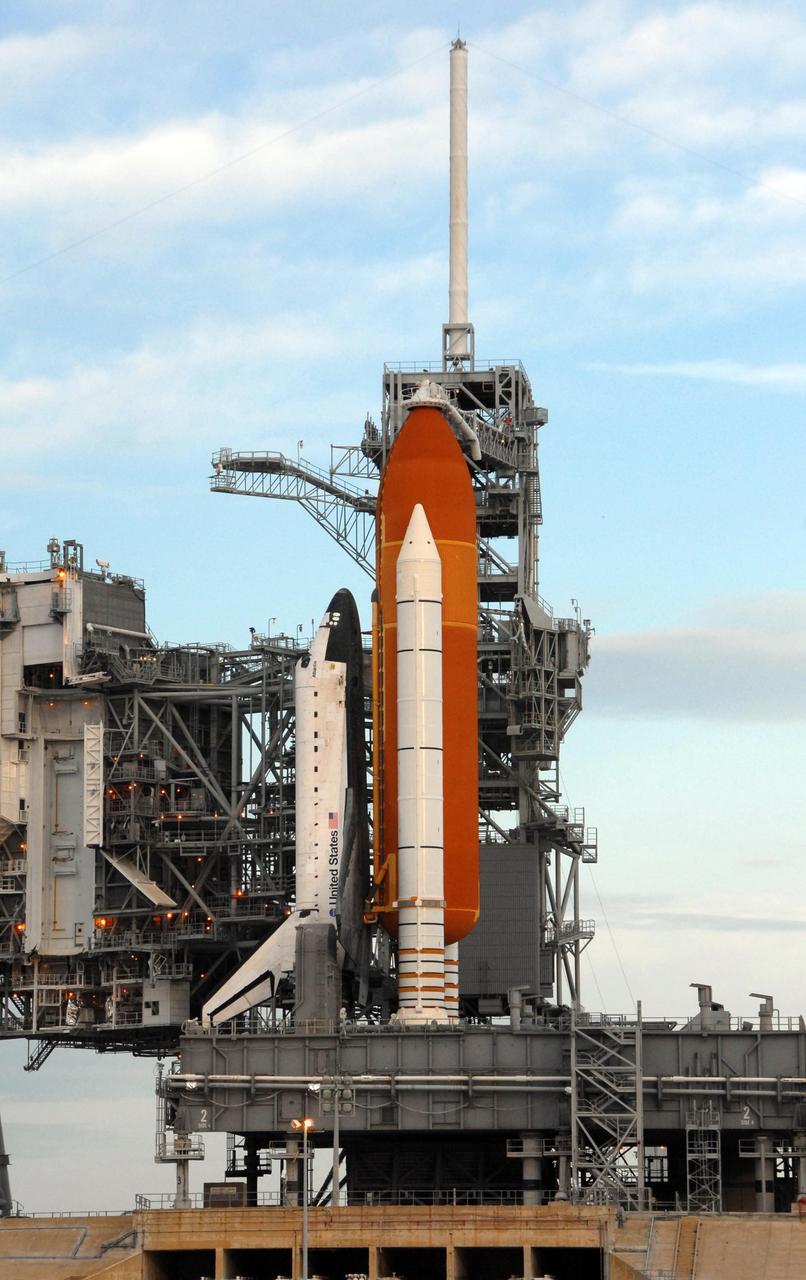
KENNEDY SPACE CENTER, FLA. -- The lightning mast on Launch Pad 39A stands ready to protect Space Shuttle Atlantis from potential thunderstorms following sunrise on a cloudy Florida day. Rollback of the pad's rotating service structure, or RSS, is one of the milestones in preparation for the launch of mission STS-117 on June 8. Rollback started at 10:56 p.m. EDT June 7 and was complete at 11:34 p.m. The RSS, the massive structure to the left of the shuttle, provides protected access to the orbiter for changeout and servicing of payloads at the pad. The structure is supported by a rotating bridge that pivots about a vertical axis on the side of the pad's flame trench. The hinge column rests on the pad surface and is braced to the fixed service structure. Support for the outer end of the bridge is provided by two eight-wheel, motor-driven trucks that move along circular twin rails installed flush with the pad surface. The track crosses the flame trench on a permanent bridge. The RSS is 102 feet long, 50 feet wide and 130 feet high. The structure has orbiter access platforms at five levels to provide access to the payload bay while the orbiter is being serviced in the RSS. Each platform has independent extendable planks that can be arranged to conform to a payload's configuration. This mission is the 118th shuttle flight and the 21st U.S. flight to the International Space Station and will deliver and install the S3/S4 truss segment, deploy a set of solar arrays and prepare them for operation. Photo credit: NASA/Ken Thornsley
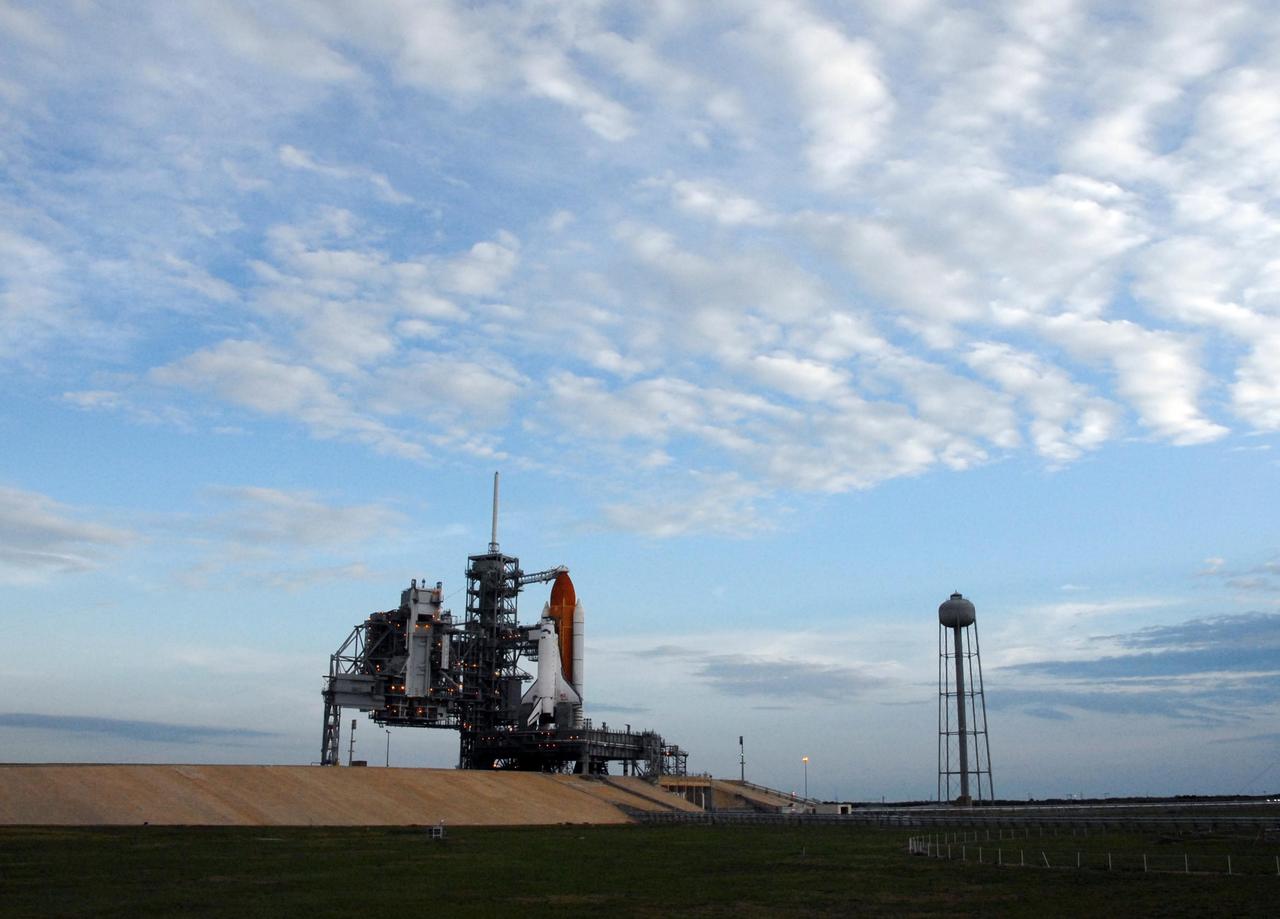
KENNEDY SPACE CENTER, FLA. -- The sun rises on a cloudy Florida day to reveal Space Shuttle Atlantis awaiting launch atop a mobile launch platform at Launch Pad 39A. Rollback of the pad's rotating service structure, or RSS, is one of the milestones in preparation for the launch of mission STS-117 on June 8. Rollback started at 10:56 p.m. EDT June 7 and was complete at 11:34 p.m. The RSS, the massive structure to the left of the shuttle, provides protected access to the orbiter for changeout and servicing of payloads at the pad. The structure is supported by a rotating bridge that pivots about a vertical axis on the side of the pad's flame trench. The hinge column rests on the pad surface and is braced to the fixed service structure. Support for the outer end of the bridge is provided by two eight-wheel, motor-driven trucks that move along circular twin rails installed flush with the pad surface. The track crosses the flame trench on a permanent bridge. The RSS is 102 feet long, 50 feet wide and 130 feet high. The structure has orbiter access platforms at five levels to provide access to the payload bay while the orbiter is being serviced in the RSS. Each platform has independent extendable planks that can be arranged to conform to a payload's configuration. This mission is the 118th shuttle flight and the 21st U.S. flight to the International Space Station and will deliver and install the S3/S4 truss segment, deploy a set of solar arrays and prepare them for operation. Photo credit: NASA/Ken Thornsley
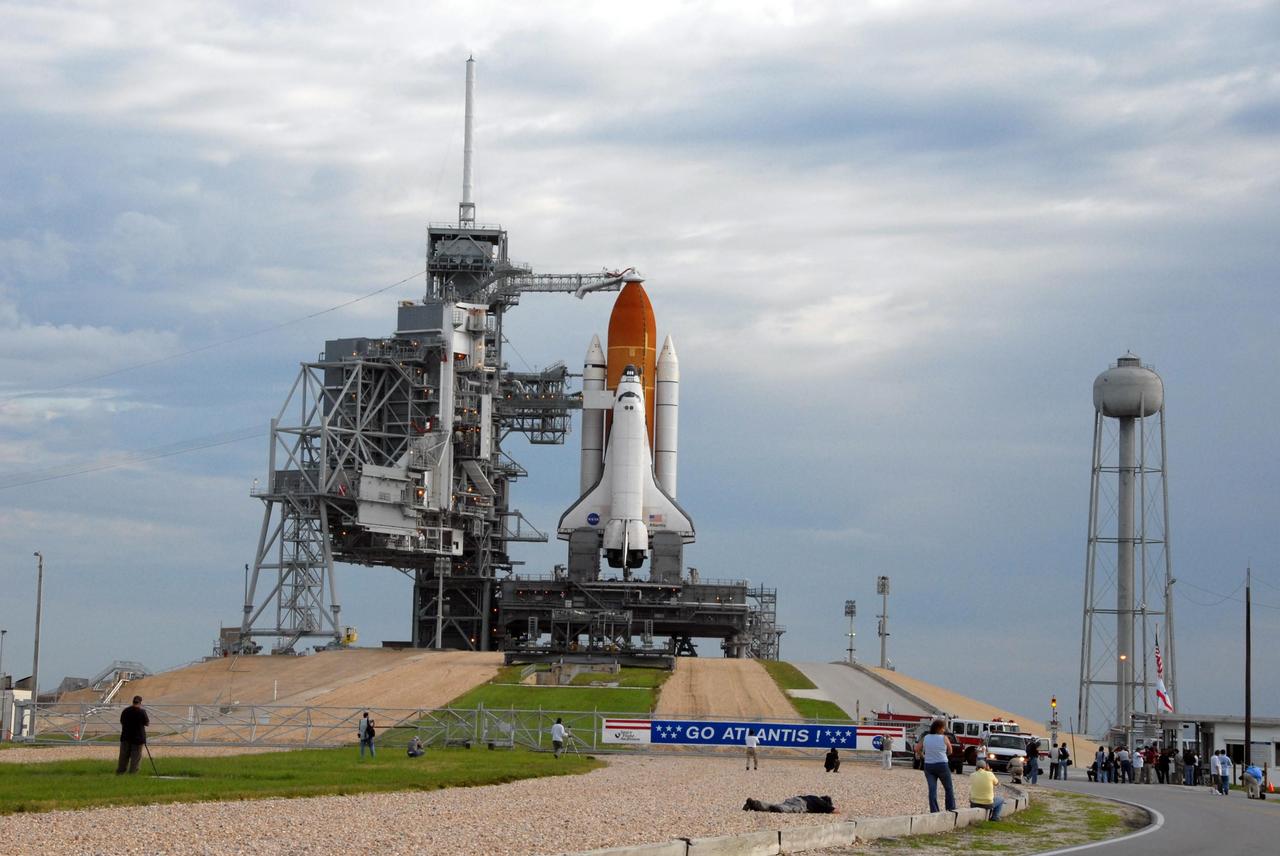
KENNEDY SPACE CENTER, FLA. -- On a cloudy Florida day, Space Shuttle Atlantis awaits launch atop a mobile launch platform at Launch Pad 39A. At the right of the pad is the 290-foot tall, 300,000-gallon water tank that is part of the sound suppression system during launches. In the foreground, photographers position themselves on the crawlerway, in hopes of capturing a unique prelaunch image. Rollback of the pad's rotating service structure, or RSS, is one of the milestones in preparation for the launch of mission STS-117 on June 8. Rollback started at 10:56 p.m. EDT June 7 and was complete at 11:34 p.m. The RSS, the massive structure to the left of the shuttle, provides protected access to the orbiter for changeout and servicing of payloads at the pad. The structure is supported by a rotating bridge that pivots about a vertical axis on the side of the pad's flame trench. The hinge column rests on the pad surface and is braced to the fixed service structure. Support for the outer end of the bridge is provided by two eight-wheel, motor-driven trucks that move along circular twin rails installed flush with the pad surface. The track crosses the flame trench on a permanent bridge. The RSS is 102 feet long, 50 feet wide and 130 feet high. The structure has orbiter access platforms at five levels to provide access to the payload bay while the orbiter is being serviced in the RSS. Each platform has independent extendable planks that can be arranged to conform to a payload's configuration. This mission is the 118th shuttle flight and the 21st U.S. flight to the International Space Station and will deliver and install the S3/S4 truss segment, deploy a set of solar arrays and prepare them for operation. Photo credit: NASA/Ken Thornsley
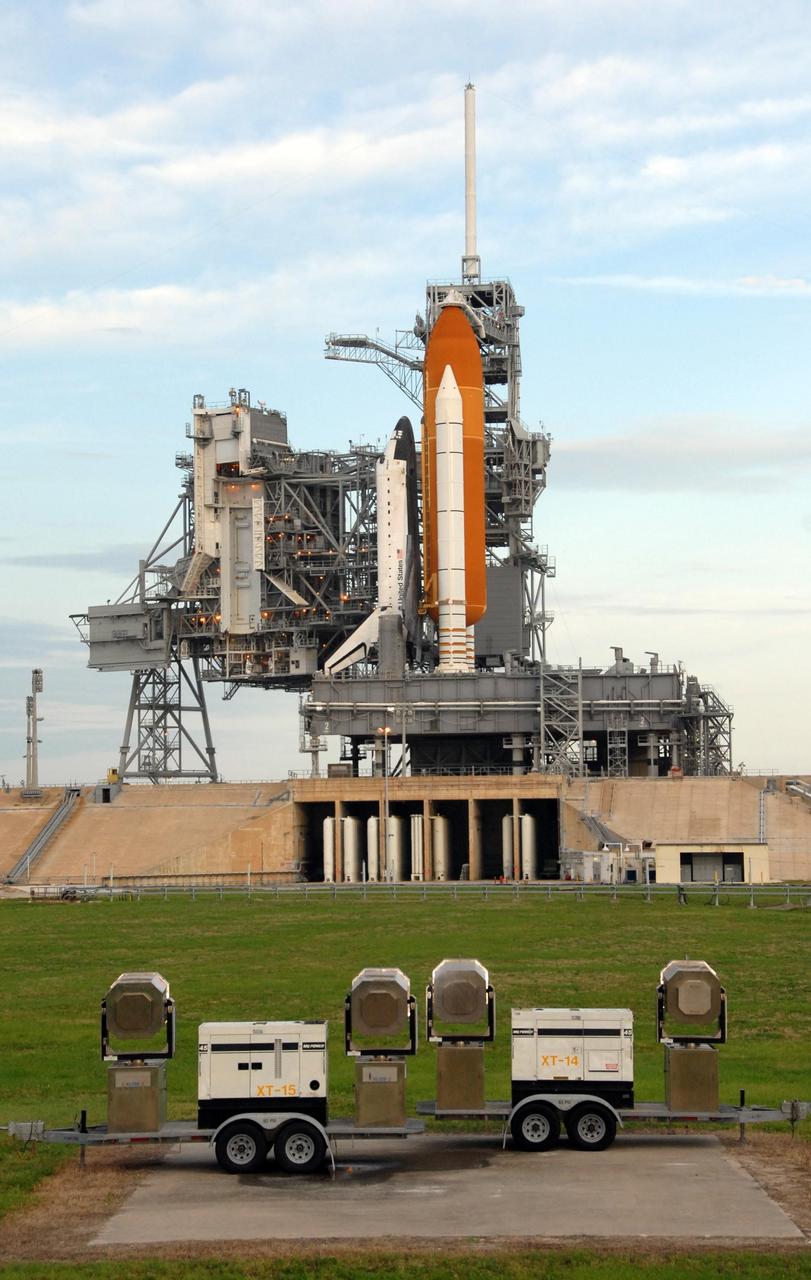
KENNEDY SPACE CENTER, FLA. -- Cameras are prepared to record the launch of Space Shuttle Atlantis from Launch Pad 39A following sunrise on a cloudy Florida day. Rollback of the pad's rotating service structure, or RSS, is one of the milestones in preparation for the launch of mission STS-117 on June 8. Rollback started at 10:56 p.m. EDT June 7 and was complete at 11:34 p.m. The RSS, the massive structure to the left of the shuttle, provides protected access to the orbiter for changeout and servicing of payloads at the pad. The structure is supported by a rotating bridge that pivots about a vertical axis on the side of the pad's flame trench. The hinge column rests on the pad surface and is braced to the fixed service structure. Support for the outer end of the bridge is provided by two eight-wheel, motor-driven trucks that move along circular twin rails installed flush with the pad surface. The track crosses the flame trench on a permanent bridge. The RSS is 102 feet long, 50 feet wide and 130 feet high. The structure has orbiter access platforms at five levels to provide access to the payload bay while the orbiter is being serviced in the RSS. Each platform has independent extendable planks that can be arranged to conform to a payload's configuration. This mission is the 118th shuttle flight and the 21st U.S. flight to the International Space Station and will deliver and install the S3/S4 truss segment, deploy a set of solar arrays and prepare them for operation. Photo credit: NASA/Ken Thornsley
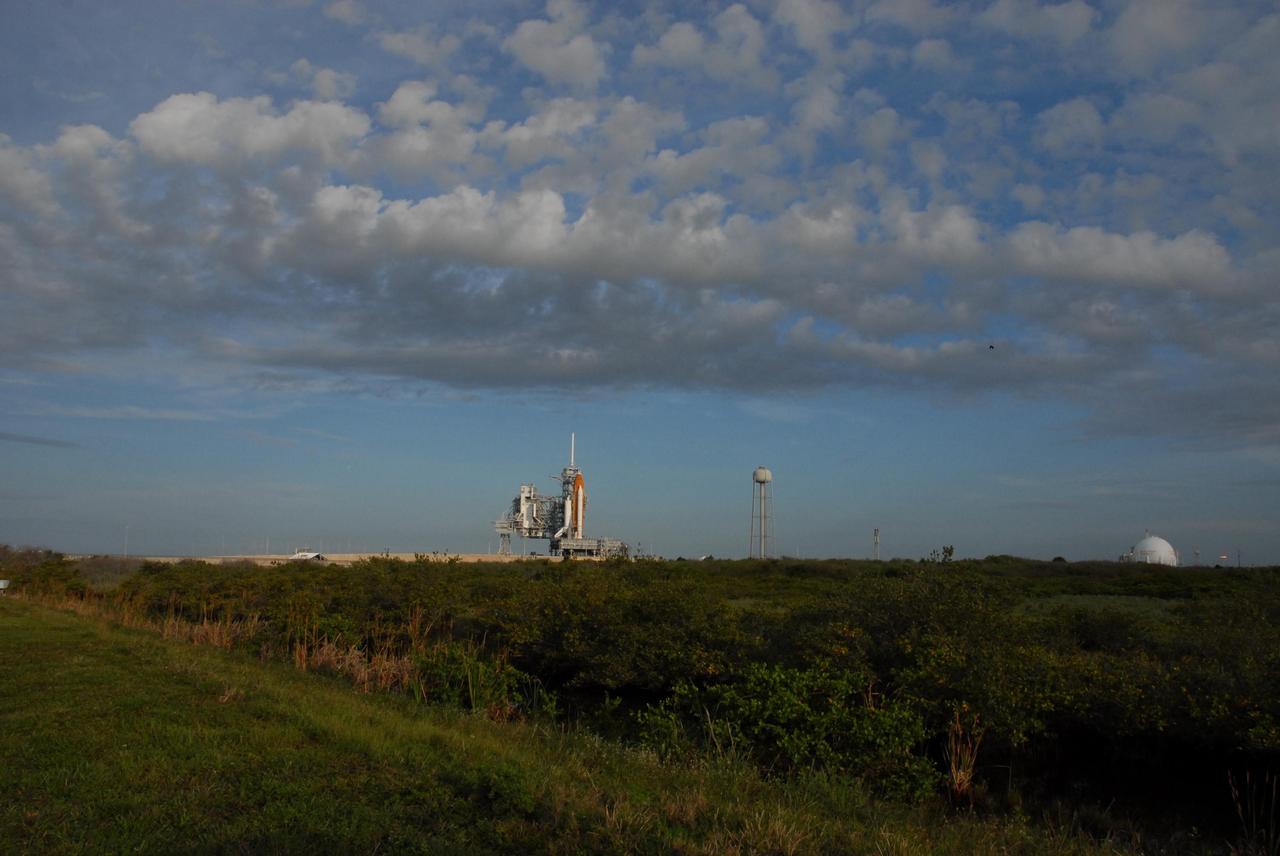
KENNEDY SPACE CENTER, FLA. -- The sun rises on a cloudy Florida day to reveal Space Shuttle Atlantis awaiting launch atop a mobile launch platform at Launch Pad 39A. At the right of the pad is the 300,000-gallon water tank that is part of the sound suppression system during launches. Rollback of the pad's rotating service structure, or RSS, is one of the milestones in preparation for the launch of mission STS-117 on June 8. Rollback started at 10:56 p.m. EDT June 7 and was complete at 11:34 p.m. The RSS, the massive structure to the left of the shuttle, provides protected access to the orbiter for changeout and servicing of payloads at the pad. The structure is supported by a rotating bridge that pivots about a vertical axis on the side of the pad's flame trench. The hinge column rests on the pad surface and is braced to the fixed service structure. Support for the outer end of the bridge is provided by two eight-wheel, motor-driven trucks that move along circular twin rails installed flush with the pad surface. The track crosses the flame trench on a permanent bridge. The RSS is 102 feet long, 50 feet wide and 130 feet high. The structure has orbiter access platforms at five levels to provide access to the payload bay while the orbiter is being serviced in the RSS. Each platform has independent extendable planks that can be arranged to conform to a payload's configuration. This mission is the 118th shuttle flight and the 21st U.S. flight to the International Space Station and will deliver and install the S3/S4 truss segment, deploy a set of solar arrays and prepare them for operation. Photo credit: NASA/Ken Thornsley
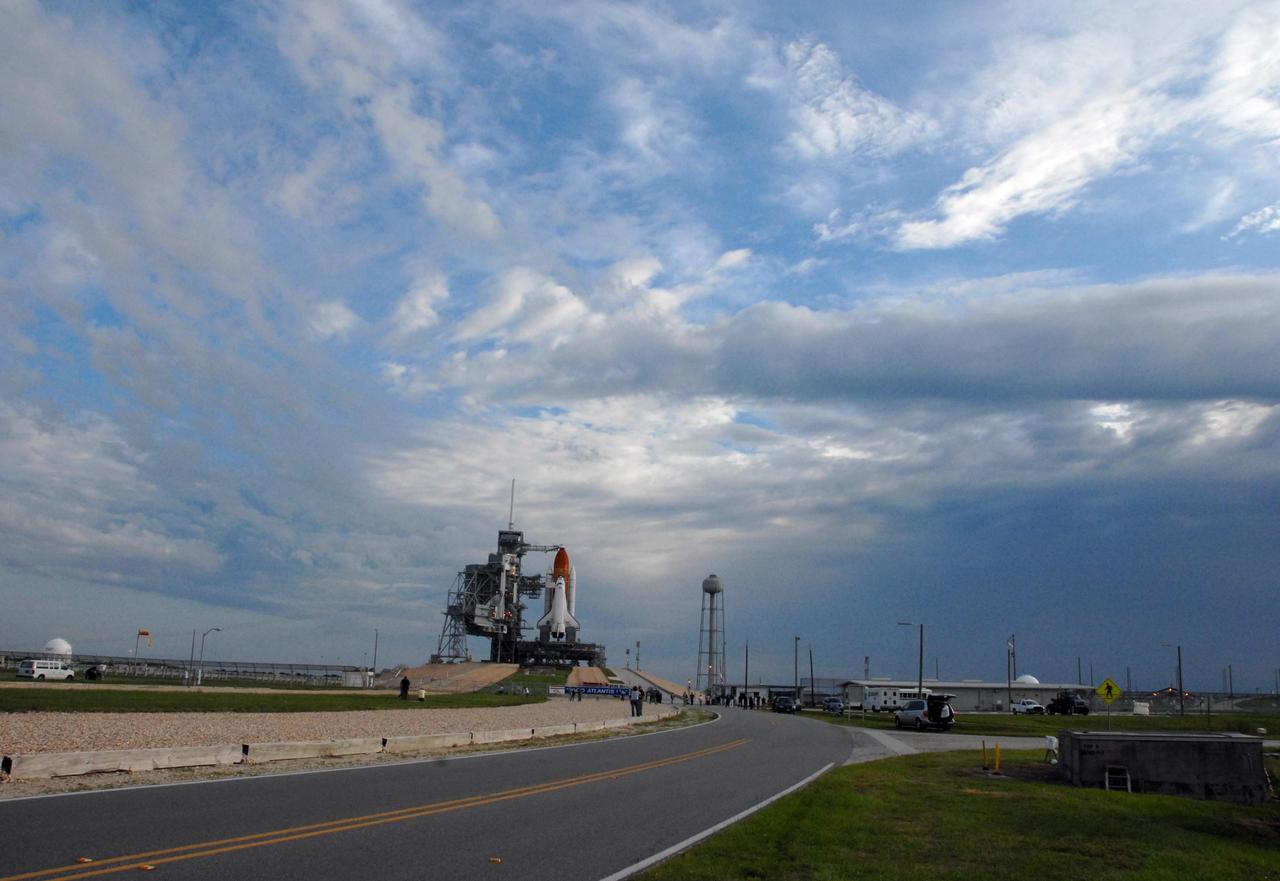
KENNEDY SPACE CENTER, FLA. -- On a cloudy Florida day, Space Shuttle Atlantis awaits launch atop a mobile launch platform at Launch Pad 39A. At the right of the pad is the 290-foot tall, 300,000-gallon water tank that is part of the sound suppression system during launches. In the foreground is the crawlerway. a 130-foot-wide roadway with a 5-percent grade leading to the top of the launch pad. Rollback of the pad's rotating service structure, or RSS, is one of the milestones in preparation for the launch of mission STS-117 on June 8. Rollback started at 10:56 p.m. EDT June 7 and was complete at 11:34 p.m. The RSS, the massive structure to the left of the shuttle, provides protected access to the orbiter for changeout and servicing of payloads at the pad. The structure is supported by a rotating bridge that pivots about a vertical axis on the side of the pad's flame trench. The hinge column rests on the pad surface and is braced to the fixed service structure. Support for the outer end of the bridge is provided by two eight-wheel, motor-driven trucks that move along circular twin rails installed flush with the pad surface. The track crosses the flame trench on a permanent bridge. The RSS is 102 feet long, 50 feet wide and 130 feet high. The structure has orbiter access platforms at five levels to provide access to the payload bay while the orbiter is being serviced in the RSS. Each platform has independent extendable planks that can be arranged to conform to a payload's configuration. This mission is the 118th shuttle flight and the 21st U.S. flight to the International Space Station and will deliver and install the S3/S4 truss segment, deploy a set of solar arrays and prepare them for operation. Photo credit: NASA/Ken Thornsley
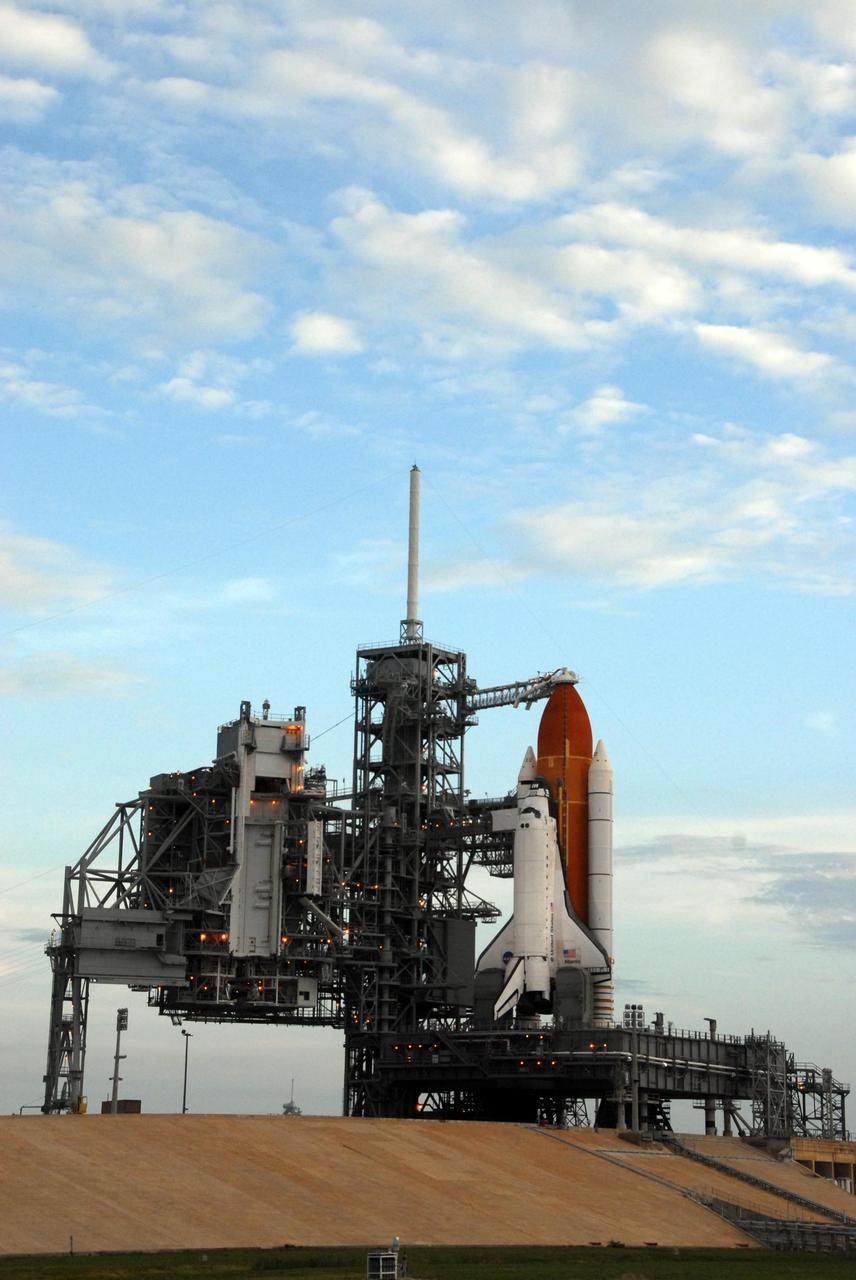
KENNEDY SPACE CENTER, FLA. -- Following sunrise on a cloudy Florida day, Space Shuttle Atlantis awaits launch atop a mobile launch platform at Launch Pad 39A. Rollback of the pad's rotating service structure, or RSS, is one of the milestones in preparation for the launch of mission STS-117 on June 8. Rollback started at 10:56 p.m. EDT June 7 and was complete at 11:34 p.m. The RSS, the massive structure to the left of the shuttle, provides protected access to the orbiter for changeout and servicing of payloads at the pad. The structure is supported by a rotating bridge that pivots about a vertical axis on the side of the pad's flame trench. The hinge column rests on the pad surface and is braced to the fixed service structure. Support for the outer end of the bridge is provided by two eight-wheel, motor-driven trucks that move along circular twin rails installed flush with the pad surface. The track crosses the flame trench on a permanent bridge. The RSS is 102 feet long, 50 feet wide and 130 feet high. The structure has orbiter access platforms at five levels to provide access to the payload bay while the orbiter is being serviced in the RSS. Each platform has independent extendable planks that can be arranged to conform to a payload's configuration. This mission is the 118th shuttle flight and the 21st U.S. flight to the International Space Station and will deliver and install the S3/S4 truss segment, deploy a set of solar arrays and prepare them for operation. Photo credit: NASA/Ken Thornsley
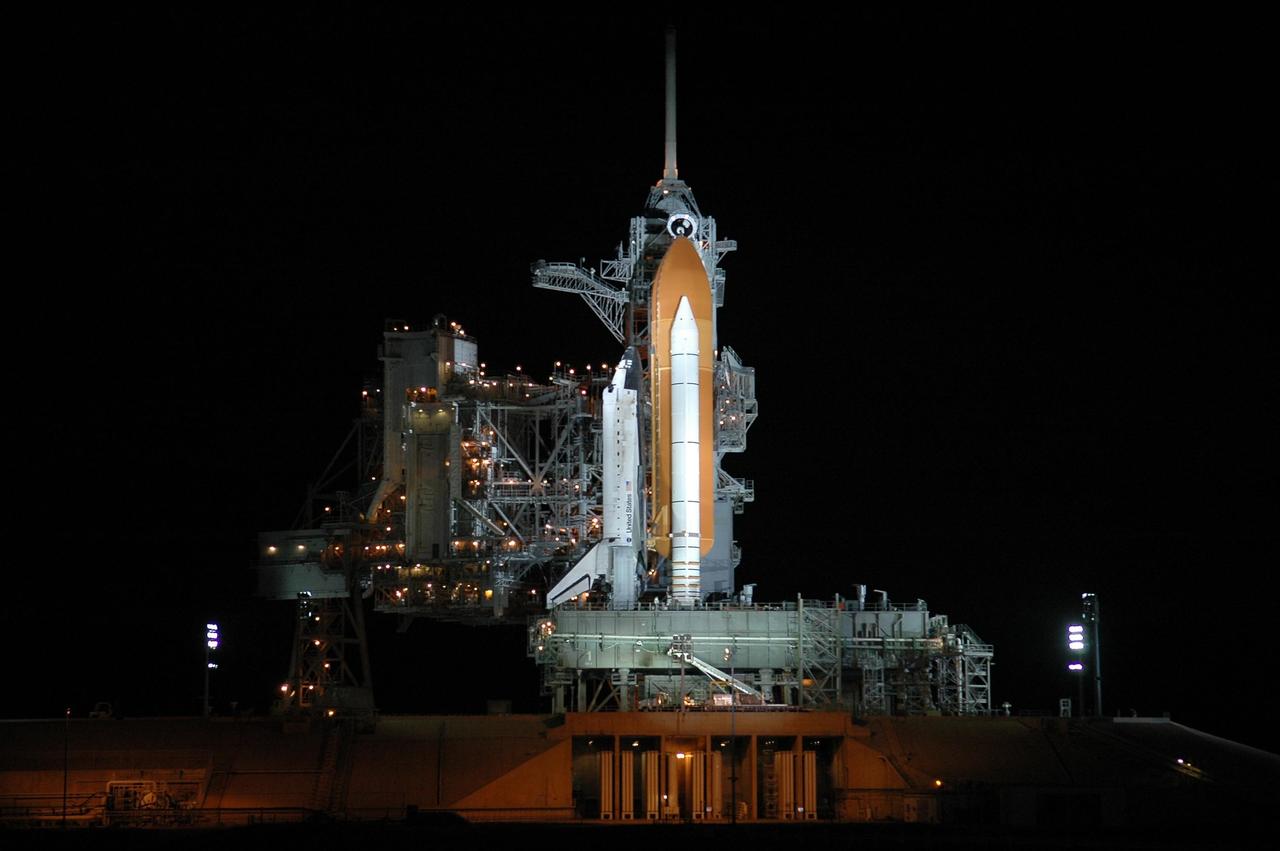
KENNEDY SPACE CENTER, FLA. - After rollback of the rotating service structure (RSS) on Launch Pad 39B, Space Shuttle Discovery stands bathed in spotlights. Beneath the shuttle is the mobile launcher platform, which spans the flame trench below. The flame deflector system includes an inverted, V-shaped steel structure that receives and deflects the flames from the orbiter main engines on one side; the opposite side deflects the flames from the solid rocket boosters. The RSS provides protected access to the orbiter for changeout and servicing of payloads at the pad. The structure is supported by a rotating bridge that pivots about a vertical axis on the west side of the pad's flame trench. The hinge column rests on the pad surface and is braced to the fixed service structure. Support for the outer end of the bridge is provided by two eight-wheel, motor-driven trucks that move along circular twin rails installed flush with the pad surface. The track crosses the flame trench on a permanent bridge. The RSS is 102 feet long, 50 feet wide and 130 feet high. The structure has orbiter access platforms at five levels to provide access to the payload bay while the orbiter is being serviced in the RSS. Each platform has independent extendable planks that can be arranged to conform to a payload's configuration. This mission is the 115th shuttle flight and the 18th U.S. flight to the International Space Station. Photo credit: NASA/Kim Shiflett
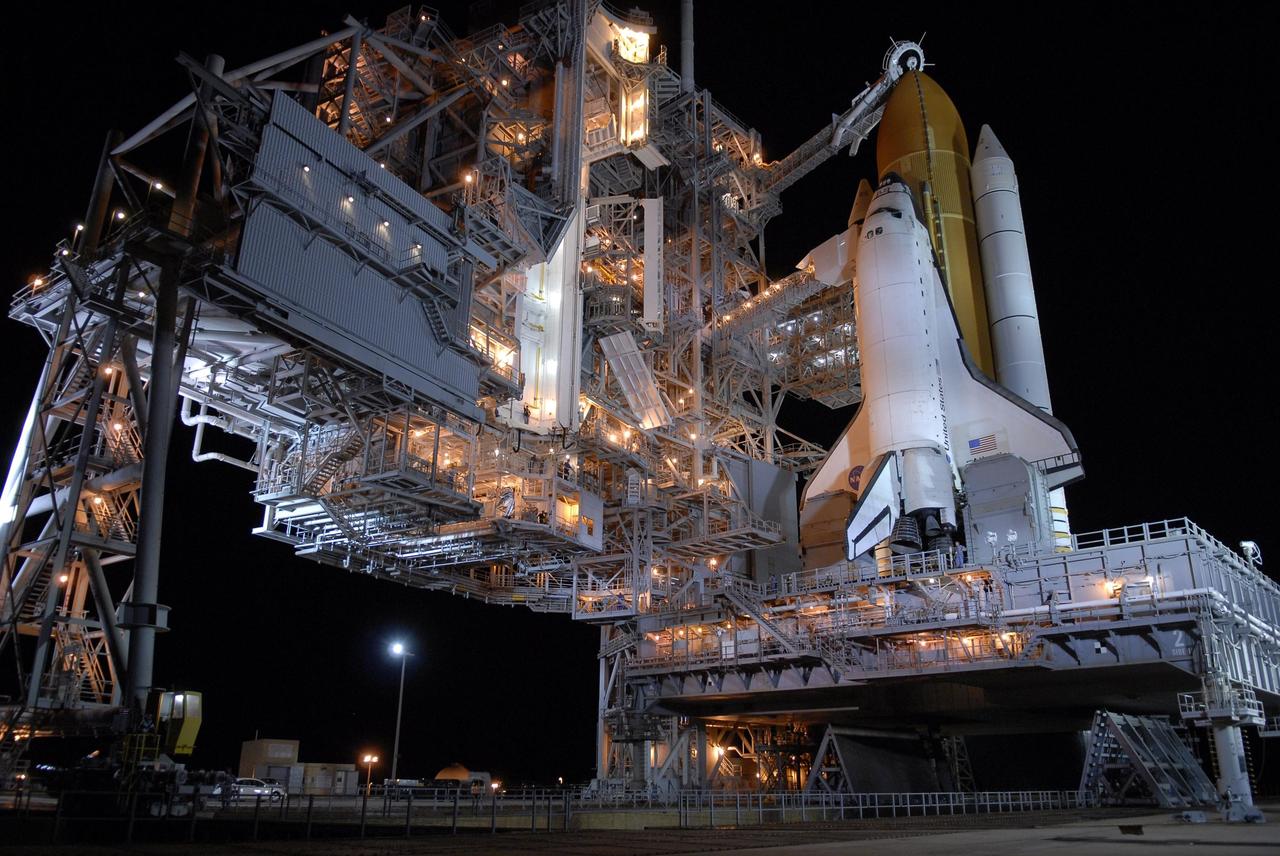
KENNEDY SPACE CENTER, FLA. -- Following rollback of the rotating service structure, or RSS, on Launch Pad 39A, Space Shuttle Atlantis stands bathed in lights atop a mobile launch platform. Rollback is one of the milestones in preparation for the launch of mission STS-117 on June 8. Rollback started at 10:56 p.m. and was complete at 11:34 p.m EDT. The RSS, the massive structure to the left of the shuttle, provides protected access to the orbiter for changeout and servicing of payloads at the pad. The structure is supported by a rotating bridge that pivots about a vertical axis on the side of the pad's flame trench. The hinge column rests on the pad surface and is braced to the fixed service structure. Support for the outer end of the bridge is provided by two eight-wheel, motor-driven trucks that move along circular twin rails installed flush with the pad surface. The track crosses the flame trench on a permanent bridge. The RSS is 102 feet long, 50 feet wide and 130 feet high. The structure has orbiter access platforms at five levels to provide access to the payload bay while the orbiter is being serviced in the RSS. Each platform has independent extendable planks that can be arranged to conform to a payload's configuration. This mission is the 118th shuttle flight and the 21st U.S. flight to the International Space Station and will deliver and install the S3/S4 truss segment, deploy a set of solar arrays and prepare them for operation. Photo credit: NASA/Kim Shiflett