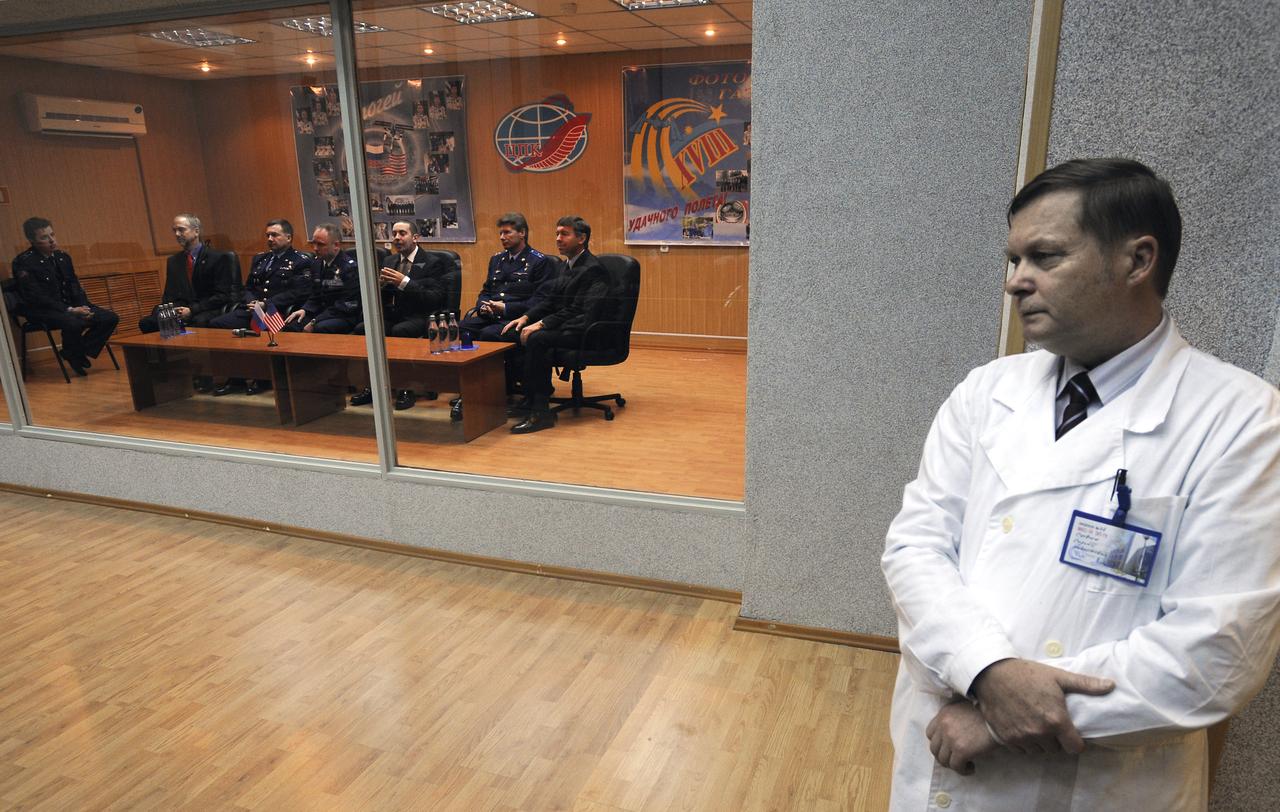
A Russian flight surgeon, right, along with the quarantined prime and backup crews listen to the State Commission give the final approval for the launch of the Soyuz TMA-13 spacecraft, Saturday, Oct. 11, 2008 in Baikonur, Kazakhstan. Expedition 18 Commander Michael Fincke, Flight Engineer Yuri V. Lonchakov and American spaceflight participant Richard Garriott are scheduled to launch Oct. 12 and dock with the International Space Station on Oct. 14. Fincke and Lonchakov will spend six months on the station, while Garriott will return to Earth Oct. 24 with two of the Expedition 17 crew members currently on the International Space Station. Photo Credit: (NASA/Bill Ingalls)
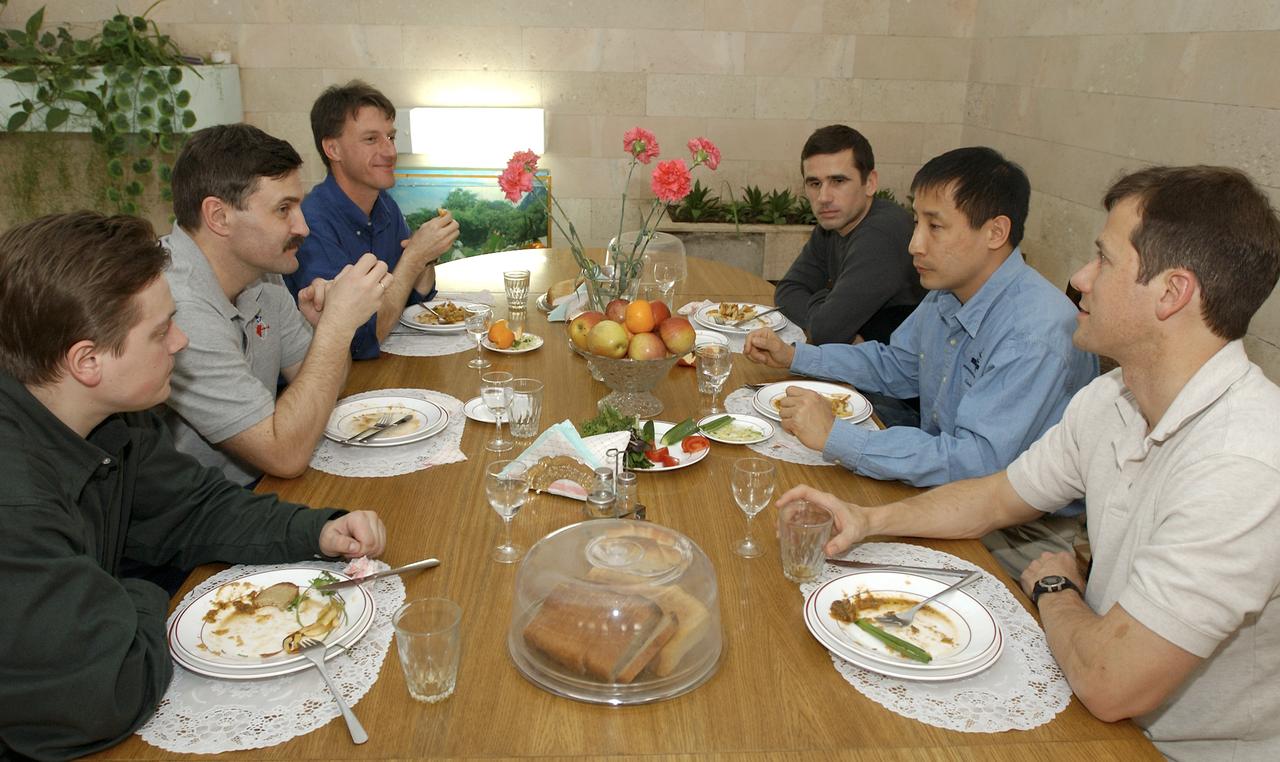
Clockwise from top right, Expedition 7 Commander, Yuri I. Malenchenko, NASA International Space Station Science Officer and Flight Engineer, Edward T. Lu and prime crew Flight Surgeon Tom Marshburn, unidentified Russian flight surgeon, along with cosmonaut Alexander Kaleri and astronaut Michael Foale, top left, eat dinner at the Cosmonaut Hotel in Baikonur, Kazakhstan, Wednesday, April 9, 2003. Photo Credit: (NASA/Bill Ingalls)
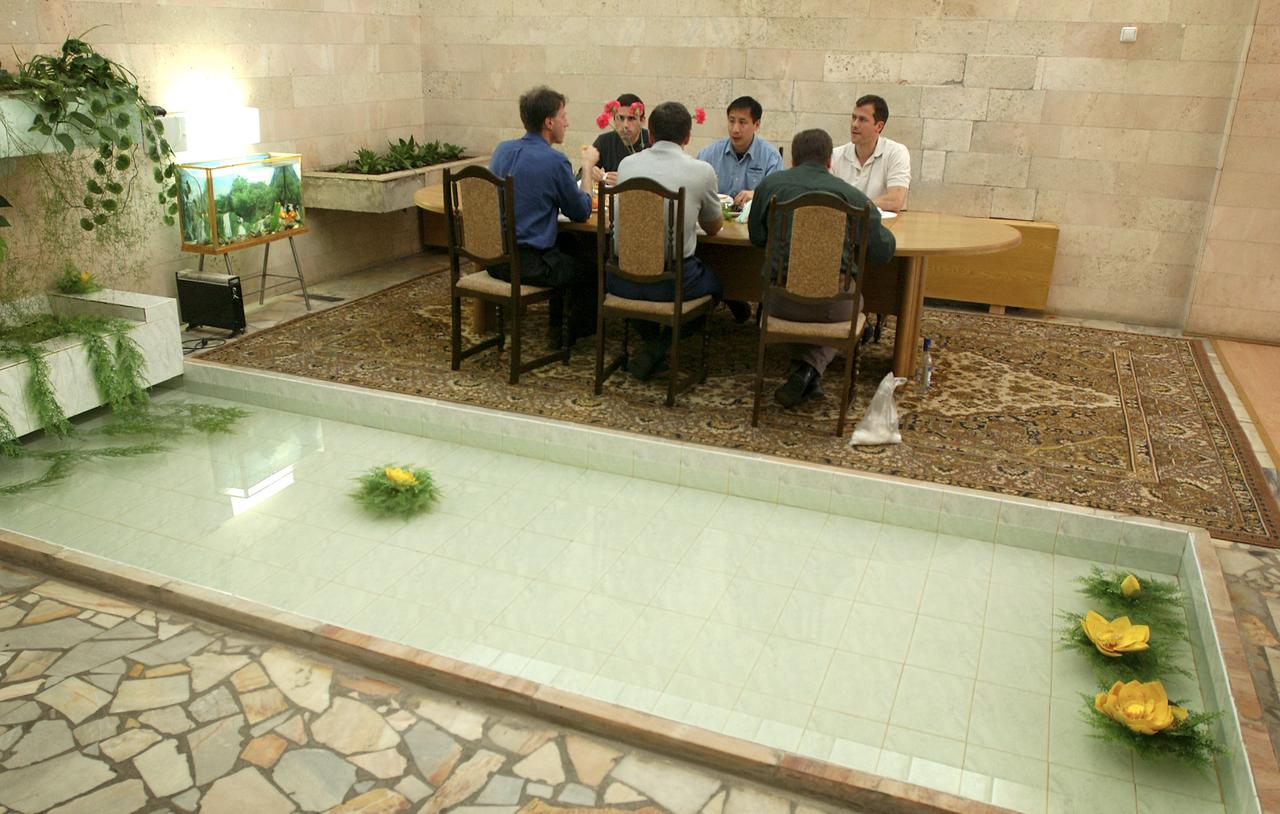
Expedition 7 Commander, Yuri I. Malenchenko, second from left, facing camera, NASA International Space Station Science Officer and Flight Engineer, Edward T. Lu, center, and prime crew Flight Surgeon Thomas Marshburn eat dinner at the Cosmonaut Hotel along with the backup crew members, astronaut Michael Foale, left, back to camera, cosmonaut Alexander Kaleri, center, back to camera, and an unidentified Russian flight surgeon in Baikonur, Kazakhstan, Wednesday, April 9, 2003. Photo Credit: (NASA/Bill Ingalls)
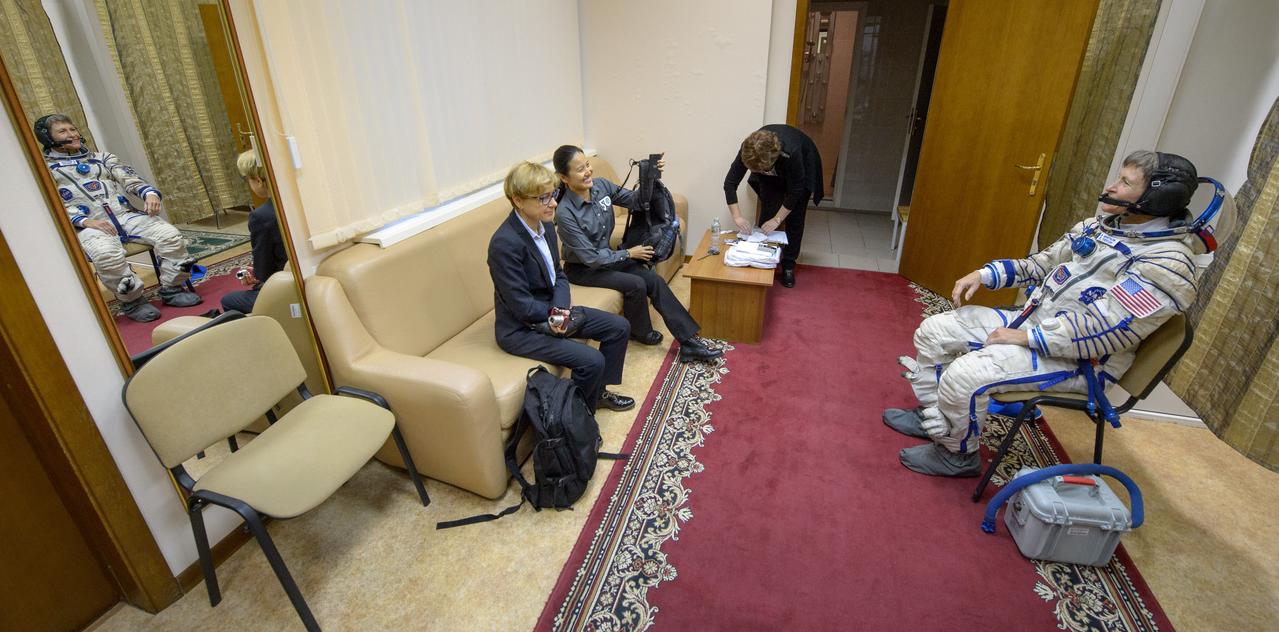
ESA Flight Surgeon Dr. Brigitte Godard, seated left, NASA Flight Surgeon Jennifer Law, center, talk with Expedition 50 NASA astronaut Peggy Whitson ahead of the final qualification exams with Whitson and her fellow crew mates Russian cosmonaut Oleg Novitskiy of Roscosmos and ESA astronaut Thomas Pesquet, Tuesday, Oct. 25, 2016, at the Gagarin Cosmonaut Training Center (GCTC) in Star City, Russia. Photo Credit: (NASA/Bill Ingalls)
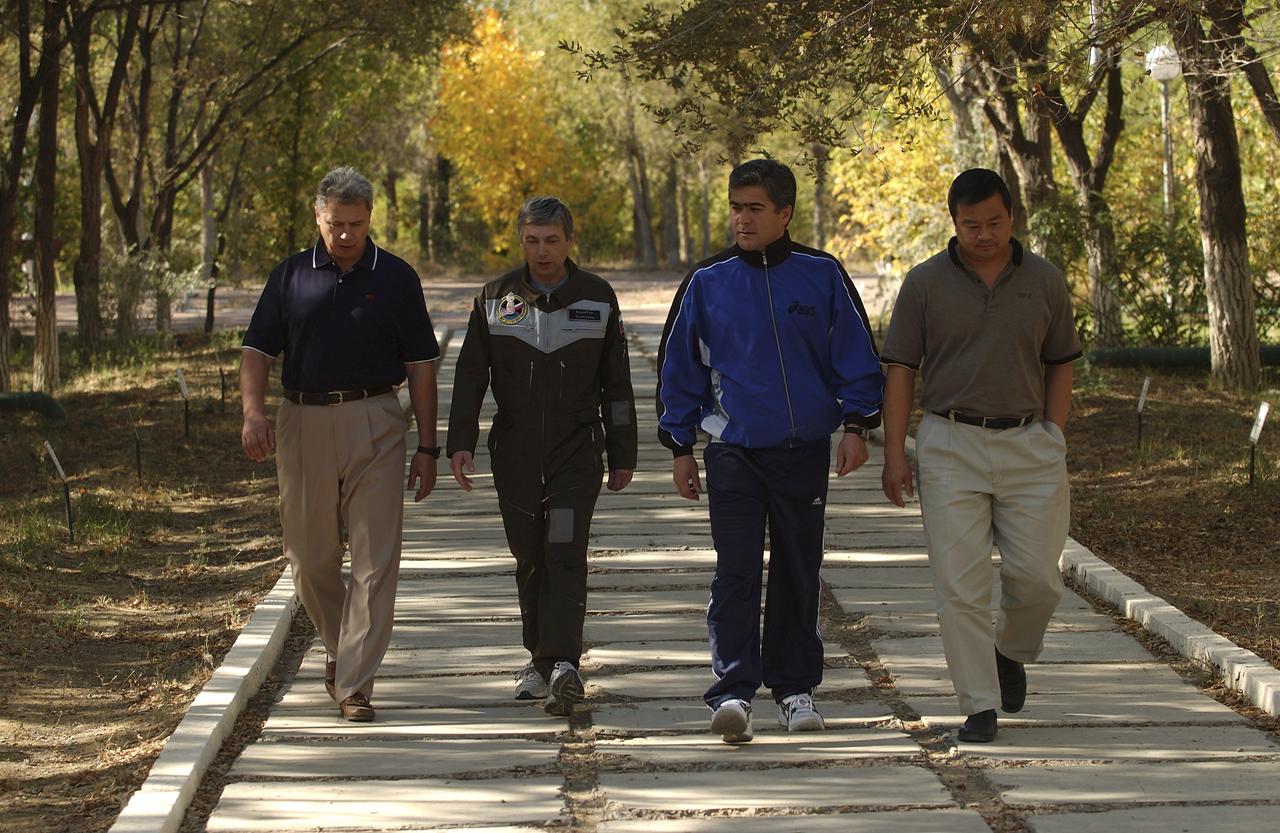
Expedition 10 Commander Leroy Chiao, right, Flight Engineer and Soyuz Commander Salizhan Sharipov, Russian Space Forces Cosmonaut Yuri Shargin, and the lead Russian Flight Surgeon, left, enjoy a middday stroll down the Walkway of Cosmonauts at their crew quarters in Baikonur, Kazakhstan, Friday, October 8, 2004 as they prepare for liftoff to the International Space Station October 14. Photo Credit: (NASA/Bill Ingalls)
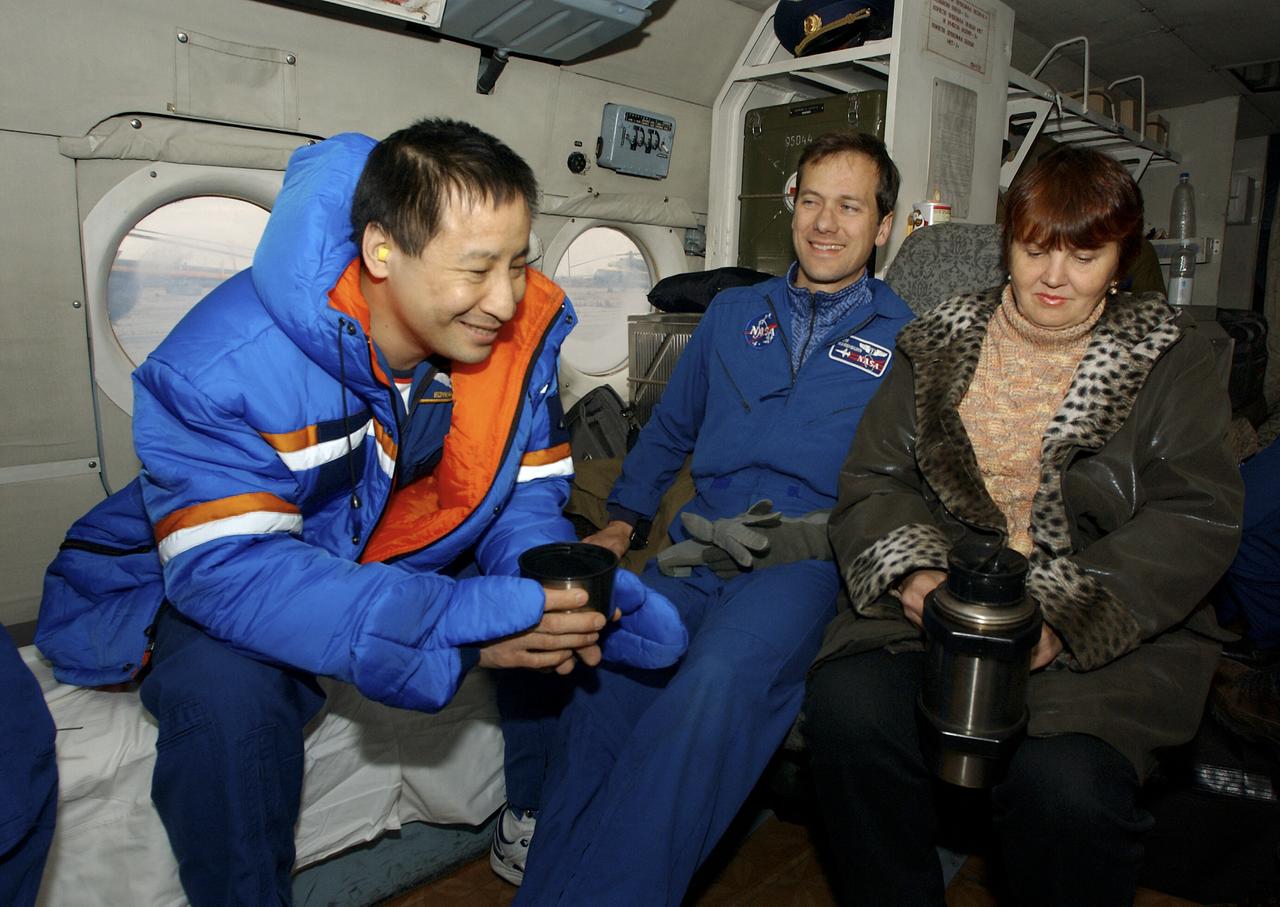
Astronaut Edward T. Lu, Expedition 7 NASA International Space Station Science Officer and Flight Engineer, left, enjoys some hot tea with NASA Flight Surgeon Dr. Thomas H. Marshburn, center, and a Russian Medical personnel onboard a Russian helicopter in Arqalyk, Kazakhstan, Monday, October 27, 2003. Photo Credit: (NASA/Bill Ingalls)
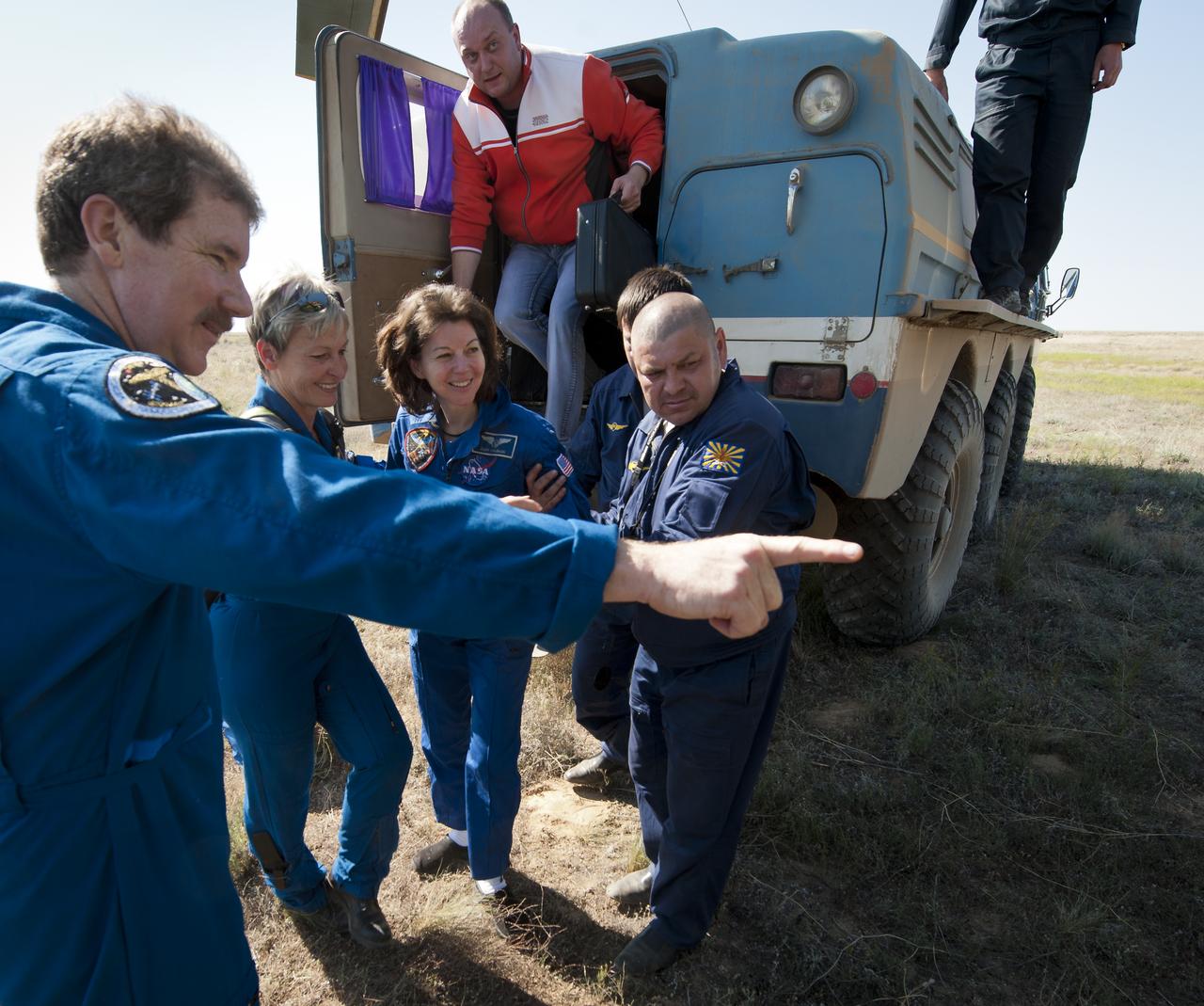
Expedition 27 Flight Engineer Cady Coleman, center, is helped out of a Russian all terrain vehicle (ATV) by NASA Chief of the Astronaut Office, Peggy Whitson and directed to the helicopter by NASA Flight Surgeon Steve Hart, left, shortly after she and Commander Dmitry Kondratyev and Flight Engineer Paolo Nespoli landed in their Soyuz TMA-20 southeast of the town of Zhezkazgan, Kazakhstan, on Tuesday, May 24, 2011. NASA Astronaut Coleman, Russian Cosmonaut Kondratyev and Italian Astronaut Nespoli are returning from more than five months onboard the International Space Station where they served as members of the Expedition 26 and 27 crews. Photo Credit: (NASA/Bill Ingalls)
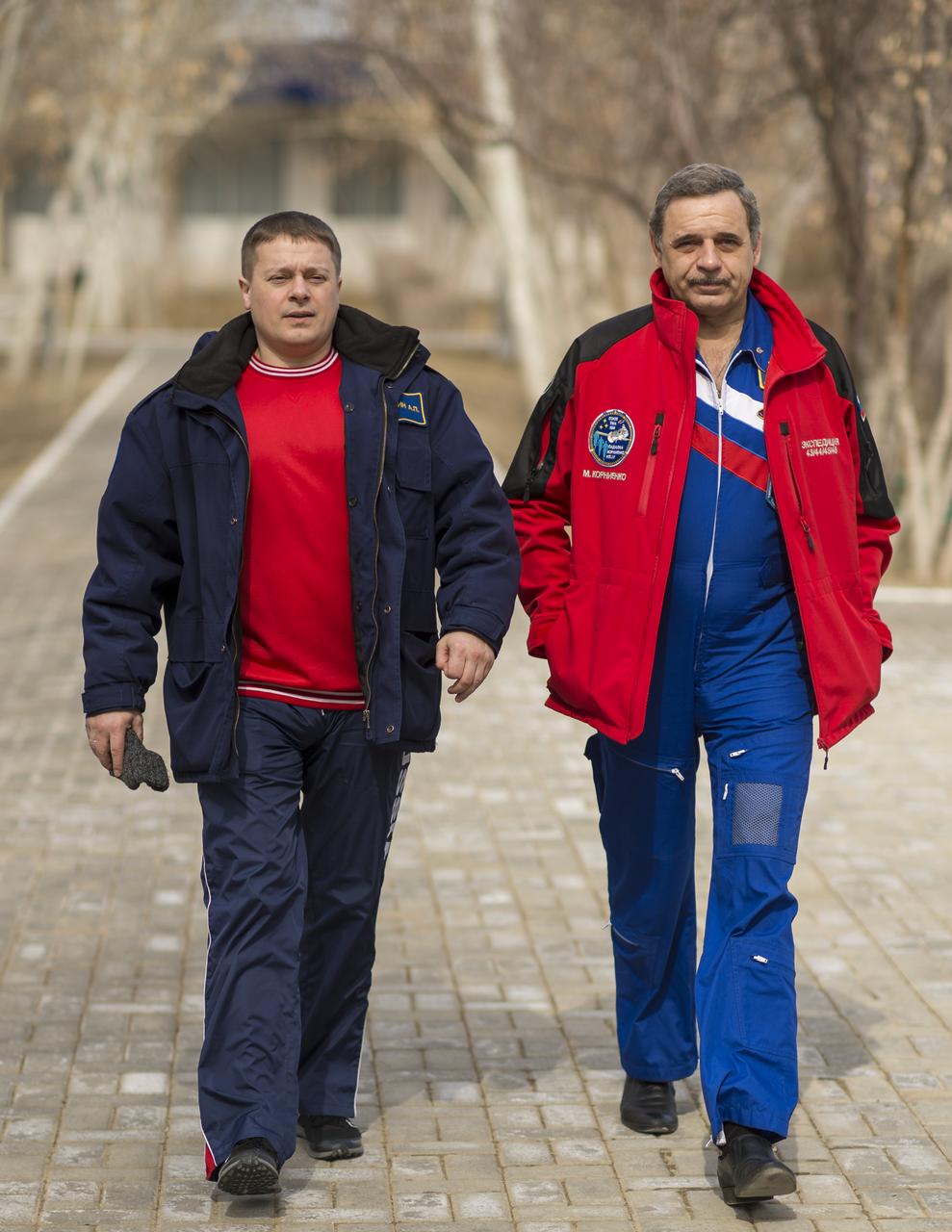
Gagarin Cosmonaut Training Center (GCTC) Flight Surgeon Alexey Grishin, left, and Expedition 43 Russian Cosmonaut Mikhail Kornienko of the Russian Federal Space Agency (Roscosmos) walk from morning classes at the Cosmonaut Hotel to the crew quarters at the Zvjozdnyj Hotel, Thursday, March 19, 2015 in Baikonur, Kazakhstan. Kornienko, Russian Cosmonaut Gennady Padalka of Roscosmos, and NASA Astoronaut Scott Kelly are preparing for launch to the International Space Station in their Soyuz TMA-16M spacecraft from the Baikonur Cosmodrome in Kazakhstan March 28, Kazakh time. As the one-year crew, Kelly and Kornienko will return to Earth on Soyuz TMA-18M in March 2016. Photo Credit: (NASA/Bill Ingalls)
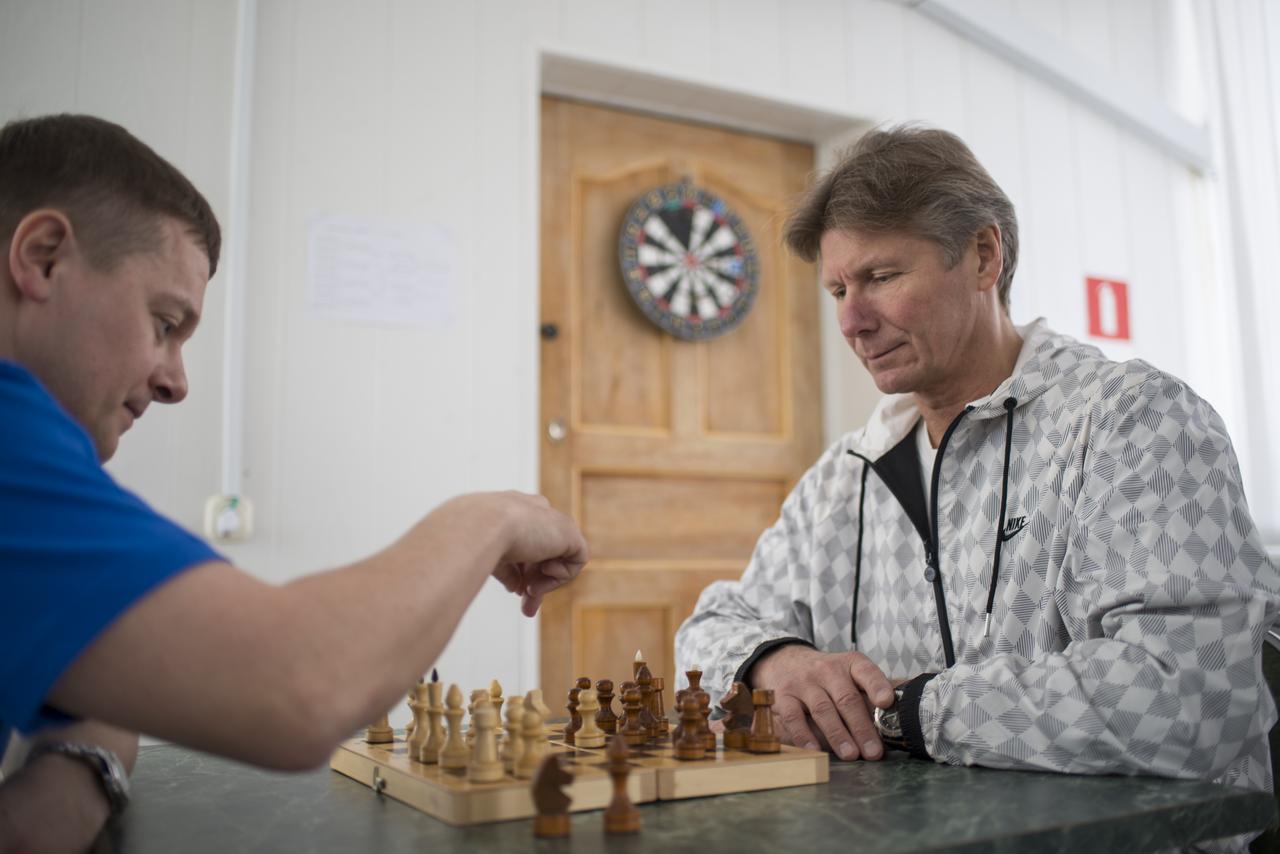
Gagarin Cosmonaut Training Center (GCTC) Flight Surgeon Alexey Grishin, left, and Russian Cosmonaut Gennady Padalka of the Russian Federal Space Agency (Roscosmos) play a game of chess during media day, Saturday, March 21, 2015, Baikonur, Kazakhstan. Padalka, fellow Russian Cosmonaut Mikhail Kornienko of Roscosmos, and NASA Astronaut Scott Kelly are scheduled to launch to the International Space Station in the Soyuz TMA-16M spacecraft from the Baikonur Cosmodrome in Kazakhstan March 28, Kazakh time (March 27 Eastern time.) As the one-year crew, Kelly and Kornienko will return to Earth on Soyuz TMA-18M in March 2016. Photo Credit: (NASA/Bill Ingalls)
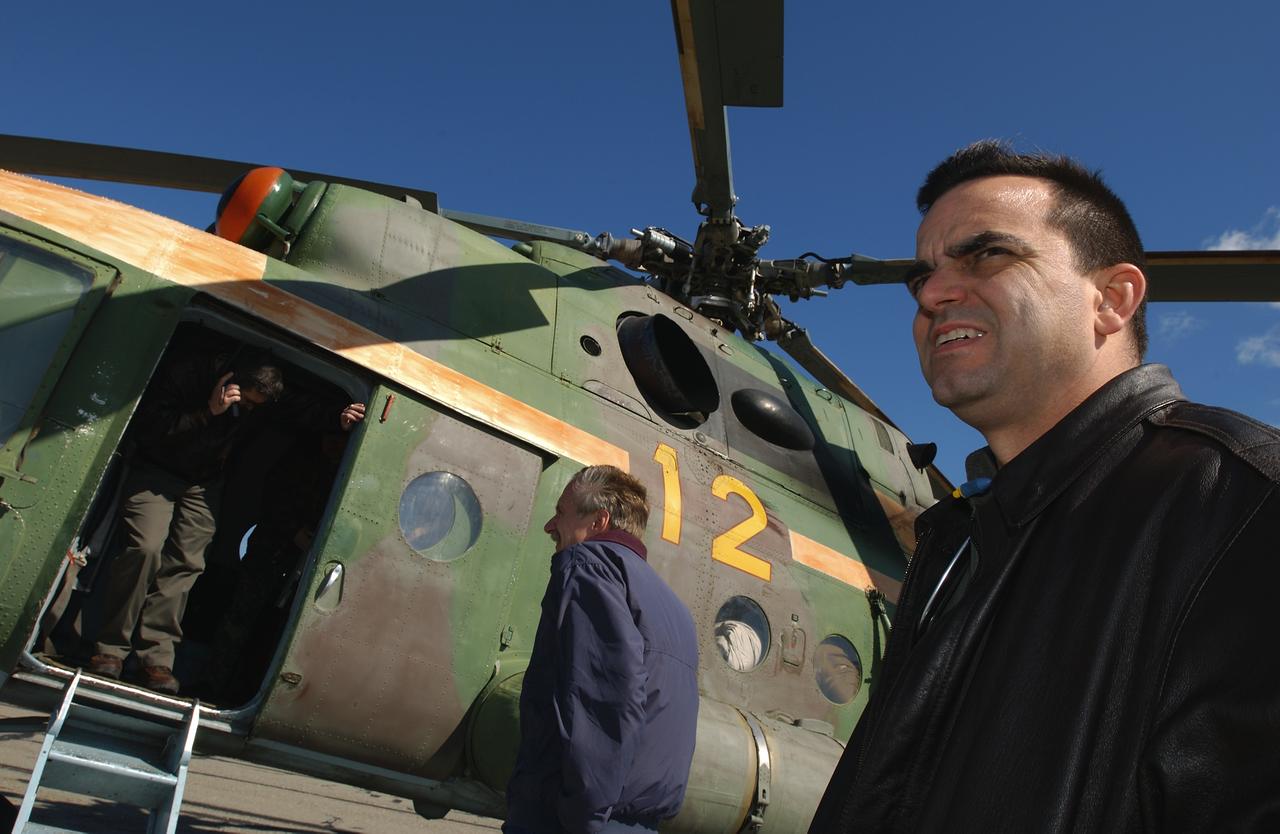
Director of Flight Crew Operations Bob Cabana, upper left, talks with NASA colleagues on the satellite phone from a Russian helicopter while International Space Station Program Manager, William Gerstenmaier and J.D. Polk, Expedition 6 Flight Surgeon, right, wait to get word if they will be continuing on to the landing site after a refueling stop, Tuesday, May 4, 2003 in Kazakhstan. Photo Credit: (NASA/Bill Ingalls)
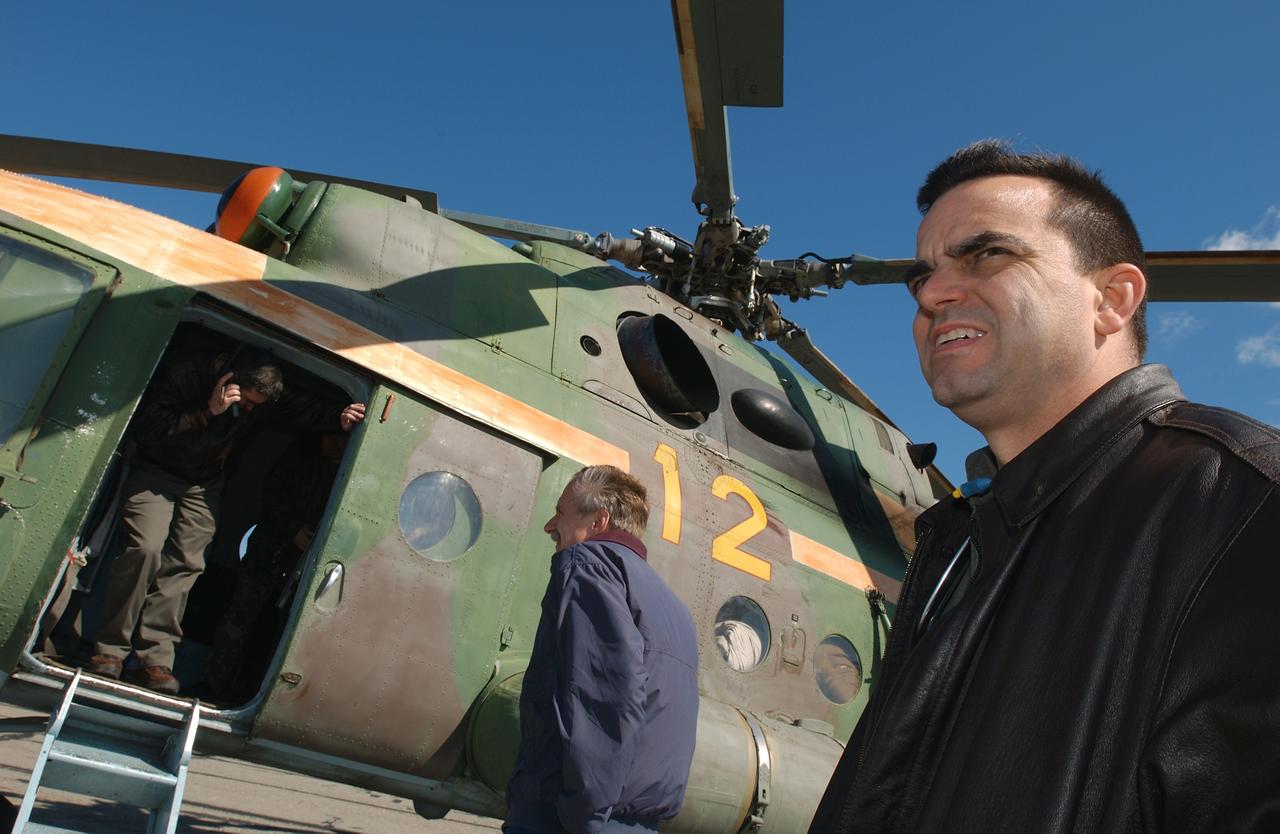
May 4, 2003, Kazakhstan. Bob Cabana (L in door), Director of Flight Crew Operations talks with NASA colleagues on the satellite phone from a Russian helicopter while Bill Gerstenmaier (center), I.S.S. Program Manager and J.D. Polk (R), Expedition Six Flight Surgeon wait to get word if they will be continuing on to the landing site after a refueling stop. Photo Credit: "NASA/Bill Ingalls"
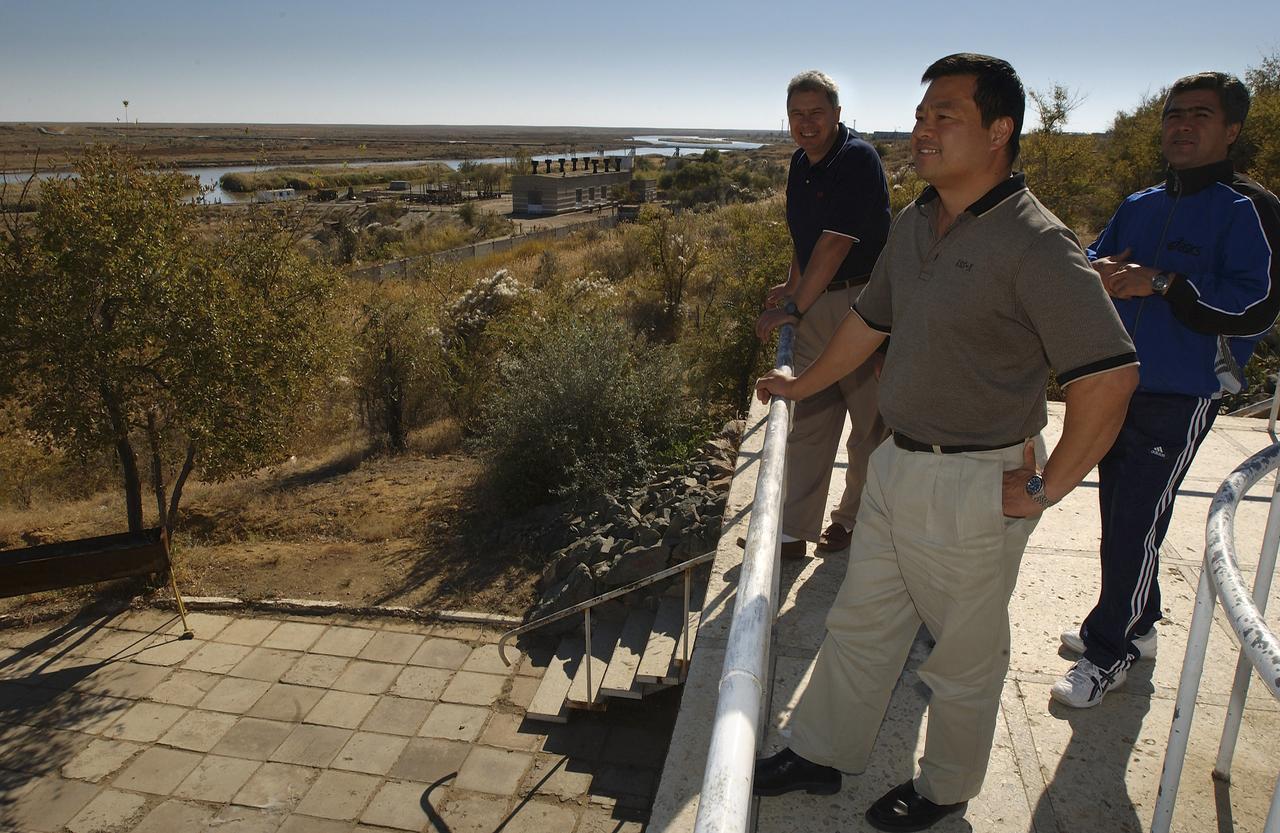
Flight Engineer and Soyuz Commander Salizhan Sharipov, right, Expedition 10 Commander Leroy Chiao and the lead Russian Flight Surgeon, left, enjoy a midday stroll down the Walkway of Cosmonauts at their crew quarters in Baikonur, Kazakhstan, Friday, October 8, 2004, as they prepare for liftoff to the International Space Station October 14. Photo Credit: (NASA/Bill Ingalls)
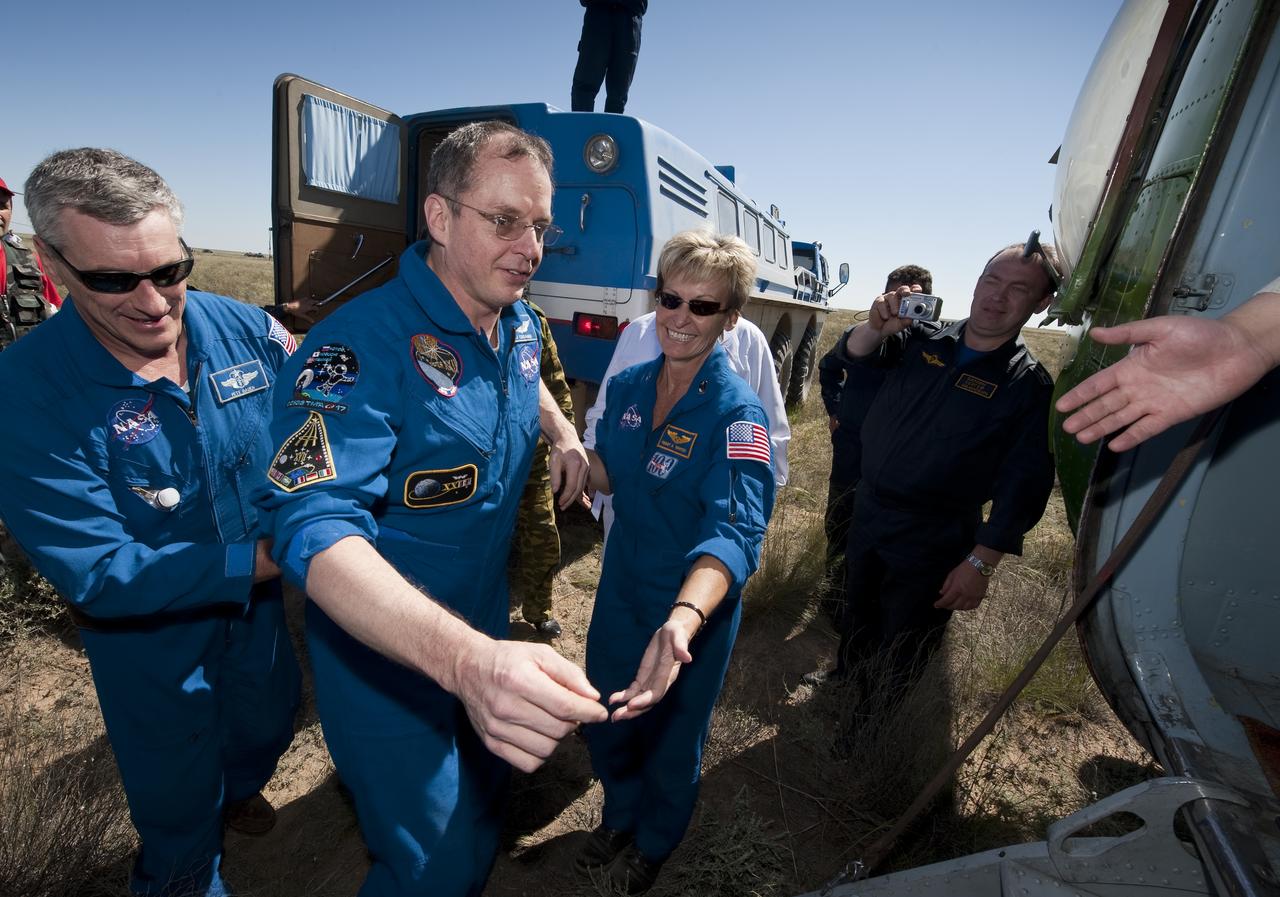
Expedition 23 Flight Engineer T.J. Creamer, center, is assisted by NASA Flight Surgeon Pete Bauer, left, and Chief NASA astronaut Peggy Whitson from a Russian Search and Recovery all terrain vehicle to his helicopter shortly after he and fellow crew members Soichi Noguchi and Commander Oleg Kotov landed in their Soyuz TMA-17 capsule near the town of Zhezkazgan, Kazakhstan on Wednesday, June 2, 2010. NASA Astronaut Creamer, Russian Cosmonaut Kotov and Japanese Astronaut Noguchi are returning from six months onboard the International Space Station where they served as members of the Expedition 22 and 23 crews. Photo Credit: (NASA/Bill Ingalls)
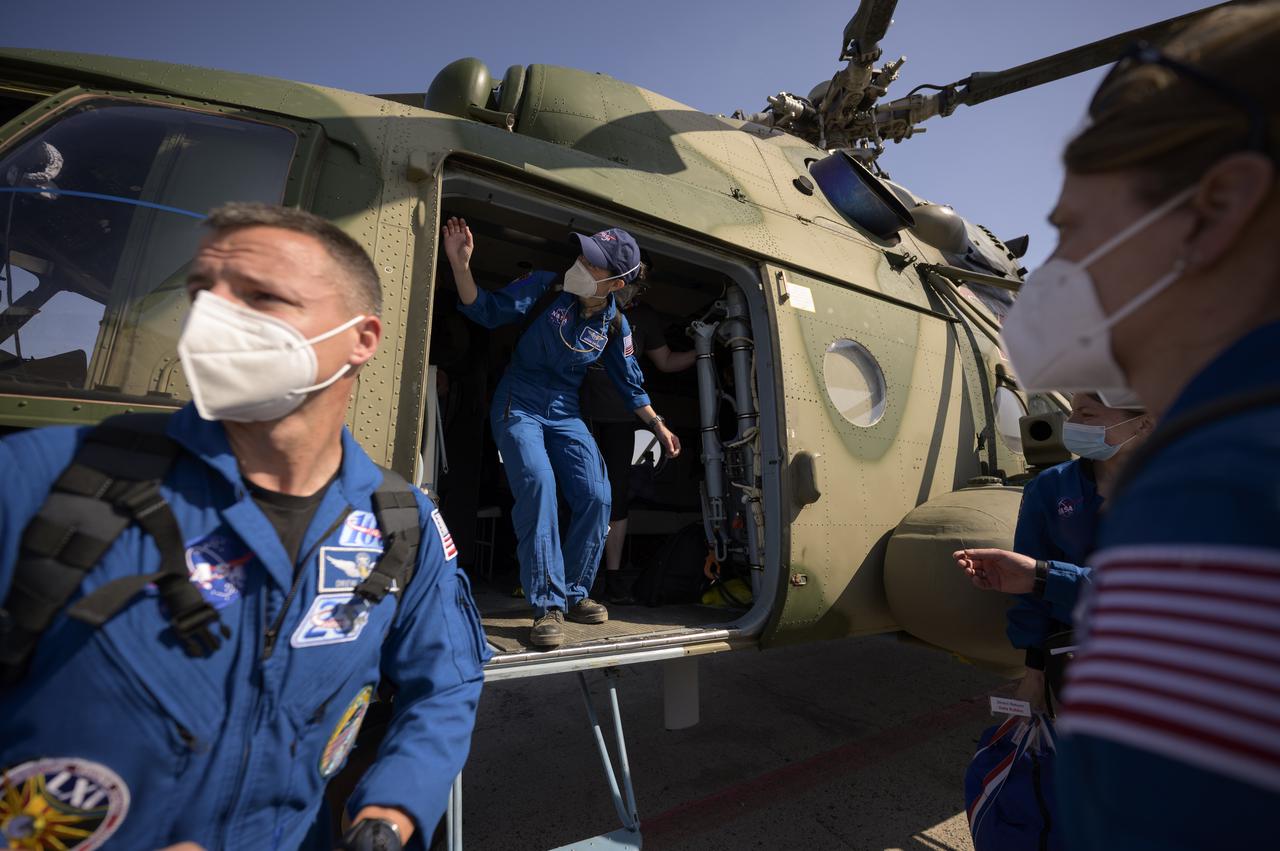
NASA Flight Surgeon Natacha Chough exits the Russian MI-8 helicopter in advance of NASA astronaut Kate Rubins, after Rubins, Roscosmos cosmonauts Sergey Ryzhikov and Sergey Kud-Sverchkov landed in their Soyuz MS-17 spacecraft in a remote area near the town of Zhezkazgan, Kazakhstan on Saturday, April 17, 2021. Rubins, Ryzhikov and Kud-Sverchkov returned after 185 days in space having served as Expedition 63-64 crew members onboard the International Space Station. Photo Credit: NASA/Bill Ingalls
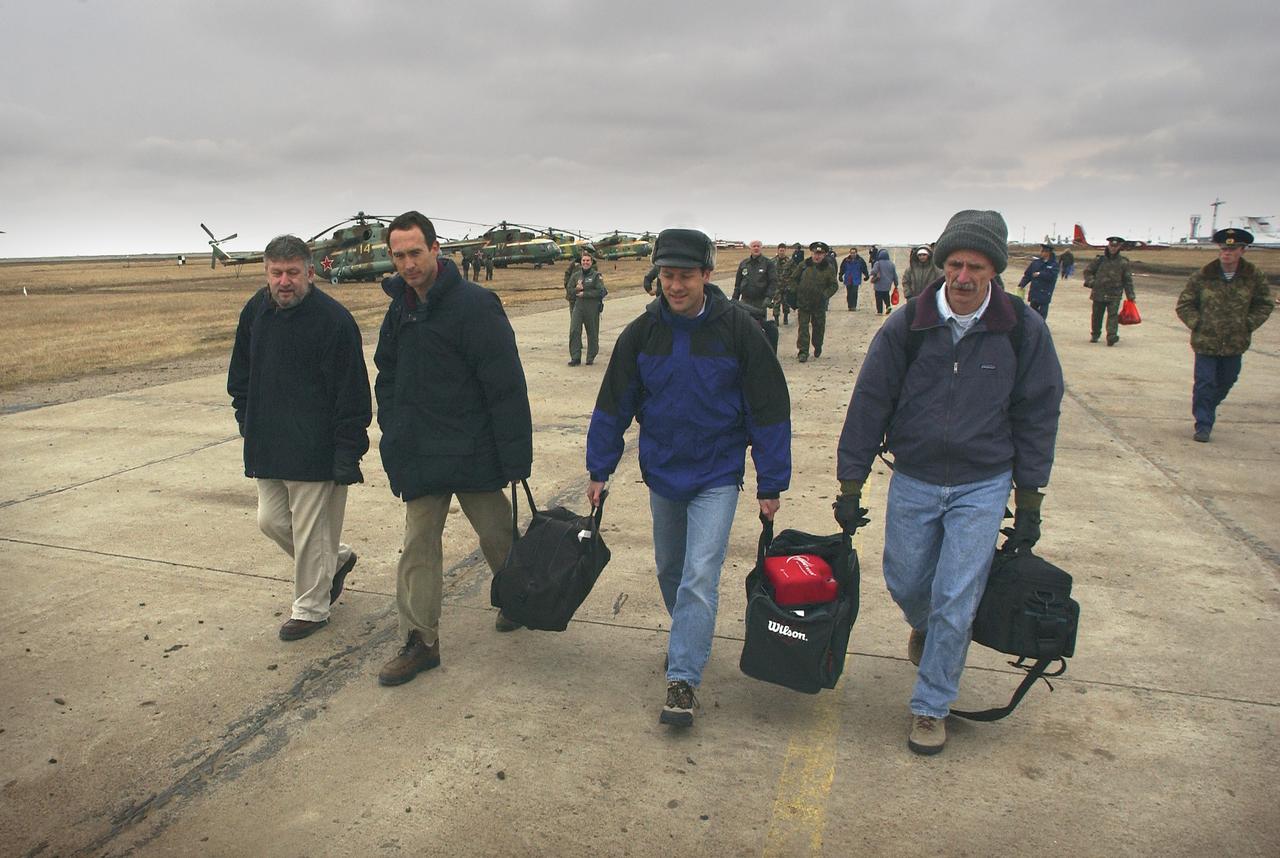
Dr. Thomas H. Marshburn, NASA Flight Surgeon, center, is helped to a Russian helicopter by interpreter Paul Kharmats, far left, astronaut James H. Newman and NASA International Space Station Program Manager William Gerstenmaier, right. Dr. Marshburn was on one of four helicopters that were advanced to Arkalyk, Kazakhstan a day prior to the Expedition 7 Soyuz landing, Monday, October 27, 2003. Photo Credit: (NASA/Bill Ingalls)
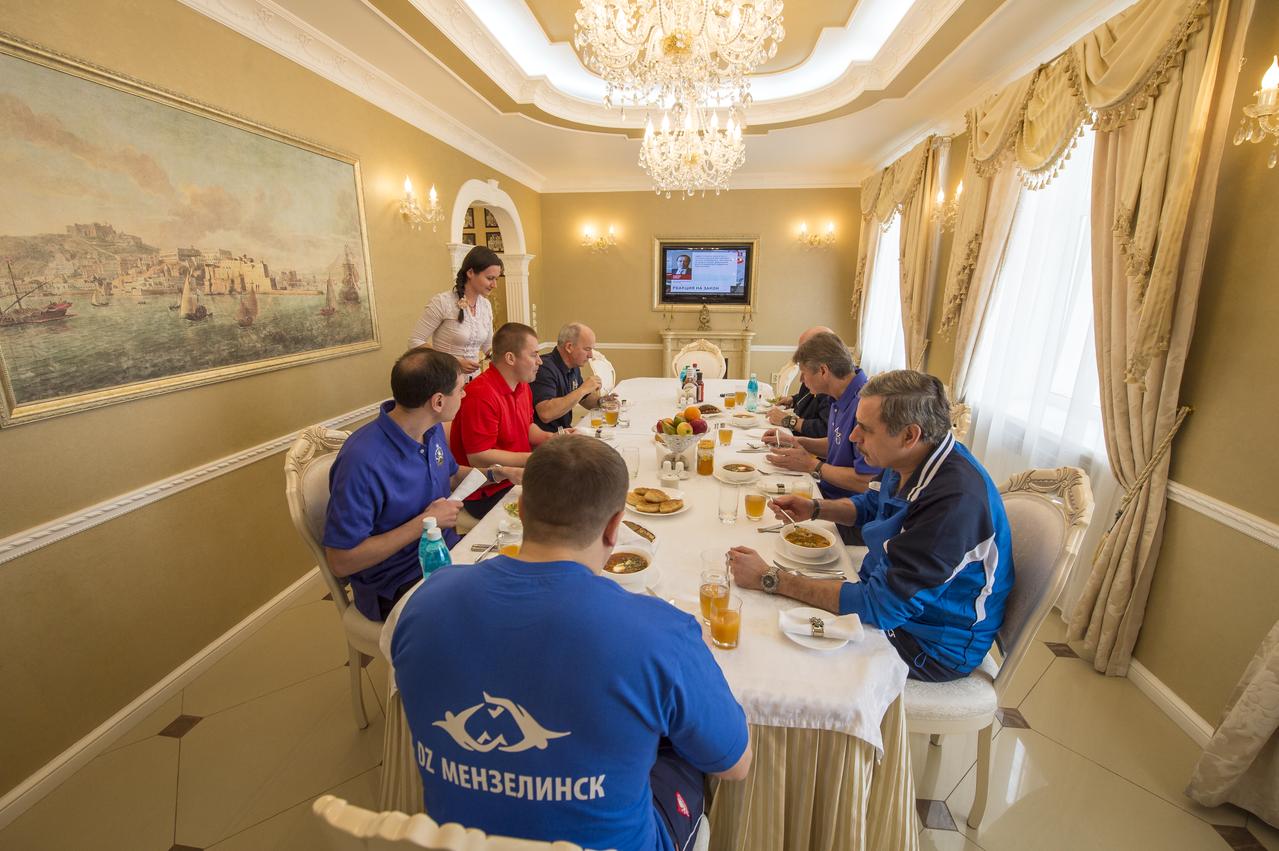
Expedition 43 prime and backup crews enjoy lunch with Gagarin Cosmonaut Training Center (GCTC) Flight Surgeon Alexey Grishin at the Zvjozdnyj Hotel, Thursday, March 19, 2015 in Baikonur, Kazakhstan. NASA Astronaut Scott Kelly, and Russian Cosmonauts Gennady Padalka, and Mikhail Kornienko of the Russian Federal Space Agency (Roscosmos) are preparing for launch to the International Space Station in their Soyuz TMA-16M spacecraft from the Baikonur Cosmodrome in Kazakhstan March 28, Kazakh time. As the one-year crew, Kelly and Kornienko will return to Earth on Soyuz TMA-18M in March 2016. Photo Credit: (NASA/Bill Ingalls)
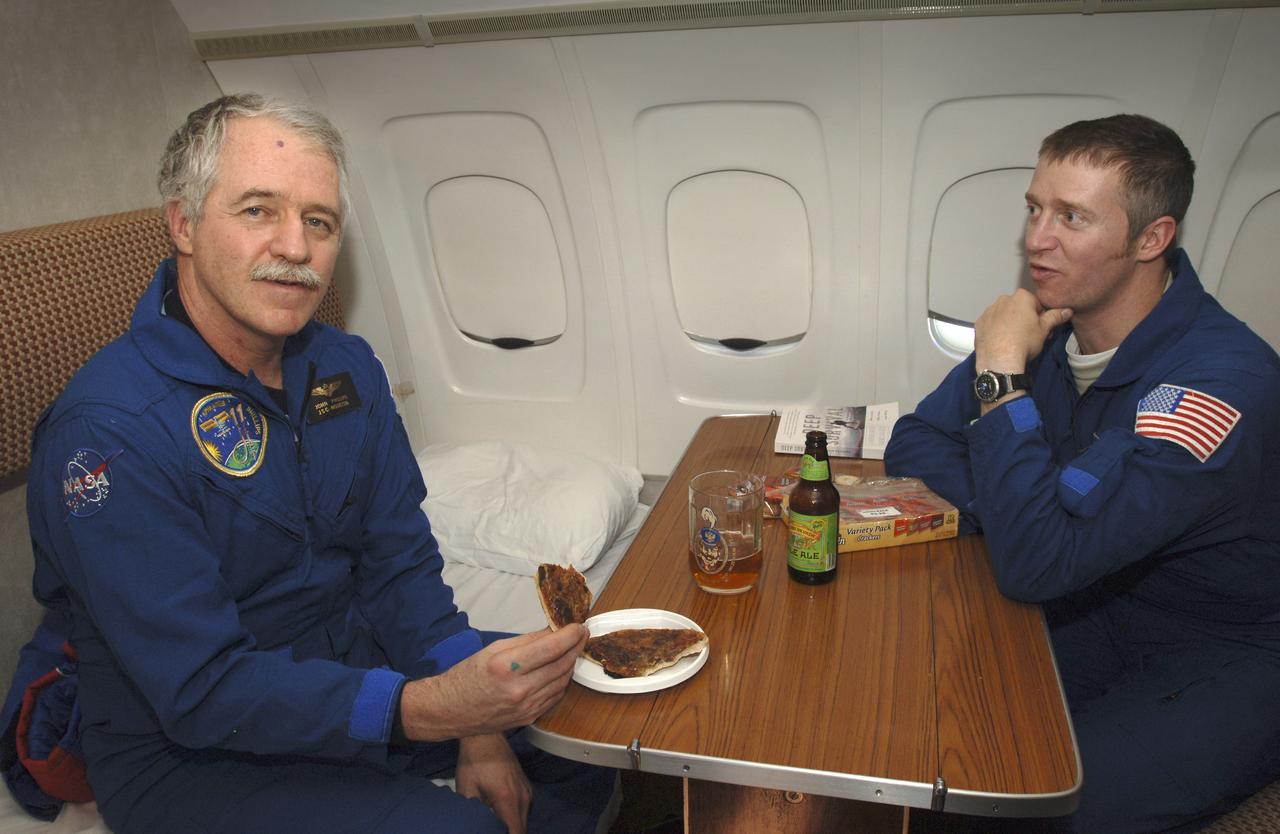
Astronaut John Phillips, left, enjoys a meal onboard a Russian aircraft flying from Kustanay, Kazakhstan to Stary City, Russia, Tuesday, Oct. 11, 2005. Sitting with Philiips is NASA Flight Surgeon Jim Locke. Members of the 11th expedition to the international space station, Phillips and cosmonaut Sergei Krikalev, landed near Arlalyk, Kazakhstan after a six-month mission in orbit. Along with American businessman Greg Olsen, who visited the station for more than a week, Phillips and Krikalev returned to Earth aboard a Russian Soyuz spacecraft. Photo Credit: (NASA/Bill Ingalls)
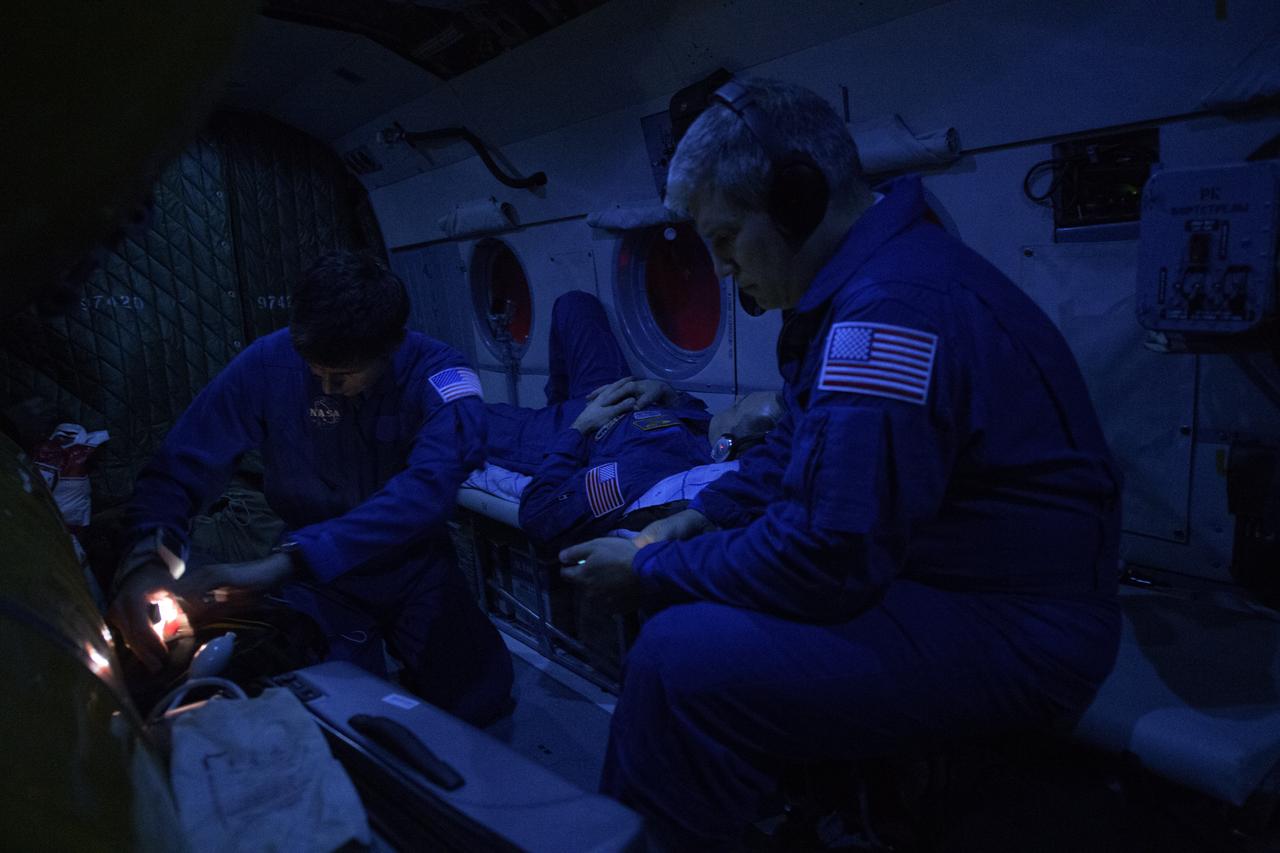
Expedition 56 Flight Engineer Ricky Arnold of NASA restss in a helicopter as Russian Nurse Artiom Kharchikov, left, and NASA Flight Surgeon Steven Piper, right look after him near the town of Zhezkazgan, Kazakhstan on Thursday, Oct. 4, 2018. Arnold, Expedition 56 Commander Drew Feustel of NASA and Expedition 56 Flight Engineer and Soyuz Commander Oleg Artemyev of Roscosmos returned to Earth after 197 days in space where they served as members of the Expedition 55 and 56 crews onboard the International Space Station. Photo Credit: (NASA/Bill Ingalls)
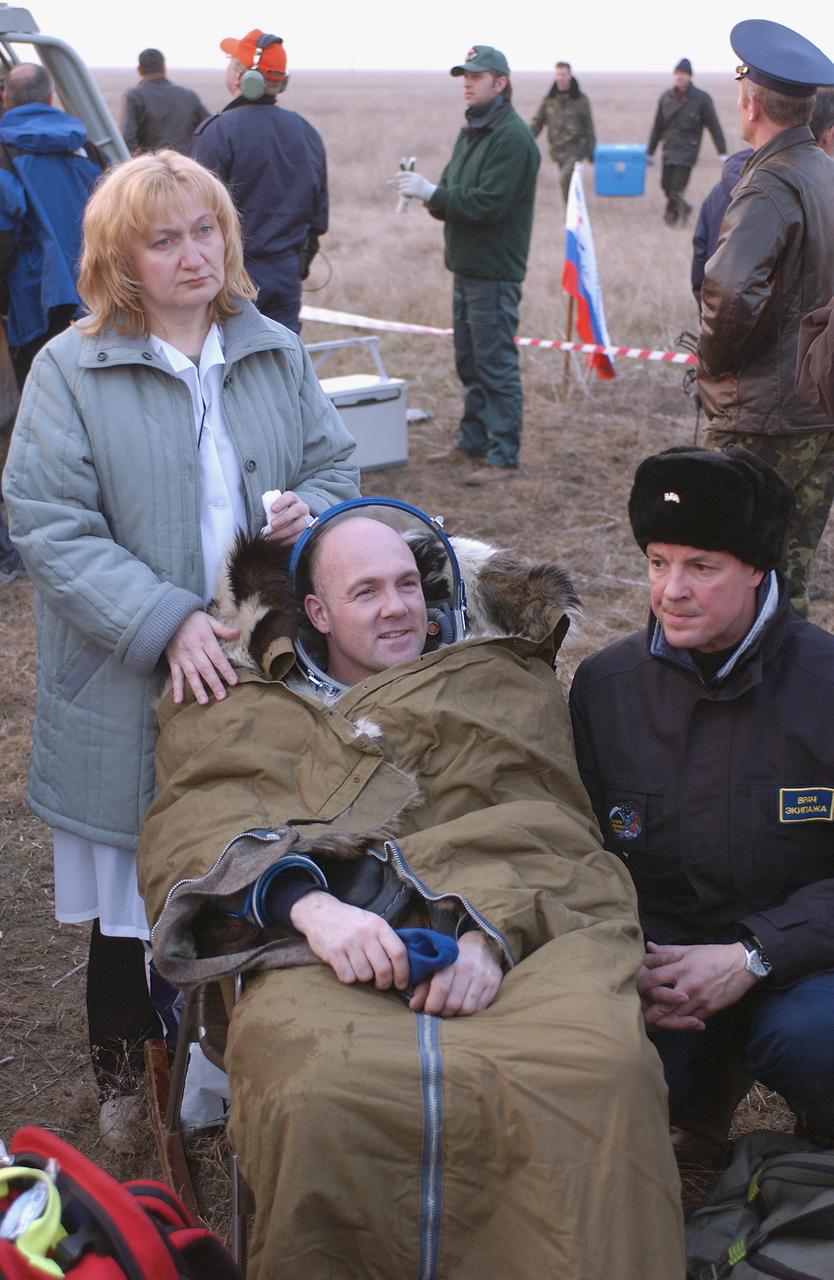
European Space Agency astronaut Andre Kuipers, of the Netherlands, is checked by his flight surgeon after he and Expedition 8 Commander Michael Foale and Soyuz Flight Engineer Alexander Kaleri landed in north central Kazakhstan, Friday, April 30, 2004, in their Soyuz TMA-3 capsule. Foale and Kaleri completed 195 days in space aboard the International Space Station, while Kuipers returned after an 11-day research mission as part of a commercial agreement between ESA and the Russian Federal Space Agency. Photo Credit: (NASA/Bill Ingalls)
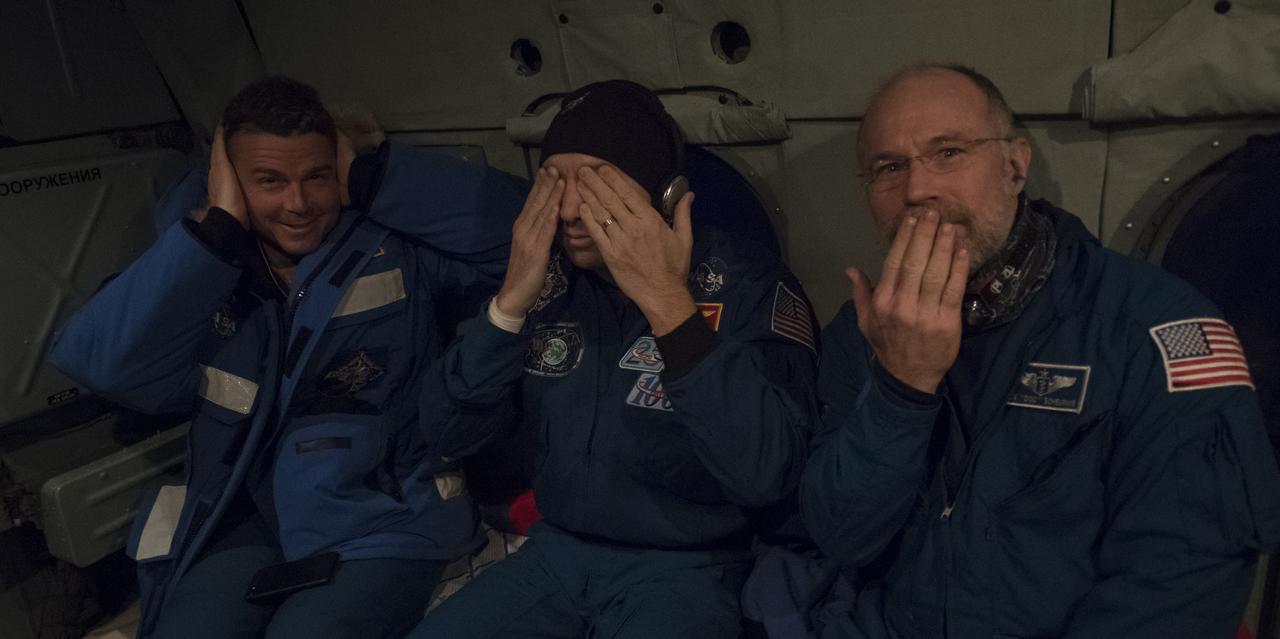
NASA astronaut Reid Wiseman, left, Expedition 53 Commander Randy Bresnik of NASA, center, and NASA Flight Surgeon Rick Scheuring joke with each other during the helicopter ride from the Expedition 53 landing zone to Zhezkazgan, Kazakhstan, Thursday, Dec. 14, 2017. Bresnik and Flight Engineers Paolo Nespoli of ESA (European Space Agency) and Sergey Ryazanskiy of the Russian space agency Roscosmos returned after 139 days in space where they served as members of the Expedition 52 and 53 crews onboard the International Space Station. Photo Credit: (NASA/Bill Ingalls)
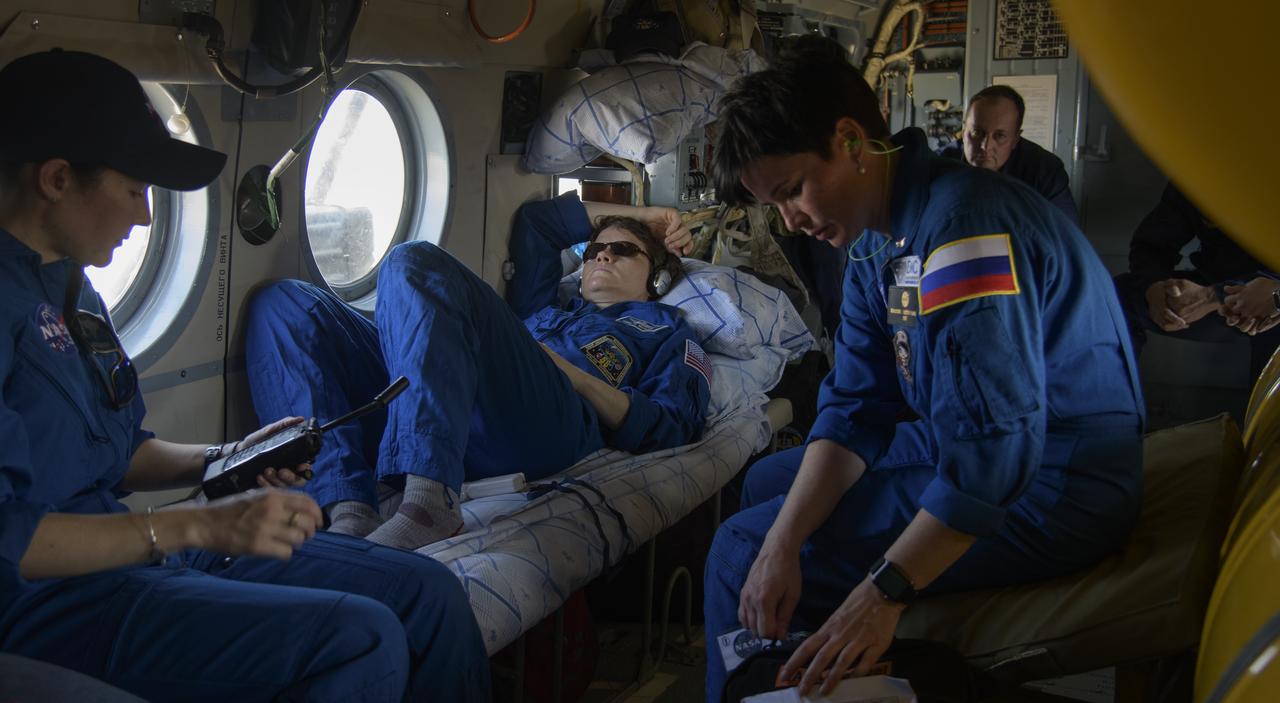
Expedition 59 NASA astronaut Anne McClain rests onboard a helicopter during a flight from the Soyuz MS-11 spacecraft landing site to Karaganda, Kazakhstan as NASA Flight Surgeon Natacha Chough, left, and Russian Nurse Raksana Batsmanova, right, look after her, Tuesday, June 25, 2019. McClain, Canadian Space Agency astronaut David Saint-Jacques, and Roscosmos cosmonaut Oleg Kononenko landed in their Soyuz MS-11 spacecraft in a remote area near Zhezkazgan, Kazakhstan after 204 days in space where they served as members of the Expedition 58 and 59 crews onboard the International Space Station. Photo Credit: (NASA/Bill Ingalls)
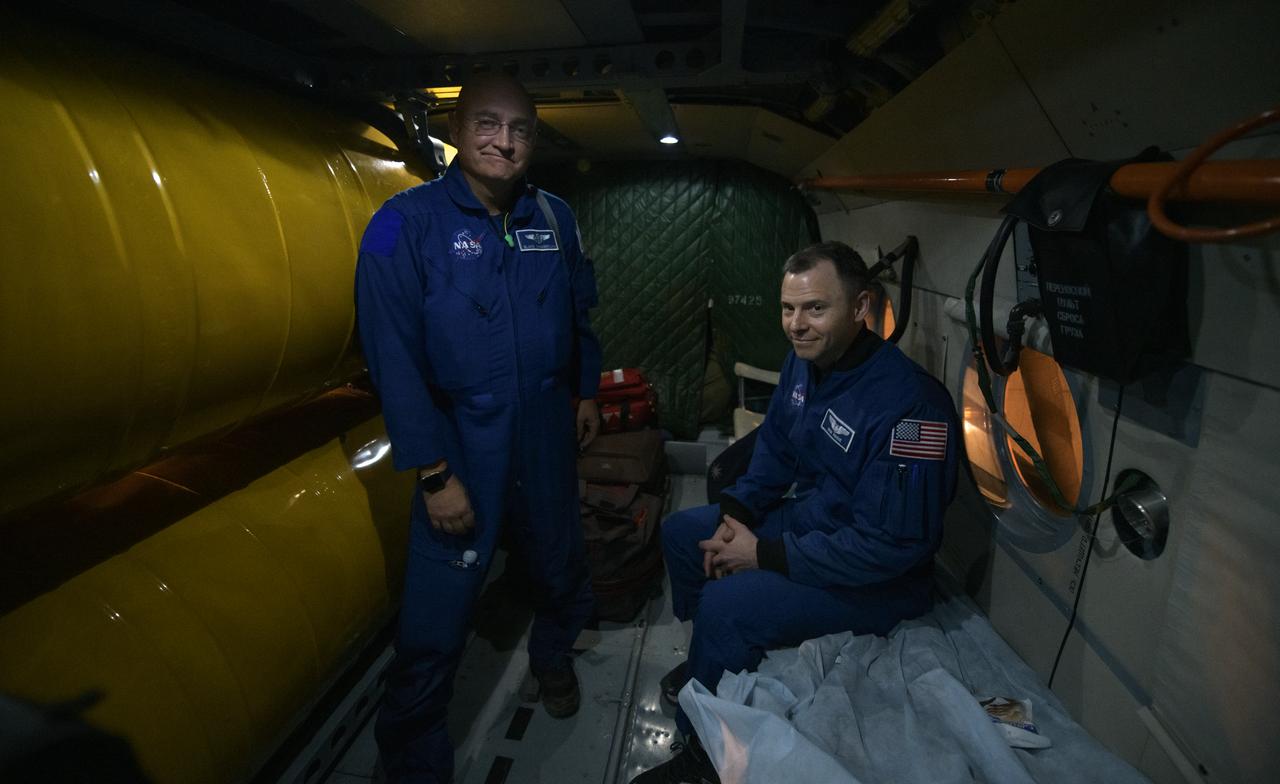
Expedition 60 NASA astronaut Nick Hague, left, and NASA Flight Surgeon Blake Chamberlain wait inside at Russian MI-8 helicopter after arriving at the Karaganda Airport in Kazakhstan from a remote area near the town of Zhezkazgan, Kazakhstan on Thursday, Oct. 3, 2019. Hague and fellow Expedition 60 crewmember Alexey Ovchinin are returning after 203 days in space where they served as members of the Expedition 59 and 60 crews onboard the International Space Station. Visiting astronaut Hazzaa Ali Almansoori of the United Arab Emirates also returned with the crew after logging 8 days in space during his first flight as an astronaut. Photo Credit: (NASA/Bill Ingalls)
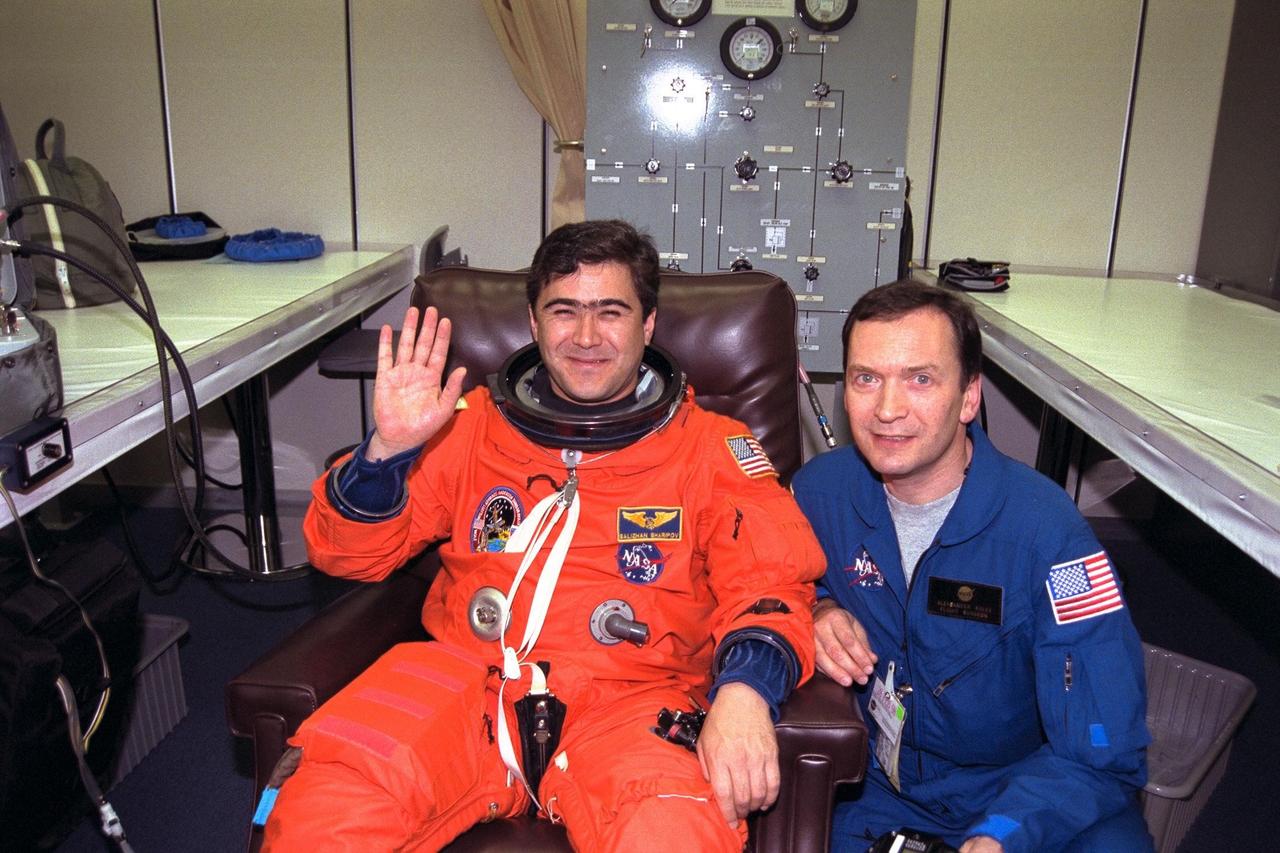
STS-89 Mission Specialist Salizhan Sharipov of the Russian Space Agency, at left, waves as he and his flight surgeon, Alexander Kulev, complete the donning of Sharipov’s launch/entry suit in the Operations and Checkout (O&C) Building. In 1994, Sharipov graduated from Moscow State University with a degree in cartography. He and six fellow crew members will soon depart the O&C and head for Launch Pad 39A, where the Space Shuttle Endeavour will lift off during a launch window that opens at 9:43 p.m. EST, Jan. 22. STS-89 is the eighth of nine planned missions to dock the Space Shuttle with Russia's Mir space station
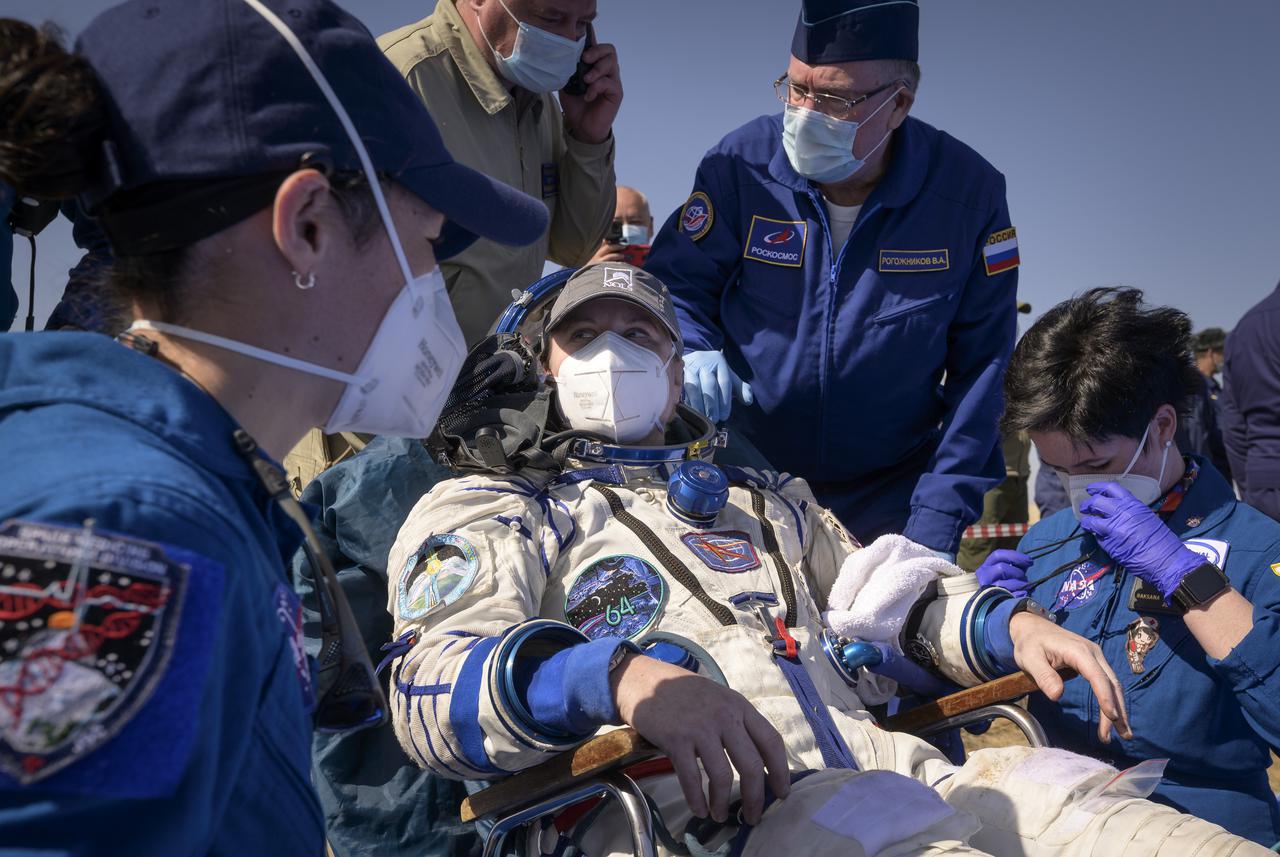
Expedition 64 NASA astronaut Kate Rubins rest as NASA Flight Surgeon Natacha Chough, left, and Russian Nurse Raksana Batsmanova, right, monitor her condition after she, and Roscosmos cosmonauts Sergey Ryzhikov and Sergey Kud-Sverchkov landed there Soyuz MS-17 spacecraft in a remote area near the town of Zhezkazgan, Kazakhstan on Saturday, April 17, 2021. Rubins, Ryzhikov and Kud-Sverchkov returned after 185 days in space having served as Expedition 63-64 crew members onboard the International Space Station. Photo Credit: NASA/Bill Ingalls
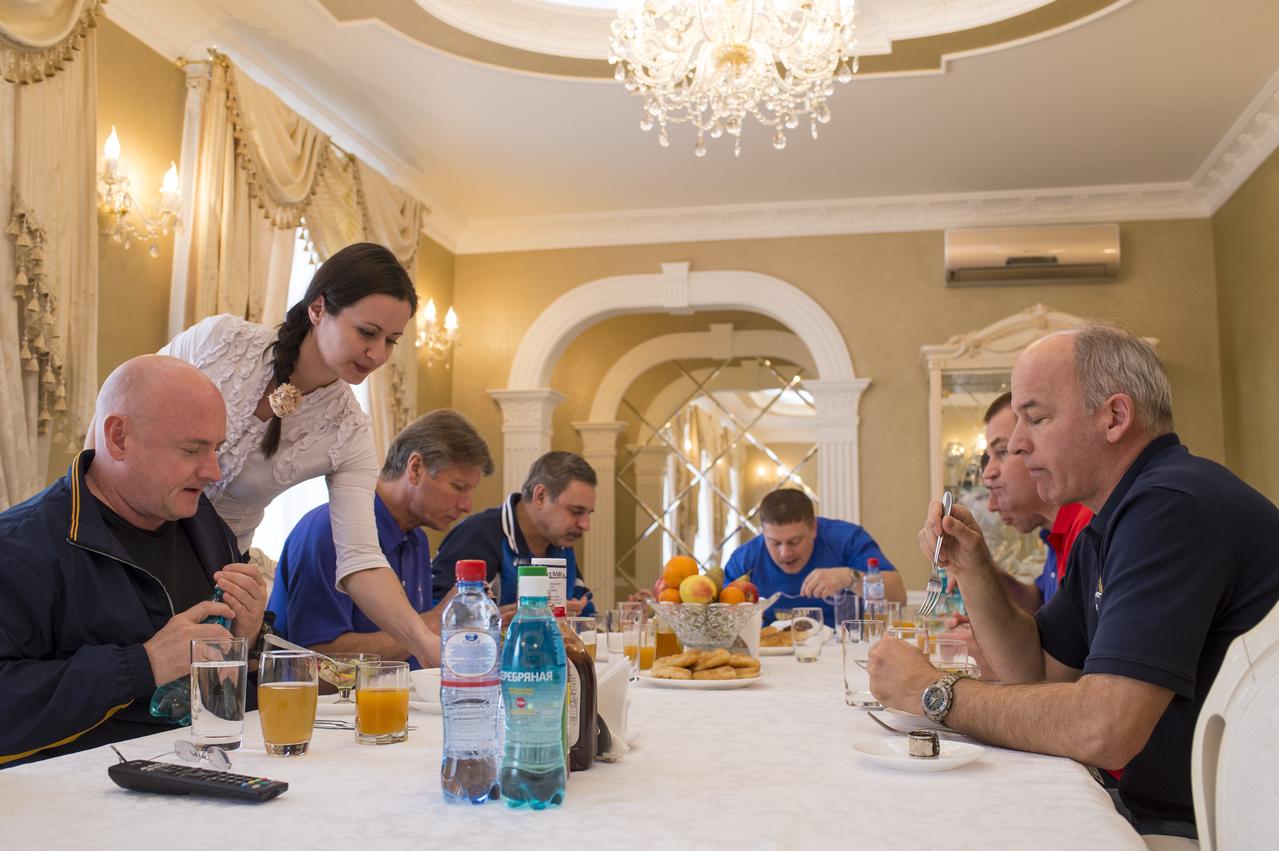
Expedition 43 prime crew, left, NASA Astronaut Scott Kelly, Russian Cosmonauts Gennady Padalka, and Mikhail Kornienko of the Russian Federal Space Agency (Roscosmos), and Gagarin Cosmonaut Training Center (GCTC) Flight Surgeon Alexey Grishin, head of table, Expedition 43 back up crew members, Sergei Volkov, and Alexey Ovchinin, Roscosmos, and Jeff Williams of NASA enjoy lunch at the Zvjozdnyj Hotel, Thursday, March 19, 2015 in Baikonur, Kazakhstan. Kelly, Padalka, and Kornienko are preparing for launch to the International Space Station in their Soyuz TMA-16M spacecraft from the Baikonur Cosmodrome in Kazakhstan March 28, Kazakh time. As the one-year crew, Kelly and Kornienko will return to Earth on Soyuz TMA-18M in March 2016. Photo Credit: (NASA/Bill Ingalls)
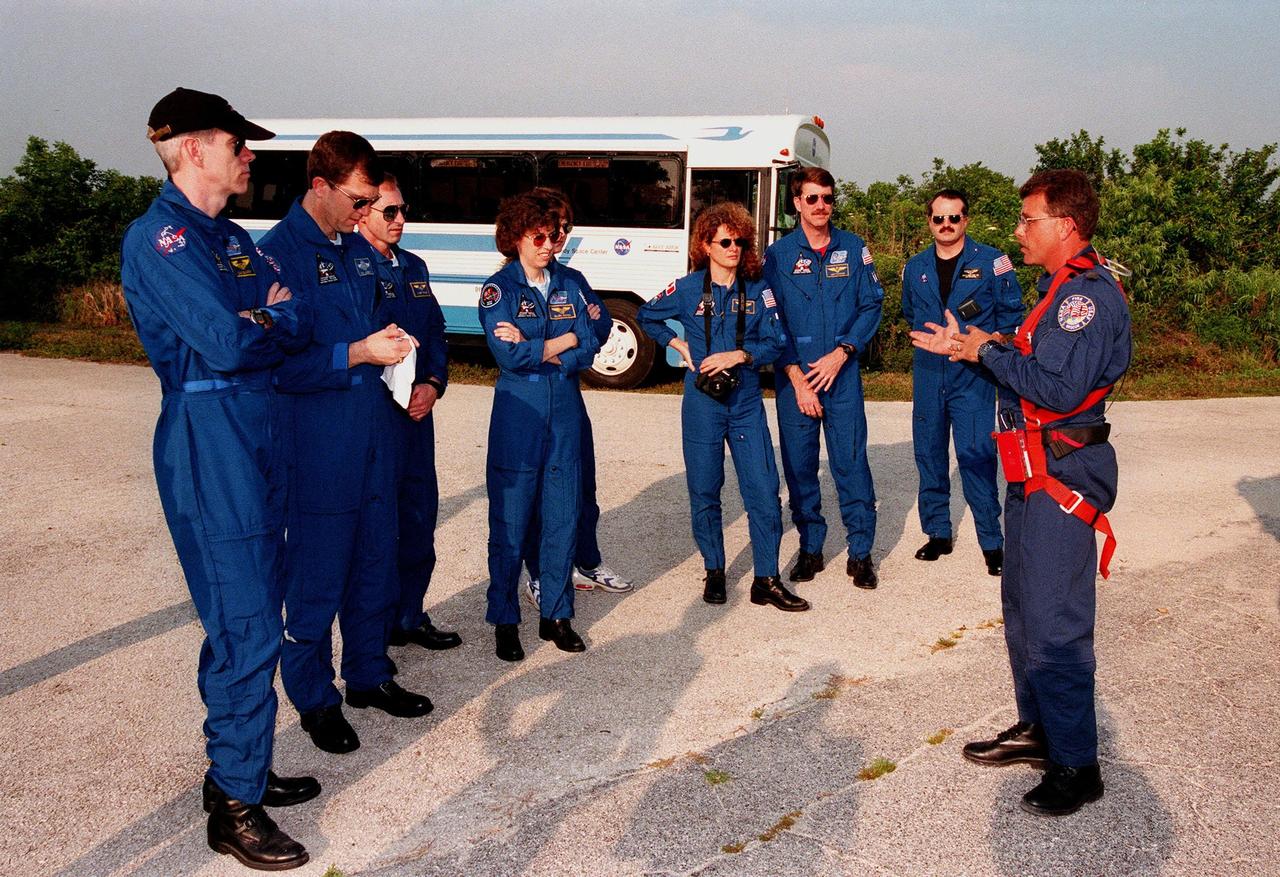
The STS-96 crew listen to Capt. Steve Kelly, with Space Gateway Support, who is assisting with emergency egress training during Terminal Countdown Demonstration Test (TCDT) activities. The TCDT also provides simulated countdown exercises and opportunities to inspect the mission payloads in the orbiter's payload bay. From left are Mission Specialist Daniel Barry (M.D., Ph.D.), Pilot Rick Douglas Husband, Mission Specialists Valery Ivanovich Tokarev, Ellen Ochoa (Ph.D.), Tamara E. Jernigan (Ph.D.) and Julie Payette, and Commander Kent V. Rominger. Next to Rominger is Douglas Hamilton, Canadian flight surgeon. Payette is with the Canadian Space Agency. Tokarev represents the Russian Space Agency. Mission STS-96, which is scheduled for liftoff on May 20 at 9:32 a.m., is a logistics and resupply mission for the International Space Station, carrying such payloads as a Russian crane, the Strela; a U.S.-built crane; the Spacehab Oceaneering Space System Box (SHOSS), a logistics items carrier; and STARSHINE, a student-led experiment
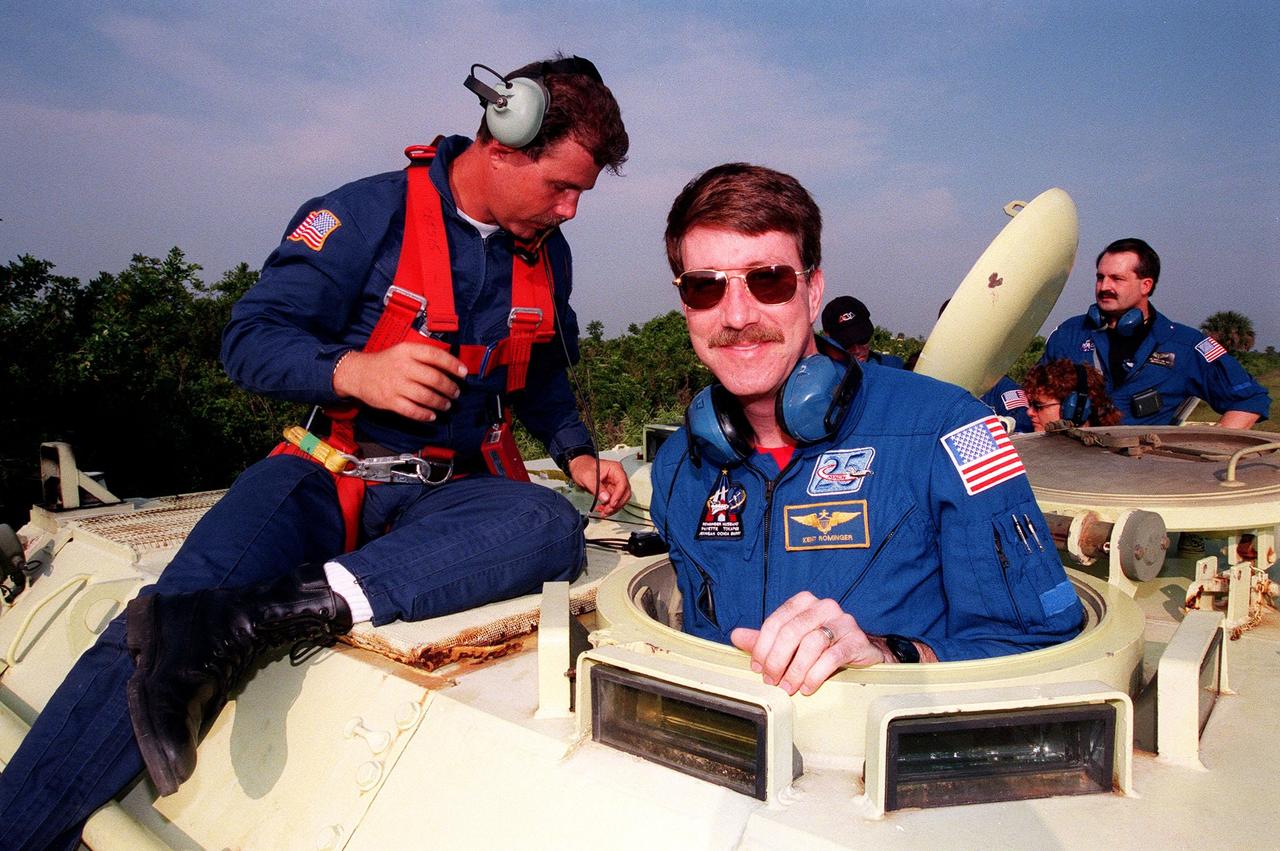
Under the eye of Capt. Steve Kelly (left), with Space Gateway Support, Commander Kent V. Rominger gets ready to practice driving the small armored personnel carrier that is part of emergency egress training during Terminal Countdown Demonstration Test (TCDT) activities. At the rear is Douglas Hamilton, a Canadian flight surgeon. The tracked vehicle could be used by the crew in the event of an emergency at the pad during which the crew must make a quick exit from the area. The TCDT also provides simulated countdown exercises and opportunities to inspect the mission payloads in the orbiter's payload bay. Other crew members taking part in the TCDT are Pilot Rick Douglas Husband, and Mission Specialists Ellen Ochoa (Ph.D.), Tamara E. Jernigan (Ph.D.), Daniel Barry (M.D., Ph.D.), Julie Payette and Valery Ivanovich Tokarev. Payette represents the Canadian Space Agency and Tokarev the Russian Space Agency. Mission STS-96, which is scheduled for liftoff on May 20 at 9:32 a.m., is a logistics and resupply mission for the International Space Station, carrying such payloads as a Russian crane, the Strela; a U.S.-built crane; the Spacehab Oceaneering Space System Box (SHOSS), a logistics items carrier; and STARSHINE, a student-led experiment
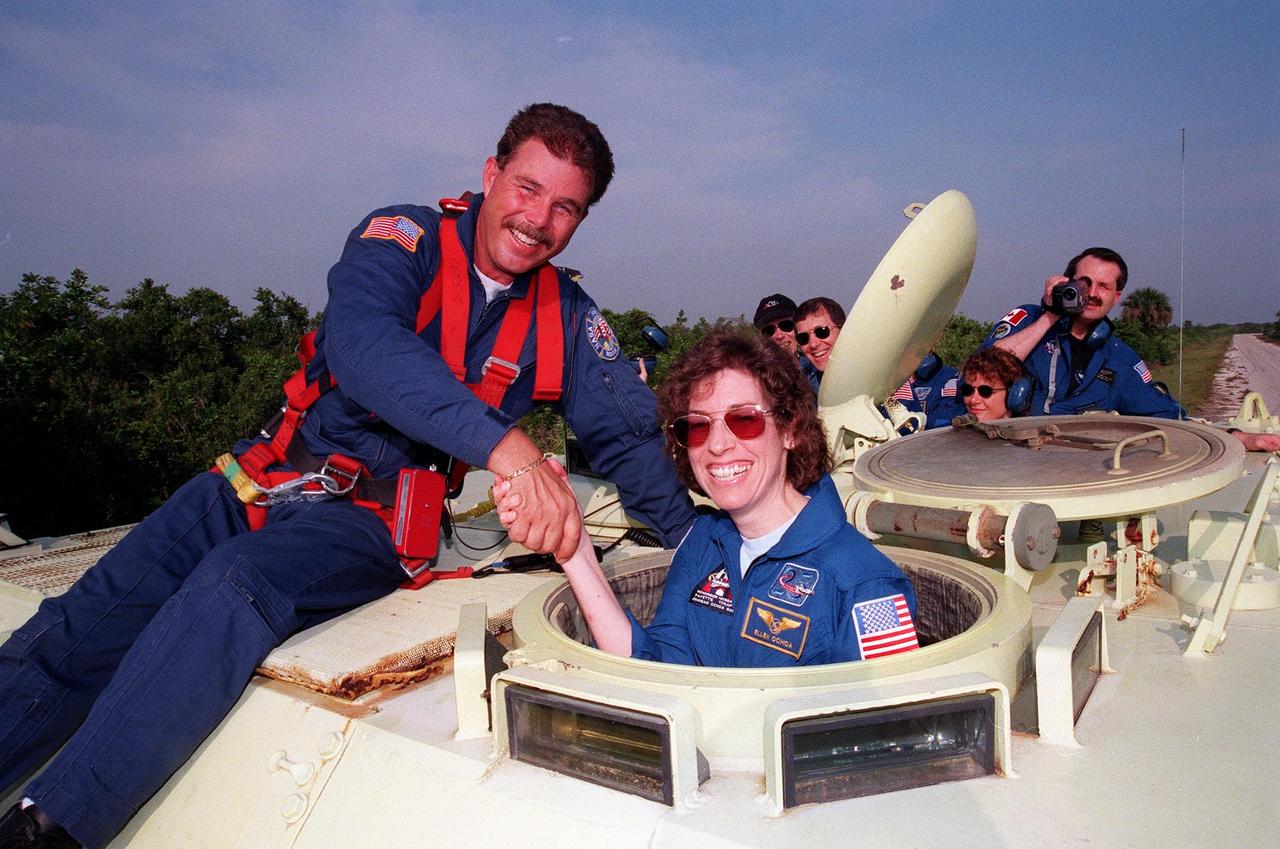
Capt. Steve Kelly, with Space Gateway Support, congratulates STS-96 Mission Specialist Ellen Ochoa (Ph.D.), who successfully completed training in the small armored personnel carrier that is part of emergency egress training during Terminal Countdown Demonstration Test (TCDT) activities. The tracked vehicle could be used by the crew in the event of an emergency at the pad during which the crew must make a quick exit from the area. Behind them (from left) are crew members Mission Specialist Valery Ivanovich Tokarev, Pilot Rick Douglas Husband and Mission Specialist Julie Payette. Holding the camera is Douglas Hamilton, a Canadian flight surgeon. Payette is with the Canadian Space Agency. Tokarev represents the Russian Space Agency. The TCDT also provides simulated countdown exercises and opportunities to inspect the mission payloads in the orbiter's payload bay. Mission STS-96, which is scheduled for liftoff on May 20 at 9:32 a.m., is a logistics and resupply mission for the International Space Station, carrying such payloads as a Russian crane, the Strela; a U.S.-built crane; the Spacehab Oceaneering Space System Box (SHOSS), a logistics items carrier; and STARSHINE, a student-led experiment