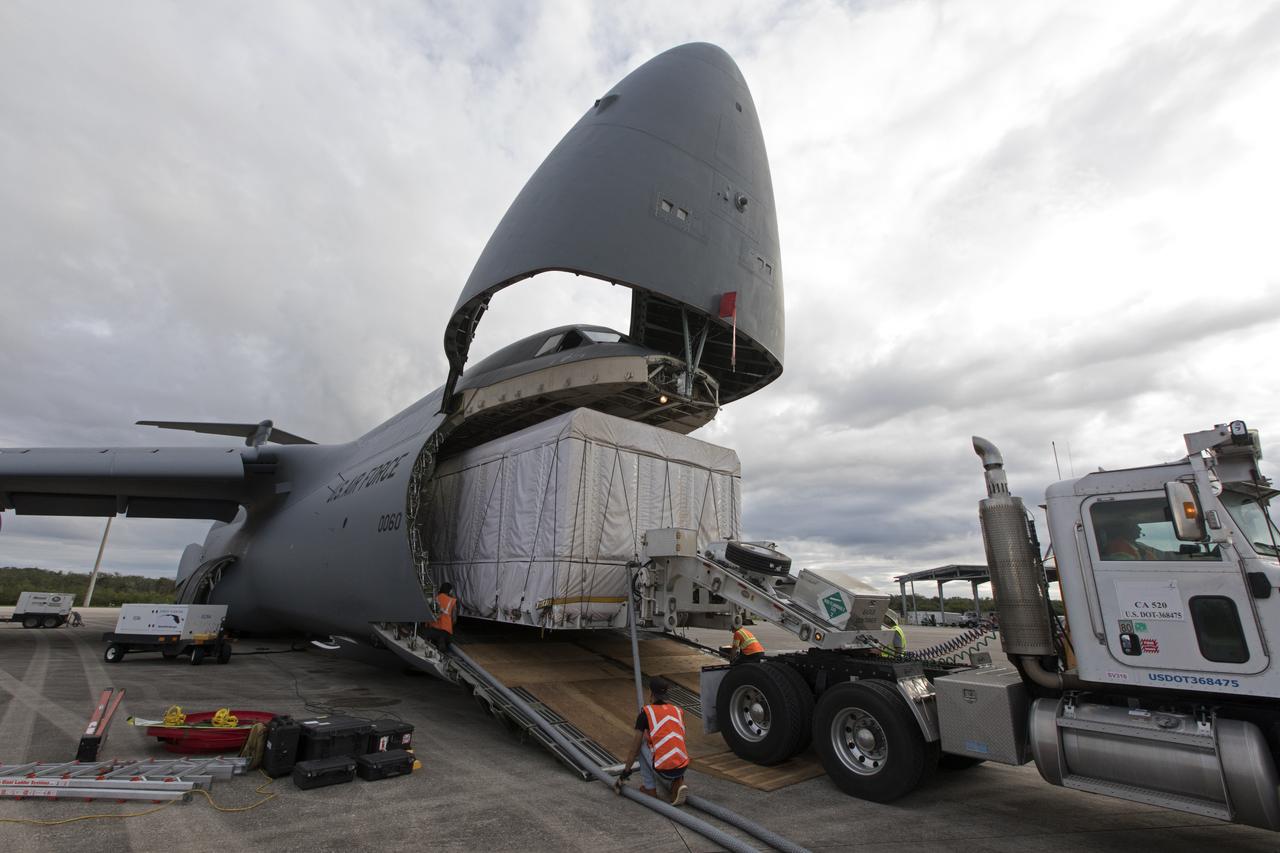
NOAA's Geostationary Operation Environmental Satellite-S (GOES-S) is being offloaded from a C-5 transport aircraft at the Shuttle Landing Facility at NASA's Kennedy Space Center in Florida. The satellite will be transported to the Astrotech Space Operations facility in Titusville, Florida to prepare it for launch. GOES-S is the second in a series of four advanced geostationary weather satellites. The GOES-R series - consisting of the GOES-R, GOES-S, GOES-T and GOES-U spacecraft - will significantly improve the detection and observation of environmental phenomena that directly affect public safety, protection of property and the nation's economic health and prosperity. GOES-S is slated to launch March 1, 2018 aboard a United Launch Alliance Atlas V rocket from Cape Canaveral Air Force Station in Florida.
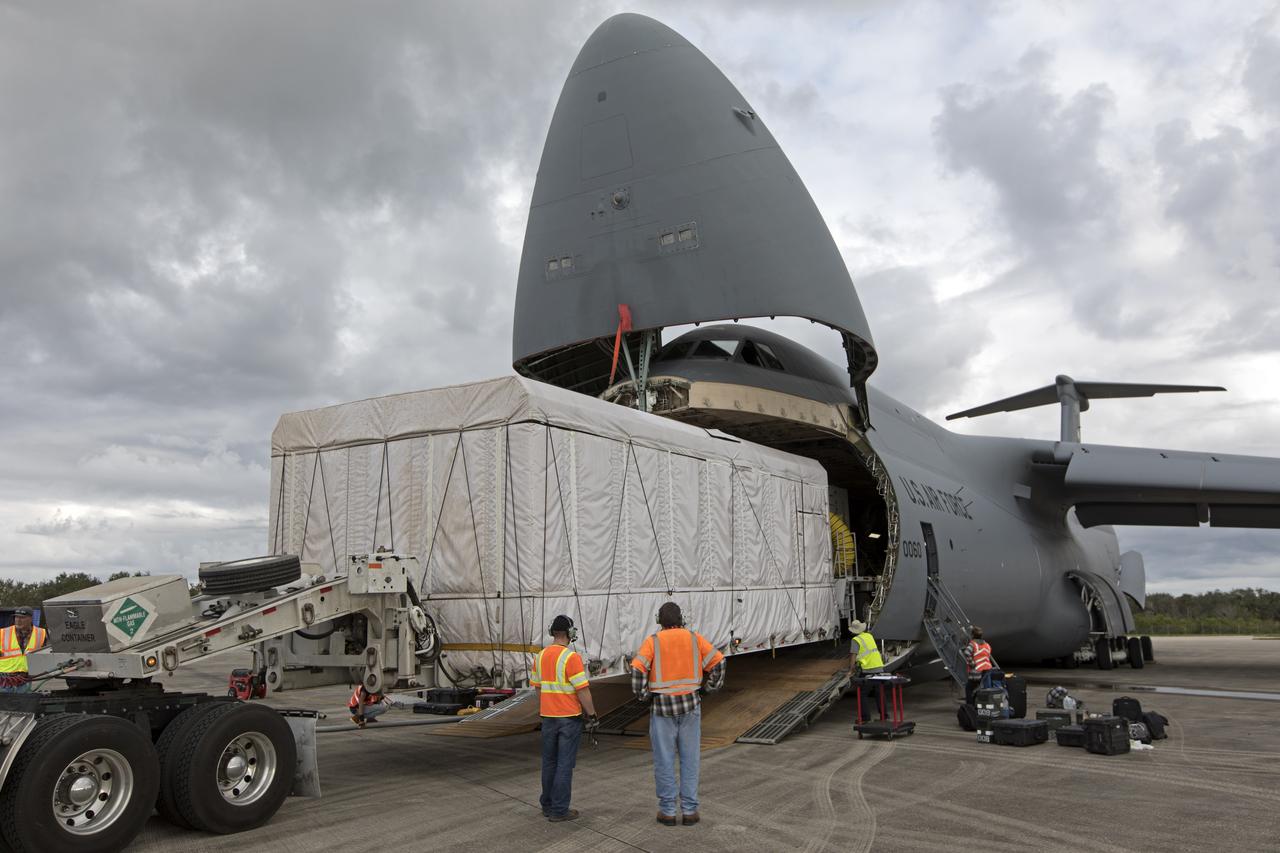
NOAA's Geostationary Operation Environmental Satellite-S (GOES-S) is being offloaded from a C-5 transport aircraft onto the flatbed of a heavy-lift truck at the Shuttle Landing Facility at NASA's Kennedy Space Center in Florida. The satellite will be transported to the Astrotech Space Operations facility in Titusville, Florida to prepare it for launch. GOES-S is the second in a series of four advanced geostationary weather satellites. The GOES-R series - consisting of the GOES-R, GOES-S, GOES-T and GOES-U spacecraft - will significantly improve the detection and observation of environmental phenomena that directly affect public safety, protection of property and the nation's economic health and prosperity. GOES-S is slated to launch March 1, 2018 aboard a United Launch Alliance Atlas V rocket from Cape Canaveral Air Force Station in Florida.
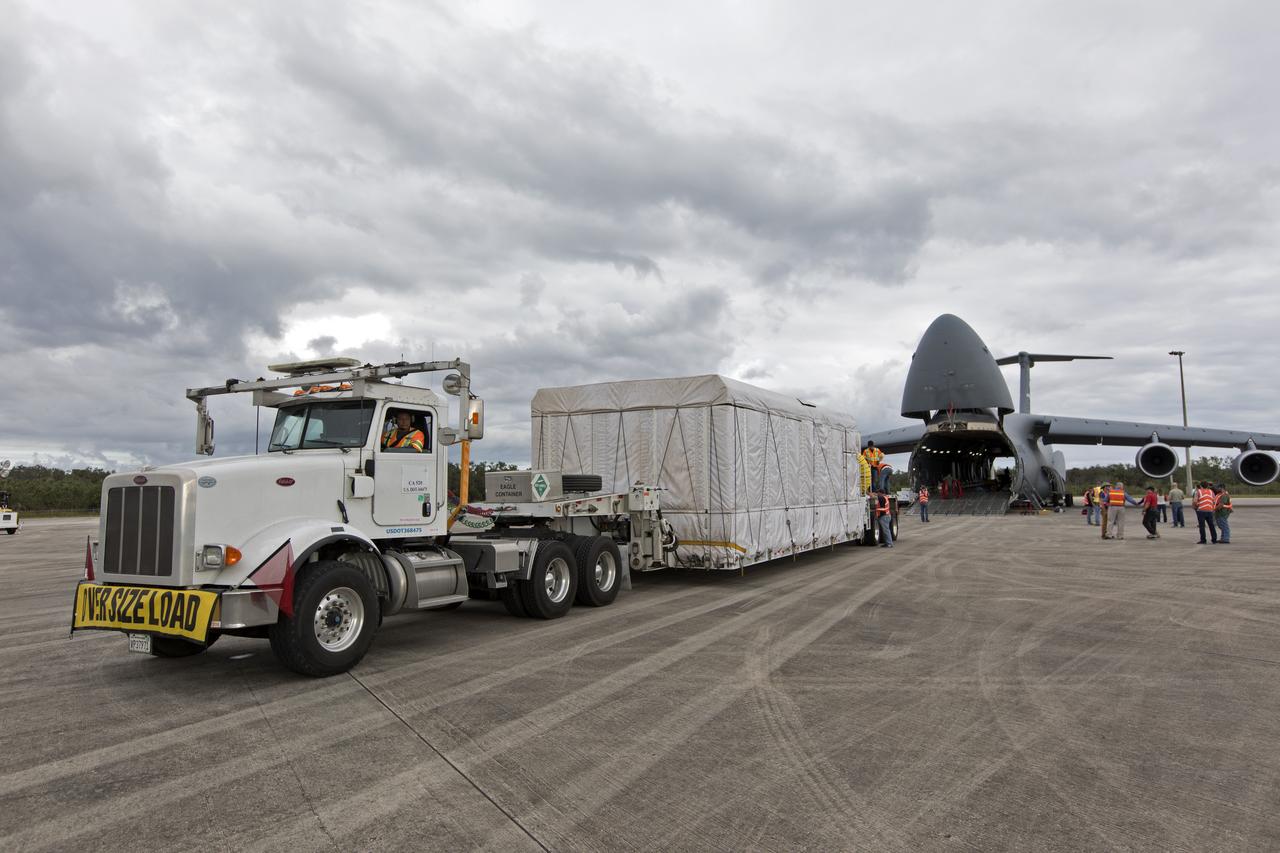
NOAA's Geostationary Operation Environmental Satellite-S (GOES-S) has been offloaded from a C-5 transport aircraft and secured onto the flatbed of a heavy-lift truck at the Shuttle Landing Facility at NASA's Kennedy Space Center in Florida. The satellite will be transported to the Astrotech Space Operations facility in Titusville, Florida to prepare it for launch. GOES-S is the second in a series of four advanced geostationary weather satellites. The GOES-R series - consisting of the GOES-R, GOES-S, GOES-T and GOES-U spacecraft - will significantly improve the detection and observation of environmental phenomena that directly affect public safety, protection of property and the nation's economic health and prosperity. GOES-S is slated to launch March 1, 2018 aboard a United Launch Alliance Atlas V rocket from Cape Canaveral Air Force Station in Florida.
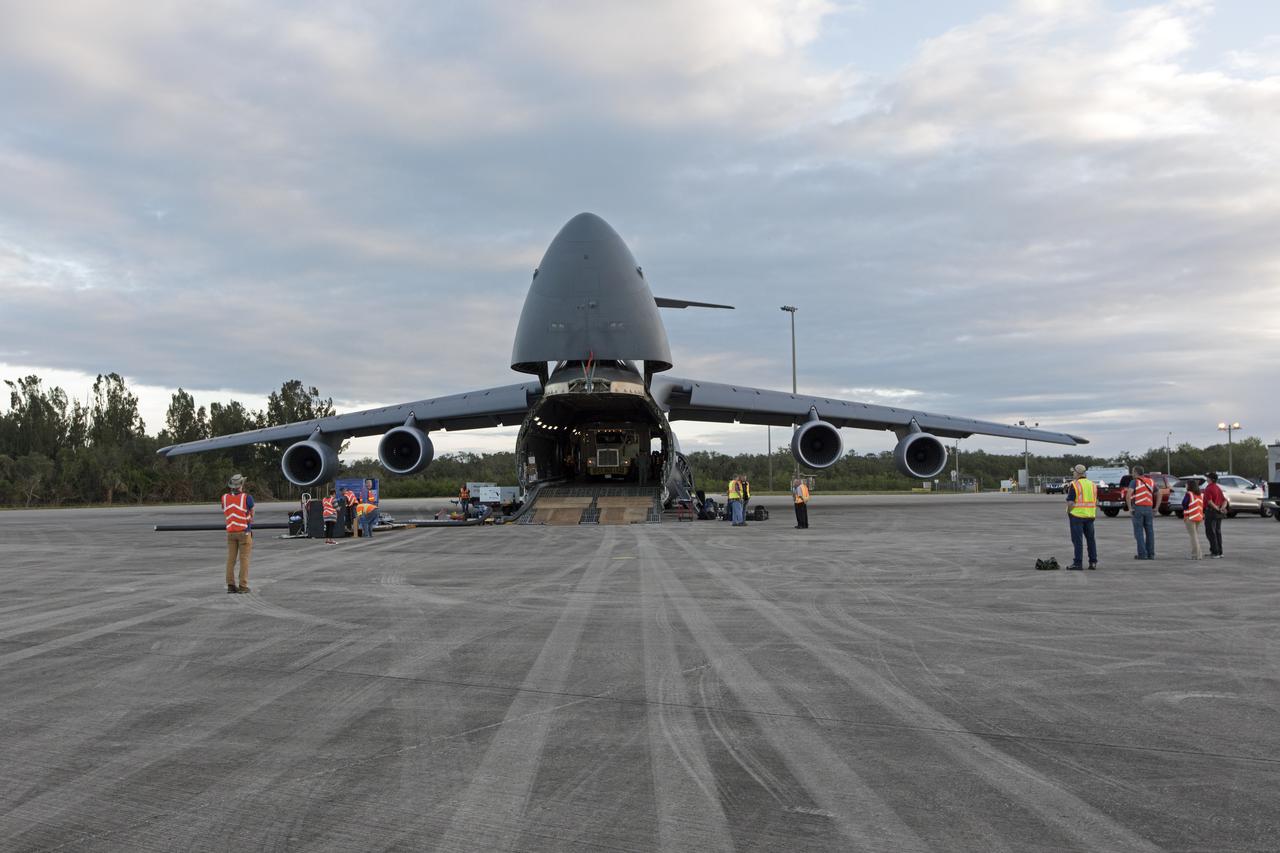
NOAA's Geostationary Operation Environmental Satellite-S (GOES-S) is being offloaded from a C-5 transport aircraft at the Shuttle Landing Facility at NASA's Kennedy Space Center in Florida. The satellite will be transported to the Astrotech Space Operations facility in Titusville, Florida to prepare it for launch. GOES-S is the second in a series of four advanced geostationary weather satellites. The GOES-R series - consisting of the GOES-R, GOES-S, GOES-T and GOES-U spacecraft - will significantly improve the detection and observation of environmental phenomena that directly affect public safety, protection of property and the nation's economic health and prosperity. GOES-S is slated to launch March 1, 2018 aboard a United Launch Alliance Atlas V rocket from Cape Canaveral Air Force Station in Florida.
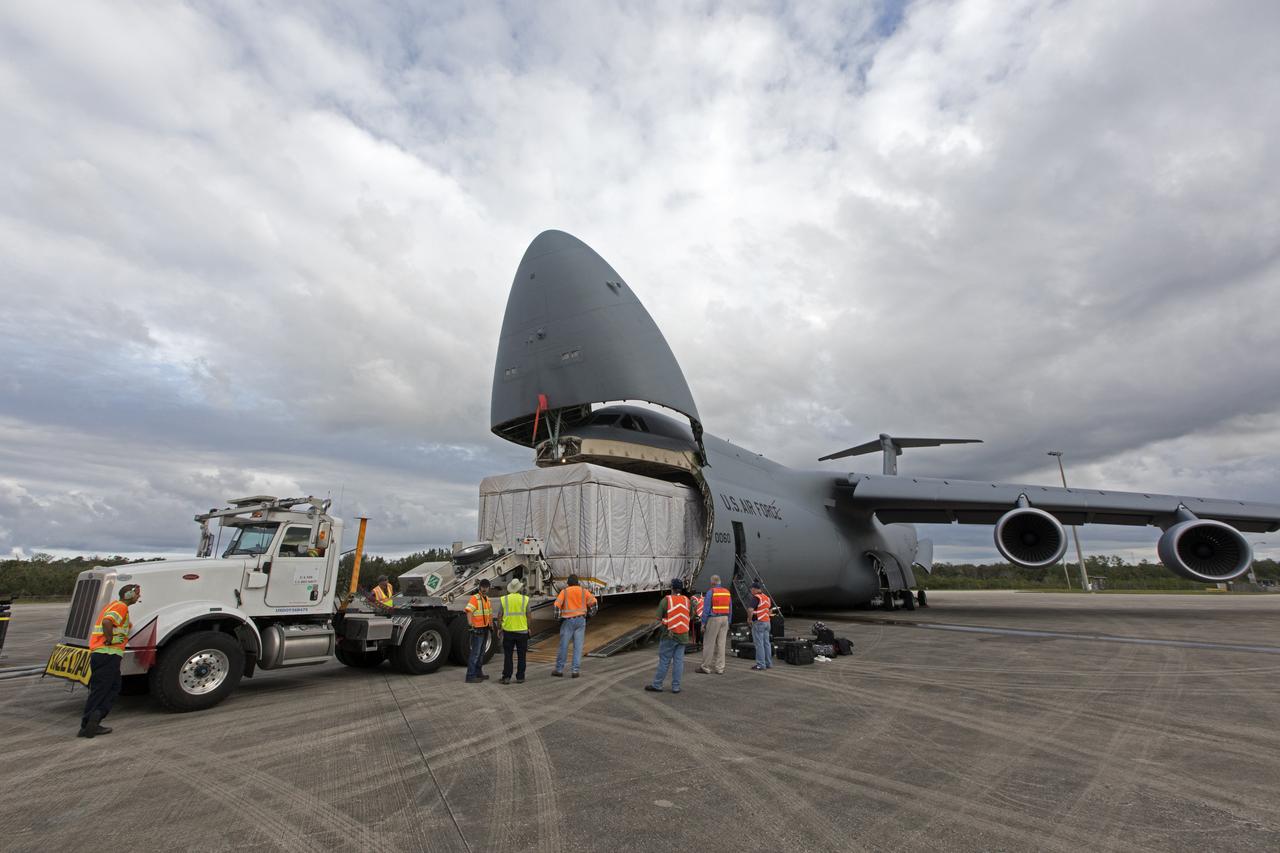
NOAA's Geostationary Operation Environmental Satellite-S (GOES-S) is being offloaded from a C-5 transport aircraft onto the flatbed of a heavy-lift truck at the Shuttle Landing Facility at NASA's Kennedy Space Center in Florida. The satellite will be transported to the Astrotech Space Operations facility in Titusville, Florida to prepare it for launch. GOES-S is the second in a series of four advanced geostationary weather satellites. The GOES-R series - consisting of the GOES-R, GOES-S, GOES-T and GOES-U spacecraft - will significantly improve the detection and observation of environmental phenomena that directly affect public safety, protection of property and the nation's economic health and prosperity. GOES-S is slated to launch March 1, 2018 aboard a United Launch Alliance Atlas V rocket from Cape Canaveral Air Force Station in Florida.
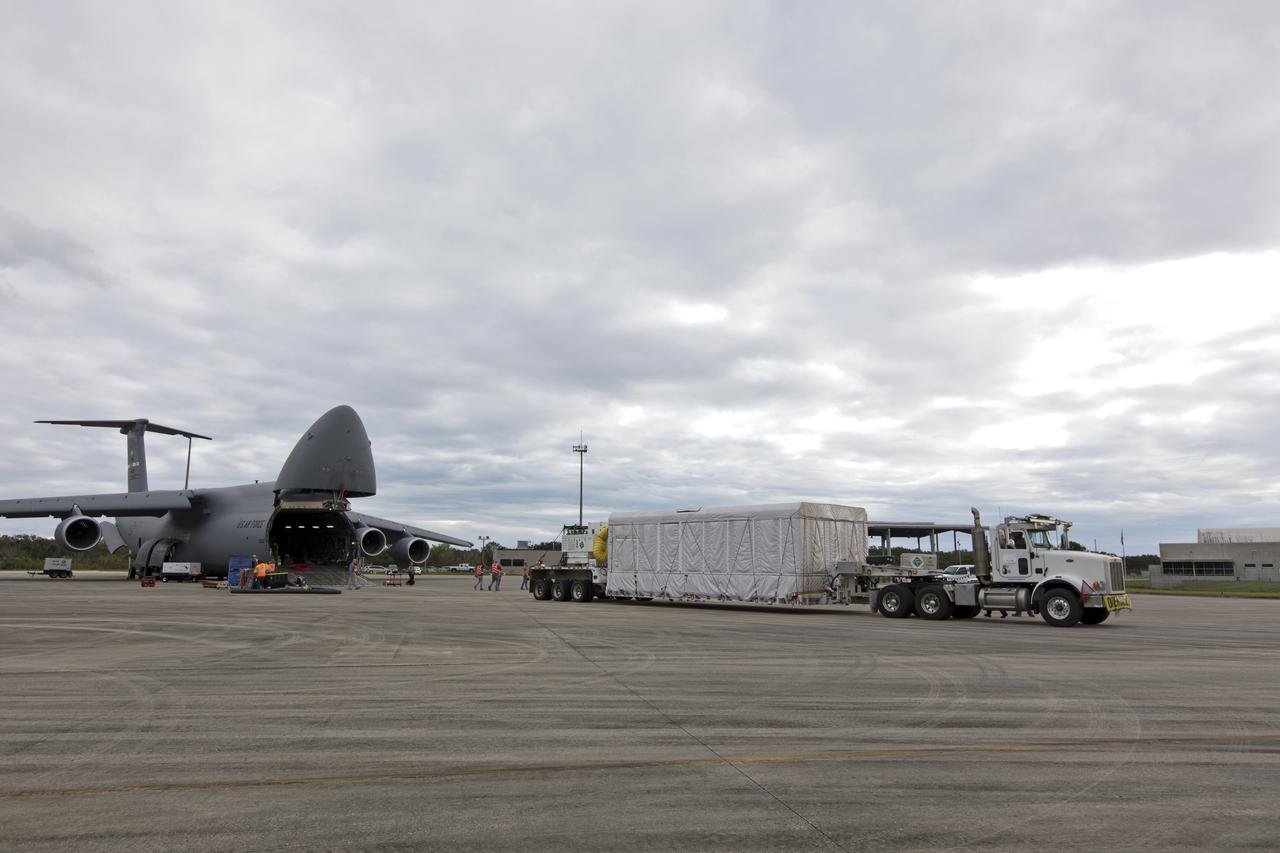
NOAA's Geostationary Operation Environmental Satellite-S (GOES-S) has been offloaded from a C-5 transport aircraft and secured onto the flatbed of a heavy-lift truck at the Shuttle Landing Facility at NASA's Kennedy Space Center in Florida. The satellite will be transported to the Astrotech Space Operations facility in Titusville, Florida to prepare it for launch. GOES-S is the second in a series of four advanced geostationary weather satellites. The GOES-R series - consisting of the GOES-R, GOES-S, GOES-T and GOES-U spacecraft - will significantly improve the detection and observation of environmental phenomena that directly affect public safety, protection of property and the nation's economic health and prosperity. GOES-S is slated to launch March 1, 2018 aboard a United Launch Alliance Atlas V rocket from Cape Canaveral Air Force Station in Florida.
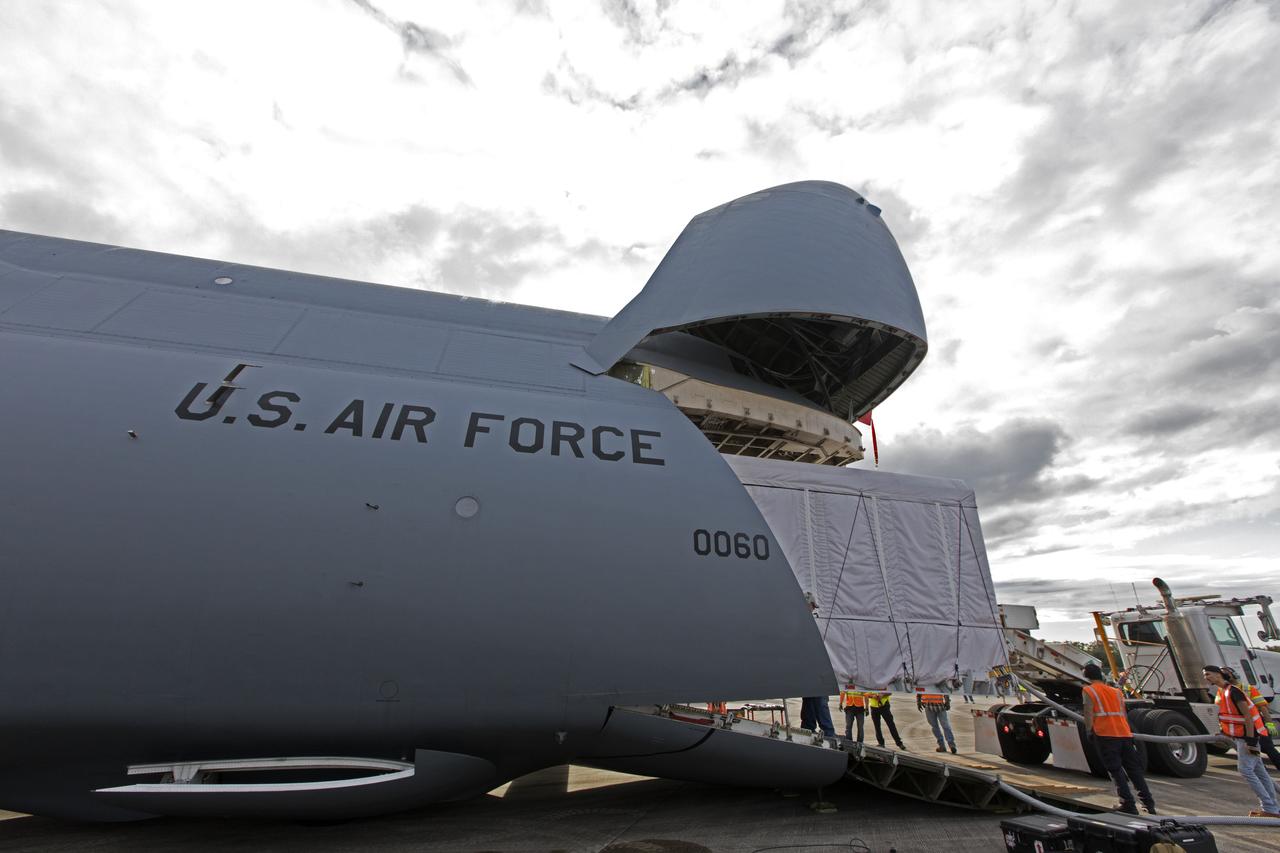
NOAA's Geostationary Operation Environmental Satellite-S (GOES-S) is being offloaded from a C-5 transport aircraft at the Shuttle Landing Facility at NASA's Kennedy Space Center in Florida. The satellite will be transported to the Astrotech Space Operations facility in Titusville, Florida to prepare it for launch. GOES-S is the second in a series of four advanced geostationary weather satellites. The GOES-R series - consisting of the GOES-R, GOES-S, GOES-T and GOES-U spacecraft - will significantly improve the detection and observation of environmental phenomena that directly affect public safety, protection of property and the nation's economic health and prosperity. GOES-S is slated to launch March 1, 2018 aboard a United Launch Alliance Atlas V rocket from Cape Canaveral Air Force Station in Florida.
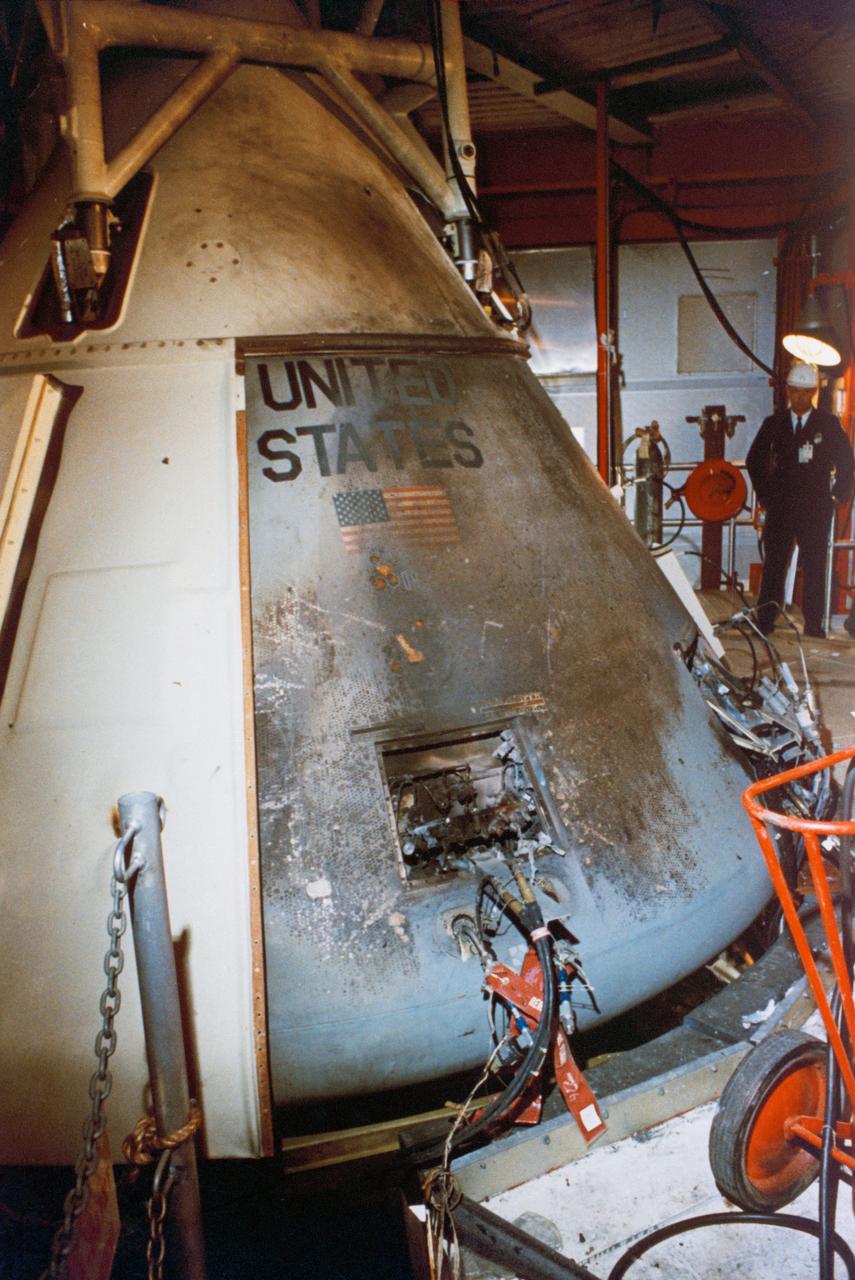
Closeup view of the interior of Apollo S/C 012 C/M, Pad 34, showing the effects of the intense heat of the flash fire which killed the Prime Crew of the A/S 204 Mission. CAPE KENNEDY, FL CAPE KENNEDY, FL
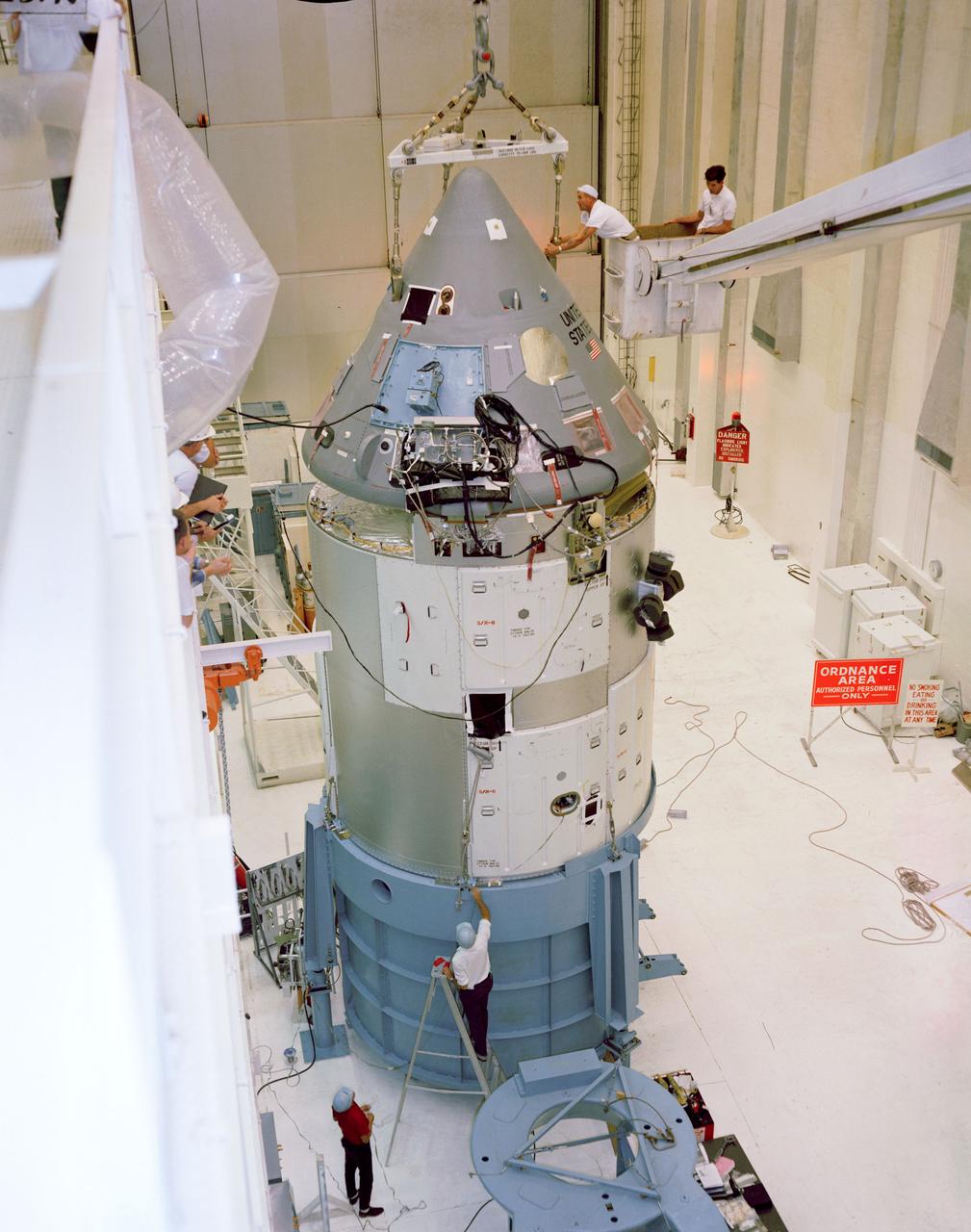
S67-15717 (1967) --- Apollo Spacecraft 012 Command/Service Module is moved from H-134 to east stokes for mating to the Saturn Lunar Module Adapter No. 05 in the Manned Spacecraft Operations Building. S/C 012 will be flown on the Apollo/Saturn 204 mission.

At Buckley Air Force Base in Aurora, Colorado, NOAA's Geostationary Operational Environmental Satellite-S (GOES-S) is being loaded into the cargo hold of a U.S. Air Force C-5M super Galaxy cargo aircraft. GOES-S will be flown to NASA's Kennedy Space Center in Florida. After it arrives at Kennedy's Shuttle Landing Facility, it will be offloaded and transported to the Astrotech Space Operations facility in Titusville, Florida, to prepare it for launch. GOES-S is the second in a series of four advanced geostationary weather satellites. The GOES-R series - consisting of the GOES-R, GOES-S, GOES-T and GOES-U spacecraft - will significantly improve the detection and observation of environmental phenomena that directly affect public safety, protection of property and the nation's economic health and prosperity. GOES-S is slated to launch March 1, 2018 aboard a United Launch Alliance Atlas V rocket from Cape Canaveral Air Force Station in Florida.
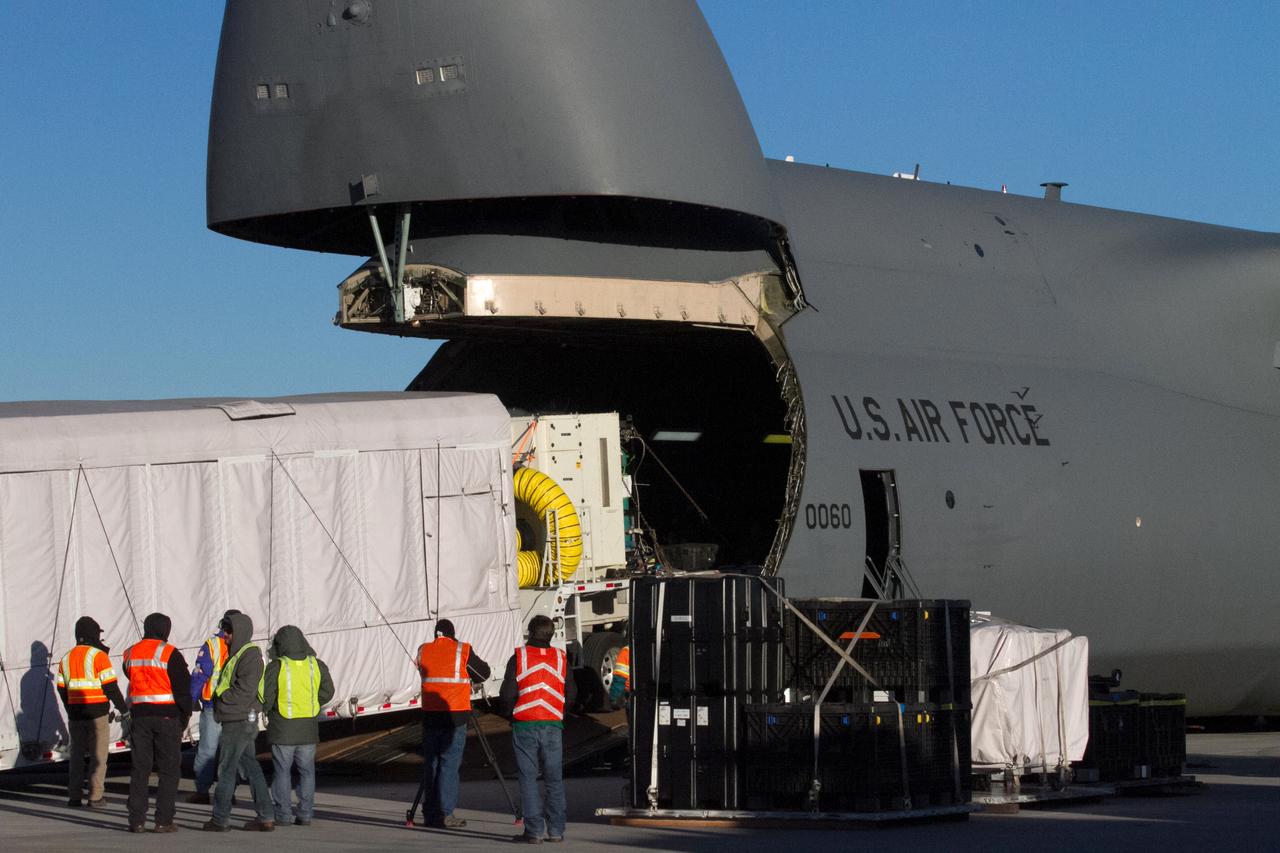
At Buckley Air Force Base in Aurora, Colorado, NOAA's Geostationary Operational Environmental Satellite-S (GOES-S) is being loaded into the cargo hold of a U.S. Air Force C-5M super Galaxy cargo aircraft. GOES-S will be flown to NASA's Kennedy Space Center in Florida. After it arrives at Kennedy's Shuttle Landing Facility, it will be offloaded and transported to the Astrotech Space Operations facility in Titusville, Florida, to prepare it for launch. GOES-S is the second in a series of four advanced geostationary weather satellites. The GOES-R series - consisting of the GOES-R, GOES-S, GOES-T and GOES-U spacecraft - will significantly improve the detection and observation of environmental phenomena that directly affect public safety, protection of property and the nation's economic health and prosperity. GOES-S is slated to launch March 1, 2018 aboard a United Launch Alliance Atlas V rocket from Cape Canaveral Air Force Station in Florida.

At Buckley Air Force Base in Aurora, Colorado, NOAA's Geostationary Operational Environmental Satellite-S (GOES-S) is being loaded into the cargo hold of a U.S. Air Force C-5M super Galaxy cargo aircraft. GOES-S will be flown to NASA's Kennedy Space Center in Florida. After it arrives at Kennedy's Shuttle Landing Facility, it will be offloaded and transported to the Astrotech Space Operations facility in Titusville, Florida, to prepare it for launch. GOES-S is the second in a series of four advanced geostationary weather satellites. The GOES-R series - consisting of the GOES-R, GOES-S, GOES-T and GOES-U spacecraft - will significantly improve the detection and observation of environmental phenomena that directly affect public safety, protection of property and the nation's economic health and prosperity. GOES-S is slated to launch March 1, 2018 aboard a United Launch Alliance Atlas V rocket from Cape Canaveral Air Force Station in Florida.
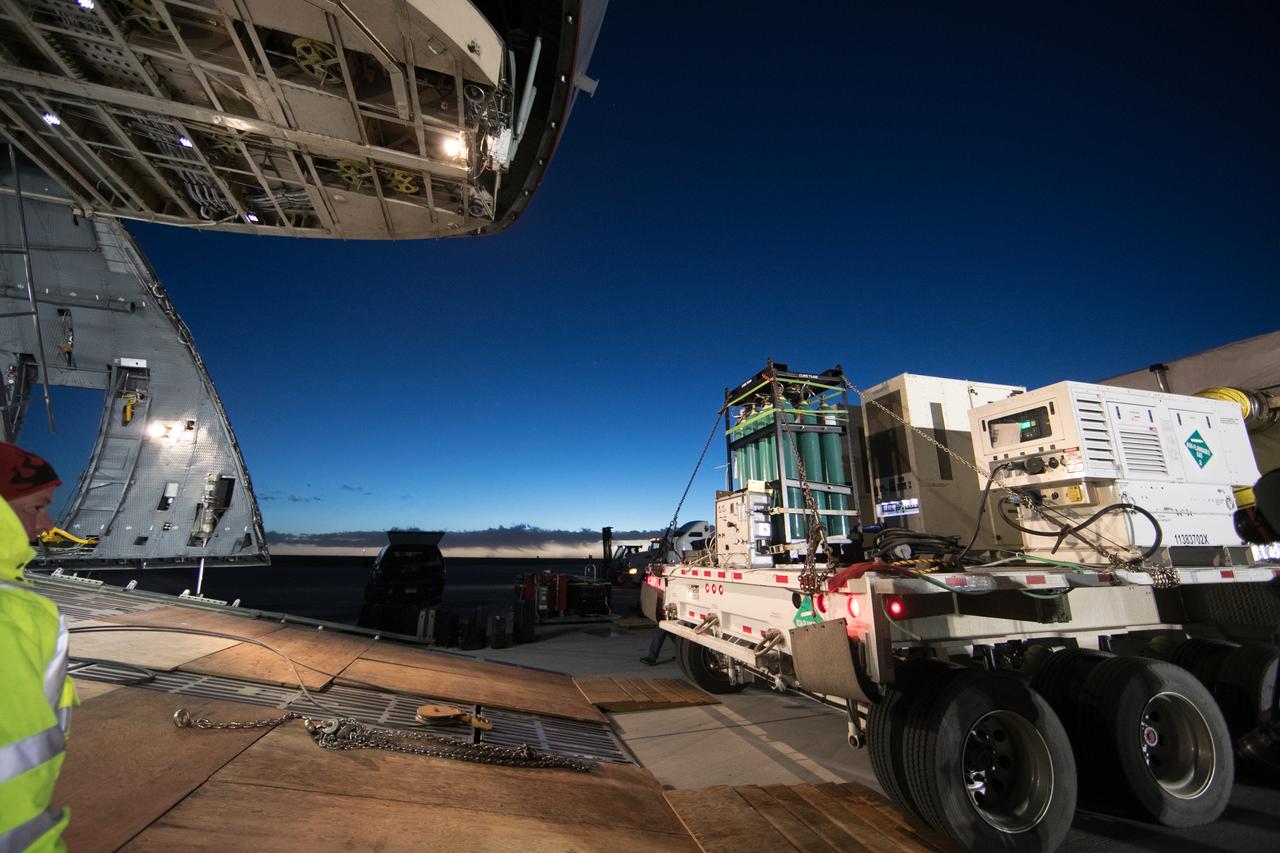
At Buckley Air Force Base in Aurora, Colorado, NOAA's Geostationary Operational Environmental Satellite-S (GOES-S) is being loaded into the cargo hold of a U.S. Air Force C-5M super Galaxy cargo aircraft. GOES-S will be flown to NASA's Kennedy Space Center in Florida. After it arrives at Kennedy's Shuttle Landing Facility, it will be offloaded and transported to the Astrotech Space Operations facility in Titusville, Florida, to prepare it for launch. GOES-S is the second in a series of four advanced geostationary weather satellites. The GOES-R series - consisting of the GOES-R, GOES-S, GOES-T and GOES-U spacecraft - will significantly improve the detection and observation of environmental phenomena that directly affect public safety, protection of property and the nation's economic health and prosperity. GOES-S is slated to launch March 1, 2018 aboard a United Launch Alliance Atlas V rocket from Cape Canaveral Air Force Station in Florida.
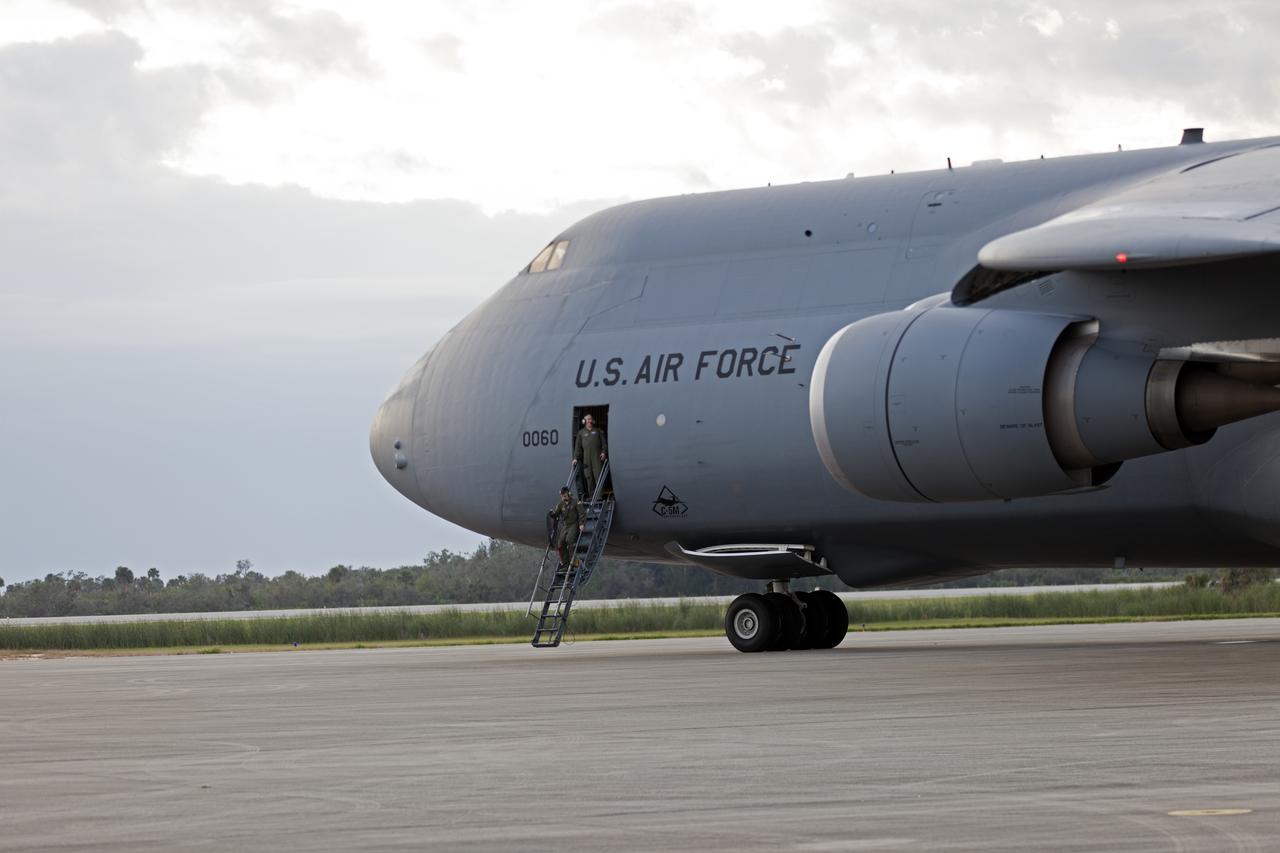
A C-5 transport aircraft arrives at the Shuttle Landing Facility at NASA's Kennedy Space Center in Florida, carrying the Geostationary Operation Environmental Satellite-S (GOES-S). The satellite will be offloaded and transported to the Astrotech Space Operations facility in Titusville, Florida. GOES-S is the second in a series of four advanced geostationary weather satellites. The GOES-R series - consisting of the GOES-R, GOES-S, GOES-T and GOES-U spacecraft - will significantly improve the detection and observation of environmental phenomena that directly affect public safety, protection of property and the nation's economic health and prosperity. GOES-S is slated to launch March 1, 2018 aboard a United Launch Alliance Atlas V rocket from Cape Canaveral Air Force Station in Florida.
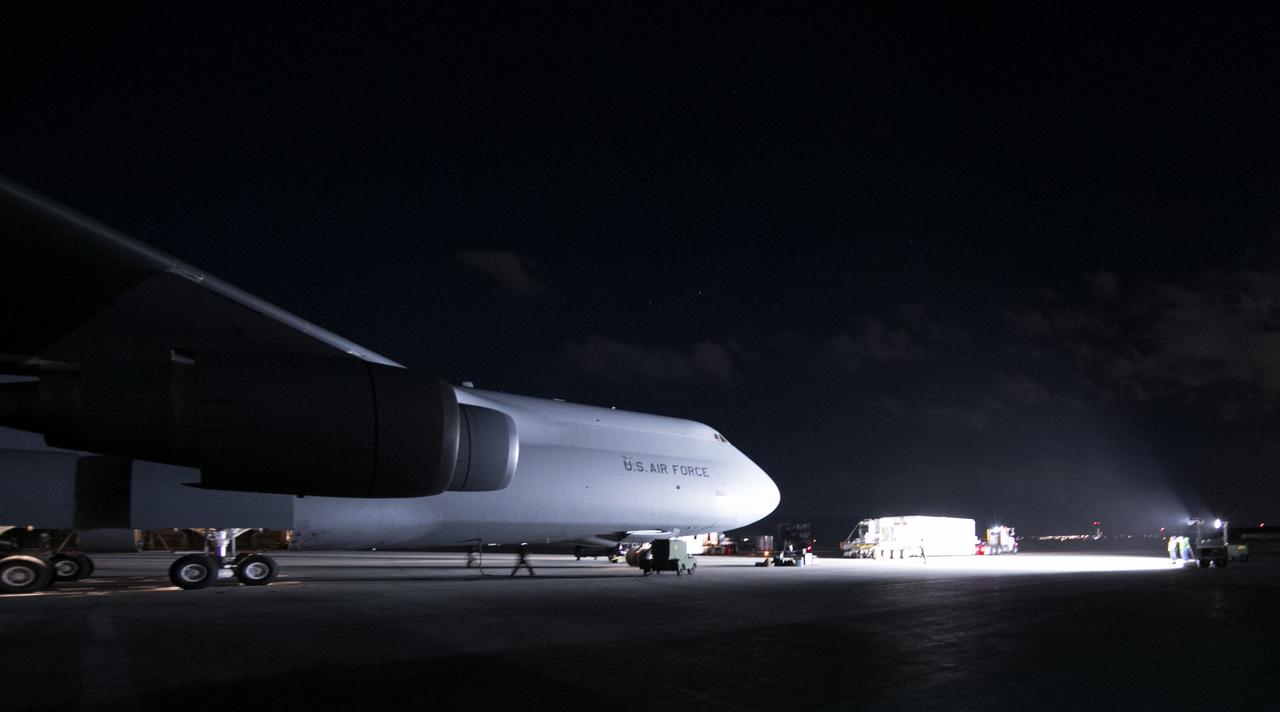
NOAA's Geostationary Operational Environmental Satellite-S (GOES-S) will be loaded into a U.S. Air Force C-5M Super Galaxy cargo aircraft and flown to NASA's Kennedy Space Center in Florida. After it arrives at Kennedy's Shuttle Landing Facility, it will be offloaded and transported to the Astrotech Space Operations facility in Titusville, Florida, to prepare it for launch. GOES-S is the second in a series of four advanced geostationary weather satellites. The GOES-R series - consisting of the GOES-R, GOES-S, GOES-T and GOES-U spacecraft - will significantly improve the detection and observation of environmental phenomena that directly affect public safety, protection of property and the nation's economic health and prosperity. GOES-S is slated to launch March 1, 2018 aboard a United Launch Alliance Atlas V rocket from Cape Canaveral Air Force Station in Florida.
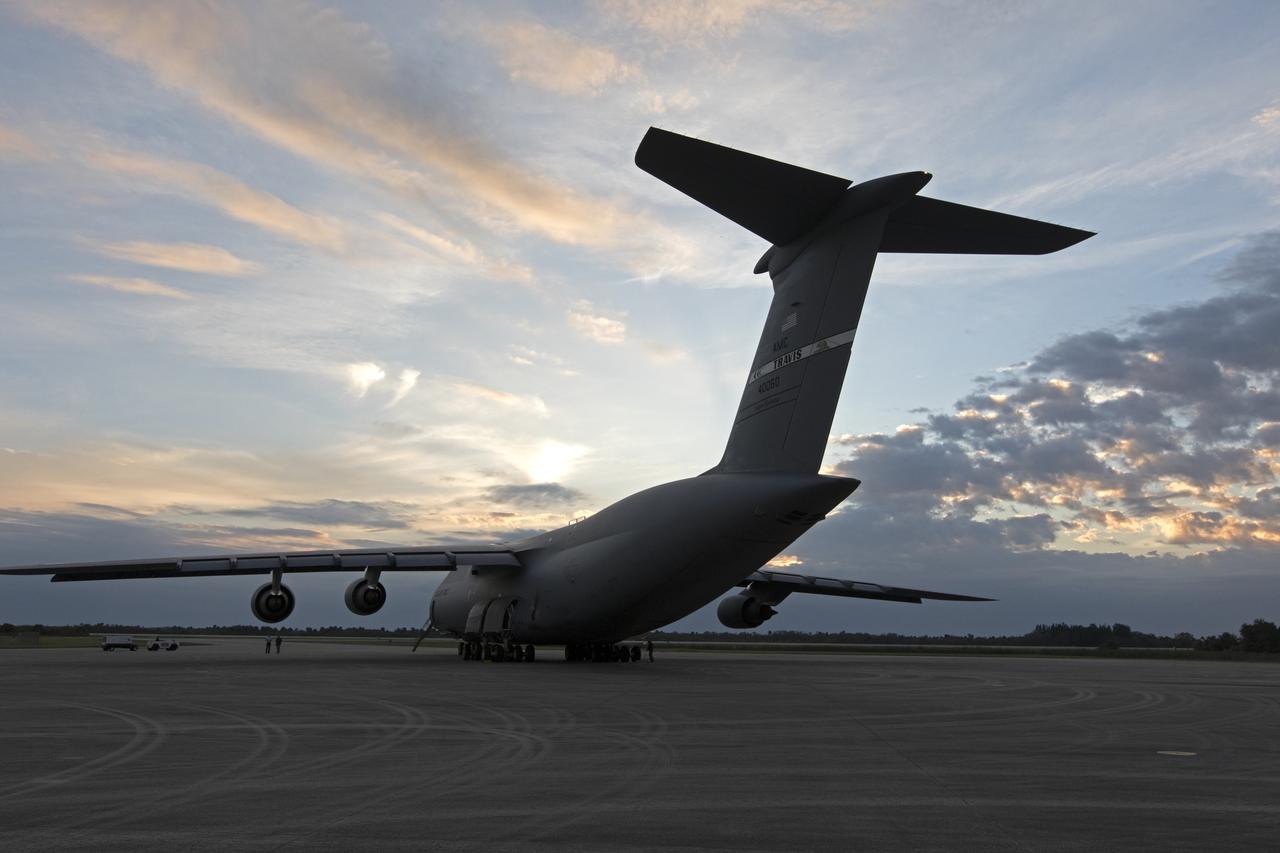
A C-5 transport aircraft arrives at the Shuttle Landing Facility at NASA's Kennedy Space Center in Florida, carrying the Geostationary Operation Environmental Satellite-S (GOES-S). The satellite will be offloaded and transported to the Astrotech Space Operations facility in Titusville, Florida. GOES-S is the second in a series of four advanced geostationary weather satellites. The GOES-R series - consisting of the GOES-R, GOES-S, GOES-T and GOES-U spacecraft - will significantly improve the detection and observation of environmental phenomena that directly affect public safety, protection of property and the nation's economic health and prosperity. GOES-S is slated to launch March 1, 2018 aboard a United Launch Alliance Atlas V rocket from Cape Canaveral Air Force Station in Florida.
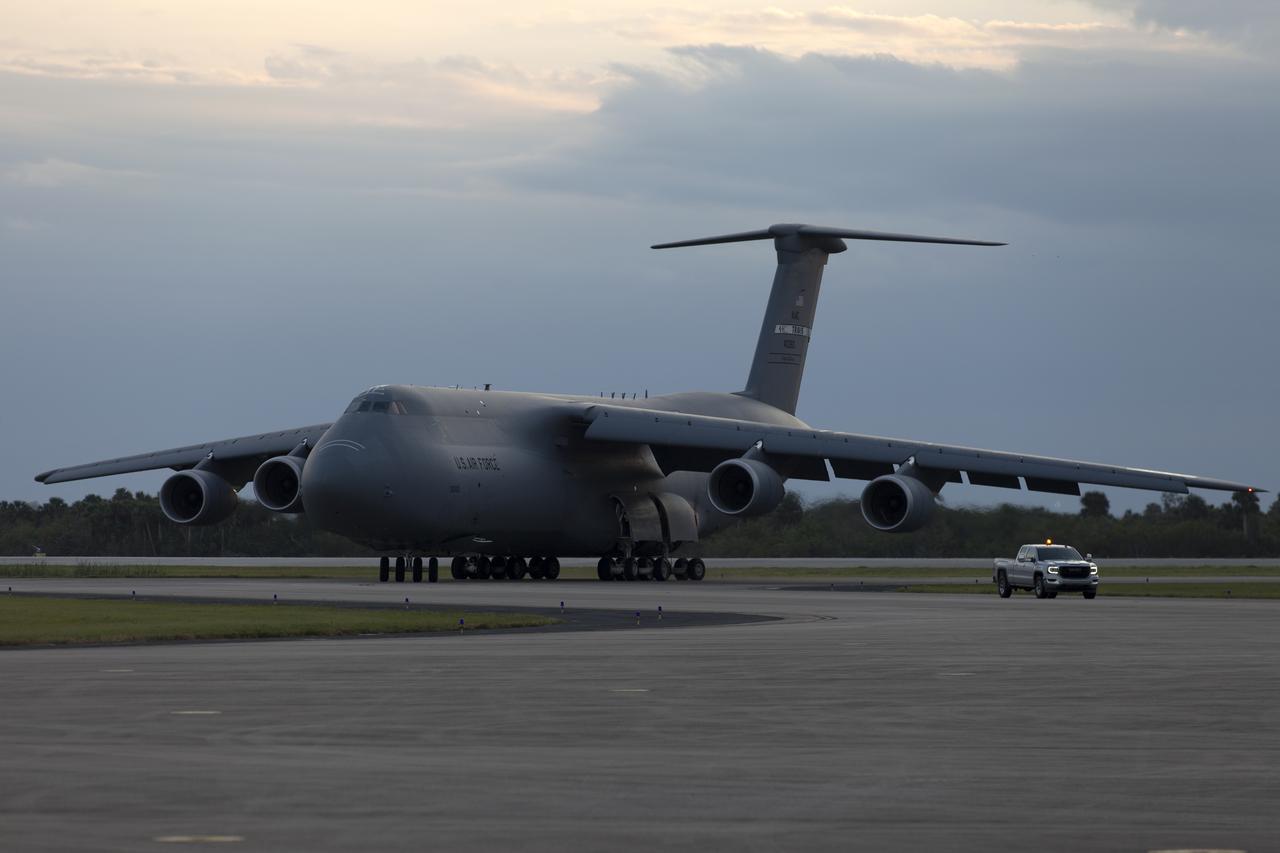
A C-5 transport aircraft arrives at the Shuttle Landing Facility at NASA's Kennedy Space Center in Florida, carrying the Geostationary Operation Environmental Satellite-S (GOES-S). The satellite will be offloaded and transported to the Astrotech Space Operations facility in Titusville, Florida. GOES-S is the second in a series of four advanced geostationary weather satellites. The GOES-R series - consisting of the GOES-R, GOES-S, GOES-T and GOES-U spacecraft - will significantly improve the detection and observation of environmental phenomena that directly affect public safety, protection of property and the nation's economic health and prosperity. GOES-S is slated to launch March 1, 2018 aboard a United Launch Alliance Atlas V rocket from Cape Canaveral Air Force Station in Florida.
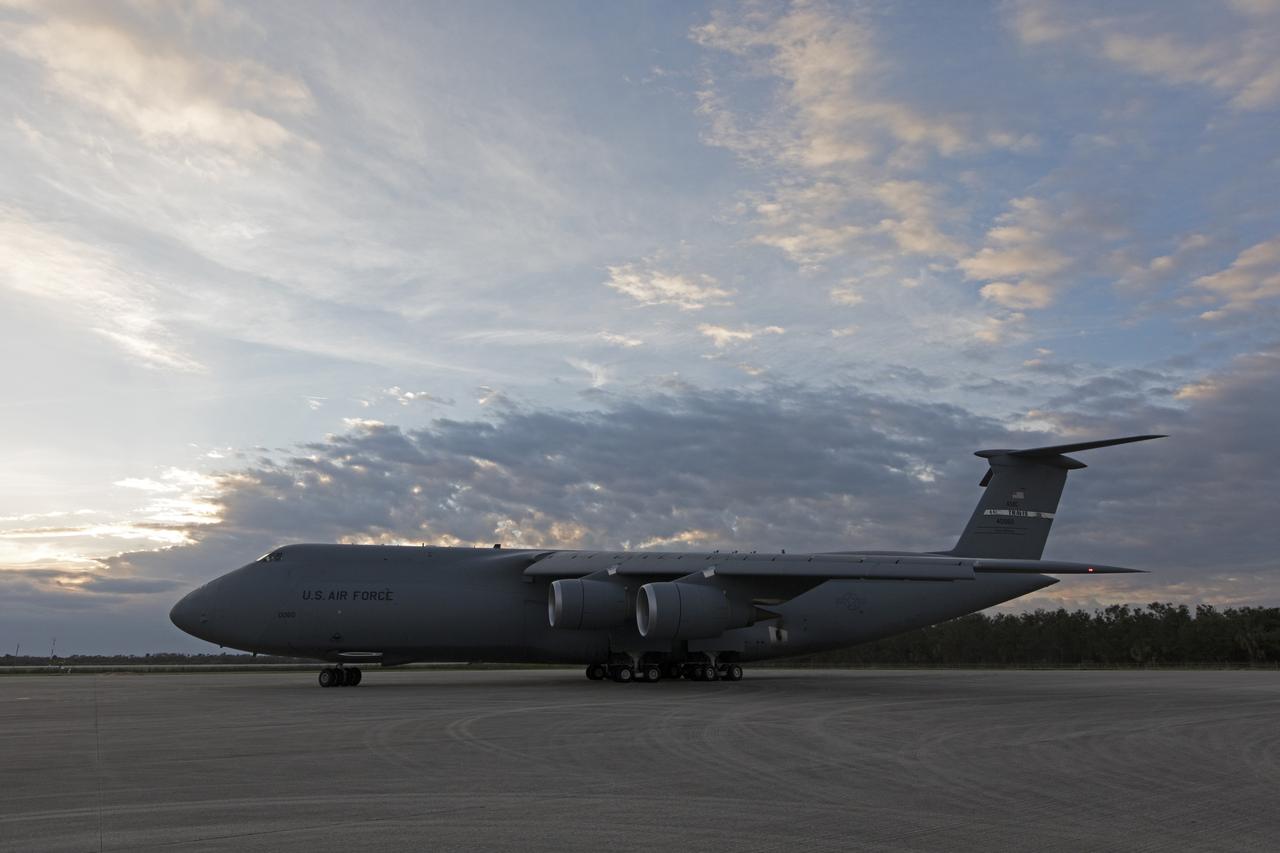
A C-5 transport aircraft arrives at the Shuttle Landing Facility at NASA's Kennedy Space Center in Florida, carrying the Geostationary Operation Environmental Satellite-S (GOES-S). The satellite will be offloaded and transported to the Astrotech Space Operations facility in Titusville, Florida. GOES-S is the second in a series of four advanced geostationary weather satellites. The GOES-R series - consisting of the GOES-R, GOES-S, GOES-T and GOES-U spacecraft - will significantly improve the detection and observation of environmental phenomena that directly affect public safety, protection of property and the nation's economic health and prosperity. GOES-S is slated to launch March 1, 2018 aboard a United Launch Alliance Atlas V rocket from Cape Canaveral Air Force Station in Florida.
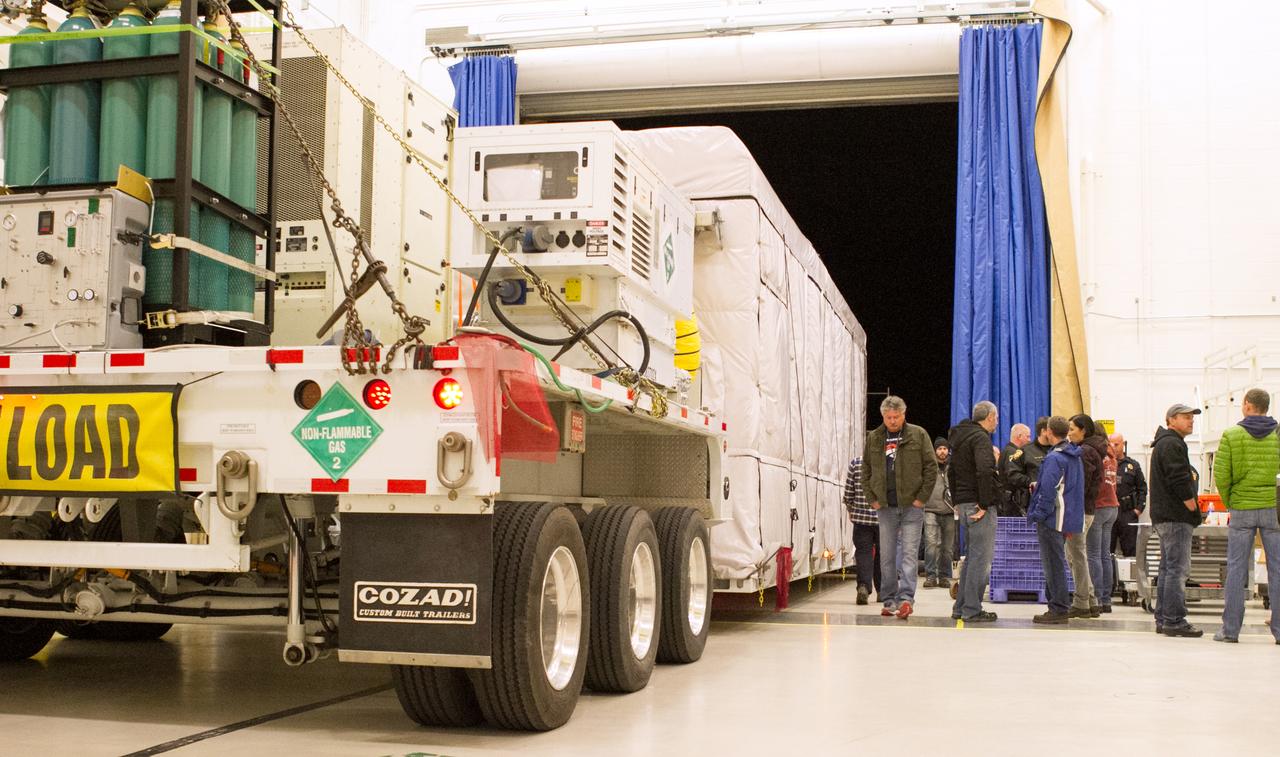
NOAA's Geostationary Operational Environmental Satellite-S (GOES-S) is prepared for transport at the Lockheed Martin facility in Littleton, Colorado, where it was built and assembled. GOES-S will be loaded into a U.S. Air Force C-5M Super Galaxy cargo aircraft at Buckley Air Force Base in Aurora, Colorado, and flown to NASA's Kennedy Space Center in Florida. After it arrives at Kennedy's Shuttle Landing Facility, it will be offloaded and transported to the Astrotech Space Operations facility in Titusville, Florida, to prepare it for launch. GOES-S is the second in a series of four advanced geostationary weather satellites. The GOES-R series - consisting of the GOES-R, GOES-S, GOES-T and GOES-U spacecraft - will significantly improve the detection and observation of environmental phenomena that directly affect public safety, protection of property and the nation's economic health and prosperity. GOES-S is slated to launch March 1, 2018 aboard a United Launch Alliance Atlas V rocket from Cape Canaveral Air Force Station in Florida.
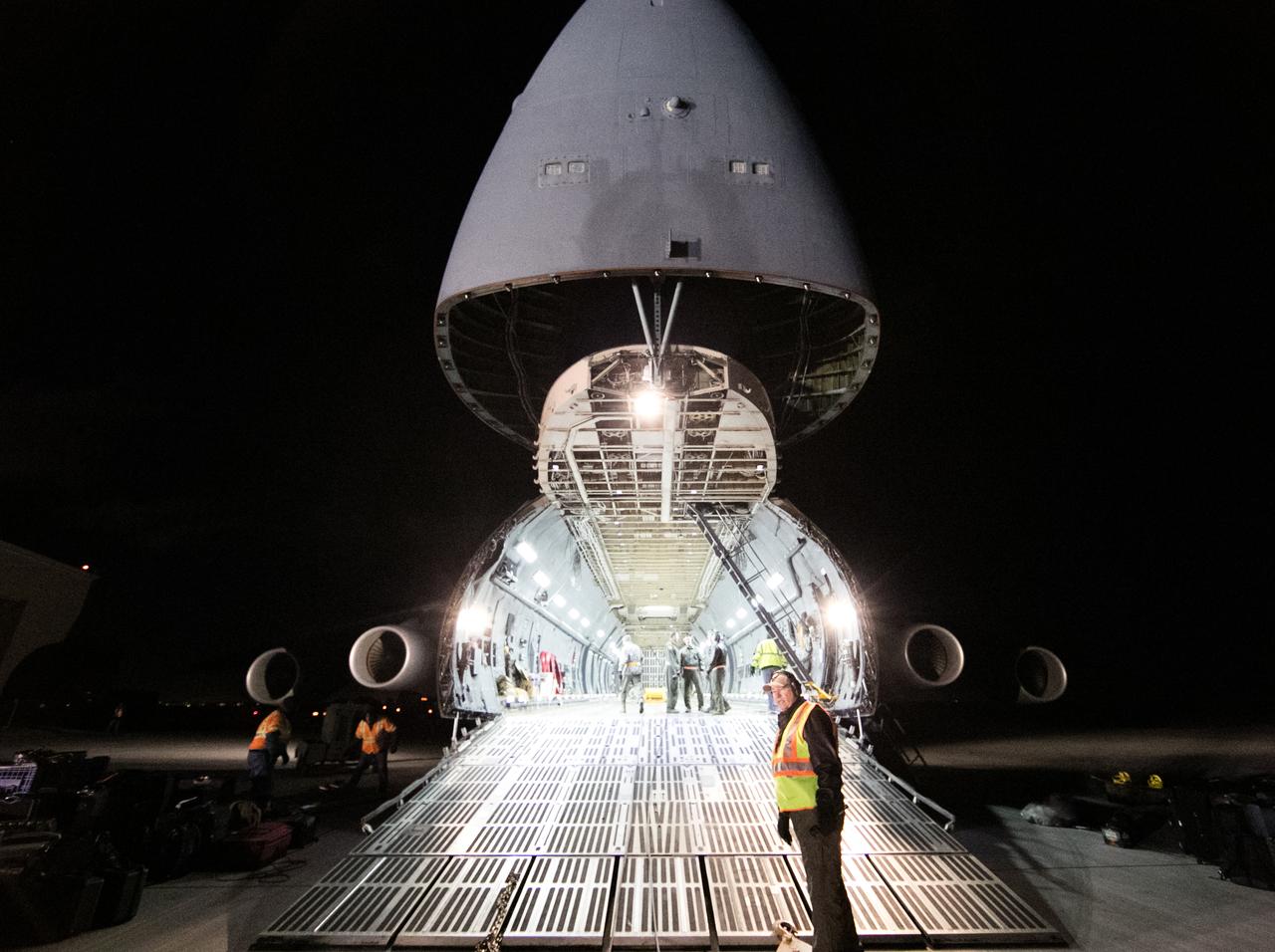
At Buckley Air Force Base in Aurora, Colorado, the front of a U.S. Air Force C-5M super Galaxy cargo aircraft has been raised to allow NOAA's Geostationary Operational Environmental Satellite-S (GOES-S) to be loaded into the cargo hold. GOES-S will be flown to NASA's Kennedy Space Center in Florida. After it arrives at Kennedy's Shuttle Landing Facility, it will be offloaded and transported to the Astrotech Space Operations facility in Titusville, Florida, to prepare it for launch. GOES-S is the second in a series of four advanced geostationary weather satellites. The GOES-R series - consisting of the GOES-R, GOES-S, GOES-T and GOES-U spacecraft - will significantly improve the detection and observation of environmental phenomena that directly affect public safety, protection of property and the nation's economic health and prosperity. GOES-S is slated to launch March 1, 2018 aboard a United Launch Alliance Atlas V rocket from Cape Canaveral Air Force Station in Florida.
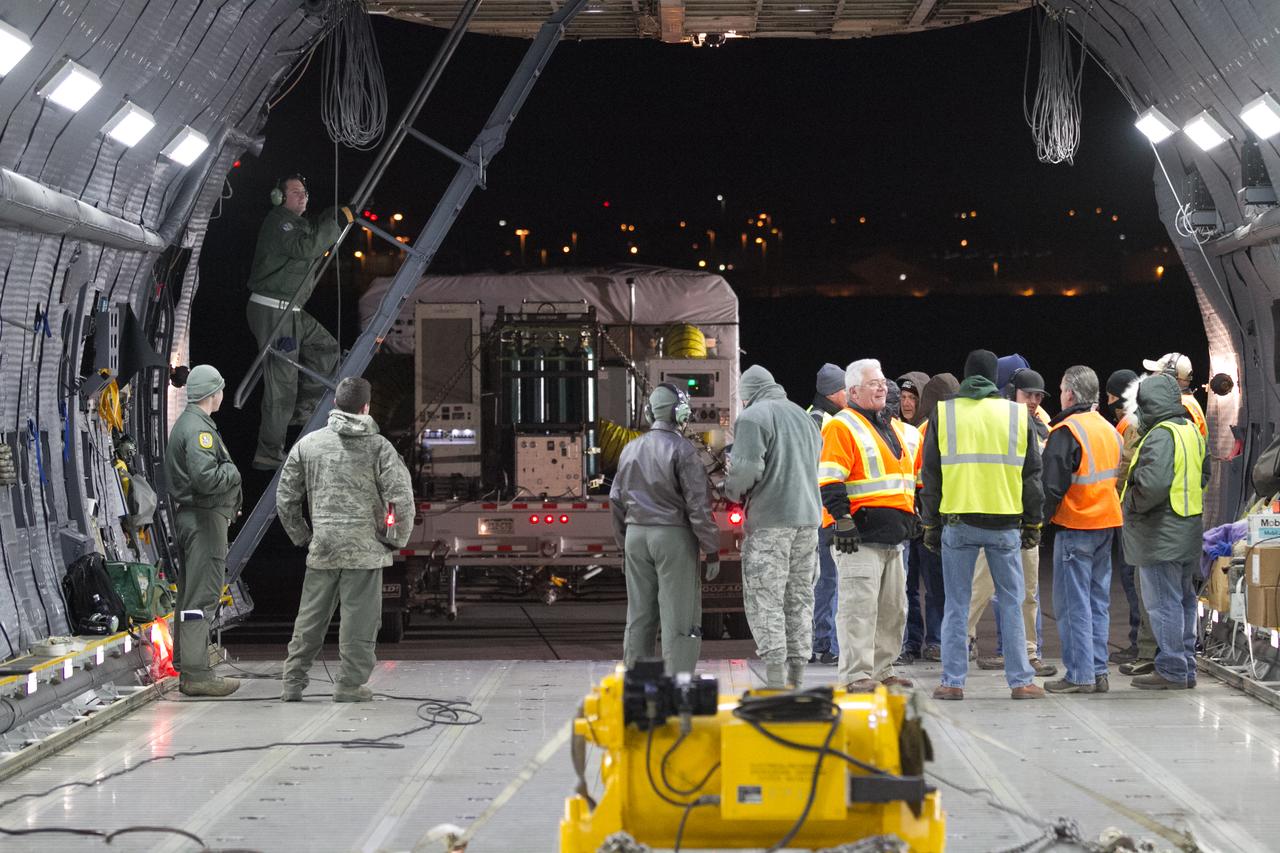
At Buckley Air Force Base in Aurora, Colorado, the front of a U.S. Air Force C-5M super Galaxy cargo aircraft has been raised to allow NOAA's Geostationary Operational Environmental Satellite-S (GOES-S) to be loaded into the cargo hold. GOES-S will be flown to NASA's Kennedy Space Center in Florida. After it arrives at Kennedy's Shuttle Landing Facility, it will be offloaded and transported to the Astrotech Space Operations facility in Titusville, Florida, to prepare it for launch. GOES-S is the second in a series of four advanced geostationary weather satellites. The GOES-R series - consisting of the GOES-R, GOES-S, GOES-T and GOES-U spacecraft - will significantly improve the detection and observation of environmental phenomena that directly affect public safety, protection of property and the nation's economic health and prosperity. GOES-S is slated to launch March 1, 2018 aboard a United Launch Alliance Atlas V rocket from Cape Canaveral Air Force Station in Florida.
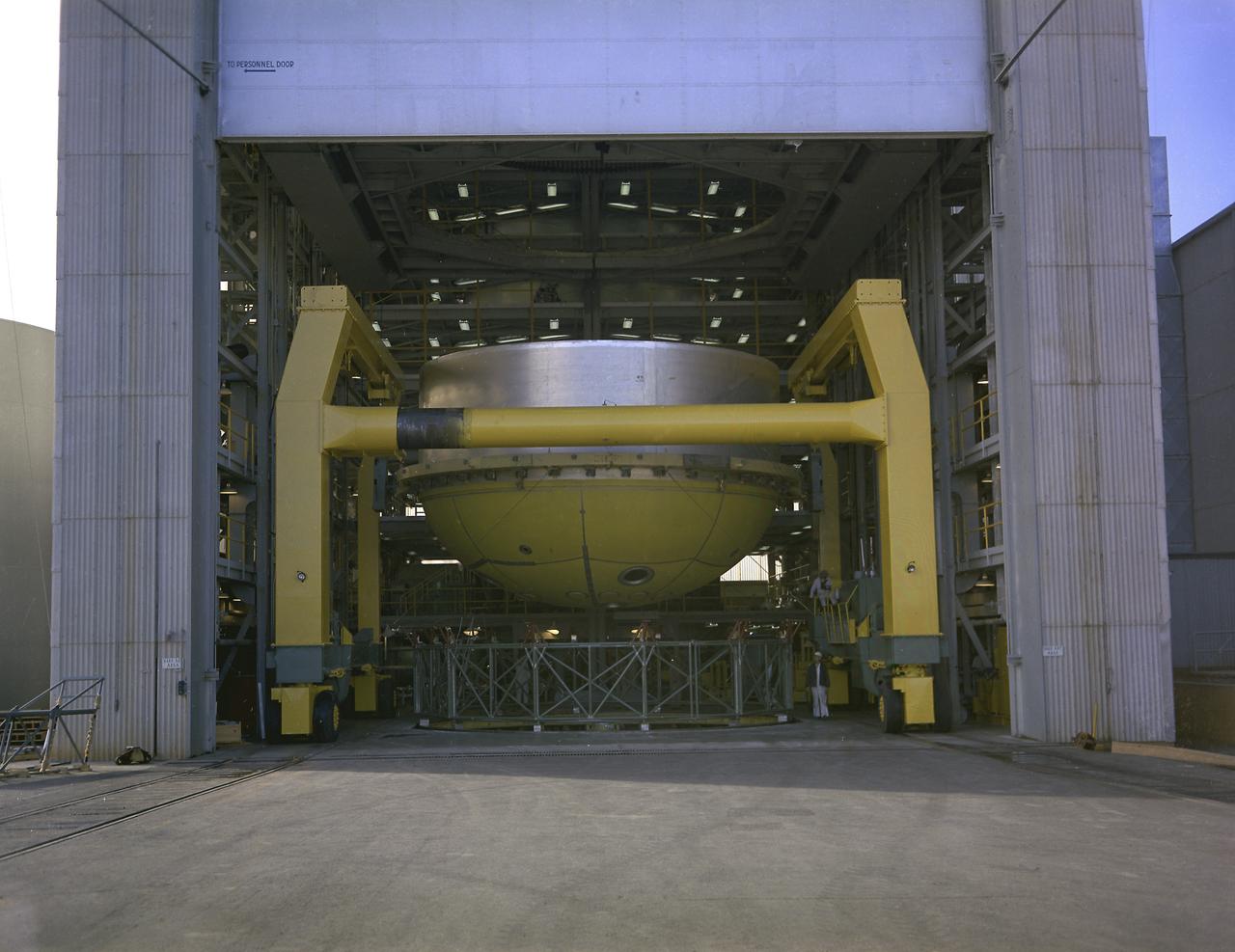
This photograph shows a fuel tank lower half for the Saturn V S-IC-T stage (the S-IC stage for static testing) on a C-frame transporter inside the vertical assembly building at the Marshall Space Flight Center.
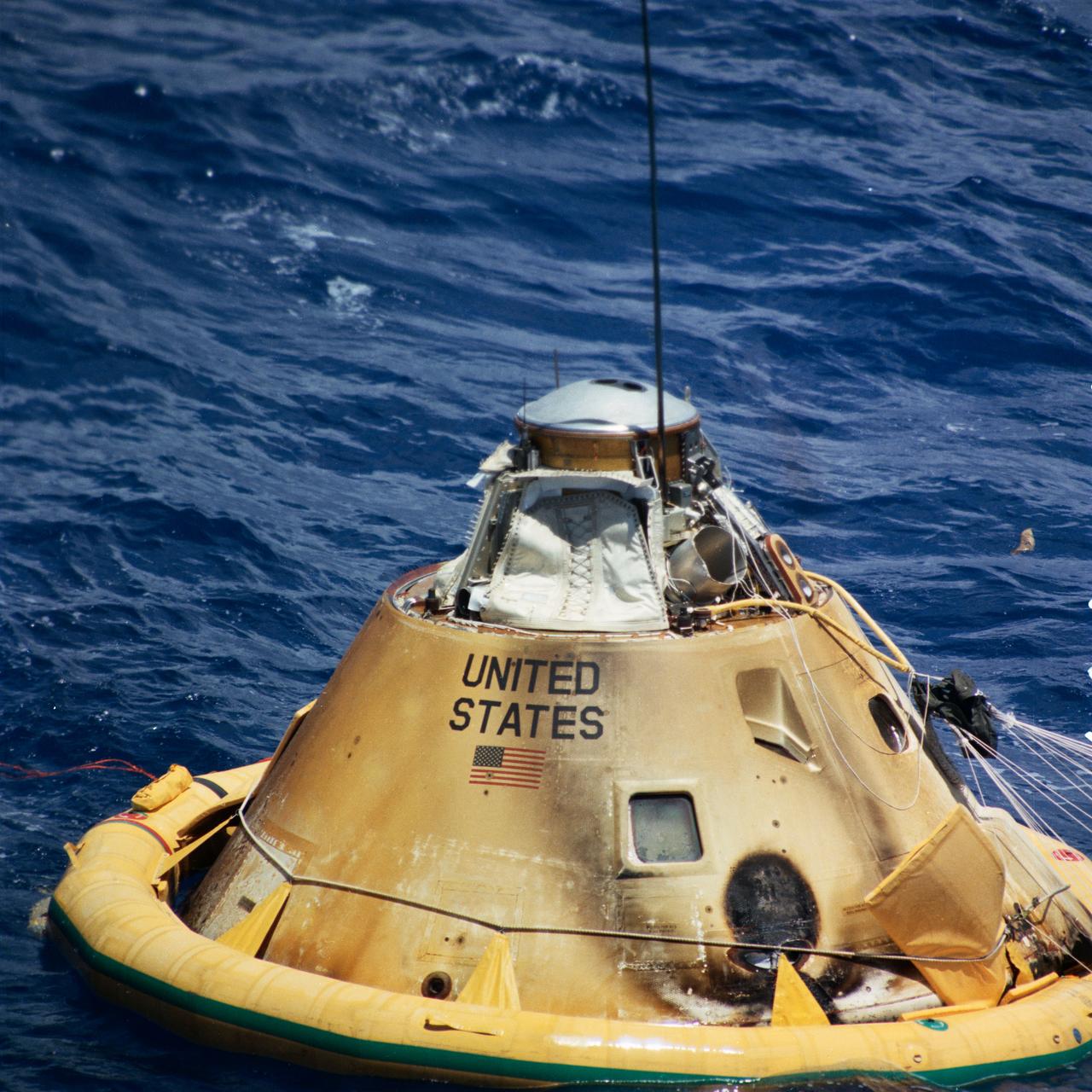
A/S 202 Command Module (C/M) attached to flotation collar. RECOVERY AREA, CENTRAL PACIFIC OCEAN
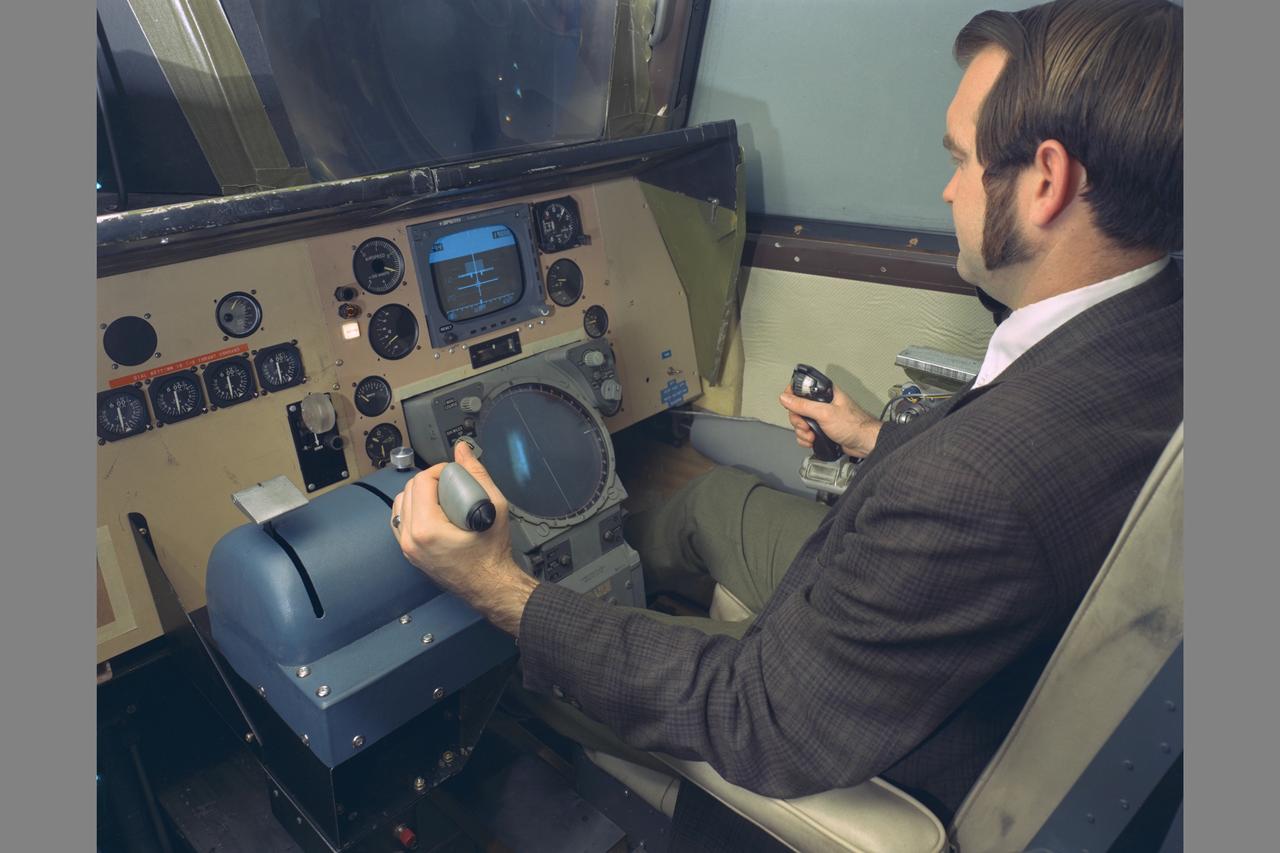
PILOT KENNETH C. WHITE IN CHAIR. Space Shuttle Vehicle Simulation. SSV COCKPIT IN THE MOVING-CAB TRANSPORT SIMULATOR (S.16)
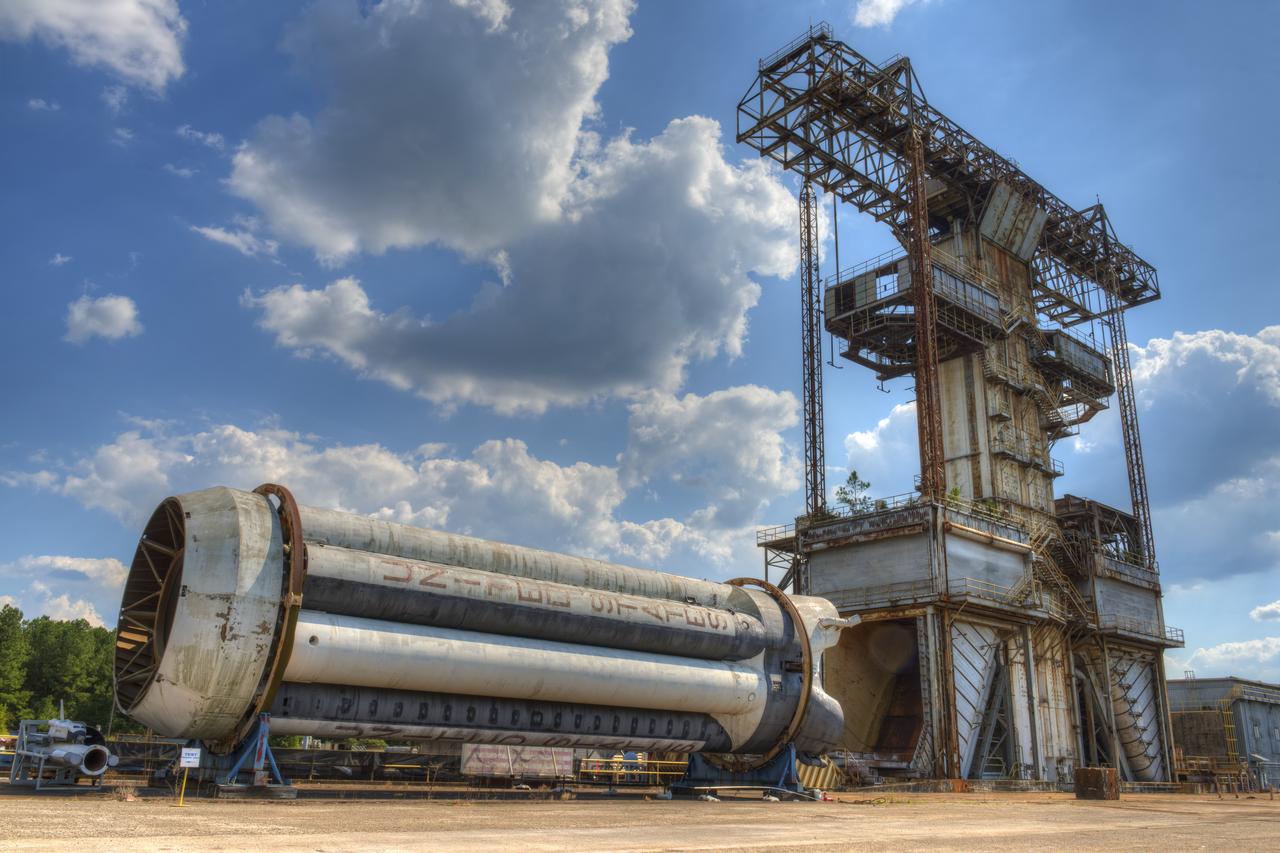
PROPULSION AND STRUCTURAL TEST FACILITY (BUILDING 4572) AT THE GEORGE C. MARSHALL SPACE FLIGHT CENTER IN HUNTSVILLE, ALABAMA WITH THE SATURN S-1B STAGE (SA-) IN FOREGROUND
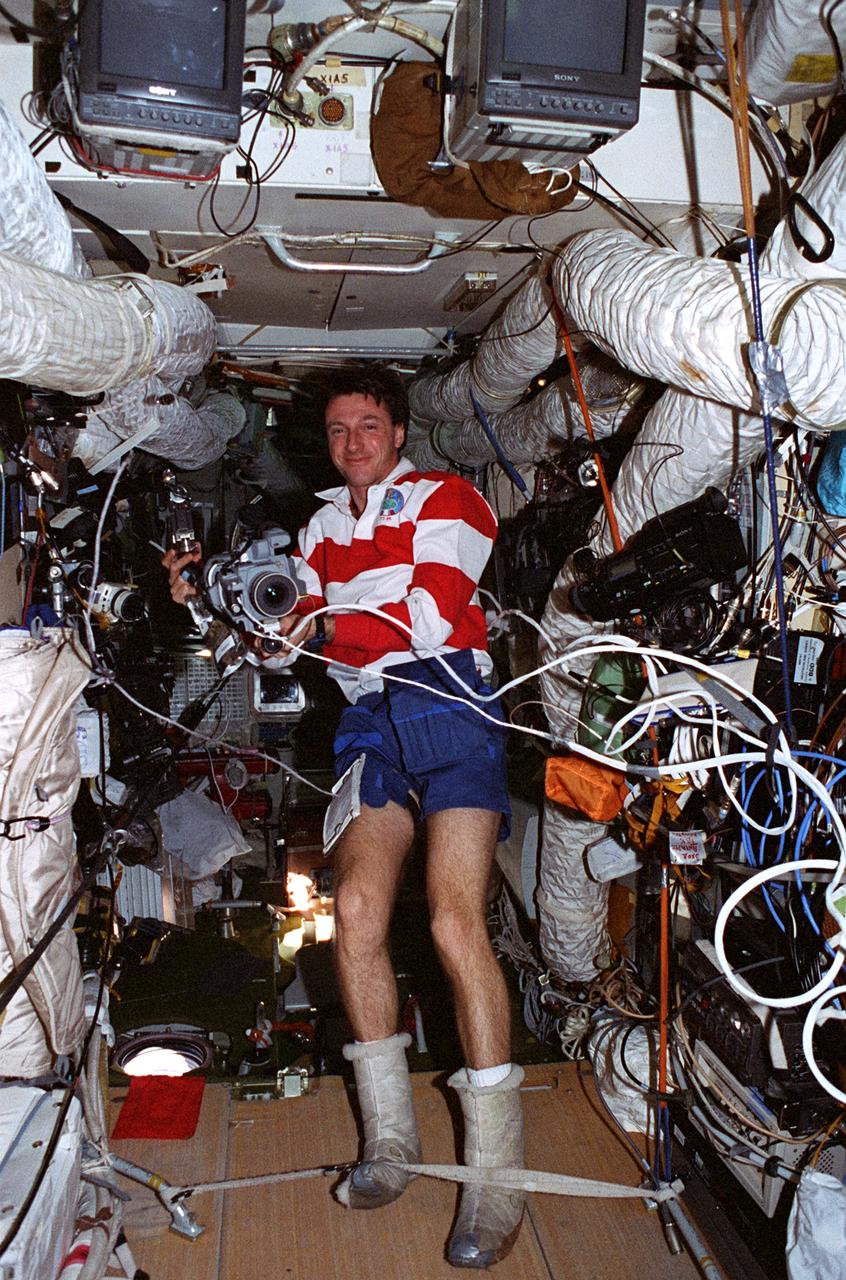
STS086-405-008 (25 Sept-6 Oct 1997) --- Astronaut C. Michael Foale, sporting attire representing the STS-86 crew after four months aboard Russia?s Mir Space Station in Russian wear, operates a video camera in Mir?s Base Block Module. Photo credit: NASA
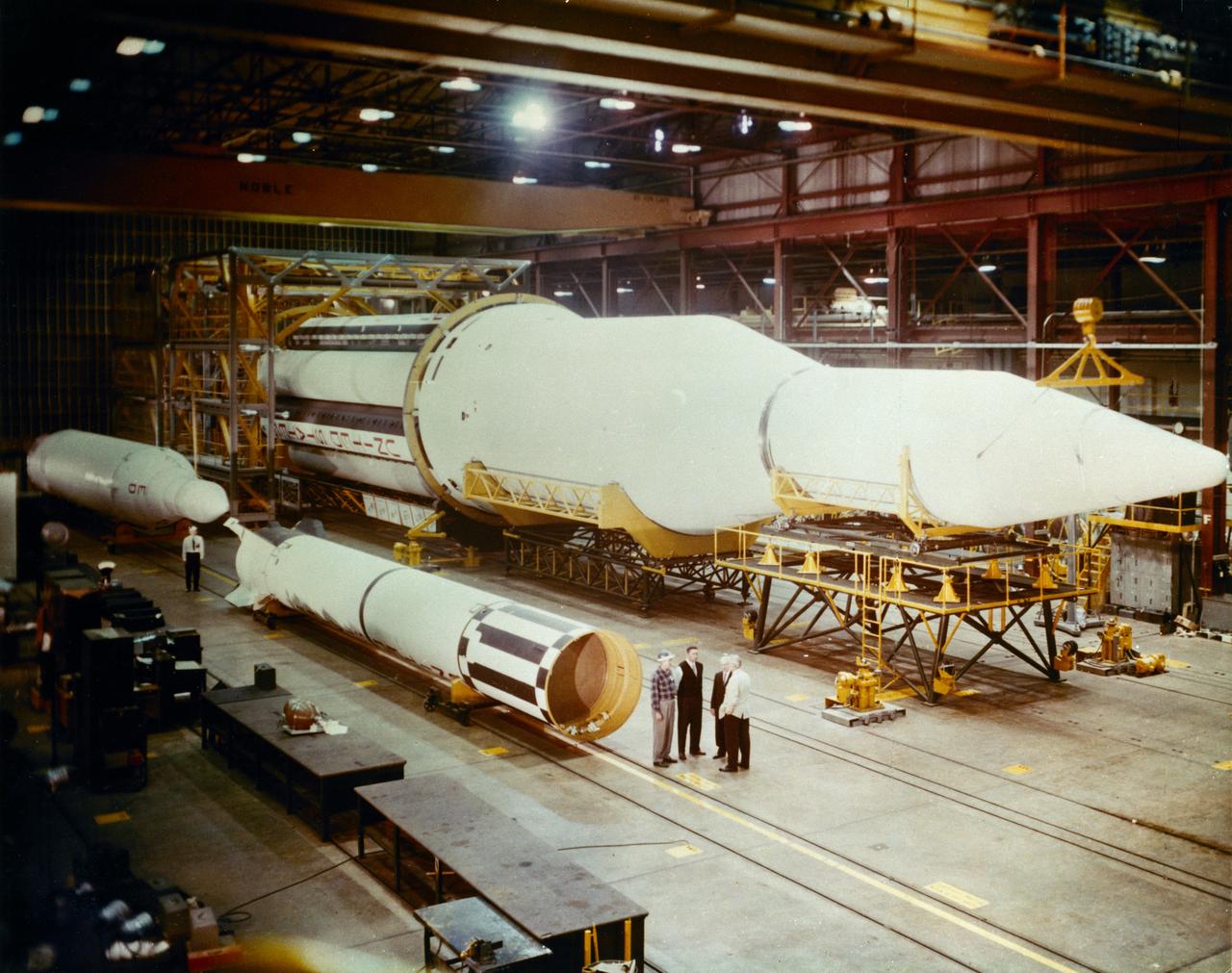
Progress in the Saturn program, depicted below, was described by Dr. Wernher von Braun, Marshall Space Flight Center (MSFC) Director, in an appearance before the Senate Committee of Aeronautical and Space Sciences. "The flight configuration of the giant three-stage Saturn C-1 rocket (later called Saturn I Block I) is seen in the Fabrication and Assembly Engineering Division at MSFC. Dwarfed by the 180-foot C-1 are a Juno II rocket (left rear) and a Mercury-Redstone rocket (front foreground). The C-1 (first version of the Saturn rocket) is composed of an S-1 first stage or booster (rear), powered by eight H-1 engines having a thrust of 1,500,000 pounds, followed by a dummy S-IV second stage and a dummy S-V third stage. The "live" S-IV for later flights, under development by Douglas Aircraft Co., will be powered by four Pratt Whitney LR-119 engines having 17,500,000 pounds thrust each. The live S-V, under development by Convair Division of General Dynamics Corp., will use two LR-119 engines. With all three stages live, the C-1 will be capable of placing 19,000 pounds into a 300-mile Earth orbit, sending 5,000 pounds to escape velocity, or lofting 2,500 pounds to Mars or Venus. The second version Saturn C-2 (later called Saturn 1 Block II) would double these capabilities. Early C-1 flights will employ a live S-1 with dummy upper stages. The first such flight is scheduled late this year."
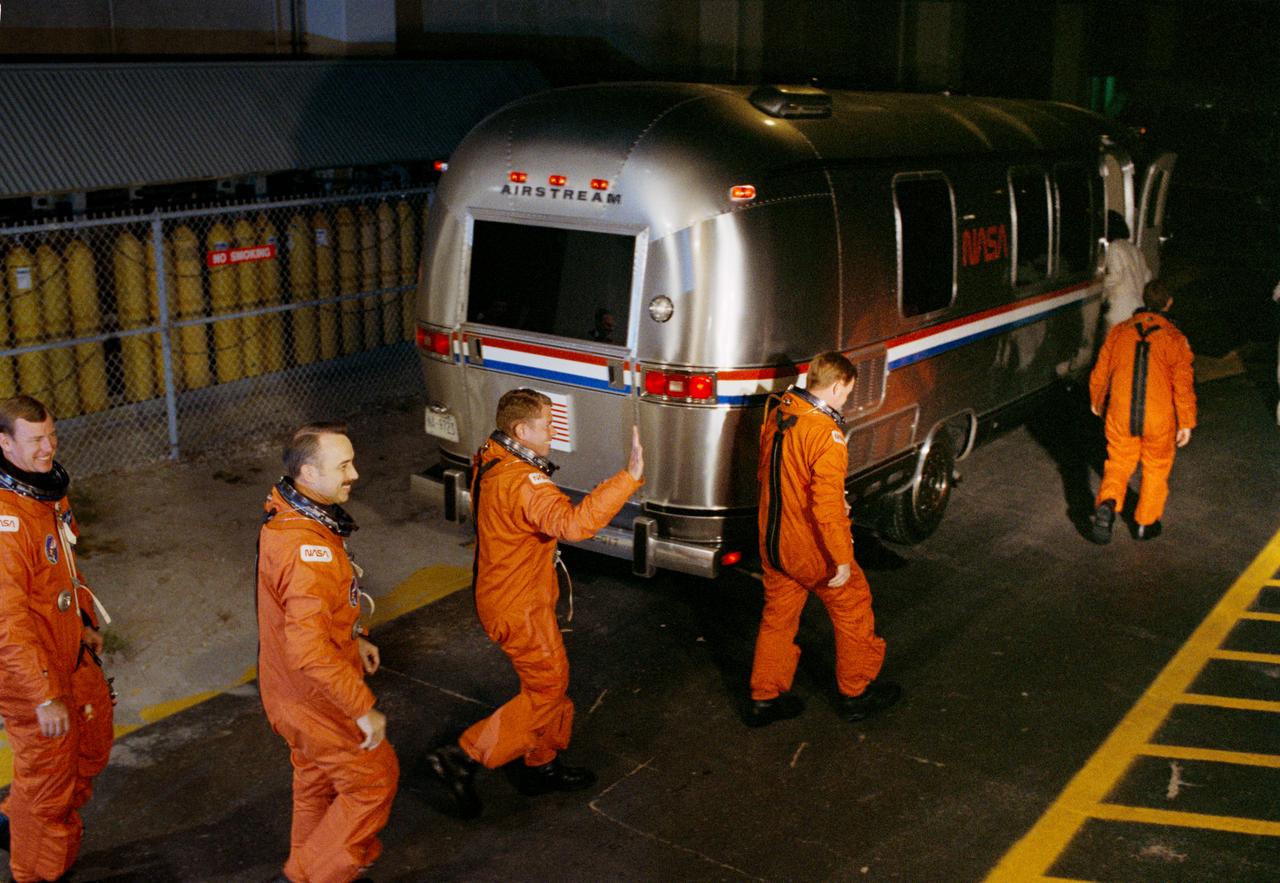
STS028-S-002 (8 Aug 1989) --- The five astronaut crewmembers for STS-28 leave the Operations and Checkout (O&C) Building to board a transfer van en route to Launch Complex 39 for a date with Columbia. Left to right are Astronauts Mark N. Brown, James C. Adamson, David C. Leestma, Richard N. Richards and Brewster H. Shaw Jr.
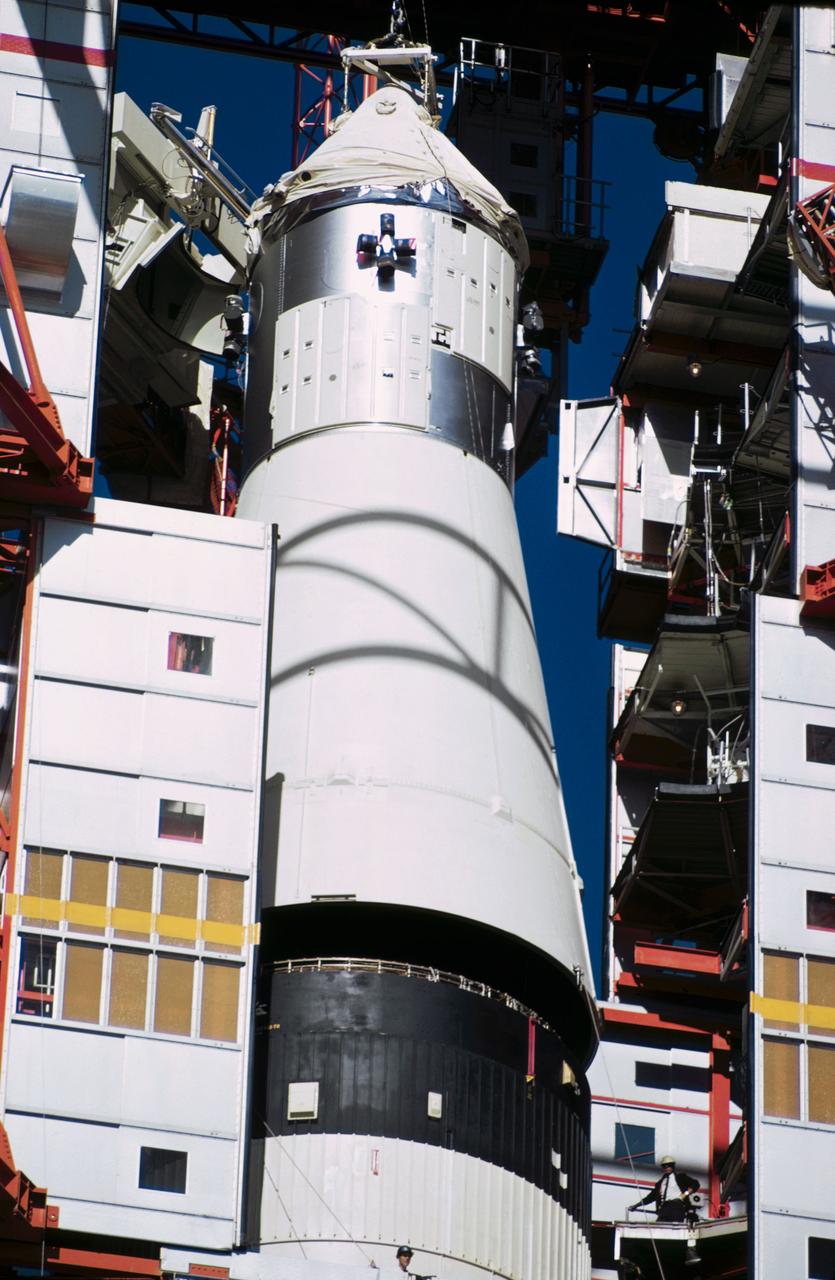
S67-17042 (1967) --- Apollo Spacecraft 012 is hoisted to the top of the gantry at Pad 34 during the Apollo/Saturn Mission 204 erection. S/C 012 will be mated with the uprated Saturn I launch vehicle.
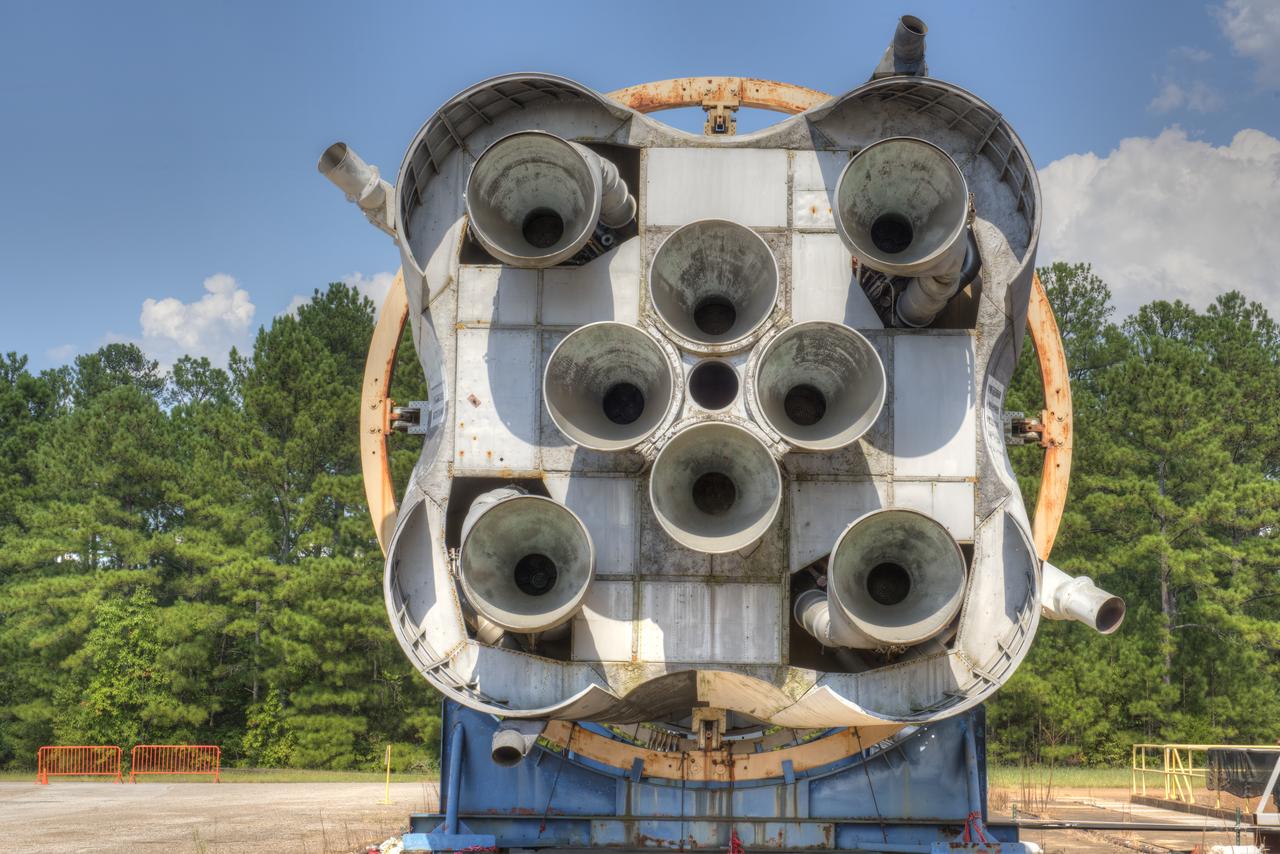
CLOSE-UP OF AFT END OF SATURN S-1B STAGE (SA-T) NEAR PROPULSION AND STRUCTURAL TEST FACILITY (BUILDING 4572) AT THE GEORGE C. MARSHALL SPACE FLIGHT CENTER IN HUNTSVILLE, ALABAMA.
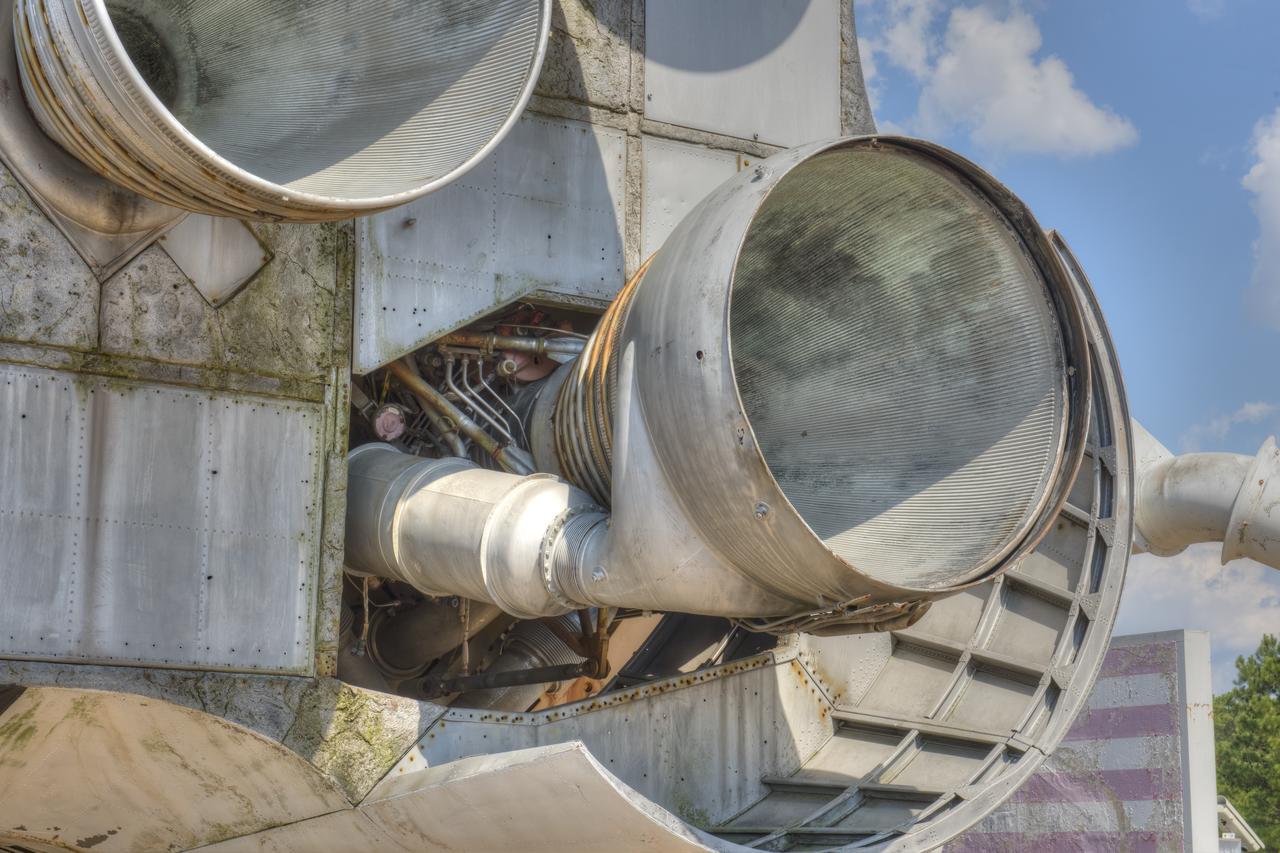
CLOSE-UP OF H-1 ENGINE INSTALLED ON SATURN S-1B STAGE (SA-T) NEAR PROPULSION AND STRUCTURAL TEST FACILITY (BUILDING 4572) AT THE GEORGE C. MARSHALL SPACE FLIGHT CENTER.
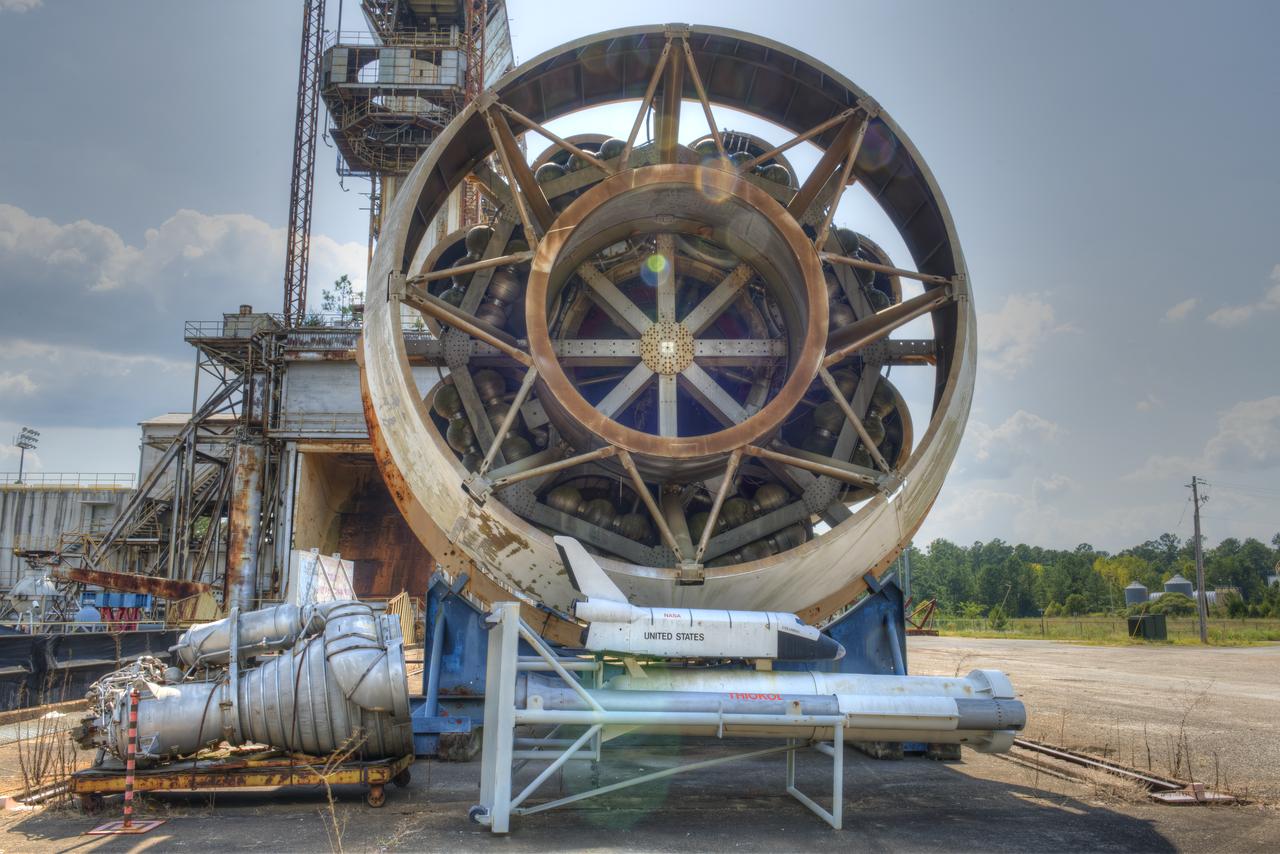
FORWARD END OF SATURN S-1B STAGE (SA-T) NEAR PROPULSION AND STRUCTURAL TEST FACILITY (BUILDING 4572) AT THE GEORGE C. MARSHALL SPACE FLIGHT CENTER IN HUNTSVILLE, ALABAMA
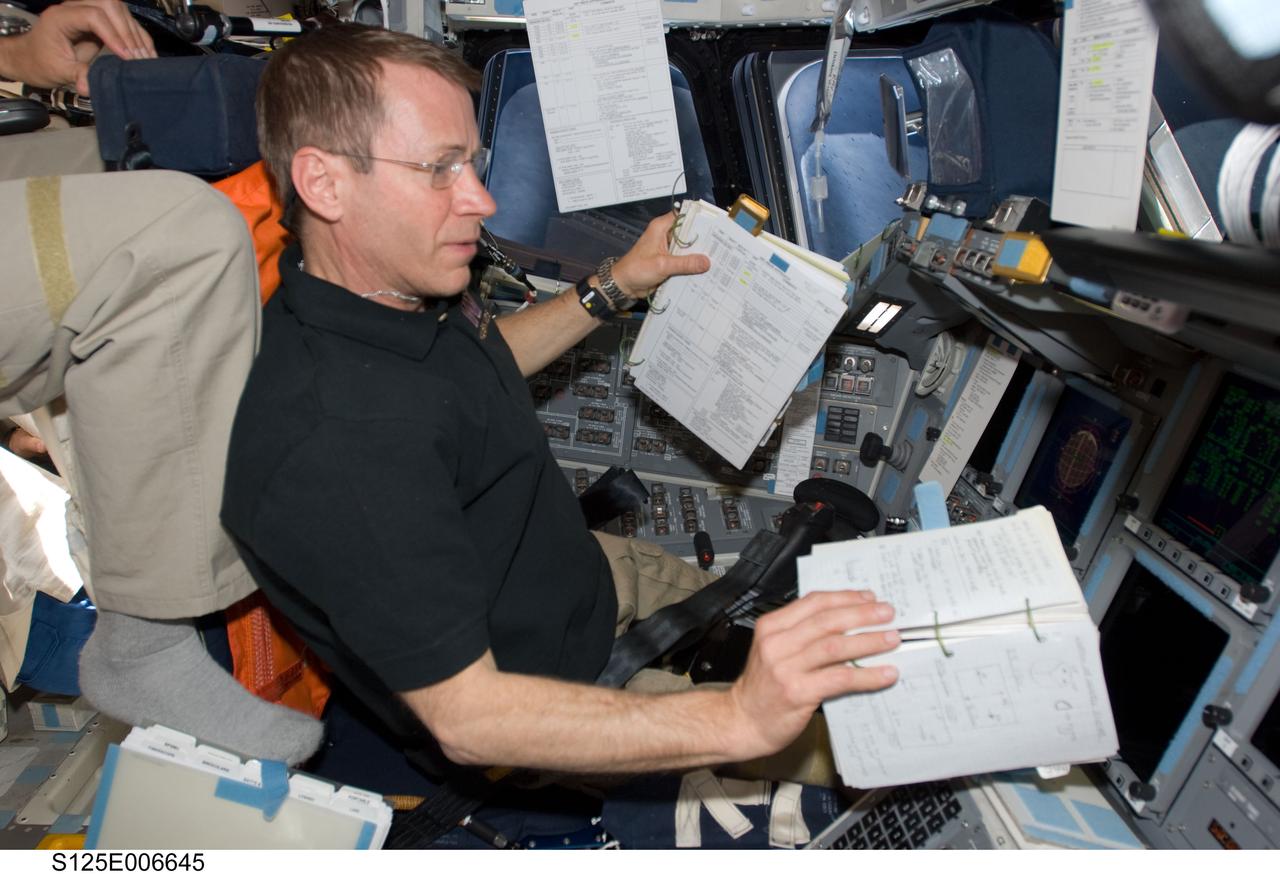
S125-E-006645 (13 May 2009) --- Astronaut Gregory C. Johnson, STS-125 pilot, occupies the commander?s station on the flight deck of Space Shuttle Atlantis during flight day three activities.
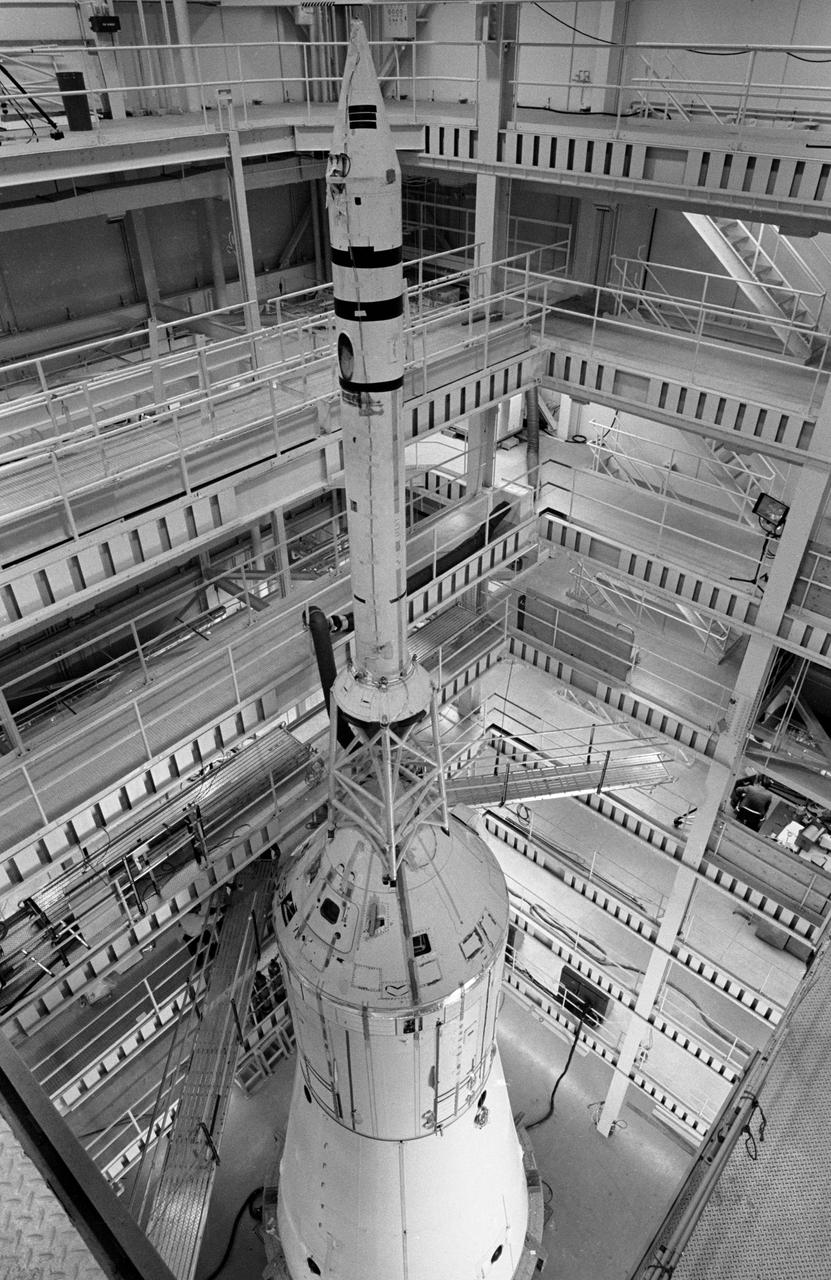
Apollo Spacecraft (S/C)-105 Stack (LET-CSM-SLA) in Bldg. 49 for Vibro-Acoustic Tests. 1. Bldg. 49 - Apollo Stack MSC, Houston, TX
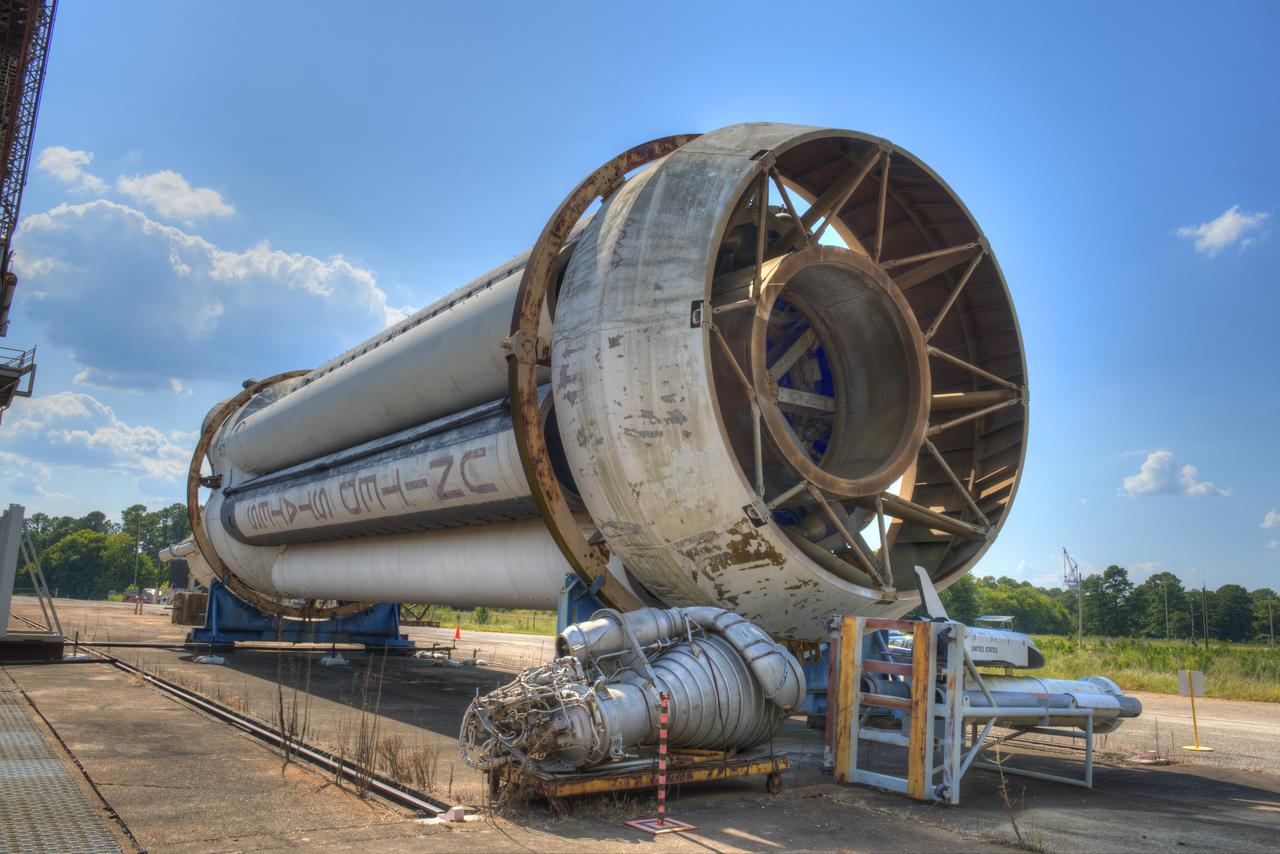
FORWARD END OF SATURN S-1B STAGE (SA-T) NEAR PROPULSION AND STRUCTURAL TEST FACILITY (BUILDING 4572) AT THE GEORGE C. MARSHALL SPACE FLIGHT CENTER IN HUNTSVILLE, ALABAMA
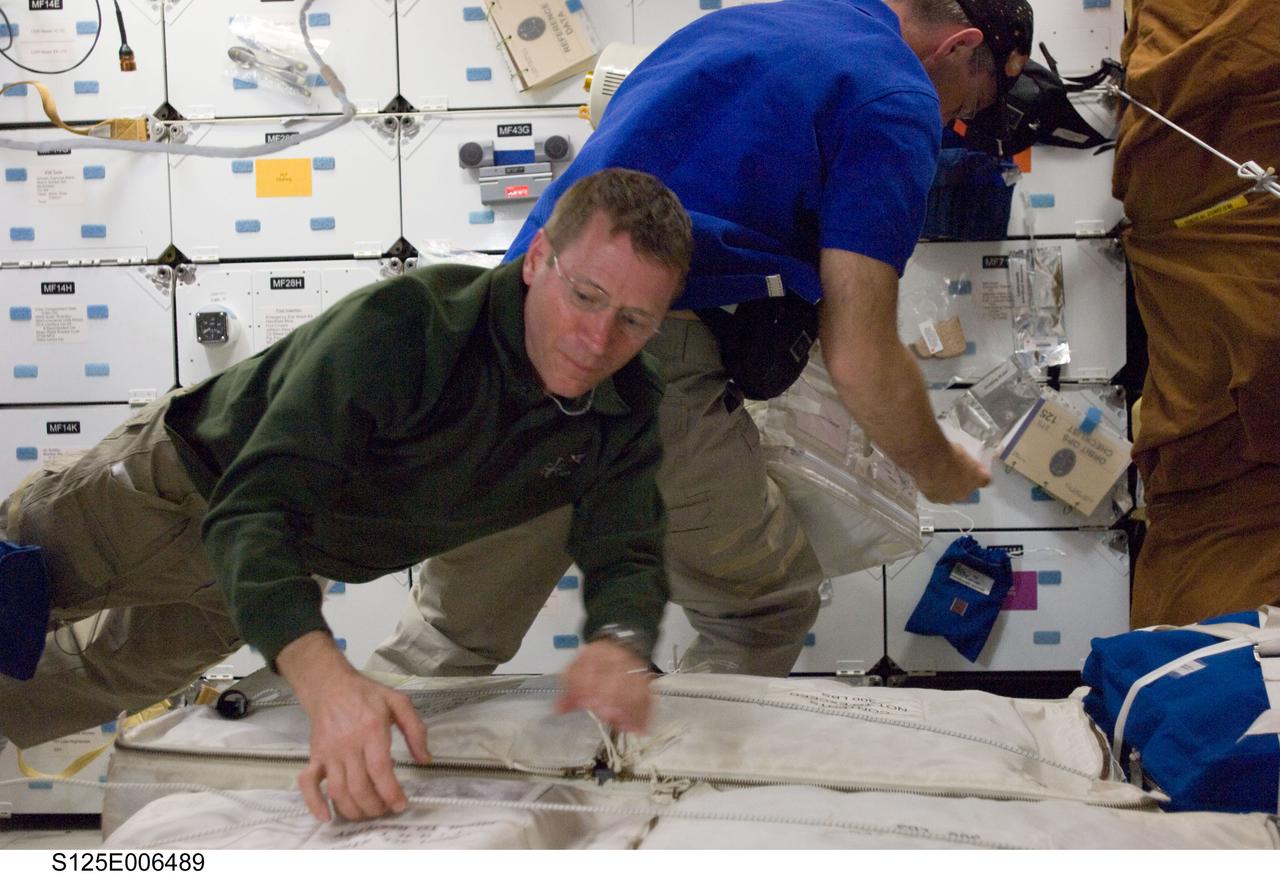
S125-E-006489 (12 May 2009) --- Astronaut Gregory C. Johnson, pilot, helps with unpacking chores on Atlantis? mid deck during the STS-125 flight?s second day in space.
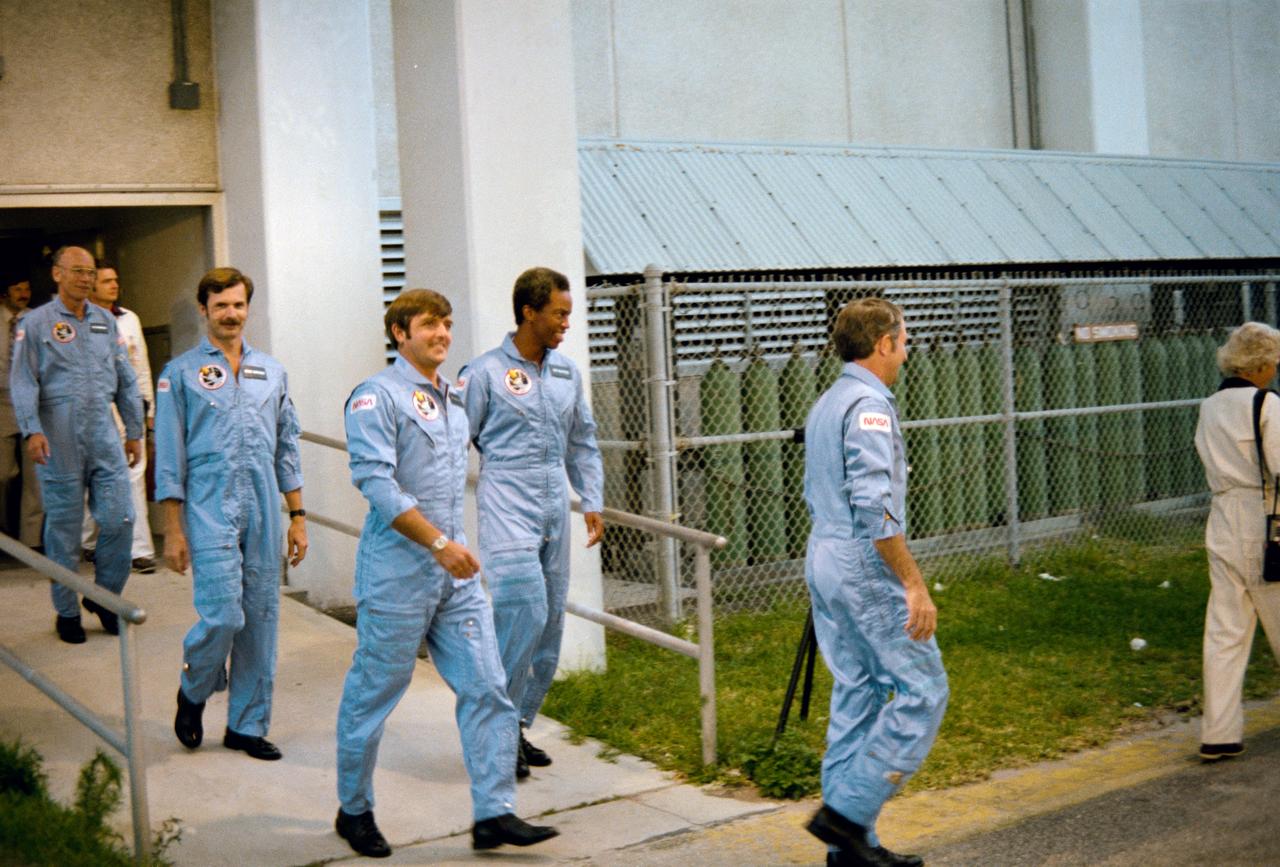
S83-39237 (6 Aug 1983) --- The five astronaut crewmembers of NASA?s STS-8 mission leave the operations and checkout building at the Kennedy Space during a rehearsal for their August 30 launch at KSC?s launch complex 39. They are, from the right, Astronauts Richard H. Truly, commander; Daniel C. Brandenstein, pilot; and Guion S. Bluford, Dale A. Gardner and William E. Thornton, all mission specialists.
![KENNEDY SPACE CENTER, FLA. -- Seventeen new astronaut candidates visited the Vehicle Assembly Building as part of an orientation tour of KSC facilities. Here they are grouped around one of the external fuel tanks in the transfer aisle of the VAB. This latest group of candidates is the tenth chosen since the original seven Mercury astronauts. [From left, Michael J. McCulley, Curtis L. Brown Jr., Frank L. Culbertson Jr., Kathryn C. Thornton, Mark N. Brown, Mark C. Lee, Kenneth D. Cameron, John H. Casper, L. Blaine Hammond Jr., Charles Lacy Veach (deceased), James C. Adamson, William M. Shepherd, Sidney M. Gutierrez, Marsha S. Ivins, David G. Low, Michael J. Smith (deceased), Ellen S. Baker, Sonny Carter (deceased).]](https://images-assets.nasa.gov/image/108-KSC-84P-339/108-KSC-84P-339~medium.jpg)
KENNEDY SPACE CENTER, FLA. -- Seventeen new astronaut candidates visited the Vehicle Assembly Building as part of an orientation tour of KSC facilities. Here they are grouped around one of the external fuel tanks in the transfer aisle of the VAB. This latest group of candidates is the tenth chosen since the original seven Mercury astronauts. [From left, Michael J. McCulley, Curtis L. Brown Jr., Frank L. Culbertson Jr., Kathryn C. Thornton, Mark N. Brown, Mark C. Lee, Kenneth D. Cameron, John H. Casper, L. Blaine Hammond Jr., Charles Lacy Veach (deceased), James C. Adamson, William M. Shepherd, Sidney M. Gutierrez, Marsha S. Ivins, David G. Low, Michael J. Smith (deceased), Ellen S. Baker, Sonny Carter (deceased).]
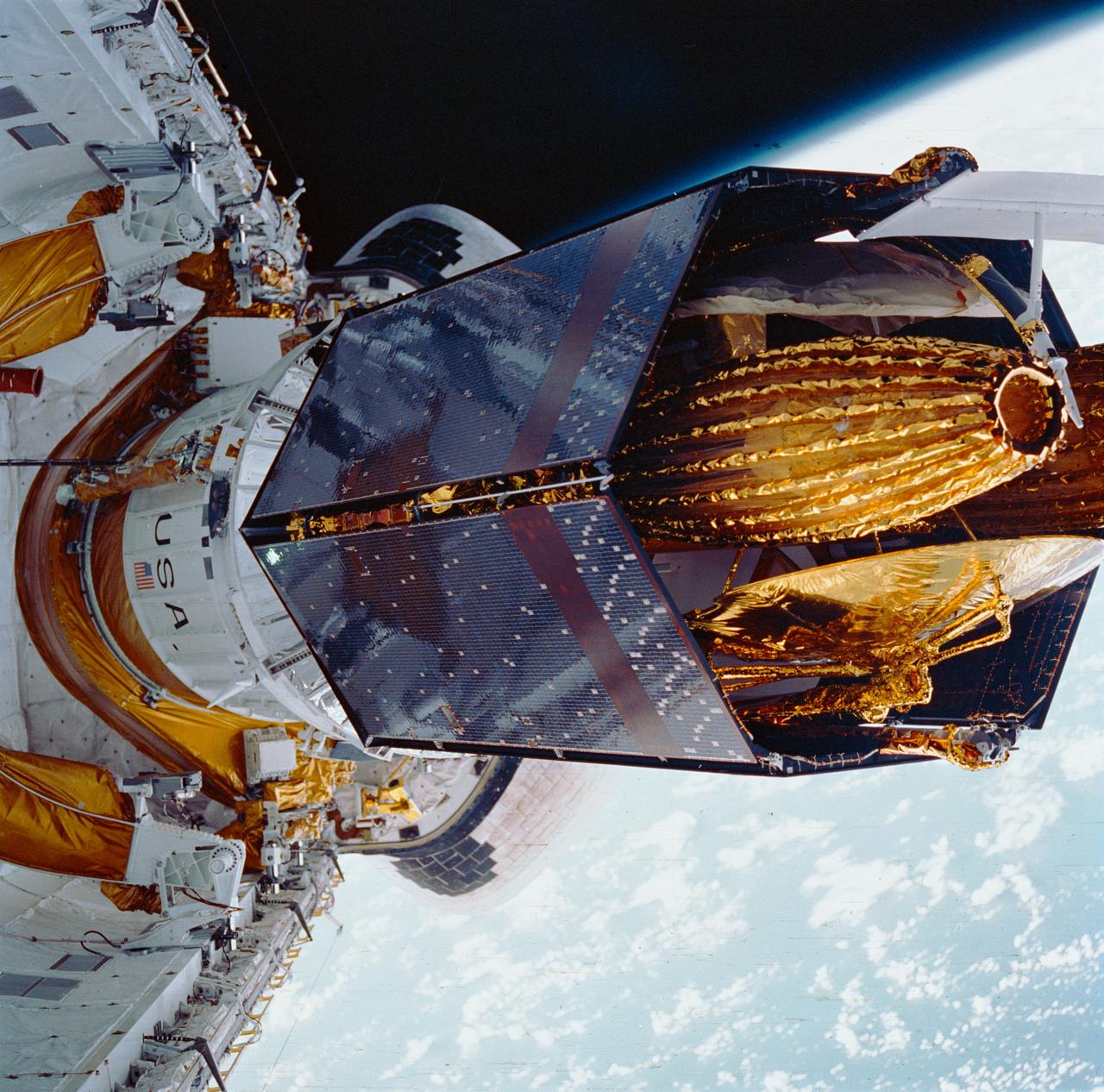
During STS-26, inertial upper stage (IUS) with tracking and data relay satellite C (TDRS-C) located in the payload bay (PLB) of Discovery, Orbiter Vehicle (OV) 103, is positioned into its proper deployment attitude (an angle of 50 degrees) by the airborne support equipment (ASE). In the foreground, the ASE forward cradle is visible. The IUS is mounted in the ASE aft frame tilt actuator (AFTA) table. TDRS-C components in stowed configuration include solar array panels, TDRS single access #1 and #2, TDRS SGL, and S-Band omni antenna. In the background are the orbital maneuvering system (OMS) pods, the Earth's cloud-covered surface, and the Earth's limb.
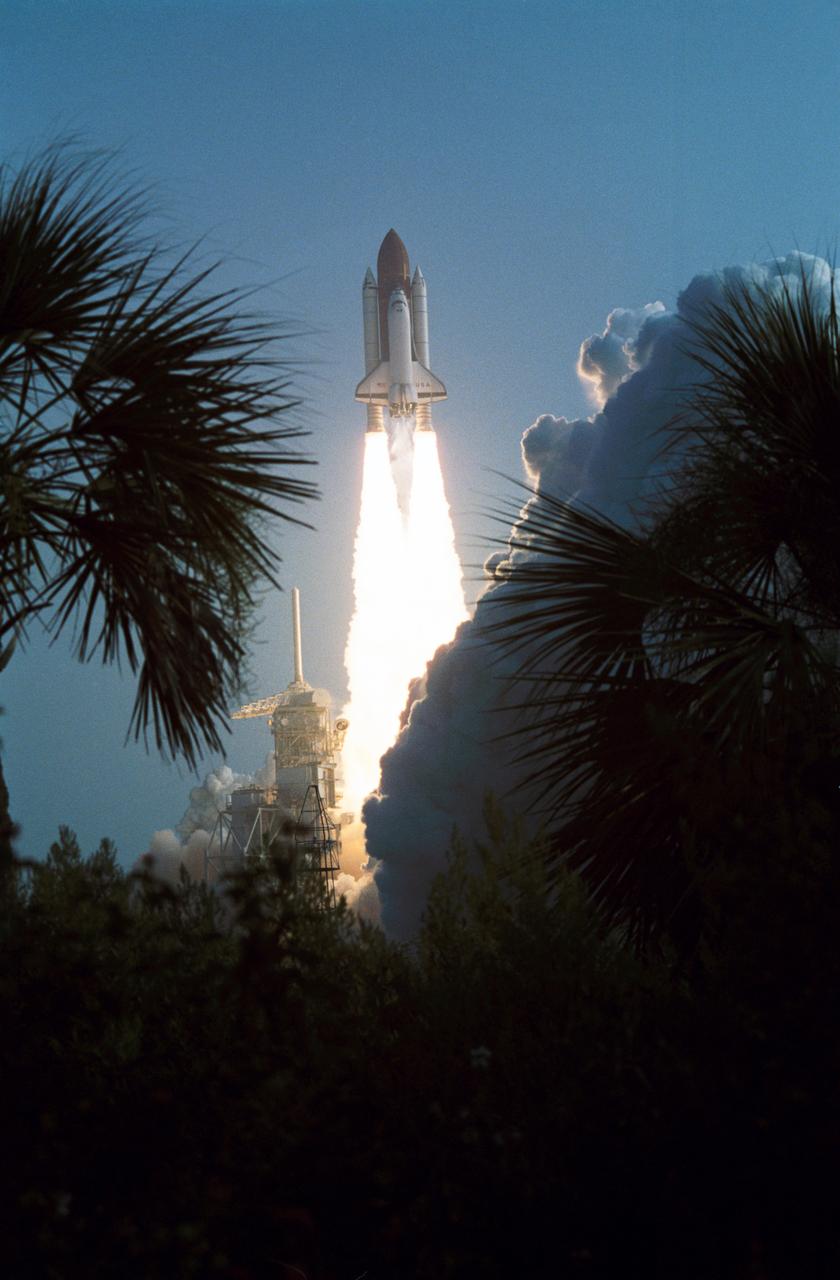
STS028-S-004 (8 Aug. 1989) --- Framed by Florida vegetation, Space Shuttle Columbia soars toward space for the STS-28 mission from Launch Pad 39-B. The spacecraft renews flight after a period of three and a half years, this time with five crewmembers aboard. Onboard the spacecraft are astronauts Brewster H. Shaw Jr., Richard N. Richards, David C. Leestma, James C. Adamson and Mark N. Brown. The last time Columbia was in space was in January of 1986.
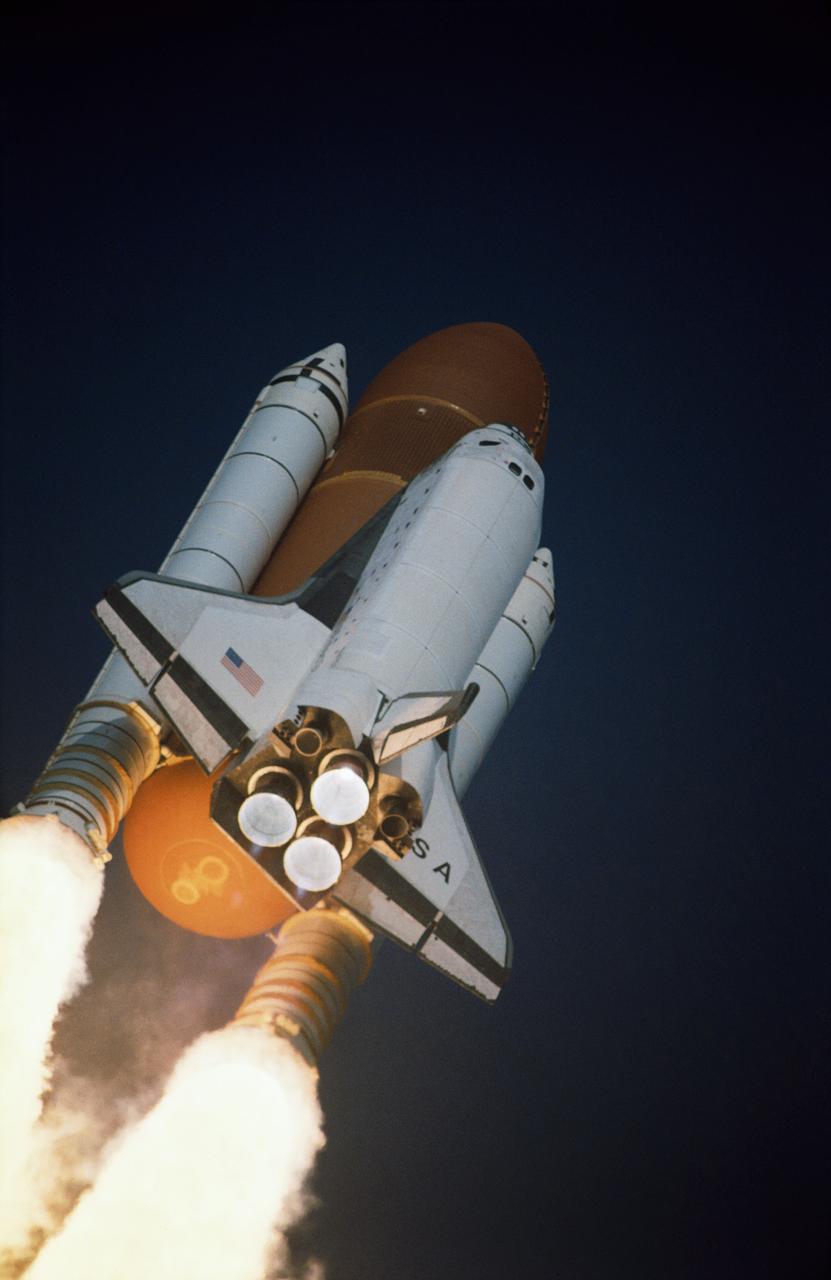
STS028-S-006 (8 Aug 1989) --- A low-angle view shows Columbia soaring toward space just after clearing the tower at Launch Pad 39-B for the STS-28 mission. The spacecraft renews flight after a period of three and a half years, this time with five crewmembers aboard. Onboard the spacecraft are Astronauts Brewster H. Shaw Jr., Richard N. Richards, David C. Leestma, James C. Adamson and Mark N. Brown. The last time Columbia was in space was in January of 1986.

STS049-S-002 (16 Jan. 1992) --- These seven NASA astronauts are currently training for the first flight of the Space Shuttle Endeavour, seen in the background. Daniel C. Brandenstein, center, is mission commander; and Kevin P. Chilton, third from right, is pilot. Mission specialists are, left to right, Kathryn C. Thornton, Bruce E. Melnick, Pierre J. Thout, Thomas D. Akers and Richard J. Hieb.
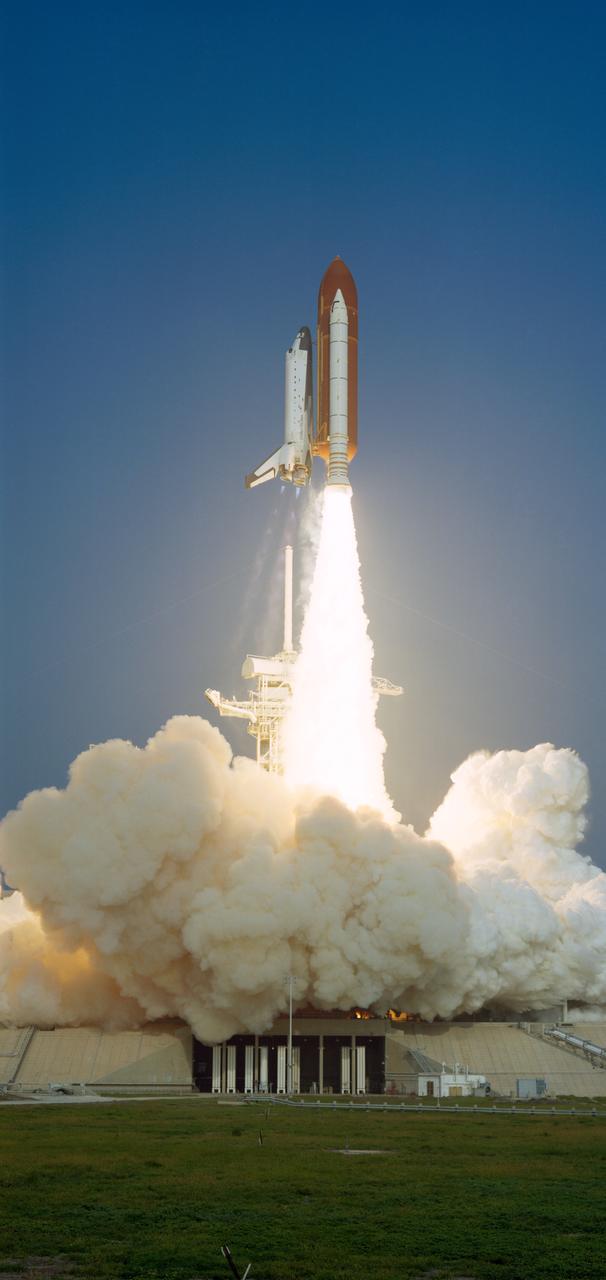
STS028-S-008 (8 Aug 1989) --- A side view shows Columbia clearing the launch tower during the STS-28 liftoff. Columbia renews spaceflight after a period of three and a half years, this time with five crewmembers aboard for a DOD-devoted mission. Onboard the spacecraft are Astronauts Brewster H. Shaw Jr., Richard N. Richards, David C. Leestma, James C. Adamson and Mark N. Brown. The last time Columbia was in space was in January of 1986.

STS049-S-269 (16 May 1992) --- The seven crewmembers of STS-49 pose near Endeavour for a post-flight shot soon after getting their feet on terra firma following nine days in Earth orbit. Left to right are astronauts Richard J. Hieb, Kevin P. Chilton, Daniel C. Brandenstein, Thomas D. Akers, Pierre J. Thuot, Kathryn C. Thornton and Bruce E. Melnick. Brandenstein was mission commander; Chilton, pilot; and the others, mission specialists.
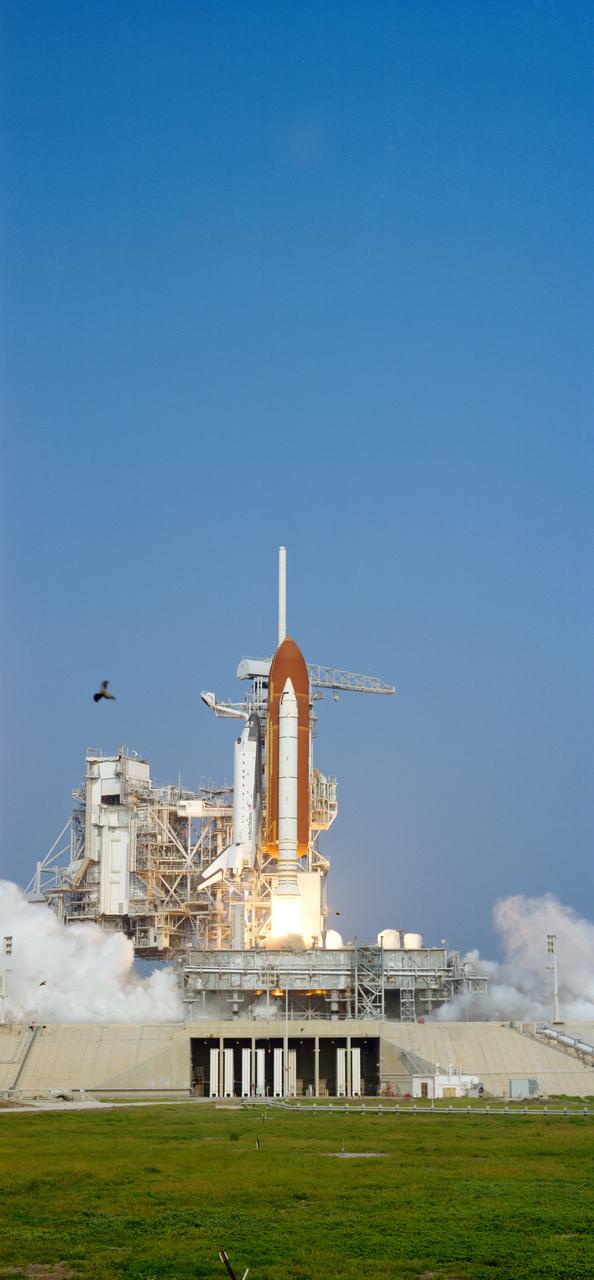
STS028-S-007 (8 Aug 1989) --- Columbia is pictured just prior to clearing the tower at Launch Pad 39-B. The spacecraft renews flight after a period of three and a half years, this time with five crewmembers aboard for STS-28. Onboard the spacecraft are Astronauts Brewster H. Shaw Jr., Richard N. Richards, David C. Leestma, James C. Adamson and Mark N. Brown. The last time Columbia was in space was in January of 1986.
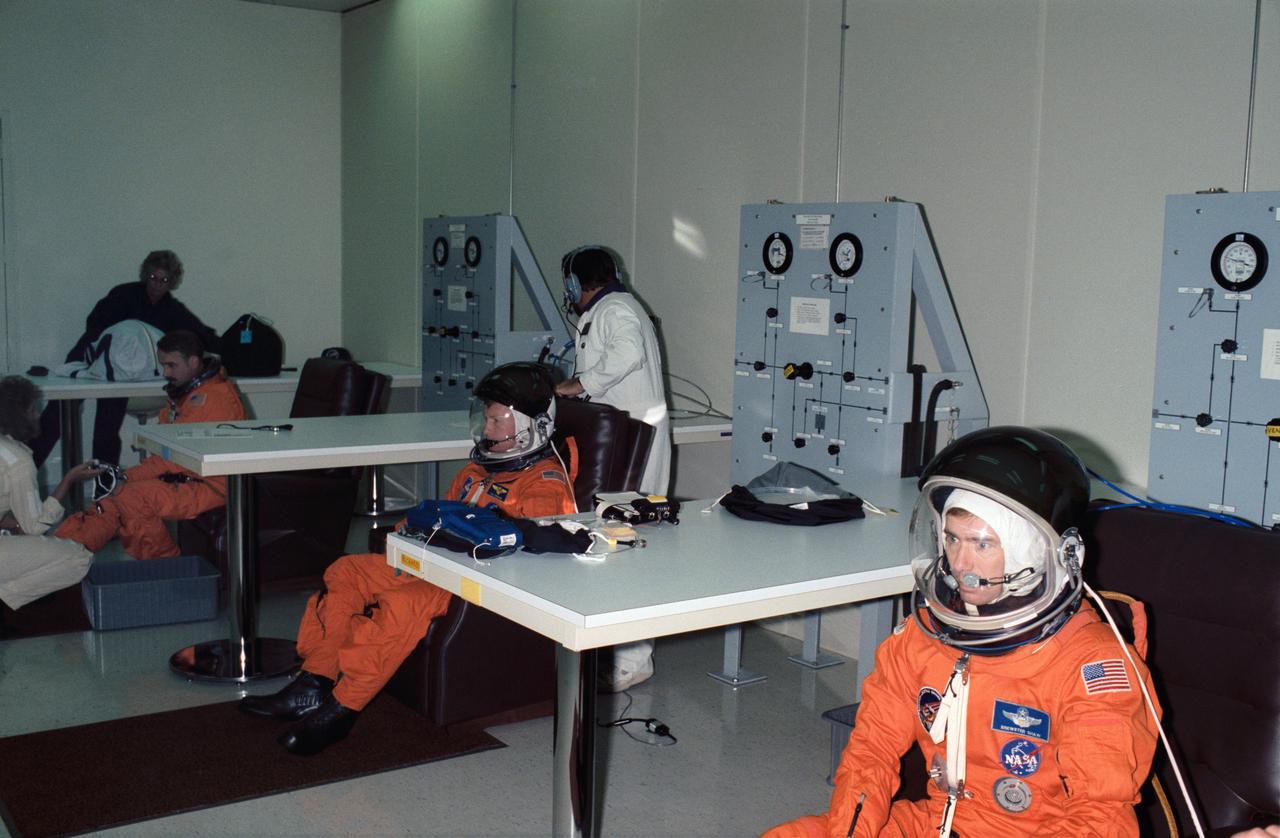
STS028-S-005 (8 Aug 1989) --- Three of five STS-28 astronaut crewmembers are pictured during their suiting up process in preparation for spending several days aboard space shuttle Columbia in earth orbit. Astronaut Brewster H. Shaw Jr., mission commander, is in the foreground. Others pictured in the orange suits used for ascent and entry are Richard N. Richards (center), pilot; and James C. Adamson, one of three mission specialists. Out of the frame are David C. Leestma and Mark N. Brown, mission specialists.
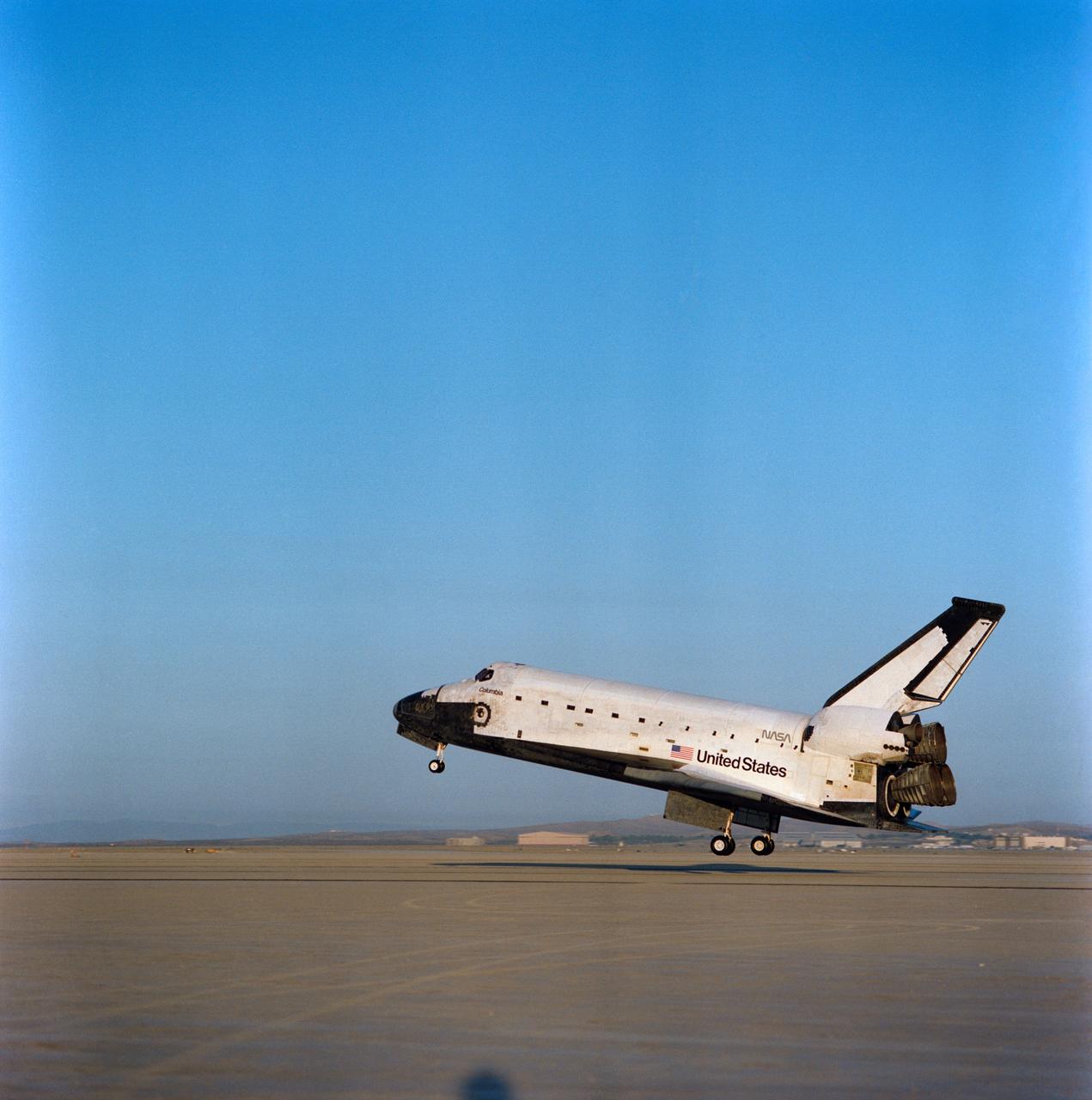
STS028-S-013 (13 Aug 1989) --- The Space Shuttle Columbia is captured on film just prior to main gear touchdown at Edwards Air Force Base in Southern California. The landing marked a successful end to a five-day DOD-devoted mission. Onboard the spacecraft were Astronauts Brewster H. Shaw Jr., Richard N. Richards, David C. Leestma, James C. Adamson and Mark N. Brown.
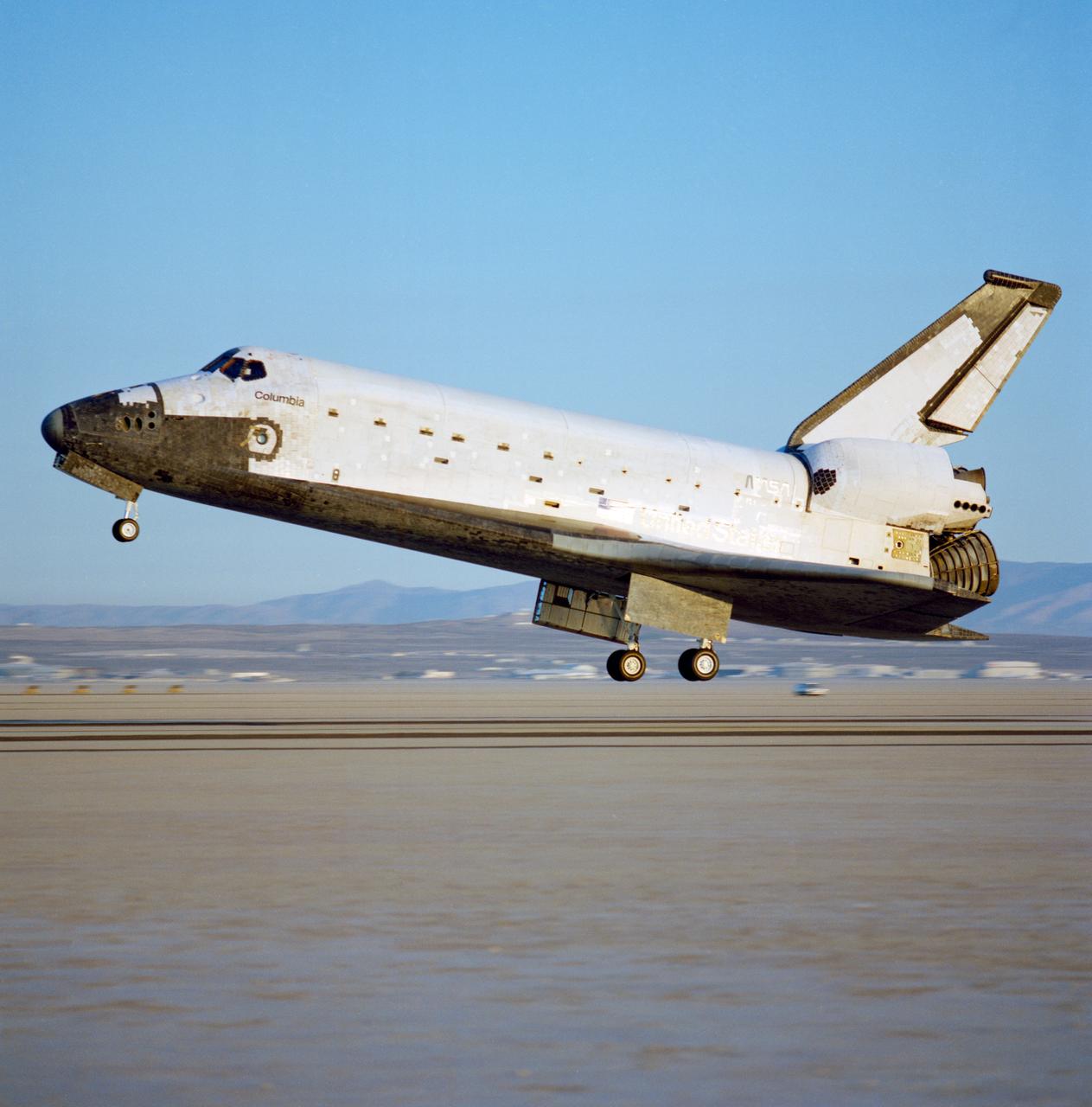
STS028-S-018 (13 Aug 1989) --- The Space shuttle Columbia is captured on film just prior to main gear touchdown at Edwards Air Force Base in Southern California. The landing marked a successful end to a five-day Department of Defense (DOD)-devoted mission. Onboard the spacecraft were astronauts Brewster H. Shaw Jr., Richard N. Richards, David C. Leestma, James C. Adamson and Mark N. Brown.
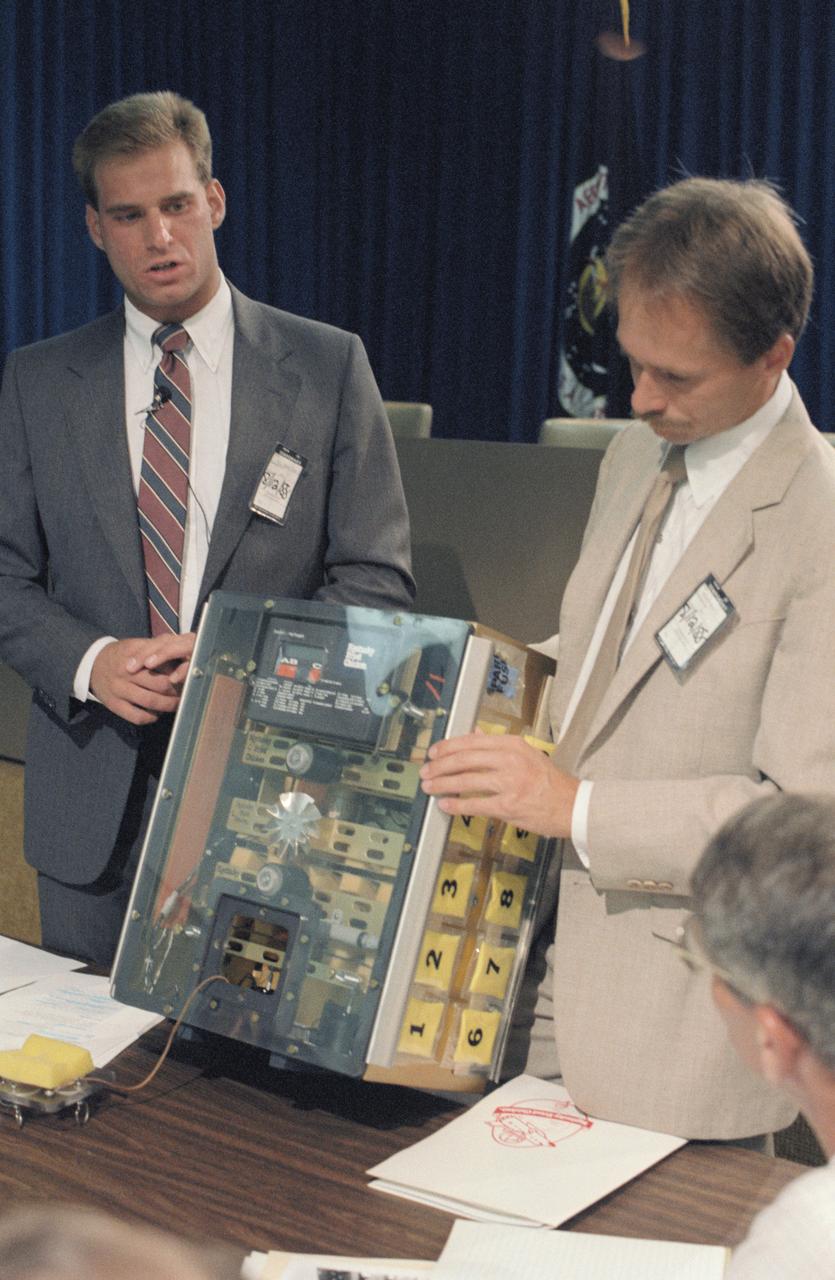
S88-44514 (13 Aug 1988) --- Student experimenter John C. Vellinger, left, explains components of an incubator used in his experiment to be carried onboard the Discovery for NASA's STS-29 mission next year. Mark S. Deusser, representing the sponsoring organization, holds up the incubator for inspection by members of the STS-29 crew who will monitor in-space operation of the experiment, titled "Chicken Embryo Development in Space." Astronaut Robert C. Springer is partially visible in lower right foreground. The student's sponsor is Kentucky Fried Chicken.
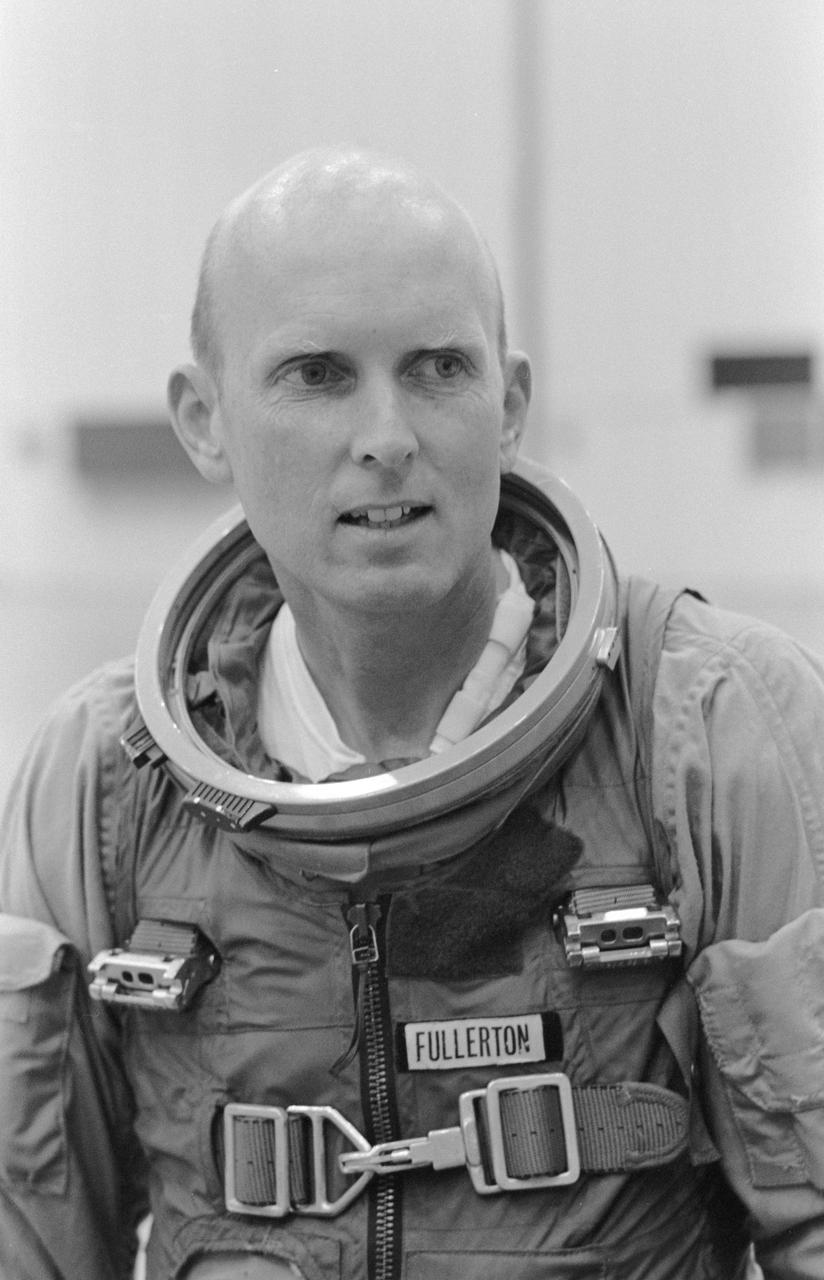
S78-34917 (31 Aug. 1978) --- Just about to don his helmet and enter JSC?s shuttle engineering mock-up/trainer is astronaut C. Gordon Fullerton, one of eight NASA astronauts recently named to man the space shuttle Columbia on a series of orbital flight tests in the early 1980s. Photo credit: NASA NOTE: Since this photograph was made, astronaut C. Gordon Fullerton was named pilot for STS-3, scheduled for launch in early spring of 1982.
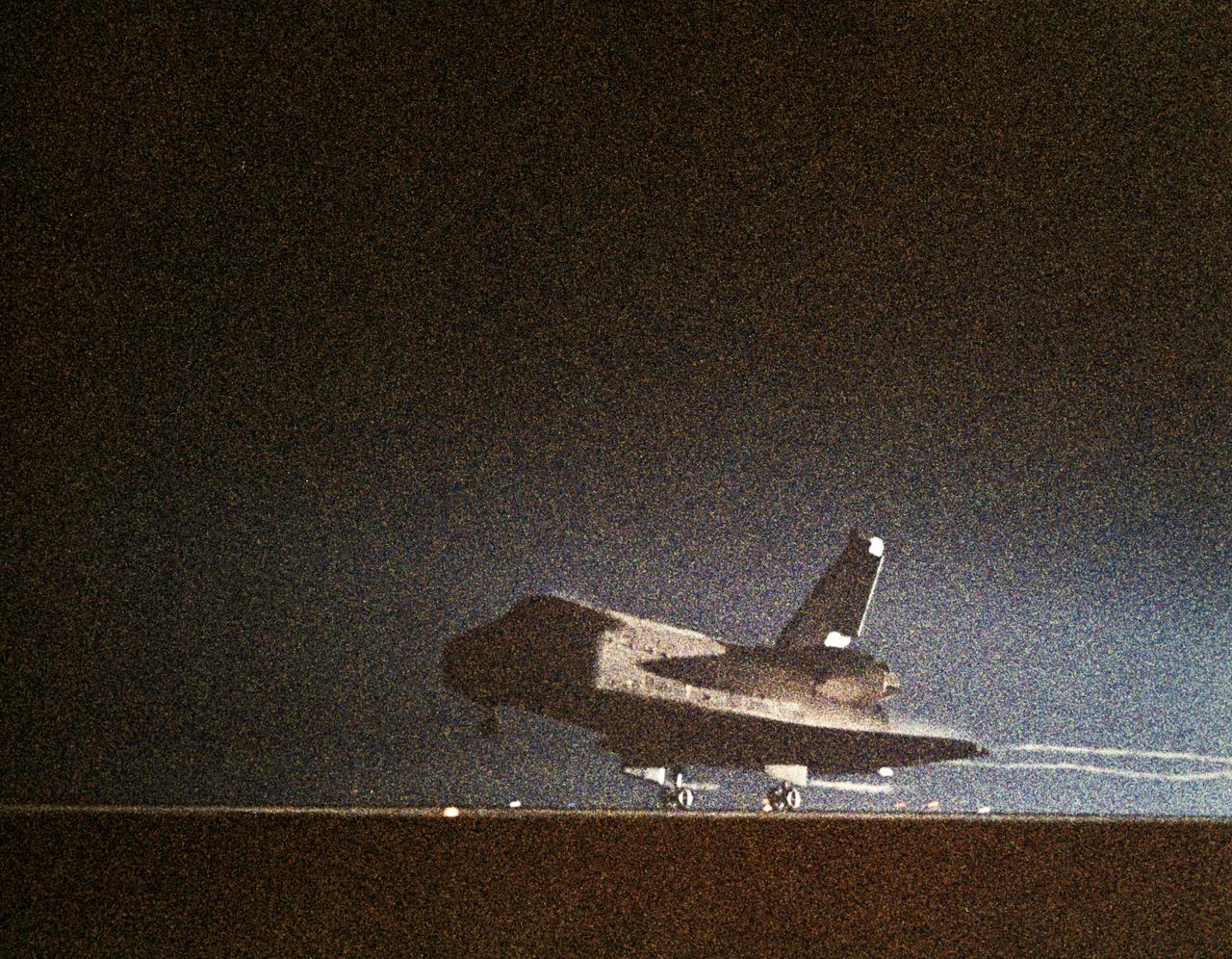
61C-S-050 (18 Jan 1986) --- This NASA photo records the night landing of space shuttle Columbia at Edwards Air Force Base and end of the STS 61-C mission. View is of the shuttle's main landing gear touching down, with streams of light trailing behind the orbiter. Photo credit: NASA

STS036-S-018 (3 March 1990) --- The Space Shuttle Atlantis touches down at Edwards Air Force Base in California to complete the STS-36 mission. Onboard were Astronauts John O. Creighton, John H. Casper, David C. Hilmers, Richard M. (Mike) Mullane and Pierre J. Thuot.
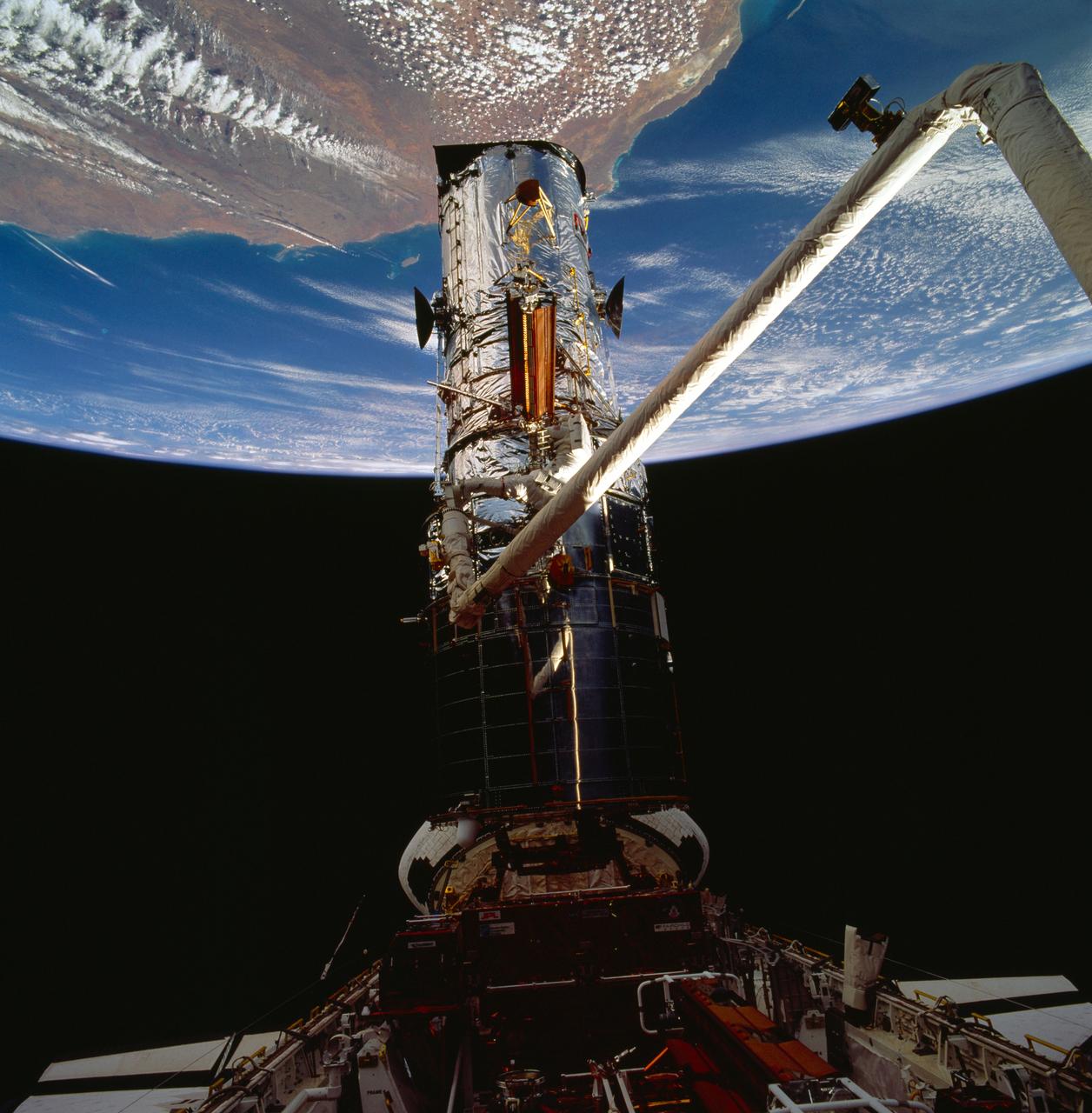
STS061-95-075 (6 Dec 1993) --- Astronauts Kathryn C. Thornton and Thomas D. Akers work to remove one of the solar arrays on the Hubble Space Telescope (HST) on the second of five extravehicular activity?s (EVA). The two space walkers later replaced both solar array panels. Part of Australia is in the background.

S67-36022 (20 June 1967) --- Apollo Spacecraft 017 is moved into position in the Vehicle Assembly Building's high bay area for mating with the Saturn V launch vehicle. S/C 017 will be flown on the Spacecraft 017/Saturn 501 (Apollo 4) space mission.
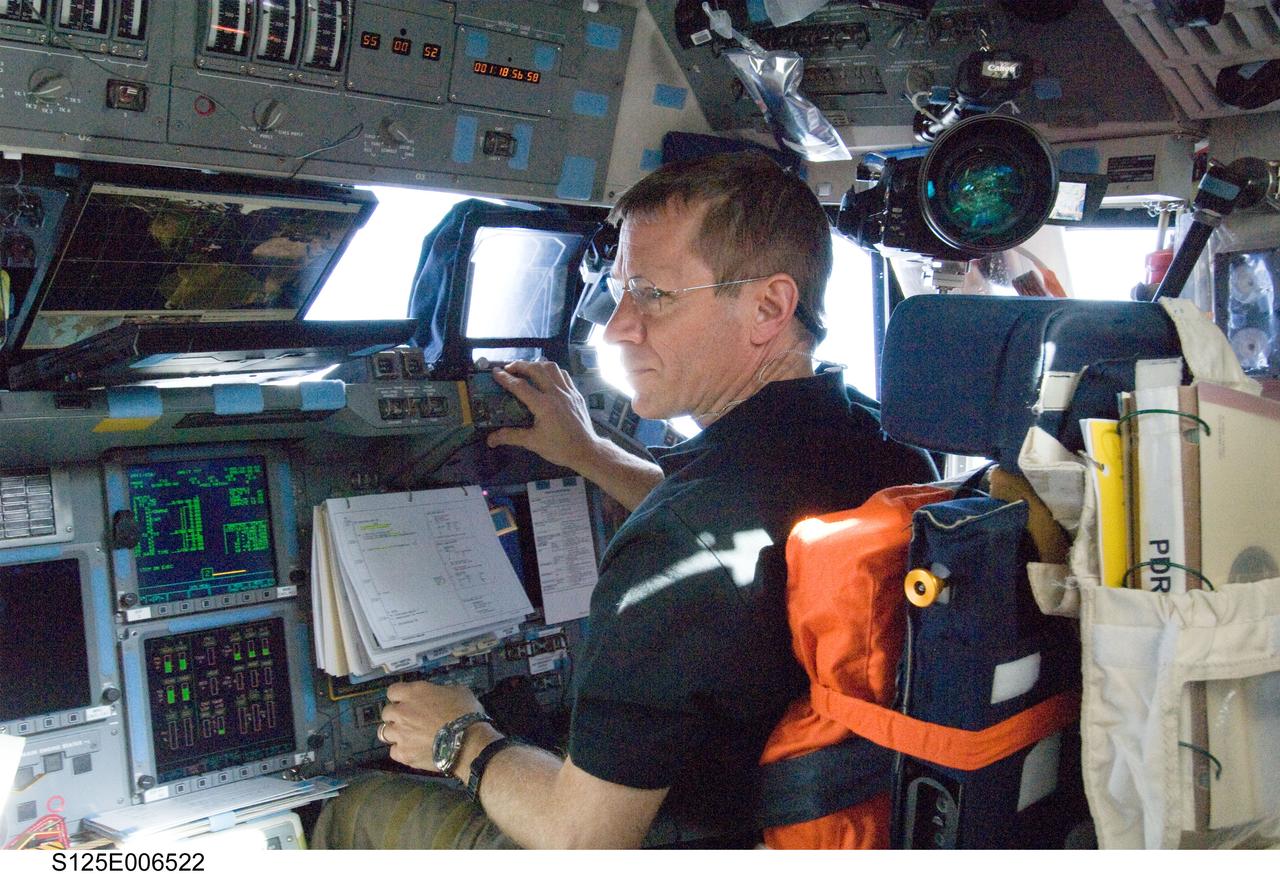
S125-E-006522 (13 May 2009) --- Astronaut Gregory C. Johnson, STS-125 pilot, occupies the pilot?s station on the flight deck of the Earth-orbiting Space Shuttle Atlantis during flight day three activities.
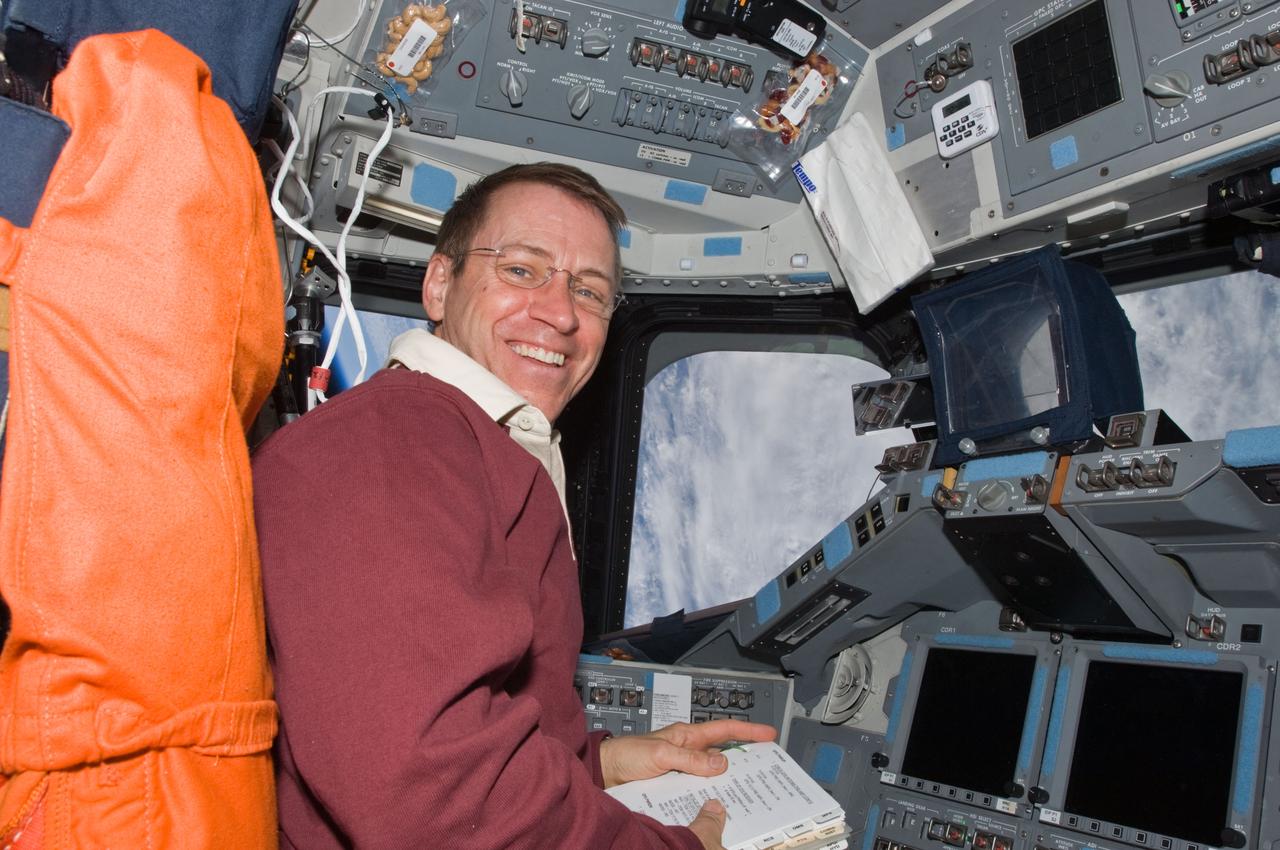
S125-E-013038 (21 May 2009) --- Astronaut Gregory C. Johnson, STS-125 pilot, occupies the commander?s station on the flight deck of the Earth-orbiting Space Shuttle Atlantis during flight day 11 activities.

Armstrong Pilots David Fedors and Stu Broce are at the controls of the C-20A in March 2016 as it flies a synthetic aperture radar over areas of interest in the AfriSAR mission based in Gabon, Africa. The international campaign included measurements of flora in the country’s rainforests, wetlands, mangrove forests and savanna.
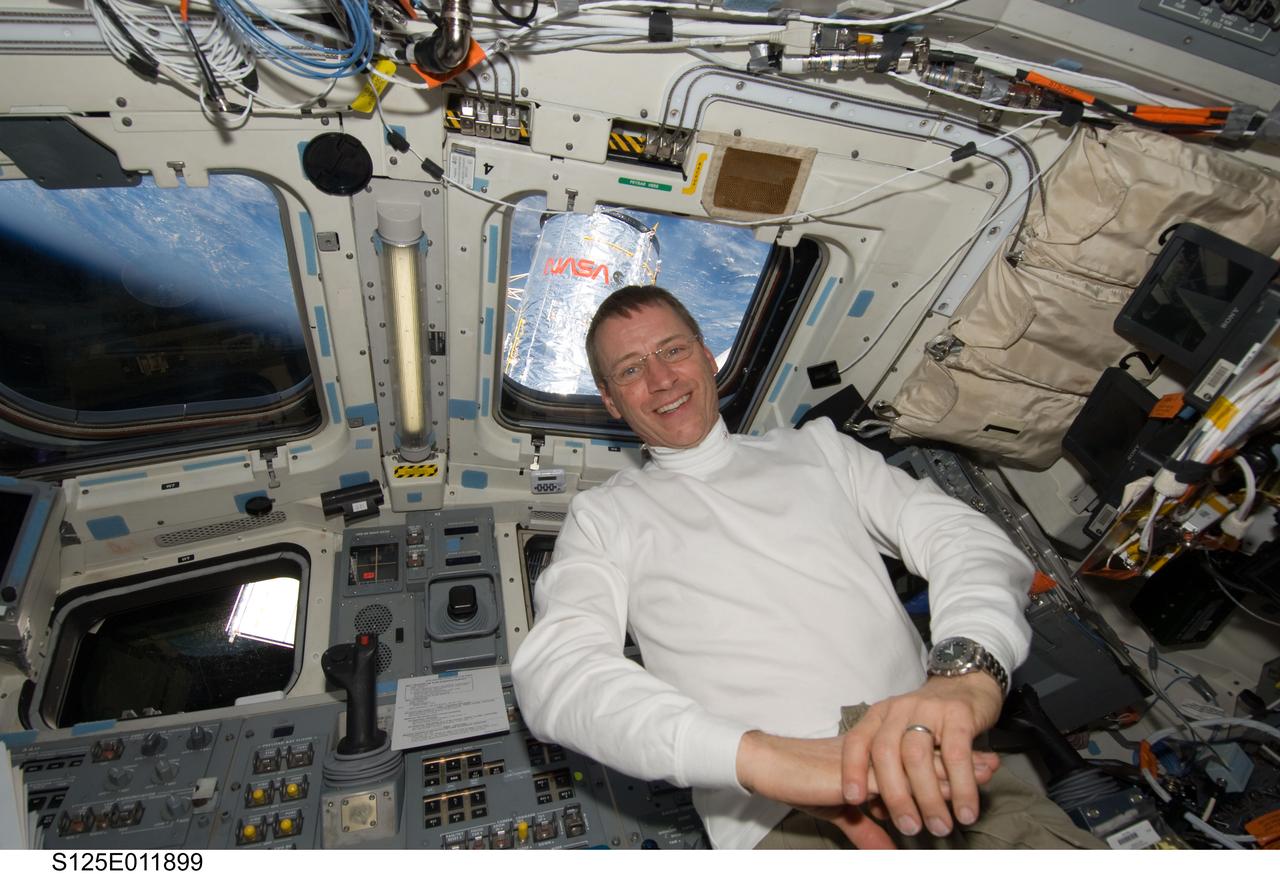
S125-E-011899 (19 May 2009) --- Astronaut Gregory C. Johnson, STS-125 pilot, is pictured on the aft flight deck of the Earth-orbiting Space Shuttle Atlantis during flight day nine activities. A portion of the Hubble Space Telescope and Earth?s horizon are visible through the overhead windows.
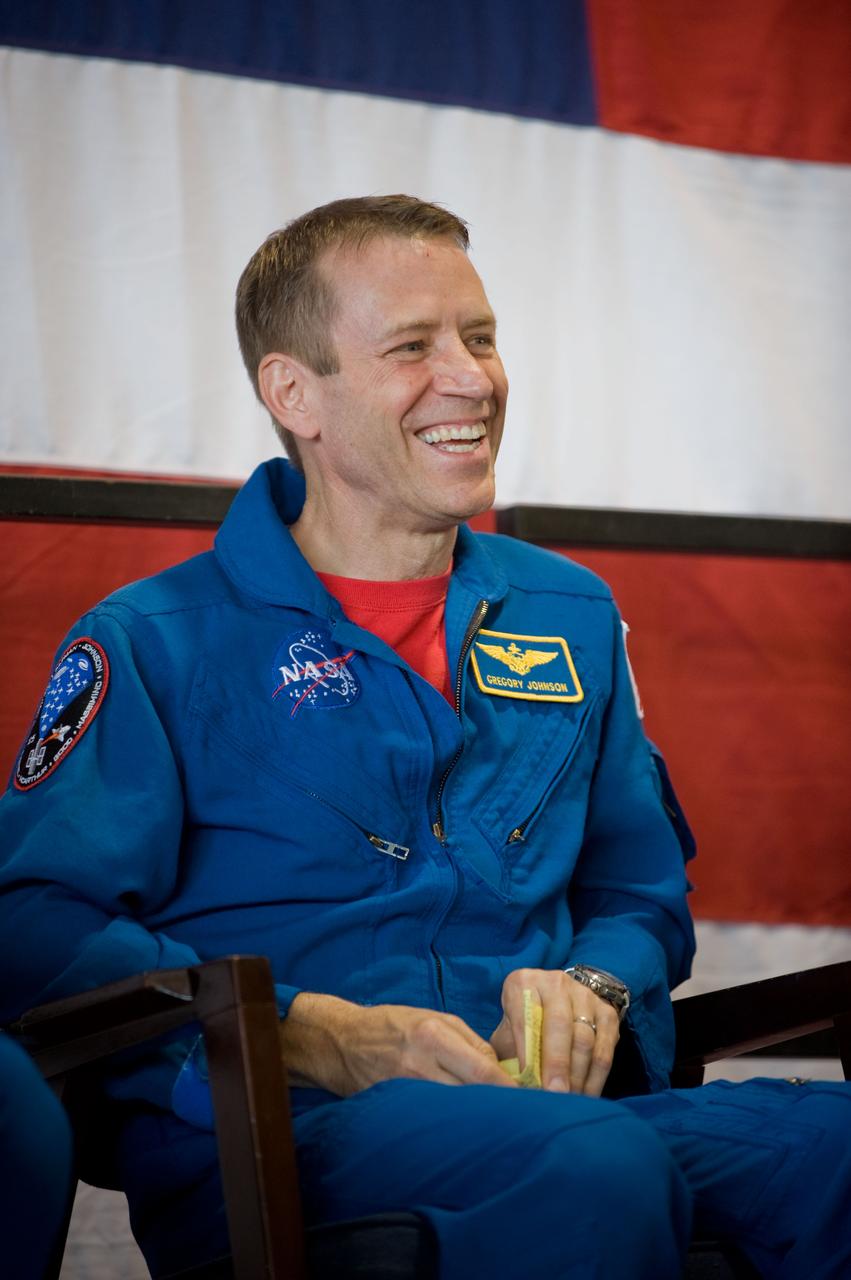
JSC2009-E-122212 (26 May 2009) --- Astronaut Gregory C. Johnson, STS-125 pilot, is pictured at the STS-125 crew return ceremony on May 26, 2009 at Ellington Field near NASA?s Johnson Space Center.
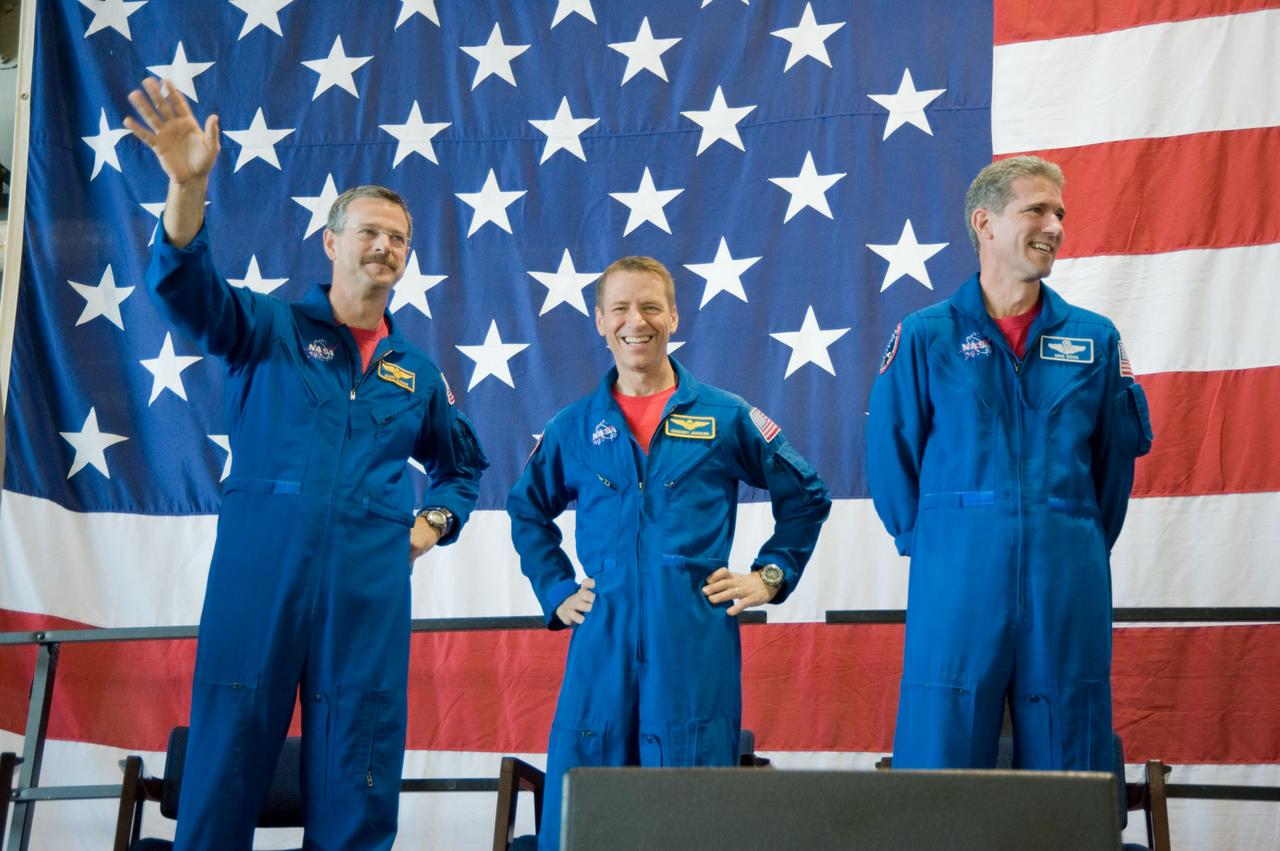
JSC2009-E-122157 (26 May 2009) --- Astronauts Scott Altman (left), STS-125 commander; Gregory C. Johnson, pilot; and Michael Good, mission specialist, are pictured at the STS-125 crew return ceremony on May 26, 2009 at Ellington Field near NASA?s Johnson Space Center.
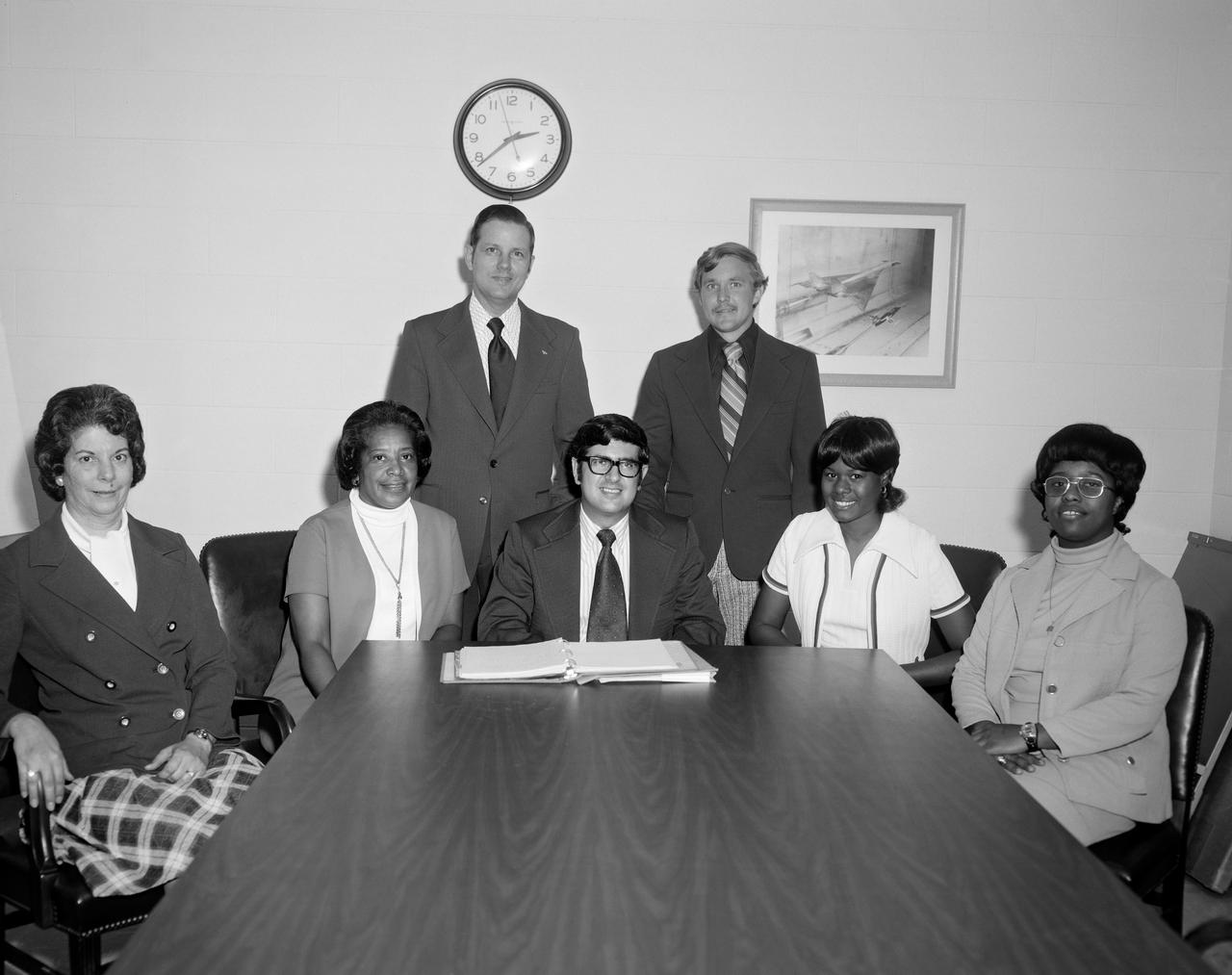
CAMPAIGN COMMITTEE: Frank V. Moore (seated center) has been named Director of the Center' s annual Combined Federal Campaign. Members of his campaign staff are (seated) Ernestine Martin, Mary Jackson, Gwendolyn Leach, Janet McKenzie. Standing are (from left) Willis C. Cross, James Ojiba.
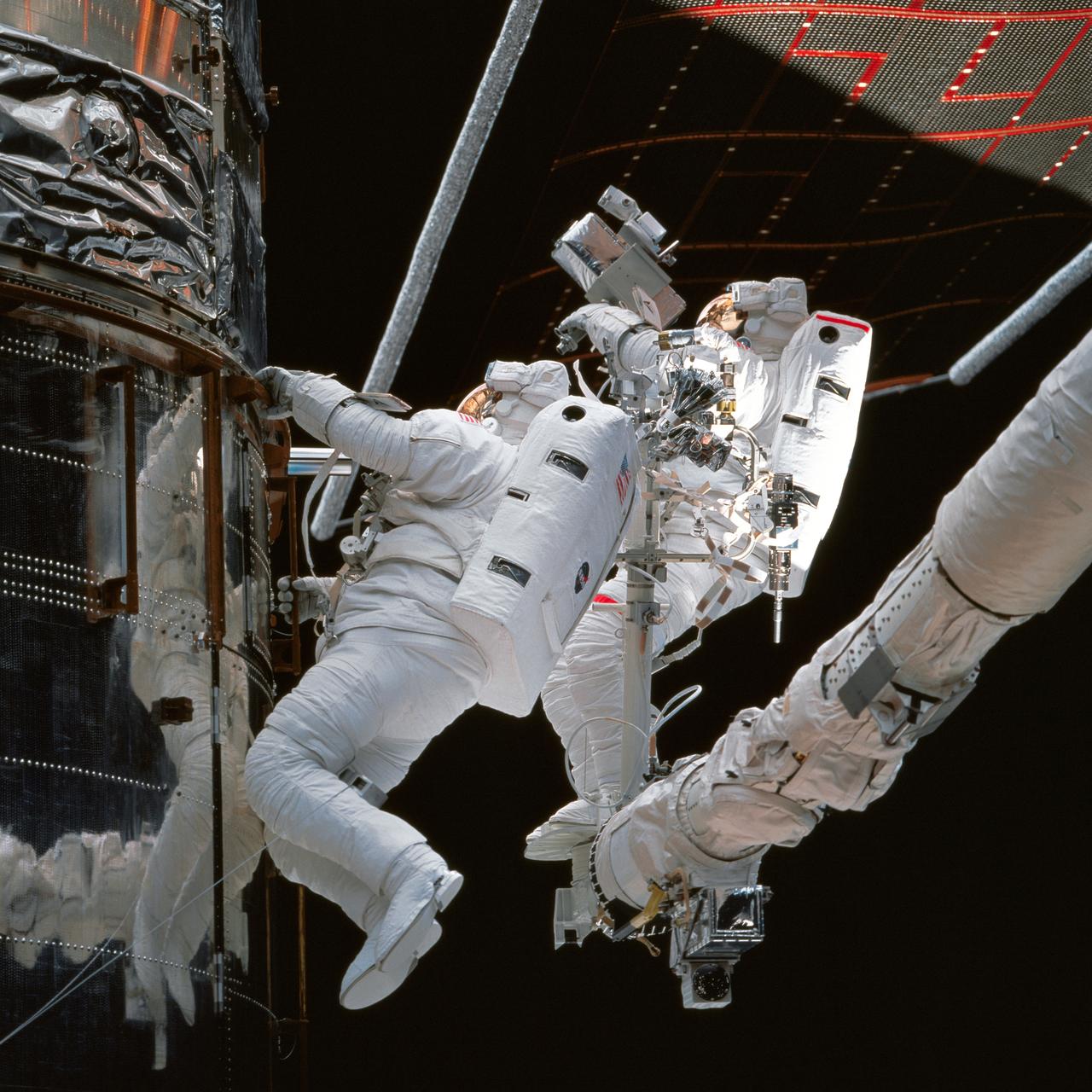
STS082-738-054 (11-21 Feb. 1997) --- As photographed from inside the Space Shuttle Discovery?s crew cabin, astronauts Steven L. Smith (left) and Mark C. Lee (red stripe) inspect insulation around Bay 10 of the Hubble Space Telescope (HST) during one of five days of extravehicular activities (EVA) designed to service the HST. Lee, payload commander, and Smith, performed three of the five EVA?s which eventually were carried out on the mission.
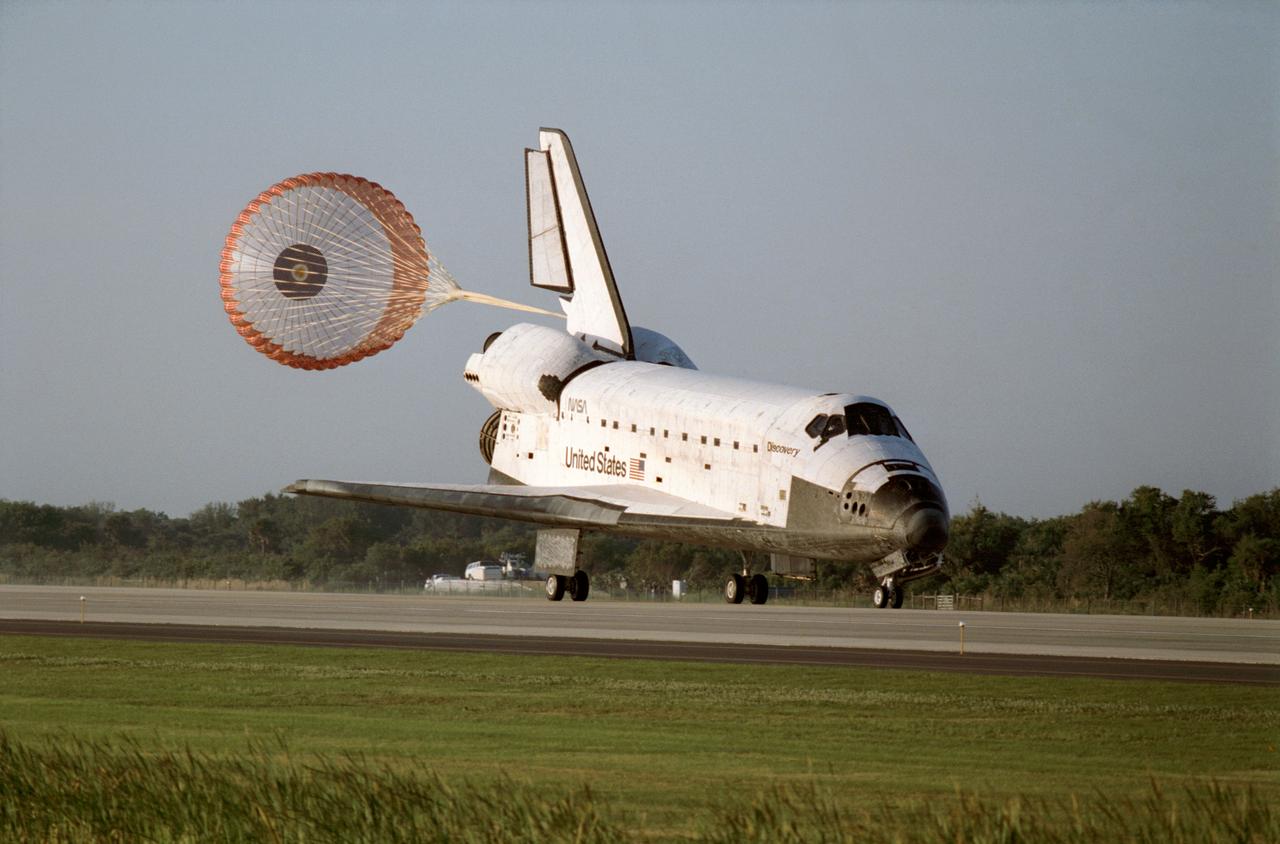
STS056-S-098 (17 April 1993) --- The drag chute is deployed following landing of the Space Shuttle Discovery on the Shuttle landing facility at the Kennedy Space Center to complete the STS-56\Atlas 2 mission. Touchdown occurred at 7:37 a.m. (EDT). Onboard the spacecraft were astronauts Kenneth D. Cameron, commander; Stephen S. Oswald, pilot; and C. Michael Foale, Ellen Ochoa and Kenneth D. Cockrell, mission specialists.
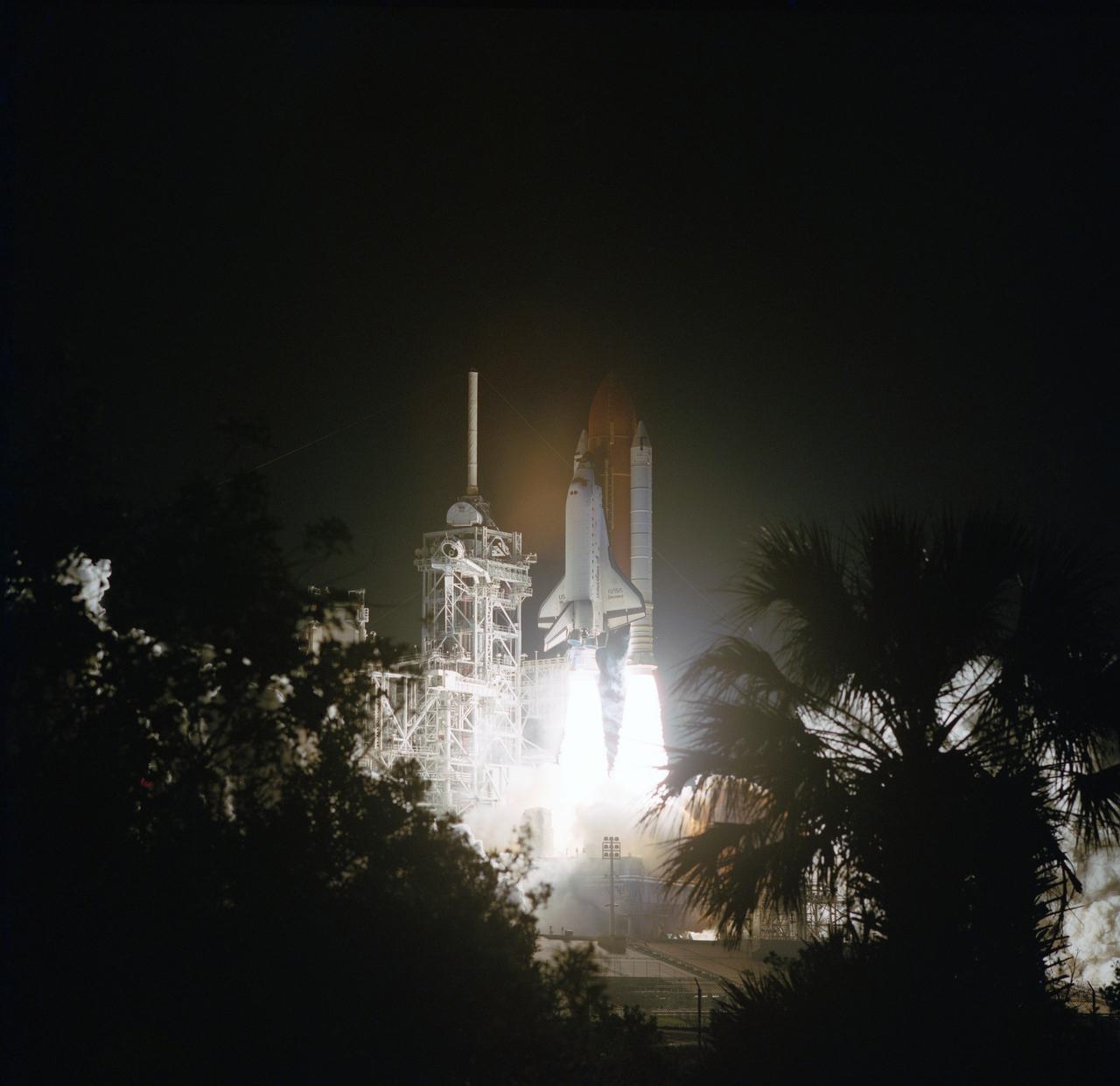
STS056-S-052 (8 April 1993) --- A nocturnal scene shows the Space Shuttle Discovery leaving the Launch Pad to begin the Atlas-2 mission in Earth-orbit. Launch occurred at 1:29 a.m. (EDT), April 8. Onboard were astronauts Kenneth D. Cameron, Stephen S. Oswald, C. Michael Foale, Kenneth D. Cockrell and Ellen Ochoa.
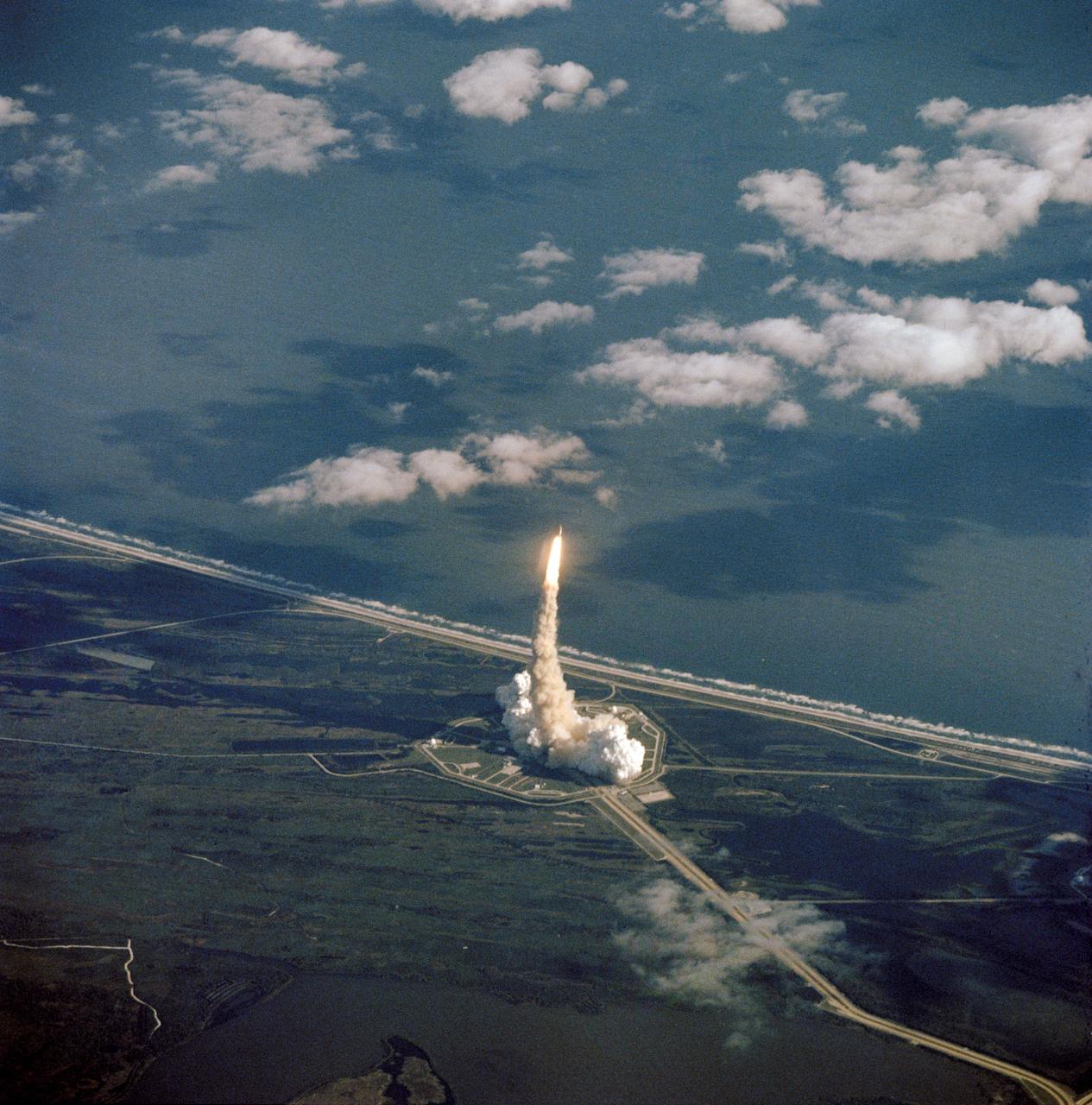
STS027-S-006 (2 Dec. 1988) --- A good portion of the Kennedy Space Center launch complex 39 and the Atlantic Ocean form the backdrop for the beginning stages of Atlantis' return trip to space. The scene was captured with a hand-held 70mm camera aimed through the windows of a NASA shuttle training aircraft piloted by astronaut Daniel C. Brandenstein, chief of Johnson Space Center?s astronaut office. Launch occurred at 9:30:34 a.m. (EST), Dec. 2, 1988. Photo credit: NASA
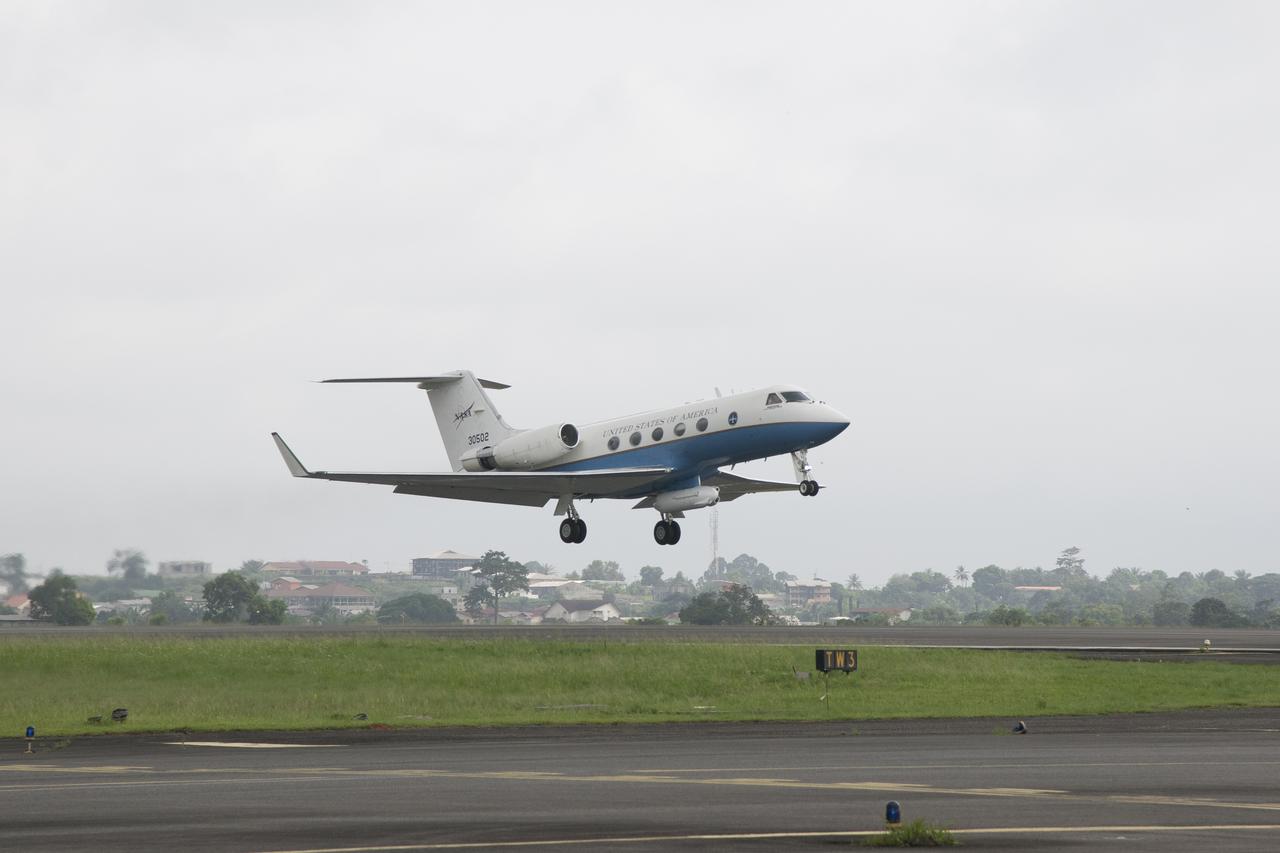
NASA’s C-20A takes off from Libreville International Airport in Gabon, Africa, in support of the AfriSAR  campaign in March 2016. Gabon is a Central African country slightly smaller than the state of Colorado that features the world’s second largest rainforest. In addition to environmental measurements, the flights were used for calibrating satellites for current and upcoming missions.
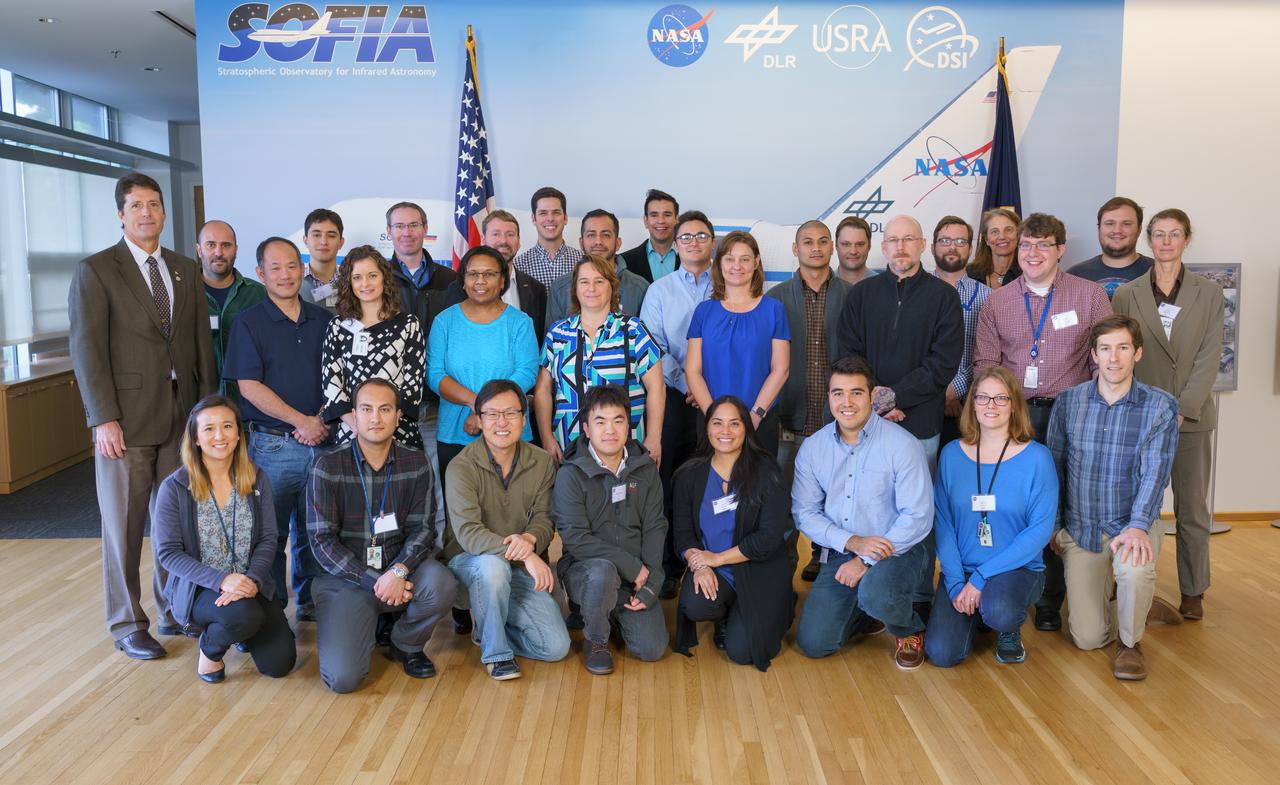
New Employees A Kujaneck, B Baeza, S Cahill, J Carolino, D Chang, E Czech, A Davila, R Everroad, R Fisher, A Ging, J Haglage, B Hooey, K Kwan, C Fung, P Ung-Joon Lee, M Mahzari, L Martin, K McMillin, S Monheim, A Nguyen, B Nikaido, T Perez, V Salazar, K Sato, D Shaw, Irene Smith, Melanie Smith, Lindsay Sturre, E Uribe Jr. with Tom Edwards, Ames Deputy Director.
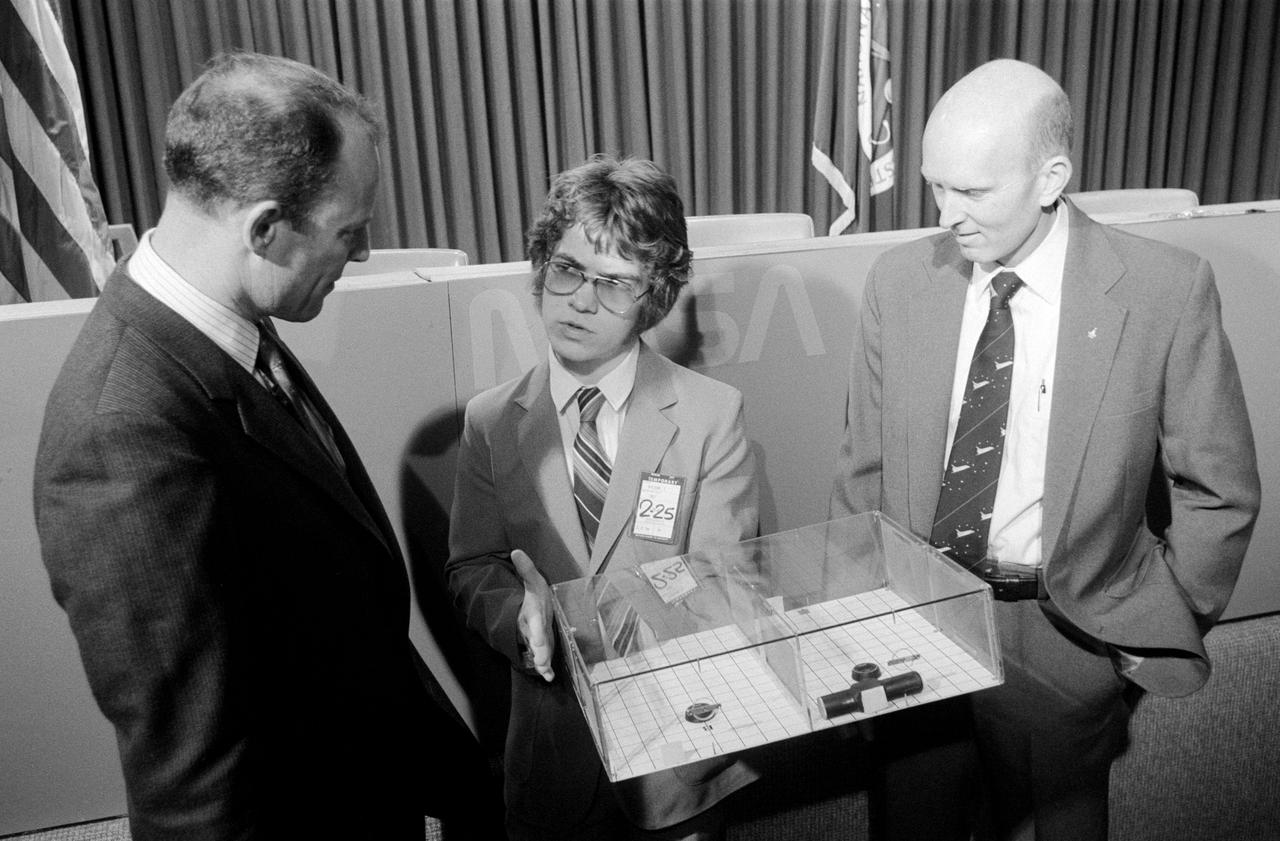
S82-27604 (26 Feb. 1982) --- The astronaut crew members for NASA?s third space transportation system (STS-3) flight meet with Todd E. Nelson, who devised a scientific experiment to fly on their mission. Astronauts Jack R. Lousma, left, commander, and C. Gordon Fullerton, pilot, along with the 18-year-old high school senior, discussed the experiment, entitled ?Insects in Flight Motion Study,? during a press briefing in JSC?s public affairs facility. Photo credit: NASA
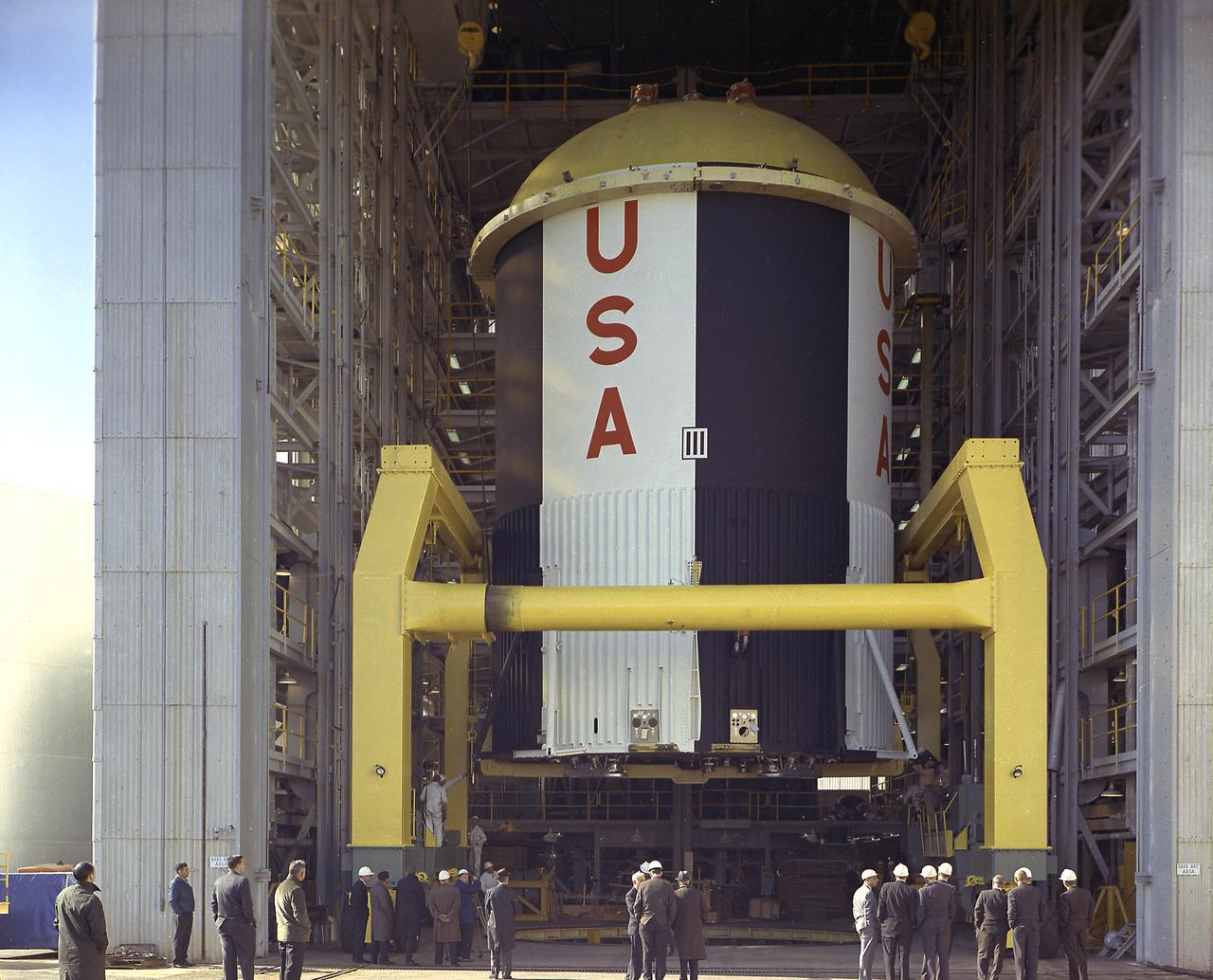
The fuel tank assembly of the Saturn V S-IC (first) stage supported with the aid of a C frame on the transporter was readied to be transported to the Marshall Space Flight Center, building 4705. The fuel tank carried kerosene (RP-1) as its fuel. The S-IC stage utilized five F-1 engines that used kerosene and liquid oxygen as propellant and each engine provided 1,500,000 pounds of thrust. This stage lifted the entire vehicle and Apollo spacecraft from the launch pad.
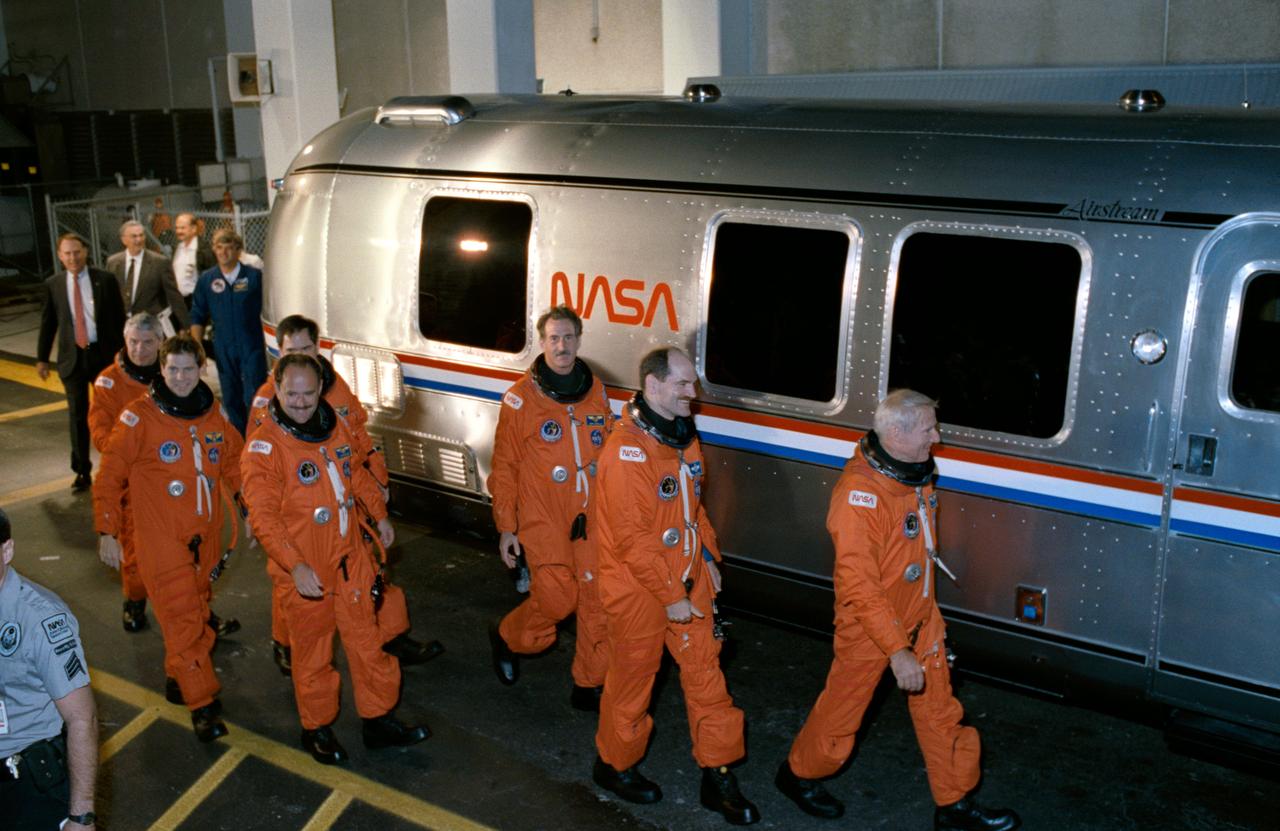
STS035-S-016 (2 Dec 1990) --- Astronaut Vance D. Brand, right, leads the STS 35 crew toward a transfer van that will take them from the nearby operations and checkout (O&C) building to Launch Complex 39. Trailing the mission commander, left to right, are Robert A. R. Parker, Samuel T. Durrance, Ronald A. Parise, John M. (Mike) Lounge, Jeffrey A. Hoffman and Guy S. Gardner.
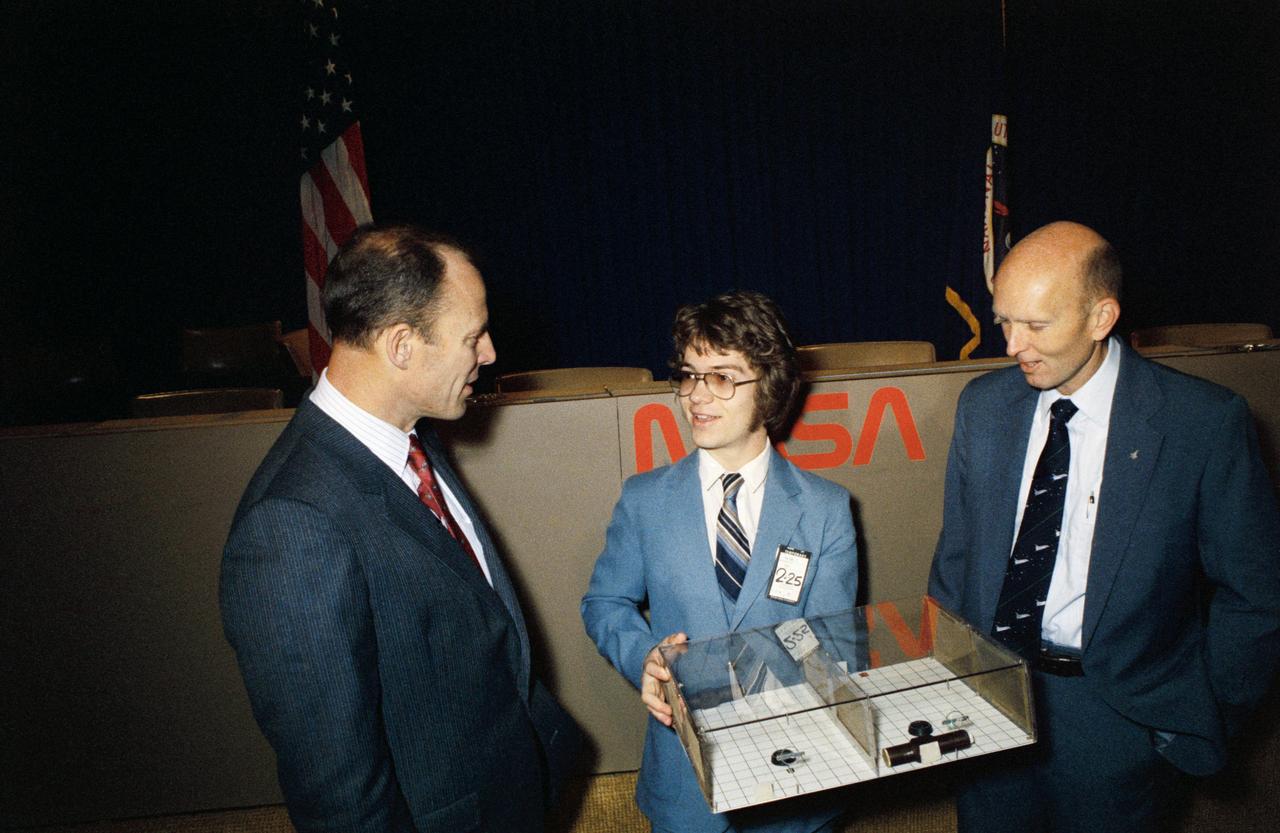
S82-27835 (26 Feb. 1982) --- The astronaut crew members for NASA?s third space transportation system (STS-3) flight meet with Todd E. Nelson, who devised a scientific experiment to fly on their mission. Astronauts Jack R. Lousma, left, commander, and C. Gordon Fullerton, pilot, along with the 18-year-old high school senior, discussed the experiment, entitled ?Insects in Flight Motion Study,? during a press briefing in JSC?s public affairs facility. Photo credit: NASA
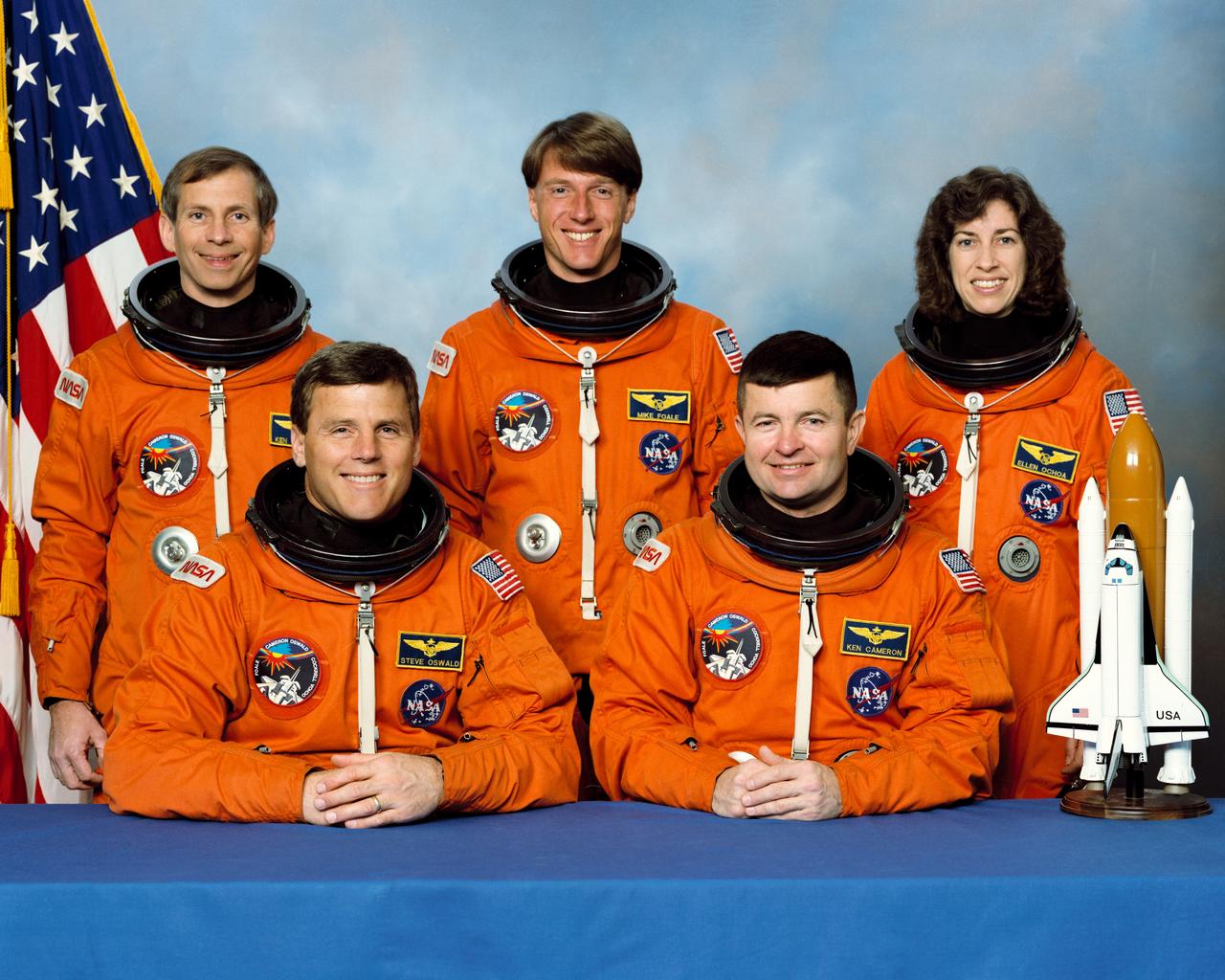
STS056-S-002 (January 1993) --- The five NASA astronauts assigned to fly aboard the Space Shuttle Discovery for the STS-56\Atlas-2 mission are pictured in training versions of their partial-pressure launch and entry garments. Left to right are astronauts Kenneth D. Cockrell, Steven S. Oswald, C. Michael Foale, Kenneth D. Cameron and Ellen Ochoa. Cameron is mission commander; Oswald, pilot; while the other three will serve as mission specialists.
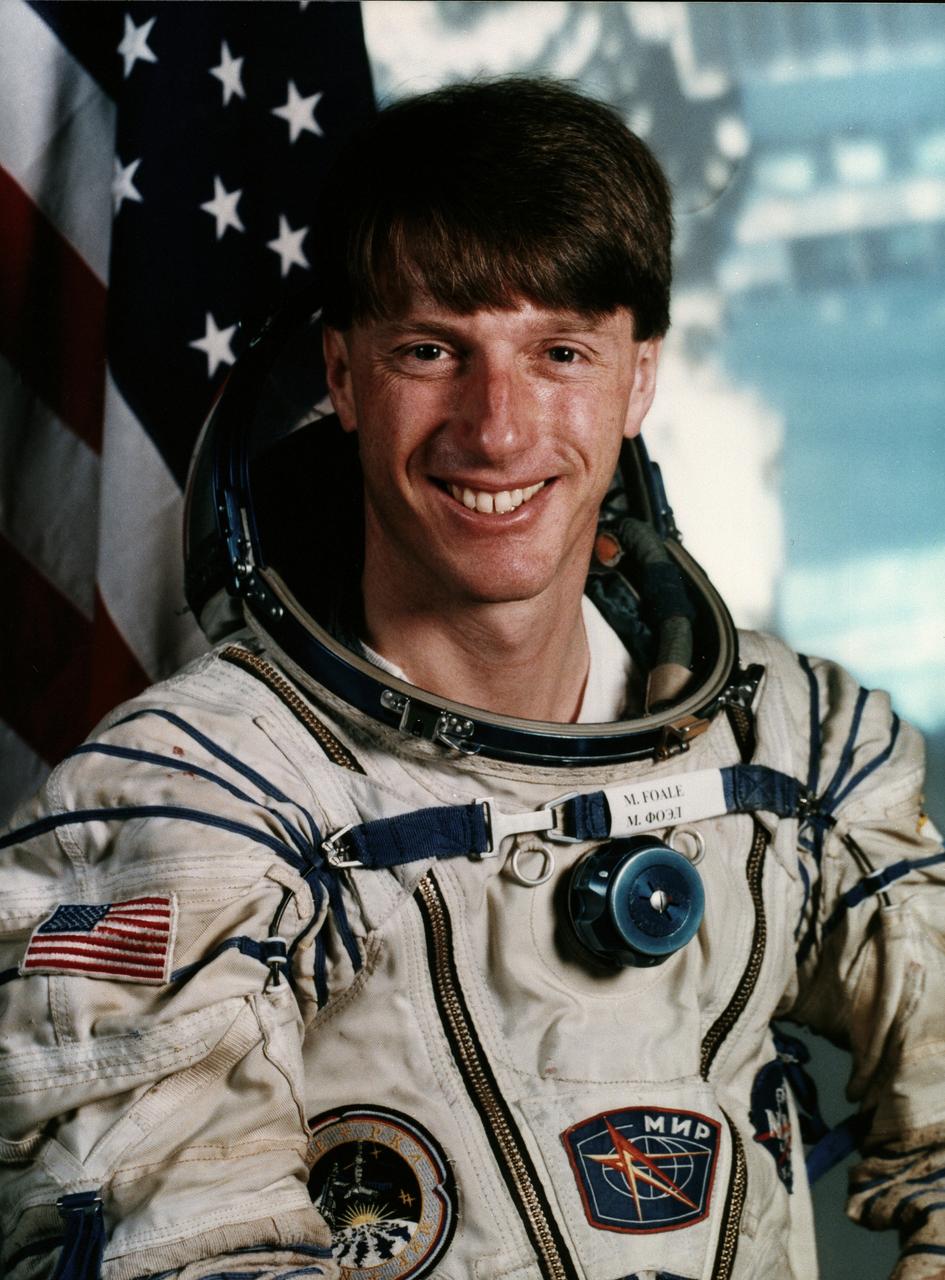
S97-06565 (1997) --- Astronaut C. Michael Foale, mission specialist/cosmonaut guest researcher Mir 23/24 flight engineer. EDITOR?S NOTE: Astronaut Foale will launch aboard the Space Shuttle Atlantis, STS-84 mission, to board the Russia?s Mir Space Station. After a long duration of cosmonaut guest researcher duties, he will return to Earth aboard the Space Shuttle Atlantis STS-86 mission.
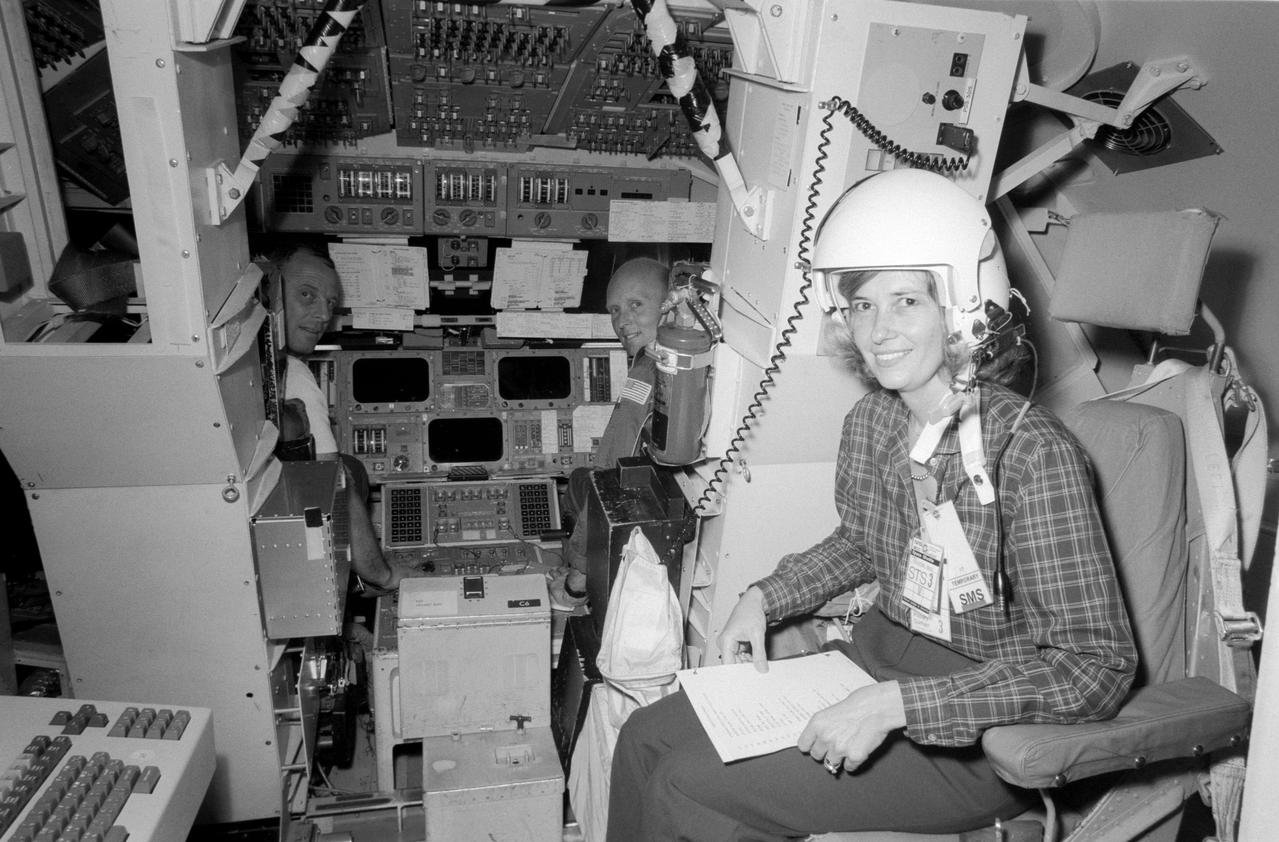
S82-28535 (16 March 1982) --- One of the more pleasant surprises of what are usually routine training sessions today was Mrs. Marie Fullerton, seated in the foreground in a special chair. Astronauts Jack R. Lousma, left background, and C. Gordon Fullerton, center, take a brief break in their simulation session to look back toward their visitor, wife of the pilot for NASA?s next flight. They are in the shuttle mission simulator (SMS) in the LBJ Space Center?s mission simulation and training facility. The crew is in training for its scheduled March 22 launch aboard the space shuttle Columbia for a week?s stay in Earth orbit. Photo credit: NASA
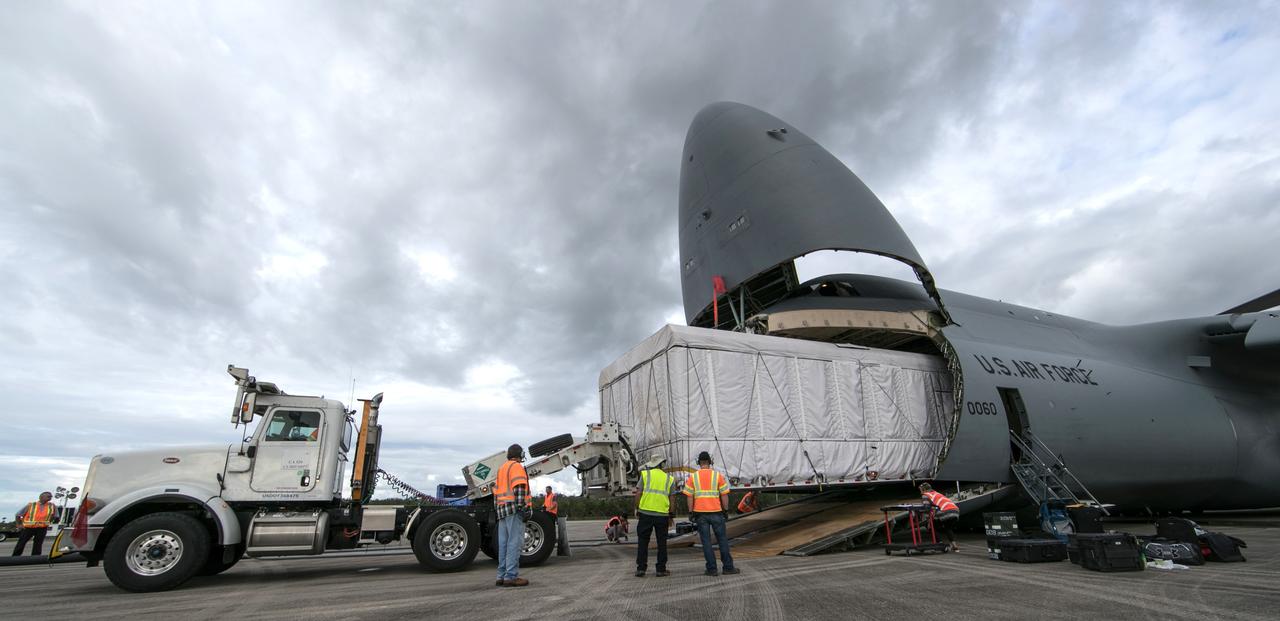
NOAA's Geostationary Operation Environmental Satellite-S (GOES-S) is being offloaded from a C-5 transport aircraft onto the flatbed of a heavy-lift truck at the Shuttle Landing Facility at NASA's Kennedy Space Center in Florida. The satellite will be transported to the Astrotech Space Operations facility in Titusville, Florida to prepare it for launch. GOES-S is the second in a series of four advanced geostationary weather satellites. The GOES-R series - consisting of the GOES-R, GOES-S, GOES-T and GOES-U spacecraft - will significantly improve the detection and observation of environmental phenomena that directly affect public safety, protection of property and the nation's economic health and prosperity. GOES-S is slated to launch March 1, 2018 aboard a United Launch Alliance Atlas V rocket from Cape Canaveral Air Force Station in Florida.
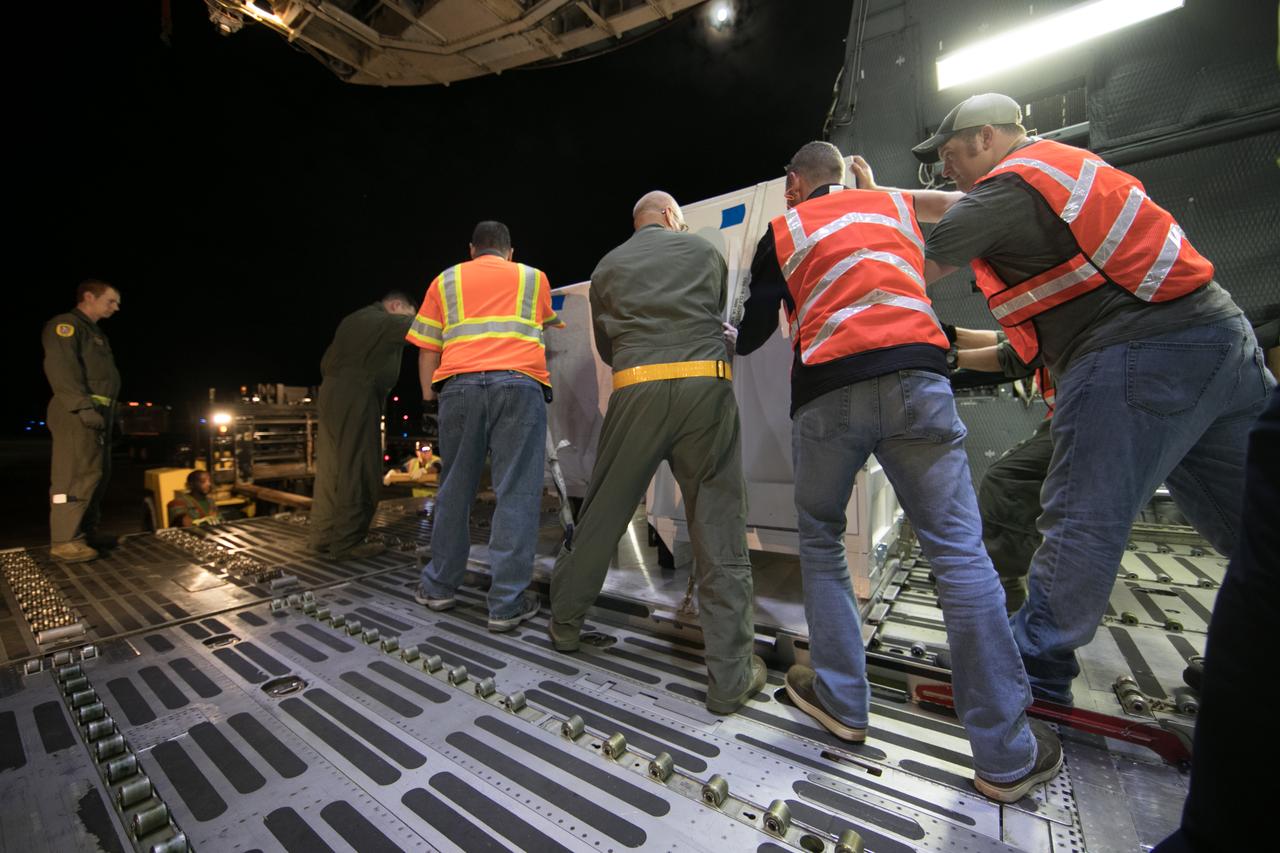
NOAA's Geostationary Operation Environmental Satellite-S (GOES-S) is being offloaded from a C-5 transport aircraft onto the flatbed of a heavy-lift truck at the Shuttle Landing Facility at NASA's Kennedy Space Center in Florida. The satellite will be transported to the Astrotech Space Operations facility in Titusville, Florida to prepare it for launch. GOES-S is the second in a series of four advanced geostationary weather satellites. The GOES-R series - consisting of the GOES-R, GOES-S, GOES-T and GOES-U spacecraft - will significantly improve the detection and observation of environmental phenomena that directly affect public safety, protection of property and the nation's economic health and prosperity. GOES-S is slated to launch March 1, 2018 aboard a United Launch Alliance Atlas V rocket from Cape Canaveral Air Force Station in Florida.
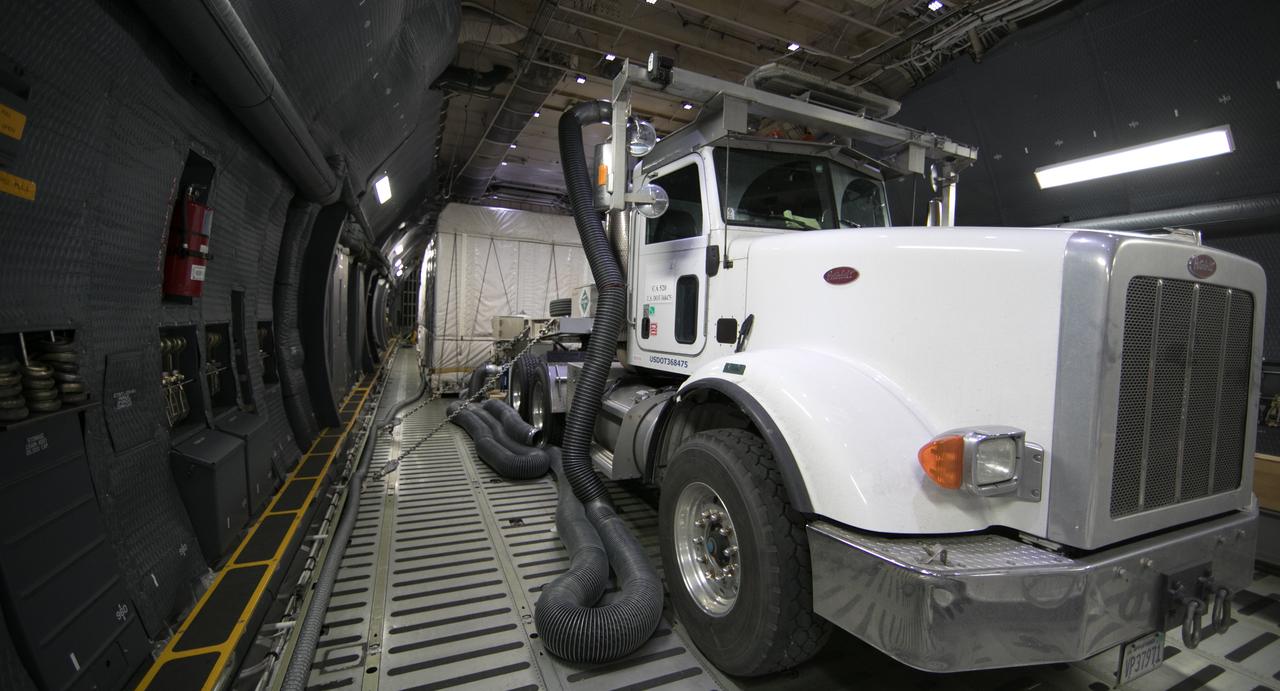
NOAA's Geostationary Operation Environmental Satellite-S (GOES-S) is being offloaded from a C-5 transport aircraft onto the flatbed of a heavy-lift truck at the Shuttle Landing Facility at NASA's Kennedy Space Center in Florida. The satellite will be transported to the Astrotech Space Operations facility in Titusville, Florida to prepare it for launch. GOES-S is the second in a series of four advanced geostationary weather satellites. The GOES-R series - consisting of the GOES-R, GOES-S, GOES-T and GOES-U spacecraft - will significantly improve the detection and observation of environmental phenomena that directly affect public safety, protection of property and the nation's economic health and prosperity. GOES-S is slated to launch March 1, 2018 aboard a United Launch Alliance Atlas V rocket from Cape Canaveral Air Force Station in Florida.
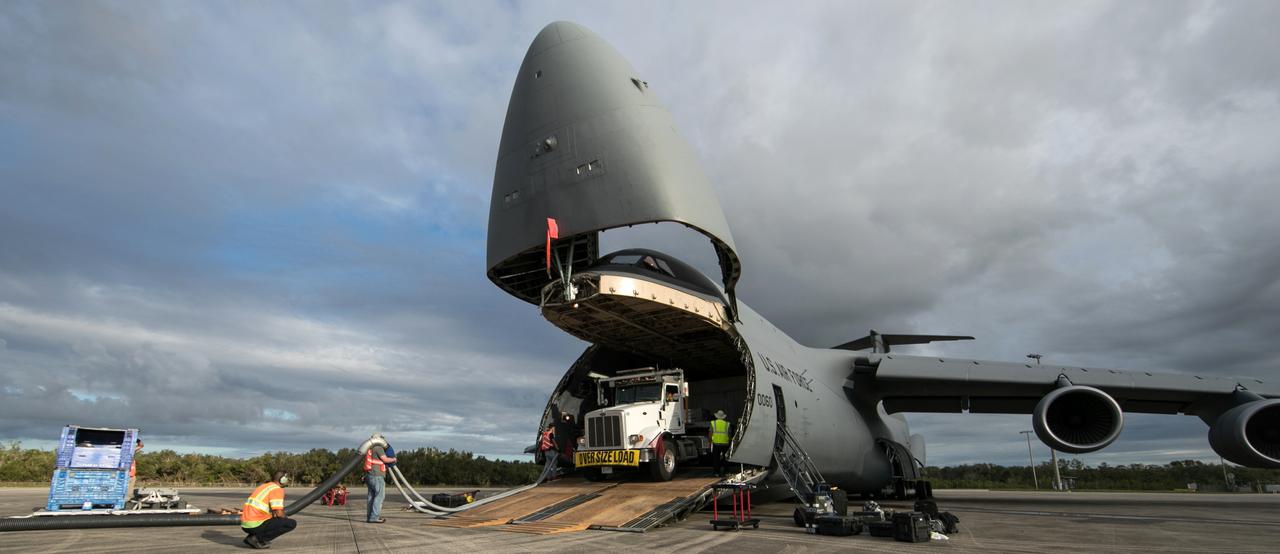
NOAA's Geostationary Operation Environmental Satellite-S (GOES-S) is being offloaded from a C-5 transport aircraft onto the flatbed of a heavy-lift truck at the Shuttle Landing Facility at NASA's Kennedy Space Center in Florida. The satellite will be transported to the Astrotech Space Operations facility in Titusville, Florida to prepare it for launch. GOES-S is the second in a series of four advanced geostationary weather satellites. The GOES-R series - consisting of the GOES-R, GOES-S, GOES-T and GOES-U spacecraft - will significantly improve the detection and observation of environmental phenomena that directly affect public safety, protection of property and the nation's economic health and prosperity. GOES-S is slated to launch March 1, 2018 aboard a United Launch Alliance Atlas V rocket from Cape Canaveral Air Force Station in Florida.
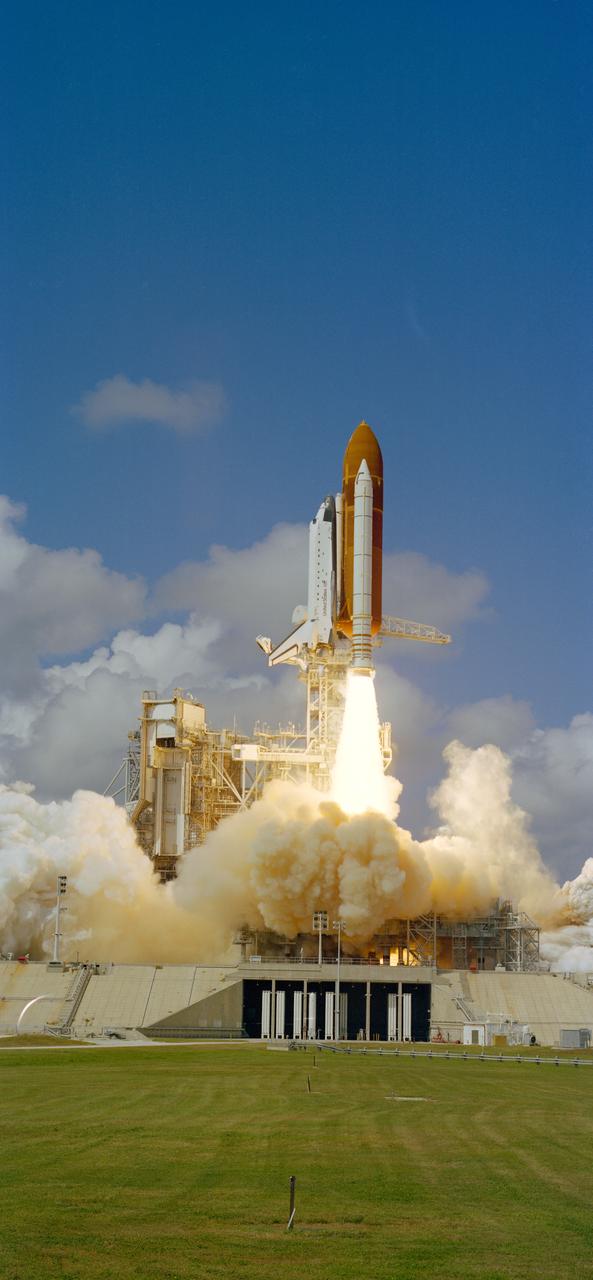
STS026-S-031 (29 Sept 1988) --- Just moments after ignition, the Space Shuttle Discovery, mated to two solid rocket boosters and an external fuel tank, heads, toward Earth orbit. The mission marks Discovery?s first flight since September of 1985 and NASA?s first manned mission since September of 1985 and NASA?s first manned mission since the 51L Challenger accident of January 28, 1986. Onboard the spacecraft are Astronauts Frederick H. (Rick) Hauck, commander; Richard O. Covey, pilot; and George D. Nelson, John M. (Mike) Lounge and David C. Hilmers, mission specialists. Discovery?s dry weight is 171,419 pounds. The tracking and data relay satellite and its inertial upper stage total about 37,000 pounds.
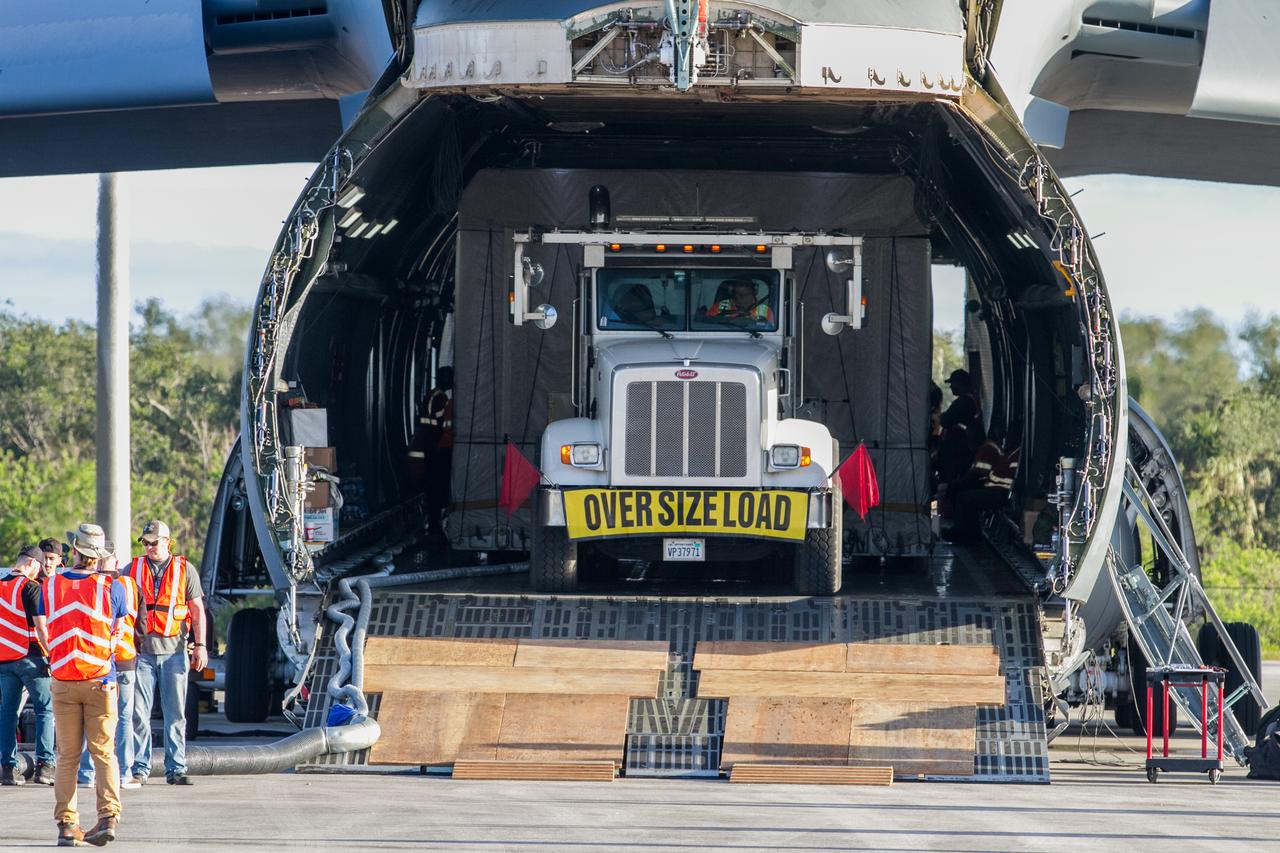
NOAA's Geostationary Operation Environmental Satellite-S (GOES-S) is being offloaded from a C-5 transport aircraft onto the flatbed of a heavy-lift truck at the Shuttle Landing Facility at NASA's Kennedy Space Center in Florida. The satellite will be transported to the Astrotech Space Operations facility in Titusville, Florida to prepare it for launch. GOES-S is the second in a series of four advanced geostationary weather satellites. The GOES-R series - consisting of the GOES-R, GOES-S, GOES-T and GOES-U spacecraft - will significantly improve the detection and observation of environmental phenomena that directly affect public safety, protection of property and the nation's economic health and prosperity. GOES-S is slated to launch March 1, 2018 aboard a United Launch Alliance Atlas V rocket from Cape Canaveral Air Force Station in Florida.
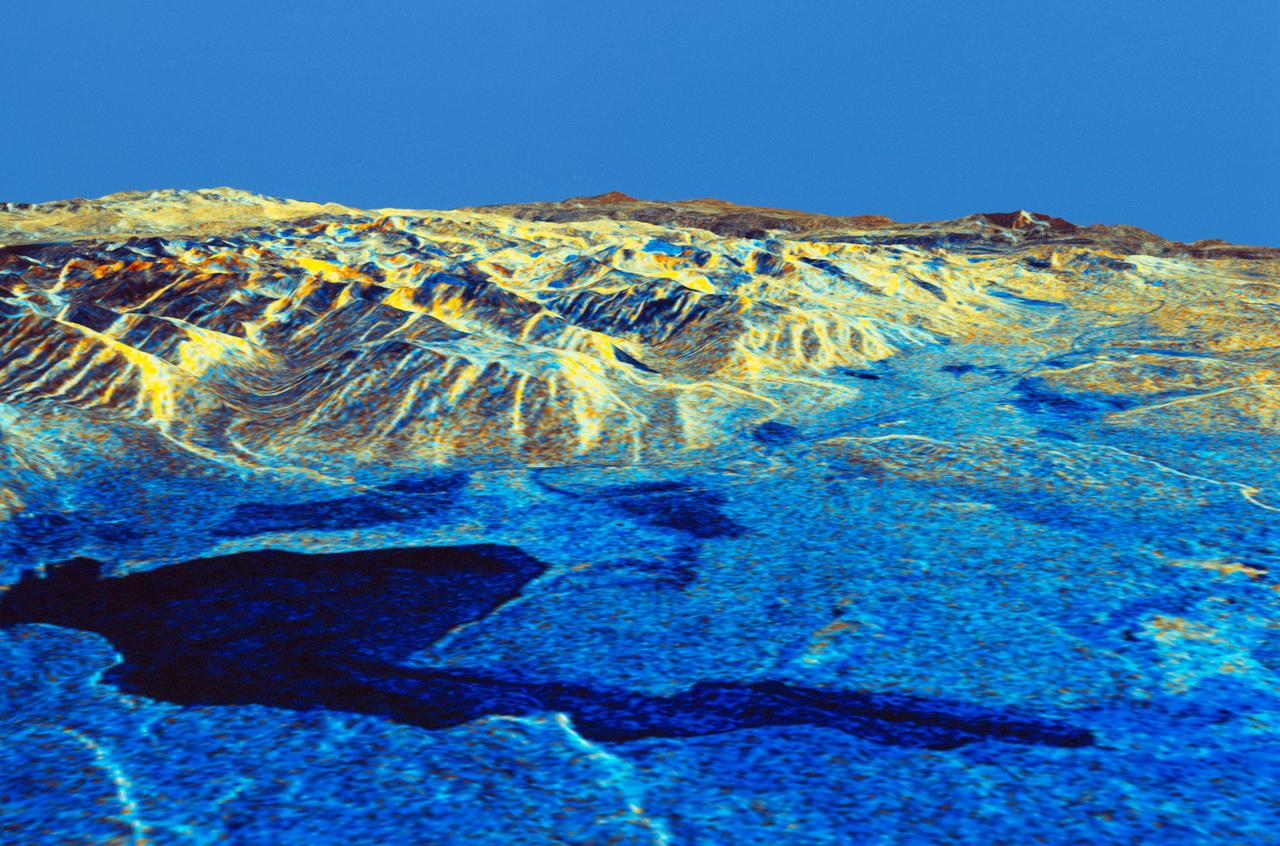
STS059-S-084 (17 April 1994) --- This is a three-dimensional perspective of Mammoth Mountain, California. This view was constructed by overlaying a SIR-C radar image on a U.S. Geological Survey digital elevation map. Vertical exaggeration is 2x. The image is centered at 37.6 degrees north, 119.0 degrees west. It was acquired from the Spaceborne Imaging Radar-C and X-Band Synthetic Aperture Radar (SIR-C/X-SAR) onboard the Space Shuttle Endeavour on its 67th orbit, April 13, 1994. In this color representation, red is C-Band HV-polarization, green is C-Band VV-polarization and blue is the ratio of C-Band VV to C-Band HV. Blue areas are smooth and yellow areas are rock outcrops with varying amounts of snow and vegetation. Crowley Lake is in the foreground and Highway 395 crosses in the middle of the image. Mammoth Mountain is shown in the upper right. SIR-C/X-SAR is part of NASA's Mission to Planet Earth (MTPE). SIR-C/X-SAR radars illuminate Earth with microwaves allowing detailed observations at any time, regardless of weather or sunlight conditions. SIR-C/X-SAR uses three microwave wavelengths: L-Band (24 cm), C-Band (6 cm), and X-Band (3 cm). The multi-frequency data will be used by the international scientific community to better understand the global environment and how it is changing. The SIR-C/X-SAR data, complemented by aircraft and ground studies, will give scientists clearer insights into those environmental changes which are caused by nature and those changes which are induced by human activity. SIR-C was developed by NASA's Jet Propulsion Laboratory (JPL). X-SAR was developed by the Dornire and Alenia Spazio Companies for the German Space Agency, Deutsche Agentur fuer Raumfahrtangelegenheiten (DARA), and the Italian Space Agency, Agenzia Spaziale Italiana (ASI). JPL Photo ID: P-43933
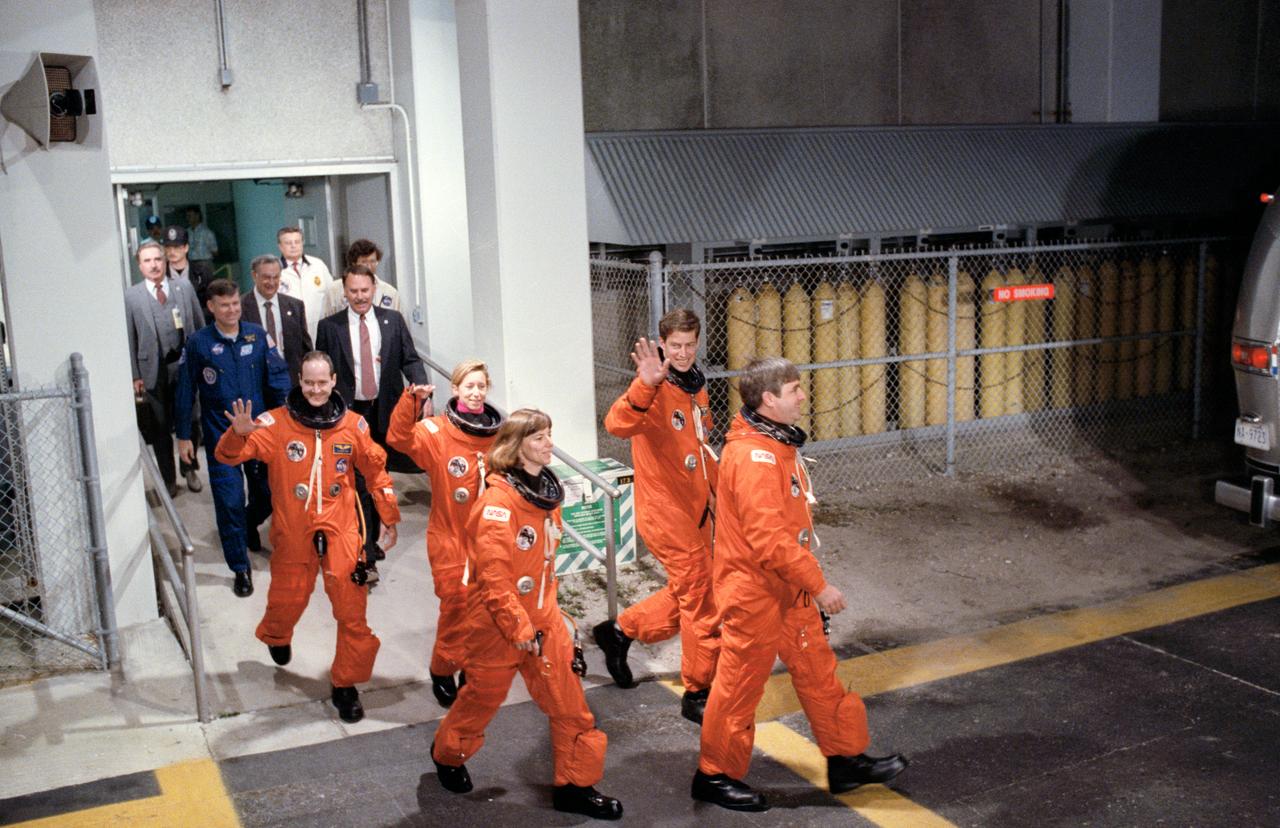
STS032-S-056 (20 Jan 1990) --- STS-32 Columbia, Orbiter Vehicle (OV) 102, crewmembers depart the Kennedy Space Center (KSC) Operations and Checkout (O and C) Building enroute to KSC Launch Complex (LC) Pad 39A. Dubious weather at the return-to-launch site (RTLS) caused postponement of yesterday's planned launch. From left to right are Mission Specialist (MS) G. David Low, MS Marsha S. Ivins, MS Bonnie J. Dunbar, Pilot James D. Wetherbee, and Commander Daniel C. Brandenstein. All crewmembers are wearing launch and entry suits (LESs) and Low, Ivins, and Wetherbee wave to spectators as they head to the transportation van. Following the crew are astronaut Michael L. Coats (left) and NASA/JSC manager Donald R. Puddy.
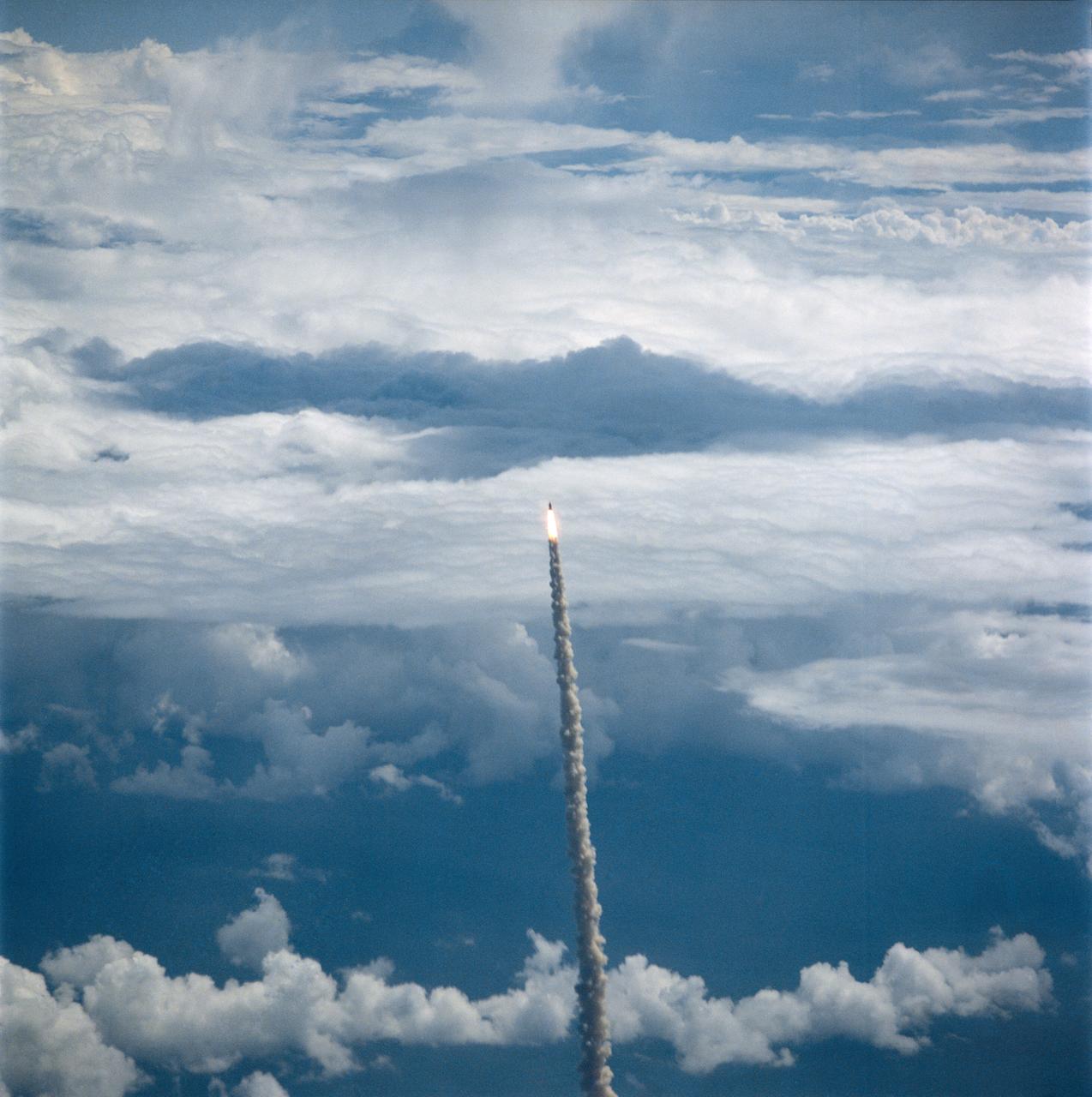
S26-S-026 (29 Sept. 1988) --- The STS-26 launch was captured on film from the NASA Shuttle Training Aircraft, piloted by astronaut Daniel C. Brandenstein, chief of JSC's Astronaut Office. Discovery?s mission was the first flight to be flown after the Challenger accident. The flight crew included astronauts Rick Hauck, commander; Dick Covey, pilot; and three mission specialists, Dave Hilmers, Mike Lounge, and George (Pinky) Nelson. During the four-day mission, the crew deployed the Tracking and Data Relay Satellite (TDRS-C) and operated eleven mid-deck experiments. Discovery completed 64 orbits of the earth before landing at Edwards Air Force Base, California, on October 3, 1988. Photo credit: NASA or National Aeronautics and Space Administration
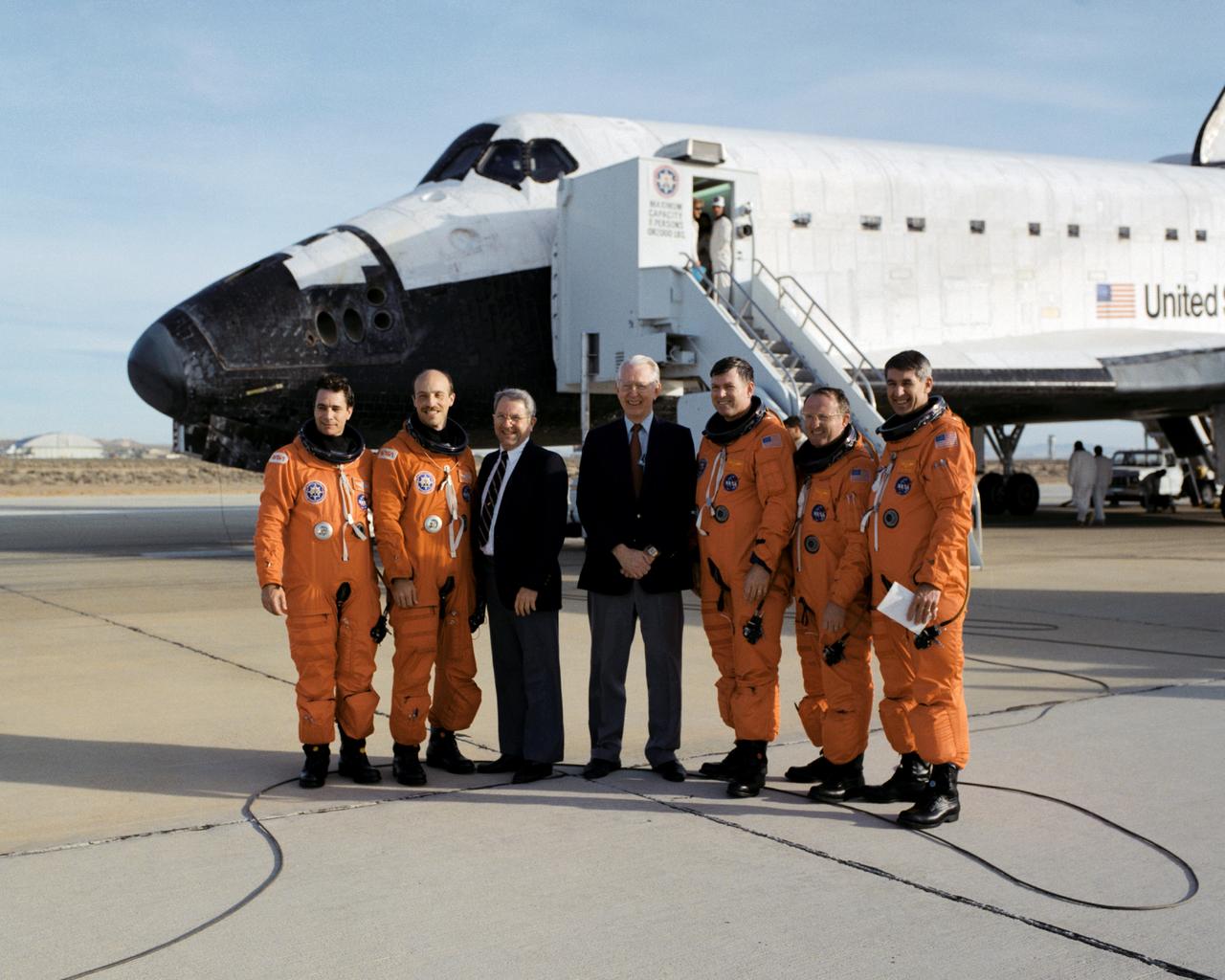
STS029-S-066 (18 March 1989) --- The five-man crew who flew aboard NASA's Space Shuttle Discovery (background) pose near it with NASA officials following a successful five-day mission in space. Left to right are astronauts John E. Blaha, pilot; and James P. Bagian, mission specialist; Rear Admiral Richard H. Truly, NASA Associate Administrator for Space Flight; Dr. James C. Fletcher, NASA Administrator; astronauts Michael L. Coats, commander; and James F. Buchli and Robert C. Springer, mission specialists.
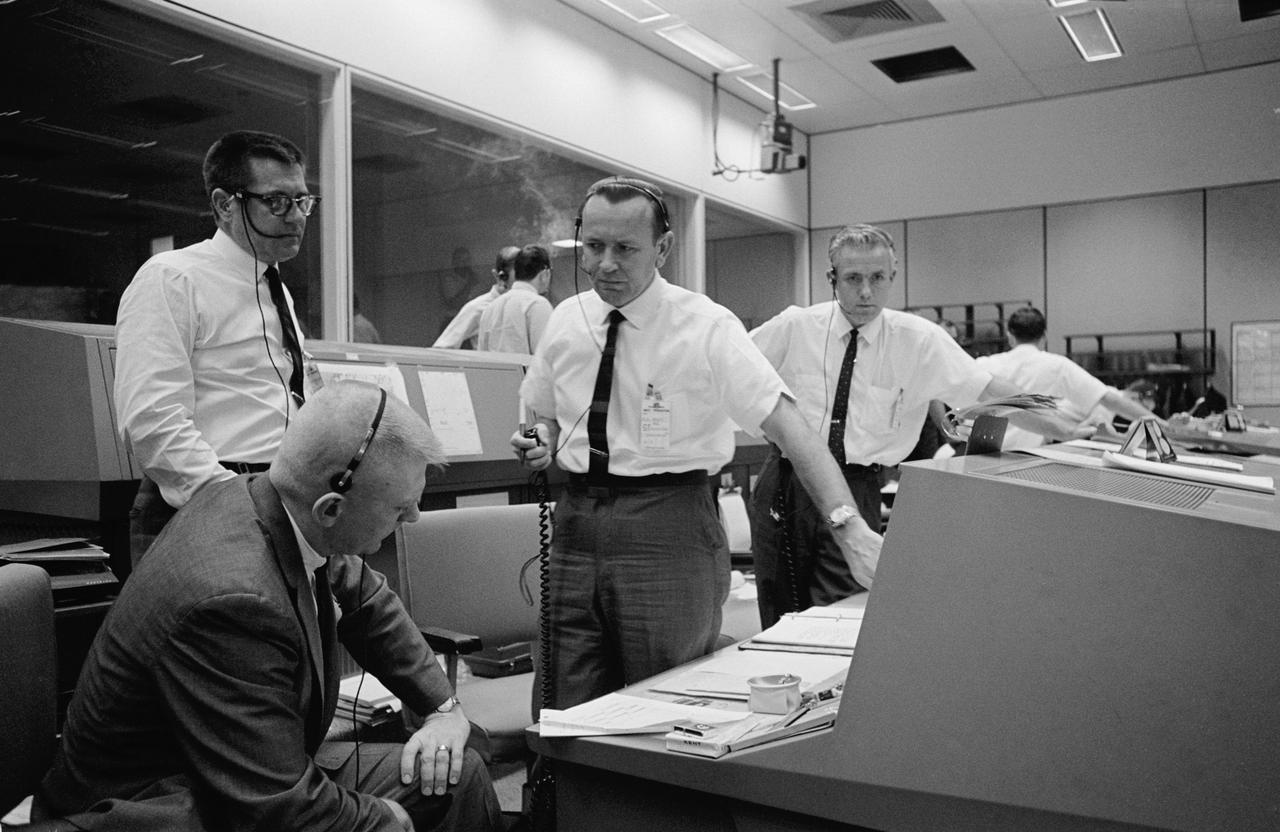
S65-62062 (12 Dec. 1965) --- Discussing the scrubbing of the planned National Aeronautics and Space Administration?s Gemini-6 spaceflight are (from left) William C. Schneider (standing), deputy director, Gemini Program Office of Manned Spaceflight, NASA Headquarters, Washington, D.C.; Eugene F. Kranz (seated), white team flight director; Christopher C. Kraft Jr., red team flight director; and John D. Hodge, blue team flight director. The Gemini-6 mission has been rescheduled for Dec. 15, 1965. Photo credit: NASA or National Aeronautics and Space Administration
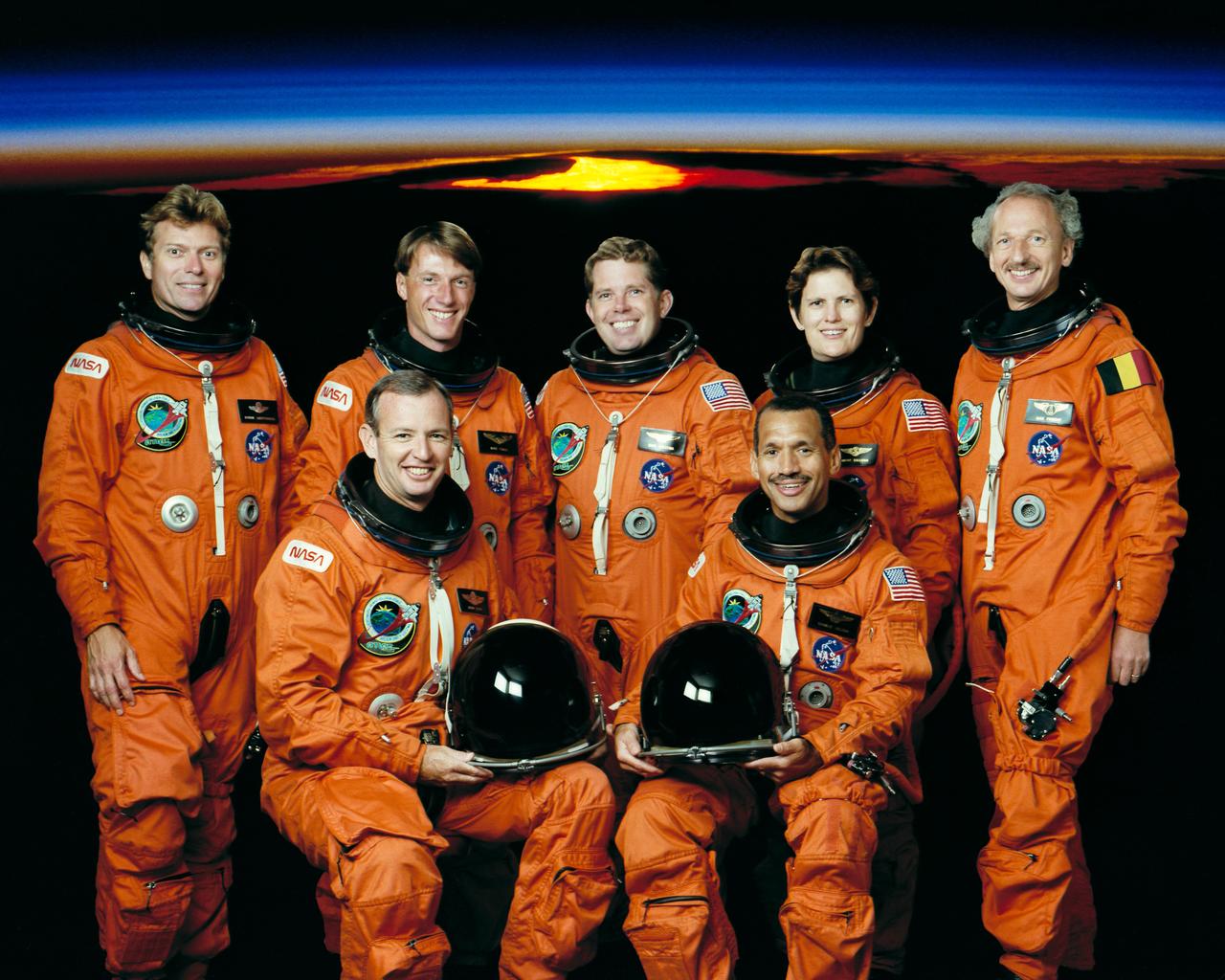
STS045-S-002 (January 1992) --- The seven crew members for NASA's STS-45 mission are pictured in their partial-pressure launch and entry suits. In front are astronauts Charles F. Bolden, Jr. (right), mission commander, and Brian Duffy, pilot. Back row, left to right, are payload specialist Byron K. Lichtenberg; astronauts C. Michael Foale and David C. Leestma, mission specialists; Kathryn D. Sullivan, payload commander; and payload specialist Dirk Frimout, of Belgium. The Atmospheric Laboratory for Applications and Science (ATLAS) is scheduled for a March 1992 launch aboard the Space Shuttle Atlantis.
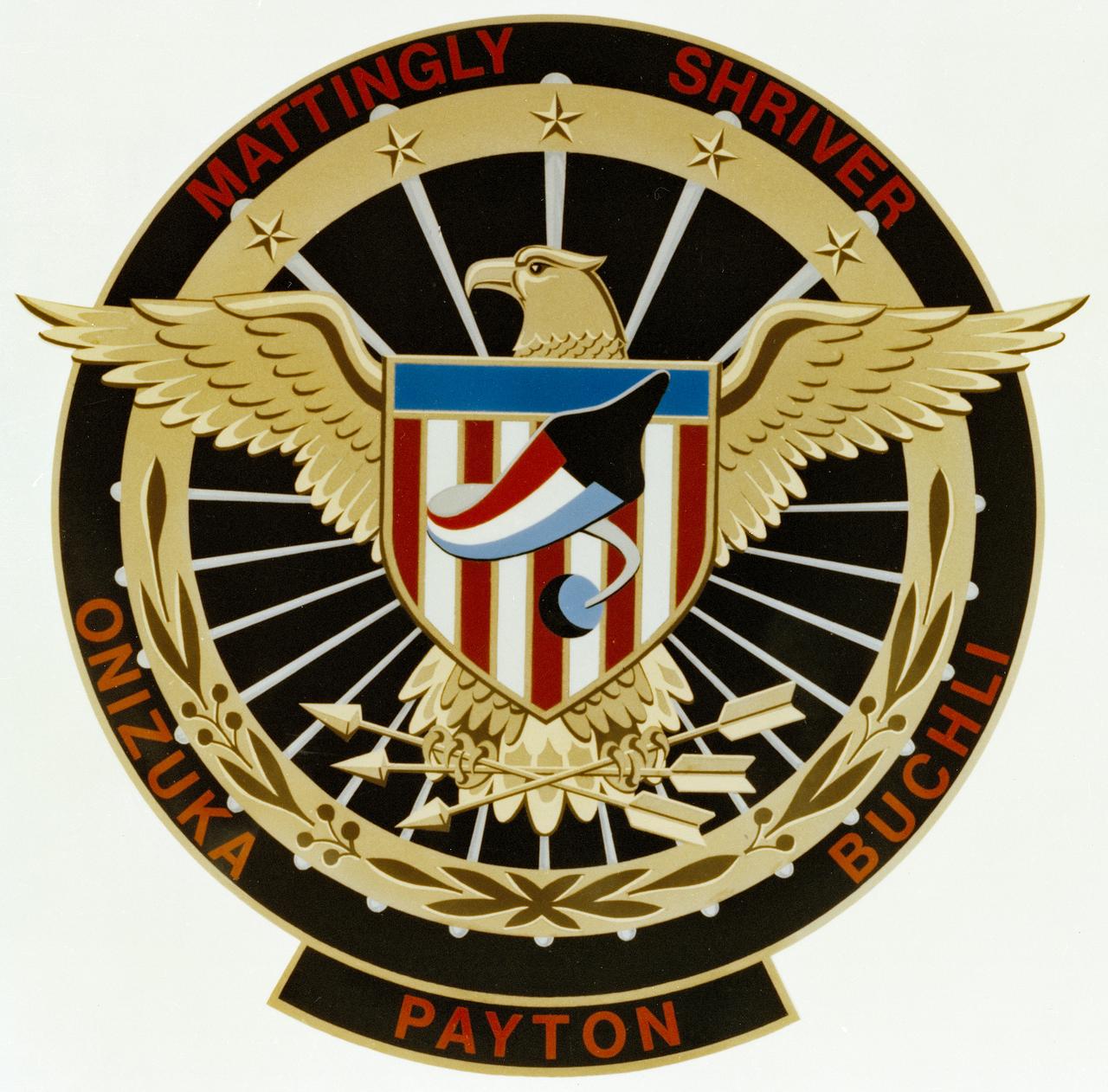
The crew insignia for STS Flight 51-C includes the names of its five crewmembers. The STS 51-C mission marked the third trip of the Space Shuttle Discovery into space. It was the first Space Shuttle mission totally dedicated to the Department of Defense. The U. S. Air Force Inertial Upper Stage Booster Rocket was successfully deployed. Due to the nature of the mission, few additional details of the flight were made available. Landing was made at the Kennedy Space Center, FL on January 27 at 4:23 PM EST. Mission duration was three days, one hour and 33 minutes.
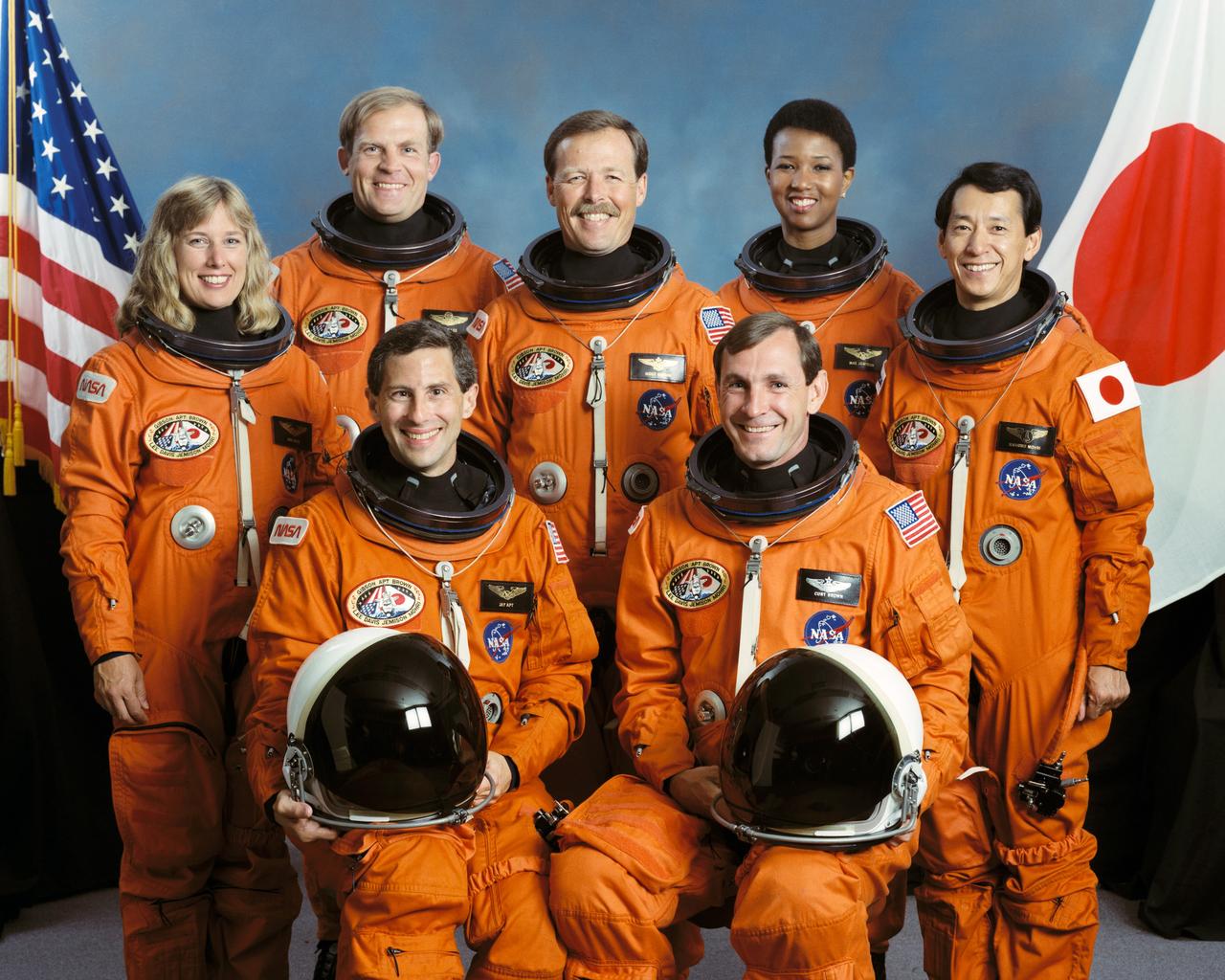
STS047-S-002 (June 1992) --- These seven crew members are currently in training for the STS-47/Spacelab J mission scheduled for later this year. Pictured are (left to right, front) Jerome (Jay) Apt, mission specialist; Curtis L. Brown, pilot; and (left to right, rear) N. Jan Davis, mission specialist; Mark C. Lee, payload commander; Robert L. Gibson, mission commander; Mae C. Jemison, mission specialist; and Mamoru Mohri, payload specialist, representing the National Space Development Agency of Japan (NASDA). This is the Space Shuttle Endeavour's second scheduled mission.
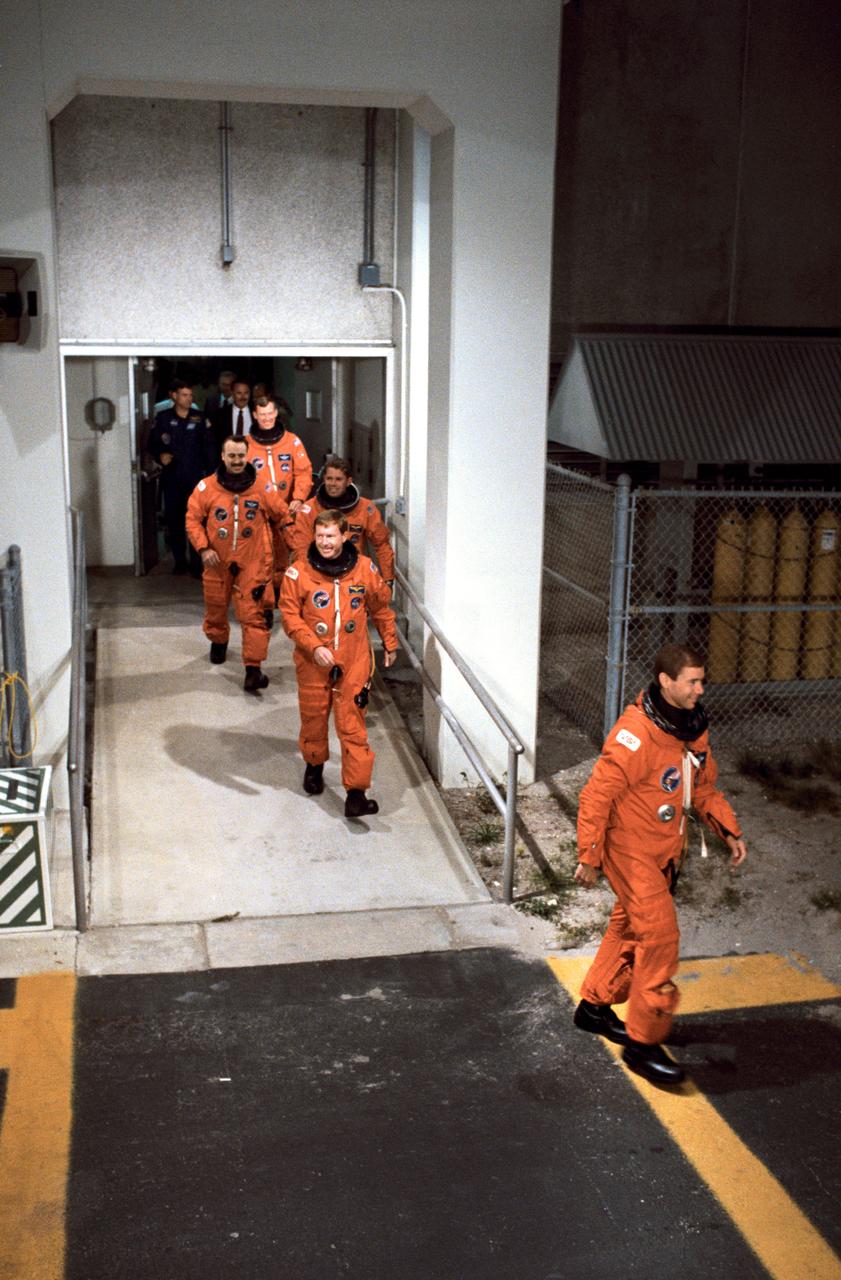
STS028-S-001 (8 Aug 1989) --- The five astronaut crewmembers for STS-28 leave the operations and checkout building to board a transfer van en route to Launch Complex 39 for a date with Columbia. Front to back are Brewster H. Shaw Jr., Richard N. Richards, David C. Leestma, James C. Adamson and Mark N. Brown. At the rear of the line are Astronaut Michael L. Coats, acting chief of the astronaut office; and Donald R. Puddy, director of flight crew operations at JSC. Coats later flew a NASA Shuttle training aircraft for pre-launch and launch monitoring activities.
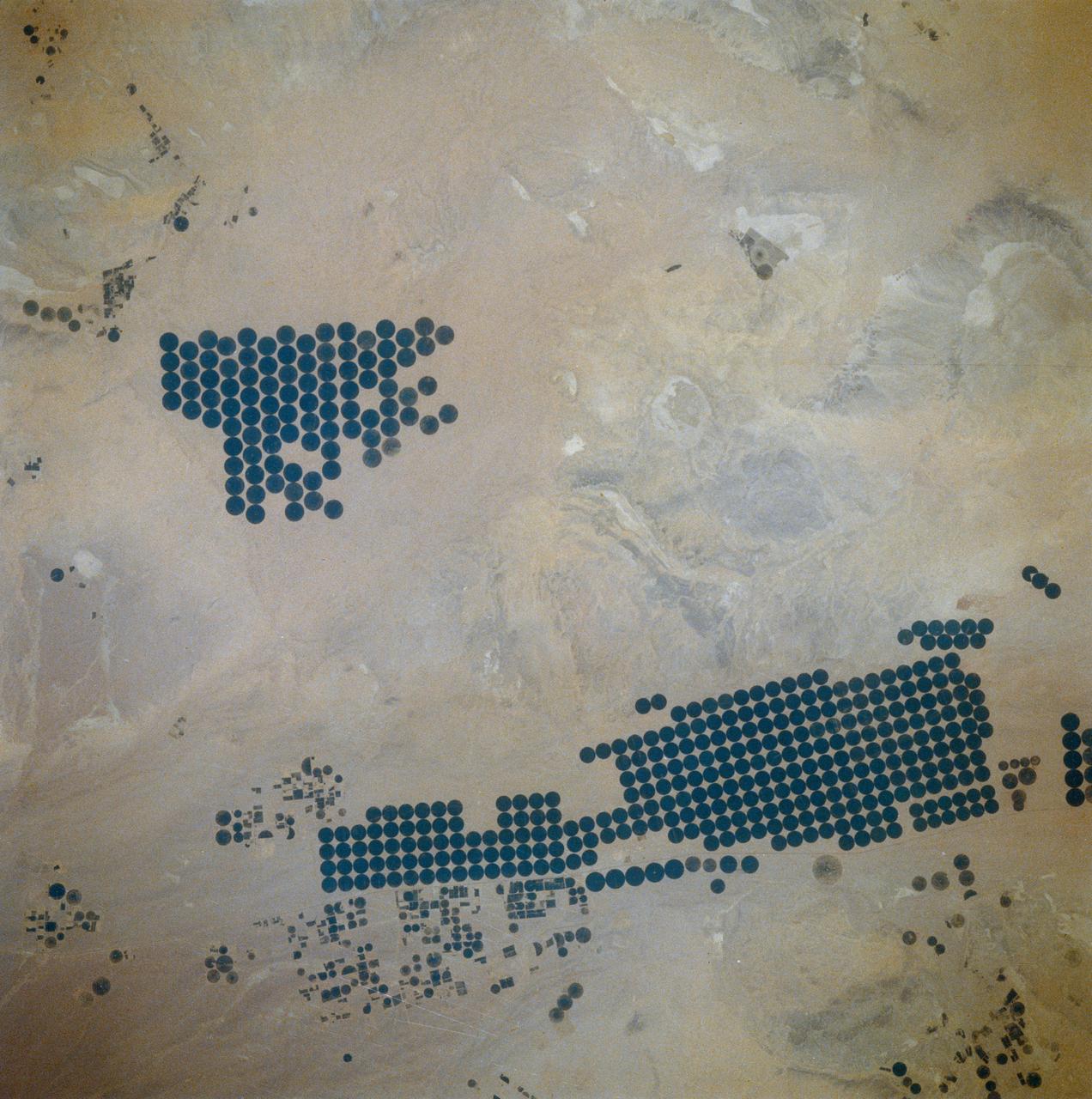
41C-31-1002 (6-13 April 1984) --- Though previous photographs of this area have been taken prior to 41-C, that mission?s photography represents the best ever of ground water irrigation in Near East deserts. The system here is located in northeast Saudi Arabia, in the vicinity of Al Hufuf. Designed for use in the American west, the center pivot irrigation method pumps water from the ground and broadcasts it in a half-mile diameter circle from a mobile sprinkler system. This frame was one of the visuals used by the 41-C astronauts at their post-flight press conference.
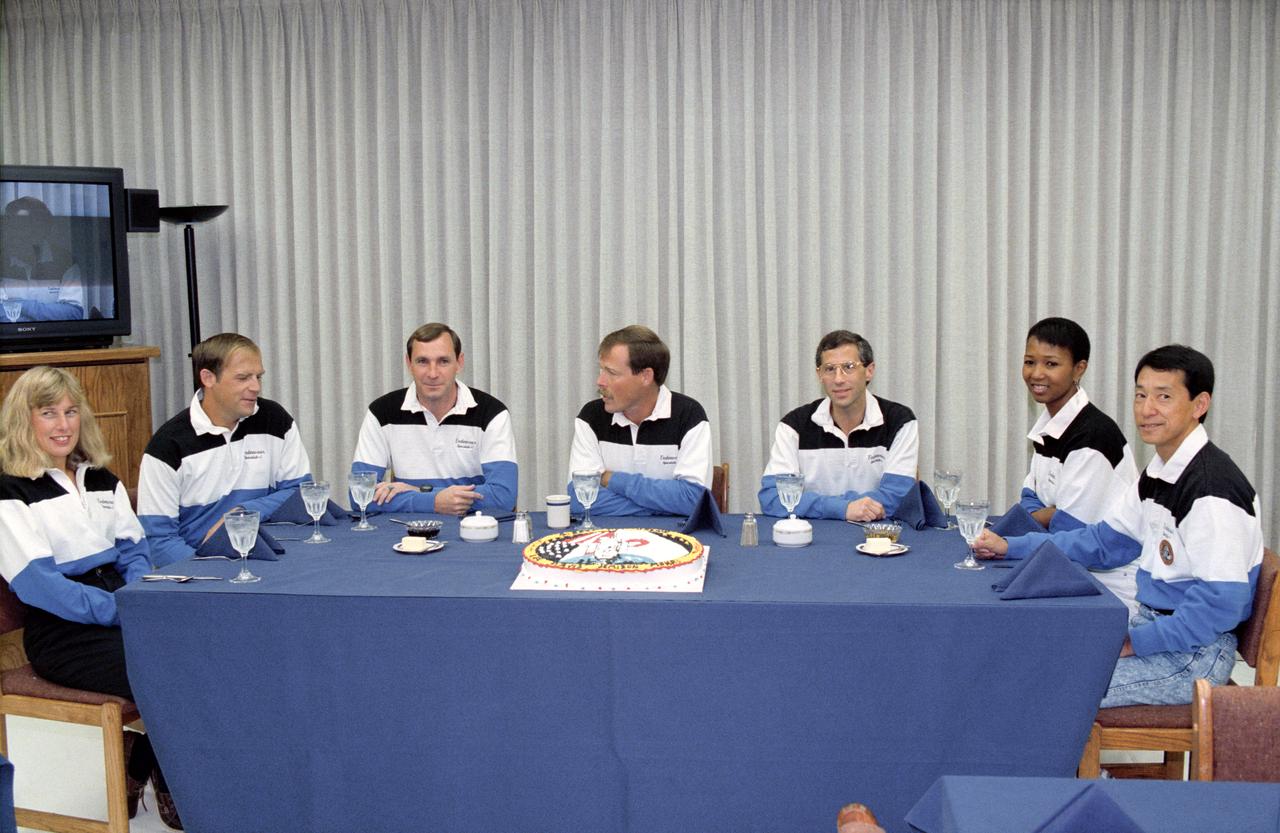
STS047-S-037 (12 Sept 1992) --- The seven crewmembers who will be aboard for Endeavour's second trip into space are about to have a light breakfast prior to the pre-launch suiting up process in the Operations and Checkout Building. Left to right are astronauts N. Jan Davis, Mark C. Lee, Curtis L. Brown Jr., Robert L. Gibson, Jerome (Jay) Apt and Mae C. Jemison; and payload specialist Mamoru Mohri, representing the National Space Development Agency (NASDA) of Japan. This mission will be devoted to support of the Spacelab-J mission, a joint effort between Japan and the United States. Launch occurred at 10:23:00:0680 a.m. (EDT), September 12, 1992.
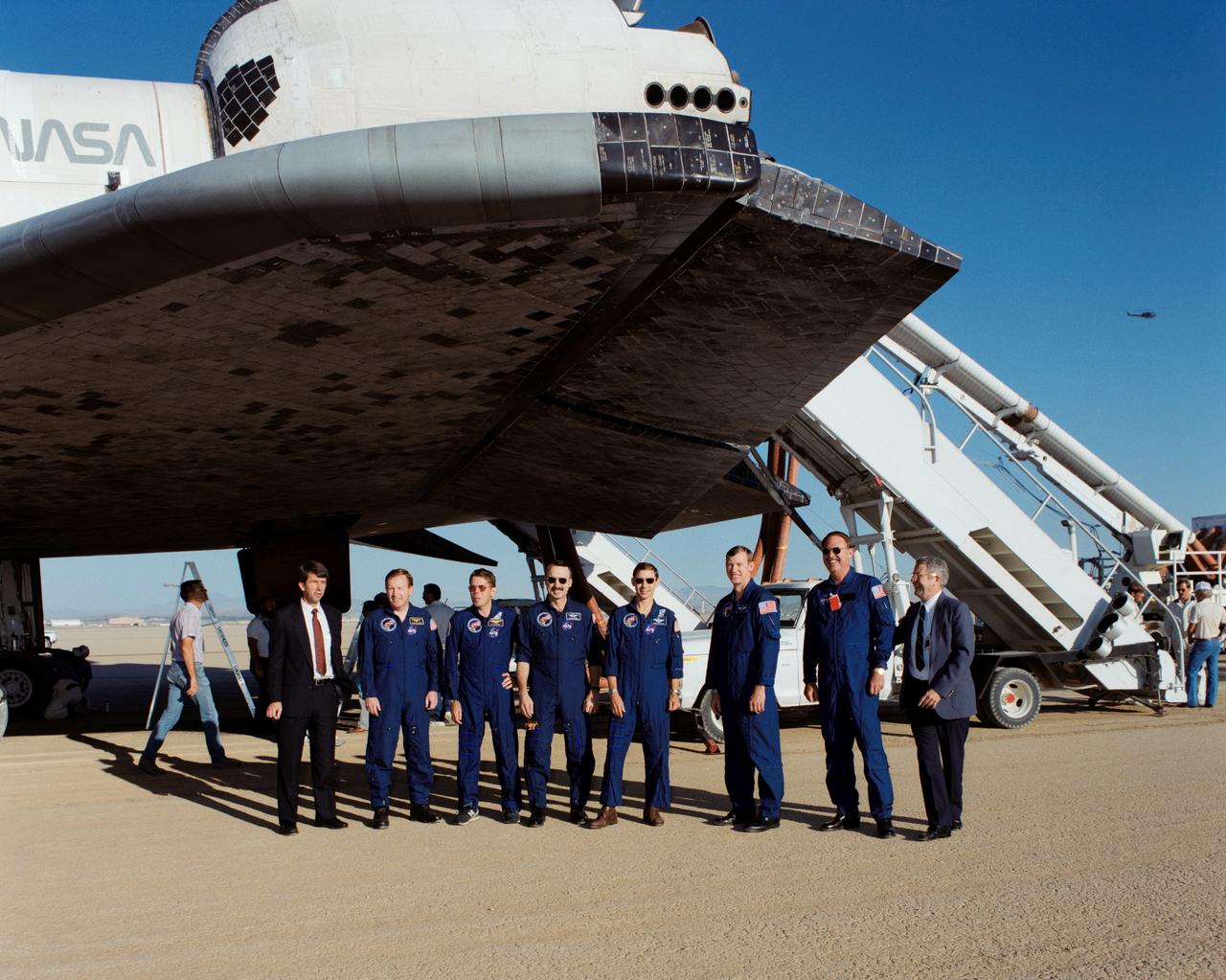
STS028-S-014 (13 Aug. 1989) --- The five astronaut crewmembers for STS-28 pose near the Space Shuttle Columbia after spending five days in Earth orbit for a DOD-devoted mission. They were greeted and are flanked here by William B. Lenoir (left), NASA Associate Administrator for Spaceflight; Donald R. Puddy (second right), director of flight crew operations; and Rear Adm. Richard H. Truly (right), NASA Administrator. The astronauts are, from left to right, Richard N. Richards, David C. Leestma, James C. Adamson, Brewster H. Shaw Jr. and Mark N. Brown.
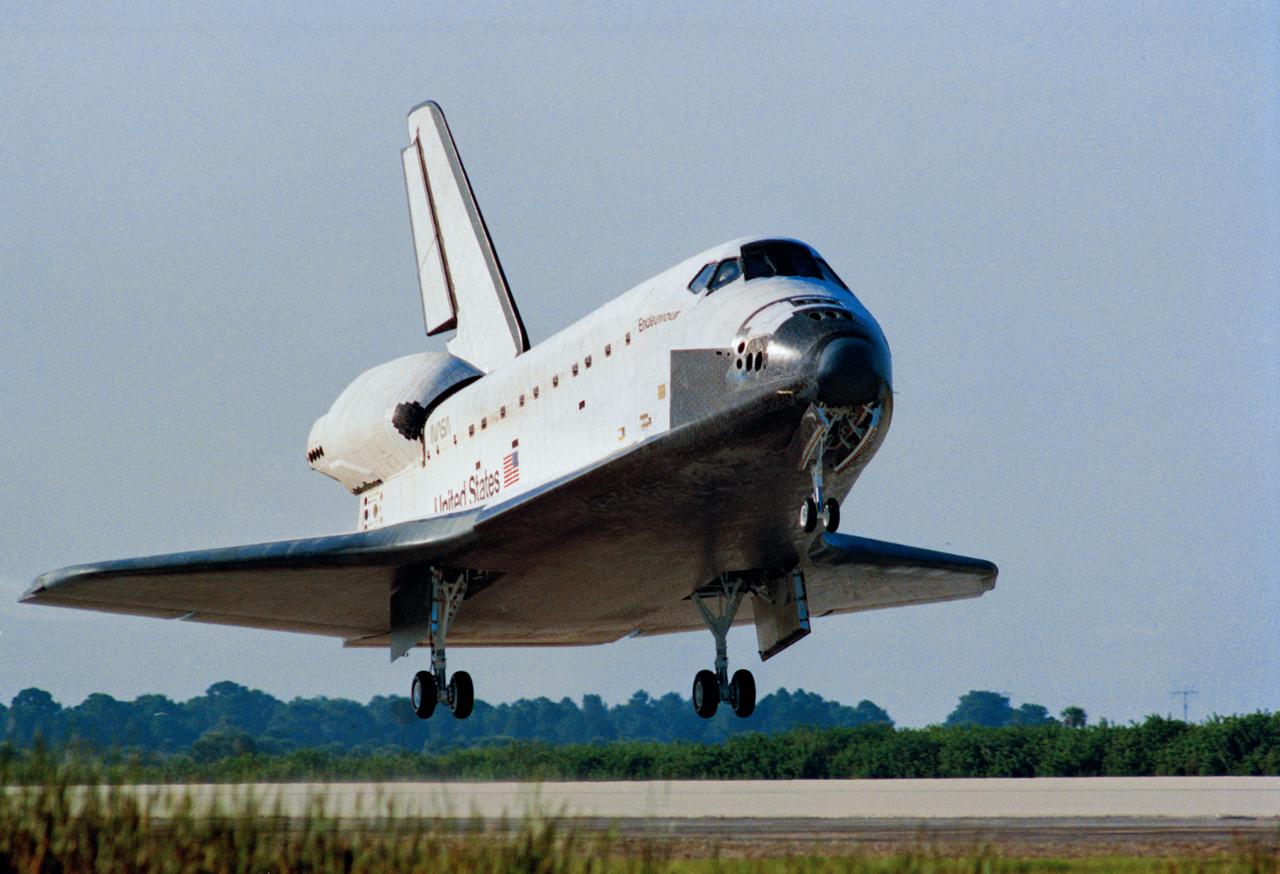
STS047-S-116 (20 Sept 1992) --- The Space Shuttle Endeavour prepares to land on the Kennedy Space Center's Shuttle landing facility runway. The successful landing marked the completion of an eight-day Earth-orbital mission for the orbiter, its seven-member crew and the Spacelab-J payload. Landing occurred at 8:53 a.m. (EDT), September 20, 1992. Onboard the spacecraft were astronauts Robert L. Gibson, Curtis L. Brown Jr., Mark C. Lee, Jerome (Jay) Apt, N. Jan Davis and Mae C. Jemison, along with Japanese payload specialist Dr. Mamoru Mohri.
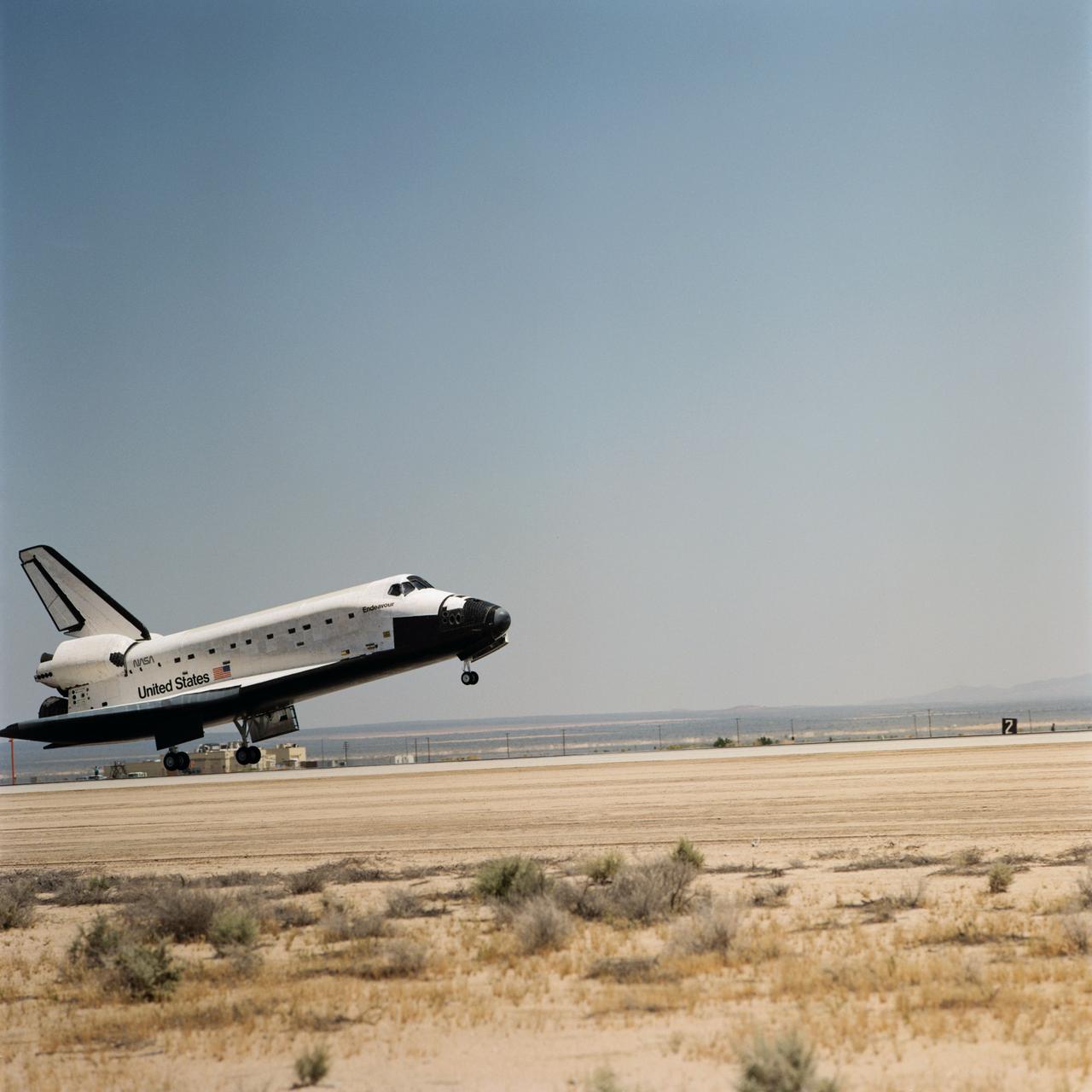
STS049-S-325 (16 May 1992) --- The main landing gear of Endeavour is just about to touch down at Edwards Air Force Base to draw to an end NASA's nine-day STS-49 mission. Crewmembers onboard were astronauts Daniel C. Brandenstein, mission commander; Kevin P. Chilton, pilot; and Thomas D. Akers, Richard J. Hieb, Bruce E. Melnick, Kathryn C. Thornton and Pierre J. Thout, all mission specialists. Landing occurred at 1:36:38 p.m. (PDT), May 16, 1992.
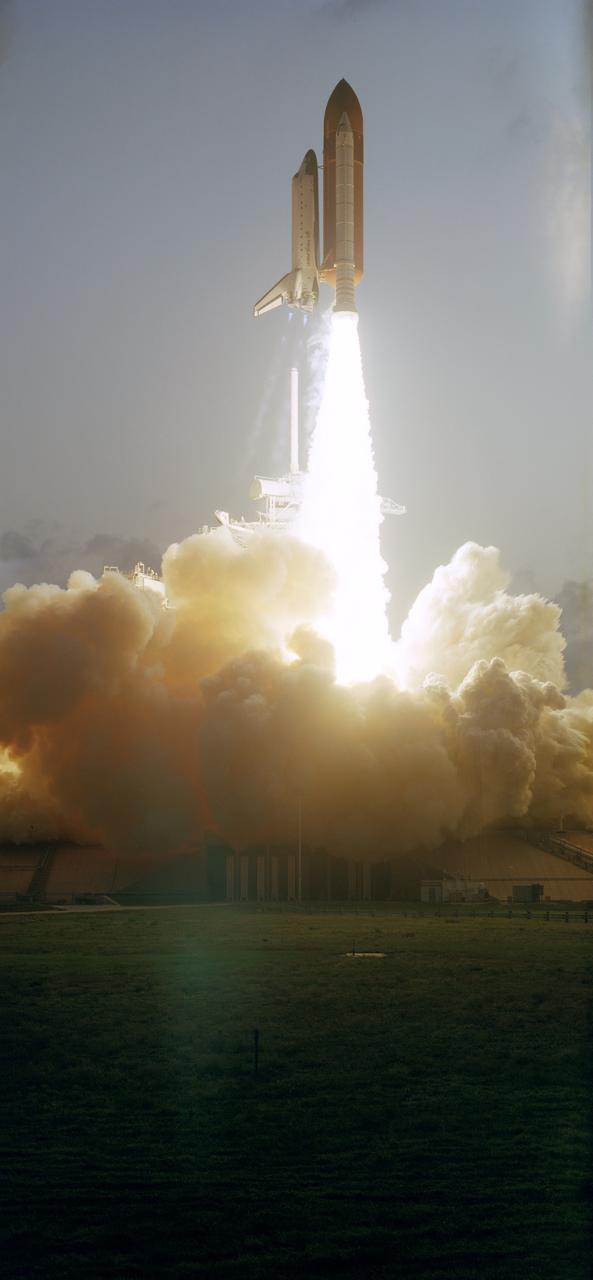
STS049-S-251 (7 May 1992) --- The Space Shuttle Endeavour soars toward Earth orbit where a crew of seven NASA astronauts will spend at least a week. Endeavour, the newest orbiter in NASA's Space Shuttle fleet, lifted off from Pad 39B at 7:40 p.m. (EDT), May 7, 1992. A diamond shock effect can be seen beneath the three main engines. Onboard are astronauts Daniel C. Brandenstein, mission commander; Kevin P. Chilton, pilot; and Richard J. Hieb, Bruce E. Melnick, Pierre J. Thuot, Kathryn C. Thornton and Thomas D. Akers, all mission specialists.
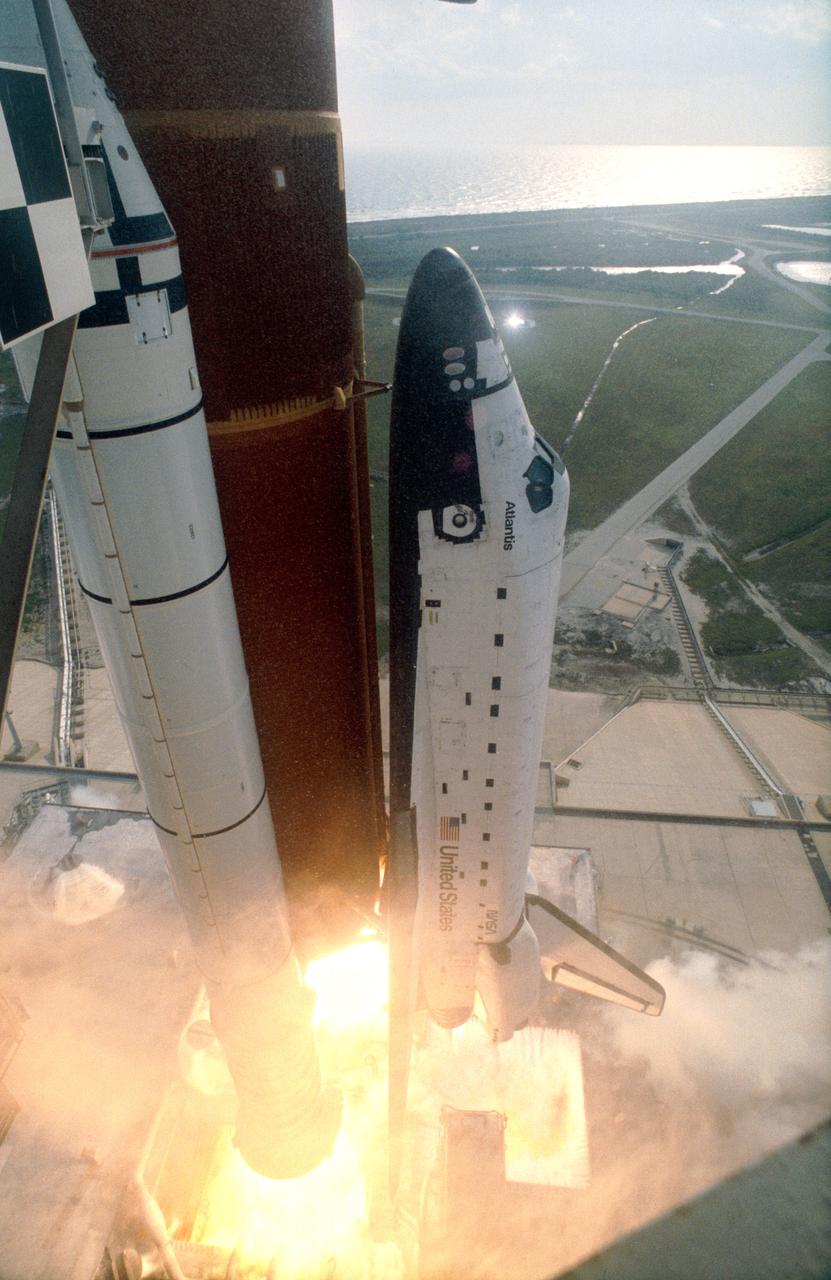
STS045-S-054 (24 March 1992) --- A profile view of the Space Shuttle Atlantis as it soars off the launch pad and heads toward Earth orbit with a crew of seven and the Atmospheric Laboratory for Applications and Science (ATLAS) aboard. Launch occurred at 8:13:40:048 a.m. (EST), March 24, 1992. Onboard were Charles F. Bolden, mission commander; Brian Duffy, pilot; Kathryn D. Sullivan, payload commander; David C. Leestma and C. Michael Foale, mission specialists; and Dirk Frimout of the European Space Agency and Byron K. Lichtenberg, payload specialists. The view was provided by an automatic camera on the launch service structure.
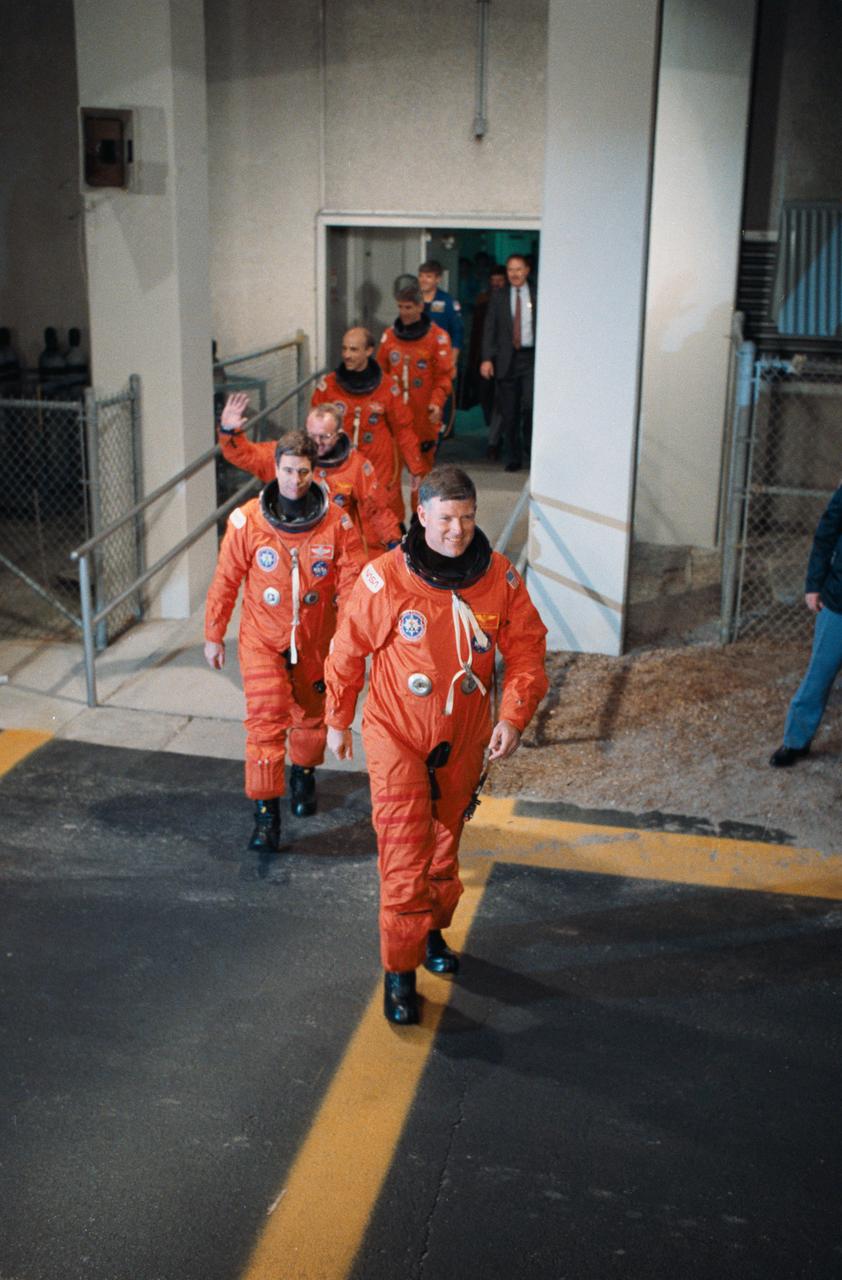
STS029-S-024 (13 March 1989) --- The flight crew for NASA's STS-29 mission leave the operations and checkout building en route to the van that will transport them to Launch Pad 39B, where Discovery awaits the astronauts for its second post-Challenge flight. Leading the way is astronaut Michael L. Coats, mission commander. He is followed by astronauts John E. Blaha, pilot; and James F. Buchli, James P. Bagian and Robert C. Springer, all mission specialists. In the background are astronaut Daniel C. Brandenstein, chief of the astronaut office, and Donald R. Puddy, director of flight crew operations.
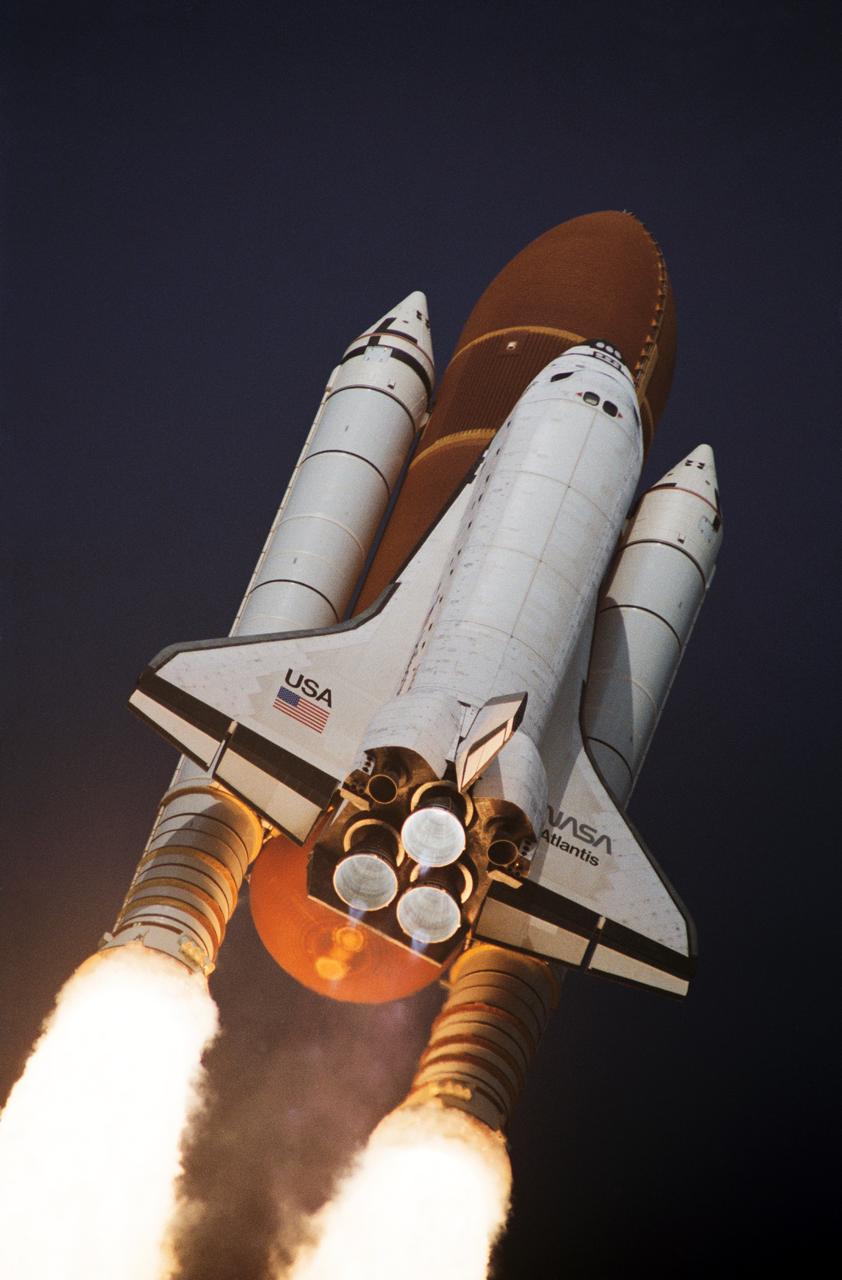
STS045-S-053 (24 March 1992) --- A low-angle view of the Space Shuttle Atlantis as it soars off the launch pad and heads toward Earth orbit with a crew of seven and the Atmospheric Laboratory for Applications and Science (ATLAS) aboard. Launch occurred at 8:13:40:048 a.m. (EST), March 24, 1992. Onboard were astronauts Charles F. Bolden, STS-45 commander; Brian Duffy, pilot; Kathryn D. Sullivan, payload commander; David C. Leestma and C. Michael Foale, mission specialists; and Dirk Frimout of the European Space Agency and Byron K. Lichtenberg, payload specialists.
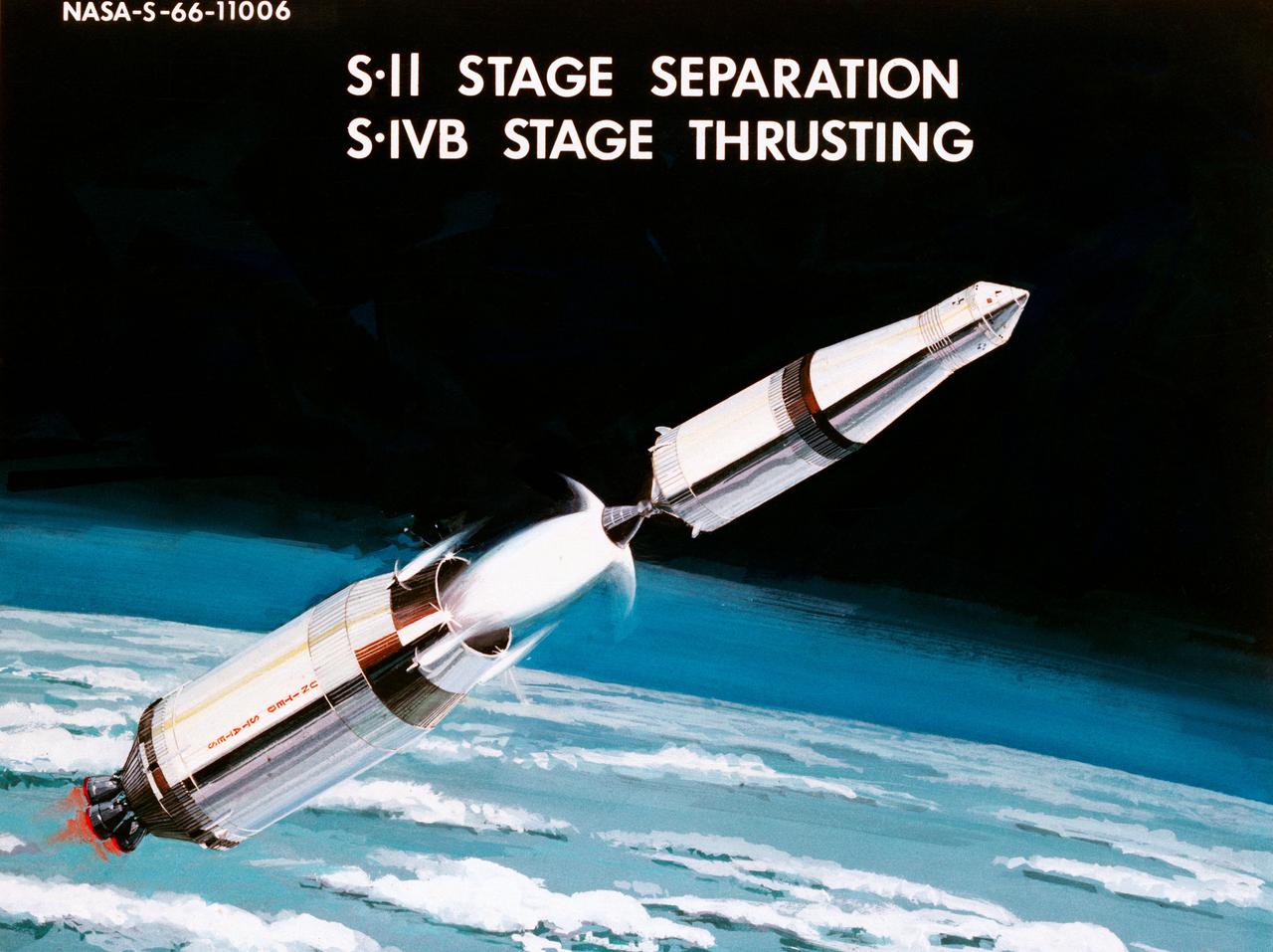
Artist Concepts, Apollo Mission: S66-10983: Ascent Stage Liftoff (S66-05094) S66-10984: Orientation During Ascent Phase (S66-05098) S66-10985: Midcourse Coast (S66-05113) S66-10986: Survey of Landing Site (S66-05117) S66-10987: Lunar Module (LM) Jettison (S66-05089) S66-10988: Trans-Earth Injection (S66-05090) S66-10989: Exploration on Lunar Surface Apollo Surface Lunar Exploration Experiment (ASLEP) S66-10990: Liftoff (S66-05125) S66-10991: Command Module (CM)-Service Module (SM) Separation (S66-05101 N/F) S66-10992: Touchdown on Lunar Surface (S66-05115) S66-10993: Transfer Orbit Insertion (S66-05111) S66-10994: Drogue Parachute Deployment S66-10995: S-IC Stage Separation S-II Stage Thrusting (S66-05099) S66-10996: Jettison Launch Escape System (S66-05114) S66-10997: Main Parachute Deployment (S66-05091) S66-10998: Mid-course correction (S66-05088) S66-10999: Lunar Orbit Insertion (S66-05086) S66-11000: Command Service Module (CSM)-LM Docked in LM Adapter-S-IVB (S66-06526) S66-11001: Docking and Separation of spacecraft from S-IVB (S66-05107) S66-11002: Final Descent (S66-05096) S66-11003: Entry into Earth Atmosphere (S66-05096) S66-11004: Deploy S/C LM Adapter-Separate CSM from LM-S-IVB (S66-06525 & 05105) S66-11005: Turnaround of CSM (S66-05104) S66-11006: S-II Stage Separation S-IVB Stage Thrusting (S66-05102) S66-11007: LM Ascent CSM Docked (S66-05100) S66-11008: Midcourse Correction SPS Mode (S66-05106) S66-11009: Earth Orbit Insertion of S-IVB & S/C (S66-05092) S66-11010: Trans-lunar Injection (S66-05116) S66-11011: LM Descent (S66-05110) S66-11012: S-IVB Stage Operations (S66-05112 N/F) S66-11013: Spacecraft Recovery (S66-05126) S66-11014: Lunar Orbit (S66-05103) S66-11015: CSM-LM Docking (S66-05095) S66-11016: Entry CM (S66-5109) S66-11017: Midcourse Corrections to Lunar Landing (S66-08486) S66-11018: Midcourse Corrections to Lunar Landing w/Overlay (S66-05083) S66-11019: Earth Launch Phase w/Overlay (S66-08485 & 05119) S66-11020: Earth Launch Phase (S66-08487 & S66-05084) S66-11022: Apollo Vehicles (S66-05127) S66-11024: Transfer to LM (S66-05082) S66-11025: Lunar Launch Phase S66-11027: Trans-earth Separation of C/M from S/M-C/M return to Earth (S66-05097) S66-11028: CSM-LM Separation, LM Descent to Moon (S66-05108) MSC, Houston, TX Also available in B&W 12/1965 - 06/1966
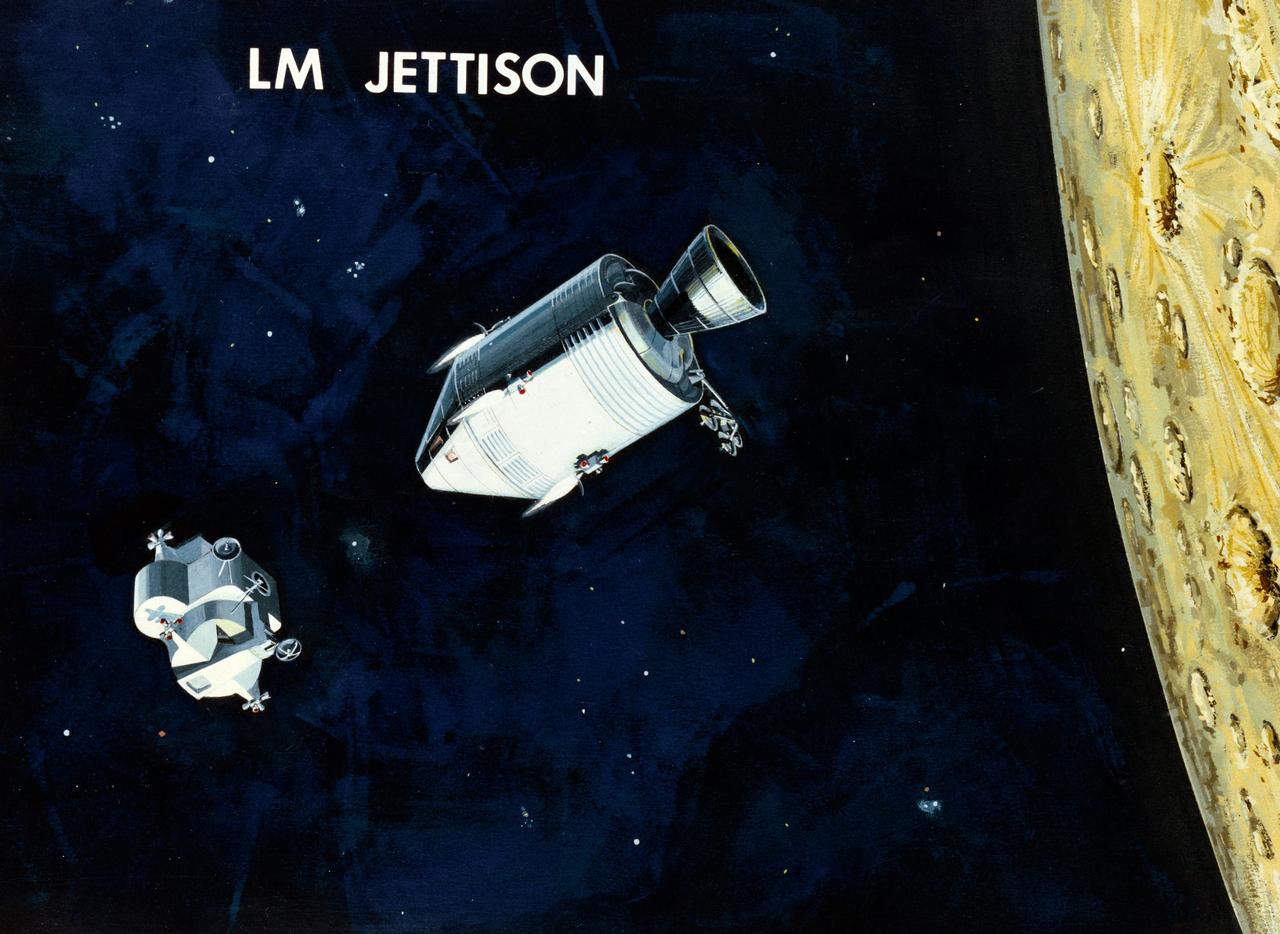
Artist Concepts, Apollo Mission: S66-10983: Ascent Stage Liftoff (S66-05094) S66-10984: Orientation During Ascent Phase (S66-05098) S66-10985: Midcourse Coast (S66-05113) S66-10986: Survey of Landing Site (S66-05117) S66-10987: Lunar Module (LM) Jettison (S66-05089) S66-10988: Trans-Earth Injection (S66-05090) S66-10989: Exploration on Lunar Surface Apollo Surface Lunar Exploration Experiment (ASLEP) S66-10990: Liftoff (S66-05125) S66-10991: Command Module (CM)-Service Module (SM) Separation (S66-05101 N/F) S66-10992: Touchdown on Lunar Surface (S66-05115) S66-10993: Transfer Orbit Insertion (S66-05111) S66-10994: Drogue Parachute Deployment S66-10995: S-IC Stage Separation S-II Stage Thrusting (S66-05099) S66-10996: Jettison Launch Escape System (S66-05114) S66-10997: Main Parachute Deployment (S66-05091) S66-10998: Mid-course correction (S66-05088) S66-10999: Lunar Orbit Insertion (S66-05086) S66-11000: Command Service Module (CSM)-LM Docked in LM Adapter-S-IVB (S66-06526) S66-11001: Docking and Separation of spacecraft from S-IVB (S66-05107) S66-11002: Final Descent (S66-05096) S66-11003: Entry into Earth Atmosphere (S66-05096) S66-11004: Deploy S/C LM Adapter-Separate CSM from LM-S-IVB (S66-06525 & 05105) S66-11005: Turnaround of CSM (S66-05104) S66-11006: S-II Stage Separation S-IVB Stage Thrusting (S66-05102) S66-11007: LM Ascent CSM Docked (S66-05100) S66-11008: Midcourse Correction SPS Mode (S66-05106) S66-11009: Earth Orbit Insertion of S-IVB & S/C (S66-05092) S66-11010: Trans-lunar Injection (S66-05116) S66-11011: LM Descent (S66-05110) S66-11012: S-IVB Stage Operations (S66-05112 N/F) S66-11013: Spacecraft Recovery (S66-05126) S66-11014: Lunar Orbit (S66-05103) S66-11015: CSM-LM Docking (S66-05095) S66-11016: Entry CM (S66-5109) S66-11017: Midcourse Corrections to Lunar Landing (S66-08486) S66-11018: Midcourse Corrections to Lunar Landing w/Overlay (S66-05083) S66-11019: Earth Launch Phase w/Overlay (S66-08485 & 05119) S66-11020: Earth Launch Phase (S66-08487 & S66-05084) S66-11022: Apollo Vehicles (S66-05127) S66-11024: Transfer to LM (S66-05082) S66-11025: Lunar Launch Phase S66-11027: Trans-earth Separation of C/M from S/M-C/M return to Earth (S66-05097) S66-11028: CSM-LM Separation, LM Descent to Moon (S66-05108) MSC, Houston, TX Also available in B&W 12/1965 - 06/1966