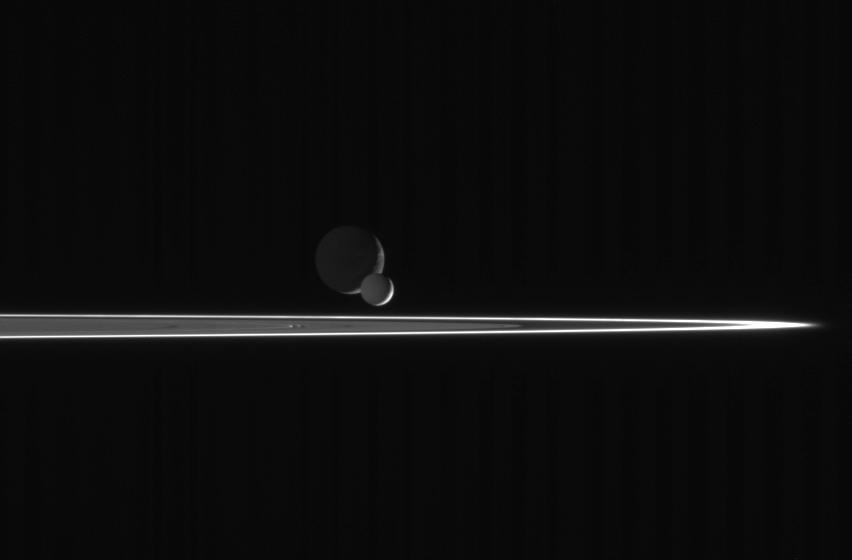
s our robotic emissary to Saturn, the Cassini spacecraft is privileged to behold such fantastic sights as this pairing of two moons beyond the rings. The bright, narrow F ring is the outermost ring structure seen here
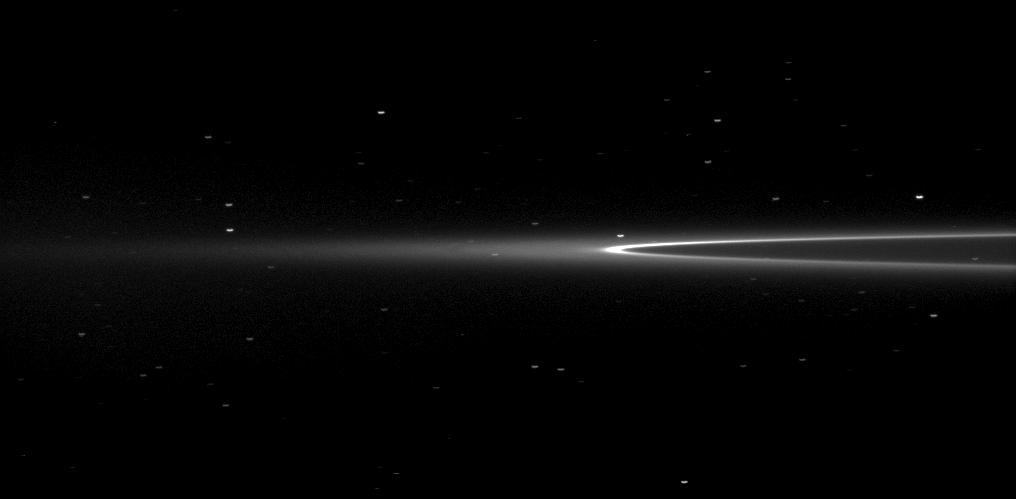
NASA Cassini spacecraft looks toward Saturn tiny moon Aegaeon within the G-ring arc. The moonlet Aegaeon formerly known as S/2008 S 1 cant be seen in this image, but it orbits in the bright arc of Saturn faint G ring shown here.
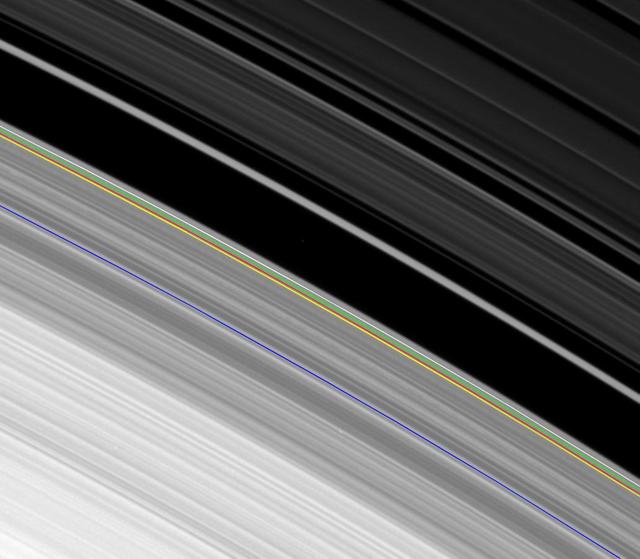
This image obtained by NASA Cassini spacecraft of the outer edge of Saturn?s B ring, reveals the combined effects of a tugging moon and oscillations that can naturally occur in disks like Saturn rings and spiral galaxies.
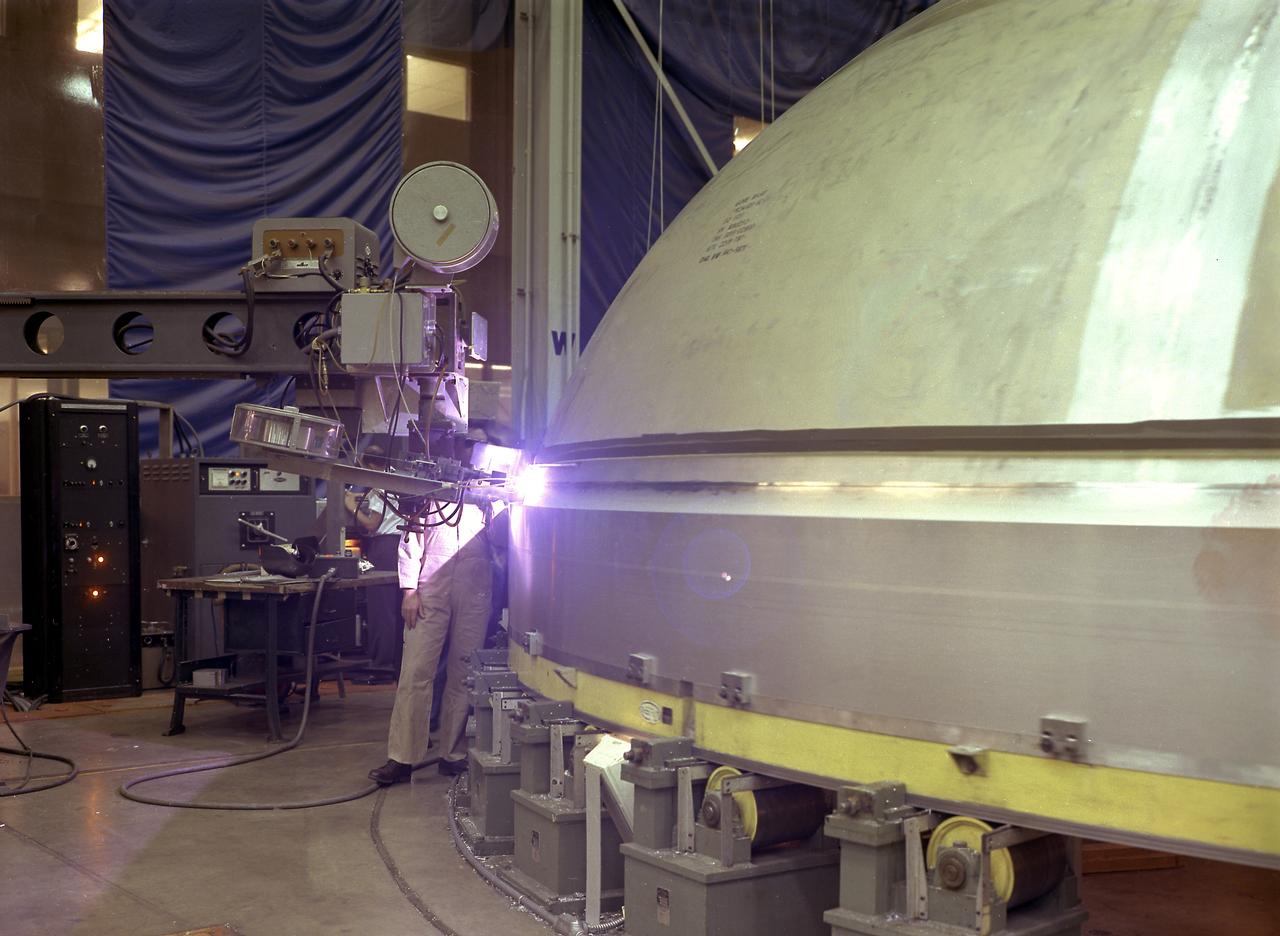
A technician is pictured at the Marshall Space Flight Center welding the Y-ring to the S-IC stage bulkhead and the fuel tank for the Saturn V SA-502 launch vehicle (Apollo 6 mission) in building 4705. The size of the S-IC required a special rig known as the Y-ring to join the tank wall cylinders and domes together. The Y-ring was designed to eliminate lap joints where the tank domes, wall, and adjoining structure (such as the intertank segment) came together.
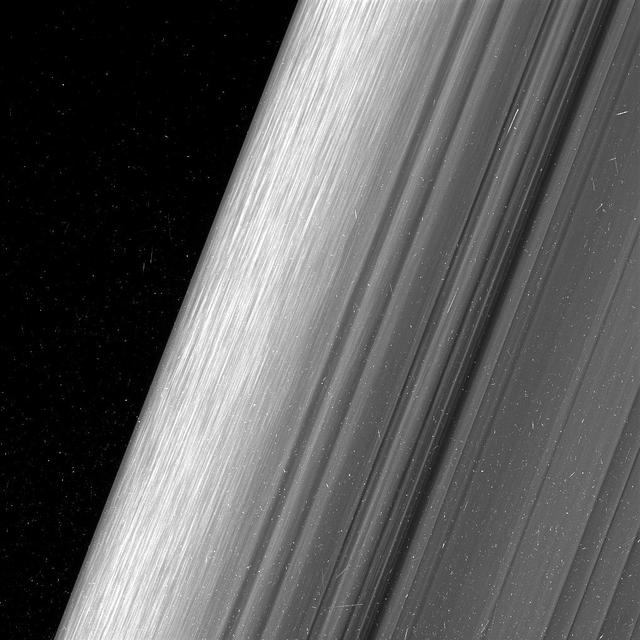
This image shows a region in Saturn's outer B ring. NASA's Cassini spacecraft viewed this area at a level of detail twice as high as it had ever been observed before. The view here is of the outer edge of the B ring, at left, which is perturbed by the most powerful gravitational resonance in the rings: the "2:1 resonance" with the icy moon Mimas. This means that, for every single orbit of Mimas, the ring particles at this specific distance from Saturn orbit the planet twice. This results in a regular tugging force that perturbs the particles in this location. A lot of structure is visible in the zone near the edge on the left. This is likely due to some combination of the gravity of embedded objects too small to see, or temporary clumping triggered by the action of the resonance itself. Scientists informally refer to this type of structure as "straw." This image was taken using a fairly long exposure, causing the embedded clumps to smear into streaks as they moved in their orbits. Later Cassini orbits will bring shorter exposures of the same region, which will give researchers a better idea of what these clumps look like. But in this case, the smearing does help provide a clearer idea of how the clumps are moving. This image is a lightly processed version, with minimal enhancement; this version preserves all original details present in the image. Another other version (Figure 1) has been processed to remove the small bright blemishes due to cosmic rays and charged particle radiation near the planet -- a more aesthetically pleasing image, but with a slight softening of the finest details. The image was taken in visible light with the Cassini spacecraft wide-angle camera on Dec. 18, 2016. The view was obtained at a distance of approximately 32,000 miles (52,000 kilometers) from the rings and looks toward the unilluminated side of the rings. Image scale is about a quarter-mile (360 meters) per pixel. http://photojournal.jpl.nasa.gov/catalog/PIA21057

NASA's Cassini spacecraft zoomed in on Saturn's A ring, revealing narrow, detailed structures that get even finer as the cameras' resolution increases. Even at this level of detail, it is still not fine enough to resolve the individual particles that make up the ring. High-resolution images like this help scientists map the fine structure of Saturn's rings. Features less than a half a mile (one kilometer) in size are resolvable here. But the particles in the A ring typically range in size from several meters across down to centimeters, making them still far too small to see individually here. This view looks toward the sunlit side of the rings from about 38 degrees above the ring plane. The image was taken in visible light with the Cassini spacecraft narrow-angle camera on Jan. 9, 2017. The view was obtained at a distance of approximately 70,000 miles (113,000 kilometers) from Saturn and at a Sun-Saturn-spacecraft, or phase, angle of 11 degrees. Image scale is 2,300 feet (690 meters) per pixel. http://photojournal.jpl.nasa.gov/catalog/PIA20526
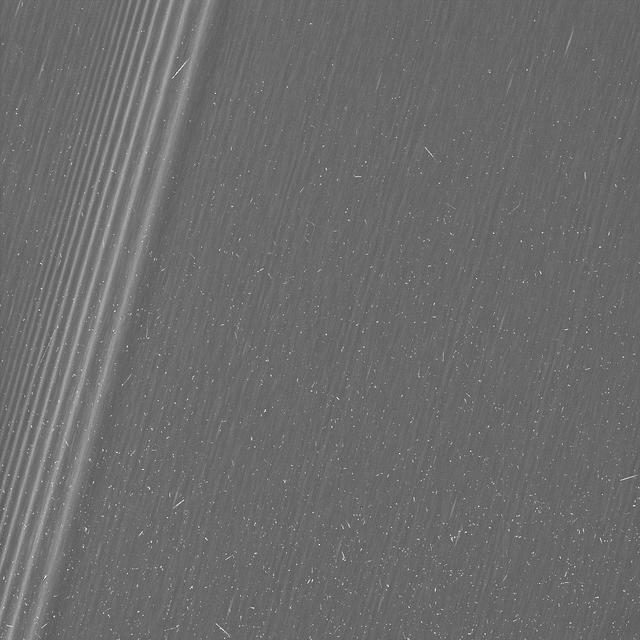
This image from NASA's Cassini mission shows a region in Saturn's A ring. The level of detail is twice as high as this part of the rings has ever been seen before. The view contains many small, bright blemishes due to cosmic rays and charged particle radiation near the planet. The view shows a section of the A ring known to researchers for hosting belts of propellers -- bright, narrow, propeller-shaped disturbances in the ring produced by the gravity of unseen embedded moonlets. Several small propellers are visible in this view. These are on the order of 10 times smaller than the large, bright propellers whose orbits scientists have routinely tracked (and which are given nicknames for famous aviators). This image is a lightly processed version, with minimal enhancement, preserving all original details present in the image. he image was taken in visible light with the Cassini spacecraft wide-angle camera on Dec. 18, 2016. The view was obtained at a distance of approximately 33,000 miles (54,000 kilometers) from the rings and looks toward the unilluminated side of the rings. Image scale is about a quarter-mile (330 meters) per pixel. http://photojournal.jpl.nasa.gov/catalog/PIA21059
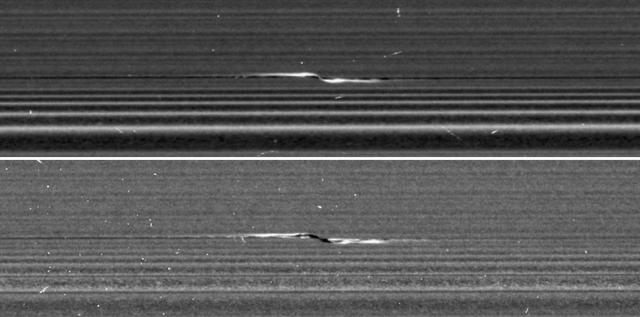
NASA's Cassini spacecraft captured these remarkable views of a propeller feature in Saturn's A ring on Feb. 21, 2017. These are the sharpest images taken of a propeller so far, and show an unprecedented level of detail. The propeller is nicknamed "Santos-Dumont," after the pioneering Brazilian-French aviator. This observation was Cassini's first targeted flyby of a propeller. The views show the object from vantage points on opposite sides of the rings. The top image looks toward the rings' sunlit side, while the bottom image shows the unilluminated side, where sunlight filters through the backlit ring. The two images presented as figure 1 are reprojected at the same scale (0.13 mile or 207 meters per pixel) in order to facilitate comparison. The original images, which have slightly different scales, are also provided here, without reprojection, as figure 2; the sunlit-side image is at left, while the unlit-side image is at right. Cassini scientists have been tracking the orbit of this object for the past decade, tracing the effect that the ring has upon it. Now, as Cassini has moved in close to the ring as part of its ring-grazing orbits, it was able to obtain this extreme close-up view of the propeller, enabling researchers to examine its effects on the ring. These views, and others like them, will inform models and studies in new ways going forward. Like a frosted window, Saturn's rings look different depending on whether they are seen fully sunlit or backlit. On the lit side, the rings look darker where there is less material to reflect sunlight. On the unlit side, some regions look darker because there is less material, but other regions look dark because there is so much material that the ring becomes opaque. Observing the same propeller on both the lit and unlit sides allows scientists to gather richer information about how the moonlet affects the ring. For example, in the unlit-side view, the broad, dark band through the middle of the propeller seems to be a combination of both empty and opaque regions. The propeller's central moonlet would only be a couple of pixels across in these images, and may not actually be resolved here. The lit-side image shows that a bright, narrow band of material connects the moonlet directly to the larger ring, in agreement with dynamical models. That same thin band of material may also be obscuring the moonlet from view. Lengthwise along the propeller is a gap in the ring that the moonlet has pried open. The gap appears dark on both the lit and unlit sides. Flanking the gap near the moonlet are regions of enhanced density, which appear bright on the lit side and more mottled on the unlit side. One benefit of the high resolution of these images is that, for the first time, wavy edges are clearly visible in the gap. These waves are also expected from dynamical models, and they emphasize that the gap must be sharp-edged. Furthermore, the distance between the wave crests tells scientists the width of the gap (1.2 miles or 2 kilometers), which in turn reveals the mass of the central moonlet. From these measurements, Cassini imaging scientists deduce that the moonlet's mass is comparable to that of a snowball about 0.6 mile (1 kilometer) wide. For the original images, the lit-side image has a scale of 0.33 mile (530 meters) per pixel in the radial (or outward from Saturn) direction and 0.44 mile (710 meters) per pixel in the azimuthal (or around Saturn) direction. The different scales are the result of Cassini's vantage point being off to the side of the propeller, rather than directly above it. The unlit-side image has a scale of 0.25 (410 meters) per pixel in both directions. In order to preserve its original level of detail, the image has not been cleaned of bright blemishes due to cosmic rays and to charged particle radiation from Saturn. http://photojournal.jpl.nasa.gov/catalog/PIA21433

As Cassini watches the rings pass in front of the bright red giant star Aldebaran, the star light fluctuates, providing information about the concentrations of ring particles within the various radial features in the rings
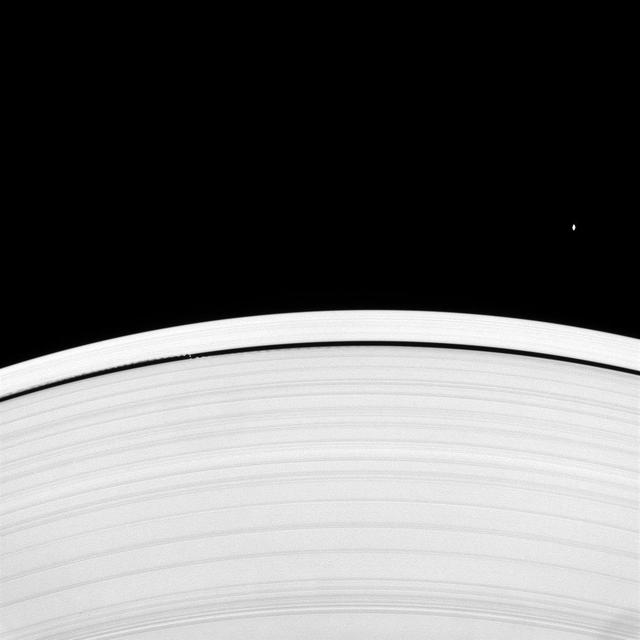
Looking upward from beneath the ringplane, the Cassini spacecraft spies Saturn's "wave maker" and "flying saucer" moons. Daphnis (8 kilometers, or 5 miles across at its widest point) and its gravitationally induced edge waves are seen at left within the Keeler Gap. The equatorial bulge on Atlas (30 kilometers, or 19 miles across at its widest point) is clearly visible here. See PIA06237 and PIA08405 for additional images and information about these two moons. This view looks toward the sunlit side of the rings from about 16 degrees below the ringplane. The image was taken in visible light with the Cassini spacecraft narrow-angle camera on April 22, 2008. The view was acquired at a distance of approximately 898,000 kilometers (558,000 miles) from Saturn. Image scale is about 5 kilometers (3 miles) per pixel. http://photojournal.jpl.nasa.gov/catalog/PIA09907

Rings Against a Dark Planet
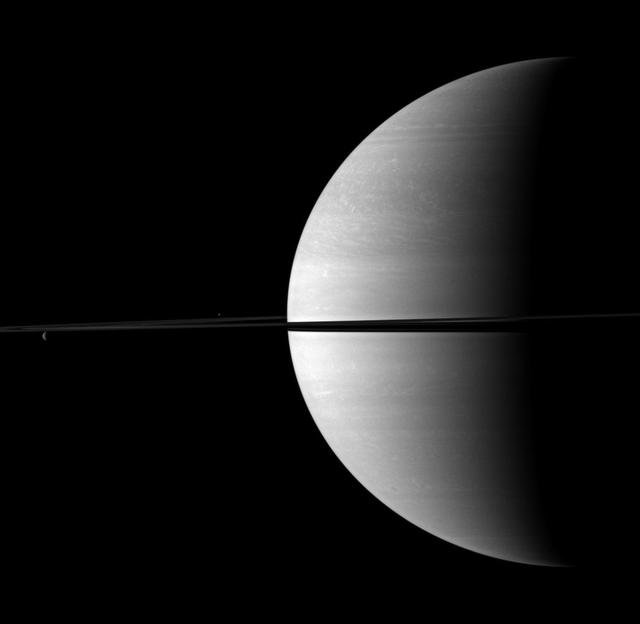
Rhea and Enceladus appear above and below the rings on the left of this image, serving to visually offset the dominance of Saturn in this image taken by NASA Cassini spacecraft.
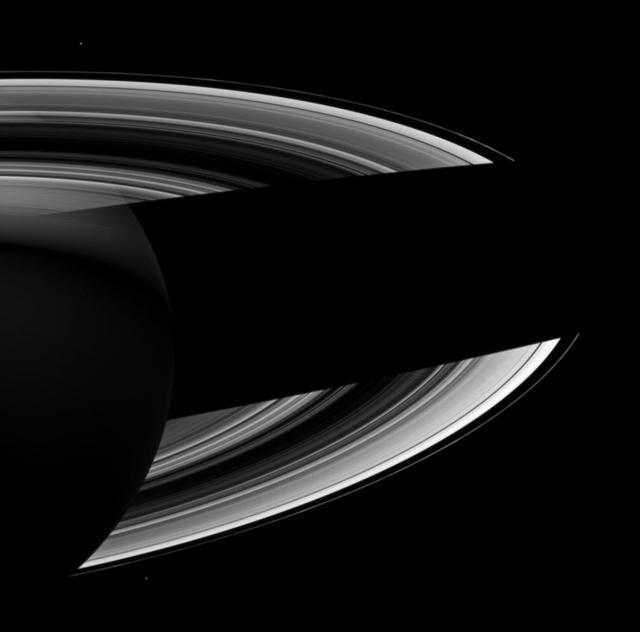
Saturn casts a wide shadow across its rings in view from NASA Cassini spacecraft which looks toward the darkened southern hemisphere of the night side of the planet.

B Ring Irregularities
Light from Many Paths
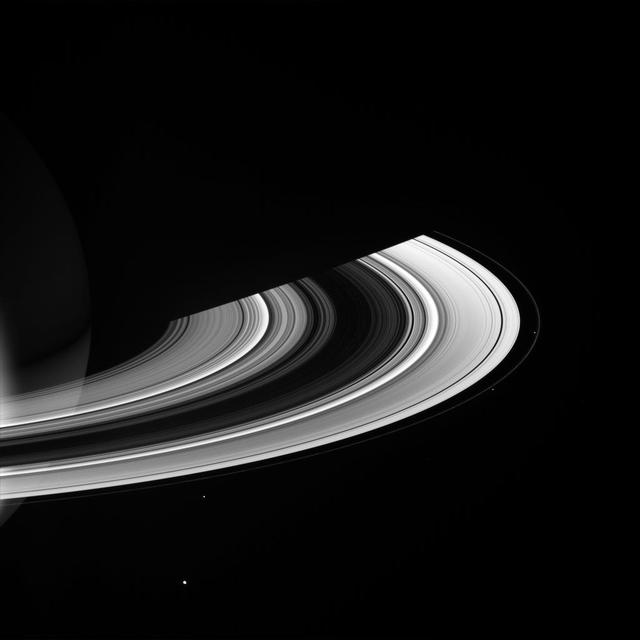
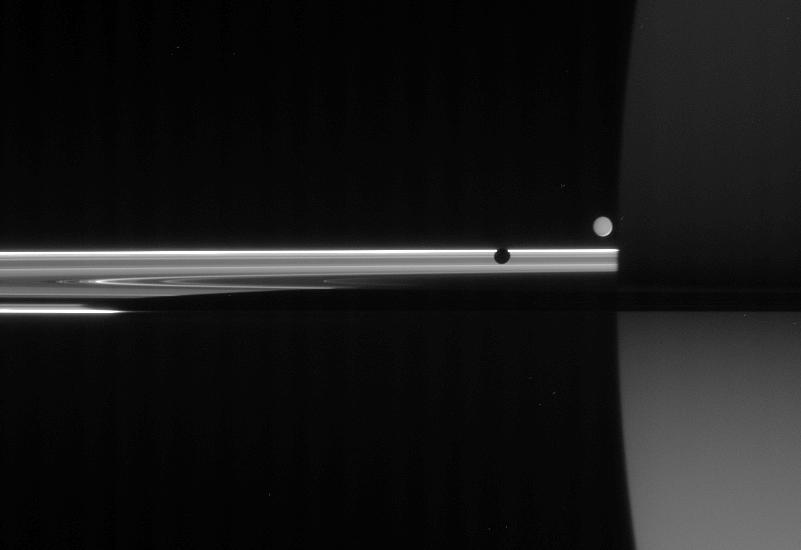
<p> The Cassini spacecraft looks toward the unilluminated side of Saturn rings to spy on the moon Pan as it cruises through the Encke Gap. </p> <p> This view looks toward the rings from about 13 degrees above the ringplane. At the top of the image
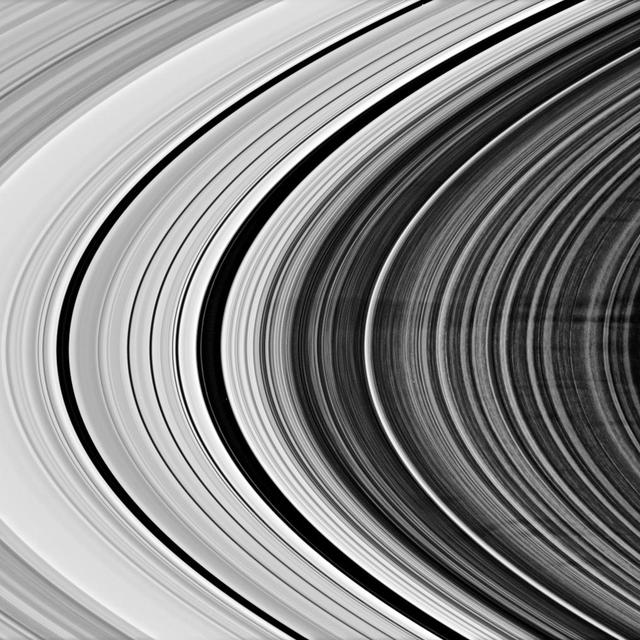
This Cassini spacecraft view shows a group of more than a dozen spokes in Saturn outer B ring. The B ring displays the azimuthal asymmetry, or variation with longitude around the planet, that is characteristic of the spoke-forming region
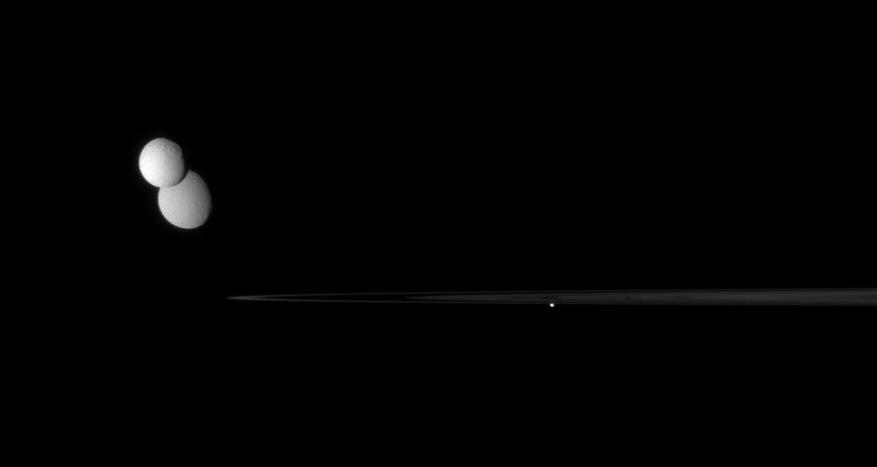
Parade of Moons
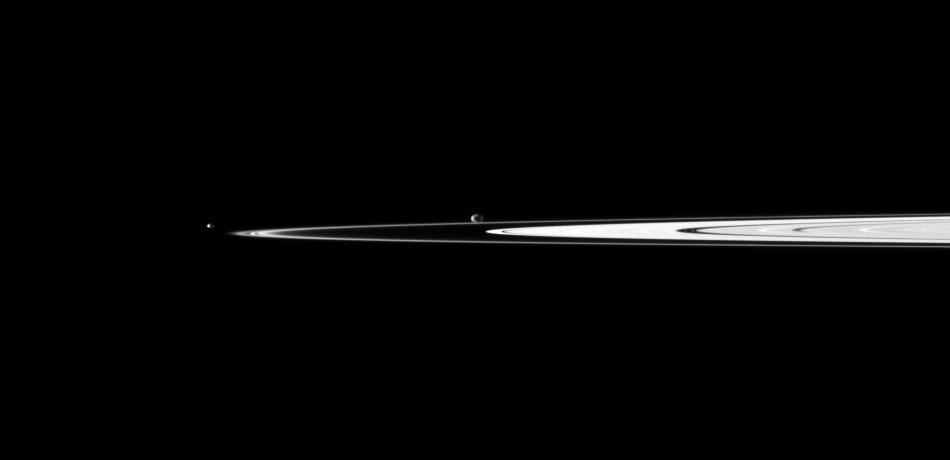
A pair of Saturn small moons orbit near the planet rings, which appear well illuminated in this view captured by NASA Cassini spacecraft. Janus is near the center of the image and Pandora is on the left.
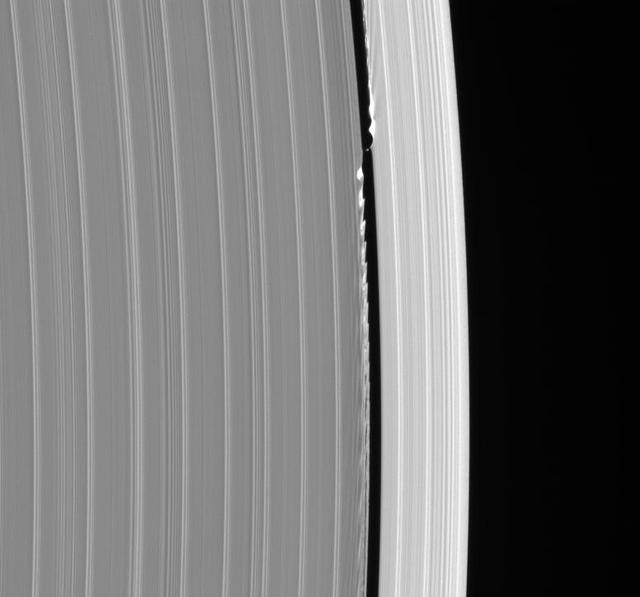
Daphnis At Work

Pulchritudinous Perturbations
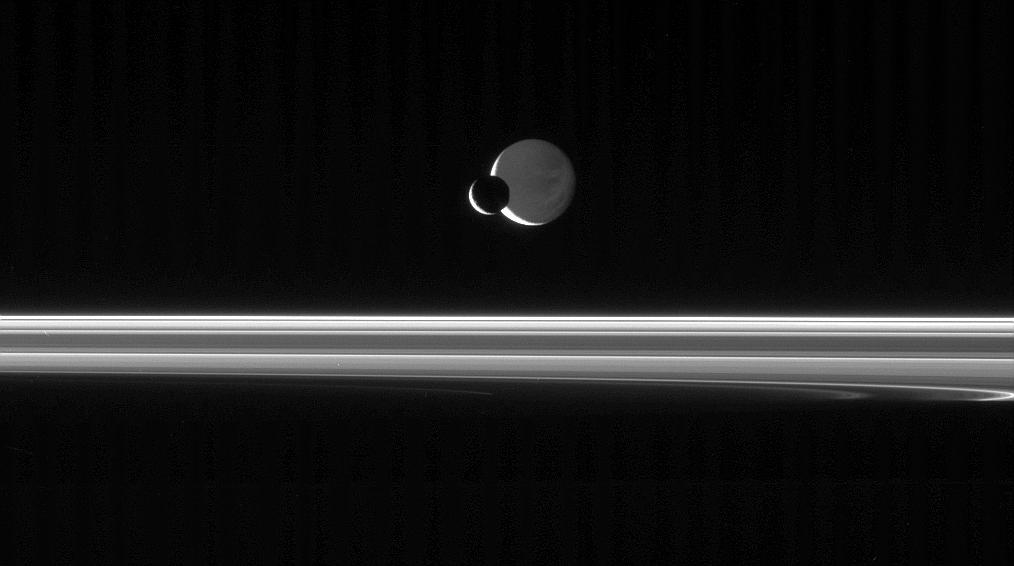
The Cassini spacecraft looks across the unlit ringplane as Mimas glides silently in front of Dione

Two Kinds of Wave
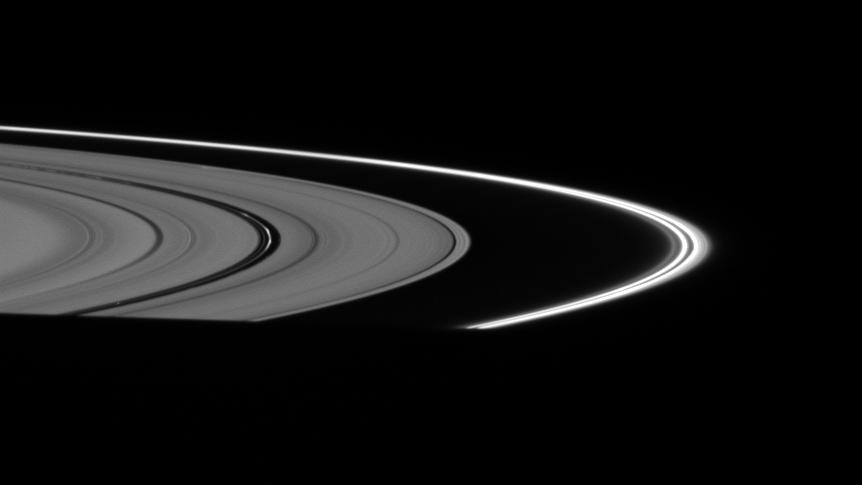
Bright Dust
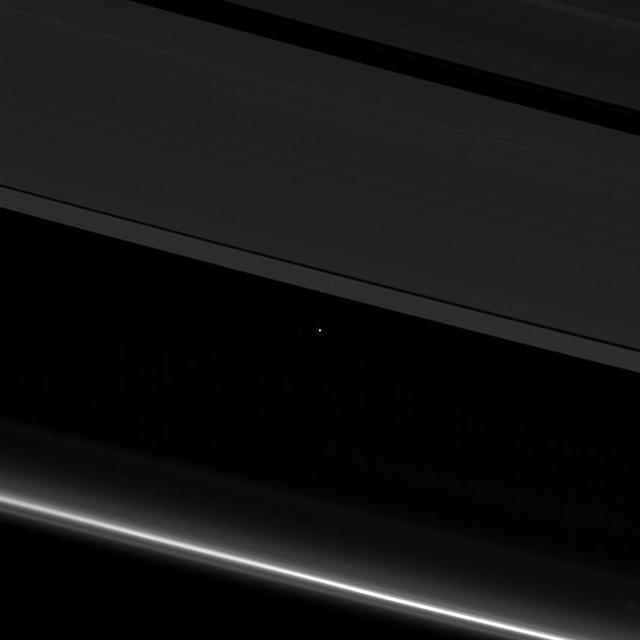
This view from NASA's Cassini spacecraft shows planet Earth as a point of light between the icy rings of Saturn. The spacecraft captured the view on April 12, 2017 at 10:41 p.m. PDT (1:41 a.m. EDT). Cassini was 870 million miles (1.4 billion kilometers) away from Earth when the image was taken. Although far too small to be visible in the image, the part of Earth facing toward Cassini at the time was the southern Atlantic Ocean. Earth's moon is also visible to the left of our planet in a cropped, zoomed-in version of the image (Figure 1). The rings visible here are the A ring (at top) with the Keeler and Encke gaps visible, and the F ring (at bottom). During this observation Cassini was looking toward the backlit rings, making a mosaic of multiple images, with the sun blocked by the disk of Saturn. Seen from Saturn, Earth and the other inner solar system planets are all close to the sun, and are easily captured in such images, although these opportunities have been somewhat rare during the mission. The F ring appears especially bright in this viewing geometry. https://photojournal.jpl.nasa.gov/catalog/PIA21445
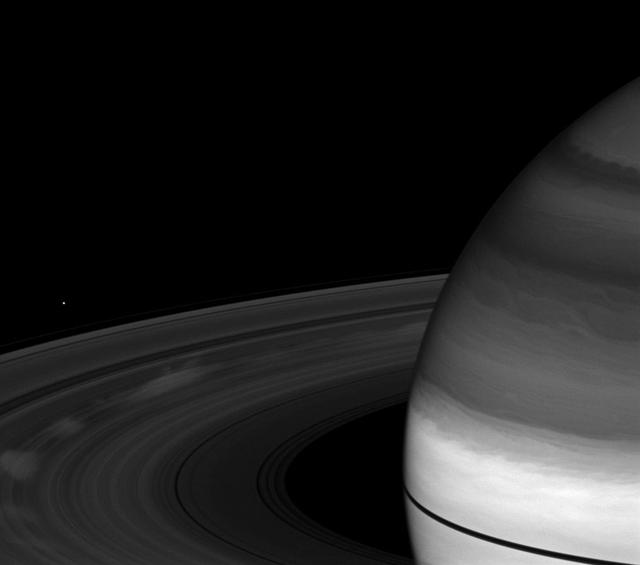
Bright Spokes, Dark Rings
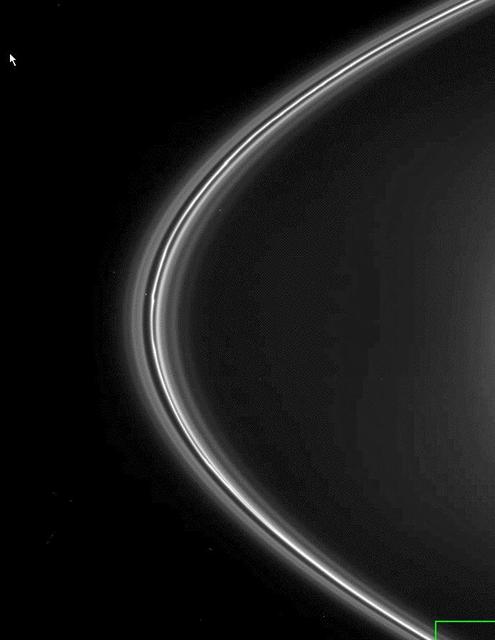
Unidentified F Ring Objects

Faint Spokes on a Ring

Softly Glowing Scene
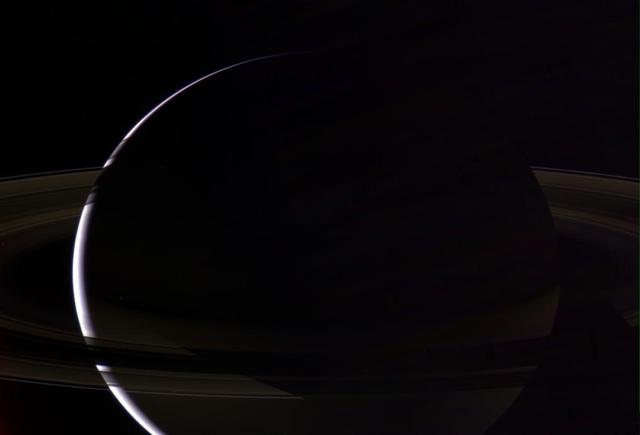
With its dazzling rings, Saturn radiates a beauty and splendor like no other known world. Here, Cassini has captured the cool crescent of Saturn from above the ringplane, with the planet shadow cutting neatly across the many lanes of ice
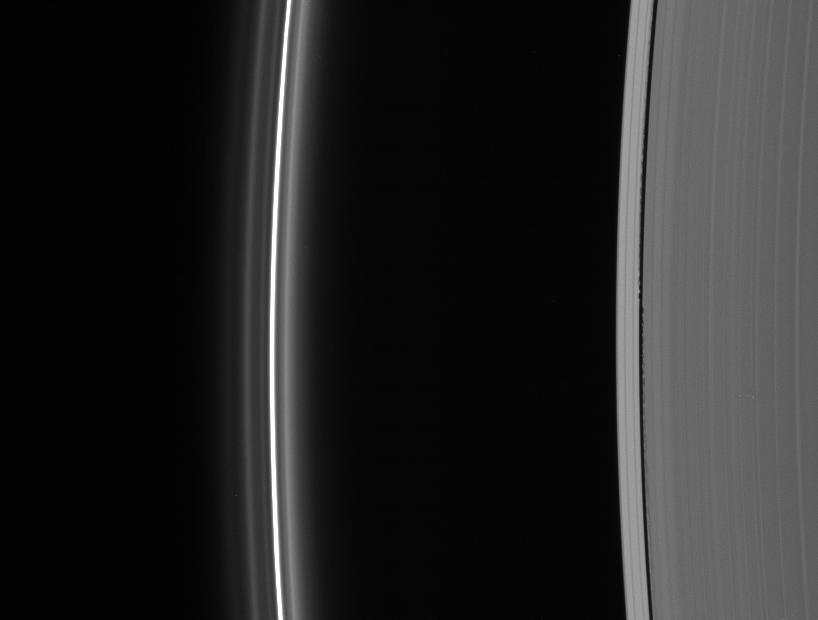
Edge waves in the Keeler Gap betray the presence of the embedded moon Daphnis. At left lies the brilliant F ring with its flanking strands
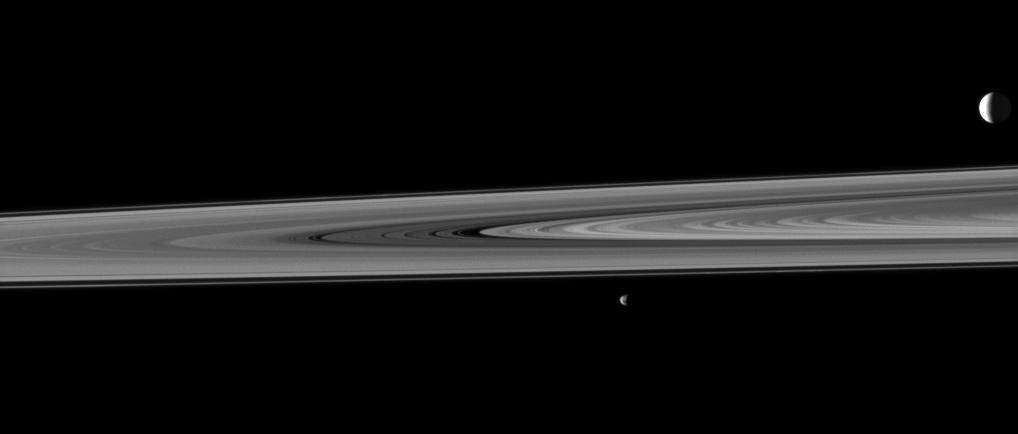
Saturn rings occupy the space between two of the planet moons in this image, taken by NASA Cassini spacecraft, which shows the highly reflective moon Enceladus in the background and the smaller moon Janus in the fore.
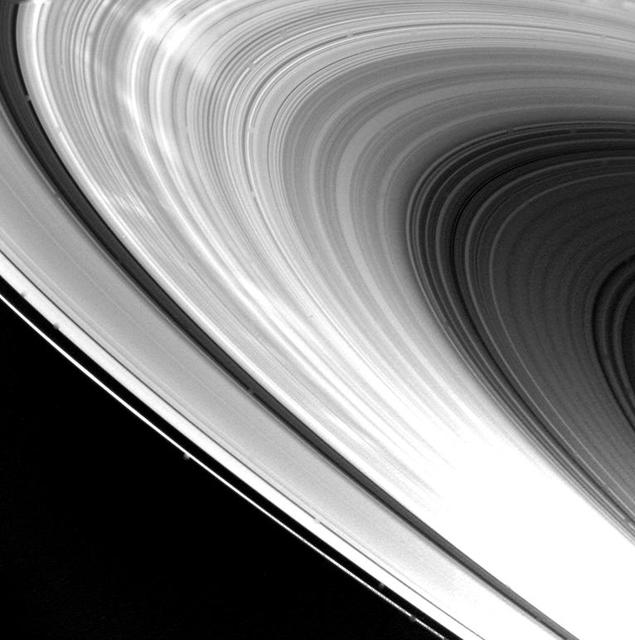
Saturn Ring System
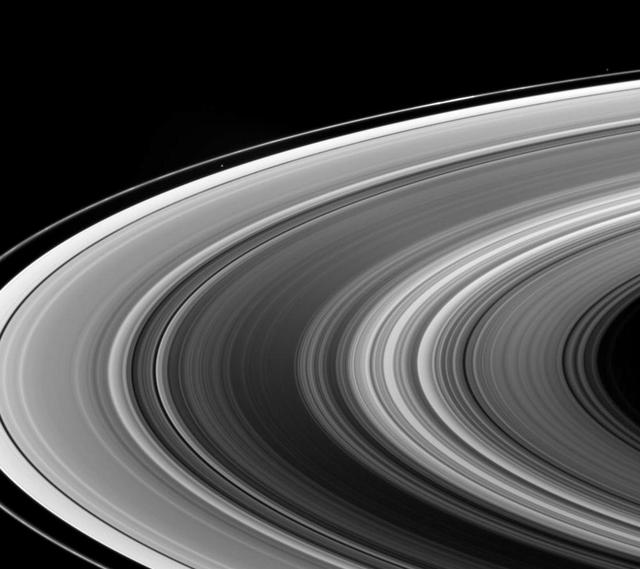
This view looks down onto the unlit side of Saturn ringplane. It nicely shows a near-arm/far-arm brightness asymmetry in the B ring: The near arm of the B ring is notably darker from this viewing geometry than is the far arm
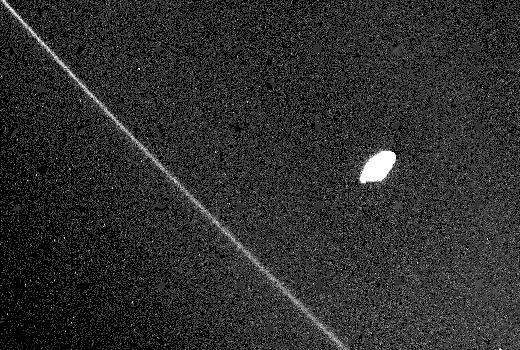
Saturn F-ring and Inner Satellite
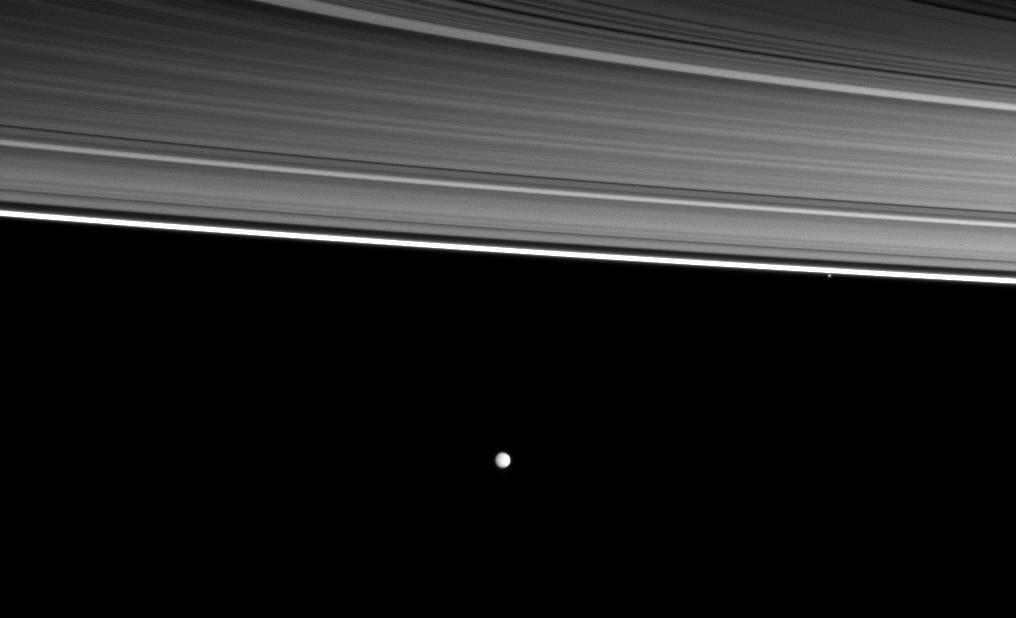
Two of Saturn moons orbit beyond four of the planet rings in this image from NASA Cassini spacecraft. From the top right of the picture are the C, B , A, and thin F rings, the small moon Pandora and, near the middle of the image, the moon Enceladus.
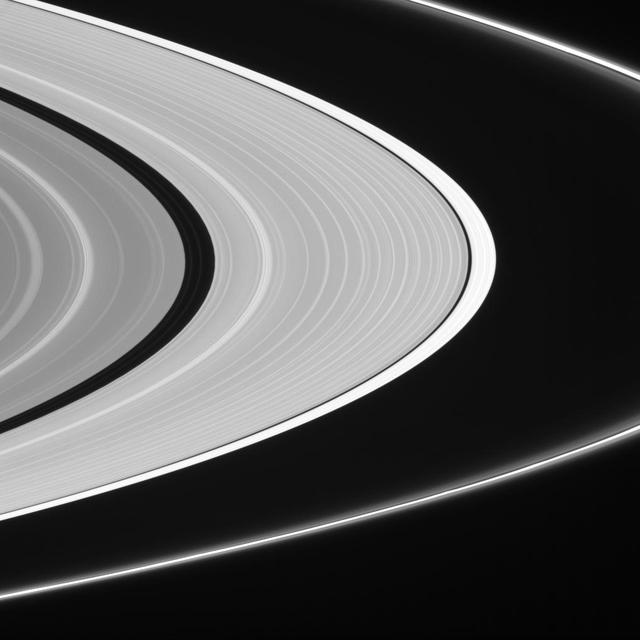
Ringlets in the Encke Gap and flanking the bright F ring core are clearly visible here

Fascinating F Ring
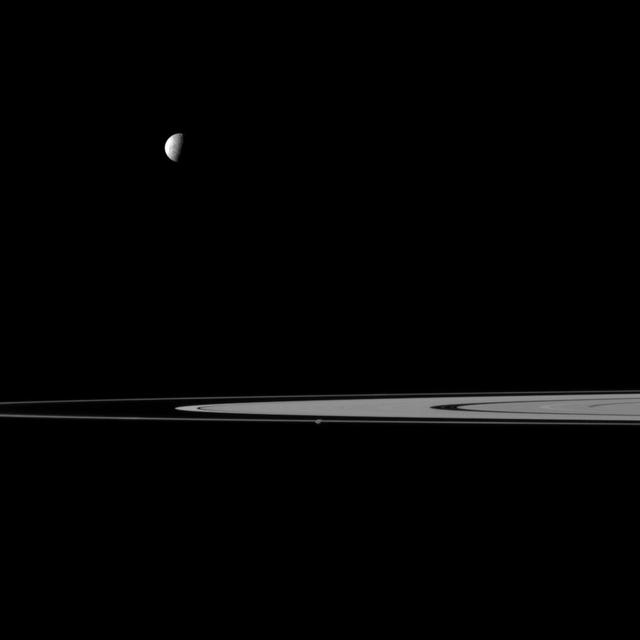
Saturn rings lie between a pair of moons in this view from NASA Cassini spacecraft that features Mimas and Prometheus. Mimas is the more noticeable of the two moons at top left, Prometheus is near the center of image and closest to Cassini.
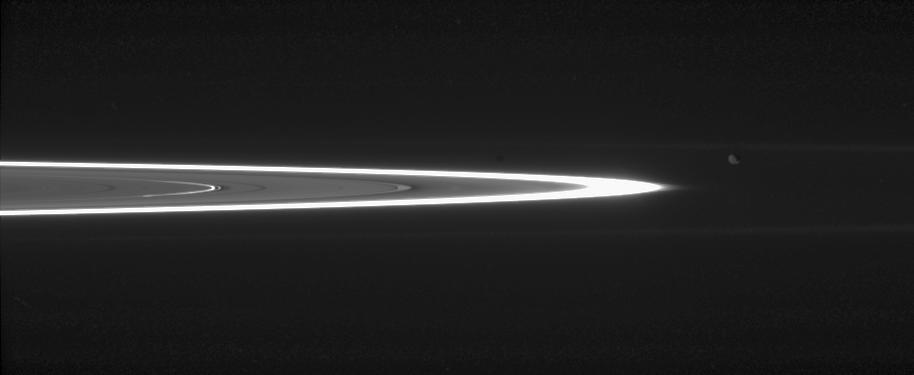
Tiny, dust-sized particles in Saturn rings become much easier to see at high phase angle -- the angle formed by the Sun, the rings and the spacecraft. The brightest ring is the F ring; the next feature to the left is the outer edge of the A ring
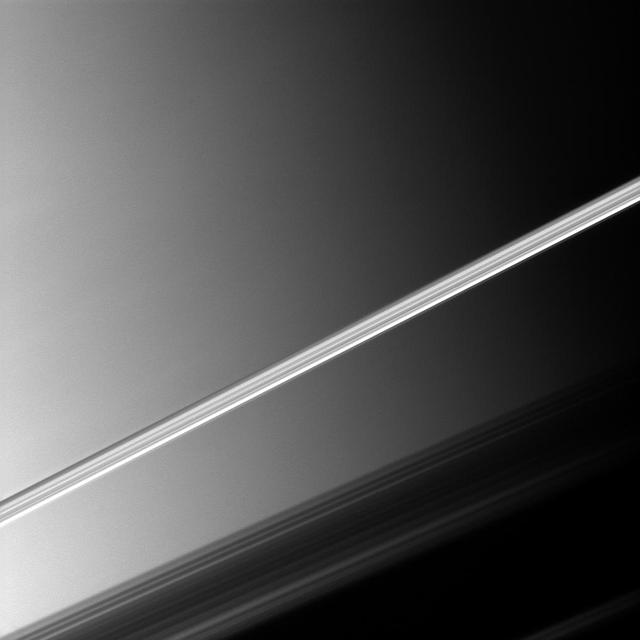
Saturn brightly lit rings slice across this NASA Cassini spacecraft picture taken before a backdrop of the planet clouds.
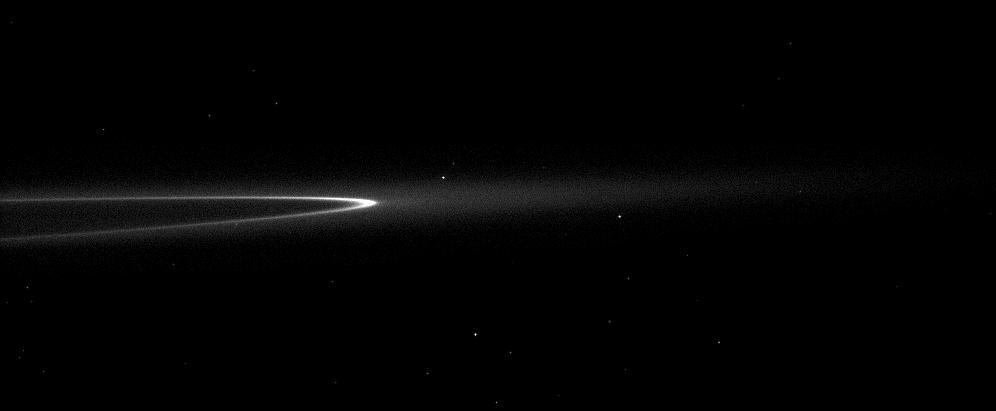
In this image taken by NASA Cassini spacecraft, the bright arc in Saturn faint G ring contains a little something special. Although it cant be seen here, the tiny moonlet Aegaeon orbits within the bright arc.
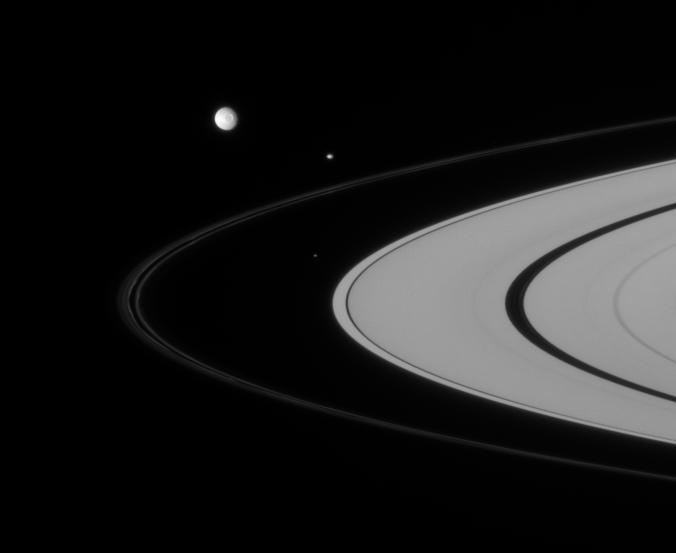
Cluster of Moons

Unrolling the F-ring

Scanning the Rings
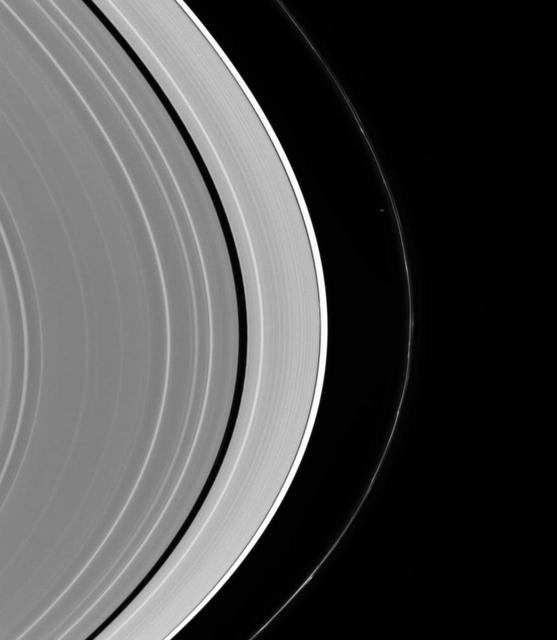
Although difficult to see at first, more than one moon is at work sculpting Saturn rings in this view from the Cassini spacecraft
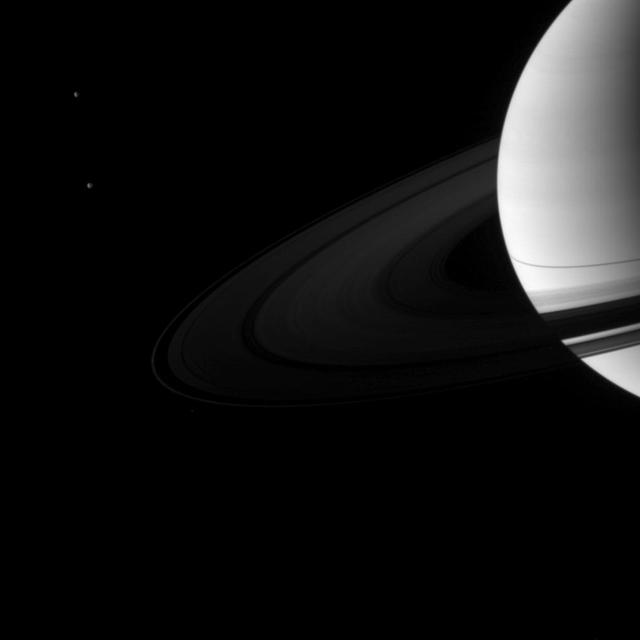
A pair of Saturn moons, Dione and Tethys, accompany the planet and its rings in this image taken shortly after the planet August 2009 equinox by NASA Cassini spacecraft.
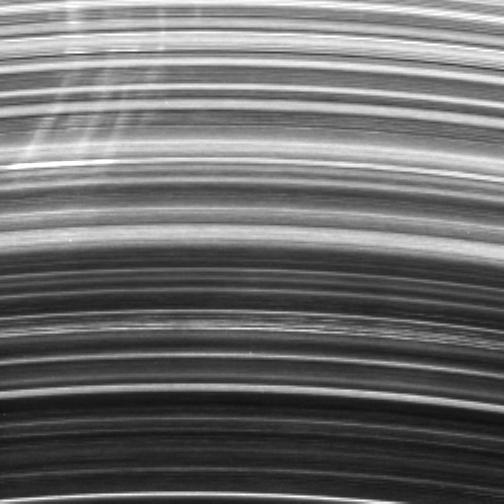
A group of bright spokes tightly cluster together in Saturn B ring. The spokes seen here generally all exhibit the same degree of shearing, or tilting, but some deviations are apparent
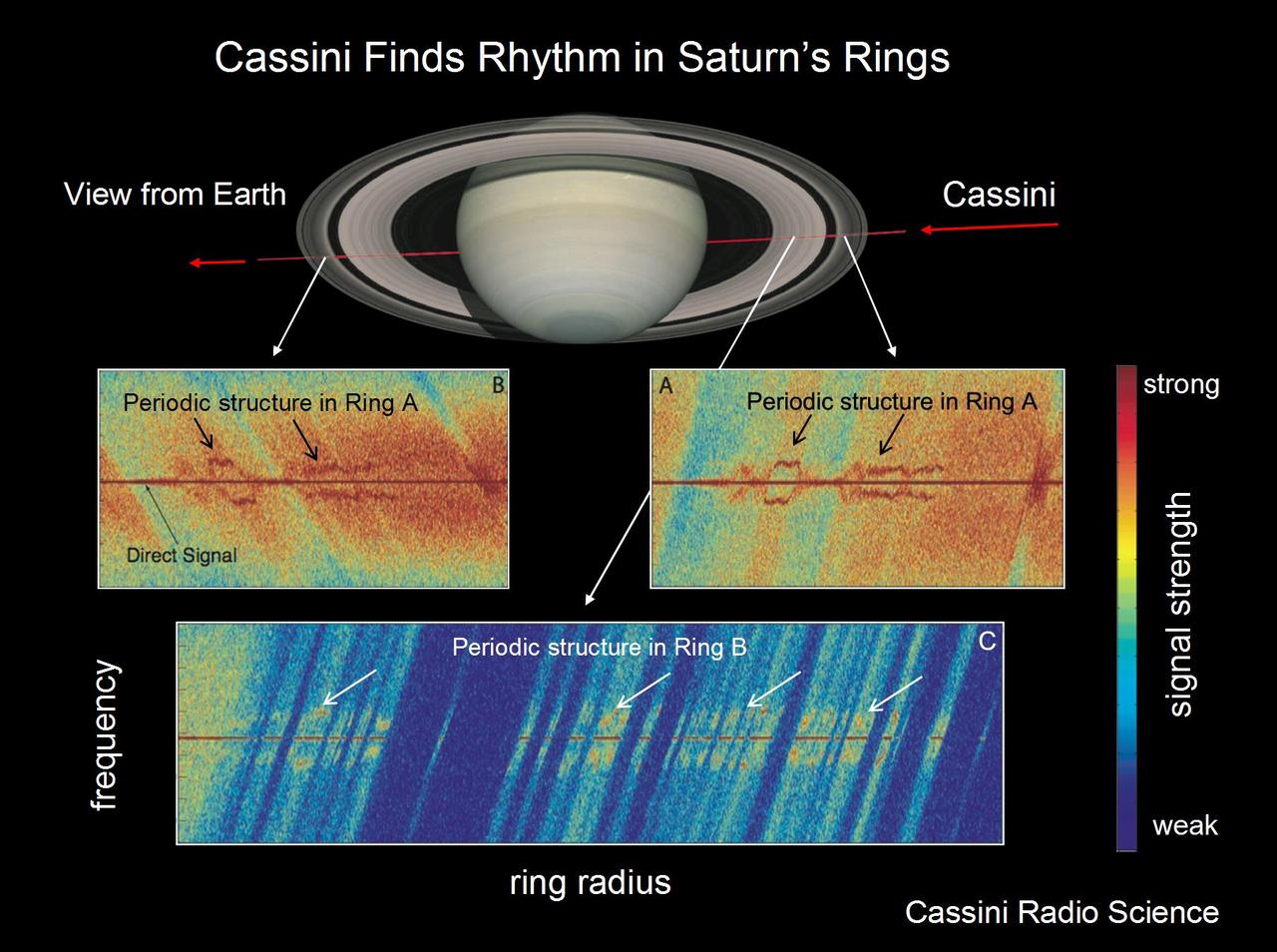
Saturn Ring Rhythm #2

Structure in the Spiral
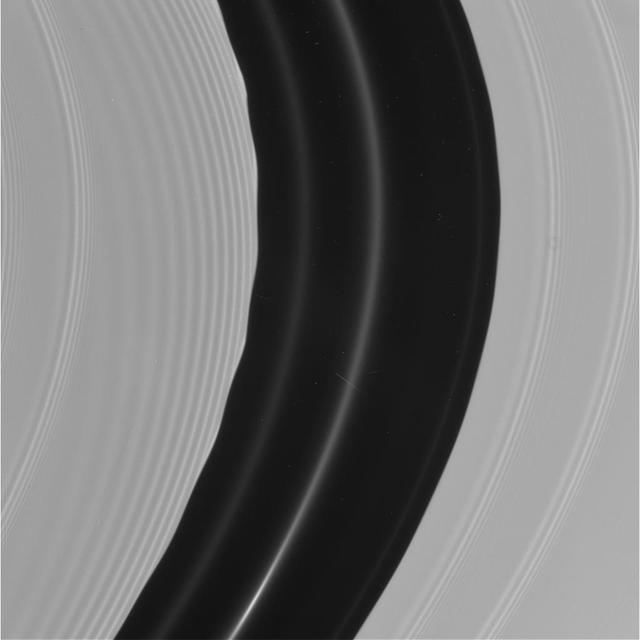
The Encke Gap as Never Seen Before
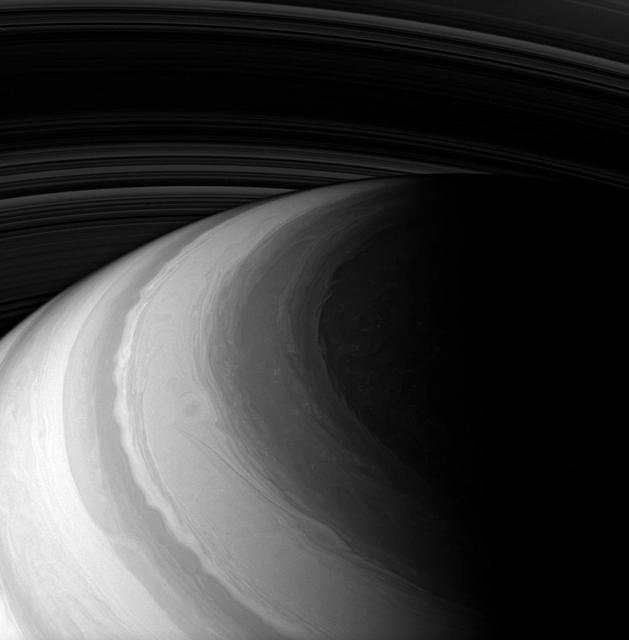
Probing the North
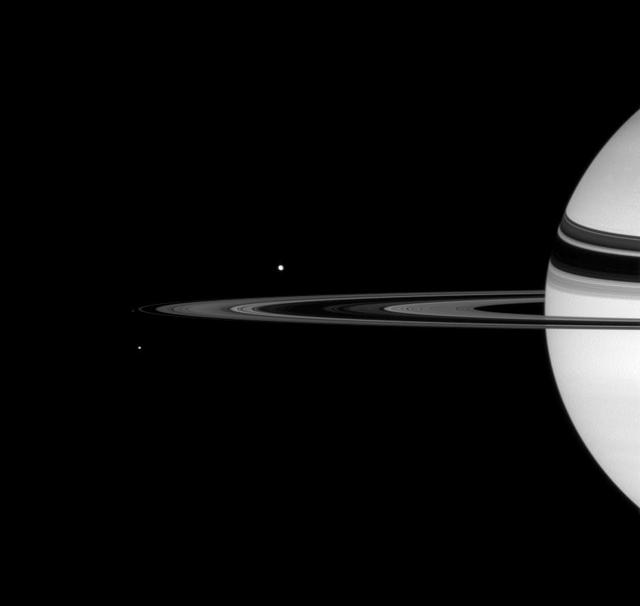
Circling Satellites
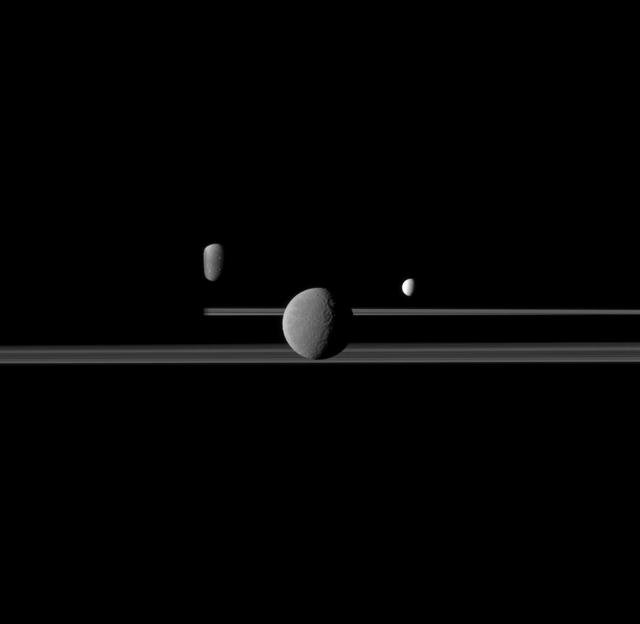
NASA Cassini spacecraft observes three of Saturn moons set against the darkened night side of the planet. Seen here are Rhea, closest to Cassini, Enceladus to right of Rhea, and Dione, left of Rhea.
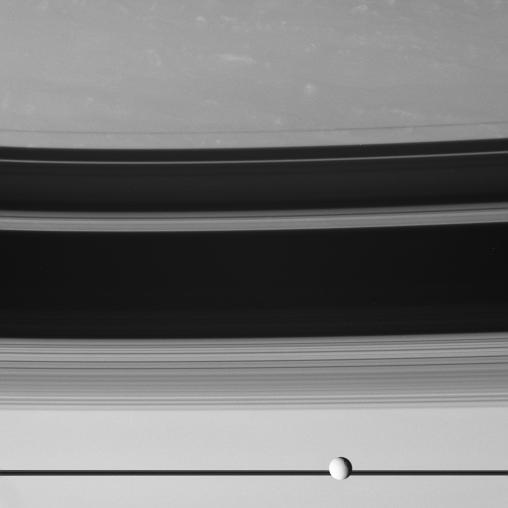
Tethys Walks the Line
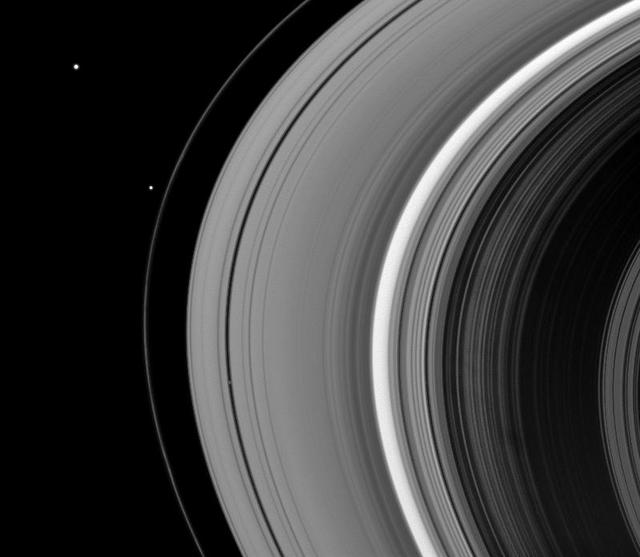
Moons in a Row
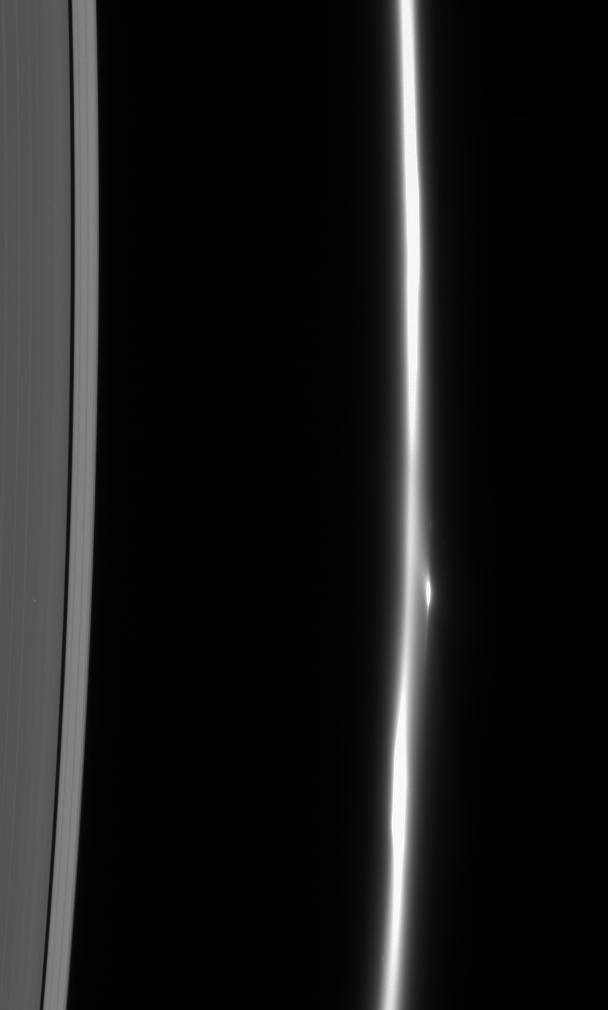
The F ring dissolves into a fuzzy stream of particles -- rather different from its usual appearance of a narrow, bright core flanked by dimmer ringlets. Also notable here is the bright clump of material that flanks the ring core

The spoke-producing region of the B ring displays fine-scale asymmetry in the azimuthal direction -- the direction along which the ring particles orbit Saturn -- from upper left to lower right across the image
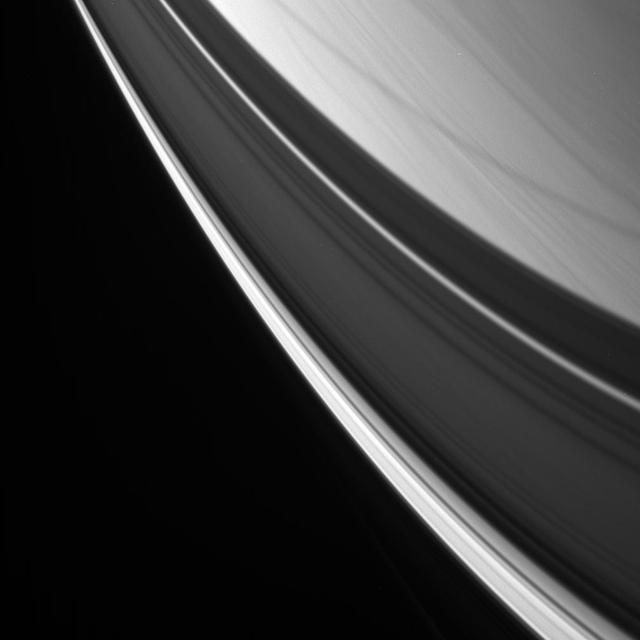
Streaks of cloud are overlain with graceful ring shadows in this view of Saturn northern latitudes
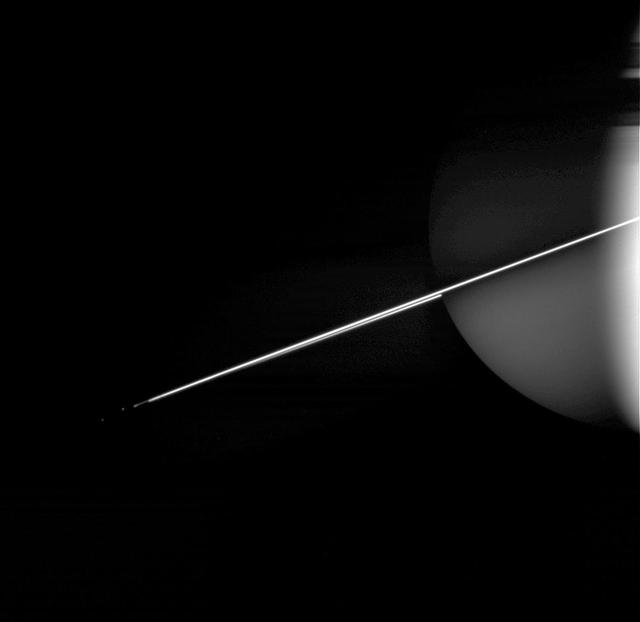
Gleaming Rings
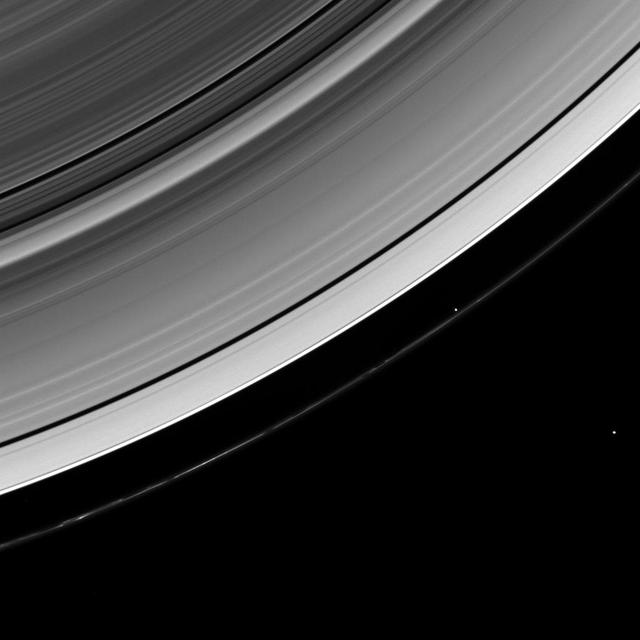
The Cassini spacecraft looks down from a high-inclination orbit to spot two of Saturn ring moons
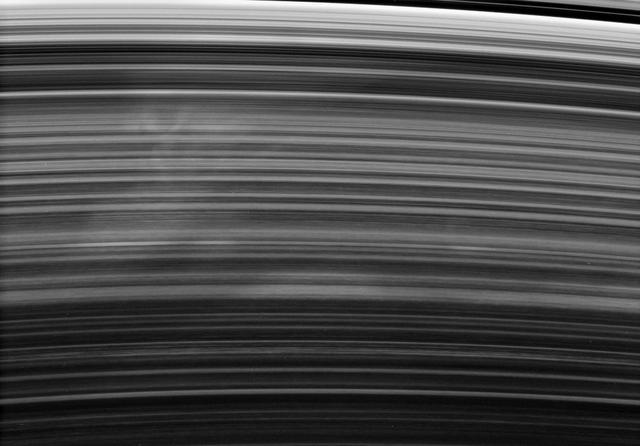
A broad and ghostly spoke drifts past under the Cassini spacecraft gaze. The spoke-forming region of the B ring displays faint longitudinal variations in brightness, from left to right

Saturn Rings

D-Ring Structure
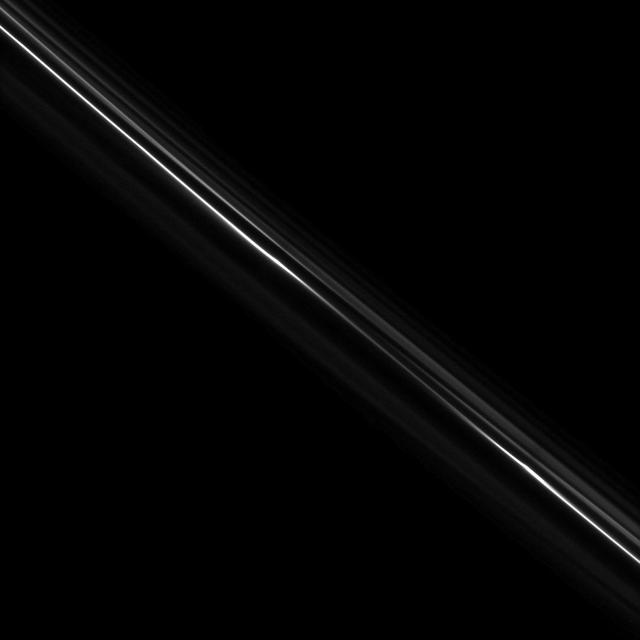
Turn of a Narrow Ring
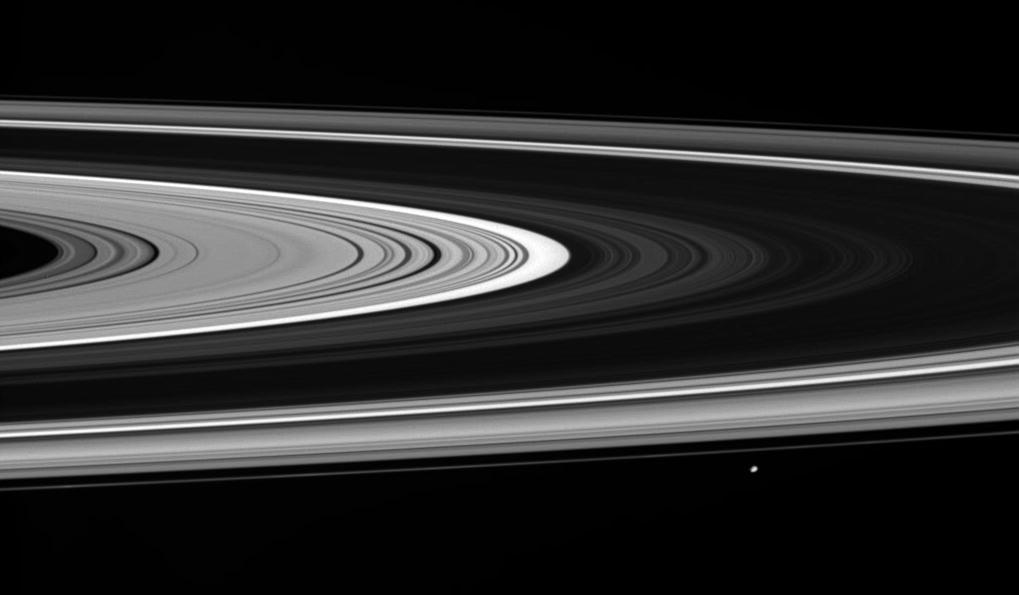
Filtering the Sun
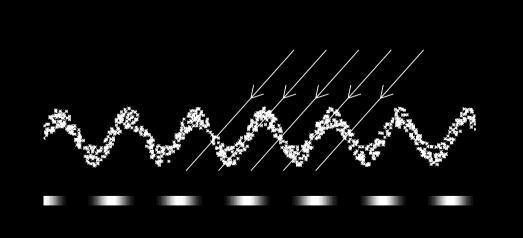
D Ring Sight Lines

B Ring Straw-like Clumps
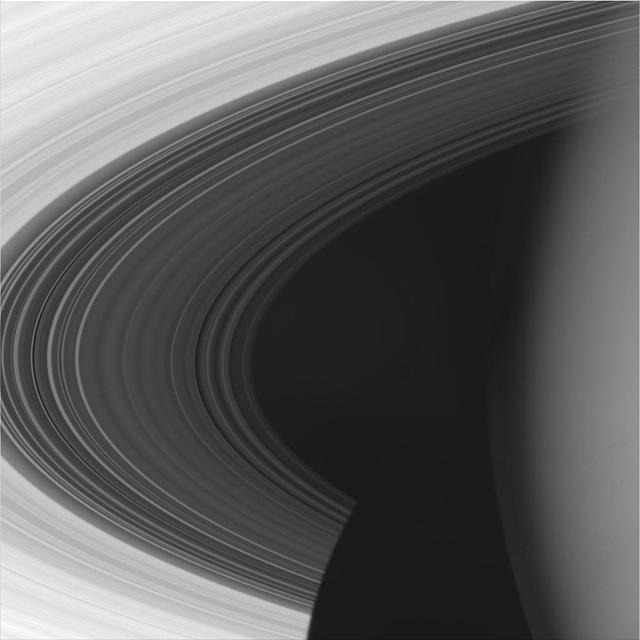
Framing the C Ring
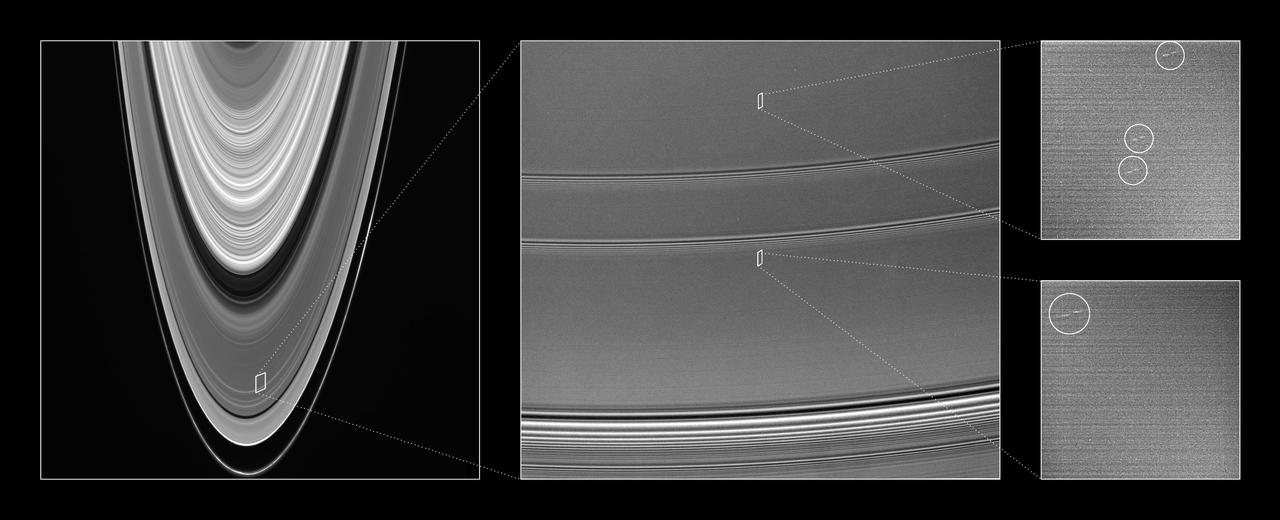
This collection of Cassini images provides context for understanding the location and scale of propeller-shaped features observed within Saturn A ring
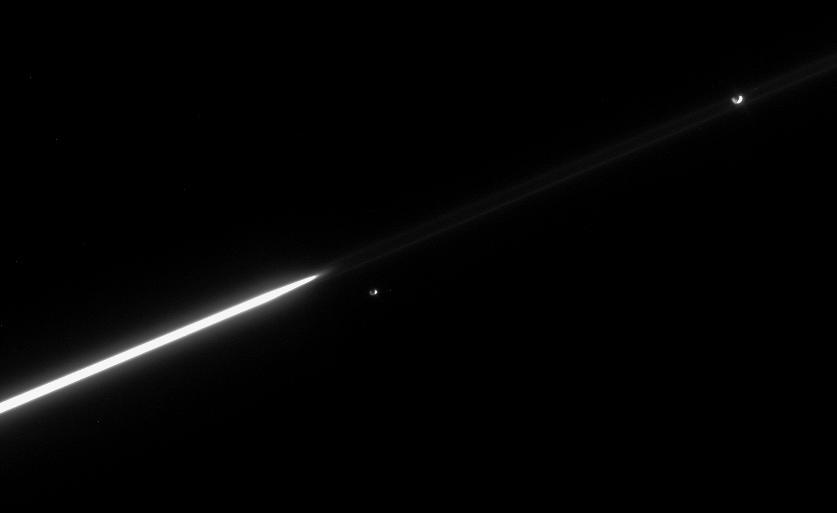
Janus and Epimetheus continue to separate, following their orbital swap in January 2006. Until 2010, Janus will remain the innermost of the pair, whose orbits around Saturn are separated by only about 50 kilometers 31 miles on average
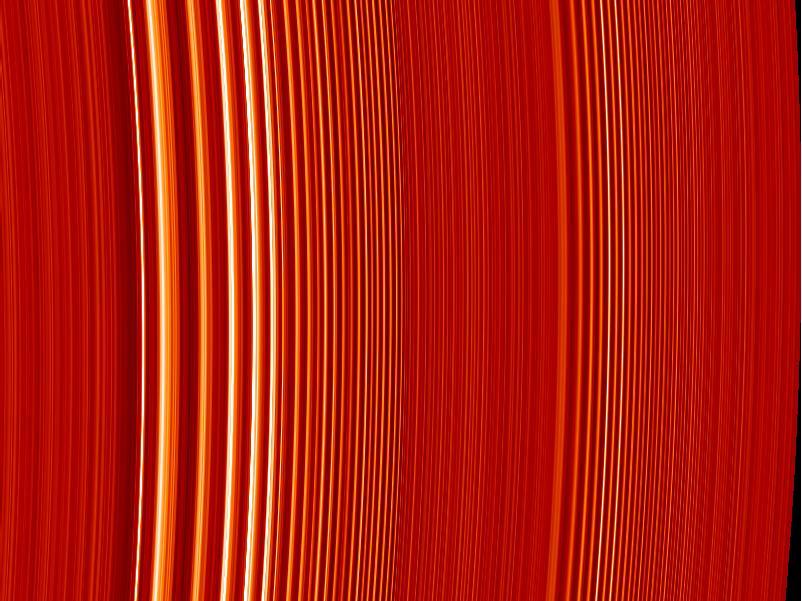
Catching Saturn Ring Waves

The Cassini spacecraft spies two of the small, irregular moons that patrol the outer edges of Saturn main rings
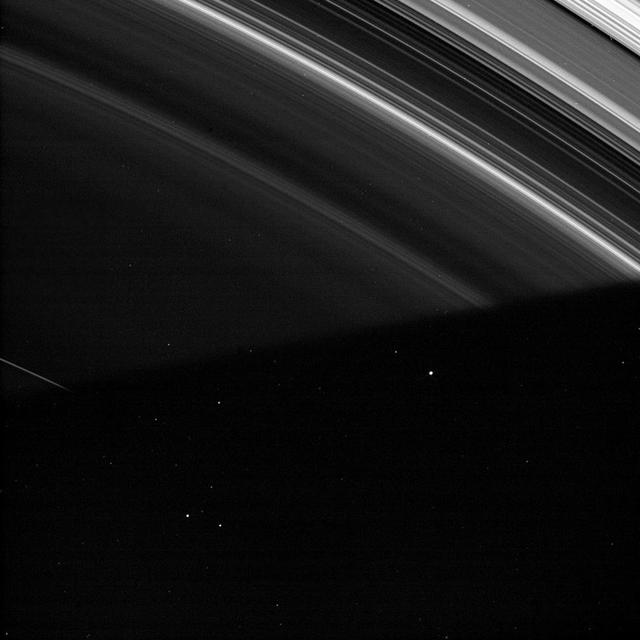
Science at the Shadow Boundary
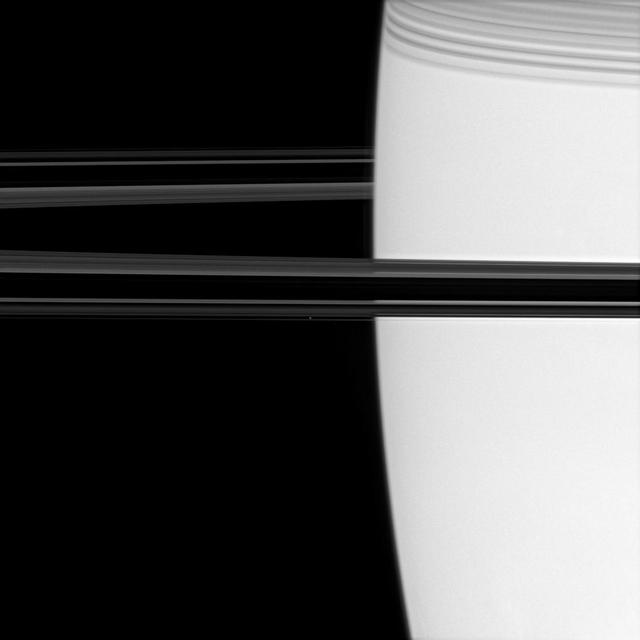
Off the shoulder of giant Saturn, a bright pinpoint marks the location of the ring moon Atlas image center. Shadows cast by the C ring adorn the planet at upper right
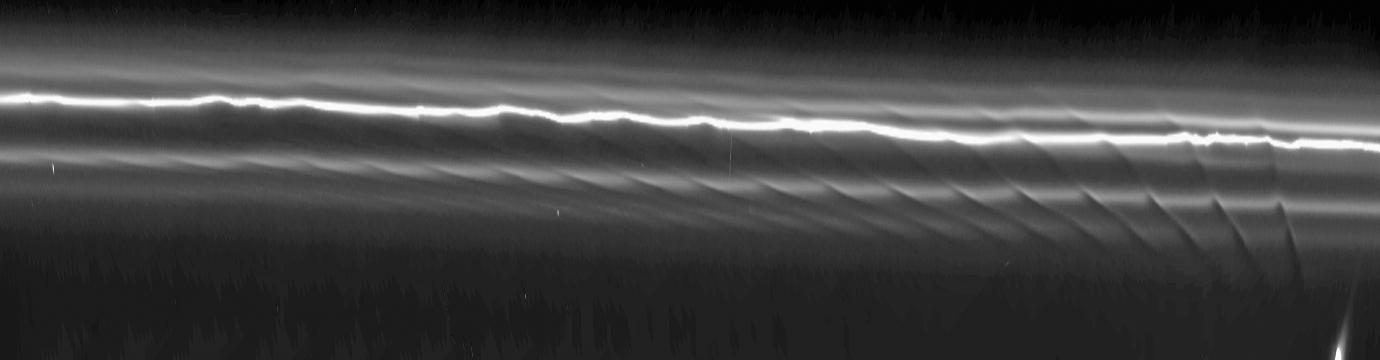
The Prometheus Effect

Perturbed Edge

Neon Saturn
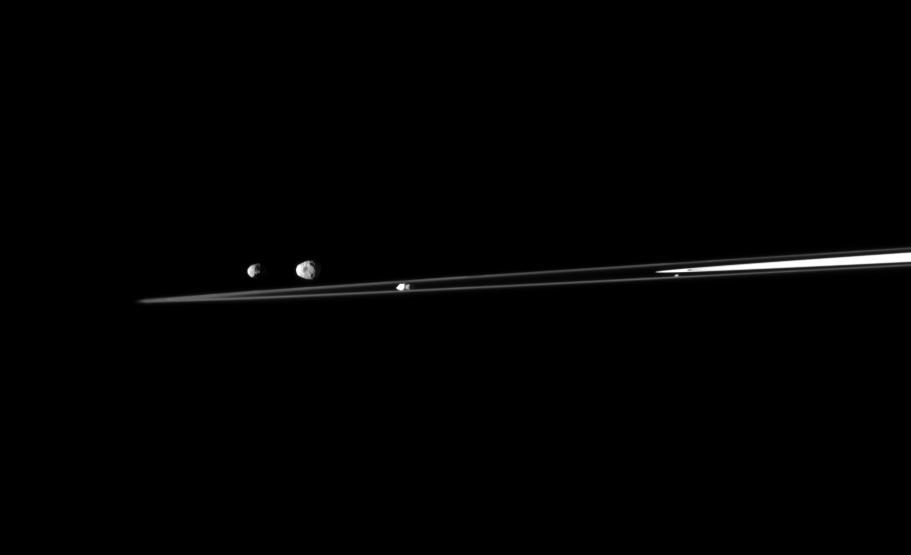
A quartet of Saturn moons are shown with a sliver of the rings in this view from NASA Cassini spacecraft. From left to right in this image are Epimetheus, Janus, Prometheus, and Atlas.
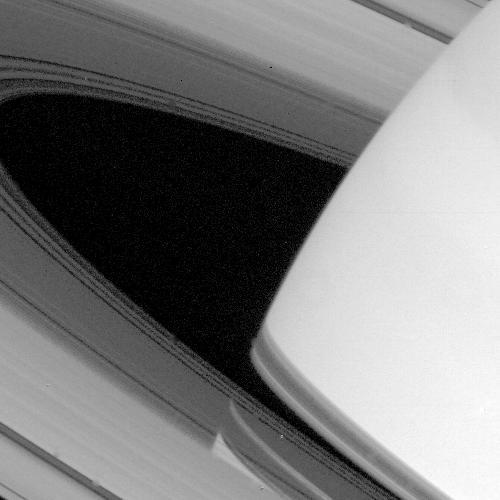
Both the limb of Saturn and the shadow of its ring system are seen through the transparent C-ring in this striking picture taken by NASA Voyager 1 on Nov. 9, 1980. Gaps and regions of high transparency are seen throughout the C-ring, especially in the a

No Postage Required
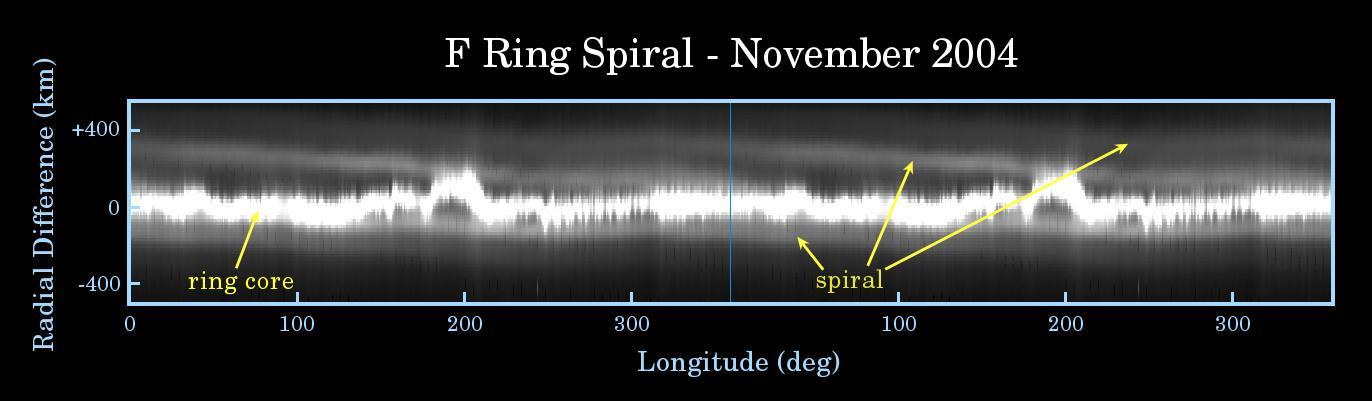
The F Ring Spiral Arm

This image is from a set of mosaic images from NASA Cassini spacecraft showing three fan-like structures in Saturn tenuous F ring. Such fans suggest the existence of additional objects in the F ring.
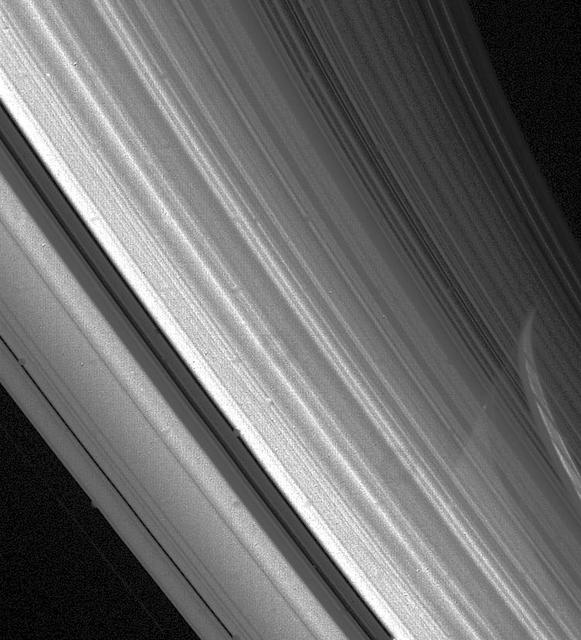
High-resolution View of Saturn Rings

Gathering of Moons
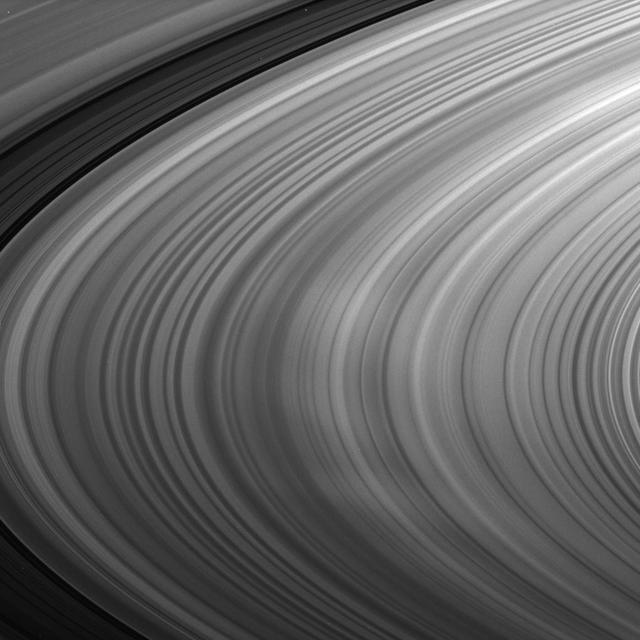
NASA Cassini spacecraft captured Saturn B ring showing off bright spokes in the middle of this image taken at high phase in visible light with the narrow-angle camera.
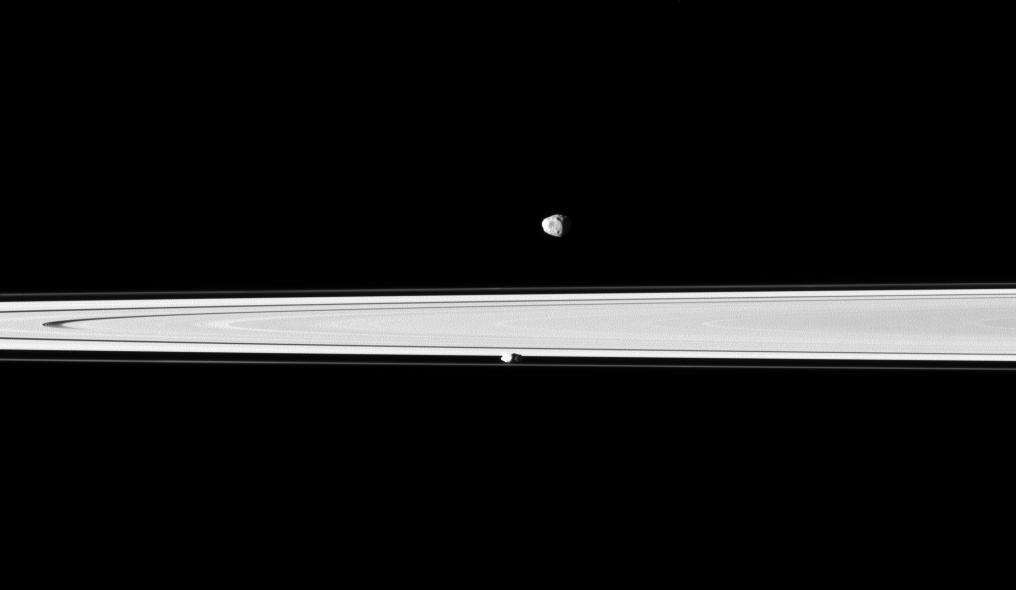
A pair of Saturn small, icy satellites accompany the planet rings in snapshot from NASA Cassini spacecraft. The rings are between Janus and Prometheus.
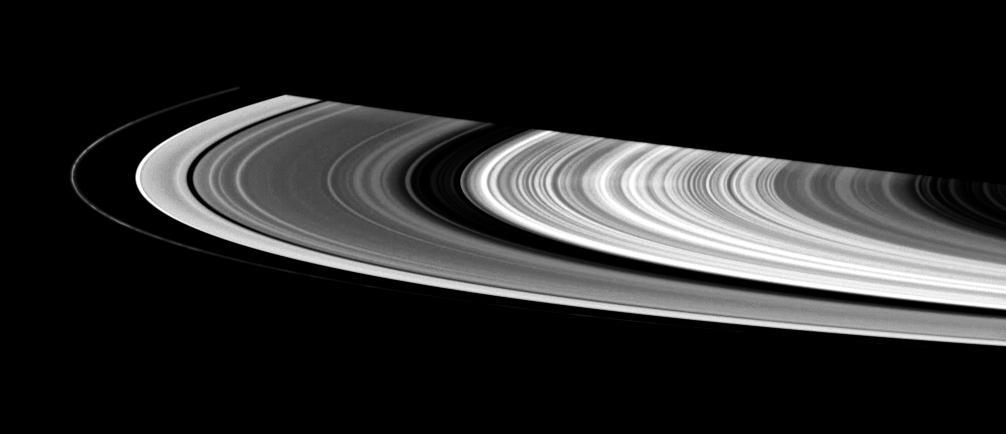
This contrast-enhanced view shows a faint spoke in Saturn B ring. These ghostly radial structures were imaged by the Voyager spacecraft in the 1980s
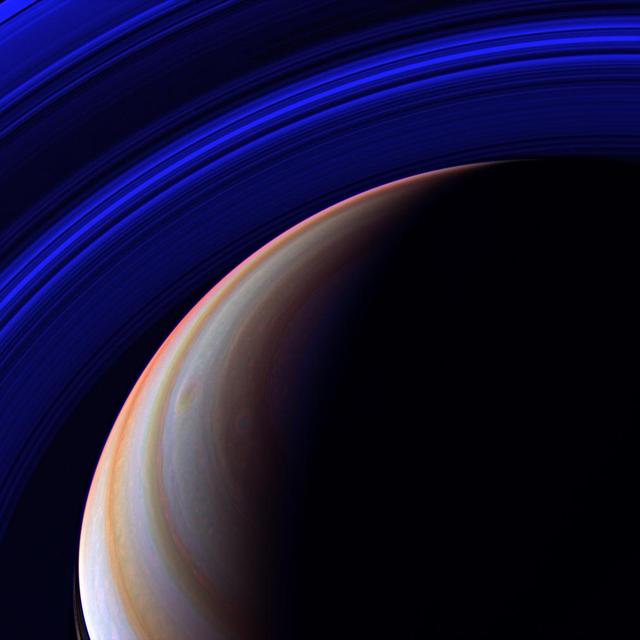
Blue Expanse

Light Shed on the Division

Moonmade Ringscape
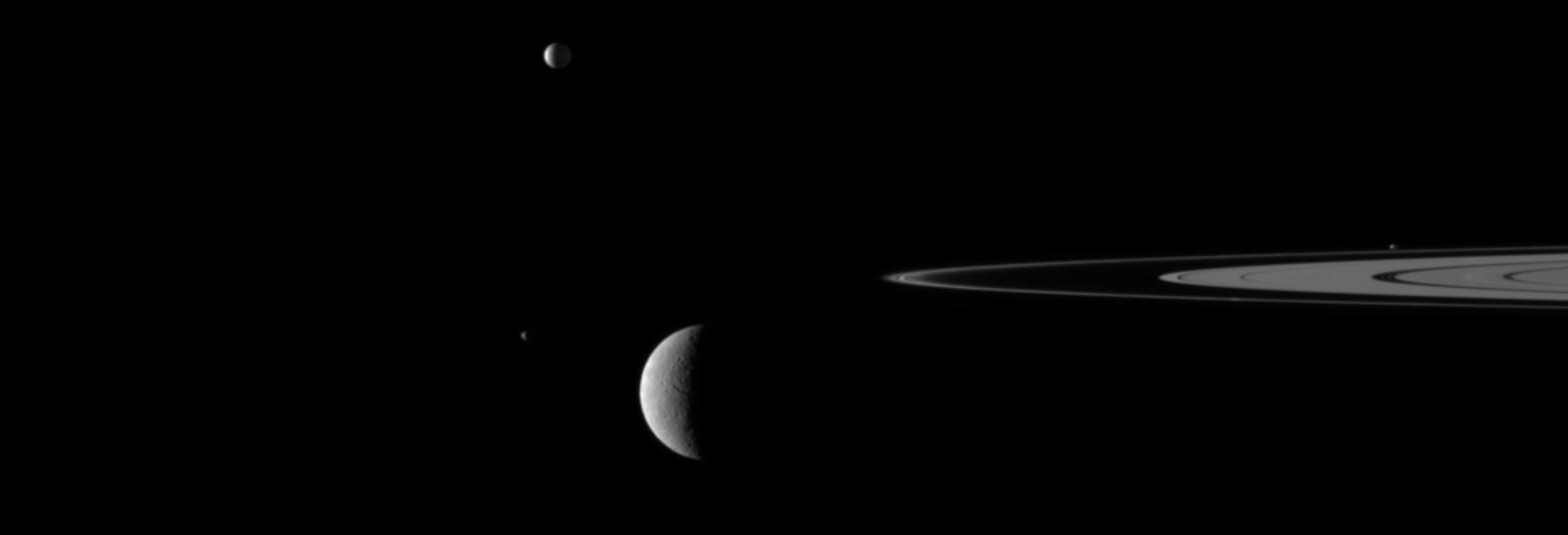
A gaggle of moons parade around Saturn rings in this image from NASA Cassini spacecraft in which the large moon Rhea passes in front of the small moon Janus. Go to the Photojournal to view the animation.
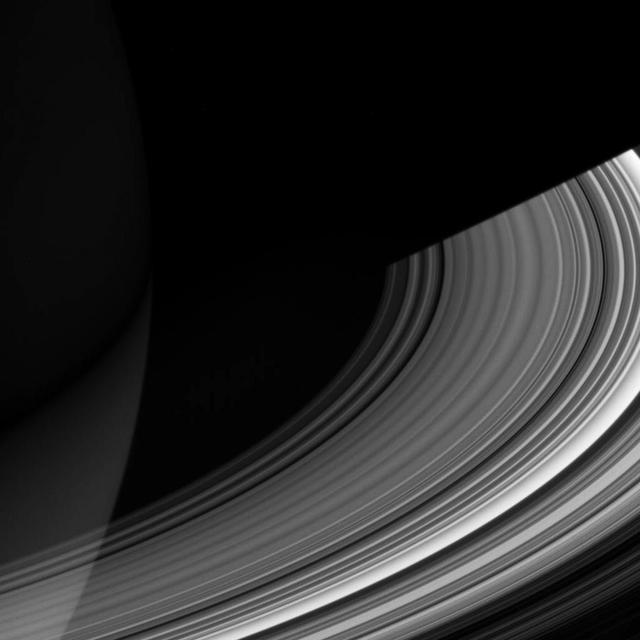
Both luminous and translucent, the C ring sweeps out of the darkness of Saturn's shadow and obscures the planet at lower left. The ring is characterized by broad, isolated bright areas, or "plateaus," surrounded by fainter material. This view looks toward the unlit side of the rings from about 19 degrees above the ringplane. North on Saturn is up. The dark, inner B ring is seen at lower right. The image was taken in visible light with the Cassini spacecraft wide-angle camera on Dec. 15, 2006 at a distance of approximately 632,000 kilometers (393,000 miles) from Saturn and at a Sun-Saturn-spacecraft, or phase, angle of 56 degrees. Image scale is 34 kilometers (21 miles) per pixel. http://photojournal.jpl.nasa.gov/catalog/PIA08855
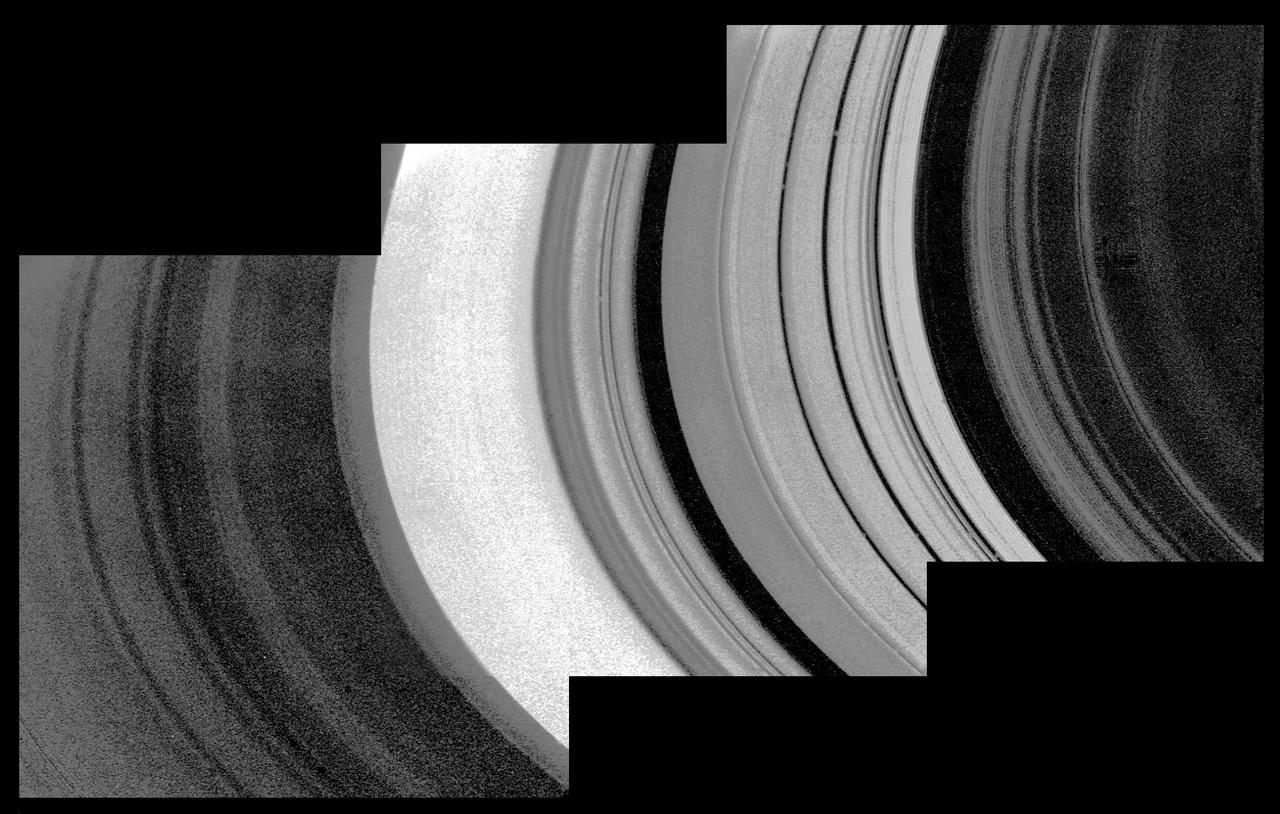
Mosaic of Saturn Rings

Squashed as it Spins

Saturn Ring Region

This group of spokes in Saturn B ring extends over more than 5,000 kilometers 3,100 miles radially across the ringplane
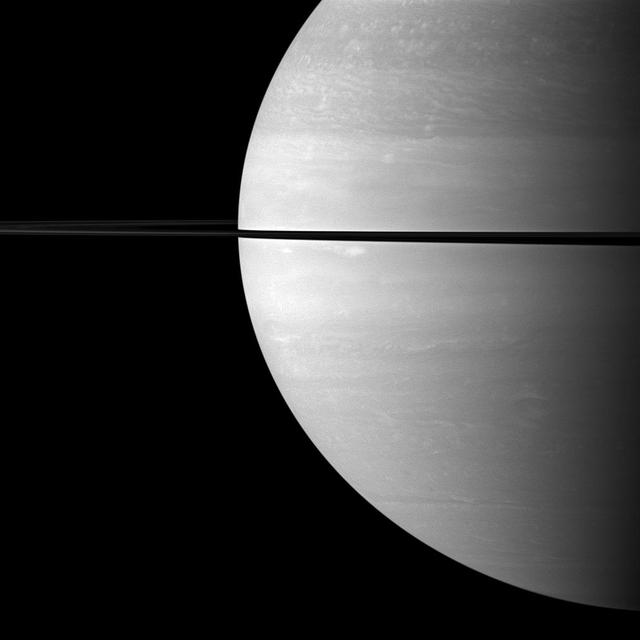
From just above the plane of Saturn rings, NASA Cassini spacecraft snapped this shot of Saturn two months after Saturn August 2009 equinox, showing the shadow of its rings as a narrow band on the planet.
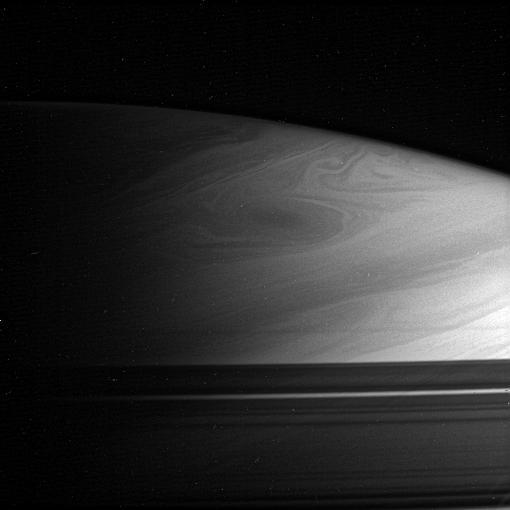
Hoping for a Hex

The shadow of Saturn cuts across the rings as seen by NASA Cassini spacecraft. As the ring particles enter Saturn shadow, their temperature drops to even colder temperatures, only to warm back up again when they re-emerge into the sunlight.