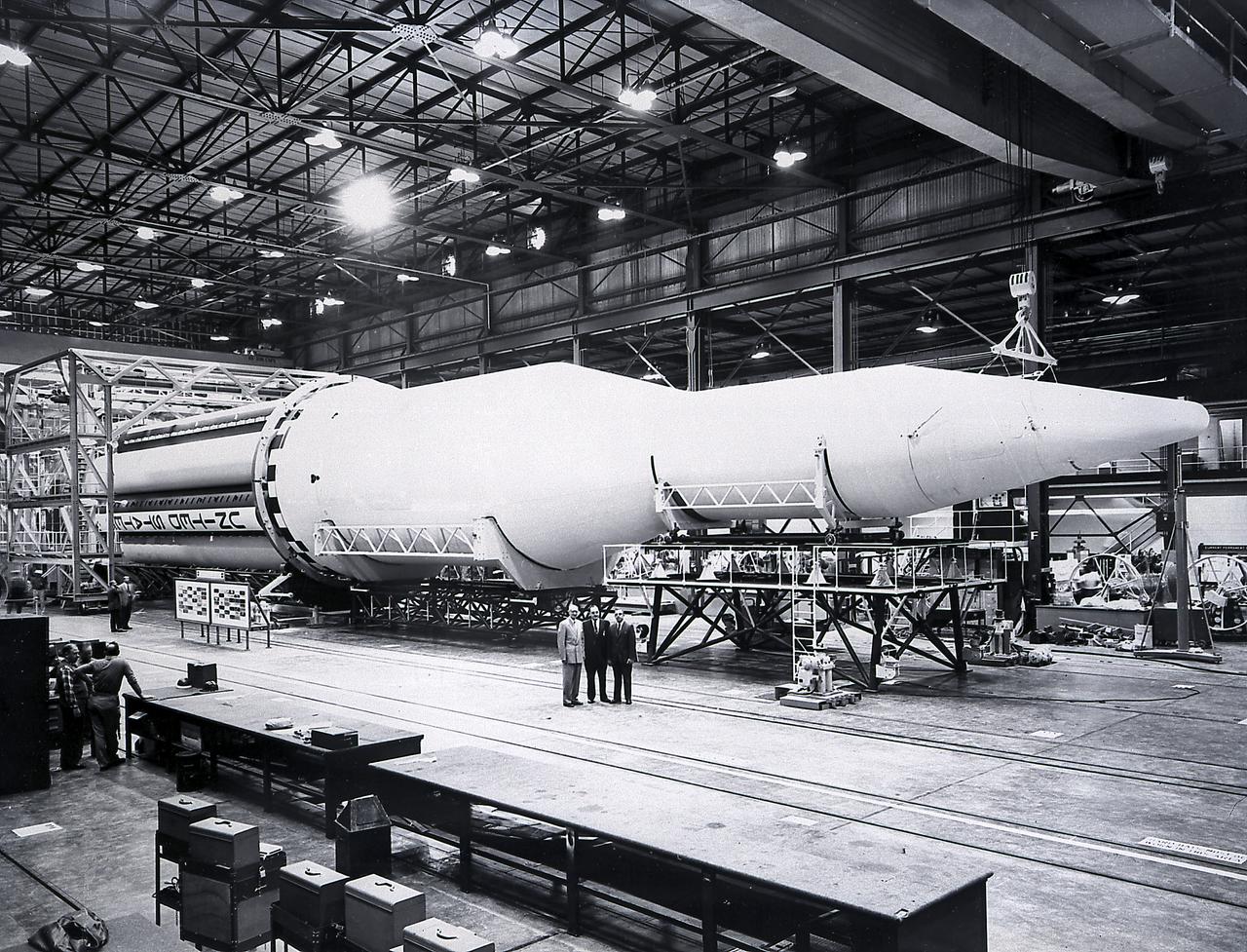
A completed Saturn I launch vehicle in the Fabrication and Assembly Engineering Division at the Marshall Space Flight Center. The Saturn I launch vehicle is composed of an S-I first stage or booster (rear), powered by eight H-1 engines having a thrust of 1,500,000 pounds, followed by a dummy S-IV second stage with six RL-10 engine, with a total thrust of 90,000 pounds.
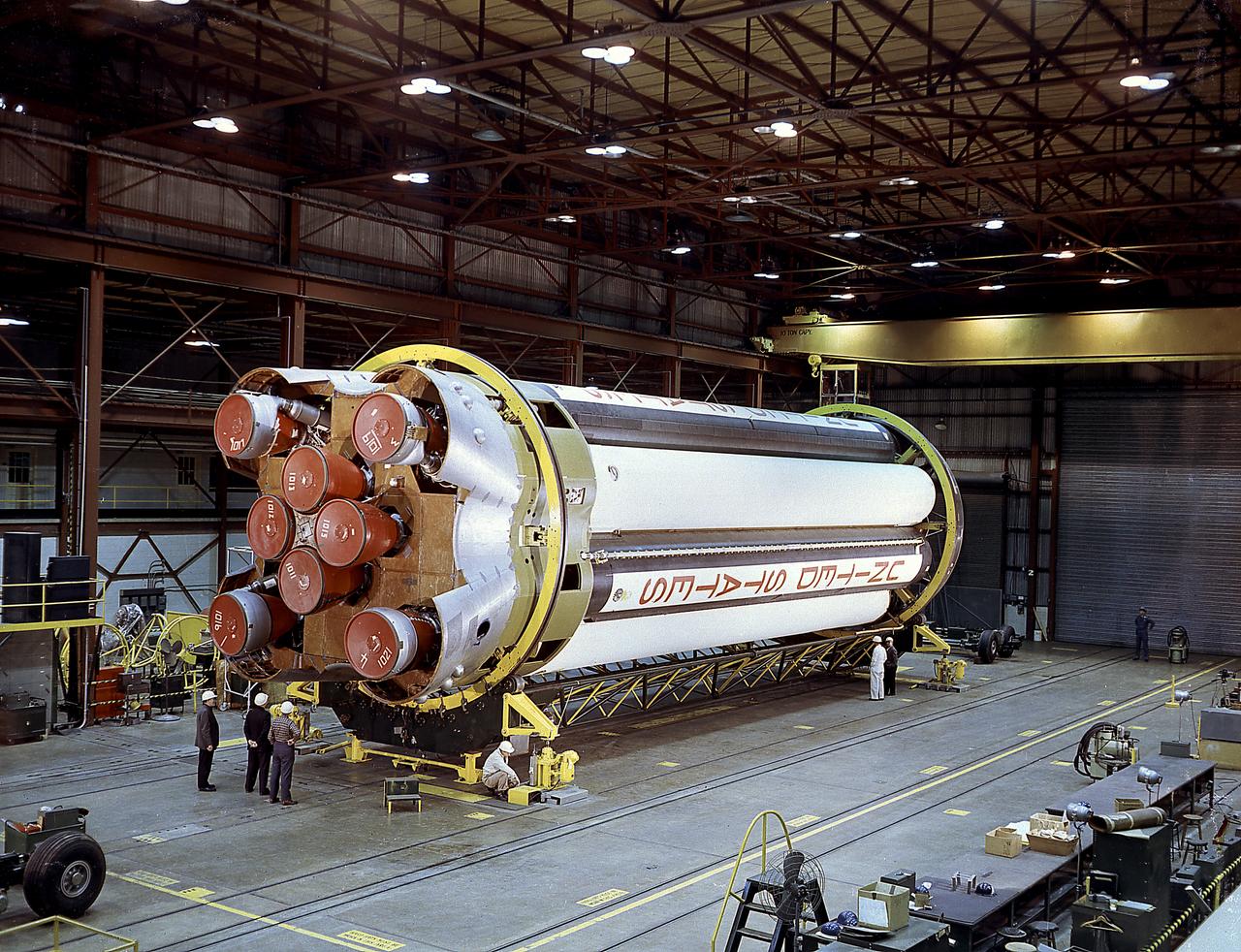
The completely assembled Saturn 1 S-1 stage is being ready for checkout in the Marshall Space Flight Center, building 4705, January 18, 1961. The Saturn I S-I stage had eight H-1 engines clustered, using liquid oxygen/kerosene-1 (LOX/RP-1) propellants capable of producing a total of 1,500,000 pounds of thrust.
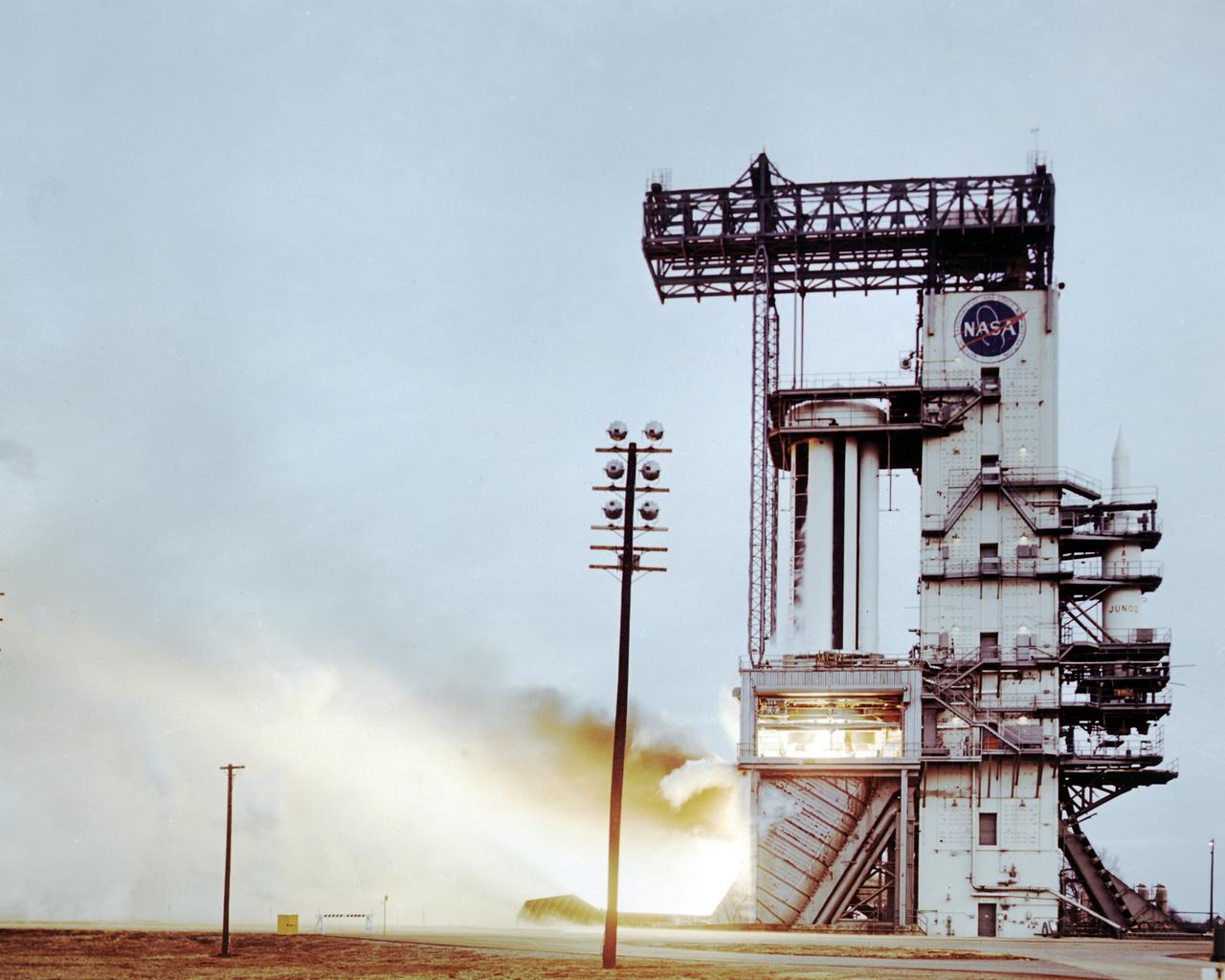
The Saturn project was approved on January 18, 1960 as a program of the highest national priority. The formal test program to prove out the clustered-booster concept was well underway. A series of static tests of the Saturn I booster (S-I stage) began June 3, 1960 at the Marshall Space Flight Center (MSFC). This photograph depicts the Saturn I S-I stage equipped with eight H-1 engines, being successfully test-fired on February 4, 1961. A Juno rocket is visible on the right side of the test stand.
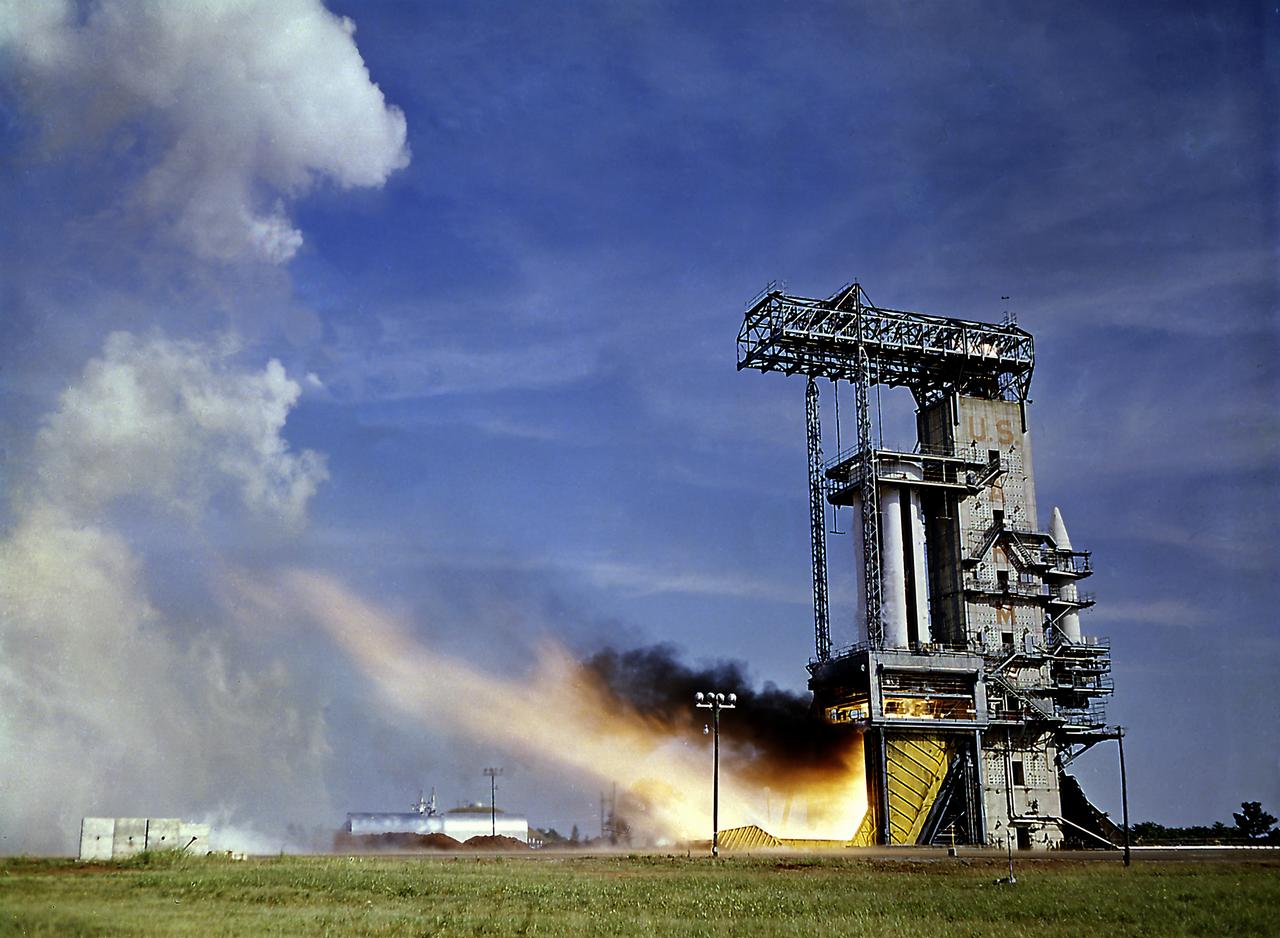
The Saturn Project was approved on January 18, 1960 as a program of the highest national priority. The formal test program to prove out the clustered-booster concept was well underway. A series of static tests of the Saturn I booster (S-I stage) began June 3, 1960 at the Marshall Space Flight Center (MSFC). This photograph depicts the Saturn I S-I stage equipped with eight H-1 engines, being successfully test-fired for the duration of 121 seconds on June 15, 1960.
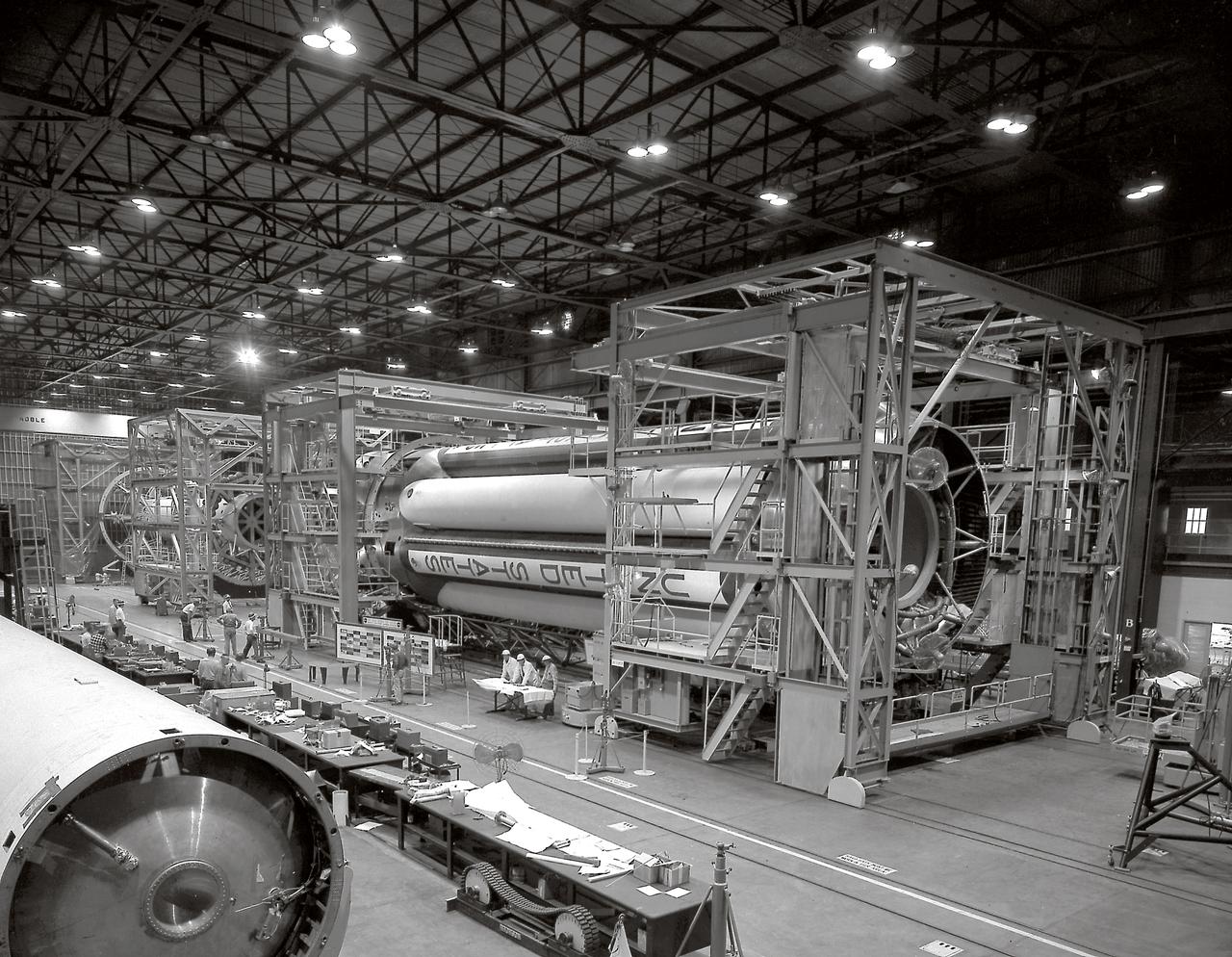
The S-I stages for the Saturn I (SA-1 at right and SA-2 at left) are being assembled at the Marshall Space Flight Center, building 4705. The Saturn I S-I stage had eight H-1 engines clustered, using liquid oxygen/kerosene-1 (LOX/RP-1) propellants capable of producing a total of 1,500,000 pounds of thrust.
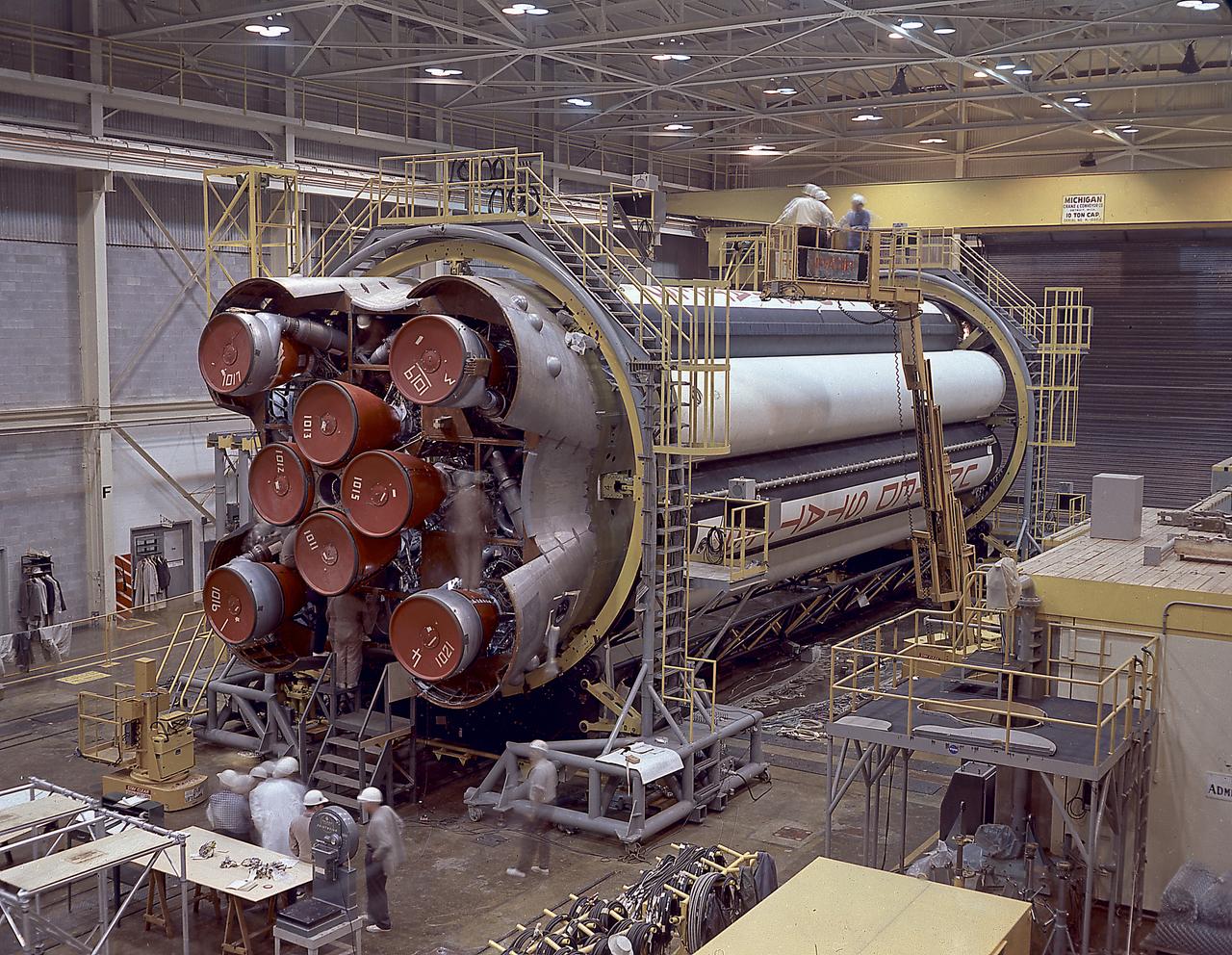
The photograph shows the completed Saturn 1 S-1 stage (booster) during the checkout in the Marshall Space Flight Center, building 4705, January 23, 1961. The Saturn I S-I stage had eight H-1 engines clustered, using liquid oxygen/kerosene-1 (LOX/RP-1) propellants capable of producing a total of 1,500,000 pounds of thrust.
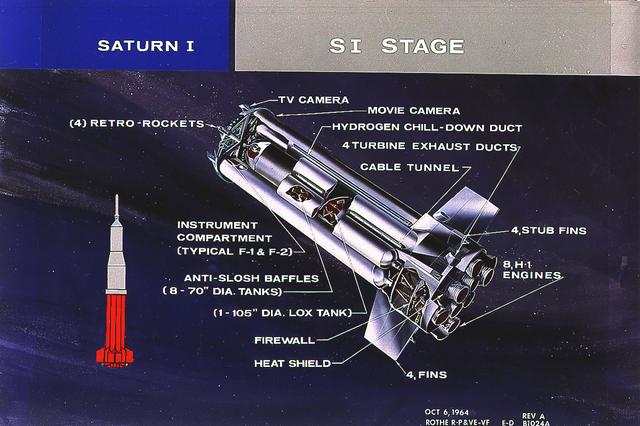
This cutaway illustrates the S-I stage, the first stage of the Saturn I vehicle developed by the Marshall Space Flight Center (MSFC). The stage was propelled by a cluster of eight H-1 engines, capable of producing 1,500,000 pounds of thrust.
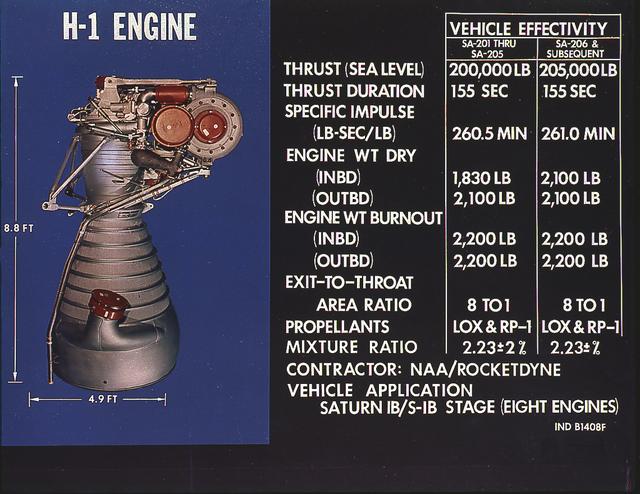
H-1 engine characteristics: The H-1 engine was developed under the management of the Marshall Space Flight Center (MSFC). The cluster of eight H-1 engines was used to power the first stage of the Saturn I (S-I stage) and Saturn IB (S-IVB stage) launch vehicles, and produced 188,00 pounds of thrust, a combined thrust of 1,500,000 pounds, later uprated to 205,000 pounds of thrust and a combined total thrust of 1,650,000 pounds for the Saturn IB program.
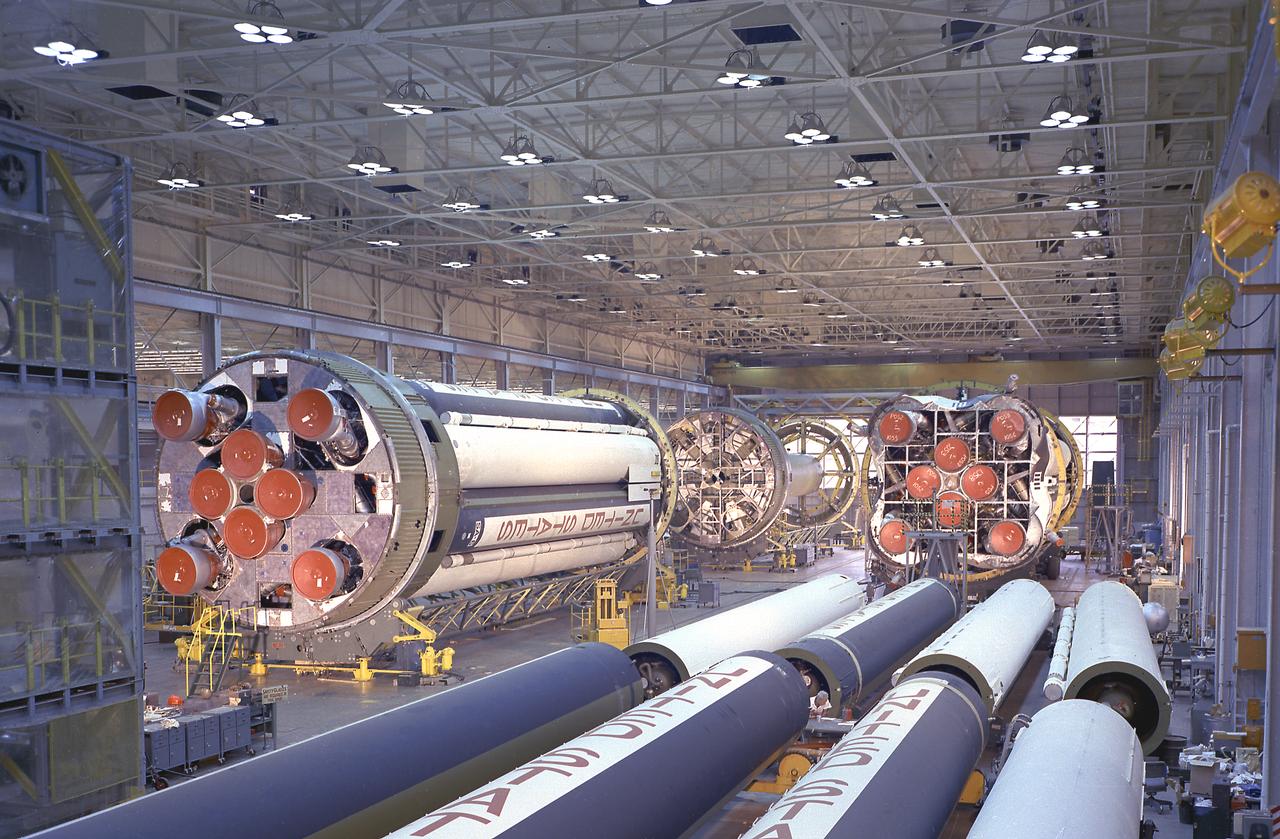
In this photograph, the Saturn I S-I stages for the SA-4, SA-6, and SA-7 missions were being assembled at the Fabrication and Assembly Engineering Division in the Marshall Space Flight Center building 4705, January 13, 1963.
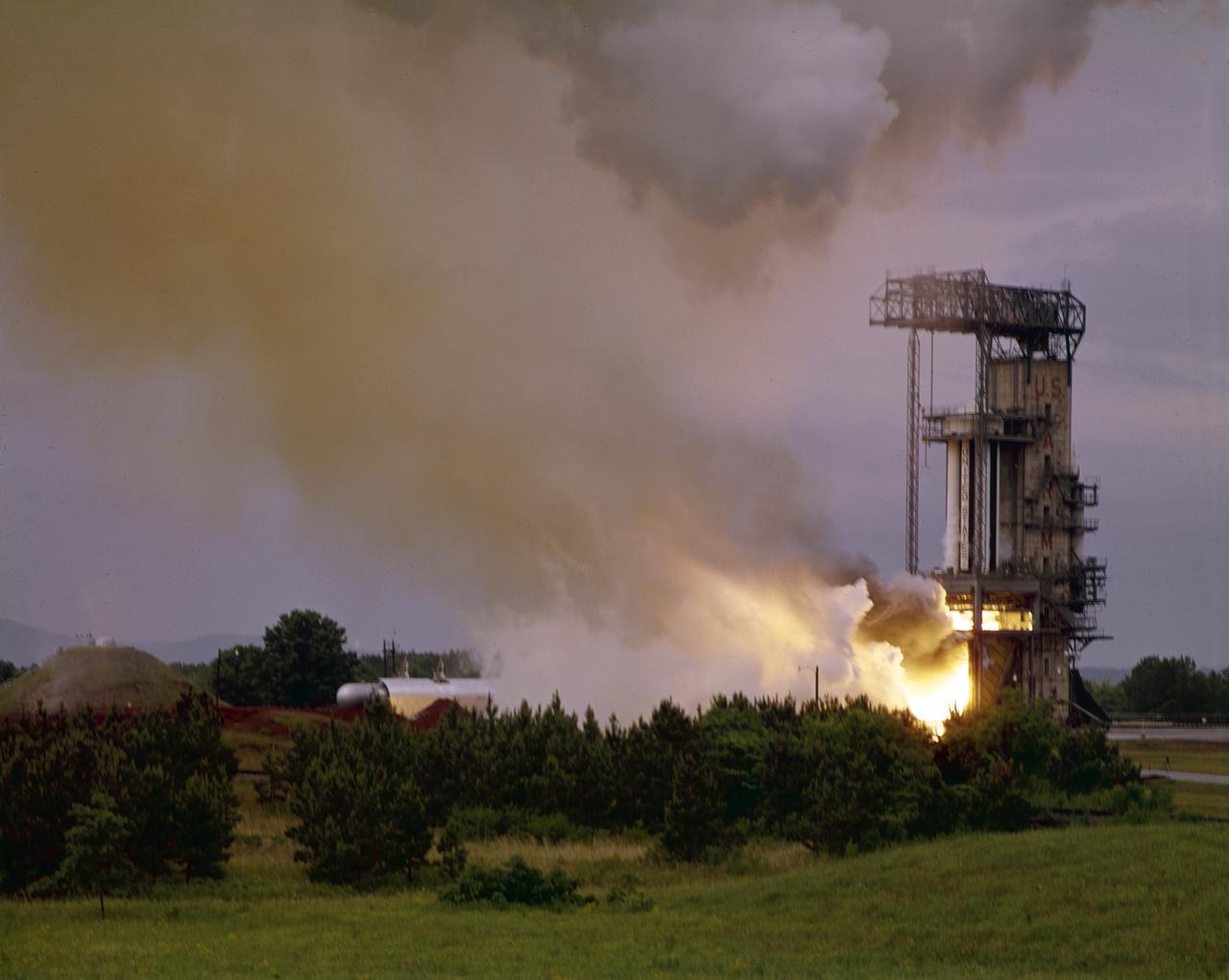
Pictured is one of the earliest testing of the Saturn I S-I (first) stage, with a cluster of eight H-1 engines, at the Marshall Space Flight Center (MSFC). It was a part of the test program to prove out the clustered-booster concept. MSFC was responsible for designing and development the Saturn launch vehicles.
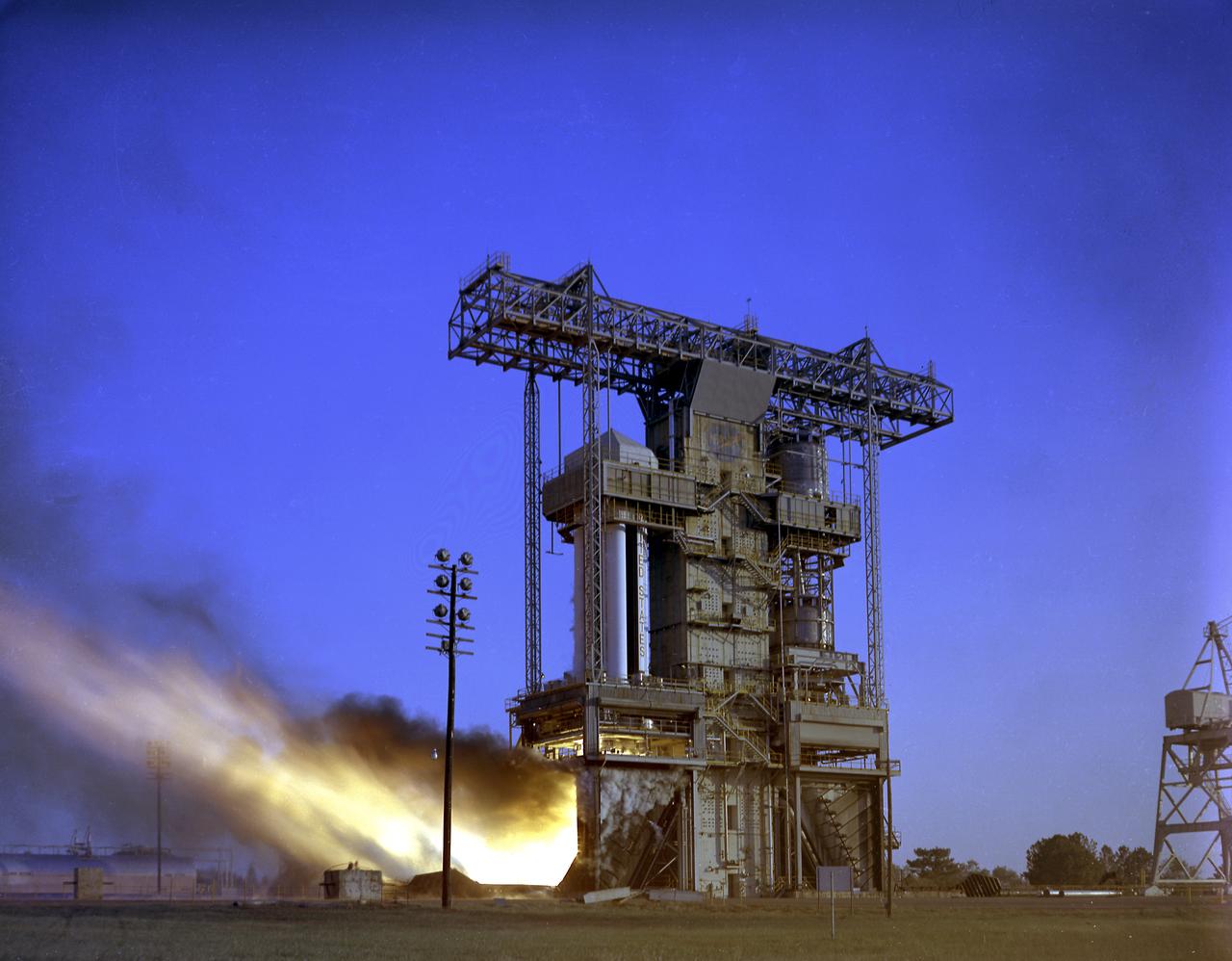
Test firing of the Saturn I S-I Stage (S-1-10) at the Marshall Space Flight Center. This test stand was originally constructed in 1951 and sometimes called the Redstone or T tower. In l961, the test stand was modified to permit static firing of the S-I/S-IB stages, which produced a total thrust of 1,600,000 pounds. The name of the stand was then changed to the S-IB Static Test Stand.
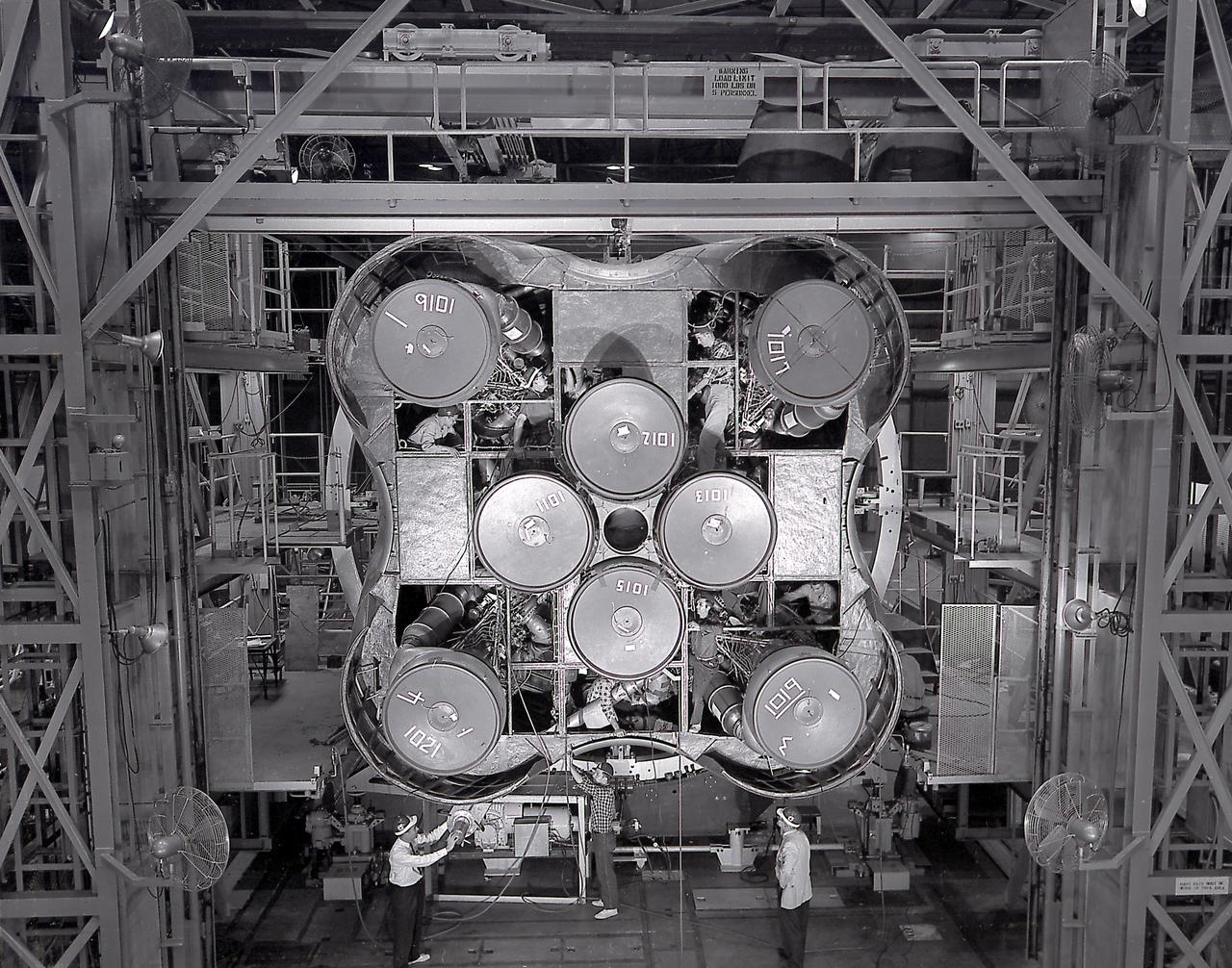
The Saturn I S-I stage with eight H-1 engines, located in Marshall Space Flight Center building 4705, showing the positioning of eight H-1 engines. The Saturn I S-I stage had eight H-1 engines clustered, using liquid oxygen/kerosene-1 (LOX/RP-1) propellants capable of producing a total of 1,500,000 pounds of thrust.
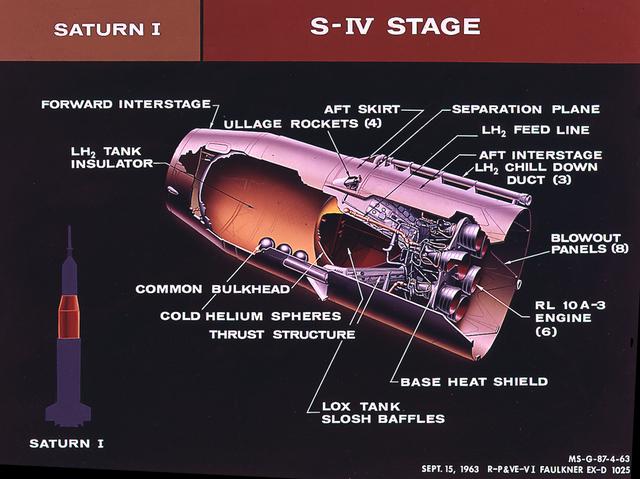
This cutaway of the Saturn I S-IV stage (second stage) illustrates the booster's components. Powered by six RL-10 engines, the S-IV stage was capable of producing 90,000 pounds of thrust. Development of the Saturn S-IV stage by the Marshall Space Flight Center (MSFC) contributed many technological breakthroughs vital to the success of the Apollo lunar program, including the use of liquid hydrogen as a propellant.
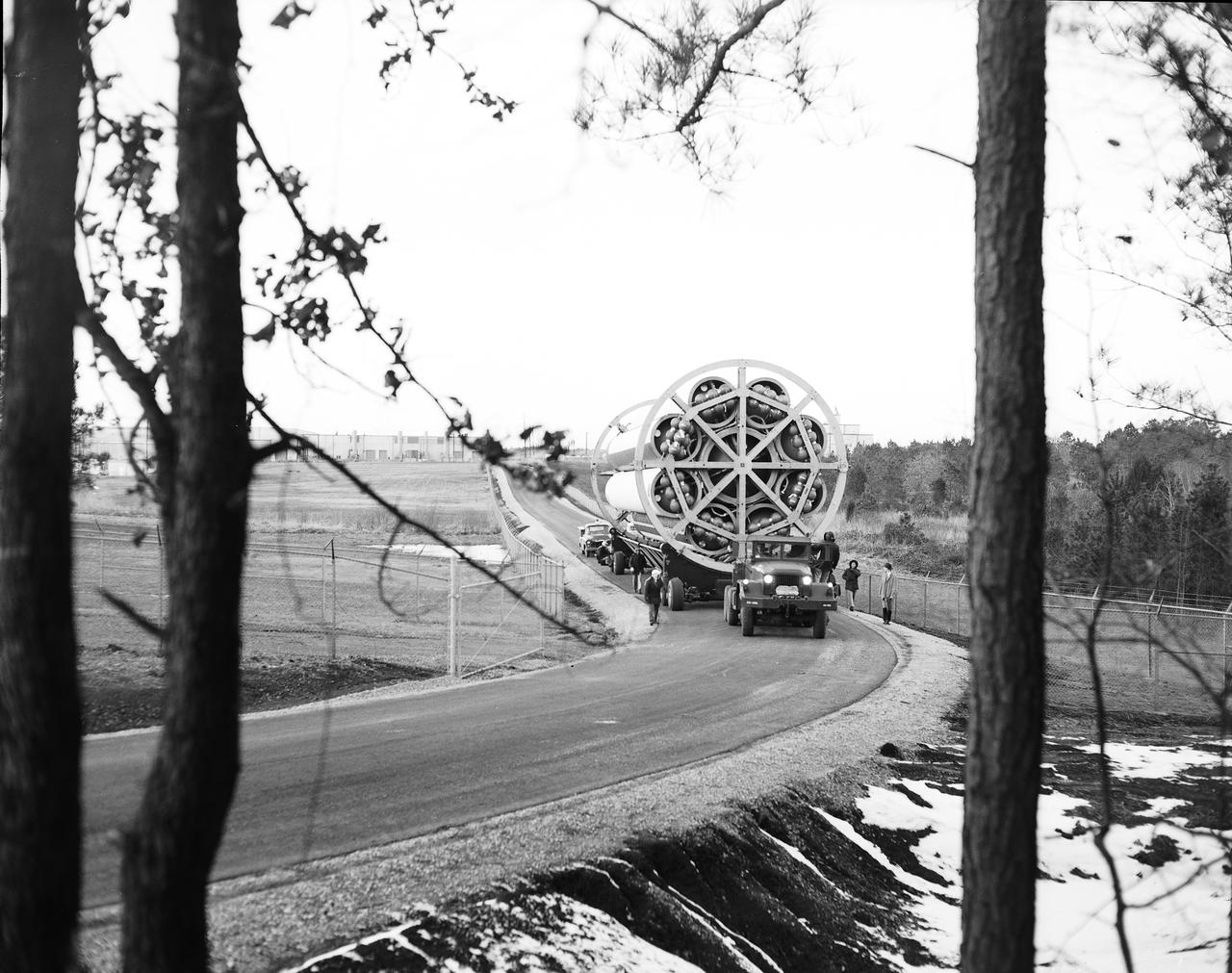
This photograph shows the Saturn-I first stage (S-1 stage) being transported to the test stand for a static test firing at the Marshall Space Flight Center. Soon after NASA began operations in October 1958, it was evident that sending people and substantial equipment beyond the Earth's gravitational field would require launch vehicles with weight-lifting capabilities far beyond any developed to that time. In early 1959, NASA accepted the proposal of Dr. Wernher von Braun for a multistage rocket, with a number of engines clustered in one or more of the stages to provide a large total thrust. The initiation of the Saturn launch vehicle program ultimately led to the study and preliminary plarning of many different configurations and resulted in production of three Saturn launch vehicles, the Saturn-I, Saturn I-B, and Saturn V. The Saturn family of launch vehicles began with the Saturn-I, a two-stage vehicle originally designated C-1. The research and development program was planned in two phases, or blocks: one for first stage development (Block I) and the second for both first and second stage development (Block-II). Saturn I had a low-earth-orbit payload capability of approximately 25,000 pounds. The design of the first stage (S-1 stage) used a cluster of propellant tanks containing liquid oxygen (LOX) and kerosene (RP-1), and eight H-1 engines, yielding a total thrust of 1,500,000 pounds. Of the ten Saturn-Is planned, the first eight were designed and built at the Marshall Space Flight Center, and the remaining two were built by the Chrysler Corporation.
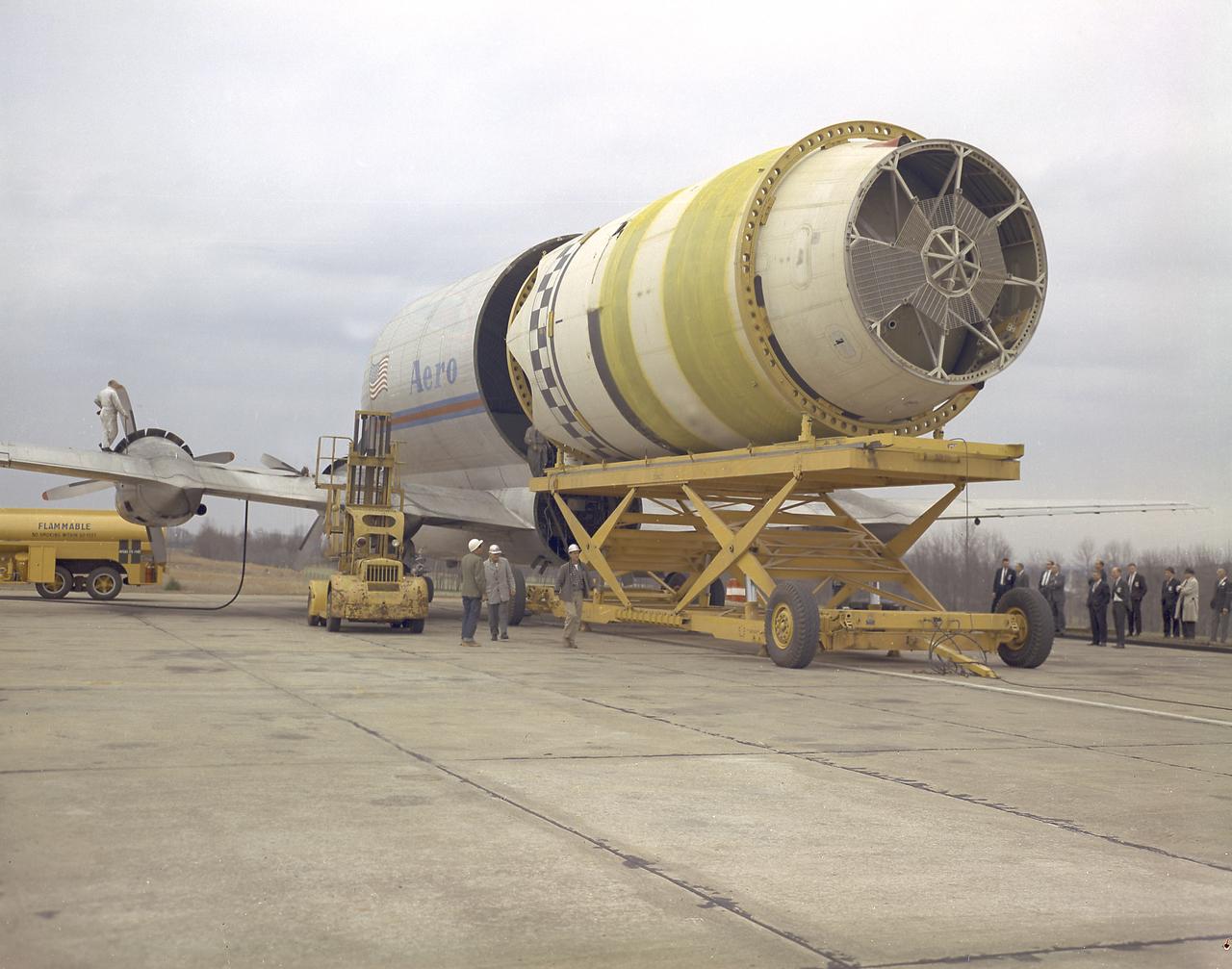
The photograph shows the loading operation of the Saturn I S-IV stage (second stage) into the Pregnant Guppy at the Redstone Airfield, Huntsville, Alabama. The Pregnant Guppy was a Boeing B-377 Stratocruiser modified to transport various stages of Saturn launch vehicles. The modification project called for lengthening the fuselage to accommodate the S-IV stage. After the flight test of that modification, phase two called for the enlargement of the plane's cabin section to approximately double its normal volume. The fuselage separated just aft of the wing's trailing edge to load and unload the S-IV and other cargoes.
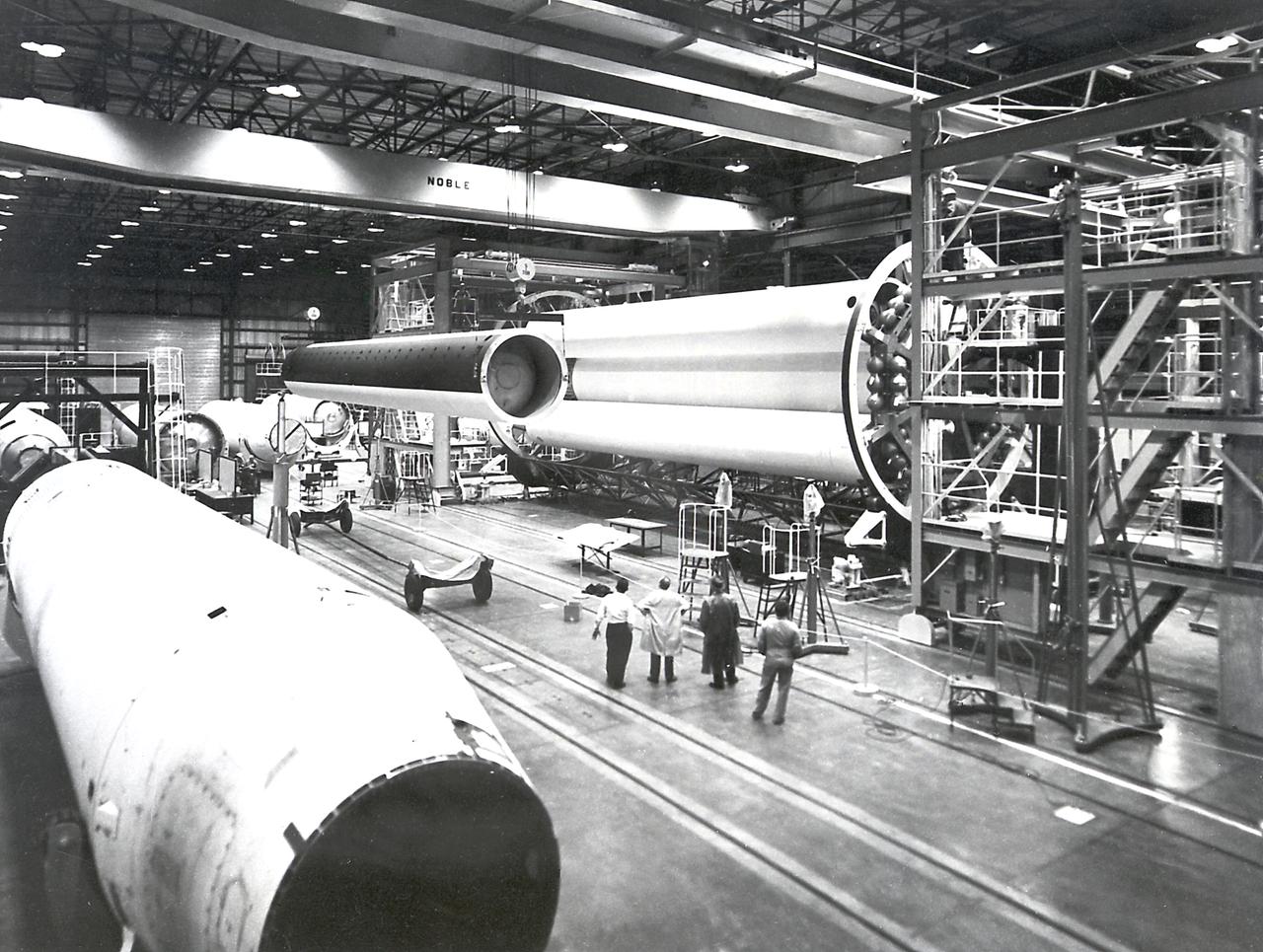
The Saturn I S-I stage is being assembled in the fabrication and engineering laboratory at the Marshall Space Flight Center. The two end spider beams are cornected to the central 267-centimeter diameter liquid-oxygen (LOX) tank. The 178-centimeter outer tank, used alternately for liquid oxygen and kerosene, is being lifted into position.
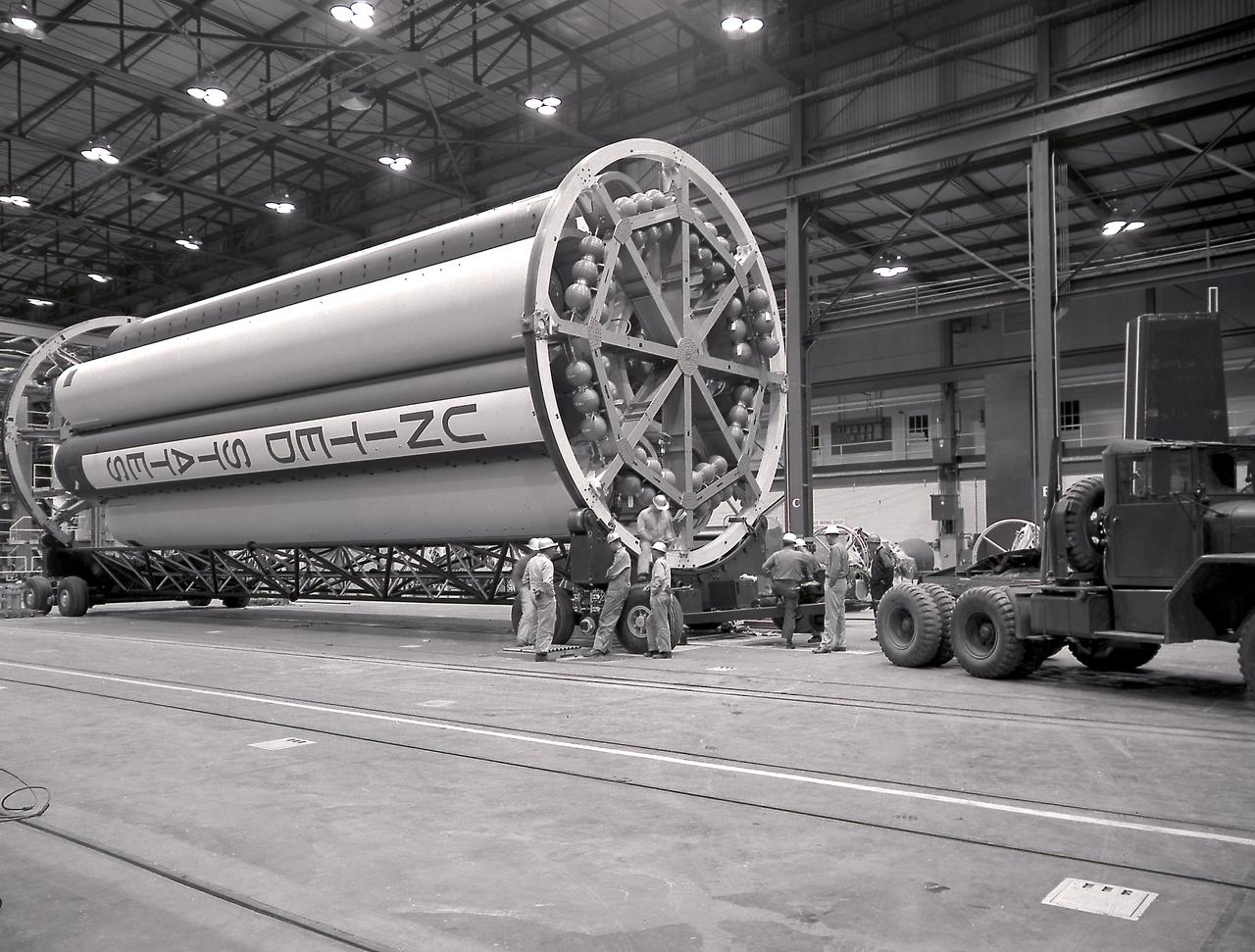
The Saturn Project was approved on January 18, 1960 as a program of the highest national priority. The formal test program to prove out the clustered-booster concept was well underway at Redstone Arsenal. This photograph depicts a mockup of the Saturn booster (S-I stage) being placed on a transporter and later being installed in the Army Ballistic Missile Agency (ABMA) test stand, on January 19, 1960, to check mating of the booster and stand and servicing methods.
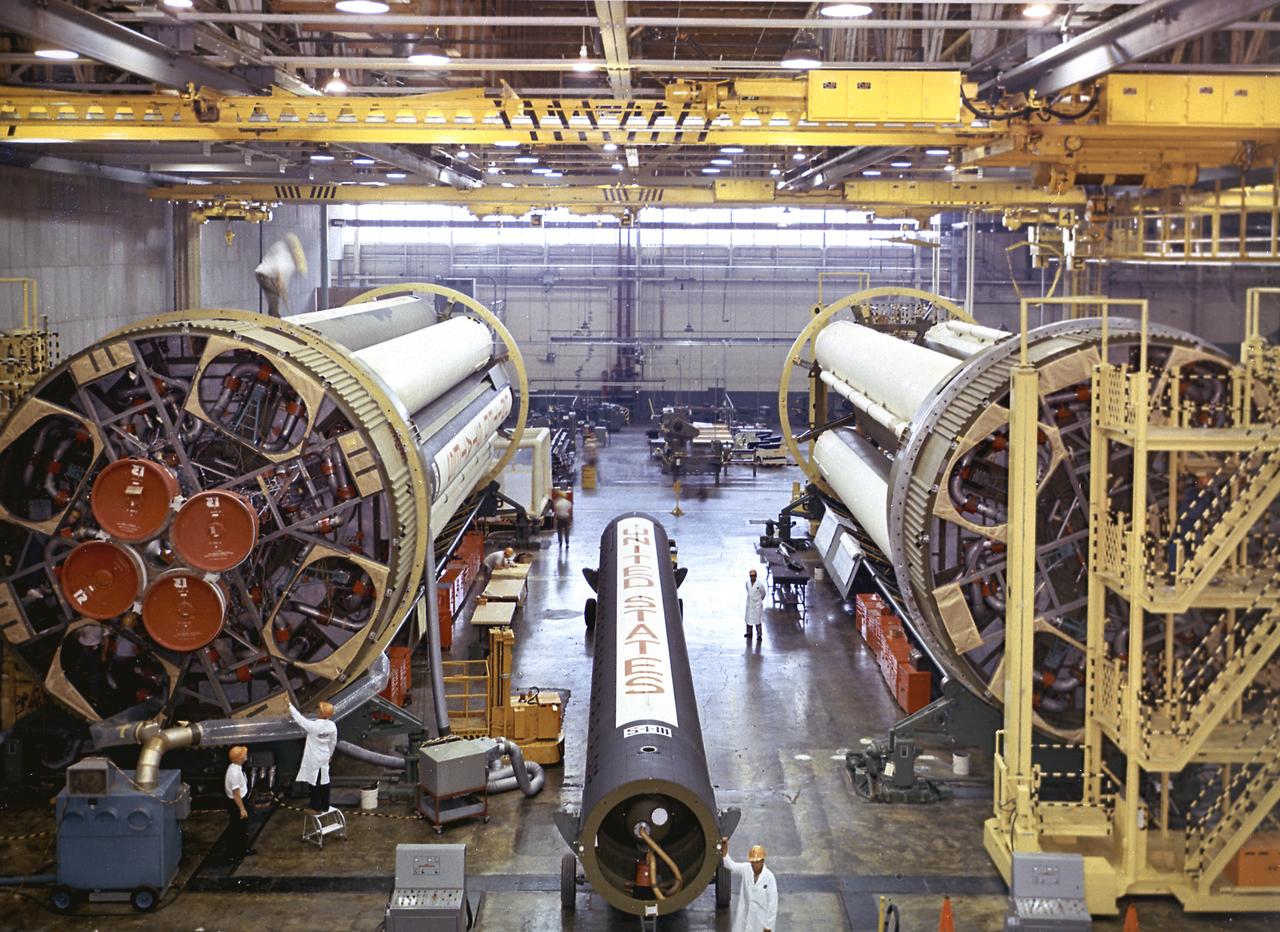
The Saturn I S-I stages for the SA-8 and SA-10 mission in final assembly phase in a manufacturing building at the Michoud Assembly Facility in New Orleans, Louisiana. The SA-8 mission was launched on May 25, 1965 with the first industry-built booster, and deployed the Pegasus II Micrometeoroid Detection satellite. The SA-10 mission was the last Saturn I mission, launched on July 30, 1965, and carried the Pegasus III Meteoroid Detection satellite.
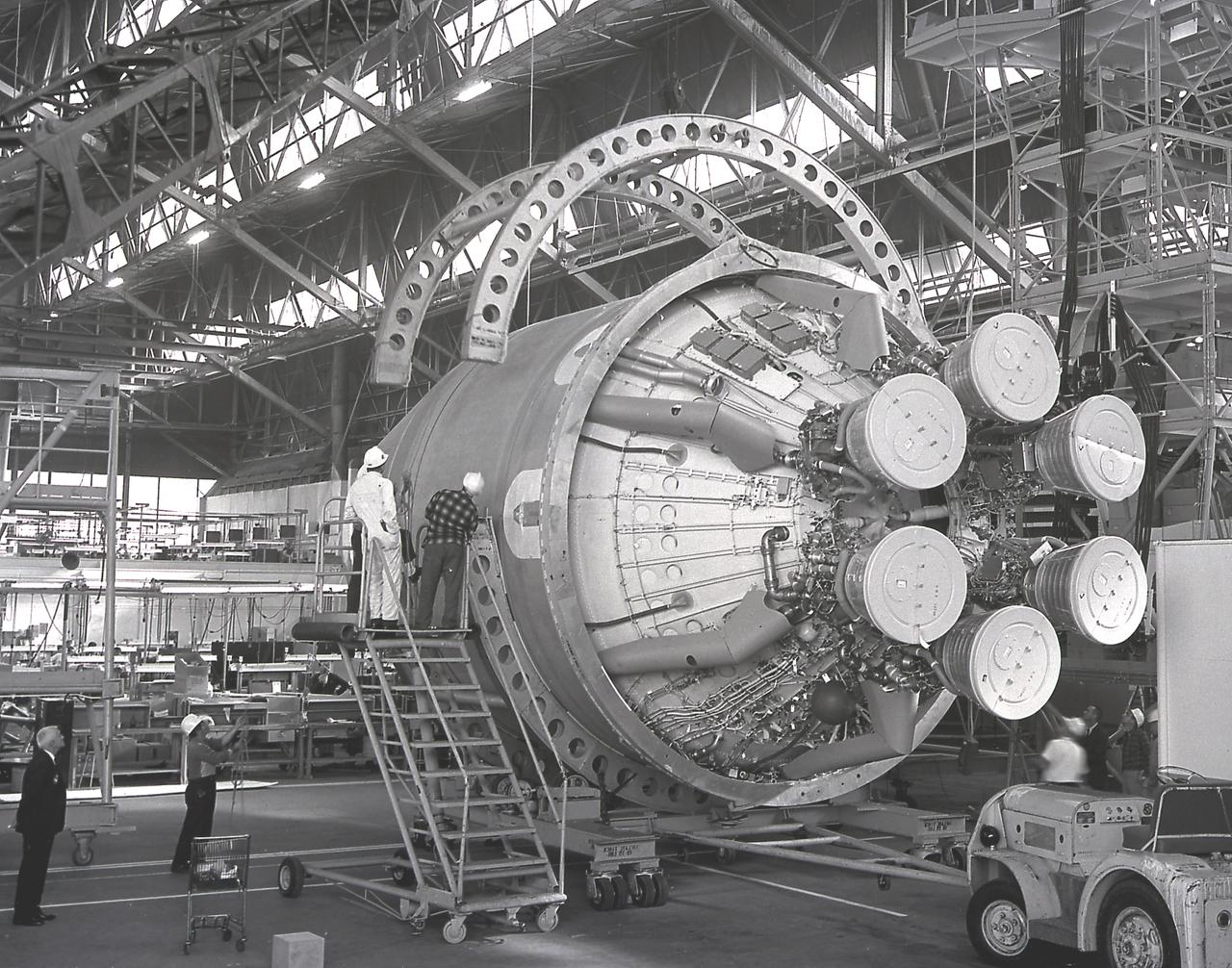
The Saturn I S-IV stage (second stage) for the SA-7 mission being prepared for shipment to Cape Canaveral, Florida. The S-IV stage had six RL-10 engines, which used liquid hydrogen and liquid oxygen as its propellants, arranged in a circle. Each RL-10 engine produced a thrust of 15,000 pounds for a total combined thrust of 90,000 pounds. The SA-7 mission was launched on September 18, 1964 from Cape Canaveral, Florida, and its S-IV stage made the second orbital flight.
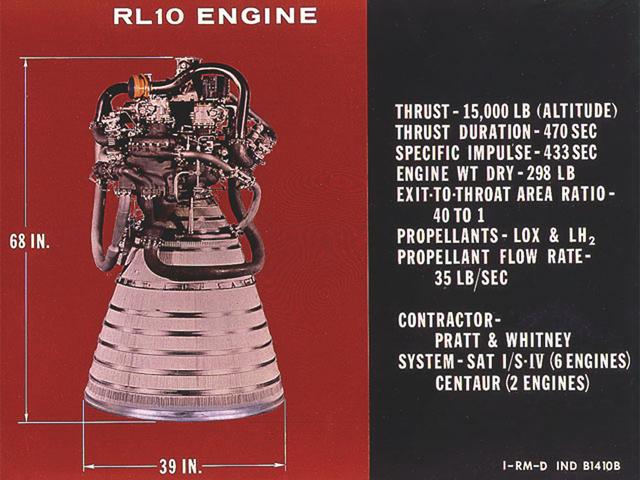
RL-10 engine characteristics. The RL-10 engine was developed under the management of the Marshall Space Flight Center (MSFC) to power the Saturn I upper stage (S-IV stage). The six RL-10 engines, which used liquid hydrogen and liquid oxygen as propellants, were arranged in a circle on the aft end of the S-IV stage.
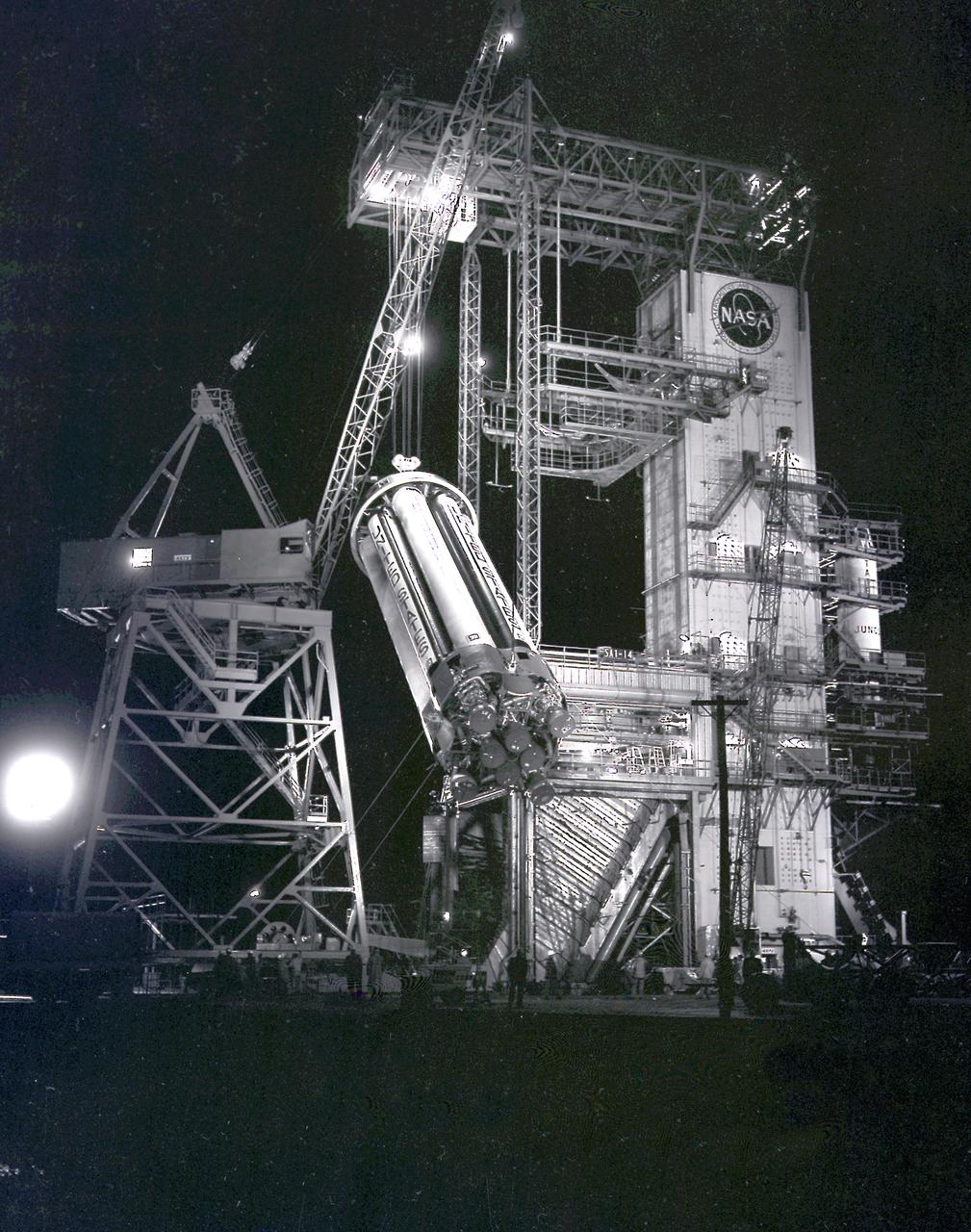
This night photograph depicts the SA-1 booster (Saturn I S-I stage) being removed from the test stand after the first flight qualification testing at the Marshall Space Flight Center (MSFC).
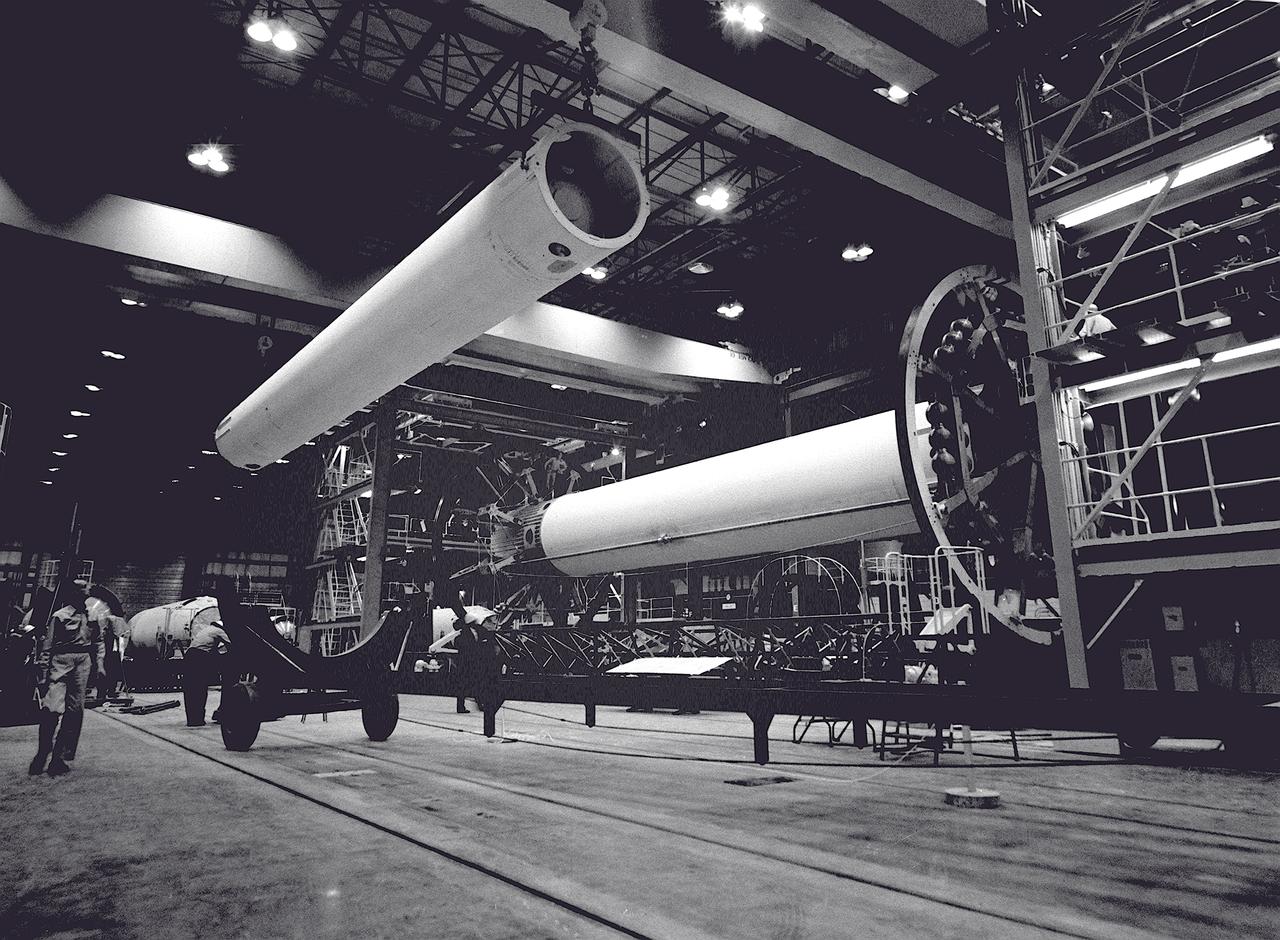
The Saturn I S-I stage is being assembled in the fabrication and engineering laboratory at the Marshall Space Flight Center. The two end spider beams are cornected to the central 267-centimeter diameter liquid-oxygen (LOX) tank. The first of the eight 178-centimeter outer tanks, used alternately for liquid oxygen and kerosene, is being lifted into position.
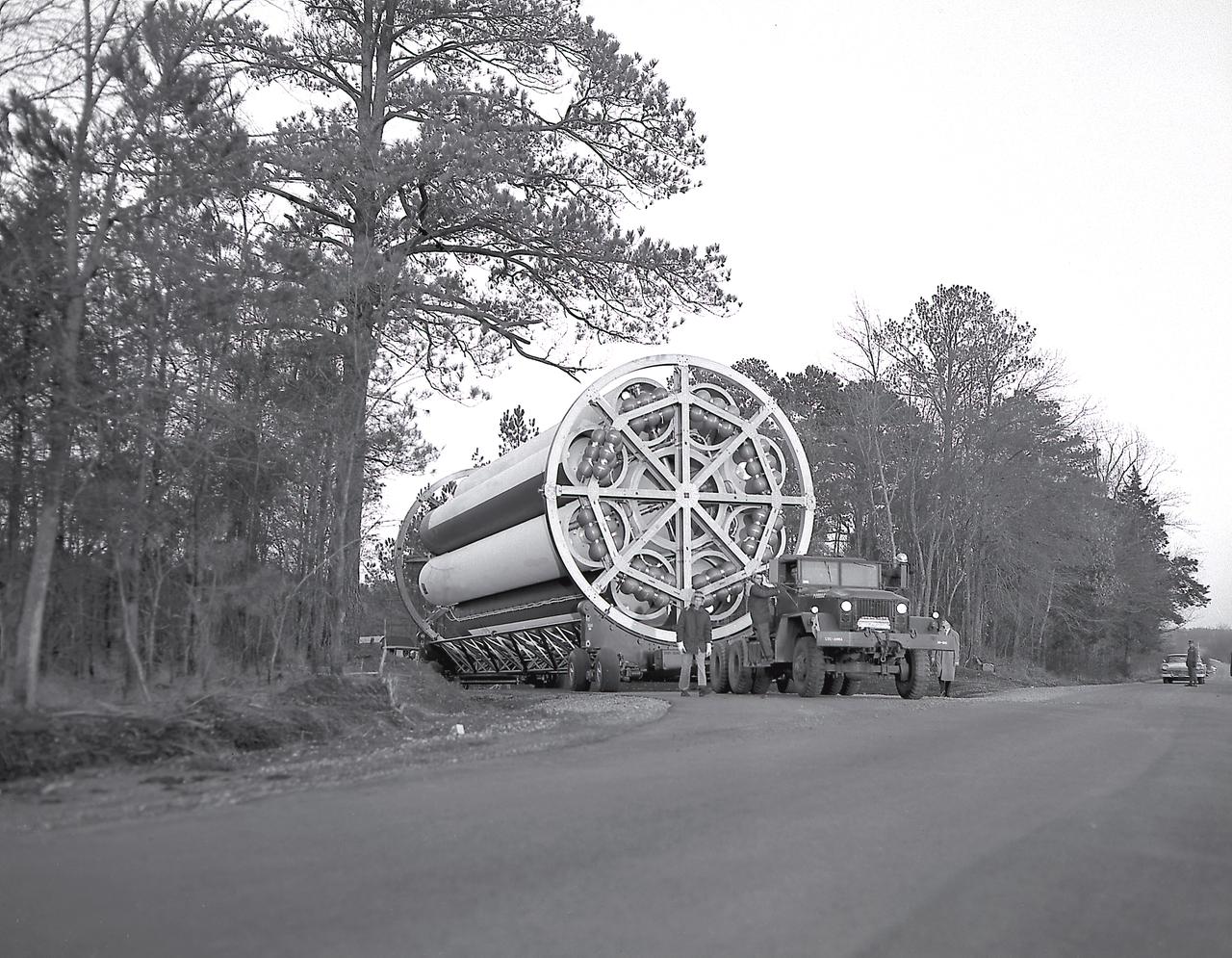
The Saturn Project was approved on January 18, 1960 as a program of the highest national priority. The formal test program to prove out the clustered-booster concept was well underway at Redstone Arsenal. This photograph depicts a mockup of the Saturn booster (S-I stage) being transported to the Army Ballistic Missile Agency (ABMA) test stand, to check mating of the booster and stand and servicing methods.
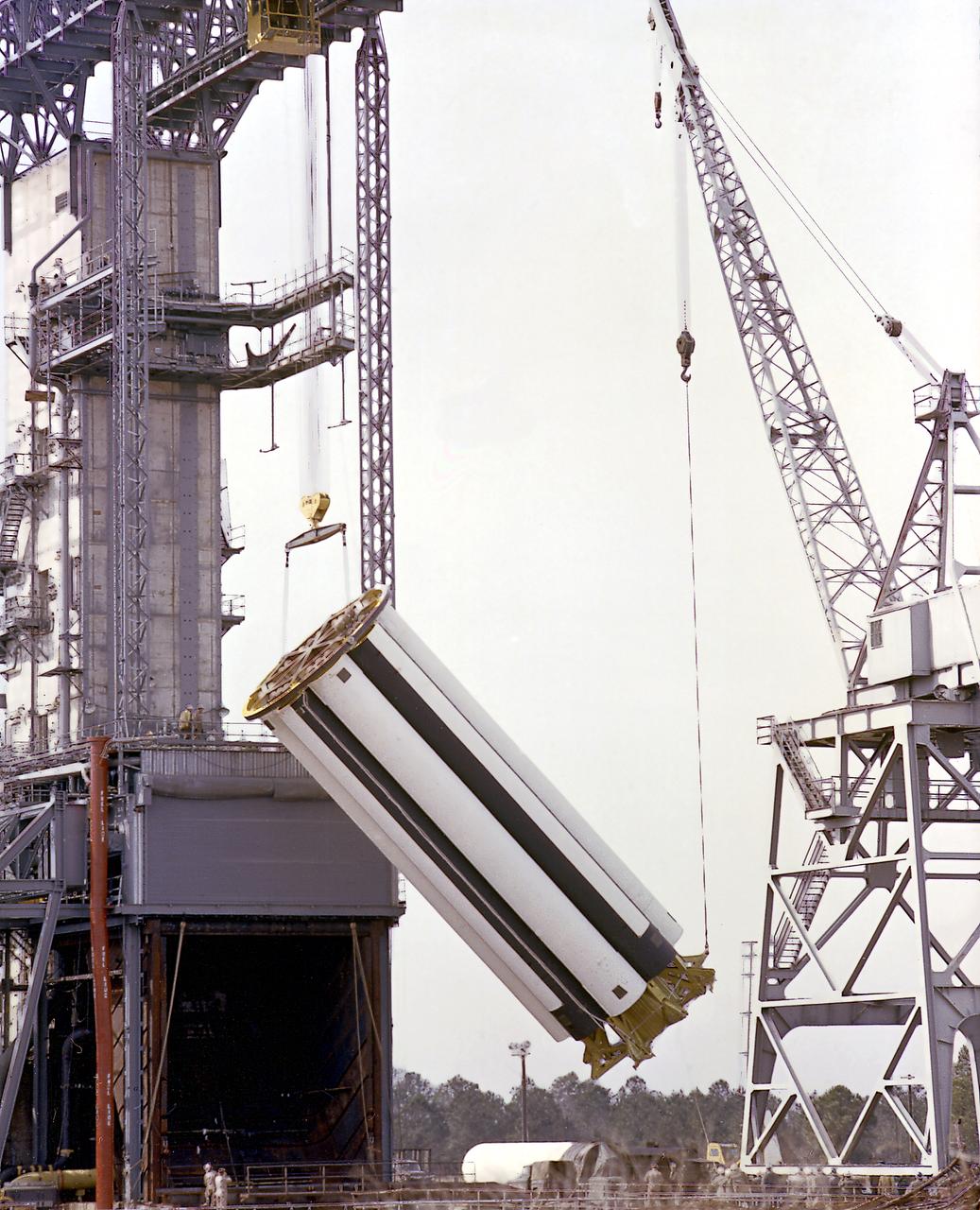
The Saturn Project was approved on January 18, 1960 as a program of the highest national priority. The formal test program, to prove out the clustered-booster concept, was well underway at Redstone Arsenal. This photograph depicts a mockup of the Saturn booster (S-I stage) being installed in the Army Ballistic Missile Agency (ABMA) test stand, on January 19, 1960, to check mating of the booster and stand and servicing methods.
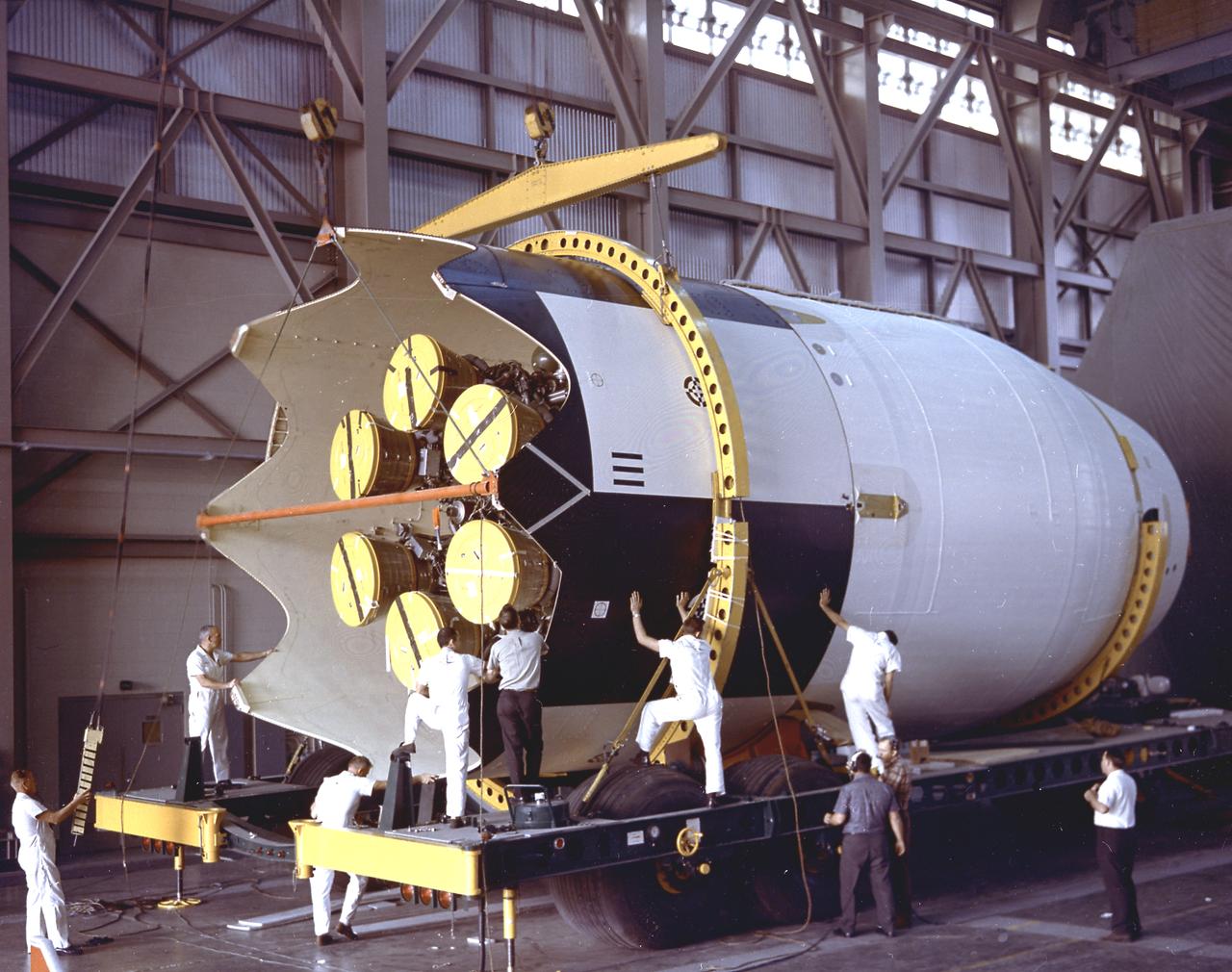
The Saturn I S-IV stage (second stage) assembly for the SA-9 mission underwent the weight and balance test in the hangar building at Cape Canaveral. The S-IV stage had six RL-10 engines which used liquid hydrogen and liquid oxygen as its propellants arranged in a circle. Each RL-10 engine produced a thrust of 15,000 pounds, a total combined thrust of 90,000 pounds. The SA-9 mission was the first Saturn with operational payload Pegasus I, meteoroid detection satellite, and launched on February 16, 1965.
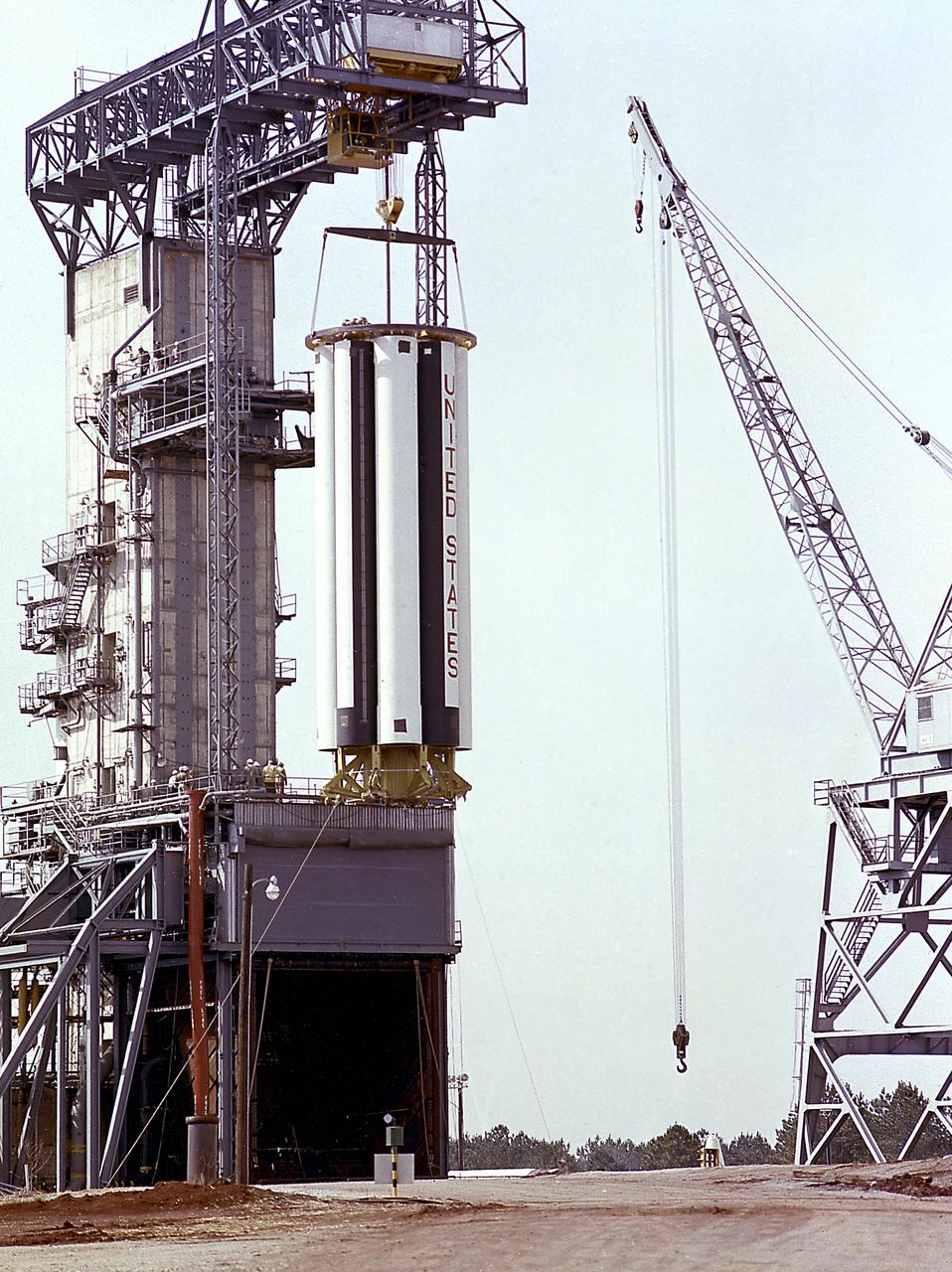
The Saturn Project was approved on January 18, 1960, as a program of the highest national priority. The formal test program to prove out the clustered-booster concept was well underway at Redstone Arsenal. This photograph depicts a mockup of the Saturn booster (S-I stage) being installed in the Army Ballistic Missile Agency (ABMA) test stand, on January 19, 1960, to check mating of the booster and stand and servicing methods.
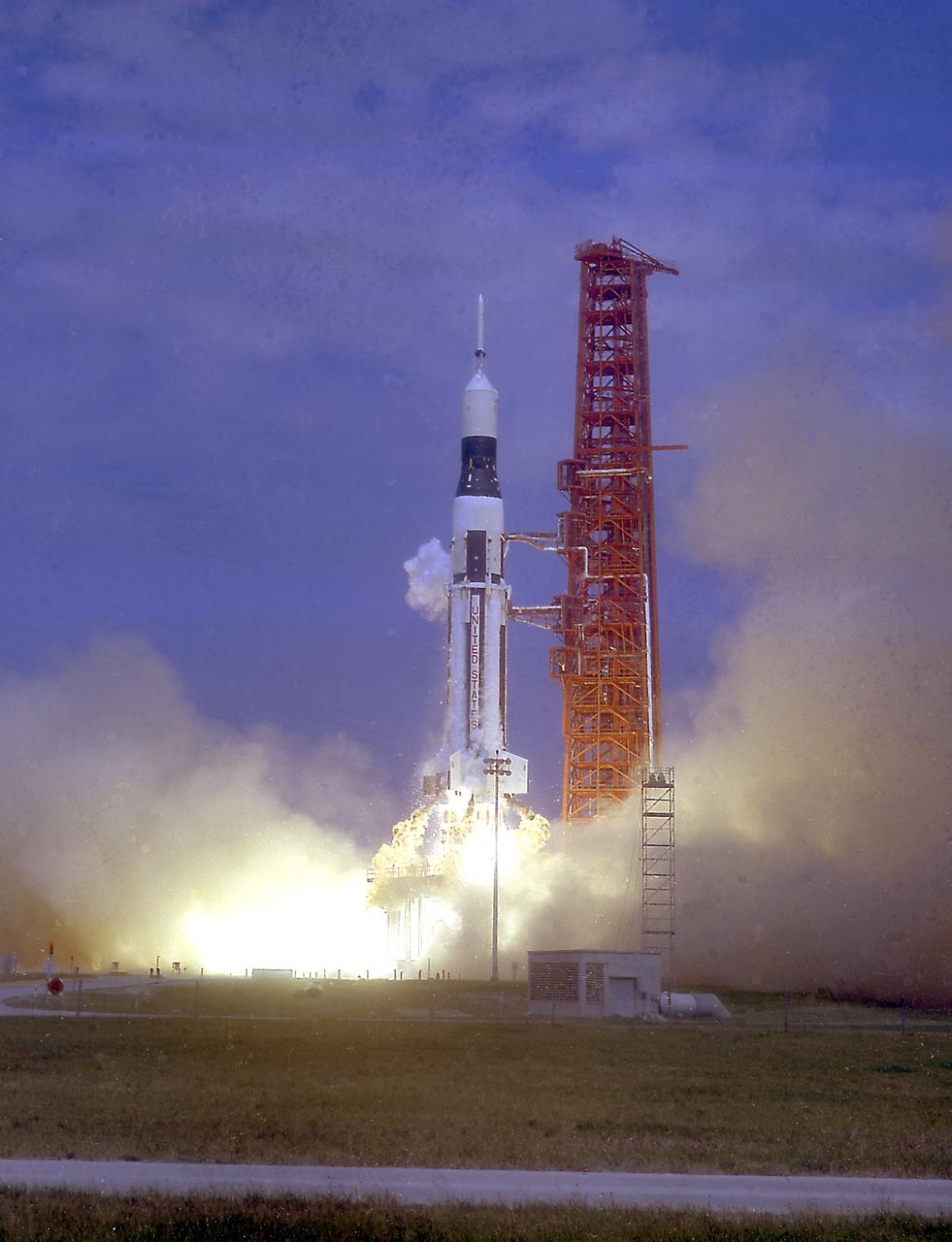
The launch of the SA-7 (Saturn I Block II) was on September 18, 1964. The SA-7 mission was the second orbital flight of the S-IV stage (second stage) with the payload consisting of the Apollo command and service module's instrument unit. The Saturn I Block II vehicle had two live stages, and were basically in the two-stage configuration of the Saturn I vehicle. While the tank arrangement and the engine patterns were the same, there were marked changes between the Block I and II versions. The first stage (S-I stage) was an improved version of the Block I S-I stage. The Block II S-1 stage had eight fins added for greater aerodynamic stability in the lower atmosphere.
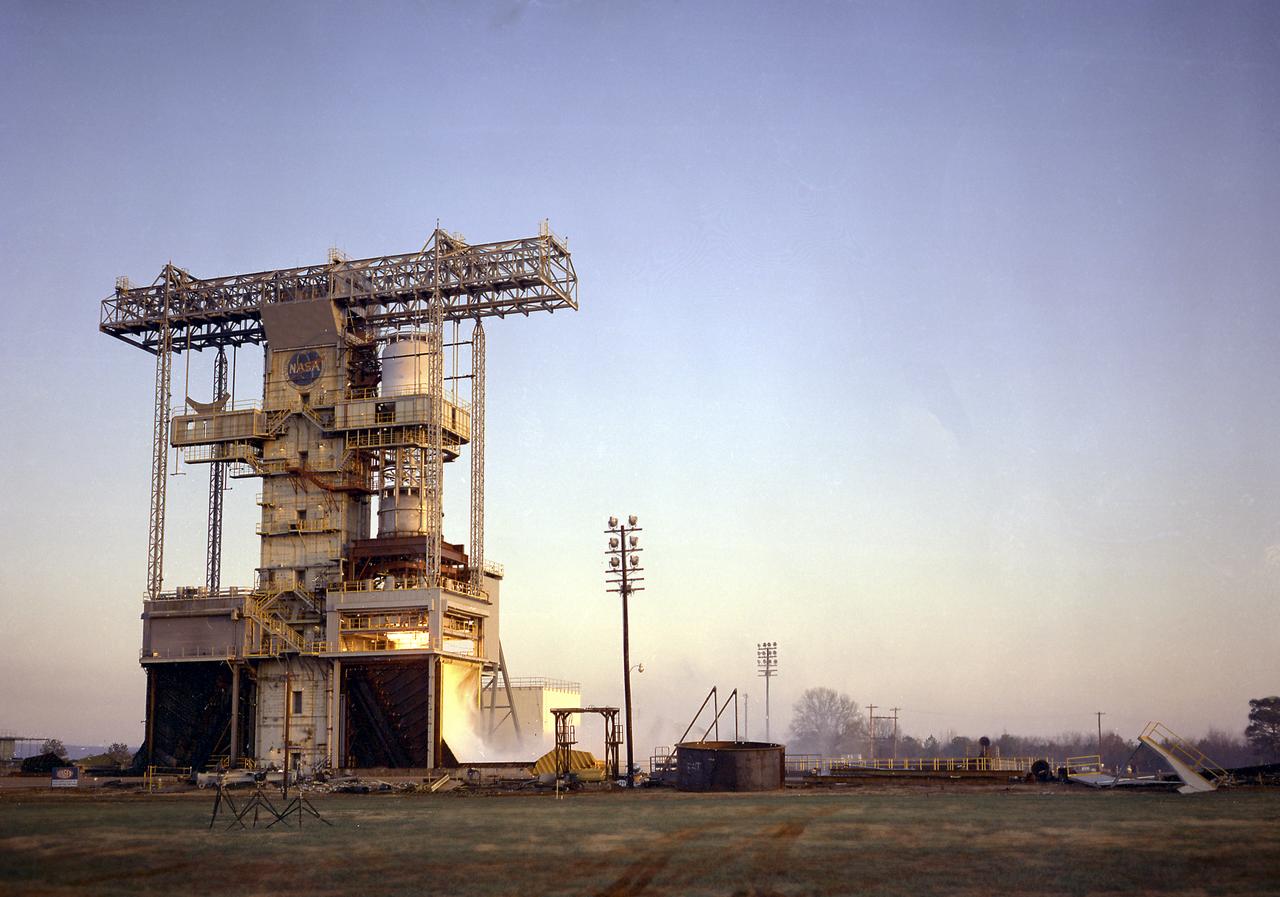
The test laboratory of the Marshall Space Flight Center (MSFC) tested the F-1 engine, the most powerful rocket engine ever fired at MSFC. The engine was tested on the newly modified Saturn IB static test stand that had been used for three years to test the Saturn I eight-engine booster, S-I (first) stage. In 1961, the test stand was modified to permit static firing of the S-I/S-IB stage and the name of the stand was then changed to the S-IB Static Test Stand. Producing a combined thrust of 7,500,000 pounds, five F-1 engines powered the S-IC (first) stage of the Saturn V vehicle for the marned lunar mission.
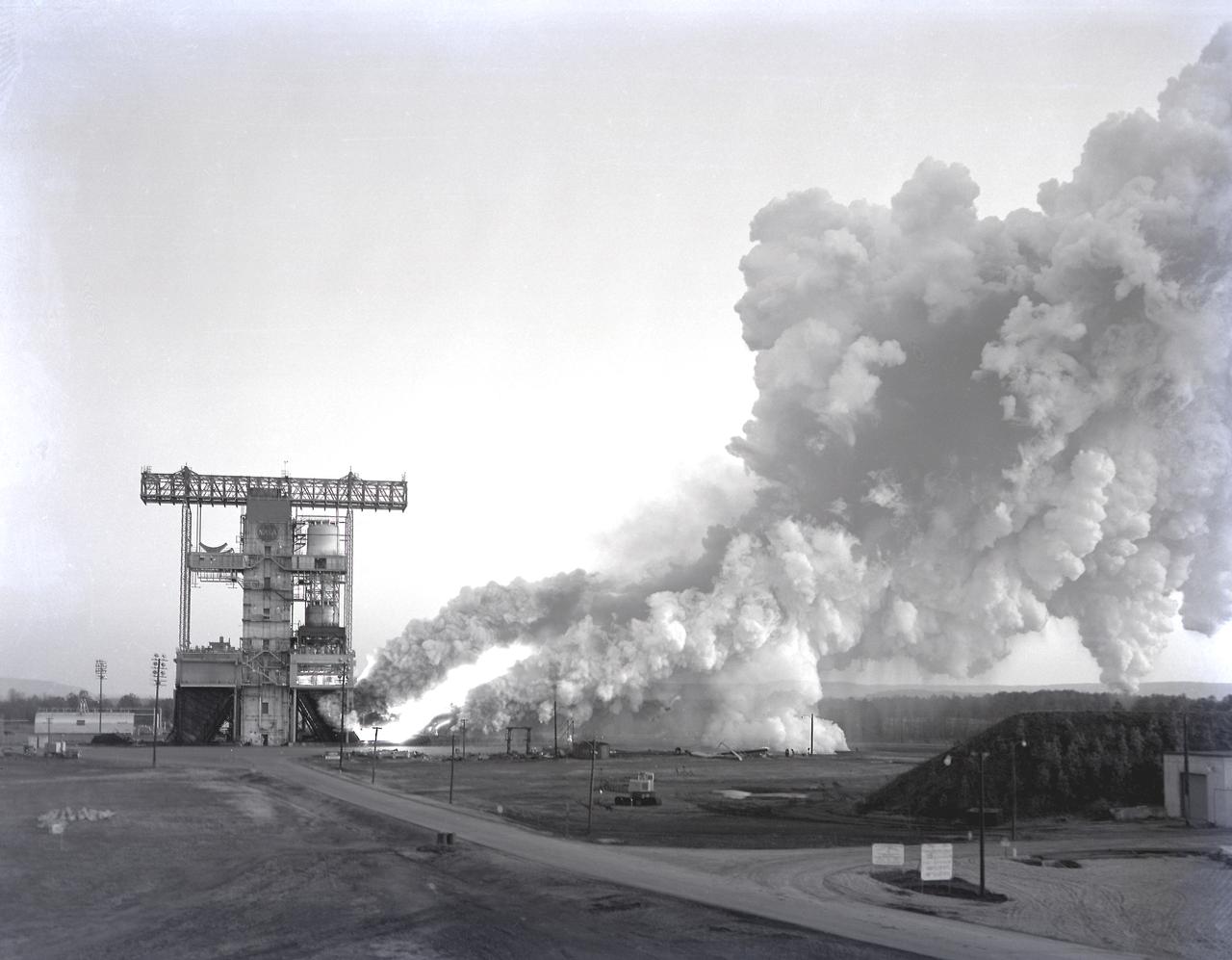
The test laboratory of the Marshall Space Flight Center (MSFC) tested the F-1 engine, the most powerful rocket engine ever fired at MSFC. The engine was tested on the newly modified Saturn IB Static Test Stand which had been used for three years to test the Saturn I eight-engine booster, S-I (first) stage. In 1961 the test stand was modified to permit static firing of the S-I/S-IB stage and the name of the stand was then changed to the S-IB Static Test Stand. Producing a combined thrust of 7,500,000 pounds, five F-1 engines powered the S-IC (first) stage of the Saturn V vehicle for the marned lunar mission.
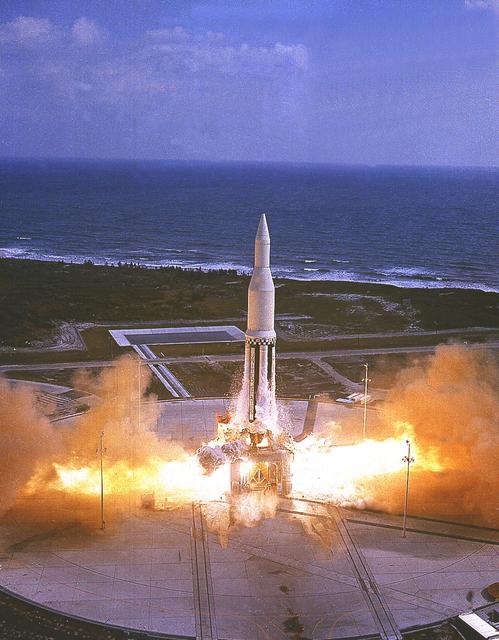
The Marshall Space Flight Center's first Saturn I vehicle, SA-1, lifts off from Cape Canaveral, Florida, on October 27, 1961. This early configuration, Saturn I Block I, 162 feet tall and weighing 460 tons, consisted of the eight H-1 engines S-I stage and the dummy second stage (S-IV stage).
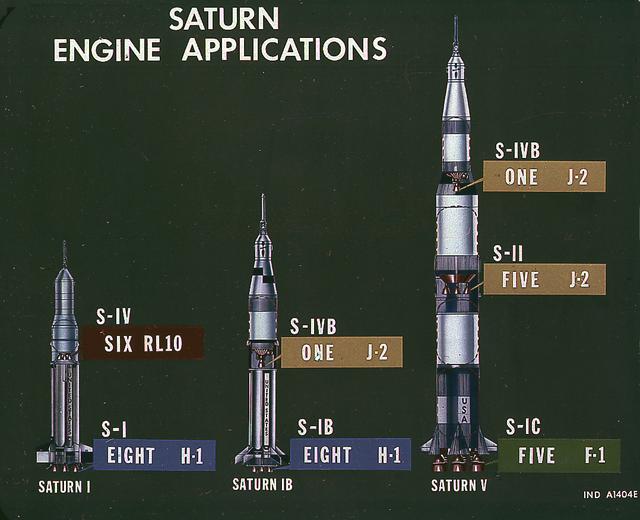
This image illustrates the basic differences between the three Saturn launch vehicles developed by the Marshall Space Flight Center. The Saturn I, consisted of two stages, the S-I (eight H-1 engines) and the S-IV (six RL-10 engines). The Saturn IB (center) also consisted of two stages, the S-IB (eight H-1 engines) and the S-IVB (one J-2 engine). The Saturn V consisted of three stages, the S-IC (five F-1 engines), the S-II (five J-2 engines), and the S-IVB (one J-2 engine).

A spider beam for cornecting the Saturn I fuel tanks is being positioned in the fabrication and engineering laboratory of the Marshall Space Flight Center (MSFC).
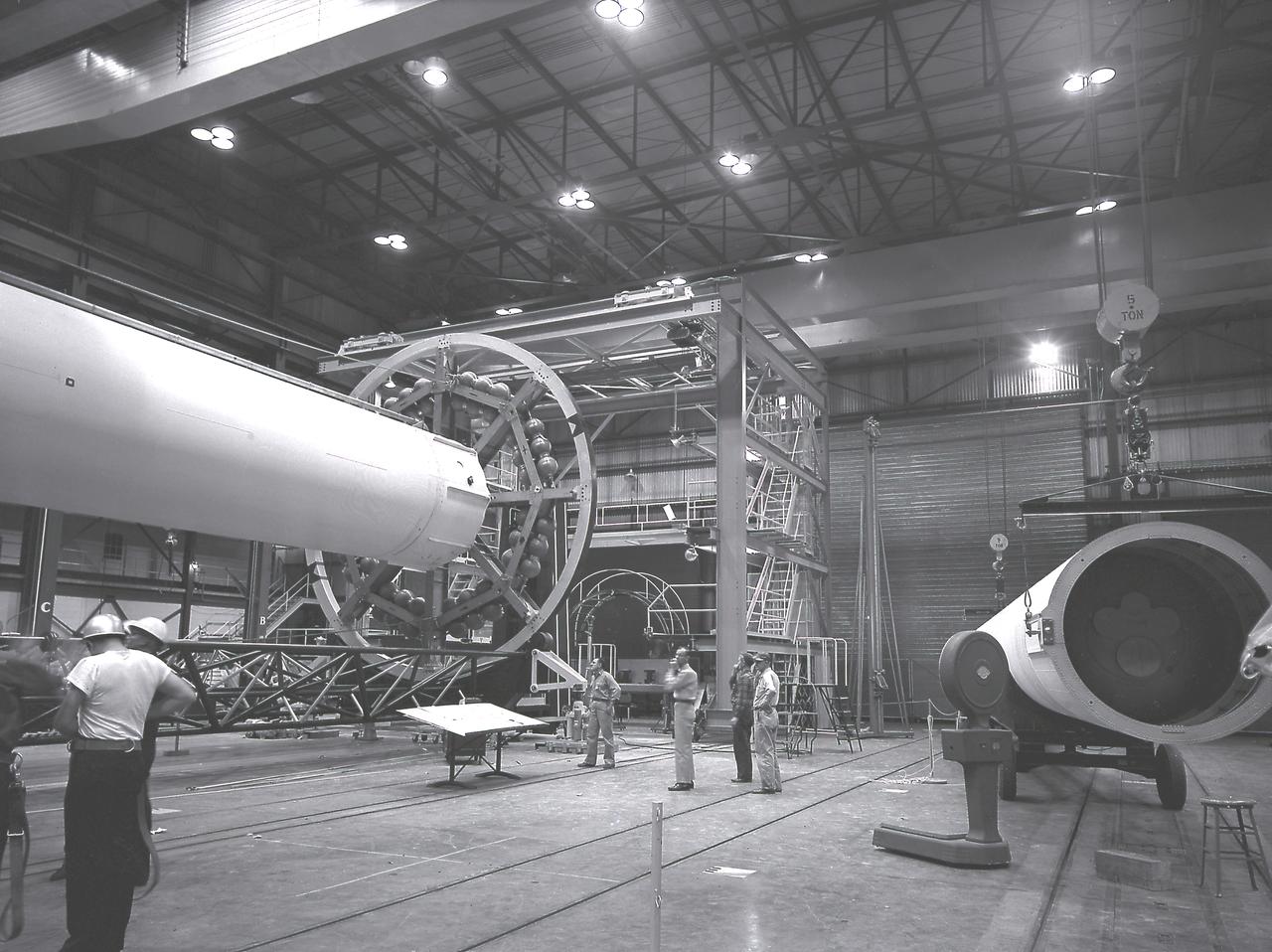
The Saturn I liquid-oxygen (LOX) tank for the Saturn I S-I stage being aligned with the end spider beam in the fabrication and engineering laboratory, building 4705, at the Marshall Space Flight Center (MSFC).
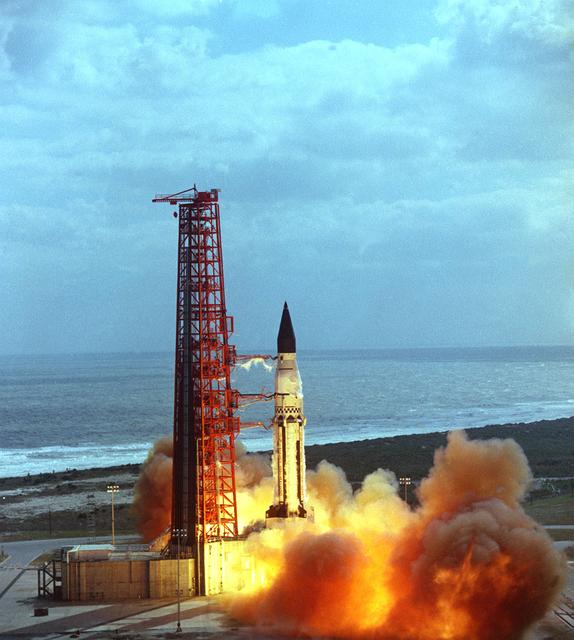
The launch of the SA-5 on January 29, 1964 was the fifth Saturn I launch vehicle. The SA-5 marked a number of firsts in the Marshall Space Flight Center-managed Saturn development program, including the first flight of Saturn I Block II vehicle with eight aerodynamic fins at the bottom of the S-I stage (first stage) for enhanced stability in flight. This also was the first flight of a live S-IV (second or upper) stage with the cluster of six liquid hydrogen-fueled RL-10 engines. the first successful second stage separation, and the first use of the Launch Complex 37.
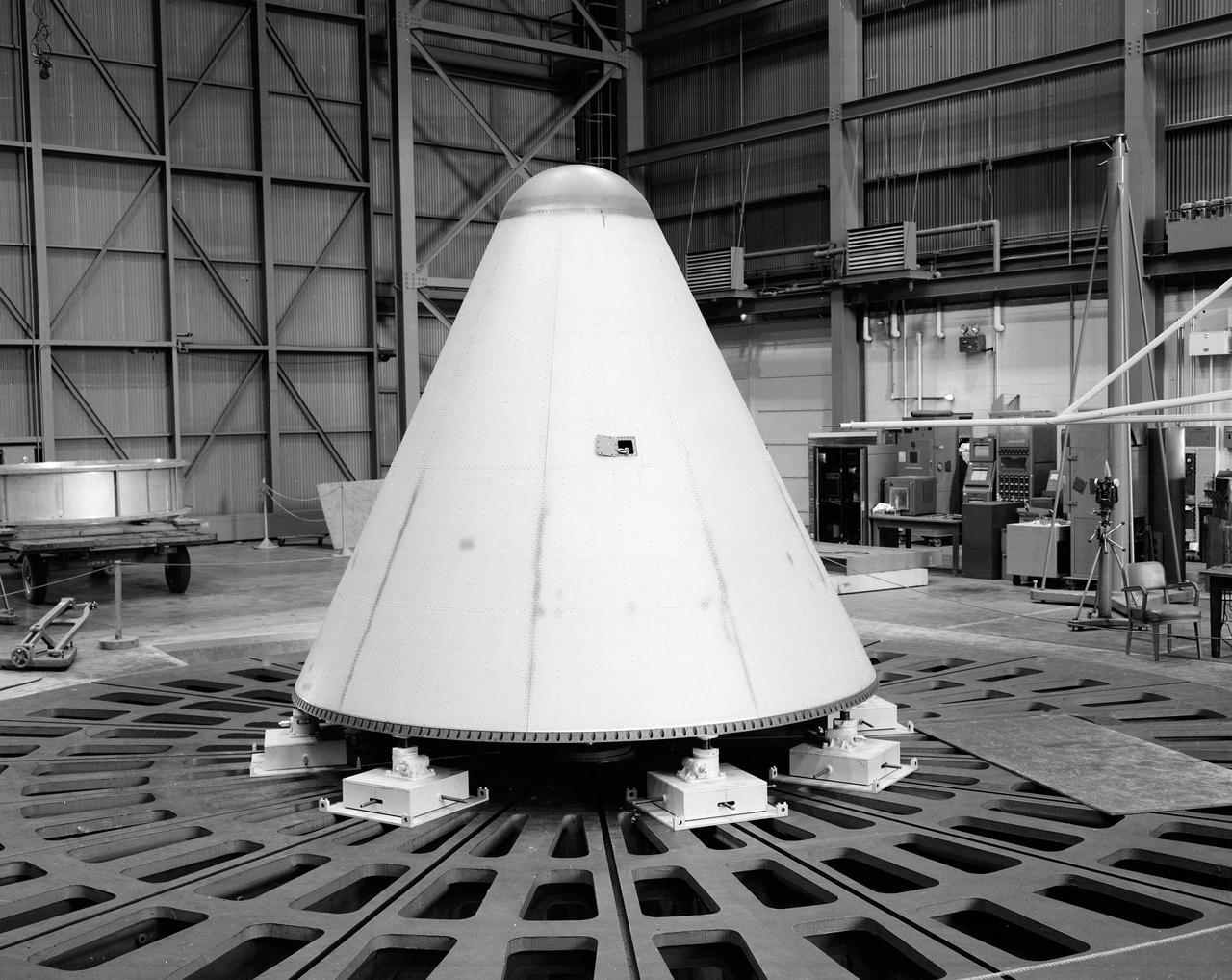
Developed by the Marshall Space Flight Center (MSFC) as an interim vehicle in MSFC’s “building block” approach to the Saturn rocket development, the Saturn IB utilized Saturn I technology to further develop and refine the larger boosters and the Apollo spacecraft capabilities required for the manned lunar missions. The Saturn IB vehicle was a two-stage rocket and had a payload capability about 50 percent greater than the Saturn I vehicle. The first stage, S-IB stage, was a redesigned first stage of the Saturn I. This photograph is of the S-IB nose cone #3 during assembly in building 4752.
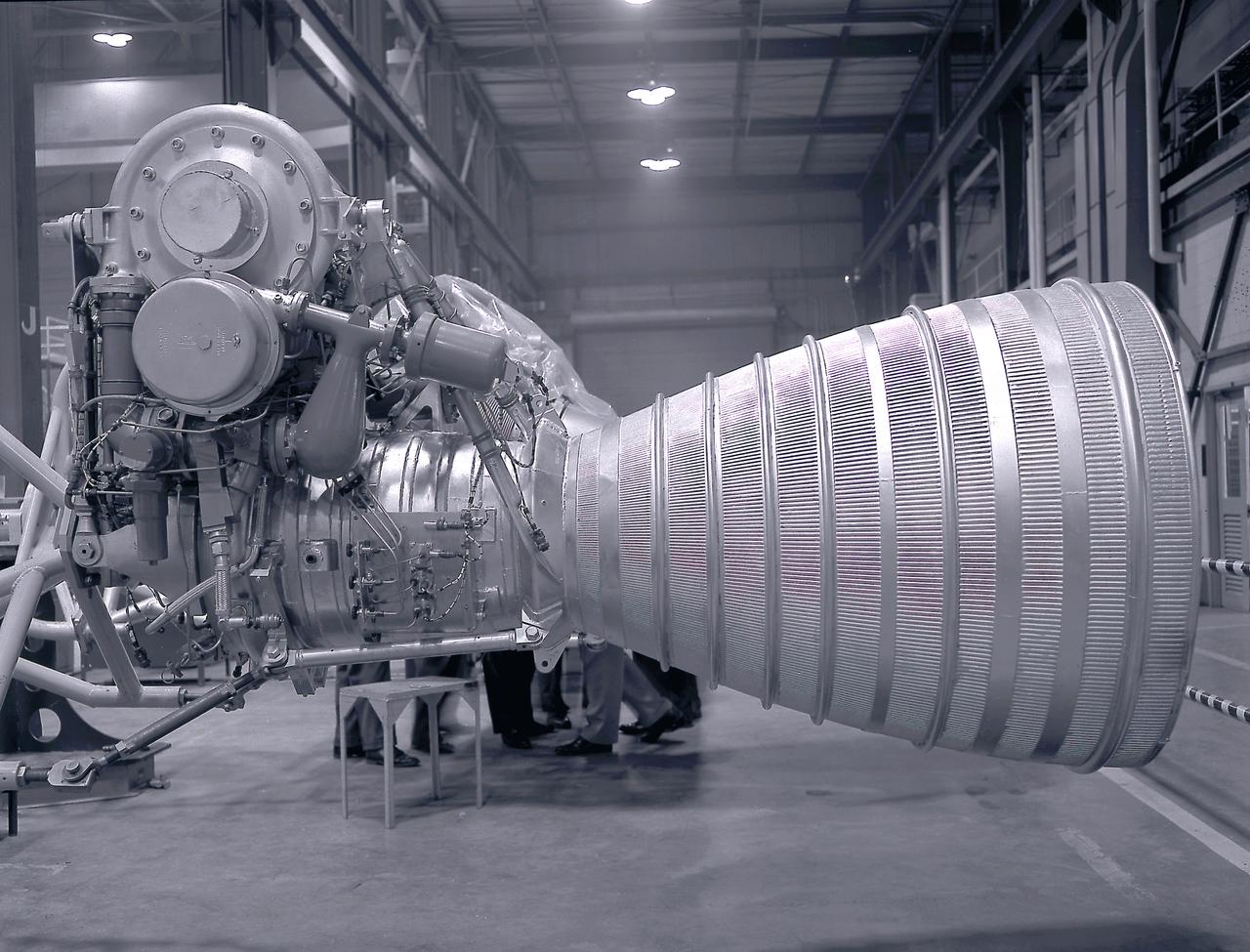
A Cluster of eight H-1 engines were used to thrust the first stage of Saturn I (S-I stage) and Saturn IB (S-IB stage). The engines were arranged in a double pattern. Four engines, located inboard, were fixed in a square pattern around the stage axis, while the remaining four engines were located outboard in a larger square pattern and each outer engine was gimbaled. The H-1 engine, fueled with liquid oxygen (LOX) and kerosene (RP-1), had a thrust of 188,000 pound each for a combined thrust of over 1,500,000 pounds. Each H-1 engine was developed under the direction of Marshall Space Flight Center (MSFC).
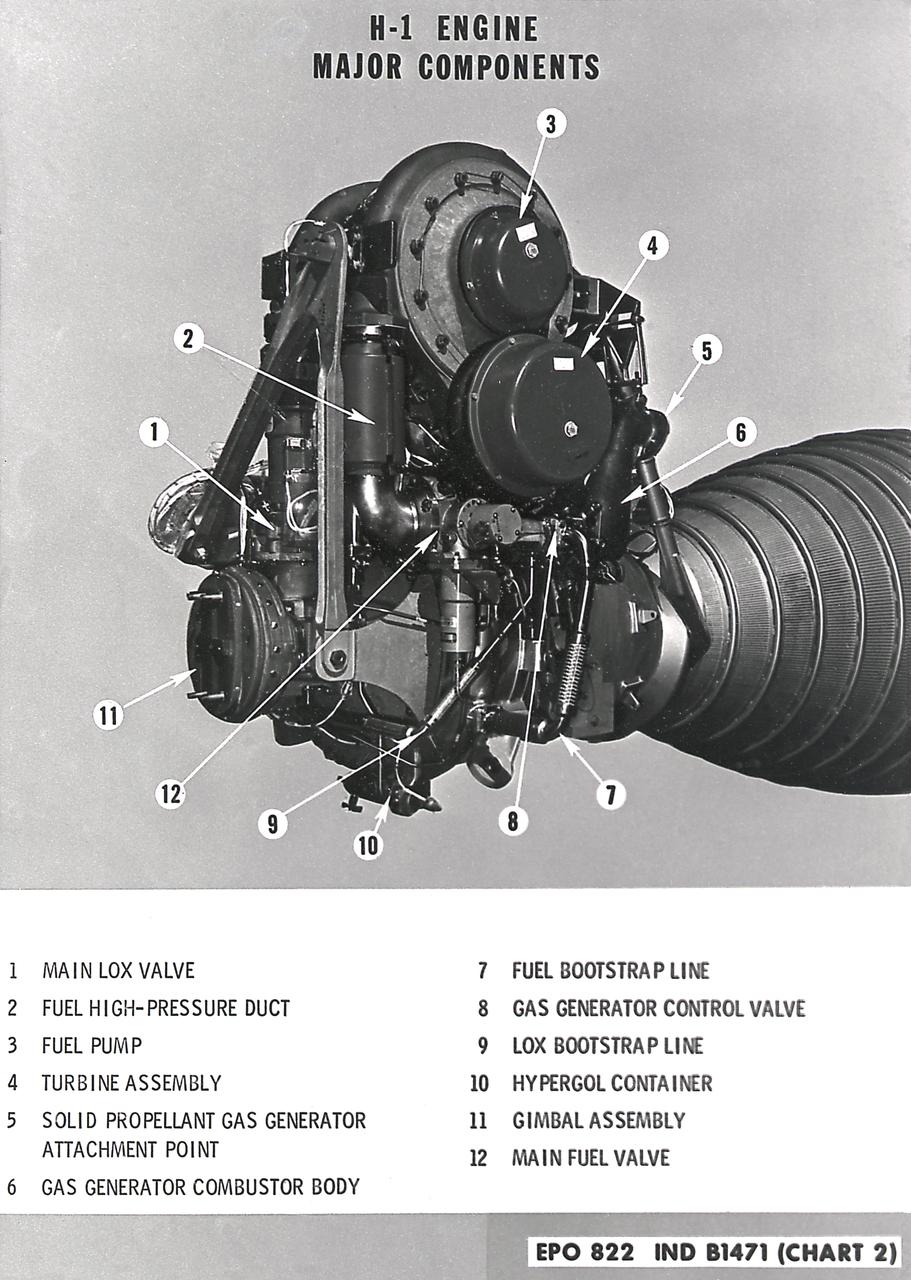
H-1 engine major components with callouts (chart 1). The H-1 engine was used in a cluster of eight on the the first stage of Saturn I (S-I stage) and Saturn IB (S-IB stage). The engines were arranged in a double pattern: four engines, located inboard, were fixed in a square pattern around the stage axis, while the remaining four engines were located outboard in a larger square pattern and each outer engine was gimbaled. Each H-1 engine had a thrust of 188,000 pounds for a combined thrust of over 1,500,000 pounds.
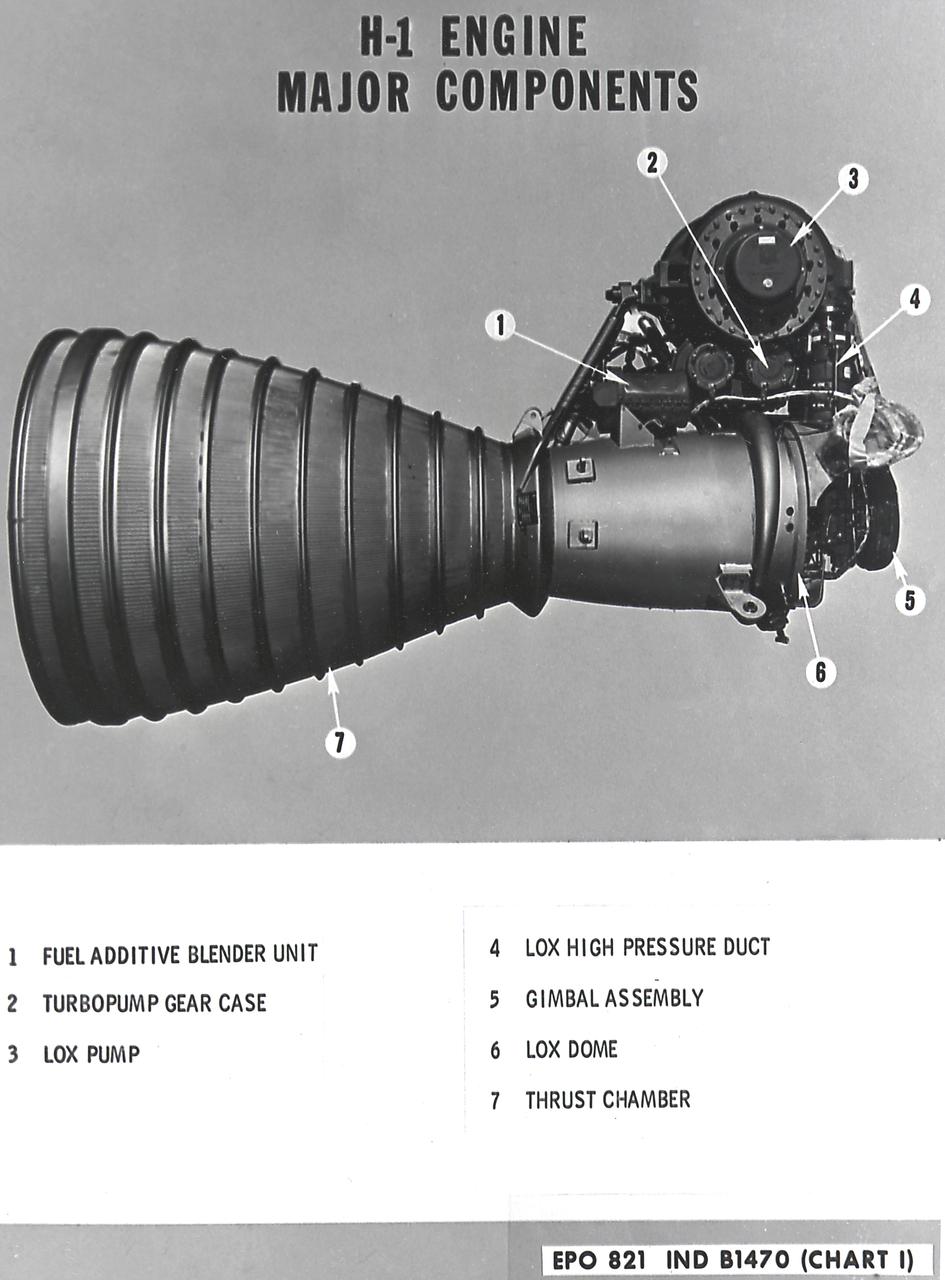
H-1 Engine major components with callouts (chart 1): The H-1 engine was used in a cluster of eight on the the first stage of Saturn I (S-I stage) and Saturn IB (S-IB stage). The engines were arranged in a double pattern: four engines, located inboard, were fixed in a square pattern around the stage axis, while the remaining four engines were located outboard in a larger square pattern and each outer engine was gimbaled. Each H-1 engine had a thrust of 188,000 pounds for a combined thrust of over 1,500,000 pounds.
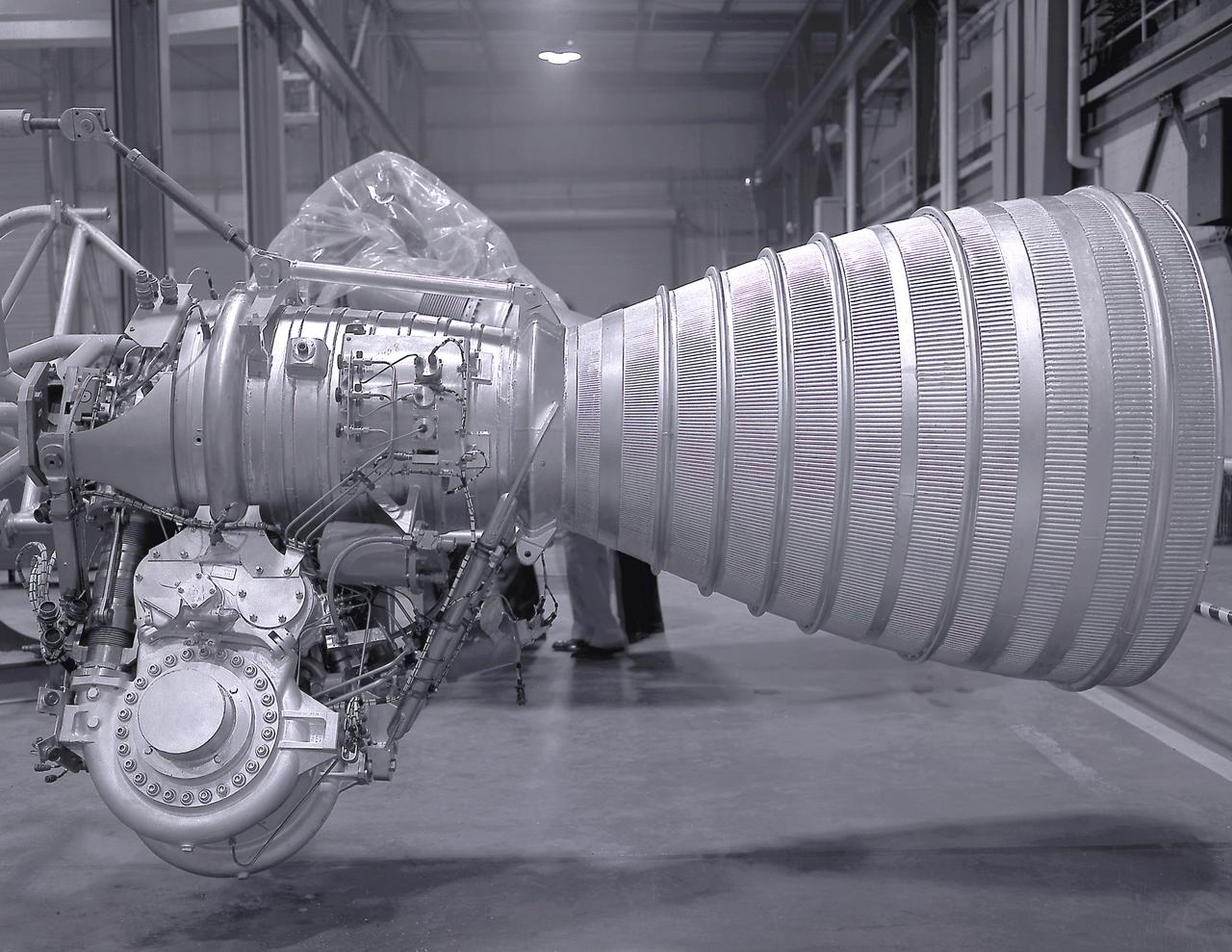
A Cluster of eight H-1 engines were used to thrust the first stage of Saturn I (S-I stage) and Saturn IB (S-IB stage). The engines were arranged in a double pattern. Four engines, located inboard, were fixed in a square pattern around the stage axis, while the remaining four engines were located outboard in a larger square pattern and each outer engine was gimbaled. Each H-1 engine, fueled with liquid oxygen (LOX) and kerosene (RP-1), had a thrust of 188,000 pound each for a combined thrust of over 1,500,000 pounds. The H-1 engine was developed under the direction of Marshall Space Flight Center (MSFC).
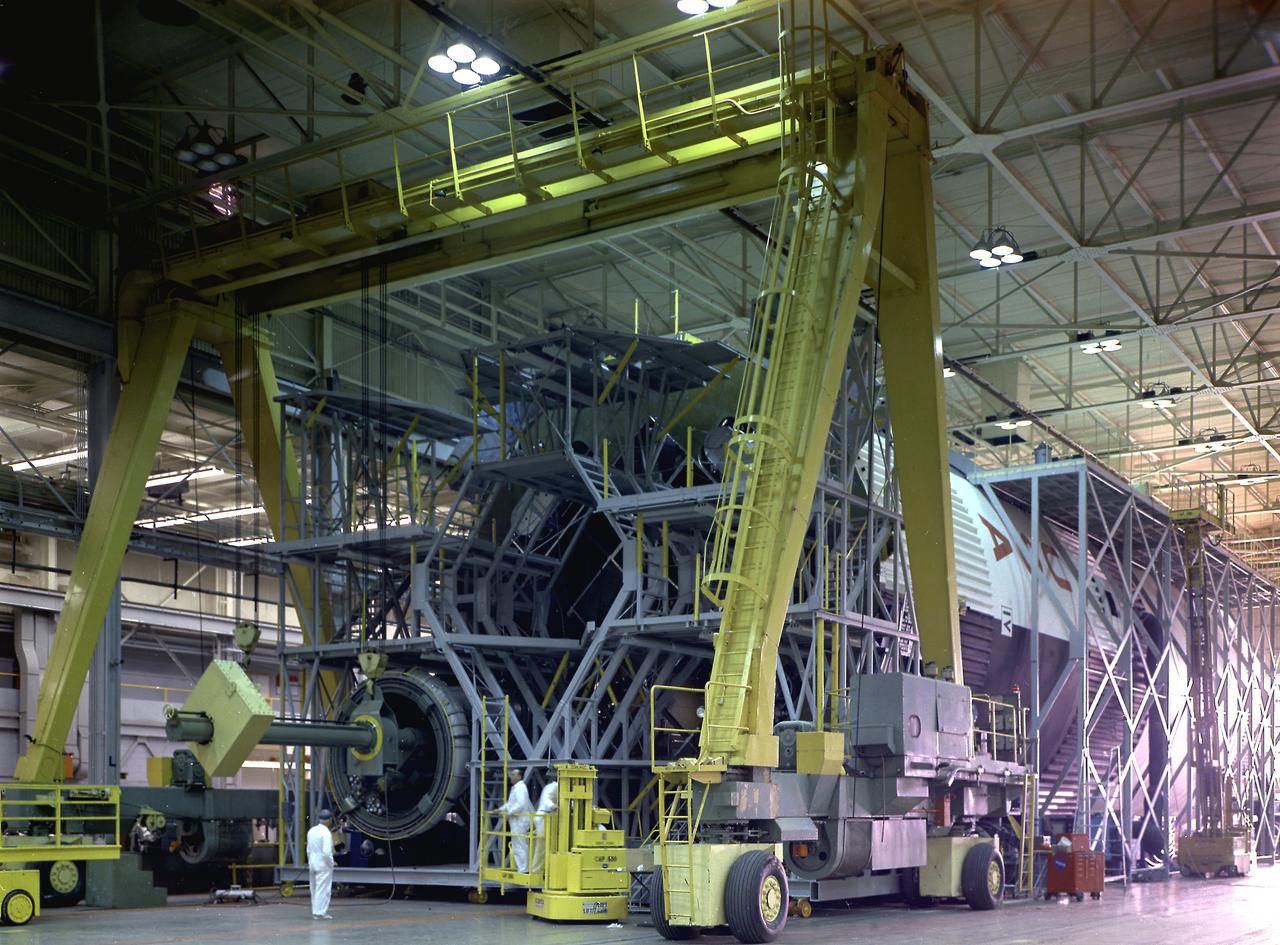
Engineers and technicians at the Marshall Space Flight Center were installing an F-I engine on the Saturn V S-IC (first) stage thrust structure in building 4705. The S-IC (first) stage used five F-1 engines that produced a total thrust of 7,500,000 pounds as each engine produced 1,500,000 pounds of thrust. The S-IC stage lifted the Saturn V vehicle and Apollo spacecraft from the launch pad.
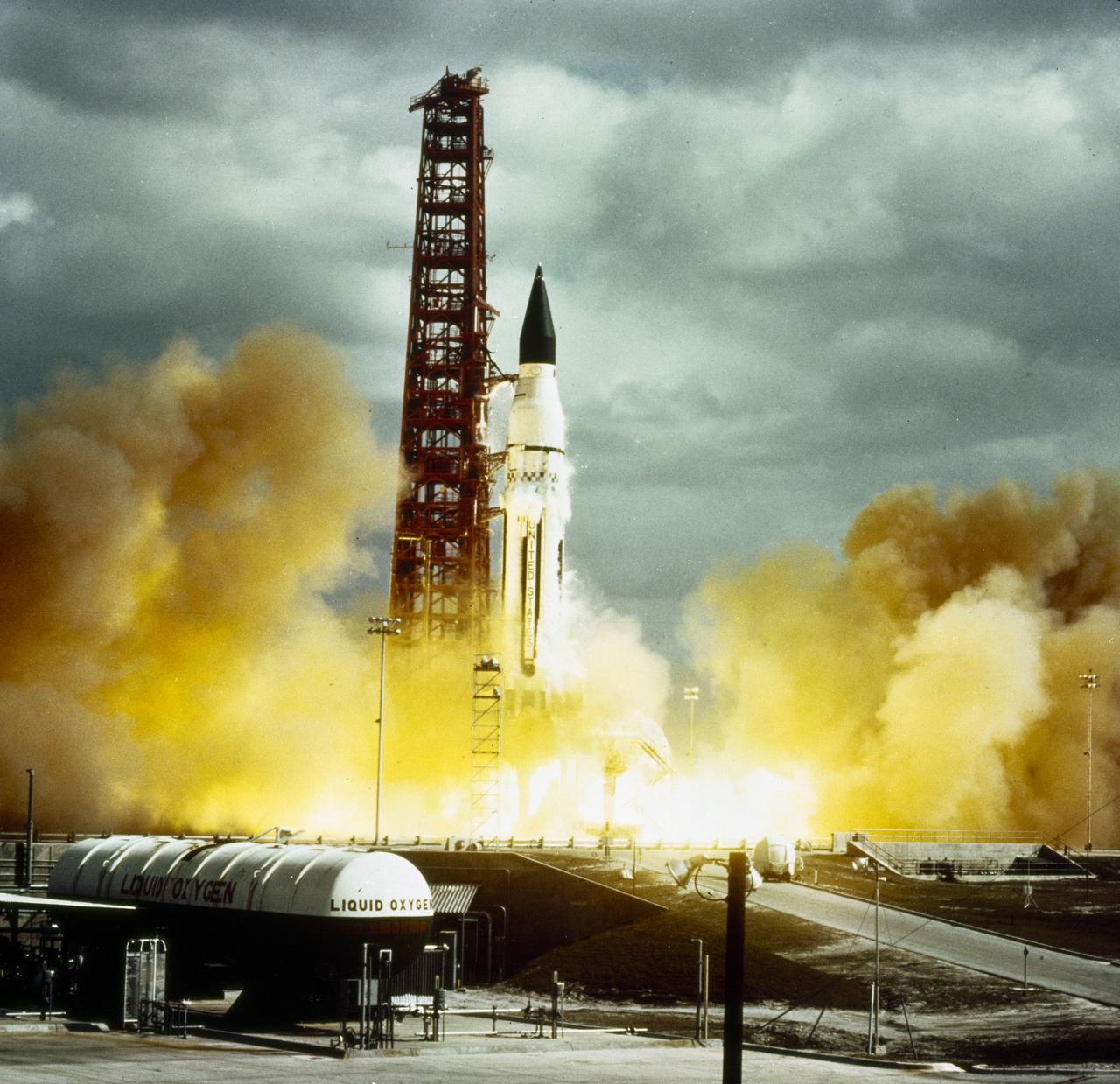
Developed at MSFC under the direction of Dr. Wernher von Braun, the SA-5 incorporated a Saturn I, Block II engine. Launched on January 29, 1964, SA-5 was the first two stage (Block II) Saturn with orbital capability and performed the first test of Instrument Unit and successful stage separation. Block II vehicles had two live stages, and were basically in the two-stage configuration of the Saturn I vehicle. There were marked changes between the Block I and II versions. The Block II S-I stage had eight fins added for greater aerodynamic stability in the lower atmosphere. All Block II H-1 engines had a thrust of 188,000 pounds each for a combined thrust over 1,500,000 pounds. The Block II second stage (S-IV) had six RL-10 hydrogen-oxygen engines, each producing a thrust of 15,000 pounds for a total combined thrust of 90,000 pounds. A motion picture camera capsule loated on stage I was successful recovered.
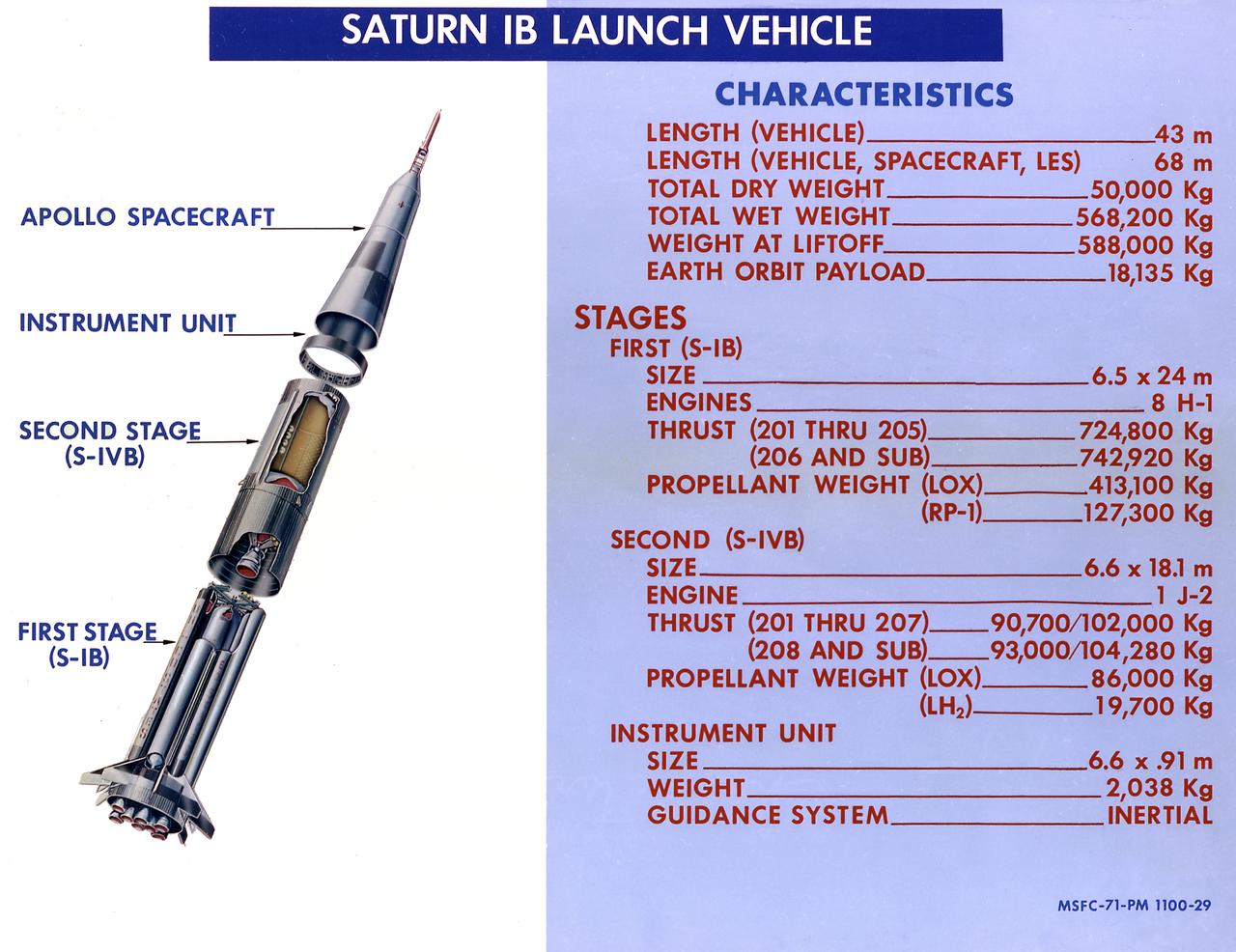
This 1968 cutaway drawing illustrates the Saturn IB launch vehicle with its two booster stages, the S-IB (first stage) and S-IVB (second stage), and provides the vital statistics in metric units. Developed by the Marshall Space Flight Center (MSFC) as an interim vehicle in MSFC's "building block" approach to the Saturn rocket development, the Saturn IB utilized Saturn I technology to further develop and refine the larger boosters and the Apollo spacecraft capabilities required for the marned lunar missions.
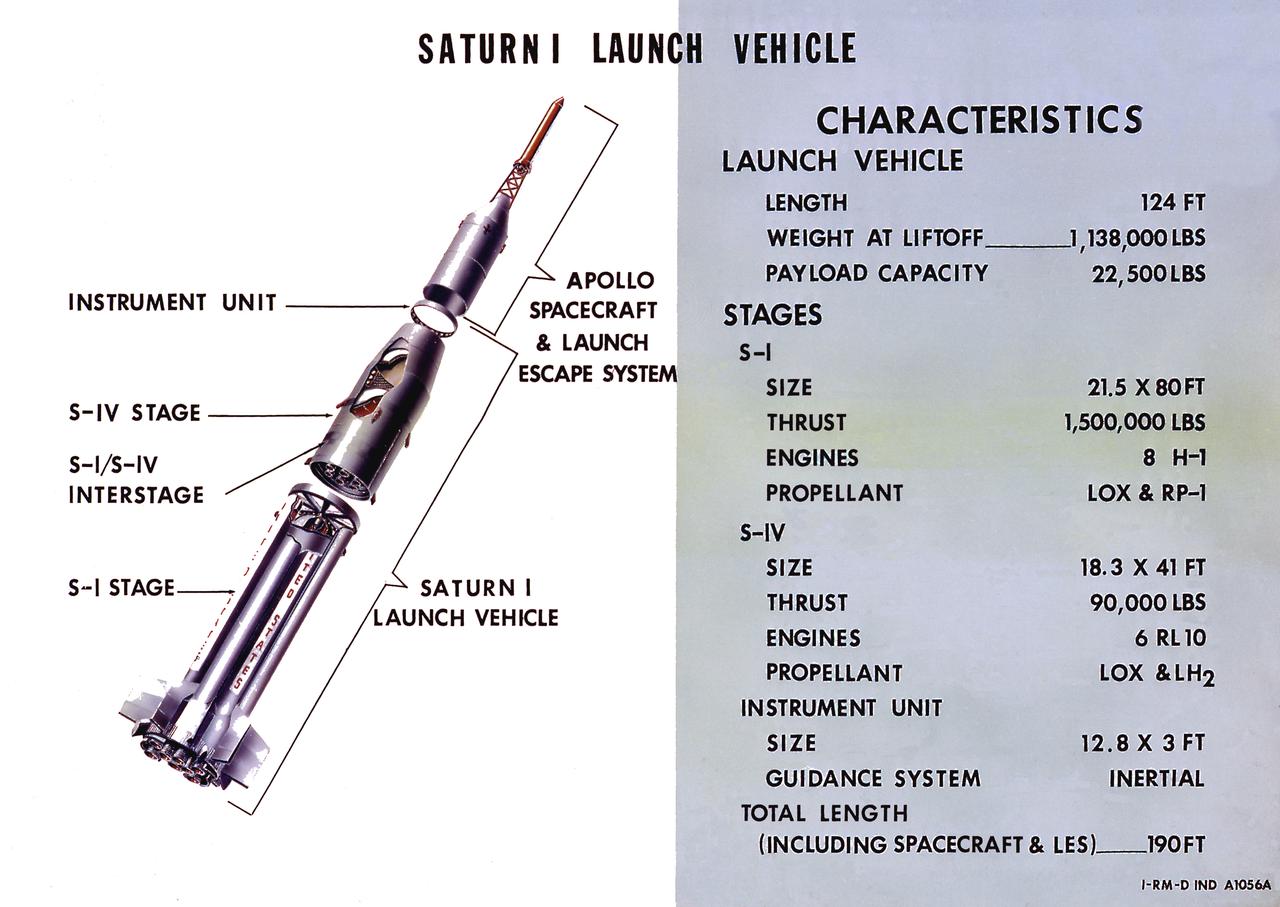
A cutaway illustration of Saturn I launch vehicle characteristics: The Saturn I, first of the Saturn launch vehicles' family, is a two-stage vehicle with a low-earth-orbit payload capability of approximately 25,000 pounds. The research and development program was plarned in two phases or blocks; one for first stage development (Block I) and the second for first and second stage development (Block II). The S-I (first) stage consisted of a cluster of nine propellant tanks and eight H-1 engines built by Rocketdyne, yeilding a total thrust of 1,500,000 pounds. The second stage identified as S-IV, was designed as a single cylinder with a common bulkhead separating the liquid oxygen from the liquid hydrogen. Propulsion was provided by six RL-10 engines built by Pratt Whitney, capable of producing a combined thrust of 90,000 pounds. Of the 10 Saturn I's planned, the first eight were designed and built at the Marshall Space Flight Center. The remaining two were built by the Chrysler Corporation.
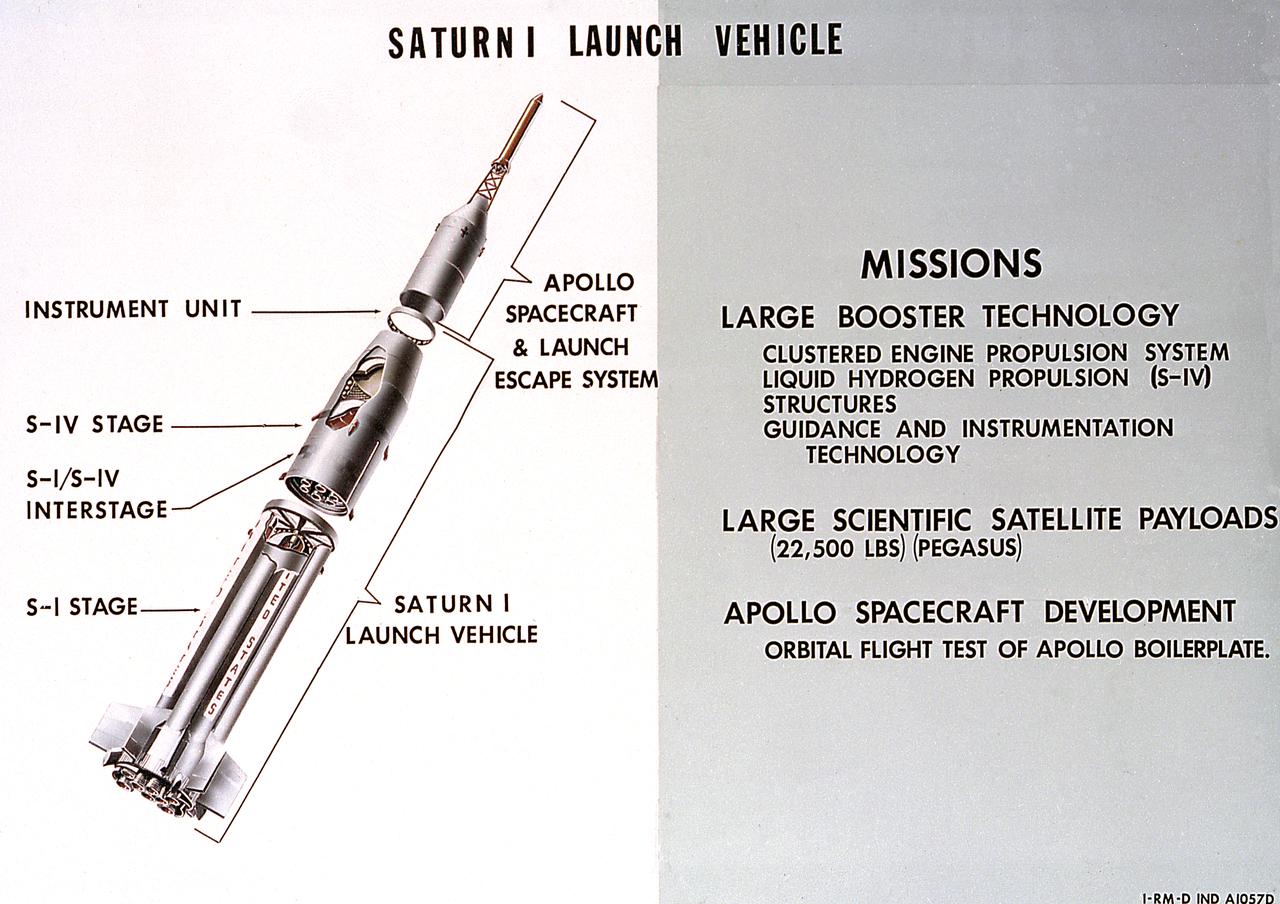
A cutaway illustration of Saturn 1 launch vehicle mission. The Saturn I, first of the Saturn launch vehicles' family, is a two-stage vehicle with a low-earth-orbit payload capability of approximately 25,000 pounds. The research and development program was plarned in two phases or blocks; one for first stage development (Block I) and the second for first and second stage development (Block II). The S-I (first) stage consisted of a cluster of nine propellant tanks and eight H-1 engines built by Rocketdyne, yeilding a total thrust of 1,500,000 pounds. The second stage of Saturn I, identified as S-IV, was designed as a single cylinder with a common bulkhead separating the liquid oxygen from the liquid hydrogen. Propulsion was provided by six RL-10 engines built by Pratt Whitney, capable of producing a combined thrust of 90,000 pounds. Of the 10 Saturn I's planned, the first eight were designed and built at the Marshall Space Flight Center. The remaining two were built by the Chrysler Corporation.
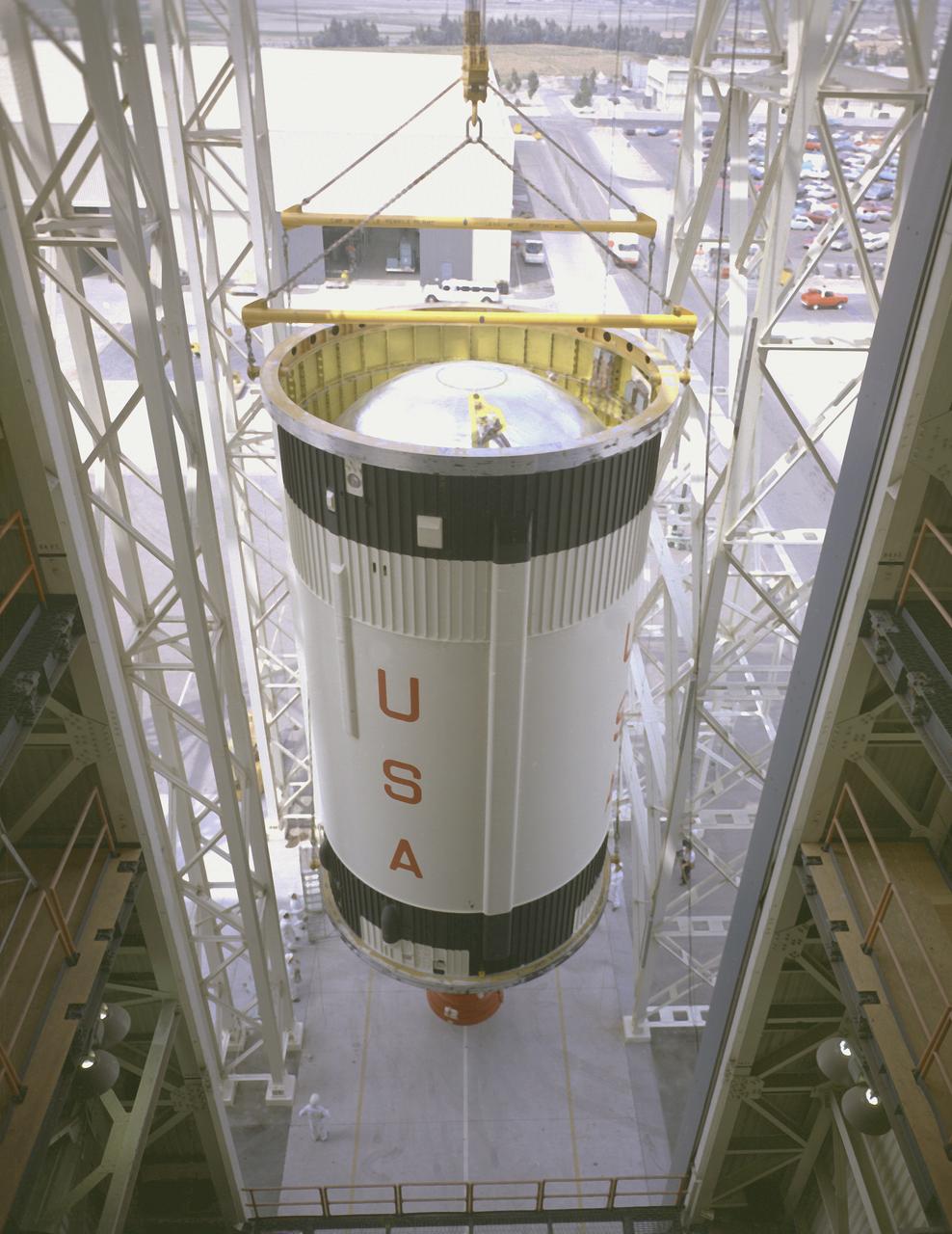
Workers at McDornel-Douglas install the Saturn IB S-IVB (second) stage for the Apollo-Soyuz mission into the company's S-IVB assembly and checkout tower in Huntington Beach, California. The Saturn IB launch vehicle was developed by the Marshall Space Flight Center (MSFC) as an interim vehicle in its "building block" approach to Saturn rocket development. This vehicle utilized the Saturn I technology to further develop and refine the capabilities of a larger booster and the Apollo spacecraft required for the manned lunar missions. The S-IVB stage, later used as the third stage of the Saturn V launch vehicle, was powered by a single J-2 engine initially capable of 200,000 pounds of thrust.
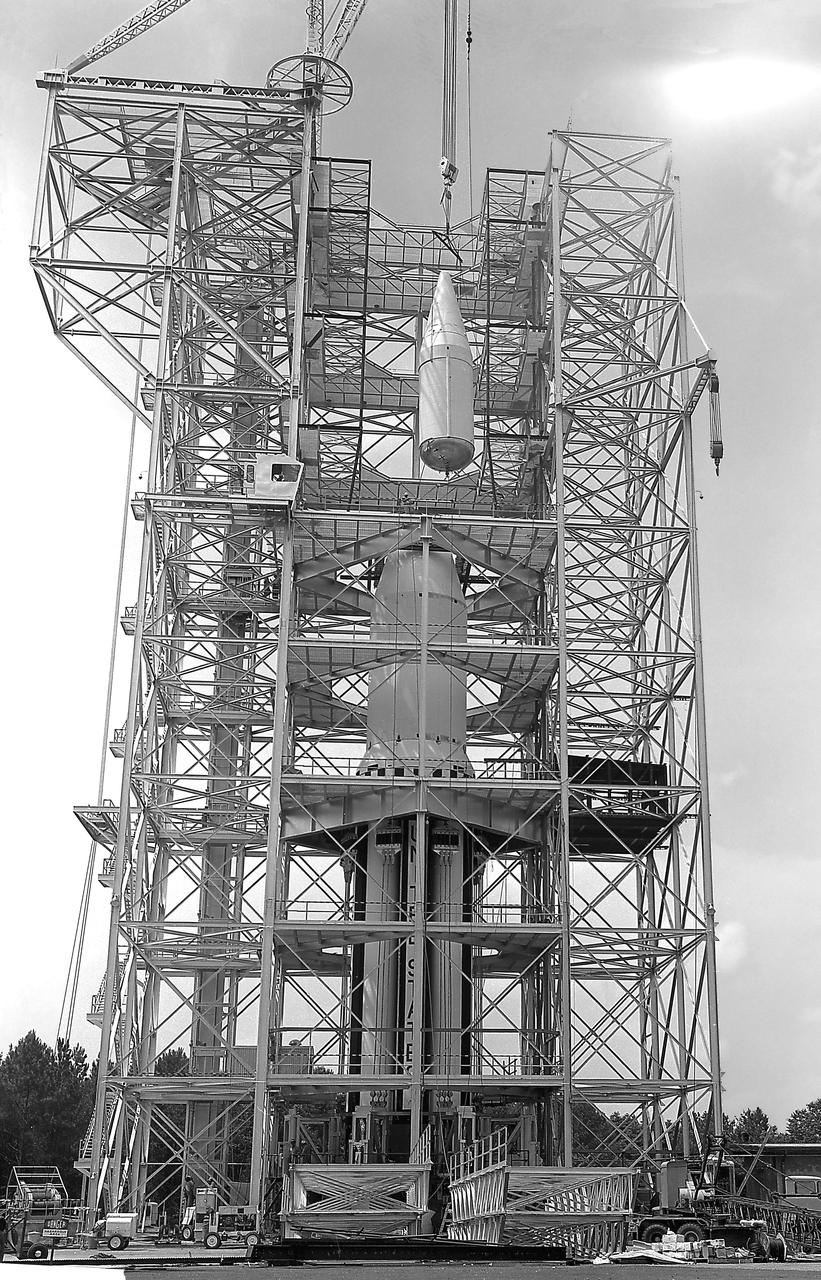
This image depicts the Saturn I launch vehicle placed in the dynamic test stand at the Marshall Space Flight Center (MSFC). A dummy booster was moved to the dynamic test stand early in June, and, for the first time, vertically mated with dummy S-I and S-IV stages. The assembled vehicle was readied for dynamic testing to investigate the integrity of the support structure.
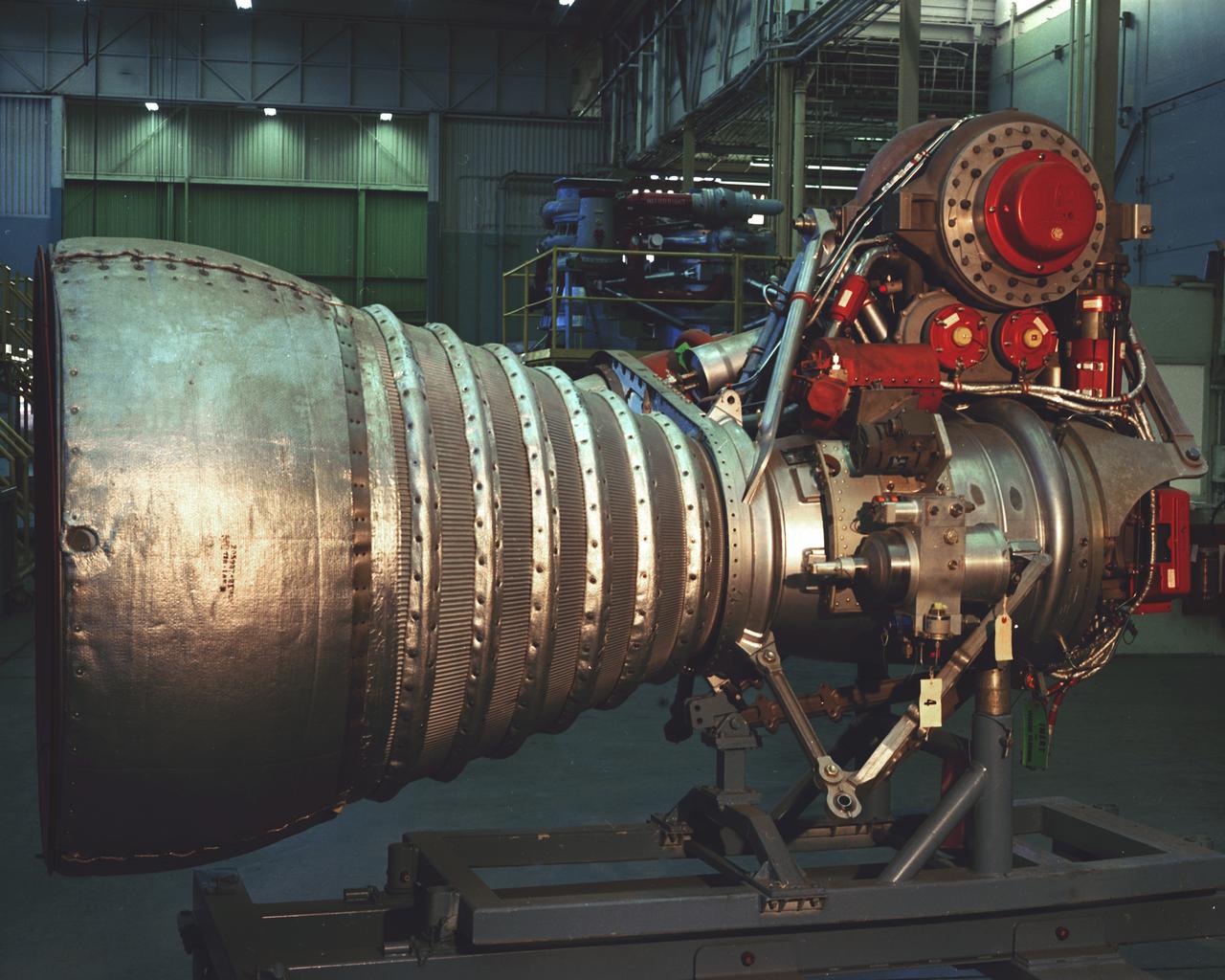
A cluster of eight H-1 engines were used to thrust the first stage of Saturn I (S-I stage) and Saturn IB (S-IB stage). The engines were arranged in a double pattern. Four engines, located inboard, were fixed in a square pattern around the stage axis, while the remaining four engines were located outboard in a larger square pattern and each outer engine was gimbaled. Each H-1 engine, fueled with liquid oxygen (LOX) and kerosene (RP-1), initially had a thrust of 188,000 pounds each for a combined thrust of over 1,500,000 pounds. Later, the H-1 engine was upgraded to 205,000 pounds of thrust and a combined total thrust of 1,650,000 pounds for the Saturn IB program. This photo depicts a single modified H-1 engine. The H-1 engine was developed under the direction of Marshall Space Flight Center (MSFC).
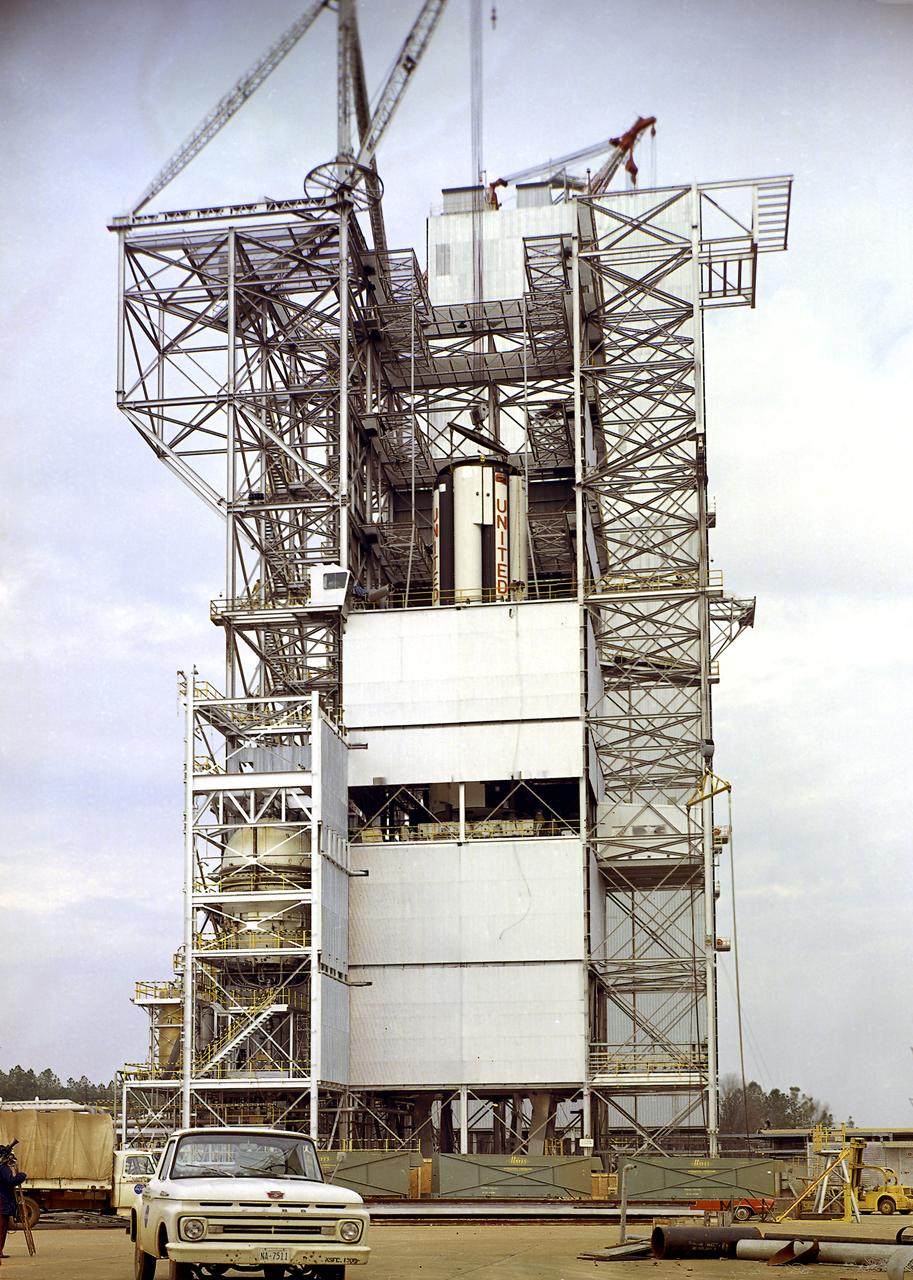
Marshall Space Flight Center (MSFC) workers lower S-IB-200D, a dynamic test version of the Saturn IB launch vehicle's first stage (S-IB stage), into the Center's Dynamic Test Stand on January 12, 1965. Test Laboratory persornel assembled a complete Saturn IB to test the structural soundness of the launch vehicle. Developed by the MSFC as an interim vehicle in MSFC's "building block" approach to Saturn rocket development, the Saturn IB utilized Saturn I technology to further develop and refine large boosters and the Apollo spacecraft capabilities required for the manned lunar missions.
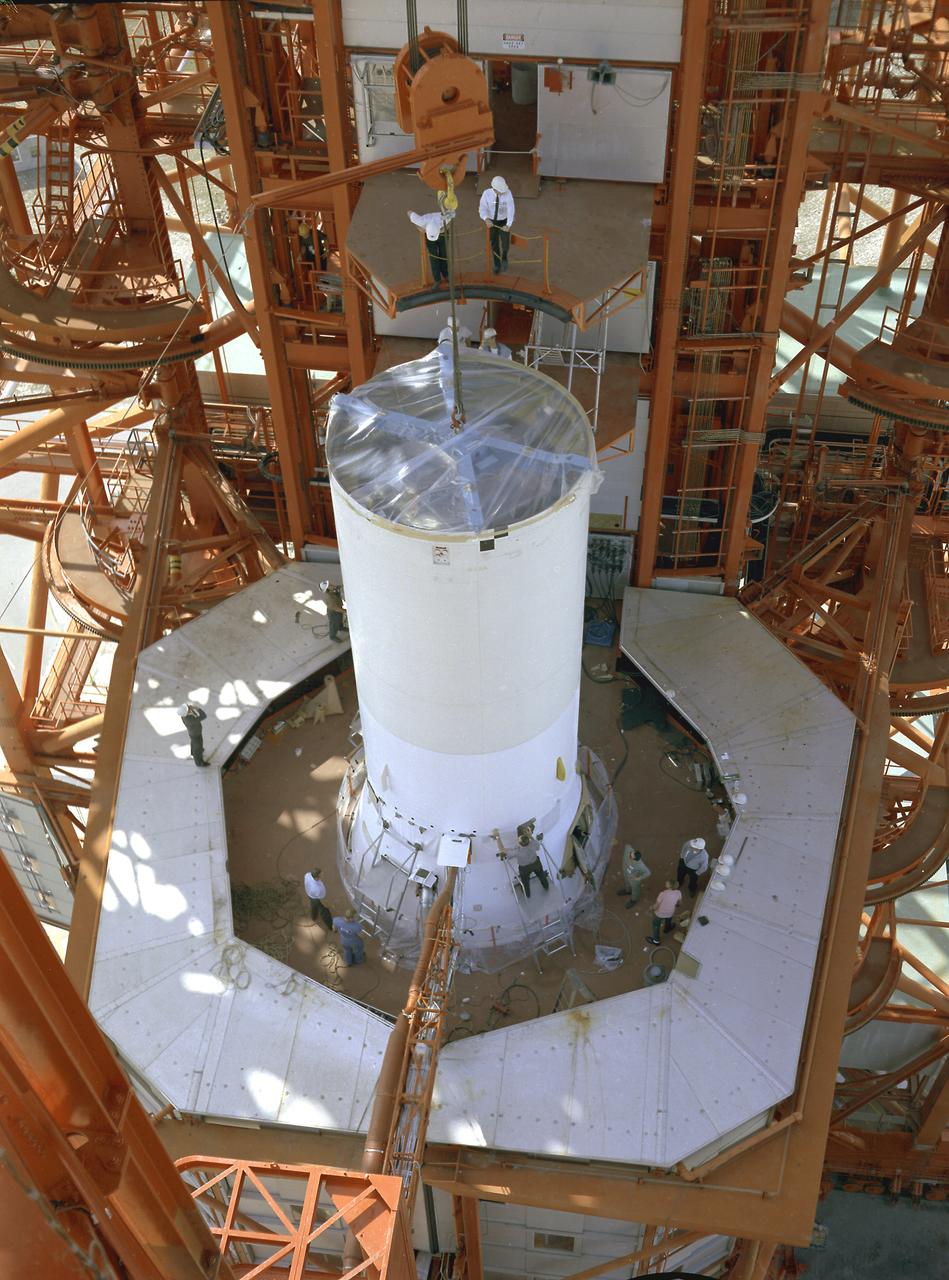
Pegasus-1, meteoroid detection satellite, installed on Saturn I (SA-9 mission) S-IV stage, January 13, 1965. The satellite was used to obtain data on frequency and penetration of the potentially hazardous micrometeoroids in low Earth orbits and to relay the information back to Earth. SA-9 was launched on February 16, 1965 and the Pegasus-1 satellite was the first operational payload for Saturn I.
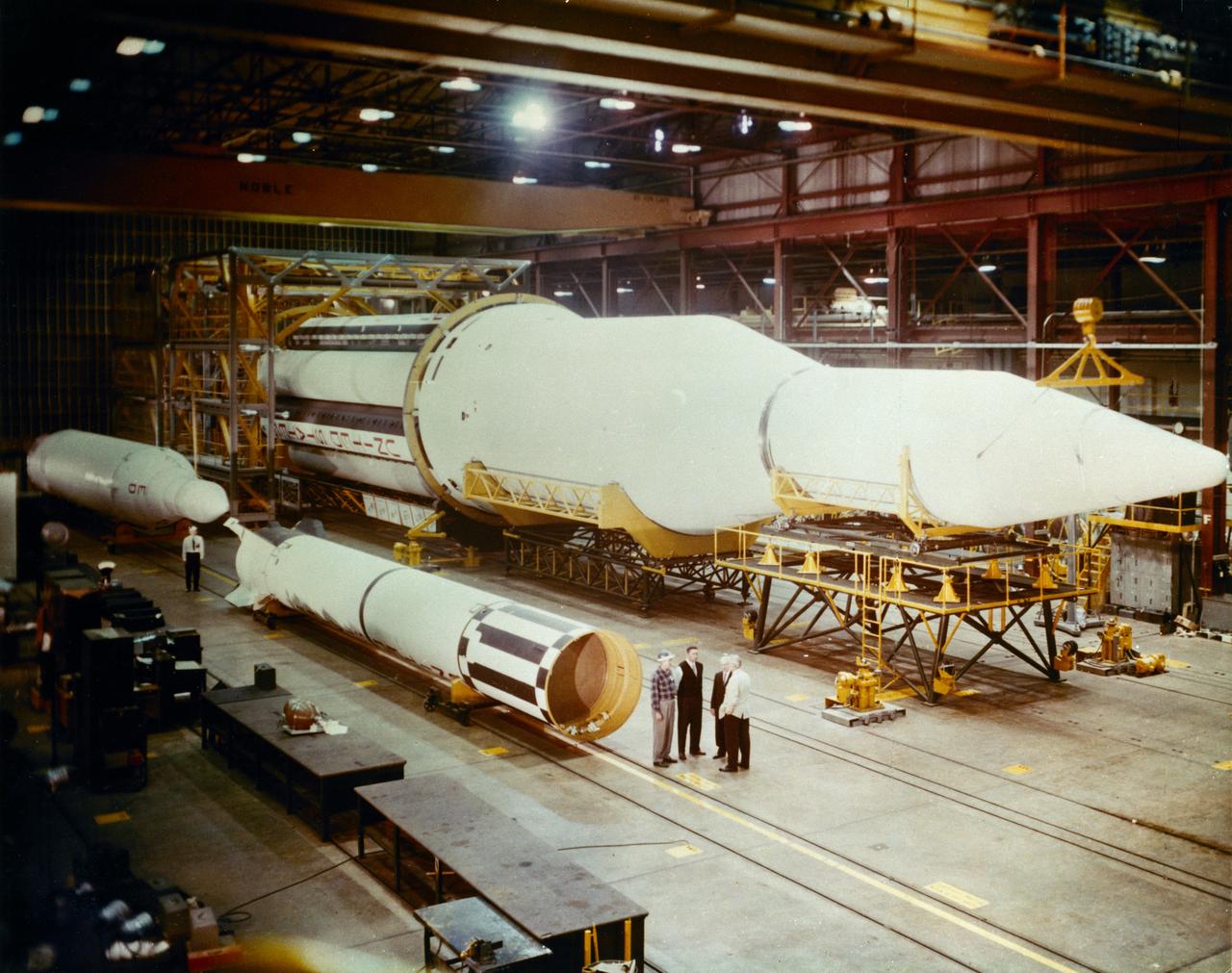
Progress in the Saturn program, depicted below, was described by Dr. Wernher von Braun, Marshall Space Flight Center (MSFC) Director, in an appearance before the Senate Committee of Aeronautical and Space Sciences. "The flight configuration of the giant three-stage Saturn C-1 rocket (later called Saturn I Block I) is seen in the Fabrication and Assembly Engineering Division at MSFC. Dwarfed by the 180-foot C-1 are a Juno II rocket (left rear) and a Mercury-Redstone rocket (front foreground). The C-1 (first version of the Saturn rocket) is composed of an S-1 first stage or booster (rear), powered by eight H-1 engines having a thrust of 1,500,000 pounds, followed by a dummy S-IV second stage and a dummy S-V third stage. The "live" S-IV for later flights, under development by Douglas Aircraft Co., will be powered by four Pratt Whitney LR-119 engines having 17,500,000 pounds thrust each. The live S-V, under development by Convair Division of General Dynamics Corp., will use two LR-119 engines. With all three stages live, the C-1 will be capable of placing 19,000 pounds into a 300-mile Earth orbit, sending 5,000 pounds to escape velocity, or lofting 2,500 pounds to Mars or Venus. The second version Saturn C-2 (later called Saturn 1 Block II) would double these capabilities. Early C-1 flights will employ a live S-1 with dummy upper stages. The first such flight is scheduled late this year."
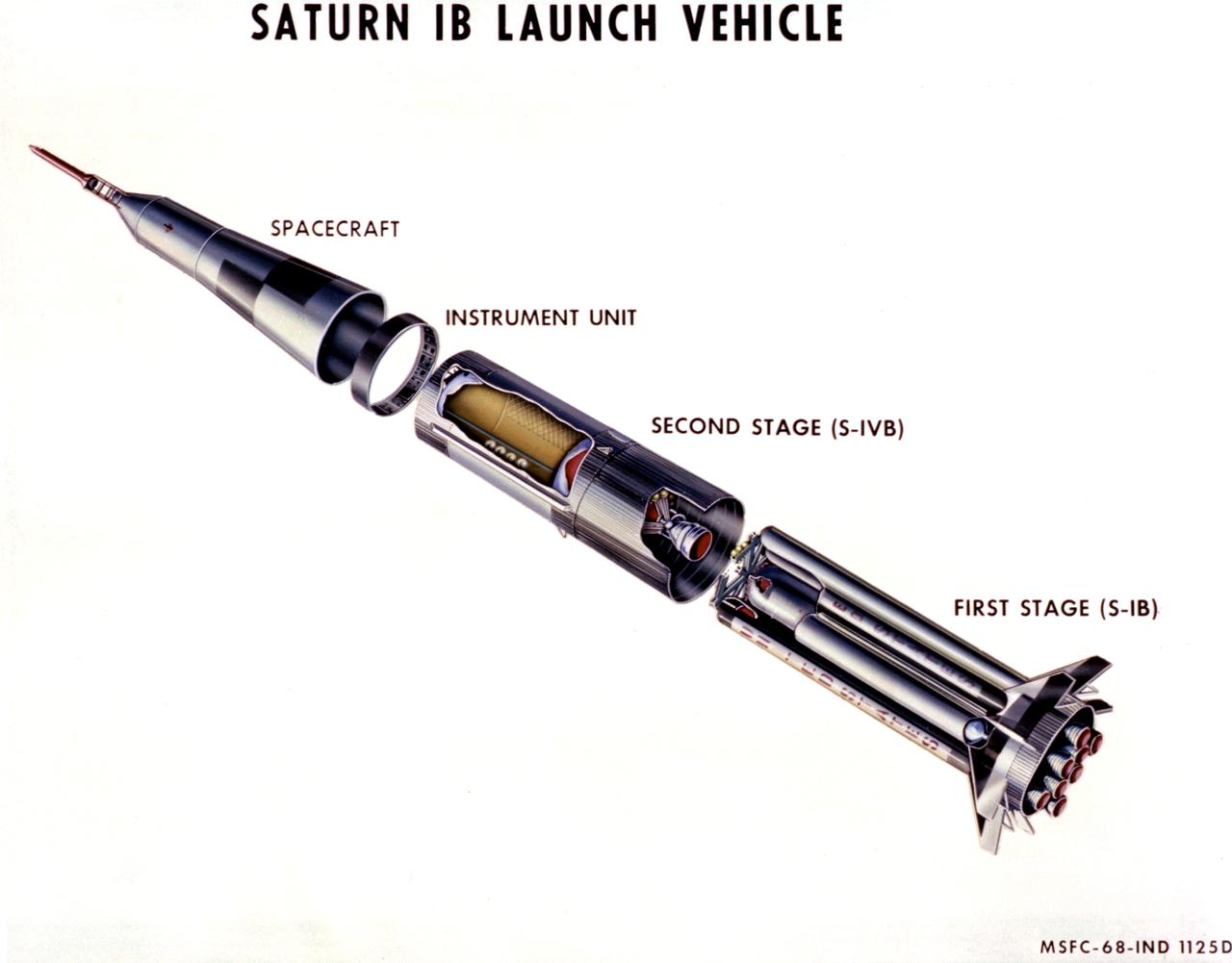
This 1968 cutaway drawing illustrates the Saturn IB launch vehicle with its two booster stages, the S-IB and S-IVB. Developed by the Marshall Space Flight Center (MSFC) as an interim vehicle in MSFC's "building block" approach to the Saturn rocket development, the Saturn IB utilized Saturn I technology to further develop and refine the larger boosters and the Apollo spacecraft capabilities required for the marned lunar mission.
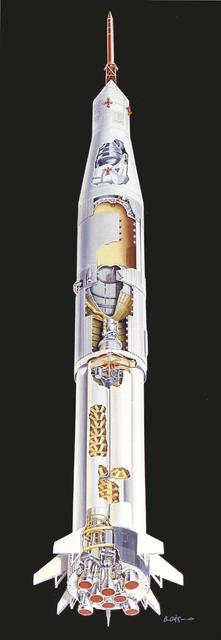
This undated cutaway drawing illustrates the Saturn IB launch vehicle with its two booster stages, the S-IB and S-IVB. Developed by the Marshall Space Flight Center (MSFC) as an interim vehicle in MSFC's "building block" approach to the Saturn rocket development, the Saturn IB utilized Saturn I technology to further develop and refine the larger boosters and the Apollo spacecraft capabilities required for the marned lunar missions.
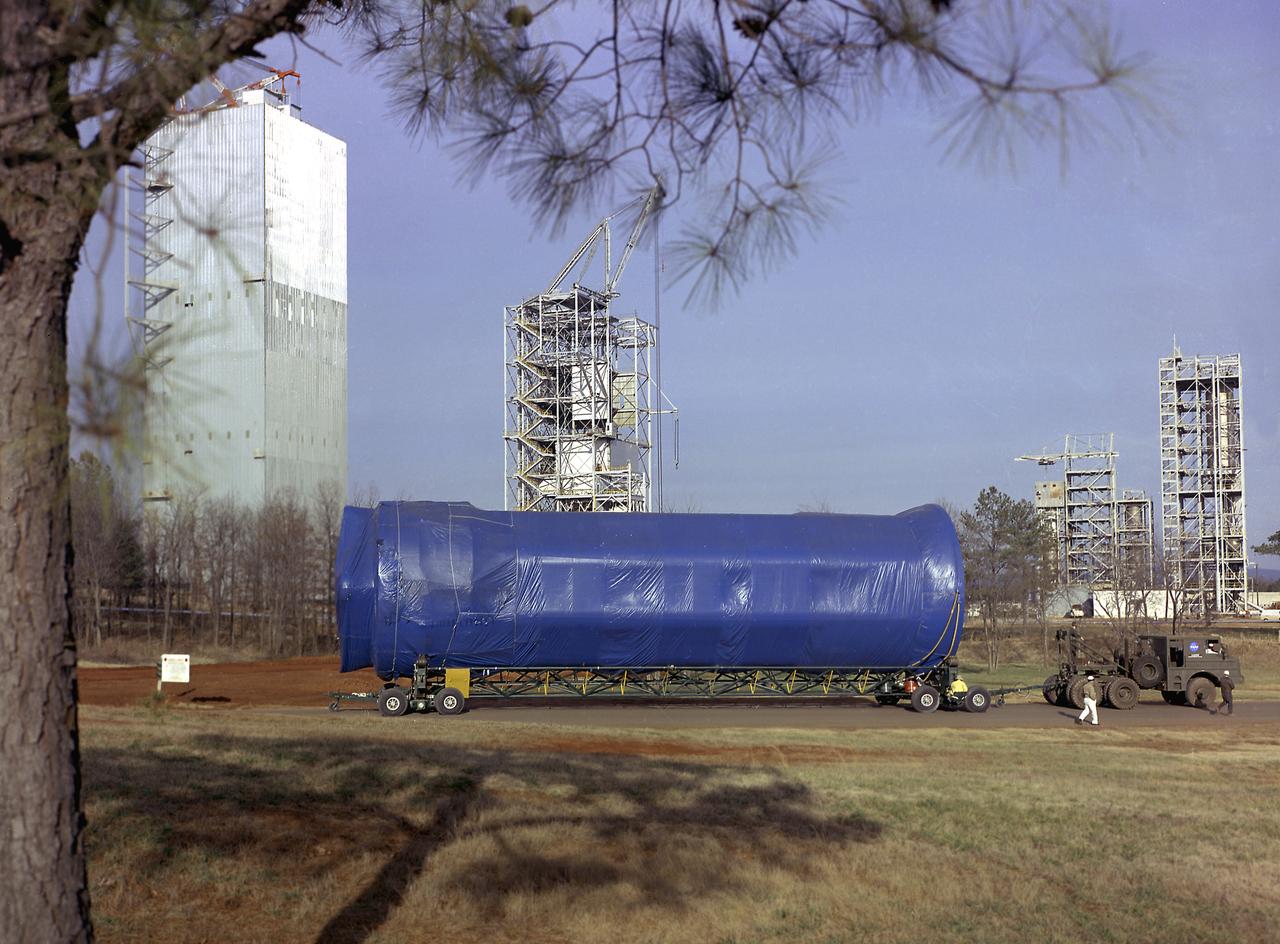
S-IB-200D, a dynamic test version of the Saturn IB launch vehicle's first stage (S-IB), makes its way to the Marshall Space Flight Center (MSFC) East Test Area on January 4, 1965. Test Laboratory persornel assembled a complete Saturn IB to test the structural soundness of the launch vehicle in the Dynamic Test Stand. Developed by the MSFC as an interim vehicle in MSFC's "building block" approach to the Saturn rocket development, the Saturn IB utilized Saturn I technology to further develop and refine the larger boosters and the Apollo spacecraft capabilities required for the manned lunar missions.
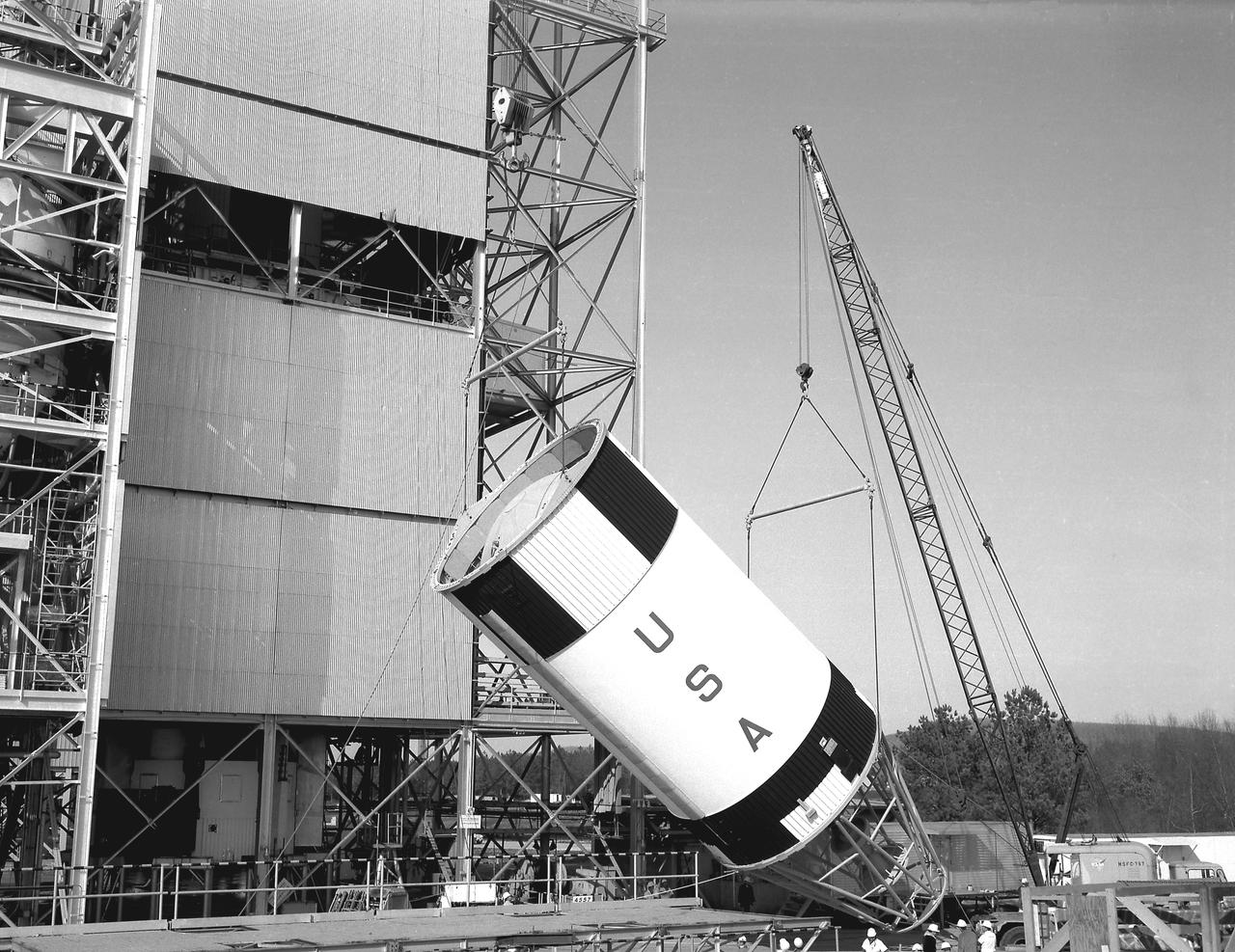
Marshall Space Flight Center (MSFC) workers hoist a dynamic test version of the S-IVB stage, the Saturn IB launch vehicle's second stage, into the Center's Dynamic Test Stand on January 18, 1965. MSFC Test Laboratory persornel assembled a complete Saturn IB to test the launch vehicle's structural soundness. Developed by the MSFC as an interim vehicle in MSFC's "building block" approach to the Saturn rocket development, the Saturn IB utilized Saturn I technology to further develop and refine the larger boosters and the Apollo spacecraft capabilities required for the manned lunar missions.
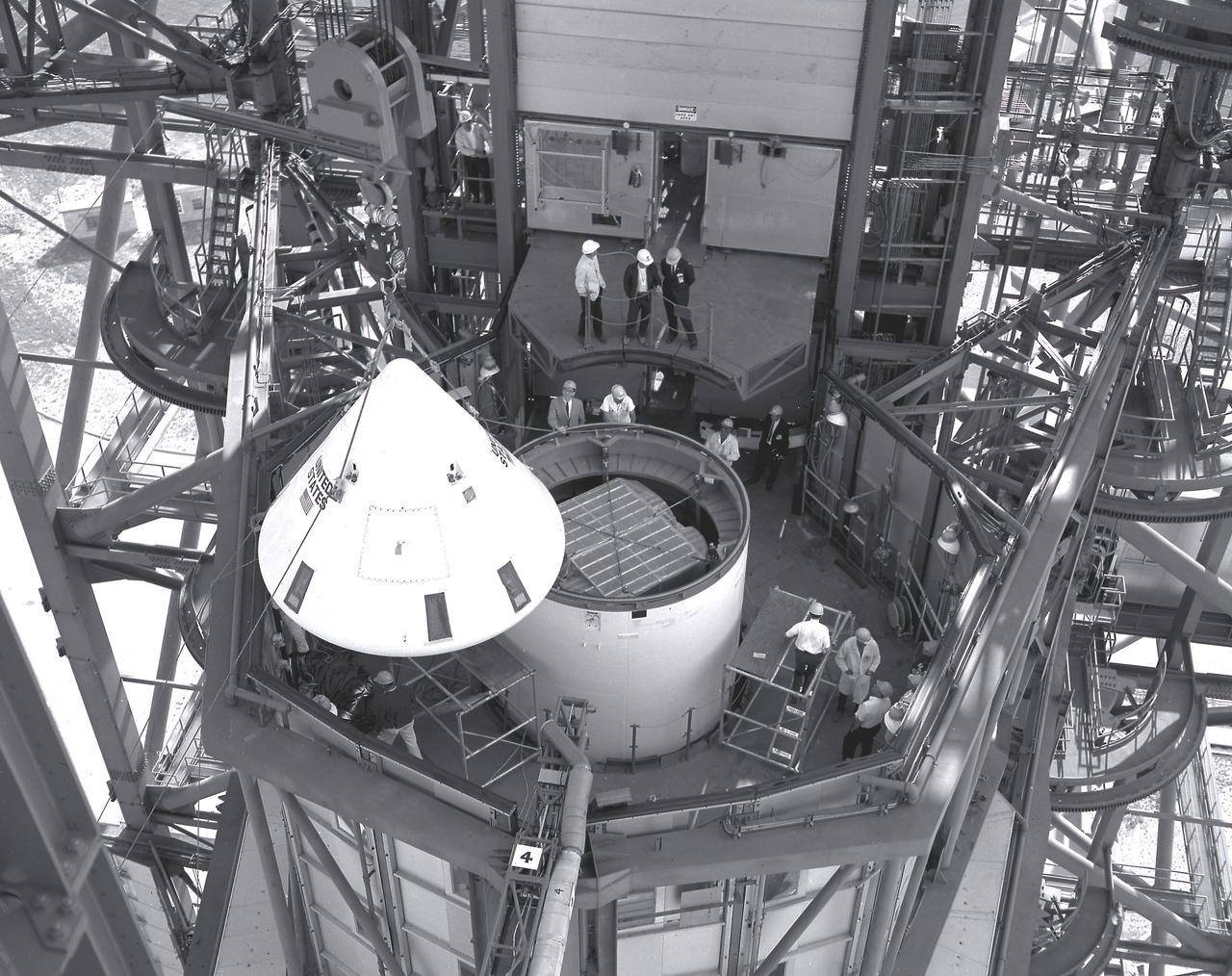
In this photograph, the Pegasus, meteoroid detection satellite is installed in its specially modified Apollo service module atop the S-IV stage (second stage) of a Saturn I vehicle for the SA-9 mission at Cape Kennedy. Personnel in the service structure moved the boilerplate Apollo command module into place to cap the vehicle. The command and service modules, visible here, were jettisoned into orbit to free the Pegasus for wing deployment. The satellite was used to obtain data on frequency and penetration of the potentially hazardous micrometeoroids in low Earth orbits and to relay the information back to Earth. The SA-9 was launched on February 16, 1965.
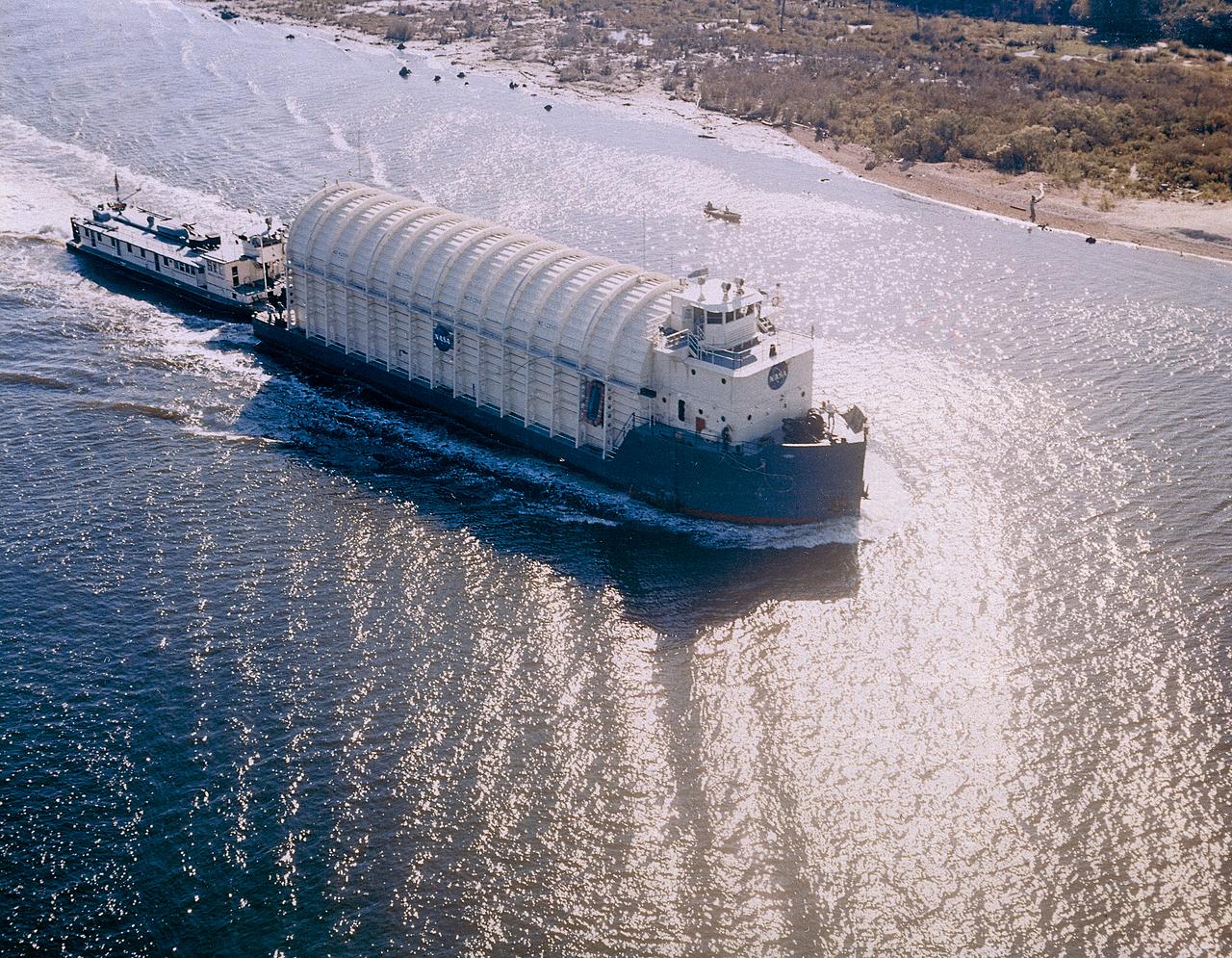
NASA used barges for transporting full-sized stages for the Saturn I, Saturn IB, and Saturn V vehicles between the Marshall Space Flight Center (MSFC), the manufacturing plant at the Michoud Assembly Facility (MAF), the Mississippi Test Facility for testing, and the Kennedy Space Center. The barges traveled from the MSFC dock to the MAF, a total of 1,086.7 miles up the Tennessee River and down the Mississippi River. The barges also transported the assembled stages of the Saturn vehicle from the MAF to the Kennedy Space Center, a total of 932.4 miles along the Gulf of Mexico and up along the Atlantic Ocean, for the final assembly and the launch. Pictured is the barge Palaemon carrying Saturn IV S-IB flight stage enroute to MSFC.
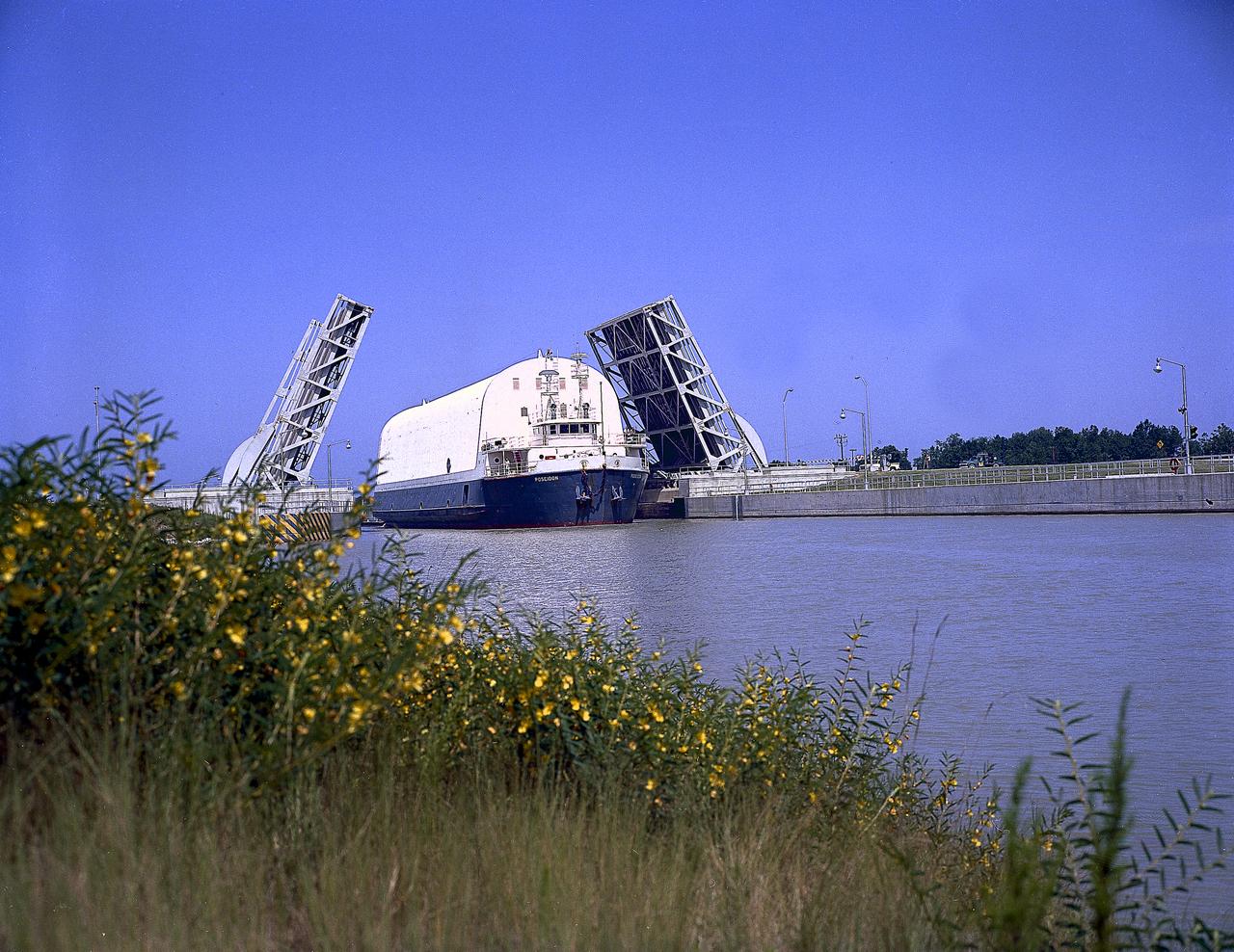
NASA used barges for transporting full-sized stages for the Saturn I, Saturn IB, and Saturn V vehicles between the Marshall Space Flight Center (MSFC), the manufacturing plant at the Michoud Assembly Facility (MAF), the Mississippi Test Facility for testing, and the Kennedy Space Center. The barges traveled from the MSFC dock to the MAF, a total of 1,086.7 miles up the Tennessee River and down the Mississippi River. The barges also transported the assembled stages of the Saturn vehicle from the MAF to the Kennedy Space Center, a total of 932.4 miles along the Gulf of Mexico and up along the Atlantic Ocean, for the final assembly and the launch. This photograph shows the barge Poseidon loaded with the Saturn V S-II (second) stage passing through a bascule bridge.
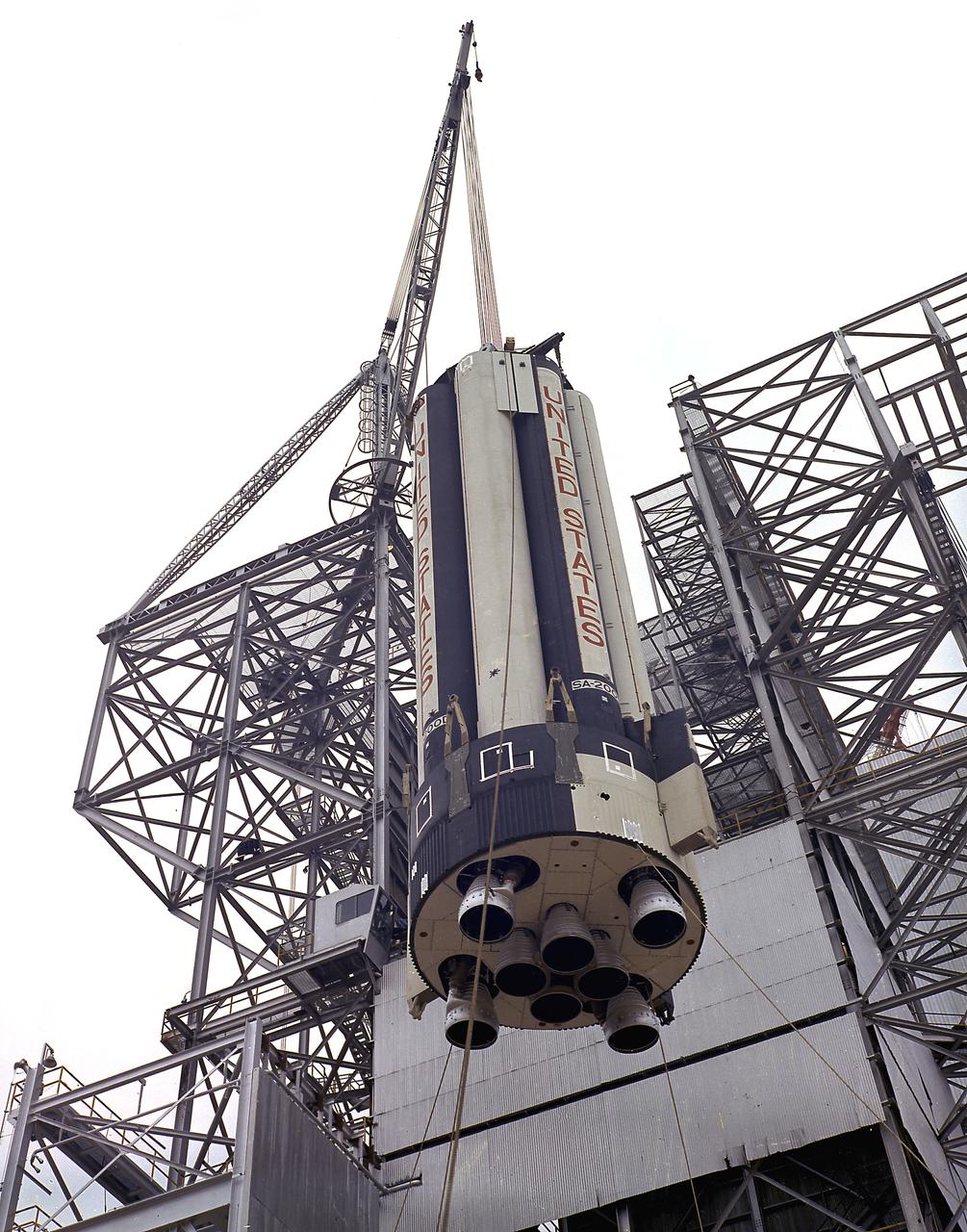
Workers at the Marshall Space Flight Center's (MSFC) Dynamic Test Stand install S-IB-200D, a dynamic test version of the Saturn IB launch vehicle's first stage, on January 11, 1965. MSFC Test Laboratory persornel assembled a complete Saturn IB to test the launch vehicle's structural soundness. Developed by the MSFC as an interim vehicle in MSFC's "building block" approach to the Saturn rocket development, the Saturn IB utilized Saturn I technology to further develop and refine the larger boosters and the Apollo spacecraft capabilities required for the manned lunar missions.
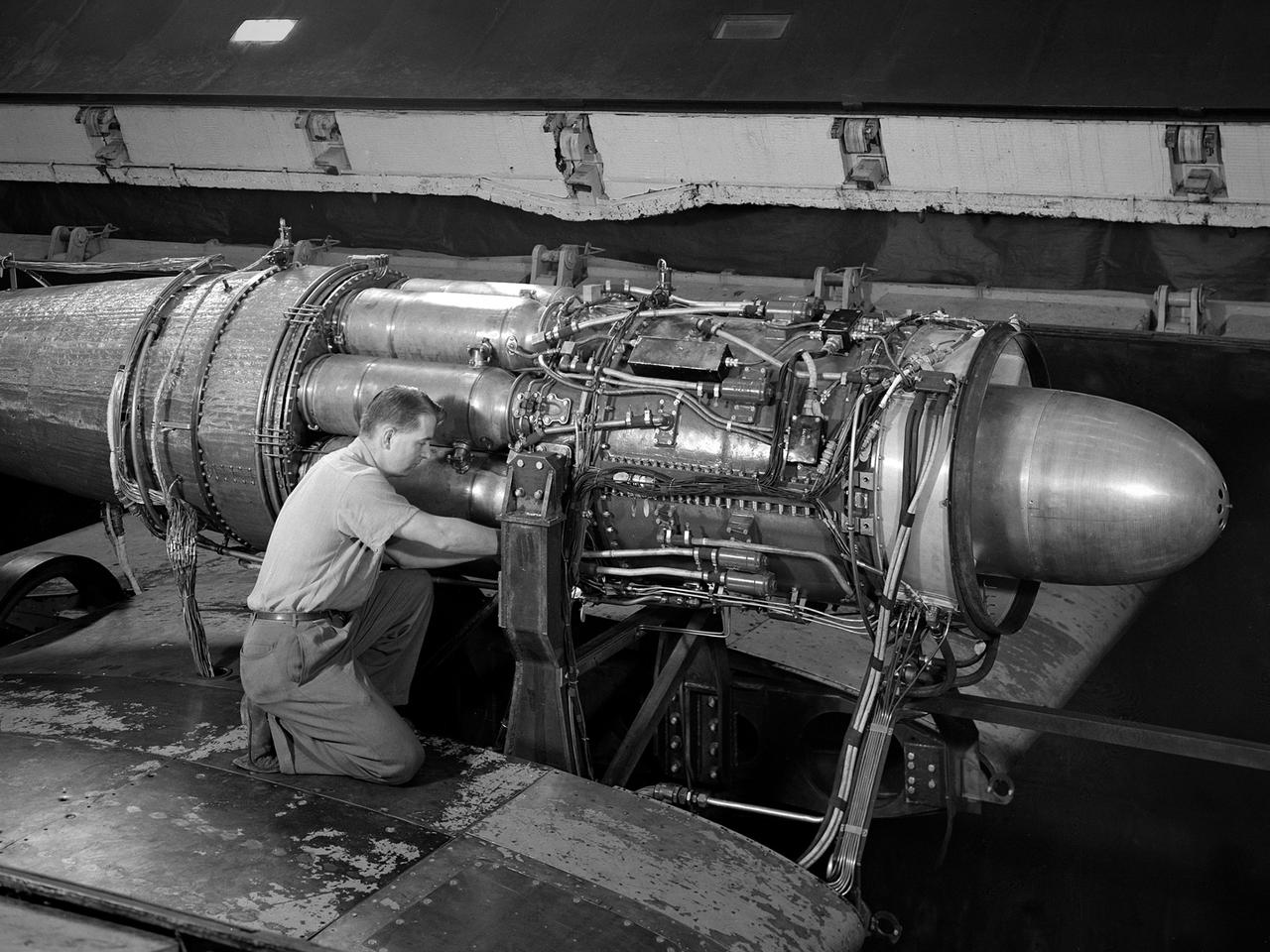
A General Electric TG-180 turbojet installed in the Altitude Wind Tunnel at the National Advisory Committee for Aeronautics (NACA) Lewis Flight Propulsion Laboratory. In 1943 the military asked General Electric to develop an axial-flow jet engine which became the TG-180. The military understood that the TG-180 would not be ready during World War II but recognized the axial-flow compressor’s long-term potential. Although the engine was bench tested in April 1944, it was not flight tested until February 1946. The TG-180 was brought to the Altitude Wind Tunnel in 1945 for a series of investigations. The studies, which continued intermittently into 1948, analyzed an array of performance issues. NACA modifications steadily improved the TG-180’s performance, including the first successful use of an afterburner. The Lewis researchers studied a 29-inch diameter afterburner over a range of altitude conditions using several different types of flameholders and fuel systems. Lewis researchers concluded that a three-stage flameholder with its largest stage upstream was the best burner configuration. Although the TG-180 (also known as the J35) was not the breakthrough engine that the military had hoped for, it did power the Douglas D-558-I Skystreak to a world speed record on August 20, 1947. The engines were also used on the Republic F-84 Thunderjet and the Northrup F-89 Scorpion.
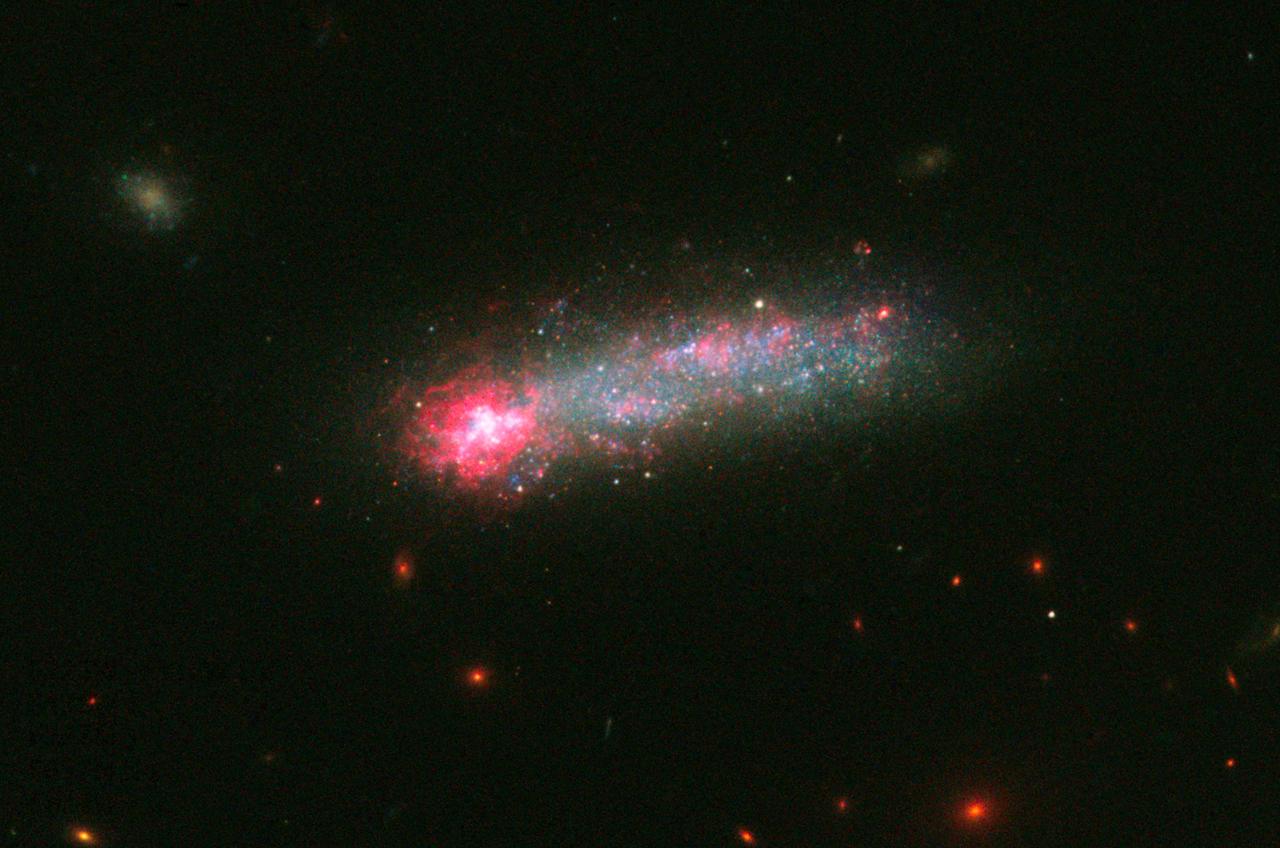
Fireworks shows are not just confined to Earth’s skies. NASA’s Hubble Space Telescope has captured a spectacular fireworks display in a small, nearby galaxy, which resembles a July 4th skyrocket. A firestorm of star birth is lighting up one end of the diminutive galaxy Kiso 5639. The dwarf galaxy is shaped like a flattened pancake, but because it is tilted edge-on, it resembles a skyrocket, with a brilliant blazing head and a long, star-studded tail. Kiso 5639 is a rare, nearby example of elongated galaxies that occur in abundance at larger distances, where we observe the universe during earlier epochs. Astronomers suggest that the frenzied star birth is sparked by intergalactic gas raining on one end of the galaxy as it drifts through space. “I think Kiso 5639 is a beautiful, up-close example of what must have been common long ago,” said lead researcher Debra Elmegreen of Vassar College, in Poughkeepsie, New York. “The current thinking is that galaxies in the early universe grow from accreting gas from the surrounding neighborhood. It’s a stage that galaxies, including our Milky Way, must go through as they are growing up.” Observations of the early universe, such as Hubble’s Ultra-Deep Field, reveal that about 10 percent of all galaxies have these elongated shapes, and are collectively called “tadpoles.” But studies of the nearby universe have turned up only a few of these unusual galaxies, including Kiso 5639. The development of the nearby star-making tadpole galaxies, however, has lagged behind that of their peers, which have spent billions of years building themselves up into many of the spiral galaxies seen today. Elmegreen used Hubble’s Wide Field Camera 3 to conduct a detailed imaging study of Kiso 5639. The images in different filters reveal information about an object by dissecting its light into its component colors. Hubble’s crisp resolution helped Elmegreen and her team analyze the giant star-forming clumps in Kiso 5639 and determine the masses and ages of the star clusters. The international team of researchers selected Kiso 5639 from a spectroscopic survey of 10 nearby tadpole galaxies, observed with the Grand Canary Telescope in La Palma, Spain, by Jorge Sanchez Almeida and collaborators at the Instituto de Astrofisica de Canarias. The observations revealed that in most of those galaxies, including Kiso 5639, the gas composition is not uniform. The bright gas in the galaxy’s head contains fewer heavier elements (collectively called “metals”), such as carbon and oxygen, than the rest of the galaxy. Stars consist mainly of hydrogen and helium, but cook up other “heavier” elements. When the stars die, they release their heavy elements and enrich the surrounding gas. “The metallicity suggests that there has to be rather pure gas, composed mostly of hydrogen, coming into the star-forming part of the galaxy, because intergalactic space contains more pristine hydrogen-rich gas,” Elmegreen explained. “Otherwise, the starburst region should be as rich in heavy elements as the rest of the galaxy.” Hubble offers a detailed view of the galaxy’s star-making frenzy. The telescope uncovered several dozen clusters of stars in the galaxy’s star-forming head, which spans 2,700 light-years across. These clusters have an average age of less than 1 million years and masses that are three to six times larger than those in the rest of the galaxy. Other star formation is taking place throughout the galaxy but on a much smaller scale. Star clusters in the rest of the galaxy are between several million to a few billion years old. “There is much more star formation going on in the head than what you would expect in such a tiny galaxy,” said team member Bruce Elmegreen of IBM’s Thomas J. Watson’s Research Center, in Yorktown Heights, New York. “And we think the star formation is triggered by the ongoing accretion of metal-poor gas onto a part of an otherwise quiescent dwarf galaxy.” Hubble also revealed giant holes peppered throughout the galaxy’s starburst head. These cavities give the galaxy’s head a Swiss-cheese appearance because numerous supernova detonations – like firework aerial bursts – have carved out holes of rarified superheated gas. The galaxy, located 82 million light-years away, has taken billions of years to develop because it has been drifting through an isolated “desert” in the universe, devoid of much gas. What triggered the starburst in such a backwater galaxy? Based on simulations by Daniel Ceverino of the Center for Astronomy at Heidelberg University in Germany, and other team members, the observations suggest that less than 1 million years ago, Kiso 5639’s leading edge encountered a filament of gas. The filament dropped a large clump of matter onto the galaxy, stoking the vigorous star birth. Debra Elmegreen expects that in the future other parts of the galaxy will join in the star-making fireworks show. “Galaxies rotate, and as Kiso 5639 continues to spin, another part of the galaxy may receive an infusion of new gas from this filament, instigating another round of star birth,” she said. The team’s results have been accepted for publication in The Astrophysical Journal. Other team members include Casiana Munoz-Tunon and Mercedes Filho (Instituto de Astrofísica de Canarias, Canary Islands), Jairo Mendez-Abreu (University of St. Andrews, United Kingdom), John Gallagher (University of Wisconsin-Madison), and Marc Rafelski (NASA's Goddard Space Flight Center, Greenbelt, Maryland). The Hubble Space Telescope is a project of international cooperation between NASA and the European Space Agency. NASA's Goddard Space Flight Center in Greenbelt, Maryland, manages the telescope. The Space Telescope Science Institute (STScI) in Baltimore, Maryland, conducts Hubble science operations. STScI is operated for NASA by the Association of Universities for Research in Astronomy in Washington, D.C. For images and more information about Kiso 5639 and Hubble, visit: <a href="http://hubblesite.org/news/2016/23" rel="nofollow">hubblesite.org/news/2016/23</a> <a href="http://www.nasa.gov/hubble" rel="nofollow">www.nasa.gov/hubble</a> Image credit: NASA, ESA, and D. Elmegreen (Vassar College) <b><a href="http://www.nasa.gov/audience/formedia/features/MP_Photo_Guidelines.html" rel="nofollow">NASA image use policy.</a></b> <b><a href="http://www.nasa.gov/centers/goddard/home/index.html" rel="nofollow">NASA Goddard Space Flight Center</a></b> enables NASA’s mission through four scientific endeavors: Earth Science, Heliophysics, Solar System Exploration, and Astrophysics. Goddard plays a leading role in NASA’s accomplishments by contributing compelling scientific knowledge to advance the Agency’s mission. <b>Follow us on <a href="http://twitter.com/NASAGoddardPix" rel="nofollow">Twitter</a></b> <b>Like us on <a href="http://www.facebook.com/pages/Greenbelt-MD/NASA-Goddard/395013845897?ref=tsd" rel="nofollow">Facebook</a></b> <b>Find us on <a href="http://instagrid.me/nasagoddard/?vm=grid" rel="nofollow">Instagram</a></b>

Fireworks shows are not just confined to Earth’s skies. NASA’s Hubble Space Telescope has captured a spectacular fireworks display in a small, nearby galaxy, which resembles a July 4th skyrocket. A firestorm of star birth is lighting up one end of the diminutive galaxy Kiso 5639. The dwarf galaxy is shaped like a flattened pancake, but because it is tilted edge-on, it resembles a skyrocket, with a brilliant blazing head and a long, star-studded tail. Kiso 5639 is a rare, nearby example of elongated galaxies that occur in abundance at larger distances, where we observe the universe during earlier epochs. Astronomers suggest that the frenzied star birth is sparked by intergalactic gas raining on one end of the galaxy as it drifts through space. “I think Kiso 5639 is a beautiful, up-close example of what must have been common long ago,” said lead researcher Debra Elmegreen of Vassar College, in Poughkeepsie, New York. “The current thinking is that galaxies in the early universe grow from accreting gas from the surrounding neighborhood. It’s a stage that galaxies, including our Milky Way, must go through as they are growing up.” Observations of the early universe, such as Hubble’s Ultra-Deep Field, reveal that about 10 percent of all galaxies have these elongated shapes, and are collectively called “tadpoles.” But studies of the nearby universe have turned up only a few of these unusual galaxies, including Kiso 5639. The development of the nearby star-making tadpole galaxies, however, has lagged behind that of their peers, which have spent billions of years building themselves up into many of the spiral galaxies seen today. Elmegreen used Hubble’s Wide Field Camera 3 to conduct a detailed imaging study of Kiso 5639. The images in different filters reveal information about an object by dissecting its light into its component colors. Hubble’s crisp resolution helped Elmegreen and her team analyze the giant star-forming clumps in Kiso 5639 and determine the masses and ages of the star clusters. The international team of researchers selected Kiso 5639 from a spectroscopic survey of 10 nearby tadpole galaxies, observed with the Grand Canary Telescope in La Palma, Spain, by Jorge Sanchez Almeida and collaborators at the Instituto de Astrofisica de Canarias. The observations revealed that in most of those galaxies, including Kiso 5639, the gas composition is not uniform. The bright gas in the galaxy’s head contains fewer heavier elements (collectively called “metals”), such as carbon and oxygen, than the rest of the galaxy. Stars consist mainly of hydrogen and helium, but cook up other “heavier” elements. When the stars die, they release their heavy elements and enrich the surrounding gas. “The metallicity suggests that there has to be rather pure gas, composed mostly of hydrogen, coming into the star-forming part of the galaxy, because intergalactic space contains more pristine hydrogen-rich gas,” Elmegreen explained. “Otherwise, the starburst region should be as rich in heavy elements as the rest of the galaxy.” Hubble offers a detailed view of the galaxy’s star-making frenzy. The telescope uncovered several dozen clusters of stars in the galaxy’s star-forming head, which spans 2,700 light-years across. These clusters have an average age of less than 1 million years and masses that are three to six times larger than those in the rest of the galaxy. Other star formation is taking place throughout the galaxy but on a much smaller scale. Star clusters in the rest of the galaxy are between several million to a few billion years old. “There is much more star formation going on in the head than what you would expect in such a tiny galaxy,” said team member Bruce Elmegreen of IBM’s Thomas J. Watson’s Research Center, in Yorktown Heights, New York. “And we think the star formation is triggered by the ongoing accretion of metal-poor gas onto a part of an otherwise quiescent dwarf galaxy.” Hubble also revealed giant holes peppered throughout the galaxy’s starburst head. These cavities give the galaxy’s head a Swiss-cheese appearance because numerous supernova detonations – like firework aerial bursts – have carved out holes of rarified superheated gas. The galaxy, located 82 million light-years away, has taken billions of years to develop because it has been drifting through an isolated “desert” in the universe, devoid of much gas. What triggered the starburst in such a backwater galaxy? Based on simulations by Daniel Ceverino of the Center for Astronomy at Heidelberg University in Germany, and other team members, the observations suggest that less than 1 million years ago, Kiso 5639’s leading edge encountered a filament of gas. The filament dropped a large clump of matter onto the galaxy, stoking the vigorous star birth. Debra Elmegreen expects that in the future other parts of the galaxy will join in the star-making fireworks show. “Galaxies rotate, and as Kiso 5639 continues to spin, another part of the galaxy may receive an infusion of new gas from this filament, instigating another round of star birth,” she said. The team’s results have been accepted for publication in The Astrophysical Journal. Other team members include Casiana Munoz-Tunon and Mercedes Filho (Instituto de Astrofísica de Canarias, Canary Islands), Jairo Mendez-Abreu (University of St. Andrews, United Kingdom), John Gallagher (University of Wisconsin-Madison), and Marc Rafelski (NASA's Goddard Space Flight Center, Greenbelt, Maryland). The Hubble Space Telescope is a project of international cooperation between NASA and the European Space Agency. NASA's Goddard Space Flight Center in Greenbelt, Maryland, manages the telescope. The Space Telescope Science Institute (STScI) in Baltimore, Maryland, conducts Hubble science operations. STScI is operated for NASA by the Association of Universities for Research in Astronomy in Washington, D.C.