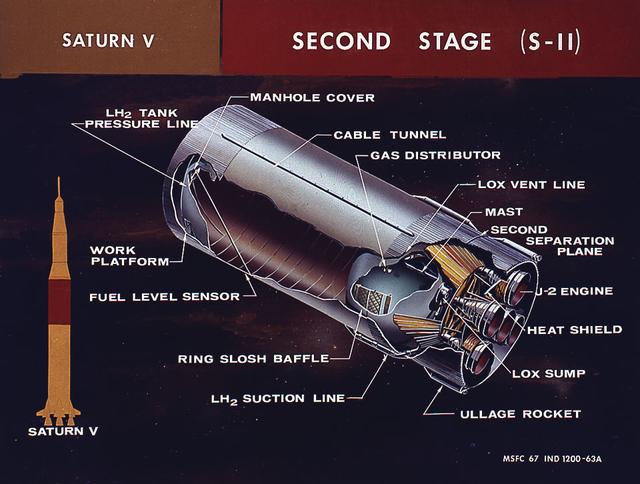
This cutaway illustration shows the Saturn V S-II (second) stage with callouts of major components. When the Saturn V first stage burns out and drops away, power for the Saturn was provided by the S-II (second) stage with five J-2 engines which produced a total of 1,150,000 pounds of thrust. Four outer engines are placed in a square pattern with gimbaling capability for control and guidance, with the fifth engine fixed rigidly in the center.
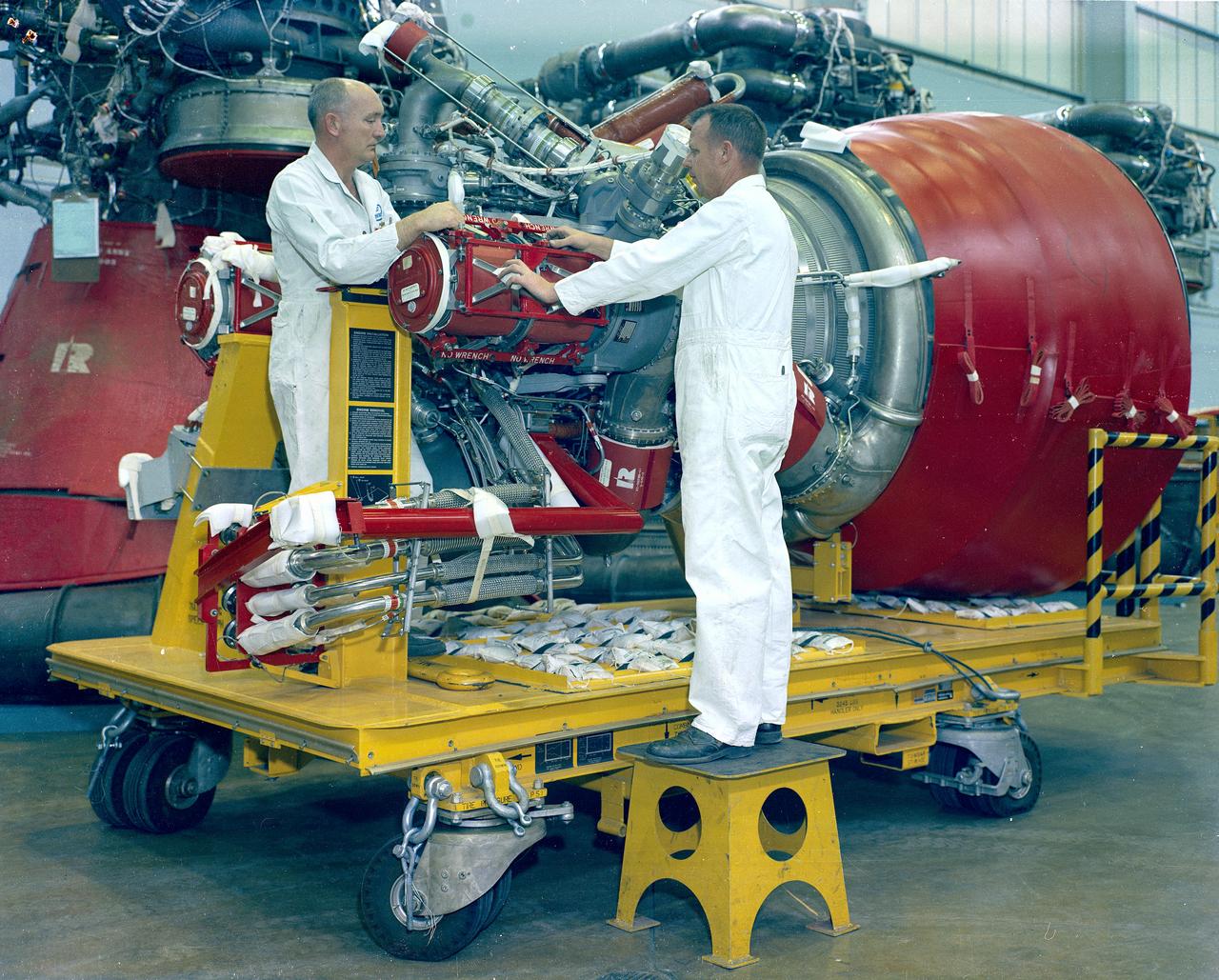
Pictured is a J-2 engine being processed at Marshall Space Flight Center (MSFC). A single J-2 engine was utilized on the S-IVB stage, the second stage of the Saturn IB and the third stage of the Saturn V vehicles, while a cluster of five J-2 engines powered the second (S-II) stage of the Saturn V launch vehicle. The Saturn V was designed, developed, and tested by engineers at MSFC.
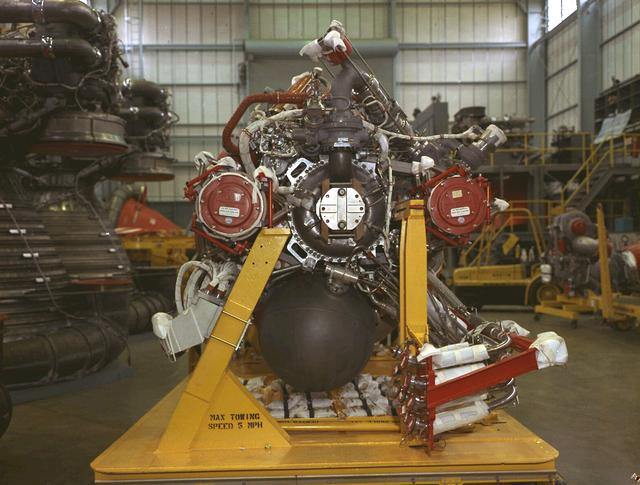
Pictured is a J-2 engine being processed at Marshall Space Flight Center (MSFC). A single J-2 engine was utilized on the S-IVB stage, the second stage of the Saturn IB and the third stage of the Saturn V vehicles, while a cluster of five J-2 engines powered the second (S-II) stage of the Saturn V launch vehicle. The Saturn V was designed, developed, and tested by engineers at MSFC.
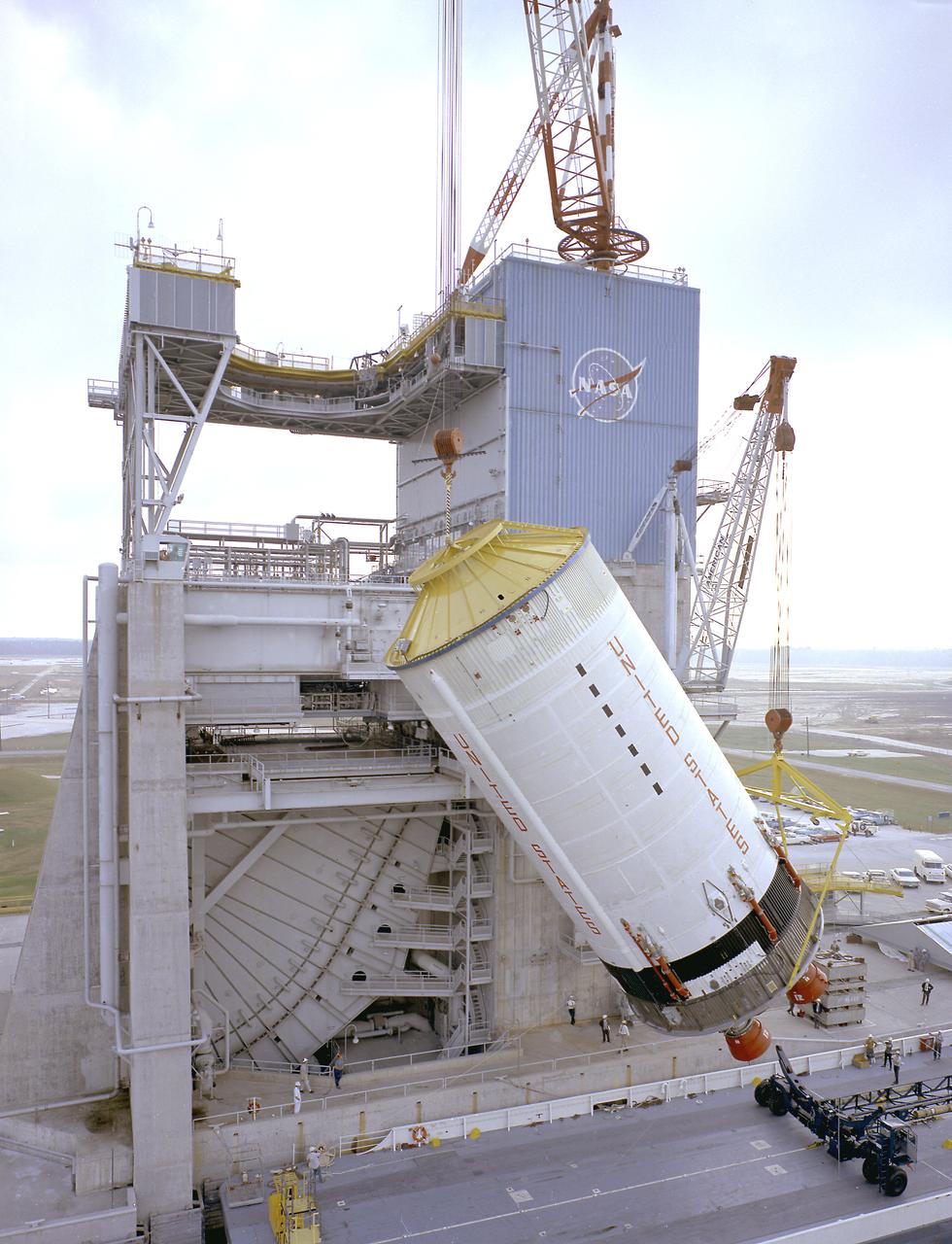
This photograph shows the Saturn V S-II (second) stage being hoisted at the S-II-A2 test stand at the Mississippi Test Facility (MTF). When the Saturn V booster stage (S-IC) burns out and drops away, power for the Saturn will be provided by the 82-foot-long and 33-foot-diameter S-II stage. Developed by the Space Division of North American Aviation under the direction of the Marshall Space Flight Center, the stage utilized five J-2 engines, each producing 200,000 pounds of thrust. The engines used liquid oxygen and liquid hydrogen as propellants. Static test of ground test versions of the S-II stage were conducted at North American Aviation's Santa Susana, California test site. All flight stages were tested at the Mississippi Test Facility, Bay St. Louis, Mississippi. MTF was renamed to the National Space Technology Laboratory (NSTL) in 1974 and later to the Sternis Space Center in May 1988.
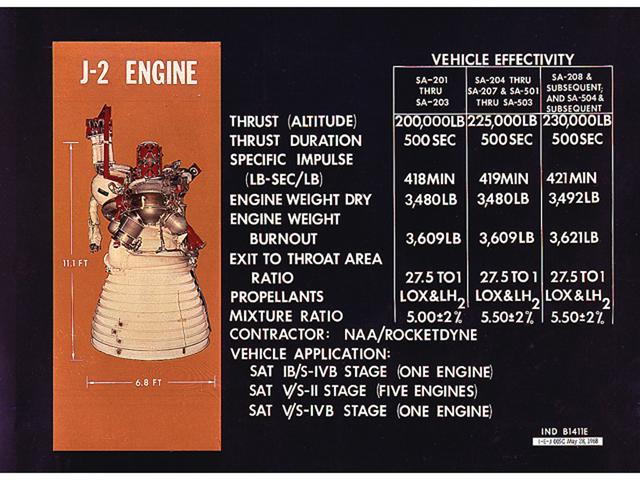
This chart is an illustration of J-2 Engine characteristics. A cluster of five J-2 engines powered the Saturn V S-II (second) stage with each engine providing a thrust of 200,000 pounds. A single J-2 engine powered the S-IVB stage, the Saturn IB second stage, and the Saturn V third stage. The engine was uprated to provide 230,000 pounds of thrust for the fourth Apollo Saturn V flight and subsequent missions. Burning liquid hydrogen as fuel and using liquid oxygen as the oxidizer, the cluster of five J-2 engines for the S-II stage burned over one ton of propellant per second, during about 6 1/2 minutes of operation, to take the vehicle to an altitude of about 108 miles and a speed of near orbital velocity, about 17,400 miles per hour.
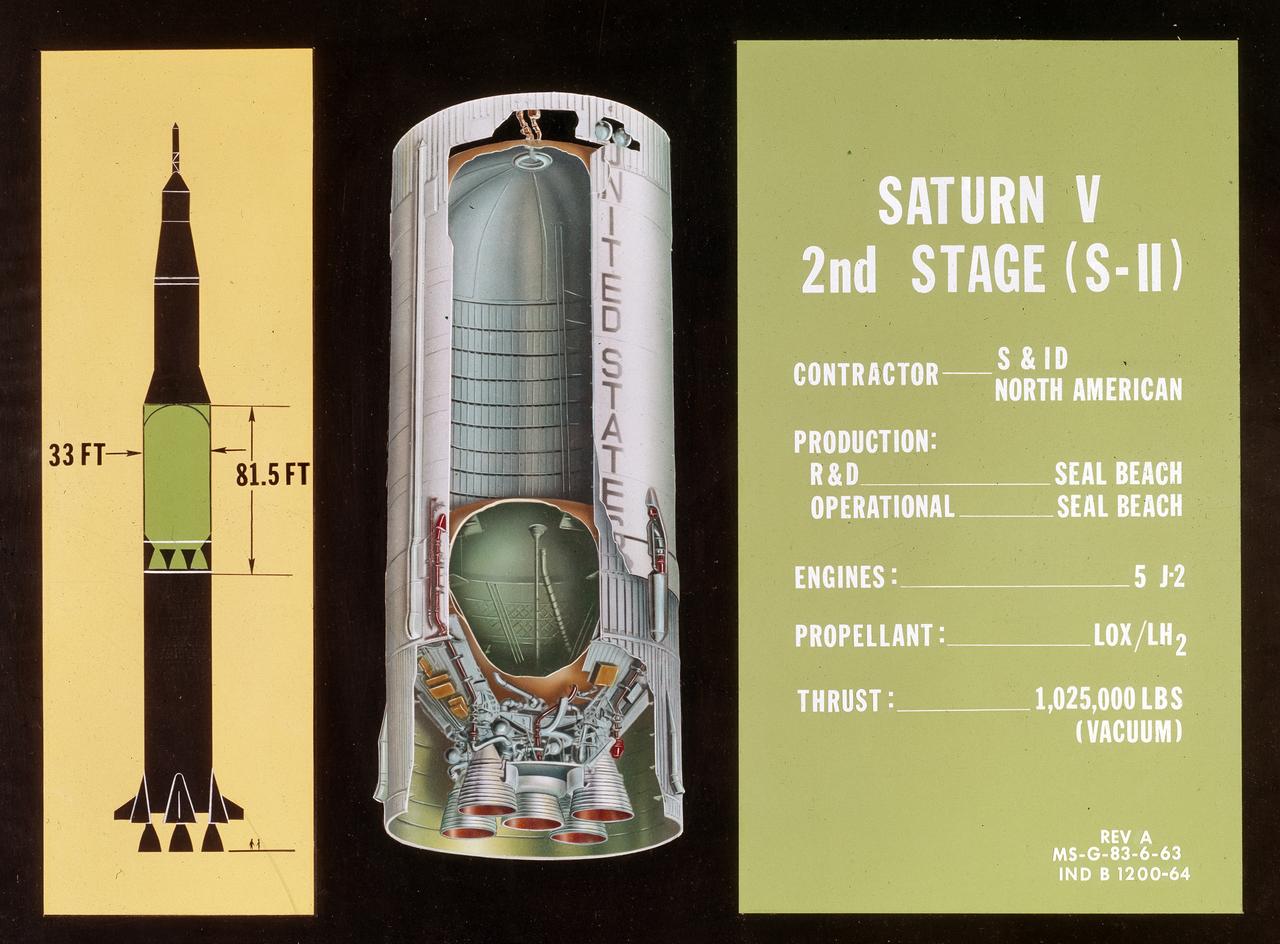
This illustration, with callouts, is of the Saturn V SII (2nd Stage) developed by the Space Division of North American Aviation under the direction of the Marshall Space Flight Center. The 82-foot-long and 33-foot-diameter S-II stage utilized five J-2 engines, each with a 200,000-pound thrust capability. The engine used liquid oxygen and liquid hydrogen as its propellants.
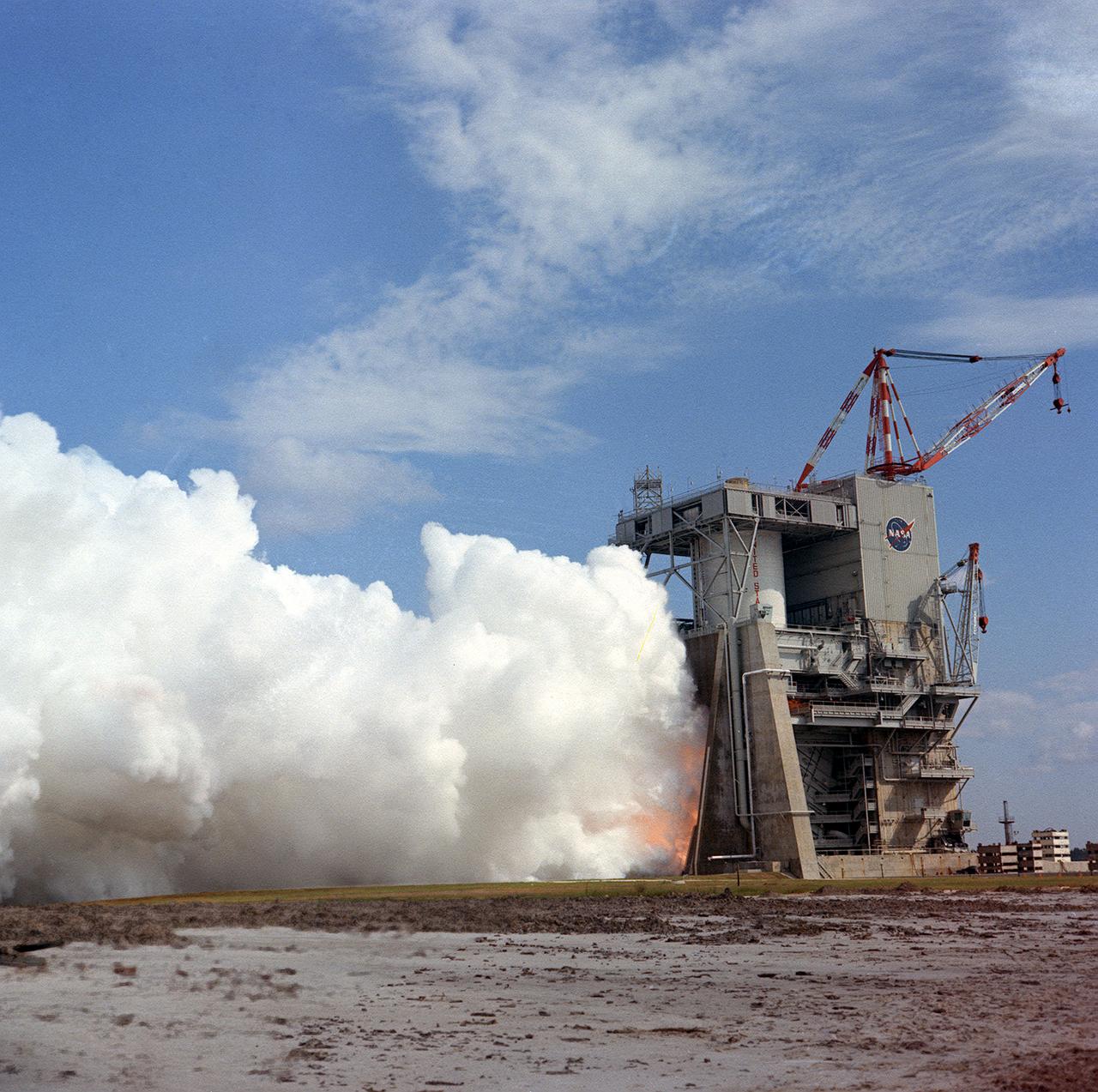
This photograph shows a test firing of the the Saturn V S-II (second) stage at the Mississippi Test Facility's (MTF) S-II test stand. When the Saturn V booster stage (S-IC) burns out and drops away, power for the Saturn will be provided by the 82-foot-long and 33-foot-diameter S-II stage. Developed by the Space Division of North American Aviation under the direction of the Marshall Space Flight Center, the stage utilized five J-2 engines, each producing 200,000 pounds of thrust. The engines used liquid oxygen and liquid hydrogen as propellants. Static test of ground test versions of the S-II stage were conducted at North American Aviation's Santa Susana, California test site. All flight stages were tested at the Mississippi Test Facility, Bay St. Louis, Mississippi. MTF was renamed to the National Space Technology Laboratory (NSTL) in 1974 and later to the Sternis Space Center in May 1988.
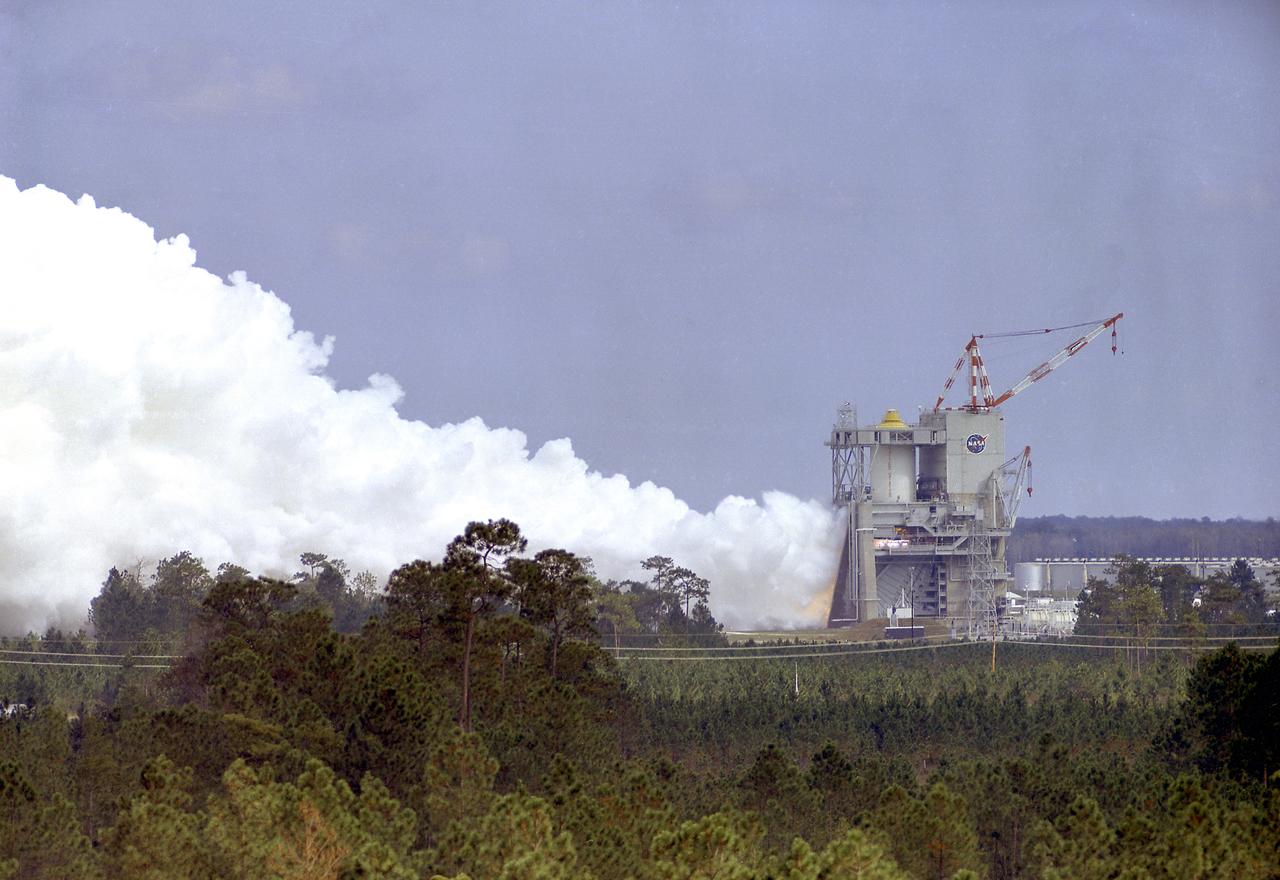
This photograph shows a test firing of the the Saturn V S-II (second) stage at the Mississippi Test Facility's (MTF) S-II test stand. When the Saturn V booster stage (S-IC) burns out and drops away, power for the Saturn will be provided by the 82-foot-long and 33-foot-diameter S-II stage. Developed by the Space Division of North American Aviation under the direction of the Marshall Space Flight Center, the stage utilized five J-2 engines, each producing 200,000 pounds of thrust. The engine used liquid oxygen and liquid hydrogen as its propellants. Static test of ground test versions of the S-II stage were conducted at North American Aviation's Santa Susana, California test site. All flight stages were tested at the Mississippi Test Facility, Bay St. Louis, Mississippi. The MTF was renamed to the National Space Technology Laboratory (NSTL) in 1974 and later to the Sternis Space Center (SSC) in May 1988.
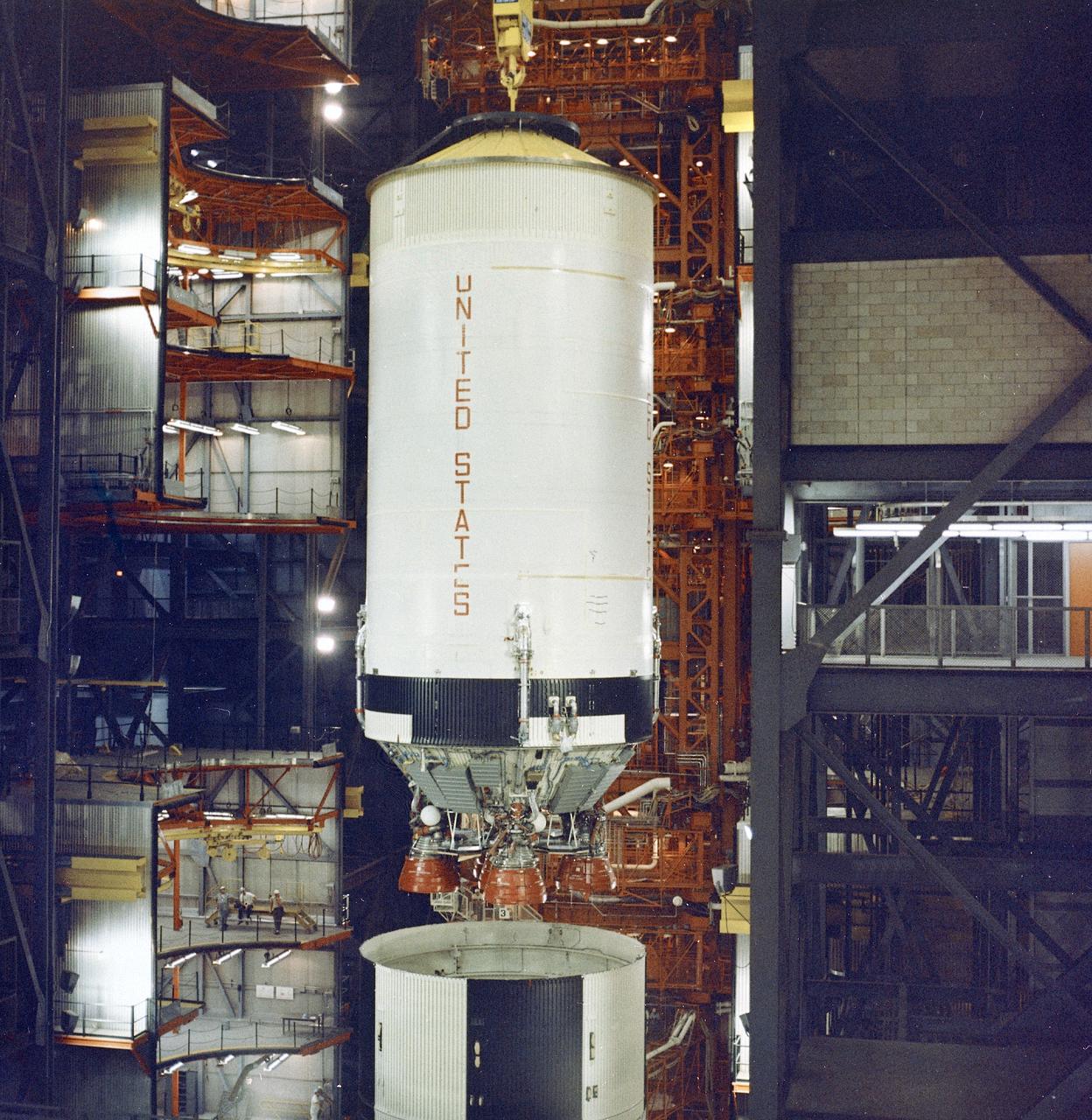
This photograph shows the Saturn V S-II (second) stage of the Apollo 6 mission being lowered atop of the S-IC (first) stage during the final assembly operations in the Vehicle Assembly Building (VAB) at the Kennedy Space Center. The Apollo 6 mission was the second Saturn V unmanned flight for testing an emergency detection system. The launch occurred on April 4, 1968.
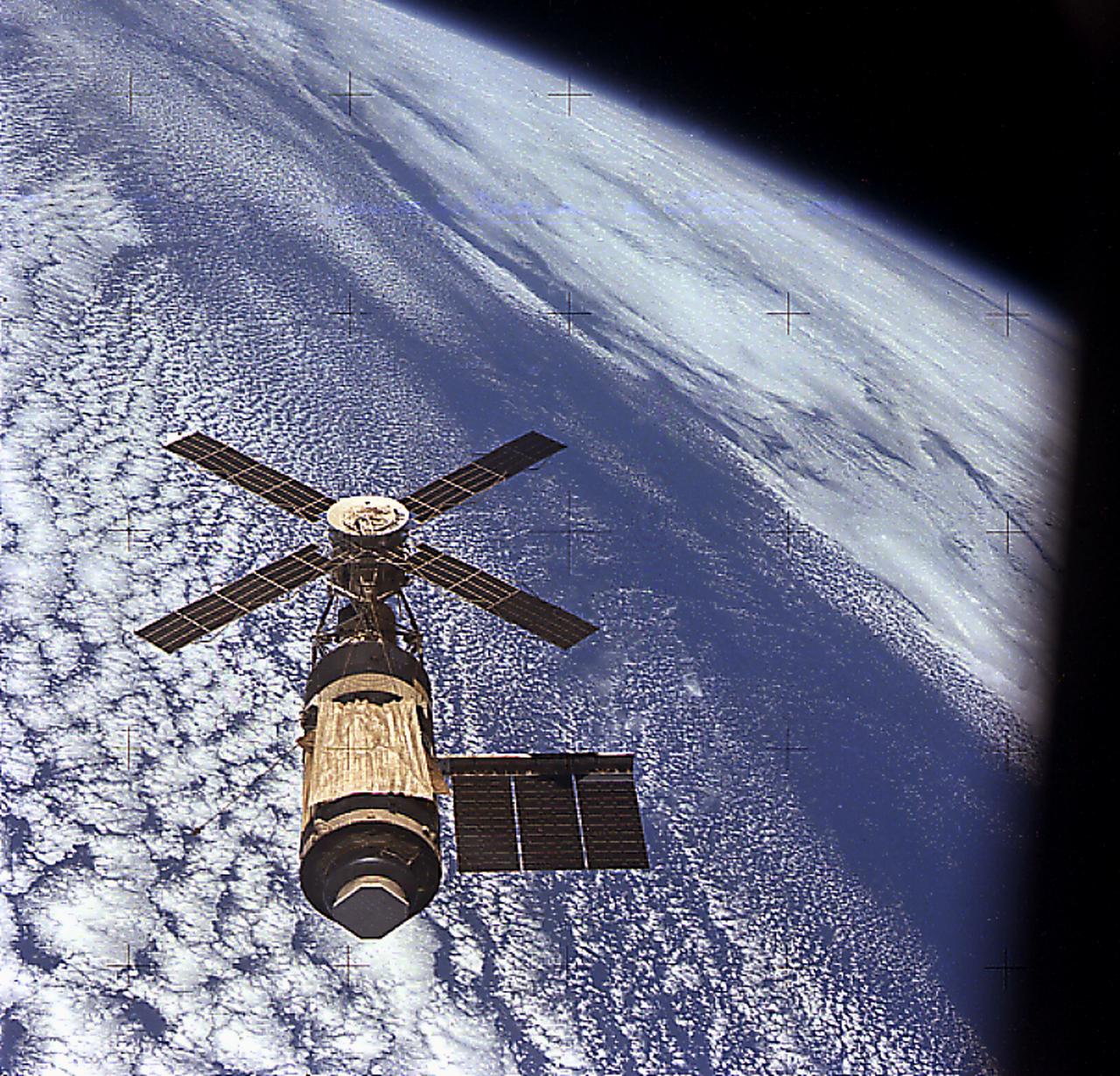
The idea that ultimately became Skylab first surfaced in 1962 as a proposal to convert a spent Saturn upper stage (Saturn V S-II stage) into an orbital workshop. In 1968, the Marshall Space Flight Center proposed an alternative to the wet workshop concept of refurbishing a space station in orbit. Instead, a fully equipped dry workshop could be launched as a complete unit ready for occupancy. Skylab became the free world's first space station. Launched in May 1973, the Skylab space station was occupied in succession by three teams of three crewmembers. These crews spent 28, 59, and 84 days respectively, orbiting the Earth and performing nearly 300 experiments. This view of Skylab in orbit was taken by the Skylab 4 (the last Skylab mission) crew.
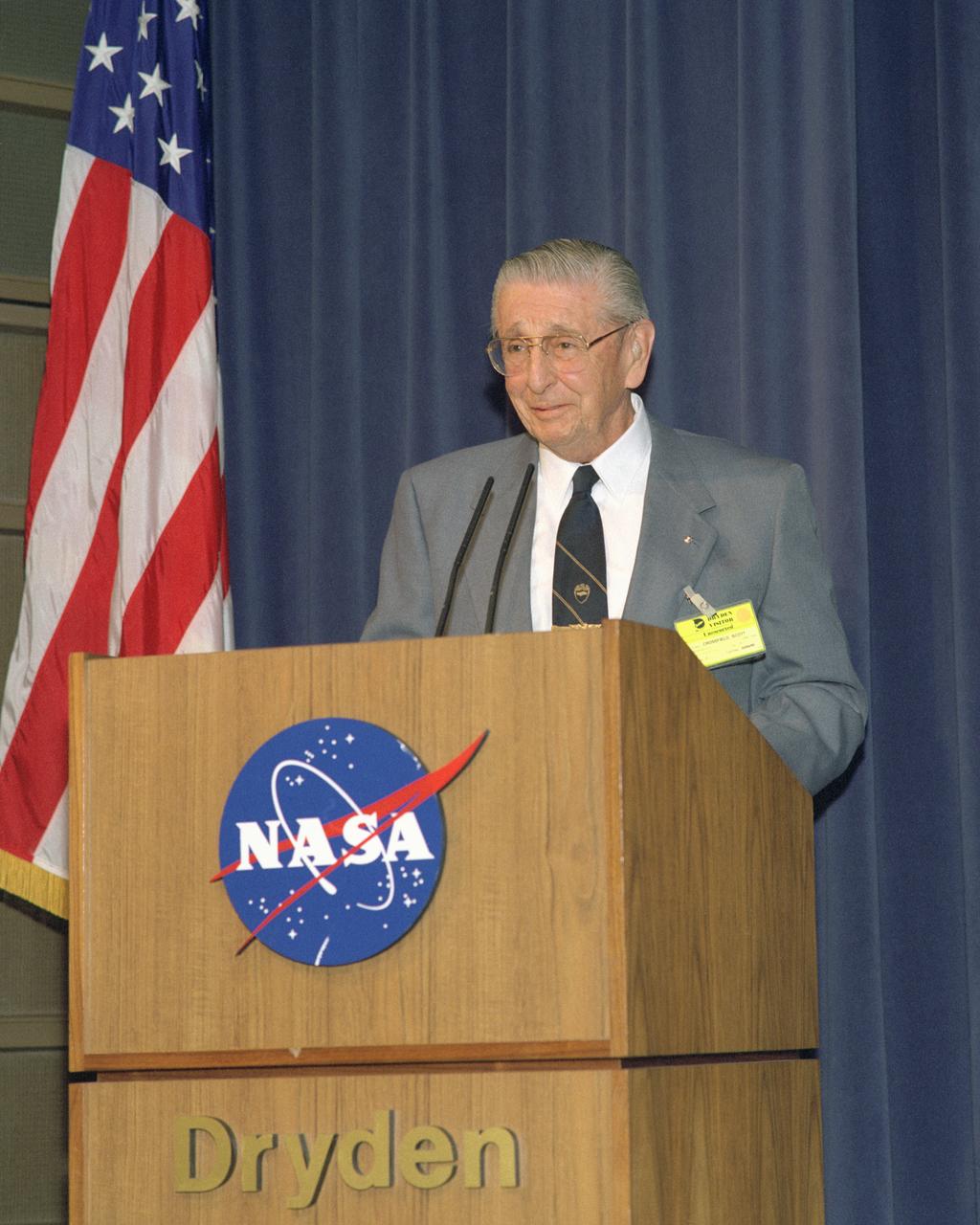
Former NACA test pilot Scott Crossfield at the 1998 "Men of Mach 2" symposium, an event celebrating his work in the 1950's on the D-558-II Skyrocket aircraft.
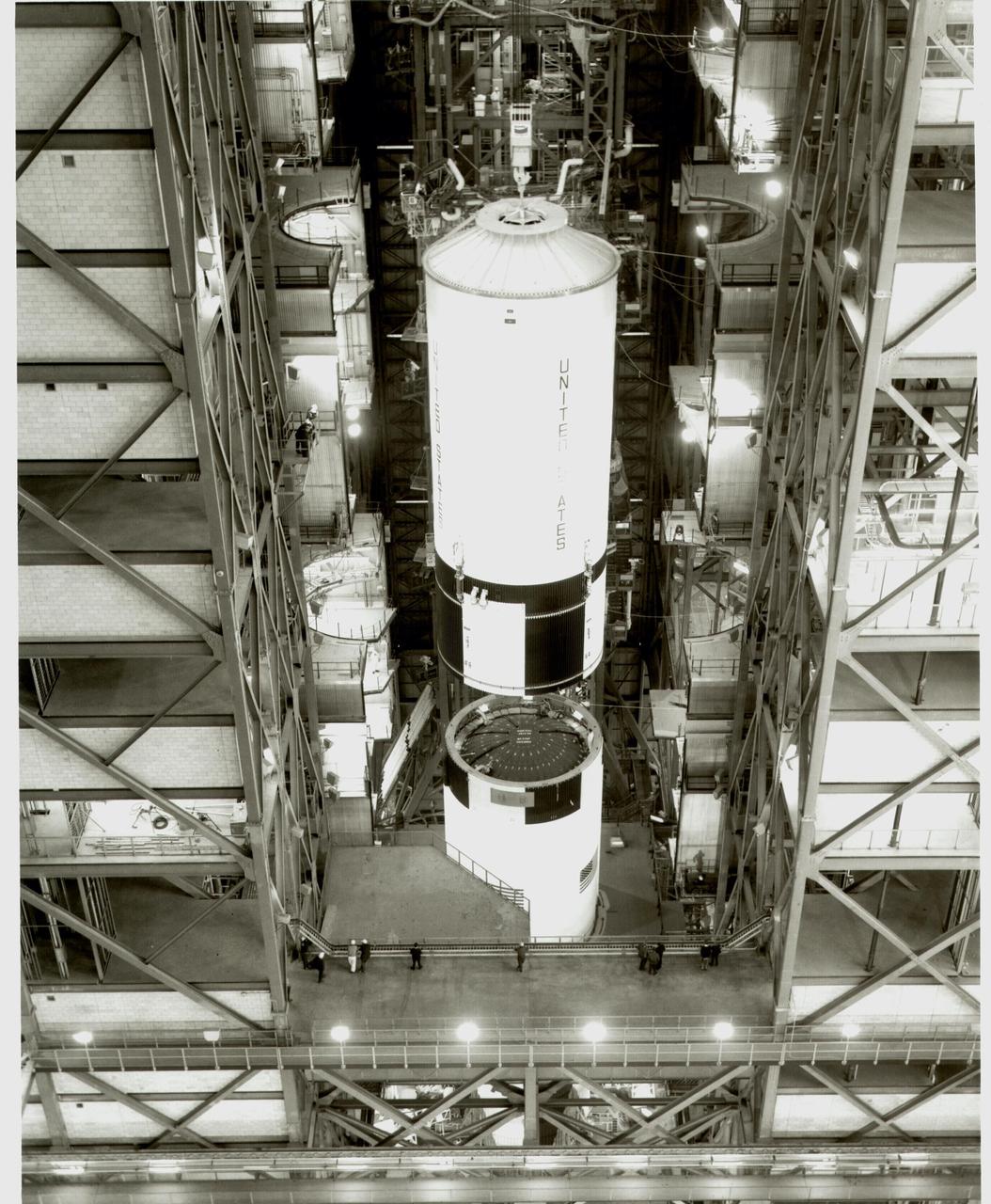
KENNEDY SPACE CENTER, FLA. - Stacking of S-II stage for Saturn 506.
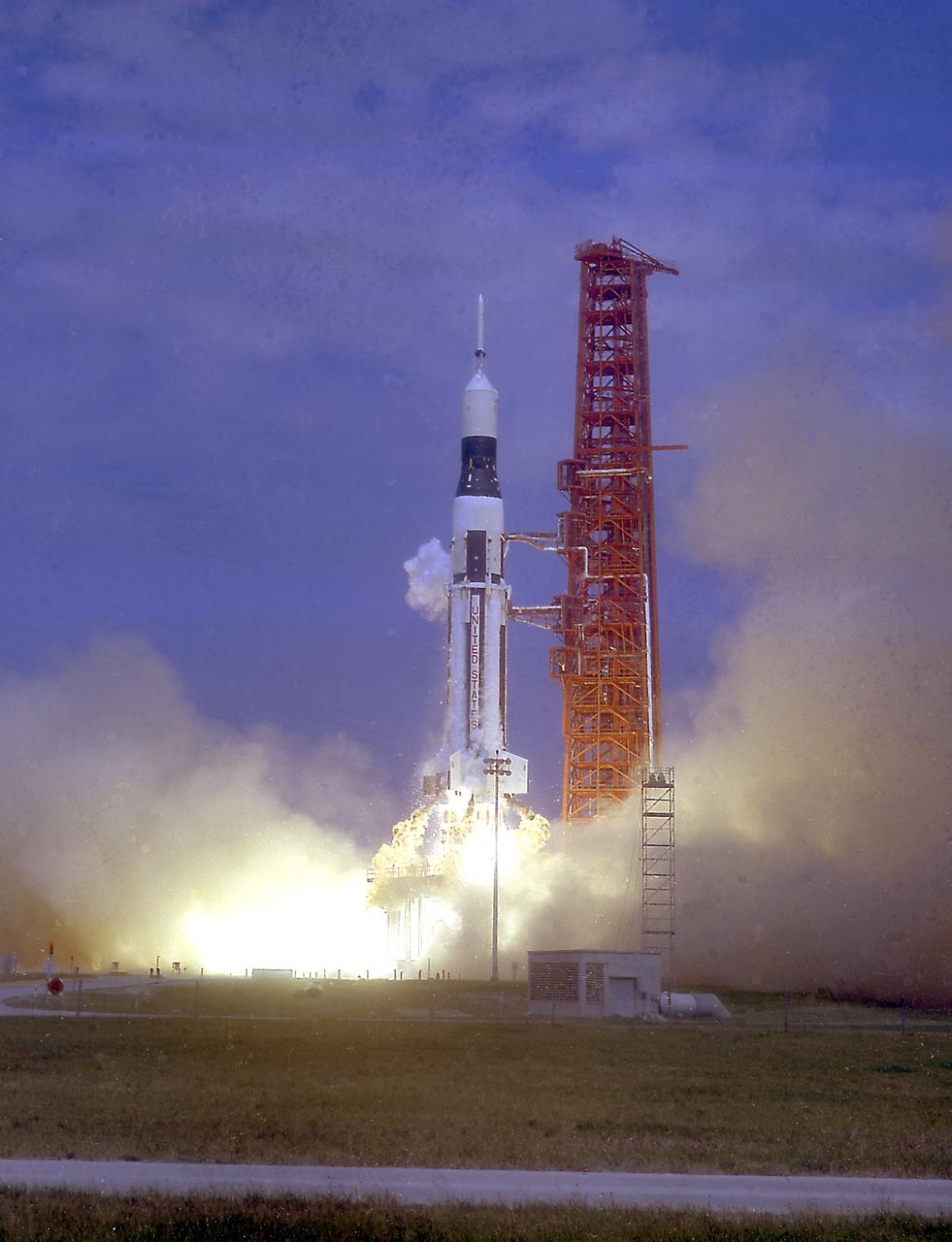
The launch of the SA-7 (Saturn I Block II) was on September 18, 1964. The SA-7 mission was the second orbital flight of the S-IV stage (second stage) with the payload consisting of the Apollo command and service module's instrument unit. The Saturn I Block II vehicle had two live stages, and were basically in the two-stage configuration of the Saturn I vehicle. While the tank arrangement and the engine patterns were the same, there were marked changes between the Block I and II versions. The first stage (S-I stage) was an improved version of the Block I S-I stage. The Block II S-1 stage had eight fins added for greater aerodynamic stability in the lower atmosphere.
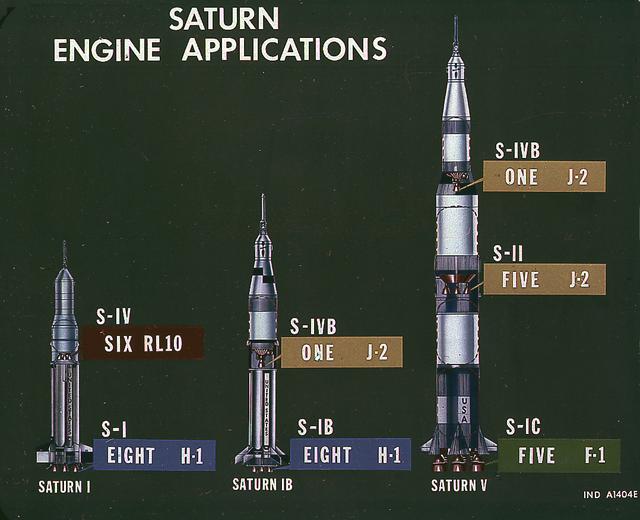
This image illustrates the basic differences between the three Saturn launch vehicles developed by the Marshall Space Flight Center. The Saturn I, consisted of two stages, the S-I (eight H-1 engines) and the S-IV (six RL-10 engines). The Saturn IB (center) also consisted of two stages, the S-IB (eight H-1 engines) and the S-IVB (one J-2 engine). The Saturn V consisted of three stages, the S-IC (five F-1 engines), the S-II (five J-2 engines), and the S-IVB (one J-2 engine).
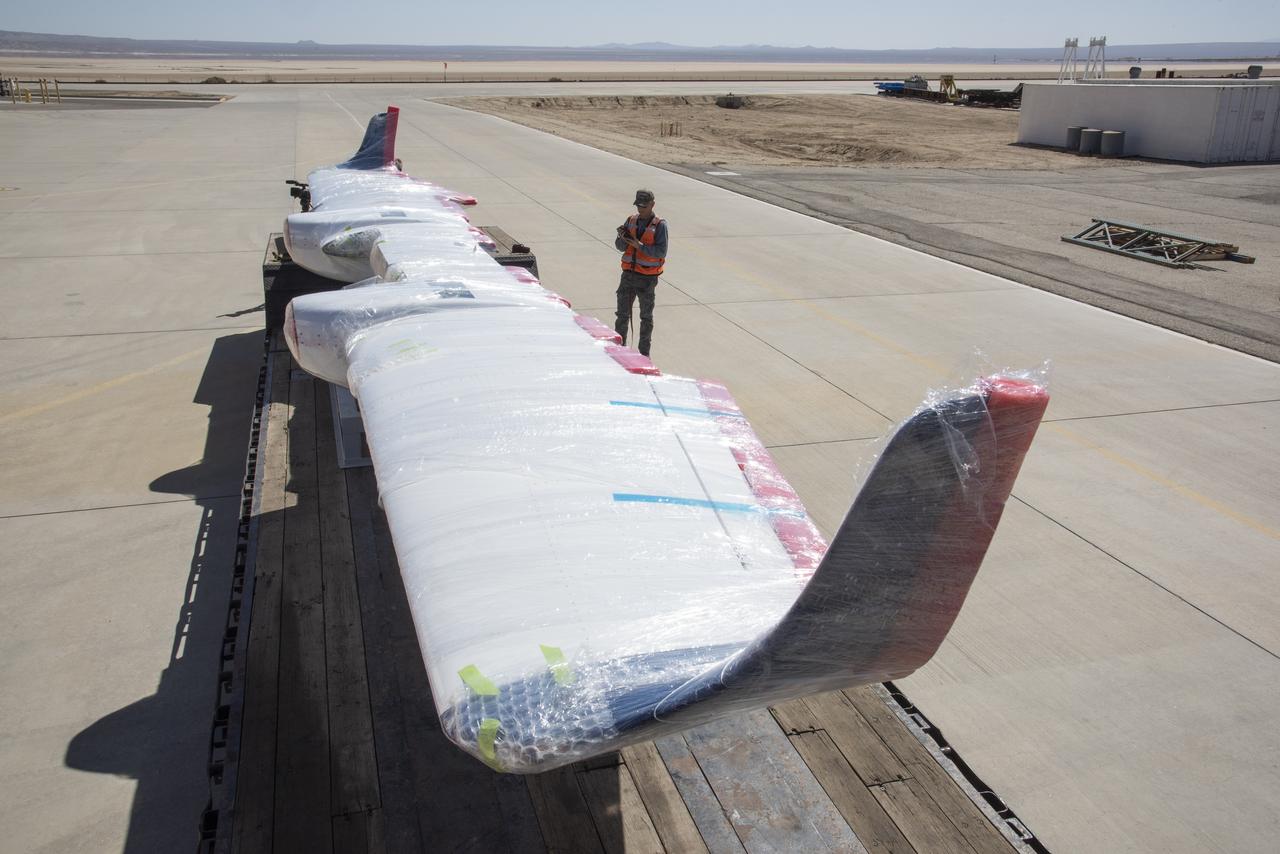
NASA’s X-57 Maxwell, the agency’s first all-electric X-plane and first crewed X-planed in two decades, is delivered to NASA’s Armstrong Flight Research Center in Edwards, California in its Mod II configuration. The first of three primary modifications for the project, Mod II involves testing of the aircraft’s cruise electric propulsion system. Delivery to NASA from prime contractor Empirical Systems Aerospace of San Luis Obispo, California, marks a major milestone for the project, at which point the vehicle is reintegrated for ground tests, to be followed by taxi tests, and eventually, flight tests. X-57’s goal is to further advance the design and airworthiness process for distributed electric propulsion technology for general aviation aircraft, which can provide multiple benefits to efficiency, emissions, and noise.
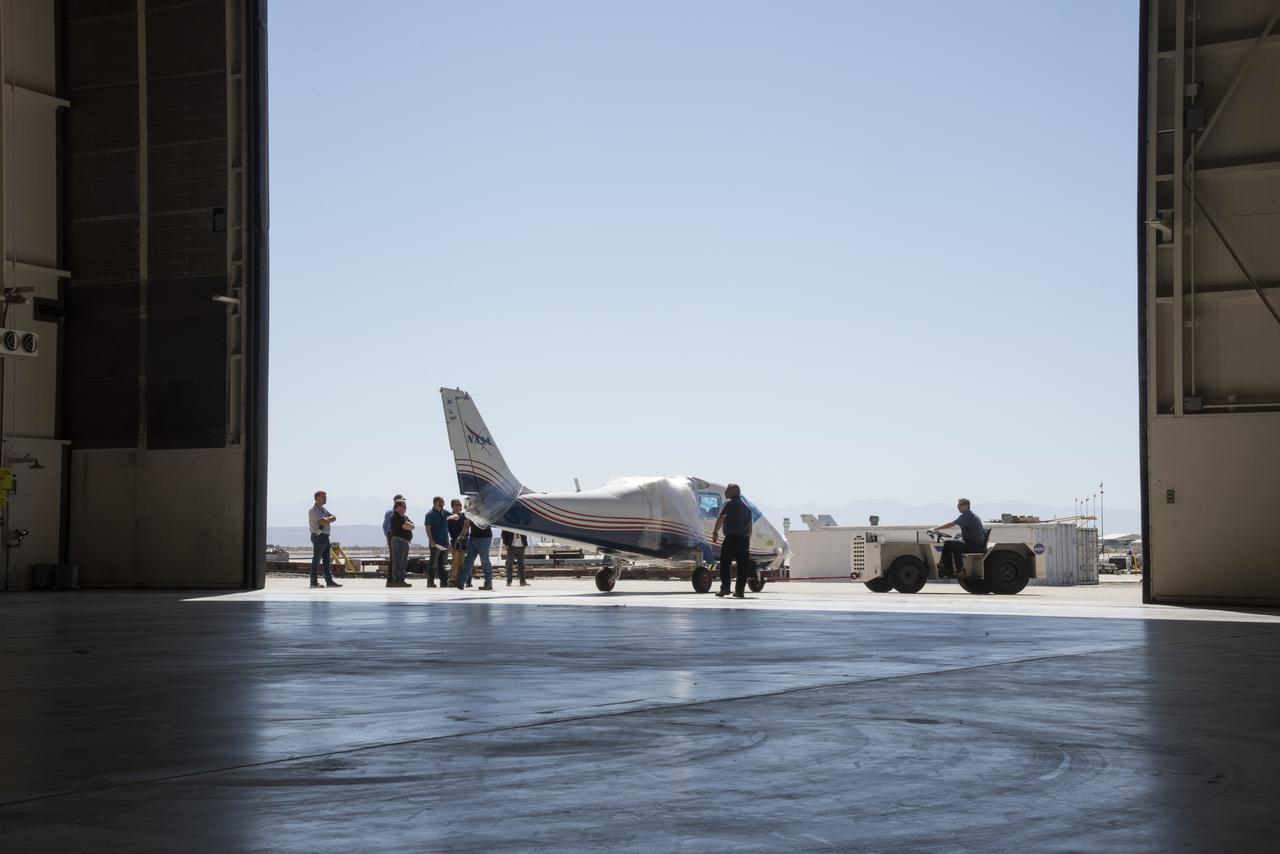
NASA’s X-57 Maxwell, the agency’s first all-electric X-plane and first crewed X-planed in two decades, is delivered to NASA’s Armstrong Flight Research Center in Edwards, California in its Mod II configuration. The first of three primary modifications for the project, Mod II involves testing of the aircraft’s cruise electric propulsion system. Delivery to NASA from prime contractor Empirical Systems Aerospace of San Luis Obispo, California, marks a major milestone for the project, at which point the vehicle is reintegrated for ground tests, to be followed by taxi tests, and eventually, flight tests. X-57’s goal is to further advance the design and airworthiness process for distributed electric propulsion technology for general aviation aircraft, which can provide multiple benefits to efficiency, emissions, and noise.
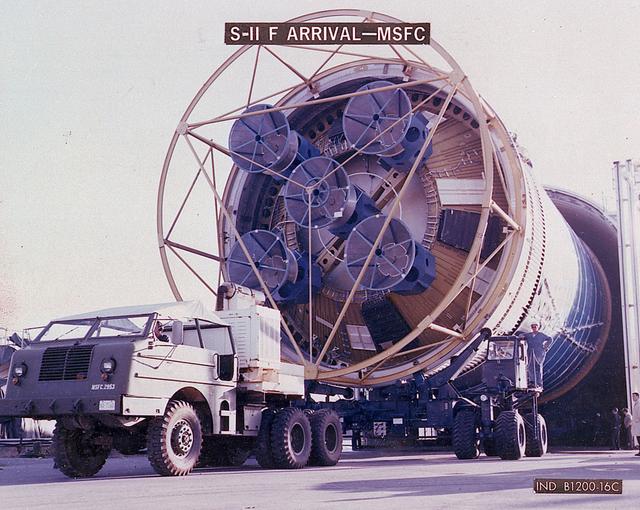
The business end of a Second Stage (S-II) slowly emerges from the shipping container as workers prepare to transport the Saturn V component to the testing facility at MSFC. The Second Stage (S-II) underwent vibration and engine firing tests. The towering 363-foot Saturn V was a multi-stage, multi-engine launch vehicle standing taller than the Statue of Liberty. Altogether, the Saturn V engines produced as much power as 85 Hoover Dams.
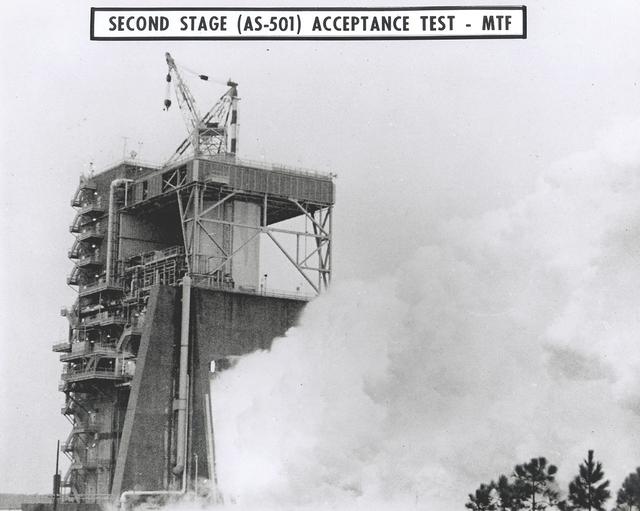
This photograph shows a test firing of a Saturn V second stage (S-II) on the S-IC test stand at the Propulsion Test Facility near New Orleans, Louisiana. This second stage component was used in the unmarned test flight of Apollo 4.
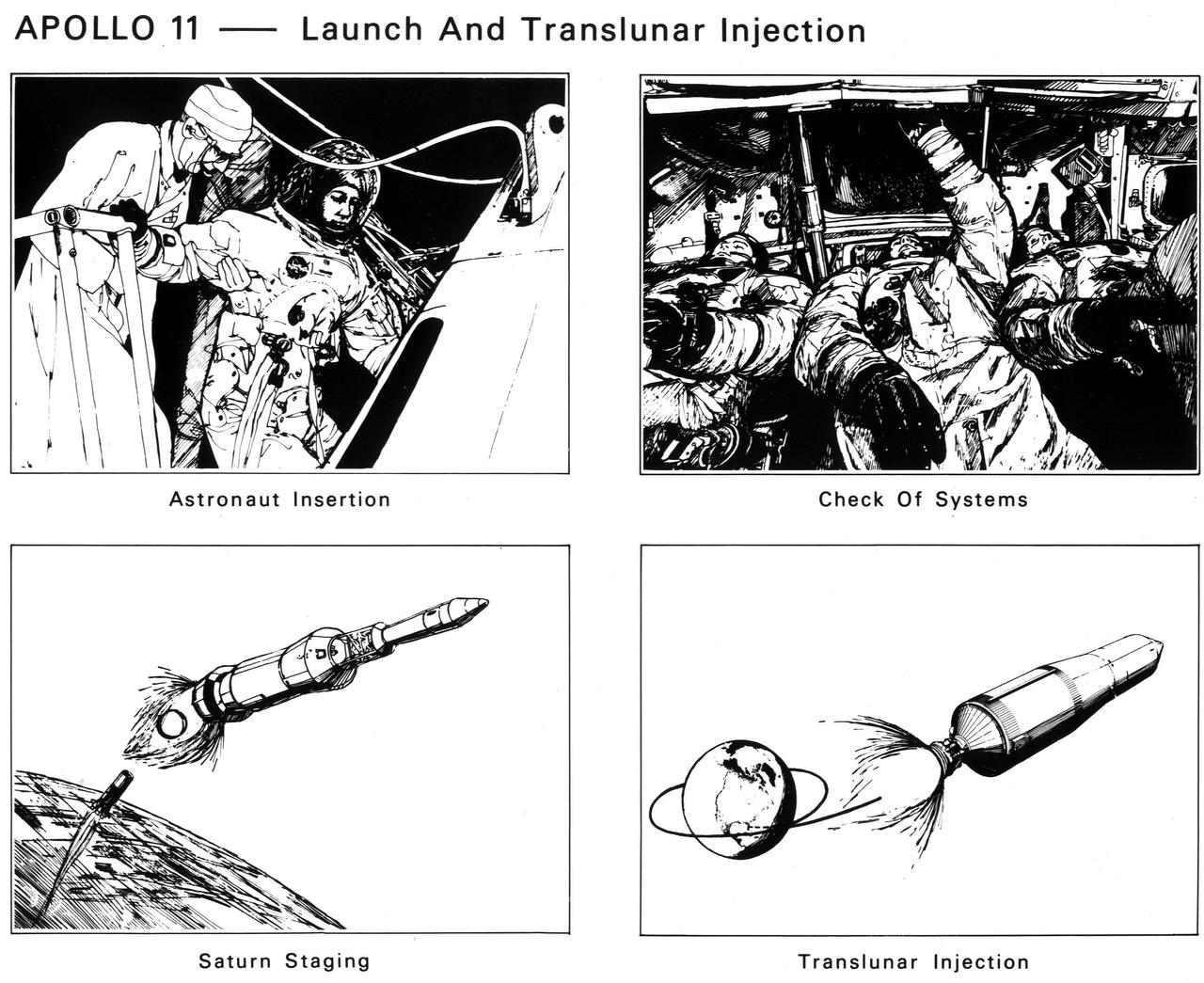
The astronauts enter the spacecraft. After launch and Saturn V first-stage burnout and jettison, the S-II second stage ignites. The crew checks spacecraft systems in Earth orbit before the S-IVB third stage ignites the second time to send Apollo 11 to the Moon
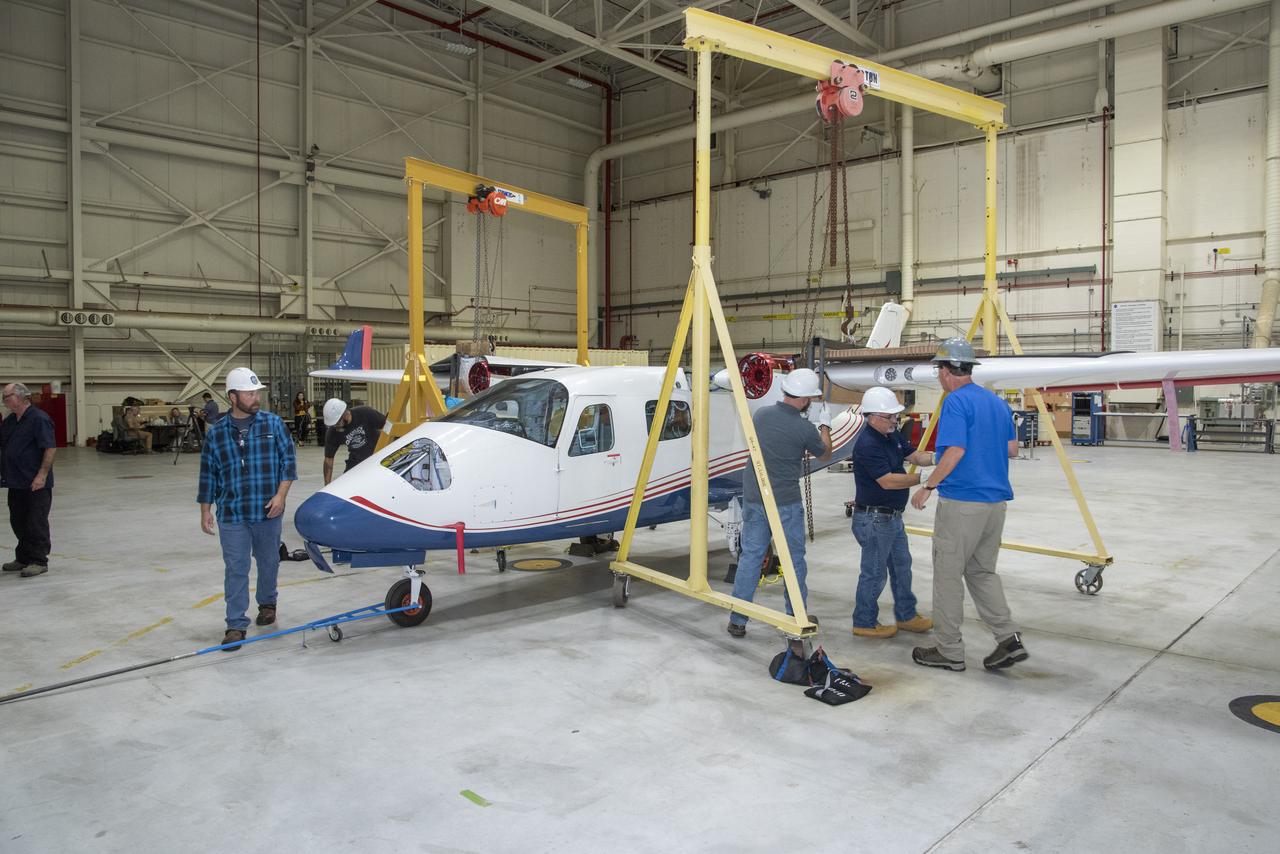
The X-57 Mod II wing is rejoined with the aircraft's fuselage to begin preparations for reintegration at NASA's Armstrong Flight Research Center in California. X-57's Mod II configuration, the first of three primary modifications for the project, involves testing of the aircraft's cruise electric propulsion system.
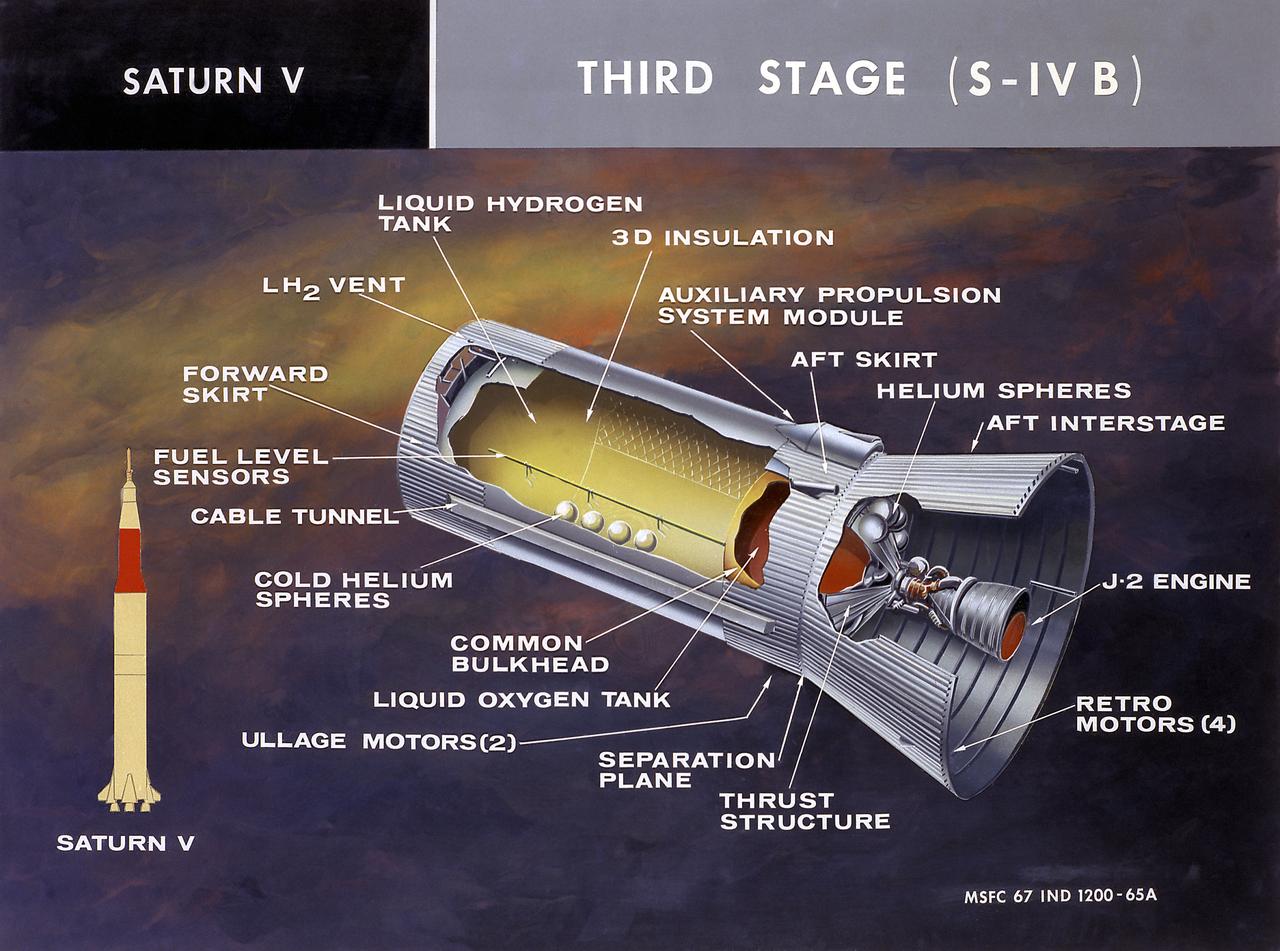
This cutaway illustration shows the Saturn V S-IVB (third) stage with the callouts of its major components. When the S-II (second) stage of the powerful Saturn V rocket burnt out and was separated the remaining units approached orbit around the Earth. Injection into the desired orbit was attaineded as the S-IVB (third stage) was ignited and burnt. The S-IVB stage was powered by a single 200,000-pound thrust J-2 engine and had a re-start capability built in for its J-2 engine. The S-IVB restarted to speed the Apollo spacecraft to escape velocity injecting it and the astronauts into a moon trajectory.
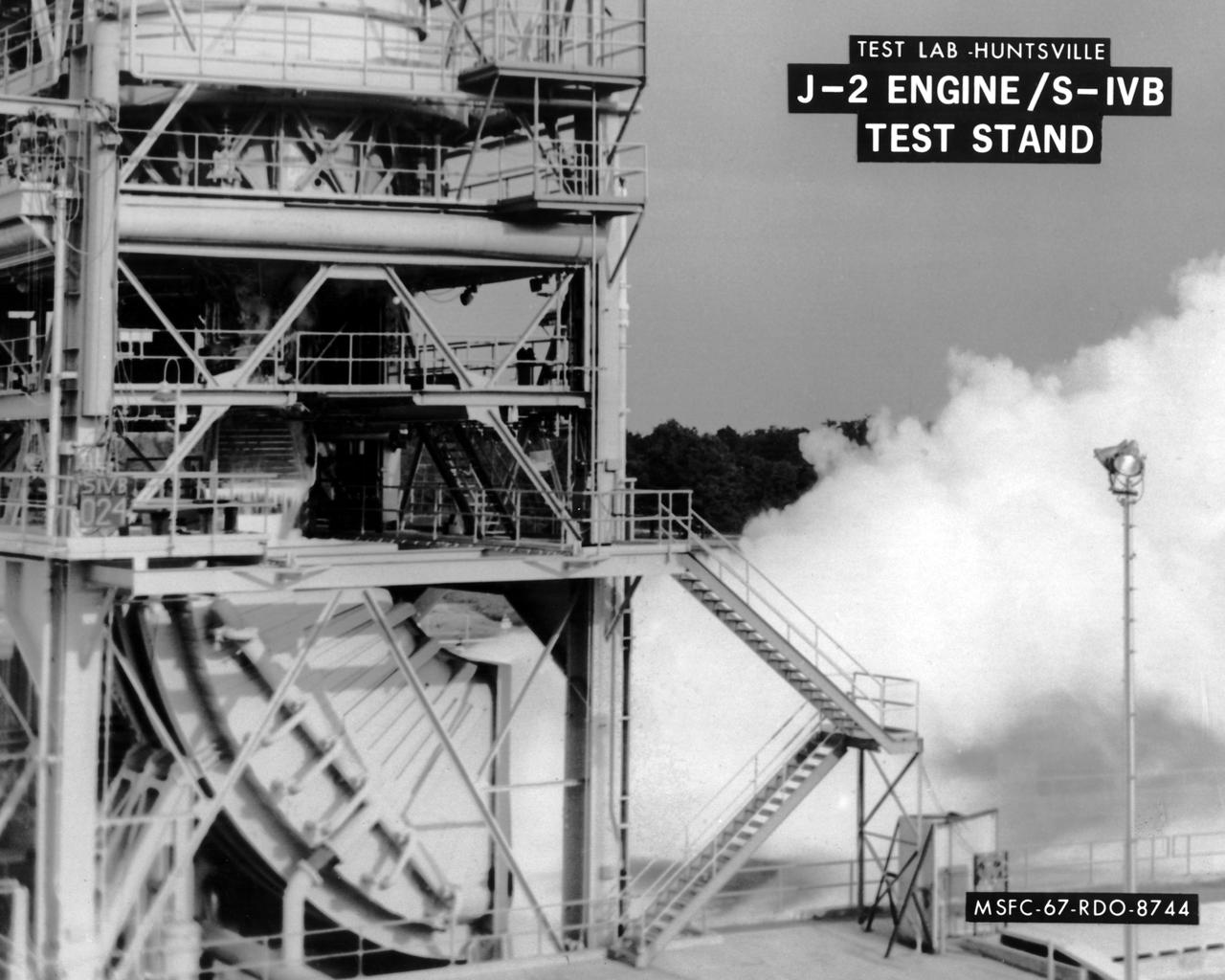
This image depicts the test firing of a J-2 engine in the S-IVB Test Stand at the Marshall Space Flight Center (MSFC). The J-2, developed by Rocketdyne under the direction of MSFC, was propelled by liquid hydrogen and liquid oxygen. A single J-2 was utilized in the S-IVB stage (the second stage for the Saturn IB and third stage for the Saturn V) and in a cluster of five for the second stage (S-II) of the Saturn V. Initially rated at 200,000 pounds of thrust, the engine was later upgraded in the Saturn V program to 230,000 pounds.

JSC2009-E-205680 (September 2009) --- Computer-generated artist?s rendering of the International Space Station as of Sept 21, 2009. Progress 34 resupply vehicle undocks from the Zvezda Service Module?s aft port. Soyuz 18 (TMA-14) remains docked to the Pirs Docking Compartment and Soyuz 19 (TMA-15) remains linked to the Zarya nadir port. Japanese H-II Transfer Vehicle (HTV) remains docked to the Harmony node?s nadir port.
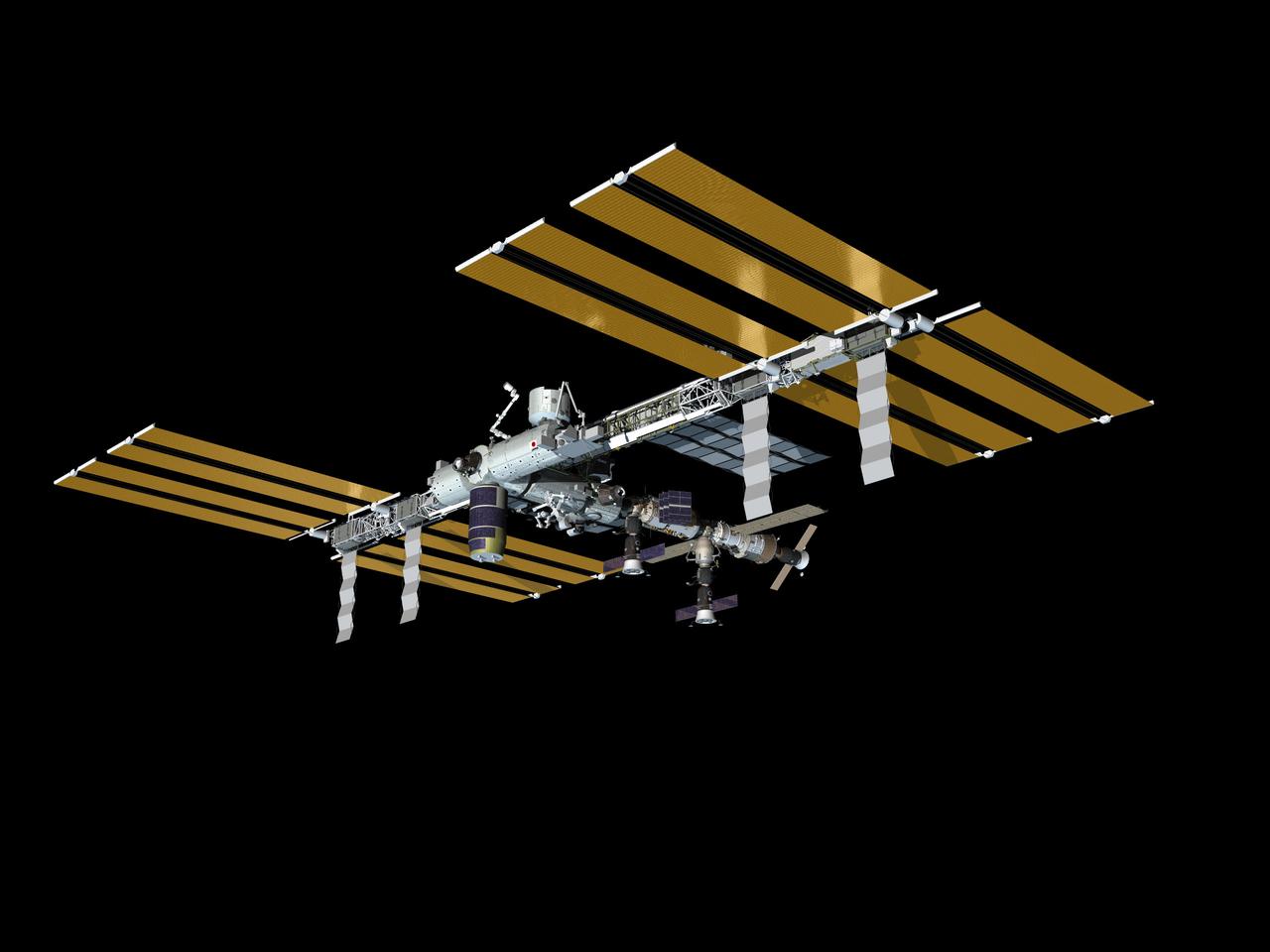
JSC2009-E-205679 (September 2009) --- Computer-generated artist?s rendering of the International Space Station as of Sept 17, 2009. Japanese H-II Transfer Vehicle (HTV) is berthed to the Harmony node?s nadir port. Soyuz 18 (TMA-14) remains docked to the Pirs Docking Compartment and Soyuz 19 (TMA-15) remains linked to the Zarya nadir port. Progress 34 resupply vehicle remains docked to the Zvezda Service Module?s aft port.
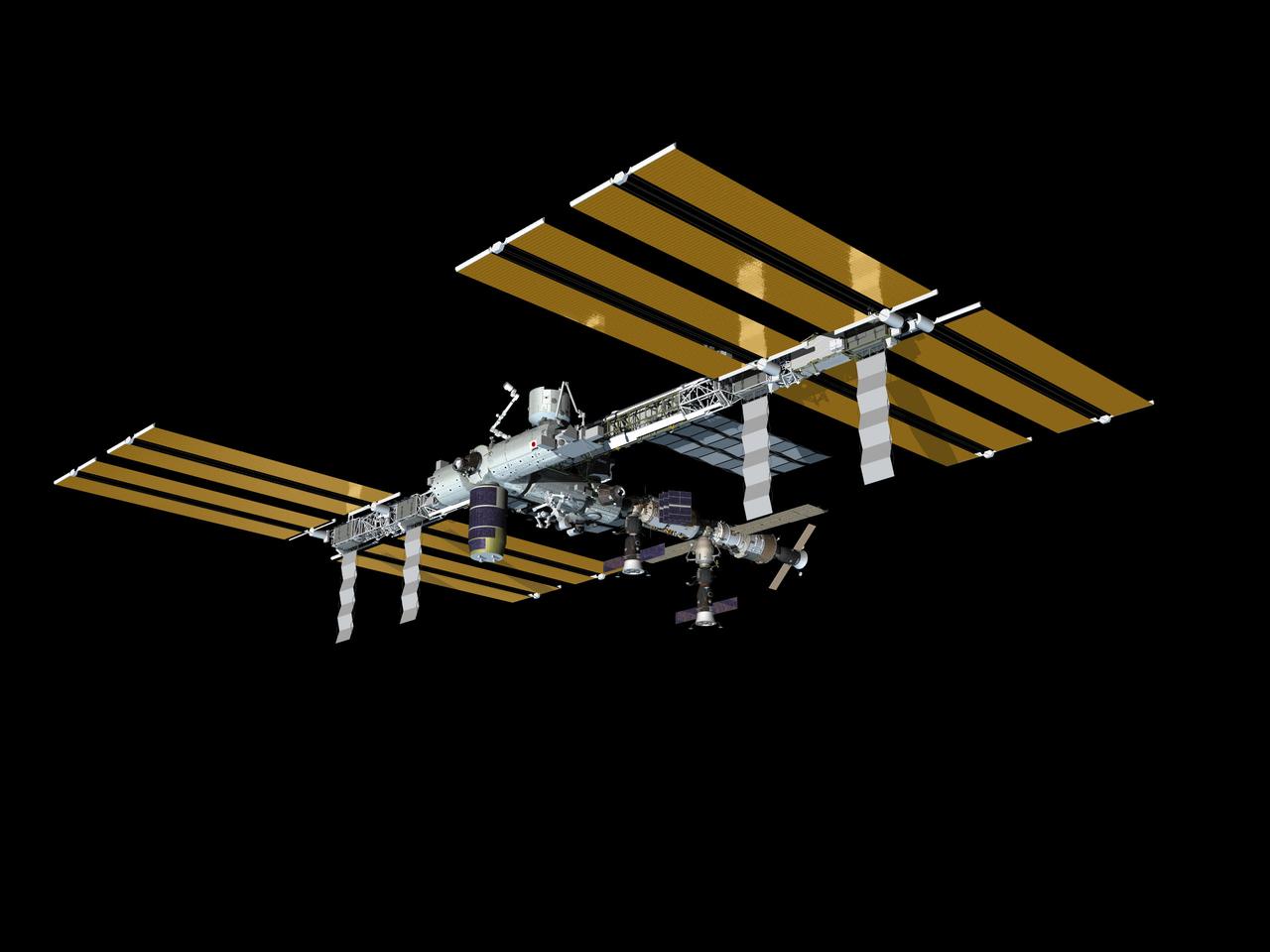
JSC2009-E-215176 (October 2009) --- Computer-generated artist?s rendering of the International Space Station as of Oct. 17, 2009. Progress 35 resupply vehicle docks to the Pirs Docking Compartment. Soyuz 20 (TMA-16) is docked to the Zvezda Service Module?s aft port and Soyuz 19 (TMA-15) remains linked to the Zarya nadir port. The Japanese H-II Transfer Vehicle (HTV) is berthed to the Harmony node?s nadir port.
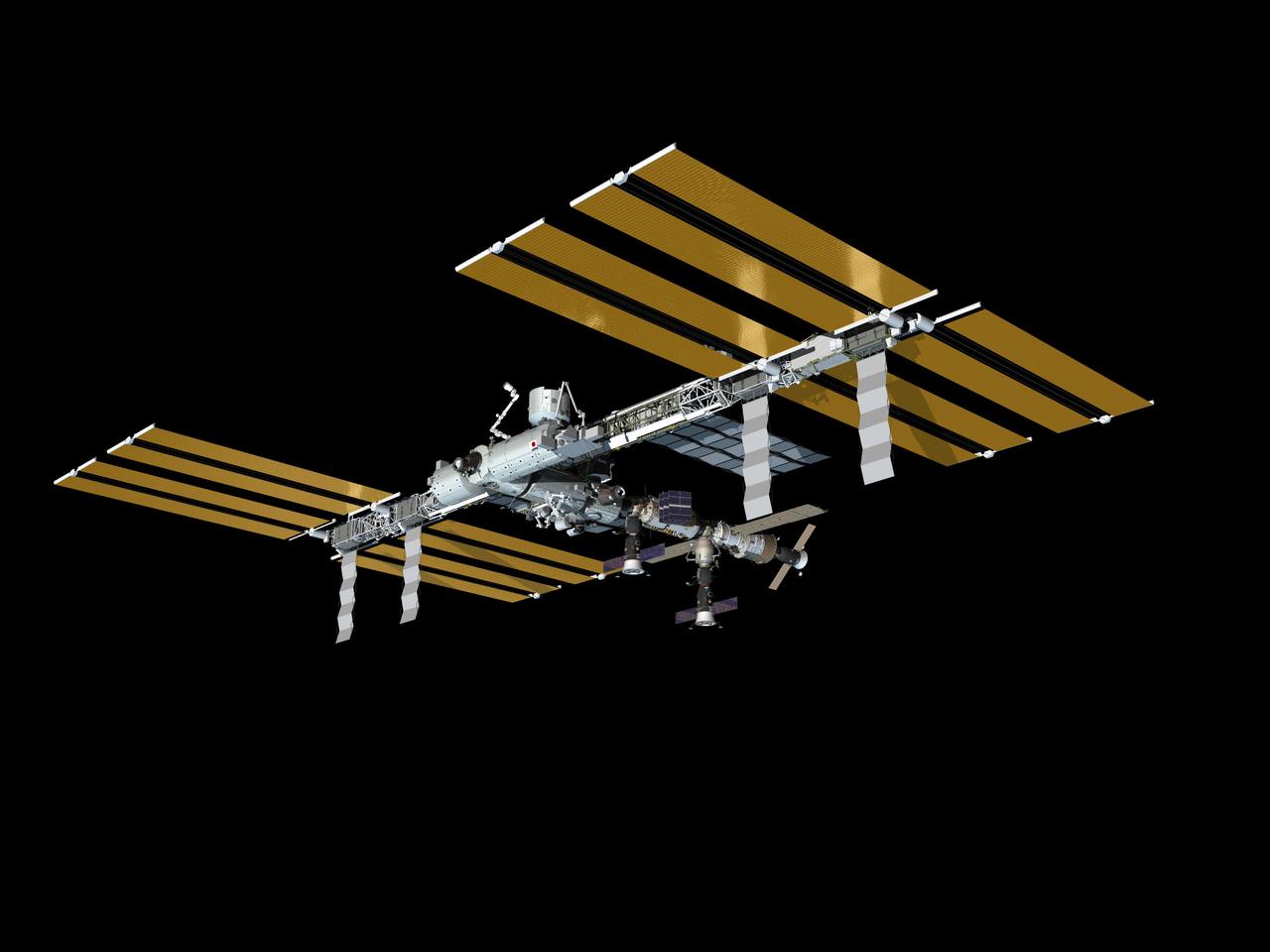
JSC2009-E-223488 (October 2009) --- Computer-generated artist?s rendering of the International Space Station as of Oct. 30, 2009. Japanese H-II Transfer Vehicle (HTV) is unberthed from the Harmony node?s nadir port. Soyuz 19 (TMA-15) remains docked to the Zarya nadir port and Soyuz 20 (TMA-16) remains linked to the Zvezda Service Module?s aft port.
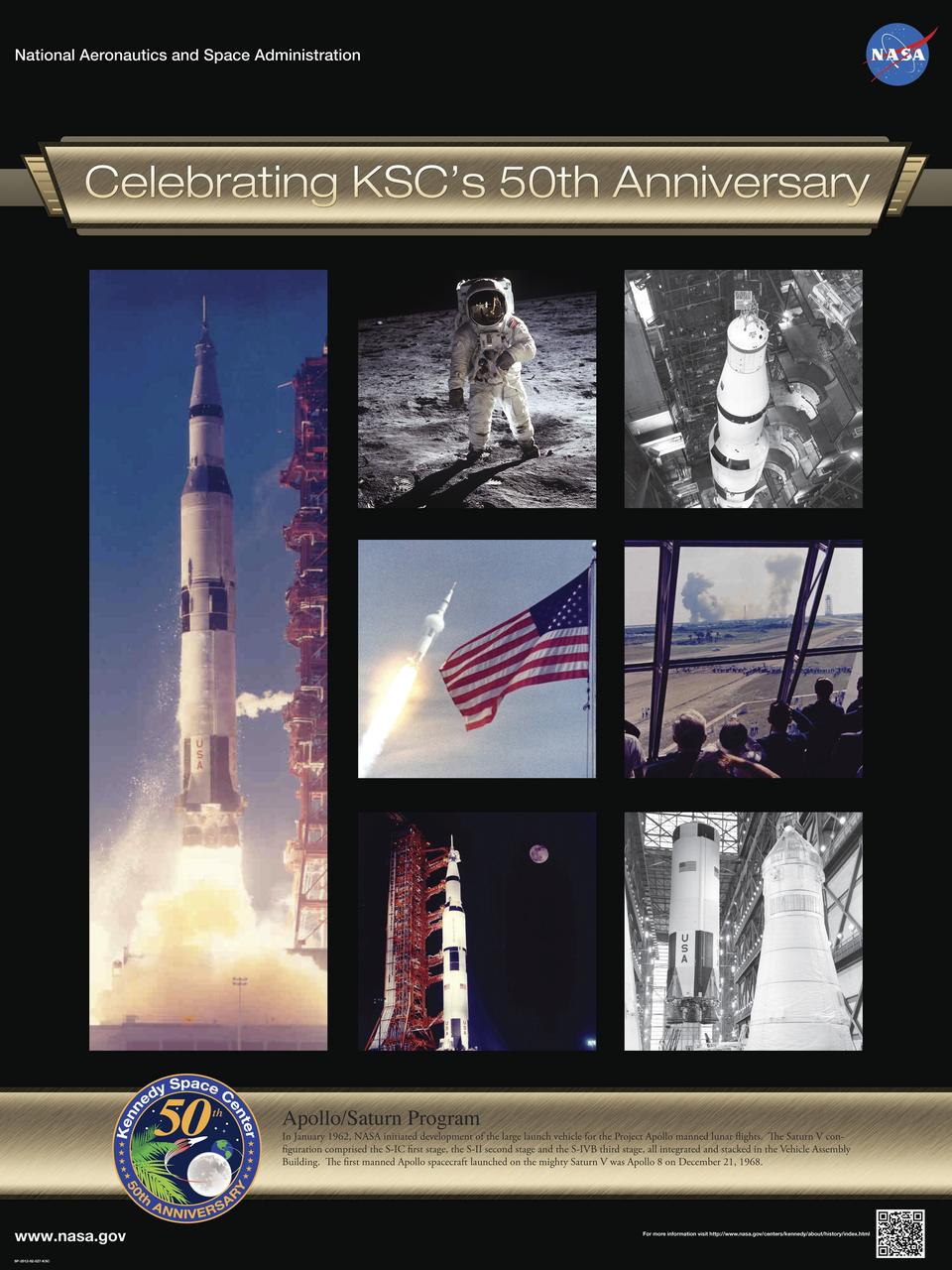
Apollo/Saturn Program: In January 1962, NASA initiated development of the large launch vehicle for the Project Apollo manned lunar flights. The Saturn V configuration comprised the S-IC first stage, the S-II second stage and the S-IVB third stage, all integrated and stacked in the Vehicle Assembly Building. The first manned Apollo spacecraft launched on the mighty Saturn V was Apollo 8 on December 21, 1968. Poster designed by Kennedy Space Center Graphics Department/Greg Lee. Credit: NASA
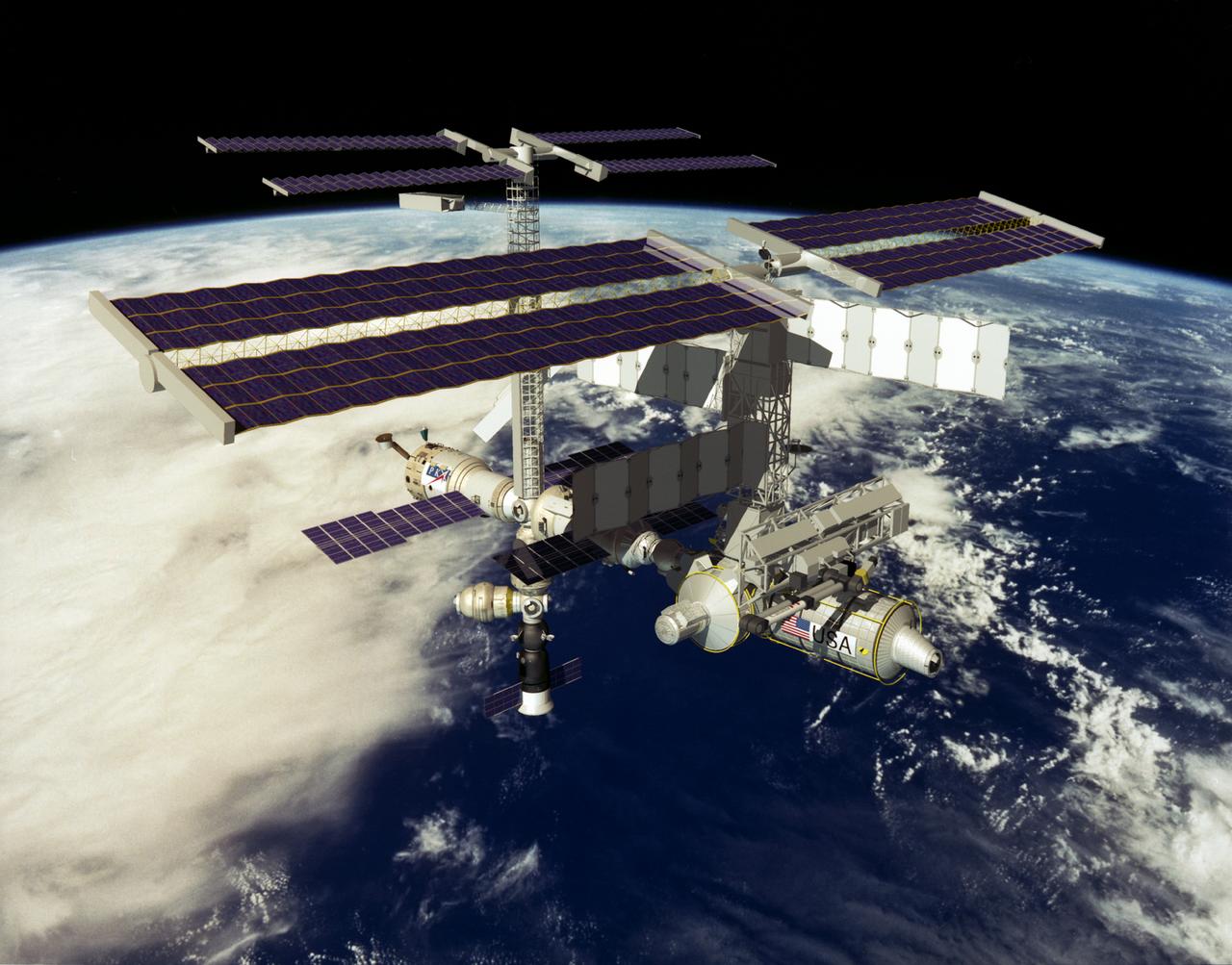
This computer generated scene of the International Space Station (ISS) represents the first addition of hardware following the completion of Phase II. The 8-A Phase shows the addition of the S-9 truss.

S78-35306 (31 Jan. 1978) --- Astronaut S. David Griggs. (NOTE: He died on June 17, 1989, near Earle, Arkansas, in the crash of a vintage World War II airplane.)
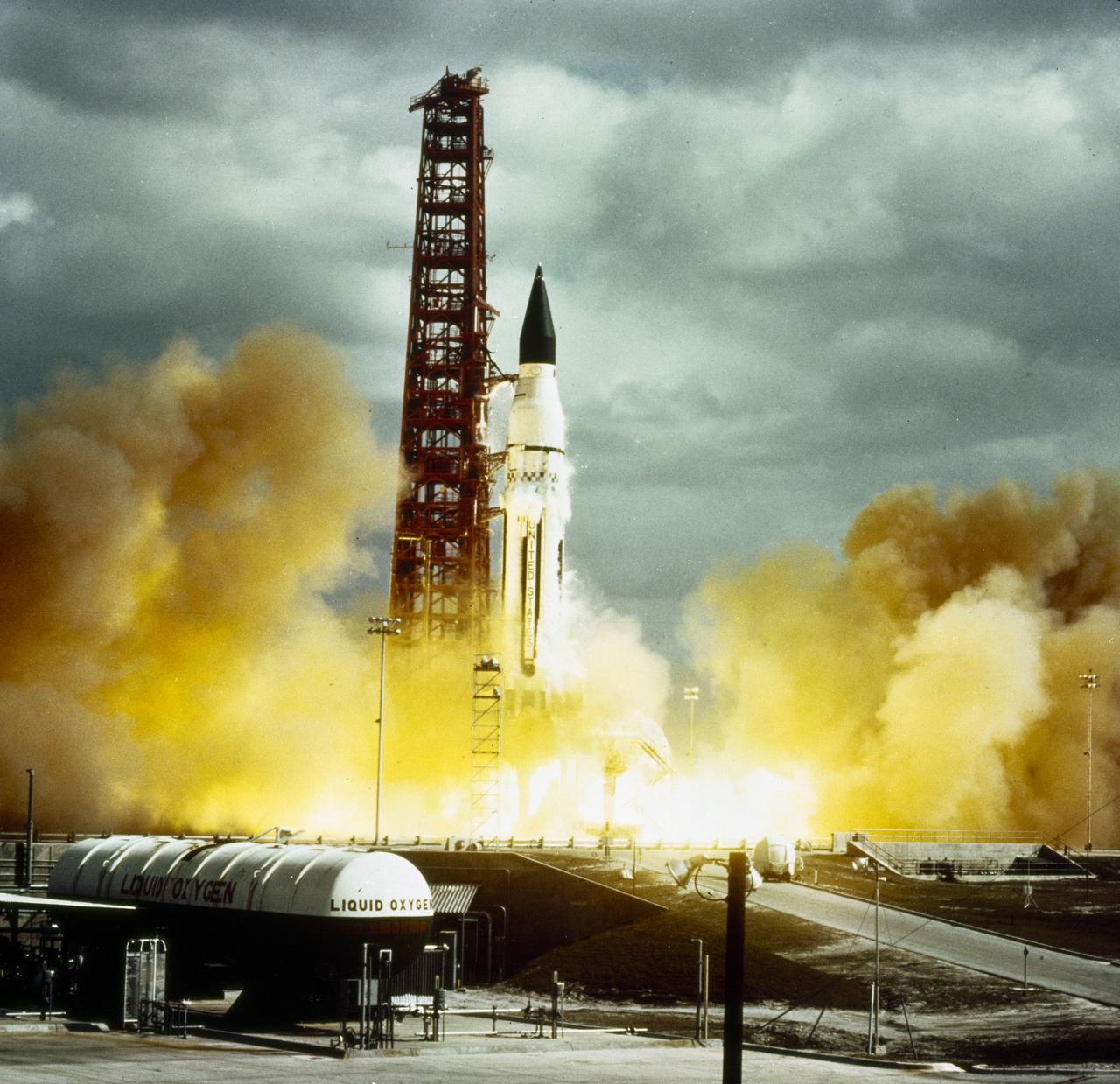
Developed at MSFC under the direction of Dr. Wernher von Braun, the SA-5 incorporated a Saturn I, Block II engine. Launched on January 29, 1964, SA-5 was the first two stage (Block II) Saturn with orbital capability and performed the first test of Instrument Unit and successful stage separation. Block II vehicles had two live stages, and were basically in the two-stage configuration of the Saturn I vehicle. There were marked changes between the Block I and II versions. The Block II S-I stage had eight fins added for greater aerodynamic stability in the lower atmosphere. All Block II H-1 engines had a thrust of 188,000 pounds each for a combined thrust over 1,500,000 pounds. The Block II second stage (S-IV) had six RL-10 hydrogen-oxygen engines, each producing a thrust of 15,000 pounds for a total combined thrust of 90,000 pounds. A motion picture camera capsule loated on stage I was successful recovered.
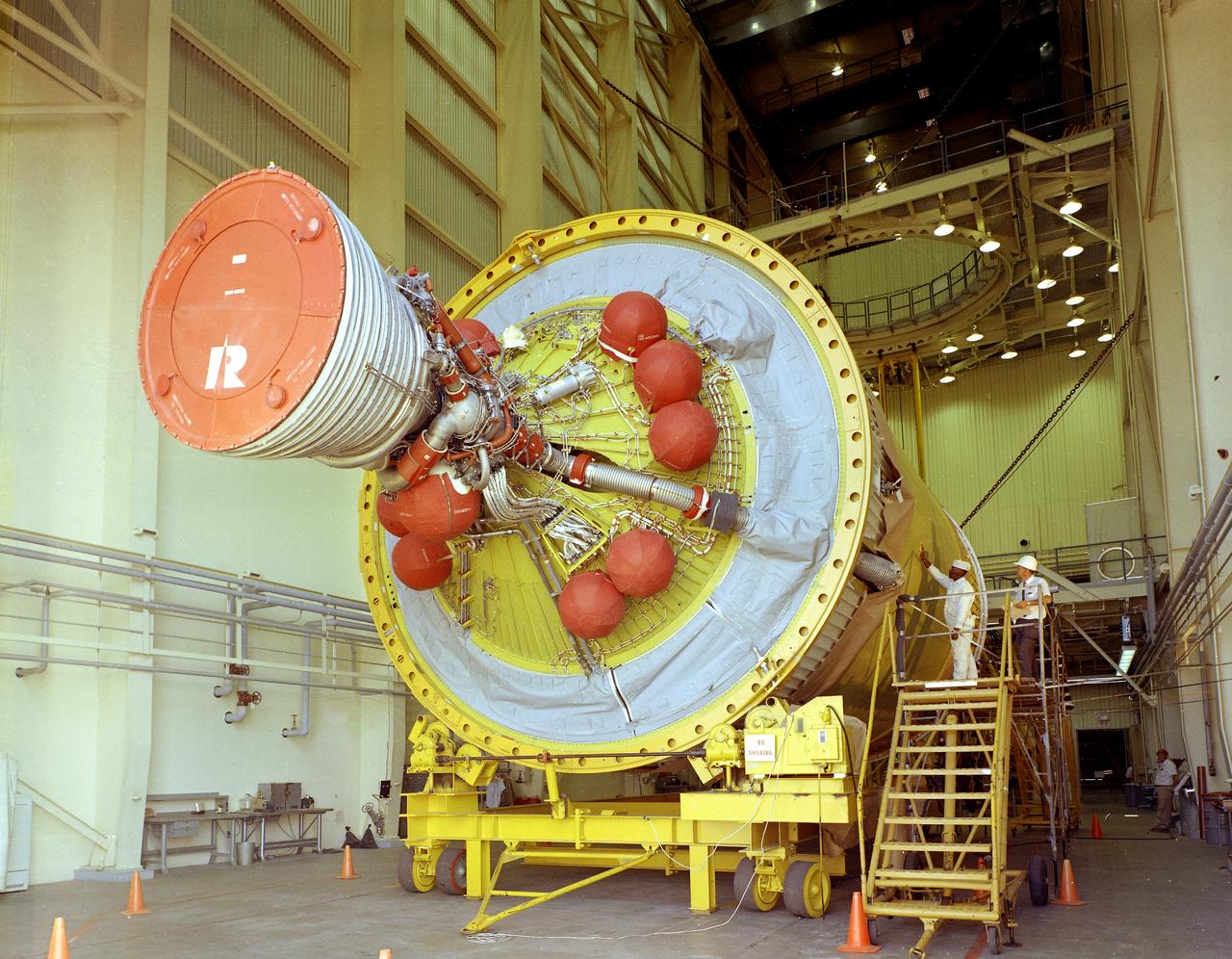
After the S-II (second) stage dropped away, the S-IVB (third) stage ignited and burned for about two minutes to place itself and the Apollo spacecraft into the desired Earth orbit. At the proper time during this Earth parking orbit, the S-IVB stage was re-ignited to speed the Apollo spacecraft to escape velocity, injecting it and the astronauts into a moon trajectory. Developed and manufactured by the Douglas Aircraft Company in Huntington, California, the S-IVB stage measures about 21.5 feet in diameter, about 58 feet in length and is powered by a single 200,000-pound-thrust J-2 engine with a re-start capability. The S-IVB stage was also used on the second stage of the Saturn IB launch vehicle. The fully-assembled S-IVB (third) stage for the AS-503 (Apollo 8 mission) launch vehicle is pictured in the Douglas' vertical checkout building.
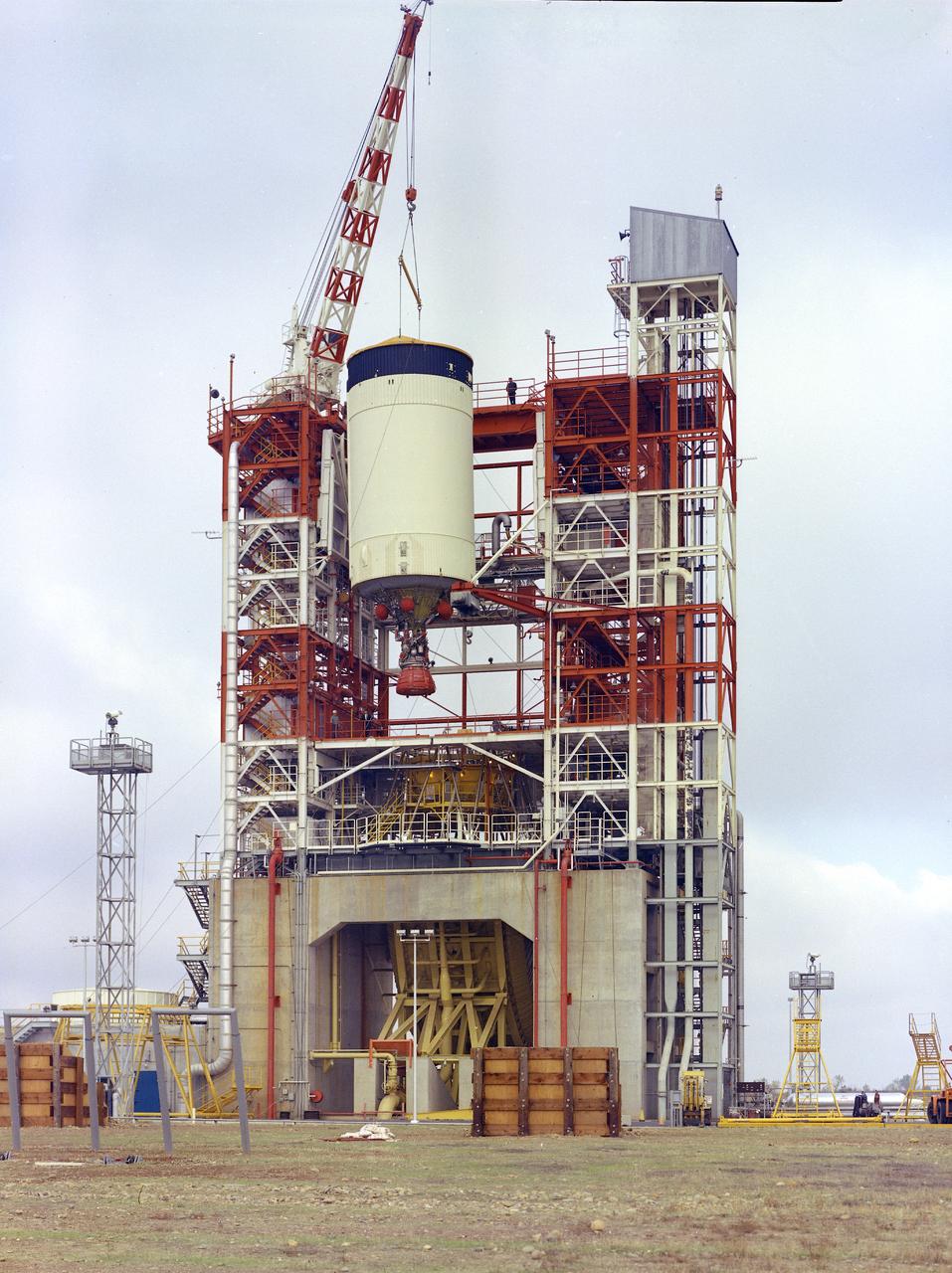
This image depicts the Saturn V S-IVB (third) stage for the Apollo 10 mission being removed from the Beta Test Stand 1 after its acceptance test at the Douglas Aircraft Company's Sacramento Test Operations (SACTO) facility. After the S-II (second) stage dropped away, the S-IVB (third) stage was ignited and burned for about two minutes to place itself and the Apollo spacecraft into the desired Earth orbit. At the proper time during this Earth parking orbit, the S-IVB stage was re-ignited to speed the Apollo spacecraft to escape velocity injecting it and the astronauts into a moon trajectory. Developed and manufactured by the Douglas Aircraft Company in California, the S-IVB stage measures about 21.5 feet in diameter, about 58 feet in length, and powered by a single 200,000-pound-thrust J-2 engine with a re-start capability. The S-IVB stage was also used on the second stage of the Saturn IB launch vehicle.
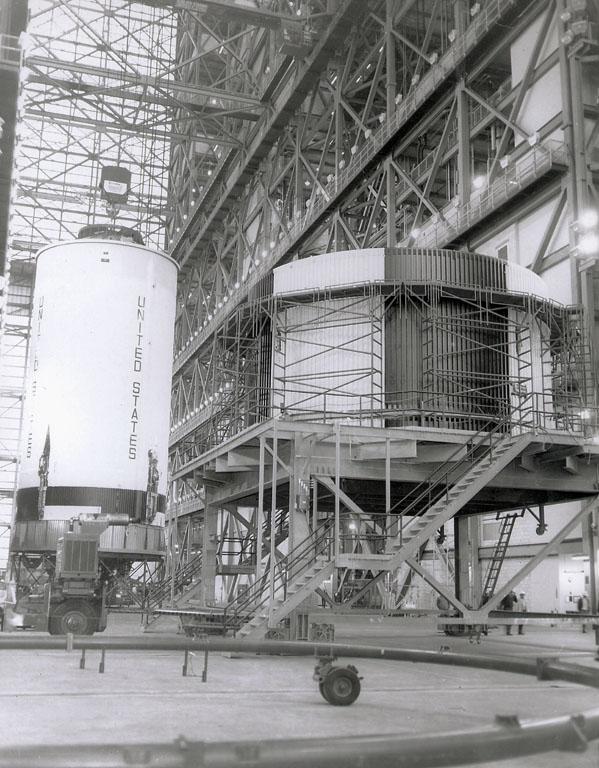
This Saturn V S-II (second) stage is being lifted into position for a test at the Vehicle Assembly Building at the Kennedy Space Center. When the Saturn V booster stage (S-IC) burned out and dropped away, power for the Saturn was provided by the 82-foot-long and 33-foot-diameter S-II stage. Developed by the Space Division of North American Aviation under the direction of the Marshall Space Flight Center, the stage utilized five J-2 engines, each producing 200,000 pounds of thrust. The engines used liquid oxygen and liquid hydrogen as propellants. The towering 363-foot Saturn V was a multi-stage, multi-engine launch vehicle standing taller than the Statue of Liberty. Altogether, the Saturn V engines produced as much power as 85 Hoover Dams.
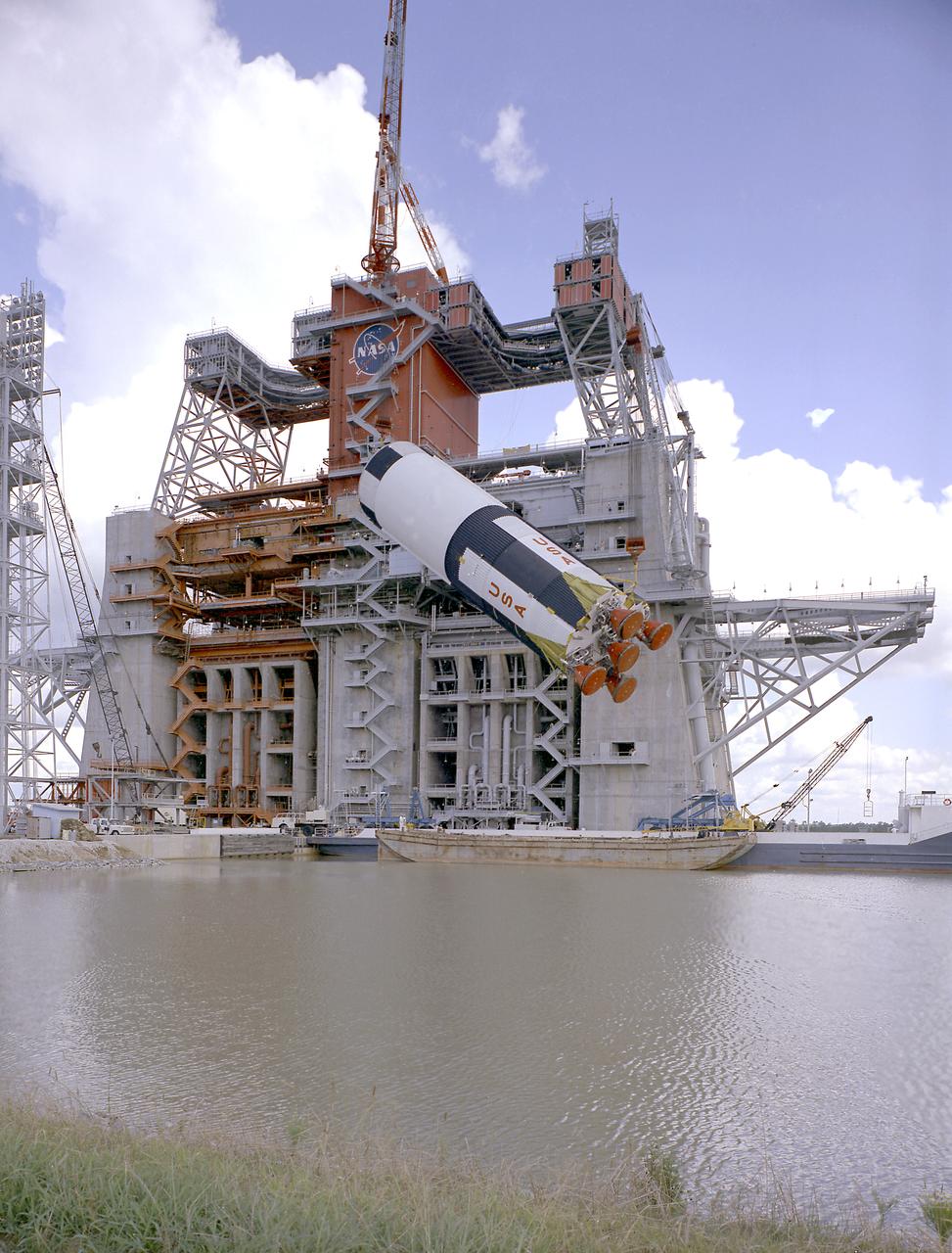
This photograph is a view of the Saturn V S-IC-5 (first) flight stage being hoisted into the S-IC-B1 test stand at the Mississippi Test Facility (MTF), Bay St. Louis, Mississippi. Begirning operations in 1966, the MTF has two test stands, a dual-position structure for running the S-IC stage at full throttle, and two separate stands for the S-II (Saturn V third) stage. It became the focus of the static test firing program. The completed S-IC stage was shipped from Michoud Assembly Facility (MAF) to the MTF. The stage was then installed into the 124-meter-high test stand for static firing tests before shipment to the Kennedy Space Center for final assembly of the Saturn V vehicle. The MTF was renamed to the National Space Technology Laboratory (NSTL) in 1974 and later to the Stennis Space Center (SSC) in May 1988.
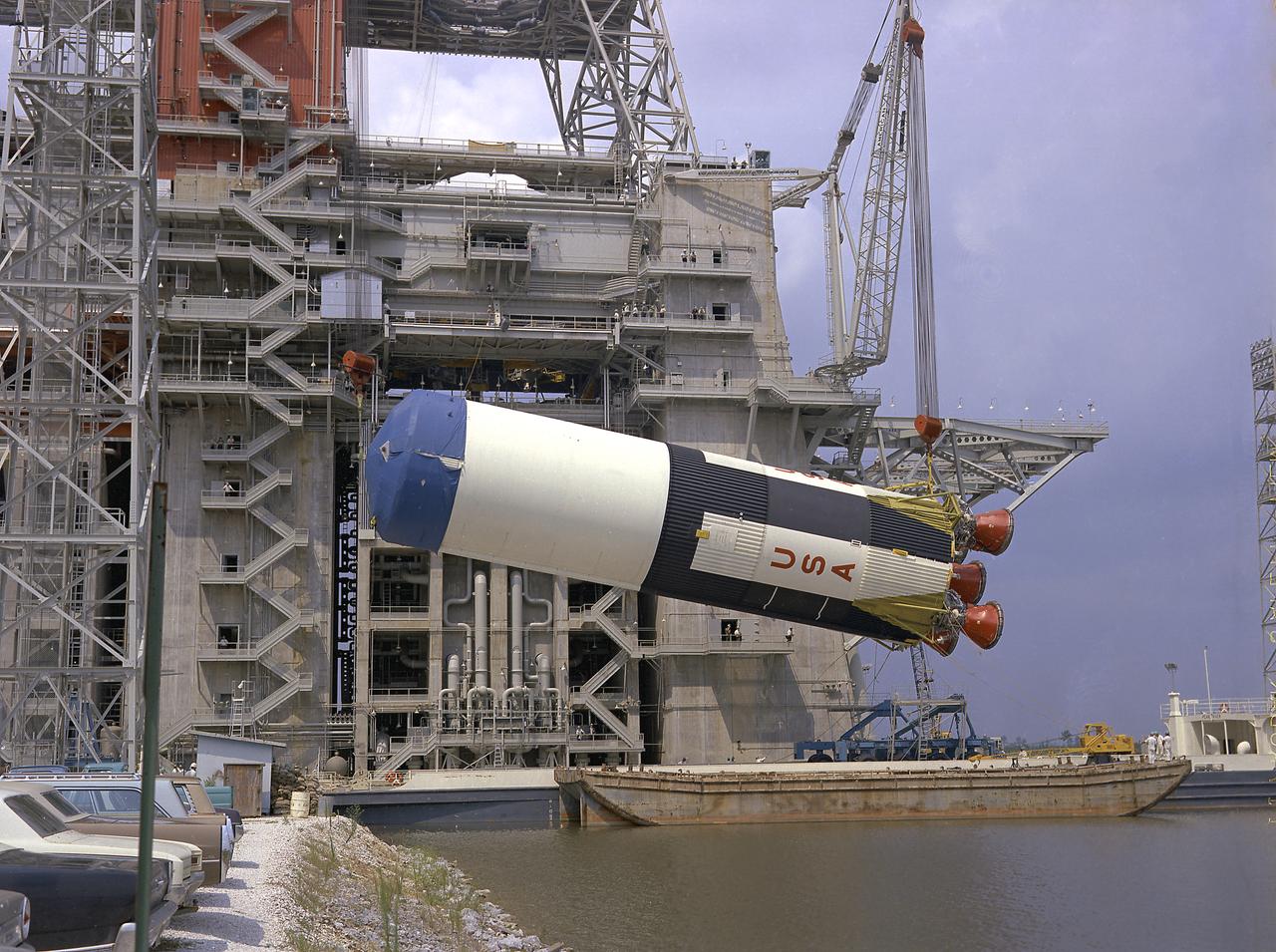
This photograph is a view of the Saturn V S-IC (first) test stage being hoisted into the S-IC-B1 test stand at the Mississippi Test Facility (MTF), Bay St. Louis, Mississippi. This stage was used to prove the operational readiness of the stand. Begirning operations in 1966, the MTF has two test stands; a dual-position structure for running the S-IC stage at full throttle, and two separate stands for the S-II (Saturn V third) stage. It became the focus of the static test firing program. The completed S-IC stage was shipped from the Michoud Assembly Facility (MAF) to the MTF. The stage was then installed into the 124-meter-high test stand for static firing tests before shipment to the Kennedy Space Center for final assembly of the Saturn V vehicle. The MTF was renamed to the National Space Technology Laboratory (NSTL) in 1974 and later to the Stennis Space Center (SSC) in May 1988.
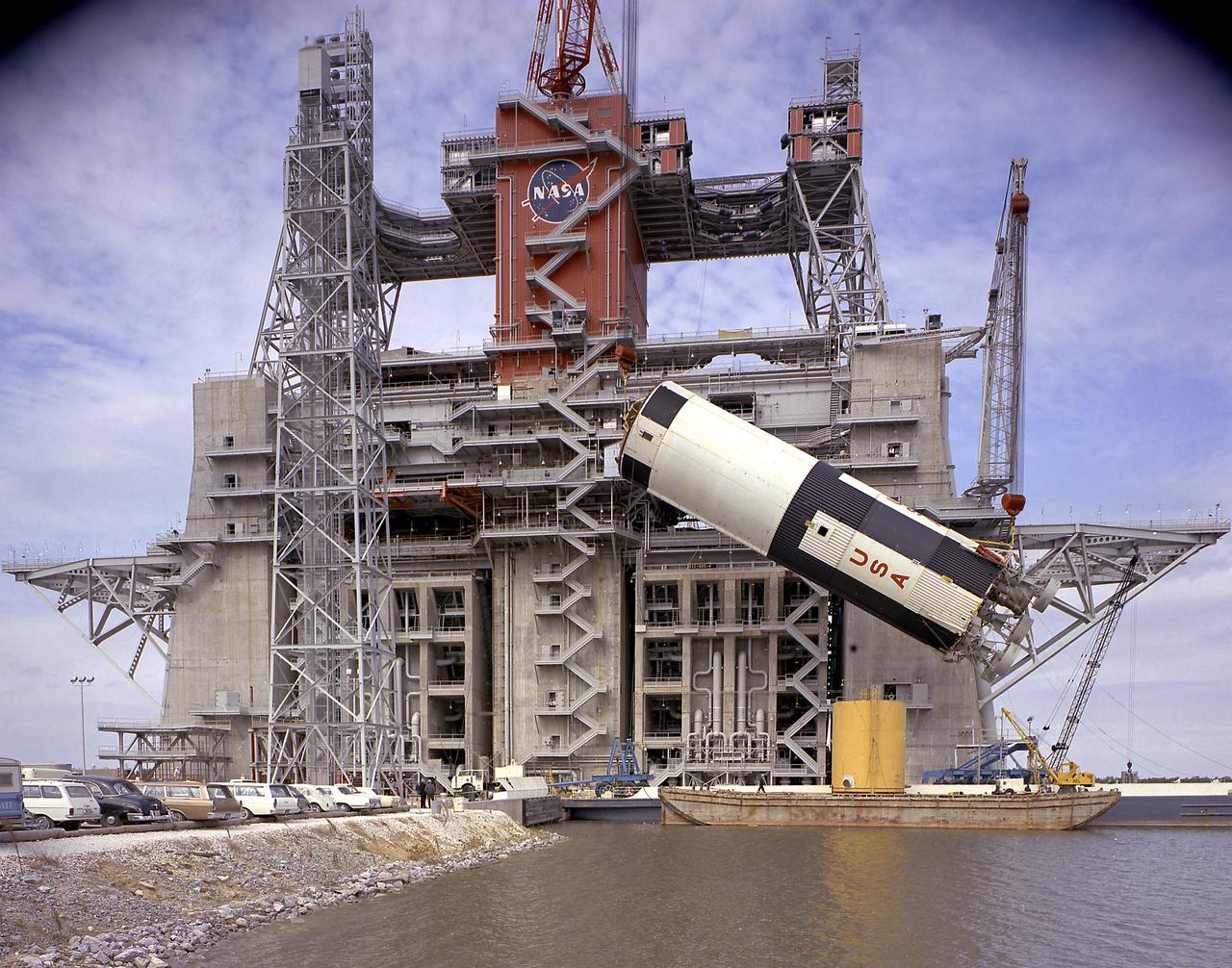
This photograph is a view of the Saturn V S-IC-5 (first) flight stage being hoisted into the S-IC-B1 test stand at the Mississippi Test Facility (MTF), Bay St. Louis, Mississippi. Begirning operations in 1966, the MTF has two test stands, a dual-position structure for running the S-IC stage at full throttle, and two separate stands for the S-II (Saturn V third) stage. It became the focus of the static test firing program. The completed S-IC stage was shipped from Michoud Assembly Facility (MAF) to the MTF. The stage was then installed into the 124-meter-high test stand for static firing tests before shipment to the Kennedy Space Center for final assembly of the Saturn V vehicle. The MTF was renamed to the National Space Technology Laboratory (NSTL) in 1974 and later to the Stennis Space Center (SSC) in May 1988.
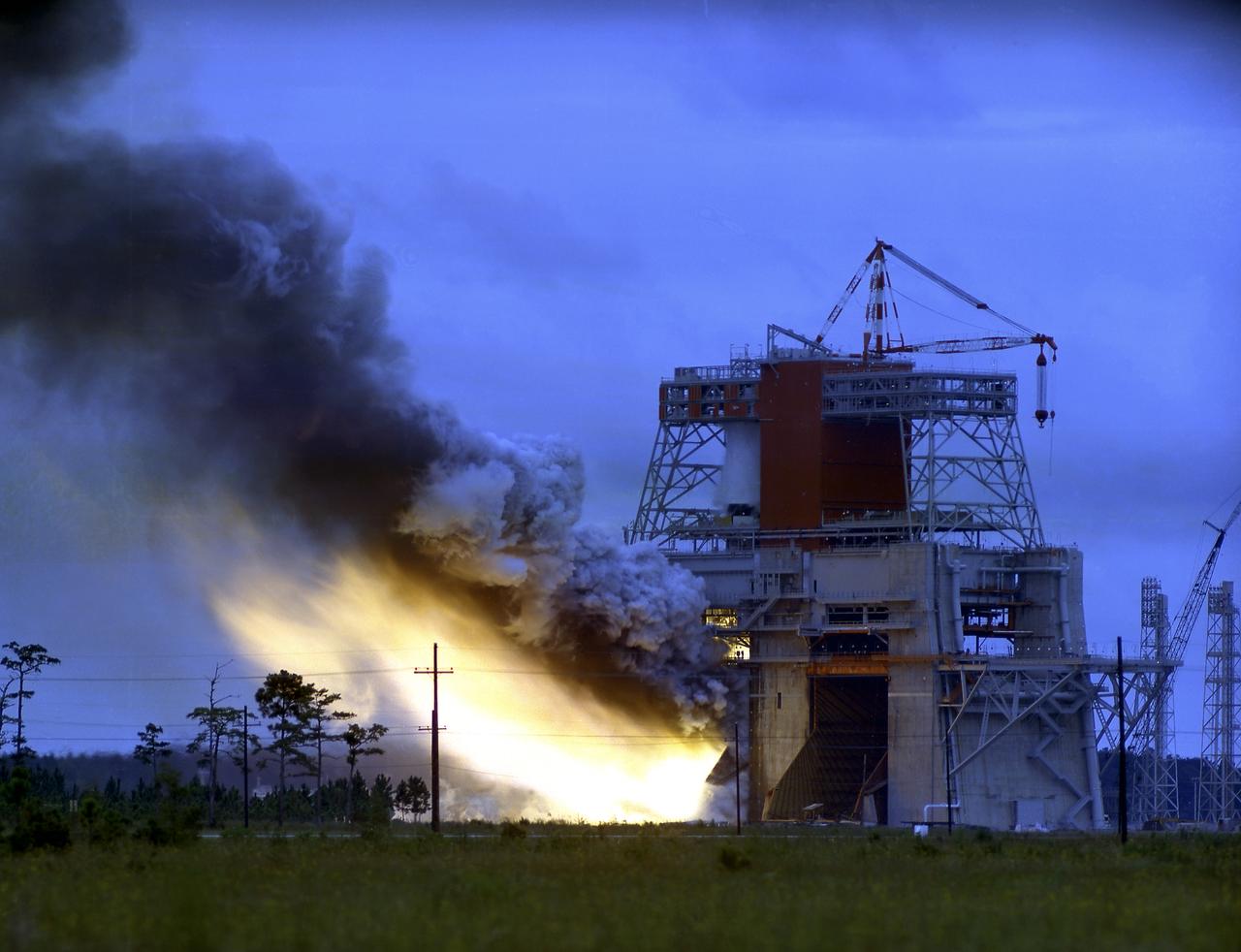
This photograph is a view of the Saturn V S-IC-5 (first) flight stage static test firing at the S-IC-B1 test stand at the Mississippi Test Facility (MTF), Bay St. Louis, Mississippi. Begirning operations in 1966, the MTF has two test stands, a dual-position structure for running the S-IC stage at full throttle, and two separate stands for the S-II (Saturn V third) stage. It became the focus of the static test firing program. The completed S-IC stage was shipped from Michoud Assembly Facility (MAF) to the MTF. The stage was then installed into the 407-foot-high test stand for the static firing tests before shipment to the Kennedy Space Center for final assembly of the Saturn V vehicle. The MTF was renamed to the National Space Technology Laboratory (NSTL) in 1974 and later to the Stennis Space Center (SSC) in May 1988.
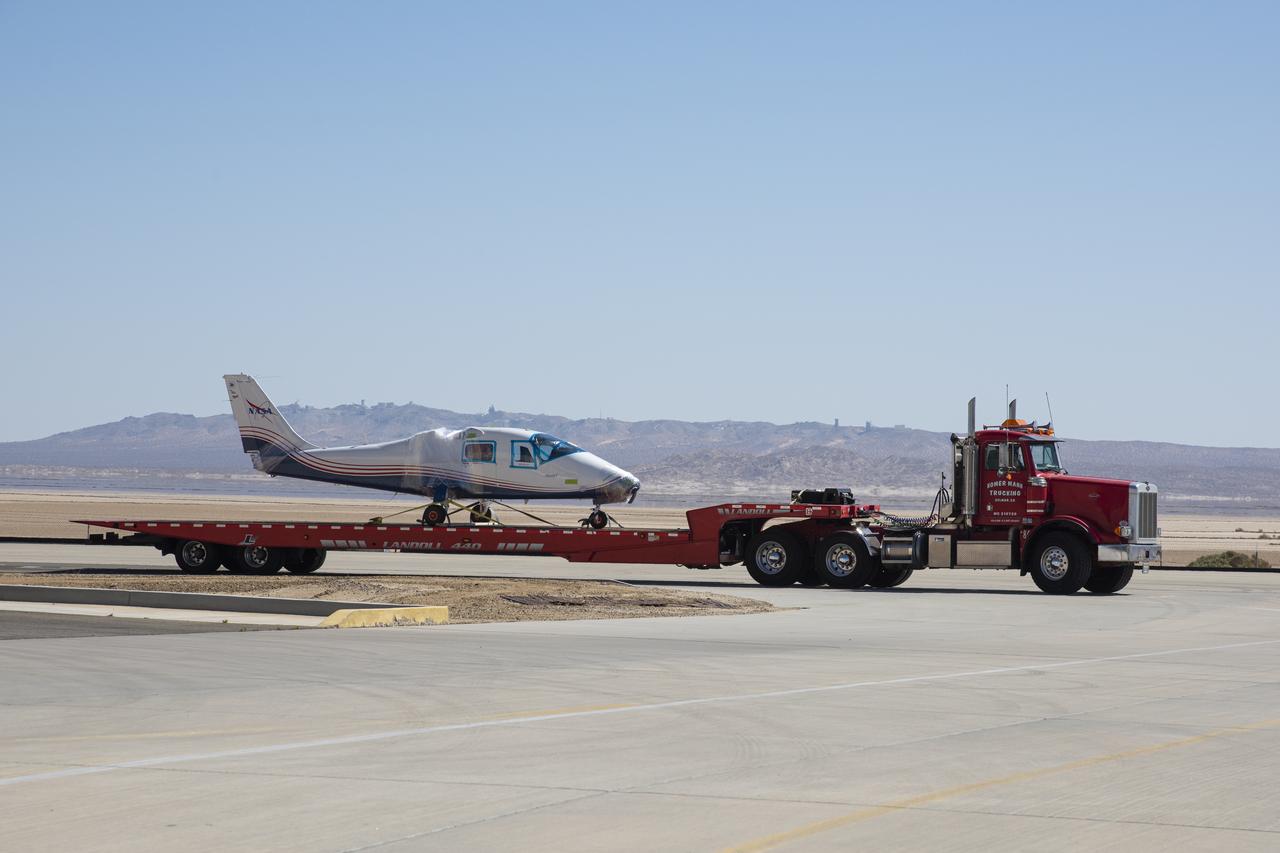
NASA’s all-electric X-57 Maxwell, in its Mod II configuration, arrives at NASA’s Armstrong Flight Research Center in Edwards, California. The X-plane was delivered by prime contractor Empirical Systems Aerospace of San Luis Obispo, California, in two parts, with the wing separated from the fuselage, to aid in a more timely delivery. X-57 is NASA’s first crewed X-plane in two decades, and seeks to further advance the design and airworthiness process for distributed electric propulsion technology for general aviation aircraft.
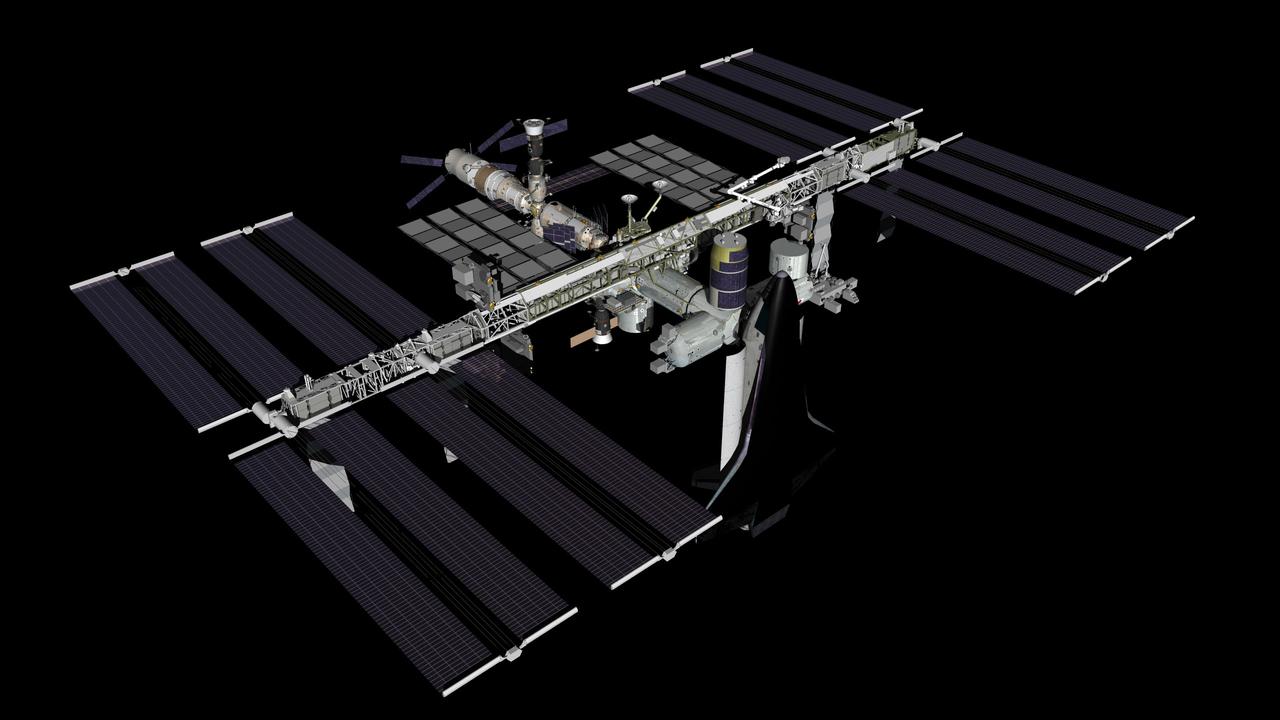
JSC2011-E-016371 (March 2011) --- Computer-generated artist?s rendering of the International Space Station as of March 2011, during which space shuttle Discovery (STS-133/ULF5) delivers the ExPRESS Logistics Carrier 4 (ELC4) and Permanent Multi-Purpose Module (PMM). European Space Agency's ?Johannes Kepler? Automated Transfer Vehicle-2 (ATV2) is docked to the Zvezda Service Module?s aft port. The Japanese Kounotori2 H-II Transfer Vehicle (HTV2) is linked to the Harmony node?s zenith port. Photo credit: NASA or National Aeronautics and Space Administration
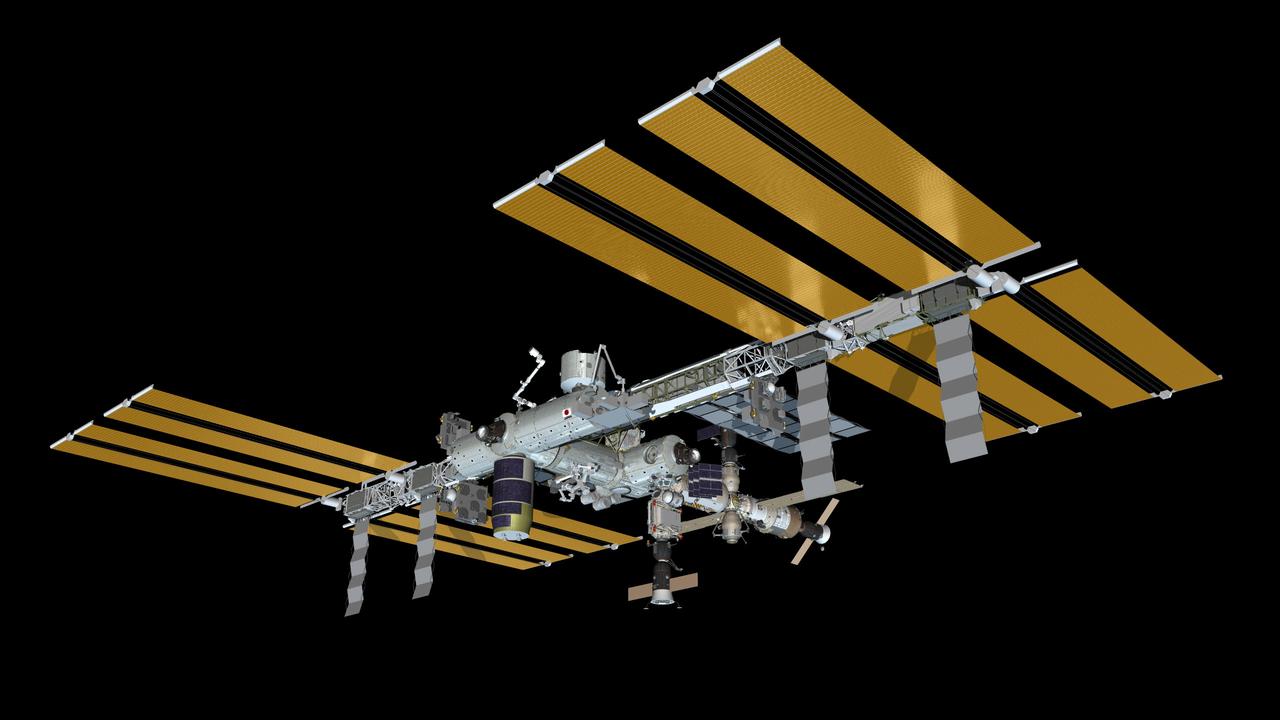
JSC2011-E-013462 (January 2011) --- Computer-generated artist?s rendering of the International Space Station as of Jan. 27, 2011. The unpiloted Japanese Kounotori2 H-II Transfer Vehicle (HTV2) is berthed to the Harmony node?s nadir port. Soyuz 25 (TMA-20) is docked to the Rassvet Mini-Research Module 1 (MRM1). Progress 39 resupply vehicle remains docked to the Zvezda Service Module?s aft port and Soyuz 24 (TMA-01M) is linked to the Poisk Mini-Research Module 2 (MRM2). Photo credit: NASA or National Aeronautics and Space Administration
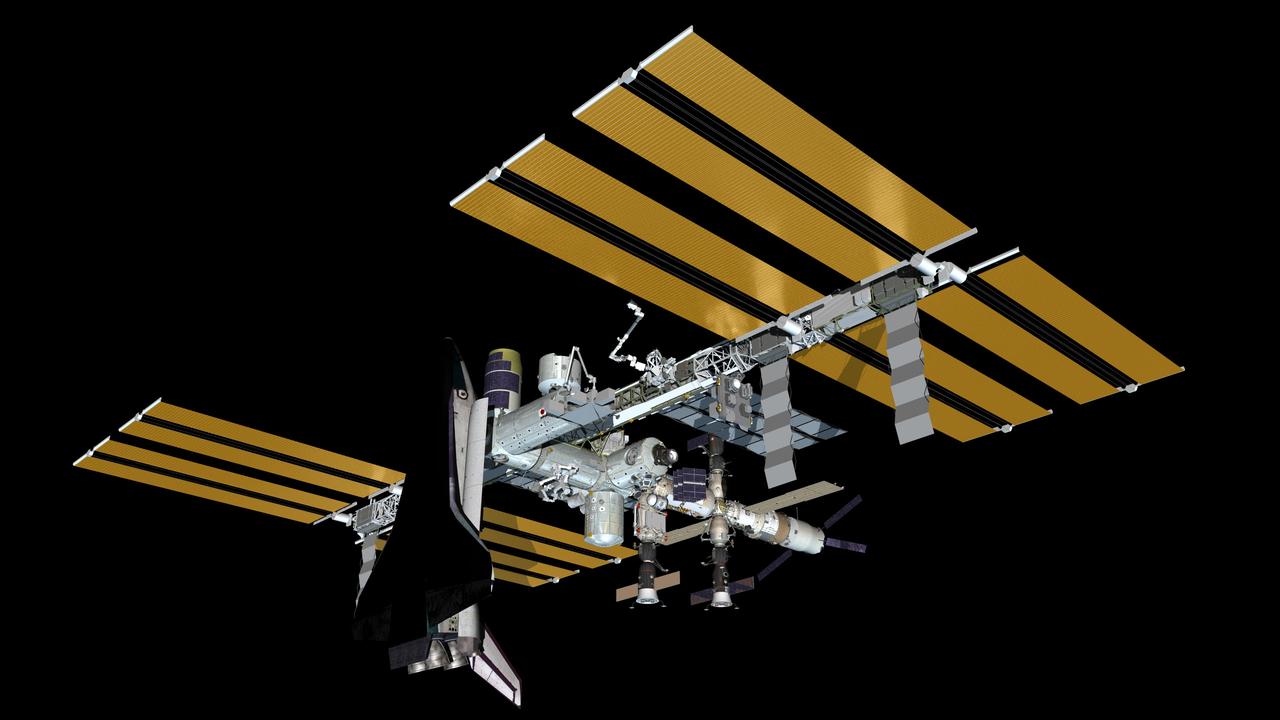
JSC2011-E-016372 (March 2011) --- Computer-generated artist?s rendering of the International Space Station as of March 2011, during which space shuttle Discovery (STS-133/ULF5) delivers the ExPRESS Logistics Carrier 4 (ELC4) and Permanent Multi-Purpose Module (PMM). European Space Agency's ?Johannes Kepler? Automated Transfer Vehicle-2 (ATV2) is docked to the Zvezda Service Module?s aft port. The Japanese Kounotori2 H-II Transfer Vehicle (HTV2) is linked to the Harmony node?s zenith port. Photo credit: NASA or National Aeronautics and Space Administration
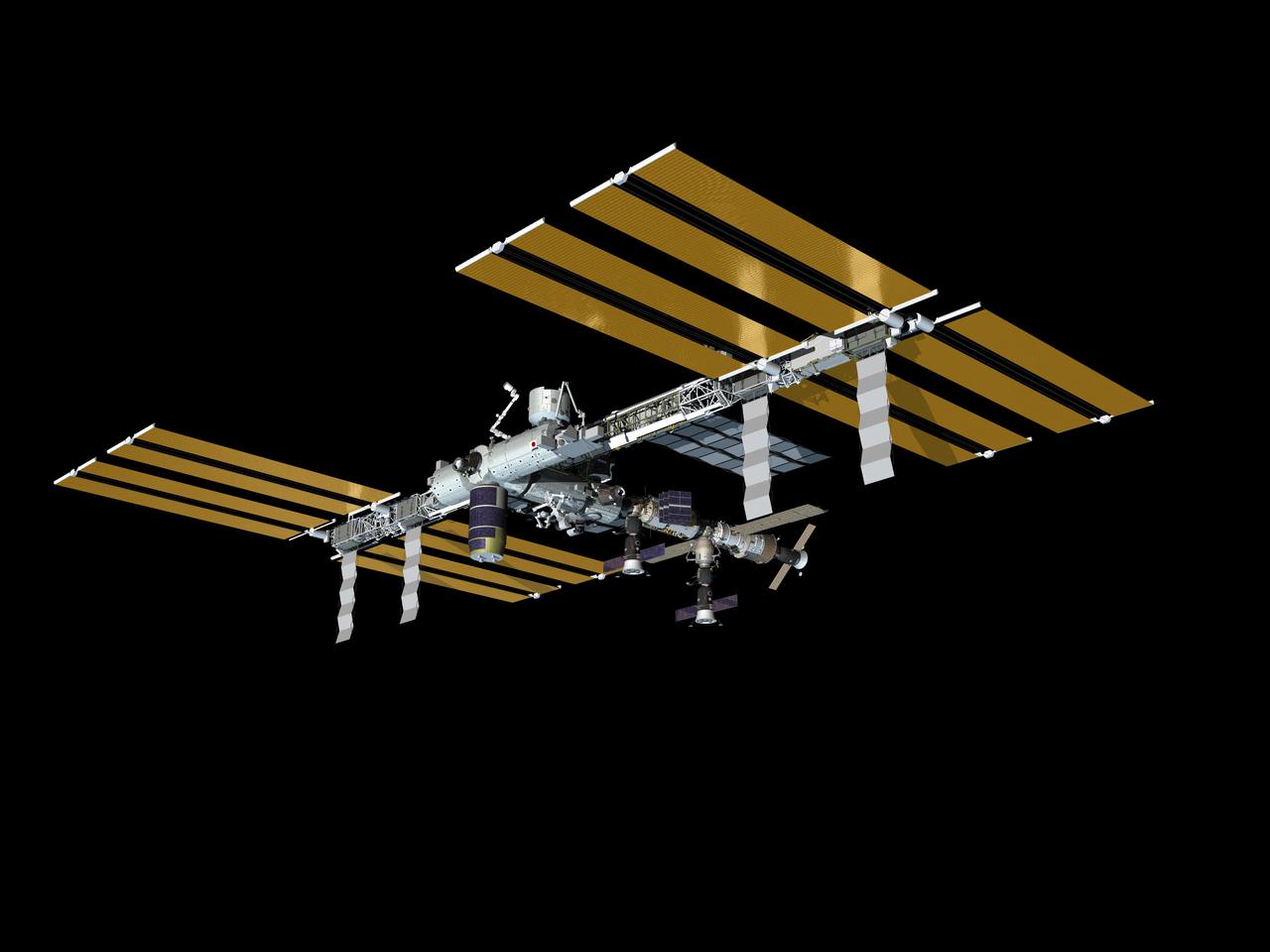
JSC2009-E-215174 (October 2009) --- Computer-generated artist?s rendering of the International Space Station as of Oct. 2, 2009. Soyuz 20 (TMA-16) docks to the Zvezda Service Module?s aft port, bringing NASA astronaut Jeffrey Williams, Expedition 21 flight engineer; Russian cosmonaut Maxim Suraev, Soyuz commander and flight engineer; and spaceflight participant Guy Laliberte. Soyuz 18 (TMA-14) is linked to the Pirs Docking Compartment and Soyuz 19 (TMA-15) remains docked to the Zarya nadir port. The Japanese H-II Transfer Vehicle (HTV) is berthed to the Harmony node?s nadir port.
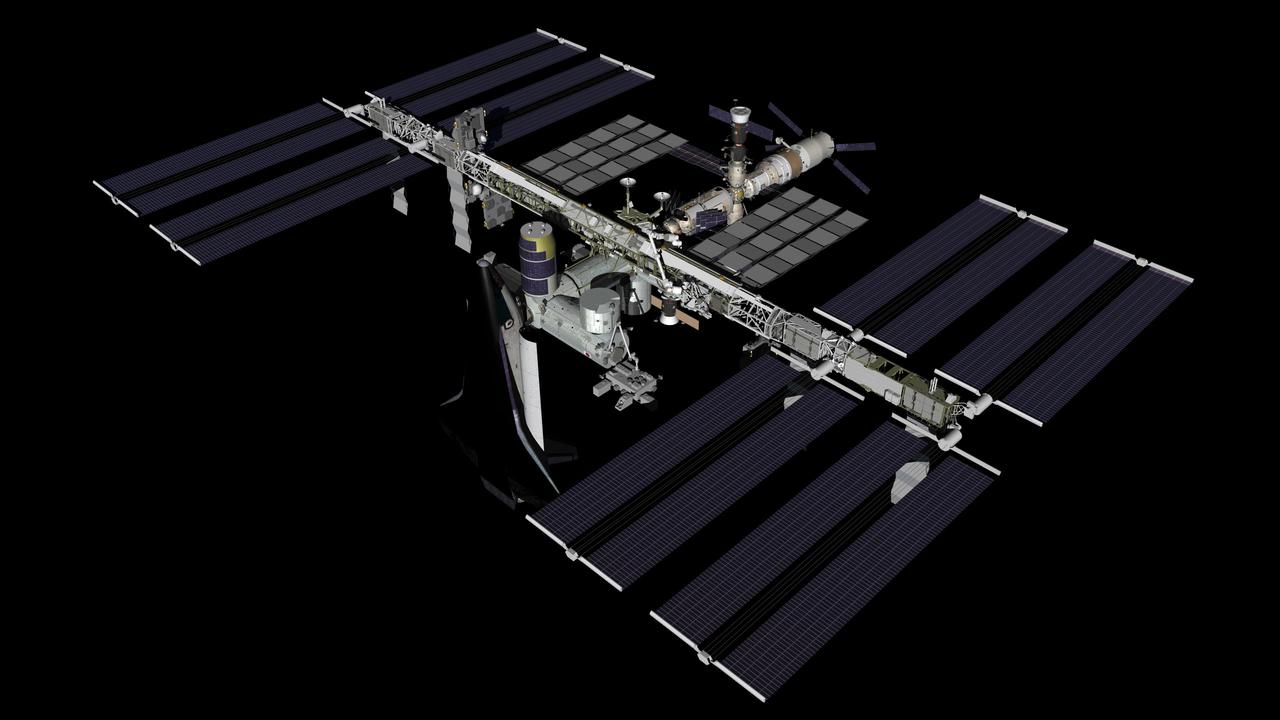
JSC2011-E-016370 (March 2011) --- Computer-generated artist?s rendering of the International Space Station as of March 2011, during which space shuttle Discovery (STS-133/ULF5) delivers the ExPRESS Logistics Carrier 4 (ELC4) and Permanent Multi-Purpose Module (PMM). European Space Agency's ?Johannes Kepler? Automated Transfer Vehicle-2 (ATV2) is docked to the Zvezda Service Module?s aft port. The Japanese Kounotori2 H-II Transfer Vehicle (HTV2) is linked to the Harmony node?s zenith port. Photo credit: NASA or National Aeronautics and Space Administration
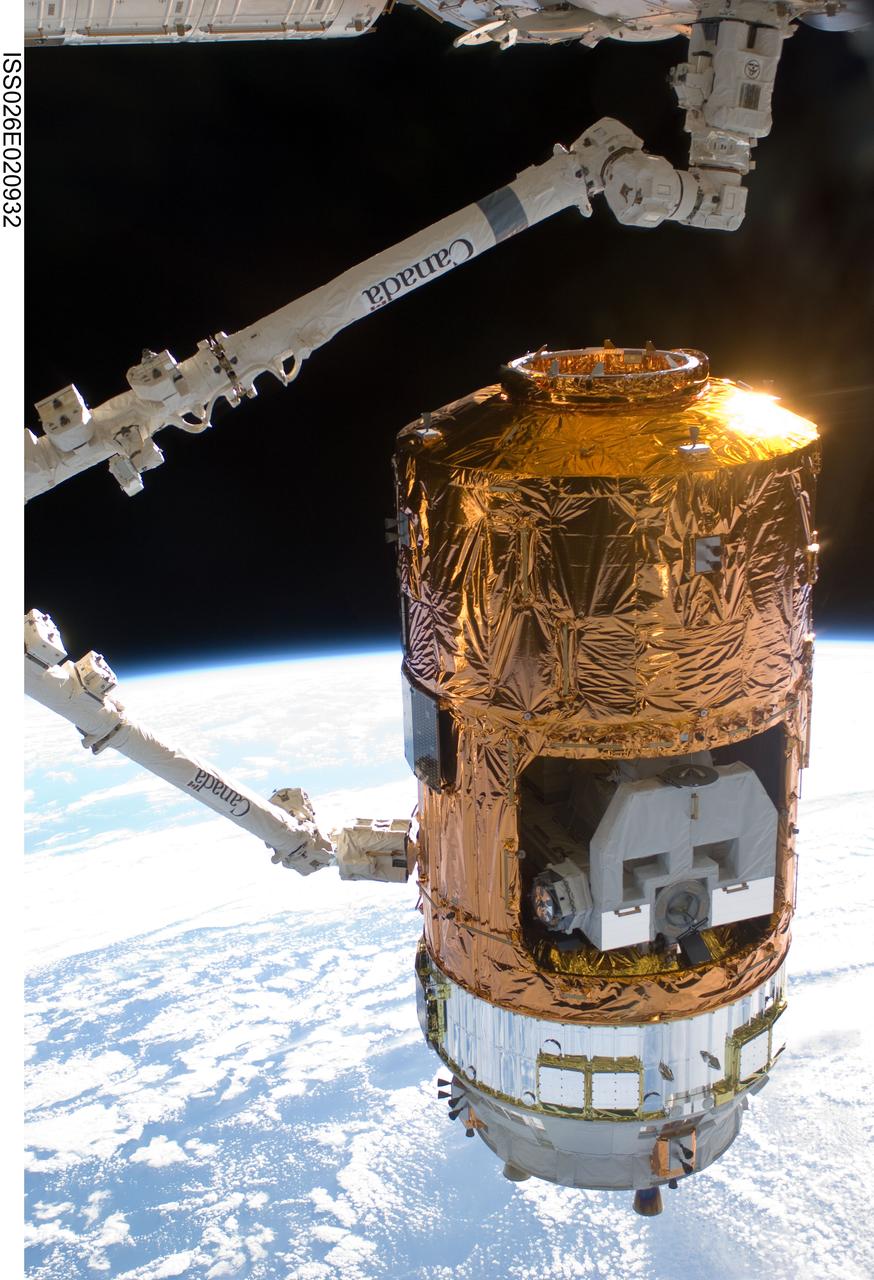
ISS026-E-020932 (27 Jan. 2011) --- Backdropped by Earth?s horizon and the blackness of space, the International Space Station's Canadarm2 grapples the unpiloted Japanese Kounotori2 H-II Transfer Vehicle (HTV2) as it approaches the station. NASA astronaut Catherine (Cady) Coleman and European Space Agency astronaut Paolo Nespoli, both Expedition 26 flight engineers, used the station?s robotic arm to attach the HTV2 to the Earth-facing port of the station?s Harmony node. The attachment was completed at 9:51 a.m. (EST) on Jan. 27, 2011.
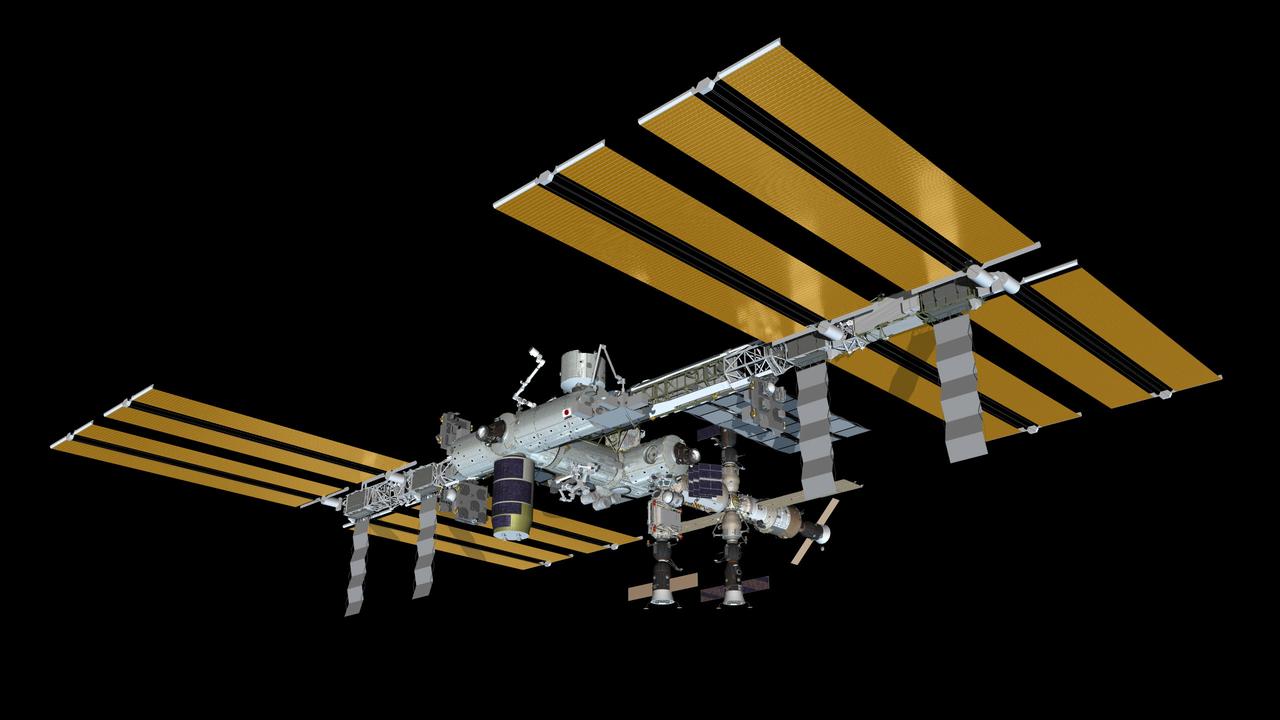
JSC2011-E-013463 (January 2011) --- Computer-generated artist?s rendering of the International Space Station as of Jan. 29, 2011. Progress 41 resupply vehicle docks to the Pirs Docking Compartment. The Japanese Kounotori2 H-II Transfer Vehicle (HTV2) is berthed to the Harmony node?s nadir port. Soyuz 25 (TMA-20) is docked to the Rassvet Mini-Research Module 1 (MRM1). Progress 39 resupply vehicle remains docked to the Zvezda Service Module?s aft port and Soyuz 24 (TMA-01M) is linked to the Poisk Mini-Research Module 2 (MRM2). Photo credit: NASA or National Aeronautics and Space Administration
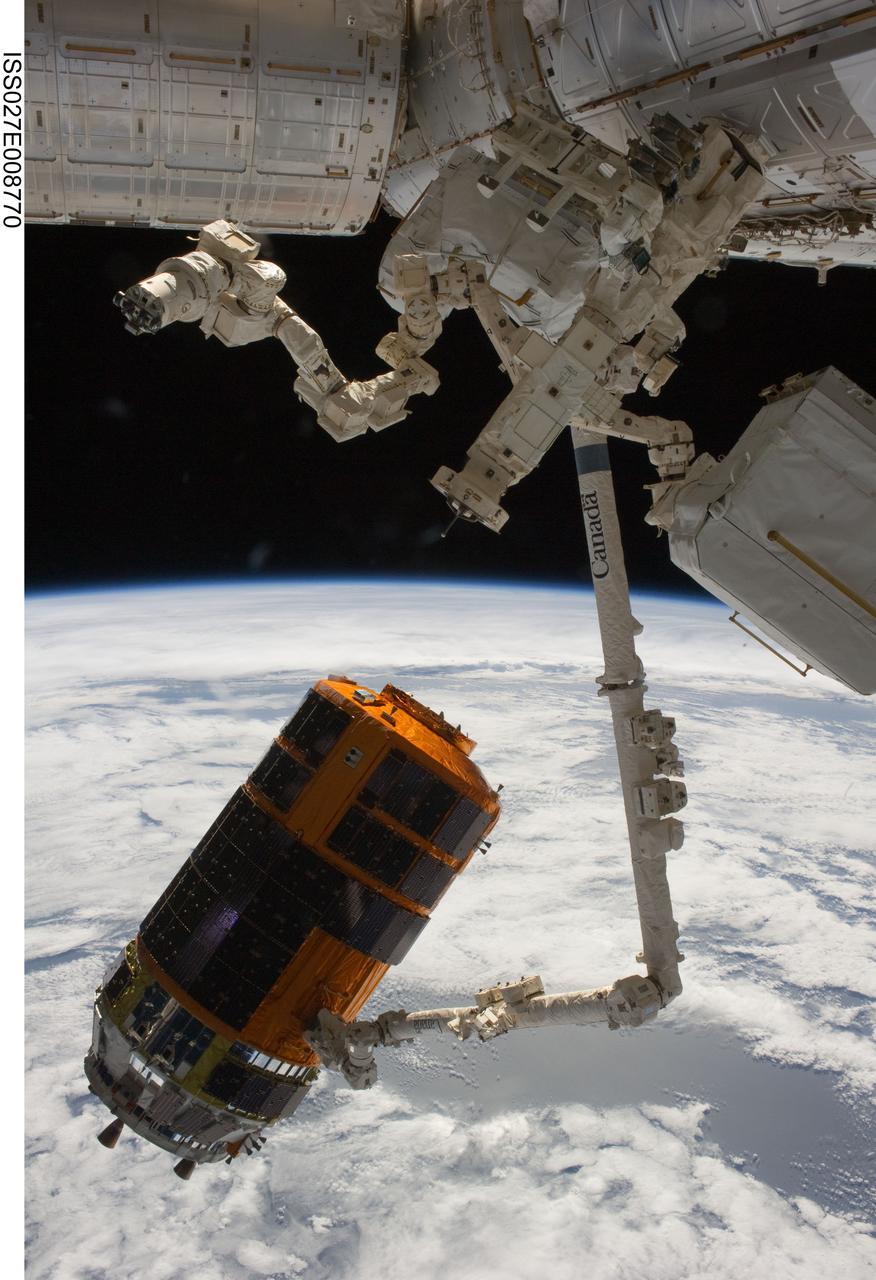
ISS027-E-008770 (28 March 2011) --- Backdropped by Earth?s horizon and the blackness of space, the International Space Station's Canadarm2 unberths the unpiloted Japan Aerospace Exploration Agency?s Kounotori2 H-II Transfer Vehicle (HTV2), filled with trash and unneeded items, in preparation for its release from the station. NASA astronaut Cady Coleman and European Space Agency astronaut Paolo Nespoli, both Expedition 27 flight engineers, used the station?s robot arm to grapple the HTV2 and unberth it from the Earth-facing port of the Harmony node. The cargo craft was released at 11:46 a.m. (EDT) on March 28, 2011.
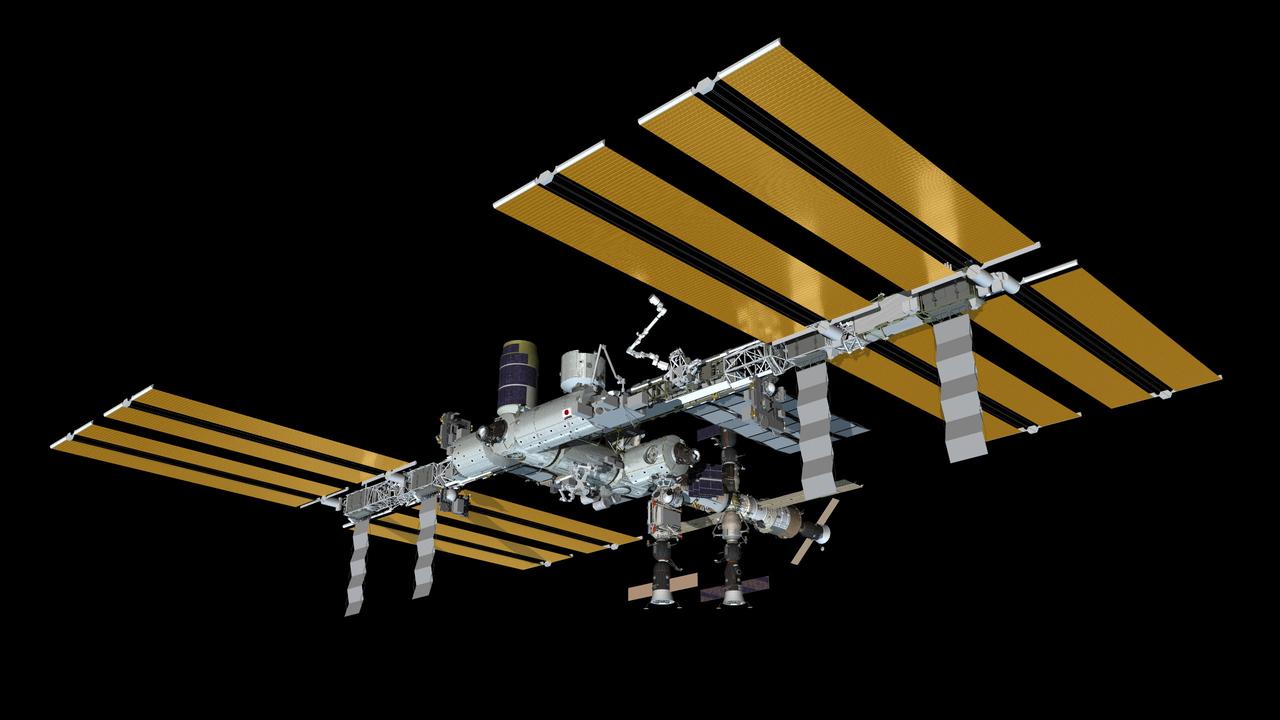
JSC2011-E-016181 (February 2011) --- Computer-generated artist?s rendering of the International Space Station as of Feb. 18, 2011. The Japanese Kounotori2 H-II Transfer Vehicle (HTV2) relocates to the Harmony node?s zenith port in preparation for the arrival of STS-133. Progress 41 resupply vehicle is docked to the Pirs Docking Compartment. Soyuz 25 (TMA-20) is docked to the Rassvet Mini-Research Module 1 (MRM1). Progress 39 resupply vehicle remains docked to the Zvezda Service Module?s aft port and Soyuz 24 (TMA-01M) is linked to the Poisk Mini-Research Module 2 (MRM2). Photo credit: NASA or National Aeronautics and Space Administration
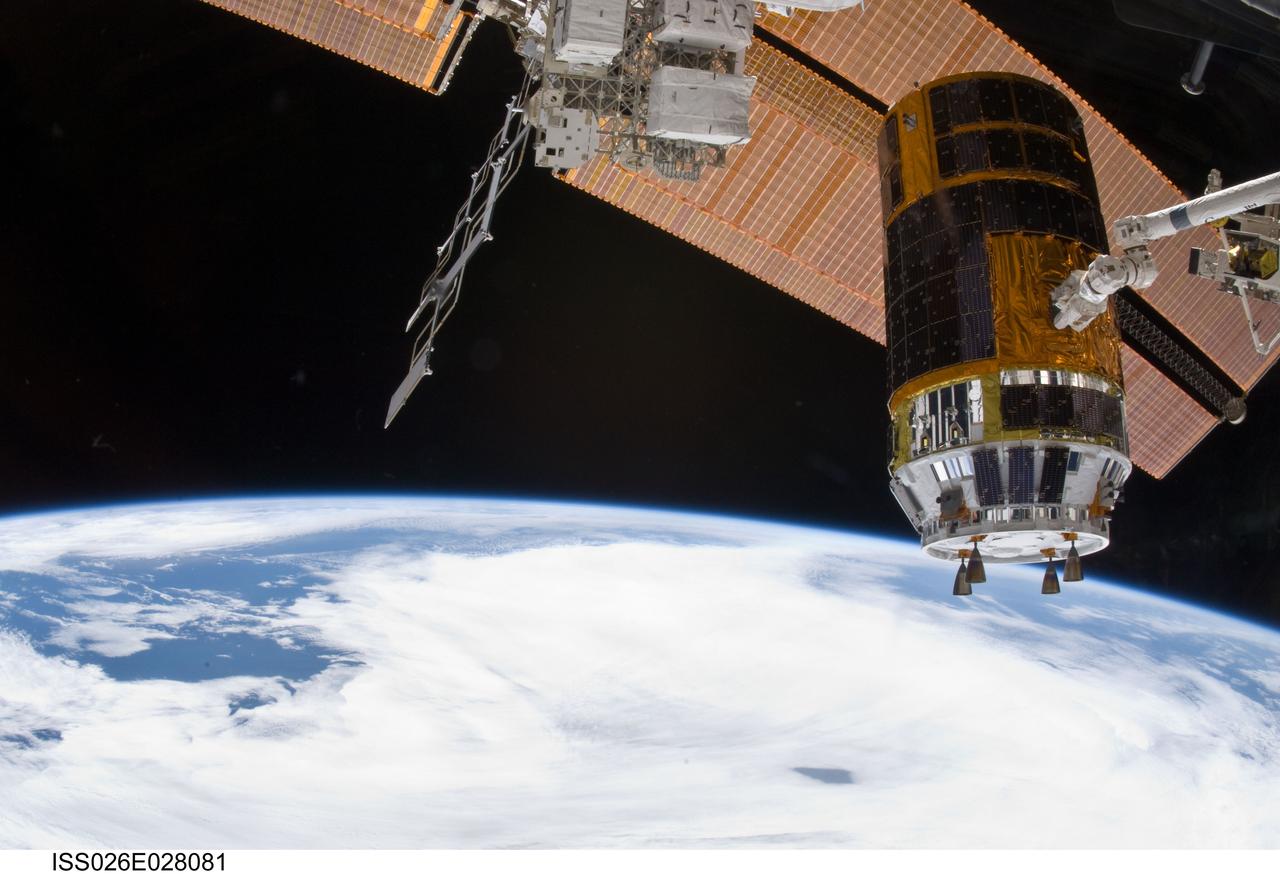
ISS026-E-028081 (18 Feb. 2011) --- In the grasp of the International Space Station?s Canadarm2, the Japanese Kounotori2 H-II Transfer Vehicle (HTV2) is relocated from the Harmony node nadir port to Harmony?s zenith port. NASA astronaut Catherine (Cady) Coleman and European Space Agency astronaut Paolo Nespoli, both Expedition 26 flight engineers, moved the HTV2, operating the station?s robotic arm from the controls inside the Cupola. A cloud-covered part of Earth and the blackness of space provide the backdrop for the scene.
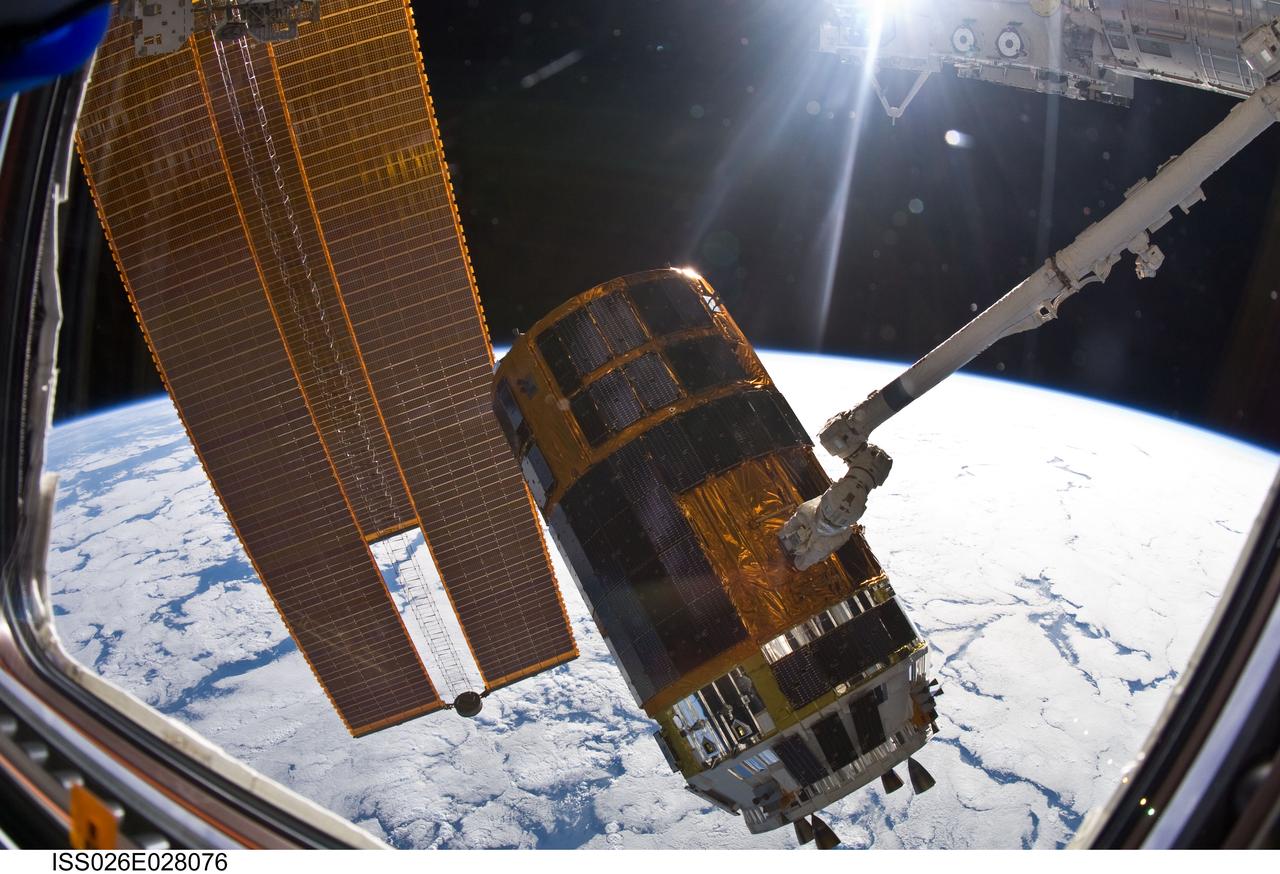
ISS026-E-028076 (18 Feb. 2011) --- In the grasp of the International Space Station?s Canadarm2, the Japanese Kounotori2 H-II Transfer Vehicle (HTV2) is relocated from the Harmony node nadir port to Harmony?s zenith port. NASA astronaut Catherine (Cady) Coleman and European Space Agency astronaut Paolo Nespoli, both Expedition 26 flight engineers, moved the HTV2, operating the station?s robotic arm from the controls inside the Cupola. A cloud-covered part of Earth and the blackness of space provide the backdrop for the scene.
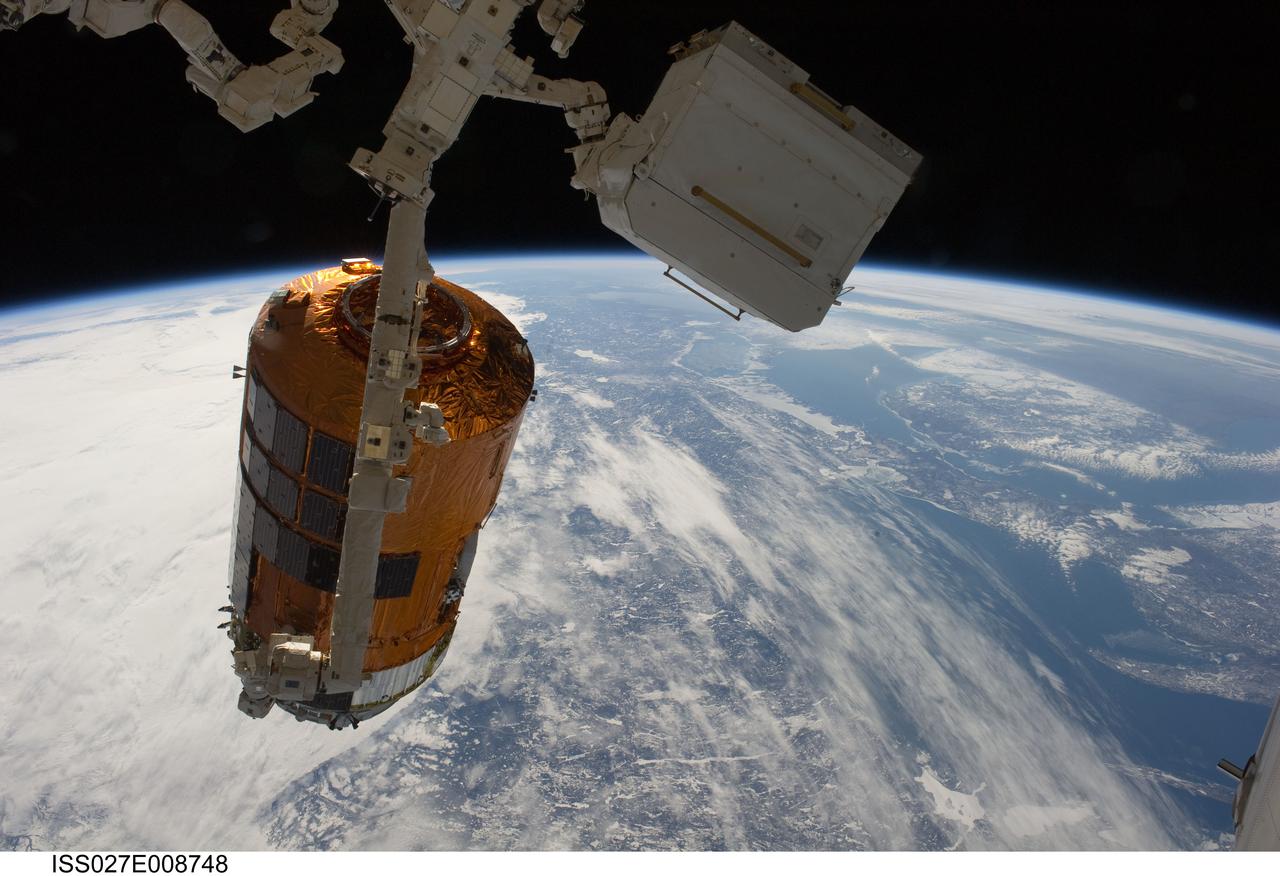
ISS027-E-008748 (28 March 2011) --- Backdropped by Earth?s horizon and the blackness of space, the International Space Station's Canadarm2 unberths the unpiloted Japan Aerospace Exploration Agency?s Kounotori2 H-II Transfer Vehicle (HTV2), filled with trash and unneeded items, in preparation for its release from the station. NASA astronaut Cady Coleman and European Space Agency astronaut Paolo Nespoli, both Expedition 27 flight engineers, used the station?s robot arm to grapple the HTV2 and unberth it from the Earth-facing port of the Harmony node. The cargo craft was released at 11:46 a.m. (EDT) on March 28, 2011.
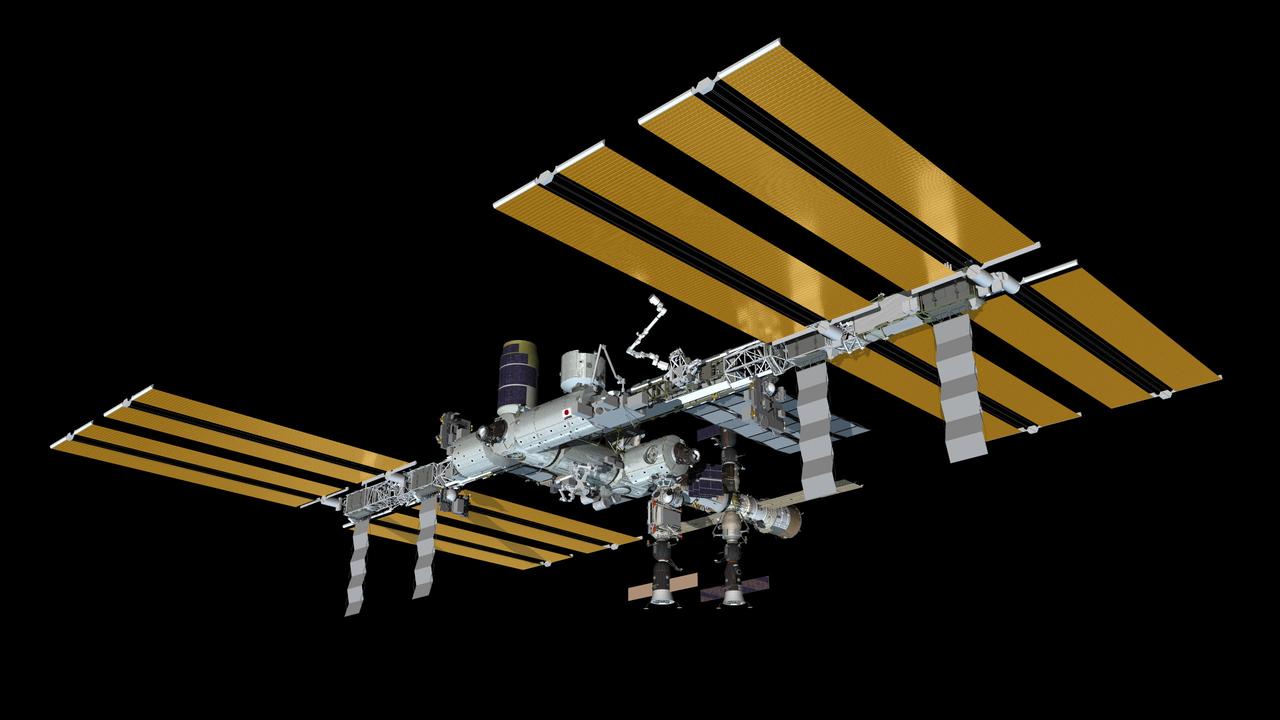
JSC2011-E-016182 (February 2011) --- Computer-generated artist?s rendering of the International Space Station as of Feb. 20, 2011. Progress 39 resupply vehicle undocks from the Zvezda Service Module?s aft port. Progress 41 resupply vehicle is docked to the Pirs Docking Compartment. Soyuz 25 (TMA-20) remains docked to the Rassvet Mini-Research Module 1 (MRM1). Soyuz 24 (TMA-01M) is linked to the Poisk Mini-Research Module 2 (MRM2) and the Japanese Kounotori2 H-II Transfer Vehicle (HTV2) is attached to the Harmony node?s zenith port. Photo credit: NASA or National Aeronautics and Space Administration
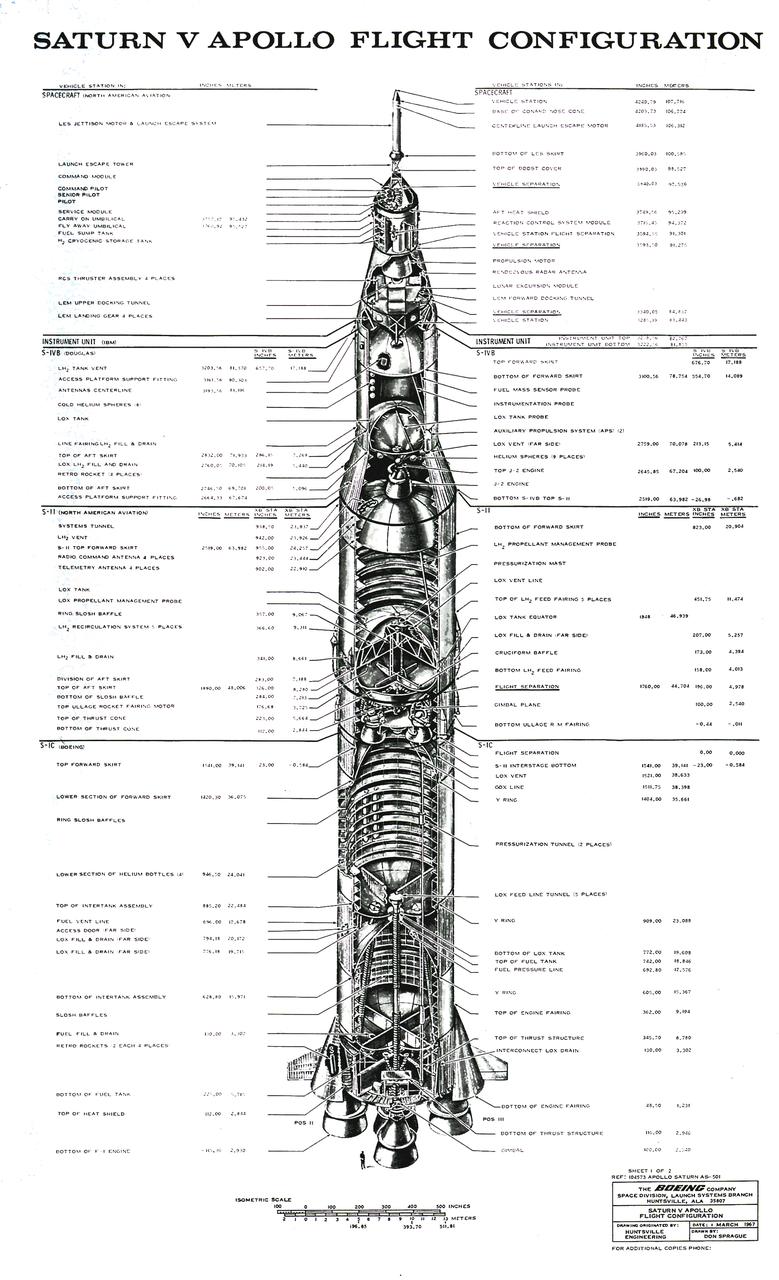
The Saturn V configuration is shown in inches and meters as illustrated by the Boeing Company. The Saturn V vehicle consisted of three stages: the S-IC (first) stage powered by five F-1 engines, the S-II (second) stage powered by five J-2 engines, the S-IVB (third) stage powered by one J-2 engine. A top for the first three stages was designed to contain the instrument unit, the guidance system, the Apollo spacecraft, and the escape system. The Apollo spacecraft consisted of the lunar module, the service module, and the command module. The Saturn V was designed perform lunar and planetary missions and it was capable of placing 280,000 pounds into Earth orbit.
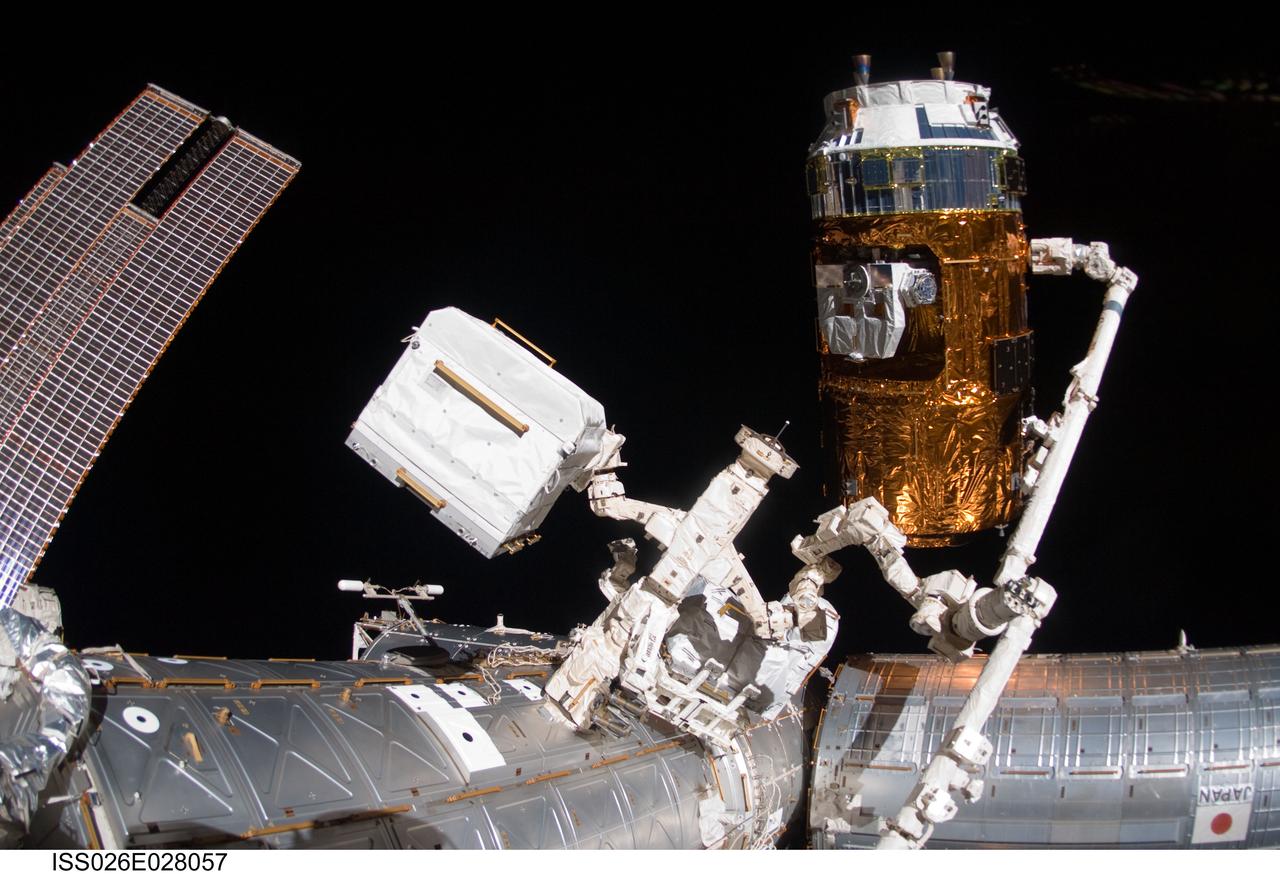
ISS026-E-028057 (18 Feb. 2011) --- In the grasp of the International Space Station?s Canadarm2, the Japanese Kounotori2 H-II Transfer Vehicle (HTV2) is relocated from the Harmony node nadir port to Harmony?s zenith port. NASA astronaut Catherine (Cady) Coleman and European Space Agency astronaut Paolo Nespoli, both Expedition 26 flight engineers, moved the HTV2, operating the station?s robotic arm from the controls inside the Cupola. The Canadian-built Dextre, also known as the Special Purpose Dextrous Manipulator (SPDM), is visible at center.
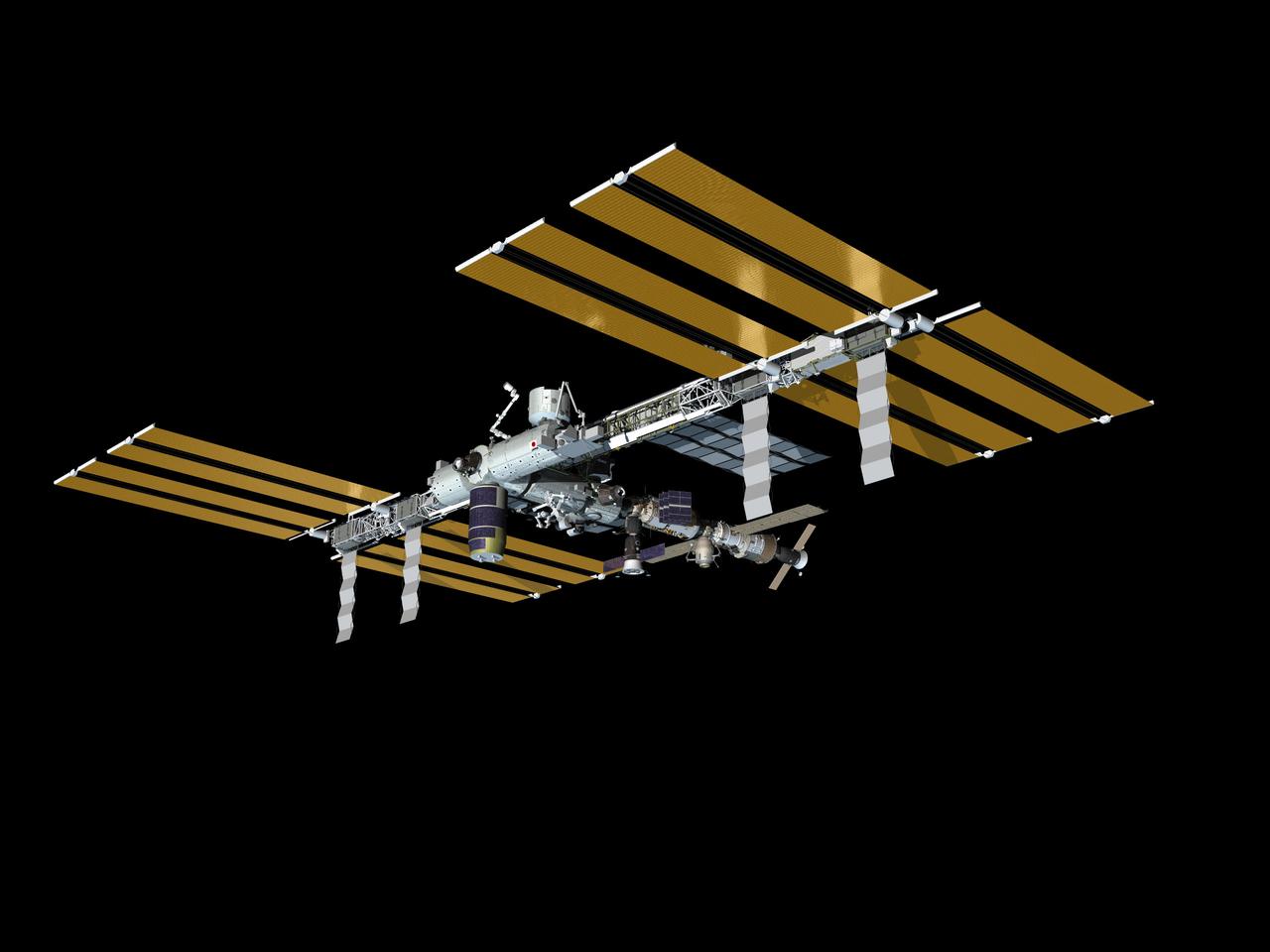
JSC2009-E-215175 (October 2009) --- Computer-generated artist?s rendering of the International Space Station as of Oct. 11, 2009. Soyuz 18 (TMA-14) undocks from the Pirs Docking Compartment, returning Russian cosmonaut Gennady Padalka, Expedition 19/20 commander; NASA astronaut Michael Barratt, Expedition 19/20 flight engineer; and spaceflight participant Guy Laliberte to Earth. Soyuz 20 (TMA-16) is docked to the Zvezda Service Module?s aft port and Soyuz 19 (TMA-15) remains linked to the Zarya nadir port. The Japanese H-II Transfer Vehicle (HTV) is berthed to the Harmony node?s nadir port.
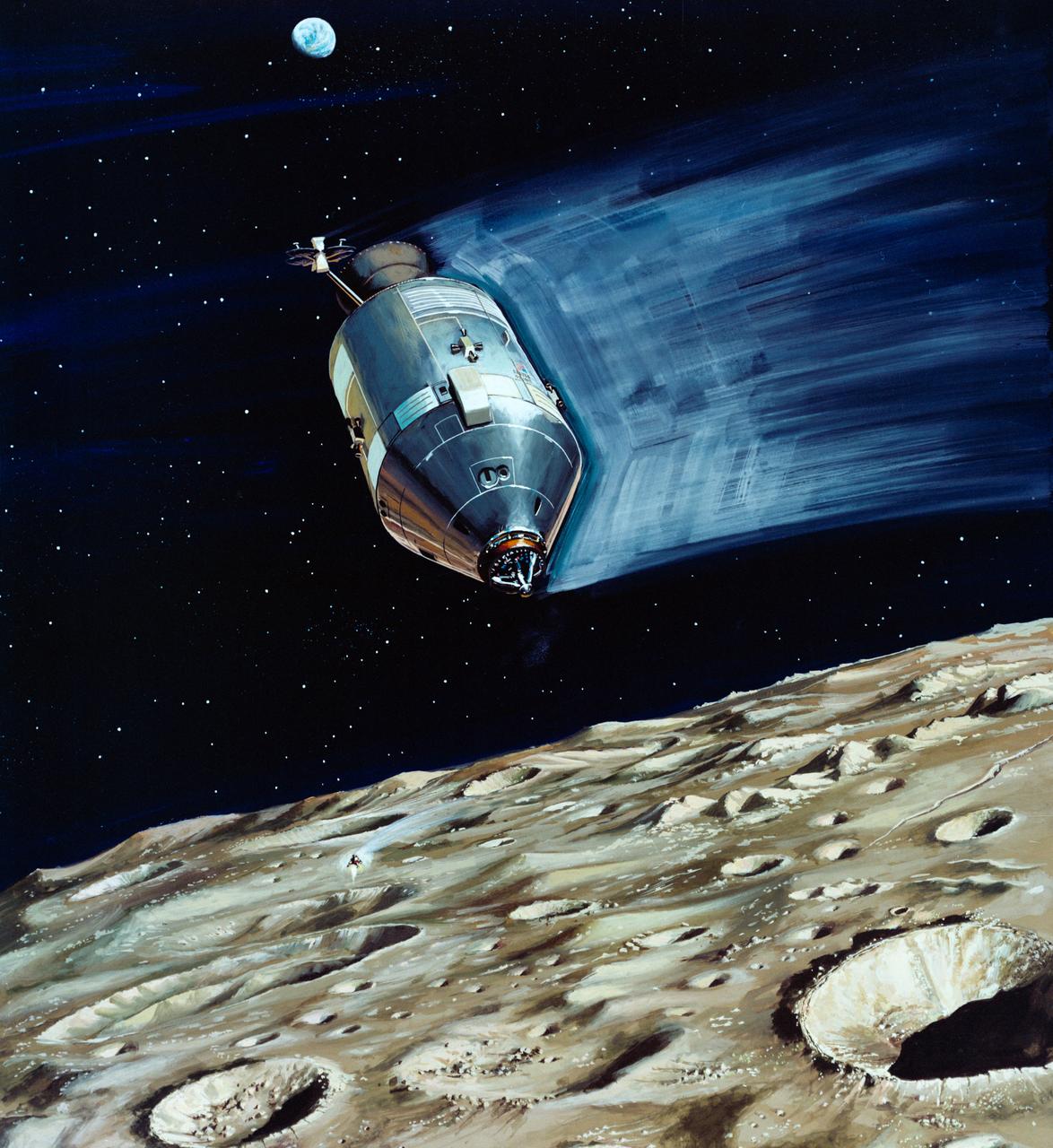
S70-31898 (March 1970) --- A North American Rockwell artist?s concept depicting the Apollo 13 Lunar Module (LM) descending to the Fra Mauro landing site as the Command and Service Module (CSM) remains in lunar orbit. Astronaut Thomas K. Mattingly II, command module pilot, will photograph the LM?s descent from the CSM. Astronauts James A. Lovell Jr., commander, and Fred W. Haise Jr., lunar module pilot, will descend in the LM to explore the moon. Apollo 13 will be NASA?s third lunar landing mission.
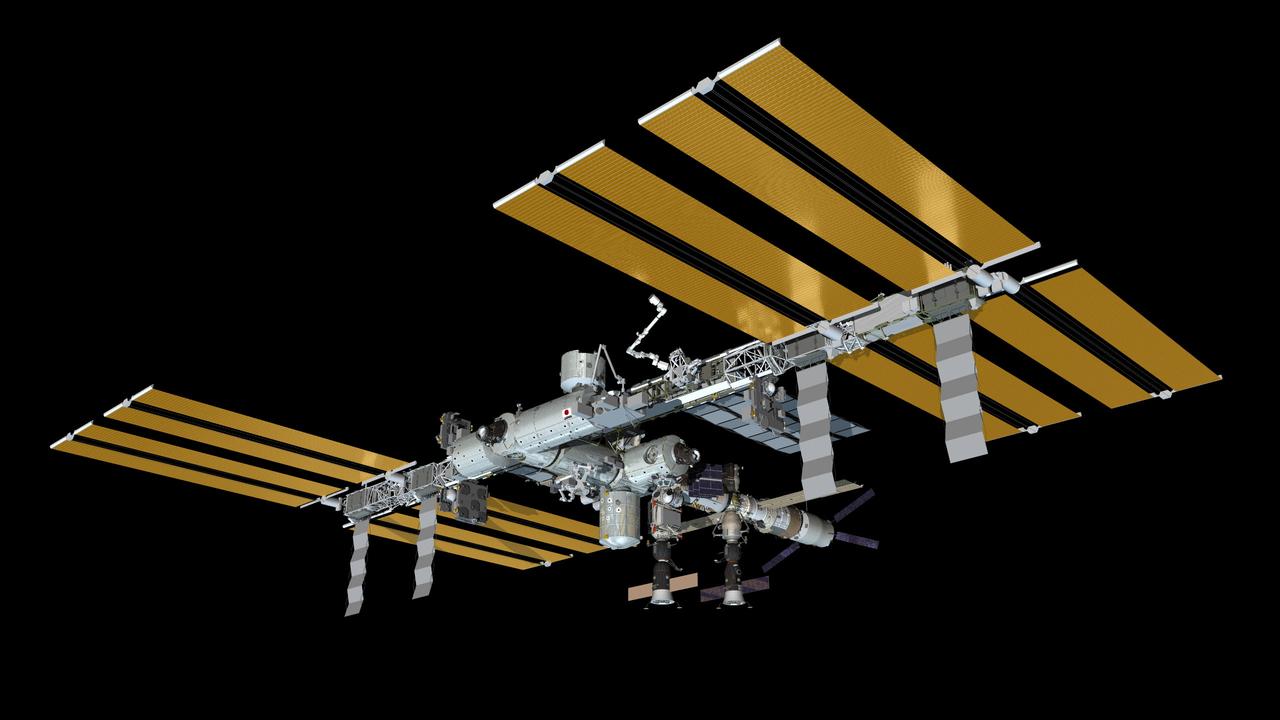
JSC2011-E-028503 (March 2011) --- Computer-generated artist?s rendering of the International Space Station as of March 28, 2011. The Japanese Kounotori2 H-II Transfer Vehicle (HTV2) undocks from the Harmony node?s zenith port. Progress 41 resupply vehicle is docked to the Pirs Docking Compartment. Soyuz 25 (TMA-20) remains linked to the Rassvet Mini-Research Module 1 (MRM1). The European Space Agency's ?Johannes Kepler? Automated Transfer Vehicle-2 (ATV2) is attached to the Zvezda Service Module?s aft port. Photo credit: NASA or National Aeronautics and Space Administration
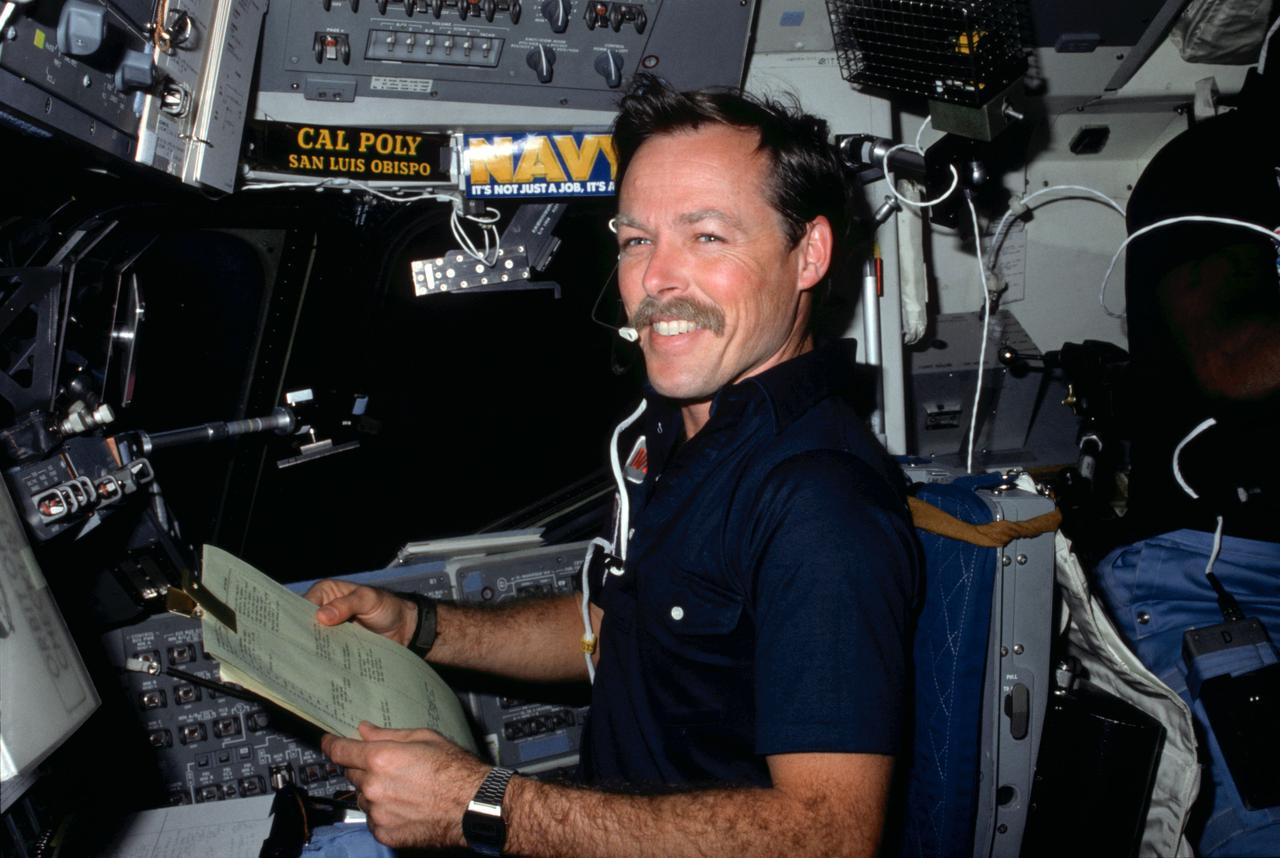
41B-07-230 (S84-27027) (3-11 February 1984) ---Astronaut Robert L. Gibson, 41-B pilot, reviews some teleprinter copy on the flight deck?s starboard station during the eight-day 41-B Space Shuttle mission. Four other astronauts share the Challenger with Gibson. They are Astronauts Vance D. Brand, commander; and Ronald E. McNair, Bruce McCandless II and Robert L. Stewart, all mission specialists. The photograph was taken from the commander?s station with a 35mm camera.
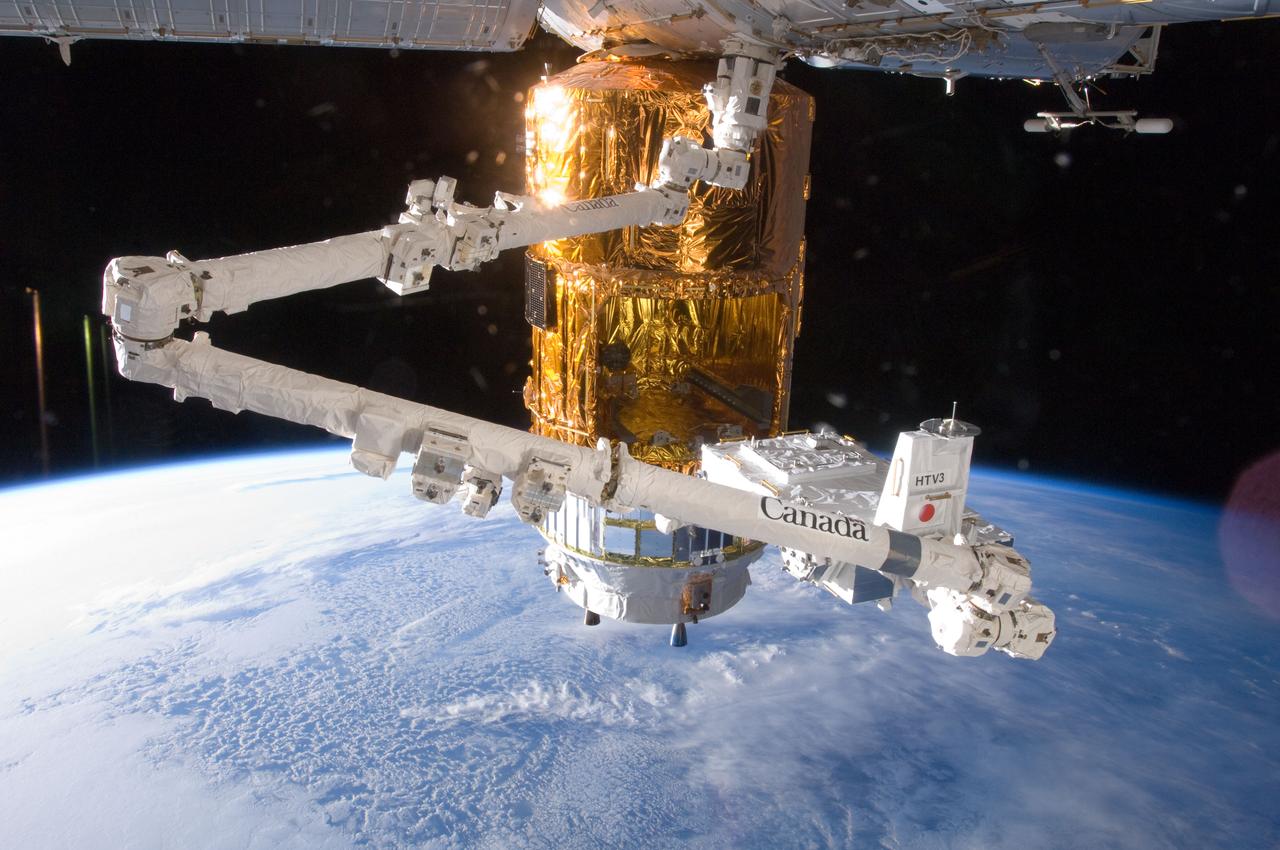
ISS032-E-016904 (10 Aug. 2012) --- In the grasp of the International Space Station?s robotic Canadarm2, the HTV-3 Exposed Pallet is moved for installation on the Japan Aerospace Exploration Agency (JAXA) H-II Transfer Vehicle (HTV-3) currently docked to the space station. Earth?s horizon and the blackness of space provide the backdrop for the scene.
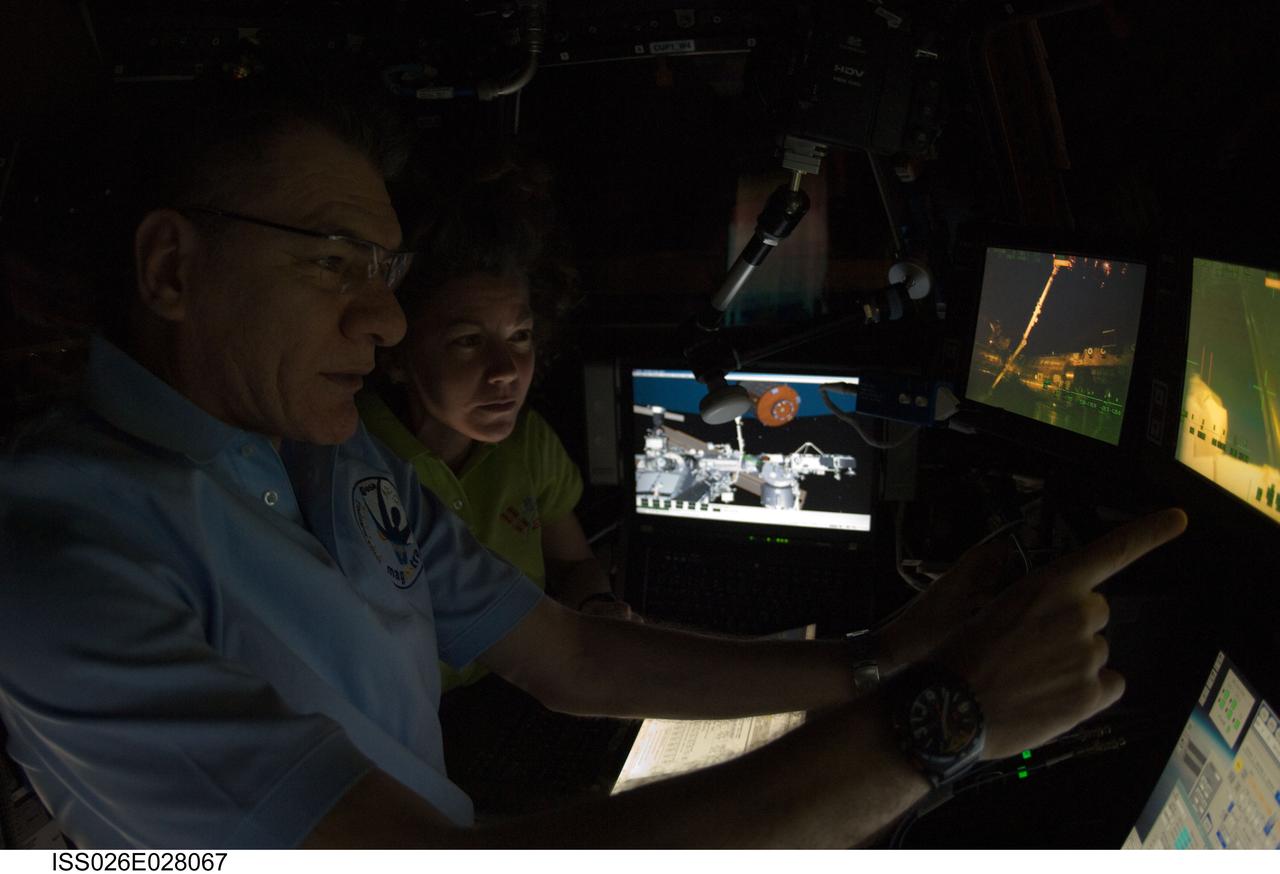
ISS026-E-028067 (18 Feb. 2011) --- European Space Agency astronaut Paolo Nespoli and NASA astronaut Catherine (Cady) Coleman, both Expedition 26 flight engineers, operate the Canadarm2 controls inside the International Space Station?s Cupola to relocate the Japanese Kounotori2 H-II Transfer Vehicle (HTV2) from the Harmony node nadir port to Harmony?s zenith port.
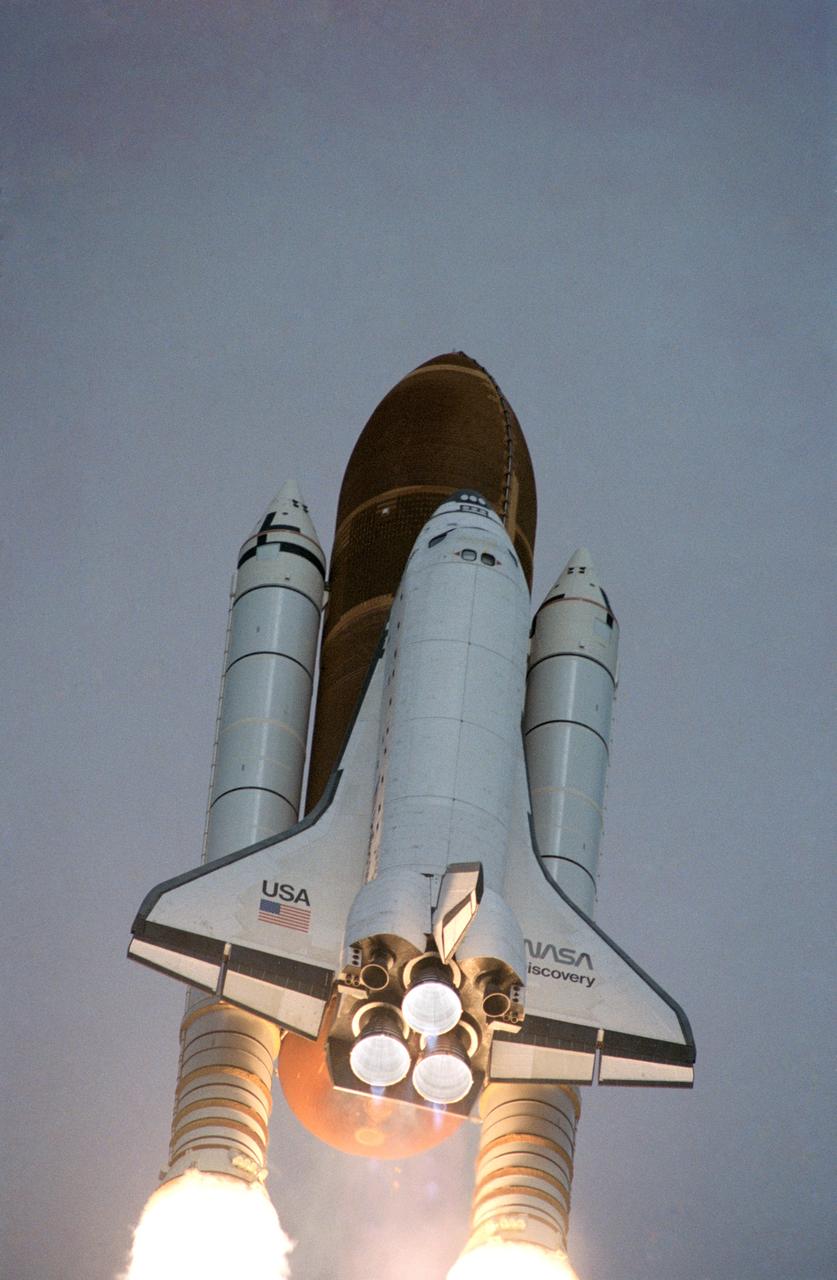
STS031-S-074 (24 April 1990) --- A low-angle view of the launch of the STS-31 mission. Onboard Discovery are a crew of five veteran astronauts and the Hubble Space Telescope (HST). Official launch time was 8:33:51.0492 a.m. (EDT). Headed for approximately five days in space are astronauts Loren J. Shriver, Charles F. Bolden Jr., Bruce McCandless II, Kathryn D. Sullivan and Steven S. Hawley.
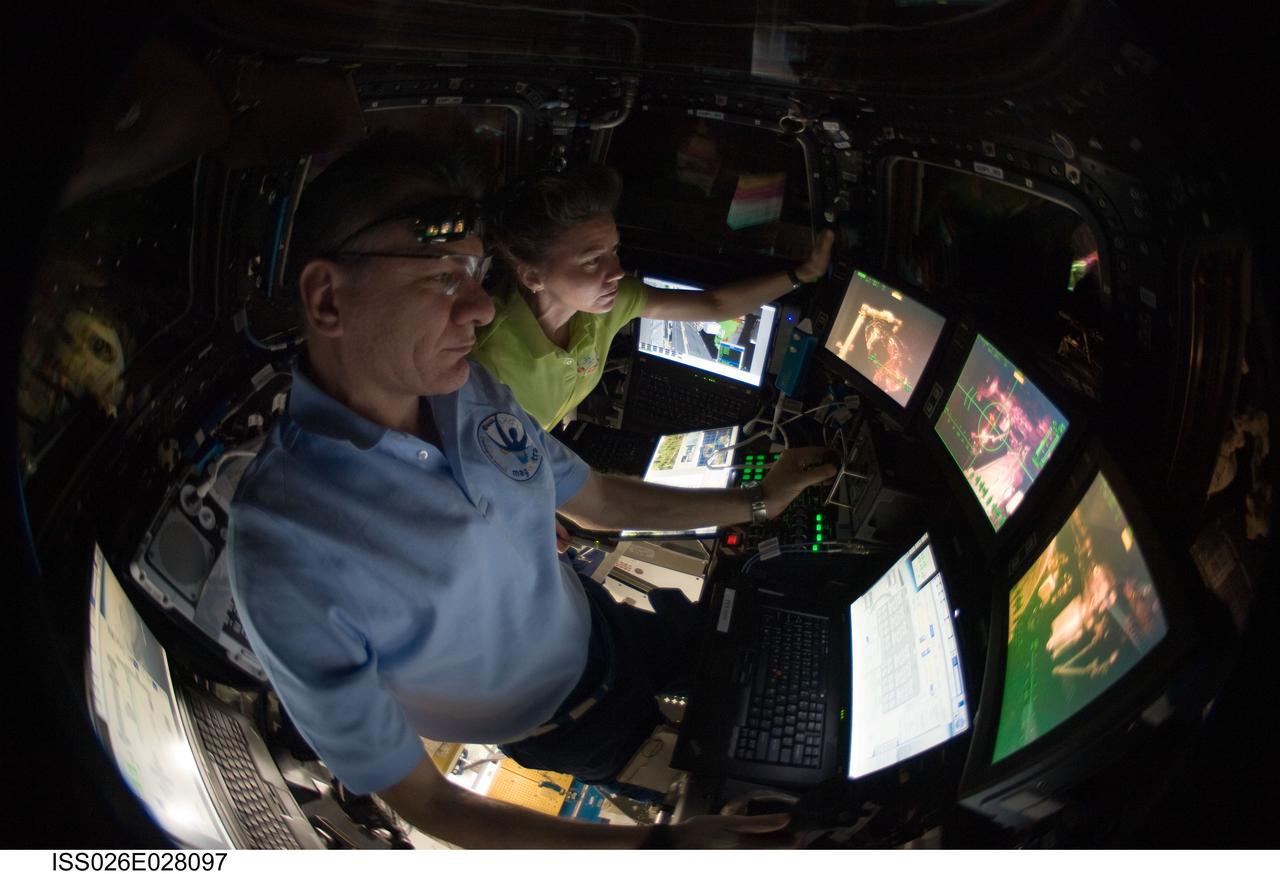
ISS026-E-028097 (18 Feb. 2011) --- European Space Agency astronaut Paolo Nespoli and NASA astronaut Catherine (Cady) Coleman, both Expedition 26 flight engineers, operate the Canadarm2 controls inside the International Space Station?s Cupola to relocate the Japanese Kounotori2 H-II Transfer Vehicle (HTV2) from the Harmony node nadir port to Harmony?s zenith port.

ISS027-E-007901 (27 March 2011) --- In honor of those affected by the Tohoku-Kanto Earthquake in Japan, paper cranes (origami craft), placed in the Kounotori2 H-II Transfer Vehicle (HTV-2) are featured in this image photographed by an Expedition 27 crew member on the International Space Station. The HTV2 is scheduled to be released by the International Space Station?s robotic arm at 11:45 a.m. EDT on March 28, and re-enter Earth?s atmosphere on March 29, 2011.
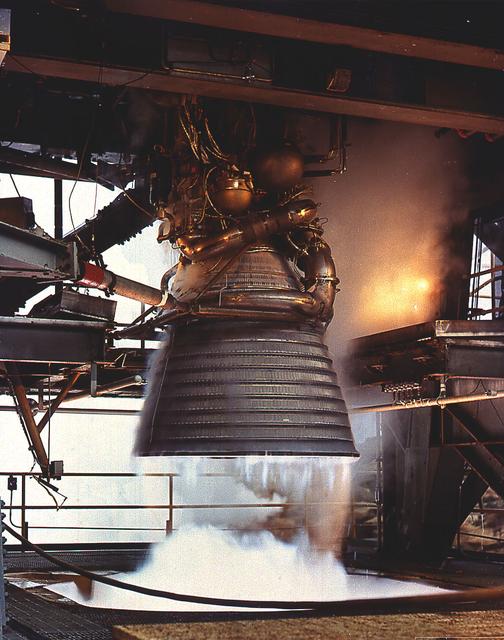
A J-2 engine undergoes static firing. The J-2, developed under the direction of the Marshall Space Flight Center, was propelled by liquid hydrogen and liquid oxygen. A single J-2 was utilized in the S-IVB stage (the second stage for the Saturn IB and third stage for the Saturn V) and in a cluster of five for the second stage (S-II) of the Saturn V. Initially rated at 200,000 pounds of thrust, the engine was later uprated in the Saturn V program to 230,000 pounds.
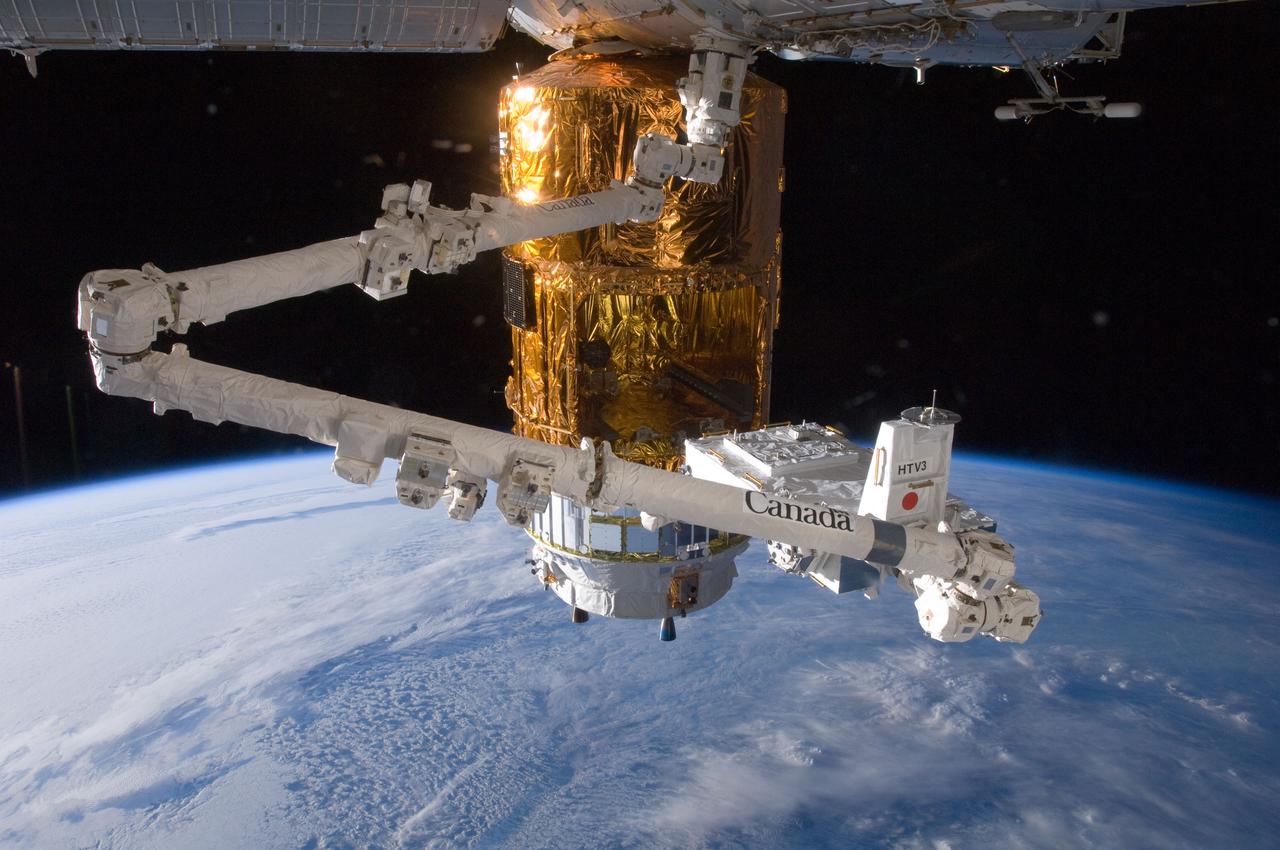
ISS032-E-016906 (10 Aug. 2012) --- In the grasp of the International Space Station?s robotic Canadarm2, the HTV-3 Exposed Pallet is moved for installation on the Japan Aerospace Exploration Agency (JAXA) H-II Transfer Vehicle (HTV-3) currently docked to the space station. Earth?s horizon and the blackness of space provide the backdrop for the scene.
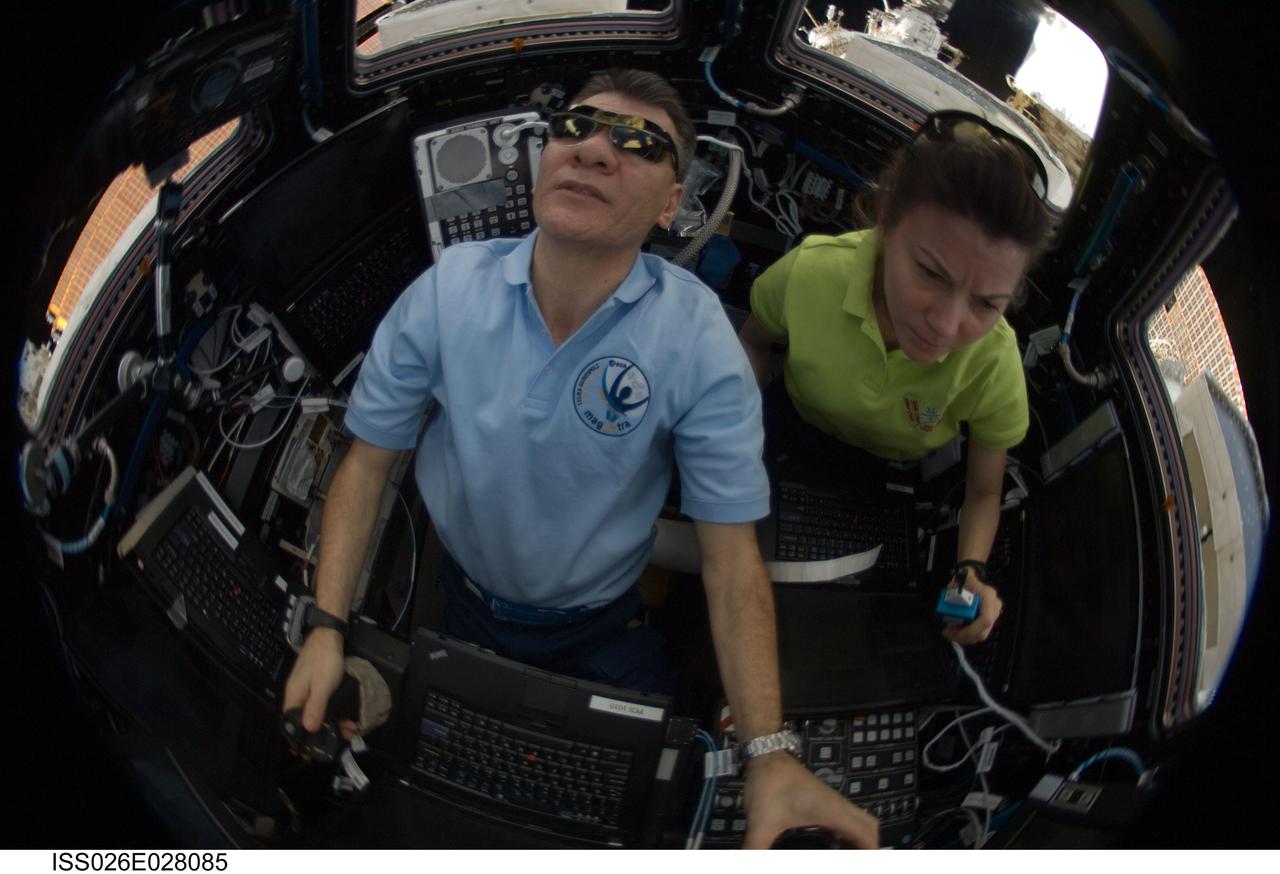
ISS026-E-028085 (18 Feb. 2011) --- European Space Agency astronaut Paolo Nespoli and NASA astronaut Catherine (Cady) Coleman, both Expedition 26 flight engineers, operate the Canadarm2 controls inside the International Space Station?s Cupola to relocate the Japanese Kounotori2 H-II Transfer Vehicle (HTV2) from the Harmony node nadir port to Harmony?s zenith port.
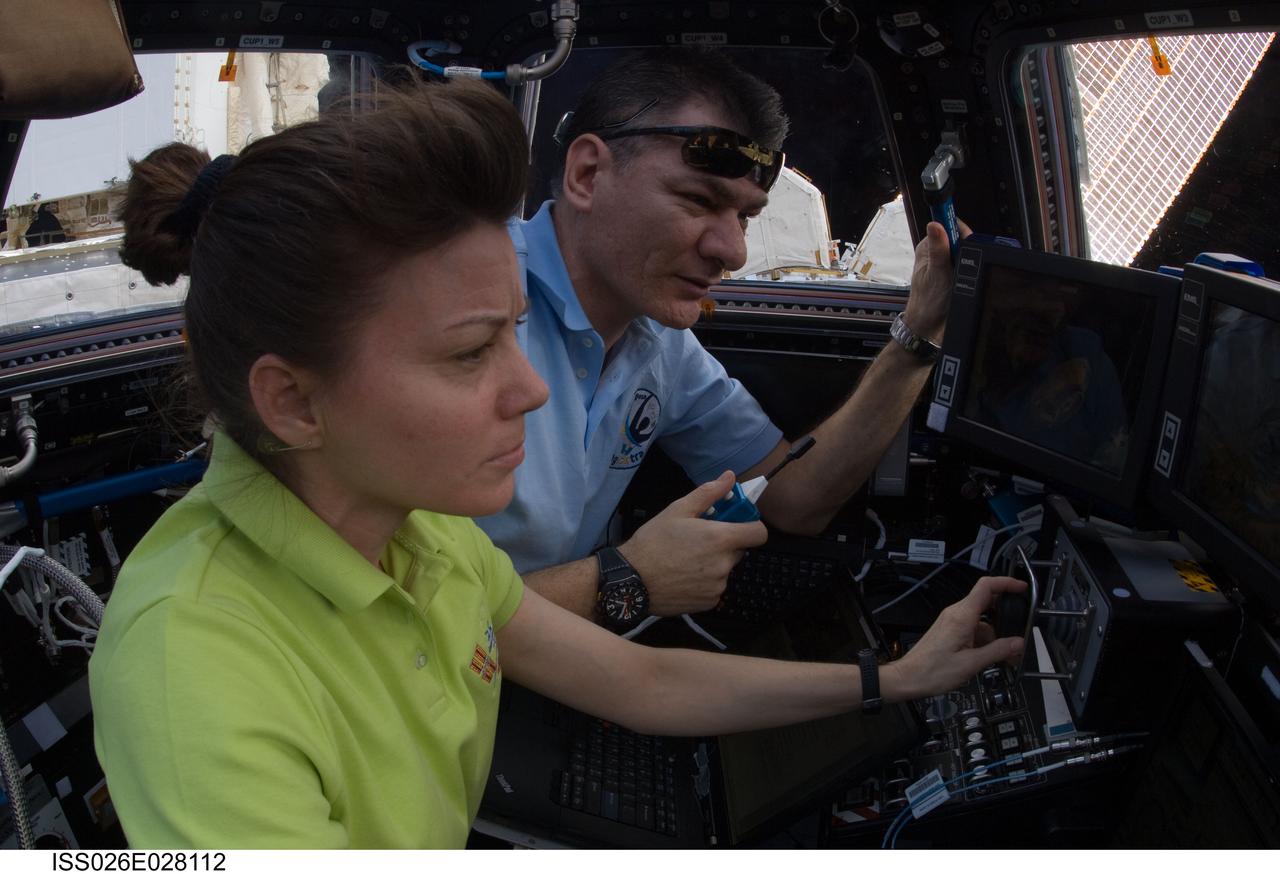
ISS026-E-028112 (18 Feb. 2011) --- European Space Agency astronaut Paolo Nespoli and NASA astronaut Catherine (Cady) Coleman, both Expedition 26 flight engineers, operate the Canadarm2 controls inside the International Space Station?s Cupola to relocate the Japanese Kounotori2 H-II Transfer Vehicle (HTV2) from the Harmony node nadir port to Harmony?s zenith port.
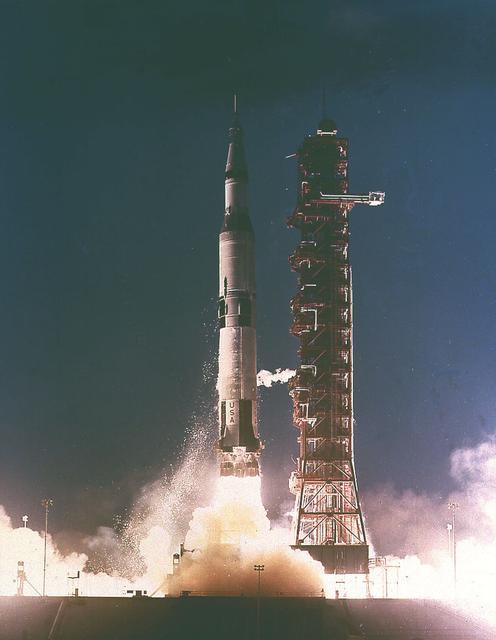
AS-501, the first flight of the Saturn V launch vehicle, takes flight from Kennedy Space Center's Launch Pad 39A on November 9, 1967. The unmanned mission, also designated Apollo 4, marked the first test flight of the S-IC and S-II stages, developed for the Saturn program under the direction of the Marshall Space Flight Center.
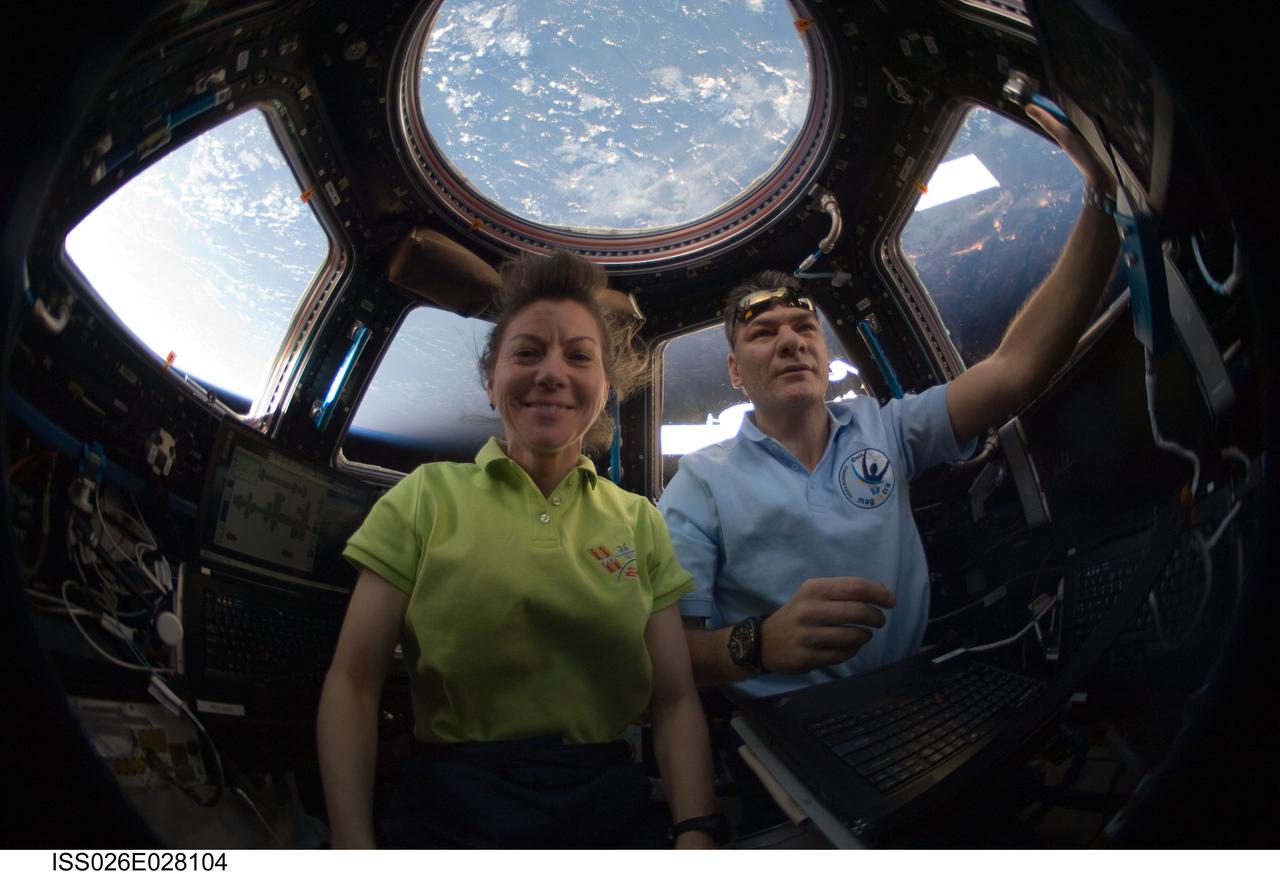
ISS026-E-028104 (18 Feb. 2011) --- European Space Agency astronaut Paolo Nespoli and NASA astronaut Catherine (Cady) Coleman, both Expedition 26 flight engineers, operate the Canadarm2 controls inside the International Space Station?s Cupola to relocate the Japanese Kounotori2 H-II Transfer Vehicle (HTV2) from the Harmony node nadir port to Harmony?s zenith port.
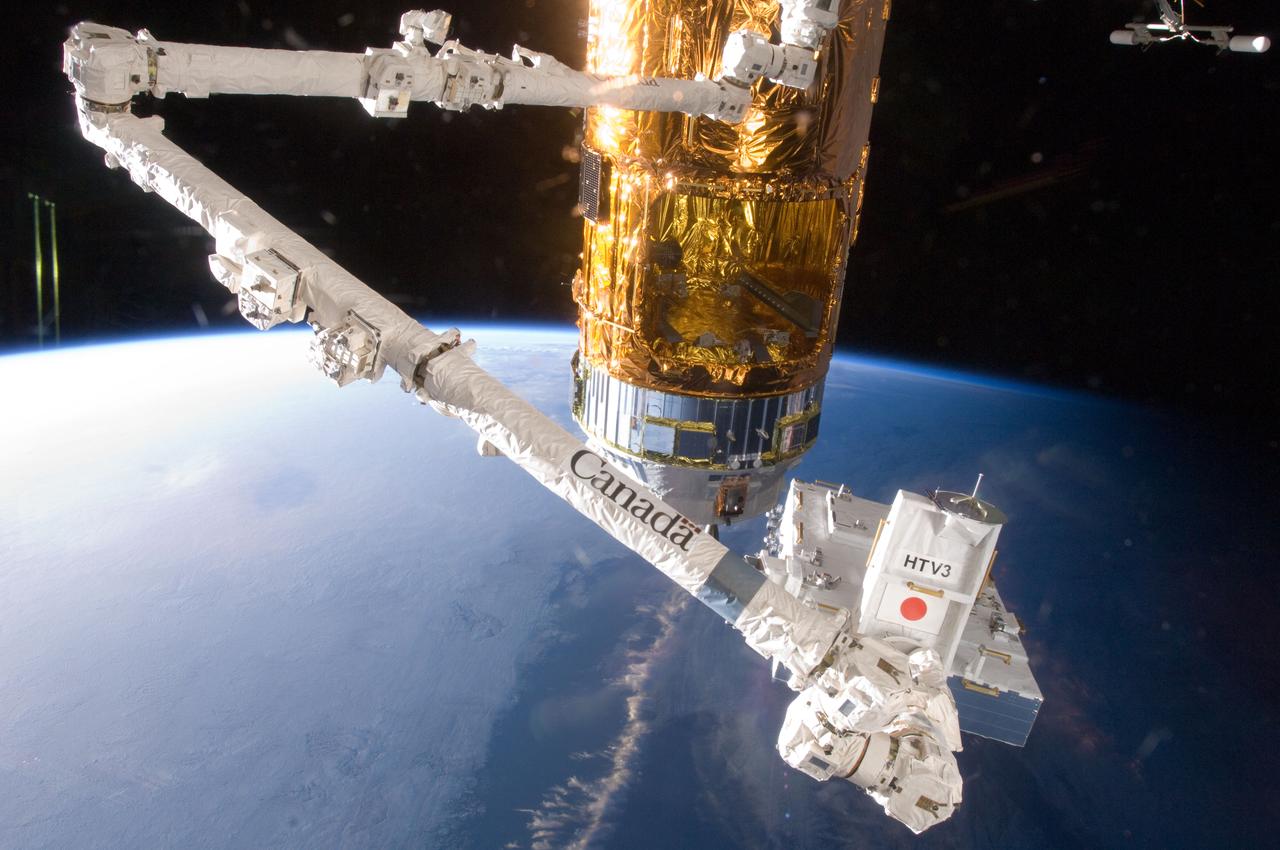
ISS032-E-016900 (10 Aug. 2012) --- In the grasp of the International Space Station?s robotic Canadarm2, the HTV-3 Exposed Pallet is moved for installation on the Japan Aerospace Exploration Agency (JAXA) H-II Transfer Vehicle (HTV-3) currently docked to the space station. Earth?s horizon and the blackness of space provide the backdrop for the scene.
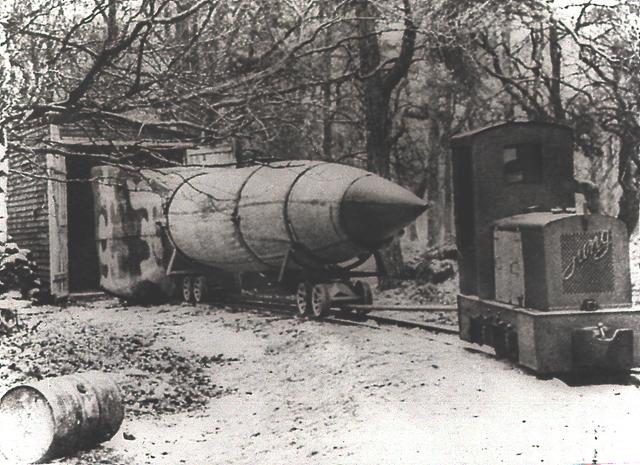
In this undated file photo, probably from World War II, a V-2 rocket emerges from its camouflaged shelter. The team of German engineers and scientists who developed the V-2 came to the United States after World War II and worked for the U. S. Army at Fort Bliss, Texas and Redstone Arsenal in Huntsville, Alabama.
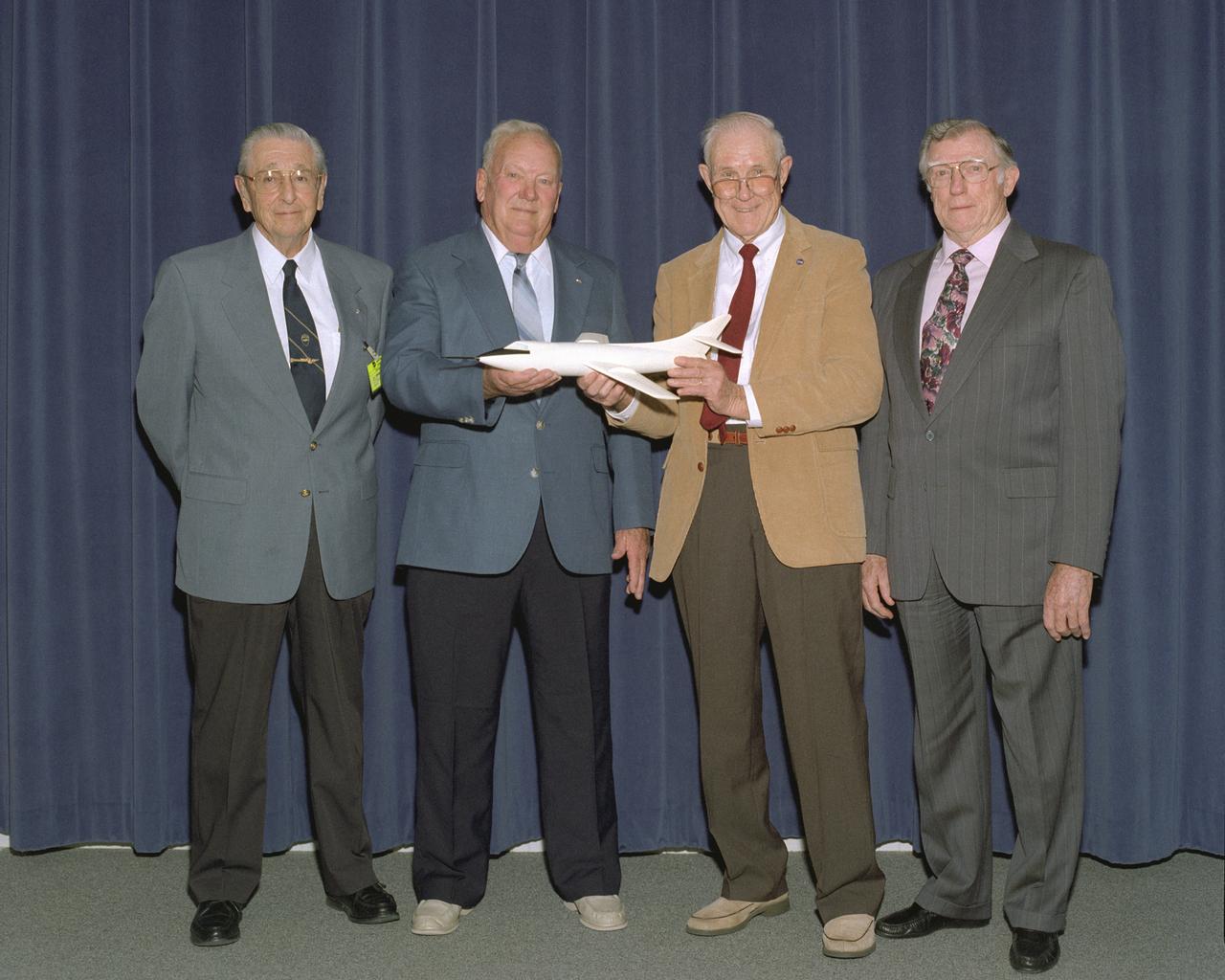
Former NACA test pilots Scott Crossfield, Stan Butchart, Robert Champine, and John Griffith gathered at the NASA Dryden Flight Research Center for the "Men of Mach 2" symposium, an event celebrating their work in the 1950's on the D-558-II Skyrocket aircraft.
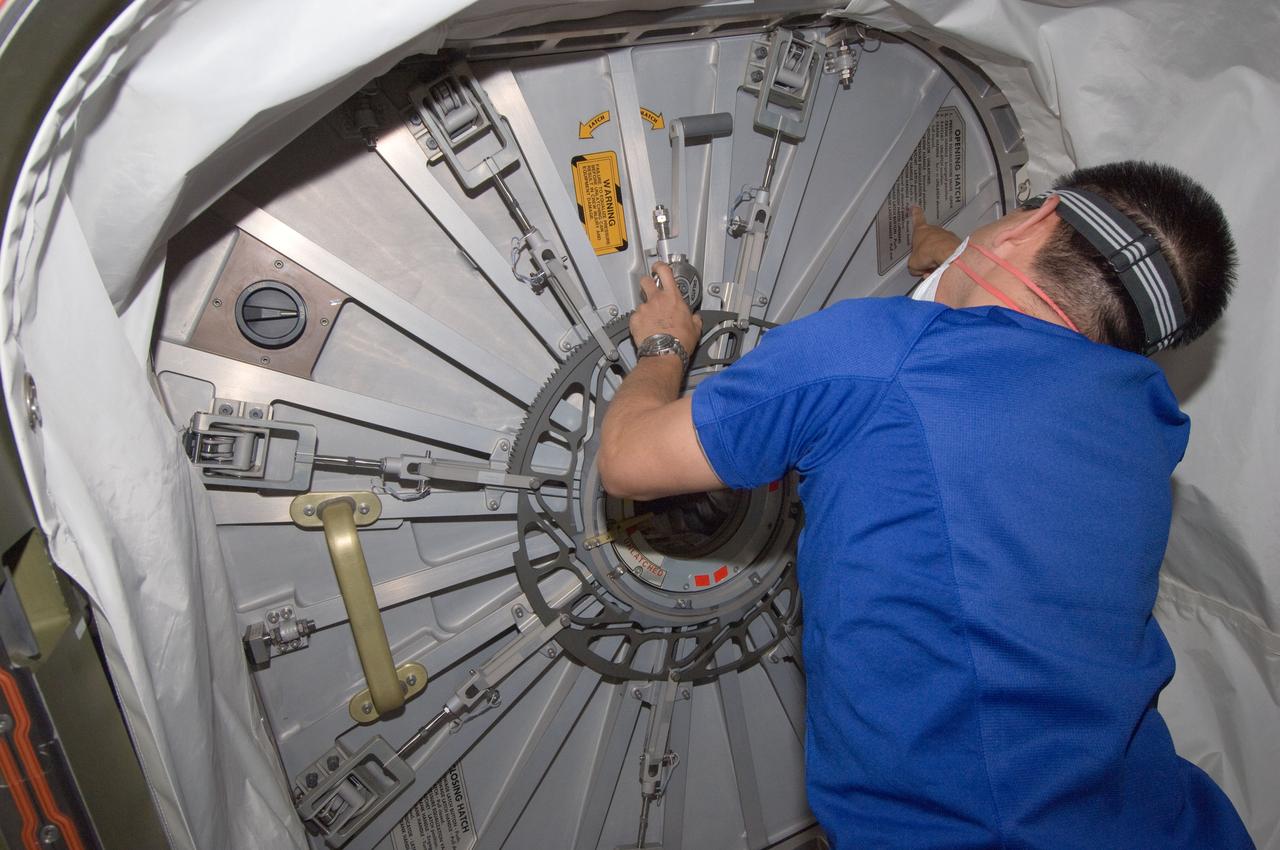
ISS032-E-011395 (28 July 2012) --- Japan Aerospace Exploration Agency astronaut Aki Hoshide, Expedition 32 flight engineer, prepares to open the hatch to the newly attached Japan Aerospace Exploration Agency (JAXA) H-II Transfer Vehicle (HTV-3) docked to the International Space Station?s Harmony node.
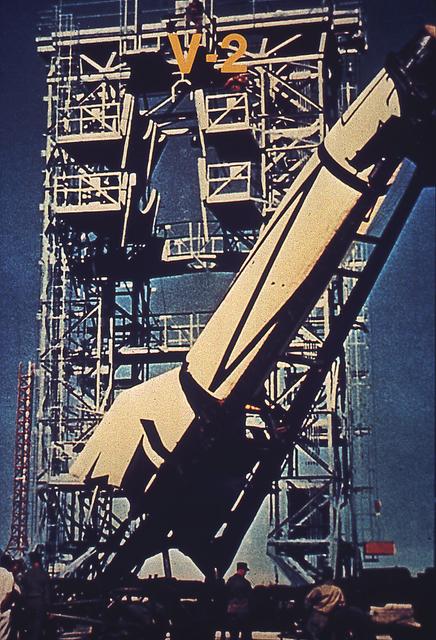
A V-2 rocket is hoisted into a static test facility at White Sands, New Mexico. The German engineers and scientists who developed the V-2 came to the United States at the end of World War II and continued rocket testing under the direction of the U. S. Army, launching more than sixty V-2s.
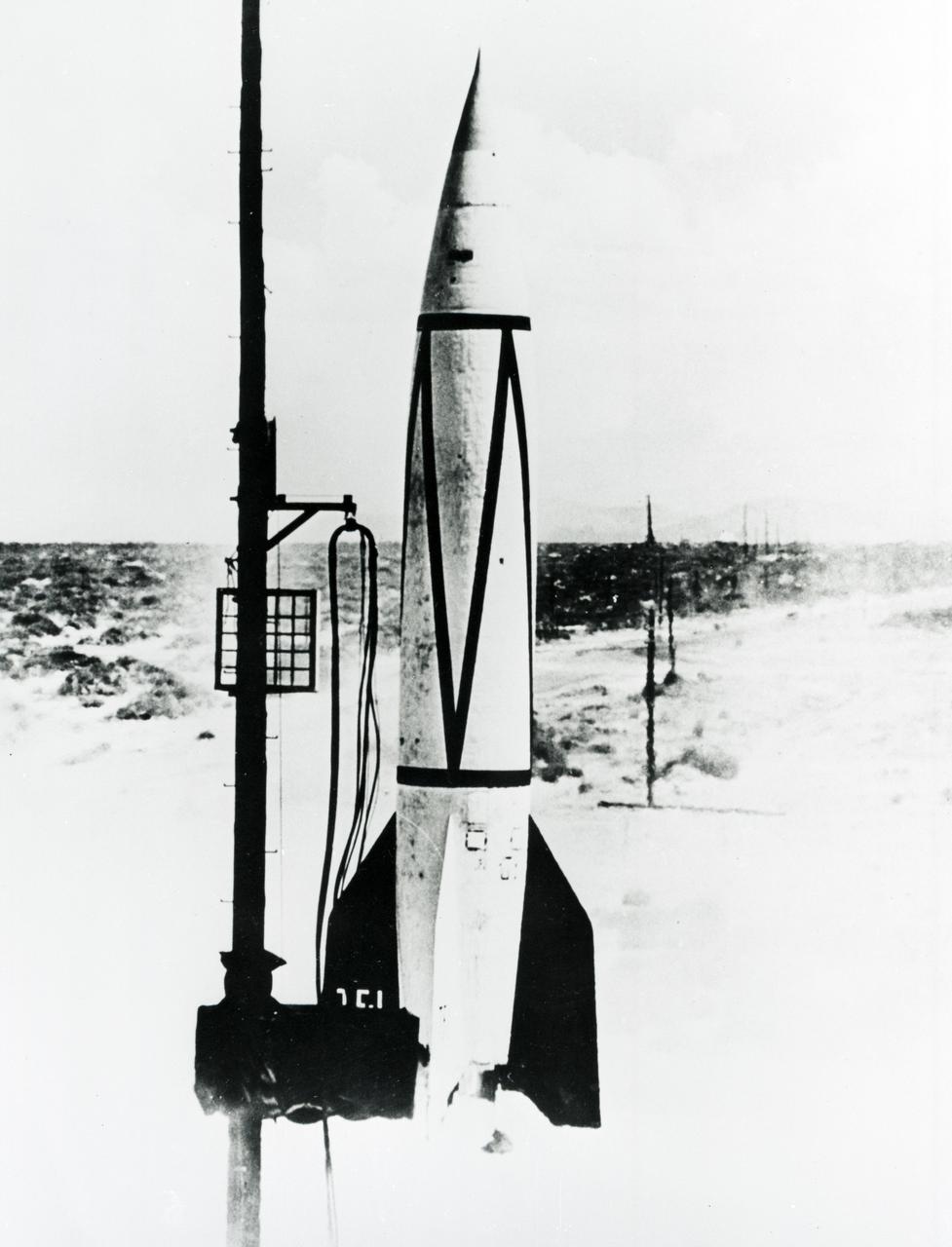
A V-2 rocket takes flight at White Sands, New Mexico, in 1946. The German engineers and scientists who developed the V-2 came to the United States at the end of World War II and continued rocket testing under the direction of the U. S. Army, launching more than sixty V-2s.
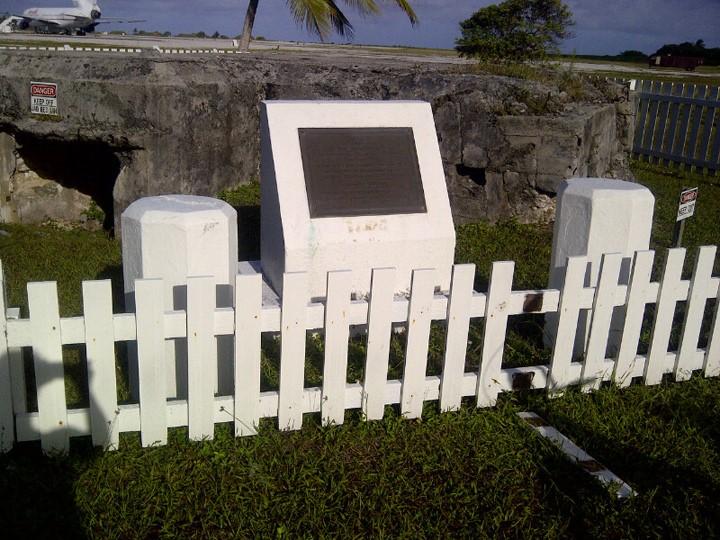
KWAJALEIN ATOLL, Marshall Islands - Orbital Science Corp.'s L-1011 aircraft "Stargazer" stands near the runway on Kwajalein Atoll with the company's Pegasus rocket slung underneath in the background near this World War II-era bunker built by the Japanese forces who occupied the island. Photo credit: NASA
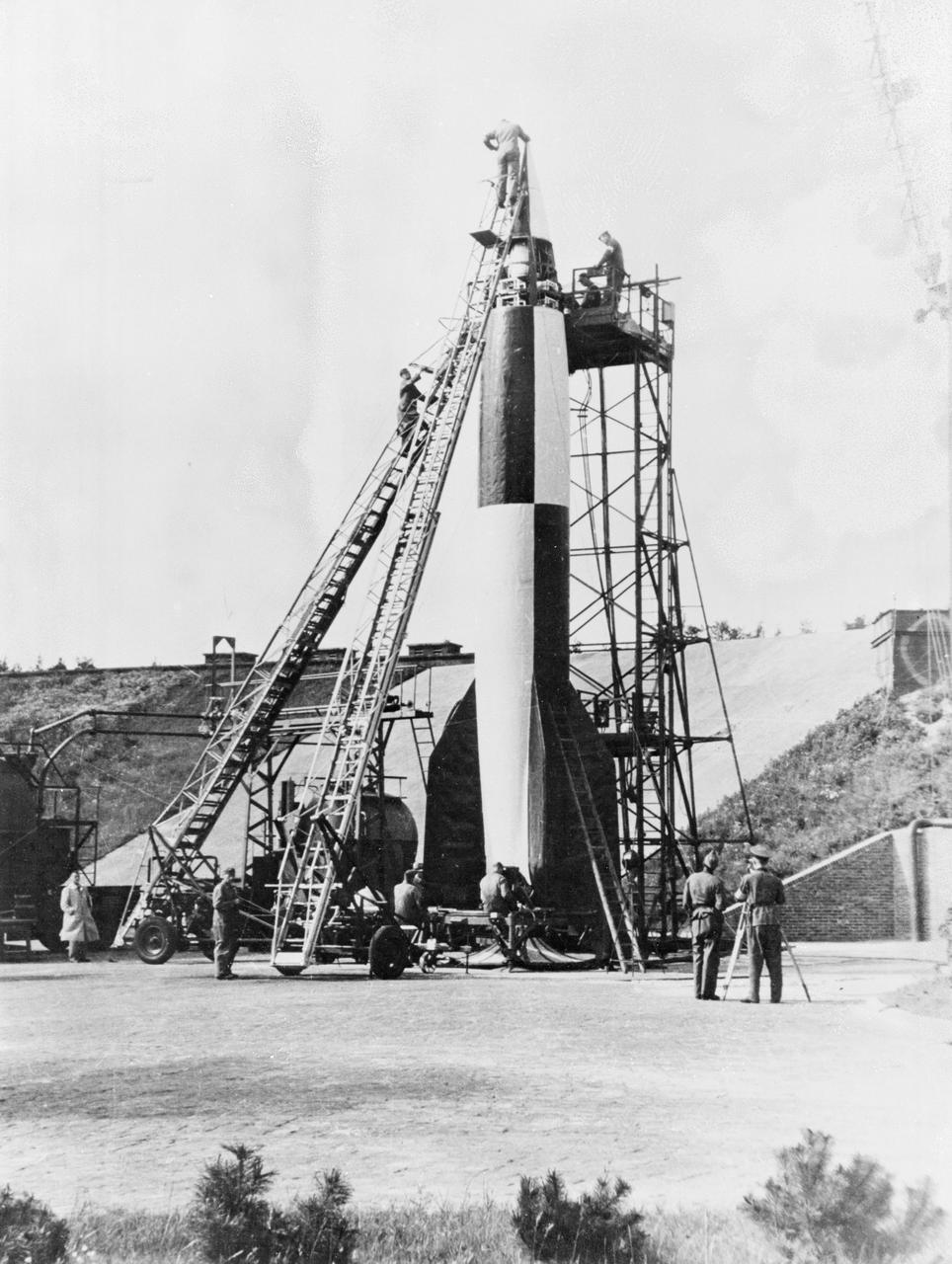
German technicians stack the various stages of the V-2 rocket in this undated photograph. The team of German engineers and scientists who developed the V-2 came to the United States at the end of World War II and worked for the U. S. Army at Fort Bliss, Texas, and Redstone Arsenal in Huntsville, Alabama.
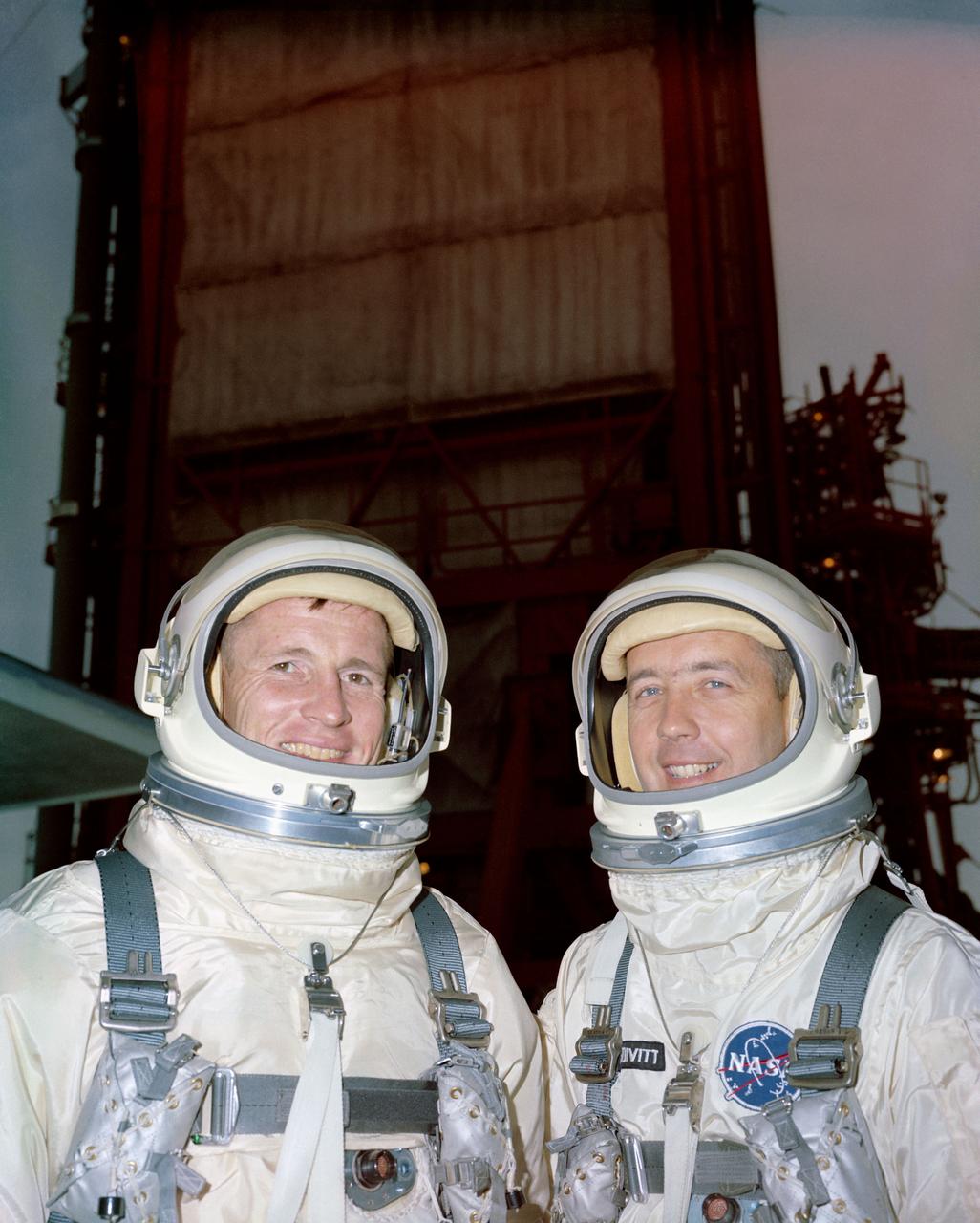
S65-19528 (1 June 1965) --- Astronauts Edward H. White II (left), Gemini-Titan 4 pilot; and James A. McDivitt, command pilot. EDITOR?S NOTE: Astronaut White died in the Apollo 1/Saturn 204 fire at Cape Kennedy on Jan. 27, 1967.
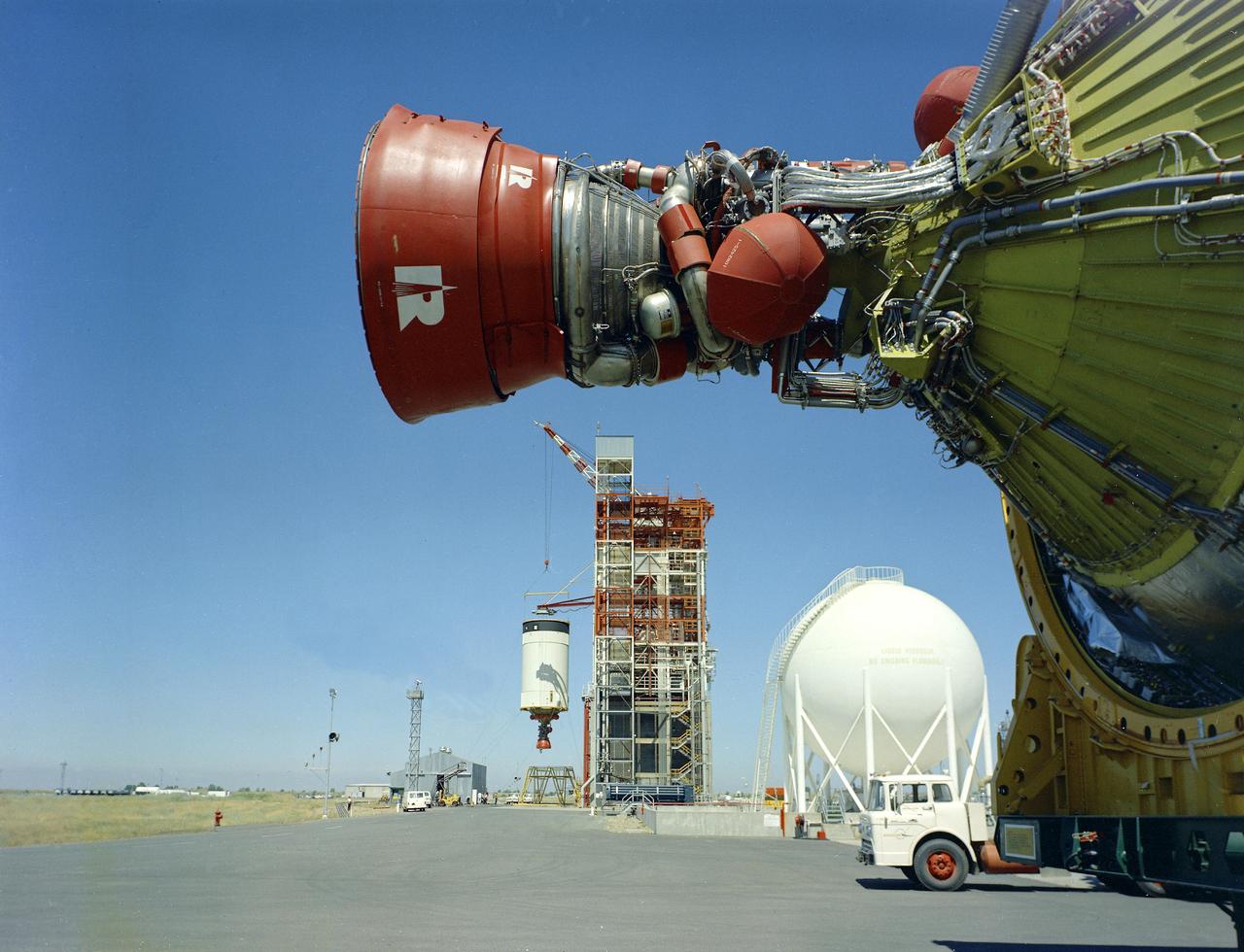
This is a view of the Saturn V S-IVB (third) stage for the AS-209 (Apollo-Soyuz test project backup vehicle) on a transporter in the right foreground, and the S-IVB stage for AS-504 (Apollo 9 mission) being installed in the Beta Test Stand 1 at the SACTO facility in California. After the S-II (second) stage dropped away, the S-IVB (third) stage ignited and burned for about two minutes to place itself and the Apollo spacecraft into the desired Earth orbit. At the proper time during this Earth parking orbit, the S-IVB stage was re-ignited to speed the Apollo spacecraft to escape velocity and inject it and the astronauts into a moon trajectory. Developed and manufactured by the Douglas Aircraft Company in California, the S-IVB stage measures about 21.5 feet in diameter, about 58 feet in length, and is powered by a single 200,000-pound-thrust J-2 engine with a re-start capability. The S-IVB stage was also used on the second stage of the Saturn IB launch vehicle.
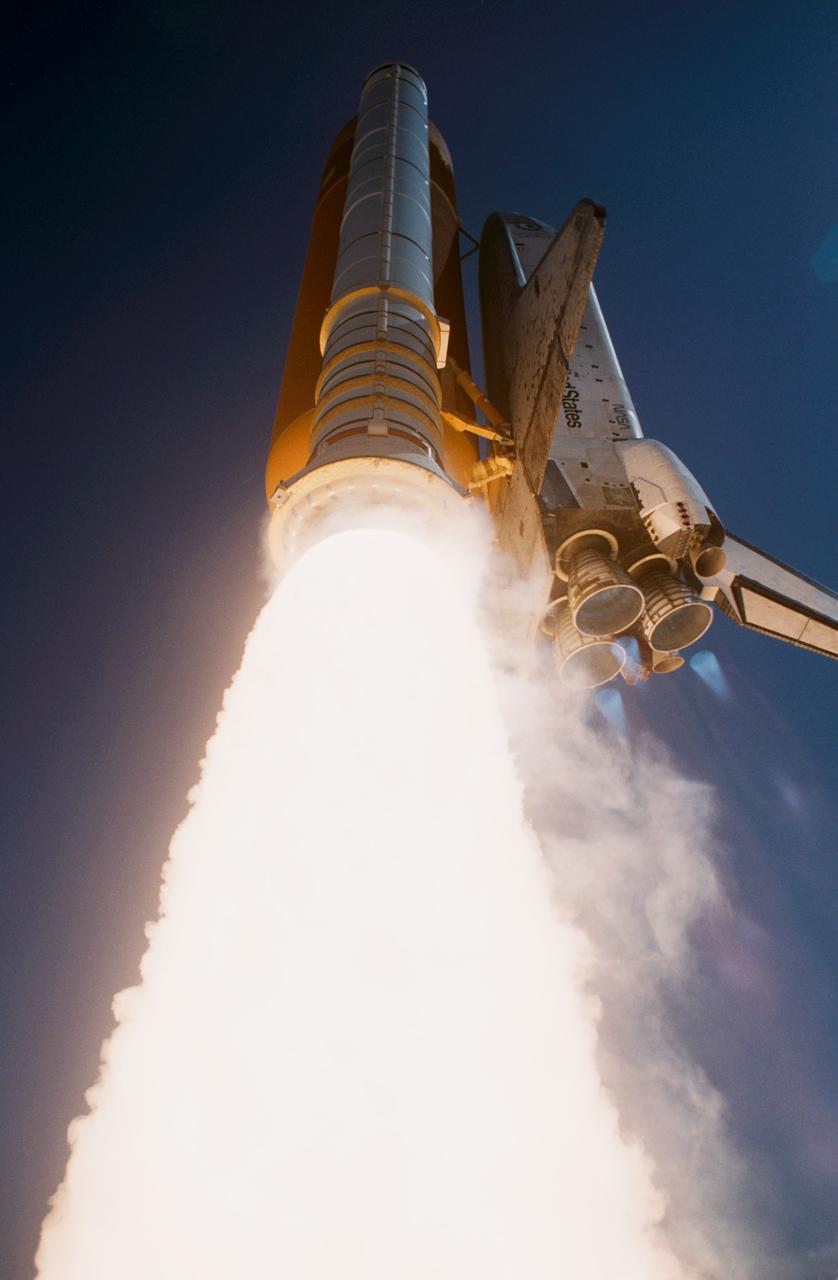
STS052-S-053 (22 Oct. 1992) --- This low-angle 35mm image shows the space shuttle Columbia on its way toward a ten-day Earth-orbital mission with a crew of five NASA astronauts and a Canadian payload specialist. Liftoff occurred at 1:09:39 p.m. (EDT), Oct. 22, from Kennedy Space Center?s (KSC) Launch Pad 39B. Crew members onboard are astronauts James D. Wetherbee, Michael A. Baker, Tamara E. Jernigan, Charles L. (Lacy) Veach and William M. Shepherd, along with payload specialist Steven G. MacLean. Payloads onboard include the Laser Geodynamic Satellite II (LAGEOS II), which will be deployed early in the mission, a series of Canadian experiments, and the United States Microgravity Payload-1 (USMP-1). Photo credit: NASA

jsc2025e034457 (March 18, 2025) -- The official Artemis II mission crew patch. The Artemis II test flight begins when a mighty team launches the first crew of the Artemis generation. This patch designates the mission as “AII,” signifying not only the second major flight of the Artemis campaign, but also an endeavor of discovery that seeks to explore for all and by all. Framed in Apollo 8’s famous Earthrise photo, the scene of the Earth and the Moon represents the dual nature of human spaceflight, both equally compelling: The Moon represents our exploration destination, focused on discovery of the unknown. The Earth represents home, focused on the perspective we gain when we look back at our shared planet and learn what it is to be uniquely human. The orbit around Earth highlights the ongoing exploration missions that have enabled Artemis to set sights on a long-term presence on the Moon and soon, Mars. Credit: NASA
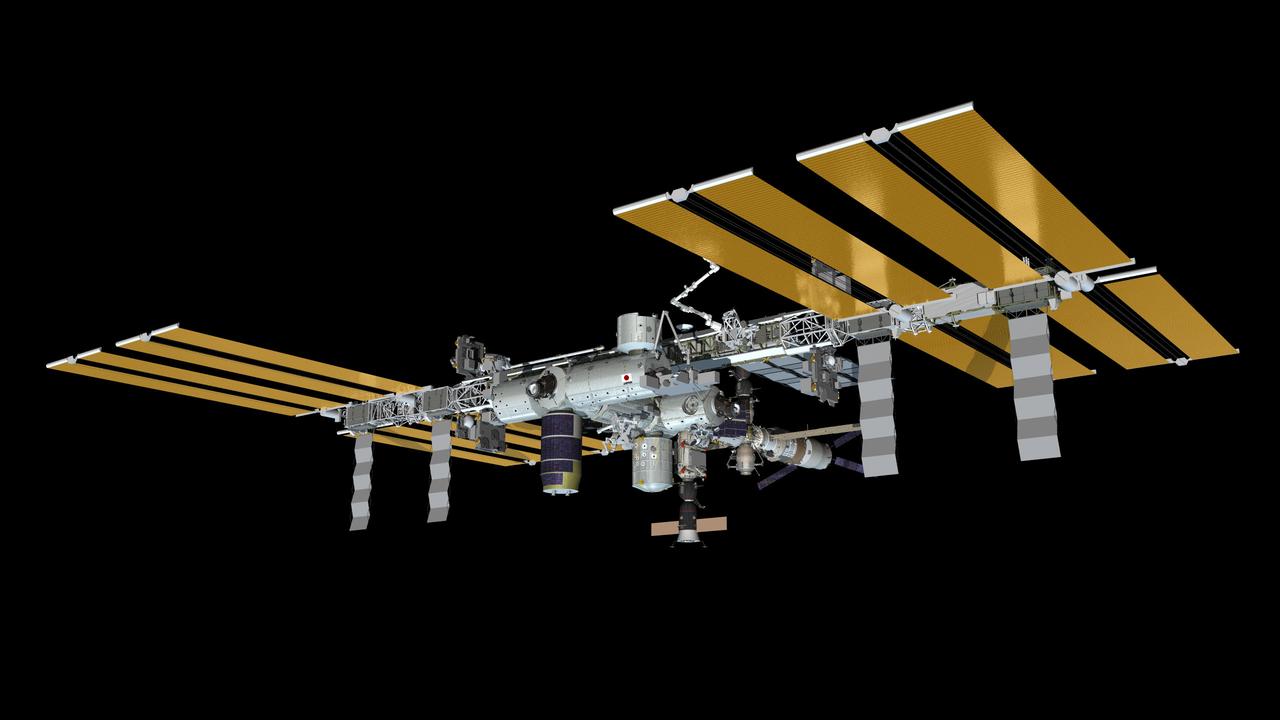
JSC2012-E-107187 (July 2012) --- Computer-generated artist?s rendering of the International Space Station as of July 27, 2012. Japan Aerospace Exploration Agency (JAXA) H-II Transfer Vehicle (HTV-3) is berthed to the Harmony nadir port. Soyuz 31 (TMA-05M) is docked to the Rassvet Mini-Research Module 1 (MRM1). European Space Agency?s Automated Transfer Vehicle-3 (ATV-3) ?Edoardo Amaldi? is attached to the Zvezda Service Module and Soyuz 30 (TMA-04M) is linked to the Poisk Mini-Research Module 2 (MRM2). Photo credit: NASA
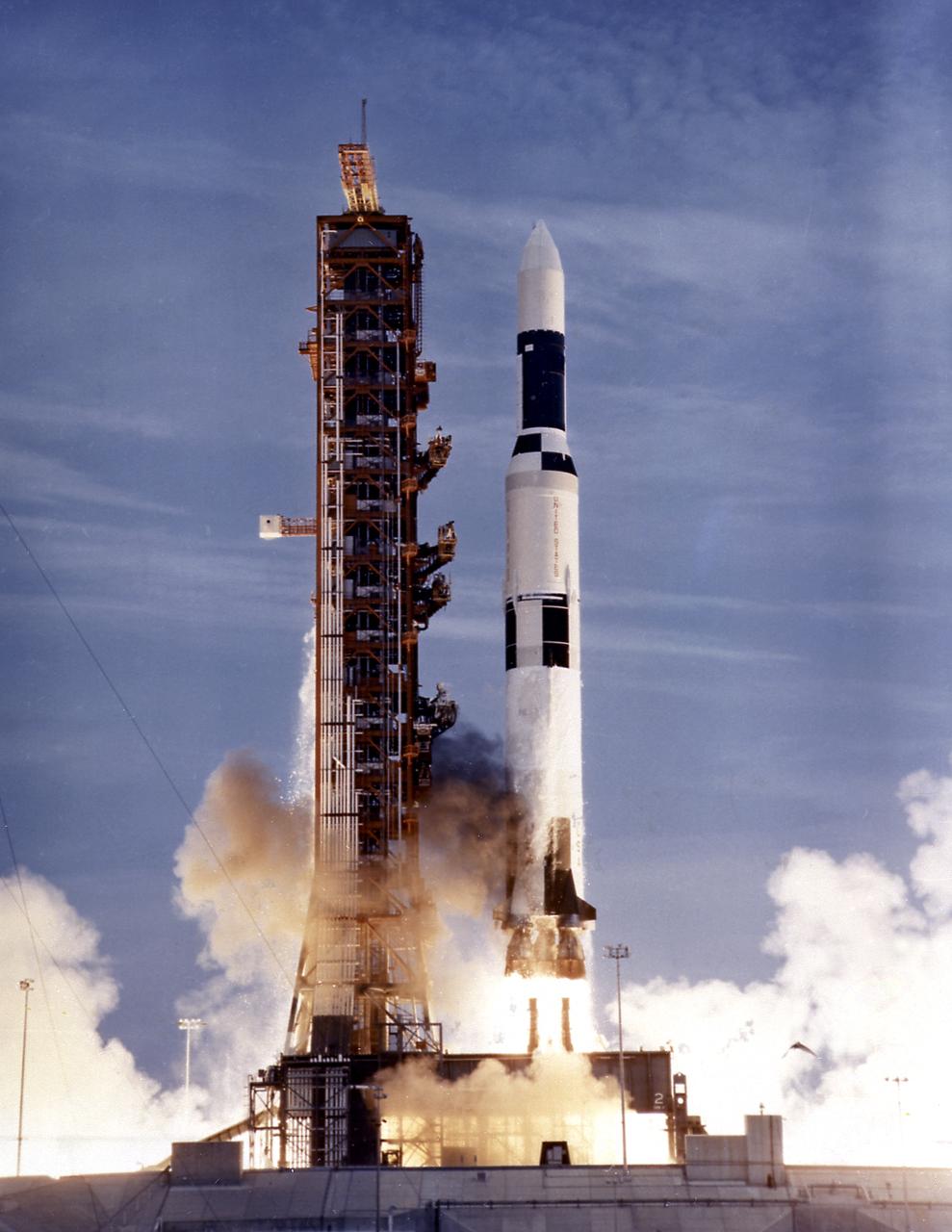
This photograph shows the launch of the SA-513, a modified unmarned two-stage Saturn V vehicle for the Skylab-1 mission, which placed the Skylab cluster into the Earth orbit on May 14, 1973. The initial step in the Skylab mission was the launch of a two-stage Saturn V booster, consisting of the S-IC first stage and the S-II second stage, from Launch Complex 39A at the Kennedy Space Center in Florida. Its payload was the unmanned Skylab, which consisted of the Orbital Workshop, the Airlock Module, the Multiple Docking Adapter, the Apollo Telescope Mount and an Instrument Unit.
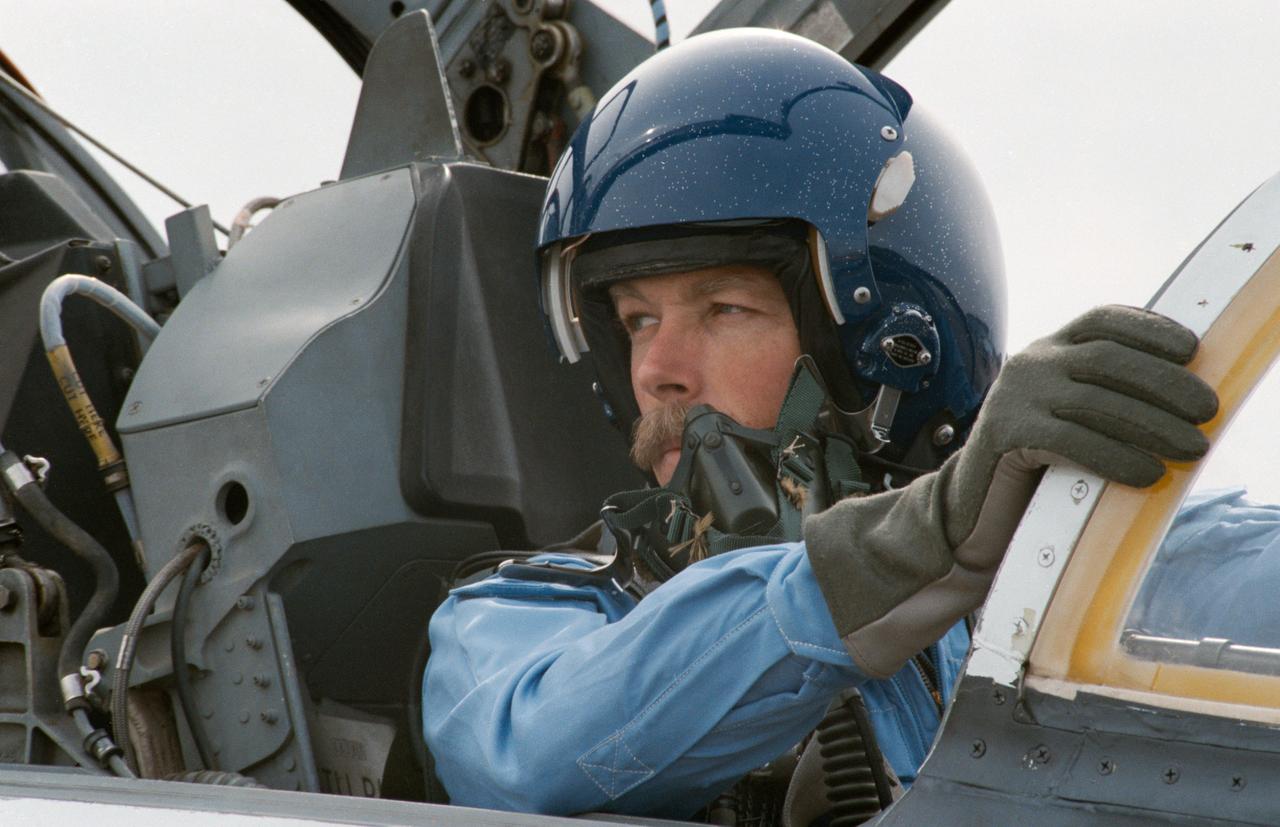
S84-26243 (31 Jan 1984) --- Astronaut Robert L. Gibson, one of five 41-B crewmembers, prepares to leave Houston?s Ellington Base in a T-38 jet aircraft en route to Florida and the Kennedy Space Center, site of February 3?s launch of the Challenger. Gibson, along with two other members of this crew, began training at JSC in July in 1978. He will be joined by Astronauts Vance D. Brand, commander; and Bruce McCandless II, Ronald E. McNair and Robert L. Stewart, all mission specialists. Brand and McCandless came aboard as NASA astronauts in April 1966.
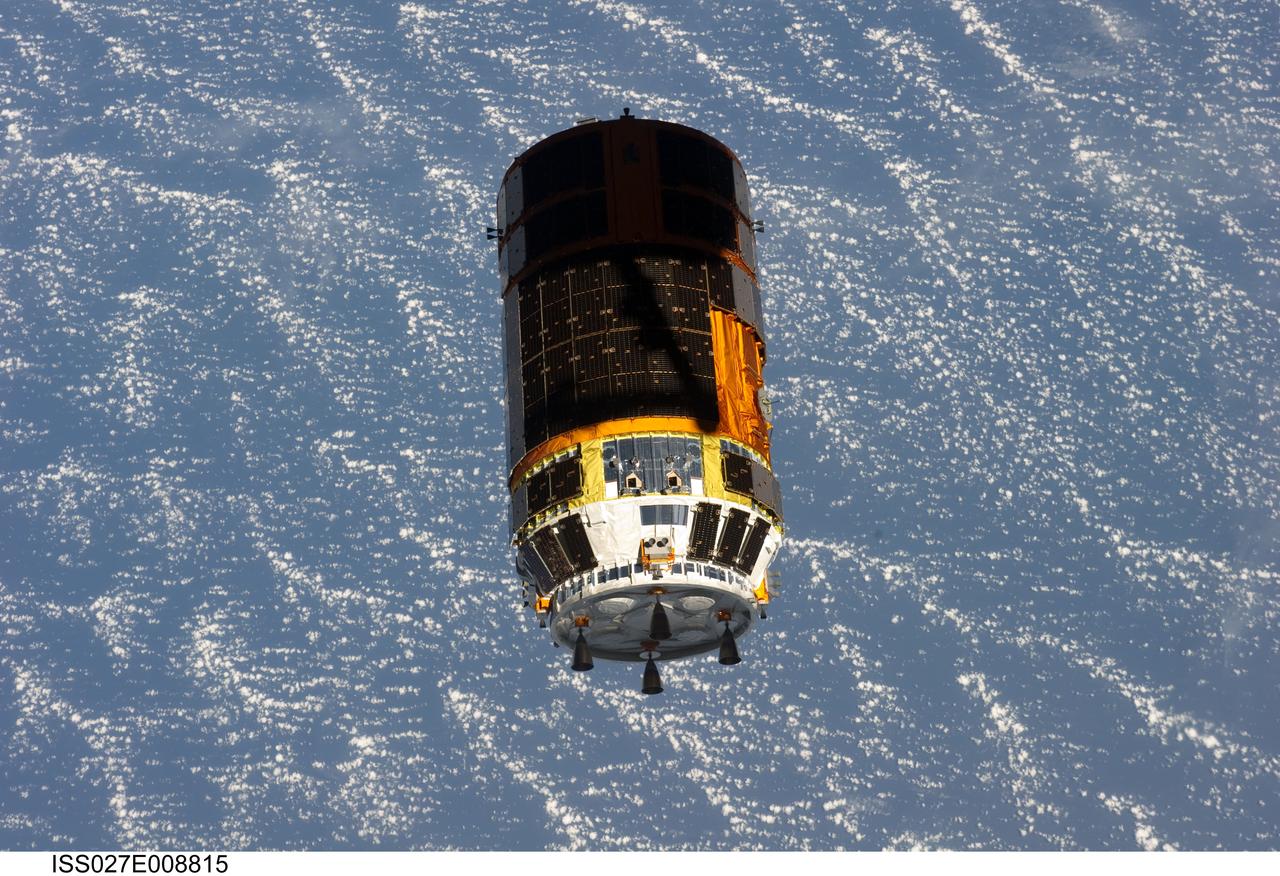
ISS027-E-008815 (28 March 2011) --- Backdropped by a blue and white part of Earth, the unpiloted Japan Aerospace Exploration Agency?s Kounotori2 H-II Transfer Vehicle (HTV2), filled with trash and unneeded items, departs from the International Space Station. NASA astronaut Cady Coleman and European Space Agency astronaut Paolo Nespoli, both Expedition 27 flight engineers, used the station?s robot arm to grapple the HTV2 and unberth it from the Earth-facing port of the Harmony node. The cargo craft was released at 11:46 a.m. (EDT) on March 28, 2011.
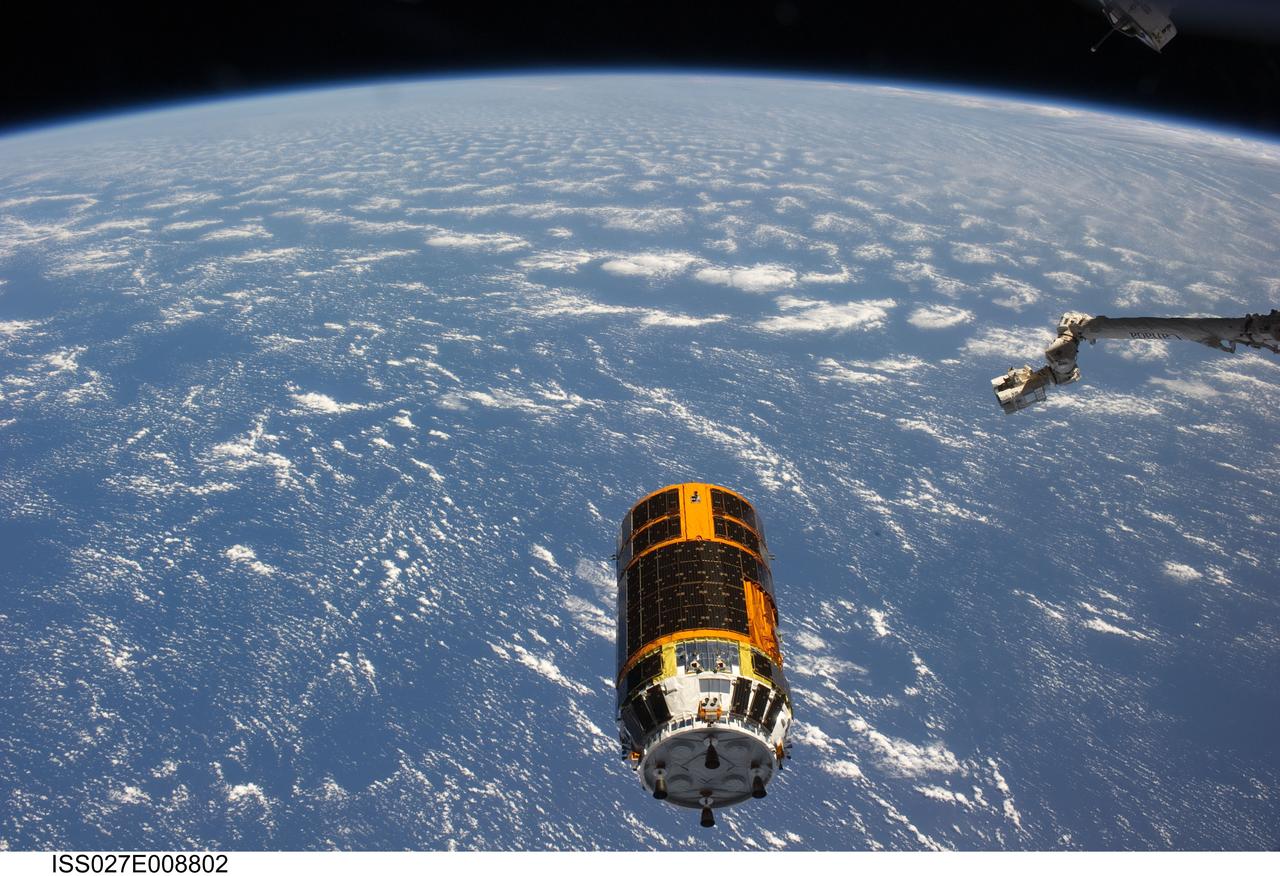
ISS027-E-008802 (28 March 2011) --- Backdropped by a blue and white part of Earth, the unpiloted Japan Aerospace Exploration Agency?s Kounotori2 H-II Transfer Vehicle (HTV2), filled with trash and unneeded items, departs from the International Space Station. NASA astronaut Cady Coleman and European Space Agency astronaut Paolo Nespoli, both Expedition 27 flight engineers, used the station?s robot arm to grapple the HTV2 and unberth it from the Earth-facing port of the Harmony node. The cargo craft was released at 11:46 a.m. (EDT) on March 28, 2011.
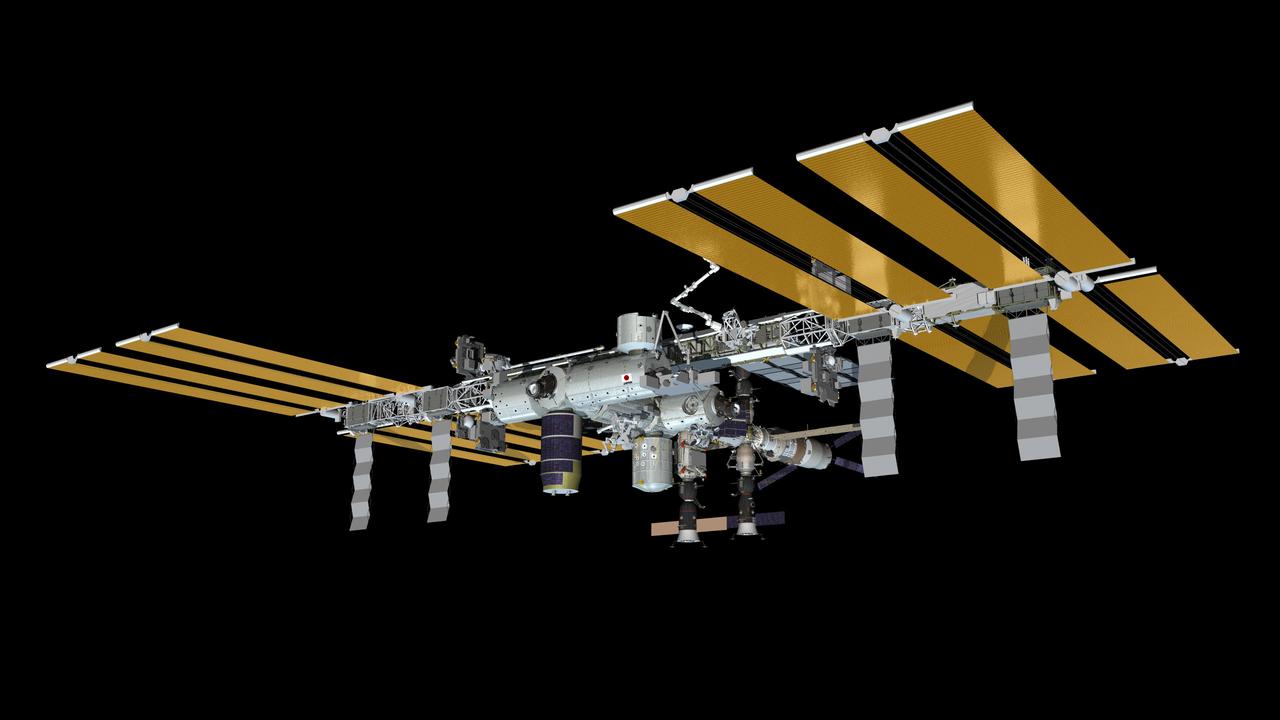
JSC2012-E-107190 (August 2012) --- Computer-generated artist?s rendering of the International Space Station as of August 2, 2012. Progress 48 docks to the Pirs Docking Compartment. Japan Aerospace Exploration Agency (JAXA) H-II Transfer Vehicle (HTV-3) is connected to the Harmony nadir port. Soyuz 31 (TMA-05M) is docked to the Rassvet Mini-Research Module 1 (MRM1). European Space Agency?s Automated Transfer Vehicle-3 (ATV-3) ?Edoardo Amaldi? is attached to the Zvezda Service Module and Soyuz 30 (TMA-04M) is linked to the Poisk Mini-Research Module 2 (MRM2). Photo credit: NASA
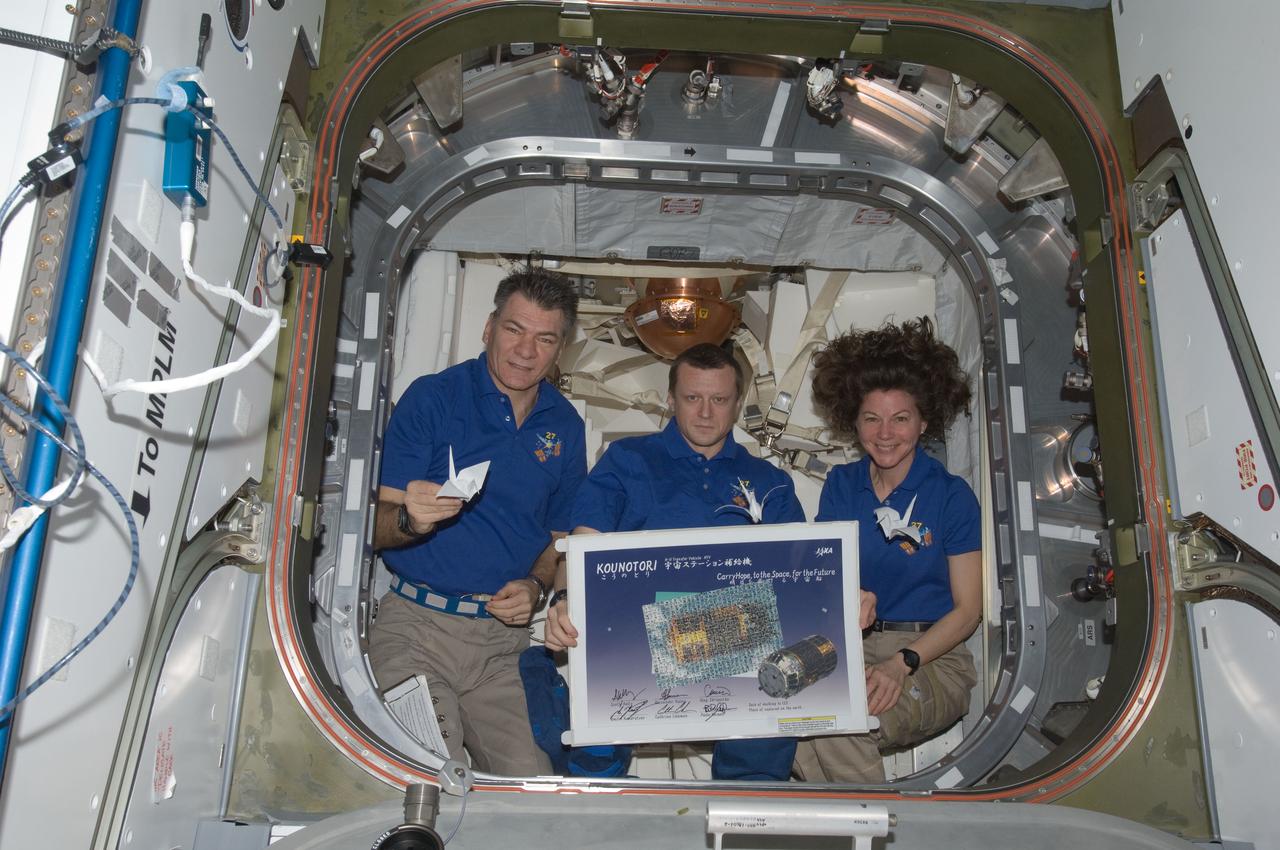
ISS027-E-007888 (27 March 2011) --- In honor of those affected by the Tohoku-Kanto Earthquake in Japan, Russian cosmonaut Dmitry Kondratyev (center), Expedition 27 commander; European Space Agency astronaut Paolo Nespoli and NASA astronaut Cady Coleman, both flight engineers, are pictured with paper cranes (origami craft) which they folded to be placed in the Kounotori2 H-II Transfer Vehicle (HTV-2). The HTV2 is scheduled to be released by the International Space Station?s robotic arm at 11:45 a.m. EDT on March 28, and re-enter Earth?s atmosphere on March 29, 2011.
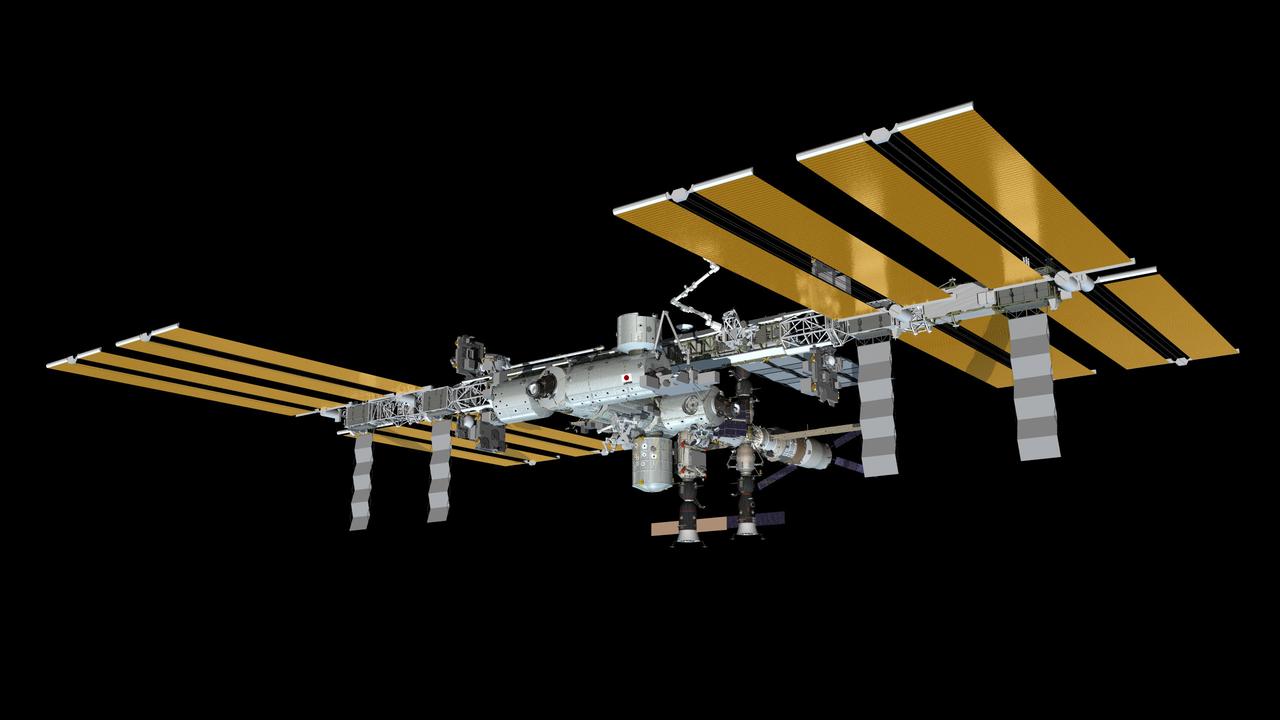
JSC2012-E-214799 (September 2012) --- Computer-generated artist?s rendering of the International Space Station as of Sept. 12, 2012. Japan Aerospace Exploration Agency (JAXA) H-II Transfer Vehicle (HTV-3) is unberthed from the Harmony nadir port. Progress 48 is docked to the Pirs Docking Compartment. Soyuz 31 (TMA-05M) is attached to the Rassvet Mini-Research Module 1 (MRM1). European Space Agency?s Automated Transfer Vehicle-3 (ATV-3) ?Edoardo Amaldi? is docked to the Zvezda Service Module and Soyuz 30 (TMA-04M) is linked to the Poisk Mini-Research Module 2 (MRM2). Photo credit: NASA
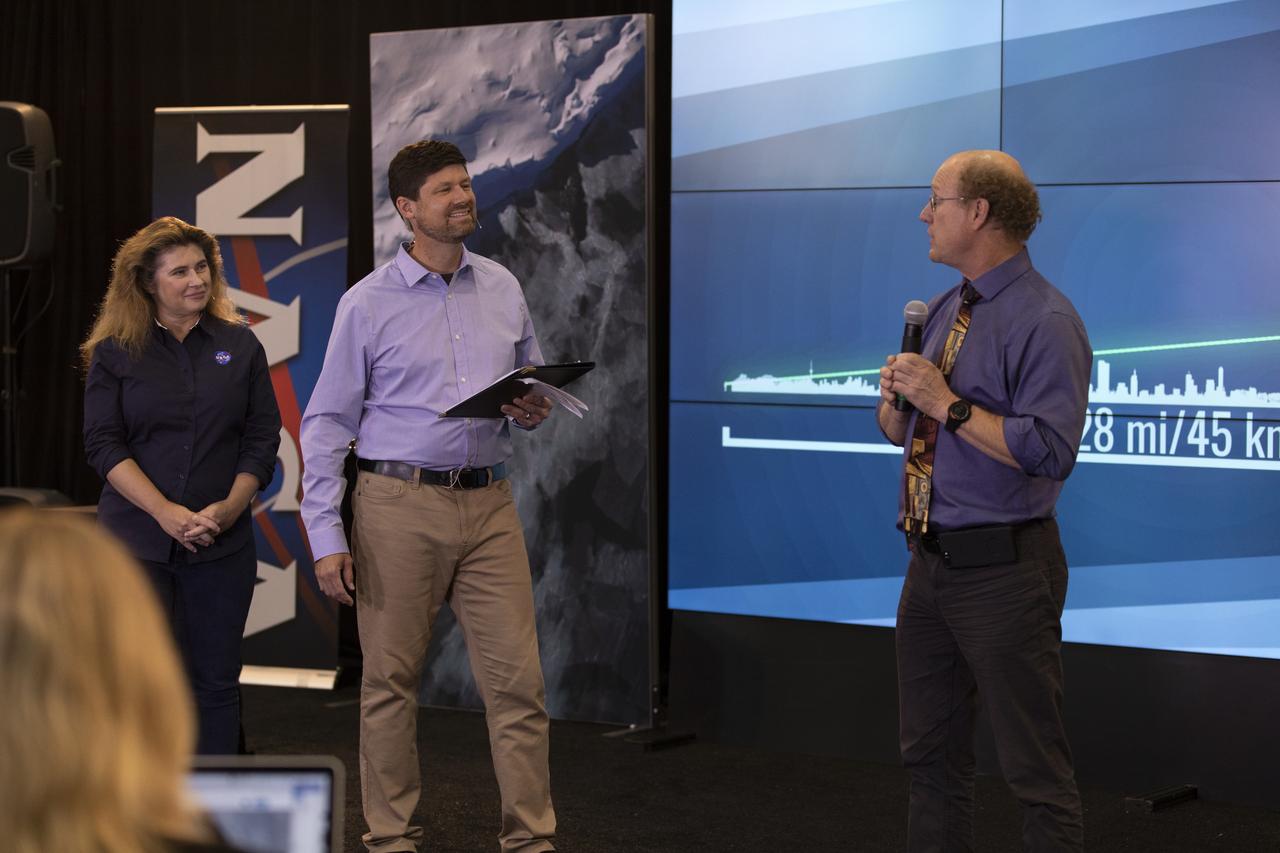
Doug McLennan, ICESat-2 project manager, NASA’s Goddard Space Flight Center, speaks to members of the news media and social media participants during a prelaunch mission briefing for NASA's Ice, Cloud and land Elevation Satellite-2 (ICESat-2), a mission to measure the changing height of Earth's ice, on Sept. 13, 2018 at Vandenberg Air Force Base (VAFB) in California. ICESat-2 will launch aboard a United Launch Alliance Delta II, the rocket’s final mission, from Space Launch Complex 2 at VAFB. Launch is scheduled for 8:46 a.m. EDT (5:46 a.m. PDT).
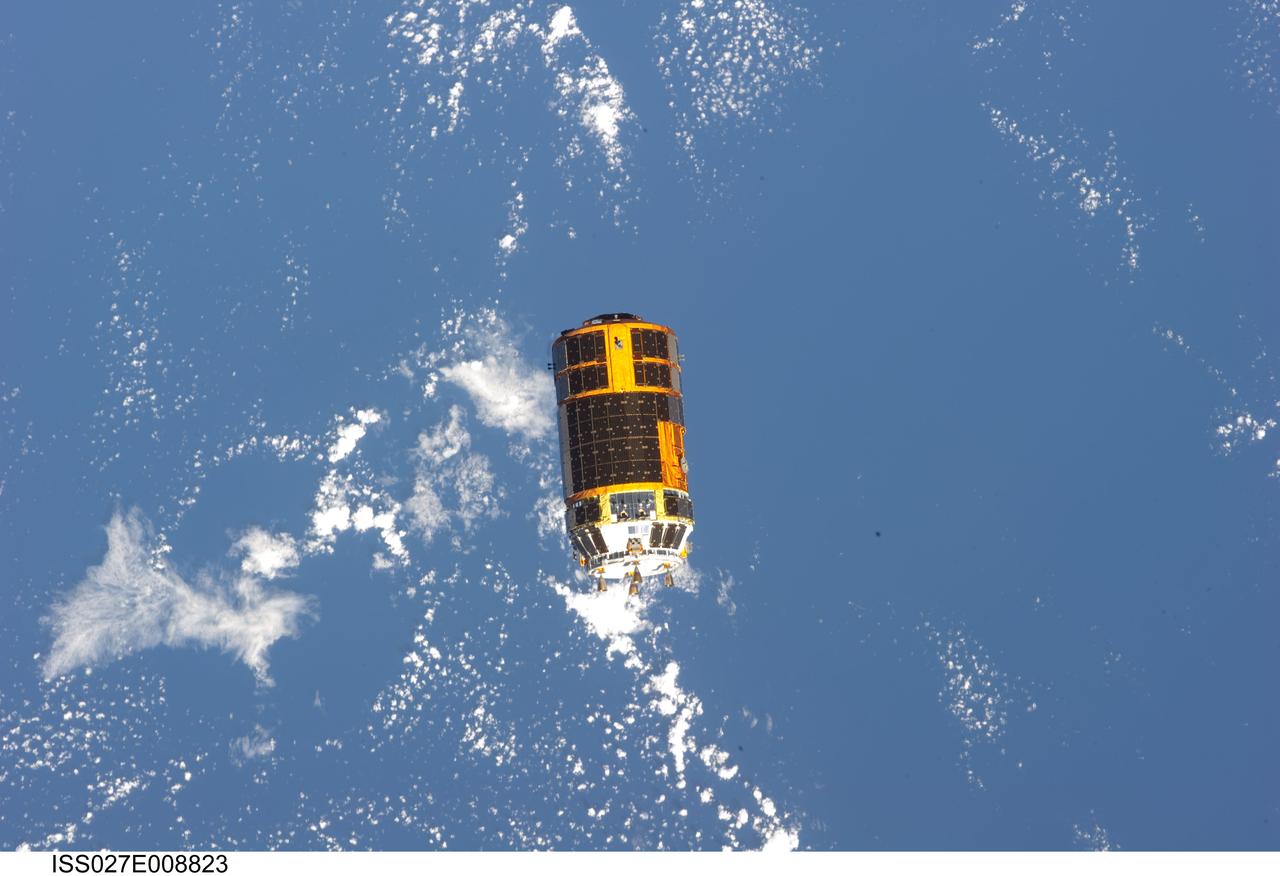
ISS027-E-008823 (28 March 2011) --- Backdropped by a blue and white part of Earth, the unpiloted Japan Aerospace Exploration Agency?s Kounotori2 H-II Transfer Vehicle (HTV2), filled with trash and unneeded items, departs from the International Space Station. NASA astronaut Cady Coleman and European Space Agency astronaut Paolo Nespoli, both Expedition 27 flight engineers, used the station?s robot arm to grapple the HTV2 and unberth it from the Earth-facing port of the Harmony node. The cargo craft was released at 11:46 a.m. (EDT) on March 28, 2011.
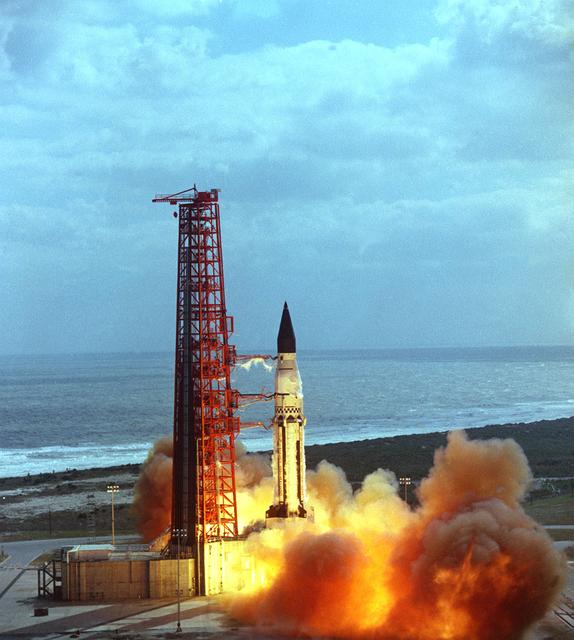
The launch of the SA-5 on January 29, 1964 was the fifth Saturn I launch vehicle. The SA-5 marked a number of firsts in the Marshall Space Flight Center-managed Saturn development program, including the first flight of Saturn I Block II vehicle with eight aerodynamic fins at the bottom of the S-I stage (first stage) for enhanced stability in flight. This also was the first flight of a live S-IV (second or upper) stage with the cluster of six liquid hydrogen-fueled RL-10 engines. the first successful second stage separation, and the first use of the Launch Complex 37.
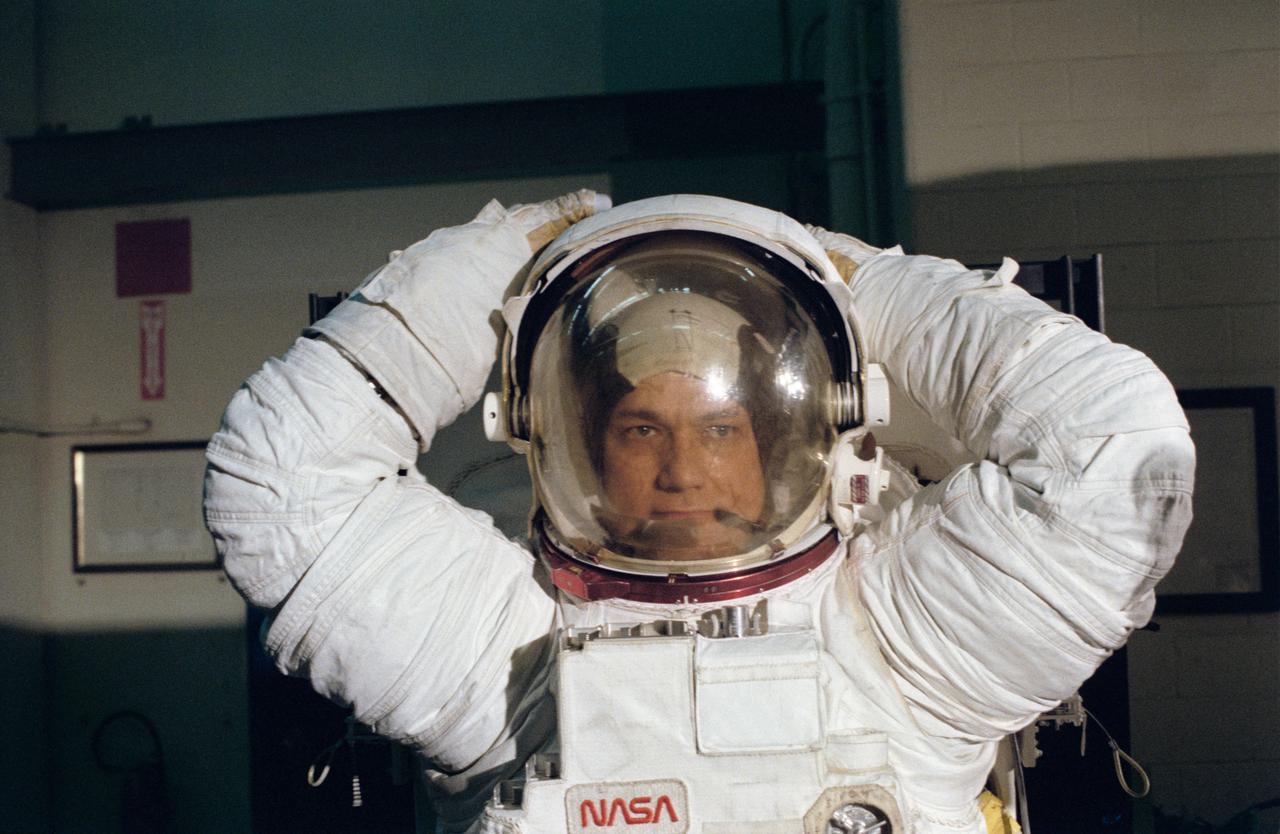
S82-27594 (25 Feb 1982) --- Astronaut Bruce McCandless II models NASA?s extravehicular mobility unit (EMU) spacesuit for Shuttle and the backpack unit (called a manned maneuvering unit) that will give future STS crewmembers extended mobility in space. A forerunner version of the MMU?called an astronaut maneuvering unit?was tested internally on Skylab. The MMU will allow astronauts for the first time in history to move about in the vicinity of their spacecraft without being tethered to the ship. McCandless was giving a demonstration of the EMU/MMU in JSC?s laboratory support facility.
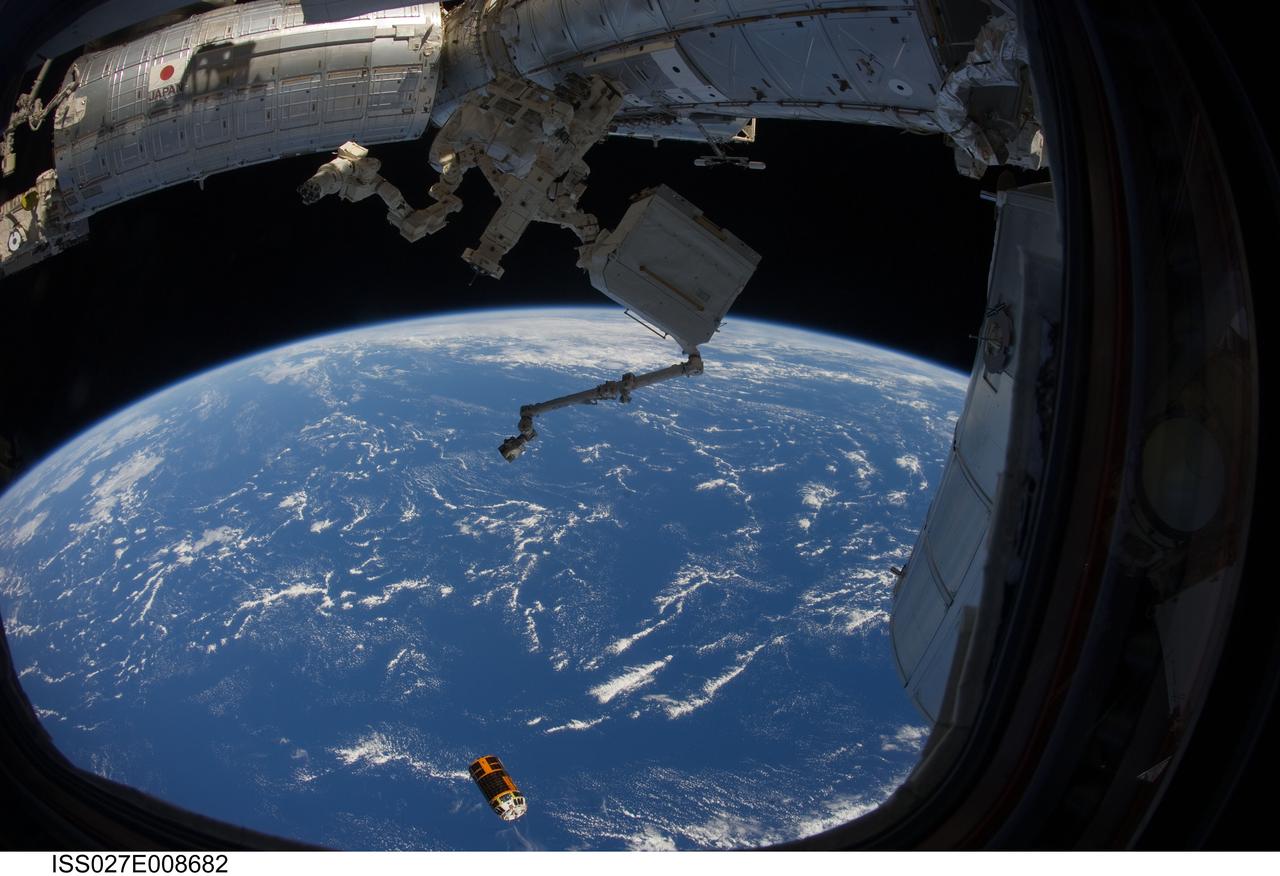
ISS027-E-008682 (28 March 2011) --- A fish-eye lens attached to an electronic still camera was used to capture this image of the unpiloted Japan Aerospace Exploration Agency?s Kounotori2 H-II Transfer Vehicle (HTV2), filled with trash and unneeded items, as it departs from the International Space Station. NASA astronaut Cady Coleman and European Space Agency astronaut Paolo Nespoli, both Expedition 27 flight engineers, used the station?s robot arm to grapple the HTV2 and unberth it from the Earth-facing port of the Harmony node. The cargo craft was released at 11:46 a.m. (EDT) on March 28, 2011.
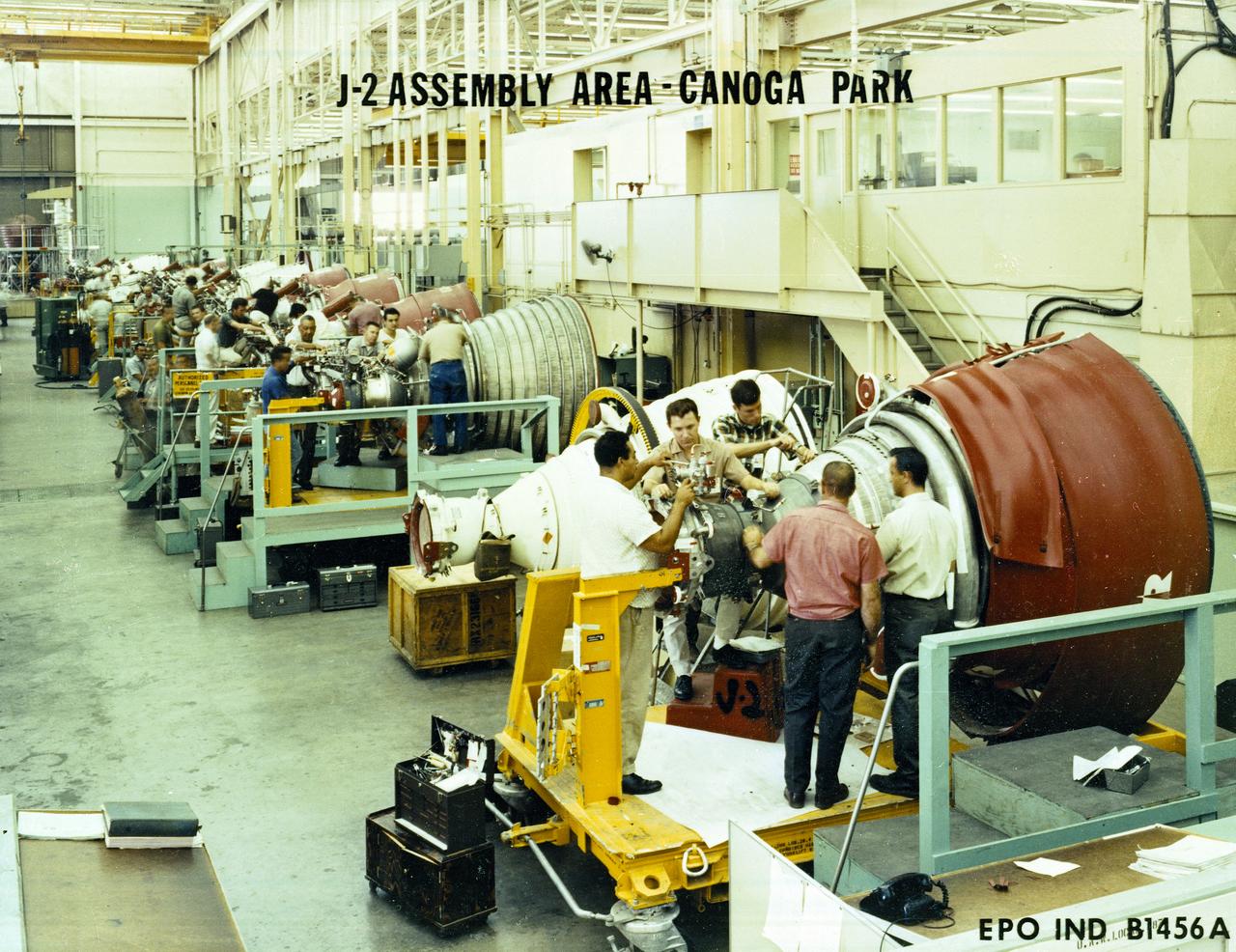
Workmen inspect a J-2 engine at Rocketdyne's Canoga Park, California production facility. The J-2, developed under the direction of the Marshall Space Flight Center, was propelled by liquid hydrogen and liquid oxygen. A single J-2 engine was used in the S-IVB stage (the second stage of the Saturn IB and third stage for the Saturn V) and a cluster of five J-2 engines was used to propel the second stage of the Saturn V, the S-II. Initially rated at 200,000 pounds of thrust, the J-2 engine was later uprated in the Saturn V program to 230,000 pounds.
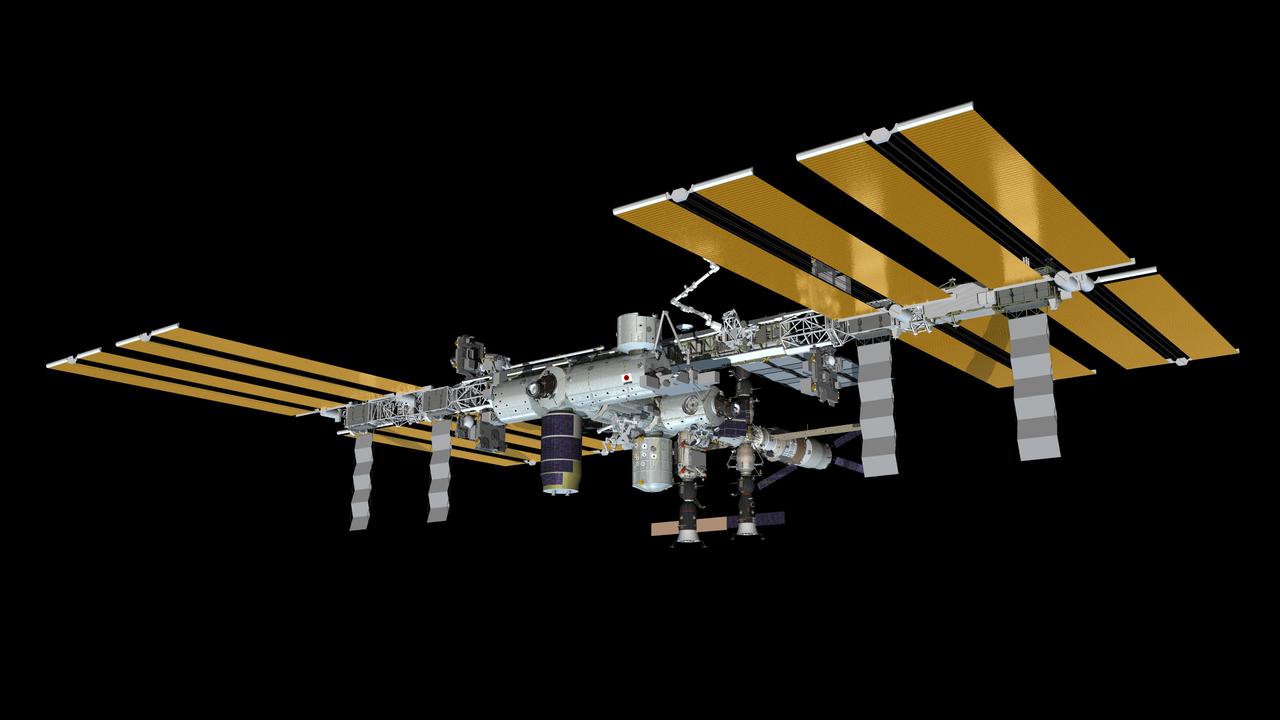
JSC2012-E-107188 (July 2012) --- Computer-generated artist?s rendering of the International Space Station as of July 28, 2012. Progress 47 redocks to the Pirs Docking Compartment. Japan Aerospace Exploration Agency (JAXA) H-II Transfer Vehicle (HTV-3) is connected to the Harmony nadir port. Soyuz 31 (TMA-05M) is docked to the Rassvet Mini-Research Module 1 (MRM1). European Space Agency?s Automated Transfer Vehicle-3 (ATV-3) ?Edoardo Amaldi? is attached to the Zvezda Service Module and Soyuz 30 (TMA-04M) is linked to the Poisk Mini-Research Module 2 (MRM2). Photo credit: NASA
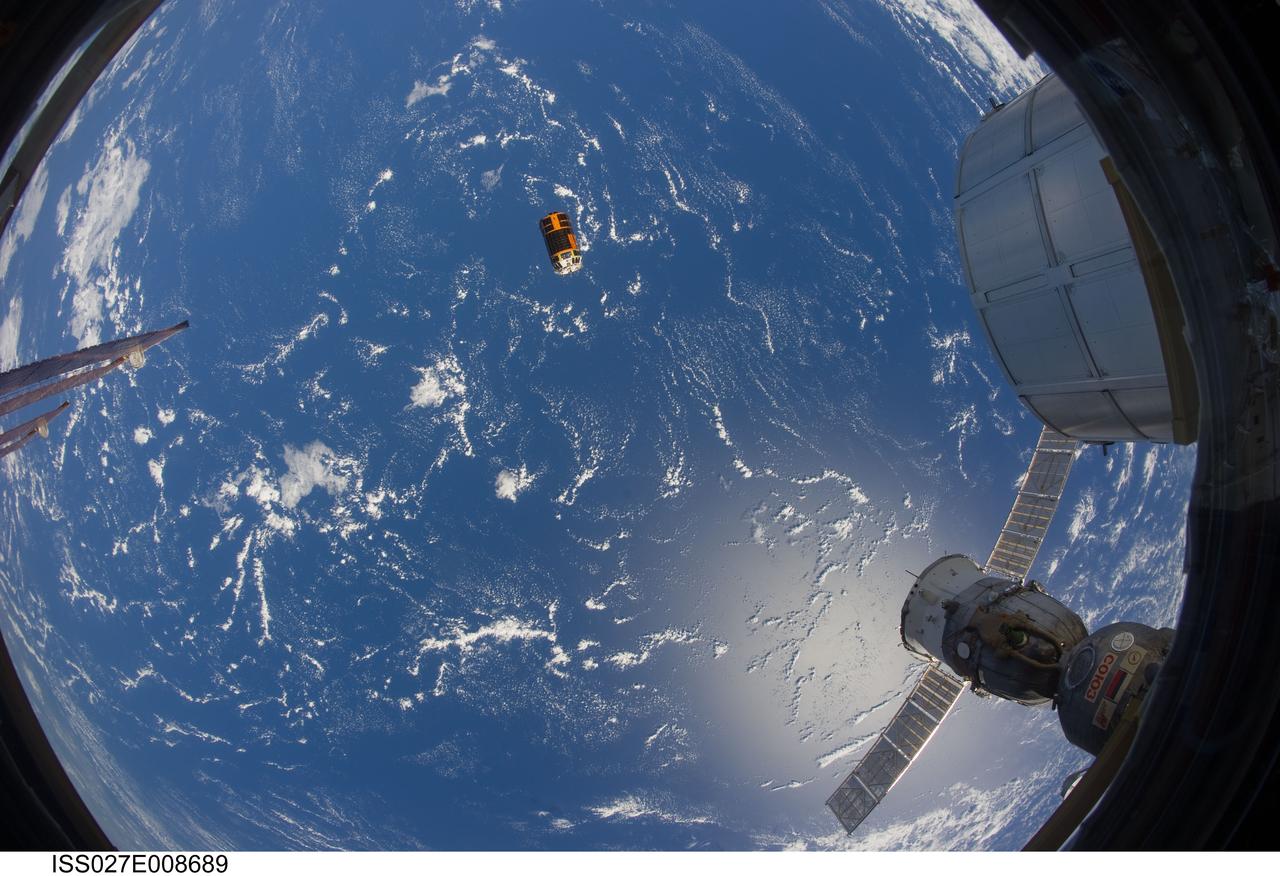
ISS027-E-008689 (28 March 2011) --- A fish-eye lens attached to an electronic still camera was used to capture this image of the unpiloted Japan Aerospace Exploration Agency?s Kounotori2 H-II Transfer Vehicle (HTV2), filled with trash and unneeded items, as it departs from the International Space Station. NASA astronaut Cady Coleman and European Space Agency astronaut Paolo Nespoli, both Expedition 27 flight engineers, used the station?s robot arm to grapple the HTV2 and unberth it from the Earth-facing port of the Harmony node. The cargo craft was released at 11:46 a.m. (EDT) on March 28, 2011.
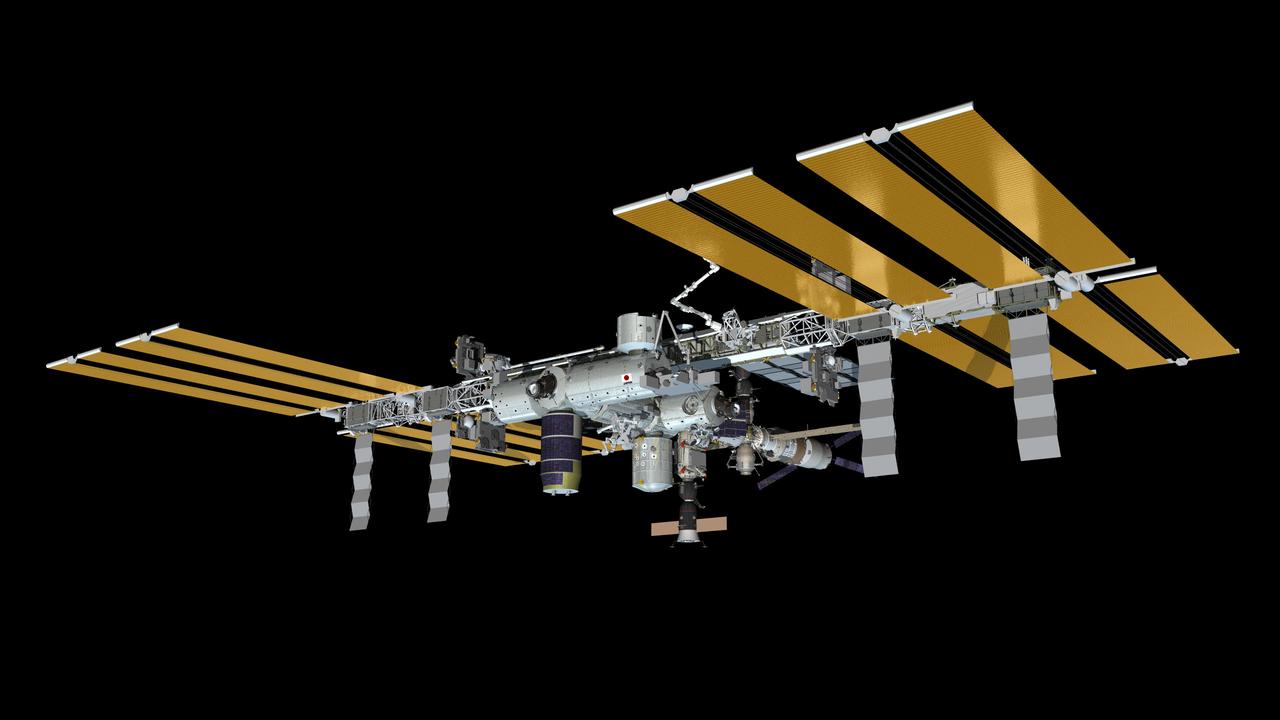
JSC2012-E-107189 (July 2012) --- Computer-generated artist?s rendering of the International Space Station as of July 30, 2012. Progress 47 completes final undocking from the Pirs Docking Compartment. Japan Aerospace Exploration Agency (JAXA) H-II Transfer Vehicle (HTV-3) is connected to the Harmony nadir port. Soyuz 31 (TMA-05M) is docked to the Rassvet Mini-Research Module 1 (MRM1). European Space Agency?s Automated Transfer Vehicle-3 (ATV-3) ?Edoardo Amaldi? is attached to the Zvezda Service Module and Soyuz 30 (TMA-04M) is linked to the Poisk Mini-Research Module 2 (MRM2). Photo credit: NASA
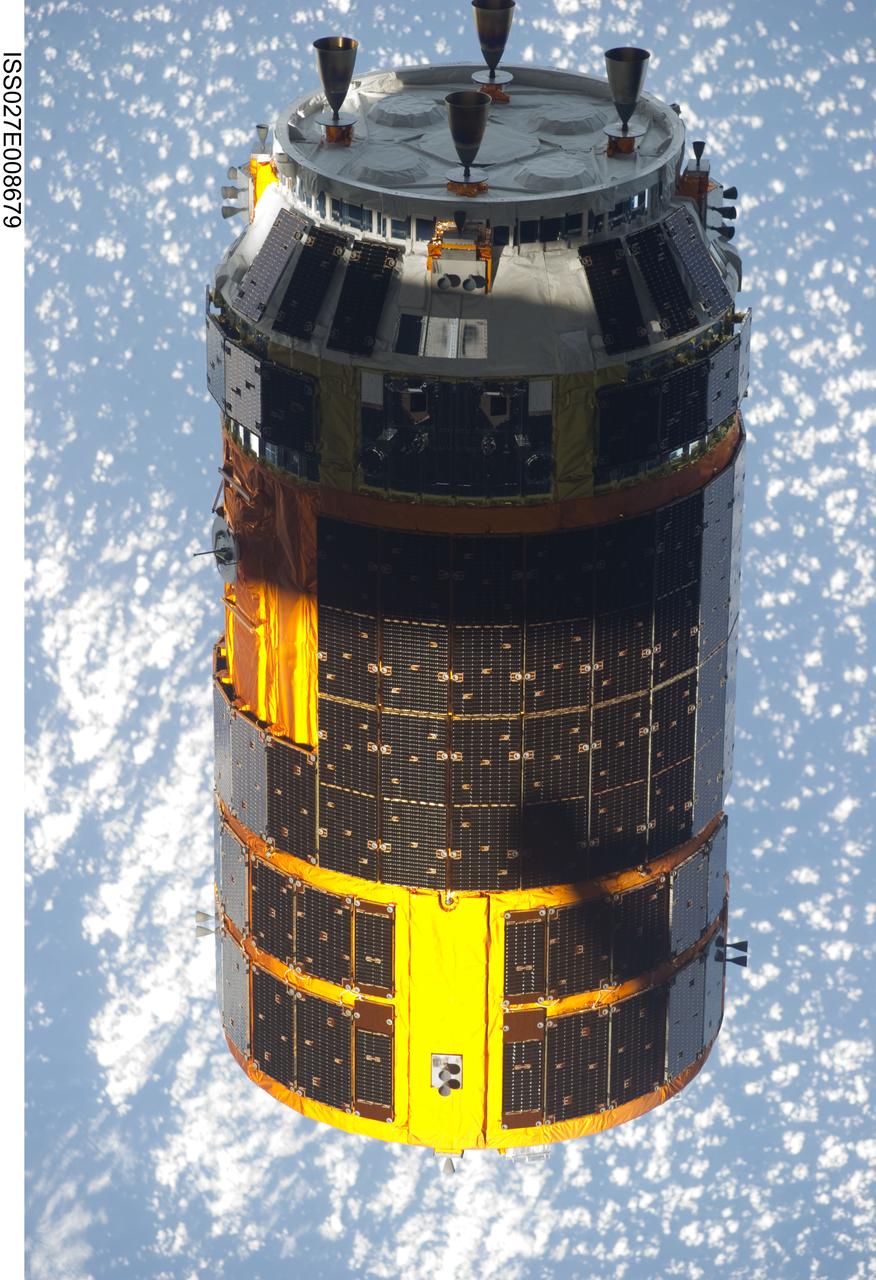
ISS027-E-008679 (28 March 2011) --- Backdropped by a blue and white part of Earth, the unpiloted Japan Aerospace Exploration Agency?s Kounotori2 H-II Transfer Vehicle (HTV2), filled with trash and unneeded items, departs from the International Space Station. NASA astronaut Cady Coleman and European Space Agency astronaut Paolo Nespoli, both Expedition 27 flight engineers, used the station?s robot arm to grapple the HTV2 and unberth it from the Earth-facing port of the Harmony node. The cargo craft was released at 11:46 a.m. (EDT) on March 28, 2011.
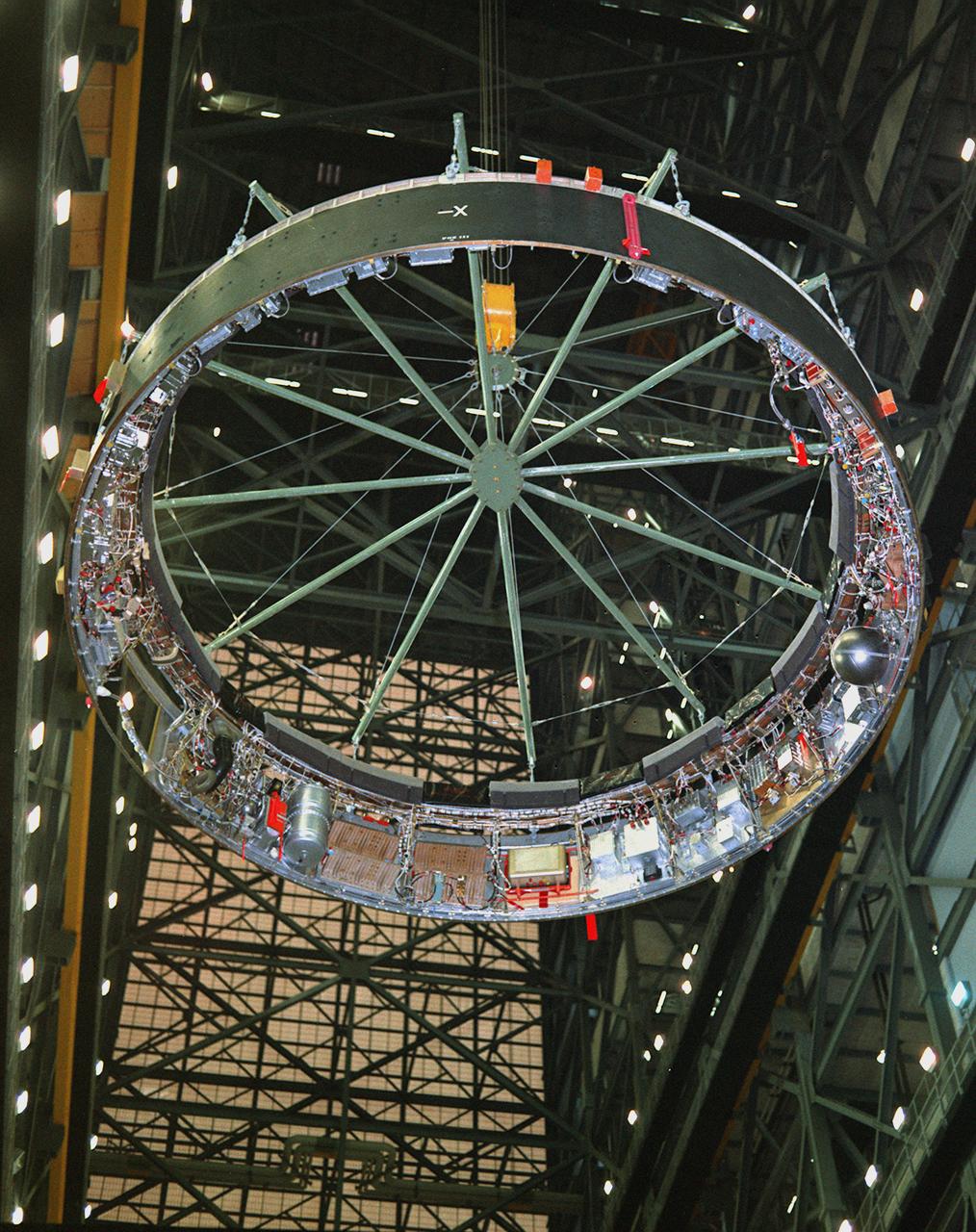
This photograph was taken during the final assembly operation of the Saturn V launch vehicle for the Apollo 4 (SA 501) mission. The instrument unit (IU) was hoisted to be mated to the S-IC/S-II assembly in the Vehicle Assembly Building high bay at the Kennedy Space Center. The Apollo 4 mission was the first launch of the Saturn V launch vehicle. Objectives of the unmanned Apollo 4 test flight were to obtain flight information on launch vehicle and spacecraft structural integrity and compatibility, flight loads, stage separation, and subsystems operation including testing of restart of the S-IVB stage, and to evaluate the Apollo command module heat shield. The Apollo 4 was launched on November 9, 1967 from KSC.
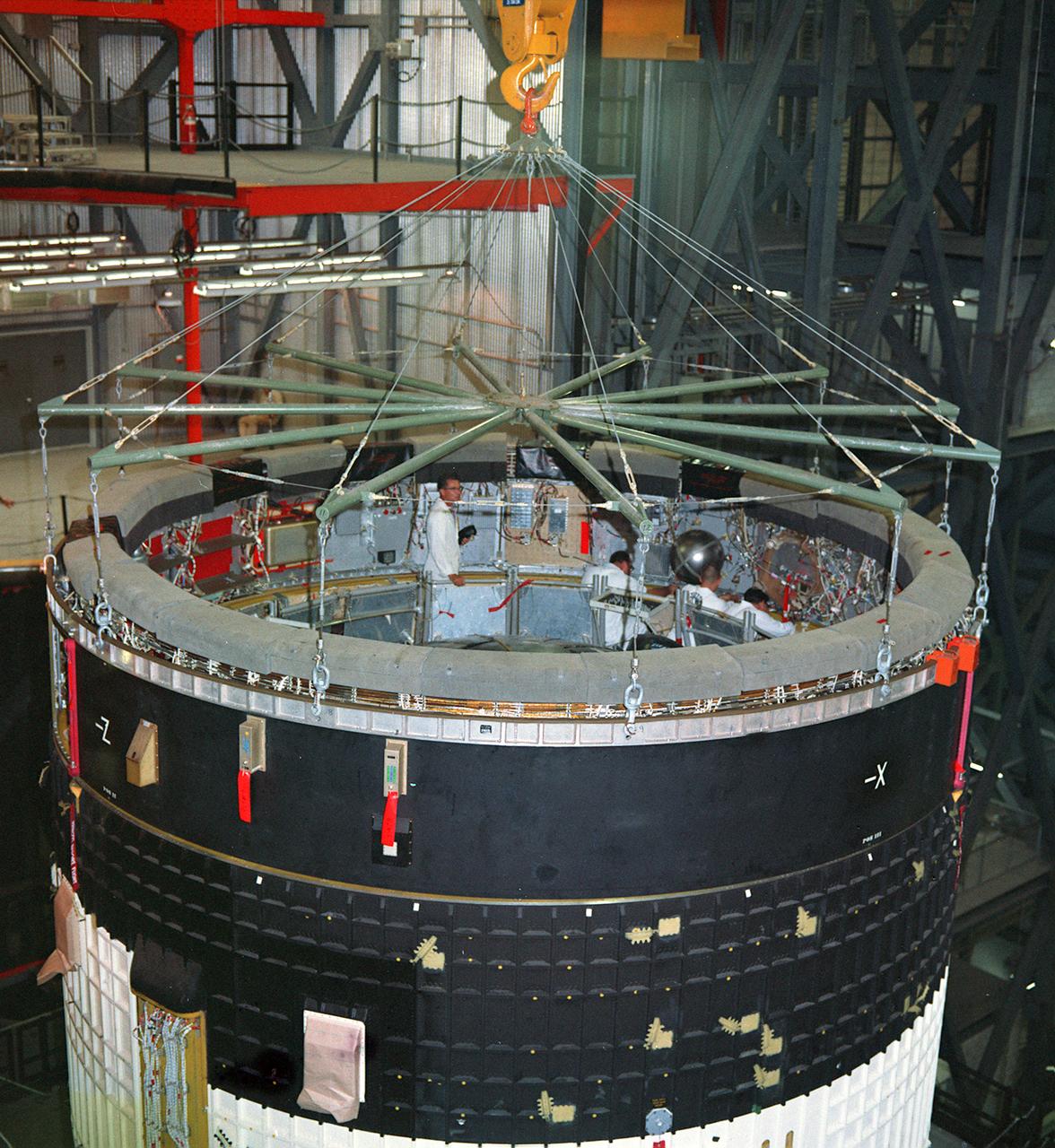
This photograph was taken during the final assembly operation of the Saturn V launch vehicle for the Apollo 4 (SA 501) mission. The instrument unit (IU) was mated atop the S-IC/S-II assembly in the Vehicle Assembly Building high bay at the Kennedy Space Center. The Apollo 4 mission was the first launch of the Saturn V launch vehicle. Objectives of the unmanned Apollo 4 test flight were to obtain flight information on launch vehicle and spacecraft structural integrity and compatibility, flight loads, stage separation, and subsystems operation including testing of restart of the S-IVB stage, and to evaluate the Apollo command module heat shield. The Apollo 4 was launched on November 9, 1967 from KSC.