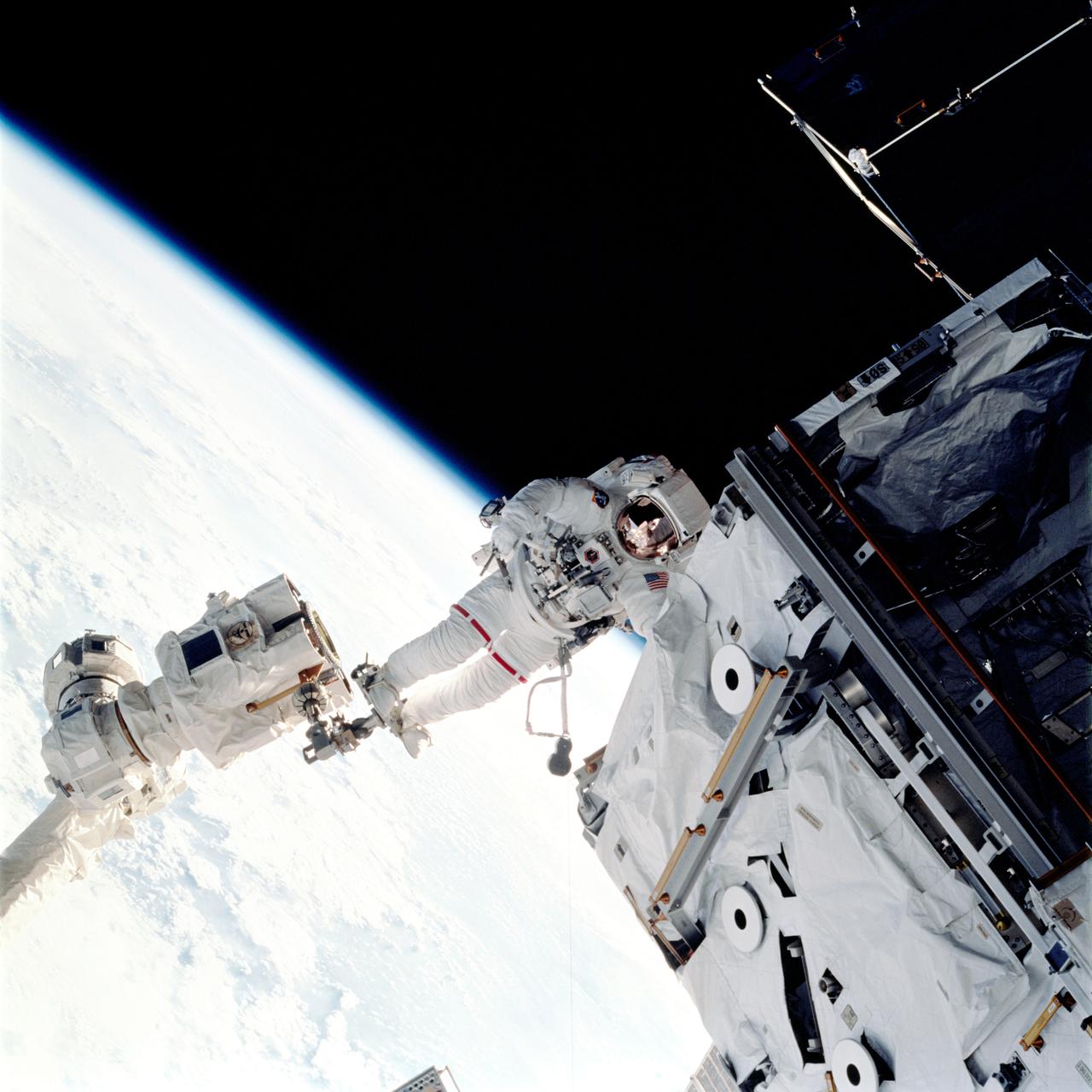
Launched aboard the Space Shuttle Orbiter Atlantis on April 8, 2002, the STS-110 mission prepared the International Space Station (ISS) for future space walks by installing and outfitting the 43-foot-long Starboard side S0 (S-zero) truss and preparing the first railroad in space, the Mobile Transporter. The 27,000 pound S0 truss was the first of 9 segments that will make up the Station's external framework that will eventually stretch 356 feet (109 meters), or approximately the length of a football field. This central truss segment also includes a flatcar called the Mobile Transporter and rails that will become the first "space railroad," which will allow the Station's robotic arm to travel up and down the finished truss for future assembly and maintenance. The completed truss structure will hold solar arrays and radiators to provide power and cooling for additional international research laboratories from Japan and Europe that will be attached to the Station. STS-110 Extravehicular Activity (EVA) marked the first use of the Station's robotic arm to maneuver space walkers around the Station and was the first time all of a shuttle crew's space walks were based out of the Station's Quest Airlock. In this photograph, Astronaut Jerry L. Ross, mission specialist, anchored on the end of the Canadarm2, moves near the newly installed S0 truss. Astronaut Lee M. E. Morin, mission specialist, (out of frame), worked in tandem with Ross during this fourth and final scheduled session of EVA for the STS-110 mission. The final major task of the space walk was the installation of a beam, the Airlock Spur, between the Quest Airlock and the S0. The spur will be used by space walkers in the future as a path from the airlock to the truss.
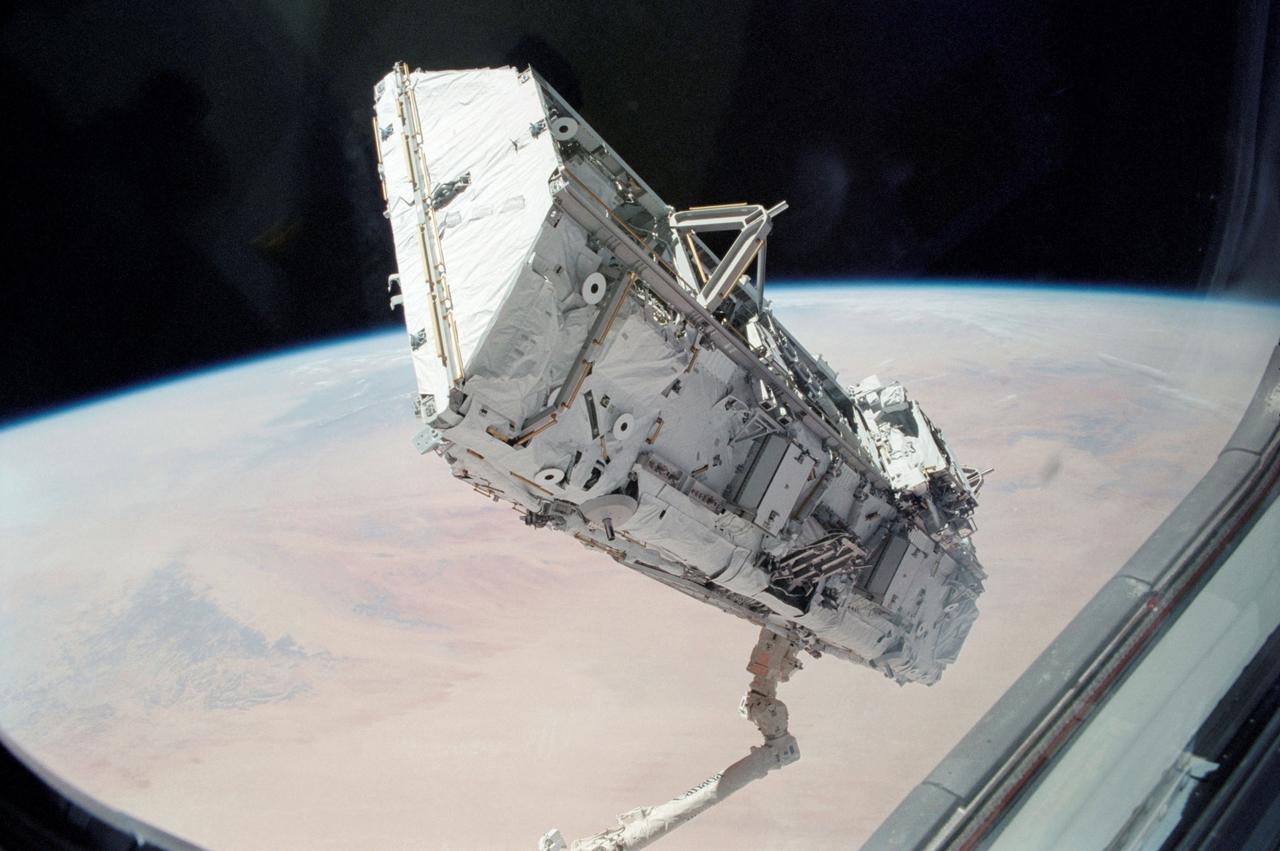
Backdropped against the blackness of space and the Earth's horizon, the S0 (S-zero) truss is removed from Atlantis' cargo bay and onto the Destiny laboratory of the International Space Station (ISS) by Astronauts Ellen Ochoa, STS-110 mission specialist, and Daniel W. Bursch, Expedition Four flight engineer, using the ISS' Canadarm2. Space Shuttle Orbiter Atlantis, STS-110 mission, prepared the International Space Station (ISS) for future spacewalks by installing and outfitting the 43-foot-long S0 truss and preparing the first railroad in space, the Mobile Transporter. The 27,000-pound S0 truss was the first of 9 segments that will make up the Station's external framework that will eventually stretch 356 feet (109 meters), or approximately the length of a football field. This central truss segment also includes a flatcar called the Mobile Transporter and rails that will become the first "space railroad," which will allow the Station's robotic arm to travel up and down the finished truss for future assembly and maintenance. The completed truss structure will hold solar arrays and radiators to provide power and cooling for additional international research laboratories from Japan and Europe that will be attached to the Station. Milestones of the STS-110 mission included the first use of the Station's robotic arm to maneuver spacewalkers around the Station and it was the first time all of a Shuttle crew's spacewalks were based out of the Station's Quest Airlock. It was also the first Shuttle to use three Block II Main Engines. The Space Shuttle Orbiter Atlantis, STS-110 mission, was launched April 8, 2002 and returned to Earth April 19, 2002.
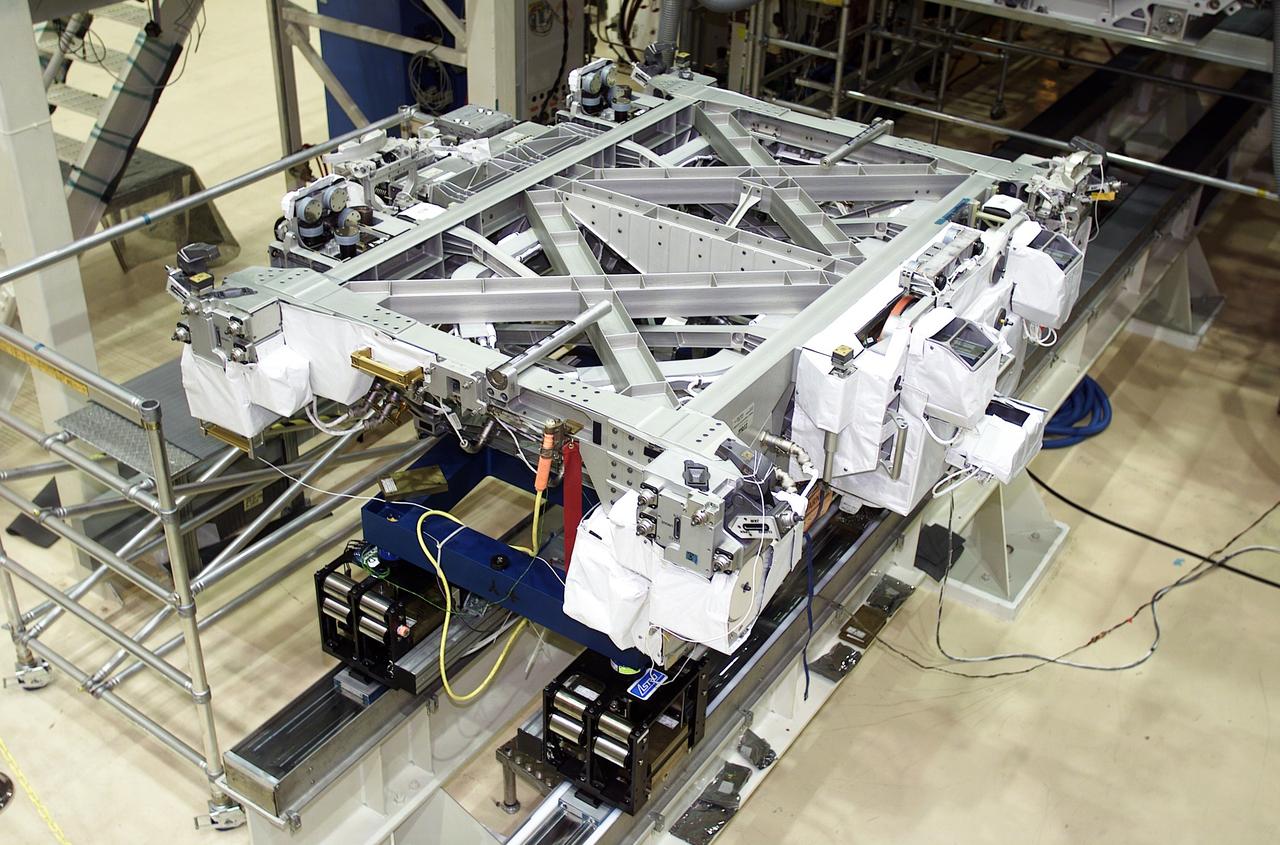
The Space Shuttle Atlantis, STS-110 mission, deployed this railcar, called the Mobile Transporter, and an initial 43-foot section of track, the S0 (S-zero) truss, preparing the International Space Station (ISS) for future spacewalks. The first railroad in space, the Mobile Transporter will allow the Station's robotic arm to travel up and down the finished truss for future assembly and maintenance. The 27,000-pound S0 truss is the first of 9 segments that will make up the Station's external framework that will eventually stretch 356 feet (109 meters), or approximately the length of a football field. The completed truss structure will hold solar arrays and radiators to provide power and cooling for additional international research laboratories from Japan and Europe that will be attached to the Station. The Space Shuttle Orbiter Atlantis, STS-110 mission, was launched April 8, 2002 and returned to Earth April 19, 2002. STS-110's Extravehicular Activity (EVA) marked the first use of the Station's robotic arm to maneuver spacewalkers around the Station.
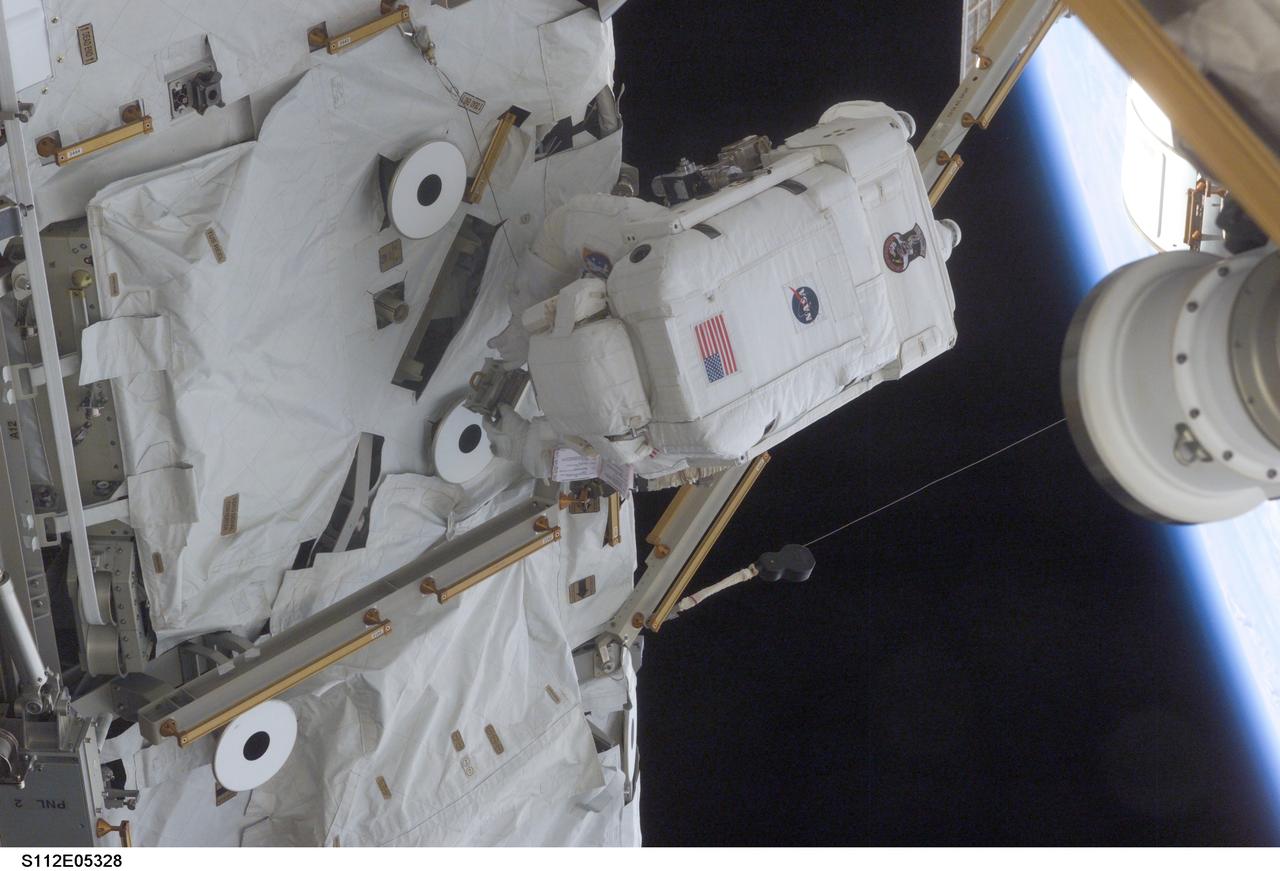
STS112-E-5328 (12 October 2002) --- Astronaut Piers J. Sellers, mission specialist, translates along the S0 (S-Zero) truss on the International Space Station (ISS) during the second of three scheduled STS-112 spacewalks.
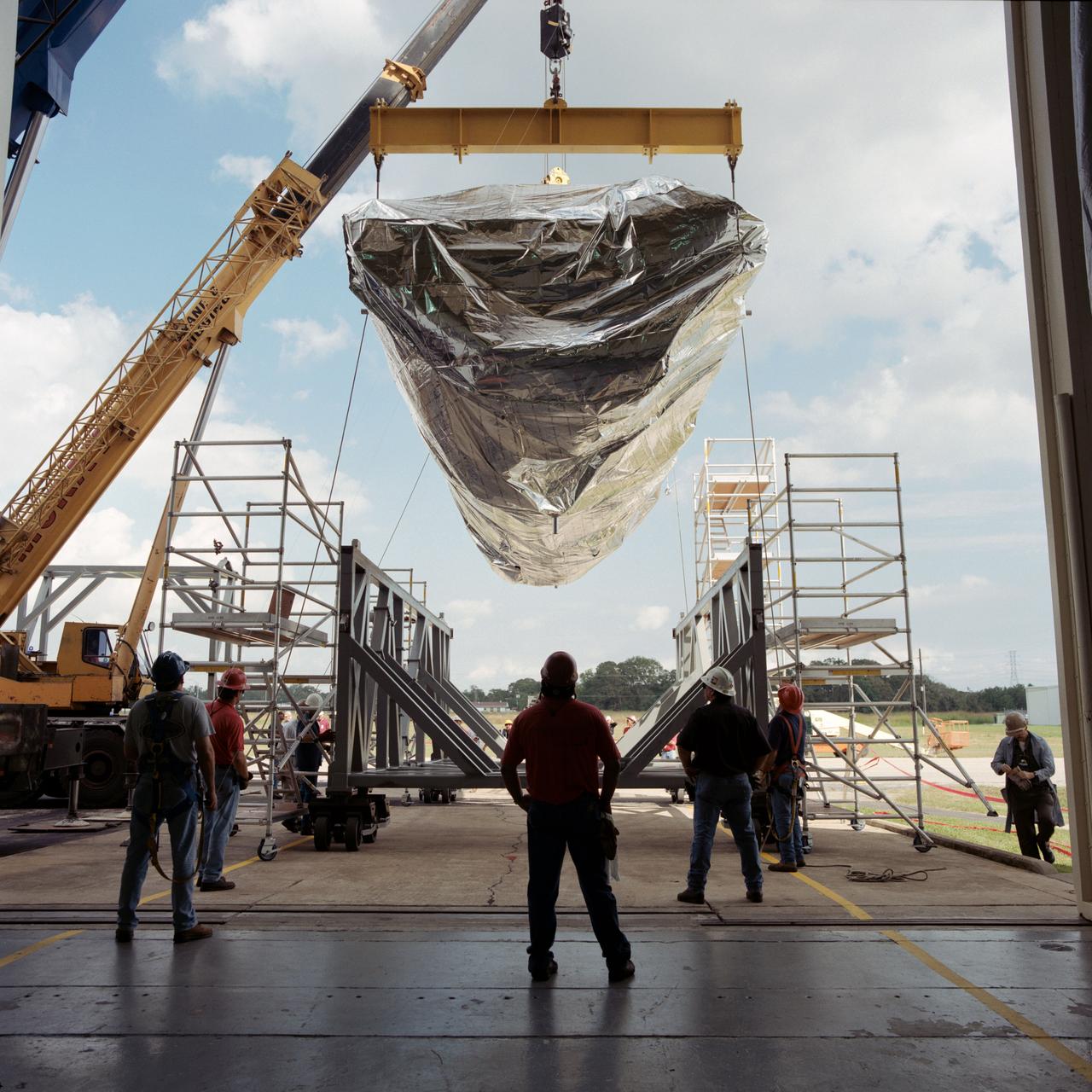
The S0 Truss is moved into the highbay of bldg 49 for Space Station Module acoustic test. Views include: S0 Truss moved into bldg 49 highbay (17342-53, 17370-71); a measuring stick is held near Truss (17354); Truss in acoustic chamber (17355-61, 17367); Truss in air above cradle (17362, 17364-66, 17368); Truss in cradle (17363).

STS112-E-5333 (12 October 2002) --- A high angle view of the S0 (S-zero) truss which was photographed during a six hour, four minute spacewalk, the second of three scheduled for the STS-112 mission. Astronauts Piers J. Sellers and David A. Wolf are the assigned spacewalkers for all three. The airlock spur, a route used by spacewalkers to get from the Quest airlock on the International Space Station (ISS) to the outpost's truss, is visible in the upper right portion of the frame.
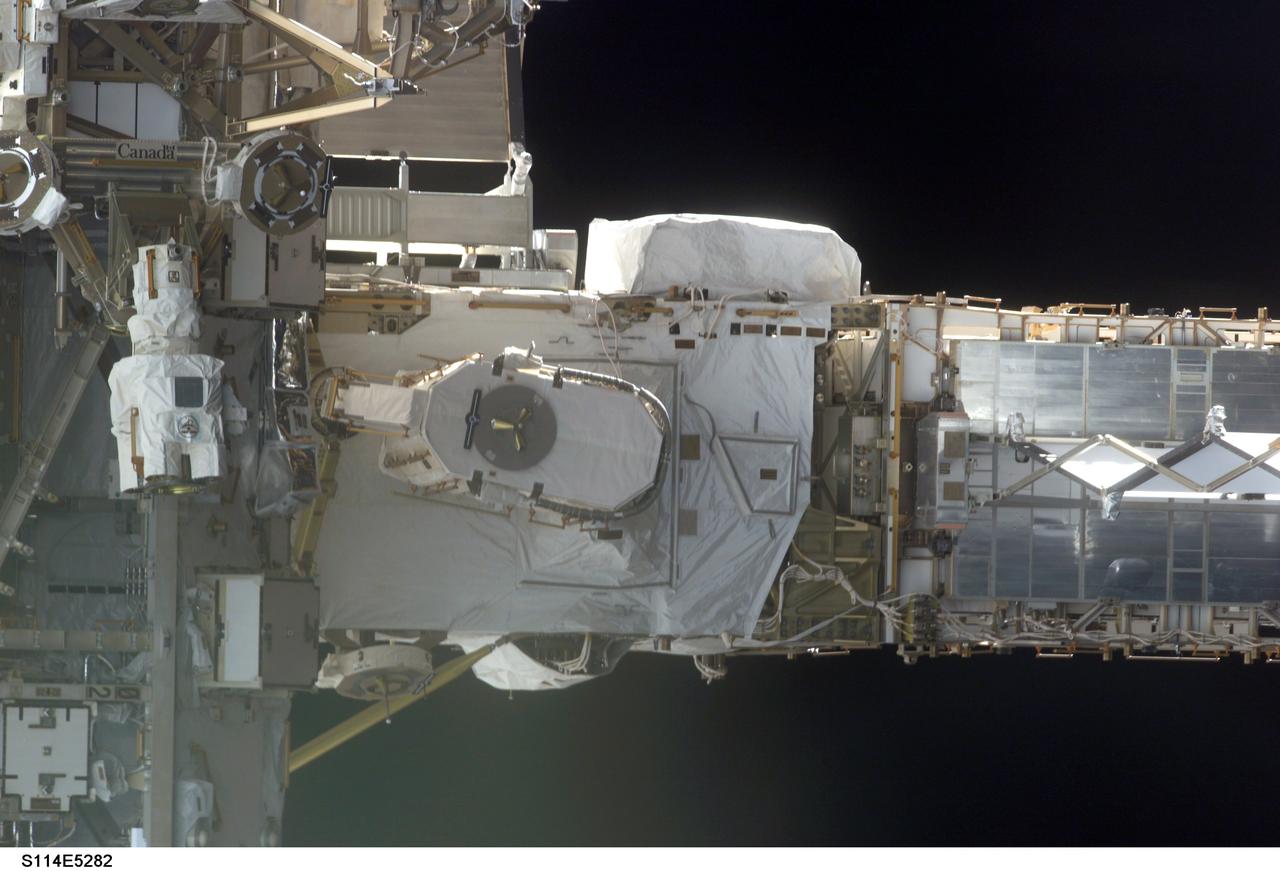
STS114-E-5282 (28 July 2005) --- This frame and STS114-E-5283 actually can be conjoined and rotated 90 degrees to make a single frame, providing an "astronaut's eye view" from Discovery's aft cabin looking toward the recently docked International Space Station. At the left side are the S0 truss and mobile transporter, with the P6 truss on the right side.
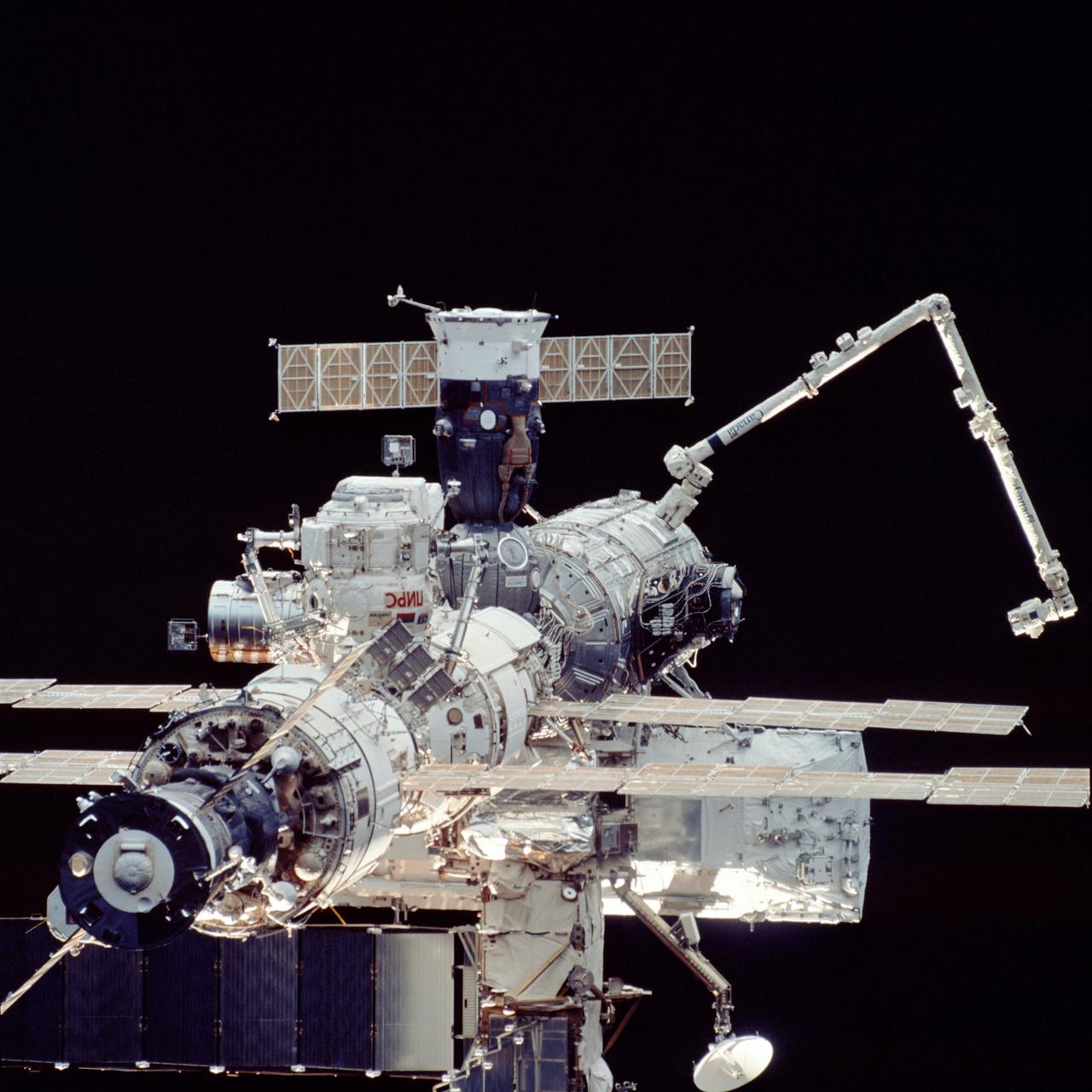
This close-up view of the International Space Station (ISS), newly equipped with its new 27,000 pound S0 (S-zero) truss, was photographed by an astronaut aboard the Space Shuttle Atlantis STS-110 during its ISS fly-around mission while pulling away from the ISS. The STS-110 mission prepared the Station for future spacewalks by installing and outfitting the 43-foot-long S0 truss and preparing the first railroad in space, the Mobile Transporter. The 27,000 pound S0 truss was the first of 9 segments that will make up the Station's external framework that will eventually stretch 356 feet (109 meters), or approximately the length of a football field. This central truss segment also includes a flatcar called the Mobile Transporter and rails that will become the first "space railroad," which will allow the Station's robotic arm to travel up and down the finished truss for future assembly and maintenance. The completed truss structure will hold solar arrays and radiators to provide power and cooling for additional international research laboratories from Japan and Europe that will be attached to the Station. STS-110 Extravehicular Activity (EVA) marked the first use of the Station's robotic arm to manuever spacewalkers around the Station and was the first time all of a shuttle crew's spacewalks were based out of the Station's Quest Airlock. It was also the first Shuttle to use three Block II Main Engines. The Space Shuttle Orbiter Atlantis STS-110 mission, was launched April 8, 2002 and returned to Earth April 19, 2002.
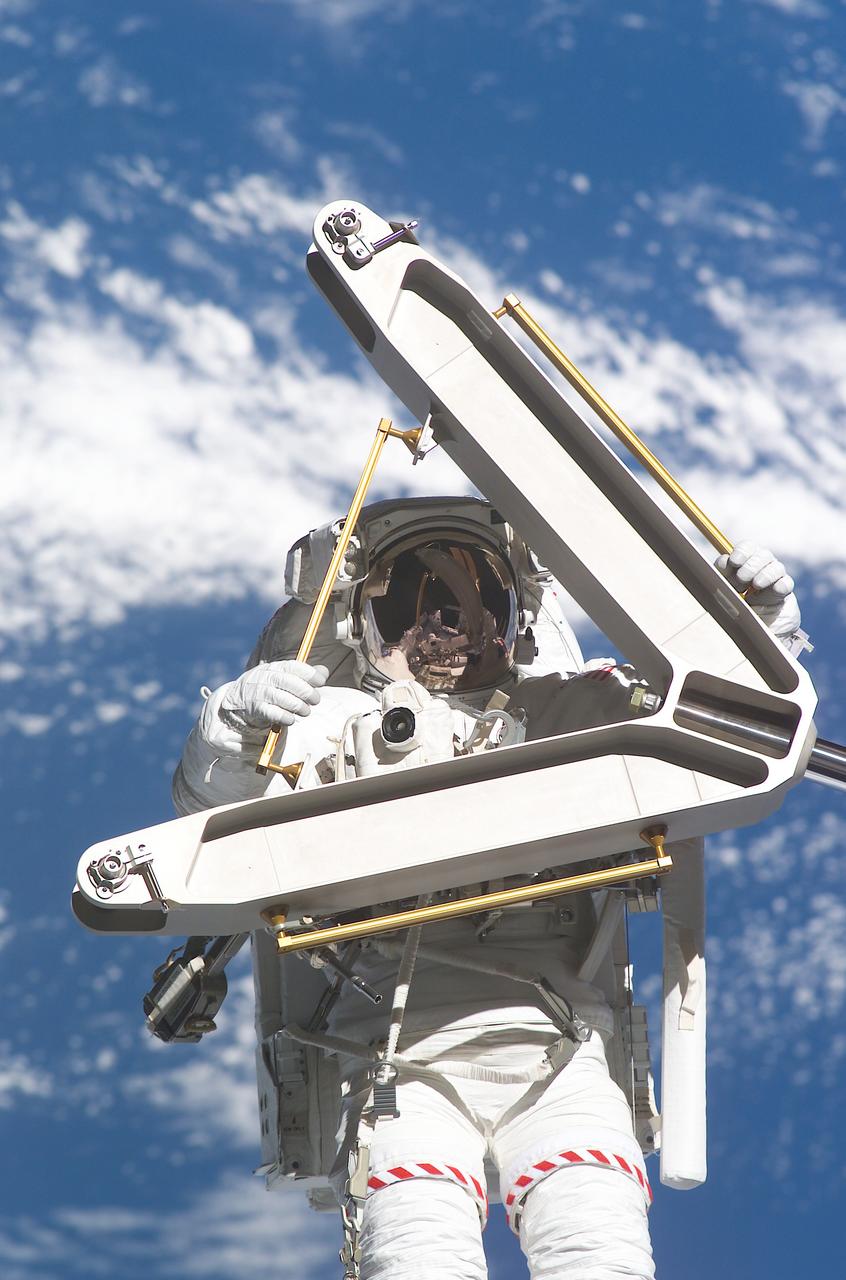
Hovering in space some 240 miles above the blue and white Earth, STS-110 astronaut M.E. Morin participates in his first ever and second of four scheduled space walks for the STS-110 mission. He is seen toting one of the S0 (S-Zero) keel pins which were removed from their functional position on the truss and attached on the truss' exterior for long term stowage. The 43-foot-long, 27,000 pound S0 truss was the first of 9 segments that will make up the International Space Station's external framework that will eventually stretch 356 feet (109 meters), or approximately the length of a football field. This central truss segment also includes a flatcar called the Mobile Transporter and rails that will become the first "space railroad," which will allow the Station's robotic arm to travel up and down the finished truss for future assembly and maintenance. The completed truss structure will hold solar arrays and radiators to provide power and cooling for additional international research laboratories from Japan and Europe that will be attached to the Station. The mission completed the installations and preparations of the S0 truss and the Mobile Transporter within four space walks. STS-110 Extravehicular Activity (EVA) marked the first use of the Station's robotic arm to maneuver space walkers around the Station and was the first time all of a shuttle crew's space walks were based out of the Station's Quest Airlock. It was also the first Shuttle to use three Block II Main Engines. The Space Shuttle Orbiter Atlantis STS-110 mission was launched April 8, 2002 and returned to Earth April 19, 2002.
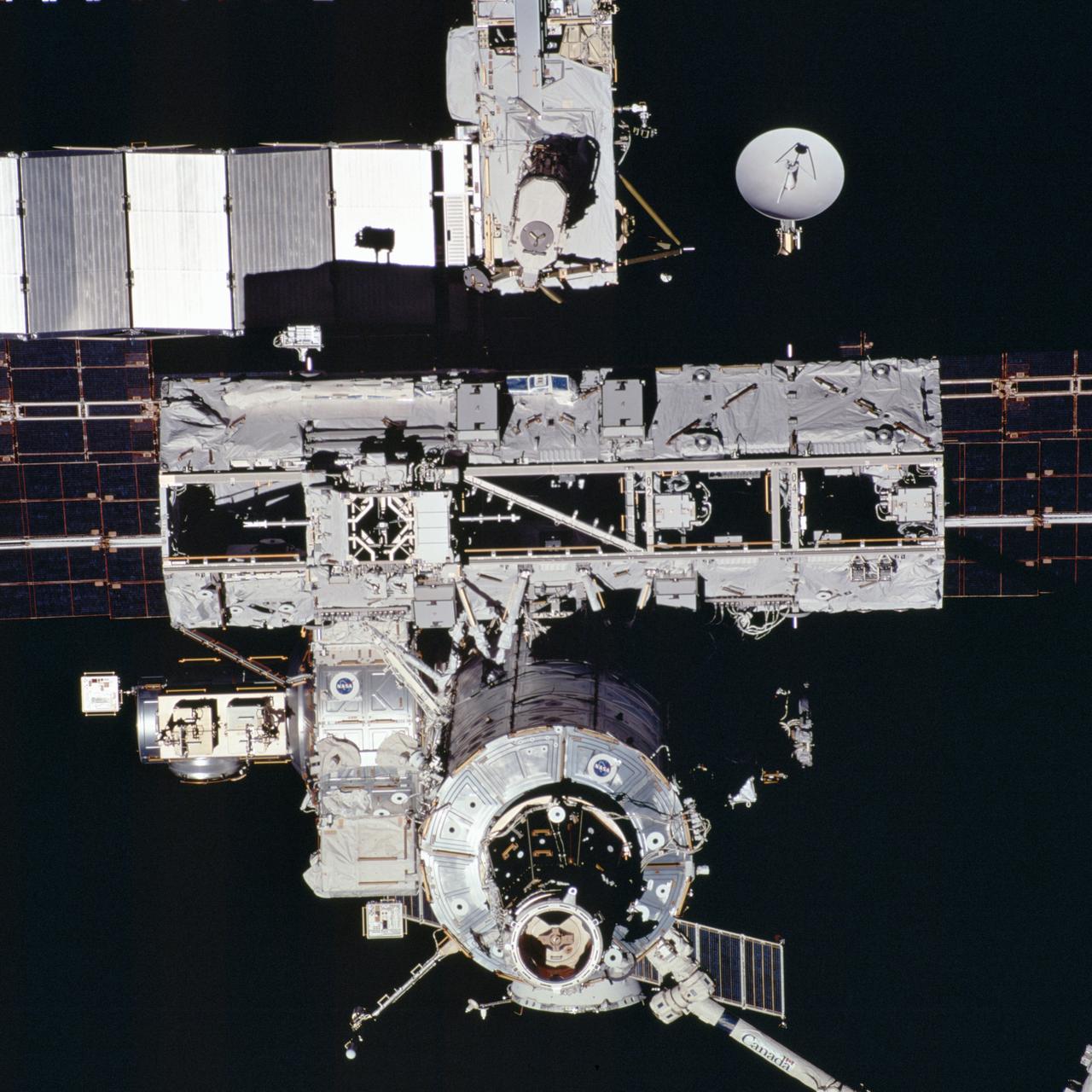
This close-up view of the International Space Station (ISS), newly equipped with its new 27,000-pound S0 (S-zero) truss, was photographed by an astronaut aboard the Space Shuttle Atlantis STS-110 during its ISS flyaround mission while pulling away from the ISS. The STS-110 mission prepared the Station for future spacewalks by installing and outfitting the 43-foot-long S0 truss and preparing the first railroad in space, the Mobile Transporter. The 27,000 pound S0 truss was the first of 9 segments that will make up the Station's external framework that will eventually stretch 356 feet (109 meters), or approximately the length of a football field. This central truss segment also includes a flatcar called the Mobile Transporter and rails that will become the first "space railroad," which will allow the Station's robotic arm to travel up and down the finished truss for future assembly and maintenance. The completed truss structure will hold solar arrays and radiators to provide power and cooling for additional international research laboratories from Japan and Europe that will be attached to the Station. STS-110 Extravehicular Activity (EVA) marked the first use of the Station's robotic arm to maneuver spacewalkers around the Station and was the first time all of a shuttle crew's spacewalks were based out of the Station's Quest Airlock. It was also the first Shuttle to use three Block II Main Engines. The Space Shuttle Orbiter Atlantis STS-110 mission, was launched April 8, 2002 and returned to Earth April 19, 2002.
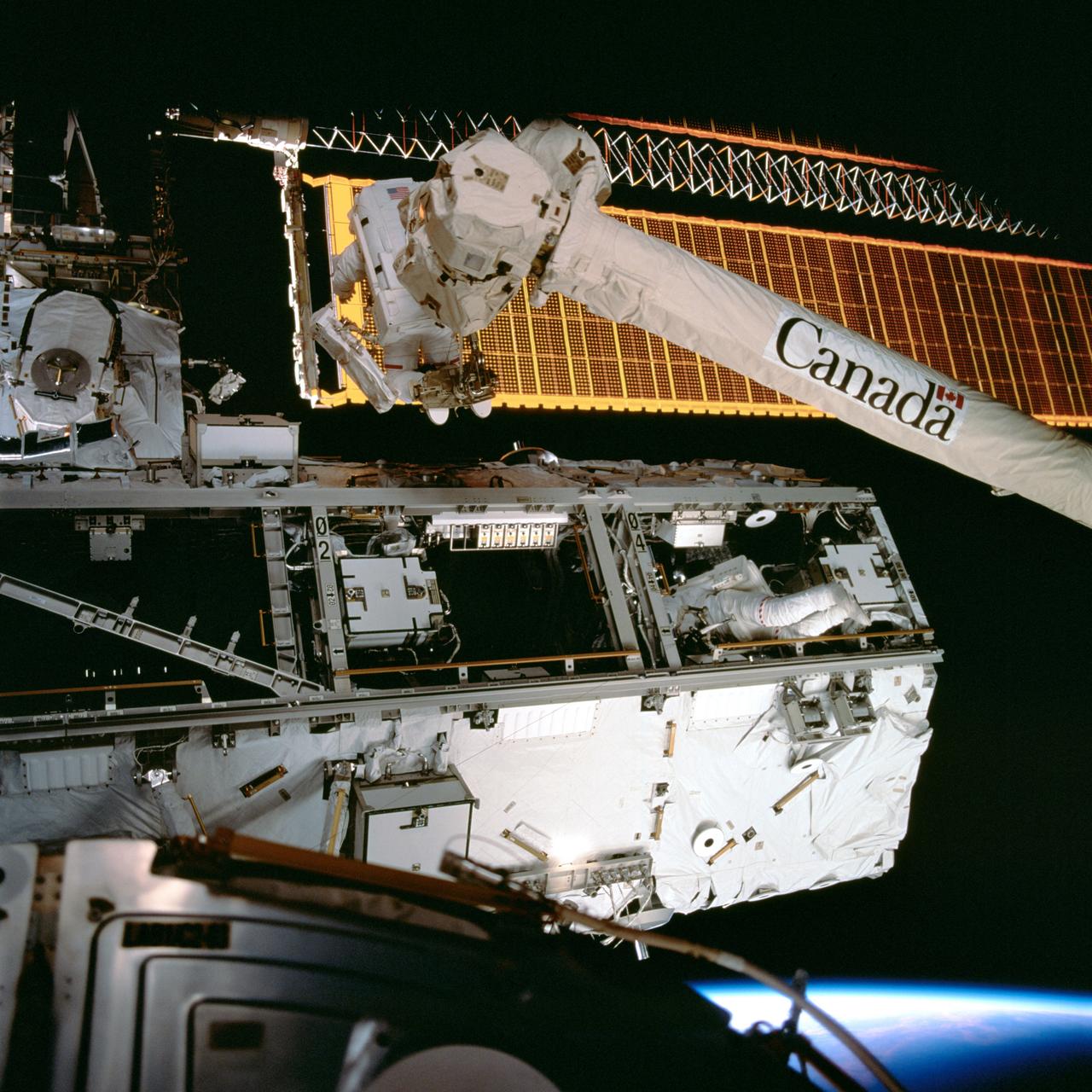
STS-110 Mission Specialists Jerry L. Ross and Lee M.E. Morin work in tandem on the fourth scheduled EVA session for the STS-110 mission aboard the Space Shuttle Orbiter Atlantis. Ross is anchored on the mobile foot restraint on the International Space Station's (ISS) Canadarm2, while Morin works inside the S0 (S-zero) truss. The STS-110 mission prepared the Station for future spacewalks by installing and outfitting a 43-foot-long S0 truss and preparing the Mobile Transporter. The 27,000 pound S0 Truss was the first of 9 segments that will make up the Station's external framework that will eventually stretch 356 feet (109 meters), or approximately the length of a football field. This central truss segment also includes a flatcar called the Mobile Transporter and rails that will become the first "space railroad," which will allow the Station's robotic arm to travel up and down the finished truss for future assembly and maintenance. The completed truss structure will hold solar arrays and radiators to provide power and cooling for additional international research laboratories from Japan and Europe that will be attached to the Station. Milestones of the S-110 mission included the first time the ISS robotic arm was used to maneuver spacewalkers around the Station and marked the first time all spacewalks were based out of the Station's Quest Airlock. It was also the first Shuttle to use three Block II Main Engines. The Space Shuttle Orbiter Atlantis, STS-110 mission, was launched April 8, 2002 and returned to Earth April 19, 2002.

This close-up view of the International Space Station (ISS), newly equipped with its new 27,000-pound S0 (S-zero) truss, was photographed by an astronaut aboard the Space Shuttle Atlantis STS-110 upon its ISS flyaround mission while pulling away from the ISS. The STS-110 mission prepared the Station for future spacewalks by installing and outfitting the 43-foot-long S0 truss and preparing the first railroad in space, the Mobile Transporter. The 27,000 pound S0 truss was the first of 9 segments that will make up the Station's external framework that will eventually stretch 356 feet (109 meters), or approximately the length of a football field. This central truss segment also includes a flatcar called the Mobile Transporter and rails that will become the first "space railroad," which will allow the Station's robotic arm to travel up and down the finished truss for future assembly and maintenance. The completed truss structure will hold solar arrays and radiators to provide power and cooling for additional international research laboratories from Japan and Europe that will be attached to the Station. STS-110 Extravehicular Activity (EVA) marked the first use of the Station's robotic arm to maneuver spacewalkers around the station and was the first time all of a Shuttle crew's spacewalks were based out of the Station's Quest Airlock. It was also the first Shuttle to use three Block II Main Engines. The Space Shuttle Orbiter Atlantis STS-110 mission, was launched April 8, 2002 and returned to Earth April 19, 2002.
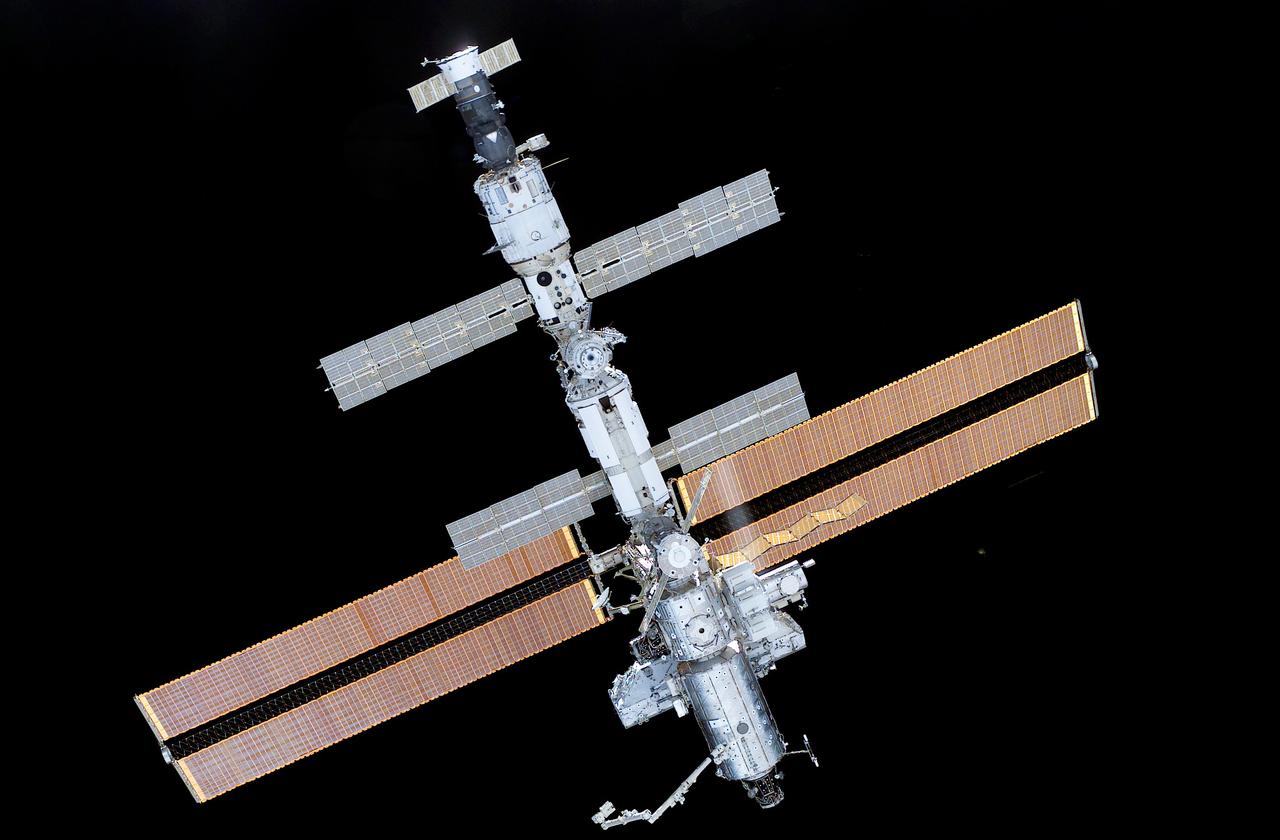
This close-up view of the International Space Station (ISS), newly equipped with its new 27,000-pound S0 (S-zero) truss, was photographed by an astronaut aboard the Space Shuttle Atlantis STS-110 mission following its undocking from the ISS. The STS-110 mission prepared the Station for future spacewalks by installing and outfitting the 43-foot-long S0 truss and preparing the first railroad in space, the Mobile Transporter. The 27,000 pound S0 truss was the first of 9 segments that will make up the Station's external framework that will eventually stretch 356 feet (109 meters), or approximately the length of a football field. This central truss segment also includes a flatcar called the Mobile Transporter and rails that will become the first "space railroad," which will allow the Station's robotic arm to travel up and down the finished truss for future assembly and maintenance. The completed truss structure will hold solar arrays and radiators to provide power and cooling for additional international research laboratories from Japan and Europe that will be attached to the Station. STS-110 Extravehicular Activity (EVA) marked the first use of the Station's robotic arm to maneuver spacewalkers around the Station and was the first time all of a Shuttle crew's spacewalks were based out of the Station's Quest Airlock. It was also the first Shuttle to use three Block II Main Engines. The Space Shuttle Orbiter Atlantis STS-110 mission, was launched April 8, 2002 and returned to Earth April 19, 2002.
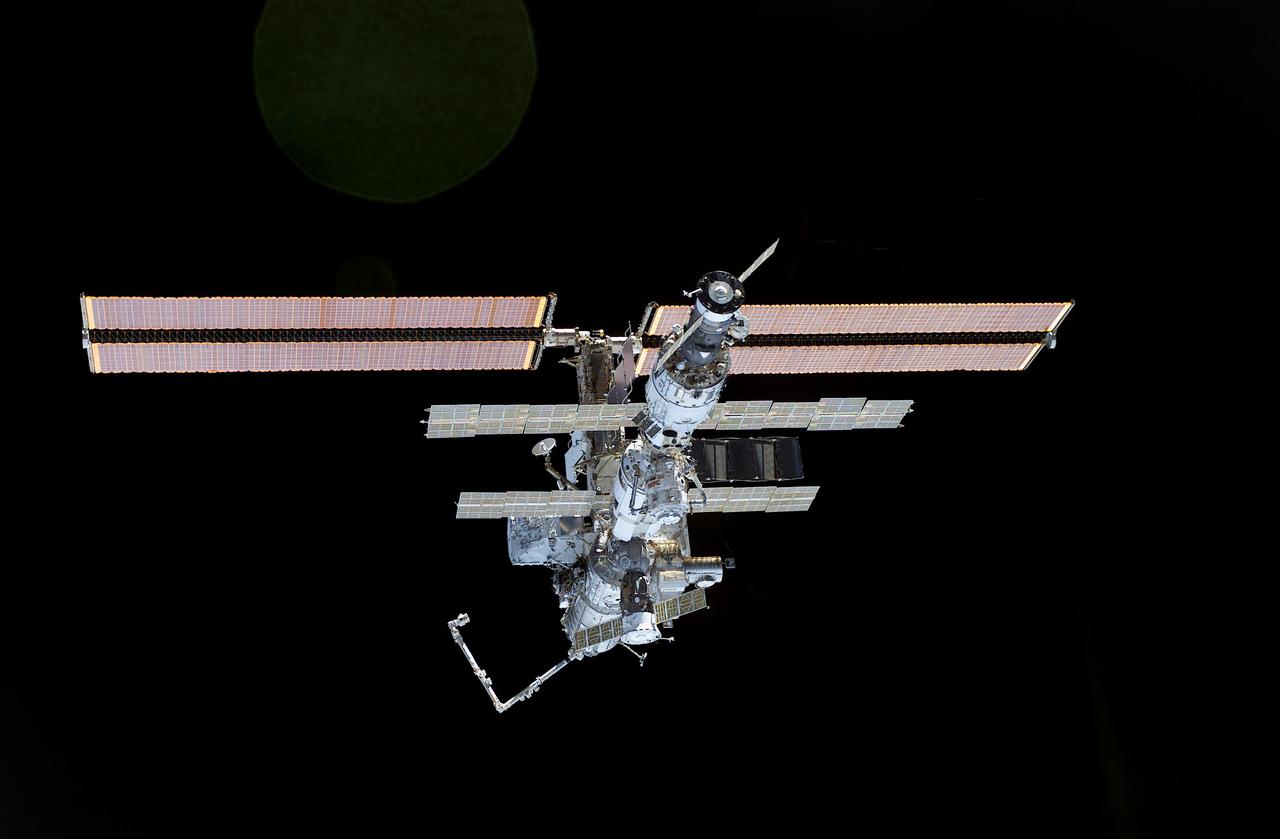
This close-up view of the International Space Station (ISS), newly equipped with its new 27,000- pound S0 (S-zero) truss, was photographed by an astronaut aboard the Space Shuttle Atlantis STS-110 mission following its undocking from the ISS. The STS-110 mission prepared the Station for future spacewalks by installing and outfitting the 43-foot-long S0 truss and preparing the first railroad in space, the Mobile Transporter. The 27,000 pound S0 truss was the first of 9 segments that will make up the Station's external framework that will eventually stretch 356 feet (109 meters), or approximately the length of a football field. This central truss segment also includes a flatcar called the Mobile Transporter and rails that will become the first "space railroad," which will allow the Station's robotic arm to travel up and down the finished truss for future assembly and maintenance. The completed truss structure will hold solar arrays and radiators to provide power and cooling for additional international research laboratories from Japan and Europe that will be attached to the Station. STS-110 Extravehicular Activity (EVA) marked the first use of the Station's robotic arm to maneuver spacewalkers around the Station and was the first time all of a shuttle crew's spacewalks were based out of the Station's Quest Airlock. It was also the first Shuttle to use three Block II Main Engines. The Space Shuttle Orbiter Atlantis STS-110 mission, was launched April 8, 2002 and returned to Earth April 19, 2002.
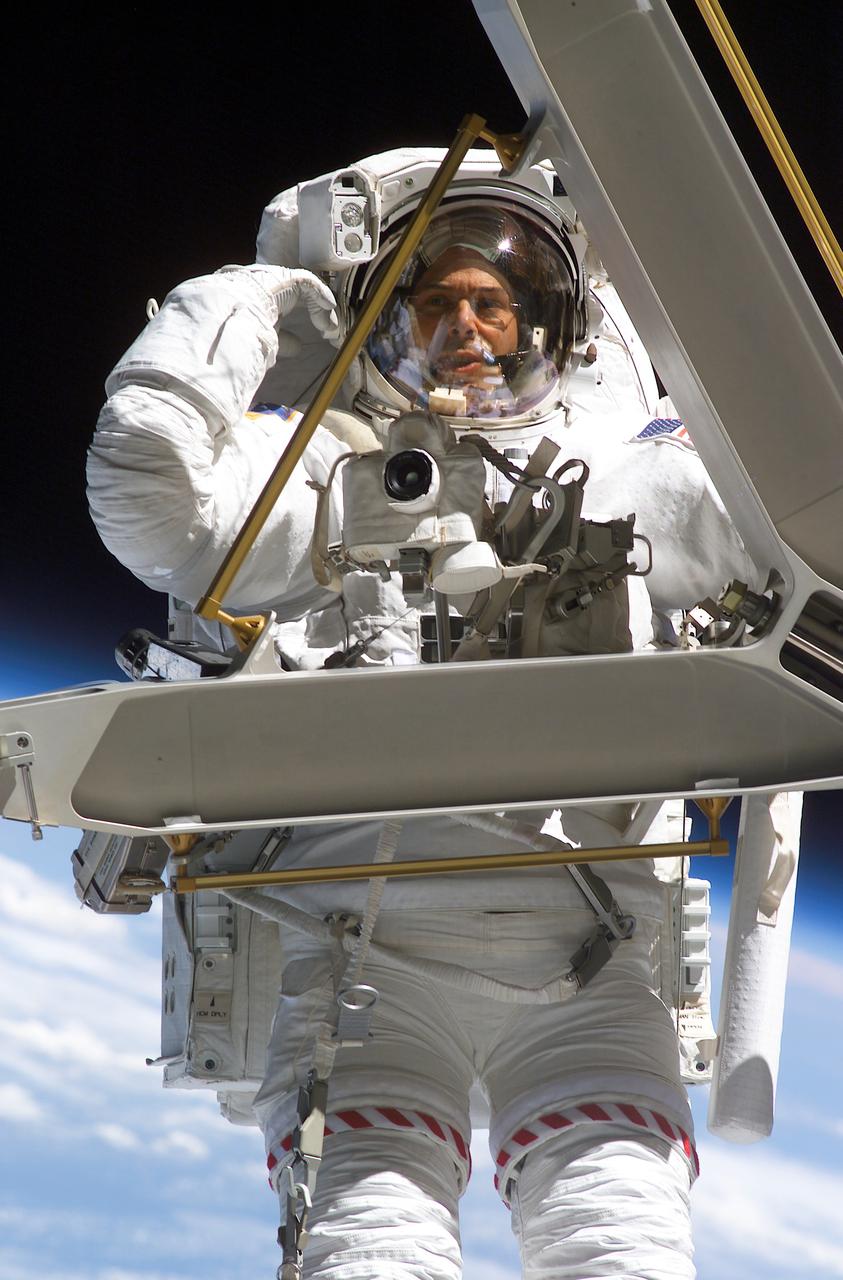
STS-110 mission specialist Lee M.E. Morin carries an affixed 35 mm camera to record work which is being performed on the International Space Station (ISS). Working with astronaut Jerry L. Ross (out of frame), the duo completed the structural attachment of the S0 (s-zero) truss, mating two large tripod legs of the 13 1/2 ton structure to the station's main laboratory during a 7-hour, 30-minute space walk. The STS-110 mission prepared the Station for future space walks by installing and outfitting the 43-foot-long S0 truss and preparing the Mobile Transporter. The S0 Truss was the first of 9 segments that will make up the Station's external framework that will eventually stretch 356 feet (109 meters), or approximately the length of a football field. This central truss segment also includes a flatcar called the Mobile Transporter and rails that will become the first "space railroad," which will allow the Station's robotic arm to travel up and down the finished truss for future assembly and maintenance. The completed truss structure will hold solar arrays and radiators to provide power and cooling for additional international research laboratories from Japan and Europe that will be attached to the Station. Milestones of the S-110 mission included the first time the ISS robotic arm was used to maneuver space walkers around the Station and marked the first time all space walks were based out of the Station's Quest Airlock. It was also the first Shuttle to use three Block II Main Engines. The Space Shuttle Orbiter Atlantis, STS-110 mission, was launched April 8, 2002 and returned to Earth April 19, 2002.
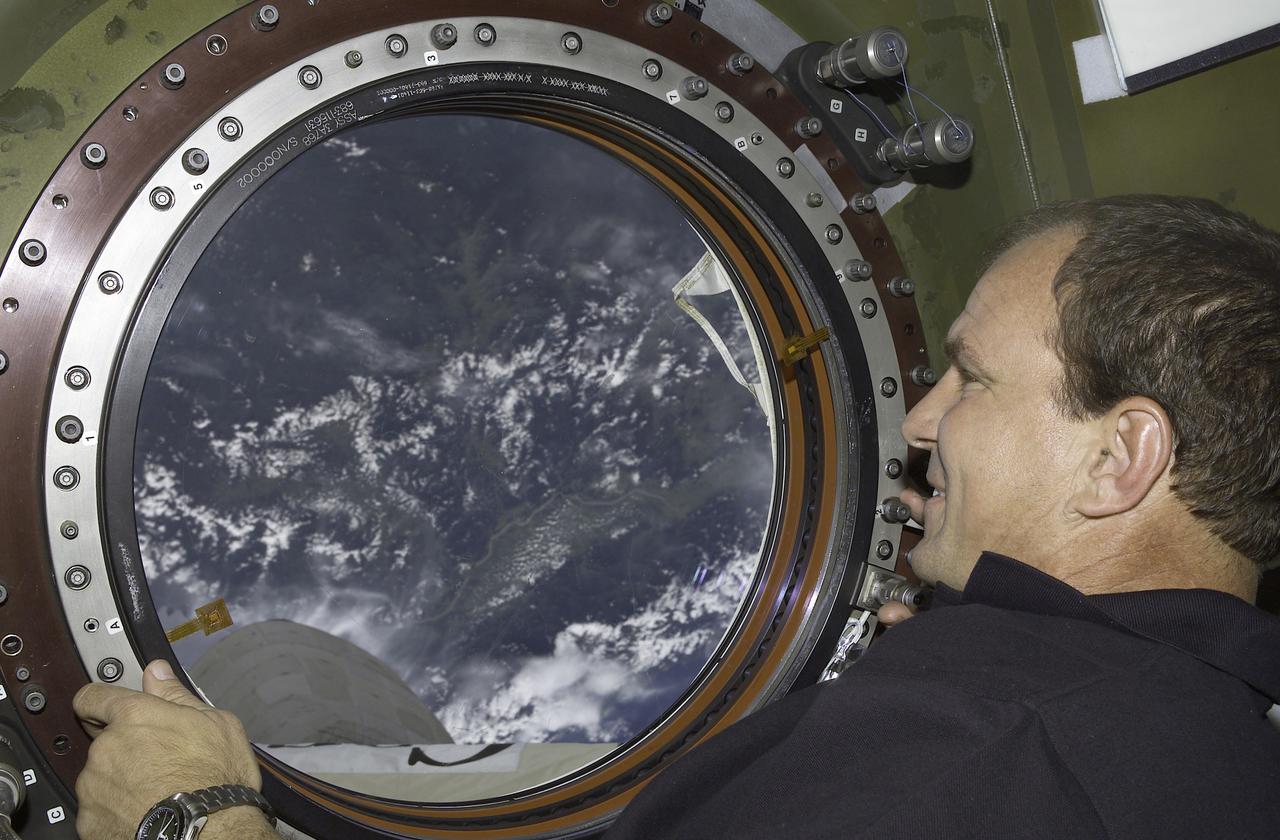
Astronaut Michael J. Bloomfield, STS-110 mission commander, looks through the Earth observation window in the Destiny laboratory aboard the International Space Station (ISS). The STS-110 mission prepared the ISS for future spacewalks by installing and outfitting the S0 (S-zero) truss and the Mobile Transporter. The 43-foot-long S0 Truss, weighing in at 27,000 pounds, was the first of 9 segments that will make up the Station's external framework that will eventually stretch 356 feet (109 meters), or approximately the length of a football field. This central truss segment also includes a flatcar called the Mobile Transporter and rails that will become the first "space railroad," which will allow the Station's robotic arm to travel up and down the finished truss for future assembly and maintenance. The completed truss structure will hold solar arrays and radiators to provide power and cooling for additional international research laboratories from Japan and Europe that will be attached to the Station. Milestones of the STS-110 mission included the first time the ISS robotic arm was used to maneuver spacewalkers around the Station and marked the first time all spacewalks were based out of the Station's Quest Airlock. It was also the first Shuttle to use three Block II Main Engines. The Space Shuttle Orbiter Atlantis, STS-110 mission, was launched April 8, 2002 and returned to Earth April 19, 2002.
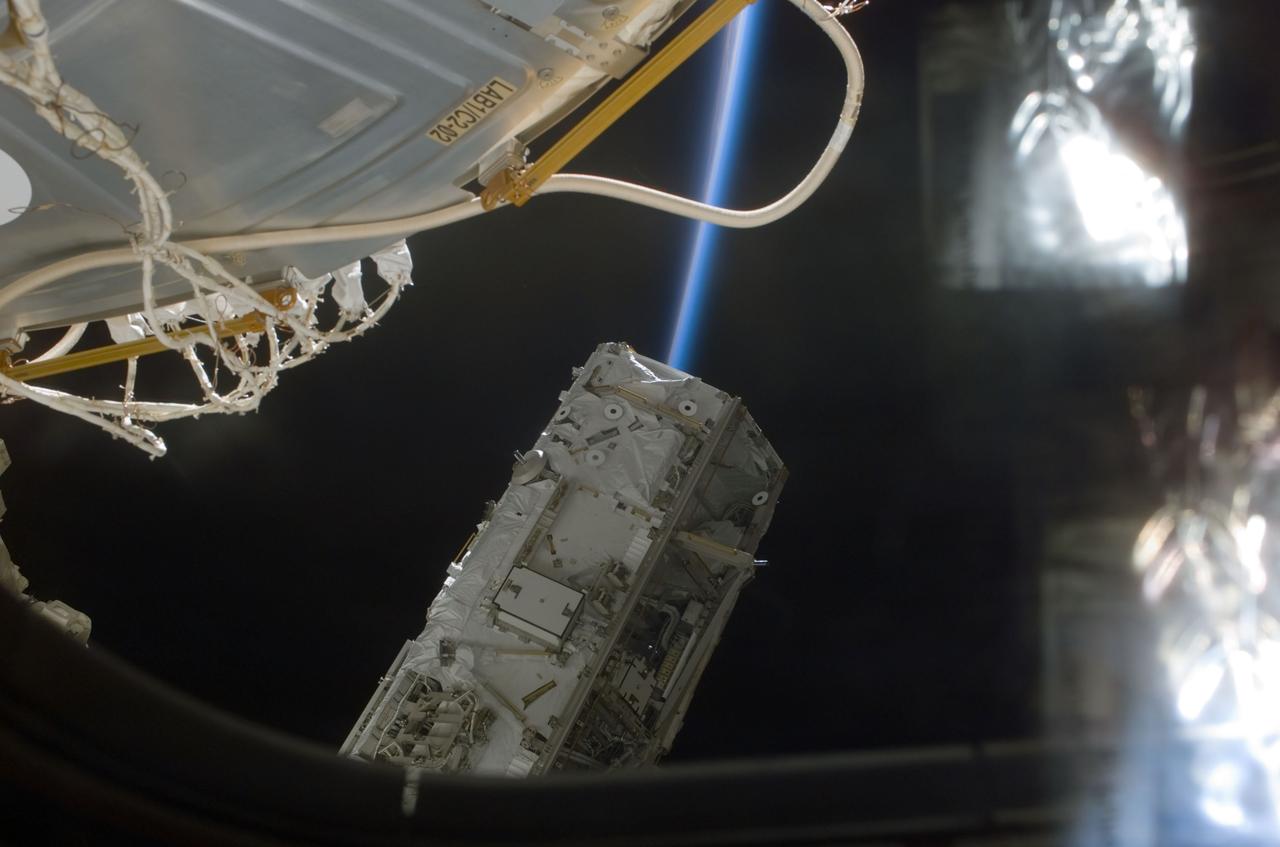
STS110-E-5180 (11 April 2002) --- Backdropped by the blackness of space, the S0 (S-Zero) Truss is moved from the Space Shuttle Atlantis’ cargo bay. Astronauts Ellen Ochoa, STS-110 mission specialist, and Daniel W. Bursch, Expedition Four flight engineer, used the International Space Station’s (ISS) Canadarm2 to lift the S0 Truss out of the orbiter’s payload bay and install it onto the temporary claw fixture on the Destiny laboratory. The image was taken with a digital still camera.
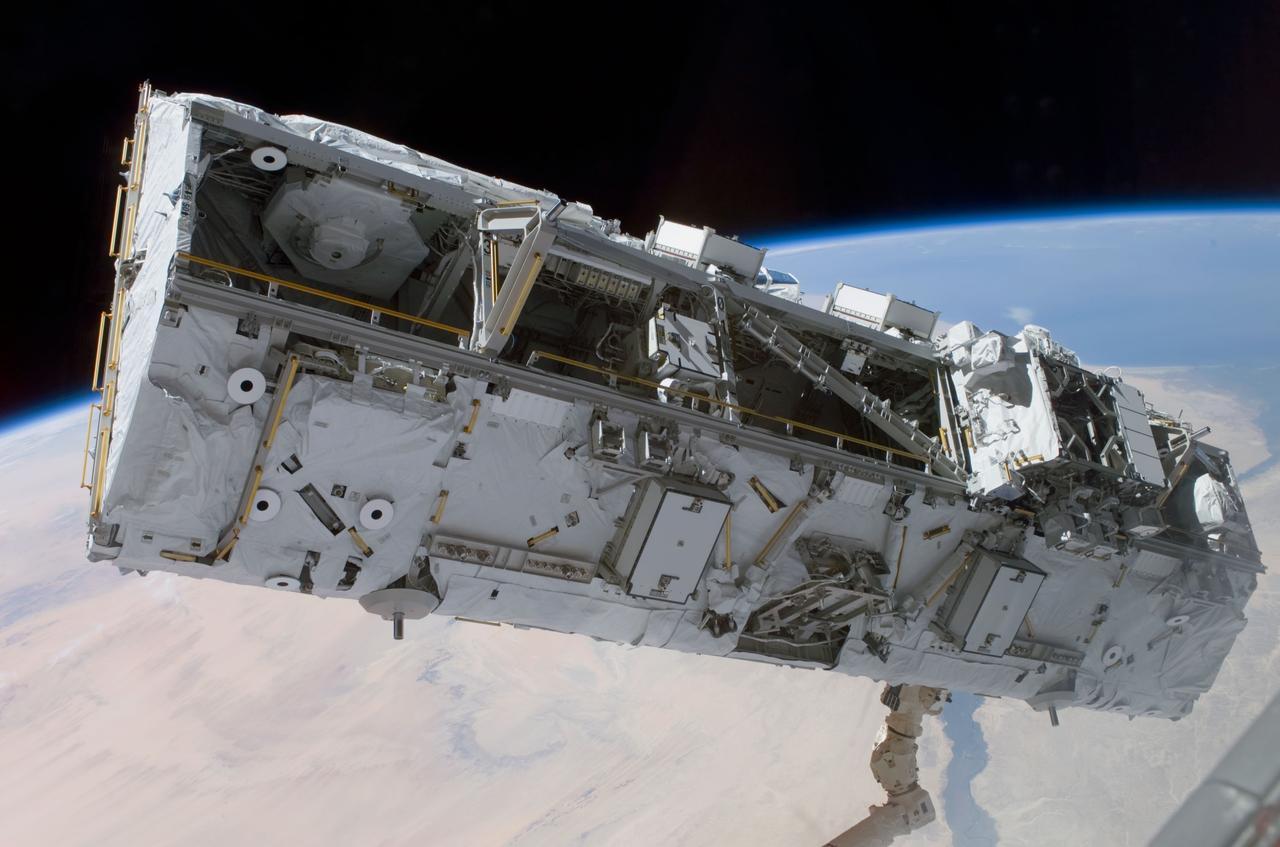
STS110-E-5173 (11 April 2002) --- Backdropped by the blackness of space and Earth’s horizon, the S0 (S-Zero) Truss is moved from the Space Shuttle Atlantis’ cargo bay. Astronauts Ellen Ochoa, STS-110 mission specialist, and Daniel W. Bursch, Expedition Four flight engineer, used the International Space Station’s (ISS) Canadarm2 to lift the S0 Truss out of the orbiter’s payload bay and install it onto the temporary claw fixture on the Destiny laboratory. The image was taken with a digital still camera.
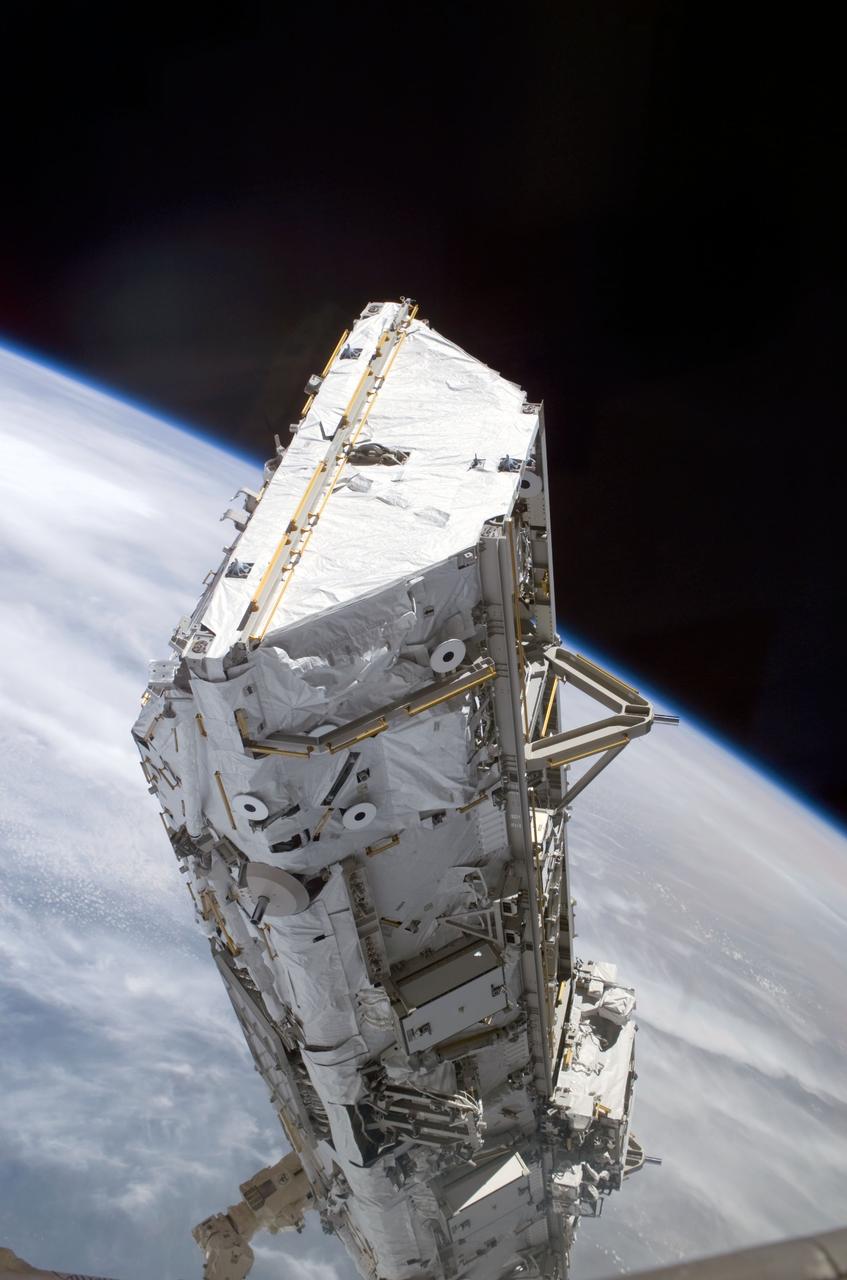
STS110-E-5170 (11 April 2002) --- Backdropped by the blackness of space and Earth’s horizon, the S0 (S-Zero) Truss is moved from the Space Shuttle Atlantis’ cargo bay. Astronauts Ellen Ochoa, STS-110 mission specialist, and Daniel W. Bursch, Expedition Four flight engineer, used the International Space Station’s (ISS) Canadarm2 to lift the S0 Truss out of the orbiter’s payload bay and install it onto the temporary claw fixture on the Destiny laboratory. The image was taken with a digital still camera.
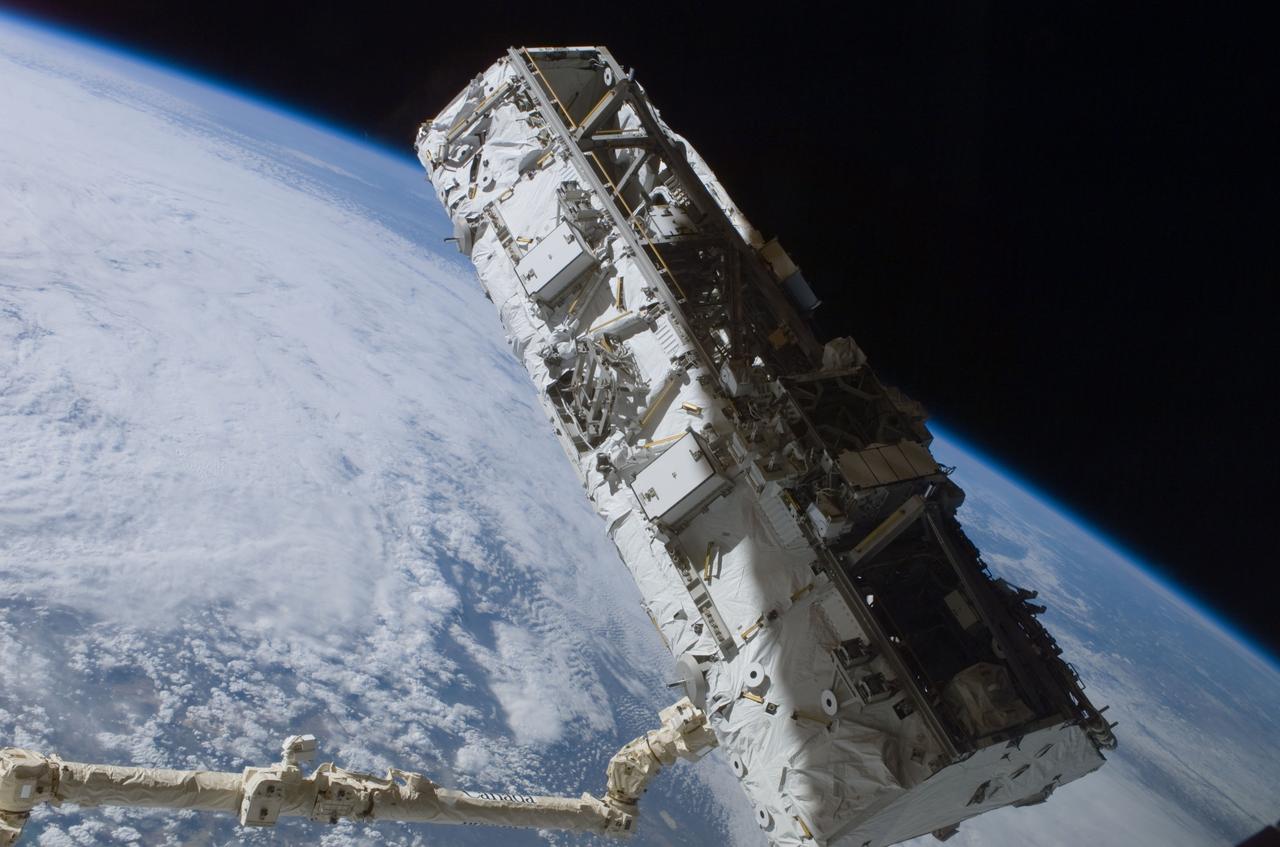
STS110-E-5174 (11 April 2002) --- Backdropped by the blackness of space and Earth’s horizon, the S0 (S-Zero) Truss is moved from the Space Shuttle Atlantis’ cargo bay. Astronauts Ellen Ochoa, STS-110 mission specialist, and Daniel W. Bursch, Expedition Four flight engineer, used the International Space Station’s (ISS) Canadarm2 to lift the S0 Truss out of the orbiter’s payload bay and install it onto the temporary claw fixture on the Destiny laboratory. The image was taken with a digital still camera.
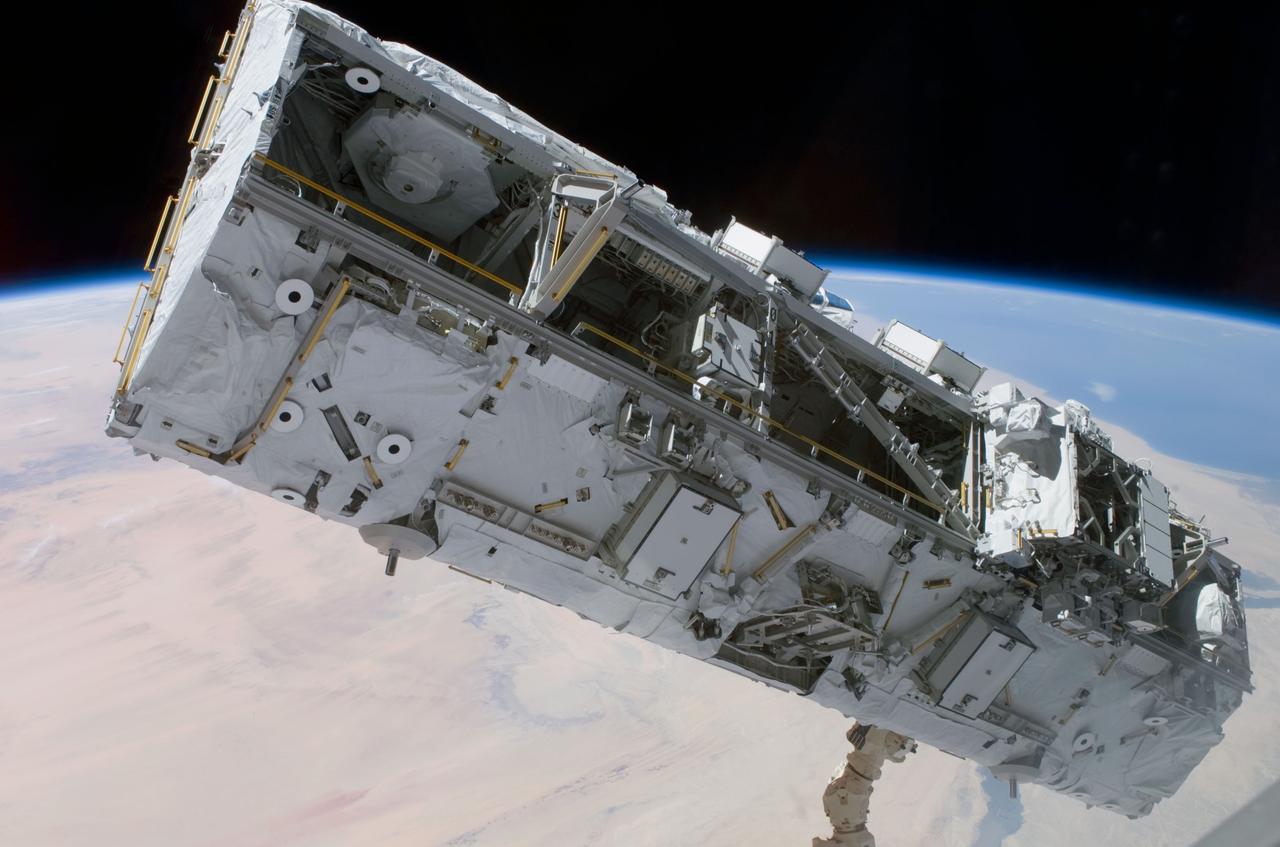
STS110-E-5172 (11 April 2002) --- Backdropped by the blackness of space and Earth’s horizon, the S0 (S-Zero) Truss is moved from the Space Shuttle Atlantis’ cargo bay. Astronauts Ellen Ochoa, STS-110 mission specialist, and Daniel W. Bursch, Expedition Four flight engineer, used the International Space Station’s (ISS) Canadarm2 to lift the S0 Truss out of the orbiter’s payload bay and install it onto the temporary claw fixture on the Destiny laboratory. The image was taken with a digital still camera.
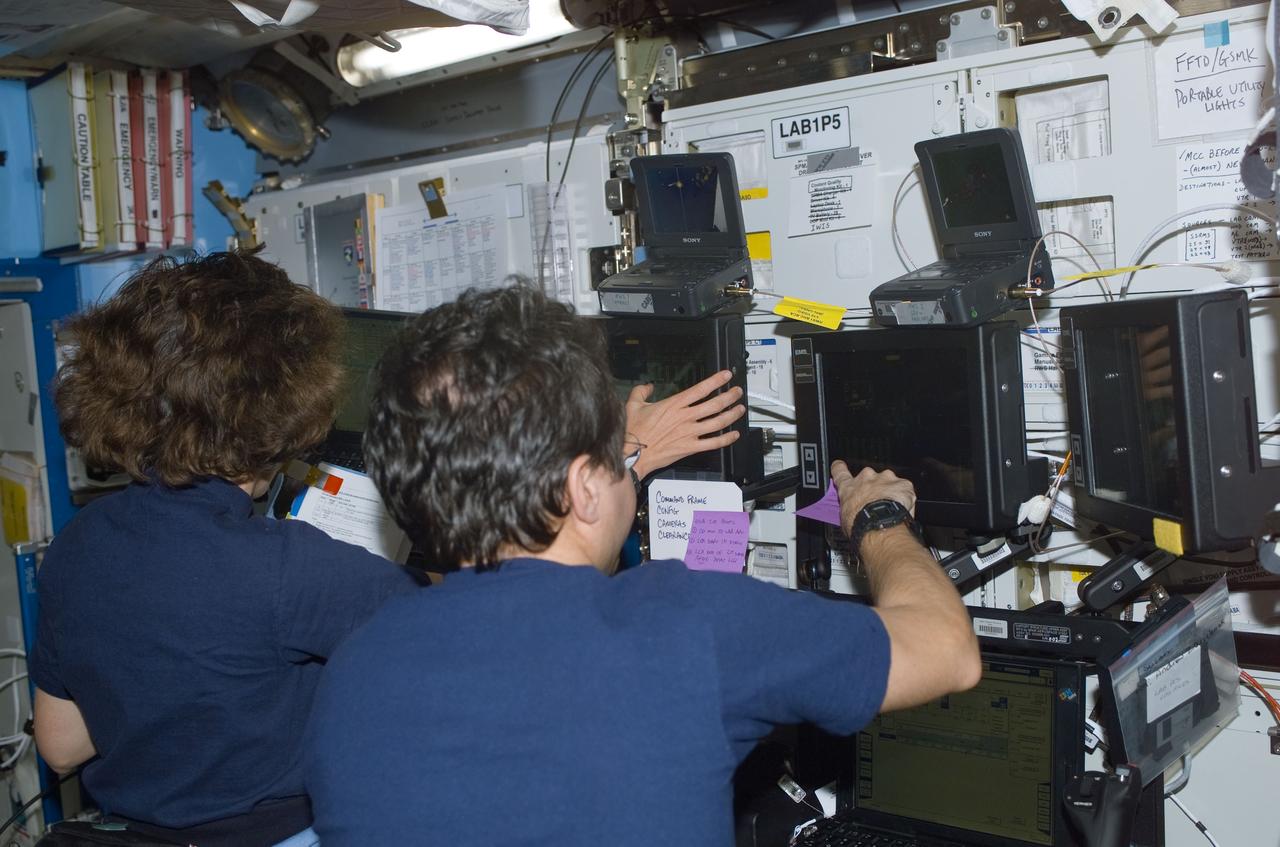
STS110-E-5182 (11 April 2002) --- Astronauts Ellen Ochoa (left), STS-110 mission specialist, and Daniel W. Bursch, Expedition Four flight engineer, work the controls of the Canadarm2 in the Destiny laboratory on the International Space Station (ISS). Ochoa and Bursch used the robotic arm to lift the S0 (S-Zero) Truss out of Space Shuttle Atlantis’ payload bay and installed it onto the temporary claw fixture on the Destiny laboratory. The image was taken with a digital still camera.
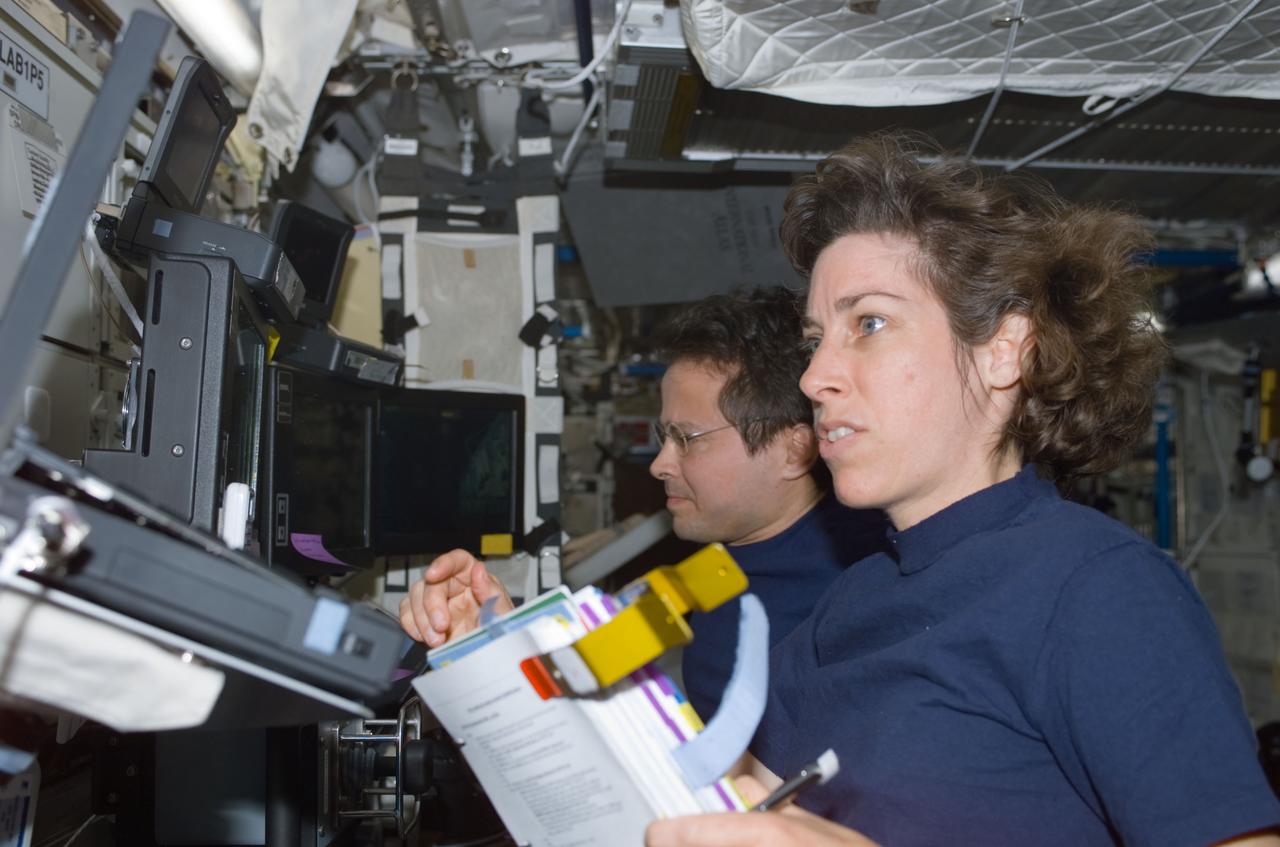
STS110-E-5186 (11 April 2002) --- Astronauts Ellen Ochoa (foreground), STS-110 mission specialist, and Daniel W. Bursch, Expedition Four flight engineer, work the controls of the Canadarm2 in the Destiny laboratory on the International Space Station (ISS). Ochoa and Bursch used the robotic arm to lift the S0 (S-Zero) Truss out of Space Shuttle Atlantis? payload bay and installed it onto the temporary claw fixture on the Destiny laboratory. The image was taken with a digital still camera. Photo credit: NASA
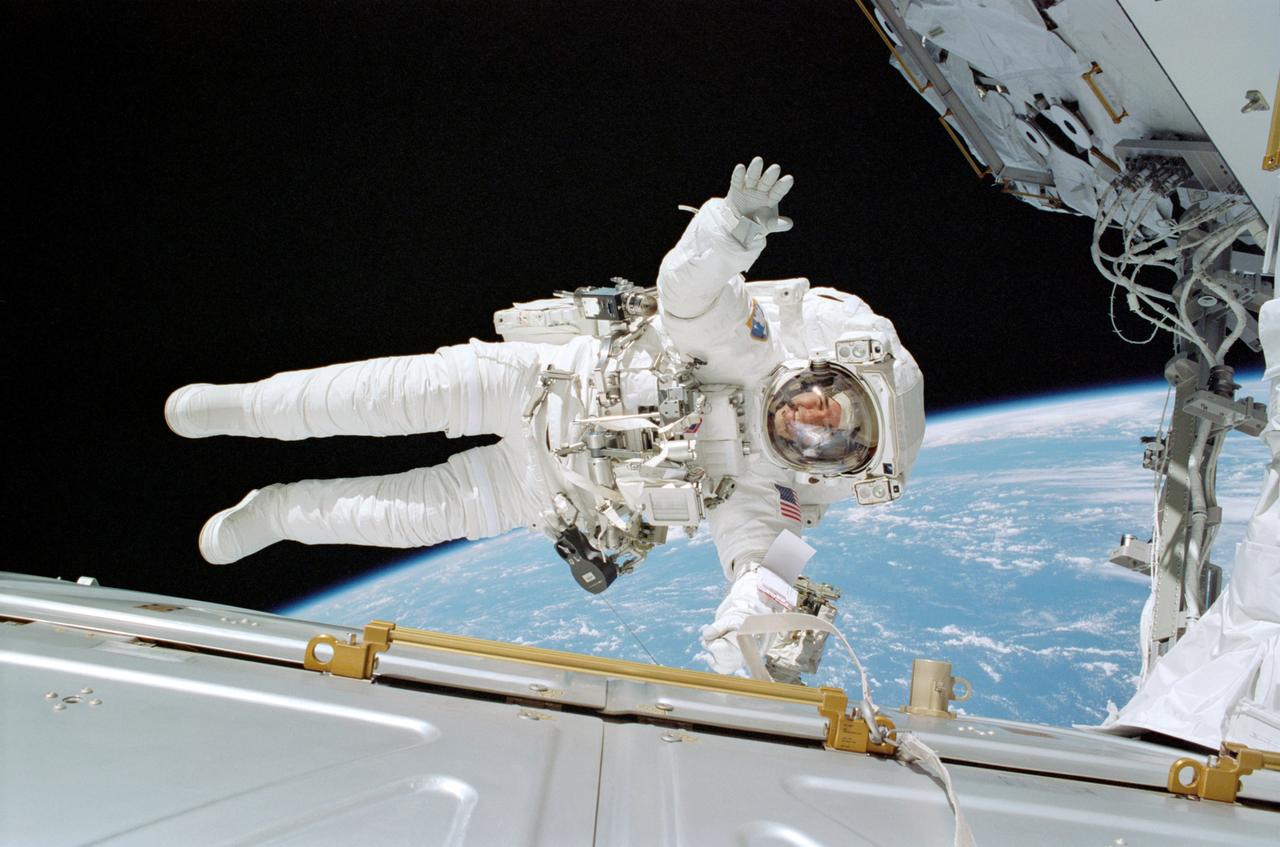
STS-110 Mission astronaut Rex J. Walheim, accompanied by astronaut Steven L. Smith (out of frame) translates along the Destiny laboratory on the International Space Station (ISS) during the third scheduled EVA session. The duo released the locking bolts on the Mobile Transporter and rewired the Station's robotic arm. The STS-110 mission prepared the ISS for future space walks by installing and outfitting the S0 (S-Zero) Truss and the Mobile Transporter. The 43-foot-long S0 truss weighing in at 27,000 pounds was the first of 9 segments that will make up the Station's external framework that will eventually stretch 356 feet (109 meters), or approximately the length of a football field. This central truss segment also includes a flatcar called the Mobile Transporter and rails that will become the first "space railroad," which will allow the Station's robotic arm to travel up and down the finished truss for future assembly and maintenance. The completed truss structure will hold solar arrays and radiators to provide power and cooling for additional international research laboratories from Japan and Europe that will be attached to the Station. Milestones of the S-110 mission included the first time the ISS robotic arm was used to maneuver space walkers around the Station and marked the first time all space walks were based out of the Station's Quest Airlock. It was also the first Shuttle to use three Block II Main Engines. The Space Shuttle Orbiter Atlantis, STS-110 mission, was launched April 8, 2002 and returned to Earth April 19, 2002.
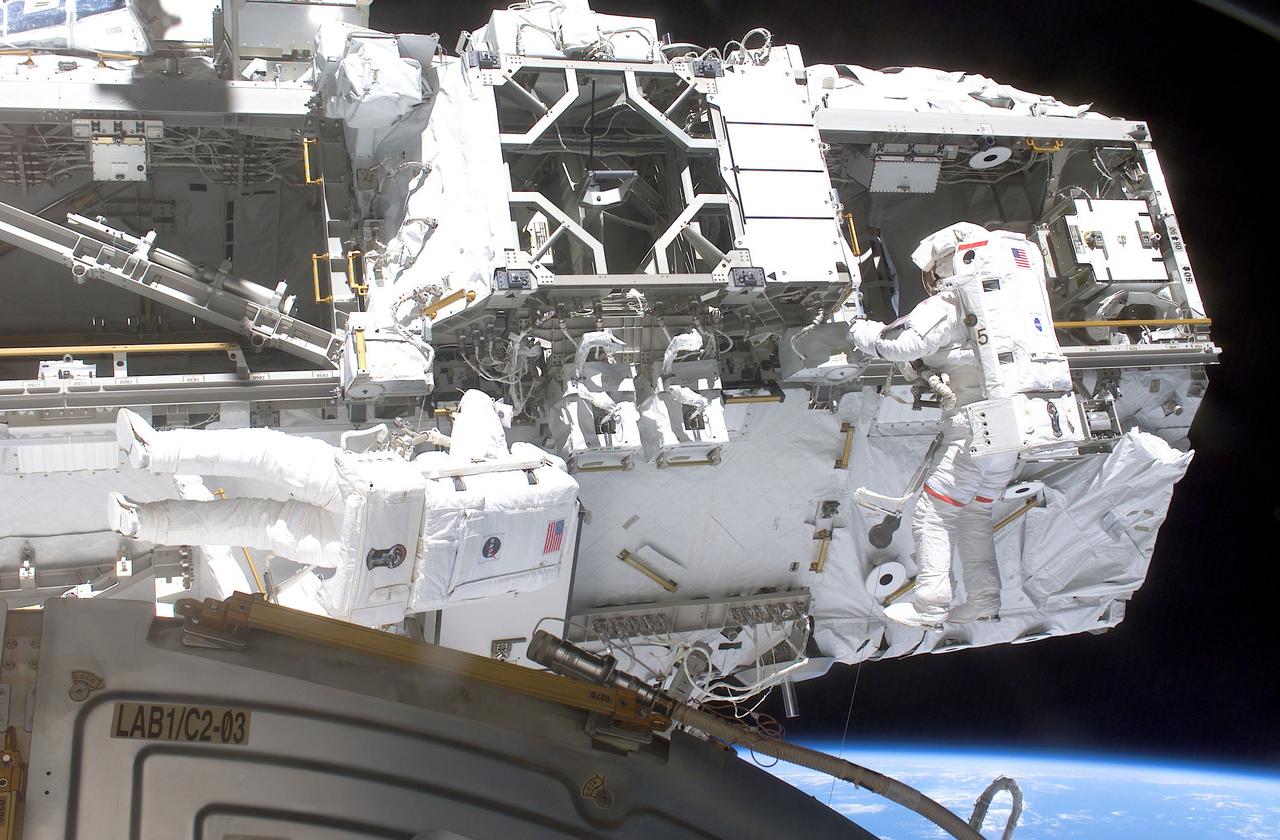
STS-110 Mission astronauts Steven L. Smith (right) and Rex J. Walheim work in tandem on the third scheduled EVA session in which they released the locking bolts on the Mobile Transporter and rewired the Station's robotic arm (out of frame). Part of the Destiny laboratory and a glimpse of the Earth's horizon are seen in the lower portion of this digital image. The STS-110 mission prepared the International Space Station (ISS) for future spacewalks by installing and outfitting the S0 (S-zero) Truss and the Mobile Transporter. The 43-foot-long S0 truss weighing in at 27,000 pounds was the first of 9 segments that will make up the Station's external framework that will eventually stretch 356 feet (109 meters), or approximately the length of a football field. This central truss segment also includes a flatcar called the Mobile Transporter and rails that will become the first "space railroad," which will allow the Station's robotic arm to travel up and down the finished truss for future assembly and maintenance. The completed truss structure will hold solar arrays and radiators to provide power and cooling for additional international research laboratories from Japan and Europe that will be attached to the Station. Milestones of the S-110 mission included the first time the ISS robotic arm was used to maneuver spacewalkers around the Station and marked the first time all spacewalks were based out of the Station's Quest Airlock. It was also the first Shuttle to use three Block II Main Engines. The Space Shuttle Orbiter Atlantis, STS-110 mission, was launched April 8, 2002 and returned to Earth April 19, 2002.
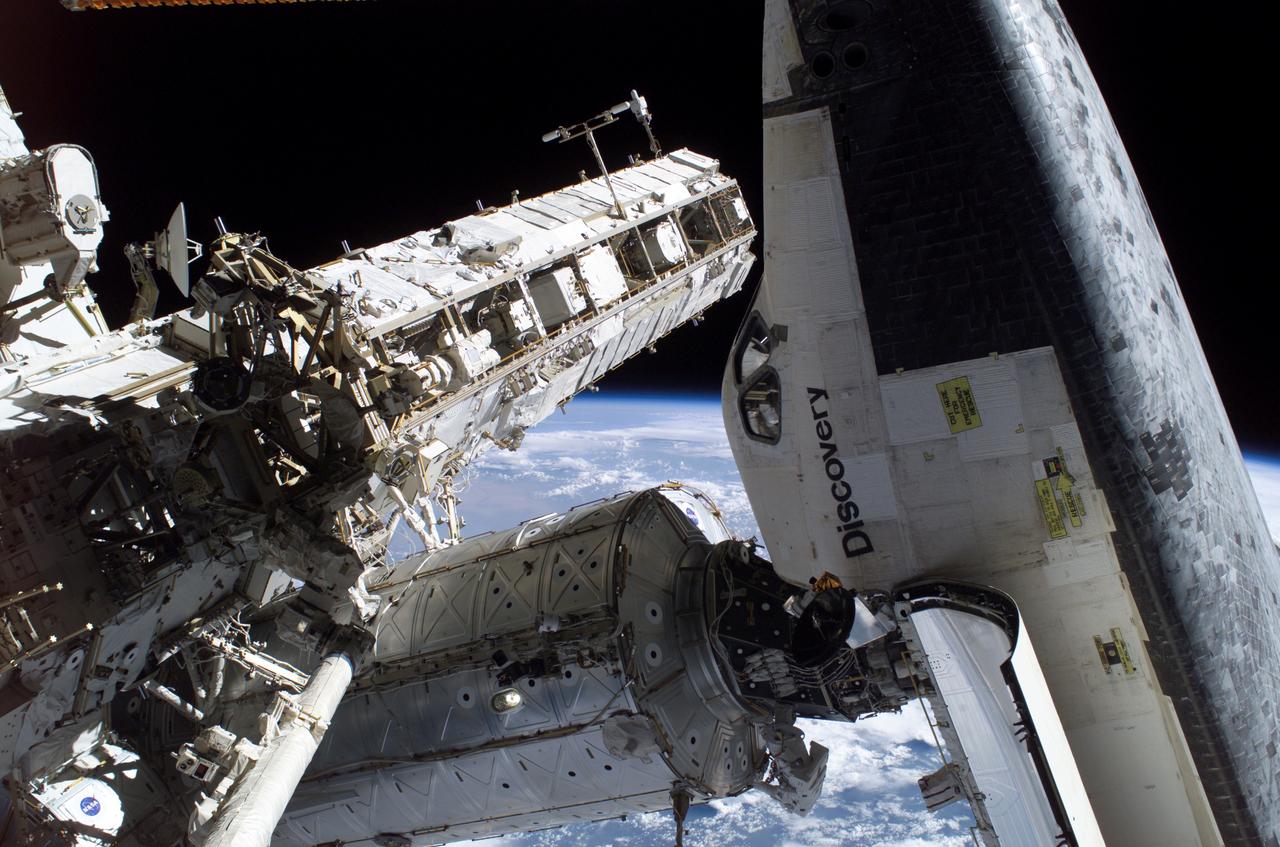
S114-E-6455 (3 August 2005) --- This image features a view of Space Shuttle Discovery docked to the Pressurized Mating Adapter 2 (PMA-2) on the Destiny laboratory of the international space station. The Crew Equipment Translation Aid (CETA) cart and the Mobile Base System (MBS), mounted on the S0 truss, are visible at left. Part of the P1 truss is also visible in the background. Dwarfed by the station and shuttle, Japan Aerospace Exploration Agency (JAXA) astronaut Soichi Noguchi, STS-114 mission specialist, is visible near the PMA-2 during the mission’s third session of extravehicular activity (EVA). The blackness of space and a blue and white Earth form the backdrop for the image.
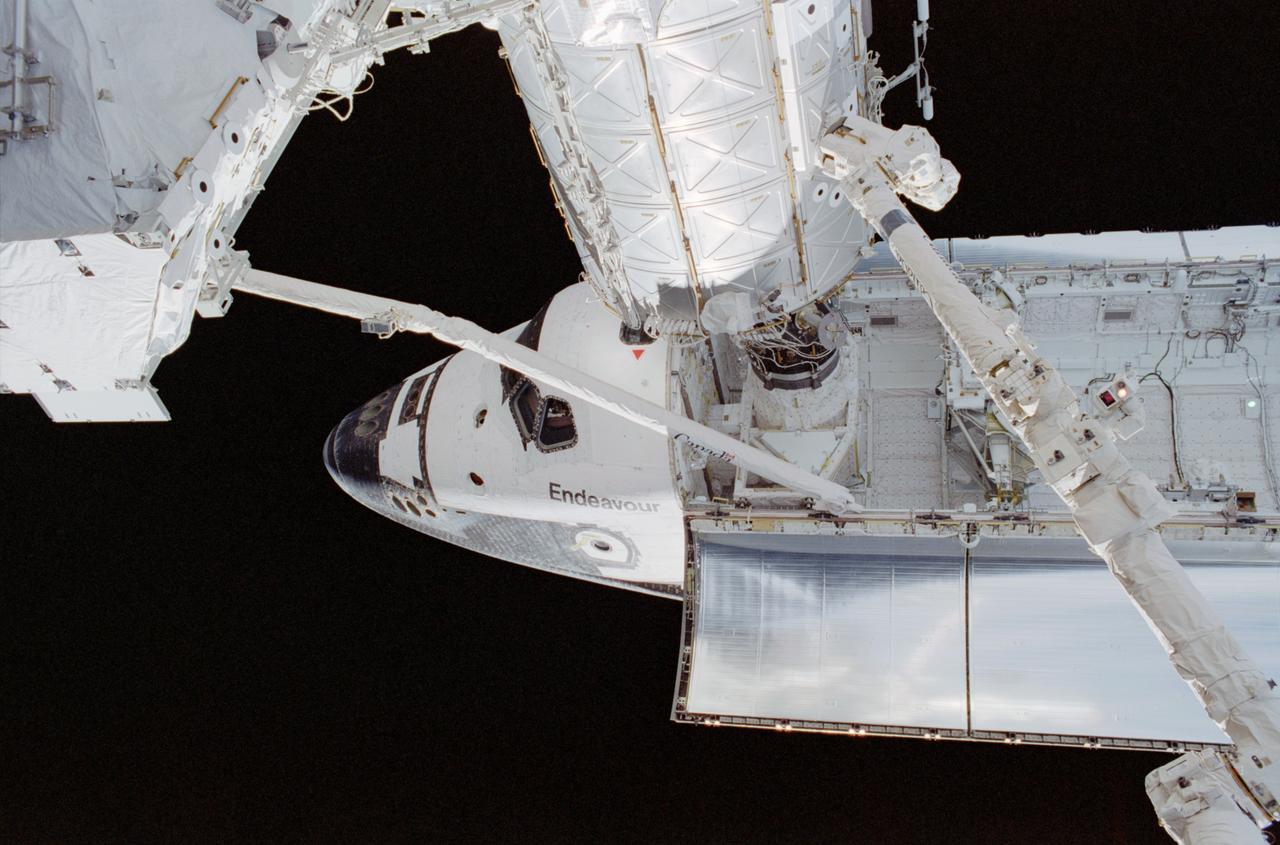
STS111-310-014 (9 June 2002) --- Backdropped by the blackness of space, the Space Shuttle Endeavour is pictured while docked to the Pressurized Mating Adapter (PMA-2) at the forward end of the Destiny laboratory on the International Space Station (ISS). A portion of the Canadarm2 is visible on the right and Endeavour’s robotic arm is in full view as it is stretched out with the S0 (S-zero) Truss at its end.
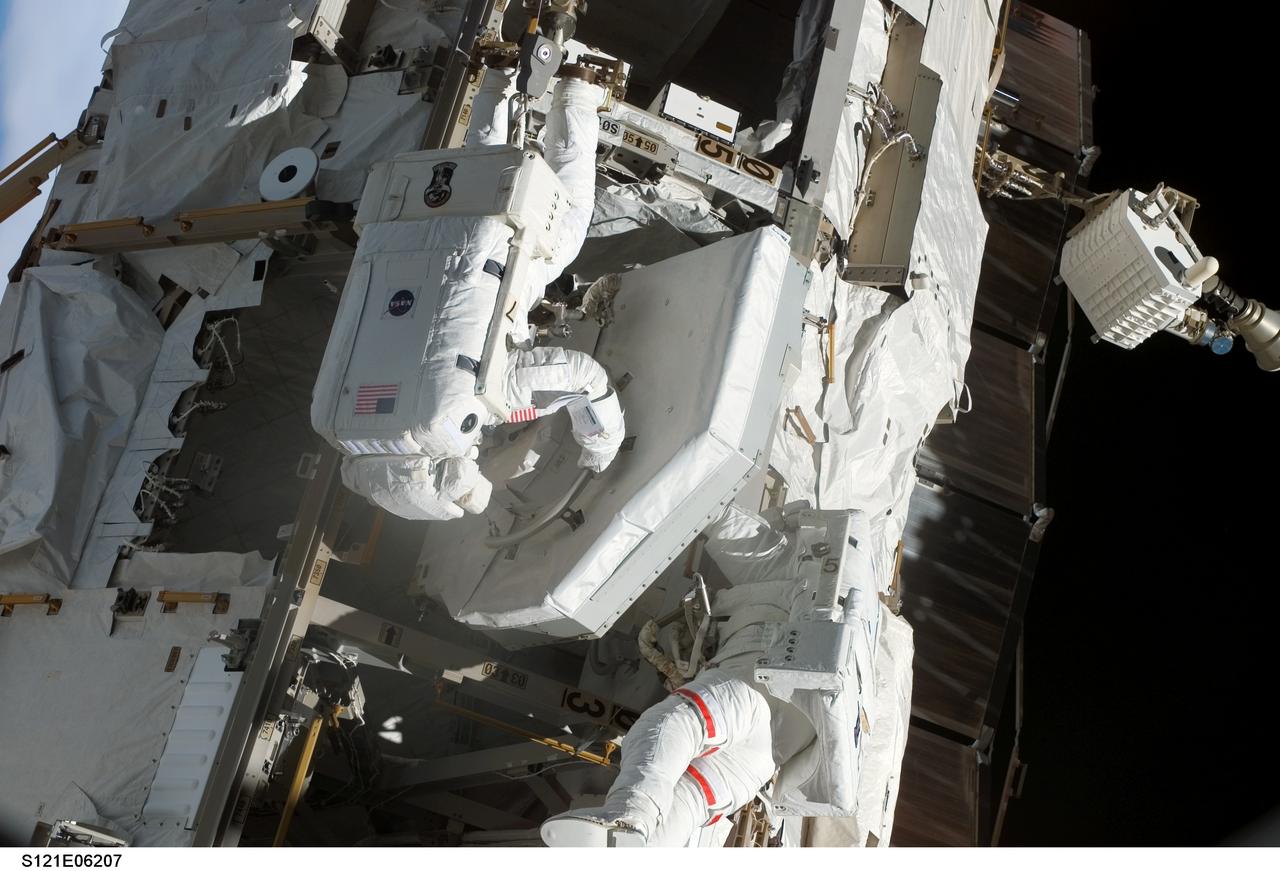
S121-E-06207 (10 July 2006) --- While anchored on the mobile foot restraint on the Canadarm2, astronaut Michael E. Fossum (left), STS-121 mission specialist, removes the trailing umbilical system-reel assembly (TUS-RA) from the S0 truss on the International Space Station during the mission's second session of extravehicular activity (EVA). Astronaut Piers J. Sellers, mission specialist, assisted Fossum by checking the clearance of the TUS-RA as it was lifted from the bay.
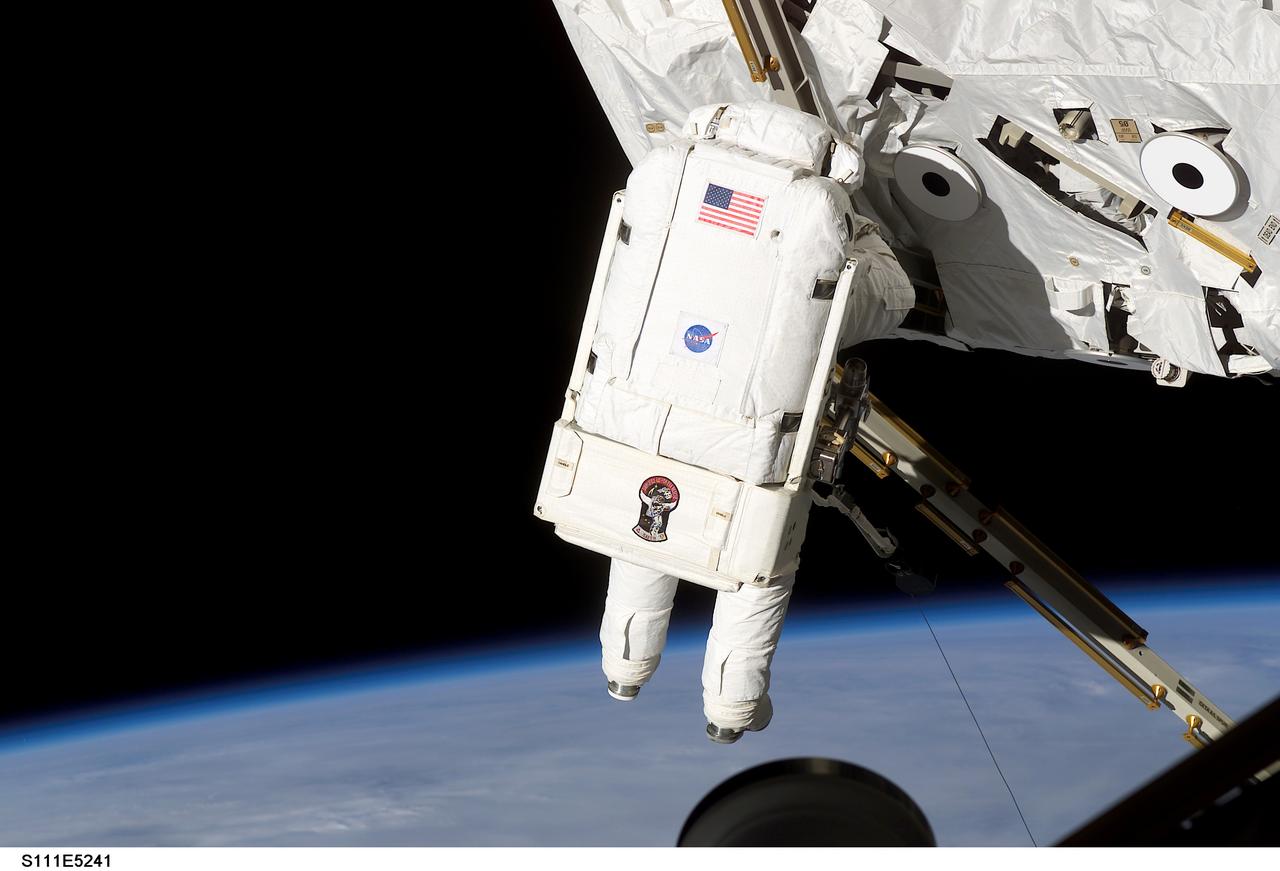
STS111-E-5241 (11 June 2002) --- Astronaut Philippe Perrin, STS-111 mission specialist, photographed near the S0 (S-Zero) Truss on the International Space Station (ISS), participates in the second scheduled session of extravehicular activity (EVA) for the STS-111 mission. During the 5-hour spacewalk, Perrin and Chang-Diaz completed installation of the Mobile Remote Servicer Base System (MBS) on the station’s railcar, the Mobile Transporter. Perrin represents CNES, the French Space Agency.
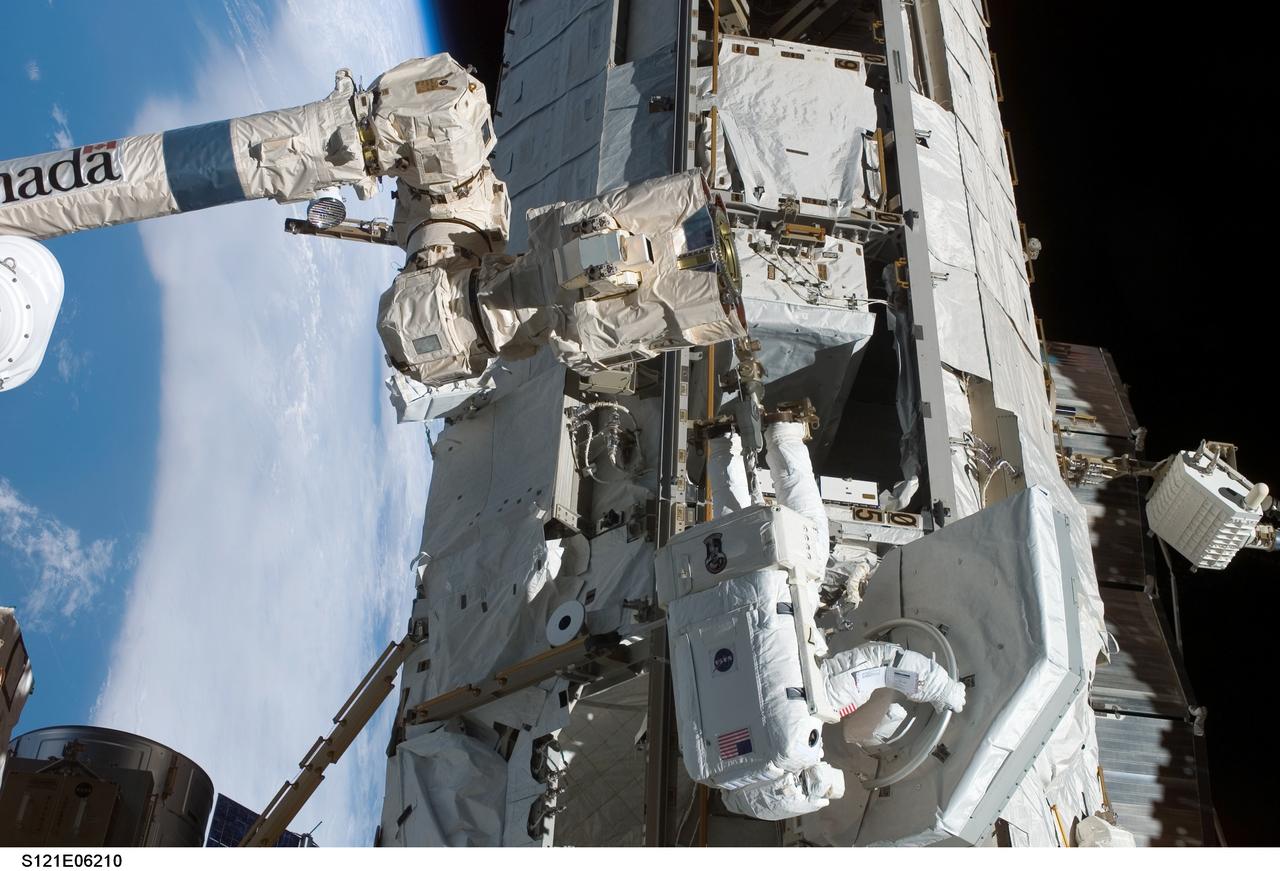
S121-E-06210 (10 July 2006) --- Astronaut Michael E. Fossum, STS-121 mission specialist, removes the trailing umbilical system-reel assembly (TUS-RA) from the S0 truss on the International Space Station during the mission's second session of extravehicular activity (EVA). Fossum is anchored on the mobile foot restraint on the Canadarm2.
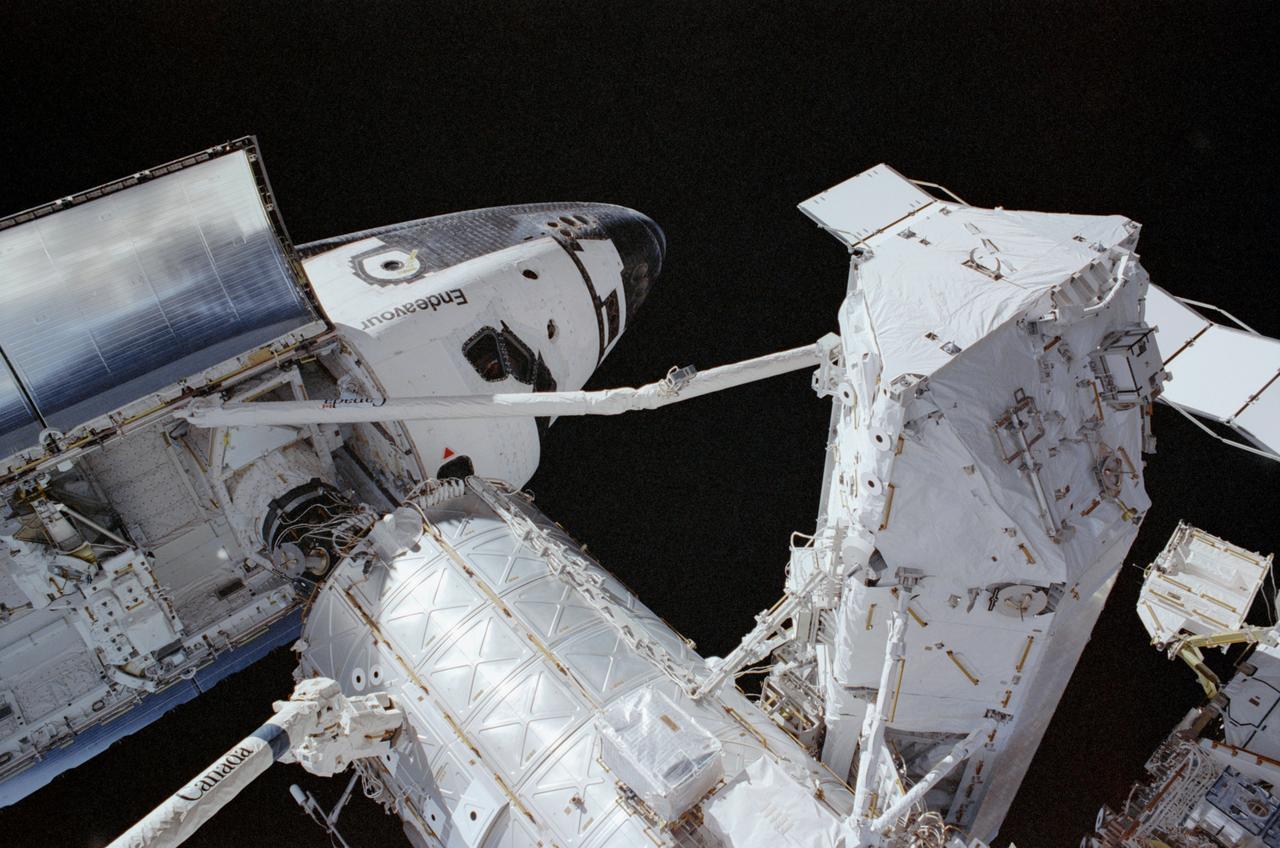
STS111-310-011 (9 June 2002) --- Backdropped by the blackness of space, the Space Shuttle Endeavour is pictured while docked to the Pressurized Mating Adapter (PMA-2) at the forward end of the Destiny laboratory on the International Space Station (ISS). A portion of the Canadarm2 is visible in the lower left corner and Endeavour’s robotic arm is in full view as it is stretched out with the S0 (S-zero) Truss at its end.
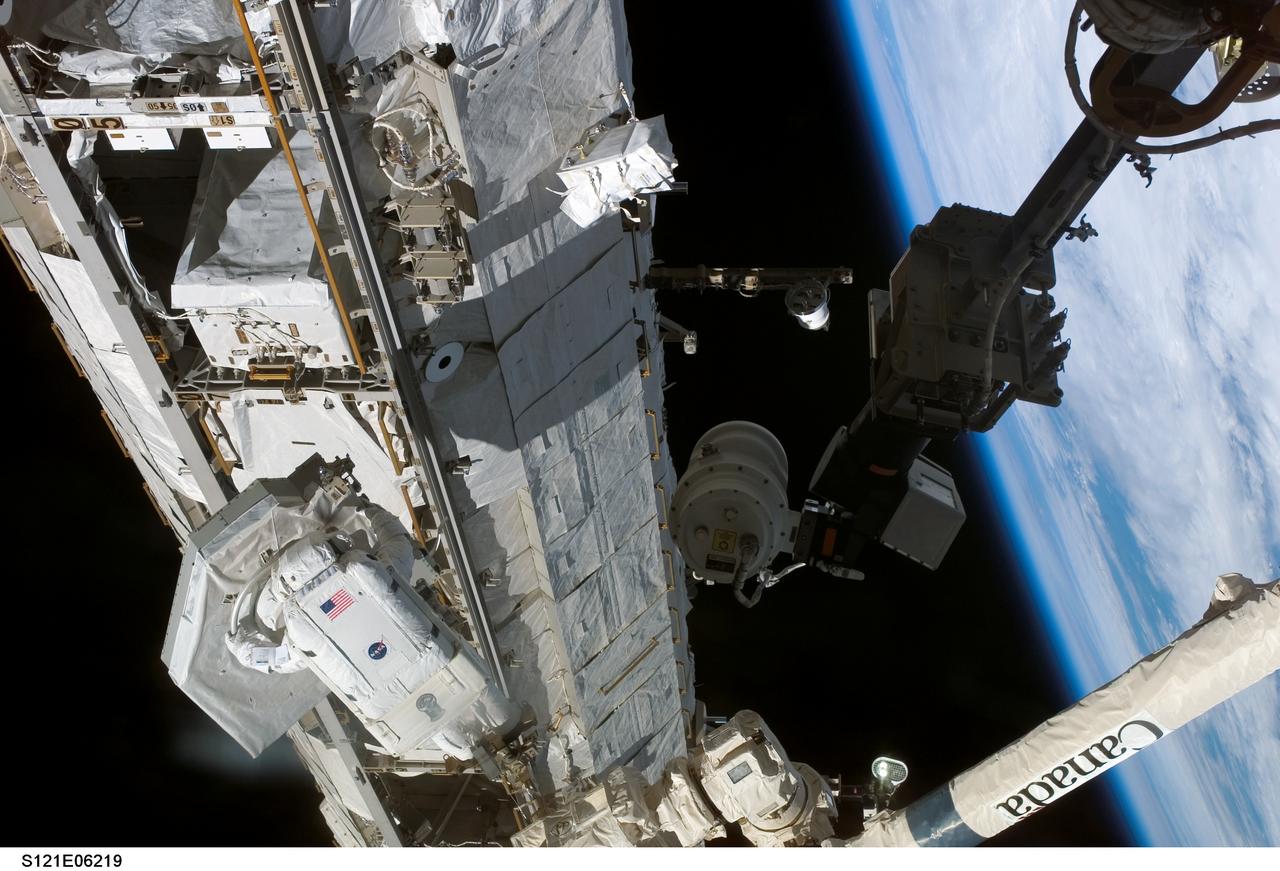
S121-E-06219 (10 July 2006) --- Astronaut Michael E. Fossum, STS-121 mission specialist, removes the trailing umbilical system-reel assembly (TUS-RA) from the S0 truss on the International Space Station during the mission's second session of extravehicular activity (EVA). Fossum is anchored on the mobile foot restraint on the Canadarm2.

Earth Observation taken by the Apollo 9 crew. View is of Salton Sea and Imperial Valley in California. Latitude was 33.09 N by Longitude 116.14 W, Overlap was 50%, Altitude miles were 103 and cloud cover was 35%. This imagery taken as part of the NASA S0-65 Experiment "Multispectral Terrain Photography". The experiment provides simultaneous satellite photography of the Earth's surface in three distinct spectral bands. The photography consists of four almost spatially identical photographs. The images of ground objects appear in the same coordinate positions on all four photos in the multispectral set within the opto-mechanical tolerances of the Hasselblad cameras in the Apollo 9 spacecraft. Band designation for this frame is A. Film and filter is Ektachrome SO-368,Infrared Color Wratten 15. Mean Wavelength of Sensitivity is green,red and infrared. The Nominal Bandpass is total sensitivity of all dye layers 510-900nm.
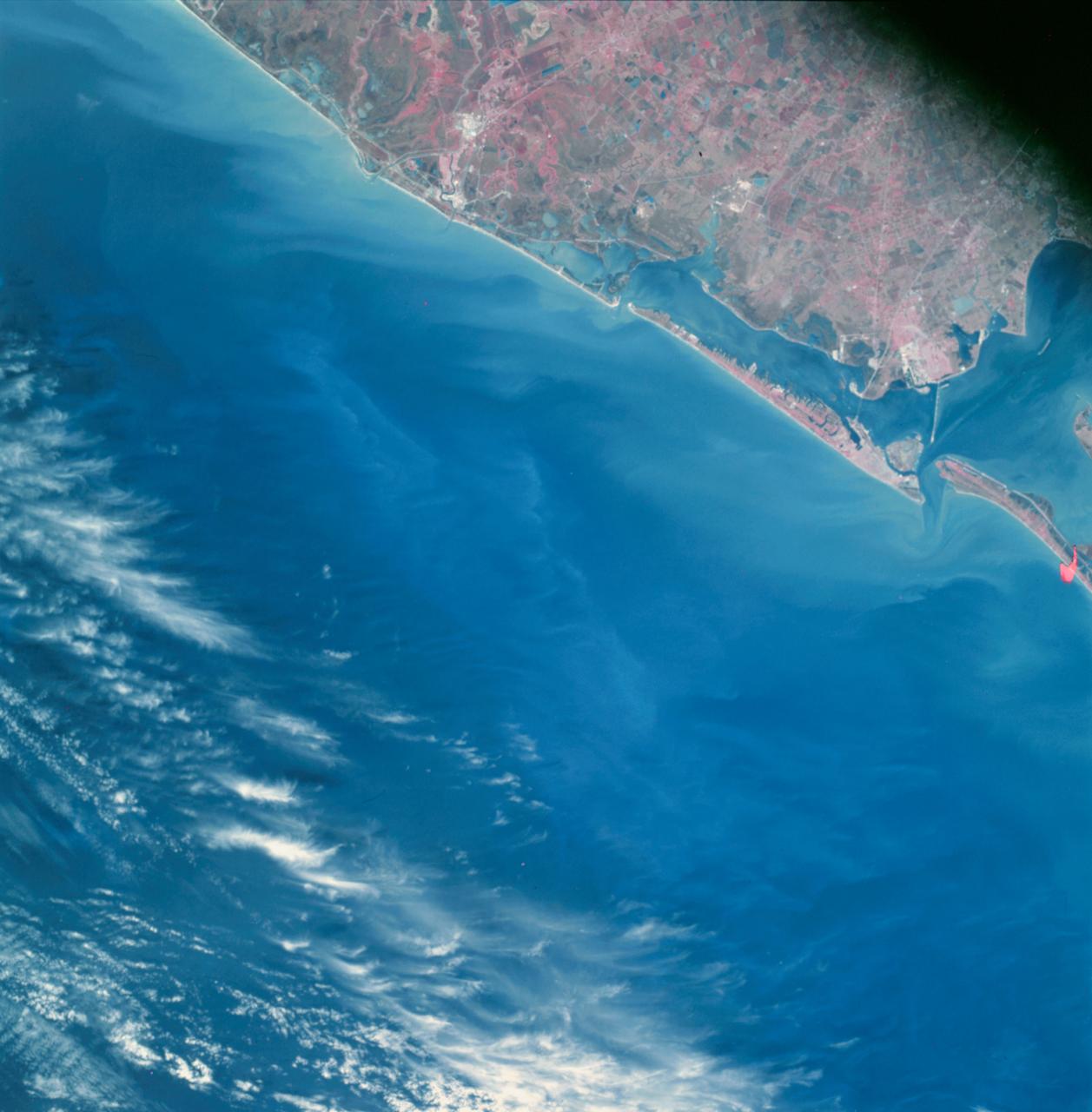
Earth Observation taken by the Apollo 9 crew. View is of Galveston and Freeport in Texas. Latitude was 28.42 N by Longitude 94.54 W, Overlap was 80%, Altitude miles were 105 and cloud cover was 5%. This imagery taken as part of the NASA S0-65 Experiment "Multispectral Terrain Photography". The experiment provides simultaneous satellite photography of the Earth's surface in three distinct spectral bands. The photography consists of four almost spatially identical photographs. The images of ground objects appear in the same coordinate positions on all four photos in the multispectral set within the opto-mechanical tolerances of the Hasselblad cameras in the Apollo 9 spacecraft. Band designation for this frame is A. Film and filter is Ektachrome SO-368,Infrared Color Wratten 15. Mean Wavelength of Sensitivity is green,red and infrared. The Nominal Bandpass is total sensitivity of all dye layers 510-900nm.
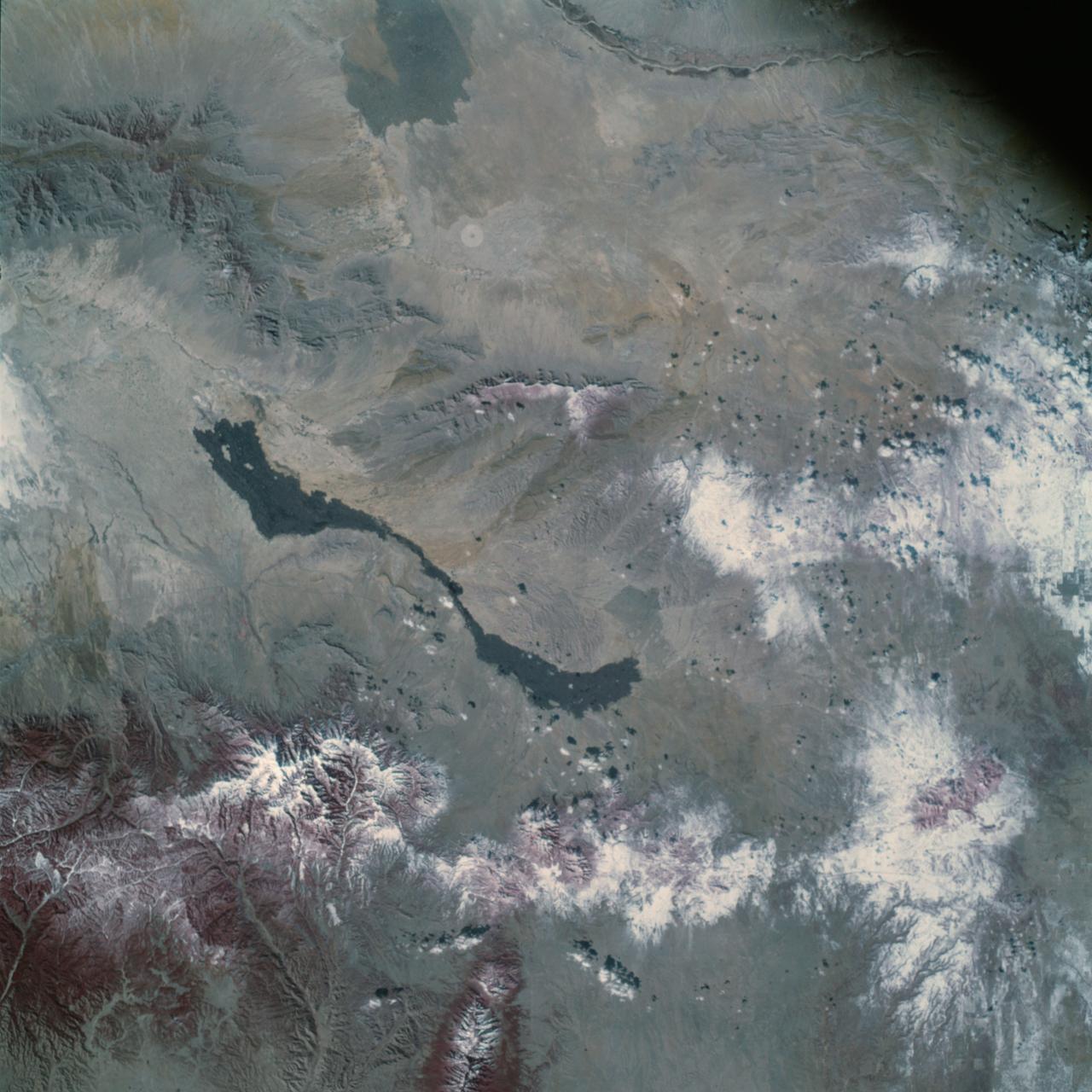
Earth Observation taken by the Apollo 9 crew. View is of Carrizozo in New Mexico and includes lava flow and snow. Latitude was 33.42 N by Longitude 106.10 W, Overlap was 7.5%, Altitude miles were 121 and cloud cover was 0%. This imagery taken as part of the NASA S0-65 Experiment "Multispectral Terrain Photography". The experiment provides simultaneous satellite photography of the Earth's surface in three distinct spectral bands. The photography consists of four almost spatially identical photographs. The images of ground objects appear in the same coordinate positions on all four photos in the multispectral set within the opto-mechanical tolerances of the Hasselblad cameras in the Apollo 9 spacecraft. Band designation for this frame is A. Film and filter is Ektachrome SO-368,Infrared Color Wratten 15. Mean Wavelength of Sensitivity is green,red and infrared. The Nominal Bandpass is total sensitivity of all dye layers 510-900nm.
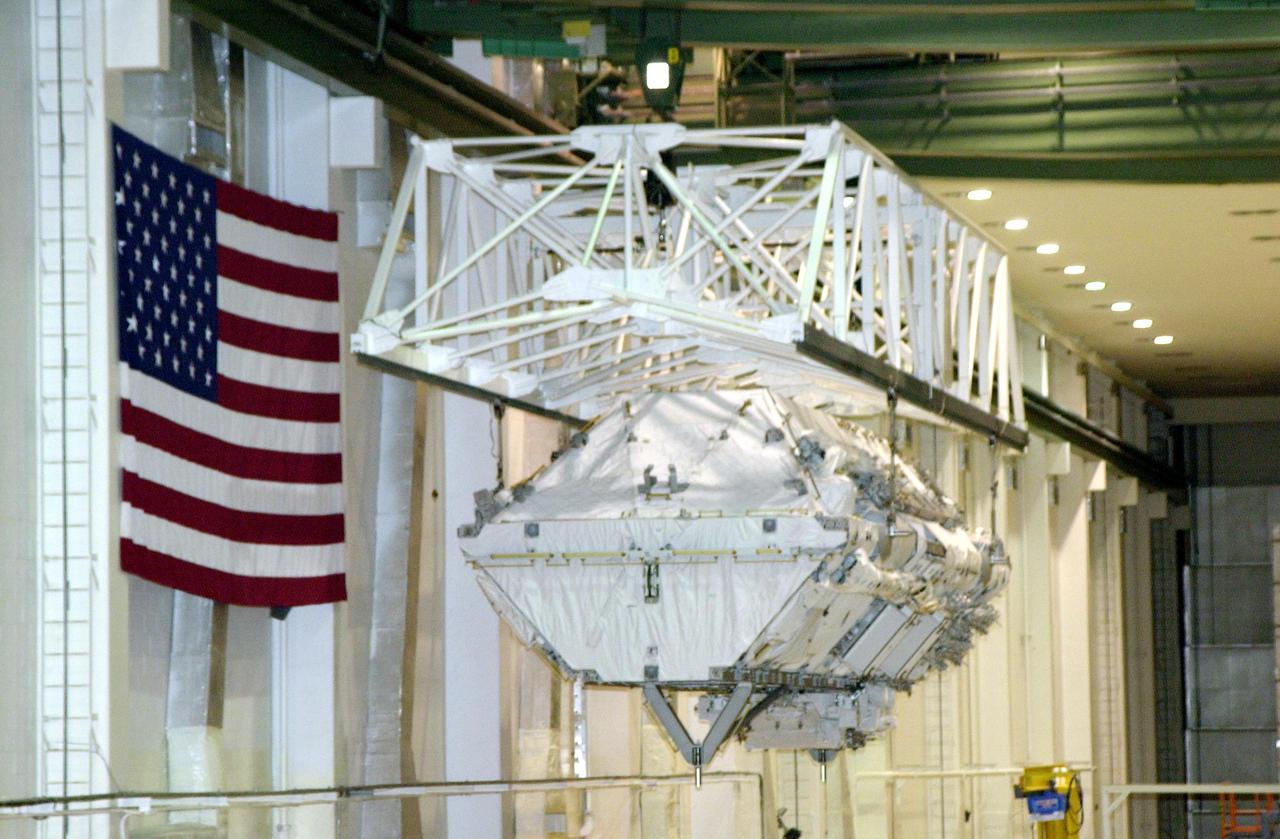
KENNEDY SPACE CENTER, FLA. -- In the Operations and Checkout Building, an overhead crane carries the Integrated Truss Structure S0 from its workstand toward the payload canister. The S0 truss will be transported to the launch pad for mission STS-110. Part of the payload, the S0 truss will become the backbone of the orbiting International Space Station (ISS), at the center of the 10-truss, girderlike structure that will ultimately extend the length of a football field on the ISS. The S0 truss will be attached to the U.S. Lab, 'Destiny,' on the 11-day mission. Launch is scheduled for April 4
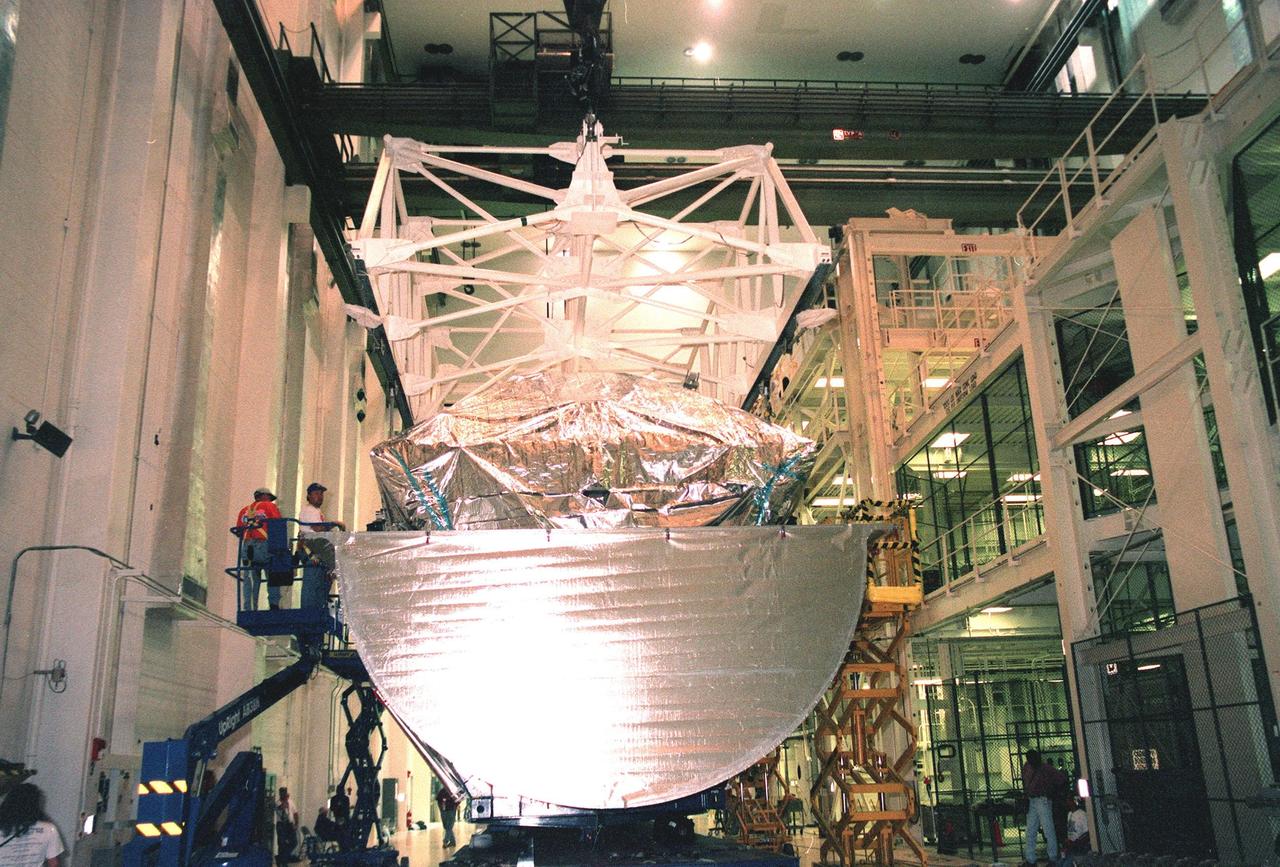
KENNEDY SPACE CENTER, FLA. -- Inside the Operations and Checkout Bldg. (O&C), workers (at left) watch over the maneuvering of the overhead crane toward the S0 truss segment below it. The S0 truss will undergo processing in the O&C during which the Canadian Mobile Transporter, power distribution system modules, a heat pipe radiator for cooling, computers, and a pair of rate gyroscopes will be installed. Four Global Positioning System antennas are already installed. A 44by 15-foot structure weighing 30,800 pounds when fully outfitted and ready for launch, the truss will be at the center of the ISS 10-truss, girderlike structure that will ultimately extend the length of a football field. Eventually the S0 truss will be attached to the U.S. Lab, "Destiny," which is scheduled to be added to the ISS in April 2000. Later, other trusses will be attached to the S0 on-orbit. The S0 truss is scheduled to be launched in the first quarter of 2001 on mission STS-108
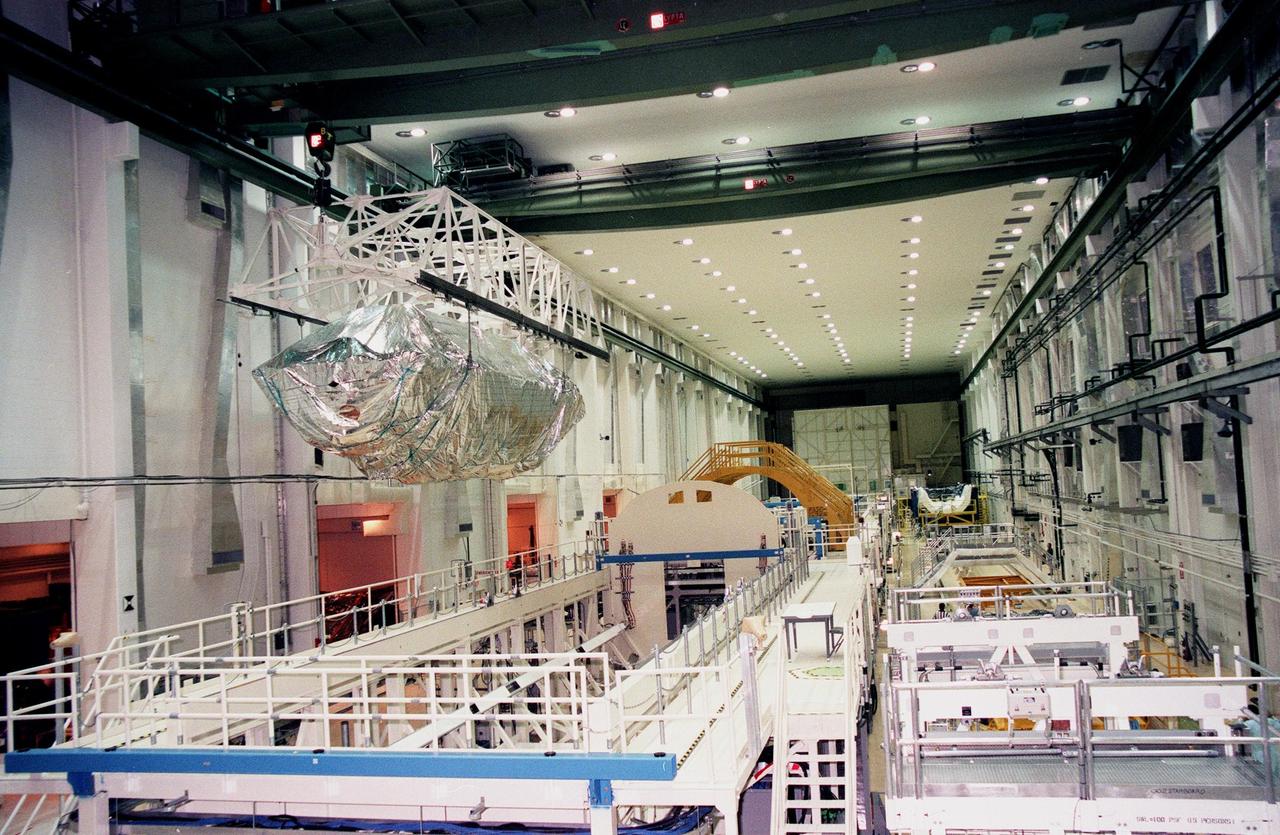
KENNEDY SPACE CENTER, FLA. -- In the Operations and Checkout Bldg. (O&C), an overhead crane moves the S0 truss segment toward a workstand. The S0 truss will undergo processing in the O&C during which the Canadian Mobile Transporter, power distribution system modules, a heat pipe radiator for cooling, computers, and a pair of rate gyroscopes will be installed. Four Global Positioning System antennas are already installed. A 44by 15-foot structure weighing 30,800 pounds when fully outfitted and ready for launch, the truss will be at the center of the ISS 10-truss, girderlike structure that will ultimately extend the length of a football field. Eventually the S0 truss will be attached to the U.S. Lab, "Destiny," which is scheduled to be added to the ISS in April 2000. Later, other trusses will be attached to the S0 on-orbit. The S0 truss is scheduled to be launched in the first quarter of 2001 on mission STS-108
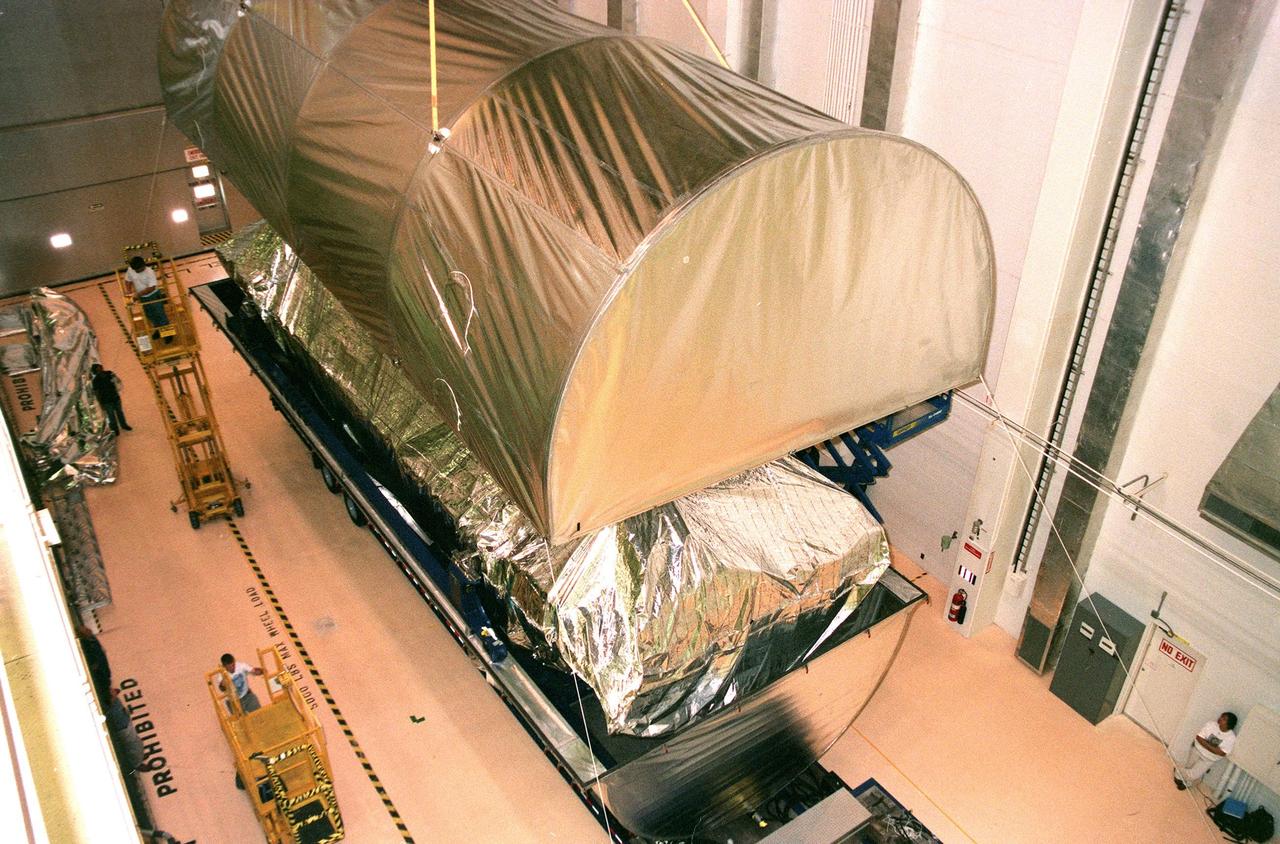
KENNEDY SPACE CENTER, FLA. -- Inside the Operations and Checkout Bldg. (O&C), an overhead crane removes the cover from the S0 truss segment beneath it. The S0 truss will undergo processing in the O&C during which the Canadian Mobile Transporter, power distribution system modules, a heat pipe radiator for cooling, computers, and a pair of rate gyroscopes will be installed. Four Global Positioning System antennas are already installed. A 44by 15-foot structure weighing 30,800 pounds when fully outfitted and ready for launch, the truss will be at the center of the ISS 10-truss, girderlike structure that will ultimately extend the length of a football field. Eventually the S0 truss will be attached to the U.S. Lab, "Destiny," which is scheduled to be added to the ISS in April 2000. Later, other trusses will be attached to the S0 on-orbit. The S0 truss is scheduled to be launched in the first quarter of 2001 on mission STS-108
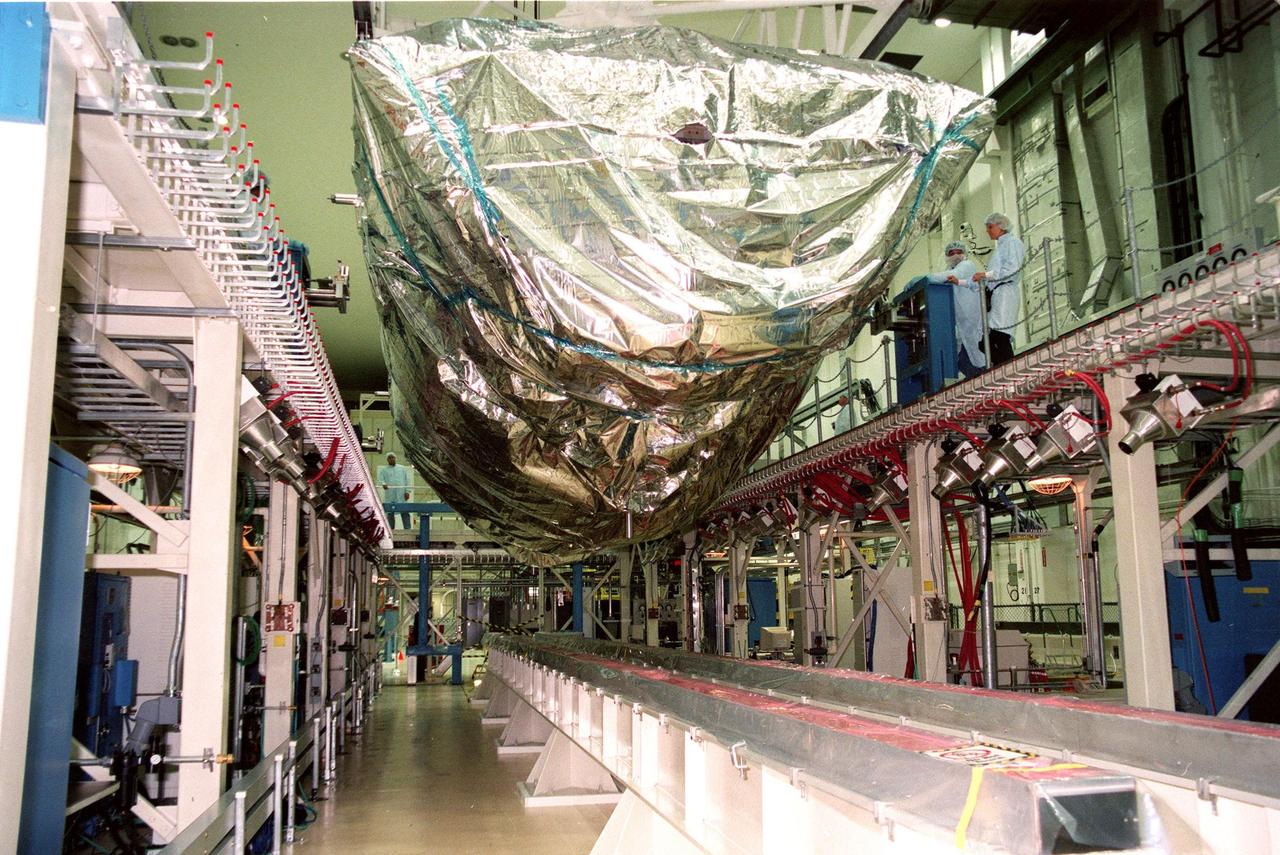
KENNEDY SPACE CENTER, FLA. -- The S0 truss nears its resting place in the workstand in the O&C Bldg. (O&C). The S0 truss will undergo processing in the O&C during which the Canadian Mobile Transporter, power distribution system modules, a heat pipe radiator for cooling, computers, and a pair of rate gyroscopes will be installed. Four Global Positioning System antennas are already installed. A 44by 15-foot structure weighing 30,800 pounds when fully outfitted and ready for launch, the truss will be at the center of the ISS 10-truss, girderlike structure that will ultimately extend the length of a football field. Eventually the S0 truss will be attached to the U.S. Lab, "Destiny," which is scheduled to be added to the ISS in April 2000. Later, other trusses will be attached to the S0 on-orbit. The S0 truss is scheduled to be launched in the first quarter of 2001 on mission STS-108
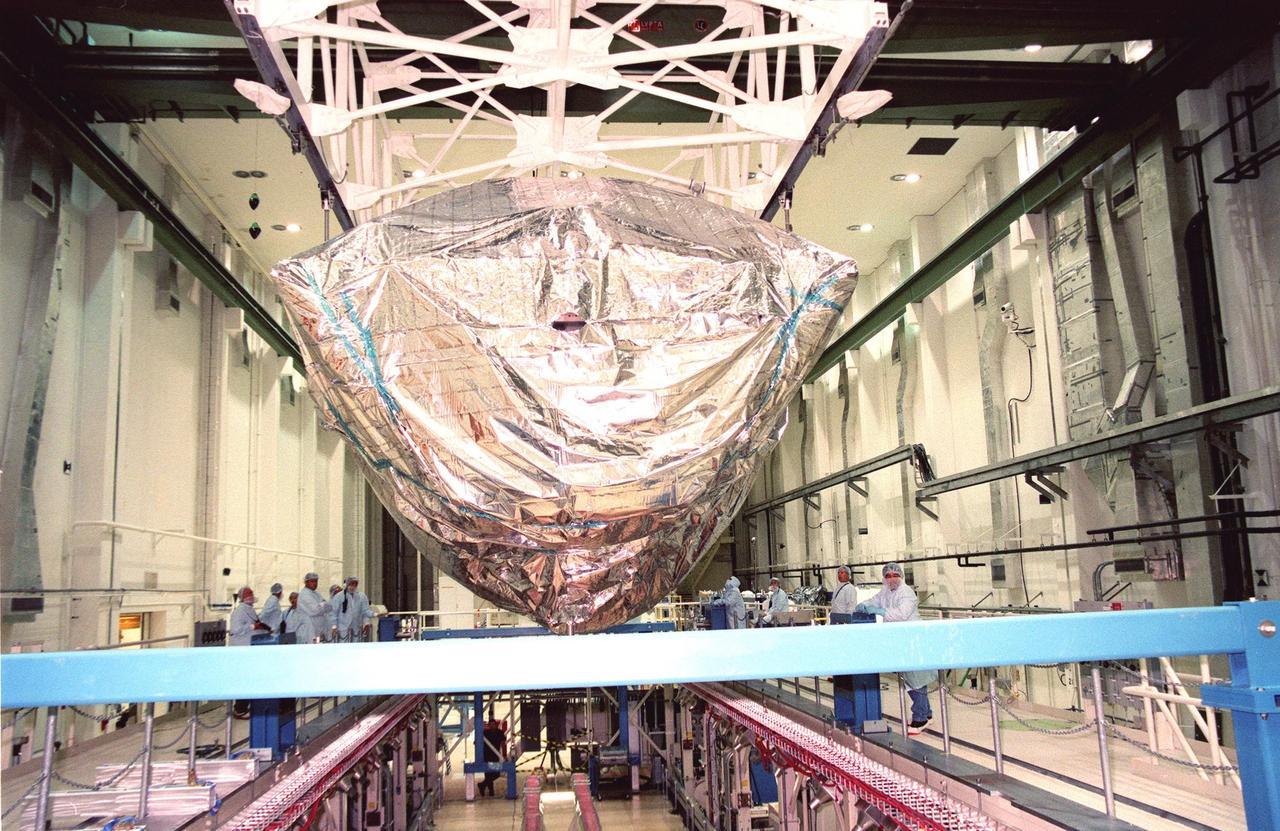
KENNEDY SPACE CENTER, FLA. -- Workers in the O&C Bldg. watch as the S0 truss is lowered onto a workstand. The S0 truss will undergo processing in the O&C during which the Canadian Mobile Transporter, power distribution system modules, a heat pipe radiator for cooling, computers, and a pair of rate gyroscopes will be installed. Four Global Positioning System antennas are already installed. A 44by 15-foot structure weighing 30,800 pounds when fully outfitted and ready for launch, the truss will be at the center of the ISS 10-truss, girderlike structure that will ultimately extend the length of a football field. Eventually the S0 truss will be attached to the U.S. Lab, "Destiny," which is scheduled to be added to the ISS in April 2000. Later, other trusses will be attached to the S0 on-orbit. The S0 truss is scheduled to be launched in the first quarter of 2001 on mission STS-108
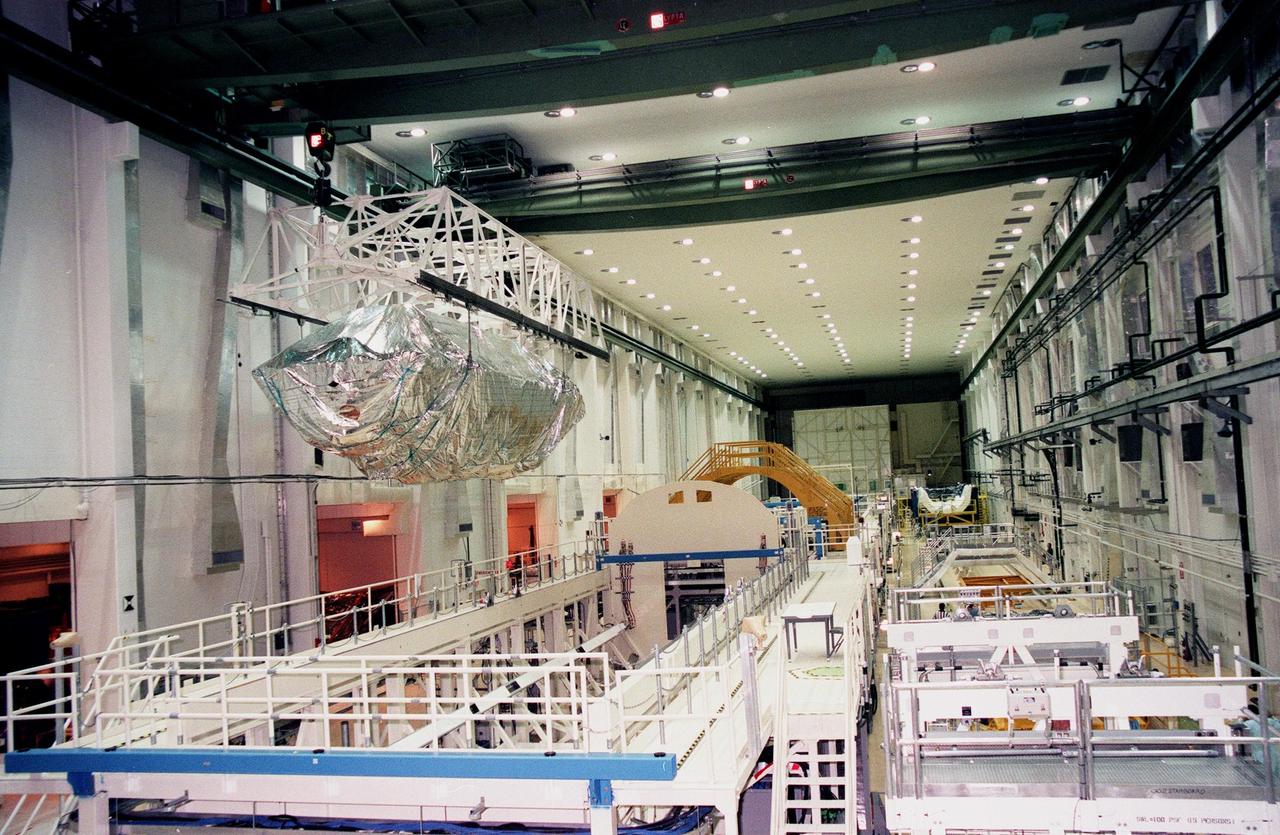
KENNEDY SPACE CENTER, FLA. -- In the Operations and Checkout Bldg. (O&C), an overhead crane moves the S0 truss segment toward a workstand. The S0 truss will undergo processing in the O&C during which the Canadian Mobile Transporter, power distribution system modules, a heat pipe radiator for cooling, computers and a pair of rate gyroscopes will be installed. Four Global Positioning System antennas are already installed. A 44- by 15-foot structure weighing 30,800 pounds when fully outfitted and ready for launch, the truss will be at the center of the ISS 10-truss, girderlike structure that will ultimately extend the length of a football field. Eventually the S0 truss will be attached to the U.S. Lab, "Destiny," which is scheduled to be added to the ISS in April 2000. Later, other trusses will be attached to the S0 on orbit. The S0 truss is scheduled to be launched in the first quarter of 2001 on mission STS-108
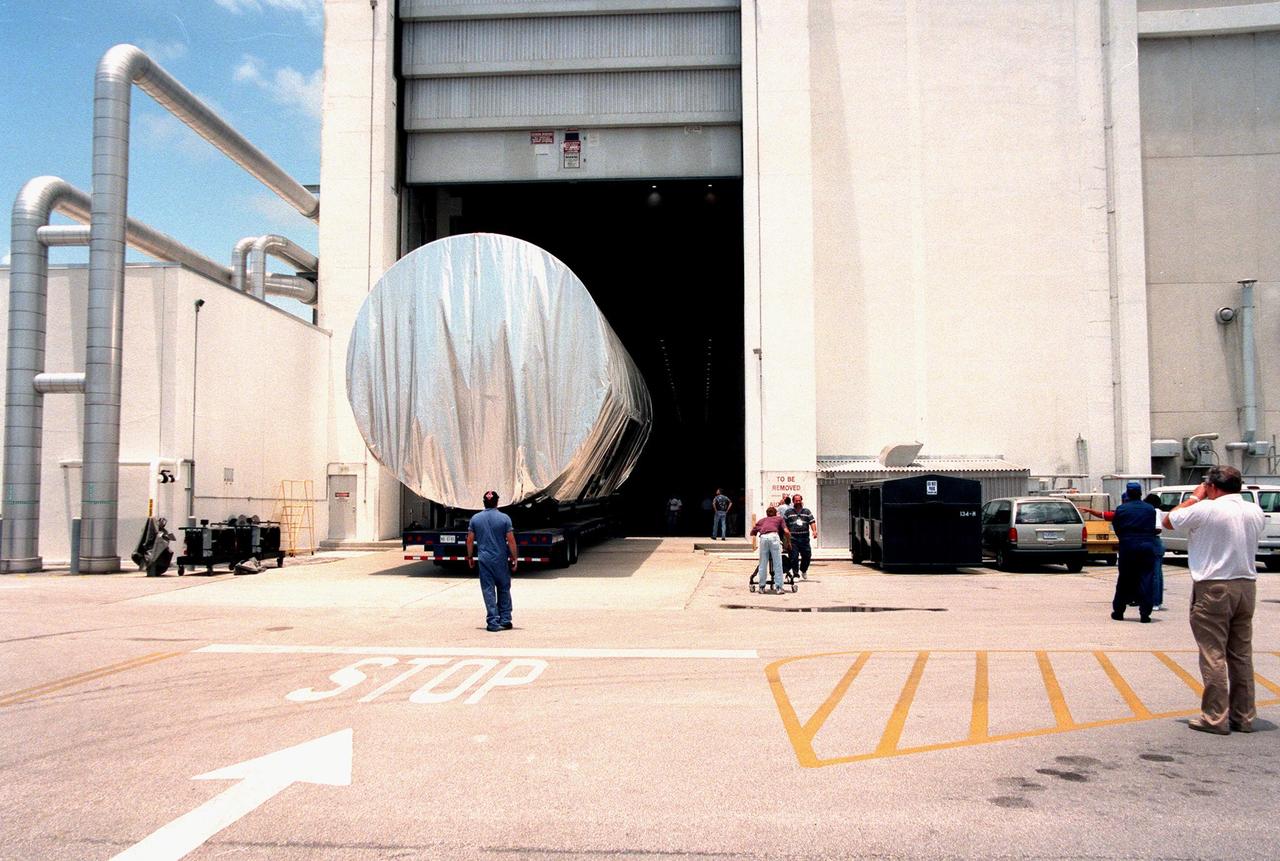
KENNEDY SPACE CENTER, FLA. -- The S0 truss segment is moved into the Operations and Checkout Bldg. (O&C) for processing. The truss arrived at the SLF aboard a "Super Guppy" aircraft from Boeing in Huntington, Calif. During processing in the O&C, the S0 truss will have installed the Canadian Mobile Transporter, power distribution system modules, a heat pipe radiator for cooling, computers, and a pair of rate gyroscopes. Four Global Positioning System antennas are already installed. A 44by 15-foot structure weighing 30,800 pounds when fully outfitted and ready for launch, the truss will be at the center of the ISS 10-truss, girderlike structure that will ultimately extend the length of a football field. Eventually the S0 truss will be attached to the U.S. Lab, "Destiny," which is scheduled to be added to the ISS in April 2000. Later, other trusses will be attached to the S0 on-orbit. The S0 truss is scheduled to be launched in the first quarter of 2001 on mission STS-108
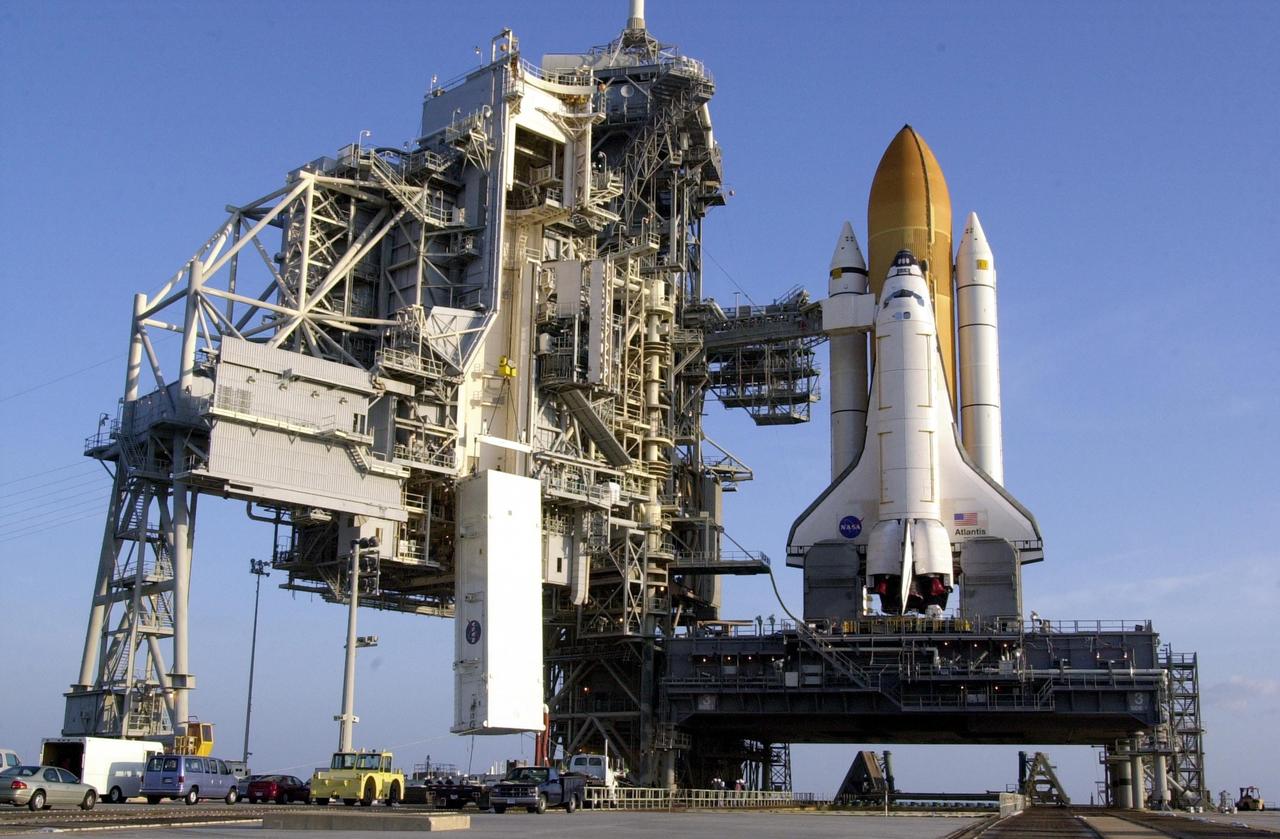
KENNEDY SPACE CENTER, FLA. -- On the launch pad, the payload canister with the S0 Integrated Truss Structure is lifted up the Rotating Service Structure to the payload changeout room for transfer to Space Shuttle Atlantis's payload bay. Part of the payload on mission STS-110, the S0 truss will become the backbone of the orbiting International Space Station (ISS). The S0 truss will be attached to the U.S. Lab, "Destiny," on the 11-day mission. Launch is scheduled for April 4
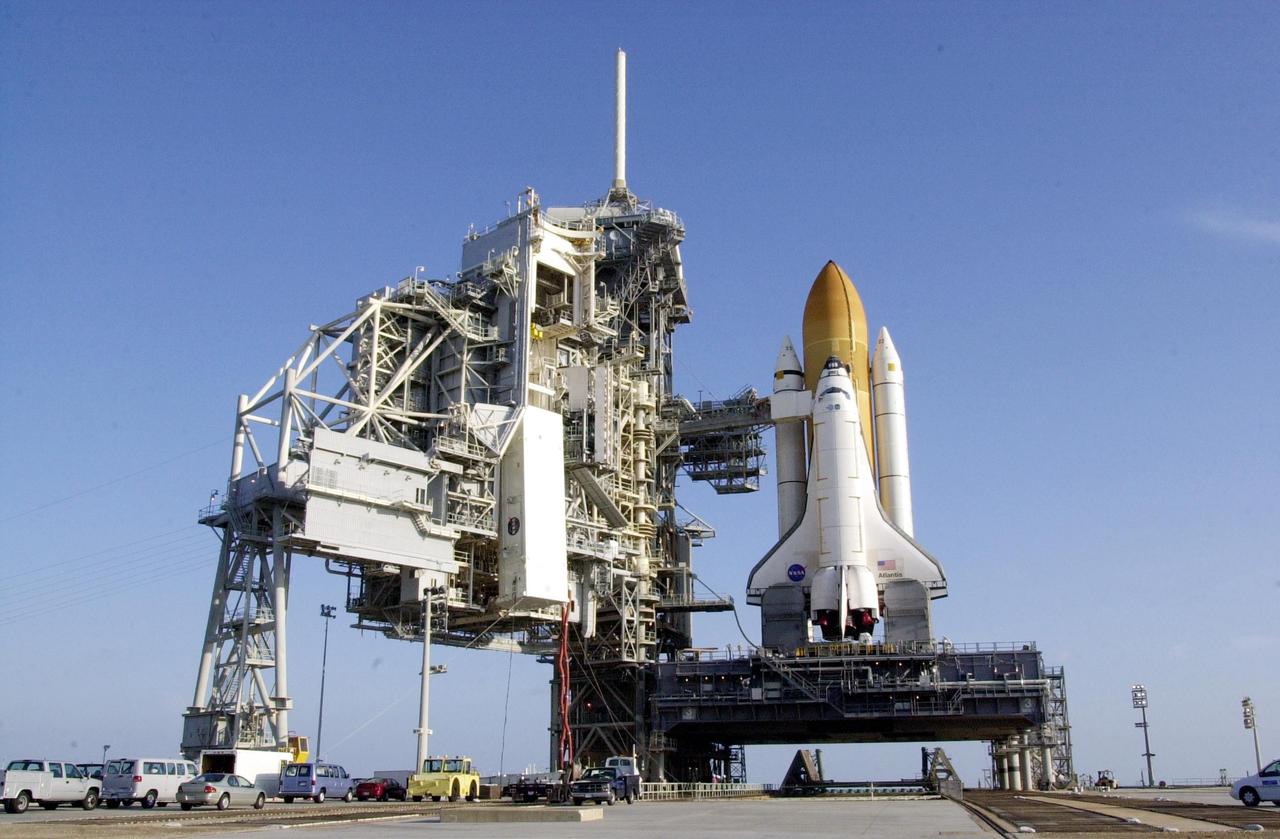
KENNEDY SPACE CENTER, FLA. -- On the launch pad, the payload canister with the S0 Integrated Truss Structure moves up the Rotating Service Structure to the payload changeout room for transfer to Space Shuttle Atlantis's payload bay. Part of the payload on mission STS-110, the S0 truss will become the backbone of the orbiting International Space Station (ISS). The S0 truss will be attached to the U.S. Lab, "Destiny," on the 11-day mission. Launch is scheduled for April 4
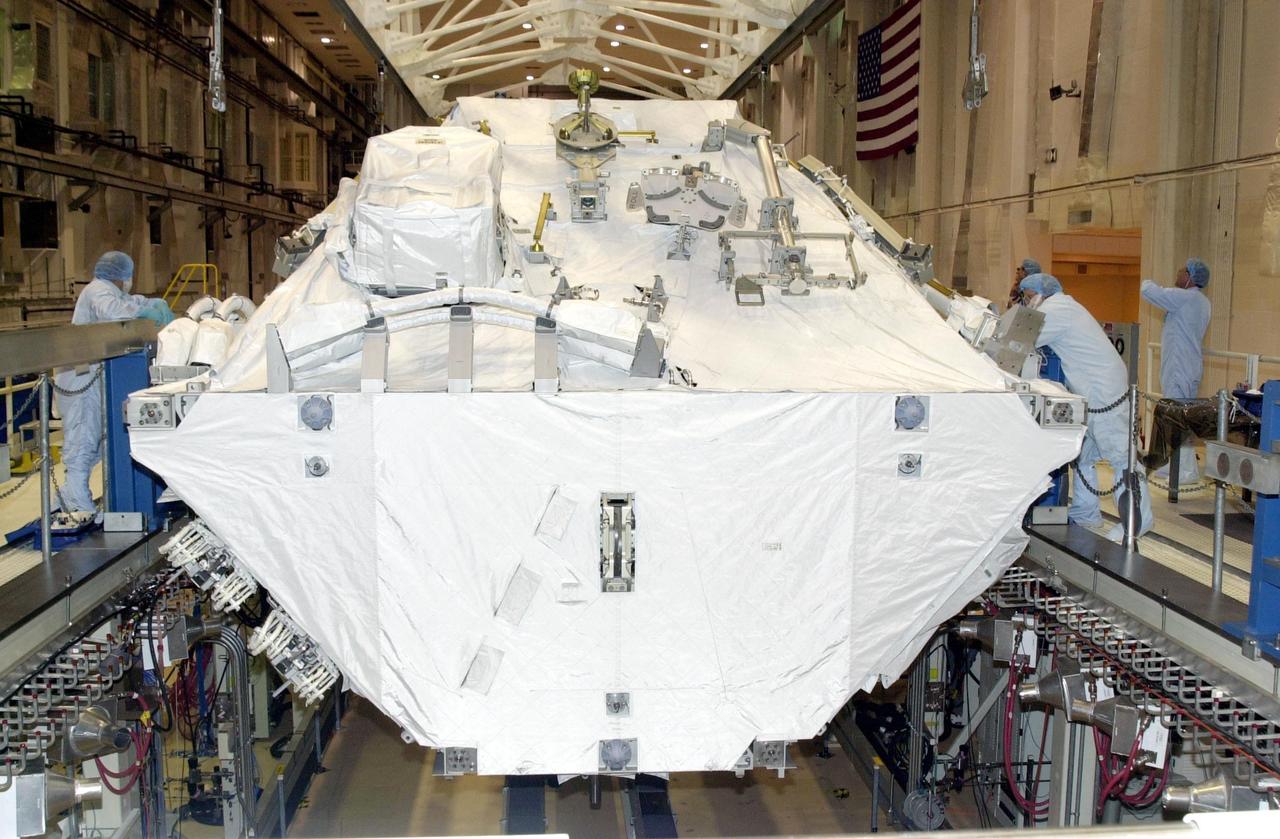
KENNEDY SPACE CENTER, FLA. -- In the Operations and Checkout Building, the Integrated Truss Structure S0 is ready to be moved to the payload canister for transport to the launch pad for mission STS-110. Part of the payload, the S0 truss will become the backbone of the orbiting International Space Station (ISS), at the center of the 10-truss, girderlike structure that will ultimately extend the length of a football field on the ISS. The S0 truss will be attached to the U.S. Lab, "Destiny," on the 11-day mission. Launch is scheduled for April 4.
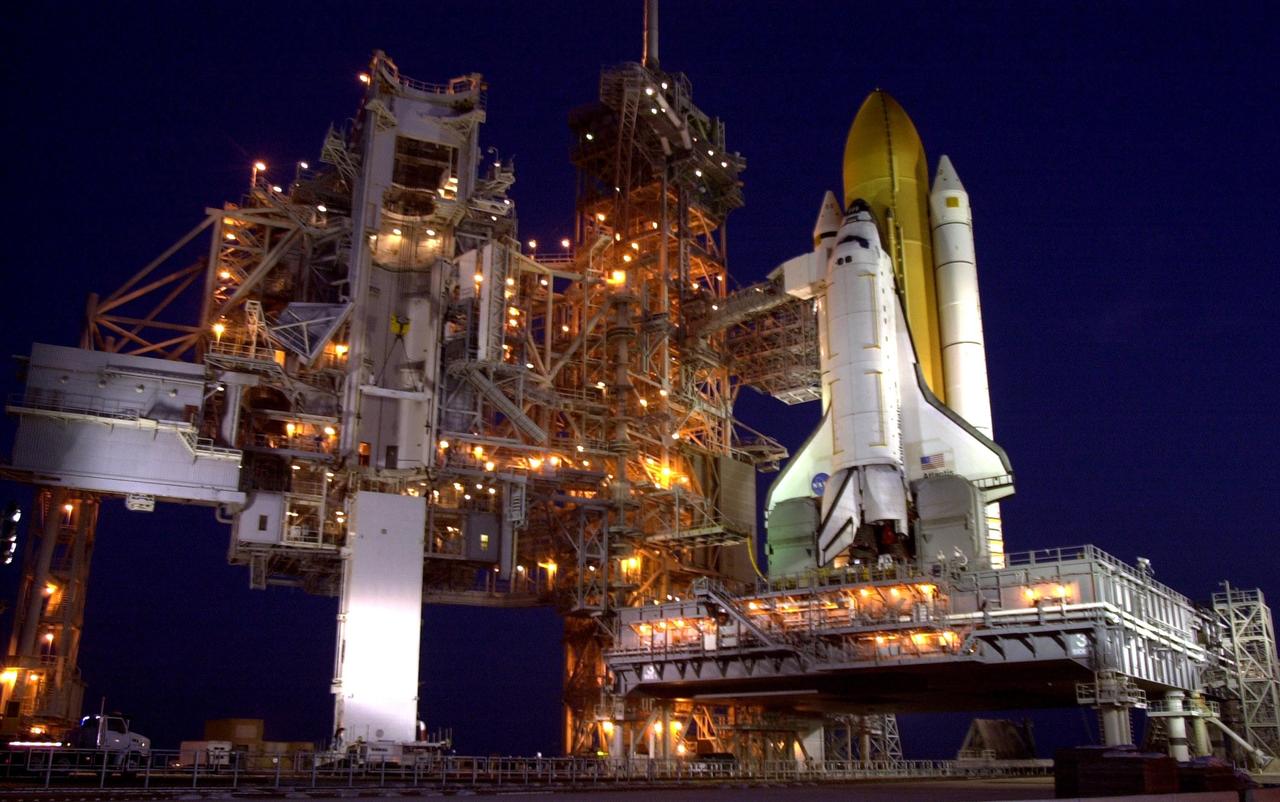
KENNEDY SPACE CENTER, FLA. -- The payload canister with the S0 Integrated Truss Structure arrives at the launch pad for transfer to Space Shuttle Atlantis's payload bay. Part of the payload on mission STS-110, the S0 truss will become the backbone of the orbiting International Space Station (ISS). The S0 truss will be attached to the U.S. Lab, "Destiny," on the 11-day mission. Launch is scheduled for April 4
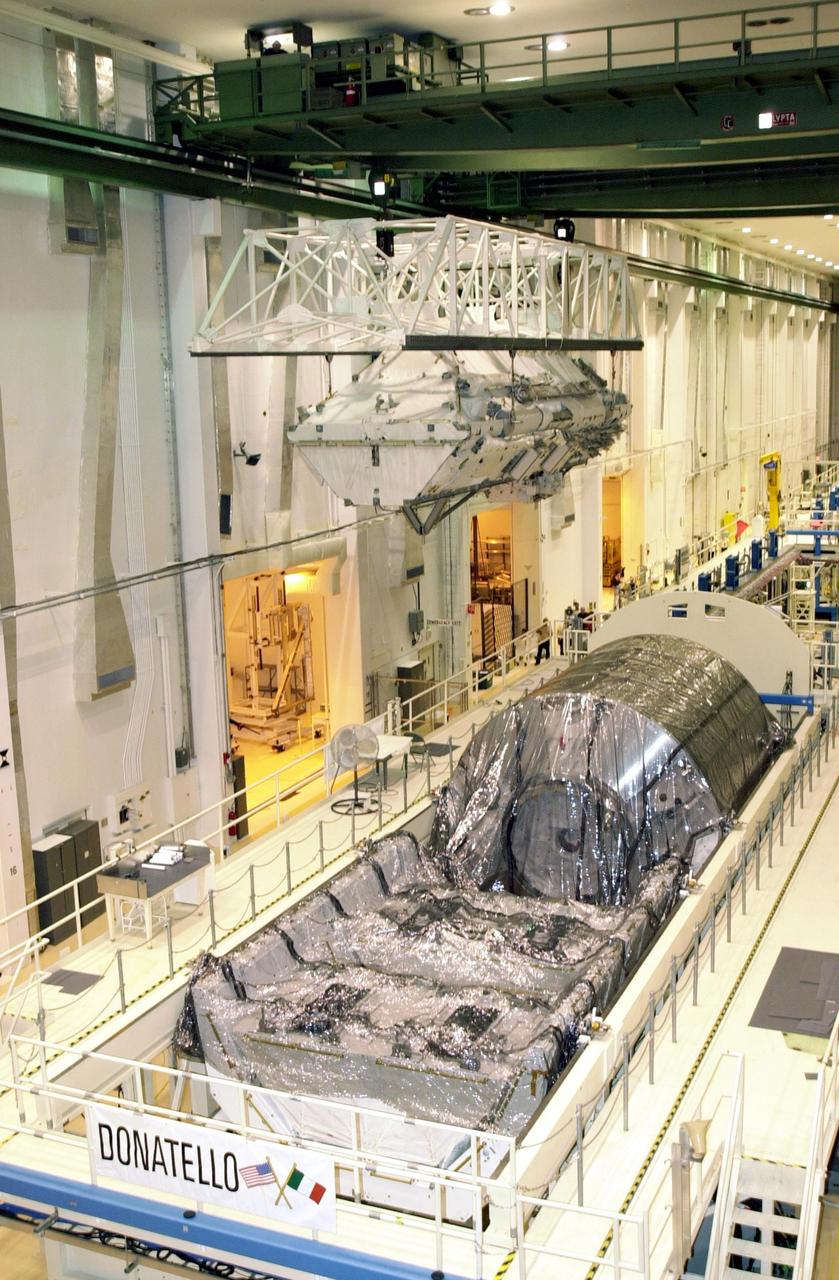
KENNEDY SPACE CENTER, FLA. -- In the Operations and Checkout Building, an overhead crane carries the Integrated Truss Structure S0 to the payload canister which will transport it to the launch pad for mission STS-110. Seen below the truss is the Multi-Purpose Logistics Module Donatello, currently not in use. The S0 truss will be part of the payload on Space Shuttle Atlantis. The S0 truss will be attached to the U.S. Lab, "Destiny," on the 11-day mission, becoming the backbone of the orbiting International Space Station (ISS). Launch is scheduled for April 4

KENNEDY SPACE CENTER, FLA. -- Workers in the Operations and Checkout Building watch as the Integrated Truss Structure S0 is lowered into the payload canister. The S0 truss will soon be on its way to the launch pad for mission STS-110. Part of the payload on Space Shuttle Atlantis, the S0 truss will be attached to the U.S. Lab, "Destiny," on the 11-day mission, becoming the backbone of the orbiting International Space Station (ISS). Launch is scheduled for April 4
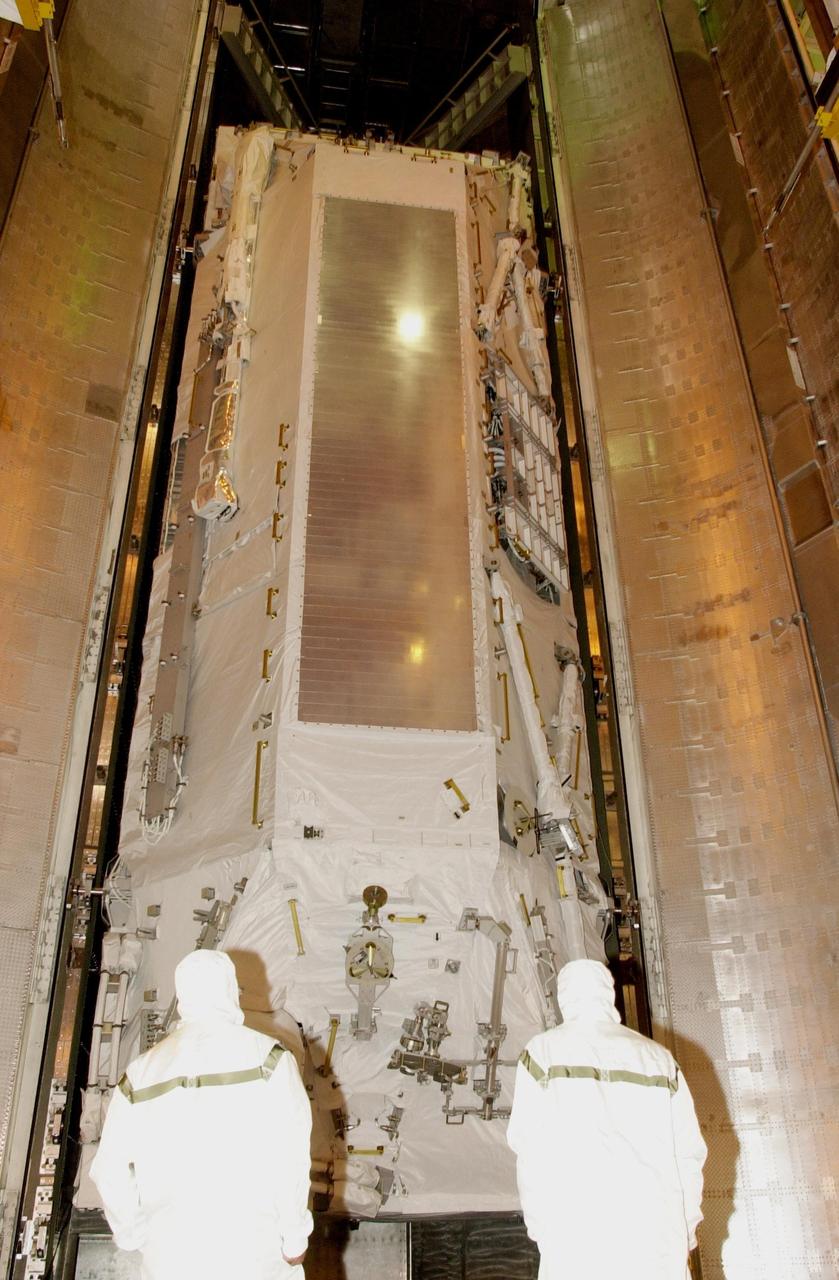
KENNEDY SPACE CENTER, FLA. - In the payload changeout room, workers watch as the doors of the payload canister open to reveal the S0 Integrated Truss Structure. The truss will be moved into the PCR and then transferred to Space Shuttle Atlantis's payload bay. Part of the payload on mission STS-110, the S0 truss will become the backbone of the orbiting International Space Station (ISS). The S0 truss will be attached to the U.S. Lab, "Destiny," on the 11-day mission. Launch is scheduled for April 4
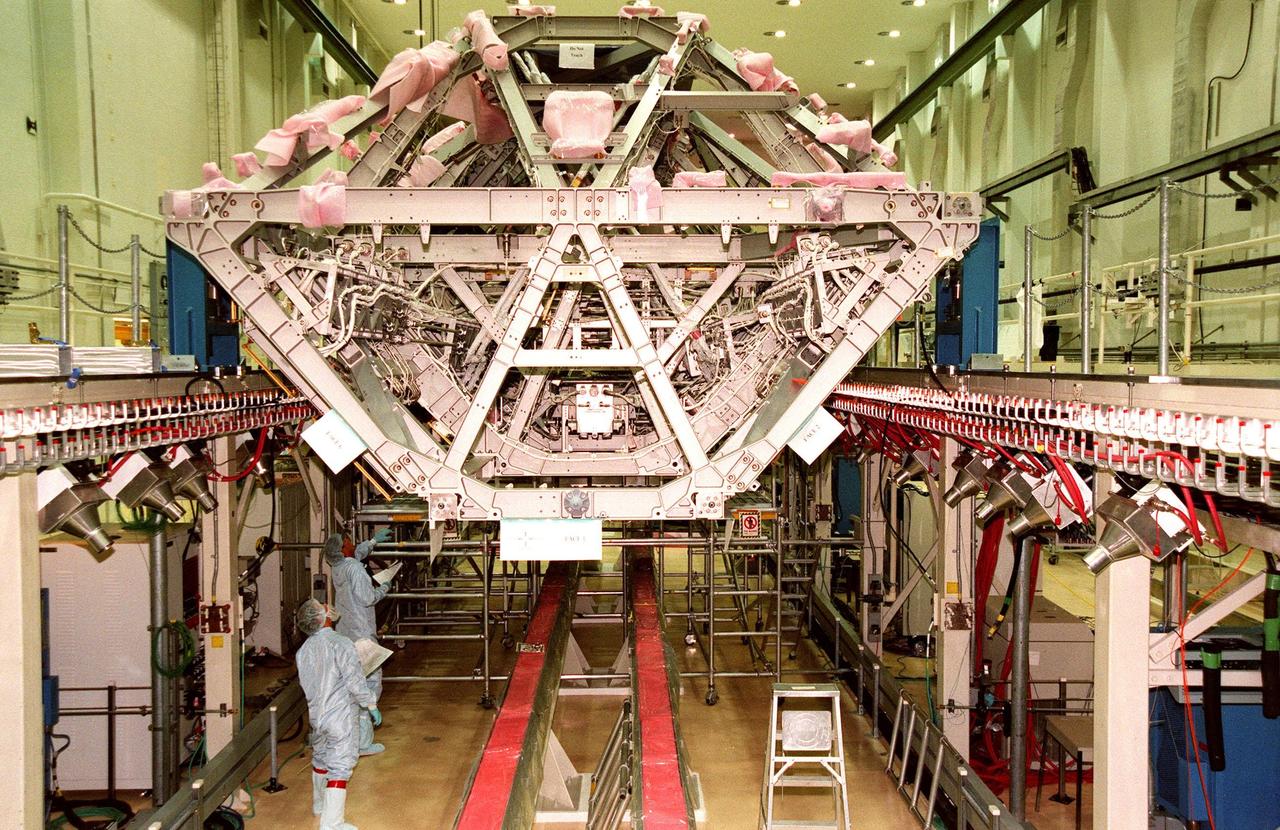
KENNEDY SPACE CENTER, FLA. -- Workers in the Operations & Checkout Bldg. (O&C) look over a central component of the International Space Station (ISS), the S0 (S zero) truss. It is undergoing processing in the O&C during which the Canadian Mobile Transporter, power distribution system modules, a heat pipe radiator for cooling, computers, and a pair of rate gyroscopes are being installed. A 44by 15-foot structure weighing 30,800 pounds when fully outfitted and ready for launch, the truss will ultimately extend the length of a football field. Eventually the S0 truss will be attached to the U.S. Lab, "Destiny," which is scheduled to be added to the ISS in April 2000. Later, other trusses will be attached to the S0 on-orbit. The S0 truss is scheduled to be launched in the spring of 2001
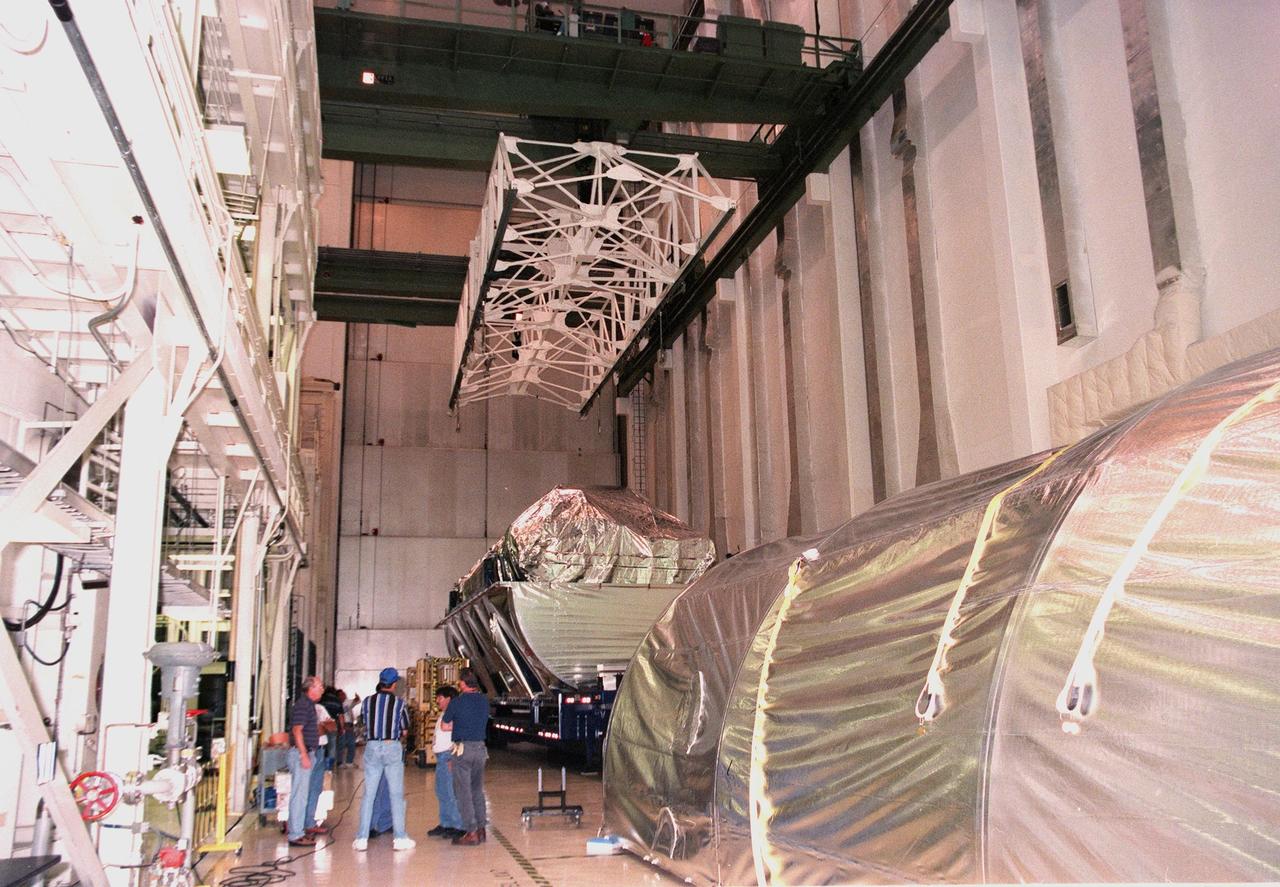
KENNEDY SPACE CENTER, FLA. -- Inside the Operations and Checkout Bldg. (O&C), an overhead crane is centered over the S0 truss segment before lowering. The crane will move it to a workstand in the O&C where it will undergo processing. In the foreground is the protective cover just removed. During the processing, the Canadian Mobile Transporter, power distribution system modules, a heat pipe radiator for cooling, computers, and a pair of rate gyroscopes will be installed. Four Global Positioning System antennas are already installed. A 44by 15-foot structure weighing 30,800 pounds when fully outfitted and ready for launch, the truss will be at the center of the ISS 10-truss, girderlike structure that will ultimately extend the length of a football field. Eventually the S0 truss will be attached to the U.S. Lab, "Destiny," which is scheduled to be added to the ISS in April 2000. Later, other trusses will be attached to the S0 on-orbit. The S0 truss is scheduled to be launched in the first quarter of 2001 on mission STS-108
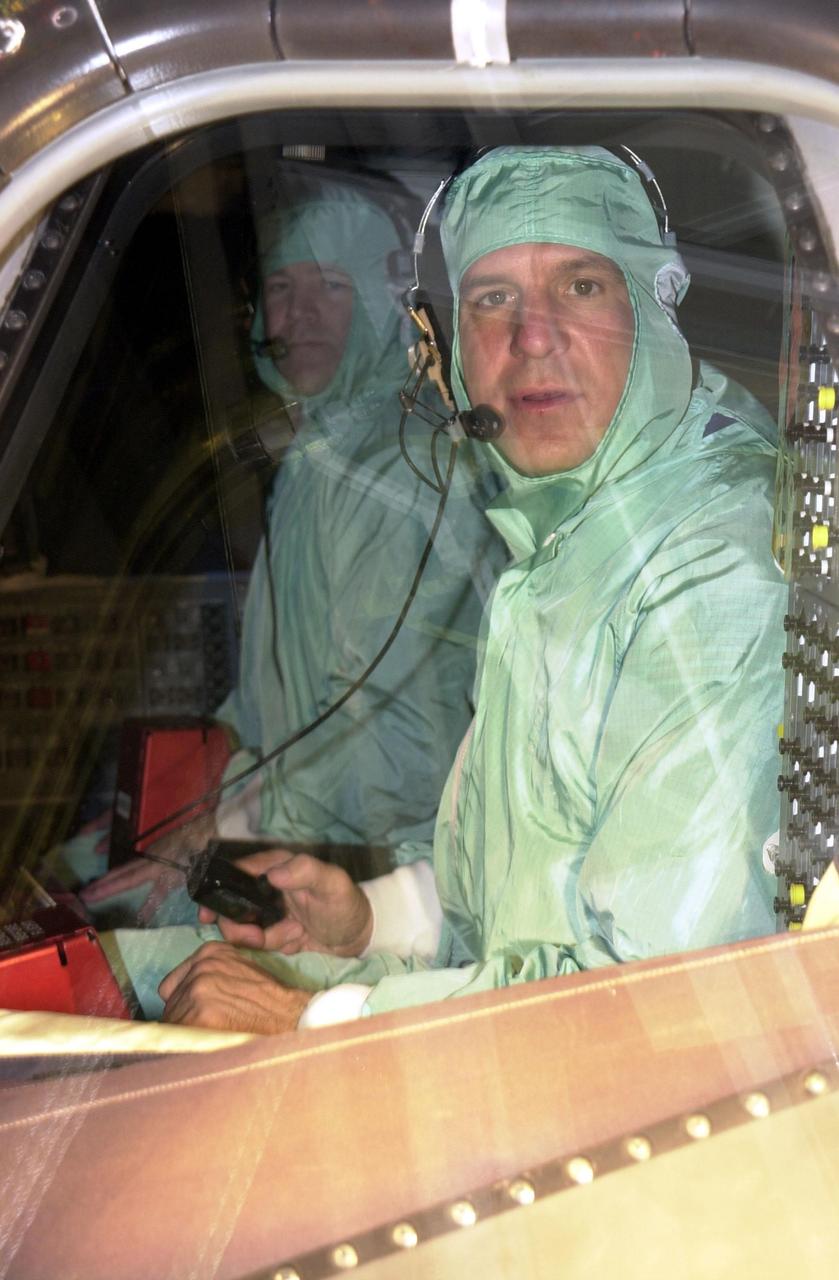
KENNEDY SPACE CENTER, FLA. -- In the Orbiter Processing Facility, STS-110 Commander Michael Bloomfield checks out a window in the cockpit of Atlantis during Crew Equipment Integration Test activities. The mission, 13th assembly flight to the International Space Station, includes the Integrated Truss Structure S0. The ITS S0 is the center segment on the Space Station, part of the 300-foot (91-meter) truss attached to the U.S. Lab. By assembly completion, four more truss segments will attach to either side of the S0 truss. STS-110 is scheduled to launch April 4, 2002

KENNEDY SPACE CENTER, FLA. -- In the Orbiter Processing Facility, STS-110 Mission Specialists Jerry Ross (upper right) and Lee Morin (lower right) check out the payload bay of Atlantis during Crew Equipment Integration Test activities, which include familiarization with the vehicle and payload. . The mission, 13th assembly flight to the International Space Station, includes the Integrated Truss Structure S0. The ITS S0 is the center segment on the Space Station, part of the 300-foot (91-meter) truss attached to the U.S. Lab. By assembly completion, four more truss segments will attach to either side of the S0 truss. STS-110 is scheduled to launch April 4, 2002
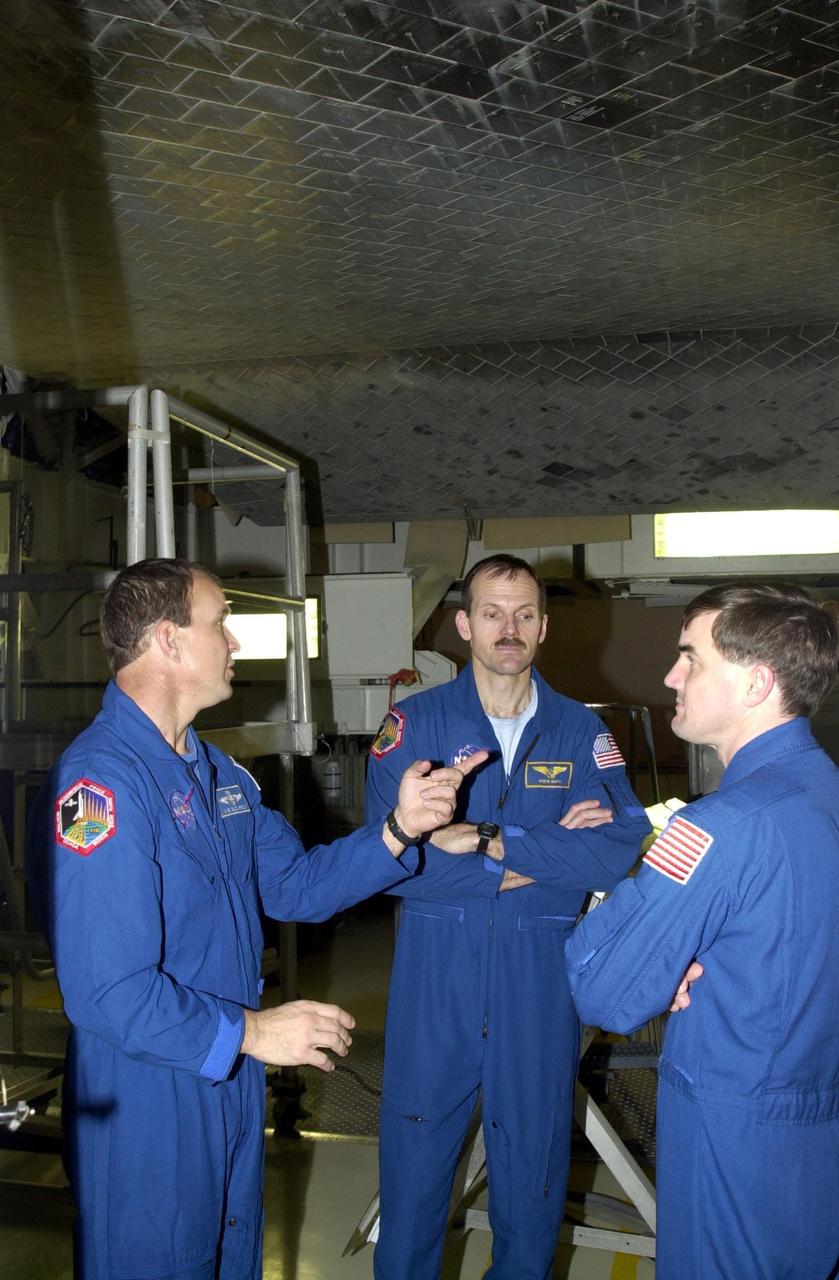
KENNEDY SPACE CENTER, FLA. -- Standing underneath the orbiter Atlantis in the Orbiter Processing Facility are STS-110 Commander Michael Bloomfield and Mission Specialists Steven Smith and Rex Walheim. They and other crew members are taking part in Crew Equipment Integration Test activities, which include familiarization with the vehicle and payload. The mission, 13th assembly flight to the International Space Station, includes the Integrated Truss Structure S0. The ITS S0 is the center segment on the Space Station, part of the 300-foot (91-meter) truss attached to the U.S. Lab. By assembly completion, four more truss segments will attach to either side of the S0 truss. STS-110 is scheduled to launch April 4, 2002
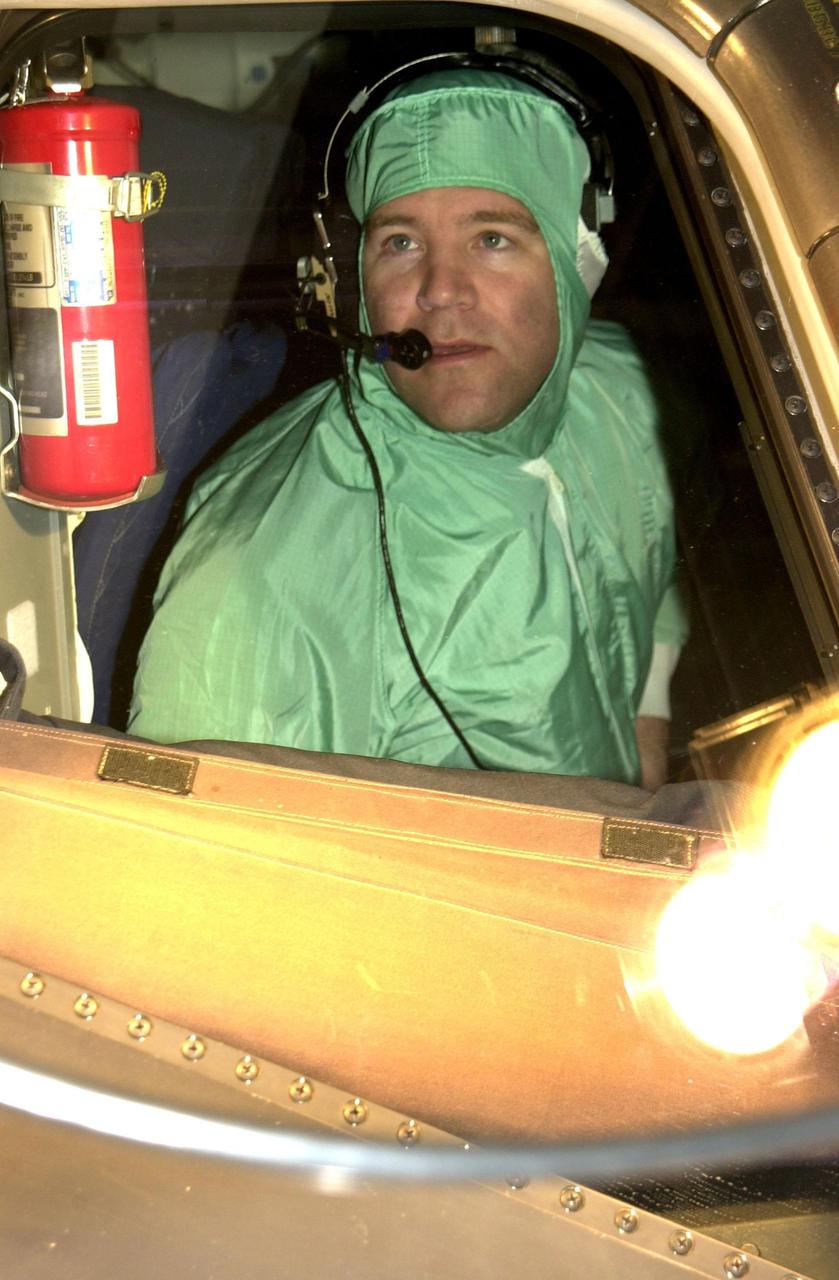
KENNEDY SPACE CENTER, FLA. -- In the Orbiter Processing Facility, STS-110 Pilot Stephen Frick checks a window in the cockpit of Atlantis during Crew Equipment Integration Test activities. The mission, 13th assembly flight to the International Space Station, includes the Integrated Truss Structure S0. The ITS S0 is the center segment on the Space Station, part of the 300-foot (91-meter) truss attached to the U.S. Lab. By assembly completion, four more truss segments will attach to either side of the S0 truss. STS-110 is scheduled to launch April 4, 2002
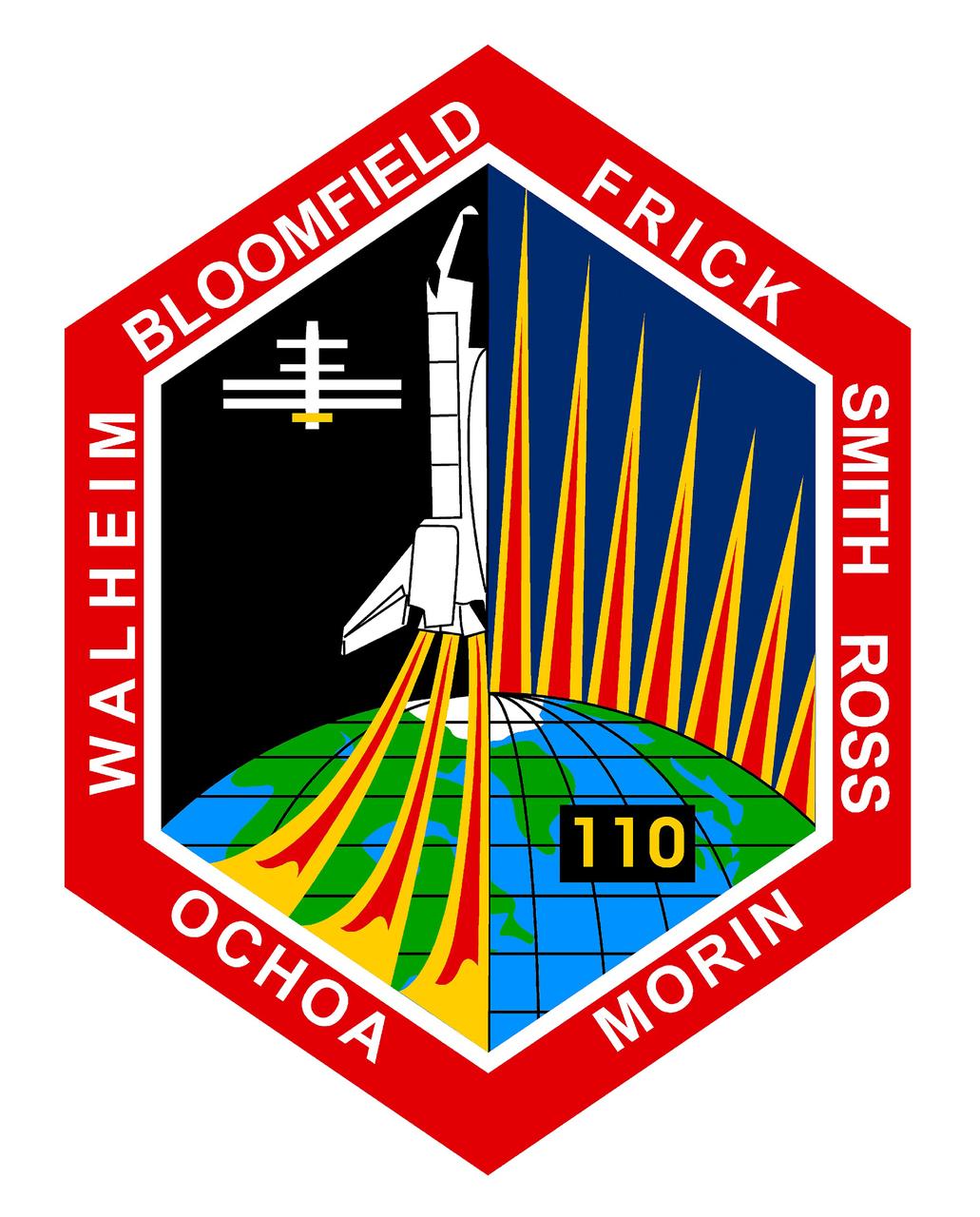
The STS-110 mission began the third and final phase of construction for the International Space Station (ISS) by delivering and installing the Starboard side S0 (S-zero) truss segment that was carried into orbit in the payload bay of the Space Shuttle Atlantis. The STS-110 crew patch is patterned after the cross section of the S0 truss, and encases the launch of the Shuttle Atlantis and a silhouette of the ISS as it will look following mission completion. The successfully installed S0 segment is highlighted in gold. The three prominent flames blasting from the shuttle emphasizes the first shuttle flight to use three Block II Main Engines.
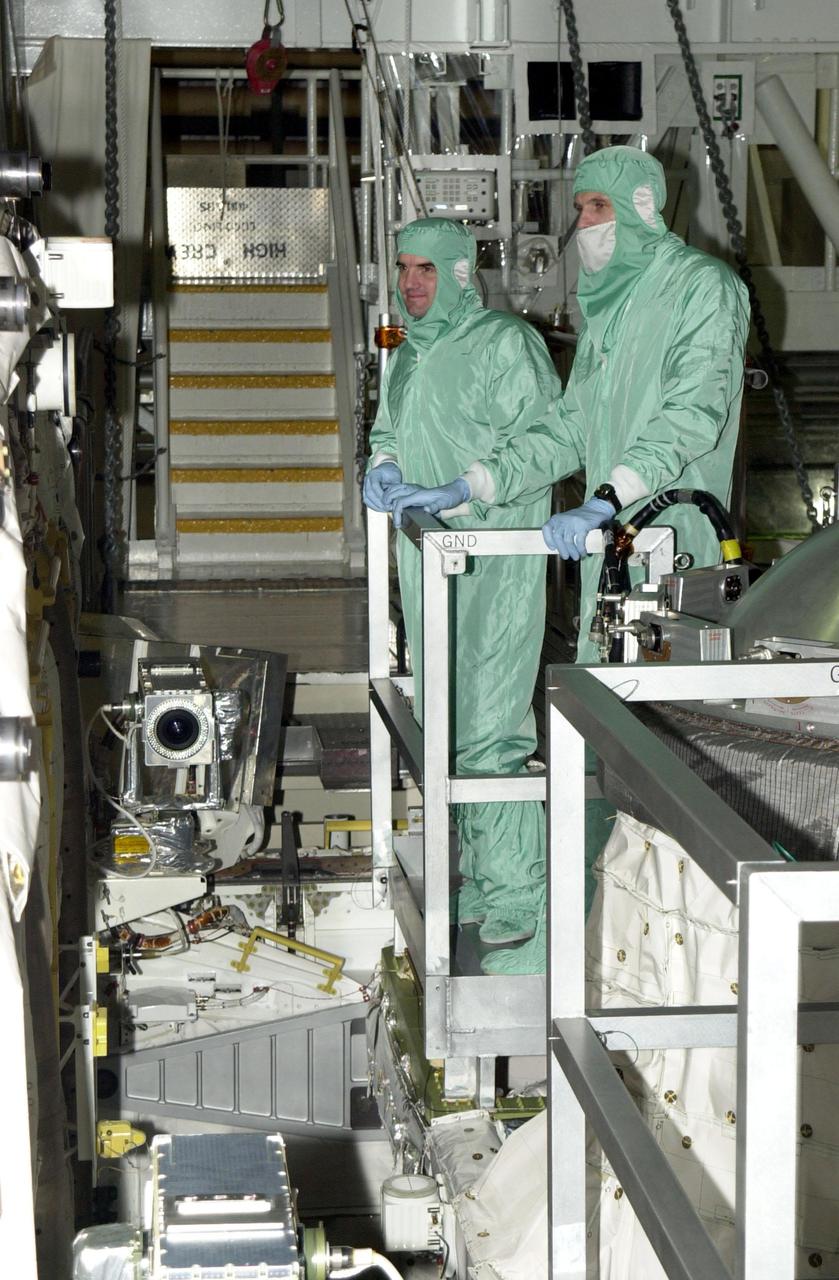
KENNEDY SPACE CENTER, FLA. -- In the Orbiter Processing Facility, STS-110 Mission Specialists Rex Walheim (left) and Steven Smith (right) look over the payload bay of Atlantis during Crew Equipment Integration Test activities, which include familiarization with the vehicle and payload. . The mission, 13th assembly flight to the International Space Station, includes the Integrated Truss Structure S0. The ITS S0 is the center segment on the Space Station, part of the 300-foot (91-meter) truss attached to the U.S. Lab. By assembly completion, four more truss segments will attach to either side of the S0 truss. STS-110 is scheduled to launch April 4, 2002
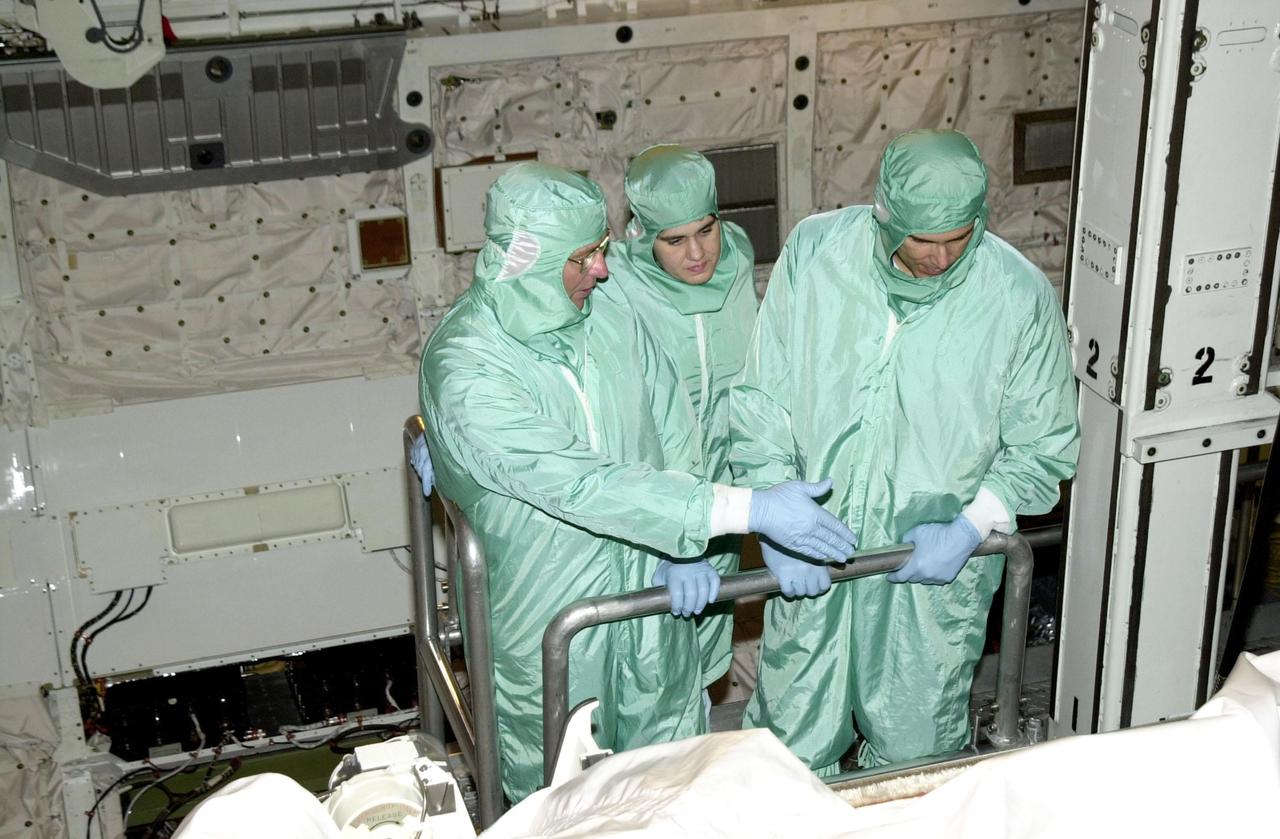
KENNEDY SPACE CENTER, FLA. -- In the Orbiter Processing Facility, STS-110 crew members look over the payload bay of Atlantis during Crew Equipment Integration Test activities, which include familiarization with the vehicle and payload. From left are Mission Specialist Jerry Ross, a technician, and Mission Specialist Lee Morin. The mission, 13th assembly flight to the International Space Station, includes the Integrated Truss Structure S0. The ITS S0 is the center segment on the Space Station, part of the 300-foot (91-meter) truss attached to the U.S. Lab. By assembly completion, four more truss segments will attach to either side of the S0 truss. STS-110 is scheduled to launch April 4, 2002
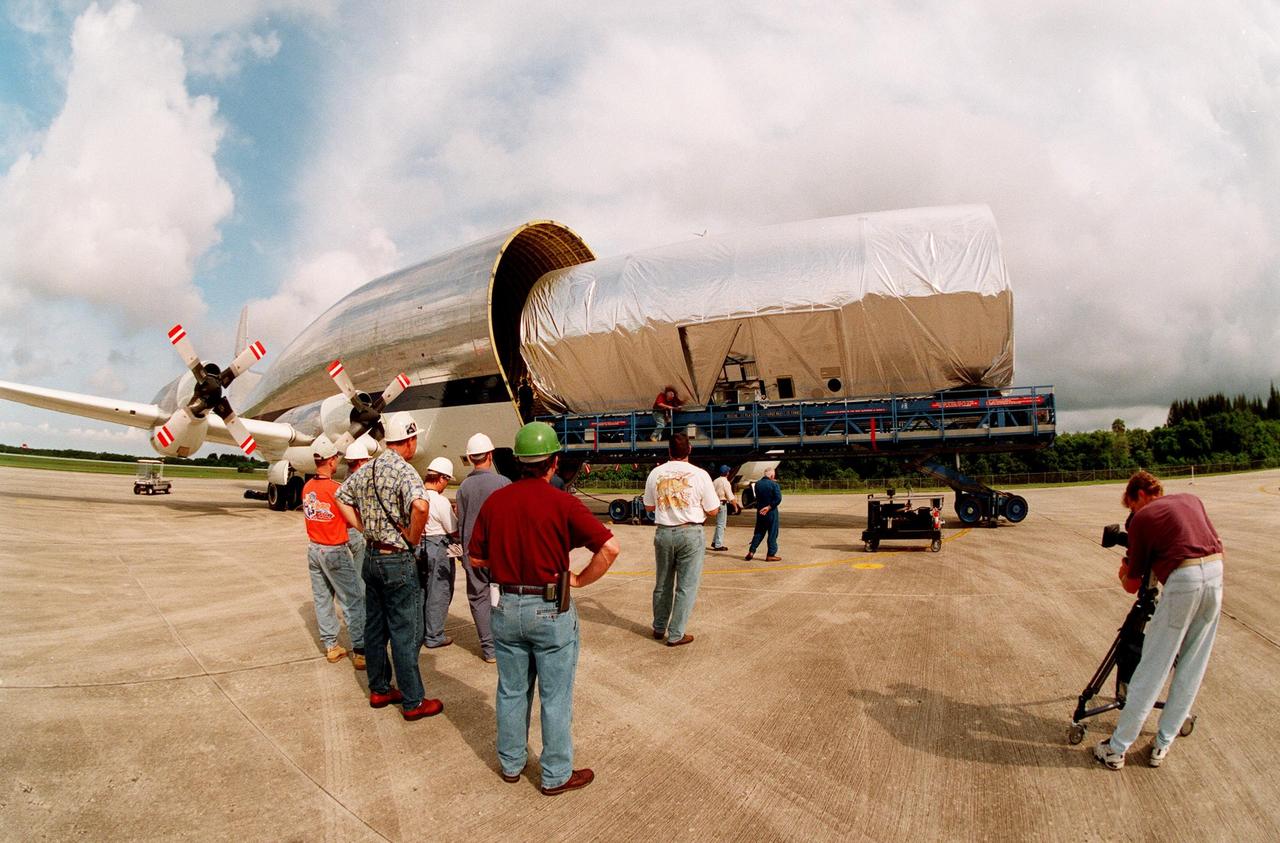
KENNEDY SPACE CENTER, FLA. -- At KSC's Shuttle Landing Facility, workers watch as a S0 (S Zero) truss segment built for the International Space Station (ISS) is moved out of the "Super Guppy" aircraft that brought it to KSC from Boeing in Huntington Beach, Calif. At right a cameraman records the exercise. The truss segment, which will become the backbone of the orbiting ISS, is a 44by 15-foot structure weighing 30,800 pounds when fully outfitted and ready for launch. It will be at the center of the ISS 10-truss, girderlike structure that will ultimately extend the length of a football field. Eventually the S0 truss will be attached to the U.S. Lab, "Destiny," which is scheduled to be added to the ISS in April 2000. Later, other trusses will be attached to the S0 on-orbit. During processing at KSC, the Canadian Mobile Transporter will be installed on the S0 truss, followed by power distribution system modules, a heat pipe radiator for cooling, computers, and a pair of rate gyroscopes. Four Global Positioning System antennas are already installed. The S0 truss is scheduled to be launched in the first quarter of 2001 on mission STS-108
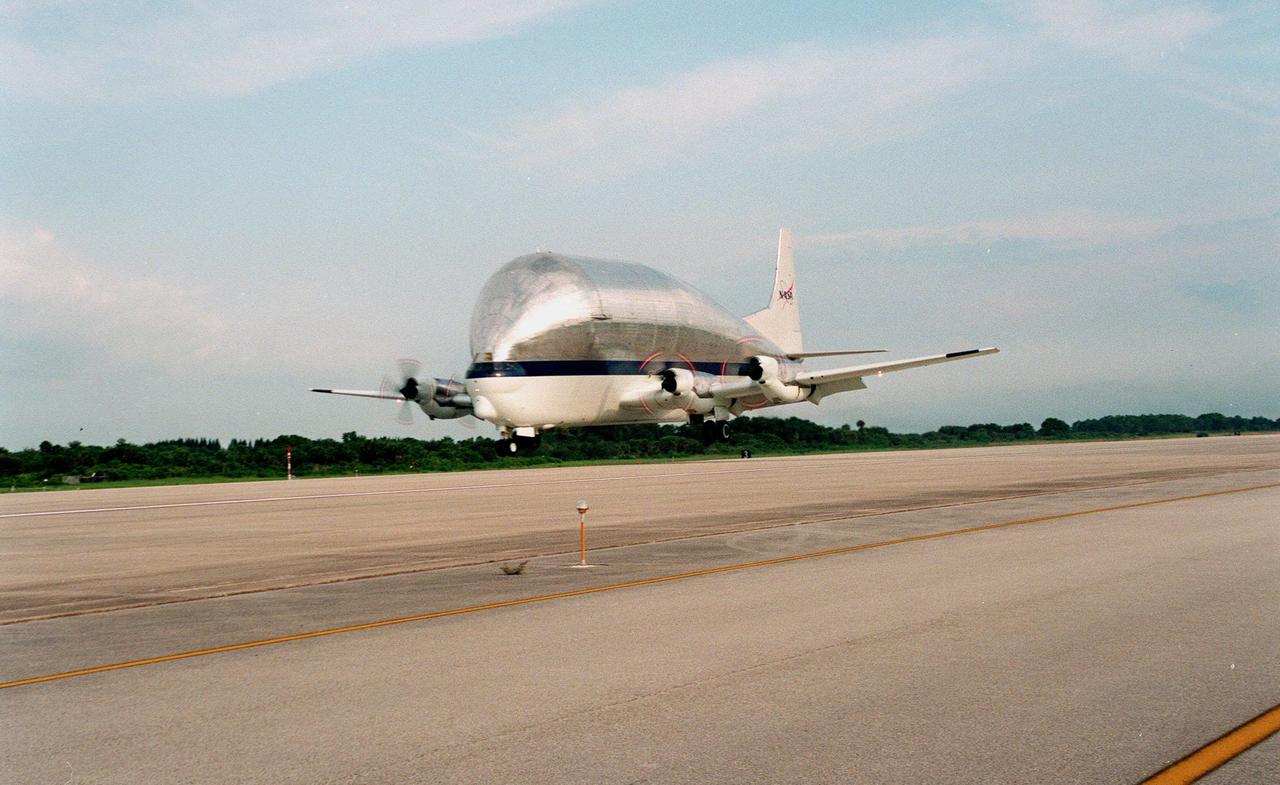
KENNEDY SPACE CENTER, FLA. -- The "Super Guppy" transport aircraft approaches the runway at the KSC's Shuttle Landing Facility. On board is the S0 (S Zero) truss segment, from Boeing in Huntington Beach, Calif. The truss segment, which will become the backbone of the orbiting International Space Station (ISS), is a 44- by 15-foot structure weighing 30,800 pounds when fully outfitted and ready for launch. It will be at the center of the 10-truss, girderlike structure that will ultimately extend the length of a football field on the ISS. Eventually the S0 truss will be attached to the U.S. Lab, "Destiny," scheduled to be added to the ISS in April 2000. Later, other trusses will be attached to the S0 truss on-orbit. During processing at KSC, the S0 truss will have installed the Canadian Mobile Transporter, power distribution system modules, a heat pipe radiator for cooling, computers, and a pair of rate gyroscopes. Four Global Positioning System antennas are already installed. The S0 truss is scheduled to be launched in the first quarter of 2001 on mission STS-108
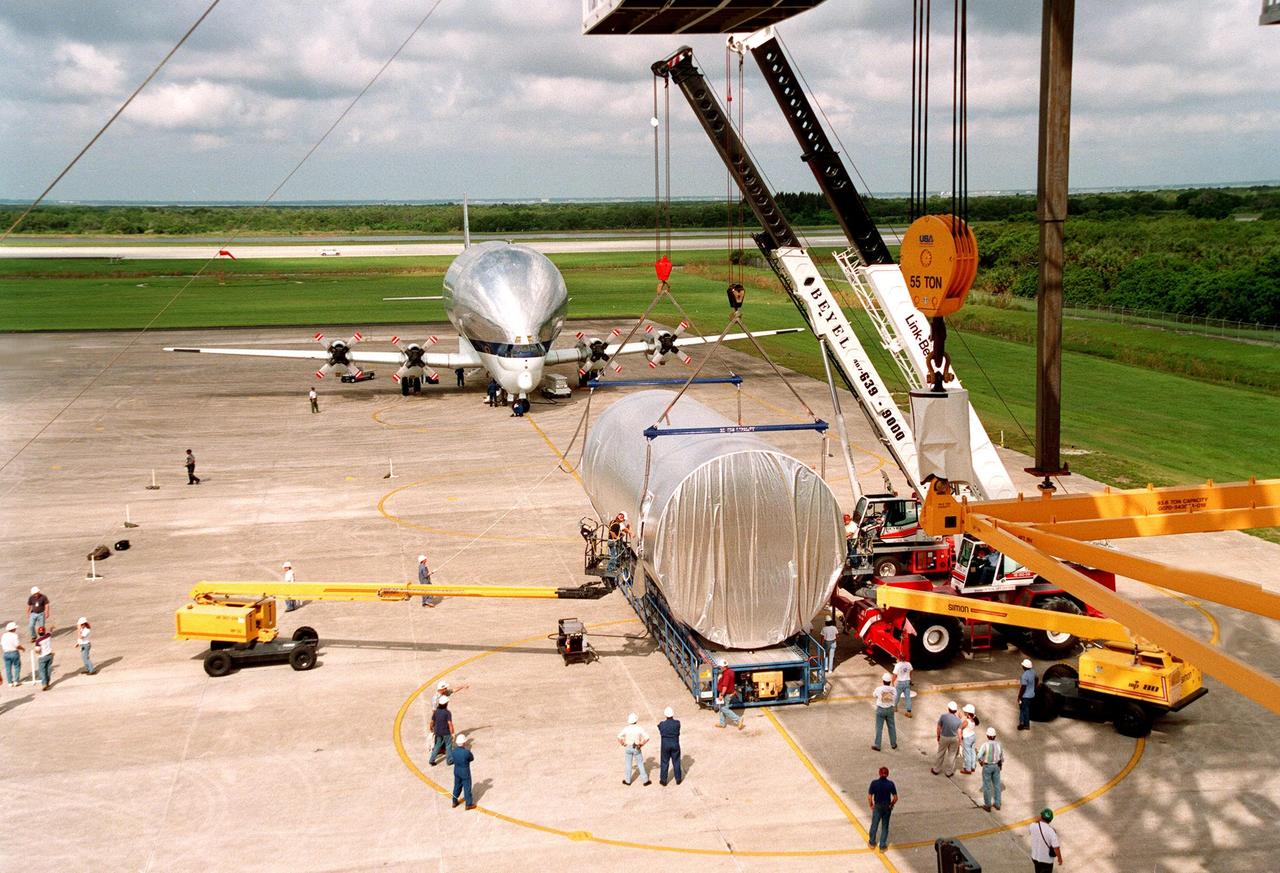
KENNEDY SPACE CENTER, FLA. -- At KSC's Shuttle Landing Facility (SLF), overhead cranes are fitted around the S0 truss segment to move it onto a flatbed trailer which will transfer it to the Operations and Checkout Bldg. for processing. The truss arrived at the SLF aboard the "Super Guppy" aircraft (in the background) from Boeing in Huntington, Calif. During processing, the Canadian Mobile Transporter will be installed on the S0 truss, followed by power distribution system modules, a heat pipe radiator for cooling, computers, and a pair of rate gyroscopes. Four Global Positioning System antennas are already installed. A 44by 15-foot structure weighing 30,800 pounds when fully outfitted and ready for launch, the truss will be at the center of the ISS 10-truss, girderlike structure that will ultimately extend the length of a football field. Eventually the S0 truss will be attached to the U.S. Lab, "Destiny," which is scheduled to be added to the ISS in April 2000. Later, other trusses will be attached to the S0 on-orbit. The S0 truss is scheduled to be launched in the first quarter of 2001 on mission STS-108
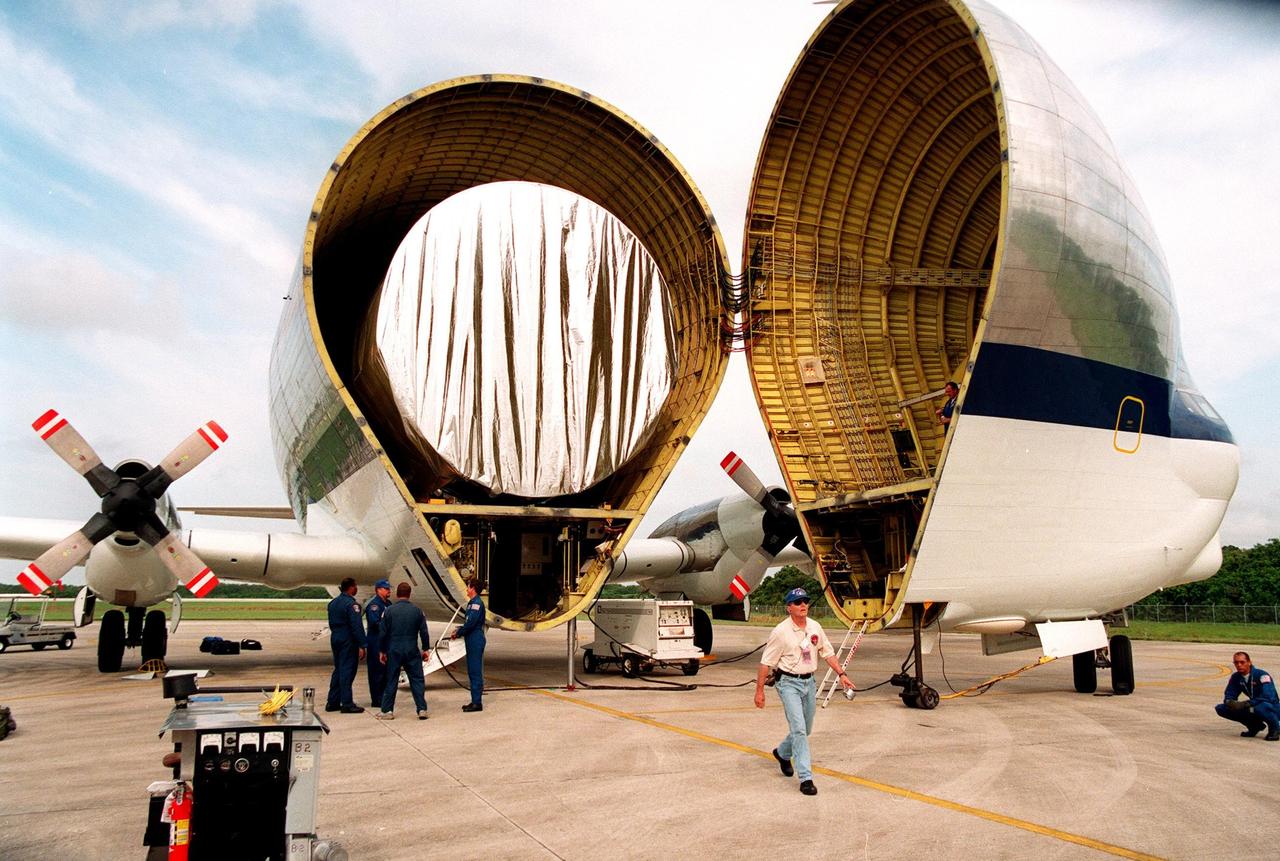
KENNEDY SPACE CENTER, FLA. -- After landing at KSC's Shuttle Landing Facility, the "Super Guppy" transport aircraft opens to reveal its cargo, a S0 (S Zero) truss segment, from Boeing in Huntington Beach, Calif. The truss segment, which will become the backbone of the orbiting International Space Station (ISS), is a 44by 15-foot structure weighing 30,800 pounds when fully outfitted and ready for launch. It will be at the center of the ISS 10-truss, girderlike structure that will ultimately extend the length of a football field. Eventually the S0 truss will be attached to the U.S. Lab, "Destiny," which is scheduled to be added to the ISS in April 2000. Later, other trusses will be attached to the S0 on-orbit. During processing at KSC, the S0 truss will have installed the Canadian Mobile Transporter, power distribution system modules, a heat pipe radiator for cooling, computers, and a pair of rate gyroscopes. Four Global Positioning System antennas are already installed. The S0 truss is scheduled to be launched in the first quarter of 2001 on mission STS-108
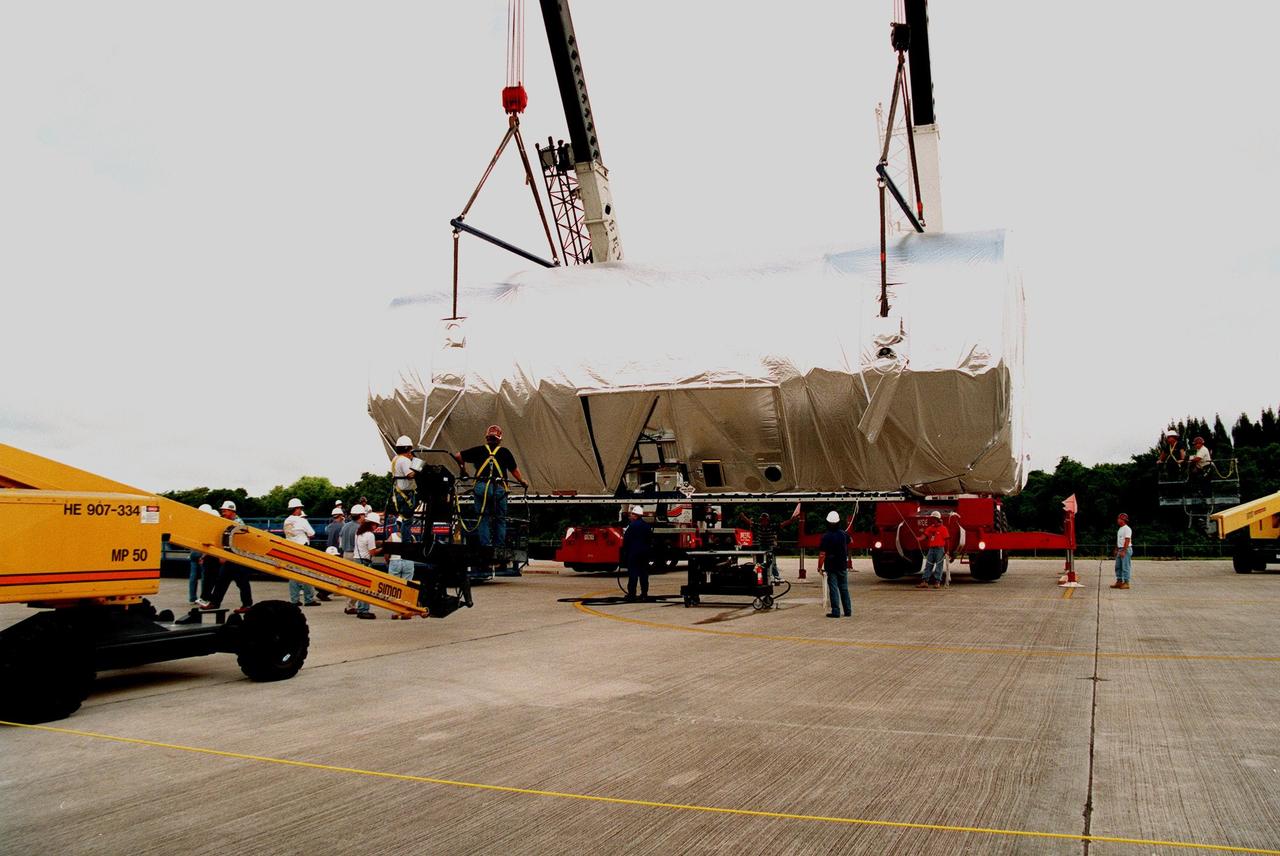
KENNEDY SPACE CENTER, FLA. -- At KSC's Shuttle Landing Facility, workers load the S0 truss segment onto a flatbed trailer for its transfer to the Operations and Checkout Bldg. for processing. The truss arrived at the SLF aboard a "Super Guppy" aircraft from Boeing in Huntington, Calif. During processing in the O&C, the S0 truss will have installed the Canadian Mobile Transporter, power distribution system modules, a heat pipe radiator for cooling, computers, and a pair of rate gyroscopes. Four Global Positioning System antennas are already installed. A 44by 15-foot structure weighing 30,800 pounds when fully outfitted and ready for launch, the truss will be at the center of the ISS 10-truss, girderlike structure that will ultimately extend the length of a football field. Eventually the S0 truss will be attached to the U.S. Lab, "Destiny," which is scheduled to be added to the ISS in April 2000. Later, other trusses will be attached to the S0 on-orbit. The S0 truss is scheduled to be launched in the first quarter of 2001 on mission STS-108
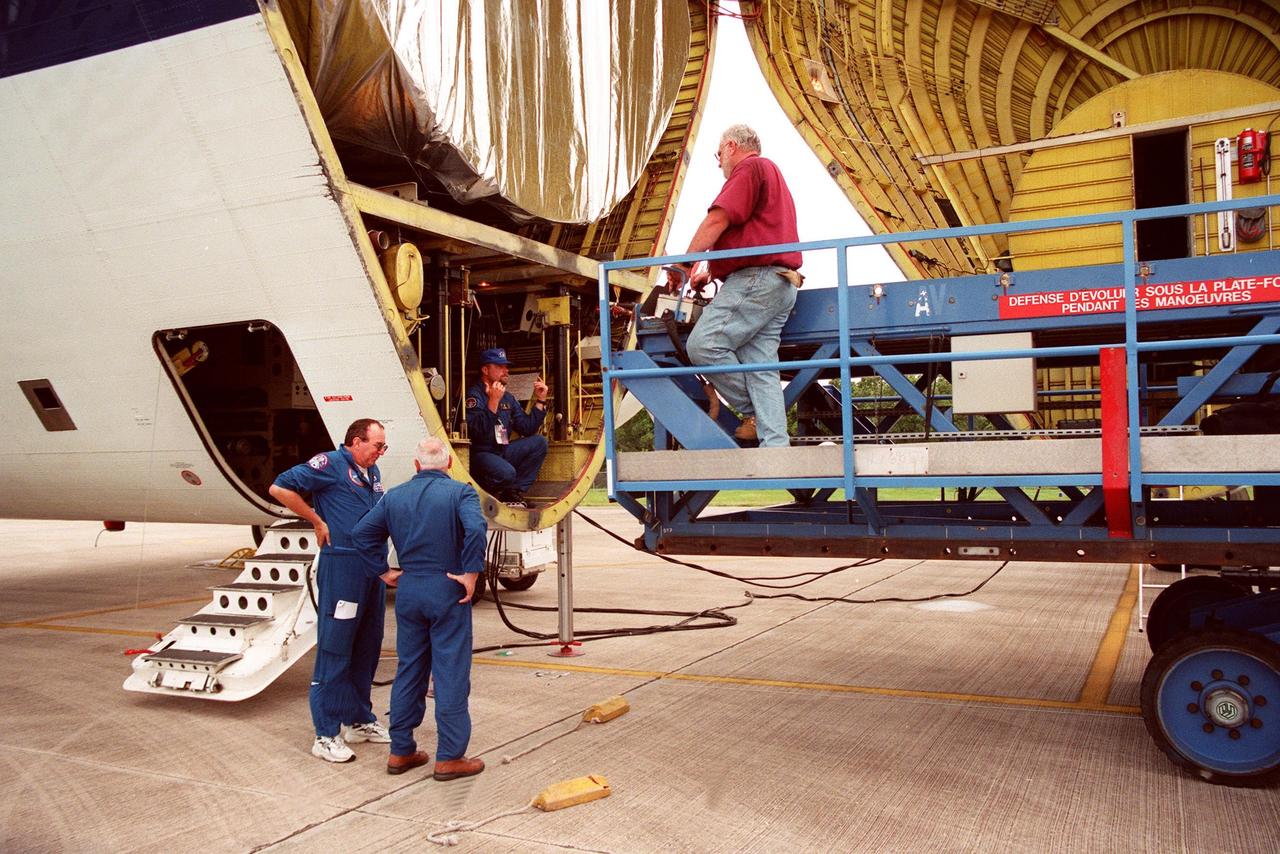
KENNEDY SPACE CENTER, Fla. - A transporter (right) is moved into place to remove a S0 (S Zero) truss segment (left) from inside the "Super Guppy" aircraft that brought it to KSC from Boeing in Huntington Beach, Calif. The truss segment, which will become the backbone of the orbiting International Space Station (ISS), is a 44- by 15-foot structure weighing 30,800 pounds when fully outfitted and ready for launch. It will be at the center of the ISS 10-truss, girderlike structure that will ultimately extend the length of a football field. Eventually the S0 truss will be attached to the U.S. Lab, "Destiny," which is scheduled to be added to the ISS in April 2000. Later, other trusses will be attached to the S0 on-orbit. During processing at KSC, the S0 truss will have installed the Canadian Mobile Transporter, power distribution system modules, a heat pipe radiator for cooling, computers, and a pair of rate gyroscopes. Four Global Positioning System antennas are already installed. The S0 truss is scheduled to be launched in the first quarter of 2001 on mission STS-108
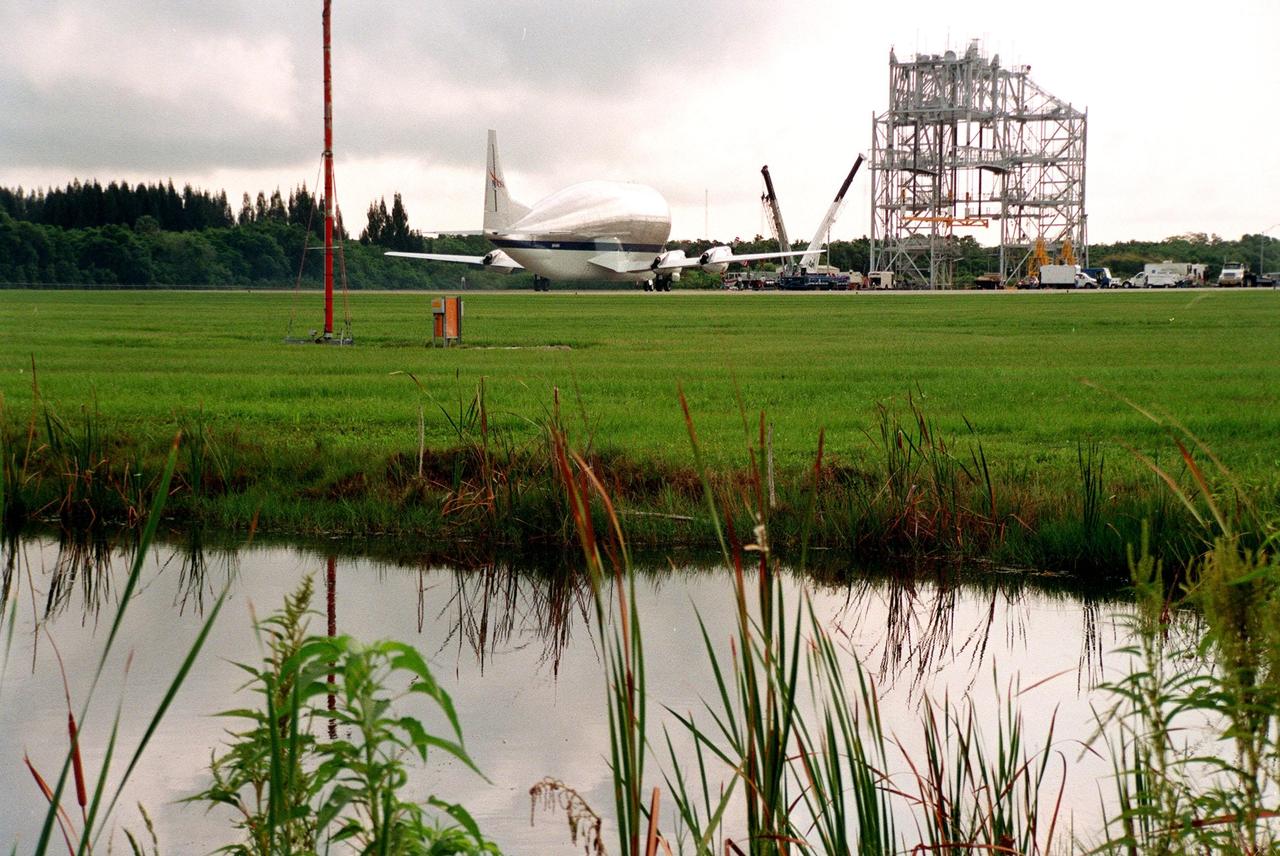
KENNEDY SPACE CENTER, FLA. -- At KSC's Shuttle Landing Facility, the "Super Guppy" transport aircraft touches down on the runway. On board the aircraft is the S0 (S Zero) truss segment, from Boeing in Huntington Beach, Calif. The truss segment, which will become the backbone of the orbiting International Space Station (ISS), is a 44by 15-foot structure weighing 30,800 pounds when fully outfitted and ready for launch. It will be at the center of the ISS 10-truss, girderlike structure that will ultimately extend the length of a football field. Eventually the S0 truss will be attached to the U.S. Lab, "Destiny," which is scheduled to be added to the ISS in April 2000. Later, other trusses will be attached to the S0 on-orbit. During processing at KSC, the S0 truss will have installed the Canadian Mobile Transporter, power distribution system modules, a heat pipe radiator for cooling, computers, and a pair of rate gyroscopes. Four Global Positioning System antennas are already installed. The S0 truss is scheduled to be launched in the first quarter of 2001 on mission STS-108
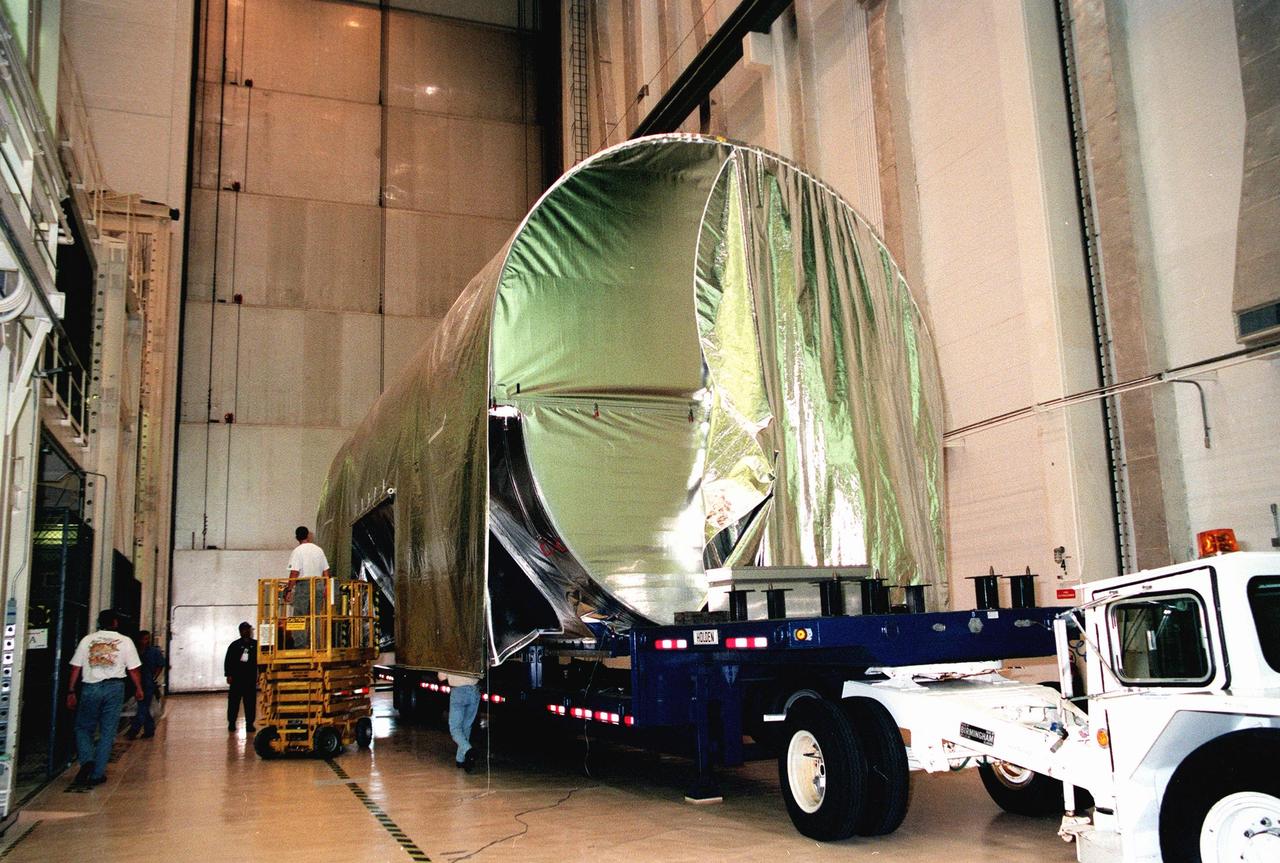
KENNEDY SPACE CENTER, FLA. -- Workers begin removing the cover from the S0 truss segment after it was moved inside the Operations and Checkout Bldg. (O&C) for processing. The truss arrived at the SLF aboard a "Super Guppy" aircraft from Boeing in Huntington, Calif. During processing in the O&C, the S0 truss will have installed the Canadian Mobile Transporter, power distribution system modules, a heat pipe radiator for cooling, computers, and a pair of rate gyroscopes. Four Global Positioning System antennas are already installed. A 44by 15-foot structure weighing 30,800 pounds when fully outfitted and ready for launch, the truss will be at the center of the ISS 10-truss, girderlike structure that will ultimately extend the length of a football field. Eventually the S0 truss will be attached to the U.S. Lab, "Destiny," which is scheduled to be added to the ISS in April 2000. Later, other trusses will be attached to the S0 on-orbit. The S0 truss is scheduled to be launched in the first quarter of 2001 on mission STS-108
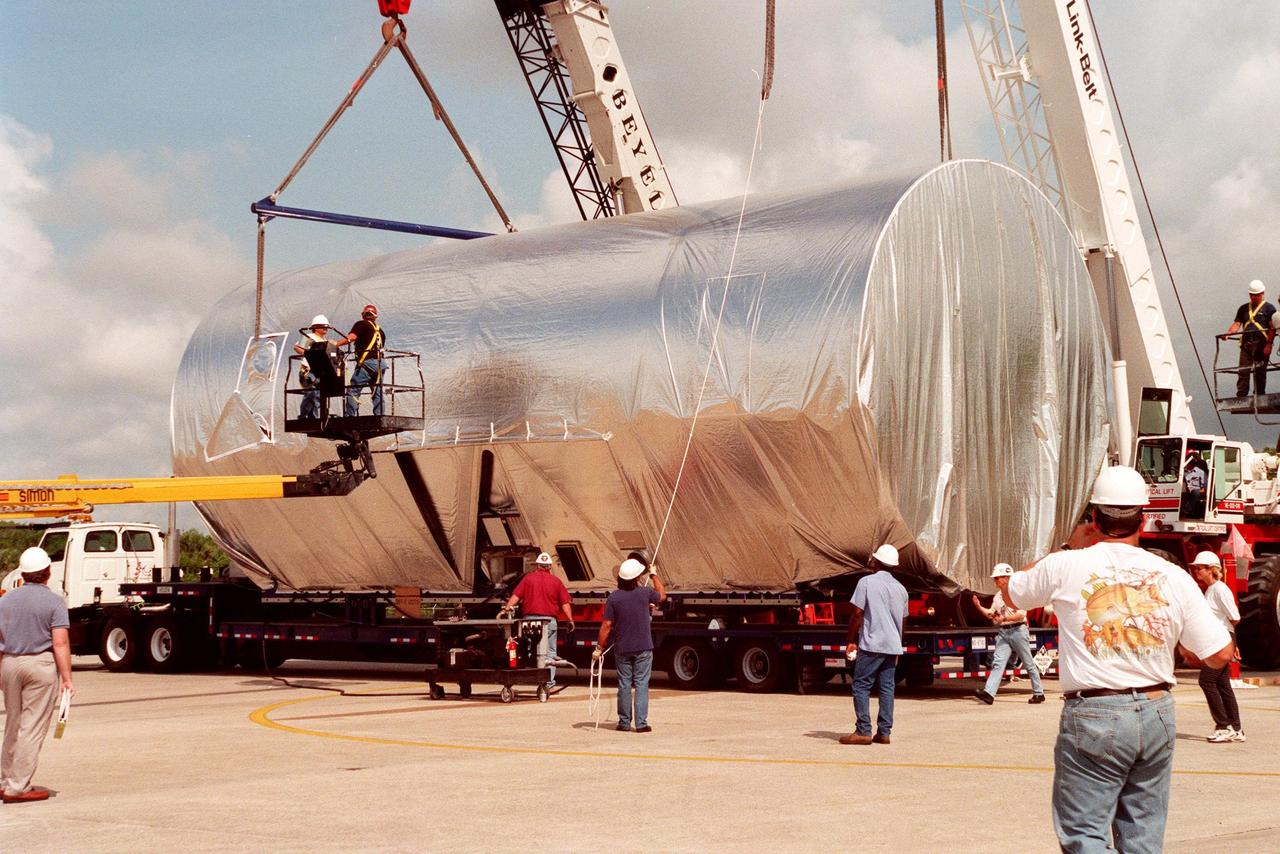
KENNEDY SPACE CENTER, FLA. -- At KSC's Shuttle Landing Facility, workers finish loading the S0 truss segment onto a flatbed trailer for transfer to the Operations and Checkout Bldg. for processing. The truss arrived at the SLF aboard a "Super Guppy" aircraft from Boeing in Huntington, Calif. During processing in the O&C, the S0 truss will have installed the Canadian Mobile Transporter, power distribution system modules, a heat pipe radiator for cooling, computers, and a pair of rate gyroscopes. Four Global Positioning System antennas are already installed. A 44by 15-foot structure weighing 30,800 pounds when fully outfitted and ready for launch, the truss will be at the center of the ISS 10-truss, girderlike structure that will ultimately extend the length of a football field. Eventually the S0 truss will be attached to the U.S. Lab, "Destiny," which is scheduled to be added to the ISS in April 2000. Later, other trusses will be attached to the S0 on-orbit. The S0 truss is scheduled to be launched in the first quarter of 2001 on mission STS-108
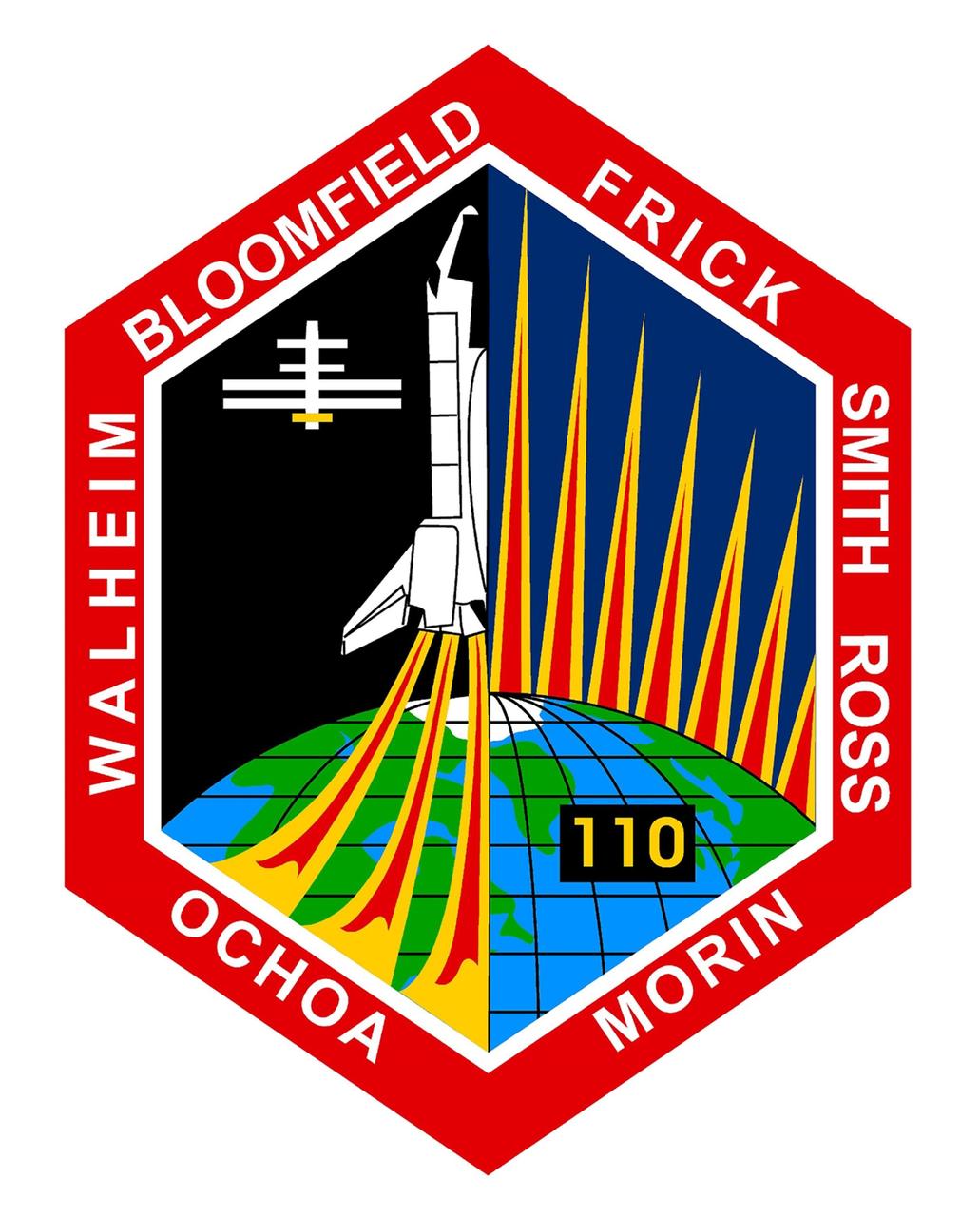
JOHNSON SPACE CENTER, HOUSTON, TEXAS. -- STS-110 INSIGNIA: The STS-110 mission begins the third and final phase of construction for the International Space Station (ISS) by delivering and installing the S0 truss segment that will be carried into orbit in the payload bay of Space Shuttle Atlantis. The Station's robotic arm will remove the S0 segment from the Shuttle's payload bay and place it on top of the United States Laboratory. During several spacewalks, S0 will be mechanically attached to ISS, and then multiple cables will be connected allowing electrical power and communications to flow between S0 and ISS. The STS-110 crew patch is patterned after the cross-section of the S0 truss, and encases the launch of the Shuttle Atlantis and a silhouette of the ISS as it will look following mission completion. The successfully installed S0 segment is highlighted in gold. The S0 truss will serve as the cornerstone for the remaining ISS truss segments, which together will span a distance greater than the length of a football field. This truss holds the Station's massive solar arrays, providing electrical power for the modules of all the International Partners, and enables the ISS to reach its full potential as a world-class research facility. The NASA insignia design for Space Shuttle flights is reserved for use by the astronauts and for other official use as the NASA Administrator may authorize. Public availability has been approved onlly in the form of illustrations by the various news media. When and if there is any change in this policy, which we do not anticipate, it will be publicly announced
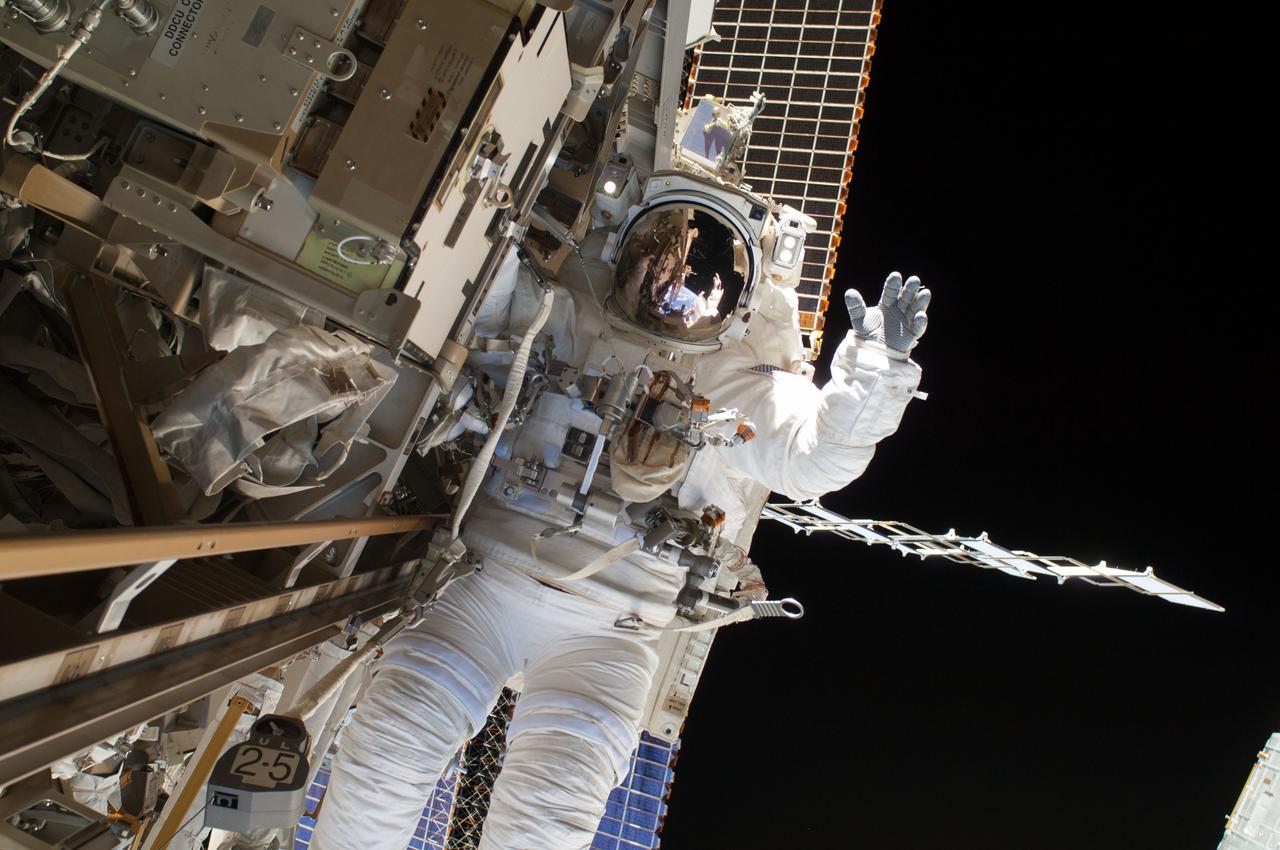
Expedition 39 flight engineer Steve Swanson waves to the camera during Extravehicular Activity 26 (EVA 26) cleanup operations at the S0 Truss.
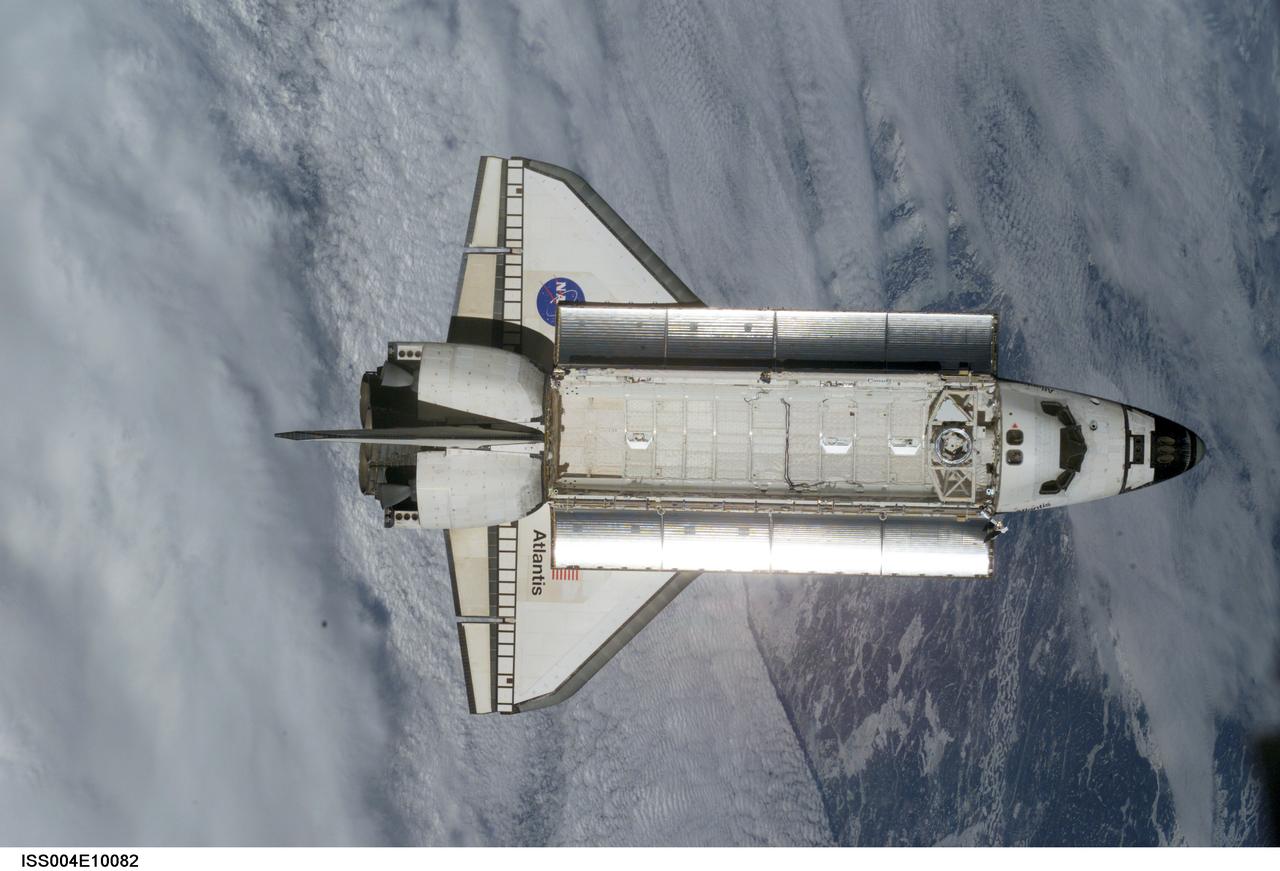
ISS004-E-10082 (17 April 2002) --- Backdropped over clouds some 247 statute miles below, the Space Shuttle Atlantis was photographed with a digital still camera shortly after its separation from the International Space Station (ISS). A big empty space now replaces the "look" in the cargo bay of a scene one and half weeks ago showing the giant S0 (S-zero) truss in the cargo bay as the shuttle prepared to dock with the station. The S0 truss is now part of the orbital outpost.
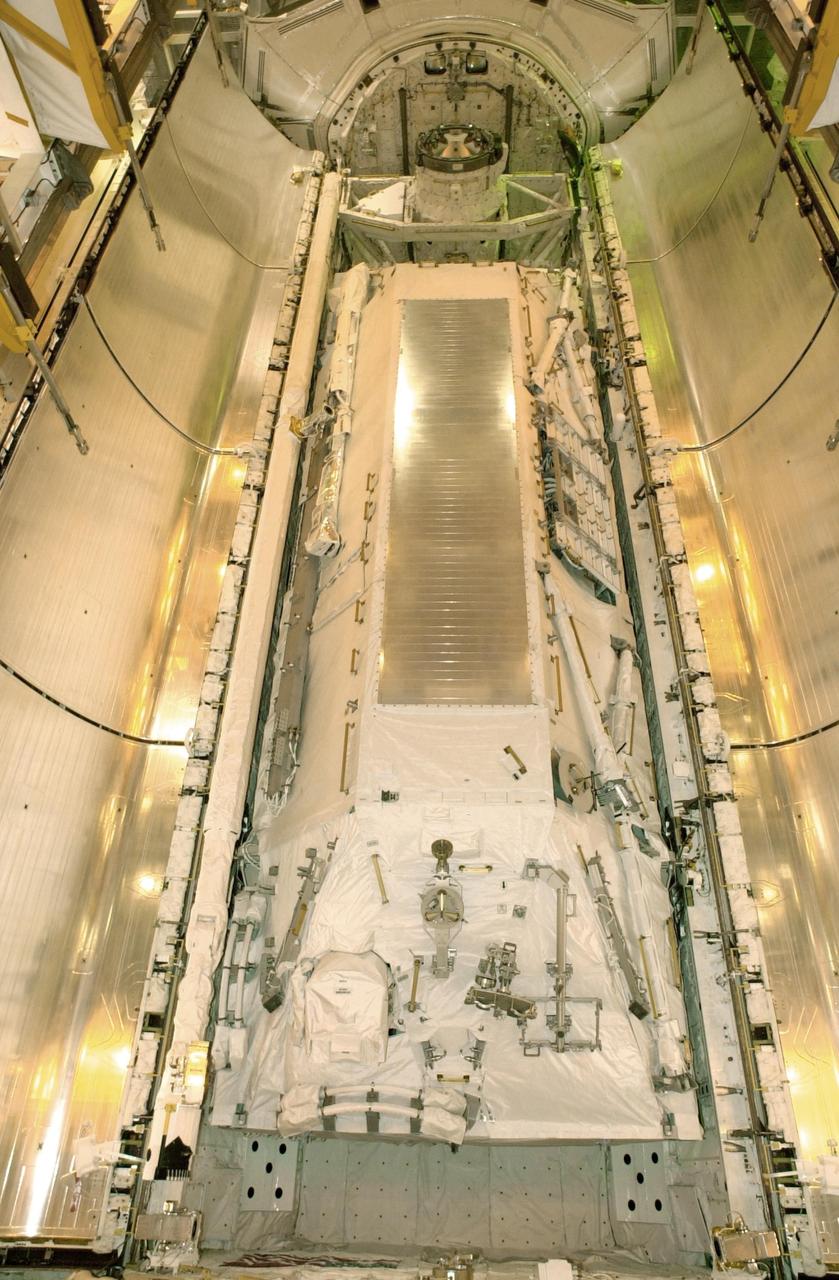
KENNEDY SPACE CENTER, FLA. -- At Launch Pad 39B, Space Shuttle Atlantis' payload bay doors are ready to be closed. The Shuttle payload includes the S0 Integrated Truss Structure (ITS), the Canadian Mobile Transporter, power distribution system modules, a heat pipe radiator for cooling, computers and a pair of rate gyroscopes. The mission is the 13th assembly flight to the ISS and includes four spacewalks to attach the S0 truss to the U.S. Lab Destiny. Launch is scheduled for April 4.
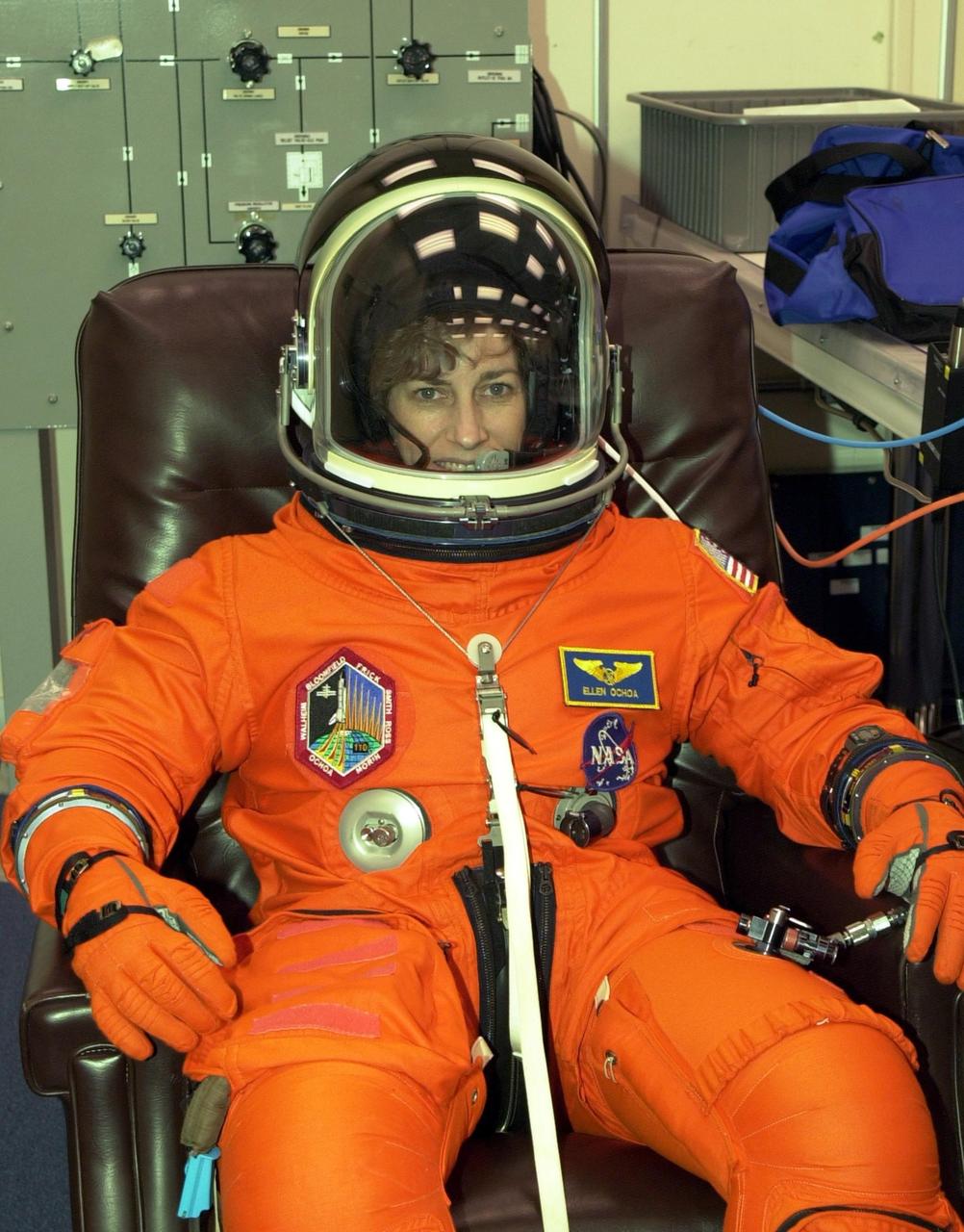
KENNEDY SPACE CENTER, FLA. -- STS-110 Mission Specialist Ellen Ochoa has a final check of her launch and entry suit in preparation for launch April 4. This flight will be her fourth. The STS-110 payload includes the S0 Integrated Truss Structure (ITS), the Canadian Mobile Transporter, power distribution system modules, a heat pipe radiator for cooling, computers and a pair of rate gyroscopes. The 11-day mission is the 13th assembly flight to the ISS and includes four spacewalks to attach the S0 truss to the U.S. Lab Destiny
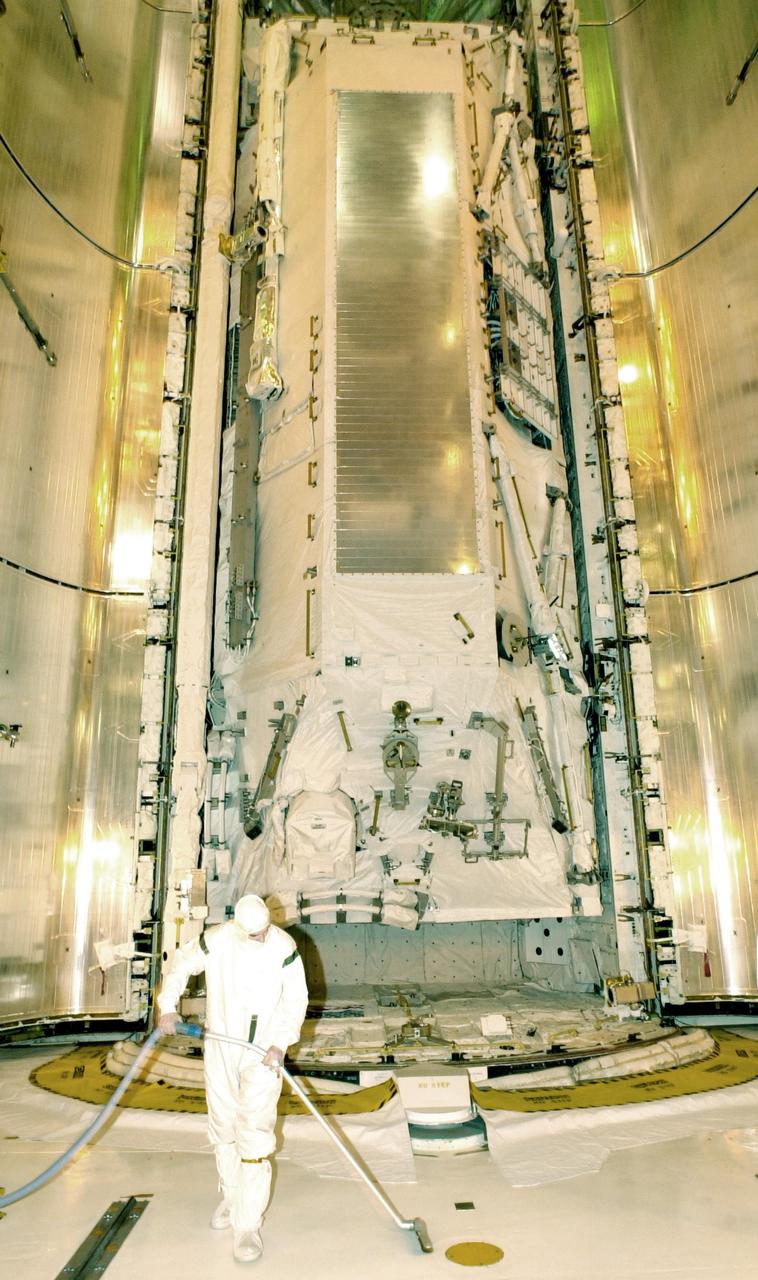
KENNEDY SPACE CENTER, FLA. - A worker at Launch Pad 39B prepares for the closing of Space Shuttle Atlantis' payload bay doors. The Shuttle payload includes the S0 Integrated Truss Structure (ITS), the Canadian Mobile Transporter, power distribution system modules, a heat pipe radiator for cooling, computers and a pair of rate gyroscopes. The mission is the 13th assembly flight to the ISS and includes four spacewalks to attach the S0 truss to the U.S. Lab Destiny. Launch is scheduled for April 4.
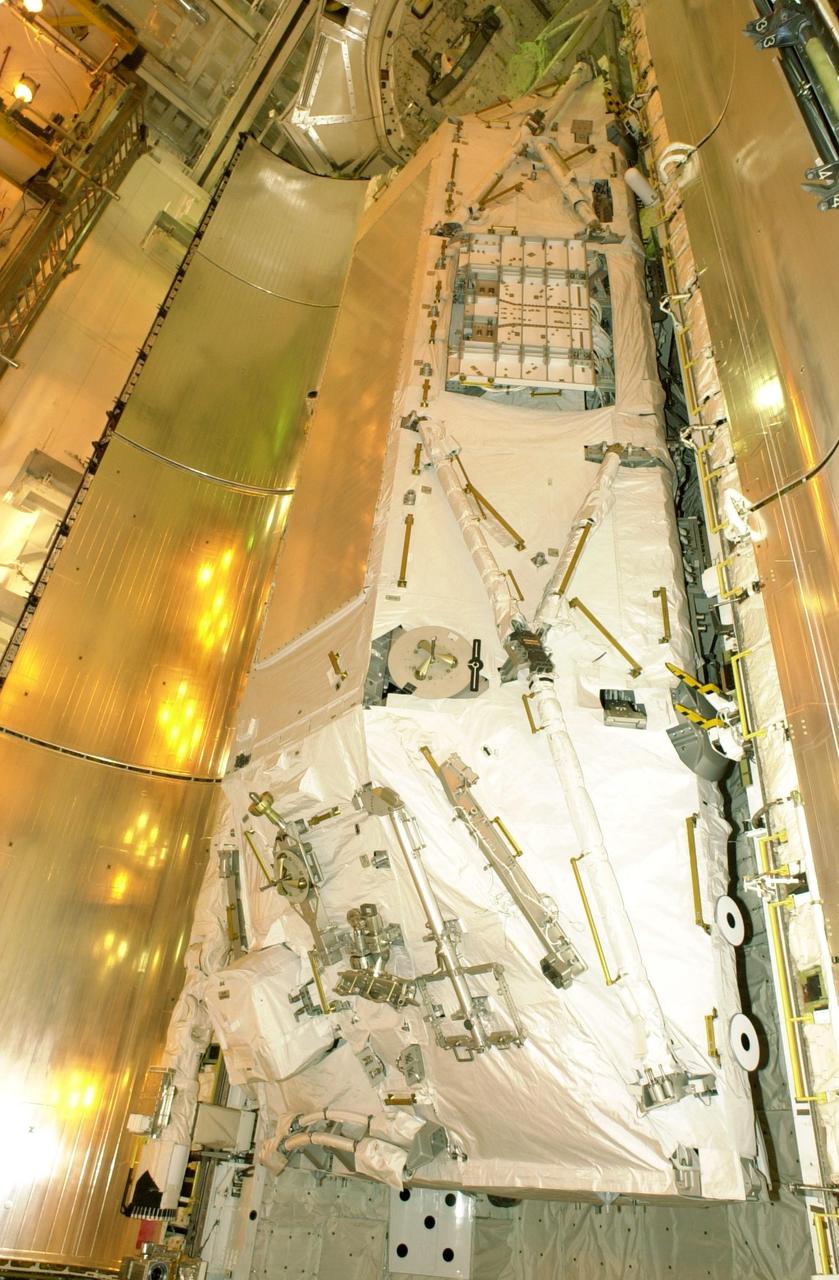
KENNEDY SPACE CENTER, FLA. -- At Launch Pad 39B, Space Shuttle Atlantis' payload bay doors are ready to be closed. The Shuttle payload includes the S0 Integrated Truss Structure (ITS), the Canadian Mobile Transporter, power distribution system modules, a heat pipe radiator for cooling, computers and a pair of rate gyroscopes. The mission is the 13th assembly flight to the ISS and includes four spacewalks to attach the S0 truss to the U.S. Lab Destiny. Launch is scheduled for April 4.
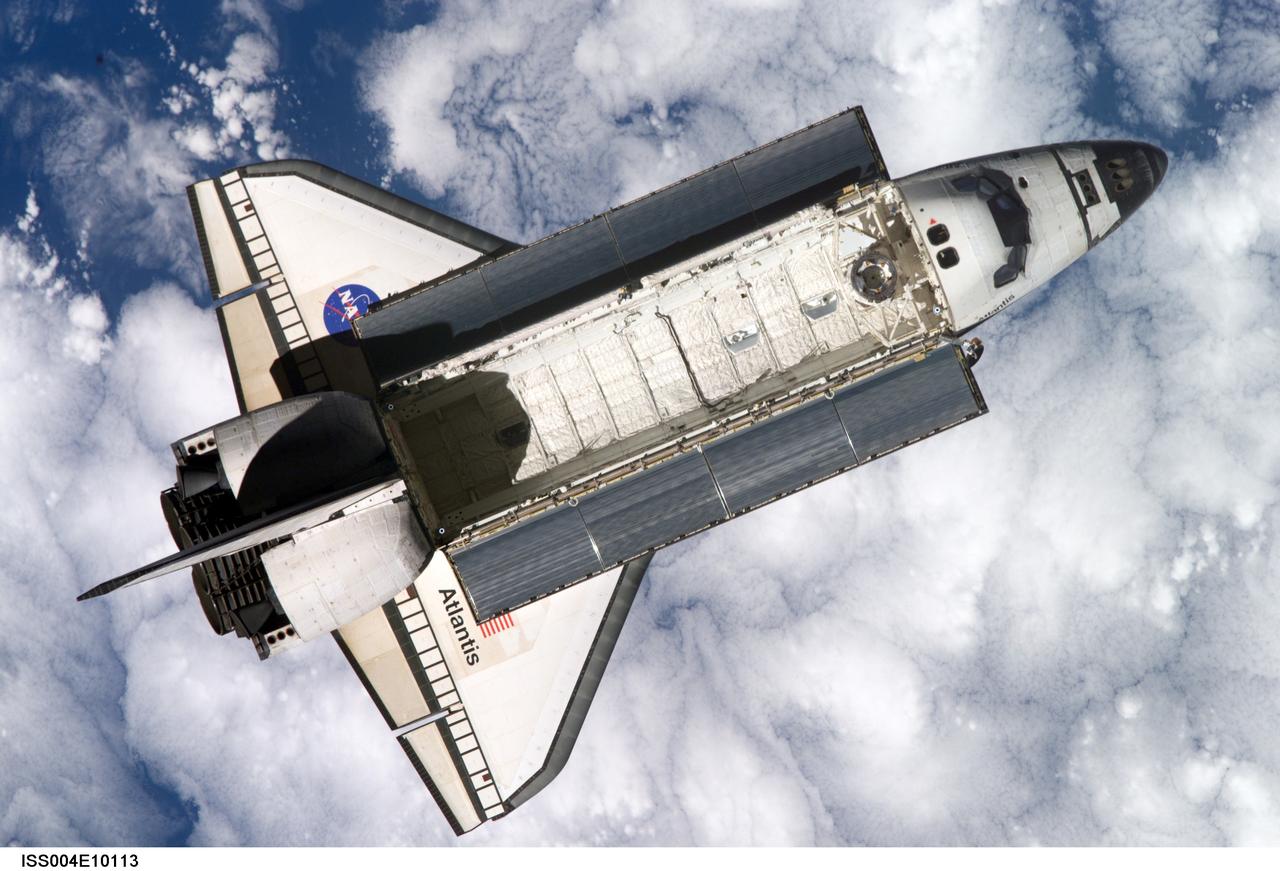
ISS004-E-10113 (17 April 2002) --- Backdropped over clouds some 247 statute miles below, the Space Shuttle Atlantis was photographed with a digital still camera shortly after its separation from the International Space Station (ISS). A big empty space now replaces the "look" in the cargo bay of a scene one and half weeks ago showing the giant S0 (S-zero) truss in the cargo bay as the shuttle prepared to dock with the station. The S0 truss is now part of the orbital outpost.
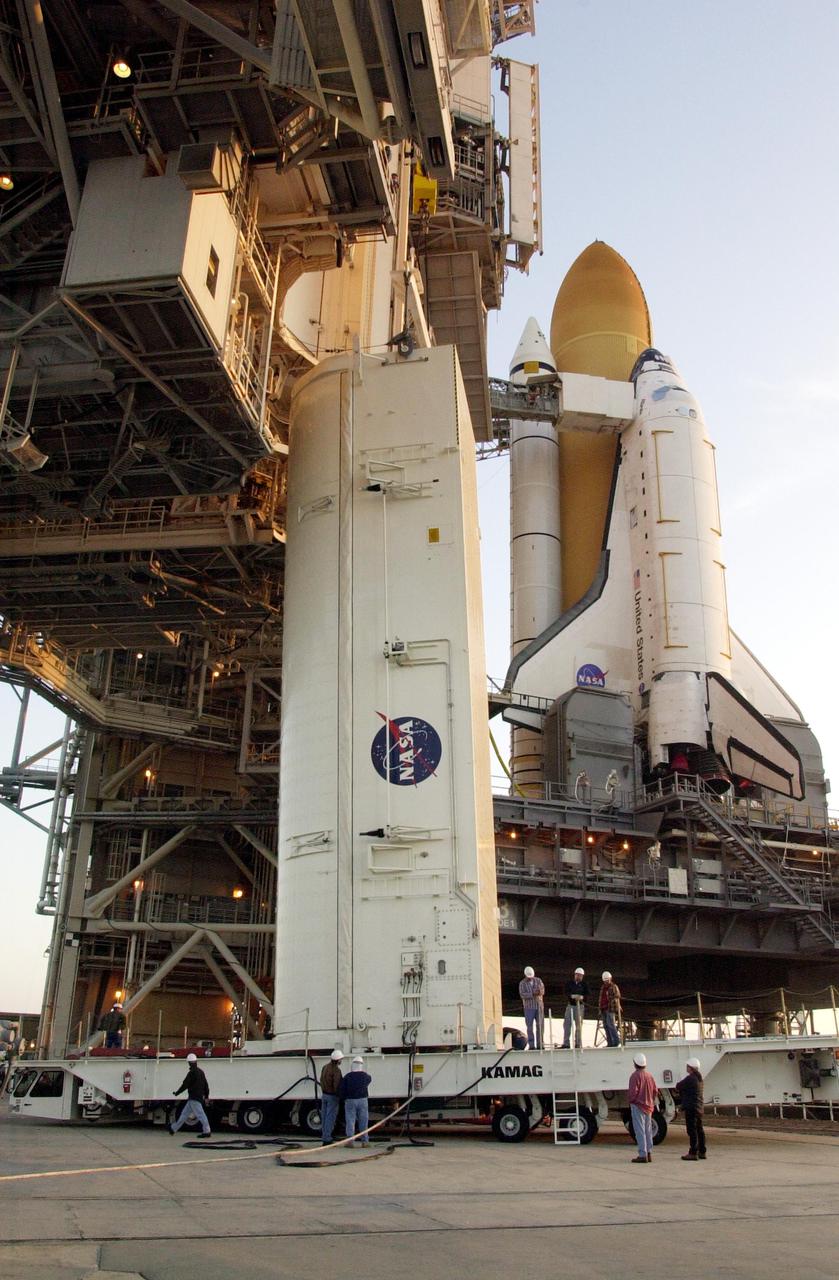
KENNEDY SPACE CENTER, FLA. - On the launch pad, workers prepare the payload canister for its lift to the payload changeout room above. Part of the payload on mission STS-110, the S0 truss will become the backbone of the orbiting International Space Station (ISS). The S0 truss will be attached to the U.S. Lab, 'Destiny,' on the 11-day mission. Launch is scheduled for April 4
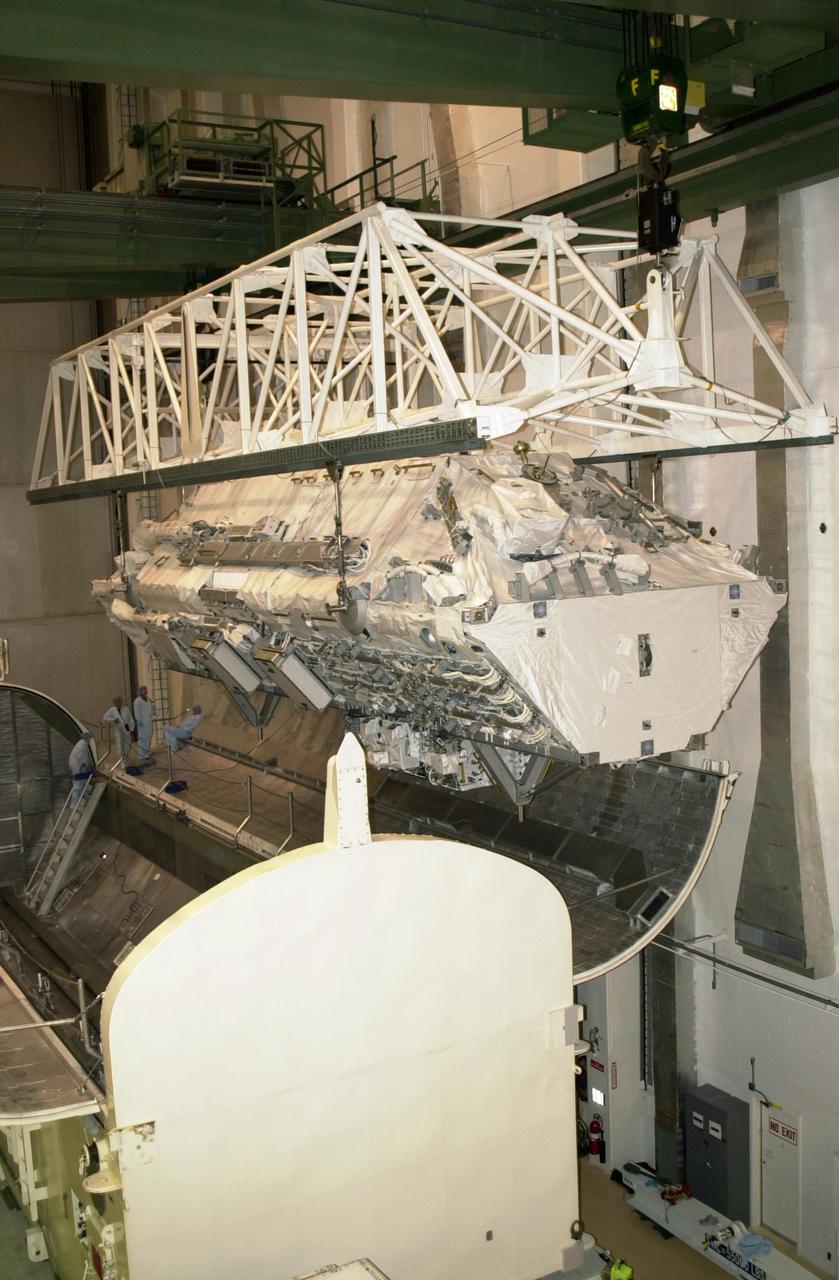
KENNEDY SPACE CENTER, FLA. -- The Integrated Truss Structure S0 arrives at the payload canister in the Operations and Checkout Building for transfer to the launch pad for mission STS-110. Part of the payload on Space Shuttle Atlantis, the S0 truss will be attached to the U.S. Lab, 'Destiny,' on the 11-day mission, becoming the backbone of the orbiting International Space Station (ISS). Launch is scheduled for April 4
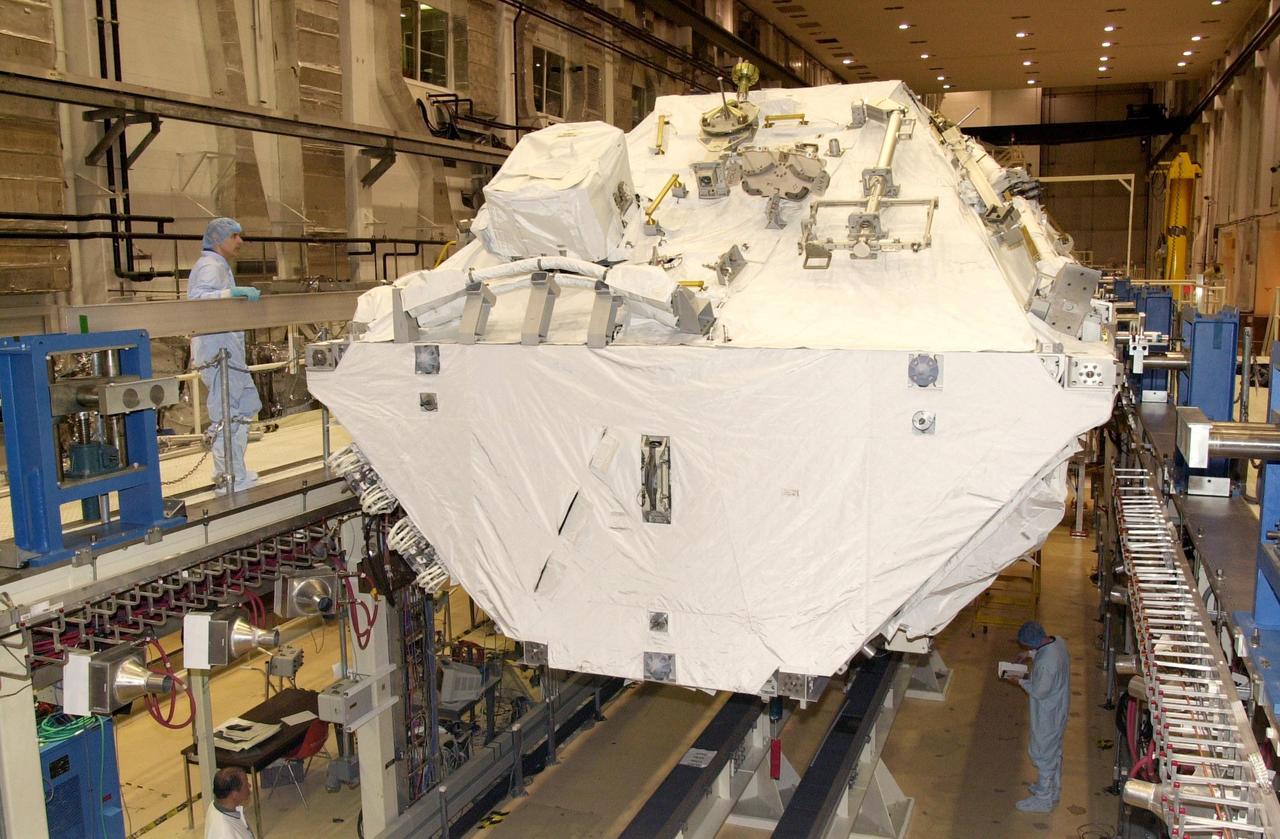
KENNEDY SPACE CENTER, FLA. - In the Operations and Checkout Building, the Integrated Truss Structure S0 is ready for transport to the launch pad on mission STS-110. Scheduled for launch April 4, the 11-day mission will feature Space Shuttle Atlantis docking with the International Space Station (ISS) and delivering the S0 truss, the centerpiece-segment of the primary truss structure that will eventually extend over 300 feet

KENNEDY SPACE CENTER, Fla. -- In the Operations and Checkout Building, STS-110 crew members check out Integrated Truss Structure (ITS) S0, which will be part of the payload on the mission. On the left are Mission Specialists Jerry L. Ross and Rex J. Walheim. On the right, standing next to two trainers, is Mission Specialist Lee M. Morin. They and other crew members are taking part in a Crew Equipment Interface Test at KSC. Not shown are Commander Michael J. Bloomfield, Pilot Stephen N. Frick, and Mission Specialists Steven L. Smith and Ellen Ochoa. The ITS S0 is part of the payload on the mission. It is the center segment they will be installing on the International Space Station, part of the 300-foot (91-meter) truss attached to the U.S. Lab. By assembly completion, four more truss segments will attach to either side of the S0 truss. STS-110 is currently scheduled to launch in February 2002
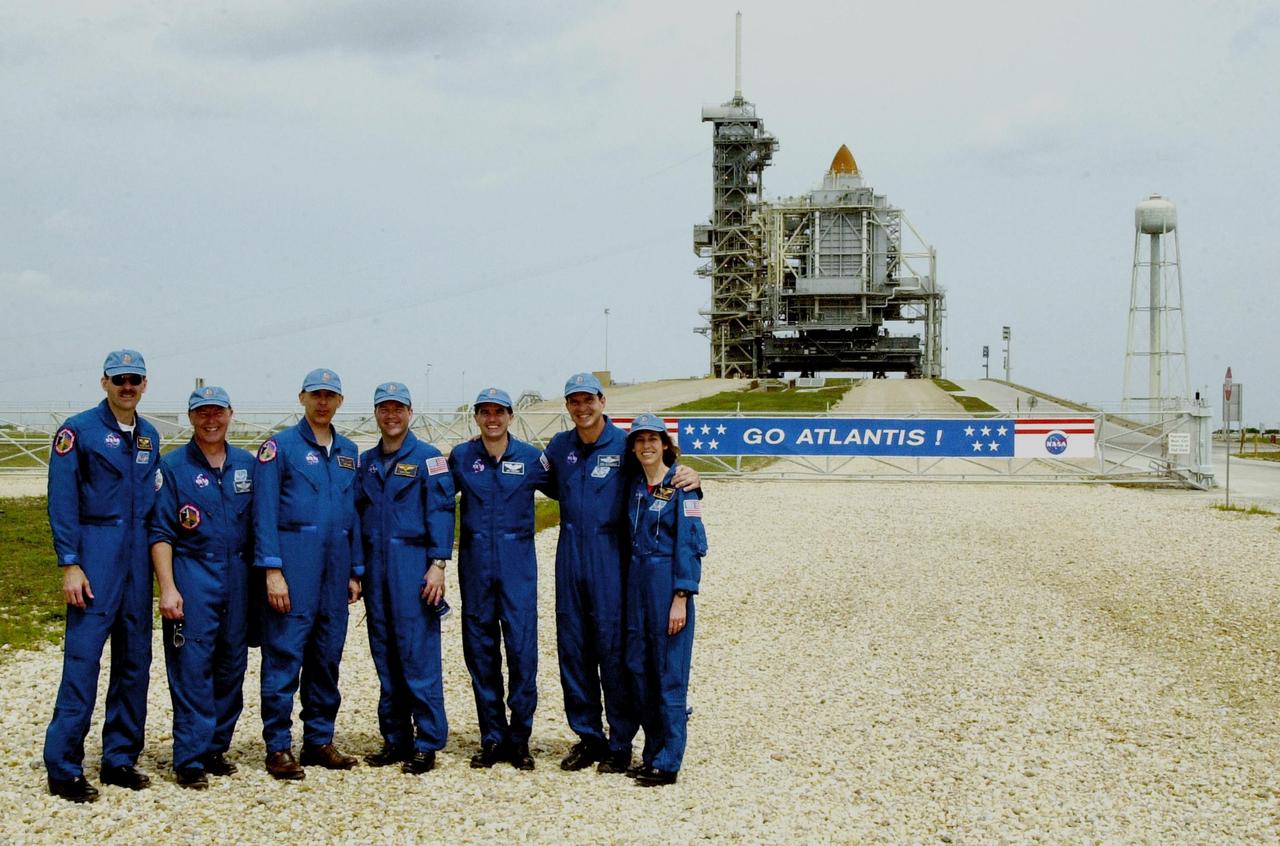
KENNEDY SPACE CENTER, FLA. -- While gathering with friends and family at the pad, the STS-110 crew poses in front of Space Shuttle Atlantis still enclosed by the Rotating Service Structure. Standing left to right are Mission Specialist Steven Smith, Jerry Ross and Lee Morin; Pilot Stephen Frick; Mission Specialist Rex Walheim; Commander Michael Bloomfield; and Mission Specialist Ellen Ochoa. The mission continues the expansion of the International Space Station by delivering and installing the S0 Integrated Truss Structure, the initial section of a framework that will eventually hold the power and cooling systems needed for future international research laboratories. The payload also comprises the Canadian Mobile Transporter (attached to the S0 truss), power distribution system modules, a heat pipe radiator for cooling, computers and a pair of rate gyroscopes. The 11-day mission is the 13th assembly flight to the ISS and includes four spacewalks to attach the S0 truss to the U.S. Lab Destiny. Launch is scheduled for April 4
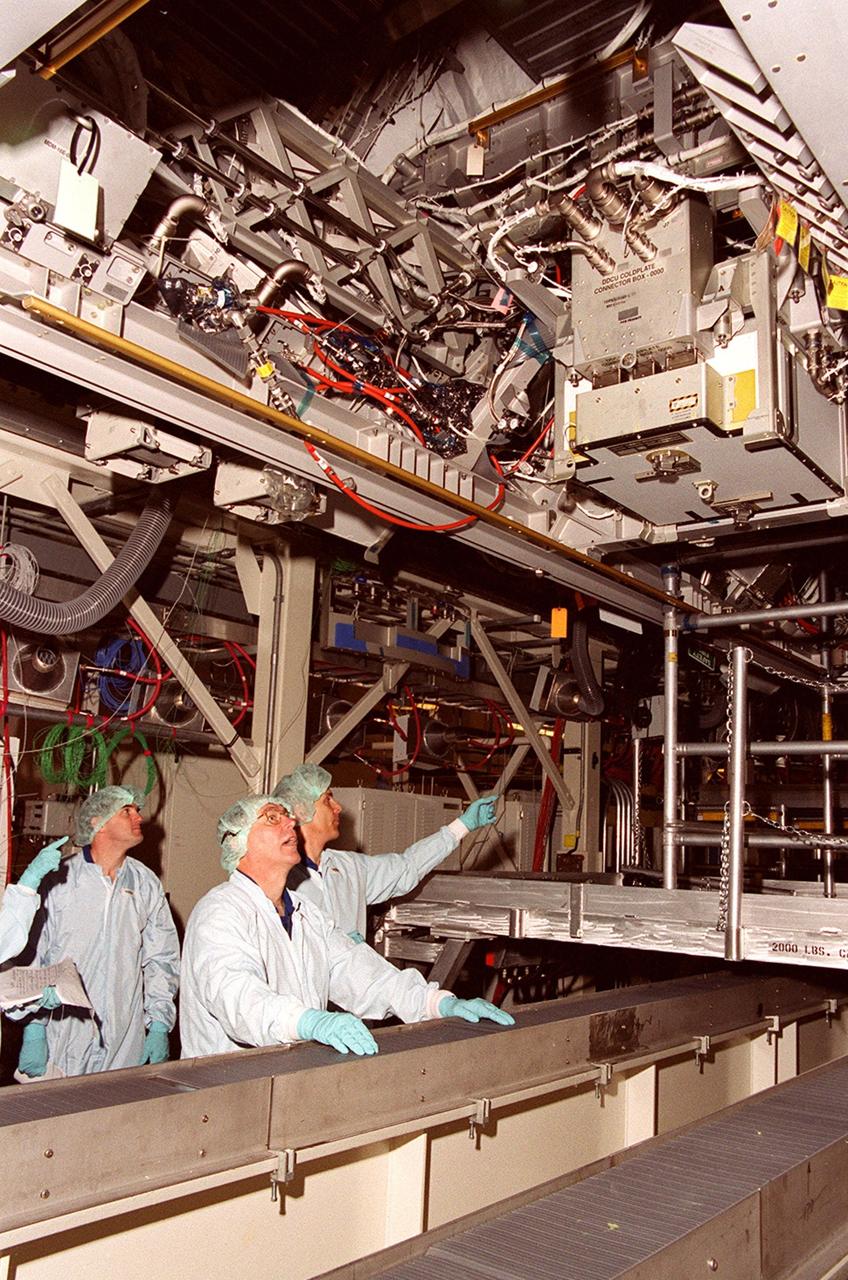
KENNEDY SPACE CENTER, Fla. -- From a vantage point below it, members of the STS-110 crew check out Integrated Truss Structure (ITS) S0, which is in the Operations and Checkout Building. From left are Mission Specialists Rex J. Walheim, Jerry L. Ross and Lee M. Morin. They and other crew members are taking part in a Crew Equipment Interface Test at KSC. Not shown are Commander Michael J. Bloomfield, Pilot Stephen N. Frick, and Mission Specialists Steven L. Smith and Ellen Ochoa. The ITS S0 is part of the payload on the mission. It is the center segment they will be installing on the International Space Station, part of the 300-foot (91-meter) truss attached to the U.S. Lab. By assembly completion, four more truss segments will attach to either side of the S0 truss. STS-110 is currently scheduled to launch in February 2002
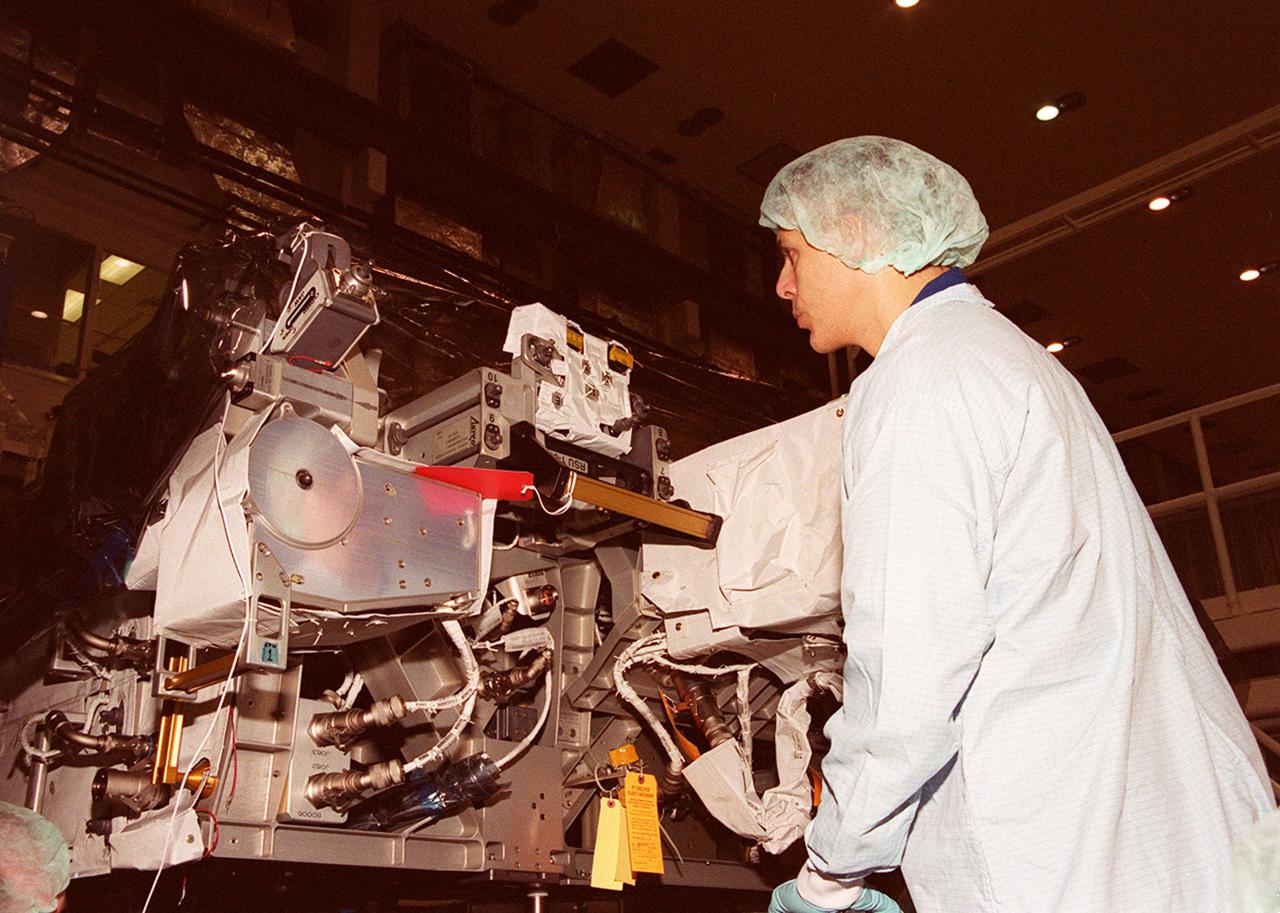
KENNEDY SPACE CENTER, Fla. -- In the Operations and Checkout Building, STS-110 Mission Specialist Lee M. Morin checks out Integrated Truss Structure (ITS) S0, which will be part of the payload on the mission. He and other crew members are at KSC for a Crew Equipment Interface Test. The STS-110 crew comprises Commander Michael J. Bloomfield, Pilot Stephen N. Frick, Mission Specialists Jerry L. Ross , Steven L. Smith, Ellen Ochoa, Morin and Rex J. Walheim. The ITS S0 is part of the payload on the mission. It is the center segment they will be installing on the International Space Station, part of the 300-foot (91-meter) truss attached to the U.S. Lab. By assembly completion, four more truss segments will attach to either side of the S0 truss. STS-110 is currently scheduled to launch in February 2002
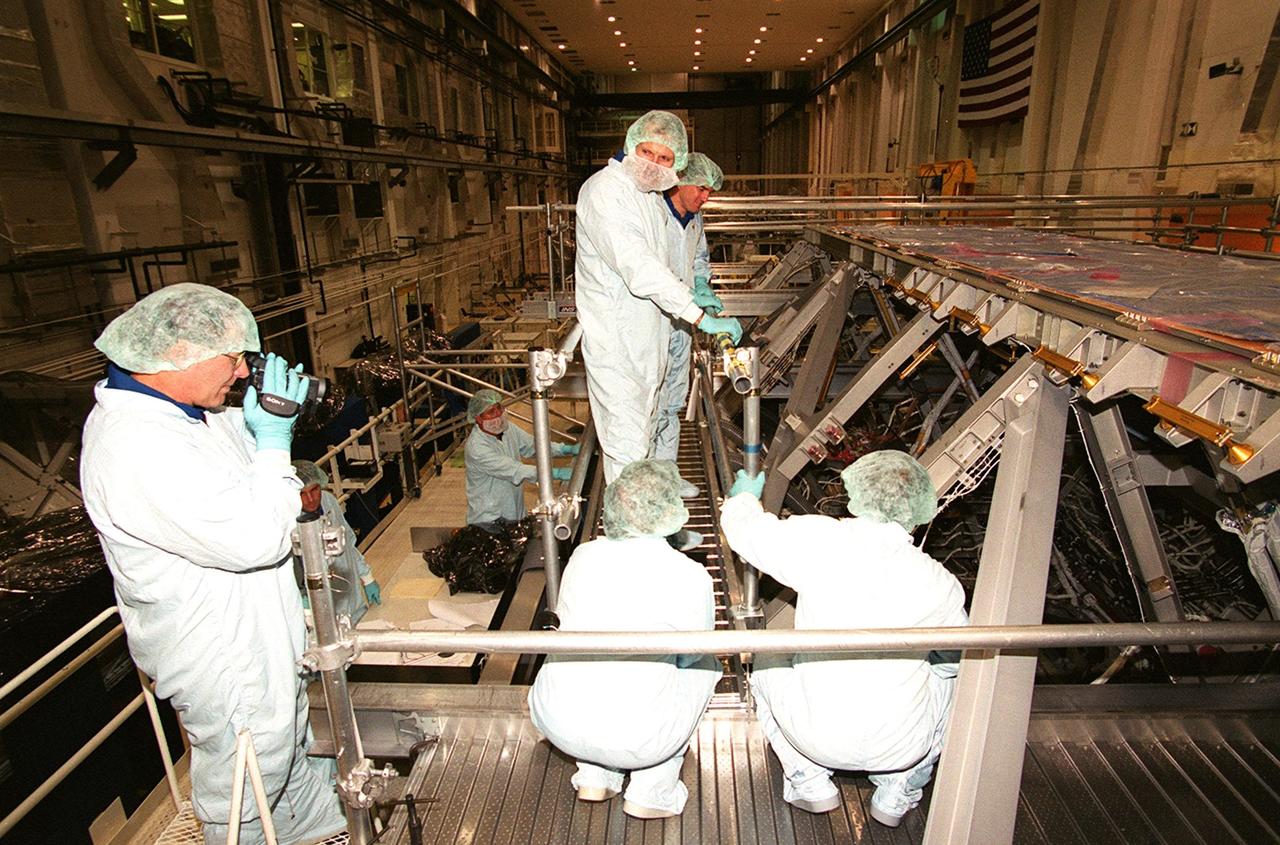
KENNEDY SPACE CENTER, Fla. -- In the Operations and Checkout Building, during a Crew Equipment Interface Test, members of the STS-110 crew check out Integrated Truss Structure (ITS) S0, which will be part of the payload on their mission. At left is Mission Specialist Jerry L. Ross, with a camera. Standing (center) are Mission Specialists Steven L. Smith and Rex J. Walheim. Other crew members (not shown) are Commander Michael J. Bloomfield, Pilot Stephen N. Frick, and Missin Specialists Ellen Ochoa and Lee M. Morin. The ITS S0 is part of the payload on the mission. It is the center segment they will be installing on the International Space Station, part of the 300-foot (91-meter) truss attached to the U.S. Lab. By assembly completion, four more truss segments will attach to either side of the S0 truss. STS-110 is currently scheduled to launch in February 2002
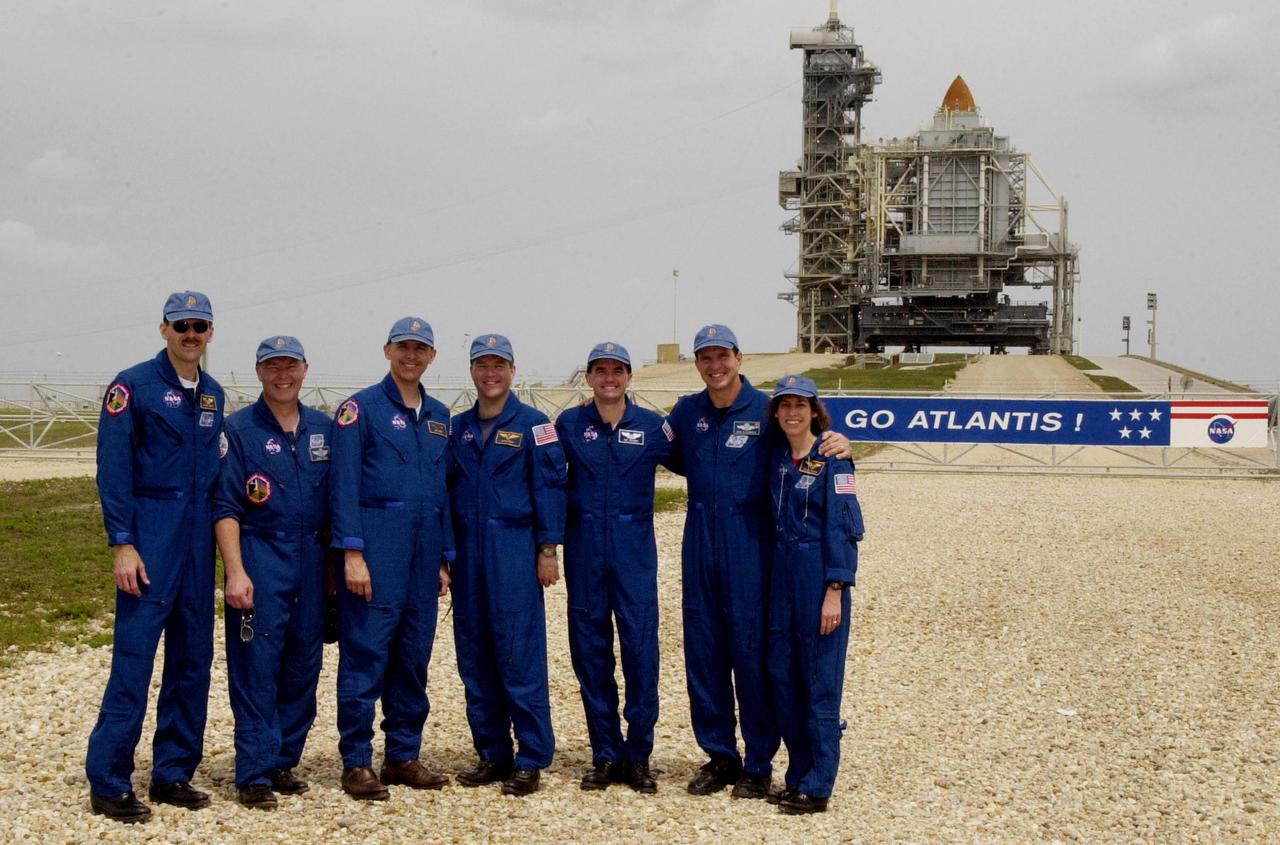
KENNEDY SPACE CENTER, FLA. -- While gathering with friends and family at the pad, the STS-110 crew poses in front of Space Shuttle Atlantis still enclosed by the Rotating Service Structure. Standing left to right are Mission Specialist Steven Smith, Jerry Ross and Lee Morin; Pilot Stephen Frick; Mission Specialist Rex Walheim; Commander Michael Bloomfield; and Mission Specialist Ellen Ochoa. The mission continues the expansion of the International Space Station by delivering and installing the S0 Integrated Truss Structure, the initial section of a framework that will eventually hold the power and cooling systems needed for future international research laboratories. The payload also comprises the Canadian Mobile Transporter (attached to the S0 truss), power distribution system modules, a heat pipe radiator for cooling, computers and a pair of rate gyroscopes. The 11-day mission is the 13th assembly flight to the ISS and includes four spacewalks to attach the S0 truss to the U.S. Lab Destiny. Launch is scheduled for April 4
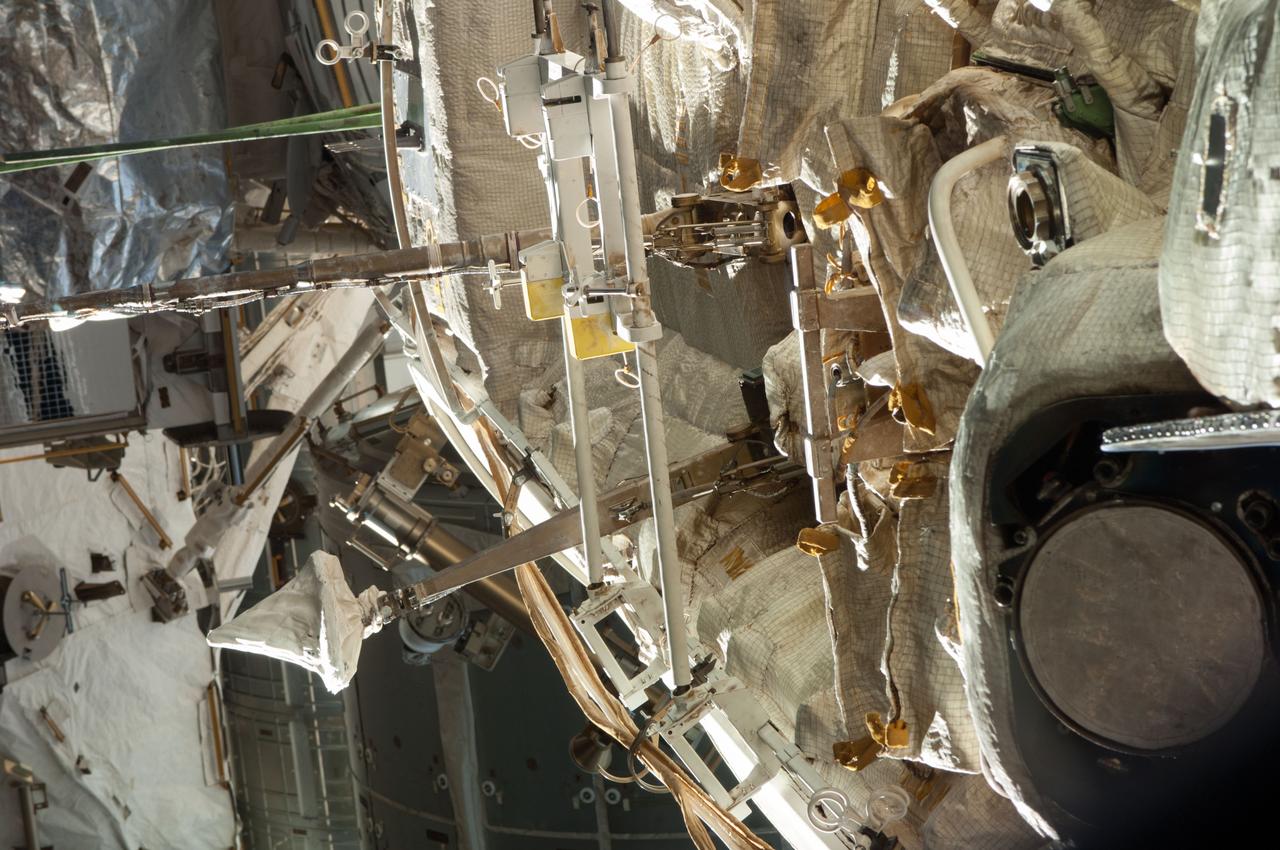
Survey view of a portion of the Zarya Functional Cargo Block (FGB) taken through a window in the Russian segment of the ISS during Expedition 35. Portions of the S0 and Z1 Truss segments are also in view.
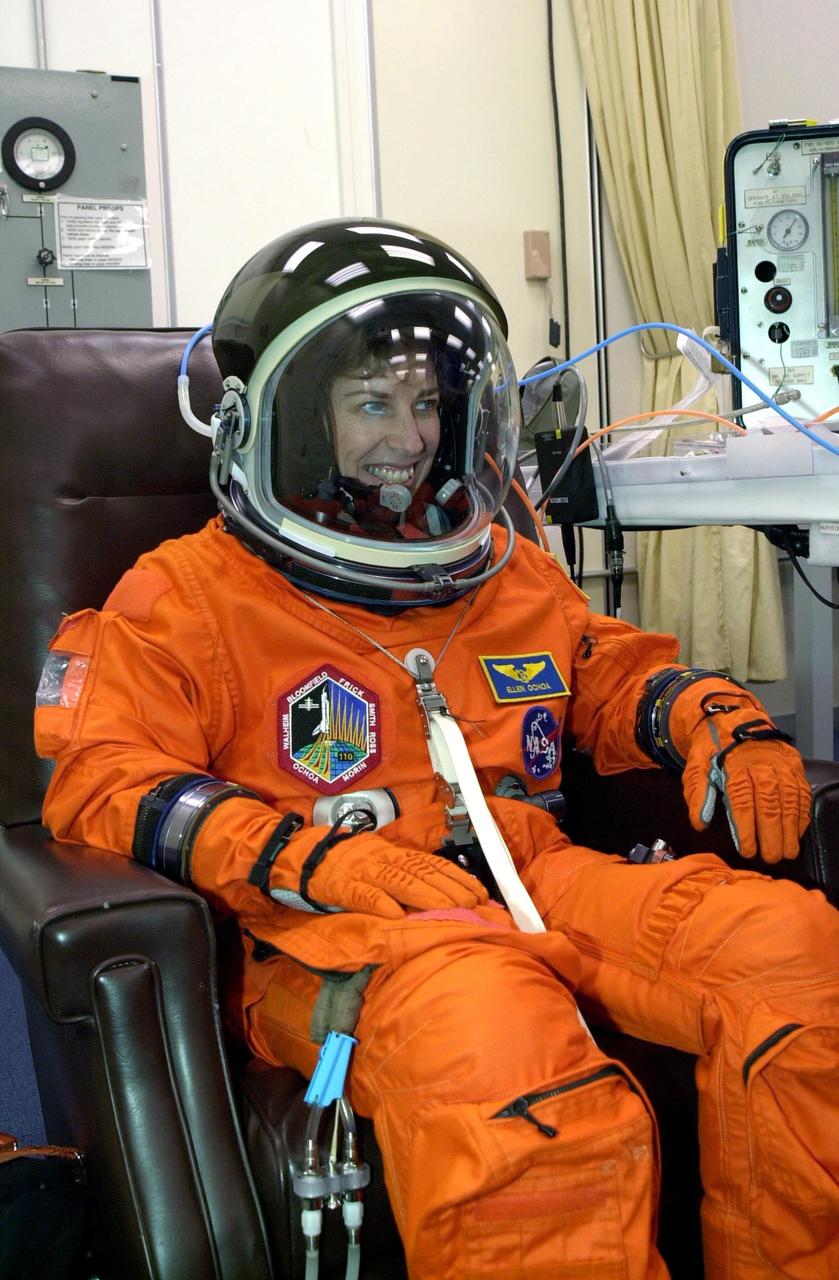
KENNEDY SPACE CENTER, FLA. -- STS-110 Mission Specialist Ellen Ochoa grins after suiting up for launch, scheduled for 4:40 p.m. EDT (20:40 GMT). Ochoa is making her fourth Shuttle flight. STS-110 is the 13th assembly flight to the International Space Station, carrying the S0 Integrated Truss Structure and Mobile Transporter (MT). On the 11-day mission, the mission features four spacewalks to attach the S0 truss, which will become the backbone of the Space Station, to the U.S. Lab, "Destiny." The MT, a space "railcar," is attached to the truss segment and will make its debut run during the flight
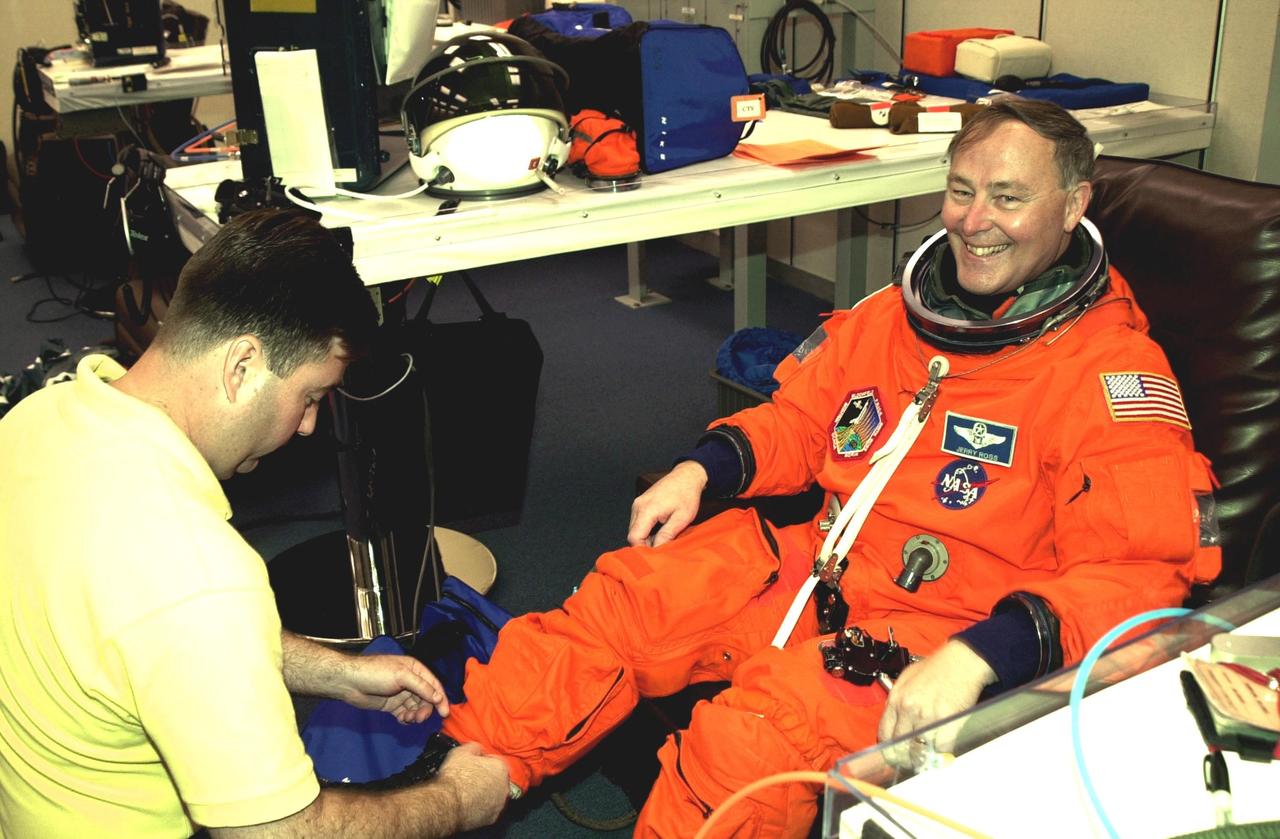
KENNEDY SPACE CENTER, FLA. -- As he undergoes a final check on his launch and entry suit, STS-110 Mission Specialist Jerry Ross shows his delight in the upcoming launch. Ross will be making a record-breaking seventh Shuttle flight. The STS-110 payload includes the S0 Integrated Truss Structure (ITS), the Canadian Mobile Transporter, power distribution system modules, a heat pipe radiator for cooling, computers and a pair of rate gyroscopes. The 11-day mission is the 13th assembly flight to the ISS and includes four spacewalks to attach the S0 truss to the U.S. Lab Destiny. Launch is scheduled for April 4
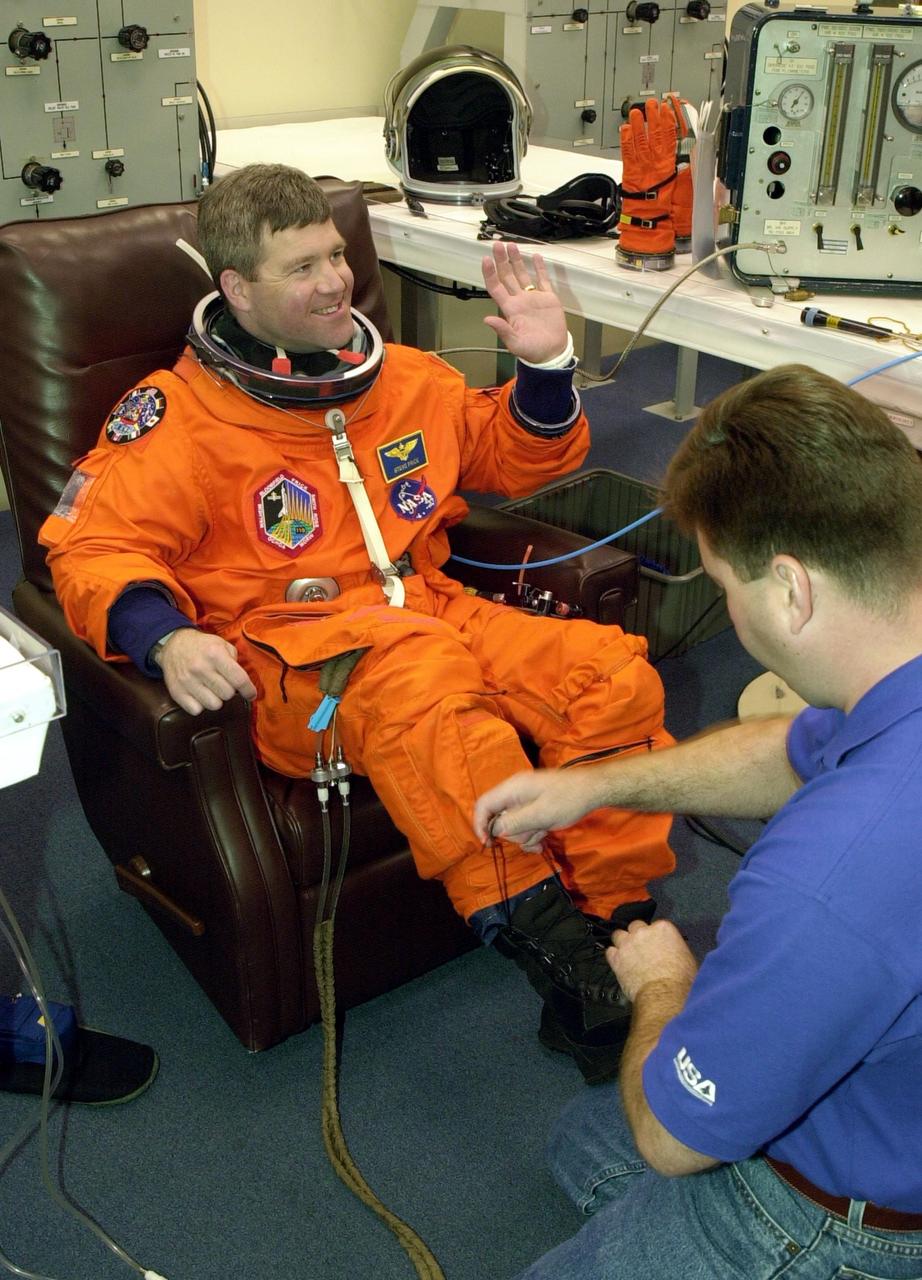
KENNEDY SPACE CENTER, FLA. -- STS-110 Pilot Stephen N. Frick waves while a suit technician makes final adjustments on his launch and entry suit for the launch scheduled for 4:40 p.m. EDT. Frick is making his first Shuttle flight. STS-110 is the 13th assembly flight to the International Space Station, carrying the S0 Integrated Truss Structure and Mobile Transporter (MT). On the 11-day mission, the mission features four spacewalks to attach the S0 truss, which will become the backbone of the Space Station, to the U.S. Lab, "Destiny." The MT, a space "railcar," is attached to the truss segment and will make its debut run during the flight
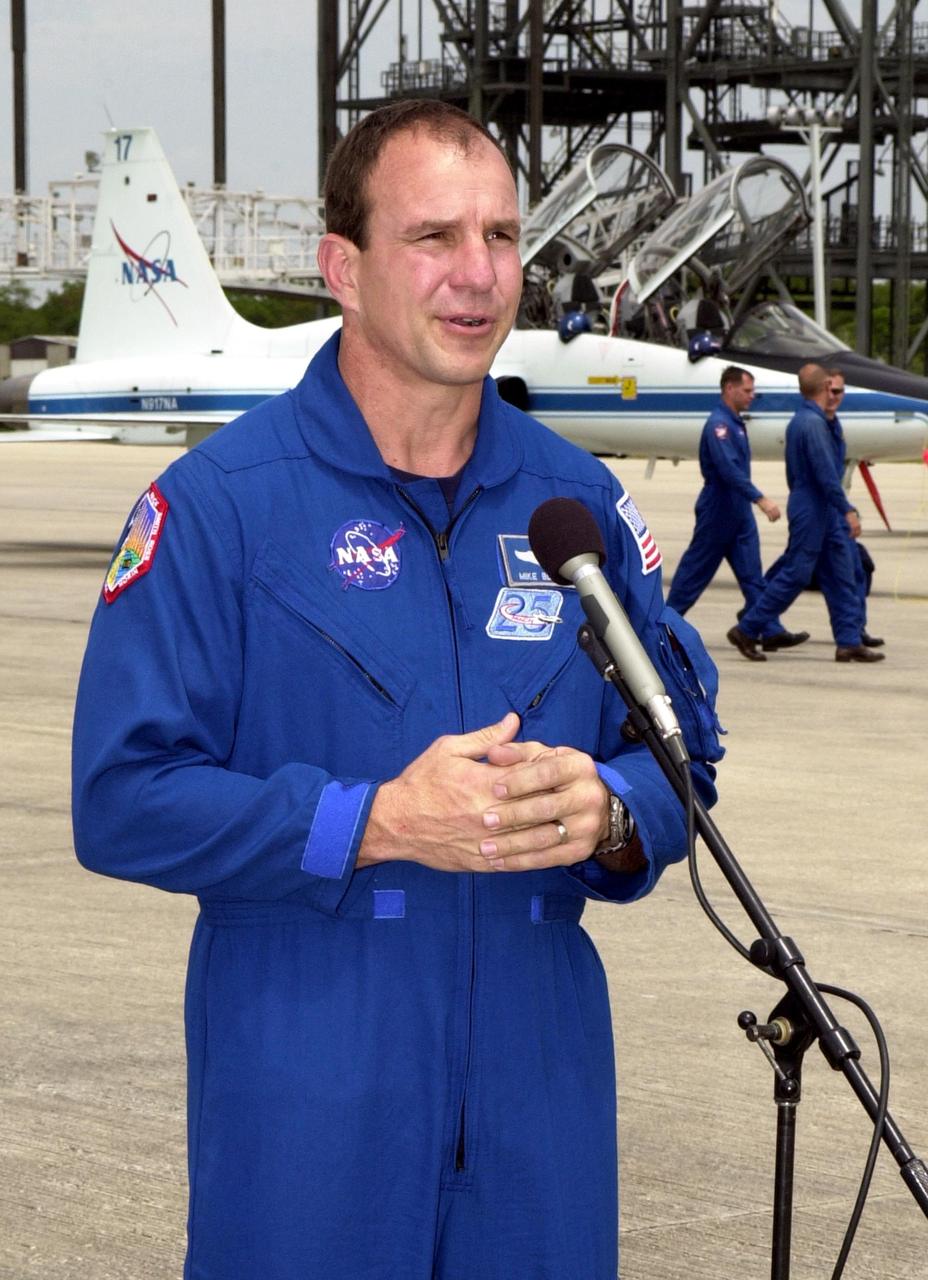
KENNEDY SPACE CENTER, FLA. -- -- After landing at the KSC Shuttle Landing Facility to prepare for launch April 4, STS-110 Commander Michael Bloomfield comments about the upcoming mission for the media. Mission STS-110 is the 13th assembly flight to the International Space Station. During four planned spacewalks, crew members will install the S0 Integrated Truss Structure (ITS), centerpiece of the orbiting International Space Station (ISS), at the center of the 10-truss, girderlike structure that will ultimately extend the length of a football field on the ISS. The S0 truss will be attached to the U.S. Lab, "Destiny," on the 11-day mission
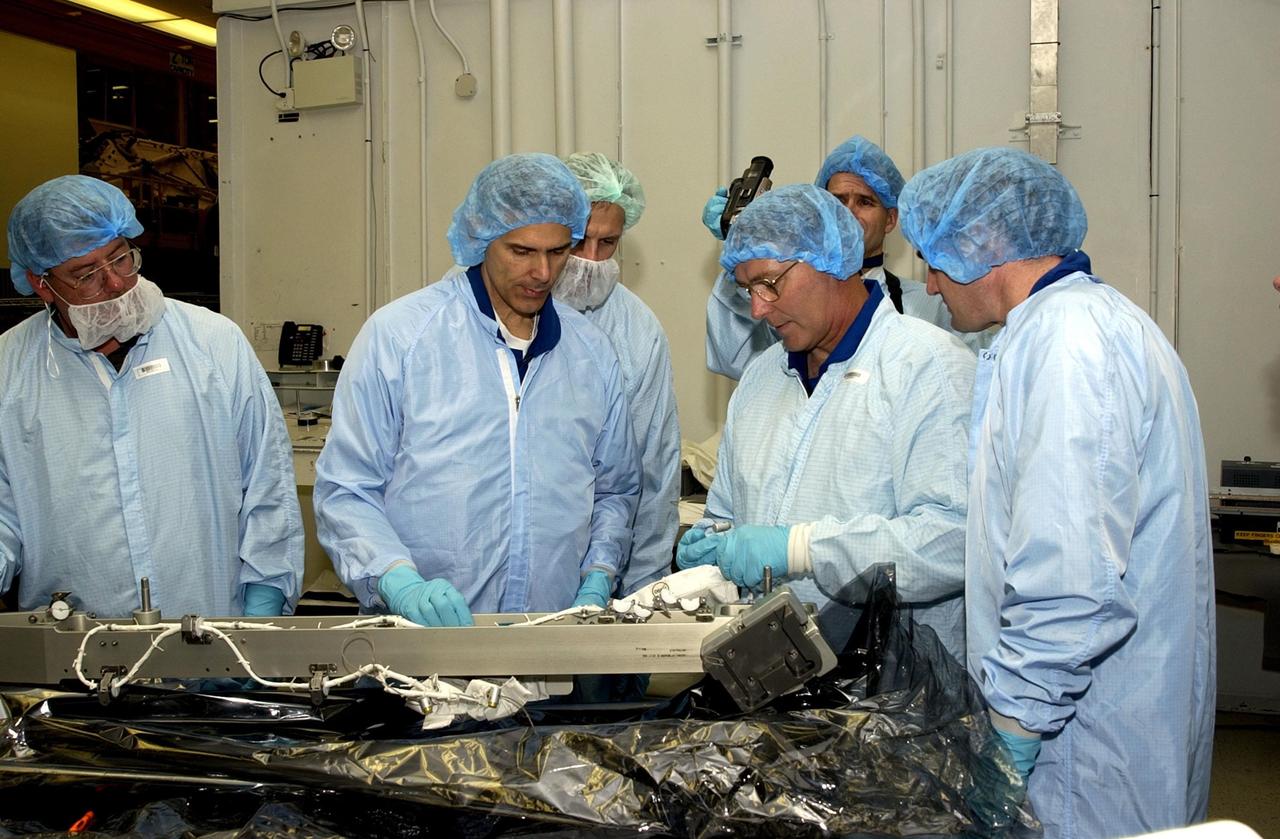
KENNEDY SPACE CENTER, FLA. -- In the Operations and Checkout Building, members of the STS-110 crew check out equipment that will be on their mission. From left are Mission Specialists Steven Smith, Lee Morin, Jerry Ross and Rex Walheim. Other crew members (not shown) are Commander Michael J. Bloomfield, Pilot Stephen N. Frick, and Mission Specialist Ellen Ochoa. Part of the payload on the mission is the Integrated Truss Structure S0. It is the center segment that they will be installing on the International Space Station, part of the 300-foot (91-meter) truss attached to the U.S. Lab. By assembly completion, four more truss segments will attach to either side of the S0 truss. STS-110 is currently scheduled to launch in April 2002
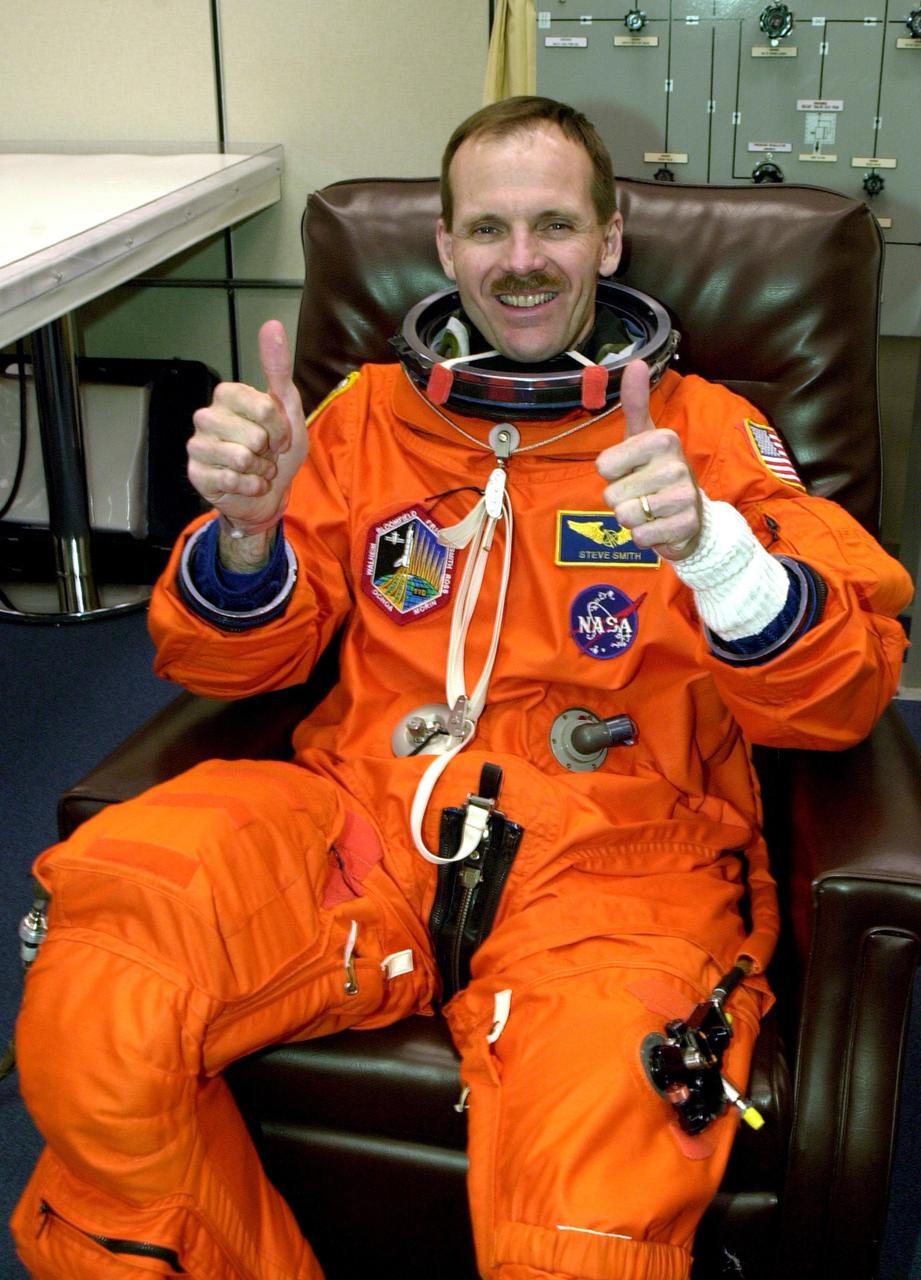
KENNEDY SPACE CENTER, FLA. -- Making his fourth Shuttle flight, STS-110 Mission Specialist Steven L. Smith gives a thumbs up for the launch scheduled for 4:40 p.m. EDT. STS-110 is the 13th assembly flight to the International Space Station, carrying the S0 Integrated Truss Structure and Mobile Transporter (MT). On the 11-day mission, the mission features four spacewalks to attach the S0 truss, which will become the backbone of the Space Station, to the U.S. Lab, 'Destiny.' The MT, a space 'railcar,' is attached to the truss segment and will make its debut run during the flight
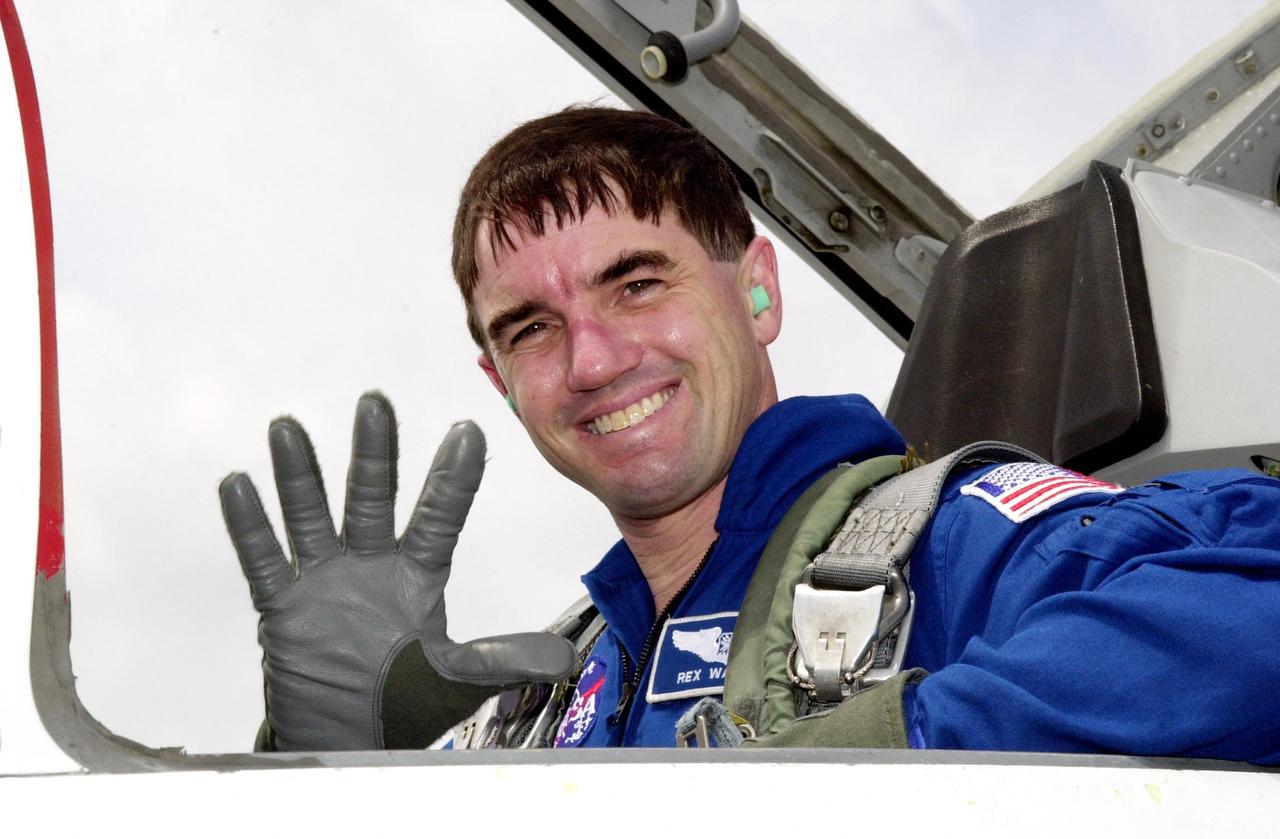
KENNEDY SPACE CENTER, FLA. - After landing at the KSC Shuttle Landing Facility, STS-110 Mission Specialist Rex Walheim smiles in anticipation of his first Space Shuttle flight, scheduled for launch April 4. Mission STS-110 is the 13th assembly flight to the International Space Station. During four planned spacewalks, crew members will install the S0 Integrated Truss Structure (ITS), centerpiece of the orbiting International Space Station (ISS), at the center of the 10-truss, girderlike structure that will ultimately extend the length of a football field on the ISS. The S0 truss will be attached to the U.S. Lab, "Destiny," on the 11-day mission
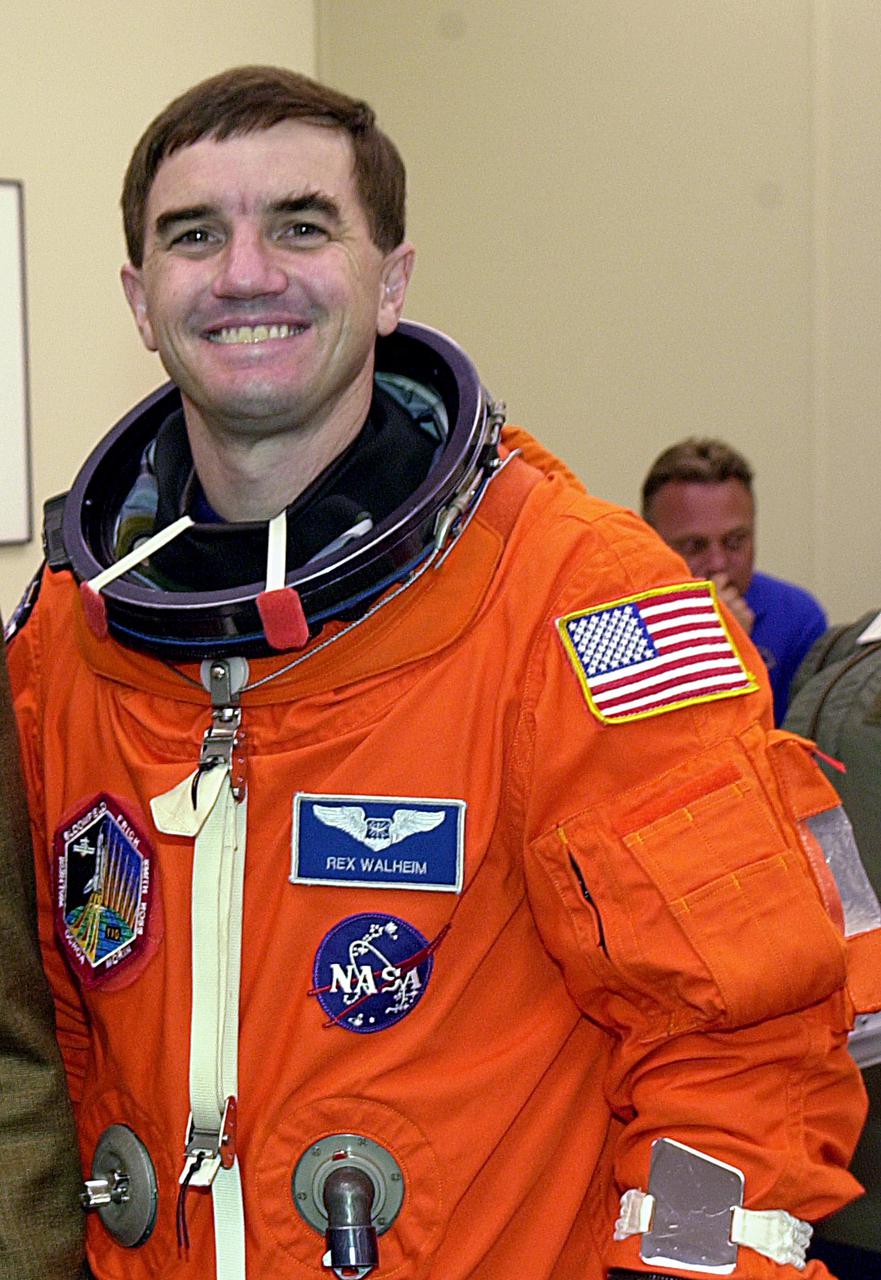
KENNEDY SPACE CENTER, FLA. -- During suitup for launch, STS-110 Mission Specialist Rex J. Walheim smiles in anticipation of his first Shuttle flight. STS-110 is the 13th assembly flight to the International Space Station, carrying the S0 Integrated Truss Structure and Mobile Transporter (MT). On the 11-day mission, the mission features four spacewalks to attach the S0 truss, which will become the backbone of the Space Station, to the U.S. Lab, 'Destiny.' The MT, a space 'railcar,' is attached to the truss segment and will make its debut run during the flight. Launch is scheduled for 4:40 p.m. EDT (20:40 GMT)
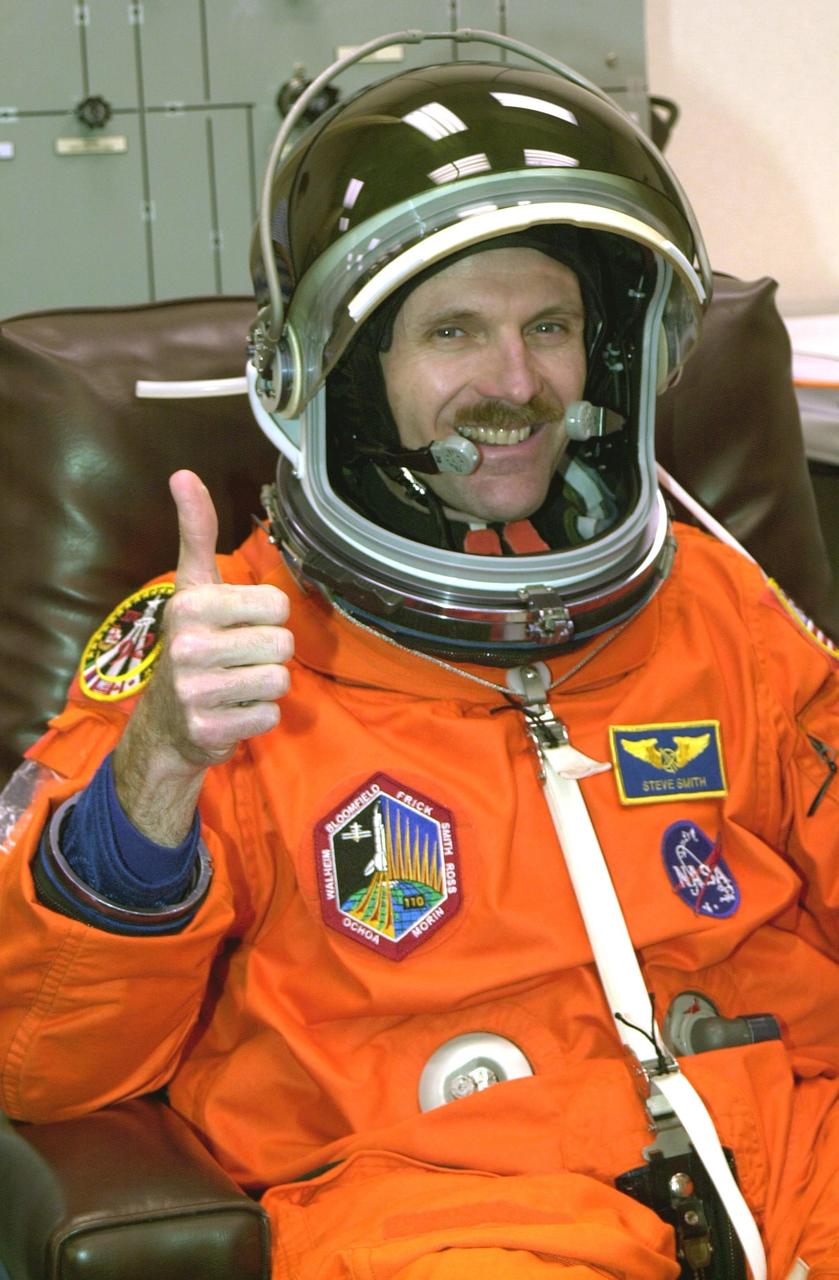
KENNEDY SPACE CENTER, FLA. -- STS-110 Mission Specialist Steven Smith gives a thumbs up for launch as he has a final check of his launch and entry suit. This flight will be his fourth. The STS-110 payload includes the S0 Integrated Truss Structure (ITS), the Canadian Mobile Transporter, power distribution system modules, a heat pipe radiator for cooling, computers and a pair of rate gyroscopes. The 11-day mission is the 13th assembly flight to the ISS and includes four spacewalks to attach the S0 truss to the U.S. Lab Destiny. Launch is scheduled for April 4
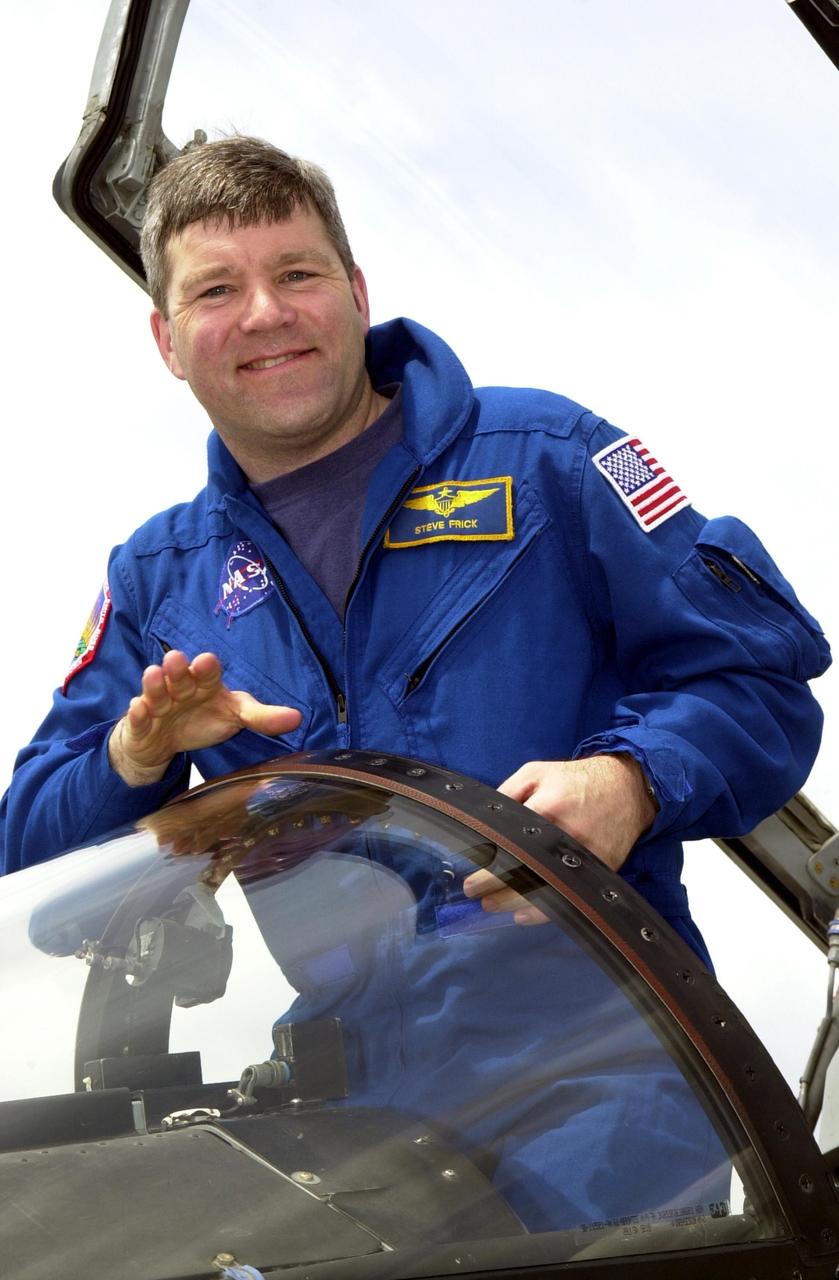
KENNEDY SPACE CENTER, FLA. - STS-110 Pilot Stephen Frick arrives at the KSC Shuttle Landing Facility to prepare for launch April 4. The mission will be his first Space Shuttle flight. Mission STS-110 is the 13th assembly flight to the International Space Station. During four planned spacewalks, crew members will install the S0 Integrated Truss Structure (ITS), centerpiece of the orbiting International Space Station (ISS), at the center of the 10-truss, girderlike structure that will ultimately extend the length of a football field on the ISS. The S0 truss will be attached to the U.S. Lab, "Destiny," on the 11-day mission
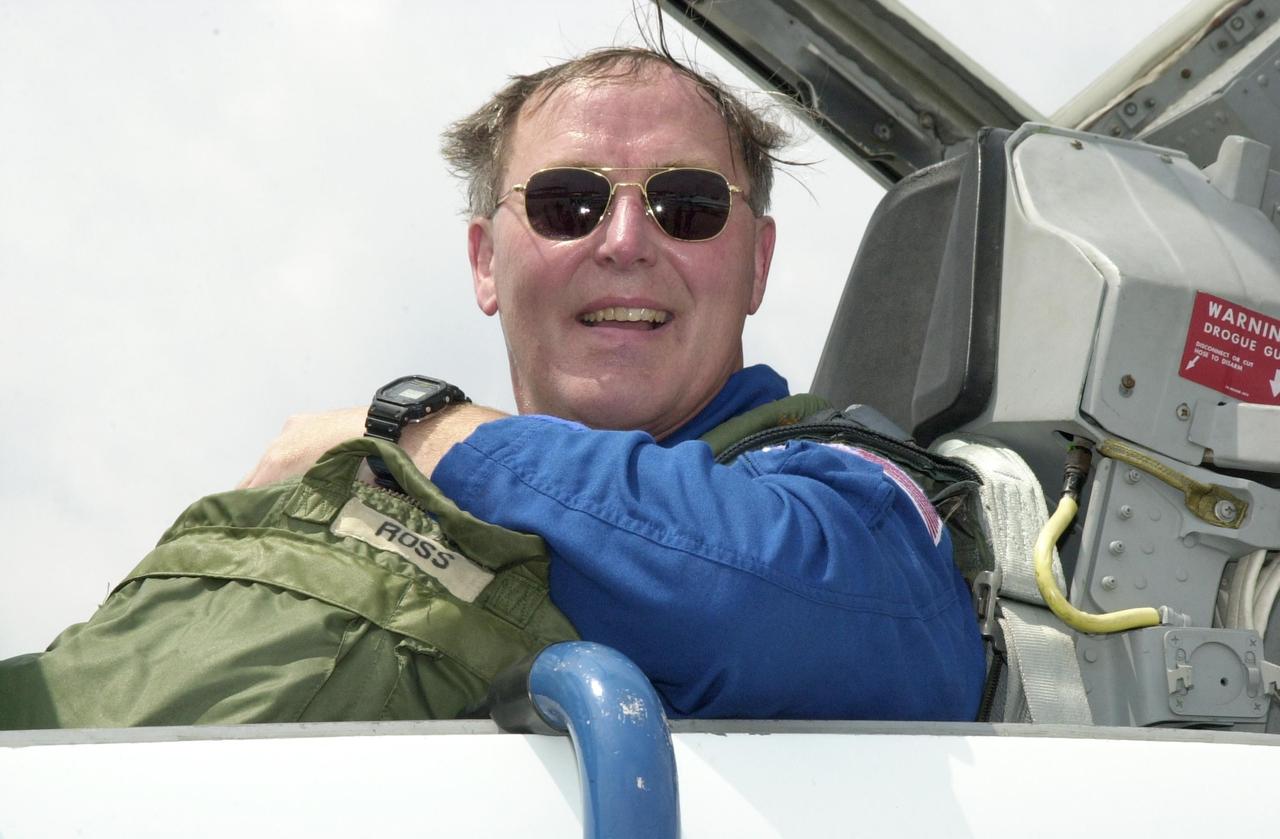
KENNEDY SPACE CENTER, FLA. -- After arriving at the KSC Shuttle Landing Facility, STS-110 Mission Specialist Jerry Ross smiles in anticipation of his record-breaking seventh Space Shuttle flight, scheduled to launch April 4. Mission STS-110 is the 13th assembly flight to the International Space Station. During four planned spacewalks, Ross and other crew members will install the S0 Integrated Truss Structure (ITS), centerpiece of the orbiting International Space Station (ISS), at the center of the 10-truss, girderlike structure that will ultimately extend the length of a football field on the ISS. The S0 truss will be attached to the U.S. Lab, "Destiny," on the 11-day mission
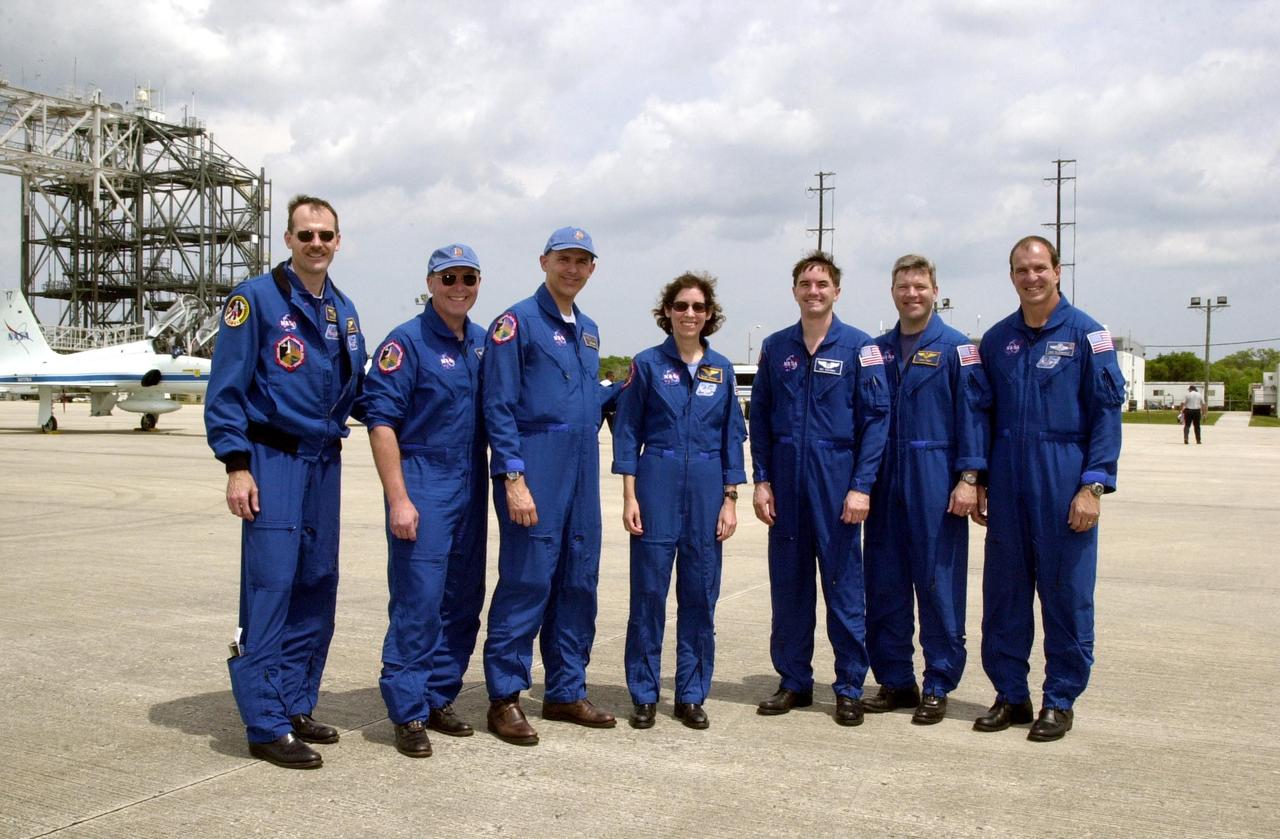
KENNEDY SPACE CENTER, FLA. -- The STS-110 crew poses for a photo after landing at the KSC Shuttle Landing Facility. Standing left to right are Mission Specialists Steven Smith, Jerry Ross, Lee Morin, Ellen Ocho and Rex Walheim; Pilot Stephen Frick; and Commander Michael Bloomfield. Mission STS-110 is the 13th assembly flight to the International Space Station. During four planned spacewalks, crew members will install the S0 Integrated Truss Structure (ITS), centerpiece of the orbiting International Space Station (ISS), at the center of the 10-truss, girderlike structure that will ultimately extend the length of a football field on the ISS. The S0 truss will be attached to the U.S. Lab, "Destiny," on the 11-day mission

KENNEDY SPACE CENTER, FLA. -STS-110 Mission Specialist Steven Smith (left, with camera in hand), gets ready to join other crew members for a photo opportunity and a few comments about the coming launch April 4. Mission STS-110 is the 13th assembly flight to the International Space Station. During four planned spacewalks, crew members will install the S0 Integrated Truss Structure (ITS), centerpiece of the orbiting International Space Station (ISS), at the center of the 10-truss, girderlike structure that will ultimately extend the length of a football field on the ISS. The S0 truss will be attached to the U.S. Lab, 'Destiny,' on the 11-day mission
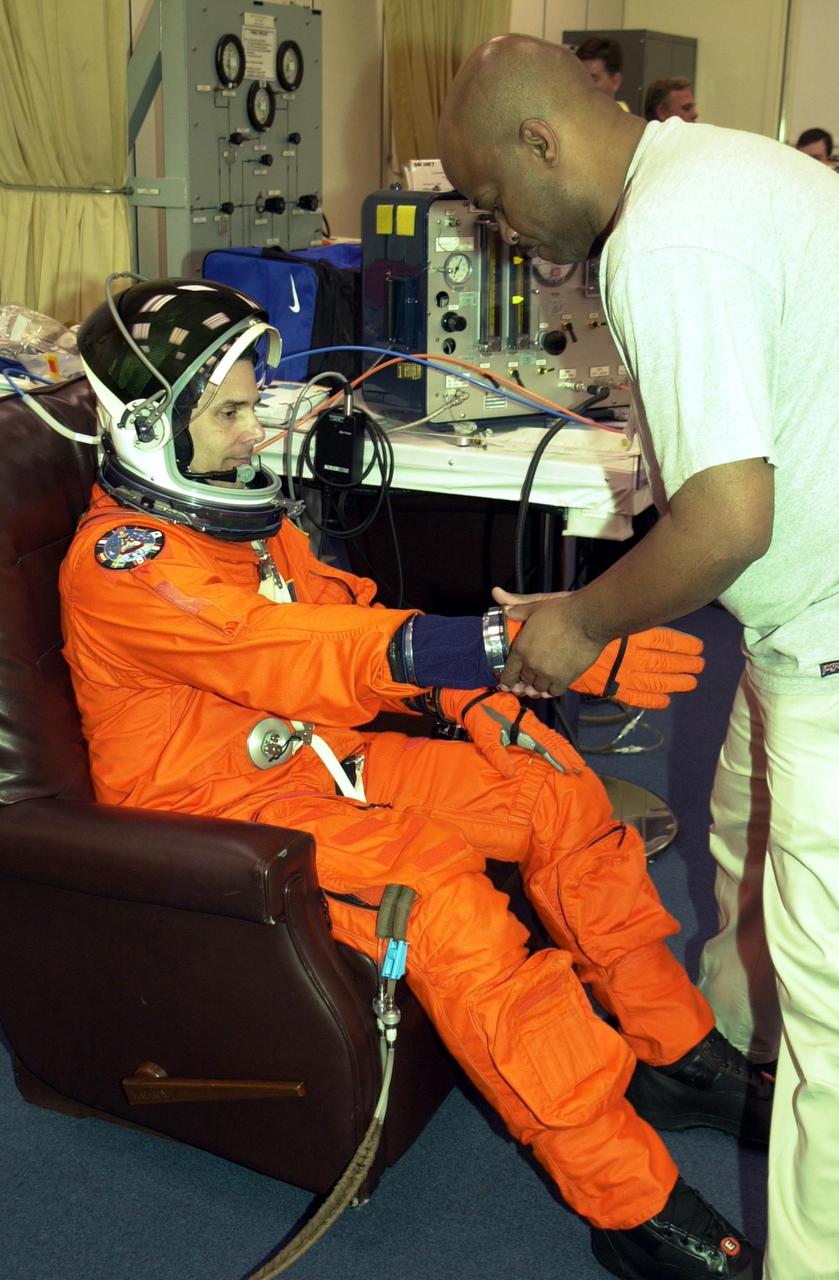
KENNEDY SPACE CENTER, FLA. -- STS-110 Mission Specialist Lee Morin undergoes final check of his launch and entry suit. Morin will be taking his first Shuttle flight. The STS-110 payload includes the S0 Integrated Truss Structure (ITS), the Canadian Mobile Transporter, power distribution system modules, a heat pipe radiator for cooling, computers and a pair of rate gyroscopes. The 11-day mission is the 13th assembly flight to the ISS and includes four spacewalks to attach the S0 truss to the U.S. Lab Destiny. Launch is scheduled for April 4