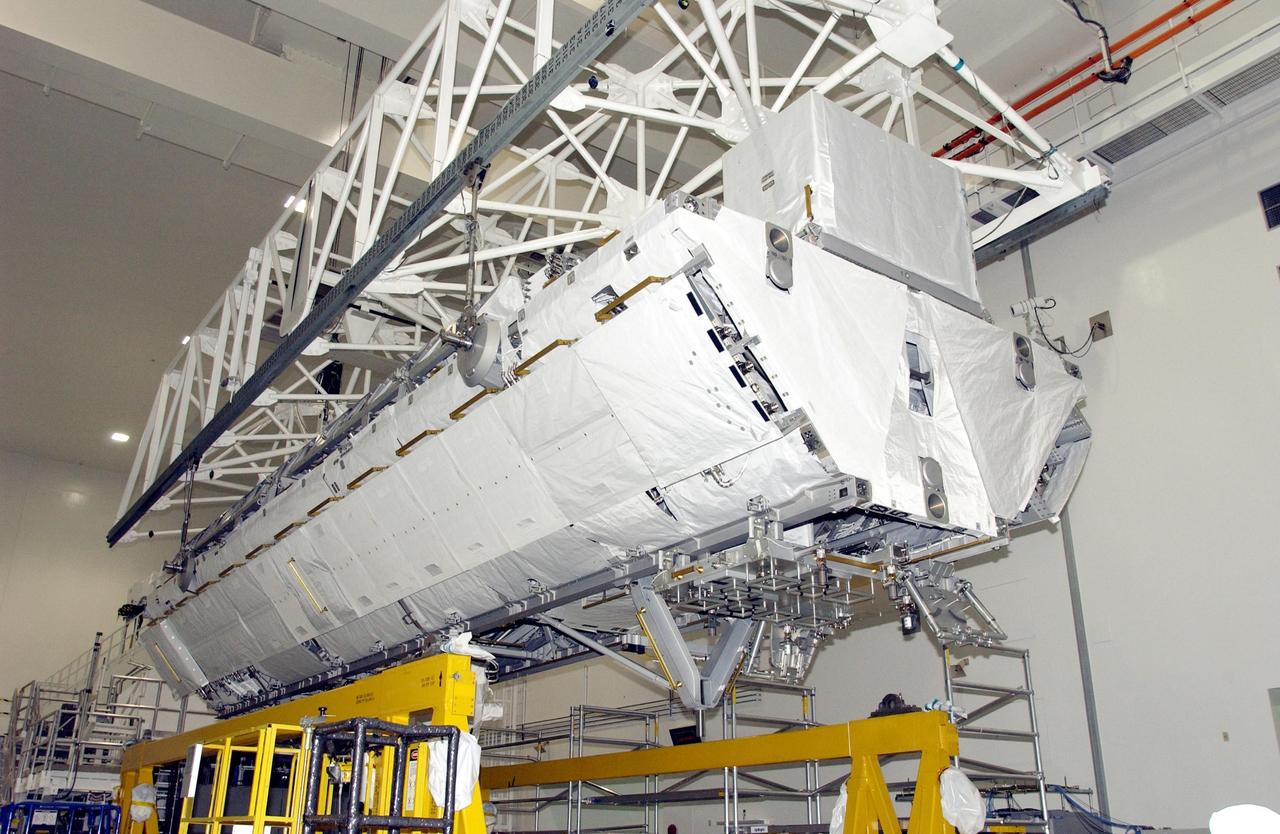
KENNEDY SPACE CENTER, FLA. -- An overhead crane lifts the S1 Integrated Truss Structure from its workstand. The S1 will be placed in the payload canister for transport it to Atlantis. The first starboard truss segment, the S1 will be attached to the Central truss segment, the S0 Truss, on the International Space Station during mission STS-112. Atlantis is scheduled to launch no earlier than Oct. 2.
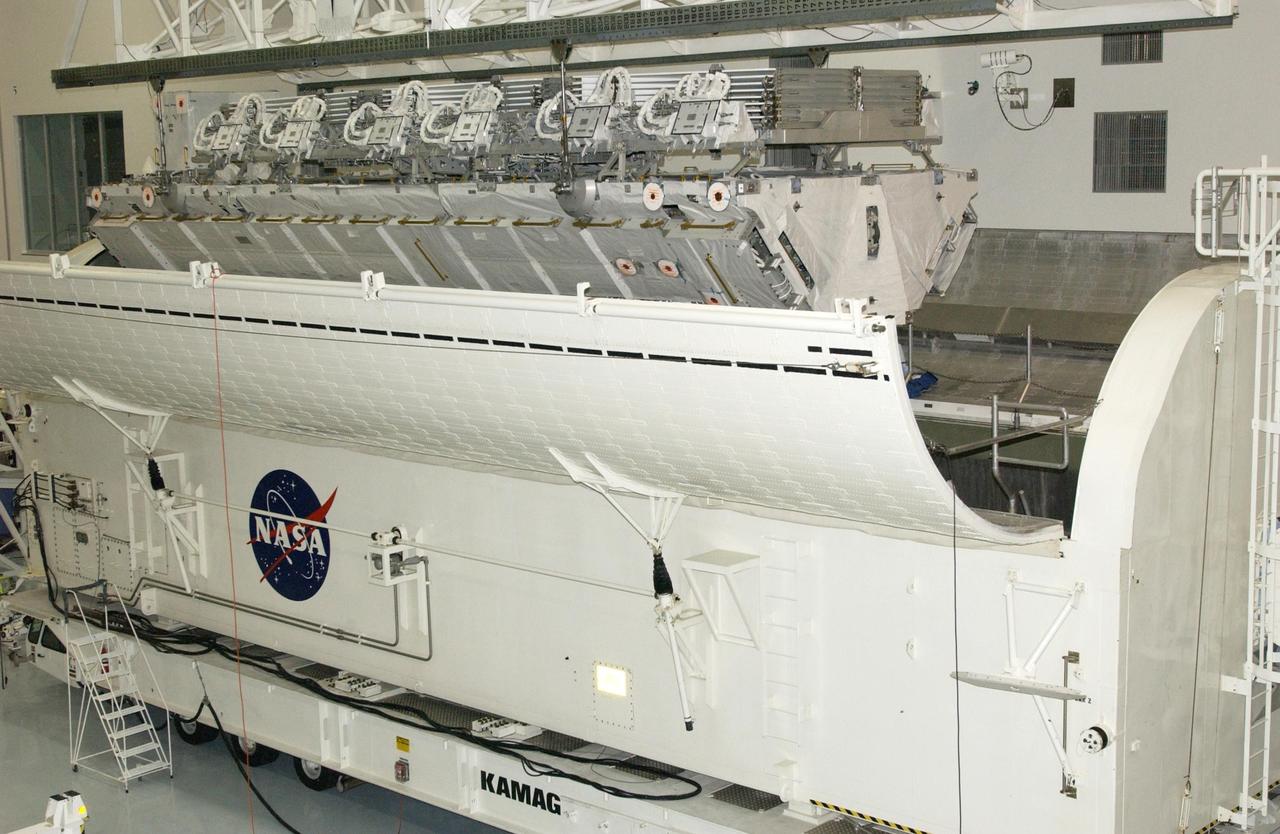
KENNEDY SPACE CENTER, FLA. -- The S1 Integrated Truss Structure is lowered into the payload canister for transport to Atlantis. The first starboard truss segment, the S1 will be attached to the Central truss segment, the S0 Truss, on the International Space Station during mission STS-112. Atlantis is scheduled to launch no earlier than Oct. 2.
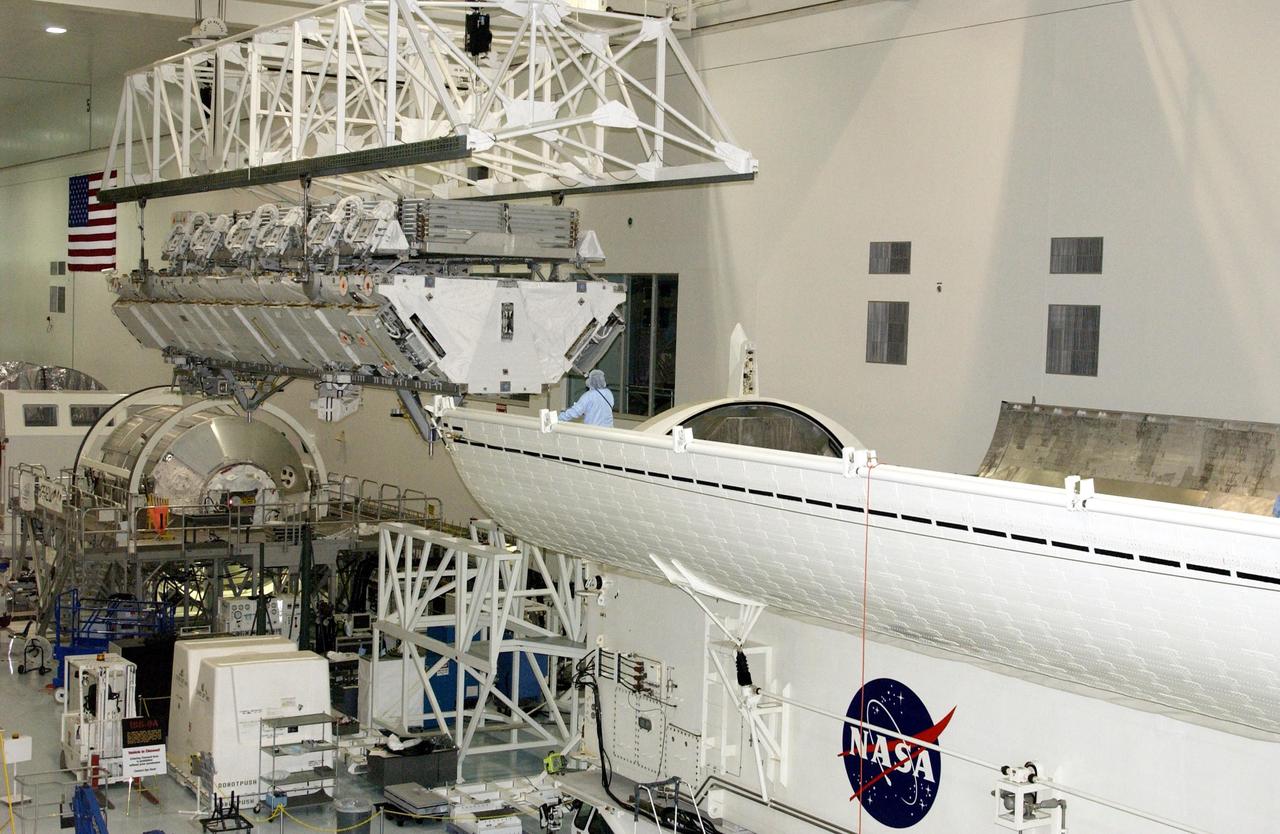
KENNEDY SPACE CENTER, FLA. -- An overhead crane moves the S1 Integrated Truss Structure toward the payload canister below, which will transport it to Atlantis. The first starboard truss segment, the S1 will be attached to the Central truss segment, the S0 Truss, on the International Space Station during mission STS-112. Atlantis is scheduled to launch no earlier than Oct. 2.
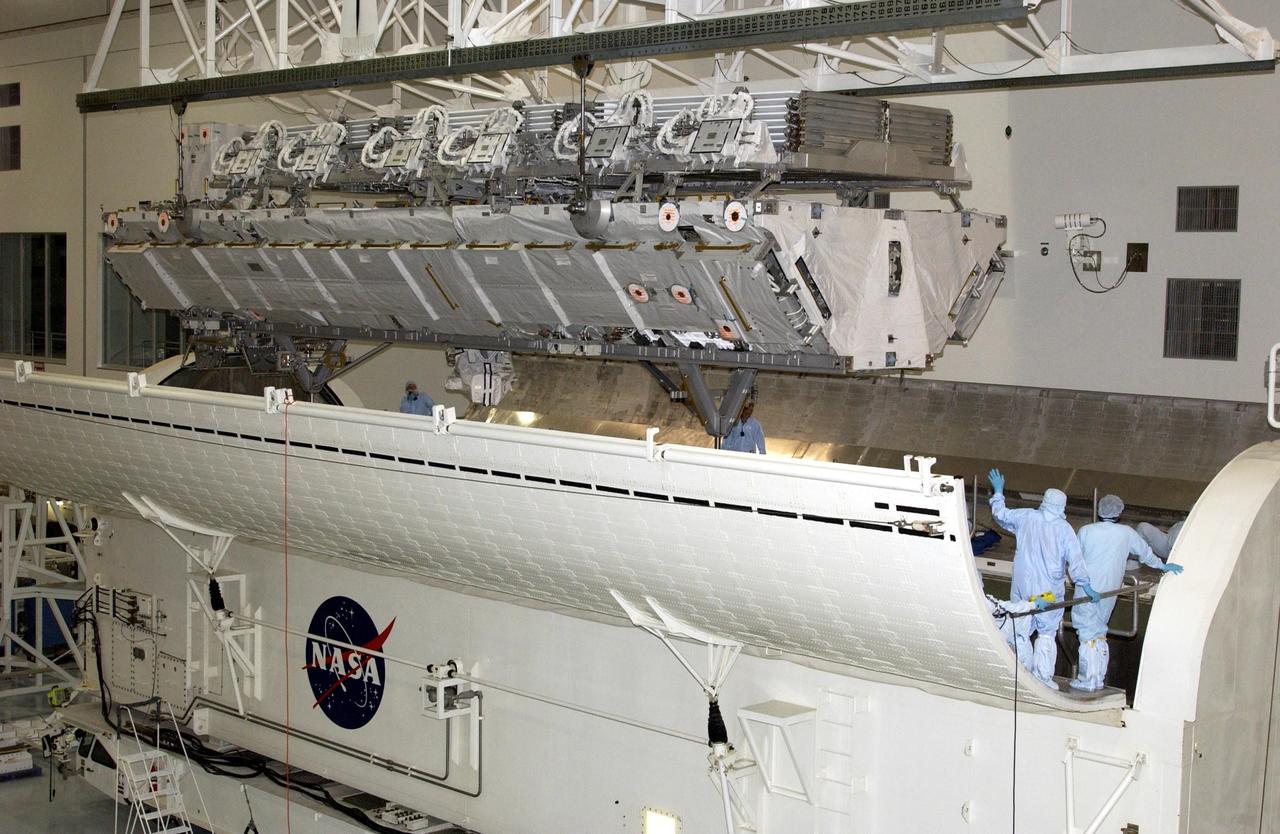
KENNEDY SPACE CENTER, FLA. - Workers inside the payload canister watch the S1 Integrated Truss Structure as it is lowered toward them. The canister will transport the truss to Atlantis. The first starboard truss segment, the S1 will be attached to the Central truss segment, the S0 Truss, on the International Space Station during mission STS-112. Atlantis is scheduled to launch no earlier than Oct. 2.
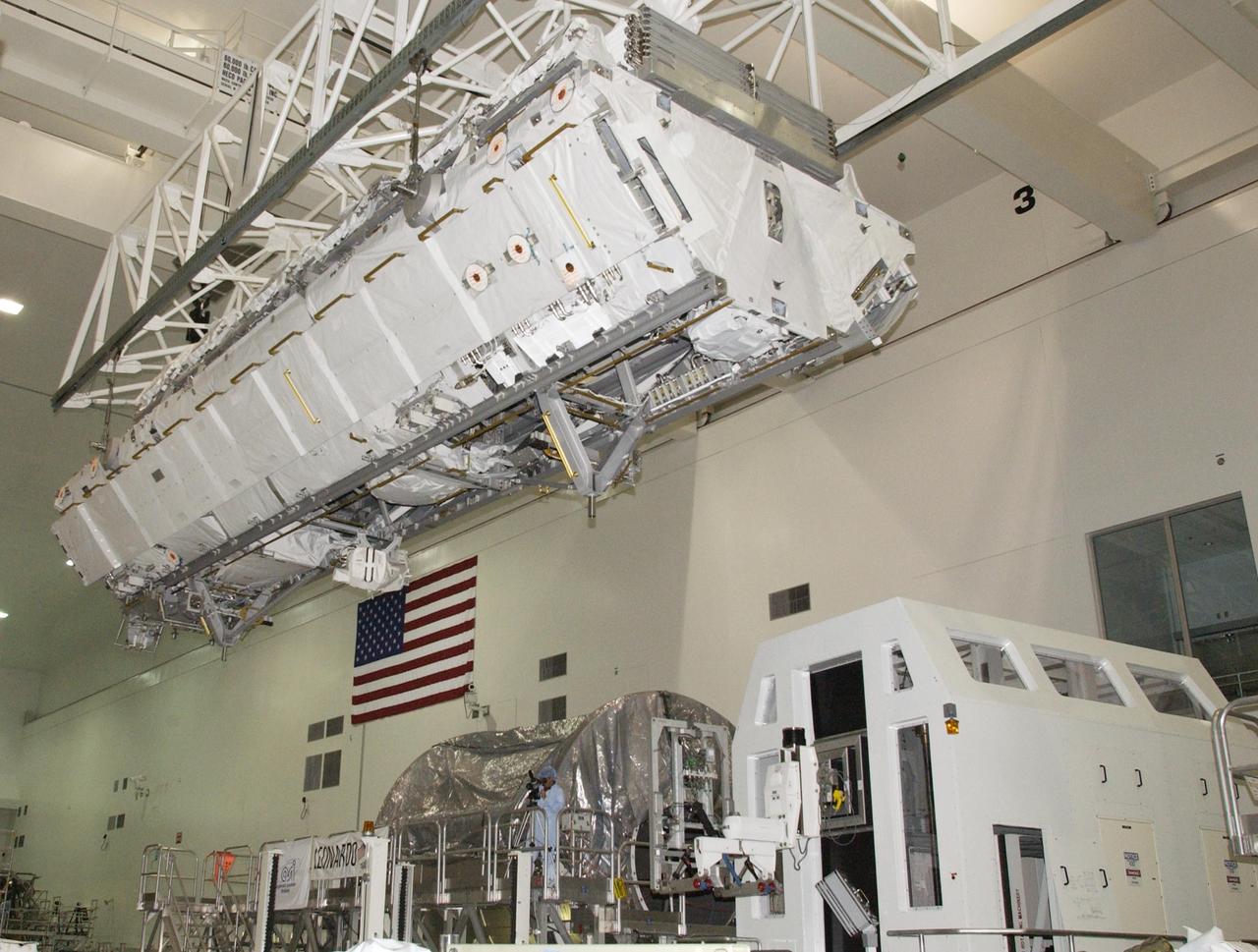
KENNEDY SPACE CENTER, FLA. -- An overhead crane moves the S1 Integrated Truss Structure above over other equipment to get to the payload canister for transport to Atlantis. The first starboard truss segment, the S1 will be attached to the Central truss segment, the S0 Truss, on the International Space Station during mission STS-112. Atlantis is scheduled to launch no earlier than Oct. 2.
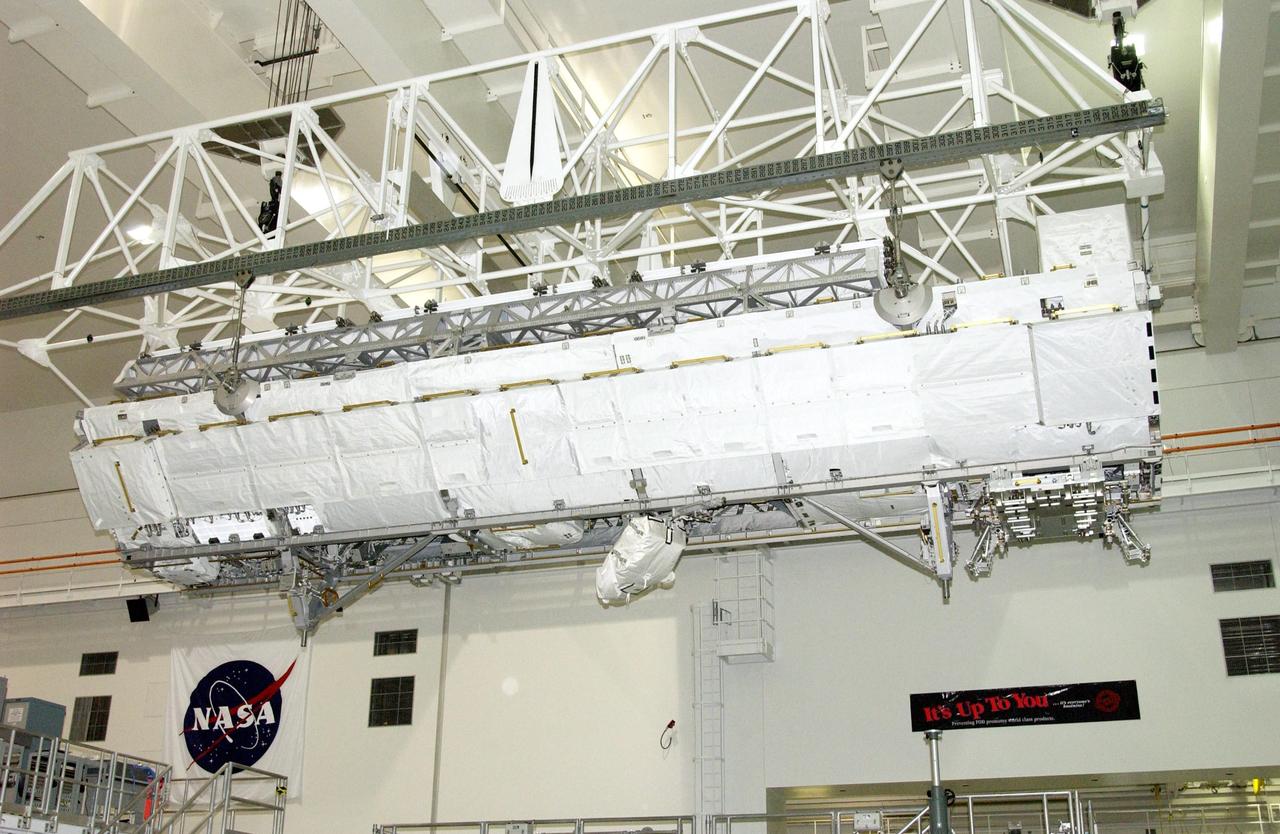
KENNEDY SPACE CENTER, FLA. -- An overhead crane moves the S1 Integrated Truss Structure toward the payload canister, which will transport it to Atlantis. The first starboard truss segment, the S1 will be attached to the Central truss segment, the S0 Truss, on the International Space Station during mission STS-112. Atlantis is scheduled to launch no earlier than Oct. 2.
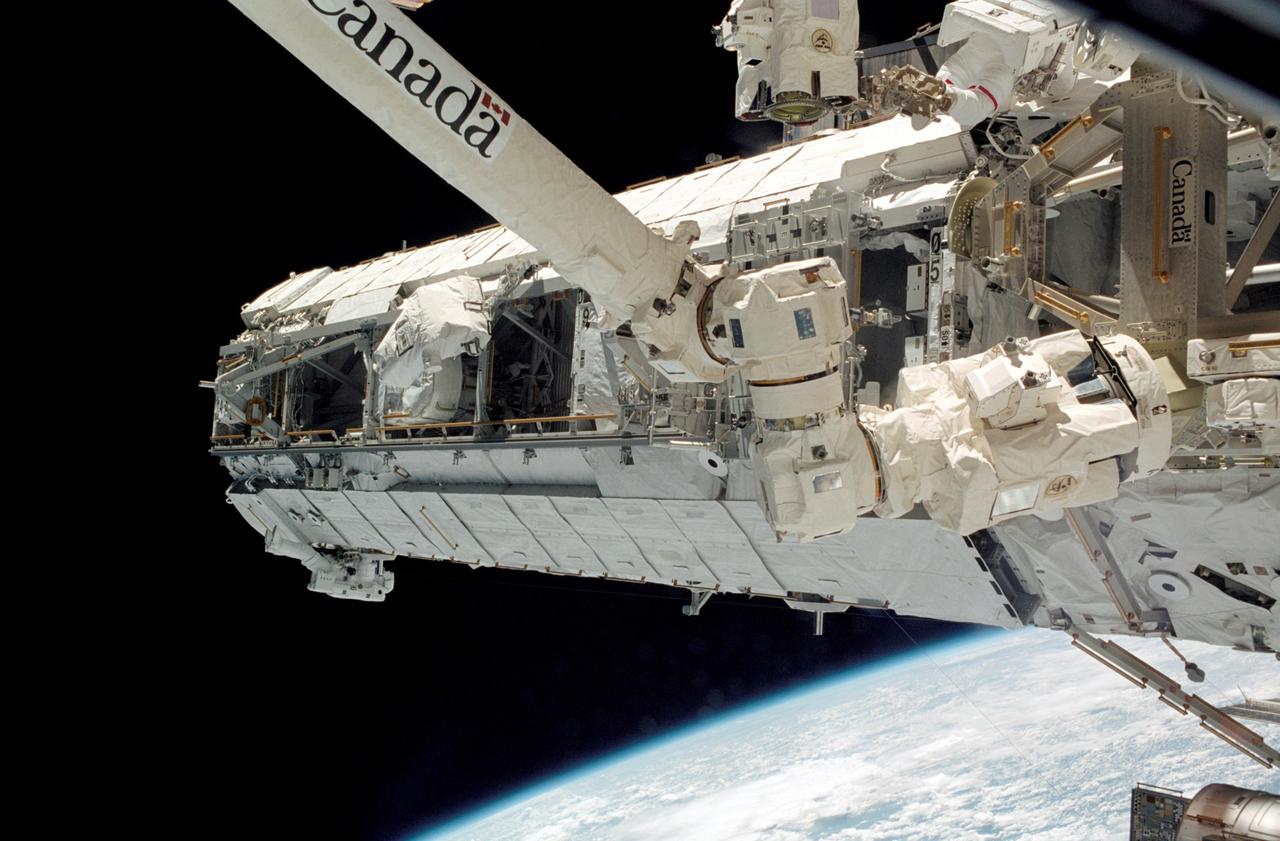
Launched October 7, 2002 aboard the Space Shuttle Orbiter Atlantis, the STS-112 mission lasted 11 days and performed three sessions of Extra Vehicular Activity (EVA). Its primary mission was to install the Starboard (S1) Integrated Truss Structure and Equipment Translation Aid (CETA) Cart to the International Space Station (ISS). The S1 truss provides structural support for the orbiting research facility's radiator panels, which use ammonia to cool the Station's complex power system. The S1 truss, attached to the S0 (S Zero) truss installed by the previous STS-110 mission, flows 637 pounds of anhydrous ammonia through three heat rejection radiators. The truss is 45-feet long, 15-feet wide, 10-feet tall, and weighs approximately 32,000 pounds. The CETA is the first of two human-powered carts that will ride along the International Space Station's railway providing a mobile work platform for future extravehicular activities by astronauts. This is a view of the newly installed S1 Truss as photographed during the mission's first scheduled EVA. The Station's Canadarm2 is in the foreground. Visible are astronauts Piers J. Sellers (lower left) and David A. Wolf (upper right), both STS-112 mission specialists.
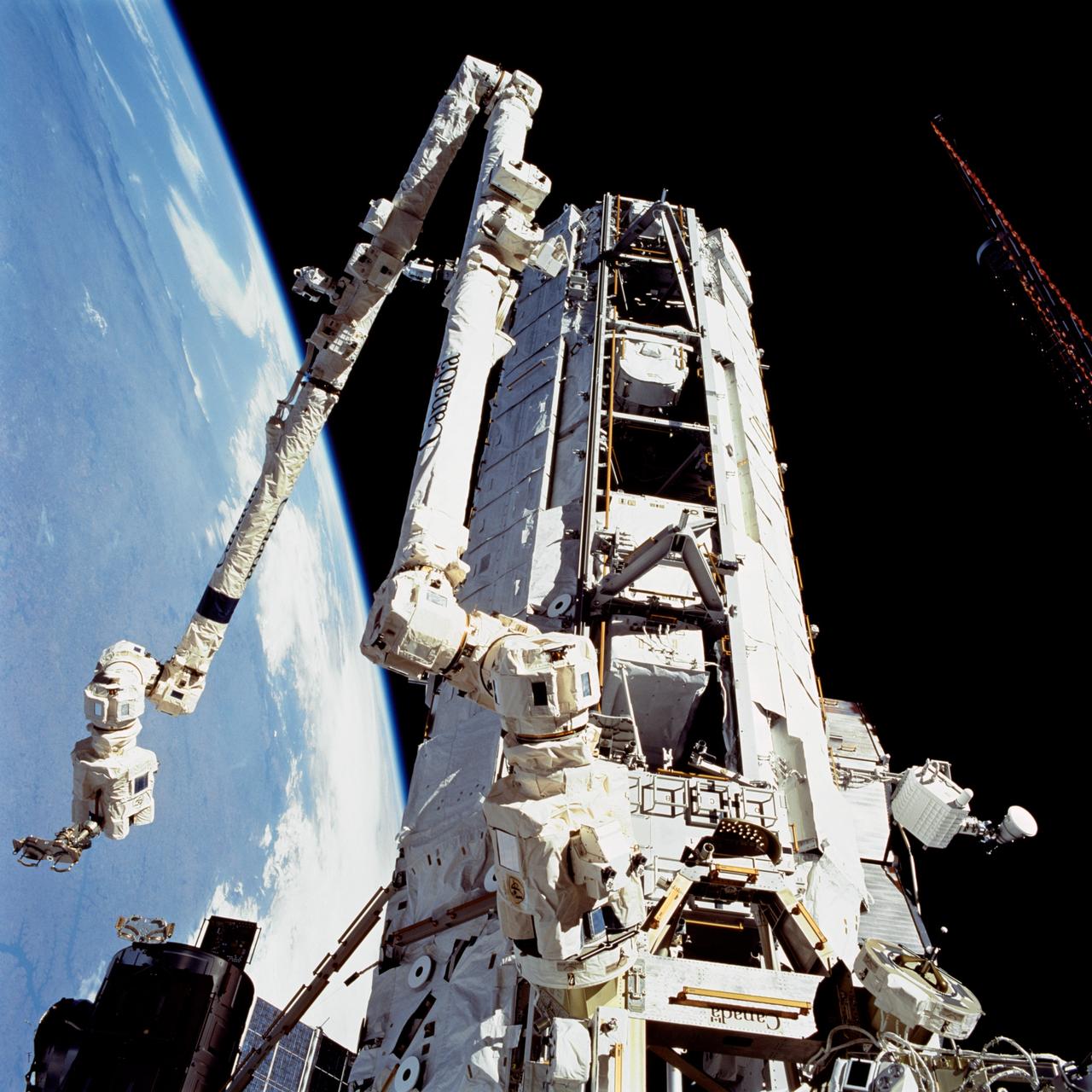
STS112-709-033 (12 October 2002) --- A view of the Starboard One (S1) Truss newly installed on the International Space Station (ISS) as photographed during the mission’s second scheduled session of extravehicular activity (EVA). The station’s Canadarm2 is visible in left frame.
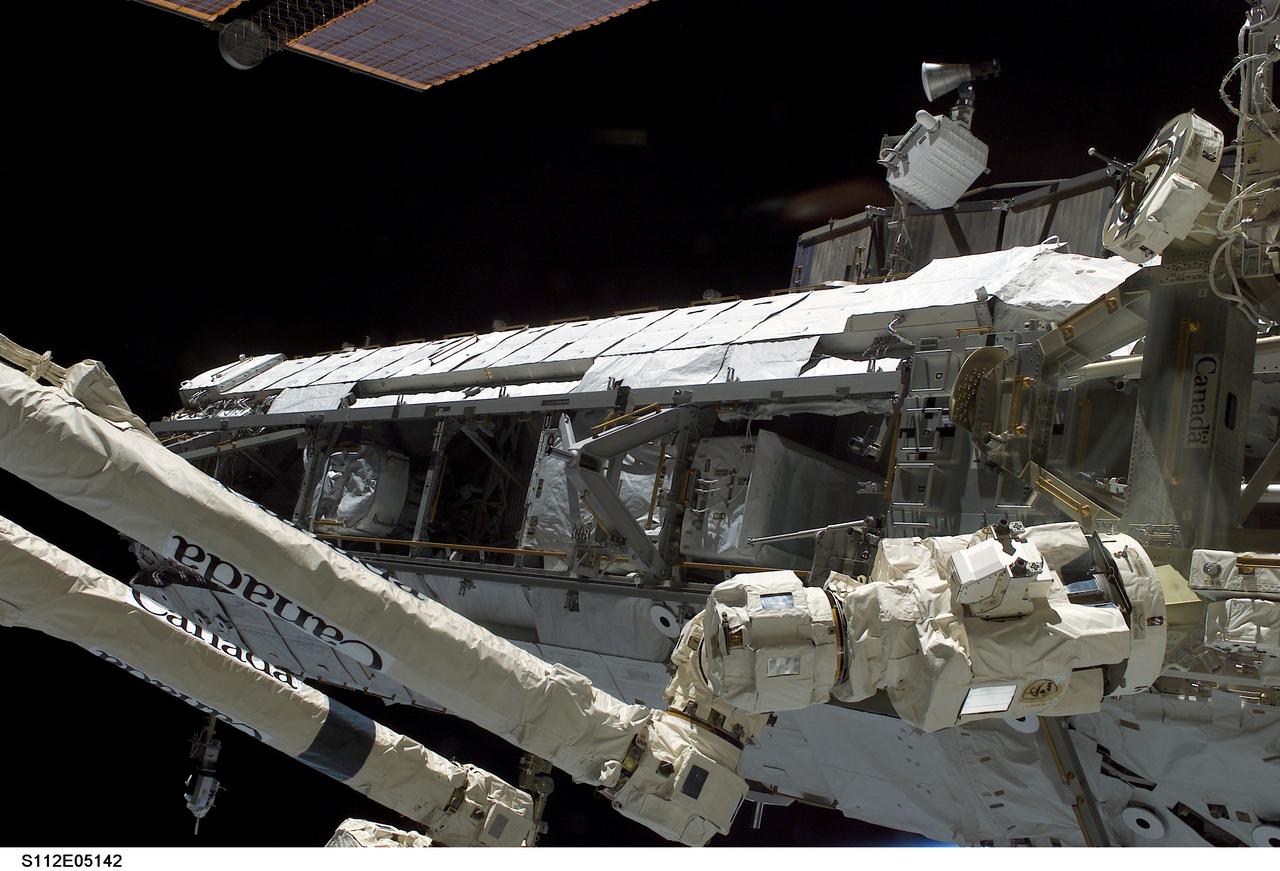
STS112-E-05142 (11 October 2002) --- A view of the Starboard One (S1) Truss, newly installed on the International Space Station (ISS). The station’s Canadarm2 is in the foreground.
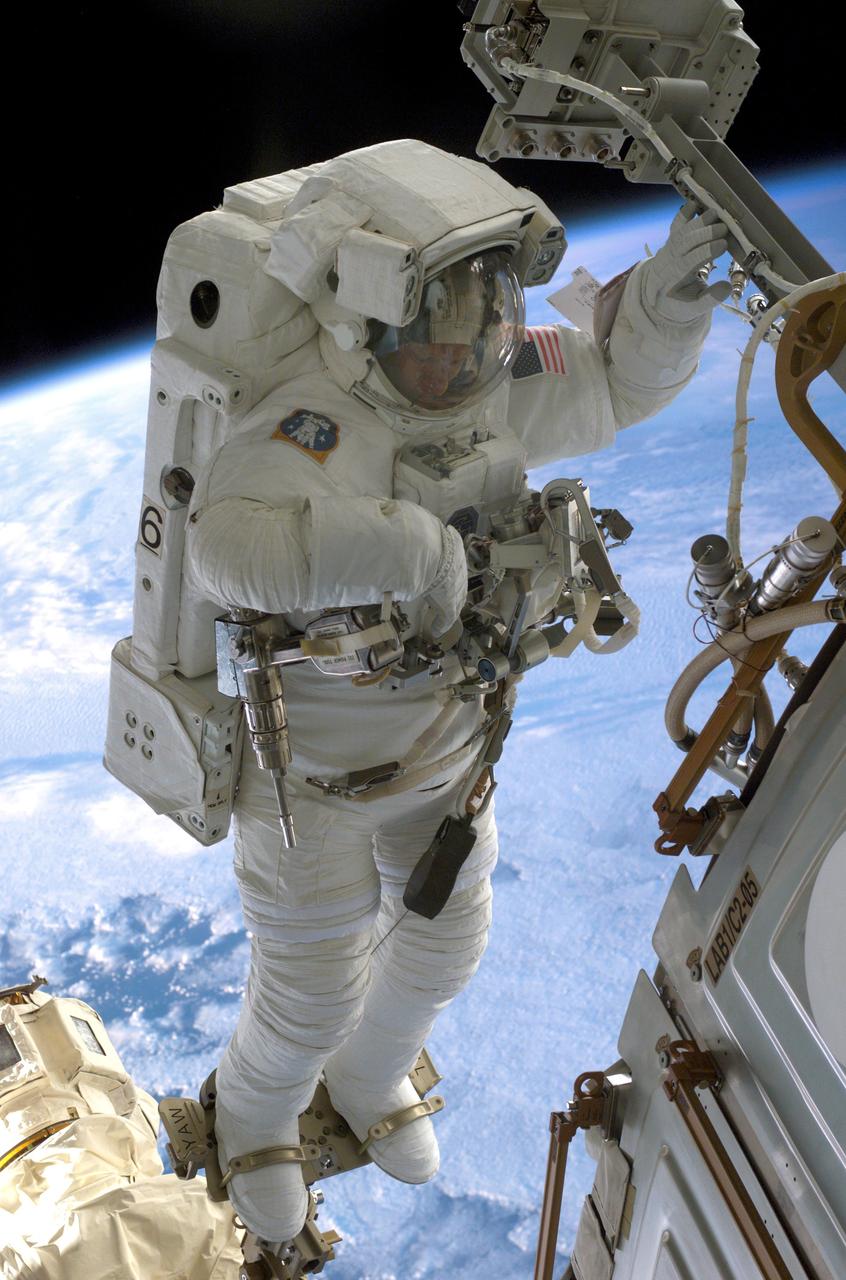
Launched October 7, 2002 aboard the Space Shuttle Orbiter Atlantis, the STS-112 mission lasted 11 days and performed three sessions of Extra Vehicular Activity (EVA). Its primary mission was to install the Starboard Side Integrated Truss Structure (S1) and Equipment Translation Aid (CETA) Cart to the International Space Station (ISS). The S1 truss provides structural support for the orbiting research facility's radiator panels, which use ammonia to cool the Station's complex power system. The S1 truss, attached to the S0 (S Zero) truss installed by the previous STS-110 mission, flows 637 pounds of anhydrous ammonia through three heat rejection radiators. The truss is 45-feet long, 15-feet wide, 10-feet tall, and weighs approximately 32,000 pounds. The CETA is the first of two human-powered carts that will ride along the International Space Station's railway providing a mobile work platform for future extravehicular activities by astronauts. In this photograph, Astronaut Piers J. Sellers uses both a handrail on the Destiny Laboratory and a foot restraint on the Space Station Remote Manipulator System or Canadarm2 to remain stationary while performing work at the end of the STS-112 mission's second space walk. A cloud-covered Earth provides the backdrop for the scene.
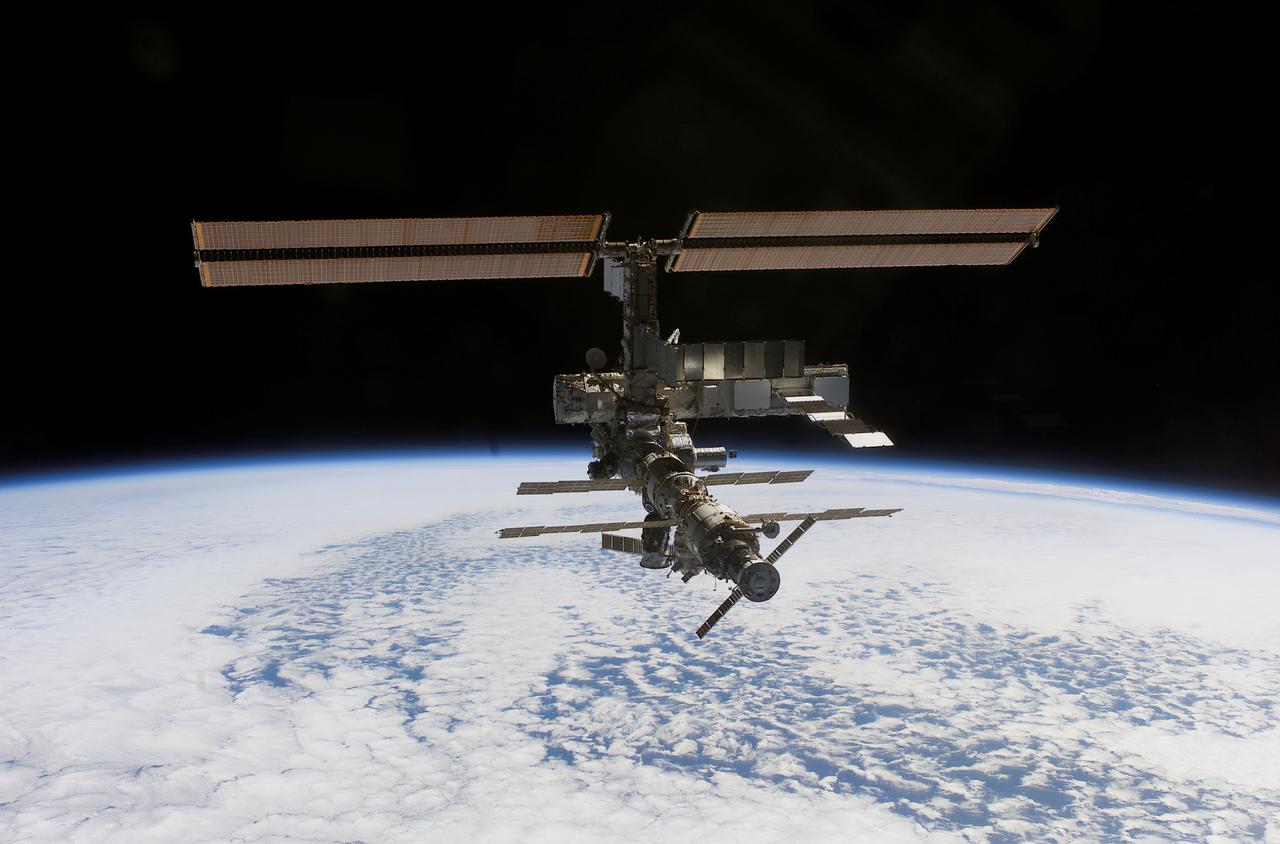
This image of the International Space Station (ISS) was photographed by one of the crewmembers of the STS-112 mission following separation from the Space Shuttle Orbiter Atlantis as the orbiter pulled away from the ISS. The primary payloads of this mission, International Space Station Assembly Mission 9A, were the Integrated Truss Assembly S1 (S-One), the Starboard Side Thermal Radiator Truss, and the Crew Equipment Translation Aid (CETA) cart to the ISS. The S1 truss provides structural support for the orbiting research facility's radiator panels, which use ammonia to cool the Station's complex power system. The S1 truss was attached to the S0 (S Zero) truss, which was launched on April 8, 2002 aboard the STS-110, and flows 637 pounds of anhydrous ammonia through three heat-rejection radiators. The truss is 45-feet long, 15-feet wide, 10-feet tall, and weighs approximately 32,000 pounds. The CETA cart was attached to the Mobil Transporter and will be used by assembly crews on later missions. Manufactured by the Boeing Company in Huntington Beach, California, the truss primary structure was transferred to the Marshall Space Flight Center in February 1999 for hardware installations and manufacturing acceptance testing. The launch of the STS-112 mission occurred on October 7, 2002, and its 11-day mission ended on October 18, 2002.
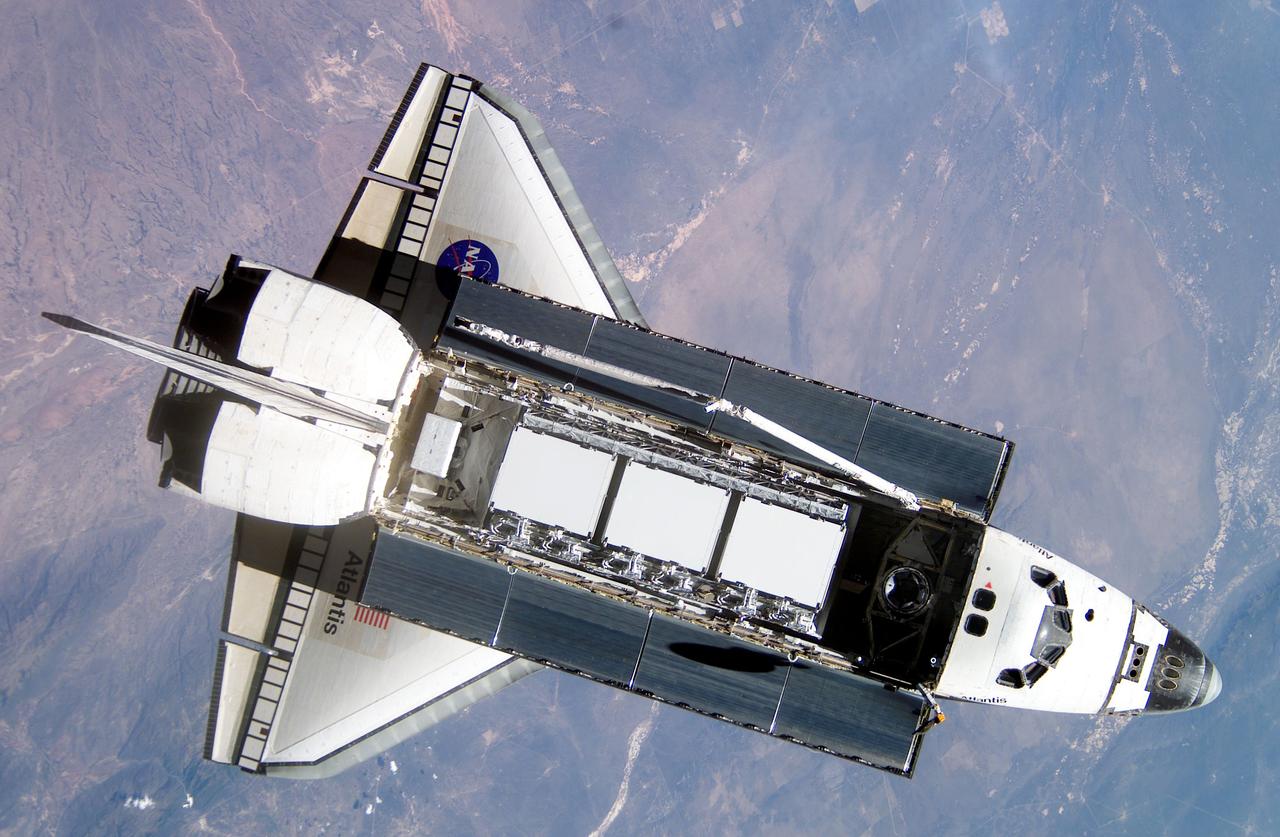
Back dropped against a blue and white Earth, the Space Shuttle Orbiter Atlantis was photographed by an Expedition 5 crew member onboard the International Space Station (ISS) during rendezvous and docking operations. Docking occurred at 10:17 am on October 9, 2002. The Starboard 1 (S1) Integrated Truss Structure, the primary payload of the STS-112 mission, can be seen in Atlantis' cargo bay. Installed and outfitted within 3 sessions of Extravehicular Activity (EVA) during the 11 day mission, the S1 truss provides structural support for the orbiting research facility's radiator panels, which use ammonia to cool the Station's complex power system. The S1 truss, attached to the S0 (S Zero) truss installed by the previous STS-110 mission, flows 637 pounds of anhydrous ammonia through three heat rejection radiators.
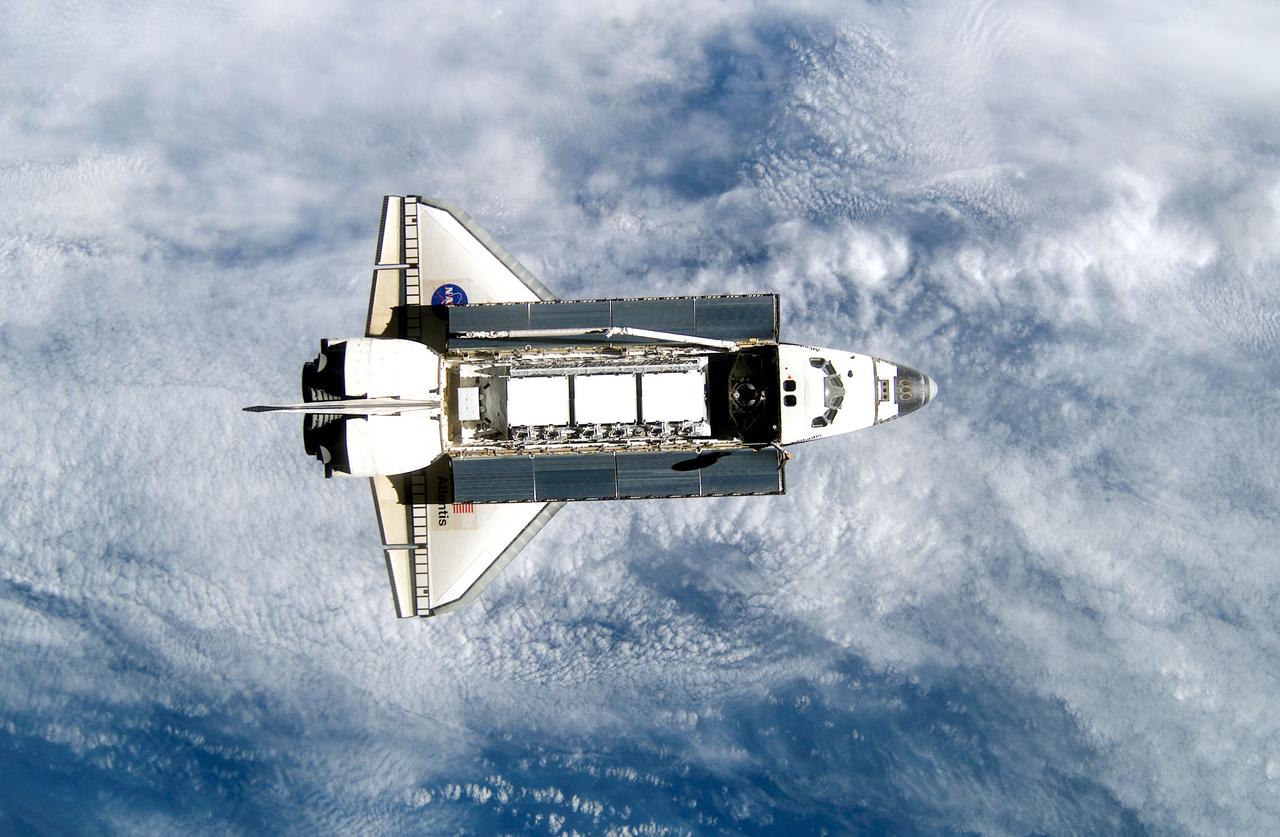
Back dropped against a blue and white Earth, the Space Shuttle Orbiter Atlantis was photographed by an Expedition 5 crew member onboard the International Space Station (ISS) during rendezvous and docking operations. Docking occurred at 10:17 am on October 9, 2002. The Starboard 1 (S1) Integrated Truss Structure, the primary payload of the STS-112 mission, can be seen in Atlantis' cargo bay. Installed and outfitted within 3 sessions of Extravehicular Activity (EVA) during the 11 day mission, the S1 truss provides structural support for the orbiting research facility's radiator panels, which use ammonia to cool the Station's complex power system. The S1 truss, attached to the S0 (S Zero) truss installed by the previous STS-110 mission, flows 637 pounds of anhydrous ammonia through three heat rejection radiators.
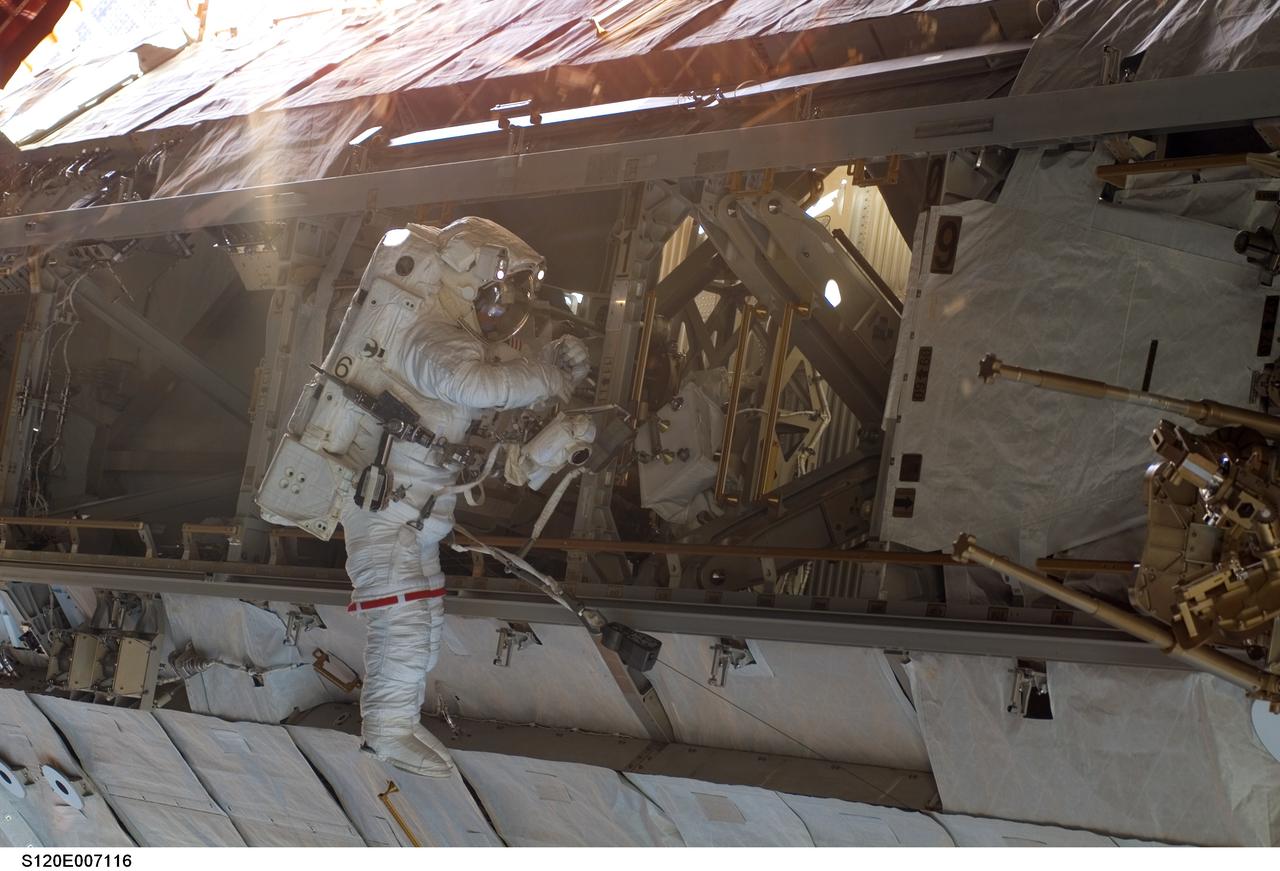
S120-E-007116 (28 Oct. 2007) --- Astronaut Daniel Tani, Expedition 16 flight engineer, participates in the second of five scheduled sessions of extravehicular activity (EVA) as construction continues on the International Space Station. During the 6-hour, 33-minute spacewalk Tani and astronaut Scott Parazynski (out of frame), STS-120 mission specialist, worked in tandem to disconnect cables from the P6 truss, allowing it to be removed from the Z1 truss. Tani also visually inspected the station's starboard Solar Alpha Rotary Joint (SARJ) and gathered samples of "shavings" he found under the joint's multi-layer insulation covers. Also the spacewalkers outfitted the Harmony module, mated the power and data grapple fixture and reconfigured connectors on the starboard 1 (S1) truss that will allow the radiator on S1 to be deployed from the ground later.
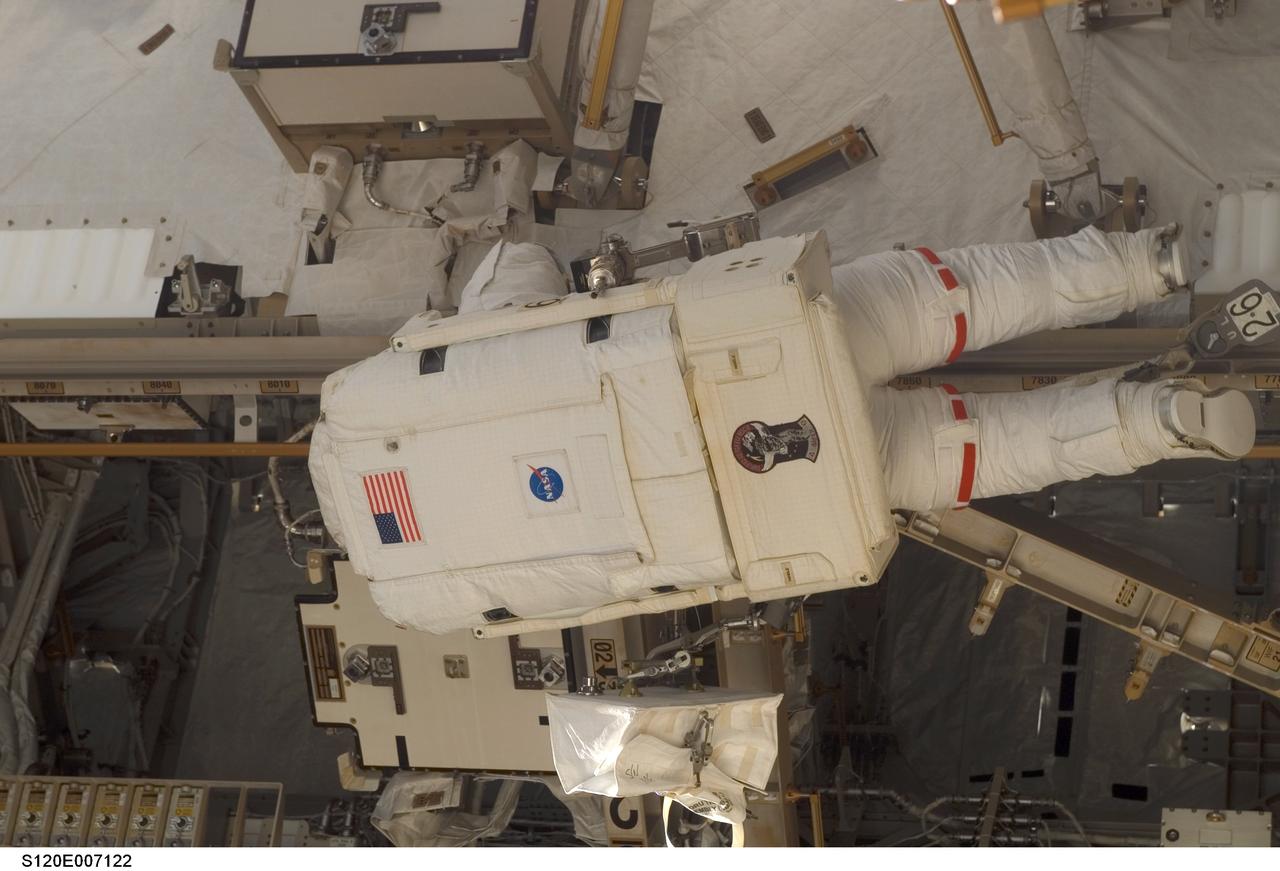
S120-E-007122 (28 Oct. 2007) --- Astronaut Daniel Tani, Expedition 16 flight engineer, participates in the second of five scheduled sessions of extravehicular activity (EVA) as construction continues on the International Space Station. During the 6-hour, 33-minute spacewalk Tani and astronaut Scott Parazynski (out of frame), STS-120 mission specialist, worked in tandem to disconnect cables from the P6 truss, allowing it to be removed from the Z1 truss. Tani also visually inspected the station's starboard Solar Alpha Rotary Joint (SARJ) and gathered samples of "shavings" he found under the joint's multi-layer insulation covers. Also the spacewalkers outfitted the Harmony module, mated the power and data grapple fixture and reconfigured connectors on the starboard 1 (S1) truss that will allow the radiator on S1 to be deployed from the ground later.
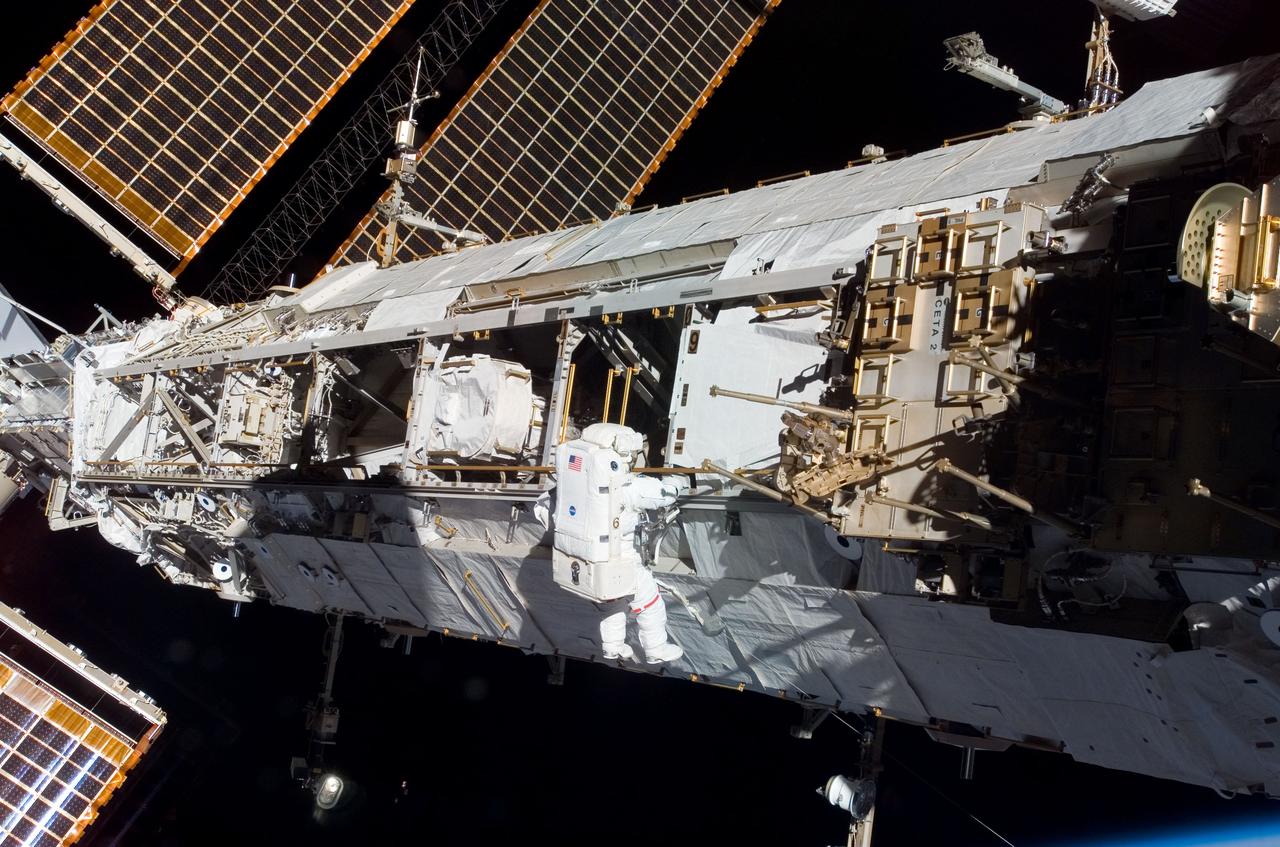
S120-E-007003 (28 Oct. 2007) --- Astronaut Daniel Tani, Expedition 16 flight engineer, participates in the second of five scheduled sessions of extravehicular activity (EVA) as construction continues on the International Space Station. During the 6-hour, 33-minute spacewalk Tani and astronaut Scott Parazynski (out of frame), STS-120 mission specialist, worked in tandem to disconnect cables from the P6 truss, allowing it to be removed from the Z1 truss. Tani also visually inspected the station's starboard Solar Alpha Rotary Joint (SARJ) and gathered samples of "shavings" he found under the joint's multi-layer insulation covers. Also the spacewalkers outfitted the Harmony module, mated the power and data grapple fixture and reconfigured connectors on the starboard 1 (S1) truss that will allow the radiator on S1 to be deployed from the ground later.
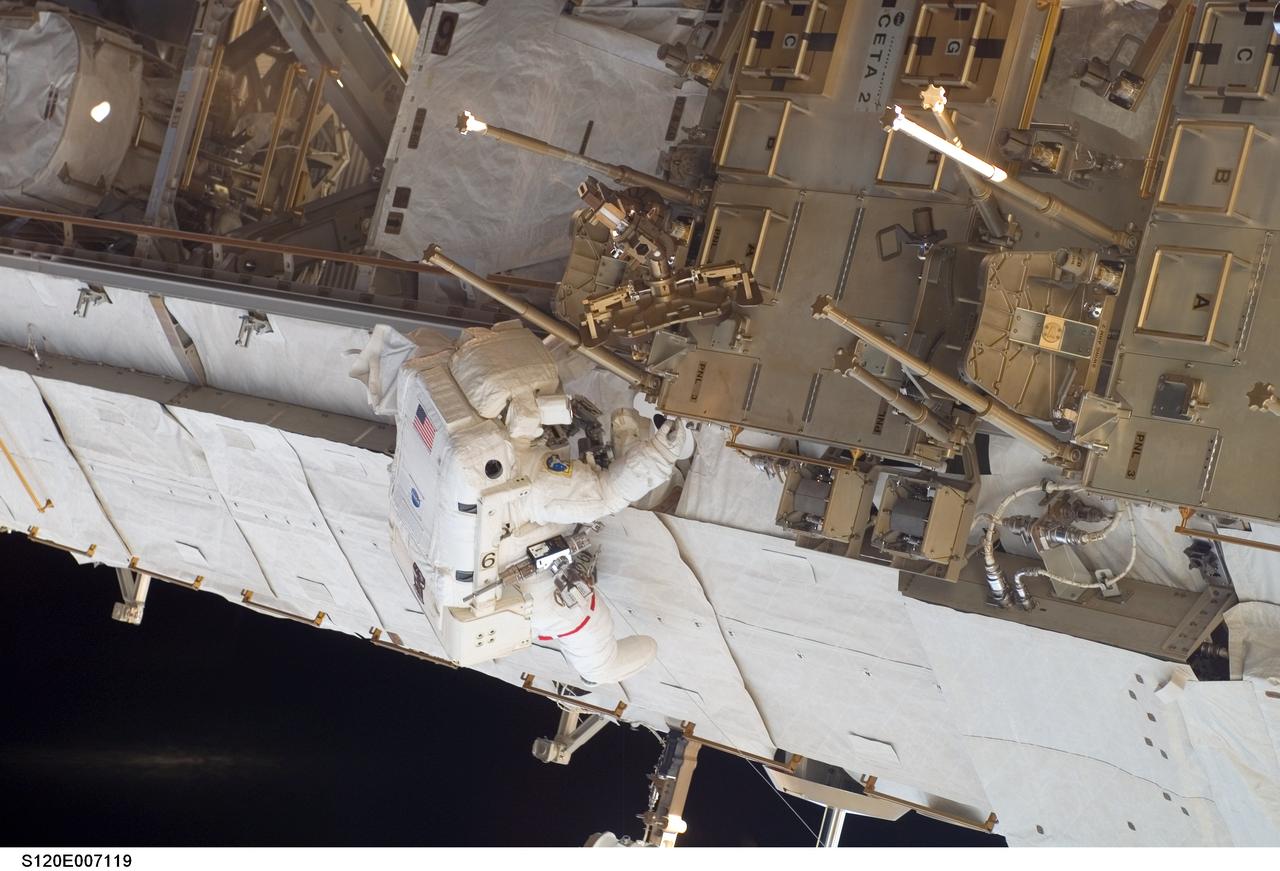
S120-E-007119 (28 Oct. 2007) --- Astronaut Daniel Tani, Expedition 16 flight engineer, participates in the second of five scheduled sessions of extravehicular activity (EVA) as construction continues on the International Space Station. During the 6-hour, 33-minute spacewalk Tani and astronaut Scott Parazynski (out of frame), STS-120 mission specialist, worked in tandem to disconnect cables from the P6 truss, allowing it to be removed from the Z1 truss. Tani also visually inspected the station's starboard Solar Alpha Rotary Joint (SARJ) and gathered samples of "shavings" he found under the joint's multi-layer insulation covers. Also the spacewalkers outfitted the Harmony module, mated the power and data grapple fixture and reconfigured connectors on the starboard 1 (S1) truss that will allow the radiator on S1 to be deployed from the ground later.
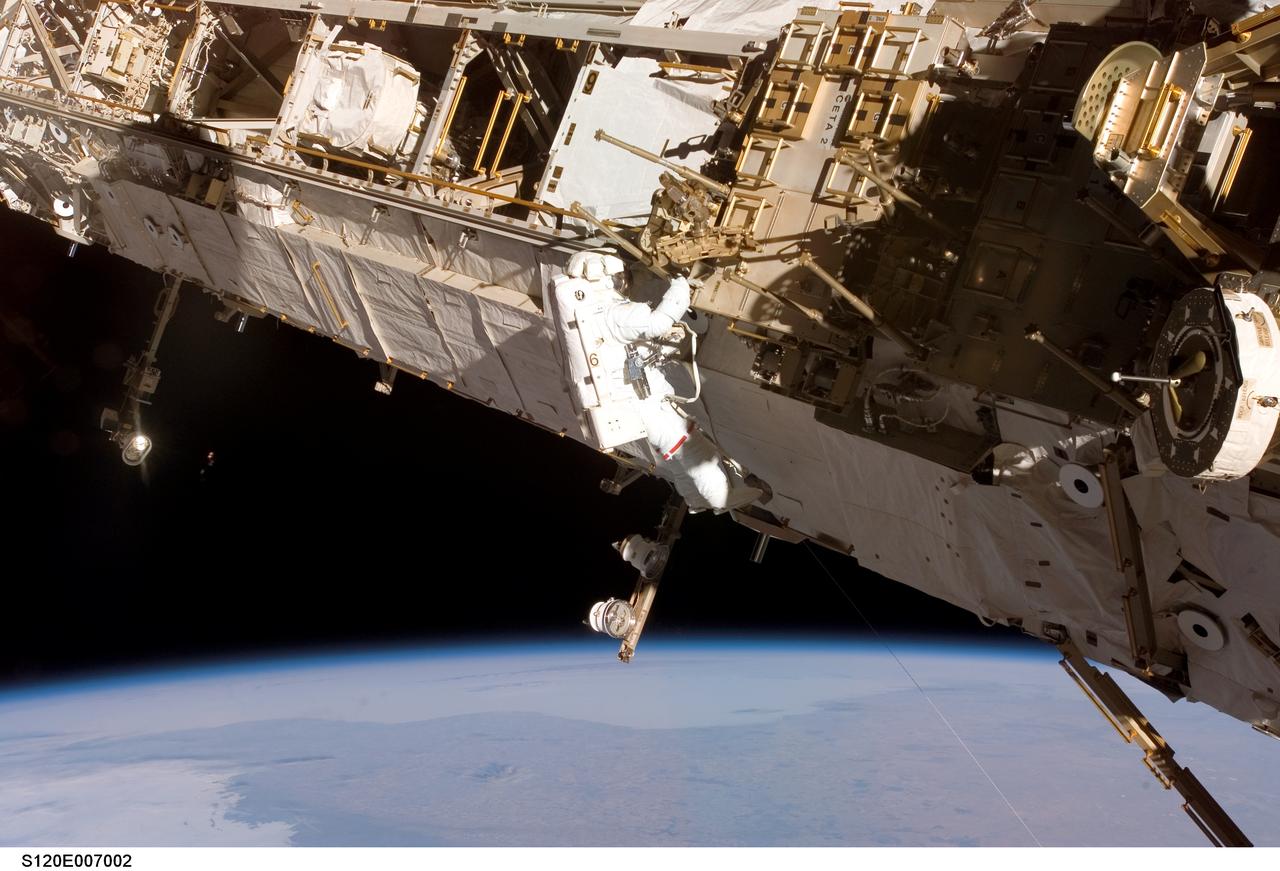
S120-E-007002 (28 Oct. 2007) --- Astronaut Daniel Tani, Expedition 16 flight engineer, participates in the second of five scheduled sessions of extravehicular activity (EVA) as construction continues on the International Space Station. During the 6-hour, 33-minute spacewalk Tani and astronaut Scott Parazynski (out of frame), STS-120 mission specialist, worked in tandem to disconnect cables from the P6 truss, allowing it to be removed from the Z1 truss. Tani also visually inspected the station's starboard Solar Alpha Rotary Joint (SARJ) and gathered samples of "shavings" he found under the joint's multi-layer insulation covers. Also the spacewalkers outfitted the Harmony module, mated the power and data grapple fixture and reconfigured connectors on the starboard 1 (S1) truss that will allow the radiator on S1 to be deployed from the ground later.
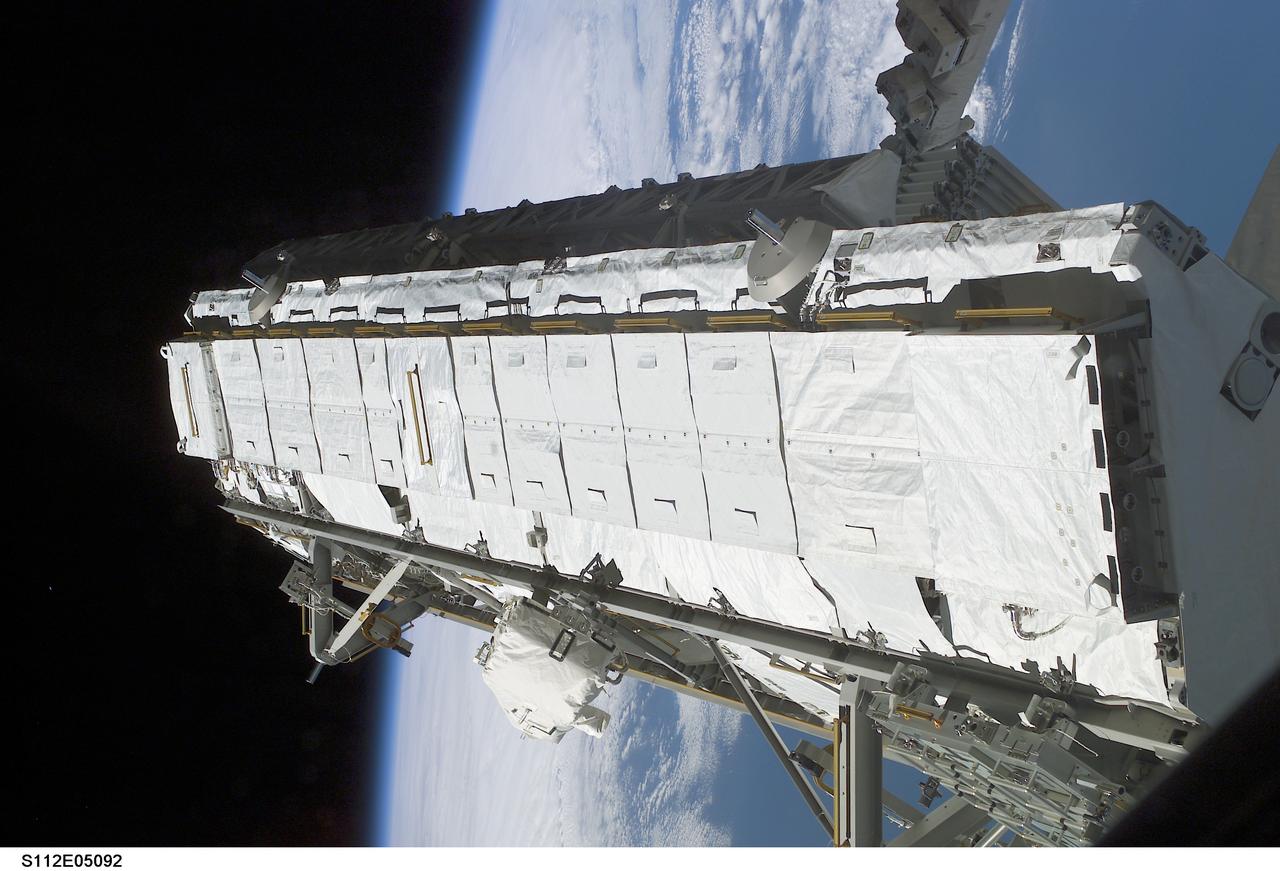
STS112-E-05092 (10 October 2002) --- Backdropped by the blackness of space and Earth’s horizon, the Starboard One (S1) Truss is moved from the Space Shuttle Atlantis’ cargo bay. Astronauts Sandra H. Magnus, STS-112 mission specialist, and Peggy A. Whitson, Expedition Five flight engineer, used the Canadarm2 from inside Destiny laboratory on the International Space Station (ISS) to lift the S1 Truss out of the orbiter’s payload bay and move it into position at the starboard end of the S0 (S-Zero) Truss.
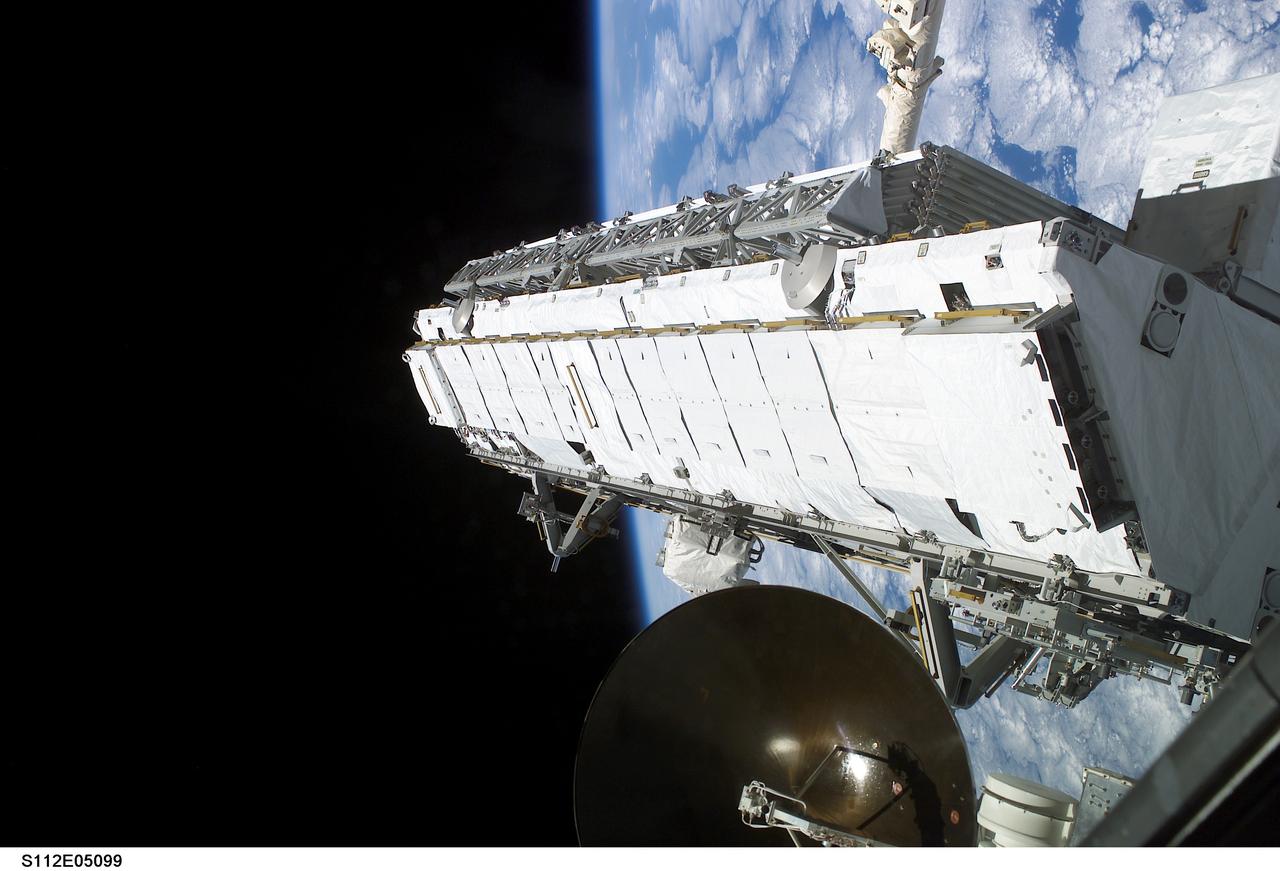
STS112-E-05099 (10 October 2002) --- Backdropped by the blackness of space and Earth’s horizon, the Starboard One (S1) Truss is moved from the Space Shuttle Atlantis’ cargo bay. Astronauts Sandra H. Magnus, STS-112 mission specialist, and Peggy A. Whitson, Expedition Five flight engineer, used the Canadarm2 from inside Destiny laboratory on the International Space Station (ISS) to lift the S1 Truss out of the orbiter’s payload bay and move it into position at the starboard end of the S0 (S-Zero) Truss.
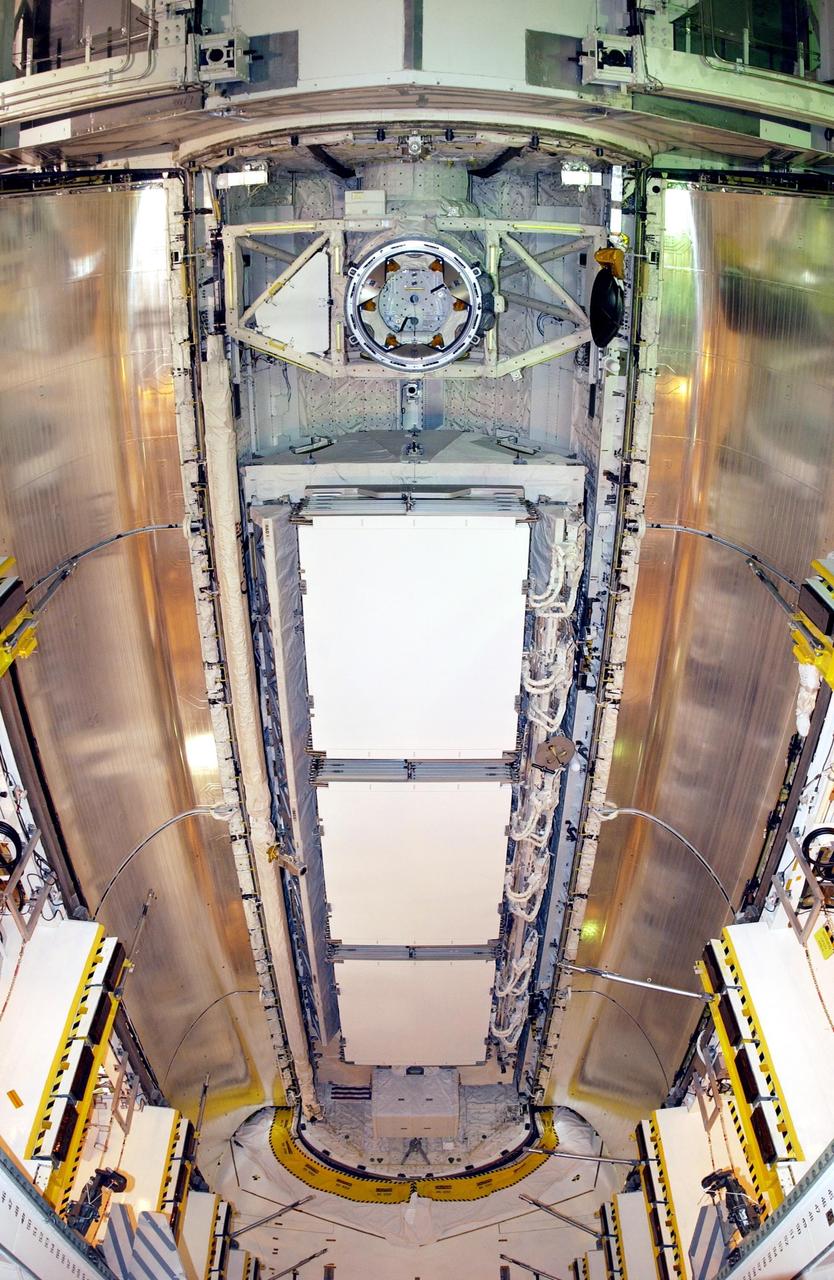
KENNEDY SPACE CENTER, FLA. -- The payload for mission STS-112 rests inside the payload bay of Space Shuttle Atlantis. The Shuttle is carrying the S1 Integrated Truss Structure, the first starboard truss segment, to be attached to the central truss segment, S0, plus the Crew and Equipment Translation Aid (CETA) Cart A. The CETA is the first of two human-powered carts that will ride along the ISS railway, providing mobile work platforms for future spacewalking astronauts. Launch of Atlantis is scheduled for Oct. 2 with a crew of six. The 11-day mission includes three spacewalks.

KENNEDY SPACE CENTER, FLA. -- The payload bay doors of Space Shuttle Atlantis close on the primary payloads for mission STS-112. The Shuttle is carrying the S1 Integrated Truss Structure, the first starboard truss segment, to be attached to the central truss segment, S0, plus the Crew and Equipment Translation Aid (CETA) Cart A. The CETA is the first of two human-powered carts that will ride along the ISS railway, providing mobile work platforms for future spacewalking astronauts. Launch of Atlantis is scheduled for Oct. 2 with a crew of six. The 11-day mission includes three spacewalks.
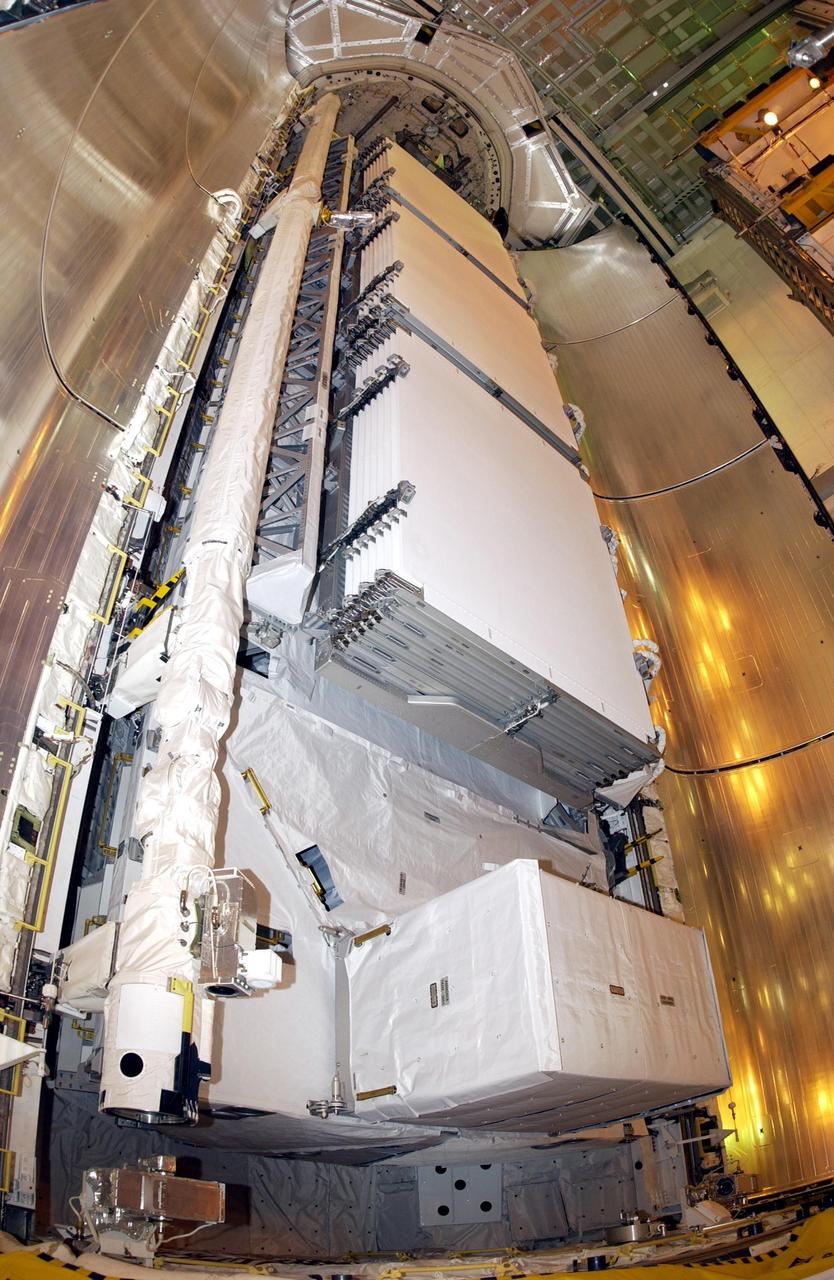
KENNEDY SPACE CENTER, FLA. -- -- The payload for mission STS-112 rests inside the payload bay of Space Shuttle Atlantis. The Shuttle is carrying the S1 Integrated Truss Structure, the first starboard truss segment, to be attached to the central truss segment, S0, plus the Crew and Equipment Translation Aid (CETA) Cart A. The CETA is the first of two human-powered carts that will ride along the ISS railway, providing mobile work platforms for future spacewalking astronauts. Launch of Atlantis is scheduled for Oct. 2 with a crew of six. The 11-day mission includes three spacewalks.
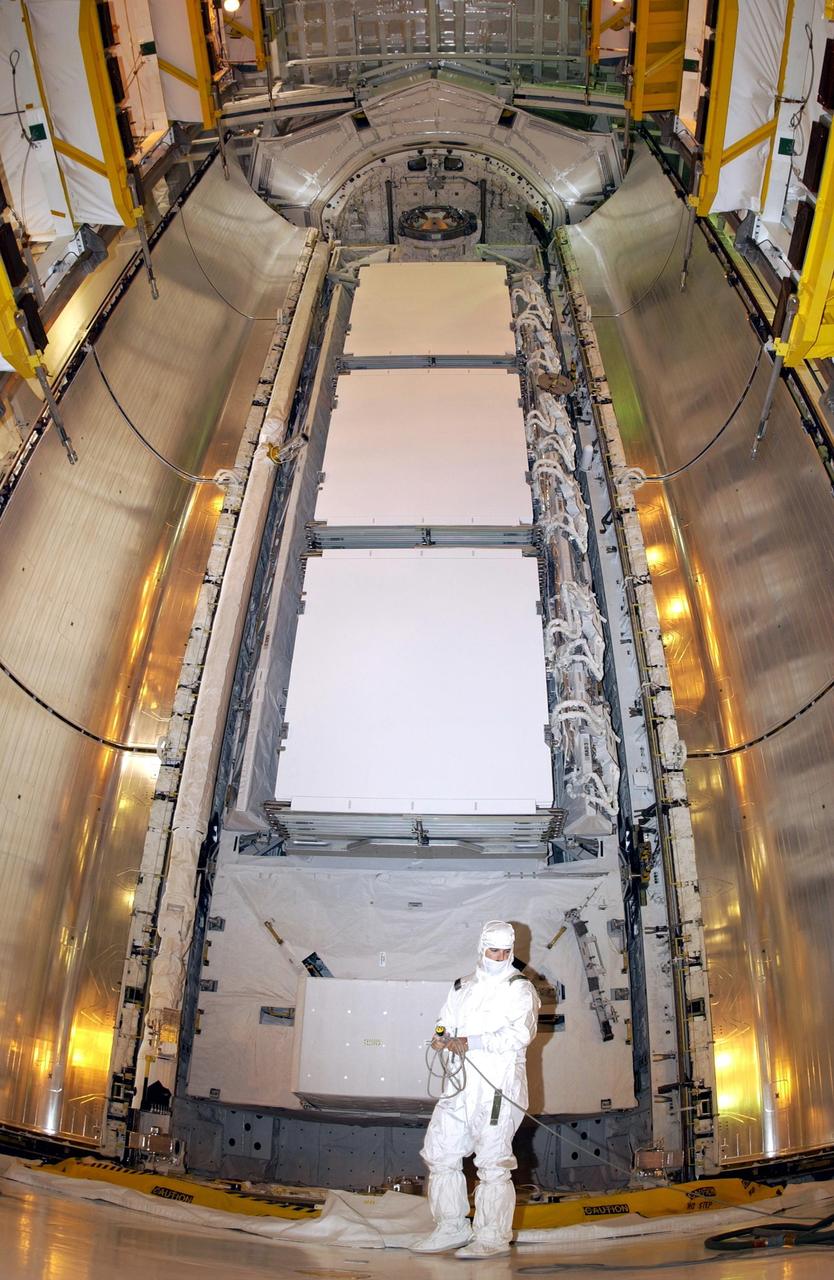
KENNEDY SPACE CENTER, FLA. -- The payload for mission STS-112 rests inside the payload bay of Space Shuttle Atlantis. The Shuttle is carrying the S1 Integrated Truss Structure, the first starboard truss segment, to be attached to the central truss segment, S0, plus the Crew and Equipment Translation Aid (CETA) Cart A. The CETA is the first of two human-powered carts that will ride along the ISS railway, providing mobile work platforms for future spacewalking astronauts. Launch of Atlantis is scheduled for Oct. 2 with a crew of six. The 11-day mission includes three spacewalks.
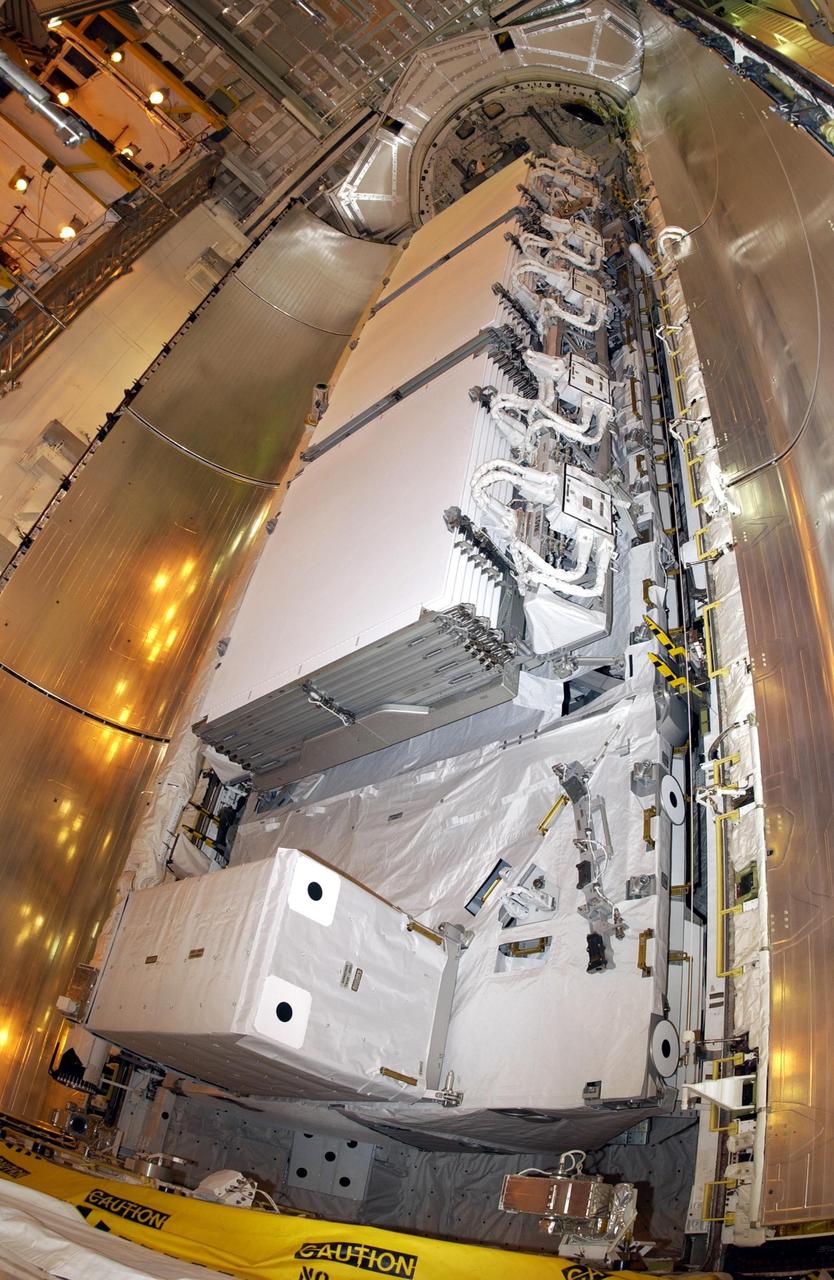
KENNEDY SPACE CENTER, FLA. -- -- The payload for mission STS-112 rests inside the payload bay of Space Shuttle Atlantis. The Shuttle is carrying the S1 Integrated Truss Structure, the first starboard truss segment, to be attached to the central truss segment, S0, plus the Crew and Equipment Translation Aid (CETA) Cart A. The CETA is the first of two human-powered carts that will ride along the ISS railway, providing mobile work platforms for future spacewalking astronauts. Launch of Atlantis is scheduled for Oct. 2 with a crew of six. The 11-day mission includes three spacewalks.
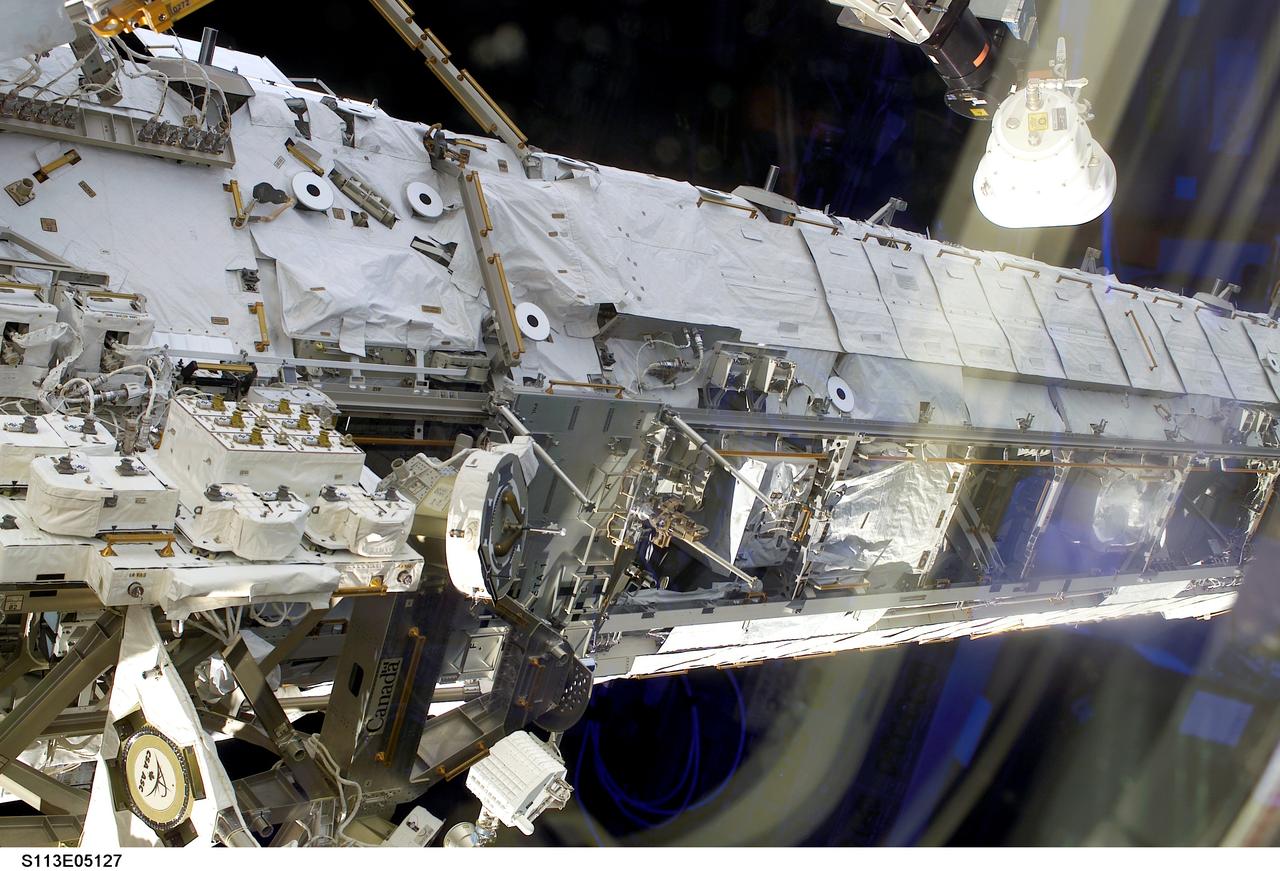
STS113-E-05127 (25 November 2002) --- The Starboard One (S1) Truss on the International Space Station (ISS) was photographed by a crewmember on board the Space Shuttle Endeavour during rendezvous and docking operations between the two spacecraft. Endeavour docked with the station at 3:59 p.m. (CST) on November 25, 2002.
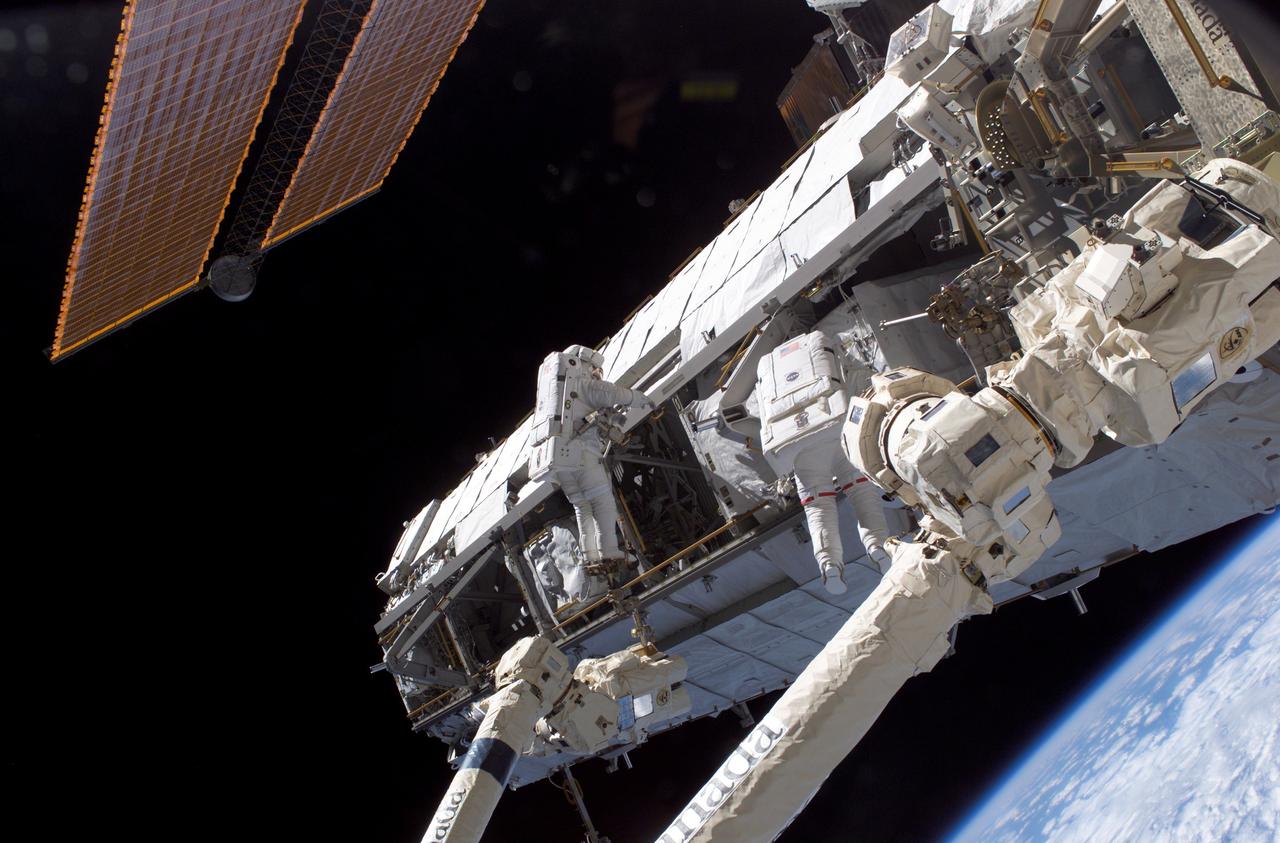
Astronauts Piers J. Sellers (left ) and David A. Wolf work on the newly installed Starboard One (S1) truss to the International Space Station (ISS) during the STS-112 mission. The primary payloads of this mission, ISS Assembly Mission 9A, were the Integrated Truss Assembly S1 (S One), the starboard side thermal radiator truss, and the Crew Equipment Translation Aid (CETA) cart to the ISS. The S1 truss provides structural support for the orbiting research facility's radiator panels, which use ammonia to cool the Station's complex power system. The S1 truss was attached to the S0 (S Zero) truss, which was launched on April 8, 2002 aboard the STS-110, and flows 637 pounds of anhydrous ammonia through three heat-rejection radiators. The truss is 45-feet long, 15-feet wide, 10-feet tall, and weighs approximately 32,000 pounds. The CETA cart was attached to the Mobil Transporter and will be used by assembly crews on later missions. Manufactured by the Boeing Company in Huntington Beach, California, the truss primary structure was transferred to the Marshall Space Flight Center in February 1999 for hardware installations and manufacturing acceptance testing. The launch of the STS-112 mission occurred on October 7, 2002, and its 11-day mission ended on October 18, 2002.
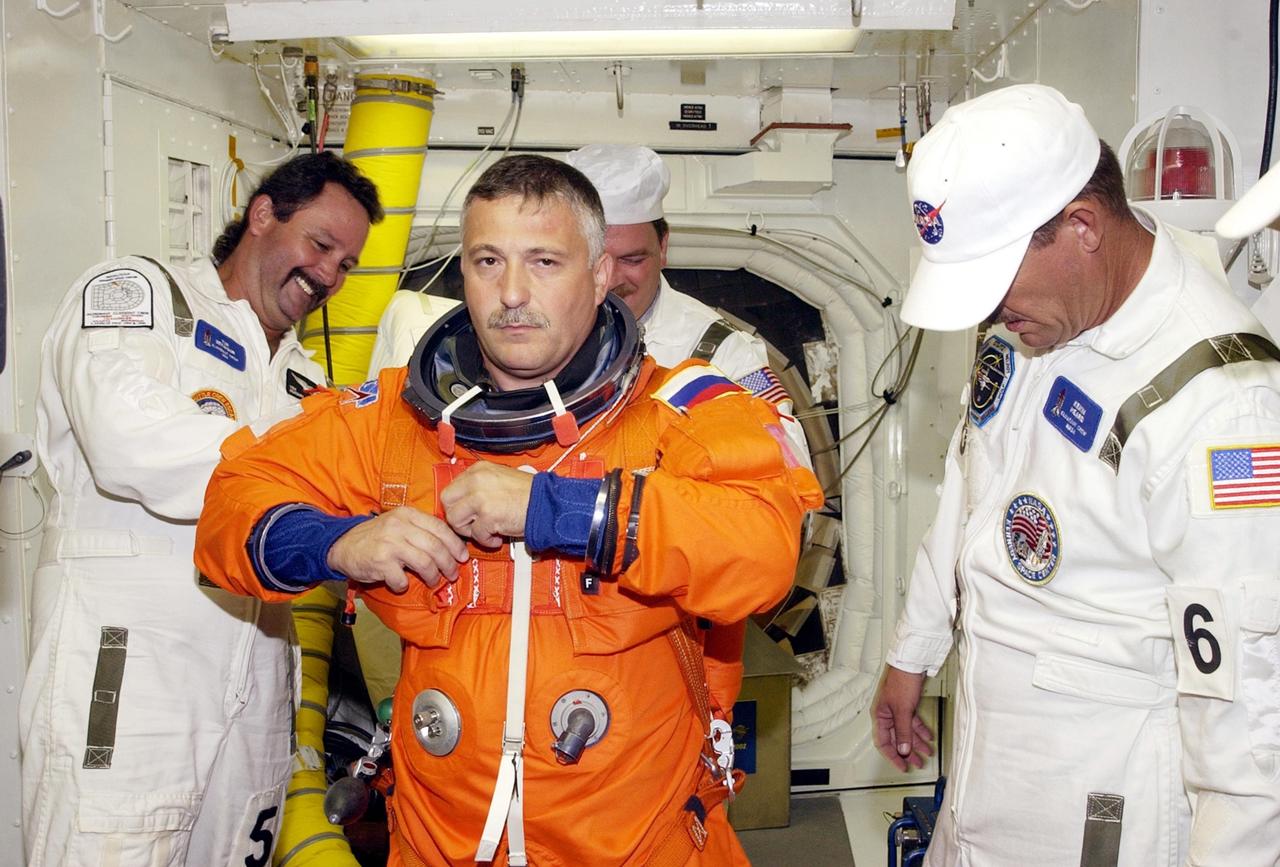
KENNEDY SPACE CENTER, FLA. -- In the White Room at Launch Pad 39B, STS-112 Mission Specialist Fyodor Yurchikhin, Ph.D., a cosmonaut with the Russian Space Agency, receives assistance with his spacesuit during a simulated launch countdown, part of Terminal Countdown Demonstration Test activities, a dress rehearsal for launch. Launch of STS-112 aboard Space Shuttle Atlantis is scheduled for Oct. 2, between 2 and 6 p.m. EDT. STS-112 is the 15th assembly mission to the International Space Station. Atlantis will be carrying the S1 Integrated Truss Structure, the first starboard truss segment, which will be attached to the central truss segment, S0, and the Crew and Equipment Translation Aid (CETA) Cart A. The CETA is the first of two human-powered carts that will ride along the ISS railway, providing mobile work platforms for future spacewalking astronauts.
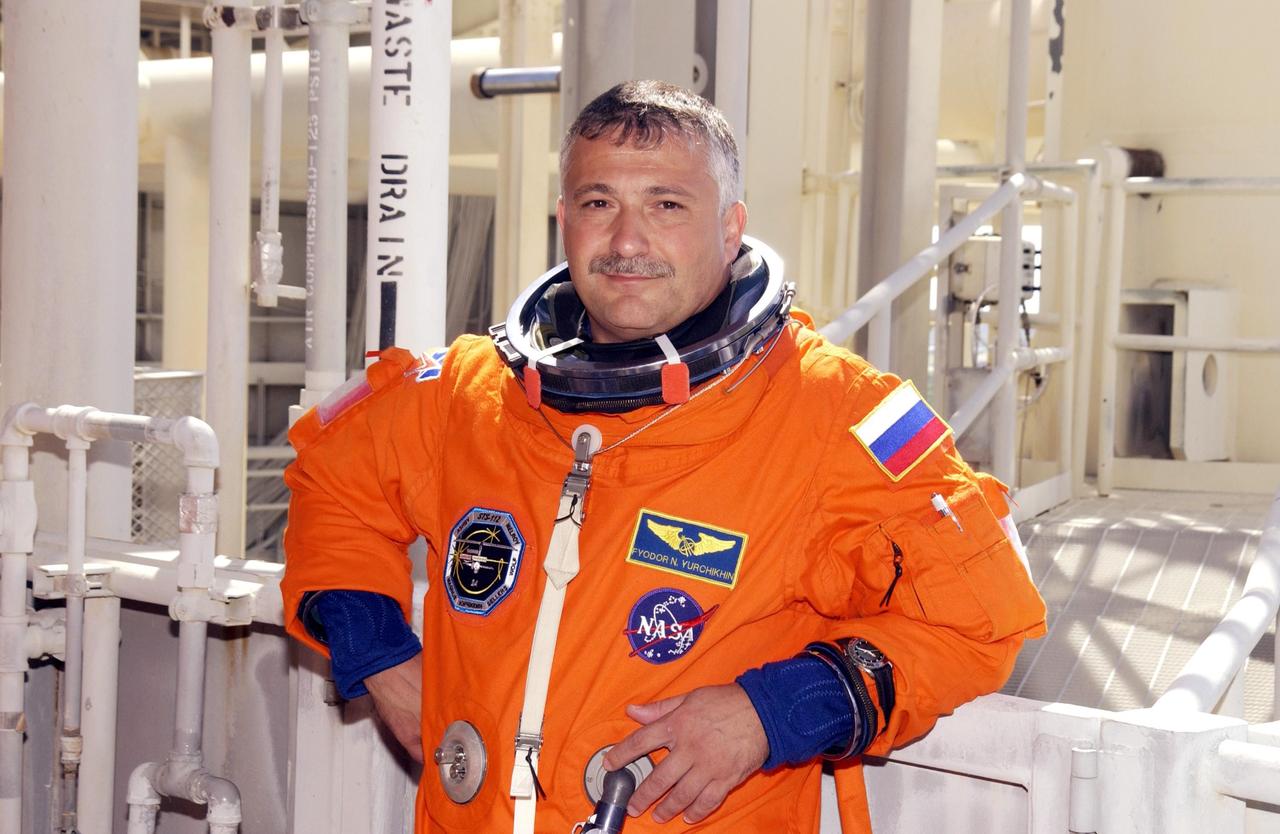
KENNEDY SPACE CENTER, FLA. - STS-112 Mission Specialist Fyodor Yurchikhin (with the Russian Space Agency) takes a break during emergency egress practice on the 195-foot level of the Fixed Service Structure, Launch Pad 39B. He and the rest of the crew are taking part in Terminal Countdown Demonstration Test activities, which include a simulated launch countdown. Mission STS-112 aboard Space Shuttle Atlantis is scheduled to launch no earlier than Oct. 2, between 2 and 6 p.m. EDT. STS-112 is the 15th assembly mission to the International Space Station. Atlantis will be carrying the S1 Integrated Truss Structure, the first starboard truss segment, to be attached to the central truss segment, S0, and the Crew and Equipment Translation Aid (CETA) Cart A. The CETA is the first of two human-powered carts that will ride along the ISS railway, providing mobile work platforms for future spacewalking astronauts.
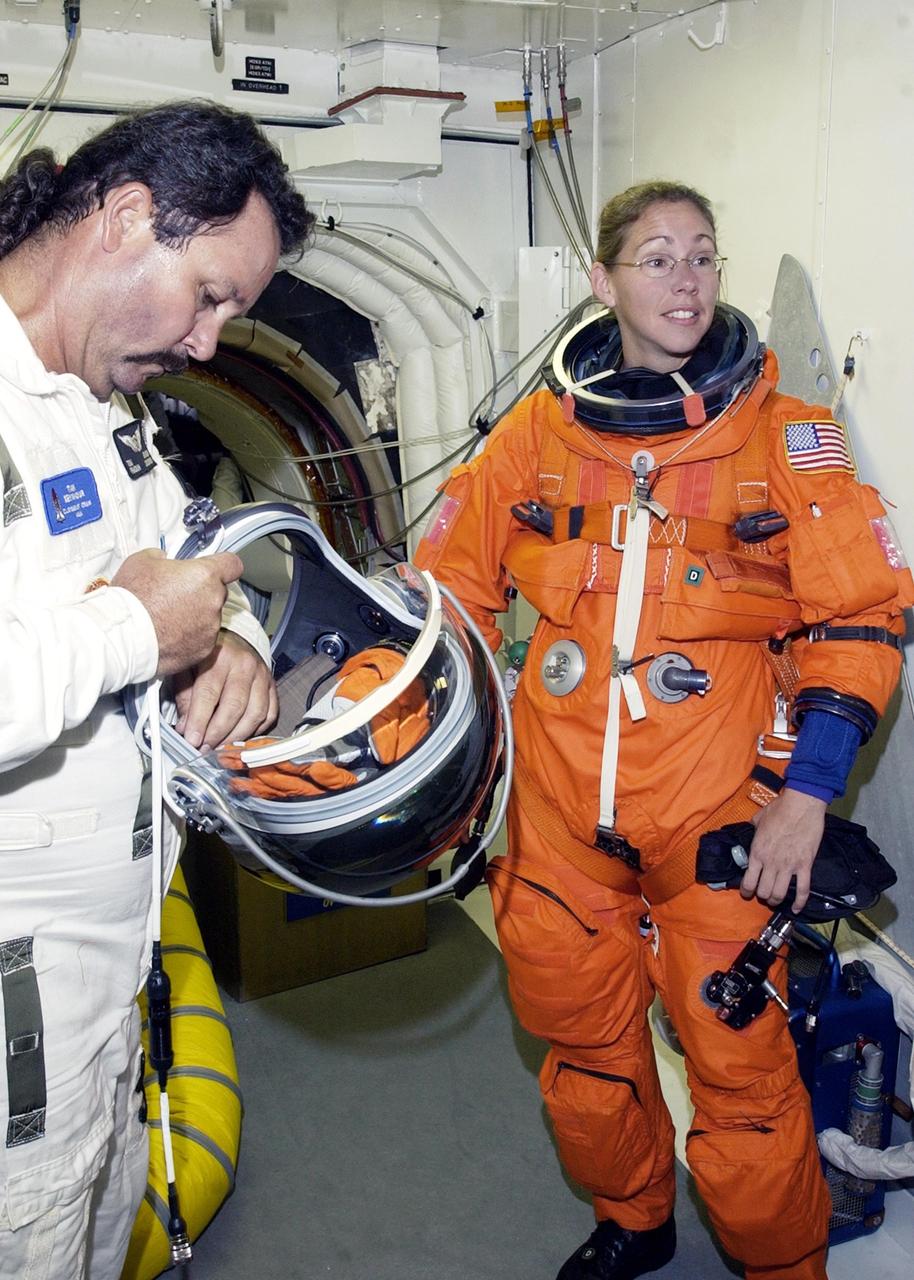
KENNEDY SPACE CENTER, FLA. -- In the White Room at Launch Pad 39B, STS-112 Mission Specialist Sandra Magnus, Ph.D., receives assistance with her spacesuit during a simulated launch countdown, part of Terminal Countdown Demonstration Test activities, a dress rehearsal for launch. Launch of STS-112 aboard Space Shuttle Atlantis is scheduled for Oct. 2, between 2 and 6 p.m. EDT. STS-112 is the 15th assembly mission to the International Space Station. Atlantis will be carrying the S1 Integrated Truss Structure, the first starboard truss segment, which will be attached to the central truss segment, S0, and the Crew and Equipment Translation Aid (CETA) Cart A. The CETA is the first of two human-powered carts that will ride along the ISS railway, providing mobile work platforms for future spacewalking astronauts.

KENNEDY SPACE CENTER, FLA. -- STS-112 Commander Jeffrey Ashby takes a break during emergency egress practice on the 195-foot level of the Fixed Service Structure, Launch Pad 39B. He and the rest of the crew are taking part in Terminal Countdown Demonstration Test activities, which include a simulated launch countdown. Mission STS-112 aboard Space Shuttle Atlantis is scheduled to launch no earlier than Oct. 2, between 2 and 6 p.m. EDT. STS-112 is the 15th assembly mission to the International Space Station. Atlantis will be carrying the S1 Integrated Truss Structure, the first starboard truss segment, to be attached to the central truss segment, S0, and the Crew and Equipment Translation Aid (CETA) Cart A. The CETA is the first of two human-powered carts that will ride along the ISS railway, providing mobile work platforms for future spacewalking astronauts.
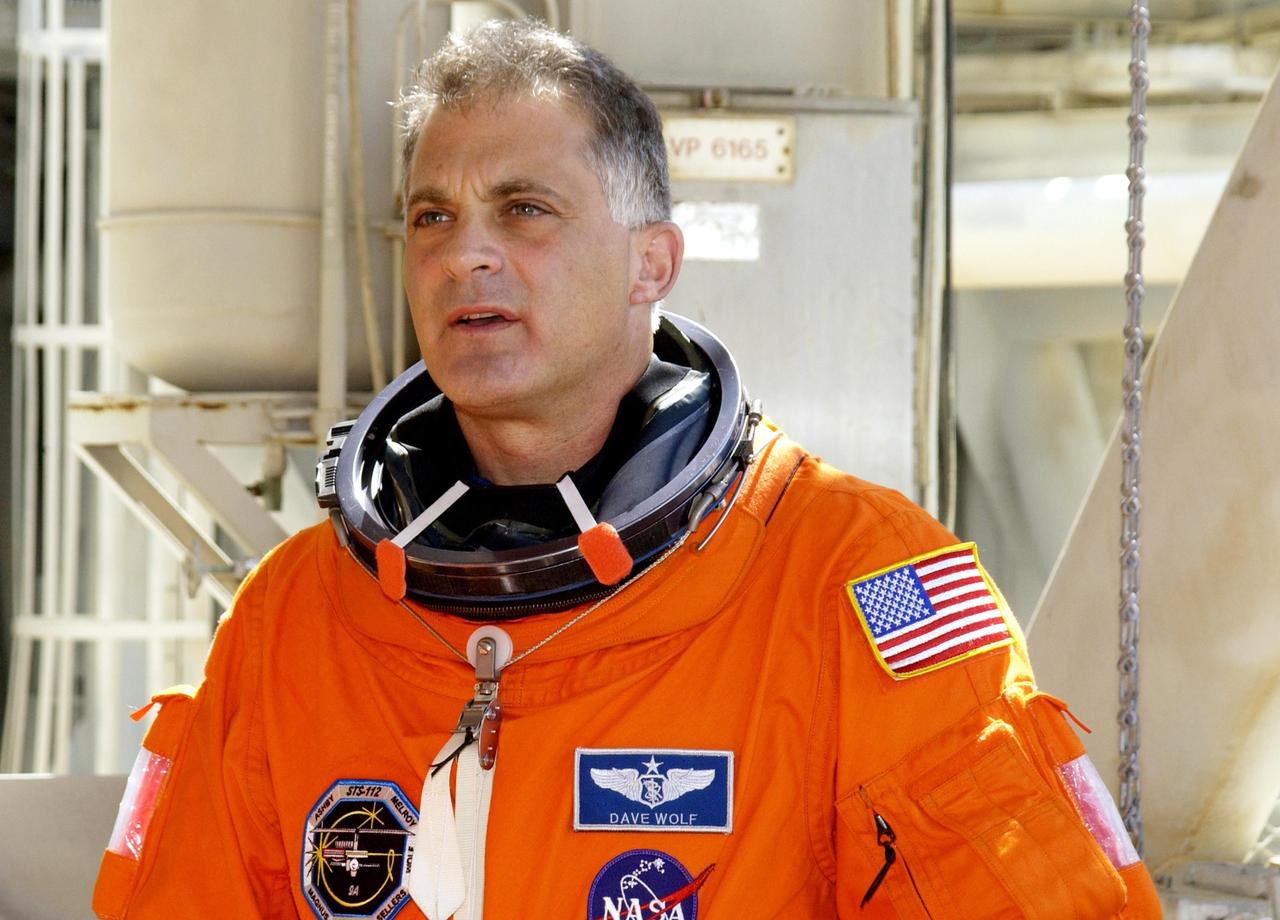
KENNEDY SPACE CENTER, FLA. -- STS-112 Mission Specialist David Wolf takes a break during emergency egress practice on the 195-foot level of the Fixed Service Structure, Launch Pad 39B. He and the rest of the crew are taking part in Terminal Countdown Demonstration Test activities, which include a simulated launch countdown. Mission STS-112 aboard Space Shuttle Atlantis is scheduled to launch no earlier than Oct. 2, between 2 and 6 p.m. EDT. STS-112 is the 15th assembly mission to the International Space Station. Atlantis will be carrying the S1 Integrated Truss Structure, the first starboard truss segment, to be attached to the central truss segment, S0, and the Crew and Equipment Translation Aid (CETA) Cart A. The CETA is the first of two human-powered carts that will ride along the ISS railway, providing mobile work platforms for future spacewalking astronauts.
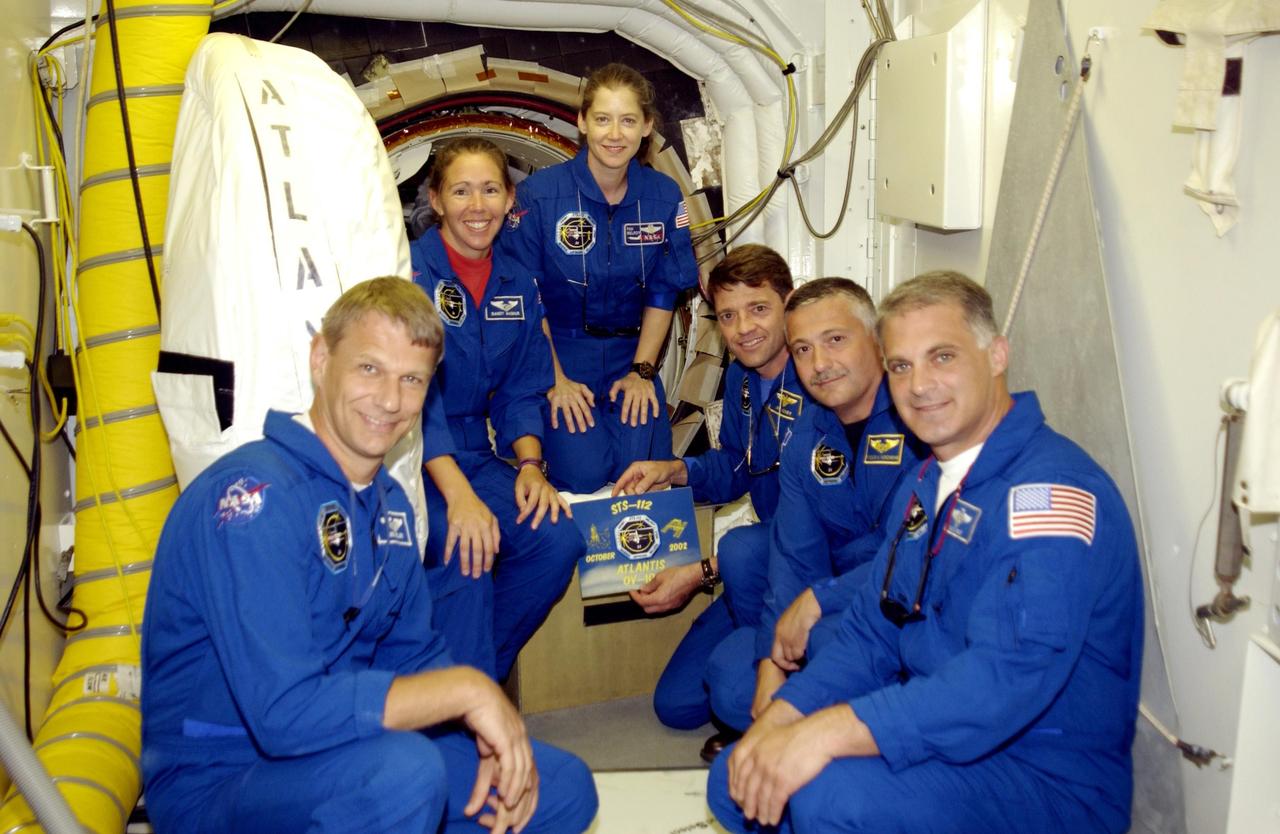
KENNEDY SPACE CENTER, FLA. -- The STS-112 crew pauses for a photo in the White Room during Terminal Countdown Demonstration Test activities. From left, clockwise, are Mission Specialists Piers Sellers and Sandra Magnus, Pilot Pamela Melroy, Commander Jeffrey Ashby and Mission Specialists Fyodor Yurchikhin and David Wolf. Ashby is holding the mission insignia. Yurchikhin is with the Russian Space Agency. Mission STS-112 aboard Space Shuttle Atlantis is scheduled to launch no earlier than Oct. 2, between 2 and 6 p.m. EDT. STS-112 is the 15th assembly mission to the International Space Station. Atlantis will be carrying the S1 Integrated Truss Structure, the first starboard truss segment, to be attached to the central truss segment, S0, and the Crew and Equipment Translation Aid (CETA) Cart A. The CETA is the first of two human-powered carts that will ride along the ISS railway, providing mobile work platforms for future spacewalking astronauts.

KENNEDY SPACE CENTER, FLA. -- Sitting in a slidewire basket on the 195-foot level of the Fixed Service Structure, Launch Pad 39B, are STS-112 Commander Jeffrey Ashby (left foreground) and Pilot Pamela Melroy. They and the rest of the crew are practicing emergency egress from the pad during Terminal Countdown Demonstration Test activities. Mission STS-112 aboard Space Shuttle Atlantis is scheduled to launch no earlier than Oct. 2, between 2 and 6 p.m. EDT. STS-112 is the 15th assembly mission to the International Space Station. Atlantis will be carrying the S1 Integrated Truss Structure, the first starboard truss segment, to be attached to the central truss segment, S0, and the Crew and Equipment Translation Aid (CETA) Cart A. The CETA is the first of two human-powered carts that will ride along the ISS railway, providing mobile work platforms for future spacewalking astronauts.

KENNEDY SPACE CENTER, FLA. -- In the White Room at Launch Pad 39B, STS-112 Commander Jeffrey Ashby receives assistance with his spacesuit during a simulated launch countdown, part of Terminal Countdown Demonstration Test activities, a dress rehearsal for launch. Launch of STS-112 aboard Space Shuttle Atlantis is scheduled for Oct. 2, between 2 and 6 p.m. EDT. STS-112 is the 15th assembly mission to the International Space Station. Atlantis will be carrying the S1 Integrated Truss Structure, the first starboard truss segment, which will be attached to the central truss segment, S0, and the Crew and Equipment Translation Aid (CETA) Cart A. The CETA is the first of two human-powered carts that will ride along the ISS railway, providing mobile work platforms for future spacewalking astronauts.

KENNEDY SPACE CENTER, FLA. - During emergency egress practice on the 195-foot level of the Fixed Service Structure, Launch Pad 39B, STS-112 Mission Specialist Sandra Magnus opens her helmet visor. She and the rest of the crew are taking part in Terminal Countdown Demonstration Test activities, which include a simulated launch countdown. Mission STS-112 aboard Space Shuttle Atlantis is scheduled to launch no earlier than Oct. 2, between 2 and 6 p.m. EDT. STS-112 is the 15th assembly mission to the International Space Station. Atlantis will be carrying the S1 Integrated Truss Structure, the first starboard truss segment, to be attached to the central truss segment, S0, and the Crew and Equipment Translation Aid (CETA) Cart A. The CETA is the first of two human-powered carts that will ride along the ISS railway, providing mobile work platforms for future spacewalking astronauts.
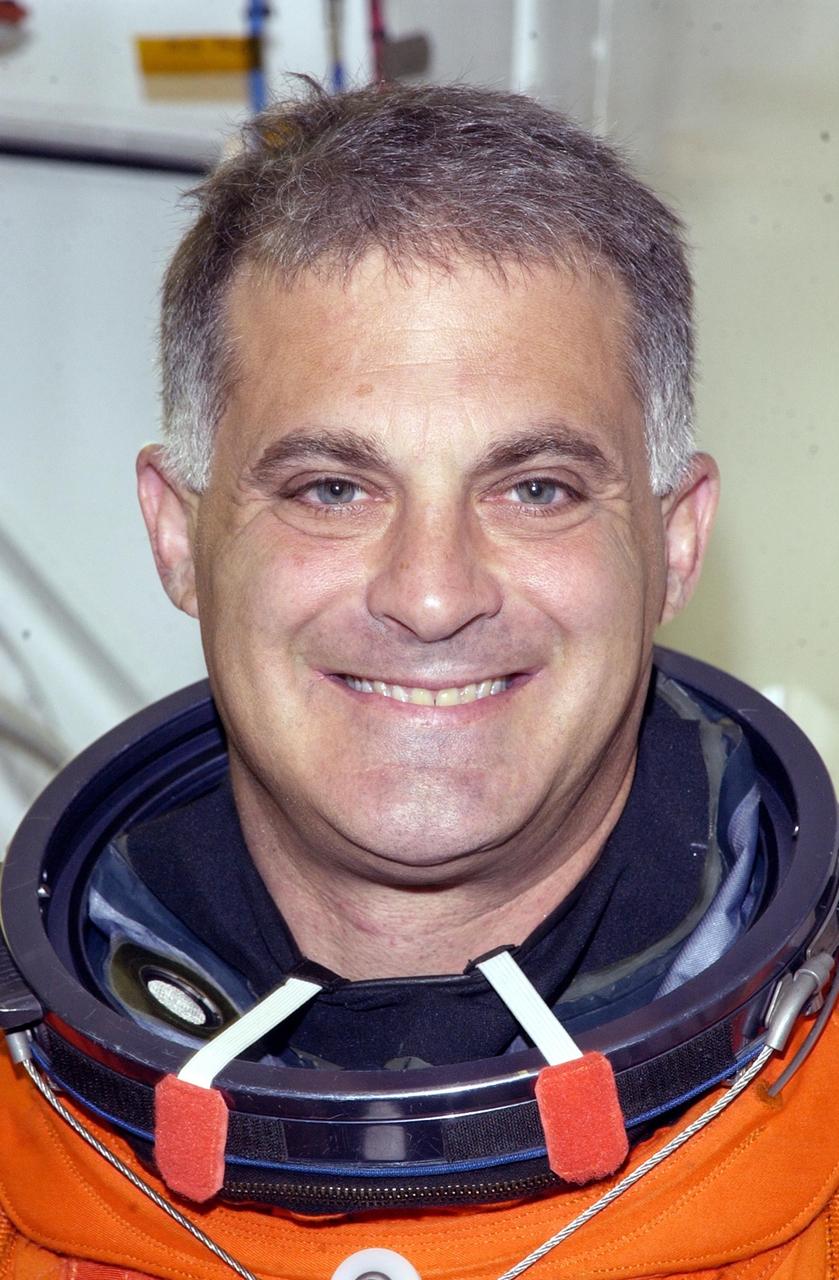
KENNEDY SPACE CENTER, FLA. -- STS-112 Mission Specialist David Wolf, M.D., takes a break from training at Pad 39B during Terminal Countdown Demonstration Test activities, which include a simulated launch countdown. Launch of STS-112 aboard Space Shuttle Atlantis is scheduled for Oct. 2, between 2 and 6 p.m. EDT. STS-112 is the 15th assembly mission to the International Space Station. Atlantis will be carrying the S1 Integrated Truss Structure, the first starboard truss segment, to be attached to the central truss segment, S0, and the Crew and Equipment Translation Aid (CETA) Cart A. The CETA is the first of two human-powered carts that will ride along the ISS railway, providing mobile work platforms for future spacewalking astronauts.
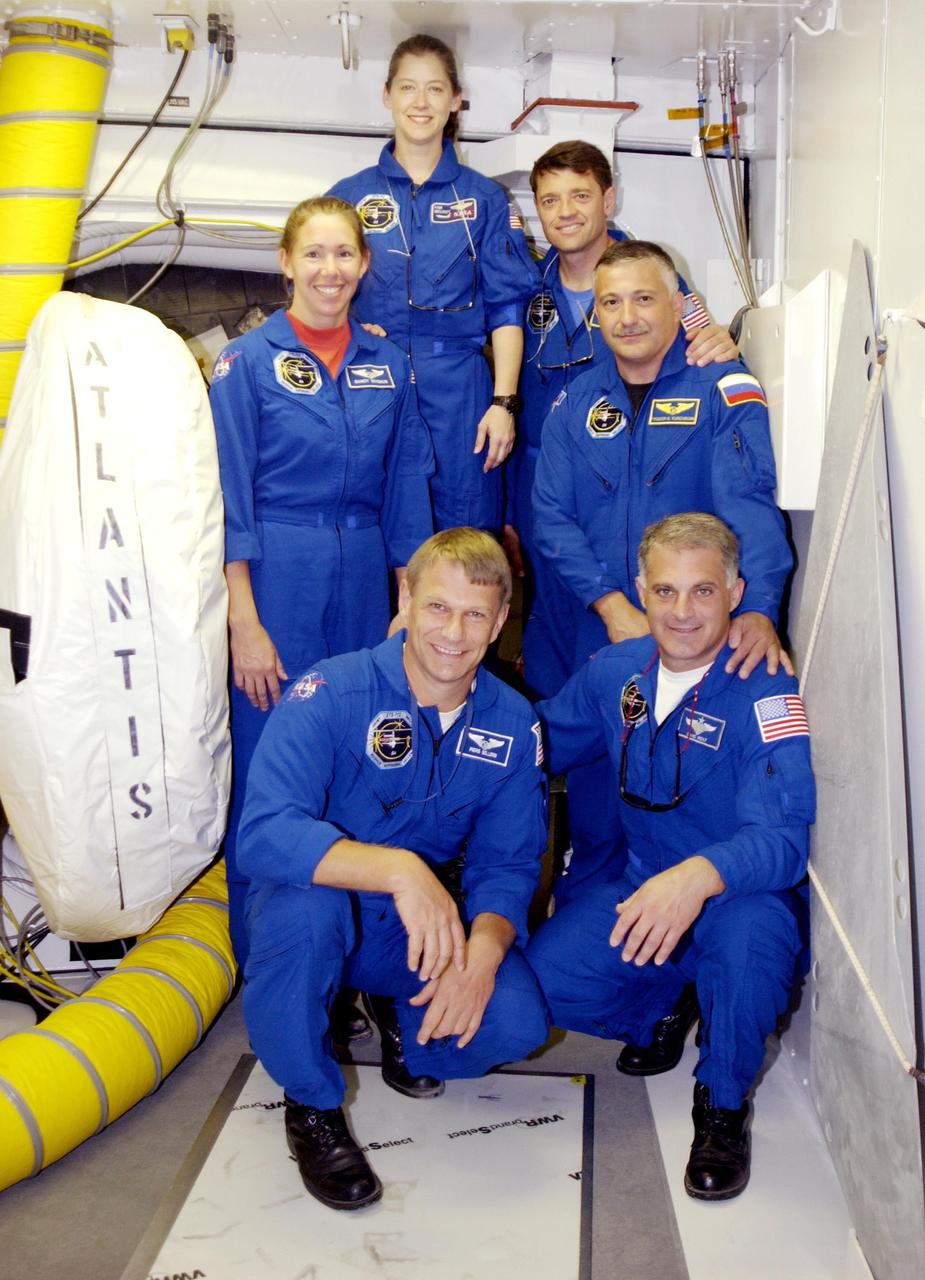
KENNEDY SPACE CENTER, FLA. -- The STS-112 crew pauses for a photo in the White Room during Terminal Countdown Demonstration Test activities. Kneeling in front are Mission Specialists Piers Sellers and David Wolf; standing, left to right, are Mission Specialist Sandra Magnus, Pilot Pamela Melroy, Commander Jeffrey Ashby and Mission Specialist Fyodor Yurchikhin. (with the Russian Space Agency). Mission STS-112 aboard Space Shuttle Atlantis is scheduled to launch no earlier than Oct. 2, between 2 and 6 p.m. EDT. STS-112 is the 15th assembly mission to the International Space Station. Atlantis will be carrying the S1 Integrated Truss Structure, the first starboard truss segment, to be attached to the central truss segment, S0, and the Crew and Equipment Translation Aid (CETA) Cart A. The CETA is the first of two human-powered carts that will ride along the ISS railway, providing mobile work platforms for future spacewalking astronauts.

KENNEDY SPACE CENTER, FLA. -- STS-112 Mission Specialist Piers Sellers takes a break during emergency egress practice on the 195-foot level of the Fixed Service Structure, Launch Pad 39B. He and the rest of the crew are taking part in Terminal Countdown Demonstration Test activities, which include a simulated launch countdown. Mission STS-112 aboard Space Shuttle Atlantis is scheduled to launch no earlier than Oct. 2, between 2 and 6 p.m. EDT. STS-112 is the 15th assembly mission to the International Space Station. Atlantis will be carrying the S1 Integrated Truss Structure, the first starboard truss segment, to be attached to the central truss segment, S0, and the Crew and Equipment Translation Aid (CETA) Cart A. The CETA is the first of two human-powered carts that will ride along the ISS railway, providing mobile work platforms for future spacewalking astronauts.
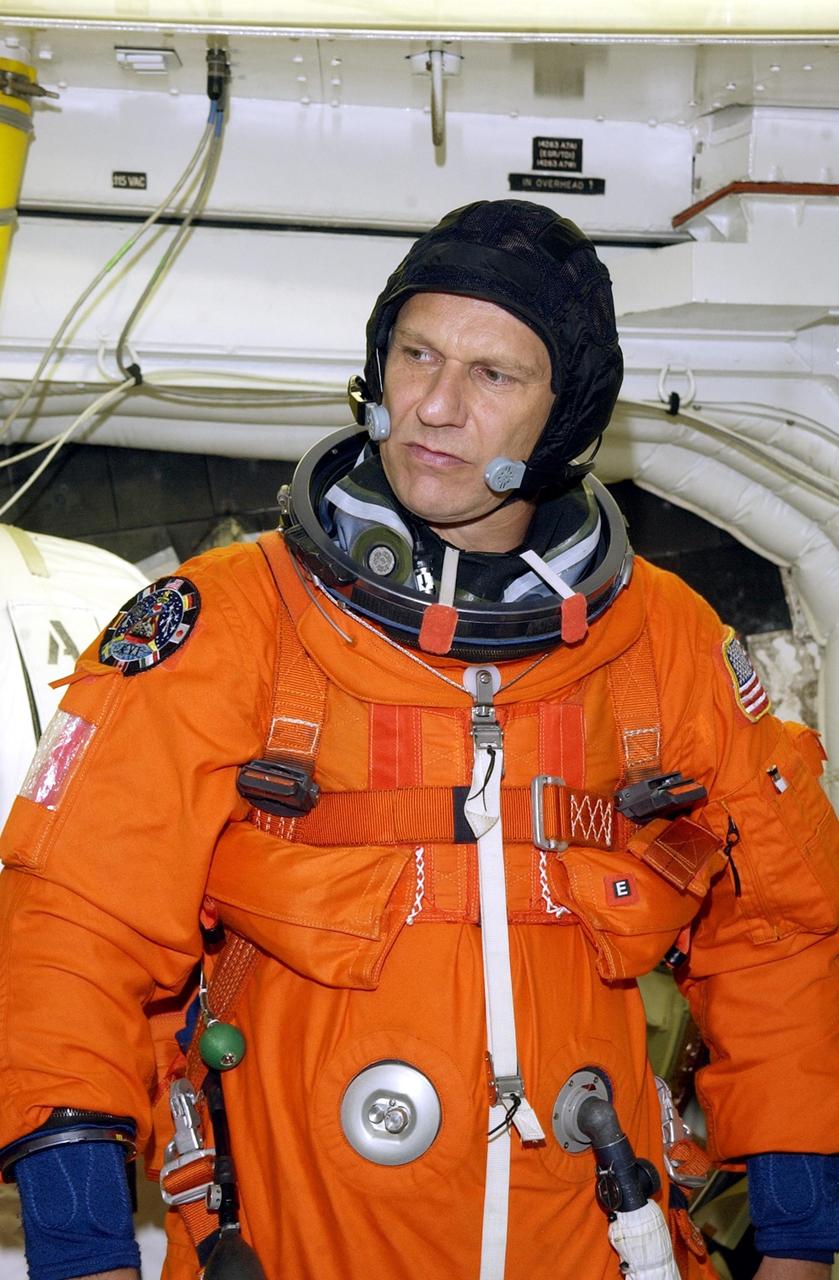
KENNEDY SPACE CENTER, FLA. -- In the White Room at Launch Pad 39B, STS-112 Mission Specialist Piers Sellers, Ph.D., prepares to enter Space Shuttle Atlantis during a simulated launch countdown, part of Terminal Countdown Demonstration Test activities, a dress rehearsal for launch. Launch of STS-112 aboard Space Shuttle Atlantis is scheduled for Oct. 2, between 2 and 6 p.m. EDT. STS-112 is the 15th assembly mission to the International Space Station. Atlantis will be carrying the S1 Integrated Truss Structure, the first starboard truss segment, which will be attached to the central truss segment, S0, and the Crew and Equipment Translation Aid (CETA) Cart A. The CETA is the first of two human-powered carts that will ride along the ISS railway, providing mobile work platforms for future spacewalking astronauts.
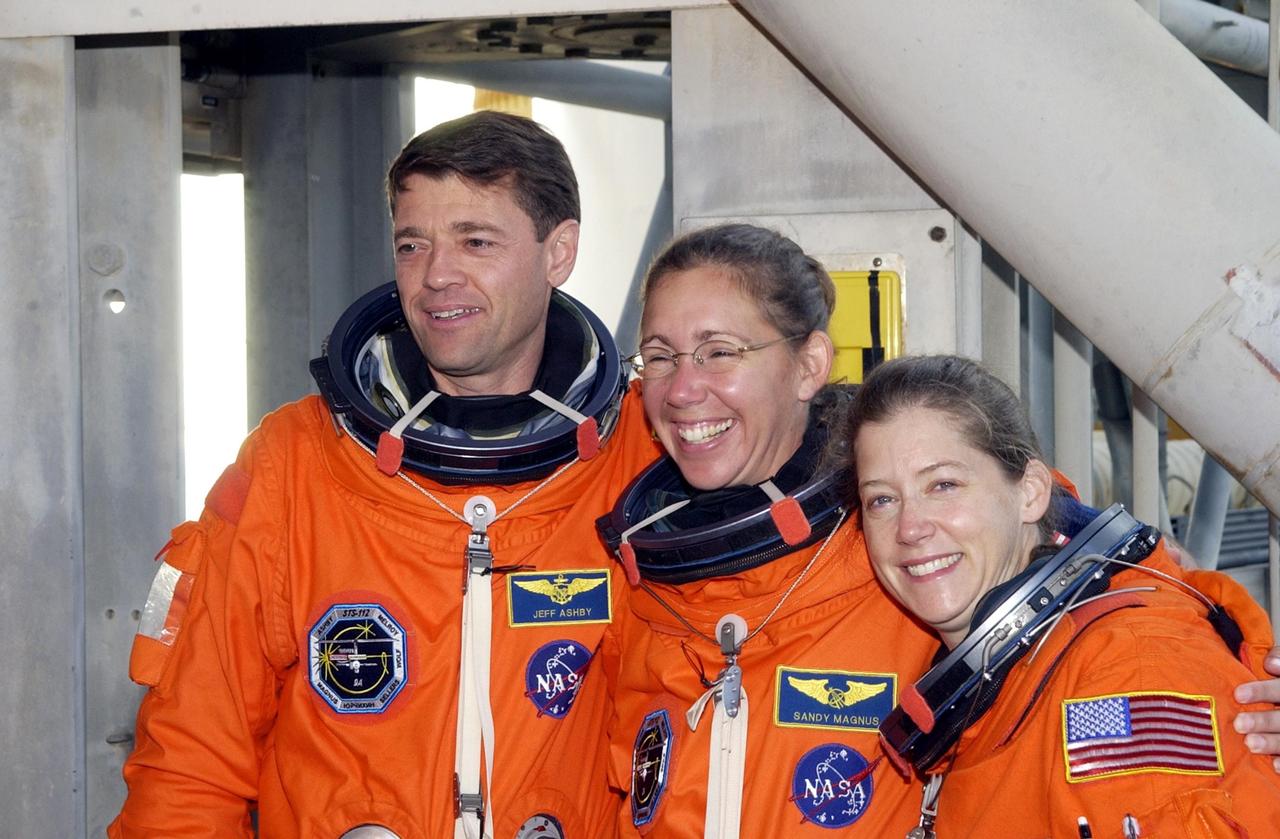
KENNEDY SPACE CENTER, FLA. -- STS-112 Commander Jeffrey Ashby, Mission Specialist Sandra Magnus, and Pilot Pamela Melroy take a momentary break from training at Pad 39B during Terminal Countdown Demonstration Test activities, which include a simulated launch countdown. Launch of STS-112 aboard Space Shuttle Atlantis is scheduled for Oct. 2, between 2 and 6 p.m. EDT. STS-112 is the 15th assembly mission to the International Space Station. Atlantis will be carrying the S1 Integrated Truss Structure, the first starboard truss segment, to be attached to the central truss segment, S0, and the Crew and Equipment Translation Aid (CETA) Cart A. The CETA is the first of two human-powered carts that will ride along the ISS railway, providing mobile work platforms for future spacewalking astronauts.
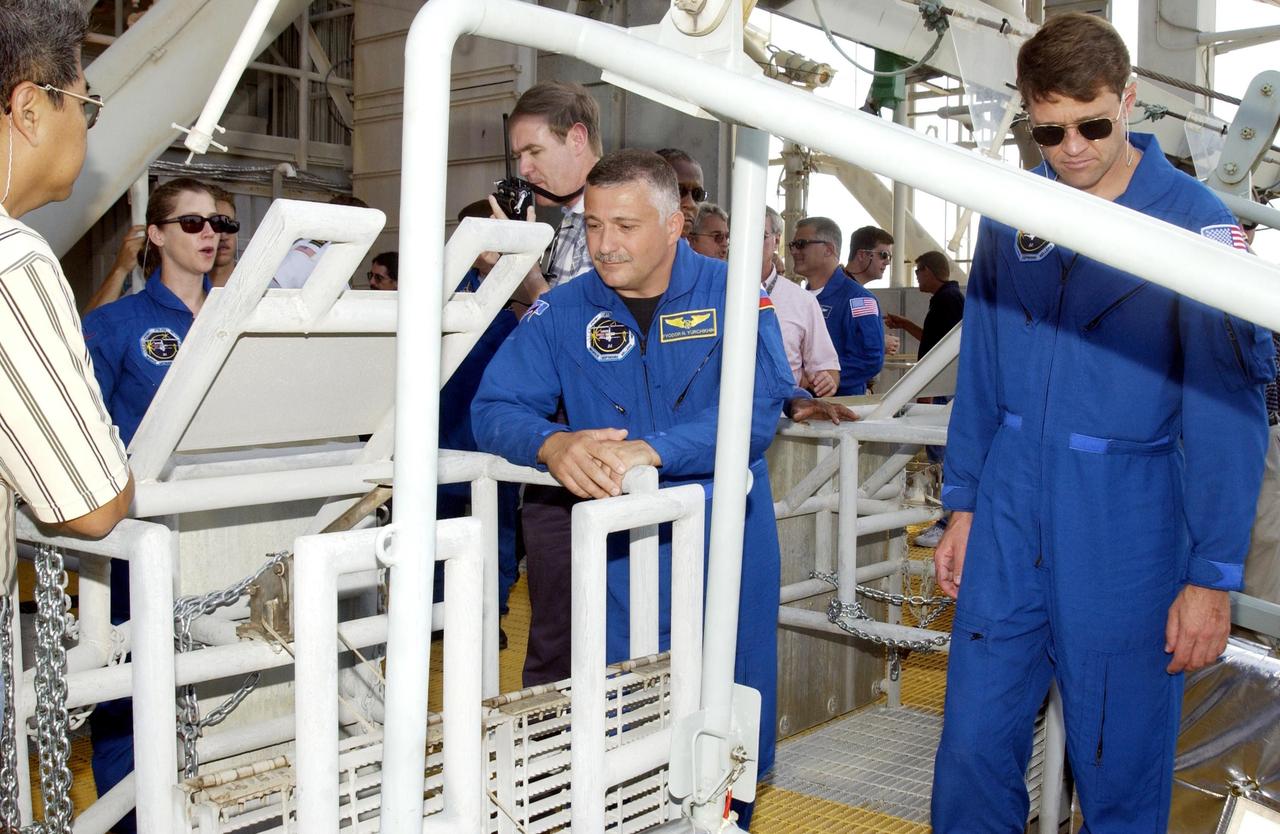
KENNEDY SPACE CENTER, FLA. -- In the foreground, STS-112 Pilot Pamela Melroy (left), Mission Specialist Fyodor Yurchikhin (center) and Commander Jeffrey Ashby (right) watch as a slidewire basket descends to the landing area. The crew is taking part in emergency egress training from the pad, part of Terminal Countdown Demonstration Test activities. Mission STS-112 aboard Space Shuttle Atlantis is scheduled to launch no earlier than Oct. 2, between 2 and 6 p.m. EDT. STS-112 is the 15th assembly mission to the International Space Station. Atlantis will be carrying the S1 Integrated Truss Structure, the first starboard truss segment, to be attached to the central truss segment, S0, and the Crew and Equipment Translation Aid (CETA) Cart A. The CETA is the first of two human-powered carts that will ride along the ISS railway, providing mobile work platforms for future spacewalking astronauts.
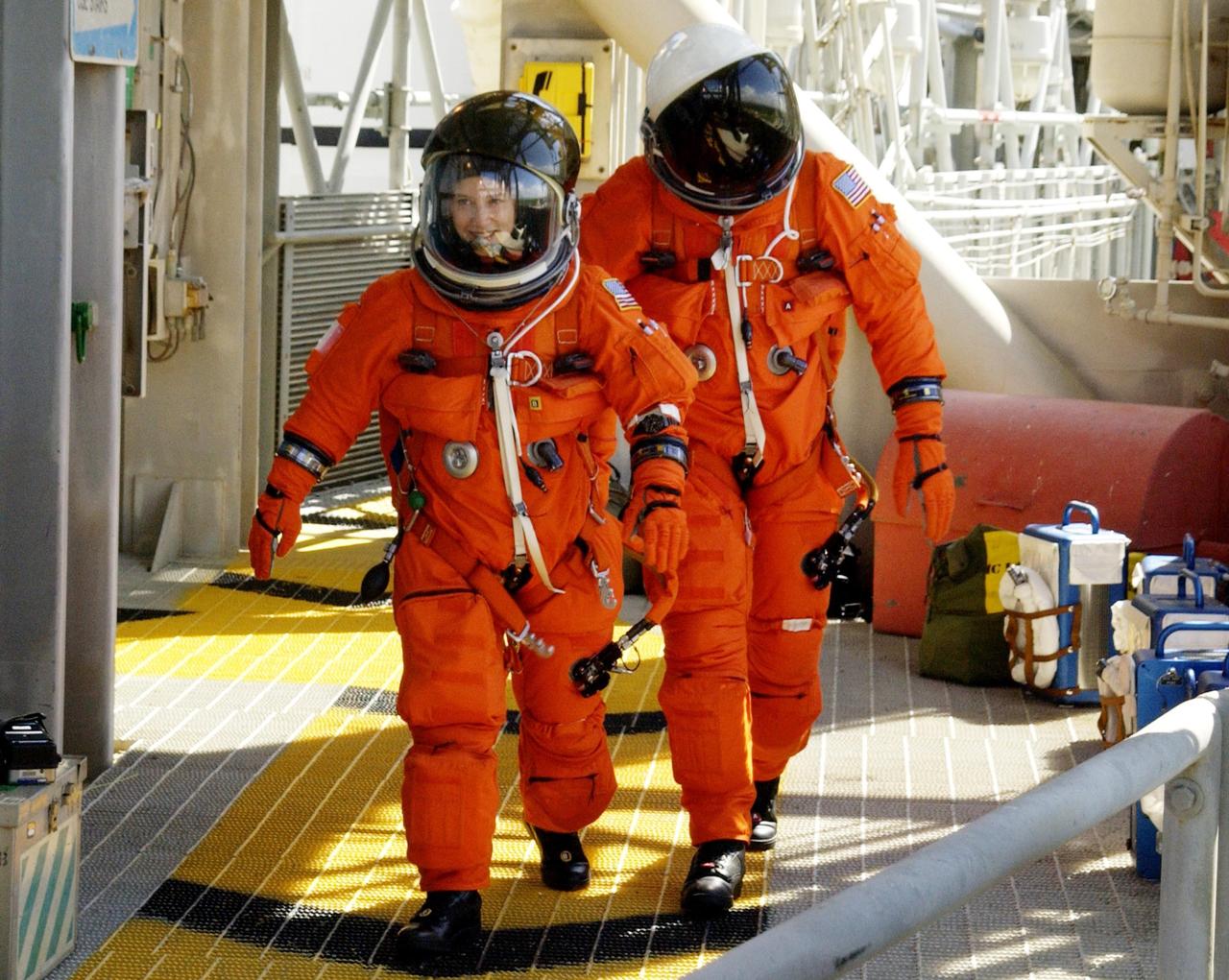
KENNEDY SPACE CENTER, FLA. - STS-112 Pilot Pamela Melroy (left) and Commander Jeffrey Ashby hurry toward the slidewire baskets on the 195-foot level of the Fixed Service Structure, Launch Pad 39B. They and the rest of the crew are practicing emergency egress from the pad during Terminal Countdown Demonstration Test activities. Mission STS-112 aboard Space Shuttle Atlantis is scheduled to launch no earlier than Oct. 2, between 2 and 6 p.m. EDT. STS-112 is the 15th assembly mission to the International Space Station. Atlantis will be carrying the S1 Integrated Truss Structure, the first starboard truss segment, to be attached to the central truss segment, S0, and the Crew and Equipment Translation Aid (CETA) Cart A. The CETA is the first of two human-powered carts that will ride along the ISS railway, providing mobile work platforms for future spacewalking astronauts.
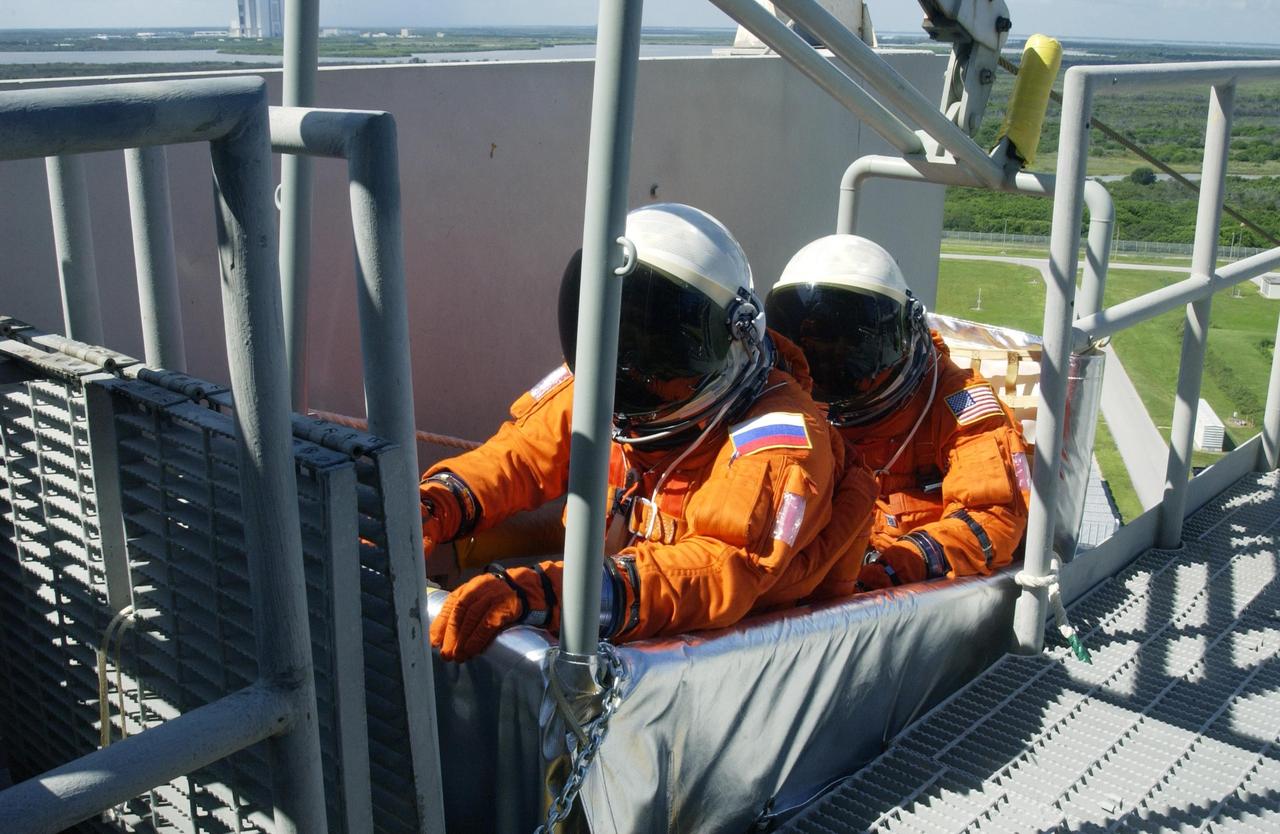
KENNEDY SPACE CENTER, FLA. -- Sitting in a slidewire basket on the 195-foot level of the Fixed Service Structure, Launch Pad 39B, are STS-112 Mission Specialists Fyodor Yurchikhin (left) and David Wolf. They and the rest of the crew are practicing emergency egress from the pad during Terminal Countdown Demonstration Test activities. Mission STS-112 aboard Space Shuttle Atlantis is scheduled to launch no earlier than Oct. 2, between 2 and 6 p.m. EDT. STS-112 is the 15th assembly mission to the International Space Station. Atlantis will be carrying the S1 Integrated Truss Structure, the first starboard truss segment, to be attached to the central truss segment, S0, and the Crew and Equipment Translation Aid (CETA) Cart A. The CETA is the first of two human-powered carts that will ride along the ISS railway, providing mobile work platforms for future spacewalking astronauts.
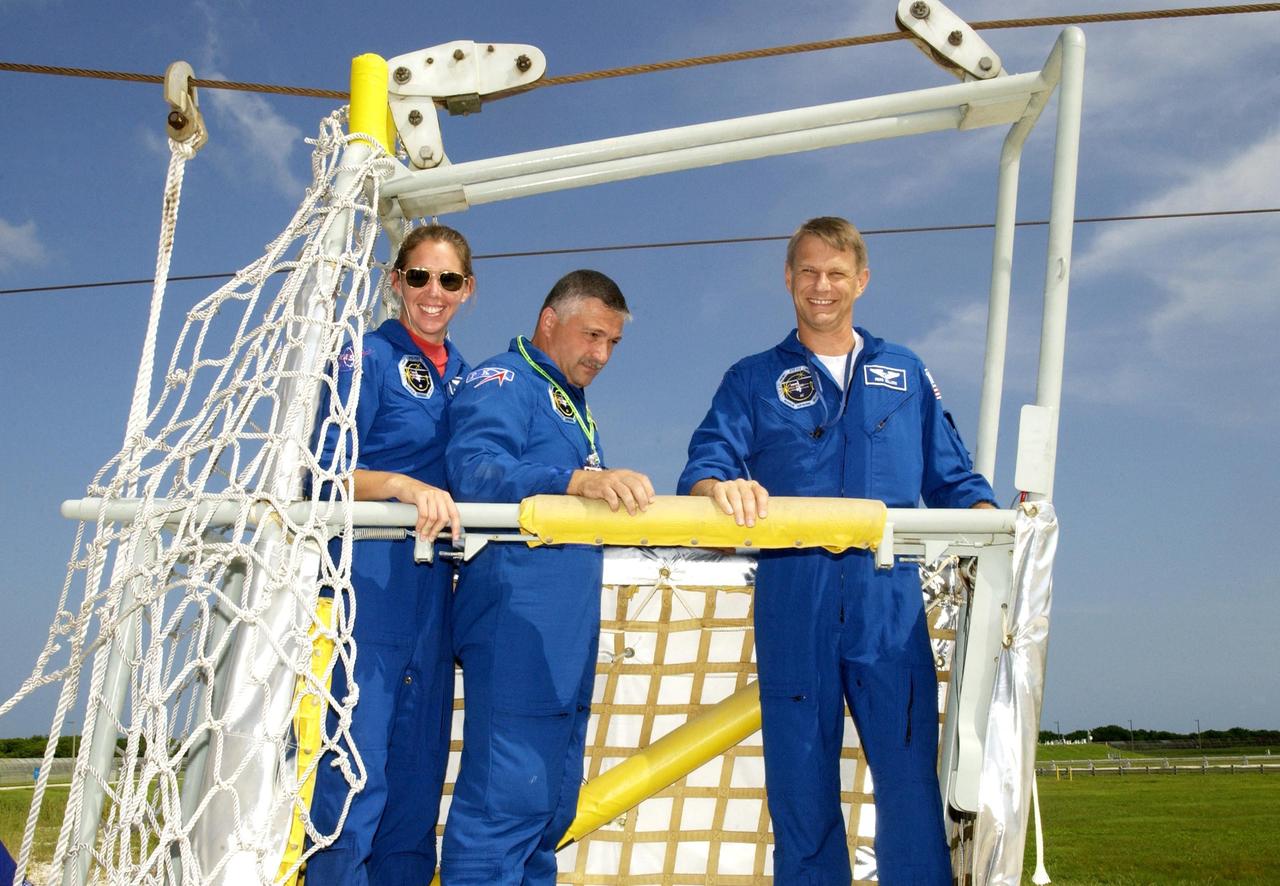
KENNEDY SPACE CENTER, FLA. -- Members of the STS-112 crew stand inside a slidewire basket, a component of the emergency egress system at the pad. From left are Mission Specialists Sandra Magnus, Fyodor Yurchikhin (with the Russian Space Agency), and Piers Sellers. The training is part of Terminal Countdown Demonstration Test activities, which include a simulated launch countdown. Mission STS-112 aboard Space Shuttle Atlantis is scheduled to launch no earlier than Oct. 2, between 2 and 6 p.m. EDT. STS-112 is the 15th assembly mission to the International Space Station. Atlantis will be carrying the S1 Integrated Truss Structure, the first starboard truss segment, to be attached to the central truss segment, S0, and the Crew and Equipment Translation Aid (CETA) Cart A. The CETA is the first of two human-powered carts that will ride along the ISS railway, providing mobile work platforms for future spacewalking astronauts.

KENNEDY SPACE CENTER, FLA. -- Sitting in a slidewire basket on the 195-foot level of the Fixed Service Structure, Launch Pad 39B, are STS-112 Mission Specialists Fyodor Yurchikhin (left) and David Wolf. They and the rest of the crew are practicing emergency egress from the pad during Terminal Countdown Demonstration Test activities. Mission STS-112 aboard Space Shuttle Atlantis is scheduled to launch no earlier than Oct. 2, between 2 and 6 p.m. EDT. STS-112 is the 15th assembly mission to the International Space Station. Atlantis will be carrying the S1 Integrated Truss Structure, the first starboard truss segment, to be attached to the central truss segment, S0, and the Crew and Equipment Translation Aid (CETA) Cart A. The CETA is the first of two human-powered carts that will ride along the ISS railway, providing mobile work platforms for future spacewalking astronauts.
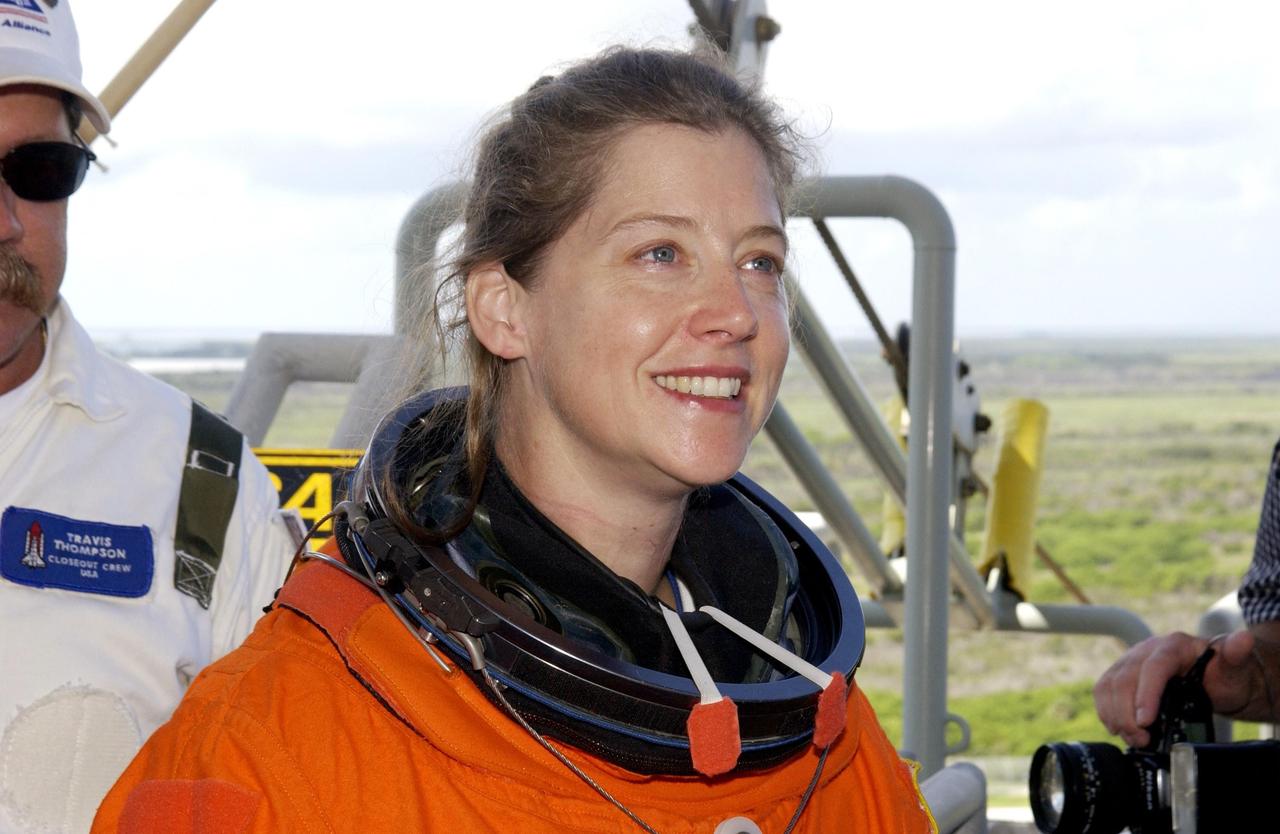
KENNEDY SPACE CENTER, FLA. - STS-112 Pilot Pamela Melroy takes a break during emergency egress practice on the 195-foot level of the Fixed Service Structure, Launch Pad 39B. She and the rest of the crew are taking part in Terminal Countdown Demonstration Test activities, which include a simulated launch countdown. Mission STS-112 aboard Space Shuttle Atlantis is scheduled to launch no earlier than Oct. 2, between 2 and 6 p.m. EDT. STS-112 is the 15th assembly mission to the International Space Station. Atlantis will be carrying the S1 Integrated Truss Structure, the first starboard truss segment, to be attached to the central truss segment, S0, and the Crew and Equipment Translation Aid (CETA) Cart A. The CETA is the first of two human-powered carts that will ride along the ISS railway, providing mobile work platforms for future spacewalking astronauts.
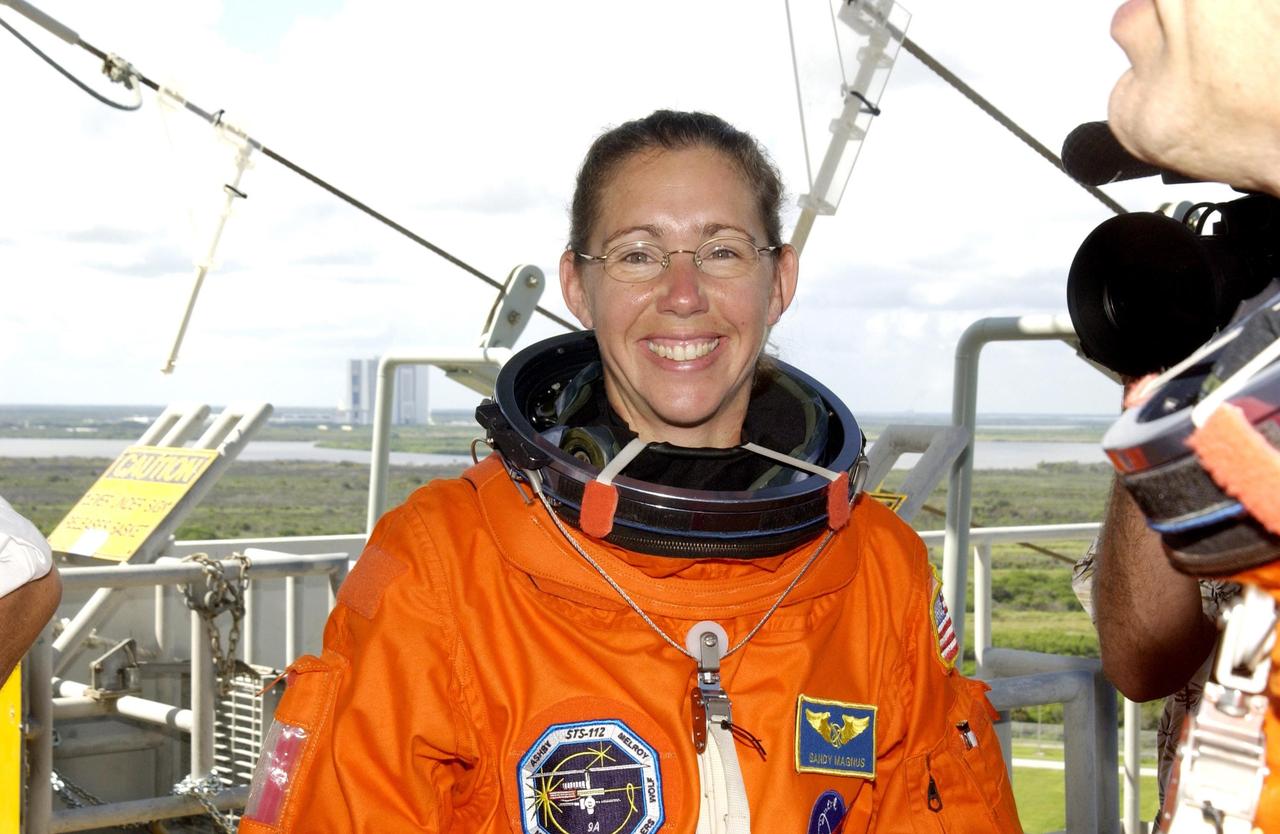
KENNEDY SPACE CENTER, FLA. -- STS-112 Mission Specialist Sandra Magnus takes a break during emergency egress practice on the 195-foot level of the Fixed Service Structure, Launch Pad 39B. She and the rest of the crew are taking part in Terminal Countdown Demonstration Test activities, which include a simulated launch countdown. Mission STS-112 aboard Space Shuttle Atlantis is scheduled to launch no earlier than Oct. 2, between 2 and 6 p.m. EDT. STS-112 is the 15th assembly mission to the International Space Station. Atlantis will be carrying the S1 Integrated Truss Structure, the first starboard truss segment, to be attached to the central truss segment, S0, and the Crew and Equipment Translation Aid (CETA) Cart A. The CETA is the first of two human-powered carts that will ride along the ISS railway, providing mobile work platforms for future spacewalking astronauts.

KENNEDY SPACE CENTER, FLA. -- The STS-112 crew strides out of the Checkout and Operations Building on their way to the launch pad and a simulated countdown. On the left, front to back, are Pilot Pamela Melroy and Mission Specialists David Wolf and Fyodor Yurchikhin (RSA). On the right, front to back, are Commander Jeffrey Ashby and Mission Specialists Sandra Magnus and Piers Sellers. Mission STS-112 aboard Space Shuttle Atlantis is scheduled to launch no earlier than Oct. 2, between 2 and 6 p.m. EDT. STS-112 is the 15th assembly mission to the International Space Station. Atlantis will be carrying the S1 Integrated Truss Structure, the first starboard truss segment, to be attached to the central truss segment, S0, and the Crew and Equipment Translation Aid (CETA) Cart A. The CETA is the first of two human-powered carts that will ride along the ISS railway, providing mobile work platforms for future spacewalking astronauts.
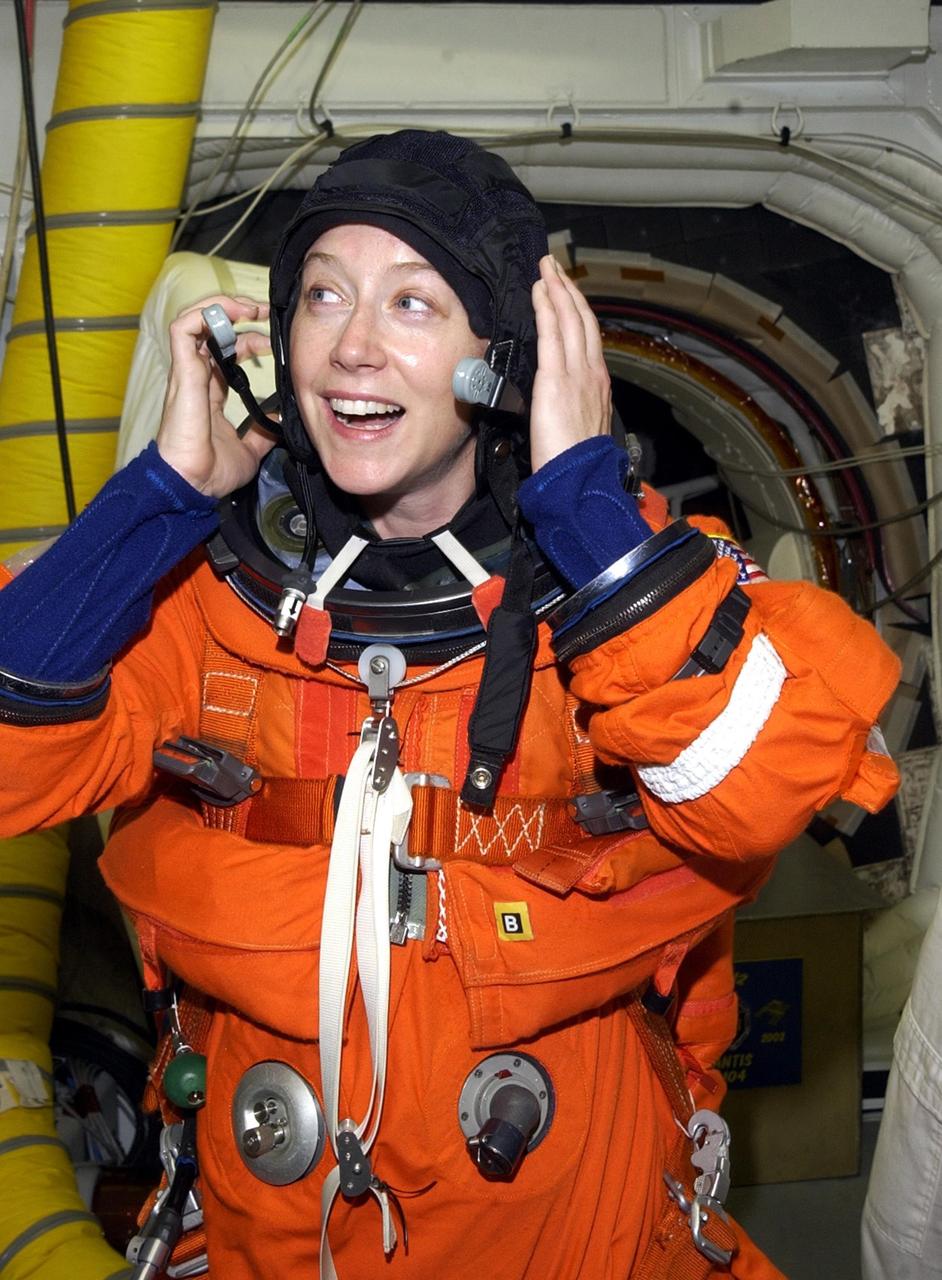
KENNEDY SPACE CENTER, FLA. -- In the White Room at Launch Pad 39B, STS-112 Pilot Pamela Melroy adjusts her spacesuit during a simulated launch countdown, part of Terminal Countdown Demonstration Test activities, a dress rehearsal for launch. Launch of STS-112 aboard Space Shuttle Atlantis is scheduled for Oct. 2, between 2 and 6 p.m. EDT. STS-112 is the 15th assembly mission to the International Space Station. Atlantis will be carrying the S1 Integrated Truss Structure, the first starboard truss segment, which will be attached to the central truss segment, S0, and the Crew and Equipment Translation Aid (CETA) Cart A. The CETA is the first of two human-powered carts that will ride along the ISS railway, providing mobile work platforms for future spacewalking astronauts.
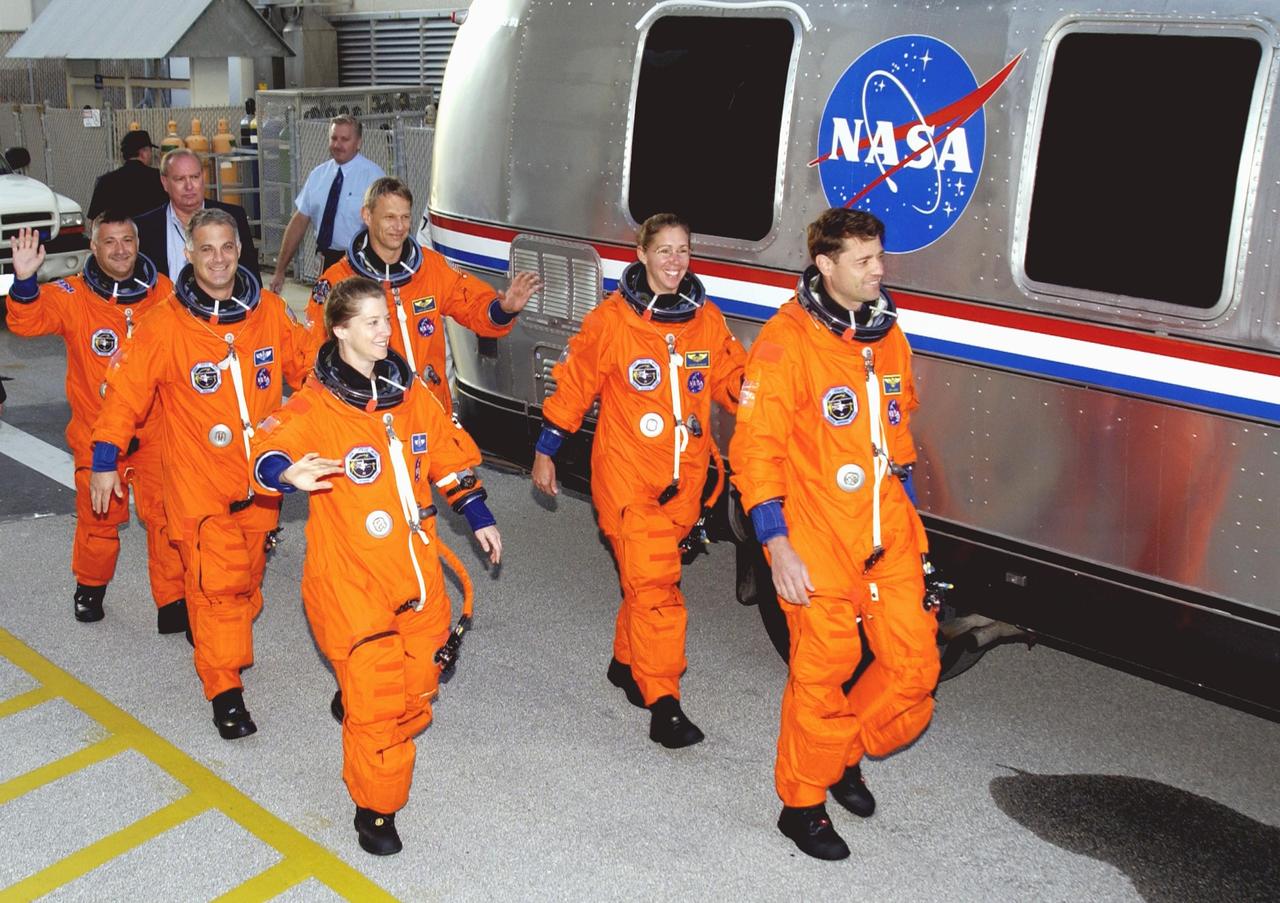
KENNEDY SPACE CENTER, FLA. -- The STS-112 crew heads for the Astrovan and a ride to the launch pad for a simulated countdown. From left are Mission Specialists Fyodor Yurchikhin (RSA), David Wolf and Piers Sellers; Pilot Pamela Melroy; Mission Specialist Sandra Magnus; and Commander Jeffrey Ashby. Mission STS-112 aboard Space Shuttle Atlantis is scheduled to launch no earlier than Oct. 2, between 2 and 6 p.m. EDT. STS-112 is the 15th assembly mission to the International Space Station. Atlantis will be carrying the S1 Integrated Truss Structure, the first starboard truss segment, to be attached to the central truss segment, S0, and the Crew and Equipment Translation Aid (CETA) Cart A. The CETA is the first of two human-powered carts that will ride along the ISS railway, providing mobile work platforms for future spacewalking astronauts.
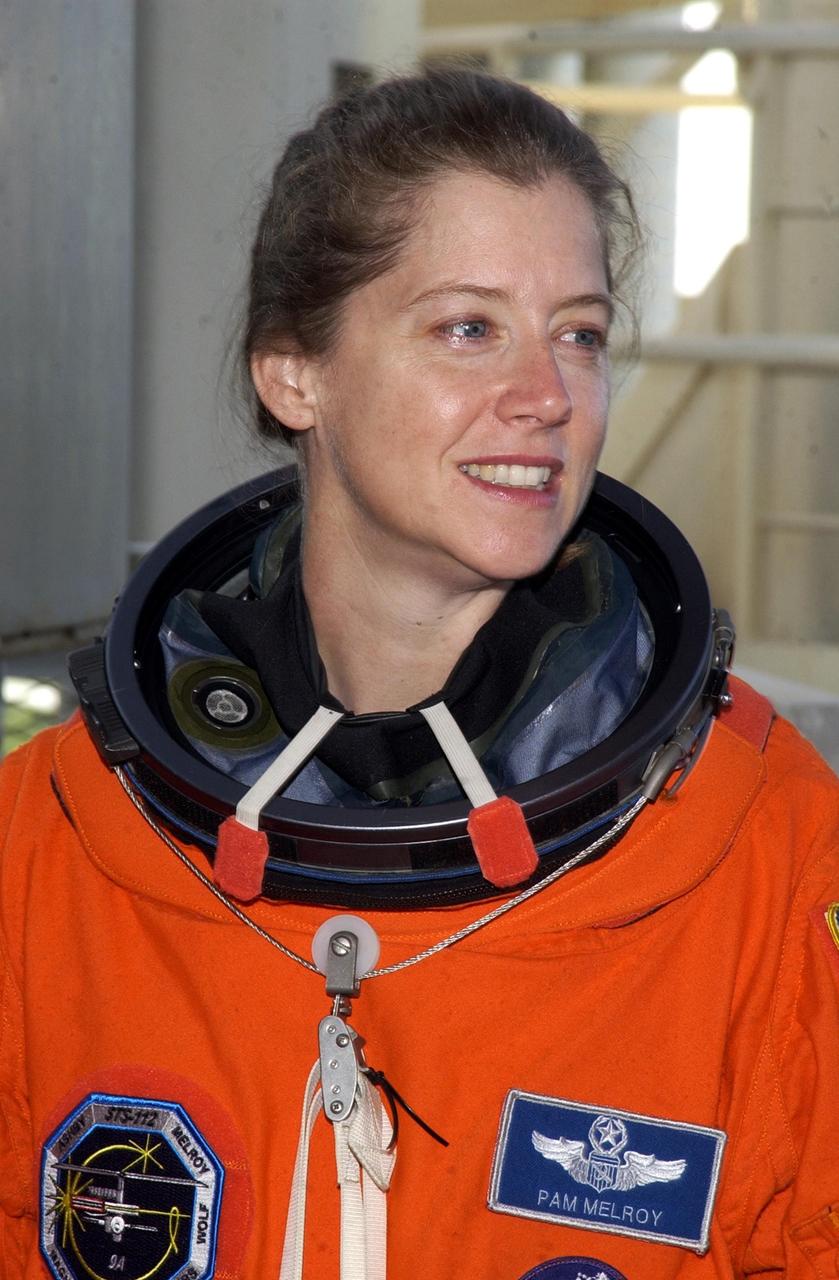
KENNEDY SPACE CENTER, FLA. -- STS-112 Pilot Pamela Melroy takes a break from training at Pad 39B during Terminal Countdown Demonstration Test activities, which include a simulated launch countdown. Launch of STS-112 aboard Space Shuttle Atlantis is scheduled for Oct. 2, between 2 and 6 p.m. EDT. STS-112 is the 15th assembly mission to the International Space Station. Atlantis will be carrying the S1 Integrated Truss Structure, the first starboard truss segment, to be attached to the central truss segment, S0, and the Crew and Equipment Translation Aid (CETA) Cart A. The CETA is the first of two human-powered carts that will ride along the ISS railway, providing mobile work platforms for future spacewalking astronauts.
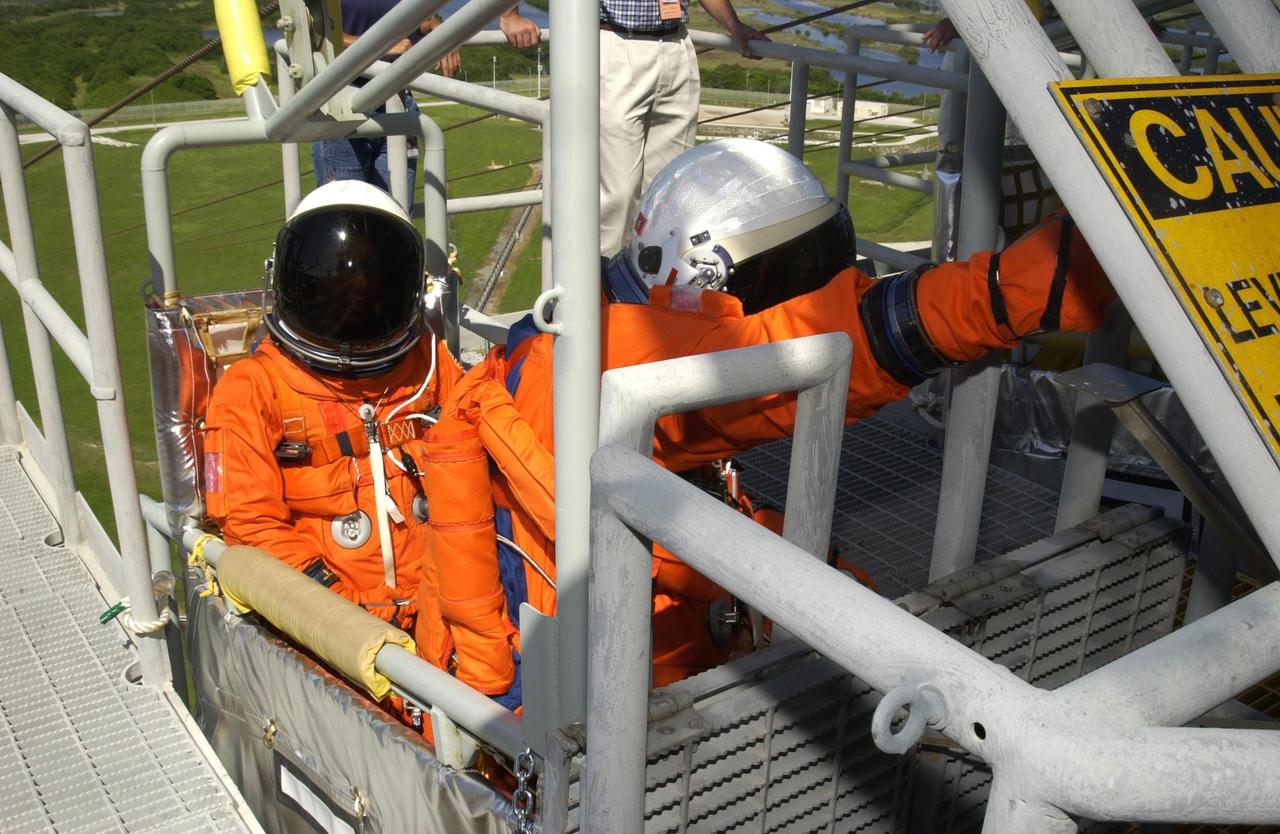
KENNEDY SPACE CENTER, FLA. - STS-112 Mission Specialist Sandra Magnus (left) sits in the slidewire basket basket on the 195-foot level of the Fixed Service Structure, Launch Pad 39B, while Mission Specialist Piers Sellers (right) reaches for the release lever. They and the rest of the crew are practicing emergency egress from the pad during Terminal Countdown Demonstration Test activities. Mission STS-112 aboard Space Shuttle Atlantis is scheduled to launch no earlier than Oct. 2, between 2 and 6 p.m. EDT. STS-112 is the 15th assembly mission to the International Space Station. Atlantis will be carrying the S1 Integrated Truss Structure, the first starboard truss segment, to be attached to the central truss segment, S0, and the Crew and Equipment Translation Aid (CETA) Cart A. The CETA is the first of two human-powered carts that will ride along the ISS railway, providing mobile work platforms for future spacewalking astronauts.
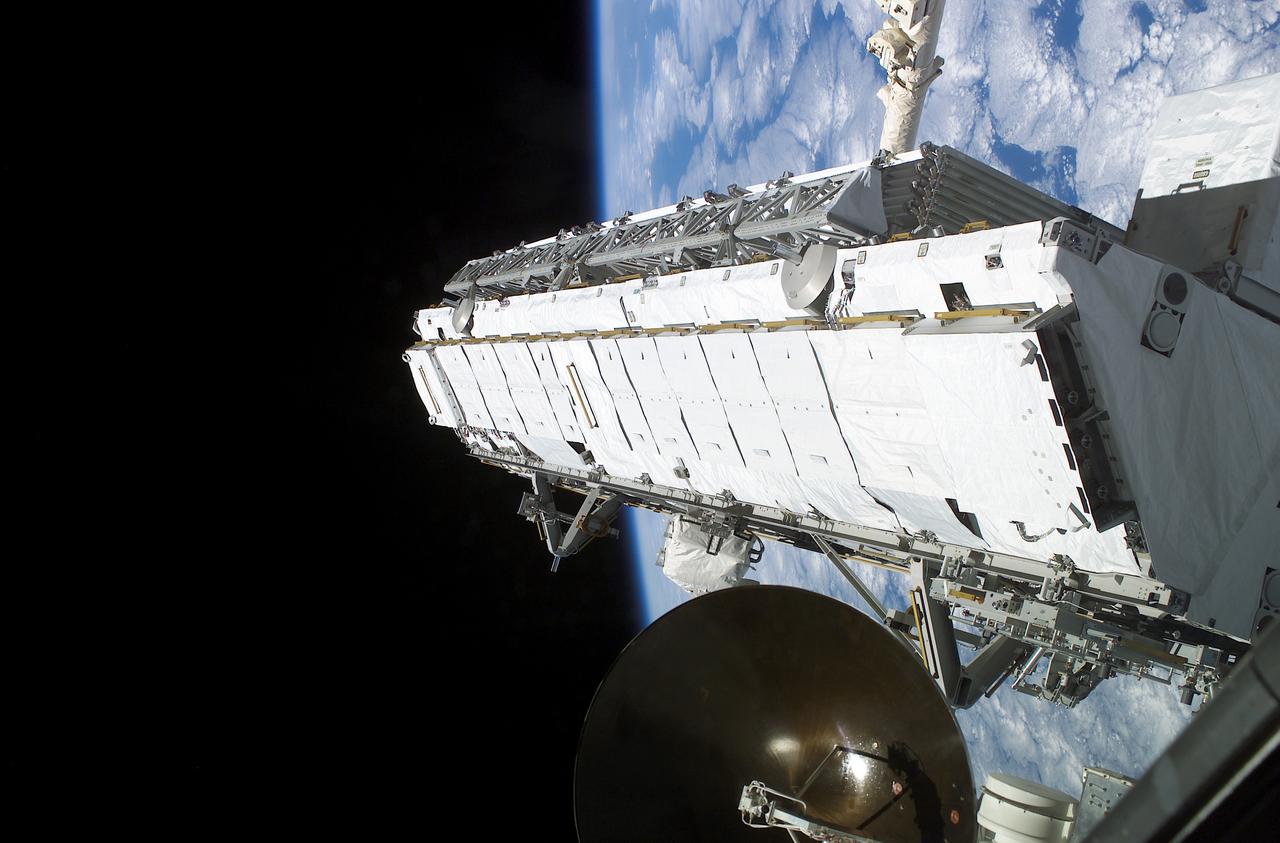
Being attached to the Canadarm2 on the International Space Station (ISS), the Remote Manipulator System arm built by the Canadian Space Agency, the Integrated Truss Assembly (S1) Truss is suspended over the Space Shuttle Orbiter Atlantis' cargo bay. Astronauts Sandra H. Magnus, STS-112 mission specialist, and Peggy A. Whitson, Expedition Five flight engineer, used the Canadarm2 from inside the Destiny laboratory on the ISS to lift the S1 truss out of the orbiter's cargo bay and move it into position prior to its installation on the ISS. The primary payloads of this mission, ISS Assembly Mission 9A, were the Integrated Truss Assembly S1 (S One), the starboard side thermal radiator truss, and the Crew Equipment Translation Aid (CETA) cart to the ISS. The S1 truss provides structural support for the orbiting research facility's radiator panels, which use ammonia to cool the Station's complex power system. The S1 truss was attached to the S0 (S Zero) truss, which was launched on April 8, 2002 aboard the STS-110, and flows 637 pounds of anhydrous ammonia through three heat-rejection radiators. The truss is 45-feet long, 15-feet wide, 10-feet tall, and weighs approximately 32,000 pounds. The CETA cart was attached to the Mobil Transporter and will be used by assembly crews on later missions. Manufactured by the Boeing Company in Huntington Beach, California, the truss primary structure was transferred to the Marshall Space Flight Center in February 1999 for hardware installations and manufacturing acceptance testing. The launch of the STS-112 mission occurred on October 7, 2002, and its 11-day mission ended on October 18, 2002.
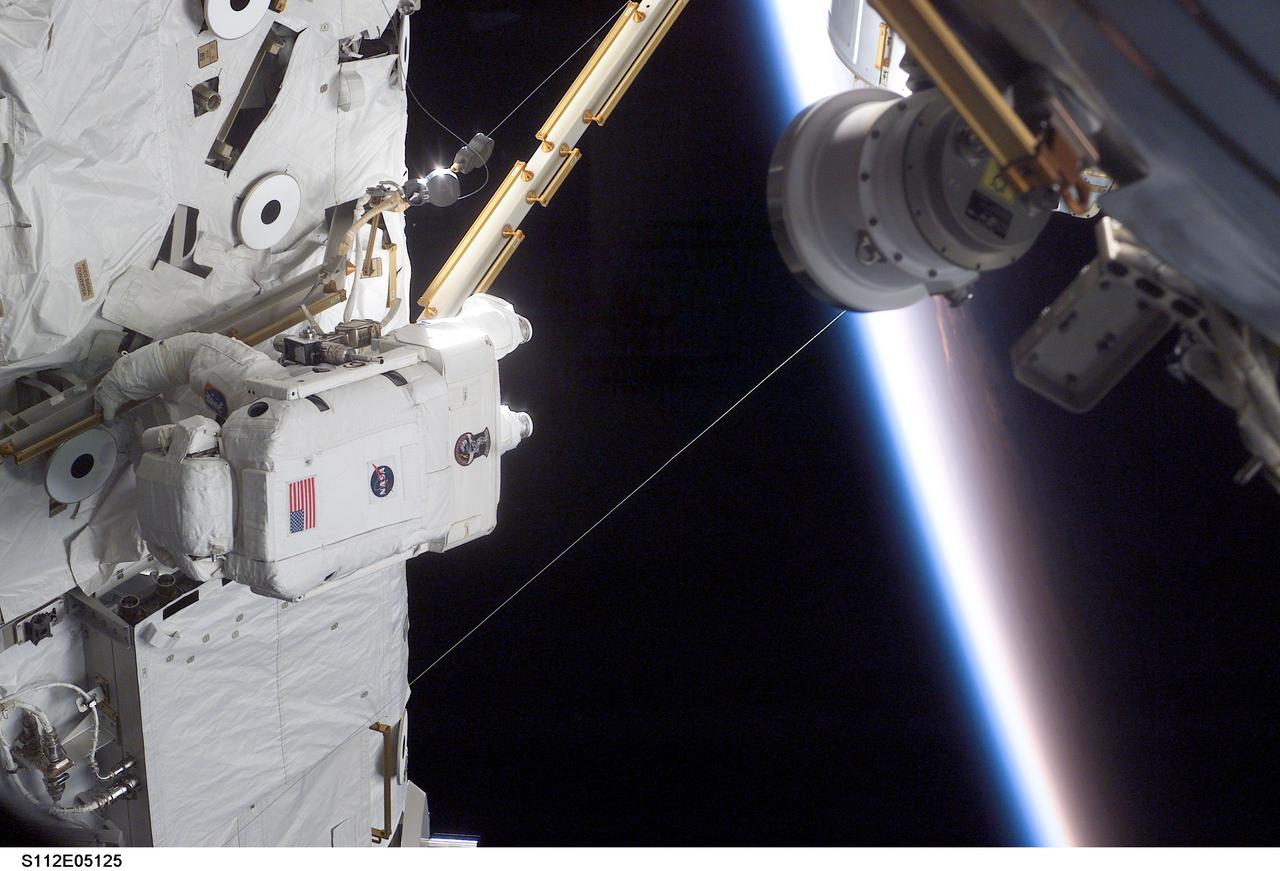
STS112-E-05125 (10 October 2002) --- Astronaut Piers J. Sellers, STS-112 mission specialist, works on the Starboard One (S1) Truss, newly installed on the International Space Station (ISS). Astronaut David A. Wolf (out of frame), mission specialist, worked in tandem with Sellers during the spacewalk. STS-112’s first session of extravehicular activity (EVA) lasted 7 hours and 1 minute.
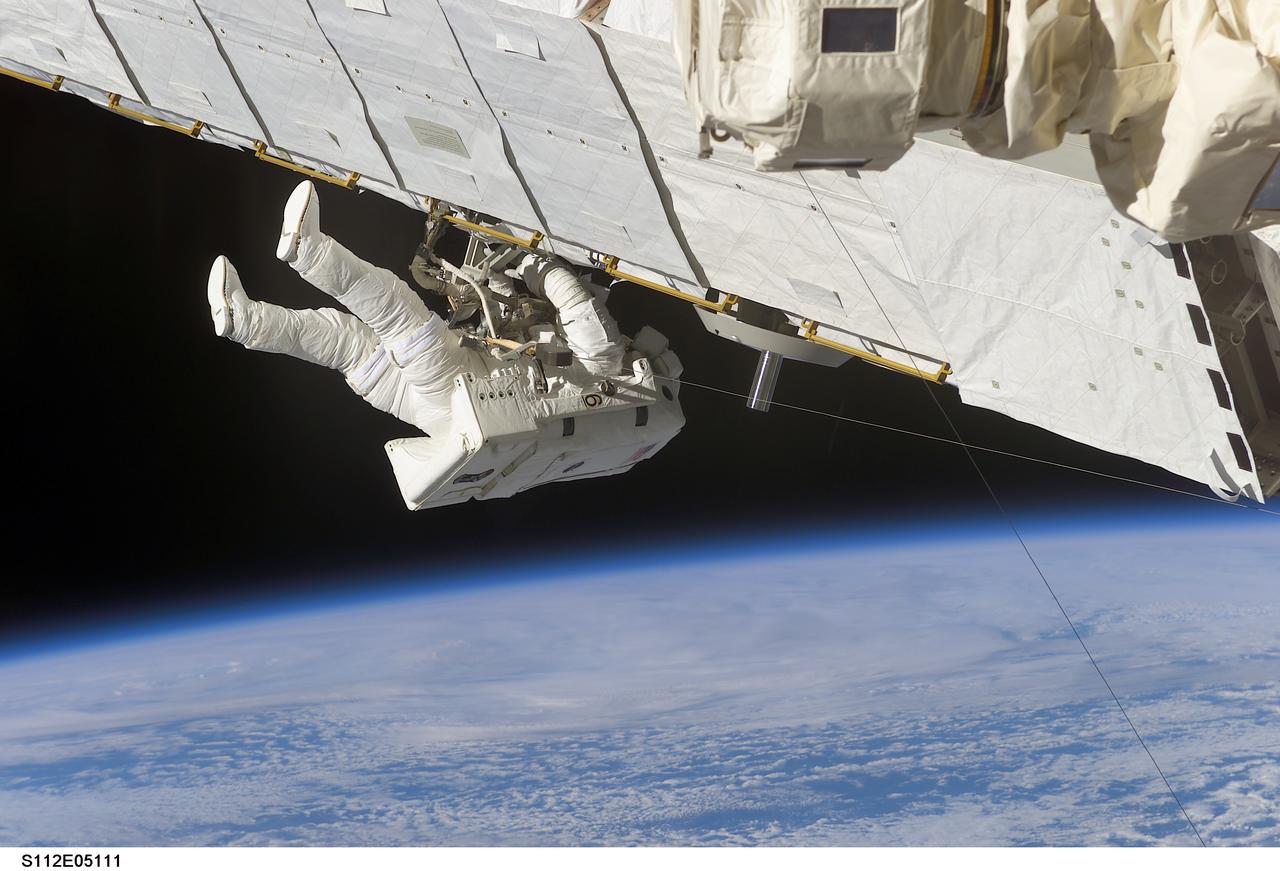
STS112-E-05111 (10 October 2002) --- Astronaut Piers J. Sellers, STS-112 mission specialist, works on the Starboard One (S1) Truss, newly installed on the International Space Station (ISS). Astronaut David A. Wolf (out of frame), mission specialist, worked in tandem with Sellers during the spacewalk. STS-112’s first session of extravehicular activity (EVA) lasted 7 hours and 1 minute.
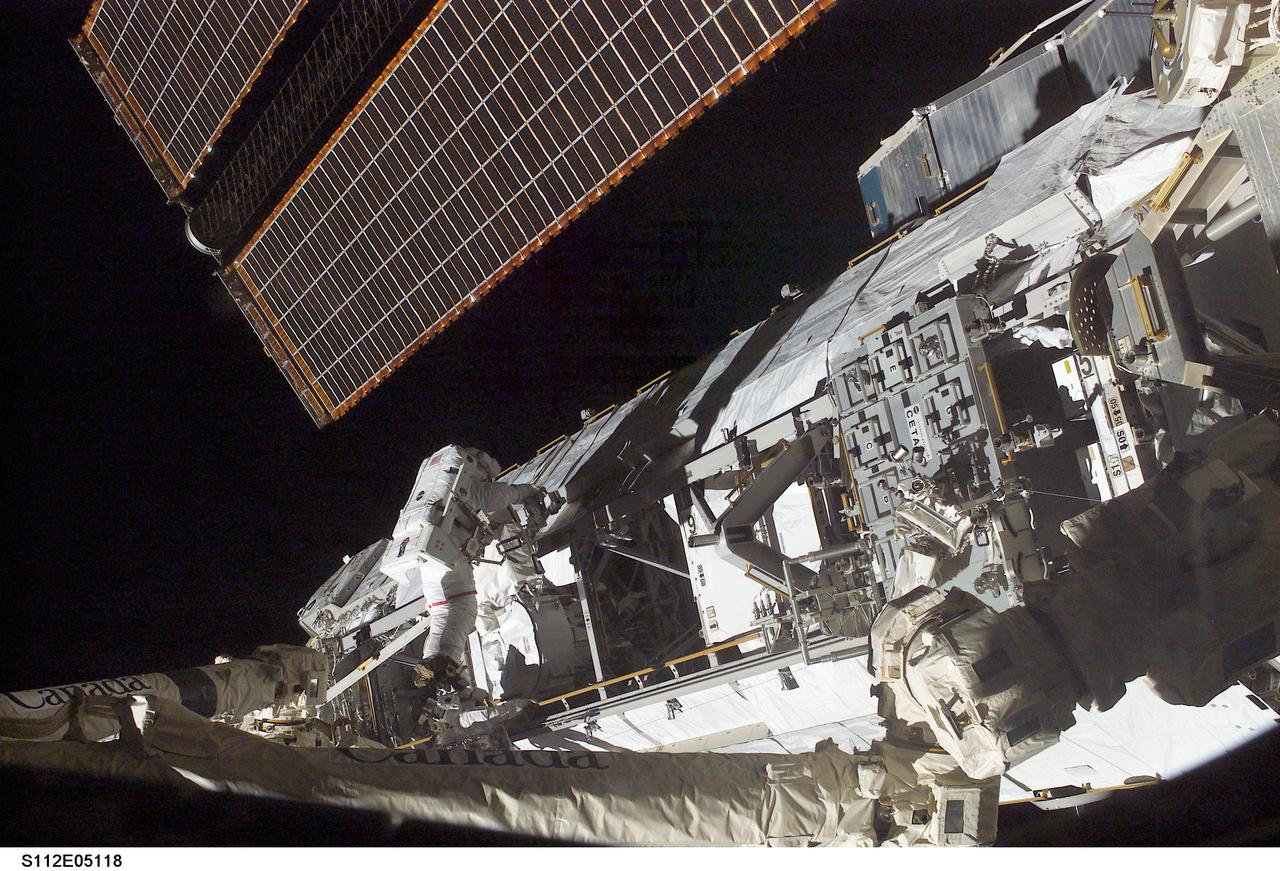
STS112-E-05118 (10 October 2002) --- Astronaut David A. Wolf, STS-112 mission specialist, works on the Starboard One (S1) Truss, newly installed on the International Space Station (ISS). Astronaut Piers J. Sellers (out of frame), mission specialist, worked in tandem with Wolf during the spacewalk. STS-112’s first session of extravehicular activity (EVA) lasted 7 hours and 1 minute.
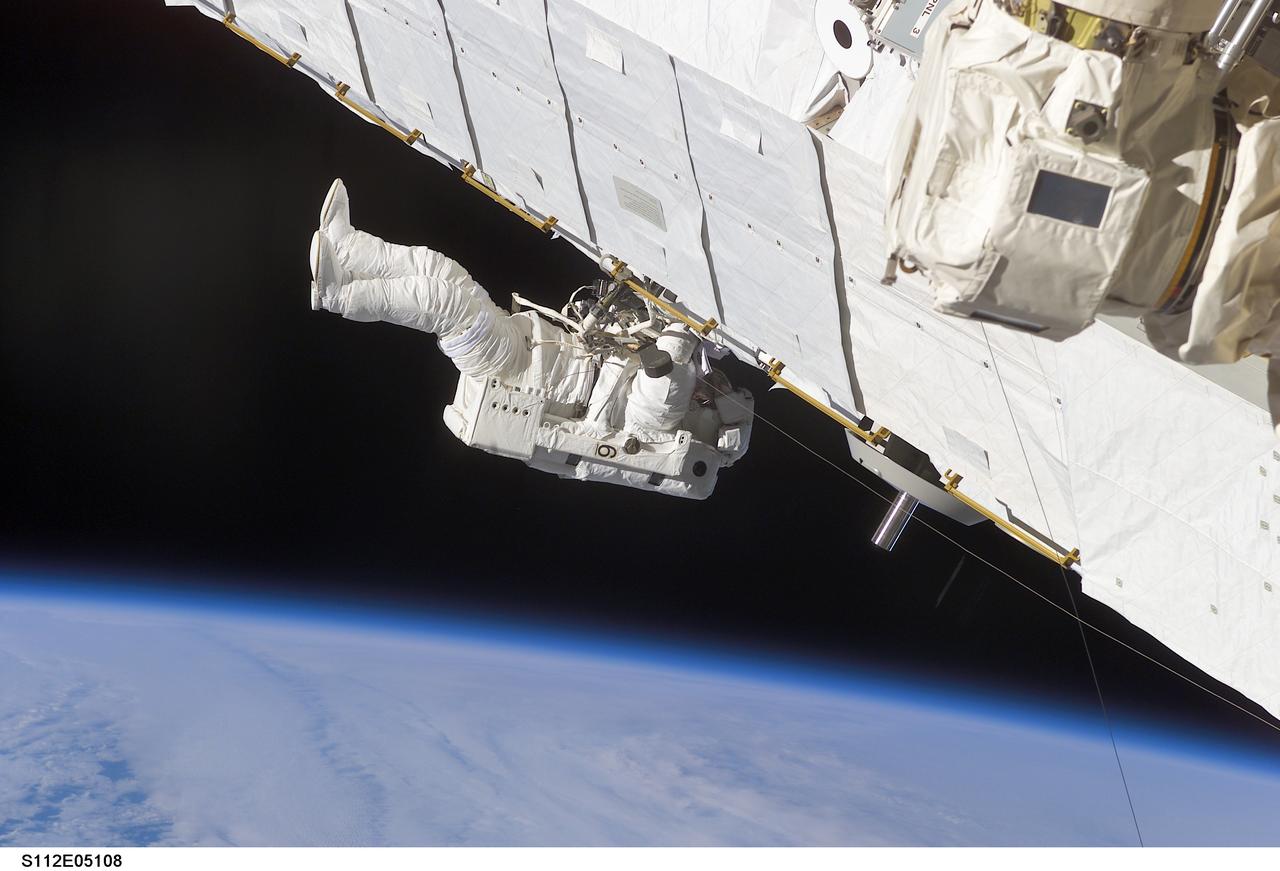
STS112-E-05108 (10 October 2002) --- Astronaut Piers J. Sellers, STS-112 mission specialist, works on the Starboard One (S1) Truss, newly installed on the International Space Station (ISS). Astronaut David A. Wolf (out of frame), mission specialist, worked in tandem with Sellers during the spacewalk. STS-112’s first session of extravehicular activity (EVA) lasted 7 hours and 1 minute.
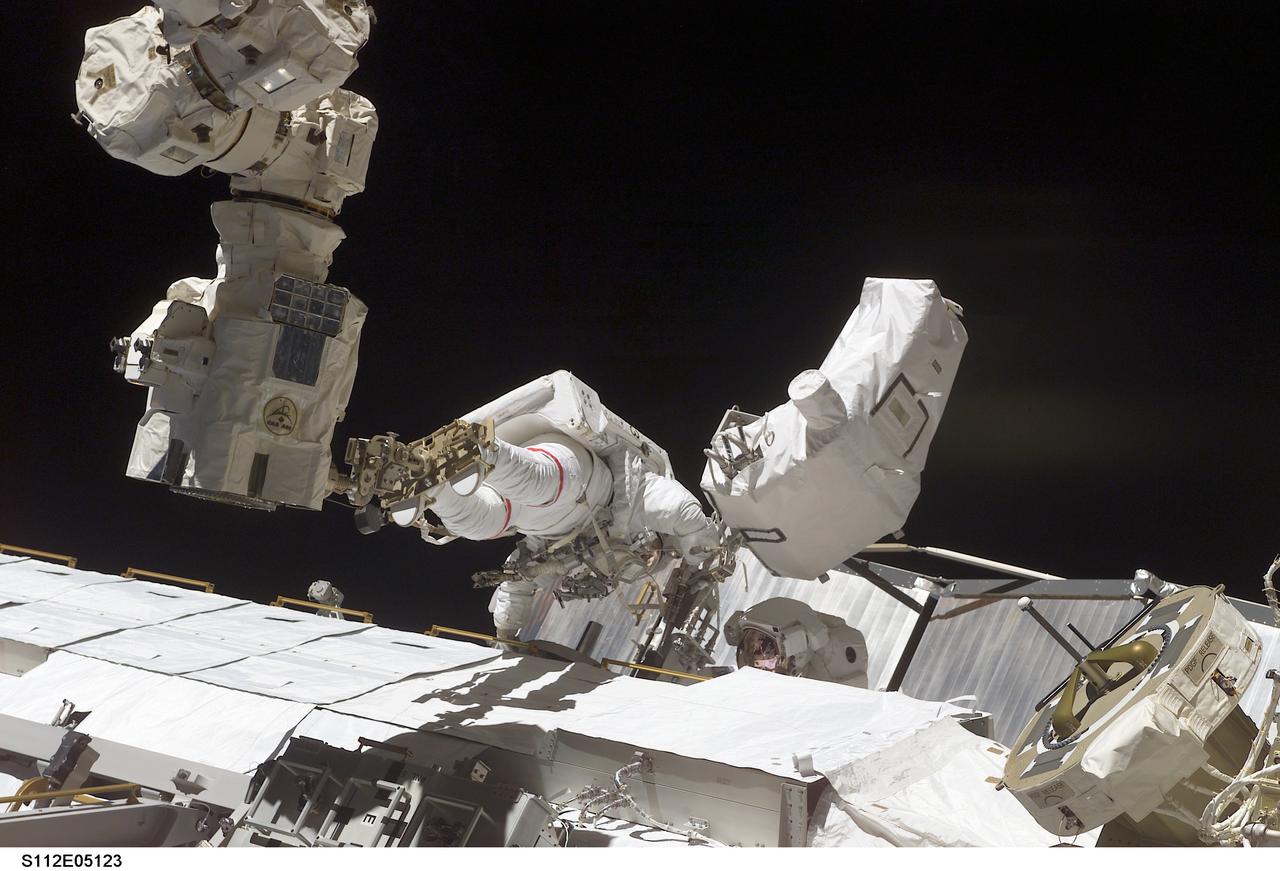
STS112-E-05123 (10 October 2002) --- Astronaut David A. Wolf, STS-112 mission specialist, anchored to the end of the Canadarm2, works on the Starboard One (S1) Truss, newly installed on the International Space Station (ISS). Astronaut Piers J. Sellers (partially obscured), mission specialist, worked in tandem with Wolf during the spacewalk. STS-112’s first session of extravehicular activity (EVA) lasted 7 hours and 1 minute.
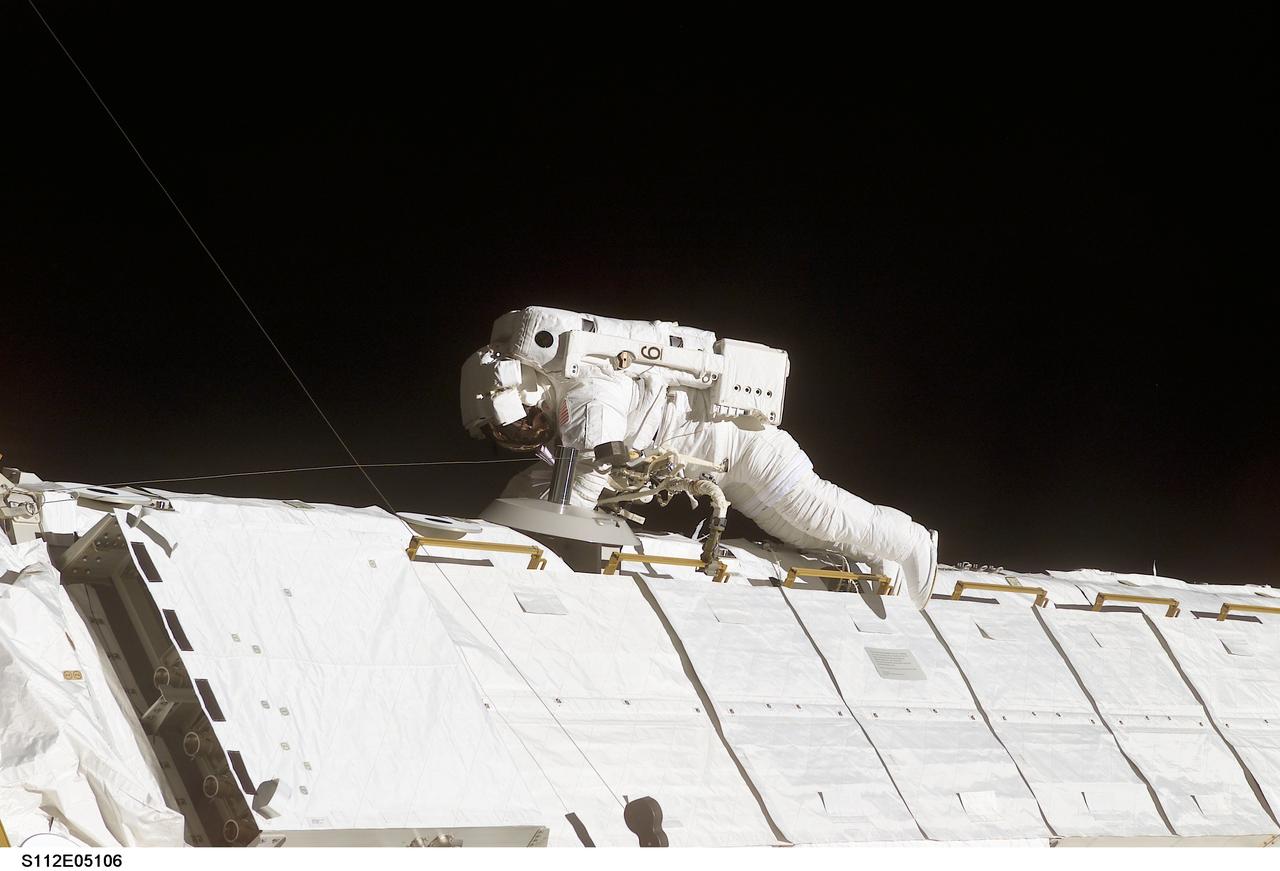
STS112-E-05106 (10 October 2002) --- Astronaut Piers J. Sellers, STS-112 mission specialist, works on the Starboard One (S1) Truss, newly installed on the International Space Station (ISS). Astronaut David A. Wolf (out of frame), mission specialist, worked in tandem with Sellers during the spacewalk. STS-112’s first session of extravehicular activity (EVA) lasted 7 hours and 1 minute.
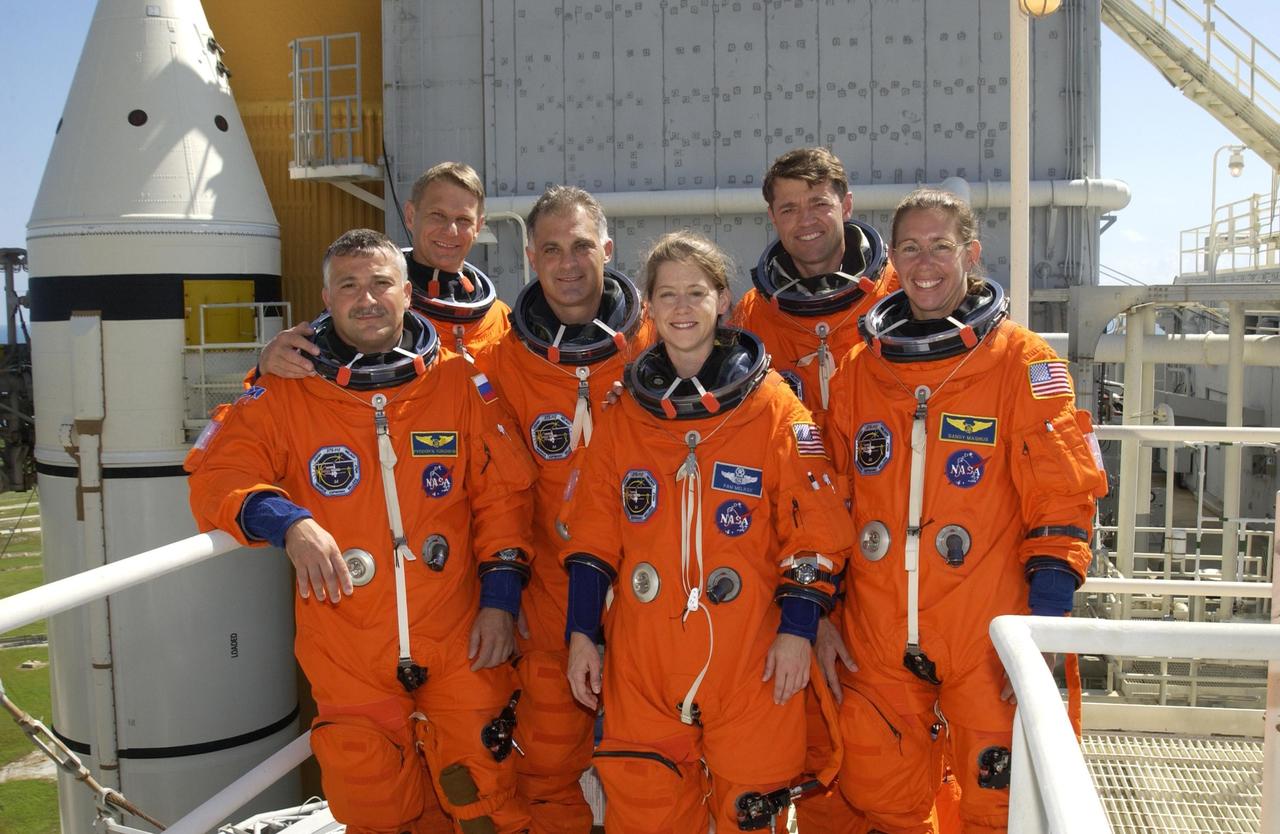
KENNEDY SPACE CENTER, FLA. - The STS-112 crew gathers for a group photo on the 215-foot level of the Fixed Service Structure. From left are Mission Specialists Fyodor Yurchikhin, Piers Sellers and David Wolf; Pilot Pamela Melroy; Commander Jeffrey Ashby; and Mission Specialist Sandra Magnus. Behind them at left is seen one of the white solid rocket boosters and the orange external tank on Space Shuttle Atlantis. Mission STS-112 is scheduled to launch no earlier than Oct. 2, between 2 and 6 p.m. EDT. STS-112 is the 15th assembly mission to the International Space Station. Atlantis will be carrying the S1 Integrated Truss Structure, the first starboard truss segment, to be attached to the central truss segment, S0, and the Crew and Equipment Translation Aid (CETA) Cart A. The CETA is the first of two human-powered carts that will ride along the ISS railway, providing mobile work platforms for future spacewalking astronauts. The 11-day mission is expected to conclude with a landing at KSC Oct. 13.
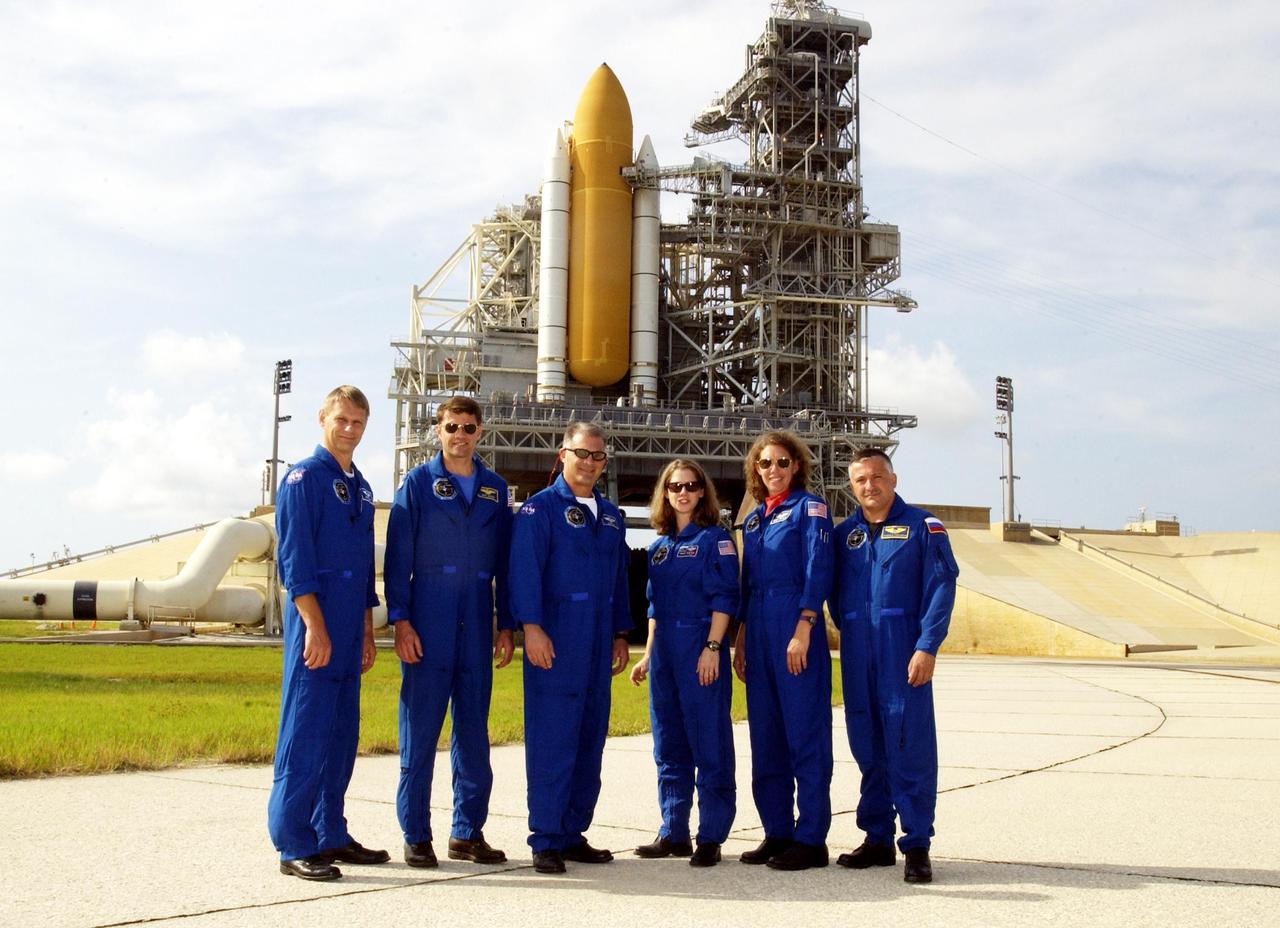
KENNEDY SPACE CENTER, FLA. -- During Terminal Countdown Demonstration Test activities, the STS-112 crew poses for a group photo near the launch pad where Space Shuttle Atlantis waits for launch. Standing left to right are Mission Specialist Piers Sellers, Commander Jeffrey Ashby, Mission Specialist David Wolf, Pilot Pamela Melroy, and Mission Specialists Sandra Magnus and Fyodor Yurchikhin, who is with the Russian Space Agency. The TCDT includes emergency egress training and a simulated launch countdown. Mission STS-112 aboard Space Shuttle Atlantis is scheduled to launch no earlier than Oct. 2, between 2 and 6 p.m. EDT. STS-112 is the 15th assembly mission to the International Space Station. Atlantis will be carrying the S1 Integrated Truss Structure, the first starboard truss segment, to be attached to the central truss segment, S0, and the Crew and Equipment Translation Aid (CETA) Cart A. The CETA is the first of two human-powered carts that will ride along the ISS railway, providing mobile work platforms for future spacewalking astronauts.

KENNEDY SPACE CENTER, FLA. -- During emergency egress training from the launch pad, the STS-112 crew get instructions on using the slidewire basket. From left, Mission Specialist Piers Sellers (back to camera), Pilot Pamela Melroy, Mission Specialists Sandra Magnus and Fyodor Yurchikhin (with the Russian Space Agency), watch as Commander Jeffrey Ashby (below right) grabs the release lever. Not seen is Mission Specialist David Wolf. The training is part of Terminal Countdown Demonstration Test activities, which include a simulated launch countdown. Mission STS-112 aboard Space Shuttle Atlantis is scheduled to launch no earlier than Oct. 2, between 2 and 6 p.m. EDT. STS-112 is the 15th assembly mission to the International Space Station. Atlantis will be carrying the S1 Integrated Truss Structure, the first starboard truss segment, to be attached to the central truss segment, S0, and the Crew and Equipment Translation Aid (CETA) Cart A. The CETA is the first of two human-powered carts that will ride along the ISS railway, providing mobile work platforms for future spacewalking astronauts.
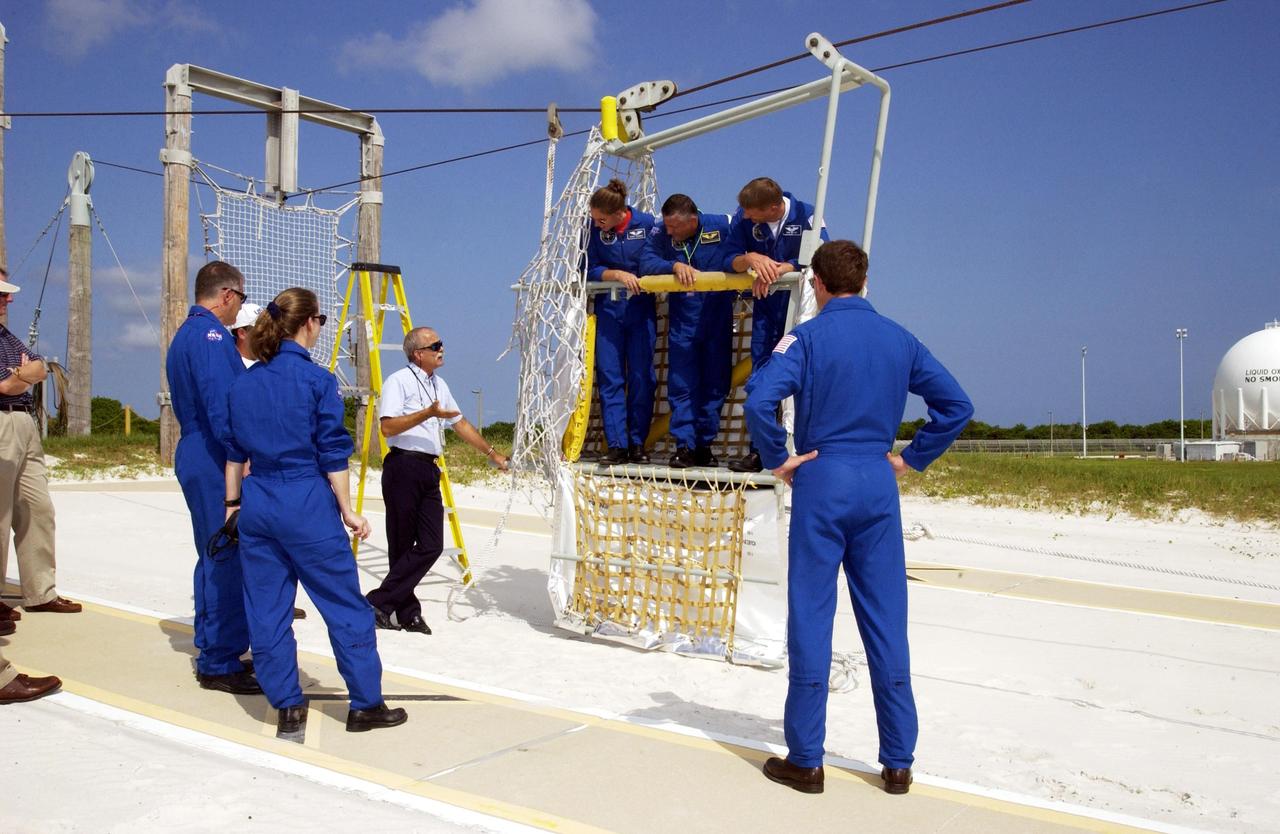
KENNEDY SPACE CENTER, FLA. -- The STS-112 crew listen to further instructions about emergency egress from the Shuttle using the slidewire basket. In the basket are Mission Specialists Sandra Magnus, Fyodor Yurchikhin (with the Russian Space Agency), and Piers Sellers. At left are Mission Specialist David Wolf and Pilot Pamela Melroy; at right is Commander Jeffrey Ashby. The training is part of Terminal Countdown Demonstration Test activities, which include a simulated launch countdown. Mission STS-112 aboard Space Shuttle Atlantis is scheduled to launch no earlier than Oct. 2, between 2 and 6 p.m. EDT. STS-112 is the 15th assembly mission to the International Space Station. Atlantis will be carrying the S1 Integrated Truss Structure, the first starboard truss segment, to be attached to the central truss segment, S0, and the Crew and Equipment Translation Aid (CETA) Cart A. The CETA is the first of two human-powered carts that will ride along the ISS railway, providing mobile work platforms for future spacewalking astronauts.
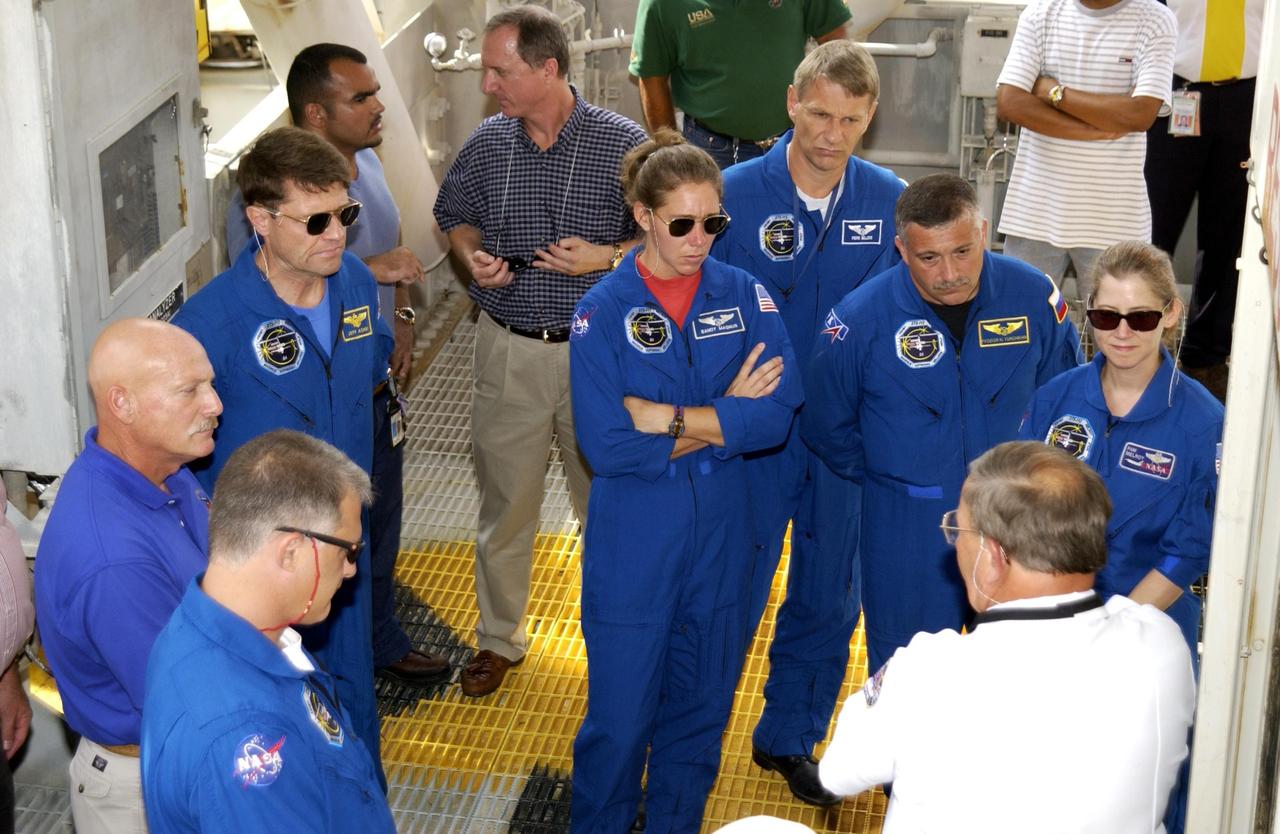
KENNEDY SPACE CENTER, FLA. -- During emergency egress training from the launch pad, the STS-112 crew listens to a trainer about use of the system. The crew members are, from left in the center, Commander Jeffrey Ashby, Mission Specialists Sandra Magnus, Piers Sellers and Fyodor Yurchikhin; and Pilot Pamela Melroy. In the foreground, left, is Mission Specialist David Wolf. Yurchikhin is with the Russian Space Agency. The training is part of Terminal Countdown Demonstration Test activities, which include a simulated launch countdown. Mission STS-112 aboard Space Shuttle Atlantis is scheduled to launch no earlier than Oct. 2, between 2 and 6 p.m. EDT. STS-112 is the 15th assembly mission to the International Space Station. Atlantis will be carrying the S1 Integrated Truss Structure, the first starboard truss segment, to be attached to the central truss segment, S0, and the Crew and Equipment Translation Aid (CETA) Cart A. The CETA is the first of two human-powered carts that will ride along the ISS railway, providing mobile work platforms for future spacewalking astronauts.
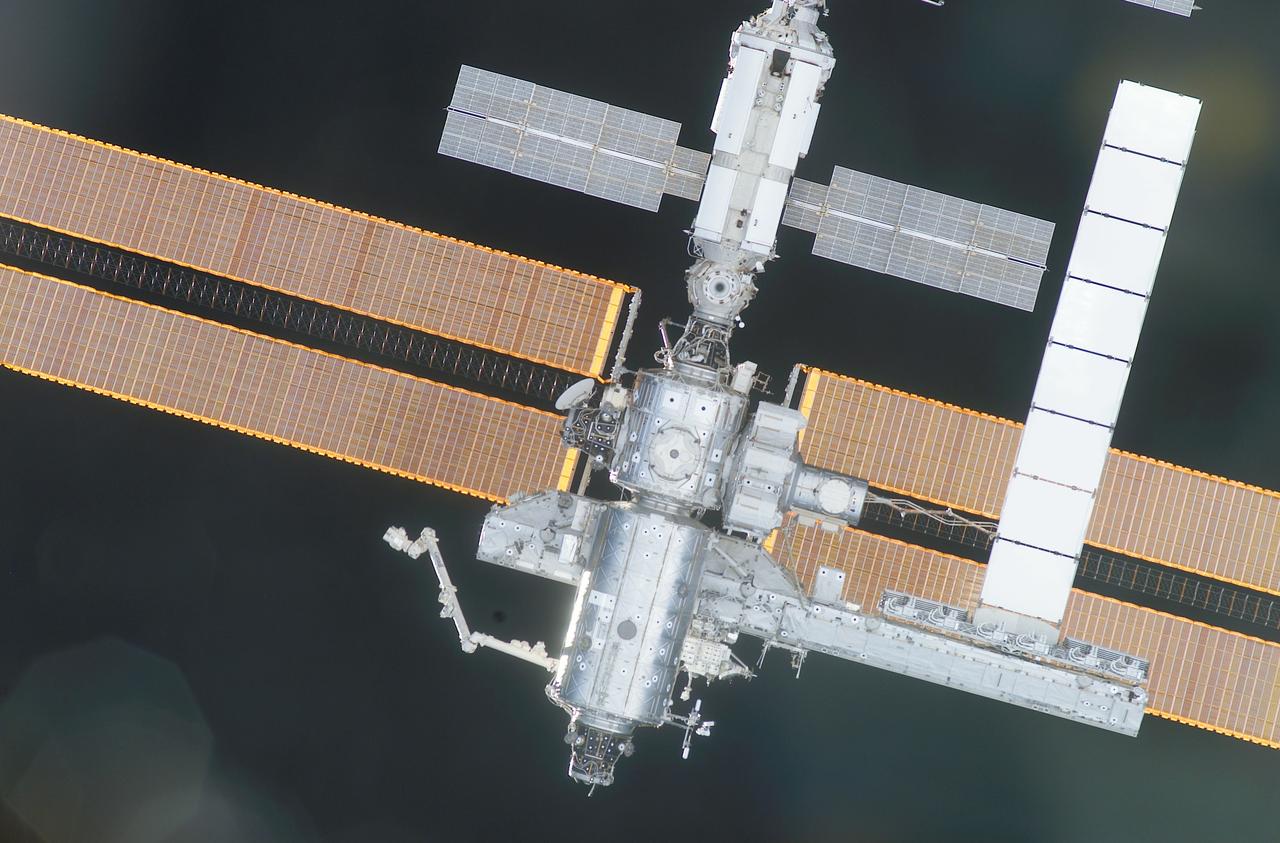
Back dropped against the blackness of space, the International Space Station (ISS) sporting its new S-1 Truss (lower right) and cooling radiator (white portion to the right of frame) is captured on film by the STS-113 crew as the Space Shuttle Orbiter Endeavor approaches the International Space Station (ISS). STS-112 mission installed the S1 truss in October 2000. It is one of nine similar truss segments that, combined, will serve as the Station's main backbone, measuring 356 feet from end to end upon completion. The Space Station's labs, living modules, solar arrays, heat radiators, and other main components will be attached to the truss. The 16th American assembly flight and 112th overall American flight to the ISS launched on November 23, 2002 from Kennedy's launch pad 39A aboard the Space Shuttle Orbiter Endeavor STS-113. The main mission objective was to install and activate the Port 1 Integrated Truss Assembly (P1) to the left side of the station.

KENNEDY SPACE CENTER, FLA. -- During emergency egress training from the launch pad, the STS-112 crew look at the slidewire basket. Seen here are, left to right, Commander Jeffrey Ashby, Pilot Pamela Melroy and Mission Specialists Sandra Magnus and Fyodor Yurchikhin (with the Russian Space Agency). Not seen are Mission Specialists Piers Sellers and David Wolf. The training is part of Terminal Countdown Demonstration Test activities, which include a simulated launch countdown. Mission STS-112 aboard Space Shuttle Atlantis is scheduled to launch no earlier than Oct. 2, between 2 and 6 p.m. EDT. STS-112 is the 15th assembly mission to the International Space Station. Atlantis will be carrying the S1 Integrated Truss Structure, the first starboard truss segment, to be attached to the central truss segment, S0, and the Crew and Equipment Translation Aid (CETA) Cart A. The CETA is the first of two human-powered carts that will ride along the ISS railway, providing mobile work platforms for future spacewalking astronauts.
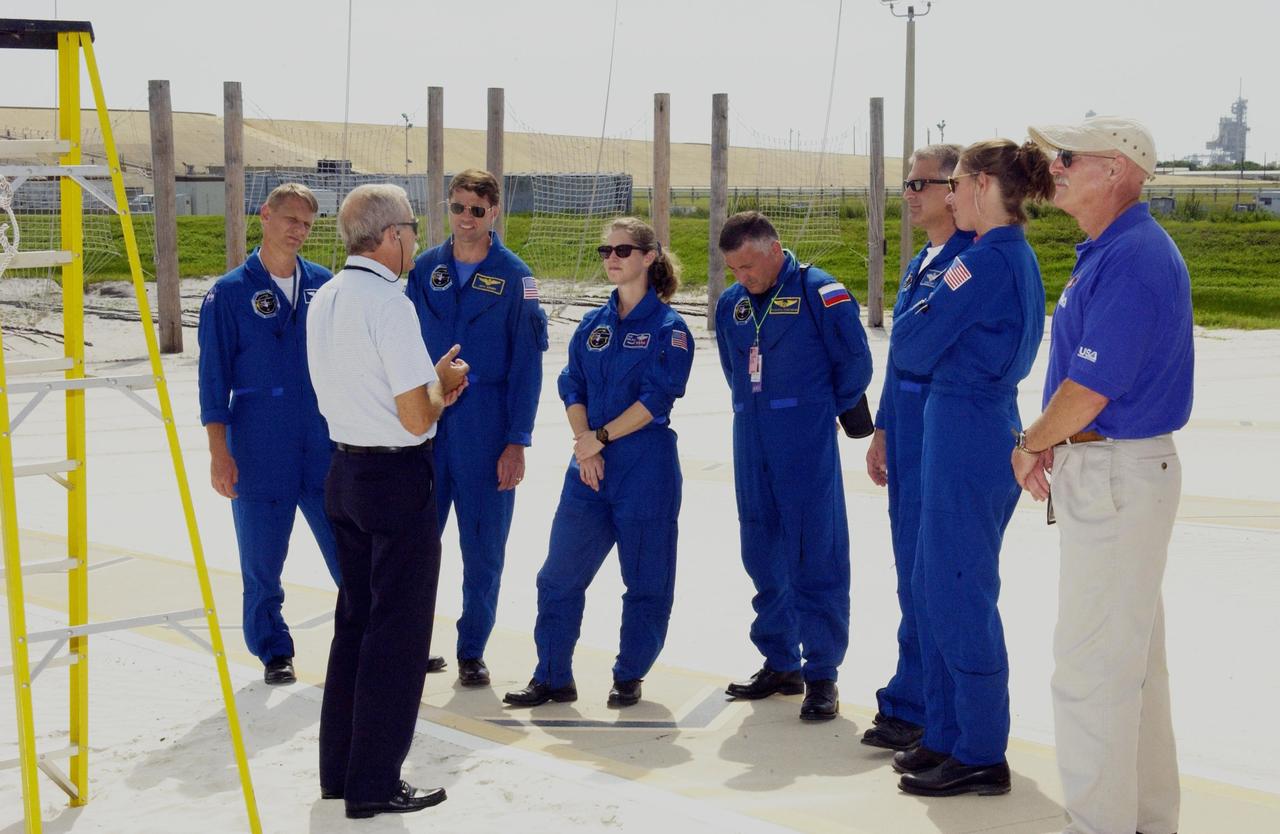
KENNEDY SPACE CENTER, FLA. -- The STS-112 crew listen to further instructions about emergency egress from the Shuttle. Standing, left to right, are Mission Specialist Piers Sellers, Commander Jeffrey Ashby, Pilot Pamela Melroy, Mission Specialists Fyodor Yurchikhin (with the Russian Space Agency), David Wolf and Sandra Magnus. The training is part of Terminal Countdown Demonstration Test activities, which include a simulated launch countdown. Mission STS-112 aboard Space Shuttle Atlantis is scheduled to launch no earlier than Oct. 2, between 2 and 6 p.m. EDT. STS-112 is the 15th assembly mission to the International Space Station. Atlantis will be carrying the S1 Integrated Truss Structure, the first starboard truss segment, to be attached to the central truss segment, S0, and the Crew and Equipment Translation Aid (CETA) Cart A. The CETA is the first of two human-powered carts that will ride along the ISS railway, providing mobile work platforms for future spacewalking astronauts.
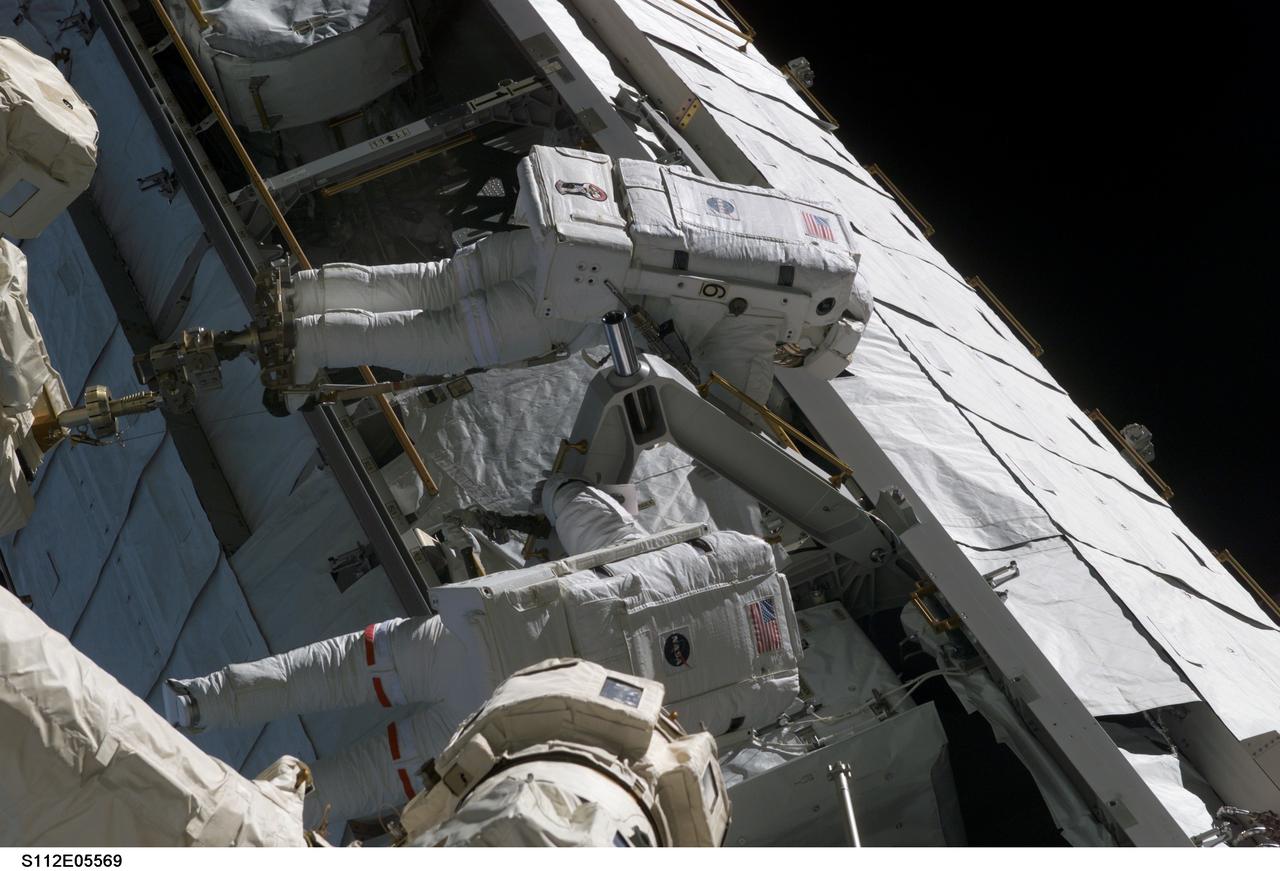
STS112-E-05569 (14 October 2002) --- Astronauts Piers J. Sellers (top) and David A. Wolf, STS-112 mission specialists, work on the newly installed Starboard One (S1) Truss during the third and final scheduled session of extravehicular activity (EVA) for the STS-112 mission. The spacewalk lasted 6 hours and 36 minutes.
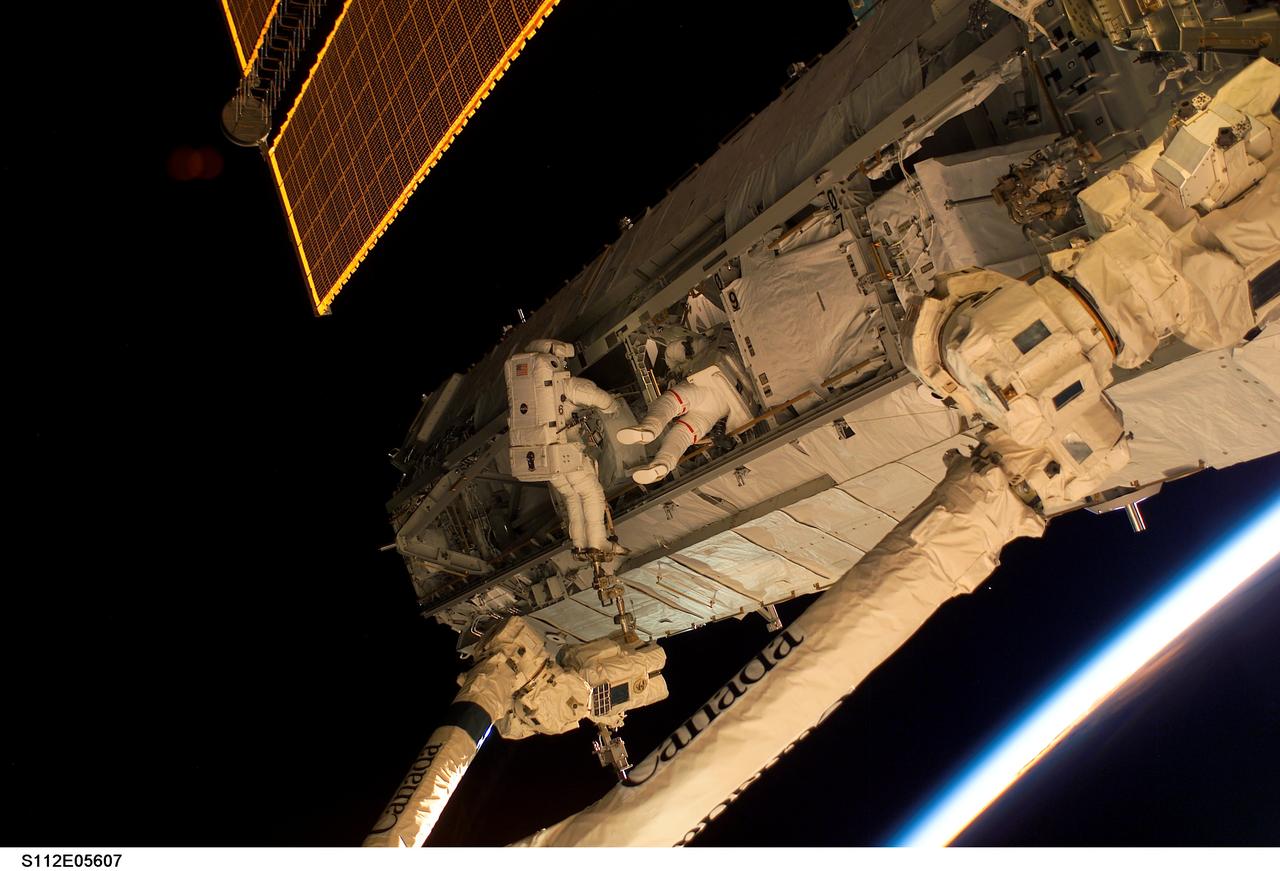
STS112-E-05607 (14 October 2002) --- Astronauts Piers J. Sellers (left) and David A. Wolf, STS-112 mission specialists, work on the newly installed Starboard One (S1) Truss during the third and final scheduled session of extravehicular activity (EVA) for the STS-112 mission. The spacewalk lasted 6 hours and 36 minutes. A thin slice of sunlight can be seen at Earth's horizon.
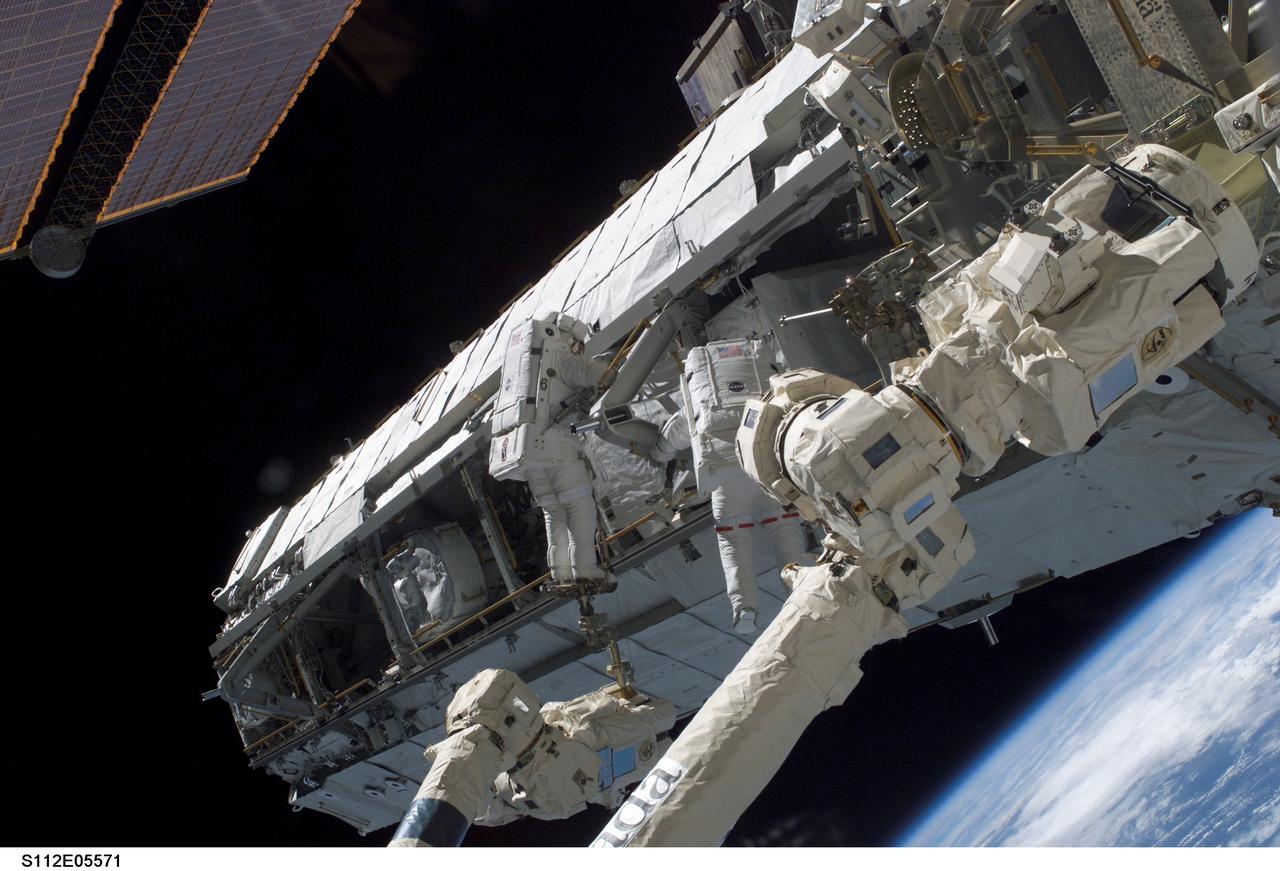
STS112-E-05571 (14 October 2002) --- Astronauts Piers J. Sellers (left) and David A. Wolf, STS-112 mission specialists, work on the newly installed Starboard One (S1) Truss during the third and final scheduled session of extravehicular activity (EVA) for the STS-112 mission. The spacewalk lasted 6 hours and 36 minutes.
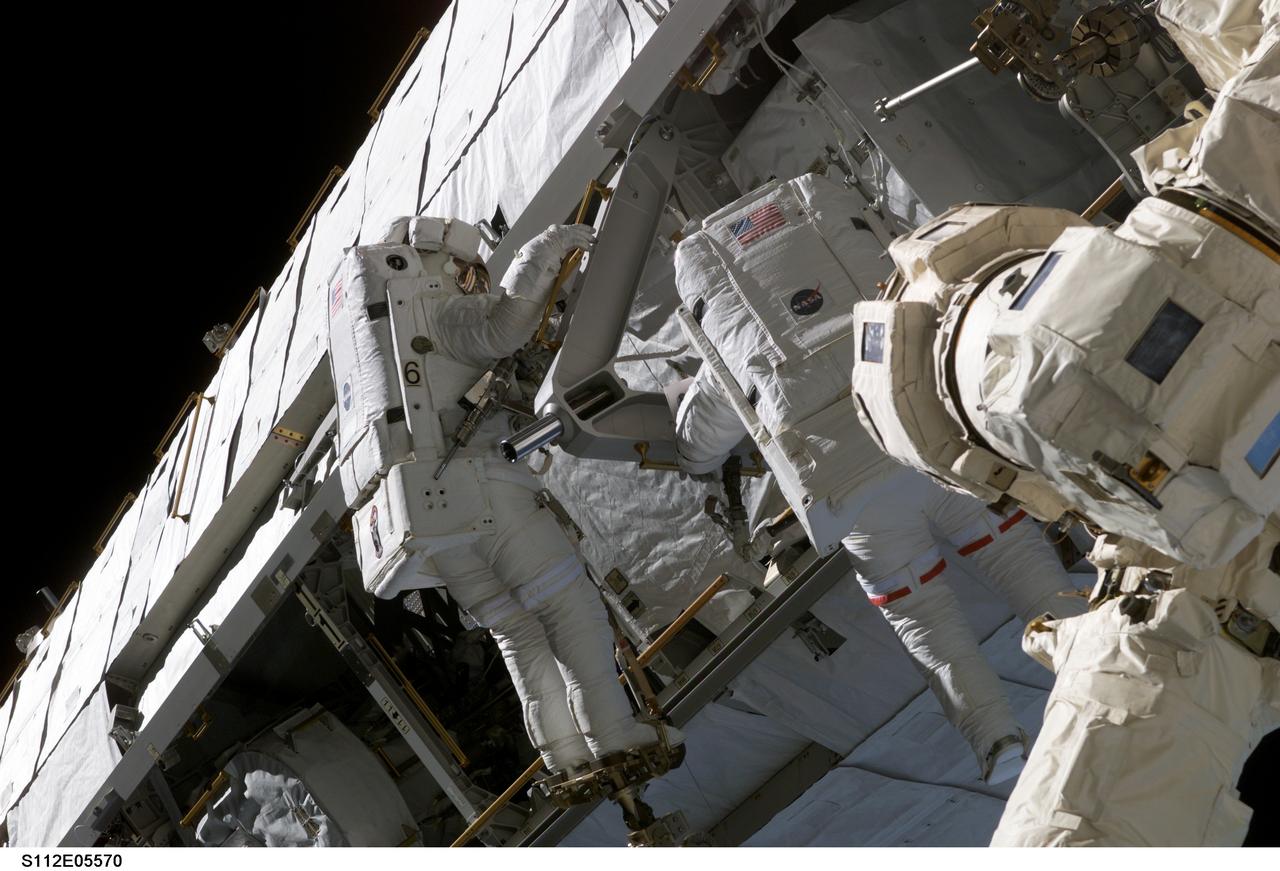
STS112-E-05570 (14 October 2002) --- Astronauts Piers J. Sellers (left) and David A. Wolf, STS-112 mission specialists, work on the newly installed Starboard One (S1) Truss during the third and final scheduled session of extravehicular activity (EVA) for the STS-112 mission. The spacewalk lasted 6 hours and 36 minutes.
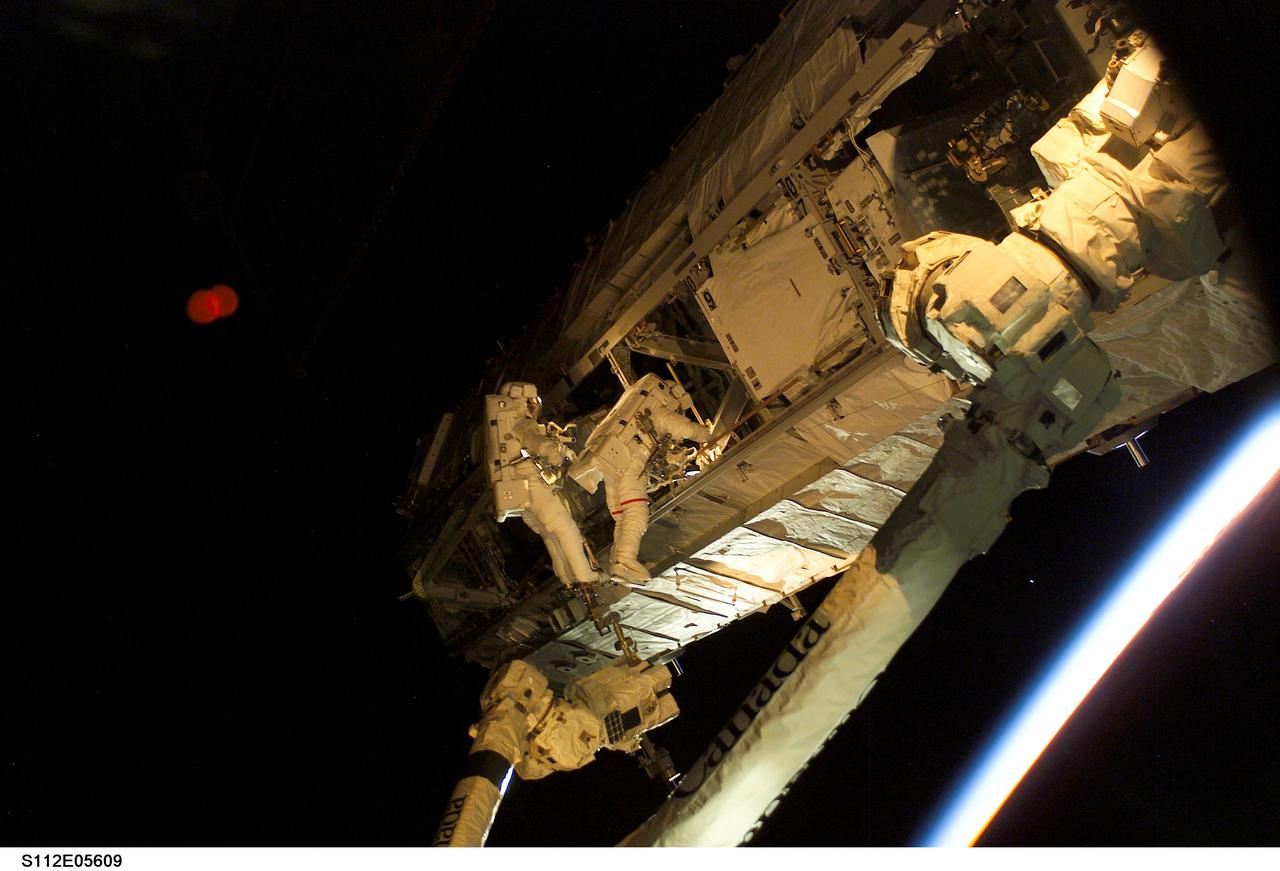
STS112-E-05609 (14 October 2002) --- Astronauts Piers J. Sellers (left) and David A. Wolf, STS-112 mission specialists, work on the newly installed Starboard One (S1) Truss during the third and final scheduled session of extravehicular activity (EVA) for the STS-112 mission. The spacewalk lasted 6 hours and 36 minutes. A thin slice of sunlight can be seen at Earth's horizon.
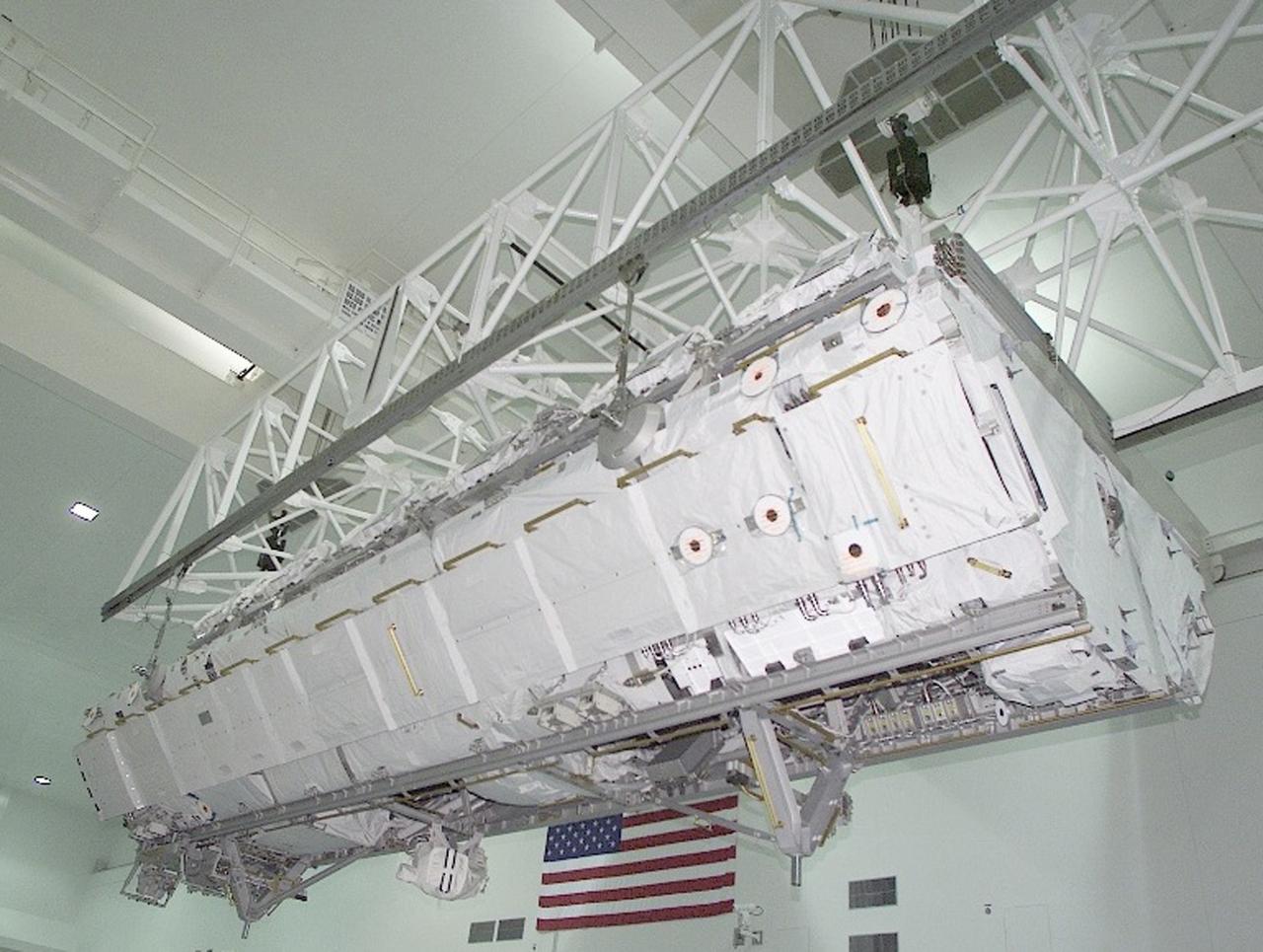
Shown here is the International Space Station (ISS) S1 Truss in preparation for installation in the payload bay of the Space Shuttle Atlantis at NASA's Kennedy Space Center )KSC)in Florida. The truss launched October 7, 2002 on the STS-112 mission and will be attached during three spacewalks. Constructed primarily of aluminum, it measures 45 feet long, 15 feet wide, 10 feet tall, and weighs over 27,000 pounds. It is one of nine similar truss segments that, combined, will serve as the Station's main backbone, measuring 356 feet from end to end upon completion. Manufactured by the Boeing Company in Huntington Beach, California, the truss was flown to the Marshall Space Flight Center, in Huntsville, Alabama where brackets, cable trays, fluid tubing, and other secondary components and outfitting items were added. In Huntsville, it was screened for manufacturing flaws, including pressure and leak checking tubing, and electrical checks for cabling, before being shipped to KSC for final hardware installation and testing. The Space Station's labs, living modules, solar arrays, heat radiators, and other main components will be attached to the truss.
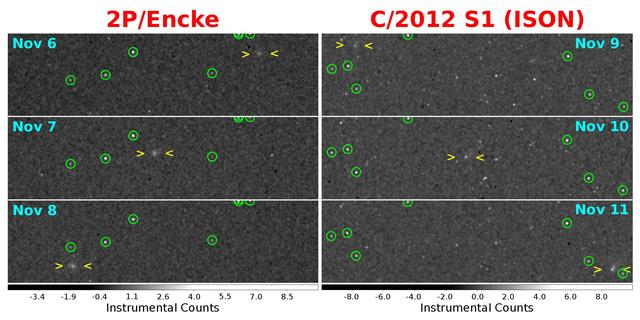
As comets C/2012 S1 ISON and the well-known short-period comet 2P/Encke both approached their closest distances to the Sun in November, 2013, they also passed close to the MESSENGER spacecraft orbiting the innermost planet Mercury.
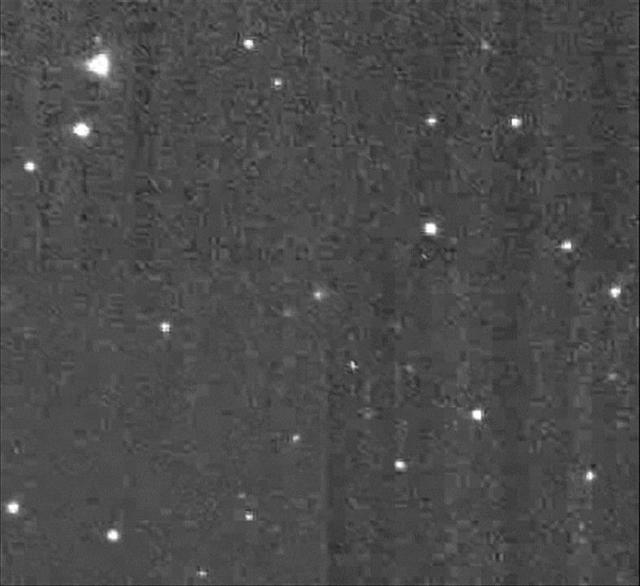
This frame from an animation series of images of comet C/2012 S1 ISON was taken by the Medium-Resolution Imager of NASA Deep Impact spacecraft over a 36-hour period on Jan. 17 and 18, 2013.
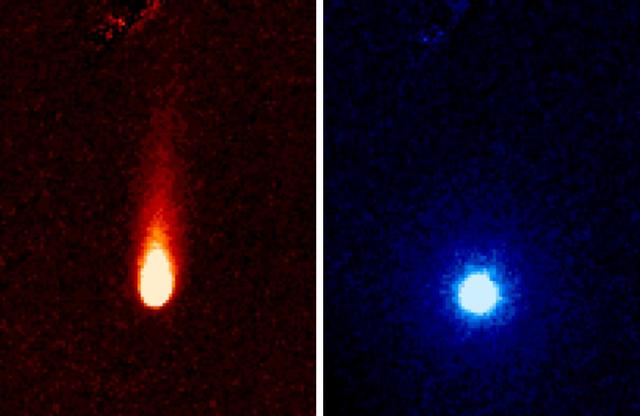
These images from NASA Spitzer Space Telescope of C/2012 S1 Comet ISON were taken on June 13, when ISON was 310 million miles about 500 million kilometers from the sun.
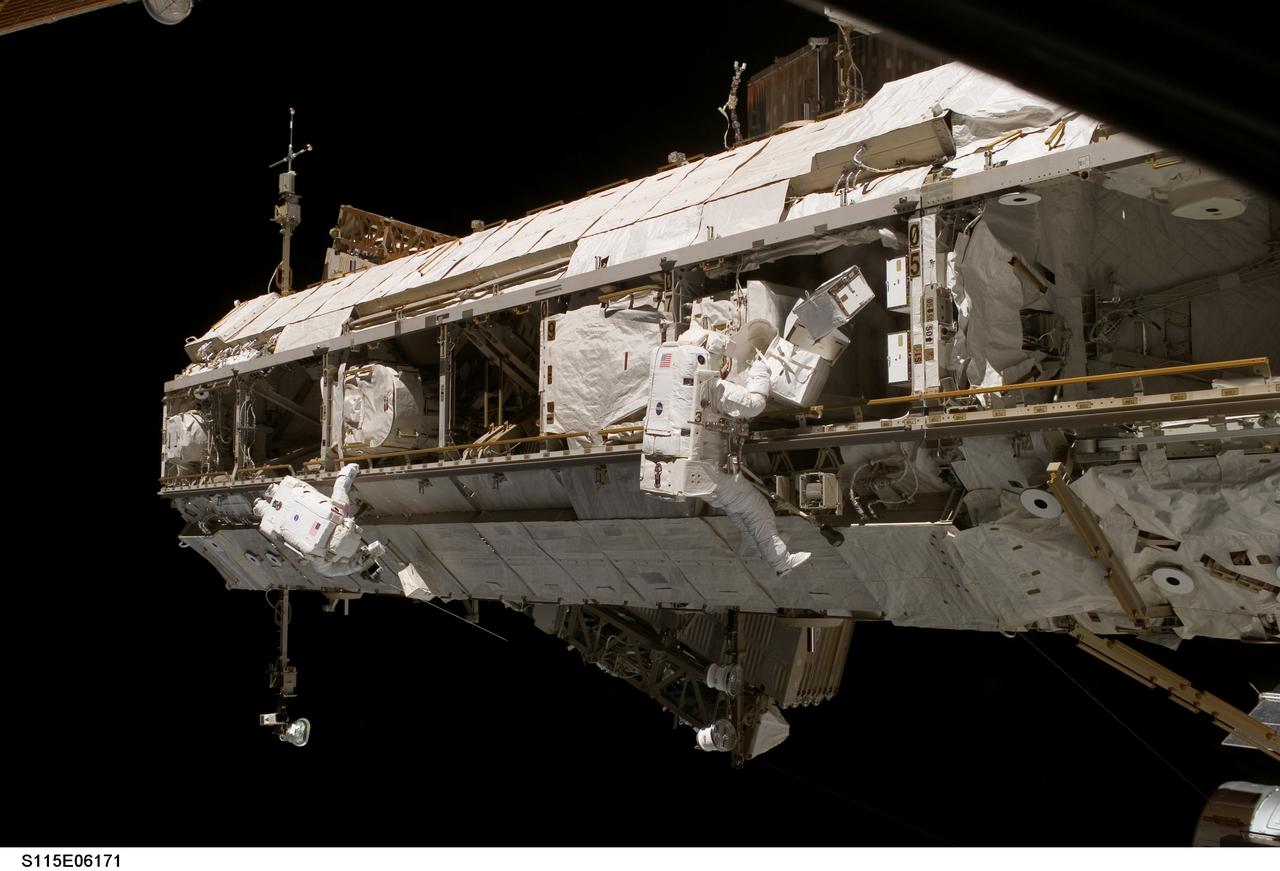
View of Astronaut Joseph R. (Joe) Tanner, STS-115 Mission Specialist (MS), in the red striped Extravehicular Mobility Unit (EMU), as he uses the Infrared (IR) CAM from the Forward (FWD) side of the S1 Truss to take image of the Starboard (STBD) Wing Leading Edge (WLE) of Atlantis for Detailed Test Objective (DTO) 851 while Astronaut Heidemarie M. Stefanyshyn-Piper, STS-115 MS, in the white striped EMU, removes stowed equipment during third Extravehicular Activity (EVA).

KENNEDY SPACE CENTER, FLA. -- The STS-112 crew pauses for a photo after their arrival at the KSC Shuttle Landing Facility. Standing, left to right, are Mission Specialist Piers Sellers, Pilot Pamela Melroy, Commander Jeffrey Ashby, and Mission Specialists David Wolf, Sandra Magnus and cosmonaut Fyodor Yurchikhin. Sellers, Magnus and Yurchikhin are making their first Shuttle flights. STS-112, aboard Space Shuttle Atlantis, is the 15th assembly mission to the International Space Station. Atlantis will be carrying the S1 Integrated Truss Structure, the first starboard truss segment, to be attached to the central truss segment, S0, and the Crew and Equipment Translation Aid (CETA) Cart A. The CETA is the first of two human-powered carts that will ride along the ISS railway, providing mobile work platforms for future spacewalking astronauts. The 11-day mission includes three spacewalks. Launch is scheduled for Oct. 2 between 2 and 6 p.m.
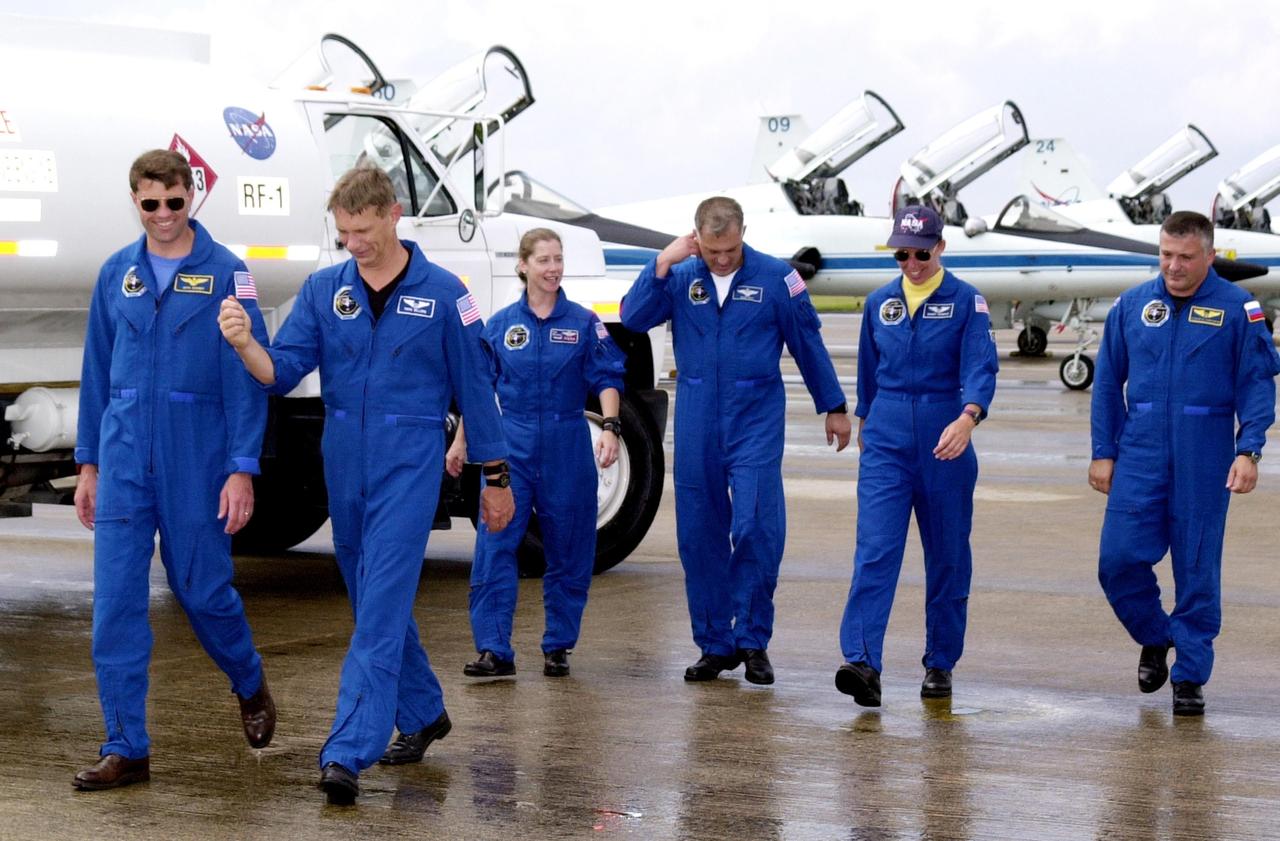
KENNEDY SPACE CENTER, FLA. -- After their arrival at the KSC Shuttle Landing Facility, the STS-112 crew members stride happily to the side of the parking apron and a photo opportunity. From left are Commander Jeffrey Ashby, Mission Specialist Piers Sellers, Pilot Pamela Melroy and Mission Specialists David Wolf, Sandra Magnus and Fyodor Yurchikhin, who is with the Russian Space Agency. Launch is scheduled for Oct. 2 between 2 and 6 p.m. STS-112, aboard Space Shuttle Atlantis, is the 15th assembly mission to the International Space Station. Atlantis will be carrying the S1 Integrated Truss Structure, the first starboard truss segment, to be attached to the central truss segment, S0, and the Crew and Equipment Translation Aid (CETA) Cart A. The CETA is the first of two human-powered carts that will ride along the ISS railway, providing mobile work platforms for future spacewalking astronauts. The 11-day mission includes three spacewalks.
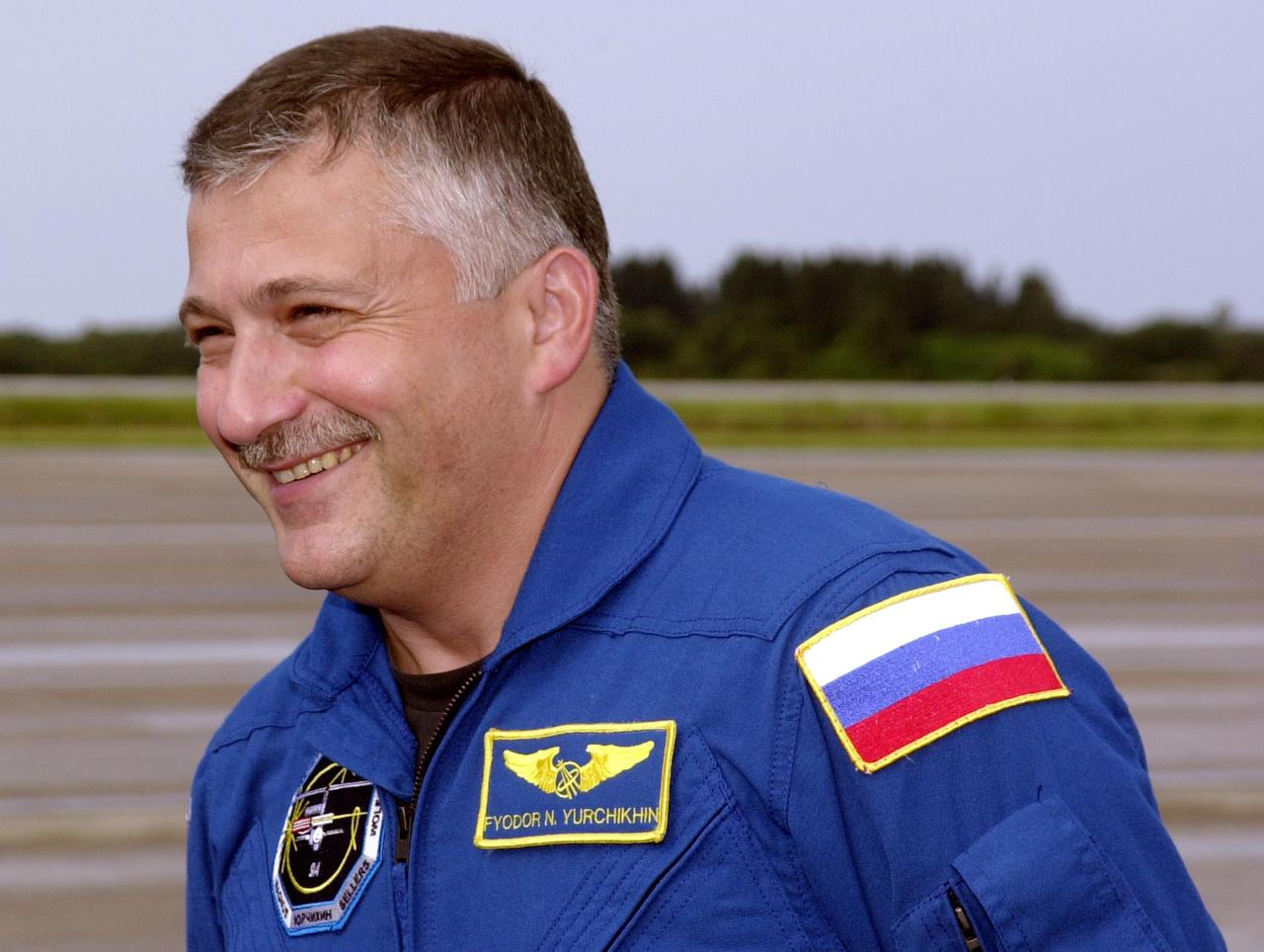
KENNEDY SPACE CENTER, FLA. -- STS-112 Mission Specialist Fyodor Yurchikhin, who is with the Russian Space Agency, shows his happiness at returning to KSC to prepare for launch. He will be making his first Shuttle flight. STS-112, aboard Space Shuttle Atlantis, is the 15th assembly mission to the International Space Station. Atlantis will be carrying the S1 Integrated Truss Structure, the first starboard truss segment, to be attached to the central truss segment, S0, and the Crew and Equipment Translation Aid (CETA) Cart A. The CETA is the first of two human-powered carts that will ride along the ISS railway, providing mobile work platforms for future spacewalking astronauts. The 11-day mission includes three spacewalks. Launch is scheduled for Oct. 2 between 2 and 6 p.m.

KENNEDY SPACE CENTER, FLA. -- STS-112 Mission Specialist Sandra Magnus is happy to return to KSC to prepare for launch. She will be making her first Shuttle flight. STS-112, aboard Space Shuttle Atlantis, is the 15th assembly mission to the International Space Station. Atlantis will be carrying the S1 Integrated Truss Structure, the first starboard truss segment, to be attached to the central truss segment, S0, and the Crew and Equipment Translation Aid (CETA) Cart A. The CETA is the first of two human-powered carts that will ride along the ISS railway, providing mobile work platforms for future spacewalking astronauts. The 11-day mission includes three spacewalks. Launch is scheduled for Oct. 2 between 2 and 6 p.m.

KENNEDY SPACE CENTER, FLA. -- In the Space Station Processing Facility, as part of the Crew Equipment Interface Test, STS-112 Commander Jeffrey Ashby looks over the S1 Integrated Truss Structure, part of the payload for the mission to the International Space Station. The S1 truss is the first starboard (right-side) truss segment, whose main job is providing structural support for the orbiting research facility's radiator panels that cool the Space Station's complex power system. The S1 truss segment also will house communications systems, external experiment positions and other subsystems. The S1 truss will be attached to the S0 truss. Launch of STS-112 is scheduled for Aug. 22, 2002
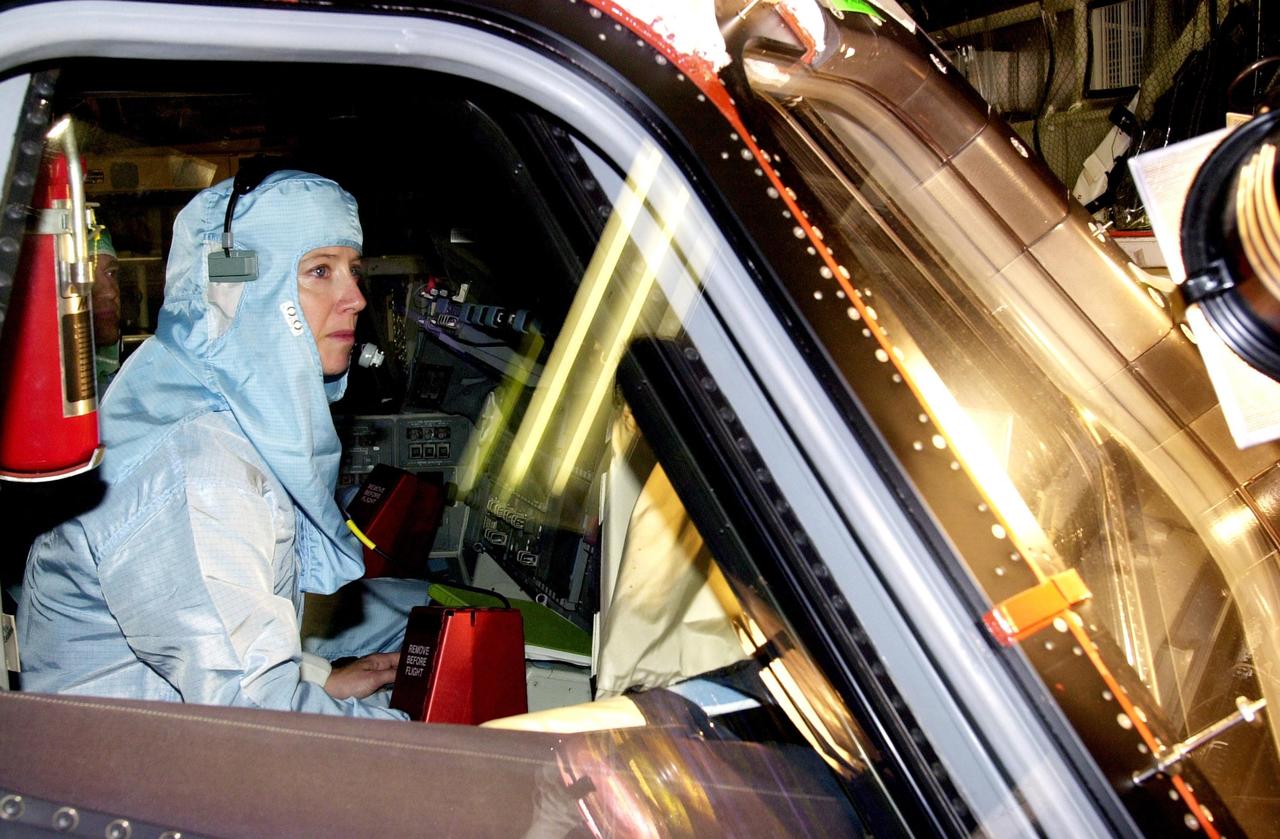
KENNEDY SPACE CENTER, FLA. -- During a Crew Equipment Interface Test, STS-112 Pilot Pamela Melroy checks out the windshield on Atlantis, the designated orbiter for the mission. STS-112 is the 15th assembly flight to the International Space Station and will be ferrying the S1 Integrated Truss Structure. The S1 truss is the first starboard (right-side) truss segment, whose main job is providing structural support for the radiator panels that cool the Space Station's complex power system. The S1 truss segment also will house communications systems, external experiment positions and other subsystems. The S1 truss will be attached to the S0 truss. STS-112 is currently scheduled for launch Aug. 22, 2002
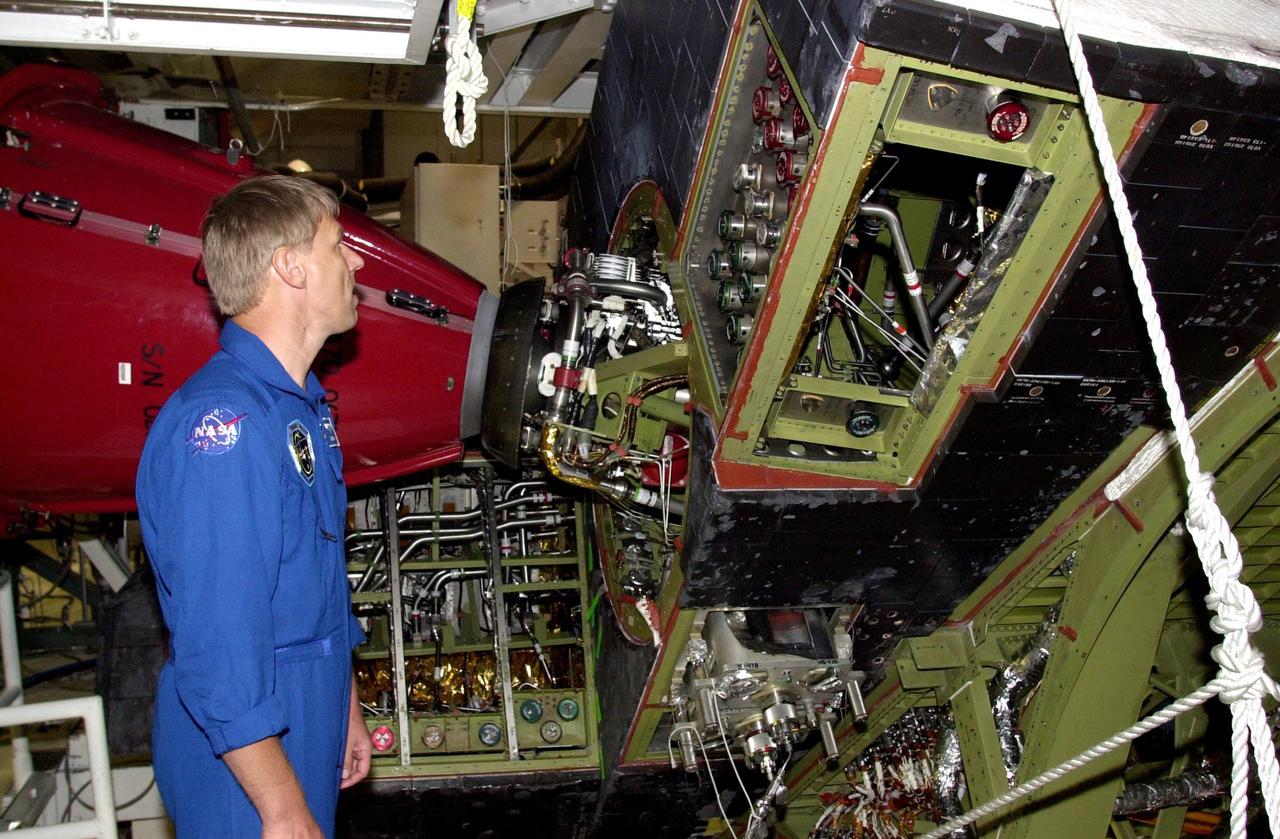
KENNEDY SPACE CENTER, FLA. - During a Crew Equipment Interface Test, STS-112 Mission Specialist Piers Sellers looks at the engine on Atlantis, the designated orbiter for the mission. On the 15th assembly flight to the International Space Station, Atlantis and crew will be ferrying the S1 Integrated Truss Structure. The S1 truss is the first starboard (right-side) truss segment, whose main job is providing structural support for the radiator panels that cool the Space Station's complex power system. The S1 truss segment also will house communications systems, external experiment positions and other subsystems. The S1 truss will be attached to the S0 truss. STS-112 is currently scheduled for launch Aug. 22, 2002
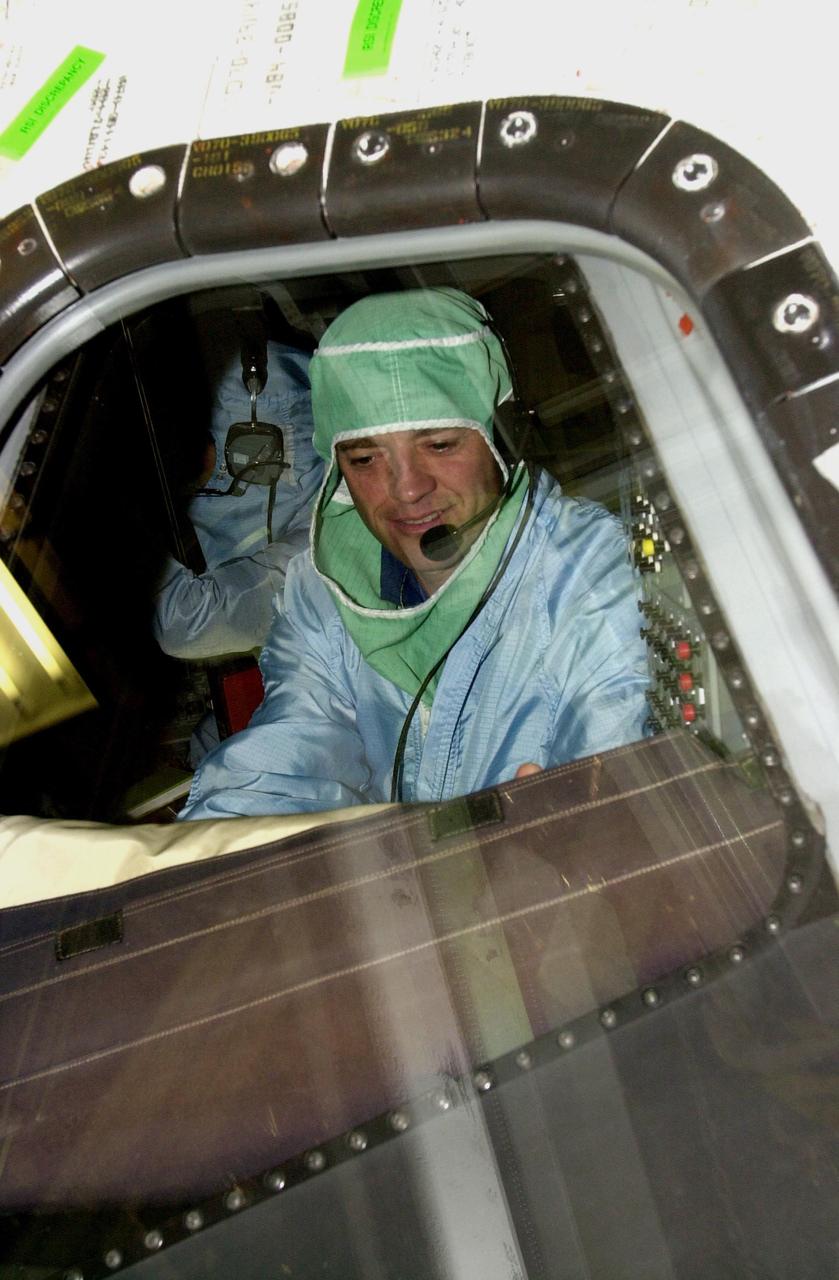
KENNEDY SPACE CENTER, FLA. -- During a Crew Equipment Interface Test, STS-112 Commander Jeffrey Ashby checks out the windshield on Atlantis, the designated orbiter for the mission. STS-112 is the 15th assembly flight to the International Space Station and will be ferrying the S1 Integrated Truss Structure. The S1 truss is the first starboard (right-side) truss segment, whose main job is providing structural support for the radiator panels that cool the Space Station's complex power system. The S1 truss segment also will house communications systems, external experiment positions and other subsystems. The S1 truss will be attached to the S0 truss. STS-112 is currently scheduled for launch Aug. 22, 2002
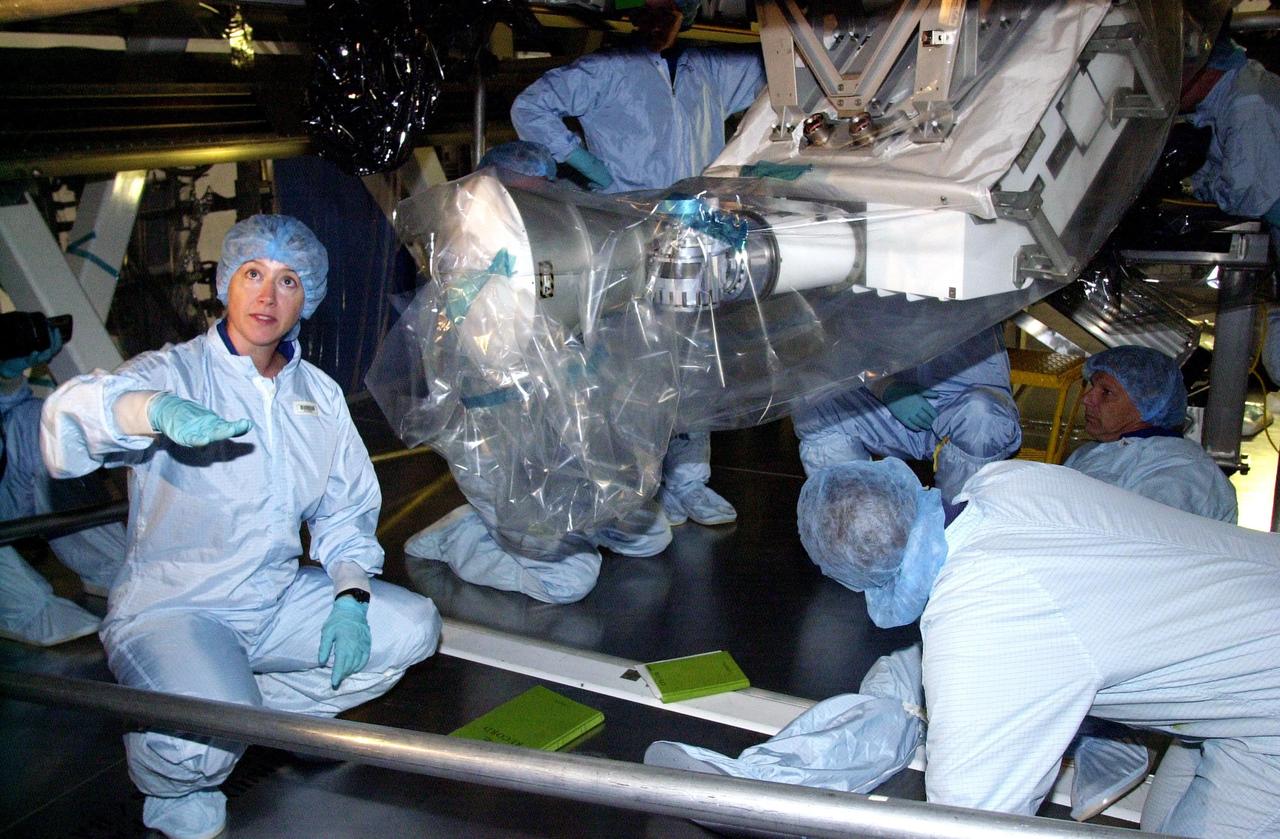
KENNEDY SPACE CENTER, FLA. - STS-112 Pilot Pamela Melroy signals to someone off camera while behind her other crew members look over the S1 Integrated Truss Structure, part of the payload for the mission to the International Space Station. The S1 truss is the first starboard (right-side) truss segment, whose main job is providing structural support for the orbiting research facility's radiator panels that cool the Space Station's complex power system. The S1 truss segment also will house communications systems, external experiment positions and other subsystems. The S1 truss will be attached to the S0 truss. Launch of STS-112 is scheduled for Aug. 22, 2002

KENNEDY SPACE CENTER, FLA. - As part of the Crew Equipment Interface Test, STS-112 Mission Specialist David Wolf (right) checks out a part of the S1 Integrated Truss Structure, part of the payload for the mission to the International Space Station. The S1 truss is the first starboard (right-side) truss segment, whose main job is providing structural support for the orbiting research facility's radiator panels that cool the Space Station's complex power system. The S1 truss segment also will house communications systems, external experiment positions and other subsystems. The S1 truss will be attached to the S0 truss. Launch of STS-112 is scheduled for Aug. 22, 2002
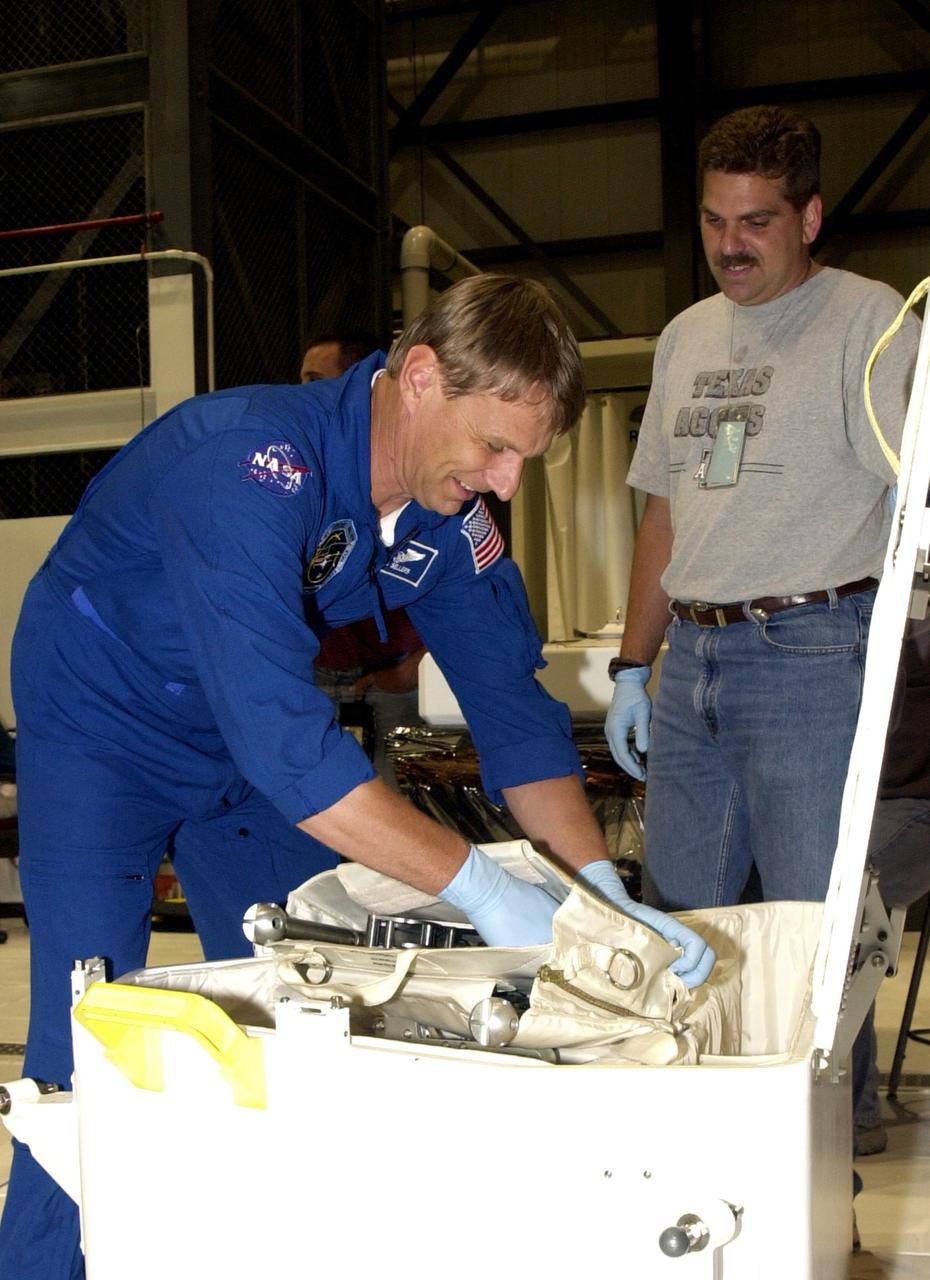
KENNEDY SPACE CENTER, FLA. - STS-112 Mission Specialist Piers Sellers checks out flight equipment during a Crew Equipment Interface Test at KSC. STS-112 is the 15th assembly flight to the International Space Station and will be ferrying the S1 Integrated Truss Structure. The S1 truss is the first starboard (right-side) truss segment, whose main job is providing structural support for the radiator panels that cool the Space Station's complex power system. The S1 truss segment also will house communications systems, external experiment positions and other subsystems. The S1 truss will be attached to the S0 truss. STS-112 is currently scheduled for launch Aug. 22, 2002
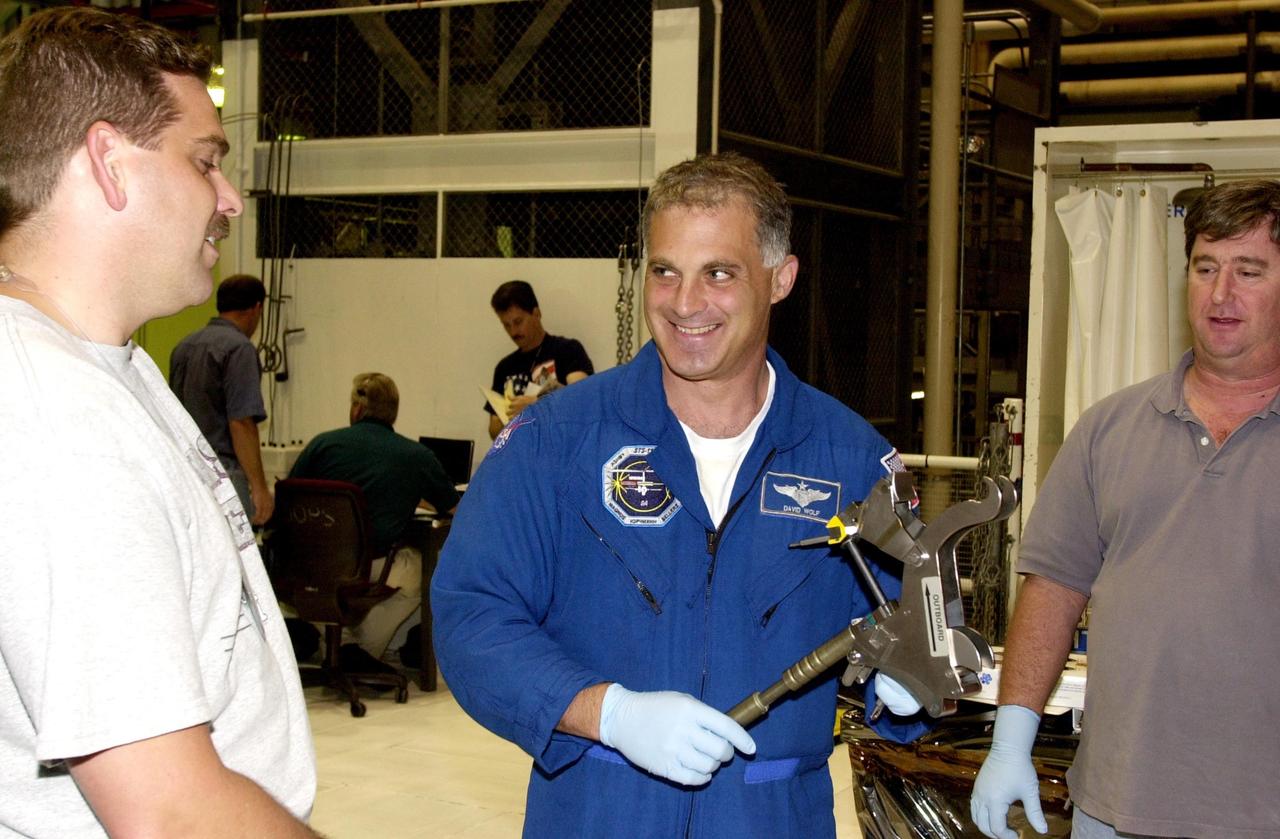
KENNEDY SPACE CENTER, FLA. -- STS-112 Mission Specialist David Wolf discusses flight equipment with two technicians during a Crew Equipment Interface Test at KSC. STS-112 is the 15th assembly flight to the International Space Station and will be ferrying the S1 Integrated Truss Structure. The S1 truss is the first starboard (right-side) truss segment, whose main job is providing structural support for the radiator panels that cool the Space Station's complex power system. The S1 truss segment also will house communications systems, external experiment positions and other subsystems. The S1 truss will be attached to the S0 truss. STS-112 is currently scheduled for launch Aug. 22, 2002

KENNEDY SPACE CENTER, FLA. -- As part of the Crew Equipment Interface Test, STS-112 Mission Specialist Piers Sellers (foreground) and Commander Jeffrey Ashby look over the payload for the mission in the Space Station Processing Facility. Mission STS-112 will be ferrying the S1 ITS to the International Space Station on its scheduled Aug. 22 flight. The S1 truss is the first starboard (right-side) truss segment, whose main job is providing structural support for the orbiting research facility's radiator panels that cool the Space Station's complex power system. The S1 truss segment also will house communications systems, external experiment positions and other subsystems. The S1 truss will be attached to the S0 truss
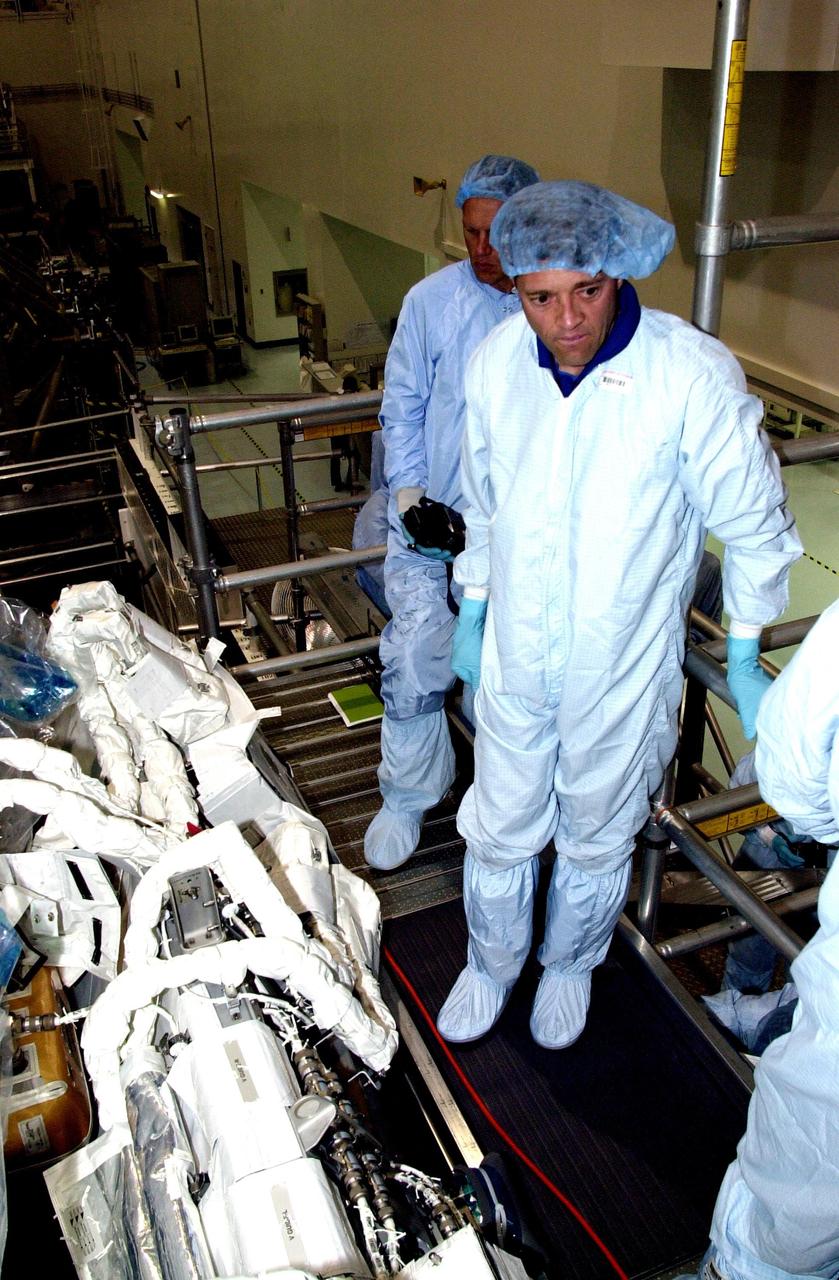
KENNEDY SPACE CENTER, FLA. -- In the Space Station Processing Facility, STS-112 Commander Jeffrey Ashby looks over the payload for the mission as part of the Crew Equipment Interface Test. Mission STS-112 will be ferrying the S1 ITS to the International Space Station on its scheduled Aug. 22 flight. The S1 truss is the first starboard (right-side) truss segment, whose main job is providing structural support for the orbiting research facility's radiator panels that cool the Space Station's complex power system. The S1 truss segment also will house communications systems, external experiment positions and other subsystems. The S1 truss will be attached to the S0 truss

KENNEDY SPACE CENTER, FLA. -- In the Space Station Processing Facility, STS-112 Pilot Pamela Melroy looks at equipment for the mission as part of the Crew Equipment Interface Test. Mission Specialist Sandra Magnus is behind her. Mission STS-112 will be ferrying the S1 truss to the International Space Station on its scheduled Aug. 22 flight. The S1 truss is the first starboard (right-side) truss segment, whose main job is providing structural support for the orbiting research facility's radiator panels that cool the Space Station's complex power system. The S1 truss segment also will house communications systems, external experiment positions and other subsystems. The S1 truss will be attached to the S0 truss
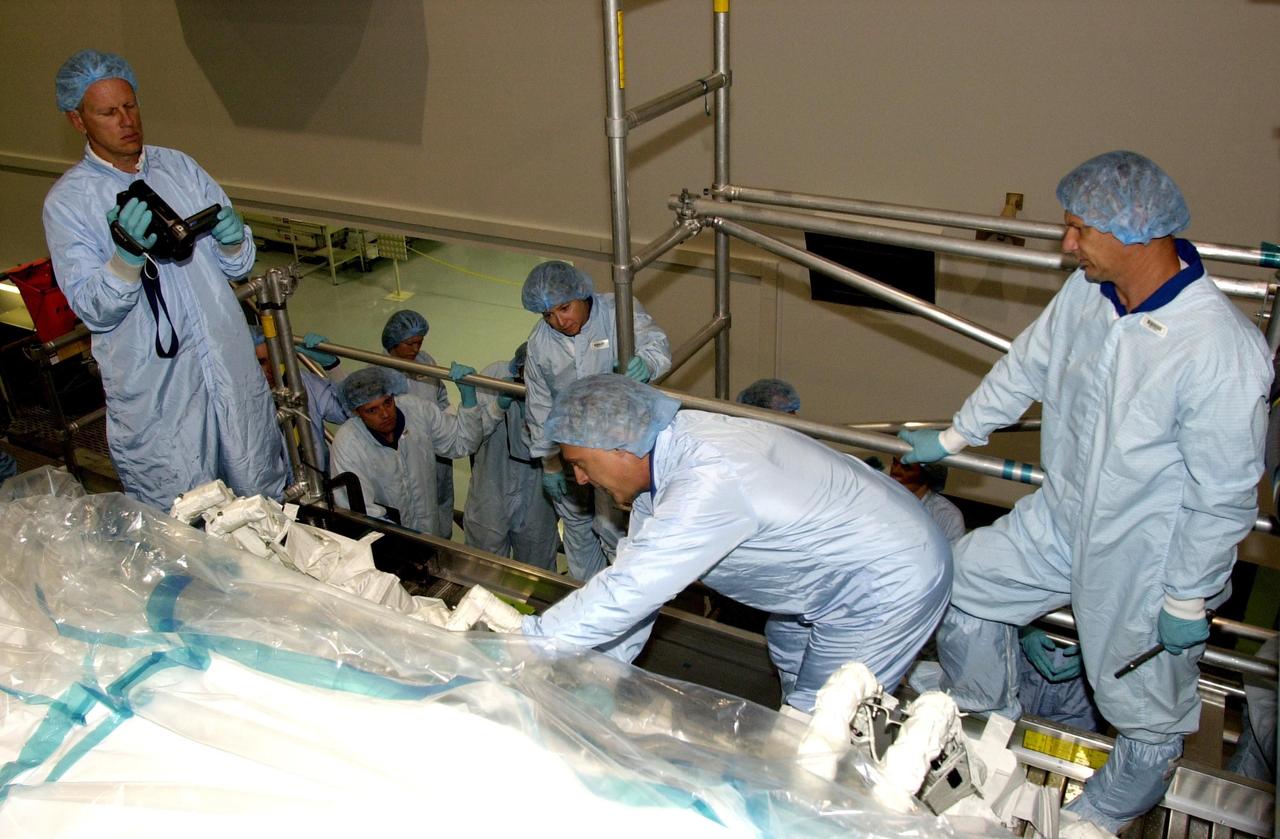
KENNEDY SPACE CENTER, FLA. -- In the Space Station Processing Facility, the STS-112 crew looks over the payload for their mission as part of the Crew Equipment Interface Test. At right are Mission Specialists David Wolf and Piers Sellers. Mission STS-112 will be ferrying the S1 ITS to the International Space Station on its scheduled Aug. 22 flight. The S1 truss is the first starboard (right-side) truss segment, whose main job is providing structural support for the orbiting research facility's radiator panels that cool the Space Station's complex power system. The S1 truss segment also will house communications systems, external experiment positions and other subsystems. The S1 truss will be attached to the S0 truss
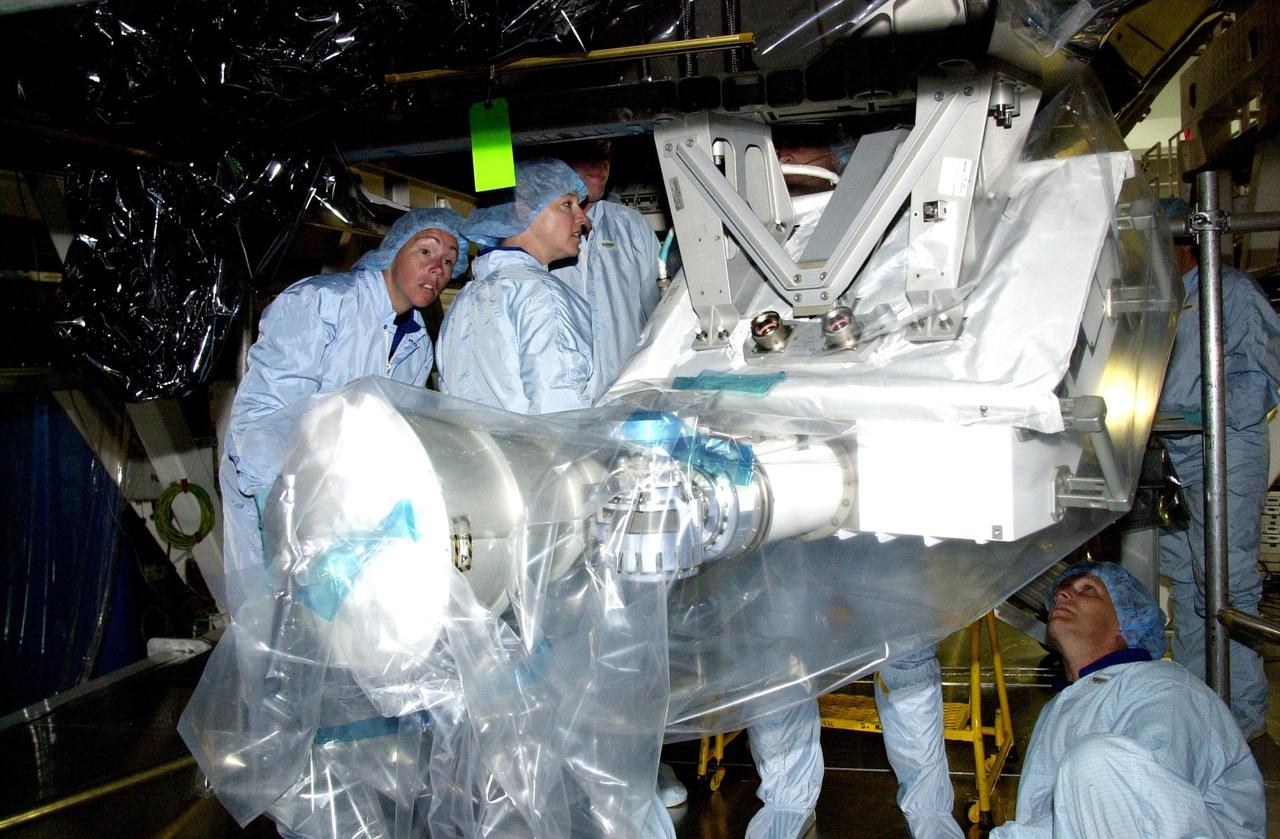
KENNEDY SPACE CENTER, FLA. -- Members of the STS-112 crew look over the S1 ITS, primary payload on their mission, as part of the Crew Equipment Interface Test. Seen at left are Mission Specialist Sandra Magnus, Pilot Pamela Melroy; below at right is Mission Specialist Piers Sellers. Mission STS-112 will be ferrying the S1 truss to the International Space Station on its scheduled Aug. 22 flight. The S1 truss is the first starboard (right-side) truss segment, whose main job is providing structural support for the orbiting research facility's radiator panels that cool the Space Station's complex power system. The S1 truss segment also will house communications systems, external experiment positions and other subsystems. The S1 truss will be attached to the S0 truss
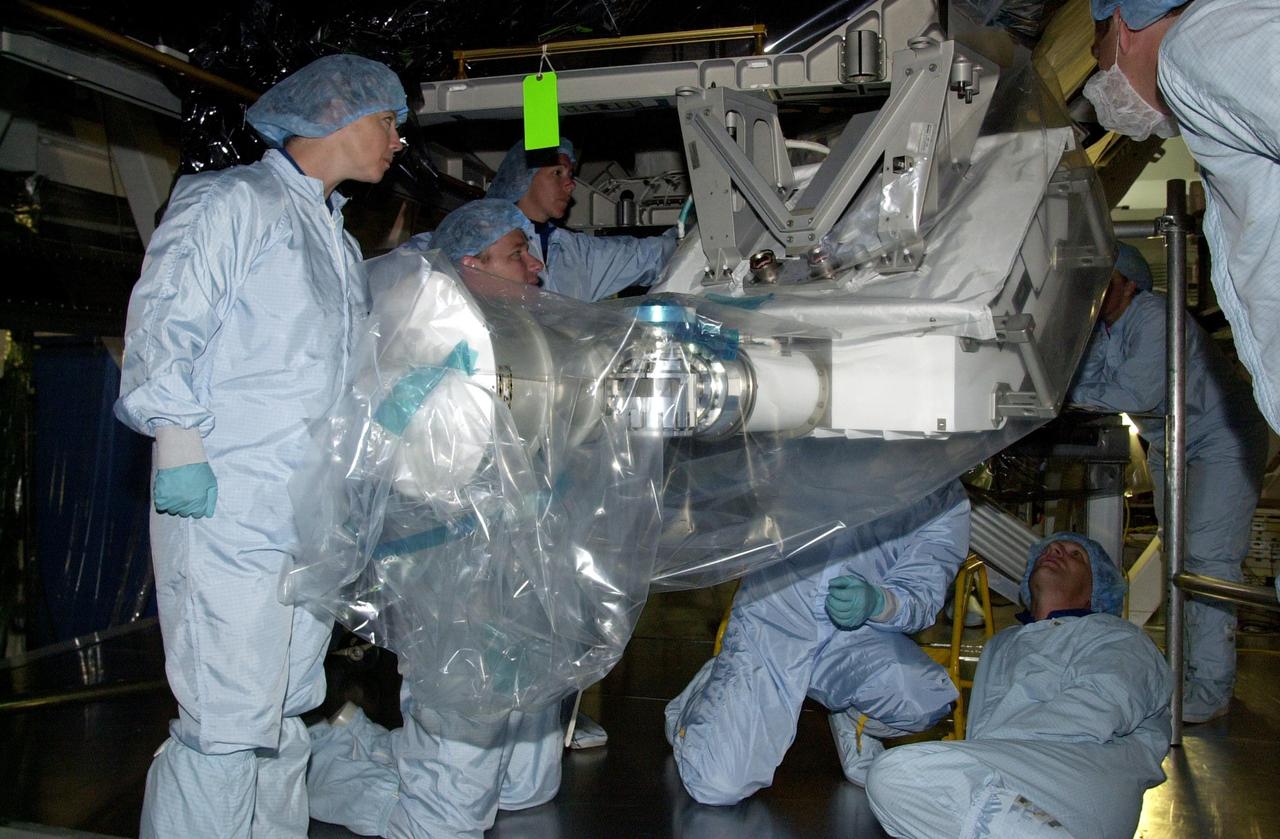
KENNEDY SPACE CENTER, FLA. -- As part of the Crew Equipment Interface Test, members of the STS-112 crew look at the S1 Integrated Truss Structure, part of the payload for their mission to the International Space Station. From left are Pilot Pamela Melroy and Mission Specialists Piers Sellers and Sandra Magnus. At right, looking up, is Commander Jeffrey Ashby. The S1 truss is the first starboard (right-side) truss segment, whose main job is providing structural support for the orbiting research facility's radiator panels that cool the Space Station's complex power system. The S1 truss segment also will house communications systems, external experiment positions and other subsystems. The S1 truss will be attached to the S0 truss. Launch of STS-112 is scheduled for Aug. 22, 2002
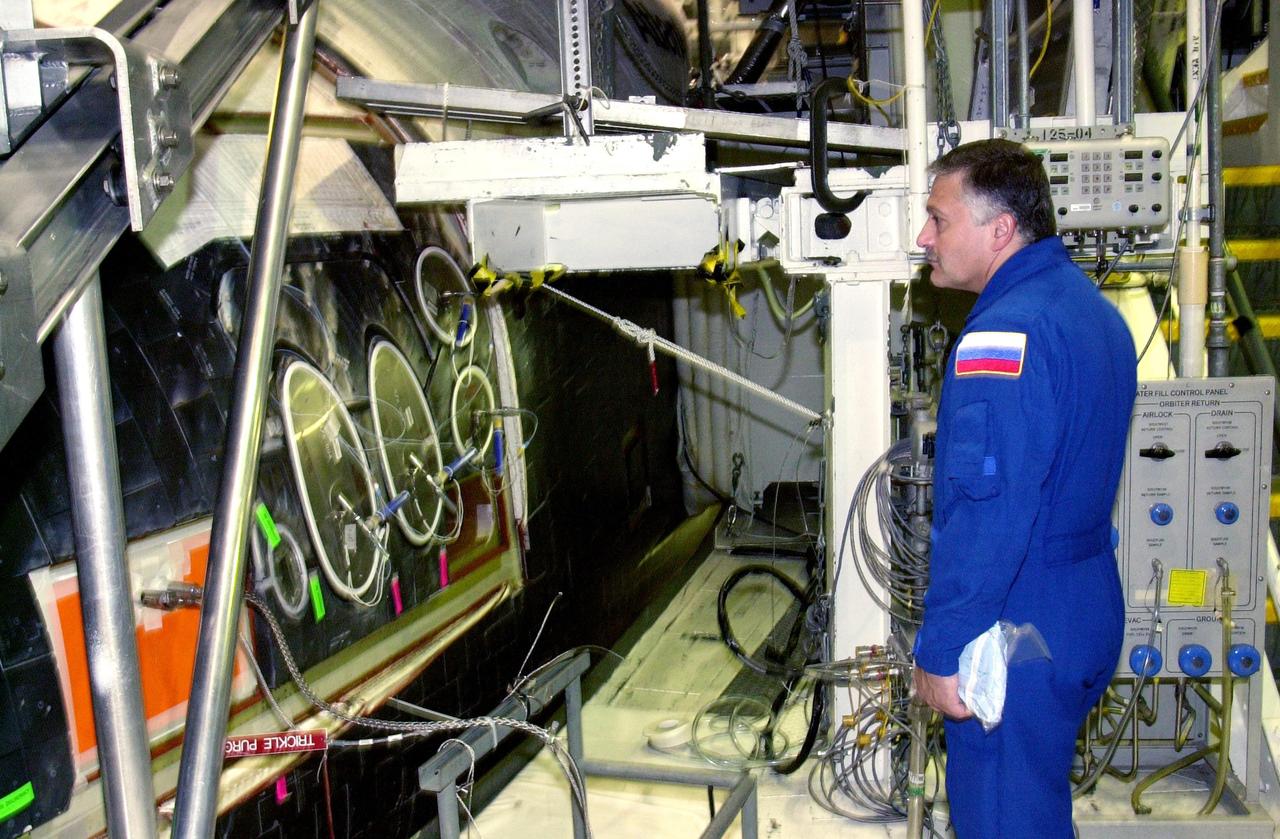
KENNEDY SPACE CENTER, FLA. -- During a Crew Equipment Interface Test, STS-112 Mission Specialist Fyodor Yurchikhin looks at Atlantis, the designated orbiter for the mission. Yurchikhin is with the Russian Space Agency. STS-112 is the 15th assembly flight to the International Space Station and will be ferrying the S1 Integrated Truss Structure. The S1 truss is the first starboard (right-side) truss segment, whose main job is providing structural support for the radiator panels that cool the Space Station's complex power system. The S1 truss segment also will house communications systems, external experiment positions and other subsystems. The S1 truss will be attached to the S0 truss. STS-112 is currently scheduled for launch Aug. 22, 2002

KENNEDY SPACE CENTER, FLA. - During a Crew Equipment Interface Test, STS-112 Pilot Pamela Melroy (left) and Mission Specialist David Wolf (right) look at equipment pointed out by a technician in the payload bay of Atlantis. STS-112 is the 15th assembly flight to the International Space Station and will be ferrying the S1 Integrated Truss Structure. The S1 truss is the first starboard (right-side) truss segment, whose main job is providing structural support for the radiator panels that cool the Space Station's complex power system. The S1 truss segment also will house communications systems, external experiment positions and other subsystems. The S1 truss will be attached to the S0 truss. STS-112 is currently scheduled for launch Aug. 22, 2002

KENNEDY SPACE CENTER, FLA. -- During a Crew Equipment Interface Test, STS-112 Pilot Pamela Melroy (left) and Commander Jeffrey Ashby (right) look at the outside of the windshield on Atlantis, the designated orbiter for the mission. STS-112 is the 15th assembly flight to the International Space Station and will be ferrying the S1 Integrated Truss Structure. The S1 truss is the first starboard (right-side) truss segment, whose main job is providing structural support for the radiator panels that cool the Space Station's complex power system. The S1 truss segment also will house communications systems, external experiment positions and other subsystems. The S1 truss will be attached to the S0 truss. STS-112 is currently scheduled for launch Aug. 22, 2002

KENNEDY SPACE CENTER, FLA. -- During a Crew Equipment Interface Test, STS-112 Mission Specialist Piers Sellers (foreground) points to an engine line on Atlantis, the designated orbiter for the mission, while Commander Jeffrey Ashby (behind) looks on. STS-112 is the 15th assembly flight to the International Space Station and will be ferrying the S1 Integrated Truss Structure. The S1 truss is the first starboard (right-side) truss segment, whose main job is providing structural support for the radiator panels that cool the Space Station's complex power system. The S1 truss segment also will house communications systems, external experiment positions and other subsystems. The S1 truss will be attached to the S0 truss. STS-112 is currently scheduled for launch Aug. 22, 2002