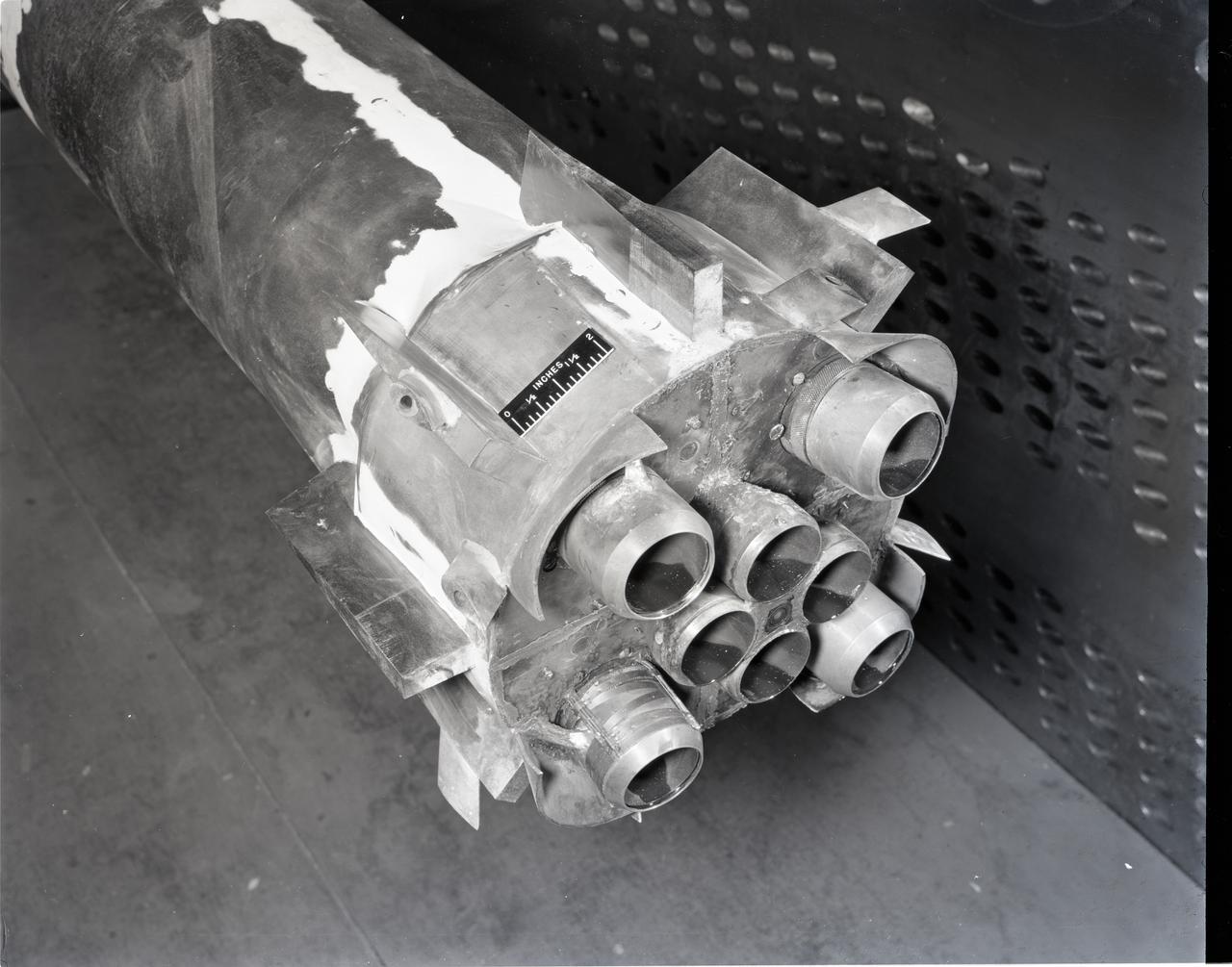
APOLLO CONFIGURATION OF SATURN MODEL IN THE 8X6-FOOT SUPERSONIC WIND TUNNEL
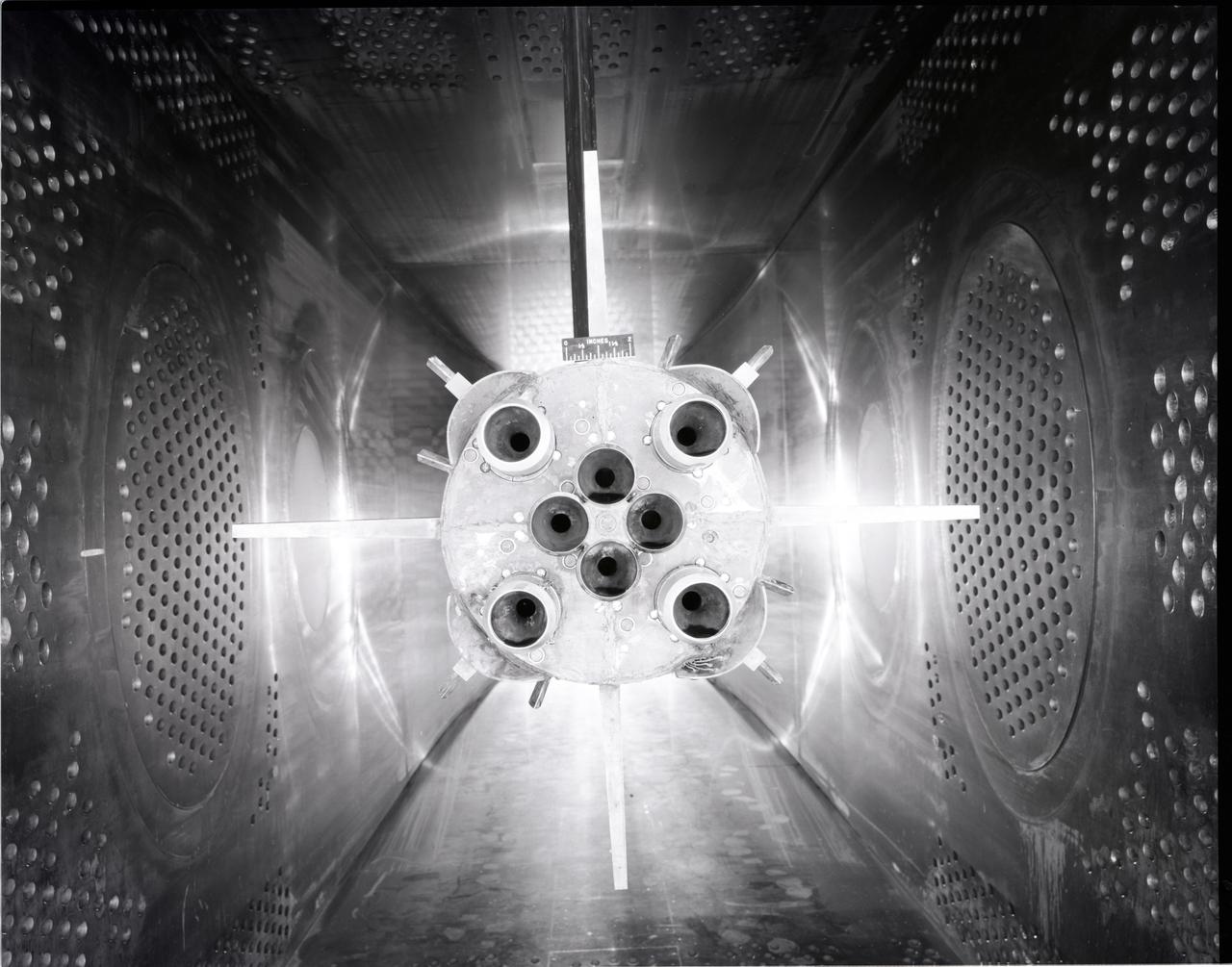
APOLLO CONFIGURATION OF SATURN MODEL IN THE 8X6-FOOT SUPERSONIC WIND TUNNEL
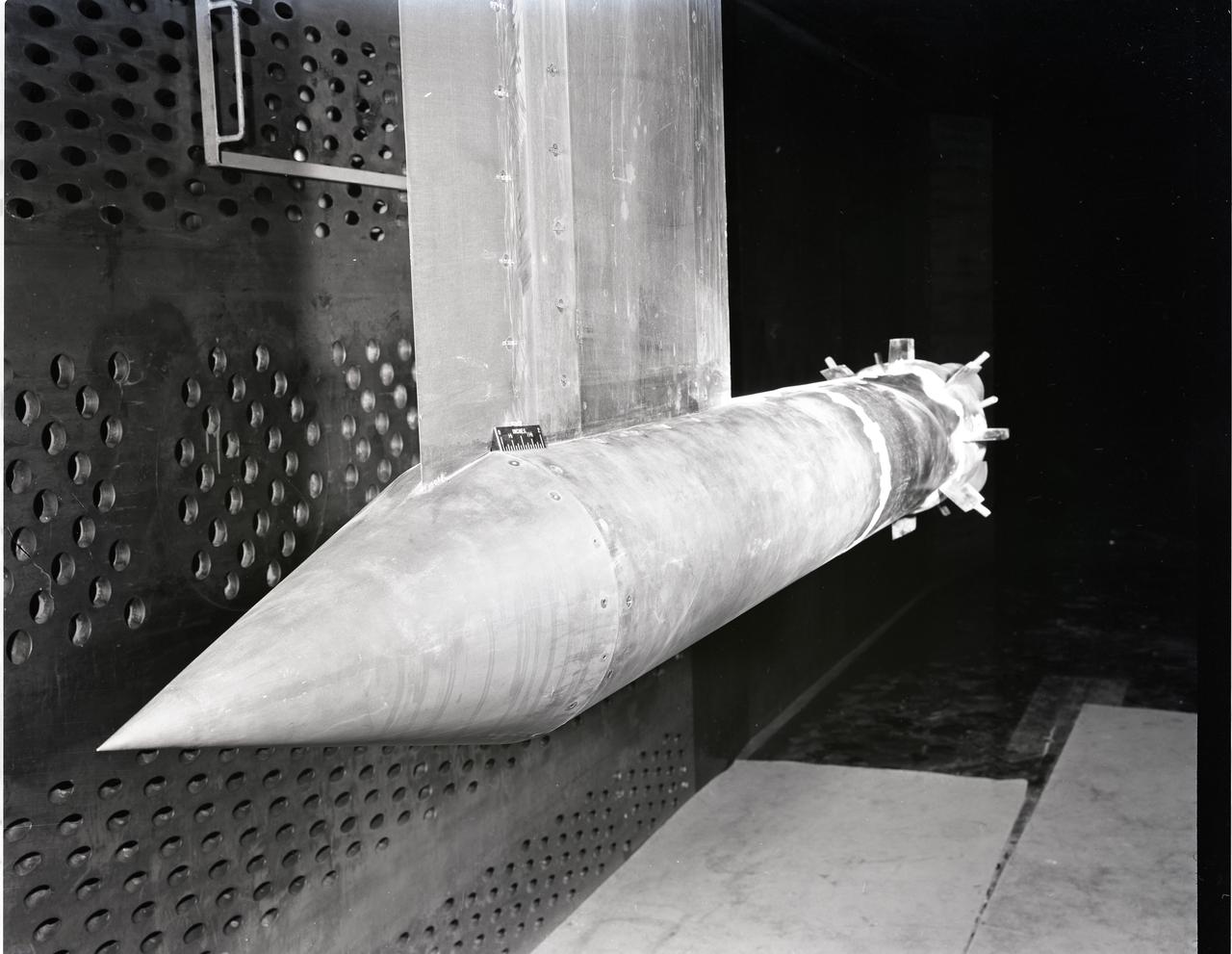
APOLLO CONFIGURATION OF SATURN MODEL IN THE 8X6-FOOT SUPERSONIC WIND TUNNEL
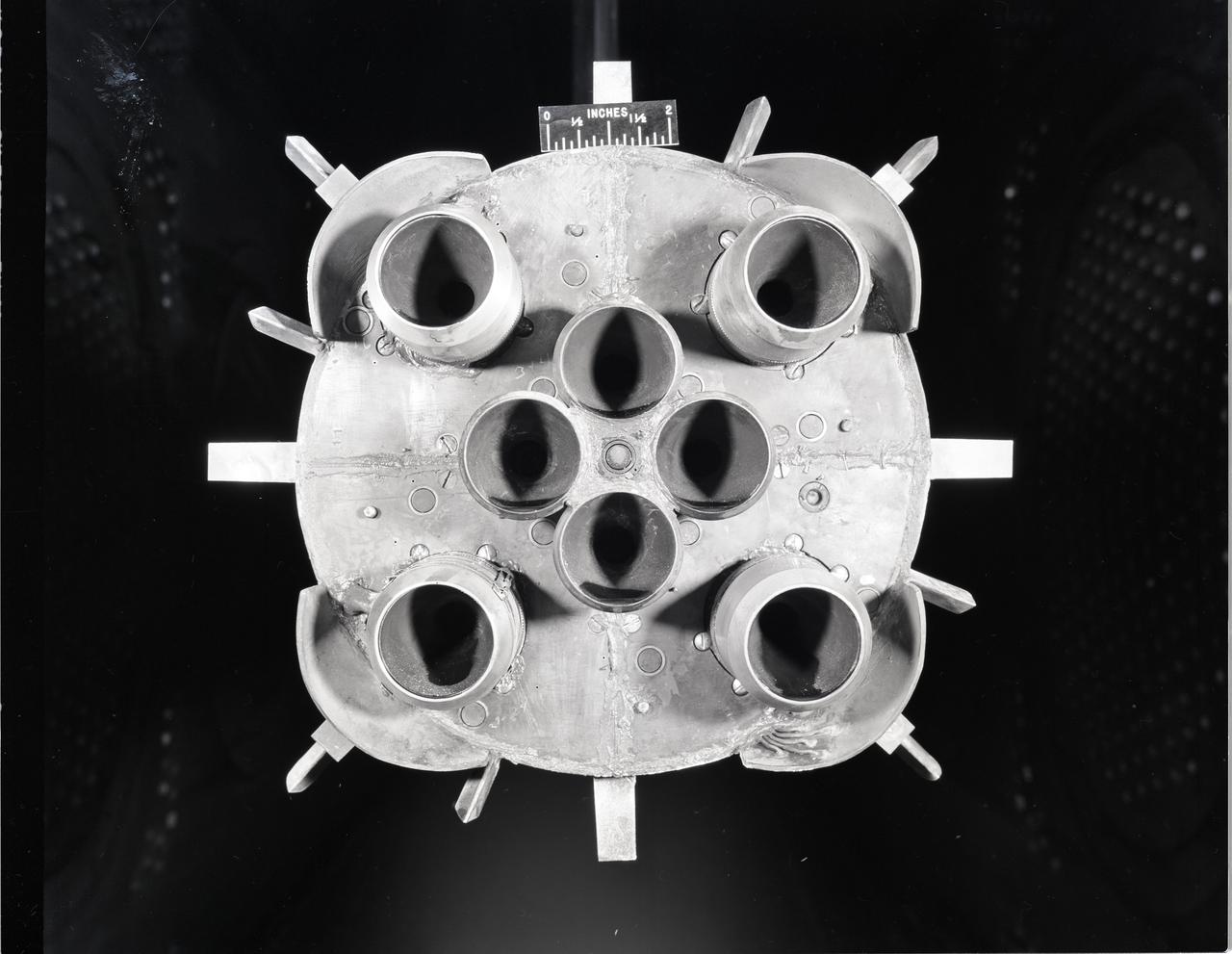
APOLLO CONFIGURATION OF SATURN MODEL IN THE 8X6-FOOT SUPERSONIC WIND TUNNEL
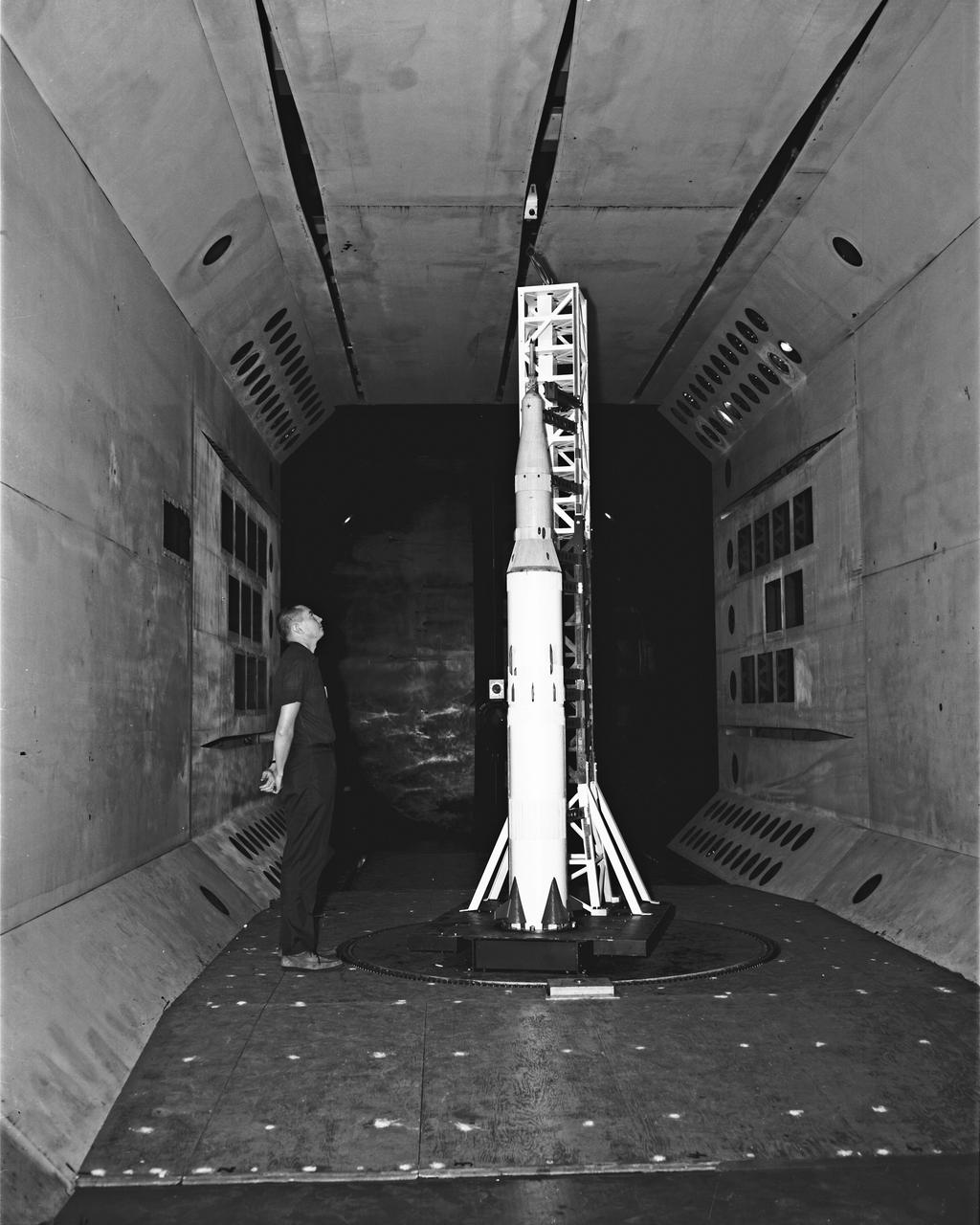
Saturn Model in 19 Foot Tunnel
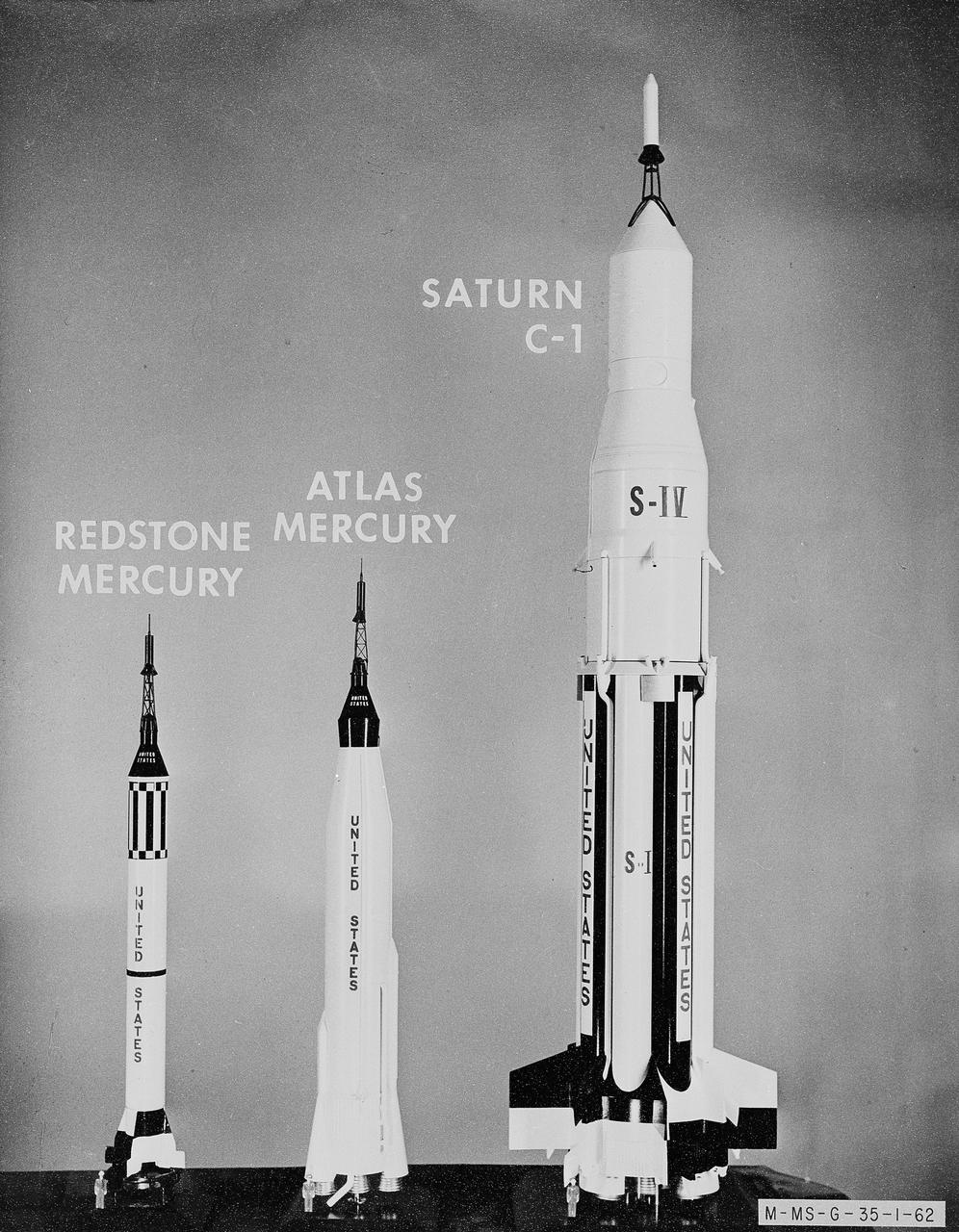
Photographed are models of early rocketry: The Atlas Mercury, Redstone Mercury; and Saturn C-1.
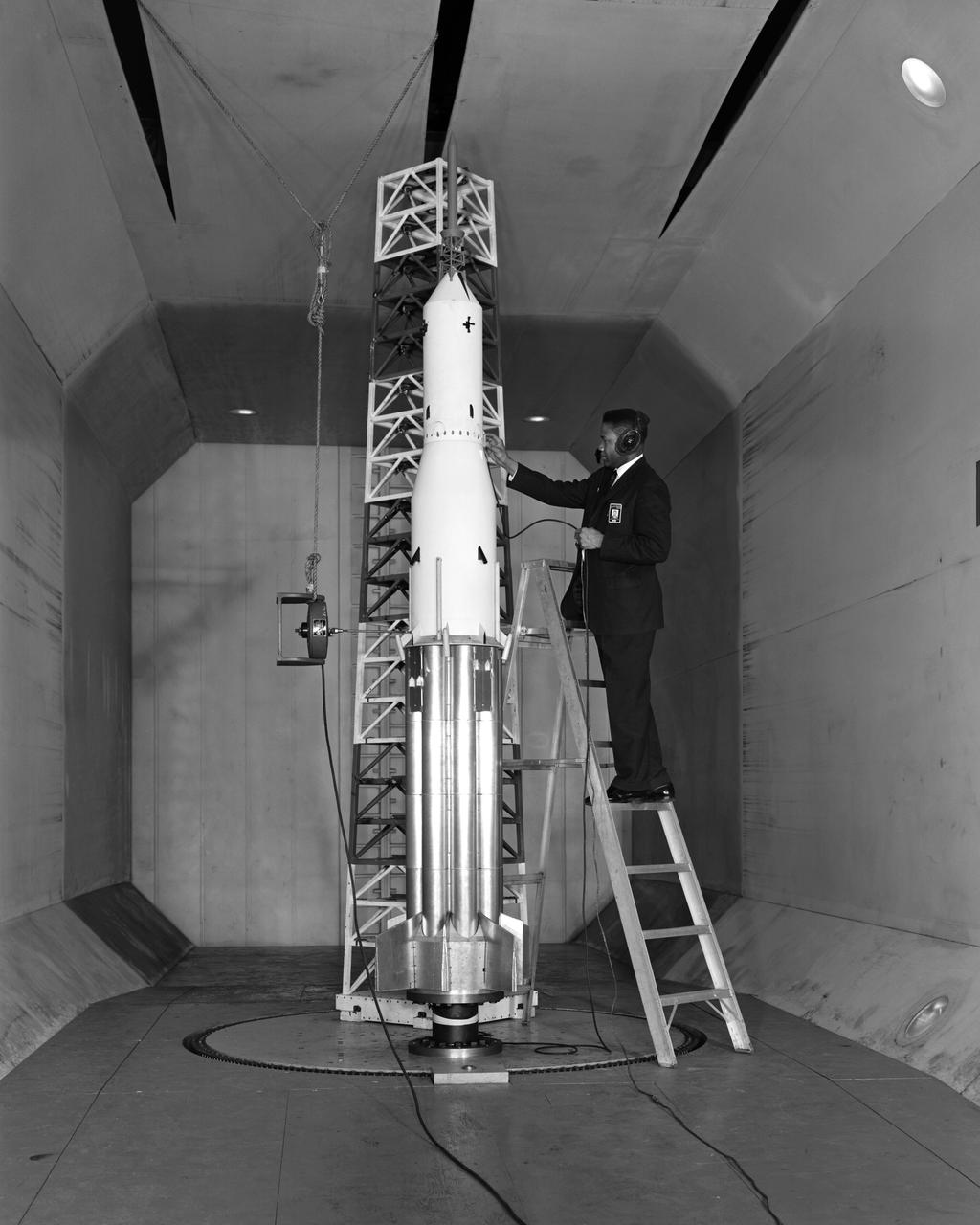
Apollo/Saturn 1B aerodynamic integrity.Jacket description is Ground Wind Loads Effect on SA5 in TDT. Person in 63-1637 is Engineer Thomas A. Byrdsong checks the Apollo/Saturn 1B ground-wind-loads model in the NASA Langley Transonic Dynamics Tunnel.
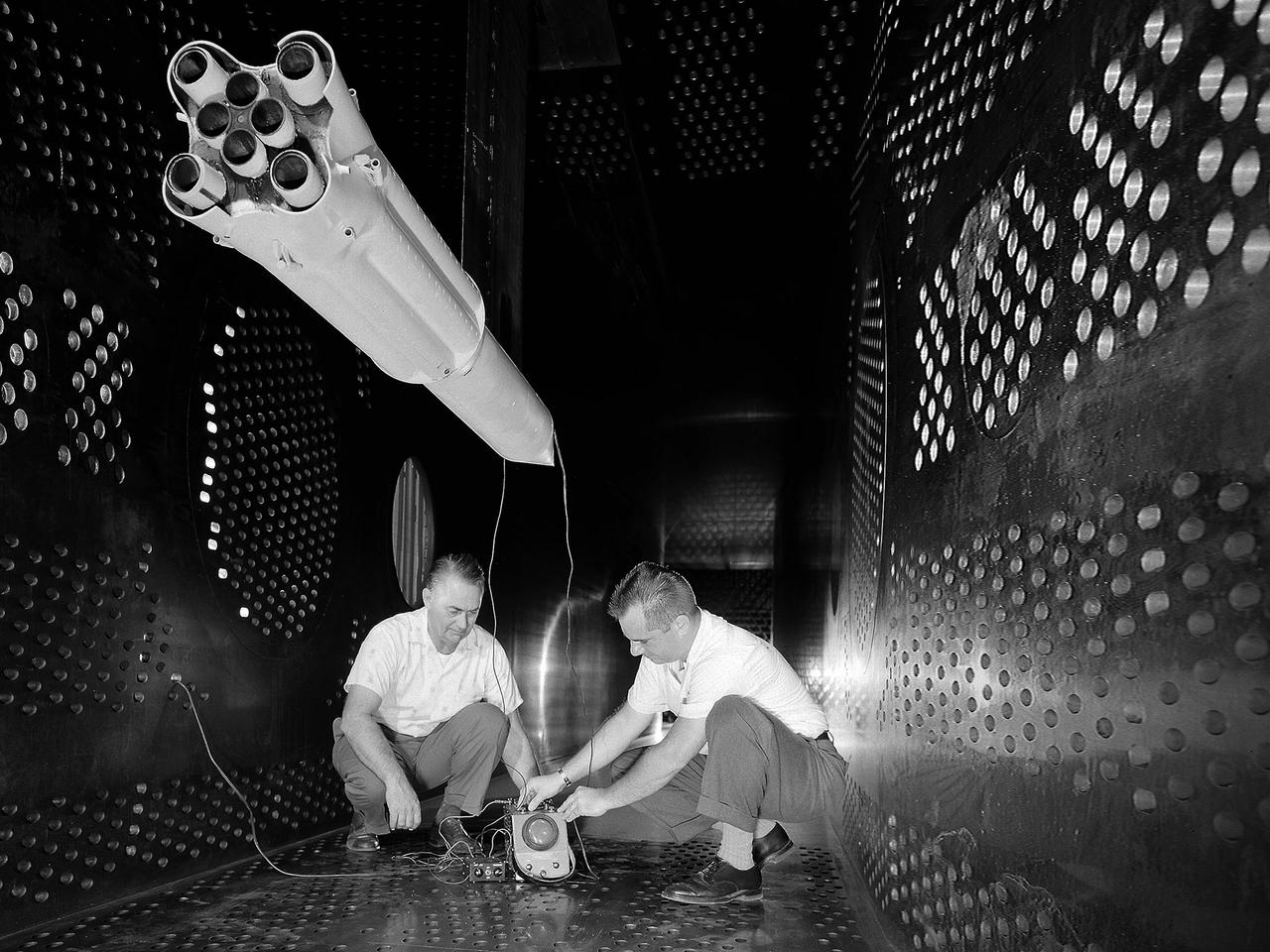
National Aeronautics and Space Administration (NASA) researchers set up instrumentation on a 0.037- scale model of a Saturn booster in the 8- by 6-Foot Supersonic Wind Tunnel at the NASA Lewis Research Center. In October 1960 Lewis researchers John Allen and Robert Wasko began a 14-month investigation of the eight-engine booster’s base heating in the tunnel. The model resembled the Saturn C-1, but only the afterbody totally mimicked the C-1. The over-heating of the lower end, or base, of the booster can cause the engines to fail or introduce aerodynamic concerns. Base heating results from the rocket engines’ exhaust heat, the recirculation of that heat into the base, and the burning of combustibles. Large boosters, like the Saturn, employed clusters of rocket engines that add to the complexity of the base heating problem. The 8- by 6-foot tunnel investigations studied the Saturn at speeds from Mach 1.0 to 2.0 using liquid oxygen and JP-4 as propellants. Researchers found that the use of cooling air scoops and external flow deflectors produced significant decreases in base heating.
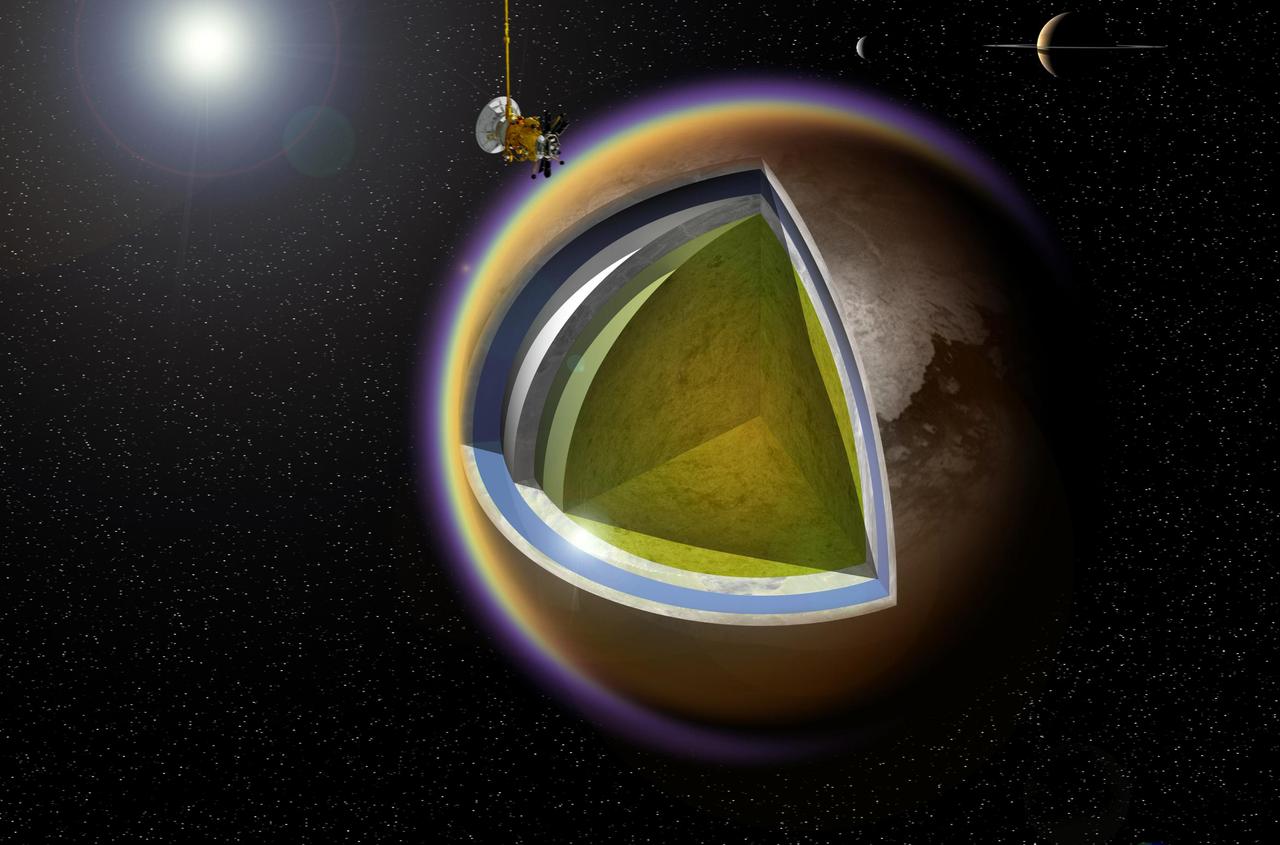
This artist concept shows a possible model of Titan internal structure that incorporates data from NASA Cassini spacecraft. A model of Cassini is shown making a targeted flyby over Titan cloudtops; Saturn and Enceladus appear at upper right.
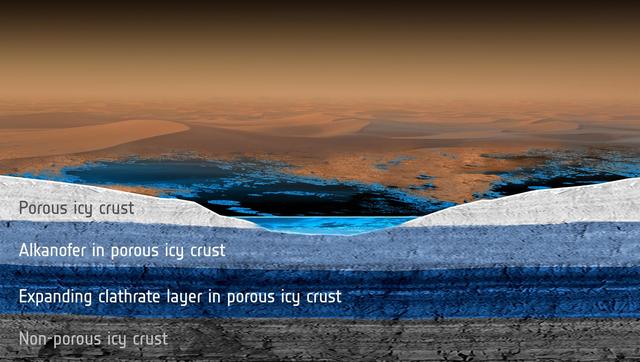
Scientists modeled how methane rainfall runoff would interact with the porous, icy crust of Saturn moon Titan and found that a subsurface methane aquifer might have its composition changed over time due to the formation of materials called clathrates.
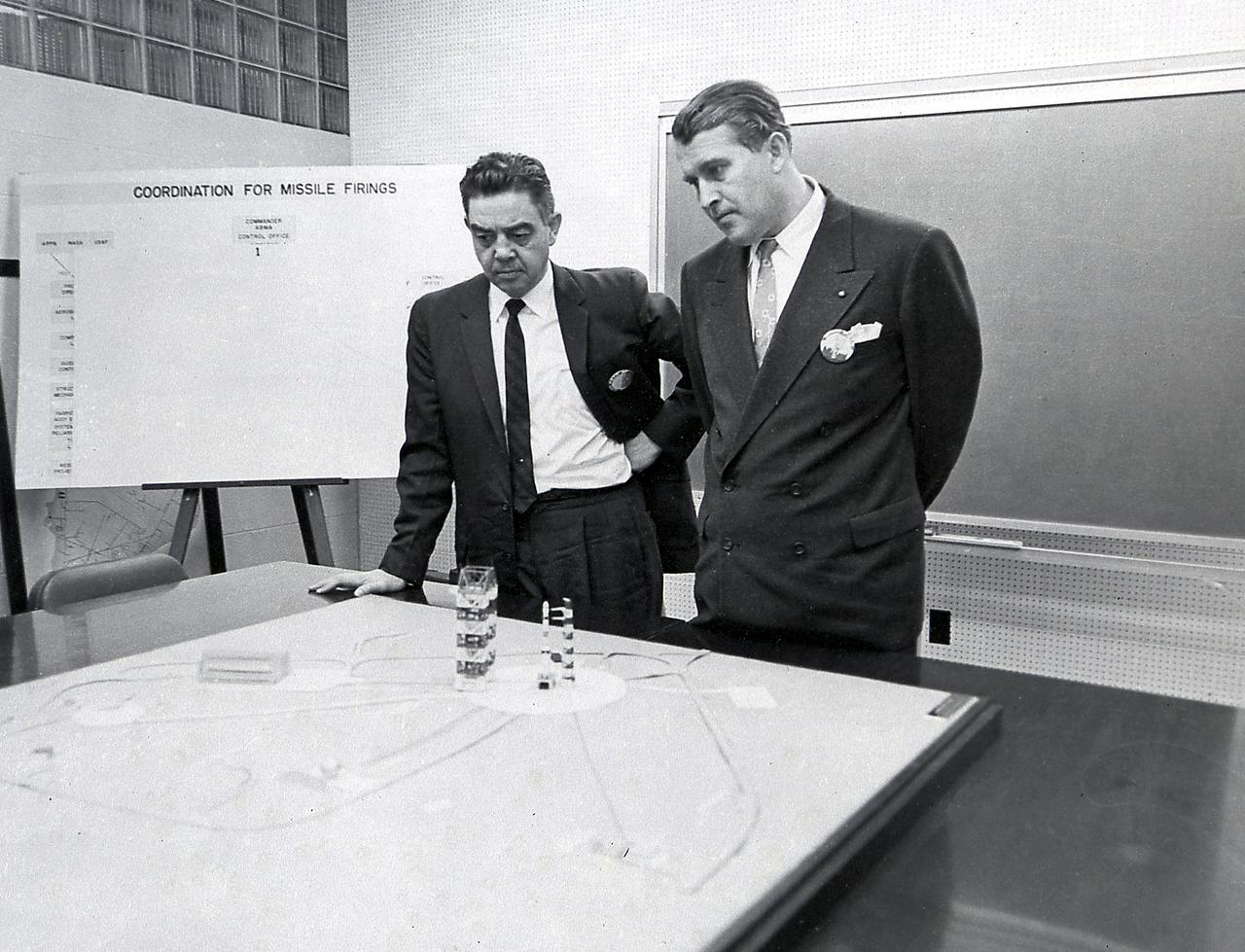
Dr. von Braun and Don Ostrander, head of the Launch Vehicle Program of the NASA Headquarters look at a model of the Saturn I launch complex 34.
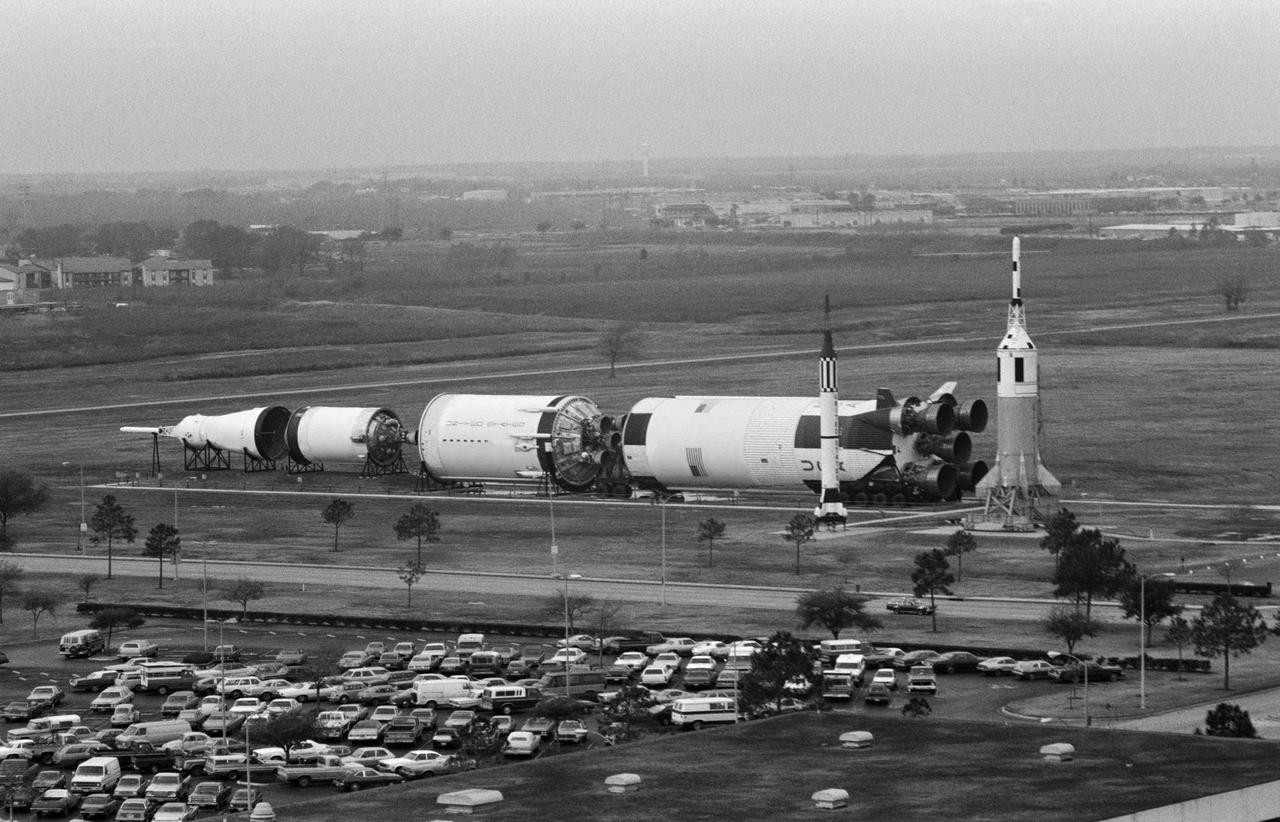
Overall view at JSC lookin west from atop of Bldg. 1 showing rockets, parking lot and all threee stages of Saturn V. first stage of Saturn V exhibit in "Rocket Park" on west side of center little joe and mercury models are seen 1. JSC- Aerials
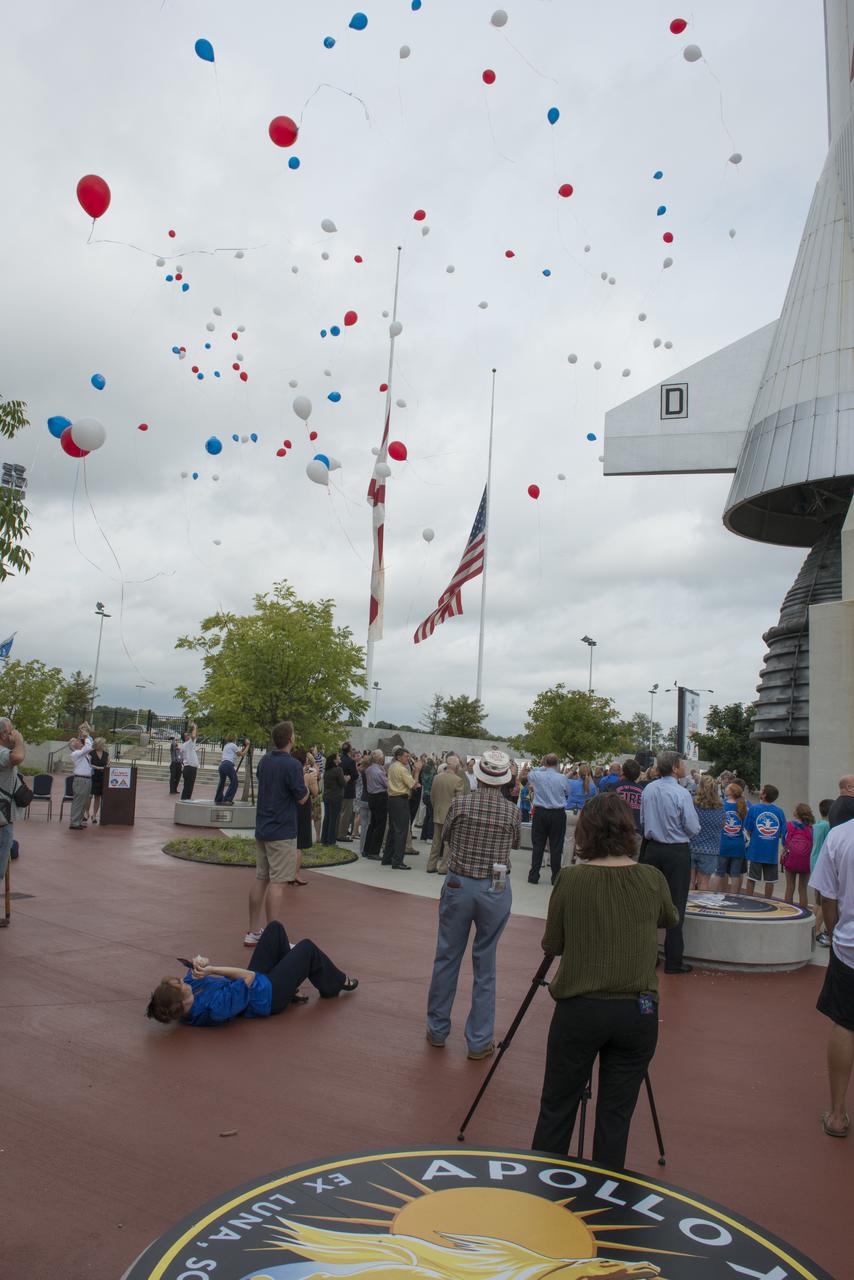
AUGUST 31, 2012 TRIBUTE TO APOLLO ASTRONAUT NEIL ARMSTRONG AT THE USSRC. A LARGE GROUP GATHERED NEAR THE LIFE-SIZE MODEL OF THE SATURN V ROCKET AND RELEASED RED, WHITE AND BLUE BALLOONS TO CELEBRATE THE LIFE OF NEIL ARMSTRONG. IN HONOR OF ARMSTRONG, FLAGS FLEW AT HALF-MAST ACROSS AMERICA ON AUGUST 31.1200934
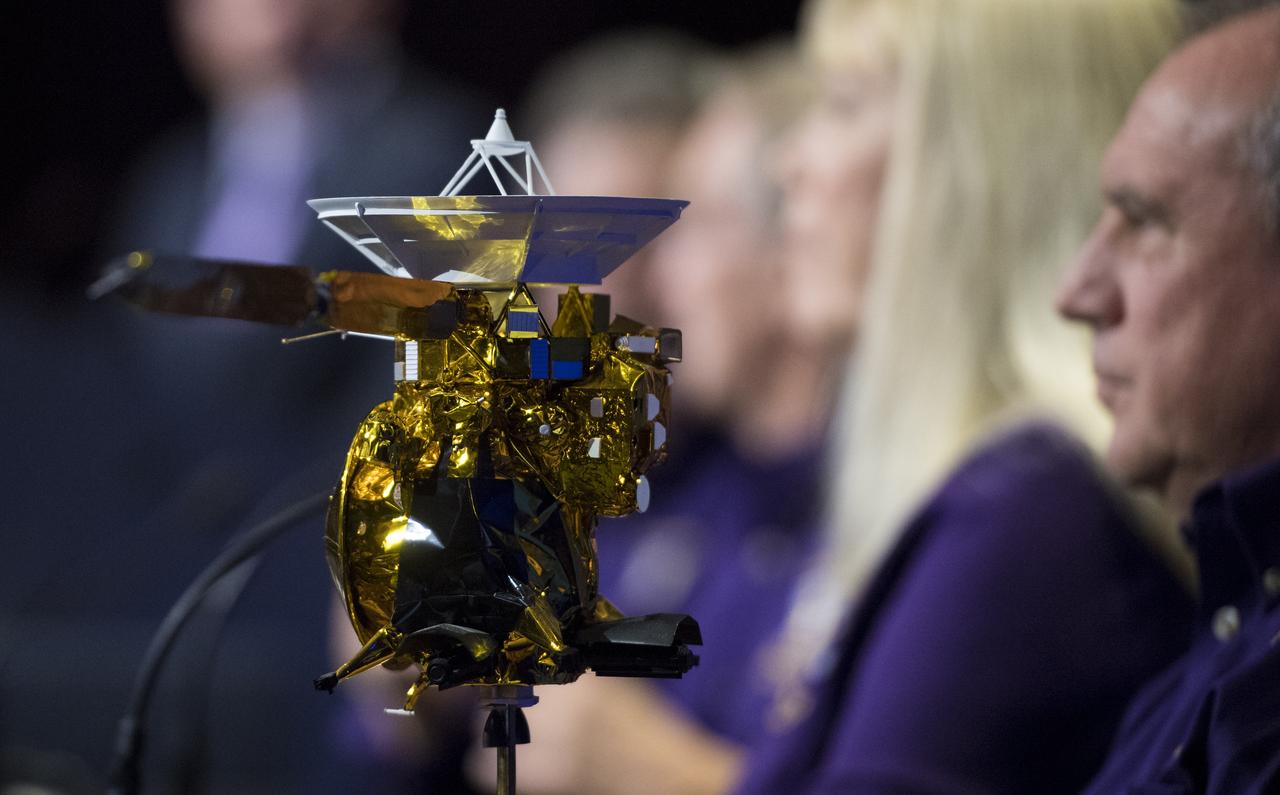
A model of the Cassini-Huygens spacecraft is seen during a press conference previewing Cassini's End of Mission, Wednesday, Sept. 13, 2017 at NASA's Jet Propulsion Laboratory in Pasadena, California. Since its arrival in 2004, the Cassini-Huygens mission has been a discovery machine, revolutionizing our knowledge of the Saturn system and captivating us with data and images never before obtained with such detail and clarity. On Sept. 15, 2017, operators will deliberately plunge the spacecraft into Saturn, as Cassini gathered science until the end. The “plunge” ensures Saturn’s moons will remain pristine for future exploration. During Cassini’s final days, mission team members from all around the world gathered at NASA’s Jet Propulsion Laboratory, Pasadena, California, to celebrate the achievements of this historic mission. Photo Credit: (NASA/Joel Kowsky)
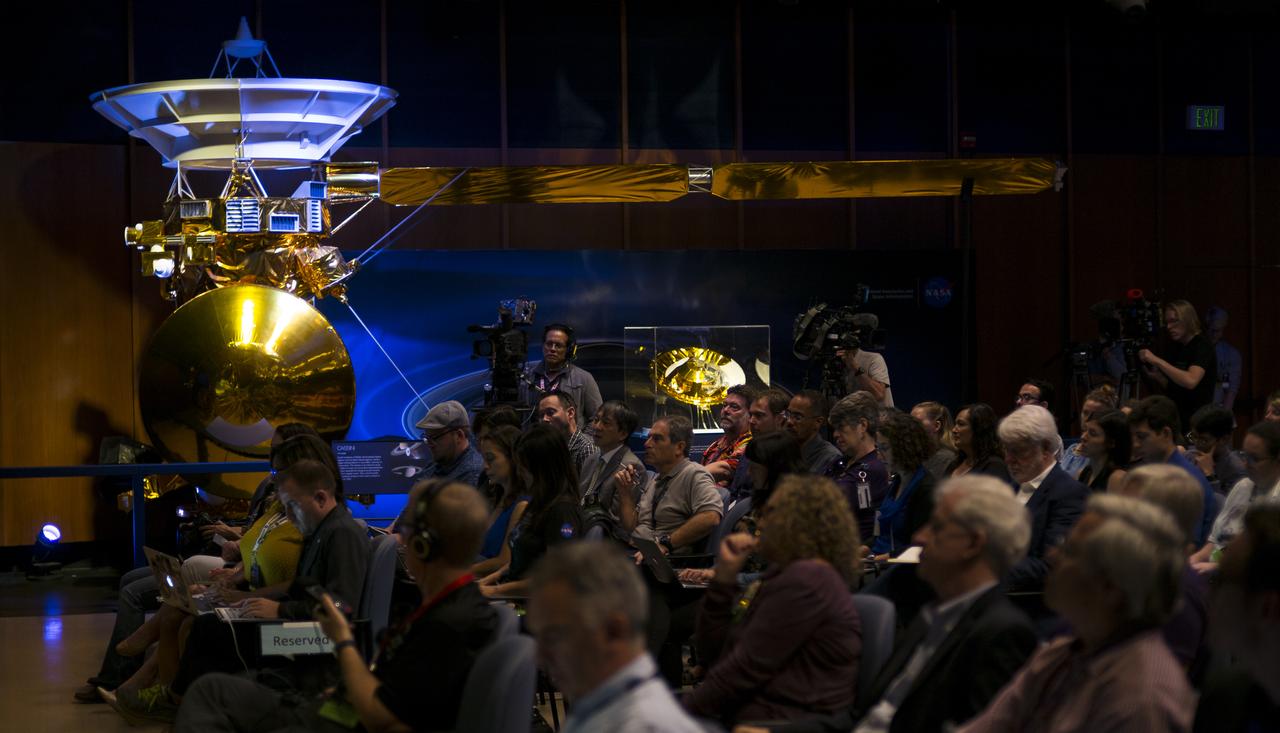
A model of the Cassini-Huygens spacecraft is seen in the von Kármán Auditorium during a press conference previewing Cassini's End of Mission, Wednesday, Sept. 13, 2017 at NASA's Jet Propulsion Laboratory in Pasadena, California. Since its arrival in 2004, the Cassini-Huygens mission has been a discovery machine, revolutionizing our knowledge of the Saturn system and captivating us with data and images never before obtained with such detail and clarity. On Sept. 15, 2017, operators will deliberately plunge the spacecraft into Saturn, as Cassini gathered science until the end. The “plunge” ensures Saturn’s moons will remain pristine for future exploration. During Cassini’s final days, mission team members from all around the world gathered at NASA’s Jet Propulsion Laboratory, Pasadena, California, to celebrate the achievements of this historic mission. Photo Credit: (NASA/Joel Kowsky)
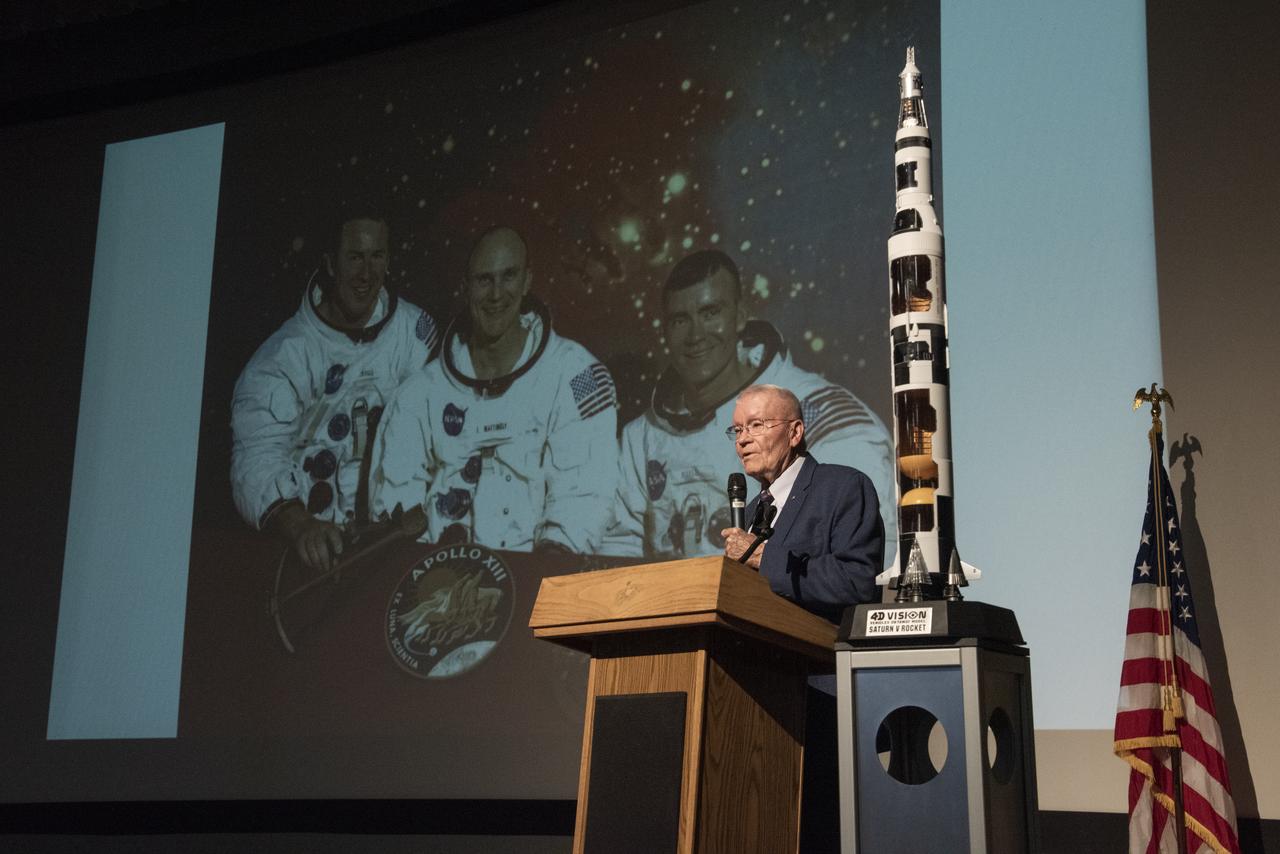
Apollo Astronaut Fred Haise speaks to a crowd of NASA and U.S Air Force employees at the Edwards Air Force Base theater about his career with NASA and as a military pilot. Haise stands on stage with a photo of former astronauts Jim Lovell and Jack Swigert who accompanied him on the Apollo 13 lunar mission in the background with a model of the Saturn V rocket.
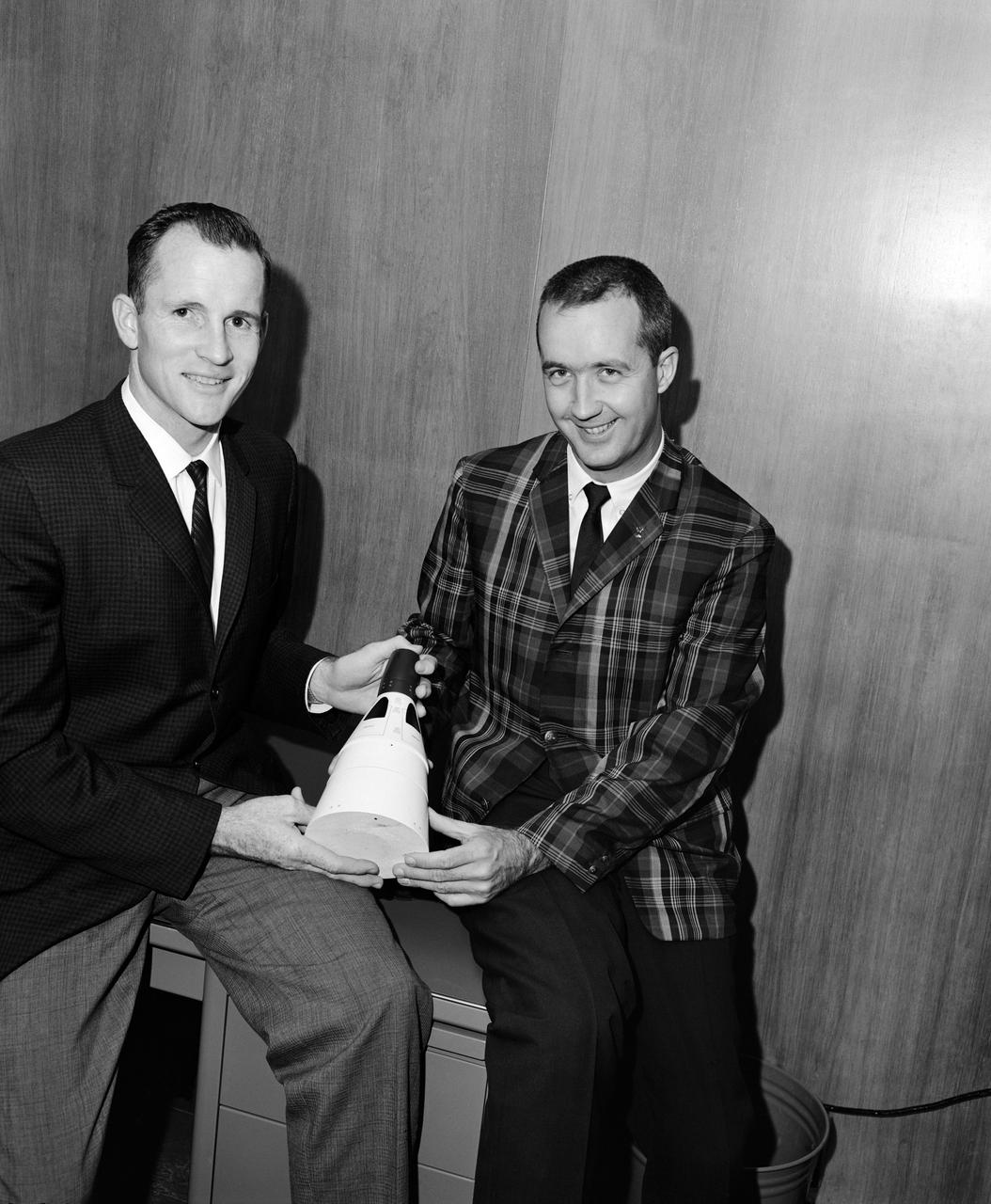
S62-04515 (1962) --- Astronauts Edward H. White II (left), Gemini-Titan 4 (GT-4) pilot, and James A. McDivitt, command pilot, pose for a photo holding a Gemini model. EDITOR?S NOTE: Jan. 27, 1967, astronaut White lost his life in the Apollo/Saturn 204 accident at Cape Canaveral, Florida.
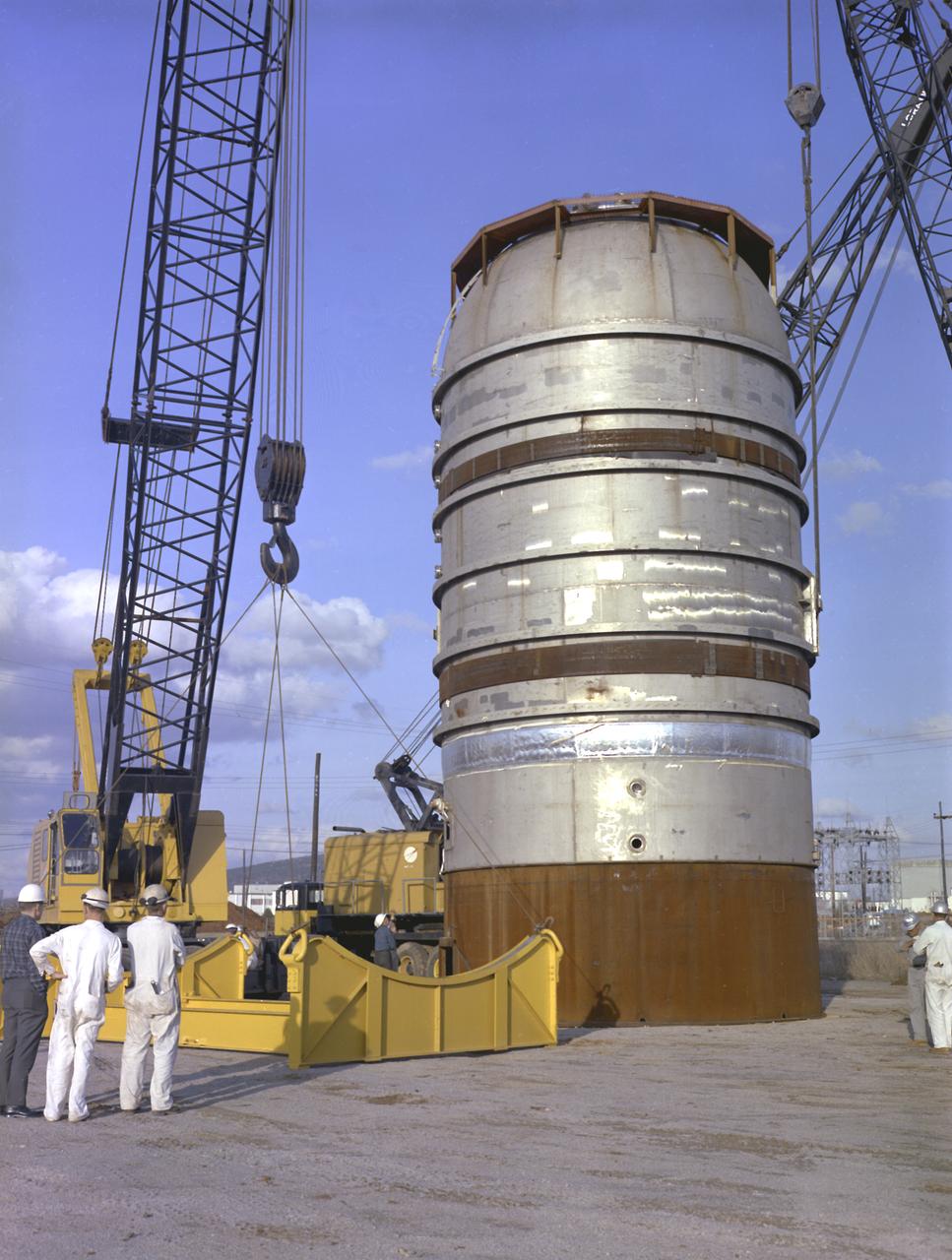
Workers at the Marshall Space Flight Center (MSFC) move a facility test version of the Saturn IB launch vehicle's second stage, the S-IVB, to the J-2 test stand on February 10, 1965. Also known as a "battleship" because of its heavy, rugged construction, the non-flight, stainless-steel model was used to check out testing facilities at MSFC.
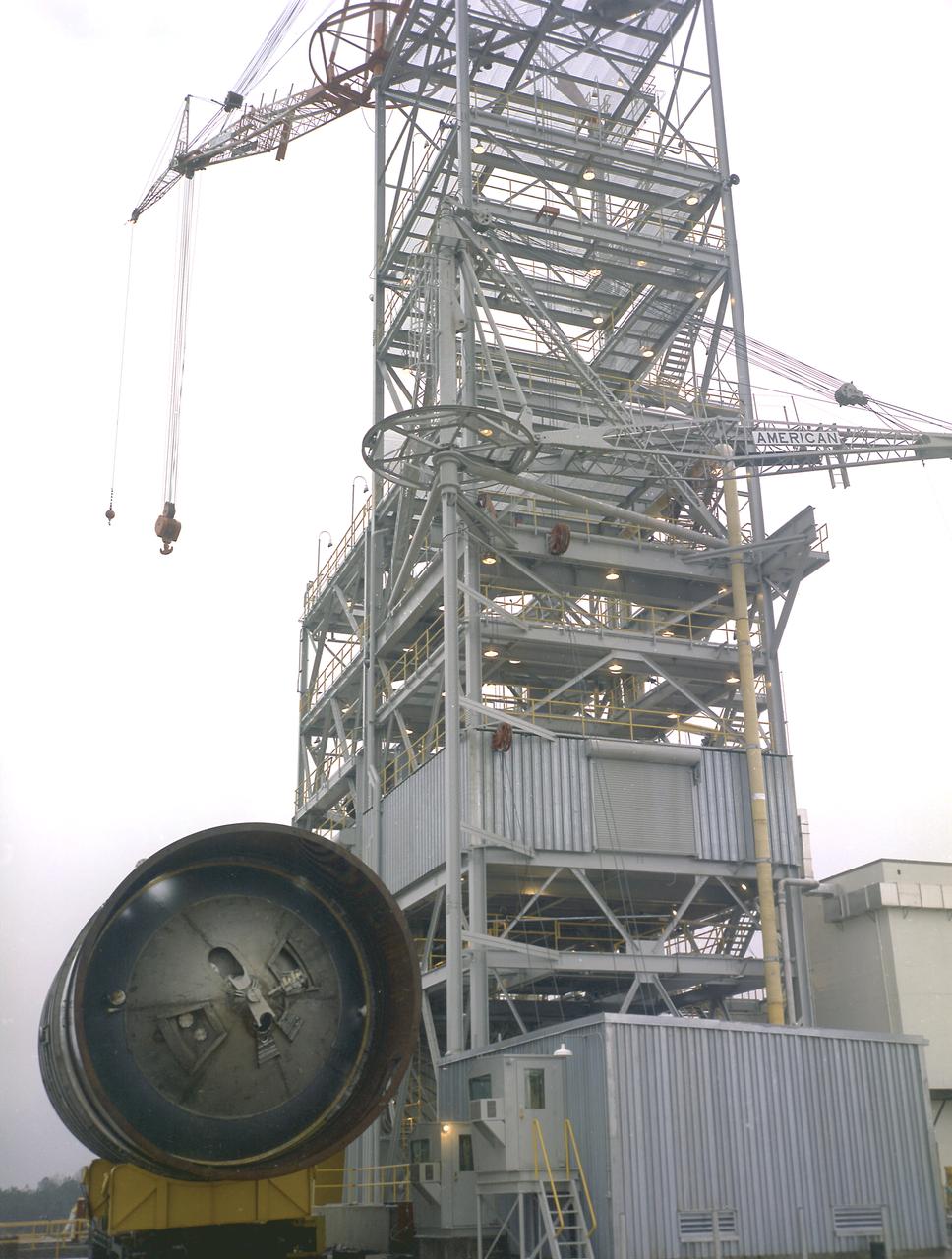
Workers at the Marshall Space Flight Center (MSFC) move a facility test version of the Saturn IB launch vehicle's second stage, the S-IVB, to the J-2 test stand on February 10, 1965. Also known as a "battleship" because of its heavy, rugged construction, the non-flight, stainless-steel model was used to check out testing facilities at MSFC.
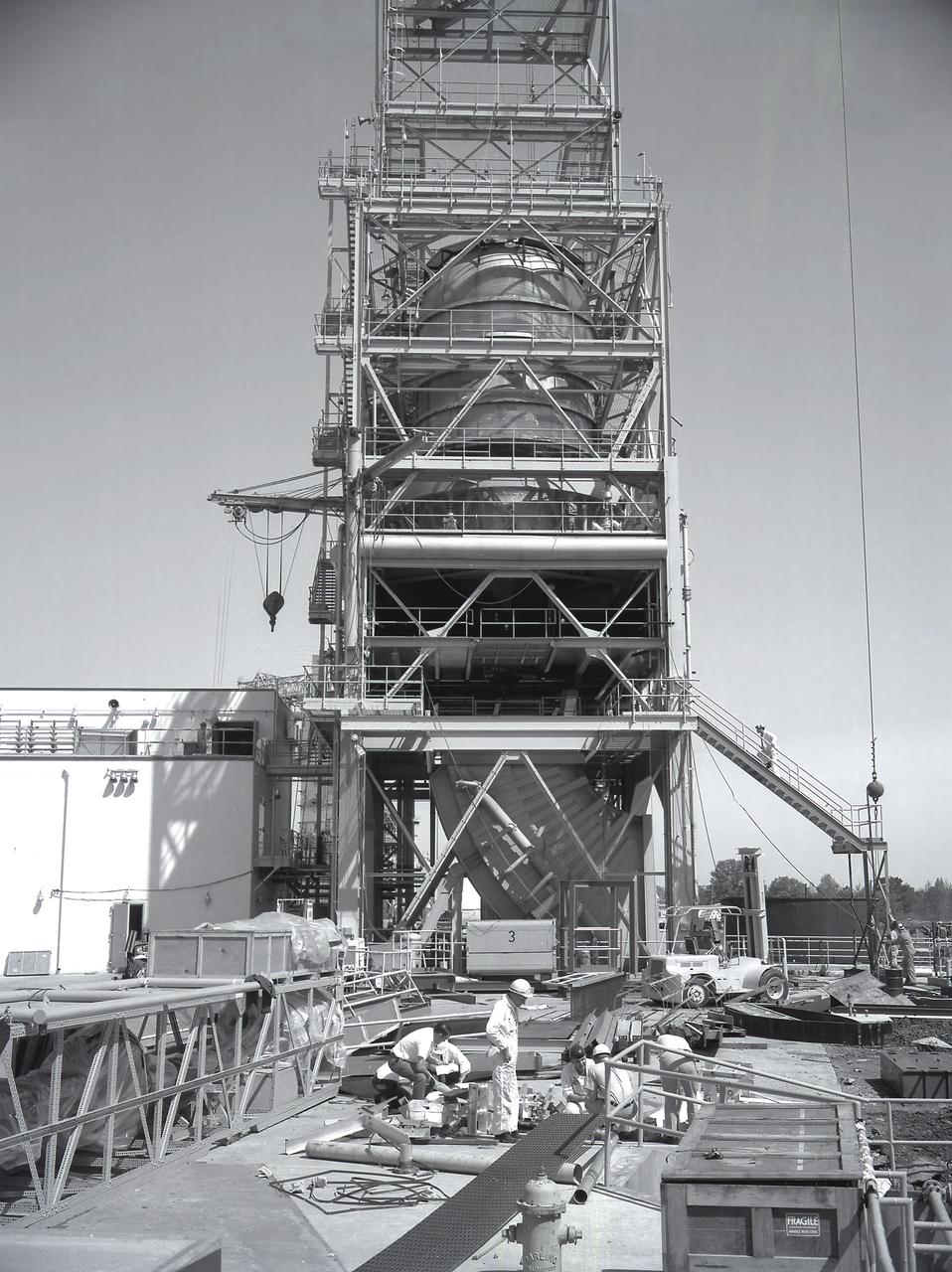
A facility test version of the S-IVB, the second stage of the Saturn IB launch vehicle, sits in the Marshall Space Flight Center (MSFC) J-2 test stand on February 10, 1965. Also known as a "battleship" because of its heavy, rugged construction, the non-flight, stainless-steel model was used to check out testing facilities at MSFC.
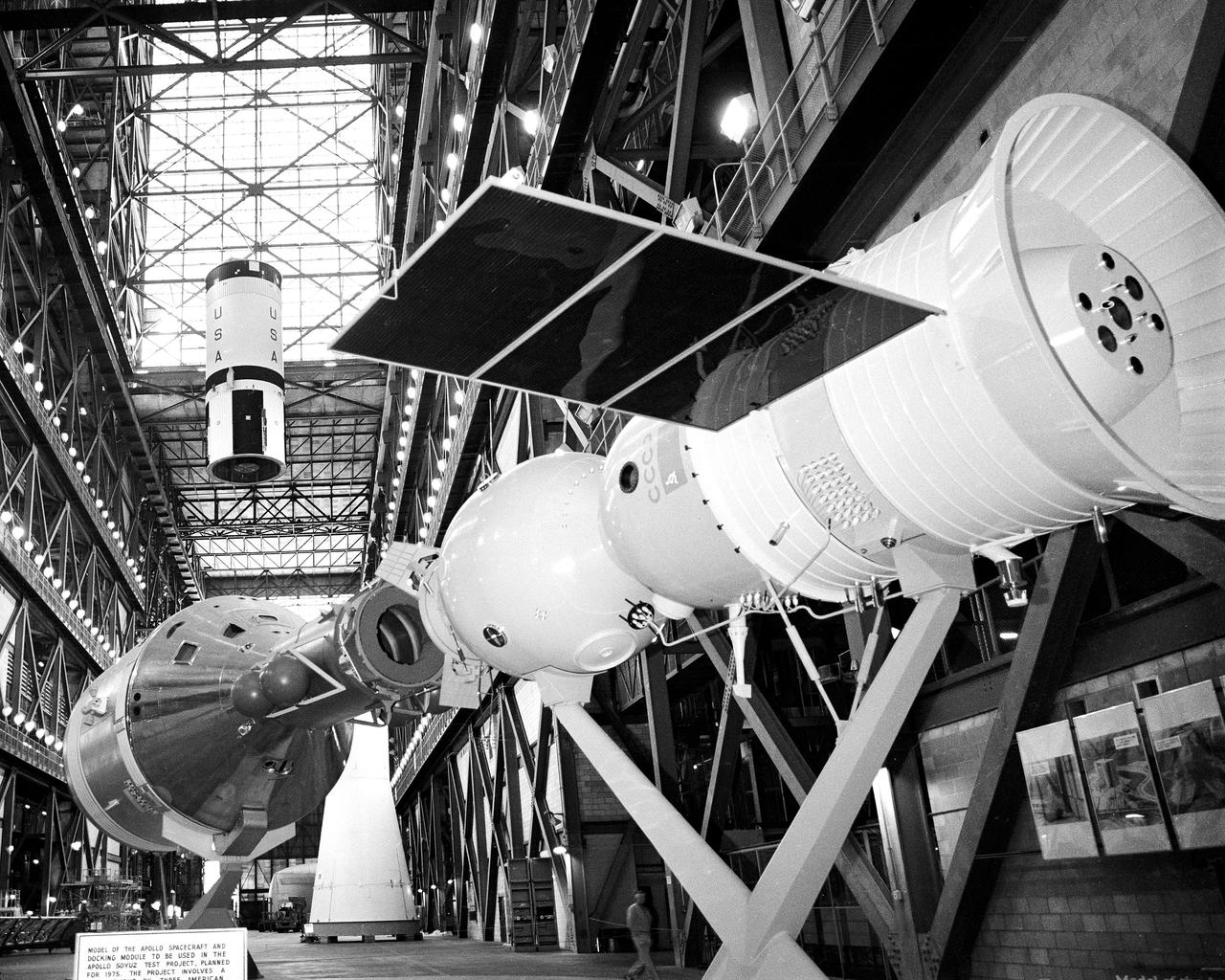
CAPE CANAVERAL, Fla. – Model of docked Apollo and Soyuz spacecraft in the foreground and skylight in the Vehicle Assembly Building high bay frame the second stage of the Saturn 1B booster that will launch the United States ASTP mission as a crane raises it prior to its mating with the Saturn 1B first stage. Mating of the Saturn 1B first and second stages was completed this morning. The U. S. ASTP launch with mission commander Thomas Stafford, command module pilot Vance Brand and docking module pilot Donald Slayton is scheduled at 3:50 p.m. EDT July 15. The first international crewed spaceflight was a joint U.S.-U.S.S.R. rendezvous and docking mission. The Apollo-Soyuz Test Project, or ASTP, took its name from the spacecraft employed: the American Apollo and the Soviet Soyuz. The three-man Apollo crew lifted off from Kennedy Space Center aboard a Saturn IB rocket on July 15, 1975, to link up with the Soyuz that had launched a few hours earlier. A cylindrical docking module served as an airlock between the two spacecraft for transfer of the crew members. Photo credit: NASA
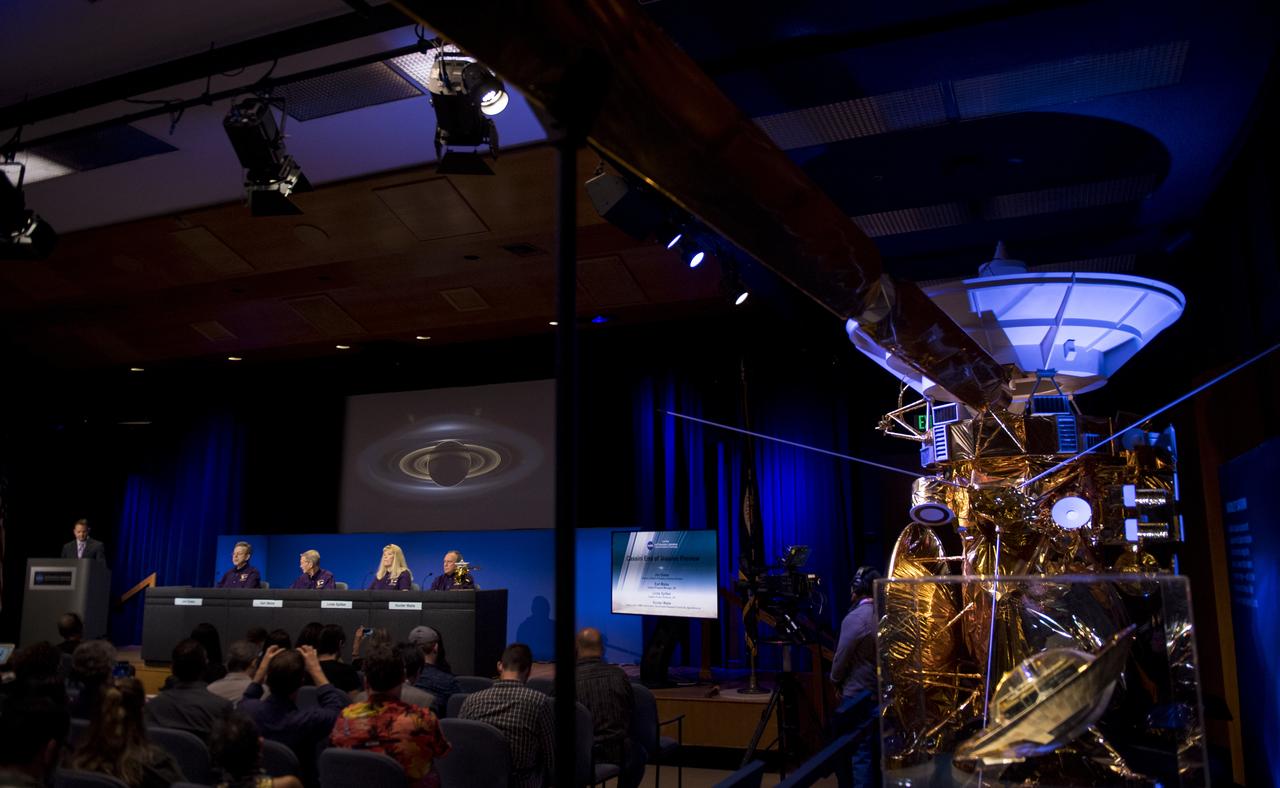
A model of the Cassini spacecraft is seen during a press conference previewing Cassini's End of Mission, Wednesday, Sept. 13, 2017 at NASA's Jet Propulsion Laboratory in Pasadena, California. Participants in the press conference were: Director of NASA's Planetary Science Division, Jim Green, left, Cassini program manager at JPL, Earl Maize, second from right, Cassini project scientist at JPL, Linda Spilker, second from right, and principle investigator for the Neutral Mass Spectrometer (INMS) at the Southwest Research Institute, Hunter Waite, right. Since its arrival in 2004, the Cassini-Huygens mission has been a discovery machine, revolutionizing our knowledge of the Saturn system and captivating us with data and images never before obtained with such detail and clarity. On Sept. 15, 2017, operators will deliberately plunge the spacecraft into Saturn, as Cassini gathered science until the end. The “plunge” ensures Saturn’s moons will remain pristine for future exploration. During Cassini’s final days, mission team members from all around the world gathered at NASA’s Jet Propulsion Laboratory, Pasadena, California, to celebrate the achievements of this historic mission. Photo Credit: (NASA/Joel Kowsky)
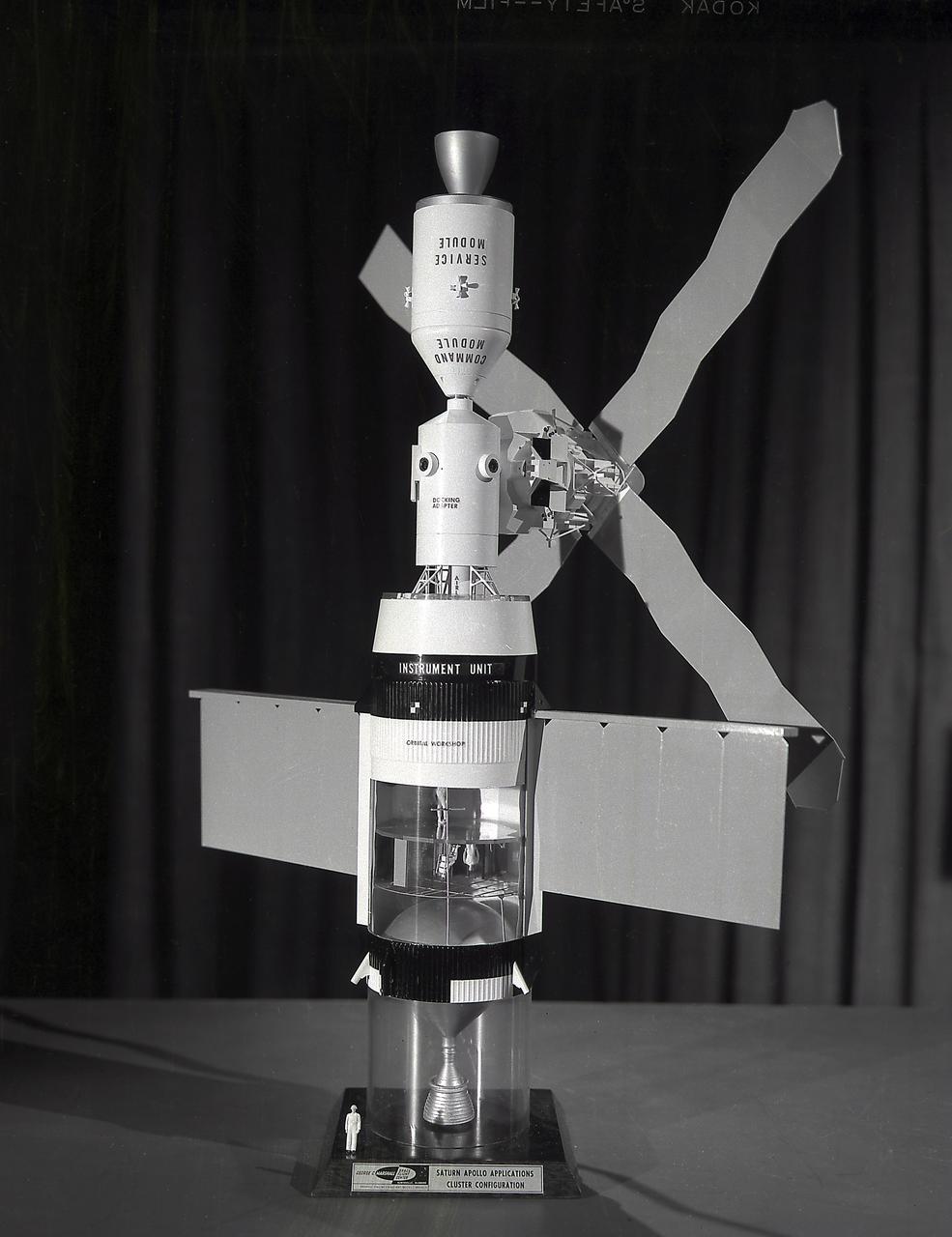
This photograph is of a model of the Skylab with the Command/Service Module being docked. In an early effort to extend the use of Apollo for further applications, NASA established the Apollo Applications Program (AAP) in August of 1965. The AAP was to include long duration Earth orbital missions during which astronauts would carry out scientific, technological, and engineering experiments in space by utilizing modified Saturn launch vehicles and the Apollo spacecraft. Established in 1970, the Skylab Program was the forerurner of the AAP. The goals of the Skylab were to enrich our scientific knowledge of the Earth, the Sun, the stars, and cosmic space; to study the effects of weightlessness on living organisms, including man; to study the effects of the processing and manufacturing of materials utilizing the absence of gravity; and to conduct Earth resource observations. The Skylab also conducted 19 selected experiments submitted by high school students. Skylab's 3 different 3-man crews spent up to 84 days in Earth orbit. The Marshall Space Flight Center (MSFC) had responsibility for developing and integrating most of the major components of the Skylab: the Orbital Workshop (OWS), Airlock Module (AM), Multiple Docking Adapter (MDA), Apollo Telescope Mount (ATM), Payload Shroud (PS), and most of the experiments. MSFC was also responsible for providing the Saturn IB launch vehicles for three Apollo spacecraft and crews and a Saturn V launch vehicle for the Skylab.
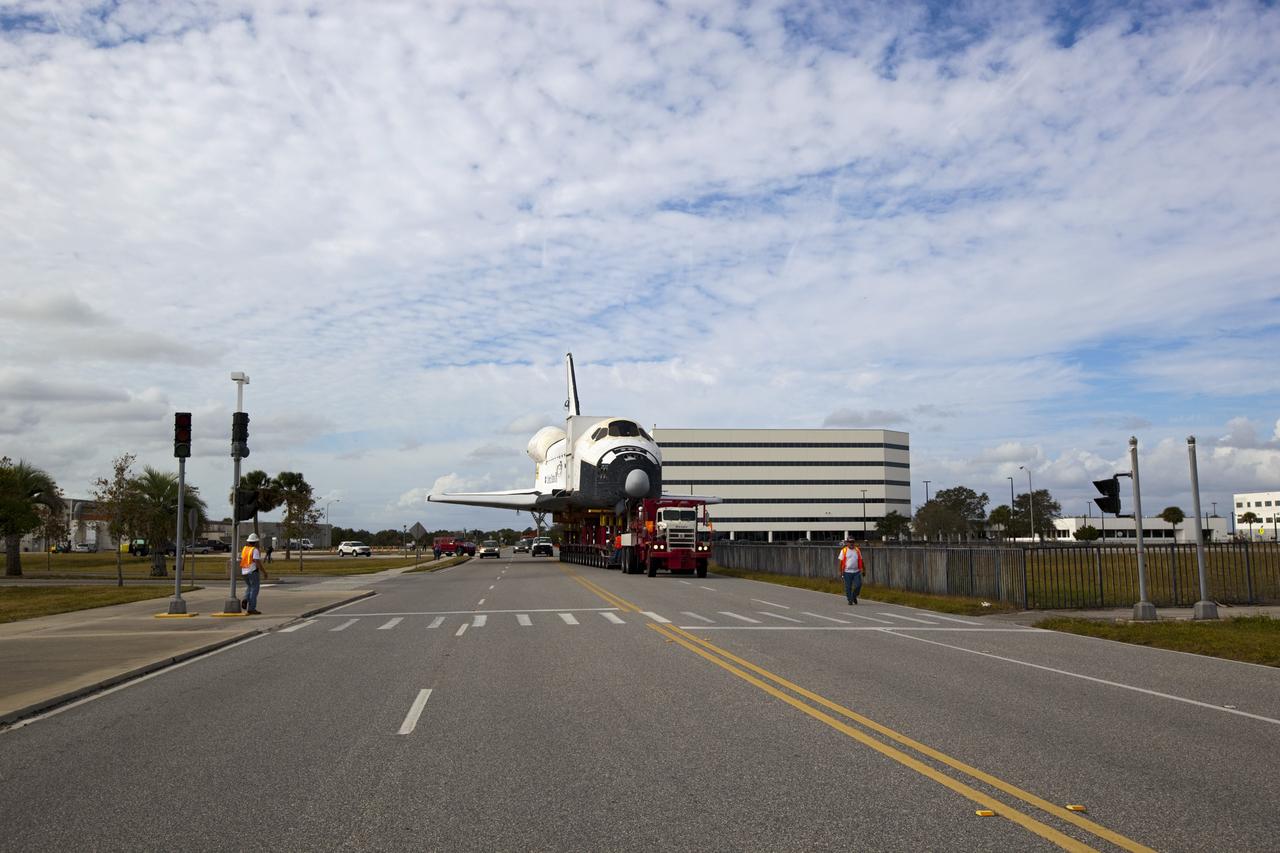
CAPE CANAVERAL, Fla. – The high-fidelity space shuttle model which was on display at the NASA Kennedy Space Center Visitor Complex in Florida travels down Saturn Causeway as it makes its way to Kennedy's Launch Complex 39 turn basin. In the background is the Operations Support Building I. The shuttle was part of a display at the visitor complex that also included an external tank and two solid rocket boosters that were used to show visitors the size of actual space shuttle components. The full-scale shuttle model is being transferred from Kennedy to Space Center Houston, NASA Johnson Space Center's visitor center. The model will stay at the turn basin for a few months until it is ready to be transported to Texas via barge. The move also helps clear the way for the Kennedy Space Center Visitor Complex to begin construction of a new facility next year to display space shuttle Atlantis in 2013. For more information about Space Center Houston, visit http://www.spacecenter.org. Photo credit: NASA/Dimitri Gerondidakis
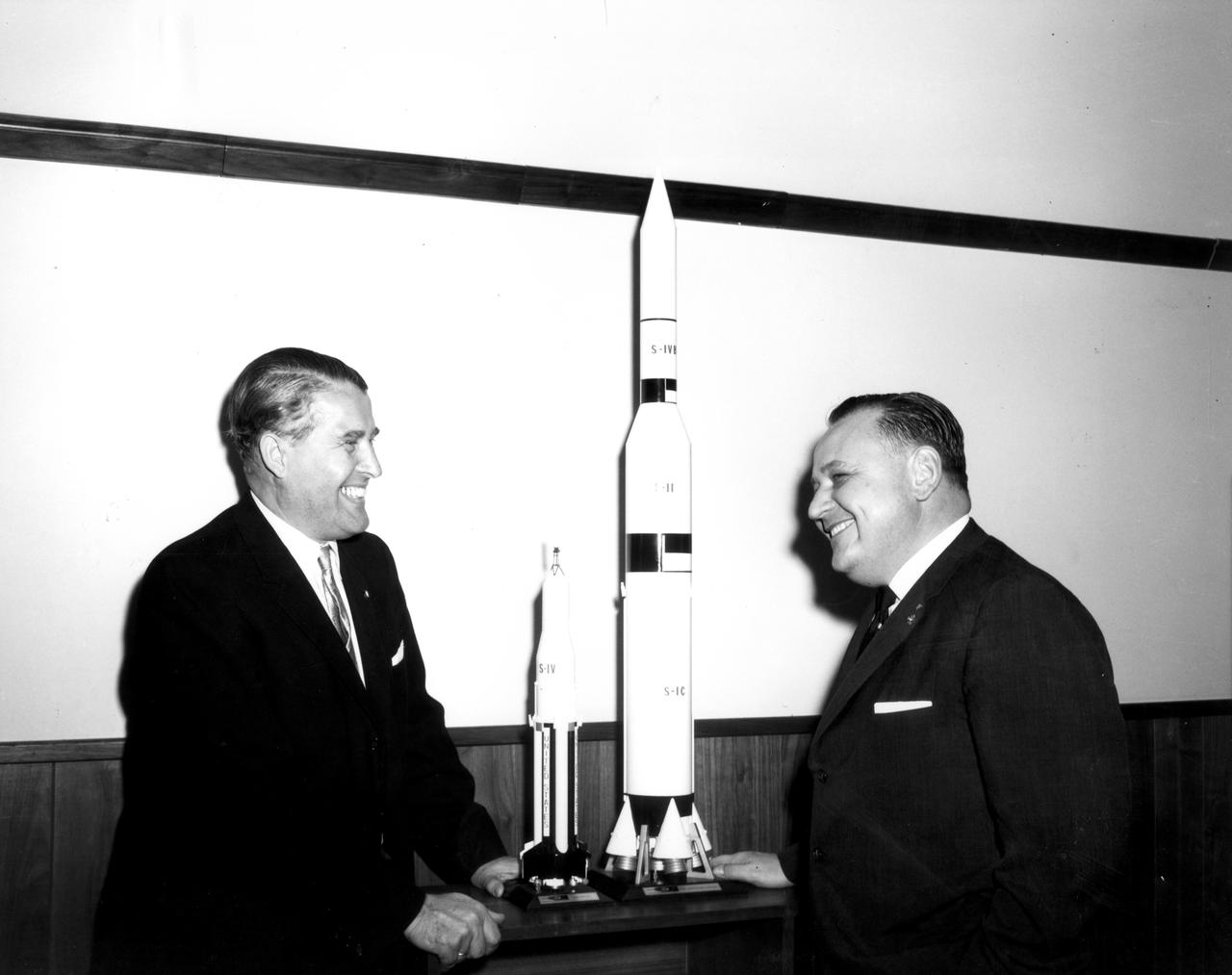
The members of the House Committee on Science and Astronautics visited the Marshall Space Flight Center (MSFC) on March 9, 1962 to gather firsthand information of the nation’s space exploration program. The congressional group was composed of members of the Subcommittee on Manned Space Flight. The subcommittee was briefed on MSFC’s manned space efforts earlier in the day and then inspected mockups of the Saturn I Workshop and the Apollo Telescope Mount, two projects developed by MSFC for the post-Apollo program. In this photograph, MSFC Director, Dr. Wernher von Braun and Richard L. Roudebush, Republican representative of Indiana, discuss Apollo models.
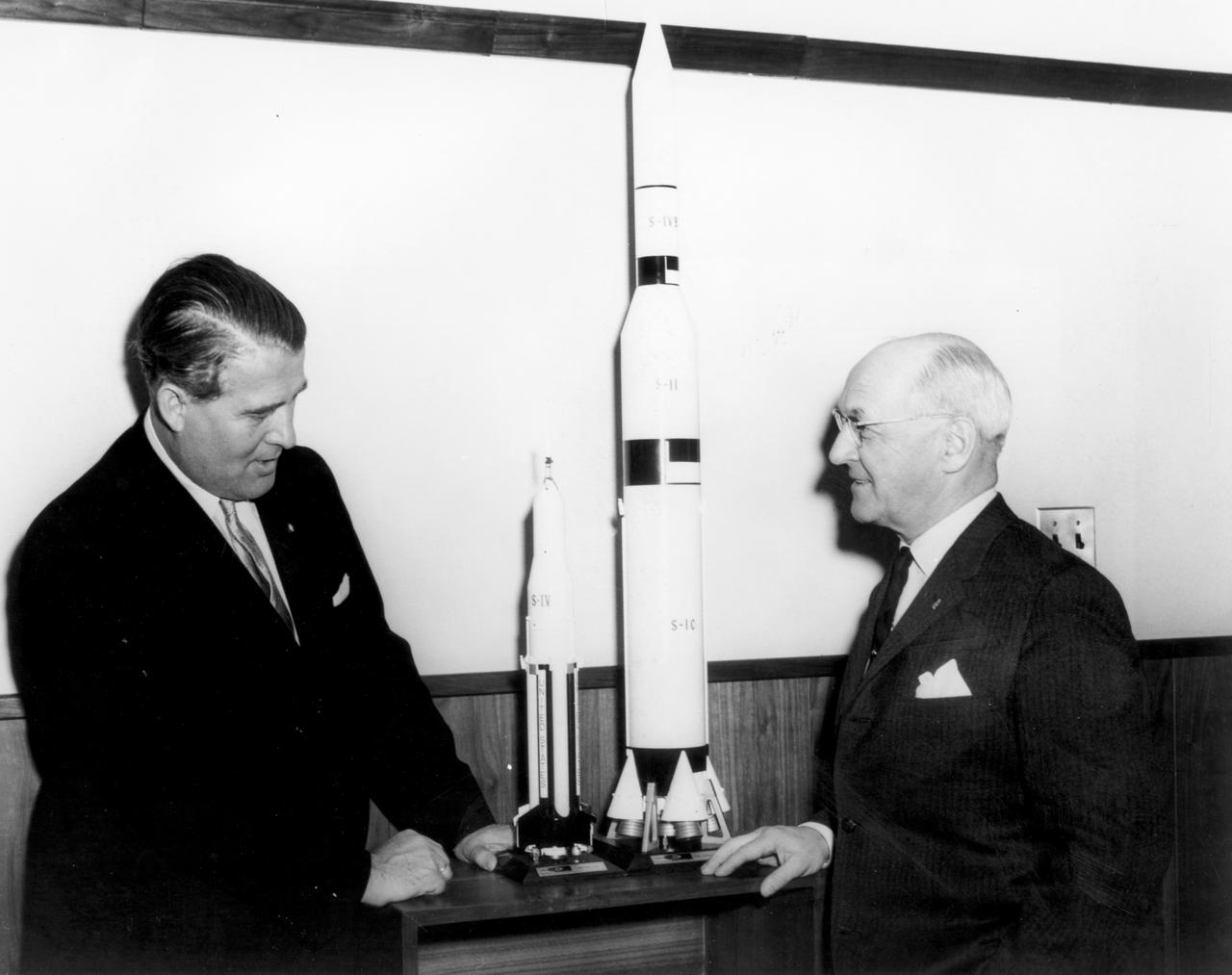
The members of the House Committee on Science and Astronautics visited the Marshall Space Flight Center (MSFC) on March 9, 1962 to gather firsthand information of the nation’s space exploration program. The congressional group was composed of members of the Subcommittee on Manned Space Flight. The subcommittee was briefed on MSFC’s manned space efforts earlier in the day and then inspected mockups of the Saturn I Workshop and the Apollo Telescope Mount, two projects developed by MSFC for the post-Apollo program. In this photograph, MSFC Director, Dr. Wernher von Braun and R. Walter Riehlman, Republican representative of New York, discuss Apollo models.
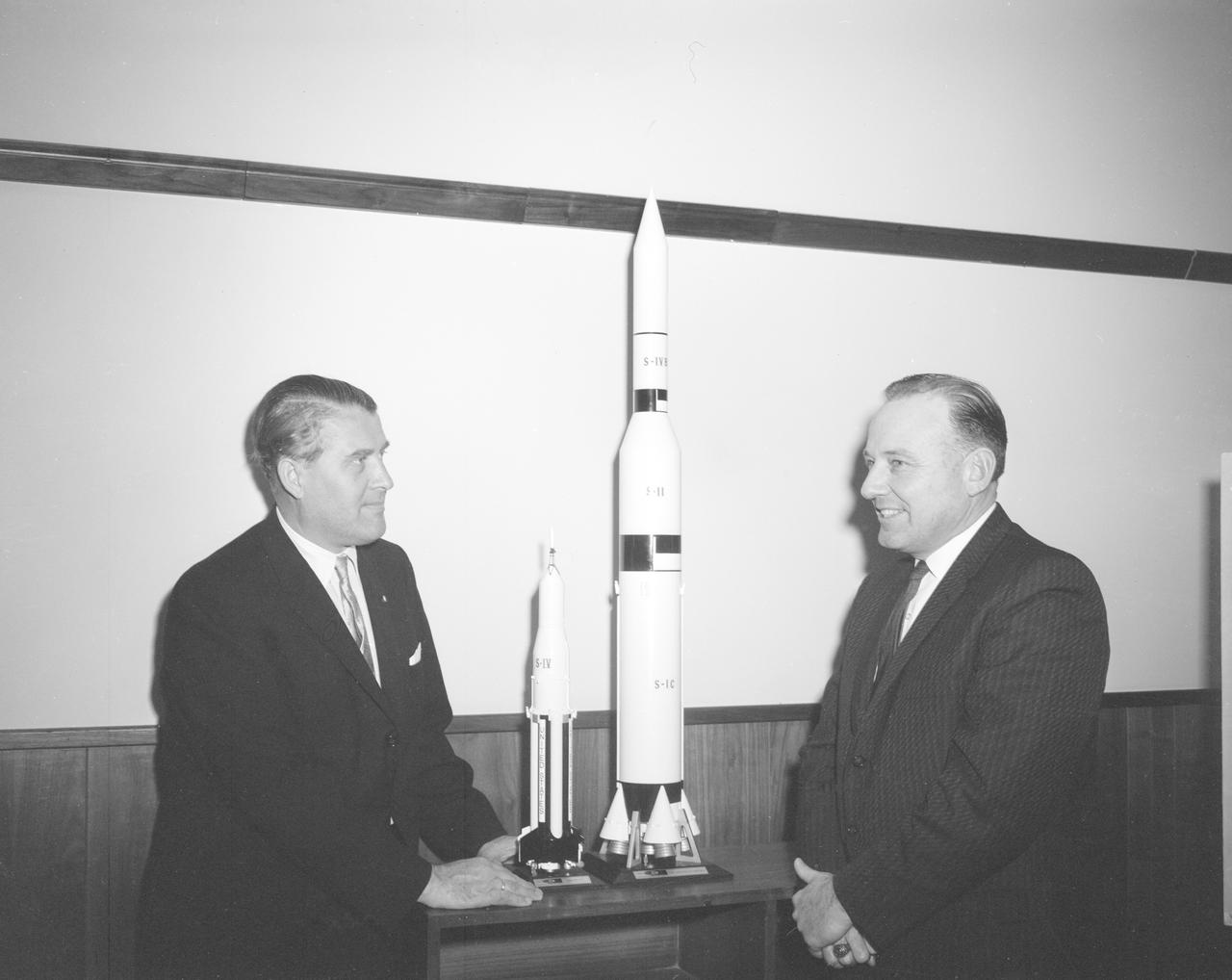
The members of the House Committee on Science and Astronautics visited the Marshall Space Flight Center (MSFC) on March 9, 1962 to gather firsthand information of the nation’s space exploration program. The congressional group was composed of members of the Subcommittee on Manned Space Flight. The subcommittee was briefed on MSFC’s manned space efforts earlier in the day and then inspected mockups of the Saturn I Workshop and the Apollo Telescope Mount, two projects developed by MSFC for the post-Apollo program. In this photograph, MSFC Director, Dr. Wernher von Braun and Joe Waggoner, Democratic representative of Louisiana, discuss Apollo models.

This close-up composite of images captured by NASA's Galileo spacecraft in the 1990s shows the crust of Jupiter's moon Europa. These are the kind of features studied by scientists who recently modeled how moonquakes may trigger landslides on icy moons circling Jupiter and Saturn. Visible here is a juxtaposition of features: possible fault scarps (like those found on Earth when tectonic activity breaks the crust) adjacent to smooth areas that may have been produced by landslide material. NASA's Jet Propulsion Laboratory in Southern California managed the mission for the agency. JPL is a division of Caltech in Pasadena, California. https://photojournal.jpl.nasa.gov/catalog/PIA25499
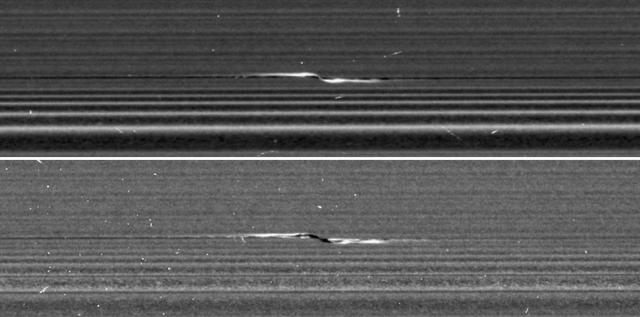
NASA's Cassini spacecraft captured these remarkable views of a propeller feature in Saturn's A ring on Feb. 21, 2017. These are the sharpest images taken of a propeller so far, and show an unprecedented level of detail. The propeller is nicknamed "Santos-Dumont," after the pioneering Brazilian-French aviator. This observation was Cassini's first targeted flyby of a propeller. The views show the object from vantage points on opposite sides of the rings. The top image looks toward the rings' sunlit side, while the bottom image shows the unilluminated side, where sunlight filters through the backlit ring. The two images presented as figure 1 are reprojected at the same scale (0.13 mile or 207 meters per pixel) in order to facilitate comparison. The original images, which have slightly different scales, are also provided here, without reprojection, as figure 2; the sunlit-side image is at left, while the unlit-side image is at right. Cassini scientists have been tracking the orbit of this object for the past decade, tracing the effect that the ring has upon it. Now, as Cassini has moved in close to the ring as part of its ring-grazing orbits, it was able to obtain this extreme close-up view of the propeller, enabling researchers to examine its effects on the ring. These views, and others like them, will inform models and studies in new ways going forward. Like a frosted window, Saturn's rings look different depending on whether they are seen fully sunlit or backlit. On the lit side, the rings look darker where there is less material to reflect sunlight. On the unlit side, some regions look darker because there is less material, but other regions look dark because there is so much material that the ring becomes opaque. Observing the same propeller on both the lit and unlit sides allows scientists to gather richer information about how the moonlet affects the ring. For example, in the unlit-side view, the broad, dark band through the middle of the propeller seems to be a combination of both empty and opaque regions. The propeller's central moonlet would only be a couple of pixels across in these images, and may not actually be resolved here. The lit-side image shows that a bright, narrow band of material connects the moonlet directly to the larger ring, in agreement with dynamical models. That same thin band of material may also be obscuring the moonlet from view. Lengthwise along the propeller is a gap in the ring that the moonlet has pried open. The gap appears dark on both the lit and unlit sides. Flanking the gap near the moonlet are regions of enhanced density, which appear bright on the lit side and more mottled on the unlit side. One benefit of the high resolution of these images is that, for the first time, wavy edges are clearly visible in the gap. These waves are also expected from dynamical models, and they emphasize that the gap must be sharp-edged. Furthermore, the distance between the wave crests tells scientists the width of the gap (1.2 miles or 2 kilometers), which in turn reveals the mass of the central moonlet. From these measurements, Cassini imaging scientists deduce that the moonlet's mass is comparable to that of a snowball about 0.6 mile (1 kilometer) wide. For the original images, the lit-side image has a scale of 0.33 mile (530 meters) per pixel in the radial (or outward from Saturn) direction and 0.44 mile (710 meters) per pixel in the azimuthal (or around Saturn) direction. The different scales are the result of Cassini's vantage point being off to the side of the propeller, rather than directly above it. The unlit-side image has a scale of 0.25 (410 meters) per pixel in both directions. In order to preserve its original level of detail, the image has not been cleaned of bright blemishes due to cosmic rays and to charged particle radiation from Saturn. http://photojournal.jpl.nasa.gov/catalog/PIA21433
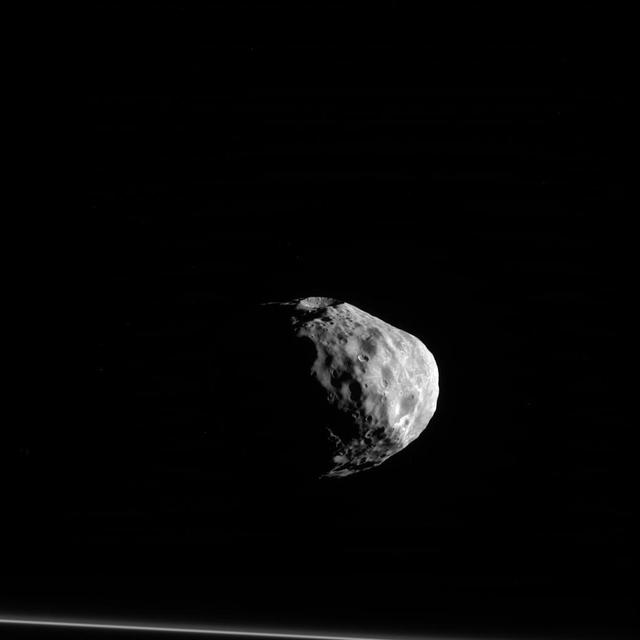
Janus (111 miles or 179 kilometers across) seems to almost stare off into the distance, contemplating deep, moonish thoughts as the F ring stands by at the bottom of this image. From this image, it is easy to distinguish Janus' shape from that of a sphere. Many of Saturn's smaller moons have similarly irregular shapes that scientists believe may give clues to their origins and internal structure. Models combining the dynamics of this moon with its shape imply the existence of mass inhomogeneities within Janus. This would be a surprising result for a body the size of Janus. By studying more images of Janus, scientists may be able confirm this finding and determine just how complicated the internal structure of this small body is. This image is roughly centered on the side of Janus which faces away from Saturn. North on Janus is up and rotated 3 degrees to the right. The image was taken in visible light with the Cassini spacecraft narrow-angle camera on March 28, 2012. The view was obtained at a distance of approximately 54,000 miles (87,000 kilometers) from Janus. Image scale is 1,700 feet (520 meters) per pixel. http://photojournal.jpl.nasa.gov/catalog/PIA18299
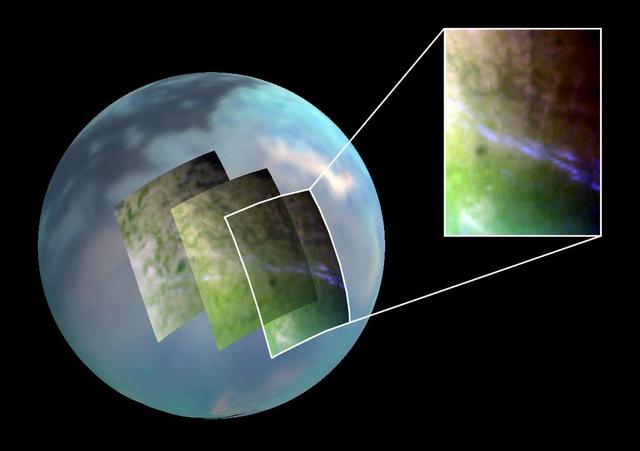
Lots of clouds are visible in this infrared image of Saturn's moon Titan. These clouds form and move much like those on Earth, but in a much slower, more lingering fashion, new results from NASA's Cassini spacecraft show. Scientists have monitored Titan's atmosphere for three-and-a-half years, between July 2004 and December 2007, and observed more than 200 clouds. The way these clouds are distributed around Titan matches scientists' global circulation models. The only exception is timing—clouds are still noticeable in the southern hemisphere while fall is approaching. Three false-color images make up this mosaic and show the clouds at 40 to 50 degrees mid-latitude. The images were taken by Cassini's visual and infrared mapping spectrometer during a close flyby of Titan on Sept. 7, 2006, known as T17. For a similar view see PIA12005. Each image is a color composite, with red shown at the 2-micron wavelength, green at 1.6 microns, and blue at 2.8 microns. An infrared color mosaic is also used as a background (red at 5 microns, green at 2 microns and blue at 1.3 microns). The characteristic elongated mid-latitude clouds, which are easily visible in bright bluish tones are still active even late into 2006-2007. According to climate models, these clouds should have faded out since 2005. http://photojournal.jpl.nasa.gov/catalog/PIA12004
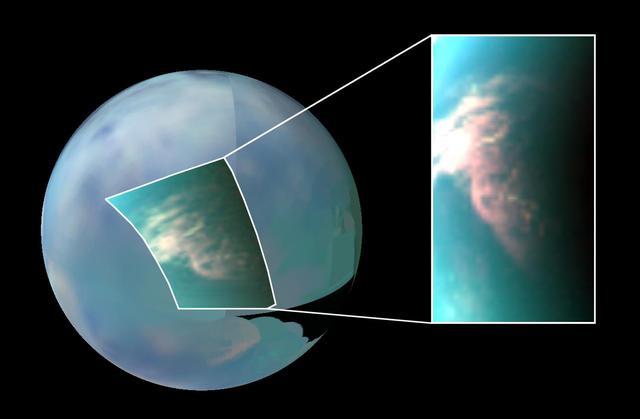
This infrared image of Saturn's moon Titan shows a large burst of clouds in the moon's south polar region. These clouds form and move much like those on Earth, but in a much slower, more lingering fashion, new results from NASA's Cassini Spacecraft show. This image is a color composite, with red shown at a 5-micron wavelength, green at 2.7 microns, and blue at 2 microns. An infrared color mosaic is also used as a background image (red at 5 microns, green at 2 microns, blue at 1.3 microns). The images were taken by Cassini's visual and infrared mapping spectrometer during a flyby of Titan on March 26, 2007, known as T27. For a similar view see PIA12004. Titan's southern hemisphere still shows a very active meteorology (the cloud appears in white-reddish tones) even in 2007. According to climate models, these clouds should have faded out since 2005. Scientists have monitored Titan's atmosphere for three-and-a-half years, between July 2004 and December 2007, and observed more than 200 clouds. The way these clouds are distributed around Titan matches scientists' global circulation models. The only exception is timing—clouds are still noticeable in the southern hemisphere while fall is approaching. http://photojournal.jpl.nasa.gov/catalog/PIA12005

Jet Propulsion Laboratory (JPL) technicians finish mounting a thermal model of a radioisotope thermoelectric generator (RTG) on the installation cart which will be used to install the RTG in the Cassini spacecraft at Level 14 of Space Launch Complex 40, Cape Canaveral Air Station. The technicians use the thermal model to practice installation procedures. The three actual RTGs which will provide electrical power to Cassini on its 6.7-mile trip to the Saturnian system, and during its four-year mission at Saturn, are being tested and monitored in the Radioisotope Thermoelectric Generator Storage Building in KSC's Industrial Area. The RTGs use heat from the natural decay of plutonium to generate electric power. RTGs enable spacecraft to operate far from the Sun where solar power systems are not feasible. The RTGs on Cassini are of the same design as those flying on the already deployed Galileo and Ulysses spacecraft. The Cassini mission is targeted for an October 6 launch aboard a Titan IVB/Centaur expendable launch vehicle. Cassini is built and managed for NASA by JPL

This artist's concept of a lake at the north pole of Saturn's moon Titan illustrates raised rims and rampartlike features such as those seen by NASA's Cassini spacecraft around the moon's Winnipeg Lacus. New research using Cassini radar data and modeling proposes that lake basins like these are likely explosion craters, which could have formed when liquid molecular nitrogen deposits within the crust warmed and quickly turned to vapor, blowing holes in the moon's crust. This would have happened during a warming event (or events) that occurred in a colder, nitrogen-dominated period in Titan's past. The new research may provide evidence of these cold periods in Titan's past, followed by a relative warming to conditions like those of today. Although Titan is frigid compared to Earth, methane in the atmosphere provides a greenhouse effect that warms the moon's surface. https://photojournal.jpl.nasa.gov/catalog/PIA23172
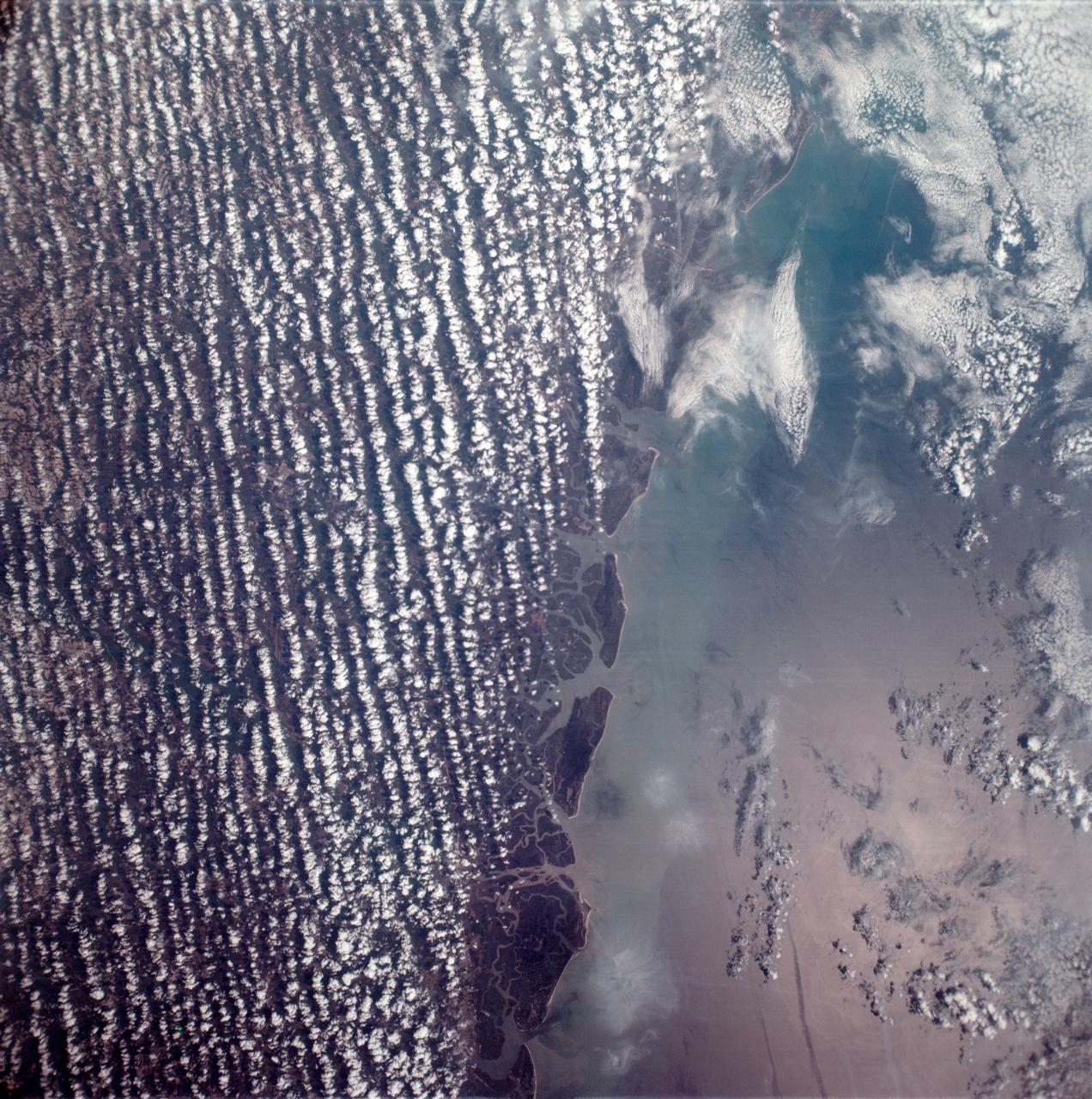
AS6-02-1485 (4 April 1968) --- View of the east coast of the United States as photographed from the National Aeronautics and Space Administration's unmanned Apollo 6 (Spacecraft 020/Saturn 502) space mission. This photograph was taken during a pass over Georgia, between Savannah and Brunswick. Altitude of the spacecraft was 100 nautical miles. Numerous jet aircraft contrails can be seen over the Atlantic Ocean. Sun glint on the surface of the ocean permits oceanographers to determine conditions of the water. This photograph was taken April 4, 1968, three hours and 14 minutes after liftoff, using Eastman Kodak SO-121 high resolution aerial Ektachrome film (exposure setting f/5.6 at 1/500 second), in a J. A. Maurer model 220G camera.
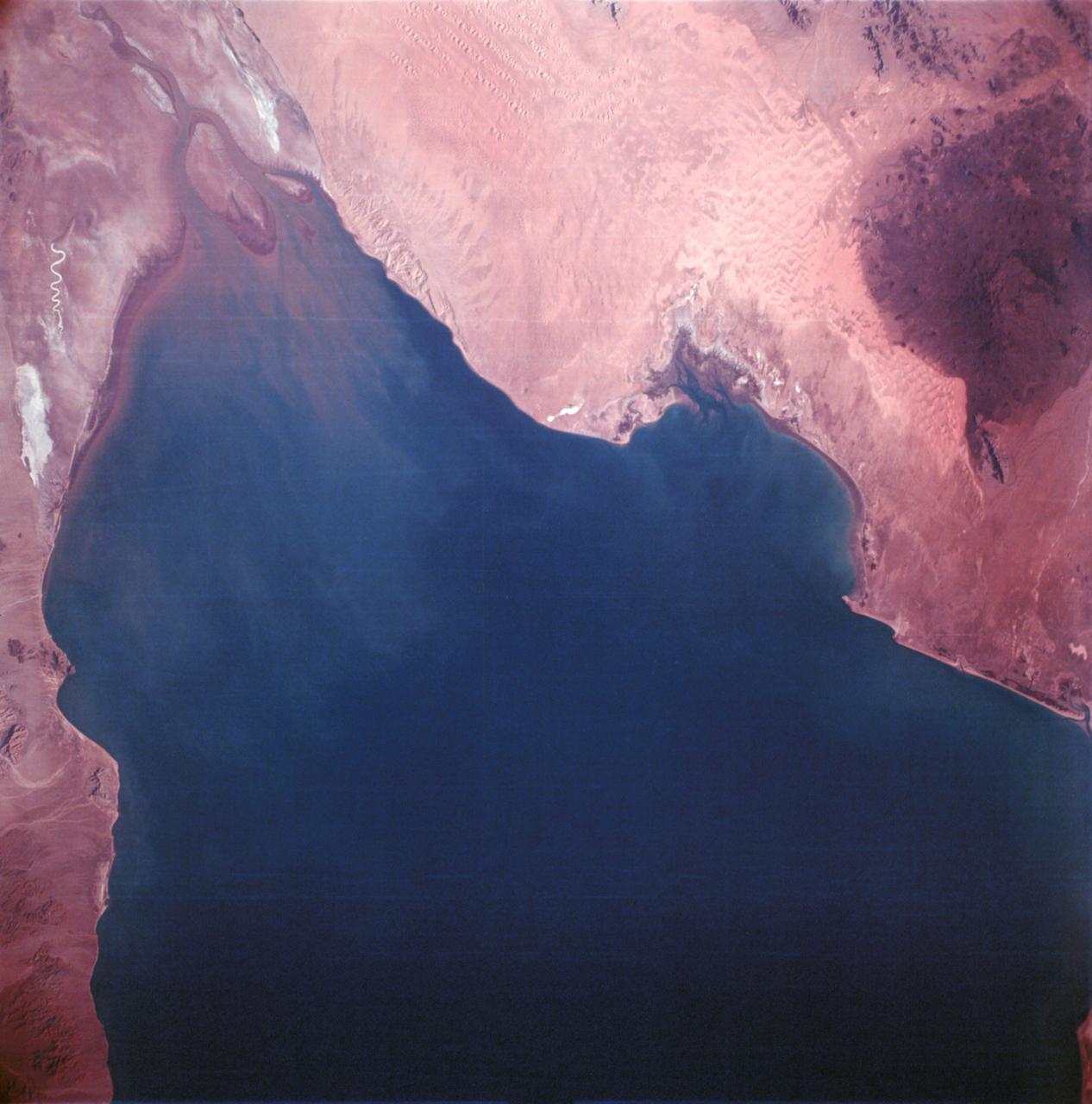
AS06-02-1436 (4 April 1968) --- View of the mouth of the Colorado River and the Gulf of California in northwestern Mexico as photographed from the unmanned Apollo 6 (Spacecraft 020/Saturn 502) space mission. Altitude of the spacecraft at the time picture was taken was 120 nautical miles. NORTH IS TOWARD LEFT SIDE OF PICTURE. At bottom edge of photograph is Baja California. In the upper left corner is the Mexican state of Sonora showing the Sonoran Desert and the Pinacate Mountains. This photograph was made three hours and seven minutes after liftoff using Eastman Kodak SO-121 high resolution aerial Ektachrome film (exposure setting was f/5.6 at 1/500 second) in a J.A. Maurer model 2200 camera.
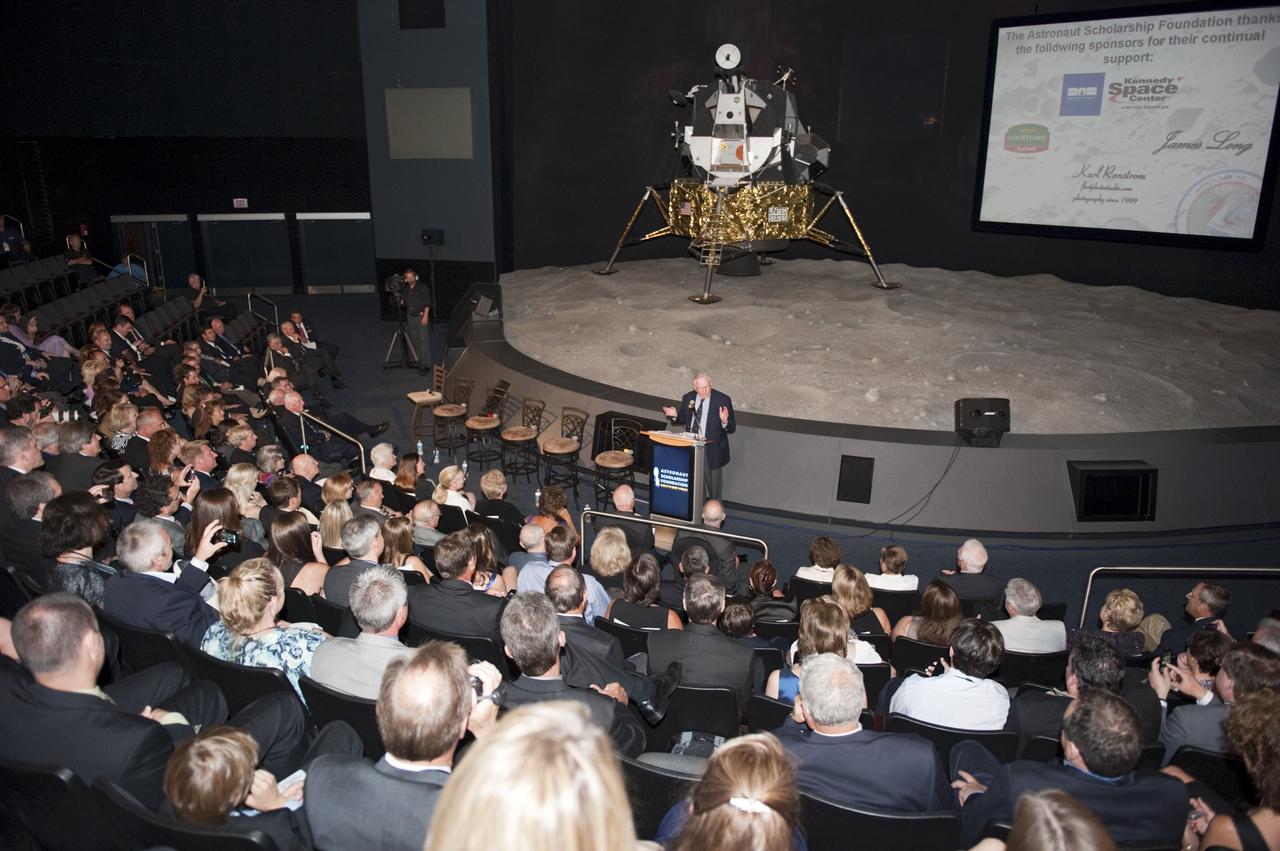
CAPE CANAVERAL, Fla. -- The Apollo/Saturn V Center at NASA's Kennedy Space Center in Florida hosted a celebration on the 40th anniversary of NASA's Apollo 15 mission. Apollo 15 Commander Dave Scott and Command Module Pilot Al Worden and an elite gathering of Apollo-era astronauts were on hand for the event and panel discussion. Here, Apollo 11 Commander Neil Armstrong speaks to the invited guests. In the background is a model of the Lunar Module, part of the lander portion of the Apollo spacecraft. Worden circled the moon while Scott and the late Jim Irwin, the Lunar Module commander, made history when they became the first humans to drive a vehicle on the surface of the moon. They also provided extensive descriptions and photographic documentation of geologic features in the vicinity of the Hadley Rille landing site during their three days on the lunar surface. Photo credit: NASA/Kim Shiflett
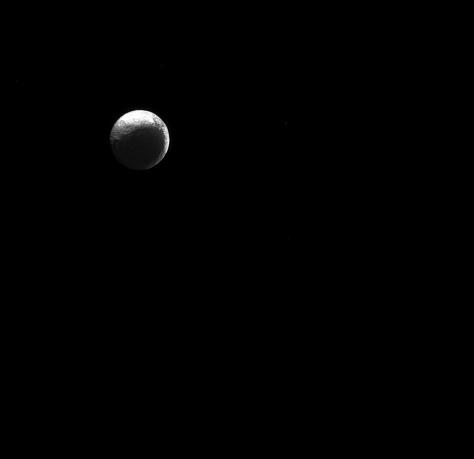
The moon Iapetus, like the "force" in Star Wars, has both a light side and a dark side. Scientists think that Iapetus' (914 miles or 1471 kilometers across) dark/light asymmetry was actually created by material migrating away from the dark side. For a simulation of how scientists think the asymmetry formed, see Thermal Runaway Model . Lit terrain seen here is on the Saturn-facing hemisphere of Iapetus. North on Iapetus is up and rotated 43 degrees to the right. The image was taken in green light with the Cassini spacecraft narrow-angle camera on Jan. 4, 2015. The view was acquired at a distance of approximately 2.5 million miles (4 million kilometers) from Iapetus. Image scale is 15 miles (24 kilometers) per pixel. http://photojournal.jpl.nasa.gov/catalog/pia18307
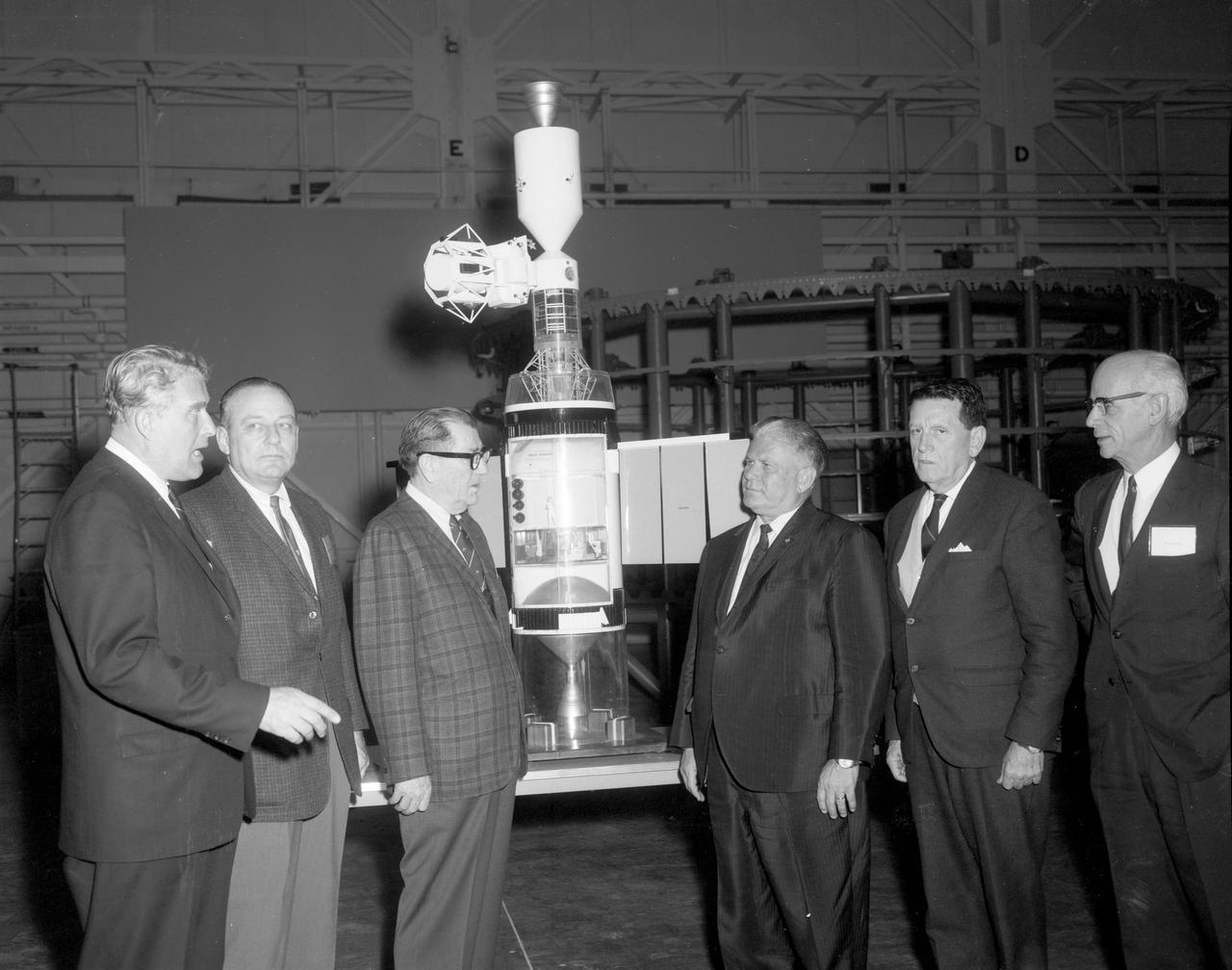
The members of the House Committee on Science and Astronautics visited the Marshall Space Flight Center (MSFC) on March 9, 1962 to gather firsthand information of the nation’s space exploration program. The congressional group was composed of members of the Subcommittee on Manned Space Flight. Standing at the Apollo Applications Program Cluster Model in building 4745 are (left-to-right): Dr. Wernher von Braun, MSFC; Congressman Joe D. Waggoner, Democratic representative of Louisiana; Congressman Earle Cabell, Democratic representative of Texas; Subcommittee Chairman Olin E. Teague, Democratic representative of Texas; Congressman James G. Fulton, Republican representative of Pennsylvania; and Dr. Ernst Stuhlinger, associate MSFC director for science. The subcommittee was briefed on MSFC’s manned space efforts earlier in the day and then inspected mockups of the Saturn I Workshop and the Apollo Telescope Mount, two projects developed by MSFC for the post-Apollo program.
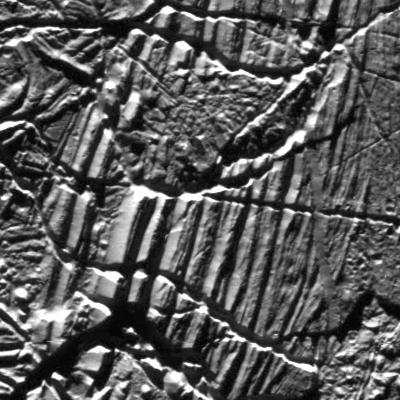
This mosaic shows a portion of one of the highest-resolution images captured of Jupiter's moon Europa in the 1990s by NASA's Galileo spacecraft. This picture is cropped from a larger image. These are the kind of features studied by scientists who recently modeled how moonquakes may trigger landslides on icy moons circling Jupiter and Saturn. Visible here are possible fault scarps (like those found on Earth when tectonic activity breaks the crust) with smooth slopes and nearby rubble that may have been produced by small landslides triggered by the faulting activity. These images were obtained on Nov. 6, 1997, when Galileo was approximately 1,983 miles (3,250 kilometers) from Europa. NASA's Jet Propulsion Laboratory in Southern California managed the mission for the agency. JPL is a division of Caltech in Pasadena, California. https://photojournal.jpl.nasa.gov/catalog/PIA25498
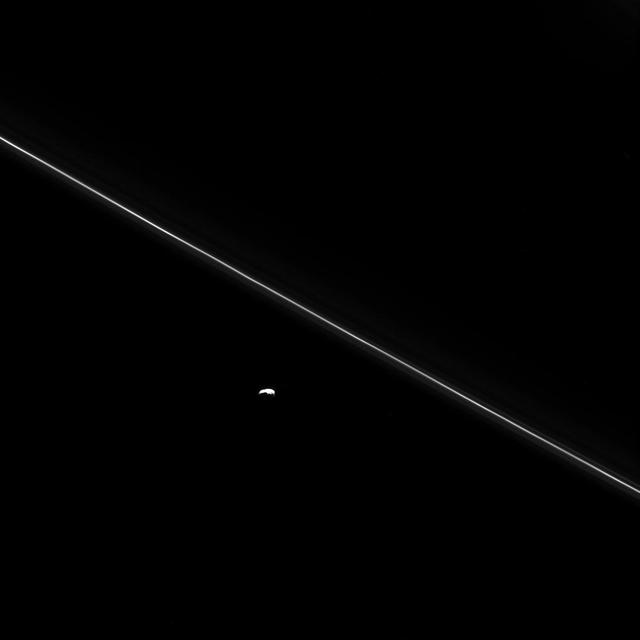
As Cassini hurtled toward its fatal encounter with Saturn, the spacecraft turned to catch this final look at Saturn's moon Pandora next to the thin line of the F ring. Over the course of its mission, Cassini helped scientists understand that Pandora plays a smaller role than they originally thought in shaping the narrow ring. When Cassini arrived at Saturn, many thought that Pandora and Prometheus worked together to shepherd the F ring between them, confining it and sculpting its unusual braided and kinked structures. However, data from Cassini show that the gravity of the two moons together actually stirs the F ring into a chaotic state, generating the "gap and streamer" structure. Recent models, supported by Cassini images, suggest that it is Prometheus alone, not Pandora, that confines the bulk of the F ring, aided by the particular characteristics of its orbit. Prometheus establishes stable locations for F ring material where the moon's own gravitational resonances are least cluttered by the perturbing influence of its sibling satellite, Pandora. This view looks toward the sunlit side of the rings from about 28 degrees above the ringplane. The image was taken in visible light with the Cassini spacecraft narrow-angle camera on Sept. 14, 2017. The view was obtained at a distance of approximately 360,000 miles (577,000 kilometers) from Pandora and at a Sun-Pandora-spacecraft, or phase, angle of 119 degrees. Image scale is about 2.2 miles (3.5 kilometers) per pixel. The Cassini spacecraft ended its mission on Sept. 15, 2017. https://photojournal.jpl.nasa.gov/catalog/PIA21355
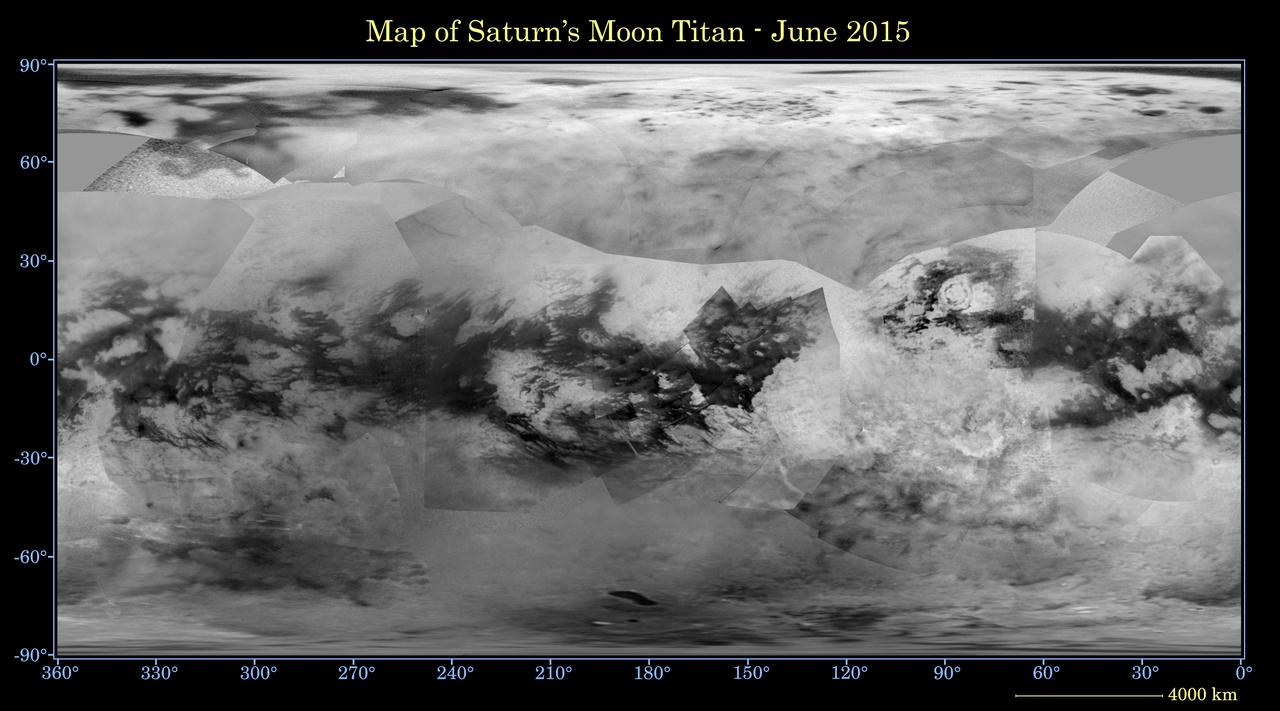
This global digital map of Saturn's moon Titan was created using images taken by NASA's Cassini spacecraft's imaging science subsystem (ISS). The map was produced in June 2015 using data collected through Cassini's flyby on April 7, 2014, known as "T100." The images were taken using a filter centered at 938 nanometers, allowing researchers to examine variations in albedo (or inherent brightness) across the surface of Titan. Because of the scattering of light by Titan's dense atmosphere, no topographic shading is visible in these images. The map is an equidistant projection and has a scale of 2.5 miles (4 kilometers) per pixel. Actual resolution varies greatly across the map, with the best coverage (close to the map scale) along the equator near the center of the map at 180 degrees west longitude. The lowest resolution coverage can be seen in the northern mid-latitudes on the sub-Saturn hemisphere. Mapping coverage in the northern polar region has greatly improved since the previous version of this map in 2011 (see PIA14908). Large dark areas, now known to be liquid-hydrocarbon-filled lakes and seas, have since been documented at high latitudes. Titan's north pole was not well illuminated early in Cassini's mission, because it was winter in the northern hemisphere when the spacecraft arrived at Saturn. Cassini has been better able to observe northern latitudes in more recent years due to seasonal changes in solar illumination. This map is an update to the previous versions released in April 2011 and February 2009 (see PIA11149). Data from the past four years (the most recent data in the map is from April 2014) has completely filled in missing data in the north polar region and replaces the earlier imagery of the Xanadu region with higher quality data. A data gap of about 3 to 5 percent of Titan's surface still remains, located in the northern mid-latitudes on the sub-Saturn hemisphere of Titan. The uniform gray area in the northern hemisphere indicates a gap in the imaging coverage of Titan's surface, to date. The missing data will be imaged by Cassini during flybys on December 15, 2016 and March 5, 2017. The mean radius of Titan used for projection of this map is 1,600 miles (2,575 kilometers). Titan is assumed to be spherical until a control network -- a model of the moon's shape based on multiple images tied together at defined points on the surface -- is created at some point in the future. http://photojournal.jpl.nasa.gov/catalog/PIA19658
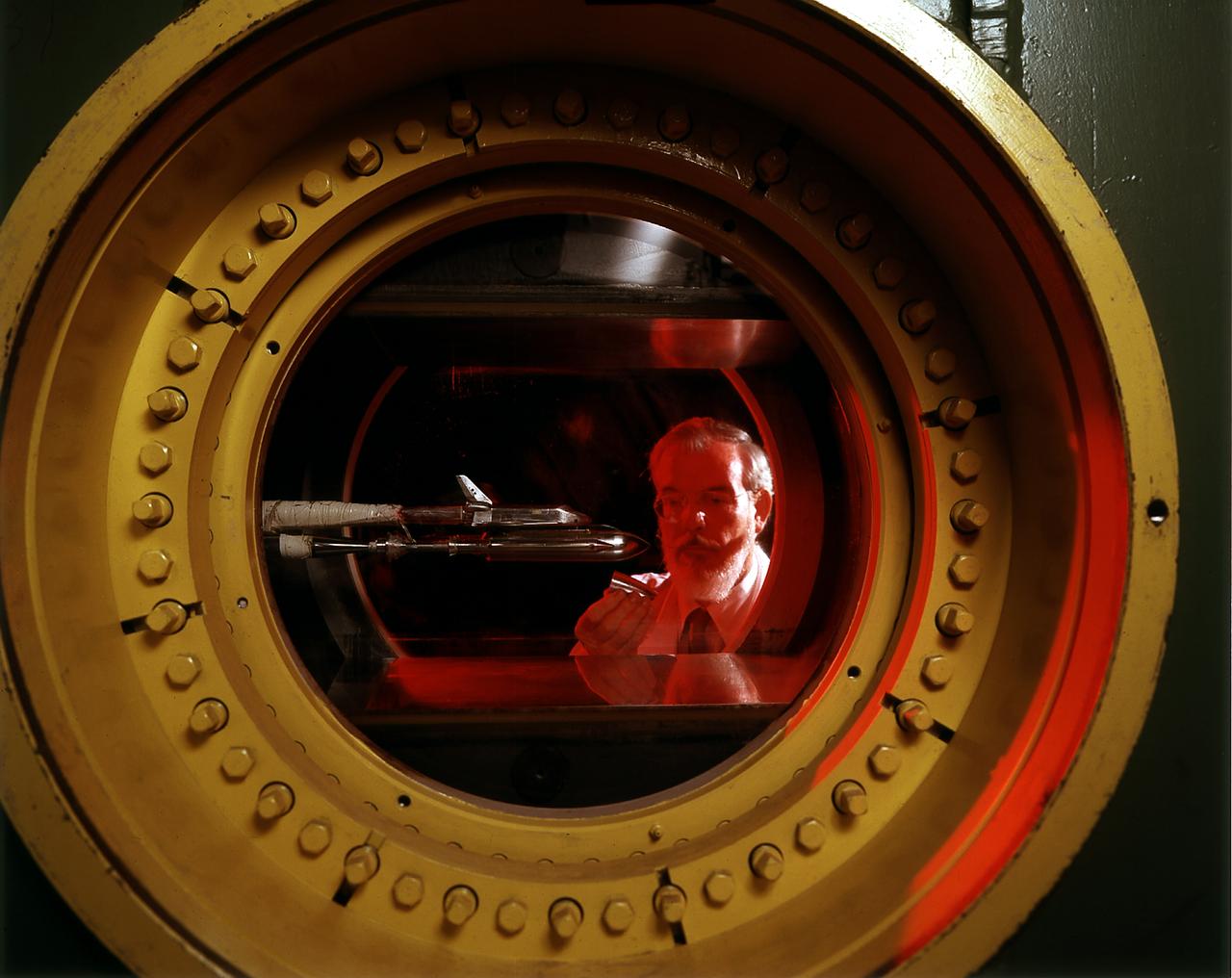
An engineer at the Marshall Space Flight Center (MSFC) observes a model of the Space Shuttle Orbiter being tested in the MSFC's 14x14-Inch Trisonic Wind Tunnel. The 14-Inch Wind Tunnel is a trisonic wind tunnel. This means it is capable of running subsonic, below the speed of sound; transonic, at or near the speed of sound (Mach 1,760 miles per hour at sea level); or supersonic, greater than Mach 1 up to Mach 5. It is an intermittent blowdown tunnel that operates by high pressure air flowing from storage to either vacuum or atmospheric conditions. The MSFC 14x14-Inch Trisonic Wind Tunnel has been an integral part of the development of the United States space program Rocket and launch vehicles from the Jupiter-C in 1958, through the Saturn family up to the current Space Shuttle and beyond have been tested in this Wind Tunnel. MSFC's 14x14-Inch Trisonic Wind Tunnel, as with most other wind tunnels, is named after the size of the test section. The 14-Inch Wind Tunnel, as in the past, will continue to play a large but unseen role in the development of America's space program.
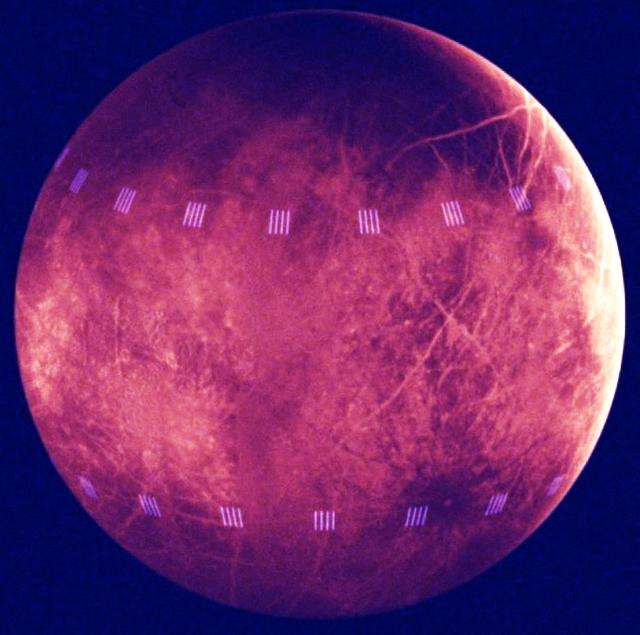
This image is a simulation of how NASA's Europa Clipper will understand which areas of the Jovian moon Europa are warm and active by studying the moon's thermal emissions. Scientists based this image on a model of data from NASA's Galileo mission and data from an instrument on NASA's Cassini mission that studied warm regions of Saturn's moon Enceladus where jets of water ice and organic chemicals spray out from vents in the icy surface. Europa Clipper's Europa Thermal Emission Imaging System, or E-THEMIS, will take both daytime and nighttime observations of Europa. The light pink vertical stripes simulate the warm vents seen on the surface of Enceladus, if they were viewed on Europa in the night. If Europa has warm spots like Enceladus, E-THEMIS is expected to detect such areas on Europa, even from a distance. Europa Clipper will get as close as 16 miles (25 kilometers) from the moon's surface, resulting in observations at much higher resolution. Europa Clipper's three main science objectives are to determine the thickness of the moon's icy shell and its interactions with the ocean below, to investigate its composition, and to characterize its geology. The mission's detailed exploration of Europa will help scientists better understand the astrobiological potential for habitable worlds beyond our planet. https://photojournal.jpl.nasa.gov/catalog/PIA26105
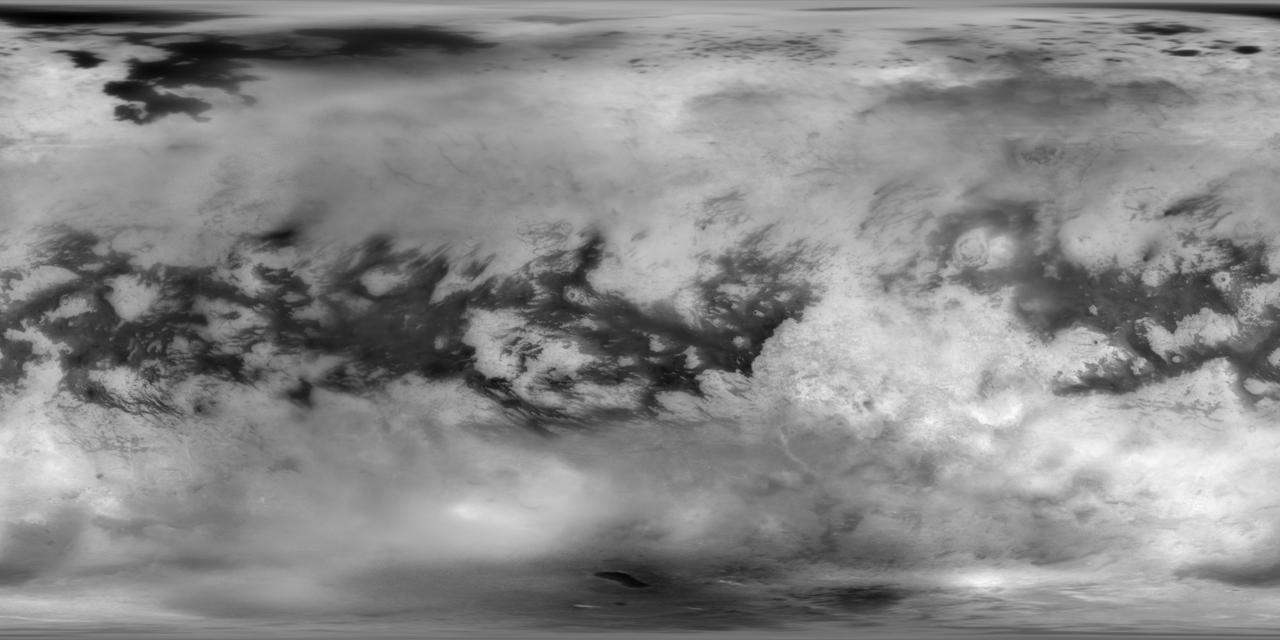
This Cassini Imaging Science Subsystem (ISS) global mosaic of Titan's surface brightness in the near-infrared at 938 nm wavelength shows the distribution of Titan's wide variety of landforms, from the vast equatorial sand seas to the high-latitude lakes and seas of liquid hydrocarbons. To generate this mosaic, 9,873 separate ISS images taken over more than 13 years of NASA's Cassini spacecraft operations at Saturn have been combined. Averaging such a large number of images dramatically improves how well surface features can be seen. A new photometric analysis method, with more accurate radiative transfer models of Titan's haze, allows spatial and temporal atmospheric and instrumental variations to be accounted for. This technique makes it possible to generate a mosaic without image seams that provides calibrated normal albedos. The image scale is 16 pixels per degree or 2.8 km in latitude. The new image is an update to the previous version of the ISS imaging map of Titan. The most recent version was published in 2015. https://photojournal.jpl.nasa.gov/catalog/PIA22770
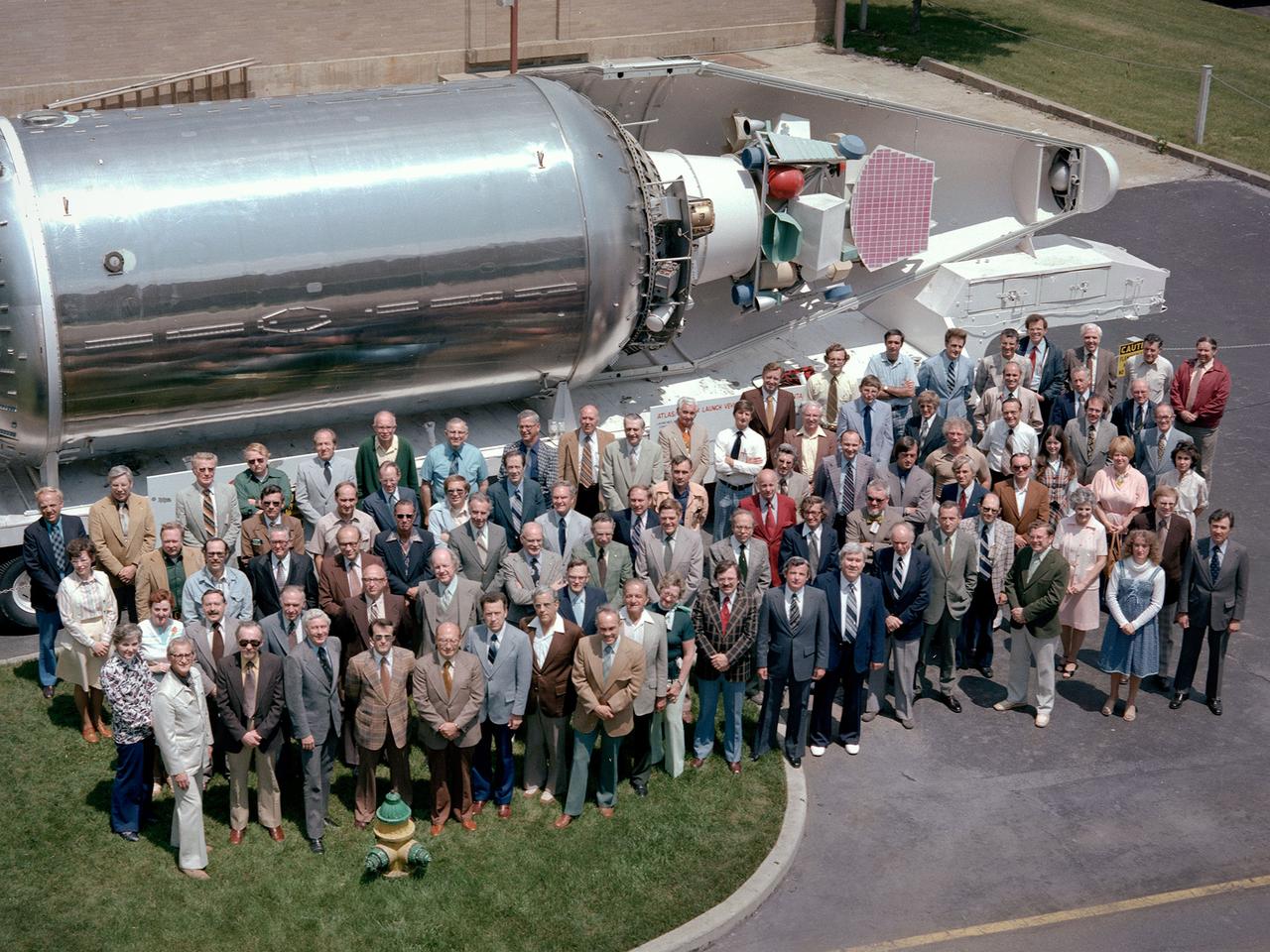
The National Aeronautics and Space Administration (NASA) Lewis Research Center’s Launch Vehicle Directorate in front of a full-scale model of the Centaur second-stage rocket. The photograph was taken to mark Centaur’s fiftieth launch. NASA Lewis managed the Centaur Program since 1962. At that time, the only prior launch attempt ended in failure. Lewis improved the spacecraft and tested it extensively throughout the early 1960s. In May 1966 an Atlas-Centaur sent the Surveyor spacecraft to the moon. It was the first successful soft landing on another planet. The Launch Vehicles Division was formed in 1969 to handle the increasing number of Centaur launches. The Lewis team became experts at integrating the payload with the Centaur and calculating proper trajectories for the missions. Centaur’s first 50 missions included Orbiting Astronomical Observatories, the Mariner 6 and 7 flybys of Mars, Mariner 9 which was the first spacecraft to orbit around another planet, the Pioneer 10 and 11 missions to the outer solar system, the Mariner 10 flyby of Venus and Mercury, the Viking 1 and 2 Mars landers, Voyagers 1 and 2 missions to Jupiter, Saturn, Uranus, and Neptune, and the Pioneer 12 and 13 flights to Venus.

A model of a tiny, wedge-shaped robot designed to explore subsurface oceans of icy moons, right, sits beside a large waterproof capsule containing electronics and sensors for testing below glacial ice at the Juneau Icefield in Alaska in July 2023. The model, about 5 inches (12 centimeters) long, was 3D-printed to show the final envisioned size of a futuristic NASA mission concept called SWIM, short for Sensing With Independent Micro-swimmers. Led by NASA's Jet Propulsion Laboratory from spring 2021 to fall 2024, SWIM envisions a swarm of dozens of self-propelled, cellphone-size robots exploring the waters of icy moons like Jupiter's Europa and Saturn's Enceladus. Delivered to the subsurface ocean by an ice-melting cryobot, the tiny robots would zoom away to look for chemical and temperature signals that could point to life. The capsule shown here contains the first generation of an ocean composition sensor built for the SWIM robots by a team at Georgia Tech. The final version of the sensor would enable each robot to simultaneously measure temperature, pressure, acidity or alkalinity, conductivity, and chemical makeup. During the Alaska field test, the team lowered the capsule through a borehole in the ice and measured pressure and conductivity down to a depth of 164 feet (50 meters). This field test was conducted as part of a JPL-managed project called ORCAA (Ocean Worlds Reconnaissance and Characterization of Astrobiological Analogs). Known as an analog mission, ORCAA is working to answer science questions and test technology in preparation for a potential future mission to explore the surface or subsurface of icy moons. ORCAA is funded by NASA's Planetary Science and Technology from Analog Research program. SWIM was supported by Phase I and II funding from NASA's Innovative Advanced Concepts program under the agency's Space Technology Mission Directorate. JPL is managed for NASA by Caltech in Pasadena, California. https://photojournal.jpl.nasa.gov/catalog/PIA26424
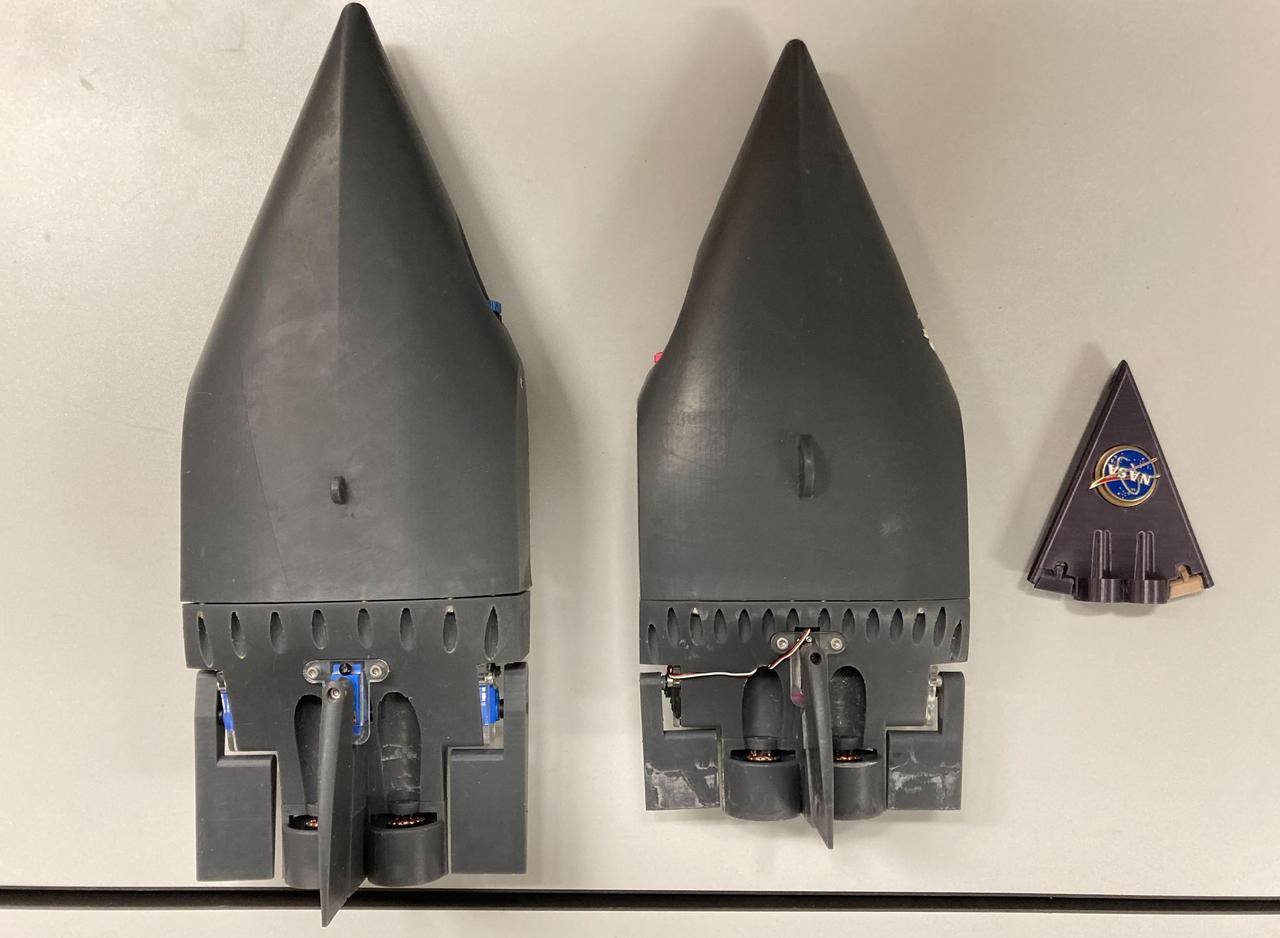
Two prototypes for a NASA mission concept called SWIM (short for Sensing With Independent Micro-swimmers) are arranged beside a much smaller nonfunctioning model representing the final envisioned size of the robot: about 5 inches (12 centimeters) long. The plastic prototypes were built at NASA's Jet Propulsion Laboratory in Southern California to demonstrate the feasibility of the concept, a swarm of dozens of self-propelled, cellphone-size robots exploring the waters of icy moons like Jupiter's Europa and Saturn's Enceladus. Delivered to the subsurface ocean by an ice-melting cryobot, the tiny robots would zoom away to look for chemical and temperature signals that could point to life. The prototypes were used in more that 20 rounds of underwater testing in a pair of tanks at JPL and in a competition swimming pool at Caltech in Pasadena. Relying on low-cost, commercially made motors and electronics, the robots are pushed along by two propellers and use two to four flaps for steering. The prototype in the center of the image weighs 3.7 pounds (1.7 kilograms) and is 14.5 inches (37 centimeters) long, 6 inches (15 centimeters) wide, and 2.5 inches (6.5 centimeters) tall, with a volume of 104 cubic inches (1.7 liters). The upgraded prototype at left is slightly bigger: 16.5 inches (42 centimeters) long, 3 inches (7.5 centimeters) tall, with a weight of 5 pounds (2.3 kilograms) and a volume of 140 cubic inches (2.3 liters). In pool tests, the prototype at left demonstrated controlled maneuvering, the ability to stay on and correct its course, and a back-and-forth "lawnmower" exploration pattern. It managed all of this autonomously, without the team's direct intervention. The robot even spelled out "J-P-L." As conceived for spaceflight and represented by the model at right, the robots would have dimensions about three times smaller than these prototypes – tiny compared to existing remotely operated and autonomous underwater scientific vehicles. The swimmers would feature miniaturized, purpose-built parts and employ a novel wireless underwater acoustic communication system for transmitting data and triangulating their positions. Several years more of work would be needed to make such an advanced concept ready for spaceflight. Led by JPL, SWIM development took place from spring 2021 to fall 2024. The project was supported by Phase I and II funding from NASA's Innovative Advanced Concepts program under the agency's Space Technology Mission Directorate. JPL is managed for NASA by Caltech in Pasadena, California. https://photojournal.jpl.nasa.gov/catalog/PIA26425
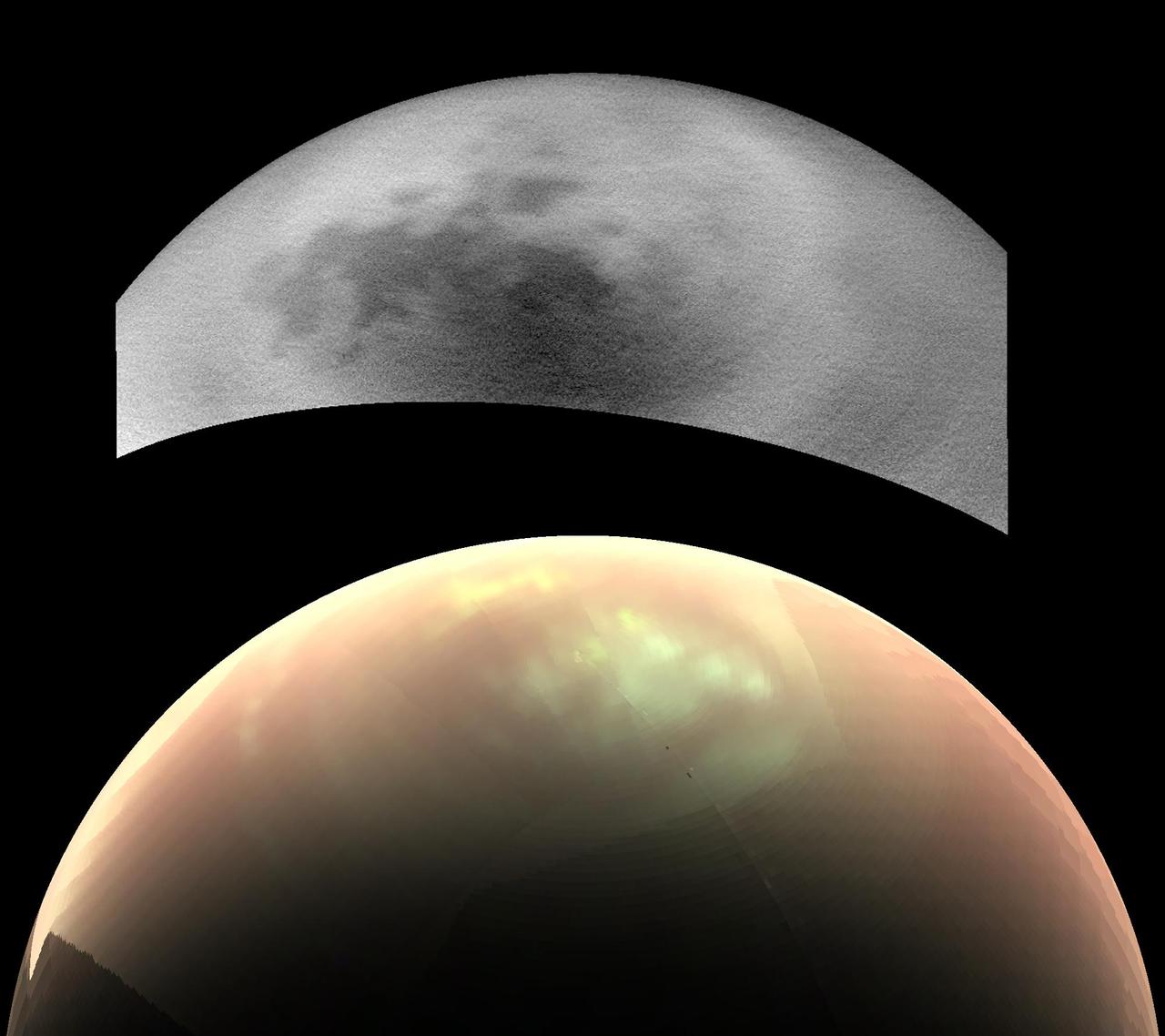
This comparison of two views from NASA's Cassini spacecraft, taken fairly close together in time, illustrates a peculiar mystery: Why would clouds on Saturn's moon Titan be visible in some images, but not in others? In the top view, a near-infrared image from Cassini's imaging cameras, the skies above Saturn's moon Titan look relatively cloud free. But in the bottom view, at longer infrared wavelengths, Cassini sees a large field of bright clouds. Even though these views were taken at different wavelengths, researchers would expect at least a hint of the clouds to show up in the upper image. Thus they have been trying to understand what's behind the difference. As northern summer approaches on Titan, atmospheric models have predicted that clouds will become more common at high northern latitudes, similar to what was observed at high southern latitudes during Titan's late southern summer in 2004. Cassini's Imaging Science Subsystem (ISS) and Visual and Infrared Mapping Spectrometer (VIMS) teams have been observing Titan to document changes in weather patterns as the seasons change, and there is particular interest in following the onset of clouds in the north polar region where Titan's lakes and seas are concentrated. Cassini's "T120" and "T121" flybys of Titan, on June 7 and July 25, 2016, respectively, provided views of high northern latitudes over extended time periods -- more than 24 hours during both flybys. Intriguingly, the ISS and VIMS observations appear strikingly different from each other. In the ISS observations (monochrome image at top), surface features are easily identifiable and only a few small, isolated clouds were detected. In contrast, the VIMS observations (color image at bottom) suggest widespread cloud cover during both flybys. The observations were made over the same time period, so differences in illumination geometry or changes in the clouds themselves are unlikely to be the cause for the apparent discrepancy: VIMS shows persistent atmospheric features over the entire observation period and ISS consistently detects surface features with just a few localized clouds. The answer to what could be causing the discrepancy appears to lie with Titan's hazy atmosphere, which is much easier to see through at the longer infrared wavelengths that VIMS is sensitive to (up to 5 microns) than at the shorter, near-infrared wavelength used by ISS to image Titan's surface and lower atmosphere (0.94 microns). High, thin cirrus clouds that are optically thicker than the atmospheric haze at longer wavelengths, but optically thinner than the haze at the shorter wavelength of the ISS observations, could be detected by VIMS and simultaneously lost in the haze to ISS -- similar to trying to see a thin cloud layer on a hazy day on Earth. This phenomenon has not been seen again since July 2016, but Cassini has several more opportunities to observe Titan over the last months of the mission in 2017, and scientists will be watching to see if and how the weather changes. These two images were taken as part of the T120 flyby on June 7 (VIMS) and 8 (ISS), 2016. The distance to Titan was about 28,000 miles (45,000 kilometers) for the VIMS image and about 398,000 miles (640,000 kilometers) for the ISS image. The VIMS image has been processed to enhance the visibility of the clouds; in this false-color view, clouds appear nearly white, atmospheric haze is pink, and surface areas would appear green. http://photojournal.jpl.nasa.gov/catalog/PIA21054
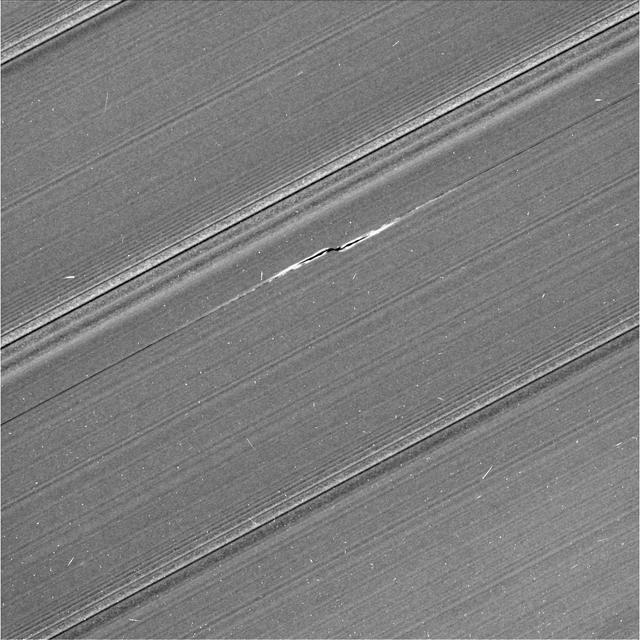
This view from NASA's Cassini spacecraft shows Cassini's best image of the propeller feature known informally as Bleriot. The propeller is named after Louis Bleriot, the French engineer and aviator who in 1909 was the first person to fly across the English Channel. This is the third and final propeller to be targeted for a close flyby observation during Cassini's ring-grazing orbits (the period from Nov. 2016 to April 2017 when Cassini's orbit passed just outside the main rings). Because propellers are seen in the outermost parts of the main rings, the ring-grazing orbits provided Cassini's best opportunity to see them up close. Many small, bright specks and linear, scratch-like artifacts are visible in the image. These artifacts are due to cosmic rays and particles of radiation near the planet striking the camera detector during the exposure. Bleriot is the largest of the propellers in Saturn's rings. The wavy features embedded in the propeller structure indicate that its central moonlet is some 60 percent wider than that of Santos-Dumont, which means the Bleriot moonlet is about four times more massive. Cassini scientists have been tracking the orbit of this object for the past decade, tracing the effect that the ring has upon it. Because it is the biggest propeller, it is more easily seen in lower-resolution images than other propellers, and thus it can be spotted in the most images by far. Here, as Cassini moved in close to the rings as part of its ring-grazing orbits, it was able to obtain this extreme close-up view of the propeller, which enables researchers to examine its effects on the ring as never before. These views, and others like them, will inform models and studies in new ways going forward. This image was taken on the unilluminated side of the rings, where sunlight filters through the backlit ring. Like a frosted window, Saturn's rings look different depending on whether they are seen fully sunlit or backlit. On the lit side, the rings look darker where there is less material to reflect sunlight. On the unlit side, some regions look darker because there is less material, but other regions look dark because there is so much material that the ring becomes opaque. Most dramatically in this image, a dark band cuts deeply through the middle of Bleriot's propeller. It is much more prominent than the similar dark band in the unlit-side image of the Santos-Dumont propeller, indicating that Bleriot stirs up the ring particles to much higher densities than does Santos-Dumont. The dark bands are regions where the density is so high that the ring becomes opaque to the sunlight filtering through the rings. As in Cassini's other propeller close-up images, the central moonlet itself seems to be obscured by the stirred-up ring material around it, so that it cannot be directly seen. It would be about three pixels across, and lies at the center of the propeller structure. The image was taken using the Cassini spacecraft's narrow-angle camera on April 12. Image scale in this view is 0.3 mile (500 meters) per pixel. The sun-ring-spacecraft angle, or phase angle, is 83 degrees. https://photojournal.jpl.nasa.gov/catalog/PIA21447
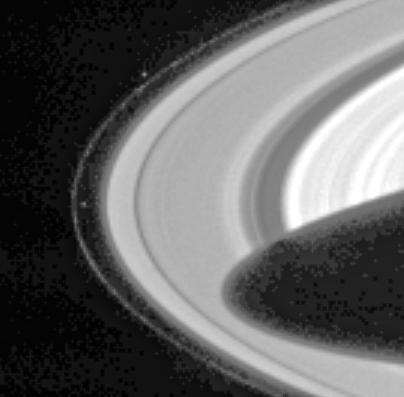
Cassini has sighted Prometheus and Pandora, the two F-ring-shepherding moons whose unpredictable orbits both fascinate scientists and wreak havoc on the F ring. Prometheus (102 kilometers, or 63 miles across) is visible left of center in the image, inside the F ring. Pandora (84 kilometers, or 52 miles across) appears above center, outside the ring. The dark shadow cast by the planet stretches more than halfway across the A ring, the outermost main ring. The mottled pattern appearing in the dark regions of the image is 'noise' in the signal recorded by the camera system, which has subsequently been magnified by the image processing. The F ring is a narrow, ribbon-like structure, with a width seen in this geometry equivalent to a few kilometers. The two small, irregularly shaped moons exert a gravitational influence on particles that make up the F ring, confining it and possibly leading to the formation of clumps, strands and other structures observed there. Pandora prevents the F ring from spreading outward and Prometheus prevents it from spreading inward. However, their interaction with the ring is complex and not fully understood. The shepherds are also known to be responsible for many of the observed structures in Saturn's A ring. The moons, which were discovered in images returned by the Voyager 1 spacecraft in 1980, are in chaotic orbits--their orbits can change unpredictably when the moons get very close to each other. This strange behavior was first noticed in ground-based and Hubble Space Telescope observations in 1995, when the rings were seen nearly edge-on from Earth and the usual glare of the rings was reduced, making the satellites more readily visible than usual. The positions of both satellites at that time were different than expected based on Voyager data. One of the goals for the Cassini-Huygens mission is to derive more precise orbits for Prometheus and Pandora. Seeing how their orbits change over the duration of the mission will help to determine their masses, which in turn will help constrain models of their interiors and provide a more complete understanding of their effect on the rings. This narrow angle camera image was snapped through the broadband green spectral filter, centered at 568 nanometers, on March 10, 2004, when the spacecraft was 55.5 million kilometers (34.5 million miles) from the planet. Image scale is approximately 333 kilometers (207 miles) per pixel. Contrast has been greatly enhanced, and the image has been magnified to aid visibility of the moons as well as structure in the rings. http://photojournal.jpl.nasa.gov/catalog/PIA05387

NASA's Cassini spacecraft watched clouds of methane moving across the far northern regions of Saturn's largest moon, Titan, on Oct. 29 and 30, 2016. Several sets of clouds develop, move over the surface and fade during the course of this movie sequence, which spans 11 hours, with one frame taken every 20 minutes. Most prominent are long cloud streaks that lie between 49 and 55 degrees north latitude. While the general region of cloud activity is persistent over the course of the observation, individual streaks appear to develop then fade. These clouds are measured to move at a speed of about 14 to 22 miles per hour (7 to 10 meters per second). There are also some small clouds over the region of small lakes farther north, including a bright cloud between Neagh Lacus and Punga Mare, which fade over the course of the movie. This small grouping of clouds is moving at a speed of about 0.7 to 1.4 miles per hour (1 to 2 meters per second). Time-lapse movies like this allow scientists to observe the dynamics of clouds as they develop, move over the surface and fade. A time-lapse movie can also help to distinguish between noise in images (for example from cosmic rays hitting the detector) and faint clouds or fog. In 2016, Cassini has intermittently observed clouds across the northern mid-latitudes of Titan, as well as within the north polar region -- an area known to contain numerous methane/ethane lakes and seas see PIA19657 and PIA17655. However, most of this year's observations designed for cloud monitoring have been short snapshots taken days, or weeks, apart. This observation provides Cassini's best opportunity in 2016 to study short-term cloud dynamics. Models of Titan's climate have predicted more cloud activity during early northern summer than what Cassini has observed so far, suggesting that the current understanding of the giant moon's changing seasons is incomplete. The mission will continue monitoring Titan's weather around the 2017 summer solstice in Titan's northern hemisphere. The movie was acquired using the Cassini narrow-angle camera using infrared filters to make the surface and tropospheric methane clouds visible. A movie is available at http://photojournal.jpl.nasa.gov/catalog/PIA21051