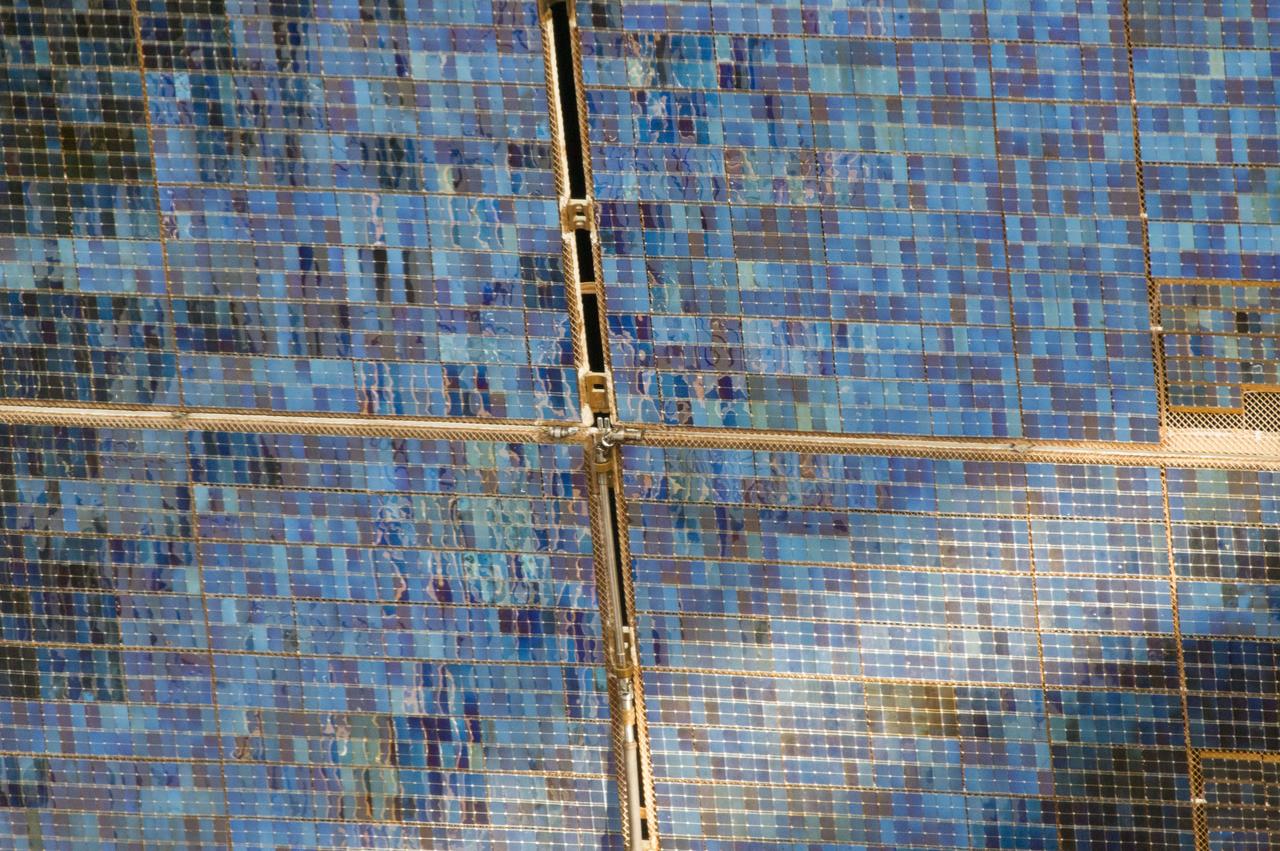
View of Solar Array Wing (SAW). Photo was taken during Expedition 34.
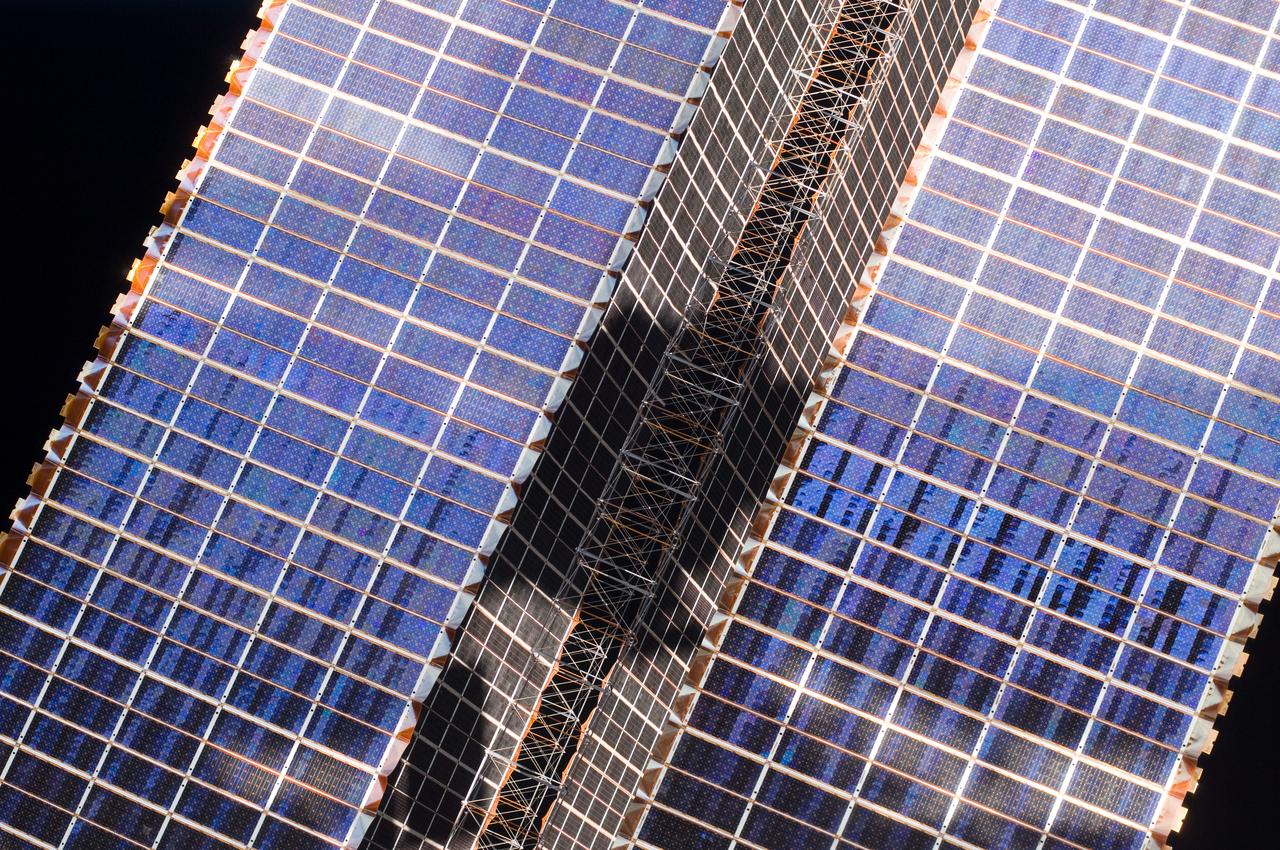
View of Solar Array Wings (SAWs). Photo was taken during Expedition 34.

S73-27384 (June 1973) --- A close-up view of the surgical band saw, a surgical tool in the therapeutic kit of the Inflight Medical Support System aboard the Skylab 1 & 2 space station cluster now in Earth orbit. Since this instrument can cut through metal (as illustrated here), it can be used in making emergency maintenance repairs aboard the space station. Photo credit: NASA

In the area between Crommelin and Firsoff craters, NASA Mars Reconnaissance Orbiter saw heavily cratered terrain with deposits that record Martian geologic history and stratigraphy.
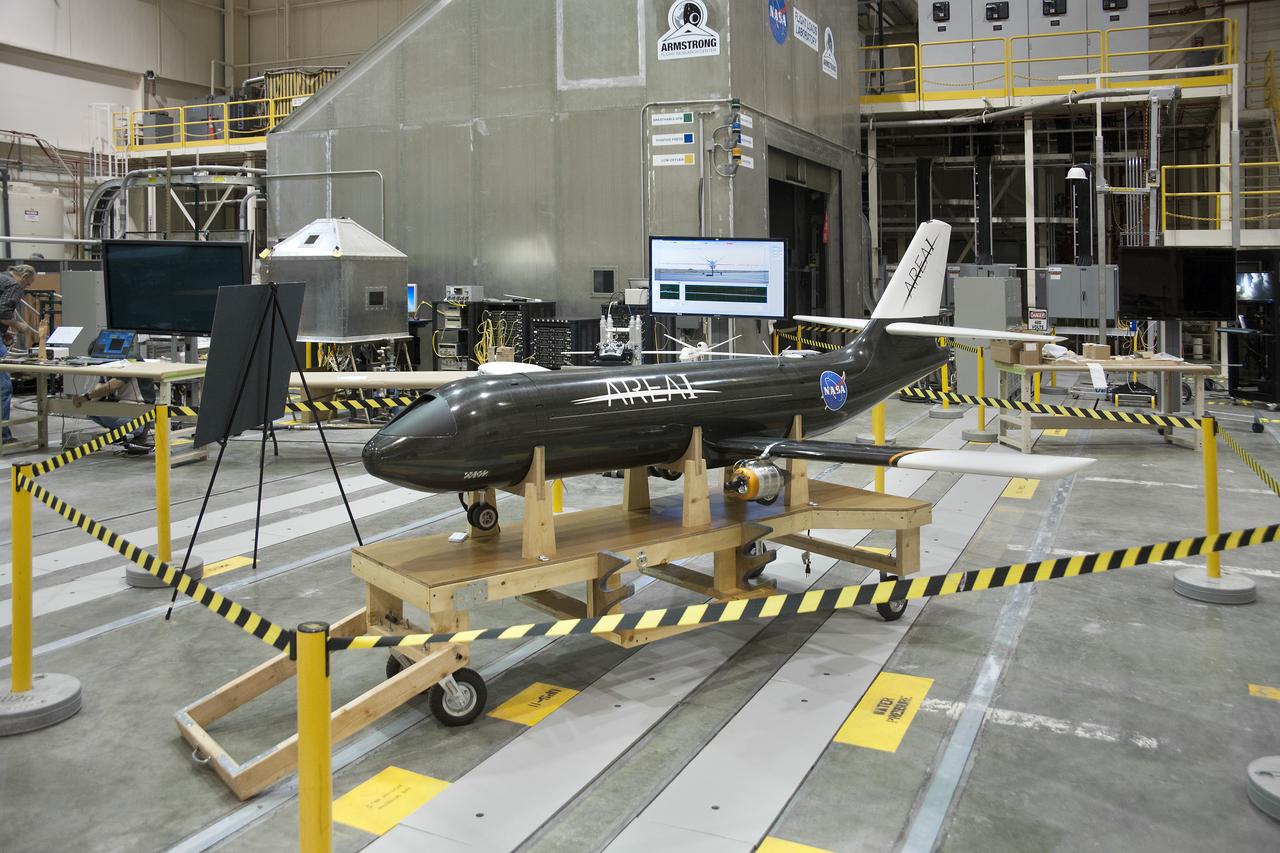
The objectives of testing on PTERA include the development of tools and vetting of system integration, evaluation of vehicle control law, and analysis of SAW airworthiness to examine benefits to in-flight efficiency.
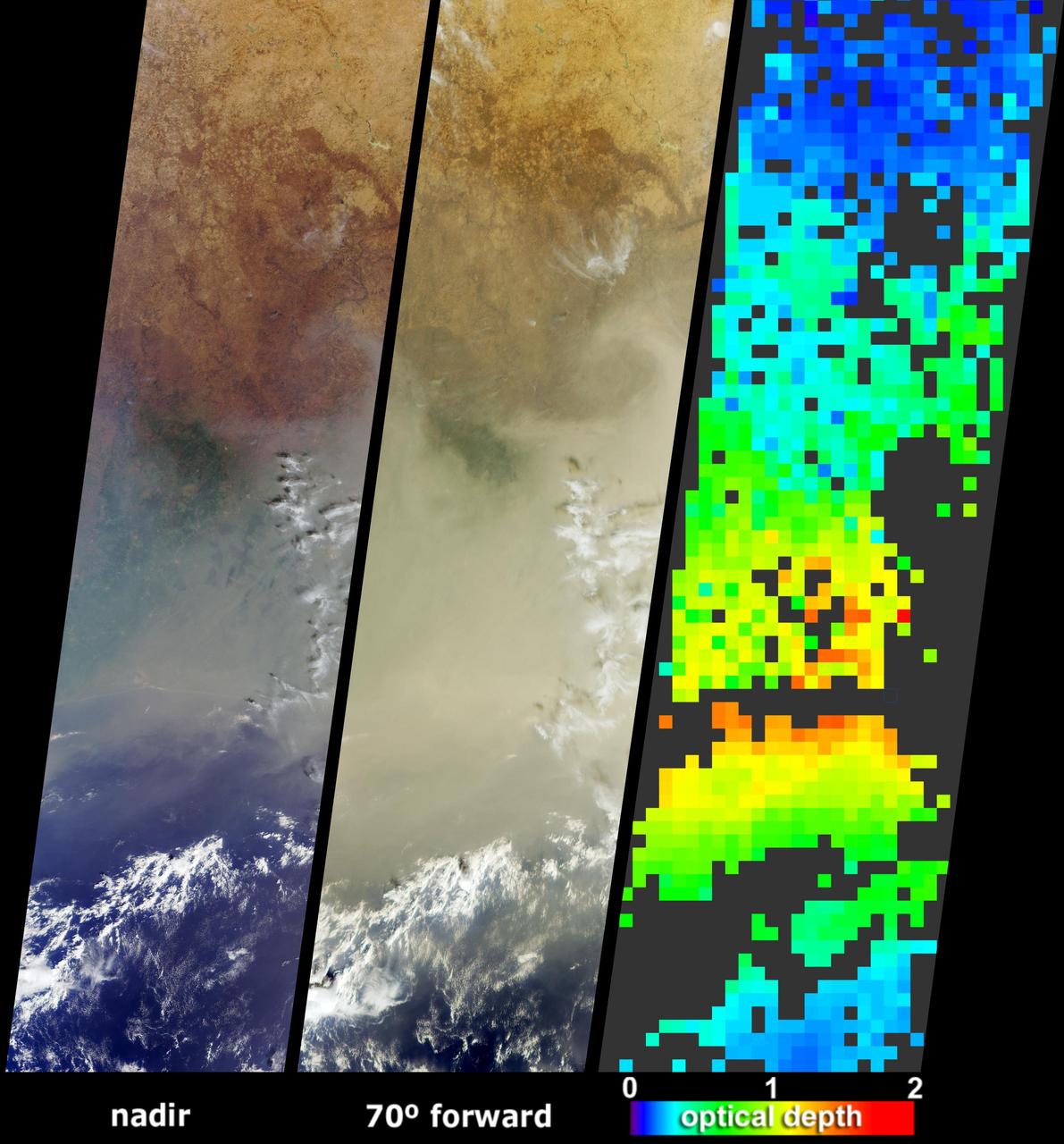
NASA Terra spacecraft saw a pall of smoke and dust largely obscured the nations of Cote dIvoire, Ghana, Burkina Faso and southern Mali on January 12, 2004.
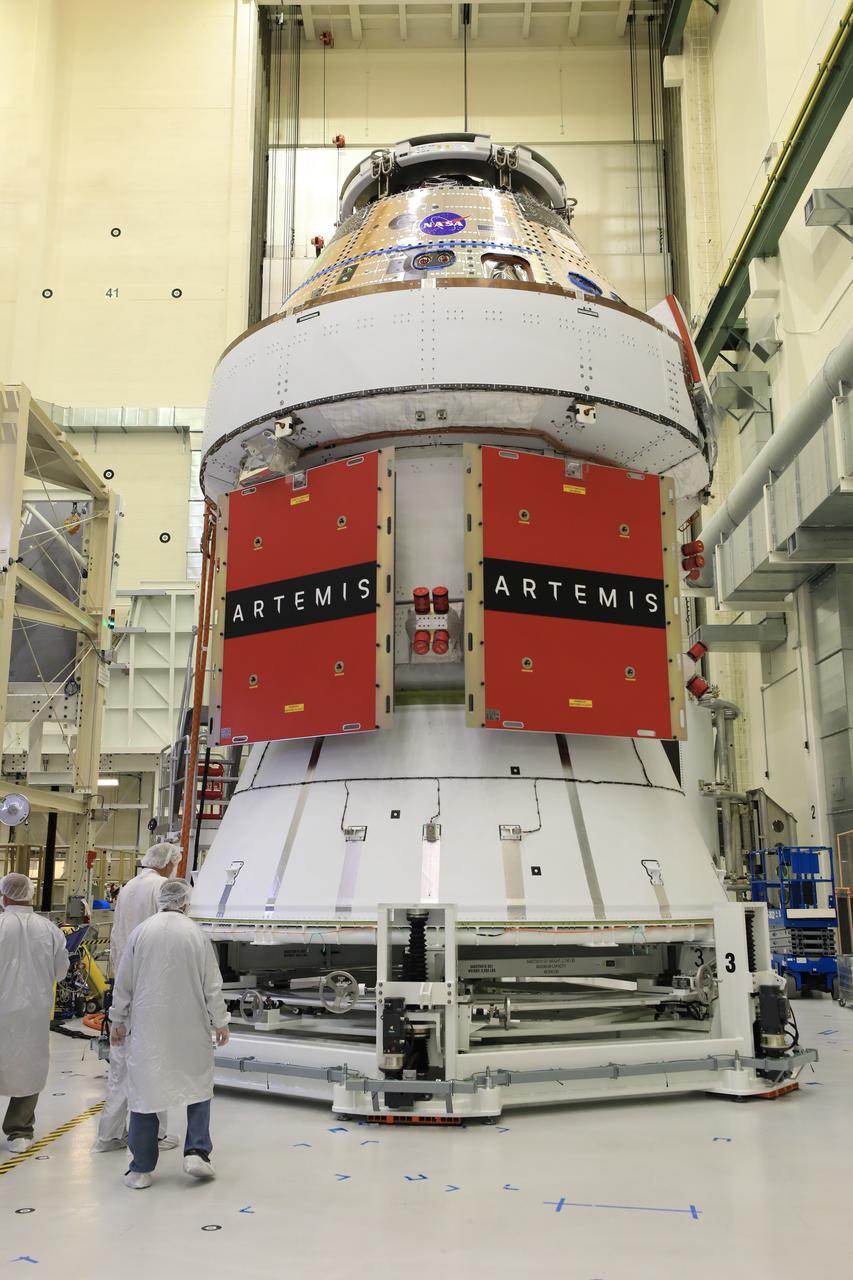
Technicians install four solar array wings on NASA’s Artemis II Orion spacecraft inside the Neil A. Armstrong Operations and Checkout Building at NASA’s Kennedy Space Center in Florida on Monday, March 3, 2025. Each solar array is nearly 23 feet long and can turn on two axes to remain aligned with the Sun for maximum power. Orion’s solar arrays, manufactured and installed by ESA (European Space Agency) and its contractor Airbus, will deliver power to the service module that provides propulsion, thermal control, and electrical power to the spacecraft, as well as air and water for the crew.
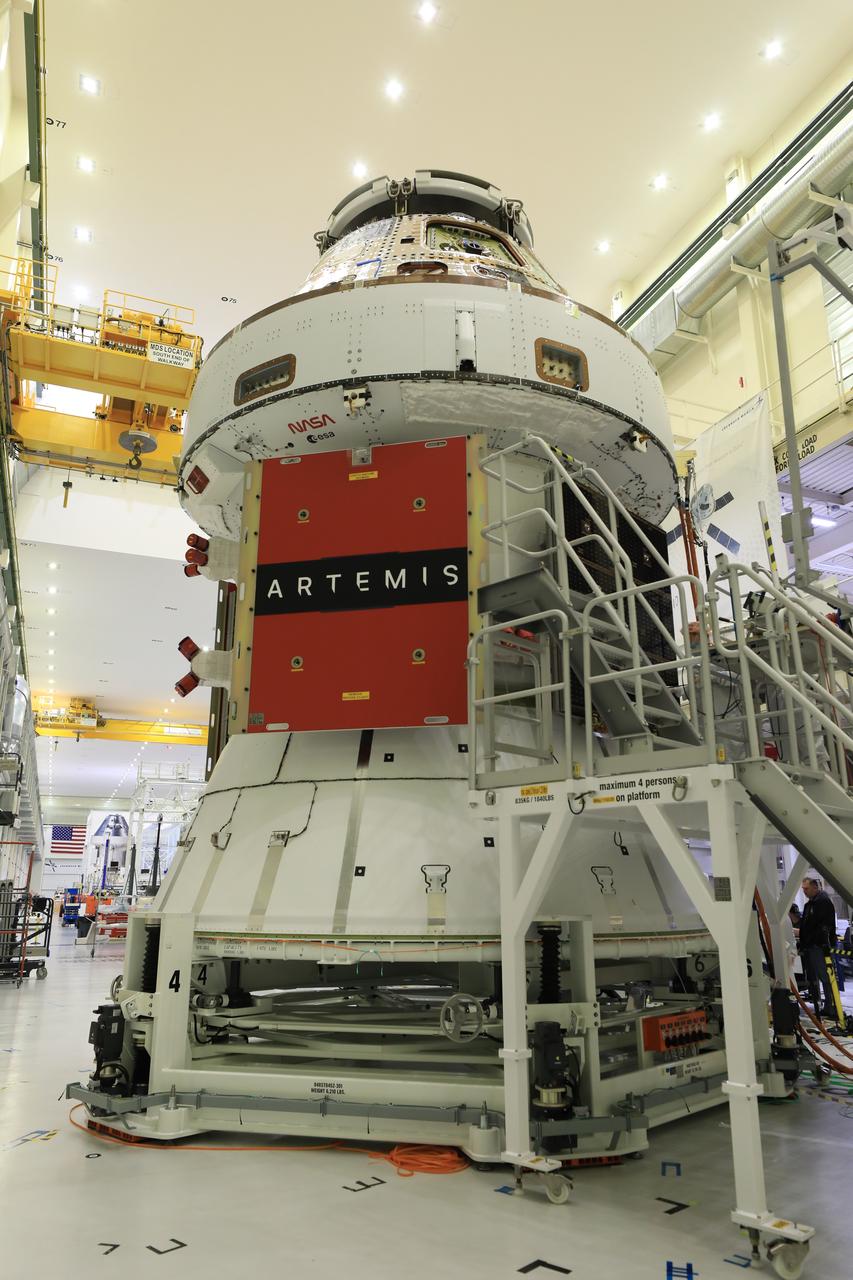
Technicians install four solar array wings on NASA’s Artemis II Orion spacecraft inside the Neil A. Armstrong Operations and Checkout Building at NASA’s Kennedy Space Center in Florida on Monday, March 3, 2025. Each solar array is nearly 23 feet long and can turn on two axes to remain aligned with the Sun for maximum power. Orion’s solar arrays, manufactured and installed by ESA (European Space Agency) and its contractor Airbus, will deliver power to the service module that provides propulsion, thermal control, and electrical power to the spacecraft, as well as air and water for the crew.
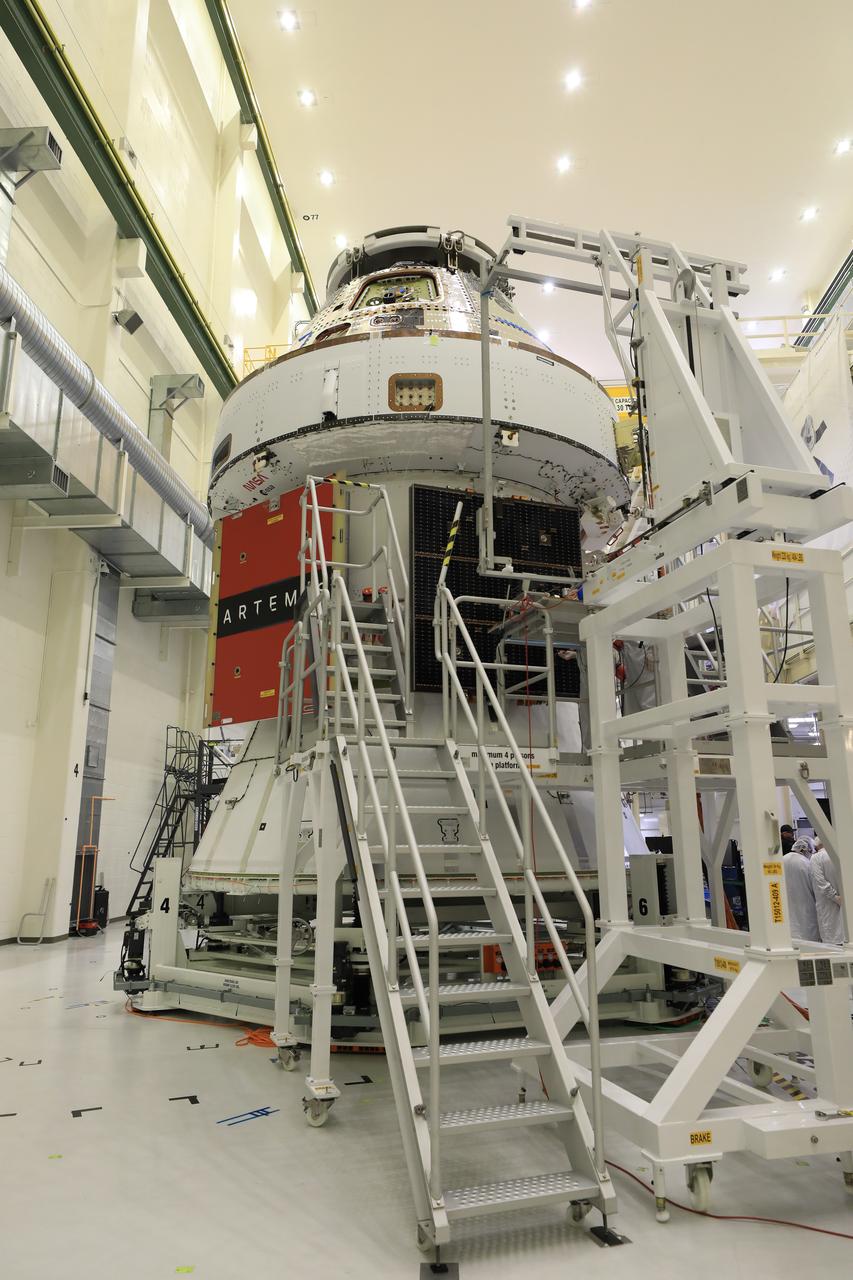
Technicians install four solar array wings on NASA’s Artemis II Orion spacecraft inside the Neil A. Armstrong Operations and Checkout Building at NASA’s Kennedy Space Center in Florida on Monday, March 3, 2025. Each solar array is nearly 23 feet long and can turn on two axes to remain aligned with the Sun for maximum power. Orion’s solar arrays, manufactured and installed by ESA (European Space Agency) and its contractor Airbus, will deliver power to the service module that provides propulsion, thermal control, and electrical power to the spacecraft, as well as air and water for the crew.
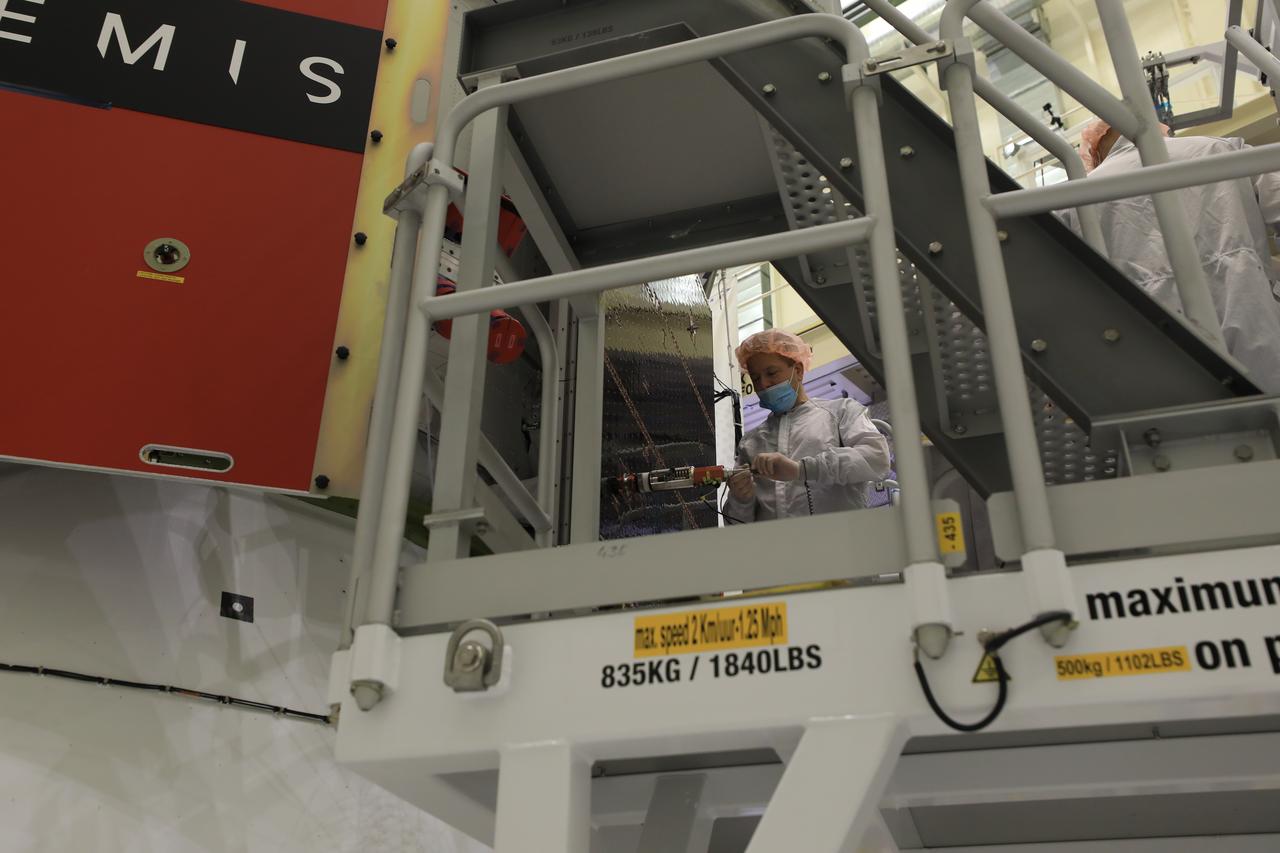
Technicians install four solar array wings on NASA’s Artemis II Orion spacecraft inside the Neil A. Armstrong Operations and Checkout Building at NASA’s Kennedy Space Center in Florida on Monday, March 3, 2025. Each solar array is nearly 23 feet long and can turn on two axes to remain aligned with the Sun for maximum power. Orion’s solar arrays, manufactured and installed by ESA (European Space Agency) and its contractor Airbus, will deliver power to the service module that provides propulsion, thermal control, and electrical power to the spacecraft, as well as air and water for the crew.
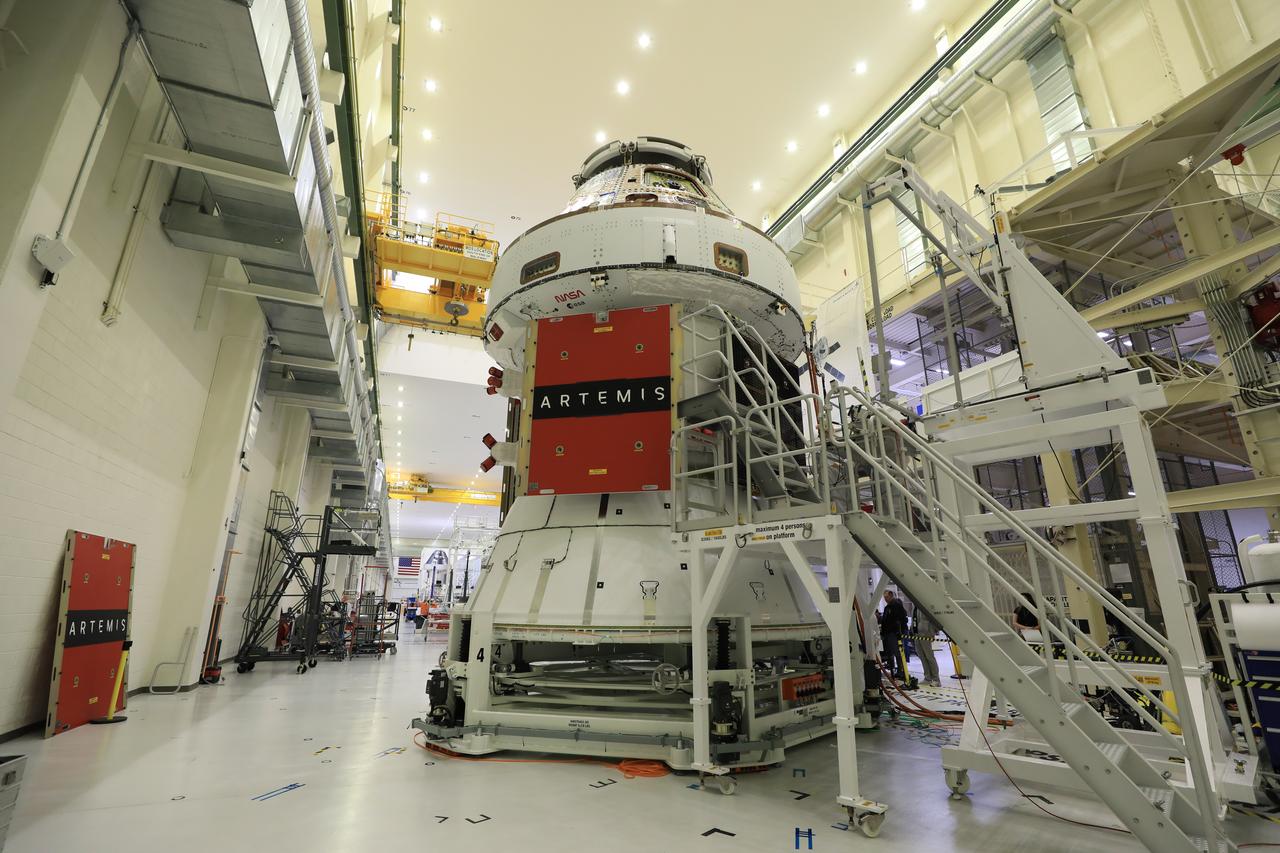
Technicians install four solar array wings on NASA’s Artemis II Orion spacecraft inside the Neil A. Armstrong Operations and Checkout Building at NASA’s Kennedy Space Center in Florida on Monday, March 3, 2025. Each solar array is nearly 23 feet long and can turn on two axes to remain aligned with the Sun for maximum power. Orion’s solar arrays, manufactured and installed by ESA (European Space Agency) and its contractor Airbus, will deliver power to the service module that provides propulsion, thermal control, and electrical power to the spacecraft, as well as air and water for the crew.
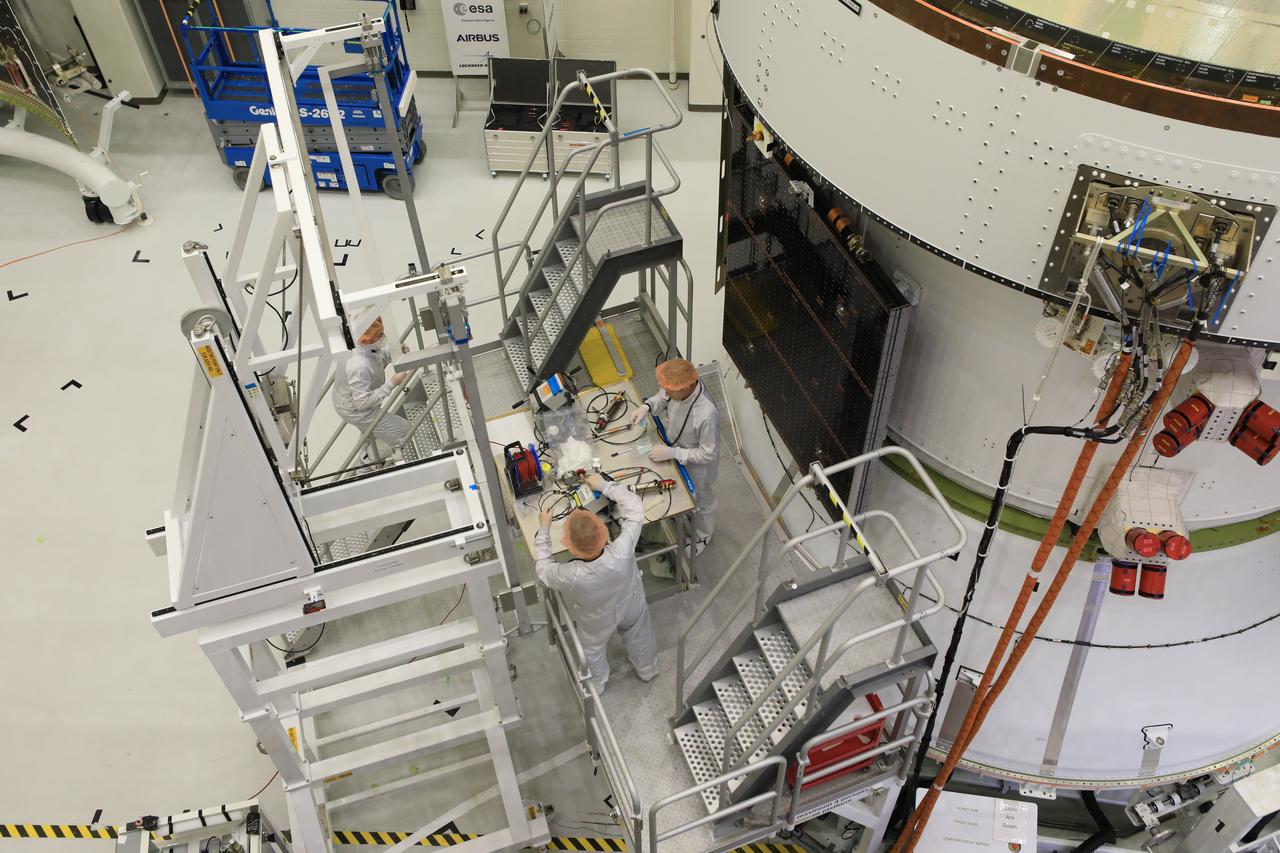
Technicians install four solar array wings on NASA’s Artemis II Orion spacecraft inside the Neil A. Armstrong Operations and Checkout Building at NASA’s Kennedy Space Center in Florida on Monday, March 3, 2025. Each solar array is nearly 23 feet long and can turn on two axes to remain aligned with the Sun for maximum power. Orion’s solar arrays, manufactured and installed by ESA (European Space Agency) and its contractor Airbus, will deliver power to the service module that provides propulsion, thermal control, and electrical power to the spacecraft, as well as air and water for the crew.
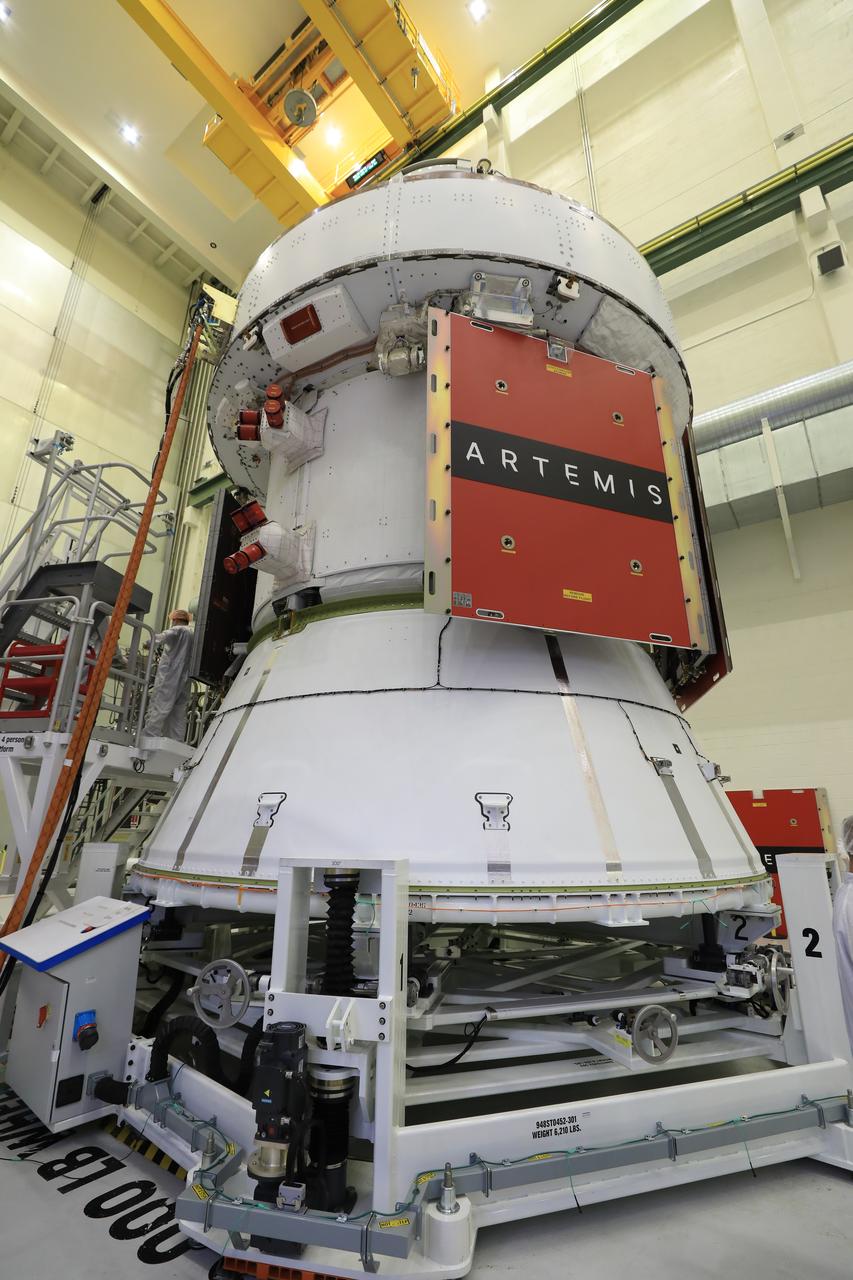
Technicians install four solar array wings on NASA’s Artemis II Orion spacecraft inside the Neil A. Armstrong Operations and Checkout Building at NASA’s Kennedy Space Center in Florida on Monday, March 3, 2025. Each solar array is nearly 23 feet long and can turn on two axes to remain aligned with the Sun for maximum power. Orion’s solar arrays, manufactured and installed by ESA (European Space Agency) and its contractor Airbus, will deliver power to the service module that provides propulsion, thermal control, and electrical power to the spacecraft, as well as air and water for the crew.
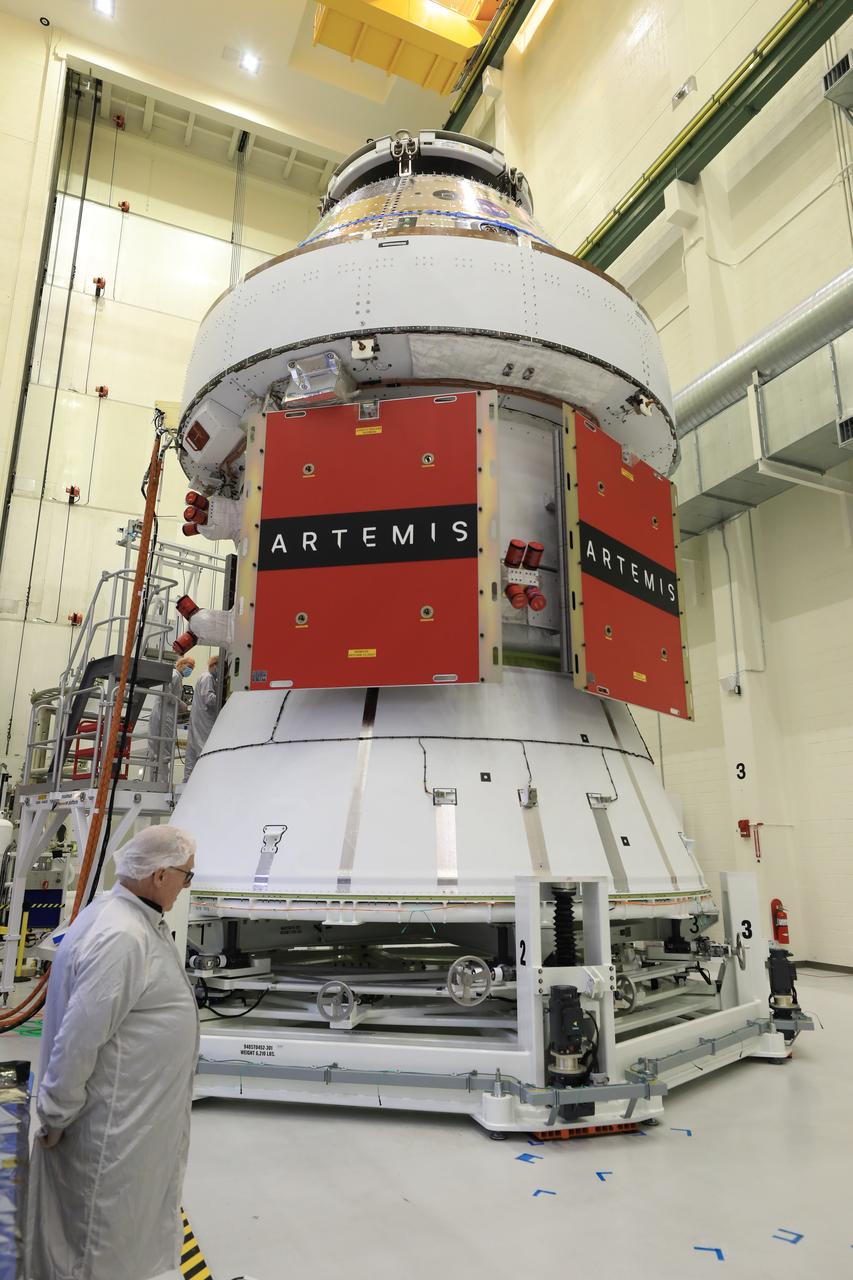
Technicians install four solar array wings on NASA’s Artemis II Orion spacecraft inside the Neil A. Armstrong Operations and Checkout Building at NASA’s Kennedy Space Center in Florida on Monday, March 3, 2025. Each solar array is nearly 23 feet long and can turn on two axes to remain aligned with the Sun for maximum power. Orion’s solar arrays, manufactured and installed by ESA (European Space Agency) and its contractor Airbus, will deliver power to the service module that provides propulsion, thermal control, and electrical power to the spacecraft, as well as air and water for the crew.
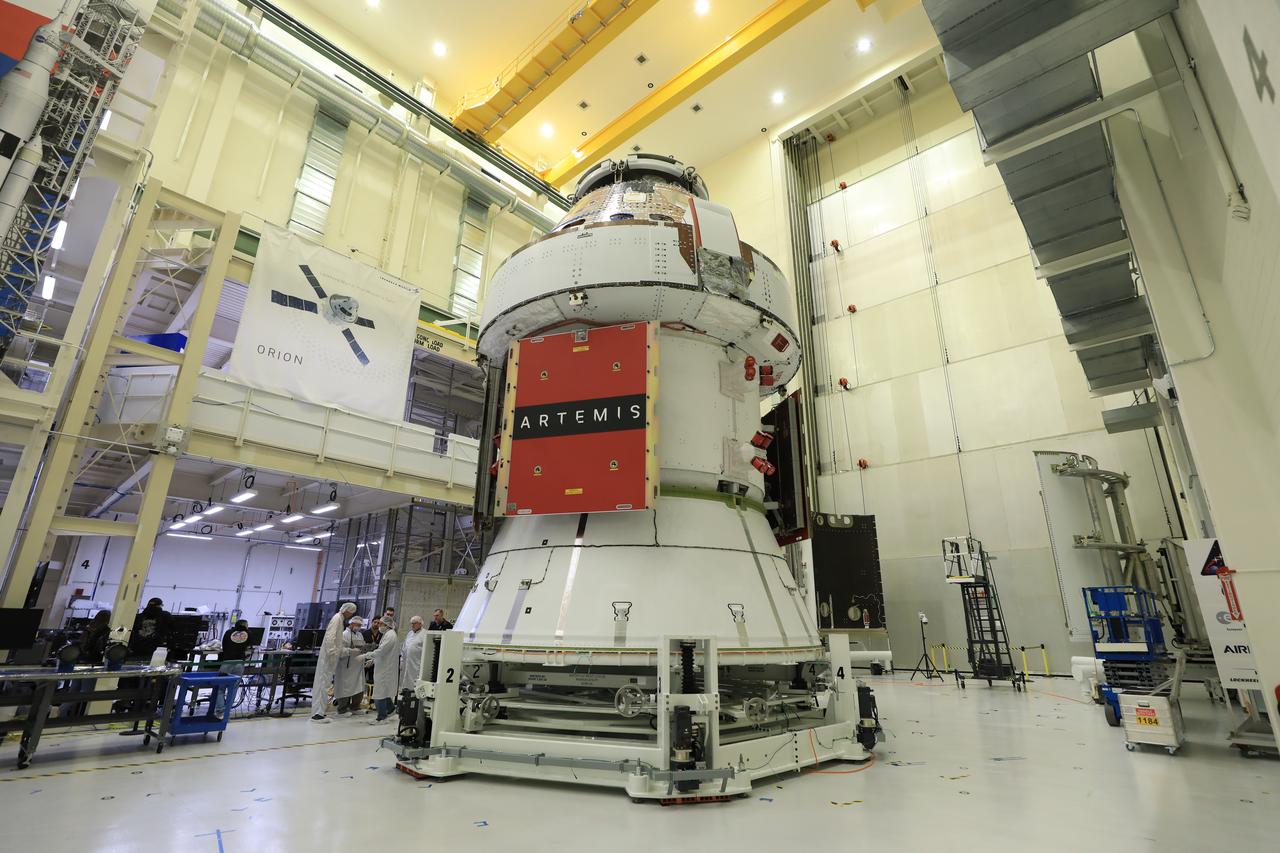
Technicians install four solar array wings on NASA’s Artemis II Orion spacecraft inside the Neil A. Armstrong Operations and Checkout Building at NASA’s Kennedy Space Center in Florida on Monday, March 3, 2025. Each solar array is nearly 23 feet long and can turn on two axes to remain aligned with the Sun for maximum power. Orion’s solar arrays, manufactured and installed by ESA (European Space Agency) and its contractor Airbus, will deliver power to the service module that provides propulsion, thermal control, and electrical power to the spacecraft, as well as air and water for the crew.
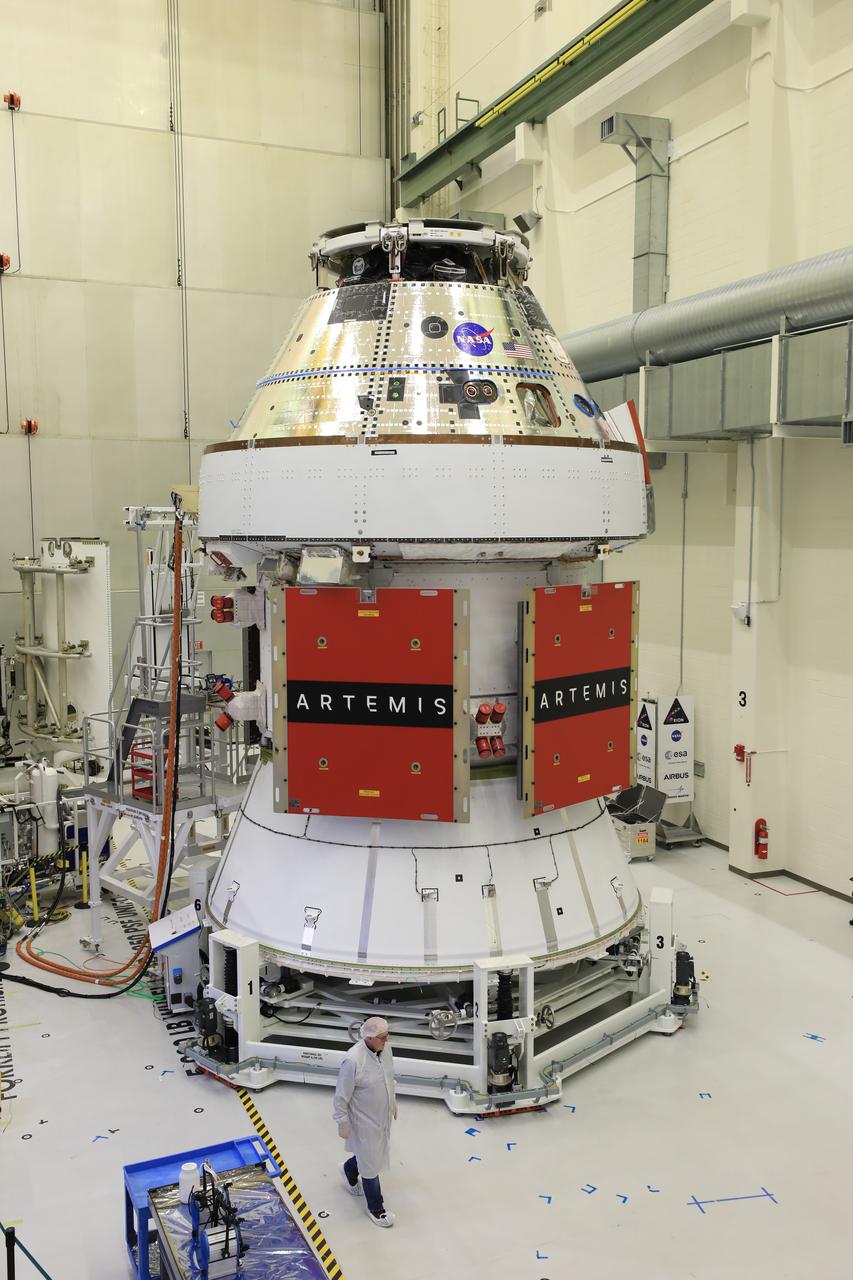
Technicians install four solar array wings on NASA’s Artemis II Orion spacecraft inside the Neil A. Armstrong Operations and Checkout Building at NASA’s Kennedy Space Center in Florida on Monday, March 3, 2025. Each solar array is nearly 23 feet long and can turn on two axes to remain aligned with the Sun for maximum power. Orion’s solar arrays, manufactured and installed by ESA (European Space Agency) and its contractor Airbus, will deliver power to the service module that provides propulsion, thermal control, and electrical power to the spacecraft, as well as air and water for the crew.
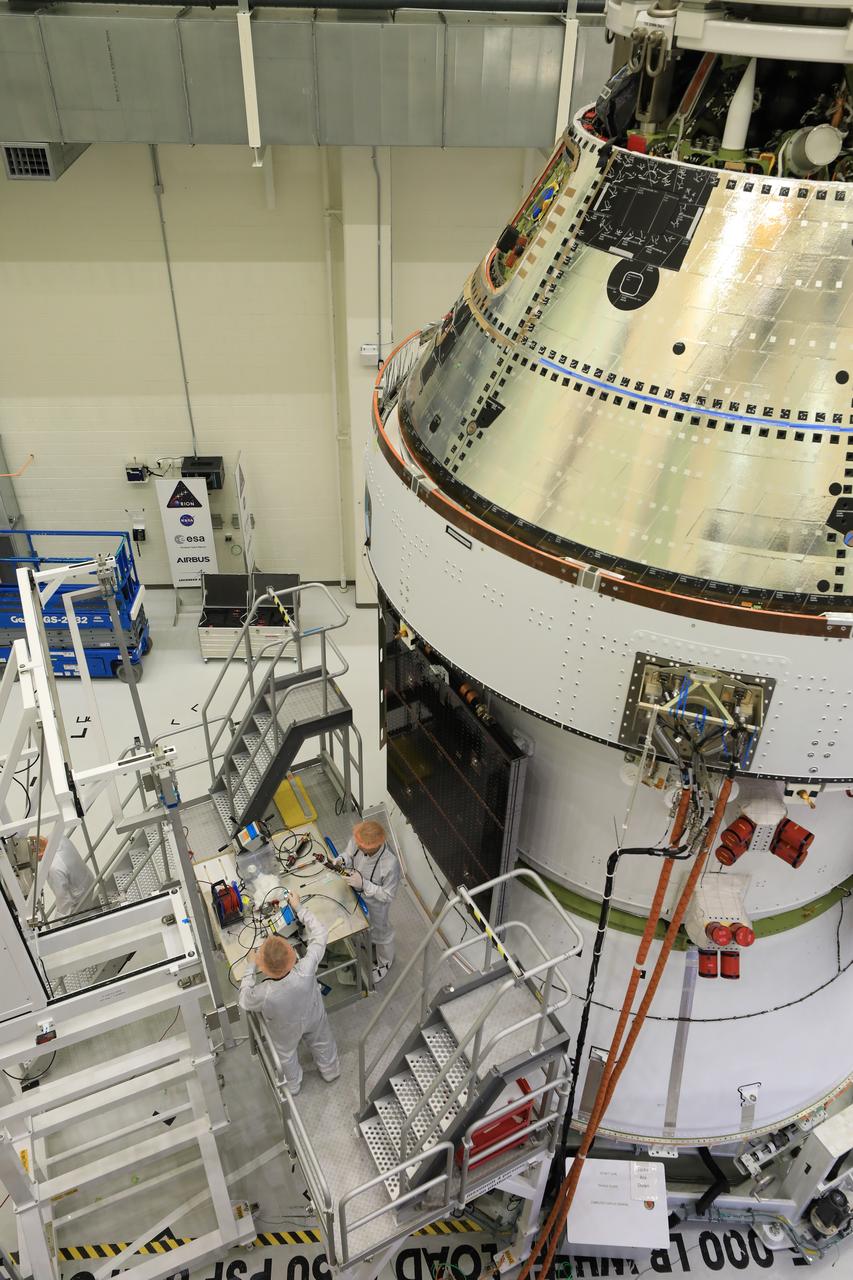
Technicians install four solar array wings on NASA’s Artemis II Orion spacecraft inside the Neil A. Armstrong Operations and Checkout Building at NASA’s Kennedy Space Center in Florida on Monday, March 3, 2025. Each solar array is nearly 23 feet long and can turn on two axes to remain aligned with the Sun for maximum power. Orion’s solar arrays, manufactured and installed by ESA (European Space Agency) and its contractor Airbus, will deliver power to the service module that provides propulsion, thermal control, and electrical power to the spacecraft, as well as air and water for the crew.
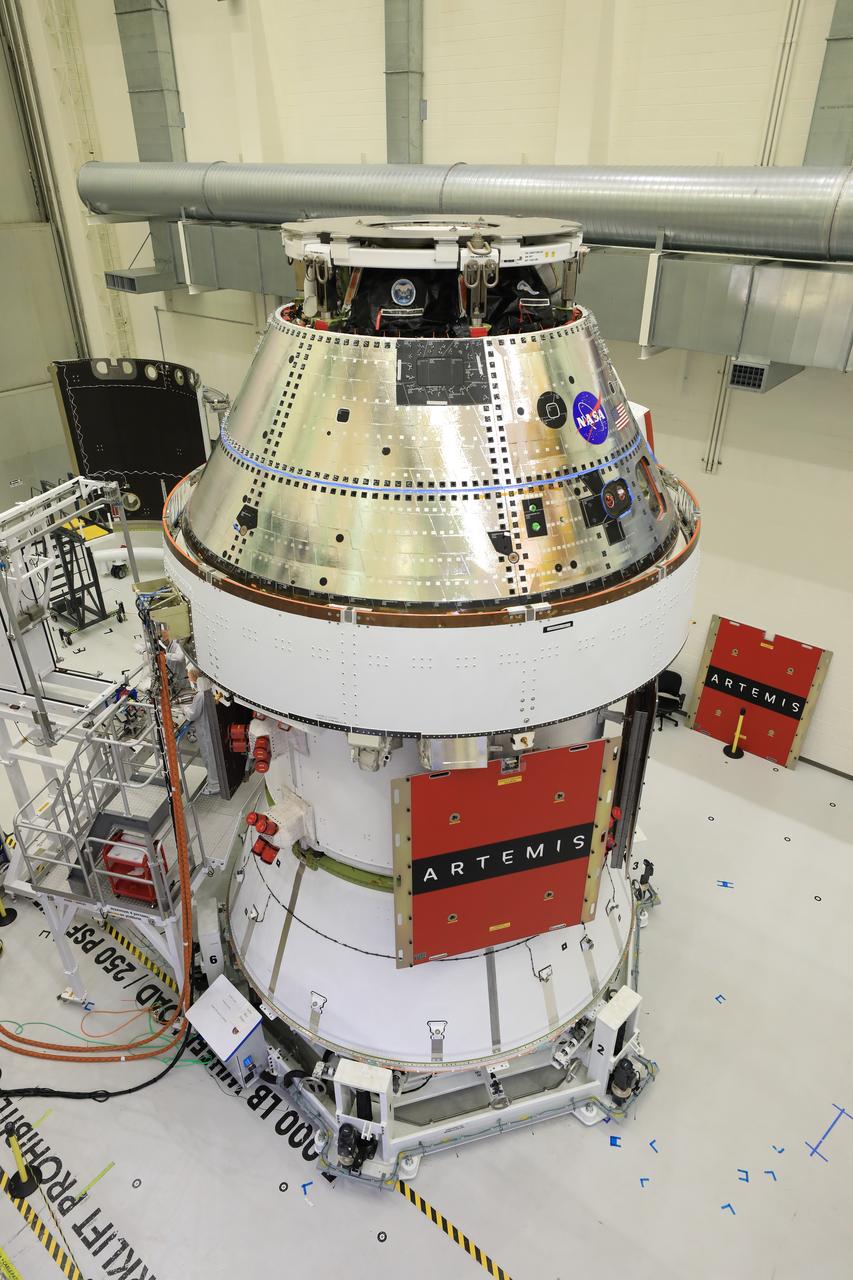
Technicians install four solar array wings on NASA’s Artemis II Orion spacecraft inside the Neil A. Armstrong Operations and Checkout Building at NASA’s Kennedy Space Center in Florida on Monday, March 3, 2025. Each solar array is nearly 23 feet long and can turn on two axes to remain aligned with the Sun for maximum power. Orion’s solar arrays, manufactured and installed by ESA (European Space Agency) and its contractor Airbus, will deliver power to the service module that provides propulsion, thermal control, and electrical power to the spacecraft, as well as air and water for the crew.
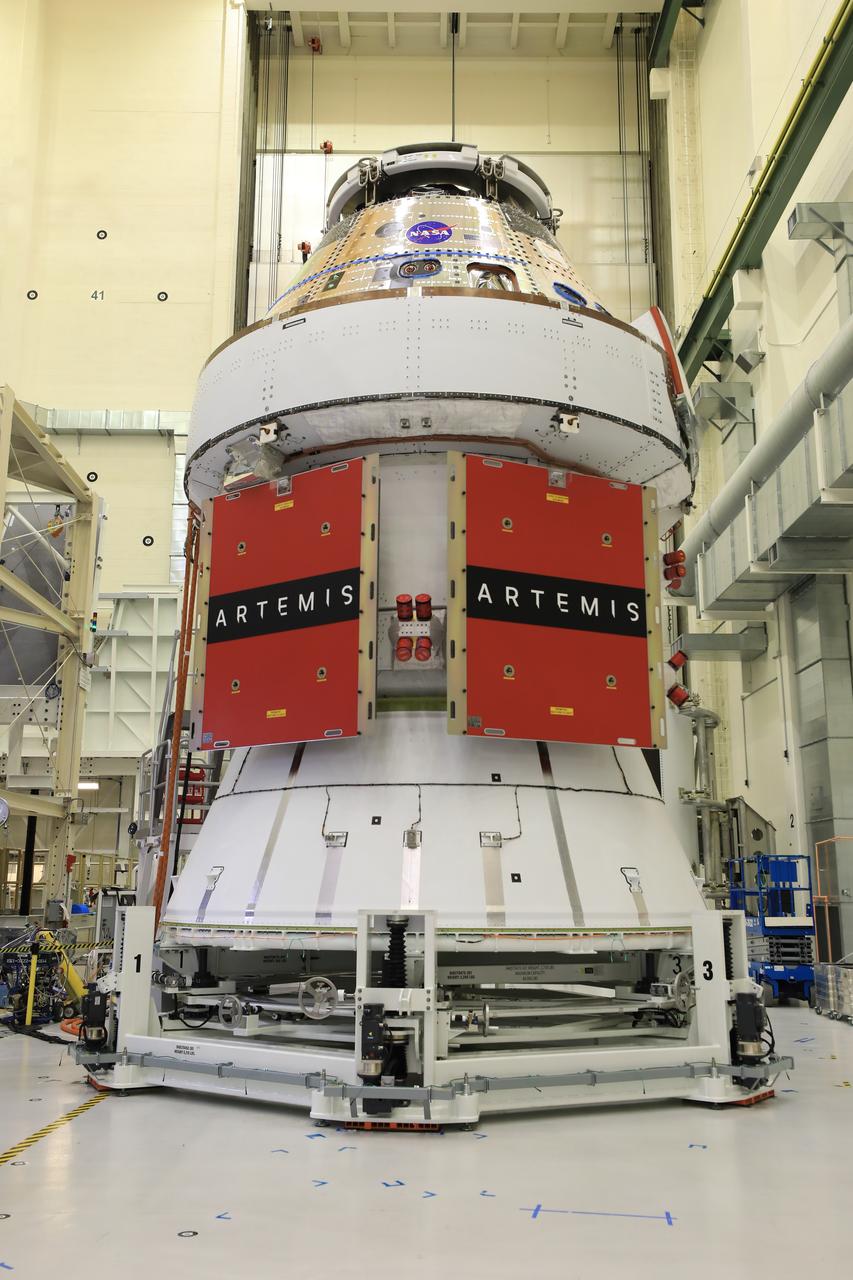
Technicians install four solar array wings on NASA’s Artemis II Orion spacecraft inside the Neil A. Armstrong Operations and Checkout Building at NASA’s Kennedy Space Center in Florida on Monday, March 3, 2025. Each solar array is nearly 23 feet long and can turn on two axes to remain aligned with the Sun for maximum power. Orion’s solar arrays, manufactured and installed by ESA (European Space Agency) and its contractor Airbus, will deliver power to the service module that provides propulsion, thermal control, and electrical power to the spacecraft, as well as air and water for the crew.
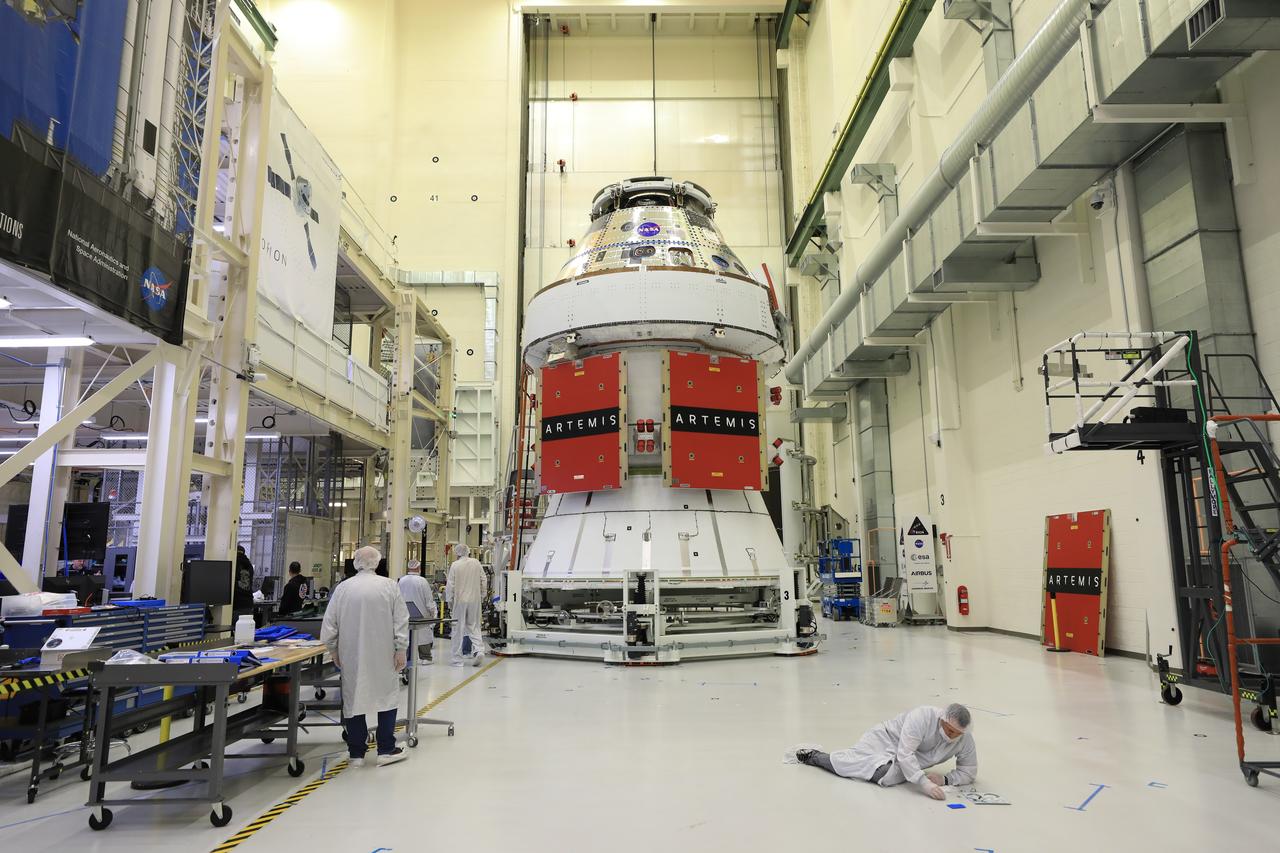
Technicians install four solar array wings on NASA’s Artemis II Orion spacecraft inside the Neil A. Armstrong Operations and Checkout Building at NASA’s Kennedy Space Center in Florida on Monday, March 3, 2025. Each solar array is nearly 23 feet long and can turn on two axes to remain aligned with the Sun for maximum power. Orion’s solar arrays, manufactured and installed by ESA (European Space Agency) and its contractor Airbus, will deliver power to the service module that provides propulsion, thermal control, and electrical power to the spacecraft, as well as air and water for the crew.
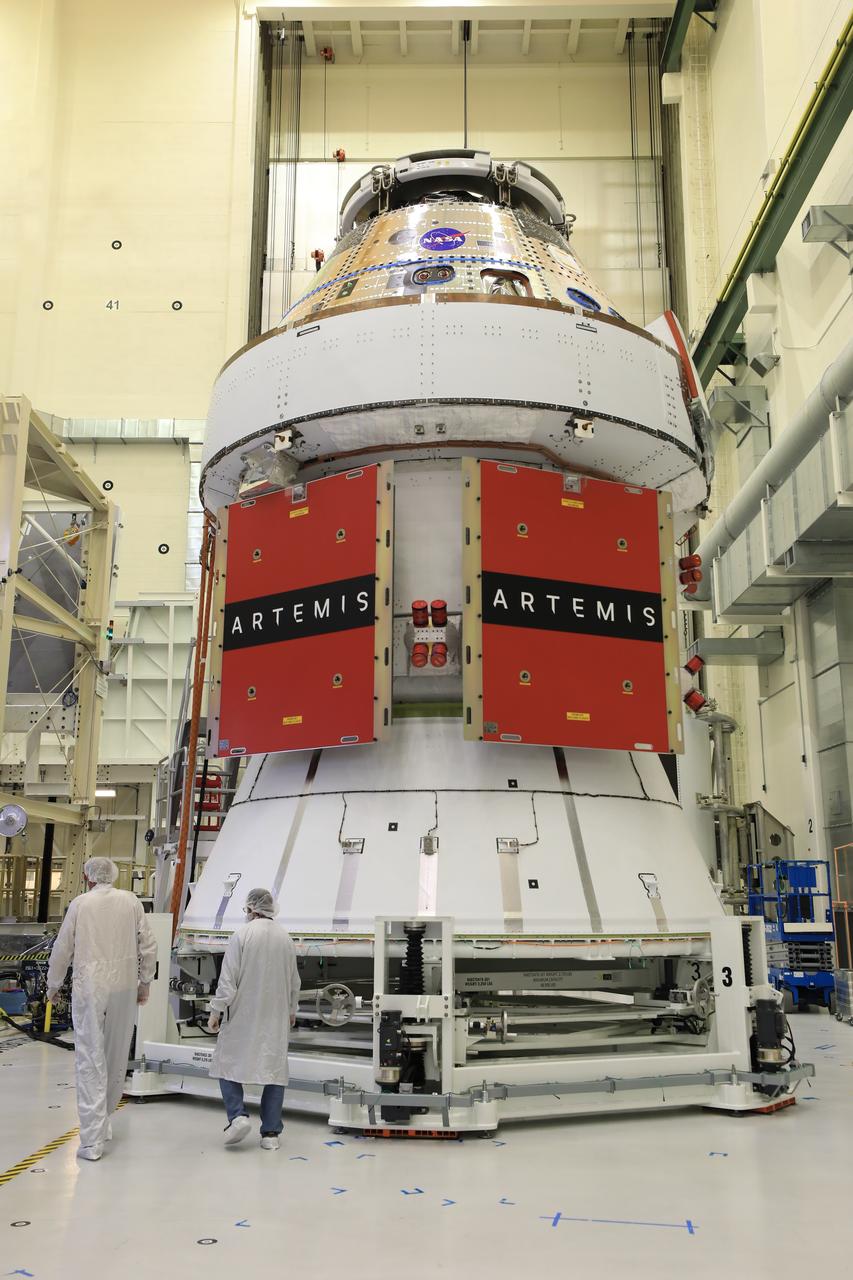
Technicians install four solar array wings on NASA’s Artemis II Orion spacecraft inside the Neil A. Armstrong Operations and Checkout Building at NASA’s Kennedy Space Center in Florida on Monday, March 3, 2025. Each solar array is nearly 23 feet long and can turn on two axes to remain aligned with the Sun for maximum power. Orion’s solar arrays, manufactured and installed by ESA (European Space Agency) and its contractor Airbus, will deliver power to the service module that provides propulsion, thermal control, and electrical power to the spacecraft, as well as air and water for the crew.
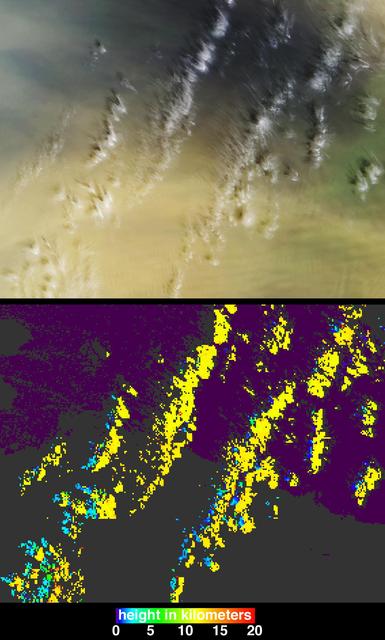
On March 2, 2003, NASA Terra spacecraft saw near-surface winds carrying a large amount of Saharan dust aloft and transported the material westward over the Atlantic Ocean.
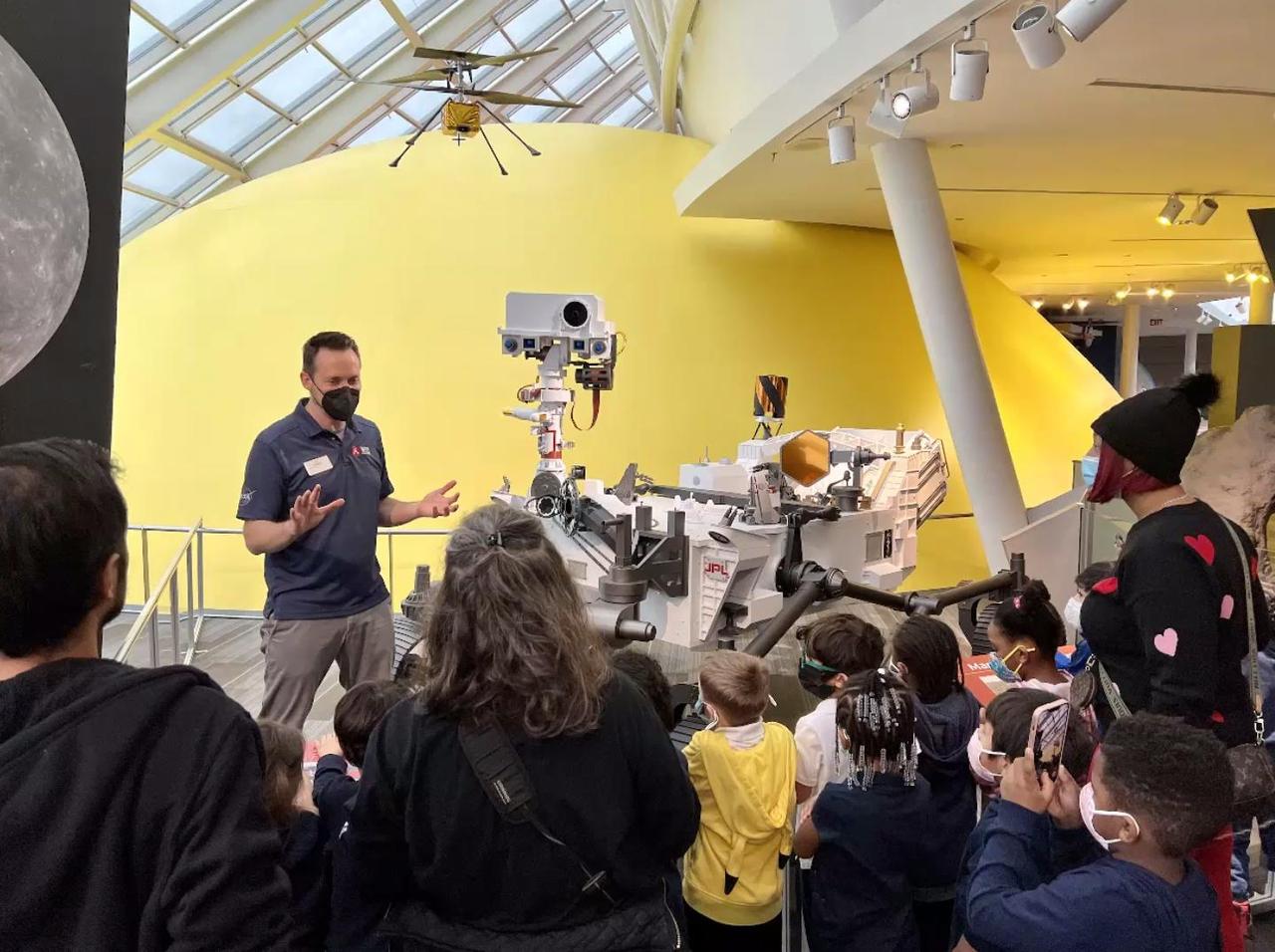
Members of the public met with NASA Mars team members and saw the Perseverance rover and Ingenuity helicopter models up close during a "Roving With Perseverance" tour stop at the Adler Planetarium in Chicago. https://photojournal.jpl.nasa.gov/catalog/PIA25640
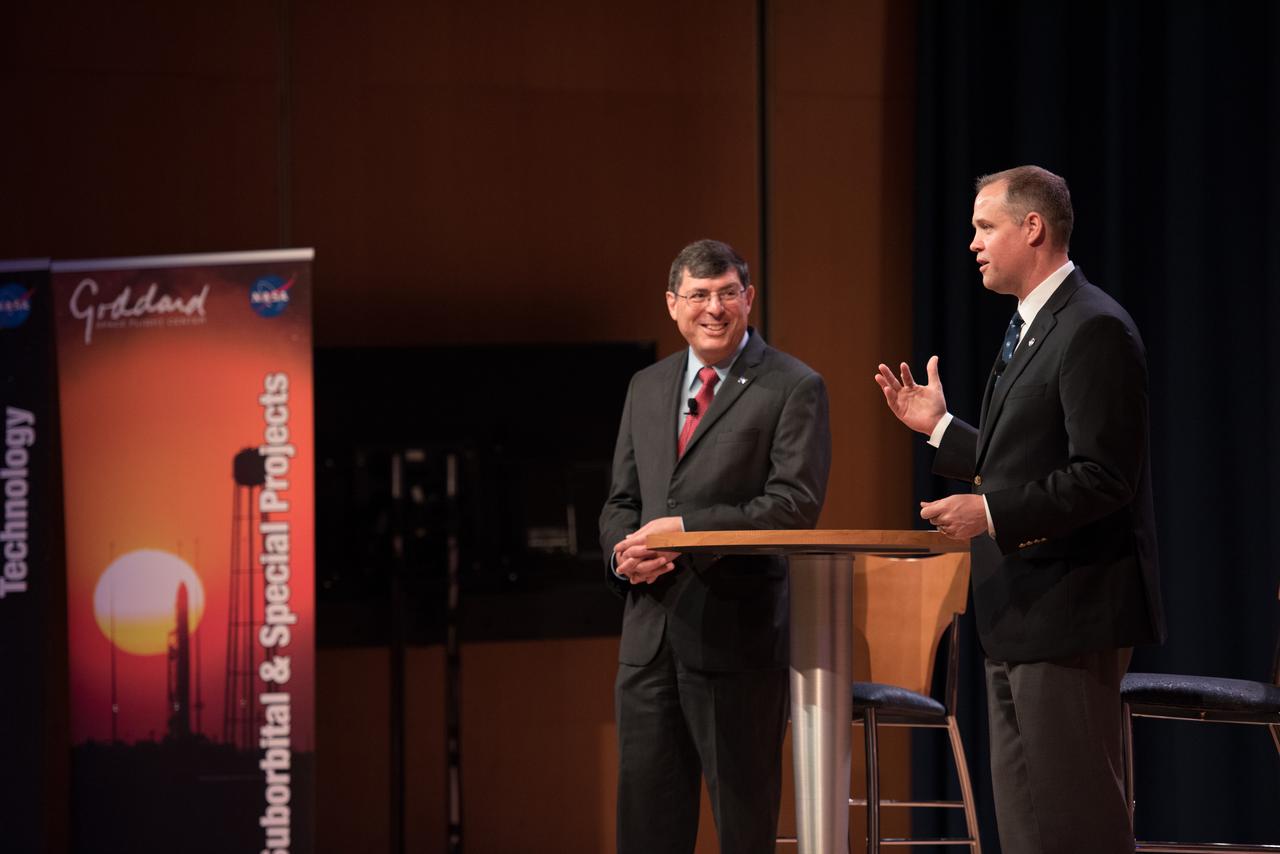
NASA Administrator Jim Bridenstine is greeted by Goddard Space Flight Center Director Chris Scolese as he arrives for his first visit to the NASA field center in Greenbelt, Maryland. During his visit, Bridenenstine met with senior staff, saw Goddard test facilities and mission operation control rooms and held an agency-wide session with students as part of National Intern Day.

NASA Administrator Jim Bridenstine is greeted by Goddard Space Flight Center Director Chris Scolese as he arrives for his first visit to the NASA field center in Greenbelt, Maryland. During his visit, Bridenenstine met with senior staff, saw Goddard test facilities and mission operation control rooms and held an agency-wide session with students as part of National Intern Day.
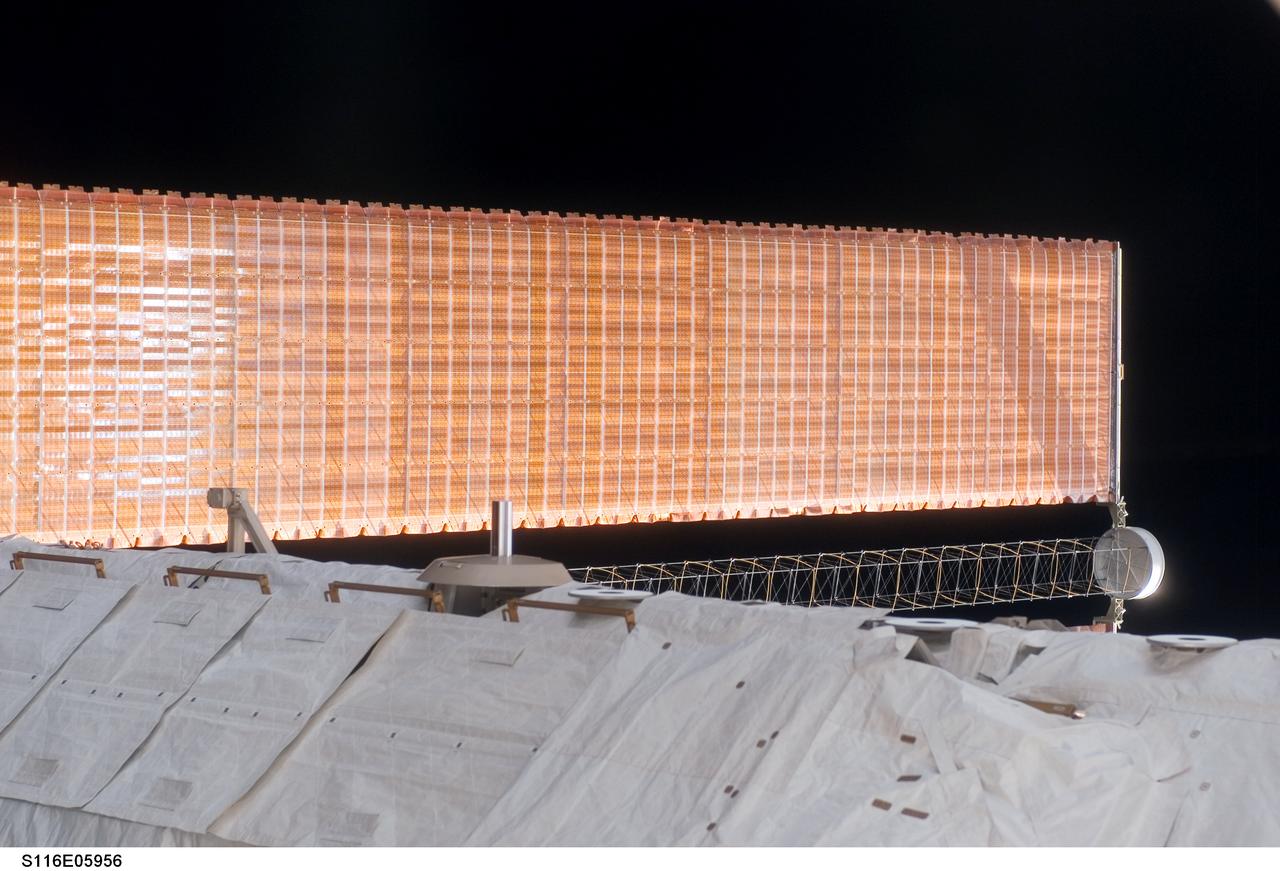
S116-E-05956 (12 Dec. 2006) --- A medium close-up view of a solar array wing panel was photographed by a STS-116 crewmember during the mission's first of three planned sessions of extravehicular activity (EVA) as construction resumes on the International Space Station.
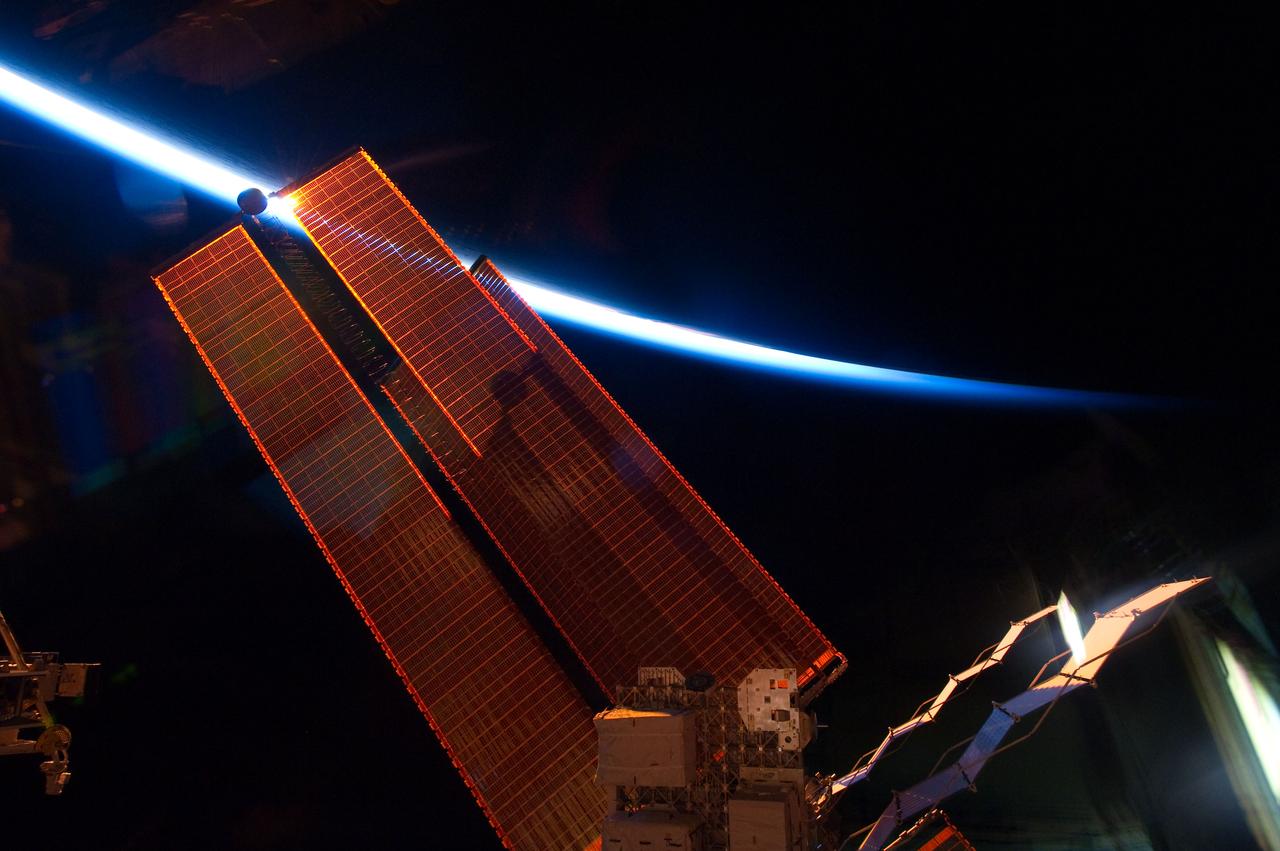
S134-E-007756 (20 May 2011) --- Intersecting the thin line of Earth’s atmosphere, International Space Station solar array wings are featured in this image photographed by an STS-134 crew member while space shuttle Endeavour remains docked with the station. Photo credit: NASA

This dramatic view of the Pluto system is as NASA's New Horizons spacecraft saw it in July 2015. The animation, made with real images taken by New Horizons, begins with Pluto flying in for its close-up on July 14; we then pass behind Pluto and see the atmosphere glow in sunlight before the sun passes behind Pluto's largest moon, Charon. The movie ends with New Horizons' departure, looking back on each body as thin crescents. http://photojournal.jpl.nasa.gov/catalog/PIA19873
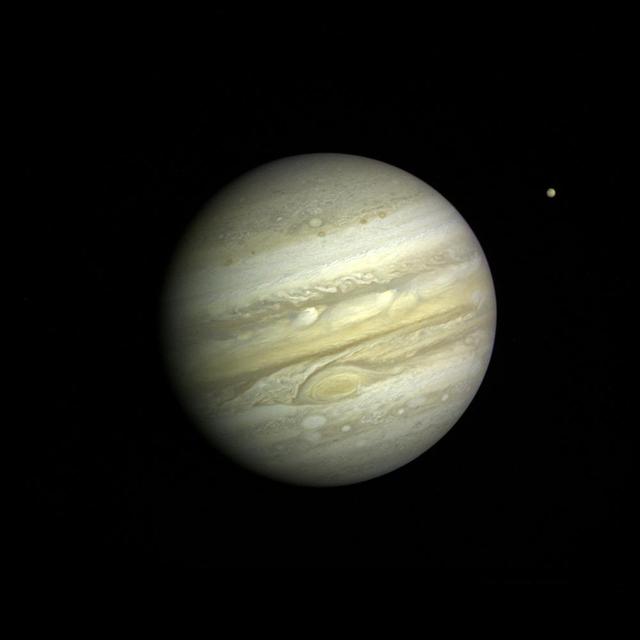
NASA Voyager 1 took this photo of Jupiter Feb. 1, 1979. Voyager scientists saw that different colors in clouds around the Great Red Spot imply that the clouds swirl around the spot at varying altitudes. http://photojournal.jpl.nasa.gov/catalog/PIA00235
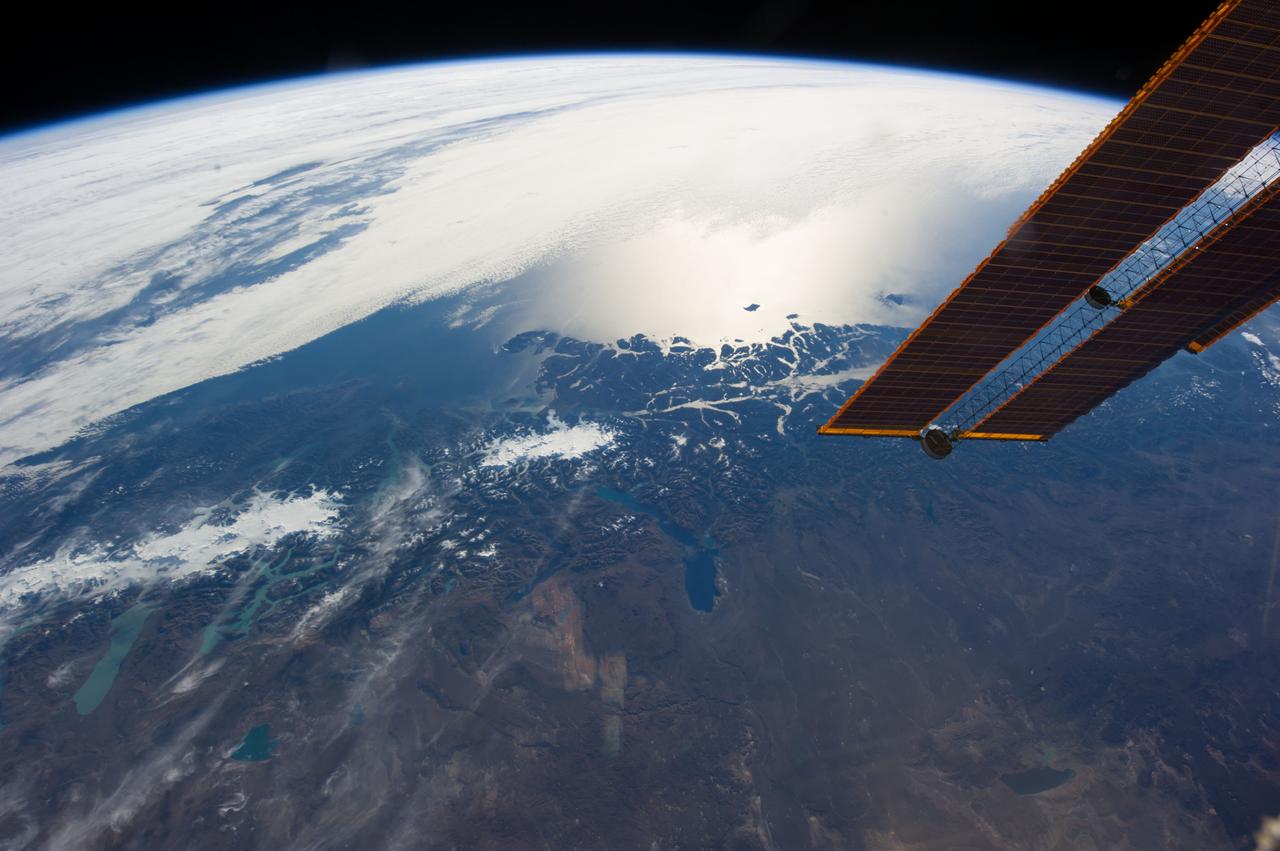
Earth observation taken by the Expedition 35 crew aboard the ISS. Portions of ISS solar array wings (SAWs) are in view.
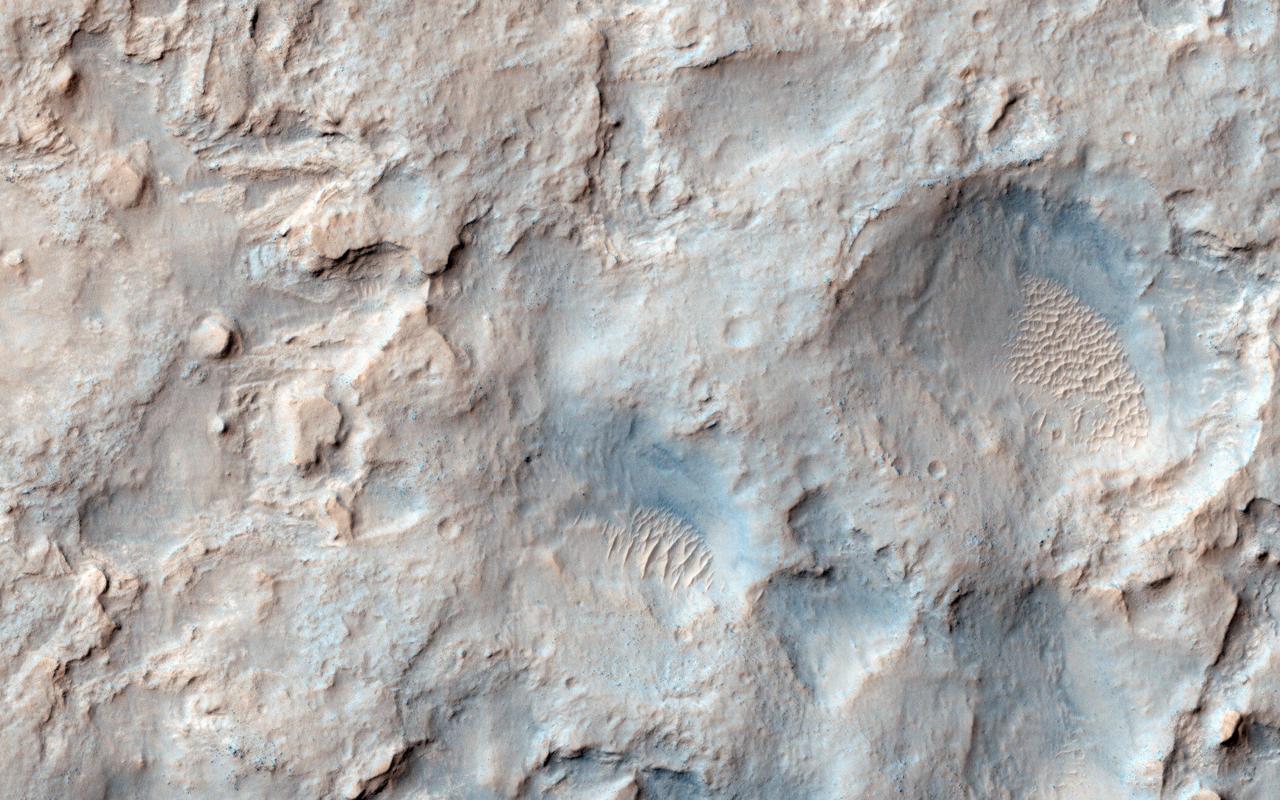
NASA Mars Reconnaissance Orbiter saw the saddle between two valleys named Dingo Gap-in Gale Crater-where the rover Curiosity just traversed. The gap is spanned by a single dune visible both from the ground and from orbit.
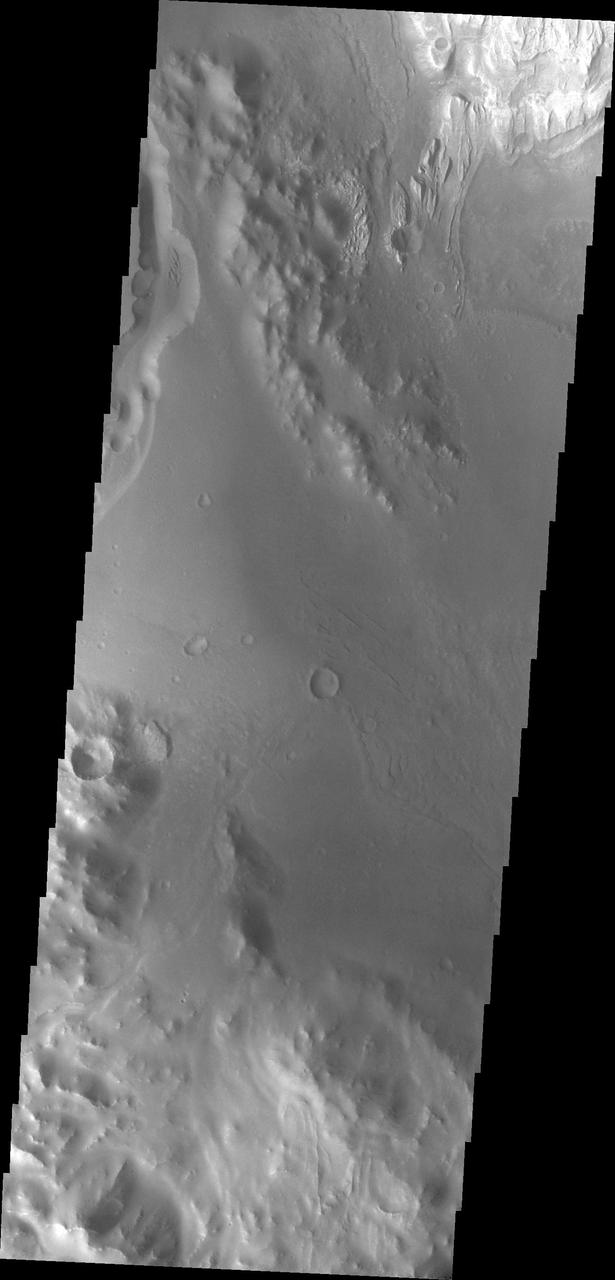
Backtracking a bit, this image from NASA Mars Odyssey spacecraft shows the large channel in the upper left of the frame. Just below the brighter material of Mt. Sharp is the start of the arced edge of material we saw in yesterday image top right.
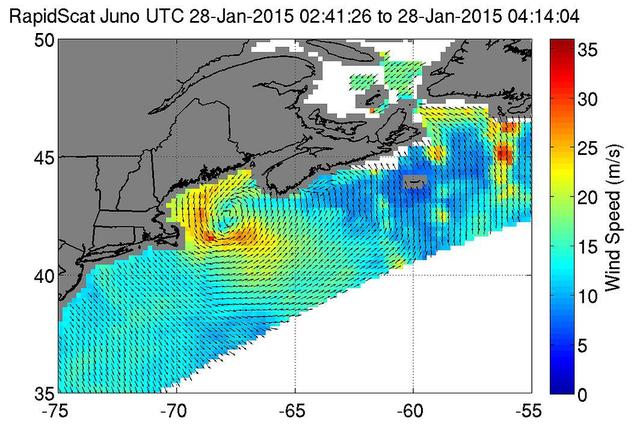
On Jan. 28, 2015 from 2:41 to 4:14 UTC, NASA ISS-RapidScat saw the noreaster strongest sustained winds red between 56 and 67 mph 25 to 30 mps/90 to 108 kph just off-shore from eastern Cape Cod.
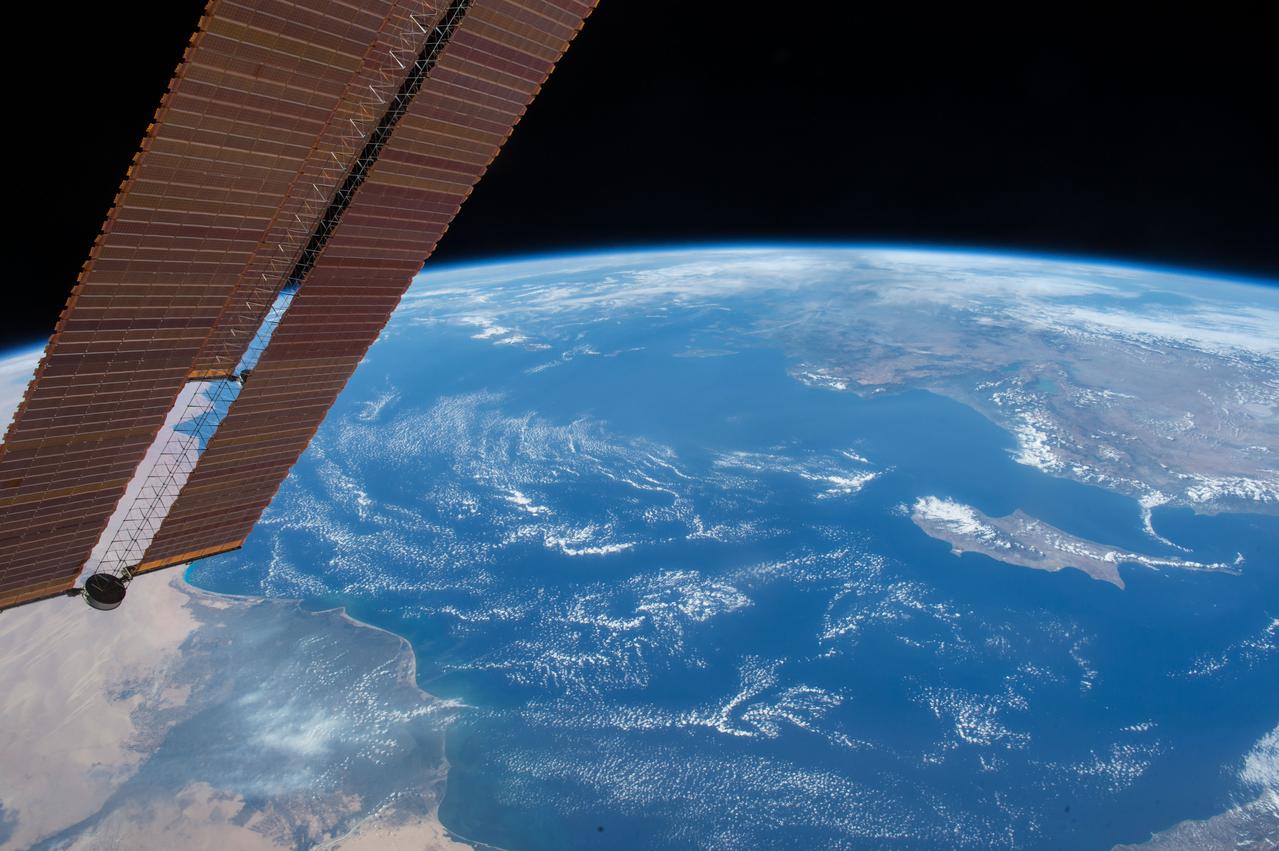
Earth observation (Mediterranean Sea) taken by the Expedition 45 crew. ISS solar array wings (SAWs) are in view. Image was released by astronaut on social media.
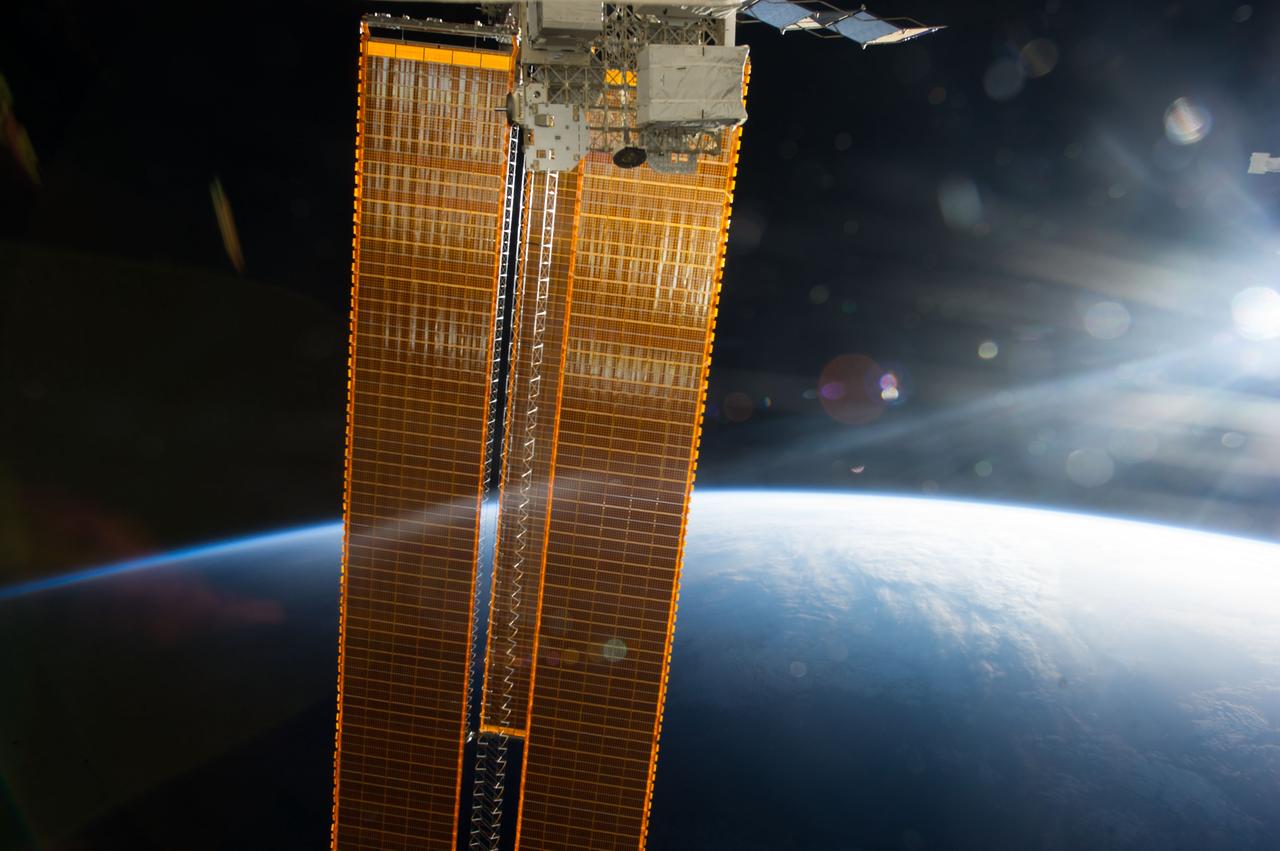
Earth observation taken by the Expedition 35 crew aboard the ISS. The terminator, glare from the rising Sun, and solar array wings (SAWs) are in view.
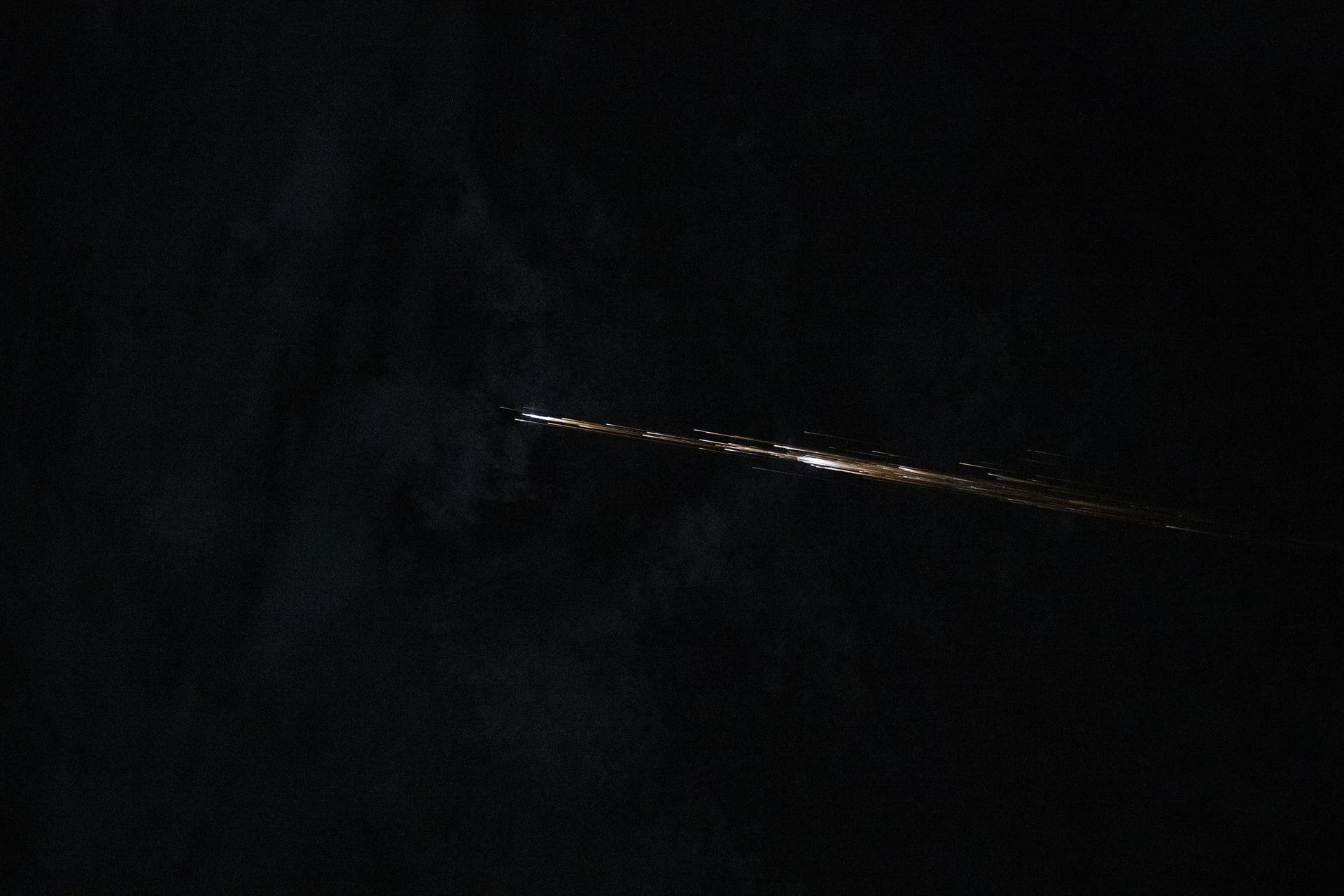
iss074e0540224 (April 27, 2026) --- A piece of unidentified space debris is pictured from the International Space Station as it reenters Earth's atmosphere and burns up over Africa. NASA astronaut Chris Williams captured the remarkable event and shared the imagery on his Instagram page @astro_chrisw. "On April 27th at about 10:40 PM GMT, I was in the @iss Cupola and saw something really neat. I was scanning the sky to try to catch a glimpse of the approaching Progress MS-34 vehicle bringing new supplies. Just as we were passing over West Africa, I saw a bright object directly below us, streaking through the upper atmosphere. I saw its tail grow and then split apart into a shower of smaller pieces. I think it must have been some piece of orbital debris or a satellite breaking up as it entered the atmosphere. It was quite a light show!" Credit: NASA/Chris Williams
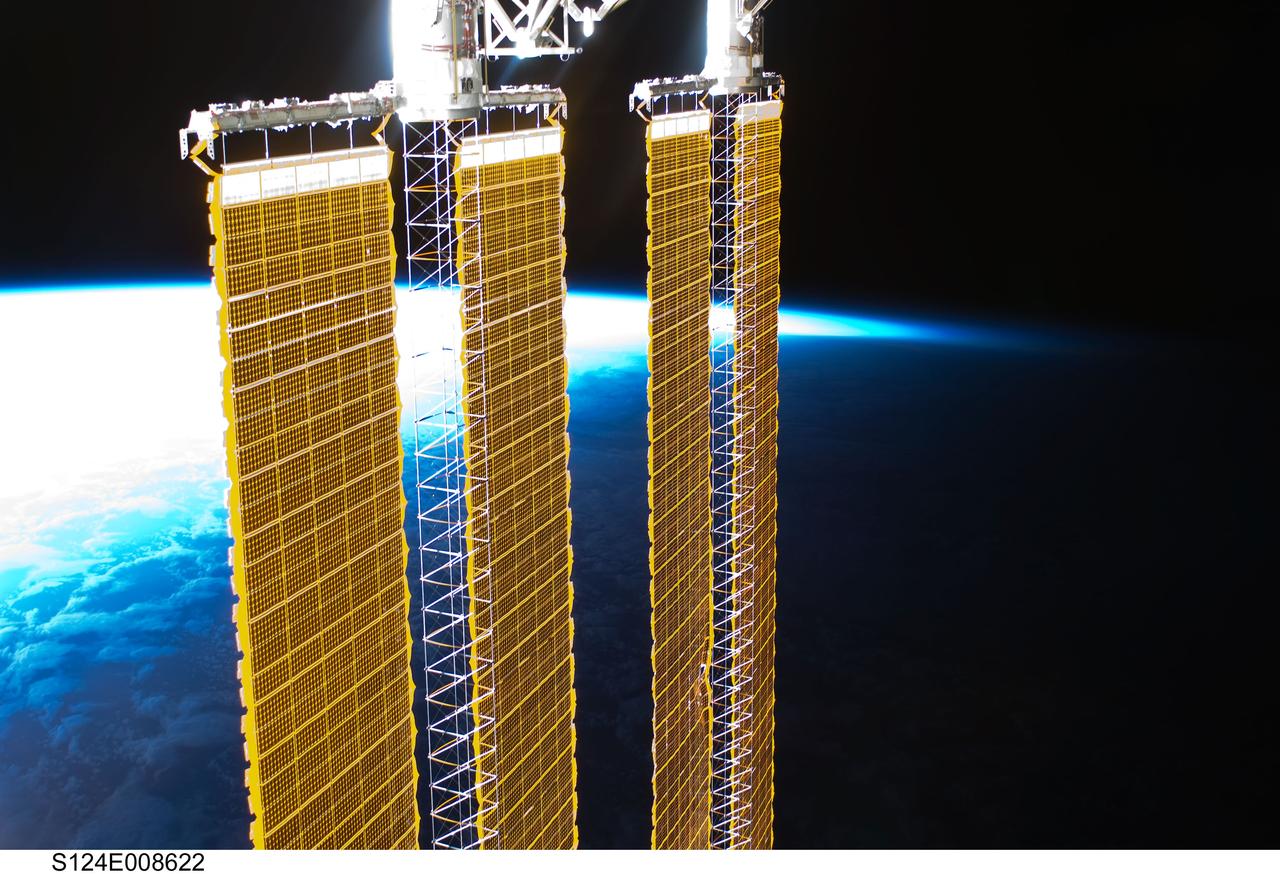
S124-E-008622 (10 June 2008) --- A partial view of International Space Station solar panels and Earth's horizon are photographed by a STS-124 crewmember on the International Space Station while Space Shuttle Discovery is docked with the station.
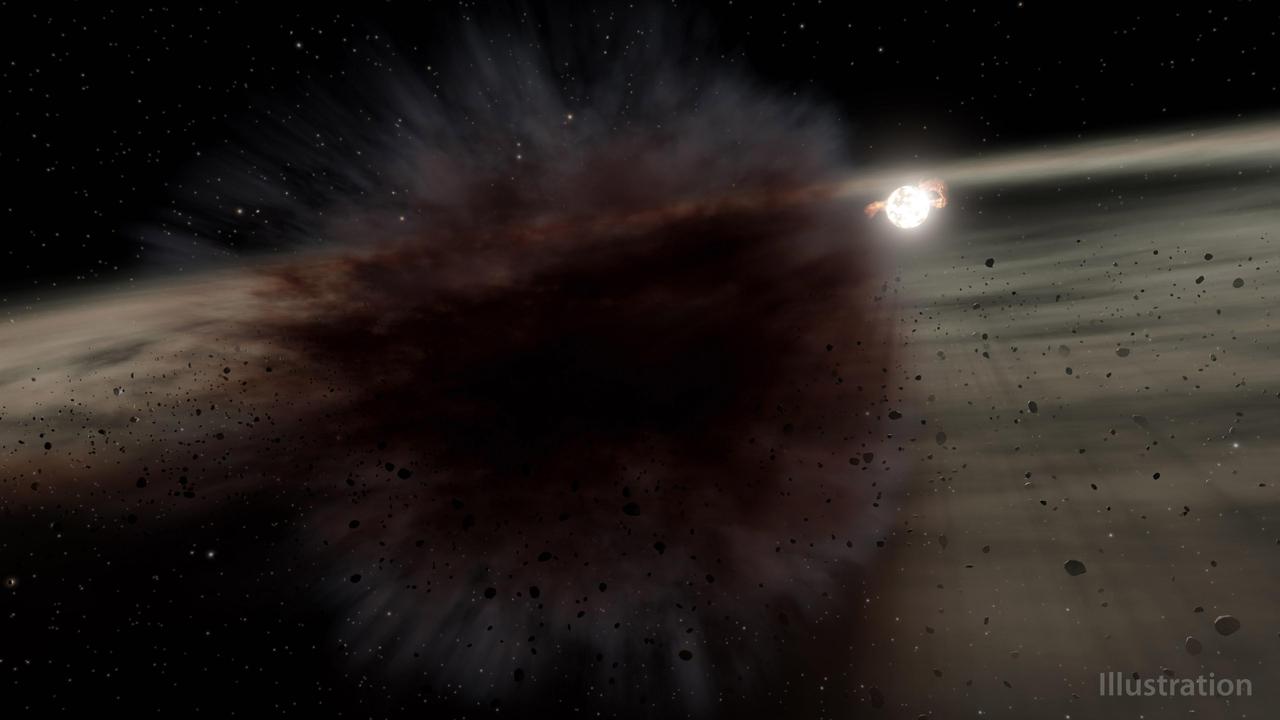
This illustration shows what a debris cloud around the young star called HD 166191 might look like up close. Astronomers using NASA's now-retired Spitzer Space Telescope saw a debris cloud briefly block the light from that star. The cloud was likely created by a smashup between two large asteroid-sized objects that might be the seeds of future planets around the star. HD 166191 is about 10 million years old. Around this time in a star's life, dust left over from its formation has clumped together to form rocky bodies called planetesimals. Asteroids are leftover planetesimals from the formation of our own solar system. Around other stars, these objects can be the seeds of future planets. Catastrophic collisions between them become common once the gas that previously filled the space between the objects disperses. Spitzer has previously found evidence of these collisions around young stars where rocky planets are forming. Kate Su of the University of Arizona led the team that saw the debris cloud transit around HD 166191 – the first transit of its kind ever found. Anticipating they might see evidence of one of these collisions around the star, the team ultimately used Spitzer to conduct more than 100 observations of the system between 2015 and 2019. While the objects are too small and distant to resolve by telescope, their smashups produce large amounts of dust that is detectable. Infrared light, which Spitzer detected, is an ideal range for detecting dust, including the debris created by protoplanet collisions. In mid-2018, the space telescope saw the HD 166191 system become significantly brighter, suggesting an increase in debris production. During that time, Spitzer also detected a debris cloud blocking the star. Combining Spitzer's observation of the transit with observations by telescopes on the ground, the team could deduce the size and shape of the debris cloud. Their work suggests the cloud was highly elongated, with a minimum estimated area three times that of the star. However, the amount of infrared brightening Spitzer saw suggests only a small portion of the cloud passed in front of the star, and that the debris from this event covered an area hundreds of times that of the star. To produce a cloud that big, the objects in the main collision must have been the size of dwarf planets, like Vesta in our solar system – an asteroid 330 miles (530 kilometers) wide in the main asteroid belt between Mars and Jupiter. By 2019, the cloud that passed in front of HD 166191 was no longer visible, but the system contained twice as much dust as it had before Spitzer spotted the cloud. https://photojournal.jpl.nasa.gov/catalog/PIA25161
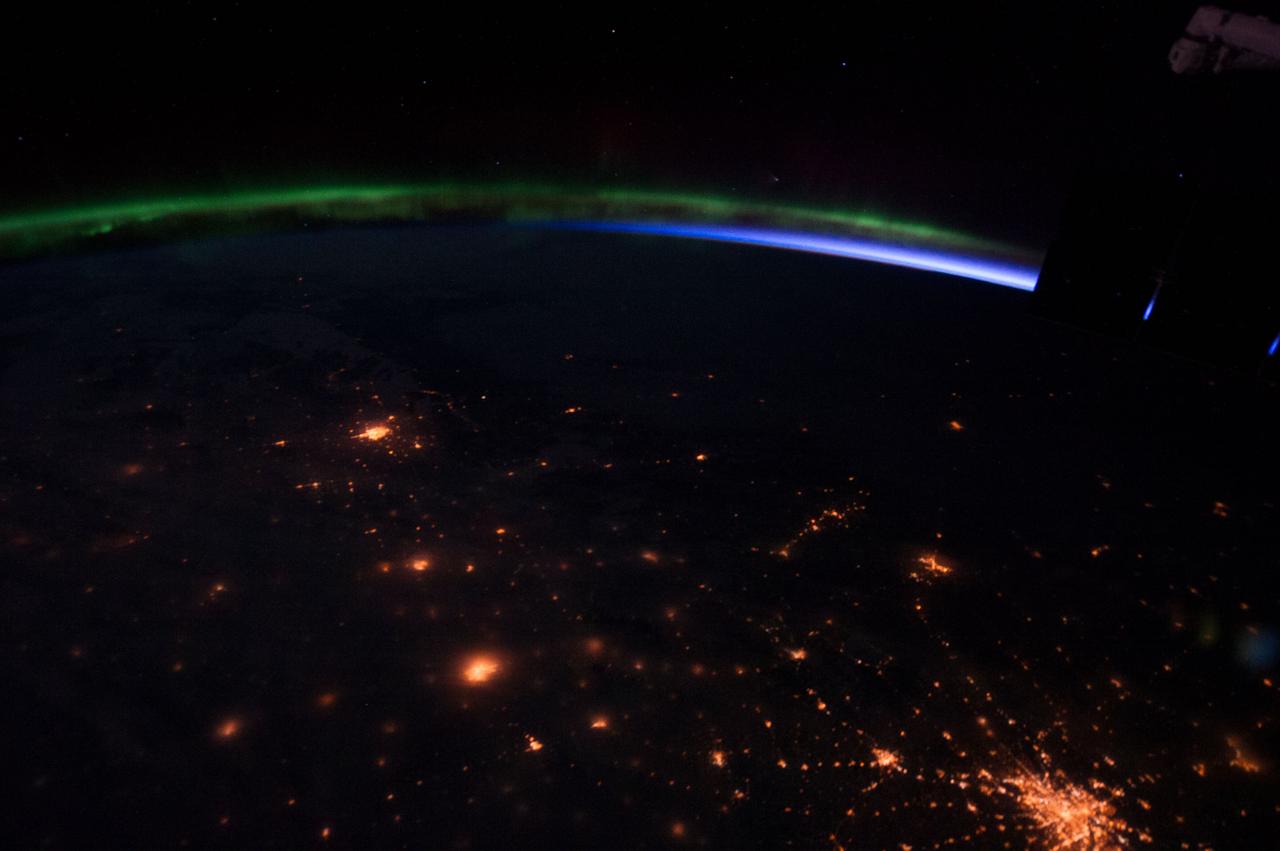
Earth observation taken by the Expedition 35 crew aboard the ISS. View of Aurora Borealis, an orbital sunrise and city lights at night. Portions of ISS solar array wings (SAWs) are in view.
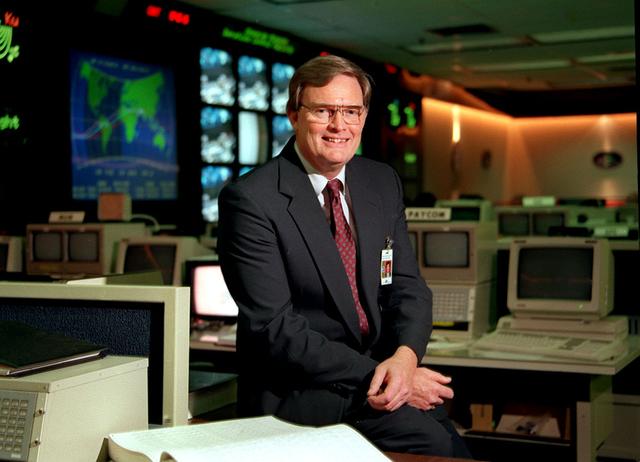
Marshall's sixth Center Director Thomas J. Lee (1989-1994) touring the Payload Operations Control Center (POCC). The Hubble Space Telescope (HST) saw its launch into orbit under the leadership of Dr. Lee's administration.
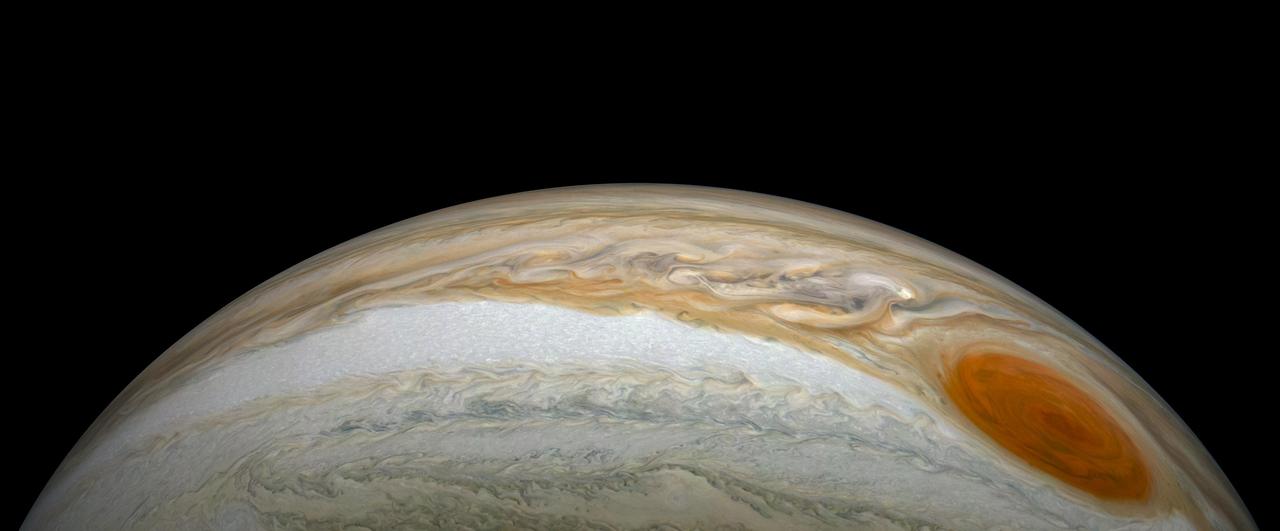
NASA's Juno spacecraft saw this striking vista during its most recent close flyby of Jupiter. This view highlights the contrast between the colorful South Equatorial Belt and the mostly white Southern Tropical Zone, a latitude that also features Jupiter's most famous phenomenon, the persistent, anticyclonic storm known as the Great Red Spot. Citizen scientist Kevin M. Gill created this image using data from the spacecraft's JunoCam imager. The raw image was taken on July 20, 2019, at 9:37 p.m. PDT (July 21, 2019, at 12:37 a.m. EDT) as the Juno spacecraft performed its 21st close flyby of Jupiter. At the time the image was taken, the spacecraft was 26,697 miles (42,965 kilometers) from the tops of the clouds, above a latitude of 46 degrees south. Enhanced image by Kevin M. Gill (CC-BY) based on images provided courtesy of NASA/JPL-Caltech/SwRI/MSSS.
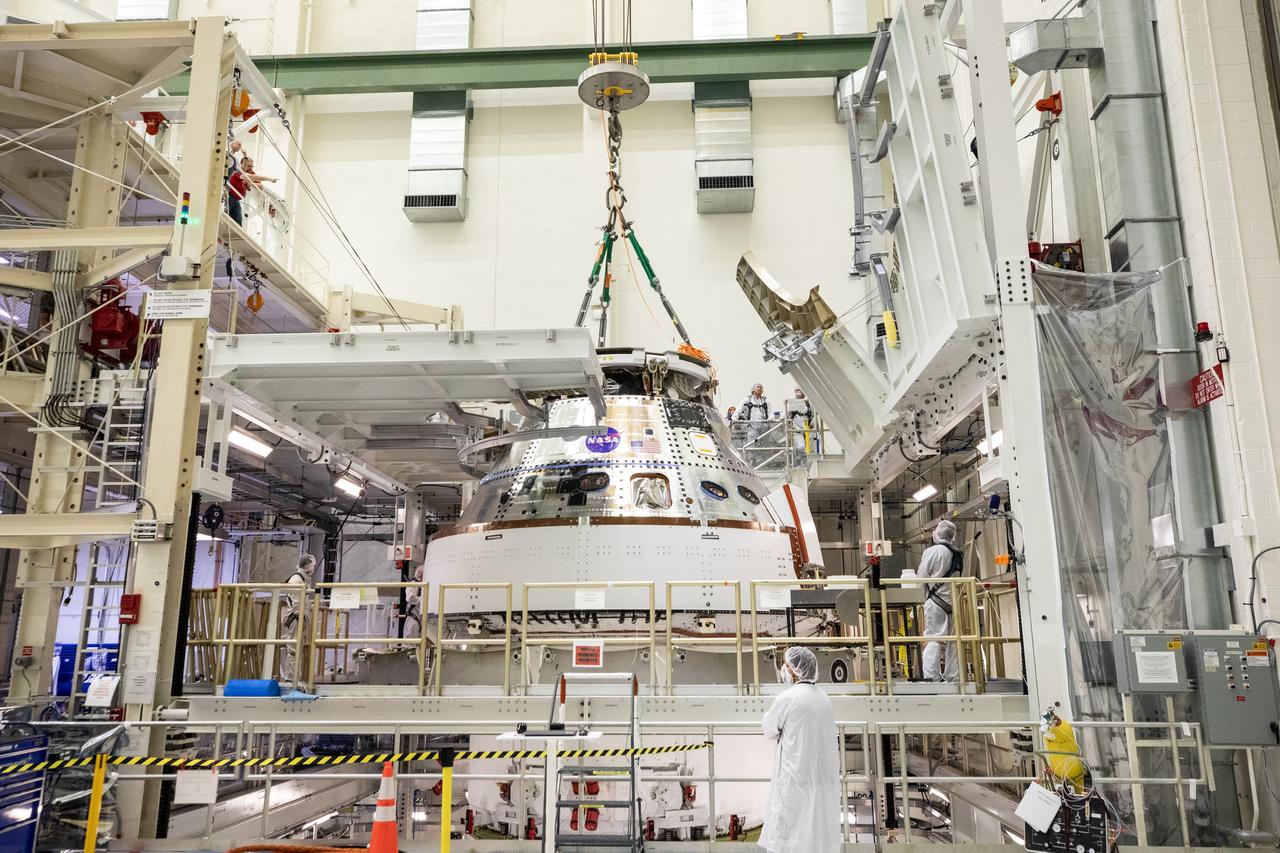
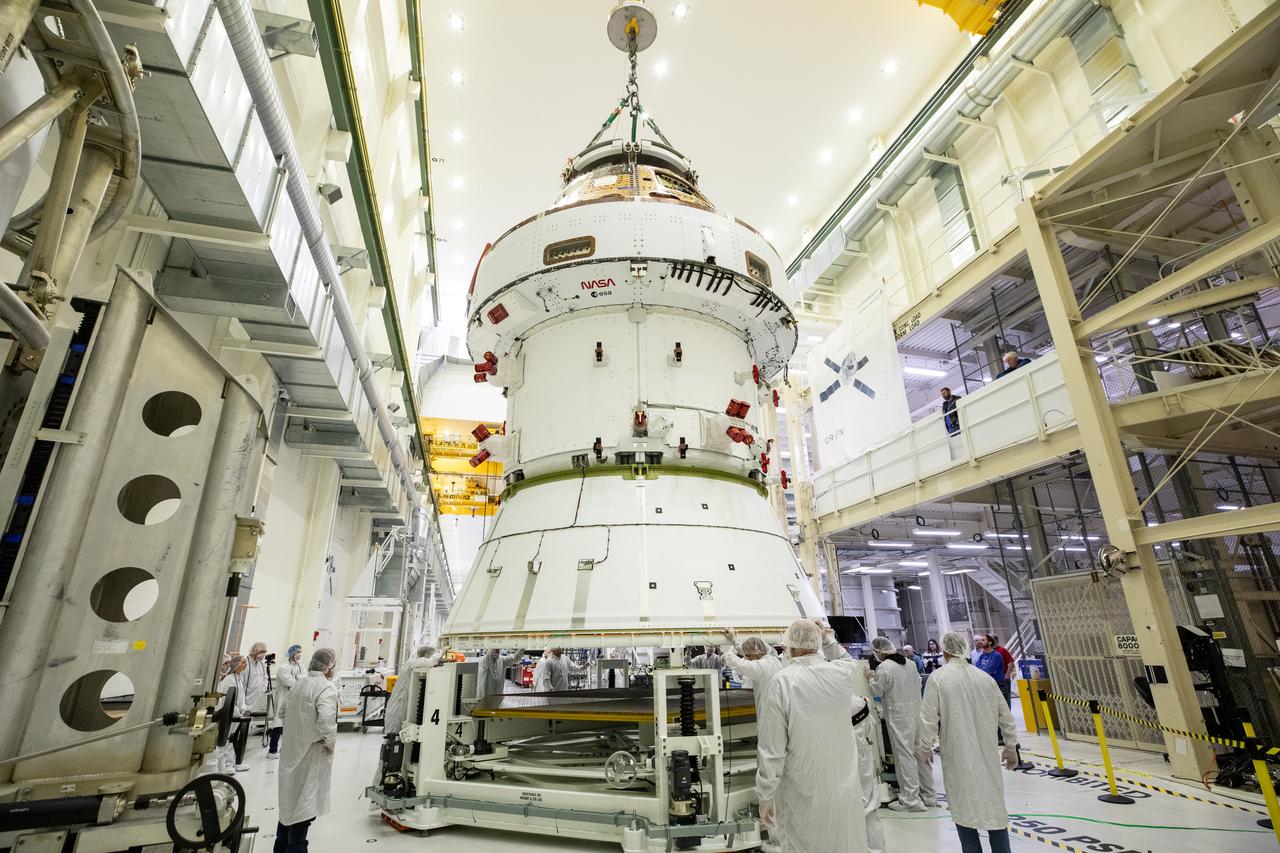
Technicians with NASA and Lockheed Martin operate a 30-ton crane to move NASA’s Artemis II Orion spacecraft out of the Final Assembly and System Testing cell inside the Neil A. Operations and Checkout Building at NASA’s Kennedy Space Center in Florida on Saturday, Feb. 22, 2025. The move prepares for the upcoming installation of four solar array wings and spacecraft adapter jettison fairings for the agency’s first crewed flight test under the Artemis campaign.

Millions of excited people in the U.S. traveled many miles see a total eclipse, and what a show it was. The SDO spacecraft was not so fortunate: its orbit only allowed it to observe a partial eclipse that at its peak covered only about 14 per cent of the sun (Aug. 21, 2017). Most of the people in the U.S. (weather permitting) observed at least 60 per cent coverage of the sun by the Moon. The good news for SDO is that it gets to see partial and solar eclipses several times a year. So, it all kind of balances out, in a way. An animation is available at https://photojournal.jpl.nasa.gov/catalog/PIA21929
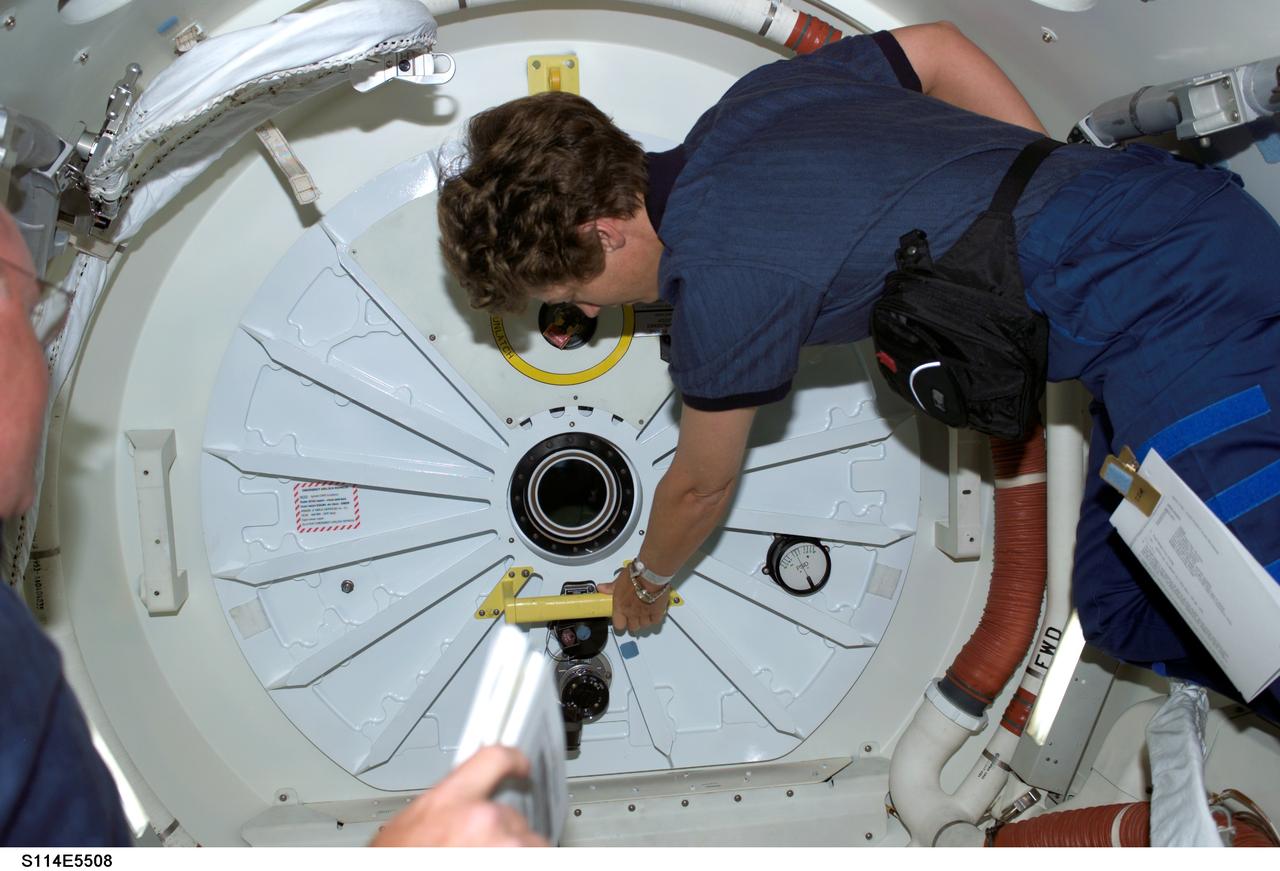
S114-E-5508 (28 July 2005) --- Astronaut Eileen M. Collins, STS-114 commander, prepares to open the hatch that will lead her and the entire Discovery crew into the International Space Station. This was just one highlight of a very busy day that earlier saw the flawless rendezvous and docking operations between the shuttle and the orbital outpost.
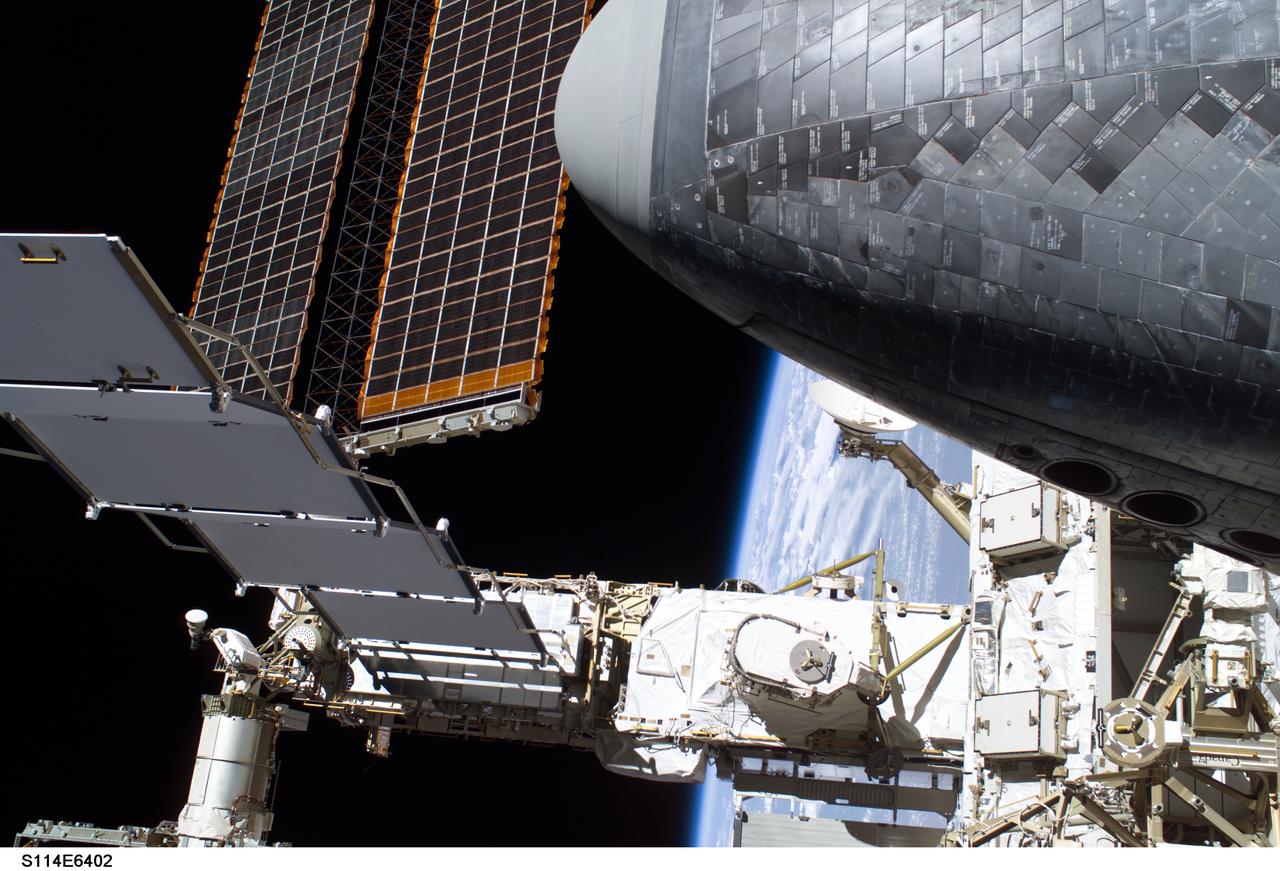
Photograph documenting the P6 Truss Solar Array Wing (SAW), Mast Canisters, Photovoltaic (PV) Radiator and Solar Array Blanket Boxes (SABB) as seen by the STS-114 crew during the third of three Extravehicular Activities (EVAs) of the mission. Part of the orbiter Discovery's nosecone is visible in the upper right of the frame.

CAPE CANAVERAl, Fla. - Dr. Mason Peck, NASA's chief Technologist, saw some plant experiments during a tour of the Space Life Sciences Laboratory at Kennedy. Peck toured the lab facility during a visit to the space center. Photo credit: NASA/Frankie Martin
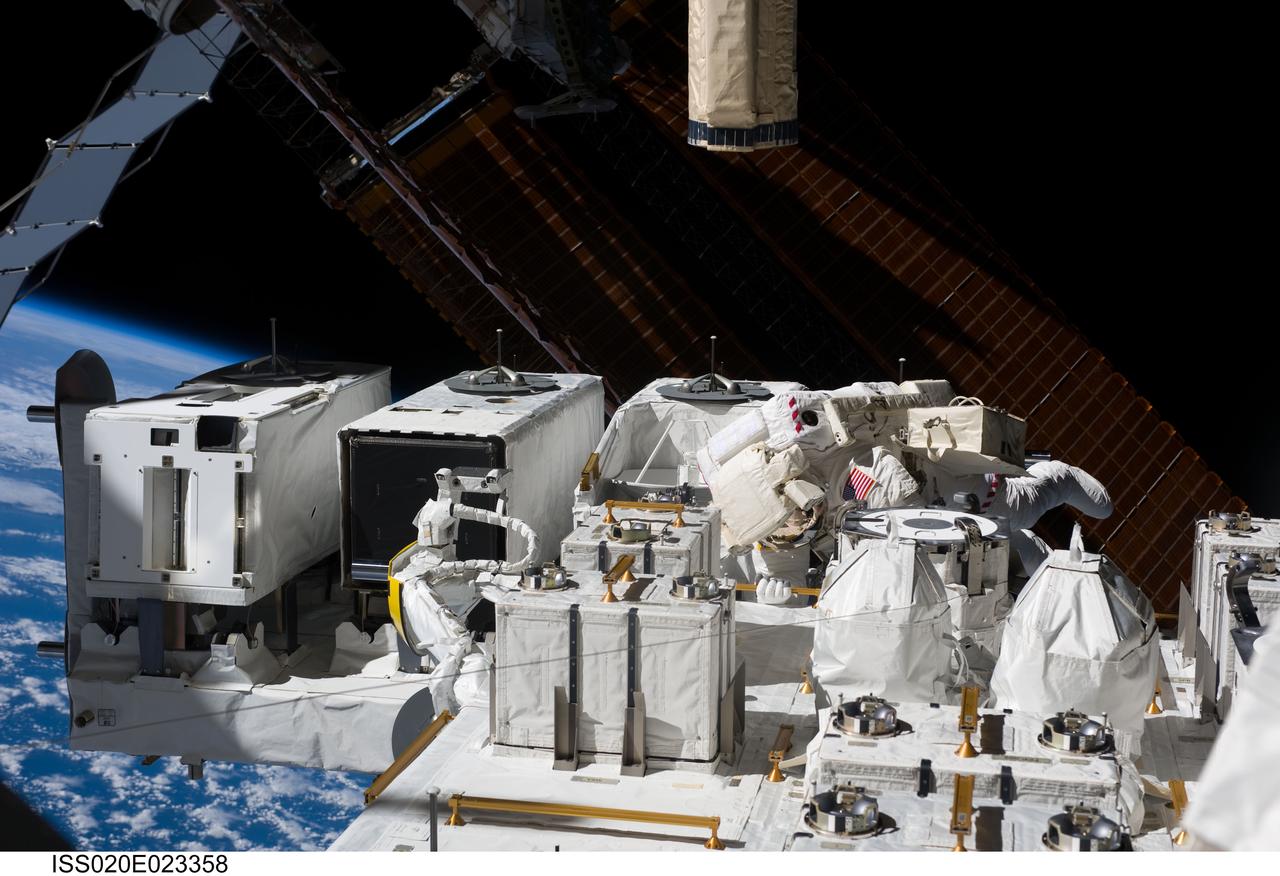
ISS020-E-023358 (22 July 2009) ---This is a view of the Japanese Experiment Module - Exposed Facility which has been a major subject of attention by the joint crews aboard the International Space Station, currently docked with the Space Shuttle Endeavour. July 22 activity saw both hands-on and robotics work with the new hardware.
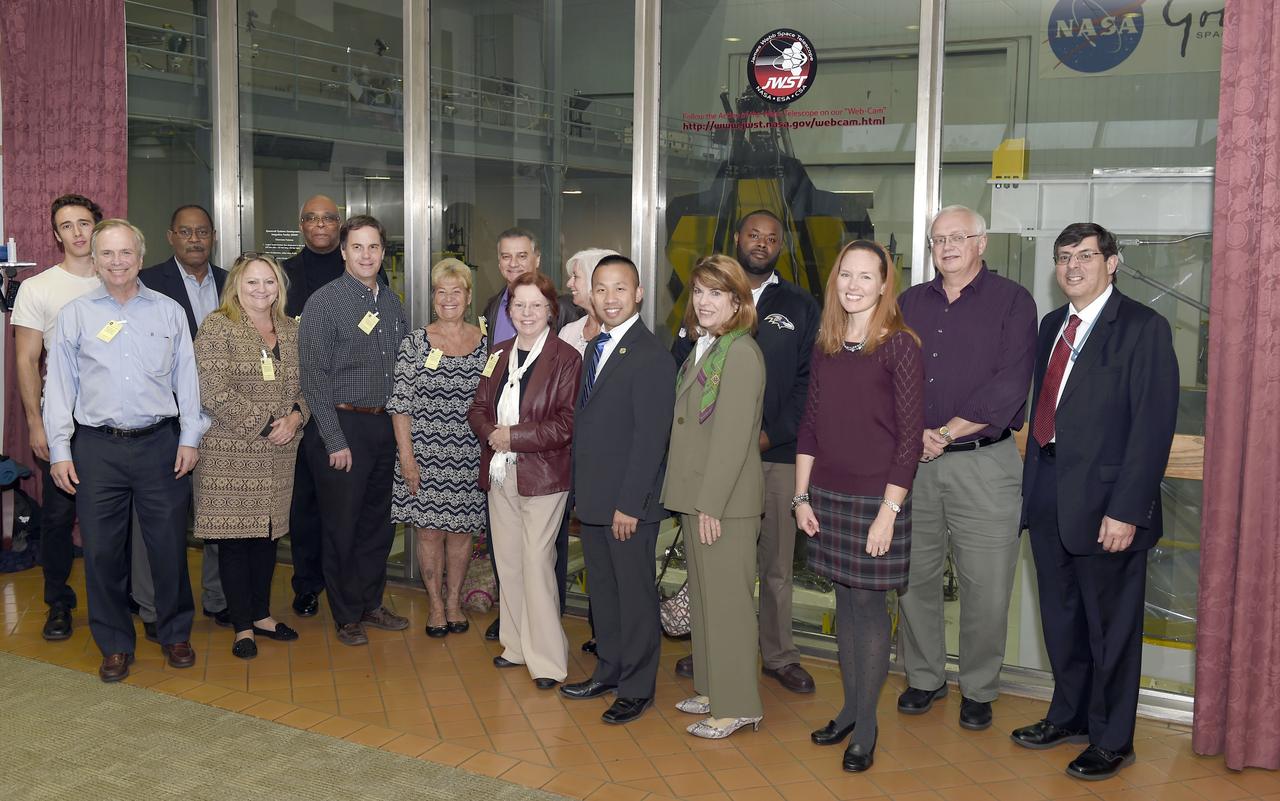
Center Director Chris Scolese welcomed the Maryland House Environment & Transportation Committee to Goddard on November 15, 2016. The group visited the James Webb Space Telescope JWST and saw the mirrors open, then they toured the Robotic Operations Center - ROC.
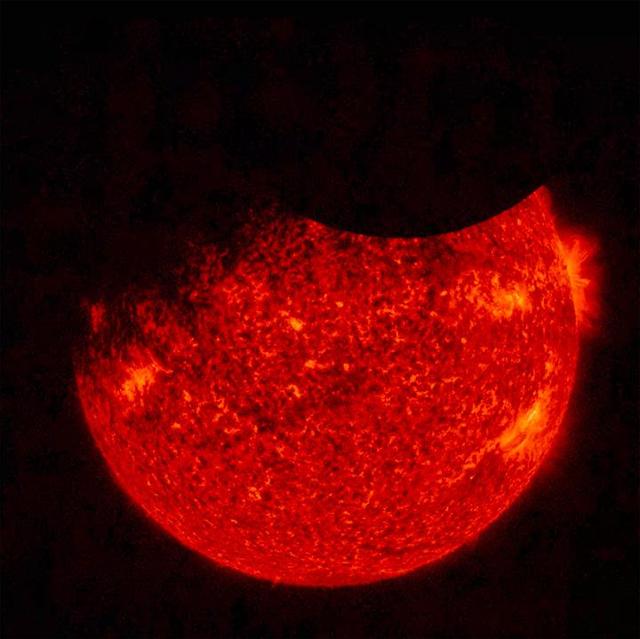
NASA's Solar Dynamics Observatory (SDO) saw both the Moon (upper right) and the Earth (upper left) partially block the sun (Sept. 1, 2016 at 7:33 UT). Just before this image was taken, the Earth totally blocked the sun for a while. SDO orbits 22,000 miles above the Earth in a highly elliptical orbit that sometimes puts the Moon or Earth in front of the sun. The sun image was taken in a wavelength of extreme ultraviolet light. Only once before have both been there at the same time. Note that the edge of the moon is quite crisp because it has no atmosphere. Movies are available at the Photojournal. http://photojournal.jpl.nasa.gov/catalog/PIA21028
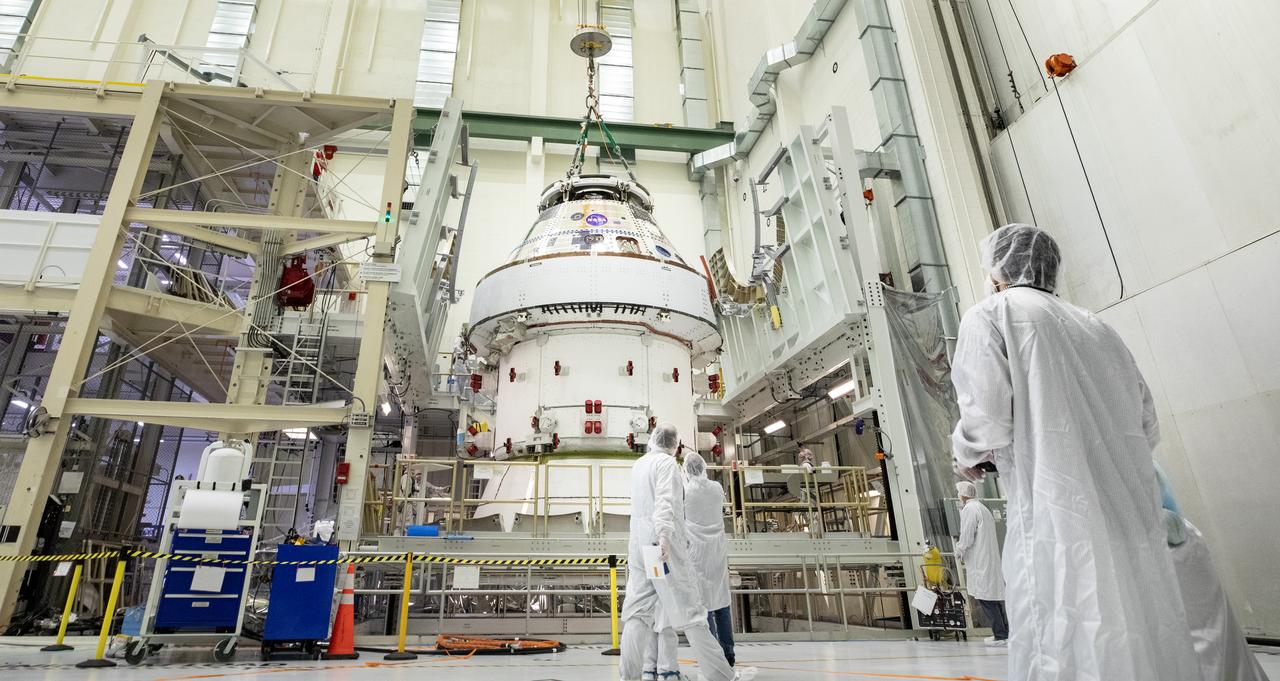
Technicians with NASA and Lockheed Martin operate a 30-ton crane to move NASA’s Artemis II Orion spacecraft out of the Final Assembly and System Testing cell inside the Neil A. Operations and Checkout Building at NASA’s Kennedy Space Center in Florida on Saturday, Feb. 22, 2025. The move prepares for the upcoming installation of four solar array wings and spacecraft adapter jettison fairings for the agency’s first crewed flight test under the Artemis campaign.

Technicians with NASA and Lockheed Martin operate a 30-ton crane to move NASA’s Artemis II Orion spacecraft out of the Final Assembly and System Testing cell inside the Neil A. Operations and Checkout Building at NASA’s Kennedy Space Center in Florida on Saturday, Feb. 22, 2025. The move prepares for the upcoming installation of four solar array wings and spacecraft adapter jettison fairings for the agency’s first crewed flight test under the Artemis campaign.
Technicians with NASA and Lockheed Martin operate a 30-ton crane to move NASA’s Artemis II Orion spacecraft out of the Final Assembly and System Testing cell inside the Neil A. Operations and Checkout Building at NASA’s Kennedy Space Center in Florida on Saturday, Feb. 22, 2025. The move prepares for the upcoming installation of four solar array wings and spacecraft adapter jettison fairings for the agency’s first crewed flight test under the Artemis campaign.
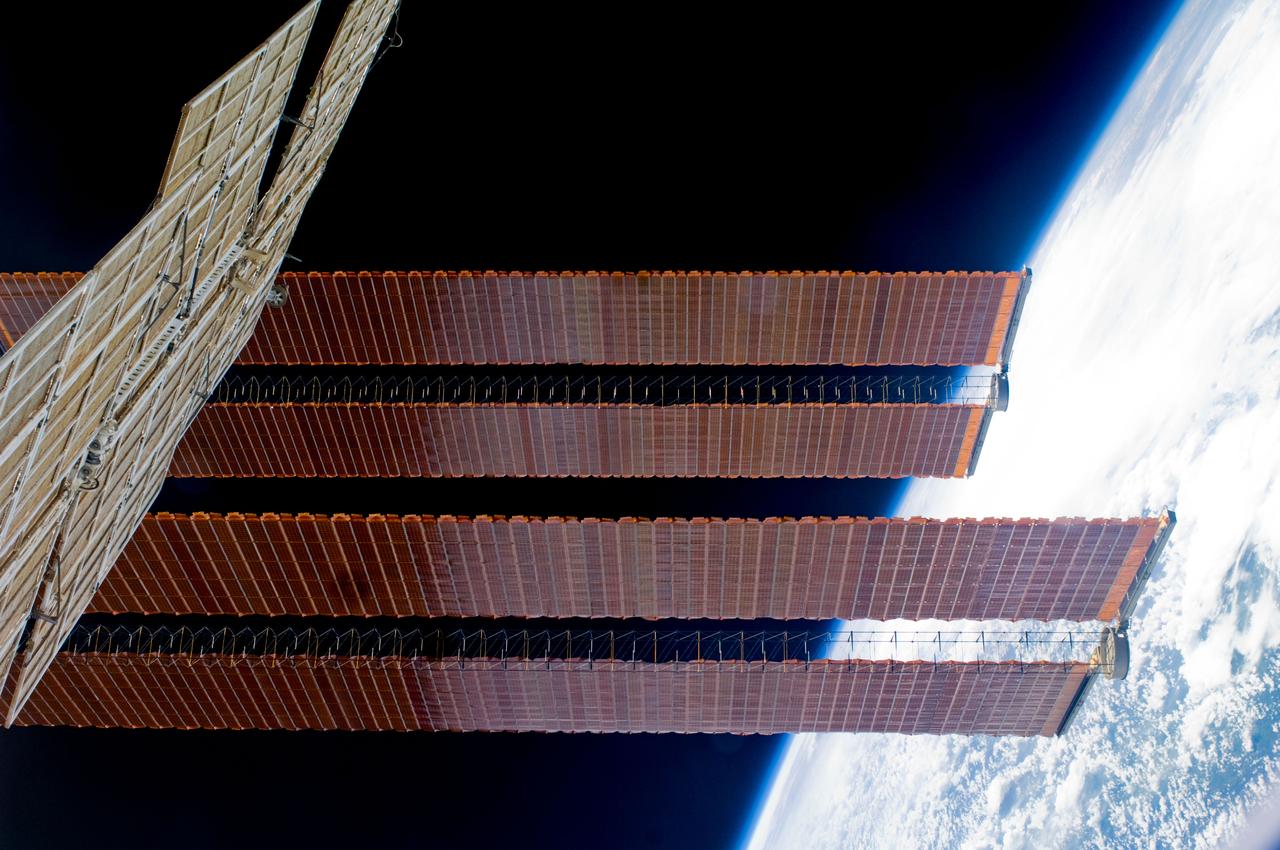
ISS018-E-042659 (22 March 2009) --- Station solar array panels and Earth's horizon are featured in this image photographed by an Expedition 18 crewmember on the International Space Station while Space Shuttle Discovery (STS-119) remains docked with the station.
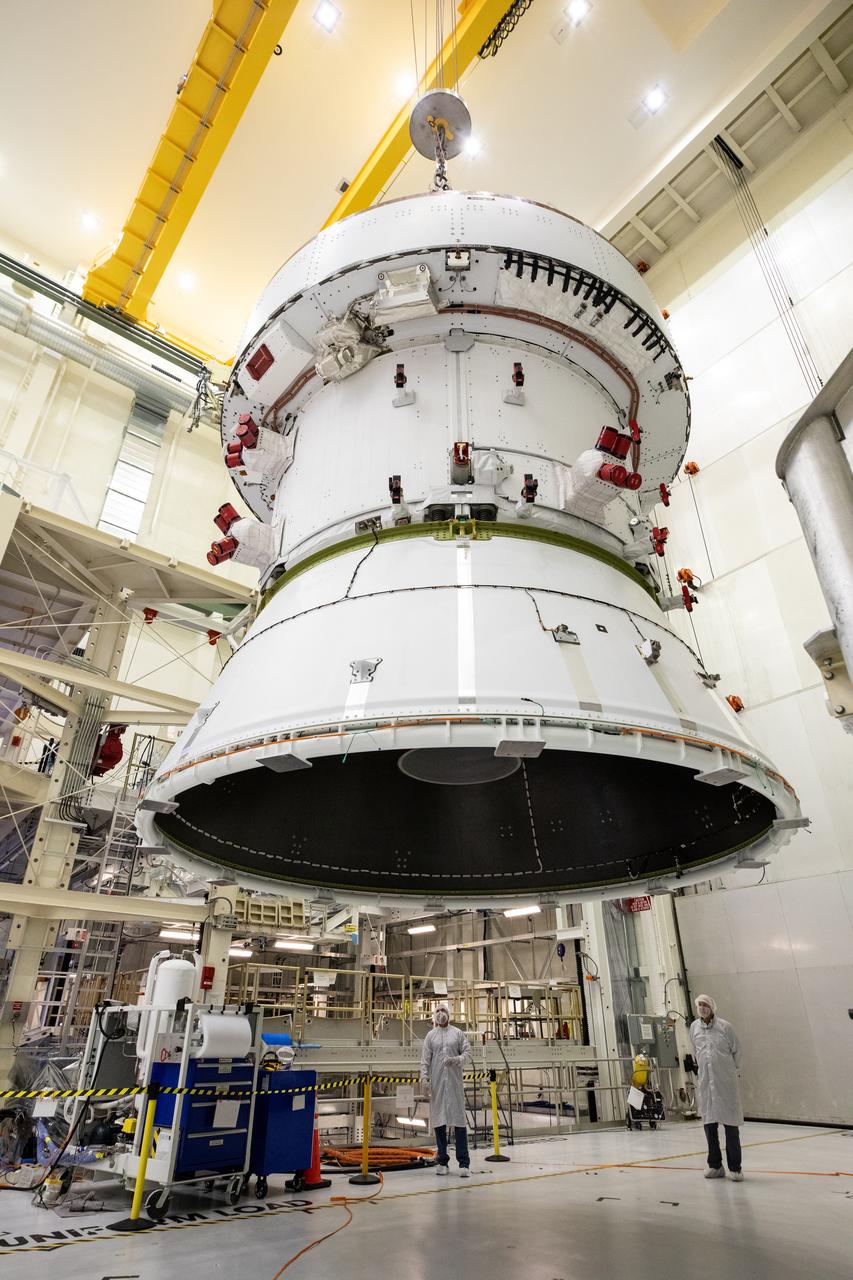
Technicians with NASA and Lockheed Martin operate a 30-ton crane to move NASA’s Artemis II Orion spacecraft out of the Final Assembly and System Testing cell inside the Neil A. Operations and Checkout Building at NASA’s Kennedy Space Center in Florida on Saturday, Feb. 22, 2025. The move prepares for the upcoming installation of four solar array wings and spacecraft adapter jettison fairings for the agency’s first crewed flight test under the Artemis campaign.
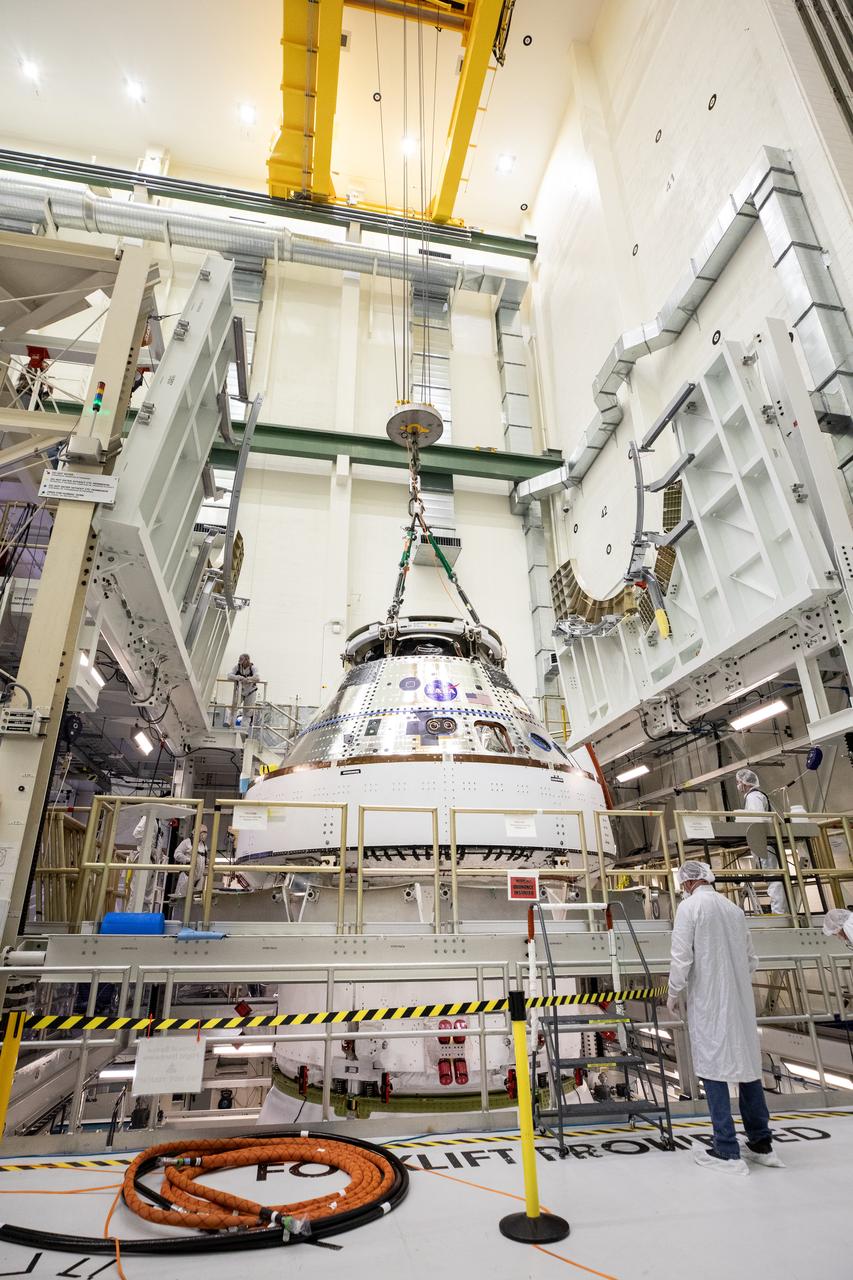
Technicians with NASA and Lockheed Martin operate a 30-ton crane to move NASA’s Artemis II Orion spacecraft out of the Final Assembly and System Testing cell inside the Neil A. Operations and Checkout Building at NASA’s Kennedy Space Center in Florida on Saturday, Feb. 22, 2025. The move prepares for the upcoming installation of four solar array wings and spacecraft adapter jettison fairings for the agency’s first crewed flight test under the Artemis campaign.
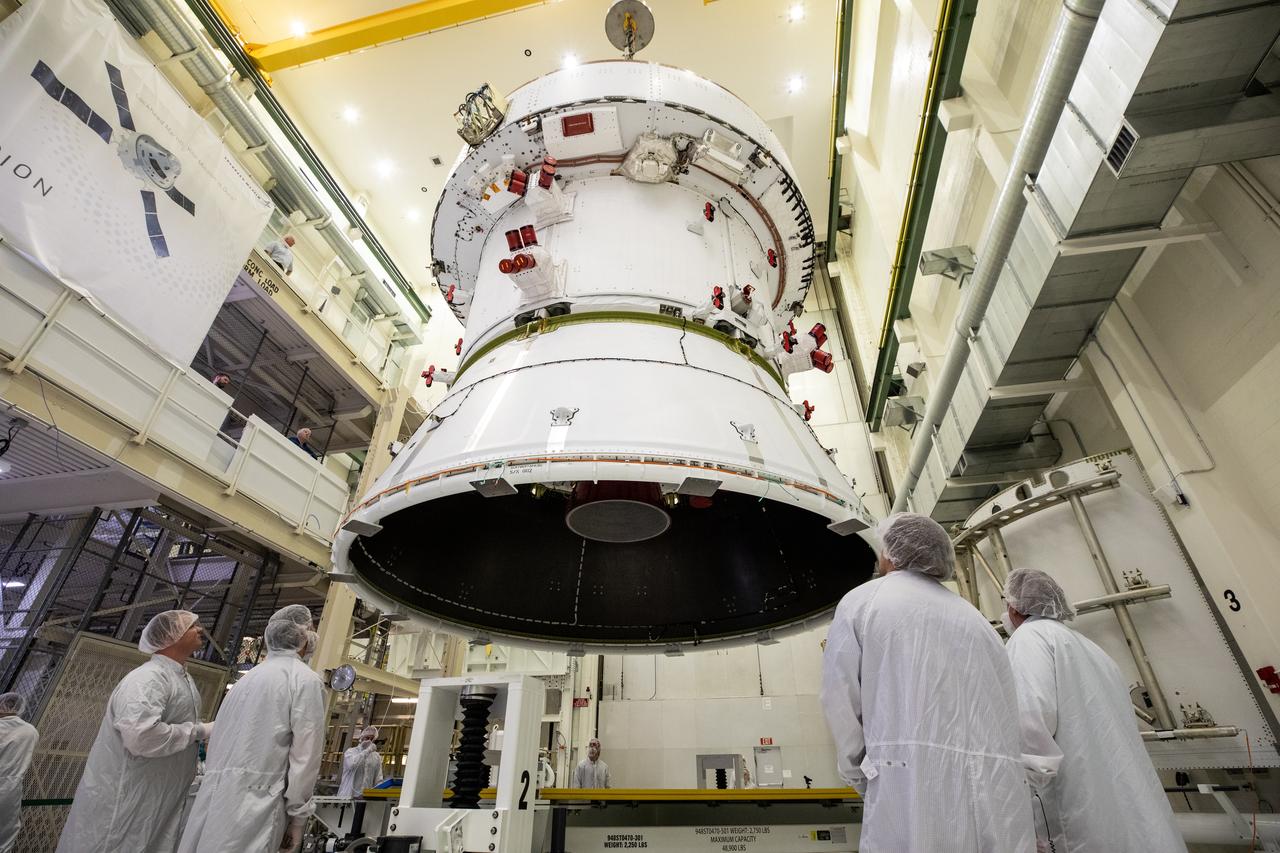
Technicians with NASA and Lockheed Martin operate a 30-ton crane to move NASA’s Artemis II Orion spacecraft out of the Final Assembly and System Testing cell inside the Neil A. Operations and Checkout Building at NASA’s Kennedy Space Center in Florida on Saturday, Feb. 22, 2025. The move prepares for the upcoming installation of four solar array wings and spacecraft adapter jettison fairings for the agency’s first crewed flight test under the Artemis campaign.
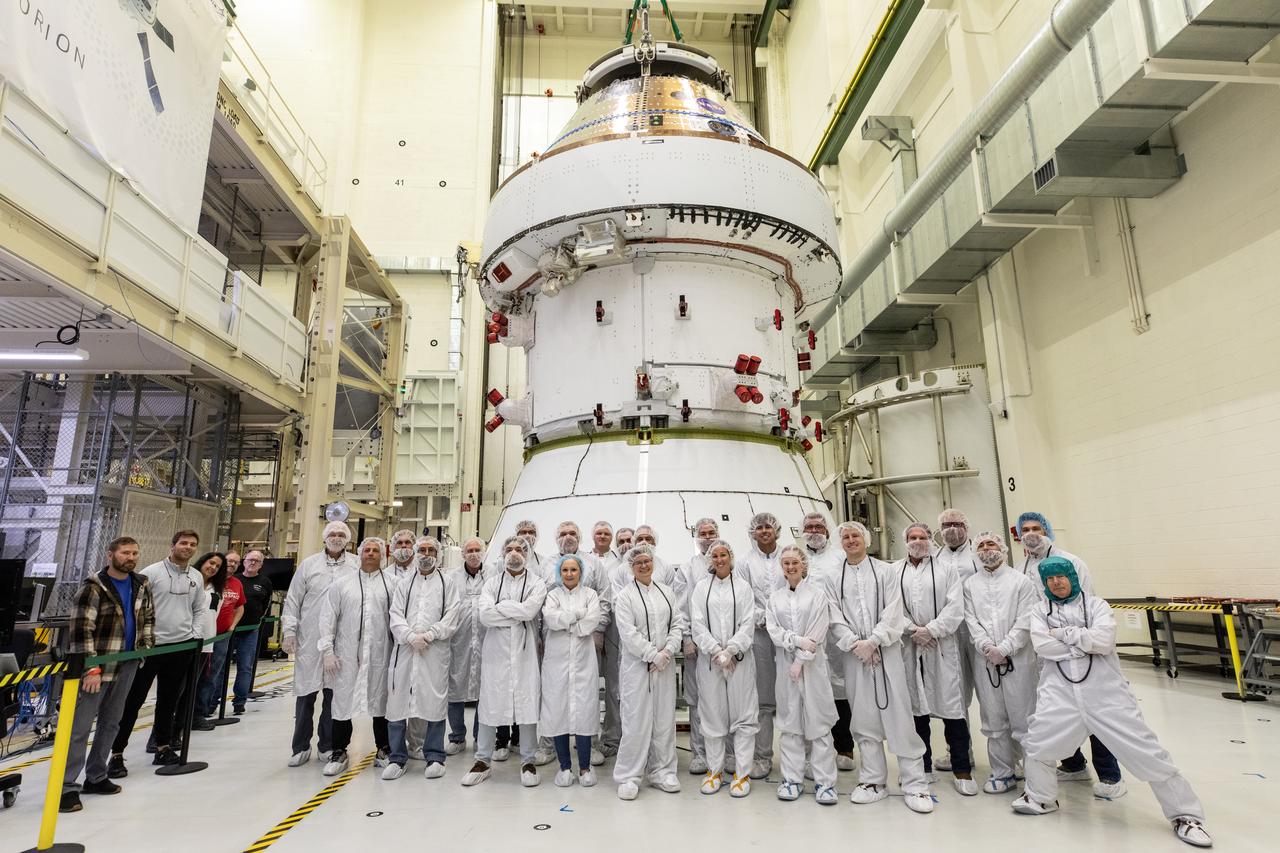
Crews with NASA and Lockheed Martin pose for a photo in front of NASA’s Artemis II Orion spacecraft inside the Neil A. Operations and Checkout Building at NASA’s Kennedy Space Center in Florida on Saturday, Feb. 22, 2025. Technicians operated a 30-ton crane to move the spacecraft from the Final Assembly and System Testing cell to prepare for upcoming installation of four solar array wings and spacecraft adapter jettison fairings for the agency’s first crewed flight test under the Artemis campaign.
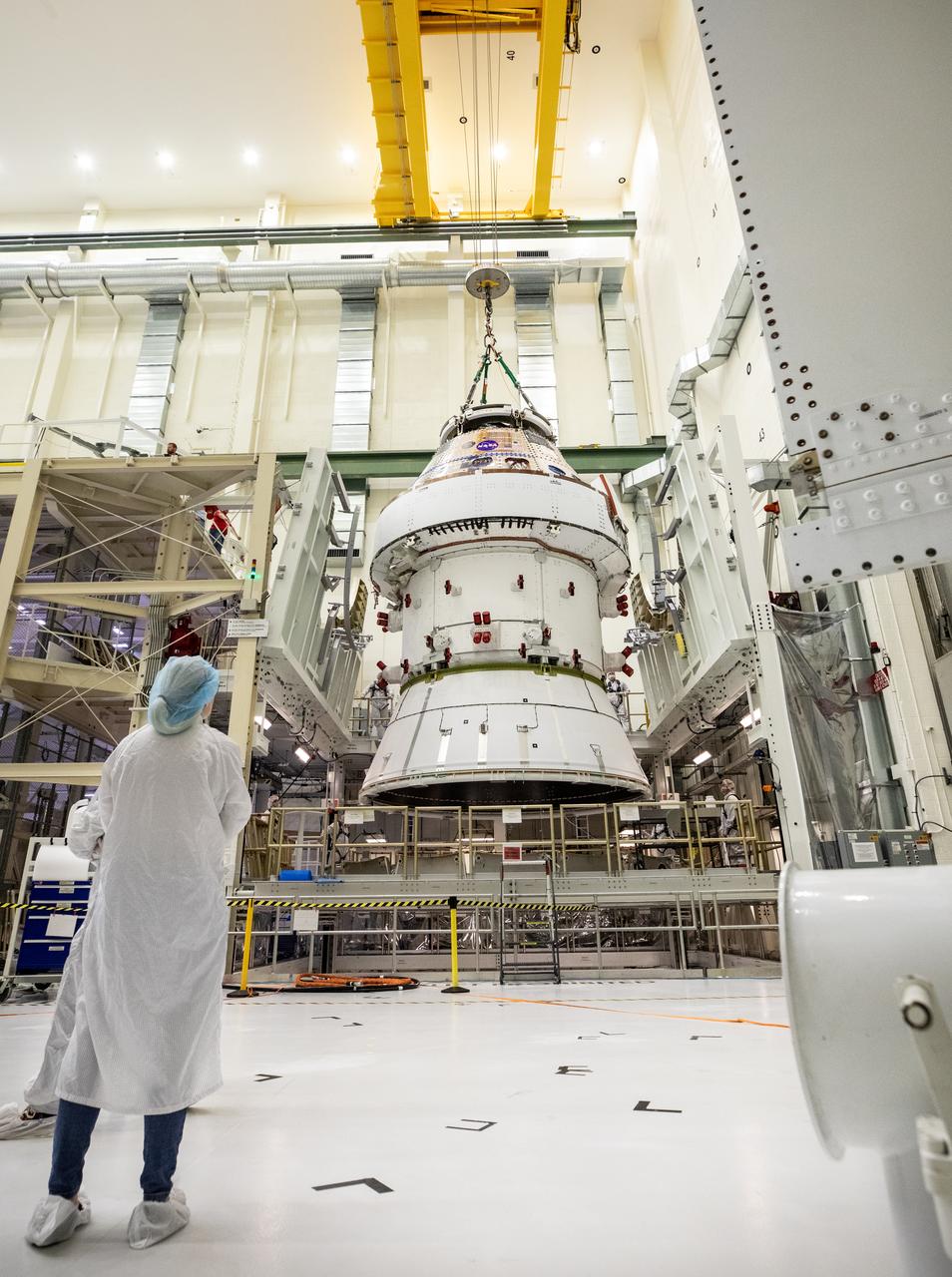
Technicians with NASA and Lockheed Martin operate a 30-ton crane to move NASA’s Artemis II Orion spacecraft out of the Final Assembly and System Testing cell inside the Neil A. Operations and Checkout Building at NASA’s Kennedy Space Center in Florida on Saturday, Feb. 22, 2025. The move prepares for the upcoming installation of four solar array wings and spacecraft adapter jettison fairings for the agency’s first crewed flight test under the Artemis campaign.
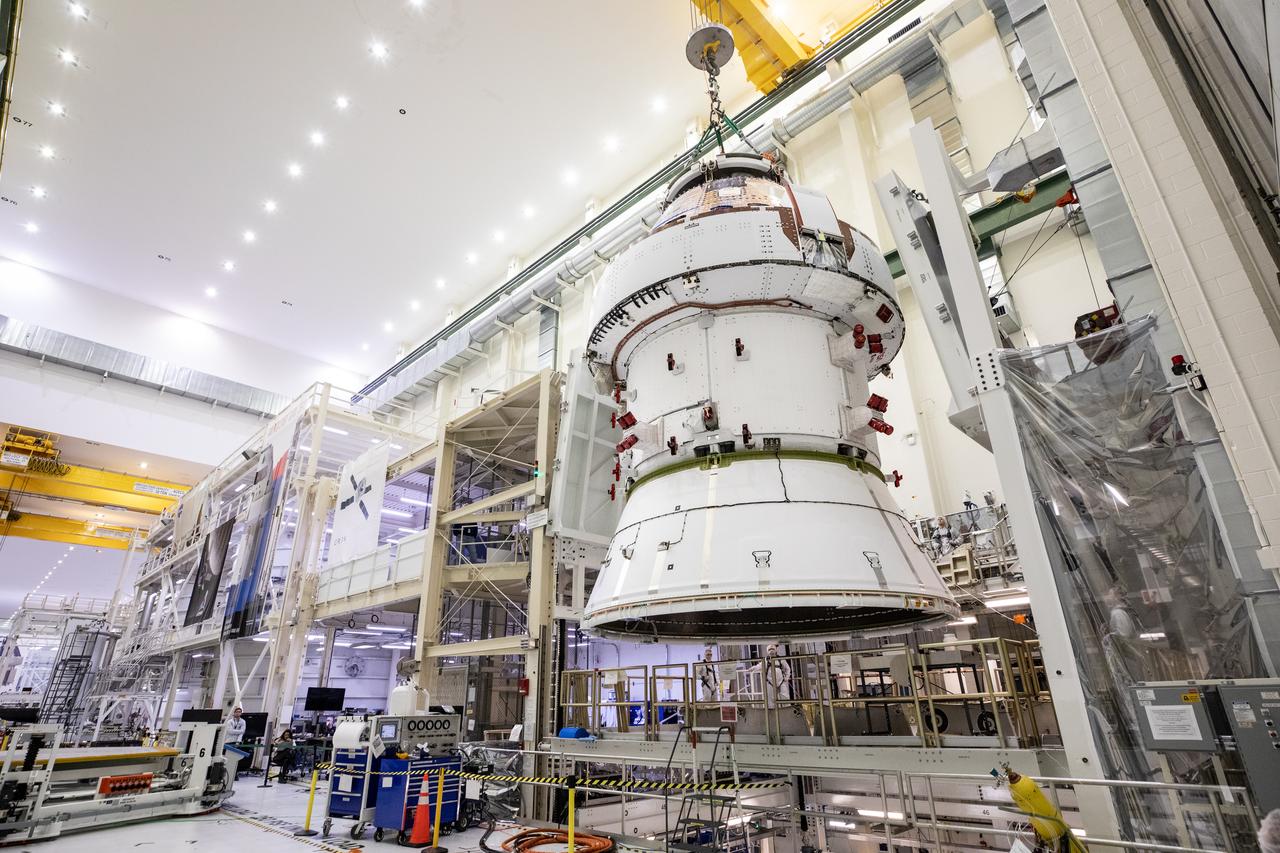
Technicians with NASA and Lockheed Martin operate a 30-ton crane to move NASA’s Artemis II Orion spacecraft out of the Final Assembly and System Testing cell inside the Neil A. Operations and Checkout Building at NASA’s Kennedy Space Center in Florida on Saturday, Feb. 22, 2025. The move prepares for the upcoming installation of four solar array wings and spacecraft adapter jettison fairings for the agency’s first crewed flight test under the Artemis campaign.
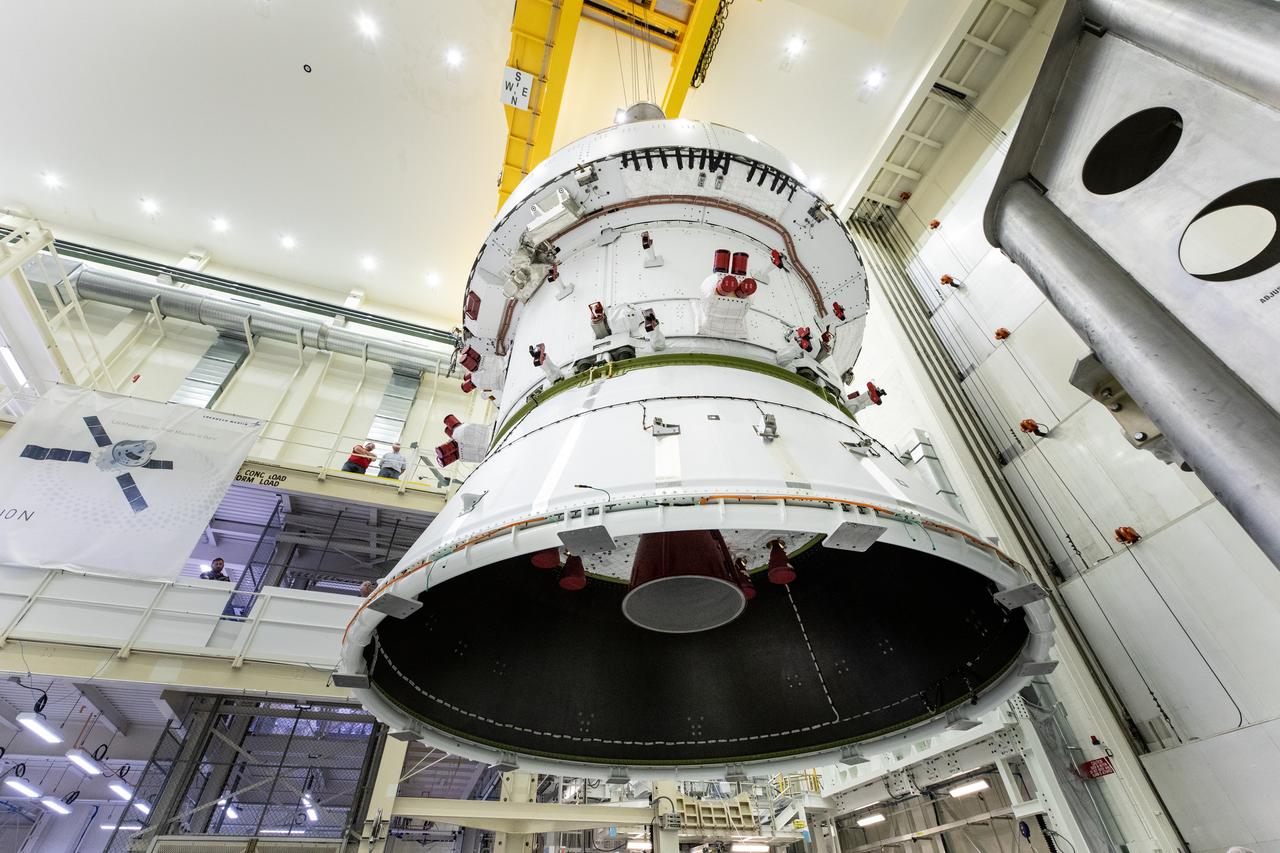
Technicians with NASA and Lockheed Martin operate a 30-ton crane to move NASA’s Artemis II Orion spacecraft out of the Final Assembly and System Testing cell inside the Neil A. Operations and Checkout Building at NASA’s Kennedy Space Center in Florida on Saturday, Feb. 22, 2025. The move prepares for the upcoming installation of four solar array wings and spacecraft adapter jettison fairings for the agency’s first crewed flight test under the Artemis campaign.
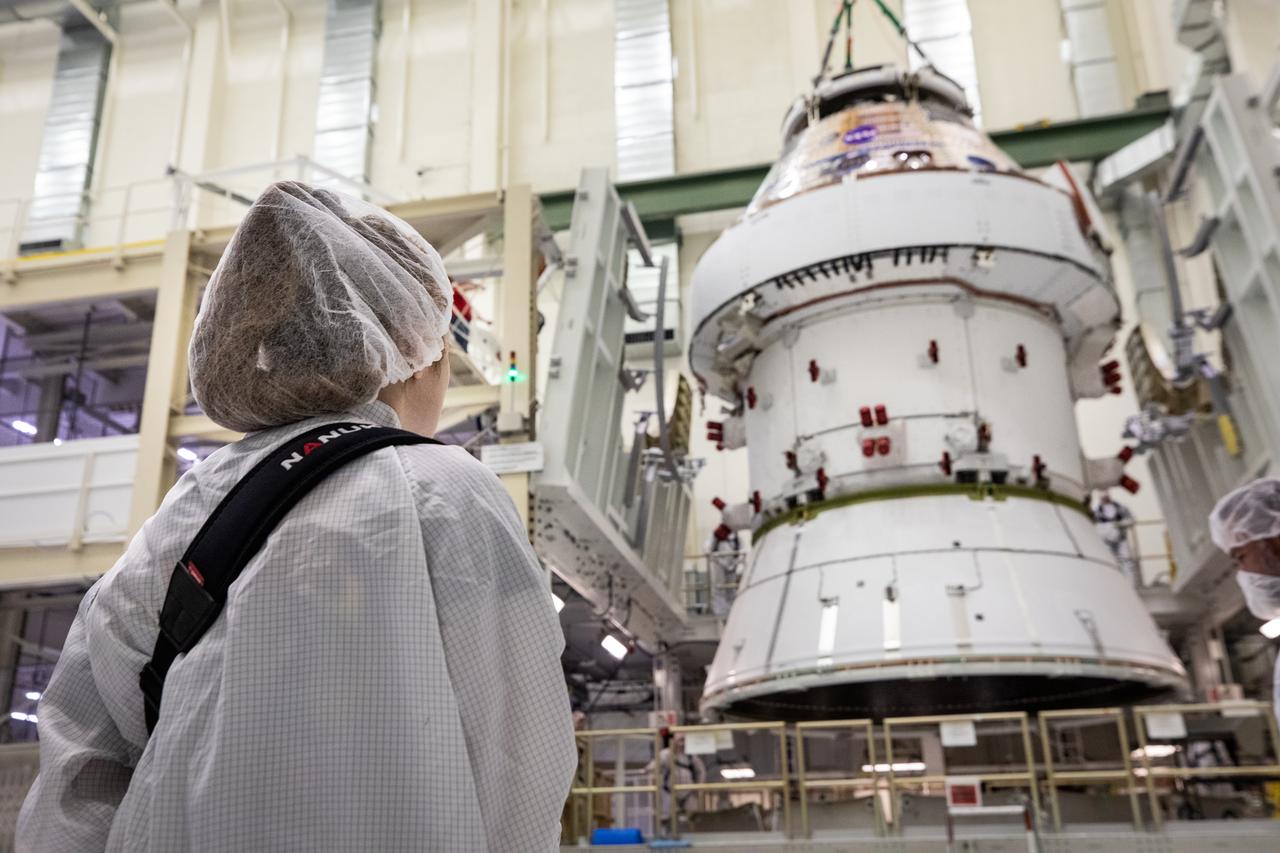
Rebekah Tolatovicz, a technician with Lockheed Martin, operates a 30-ton crane to move NASA’s Artemis II Orion spacecraft out of the Final Assembly and System Testing cell inside the Neil A. Operations and Checkout Building at NASA’s Kennedy Space Center in Florida on Saturday, Feb. 22, 2025. The move prepares for the upcoming installation of four solar array wings and spacecraft adapter jettison fairings for the agency’s first crewed flight test under the Artemis campaign.
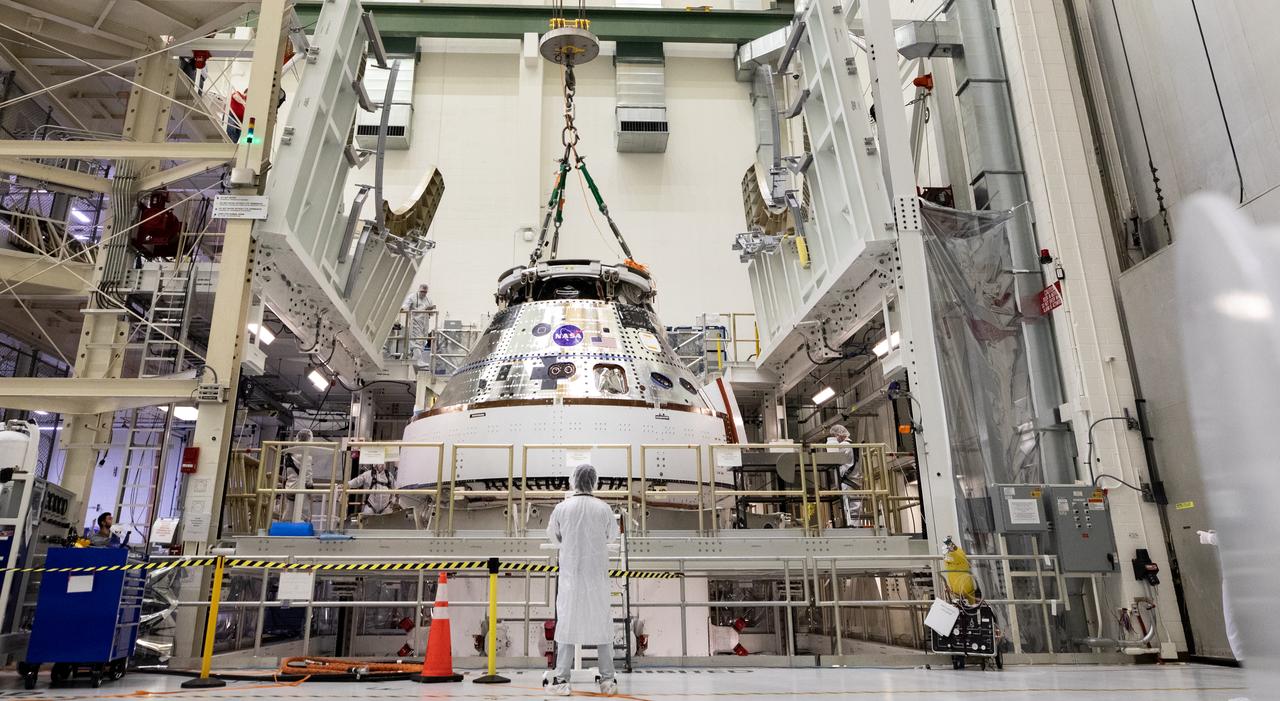
Technicians with NASA and Lockheed Martin operate a 30-ton crane to move NASA’s Artemis II Orion spacecraft out of the Final Assembly and System Testing cell inside the Neil A. Operations and Checkout Building at NASA’s Kennedy Space Center in Florida on Saturday, Feb. 22, 2025. The move prepares for the upcoming installation of four solar array wings and spacecraft adapter jettison fairings for the agency’s first crewed flight test under the Artemis campaign.
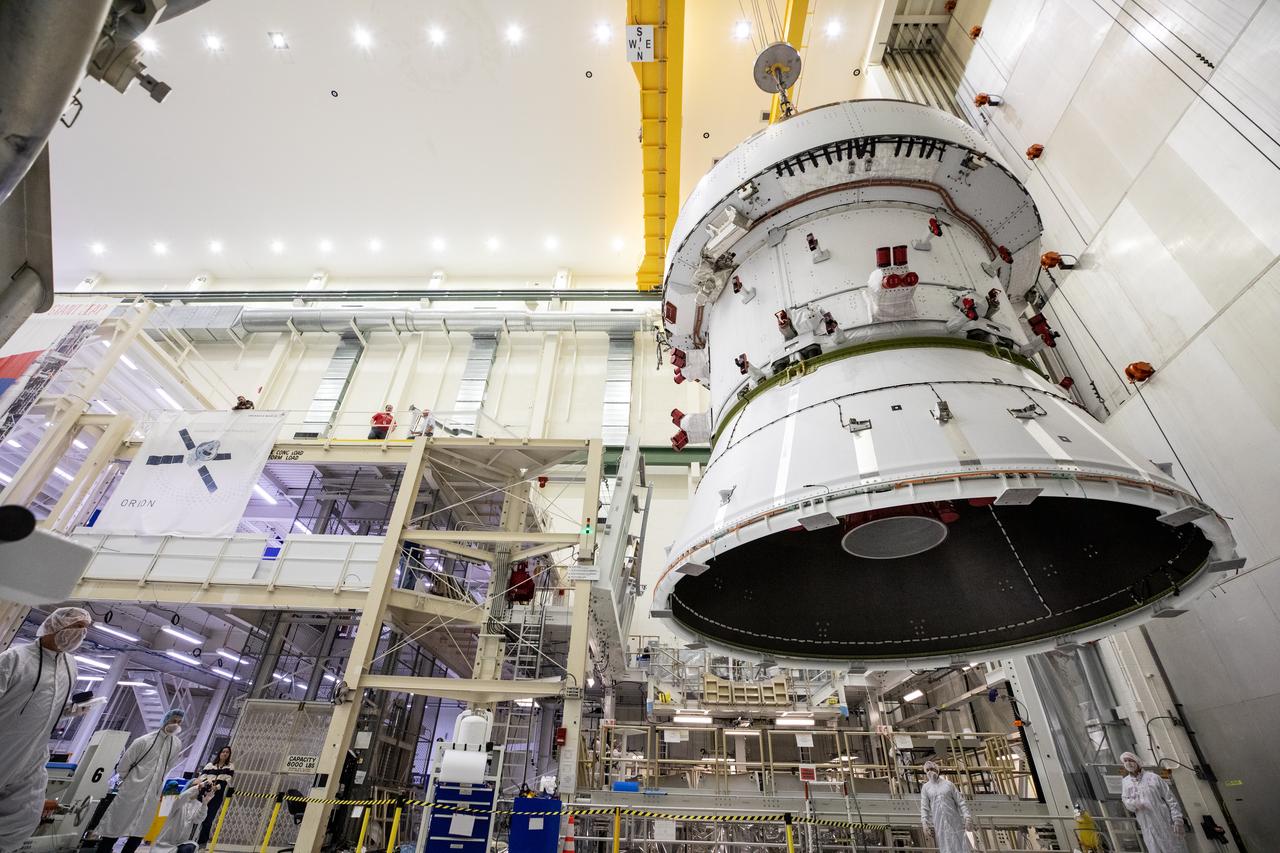
Technicians with NASA and Lockheed Martin operate a 30-ton crane to move NASA’s Artemis II Orion spacecraft out of the Final Assembly and System Testing cell inside the Neil A. Operations and Checkout Building at NASA’s Kennedy Space Center in Florida on Saturday, Feb. 22, 2025. The move prepares for the upcoming installation of four solar array wings and spacecraft adapter jettison fairings for the agency’s first crewed flight test under the Artemis campaign.
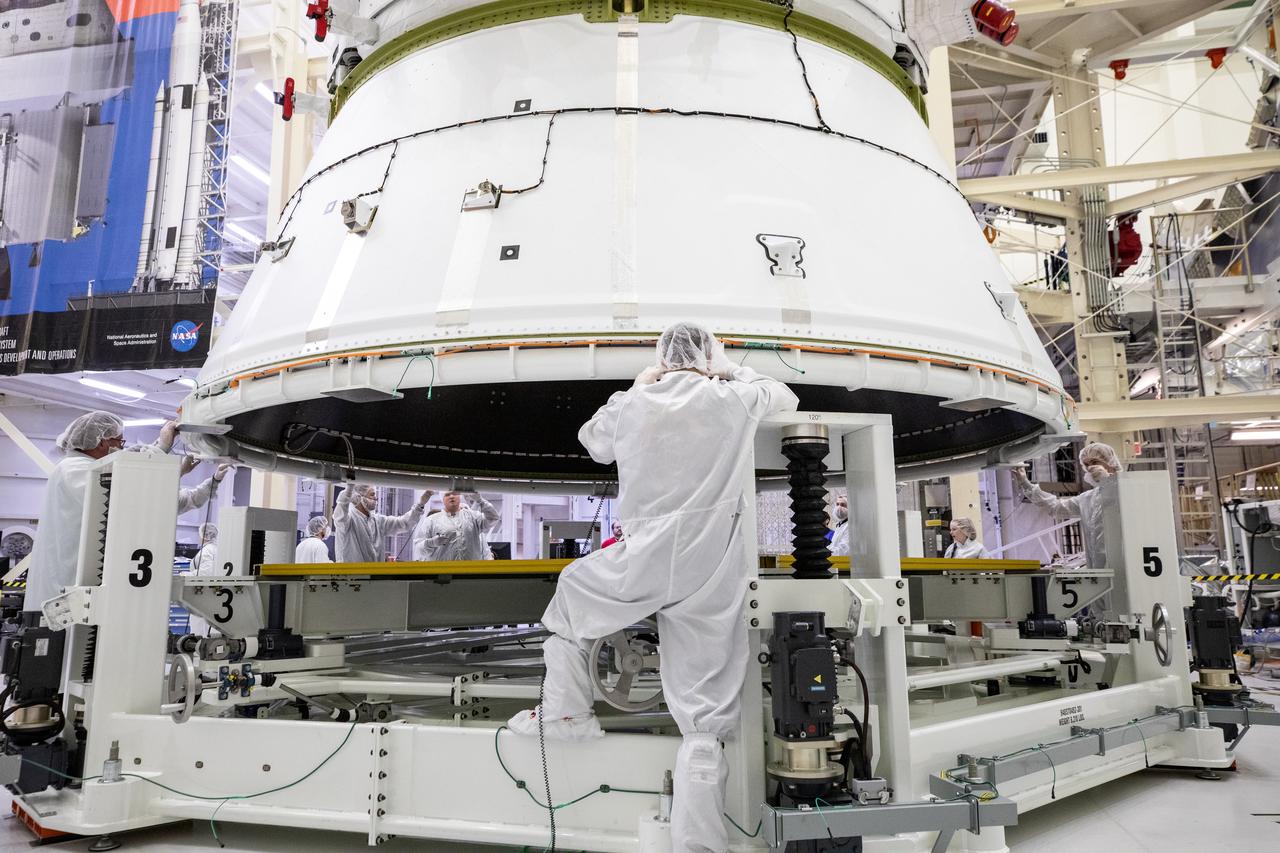
Technicians with NASA and Lockheed Martin operate a 30-ton crane to move NASA’s Artemis II Orion spacecraft out of the Final Assembly and System Testing cell inside the Neil A. Operations and Checkout Building at NASA’s Kennedy Space Center in Florida on Saturday, Feb. 22, 2025. The move prepares for the upcoming installation of four solar array wings and spacecraft adapter jettison fairings for the agency’s first crewed flight test under the Artemis campaign.
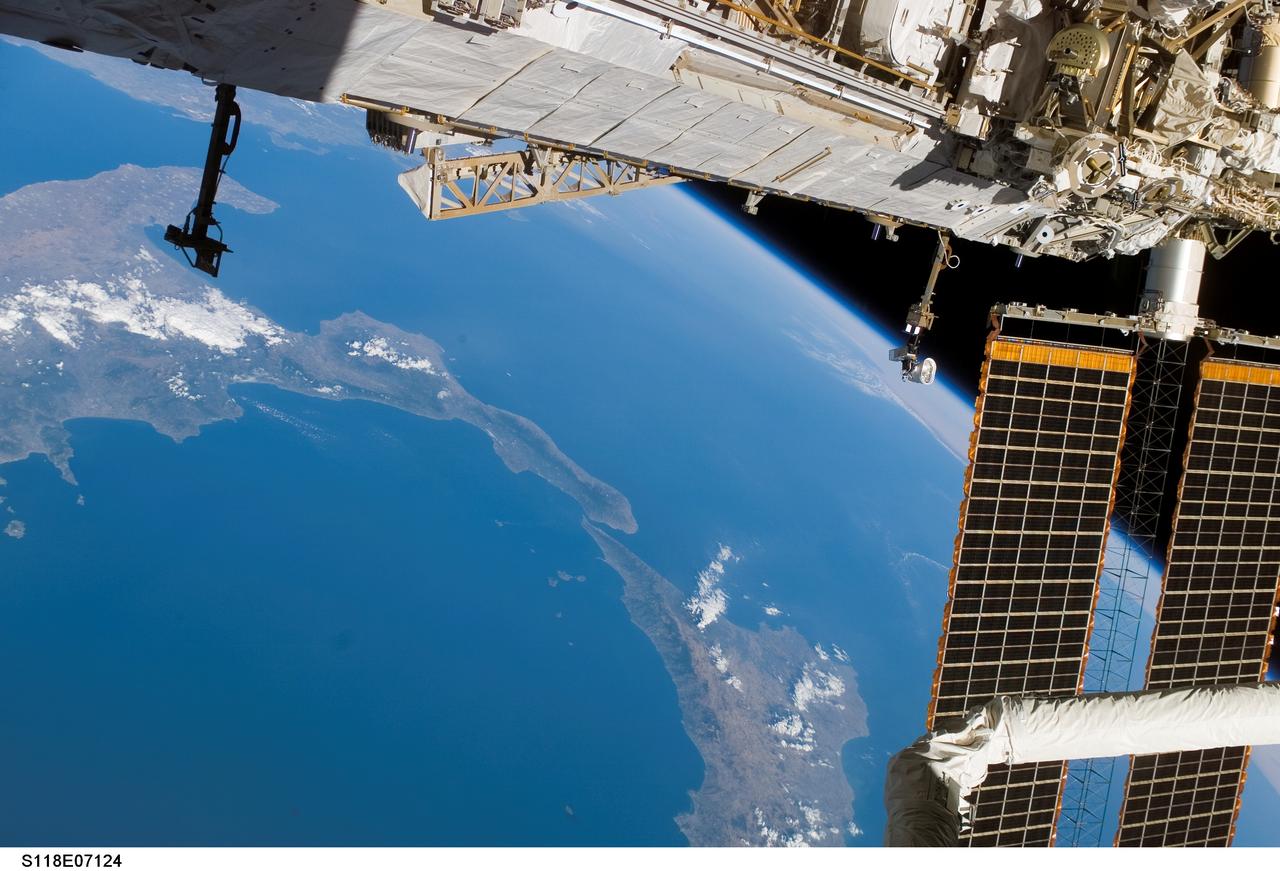
S118-E-07124 (14 Aug. 2007) --- A portion of the International Space Station frames this view of the lower portion of Italy and a portion of Sicily, photographed by a STS-118 crewmember while Space Shuttle Endeavour remains docked with the station.
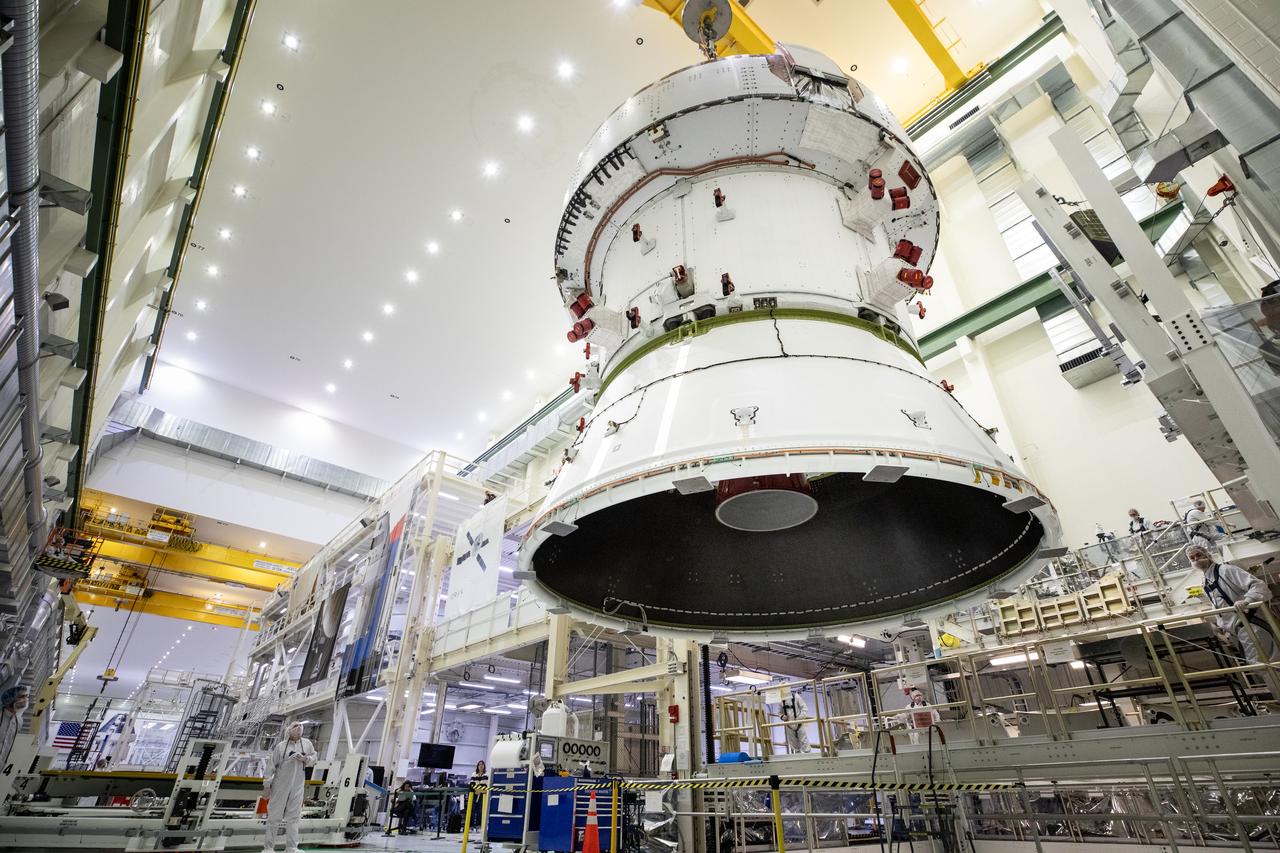
Technicians with NASA and Lockheed Martin operate a 30-ton crane to move NASA’s Artemis II Orion spacecraft out of the Final Assembly and System Testing cell inside the Neil A. Operations and Checkout Building at NASA’s Kennedy Space Center in Florida on Saturday, Feb. 22, 2025. The move prepares for the upcoming installation of four solar array wings and spacecraft adapter jettison fairings for the agency’s first crewed flight test under the Artemis campaign.

Technicians with NASA and Lockheed Martin operate a 30-ton crane to move NASA’s Artemis II Orion spacecraft out of the Final Assembly and System Testing cell inside the Neil A. Operations and Checkout Building at NASA’s Kennedy Space Center in Florida on Saturday, Feb. 22, 2025. The move prepares for the upcoming installation of four solar array wings and spacecraft adapter jettison fairings for the agency’s first crewed flight test under the Artemis campaign.
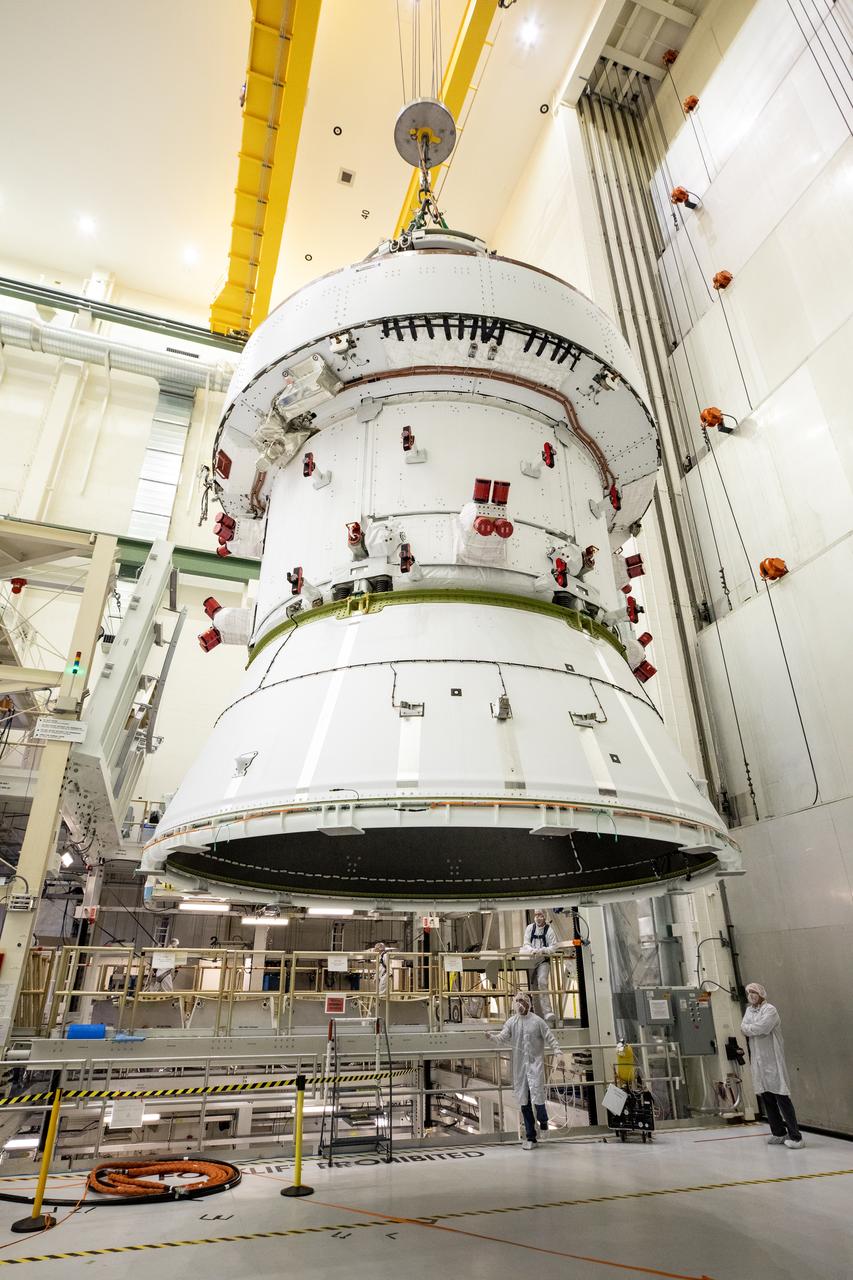
Technicians with NASA and Lockheed Martin operate a 30-ton crane to move NASA’s Artemis II Orion spacecraft out of the Final Assembly and System Testing cell inside the Neil A. Operations and Checkout Building at NASA’s Kennedy Space Center in Florida on Saturday, Feb. 22, 2025. The move prepares for the upcoming installation of four solar array wings and spacecraft adapter jettison fairings for the agency’s first crewed flight test under the Artemis campaign.
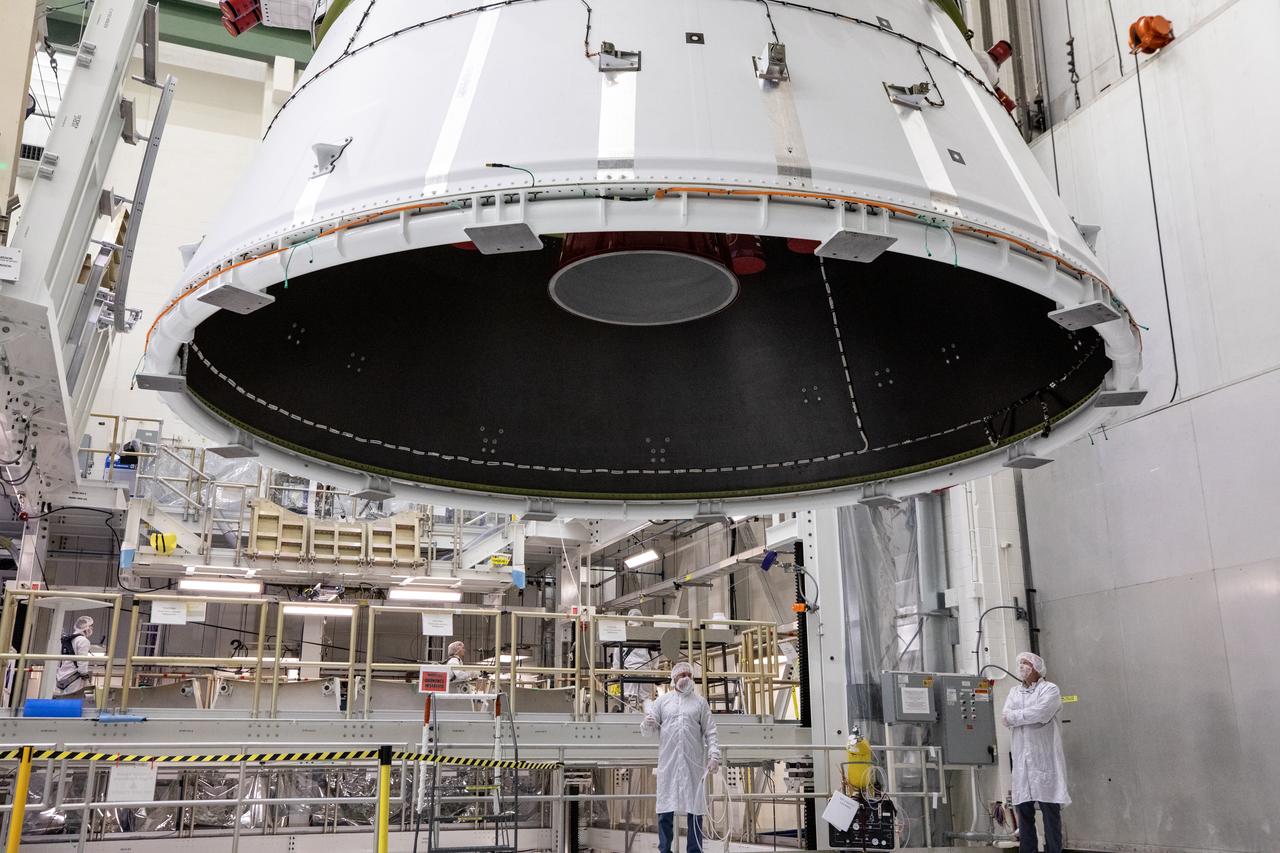
Technicians with NASA and Lockheed Martin operate a 30-ton crane to move NASA’s Artemis II Orion spacecraft out of the Final Assembly and System Testing cell inside the Neil A. Operations and Checkout Building at NASA’s Kennedy Space Center in Florida on Saturday, Feb. 22, 2025. The move prepares for the upcoming installation of four solar array wings and spacecraft adapter jettison fairings for the agency’s first crewed flight test under the Artemis campaign.
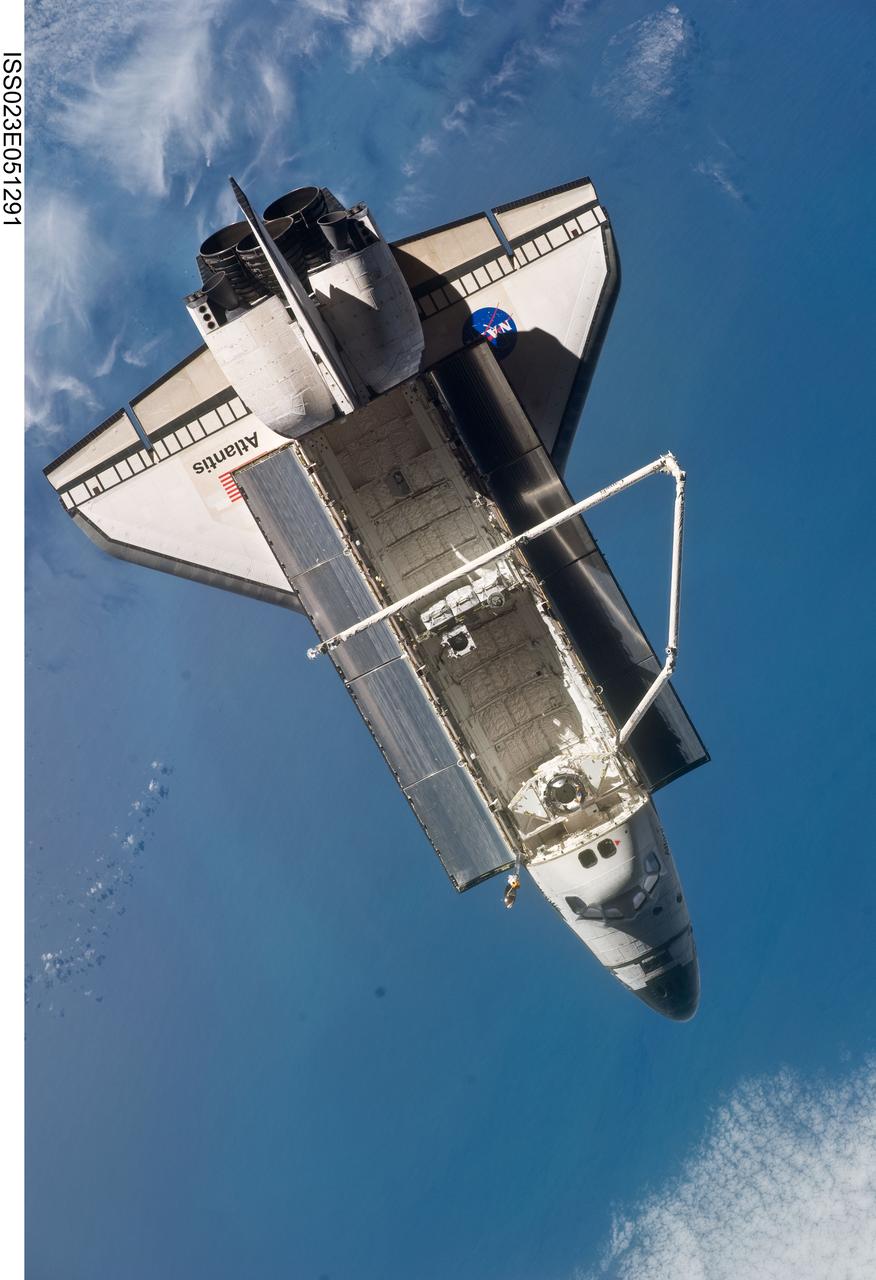
ISS023-E-051291 (23 May 2010) --- Space shuttle Atlantis is featured in this image photographed by an Expedition 23 crew member on the International Space Station soon after the shuttle and station began their post-undocking relative separation. Undocking of the two spacecraft occurred at 10:22 a.m. (CDT) on May 23, 2010, ending a seven-day stay that saw the addition of a new station module, replacement of batteries and resupply of the orbiting outpost. A blue and white part of Earth provides the backdrop for the scene.
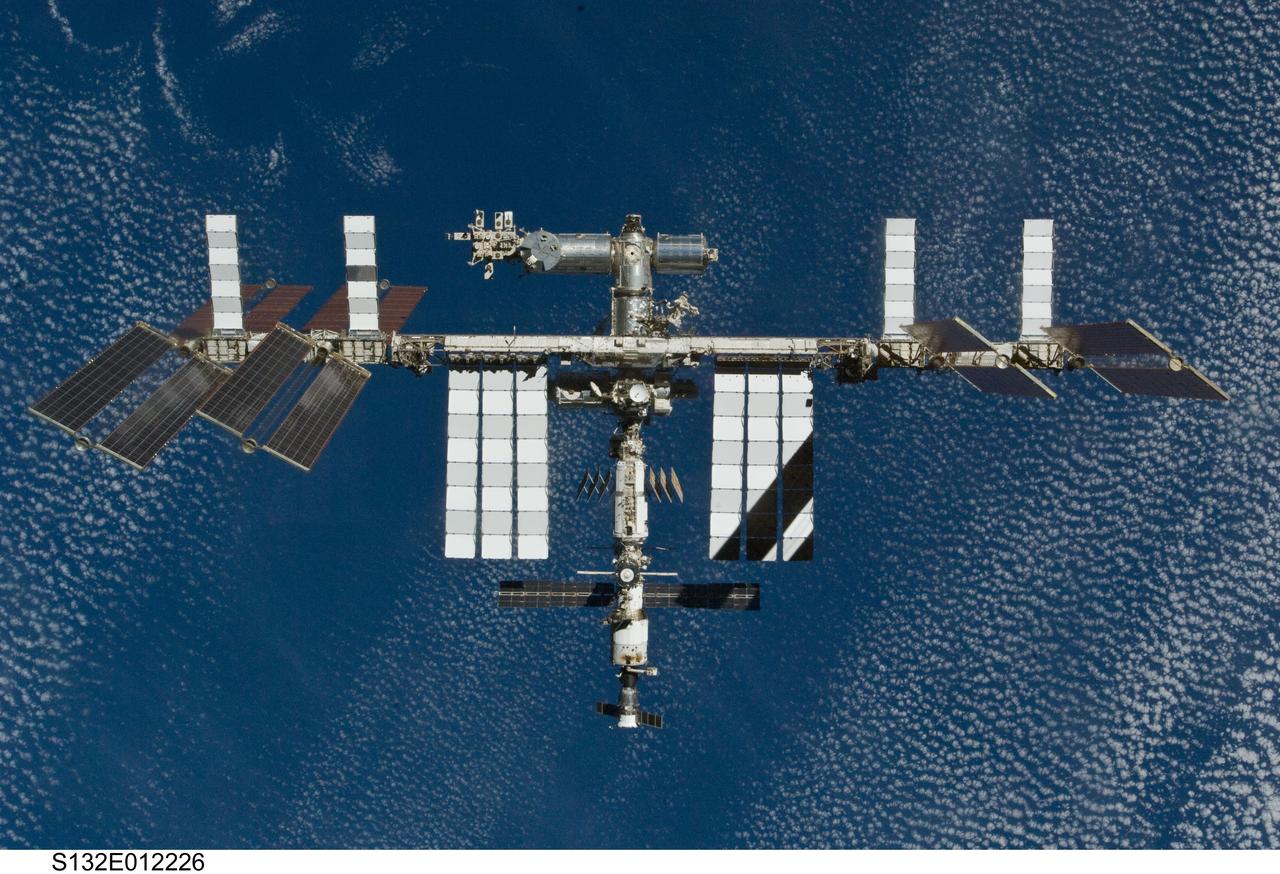
S132-E-012226 (23 May 2010) --- The International Space Station is featured in this image photographed by an STS-132 crew member on space shuttle Atlantis after the station and shuttle began their post-undocking relative separation. Undocking of the two spacecraft occurred at 10:22 a.m. (CDT) on May 23, 2010, ending a seven-day stay that saw the addition of a new station module, replacement of batteries and resupply of the orbiting outpost.
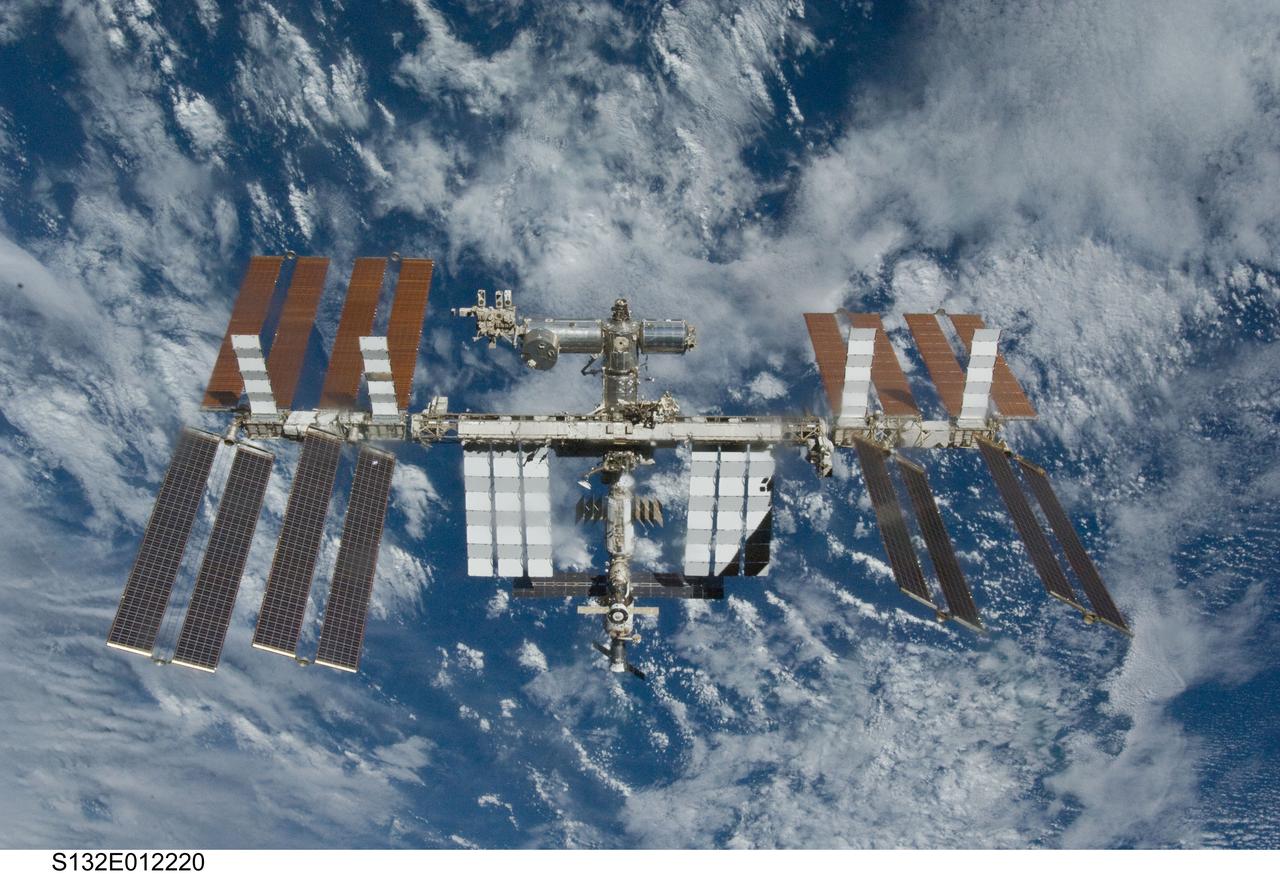
S132-E-012220 (23 May 2010) --- The International Space Station is featured in this image photographed by an STS-132 crew member on space shuttle Atlantis after the station and shuttle began their post-undocking relative separation. Undocking of the two spacecraft occurred at 10:22 a.m. (CDT) on May 23, 2010, ending a seven-day stay that saw the addition of a new station module, replacement of batteries and resupply of the orbiting outpost.
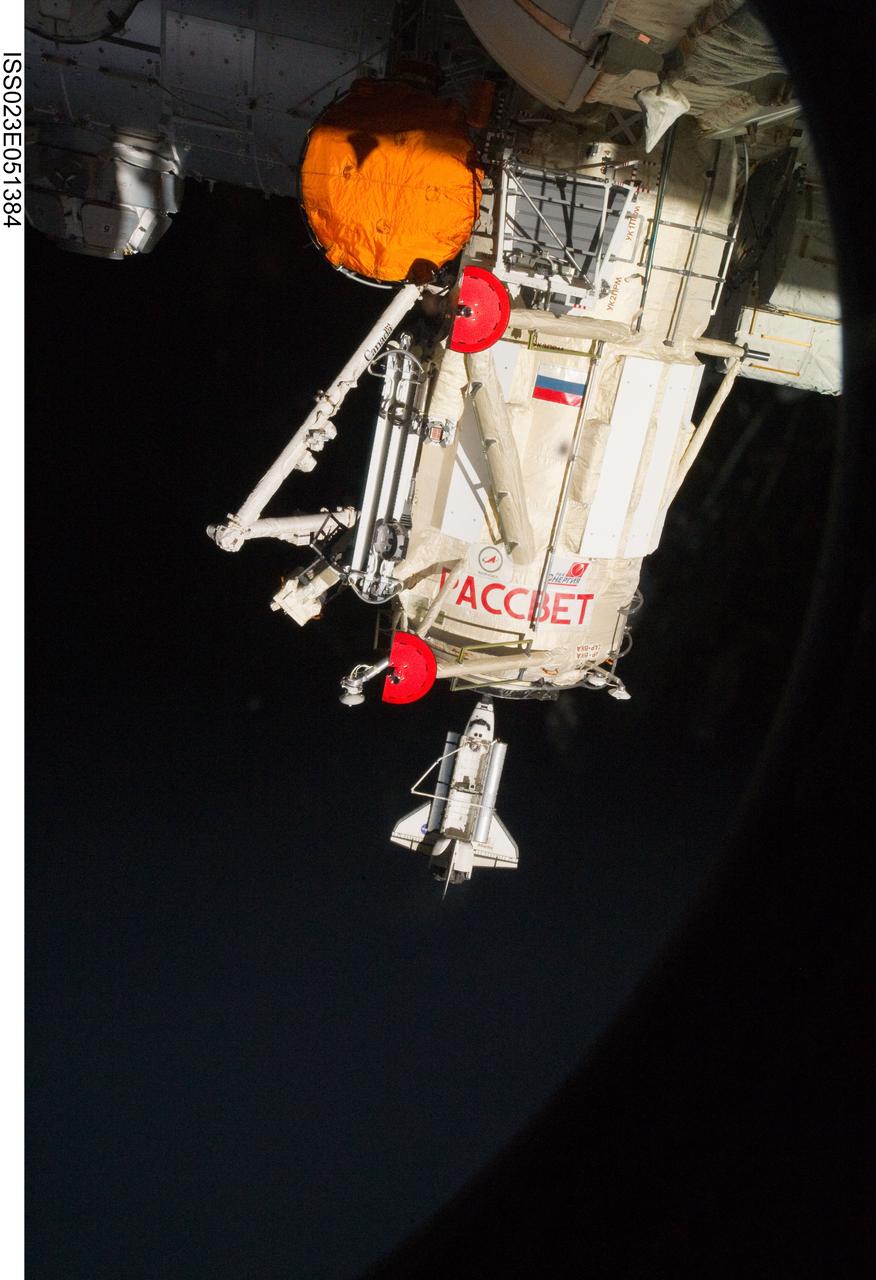
ISS023-E-051384 (23 May 2010) --- Space shuttle Atlantis and the newly-attached Rassvet Mini-Research Module 1 (MRM1) are featured in this image photographed by an Expedition 23 crew member on the International Space Station soon after the shuttle and station began their post-undocking relative separation. Undocking of the two spacecraft occurred at 10:22 a.m. (CDT) on May 23, 2010, ending a seven-day stay that saw the addition of a new station module, replacement of batteries and resupply of the orbiting outpost.
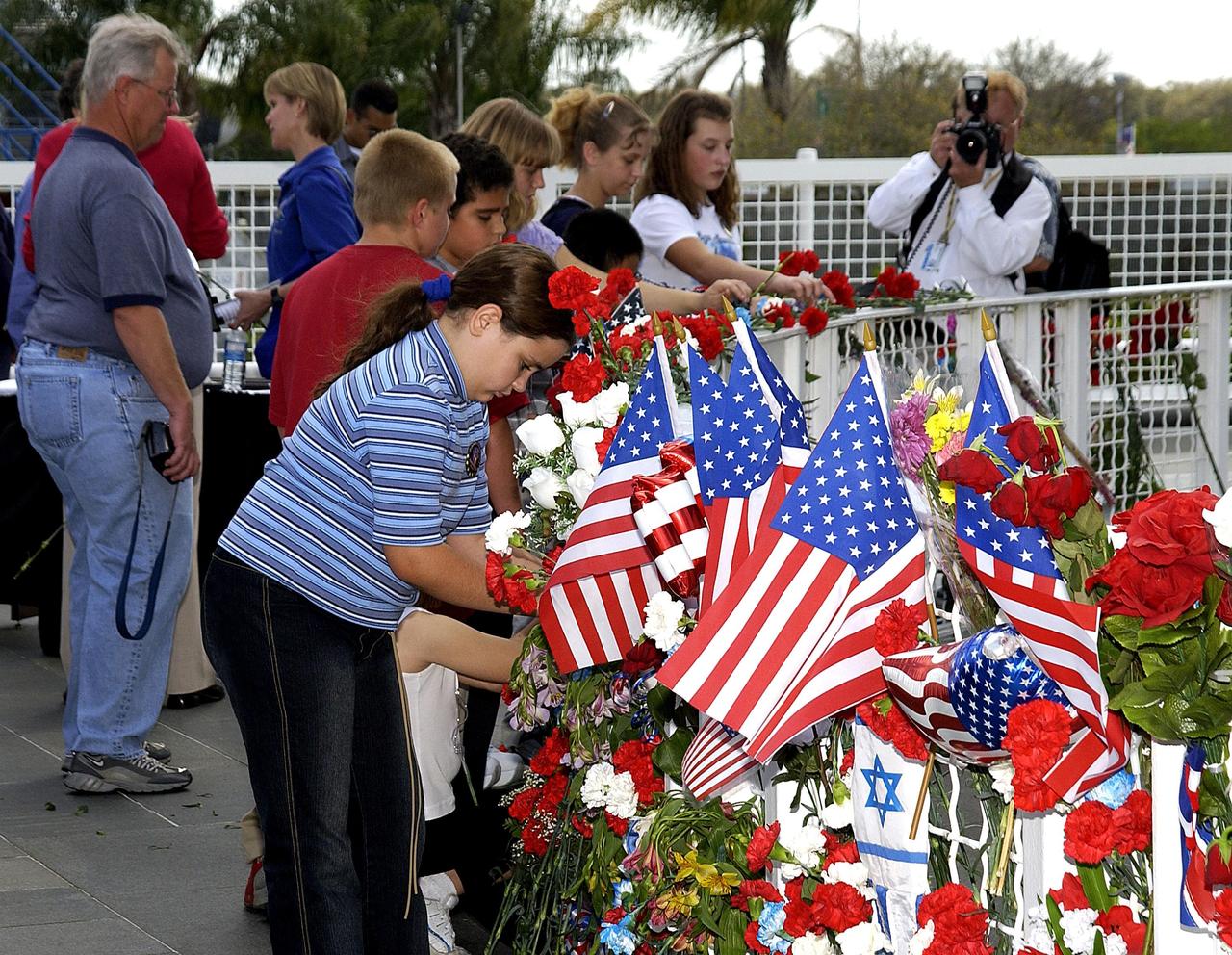
KENNEDY SPACE CENTER, FLA. - Students from Columbia Elementary School in Palm Bay, Fla., place flowers at the Astronaut Memorial to honor the fallen crew of Space Shuttle Columbia. The students visited the Center to learn about the past, present and future of space exploration. They also listened to Kirstie McCool Chadwick, the sister of Columbia astronaut William "Willie" J. McCool, and saw the 3-D IMAX film "Space Station."

KENNEDY SPACE CENTER, FLA. - Students from Columbia Elementary School in Palm Bay, Fla., place flowers at the Astronaut Memorial to honor the fallen crew of Space Shuttle Columbia. The students visited the Center to learn about the past, present and future of space exploration. They also listened to Kirstie McCool Chadwick, the sister of Columbia astronaut William "Willie" J. McCool, and saw the 3-D IMAX film "Space Station."
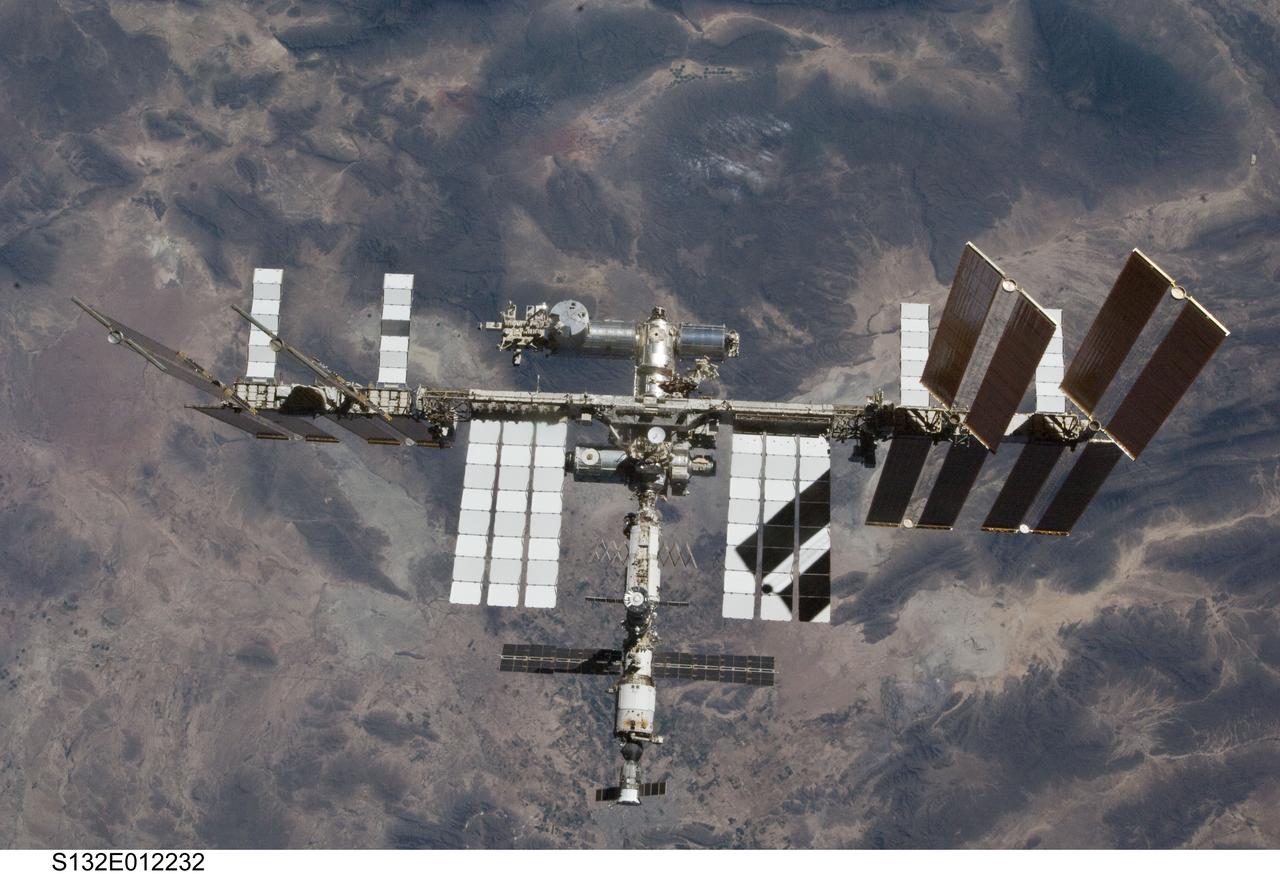
S132-E-012232 (23 May 2010) --- The International Space Station is featured in this image photographed by an STS-132 crew member on space shuttle Atlantis after the station and shuttle began their post-undocking relative separation. Undocking of the two spacecraft occurred at 10:22 a.m. (CDT) on May 23, 2010, ending a seven-day stay that saw the addition of a new station module, replacement of batteries and resupply of the orbiting outpost.
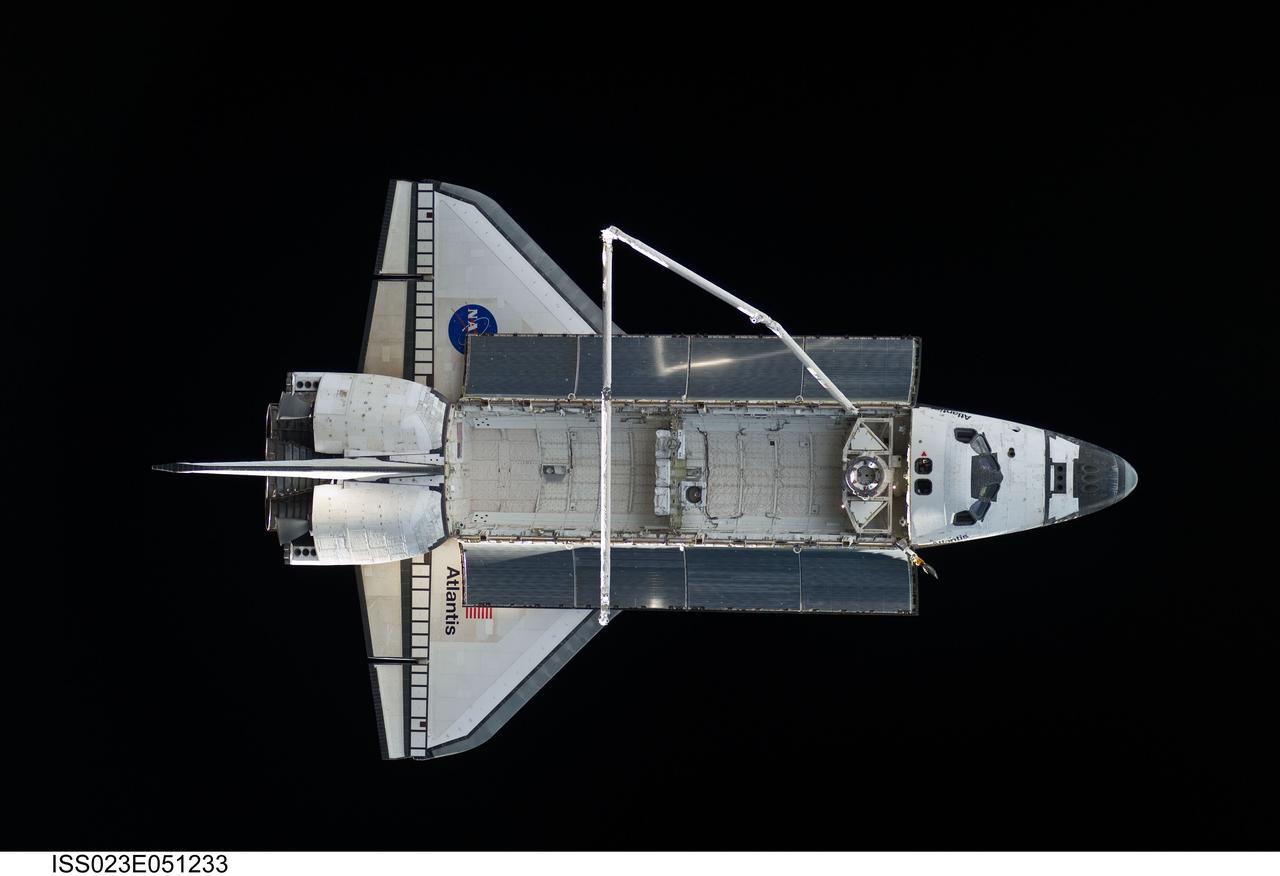
ISS023-E-051233 (23 May 2010) --- Space shuttle Atlantis is featured in this image photographed by an Expedition 23 crew member on the International Space Station soon after the shuttle and station began their post-undocking relative separation. Undocking of the two spacecraft occurred at 10:22 a.m. (CDT) on May 23, 2010, ending a seven-day stay that saw the addition of a new station module, replacement of batteries and resupply of the orbiting outpost.
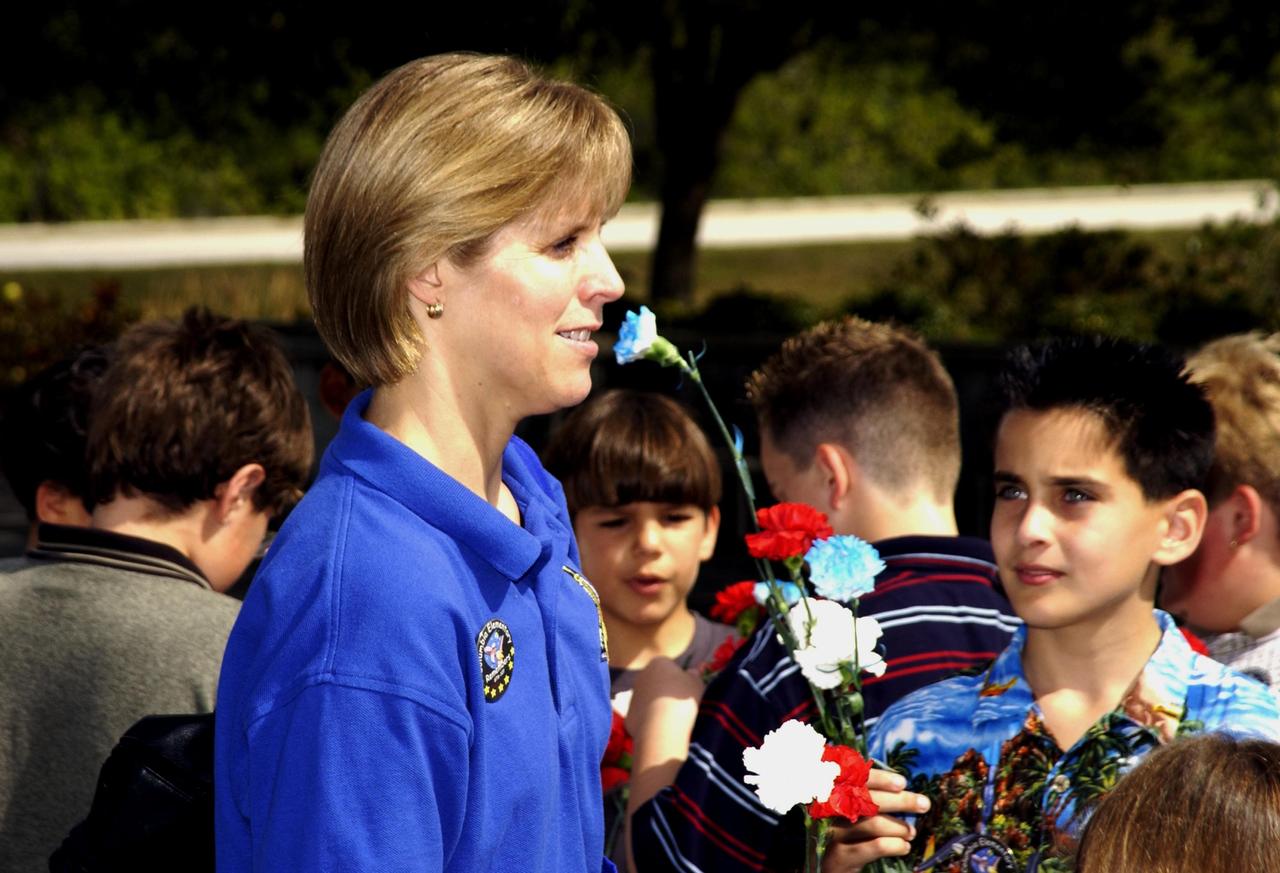
KENNEDY SPACE CENTER, FLA. - At the KSC Visitor Complex, Kirstie McCool Chadwick, the sister of astronaut William "Willie" J. McCool who perished in the Space Shuttle Columbia explosion Feb. 1, talks to students from Columbia Elementary School in Palm Bay, Fla. The students visited the Center to learn about the past, present and future of space exploration. They also visited the Astronaut Memorial, placing flowers and observing a moment of silence in honor of the fallen crew of Columbia, and saw the 3-D IMAX film "Space Station."

iss056e142981 (Aug. 15, 2018) --- Roscosmos cosmonaut Sergey Prokopyev lays cable for the installation of the Icarus animal-tracking experiment on the Zvezda service module during a spacewalk that lasted 7 hours 46 minutes. Fellow cosmonaut Oleg Artemyev (out of frame) joined Prokopyev during the spacewalk which also saw the deployment of four nano-satellites and the retrieval of a materials exposure experiment on the Russian segment of the International Space Station.

iss056e139457 (Aug. 15, 2018) --- Roscosmos cosmonaut Sergey Prokopyev hand-deploys one of two Tanyusha nano-satellites just outside of the Pirs docking compartment airlock during a spacewalk that lasted 7 hours 46 minutes. Fellow cosmonaut Oleg Artemyev (out of frame) joined Prokopyev during the spacewalk which also saw the installation of the Icarus animal-tracking experiment and the retrieval of a materials exposure experiment on the Russian segment of the International Space Station.
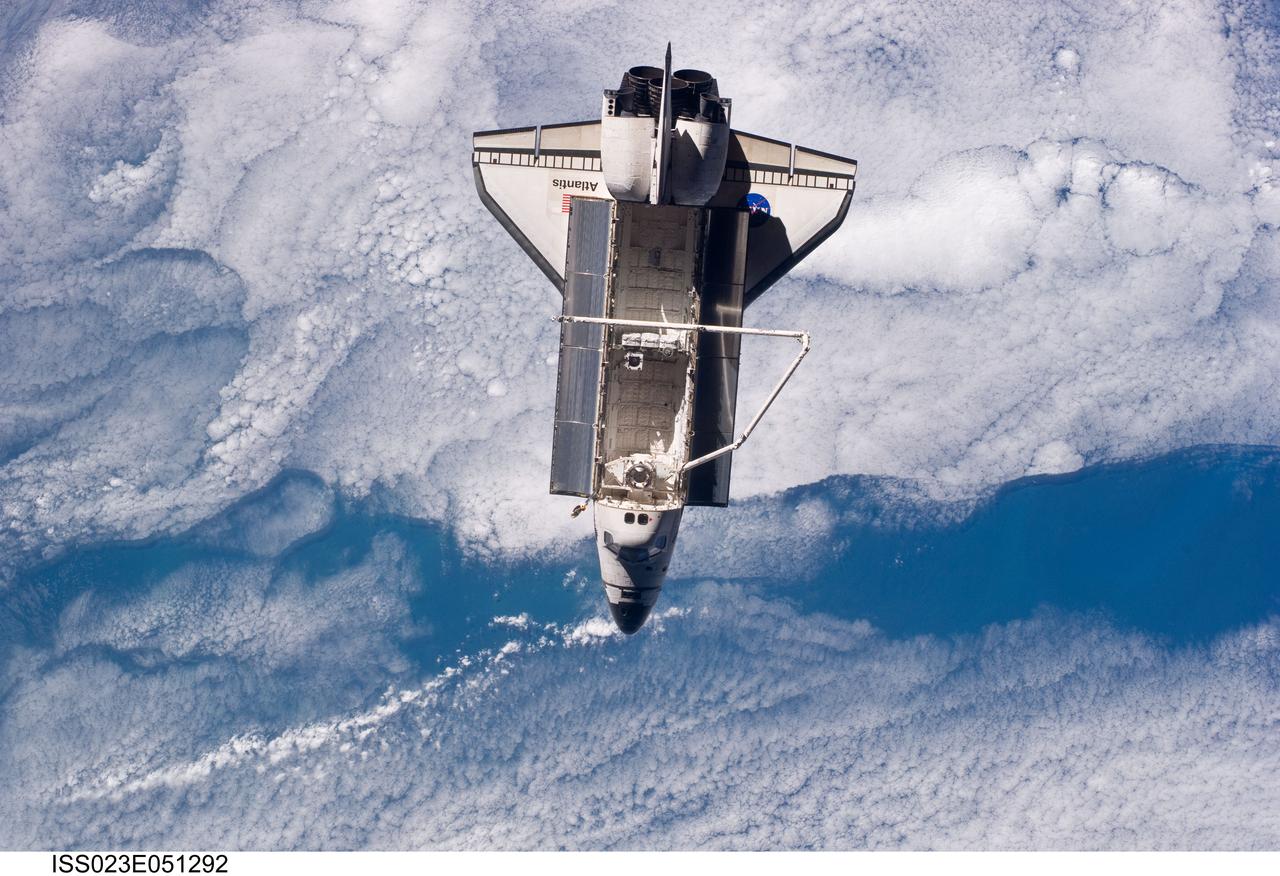
ISS023-E-051292 (23 May 2010) --- Space shuttle Atlantis is featured in this image photographed by an Expedition 23 crew member on the International Space Station soon after the shuttle and station began their post-undocking relative separation. Undocking of the two spacecraft occurred at 10:22 a.m. (CDT) on May 23, 2010, ending a seven-day stay that saw the addition of a new station module, replacement of batteries and resupply of the orbiting outpost. A blue and white part of Earth provides the backdrop for the scene.
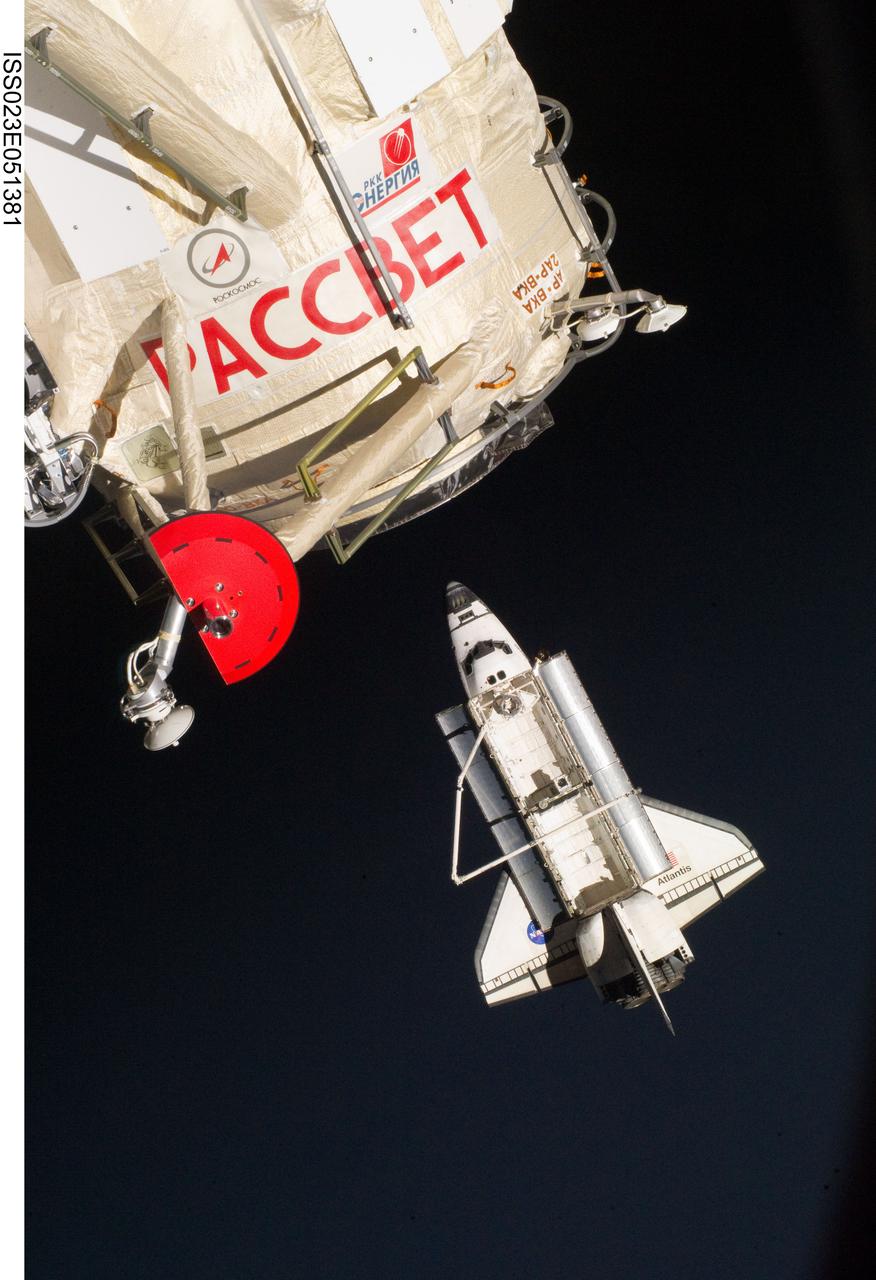
ISS023-E-051381 (23 May 2010) --- Space shuttle Atlantis is featured in this image photographed by an Expedition 23 crew member on the International Space Station soon after the shuttle and station began their post-undocking relative separation. Undocking of the two spacecraft occurred at 10:22 a.m. (CDT) on May 23, 2010, ending a seven-day stay that saw the addition of a new station module, replacement of batteries and resupply of the orbiting outpost. A portion of the newly-attached Rassvet Mini-Research Module 1 (MRM1) is at top.
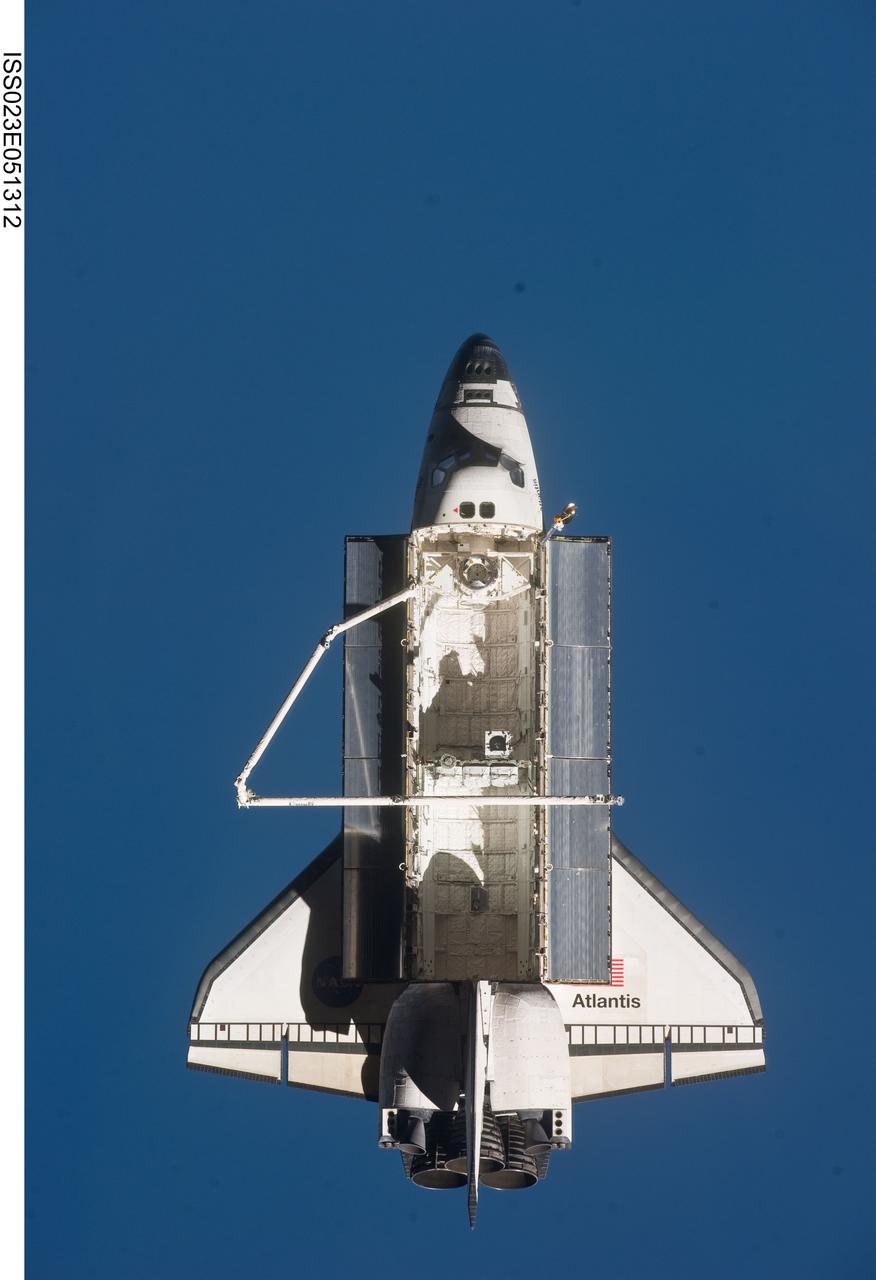
ISS023-E-051312 (23 May 2010) --- Space shuttle Atlantis is featured in this image photographed by an Expedition 23 crew member on the International Space Station soon after the shuttle and station began their post-undocking relative separation. Undocking of the two spacecraft occurred at 10:22 a.m. (CDT) on May 23, 2010, ending a seven-day stay that saw the addition of a new station module, replacement of batteries and resupply of the orbiting outpost. A blue part of Earth provides the backdrop for the scene.
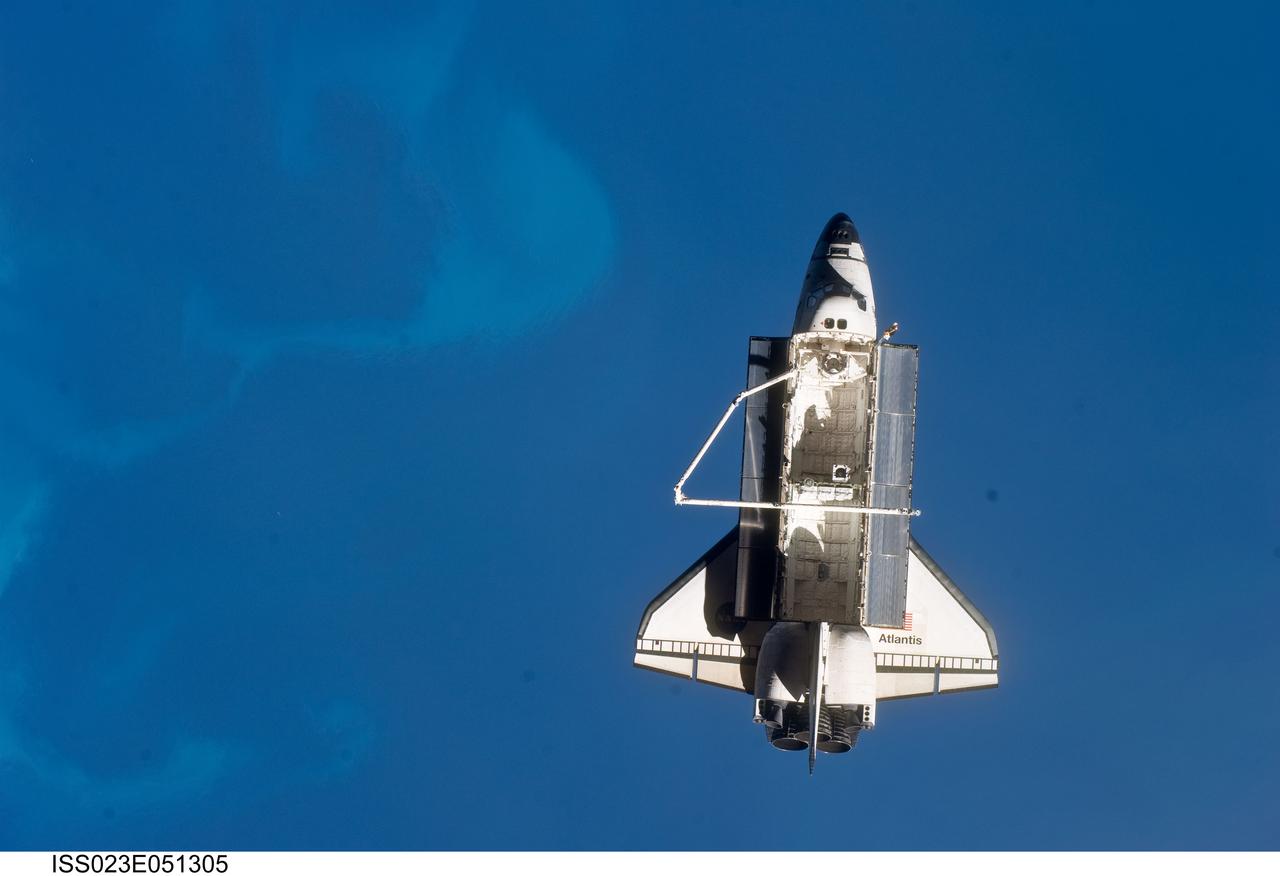
ISS023-E-051305 (23 May 2010) --- Space shuttle Atlantis is featured in this image photographed by an Expedition 23 crew member on the International Space Station soon after the shuttle and station began their post-undocking relative separation. Undocking of the two spacecraft occurred at 10:22 a.m. (CDT) on May 23, 2010, ending a seven-day stay that saw the addition of a new station module, replacement of batteries and resupply of the orbiting outpost. A blue part of Earth provides the backdrop for the scene.

KENNEDY SPACE CENTER, FLA. -- Students from Columbia Elementary School in Palm Bay, Fla., place flowers at the Astronaut Memorial to honor the fallen crew of Space Shuttle Columbia. The students visited the Center to learn about the past, present and future of space exploration. They also listened to Kirstie McCool Chadwick, the sister of Columbia astronaut William "Willie" J. McCool, and saw the 3-D IMAX film "Space Station."
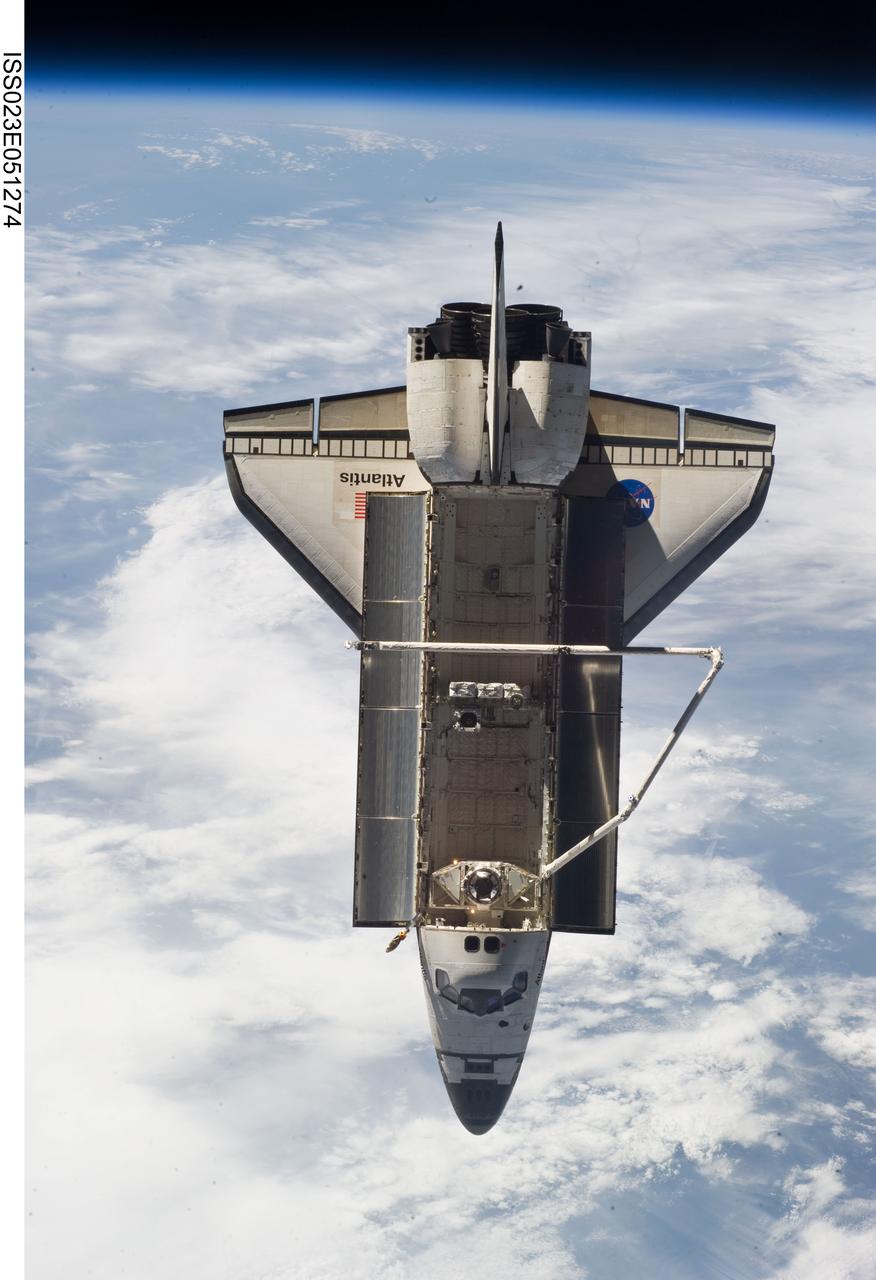
ISS023-E-051274 (23 May 2010) --- Space shuttle Atlantis is featured in this image photographed by an Expedition 23 crew member on the International Space Station soon after the shuttle and station began their post-undocking relative separation. Undocking of the two spacecraft occurred at 10:22 a.m. (CDT) on May 23, 2010, ending a seven-day stay that saw the addition of a new station module, replacement of batteries and resupply of the orbiting outpost. A blue and white part of Earth provides the backdrop for the scene.
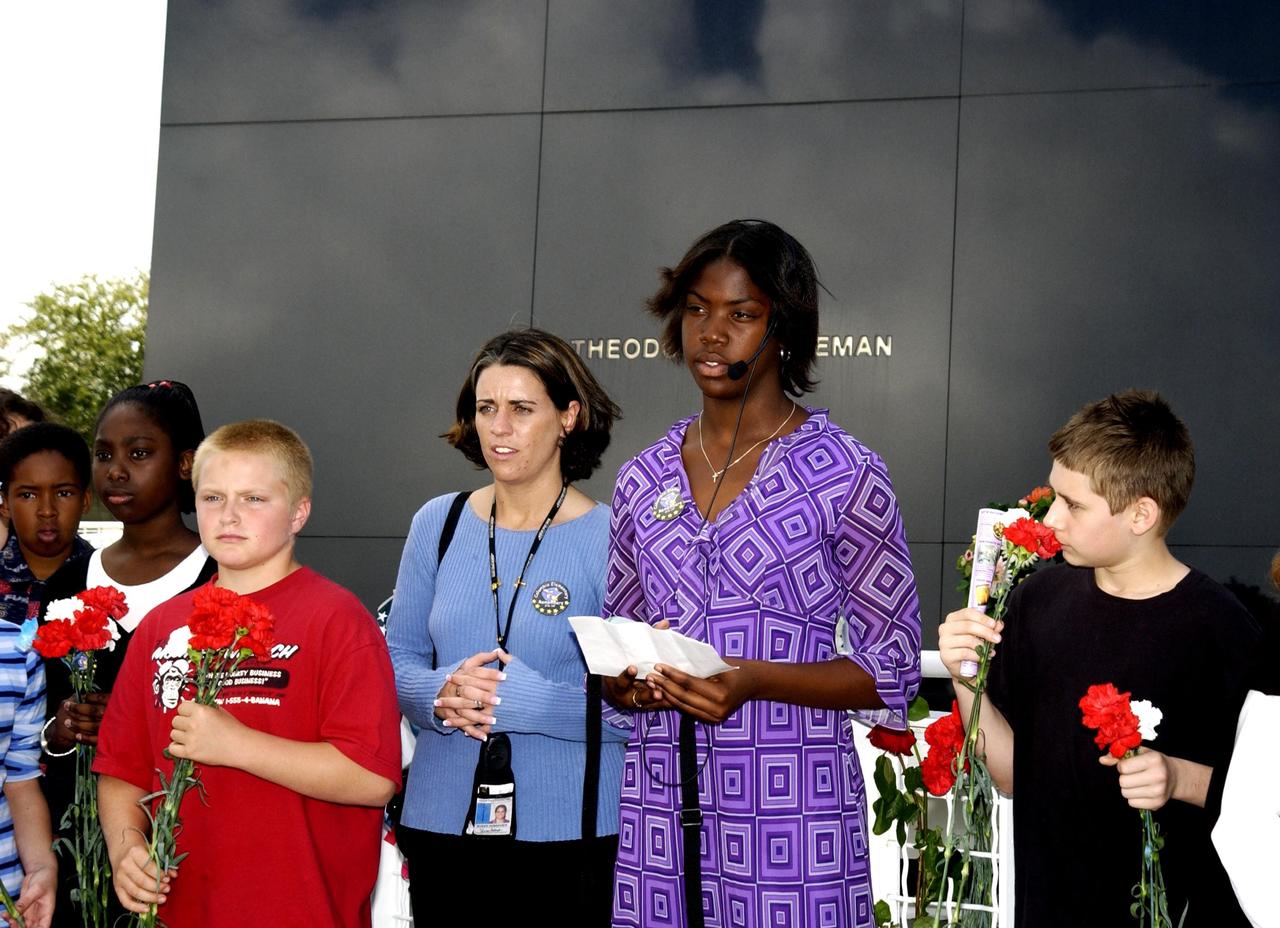
KENNEDY SPACE CENTER, FLA. - At the KSC Visitor Complex Astronaut Memorial, Jasmine Haralson (second from right), a student from Columbia Elementary School in Palm Bay, Fla., recites during a tribute to the fallen crew of Space Shuttle Columbia. She and other students from the elementary school visited the Center to learn about the past, present and future of space exploration. They also listened to Kirstie McCool Chadwick, the sister of Columbia astronaut William "Willie" J. McCool, and saw the 3-D IMAX film "Space Station."
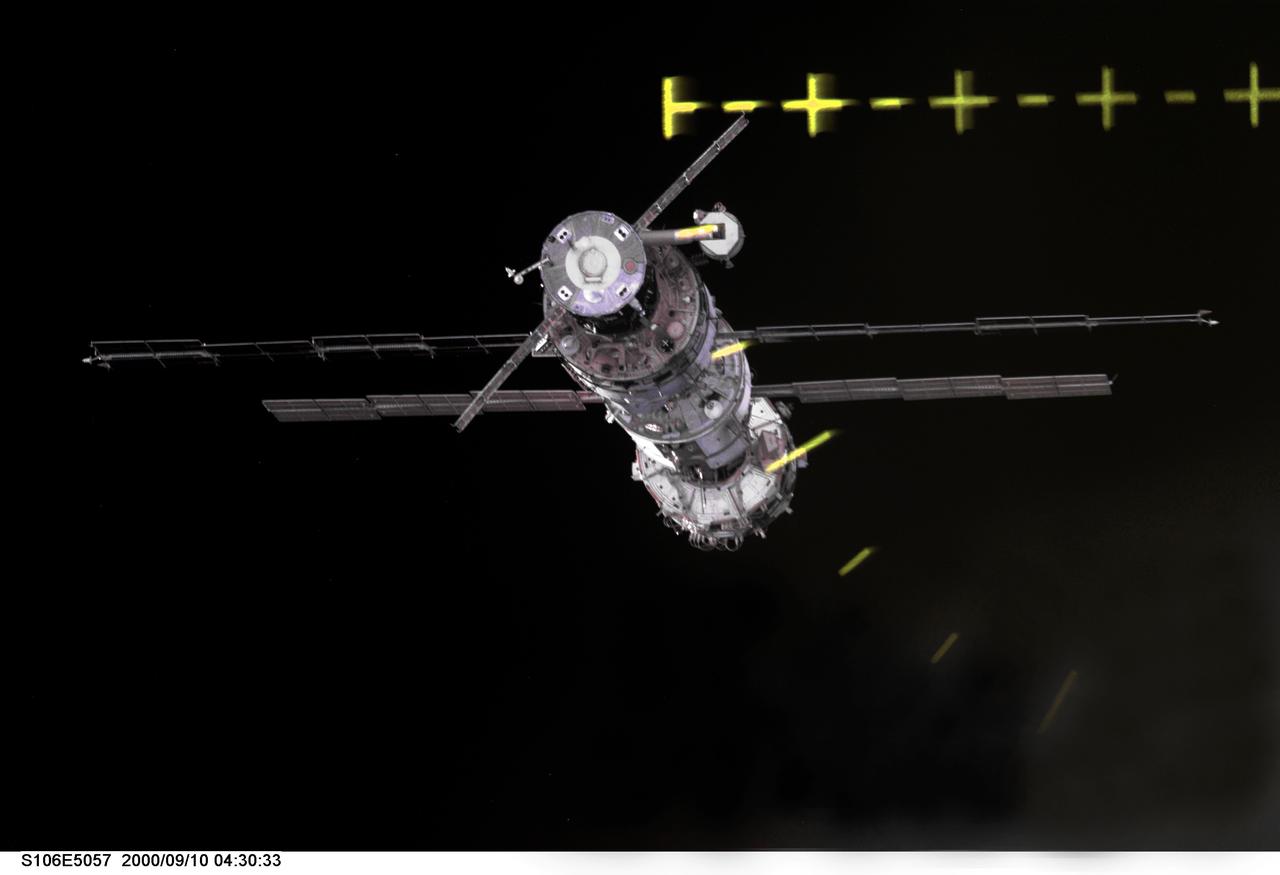
S106-E-5057 (10 September 2000) --- The International Space Station (ISS) is only a few hundred meters away from the Space Shuttle Atlantis in this electronic image. The last time astronauts saw the ISS, it was not sporting the recently-arriving Progress, which appears at the top in this perspective. Also, next to the Progress, appears the Zvezda service module, which had been delivered by a Proton rocket since the most recent human visit to ISS. The ruled markings in the upper right are part of the Crew Optical Alignment Sight (COAS) on Atlantis.
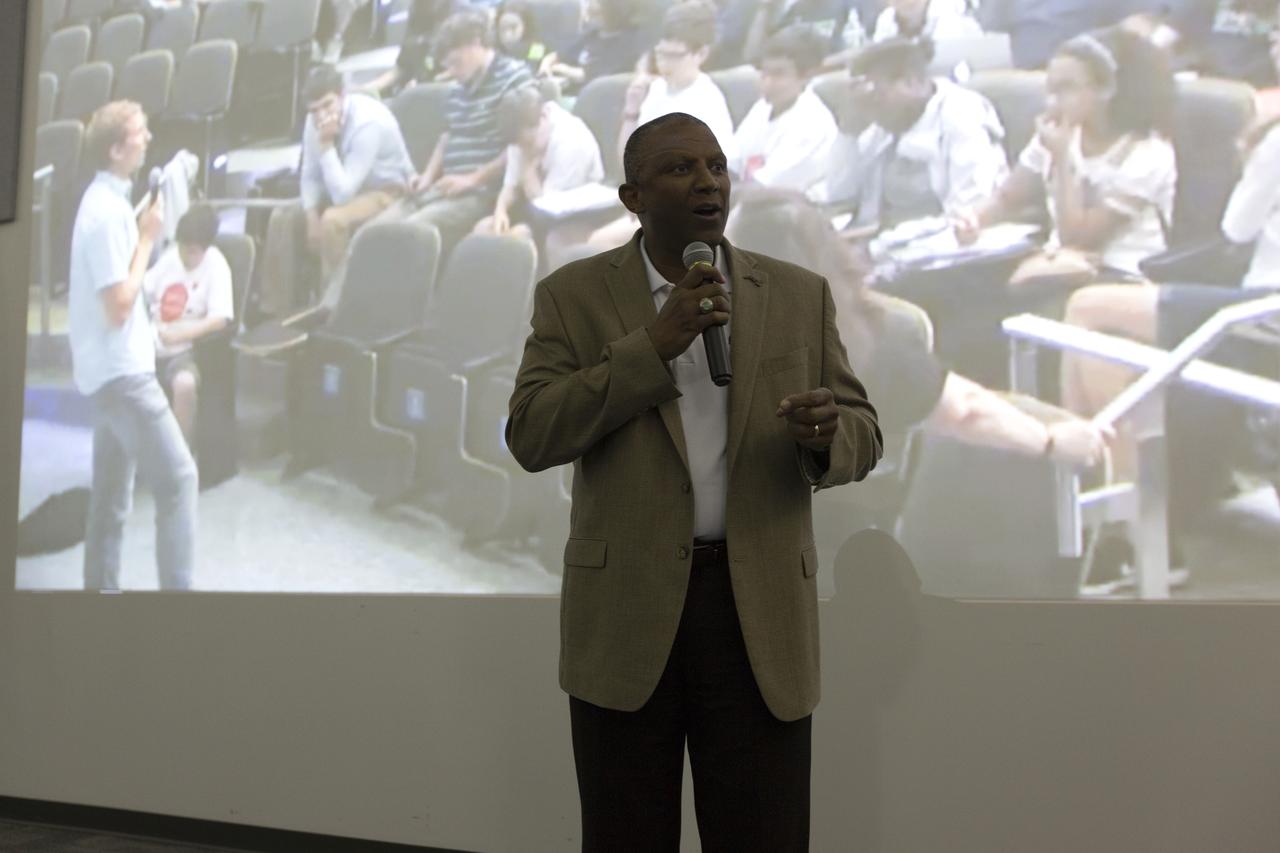
NASA Kennedy Space Center Associate Director Kelvin Manning speaks to students and sponsors in the spaceport’s Center for Space Education. Teams from across the state of Florida were gathered at Kennedy for the finals of the Zero Robotics Middle School Summer Program national championship. The five-week program allows rising sixth- through ninth-graders to write programs for small satellites called SPHERES (Synchronized, Position, Hold, Engage, Reorient, Experimental Satellites). Finalists saw their code tested aboard the International Space Station.
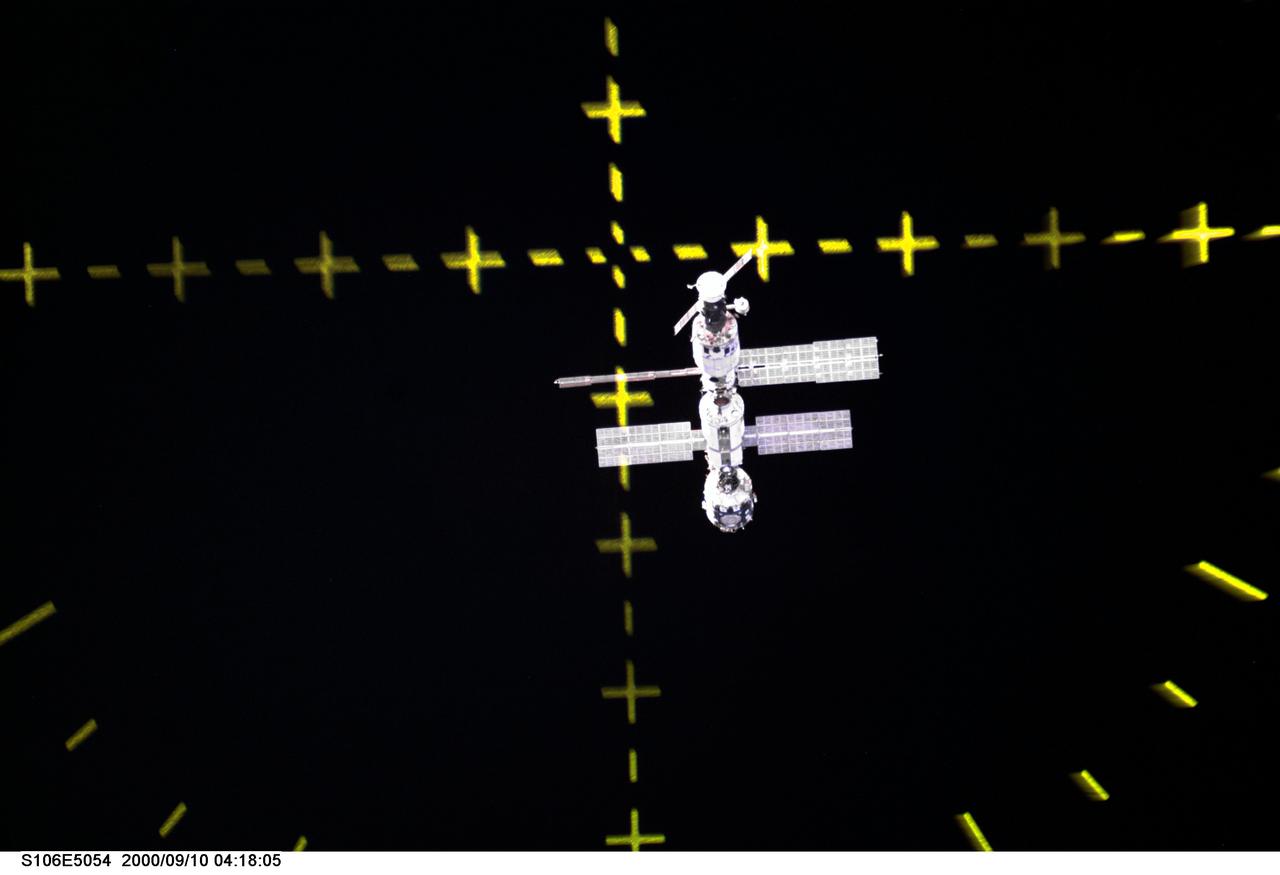
S106-E-5054 (10 September 2000) --- The International Space Station (ISS) is now in the view of the crew aboard the Space Shuttle Atlantis as evidenced in this electronic image. The markings in the photo are those of the Crew Optical Alignment Sight (COAS), an instrument used routinely for docking maneuvers. The last time astronauts saw the ISS, it was not sporting the recently-arriving Progress, which appears at the top in this perspective. Also, a Proton had earlier delivered the Zvezda service module to the station since the last human visit.
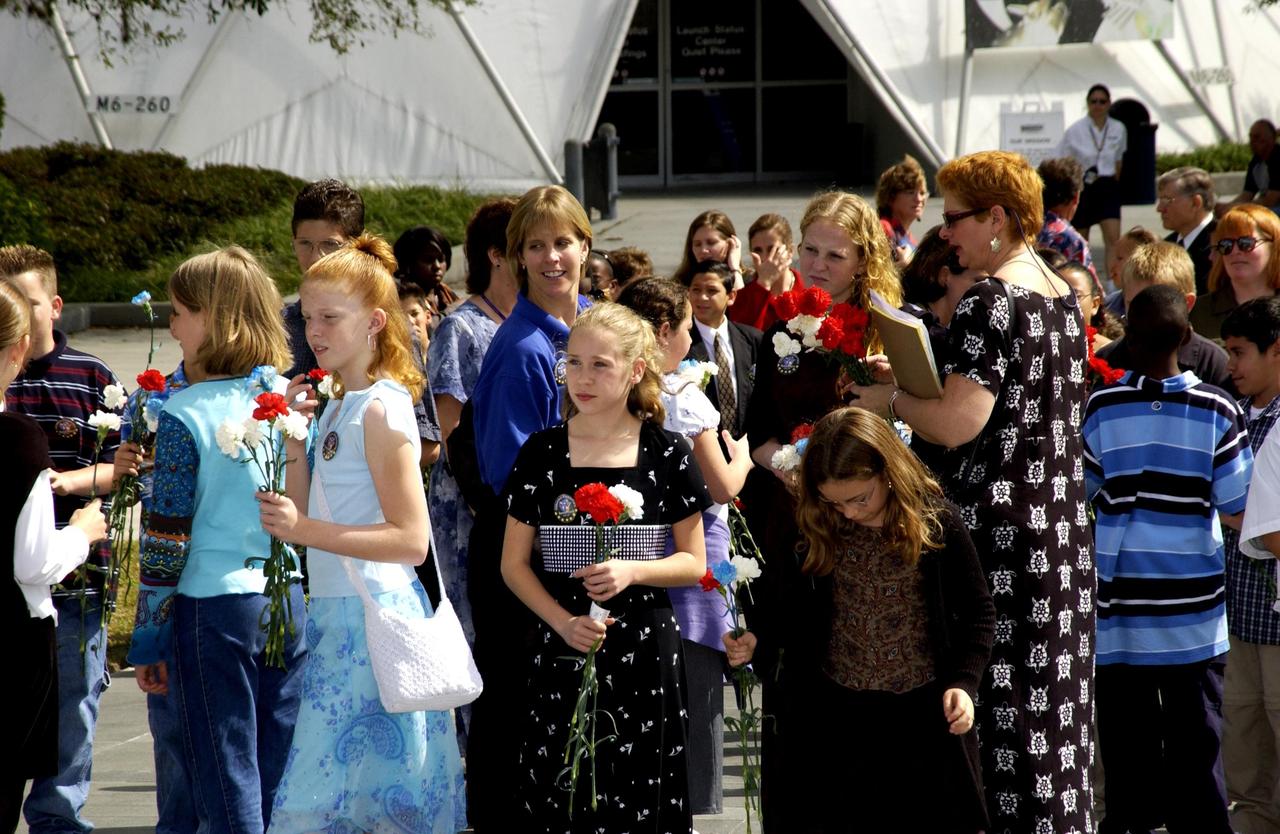
KENNEDY SPACE CENTER, FLA. - Students from Columbia Elementary School in Palm Bay, Fla., visit the KSC Visitor Complex. The students visited the Center to learn about the past, present and future of space exploration. They listened to Kirstie McCool Chadwick, the sister of astronaut William "Willie" J. McCool who perished in the Space Shuttle Columbia explosion Feb. 1, visited the Astronaut Memorial, placing flowers and observing a moment of silence in honor of the fallen crew of Columbia, and saw the 3-D IMAX film "Space Station."
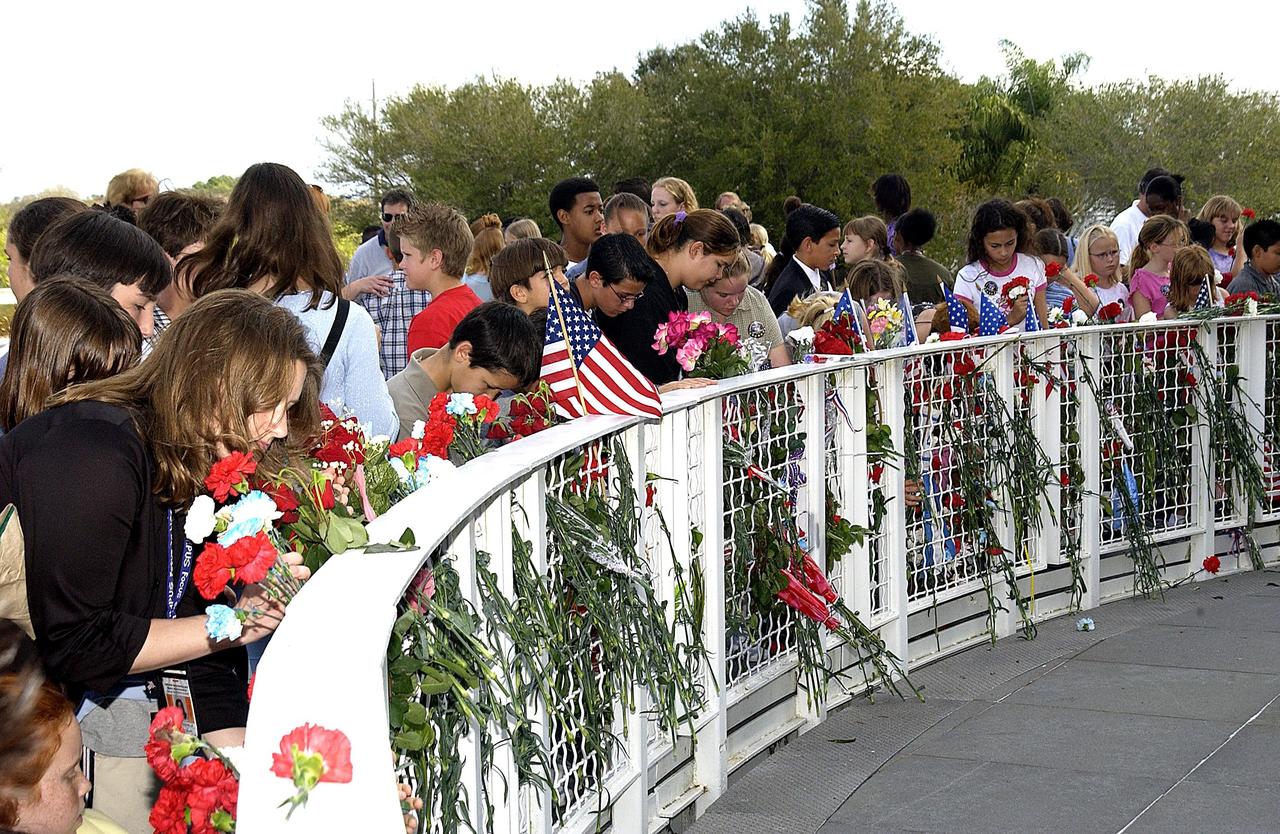
KENNEDY SPACE CENTER, FLA. -- Students from Columbia Elementary School in Palm Bay, Fla., place flowers at the Astronaut Memorial to honor the fallen crew of Space Shuttle Columbia. The students visited the Center to learn about the past, present and future of space exploration. They also listened to Kirstie McCool Chadwick, the sister of Columbia astronaut William "Willie" J. McCool, and saw the 3-D IMAX film "Space Station."
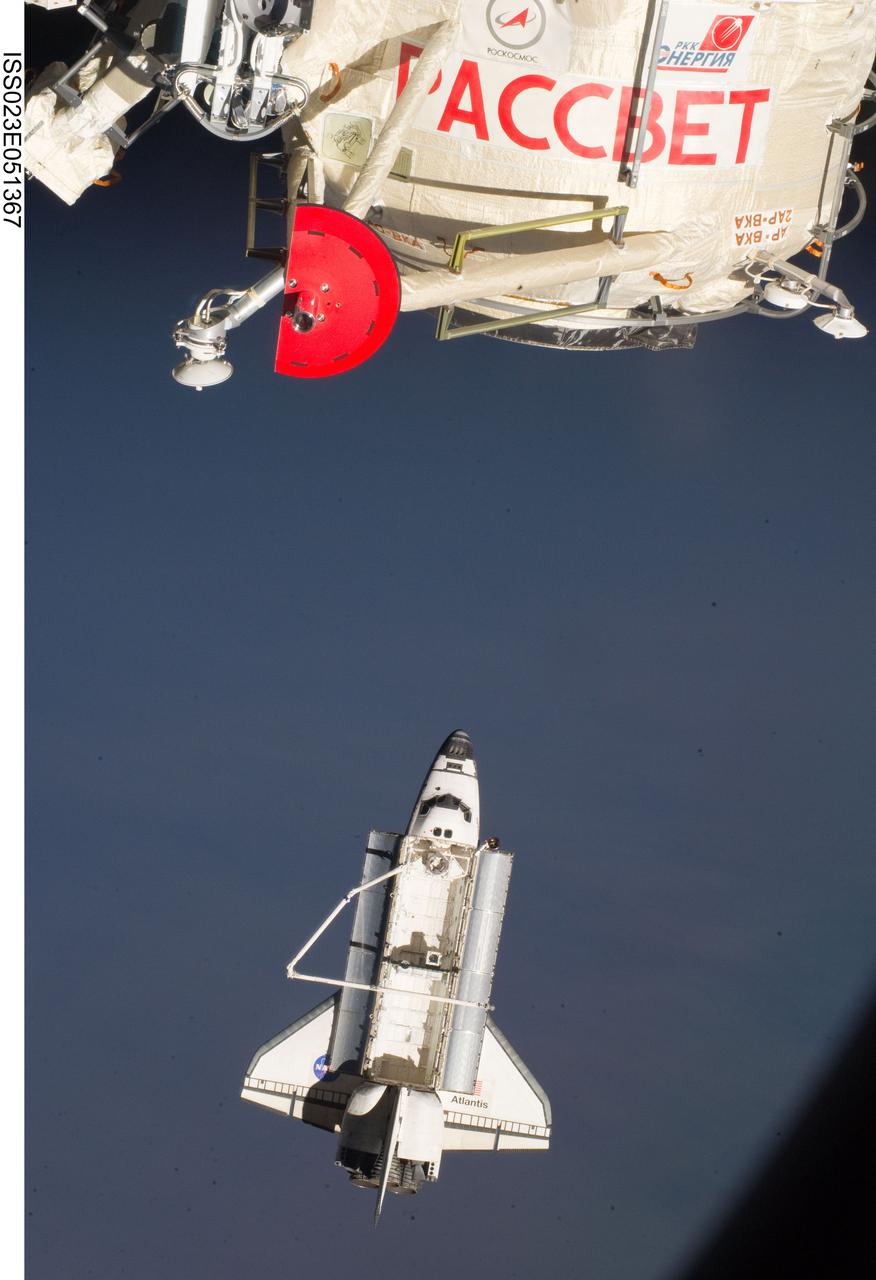
ISS023-E-051367 (23 May 2010) --- Space shuttle Atlantis is featured in this image photographed by an Expedition 23 crew member on the International Space Station soon after the shuttle and station began their post-undocking relative separation. Undocking of the two spacecraft occurred at 10:22 a.m. (CDT) on May 23, 2010, ending a seven-day stay that saw the addition of a new station module, replacement of batteries and resupply of the orbiting outpost. A portion of the newly-attached Rassvet Mini-Research Module 1 (MRM1) is at top.
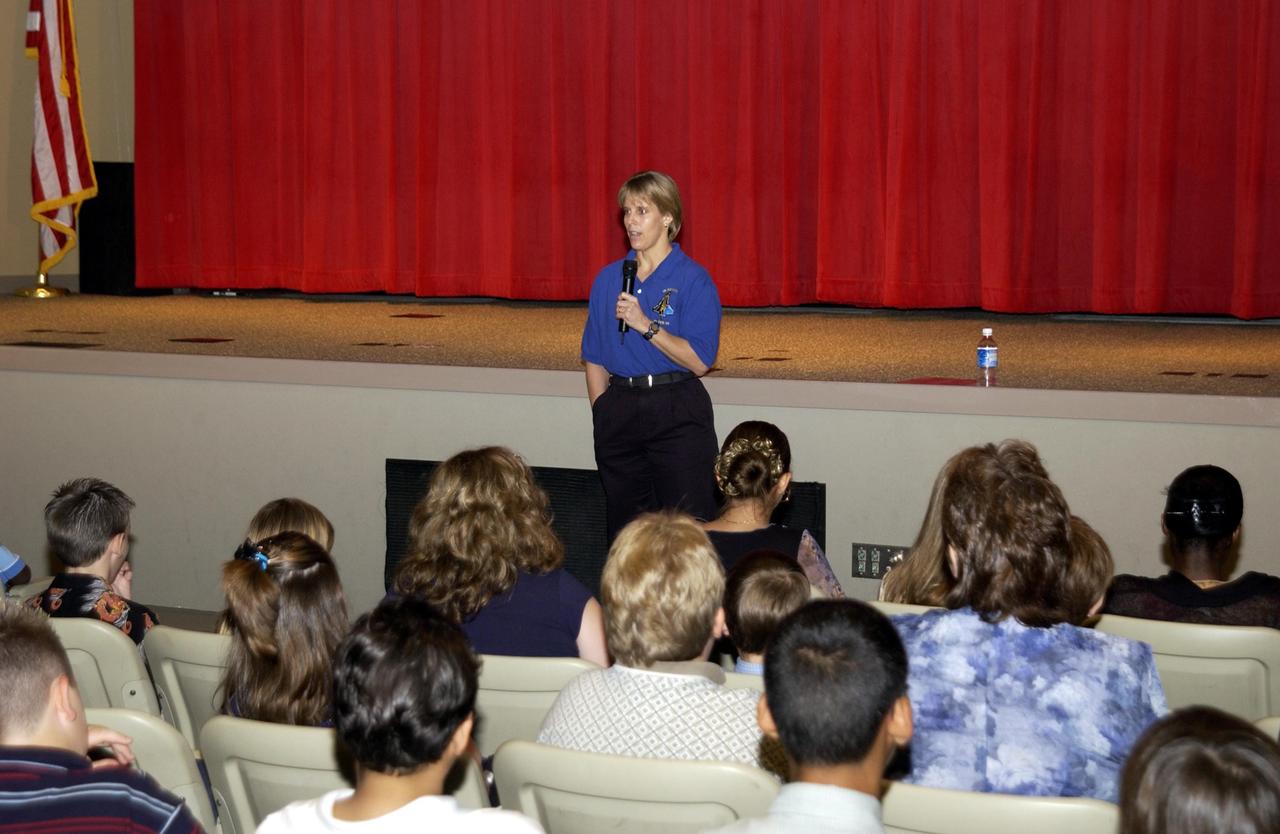
KENNEDY SPACE CENTER, FLA. - At the KSC Visitor Complex, Kirstie McCool Chadwick, the sister of astronaut William "Willie" J. McCool who perished in the Space Shuttle Columbia explosion Feb. 1, talks to students from Columbia Elementary School in Palm Bay, Fla. The students visited the Center to learn about the past, present and future of space exploration. They also visited the Astronaut Memorial, placing flowers and observing a moment of silence in honor of the fallen crew of Columbia, and saw the 3-D IMAX film "Space Station."
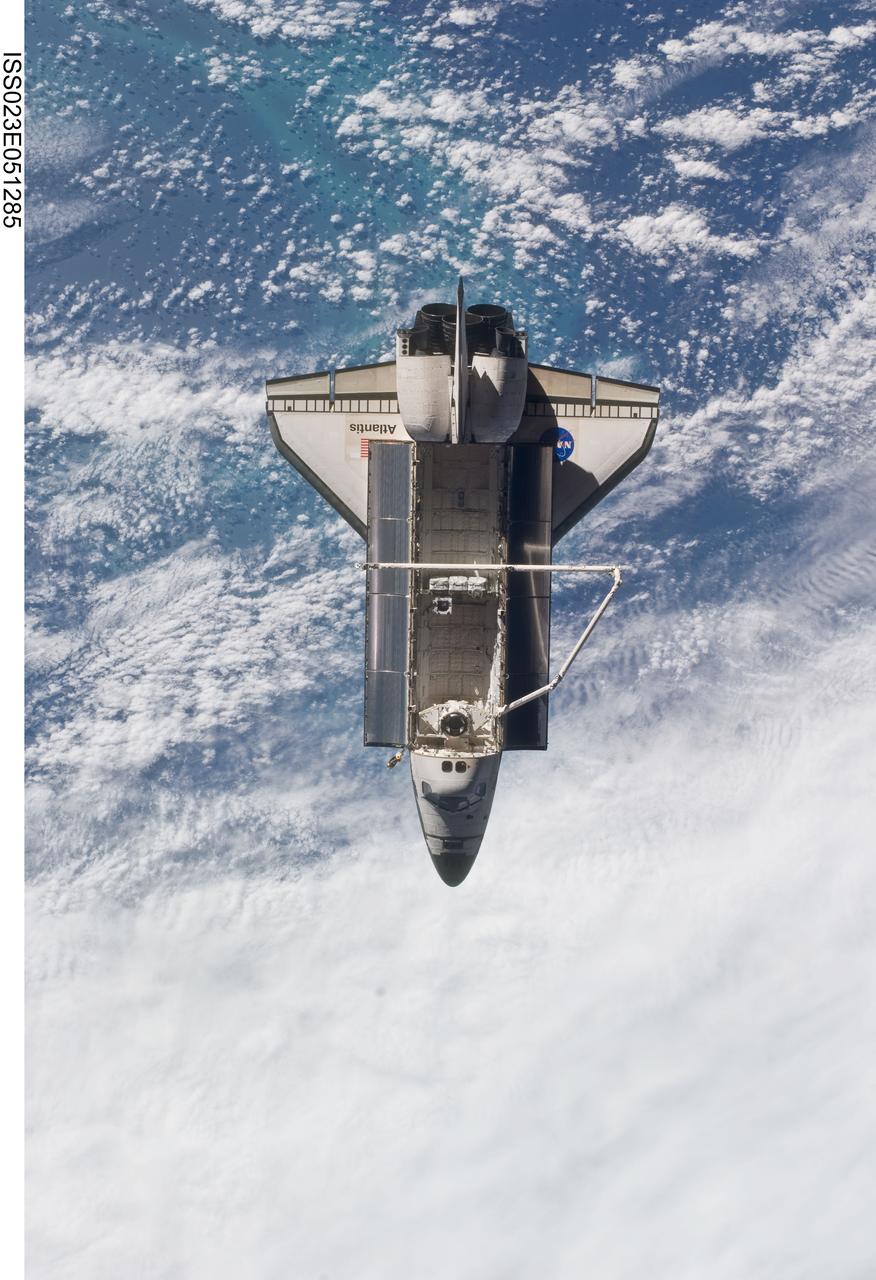
ISS023-E-051285 (23 May 2010) --- Space shuttle Atlantis is featured in this image photographed by an Expedition 23 crew member on the International Space Station soon after the shuttle and station began their post-undocking relative separation. Undocking of the two spacecraft occurred at 10:22 a.m. (CDT) on May 23, 2010, ending a seven-day stay that saw the addition of a new station module, replacement of batteries and resupply of the orbiting outpost. A blue and white part of Earth provides the backdrop for the scene.
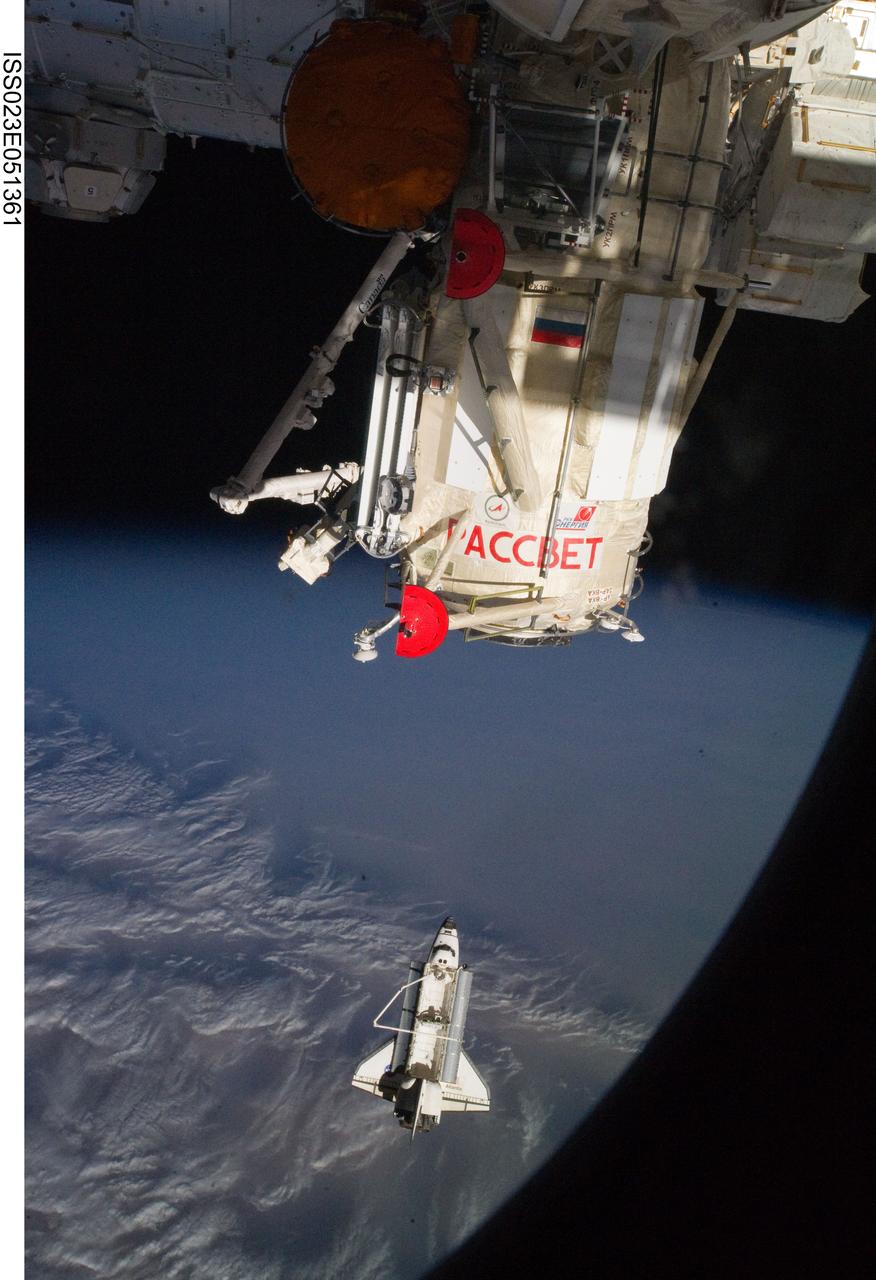
ISS023-E-051361 (23 May 2010) --- Space shuttle Atlantis and the newly-attached Rassvet Mini-Research Module 1 (MRM1) are featured in this image photographed by an Expedition 23 crew member on the International Space Station soon after the shuttle and station began their post-undocking relative separation. Undocking of the two spacecraft occurred at 10:22 a.m. (CDT) on May 23, 2010, ending a seven-day stay that saw the addition of a new station module, replacement of batteries and resupply of the orbiting outpost.
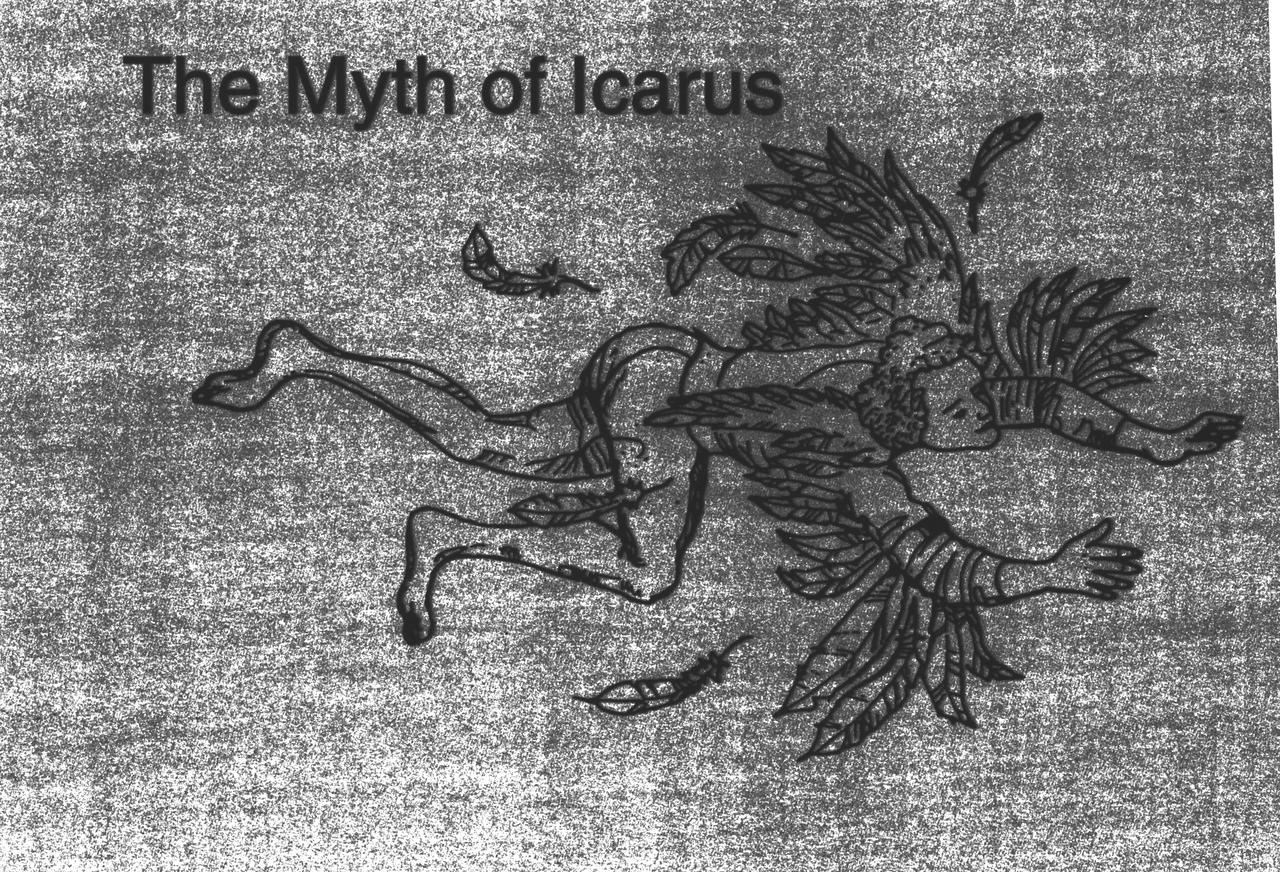
Ever since humans first saw birds soar through the sky, they have wanted to fly. The ancient Greeks and Romans pictured many of their gods with winged feet, and imagined mythological winged animals. According to the legend of Daedalus and Icarus, the father and son escaped prison by attaching wings made of wax and feathers to their bodies. Unfortunately, Icarus flew too near the sun, and the heat caused the wax and feathers to melt. The feathers fell off, and Icarus plummeted to the sea. Daedalus landed safely in Sicily.
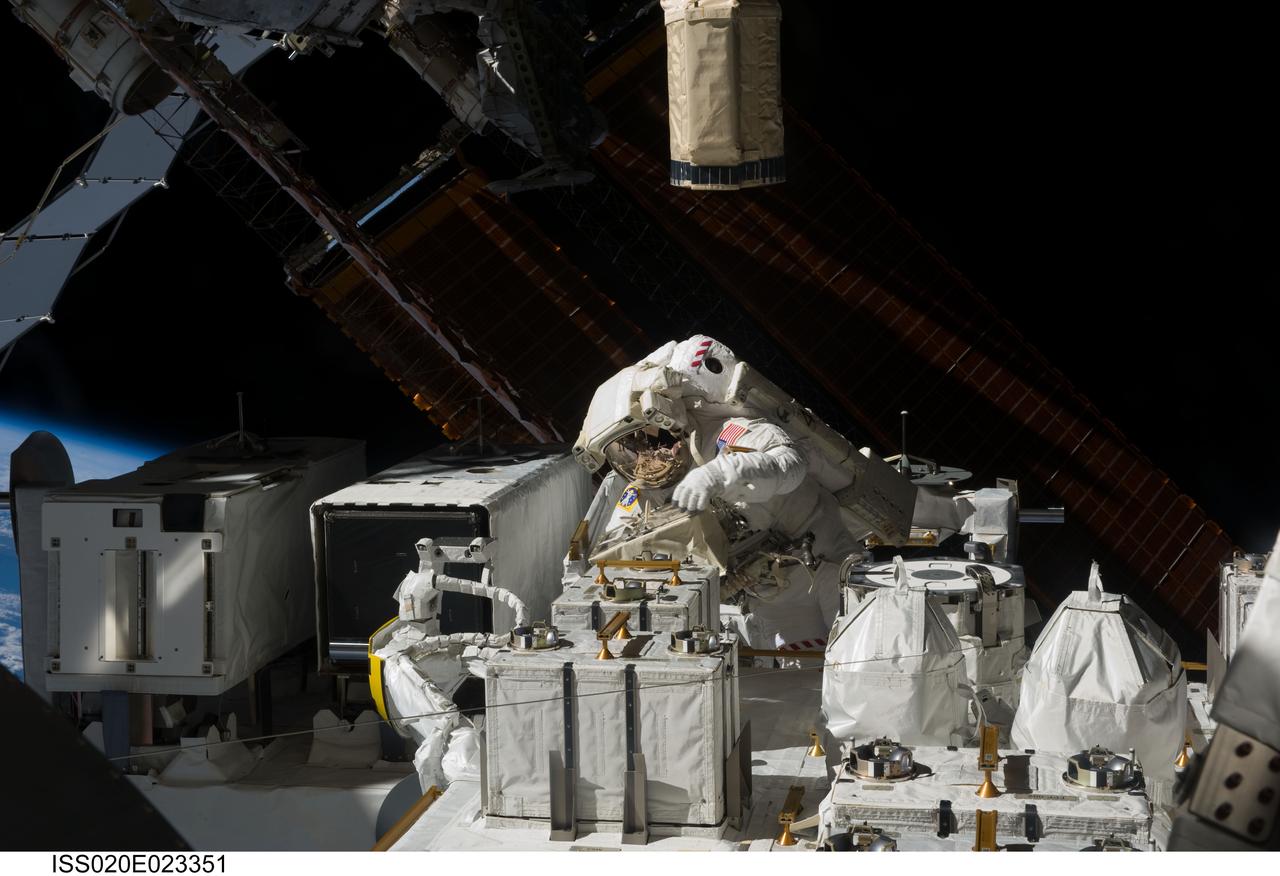
ISS020-E-023351 (22 July 2009) --- Astronaut Christopher Cassidy, STS-127 mission specialist, handles the Japanese Experiment Module - Exposed Facility, which has been a major subject of attention by the joint crews aboard the International Space Station, currently docked with the Space Shuttle Endeavour. Flight day 8 on July 22 saw both hands-on and robotics work with the new hardware.
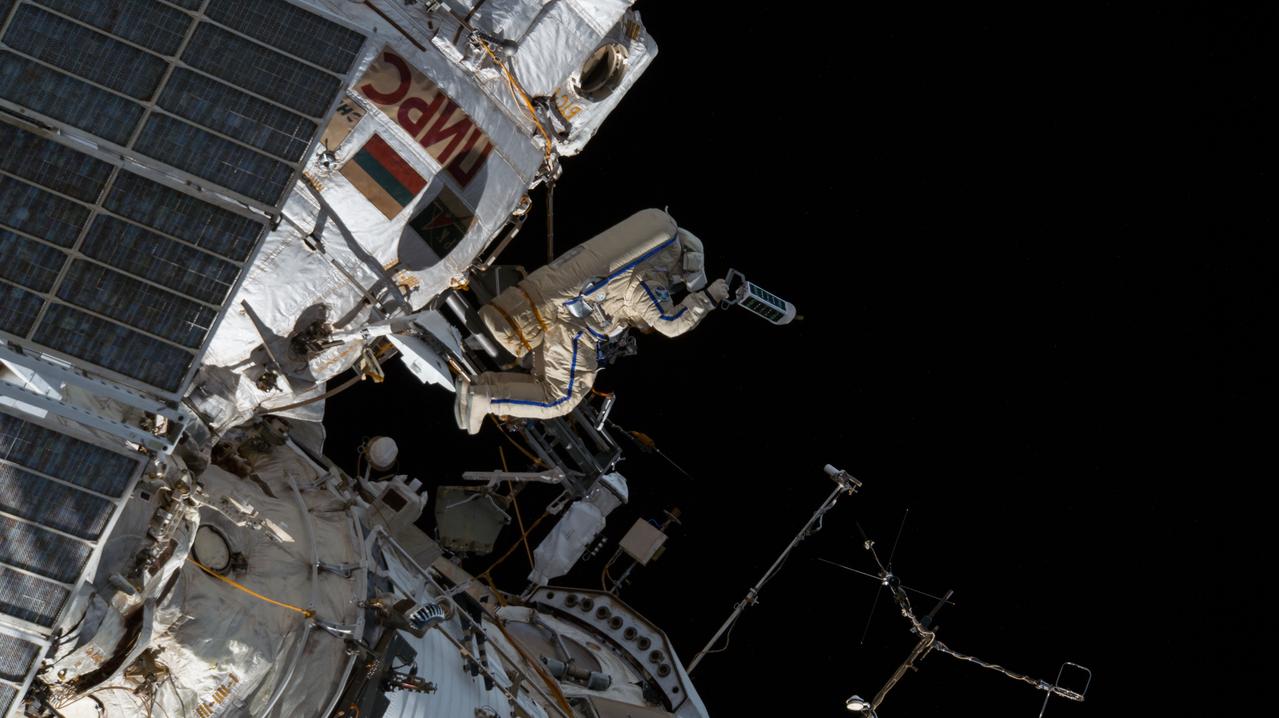
iss056e139456 (Aug. 15, 2018) --- Roscosmos cosmonaut Sergey Prokopyev hand-deploys one of two Tanyusha nano-satellites just outside of the Pirs docking compartment airlock during a spacewalk that lasted 7 hours 46 minutes. Fellow cosmonaut Oleg Artemyev (out of frame) joined Prokopyev during the spacewalk which also saw the installation of the Icarus animal-tracking experiment and the retrieval of a materials exposure experiment on the Russian segment of the International Space Station.
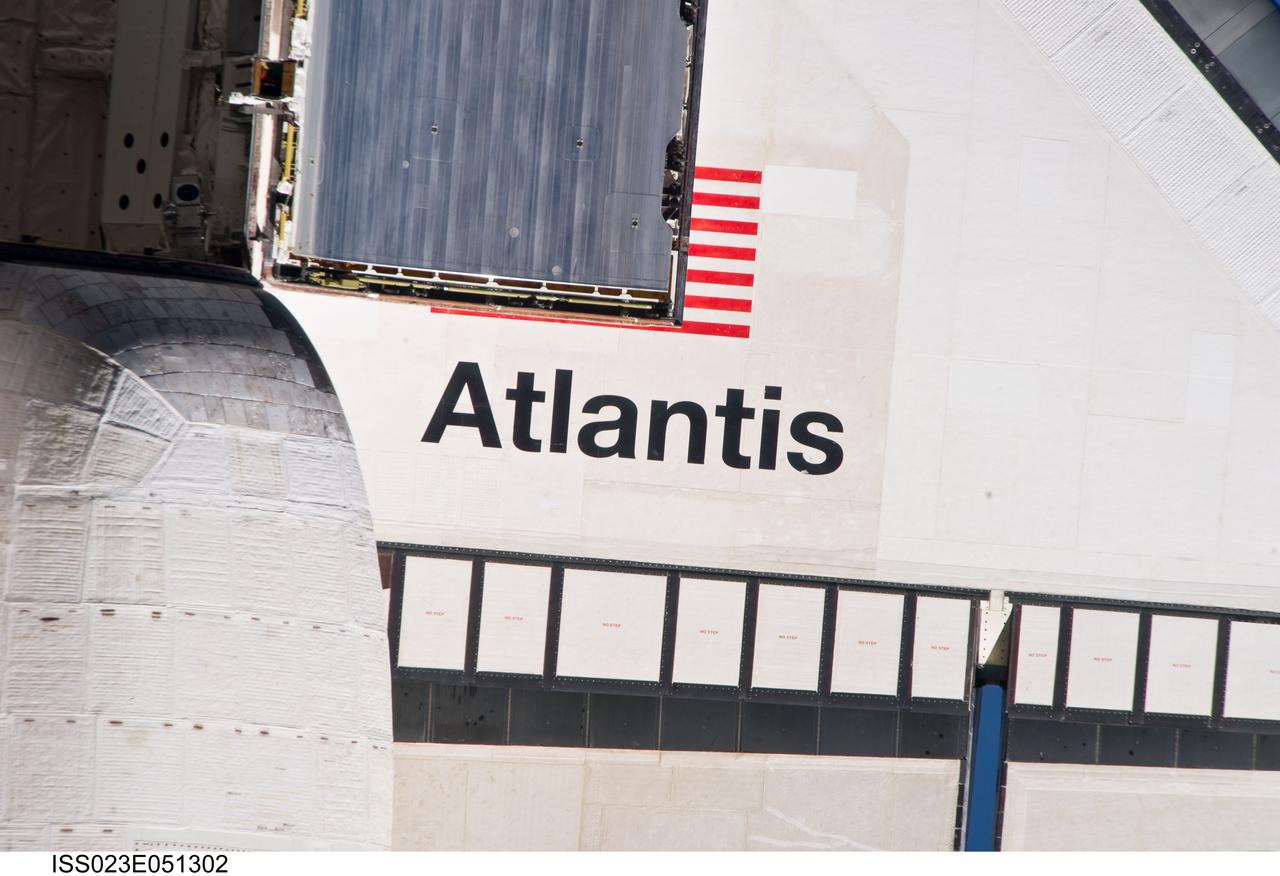
ISS023-E-051302 (23 May 2010) --- This partial view of the starboard wing of the space shuttle Atlantis was provided by an Expedition 23 crew member on the International Space Station soon after the shuttle and station began their post-undocking relative separation. Undocking of the two spacecraft occurred at 10:22 a.m. (CDT) on May 23, 2010, ending a seven-day stay that saw the addition of a new station module, replacement of batteries and resupply of the orbiting outpost.