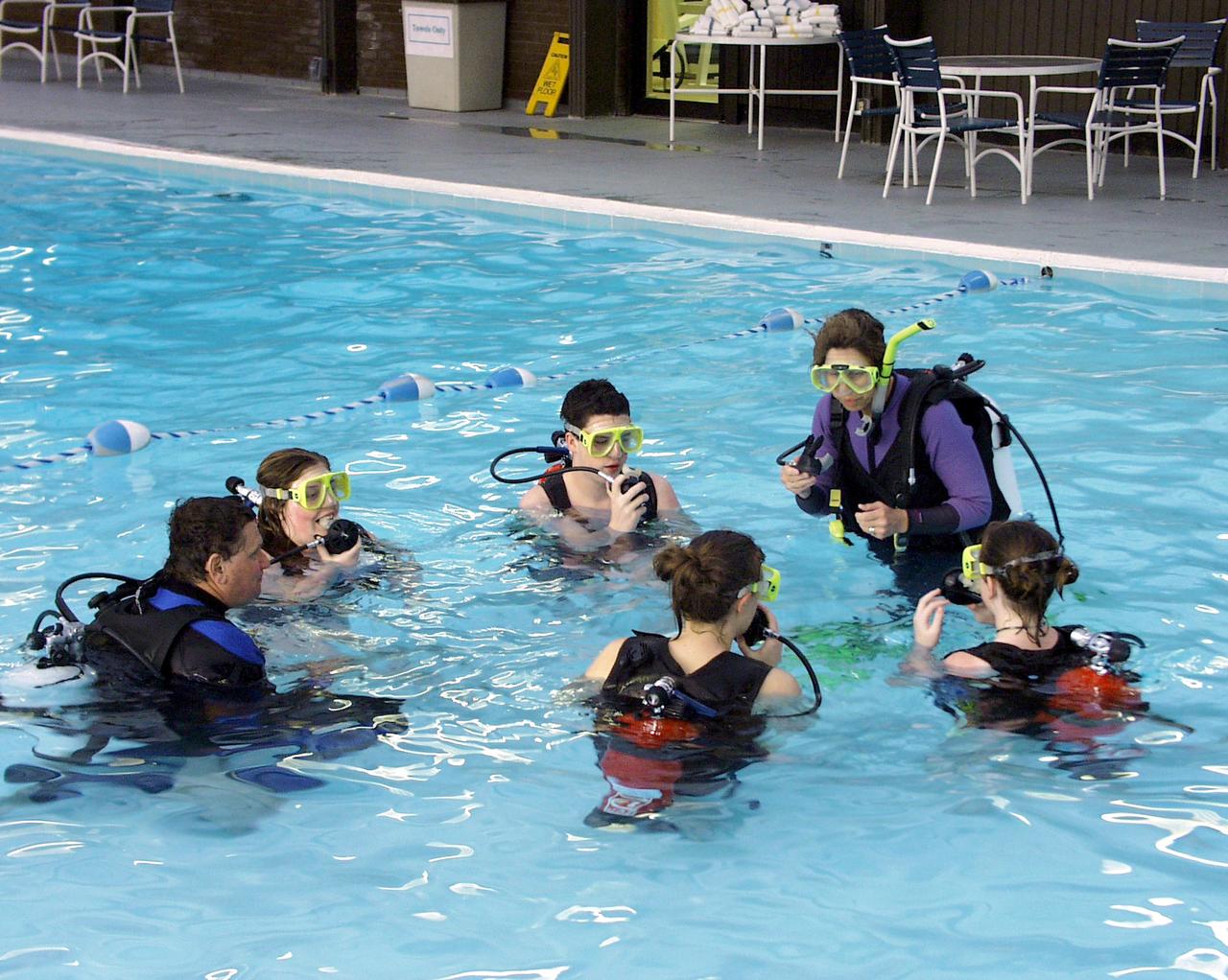
In addition to drop tower activities, students assembled a plastic pipe structure underwater in a SCUBA exercise similar to training astronauts receive at NASA Johnson Space Center. This was part of the second Dropping in a Microgravity Environment (DIME) competition held April 23-25, 2002, at NASA's Glenn Research Center. Competitors included two teams from Sycamore High School, Cincinnati, OH, and one each from Bay High School, Bay Village, OH, and COSI Academy, Columbus, OH. DIME is part of NASA's education and outreach activities. Details are on line at http://microgravity.grc.nasa.gov/DIME_2002.html.
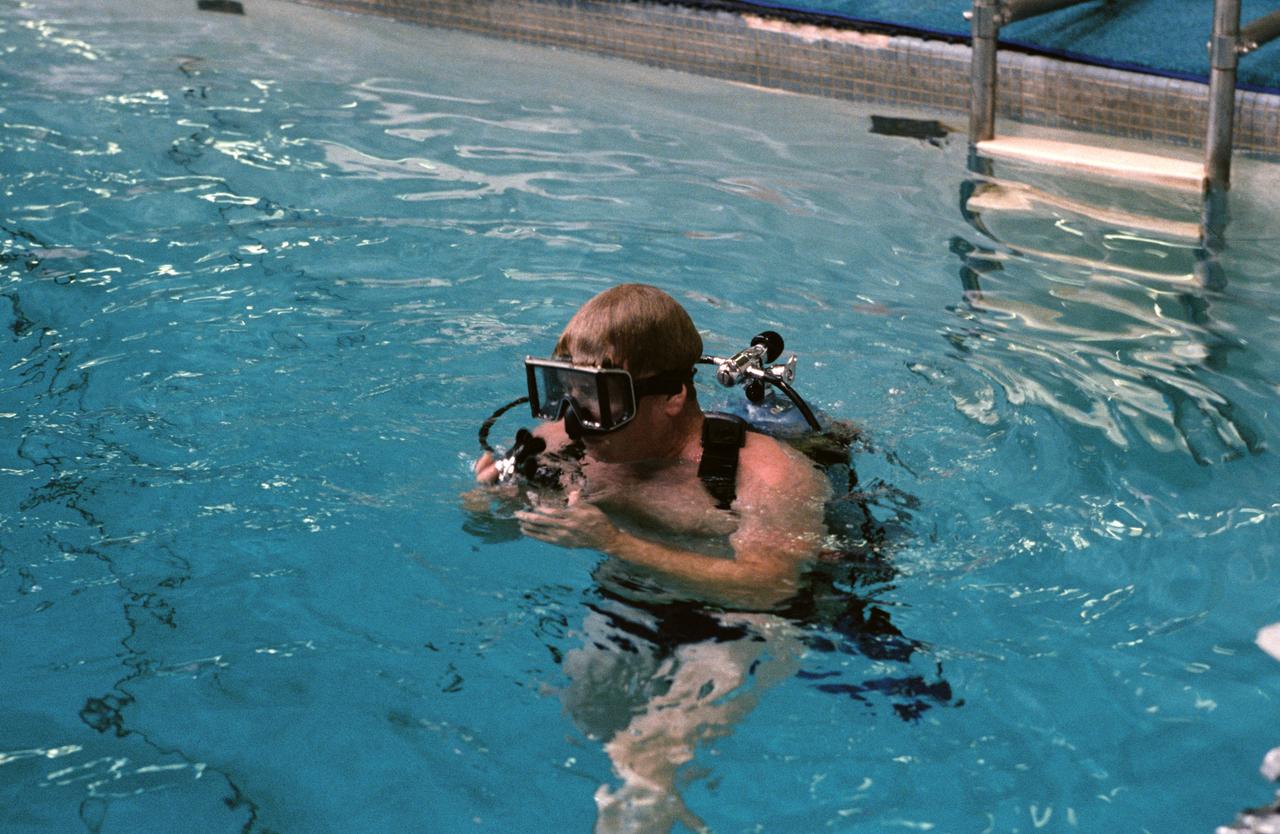
Preparations for Underwater EVA training for the STS 41-G crew. Divers prepare to don their scuba gear for the begining of EVA training.
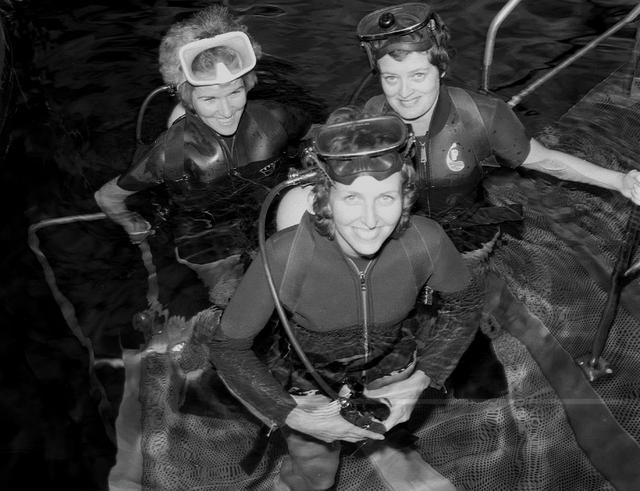
Candid shots of Carolyn Griner (front), Drs. Mary-Helen Johnston and Ann Whitaker (L to R) wearing scuba gear at the Neutral Buoyancy Simulator (NBS) for training.
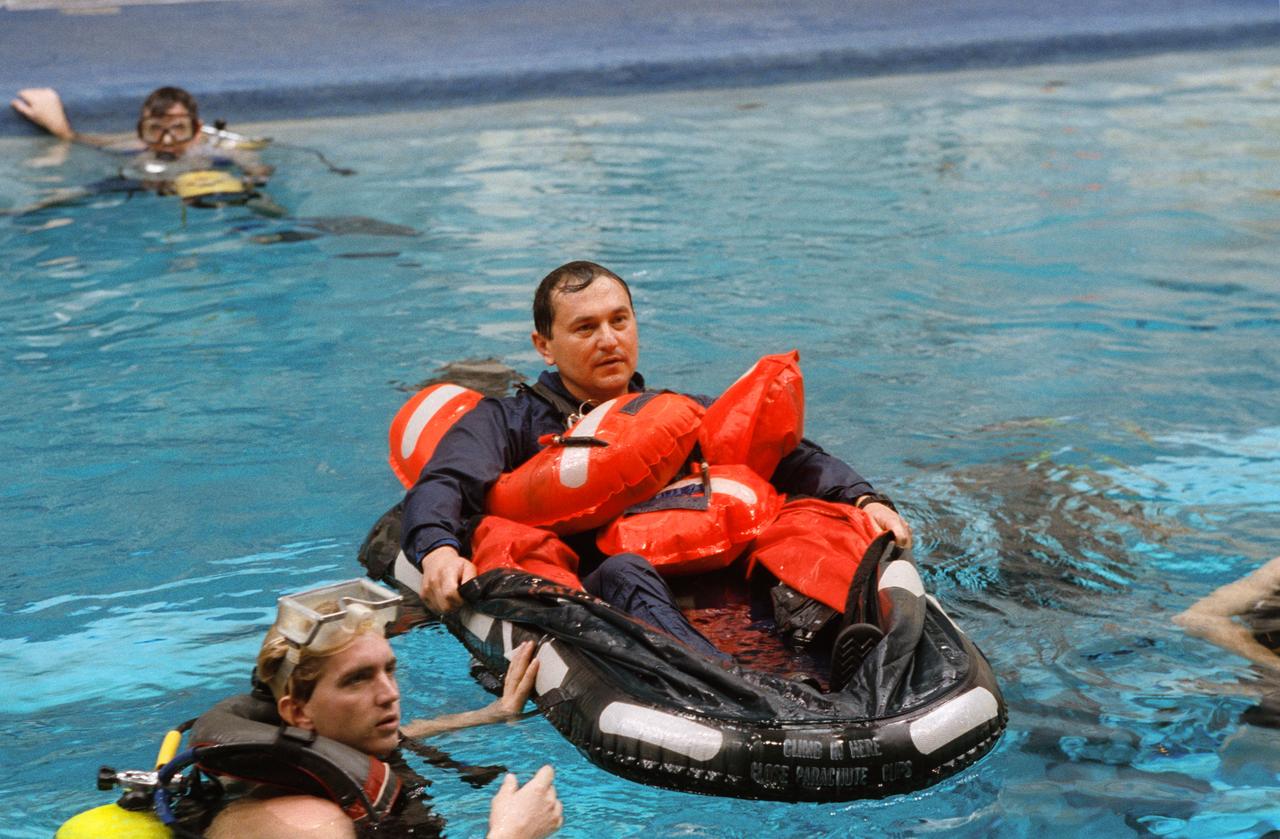
Russian Cosmonaut Vladimir Titov maneuvers a small life raft during bailout training at JSC's Weightless Environment Training Facility (WETF). Two SCUBA-equipped divers assisted Titov in the STS-60 training exercise.
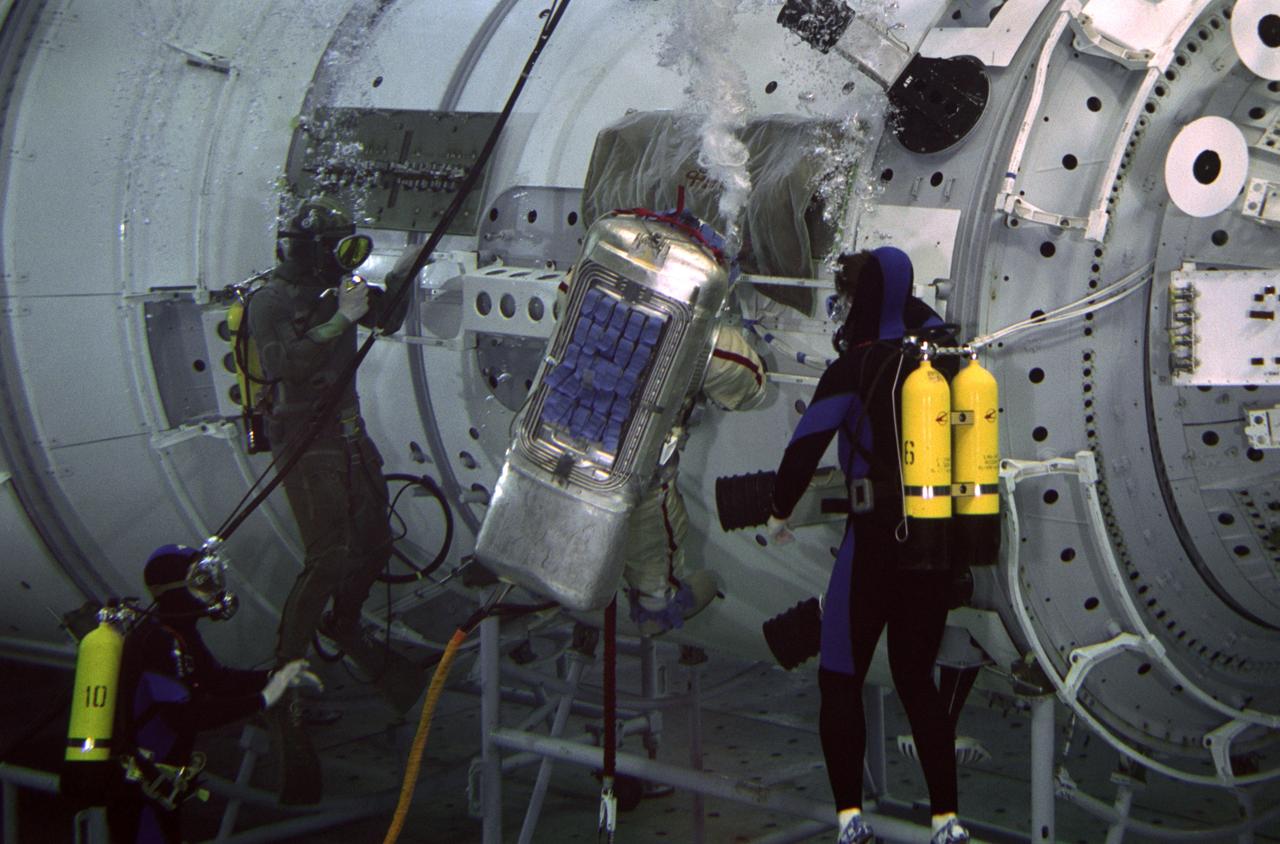
JSC2000-05367 (7 June 2000) --- Astronaut William Shepherd, ISS Expedition One commander, rehearses an extravehicular activity (EVA) with a full scale training model of the Zvezda Service Module in the Hydrolab facility at the Gagarin Cosmonaut Training Center in Russia. SCUBA-equipped divers assist in the spacewalk rehearsal.
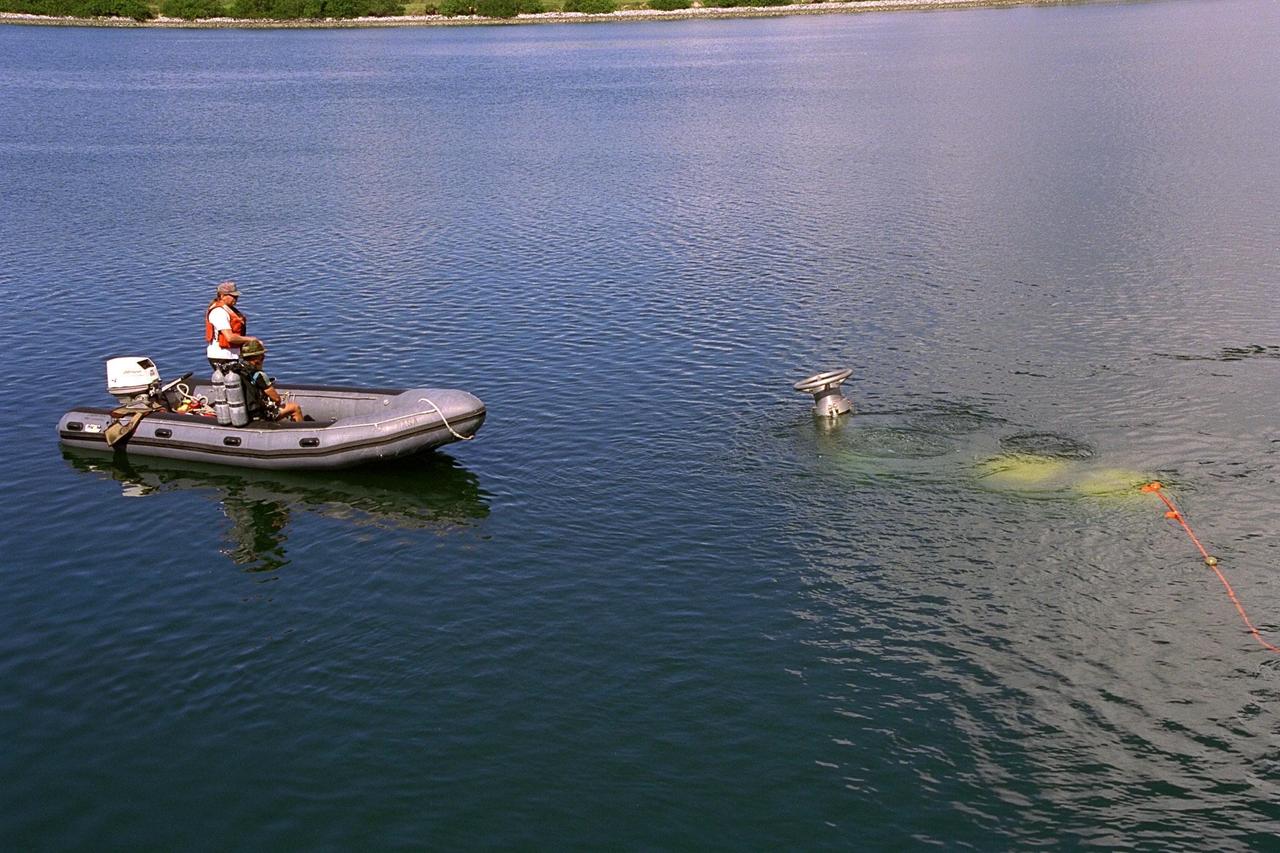
KENNEDY SPACE CENTER, FLA. -- A scuba diver stands by as the unmanned Max Rover submersible goes down to insert a Diver Operated Plug (DOP) into an aft nozzle like the ones used on the Space Shuttle's solid rocket boosters (SRBs). NASA and contractor Deep Sea Systems demonstrated the submersible at Port Canaveral's Trident pier. Kennedy Space Center's SRB retrieval team and Advanced Systems Development laboratory staff hope that the new robotic technology will make the process of inserting the plug into spent SRBs safer and less strenuous. Currently, scuba divers manually insert the DOP into the aft nozzle of a jettisoned SRB 60 to 70 feet below the surface of the Atlantic Ocean. After the plug is installed, water is pumped out of the booster allowing it to float horizontally. It is then towed back to Hangar AF at Cape Canaveral Air Station for refurbishment. Deep Sea Systems of Falmouth, Mass., built the submersible for NASA
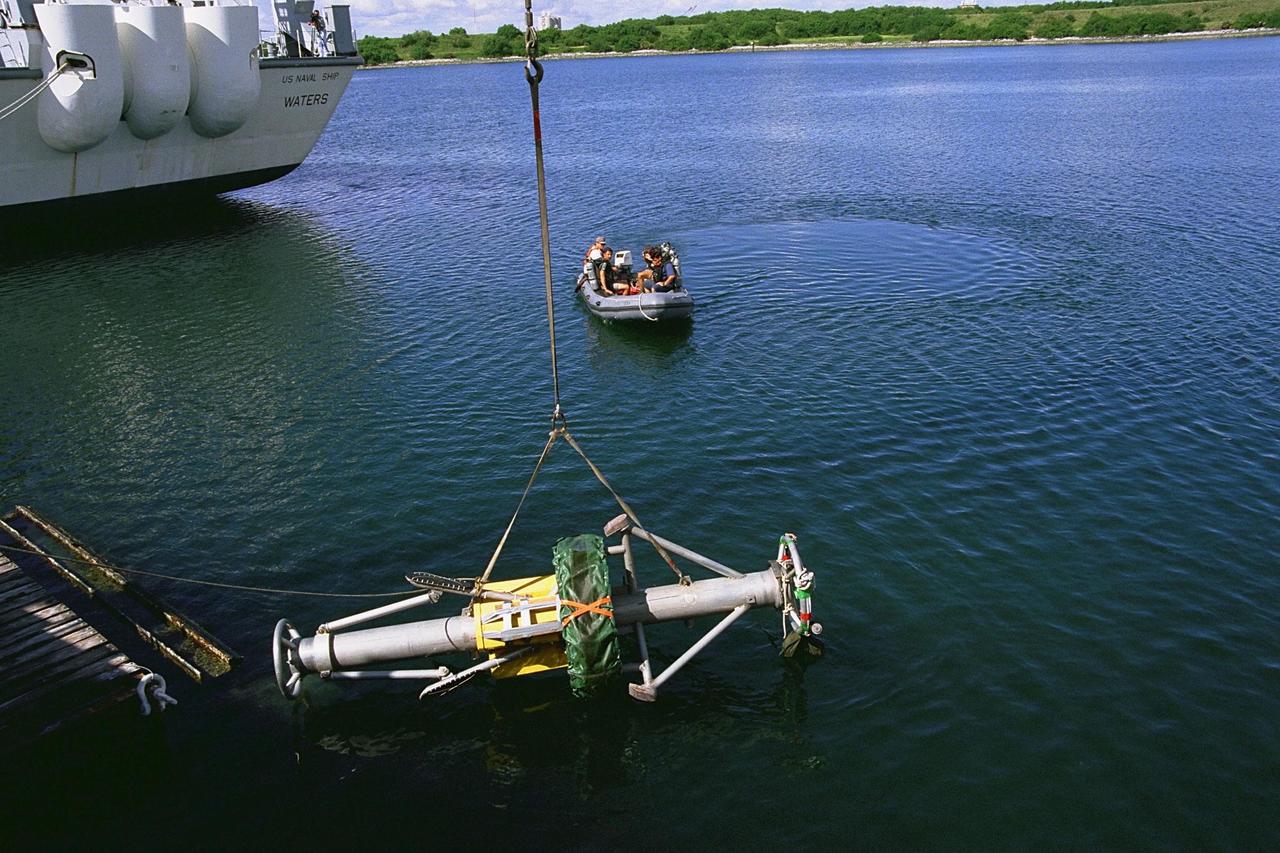
KENNEDY SPACE CENTER, FLA. -- As scuba divers stand by, a Diver Operated Plug (DOP) is lowered into the water at the Trident Pier at Port Canaveral during a test of the unmanned robotic submersible recovery system, known as Max Rover. Kennedy Space Center's solid rocket booster (SRB) retrieval team and Advanced Systems Development laboratory staff hope that the new robotic technology will make the process of inserting the plug into spent SRBs safer and less strenuous. Currently, scuba divers manually insert the DOP into the aft nozzle of a jettisoned SRB 60 to 70 feet below the surface of the Atlantic Ocean. After the plug is installed, water is pumped out of the booster allowing it to float horizontally. It is then towed back to Hangar AF at Cape Canaveral Air Station for refurbishment. Deep Sea Systems of Falmouth, Mass., built the submersible for NASA
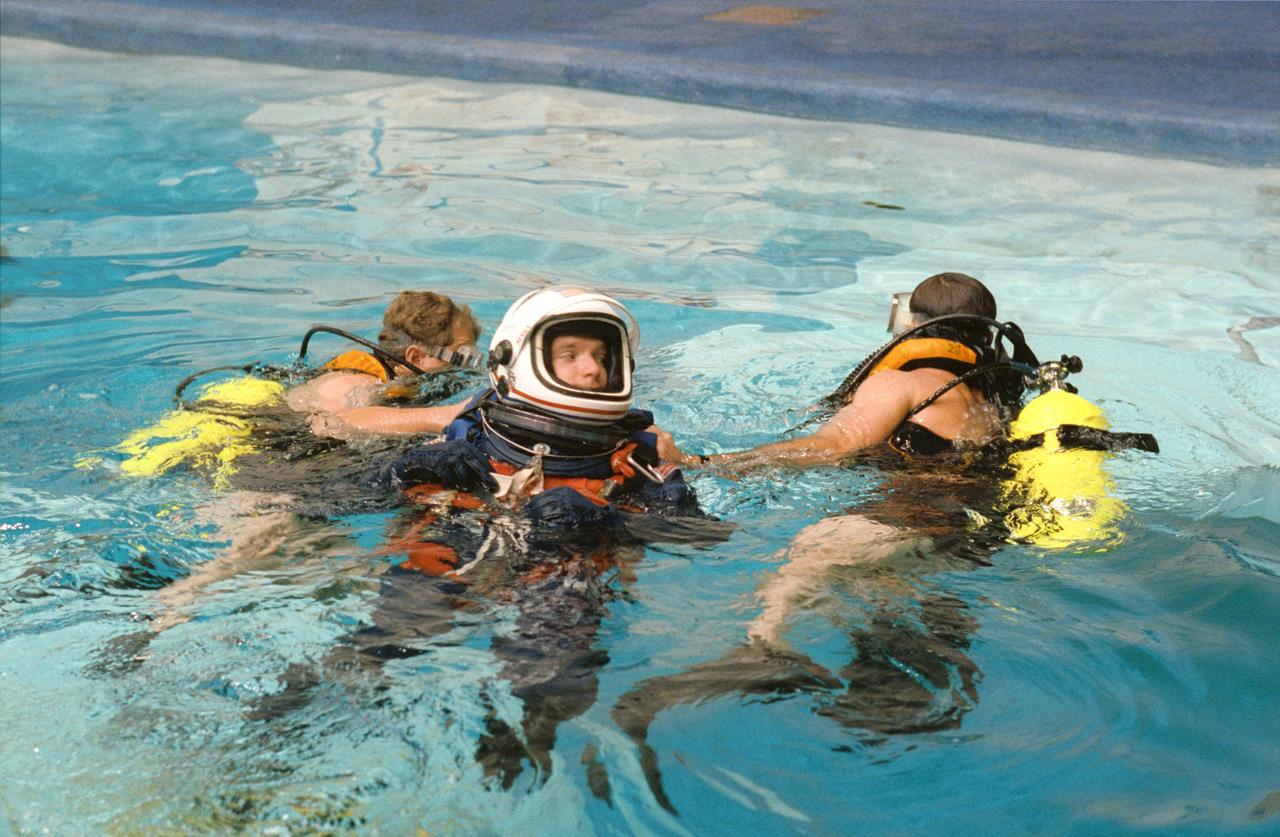
S92-50647 (Dec 1992) --- Assisted by two SCUBA-equipped divers, astronaut Charles J. Precourt, mission specialist for the STS-55/D-2 mission, participates in bailout training at the Johnson Space Center's (JSC) Weightless Environment and Training Facility (WET-F). Precourt is attired in a training version of the partial pressure Shuttle launch and entry garment. All seven prime flight crewmembers and the two backup payload specialists participated in the training session.
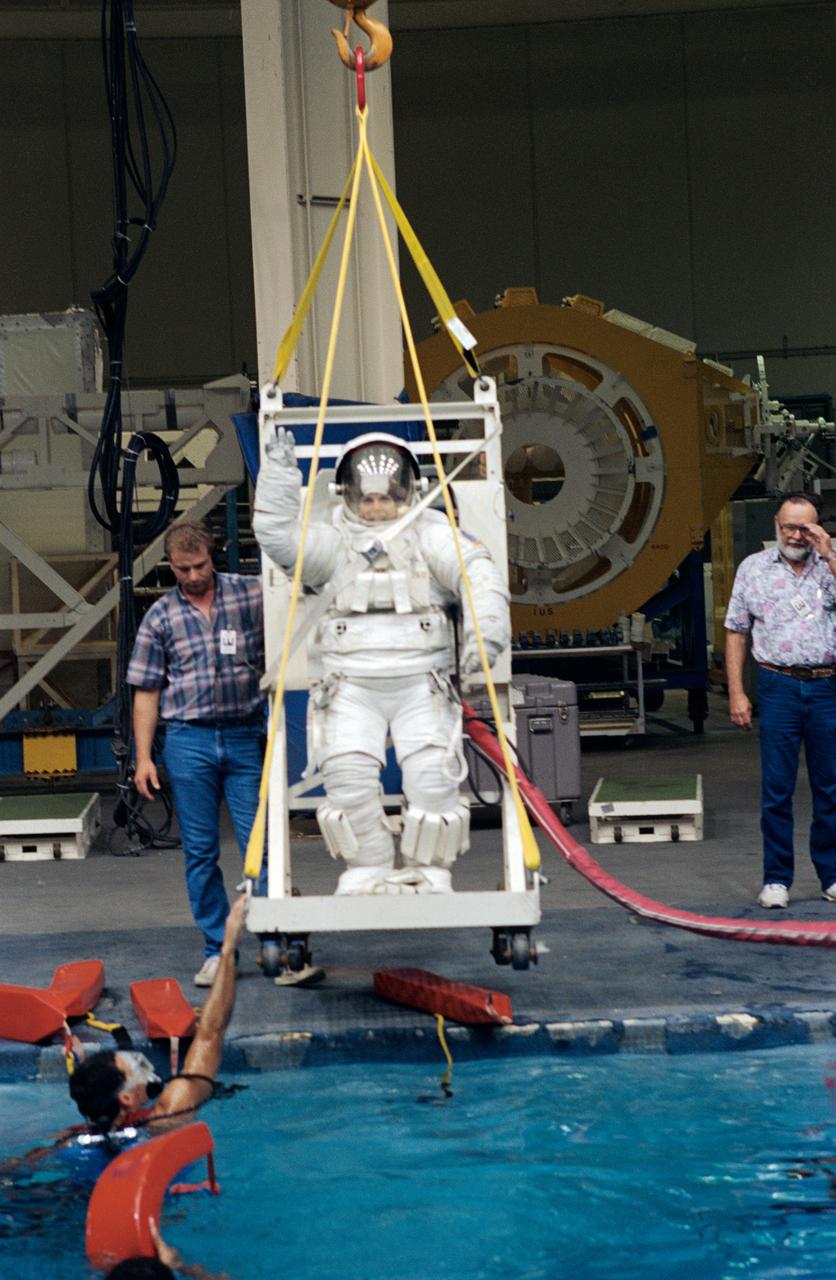
Attired in a training version of the Extravehicular Mobility Unit (EMU), Astronaut Mary Ellen Weber participates in a training session at JSC's Weightless Environment Training Facility (WETF). Training as a mission specialist for the STS-70 mission, Weber was about to rehearse a contingency space walk. One of several SCUBA-equipped divers waits to assist in the rehearsal in the water.
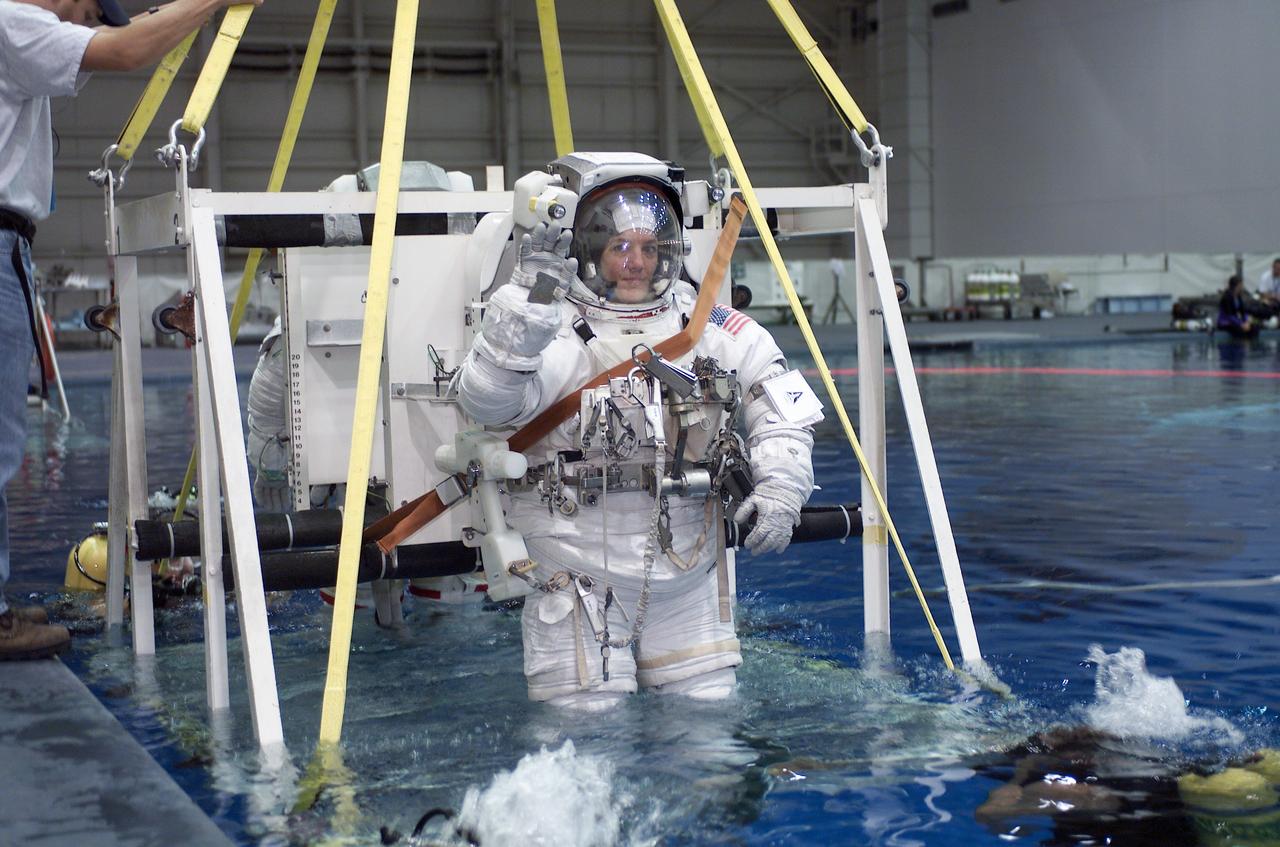
JSC2002-E-37426 (6 September 2002) --- Astronaut Heidemarie M. Stefanyshyn-Piper, STS-115 mission specialist, is submerged in the waters of the Neutral Buoyancy Laboratory (NBL) at the Johnson Space Center (JSC). Stefanyshyn-Piper is wearing the training version of the Extravehicular Mobility Unit (EMU) space suit. SCUBA-equipped divers are in the water to assist the astronauts in their rehearsal, intended to help prepare them for work on the exterior of the International Space Station (ISS).
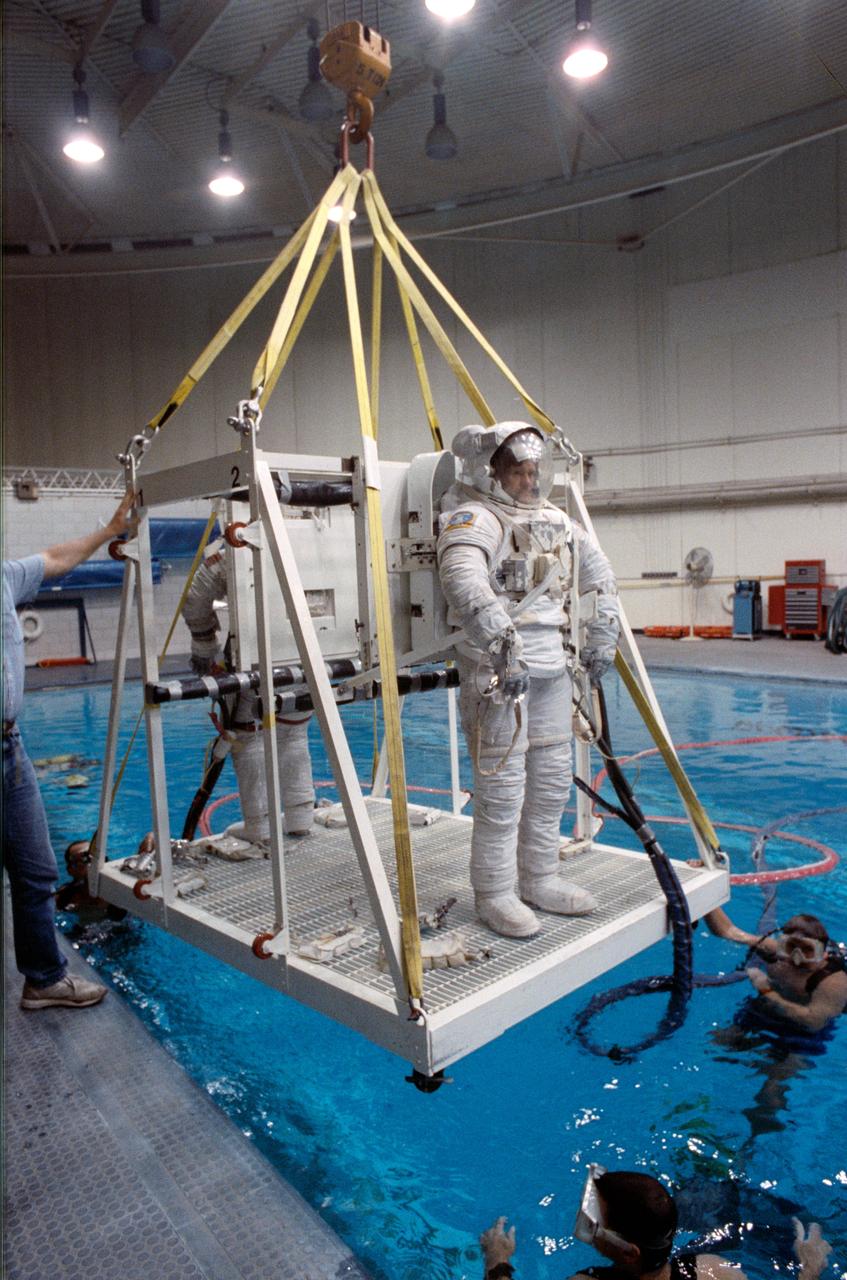
S90-46030 (Aug 1990) --- Astronaut Donald R. McMonagle (foreground) wears an extravehicular mobility unit (EMU) spacesuit as he prepares to be lowered into a 25-ft. deep pool at the Johnson Space Center's weightless environment training facility (WET-F). Astronaut Gregory J. Harbaugh, a fellow STS 39 mission specialist, shares the moveable platform with McMonagle and prepares to join him in the simulation of a contingency extravehicular activity (EVA) for the mission, scheduled for Discovery in the spring of 1991. A number of SCUBA-equipped divers assist in the training session.
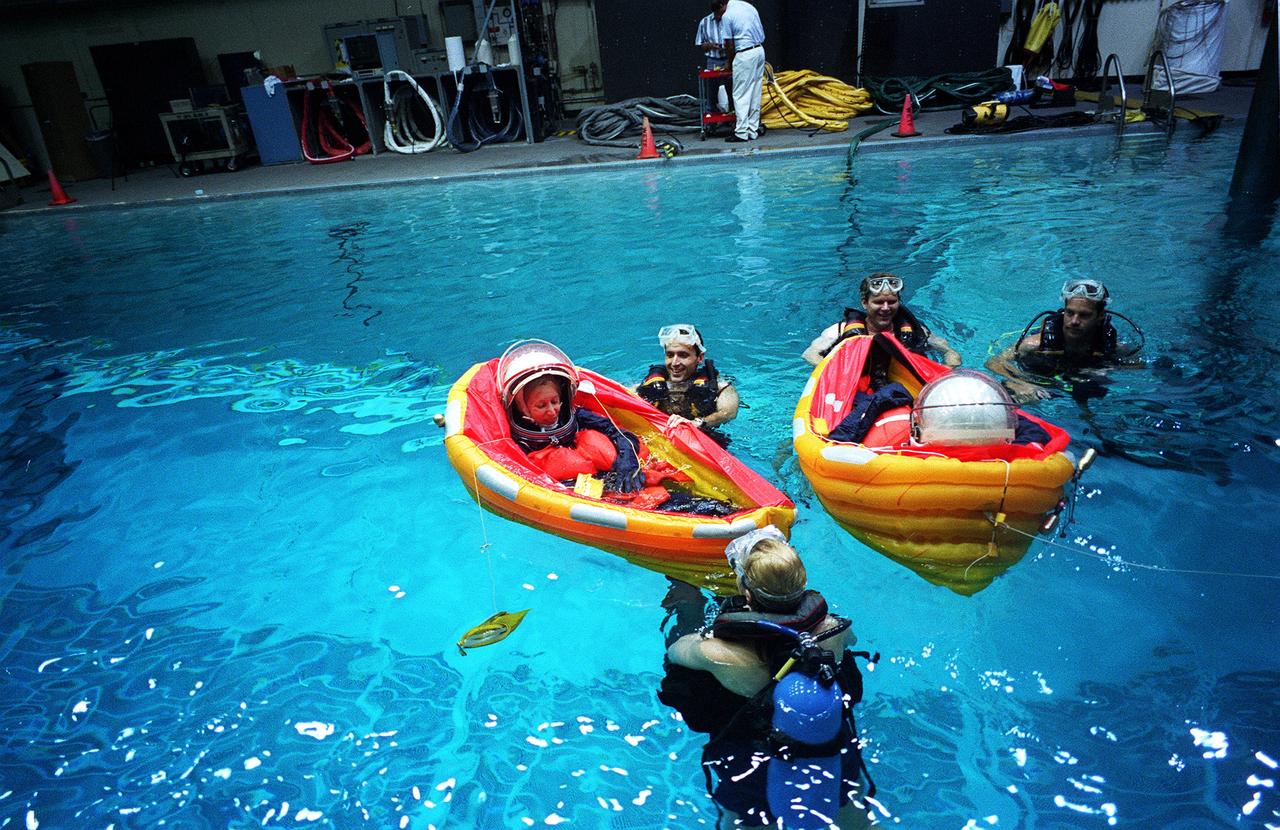
S96-15405 (26 Sept. 1996) --- In the Johnson Space Center's weightless environment training facility, astronaut Marsha S. Ivins, STS-81 mission specialist, bails water from her life raft during water bailout survival training. Astronaut Peter J.K. (Jeff) Wisoff (pictured in right raft) and four other STS-81 crewmates (out of frame) joined Ivins for the bailout training exercises. Several SCUBA-equipped divers assist in the training exercise.

S92-40001 (1 June 1992) --- Payload specialist Steven G. Maclean is assisted by two SCUBA-equipped divers as he participates in emergency bailout training in the Johnson Space Center's (JSC) Weightless Environment Training Facility (WET-F). Maclean will join five NASA astronauts for the scheduled 10-day STS-52 mission.
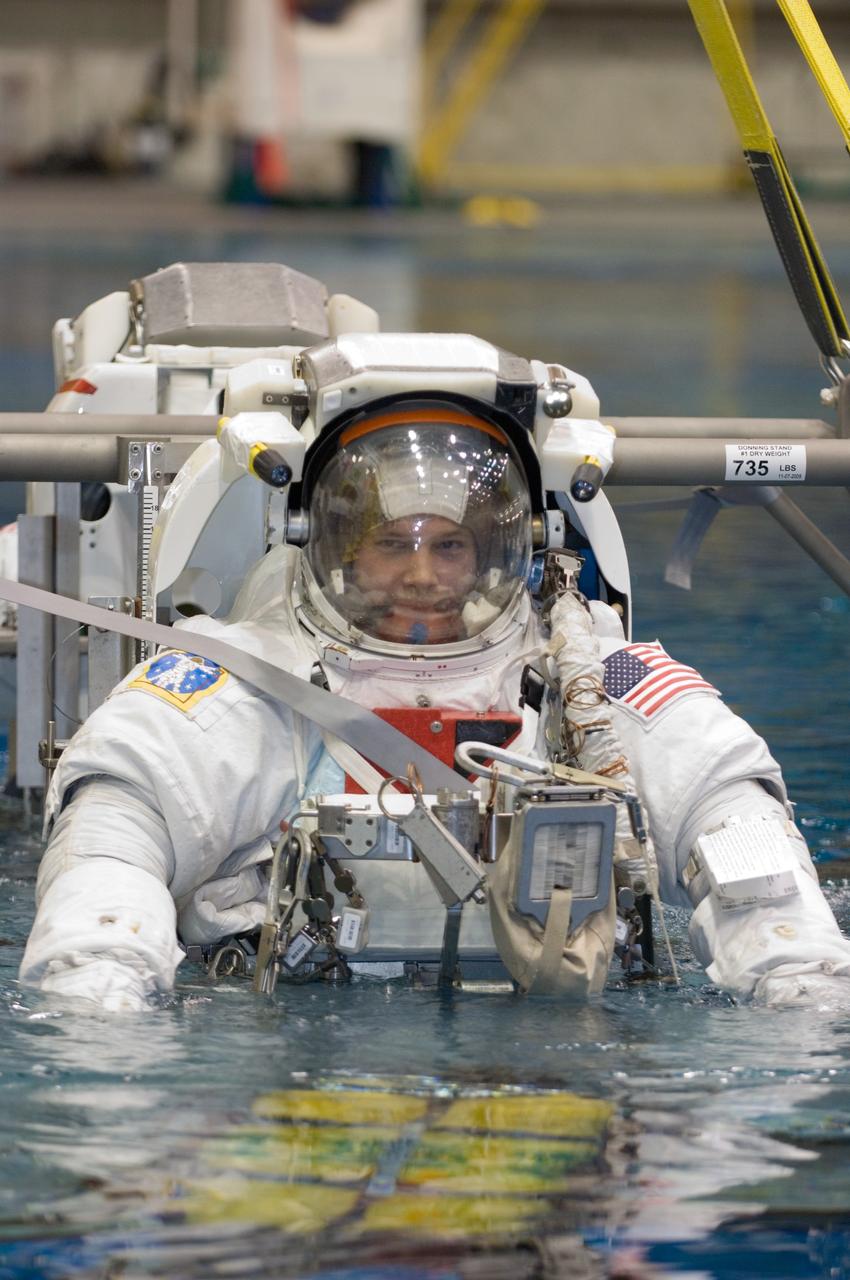
JSC2007-E-06549 (2 Feb. 2007) --- Astronauts Douglas H. Wheelock and Scott E. Parazynski (partially obscured), both STS-120 mission specialists, are about to be submerged in the waters of the Neutral Buoyancy Laboratory (NBL) near Johnson Space Center. Wheelock and Parazynski are attired in training versions of the Extravehicular Mobility Unit (EMU) spacesuit. SCUBA-equipped divers (out of frame) are in the water to assist the crewmembers in their rehearsal, intended to help prepare them for work on the exterior of the International Space Station.
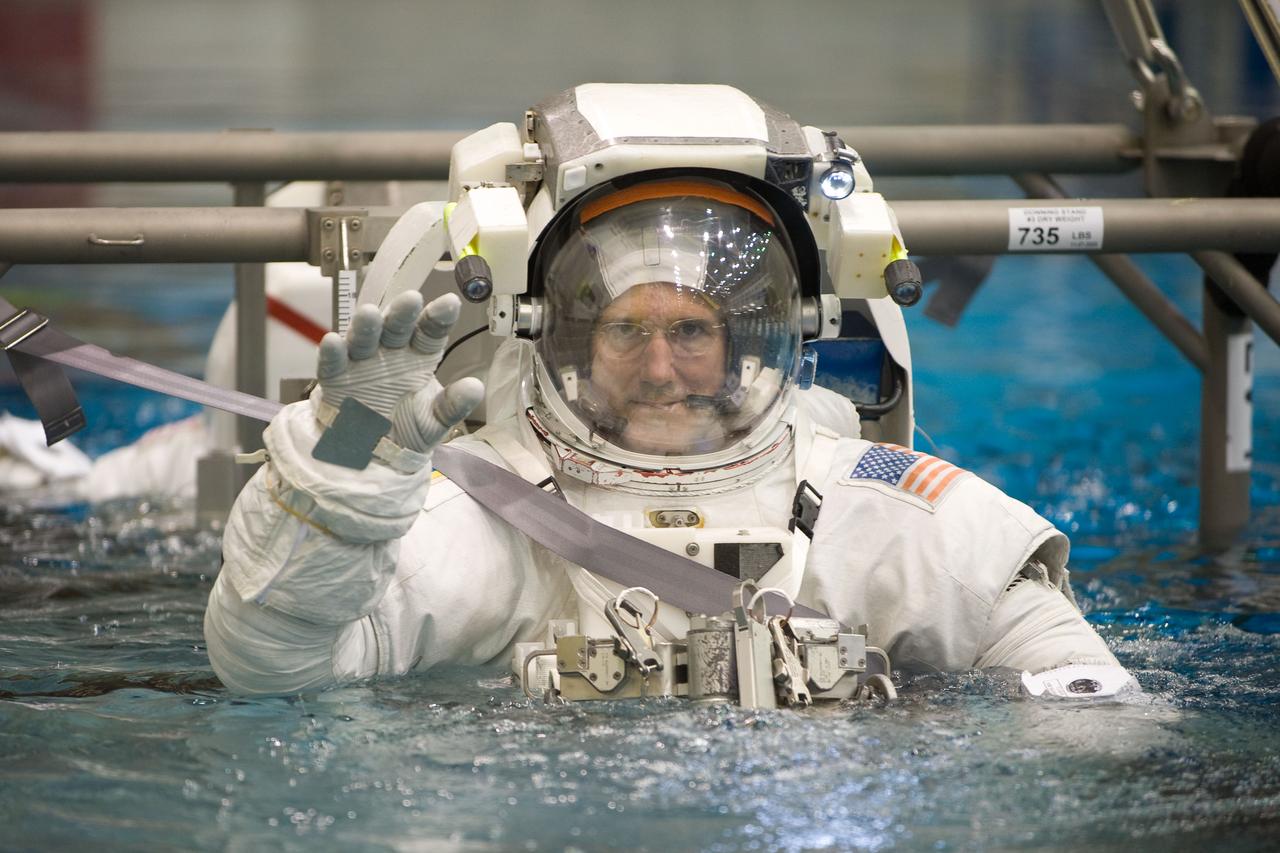
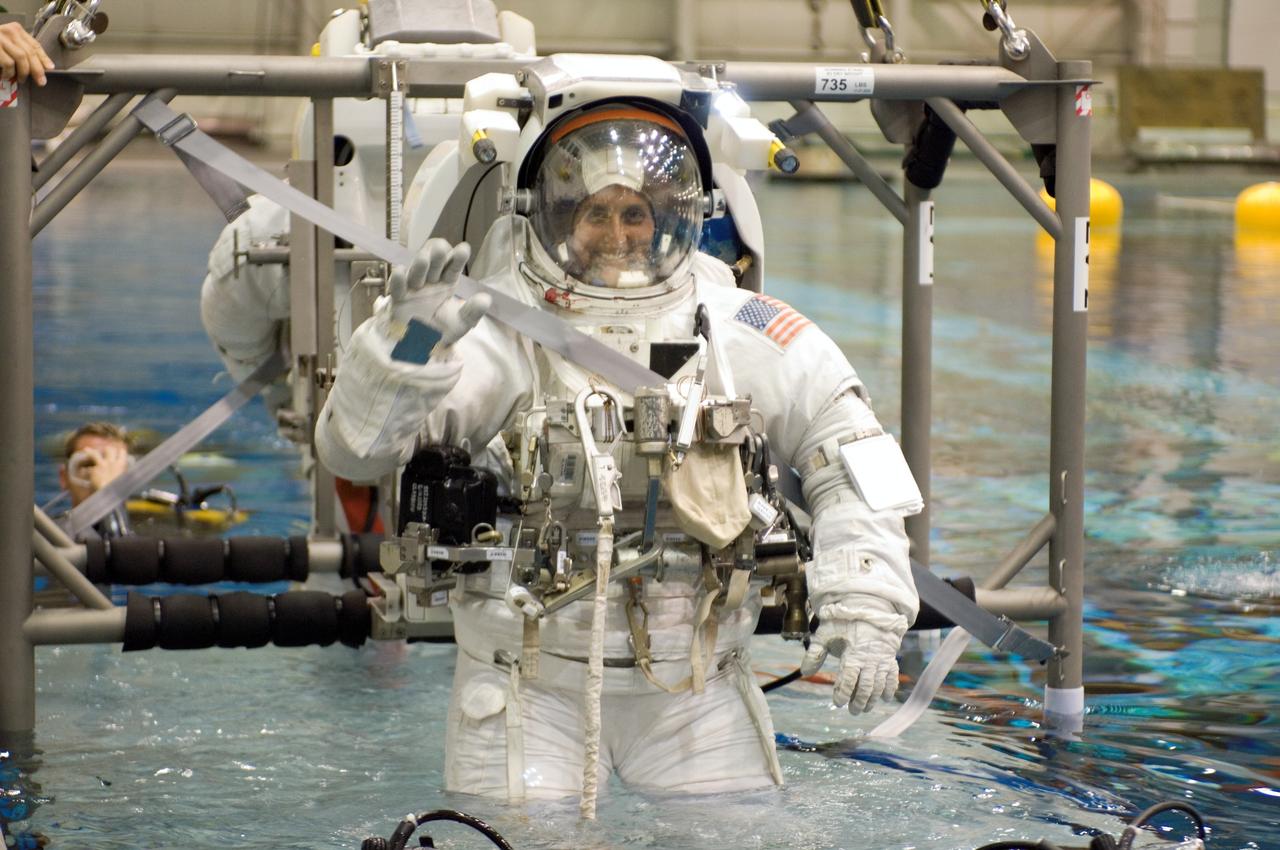
JSC2009-E-215171 (30 Sept. 2009) --- Astronaut Mike Good, STS-132 mission specialist, attired in a training version of his Extravehicular Mobility Unit (EMU) spacesuit, waves as he is submerged in the waters of the Neutral Buoyancy Laboratory (NBL) near NASA's Johnson Space Center. SCUBA-equipped divers (out of frame) are in the water to assist Good in his rehearsal, intended to help prepare him for work on the exterior of the International Space Station.
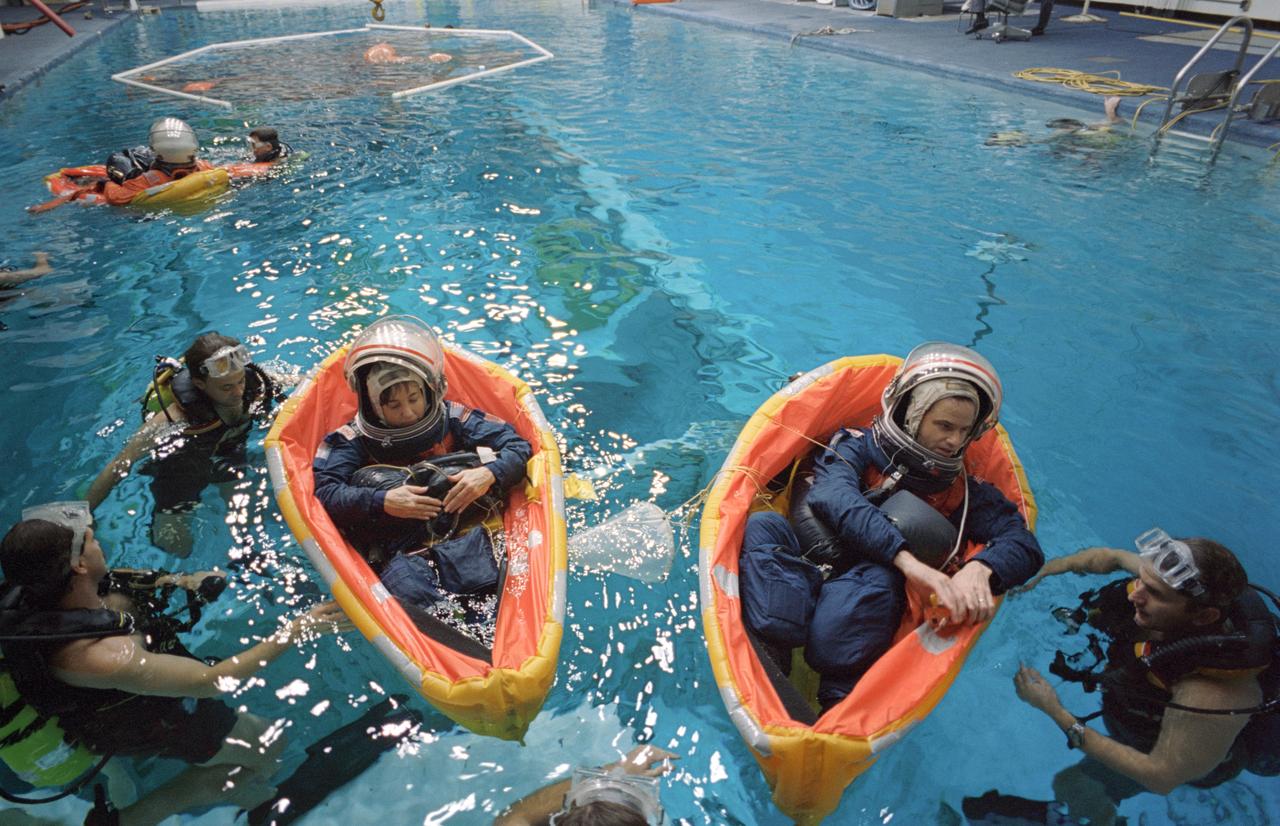
S93-50711 (22 Dec 1993) --- Astronauts Kevin P. Chilton (right), pilot, and Linda M. Godwin, payload commander, are assisted by SCUBA-equipped divers during emergency bailout training at the Johnson Space Center's (JSC) Weightless Environment Training Facility (WET-F). Godwin, Chilton and four other NASA astronauts are scheduled to fly aboard the Space Shuttle Endeavour next year.
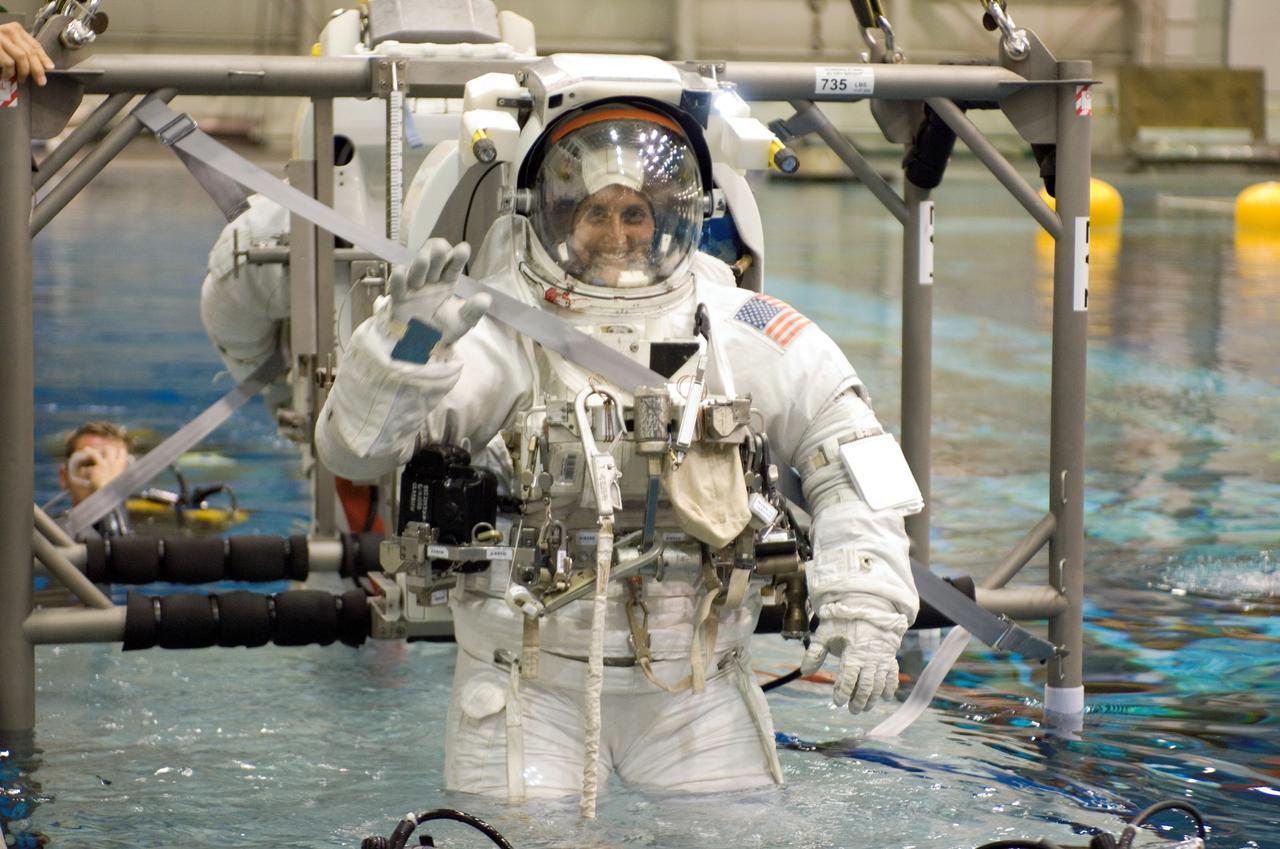
Astronauts Sunita L. Williams, Expedition 14 flight engineer, and Robert L. Curbeam (partially obscured), STS-116 mission specialist, are about to be submerged in the waters of the Neutral Buoyancy Laboratory (NBL) near Johnson Space Center. Williams and Curbeam are attired in training versions of the Extravehicular Mobility Unit (EMU) space suit. SCUBA-equipped divers are in the water to assist the crew members in their rehearsal intended to help prepare them for work on the exterior of the International Space Station (ISS).
JSC2006-E-46477 (25 Oct. 2006) --- Astronauts Sunita L. Williams, Expedition 14 flight engineer, and Robert L. Curbeam (partially obscured), STS-116 mission specialist, are about to be submerged in the waters of the Neutral Buoyancy Laboratory (NBL) near Johnson Space Center. Williams and Curbeam are attired in training versions of the Extravehicular Mobility Unit (EMU) spacesuit. SCUBA-equipped divers are in the water to assist the crewmembers in their rehearsal, intended to help prepare them for work on the exterior of the International Space Station.
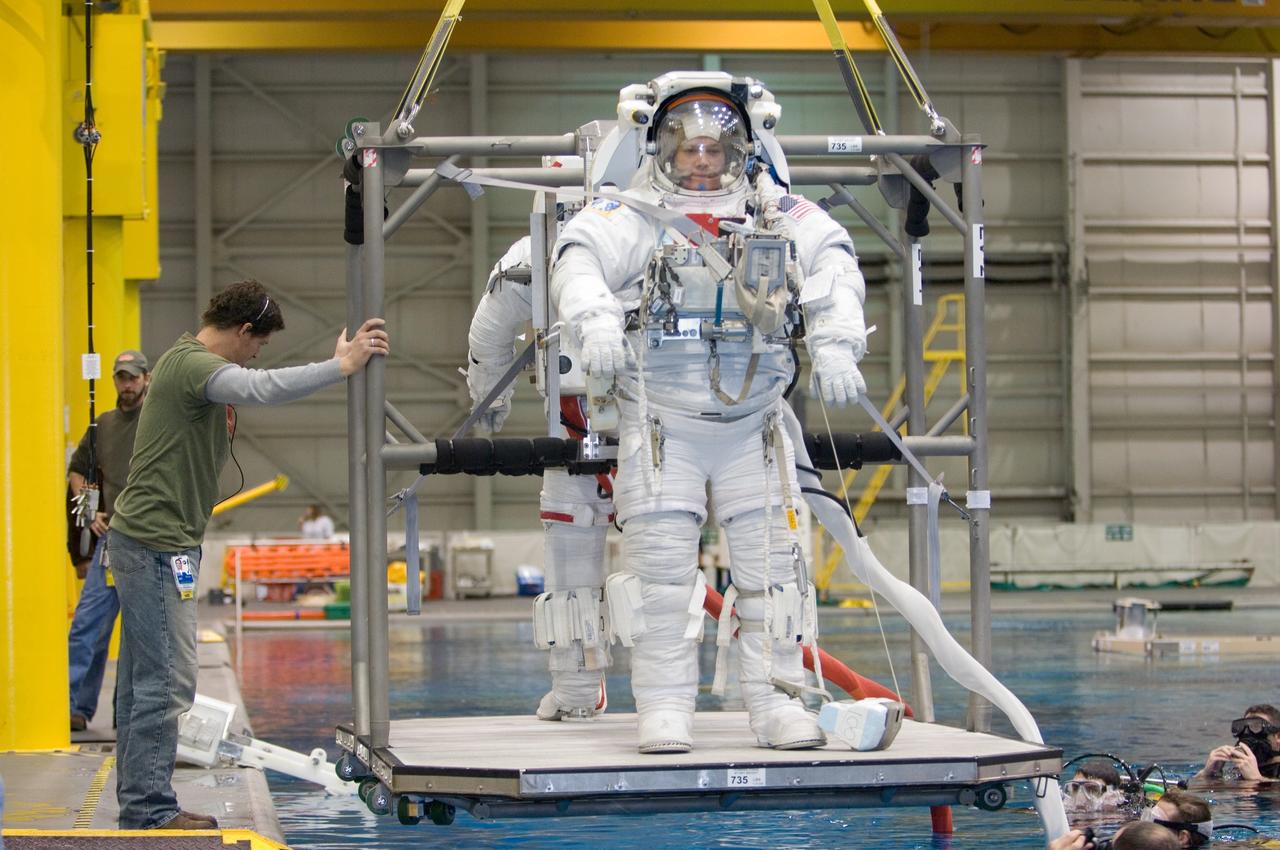
JSC2007-E-06548 (2 Feb. 2007) --- Astronauts Douglas H. Wheelock and Scott E. Parazynski (partially obscured), both STS-120 mission specialists, are about to be submerged in the waters of the Neutral Buoyancy Laboratory (NBL) near Johnson Space Center. Wheelock and Parazynski are attired in training versions of the Extravehicular Mobility Unit (EMU) spacesuit. SCUBA-equipped divers are in the water to assist the crewmembers in their rehearsal, intended to help prepare them for work on the exterior of the International Space Station.
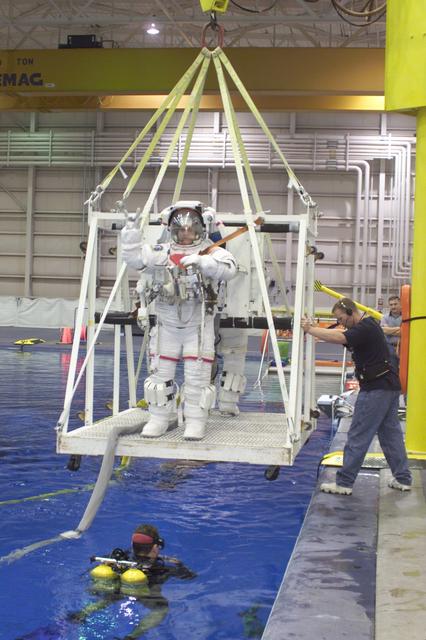
JSC2002-E-27065 (1 July 2002) --- Astronauts David A. Wolf and Piers J. Sellers (partially obscured), both STS-112 mission specialists, are about to be submerged in the waters of the Neutral Buoyancy Laboratory (NBL) near the Johnson Space Center (JSC). Wolf and Sellers are wearing the training version of the Extravehicular Mobility Unit (EMU) space suit. Scuba divers are in the water to assist the astronauts in their rehearsal, intended to help prepare them for work on the exterior of the International Space Station (ISS).
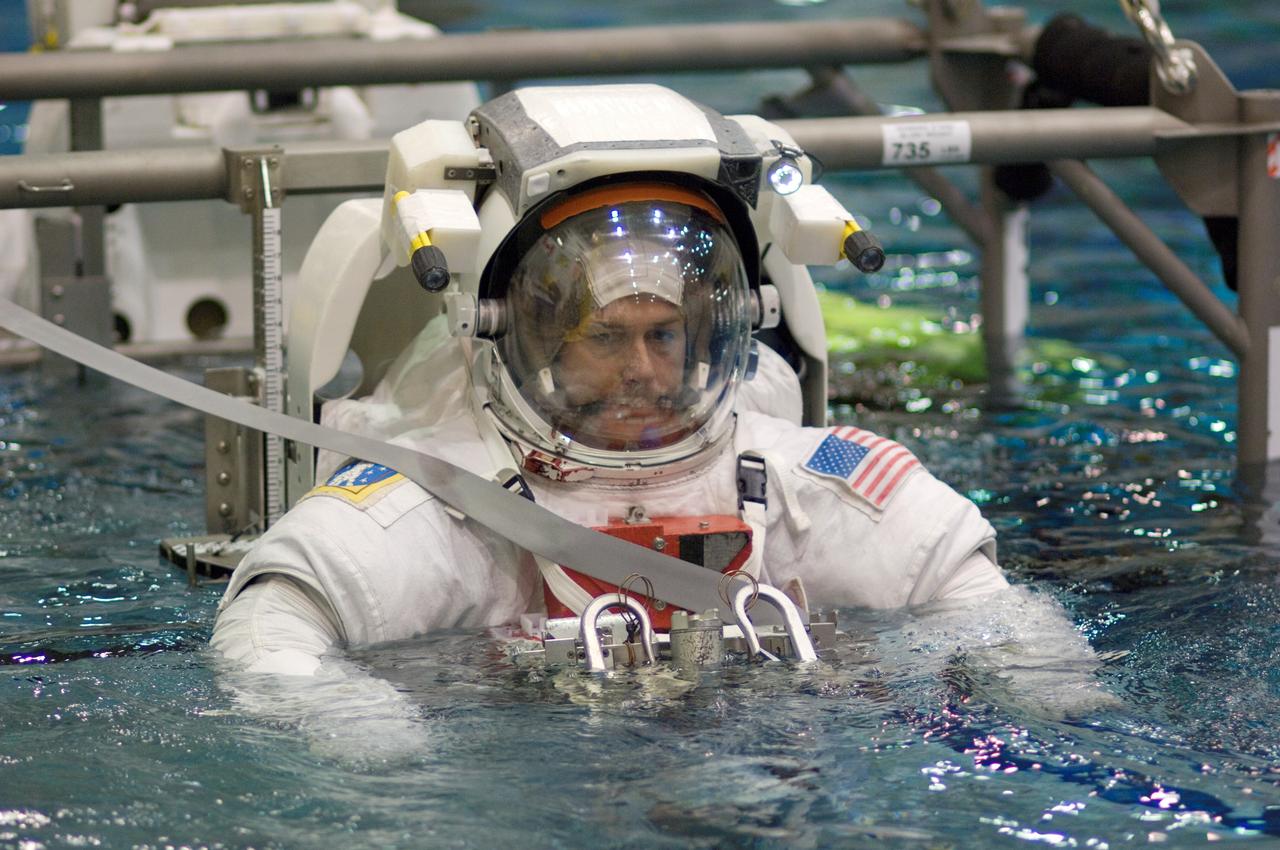
JSC2008-E-015735 (26 Feb. 2008) --- Astronauts Robert S. (Shane) Kimbrough and Stephen G. Bowen (partially obscured), both STS-126 mission specialists, are submerged in the waters of the Neutral Buoyancy Laboratory (NBL) near Johnson Space Center. Kimbrough and Bowen are attired in training versions of the Extravehicular Mobility Unit (EMU) spacesuit. SCUBA-equipped divers (out of frame) are in the water to assist the crewmembers in their rehearsal, intended to help prepare them for work on the exterior of the International Space Station.
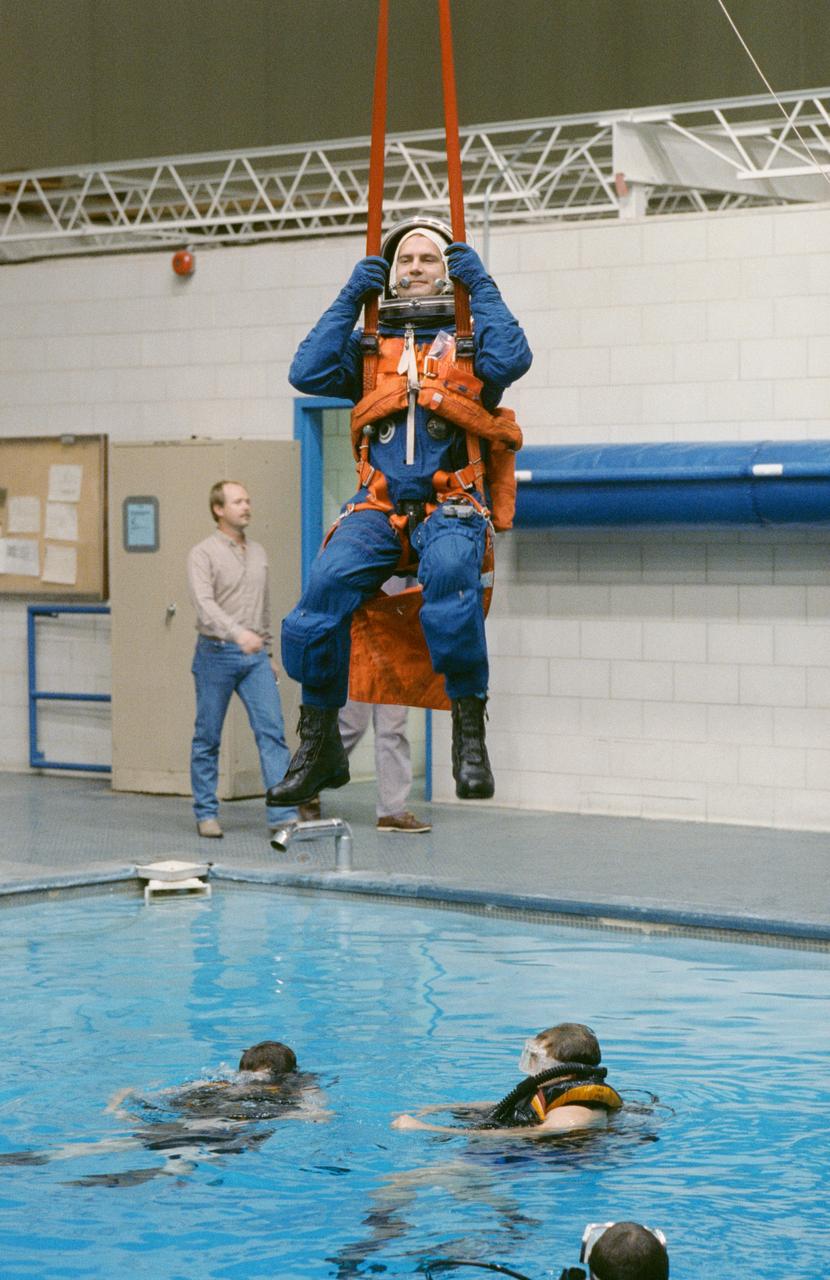
S90-54760 (7 Dec 1990) --- Astronaut Richard J. Hieb, mission specialist, participates in emergency egress training. Hieb and six fellow STS 39 astronauts were in JSC's weightless environment training facility (WET-F). This type training uses the WET-F's 25 ft. deep pool to simulate an ocean parachute landing. A number of SCUBA-equipped divers assist in the training session.
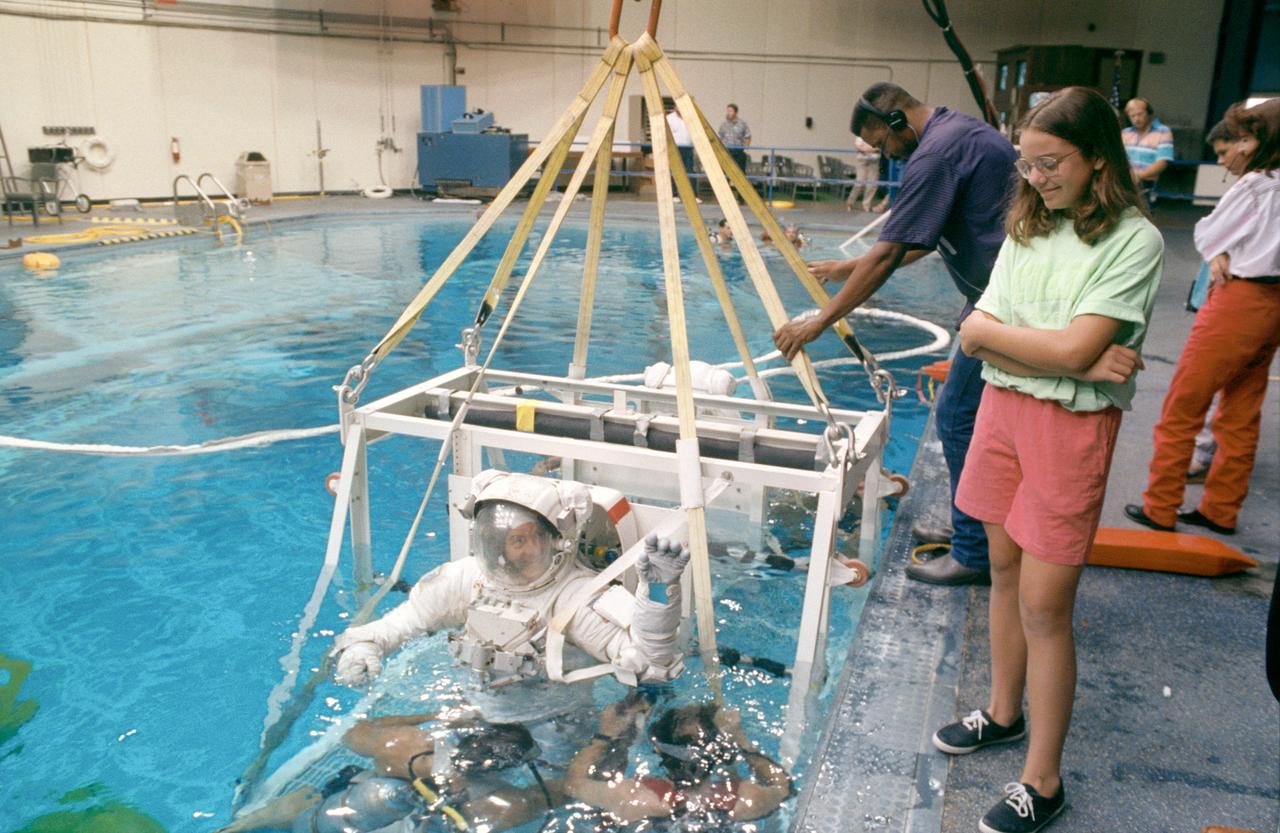
S92-43335 (28 July 1992) --- STS-53 Discovery, Orbiter Vehicle (OV) 103, Mission Specialist James S. Voss, wearing extravehicular mobility unit (EMU), is lowered into JSC?s Weightless Environment Training Facility (WETF) Bldg. 29 pool. Voss waves to his daughter standing on the poolside as the platform he is positioned in is submerged in the pool. Technicians on the poolside and scuba equipped divers in the water monitor activities. Once underwater, Voss will participate in contingency extravehicular activity (EVA) procedures.
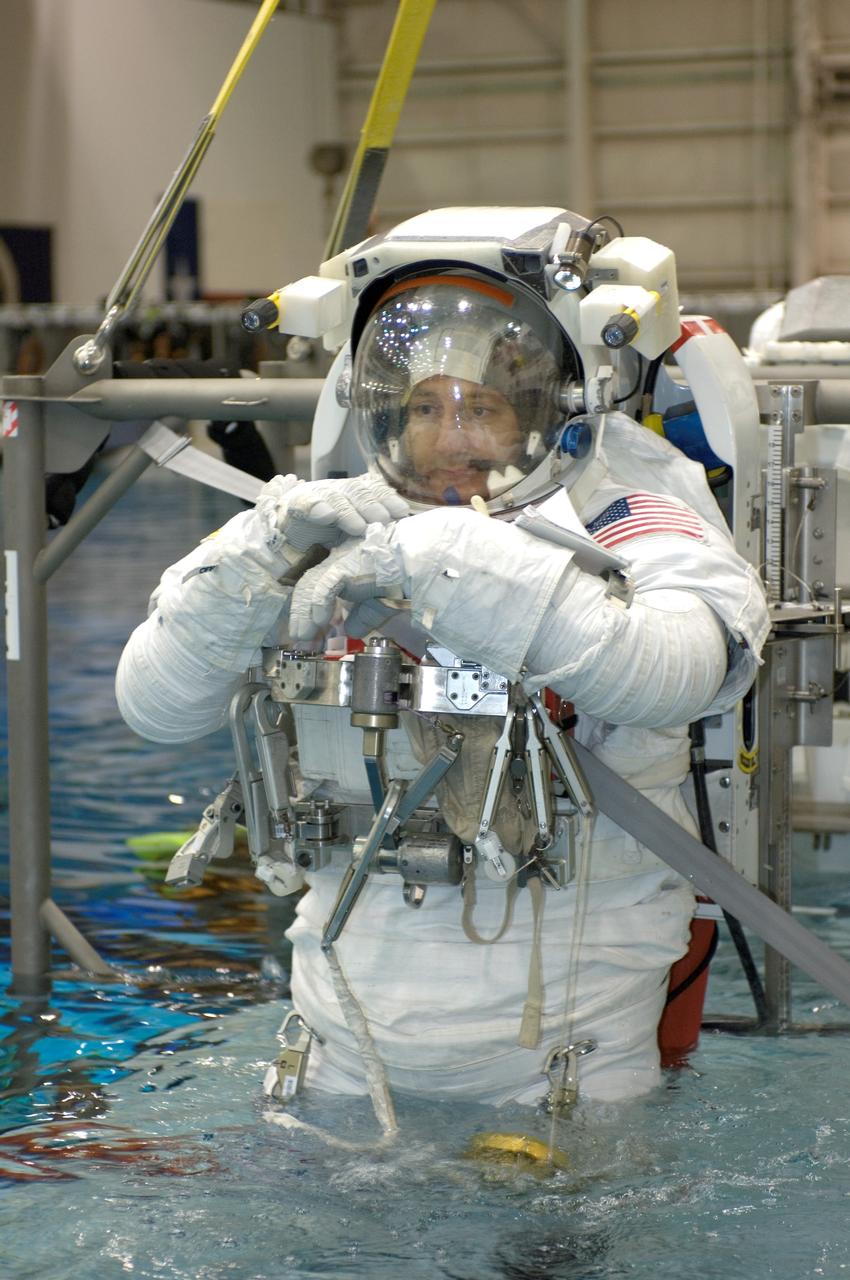
JSC2007-E-113611 (18 Dec. 2007) --- Astronauts Michael J. Massimino and Michael T. Good (partially obscured), both STS-125 mission specialists, are about to be submerged in the waters of the Neutral Buoyancy Laboratory (NBL) near Johnson Space Center. Massimino and Good are attired in training versions of the Extravehicular Mobility Unit (EMU) spacesuit. SCUBA-equipped divers (out of frame) are in the water to assist the crewmembers in their rehearsal, intended to help prepare them for work on the Hubble Space Telescope.
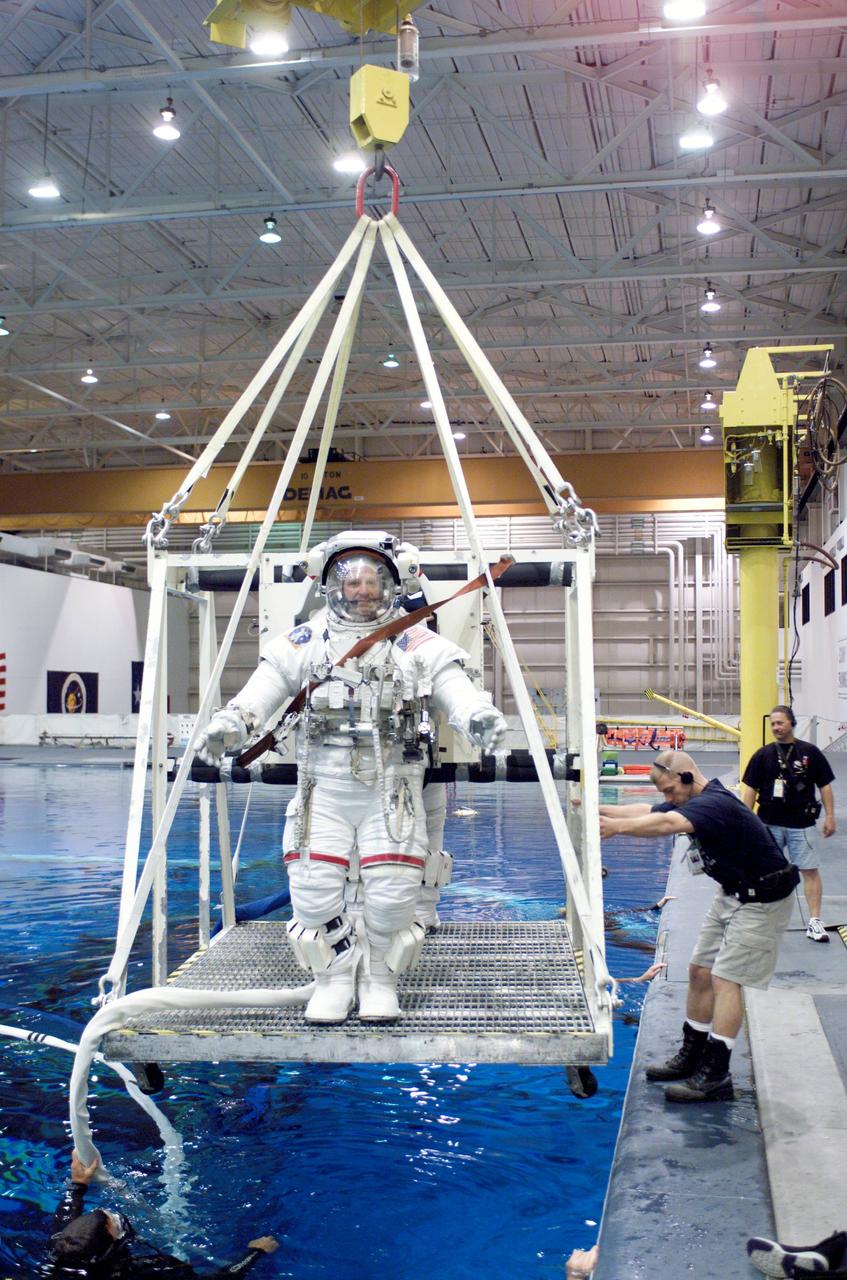
JSC2002-E-23081 (28 May 2002) --- Astronaut Christopher J. (Gus) Loria, STS-113 pilot, and another crewmember (obscured) are about to be submerged in the waters of the Neutral Buoyancy Laboratory (NBL) near the Johnson Space Center (JSC). Loria and his crewmate are wearing the training version of the Extravehicular Mobility Unit (EMU) space suit. Scuba divers are in the water to assist the astronauts in their rehearsal, intended to help prepare them for work on the exterior of the International Space Station (ISS).
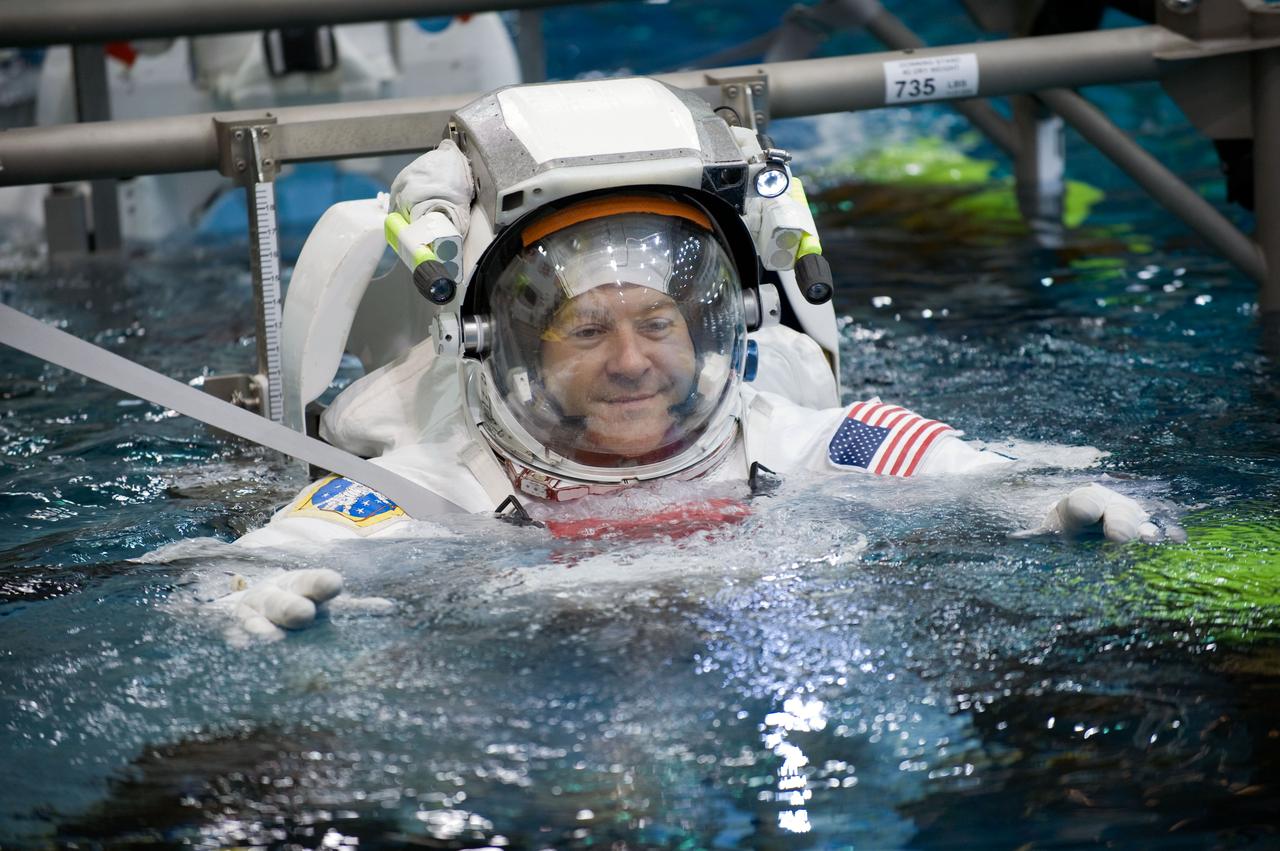
JSC2009-E-145718 (17 July 2009) --- Astronaut Nicholas Patrick, STS-130 mission specialist, attired in a training version of his Extravehicular Mobility Unit (EMU) spacesuit, is submerged in the waters of the Neutral Buoyancy Laboratory (NBL) near NASA's Johnson Space Center. SCUBA-equipped divers (out of frame) are in the water to assist Patrick in his rehearsal, intended to help prepare him for work on the exterior of the International Space Station.
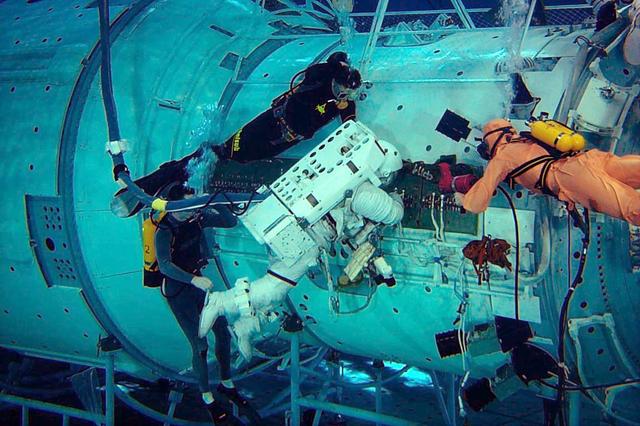
99-E-14654 (October 1999) --- Astronaut Edward T. Lu, mission specialist, is assisted by SCUBA-equipped divers during a rehearsal of STS-106 space walk chores in the Hydrolab facility at Star City, Russia. Also participating in this simulation but out of frame here was cosmonaut Yuri I. Malenchenko, mission specialist who represents the Russian Space Agency (RSA).
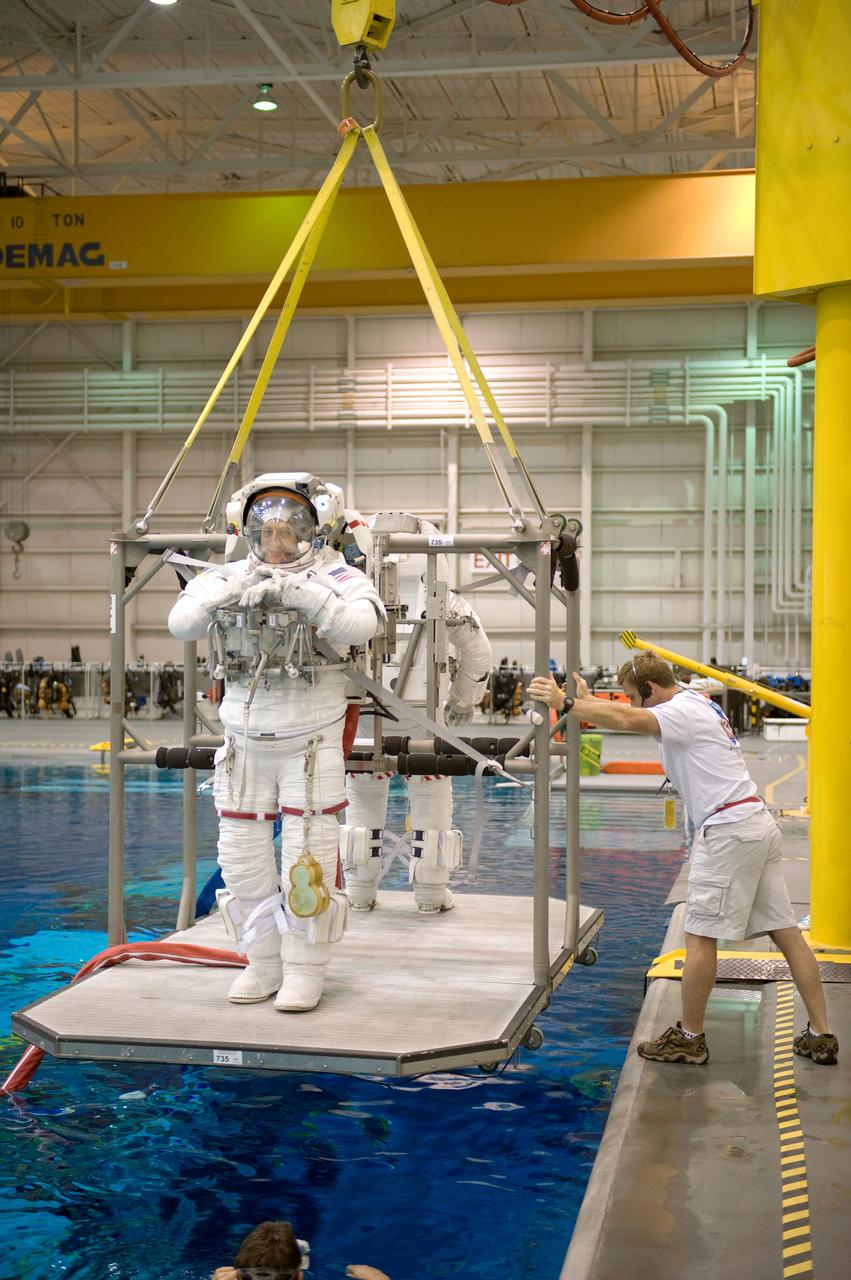
JSC2008-E-118378 (25 Sept. 2008) --- Astronauts Mike Massimino and Michael Good (partially obscured), both STS-125 mission specialists, are about to be submerged in the waters of the Neutral Buoyancy Laboratory (NBL) near NASA's Johnson Space Center. Massimino and Good are attired in training versions of their Extravehicular Mobility Unit (EMU) spacesuit. SCUBA-equipped divers (out of frame) are in the water to assist the crewmembers in their rehearsal, intended to help prepare them for work on the Hubble Space Telescope.
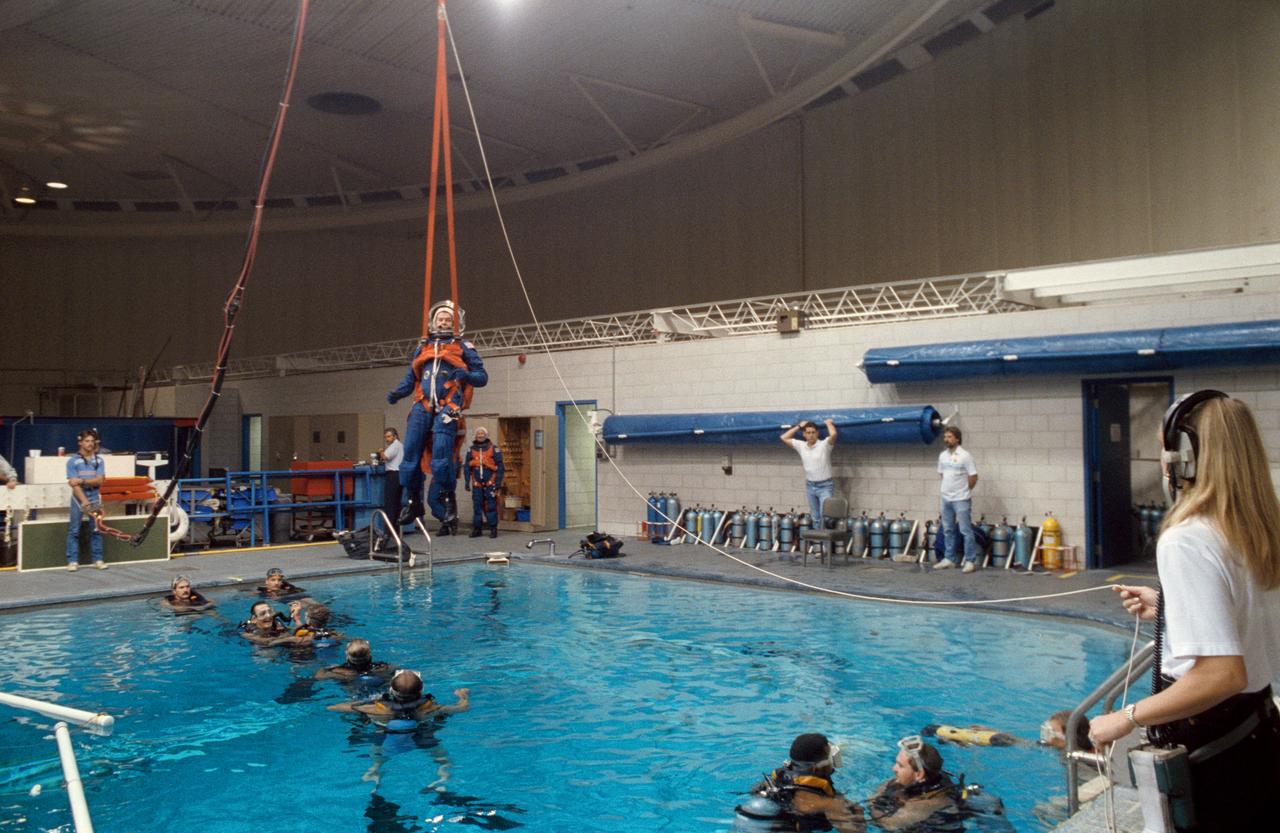
S91-52074 (26 Nov 1991) --- Charles R. (Rick) Chappell, alternate payload specialist, equipped with simulated parachute gear, descends into the water during bail-out training exercises in the Johnson Space Center's weightless environment training facility (WET-F). In this phase of the training program, Shuttle crewmembers learn the proper measures to take in the event of ejection and subsequent parachute landing into a body of water. A number of SCUBA-equipped swimmers who assisted in the training are pictured.
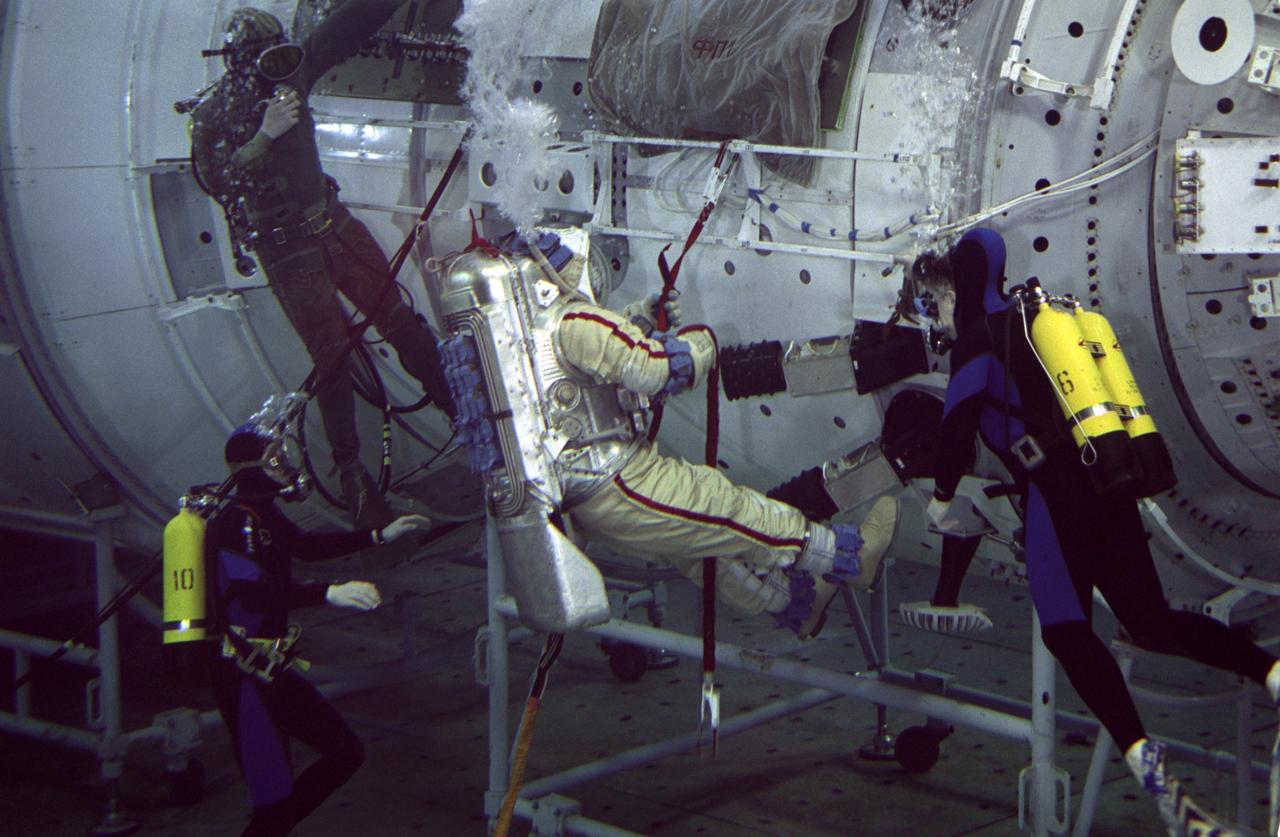
JSC2000-05368 (7 June 2000) --- Astronaut William Shepherd, ISS Expedition One commander, rehearses an extravehicular activity (EVA) with a full scale training model of the Zvezda Service Module in the Hydrolab facility at the Gagarin Cosmonaut Training Center in Russia. SCUBA-equipped divers assist in the spacewalk rehearsal, which also included cosmonaut Yuri Gidzenko, Soyuz commander, who is out of frame here.

STS-48 Mission Specialist (MS) James F. Buchli, wearing an extravehicular mobility unit (EMU), is watched by SCUBA-equipped divers as the platform he is standing on is lowered into JSC's Weightless Environment Training Facility (WETF) Bldg 29 pool. When completely underwater, Buchli will be released from the platform and will perform contingency extravehicular activity (EVA) operations. This underwater simulation of a spacewalk is part of the training required for Buchli's upcoming mission aboard Discovery, Orbiter Vehicle (OV) 103.
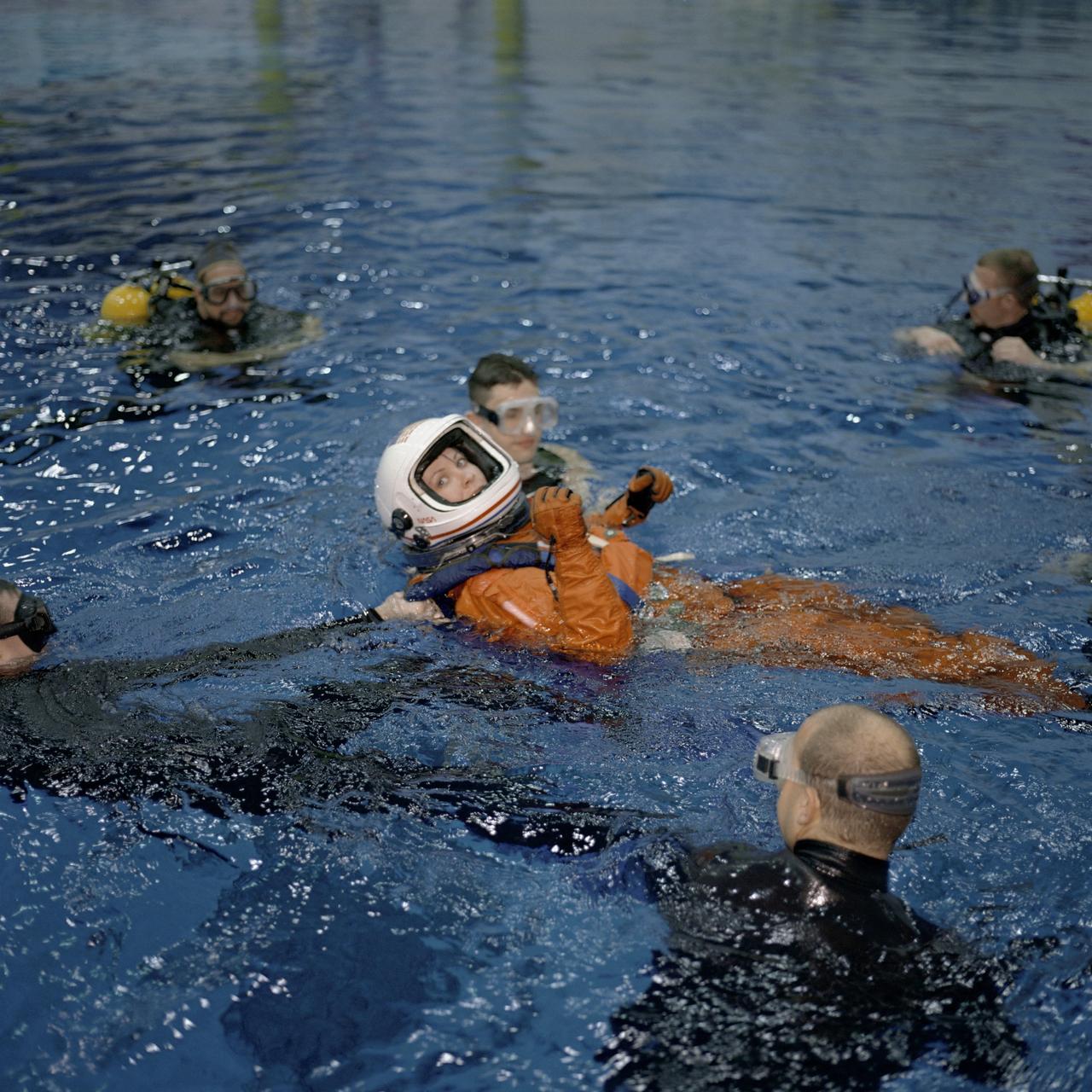
JSC2001-00003 (January 2001) --- Astronaut Janet L. Kavandi, STS-104 mission specialist, is assisted by SCUBA-equipped divers during an emergency bailout training session in the Neutral Buoyancy Laboratory (NBL) near Johnson Space Center (JSC). Kavandi will join four other astronauts for a June mission with the International Space Station (ISS).
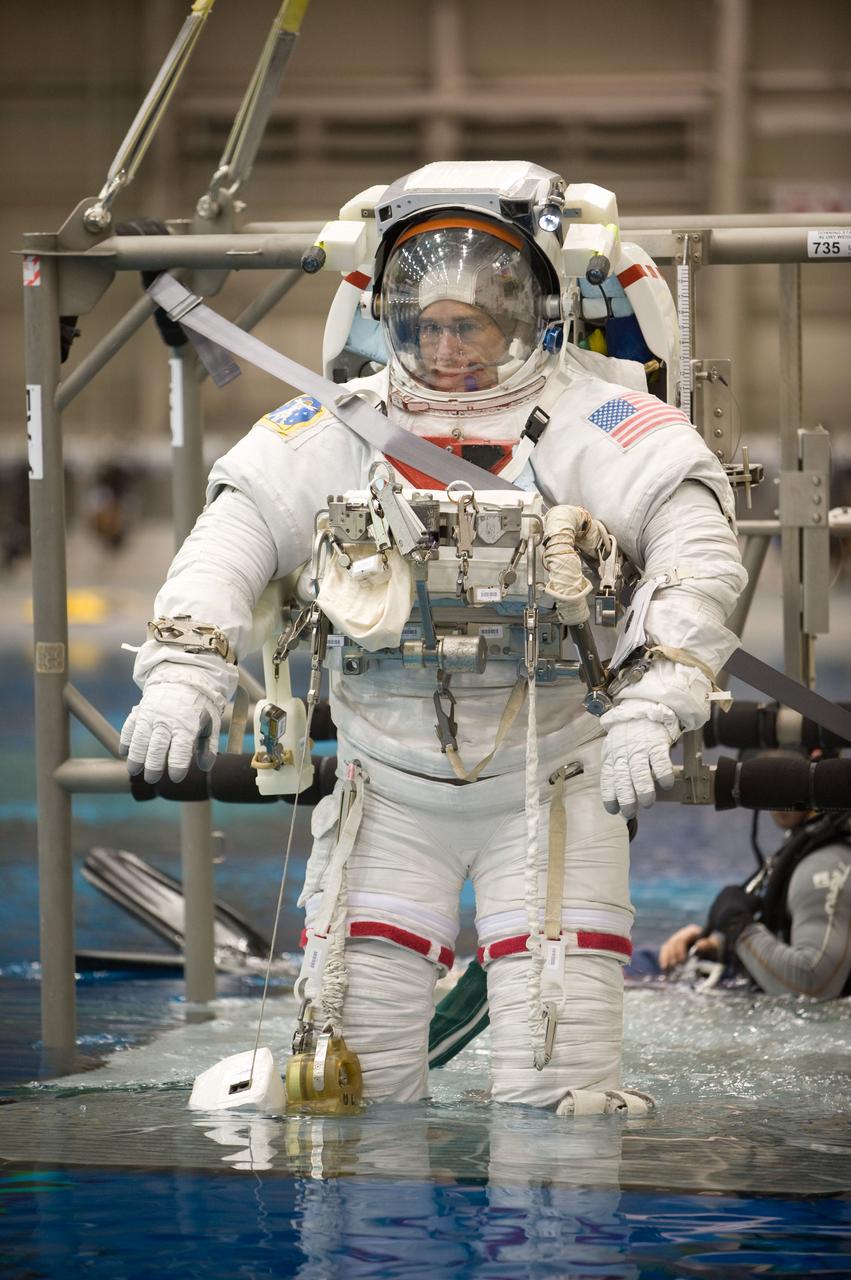
JSC2009-E-215173 (30 Sept. 2009) --- Astronaut Mike Good, STS-132 mission specialist, attired in a training version of his Extravehicular Mobility Unit (EMU) spacesuit, is submerged in the waters of the Neutral Buoyancy Laboratory (NBL) near NASA's Johnson Space Center. SCUBA-equipped divers (out of frame) are in the water to assist Good in his rehearsal, intended to help prepare him for work on the exterior of the International Space Station.
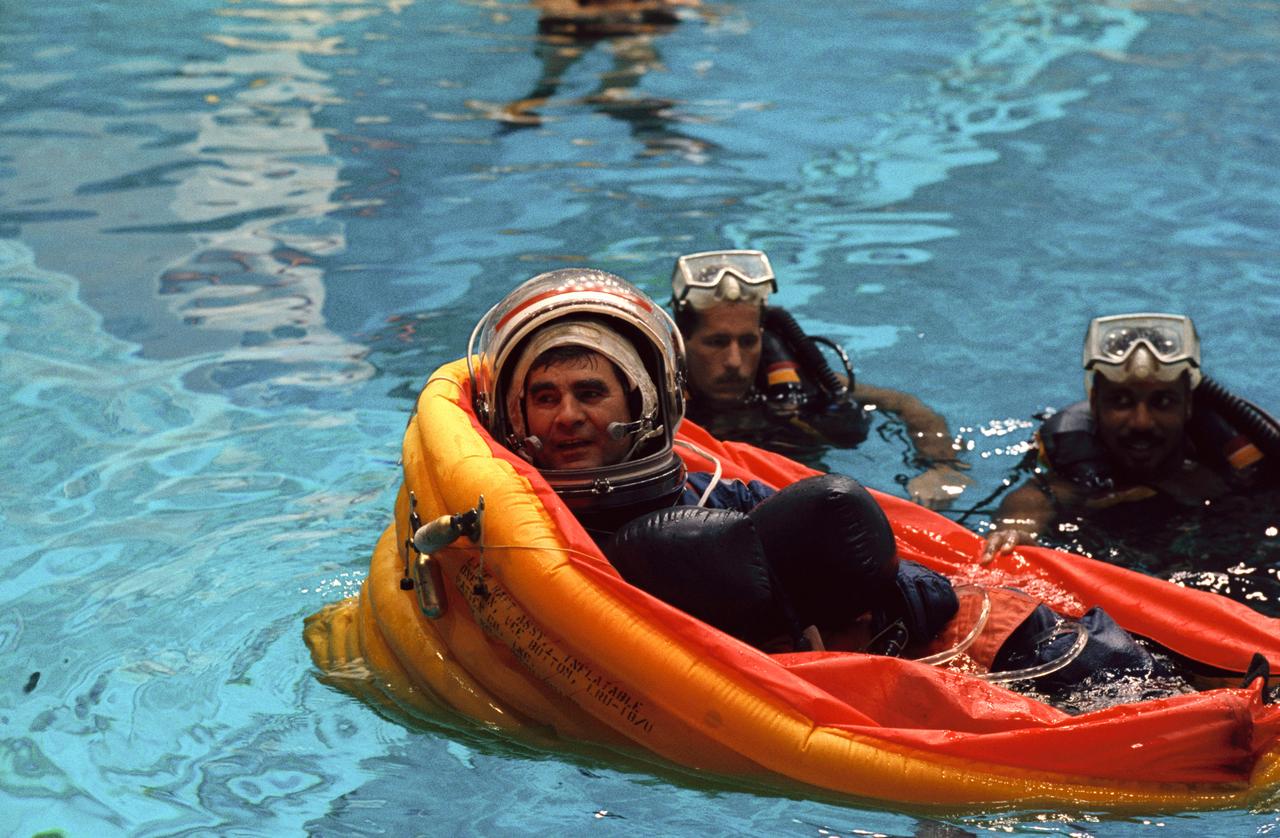
S92-40040 (19 June 1992) --- Astronaut Charles L. (Lacy) Veach, one of six crewmembers assigned to fly aboard Columbia for the STS-52 mission, is assisted by two SCUBA-equipped divers during emergency bailout training at the Johnson Space Center's Weightless Environment Training Facility (WET-F). Veach is one of three mission specialists who in October will join a Canadian payload specialist and the mission's commander and pilot for ten-plus days of research and experimentation, as well as the deployment of the LAGEOS spacecraft, in Earth orbit.
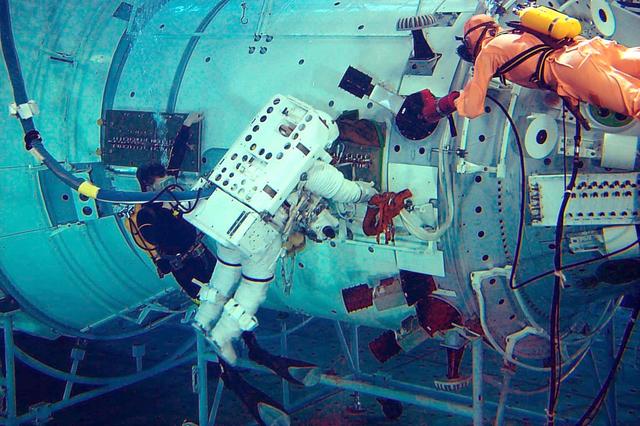
99-E-14657 (October 1999) --- Astronaut Edward T. Lu, mission specialist, is assisted by SCUBA-equipped divers during an underwater rehearsal of STS-106 space walk chores in the Hydrolab facility at Star City, Russia. Also participating in this simulation but out of frame here was cosmonaut Yuri I. Malenchenko, mission specialist representing the Russian Space Agency (RSA).
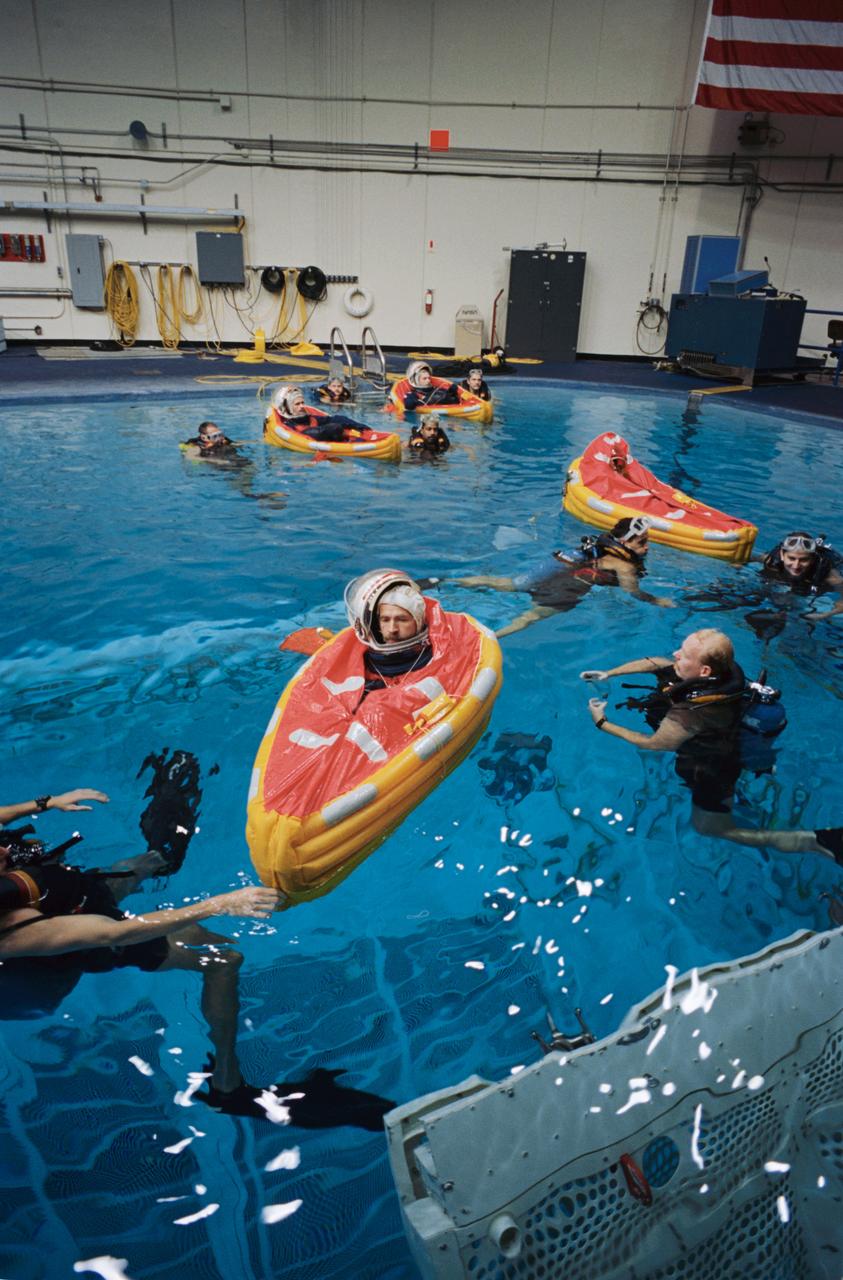
S94-47226 (13 Oct 1994) --- Using small life rafts, several cosmonauts and astronauts participating in joint Russia - United States space missions take part in an emergency bailout training session in the Johnson Space Center's (JSC) Weightless Environment Training Facility's (WET-F) 25-feet-deep pool. In the foreground is cosmonaut Alexsandr F. Poleshchuk, a member of the Mir reserve crew. A number of SCUBA-equipped divers assist the trainees.
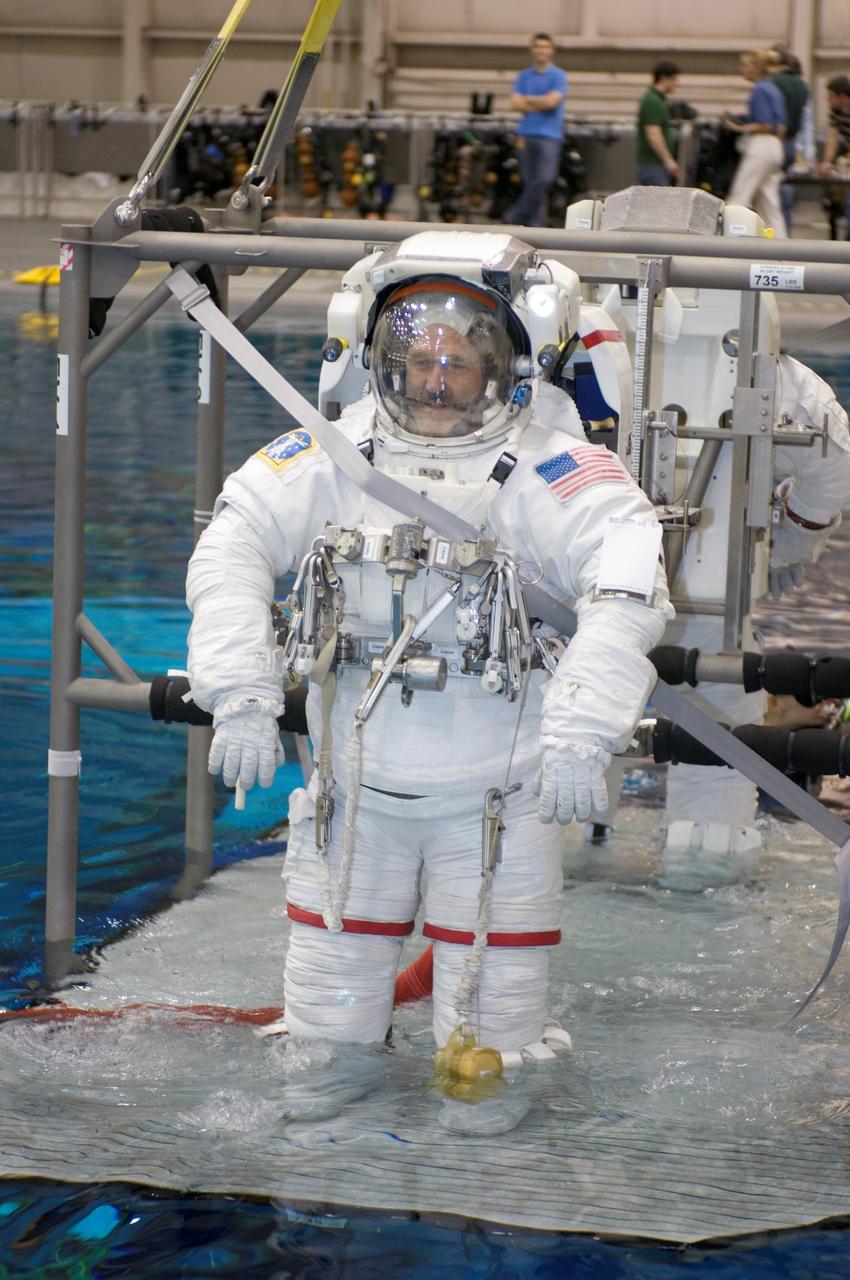
JSC2007-E-113498 (17 Dec. 2007) --- Astronauts John M. Grunsfeld and Andrew J. Feustel (partially obscured), both STS-125 mission specialists, are about to be submerged in the waters of the Neutral Buoyancy Laboratory (NBL) near Johnson Space Center. Grunsfeld and Feustel are attired in training versions of the Extravehicular Mobility Unit (EMU) spacesuit. SCUBA-equipped divers (out of frame) are in the water to assist the crewmembers in their rehearsal, intended to help prepare them for work on the Hubble Space Telescope.
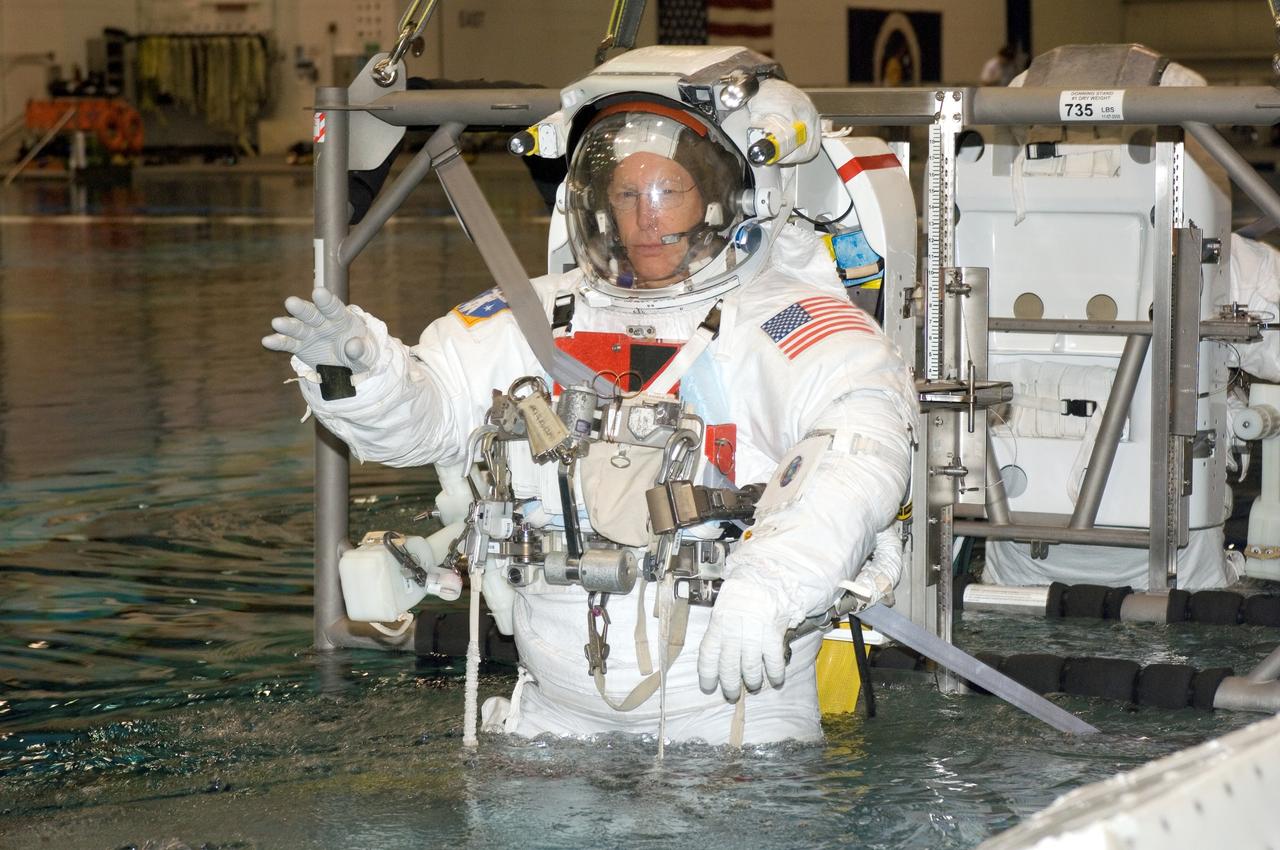
JSC2006-E-48972 (9 Nov. 2006) --- Astronauts Patrick G. Forrester and Steven R. Swanson (partially obscured), both STS-117 mission specialists, are about to be submerged in the waters of the Neutral Buoyancy Laboratory (NBL) near Johnson Space Center. Forrester and Swanson are attired in training versions of the Extravehicular Mobility Unit (EMU) spacesuit. SCUBA-equipped divers (out of frame) are in the water to assist the crewmembers in their rehearsal, intended to help prepare them for work on the exterior of the International Space Station.
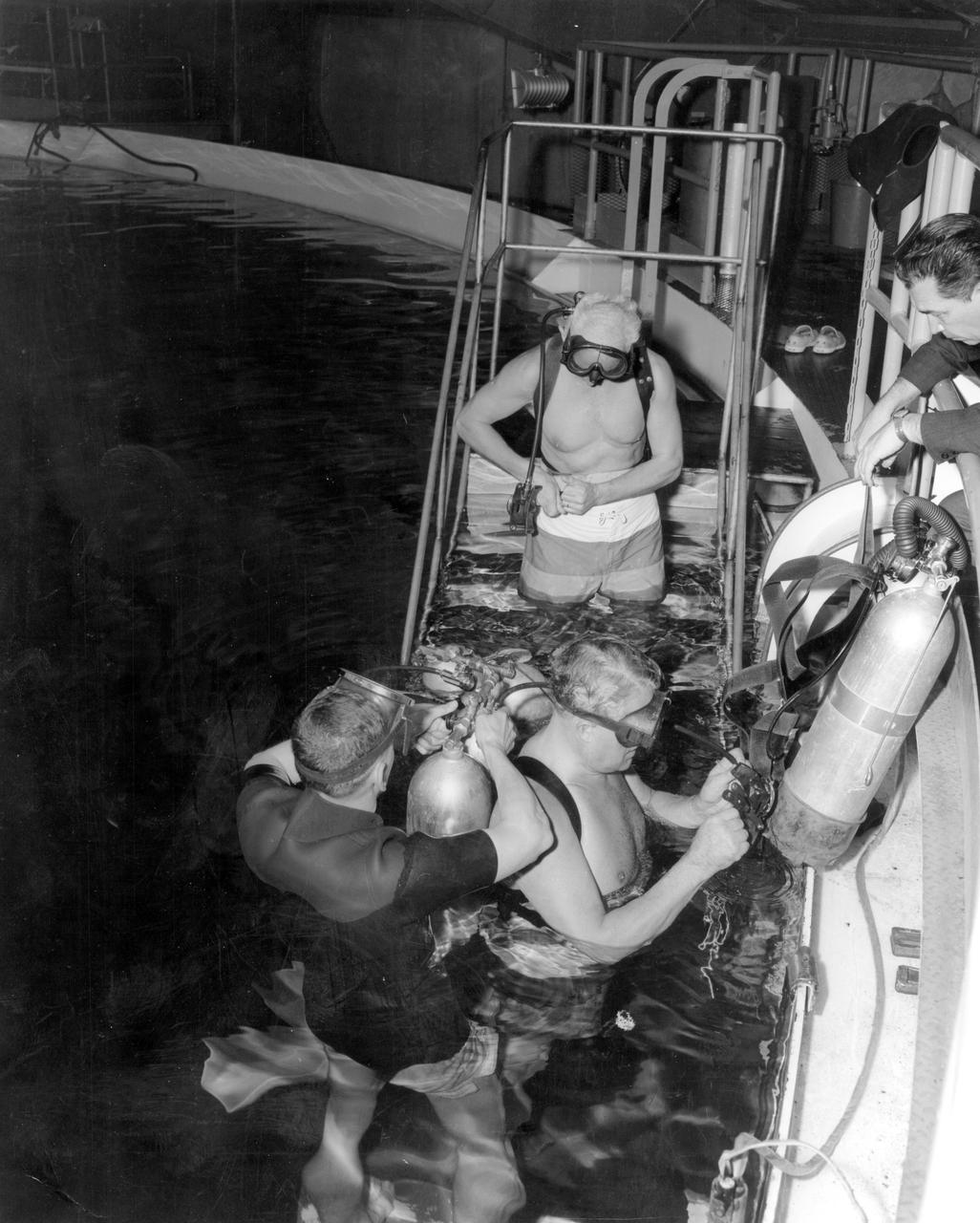
Marshall Space Flight Center’s (MSFC) Dr. Ernst Stuhlinger, Director of Research Projects Office; and Dr. Wernher von Braun, center director, along with others, took a swim in the Neutral Buoyancy Simulator (NBS) at MSFC. A safety diver adjusts scuba equipment worn by von Braun, while Stuhlinger adjusts his weight belt prior to entering the tank. In the NBS, subjects were weighted to a neutrally buoyant condition underwater to perform and practice tasks in a simulated weightless condition as would be encountered in space.
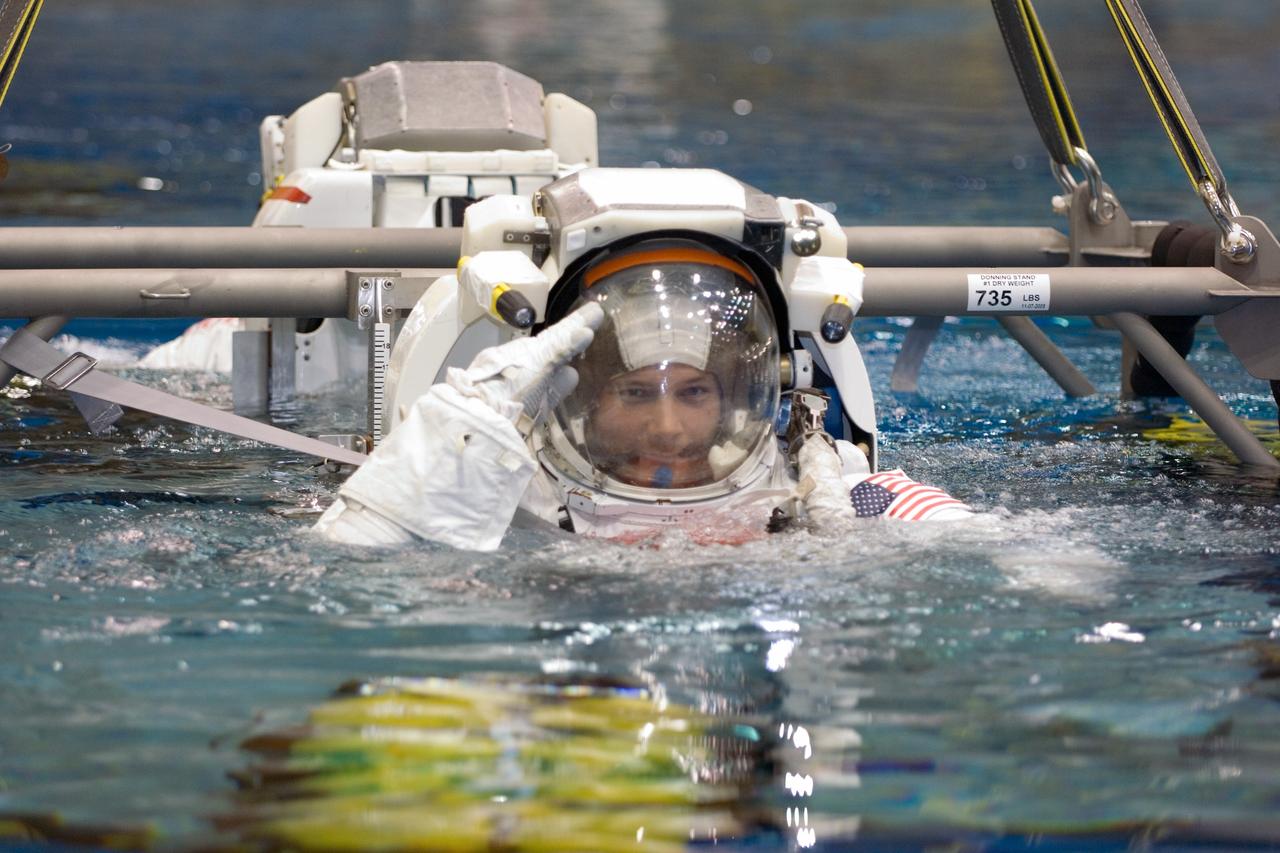
JSC2007-E-06550 (2 Feb. 2007) --- Astronauts Douglas H. Wheelock and Scott E. Parazynski (partially obscured), both STS-120 mission specialists, are about to be submerged in the waters of the Neutral Buoyancy Laboratory (NBL) near Johnson Space Center. Wheelock and Parazynski are attired in training versions of the Extravehicular Mobility Unit (EMU) spacesuit. SCUBA-equipped divers (out of frame) are in the water to assist the crewmembers in their rehearsal, intended to help prepare them for work on the exterior of the International Space Station.
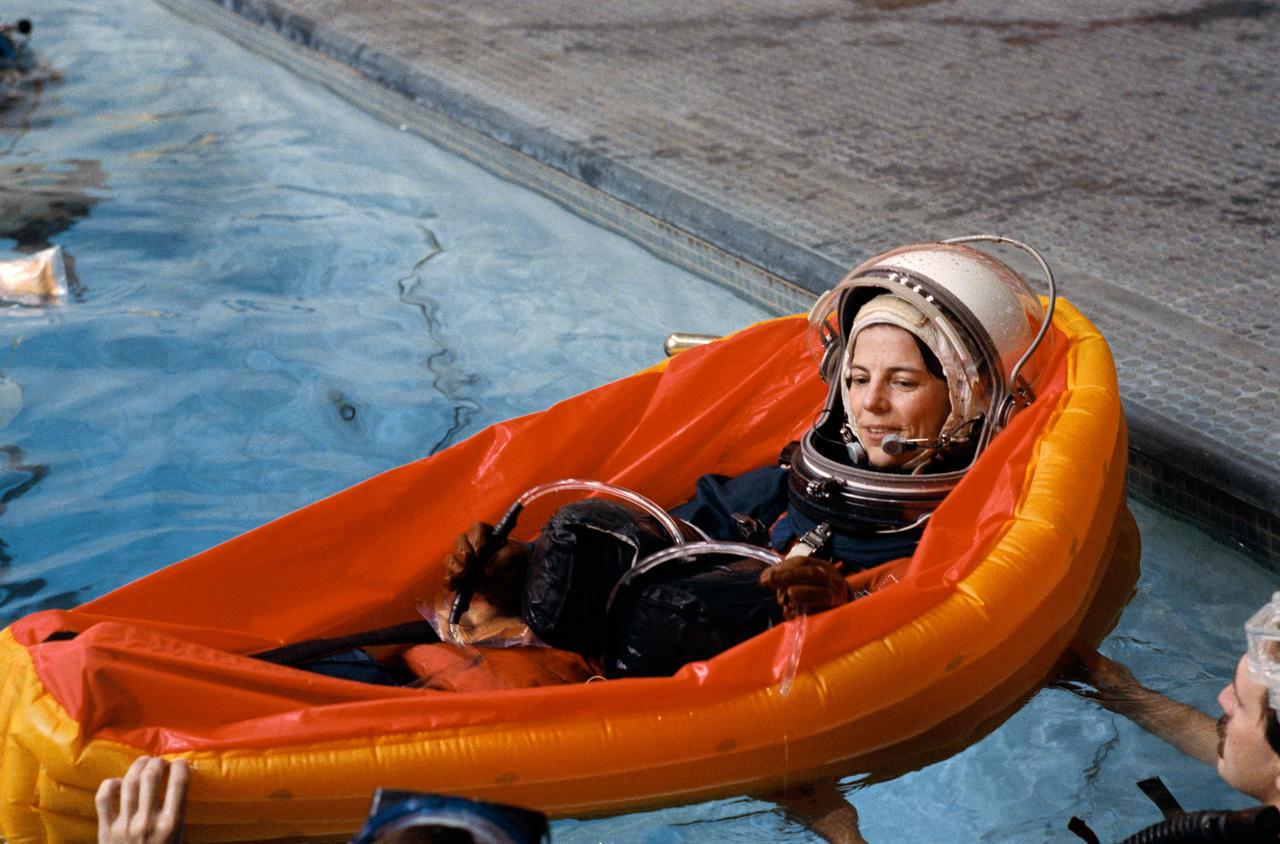
STS-32 Mission Specialist (MS) Bonnie J. Dunbar, wearing a launch and entry suit (LES) and lauch and entry helmet (LEH), in a single-occupant (one man) lift raft enlists the aid of two SCUBA-equipped divers as she floats in 25 ft deep pool located in JSC's Weightless Environment Training Facility (WETF) Bldg 29. During the exercises the crew practiced the procedures to follow in the event of an emergency aboard the Space Shuttle and familiarized themselves with post-Challenger pole system of emergency egress.
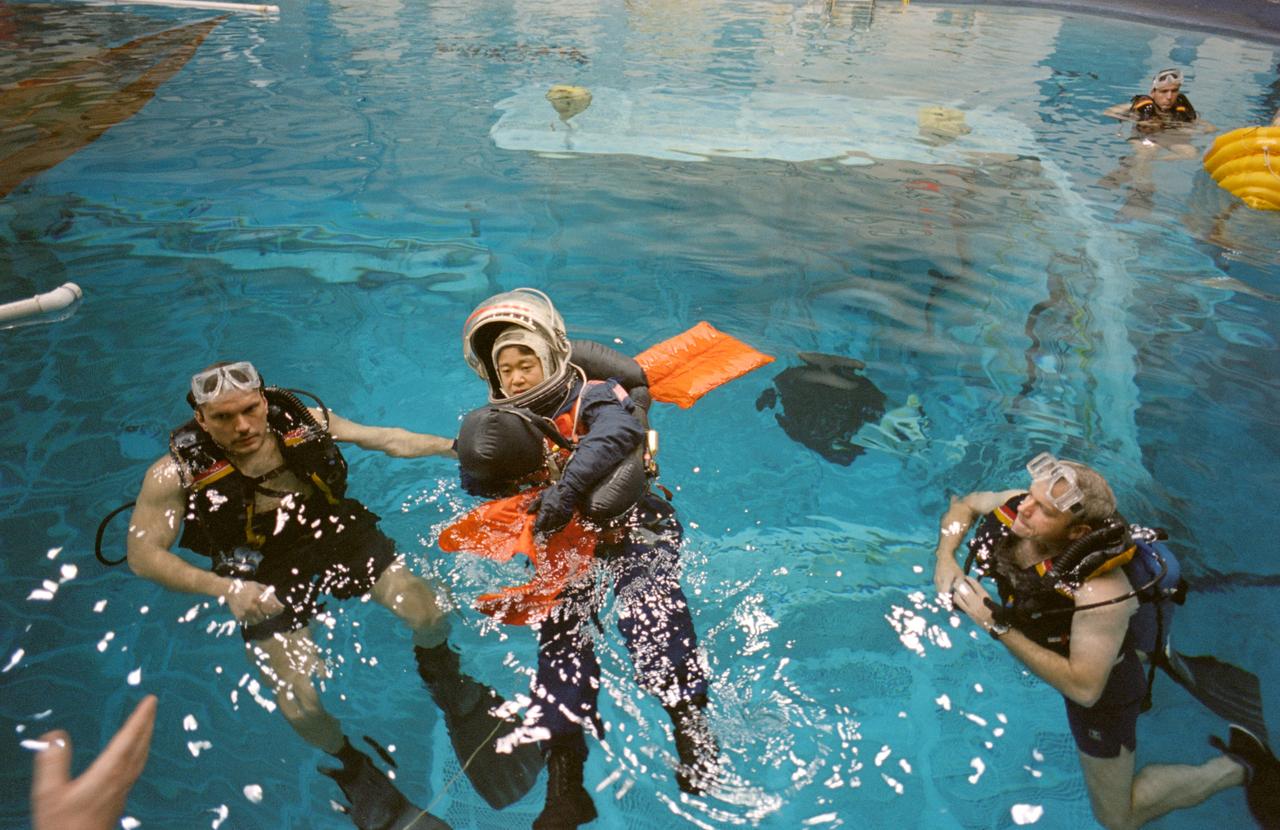
S94-29355 (28 Feb 1994) --- Dr. Chiaki Mukai, payload specialist, is assisted by a team of SCUBA-equipped divers during emergency egress training. The STS-65 crew was in the Weightless Environment Training Facility (WET-F) for the bailout training exercise. Dr. Mukai, representing the National Space Development Agency (NASDA), will join six NASA astronauts for the International Microgravity Laboratory (IML-2) mission aboard the Space Shuttle Columbia later this year.
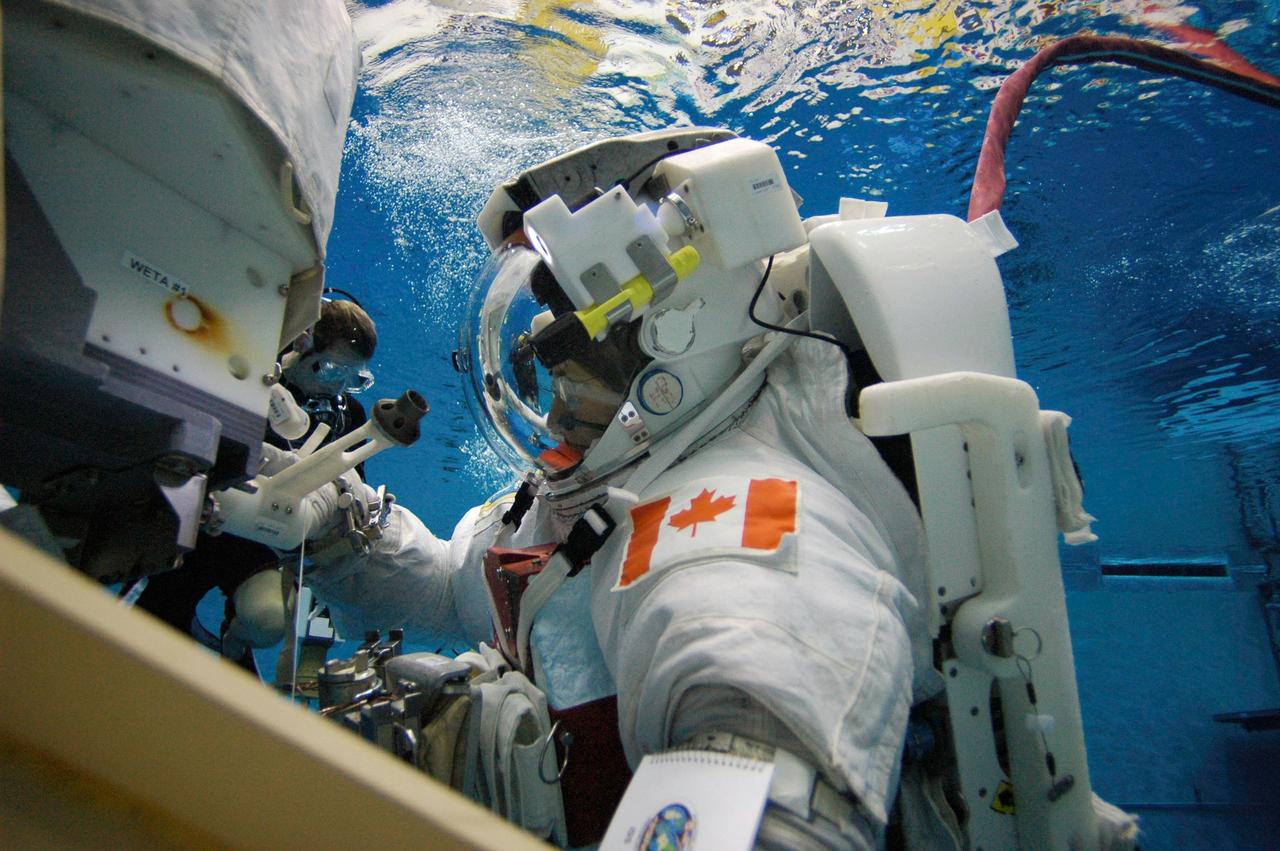
JSC2007-E-26261 (4 April 2007) --- Astronaut Dafydd R. (Dave) Williams, STS-118 mission specialist representing the Canadian Space Agency, wearing a training version of the Extravehicular Mobility Unit (EMU) spacesuit, participates in an underwater simulation of extravehicular activity (EVA) in the Neutral Buoyancy Laboratory (NBL) near Johnson Space Center. SCUBA-equipped divers are in the water to assist Williams in his rehearsal, intended to help prepare him for work on the exterior of the International Space Station.

JSC2007-E-113497 (17 Dec. 2007) --- Astronauts John M. Grunsfeld and Andrew J. Feustel (partially obscured), both STS-125 mission specialists, are about to be submerged in the waters of the Neutral Buoyancy Laboratory (NBL) near Johnson Space Center. Grunsfeld and Feustel are attired in training versions of the Extravehicular Mobility Unit (EMU) spacesuit. SCUBA-equipped divers (out of frame) are in the water to assist the crewmembers in their rehearsal, intended to help prepare them for work on the Hubble Space Telescope.
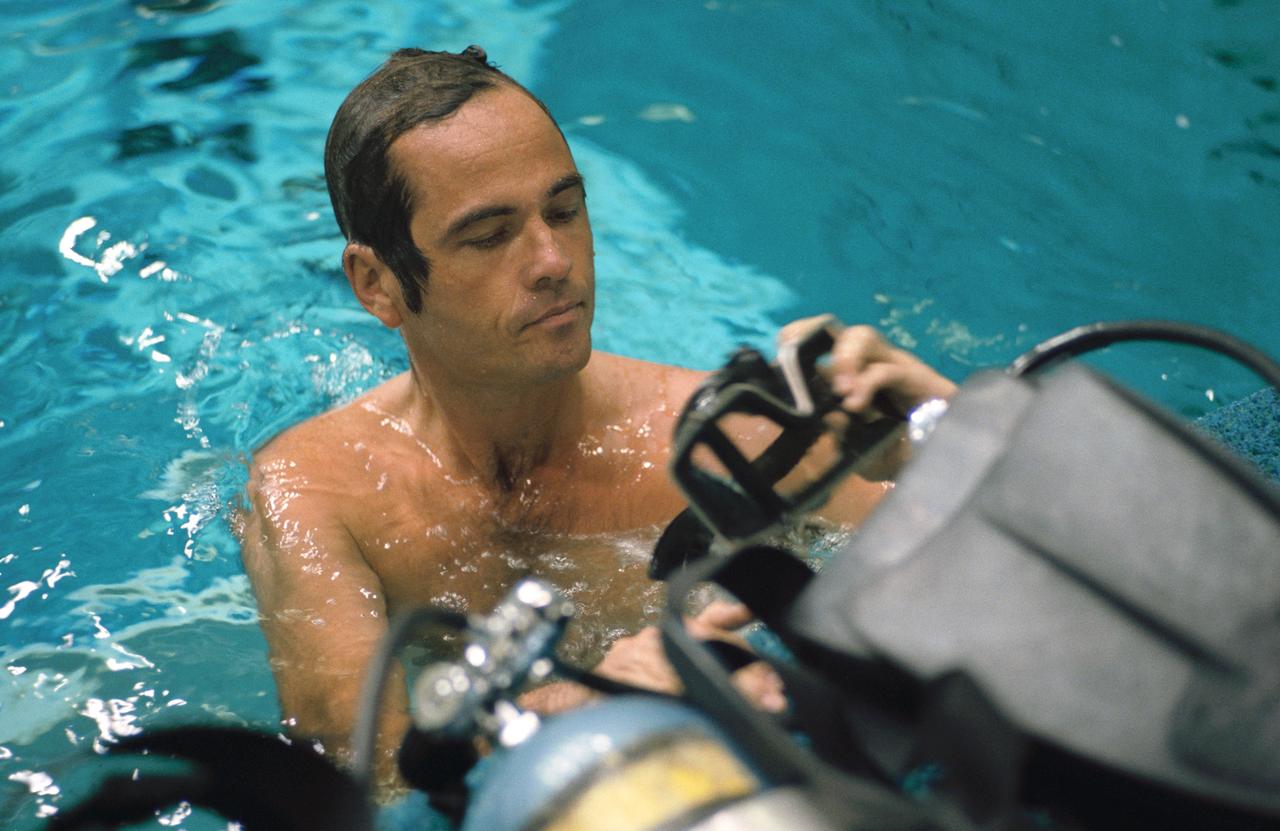
S84-36956 (1 July 1984) --- Astronaut Robert L. Crippen, 41-G crew commander, prepares his SCUBA mask prior to submerging into the weightless environment training facility's 25 ft. deep pool to observe a simulation exercise for two fellow 41-G crewmembers assigned to an extravehicular activity (EVA) in space. Not pictured are Astronauts Kathryn D. Sullivan and David C. Leestma, mission specialists who will perform the EVA during the eight-day mission scheduled for October of this year.
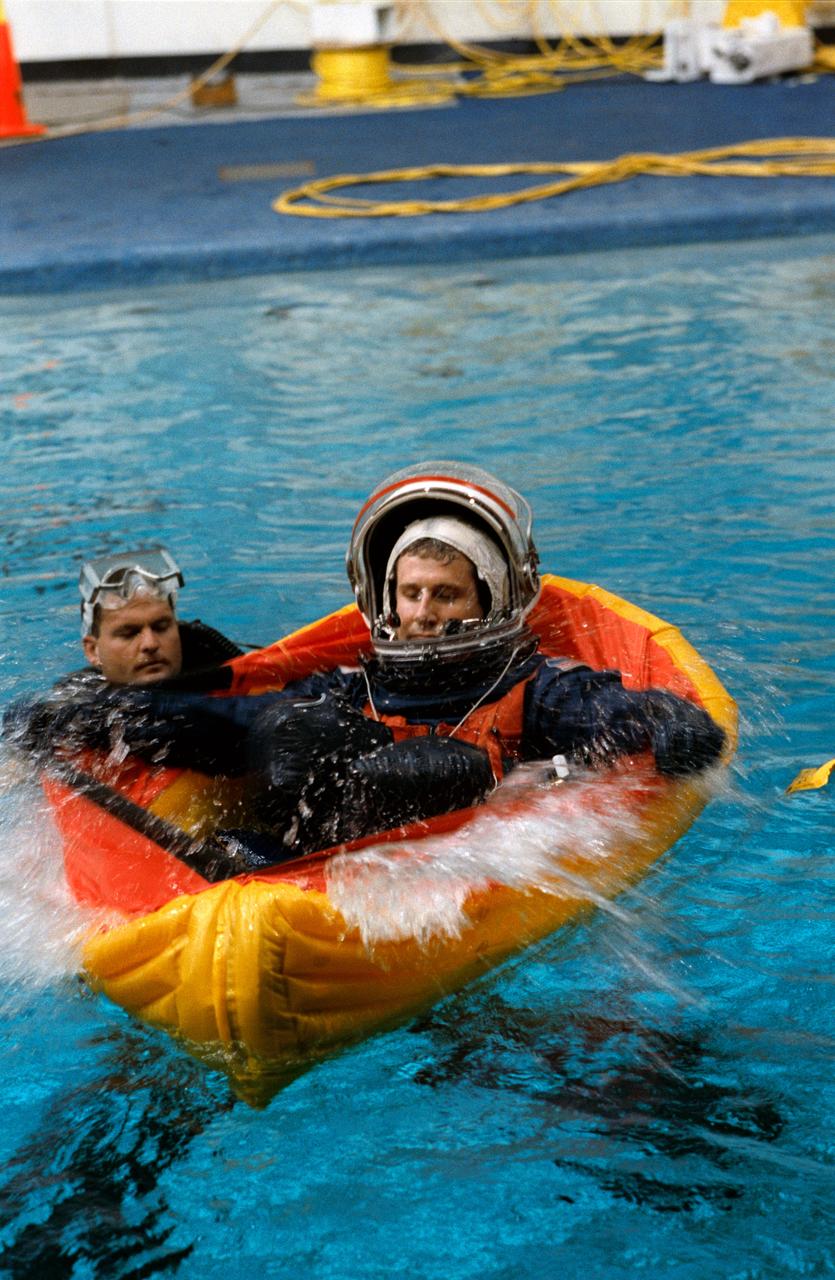
S93-43856 (7 Ssept 1993) --- Navigating a one person life raft, Jay C. Buckey, M.D., participates in emergency bailout training in the Johnson Space Center's (JSC) Weightless Environment Training Facility (WET-F). Dr. Buckey has been assigned as an alternate payload specialist for the Spacelab Life Sciences (SLS-2) mission scheduled for next month. Nearby is a SCUBA-equipped diver who assisted in the training exercises.
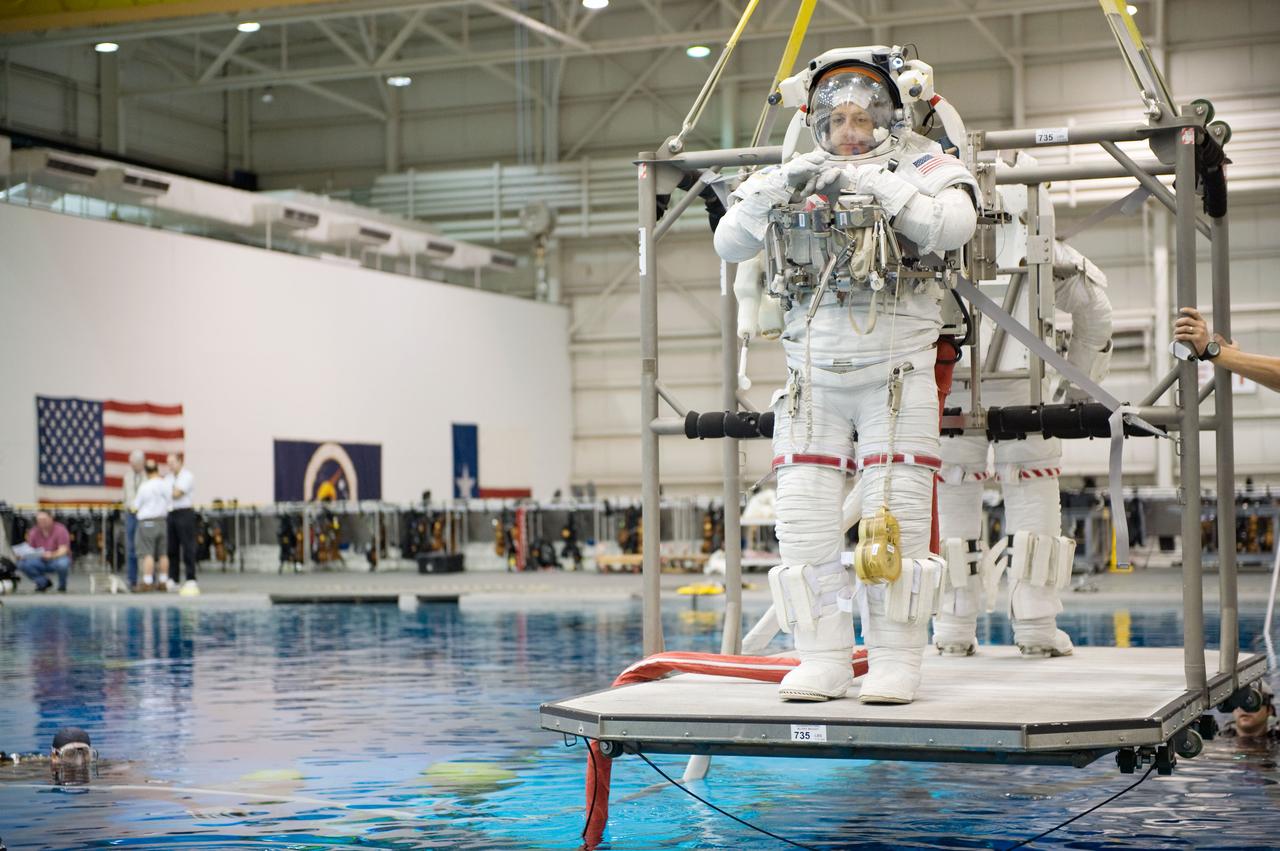
JSC2008-E-141532 (6 Nov. 2008) --- Astronauts Mike Massimino and Michael Good (partially obscured), both STS-125 mission specialists, are about to be submerged in the waters of the Neutral Buoyancy Laboratory (NBL) near NASA's Johnson Space Center. Massimino and Good are attired in training versions of their Extravehicular Mobility Unit (EMU) spacesuit. SCUBA-equipped divers are in the water to assist the crewmembers in their rehearsal, intended to help prepare them for work on the Hubble Space Telescope.
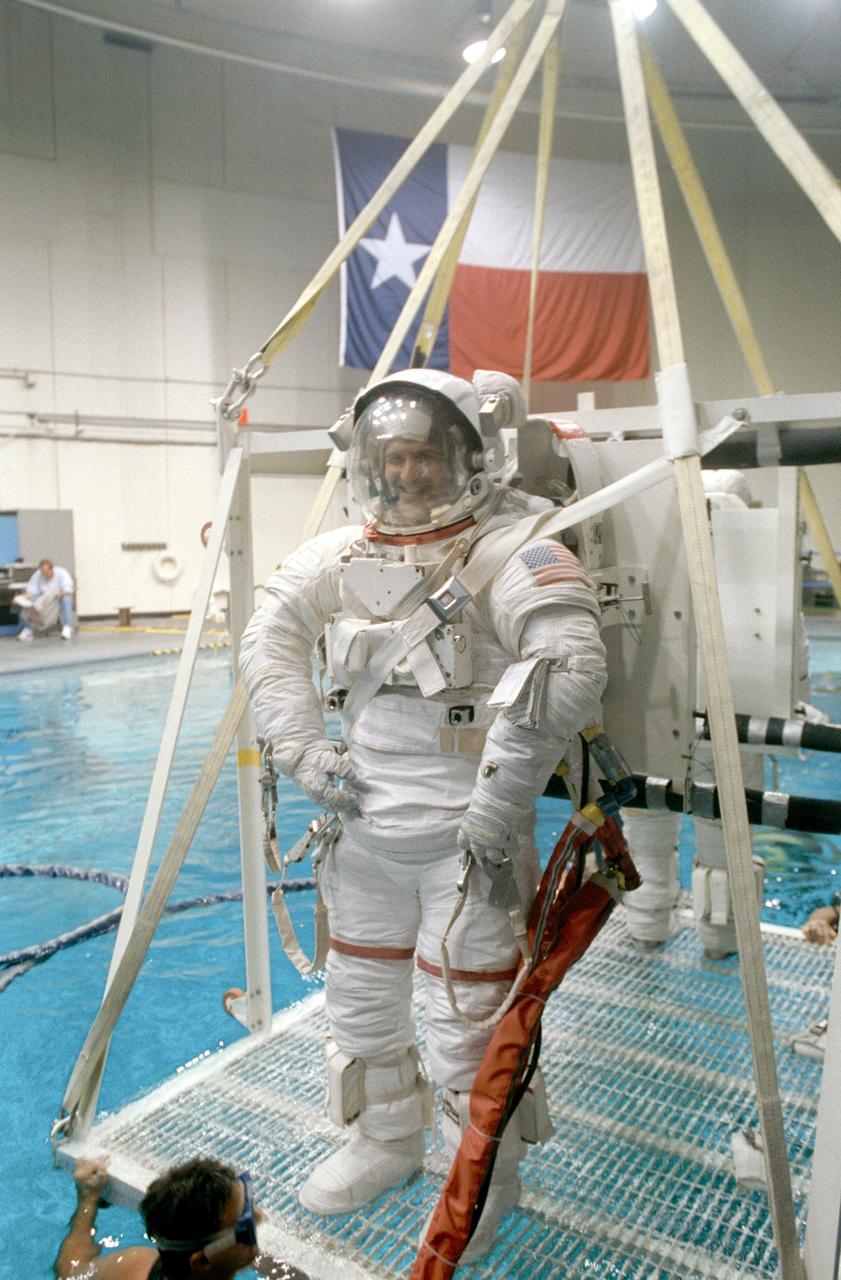
S92-40378 (1 July 1992) --- Astronaut Peter J.K. Wisoff, STS-57 mission specialist, fully suited in an extravehicular mobility unit (EMU) and helmet and standing on a platform, is lowered into the 25 foot deep pool of Johnson Space Center?s (JSC) Weightless Environment Training Facility (WETF) Bldg 29. Once underwater, Wisoff will participate in an underwater extravehicular activity (EVA) simulation. A scuba-equipped diver already in the pool guides the platform into the water.
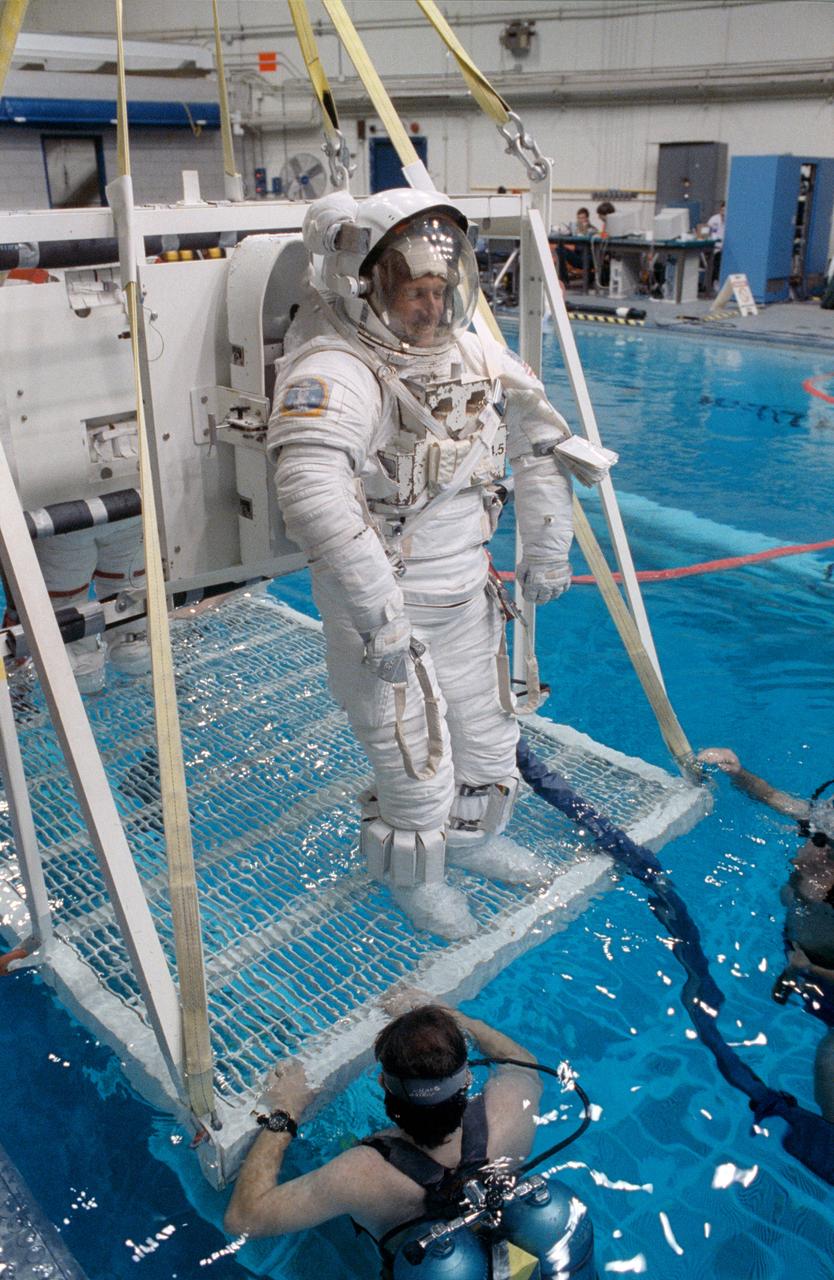
S91-30197 (1 March 1991) --- A wider shot of astronaut C. Michael Foale, mission specialist, standing on a platform which is part of a system that will lower him into a 25-ft. deep pool. Foale used the pool in the weightless environment training facility (WET-F) to rehearse a contingency extravehicular activity (EVA). Two SCUBA-equipped swimmers assist. Astronauts wear pressurized spacesuits configured for achieving a neutrally buoyant condition in the water to simulate both planned and contingency EVAs.
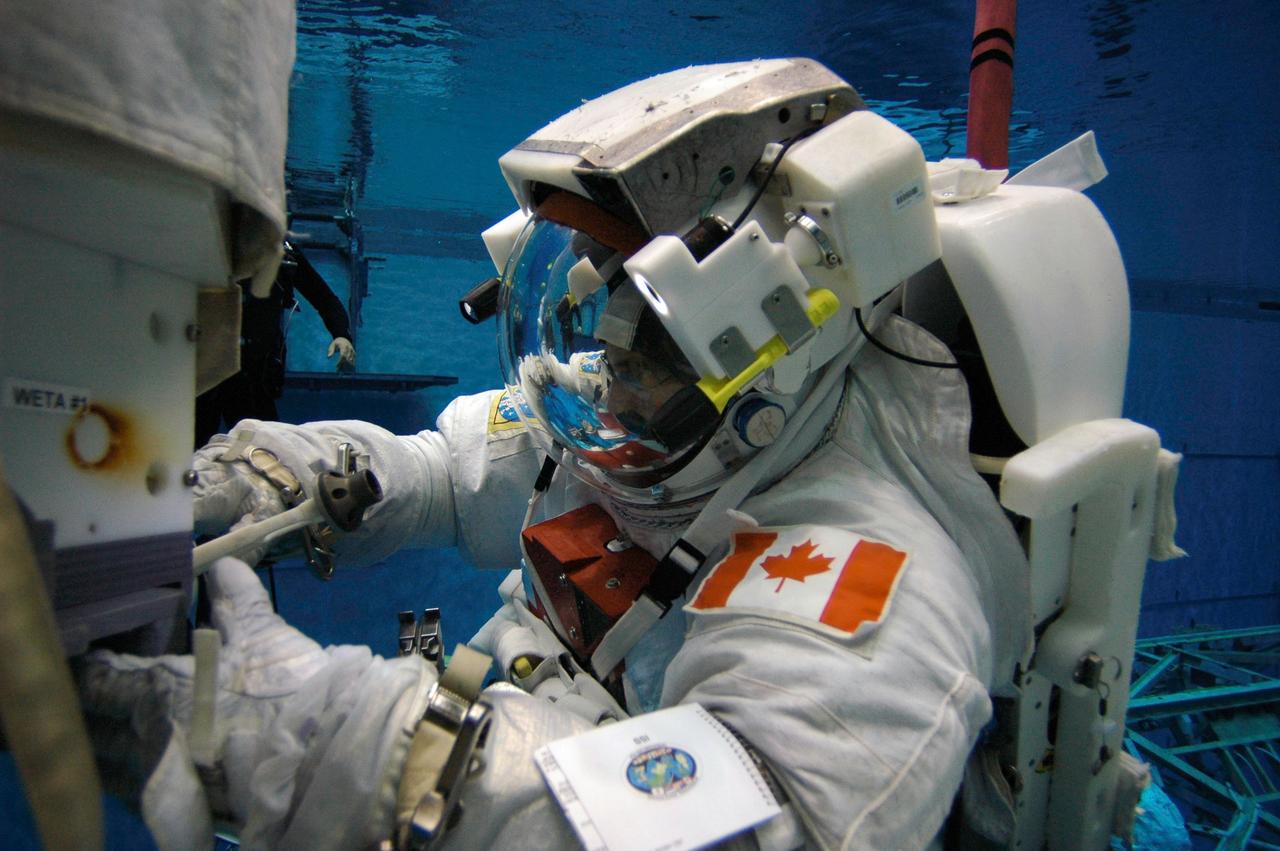
JSC2007-E-26262 (4 April 2007) --- Astronaut Dafydd R. (Dave) Williams, STS-118 mission specialist representing the Canadian Space Agency, wearing a training version of the Extravehicular Mobility Unit (EMU) spacesuit, participates in an underwater simulation of extravehicular activity (EVA) in the Neutral Buoyancy Laboratory (NBL) near Johnson Space Center. SCUBA-equipped divers are in the water to assist Williams in his rehearsal, intended to help prepare him for work on the exterior of the International Space Station.
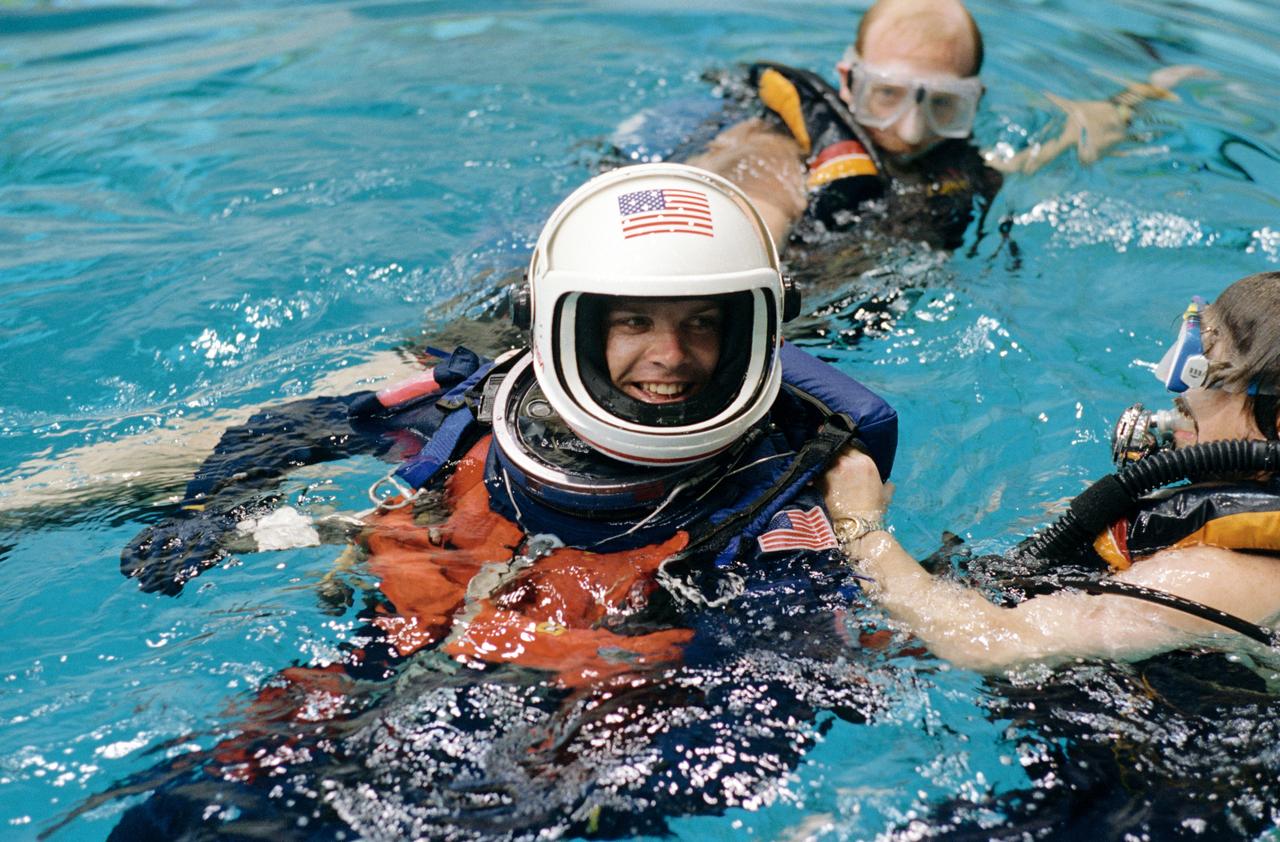
S95-03480 (16 FEB 1995) --- Attired in a training version of the Shuttle launch and entry garment, astronaut Kevin R. Kregel, pilot, gets help from SCUBA-equipped divers during a training session at the Johnson Space Center's (JSC) Weightless Environment Training Facility (WET-F). As part of the emergency bailout phase of their training agenda, the STS-70 crew members made use of this 25-feet deep pool to practice parachute landings in water and subsequent deployment of life rafts.
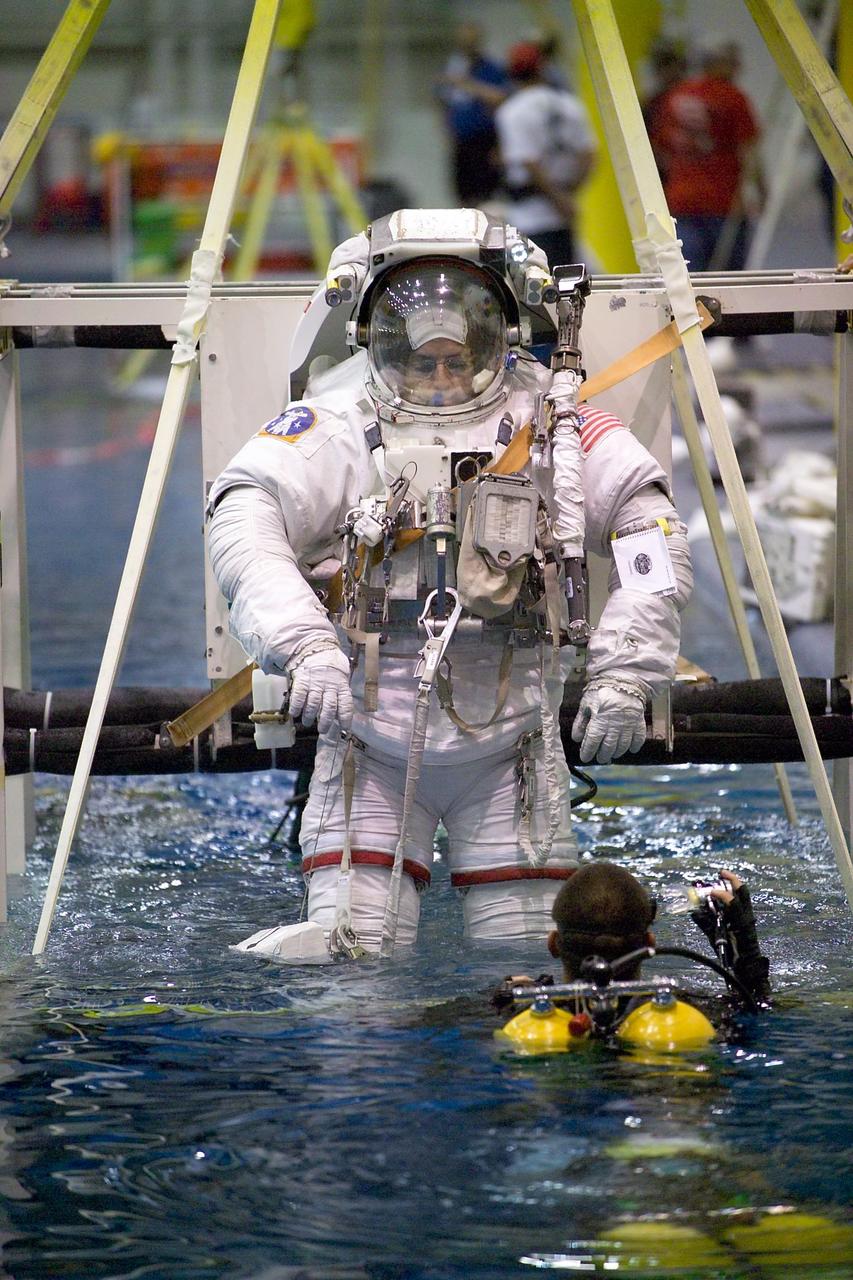
JSC2005-E-18896 (12 May 2005) --- Astronaut William S. McArthur, Jr., Expedition 12 commander and NASA Space Station science officer; and cosmonaut Valery I. Tokarev (obscured), Station flight engineer representing Russia's Federal Space Agency, are submerged in the waters of the Neutral Buoyancy Laboratory (NBL) at Johnson Space Center (JSC). McArthur and Tokarev are wearing training versions of the Extravehicular Mobility Unit (EMU) space suit. SCUBA-equipped divers are in the water to assist the crewmembers in their rehearsal, intended to help prepare them for work on the exterior of the International Space Station.
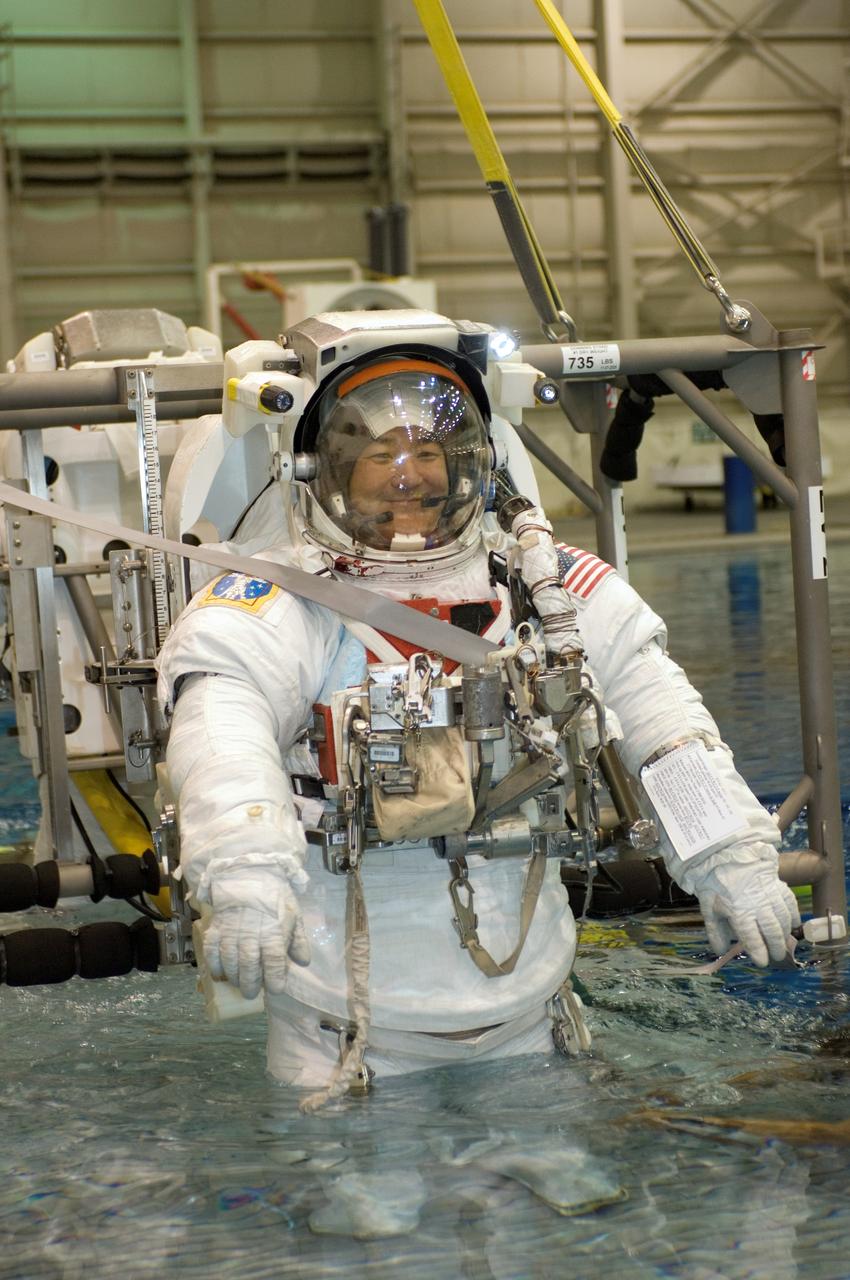
JSC2007-E-46552 (18 Sept. 2007) --- Astronauts Daniel M. Tani, Expedition 16 flight engineer; and Scott E. Parazynski (partially obscured), STS-120 mission specialist, are about to be submerged in the waters of the Neutral Buoyancy Laboratory (NBL) near Johnson Space Center. Tani and Parazynski are attired in training versions of their Extravehicular Mobility Unit (EMU) spacesuit. SCUBA-equipped divers (out of frame) are in the water to assist the crewmembers in their rehearsal, intended to help prepare them for work on the exterior of the International Space Station. Tani is scheduled to join Expedition 16 after launching to the station on mission STS-120.
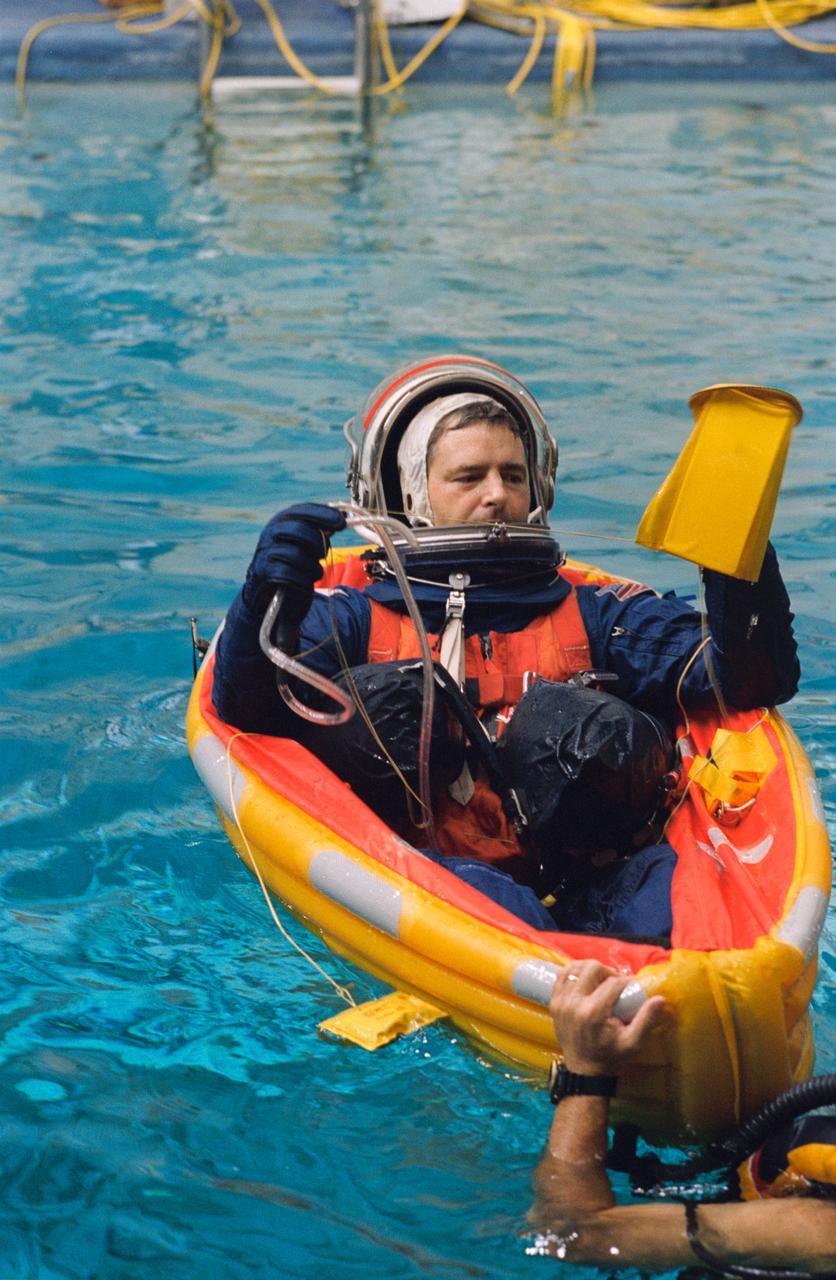
S93-45726 (7 Oct. 1993) --- Canadian astronaut candidate Marc Garneau, later named as a mission specialist for NASA's STS-77 mission, participates in emergency bailout training at the Johnson Space Center (JSC). Garneau was in the 1992 class of Astronaut Candidates (ASCAN). Wearing full parachute gear following a simulated parachute drop, Garneau has deployed a small life raft in a 25-feet deep pool in JSC's Weightless Environment Training Facility (WET-F). This portion of an astronaut's training is to prepare him or her for proper measures to take in the event of bailout over water. Garneau is assisted here by one of several SCUBA-equipped divers in the pool.
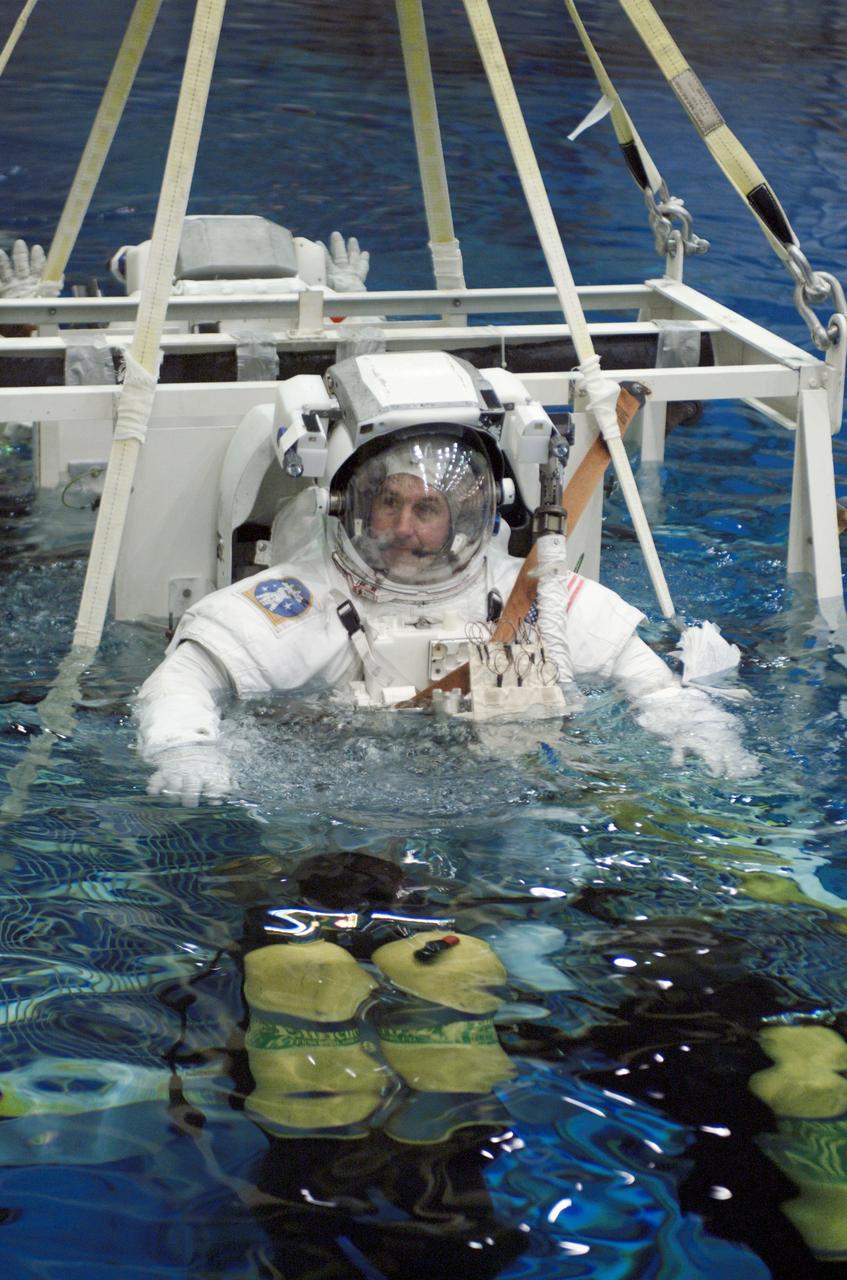
JSC2002-E-23140 (28 May 2002) --- Astronaut Stephen K. Robinson and Soichi Noguchi (partially obscured), both STS-114 mission specialists, are submerged in the waters of the Neutral Buoyancy Laboratory (NBL) at the Johnson Space Center (JSC). Robinson and Noguchi are wearing the training version of the Extravehicular Mobility Unit (EMU) space suit. SCUBA-equipped divers are in the water to assist the astronauts in their rehearsal, intended to help prepare them for work on the exterior of the International Space Station (ISS). Noguchi represents Japan’s National Space Development Agency (NASDA).
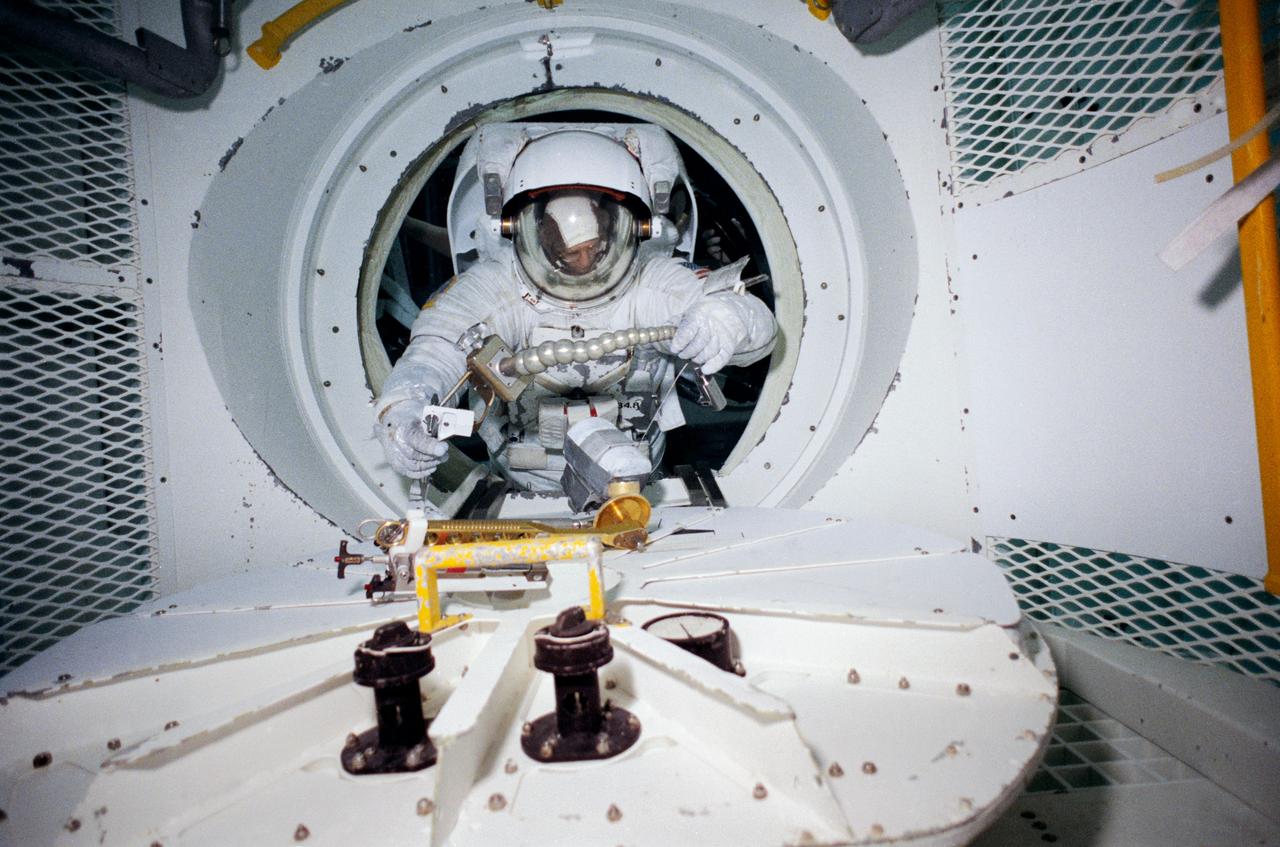
S90-30521 (20 Feb 1990) --- Though no extravehicular activity is planned for STS-31, two crewmembers train for contingencies that would necessitate leaving their shirt sleeve environment of Discovery's cabin and performing chores with their Hubble Space Telescope payload or related hardware. Astronaut Kathryn D. Sullivan, mission specialist, is seen egressing the hatchway of the airlock of a full scale mockup of a Shuttle cabin to interface with an HST mockup in JSC's 25.-ft. deep pool in the weightless environment training facility (WET-F). Two SCUBA-equipped divers who assisted in the training session are also seen. Astronaut Bruce McCandless II, mission specialist, is out of frame.
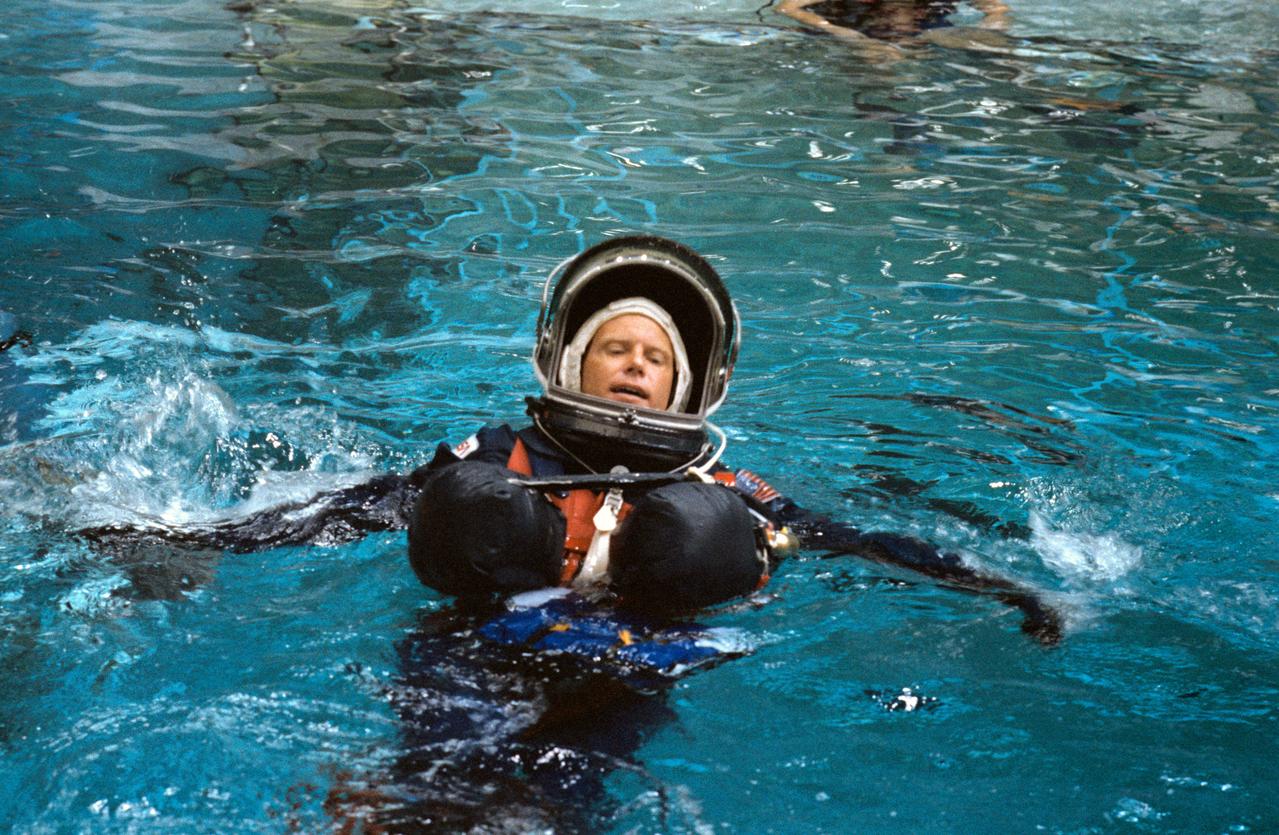
S88-42409 (20 July 1988) --- STS-26 Discovery, Orbiter Vehicle (OV) 103, Mission Specialist (MS) George D. Nelson participates in crew escape system (CES) testing in JSC Weightless Environment Training Facility (WETF) Bldg 29. Nelson, wearing the newly designed (navy blue) launch and entry suit (LES), floats in WETF pool with the aid of an underarm flotation device (modern version of Mas West floats). He awaits the assistance of SCUBA-equipped divers during a simulation of escape and rescue operations utilizing a new CES pole for emergency exit from the Space Shuttle.
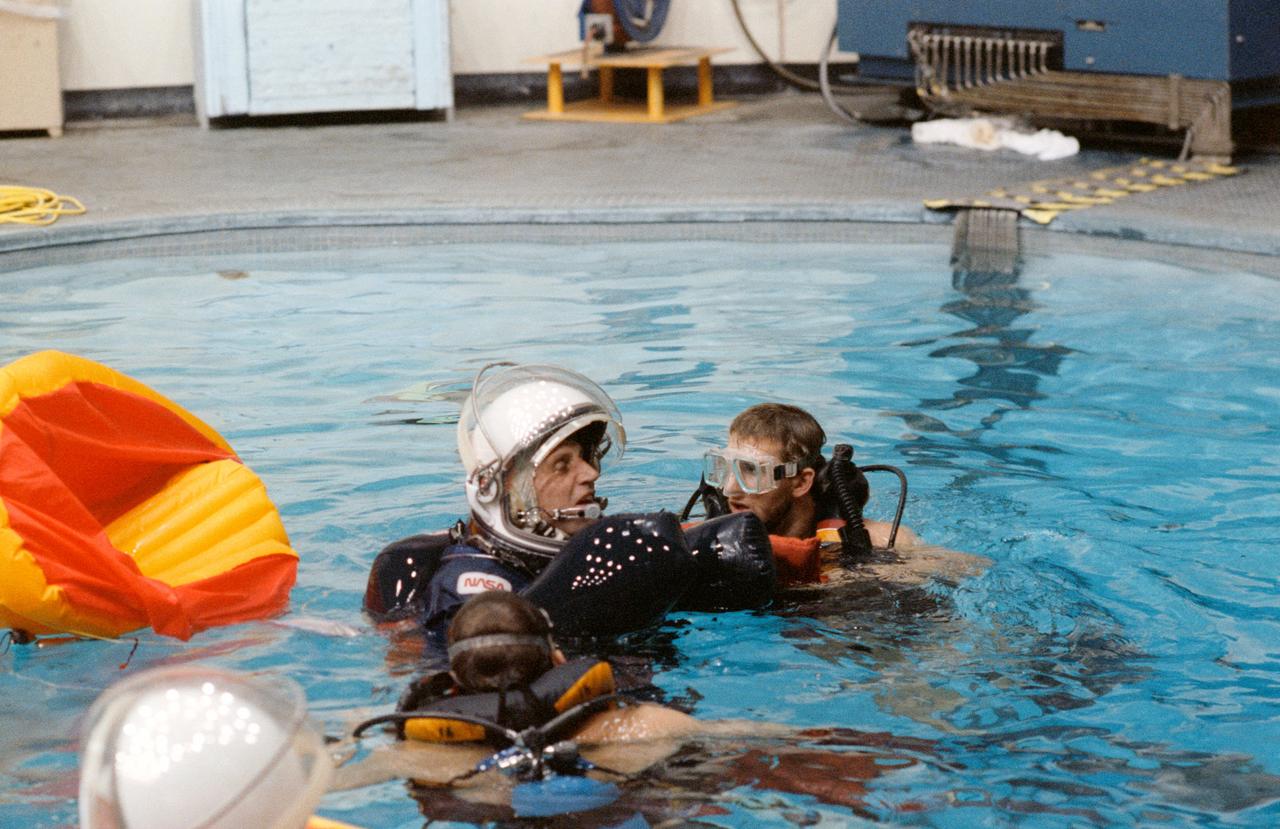
S91-51995 (26 Nov 1991) --- Astronaut David C. Hilmers, STS-42 mission specialist, wearing launch and entry suit (LES) and launch and entry helmet (LEH), floats in the water with the aid of an underarm flotation device as SCUBA-equipped divers look on. Behind Hilmers is his yellow and orange single person life raft. Hilmers is rehearsing launch emergency egress (bailout) procedures in the Johnson Space Center?s (JSC) Weightless Environment Training Facility (WETF) Bldg 29. The crewmembers would use this equipment in the event of an emergency bailout over water. The WETF's 25 ft deep pool is used to simulate the ocean.
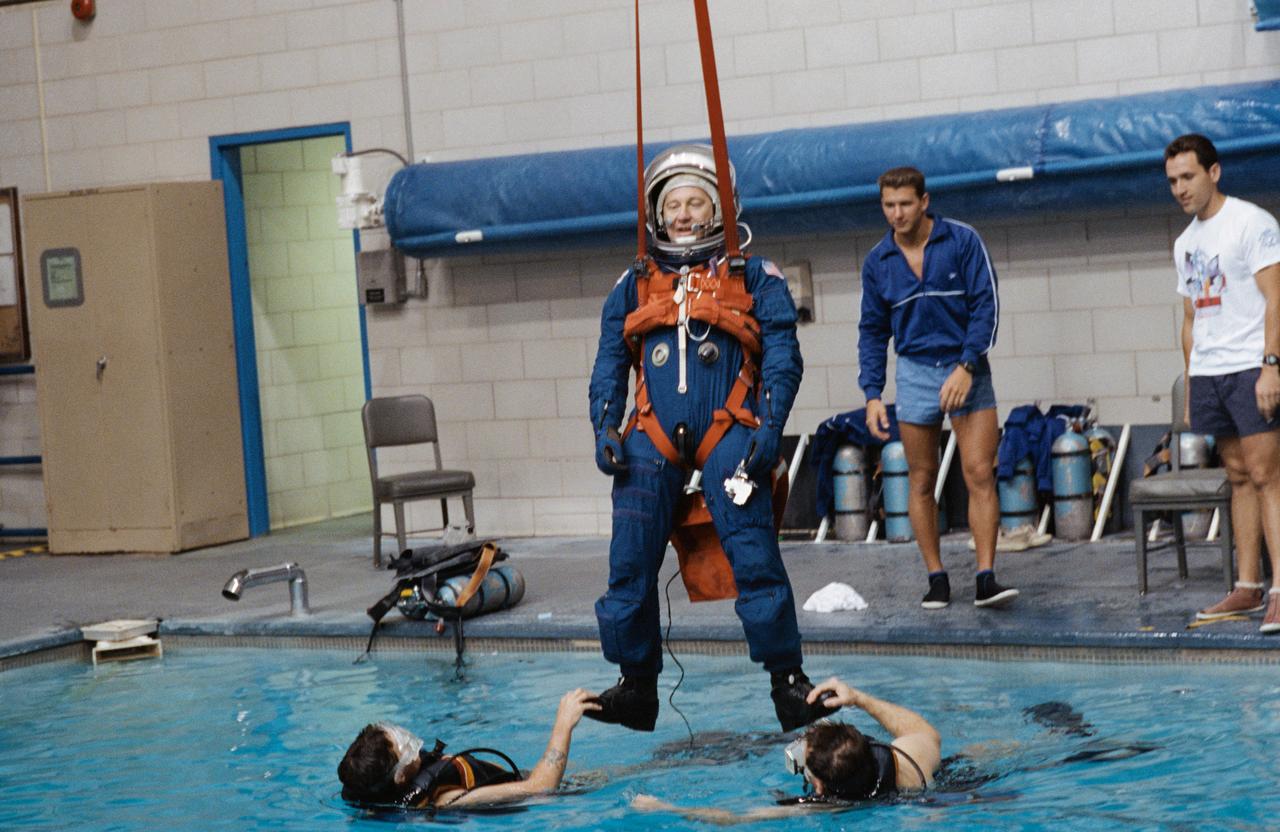
S92-32111 (May 1992) --- Payload specialist Albert Sacco Jr. is assisted by two SCUBA-equipped divers as he hangs by his parachute harness during emergency bailout training exercises in the Johnson Space Center?s (JSC) Weightless Environment Training Facility (WET-F). Sacco is an alternate payload specialist for the United States Microgravity Laboratory (USML-1) mission, scheduled for launch later this year. EDITOR?S NOTE: Sacco was later named as prime crew payload specialist for the USML-2 mission (STS-73), scheduled for 1995.
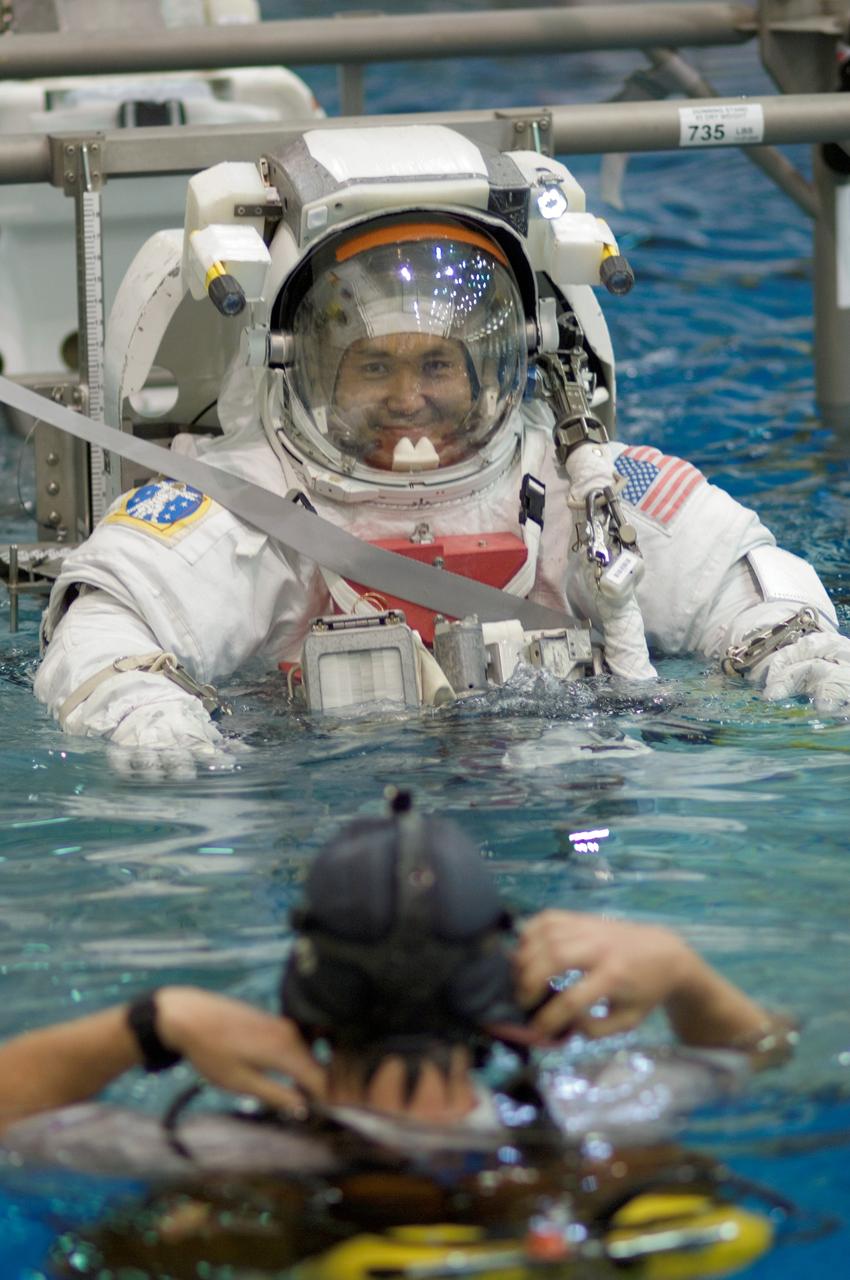
JSC2008-E-039255 (12 May 2008) --- Japan Aerospace Exploration Agency (JAXA) astronaut Koichi Wakata, Expedition 18 flight engineer, and NASA astronaut Edward M. (Mike) Fincke (partially obscured), commander, are about to be submerged in the waters of the Neutral Buoyancy Laboratory (NBL) near NASA's Johnson Space Center. Wakata and Fincke are attired in training versions of the Extravehicular Mobility Unit (EMU) spacesuit. SCUBA-equipped divers are in the water to assist the crewmembers in their rehearsal, intended to help prepare them for work on the exterior of the International Space Station.
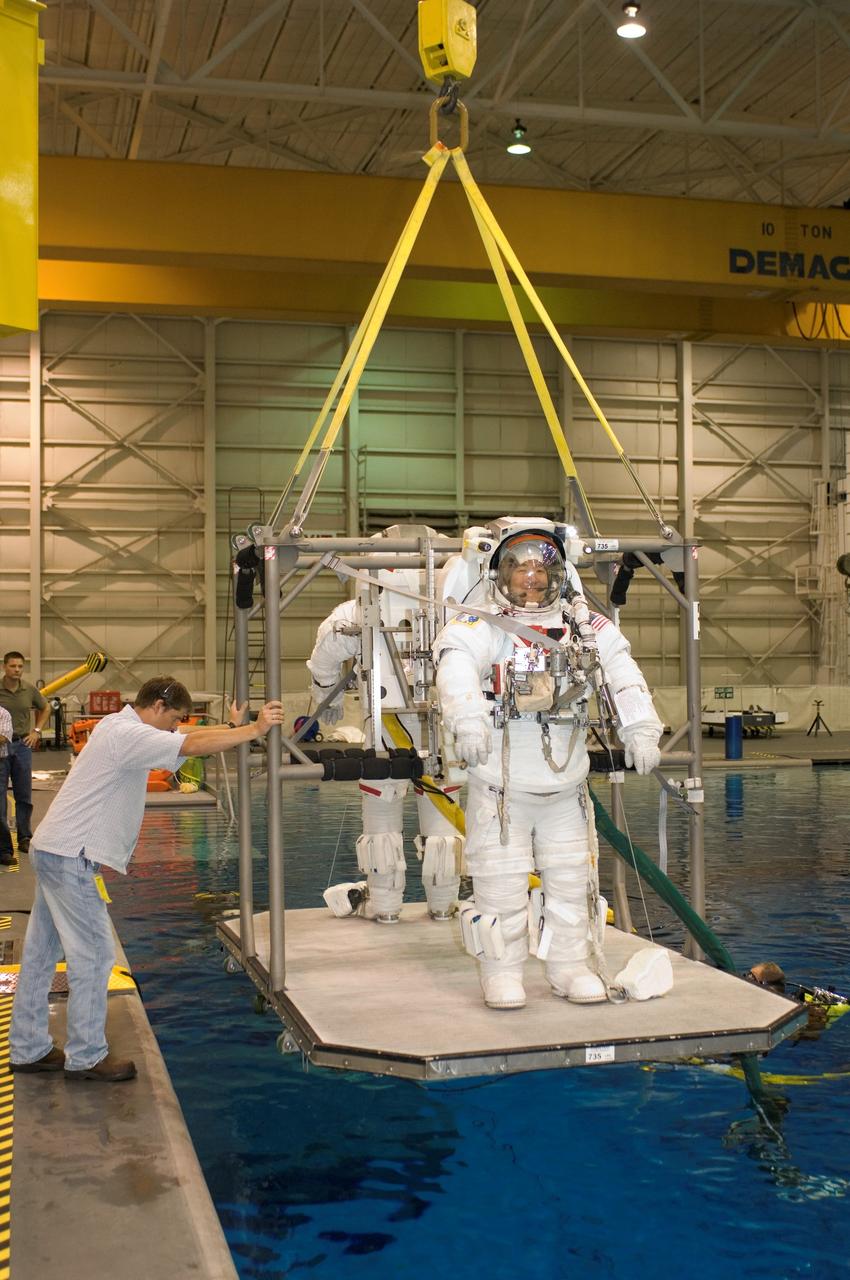
JSC2007-E-46551 (18 Sept. 2007) --- Astronauts Daniel M. Tani, Expedition 16 flight engineer; and Scott E. Parazynski (partially obscured), STS-120 mission specialist, are about to be submerged in the waters of the Neutral Buoyancy Laboratory (NBL) near Johnson Space Center. Tani and Parazynski are attired in training versions of their Extravehicular Mobility Unit (EMU) spacesuit. SCUBA-equipped divers (out of frame) are in the water to assist the crewmembers in their rehearsal, intended to help prepare them for work on the exterior of the International Space Station. Tani is scheduled to join Expedition 16 after launching to the station on mission STS-120.
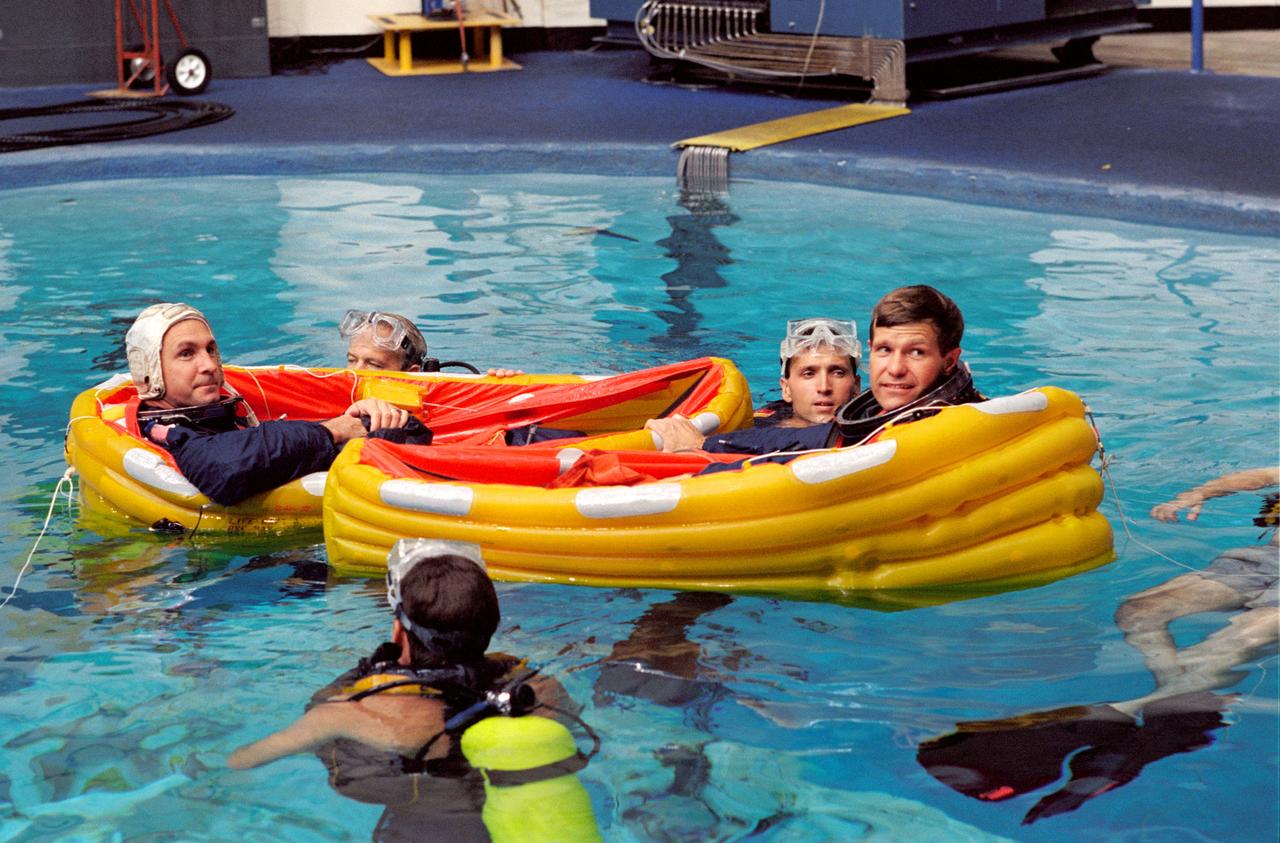
S94-37526 (28 June 1994) --- In separate life rafts, astronauts Donald R. McMonagle (right), mission commander, and Curtis L. Brown, pilot, are assisted by several SCUBA-equipped divers during an emergency bailout training exercise in the Johnson Space Center's (JSC) Weightless Environment Training Facility (WET-F). Making their third and second flights in space, respectively, McMonagle and Brown will be joined by three other NASA astronauts and a European mission specialist for a week and a half in space aboard the Space Shuttle Atlantis. The flight will support the Atmospheric Laboratory for Applications and Science (ATLAS-3) mission.
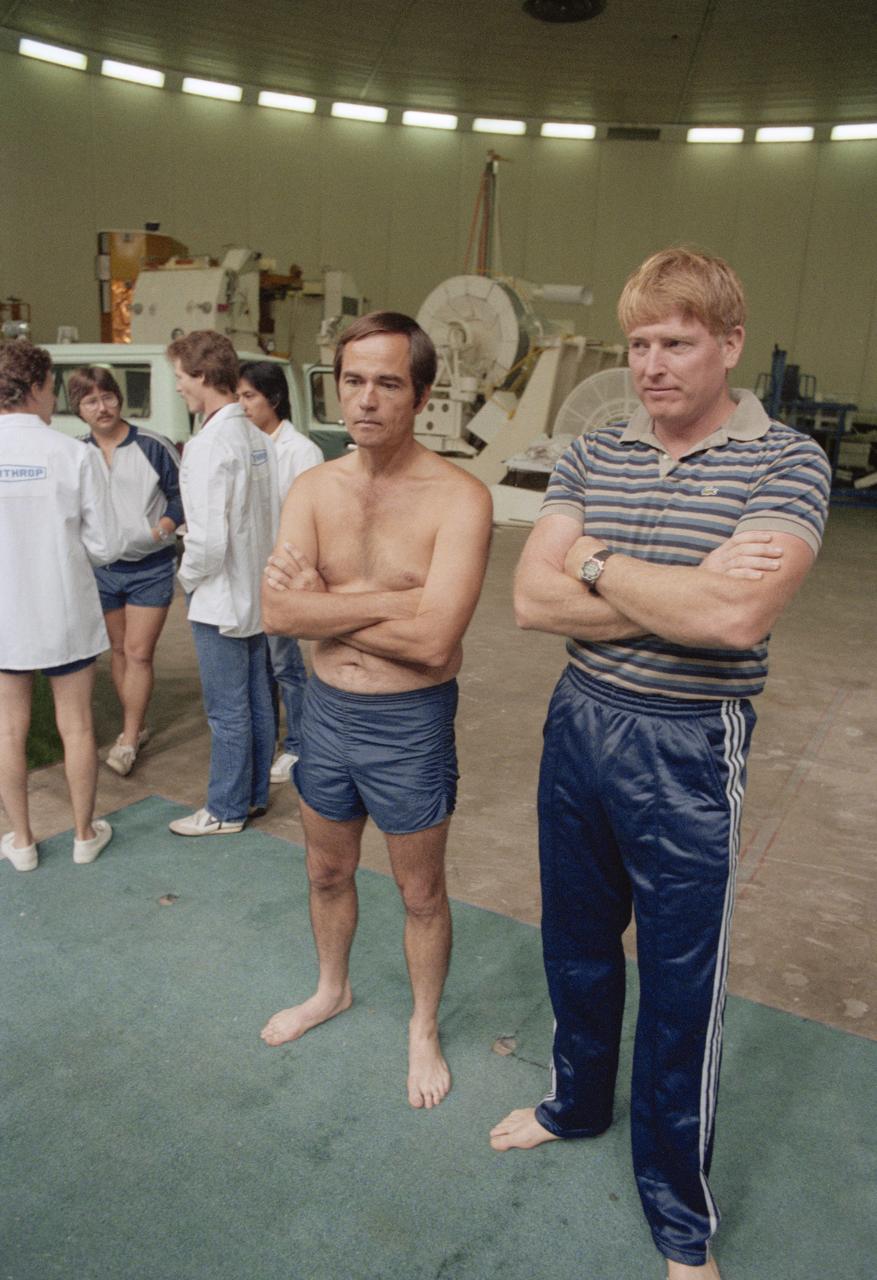
S84-36898 (29 June 1984) --- Astronauts Robert L. Crippen (left) and Jon A. McBride, crew commander and pilot, respectively for NASA's 41-G Space Shuttle mission, await the delivery of self contained underwater breathing apparatus (SCUBA) gear prior to their going underwater to observe a simulation of an extravehicular activity (EVA) scheduled for their mission. The EVA will be performed by Astronauts Kathryn D. Sullivan and David C. Leestma, two of three mission specialists named for the seven-member crew. The underwater training took place in the Johnson Space Center's weightless environment training facility (WET-F).
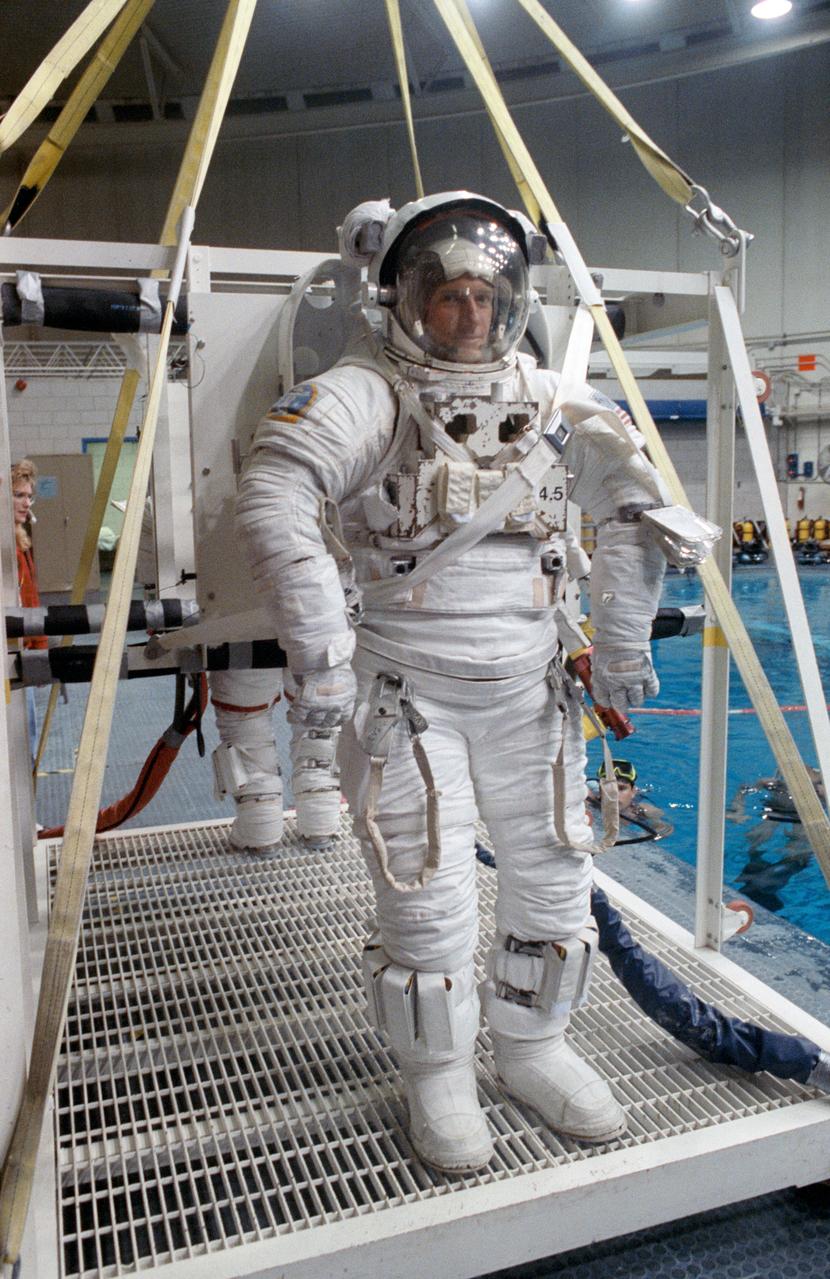
S91-30196 (1 March 1991) --- Astronaut C. Michael Foale, mission specialist, and Kathryn D. Sullivan, payload commander (barely visible in background), stand on a platform (out of frame) which is part of a system that will lower them into a 25-ft. deep pool. The payload commander and mission specialist used the pool in the weightless environment training facility (WET-F) to rehearse a contingency extravehicular activity (EVA). Astronauts wear pressurized spacesuits configured for achieving a neutrally buoyant condition in the water to simulate both planned and contingency EVAs. Two SCUBA-equipped swimmers assisting the training are seen in the background.
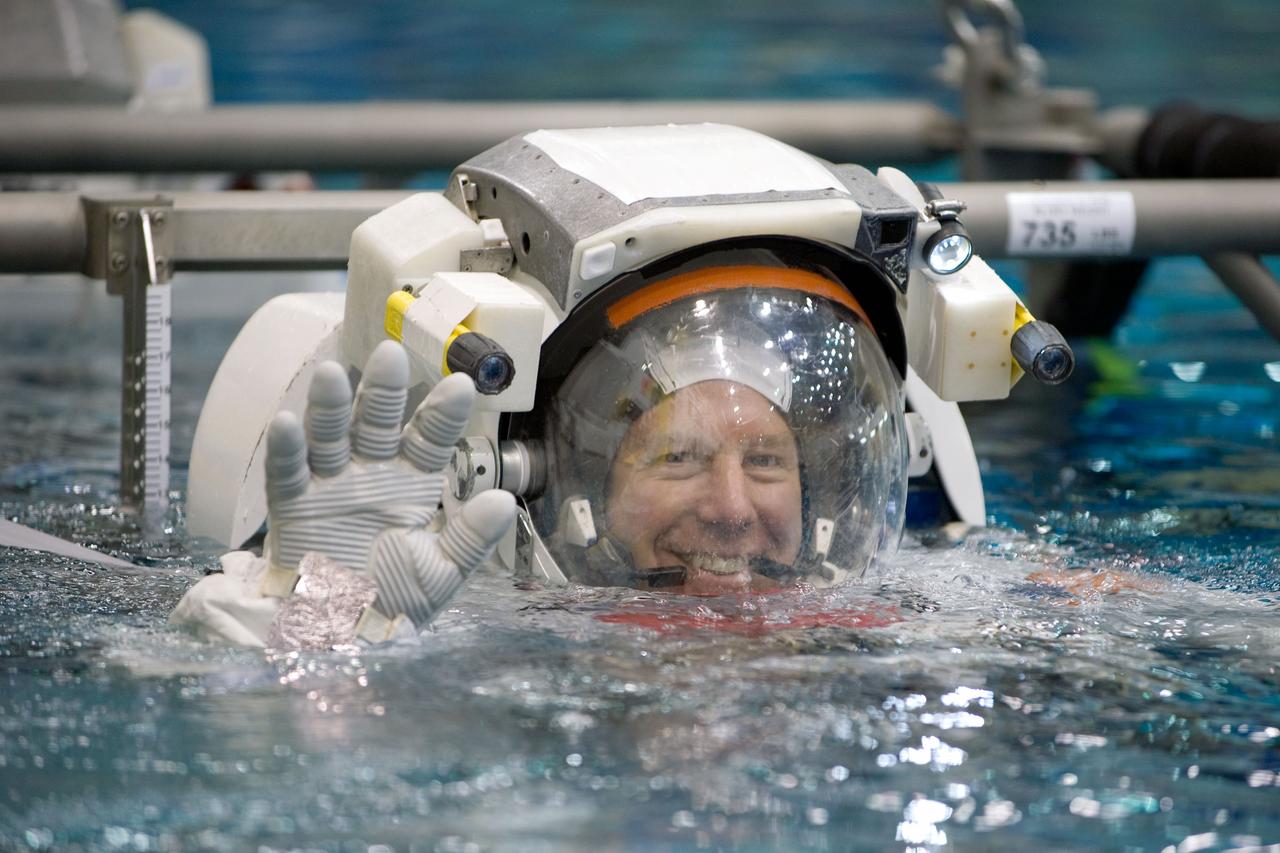
JSC2008-E-122401 (9 Oct. 2008) --- Attired in training versions of their Extravehicular Mobility Unit (EMU) spacesuits, astronauts Tim Kopra and Dave Wolf (out of frame), STS-127 mission specialists, are submerged in the waters of the Neutral Buoyancy Laboratory (NBL) near NASA's Johnson Space Center. SCUBA-equipped divers (out of frame) are in the water to assist the crewmembers in their rehearsal, intended to help prepare them for work on the exterior of the International Space Station. Kopra is scheduled to join Expedition 19 as flight engineer after launching to the International Space Station with the STS-127 crew.
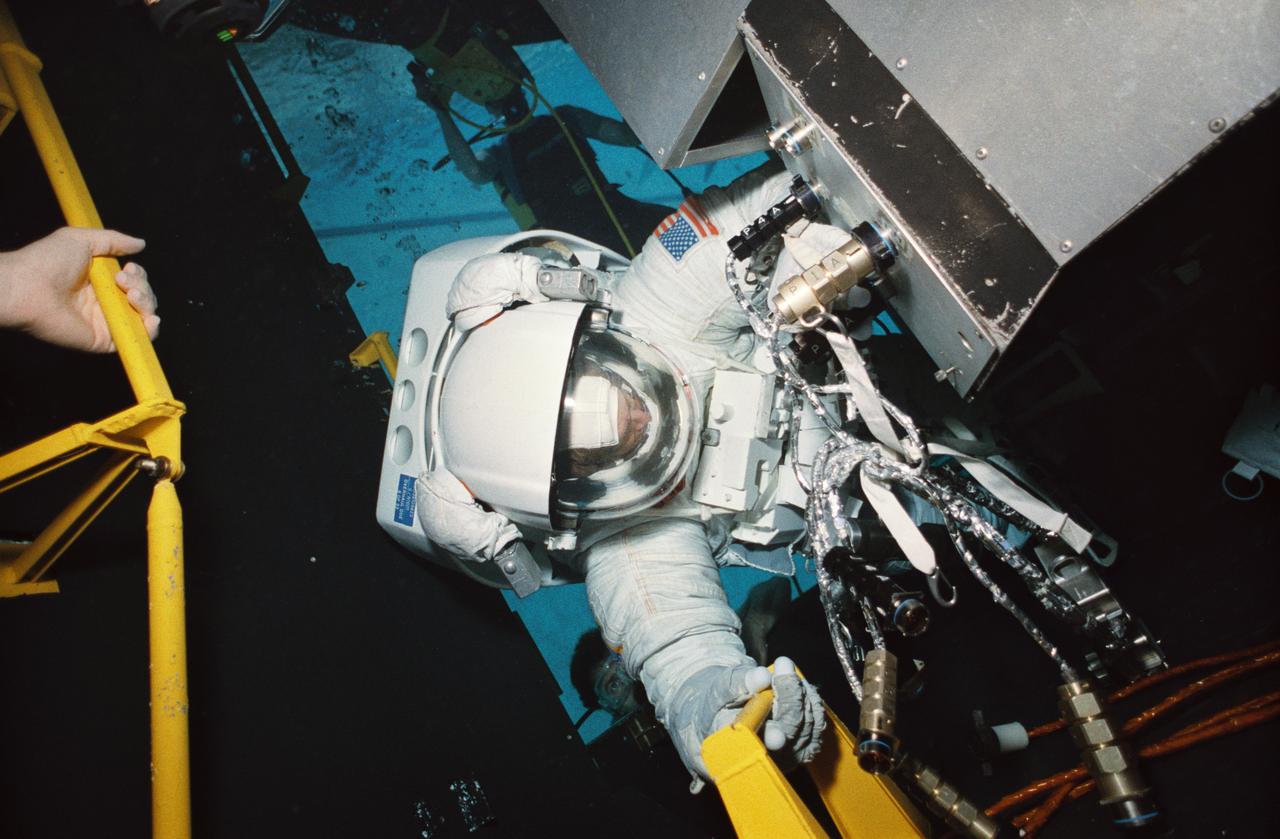
S93-33104 (7 Apr 1993) --- Wearing a training version of Space Shuttle Extravehicular Mobility Unit (EMU), astronaut Jeffrey A. Hoffman uses the giant pool of the Johnson Space Center's (JSC) Weightless Environment Training Facility (WET-F) to rehearse for the Hubble Space Telescope (HST) repair mission. Out of frame is astronaut F. Story Musgrave, who will join Hoffman in STS-61 EVA. The hand at top frame belongs to a SCUBA-equipped diver. A number of divers are on hand for all training sessions in the WET-F. A total of five extravehicular activity (EVA) sessions will be conducted during the scheduled December mission of the Endeavour.
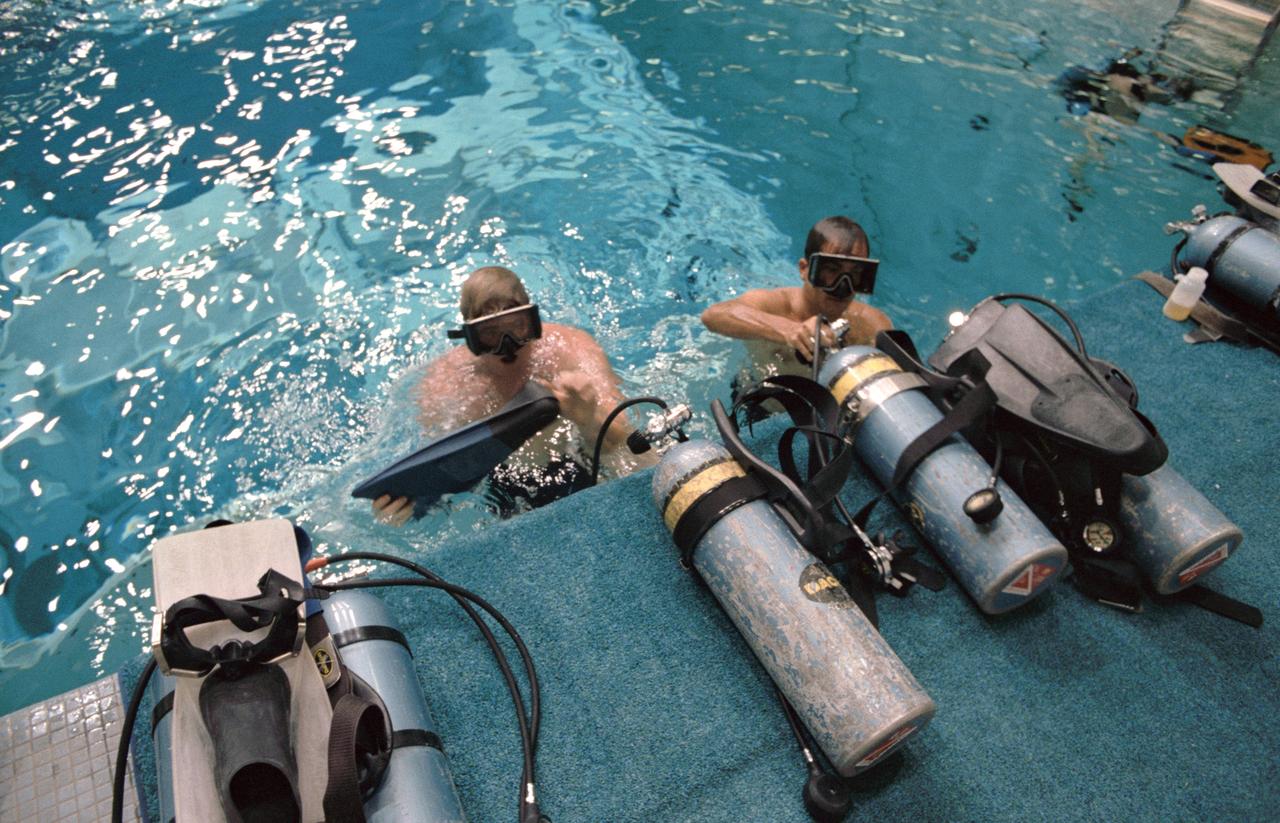
S84-36900 (29 June 1984) ---Astronauts Robert L. Crippen (right) and Jon A. McBride, crew commander and pilot, respectively, for NASA's 41-G Space Shuttle mission, don self contained underwater breathing apparatus (SCUBA) gear prior to their underwater to observe a simulation of an extravehicular activity (EVA) to be performed on their mission. Astronauts Kathryn D. Sullivan and David C. Leestma, two of three mission specialists on the seven-member crew, are scheduled for the EVA. The underwater training took place in the Johnson Space Center's weightless environment training facility (WET-F).
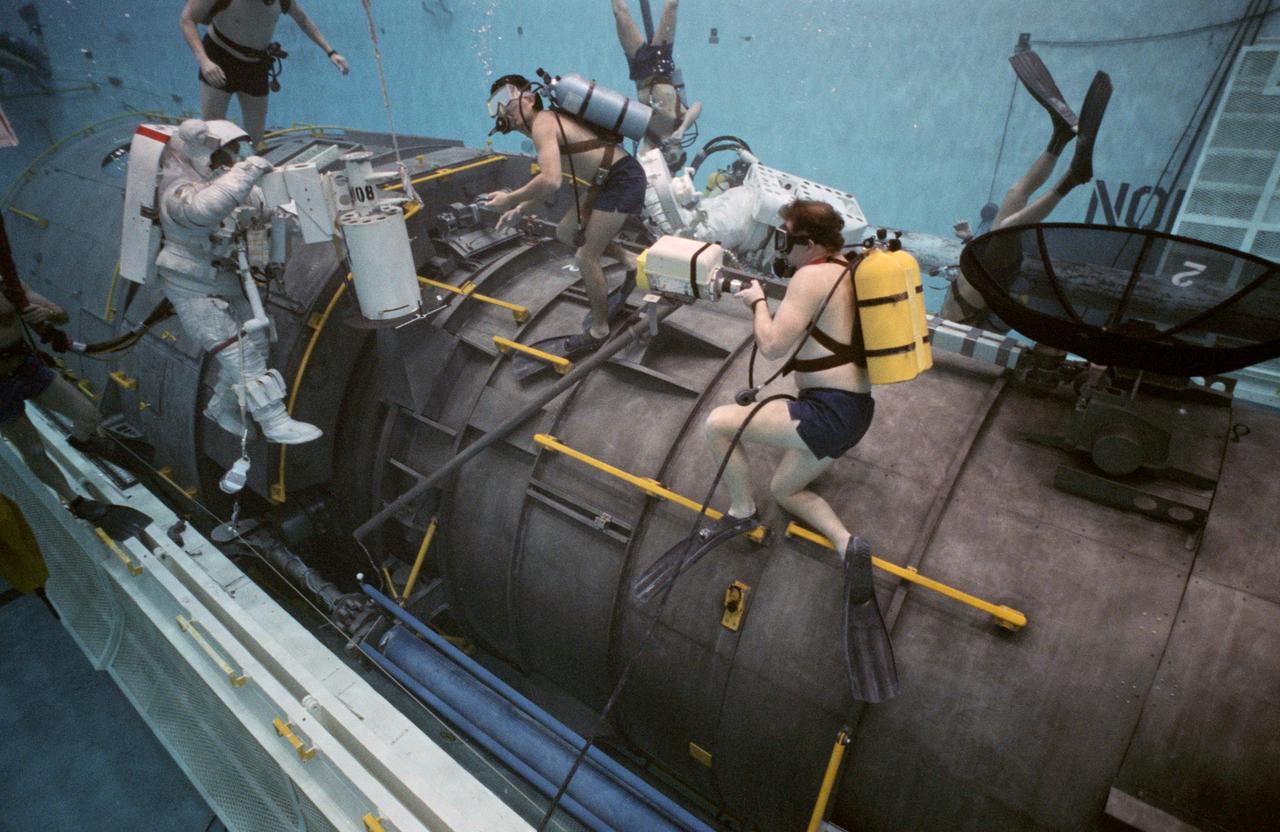
STS-31 Mission Specialist (MS) Bruce McCandless II (left), wearing an extravehicular mobility unit (EMU), maneuvers his way around a mockup of the remote manipulator system (RMS) end effector during an underwater simulation in JSC's Weightless Environment Training Facility (WETF) Bldg 29 pool. The end effector is attached to a grapple fixture on the Hubble Space Telescope (HST) mockup. As McCandless performs contingency extravehicular activity (EVA) procedures, fellow crewmember MS Kathryn D. Sullivan, in EMU, works on the opposite side of the HST mockup, and SCUBA-equipped divers monitor the activity. Though no EVA is planned for STS-31, the two crewmembers train for contingencies that would necessitate leaving the shirt sleeve environment of Discovery's, Orbiter Vehicle (OV) 103's, crew cabin and performing chores with the HST payload or related hardware in the payload bay (PLB).
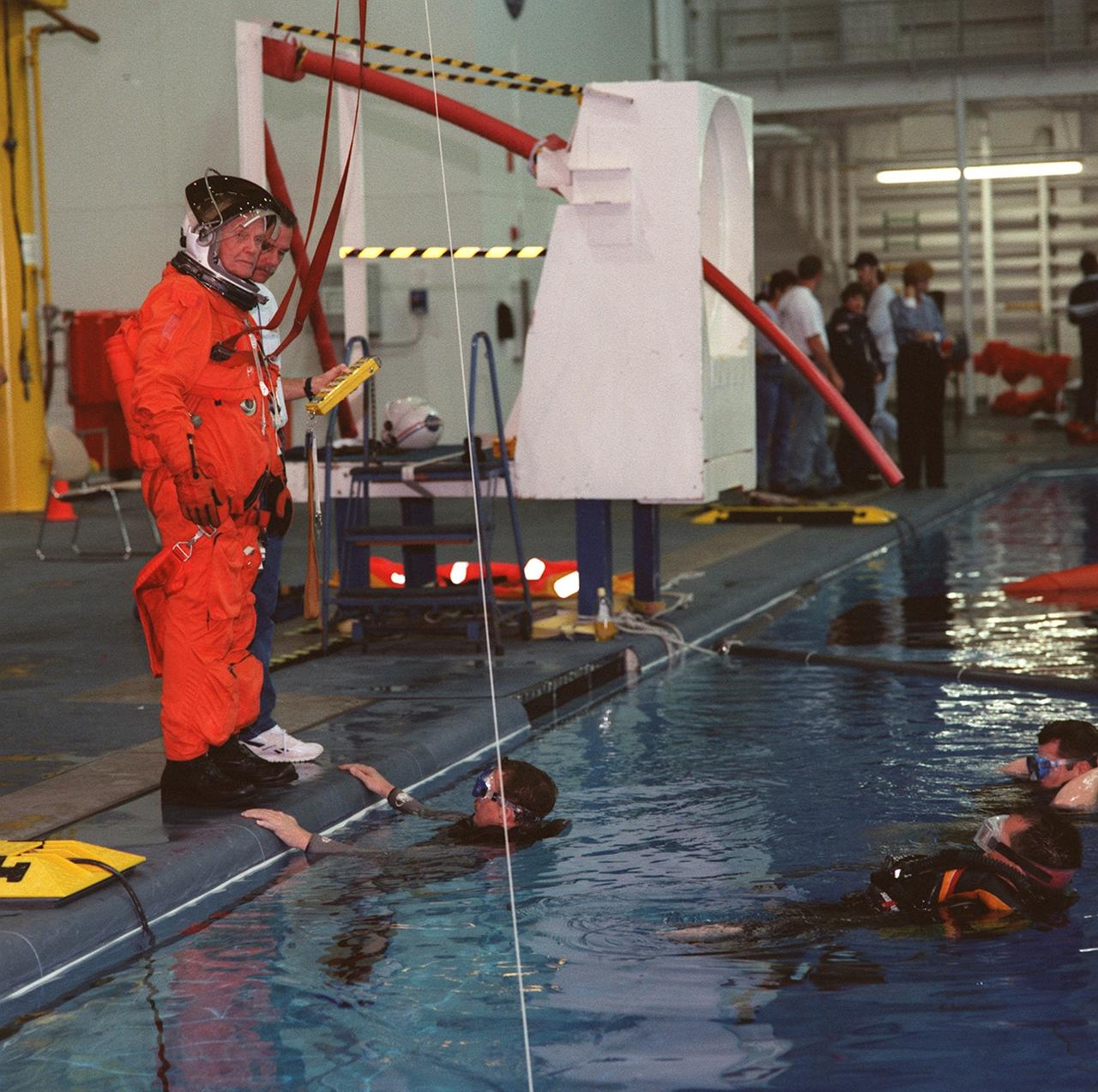
S98-04610 (6 April 1998) --- U.S. Sen. John H. Glenn Jr. (D.-Ohio), attired in a training version of the Space Shuttle partial pressure launch and entry suit, surveys the scene of a bailout training exercise. The giant pool in the Neutral Buoyancy Laboratory (NBL)at the Sonny Carter Training Facility allows the STS-95 crewmembers the opportunity to simulate ejection from an aircraft over water. A number of SCUBA-equipped divers assist in the training exercises. The nearby structure contains a simulated version of the escape pole which is located in the middeck on each of four NASA Space Shuttle vehicles. Parachute drops, raft deployment, water bailing, flare signaling and other survival techniques are also covered in the session.
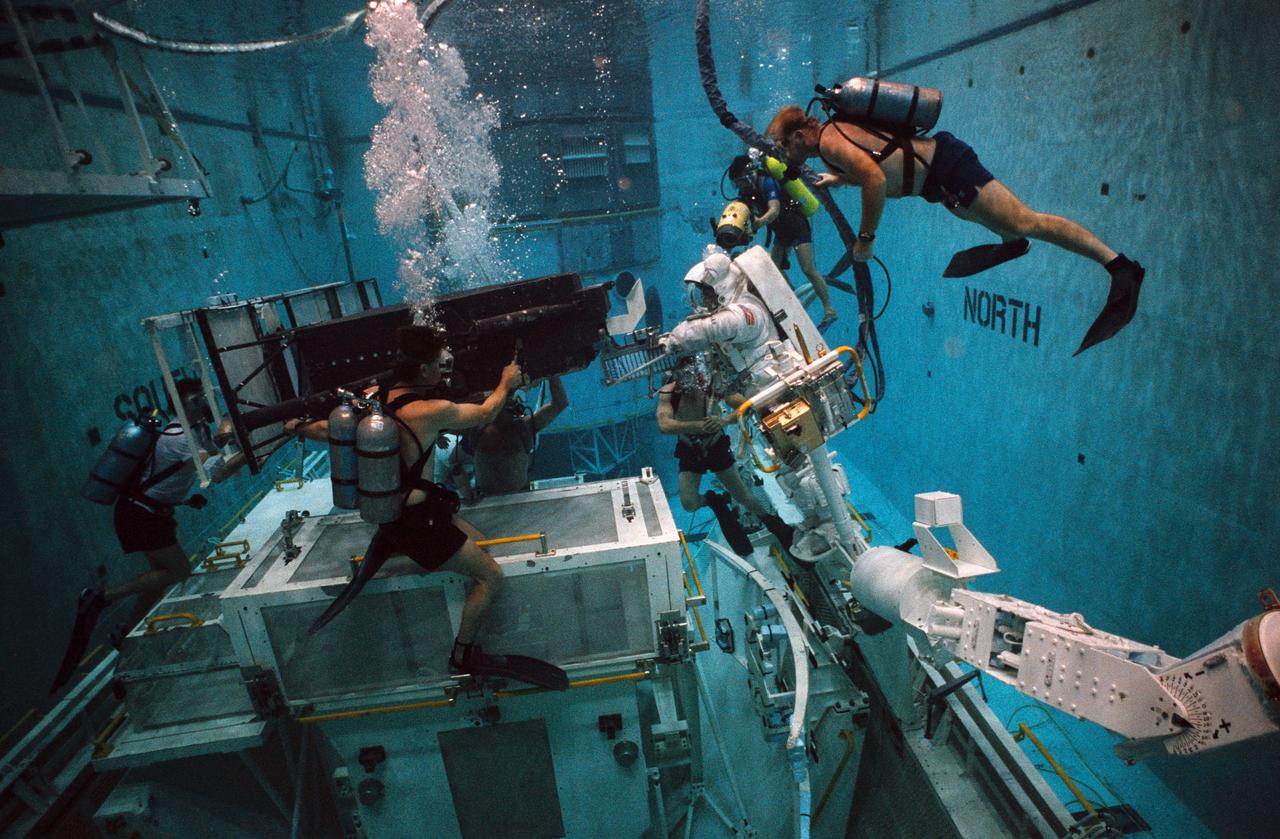
S93-33102 (5 Apr 1993) --- Wearing a training version of Space Shuttle Extravehicular Mobility Unit (EMU), astronaut Thomas D. Akers uses the giant pool of the Johnson Space Center's (JSC) Weightless Environment Training Facility (WET-F) to rehearse for the Hubble Space Telescope (HST) repair mission. Standing on a mobile foot restraint connected to the Shuttle's robot arm, Akers works with a full-scale training version of the Wide Field/Planetary Camera (WF/PC). The current WF/PC on the HST will be replaced with WF/PC-2. The giant box is a stowage area for both WF/PC facilities. Out of frame is astronaut Kathryn C. Thornton, who will join Akers in STS-61 EVA. Several SCUBA-equipped divers assist in the rehearsal. A total of five extravehicular activity (EVA) sessions will be conducted during the scheduled December mission of the Endeavour.
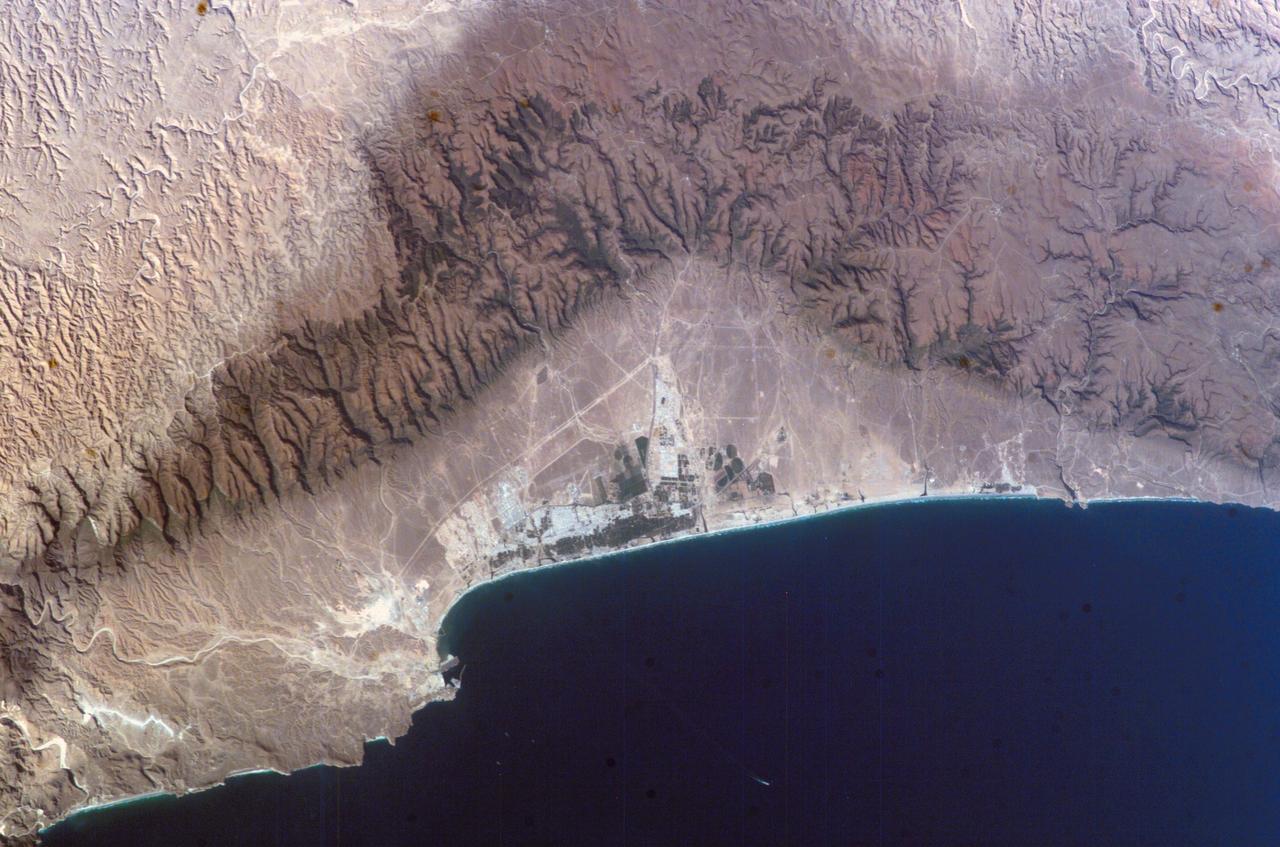
ISS010-E-07210 (16 November 2004) --- Salalah, Sultanate of Oman is featured in this image photographed by an Expedition 10 crewmember on the International Space Station (ISS). The city of Salalah is the capital of the Dhofar region of Oman and is known as the “perfume capital of Arabia”. The city is a popular destination for tourism due to the natural attractions of the al Qara Mountains (Jabal al Qara in Arabic) and abundant stands of frankincense trees lining mountain stream courses. These can be seen as green regions in the Jabal al Qara north of the city (located in the center of this image). The beaches and coastline are also major attractions for scuba diving and bird watching. Modern Oman is also represented by the Port of Salalah, located approximately 15 kilometers to the southwest of the city. The strategic location of this port has made it one of the major entry points to India, the Middle East, and Africa. The rectangular projection into the Arabian Sea visible in this photo is a large shipping container loading/unloading platform.
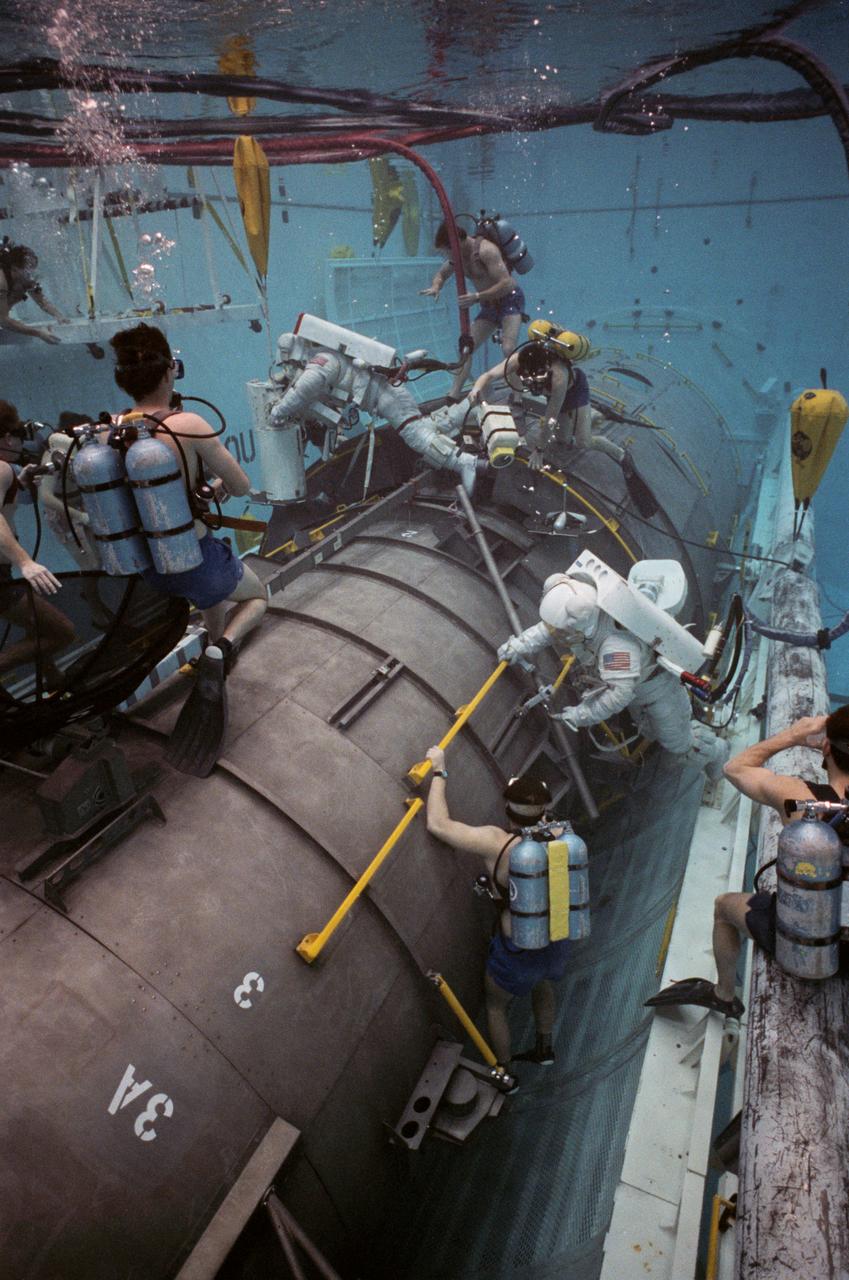
This overall view shows STS-31 Mission Specialist (MS) Bruce McCandless II (left) and MS Kathryn D. Sullivan making a practice space walk in JSC's Weightless Environment Training Facility (WETF) Bldg 29 pool. McCandless works with a mockup of the remote manipulator system (RMS) end effector which is attached to a grapple fixture on the Hubble Space Telescope (HST) mockup. Sullivan manipulates HST hardware on the Support System Module (SSM) forward shell. SCUBA-equipped divers monitor the extravehicular mobility unit (EMU) suited crewmembers during this simulated extravehicular activity (EVA). No EVA is planned for the Hubble Space Telescope (HST) deployment, but the duo has trained for contingencies which might arise during the STS-31 mission aboard Discovery, Orbiter Vehicle (OV) 103. Photo taken by NASA JSC photographer Sheri Dunnette.
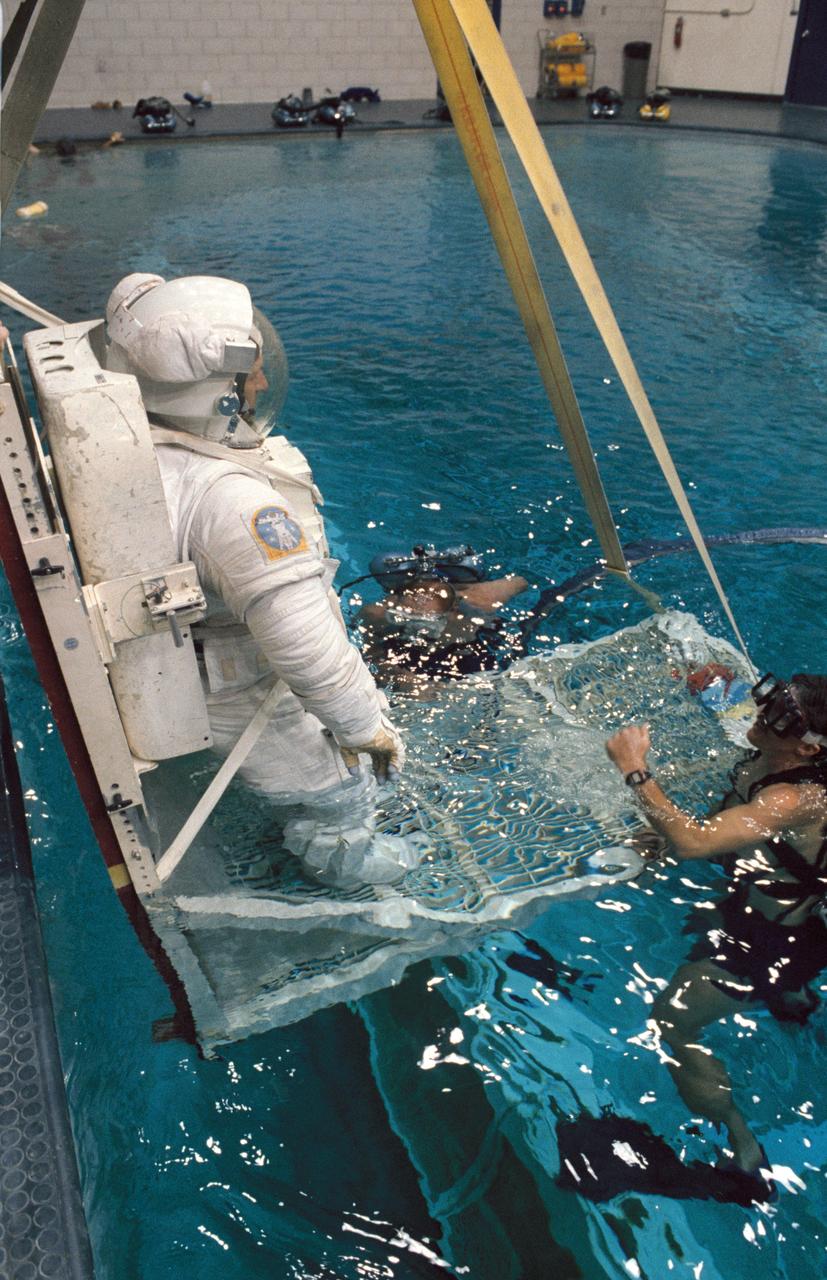
S87-44061 (25 Sept 1987) --- Dr. Claude Nicollier, equipped with a pressurized extravehicular mobility unit (EMU), is in the process of being submerged in the 25-ft. deep pool of JSC's weightless environment training facility (WET-F) for a familiarization session. Dr. Nicollier's suit is weighted to facilitate a neutrally buoyant condition. He is assisted by two SCUBA-equipped divers. Dr. Nicollier, a Swiss scientist assigned to the STS-46 mission as a payload specialist, first came to the Johnson Space Center in July 1980. Along with Dr. Wubbo Ockels, another European Scientist, Dr. Nicollier underwent survival training and other basic astronaut-type training alongside the 1980 class of astronaut candidates. Some photos in this series show Dr. Nicollier in an extravehicular mobility unit (EMU). This is for familiarization purposes only as the scientist is not scheduled for any extravehicular activity.
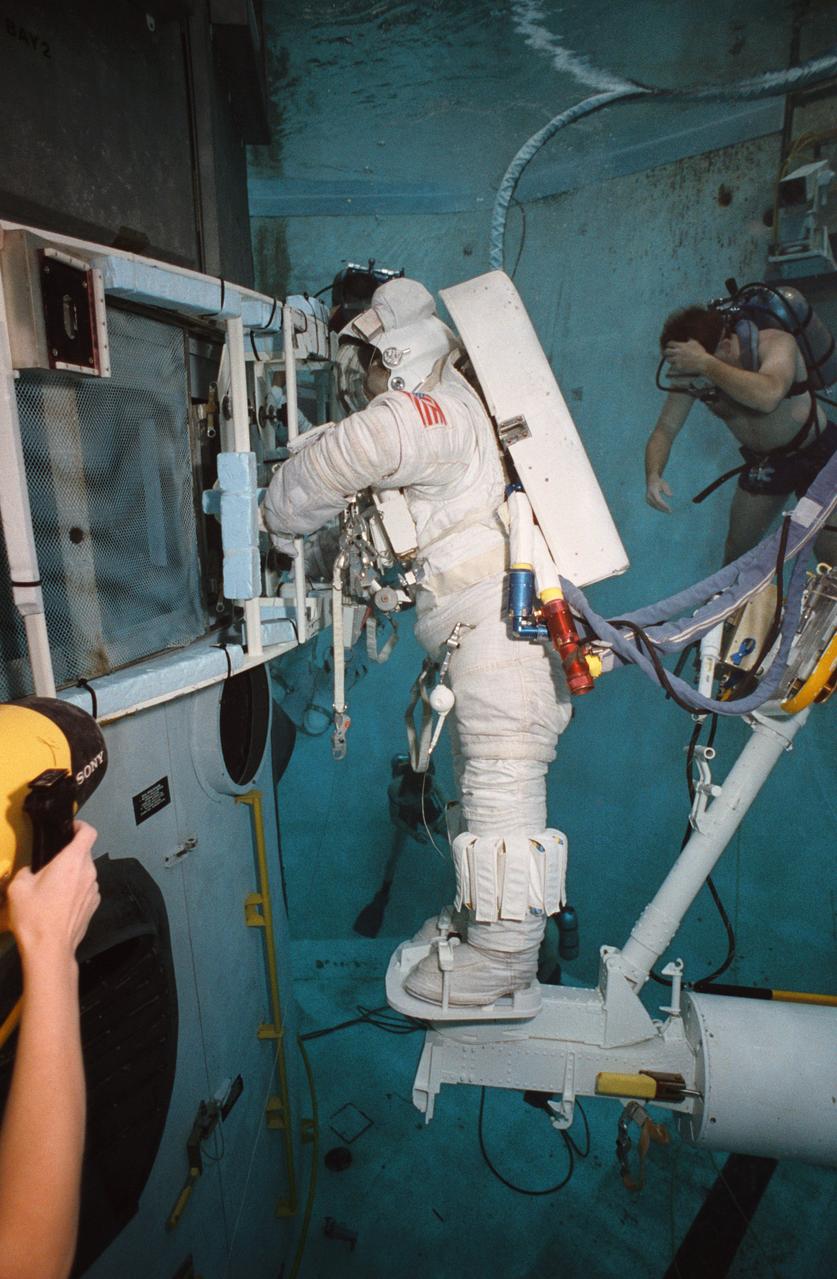
S93-33101 (5 Apr 1993) --- Wearing a training version of Space Shuttle Extravehicular Mobility Unit (EMU), astronaut Kathryn C. Thornton uses the giant pool of the Johnson Space Center's (JSC) Weightless Environment Training Facility (WET-F) to rehearse for the Hubble Space Telescope (HST) repair mission. Standing on a mobile foot restraint connected to the Shuttle's robot arm, Thornton grasps a large structure which attaches to the Wide Field/Planetary Camera (WF/PC). The current WF/PC on the HST will be replaced with WF/PC-2. Out of frame is astronaut Thomas D. Akers, who will join Thornton in STS-61 EVA. A SCUBA-equipped diver can be seen in the background. A number of divers are on hand for all training sessions in the WET-F. A total of five extravehicular activity (EVA) sessions will be conducted during the scheduled December mission of the Endeavour.
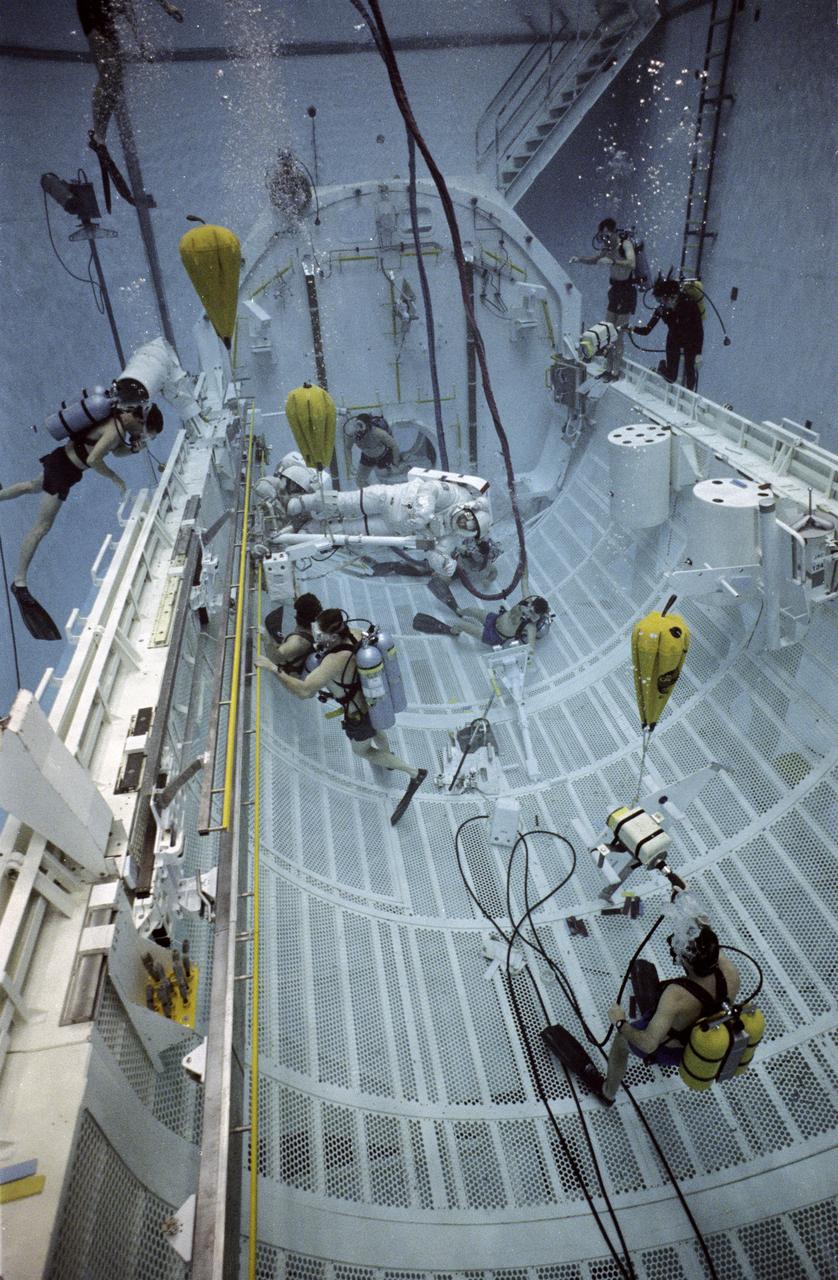
STS-37 Atlantis, Orbiter Vehicle (OV) 104, Mission Specialist (MS) Jerry L. Ross generates electrical power using hand pedals to move crew and equipment translation aid (CETA) cart along a rail during underwater session in JSC's Weightless Environment Training Facility (WETF) Bldg 29. Wearing an extravehicular mobility unit (EMU), Ross operates CETA electrical cart as MS Jerome Apt holds onto the back of the cart. The two crewmembers are practicing a extravehicular activity (EVA) spacewalk they will perform in OV-104's payload bay during STS-37. CETA is a type of railroad hand cart planned as a spacewalker's transportation system along the truss of Space Station Freedom (SSF). SCUBA divers monitor astronauts' underwater activity.
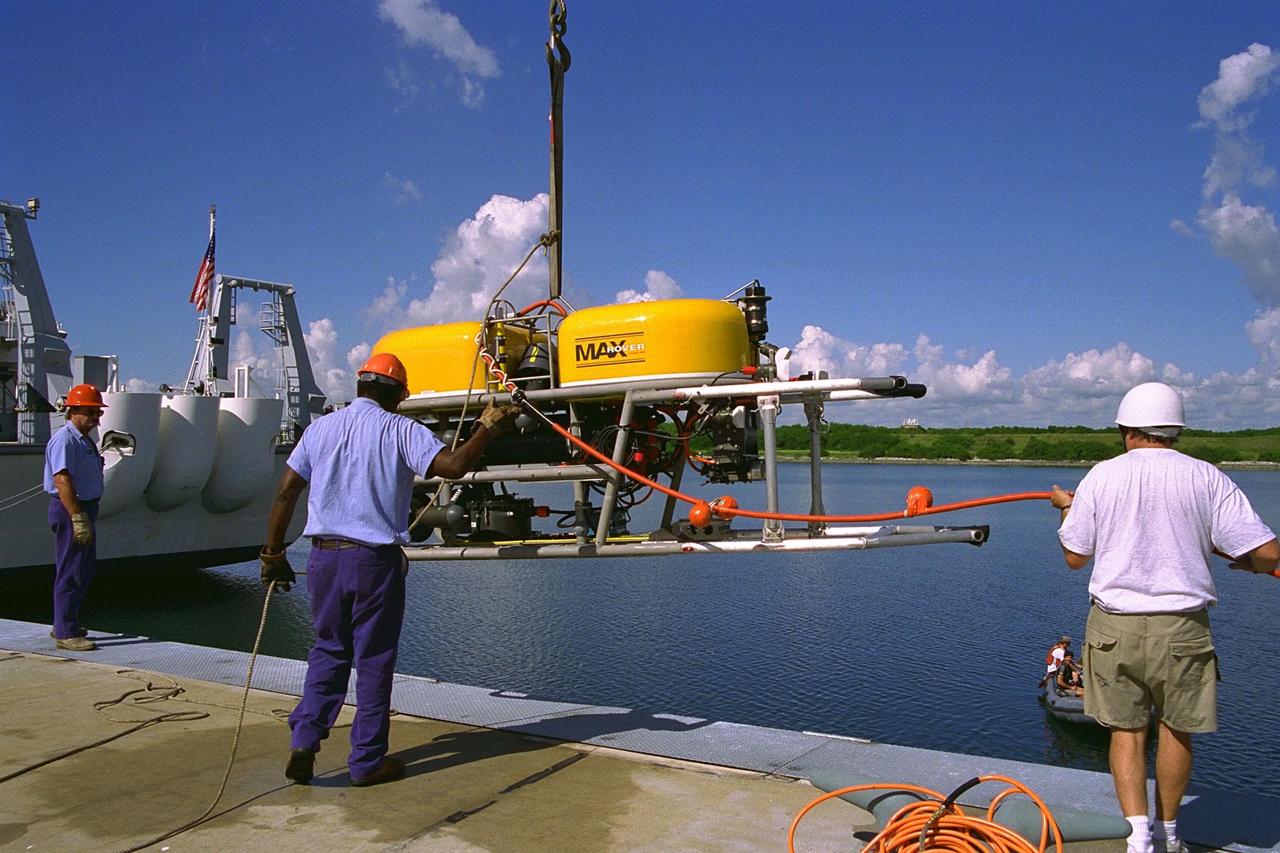
KENNEDY SPACE CENTER, FLA. -- Technicians lower the unmanned robotic submersible recovery system, known as Max Rover, into the water at the Trident Pier at Port Canaveral during a test of the system. Kennedy Space Center's solid rocket booster (SRB) retrieval team and Advanced Systems Development laboratory staff hope that the new robotic technology will make the process of inserting the Diver Operated Plug (DOP) into the aft nozzle of a spent SRB safer and less strenuous. Currently, scuba divers manually insert the DOP into the aft nozzle of a jettisoned SRB 60 to 70 feet below the surface of the Atlantic Ocean. After the plug is installed, water is pumped out of the booster allowing it to float horizontally. It is then towed back to Hangar AF at Cape Canaveral Air Station. Deep Sea Systems of Falmouth, Mass., built the submersible for NASA

JSC2005-E-14733 (21 March 2005) ---Three STS-114 astronauts give a simultaneous thumbs-up signal to indicate preparedness during an underwater training session in the Neutral Buoyancy Laboratory in Houston. From the left are Soichi Noguchi of JAXA, Stephen K. Robinson and Andrew S.W. Thomas. A number of SCUBA-equipped divers participated in the dive to assist the astronauts. Noguchi and Robinson have been in training for a lengthy period of time, preparing for three scheduled spacewalks on the first flight marking return to space following the Columbia mission of 2003. Thomas, working inside the Space Shuttle Discovery's cabin, will serve as the lead robotics officer for the inspection of the Orbiter's thermal protection system using a new boom extension outfitted with sensors and cameras. He will also serve as the Intravehicular Activity crewmember helping to suit up and choreograph spacewalkers Noguchi and Robinson for their spacewalks.
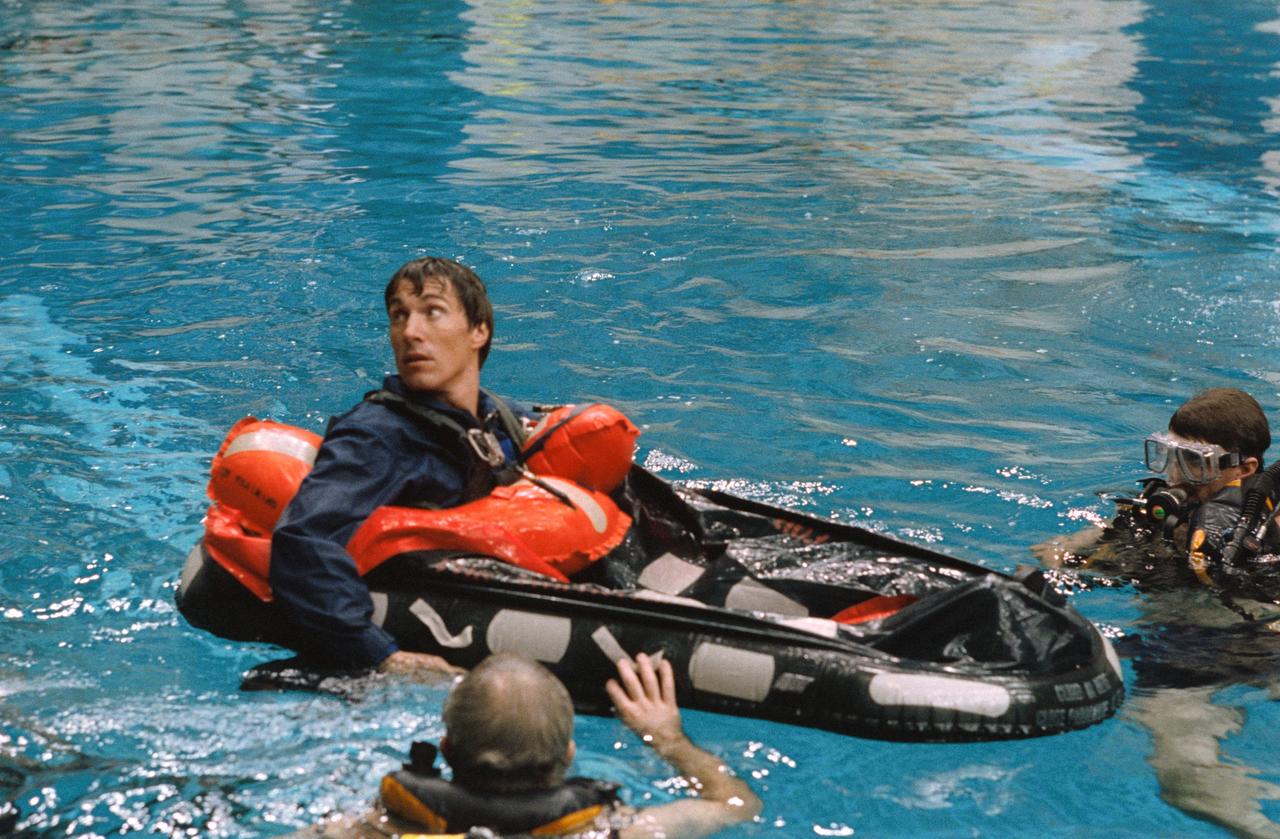
S93-26021 (Feb 1993) --- Russian cosmonaut Sergei Krikalev maneuvers a small life raft during bailout training at the Johnson Space Center's (JSC) Weightless Environment Training Facility (WET-F). Two SCUBA-equipped divers assisted Krikalev in the STS-60 training exercise. Shuttle crew members frequently utilize the 25-ft. deep pool to learn proper procedures to follow in the event of emergency egress from their Space Shuttle via the escape pole system. Krikalev is one of two cosmonauts in training for the STS-60 mission. One of the two will serve as primary payload specialist with the other filling an alternate's role. This pool and the facility in which it is housed are titled the WET-F, because they are also used by astronauts rehearsing both mission-specific and contingency extravehicular activities (EVA).
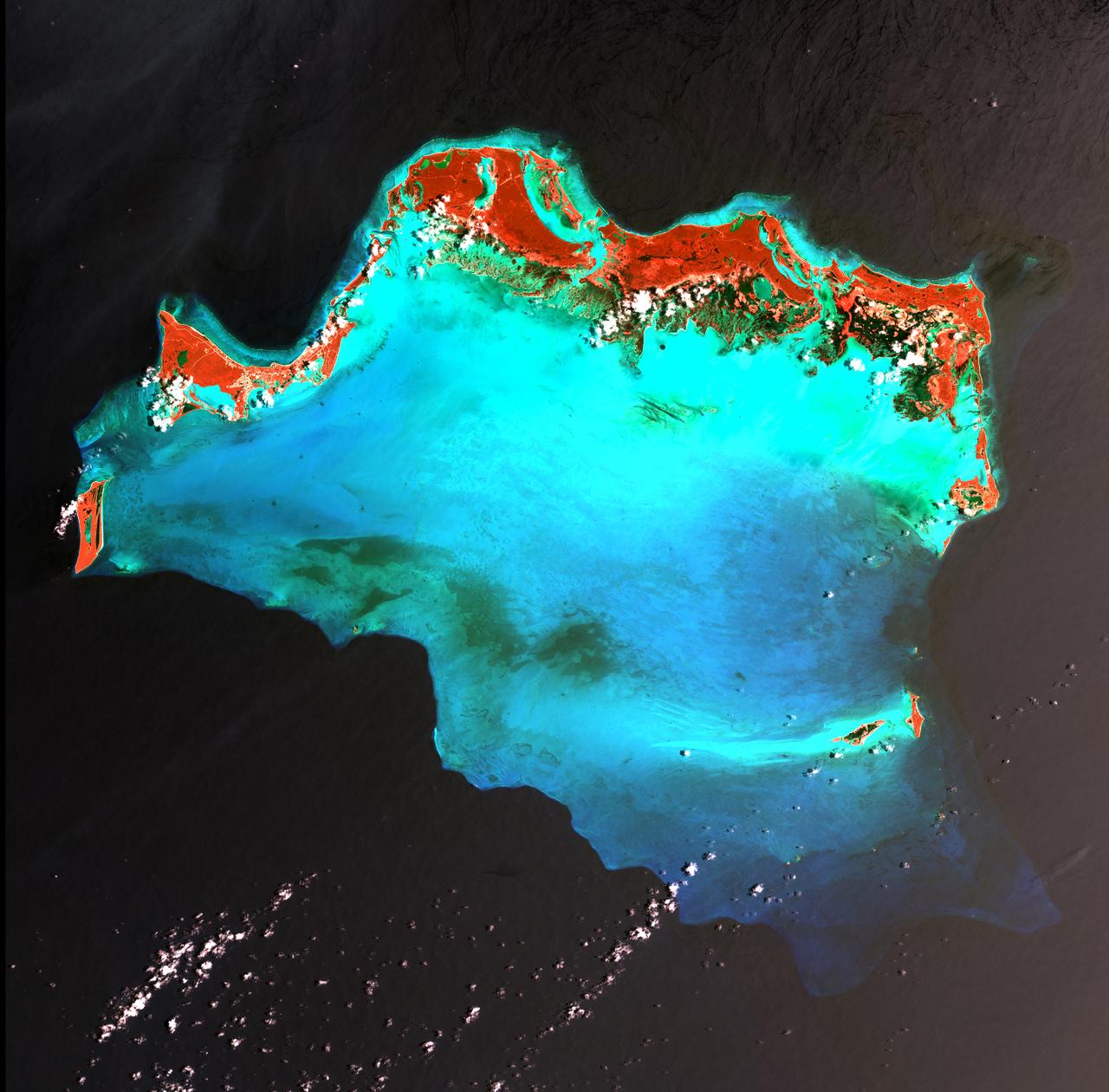
Caribbean Luxury - April 24th, 2003 Description: The Caicos Islands (pronounced KAY-kohss) in the northern Caribbean are a popular tourist attraction, renowned for their beautiful beaches, clear waters, scuba diving, and luxury resorts. The islands lie primarily along the northern perimeter of the submerged Caicos Bank (turquoise), a shallow limestone platform formed of sand, algae, and coral reefs covering 6,140 square kilometers (2,370 square miles). Credit: USGS/NASA/Landsat 7 To learn more about the Landsat satellite go to: <a href="http://landsat.gsfc.nasa.gov/" rel="nofollow">landsat.gsfc.nasa.gov/</a> <b><a href="http://www.nasa.gov/centers/goddard/home/index.html" rel="nofollow">NASA Goddard Space Flight Center</a></b> enables NASA’s mission through four scientific endeavors: Earth Science, Heliophysics, Solar System Exploration, and Astrophysics. Goddard plays a leading role in NASA’s accomplishments by contributing compelling scientific knowledge to advance the Agency’s mission. <b>Follow us on <a href="http://twitter.com/NASA_GoddardPix" rel="nofollow">Twitter</a></b> <b>Join us on <a href="http://www.facebook.com/pages/Greenbelt-MD/NASA-Goddard/395013845897?ref=tsd" rel="nofollow">Facebook</a></b>
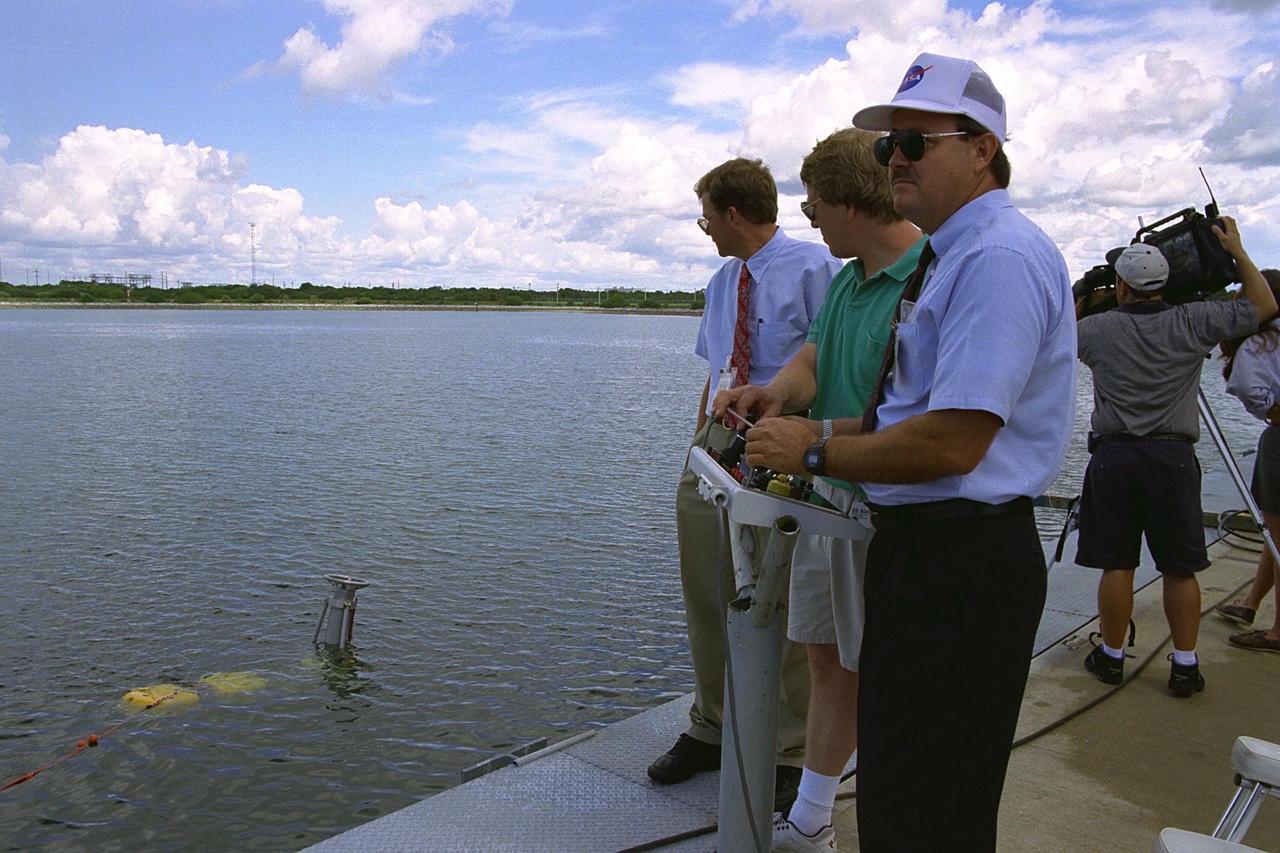
KENNEDY SPACE CENTER, FLA. -- Thomas Lippitt of NASA's Advanced Systems Development (ASD) laboratory observes robotic operations as Chris Nicholson, owner of Deep Sea Systems, and Bill Jones of NASA's ASD laboratory operate the unmanned robotic submersible recovery system, known as Max Rover, during a test of the system at the Trident Pier at Port Canaveral. The submersible is seen in the water with the Diver Operated Plug (DOP). Kennedy Space Center's solid rocket booster (SRB) retrieval team and ASD laboratory staff hope that the new robotic technology will make the process of inserting the plug safer and less strenuous. Currently, scuba divers manually insert the DOP into the aft nozzle of a jettisoned SRB 60 to 70 feet below the surface of the Atlantic Ocean. After the plug is installed, water is pumped out of the booster allowing it to float horizontally. It is then towed back to Hangar AF at Cape Canaveral Air Station for refurbishment. Deep Sea Systems of Falmouth, Mass., built the submersible for NASA