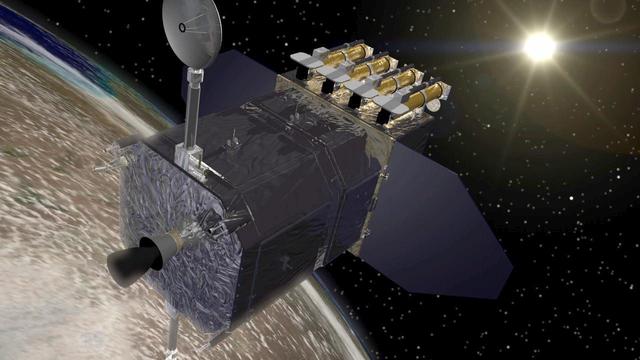
The Solar Dynamics Observatory SDO spacecraft, shown above the Earth as it faces toward the Sun. SDO is designed to study the influence of the Sun on the Earth and the inner solar system by studying the solar atmosphere. http://photojournal.jpl.nasa.gov/catalog/PIA18169
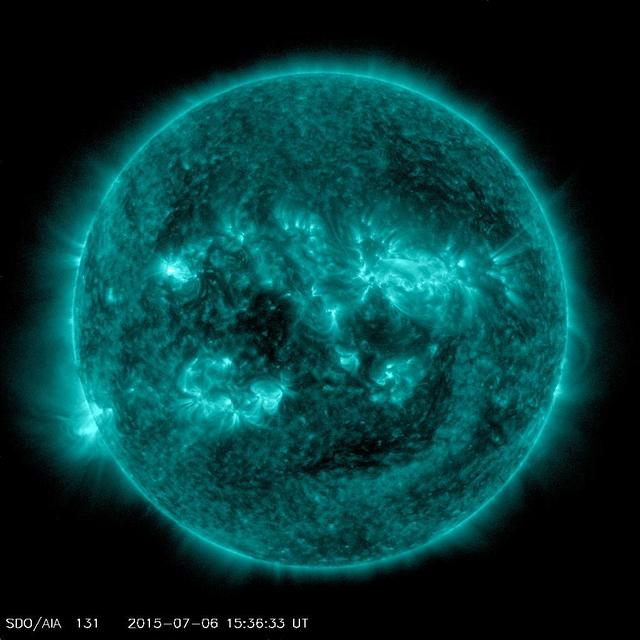
An eruption from the surface of the sun is conspicuous in the lower left portion of this July 6, 2015, image from NASA's Earth-orbiting Solar Dynamics Observatory (SDO). It originates from a location on the surface where NASA's Curiosity Mars rover had been tracking a sunspot in late June and early July. This image was taken by the Atmosphere Imaging Assembly on SDO using the instrument's 131-Angstrom wavelength channel, which is sensitive to hot solar flares. The sun completes a rotation about once a month -- faster near its equator than near its poles. This summer, Mars has a view of the opposite side of the sun from what's facing Earth. Images from Curiosity tracking a southern-hemisphere sunspot until it rotated out of view during the July 4 weekend are in an animation at PIA19801. This location on the sun rotated into position to be seen from Earth a few days later. The eruption visible in this image was linked to a coronal mass ejection observed by SDO and NASA's Solar and Heliospheric Observatory. The coronal mass ejection affected interplanetary space weather, as shown at http://go.nasa.gov/1JSXLF3. http://photojournal.jpl.nasa.gov/catalog/PIA19680
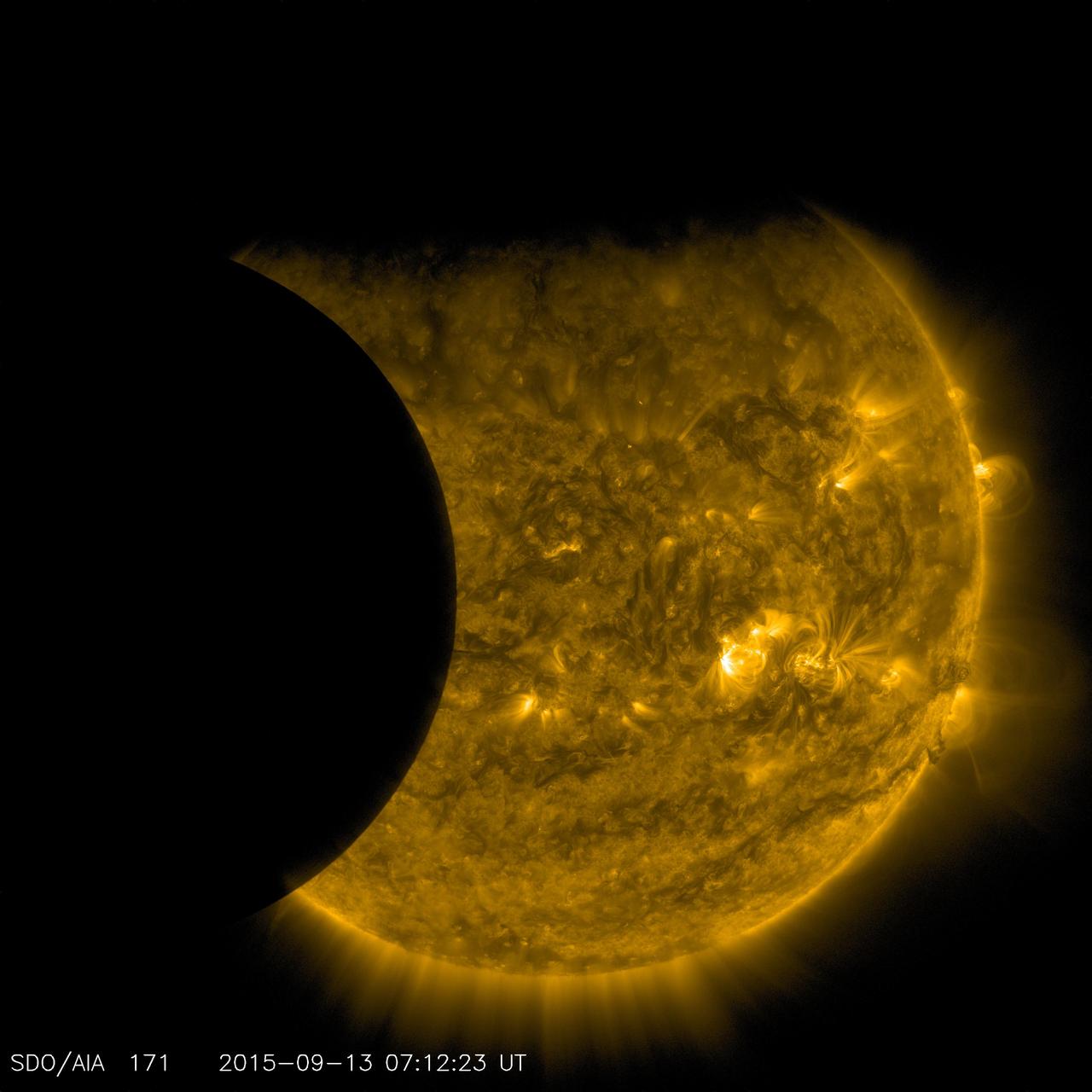
On Sept. 13, 2015, as NASA's Solar Dynamics Observatory, or SDO, kept up its constant watch on the sun, its view was photobombed not once, but twice. Just as the moon came into SDO's field of view on a path to cross the sun, Earth entered the picture, blocking SDO's view completely. When SDO's orbit finally emerged from behind Earth, the moon was just completing its journey across the sun's face. Though SDO sees dozens of Earth eclipses and several lunar transits each year, this is the first time ever that the two have coincided. SDO's orbit usually gives us unobstructed views of the sun, but Earth's revolution around the sun means that SDO's orbit passes behind Earth twice each year, for two to three weeks at a time. During these phases, Earth blocks SDO's view of the sun for anywhere from a few minutes to over an hour once each day. Earth's outline looks fuzzy, while the moon's is crystal-clear. This is because-while the planet itself completely blocks the sun's light-Earth's atmosphere is an incomplete barrier, blocking different amounts of light at different altitudes. However, the moon has no atmosphere, so during the transit we can see the crisp edges of the moon's horizon. http://photojournal.jpl.nasa.gov/catalog/PIA19949
NASA's Solar Dynamics Observatory (SDO) saw both the Moon (upper right) and the Earth (upper left) partially block the sun (Sept. 1, 2016 at 7:33 UT). Just before this image was taken, the Earth totally blocked the sun for a while. SDO orbits 22,000 miles above the Earth in a highly elliptical orbit that sometimes puts the Moon or Earth in front of the sun. The sun image was taken in a wavelength of extreme ultraviolet light. Only once before have both been there at the same time. Note that the edge of the moon is quite crisp because it has no atmosphere. Movies are available at the Photojournal. http://photojournal.jpl.nasa.gov/catalog/PIA21028
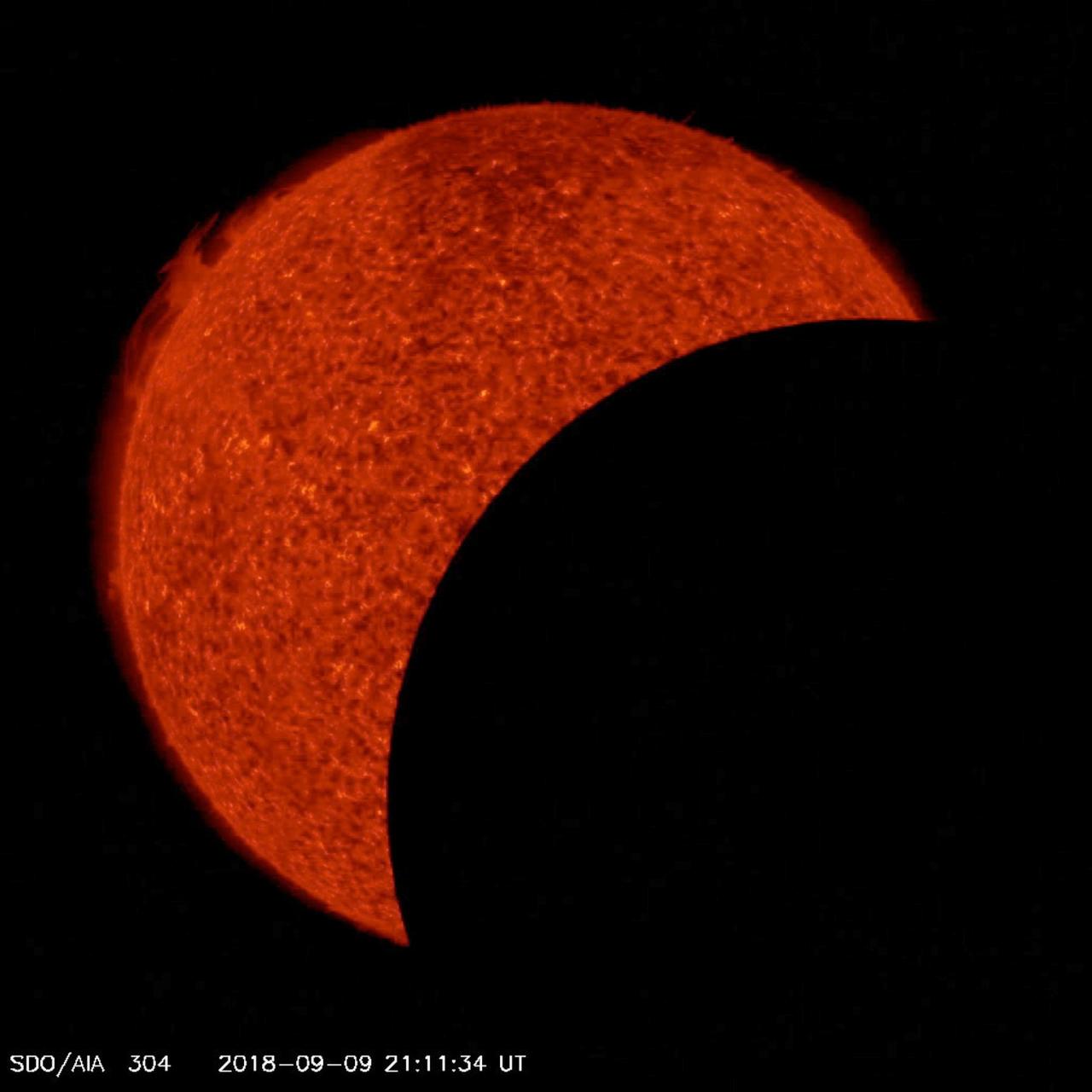
In just about seven hours, NASA's Solar Dynamics Observatory spacecraft saw the moon transit the Sun two times (Sept. 9-10, 2018). Transits occur when an object passes between a larger body and the viewer. The first transit lasted about an hour and covered 92 percent of the Sun at its peak. The second transit lasted about 50 minutes and covered just 34 percent of the Sun at its peak. The Moon appears to go in one direction in the first transit and the opposite direction in the second. This is because the SDO spacecraft orbits around Earth, moving in the same direction as the Moon but faster. On the first transit it catches up with and passes the Moon. As SDO swings back around the far side of Earth, it encounters the Moon again from the far side of Earth, where it appears to travel in the opposite direction. The images were taken in a wavelength of extreme ultraviolet light. None of this was visible from Earth. Movies are available at https://photojournal.jpl.nasa.gov/catalog/PIA22723
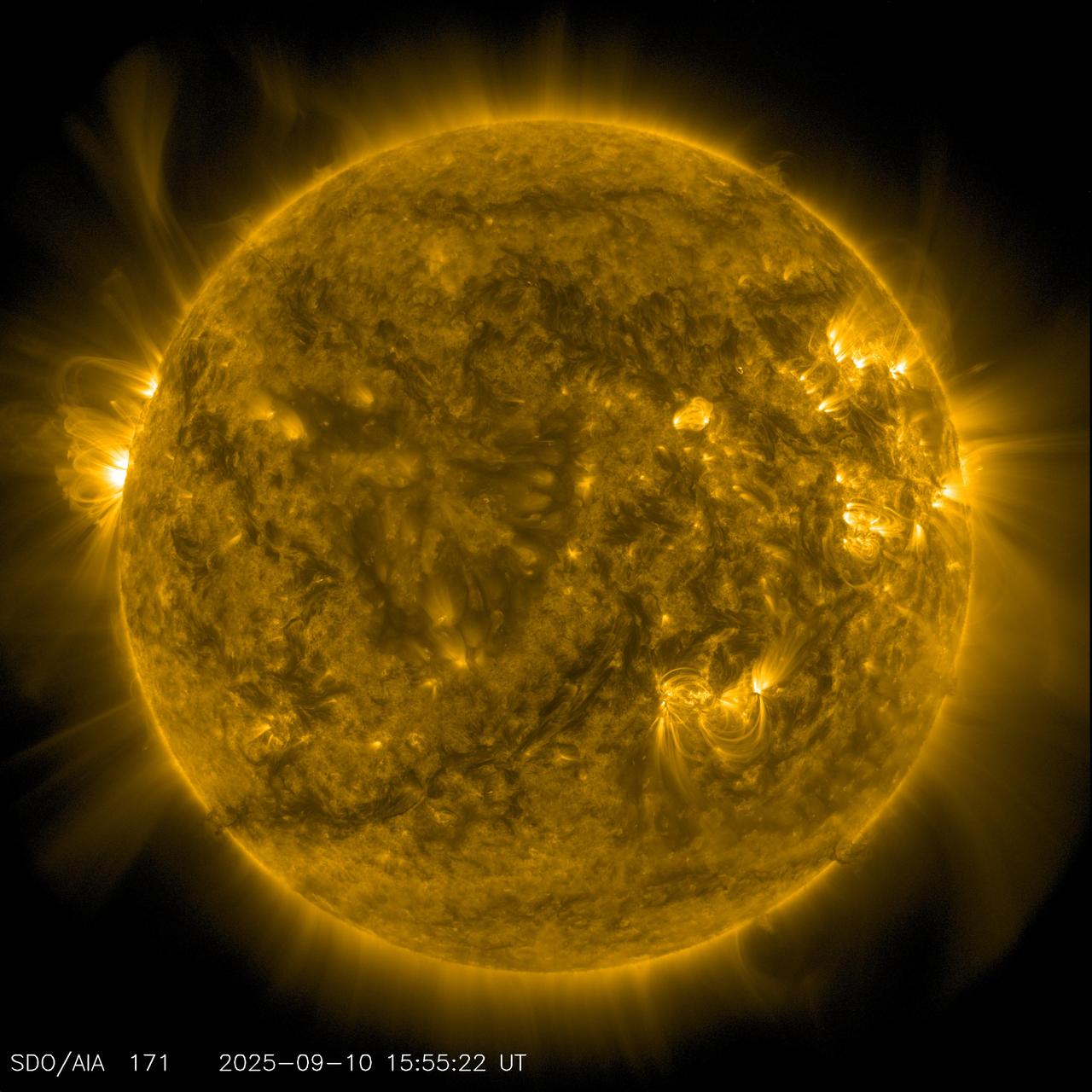
On Sept. 10, 2025, NASA's Solar Dynamics Observatory captured this image of the Sun. SDO is managed by NASA's Goddard Space Flight Center, Greenbelt, Maryland, for NASA's Science Mission Directorate in Washington. Its Atmosphere Imaging Assembly was built by the Lockheed Martin Solar Astrophysics Laboratory in Palo Alto, California. https://photojournal.jpl.nasa.gov/catalog/PIA26681

Madhulika Guhathakurta, SDO Program Scientist, speaks during a briefing to discuss the upcoming launch of NASA's Solar Dynamic Observatory, or SDO, Thursday, Jan. 21, 2010, at NASA Headquarters in Washington. The mission is to study the Sun and its dynamic behavior. Photo Credit: (NASA/Paul E. Alers)
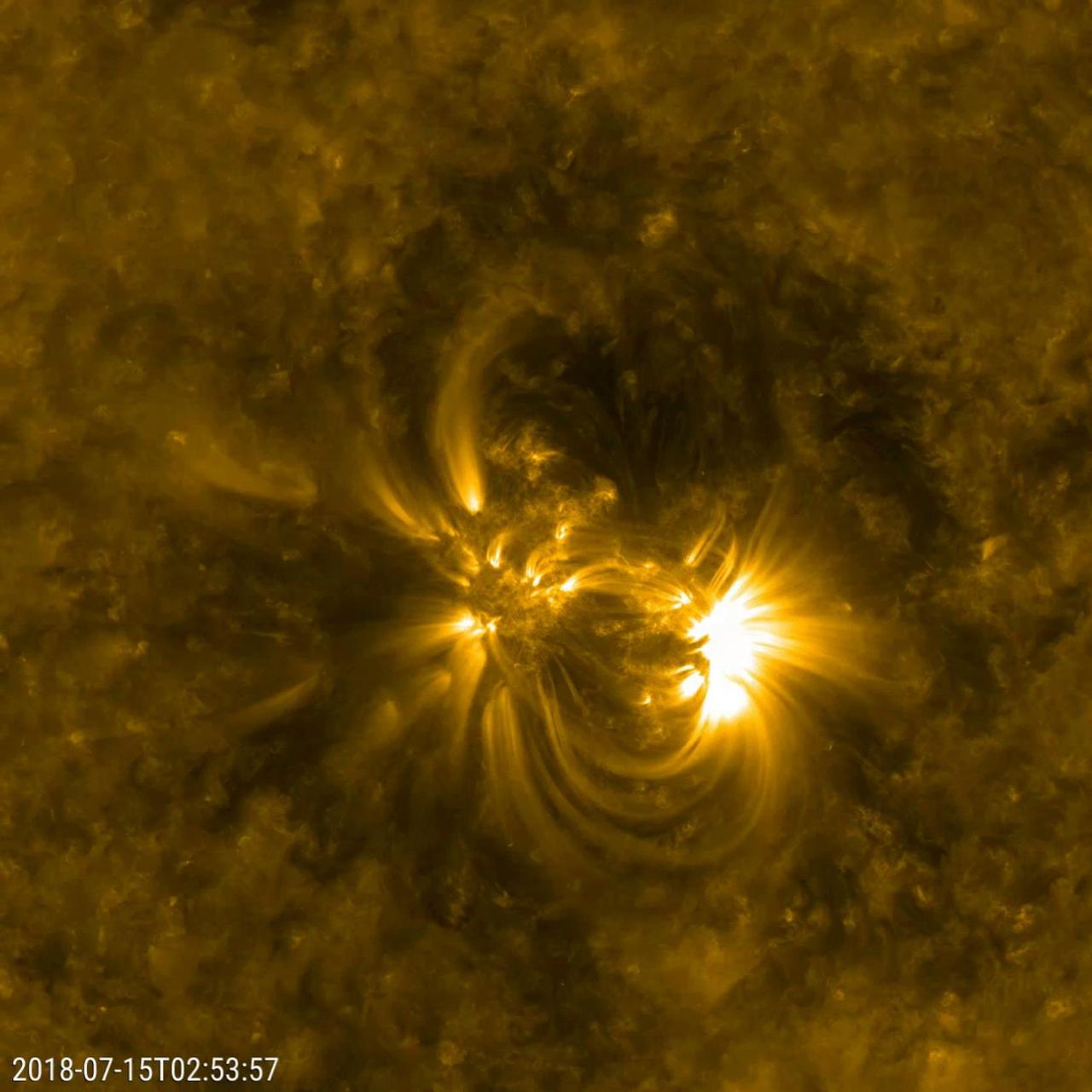
NASA's Solar Dynamics Observatory (SDO) zoomed in to watch close-up the dynamics of this single active region on the sun over a two-day period (July 14-16, 2018). The loops SDO observed in extreme ultraviolet light are illuminated by charged particles spinning along the magnetic field lines above an active region. Active regions are magnetically intense areas that are pushed up to the surface of the sun from below. These regions are often the sources of large eruptions that cause solar storms, though no large eruptions seem to have occurred during this period. To give a sense of scale, these loops are rising up many times the diameter of Earth. Movies are available at https://photojournal.jpl.nasa.gov/catalog/PIA22645
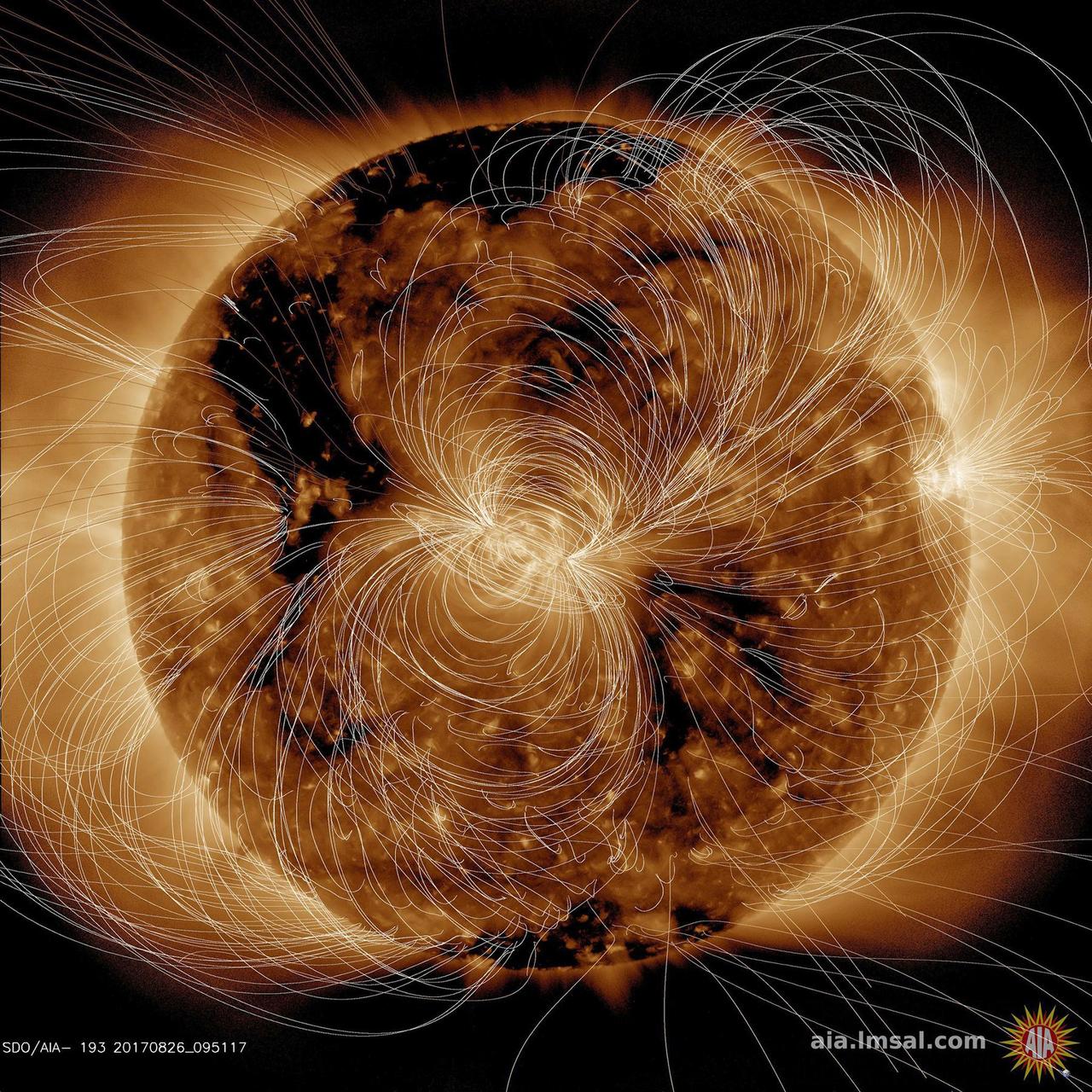
NASA's Solar Dynamics Observatory (SDO) scientists use their computer models to generate a view of the sun's magnetic field (Aug. 10, 2018). We took the opportunity to compare an extreme ultraviolet view of the sun with the same image showing the superimposed field lines. The bright active region right at the central area of the sun clearly shows a concentration of field lines, as well as the small active region at the sun's right edge, but to a lesser extent. Magnetism drives the dynamic activity near the sun's surface. Movies are available at https://photojournal.jpl.nasa.gov/catalog/PIA22662
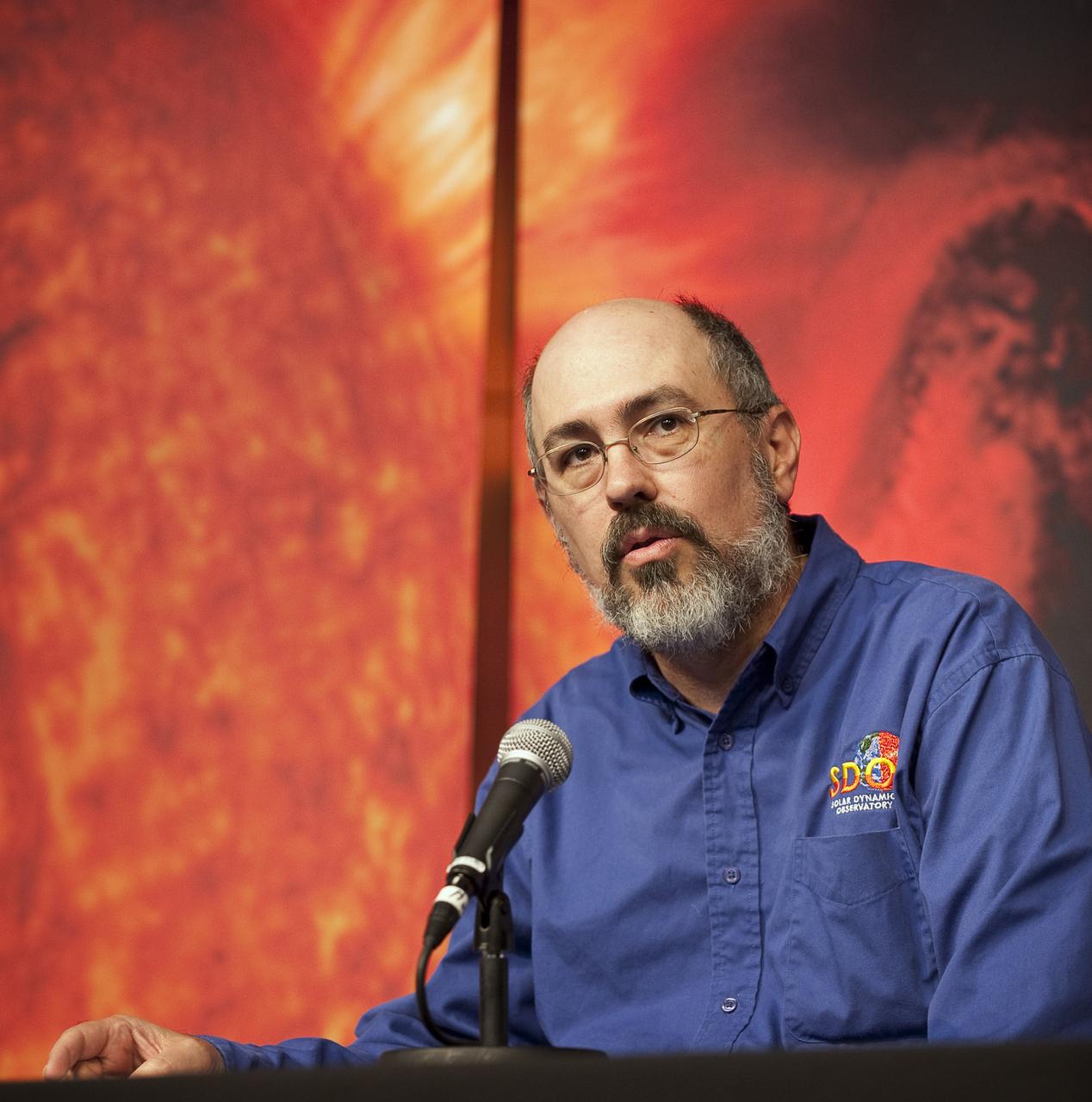
Dean Pesnell, SDO project scientist, Goddard Space Flight Center in Greenbelt, Md. speaks during a briefing to discuss recent images from NASA's Solar Dynamics Observatory, or SDO, Wednesday, April 21, 2010, at the Newseum in Washington. Photo Credit: (NASA/Carla Cioffi)
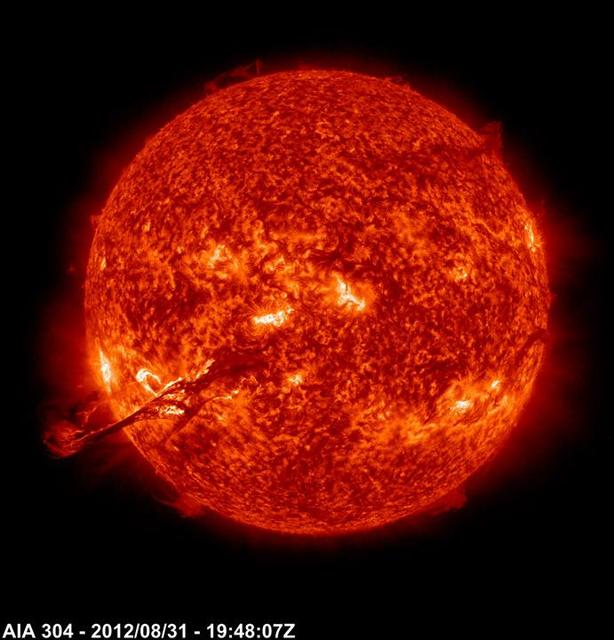
Sparked by a medium-sized (C-class) flare, a long, magnetic filament burst out from the Sun, producing one of the best shows that the Solar Dynamics Observatory (SDO) has seen (Aug. 31, 2012). Viewed in the 304 Angstrom wavelength of extreme ultraviolet light, the filament strand gets stretched outwards until it finally breaks and heads off to the left. Some of the particles from this eruption did hit Earth with a glancing blow on Sept. 3, generating some beautiful aurora. The video clip covers four hours of activity. http://photojournal.jpl.nasa.gov/catalog/PIA18167

Madhulika Guhathakurta, SDO Program Scientist at NASA Headquarters in Washington, speaks during a briefing to discuss recent images from NASA's Solar Dynamics Observatory, or SDO, Wednesday, April 21, 2010, at the Newseum in Washington. Launched on Feb. 11, 2010, SDO is the most advanced spacecraft ever designed to study the sun. During its five-year mission, it will examine the sun's magnetic field and also provide a better understanding of the role the sun plays in Earth's atmospheric chemistry and climate. Photo Credit: (NASA/Carla Cioffi)
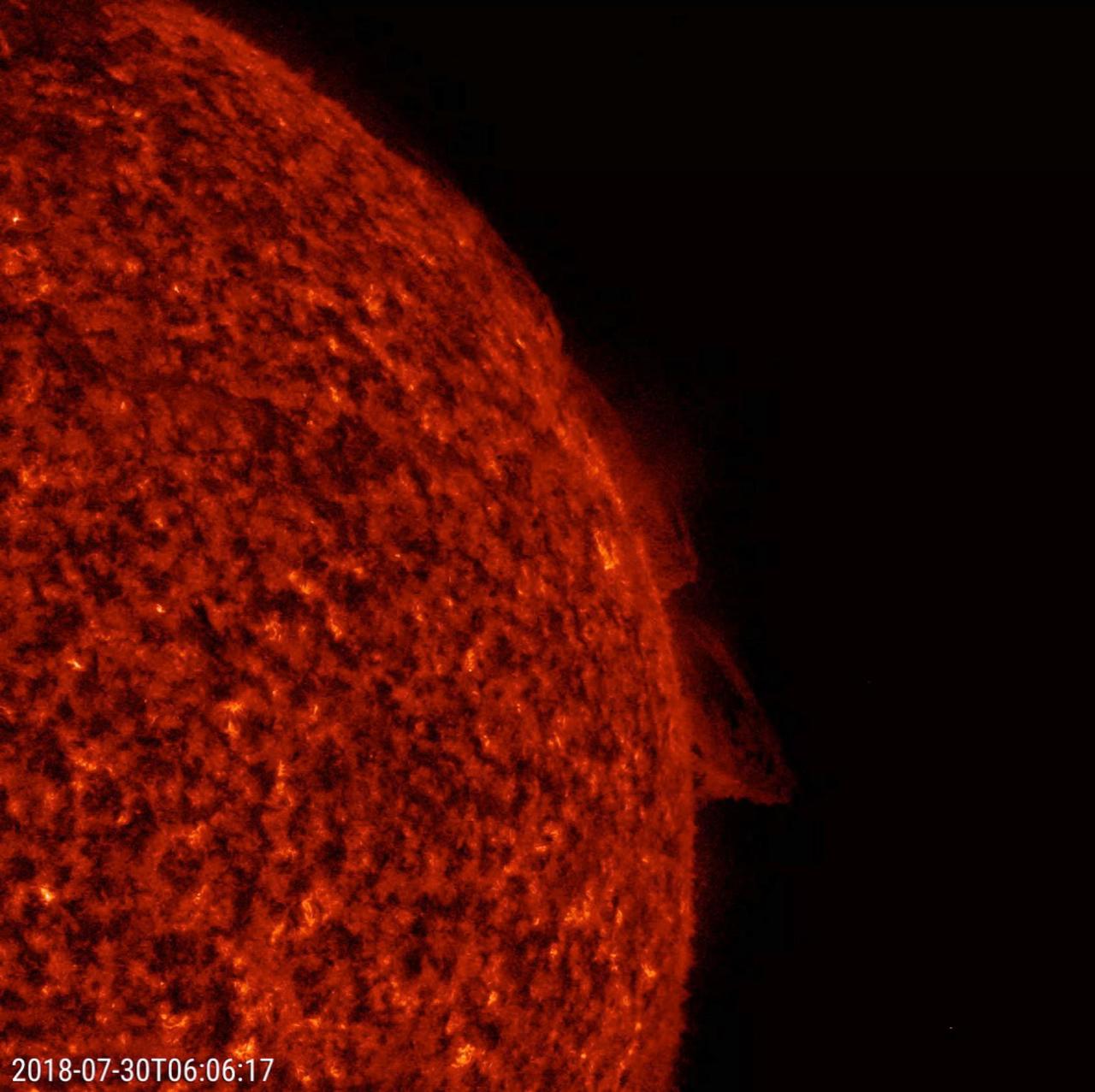
NASA's Solar Dynamics Observatory (SDO) observes two relatively small prominences above the Sun's surface twisted and streamed charged particles over a 20-hour period (July 30-31, 2018), shown here in a wavelength of extreme ultraviolet light. Prominences are large, bright features anchored to the Sun's photosphere but extending outward into its hot outer atmosphere, called the corona. Scientists are still researching how and why prominences are formed. Movies are available at https://photojournal.jpl.nasa.gov/catalog/PIA22661
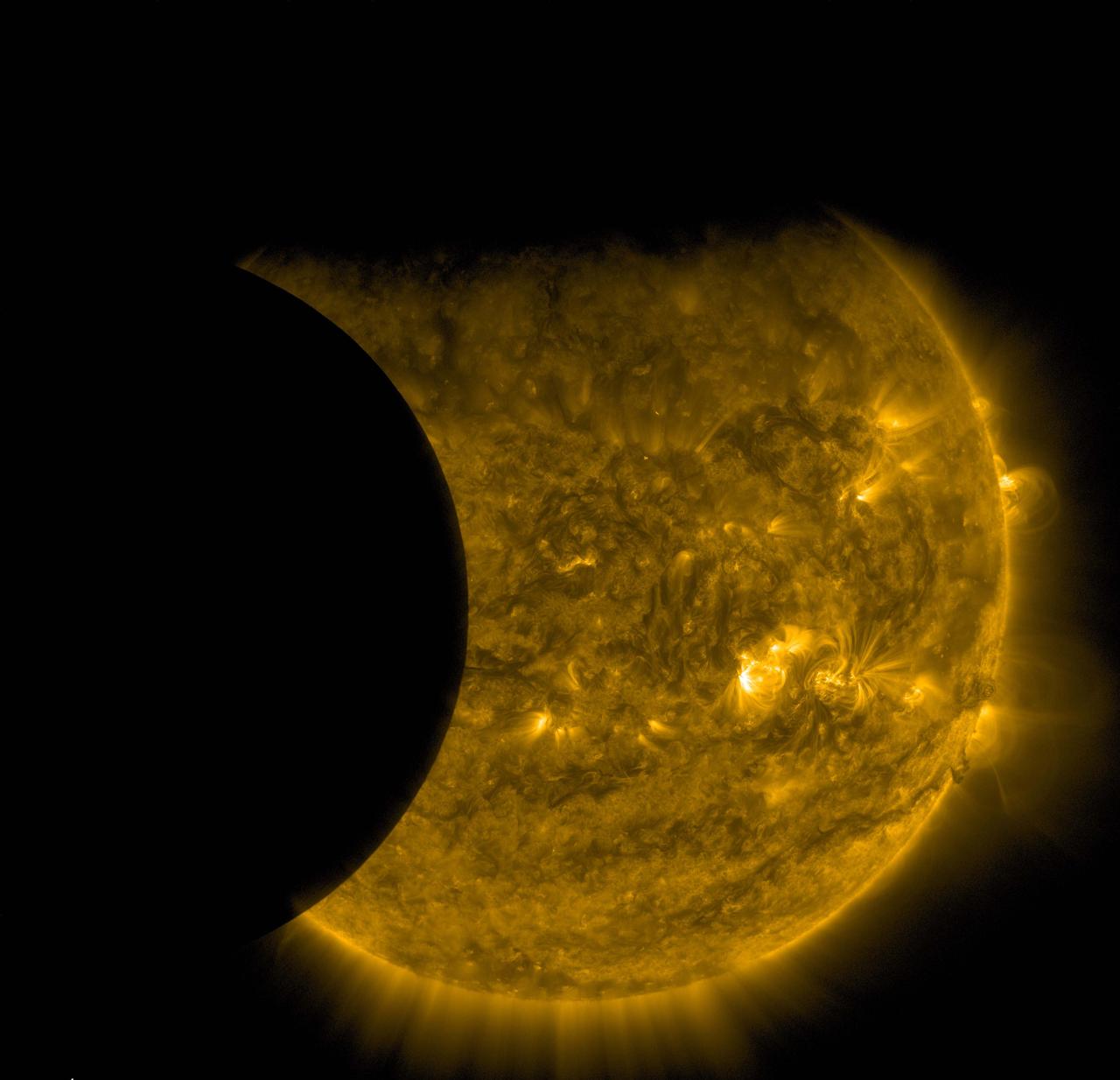
NASA’s Solar Dynamics Observatory captured this image of Earth and the moon transiting the sun together on Sept. 13, 2015. The edge of Earth, visible near the top of the frame, appears fuzzy because Earth’s atmosphere blocks different amounts of light at different altitudes. On the left, the moon’s edge is perfectly crisp, because it has no atmosphere. This image was taken in extreme ultraviolet wavelengths of 171 angstroms. Though this light is invisible to our eyes, it is typically colorized in gold. Credits: NASA/SDO
![Scientists presented the first images from NASA's Solar Dynamics Observatory [SDO] during a special "first light" press conference, Wednesday, April 21 2010, at held at the Newseum in Washington DC.](https://images-assets.nasa.gov/image/GSFC_20171208_Archive_e002078/GSFC_20171208_Archive_e002078~medium.jpg)
Scientists presented the first images from NASA's Solar Dynamics Observatory [SDO] during a special "first light" press conference, Wednesday, April 21 2010, at held at the Newseum in Washington DC.
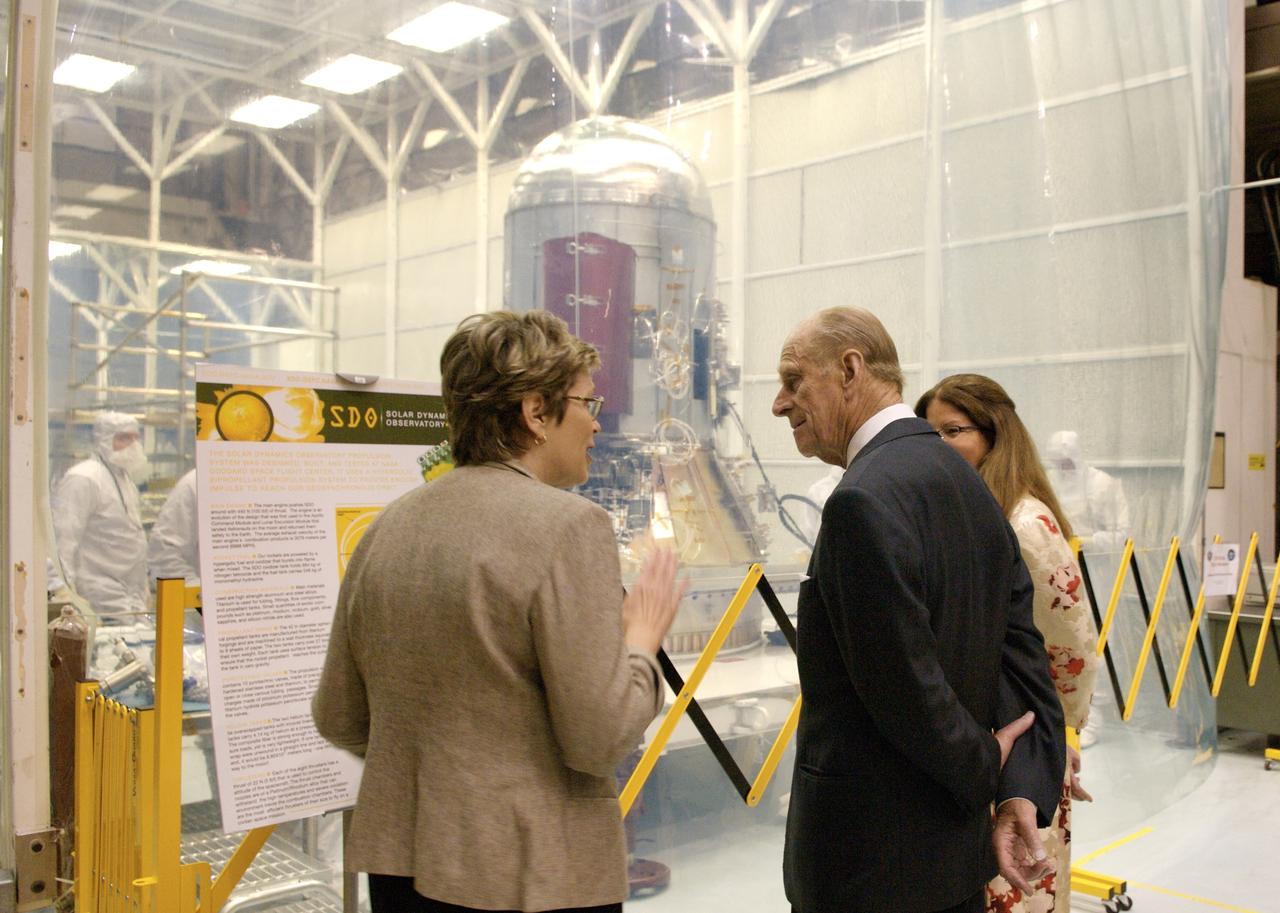
Solar Dynamics Observatory Program Manager, left, describes the SDO project to Prince Philip in front of the spacecraft clean tent. Photo Credit: (NASA/Chris Gunn)
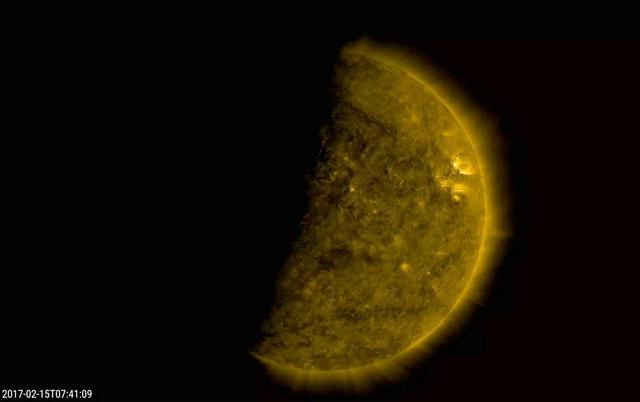
Several times a day for a few days the Earth completely blocked the Sun for about an hour due to NASA's Solar Dynamics Observatory's orbital path (Feb. 15, 2017). The edge of the Earth is not crisp, but kind of fuzzy due to Earth's atmosphere. This frame from a video shows the ending of one such eclipse over -- just seven minutes. The sun is shown in a wavelength of extreme ultraviolet light. These eclipses re-occur about every six months. The Moon blocks SDO's view of the sun on occasion as well. Movies are available at http://photojournal.jpl.nasa.gov/catalog/PIA21461

Richard Fisher, Heliophysics Division Director at NASA Headquarters, speaks during a briefing to discuss the upcoming launch of NASA's Solar Dynamic Observatory, or SDO, Thursday, Jan. 21, 2010, at NASA Headquarters in Washington. The mission is to study the Sun and its dynamic behavior. Photo Credit: (NASA/Paul E. Alers)

Richard Fisher, Heliophysics Division Director at NASA Headquarters, left, speaks during a briefing to discuss the upcoming launch of NASA's Solar Dynamic Observatory, or SDO, Thursday, Jan. 21, 2010, as Madhulika Guhathakurta, SDO Program Scientist looks on at NASA Headquarters in Washington. The mission is to study the Sun and its dynamic behavior. Photo Credit: (NASA/Paul E. Alers)
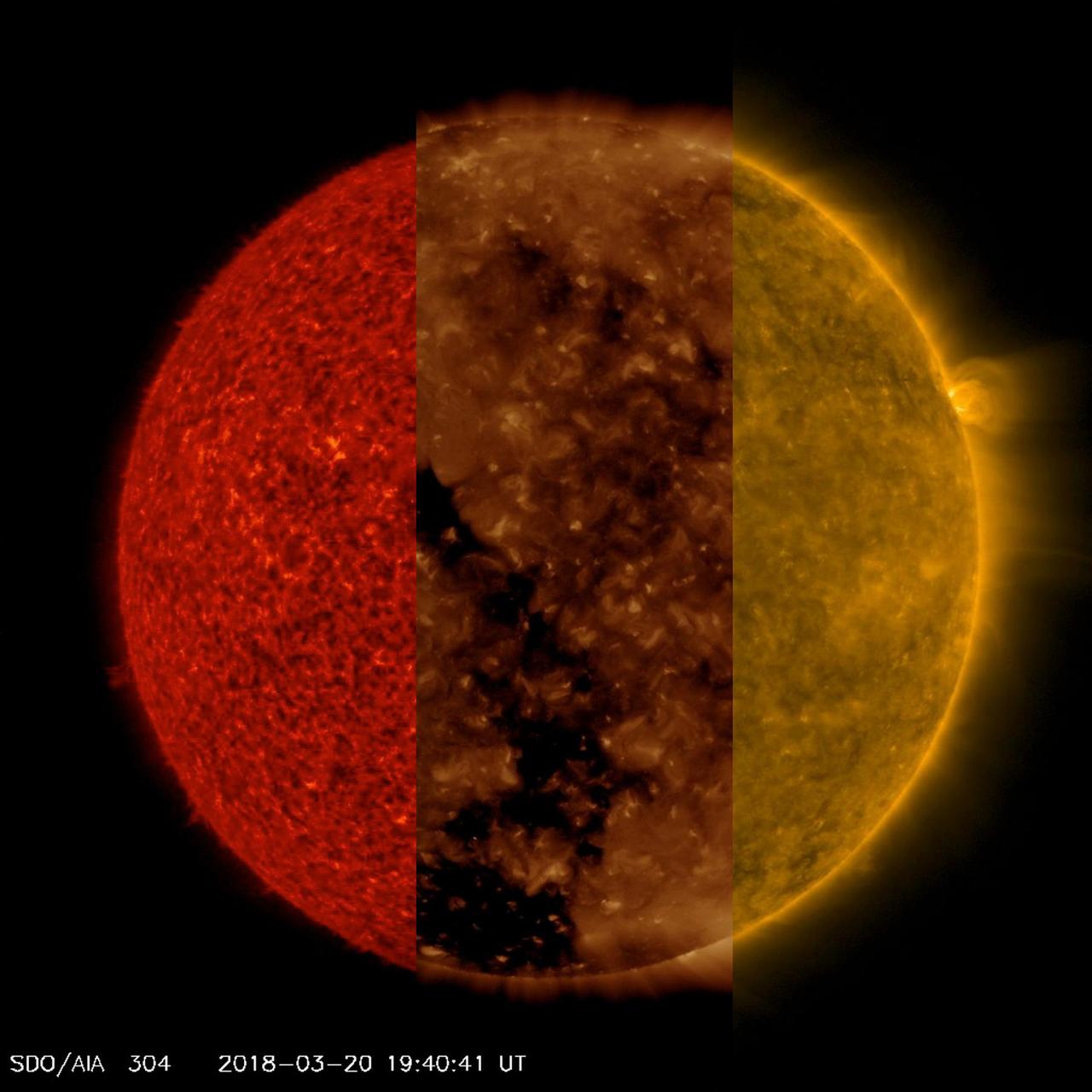
NASA's Solar Dynamics Observatory ran together three sequences of the sun taken in three different extreme ultraviolet wavelengths to better illustrate how different features that appear in one sequence are difficult if not impossible to see in the others (Mar. 20-21, 2018). In the red sequence (304 Angstroms), we can see very small spicules and some small prominences at the sun's edge, which are not easy to see in the other two sequences. In the second clip (193 Angstroms), we can readily observe the large and dark coronal hole, though it is difficult to make out in the others. In the third clip (171 wavelengths), we can see strands of plasma waving above the surface, especially above the one small, but bright, active region near the right edge. And these are just three of the 10 extreme ultraviolet wavelengths in which SDO images the sun every 12 seconds every day. That's a lot of data and a lot of science. Movies are available at https://photojournal.jpl.nasa.gov/catalog/PIA22360
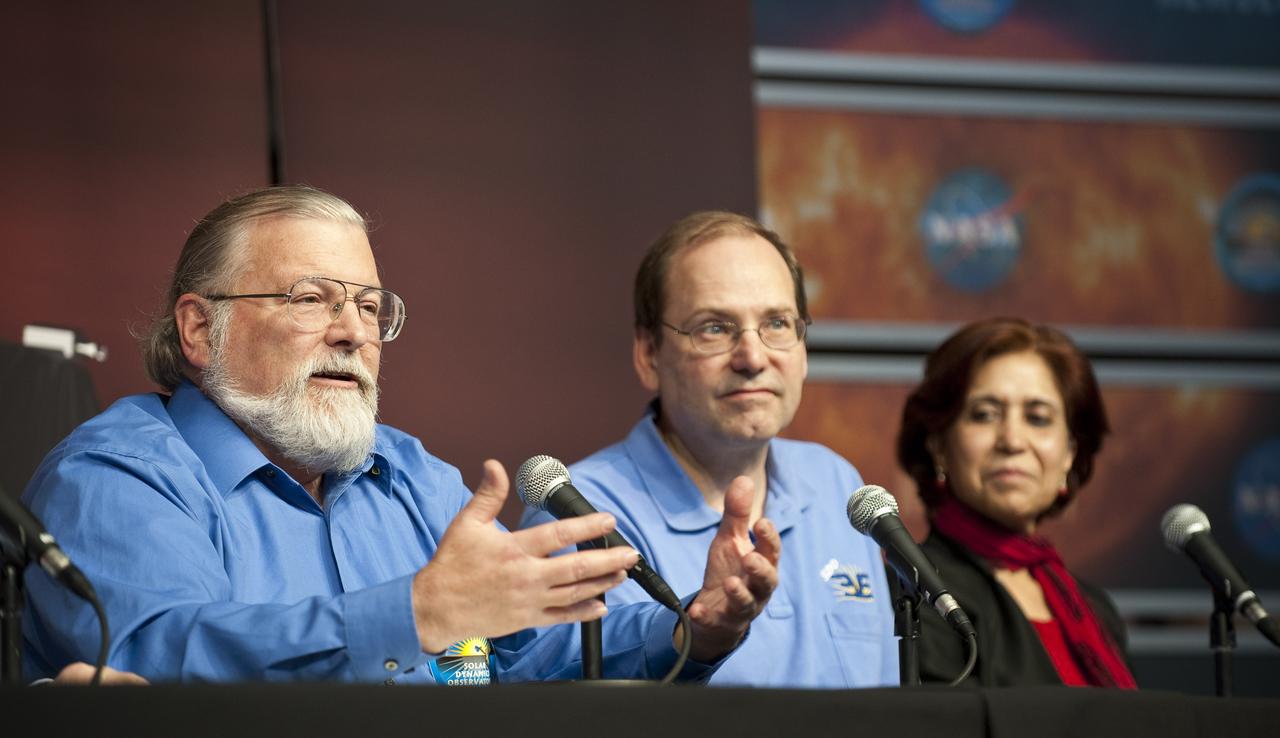
Philip H. Scherrer (left) principal investigator, Helioseismic and Magnetic Imager instrument, Stanford University in Palo Alto, speaks during a briefing to discuss recent images from NASA's Solar Dynamics Observatory, or SDO, while colleagues Tom Woods, principal investigator, Extreme Ultraviolet Variability Experiment instrument, Laboratory for Atmospheric and Space Physics, University of Colorado in Boulder and Madhulika Guhathakurta, SDO program scientist, NASA Headquarters (right) look on Wednesday, April 21, 2010, at the Newseum in Washington. Photo Credit: (NASA/Carla Cioffi)
![Scientists presented the first images from NASA's Solar Dynamics Observatory [SDO] during a special "first light" press conference, Wednesday, April 21 2010, at held at the Newseum in Washington DC. Credit: NASA/GSFC](https://images-assets.nasa.gov/image/GSFC_20171208_Archive_e002169/GSFC_20171208_Archive_e002169~medium.jpg)
Scientists presented the first images from NASA's Solar Dynamics Observatory [SDO] during a special "first light" press conference, Wednesday, April 21 2010, at held at the Newseum in Washington DC. Credit: NASA/GSFC
![Scientists presented the first images from NASA's Solar Dynamics Observatory [SDO] during a special "first light" press conference, Wednesday, April 21 2010, at held at the Newseum in Washington DC. Here, scientists are showing an animation from Walt Feimer, lead animator for the Heliophysics team. Credit: NASA/GSFC](https://images-assets.nasa.gov/image/GSFC_20171208_Archive_e002083/GSFC_20171208_Archive_e002083~medium.jpg)
Scientists presented the first images from NASA's Solar Dynamics Observatory [SDO] during a special "first light" press conference, Wednesday, April 21 2010, at held at the Newseum in Washington DC. Here, scientists are showing an animation from Walt Feimer, lead animator for the Heliophysics team. Credit: NASA/GSFC
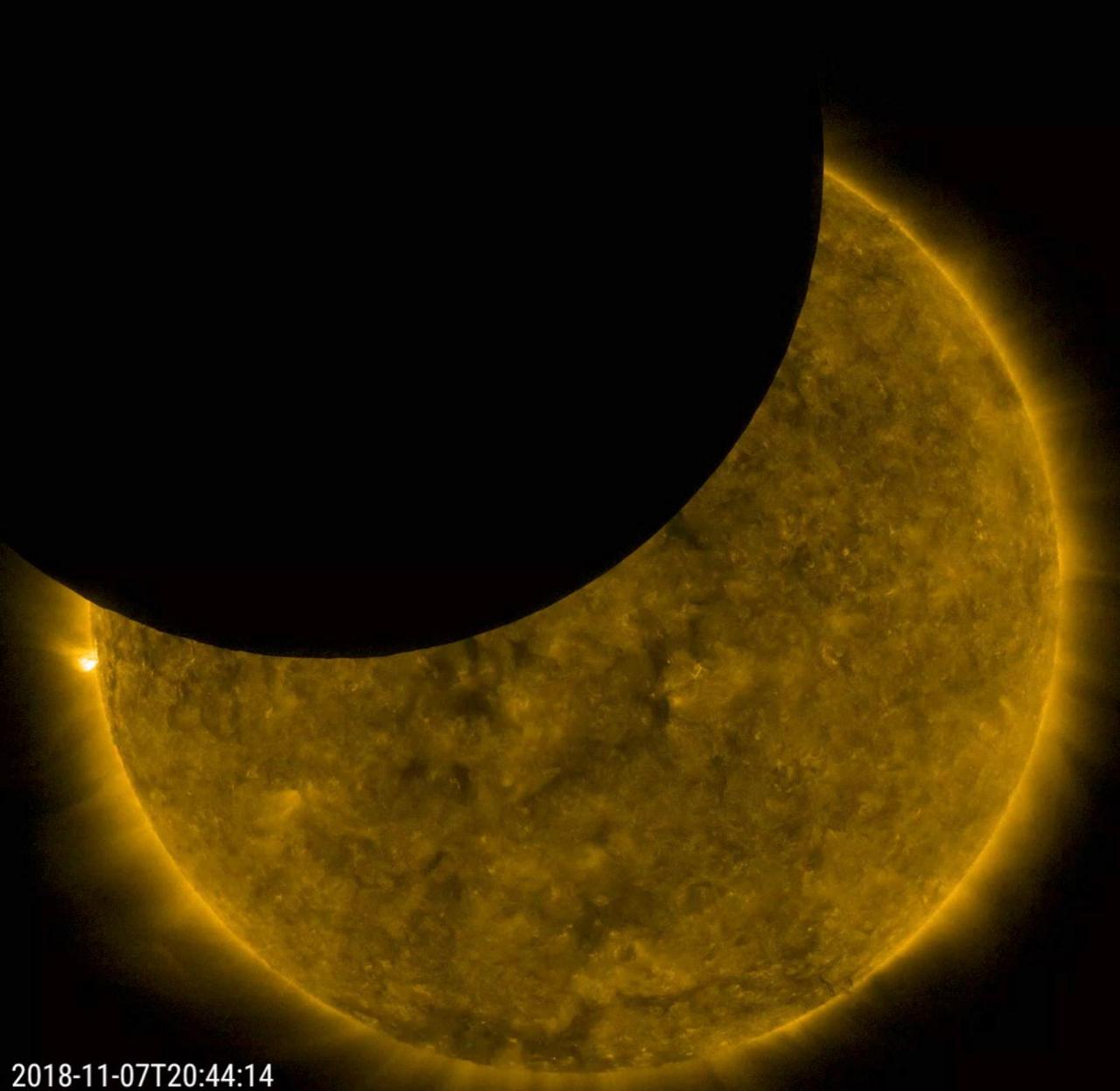
On Nov. 7, 2018 for just under an hour, SDO viewed a lunar transit, when the Moon partially blocked SDO's view of the Sun. At its peak about 44% of the Sun was covered. In this view, the Sun was observed in extreme ultraviolet light and, as is customary, been given false color. SDO's orbit gives it two three-week periods per year when either the Earth or the Moon cross in front of the Sun. These transits provide scientific value as well: The sharp edge of the lunar limb helps researchers measure how light diffracts around the telescope's optics and filter support grids, allowing scientists to better calibrate their instruments for even sharper images. Movies available at https://photojournal.jpl.nasa.gov/catalog/PIA18142

The SDO spacecraft is in another eclipse season as of Feb. 6, 2019. This begins a several week period when the Earth briefly blocks SDO's view of the Sun each day. In fact, because SDO orbits above the Mountain Time zone, the Earth passes between SDO and the Sun at about 7:20 UT (12:20 am MT) each orbit. Eclipses are due to SDO's circular geosynchronous orbit some 22,000 miles above Earth. At the speed we are showing the frames, the eclipse is only a flicker. The still image shows that the edge of Earth, here about halfway across the Sun, looks quite rough due to the absorption of the 304 Å EUV light by our atmosphere. Movies available at https://photojournal.jpl.nasa.gov/catalog/PIA21213
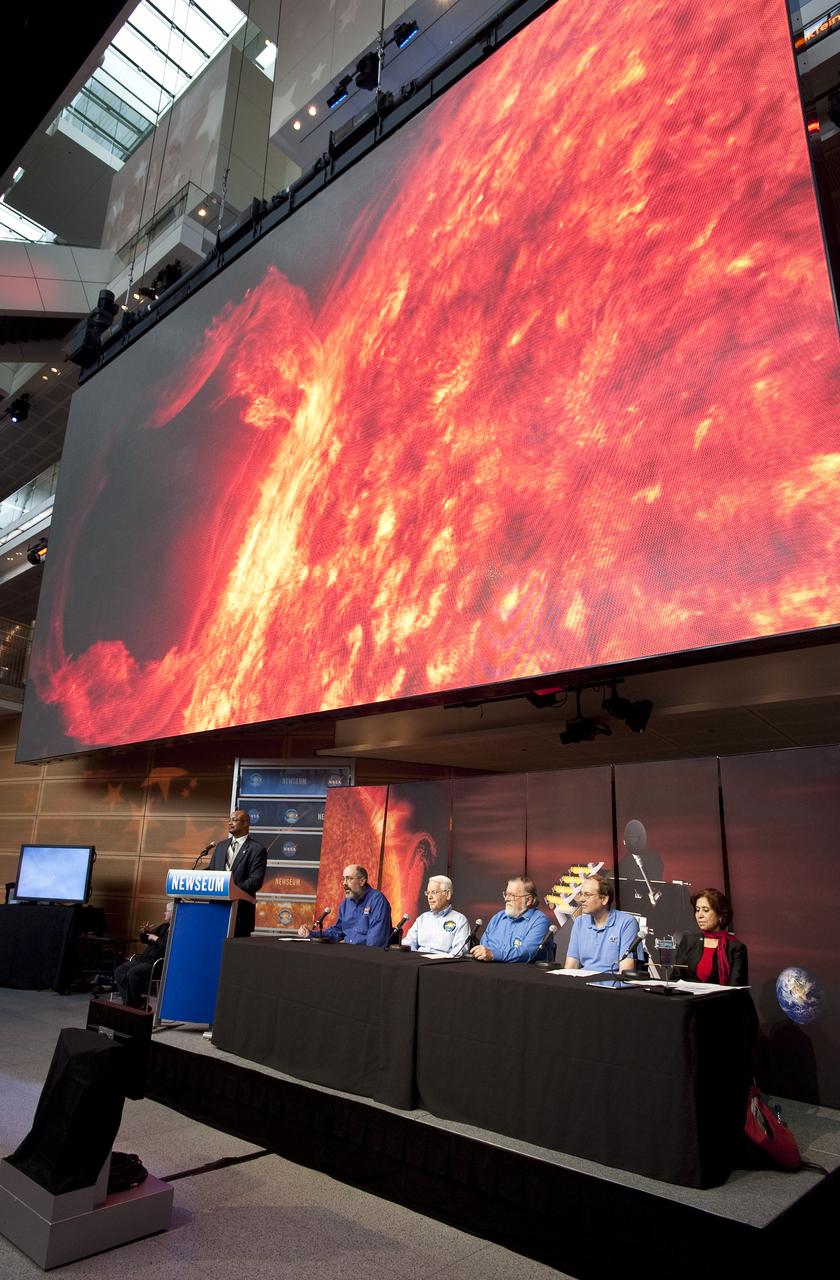
Scientists involved in NASA's Solar Dynamics Observatory (SDO) mission attend a press conference to discuss recent images captured by the SDO spacecraft Wednesday, April 21, 2010, at the Newseum in Washington. On Feb. 11, 2010, NASA launched the SDO spacecraft, which is the most advanced spacecraft ever designed to study the sun. Seated left to right are: Dean Pesnell, SDO project scientist, Goddard Space Flight Center in Greenbelt, Md.; Alan Title, principal investigator, Atmospheric Imaging Assembly instrument, Lockheed Martin Solar and Astrophysics Laboratory in Palo Alto; Philip H. Scherrer, principal investigator, Helioseismic and Magnetic Imager instrument, Stanford University in Palo Alto; Tom Woods, principal investigator, Extreme Ultraviolet Variability Experiment Instrument, Laboratory for Atmospheric and Space Physics, University of Colorado in Boulder and Madhulika Guhathakurta, SDO program scientist, NASA Headquarters in Washington. Photo Credit: (NASA/Carla Cioffi)
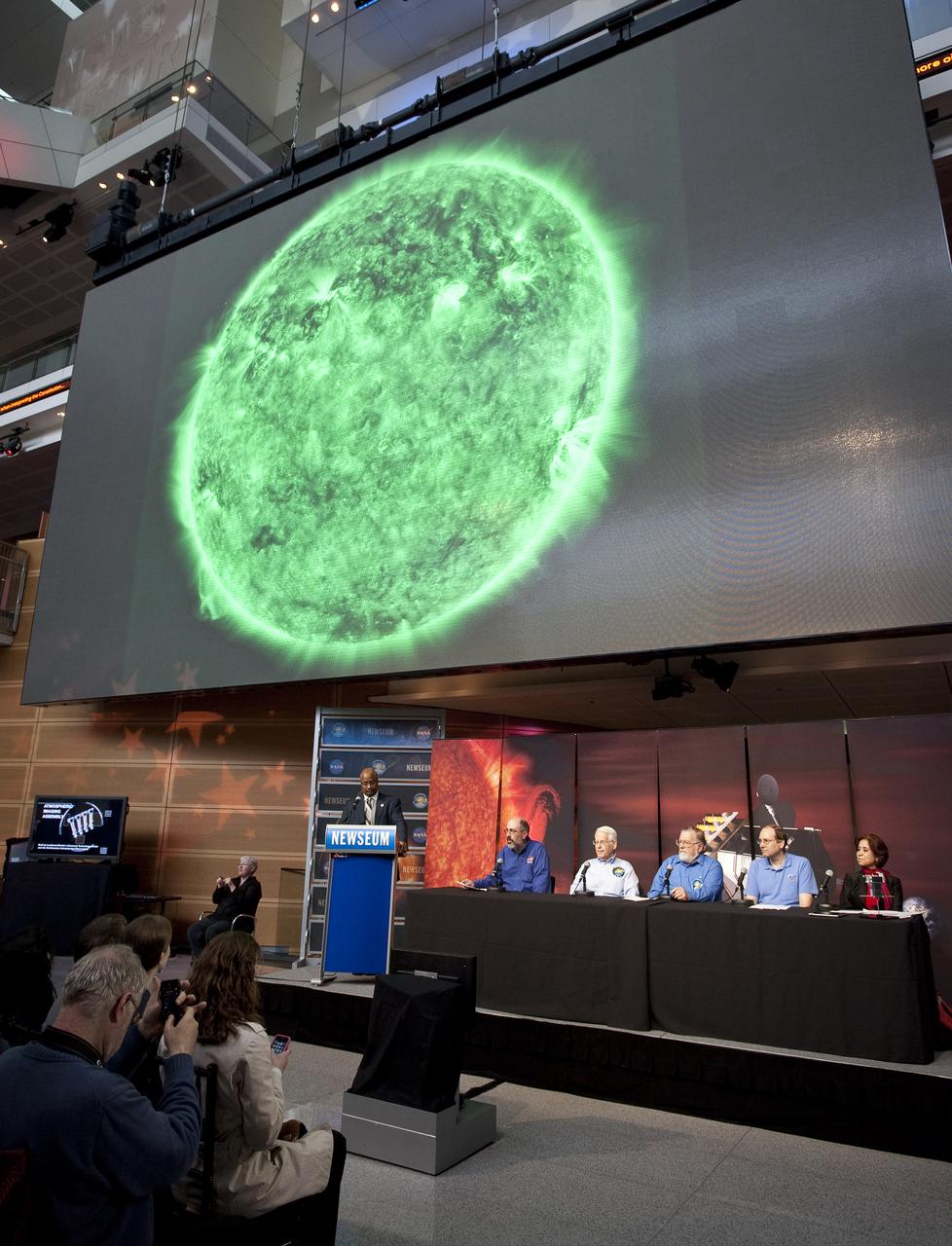
Scientists involved in NASA's Solar Dynamics Observatory (SDO) mission attend a press conference to discuss recent images captured by the SDO spacecraft Wednesday, April 21, 2010, at the Newseum in Washington. Pictured right to left are: Madhulika Guhathakurta, SDO program scientist, NASA Headquarters in Washington; Tom Woods, principal investigator, Extreme Ultraviolet Variability Experiment instrument, Laboratory for Atmospheric and Space Physics, University of Colorado in Boulder; Philip H. Scherrer, principal investigator, Helioseismic and Magnetic Imager instrument, Stanford University in Palo Alto; Alan Title, principal investigator, Atmospheric Imaging Assembly instrument, Lockheed Martin Solar and Astrophysics Laboratory in Palo Alto and Dean Pesnell, SDO project scientist, Goddard Space Flight Center in Greenbelt, Md. Photo Credit: (NASA/Carla Cioffi)
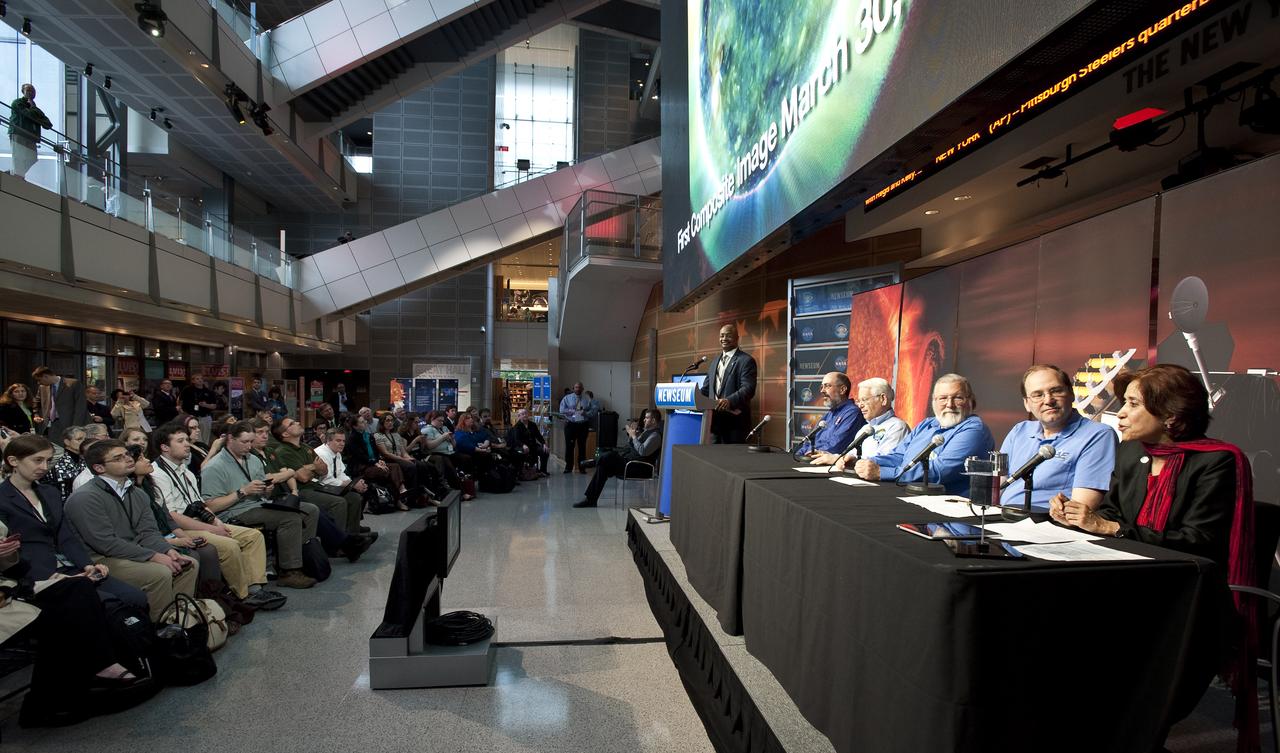
Madhulika Guhathakurta, far right, SDO Program Scientist at NASA Headquarters in Washington, speaks during a briefing to discuss recent images from NASA's Solar Dynamics Observatory, or SDO, Wednesday, April 21, 2010, at the Newseum in Washington. Pictured from left of Dr. Guhathakurta's are: Tom Woods, principal investigator, Extreme Ultraviolet Variability Experiment instrument, Laboratory for Atmospheric and Space Physics, University of Colorado in Boulder; Philip H. Scherrer, principal investigator, Helioseismic and Magnetic Imager instrument, Stanford University in Palo Alto; Alan Title, principal investigator, Atmospheric Imaging Assembly instrument, Lockheed Martin Solar and Astrophysics Laboratory in Palo Alto and Dean Pesnell, SDO project scientist, Goddard Space Flight Center in Greenbelt, Md. Photo Credit: (NASA/Carla Cioffi)
Tom Woods, (second from right), principal investigator, Extreme Ultraviolet Variability Experiment instrument, Laboratory for Atmospheric and Space Physics, University of Colorado in Boulder speaks during a briefing to discuss recent images from NASA's Solar Dynamics Observatory, or SDO, Wednesday, April 21, 2010, at the Newseum in Washington. Photo Credit: (NASA/Carla Cioffi)
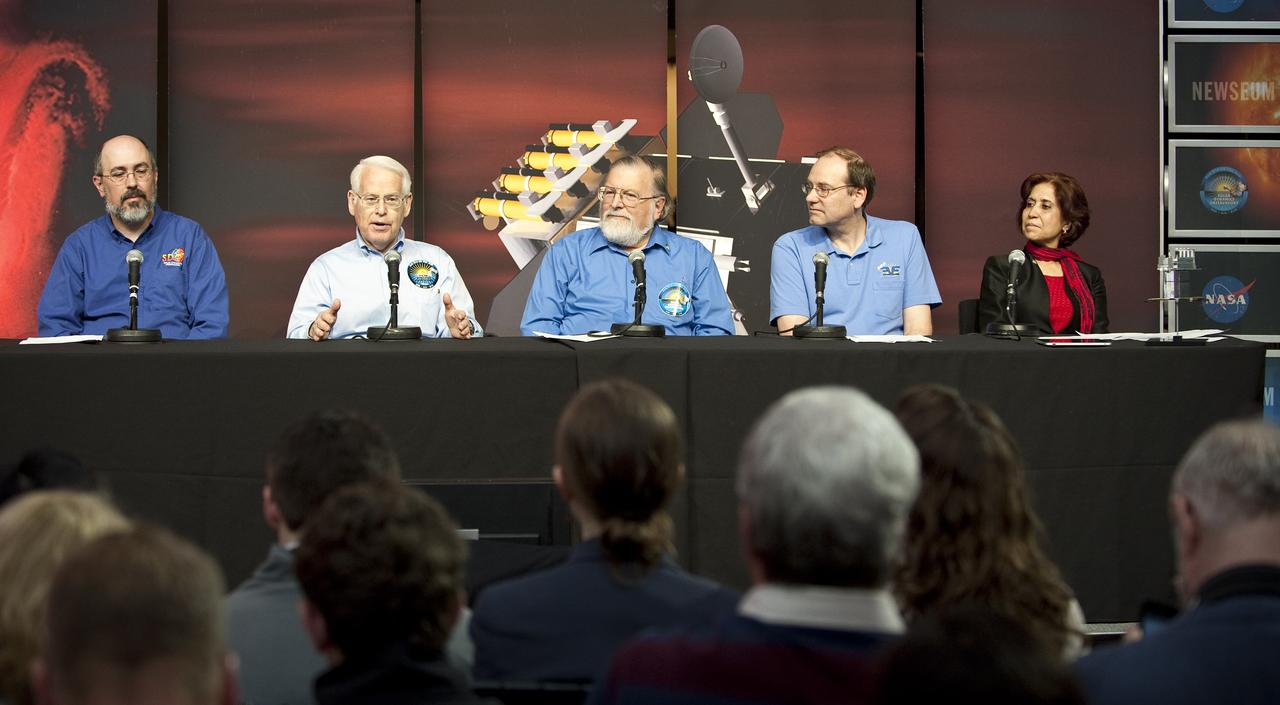
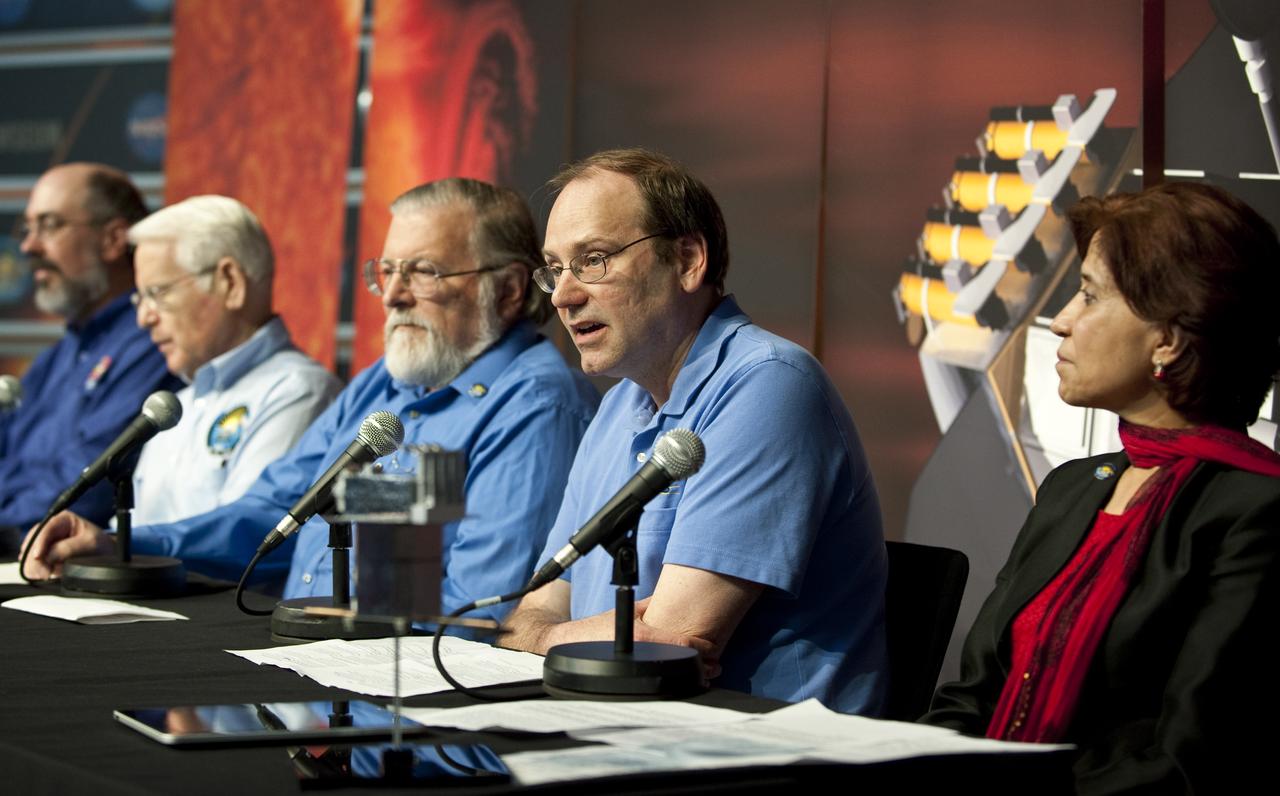
Alan Title, second from left, principal investigator, Atmospheric Imaging Assembly instrument, Lockheed Martin Solar and Astrophysics Laboratory in Palo Alto, speaks during a briefing to discuss recent images from NASA's Solar Dynamics Observatory, or SDO, Wednesday, April 21, 2010, at the Newseum in Washington. Launched on Feb. 11, 2010, SDO is the most advanced spacecraft ever designed to study the sun. During its five-year mission, it will examine the sun's magnetic field and also provide a better understanding of the role the sun plays in Earth's atmospheric chemistry and climate. Pictured from left to right: Dean Pesnell, SDO project scientist, Goddard Space Flight Center in Greenbelt, Md., Alan Title, Philip H. Scherrer, principal investigator, Helioseismic and Magnetic Imager instrument, Stanford University in Palo Alto, Tom Woods, principal investigator, Extreme Ultraviolet Variability Experiment instrument, Laboratory for Atmospheric and Space Physics, University of Colorado in Boulder and Madhulika Guhathakurta, SDO program scientist, NASA Headquarters in Washington. Photo Credit: (NASA/Carla Cioffi)

X-rays stream off the sun in this first picture of the sun, overlaid on a picture taken by NASA Solar Dynamics Observatory SDO, taken by NASA NuSTAR. The field of view covers the west limb of the sun.

This week the sun was hitting its lowest level of solar activity since 2011 (Nov. 14-18, 2016) as it gradually marches toward solar minimum. This activity is usually measured by sunspot count and over the past several days the sun has been almost spotless. The sun has a pendulum-like pattern of solar cycle of activity that extends over about an 11-year period. The last peak of activity was in early 2014. At this point in time, the sunspot numbers seem to be sliding downwards faster than expected, though the solar minimum level should not occur until 2021. No doubt more and larger sunspots will inevitably appear, but we'll just have to wait and see. Movies are available at http://photojournal.jpl.nasa.gov/catalog/PIA21207
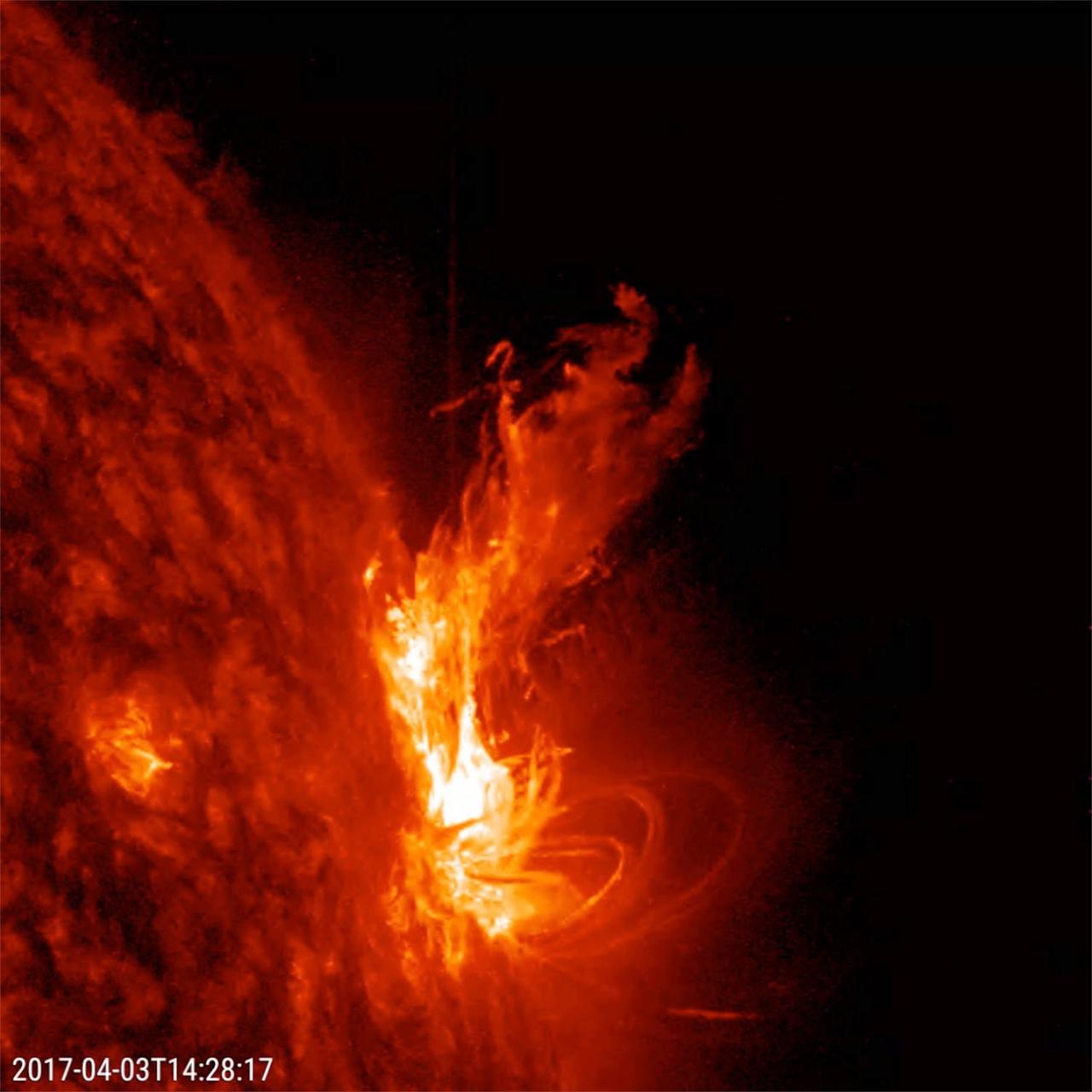
An active region at the sun's edge produced several M5-class (medium sized) flares over a ten-hour period (Apr. 3, 2017). The most dramatic flare occurs about half way through the video clip, when it shoots up a bright towering plume of plasma. These were the strongest flares of the year so far. Some coronal mass ejections (which hurled clouds of plasma into space) were also associated with some of these flares. The images were taken in a wavelength of extreme ultraviolet light. Movies are available at https://photojournal.jpl.nasa.gov/catalog/PIA21584
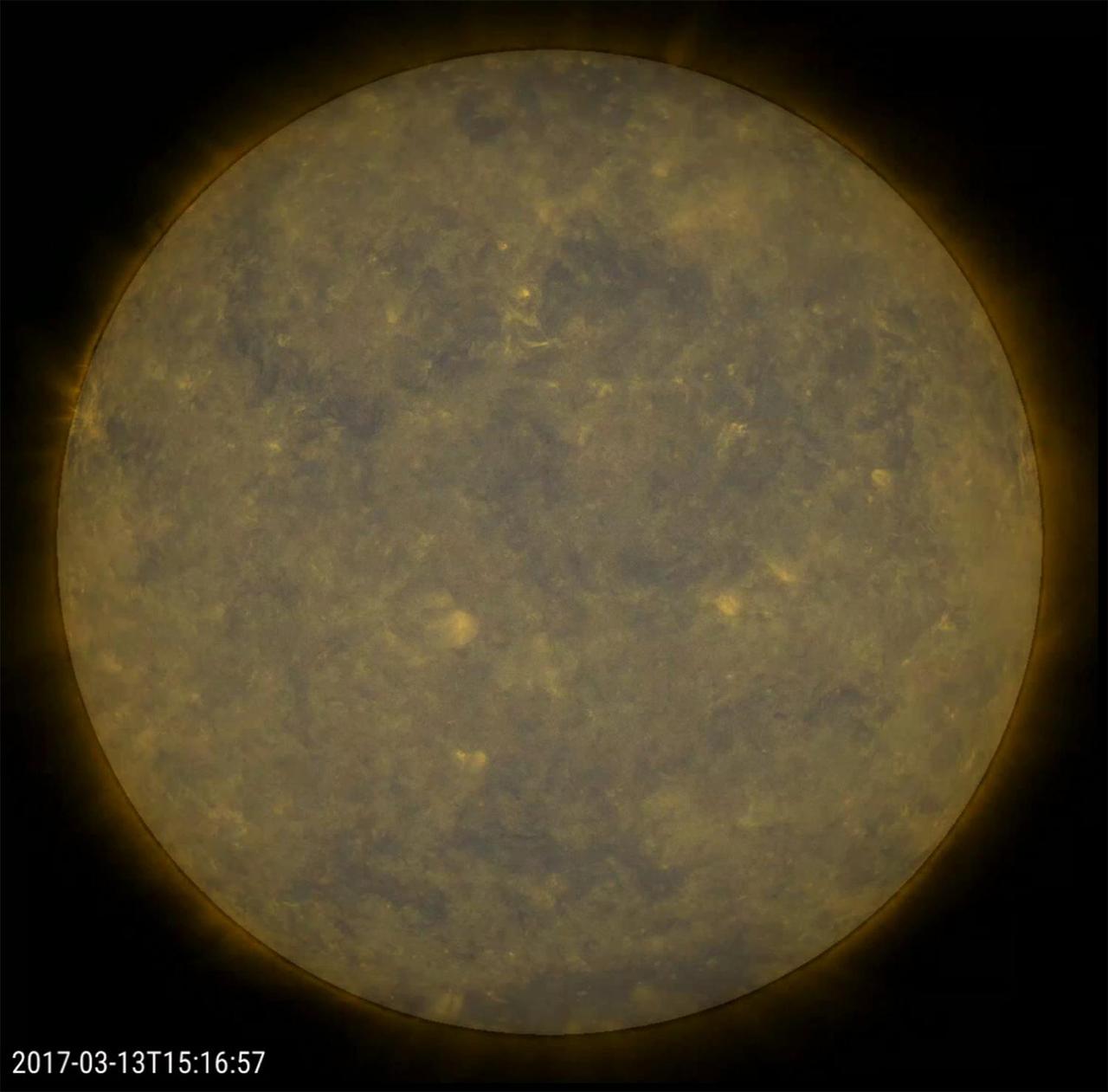
The sun has been virtually spotless, as in no sunspots, over the past 11 days, a spotless stretch that we have not seen since the last solar minimum many years ago. The videos shows the past four days (Mar. 14-17, 2017) with a combination of an extreme ultraviolet image blended with just the filtered sun. If we just showed the filtered sun with no spots for reference points, any viewer would have a hard time telling that the sun was even rotating. The sun is trending again towards the solar minimum period of its 11 year cycle, which is predicted to be around 2020. Movies are available at http://photojournal.jpl.nasa.gov/catalog/PIA21569

On Oct. 24-25, 2018 a solar prominence rose up above the Sun's surface, twisted and spun around, then became elongated and broke away. Prominences are unstable clouds of cooler plasma suspended above the Sun by strong magnetic forces. They often fall apart after a few days. Although tiny on the scale of the Sun, this prominence stretched out about ten times the diameter of Earth (see inset). Images were taken in a wavelength of extreme ultraviolet light. Animations are available at https://photojournal.jpl.nasa.gov/catalog/PIA18140
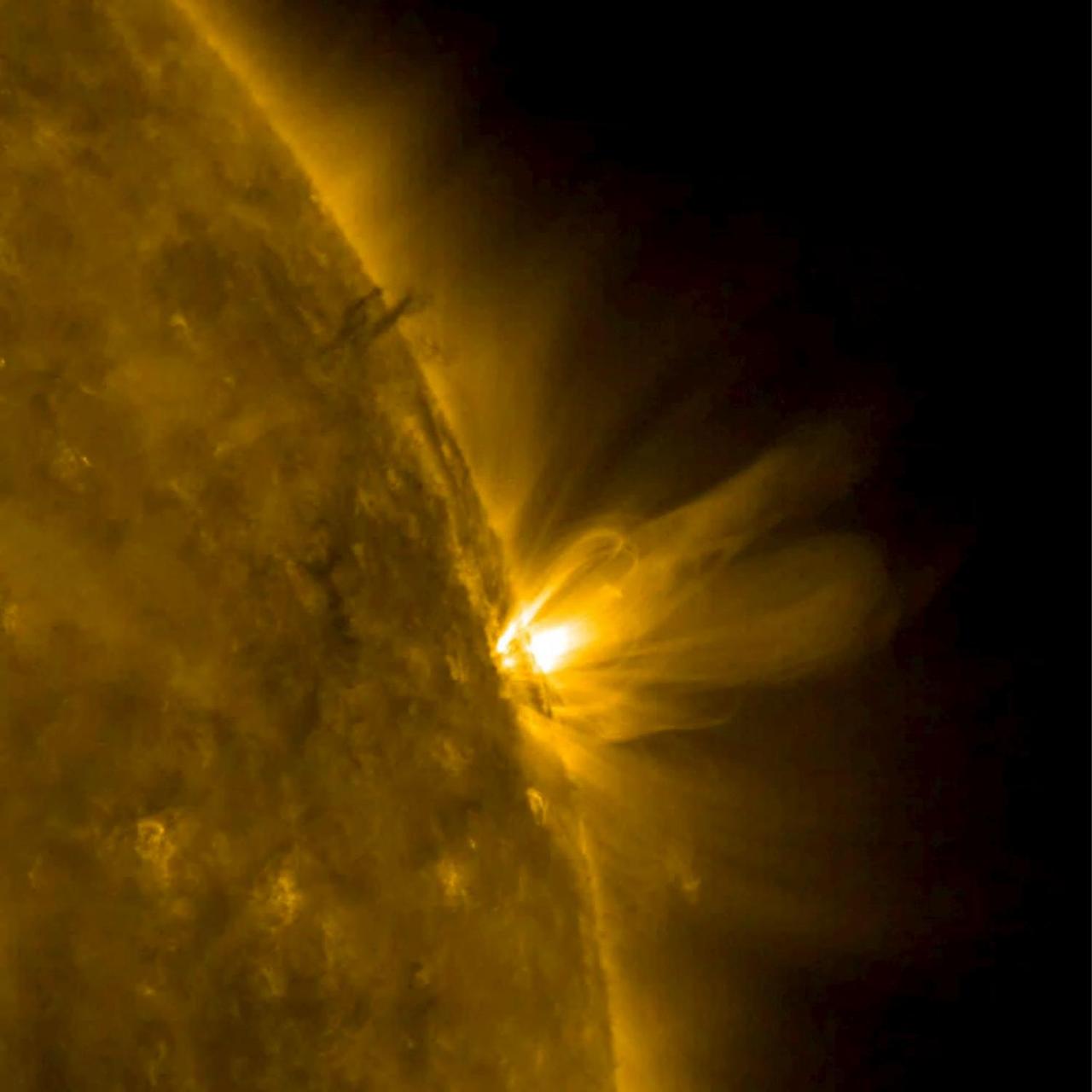
When an active region rotated over to the edge of the sun, it presented us with a nice profile view of its elongated loops stretching and swaying above it (Mar. 8-9, 2017). These loops are actually charged particles (made visible in extreme ultraviolet light) swirling along the magnetic field lines of the active region. The video covers about 30 hours of activity. Also of note is a darker twisting mass of plasma to the left of the active region being pulled and spun about by magnetic forces. Video is available at http://photojournal.jpl.nasa.gov/catalog/PIA21562
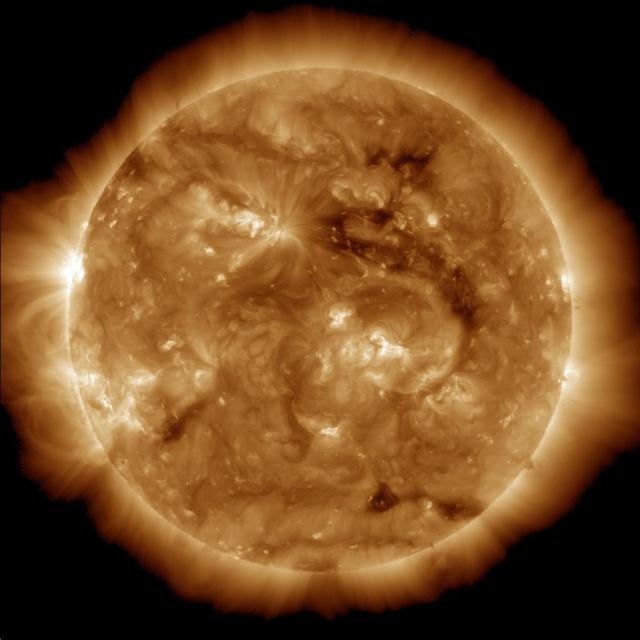
The dark region seen on the face of the sun at the end of March 2013 is a coronal hole just above and to the right of the middle of the picture, which is a source of fast solar wind leaving the sun in this image from NASA Solar Dynamic Observatory.
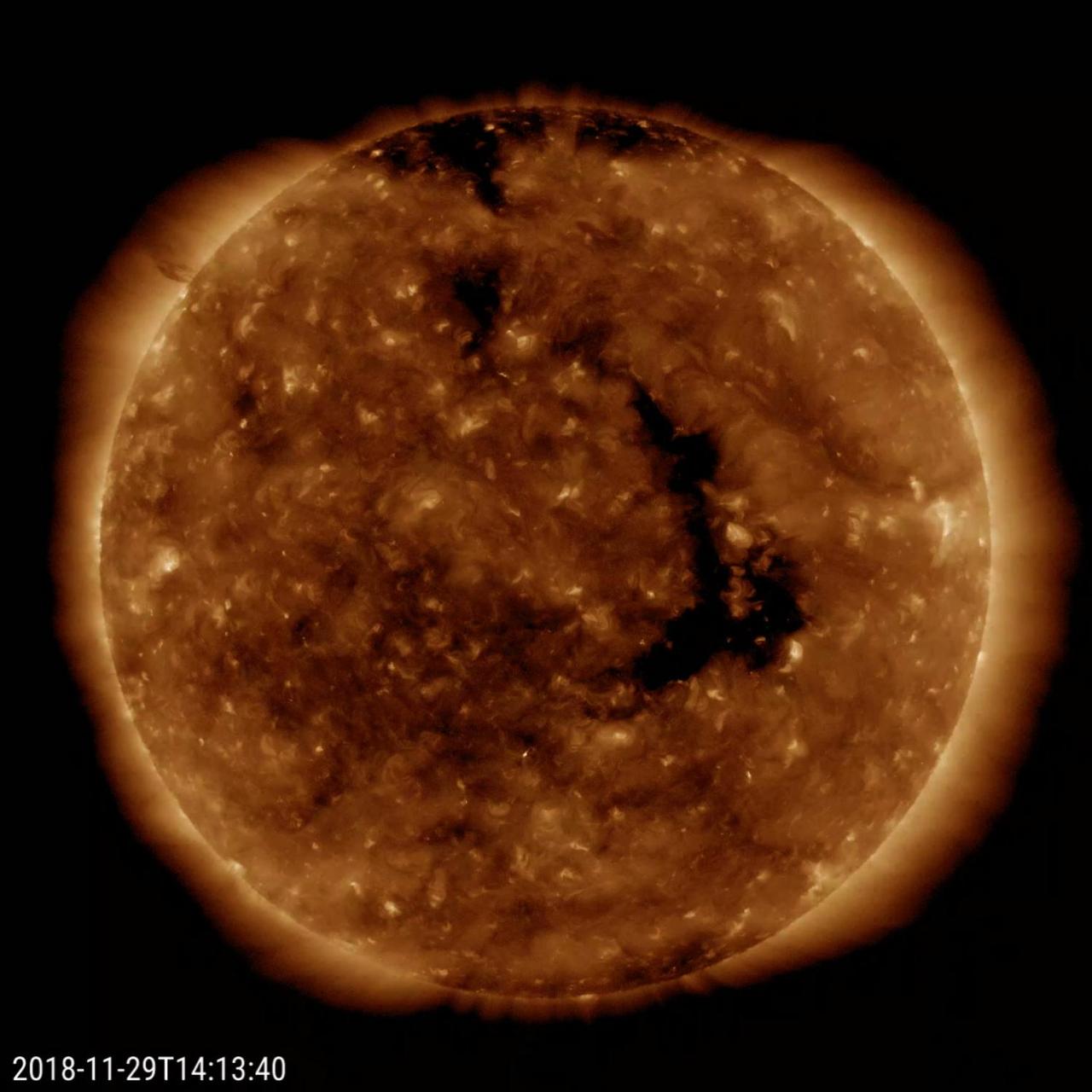
A long-lasting coronal hole has again rotated around to face the Earth (Nov. 28-30, 2018). This persistent hole - the elongated dark region seen in the still image - first appeared in July and has been observed each rotation of the Sun since. Coronal holes are the source of high-speed solar wind; when this one faced Earth, it sparked outbursts of aurora some of which were observed in our northern tier states. Coronal holes are magnetically open regions on the Sun that can last from days to months, although this one has lasted longer than most. The time-lapse video, taken in a wavelength of extreme ultraviolet light, covers about two days of activity. Movies available at https://photojournal.jpl.nasa.gov/catalog/PIA18144
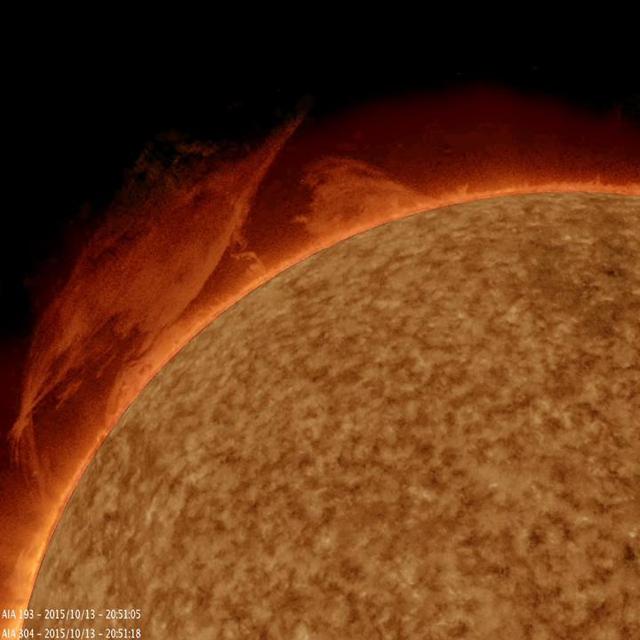
A mass of plasma gathered itself into a twisting mass, spun around for a bit, then rose up and broke apart over a 10-hour period Oct. 13, 2015 as observed by NASA Solar Dynamics Observatory. The image and video were produced with a combination of two wavelengths of extreme ultraviolet light. Prominences are unstable clouds of gas tethered above the surface of the Sun by magnetic forces. Much of the jittering and odd jumping motions above the surface were artifacts caused by brightening and contrast changes used to bring out the detail and structure of the prominence. http://photojournal.jpl.nasa.gov/catalog/PIA20008
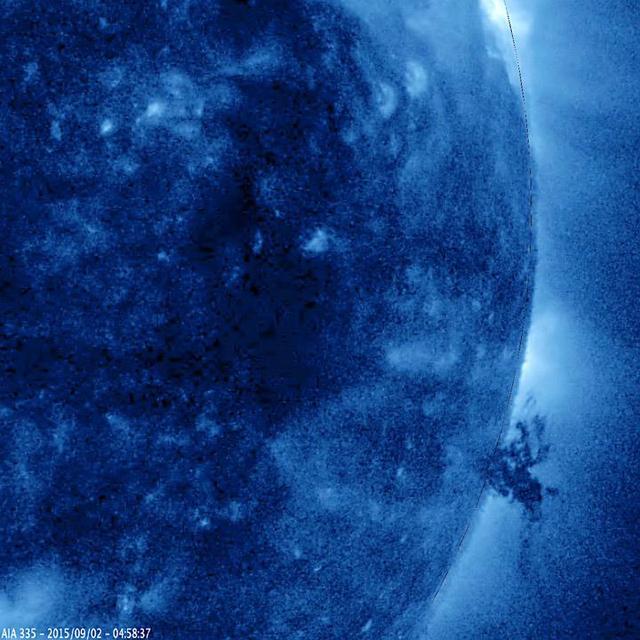
A small, but complex mass of plasma gyrated and spun about over the course of 40 hours above the surface of the Sun (Sept. 1-3, 2015). It was stretched and pulled back and forth by powerful magnetic forces but not ripped apart in this sequence. The temperature of the ionized iron particles observed in this extreme ultraviolet wavelength of light was about 2.8 million degrees C. (or 5 million degrees F.) http://photojournal.jpl.nasa.gov/catalog/PIA19878
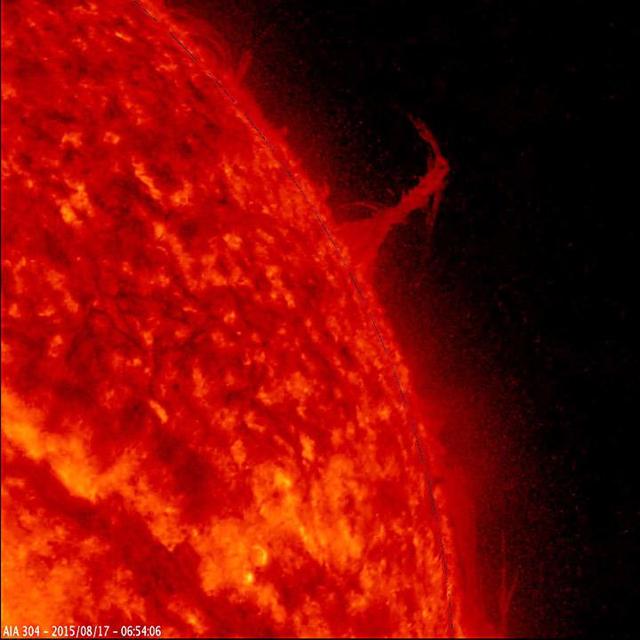
This still image from an animation from NASA GSFC Solar Dynamics Observatory shows a single plume of plasma, many times taller than the diameter of Earth, spewing streams of particles for over two days Aug. 17-19, 2015 before breaking apart. At times, its shape resembled the Eiffel Tower. Other lesser plumes and streams of particles can be seen dancing above the solar surface as well. The action was observed in a wavelength of extreme ultraviolet light. http://photojournal.jpl.nasa.gov/catalog/PIA19875
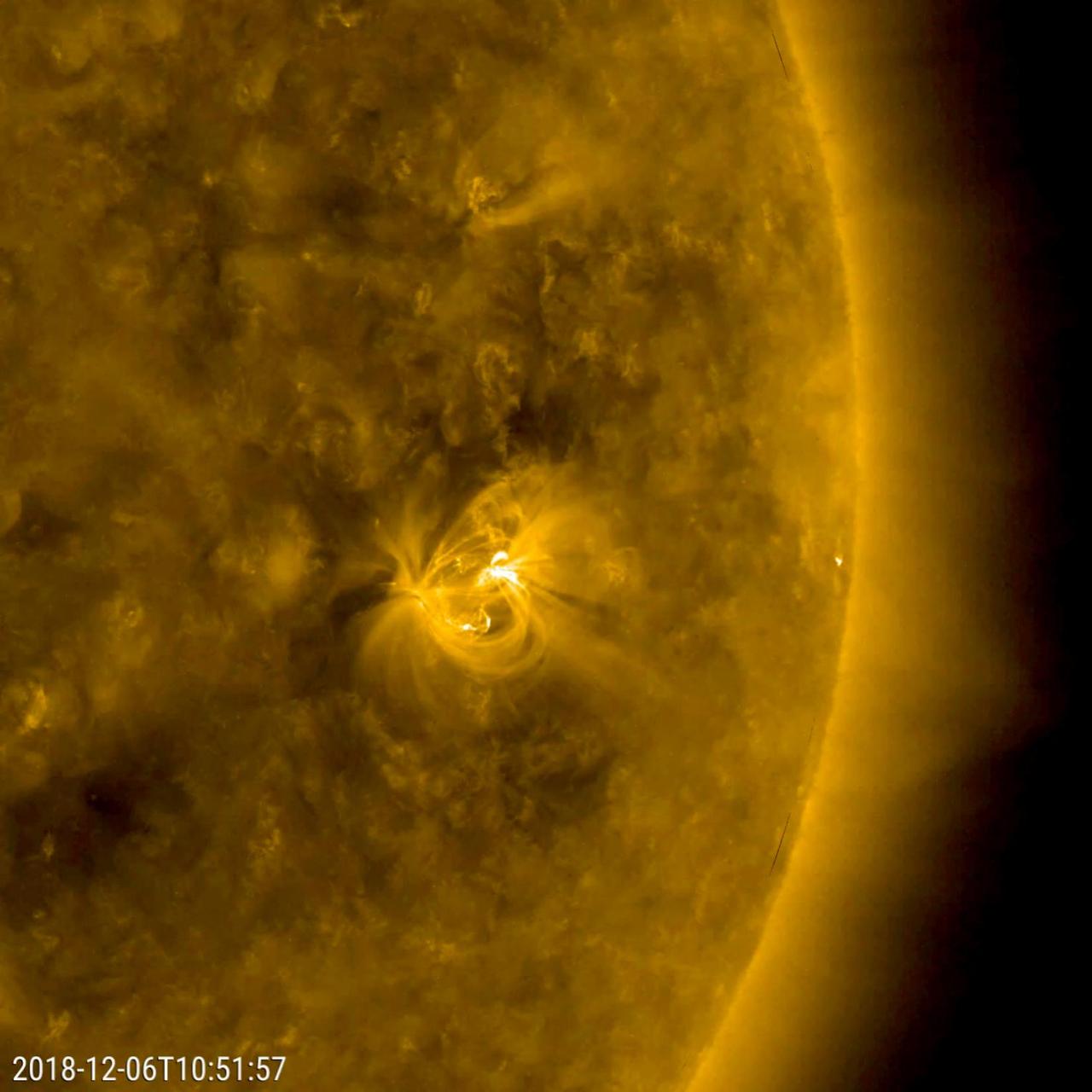
The only active region observed this week appeared on Dec. 5, 2018 and grew into an average size display of dynamic activity (Dec. 6-7, 2018). As viewed in a wavelength of extreme ultraviolet light, the region presented numerous magnetic loops of charged particles, rapidly changing their shapes and directions. As the sun is approaching its minimum level of activity in its 11 year solar cycle, we expect to see fewer and fewer active regions for quite a while. However, this active region is in the southern hemisphere of the Sun and has the North magnetic pole in the lead, so it is a sunspot of Solar Cycle 24. Movies available at https://photojournal.jpl.nasa.gov/catalog/PIA21211
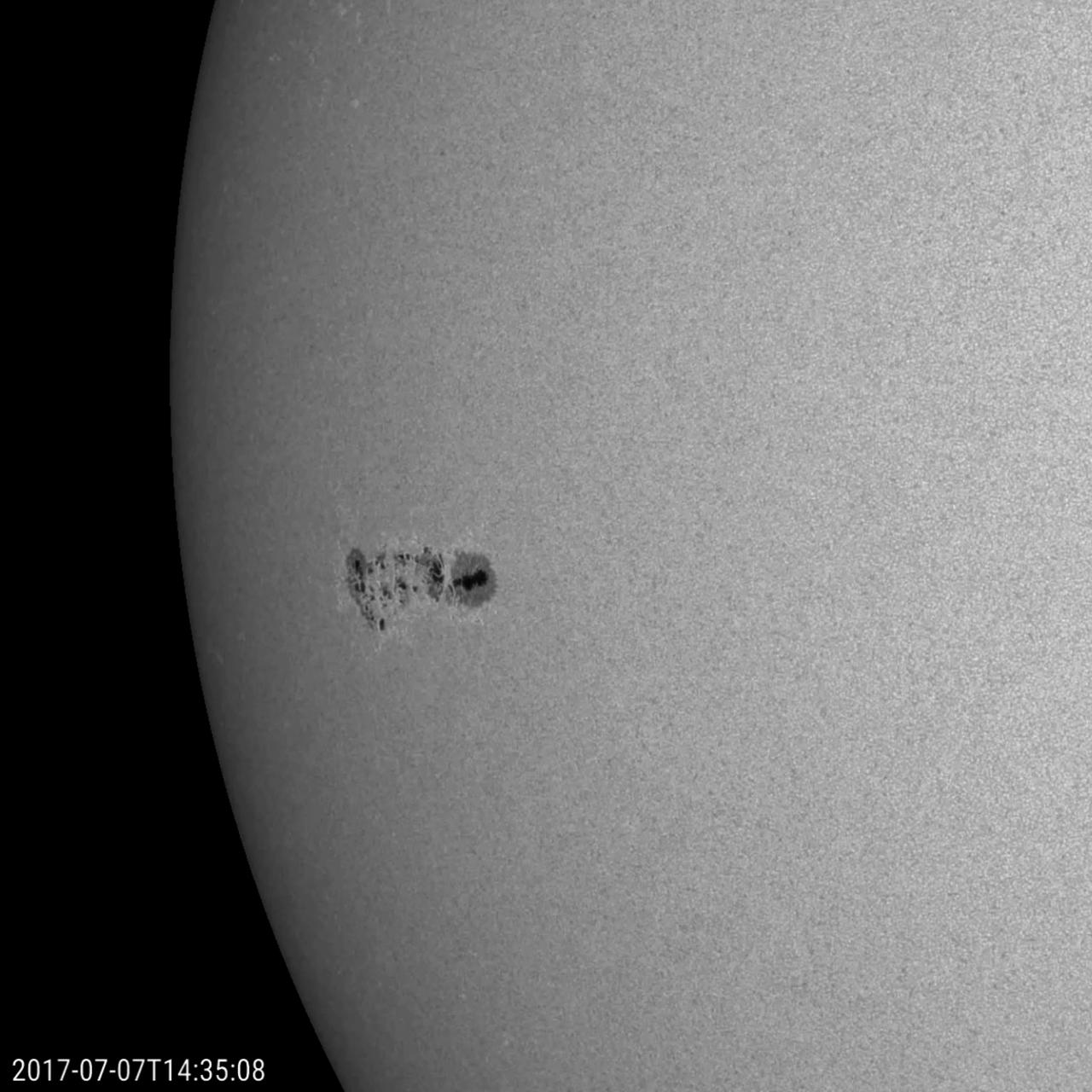
A prominence at the edge of the sun provided us with a splendid view of solar plasma as it churned and streamed over less than one day (June 25-26, 2017). The charged particles of plasma were being manipulated by strong magnetic forces. When viewed in this wavelength of extreme ultraviolet light, we can trace the movements of the particles. Such occurrences are fairly common but much easier to see when they are near the sun's edge. For a sense of scale, the arch of prominence in the still image has risen up several times the size of Earth. Movies are available at https://photojournal.jpl.nasa.gov/catalog/PIA21783
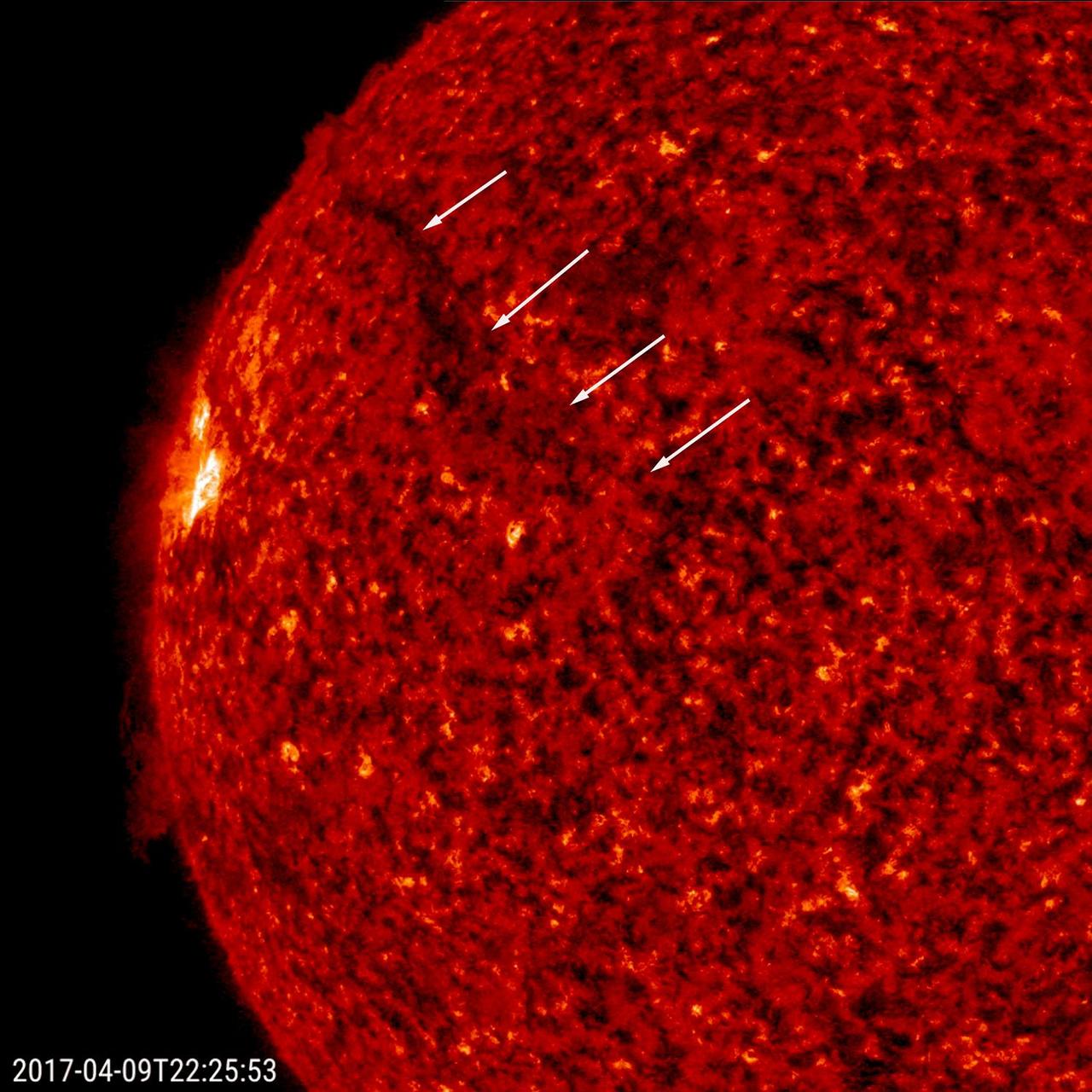
A dark, elongated filament rose up and broke to the lower left and out from the sun seen by NASA Solar Dynamics Observatory, Apr.9-10, 2017. Filaments are cooler clouds of plasma tethered above the sun surface by magnetic forces. They are notoriously unstable and tend not to last more than a few days before they collapse into the sun or break away into space. A video, taken in extreme ultraviolet light, covers about nine hours of activity. Videos are available at https://photojournal.jpl.nasa.gov/catalog/PIA21592
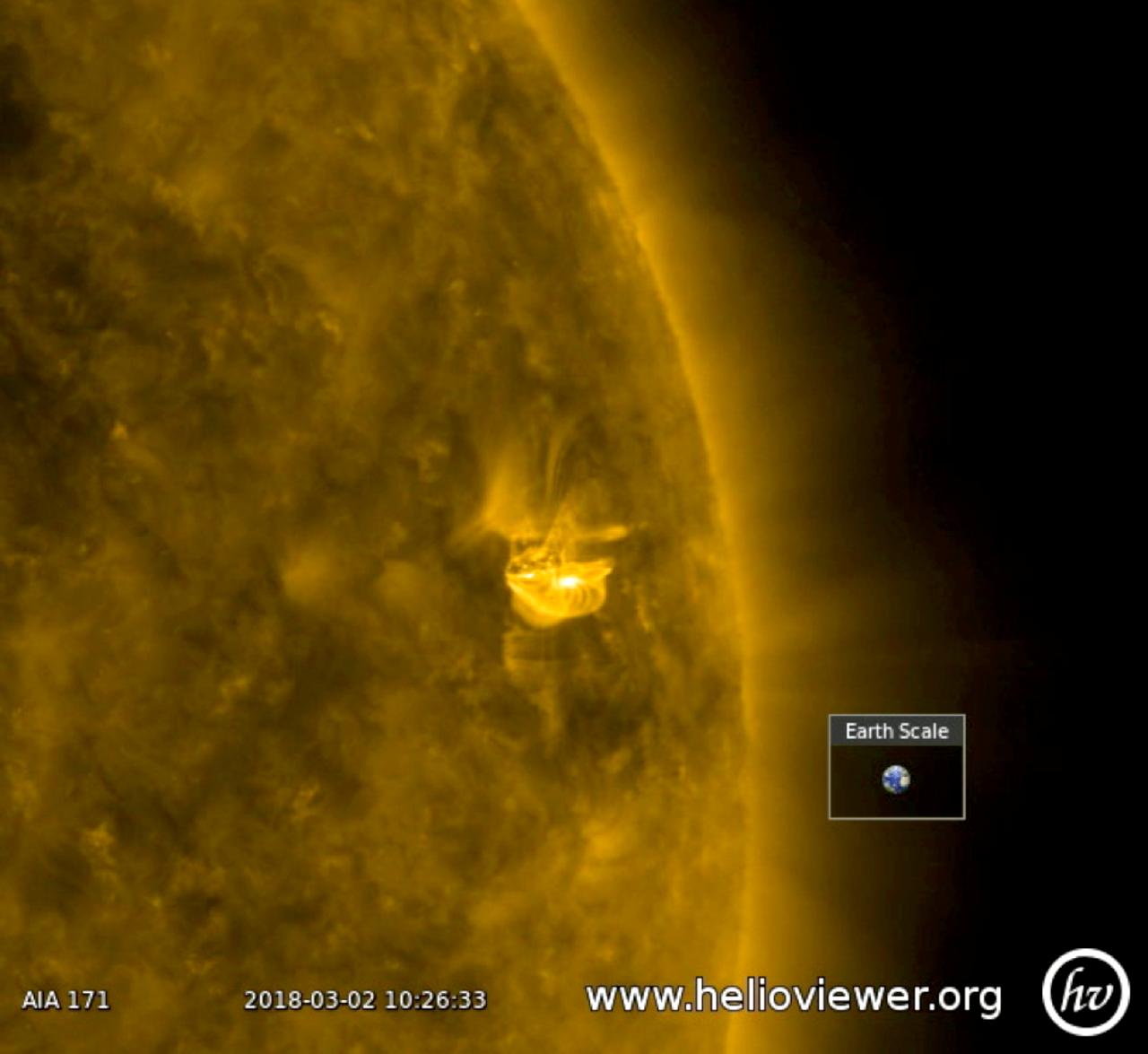
A relatively small active region erupted twice in 18 hours (Mar. 2, 2018). After each burst, one can see the magnetic fields lines, which appear as bright coils, spiraling around the region. They are reorganizing the disrupted magnetic field. The quick second when the screen goes black was caused by the Earth passing between the spacecraft and the sun. Images were taken in a wavelength of extreme ultraviolet light. The video was produced using the free Helioviewer software at Helioviewer.org. Videos are available at https://photojournal.jpl.nasa.gov/catalog/PIA22260
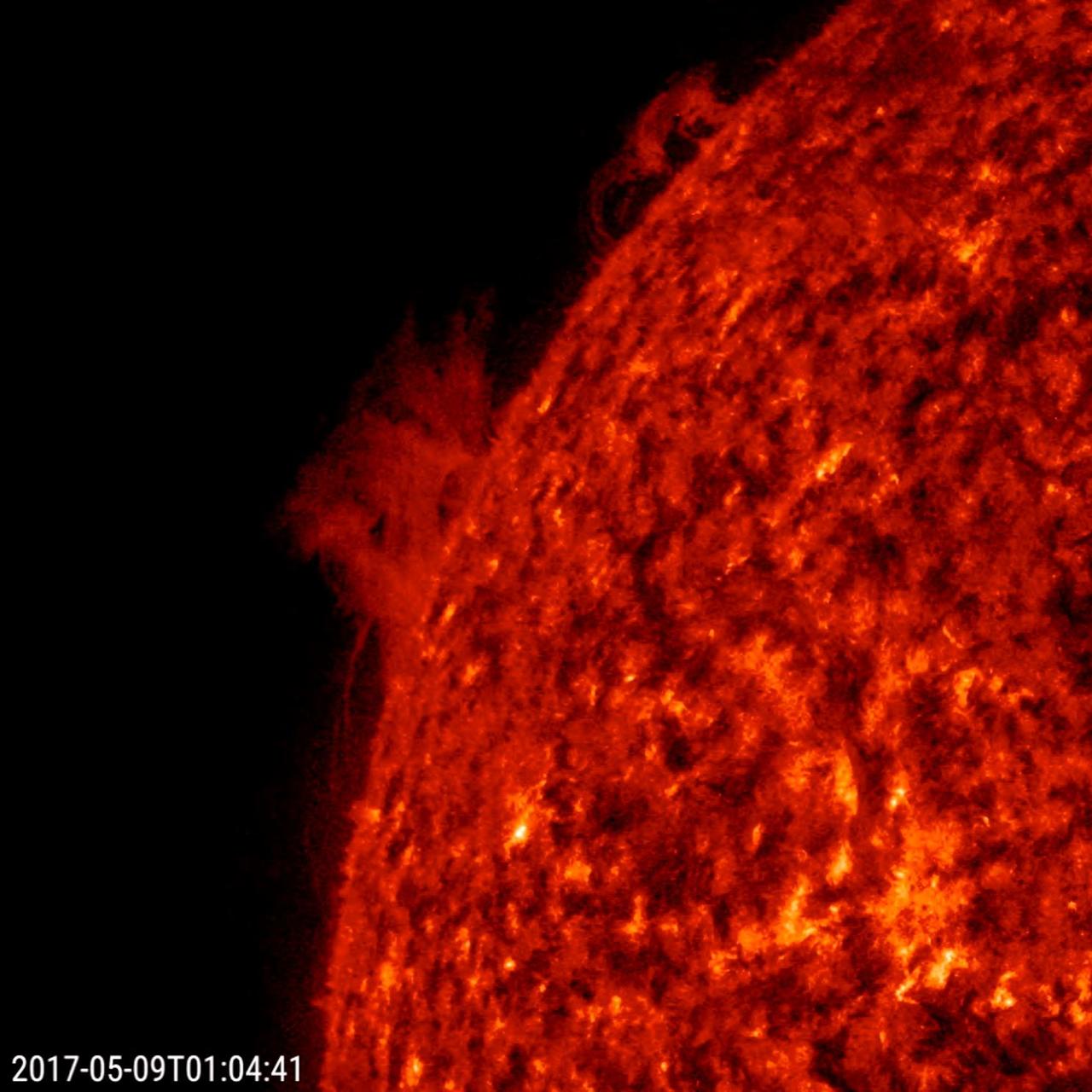
At the edge of the sun, a large prominence and a small prominence began to shift, turn and fall apart in less than one day (May 8-9, 2017). Prominences are notoriously unstable. Competing magnetic forces pulled the plasma back and forth until they dissipated. The images were taken in a wavelength of extreme ultraviolet light. The 18-second video clip is comprised of almost 600 frames being shown at 30 frames per second. Movies are available at https://photojournal.jpl.nasa.gov/catalog/PIA21634
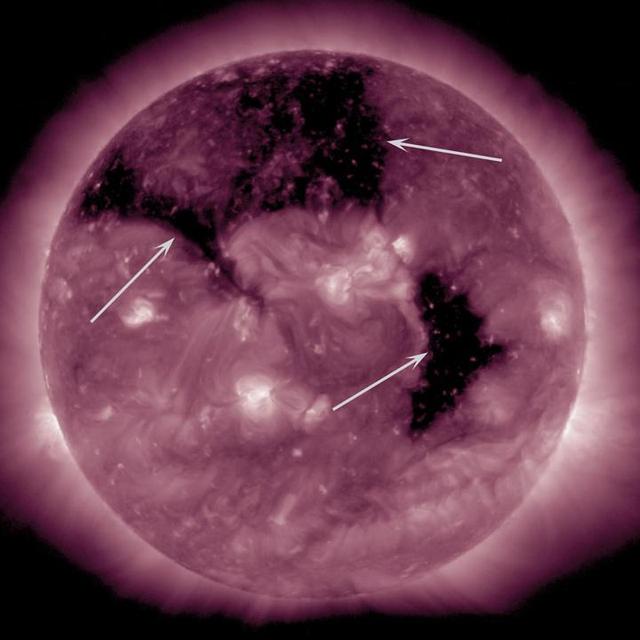
Three substantial coronal holes rotated across the face of the Sun the week of Sept. 8-10, 2015 as seen by NASA Solar Dynamics Observatory. Coronal holes are areas where the Sun magnetic field is open and a source of streaming solar wind. They appear darker in extreme ultraviolet light because there is less material in the hole areas being imaged in this specific wavelength of light. It is a little unusual to have three coronal holes at the same time, but neither is it a rare occurrence. http://photojournal.jpl.nasa.gov/catalog/PIA19950

The magnetic field lines between a pair of active regions formed a beautiful set of swaying arches rising up above them Apr. 24-26, 2017, as seen by NASA Solar Dynamics Observatory. The connection between opposing poles of polarity is visible in exquisite detail in this wavelength of extreme ultraviolet light. What we are really seeing are charged particles spinning along the magnetic field lines. Other field lines are traced as they reach out in other directions as well. Videos can be seen at https://photojournal.jpl.nasa.gov/catalog/PIA21604
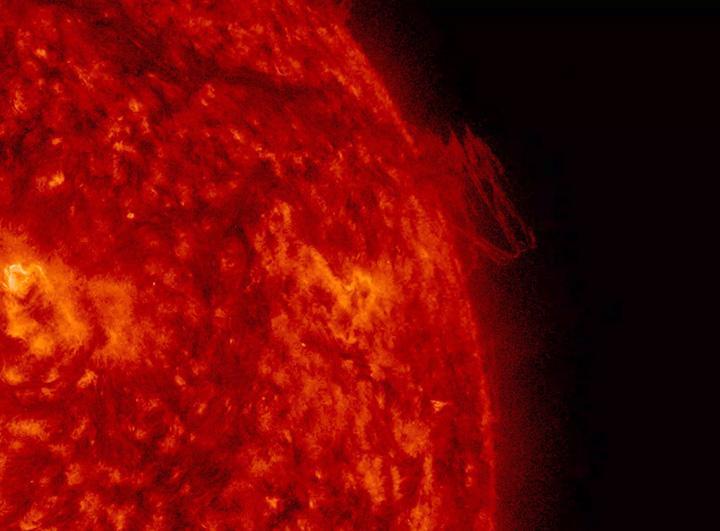
A close-up of twisting plasma above the Sun's surface produced a nice display of turbulence by caused combative magnetic forces (June 7-8, 2016) over a day and a half. The plasma does not break away, but just spins and twists the entire period. Images were taken in extreme ultraviolet light. The mass we observed is part of a longer, darkish filament angling down from the upper left of the frame. Filaments are unstable clouds of plasma suspended above the Sun by magnetic forces. http://photojournal.jpl.nasa.gov/catalog/PIA20739

This still image from an animation from NASA GSFC Solar Dynamics Observatory shows magnetically charged particles forming a nicely symmetrical arch at the edge of the Sun as they followed the magnetic field lines of an active region Aug.4-5, 2015. Before long the arch begins to fade, but a fainter and taller arch appears for a time in the same place. Note that several other bright active regions display similar kinds of loops above them. These images of ionized iron at about one million degrees were taken in a wavelength of extreme ultraviolet light. The video covers about 30 hours of activity. http://photojournal.jpl.nasa.gov/catalog/PIA19874
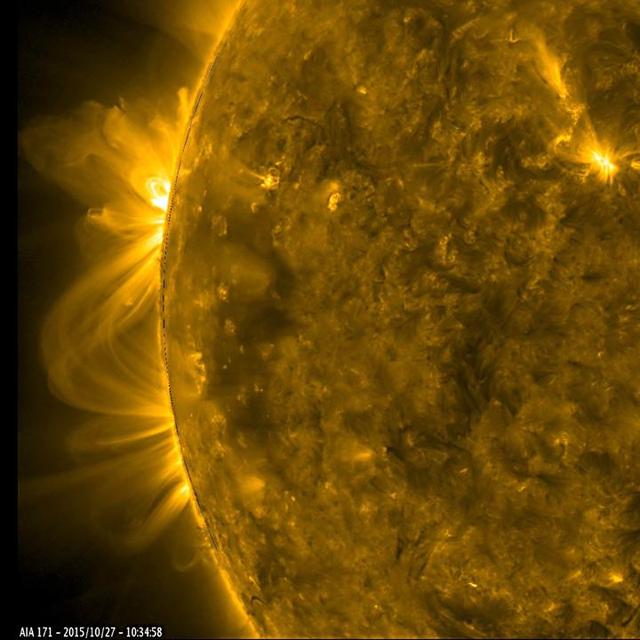
As a pair of active regions began to rotate into view, their towering magnetic field lines above them bloomed into a dazzling display of twisting arches (Oct. 27-28, 2015). Some of the lines reached over and connected with the neighboring active region. Active regions are usually the source of solar storms. The images were taken in a wavelength of extreme ultraviolet light. http://photojournal.jpl.nasa.gov/catalog/PIA20048
![For the first time in a long time the Sun has gone an entire month without any sunspots (Feb. 1-18, 2019). To put this in context, for five years (2011-2015) surrounding the latest solar maximum in March 2014 - the period when the Sun's magnetic activity is the most intense - there were only three days without any sunspots[MH1]. What a difference! The change in the level of activity during the Sun's average 11-year solar cycle is quite dramatic. We are probably not quite at the minimum level of activity yet, but are certainly getting close. The images were taken in filtered white (visible) light. Movies available at https://photojournal.jpl.nasa.gov/catalog/PIA21218](https://images-assets.nasa.gov/image/PIA21218/PIA21218~medium.jpg)
For the first time in a long time the Sun has gone an entire month without any sunspots (Feb. 1-18, 2019). To put this in context, for five years (2011-2015) surrounding the latest solar maximum in March 2014 - the period when the Sun's magnetic activity is the most intense - there were only three days without any sunspots[MH1]. What a difference! The change in the level of activity during the Sun's average 11-year solar cycle is quite dramatic. We are probably not quite at the minimum level of activity yet, but are certainly getting close. The images were taken in filtered white (visible) light. Movies available at https://photojournal.jpl.nasa.gov/catalog/PIA21218
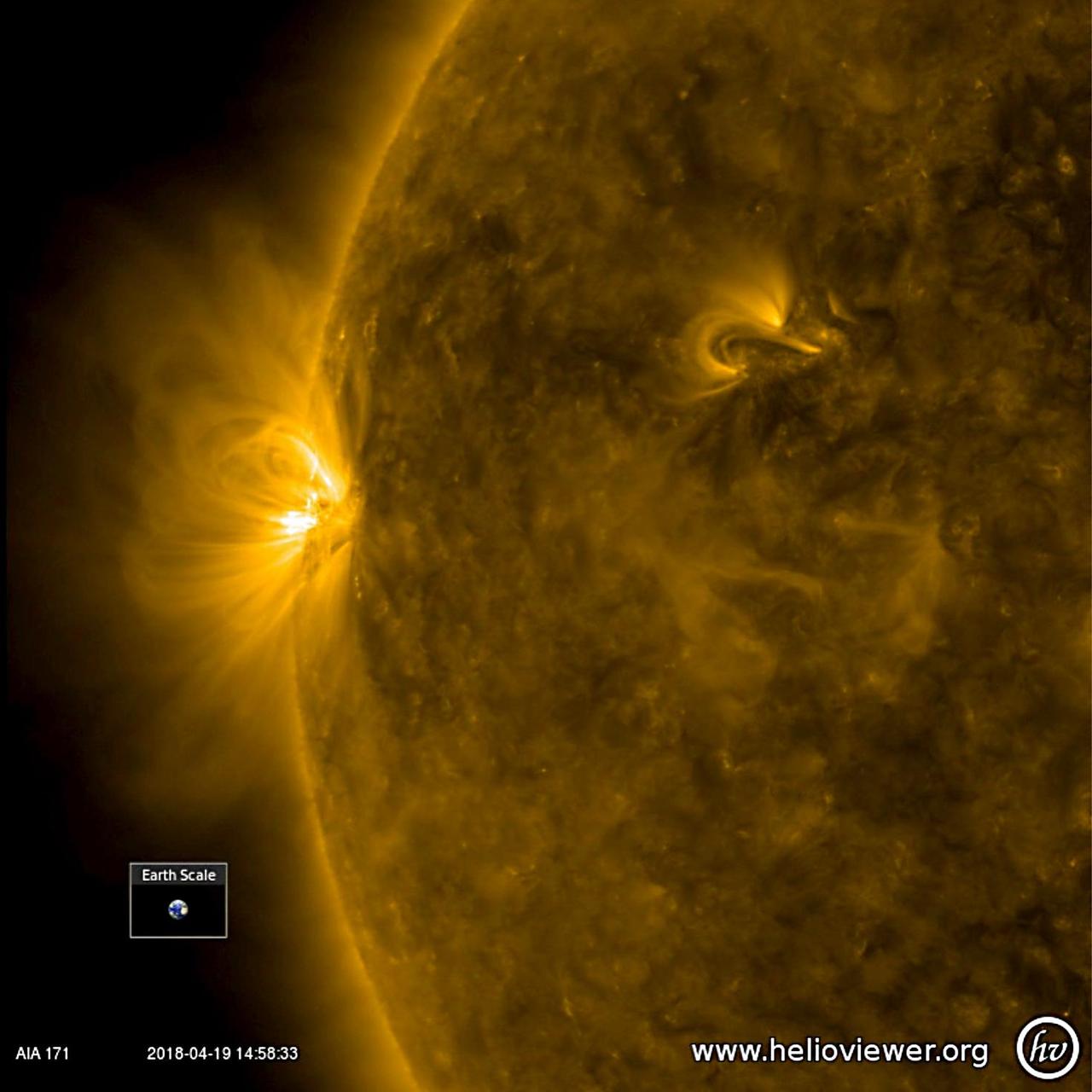
The sun featured just one, rather small active region over the past few days, but it developed rapidly and sported a lot of magnetic activity in just one day (Apr. 11-12, 2018). The activity was observed in a wavelength of extreme ultraviolet light. The loops and twisting arches above it are evidence of magnetic forces tangling with each other. The video clip was produced using Helioviewer software. Movies are available at https://photojournal.jpl.nasa.gov/catalog/PIA06676
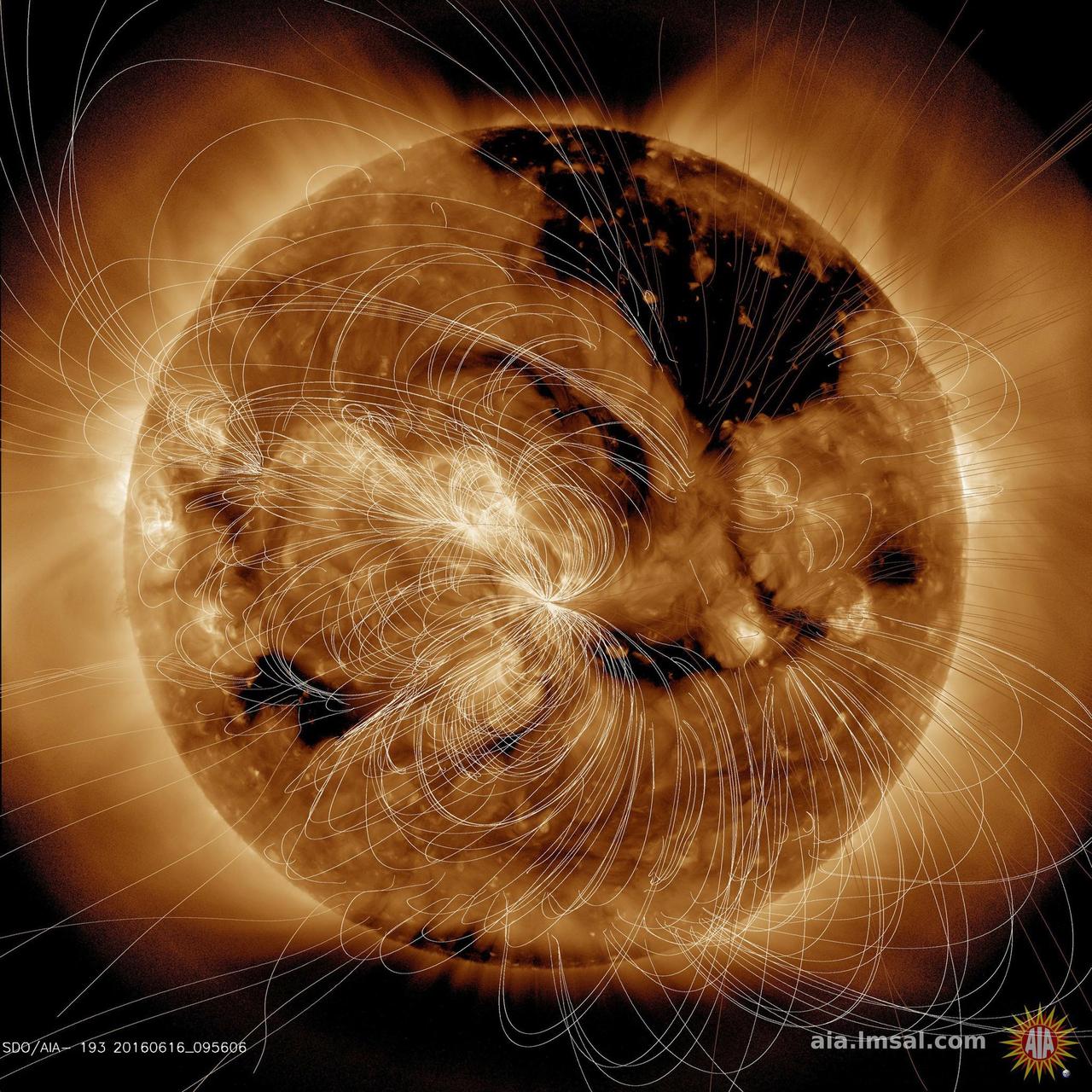
Each day NASA solar scientists produce overlays (in white lines) that show their estimation of how the magnetic field lines above the sun are configured (June16, 2016). In the video clip we show the sun in a wavelength of extreme ultraviolet light, then reveal the magnetic field line configuration in the same wavelength. Notice how the lines are tightly bundled near the lighter-toned active regions, which are magnetically intense regions. The magnetic lines from the darker areas, called coronal holes, open out into space and the extended lines show that. Our magnetically active sun is a dynamic body that changes all the time. Movie are also available at the Photojournal. http://photojournal.jpl.nasa.gov/catalog/PIA20881
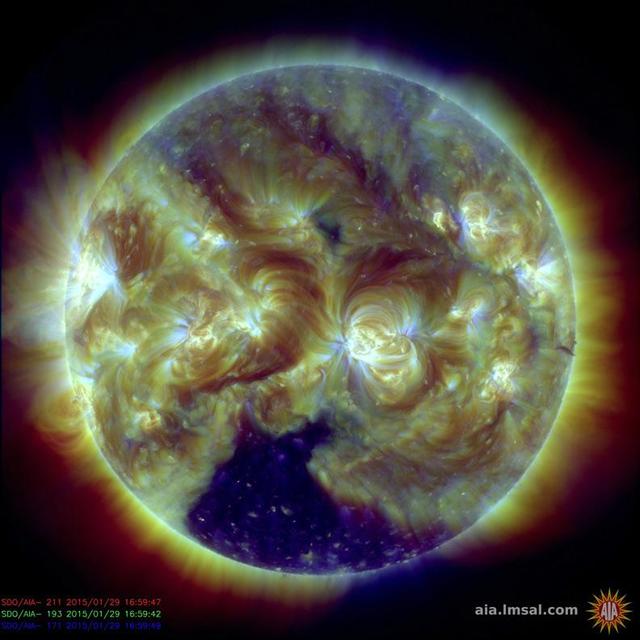
A large, dark coronal hole at the bottom of the Sun has been the most dominant feature this week Jan. 29, 2014 as seen by NASA GSFC Solar Dynamics Observatory.

Two solar prominences, directly at opposite sides of the Sun, rose up, twisted around, and fell apart at roughly the same time over a 26-hour period (Nov. 12-13, 2018). Prominences are cooler clouds of plasma suspended above the Sun by powerful magnetic forces. Although prominences are fairly common, it is uncommon to see two of them, about the same size, diametrically opposed to each other and lasting just about the same time. The images were taken in a wavelength of extreme ultraviolet light. Movie available at https://photojournal.jpl.nasa.gov/catalog/PIA18143
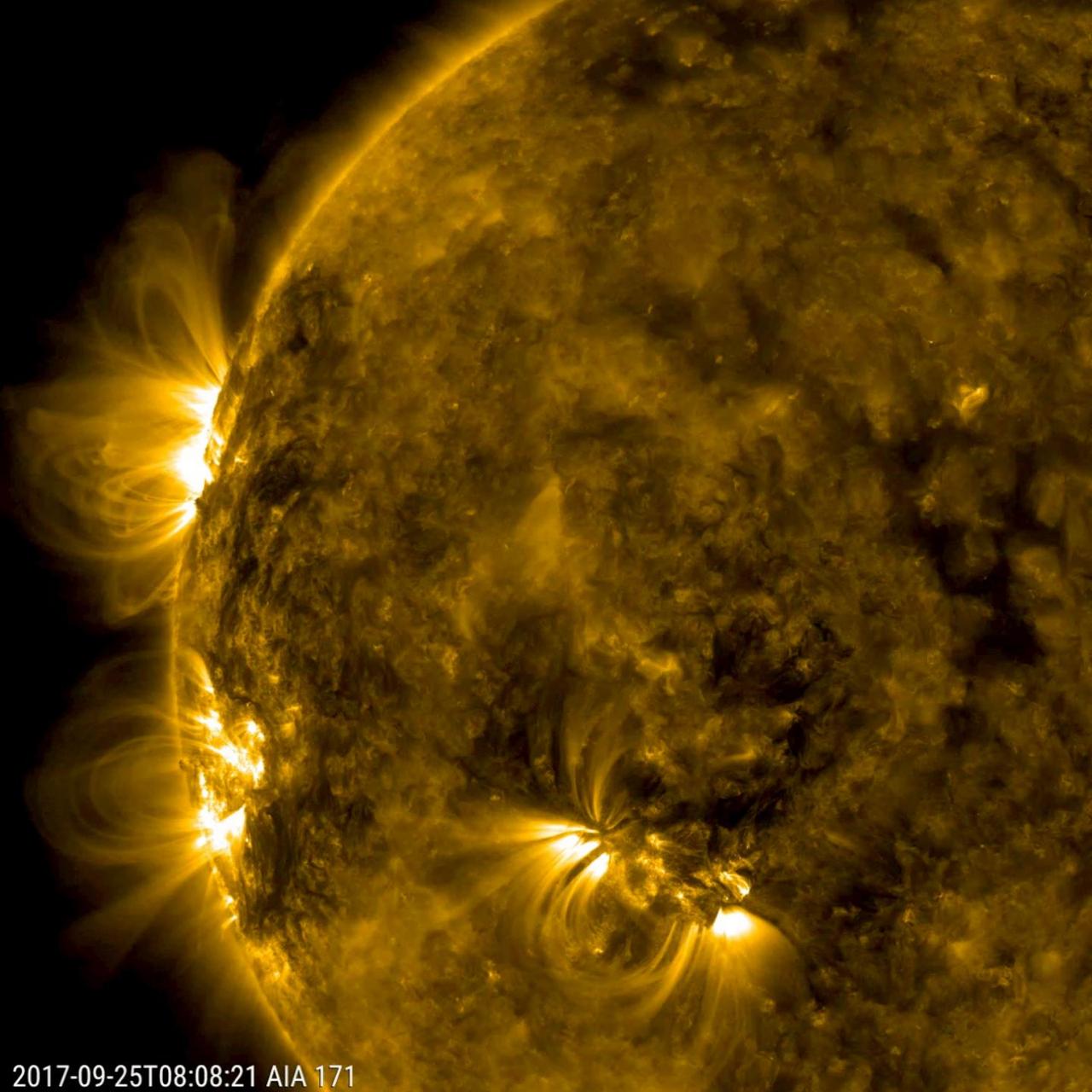
Three distinct active regions with towering arches above them rotated into view over a three-day period (Sept. 24-26, 2017). In extreme ultraviolet light, charged particles that are spinning along the ever-changing magnetic field lines above the active regions make the lines visible. To give some sense of scale, the largest arches rose up many times the size of Earth. Movies are available at https://photojournal.jpl.nasa.gov/catalog/PIA22038

Millions of excited people in the U.S. traveled many miles see a total eclipse, and what a show it was. The SDO spacecraft was not so fortunate: its orbit only allowed it to observe a partial eclipse that at its peak covered only about 14 per cent of the sun (Aug. 21, 2017). Most of the people in the U.S. (weather permitting) observed at least 60 per cent coverage of the sun by the Moon. The good news for SDO is that it gets to see partial and solar eclipses several times a year. So, it all kind of balances out, in a way. An animation is available at https://photojournal.jpl.nasa.gov/catalog/PIA21929
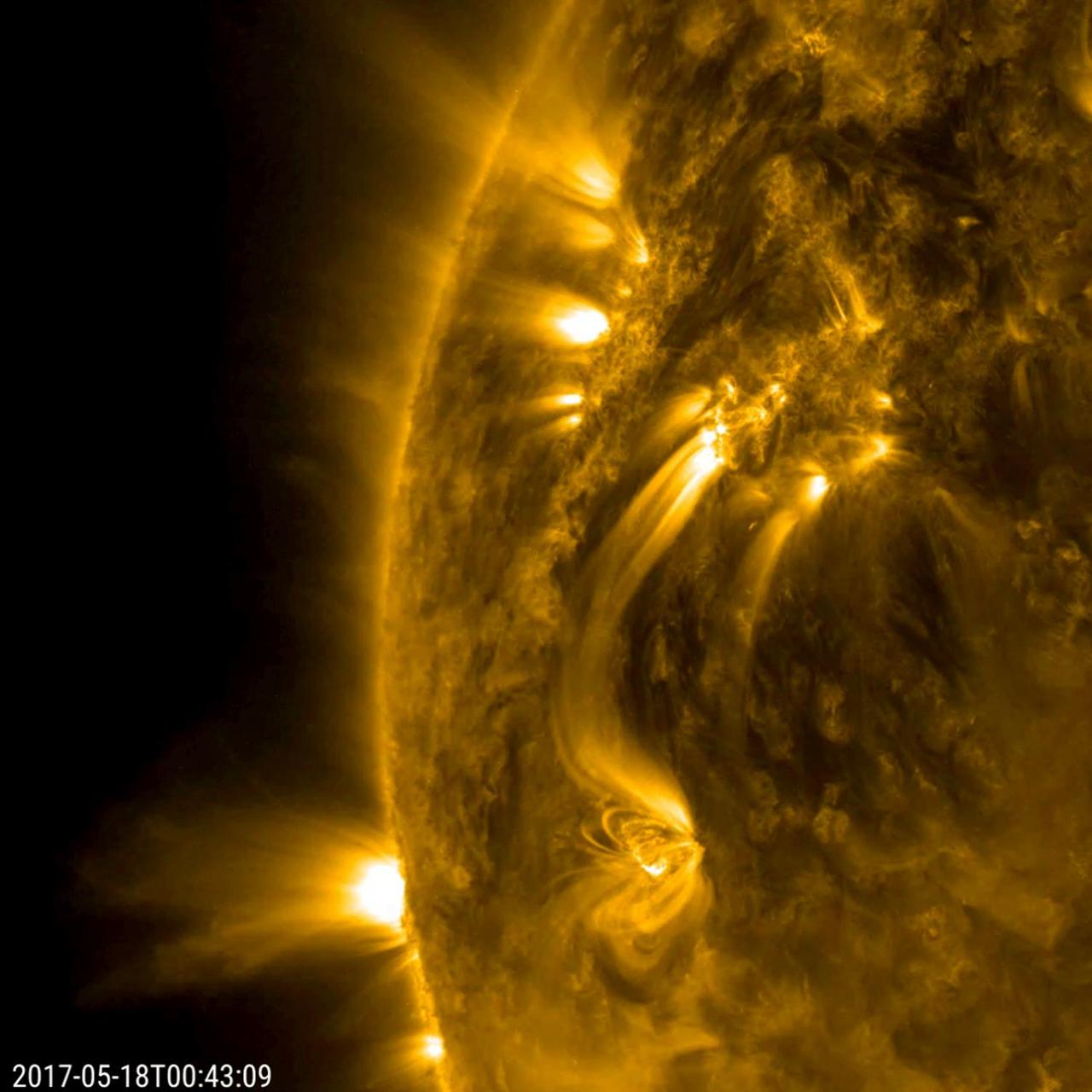
Several bright bands of plasma connect from one active region to another, even though they are tens of thousands of miles away from each other (May 17-18, 2017). Active regions are, by their nature, strong magnetic areas with north and south poles. The plasma consists of charged particles that stream along the magnetic field lines between these two regions. These connecting lines are clearly visible in this wavelength of extreme ultraviolet light. Other loops and strands of bright plasma can be seen rising up and out of smaller active regions as well. The video covers about one day's worth of activity. Movies are available at https://photojournal.jpl.nasa.gov/catalog/PIA21638

The Sun's rotation brought a new active region into view, revealing the dynamic arches and twisting streams of its magnetic field (Oct. 10-11, 2018). A new active region is becoming more of a rare sight, as the Sun is currently approaching solar minimum -- the point of the 11-year solar cycle when activity is most reduced. The video clip, showing images taken in a wavelength of extreme ultraviolet light covers 33 hours and consists of over 500 frames (i.e., one frame selected every 4 minutes). Animations are available at https://photojournal.jpl.nasa.gov/catalog/PIA18139
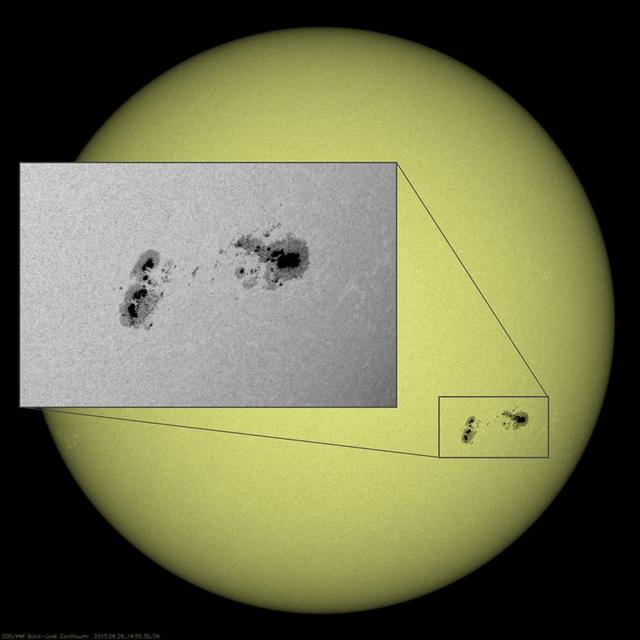
A large group of sunspots that rotated across the Sun over six days (Aug. 21-26, 2015) started out as a single cluster, but gradually separated into distinct groups. This region produced several M-class (medium-sized) flares. These were the only significant spots on the Sun during this period. The still image shows the separated group as it appeared on Aug. 26., 2015. http://photojournal.jpl.nasa.gov/catalog/PIA19876
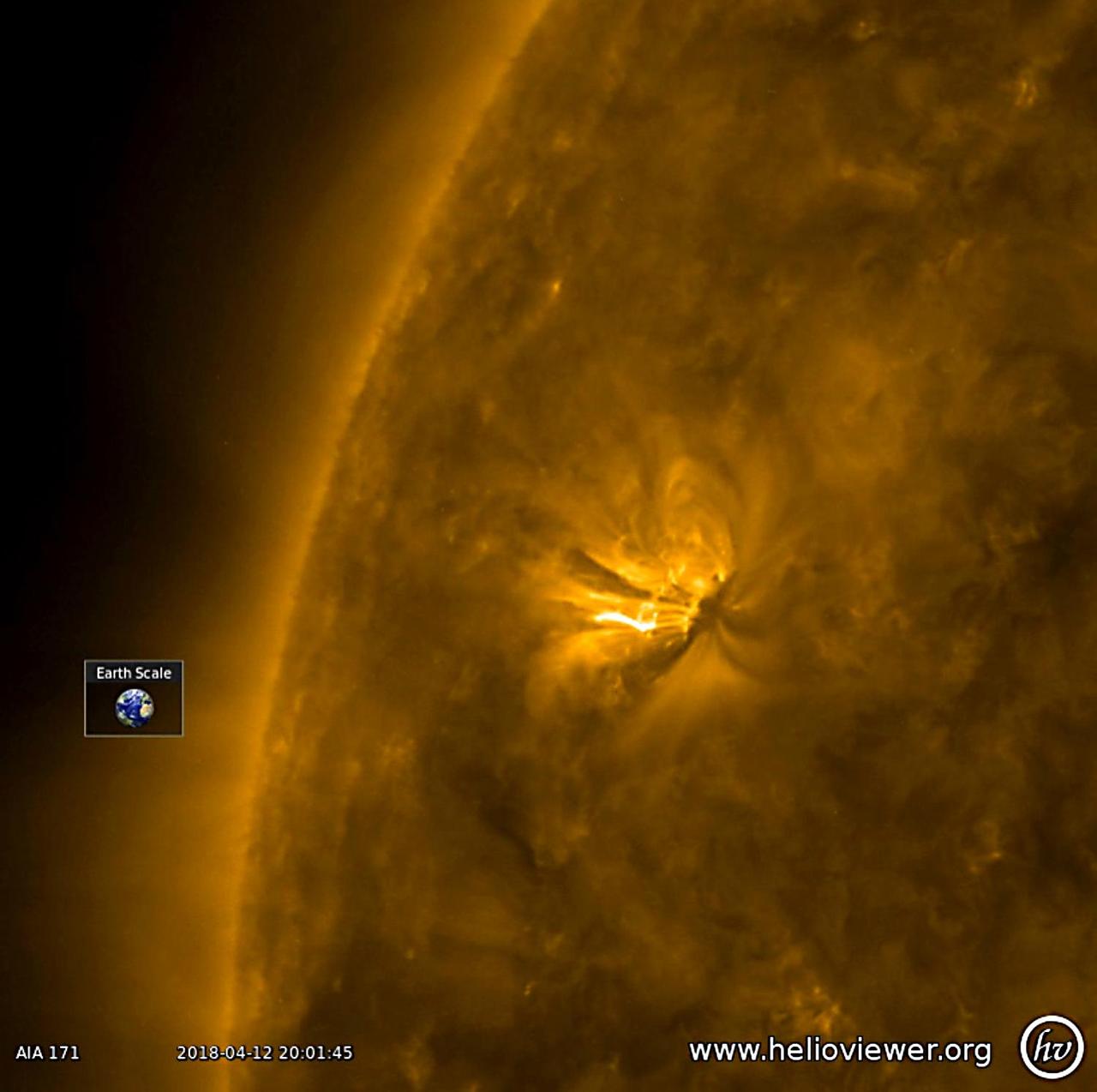
A good-sized active region with bright, towering arches began to rotate into view (Apr. 18-19, 2018). The arches consist of charged particles spiraling along magnetic field lines revealed in this wavelength of extreme ultraviolet light. They rise up above the sun's surface many times the size of Earth. The video covers just 16 hours of activity. We will keep our eyes on this region to see if it has the kind of dynamism to produce solar storms. Videos are available at https://photojournal.jpl.nasa.gov/catalog/PIA22430
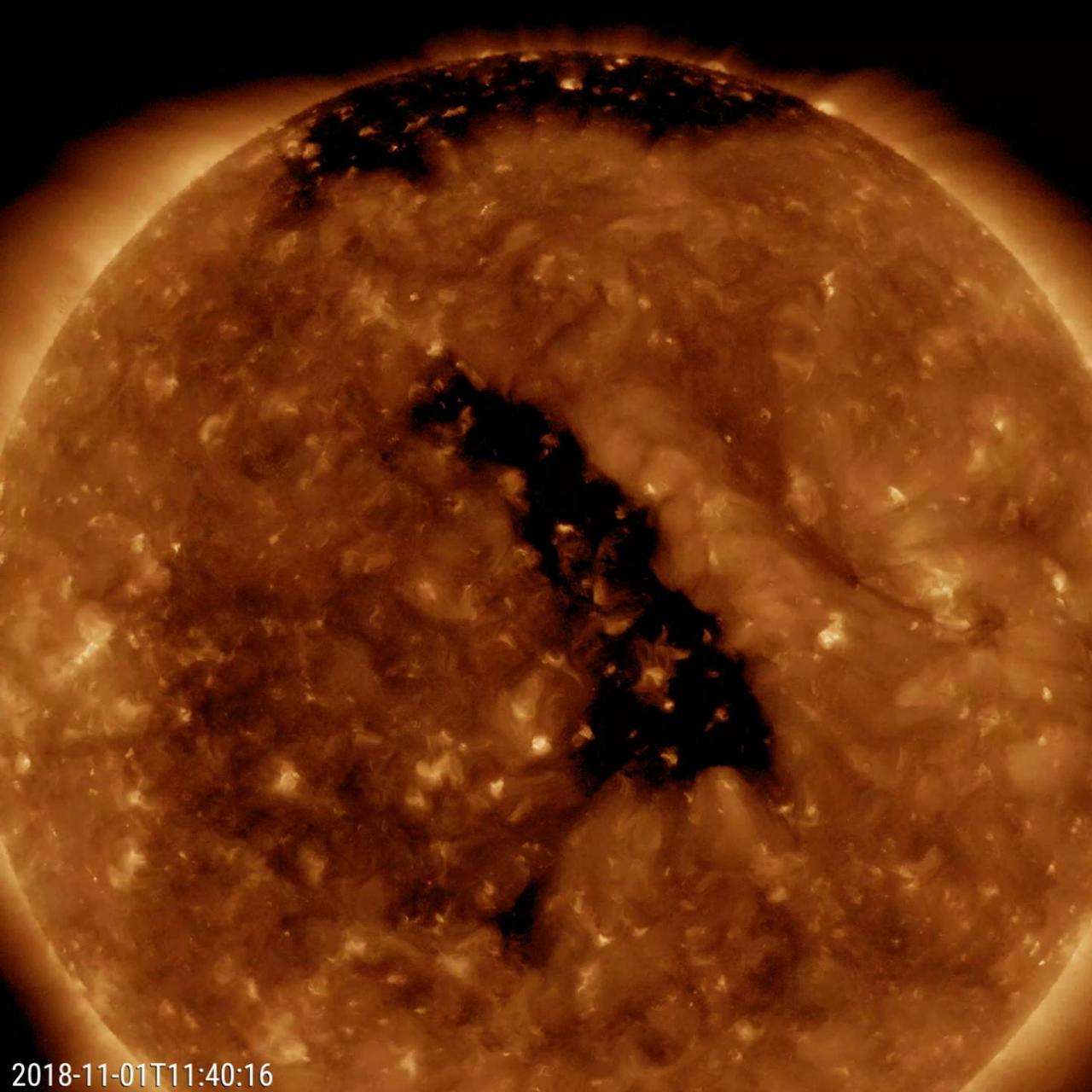
The most distinctive feature on the Sun this week was a good-sized coronal hole at a slanted angle nearly centered on the face of the sun (Oct. 31 - Nov. 2, 2018). Coronal holes are magnetically open areas from which solar wind particles speed into space. They appear darker in this wavelength of extreme ultraviolet light. If these particles impact Earth's magnetosphere, they will likely generate aurora near the Earth's poles regions. The video clip covers about two days of activity. Movies available at https://photojournal.jpl.nasa.gov/catalog/PIA18141
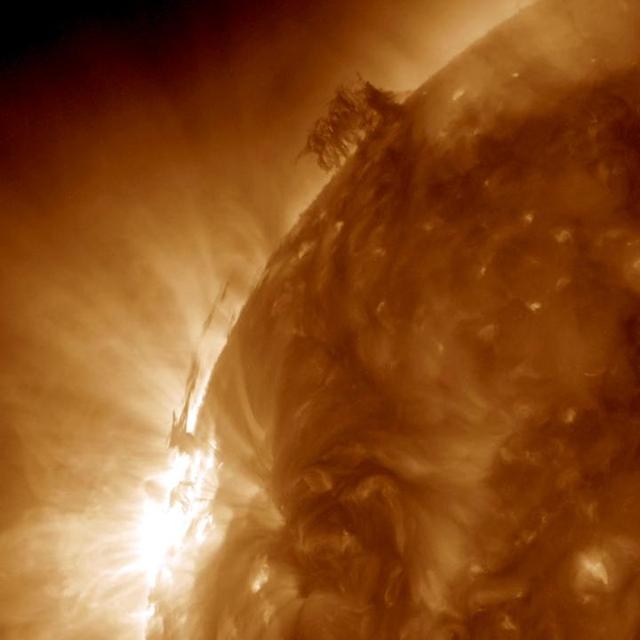
This still image from an animation from NASA GSFC Solar Dynamics Observatory shows dark strands of plasma hovering above the Sun surface beginning to interact with each other in a form of tug of war over two and a half days June 28-30, 2015.
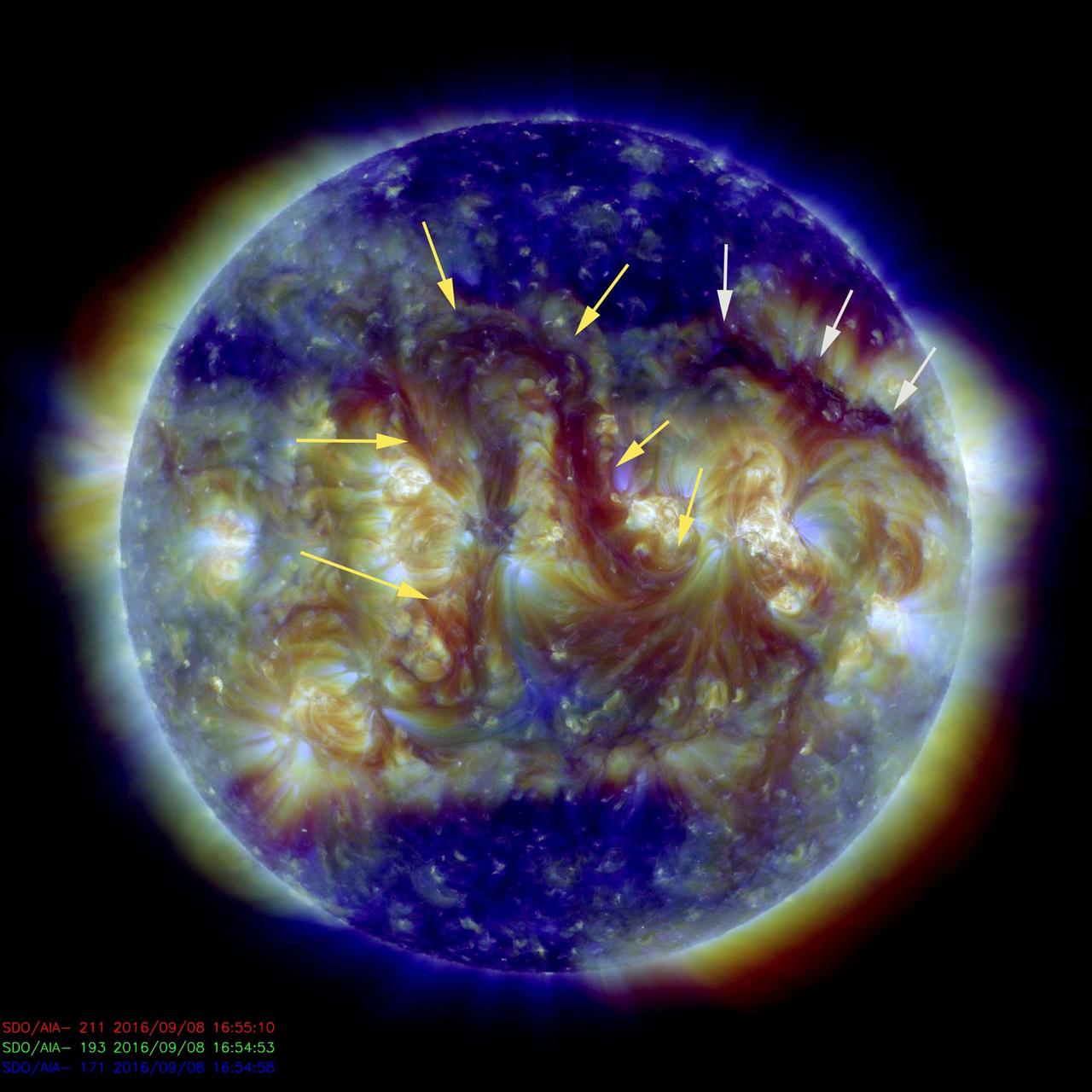
The two most noteworthy features on the sun this week were a pair of elongated filaments (Sept. 8, 2016). The central one was twisted into the shape of an elaborate arch at the center of the sun (yellow arrows). If this were straightened out, it would extend just about across the entire sun, almost a million miles (1.6 million Km). The other, smaller filament, (white arrows) if made straight, might reach about half that distance. Still, pretty impressive. Filaments are elongated strands of plasma suspended above the sun by magnetic forces. They are notoriously unstable and often break apart within a few days. The image was made by combining three images in different wavelengths of extreme ultraviolet light http://photojournal.jpl.nasa.gov/catalog/PIA16996
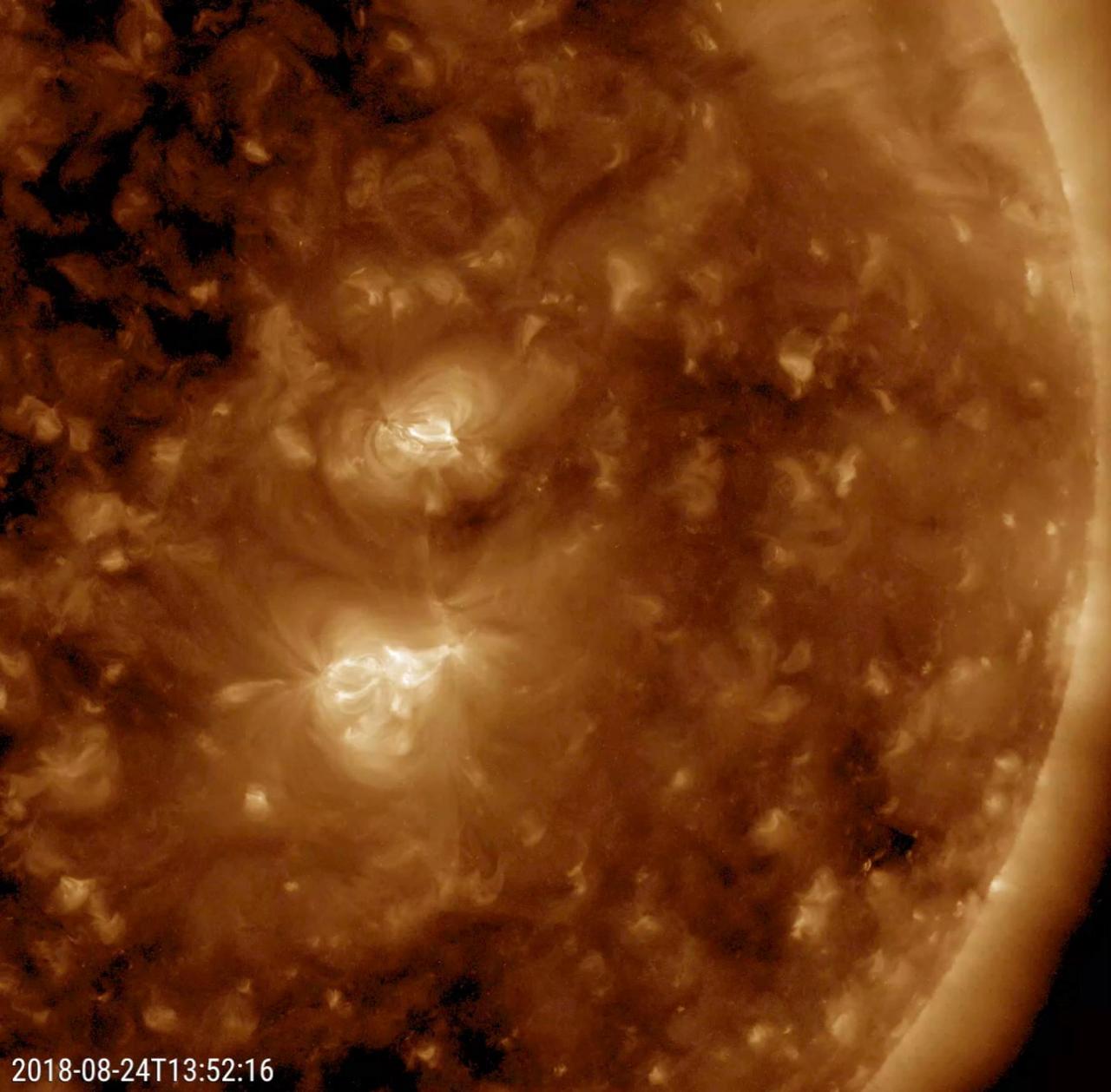
Over the course of just one day a tiny active region grew to became almost as large as its many-days-old neighbor (Aug. 23-24, 2018). Active regions, which are areas of intense magnetism, appear brighter in wavelengths of extreme ultraviolet light and are often the source of solar storms. Movies are available at https://photojournal.jpl.nasa.gov/catalog/PIA22680
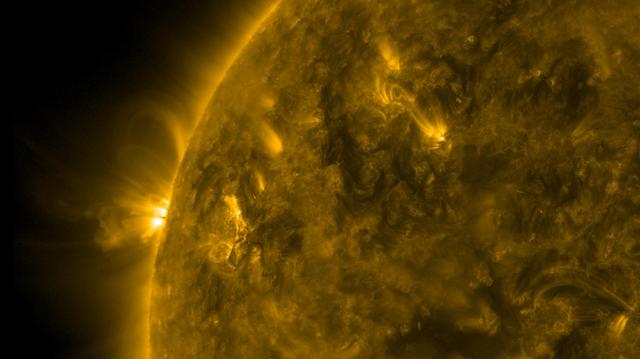
As an active region rotated into view, NASA Solar Dynamics Observatory was able to observe well-defined magnetic loops gyrating above the sun between Mar, 23-24, 2017. These loops appear because charged particles spinning along the magnetic field lines above this active region are made visible in this wavelength of extreme ultraviolet light. The video clip covers about a day and a half of activity. Movies are available at https://photojournal.jpl.nasa.gov/catalog/PIA21583
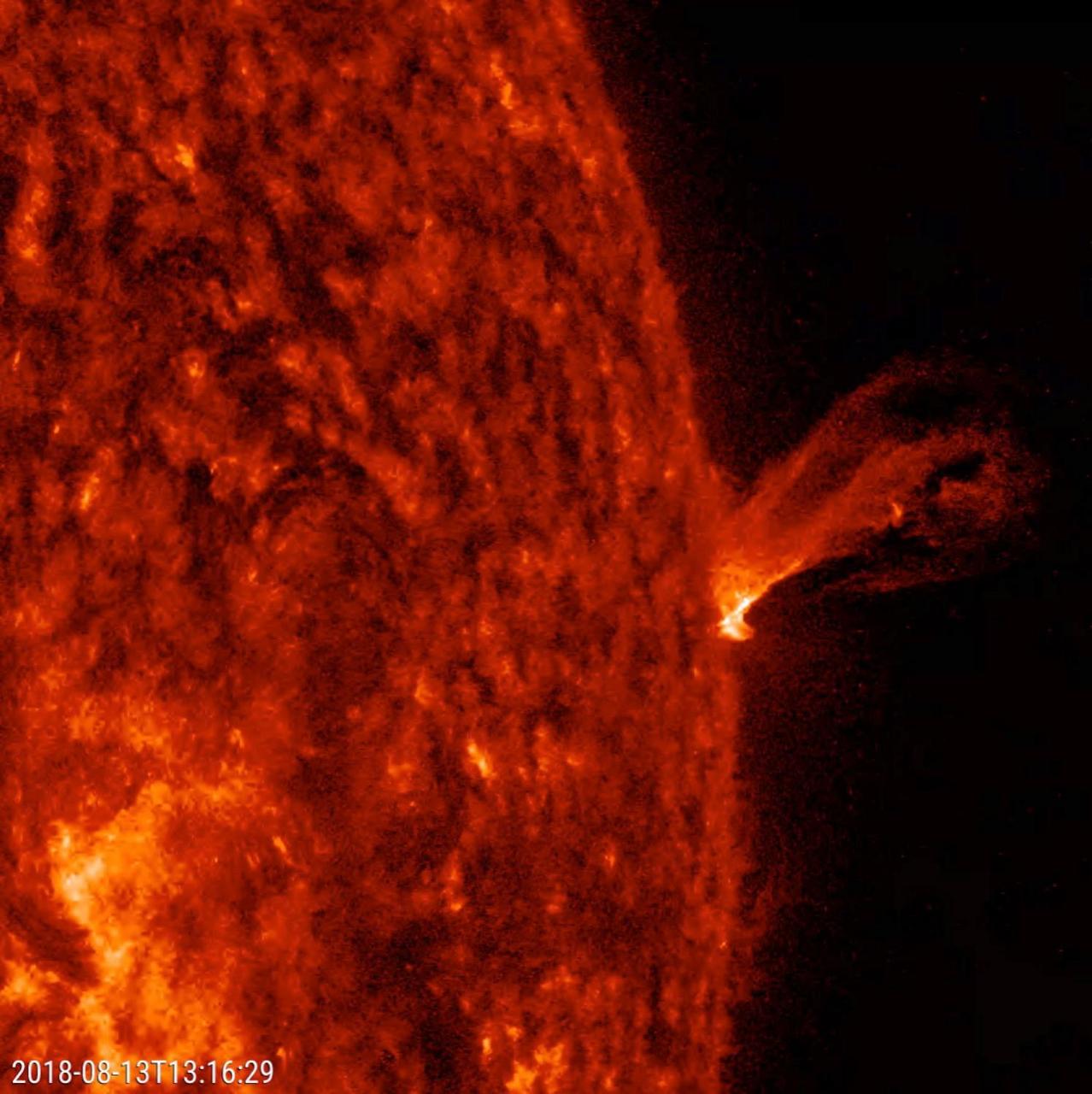
This close-up of the Sun from a two-hour period on Aug. 13, 2018 shows a minor eruption of charged particles rising up and twisting about before falling back into the Sun. Imaged in extreme ultraviolet light, these kinds of events are difficult to see except when they occur along the sun's edge, also known as the limb. At its peak the plasma rises several times the diameter of Earth. Movies are available at https://photojournal.jpl.nasa.gov/catalog/PIA22673
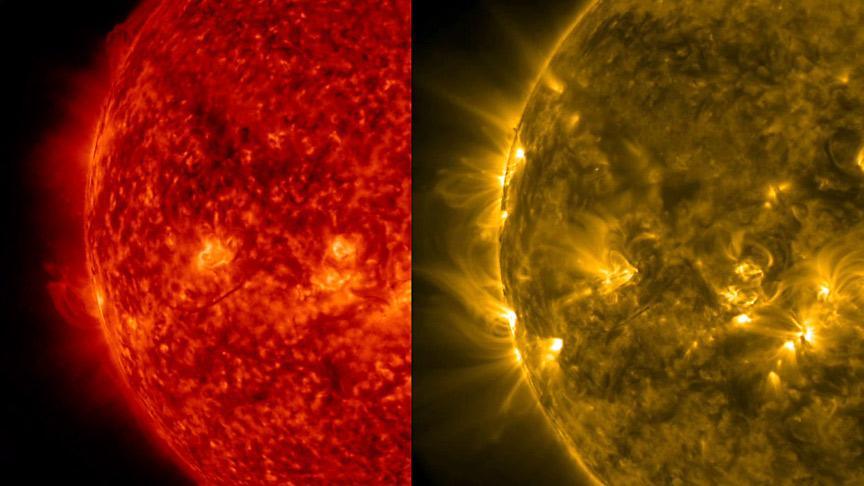
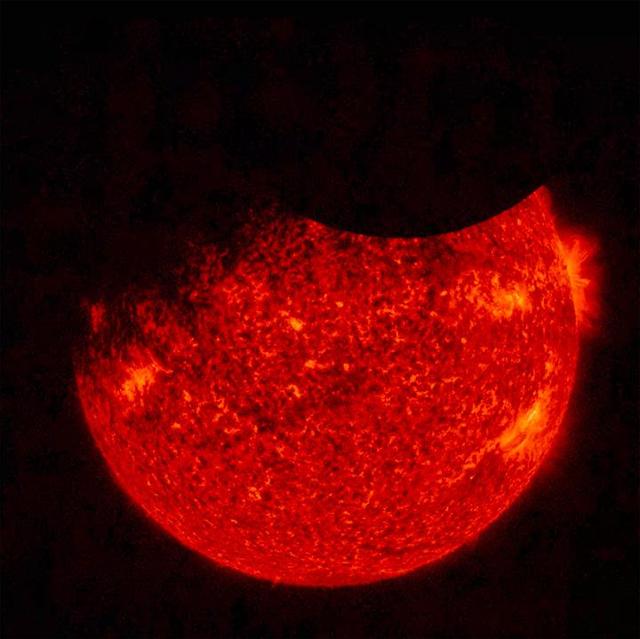
This side-by-side rendering of the Sun at the same time in two different wavelengths of extreme ultraviolet light helps to visualize the differing features visible in each wavelength (Dec. 10-11, 2015). Most prominently, we can see much finer strands of plasma looping above the surface in the 171 Angstrom wavelength (gold) than in the 304 Angstrom wavelength (red), which captures cooler plasma closer to the Sun's surface. SDO observes the Sun in 10 different wavelengths with each one capturing somewhat different features at various temperatures and elevations above the Sun. http://photojournal.jpl.nasa.gov/catalog/PIA20214
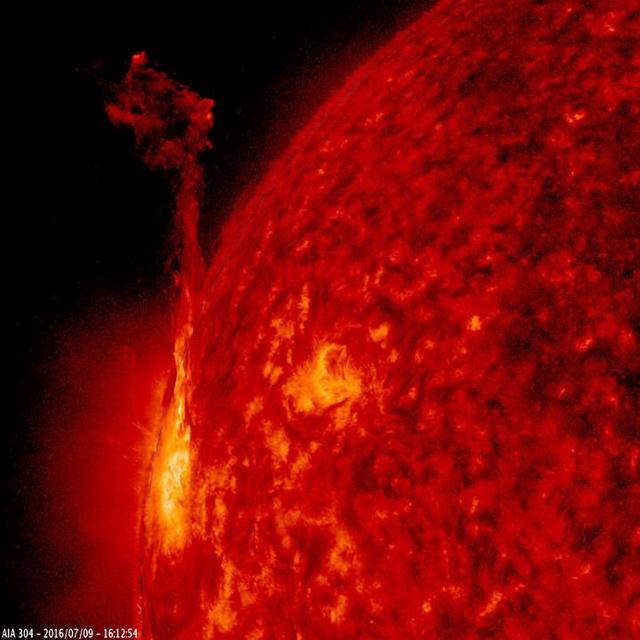
One active region at the edge of the Sun pushed out about ten thrusts of plasma in just over a day long period (July 9-10, 2016). All of them, propelled by magnetic forces, quickly withdrew back into the active region. The images were taken in a wavelength of extreme ultraviolet light. Movies are also available at the Photojournal. http://photojournal.jpl.nasa.gov/catalog/PIA20883
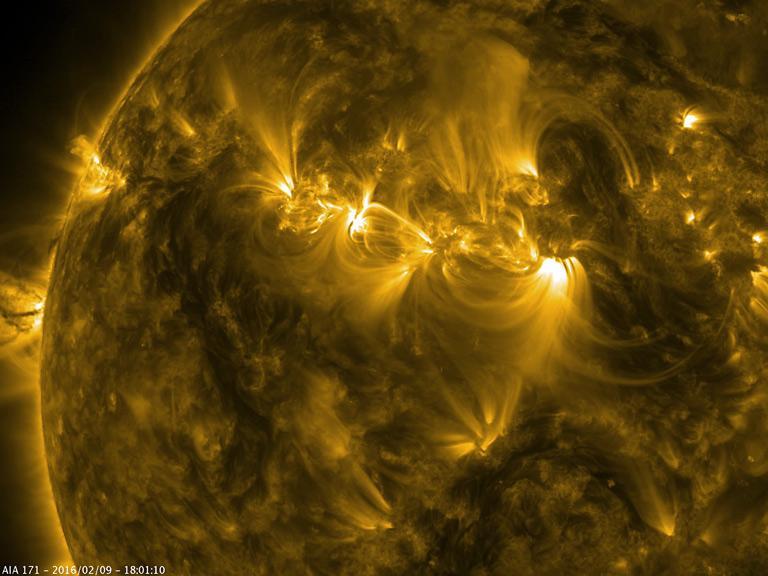
The magnetic field lines of three active regions in close proximity to one another interacted with each other over two and a half days Feb. 8-10, 2016. This image is from NASA Solar Dynamics Observatory.
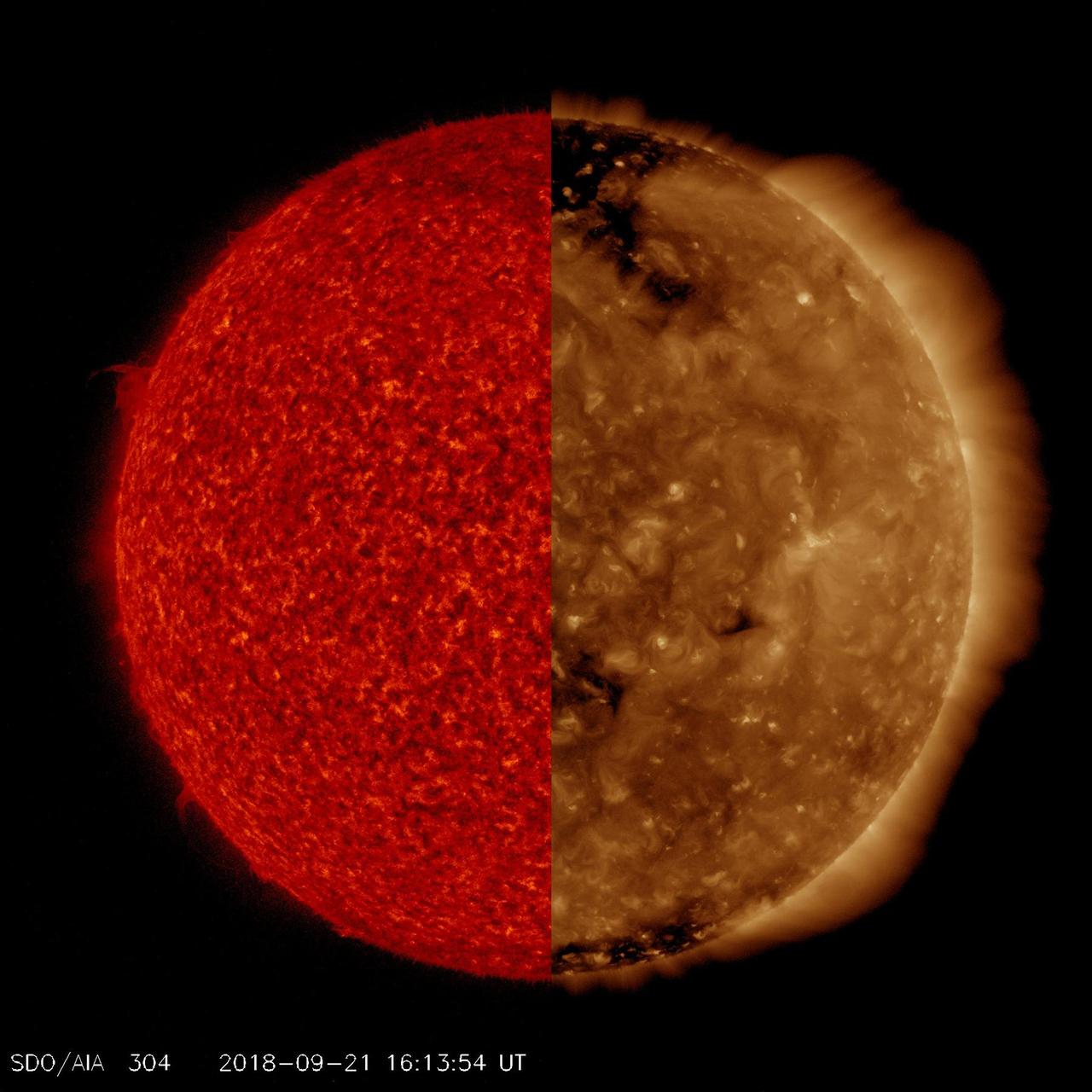
NASA's Solar Dynamics Observatory observes the Sun in ten different wavelengths because each wavelength reveals different solar features. Here, we have selected two images taken at virtually the same time but in different wavelengths of extreme ultraviolet light. The red tinted image, which captures material not far above the Sun's surface, is especially good for revealing details along the edge of the Sun, like the small prominence at the ten o'clock position. The brown tinted image clearly shows two large coronal holes (darker areas) as well as some faint magnetic field lines and hints of solar activity (lighter areas), neither of which are apparent in the red image. This activity is occurring somewhat higher in the Sun's corona. In a way it is like peeling away the layers of an onion, a little at a time. Animations are available at https://photojournal.jpl.nasa.gov/catalog/PIA22724
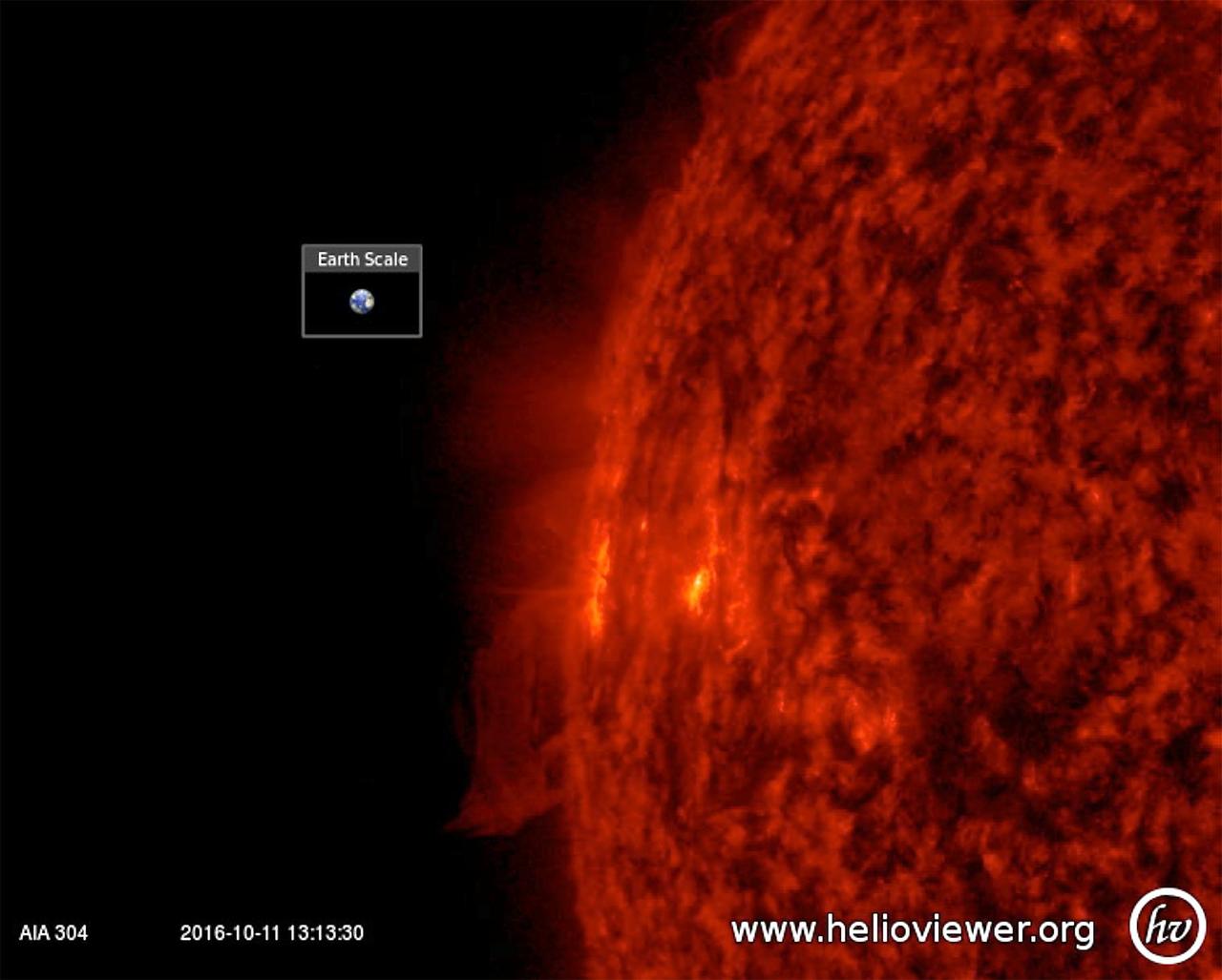
An active region just rotating into view gave us a perfect view of the tussle of magnetic field lines above it (Oct. 10-11, 2016). The particles spiraling along the magnetic field lines become visible in extreme ultraviolet light, helping us to see the struggle going on. There were no eruptions during this period, although active regions are usually the source for solar storms. The video clip covers just one day's worth of activity. Movies are available at http://photojournal.jpl.nasa.gov/catalog/PIA21109
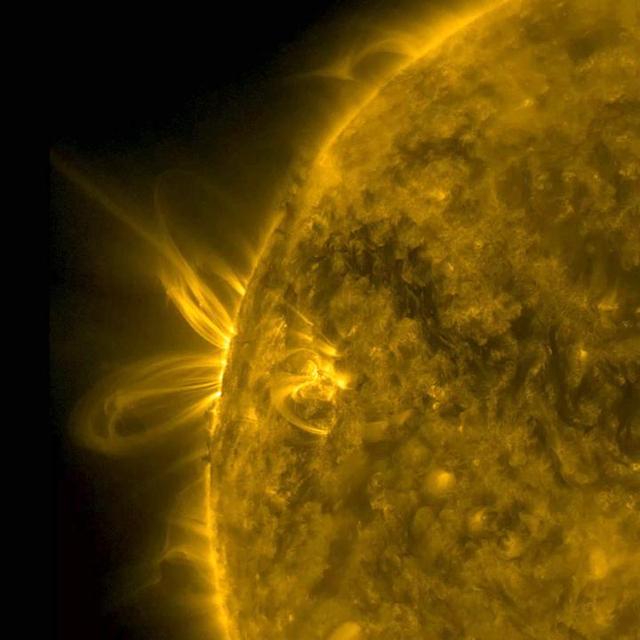
Several arcing loops rotated into view and swirled above an active region, which gave us a nice profile view of the action (June 26-27, 2016). The arcing plasma is tracing magnetic field lines extending out from the active region. Some darker matter also jiggled back and forth near the active region as well, pulled about by magnetic forces. At one point a lick of plasma pushed its way out from the region but quickly fell back into the sun. The images were taken in a wavelength of extreme ultraviolet light. Movies are also available at the Photojournal. http://photojournal.jpl.nasa.gov/catalog/PIA20882

A prominence observed along the right edge of the sun rose up and then most of it bent back down to the surface (Oct. 4, 2016). Prominences are clouds of plasma, usually elongated, that are suspended above the sun by magnetic forces. They are notably unstable. A review of SOHO's coronagraph videos shows that some of the particles did break away into space. The video clip, which covers eight hours of activity, was taken in a wavelength of extreme UV light. Movies are available at http://photojournal.jpl.nasa.gov/catalog/PIA21106
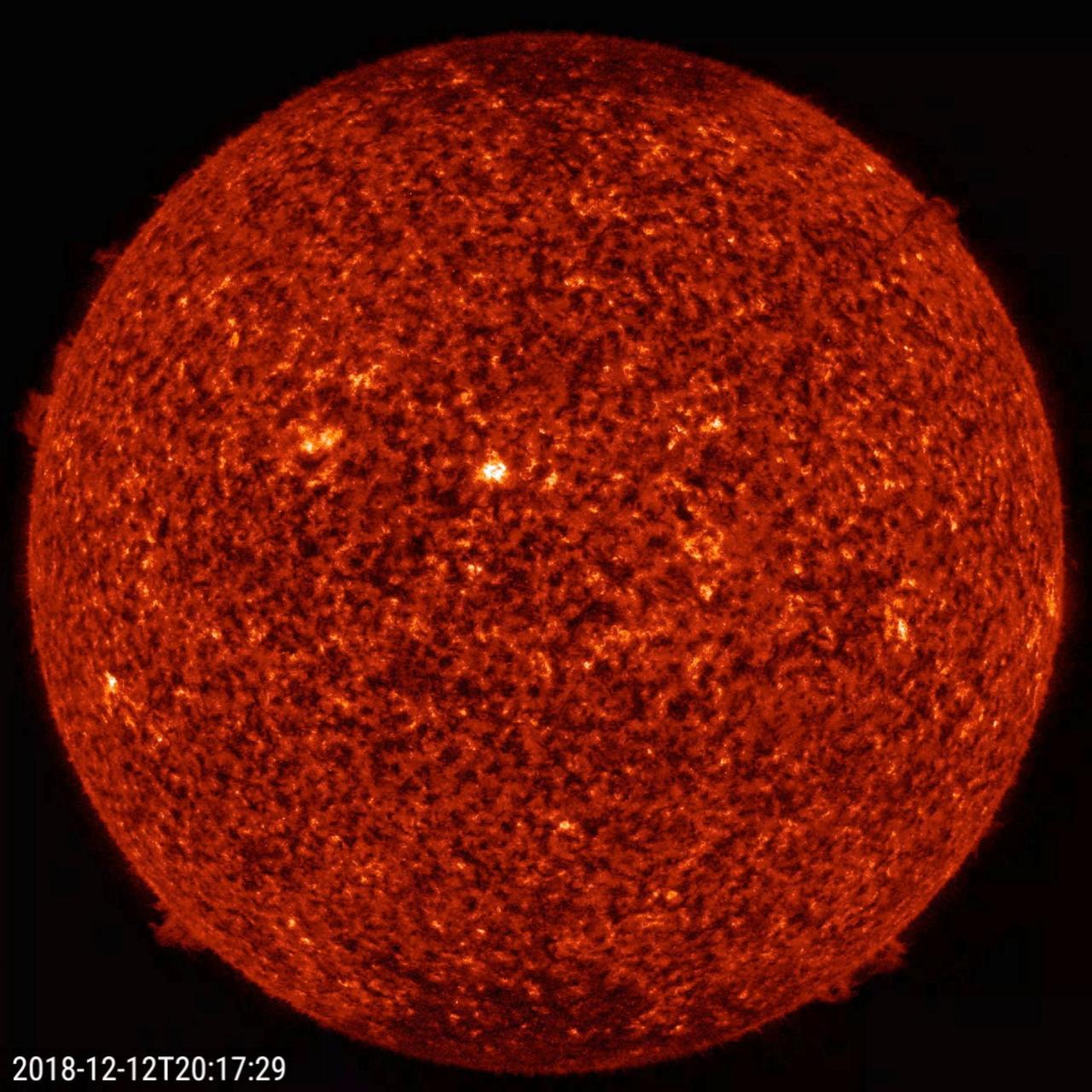
The sun sported four smallish prominences along its edge at about the same time (Dec. 12-14, 2018). They were at the positions of 2 o'clock, 5 o'clock, 7 o'clock, and 10 o'clock. The largest and most active of the prominences was at the 7 o'clock point. Prominences are clouds of charged particles suspended above the sun by magnetic forces. These were observed in a wavelength of extreme ultraviolet light. The video clip covers almost two days' of activity: it consists of 335 frames being shown at 20 frames per second. Movies available at https://photojournal.jpl.nasa.gov/catalog/PIA21212
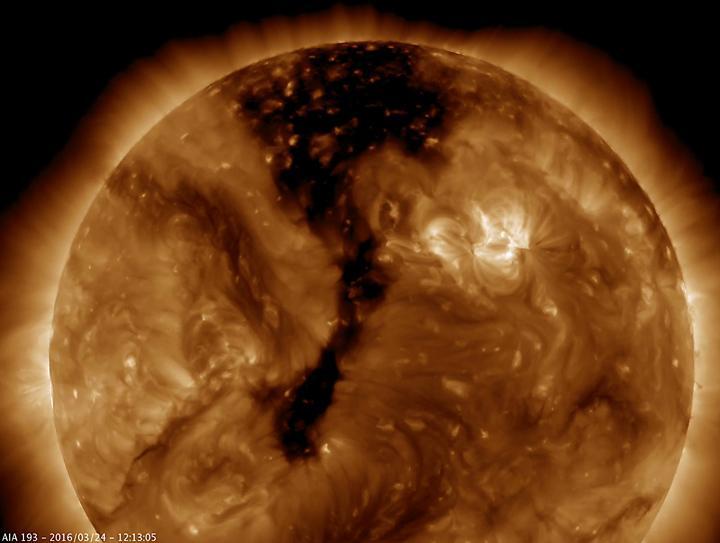
NASA Solar Dynamics Observatory shows a long coronal hole has rotated so that was temporarily facing right towards Earth Mar. 23-25, 2016. Coronal holes appear dark when viewed in some wavelengths of extreme ultraviolet light.
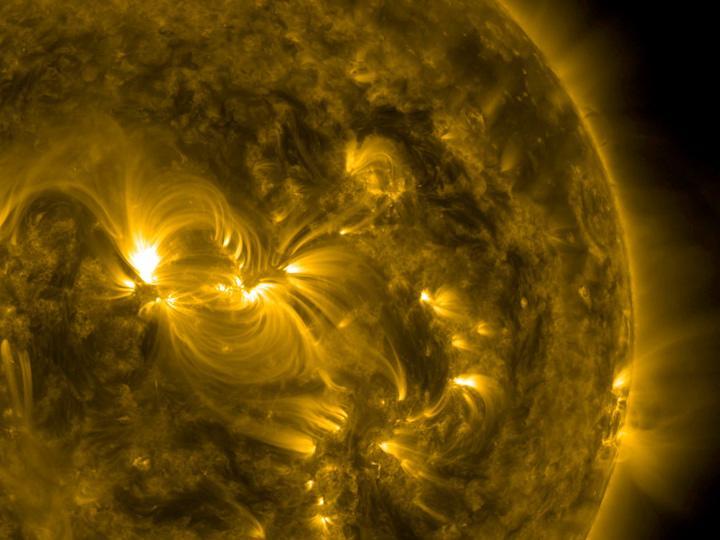
One broad active region sported a wonderful example of coiled magnetic field lines over almost a four-day period (July 15-18, 2016). The magnetic lines are easily visible in this 171 Angstrom wavelength of extreme ultraviolet light be cause charged particles are spiraling along the lines. The active region is a hotbed of struggling magnetic forces that were pushing out above the sun's surface. http://photojournal.jpl.nasa.gov/catalog/PIA17911
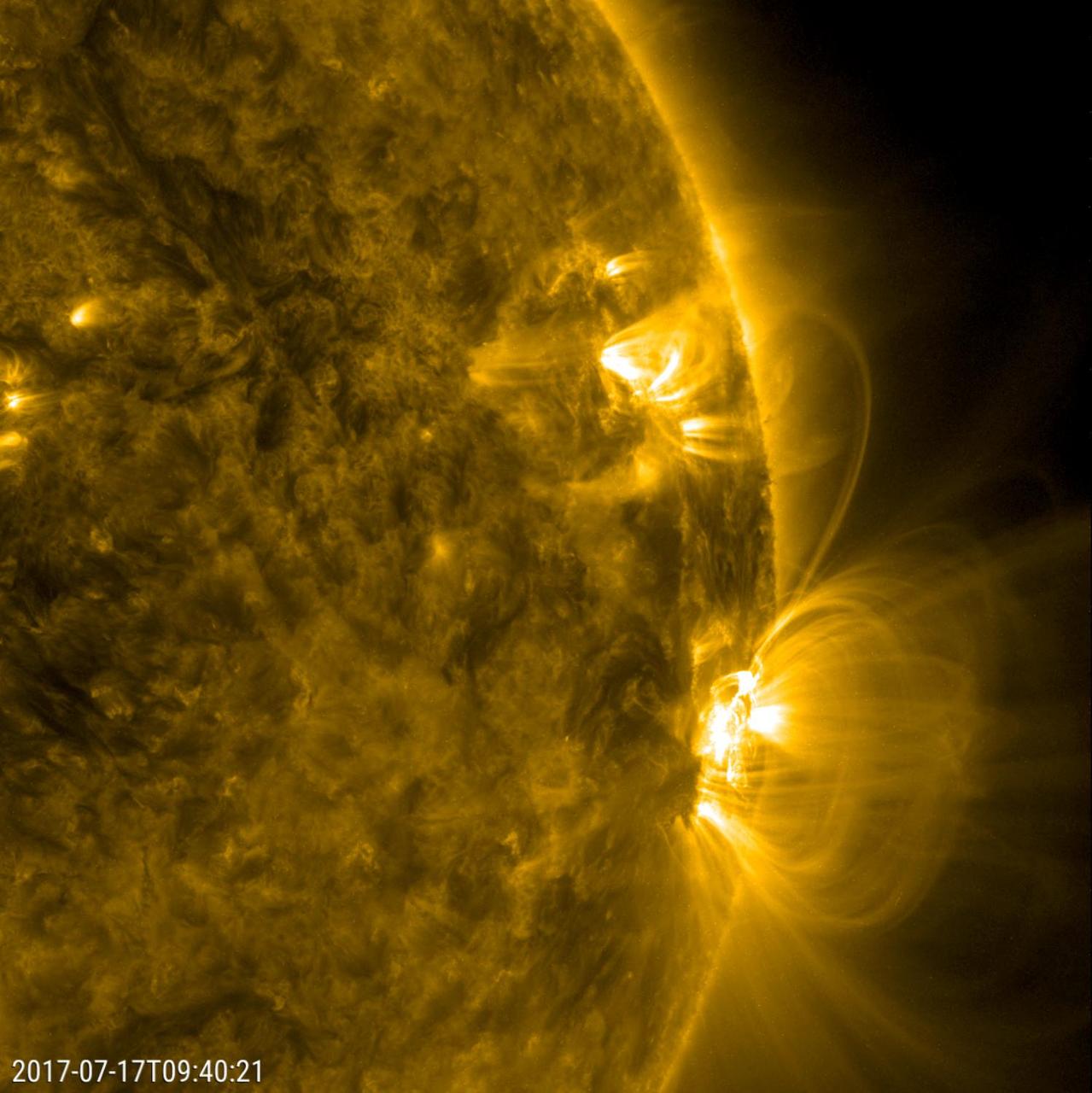
Numerous arches of magnetic field lines danced and swayed above a large active region over about a 30-hour period (July 17-18, 2017). We can also see the magnetic field lines from the large active region reached out and connected with a smaller active region. Those linked lines then strengthened (become brighter), but soon began to develop a kink in them and rather swiftly faded from view. All of this activity is driven by strong magnetic forces associated with the active regions. The images were taken in a wavelength of extreme ultraviolet light. https://photojournal.jpl.nasa.gov/catalog/PIA21838
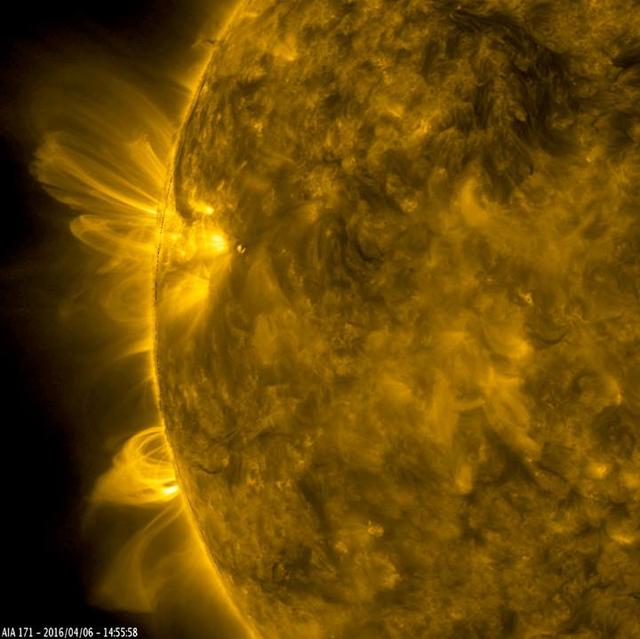
This still image from an animation from NASA GSFC Solar Dynamics Observatory shows arches of magnetic field lines towered over the edge of the Sun as a pair of active regions began to rotate into view Apr. 5-6, 2016.

On Mar. 6, 2019, SDO observed a long lunar transit - with a twist. The shadow of the Moon in SDO's images first touched the limb of the Sun at 2200 UTC (5pm EST) on Mar. 6, making its way across and finally left the solar disk at 0209 UTC on Mar. 7 (9:09 pm EST, Mar. 6). The moon's apparent reversal is caused by SDO first overtaking the moon in its orbit, then the moon catching up as SDO swings around Earth's dusk side. During the transit the Sun moves in the frame as the telescopes cool and flex in the lunar shadow. Note that the edge of the Moon is very sharp because it has no atmosphere. Movies available at https://photojournal.jpl.nasa.gov/catalog/PIA21905
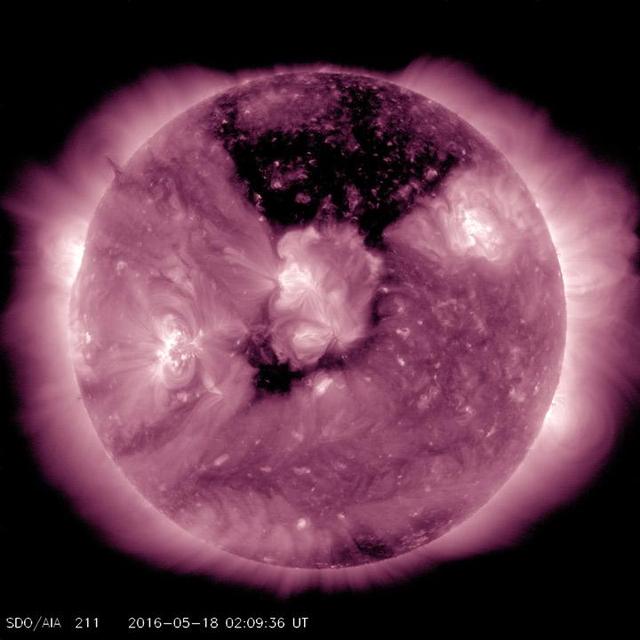
A substantial coronal hole had rotated so that it temporarily faced right towards Earth May, 17-19, 2016. This coronal hole area is the dark area at the top center of this image from NASA Solar Dynamics Observatory.
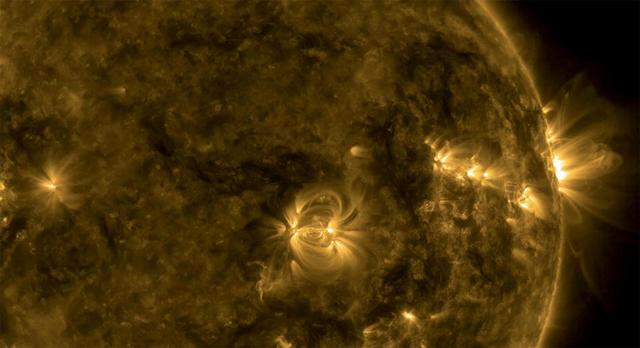
A series of active regions stretched along the right side of the sun exhibited a wide variety of loops cascading above them (Sept. 12-14, 2016). The active region near the center has tightly coiled loops, while the region rotating over the right edge has some elongated and some very stretched loops above it. The loops are actually charged particles spiraling along magnetic field lines, observed here in a wavelength of extreme ultraviolet light. Near the middle of the video the Earth quickly passes in front of a portion of the sun as viewed by SDO. http://photojournal.jpl.nasa.gov/catalog/PIA16997
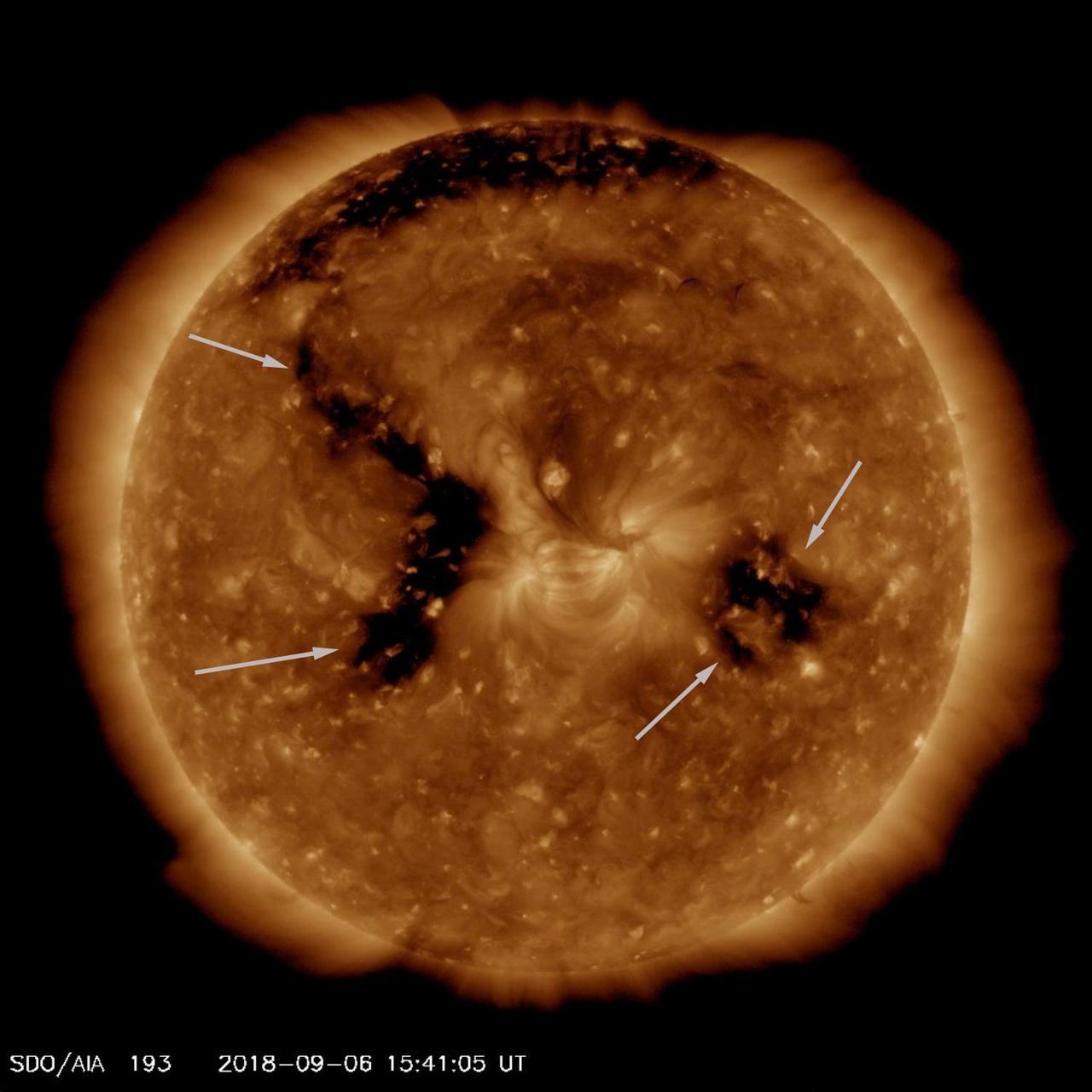
The Sun already featured one good-sized coronal hole, when another larger coronal hole began to emerge and intensify (Sept. 4-6, 2018). Coronal holes appear dark in extreme ultraviolet light, as is shown here. They are magnetically open areas from which solar wind streams out into space, and can last from days to months. The brighter area between the two coronal holes is an active region where the level of magnetic activity is strong. Movies are available at https://photojournal.jpl.nasa.gov/catalog/PIA22722
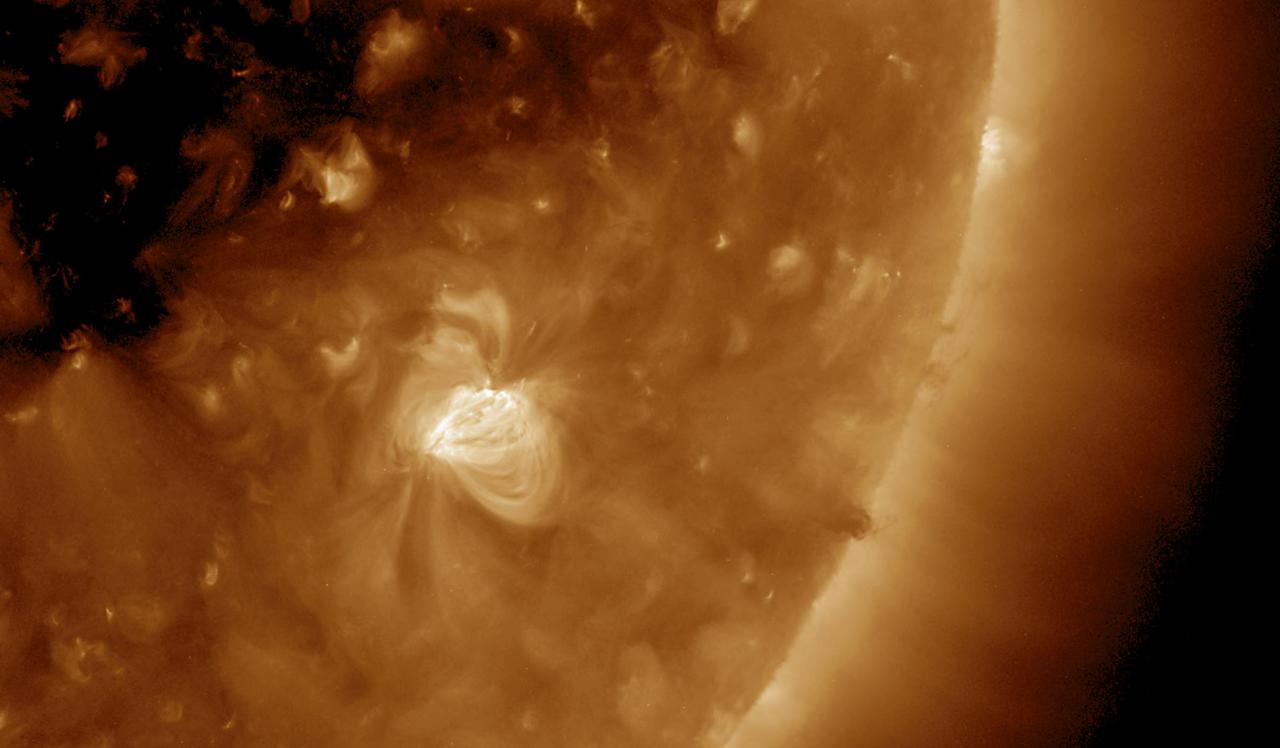
A close-up view of one day in the life of a rather small active region shows the agitation and dynamism of its magnetic field (Dec. 21, 2016). This wavelength of extreme ultraviolet light reveals particles as they spin along the cascading arches of magnetic field lines above the active region. Some darker plasma rises up and spins around at the edge of the sun near the end of the video clip also being pulled by unseen magnetic forces. Movies are available at http://photojournal.jpl.nasa.gov/catalog/PIA15032
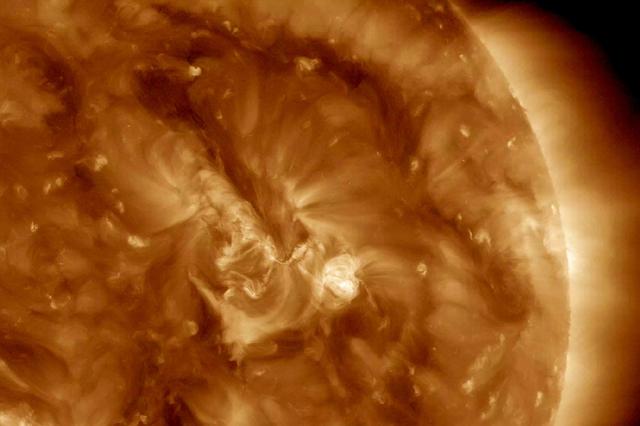
A minor solar eruption triggered a crackling, white flash that sent an expanding wave of plasma below it over about six hours (Nov. 4, 2016). Some of the plasma also appeared to surge along a narrow path above the active region as well. Such occurrences are fairly common, but still interesting to watch up close. The images were taken in a wavelength of extreme ultraviolet light. Movies are available at http://photojournal.jpl.nasa.gov/catalog/PIA21202
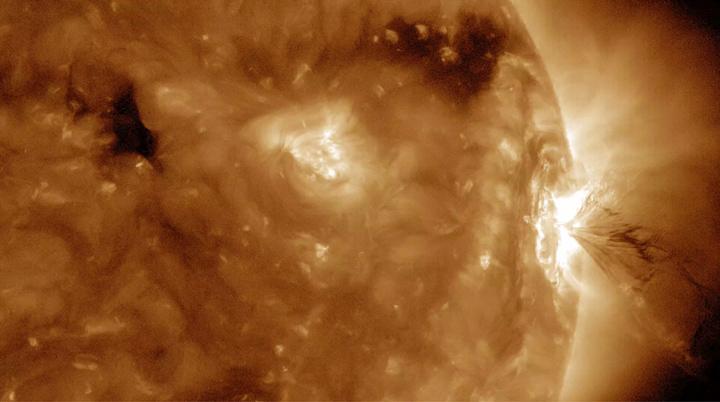
The Sun produced three M-class (medium-sized) flares in less than 13 hours and the third one had an interesting flourish at the end (July 22-23, 2016). These were the largest flares the Sun had produced this year. The first two flares occurred in quick succession. The third one (see the still taken at 5:38 UT on the 23rd), besides the familiar bright flash of a flare, also spewed out into space a curving string of plasma. http://photojournal.jpl.nasa.gov/catalog/PIA17912
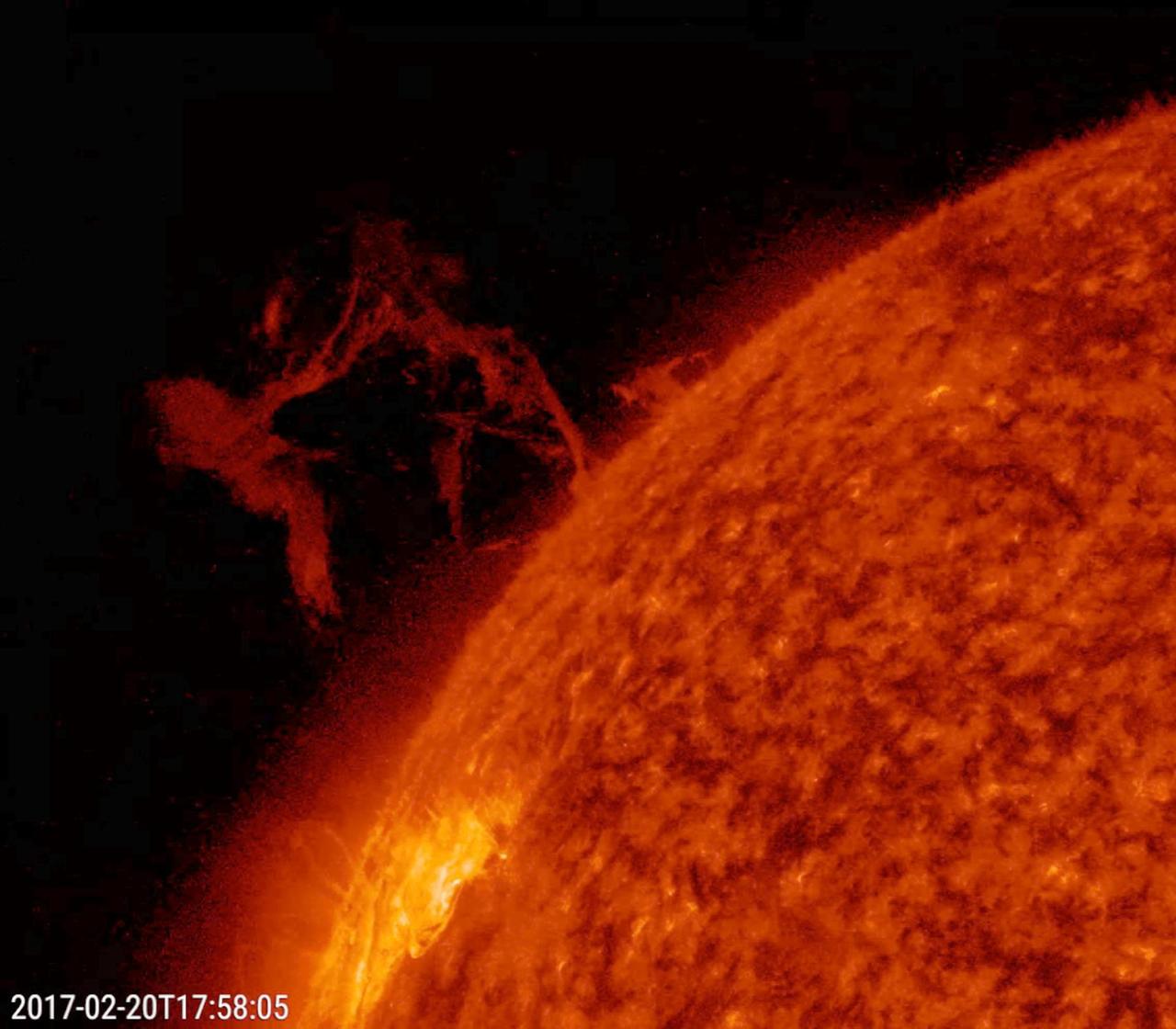
A solar prominence gathered itself into a twisting cone, then rose up and broke apart in a delicate dance of plasma above the sun (Feb. 20, 2017). The event, observed in a wavelength of extreme ultraviolet light, lasted just about four hours. Prominences are unstable clouds of plasma suspended above the sun's surface by magnetic forces. This kind of event is not uncommon. The brighter area near the bottom of the images is an active region. Movies are available at http://photojournal.jpl.nasa.gov/catalog/PIA21552
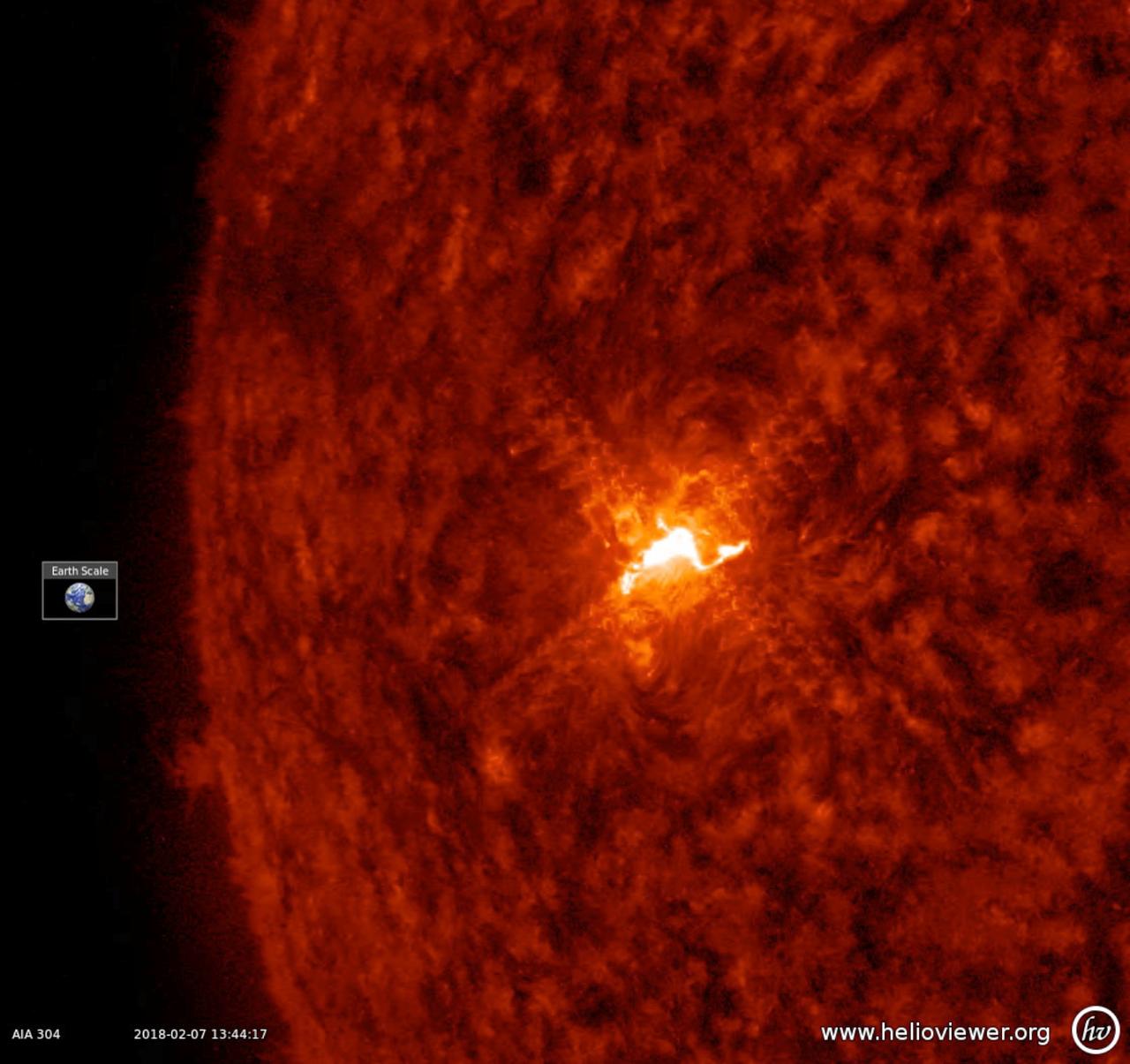
The sun's only visible active region sputtered and spurted and eventually unleashed a small (C-class) flare (Feb. 7, 2018). The flare appears as a brief, bright flash about mid-way through the half-day clip. Normally, we do not pay much attention to flares this small, but it was just about the only real solar activity over the past week as the sun is slowly approaching its quiet period of the 11-year solar cycle. These images were taken in a wavelength of extreme ultraviolet light. Movies are available at https://photojournal.jpl.nasa.gov/catalog/PIA22244

A prominence at the edge of the sun provided us with a splendid view of solar plasma as it churned and streamed over less than one day (June 25-26, 2017). The charged particles of plasma were being manipulated by strong magnetic forces. When viewed in this wavelength of extreme ultraviolet light, we can trace the movements of the particles. Such occurrences are fairly common but much easier to see when they are near the sun's edge. For a sense of scale, the arch of prominence in the still image has risen up several times the size of Earth. Movies are available at https://photojournal.jpl.nasa.gov/catalog/PIA21768
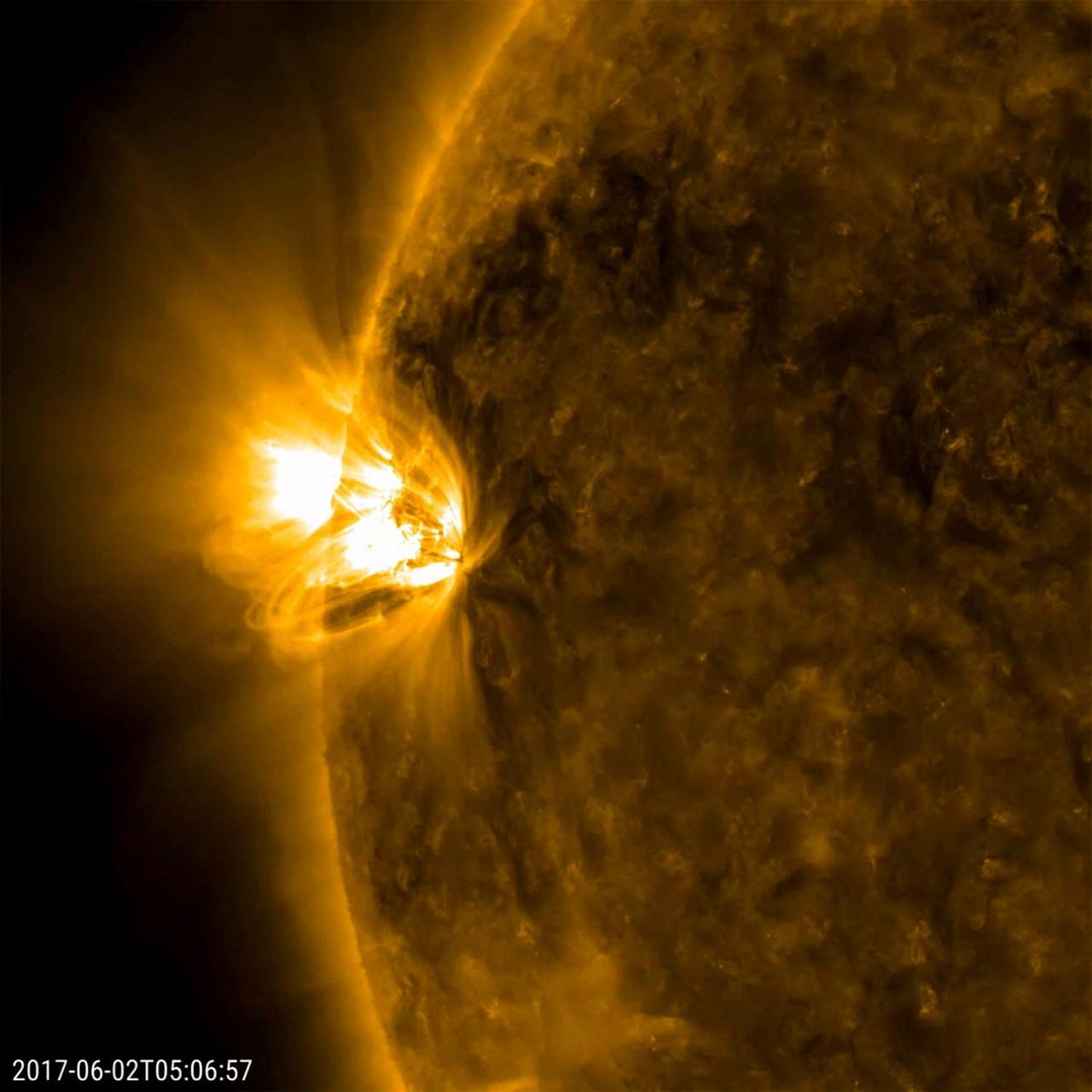
A pair of relatively small (but frenetic) active regions rotated into view, spouting off numerous small flares and sweeping loops of plasma (May 31-June 2, 2017). At first, only the one active region was observed, but mid-way though the video clip a second one behind the first can be picked out. The dynamic regions were easily the most remarkable areas on the sun during this 42-hour period. The images were taken in a wavelength of extreme ultraviolet light. Movies are available at https://photojournal.jpl.nasa.gov/catalog/PIA21756
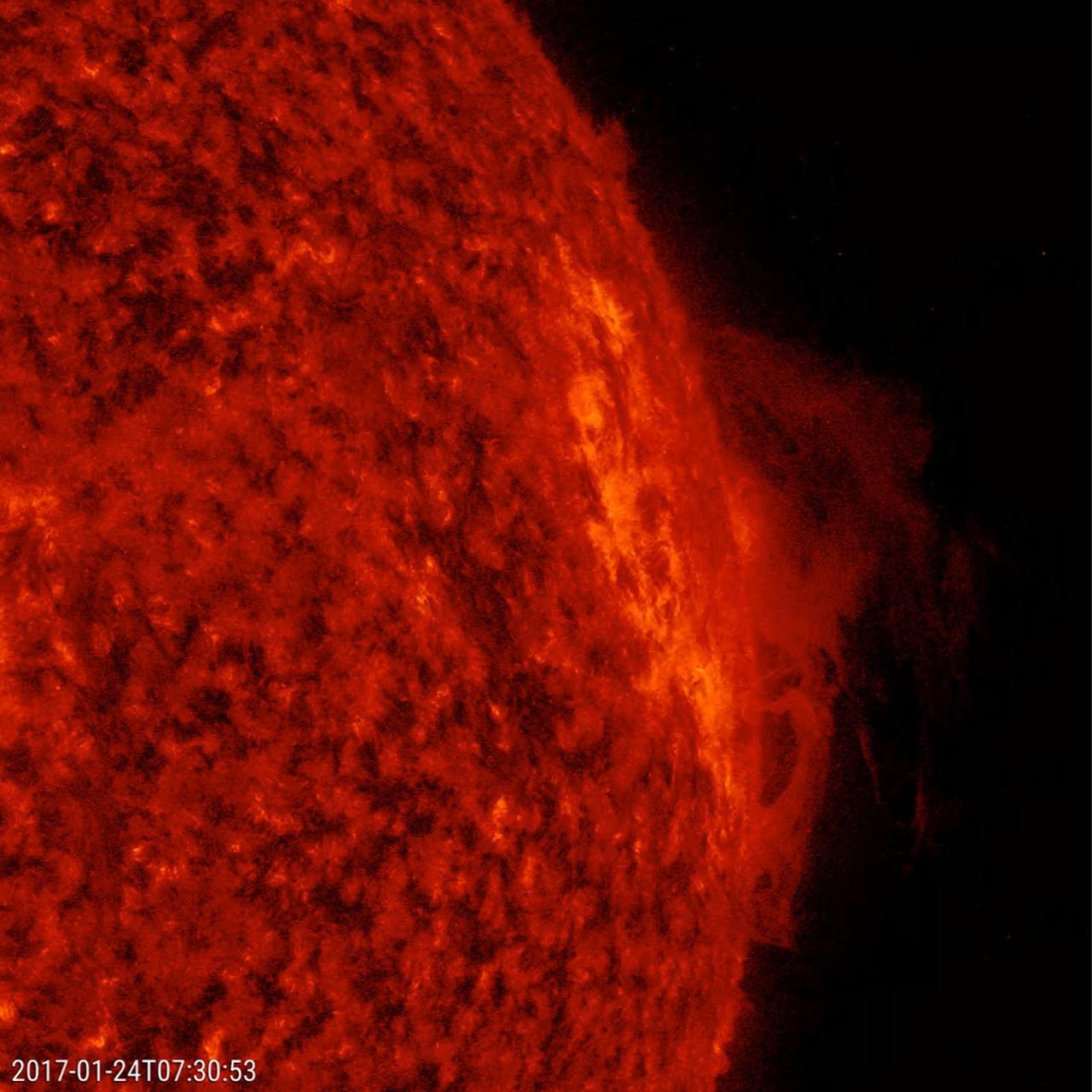
On Jan. 23-24, 2017, NASA Solar Dynamics Observatory watched as a solar prominence rose up along the edge of the sun and twisted and churned for about two days before falling apart. The dynamic action was generated by competing magnetic forces. The images were taken in a wavelength extreme ultraviolet light that observes activity close to the solar surface, perfect for capturing prominences, which are notoriously unstable clouds of plasma suspended above the sun. Movies are available at http://photojournal.jpl.nasa.gov/catalog/PIA11237
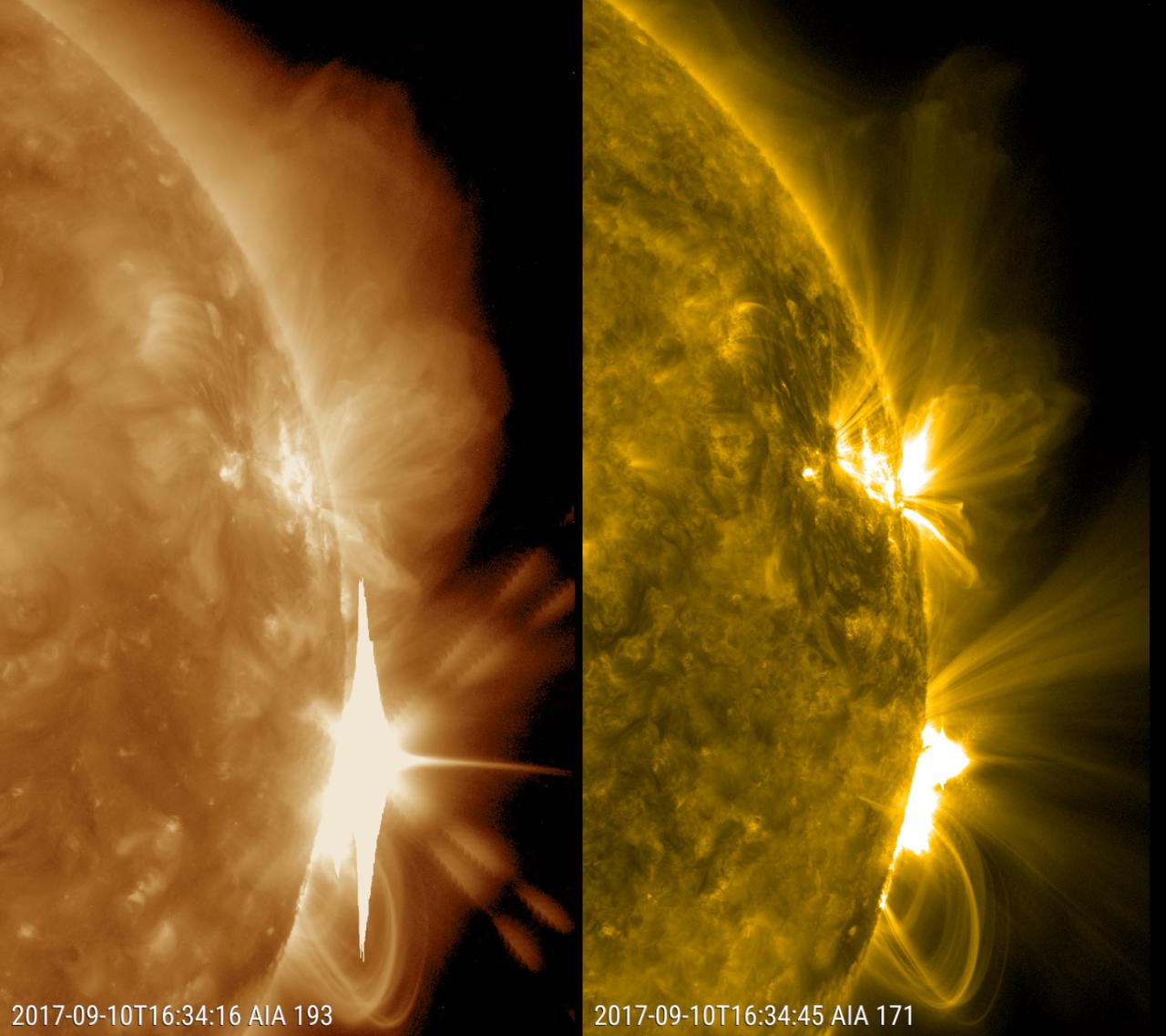
The Sun erupted with an X8 solar flare, one of the largest of the current solar cycle (Sept. 10, 2017). Its source was the same sunspot region that produced an X9 flare last week. This is shown in two wavelengths of extreme ultraviolet light at the same time and each reveals different features. Both are colorized to identify in which wavelength they were observed. The coils of loops after the flare are the magnetic field lines reorganizing themselves after the eruption. The video clip covers about six hours. Movies are available at https://photojournal.jpl.nasa.gov/catalog/PIA21958

A small eruption blew a bright, disjointed stream of plasma into space (Oct. 18, 2017). The source of the blast was just out of sight beyond the edge of the sun. Images from SOHO's coronagraph instruments show a bright loop of material heading away from the sun near this same area. The video, taken in extreme ultraviolet light, covers just two hours of activity. Movies are available at https://photojournal.jpl.nasa.gov/catalog/PIA22050
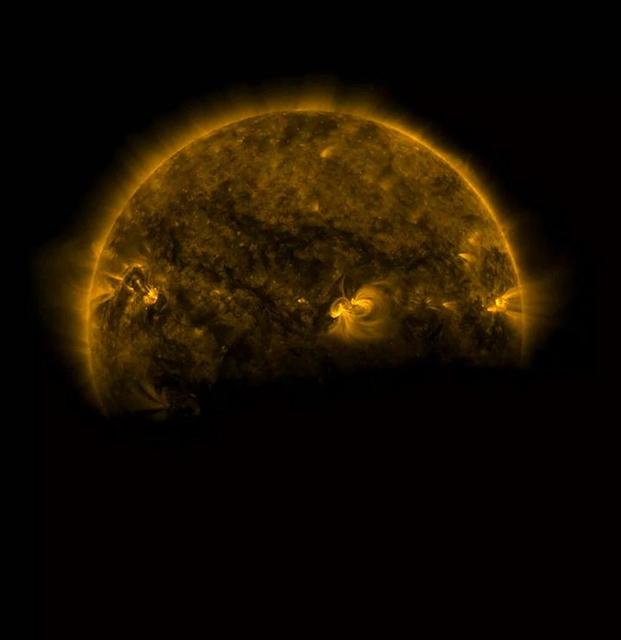
Several times a day for a few days this week the Earth completely blocked the Sun for about an hour due to SDO's orbital path (Aug. 25, 2016). The edge of the Earth is not crisp, but rather kind of fuzzy due to Earth's atmosphere. The entire video clip here shows the beginning of one such eclipse, covering just seven minutes. These occur about every six months. The Moon blocks SDO's view of the Sun on occasion as well. A movie is available at http://photojournal.jpl.nasa.gov/catalog/PIA21027
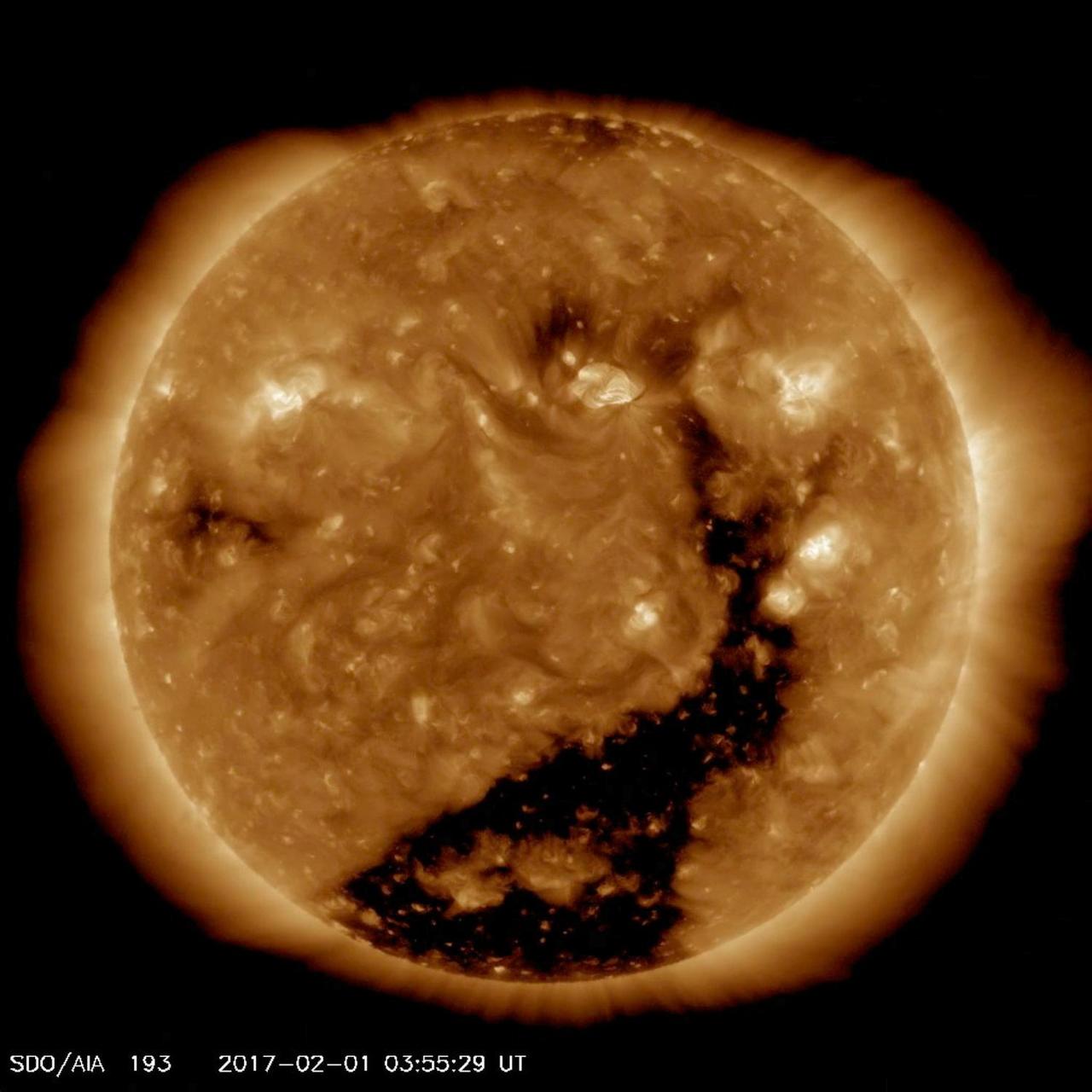
A substantial coronal hole rotated across the face of the sun this past week and is again streaming solar wind towards Earth (Jan. 30 - Feb. 2, 2017). This same coronal hole was facing Earth about a month ago and has rotated into a similar position again. Coronal holes are areas of open magnetic field from which solar wind particles stream into space. In this wavelength of extreme ultraviolet light it appears as a dark area near the center and lower portion of the sun. Movies are available at http://photojournal.jpl.nasa.gov/catalog/PIA11177

A small prominence observed in profile arched up and sent streams of plasma curling back into the sun over a 30-hour period (Dec. 13-14, 2017). We are observing charged particles streaming along magnetic field lines made visible in extreme ultraviolet light. Prominences are cooler strands of plasma tethered above the sun's surface by magnetic forces. They are quite unstable and frequently fall apart within hours or days. Movies are available at https://photojournal.jpl.nasa.gov/catalog/PIA22196
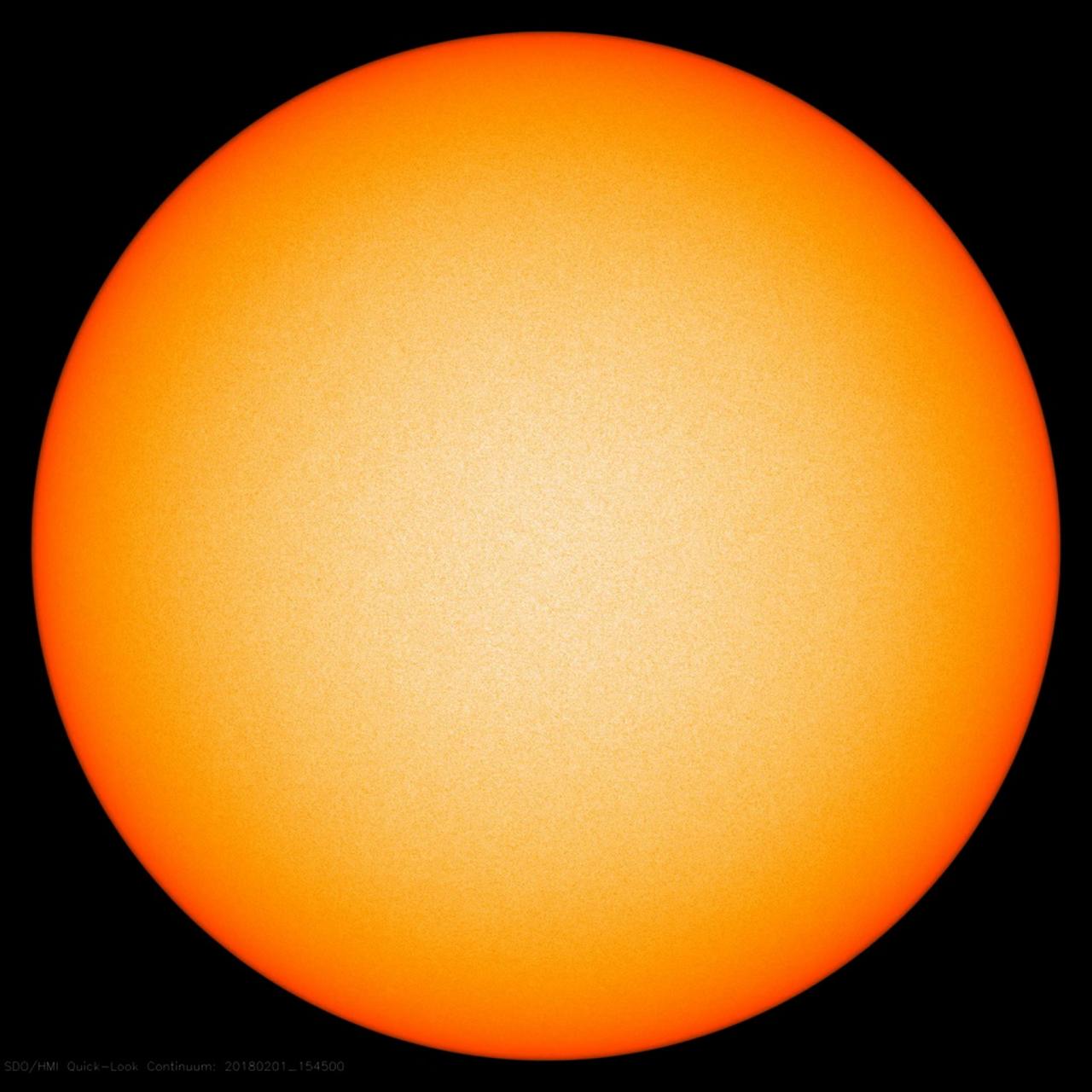
The sun has had no sunspots for almost two weeks (as of Feb. 1, 2018) and just has a single, tiny one that appeared on Jan. 31, 2018. The video shows a rotating sun in filtered light for the past week, but it is even hard to tell the sun is rotating since there are just about no features. Even the small spot that appears on the 31st is hard to see. This spotless period is a prelude to the approaching period of solar minimum next year, when the sun's activity will be at the low end of its 11-year cycle. Movies are available at https://photojournal.jpl.nasa.gov/catalog/PIA22242
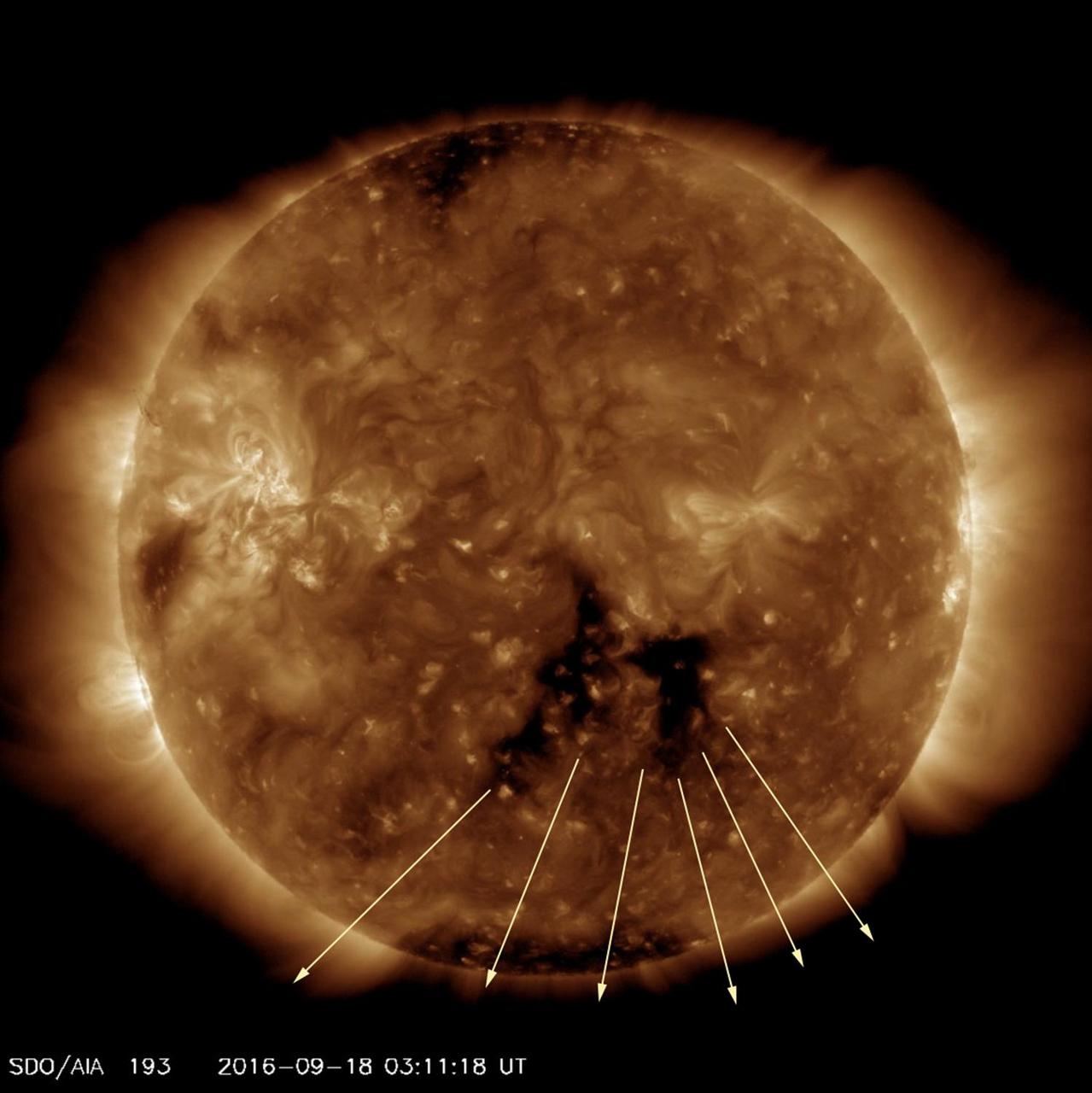
A dark coronal hole that was facing towards Earth for several days spewed streams of solar wind in our direction (Sept. 18-21, 2016). A coronal hole is a magnetically open region. The magnetic fields have opened up allowing solar wind (comprised of charged particles) to stream into space. Gusts of solar wind can generate beautiful aurora when they reach Earth. The video clip shows the sun in a wavelength of extreme ultraviolet light. Movies are available at http://photojournal.jpl.nasa.gov/catalog/PIA21067
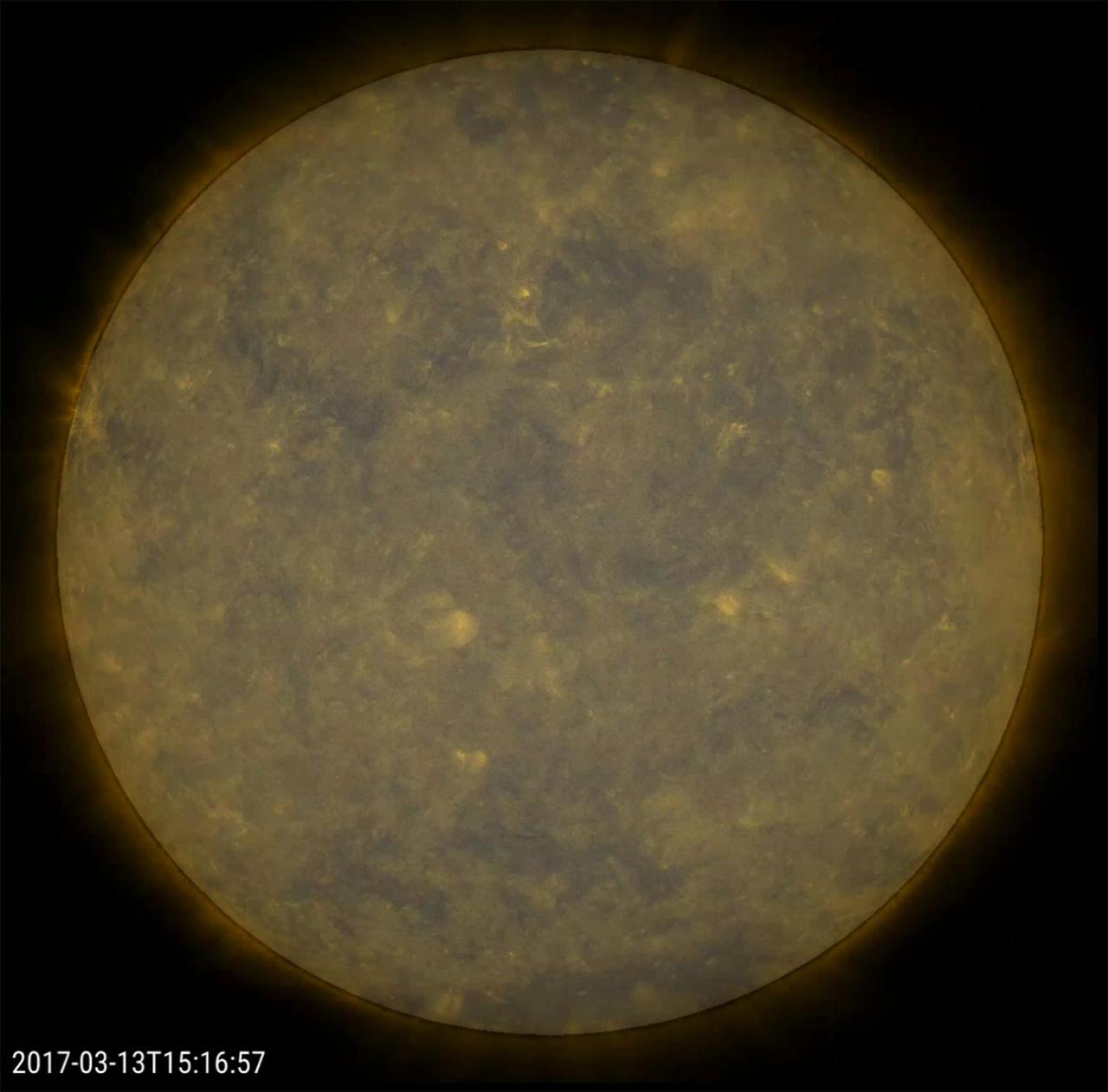
NASA Solar Dynamics Observatory sees the sun has been virtually spotless, as in no sunspots, a 11-day spotless stretch not seen since the last solar minimum many years ago. Movies are available at https://photojournal.jpl.nasa.gov/catalog/PIA21582