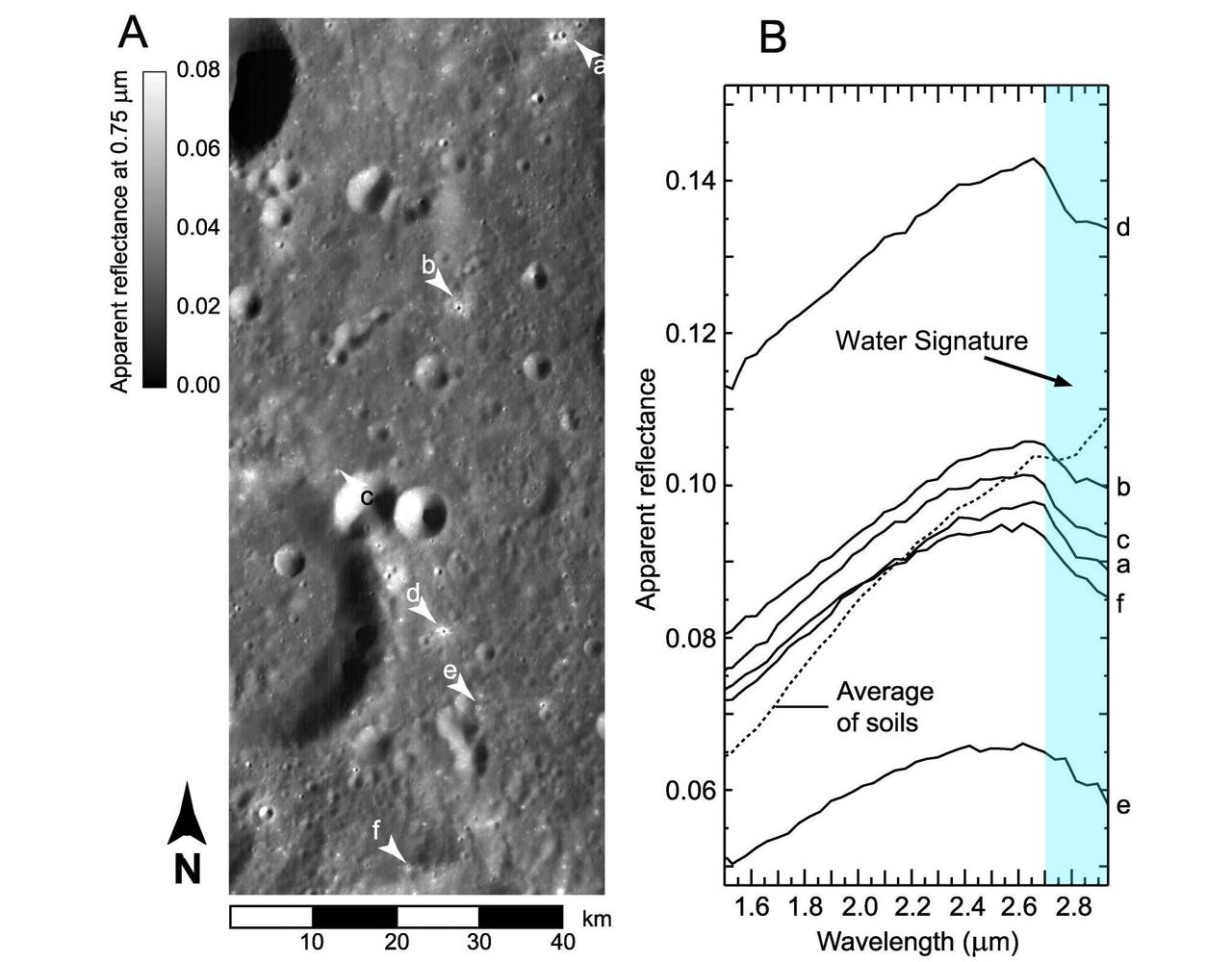
Craters and the Tell-Tale Signatures
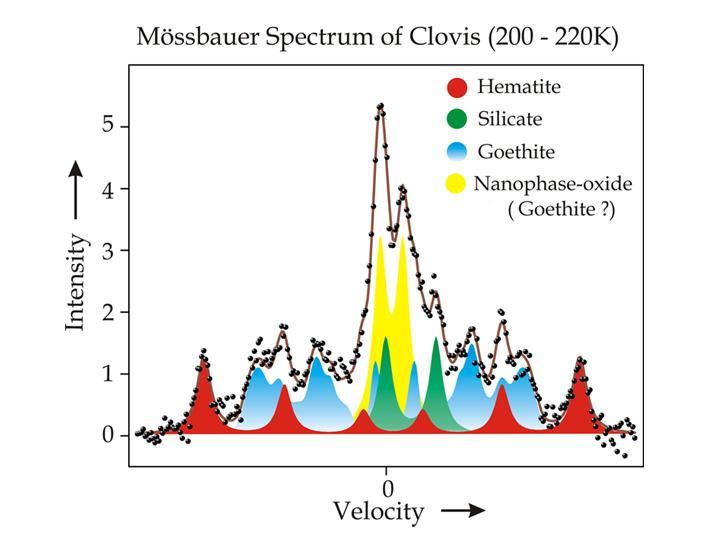
Water-Signature Mineral Found by Spirit
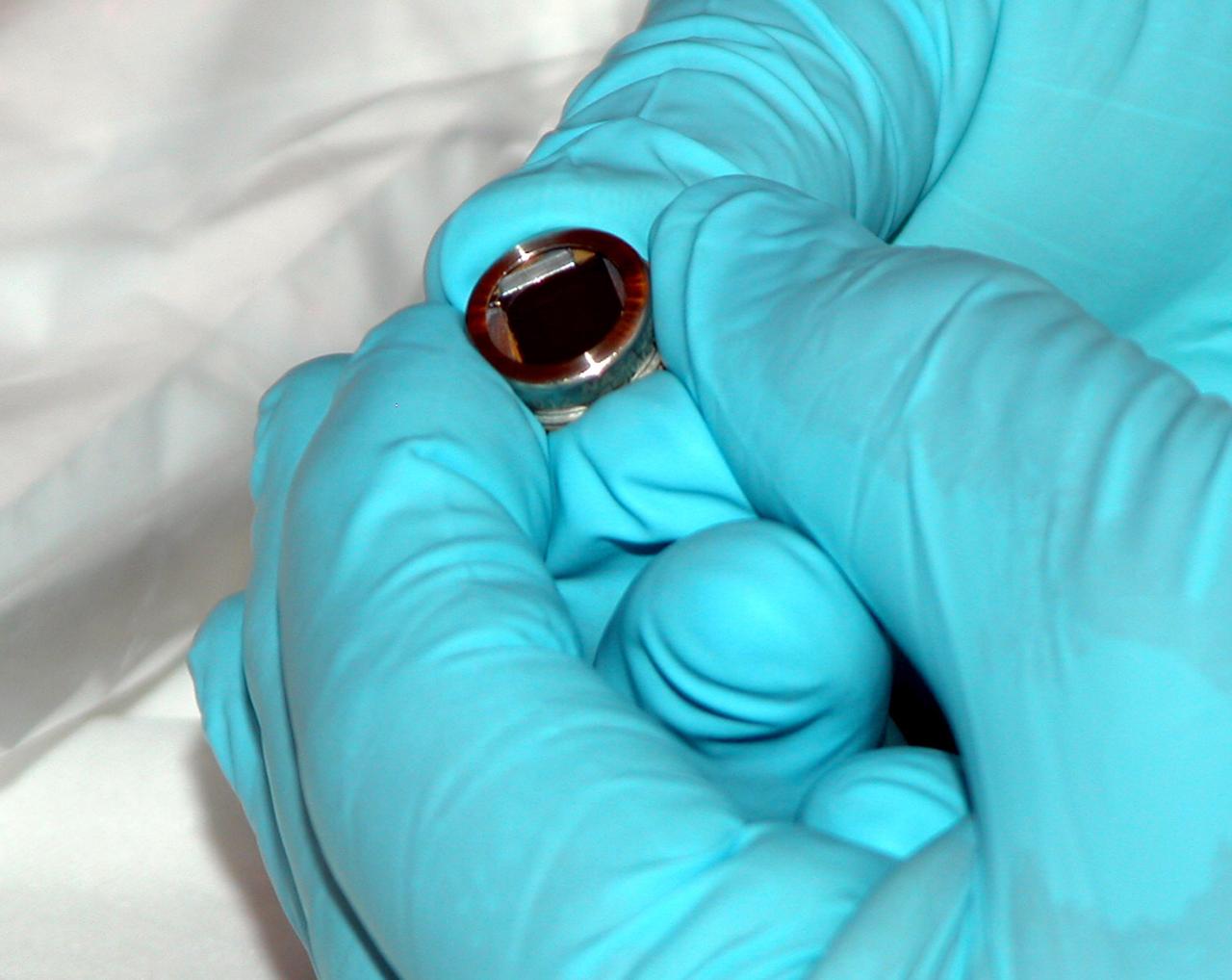
This closeup shows the size of the computer chip that holds about 35,000 laser-engraved signatures of visitors to the Mars Exploration Rovers at the Jet Propulsion Laboratory.
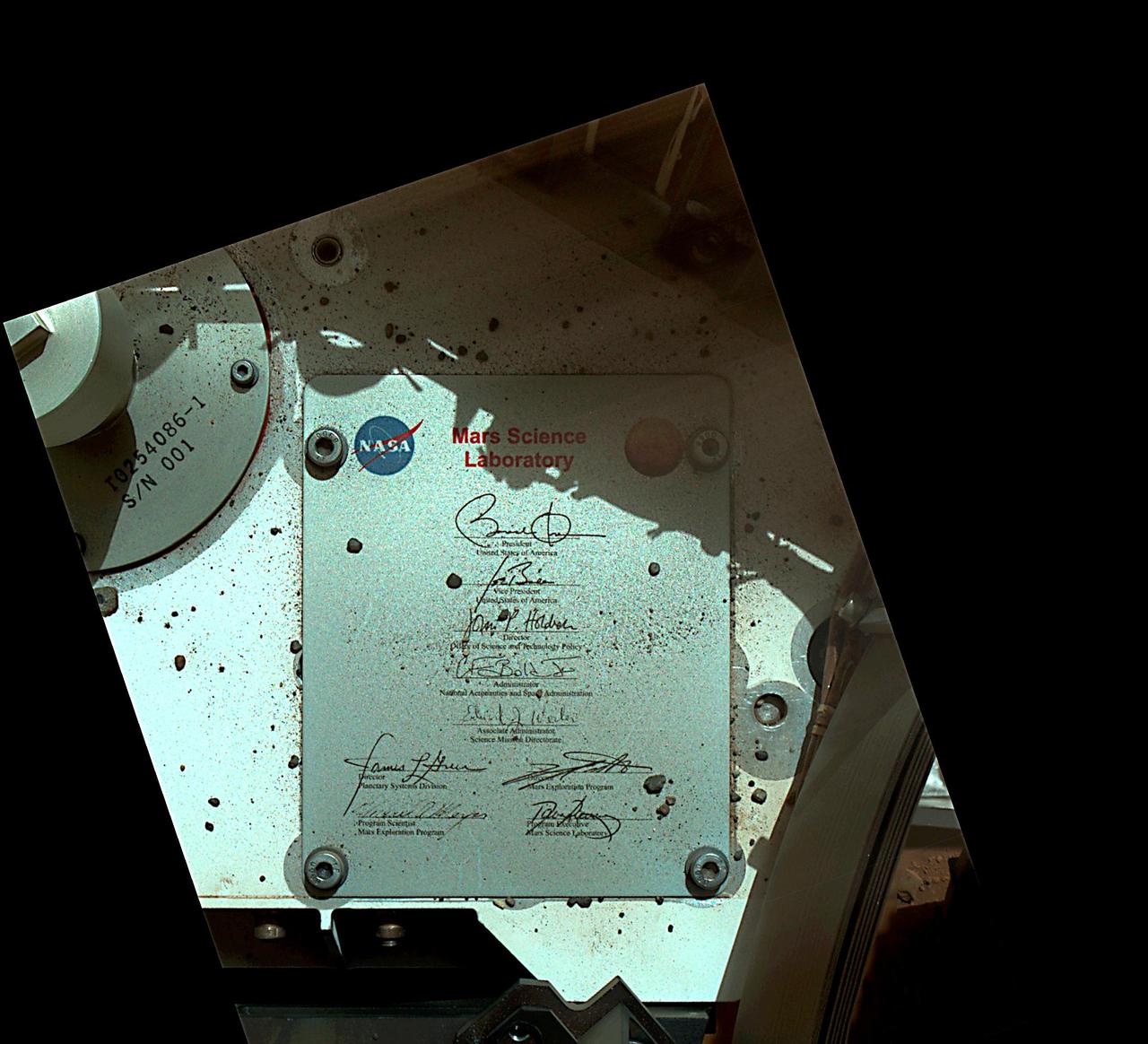
This view of Curiosity deck shows a plaque bearing several signatures of US officials, including that of President Obama and Vice President Biden. The image was taken by the rover Mars Hand Lens Imager MAHLI.

Colors were mapped onto infrared data from NASA's Galileo mission in this image revealing locations around a crater on the Jovian moon Europa called Manannán where there are signatures of water. Manannán was created when a comet or asteroid hit the surface of Europa. The blue colors in this image indicate higher concentrations of water ice in the material thrown out of the crater during impact. Yellow and red show the locations of hydrates, chemically altered forms of water that can bind to other elements. The background black-and-white image was taken by the Galileo solid-state imaging camera, which took images in visible light. The colors correspond to wavelengths of light that are not detectable to the human eye but were observed by Galileo's near-infrared mapping spectrometer. Galileo orbited Jupiter for almost eight years, concluding its mission in 2003. https://photojournal.jpl.nasa.gov/catalog/PIA26104
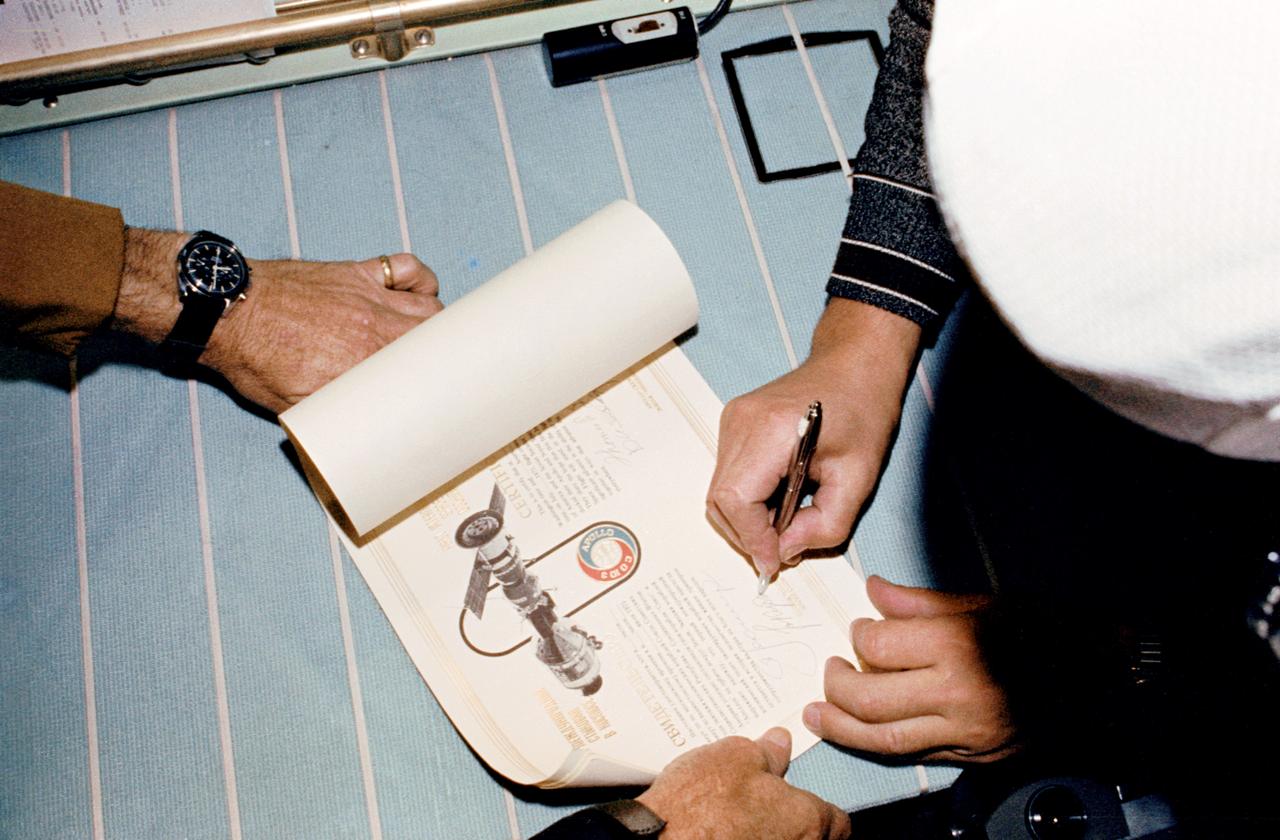
AST-03-171 (17 July 1975) --- The hands of cosmonaut Valerly N. Kubasov are seen as the ASTP engineer adds his name to the signature on the Soviet side of the official joint certificate marking an historical moment during the rendezvous day of the Apollo-Soyuz Test Project. The left hand of astronaut Donald K. Slayton, NASA's docking module pilot, is seen at left. The certificate had earlier been signed by astronauts Thomas P. Stafford, American crew commander; Slayton and cosmonaut Aleksey A. Leonov, Soviet crew commander, and it awaits the signature of astronaut Vance D. Brand, NASA's command module pilot who remained in the CM while the others signed in the Soviet Orbital Module of the Soyuz.
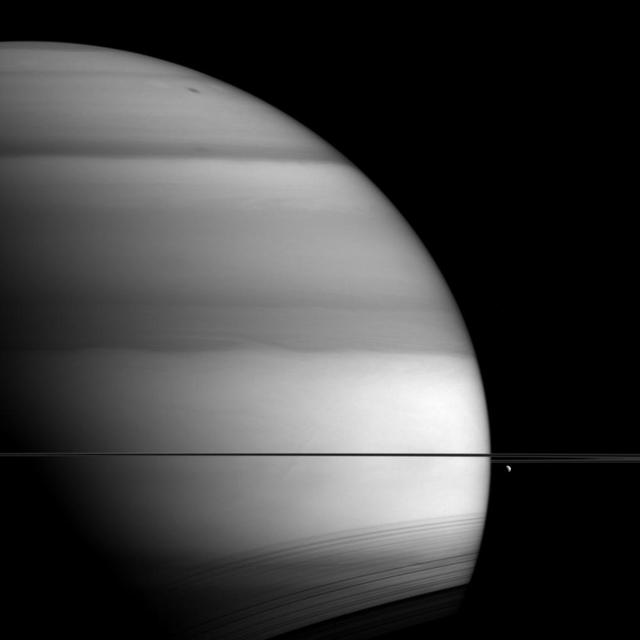
The soft, bright-and-dark bands displayed by Saturn in this view from NASA Cassini spacecraft are the signature of methane in the planet atmosphere.
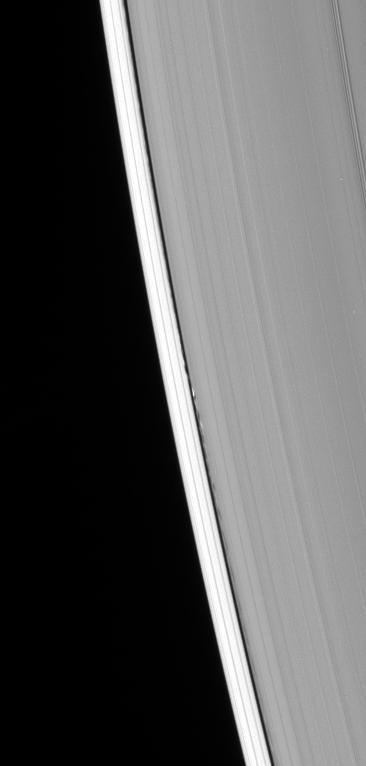
The presence of the tiny ring moon Daphnis is betrayed by the edge waves it creates in the Keeler gap
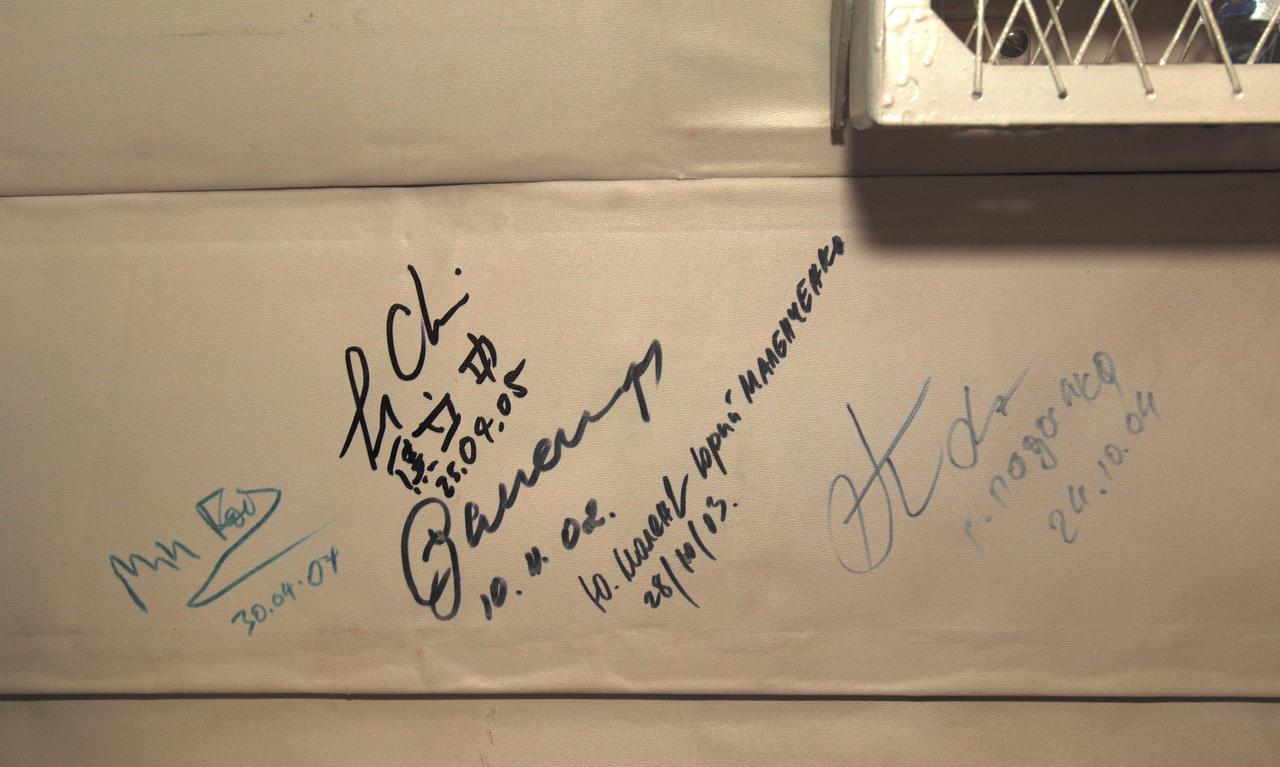
Signatures of astronauts and cosmonauts that have flown onboard this Russian helicopter are seen in this image, Monday, April 25, 2005, Kazakhstan. Expedition 10 Commander Leroy Chiao, Flight Engineer Salizhan Sharipov and European Space Agency astronaut Roberto Vittori brought their Soyuz TMA-5 capsule to a pre-dawn landing April 25 northeast of the town of Arkalyk to wrap up a six-month mission aboard the International Space Station for Chiao and Sharipov, and a ten-day mission for Vittori, who flew under a commercial contract between ESA and the Russian Federal Space Agency. Photo Credit: (NASA/Bill Ingalls)
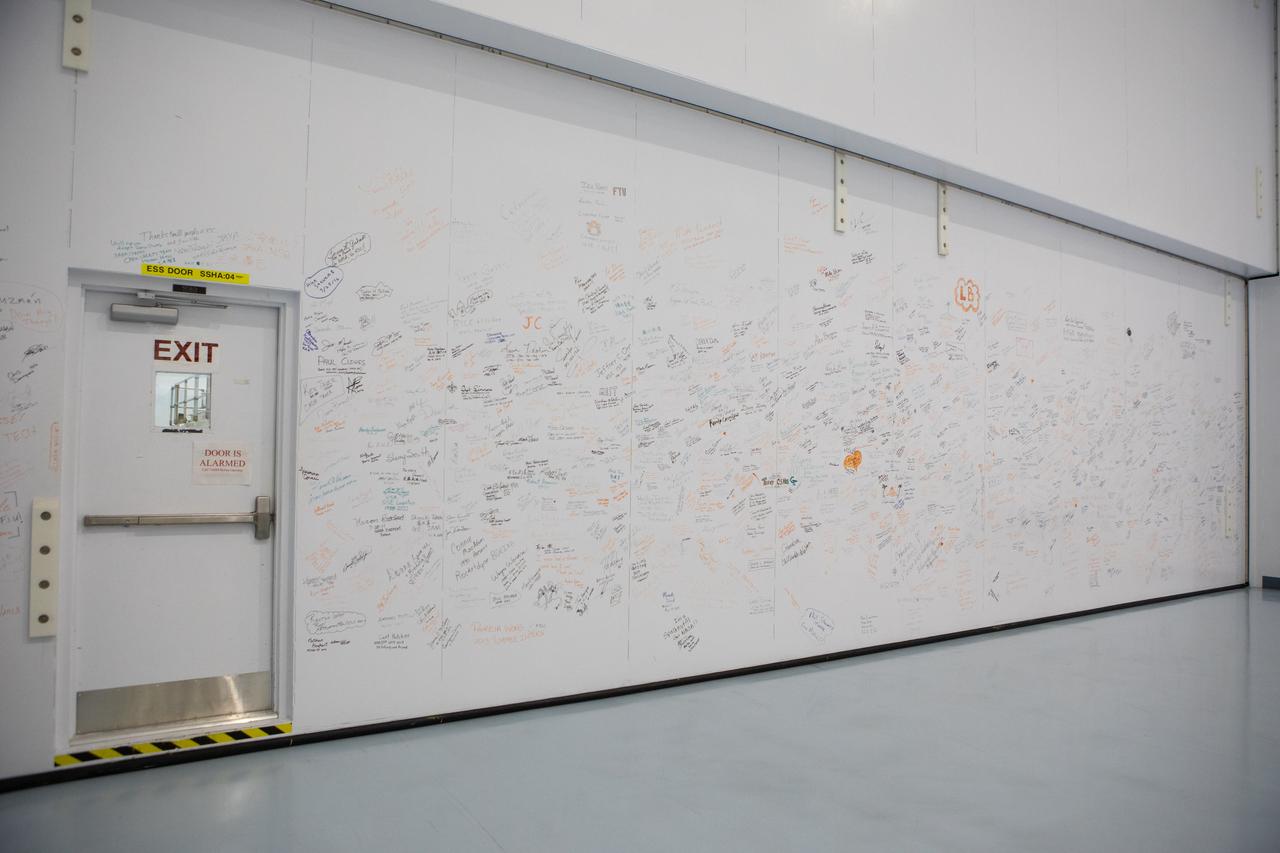
A photograph taken on May 16, 2019, shows a wall inside the Space Station Processing Facility (SSPF) at NASA's Kennedy Space Center in Florida, containing signatures of many of those who worked on the International Space Station Program. The center is celebrating the SSPF’s 25th anniversary. The facility was built to process elements for the space station. Now it is providing support for current and future NASA and commercial provider programs, including Commercial Resupply Services, Artemis 1, sending the first woman and next man to the Moon, and deep space destinations including Mars.
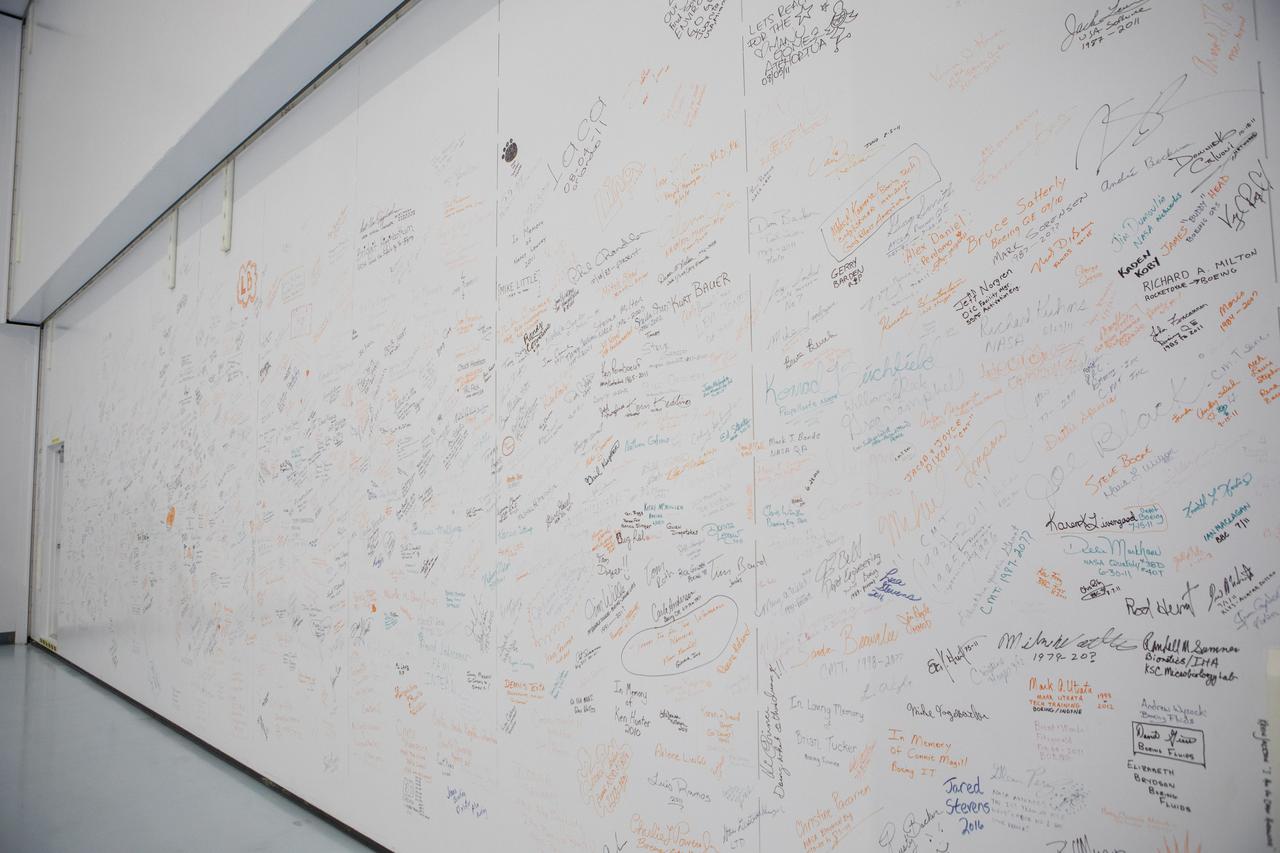
A photograph taken on May 16, 2019, shows a wall inside the Space Station Processing Facility (SSPF) at NASA's Kennedy Space Center in Florida, containing signatures of many of those who worked on the International Space Station Program. The center is celebrating the SSPF’s 25th anniversary. The facility was built to process elements for the space station. Now it is providing support for current and future NASA and commercial provider programs, including Commercial Resupply Services, Artemis 1, sending the first woman and next man to the Moon, and deep space destinations including Mars.
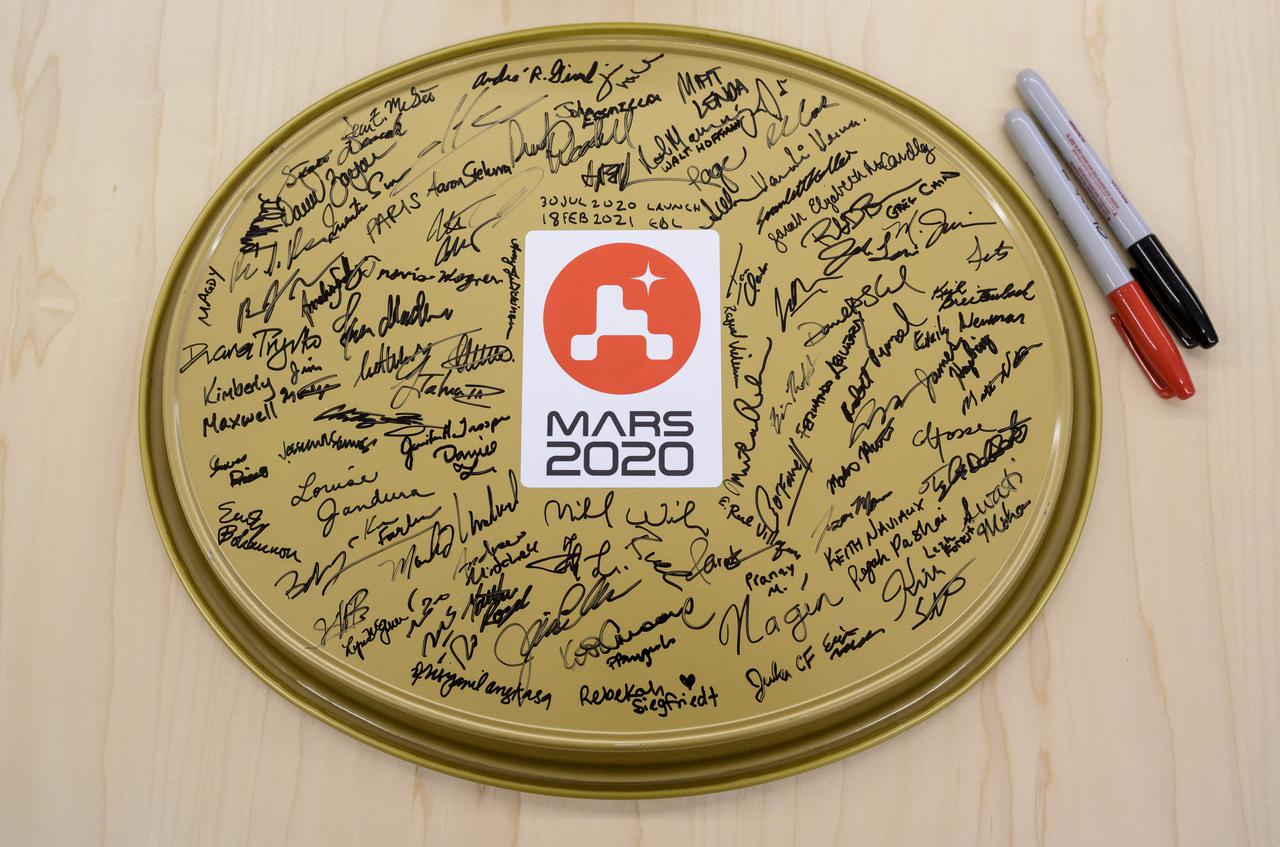
A serving tray with signatures from the NASA Perseverance Mars rover team is seen in mission control, Thursday, Feb. 18, 2021, at NASA's Jet Propulsion Laboratory in Pasadena, California. A key objective for Perseverance’s mission on Mars is astrobiology, including the search for signs of ancient microbial life. The rover will characterize the planet’s geology and past climate, pave the way for human exploration of the Red Planet, and be the first mission to collect and cache Martian rock and regolith. Photo Credit: (NASA/Bill Ingalls)
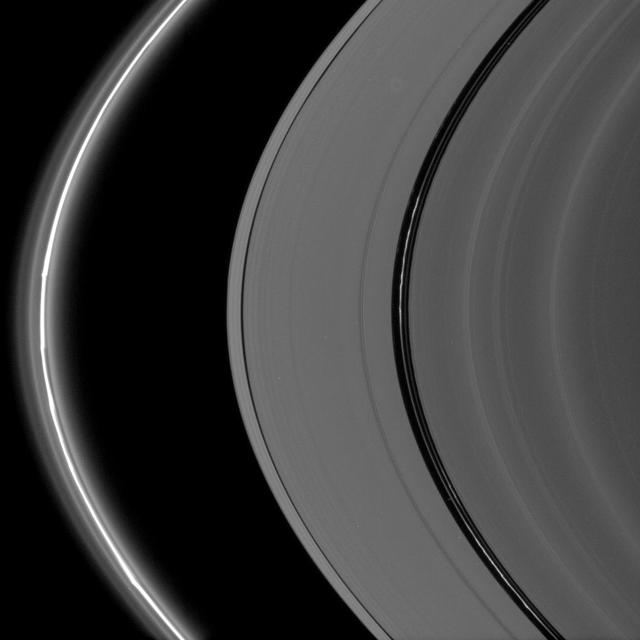
Bright, kinked ringlets fill the Encke Gap, while the F ring glows brilliantly and displays its signature knots and flanking, diffuse ringlets

Using NASA Spitzer Space Telescope, astronomers have, for the first time, found signatures of silicate crystals around a newly forming protostar in the constellation of Orion.
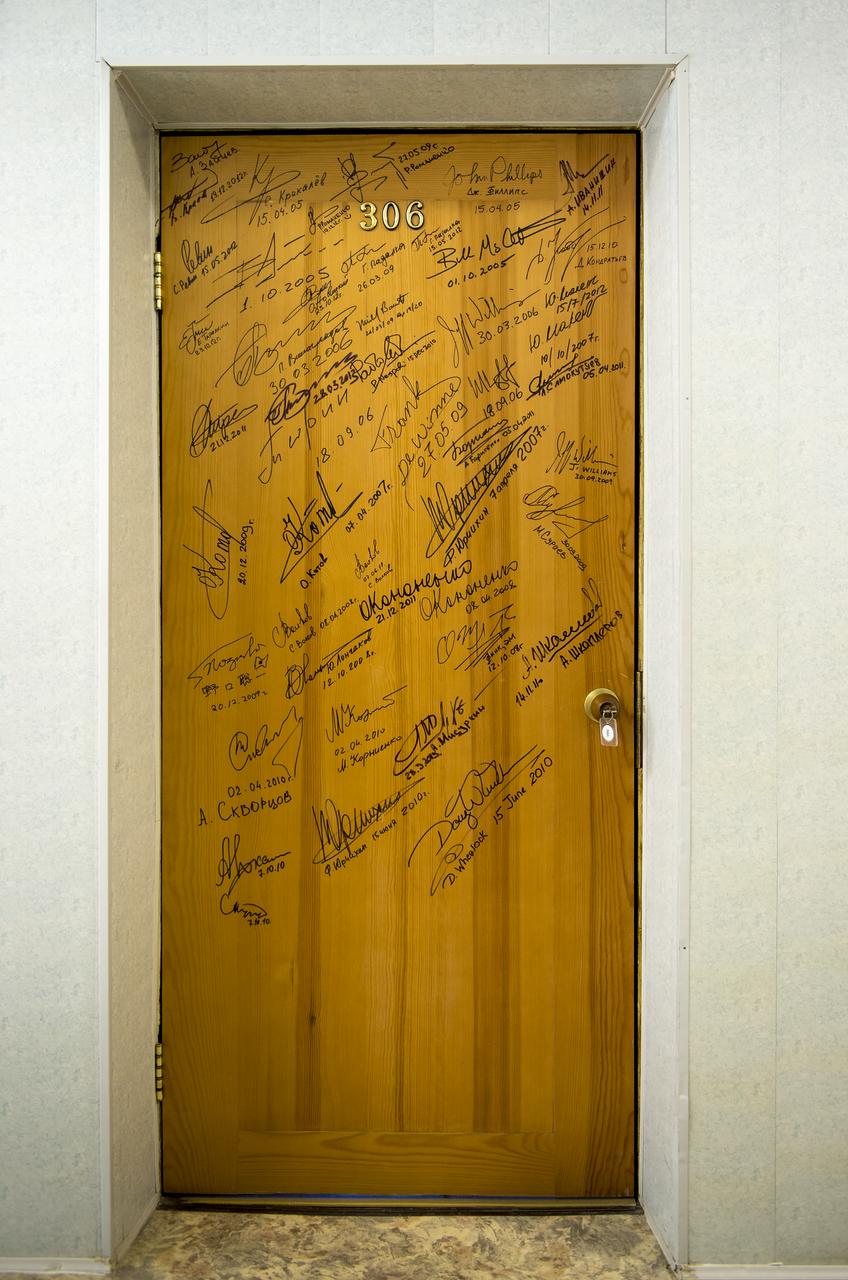
A hotel room door covered with signatures of Astronauts and Cosmonauts is seen at the Cosmonaut Hotel, Tuesday, May 28, 2013 in Baikonur, Kazakhstan. Expedition 36/37 Soyuz Commander Fyodor Yurchikhin of the Russian Federal Space Agency (Roscosmos), Flight Engineers: Flight Engineer Karen Nyberg of NASA, and, Luca Parmitano of the European Space Agency each signed doors in the traditional ceremony prior to departing the hotel for launch onboard a Soyuz to the International Space Station. Yurchikhin, Nyberg, and, Parmitano, will remain aboard the station until mid-November. Photo credit: (NASA/Bill Ingalls)
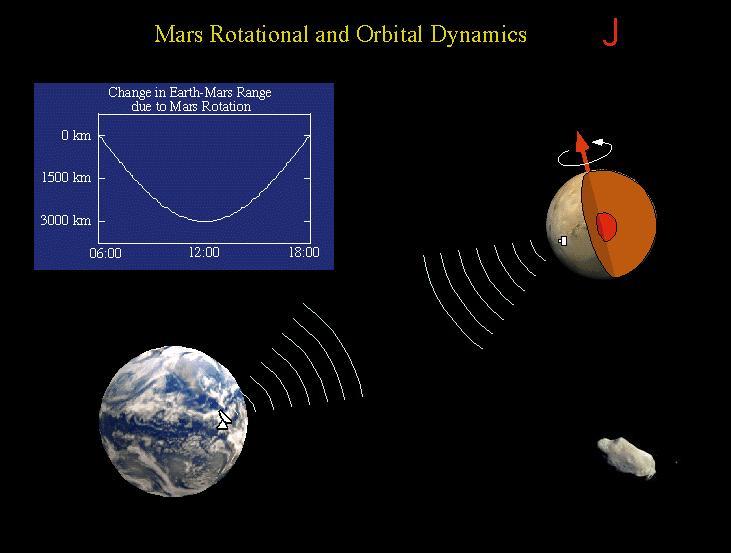
The Rotation and Orbit Dynamics experiment is based on measuring the Doppler range to Pathfinder using the radio link. Mars rotation about it's pole causes a signature in the data with a daily minimum when the lander is closest to the Earth. Changes in the daily signature reveal information about the planetary interior, through its effect on Mars' precession and nutation. The signature also is sensitive to variations in Mars' rotation rate as the mass of the atmosphere increases and decreases as the polar caps are formed in winter and evaporate in spring. Long term signatures in the range to the lander are caused by asteroids perturbing Mars' orbit. Analysis of these perturbations allows the determination of the masses of asteroids. Sojourner spent 83 days of a planned seven-day mission exploring the Martian terrain, acquiring images, and taking chemical, atmospheric and other measurements. The final data transmission received from Pathfinder was at 10:23 UTC on September 27, 1997. Although mission managers tried to restore full communications during the following five months, the successful mission was terminated on March 10, 1998. http://photojournal.jpl.nasa.gov/catalog/PIA00975

This plot of data from NASA Spitzer Space Telescope indicates the presence of molecules in the planet WASP-12b -- a super-hot gas giant that orbits tightly around its star.
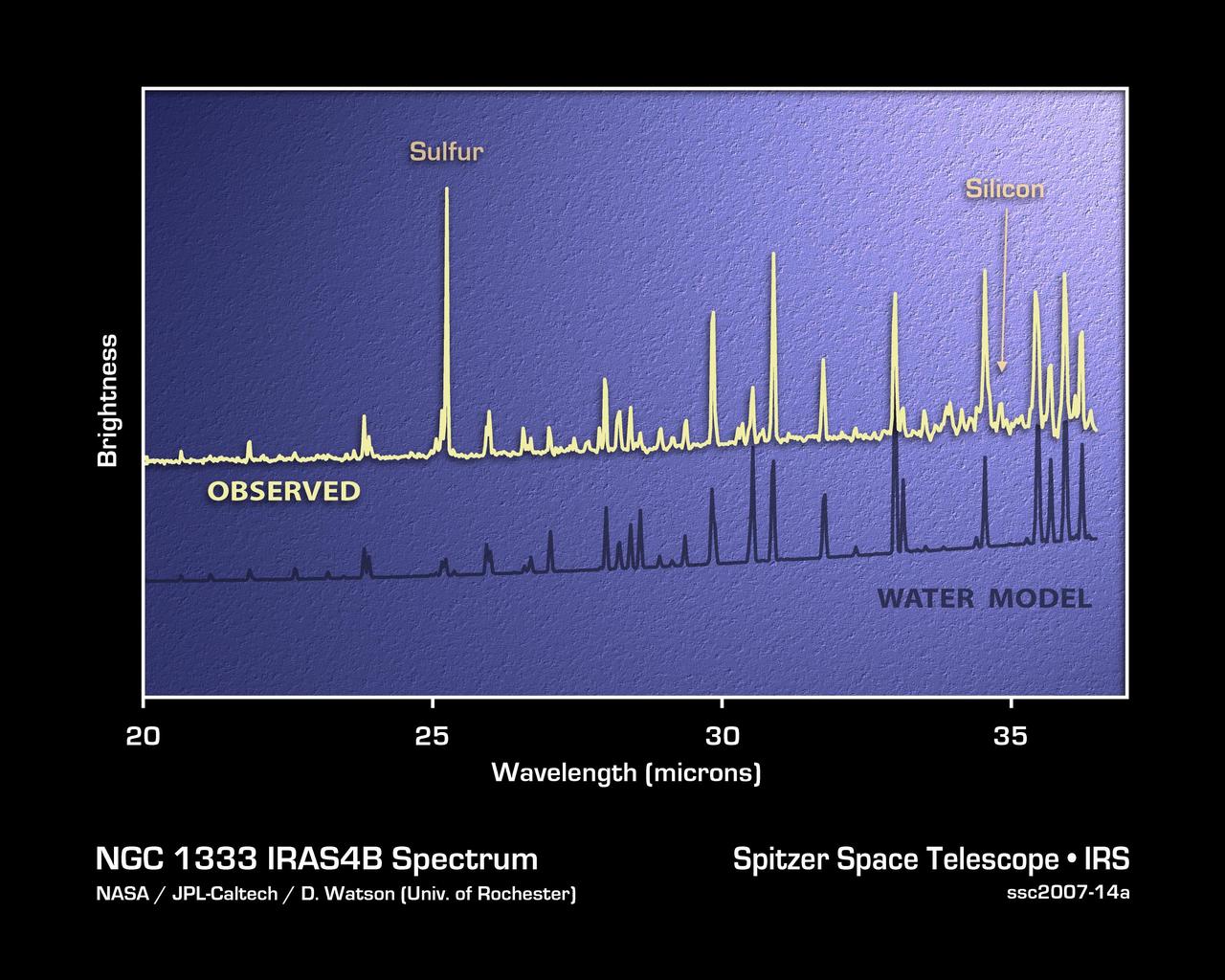
This plot of infrared data, called a spectrum, shows the strong signature of water vapor deep within the core of an embryonic star system, called NGC 1333-IRAS 4B. The data were captured by NASA Spitzer Space Telescope.

This graphic illustrates where astronomers at last found oxygen molecules in space -- near the star-forming core of the Orion nebula. The squiggly lines, or spectra, reveal the signatures of oxygen molecules, detected by ESA Hershel Space Observatory.
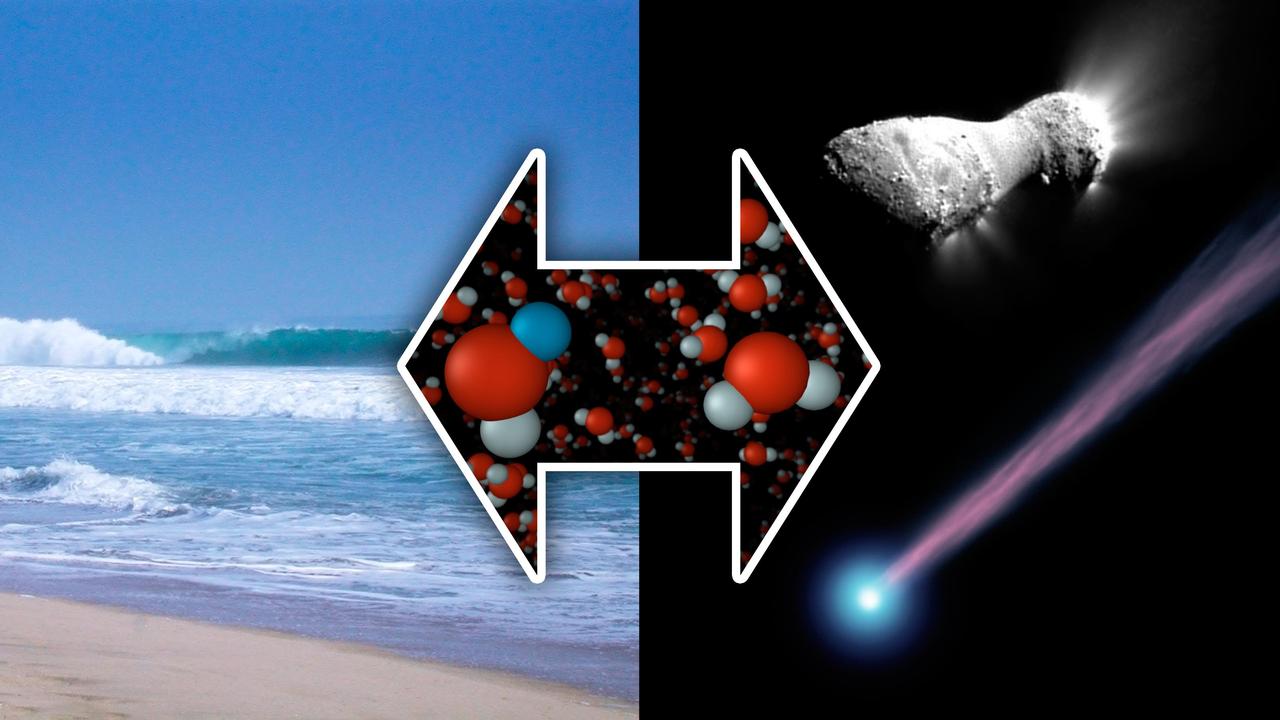
New measurements from NASA Herschel Space Observatory have discovered water with the same chemical signature as our oceans in a comet called Hartley 2 pictured at right. The image at bottom right is an artist concept of a comet.
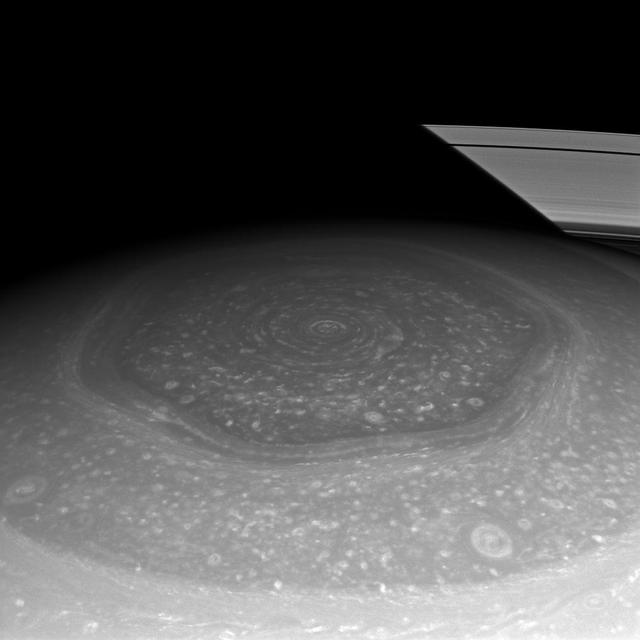
Saturn north polar hexagon basks in the Sun light now that spring has come to the northern hemisphere. Many smaller storms dot the north polar region and Saturn signature rings put in an appearance in the background.
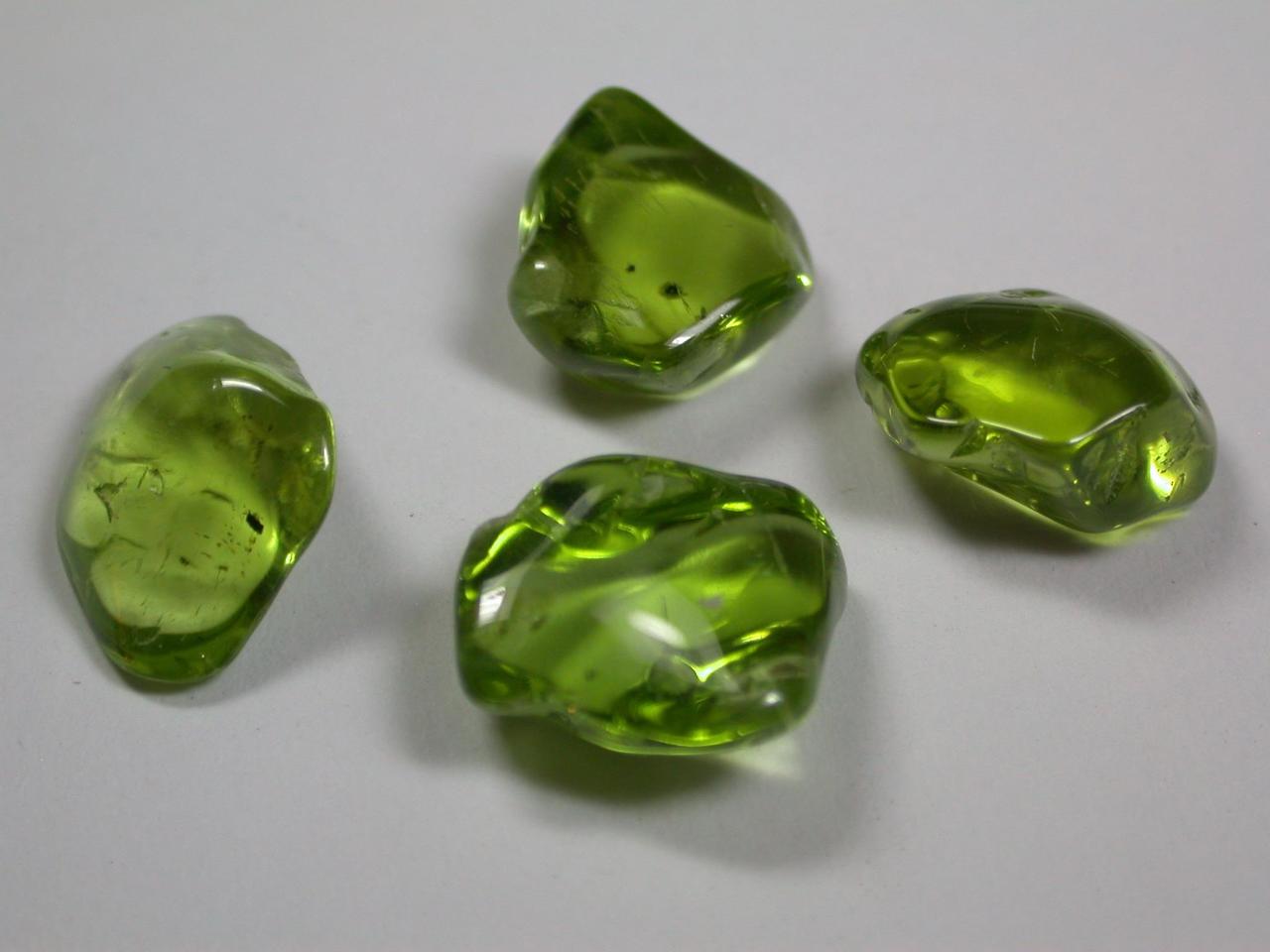
The semi-precious gem peridot is a variety of olivine. NASA Curiosity rover shows the diffraction signature, or fingerprint, of the mineral olivine, shown here on Earth in the form of tumbled crystals.
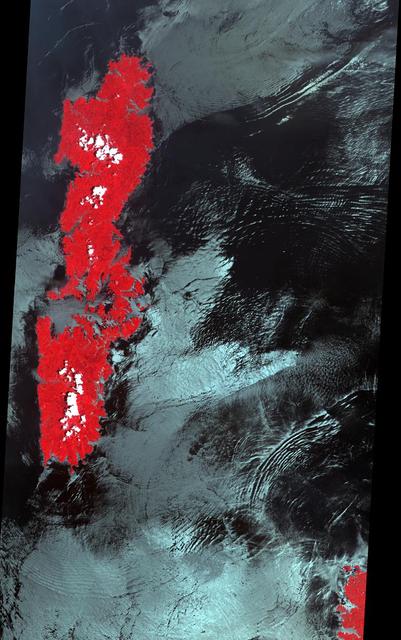
The false-color VNIR image from NASA Terra spacecraft was acquired off the island of Tsushima in the Korea Strait shows the signatures of several internal wave packets, indicating a northern propagation direction.
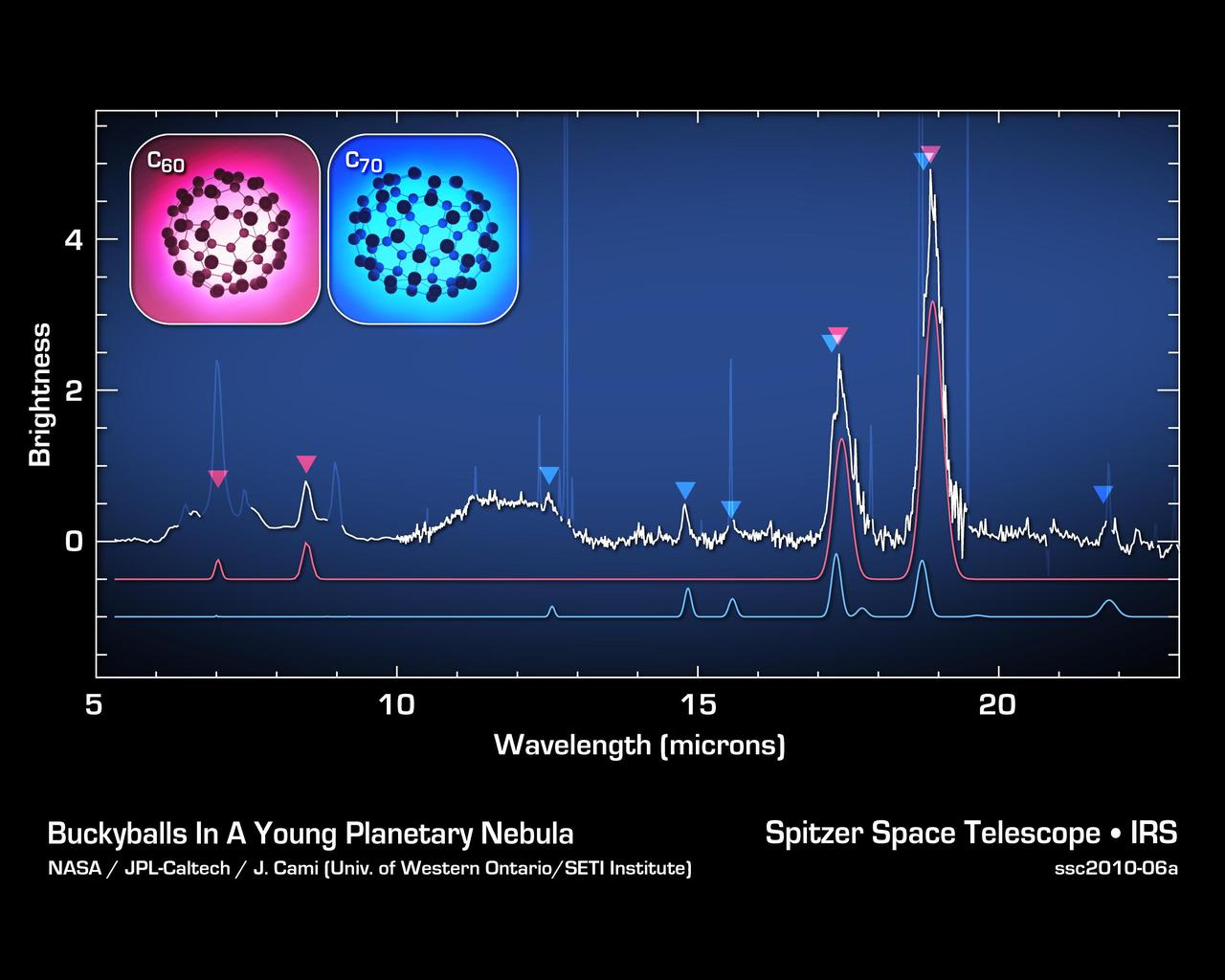
These data from NASA Spitzer Space Telescope show the signatures of buckyballs in space. Buckyballs, also called C60 or buckministerfullerenes, after architect Buckminister Fuller geodesic domes.
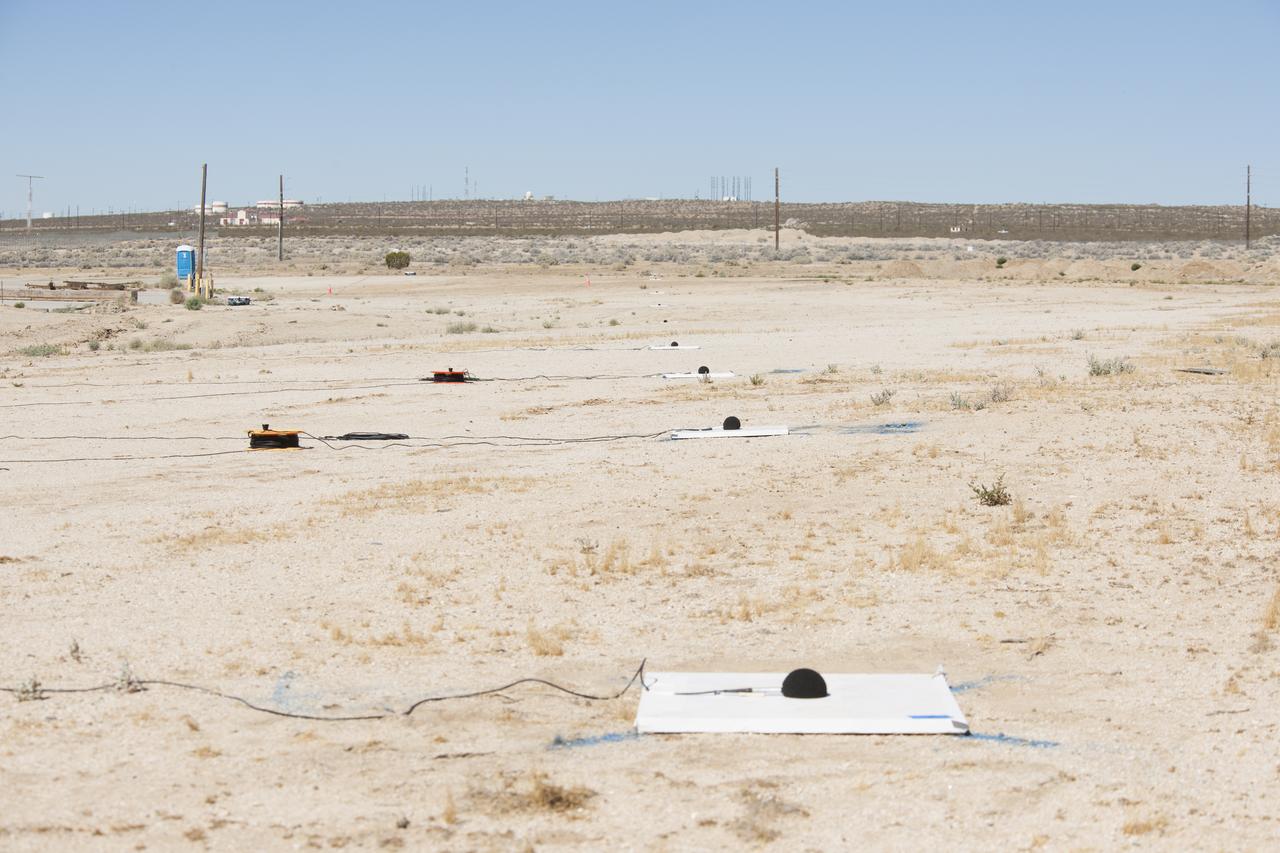
One of three microphone arrays positioned strategically along the ground at Edwards Air Force Base, California, sits ready to collect sound signatures from sonic booms created by a NASA F/A-18 during the SonicBAT flight series. The arrays collected the sound signatures of booms that had traveled through atmospheric turbulence before reaching the ground.
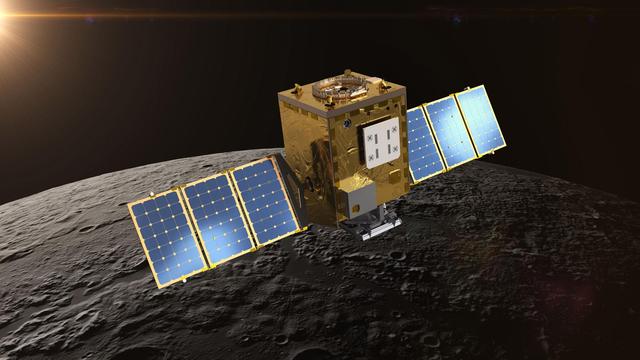
Peering into the Moon's permanently shadowed regions, Lunar Trailblazer will detect signatures of water ice in reflected light, and it will pinpoint the locations of micro-cold traps less than a football field in size. The small satellite will collect measurements at multiple times of day over sunlit regions, helping scientists understand if the water signature on the illuminated surface changes as the lunar surface temperature changes by hundreds of degrees over the course of a lunar day. The goal is to produce high-resolution maps to locate water ice in support of NASA's Artemis Program, which aims to establish a sustainable human presence on the Moon and prepare for future missions to Mars. https://photojournal.jpl.nasa.gov/catalog/PIA24161
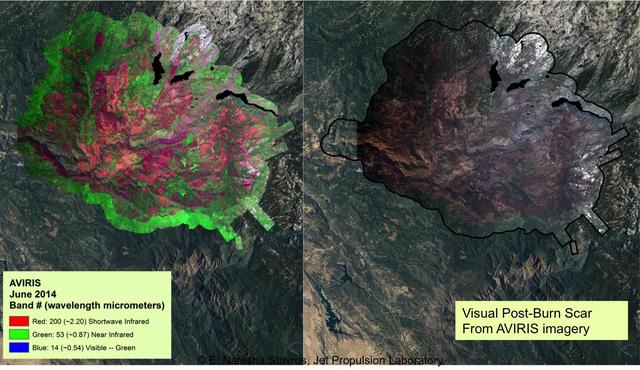
At left, a NASA AVIRIS map shows the spectral signature of the 2013 Rim fire in and near Yosemite National Park, California, the third largest in the state's history, burning more than 250,000 acres. Almost two years later, forest restoration efforts are still ongoing. Charred wood has a strong signal in the wavelengths shown here in red, so areas that are predominantly red in the image were heavily burned. The wavelengths of green, visible light (the color of vegetation) appear on this map as blue. There are no solid blue patches on the map because no large areas of green, living foliage survived the fire. Purple, a mixture of red and blue, indicates an area where charred wood and living plants are mingled. This image provides far more information about the state of the post-fire vegetation than the view on the right, which is what an observer flying overhead would see. AVIRIS is a unique NASA science instrument that measures the complete solar reflected portion of the electromagnetic spectrum with unmatched spectral range, calibration accuracy and signal-to-noise ratio. AVIRIS spectra are measured from 370 to 2,500 nanometers at 9.8-nanometer intervals. Images are acquired with 20-, 6- or 4-meter (66-, 20, or 13-feet) spatial resolution with a 34 degree swath. Up to 100 million spectra are measured in image format on each flight. The spectral image measurements are provided in orthorectified (geometrically corrected) format for direct use by scientists. http://photojournal.jpl.nasa.gov/catalog/PIA19361
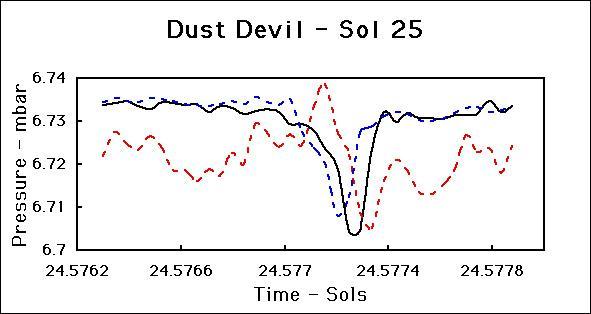
This figure shows the signature of a dust devil that passed over the Pathfinder Lander on Sol 25. Since then we have seen several similar features. The black line shows surface pressure plotted over a period of approximately two minutes. The sharp minimum approximately 0.5% below the background pressure is very clear. The dashed curves show raw data from two hot wire wind sensor elements (Blue = Wind Sensor 4 = East Wind, Red = Wind Sensor 1 = West Wind). When the wind blows directly on an element it cools. It is clear from the figure that the East wind increases suddenly as the dust devil approaches the lander and the pressure begins to fall. As the dust devil passes over the lander, pressure begins to rise, the East wind dies away and the West wind increases suddenly. Finally as the dust devil moves away, pressure returns to normal and the West wind dies away. This is a textbook dust-devil signature. http://photojournal.jpl.nasa.gov/catalog/PIA00900

KENNEDY SPACE CENTER, FLA. - Jim Lloyd, with the Mars Exploration Rover program, holds a computer chip with about 35,000 laser-engraved signatures of visitors to the Jet Propulsion Laboratory. The chip will be placed on the second rover to be launched to Mars (MER-1/MER-B); the first rover already has one. The signatures include those of senators, artists, and John Glenn. The identical Mars rovers are scheduled to launch June 5 and June 25 from Cape Canaveral Air Force Station.

KENNEDY SPACE CENTER, FLA. - Jim Lloyd, with the Mars Exploration Rover (MER) program, points to the place on MER-1 where he will place a computer chip with about 35,000 laser-engraved signatures of visitors to the rovers at the Jet Propulsion Laboratory. The signatures include those of senators, artists, and John Glenn. The identical Mars rovers are scheduled to launch June 5 and June 25 from Cape Canaveral Air Force Station.
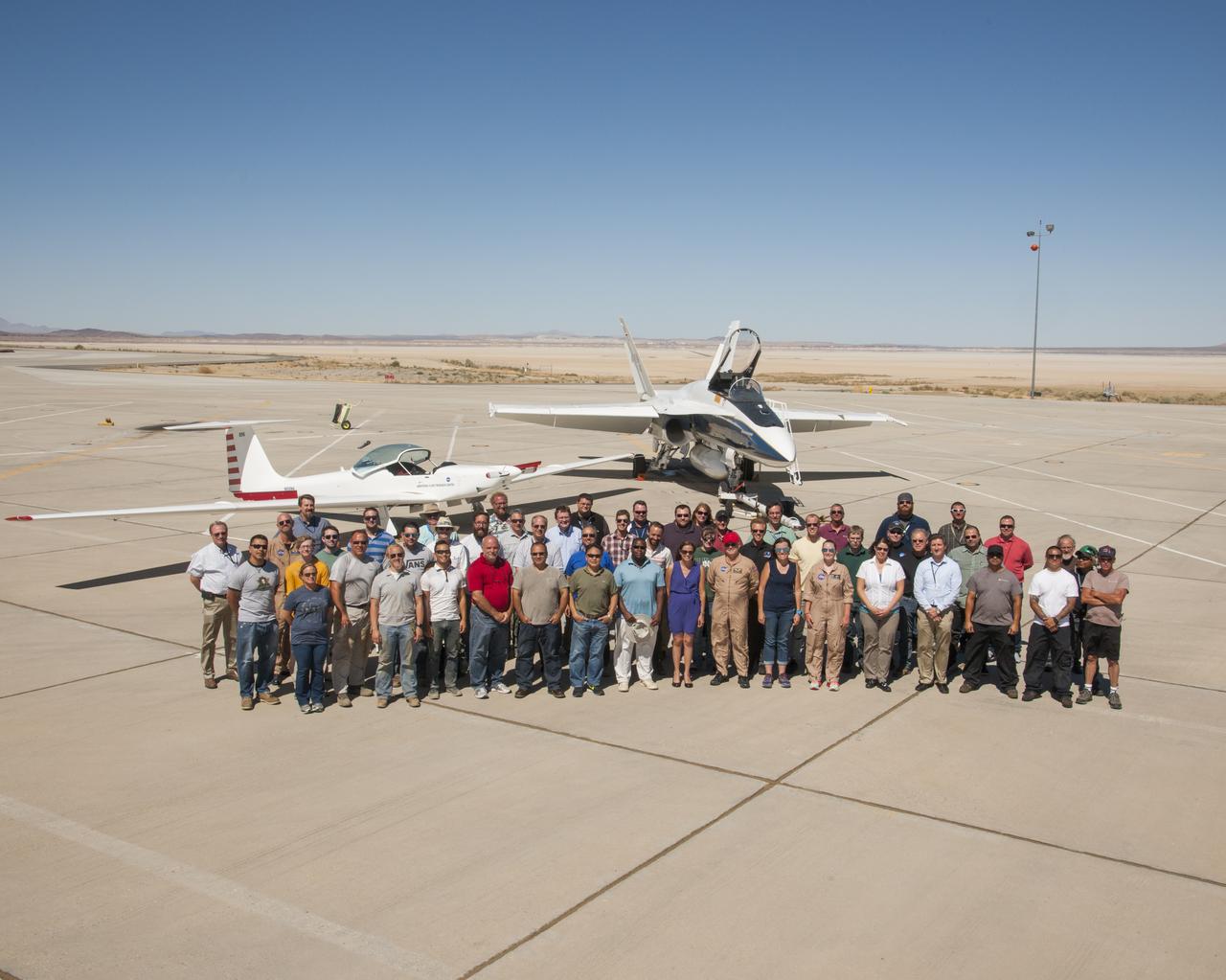
NASA’s SonicBAT team poses in front of the TG-14 motor glider and F/A-18 research aircraft, sitting side-by-side in front of Rogers Dry Lake prior to a SonicBAT flight at Armstrong Flight Research Center on Edwards Air Force Base, California. The TG-14 collected sound signatures of shockwaves created by the F/A-18, to compare with signatures collected on the ground.
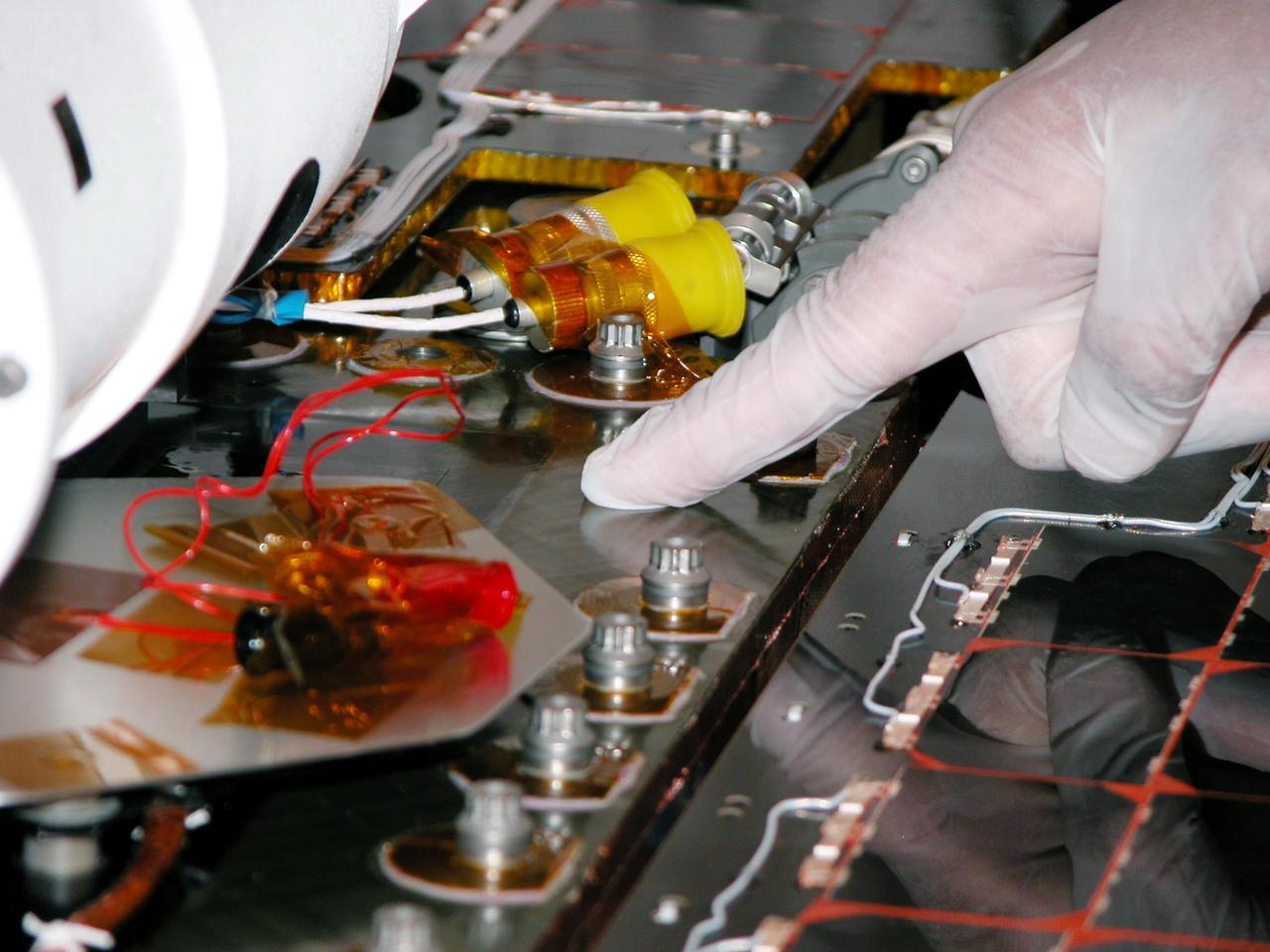
KENNEDY SPACE CENTER, FLA. - This hand points to the place on the Mars Exploration Rover 1 where a computer chip with about 35,000 laser-engraved signatures of visitors to the Jet Propulsion Laboratory will be placed. The first rover already has one. The signatures include those of senators, artists, and John Glenn. The identical Mars rovers are scheduled to launch June 5 and June 25 from Cape Canaveral Air Force Station.
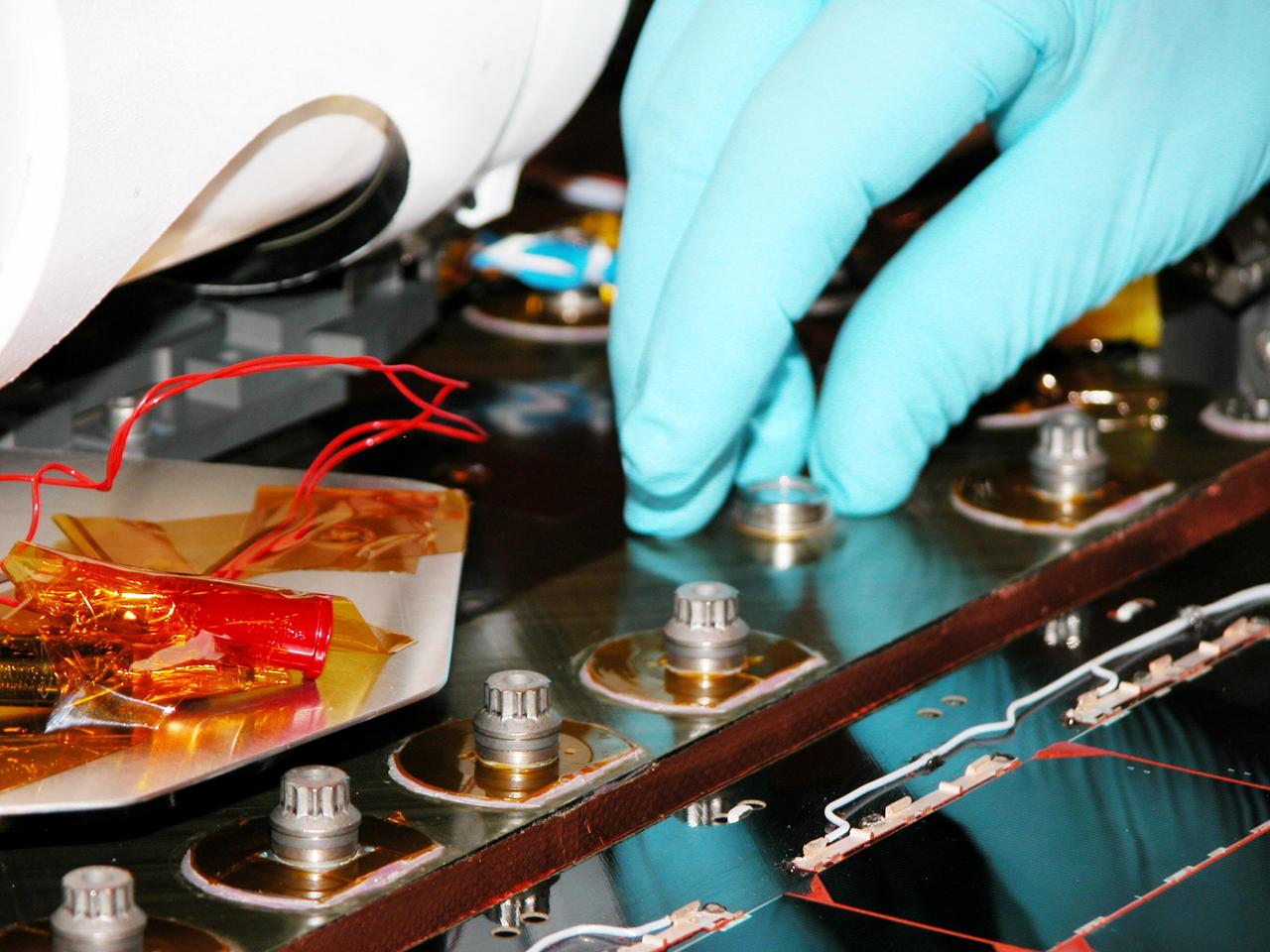
KENNEDY SPACE CENTER, FLA. - Jim Lloyd, with the Mars Exploration Rover (MER) program, places on MER-1 a computer chip with about 35,000 laser-engraved signatures of visitors to the rovers at the Jet Propulsion Laboratory. The signatures include those of senators, artists, and John Glenn. The identical Mars rovers are scheduled to launch June 5 and June 25 from Cape Canaveral Air Force Station.
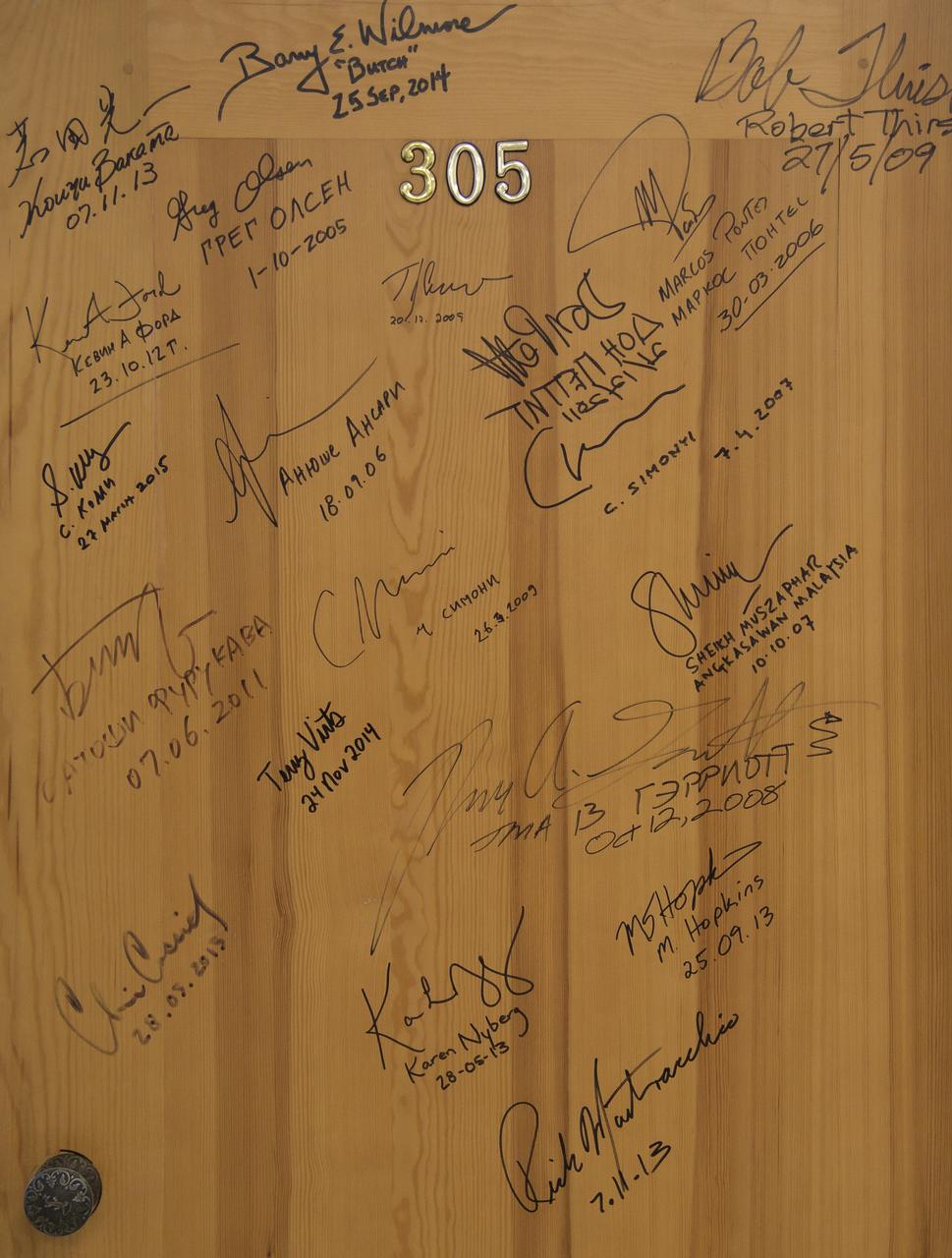
Cosmonaut Hotel with signatures of previous International Space Station crews awaits the prelaunch signatures of Expedition 57 Flight Engineer Nick Hague of NASA, and Flight Engineer Alexey Ovchinin of Roscosmos, Thursday, Oct. 11, 2018 in Baikonur, Kazakhstan. During the Soyuz spacecraft's climb to orbit, an anomaly occurred, resulting in an abort downrange. The crew was quickly recovered and is in good condition. Photo Credit: (NASA/Bill Ingalls)

KENNEDY SPACE CENTER, FLA. - This closeup shows the size of the computer chip that holds about 35,000 laser-engraved signatures of visitors to the Mars Exploration Rovers at the Jet Propulsion Laboratory. It will be placed on the second rover to be launched to Mars; the first rover already has one. The signatures include those of senators, artists, and John Glenn. The identical Mars rovers are scheduled to launch June 5 and June 25 from Cape Canaveral Air Force Station.
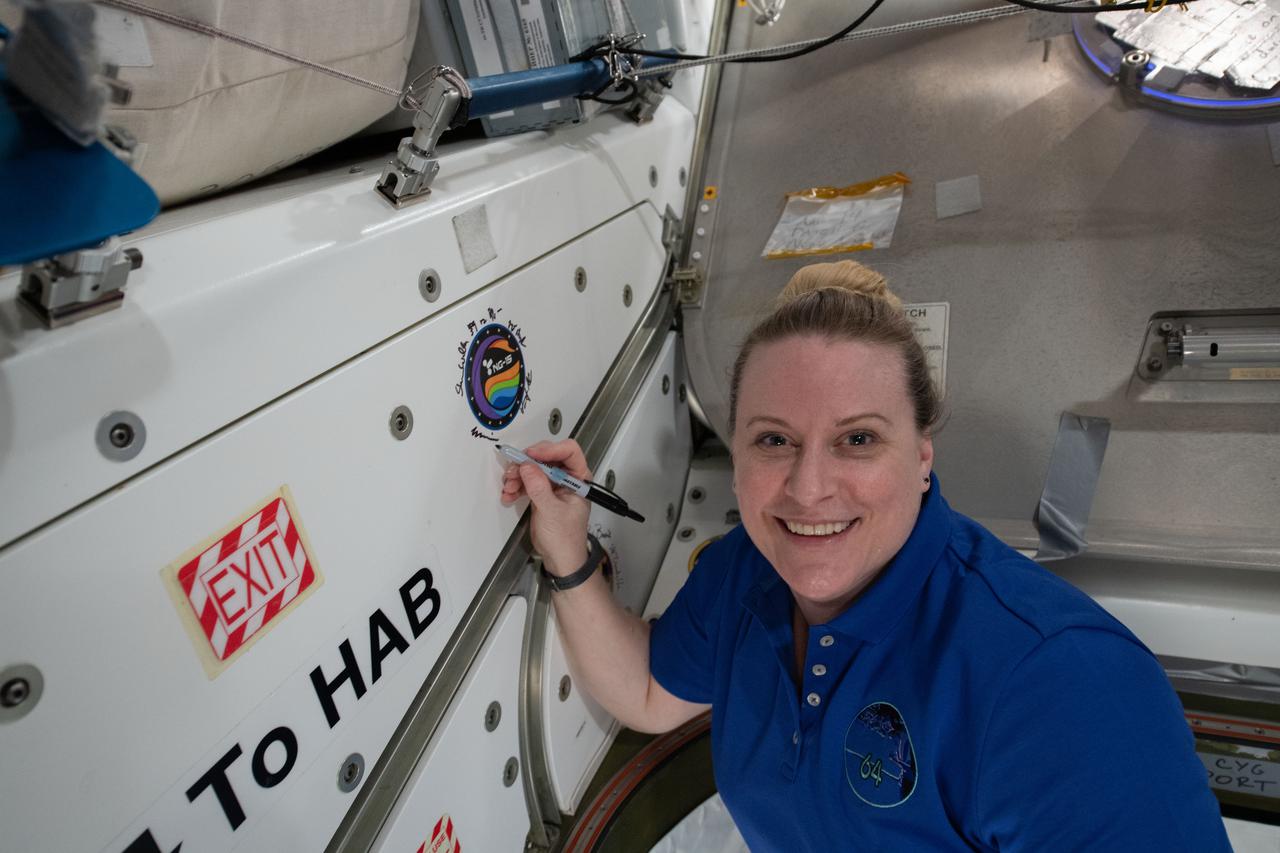
iss064e053423 (April 6, 2021) --- NASA astronaut and Expedition 64 Flight Engineer Kate Rubins applies her signature to the Unity module's vestibule that leads to the Cygnus space freighter from Northrop Grumman.
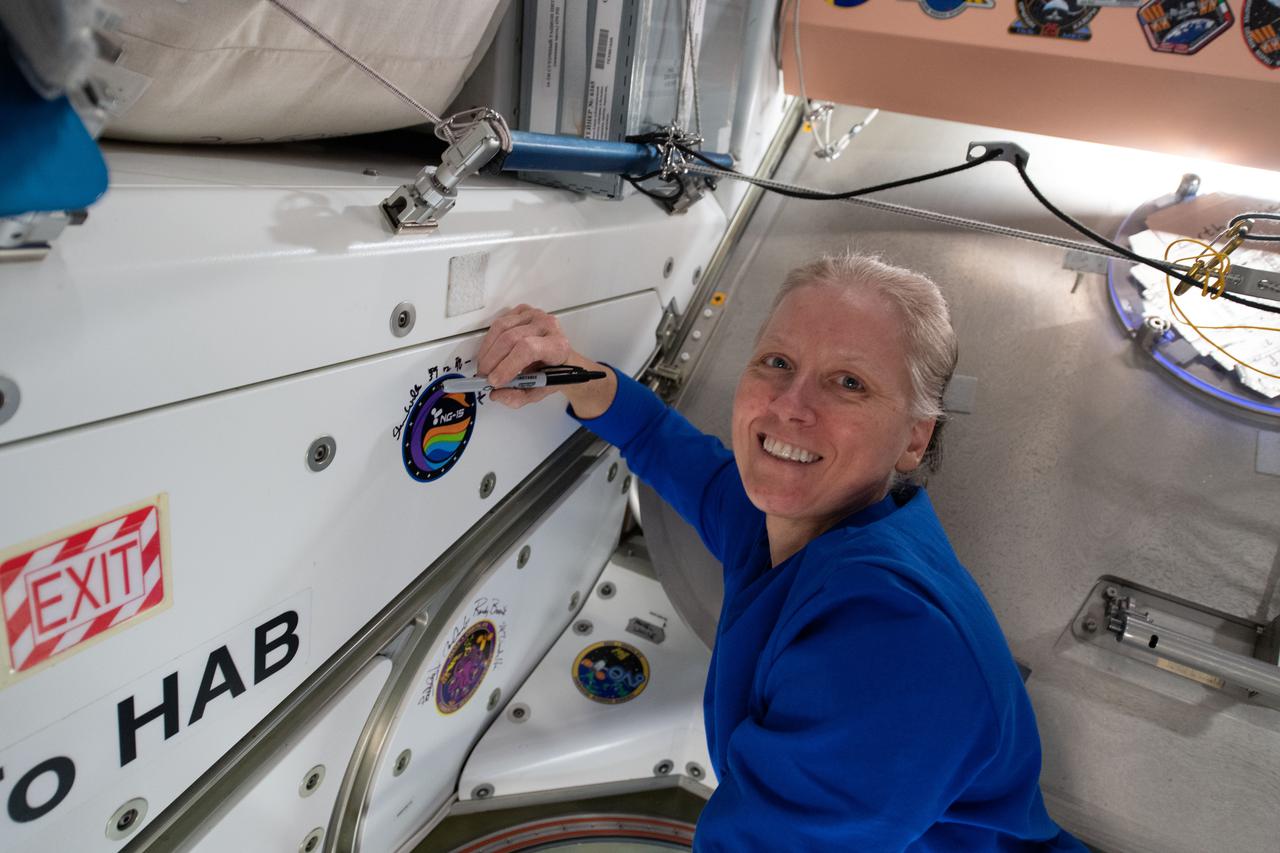
iss064e053418 (April 6, 2021) --- NASA astronaut and Expedition 64 Flight Engineer Shannon Walker applies her signature to the Unity module's vestibule that leads to the Cygnus space freighter from Northrop Grumman.
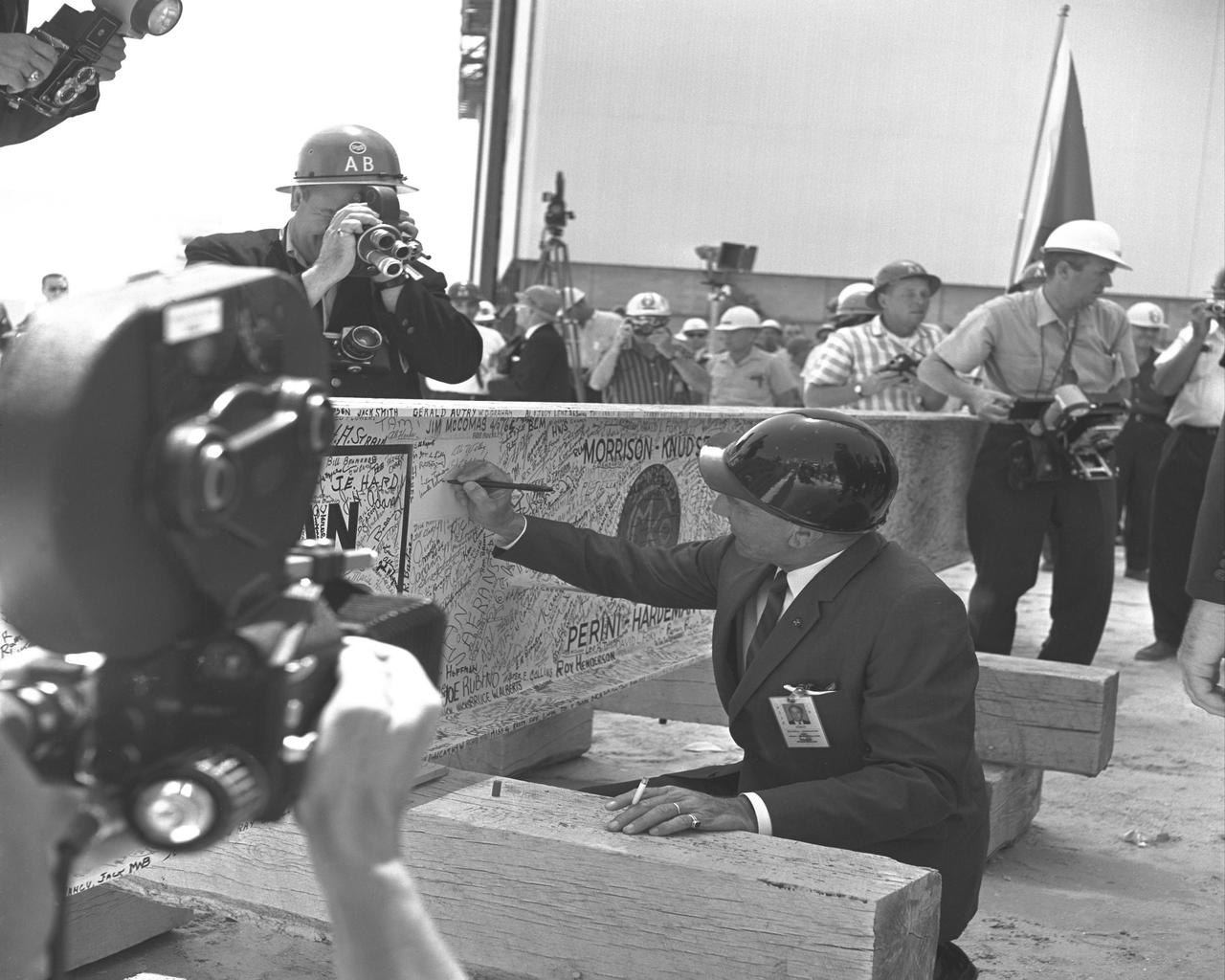
KENNEDY SPACE CENTER, FLA. -- Dr. Kurt Debus, Kennedy Space Center's first director, adds his name to the thousands of signatures affixed to the 38-foot-long steel beam used in the VAB's 'Topping Off' ceremonies.
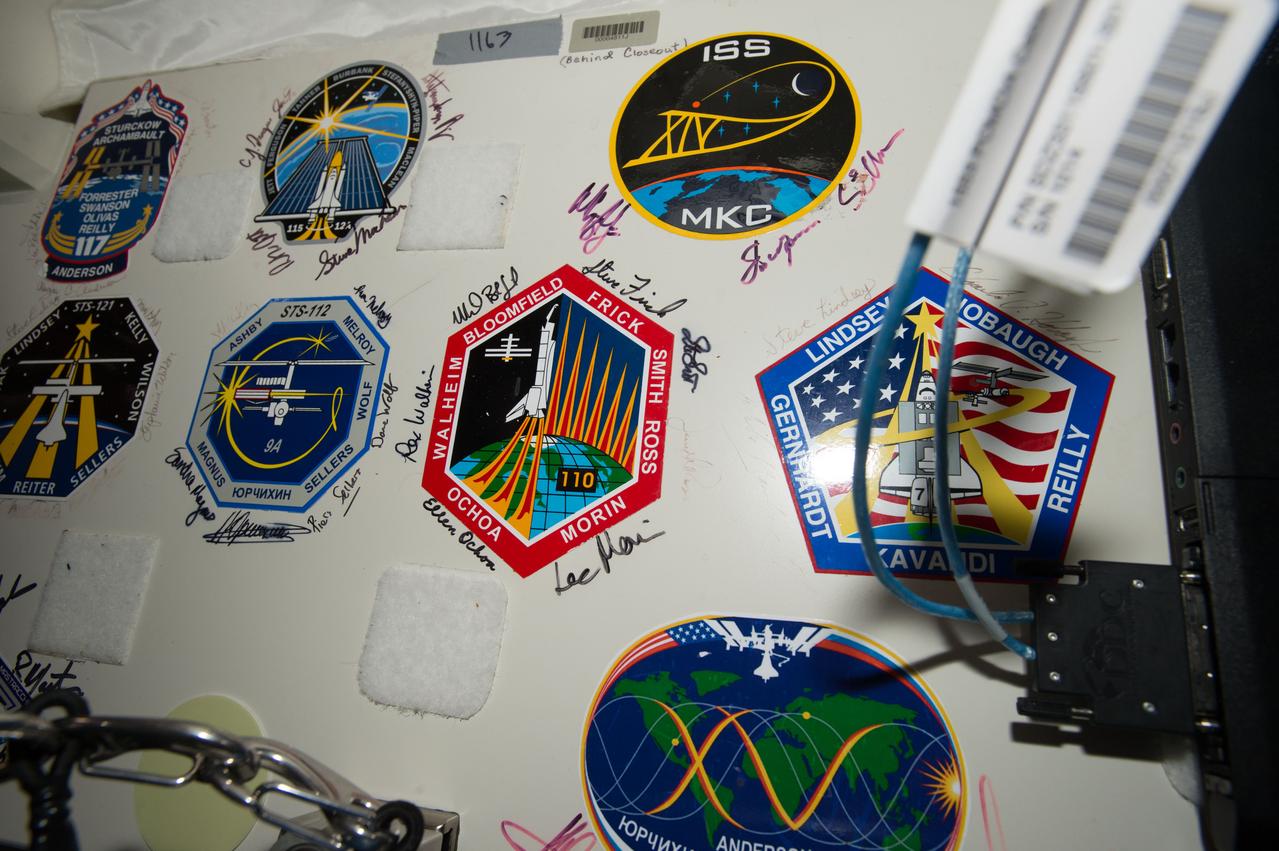
iss051e029233 (April 27, 2017) --- Stickers representing insignia of past space shuttle missions and past Expeditions are encircled by signatures of the crew members who have visited and lived at the International Space Station.
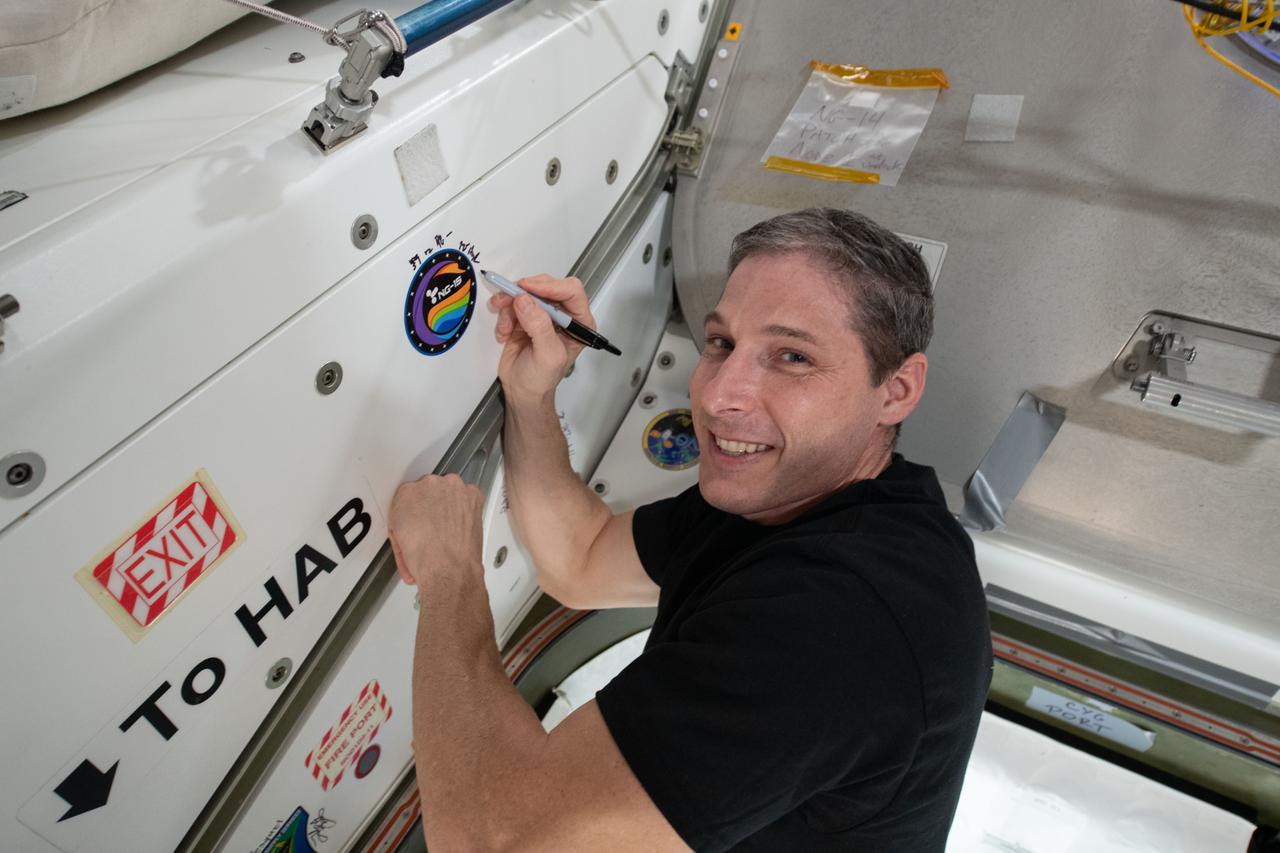
iss064e053415 (April 6, 2021) --- NASA astronaut and Expedition 64 Flight Engineer Michael Hopkins applies his signature to the Unity module's vestibule that leads to the Cygnus space freighter from Northrop Grumman.
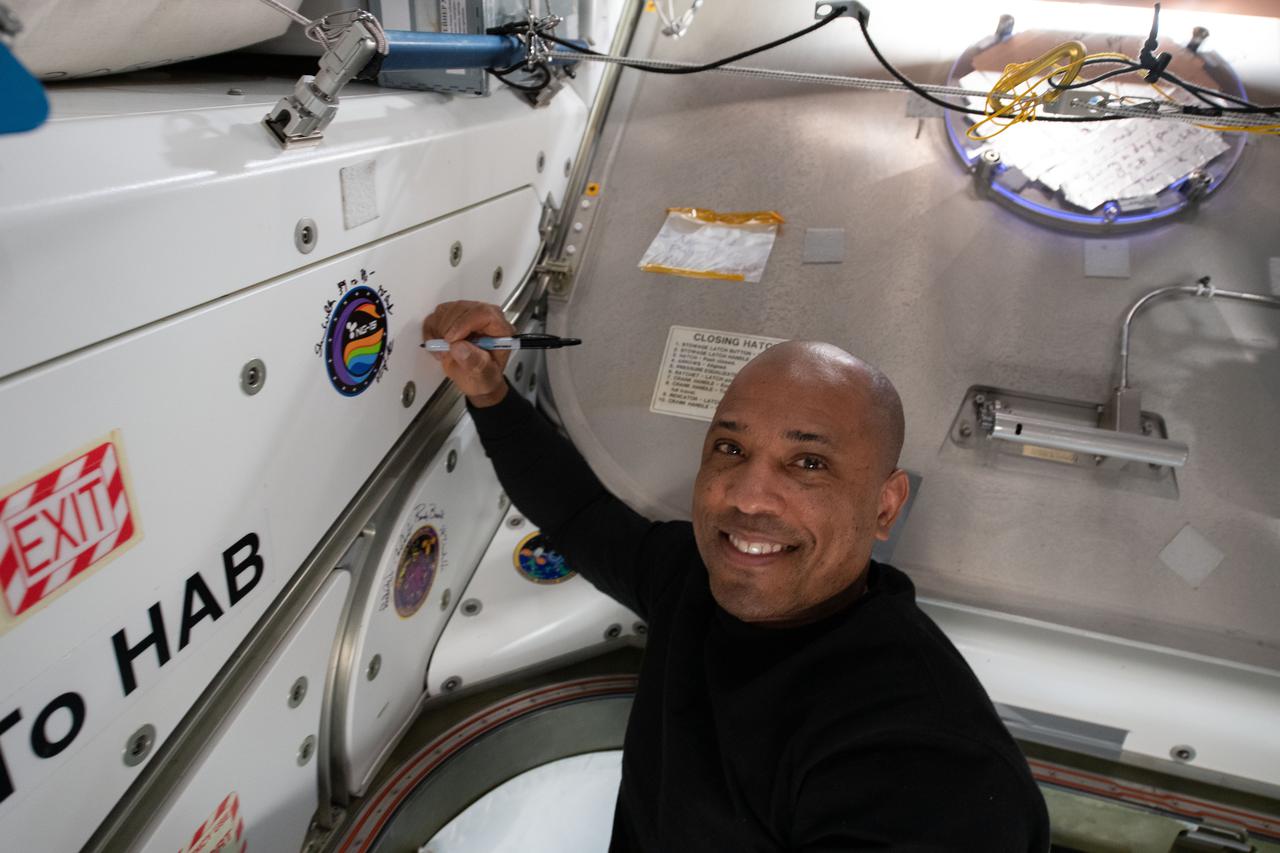
iss064e053421 (April 6, 2021) --- NASA astronaut and Expedition 64 Flight Engineer Victor Glover applies his signature to the Unity module's vestibule that leads to the Cygnus space freighter from Northrop Grumman.
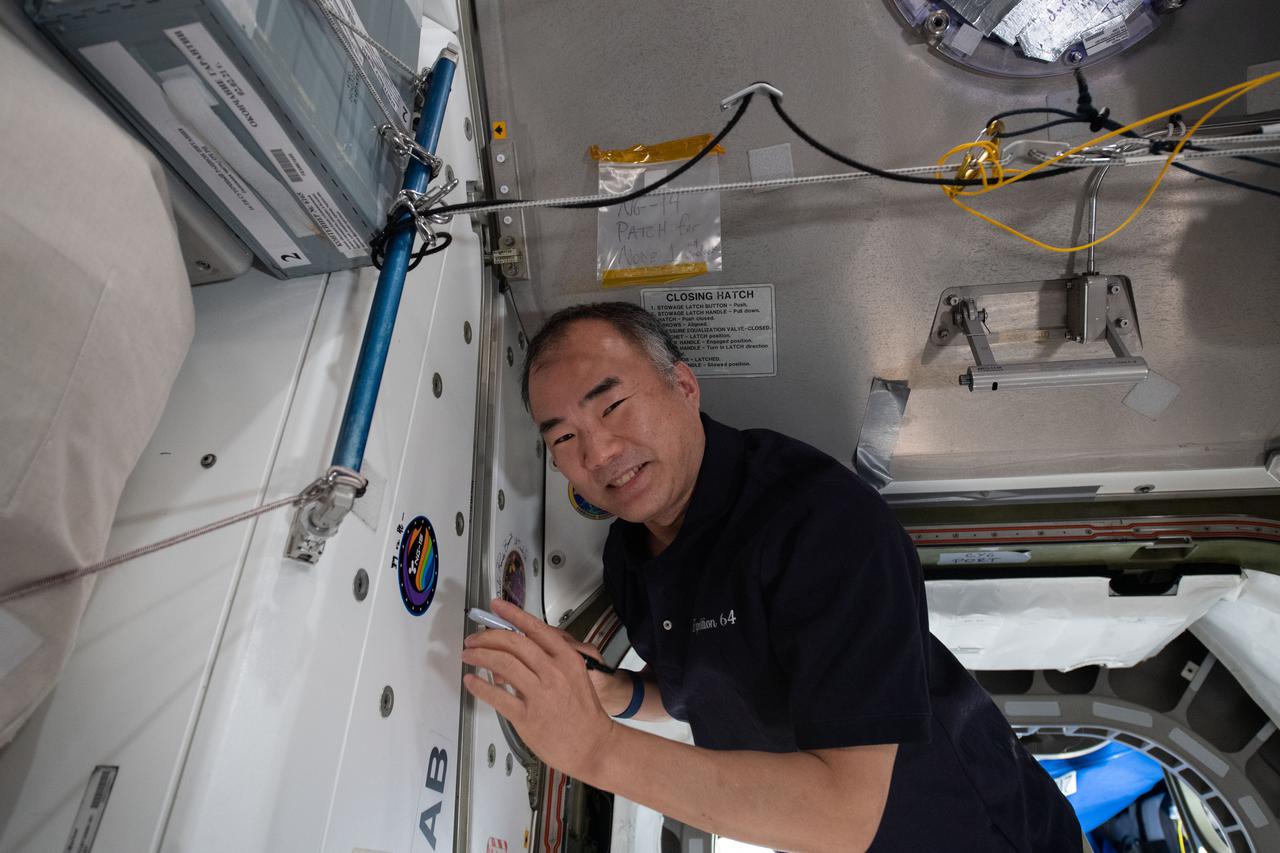
iss064e053413 (April 6, 2021) --- Japan Aerospace Exploration Agency astronaut and Expedition 64 Flight Engineer Soichi Noguchi applies his signature to the Unity module's vestibule that leads to the Cygnus space freighter from Northrop Grumman.
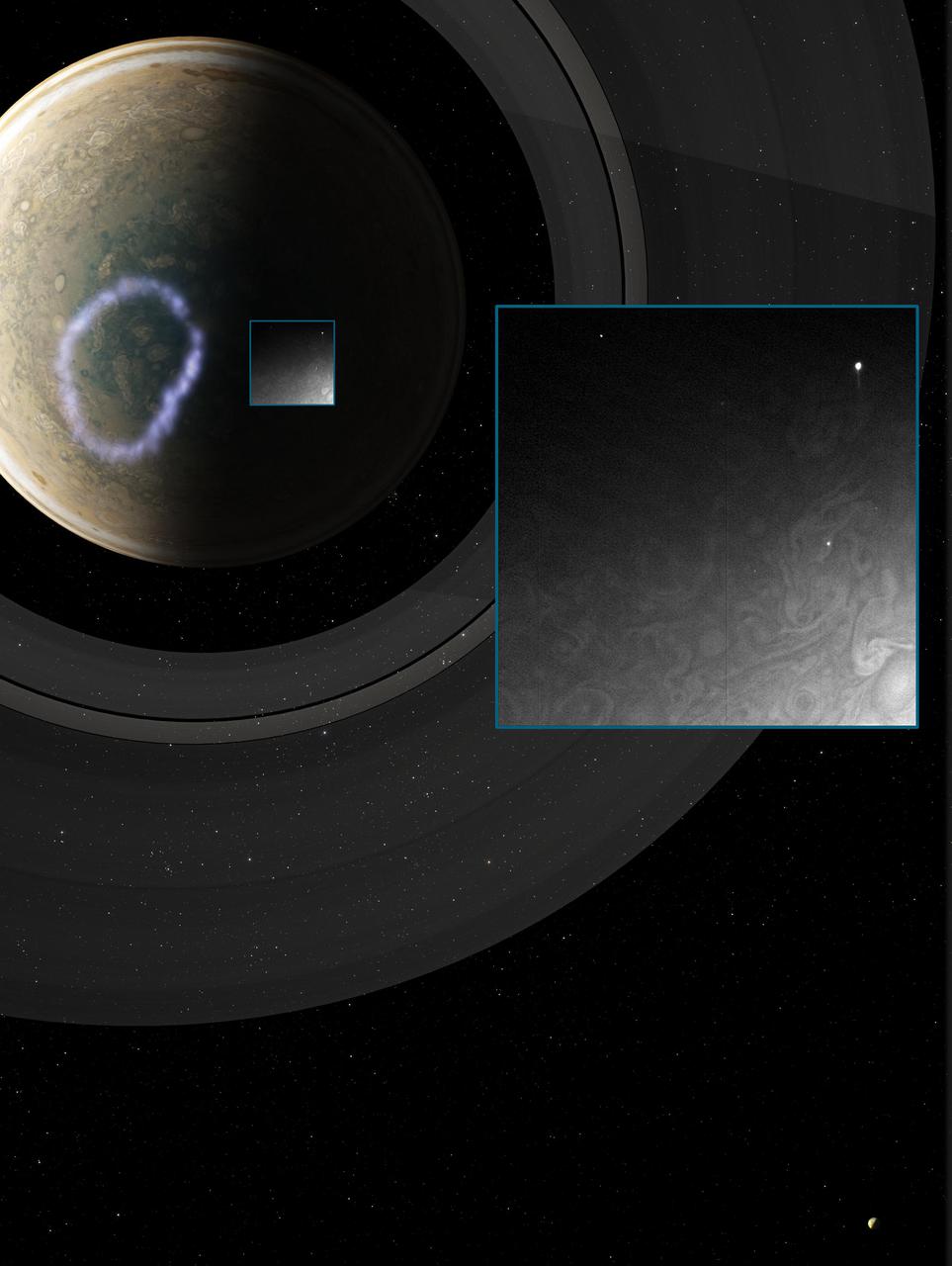
This image is the first observation of "shallow lightning" flashes — signatures of high-altitude Jovian thunderstorms that may fundamentally influence the composition of Jupiter's atmosphere. The image of was acquired by NASA's Juno mission using the spacecraft's sensitive Stellar Reference Unit navigation camera during Juno's 10th science flyby on Feb. 7, 2018. The solar-powered Jupiter explorer launched on Aug. 5, 2011 and went into orbit around the gas giant on July 4, 2016. https://photojournal.jpl.nasa.gov/catalog/PIA24301

KENNEDY SPACE CENTER, FLA. - Tom Shain, the MER ATLO logistics manager, holds a computer chip with about 35,000 laser-engraved signatures of visitors to the Mars Exploration Rovers at the Jet Propulsion Laboratory. He and Jim Lloyd, also with the program, will place the chip on the second rover to be launched to Mars (MER-1/MER-B); the first rover already has one. The signatures include those of senators, artists, and John Glenn. The identical Mars rovers are scheduled to launch June 5 and June 25 from Cape Canaveral Air Force Station.

KENNEDY SPACE CENTER, FLA. - Jim Lloyd (left) and MER ATLO Logistics Manager Tom Shain shake hands after placing on the Mars Exploration Rover 1 (MER-1) a computer chip with about 35,000 laser-engraved signatures of visitors to the rovers at the Jet Propulsion Laboratory. The signatures include those of senators, artists, and John Glenn. The handshake also represents the passing of the "flame" of logistics job responsibilities at JPL to Lloyd who will be replacing Shain after his retirement. The identical Mars rovers are scheduled to launch June 5 and June 25 from Cape Canaveral Air Force Station.
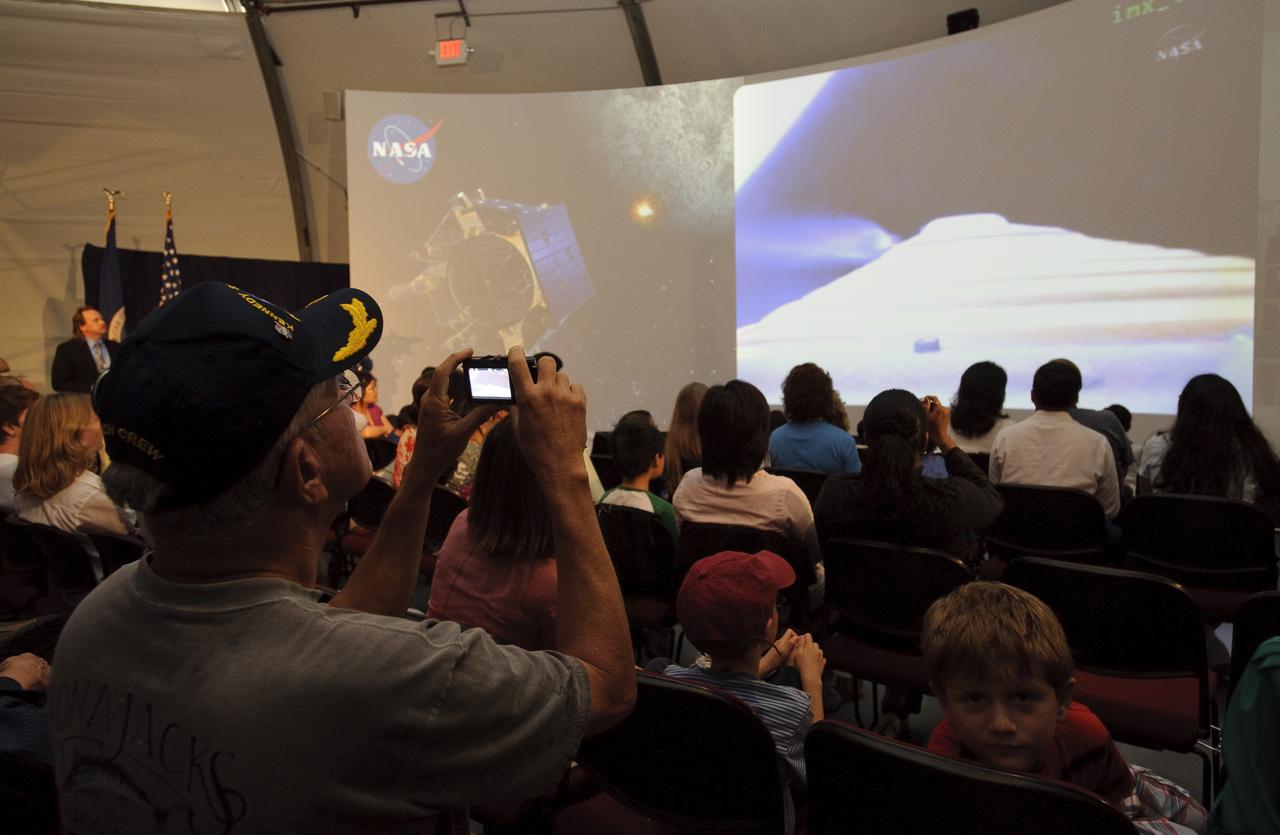
LCROSS launch public viewing event held at Ames Research Center, Moffett Field, CA NRP tenant Ecliptic Enterprises Corporation is playing a crucial role in the LCROSS (Lunar Crater Observation and Sensing Satellite) mission to search for the signature of water, a lunar resource that can be used for future human exploration, at the Moon’s rugged South Pole. Ecliptic’s signature product, RocketCam™, transmitted video from three camera perspectives of the picture-perfect launch from Cape Canaveral aboard an ATLAS V rocket on June 18. RocketCam™, a family of onboard imaging systems
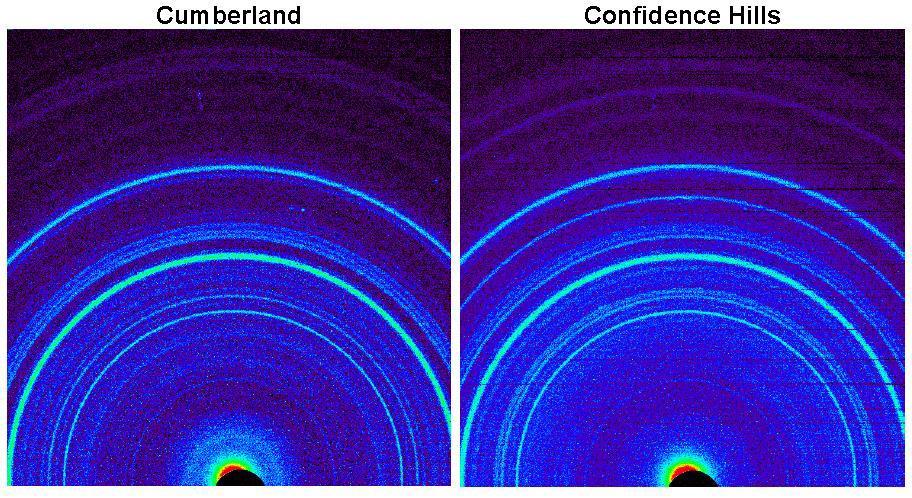
This side-by-side comparison shows the X-ray diffraction patterns of two different samples collected from rocks on Mars by NASA Curiosity rover. The images present data obtained by Curiosity Chemistry and Mineralogy instrument CheMin.
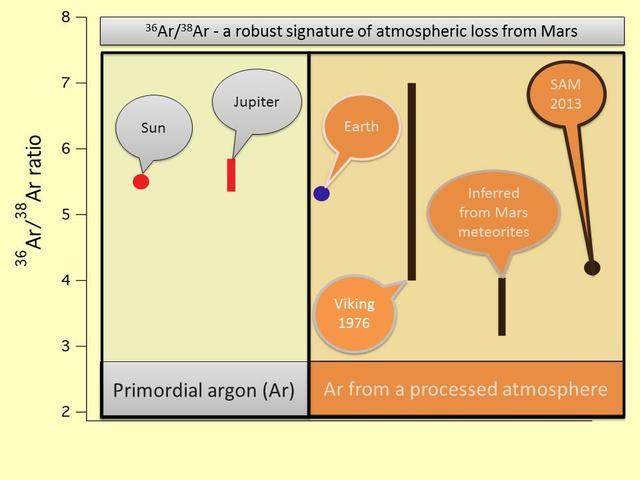
This image, made by the quadrupole mass spectrometer in the SAM suite of instruments in NASA Curiosity Mars rover. shows the ratio of the argon isotope argon-36 to the heavier argon isotope argon-38, in various measurements.
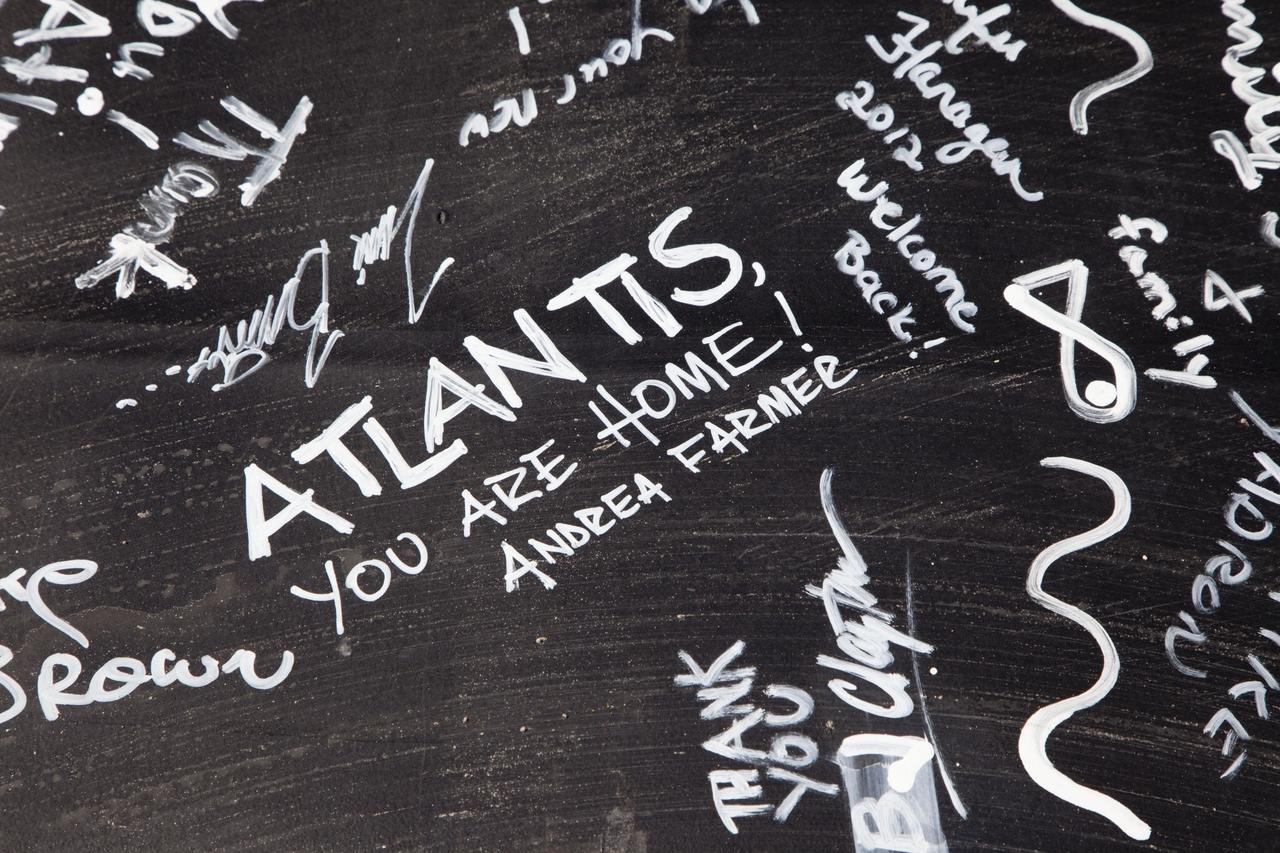
CAPE CANAVERAL, Fla. – Signatures on a steel beam that was placed at the highest point of a new exhibit facility under construction at the Kennedy Space Center Visitor Complex. The 90,000-square-foot facility will house space shuttle Atlantis and 62 shuttle program exhibits. Photo credit: NASA/Kim Shiflett
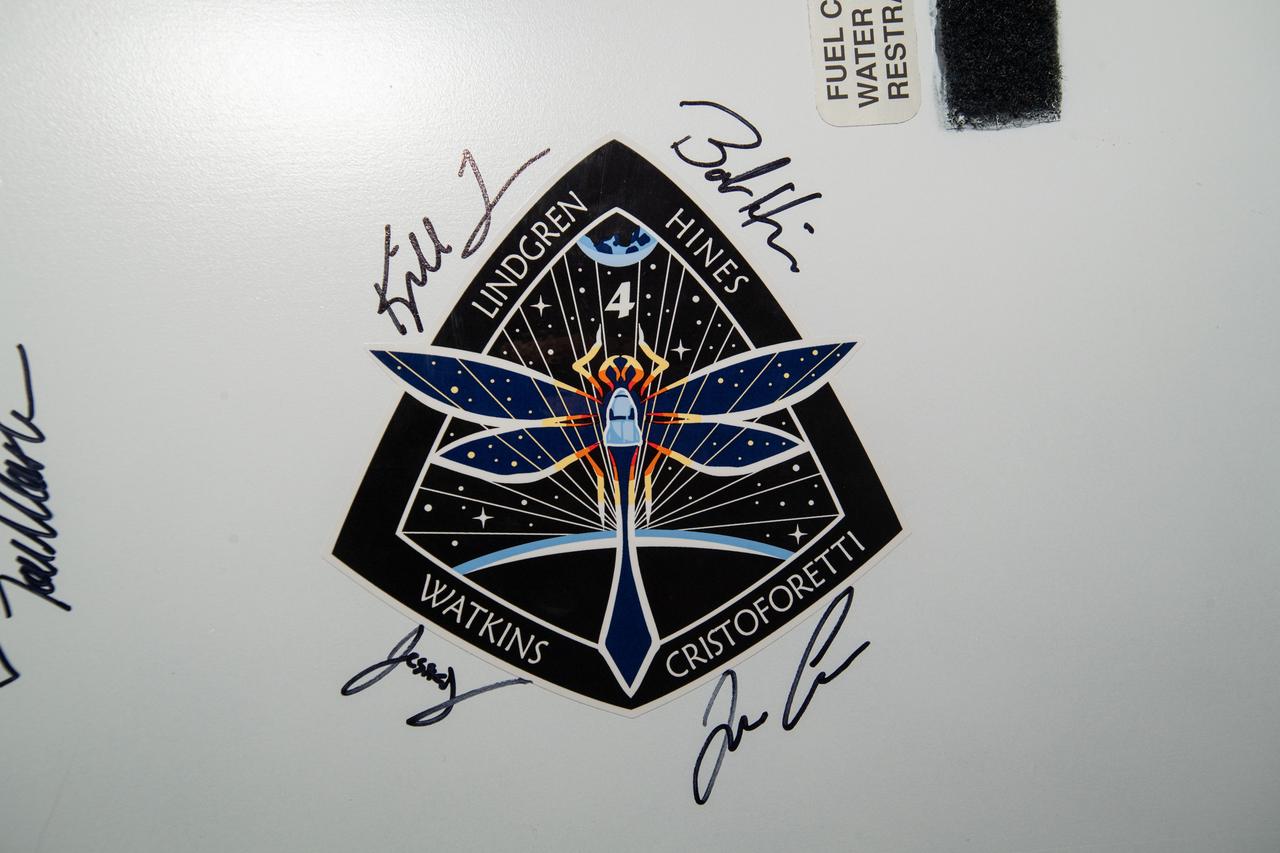
iss068e016463 (Oct. 12, 2022) --- The SpaceX Crew-4 mission insignia, affixed to the vestibule between the Harmony module's space-facing port and the Dragon Freedom crew ship, is surrounded by the signatures of Crew-4 members Kjell Lindgren, Bob Hines, Jessica Watkins, and Samantha Cristoforetti. Credit: NASA/Kjell Lindgren
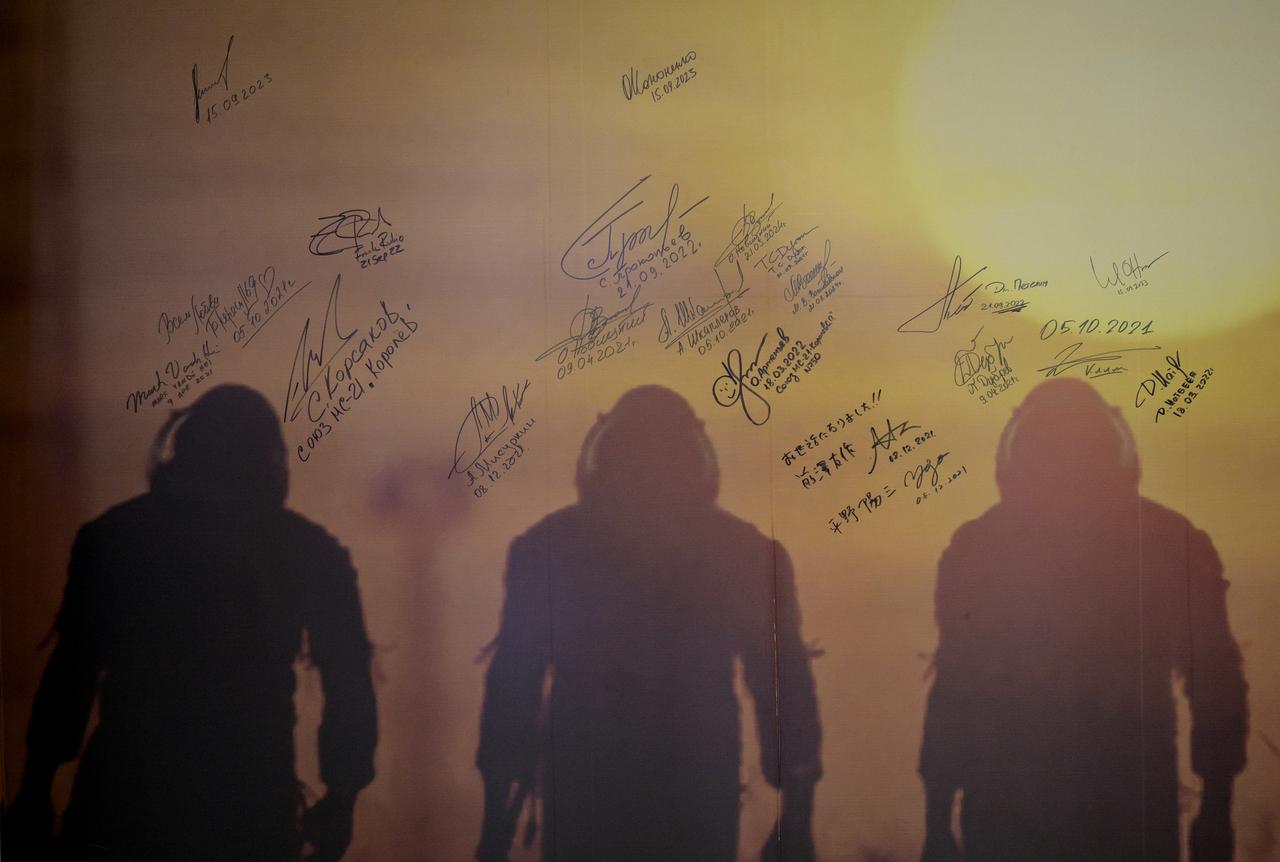
A mural with signatures of astronauts and cosmonauts is seen inside the Cosmonaut Hotel, Wednesday, Sept. 11, 2024, in Baikonur, Kazakhstan. Expedition 72 crew members: NASA astronaut Don Pettit, Roscosmos cosmonauts Alexey Ovchinin, and Ivan Vagner, will sign the mural prior to launching to the International Space Station. Photo Credit: (NASA/Bill Ingalls)
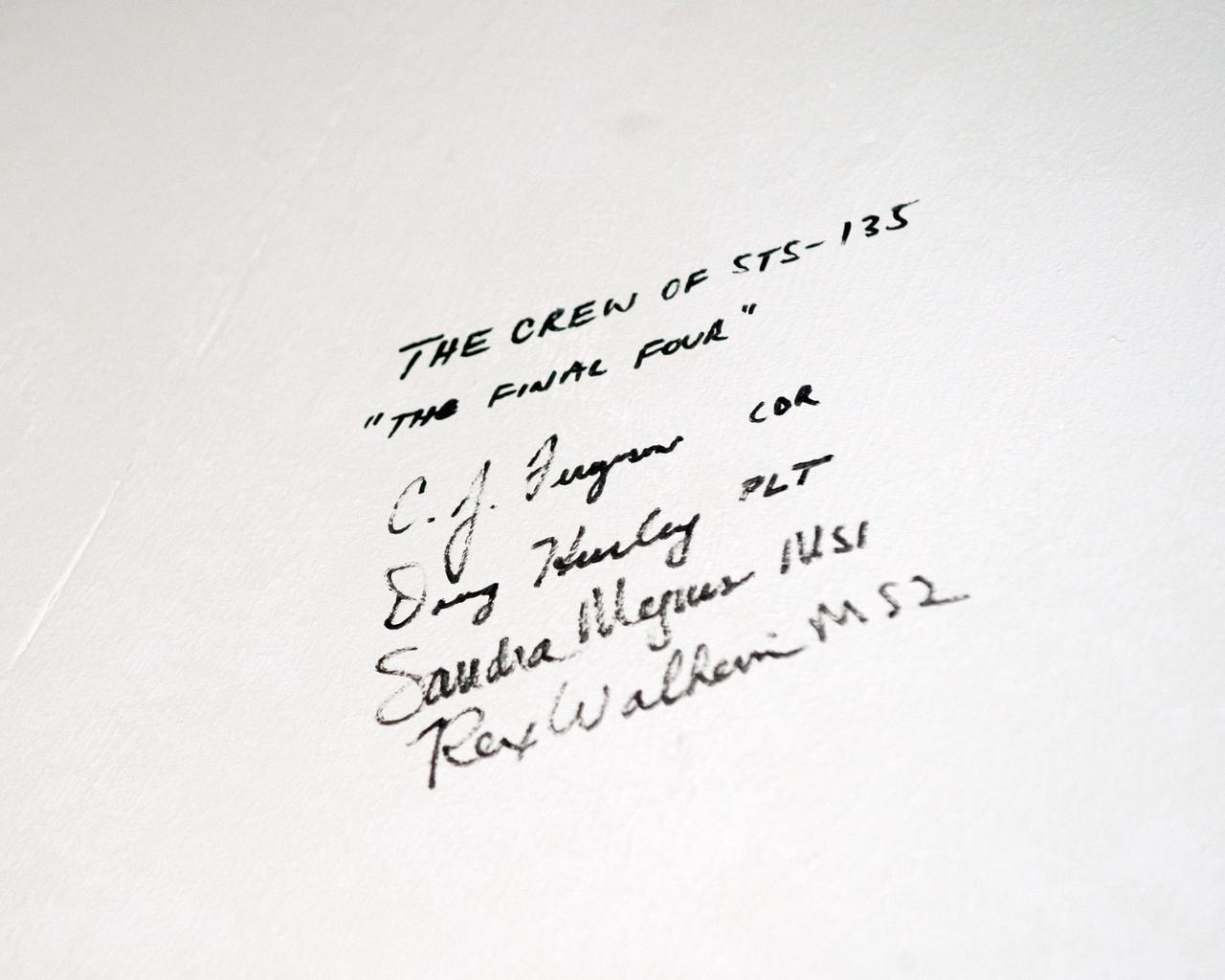
JSC2011-E-043693 (29 April 2011) --- A close-up view of the STS-135 crew members? signatures placed on hardware during an ingress/egress timeline training session in the Space Vehicle Mock-up Facility at NASA's Johnson Space Center. Photo credit: NASA
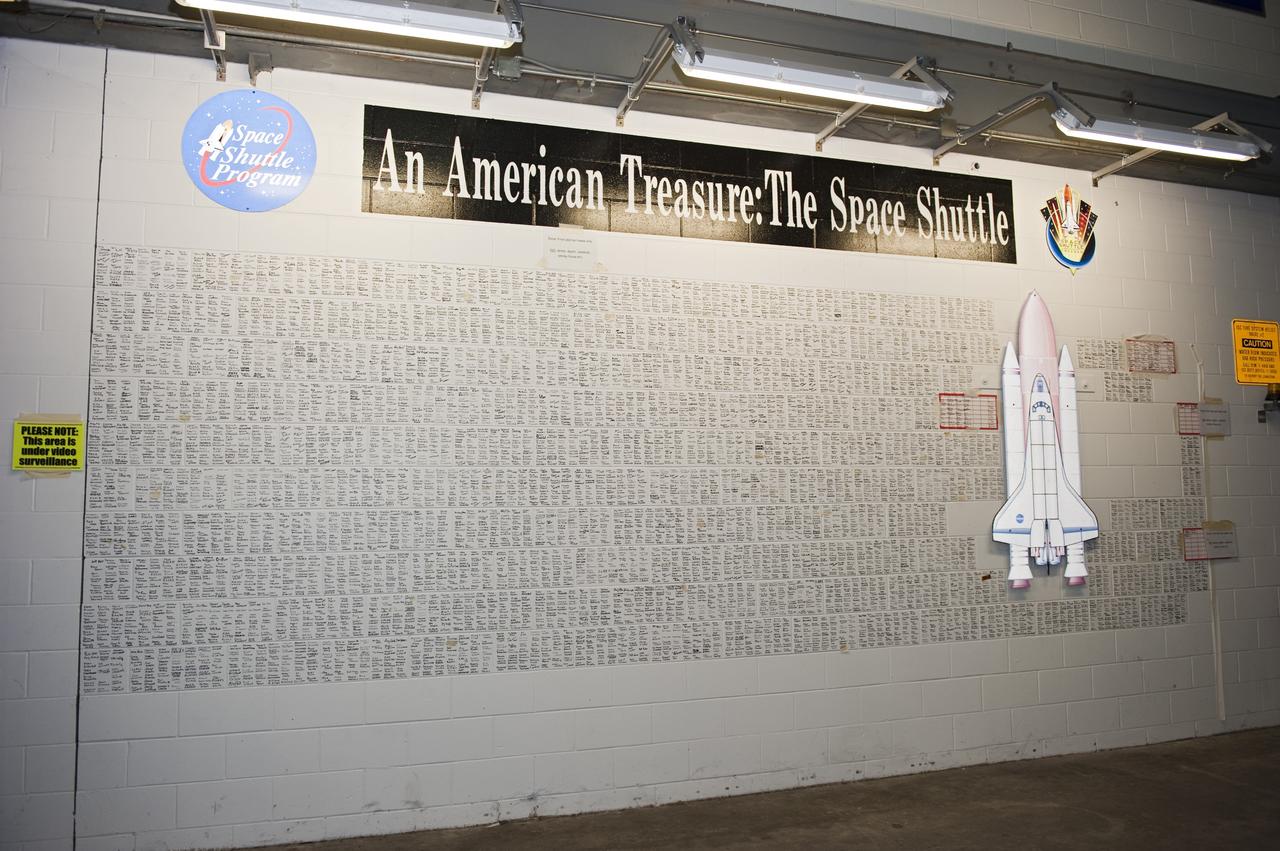
CAPE CANAVERAL, Fla. -- The space shuttle wall tribute in the Vehicle Assembly Building at NASA's Kennedy Space Center in Florida is filling up with the signatures of employees who have supported the Space Shuttle Program throughout the last 30 years. Photo credit: NASA/Kim Shiflett
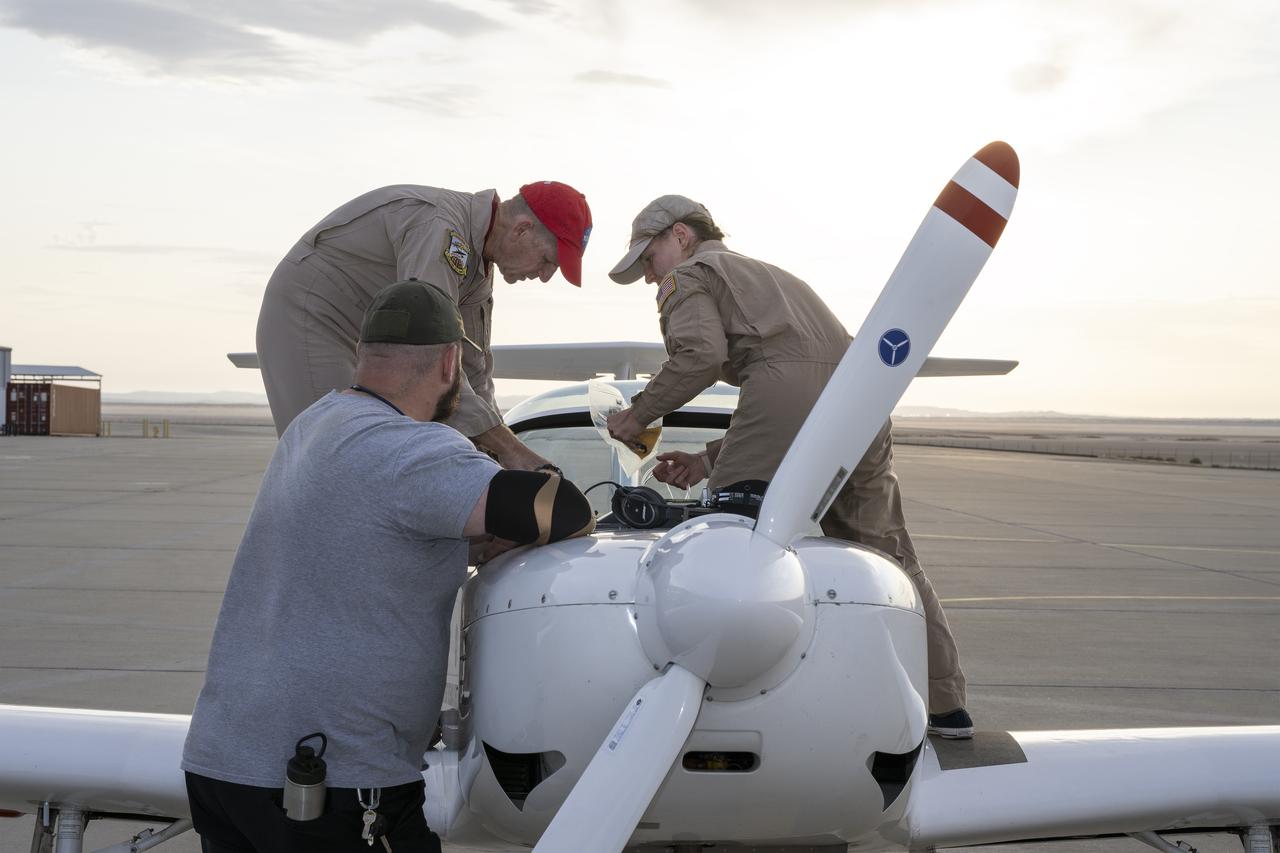
A NASA TG-14 glider aircraft is prepared for flight at NASA’s Armstrong Flight Research Center in Edwards, California, in support of the agency’s Quesst mission. The aircraft is equipped with onboard microphones to capture sonic boom noise generated during rehearsal flights, helping researchers measure the acoustic signature of supersonic aircraft closer to the ground.
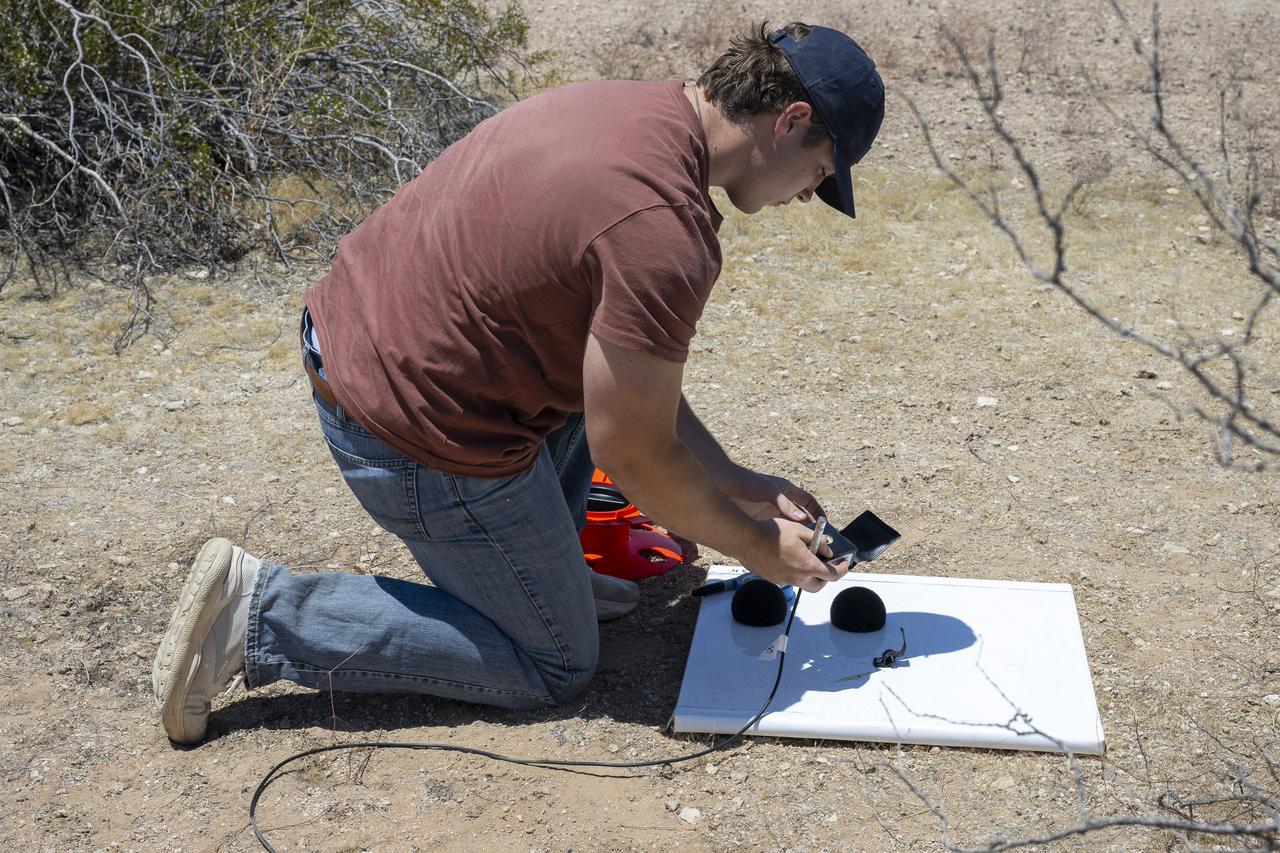
A NASA intern sets up ground recording system (GRS) units in California’s Mojave Desert during a Phase 2 rehearsal of the agency’s Quesst mission. The GRS units were placed across miles of desert terrain to capture the acoustic signature of supersonic aircraft during rehearsal flights and in preparation for the start of the actual tests.
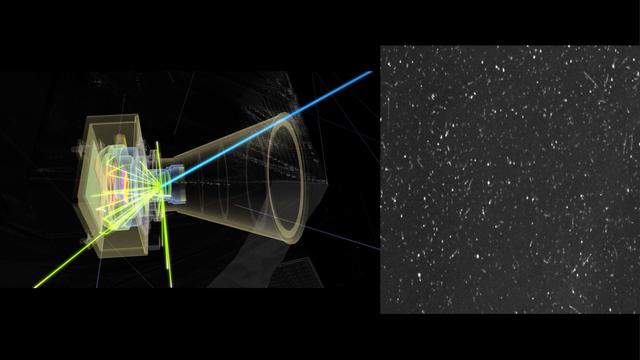
This animation gives an X-ray view of the Juno spacecraft's Stellar Reference Unit (SRU) star camera (left) as it is bombarded by high-energy particles in Jupiter's inner radiation belts. Even though the SRU camera head is six times more heavily shielded than Juno's radiation vault, the highest-energy particles in Jupiter's extreme radiation environment can still penetrate, striking the imaging sensor inside. The signatures from high-energy electron and ion hits appear as dots, squiggles, and streaks (right) in the images collected by the SRU, like static on a television screen. Juno's Radiation Monitoring Investigation collects SRU images and uses image processing to extract these radiation-induced noise signatures to profile the radiation levels encountered by Juno during its close flybys of Jupiter. Animation available at https://photojournal.jpl.nasa.gov/catalog/PIA24436
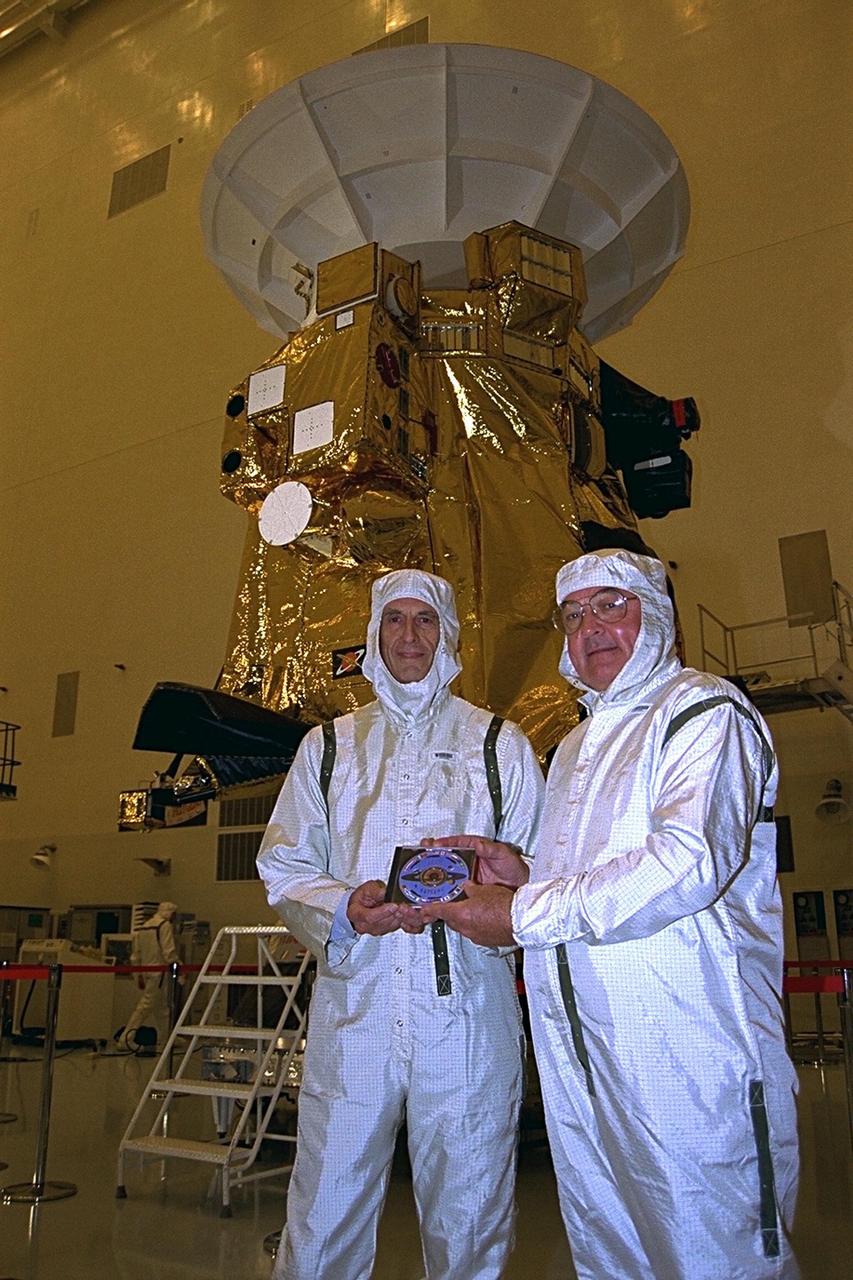
In the Payload Hazardous Servicing Facility (PHSF), Charley Kohlhase, Cassini's science and mission design manager, and Richard Spehalski, program manager of the Cassini mission at NASA's Jet Propulsion Laboratory in Pasadena, Calif., hold the Digital Video Disk (DVD) bearing 616,400 digitized signatures from people around the world which will soon be attached to the Cassini spacecraft in the background. Kohlhase oversaw the signature disk development. The two-story-tall spacecraft is scheduled for launch on an Air Force Titan IV/Centaur launch vehicle on Oct. 6, 1997, and destined to arrive at Saturn in July 2004, where it will orbit and study Saturn, its rings, moons, and magnetic environment in detail over a four-year period. The Cassini mission is managed for NASA by the Jet Propulsion Laboratory, a division of the California Institute of Technology
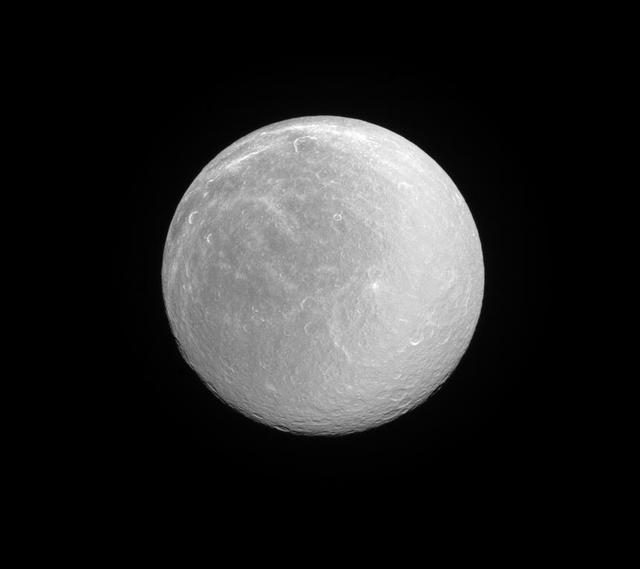
Rhea, like many moons in the outer solar system, appears dazzlingly bright in full sunlight. This is the signature of the water ice that forms most of the moon's surface. Rhea (949 miles or 1,527 kilometers across) is Saturn's second largest moon after Titan. Its ancient surface is one of the most heavily cratered of all of Saturn's moons. Subtle albedo variations across the disk of Rhea hint at past geologic activity. This view looks toward the anti-Saturn hemisphere of Rhea. North on Rhea is up and rotated 36 degrees to the right. The image was taken with the Cassini spacecraft narrow-angle camera on June 3, 2016 using a spectral filter which preferentially admits wavelengths of ultraviolet light centered at 338 nanometers. http://photojournal.jpl.nasa.gov/catalog/PIA20495

NASA's Lunar Lander exhibit is located at the Mississippi I-10 Welcome Center in Hancock County, Miss., just west of Bay St. Louis and 45 miles east of New Orleans on I-10 at Exit 2. The exhibit features a 30-foot-tall replica of a Lunar Lander used as a trainer by the Apollo 13 astronauts. Apollo 13 astronaut and Mississippi native Fred Haise left space-boot prints and signature in concrete at the base of the exhibit.
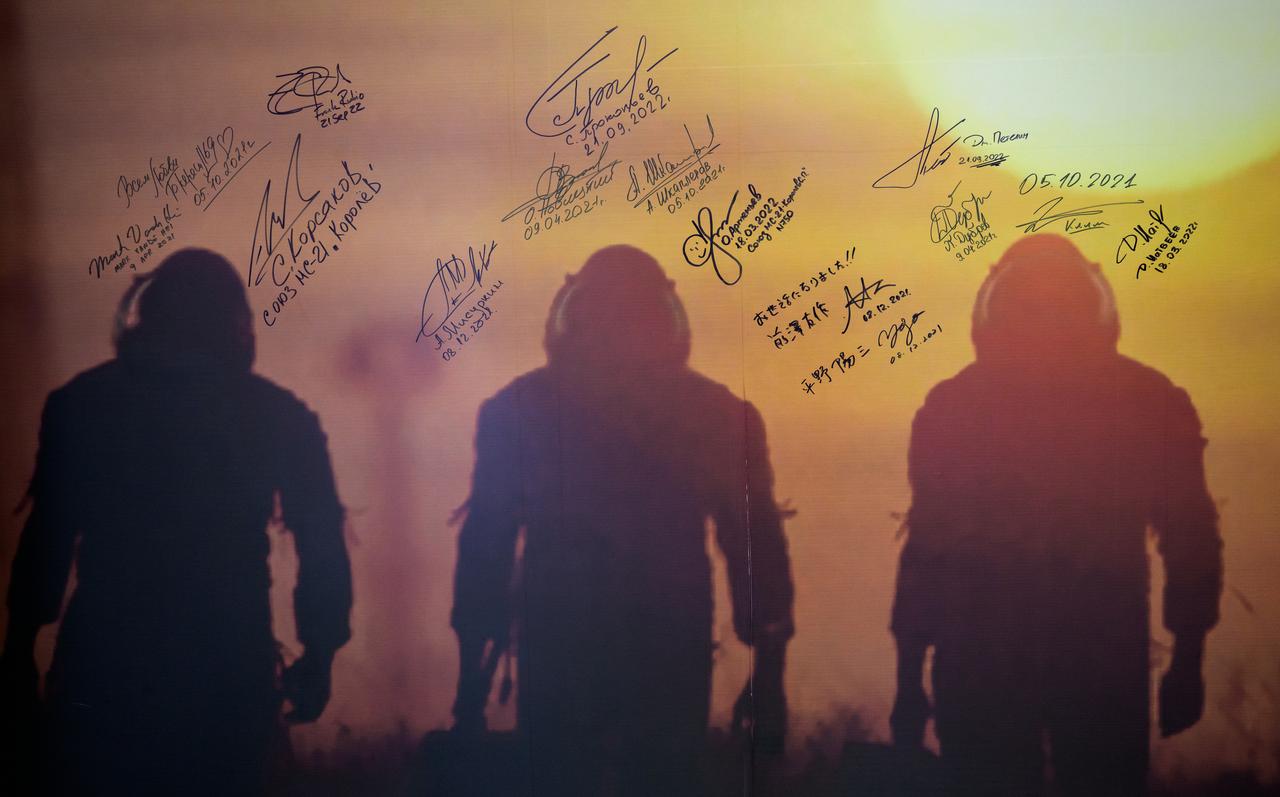
A mural in the Cosmonaut Hotel is seen with past crew signatures ahead of the Expedition 70 signing and departing the hotel for launch on a Soyuz rocket, Friday, Sept. 15, 2023, in Baikonur, Kazakhstan. The launch will send Expedition 70 NASA astronaut Loral O'Hara and Roscosmos cosmonauts Oleg Kononenko and Nikolai Chub on a mission to the International Space Station. Photo Credit: (NASA/Bill Ingalls)
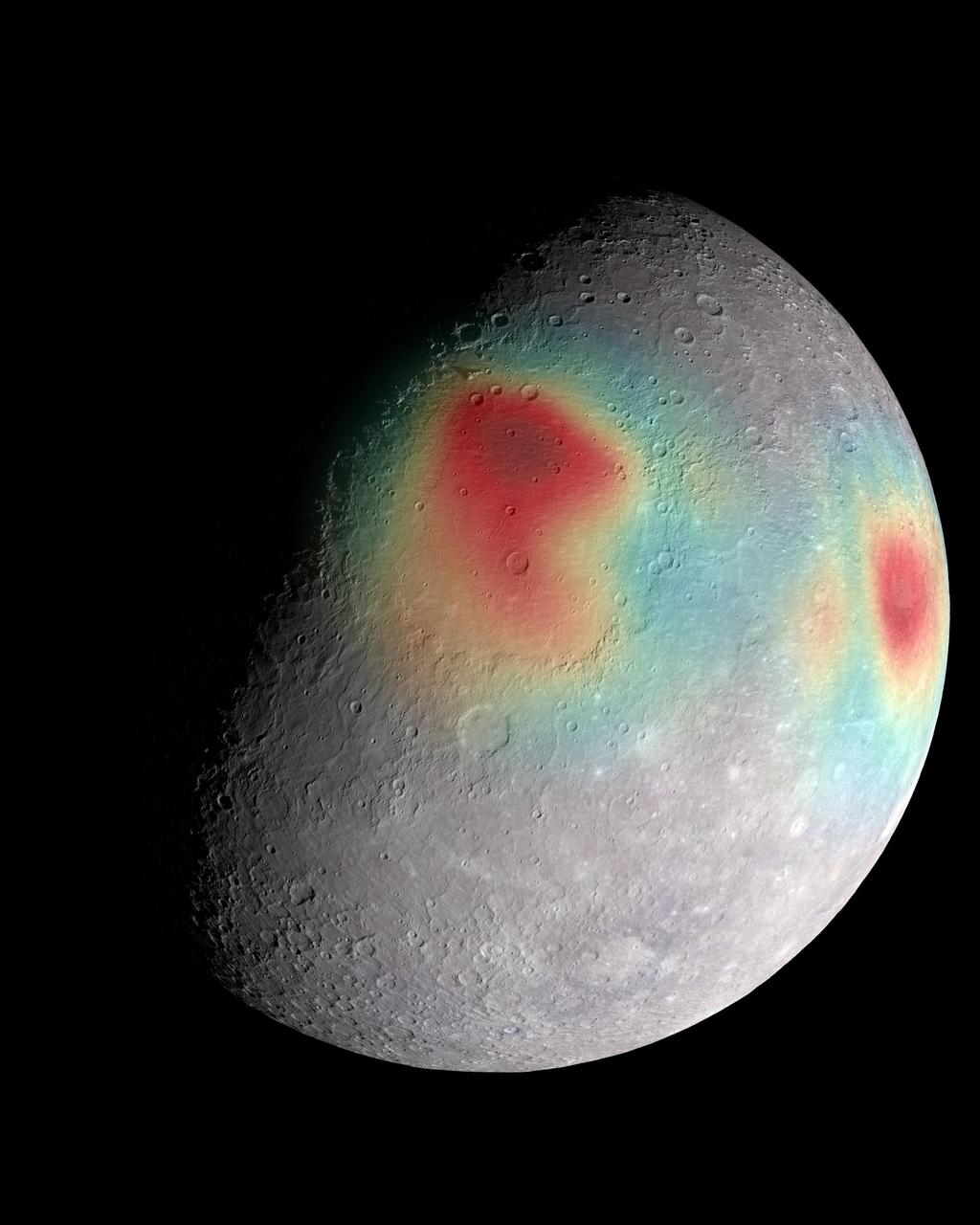
Analysis of radio tracking data have enabled maps of the gravity field of Mercury to be derived. In this image, overlain on a mosaic obtained by MESSENGER's Mercury Dual Imaging System and illuminated with a shape model determined from stereo-photoclinometry, Mercury's gravity anomalies are depicted in colors. Red tones indicate mass concentrations, centered on the Caloris basin (center) and the Sobkou region (right limb). Such large-scale gravitational anomalies are signatures of subsurface structure and evolution. The north pole is near the top of the sunlit area in this view. http://photojournal.jpl.nasa.gov/catalog/PIA19285
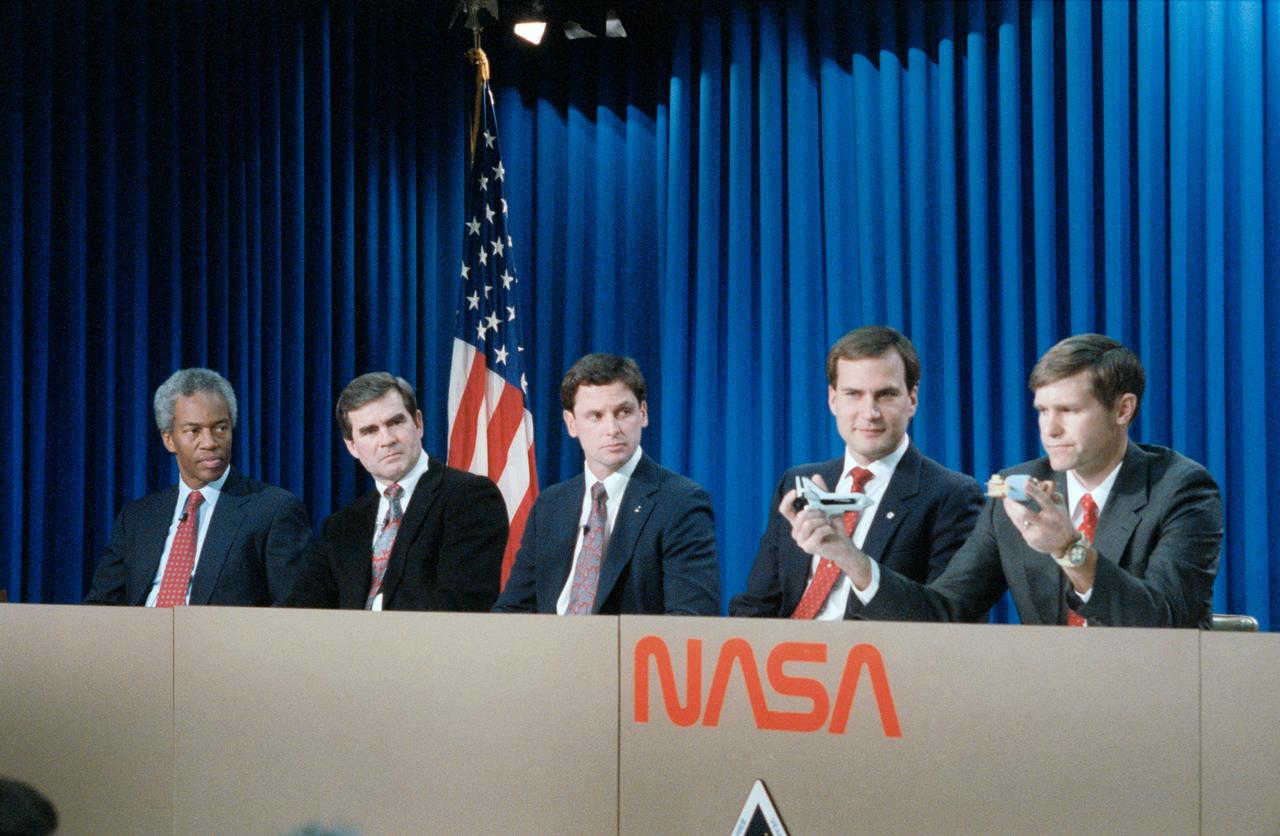
S91-26676 (23 Jan 1991) --- The five mission specialists assigned to the STS-39 Shuttle mission are pictured during a pre-flight press briefing. Pictured left to right are Astronauts Guion (Guy) S. Bluford, C. Lacy Veach, Gregory J. Harbaugh, Richard J. Hieb and Donald R. McMonagle. McMonagle uses models to demonstrate deployment of the infrared background signature survey (IBSS) satellite. Astronauts Michael L. Coats, mission commander, and L. Blaine Hammond Jr., pilot, are out of frame at right.
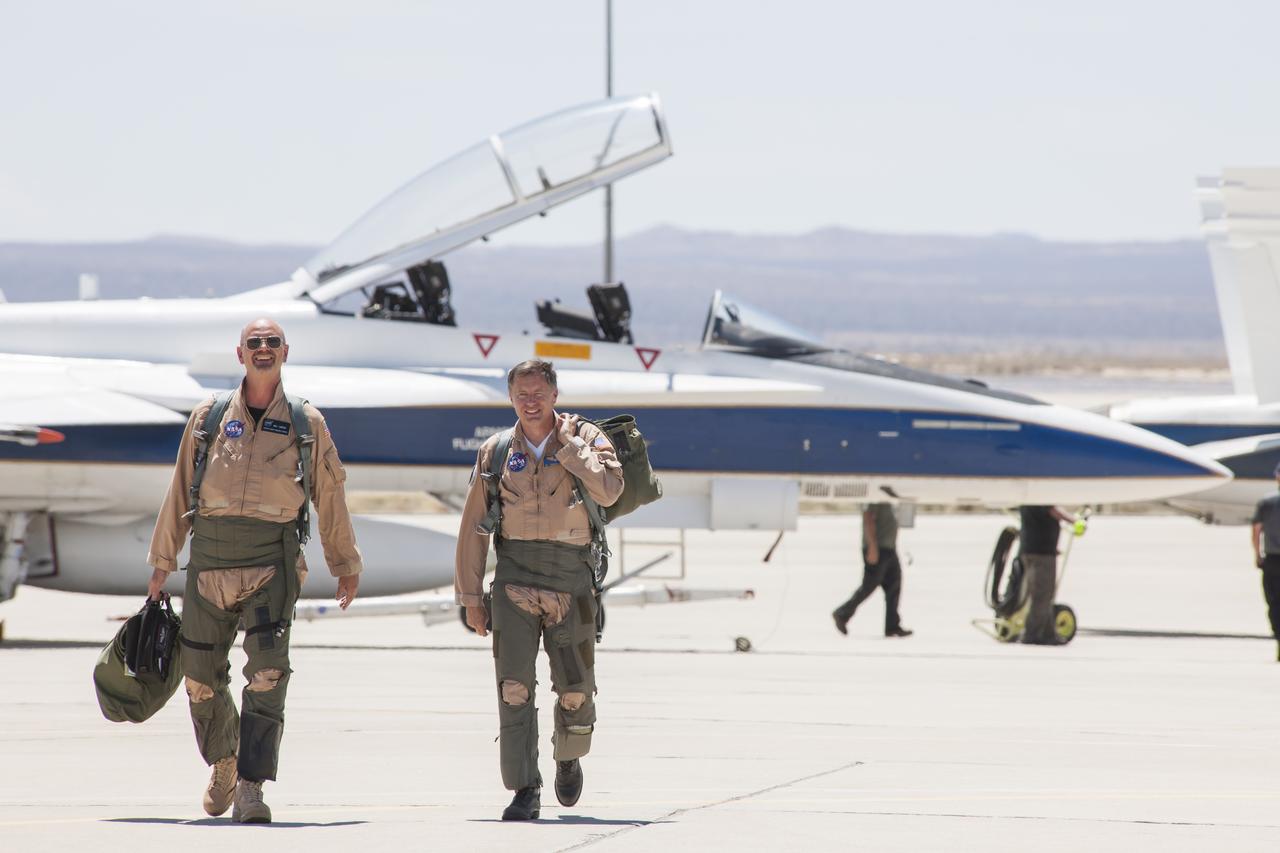
NASA pilot Nils Larson, and flight test engineer and pilot Wayne Ringelberg, head for a mission debrief after flying a NASA F/A-18 at Mach 1.38 to create sonic booms as part of the SonicBAT flight series at NASA’s Armstrong Flight Research Center in California, to study sonic boom signatures with and without the element of atmospheric turbulence.

NASA astronauts Butch Wilmore and Suni Williams signatures are seen inside NASA's Boeing Crew Flight Test Starliner spacecraft after it landed uncrewed at White Sands Missile Range’s Space Harbor, Friday, Sept. 6, 2024 Mountain Time (Sept. 7 Eastern Time), in New Mexico. This approach allows NASA and Boeing to continue gathering testing data on the spacecraft. Photo Credit: (NASA/Aubrey Gemignani)
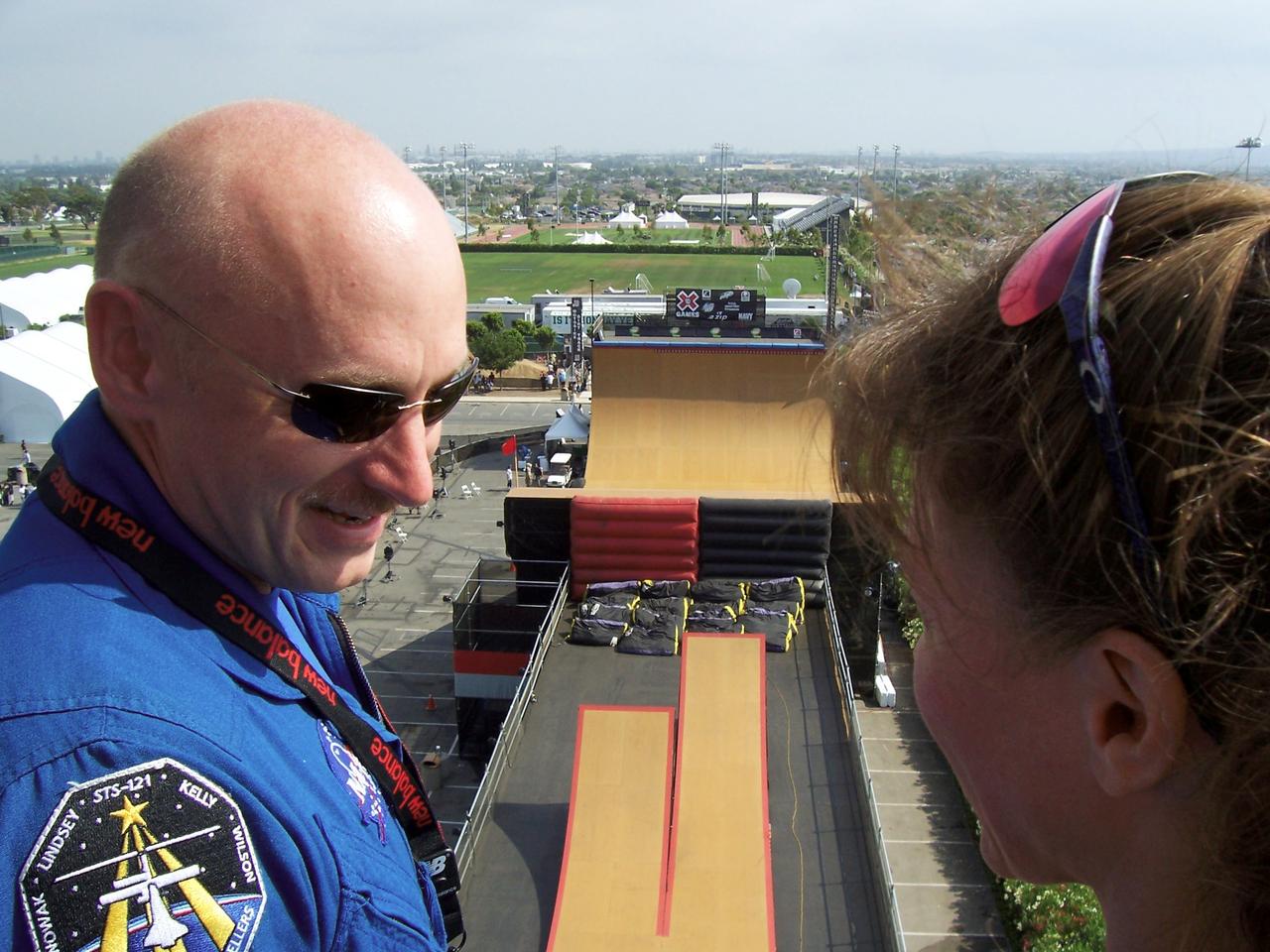
JSC2006-E-32814 (3 August 2006) --- The crew of STS-121 attended opening day of the 12th "X Games" in Los Angeles Aug. 3, discussing their recent mission to the International Space Station with students and athletes. Astronaut Mark E. Kelly, pilot, stands at the edge of the signature 80 foot high "Big Air Jump" skateboarding ramp - location for one of the event highlights. The crew's visit also included presentations at the Jet Propulsion Laboratory and the California Science Center.
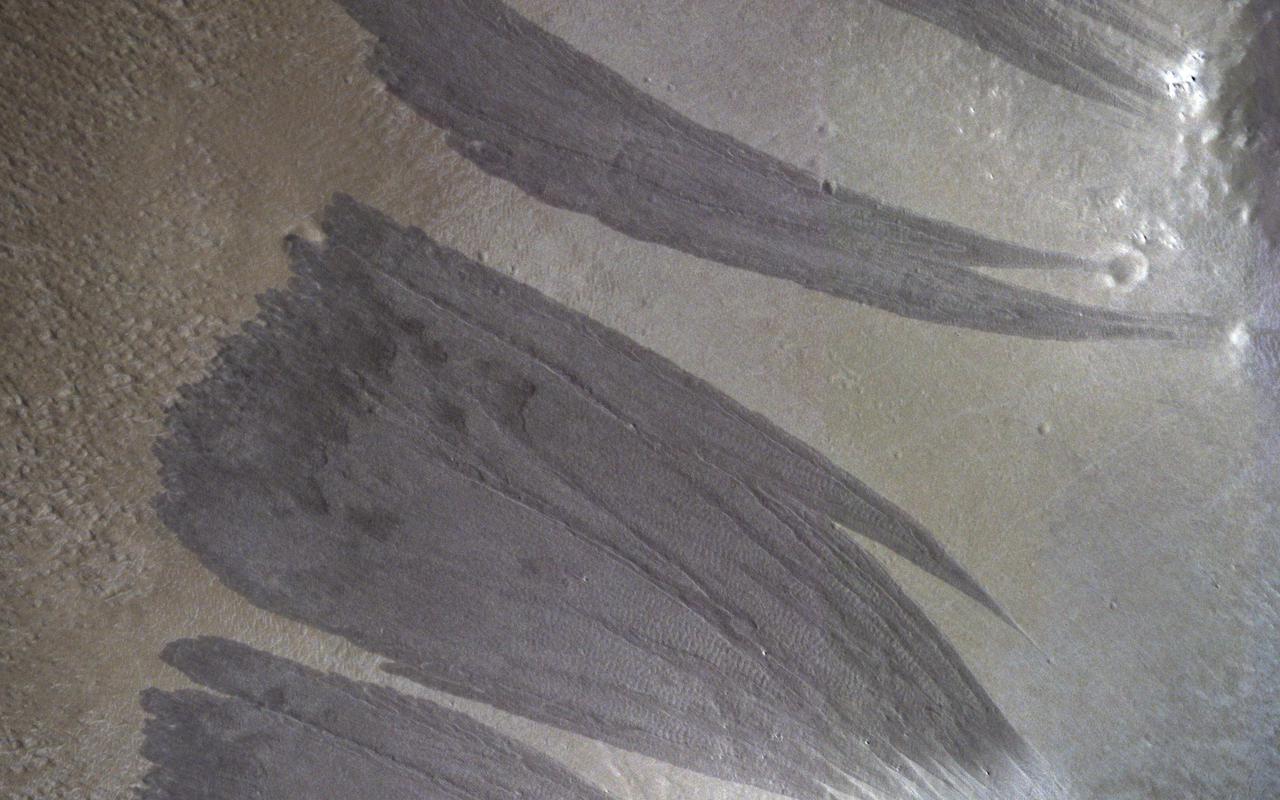
Relatively dark slope streaks are common on steep dust-mantled slopes of Mars. When imaged under high sun illumination they appear to be just a dark stain without topographic relief. However, when imaged with the sun low in the sky (and at high resolution), we can clearly see the topographic signature. Surface material has been removed from the upper slopes and deposited in lobes, as expected from landslides (also called "mass movements"). https://photojournal.jpl.nasa.gov/catalog/PIA24692
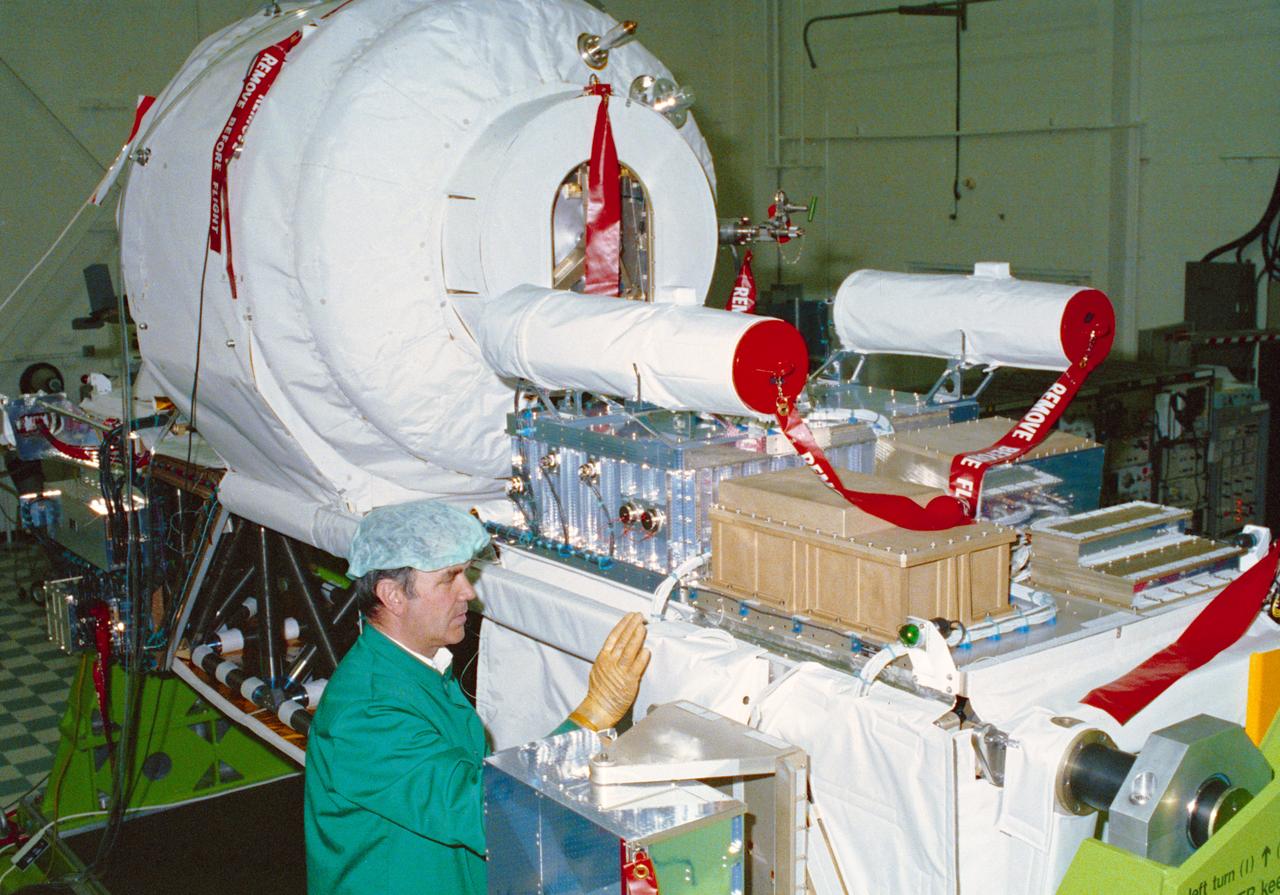
S91-27781 (5 Nov 1990) --- STS-39 Discovery, Orbiter Vehicle (OV) 103, Infrared Background Signature Survey (IBSS) Shuttle Pallet Satellite (SPAS) II documented during preflight processing procedures. German Messerschmitt-Bolkow-Blohm (MBB) technicians work on SPAS II cryostat (without insulation) and other elements at the Cape Canaveral Air Force Station, 11/05/90
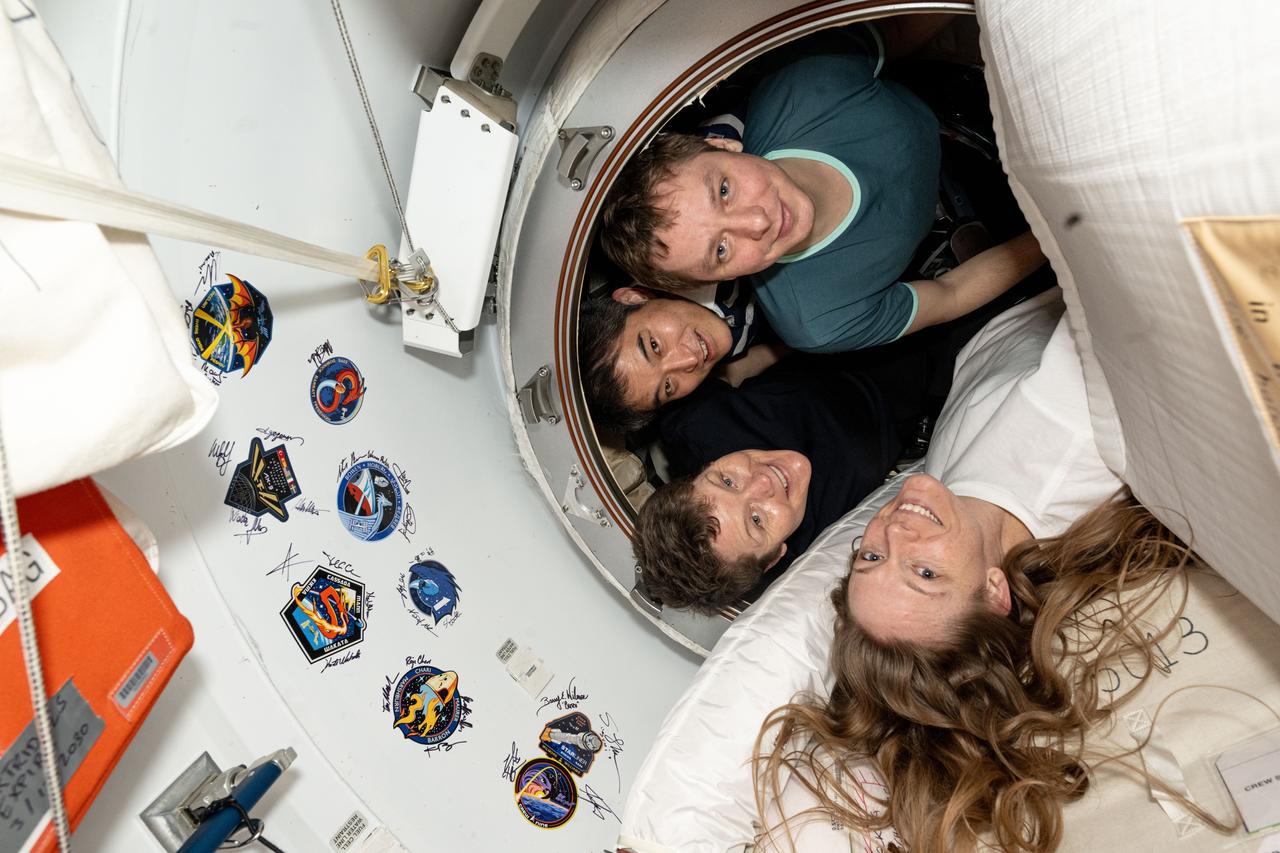
iss073e0426527 (Aug. 6, 2025) --- NASA's SpaceX Crew-10 members pose inside the vestibule between their SpaceX Dragon crew spacecraft and the International Space Station's forward port on the Harmony module. Clockwise from bottom are, NASA astronauts Nichole Ayers and Anne McClain, JAXA (Japan Aerospace Exploration Agency) astronaut Takuya Onishi, and Roscosmos cosmonaut Kirill Peskov. The walls of the vestibule are lined with mission stickers and crew signatures left by previous visitors who docked at Harmony’s forward port.

Workers carry a banner full of signatures while following behind space shuttle Atlantis as it begins its trek to its new home at the Kennedy Space Center Visitor Complex, early Friday, Nov. 2, 2012, in Cape Canaveral, Fla. The spacecraft traveled 125,935,769 miles during 33 spaceflights, including 12 missions to the International Space Station. Its final flight, STS-135, closed out the Space Shuttle Program era with a landing on July 21, 2011. Photo Credit: (NASA/Bill Ingalls)
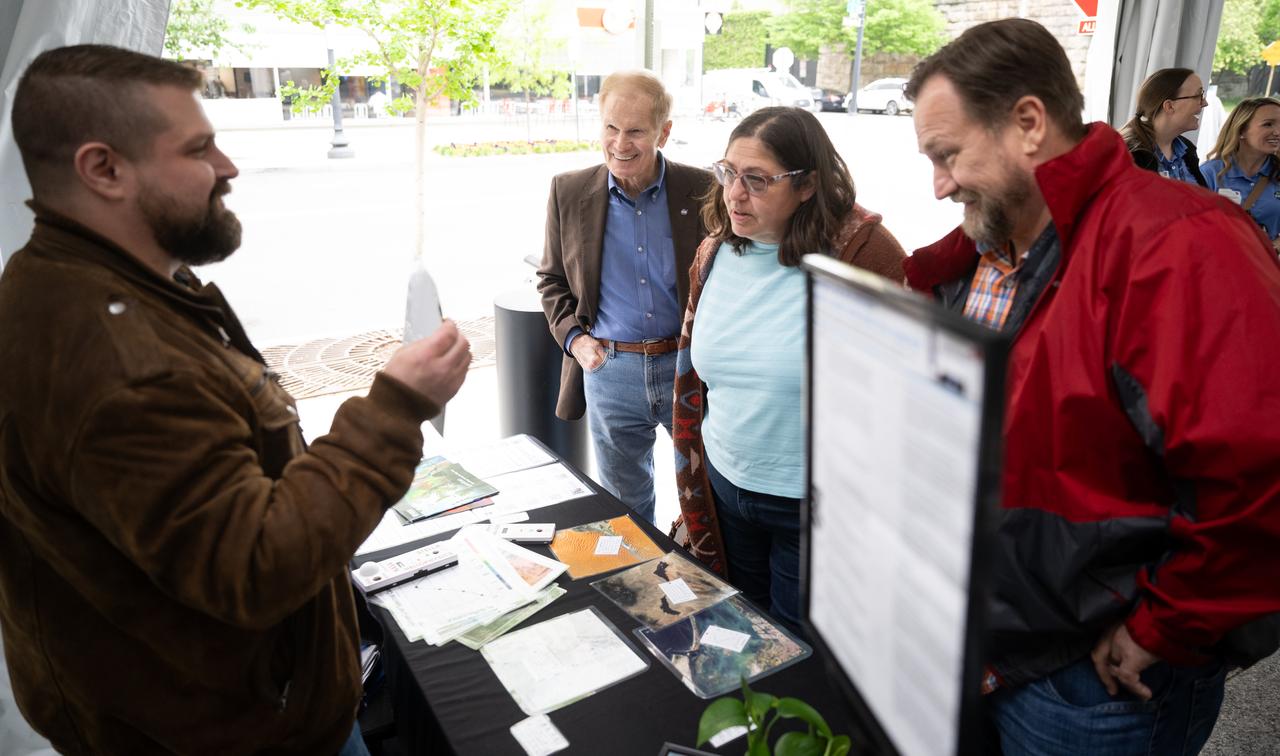
NASA Administrator Bill Nelson, second from right, listens as Michael Taylor from NASA’s Goddard Space Flight Center talks to visitors about Landsat, remote sensing data, and spectral signatures as NASA celebrates Earth Day, Friday, April 19, 2024, in the Earth Information Center at the Mary W. Jackson NASA Headquarters building in Washington. Photo Credit: (NASA/Joel Kowsky)
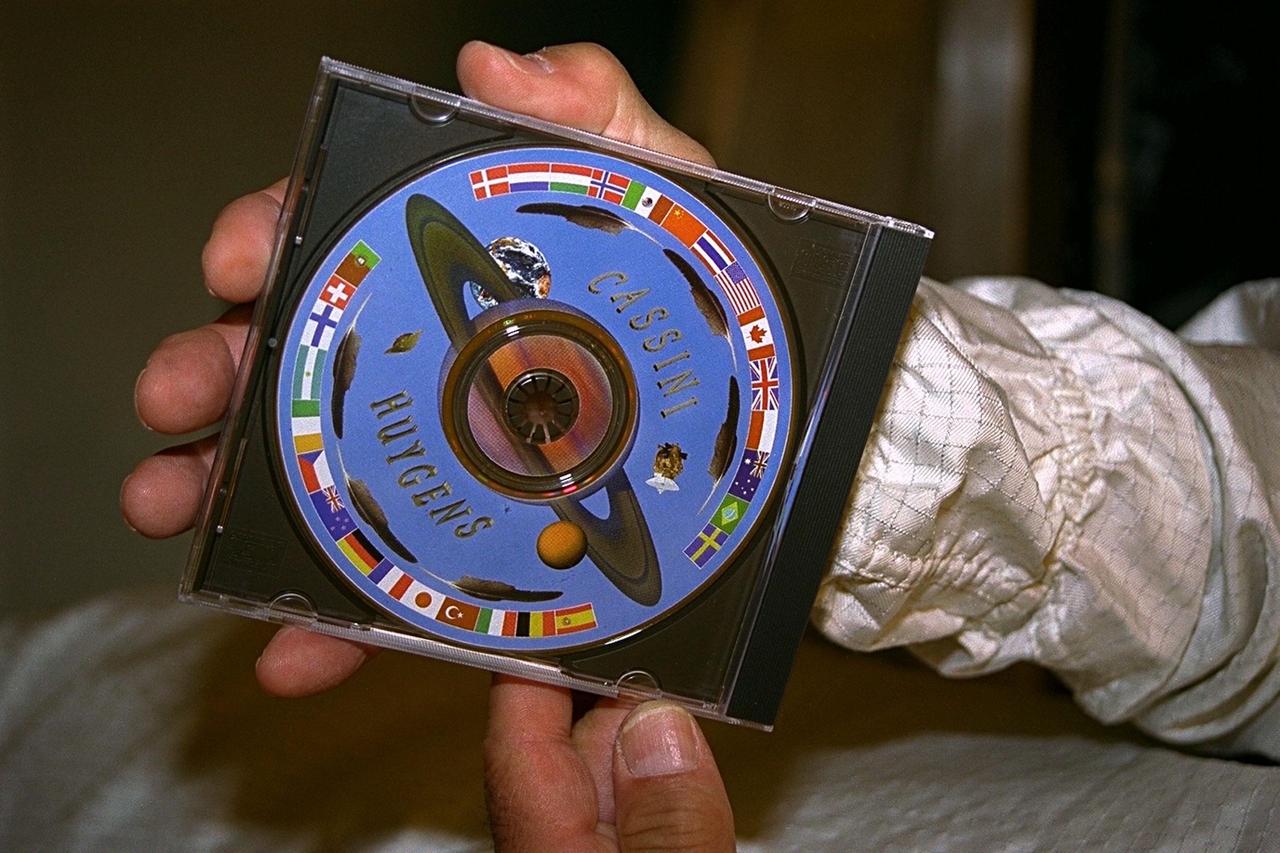
In the Payload Hazardous Servicing Facility (PHSF), a Digital Video Disk (DVD) bearing 616,400 digitized signatures of people from nations around the world is attached to the Cassini spacecraft and will soon to be on its way to Saturn. The Cassini spacecraft is scheduled for launch on an Air Force Titan IV/Centaur launch vehicle on Oct. 6, 1997, and is destined to arrive at Saturn in July 2004
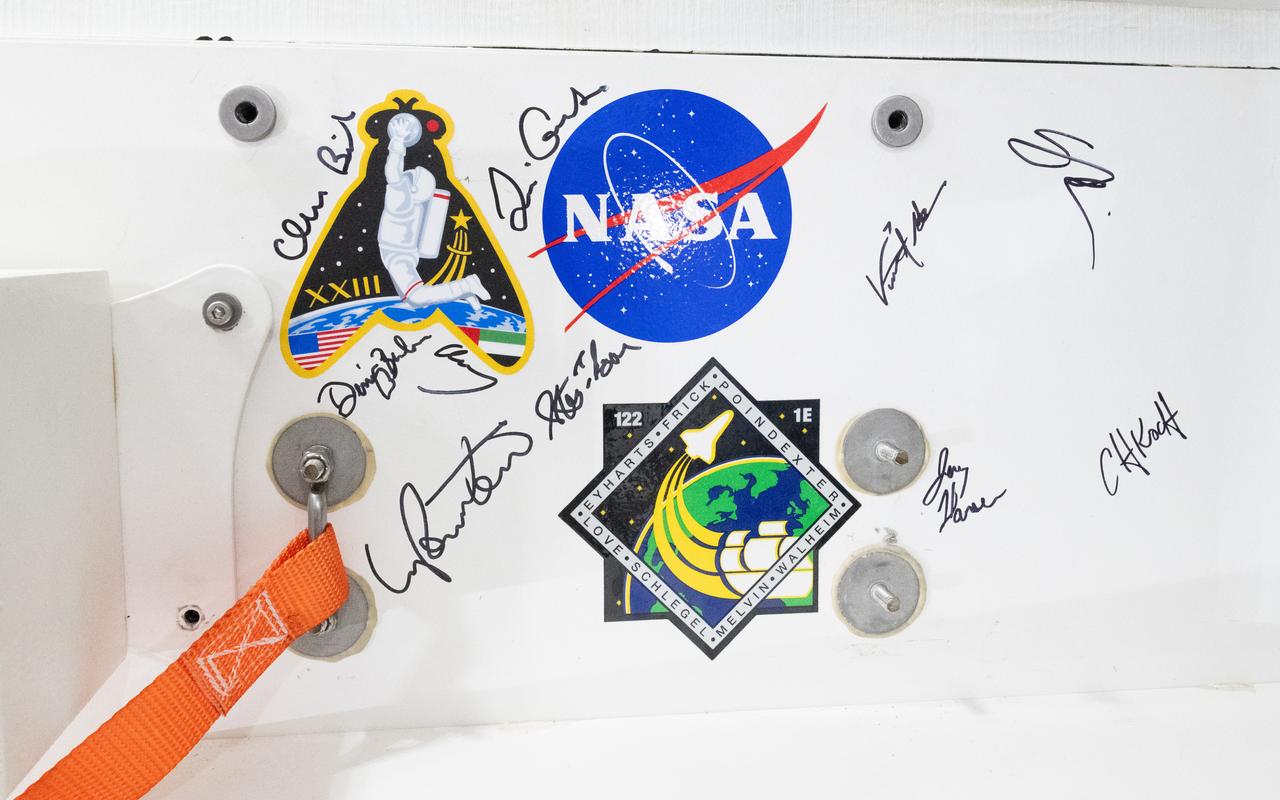
Signatures of astronauts who have participated in Artemis recovery training are seen on a panel inside the Crew Module Test Article (CMTA) during Underway Recovery Test-12 onboard USS Somerset off the coast of California, Saturday, March 29, 2025. During the test, NASA and Department of Defense teams are practicing to ensure recovery procedures are validated as NASA plans to send the Artemis II astronauts around the Moon and splashdown in the Pacific Ocean. Photo Credit: (NASA/Joel Kowsky)
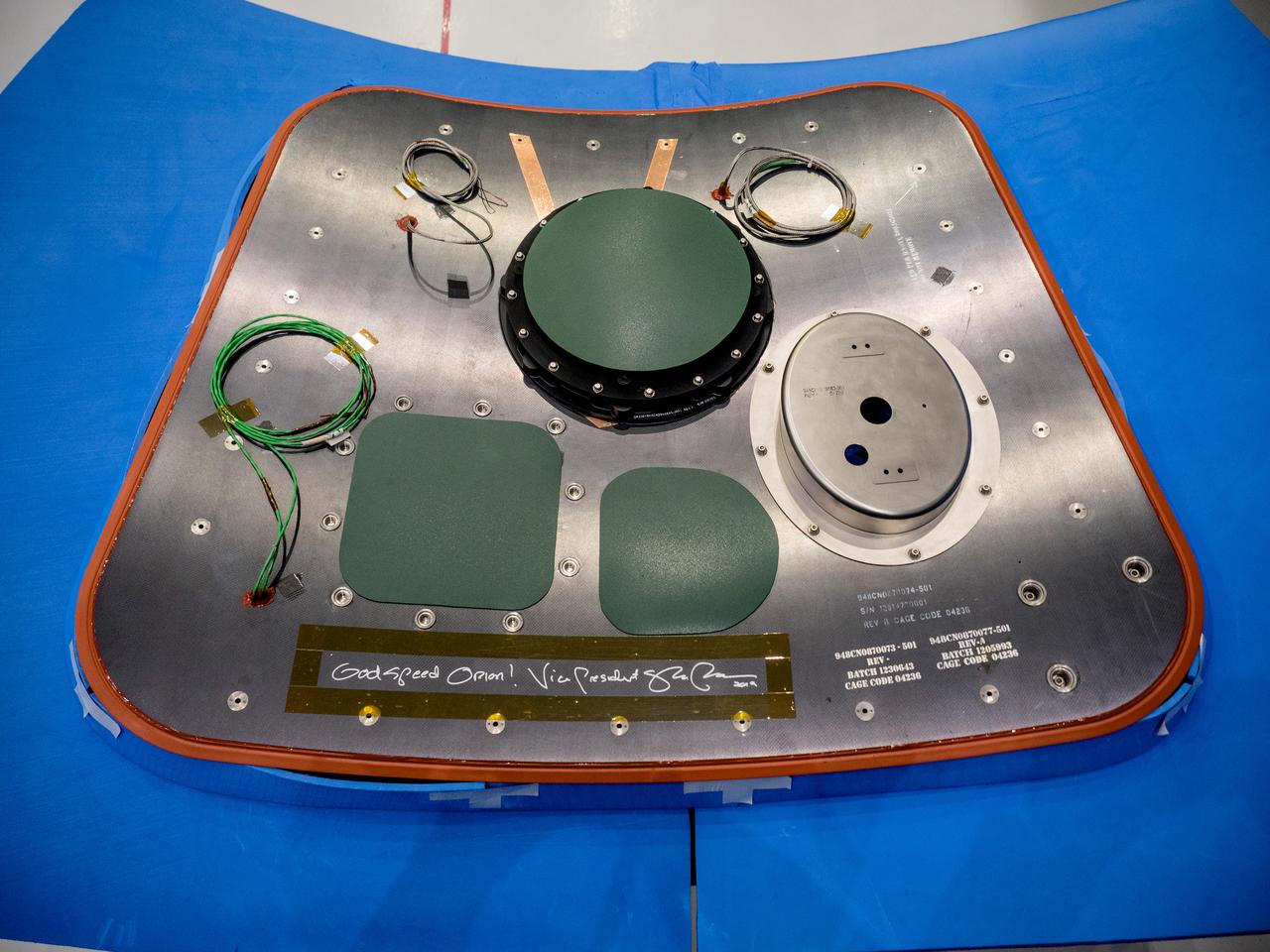
Vice President Mike Pence visited and gave remarks in the Neil Armstrong Operations and Checkout Building at NASA’s Kennedy Space Center in Florida on July 20, 2019 to commemorate the 50th anniversary of the agency’s Apollo 11 Moon landing and announce to America the completion of NASA’s Orion crew capsule, shown here on July 19, 2019, for the first Artemis lunar mission. View is of VP signature on inside of hatch.
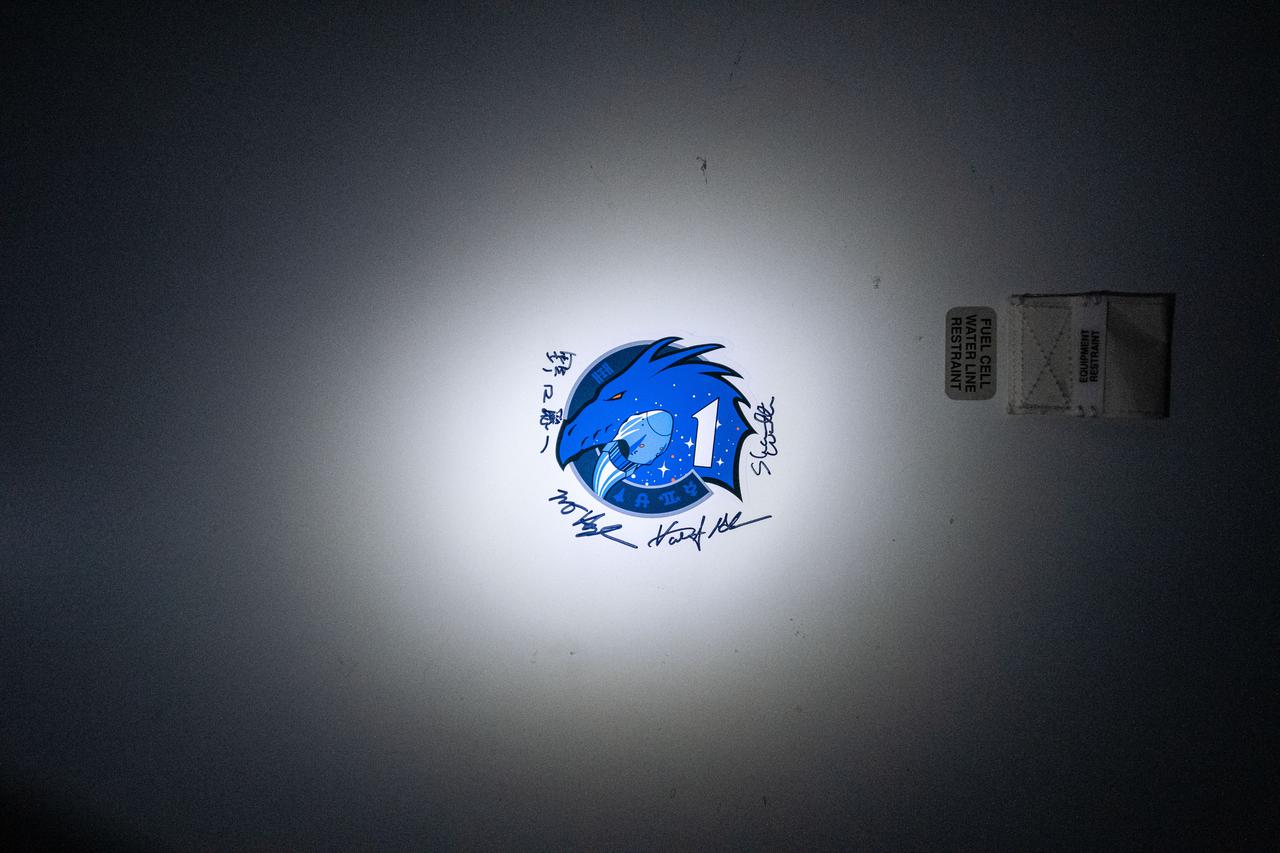
iss064e052209 (April 4, 2021) --- The SpaceX Crew-1 mission insignia is affixed to the vestibule between the Crew Dragon spacecraft and the Harmony module's forward international docking adapter. Surrounding the mission sticker are the signatures of Crew-1 members Michael Hopkins, Victor Glover and Shannon Walker (all from NASA), and Soichi Noguchi of the Japan Aerospace Exploration Agency.
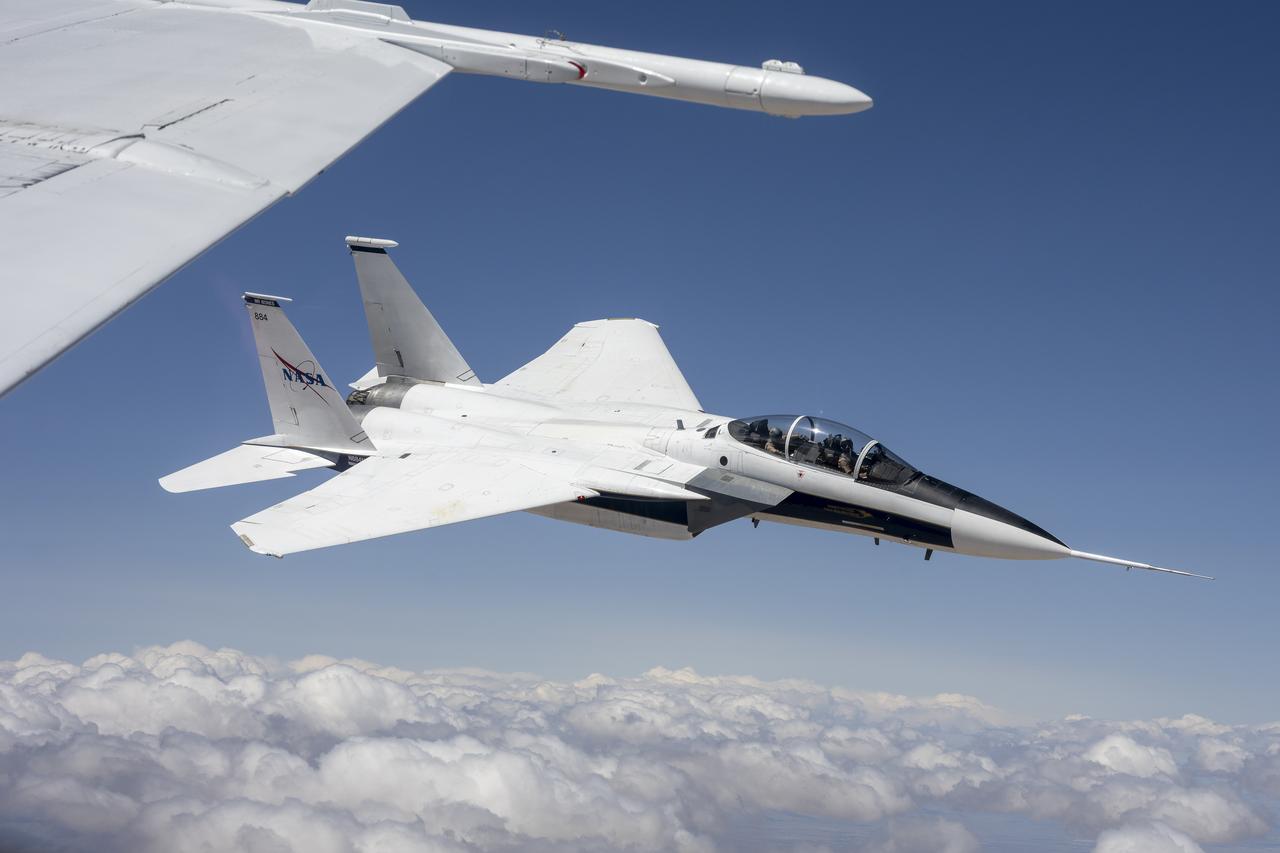
NASA's F-15D research aircraft conducts a calibration flight of a shock-sensing probe near NASA’s Armstrong Flight Research Center in Edwards, California. The shock-sensing probe is designed to measure the signature and strength of shock waves in flight. The probe was validated during dual F-15 flights and will be flown behind NASA’s X-59 to measure small pressure changes caused by shock waves in support of the agency's Quesst mission.
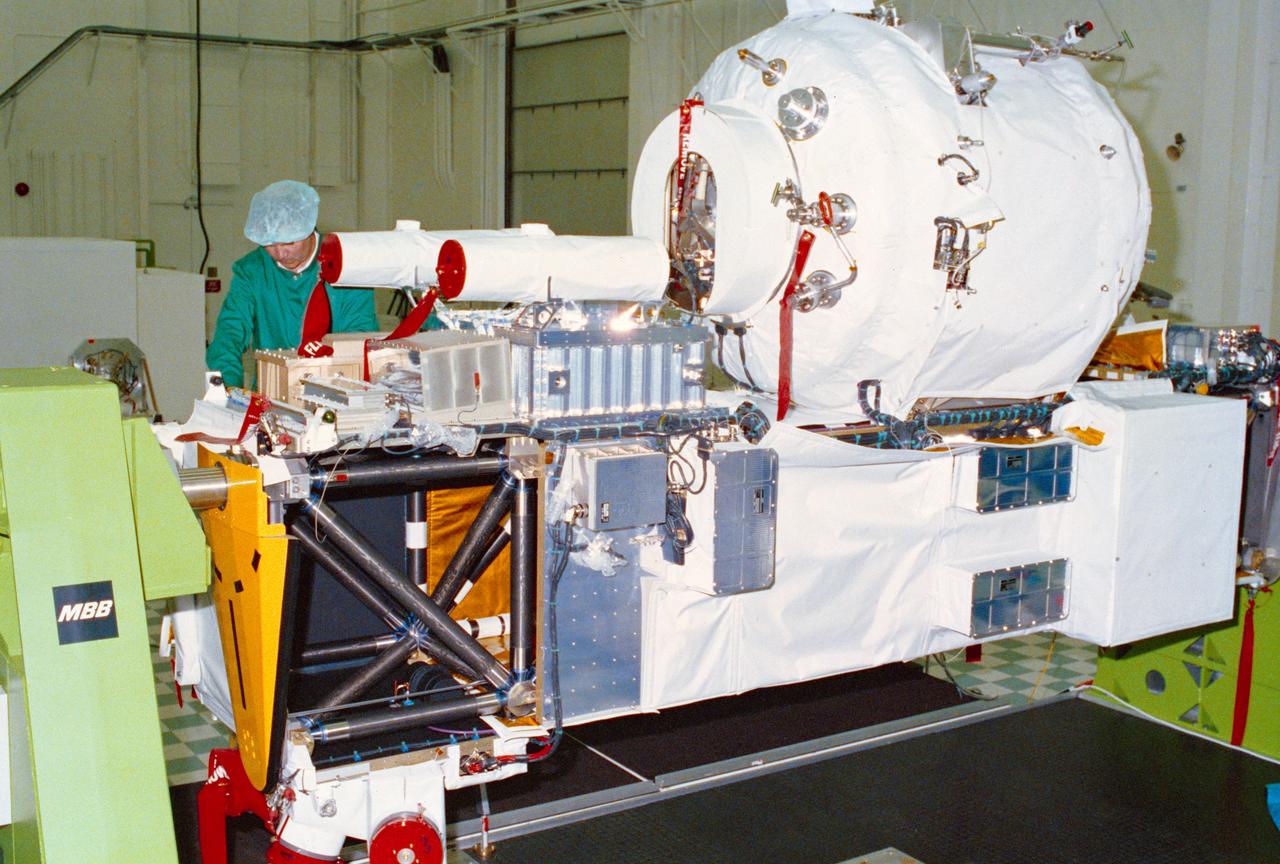
S91-27784 (5 Nov 1990) --- STS-39 Discovery, Orbiter Vehicle (OV) 103, Infrared Background Signature Survey (IBSS) Shuttle Pallet Satellite (SPAS) II documented during preflight processing procedures. German Messerschmitt-Bolkow-Blohm (MBB) technicians work on SPAS II cryostat (without insulation) and other elements at the Cape Canaveral Air Force Station, 11/05/90

jsc2026e034372 (April 28, 2026) --- Preflight image of TIGERS-X experiment payload cube showing the underside (-z face) with mission patch, flag of Thailand, Chulabhorn Royal Academy (CRA) logo, and signature wall of the research and development team. This investigation tests a mixer in a space environment aboard the International Space Station. Credit: Chulabhorn Royal Academy. Credit: Chulabhorn Royal Academy.
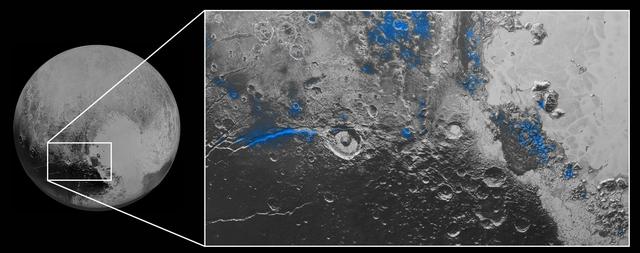
Regions with exposed water ice are highlighted in blue in this composite image from New Horizons' Ralph instrument, combining visible imagery from the Multispectral Visible Imaging Camera (MVIC) with infrared spectroscopy from the Linear Etalon Imaging Spectral Array (LEISA). The strongest signatures of water ice occur along Virgil Fossa, just west of Elliot crater on the left side of the inset image, and also in Viking Terra near the top of the frame. A major outcrop also occurs in Baré Montes towards the right of the image, along with numerous much smaller outcrops, mostly associated with impact craters and valleys between mountains. The scene is approximately 280 miles (450 kilometers) across. Note that all surface feature names are informal. http://ppj2:8080/catalog/PIA19963
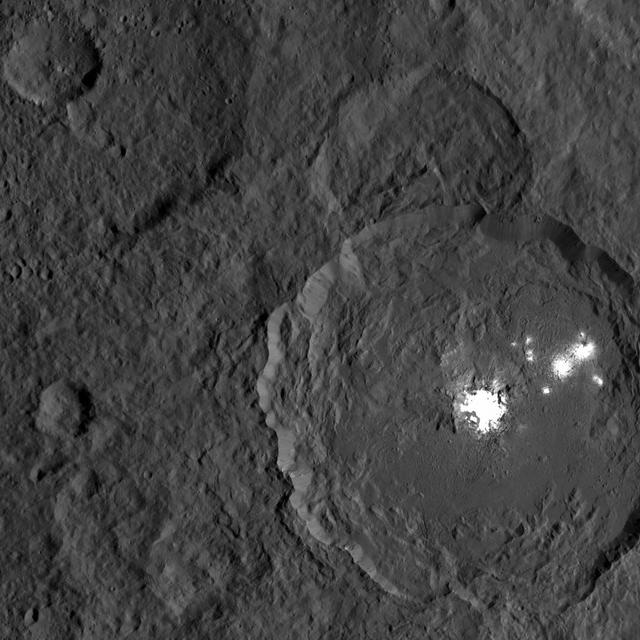
This image from NASA's Dawn spacecraft shows Occator Crater on Ceres, with its signature bright areas. Dawn scientists have found that the central bright spot, which harbors the brightest material on Ceres, contains a variety of salts. The brightest parts of these features are overexposed in this image, which had an exposure time intended to capture details in the surrounding terrain. Shorter exposures allow details within the brightest areas to be seen, as in PIA20653. Dawn took this image on Oct. 18, 2016, from its second extended-mission science orbit (XMO2), at a distance of about 920 miles (1,480 kilometers) above the surface. The image resolution is about 460 feet (140 meters) per pixel. http://photojournal.jpl.nasa.gov/catalog/PIA21227
![This graphic shows a new radiation zone surrounding Jupiter, located just above the atmosphere near the equator, that has been discovered by NASA's Juno mission. The new radiation zone is depicted here as a glowing blue area around the planet's middle. This radiation zone includes energetic hydrogen, oxygen and sulfur ions moving at close to the speed of light (referred to as "relativistic" speeds). It resides inside Jupiter's previously known radiation belts. The zone was identified by the mission's Jupiter Energetic Particle Detector Instrument (JEDI), enabled by Juno's unique close approach to the planet during the spacecraft's science flybys (2,100 miles or 3,400 kilometers from the cloud tops). Juno scientists believe the particles creating this region of intense radiation are derived from energetic neutral atoms -- that is, fast-moving atoms without an electric charge -- coming from the tenuous gas around Jupiter's moons Io and Europa. The neutral atoms then become ions -- atoms with an electric charge -- as their electrons are stripped away by interaction with the planet's upper atmosphere. (This discovery is discussed further in an issue of the journal Geophysical Research Letters [Kollmann et al. (2017), Geophys. Res. Lett., 44, 5259-5268].) Juno also has detected signatures of a population of high-energy, heavy ions in the inner edges of Jupiter's relativistic electron radiation belt. This radiation belt was previously understood to contain mostly electrons moving at near light speed. The signatures of the heavy ions are observed at high latitude locations within the electron belt -- a region not previously explored by spacecraft. The origin and exact species of these heavy ions is not yet understood. Juno's Stellar Reference Unit (SRU-1) star camera detects the signatures of this population as extremely high noise in images collected as part of the mission's radiation monitoring investigation. The locations where the heavy ions were detected are indicated on the graphic by two bright, glowing spots along Juno's flight path past the planet, which is shown as a white line. The invisible lines of Jupiter's magnetic field are also portrayed here for context as faint, bluish lines. https://photojournal.jpl.nasa.gov/catalog/PIA22179](https://images-assets.nasa.gov/image/PIA22179/PIA22179~small.jpg)
This graphic shows a new radiation zone surrounding Jupiter, located just above the atmosphere near the equator, that has been discovered by NASA's Juno mission. The new radiation zone is depicted here as a glowing blue area around the planet's middle. This radiation zone includes energetic hydrogen, oxygen and sulfur ions moving at close to the speed of light (referred to as "relativistic" speeds). It resides inside Jupiter's previously known radiation belts. The zone was identified by the mission's Jupiter Energetic Particle Detector Instrument (JEDI), enabled by Juno's unique close approach to the planet during the spacecraft's science flybys (2,100 miles or 3,400 kilometers from the cloud tops). Juno scientists believe the particles creating this region of intense radiation are derived from energetic neutral atoms -- that is, fast-moving atoms without an electric charge -- coming from the tenuous gas around Jupiter's moons Io and Europa. The neutral atoms then become ions -- atoms with an electric charge -- as their electrons are stripped away by interaction with the planet's upper atmosphere. (This discovery is discussed further in an issue of the journal Geophysical Research Letters [Kollmann et al. (2017), Geophys. Res. Lett., 44, 5259-5268].) Juno also has detected signatures of a population of high-energy, heavy ions in the inner edges of Jupiter's relativistic electron radiation belt. This radiation belt was previously understood to contain mostly electrons moving at near light speed. The signatures of the heavy ions are observed at high latitude locations within the electron belt -- a region not previously explored by spacecraft. The origin and exact species of these heavy ions is not yet understood. Juno's Stellar Reference Unit (SRU-1) star camera detects the signatures of this population as extremely high noise in images collected as part of the mission's radiation monitoring investigation. The locations where the heavy ions were detected are indicated on the graphic by two bright, glowing spots along Juno's flight path past the planet, which is shown as a white line. The invisible lines of Jupiter's magnetic field are also portrayed here for context as faint, bluish lines. https://photojournal.jpl.nasa.gov/catalog/PIA22179
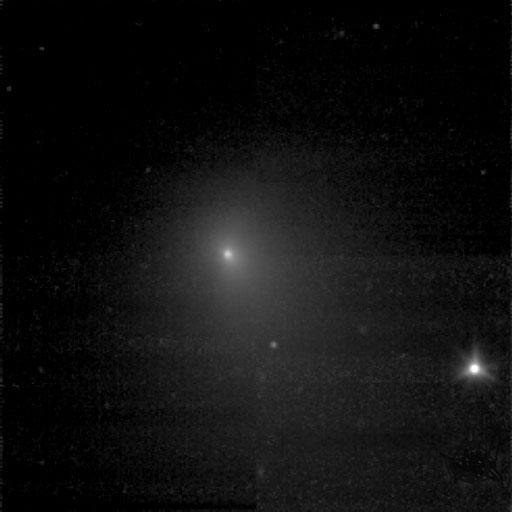
One of the two pictures of Tempel 1 (see also PIA02101) taken by Deep Impact's medium-resolution camera is shown next to data of the comet taken by the spacecraft's infrared spectrometer. This instrument breaks apart light like a prism to reveal the "fingerprints," or signatures, of chemicals. Even though the spacecraft was over 10 days away from the comet when these data were acquired, it detected some of the molecules making up the comet's gas and dust envelope, or coma. The signatures of these molecules -- including water, hydrocarbons, carbon dioxide and carbon monoxide -- can be seen in the graph, or spectrum. Deep Impact's impactor spacecraft is scheduled to collide with Tempel 1 at 10:52 p.m. Pacific time on July 3 (1:52 a.m. Eastern time, July 4). The mission's flyby spacecraft will use its infrared spectrometer to sample the ejected material, providing the first look at the chemical composition of a comet's nucleus. These data were acquired from June 20 to 21, 2005. The picture of Tempel 1 was taken by the flyby spacecraft's medium-resolution instrument camera. The infrared spectrometer uses the same telescope as the high-resolution instrument camera. http://photojournal.jpl.nasa.gov/catalog/PIA02100
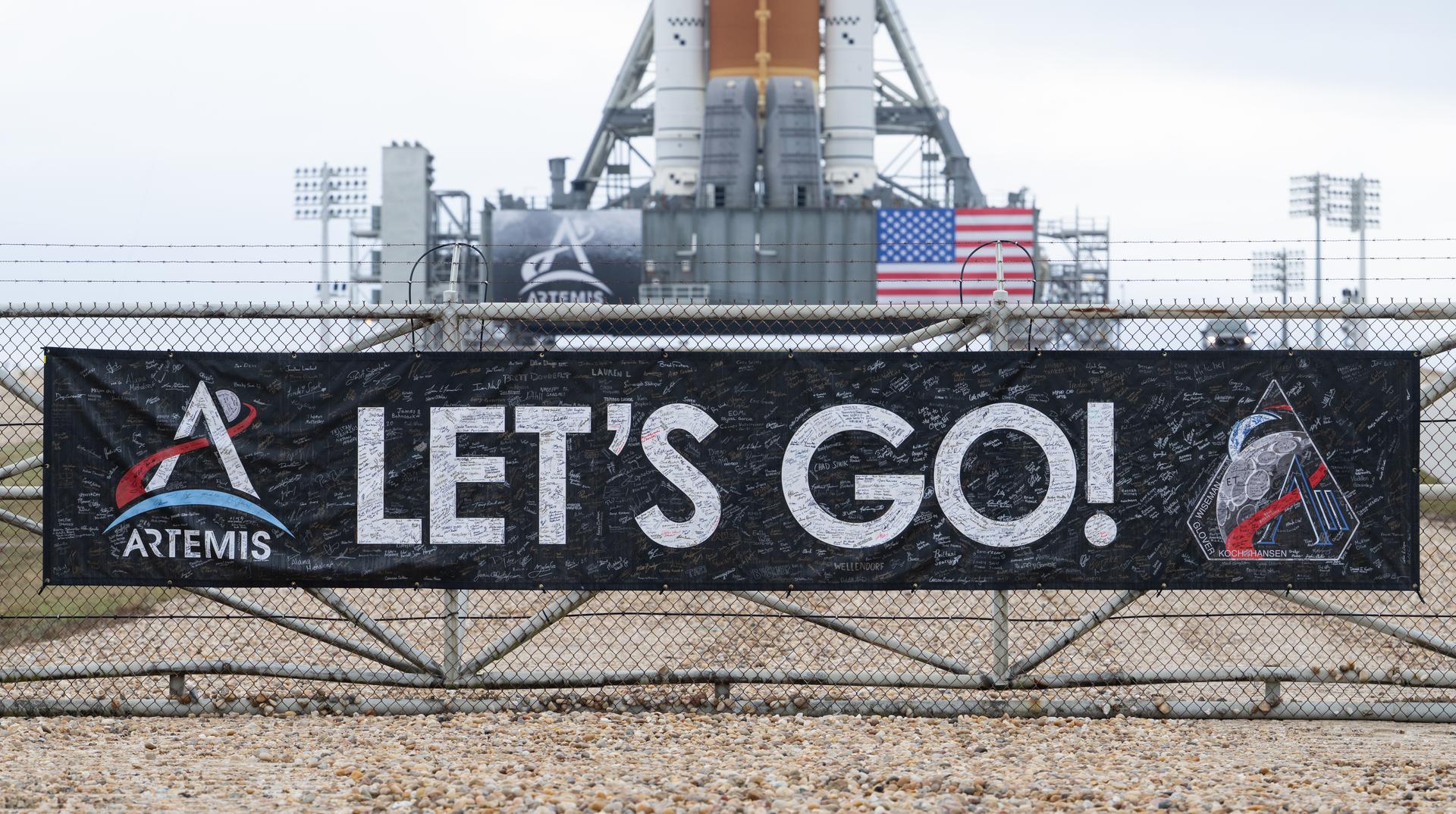
A banner covered with the signatures of NASA employees and contractors is seen on the perimeter fence of Launch Complex 39B after NASA’s Artemis II Space Launch System (SLS) rocket and Orion spacecraft were rolled out to the launch pad, Sunday, Jan. 18, 2026, at NASA’s Kennedy Space Center in Florida. NASA’s Artemis II test flight will take Commander Reid Wiseman, Pilot Victor Glover, and Mission Specialist Christina Koch from NASA, and Mission Specialist Jeremy Hansen from the CSA (Canadian Space Agency), around the Moon and back to Earth no later than April 2026. Photo Credit: (NASA/Joel Kowsky)
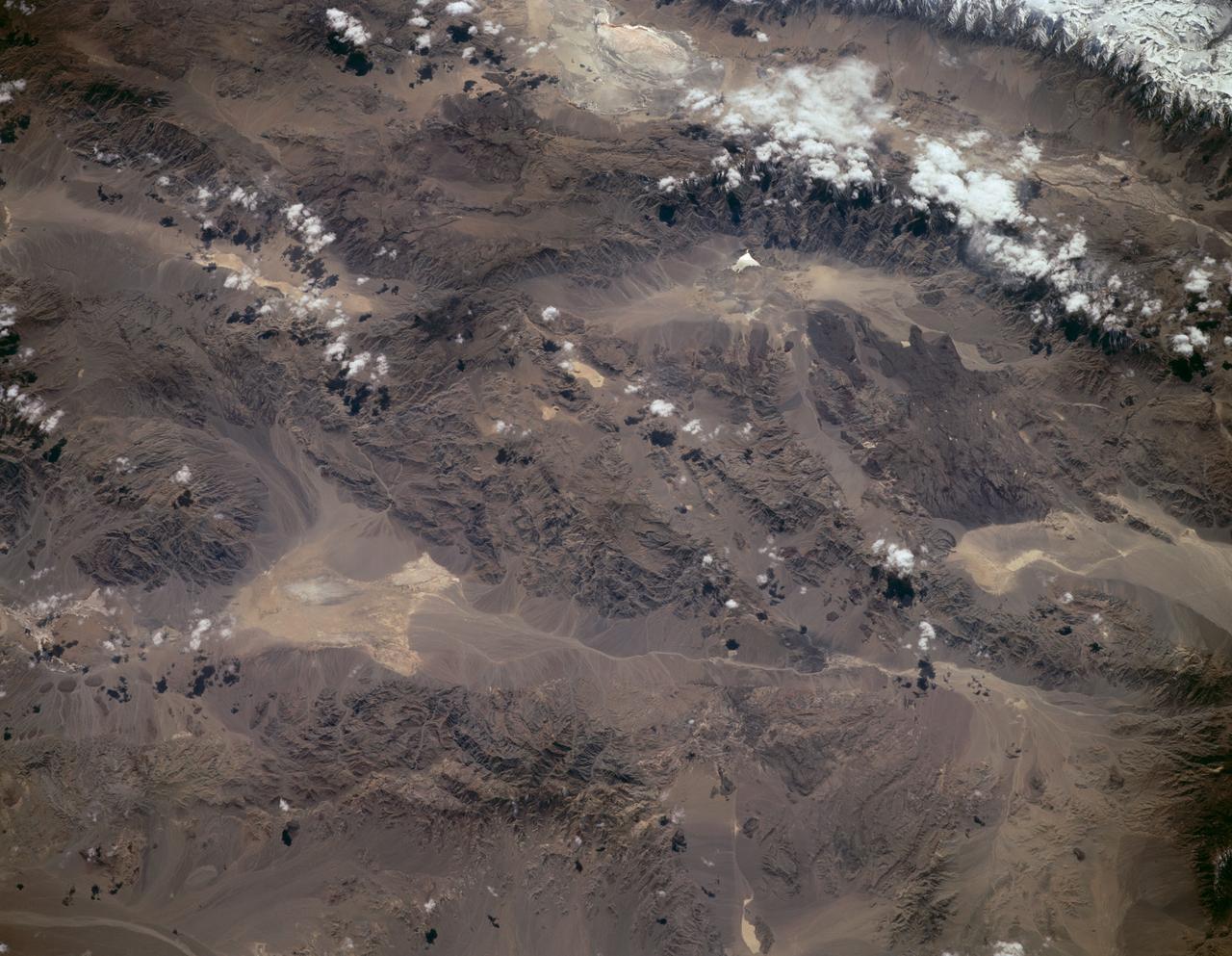
STS059-L09-162 (9-20 April 1994) --- Orient with the snow-covered mountains (Sierra Nevada of California) in the upper right corner. Then Owens Valley runs along the top of the photograph to Owens Lake playa at top center. The upper end of Death Valley extends from right to left in the foreground, with the drainage running down to a playa at Stovepipe Wells in the left foreground. Geologists are studying microwave signatures of the different playa surfaces, and the coatings on alluvial fans that extend from mountain masses, to try to sort out the history of different climates in this formerly wet but now hyperarid region.
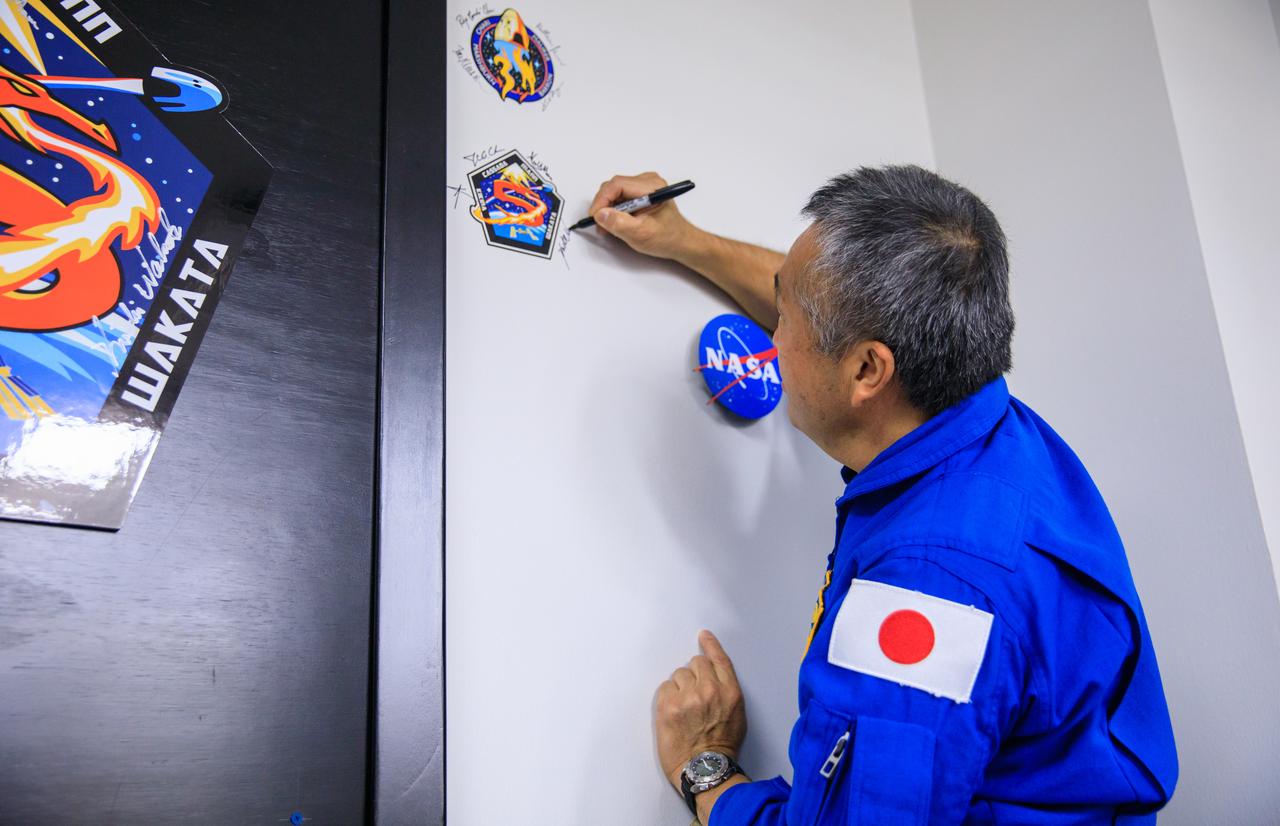
JAXA (Japan Aerospace Exploration Agency) astronaut Koichi Wakata adds his signature to a wall inside the Astronaut Crew Quarters in the Neil A. Armstrong Operations and Checkout Building at NASA’s Kennedy Space Center in Florida on Oct. 4, 2022. Wakata, along with NASA astronauts Josh Cassada and Nicole Aunapu Mann, and Roscosmos cosmonaut Anna Kikina, will launch to the International Space Station on NASA’s SpaceX Crew-5 mission as part of the agency’s Commercial Crew Program. Liftoff of SpaceX’s Falcon 9 rocket and Crew Dragon Endurance spacecraft is targeted for noon EDT on Oct. 5, 2022, from Kennedy’s Launch Complex 39A.
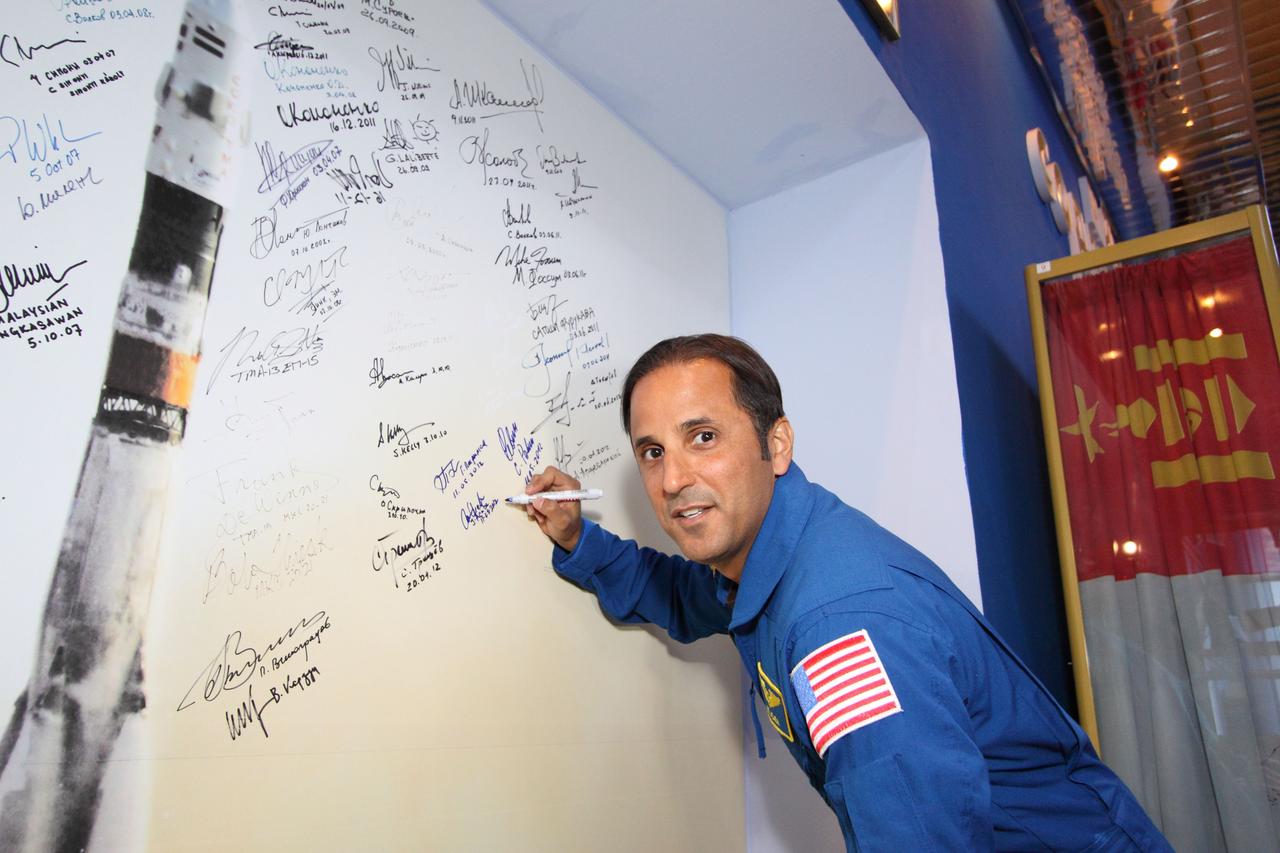
At the historic museum near the launch pad at the Baikonur Cosmodrome in Kazakhstan, Expedition 31/32 Flight Engineer Joe Acaba of NASA adds his name to the “Wall of Signatures” May 11, 2012 during a traditional museum tour prior to his launch May 15 along with Soyuz Commander Gennady Padalka and Flight Engineer Sergei Revin in their Soyuz TMA-04M spacecraft to begin a four-month mission on the International Space Station. The wall, which is adorned with a life-size picture of a Soyuz rocket, is signed by all crewmembers who launch into space on the Russian booster. NASA/Victor Zelentsov
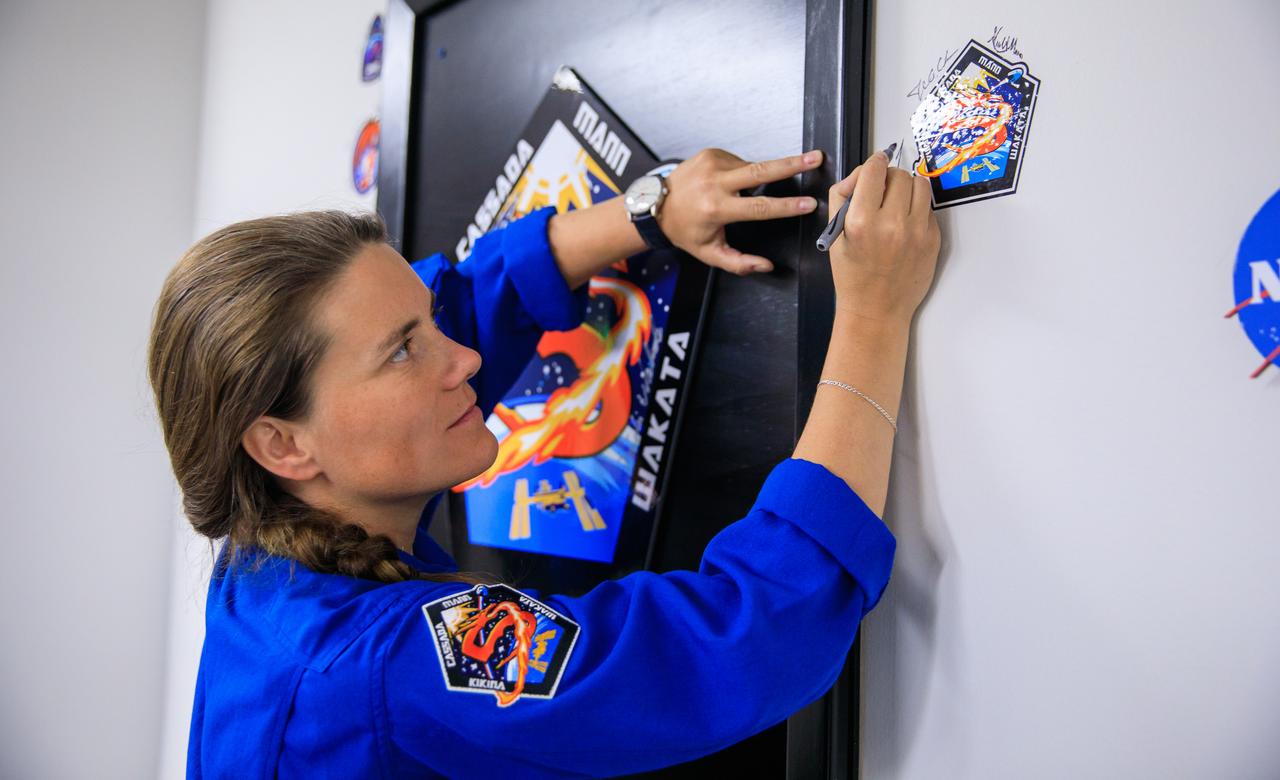
Roscosmos cosmonaut Anna Kikina adds her signature to a wall inside the Astronaut Crew Quarters in the Neil A. Armstrong Operations and Checkout Building at NASA’s Kennedy Space Center in Florida on Oct. 4, 2022. Kikina, along with NASA astronauts Josh Cassada and Nicole Aunapu Mann, and JAXA (Japan Aerospace Exploration Agency) astronaut Koichi Wakata, will launch to the International Space Station on NASA’s SpaceX Crew-5 mission as part of the agency’s Commercial Crew Program. Liftoff of SpaceX’s Falcon 9 rocket and Crew Dragon Endurance spacecraft is targeted for noon EDT on Oct. 5, 2022, from Kennedy’s Launch Complex 39A.

NASA astronaut Nicole Aunapu Mann adds her signature to a wall inside the Astronaut Crew Quarters in the Neil A. Armstrong Operations and Checkout Building at NASA’s Kennedy Space Center in Florida on Oct. 4, 2022. Mann, along with NASA astronaut Josh Cassada, Roscosmos cosmonaut Anna Kikina, and JAXA (Japan Aerospace Exploration Agency) astronaut Koichi Wakata will launch to the International Space Station on NASA’s SpaceX Crew-5 mission as part of the agency’s Commercial Crew Program. Liftoff of SpaceX’s Falcon 9 rocket and Crew Dragon Endurance spacecraft is targeted for noon EDT on Oct. 5, 2022, from Kennedy’s Launch Complex 39A.
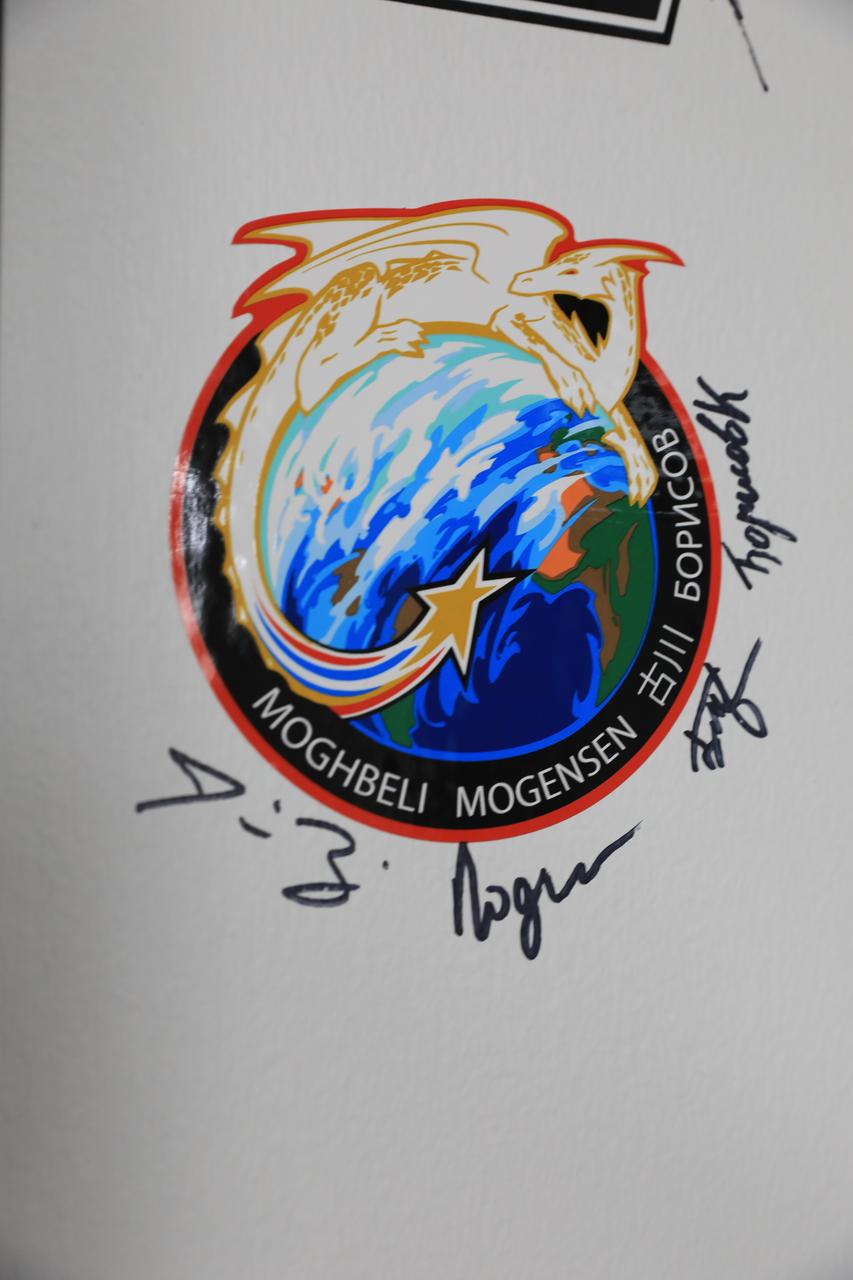
NASA’s SpaceX Crew-7 crew members add their signatures below their mission sticker in the hallway of the Astronaut Crew Quarters inside the Neil A. Armstrong Operations and Checkout Building at Kennedy Space Center in Florida on Tuesday, Aug. 22, 2023. NASA astronaut Jasmin Moghbeli, ESA (European Space Agency) astronaut Andreas Mogensen, JAXA (Japan Aerospace Exploration Agency) astronaut Satoshi Furukawa, and Roscosmos cosmonaut Konstantin Borisov will launch to the International Space Station aboard SpaceX’s Dragon spacecraft and Falcon 9 rocket. Liftoff is targeted for 3:49 a.m. EDT Friday, Aug. 25, 2023, from Kennedy’s Launch Complex 39A.
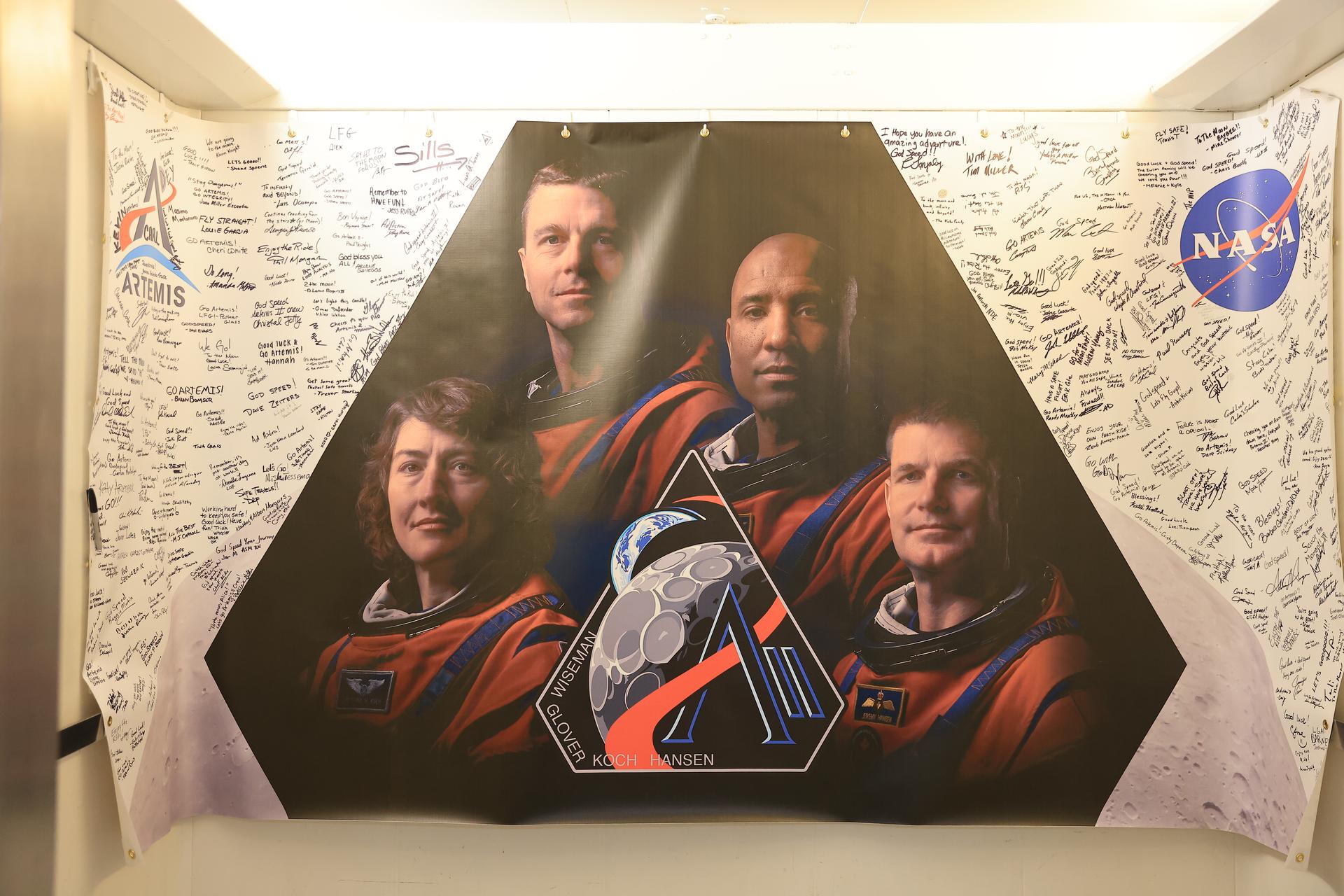
The Artemis II mission insignia is displayed with employee signatures inside the Neil A. Armstrong Operations and Checkout Building at the agency’s Kennedy Space Center in Florida on Wednesday, April 1, 2026, ahead of the Artemis II test flight. The mission will take Artemis II Commander Reid Wiseman, Pilot Victor Glover, and Mission Specialist Christina Koch from NASA, along with Mission Specialist Jeremy Hansen from the CSA (Canadian Space Agency), on a 10-day journey around the Moon and back aboard NASA’s SLS (Space Launch System) rocket and Orion spacecraft with a two hour launch window opening at 6:24 p.m. EDT from Launch Complex 39B at NASA Kennedy.
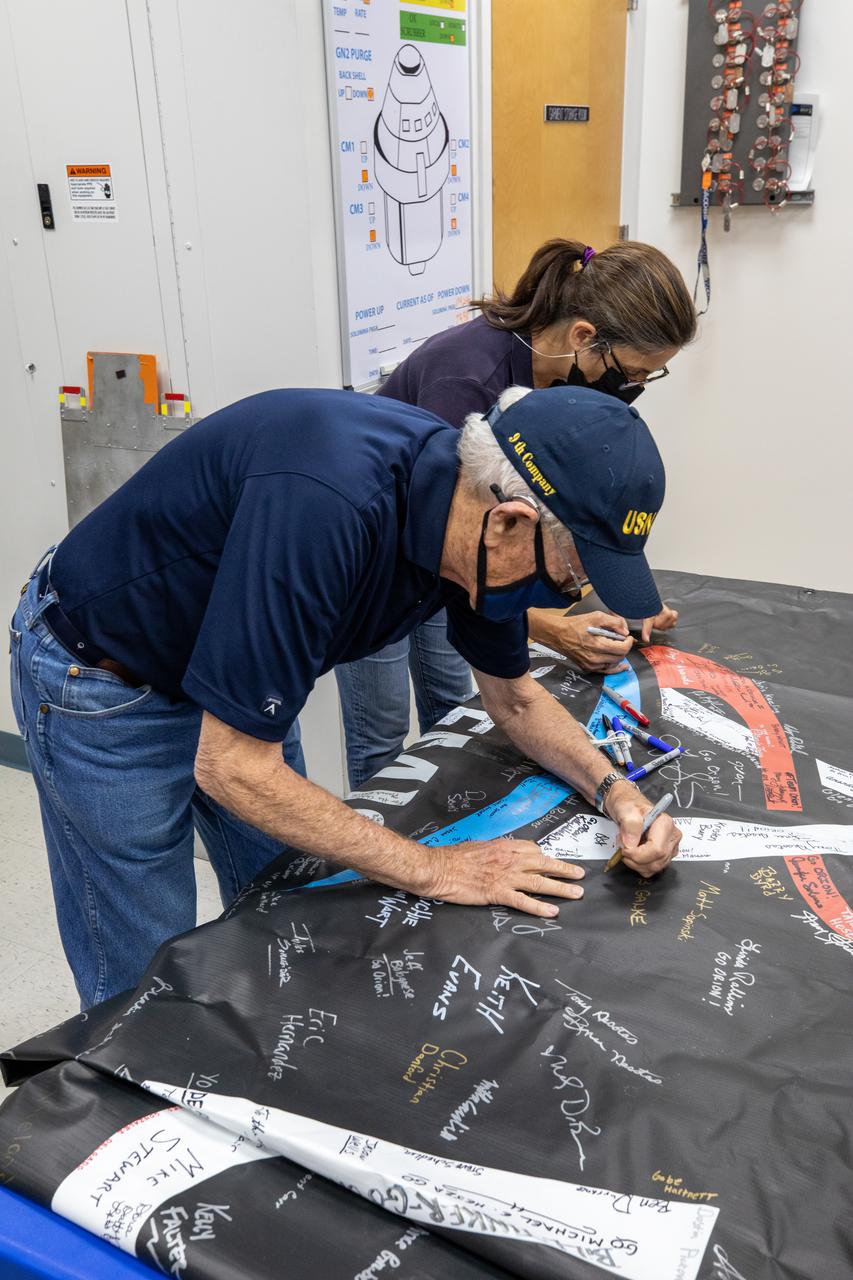
Charlie Duke, NASA Astronaut (former), and Nicole Stott, NASA Astronaut (former), add their signatures to the Artemis “We Are Going” banner inside the Multi-Payload Processing Facility (MPPF) during a visit to NASA’s Kennedy Space Center in Florida on May 10, 2021. During their time at Kennedy, they also had the opportunity to view the Orion spacecraft and Interim Cryogenic Propulsion Stage currently being serviced inside the MPPF ahead of the Artemis I launch. The first in a series of increasingly complex missions, Artemis I will test Orion and the Space Launch System rocket as an integrated system prior to crewed flights to the Moon.
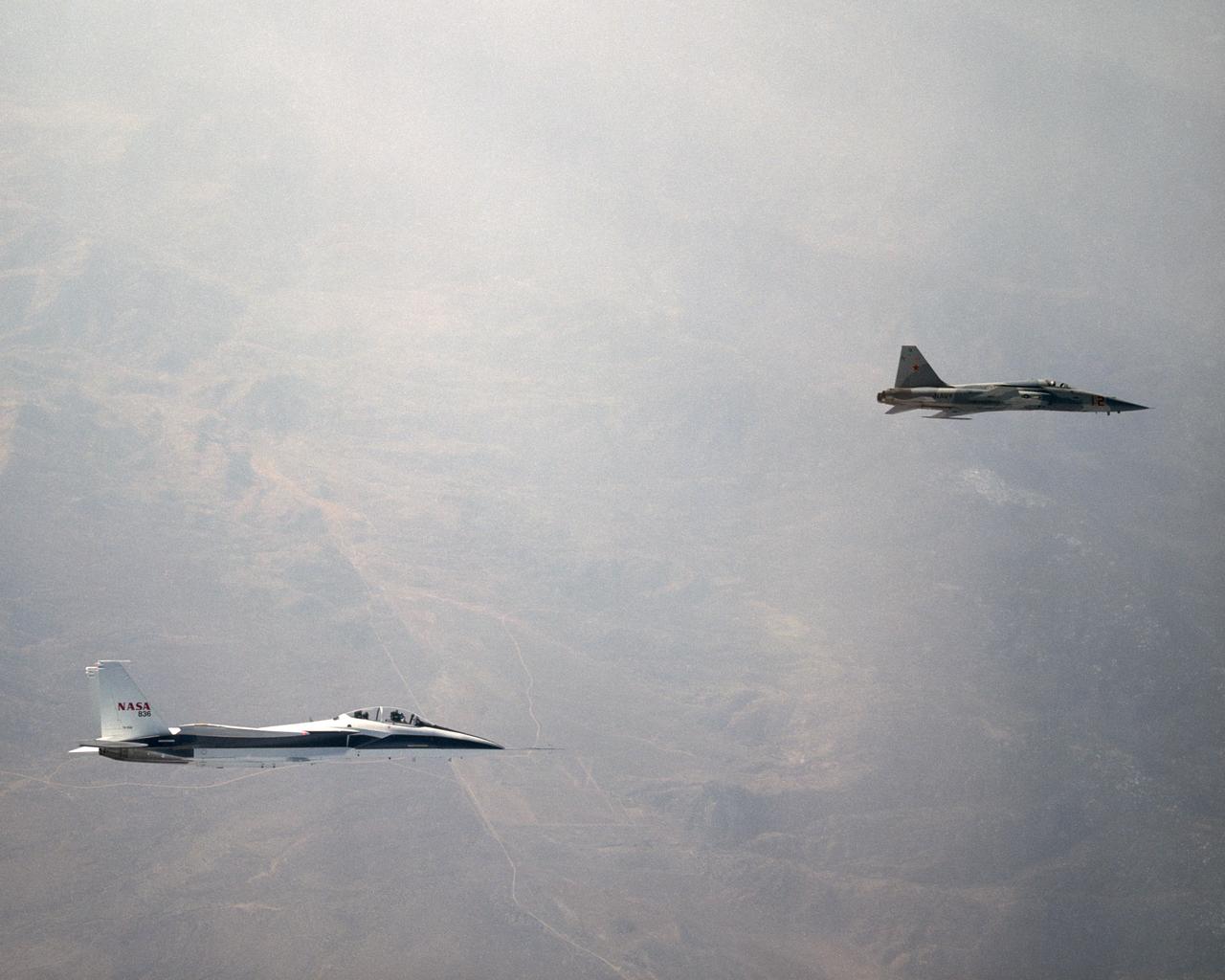
NASA's F-15B Research Testbed aircraft recently flew in the supersonic shock wave of a U.S. Navy F-5E in support of the F-5 Shaped Sonic Boom Demonstration (SSBD) project, part of the Defense Advanced Research Projects Agency's (DARPA) Quiet Supersonic Platform (QSP) program. The flights originated from the NASA Dryden Flight Research Center at Edwards, California. Four flights were flown in order to measure the F-5E's near-field (close-up) sonic boom signature at Mach 1.4, during which more than 50 shockwave patterns were measured at distances as close as 100 feet below the F-5E.
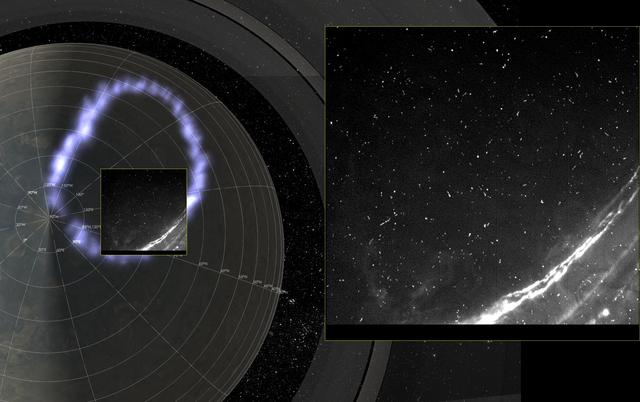
Juno's Radiation Monitoring Investigation used the Stellar Reference Unit (SRU) star camera to collect this high-resolution image Jupiter's northern auroral oval on May 24, 2018 (Perijove 13). Also present in the image are several small bright dots and streaks -- signatures of high energy relativistic electrons from polar beams that are penetrating the camera. The large bright dot in the lower right corner of the image is a flash of Jupiter's lightning. Juno was less than 37,000 miles (60,000 km) from the cloud tops when this SRU image was collected -- the closest view of Jupiter's aurora with a visible light imager. https://photojournal.jpl.nasa.gov/catalog/PIA22968
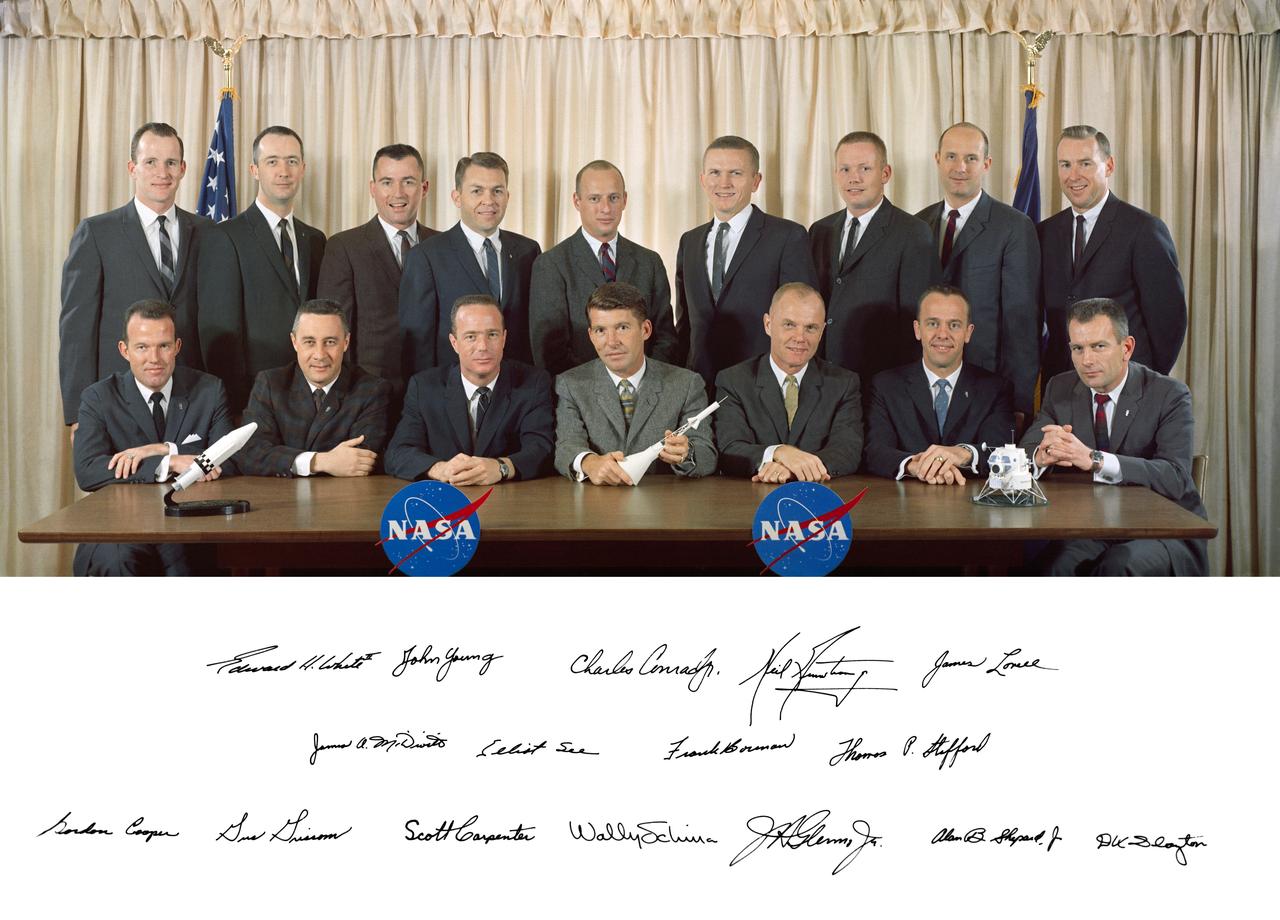
S63-01419A (1963) --- Portrait of the first two groups of astronauts. The seven original Mercury astronauts plus new members of the astronaut corps. Seated from left to right are: Gordon Cooper, Gus Grissom, Scott Carpenter, Wally Schirra, John Glenn, Alan Shepard and Deke Slayton. Standing from left to right are: Edward White, James McDivitt, John Young, Elliot See, Charles Conrad, Frank Borman, Neil Armstrong, Thomas Stafford, and James Lovell. Signatures are also visible at the bottom of the frame. Photo credit: NASA
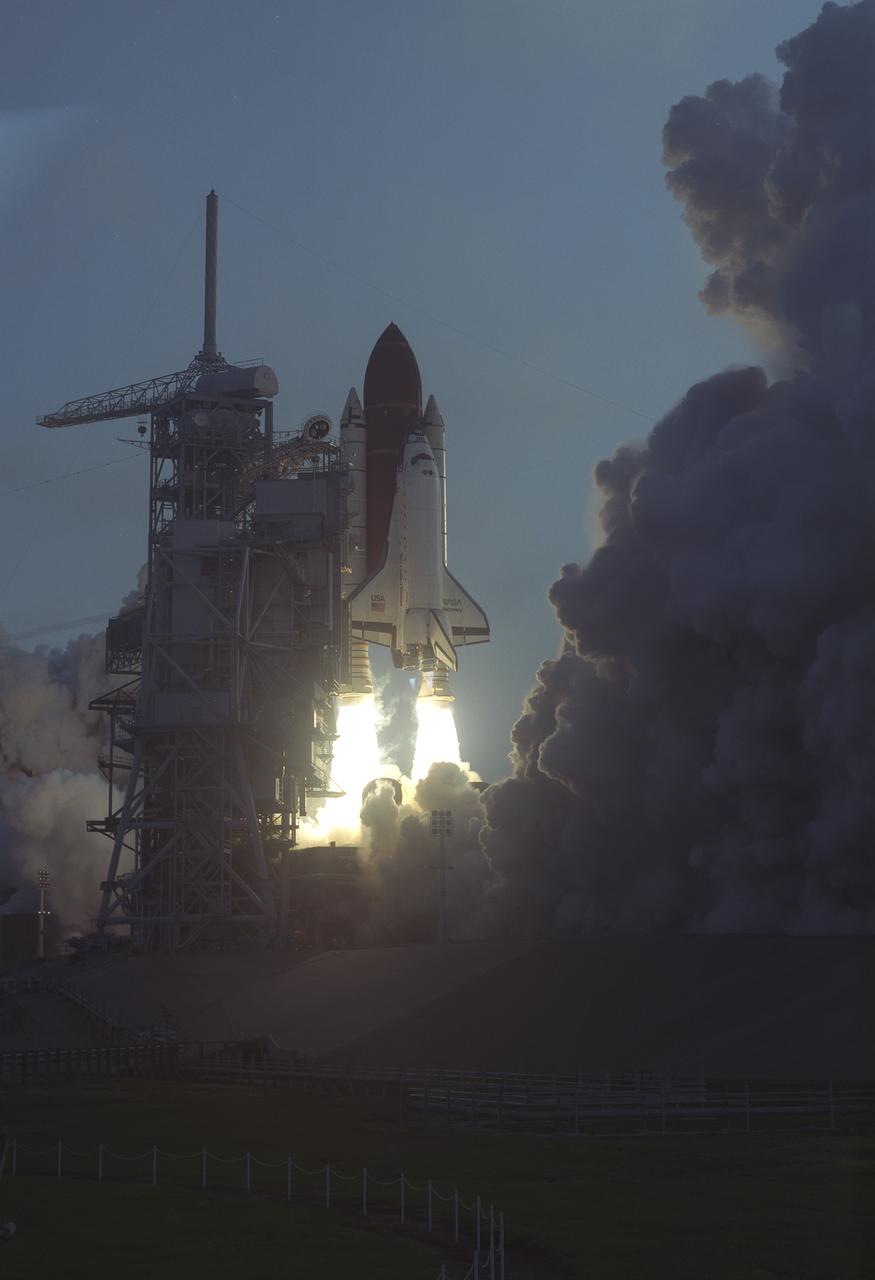
Launched aboard the Space Shuttle Discovery on April 28, 1991 at 7:33:14 am (EDT), STS-39 was a Department of Defense (DOD) mission. The crew included seven astronauts: Michael L. Coats, commander; L. Blaine Hammond, pilot; Guion S. Buford, Jr., mission specialist 1; Gregory J. Harbaugh, mission specialist 2; Richard J. Hieb, mission specialist 3; Donald R. McMonagle, mission specialist 4; and Charles L. Veach, mission specialist 5. The primary unclassified payload included the Air Force Program 675 (AFP-675), the Infrared Background Signature Survey (IBSS), and the Shuttle Pallet Satellite II (SPAS II).
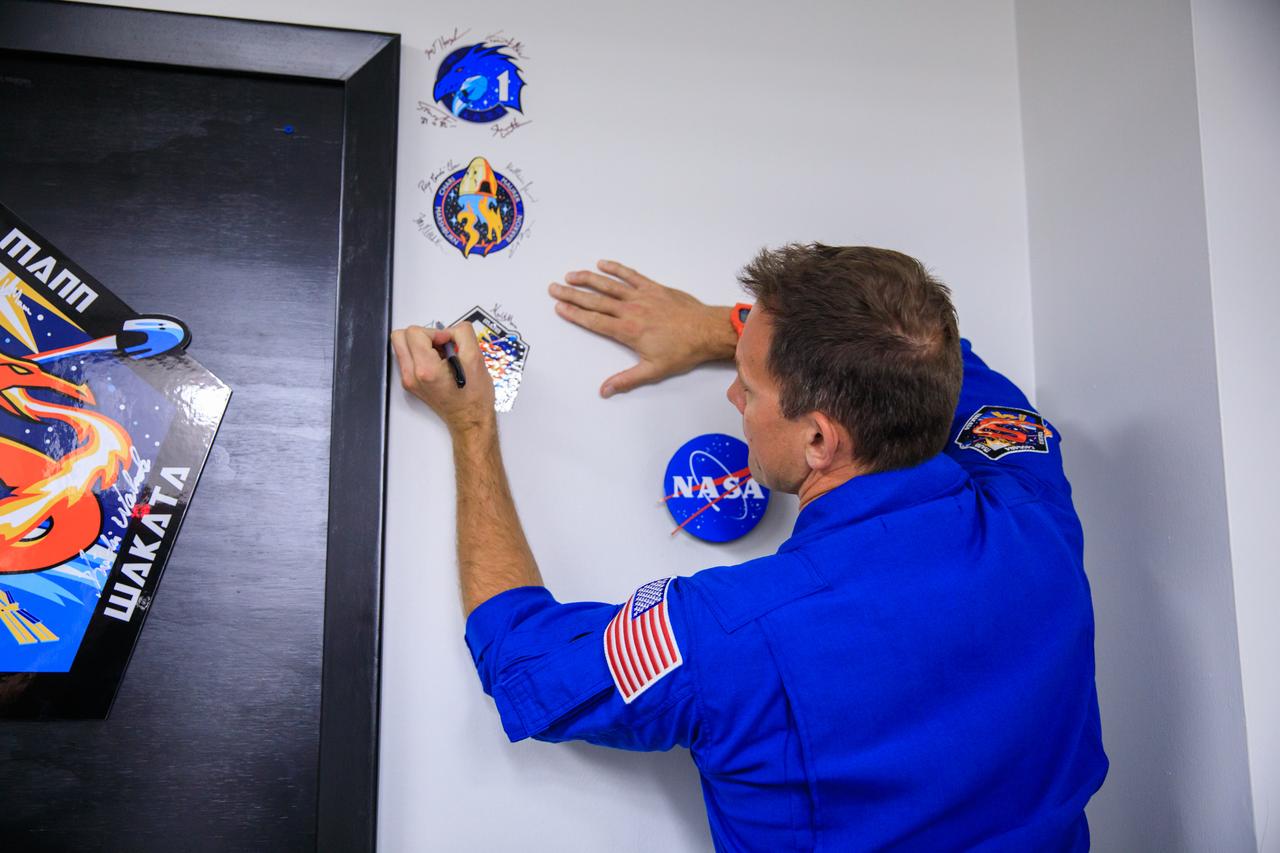
NASA astronaut Josh Cassada adds his signature to a wall inside the Astronaut Crew Quarters in the Neil A. Armstrong Operations and Checkout Building at NASA’s Kennedy Space Center in Florida on Oct. 4, 2022. Cassada, along with NASA astronaut Nicole Aunapu Mann, Roscosmos cosmonaut Anna Kikina, and JAXA (Japan Aerospace Exploration Agency) astronaut Koichi Wakata will launch to the International Space Station on NASA’s SpaceX Crew-5 mission as part of the agency’s Commercial Crew Program. Liftoff of SpaceX’s Falcon 9 rocket and Crew Dragon Endurance spacecraft is targeted for noon EDT on Oct. 5, 2022, from Kennedy’s Launch Complex 39A.
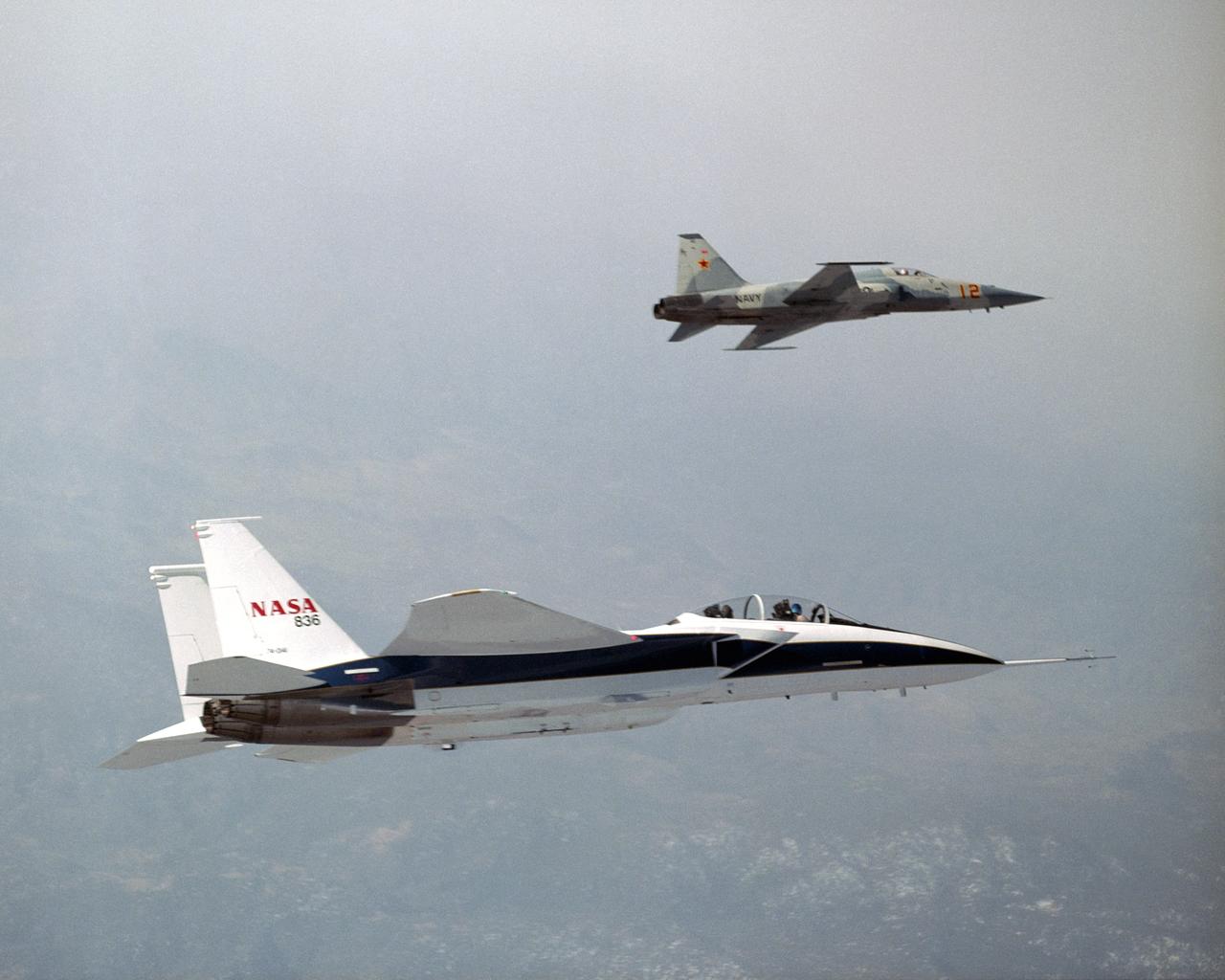
NASA's F-15B Research Testbed aircraft recently flew in the supersonic shock wave of a U.S. Navy F-5E in support of the F-5 Shaped Sonic Boom Demonstration (SSBD) project, part of the Defense Advanced Research Projects Agency's (DARPA) Quiet Supersonic Platform (QSP) program. The flights originated from the NASA Dryden Flight Research Center at Edwards, California. Four flights were flown in order to measure the F-5E's near-field (close-up) sonic boom signature at Mach 1.4, during which more than 50 shockwave patterns were measured at distances as close as 100 feet below the F-5E.
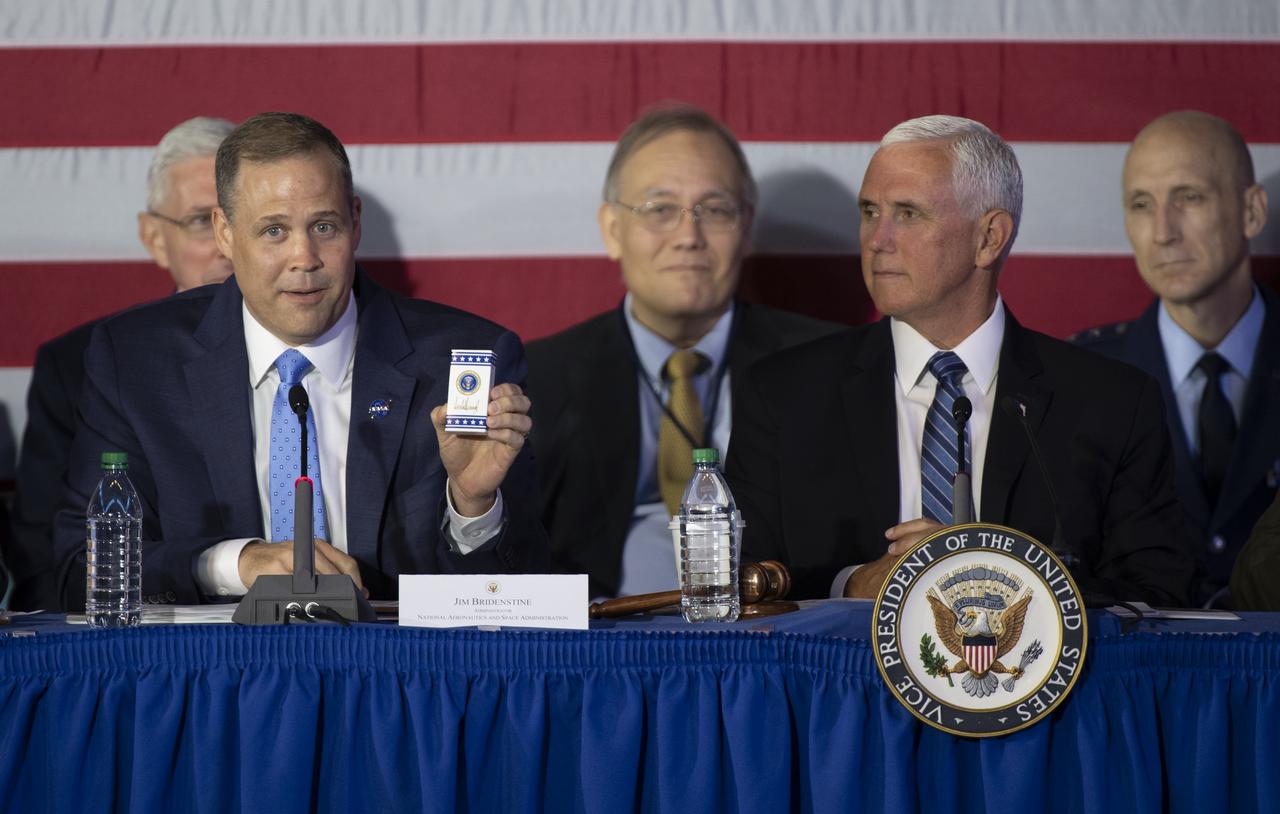
NASA Administrator Jim Bridenstine holds up a box of M&M's bearing the signature of President Donald Trump while providing an update to Vice President Mike Pence and the members of the council during the sixth meeting of the National Space Council, Tuesday, Aug. 20, 2019 at the Smithsonian National Air and Space Museum's Steven F. Udvar-Hazy Center in Chantilly, Va. Administrator Bridenstine was given the box at a recent meeting at the White House as reminder of the mission of going to the Moon & Mars. Chaired by the Vice President, the council's role is to advise the President regarding national space policy and strategy, and review the nation's long-range goals for space activities. Photo Credit: (NASA/Aubrey Gemignani)
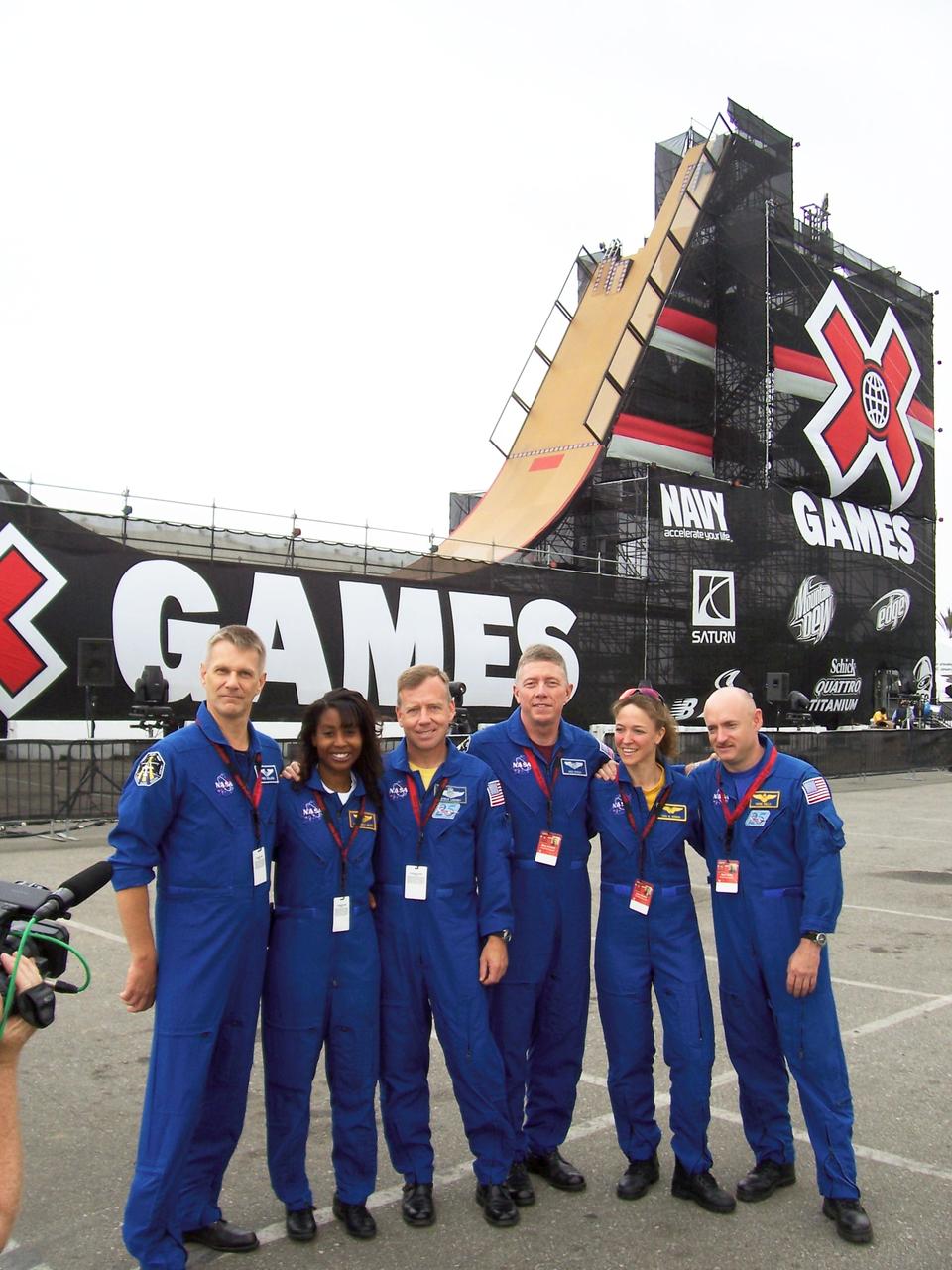
JSC2006-E-32815 (3 Aug. 2006) --- The crew of STS-121 attended opening day of the 12th "X Games" in Los Angeles Aug. 3, discussing their recent mission to the International Space Station with students and athletes. From left to right are astronauts Piers J. Sellers, Stephanie D. Wilson, Steven W. Lindsey, Michael E. Fossum, Lisa M. Nowak and Mark E. Kelly. In the background is the signature 80 foot high "Big Air Jump" skateboarding ramp - one of the event highlights. The crew's visit also included presentations at the Jet Propulsion Laboratory and the California Science Center.
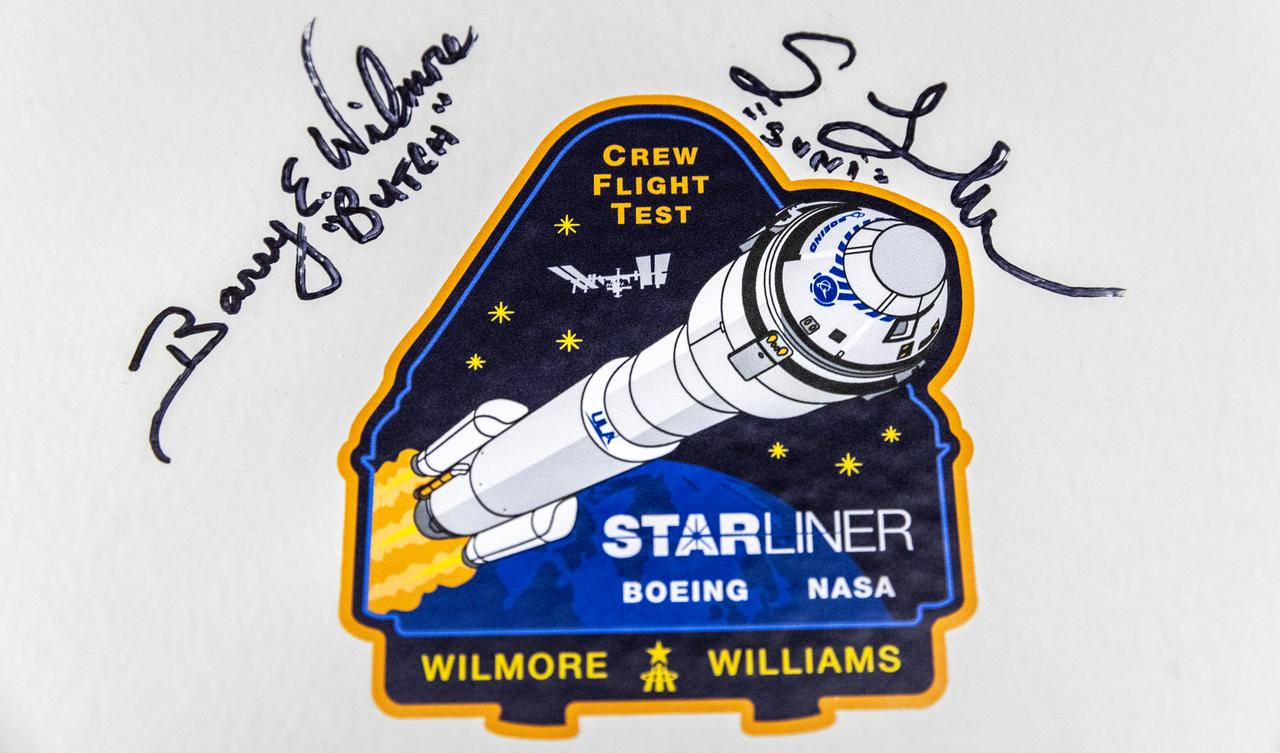
The signatures of NASA astronauts Butch Wilmore and Suni Williams are photographed alongside NASA’s Boeing Crew Flight Test mission insignia inside the Astronaut Crew Quarters in the Neil A. Armstrong Operations and Checkout Building at NASA’s Kennedy Space Center in Florida on Friday, April 26, 2024. Wilmore and Williams are the first to launch aboard Boeing’s Starliner spacecraft atop a United Launch Alliance Atlas V rocket from Space Launch Complex-41 at nearby Cape Canaveral Space Force Station. Liftoff is scheduled for 10:34 p.m. ET on Monday, May 6.
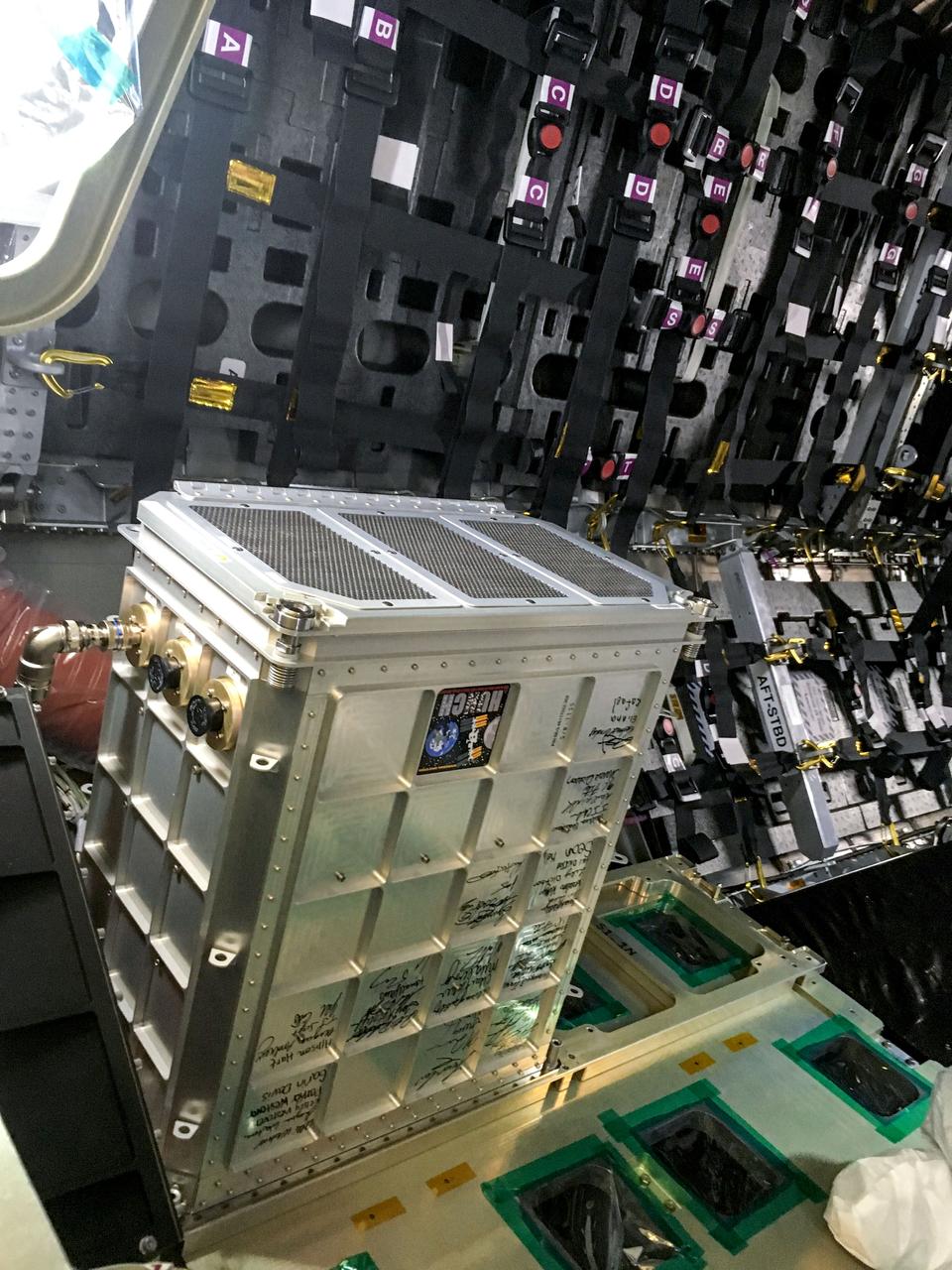
jsc2023e046376 (12/12/2019) --- The Far-Field Diagnostic (FFD) hardware for Spacecraft Fire Experiment-VI (Saffire-VI) is pictured aboard Cygnus before launch. This package contains the Smoke Eater and CO scrubbers, a prototype Combustion Product Monitor to be used on Orion, particulate sensors, and sensors for CO, CO2, and oxygen gases. The containers for the FFD were fabricated by HUNCH (High school students United with NASA to Create Hardware). Their signatures are shown on the side of the FFD. The Saffire series helps researchers to understand realistic fire spread scenarios on spacecraft and generate advanced protective equipment.