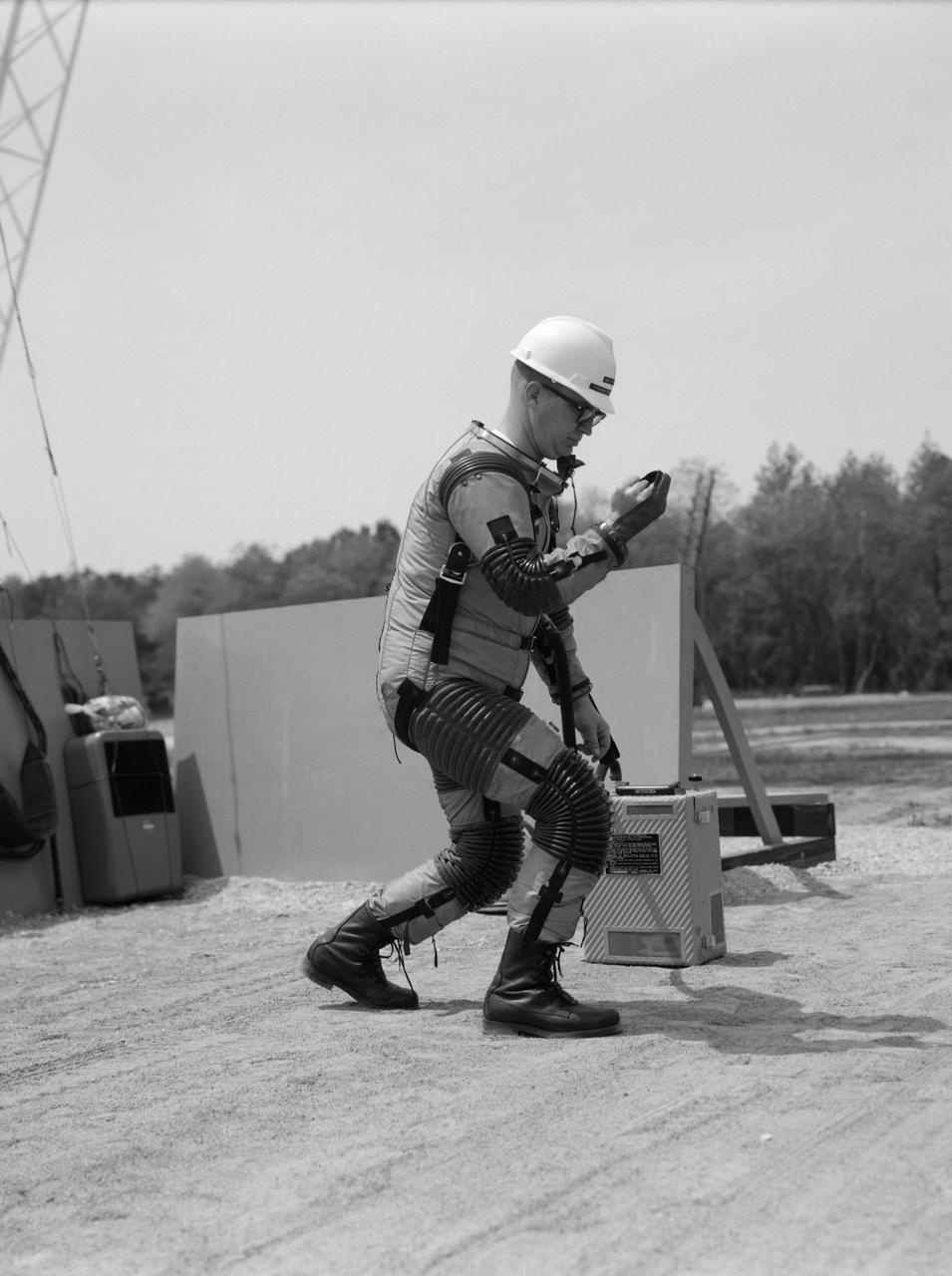
Special "space" suit for the Reduced Gravity Walking Simulator located at the Lunar Landing Facility. The purpose of this simulator was to study the subject while walking, jumping or running. Researchers conducted studies of various factors such as fatigue limit, energy expenditure, and speed of locomotion. A.W. Vigil described the purpose of the simulator in his paper "Discussion of Existing and Planned Simulators for Space Research," "When the astronauts land on the moon they will be in an unfamiliar environment involving, particularly, a gravitational field only one-sixth as strong as on earth. A novel method of simulating lunar gravity has been developed and is supported by a puppet-type suspension system at the end of a long pendulum. A floor is provided at the proper angle so that one-sixth of the subject's weight is supported by the floor with the remainder being supported by the suspension system. This simulator allows almost complete freedom in vertical translation and pitch and is considered to be a very realistic simulation of the lunar walking problem. For this problem this simulator suffers only slightly from the restrictions in lateral movement it puts on the test subject. This is not considered a strong disadvantage for ordinary walking problems since most of the motions do, in fact, occur in the vertical plane. However, this simulation technique would be severely restrictive if applied to the study of the extra-vehicular locomotion problem, for example, because in this situation complete six degrees of freedom are rather necessary. This technique, in effect, automatically introduces a two-axis attitude stabilization system into the problem. The technique could, however, be used in preliminary studies of extra-vehicular locomotion where, for example, it might be assumed that one axis of the attitude control system on the astronaut maneuvering unit may have failed." -- Published in James R. Hansen, Spaceflight Revolution: NASA Langley Research Center From Sputnik to Apollo, (Washington: NASA, 1995), p. 377; A.W. Vigil, "Discussion of Existing and Planned Simulators for Space Research," Paper presented at Conference on the Role of Simulation in Space Technology," Blacksburg, VA, August 17-21, 1964.
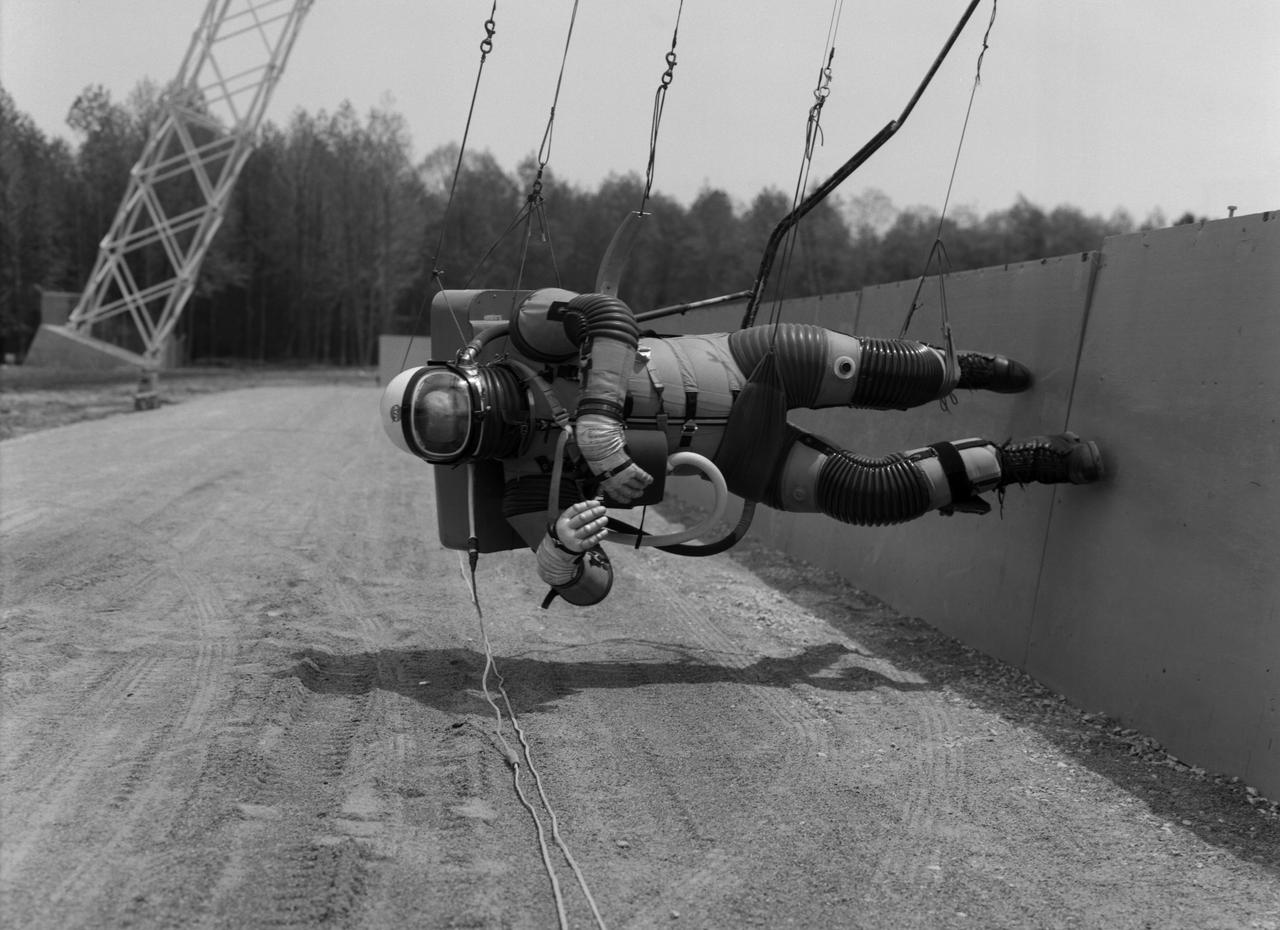
Test subject wearing the pressurized "space" suit for the Reduced Gravity Walking Simulator located at the Lunar Landing Facility. The purpose of this simulator was to study the subject while walking, jumping or running. Researchers conducted studies of various factors such as fatigue limit, energy expenditure, and speed of locomotion. A.W. Vigil described the purpose of the simulator in his paper "Discussion of Existing and Planned Simulators for Space Research," "When the astronauts land on the moon they will be in an unfamiliar environment involving, particularly, a gravitational field only one-sixth as strong as on earth. A novel method of simulating lunar gravity has been developed and is supported by a puppet-type suspension system at the end of a long pendulum. A floor is provided at the proper angle so that one-sixth of the subject's weight is supported by the floor with the remainder being supported by the suspension system. This simulator allows almost complete freedom in vertical translation and pitch and is considered to be a very realistic simulation of the lunar walking problem. For this problem this simulator suffers only slightly from the restrictions in lateral movement it puts on the test subject. This is not considered a strong disadvantage for ordinary walking problems since most of the motions do, in fact, occur in the vertical plane. However, this simulation technique would be severely restrictive if applied to the study of the extra-vehicular locomotion problem, for example, because in this situation complete six degrees of freedom are rather necessary. This technique, in effect, automatically introduces a two-axis attitude stabilization system into the problem. The technique could, however, be used in preliminary studies of extra-vehicular locomotion where, for example, it might be assumed that one axis of the attitude control system on the astronaut maneuvering unit may have failed." -- Published in James R. Hansen, Spaceflight Revolution: NASA Langley Research Center From Sputnik to Apollo, (Washington: NASA, 1995), p. 377; A.W. Vigil, "Discussion of Existing and Planned Simulators for Space Research," Paper presented at Conference on the Role of Simulation in Space Technology," Blacksburg, VA, August 17-21, 1964.

jsc2026e037769 (May 5, 2026) --- CSA (Canadian Space Agency) astronaut Josh Kutryk practices suiting up in a spacesuit in an International Space Station airlock simulator at Johnson Space Center’s (JSC) Space Vehicle Mockup Facility in Houston, Texas. Astronauts familiarize themselves with spacesuit systems and procedures and practice Quest airlock operations before conducting spacewalk training at JSC’s Neutral Buoyancy Laboratory in simulated microgravity. Credit: NASA/Josh Valcarcel

jsc2026e037785 (May 5, 2026) --- NASA astronaut Jessica Watkins (center), surrounded by training specialists, assists CSA (Canadian Space Agency) astronaut Josh Kutryk as he practices suiting up in a spacesuit in an International Space Station airlock simulator at Johnson Space Center’s (JSC) Space Vehicle Mockup Facility in Houston, Texas. Astronauts familiarize themselves with spacesuit systems and procedures and practice Quest airlock operations before conducting spacewalk training at JSC’s Neutral Buoyancy Laboratory in simulated microgravity. Credit: NASA/Josh Valcarcel

jsc2026e037783 (May 5, 2026) --- CSA (Canadian Space Agency) astronaut Josh Kutryk (left) and NASA astronaut Luke Delaney (right), with assistance from training specialists, practice suiting up in spacesuits in an International Space Station airlock simulator at Johnson Space Center’s (JSC) Space Vehicle Mockup Facility in Houston, Texas. Astronauts familiarize themselves with spacesuit systems and procedures and practice Quest airlock operations before conducting spacewalk training at JSC’s Neutral Buoyancy Laboratory in simulated microgravity. Credit: NASA/Josh Valcarcel
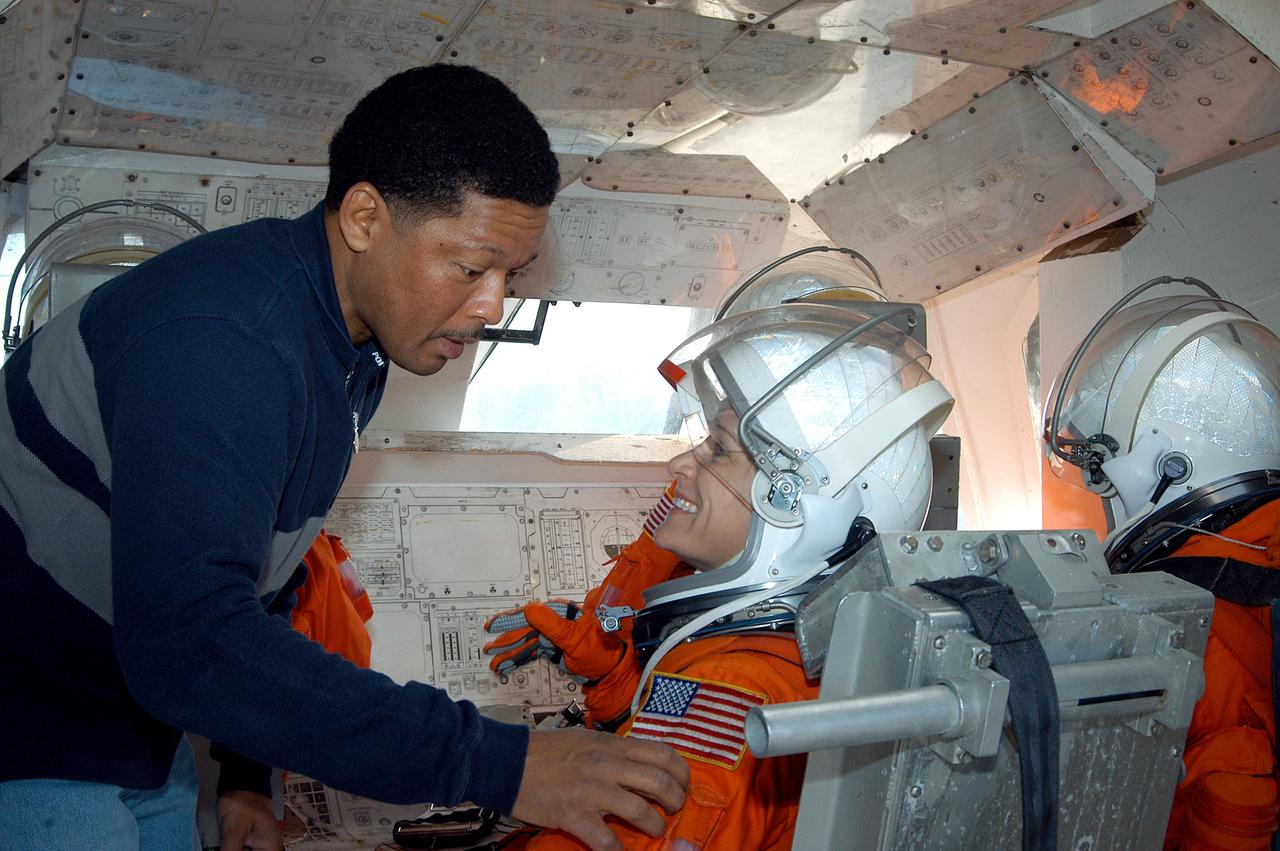
KENNEDY SPACE CENTER, FLA. - Volunteers from the KSC Fire-Rescue team dressed in launch and entry suits settle into seats in an orbiter crew compartment mock-up under the guidance of George Brittingham, USA suit technician on the Closeout Crew. Brittingham is helping Catherine Di Biase, a nurse with Bionetics Life Sciences. They are all taking part in a “Mode VII” emergency landing simulation at Kennedy Space Center. The purpose is to exercise emergency preparedness personnel, equipment and facilities in rescuing astronauts from a downed orbiter and providing immediate medical attention. This simulation presents an orbiter that has crashed short of the Shuttle Landing Facility in a wooded area 2-1/2 miles south of Runway 33. Emergency crews will respond to the volunteer “astronauts” simulating various injuries. Rescuers must remove the crew, provide triage and transport to hospitals those who need further treatment. Local hospitals are participating in the exercise.

jsc2026e037778 (May 5, 2026) --- NASA astronaut Jessica Watkins assists NASA astronaut Luke Delaney as he practices suiting up in a spacesuit in an International Space Station airlock simulator at Johnson Space Center’s (JSC) Space Vehicle Mockup Facility in Houston, Texas. Astronauts familiarize themselves with spacesuit systems and procedures and practice Quest airlock operations before conducting spacewalk training at JSC’s Neutral Buoyancy Laboratory in simulated microgravity. Credit: NASA/Josh Valcarcel

jsc2026e037770 (May 5, 2026) --- NASA astronaut Luke Delaney practices suiting up in a spacesuit in an International Space Station airlock simulator at Johnson Space Center’s (JSC) Space Vehicle Mockup Facility in Houston, Texas. Astronauts familiarize themselves with spacesuit systems and procedures and practice Quest airlock operations before conducting spacewalk training at JSC’s Neutral Buoyancy Laboratory in simulated microgravity. Credit: NASA/Josh Valcarcel

jsc2026e037773 (May 5, 2026) --- NASA astronaut Jessica Watkins (left) assists CSA (Canadian Space Agency) astronaut Josh Kutryk (background) and NASA astronaut Luke Delaney (right) as they practice suiting up in spacesuits in an International Space Station airlock simulator at Johnson Space Center’s (JSC) Space Vehicle Mockup Facility in Houston, Texas. Astronauts familiarize themselves with spacesuit systems and procedures and practice Quest airlock operations before conducting spacewalk training at JSC’s Neutral Buoyancy Laboratory in simulated microgravity. Credit: NASA/Josh Valcarcel
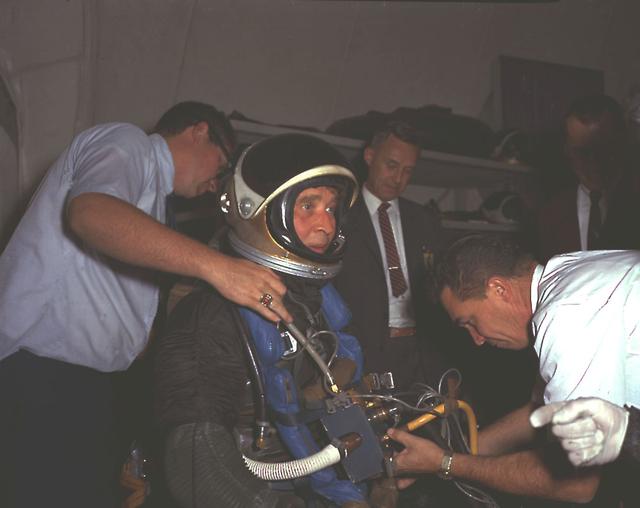
Dr. Wernher von Braun, Marshall Space Flight Center (MSFC) Director, was suited with a space suit and diving equipment at MSFC Neutral buoyancy Simulator (NBS).
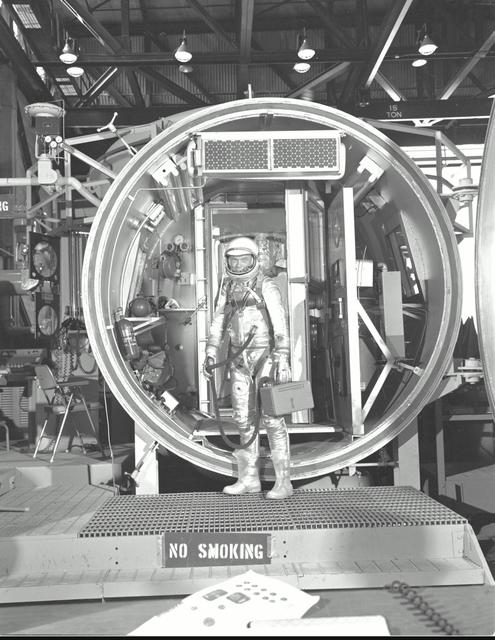
M61-00150 (1961) --- Astronaut John H. Glenn Jr., suited with hose to suit ventilation unit attached, during altitude chamber test. He is standing in the entrance to the test chamber with his helmet visor down. Photo credit: NASA
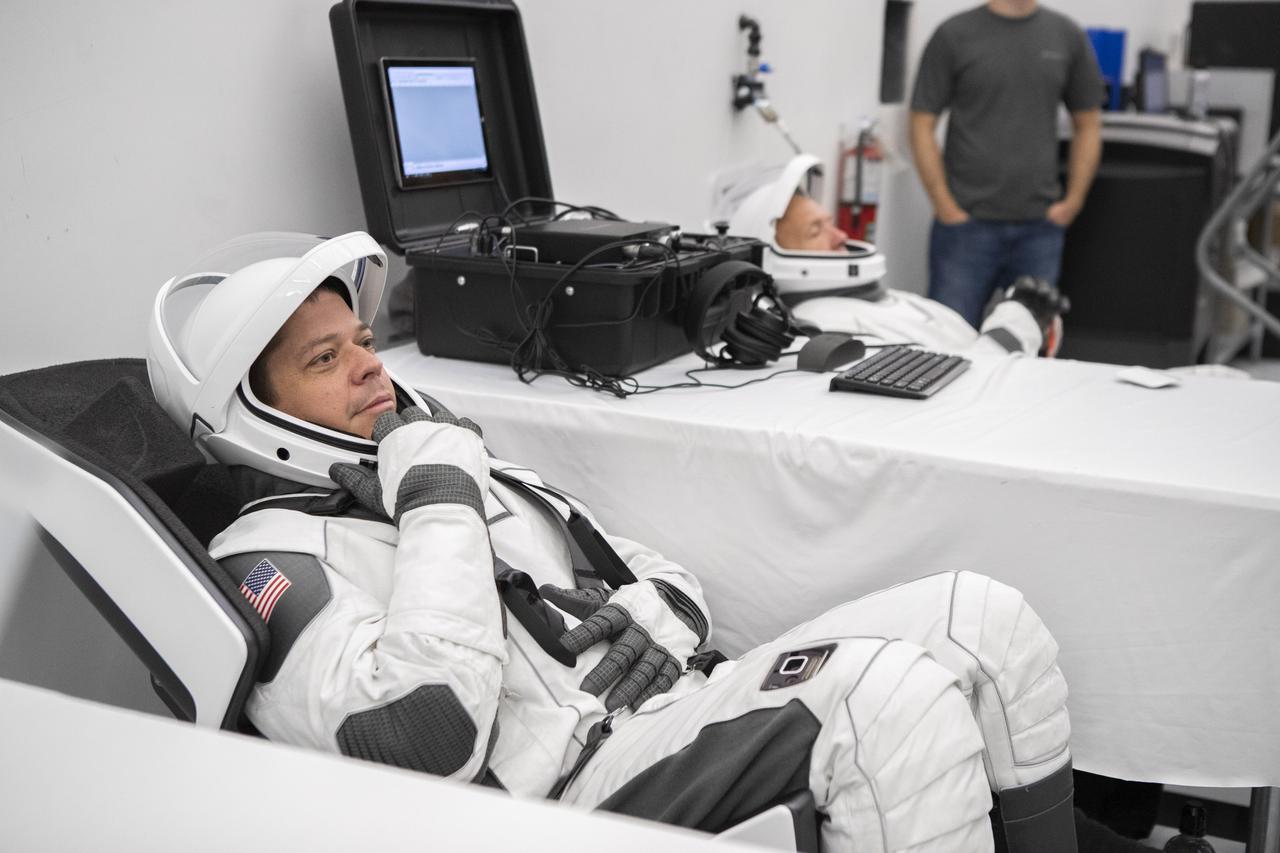
NASA and SpaceX held a joint training event for pre-launch operations, which provided an opportunity for the crew and ground operators to rehearse all of the activities, procedures, and communication the teams will exercise on launch day from crew suit-up in Kennedy Space Center’s Operations & Checkout (O&C) building in Florida through launch; this training event also included simulated emergency egress scenarios. NASA astronauts Bob Behnken, in front, and Doug Hurley, in back, are participating in a suit-up for launch, using the same Ground Support Equipment hardware, such as the seats and suit leak check boxes, that the crew will use for launch, with the SpaceX ground closeout team and suit engineers that will help the crew suit up and ingress the Dragon on launch day. Following crew suit-up, the crew ingressed the capsule simulator in Hawthorne, California, as they would on launch day, and the teams performed a simulated launch countdown and several emergency egress scenarios.
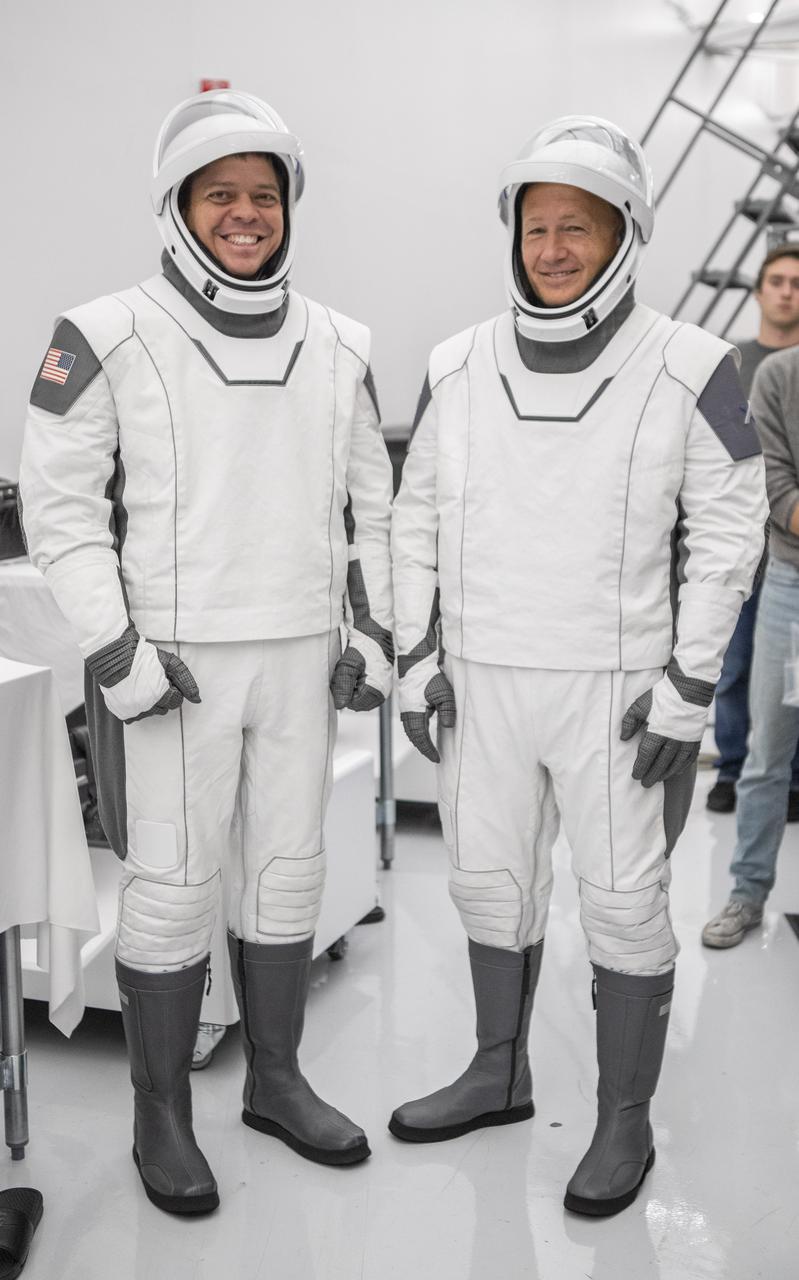
NASA and SpaceX held a joint training event for pre-launch operations, which provided an opportunity for the crew and ground operators to rehearse all of the activities, procedures, and communication the teams will exercise on launch day from crew suit-up in Kennedy Space Center’s Operations & Checkout (O&C) building in Florida through launch; this training event also included simulated emergency egress scenarios. NASA astronauts Bob Behnken, left, and Doug Hurley are participating in a suit-up for launch, using the same Ground Support Equipment hardware, such as the seats and suit leak check boxes, that the crew will use for launch, with the SpaceX ground closeout team and suit engineers that will help the crew suit up and ingress the Dragon on launch day. Following crew suit-up, the crew ingressed the capsule simulator in Hawthorne, California, as they would on launch day, and the teams performed a simulated launch countdown and several emergency egress scenarios.
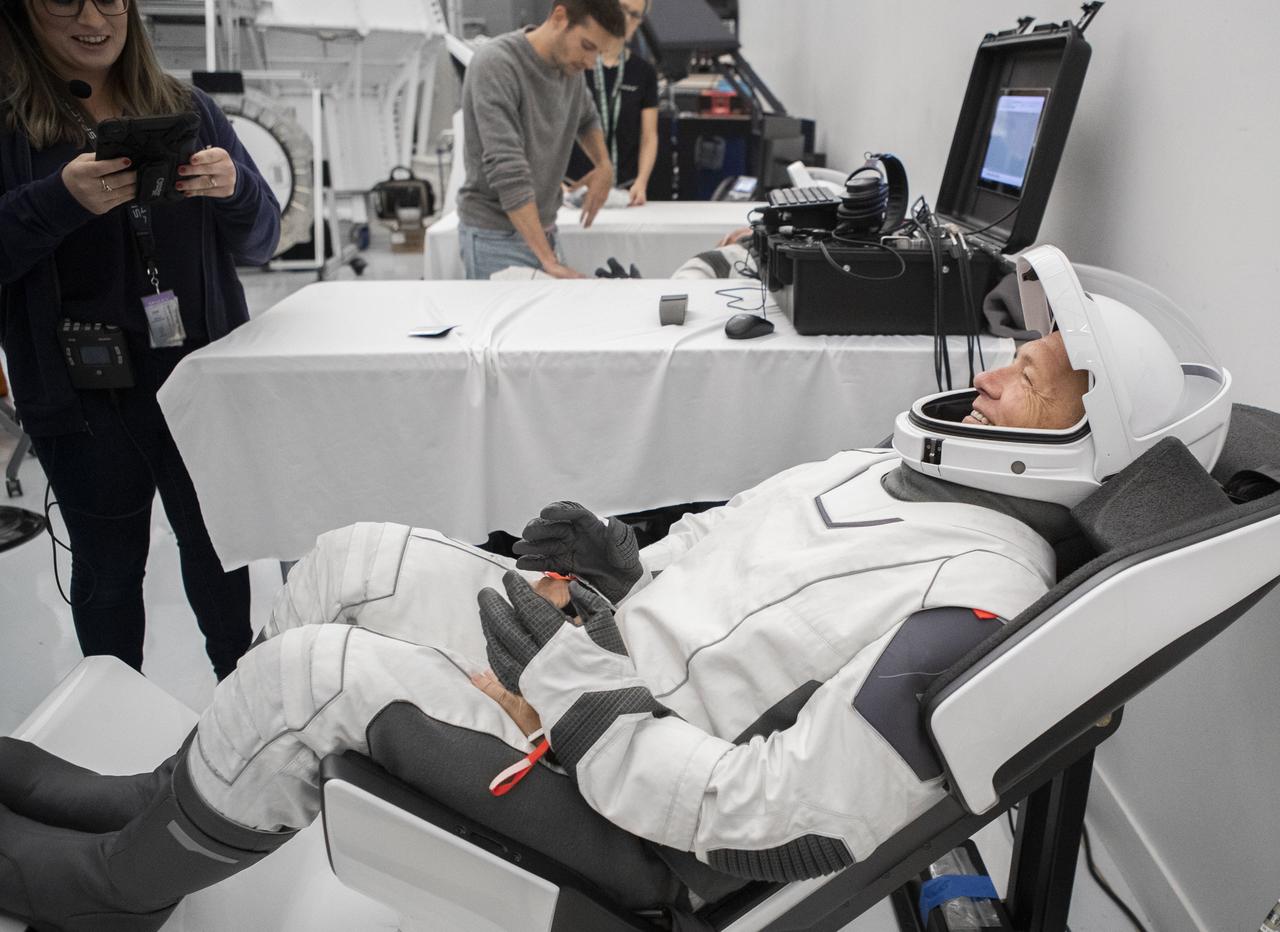
NASA and SpaceX held a joint training event for pre-launch operations, which provided an opportunity for the crew and ground operators to rehearse all of the activities, procedures, and communication the teams will exercise on launch day from crew suit-up in Kennedy Space Center’s Operations & Checkout (O&C) building in Florida through launch; this training event also included simulated emergency egress scenarios. NASA astronaut Doug Hurley is participating in a suit-up for launch, using the same Ground Support Equipment hardware, such as the seats and suit leak check boxes, that the crew will use for launch, with the SpaceX ground closeout team and suit engineers that will help the crew suit up and ingress the Dragon on launch day. Following crew suit-up, the crew ingressed the capsule simulator in Hawthorne, California, as they would on launch day, and the teams performed a simulated launch countdown and several emergency egress scenarios.
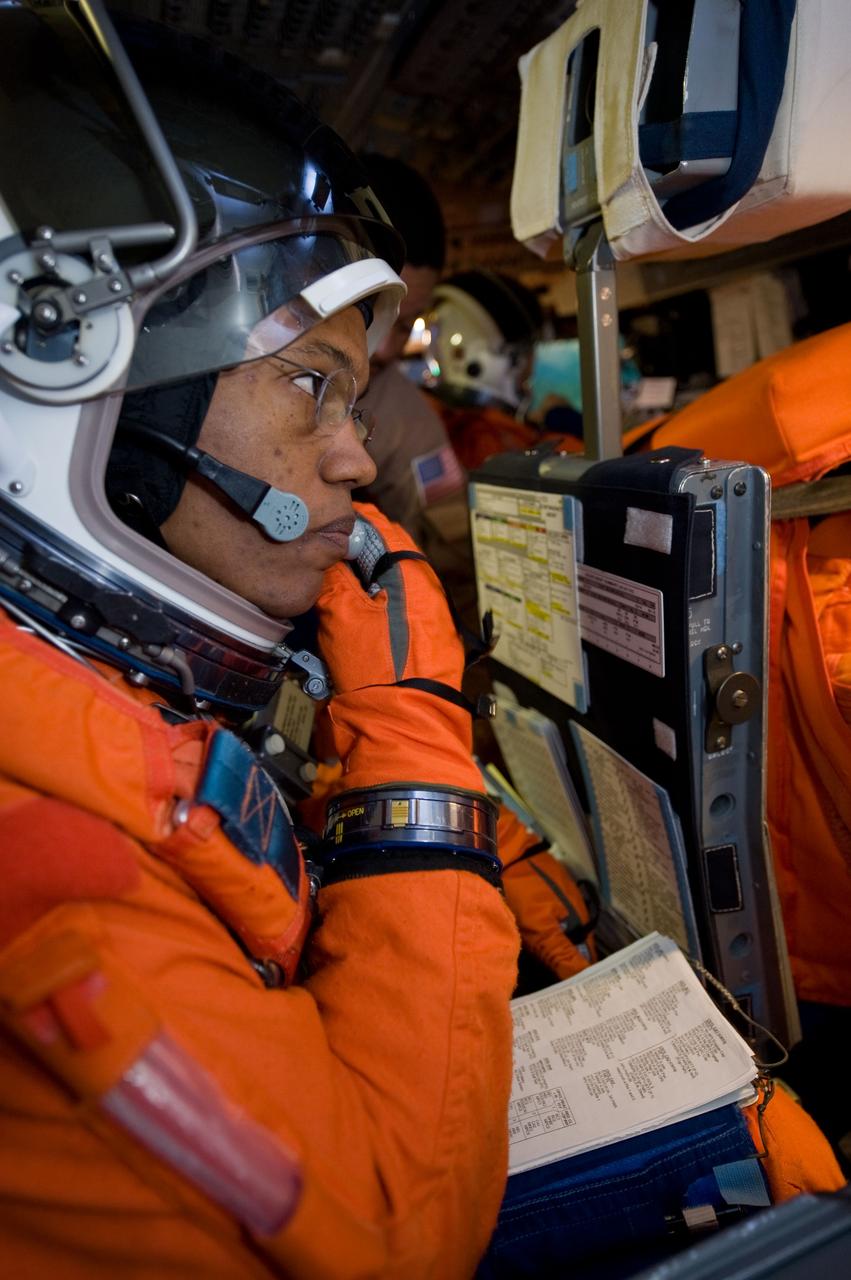
JSC2010-E-014042 (25 Jan. 2010) --- Attired in a training version of his shuttle launch and entry suit, NASA astronaut Alvin Drew, STS-133 mission specialist, participates in a simulation exercise in the motion-base shuttle mission simulator in the Jake Garn Simulation and Training Facility at NASA?s Johnson Space Center.
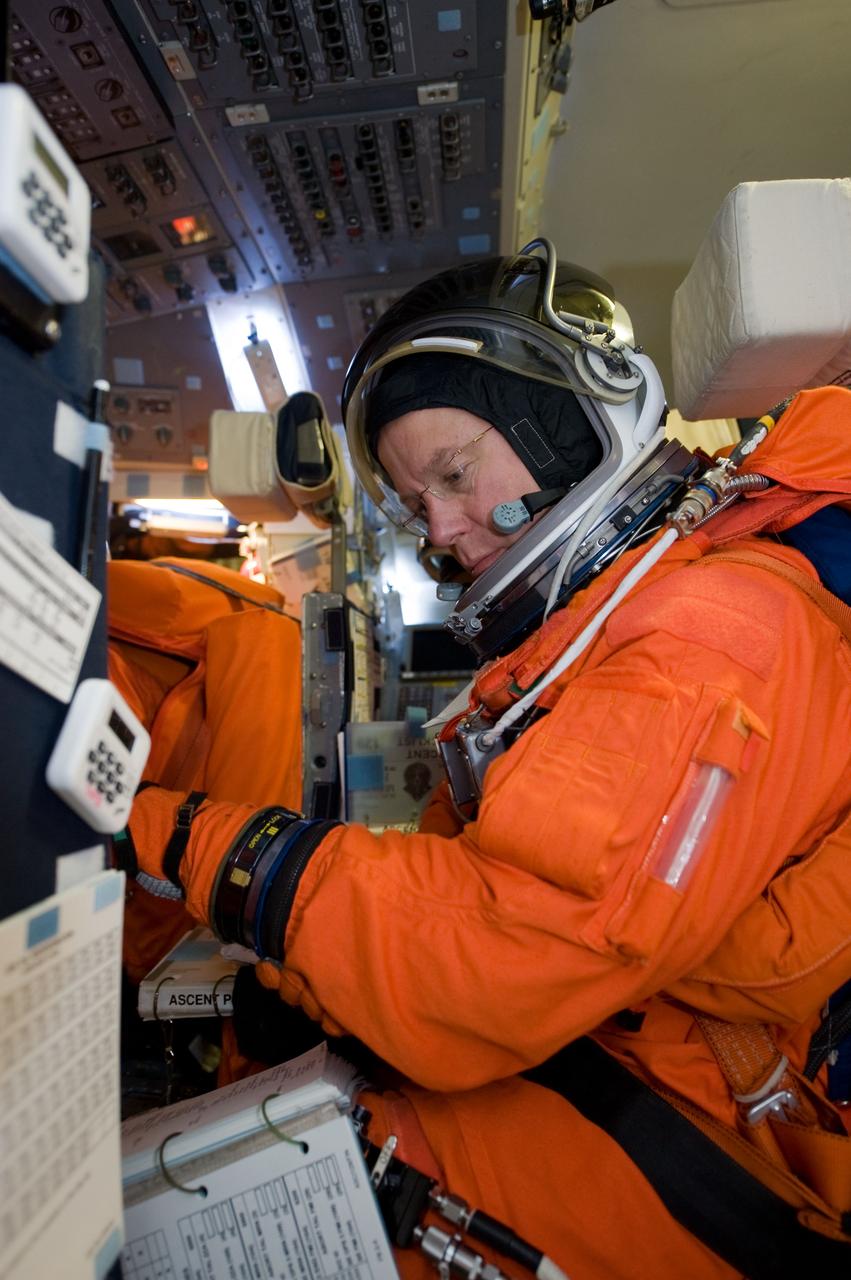
JSC2010-E-014043 (25 Jan. 2010) --- Attired in a training version of his shuttle launch and entry suit, NASA astronaut Tim Kopra, STS-133 mission specialist, participates in a simulation exercise in the motion-base shuttle mission simulator in the Jake Garn Simulation and Training Facility at NASA?s Johnson Space Center.

JSC2010-E-014041 (25 Jan. 2010) --- Attired in a training version of his shuttle launch and entry suit, NASA astronaut Alvin Drew, STS-133 mission specialist, participates in a simulation exercise in the motion-base shuttle mission simulator in the Jake Garn Simulation and Training Facility at NASA?s Johnson Space Center.

S68-50265 (13 Nov. 1968) --- These three astronauts are the prime crew of the Apollo 8 lunar orbit mission. Left to right, are James A. Lovell Jr., command module pilot; William A. Anders, lunar module pilot; and Frank Borman, commander. They are standing beside the Apollo Mission Simulator at the Kennedy Space Center (KSC).
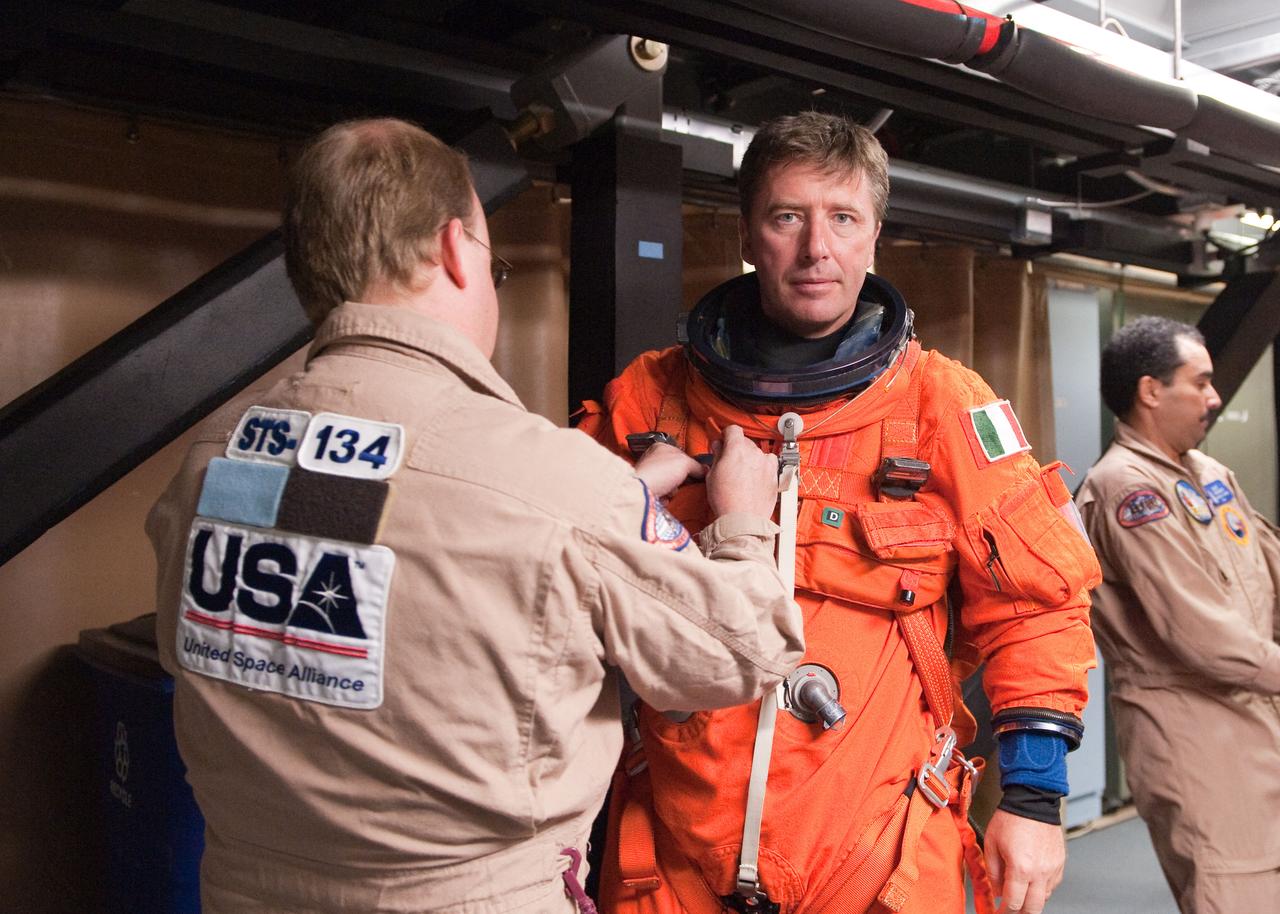
JSC2010-E-124278 (8 Sept. 2010) --- European Space Agency astronaut Roberto Vittori, STS-134 mission specialist, dons a training version of his shuttle launch and entry suit in preparation for a training session in the fixed-base shuttle mission simulator (SMS) in the Jake Garn Simulation and Training Facility at NASA?s Johnson Space Center. United Space Alliance suit technician Daniel Palmer assisted Vittori. Photo credit: NASA or National Aeronautics and Space Administration
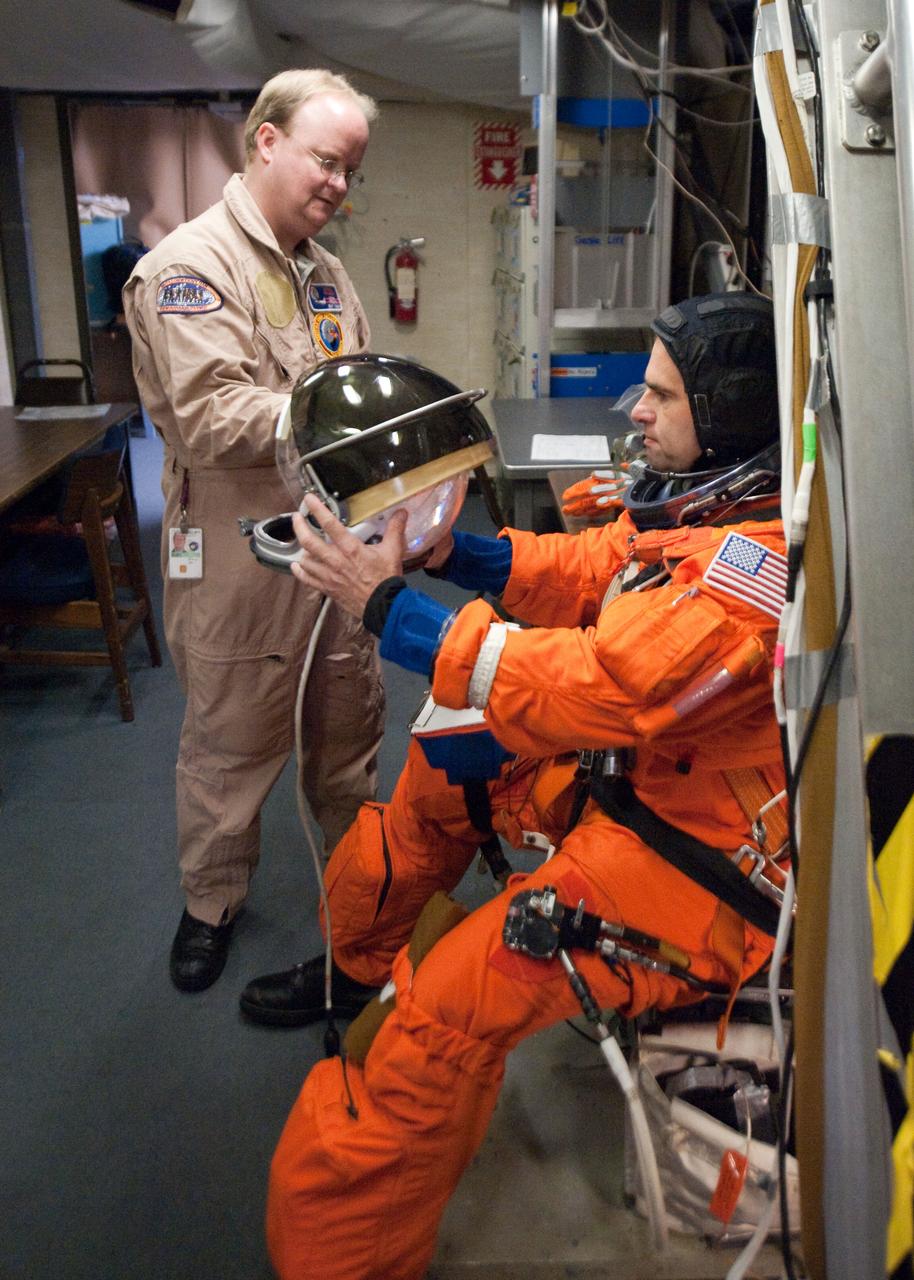
JSC2010-E-124282 (8 Sept. 2010) --- NASA astronaut Greg Chamitoff, STS-134 mission specialist, attired in a training version of his shuttle launch and entry suit, prepares for a training session in the fixed-base shuttle mission simulator (SMS) in the Jake Garn Simulation and Training Facility at NASA?s Johnson Space Center. United Space Alliance suit technician Daniel Palmer assisted Chamitoff. Photo credit: NASA or National Aeronautics and Space Administration
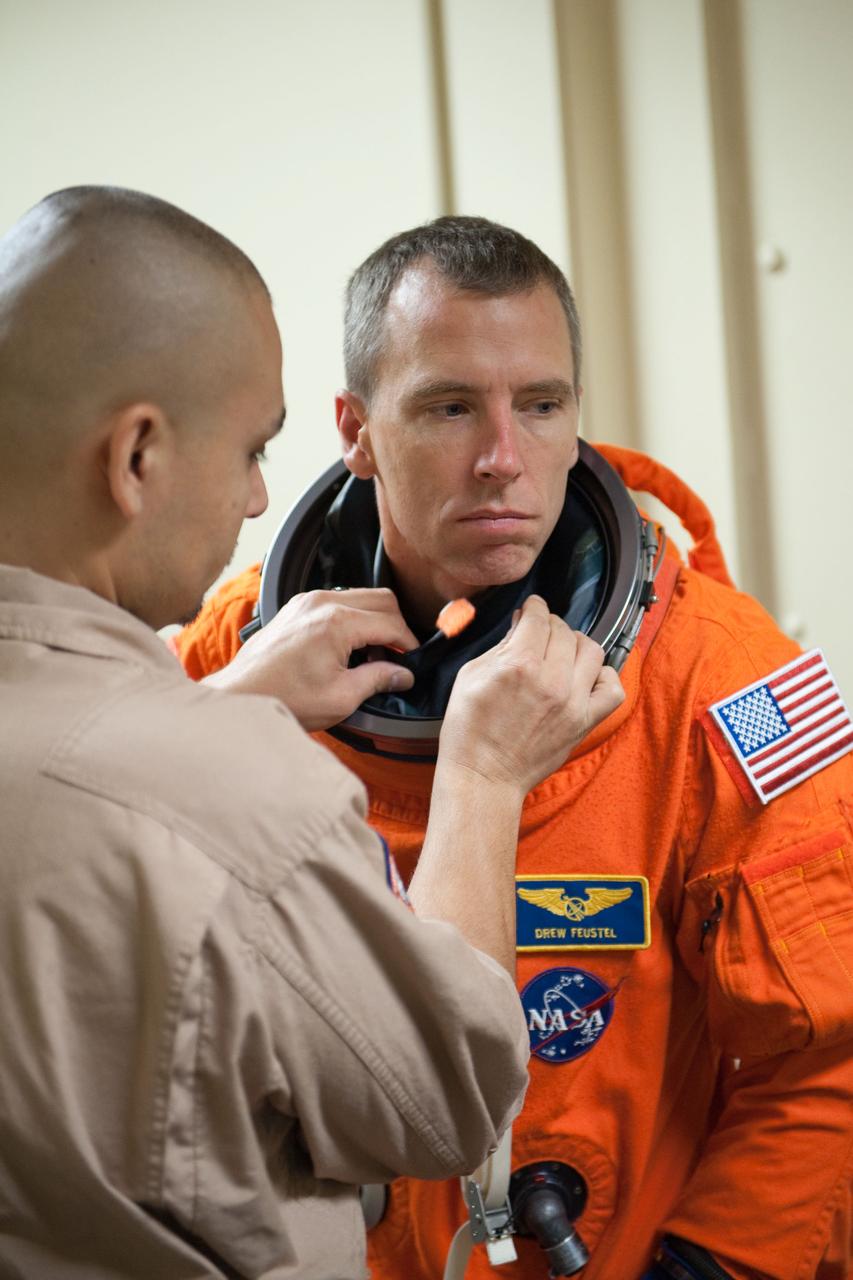
JSC2010-E-124260 (8 Sept. 2010) --- NASA astronaut Andrew Feustel, STS-134 mission specialist, dons a training version of his shuttle launch and entry suit in preparation for a training session in the fixed-base shuttle mission simulator (SMS) in the Jake Garn Simulation and Training Facility at NASA?s Johnson Space Center. United Space Alliance suit technician Russ Baker assisted Feustel. Photo credit: NASA or National Aeronautics and Space Administration
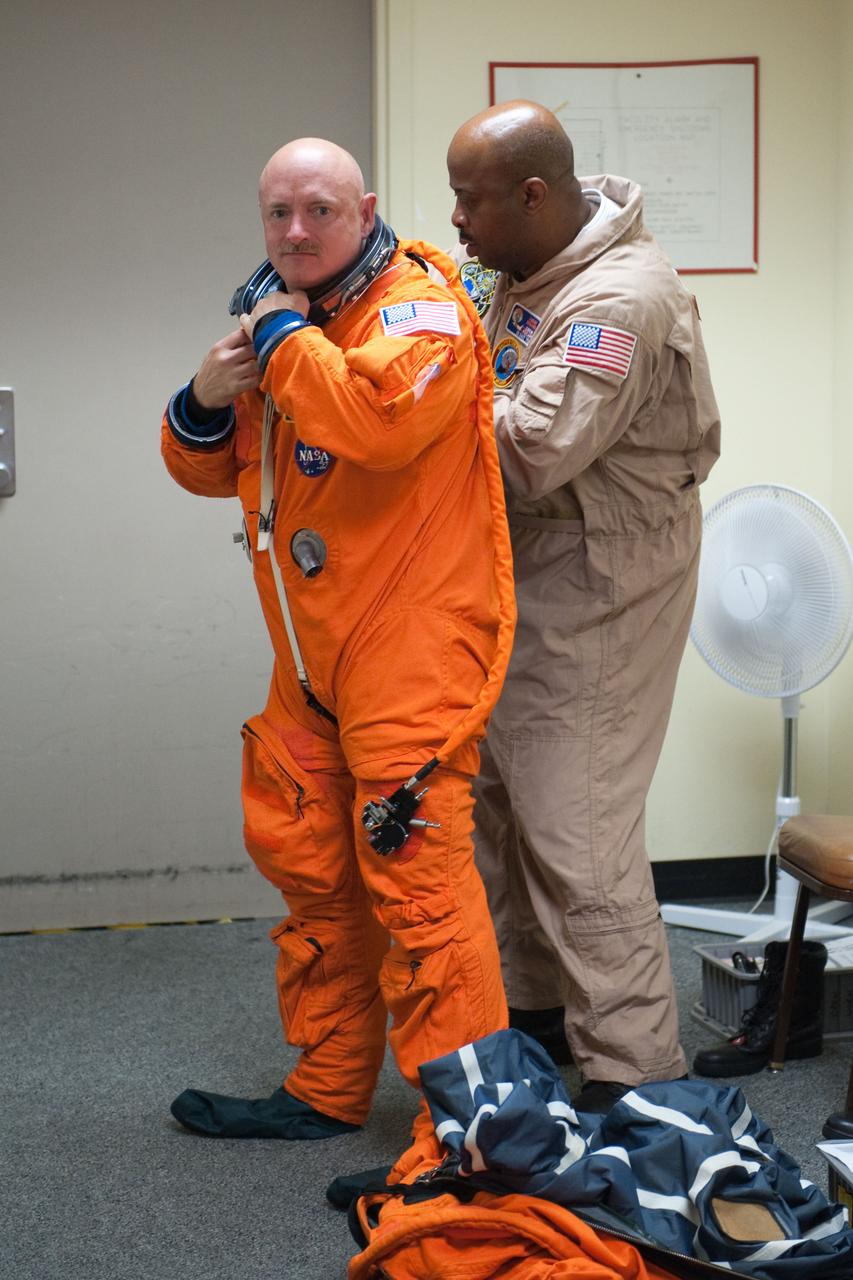
JSC2010-E-124259 (8 Sept. 2010) --- NASA astronaut Mark Kelly, STS-134 commander, dons a training version of his shuttle launch and entry suit in preparation for a training session in the fixed-base shuttle mission simulator (SMS) in the Jake Garn Simulation and Training Facility at NASA?s Johnson Space Center. United Space Alliance suit technician Andre Denard assisted Kelly. Photo credit: NASA or National Aeronautics and Space Administration
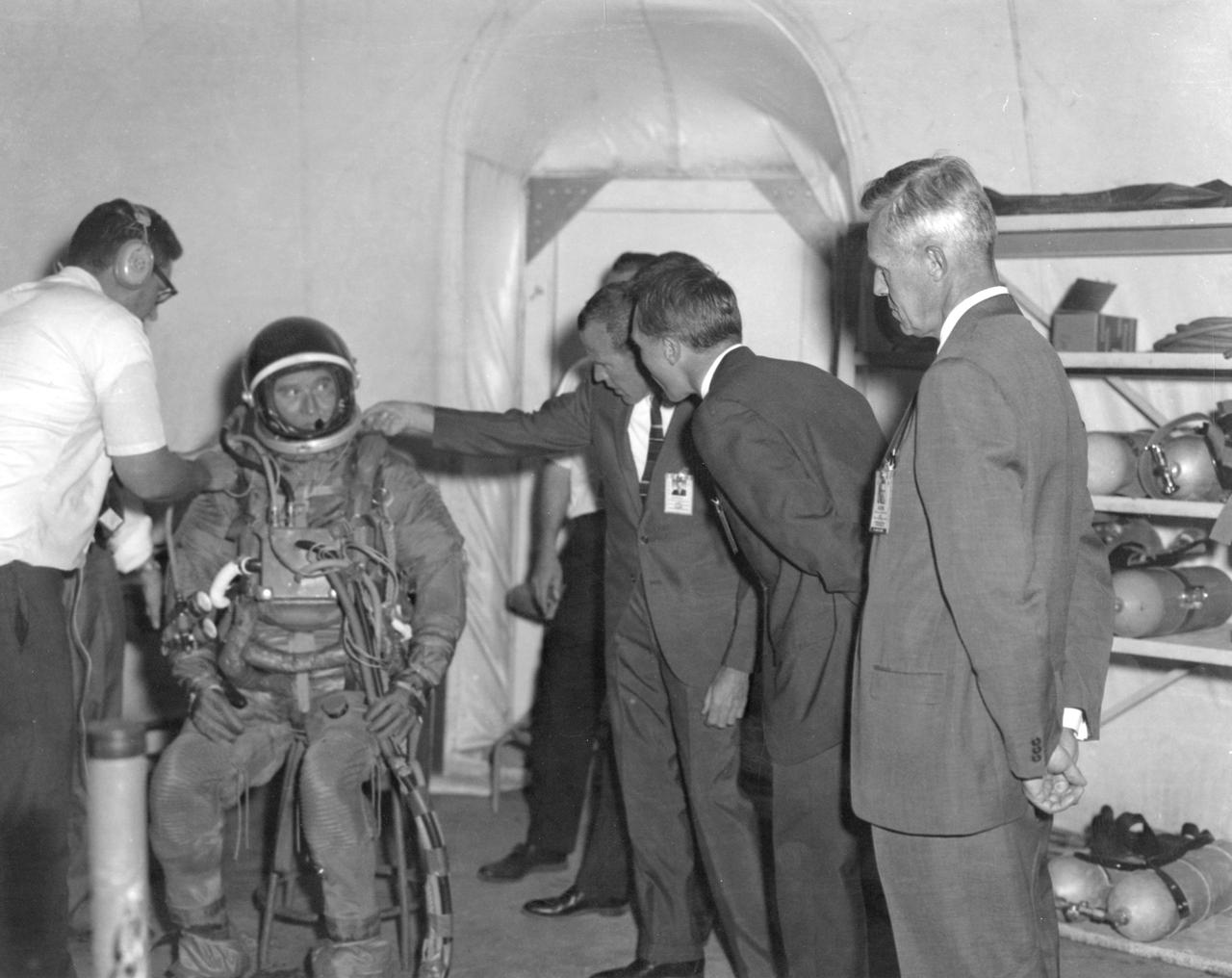
Astronaut L. Gordon Cooper checks the neck ring of a space suit worn by Marshall Space Flight Center (MSFC) Director, Dr. von Braun before he submerges into the water of the MSFC Neutral Buoyancy Simulator (NBS). Wearing a pressurized suit and weighted to a neutrally buoyant condition, Dr. von Braun was able to perform tasks underwater which simulated weightless conditions found in space.
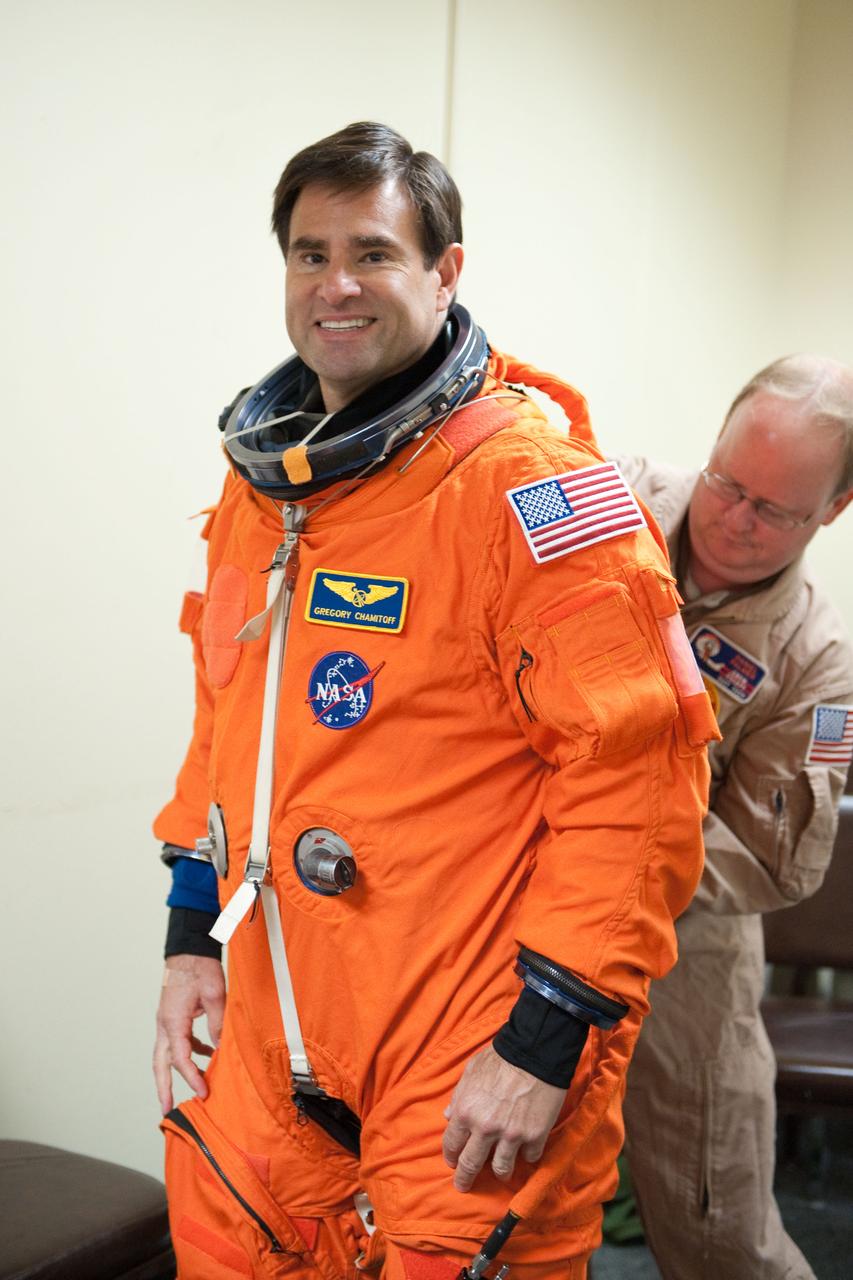
JSC2010-E-124263 (8 Sept. 2010) --- NASA astronaut Greg Chamitoff, STS-134 mission specialist, dons a training version of his shuttle launch and entry suit in preparation for a training session in the fixed-base shuttle mission simulator (SMS) in the Jake Garn Simulation and Training Facility at NASA?s Johnson Space Center. United Space Alliance suit technician Daniel Palmer assisted Chamitoff. Photo credit: NASA or National Aeronautics and Space Administration
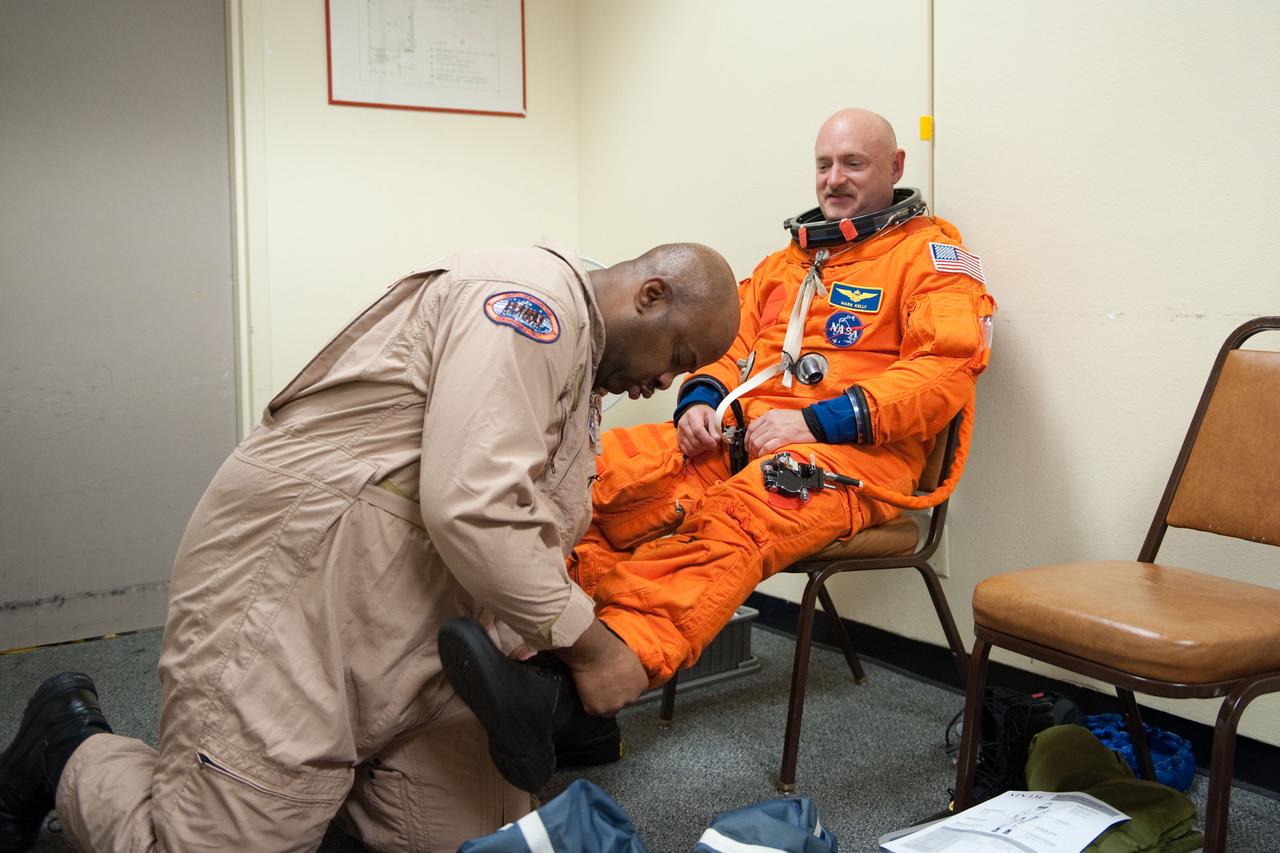
JSC2010-E-124261 (8 Sept. 2010) --- NASA astronaut Mark Kelly, STS-134 commander, dons a training version of his shuttle launch and entry suit in preparation for a training session in the fixed-base shuttle mission simulator (SMS) in the Jake Garn Simulation and Training Facility at NASA?s Johnson Space Center. United Space Alliance suit technician Andre Denard assisted Kelly. Photo credit: NASA or National Aeronautics and Space Administration
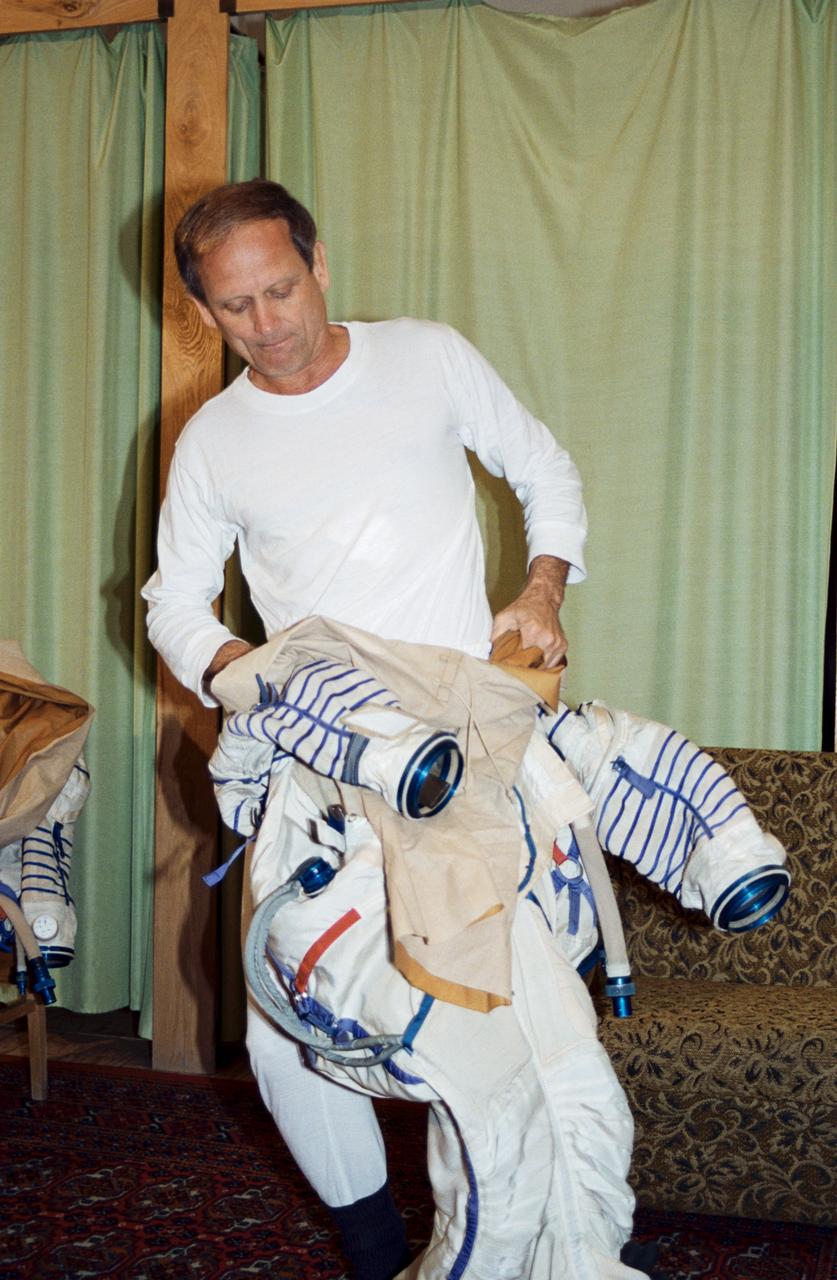
Astronaut Norman E. Thagard getting into a cosmonaut space suit in the Training Simulator Facility at the Gagarin Cosmonaut Training Center (Star City), near Moscow, Russia.
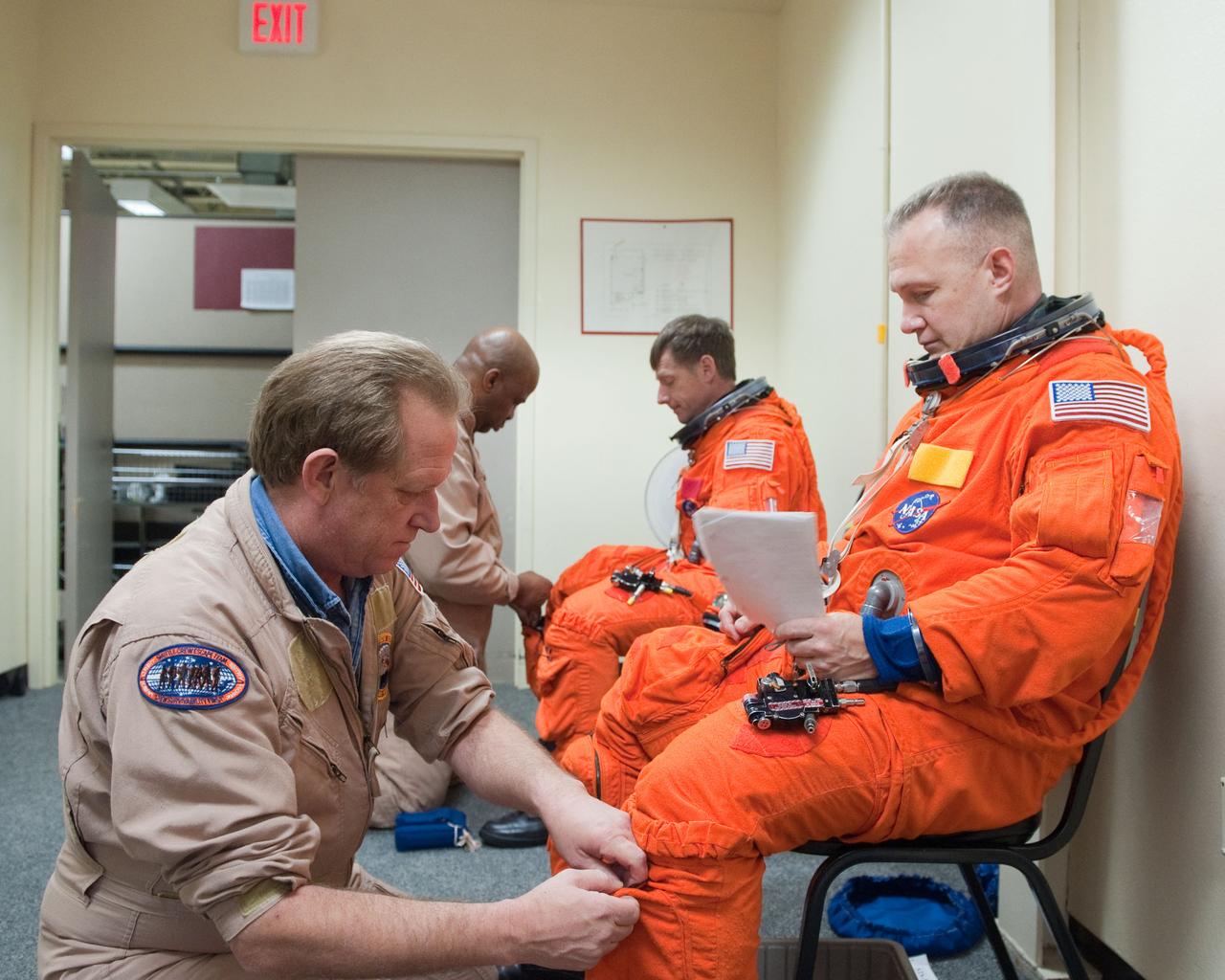
JSC2011-E-023117 (2 March 2011) --- NASA astronauts Doug Hurley (right foreground), STS-135 pilot; and Chris Ferguson, commander, don training versions of their shuttle launch and entry suits in preparation for a training session in the fixed-base shuttle mission simulator (SMS) in the Jake Garn Simulation and Training Facility at NASA's Johnson Space Center. Suit technicians John Hazelhurst (left foreground) and Andre Denard assisted the crew members. Photo credit: NASA or National Aeronautics and Space Administration
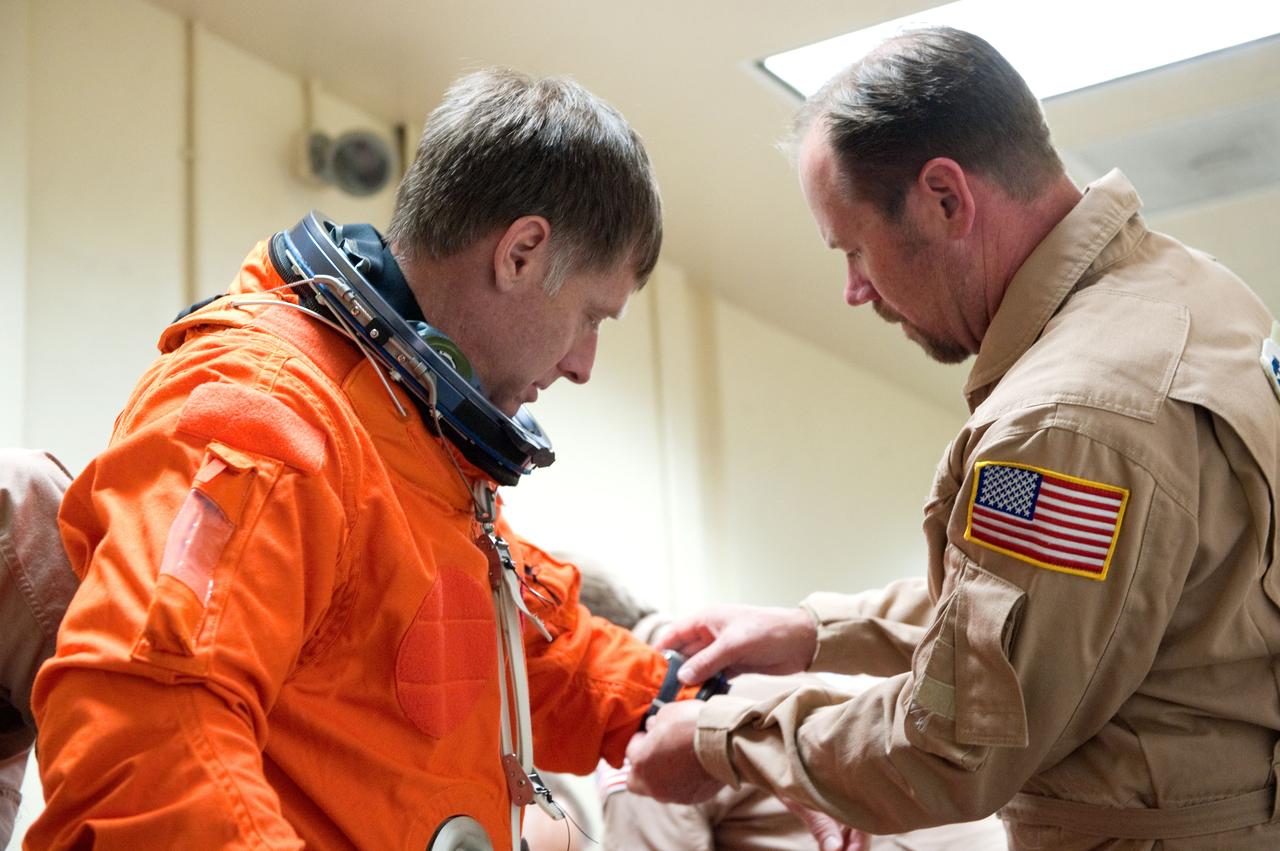
JSC2011-E-023113 (2 March 2011) --- NASA astronaut Chris Ferguson, STS-135 commander, dons a training version of his shuttle launch and entry suit in preparation for a training session in the fixed-base shuttle mission simulator (SMS) in the Jake Garn Simulation and Training Facility at NASA's Johnson Space Center. Suit technician Drew Billingsley assisted Ferguson. Photo credit: NASA or National Aeronautics and Space Administration
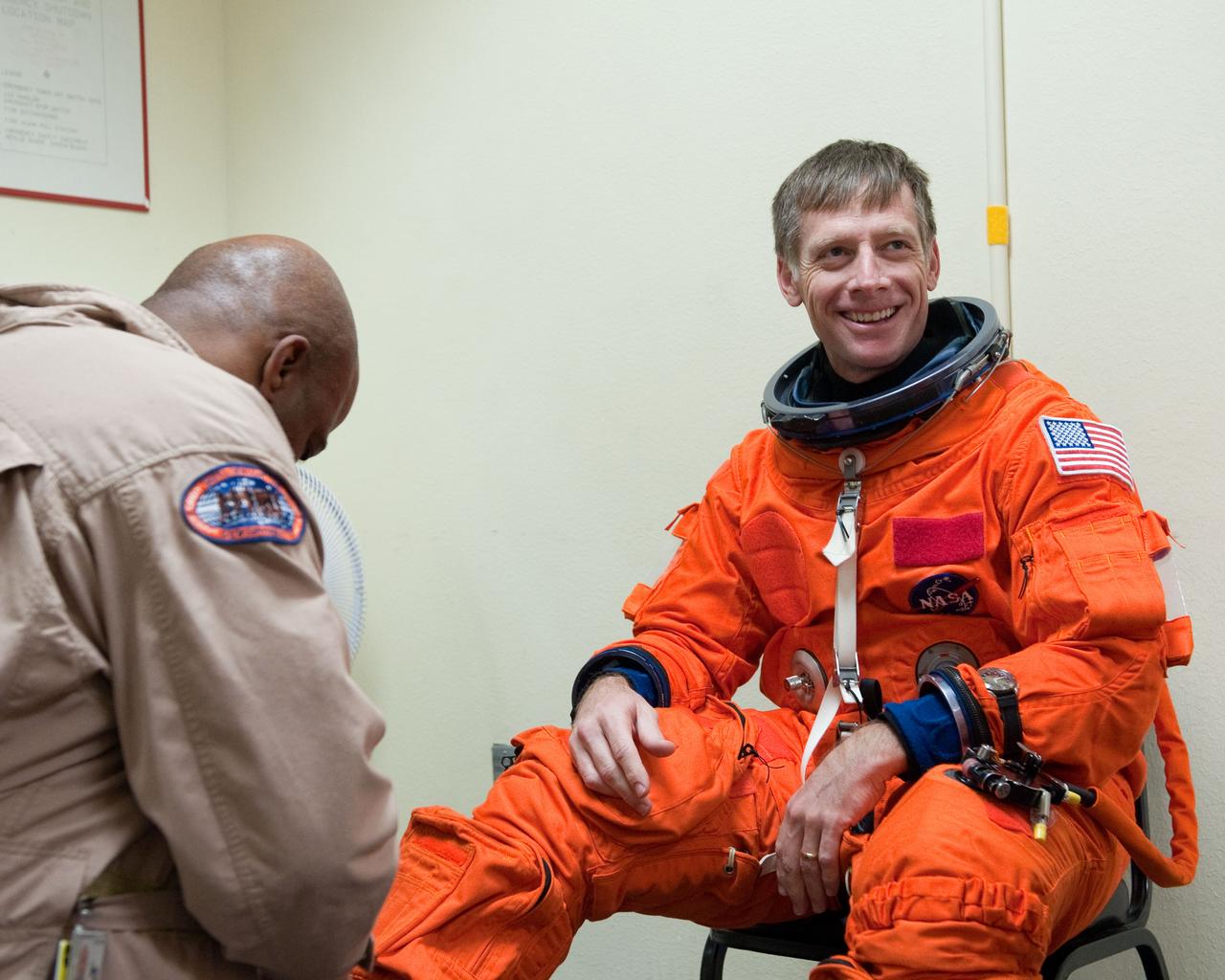
JSC2011-E-023114 (2 March 2011) --- NASA astronaut Chris Ferguson, STS-135 commander, dons a training version of his shuttle launch and entry suit in preparation for a training session in the fixed-base shuttle mission simulator (SMS) in the Jake Garn Simulation and Training Facility at NASA's Johnson Space Center. Suit technician Andre Denard assisted Ferguson. Photo credit: NASA or National Aeronautics and Space Administration
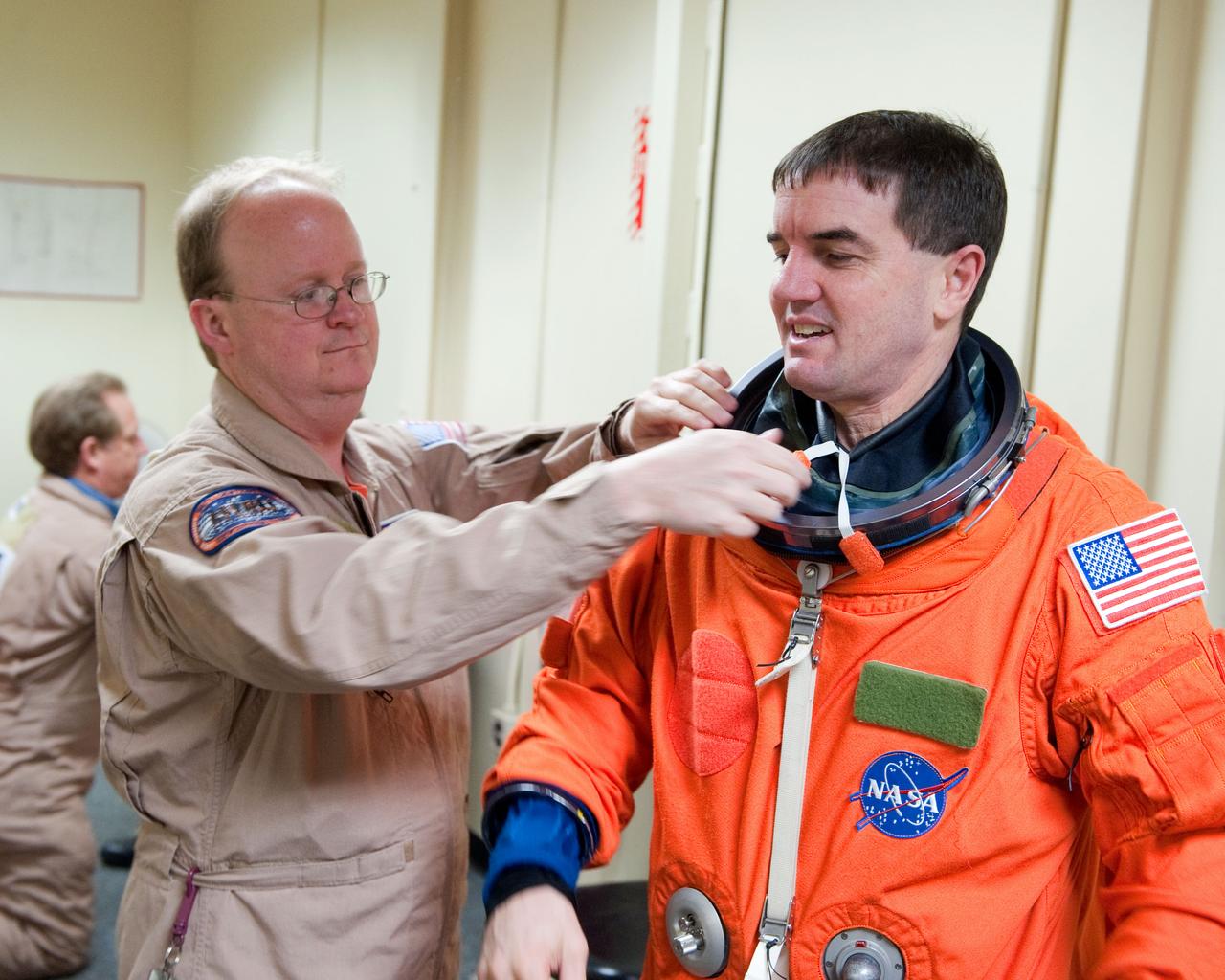
JSC2011-E-023118 (2 March 2011) --- NASA astronaut Rex Walheim, STS-135 mission specialist, dons a training version of his shuttle launch and entry suit in preparation for a training session in the fixed-base shuttle mission simulator (SMS) in the Jake Garn Simulation and Training Facility at NASA's Johnson Space Center. Suit technician Daniel Palmer assisted Walheim. Photo credit: NASA or National Aeronautics and Space Administration
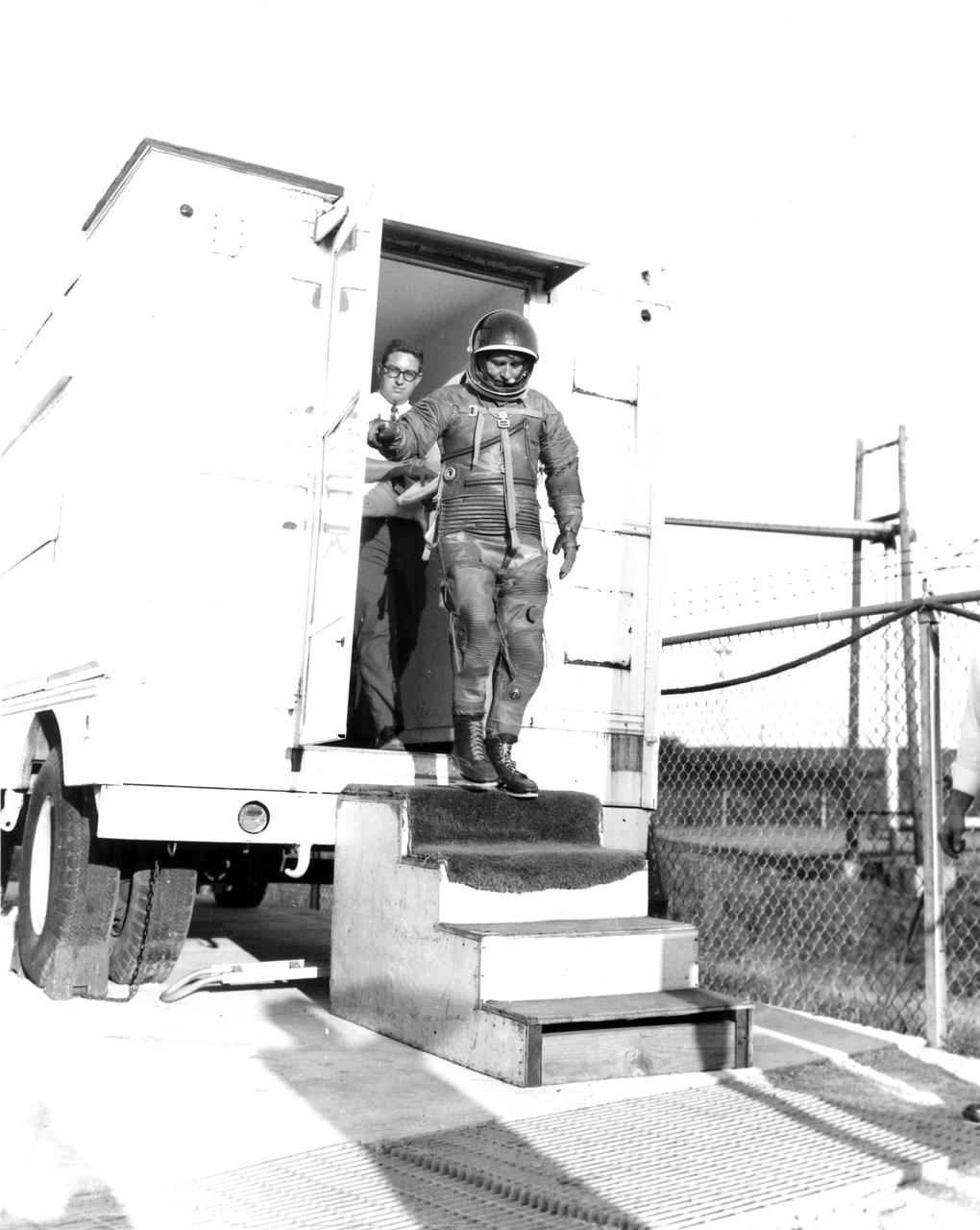
Marshall Space Flight Center (MSFC) Director, Dr. von Braun, is shown leaving the suiting-up van wearing a pressure suit prepared for a tryout in the MSFC Neutral Buoyancy Simulator (NBS). Weighted to a neutrally buoyant condition, Dr. von Braun was able to perform tasks underwater which simulated weightless conditions found in space.
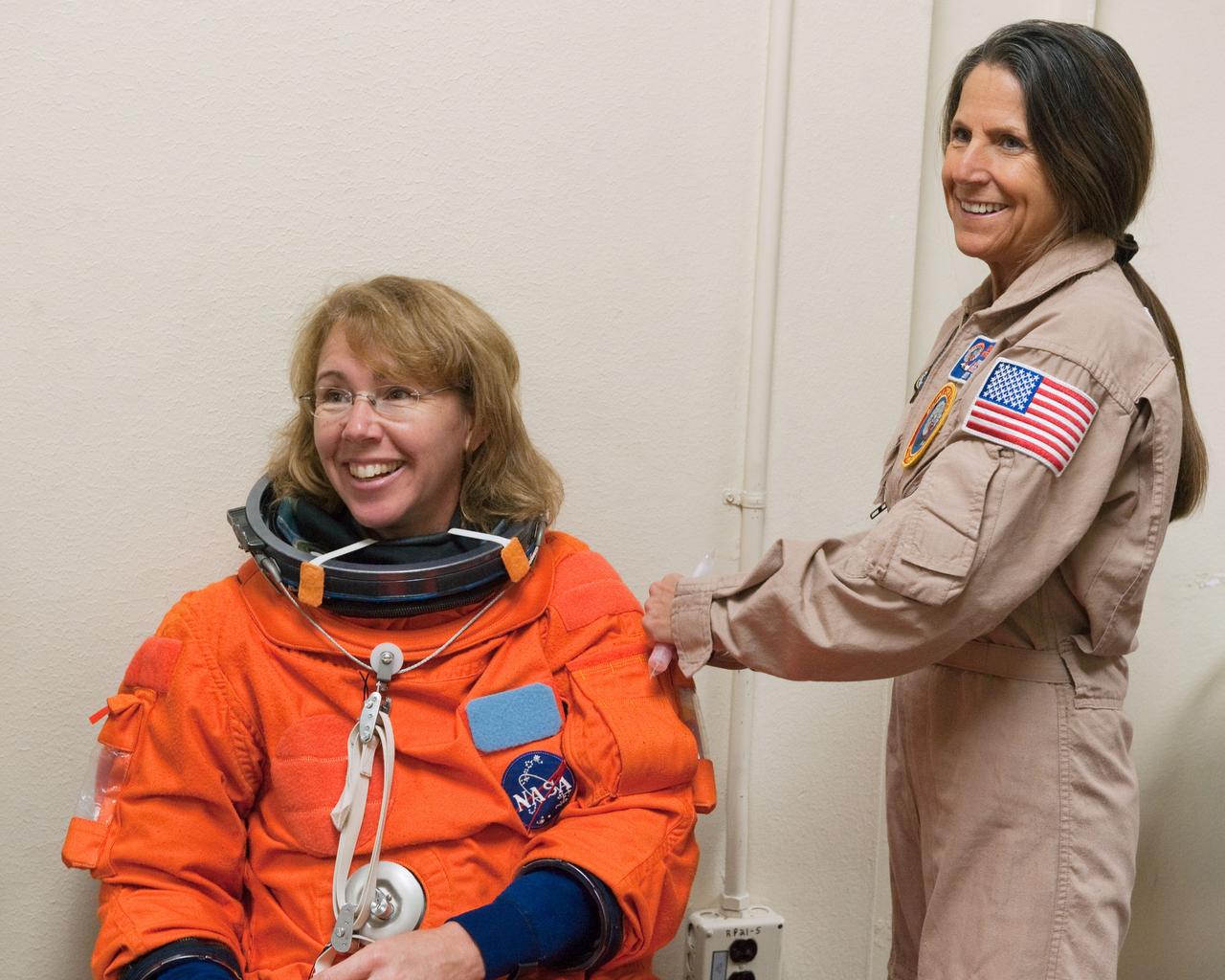
JSC2011-E-023112 (2 March 2011) --- NASA astronaut Sandy Magnus, STS-135 mission specialist, dons a training version of her shuttle launch and entry suit in preparation for a training session in the fixed-base shuttle mission simulator (SMS) in the Jake Garn Simulation and Training Facility at NASA's Johnson Space Center. Suit technician Toni Cost-Davis assisted Magnus. Photo credit: NASA or National Aeronautics and Space Administration
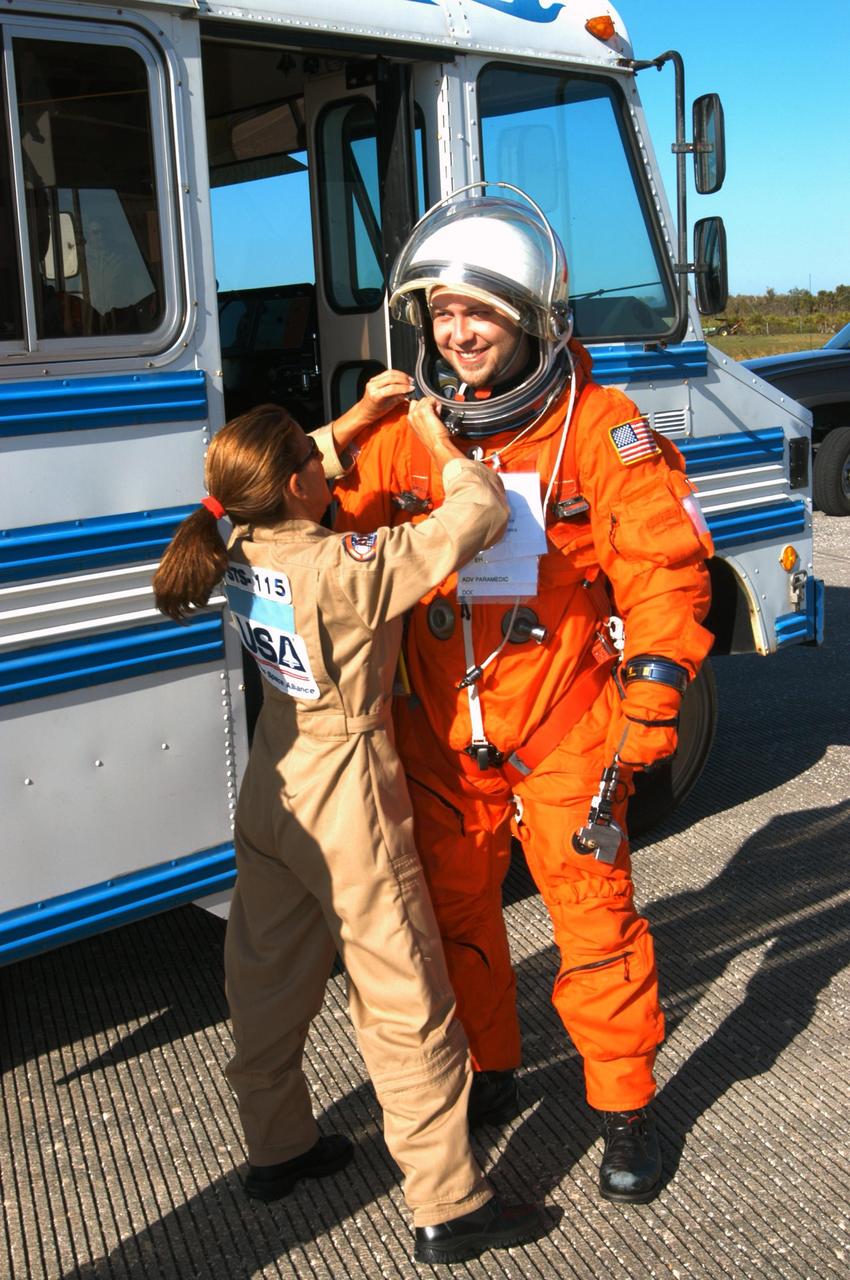
KENNEDY SPACE CENTER, FLA. - Preparing for a simulated emergency landing of a shuttle crew, United Space Alliance (USA) Suit Tech Toni Costa-Davis helps volunteer "astronaut" Brian Bateman, also with USA, with his launch and entry suit. Many volunteers posed as astronauts during the simulation. Known as a Mode VI exercise, the operation uses volunteer workers from the Center to pose as astronauts. The purpose of the simulation is to exercise emergency preparedness personnel, equipment and facilities in rescuing astronauts from a downed orbiter and providing immediate medical attention. Photo credit: NASA/George Shelton
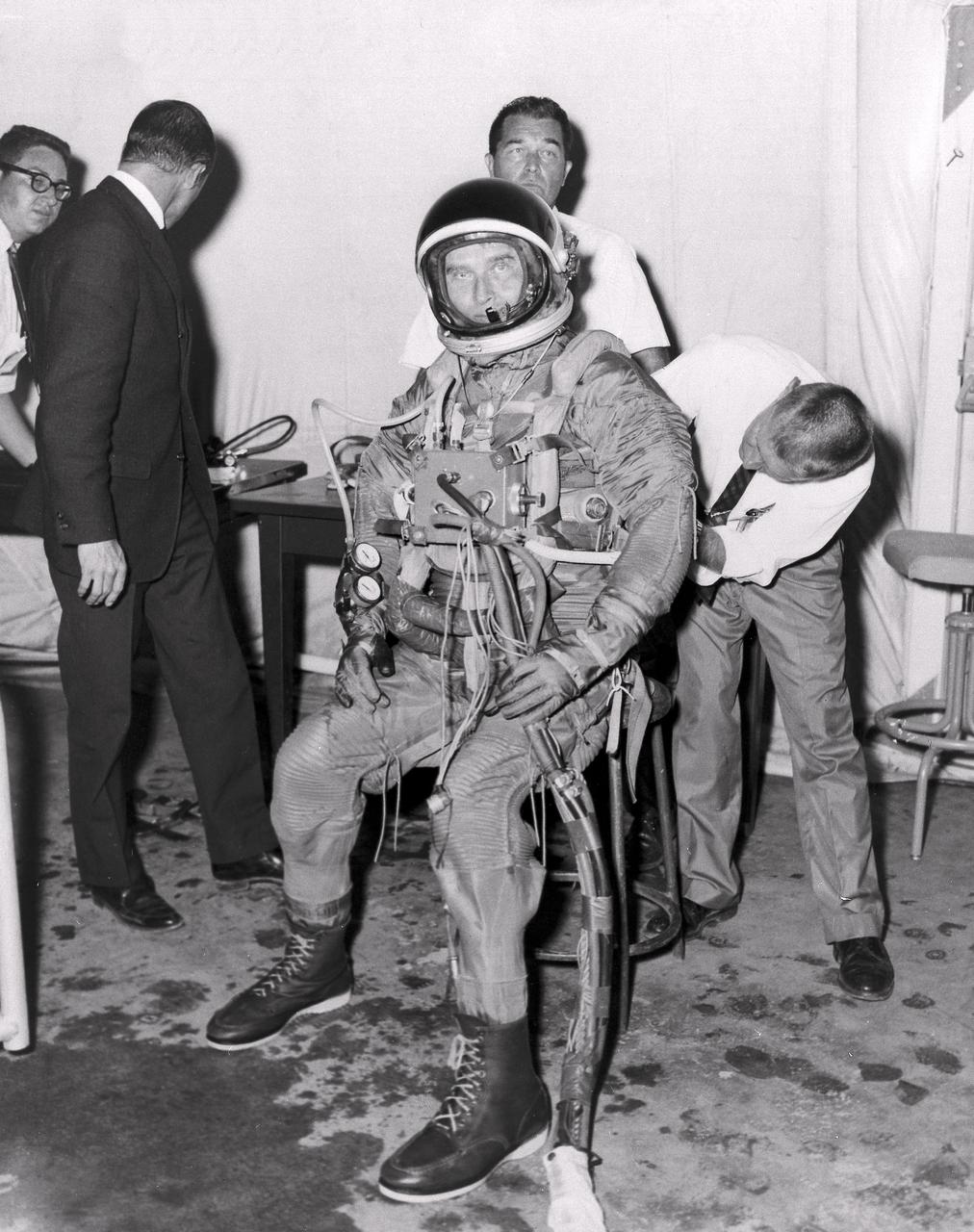
Marshall Space Flight Center (MSFC) Director, Dr. von Braun, is shown fitted with suit and diving equipment as he prepares for a tryout in the MSFC Neutral Buoyancy Simulator (NBS). Weighted to a neutrally buoyant condition, Dr. von Braun was able to perform tasks underwater which simulated weightless conditions found in space.
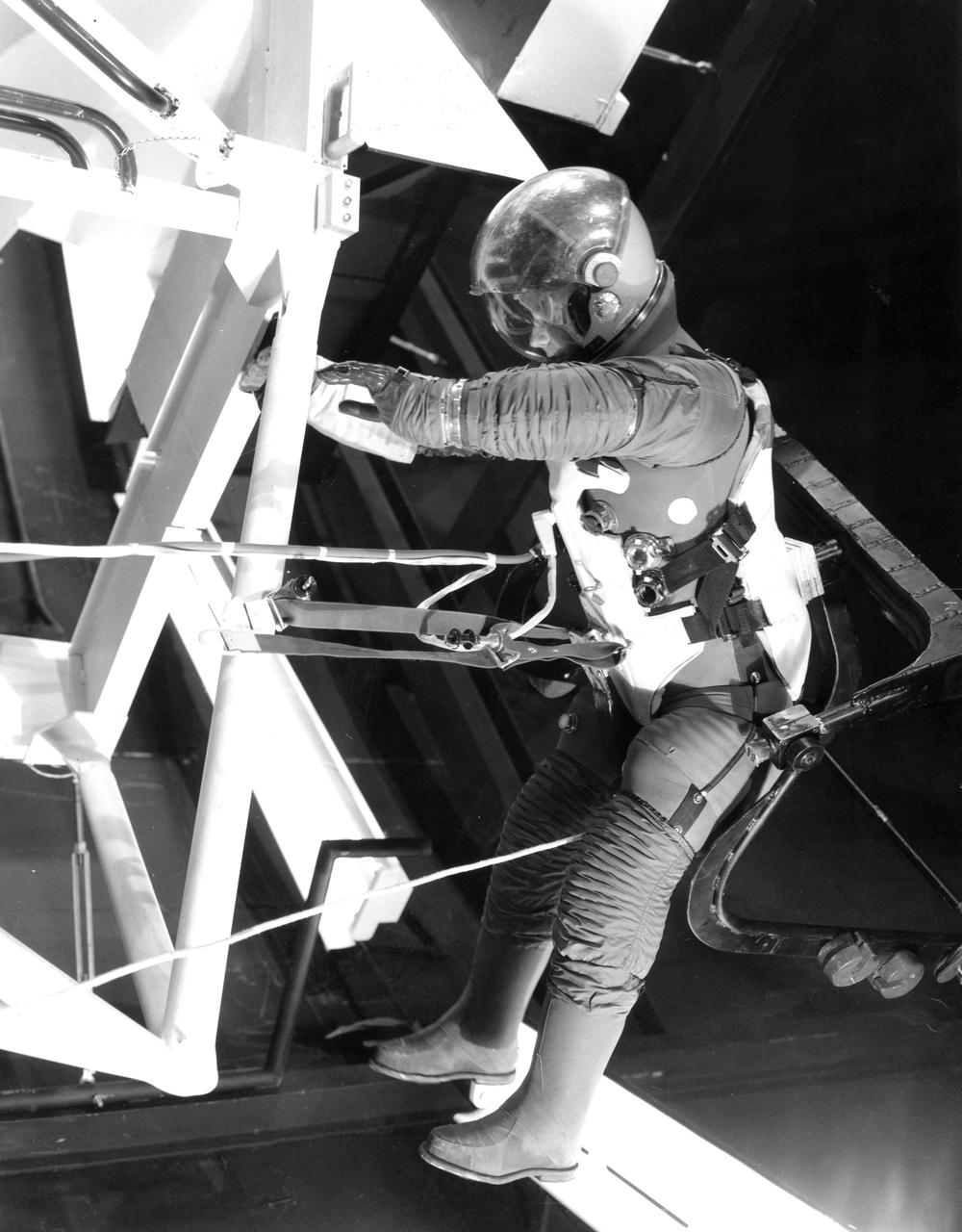
An astronaut wearing a pressurized space suit performed a work task while suspended in a “zero-gravity” simulator known as the Neutral Buoyancy Simulator (NBS) at Marshall Space Flight Center. This particular task was one of many performed by astronauts while checking out the mockup for the Apollo Telescope Mount.
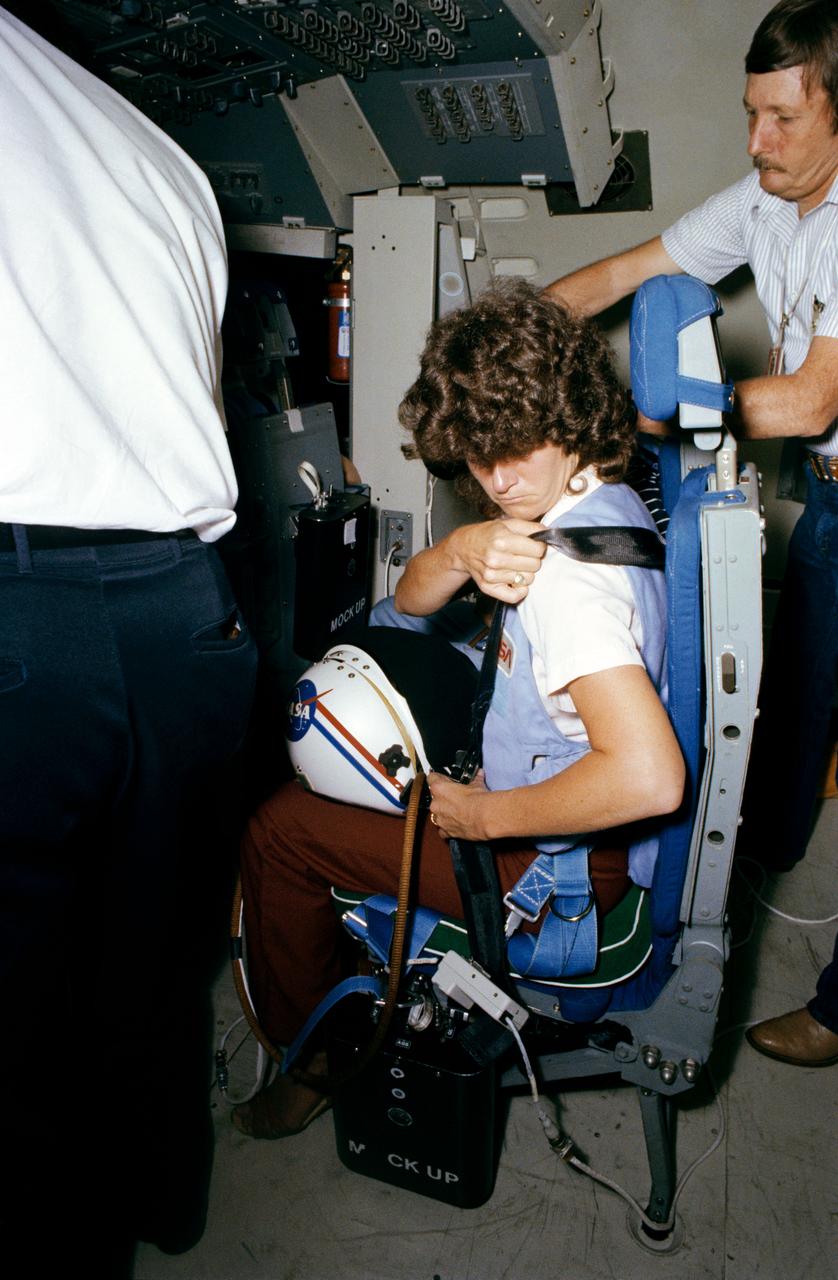
S83-32568 (23 May 1983) --- Astronaut Sally K. Ride, STS-7 mission specialist, straps herself into a seat in the Shuttle Mission Simulator (SMS) in Johnson Space Center?s Mission Simulation and Training Facility. Dr. Ride and the other STS-7 crew members continue their simulations in the motion base simulator in preparation for their flight in the space shuttle Challenger. Launch is scheduled for June 18. Troy Stewart, suit technician, assisted Dr. Ride. Photo credit: NASA
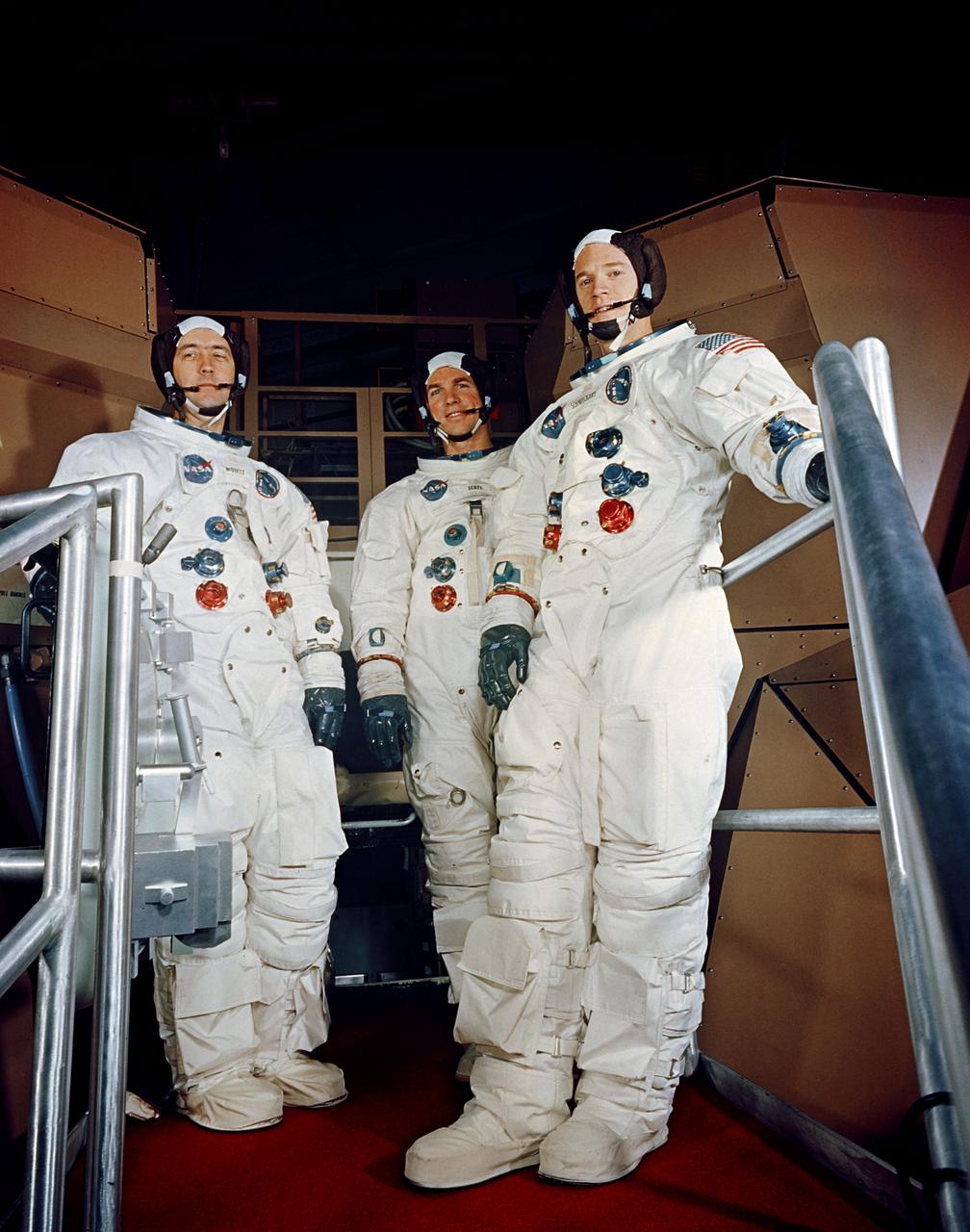
S69-19983 (17 Feb. 1969) --- The Apollo 9 crew is shown suited up for a simulated flight in the Apollo Mission Simulator at the Kennedy Space Center (KSC). Left to right are astronauts James A. McDivitt, commander; David R. Scott, command module pilot; and Russell L. Schweickart, lunar module pilot.
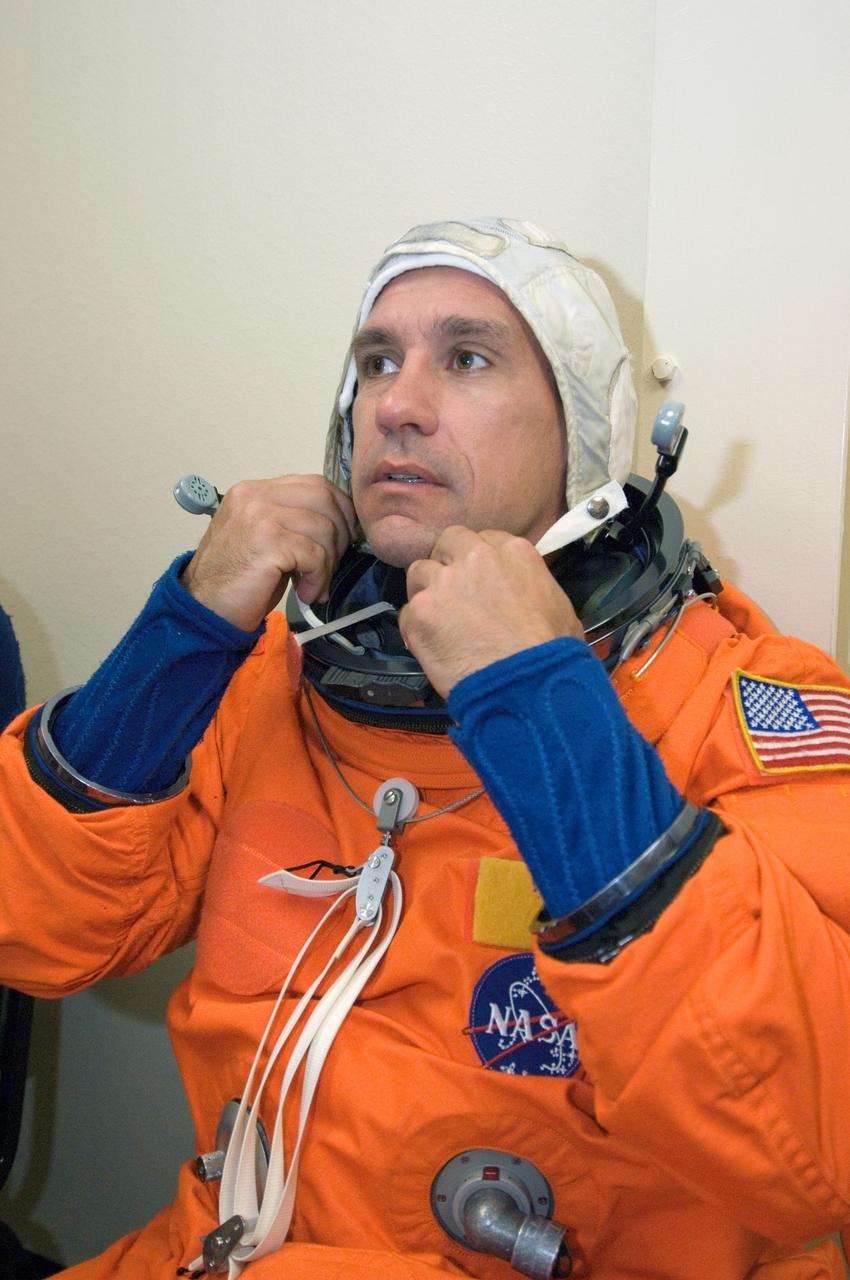
JSC2006-E-23021 (15 June 2006) --- Astronaut William A. Oefelein, STS-116 pilot, dons his training version of the shuttle launch and entry suit prior to a training session in the fixed-base shuttle mission simulator (SMS) in the Jake Garn Mission Simulation and Training Facility at Johnson Space Center.
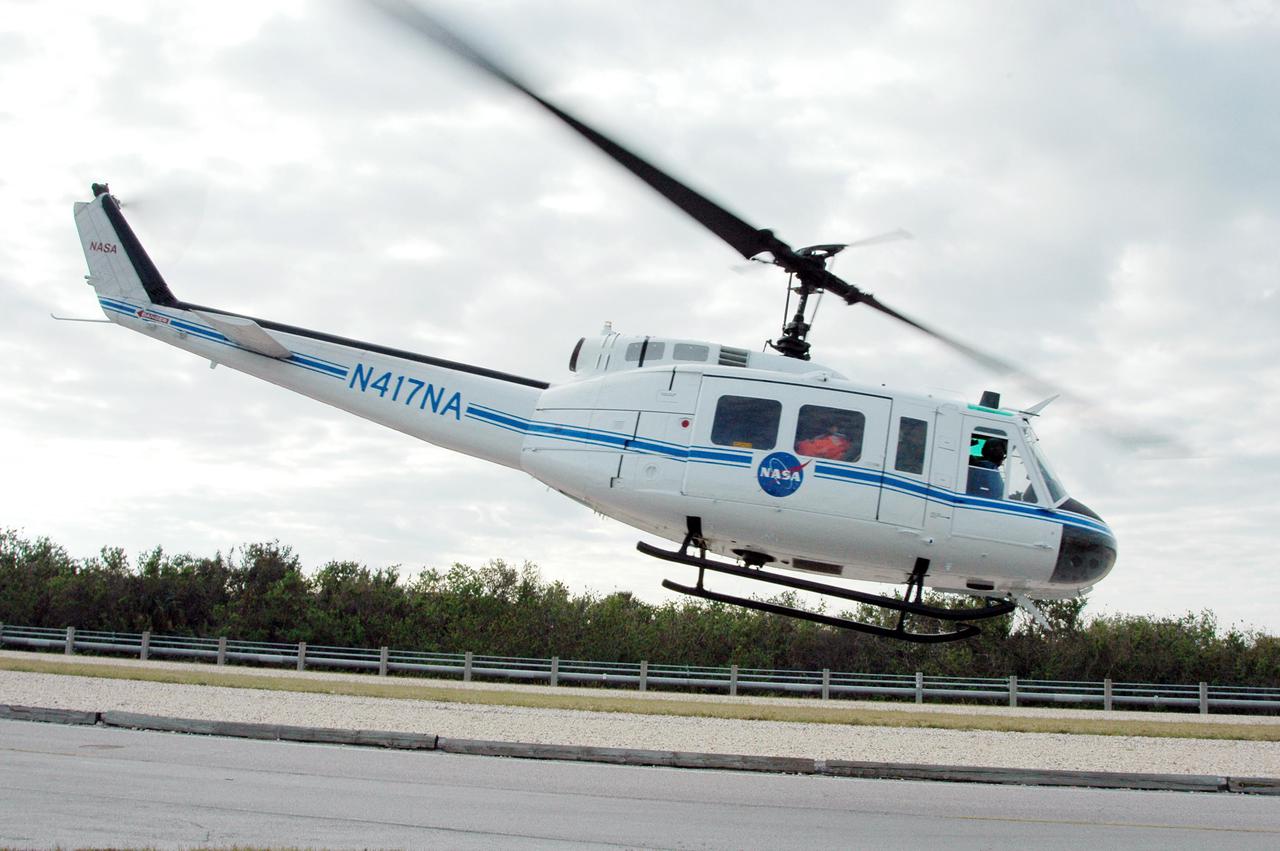
KENNEDY SPACE CENTER, FLA. - During a simulated launch countdown_emergency simulation on Launch Pad 39A, the NASA helicopter leaves the scene with “injured” astronaut-suited workers, heading to a hospital. Pad team members participated in the four-hour exercise simulating normal launch countdown operations, with the added challenge of a fictitious event causing an evacuation of the vehicle and launch pad. The simulation tested the team’s rescue approaches on the Fixed Service Structure, slidewire basket evacuation, triage care and transportation of injured personnel to hospitals, as well as communications and coordination.
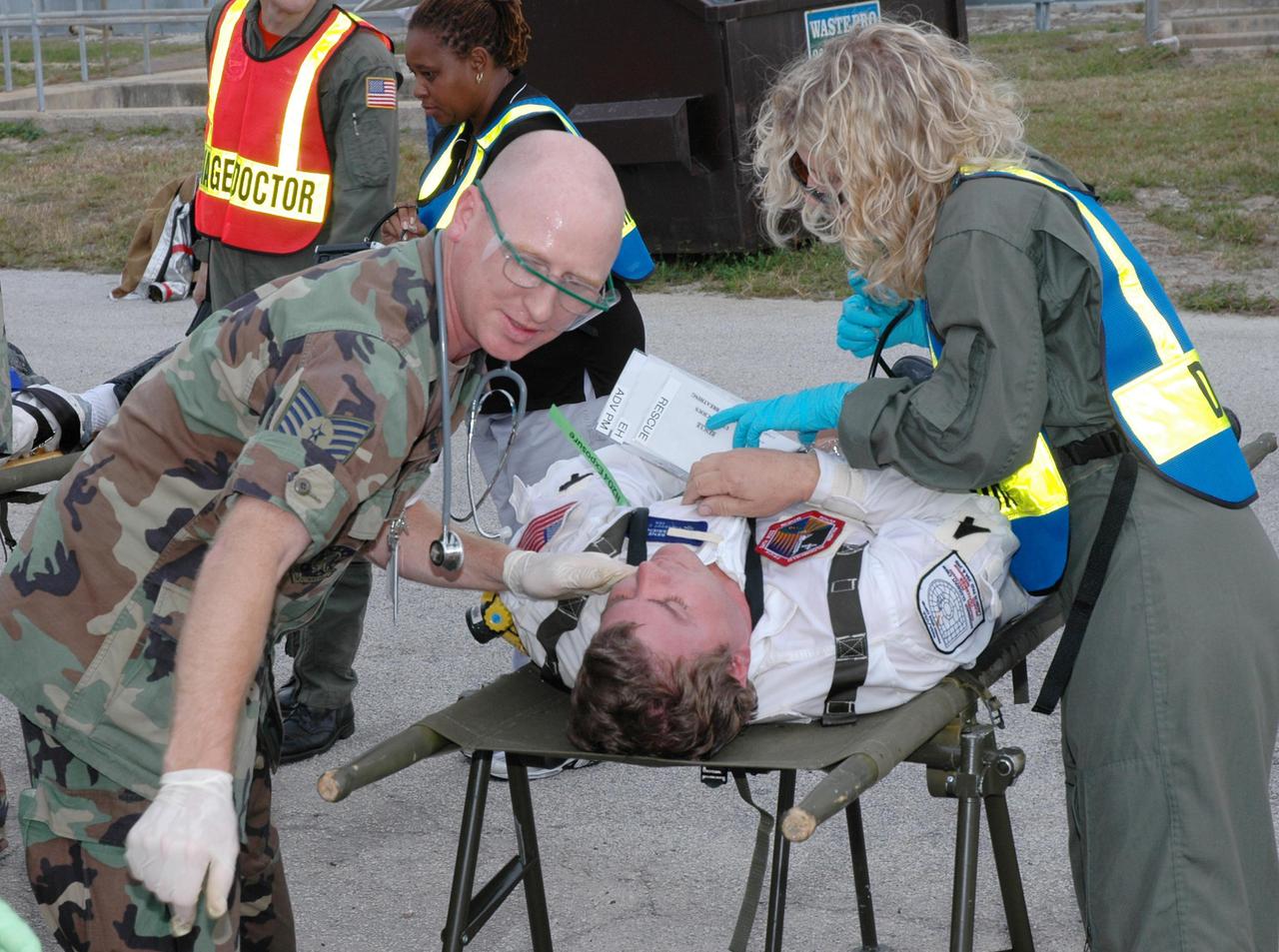
KENNEDY SPACE CENTER, FLA. - During a simulated launch countdown_emergency simulation on Launch Pad 39A, the rescue team performs triage on “injured” astronaut-suited workers. Pad team members participated in the four-hour exercise simulating normal launch countdown operations, with the added challenge of a fictitious event causing an evacuation of the vehicle and launch pad. The simulation tested the team’s rescue approaches on the Fixed Service Structure, slidewire basket evacuation, triage care and transportation of injured personnel to hospitals, as well as communications and coordination.
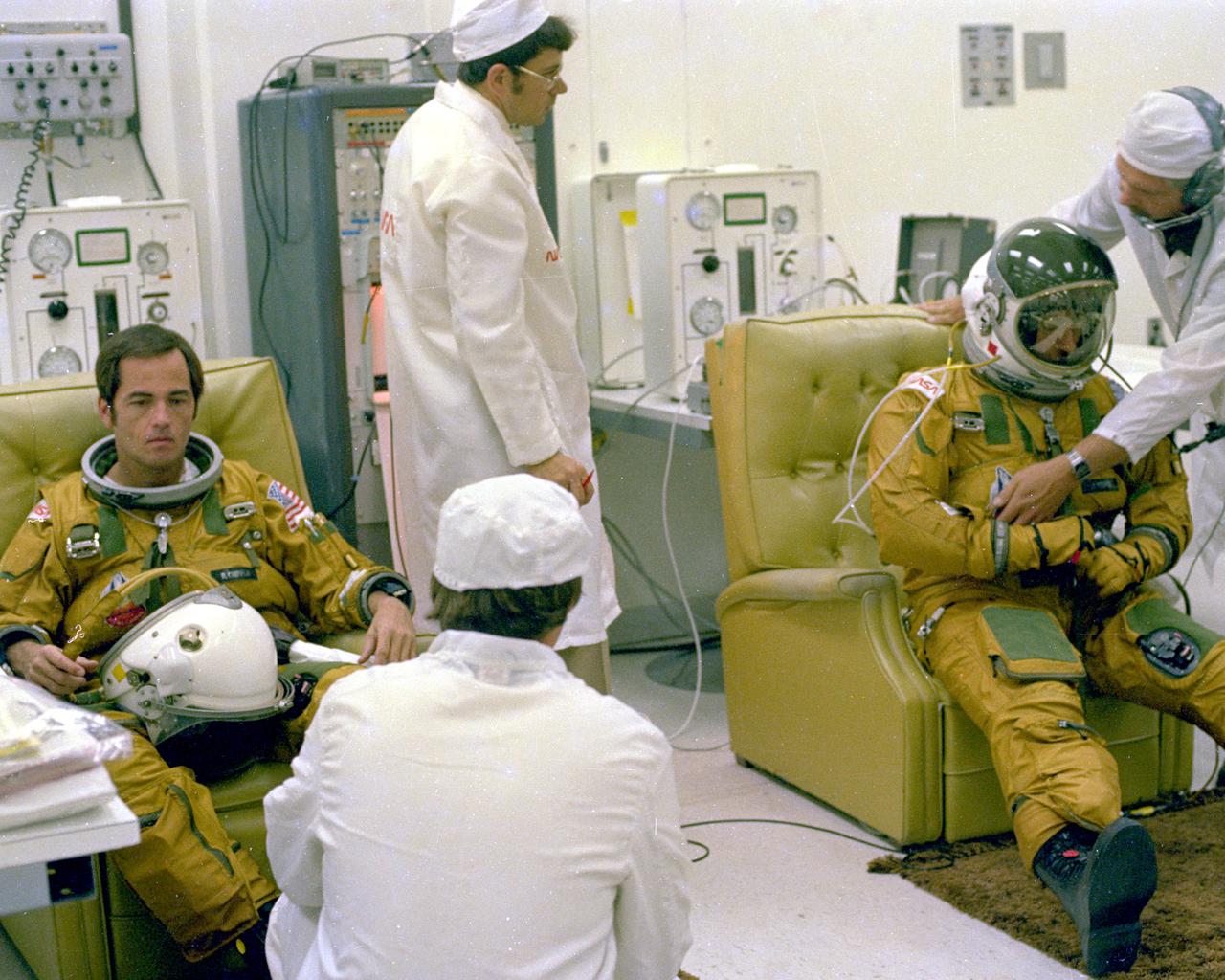
KENNEDY SPACE CENTER, FLA. - Pilot Robert Crippen watches intently as a technician adjusts the lens of his space suit, while Crew Commander John Young's suit is connected to life support system lines, during simulated countdown and launch. The two astronauts, prime crewmen for the maiden flight of the Space Shuttle scheduled no sooner than the week of April 5, are pictured in the suiting room of the Operations and Checkout Building at KSC prior to boarding their transport van for the trip to Launch Pad 39A.
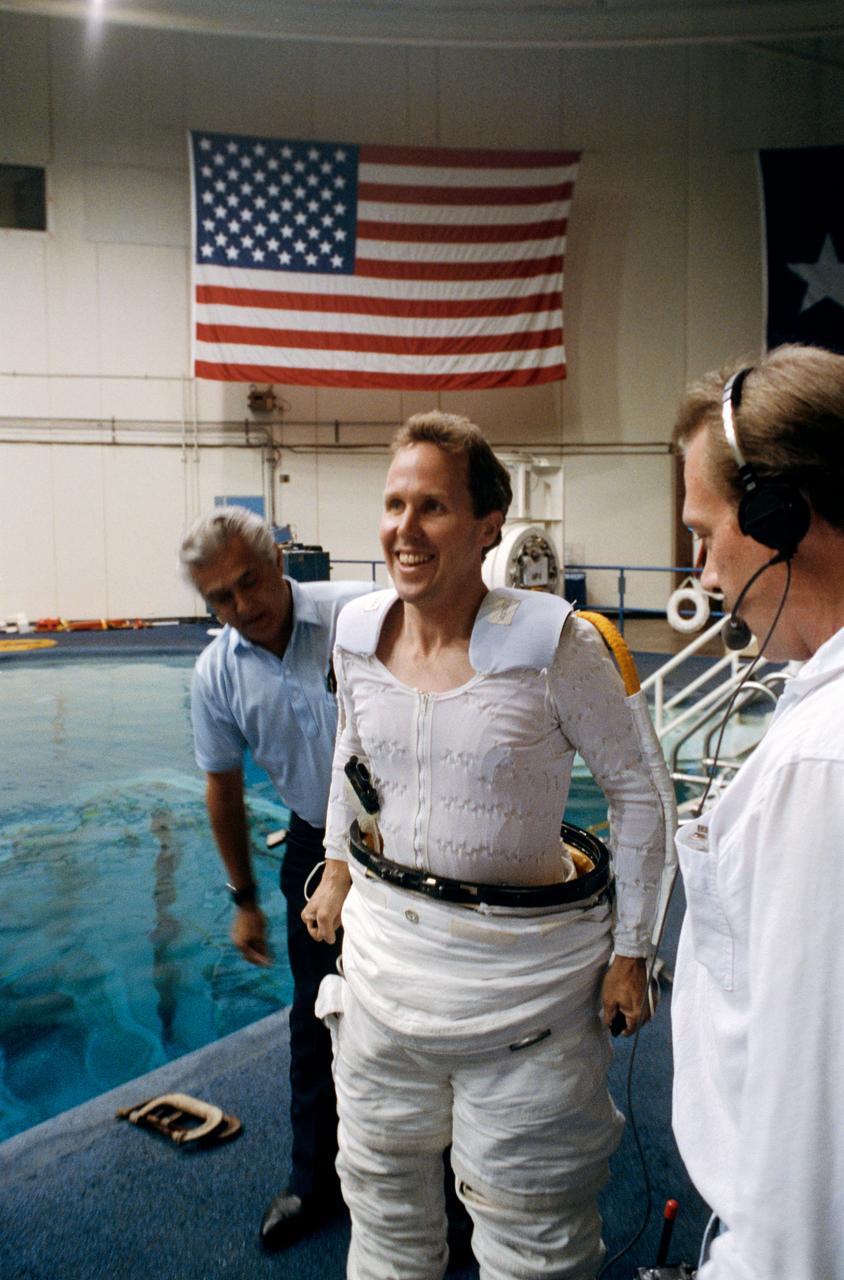
Astronaut Thomas D. Jones, mission specialist, dons a space suit prior to participating in contingency space walk simulations at the JSC Weightless Environment Training Facility (WETF). Jones is assisted by Frank Hernandez (left) and suit technician Charles Hudson of Hamilton Standard. Jones suit is weighted to that he can achieve a neutrally buoyant state once under water. Extravehicular tasks are not planned for the STS-59 mission, but a number of chores are rehearsed in case of failure of remote systems to perform those jobs.
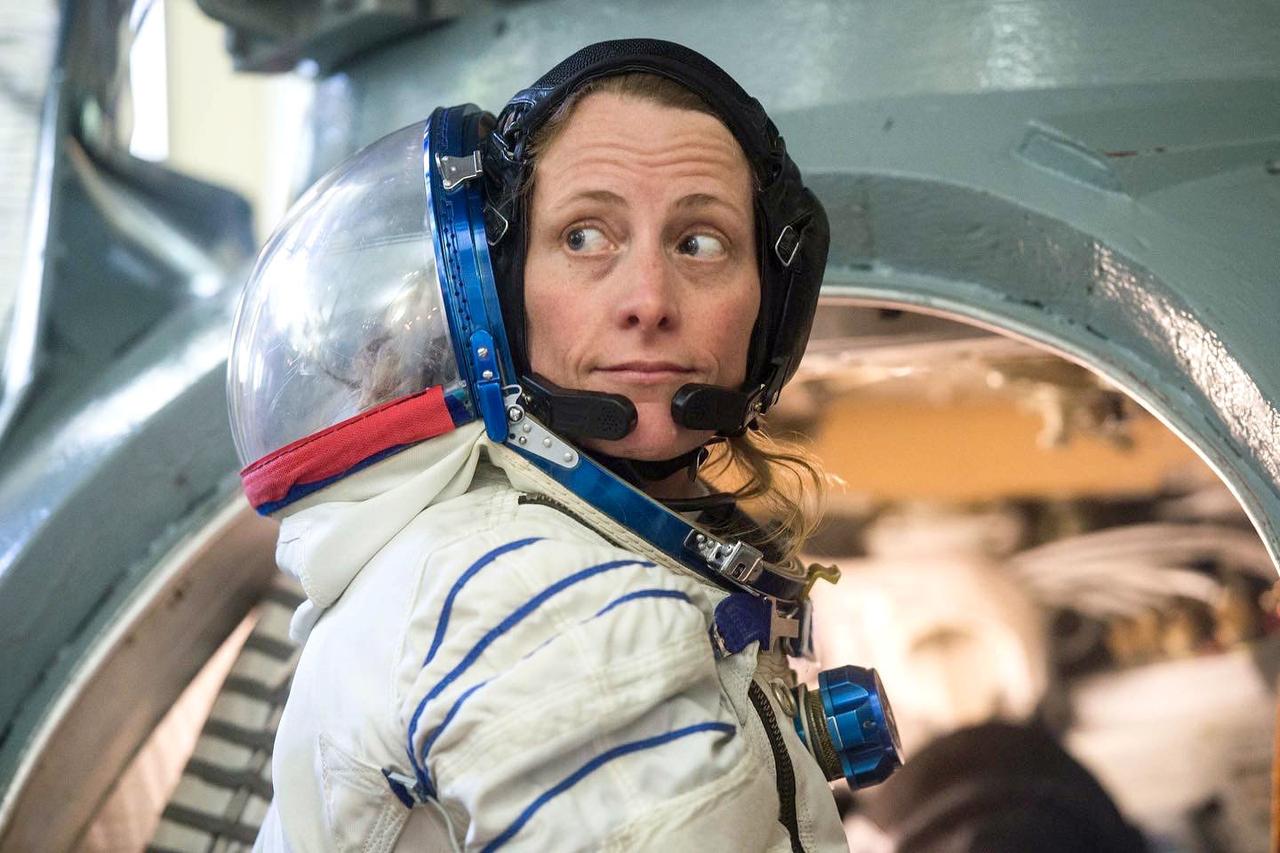
jsc2023e052881 (Sept. 13, 2023) --- NASA astronaut Loral O'Hara prepares to enter a Soyuz spacecraft simulator in her Sokol launch and entry suit for preflight training before beginning her mission to the International Space Station.
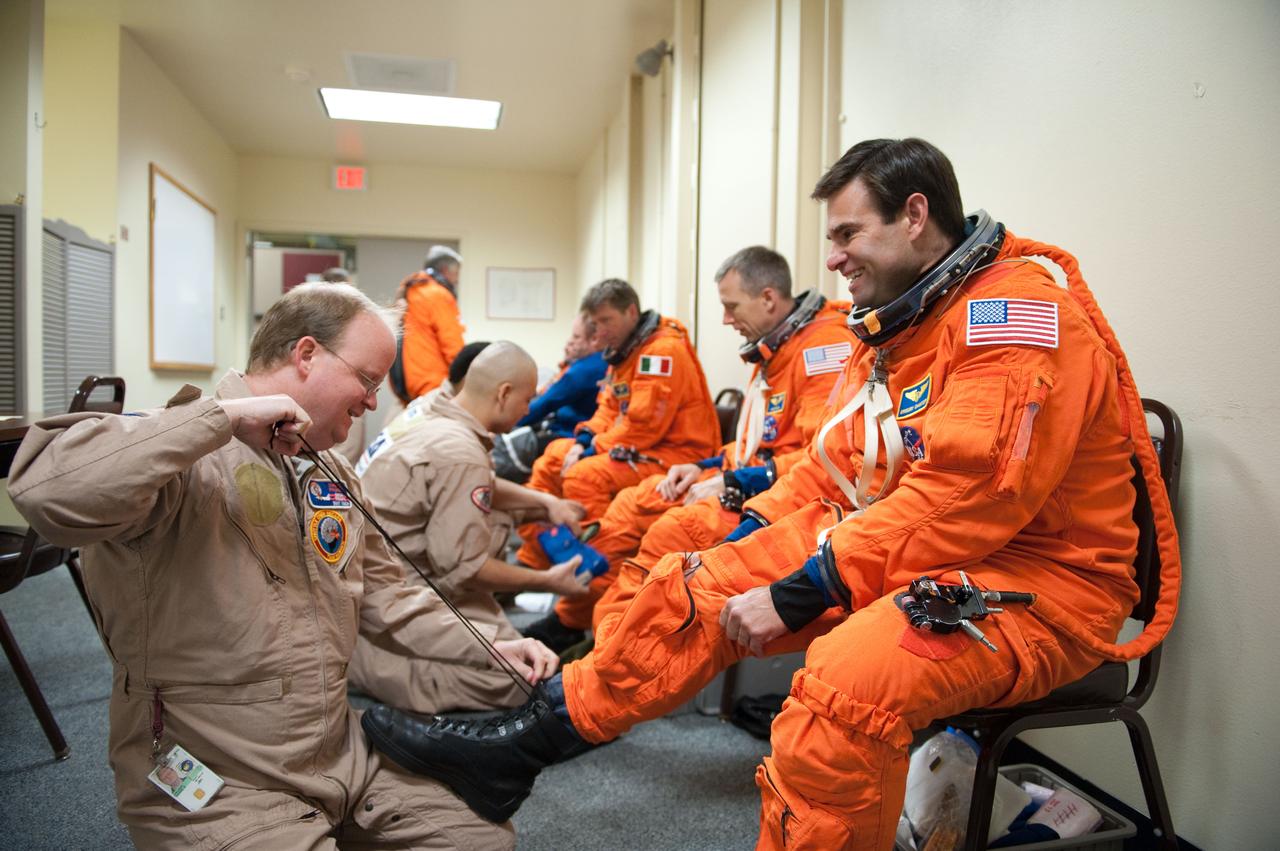
JSC2010-E-124264 (8 Sept. 2010) --- NASA astronauts Greg Chamitoff (foreground), Andrew Feustel and European Space Agency astronaut Roberto Vittori, all STS-134 mission specialists, don training versions of their shuttle launch and entry suits in preparation for a training session in the fixed-base shuttle mission simulator (SMS) in the Jake Garn Simulation and Training Facility at NASA?s Johnson Space Center. United Space Alliance suit technicians assisted the crew members. Photo credit: NASA or National Aeronautics and Space Administration
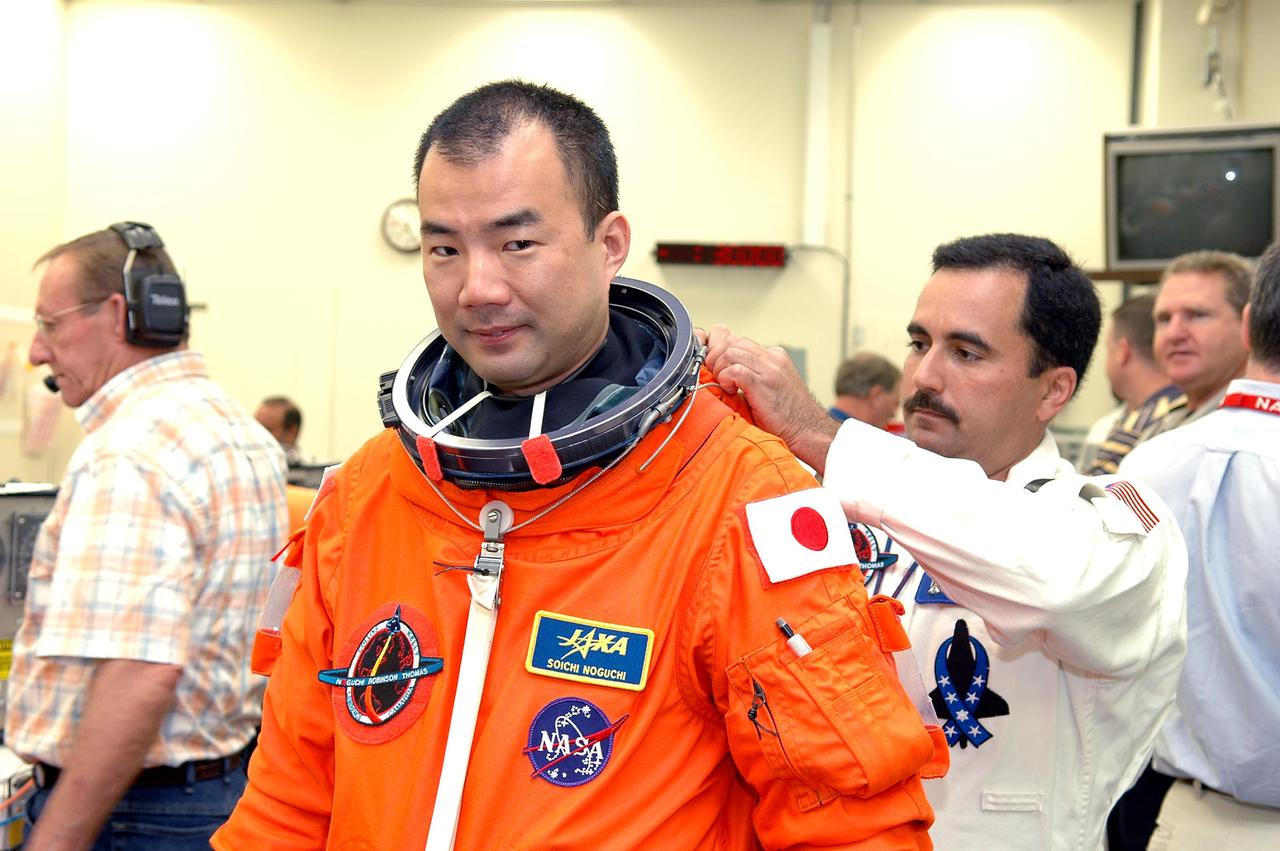
KENNEDY SPACE CENTER, FLA. - A suit technician helps STS-114 Mission Specialist Soichi Noguchi suit up in the Operations and Checkout Building for the trip to Launch Pad 39B for a mock launch countdown culminating in a simulated main engine cutoff. Noguchi is with the Japan Aerospace Exploration Agency. The dress rehearsal is part of Terminal Countdown Demonstration Test (TCDT) activities held prior to each Space Shuttle flight. It provides the crew of each mission an opportunity to participate in various simulated countdown activities, including equipment familiarization and emergency egress training. STS-114 is the first Return to Flight mission to the International Space Station. The launch window extends July 13 through July 31.
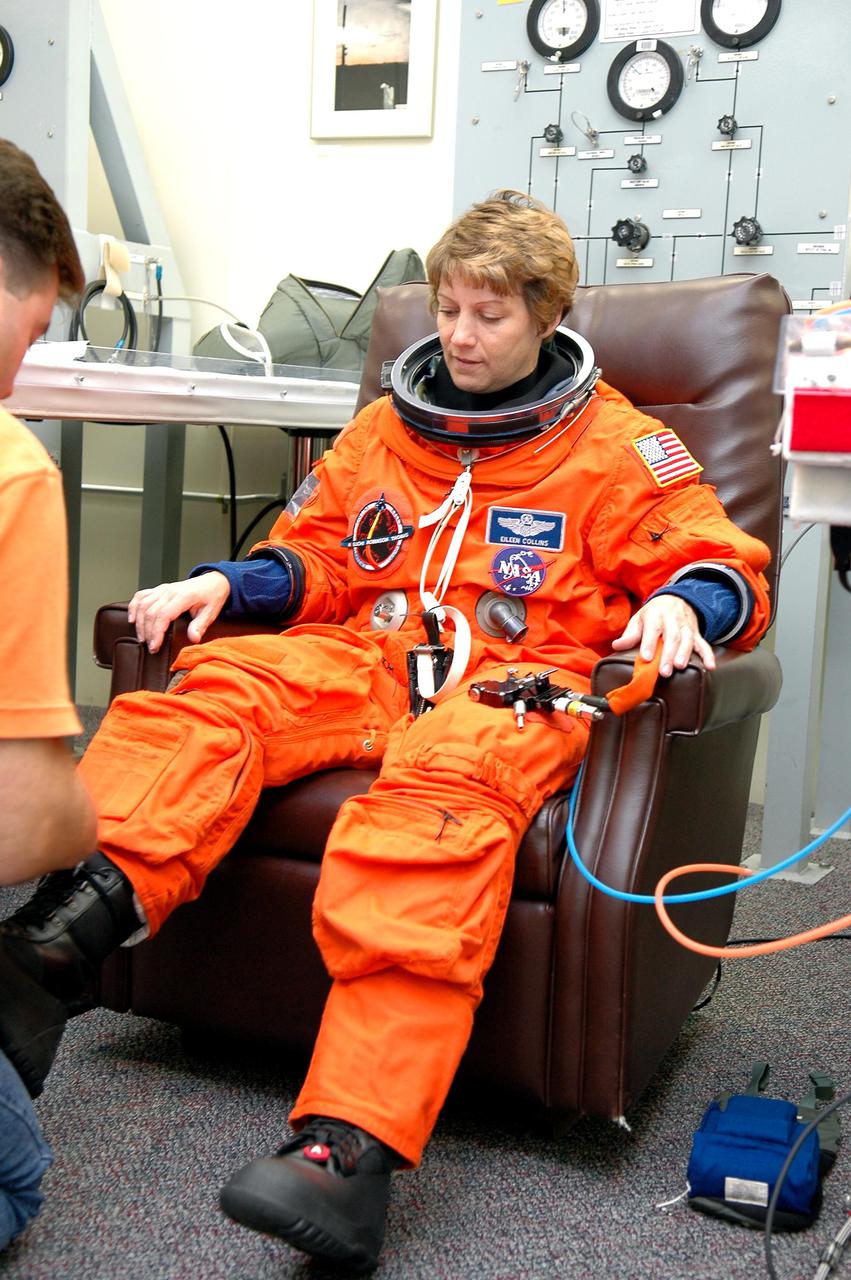
KENNEDY SPACE CENTER, FLA. - A suit technician helps STS-114 Commander Eileen Collins with a boot as she suits up in the Operations and Checkout Building for the trip to Launch Pad 39B for a mock launch countdown culminating in a simulated main engine cutoff. The dress rehearsal is part of Terminal Countdown Demonstration Test (TCDT) activities held prior to each Space Shuttle flight. It provides the crew of each mission an opportunity to participate in various simulated countdown activities, including equipment familiarization and emergency egress training. STS-114 is the first Return to Flight mission to the International Space Station. The launch window extends July 13 through July 31.
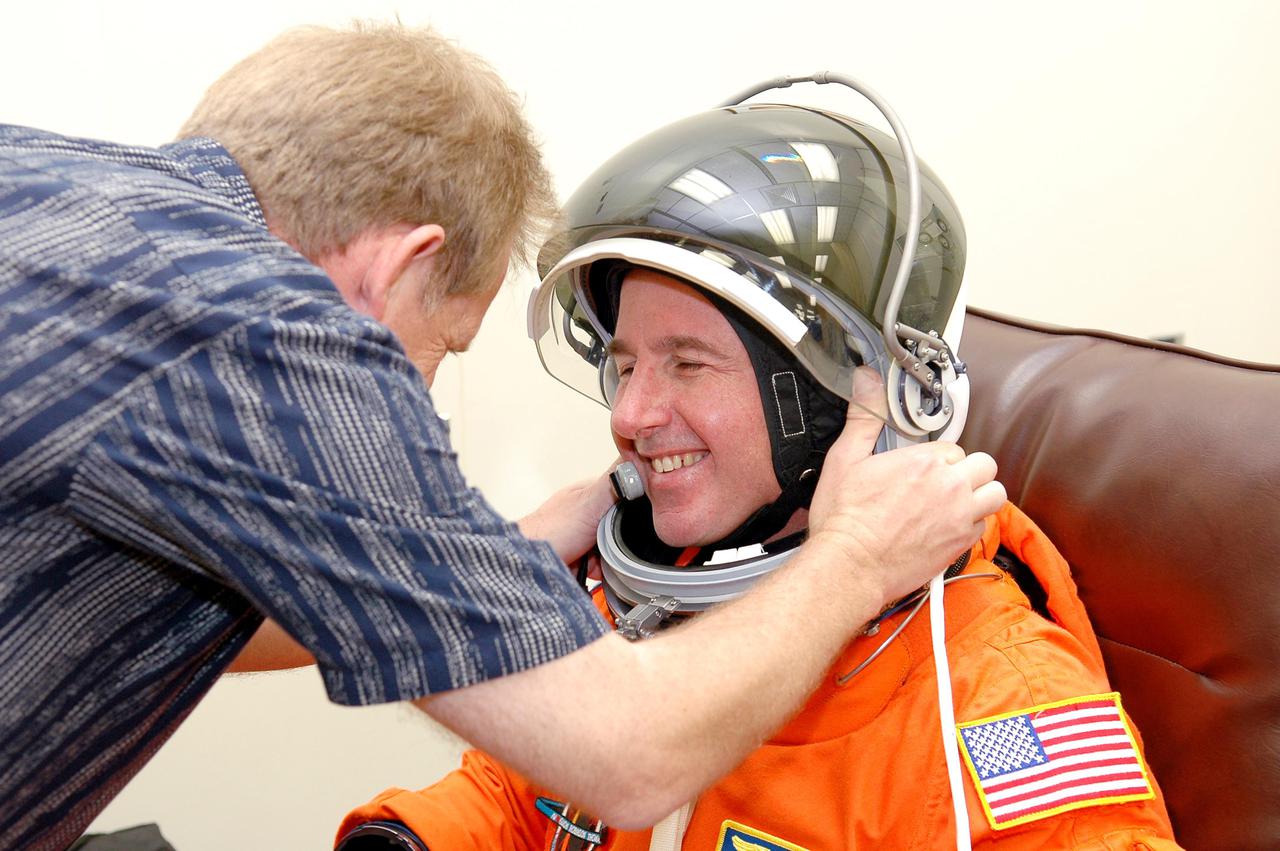
KENNEDY SPACE CENTER, FLA. - A suit technician helps STS-114 Mission Specialist Stephen Robinson suit up in the Operations and Checkout Building for the trip to Launch Pad 39B for a mock launch countdown culminating in a simulated main engine cutoff. The dress rehearsal is part of Terminal Countdown Demonstration Test (TCDT) activities held prior to each Space Shuttle flight. It provides the crew of each mission an opportunity to participate in various simulated countdown activities, including equipment familiarization and emergency egress training. STS-114 is the first Return to Flight mission to the International Space Station. The launch window extends July 13 through July 31.
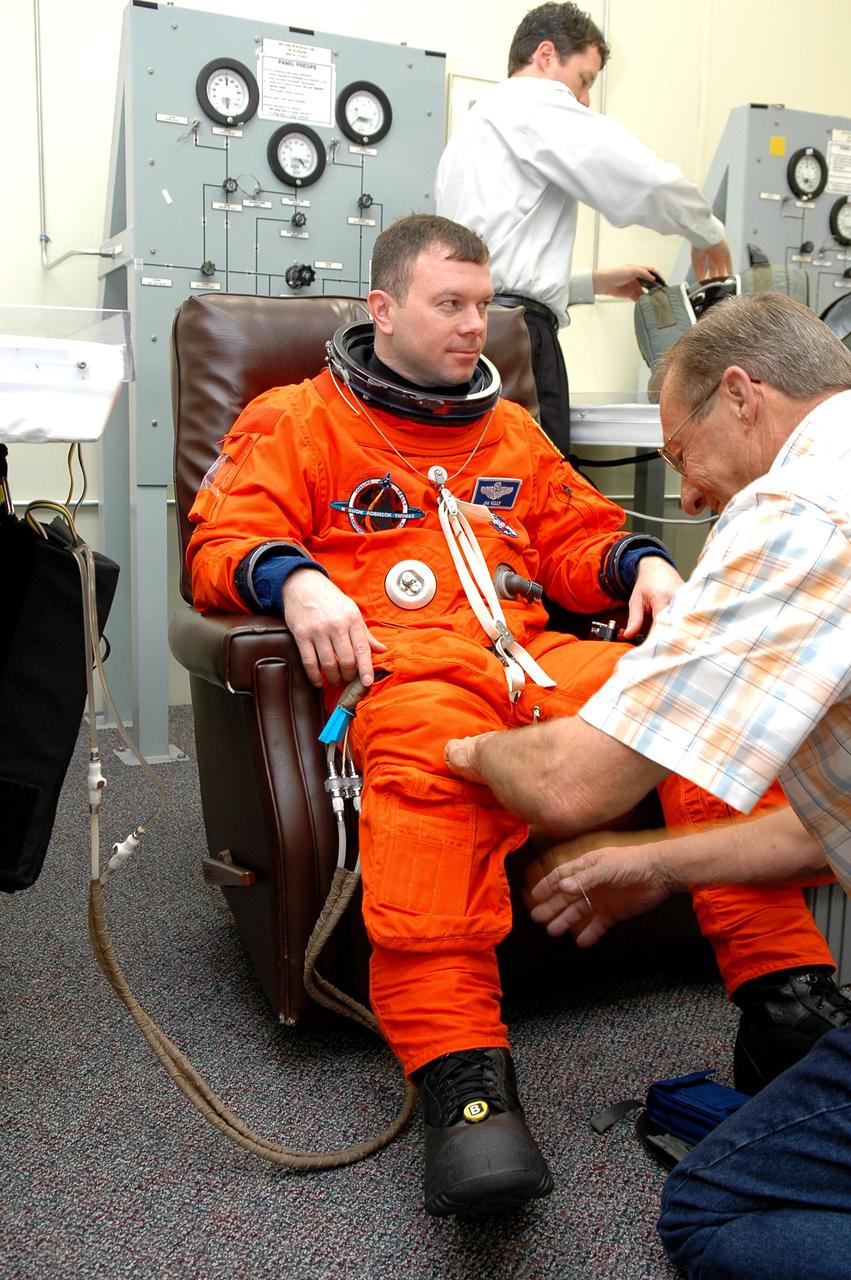
KENNEDY SPACE CENTER, FLA. - A suit technician helps STS-114 Pilot James Kelly suit up in the Operations and Checkout Building for the trip to Launch Pad 39B for a mock launch countdown culminating in a simulated main engine cutoff. The dress rehearsal is part of Terminal Countdown Demonstration Test (TCDT) activities held prior to each Space Shuttle flight. It provides the crew of each mission an opportunity to participate in various simulated countdown activities, including equipment familiarization and emergency egress training. STS-114 is the first Return to Flight mission to the International Space Station. The launch window extends July 13 through July 31.
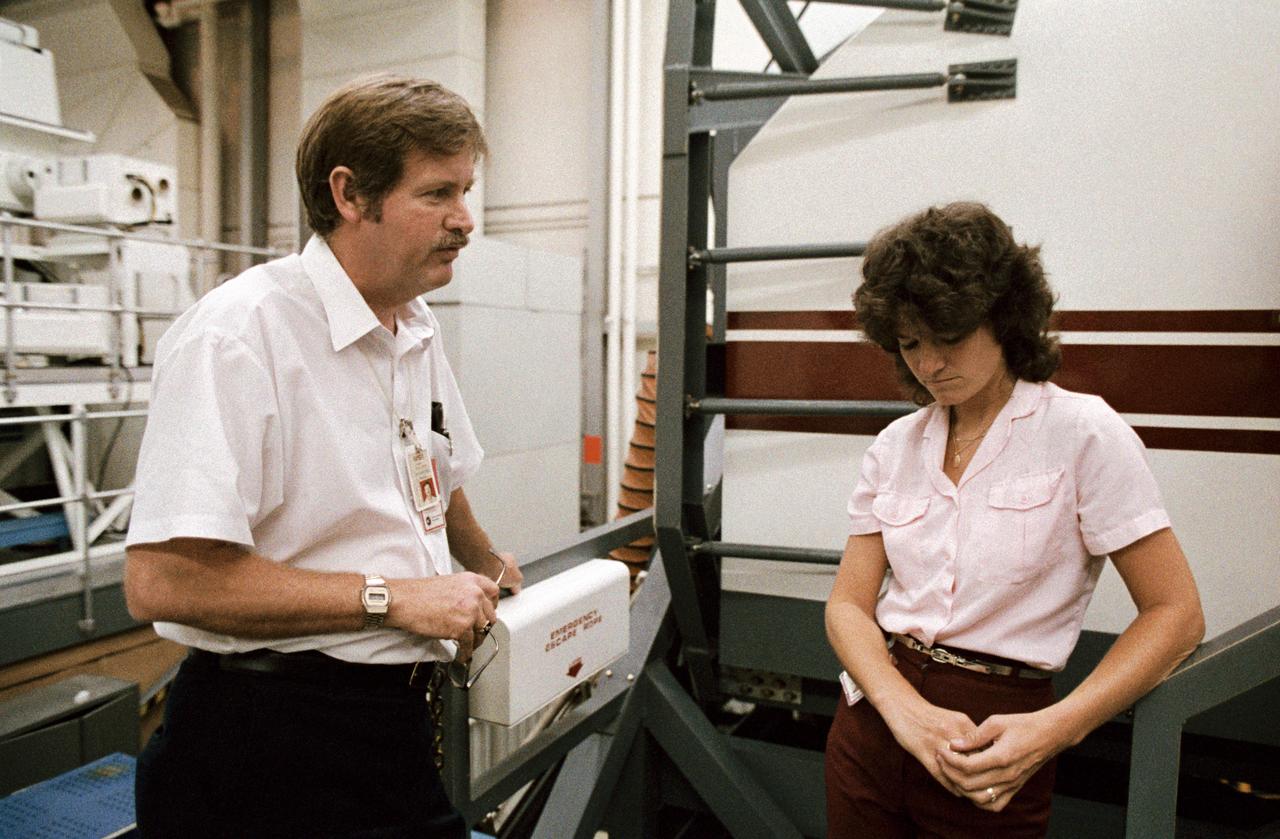
S83-32890 (23 May 1983) --- Astronaut Sally K. Ride, STS-7 mission specialist, stands near the Shuttle Mission Simulator (SMS) in Johnson Space Center's (JSC) Mission Simulation and Training Facility with suit specialist Alan M. Rochford after simulation of various phases of the upcoming STS-7 flight. Photo credit: NASA
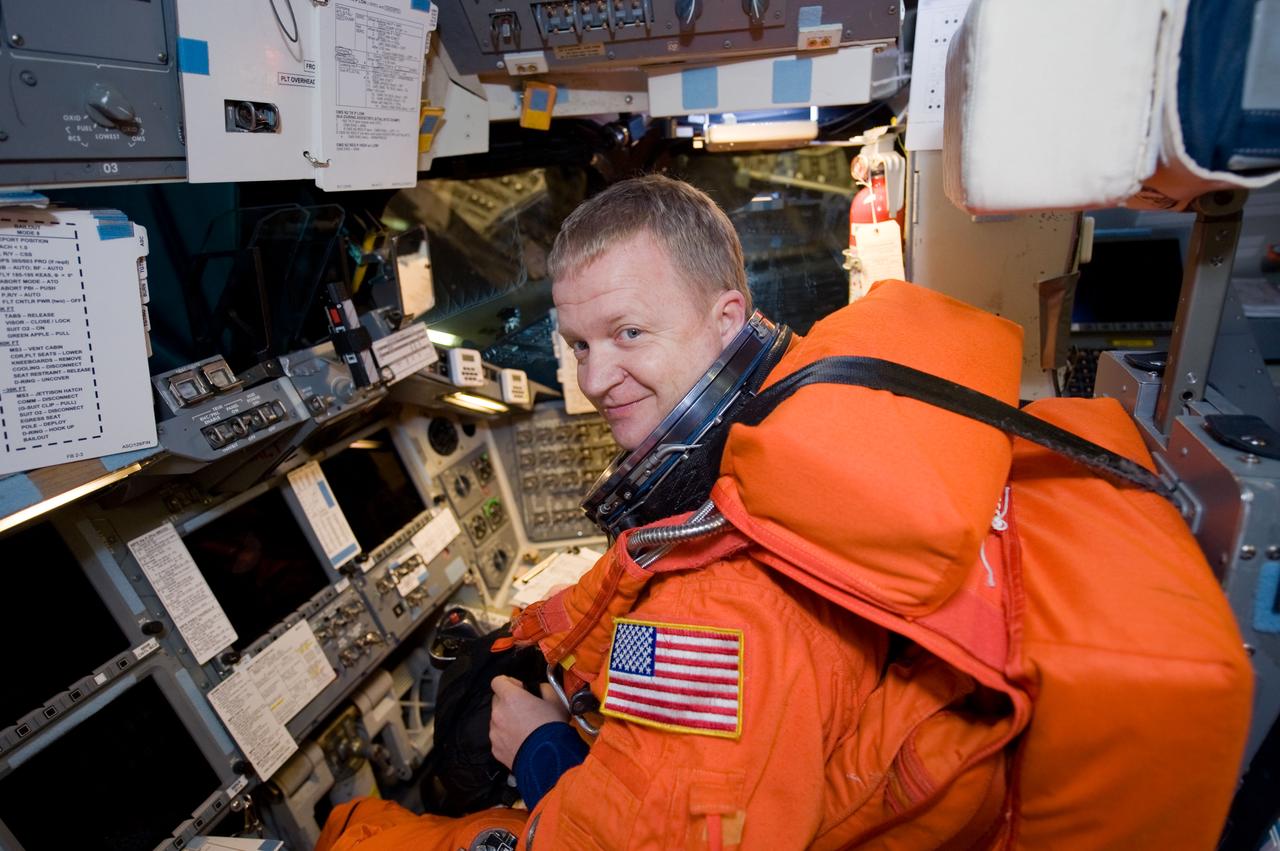
JSC2010-E-014039 (25 Jan. 2010) --- Attired in a training version of his shuttle launch and entry suit, NASA astronaut Eric Boe, STS-133 pilot, occupies the pilot?s station during a simulation exercise in the motion-base shuttle mission simulator in the Jake Garn Simulation and Training Facility at NASA?s Johnson Space Center.
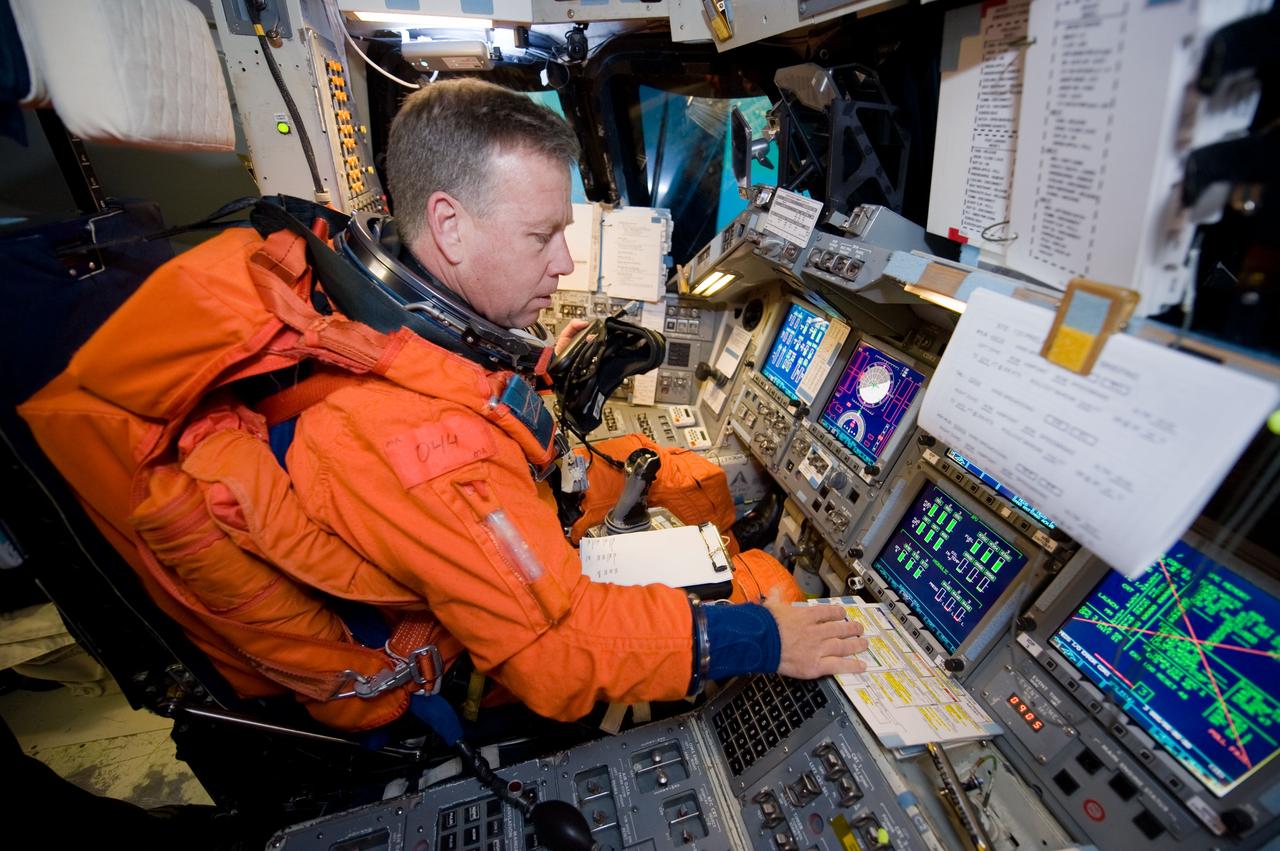
JSC2010-E-014040 (25 Jan. 2010) --- Attired in a training version of his shuttle launch and entry suit, NASA astronaut Steven Lindsey, STS-133 commander, occupies the commander?s station during a simulation exercise in the motion-base shuttle mission simulator in the Jake Garn Simulation and Training Facility at NASA?s Johnson Space Center.

JSC2010-E-014044 (25 Jan. 2010) --- Attired in training versions of their shuttle launch and entry suits, NASA astronauts Steve Lindsey (left), STS-133 commander; Eric Boe (background), pilot; Tim Kopra (right foreground) and Alvin Drew, both mission specialists, participate in a simulation exercise in the motion-base shuttle mission simulator in the Jake Garn Simulation and Training Facility at NASA?s Johnson Space Center.
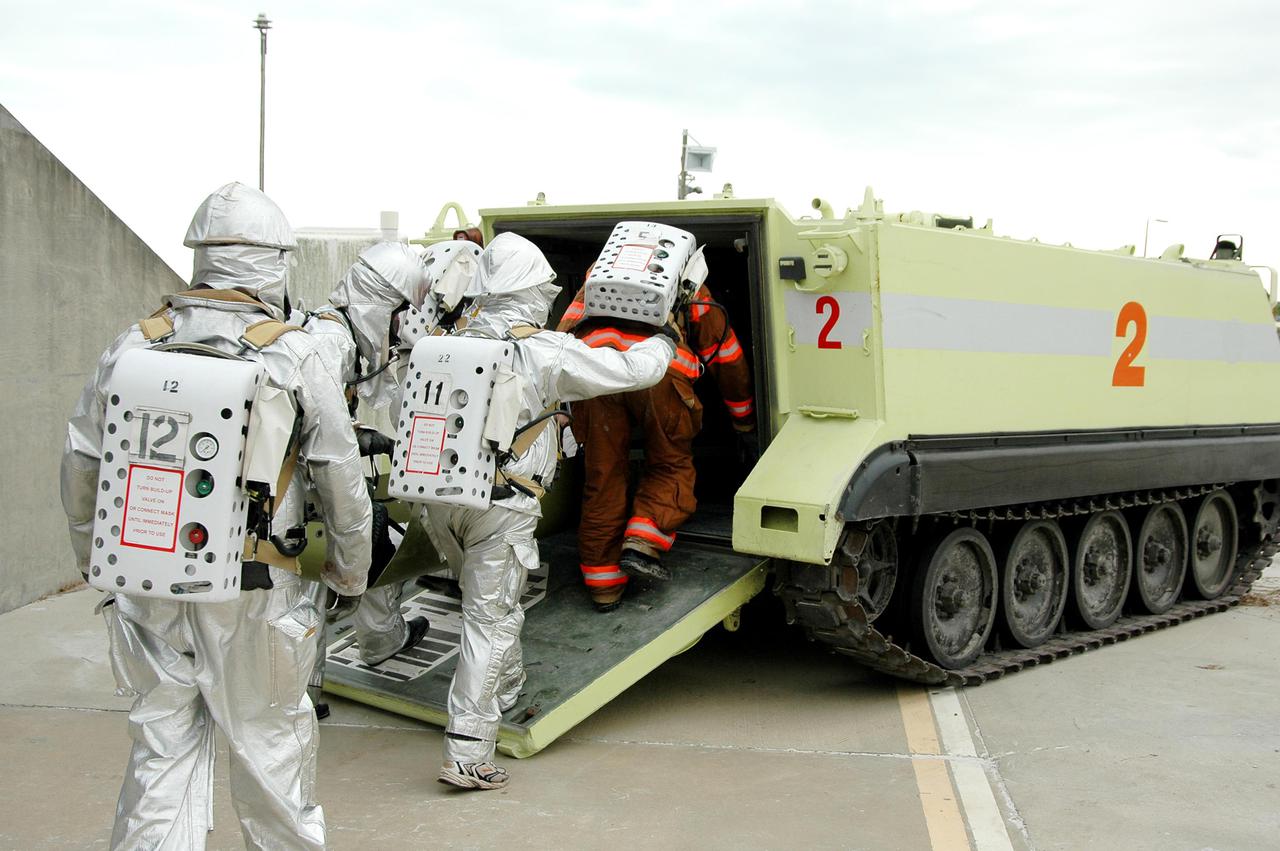
KENNEDY SPACE CENTER, FLA. - During a simulated launch countdown_emergency simulation on Launch Pad 39A, the rescue team helps astronaut-suited workers climb into an M-113 armored personnel carrier for transport away from the pad. The four-hour exercise simulated normal launch countdown operations, with the added challenge of a fictitious event causing an evacuation of the vehicle and launch pad. It tested the team’s rescue approaches on the Fixed Service Structure, slidewire basket evacuation, triage care and transportation of injured personnel to hospitals, as well as communications and coordination.
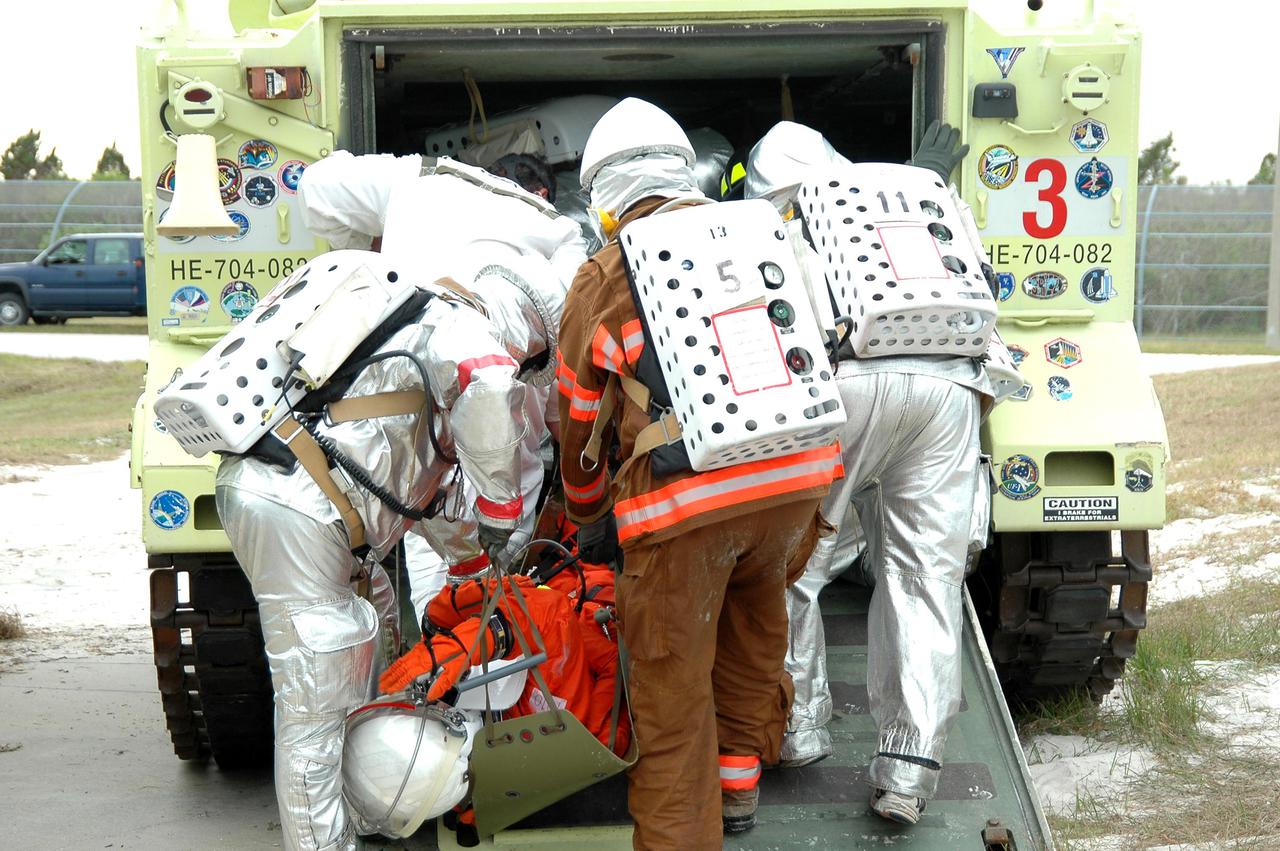
KENNEDY SPACE CENTER, FLA. - During a simulated launch countdown_emergency simulation on Launch Pad 39A, the rescue team carries “injured” astronaut-suited workers into an M-113 armored personnel carrier for transport away from the pad. The four-hour exercise simulated normal launch countdown operations, with the added challenge of a fictitious event causing an evacuation of the vehicle and launch pad. It tested the team’s rescue approaches on the Fixed Service Structure, slidewire basket evacuation, triage care and transportation of injured personnel to hospitals, as well as communications and coordination.
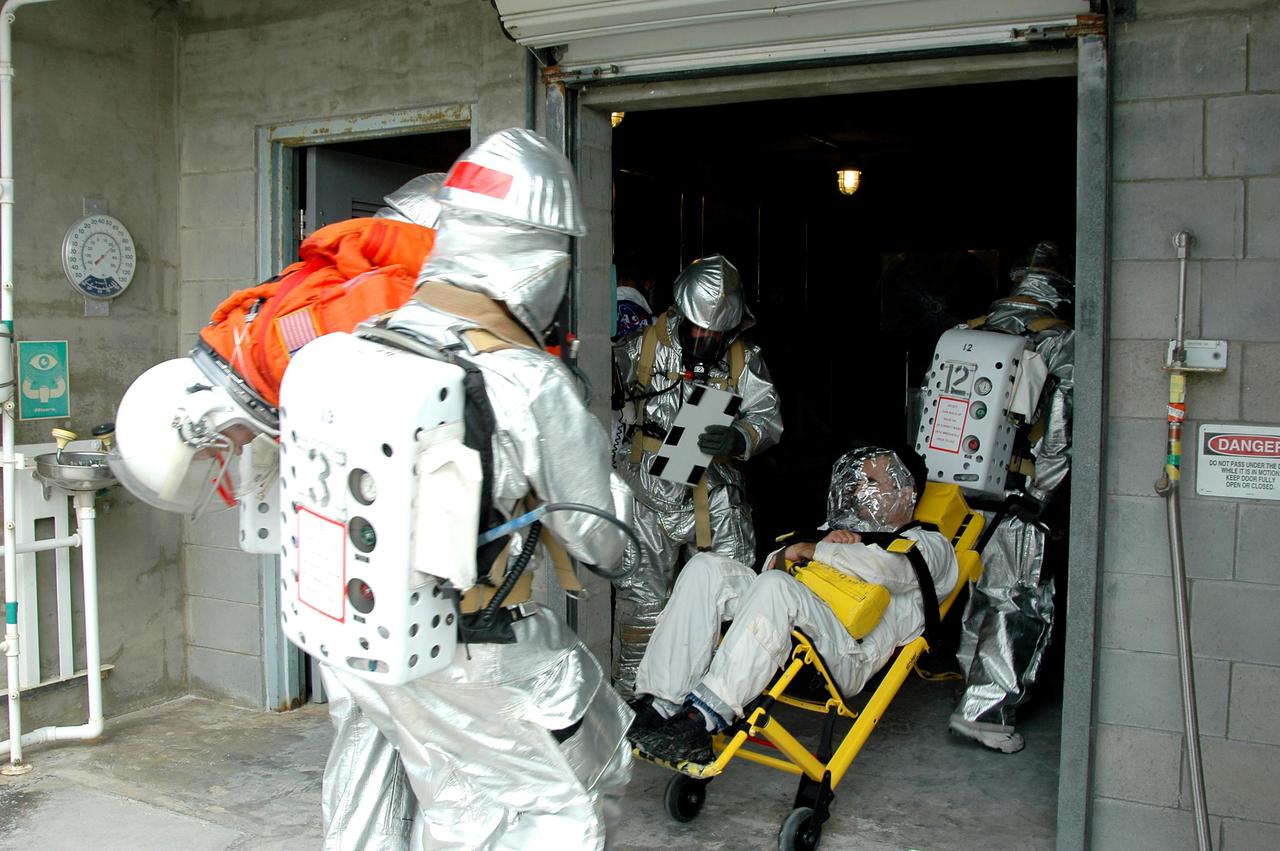
KENNEDY SPACE CENTER, FLA. - During a simulated launch countdown_emergency simulation on Launch Pad 39A, the rescue team takes “injured” astronaut-suited workers into the pad bunker. The four-hour exercise simulated normal launch countdown operations, with the added challenge of a fictitious event causing an evacuation of the vehicle and launch pad. It tested the team’s rescue approaches on the Fixed Service Structure, slidewire basket evacuation, triage care and transportation of injured personnel to hospitals, as well as communications and coordination.
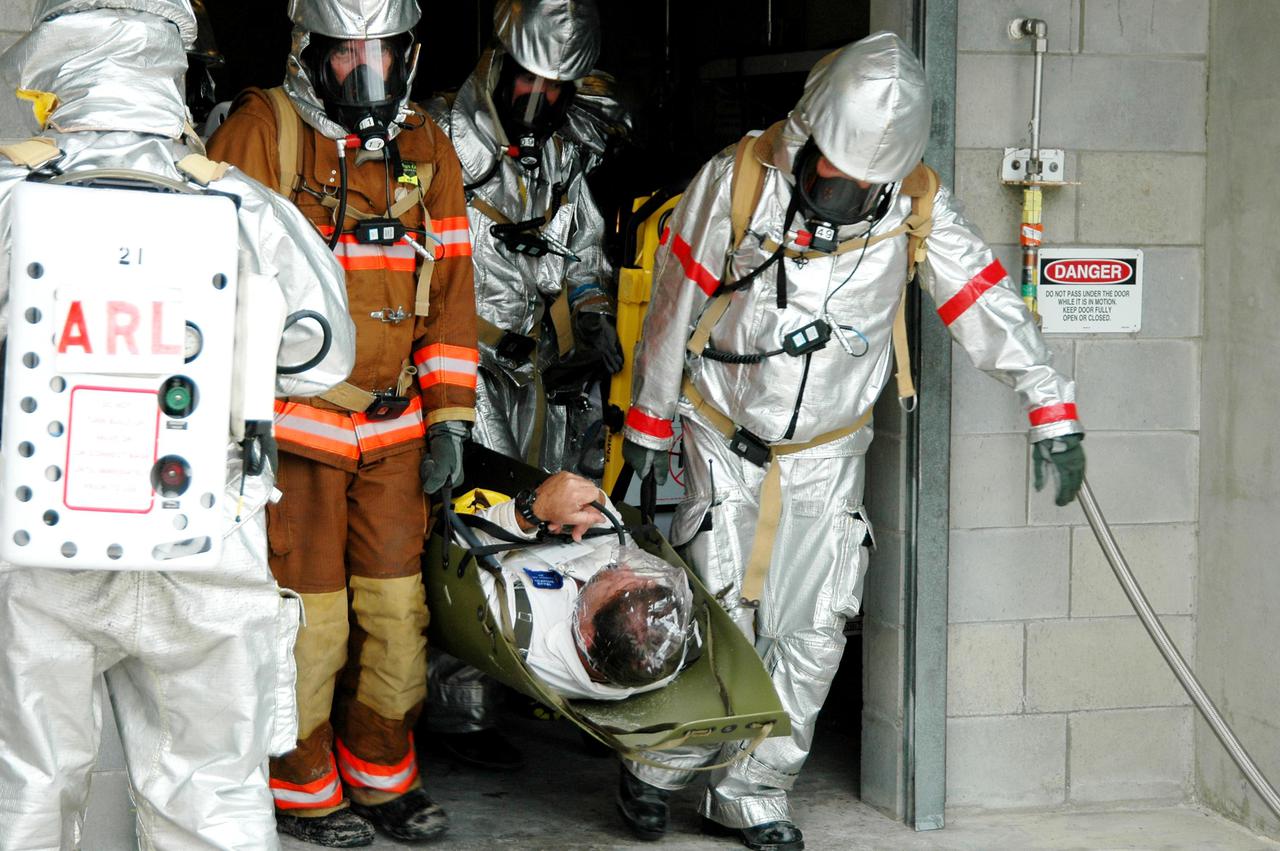
KENNEDY SPACE CENTER, FLA. - During a simulated launch countdown_emergency simulation on Launch Pad 39A, the rescue team carries “injured” astronaut-suited workers out of the pad bunker. The four-hour exercise simulated normal launch countdown operations, with the added challenge of a fictitious event causing an evacuation of the vehicle and launch pad. It tested the team’s rescue approaches on the Fixed Service Structure, slidewire basket evacuation, triage care and transportation of injured personnel to hospitals, as well as communications and coordination.
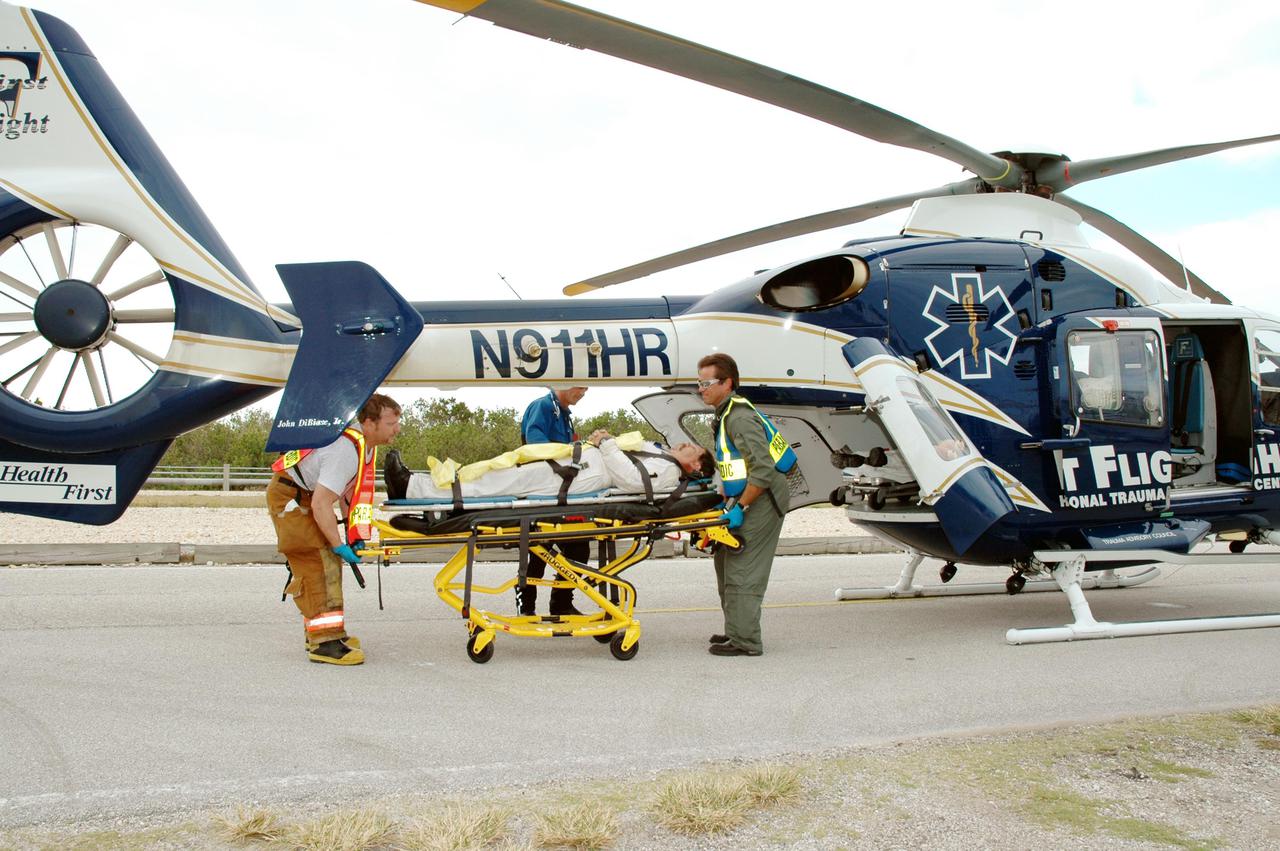
KENNEDY SPACE CENTER, FLA. - During a simulated launch countdown_emergency simulation on Launch Pad 39A, astronaut-suited workers are placed in a medical-rescue helicopter for transport to a hospital participating in the simulation. Pad team members took part in the four-hour exercise simulating normal launch countdown operations, with the added challenge of a fictitious event causing an evacuation of the vehicle and launch pad. The simulation tested the team’s rescue approaches on the Fixed Service Structure, slidewire basket evacuation, triage care and transportation of injured personnel to hospitals, as well as communications and coordination.
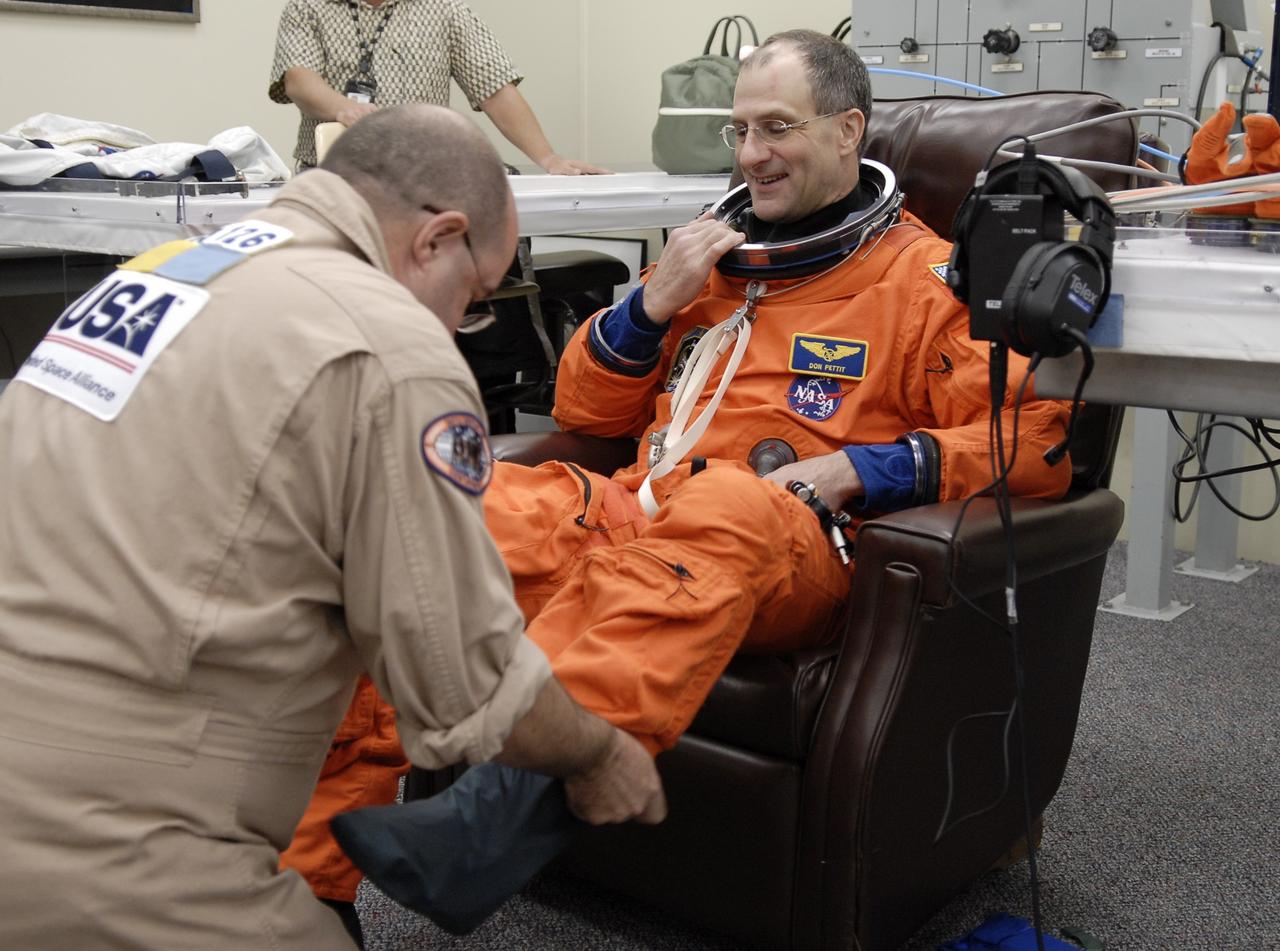
CAPE CANAVERAL, Fla. – STS-126 Mission Specialist Donald Pettit is helped by a suit technician with his boots during suit-up in the Operations and Checkout Building at NASA's Kennedy Space Center in Florida. Pettit and other crew members are having their launch-and-entry suits fit-checked prior to heading for Launch Pad 39A. The crew will take part in a simulated launch countdown at the pad. The crew is at Kennedy to take part in the Terminal Countdown Demonstration Test, which includes equipment familiarization, emergency exit training and the simulated countdown. On the STS-126 mission, space shuttle Endeavour's crew will deliver equipment and supplies to the International Space Station in preparation for expansion from a three- to six-person resident crew aboard the complex. The mission also will include four spacewalks to service the station’s Solar Alpha Rotary Joints. Endeavour is targeted to launch Nov. 14. Photo credit: NASA/Kim Shiflett
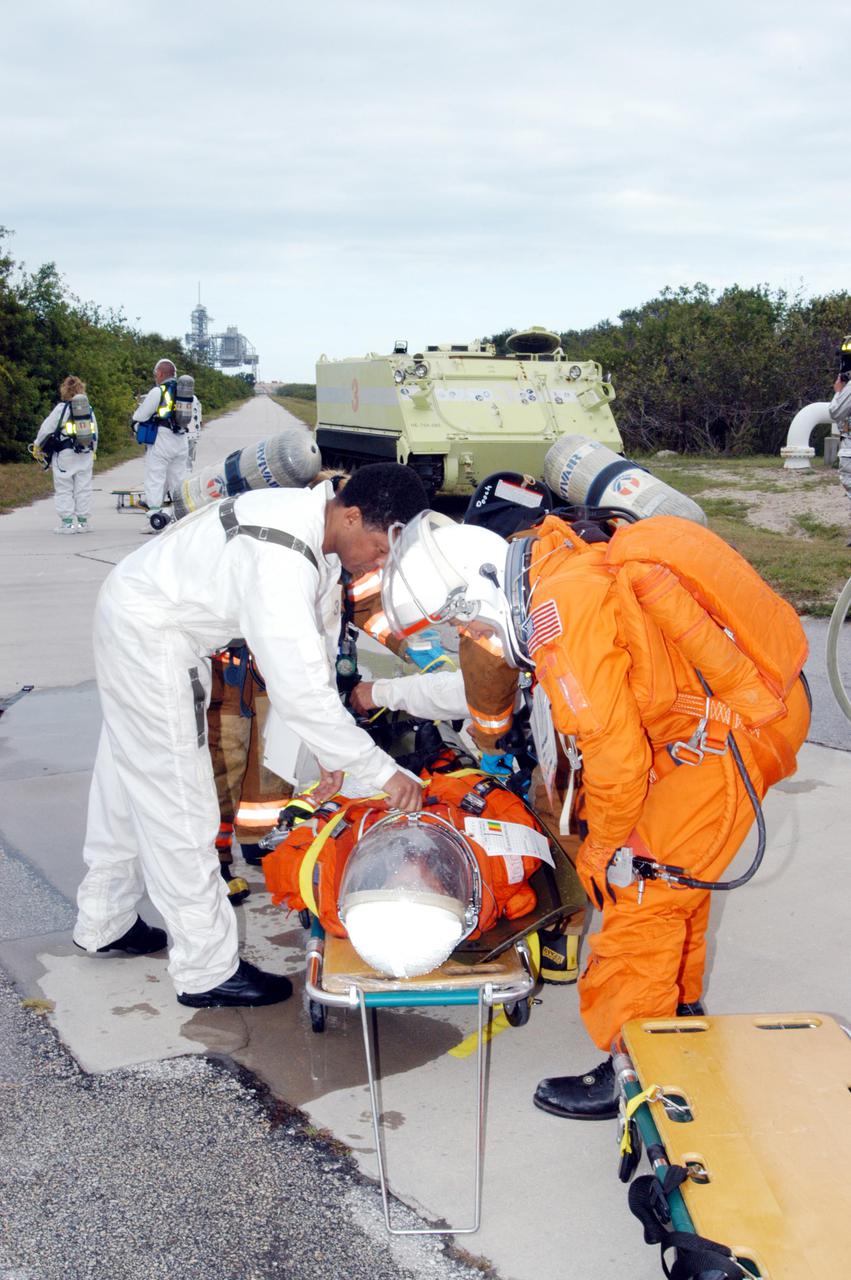
KENNEDY SPACE CENTER, FLA. - During a simulated launch countdown_emergency simulation on Launch Pad 39A, the rescue team moves “injured” astronaut-suited workers out of the M-113 armored personnel carriers that transported them away from the pad (seen in the distance). Pad team members participated in the four-hour exercise simulating normal launch countdown operations, with the added challenge of a fictitious event causing an evacuation of the vehicle and launch pad. The simulation tested the team’s rescue approaches on the Fixed Service Structure, slidewire basket evacuation, triage care and transportation of injured personnel to hospitals, as well as communications and coordination.
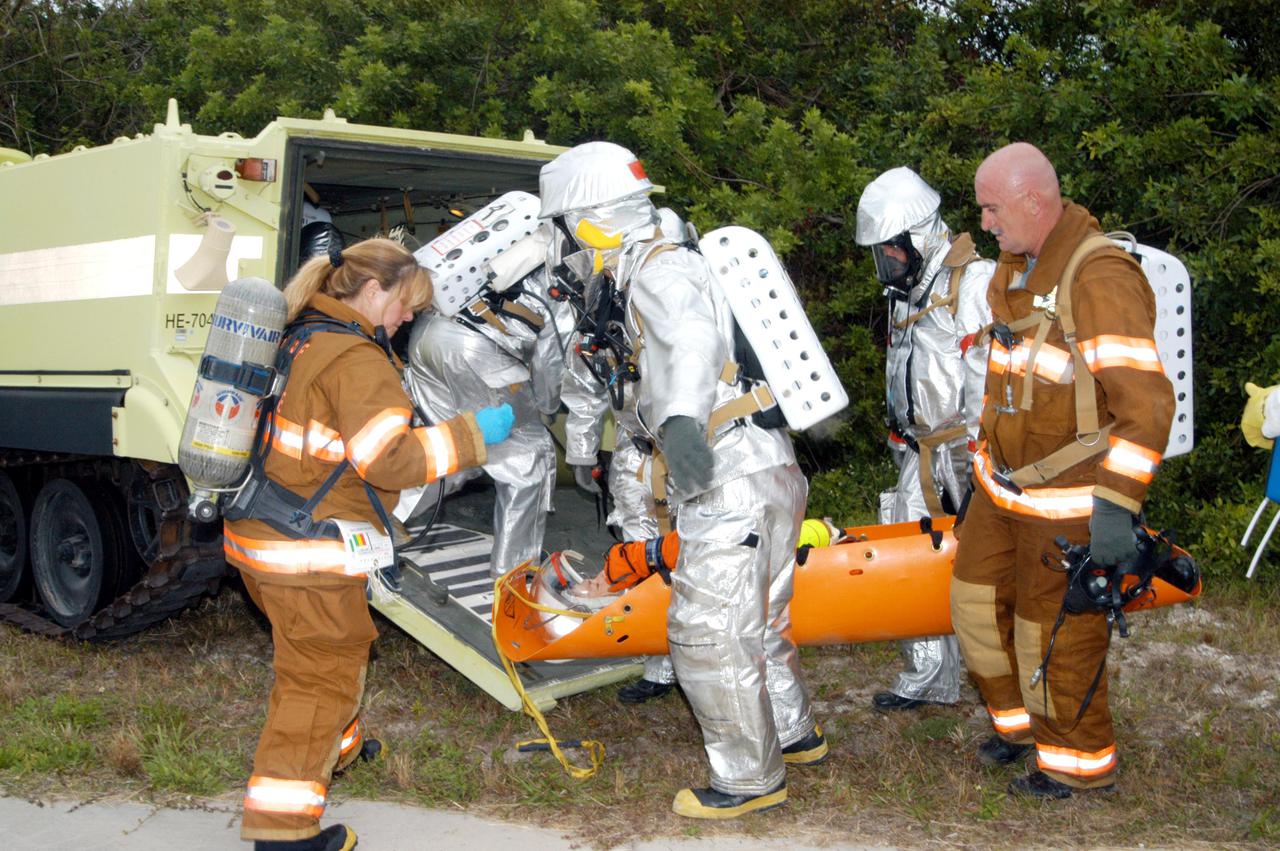
KENNEDY SPACE CENTER, FLA. - During a simulated launch countdown_emergency simulation on Launch Pad 39A, the rescue team moves “injured” astronaut-suited workers out of the M-113 armored personnel carriers that transported them away from the pad (seen in the distance). Pad team members participated in the four-hour exercise simulating normal launch countdown operations, with the added challenge of a fictitious event causing an evacuation of the vehicle and launch pad. The simulation tested the team’s rescue approaches on the Fixed Service Structure, slidewire basket evacuation, triage care and transportation of injured personnel to hospitals, as well as communications and coordination.
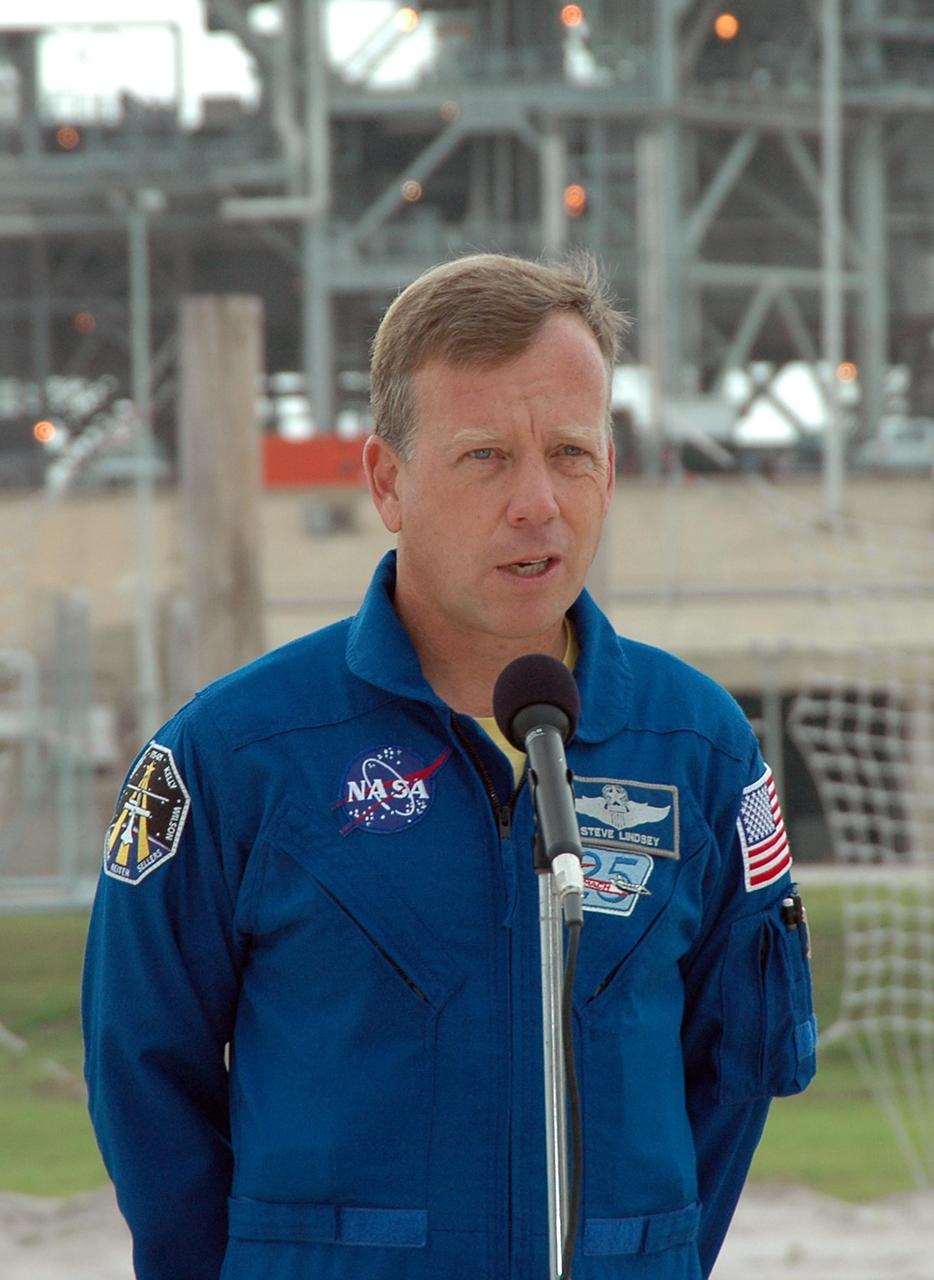
KENNEDY SPACE CENTER, FLA. - STS-121 Mission Commander Steven Lindsey talks to the media from the launch pad. He is in the landing area of the slidewire baskets. The crew is at Kennedy for Terminal Countdown Demonstration Test activities. Over several days, the crew will practice emergency egress from the pad and suit up in their orange flight suits for the simulated countdown to launch. Space Shuttle Discovery is designated to launch July 1 on mission STS-121. It will carry supplies to the International Space Station. Photo credit: NASA/Kim Shiflett
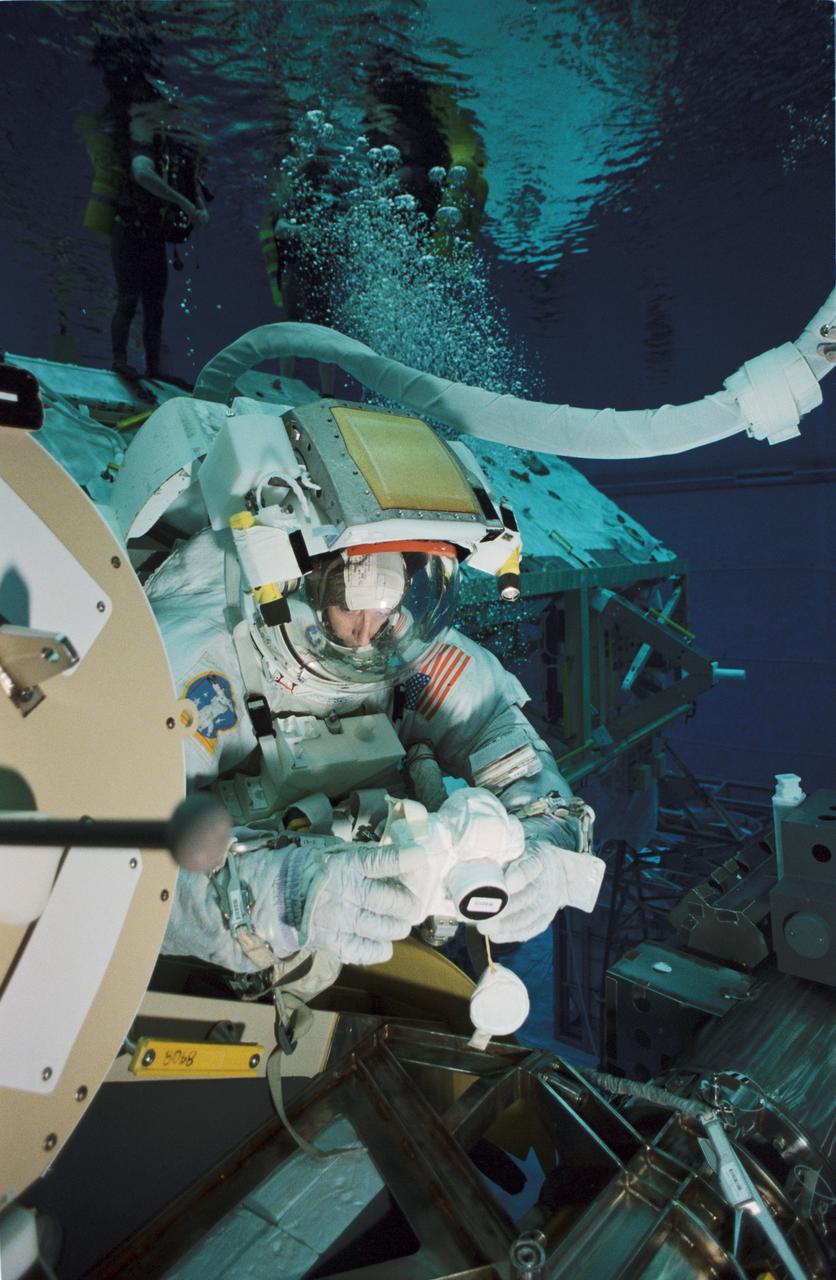
JSC2002-00511 (15 January 2002) --- Astronaut Philippe Perrin, STS-111 mission specialist, wears a training version of the Extravehicular Mobility Unit (EMU) space suit during an underwater simulation of extravehicular activity (EVA) scheduled for the 14th shuttle mission to the International Space Station (ISS). Perrin, representing CNES, the French Space Agency, was joined by astronaut Franklin R. Chang-Diaz (out of frame) for the simulation, conducted in the Neutral Buoyancy Laboratory (NBL) near the Johnson Space Center.
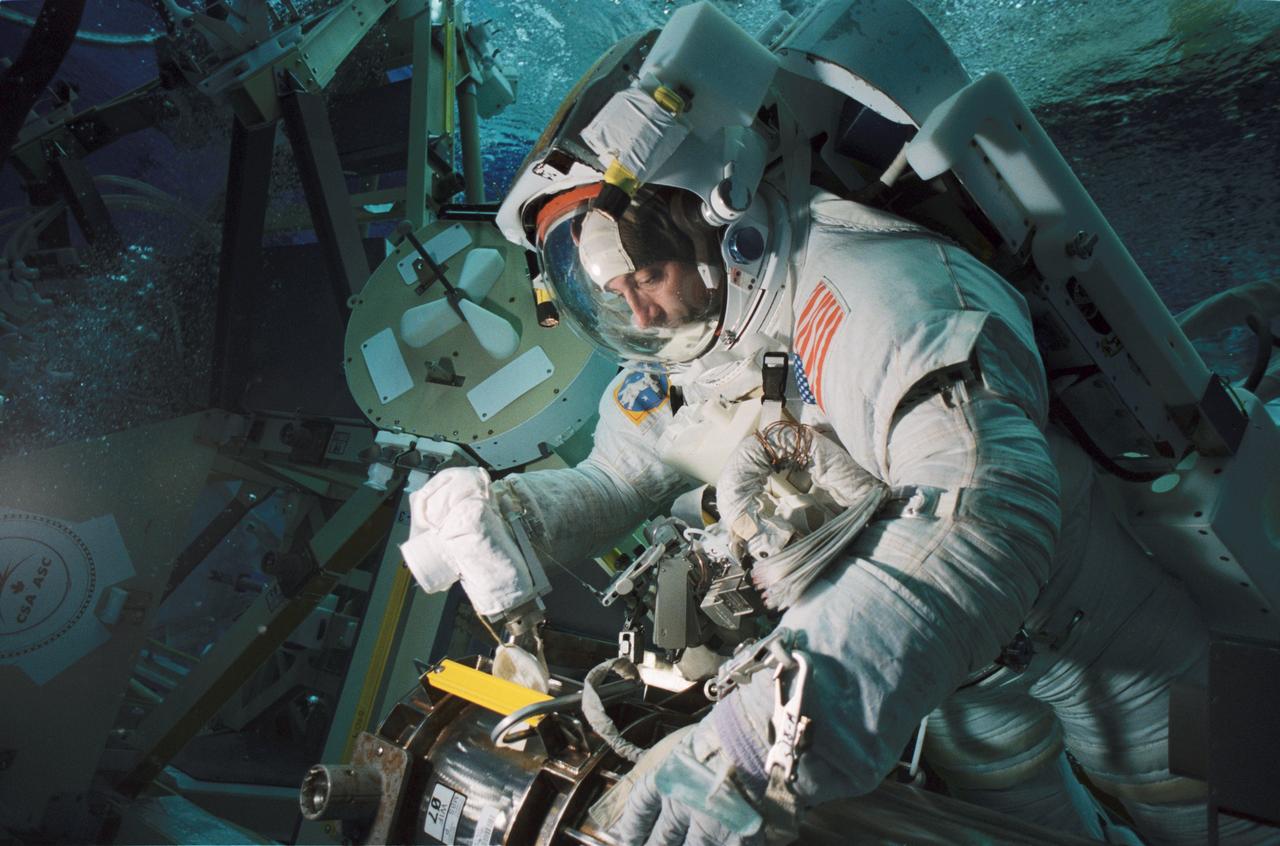
JSC2002-00510 (15 January 2002) --- Astronaut Philippe Perrin, STS-111 mission specialist, wears a training version of the Extravehicular Mobility Unit (EMU) space suit during an underwater simulation of extravehicular activity (EVA) scheduled for the 14th shuttle mission to the International Space Station (ISS). Perrin, representing CNES, the French Space Agency, was joined by astronaut Franklin R. Chang-Diaz (out of frame) for the simulation, conducted in the Neutral Buoyancy Laboratory (NBL) near the Johnson Space Center.
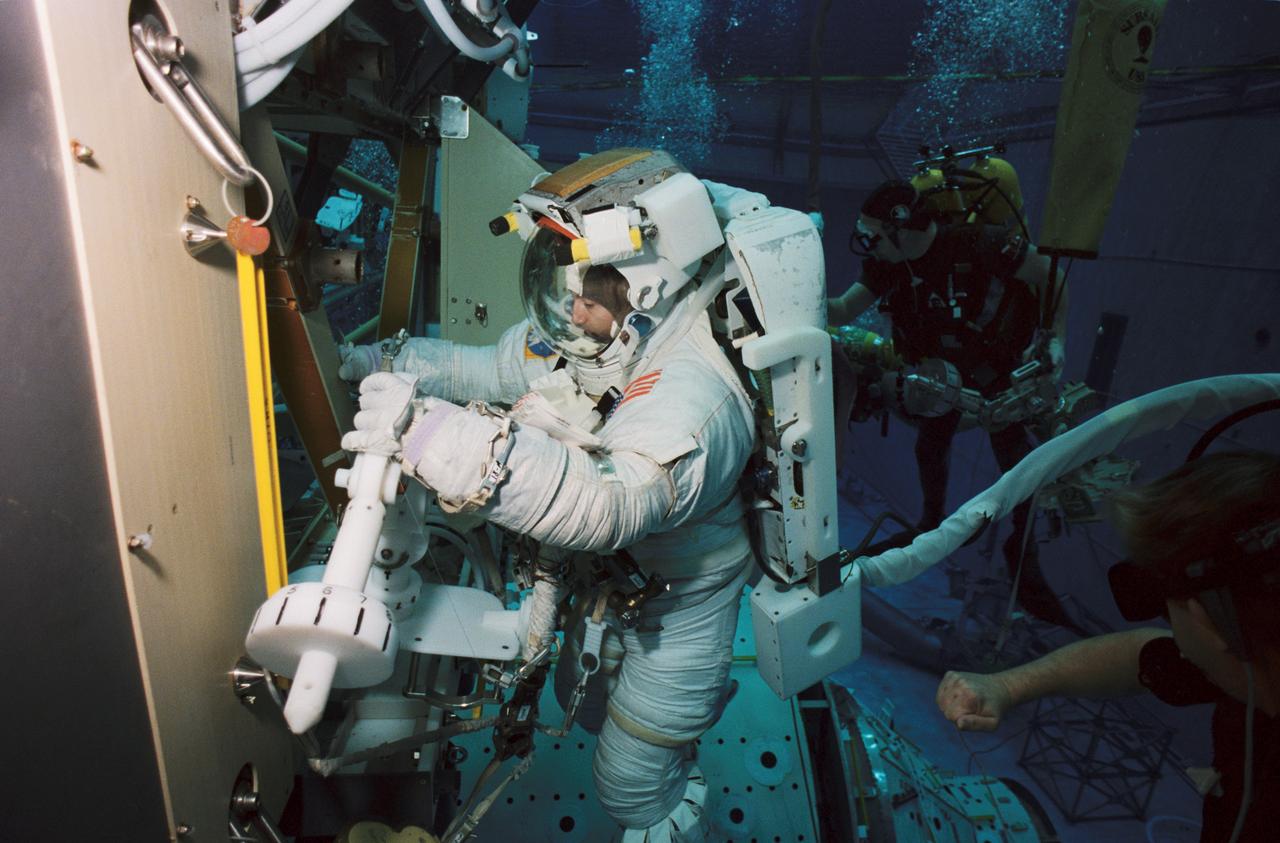
JSC2002-00507 (15 January 2002) --- Astronaut Philippe Perrin, STS-111 mission specialist, wears a training version of the Extravehicular Mobility Unit (EMU) space suit during an underwater simulation of extravehicular activity (EVA) scheduled for the 14th shuttle mission to the International Space Station (ISS). Perrin, representing CNES, the French Space Agency, was joined by astronaut Franklin R. Chang-Diaz (out of frame) for the simulation, conducted in the Neutral Buoyancy Laboratory (NBL) near the Johnson Space Center.
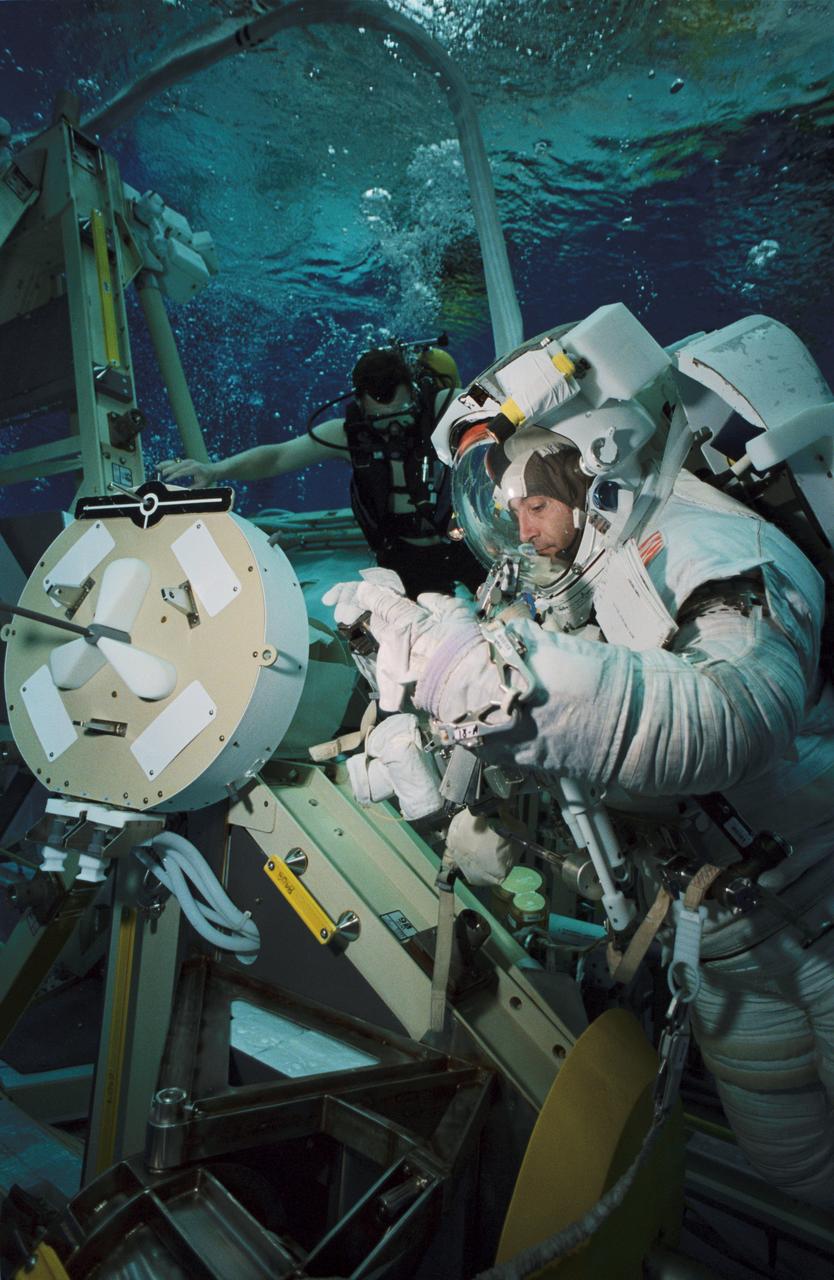
JSC2002-00508 (15 January 2002) --- Astronaut Philippe Perrin, STS-111 mission specialist, wears a training version of the Extravehicular Mobility Unit (EMU) space suit during an underwater simulation of extravehicular activity (EVA) scheduled for the 14th shuttle mission to the International Space Station (ISS). Perrin, representing CNES, the French Space Agency, was joined by astronaut Franklin R. Chang-Diaz (out of frame) for the simulation, conducted in the Neutral Buoyancy Laboratory (NBL) near the Johnson Space Center.
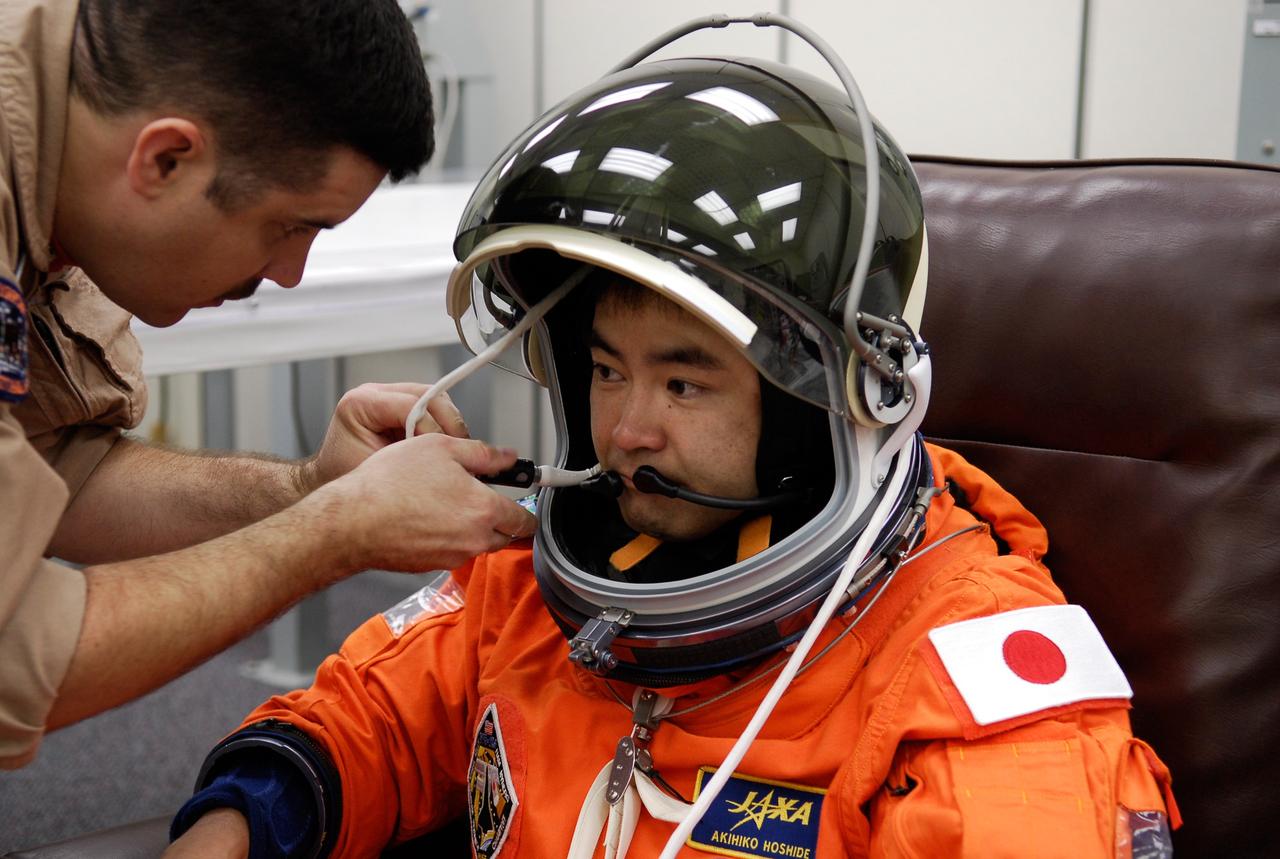
CAPE CANAVERAL, Fla. -- In the Operations and Checkout Building at NASA's Kennedy Space Center, STS-124 Mission Specialist Akihiko Hoshide has his communications adjusted in the helmet of his launch-and-entry suit. Hoshide represents the Japan Aerospace Exploration Agency, or JAXA. He has donned the suit for the simulated launch countdown the crew is starting. The simulation is the culmination of the launch dress rehearsal called the terminal countdown demonstration test. TCDT provides astronauts and ground crews with an opportunity to participate in various simulated countdown activities, including equipment familiarization and emergency training. On the STS-124 mission, the crew will deliver and install the Japanese Experiment Module – Pressurized Module and Japanese Remote Manipulator System. Discovery's launch is targeted for May 31. Photo credit: NASA/Kim Shiflett
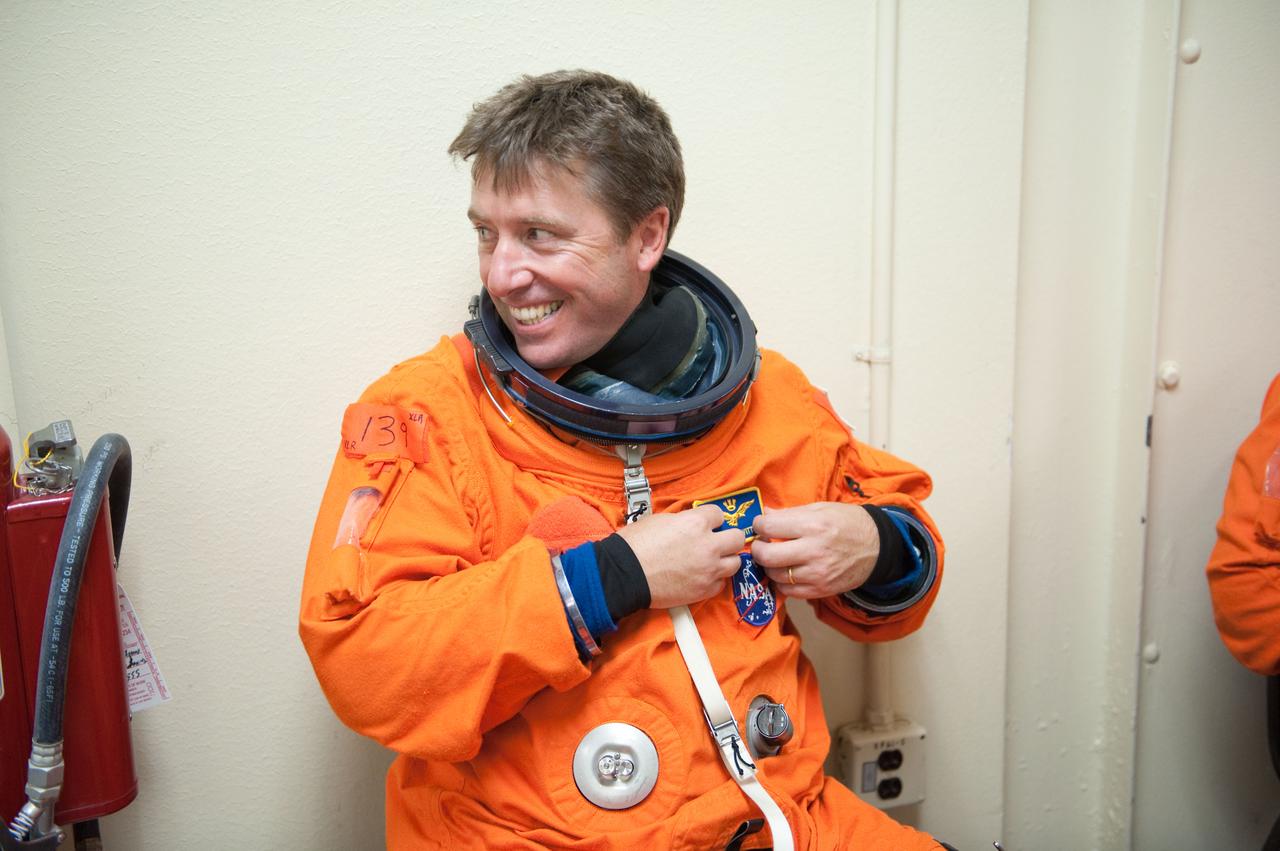
JSC2010-E-124262 (8 Sept. 2010) --- European Space Agency astronaut Roberto Vittori, STS-134 mission specialist, attired in a training version of his shuttle launch and entry suit, prepares for a training session in the fixed-base shuttle mission simulator (SMS) in the Jake Garn Simulation and Training Facility at NASA?s Johnson Space Center. Photo credit: NASA or National Aeronautics and Space Administration
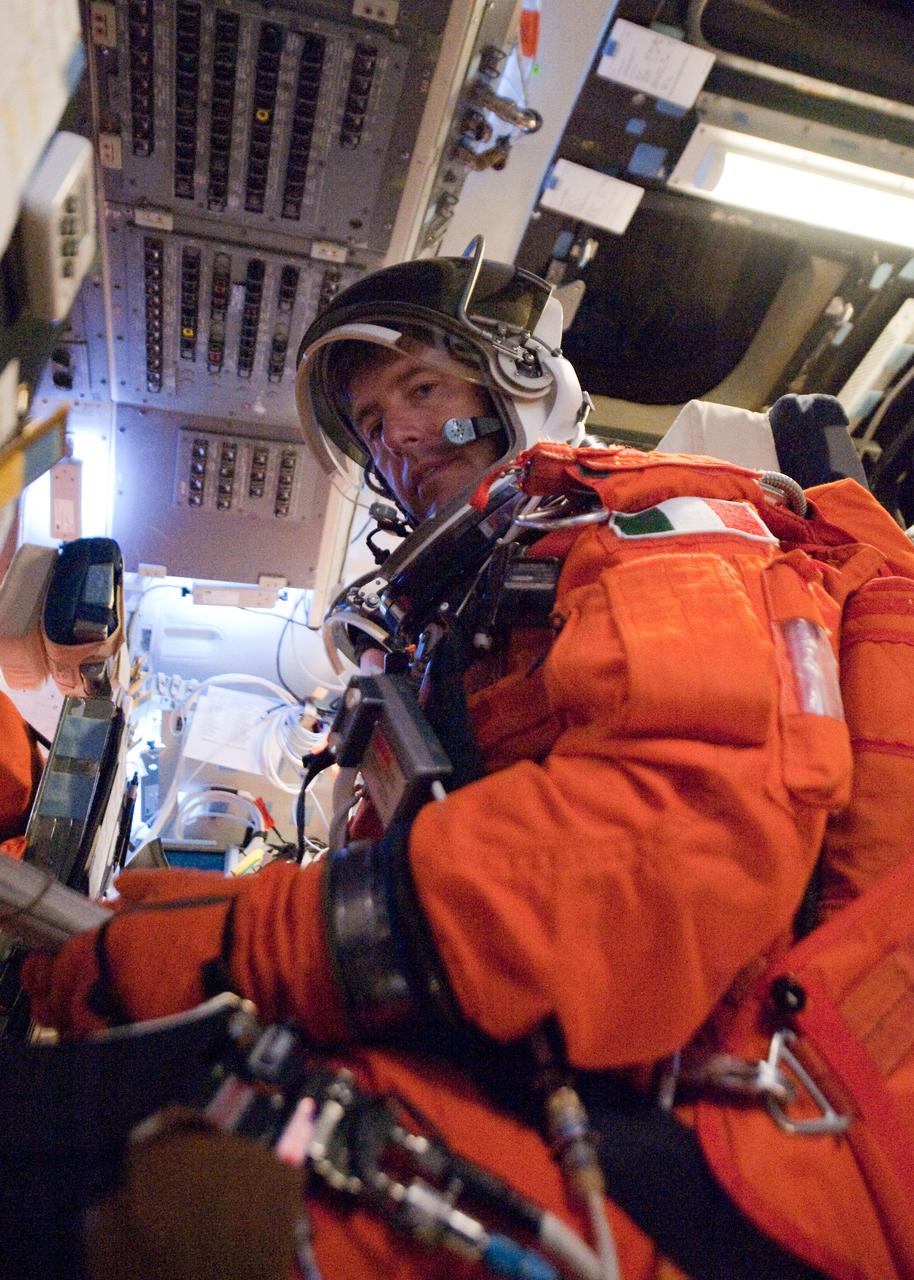
JSC2010-E-124289 (8 Sept. 2010) --- European Space Agency astronaut Roberto Vittori, STS-134 mission specialist, attired in a training version of his shuttle launch and entry suit, participates in a training session in the fixed-base shuttle mission simulator (SMS) in the Jake Garn Simulation and Training Facility at NASA?s Johnson Space Center. Photo credit: NASA or National Aeronautics and Space Administration
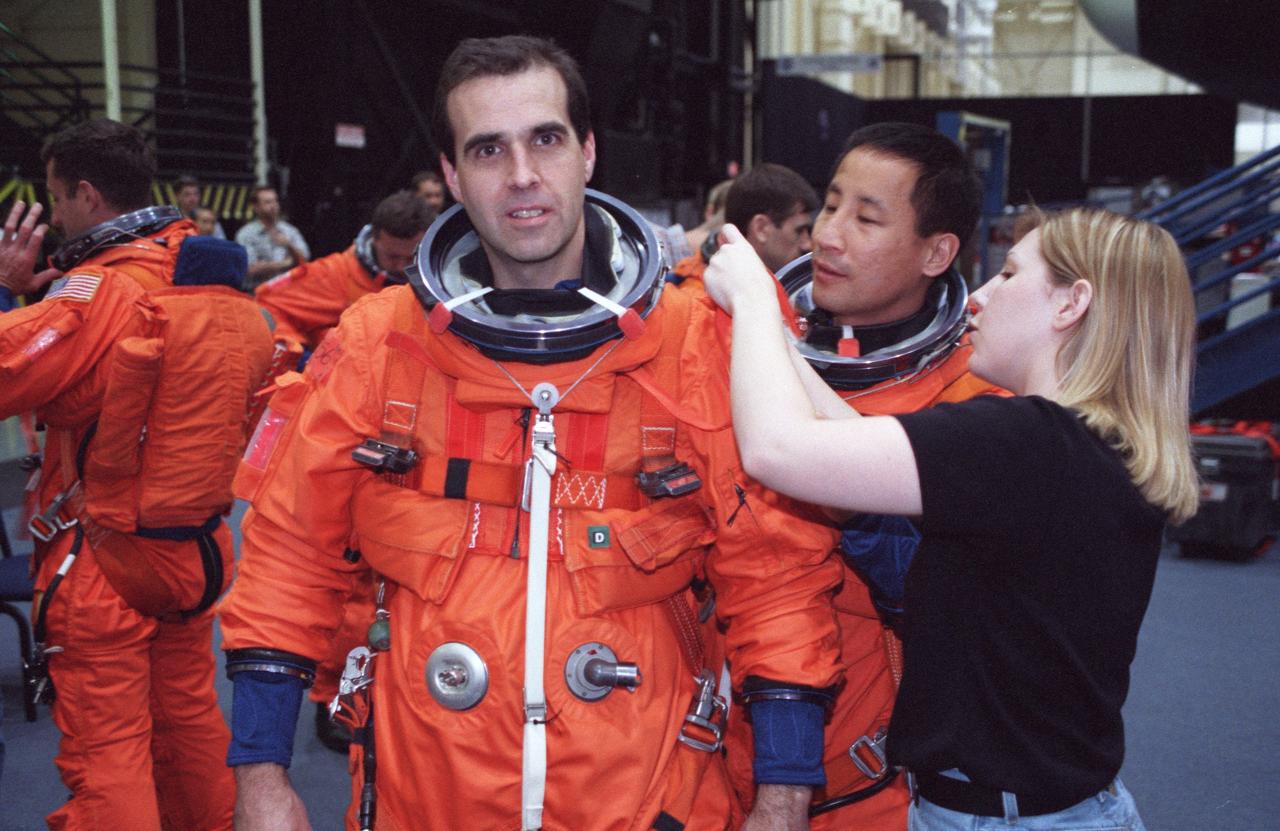
JSC2000-02223 (March 2000) --- Astronaut Edward T. Lu (center foreground) and United Space Alliance suit technician Erin Traina assist astronaut Richard A. Mastracchio with his launch and entry suit. The two astronauts were about to join their five crewmates for a simulation of mission activity in the Systems Integration Facility at the Johnson Space Center (JSC).
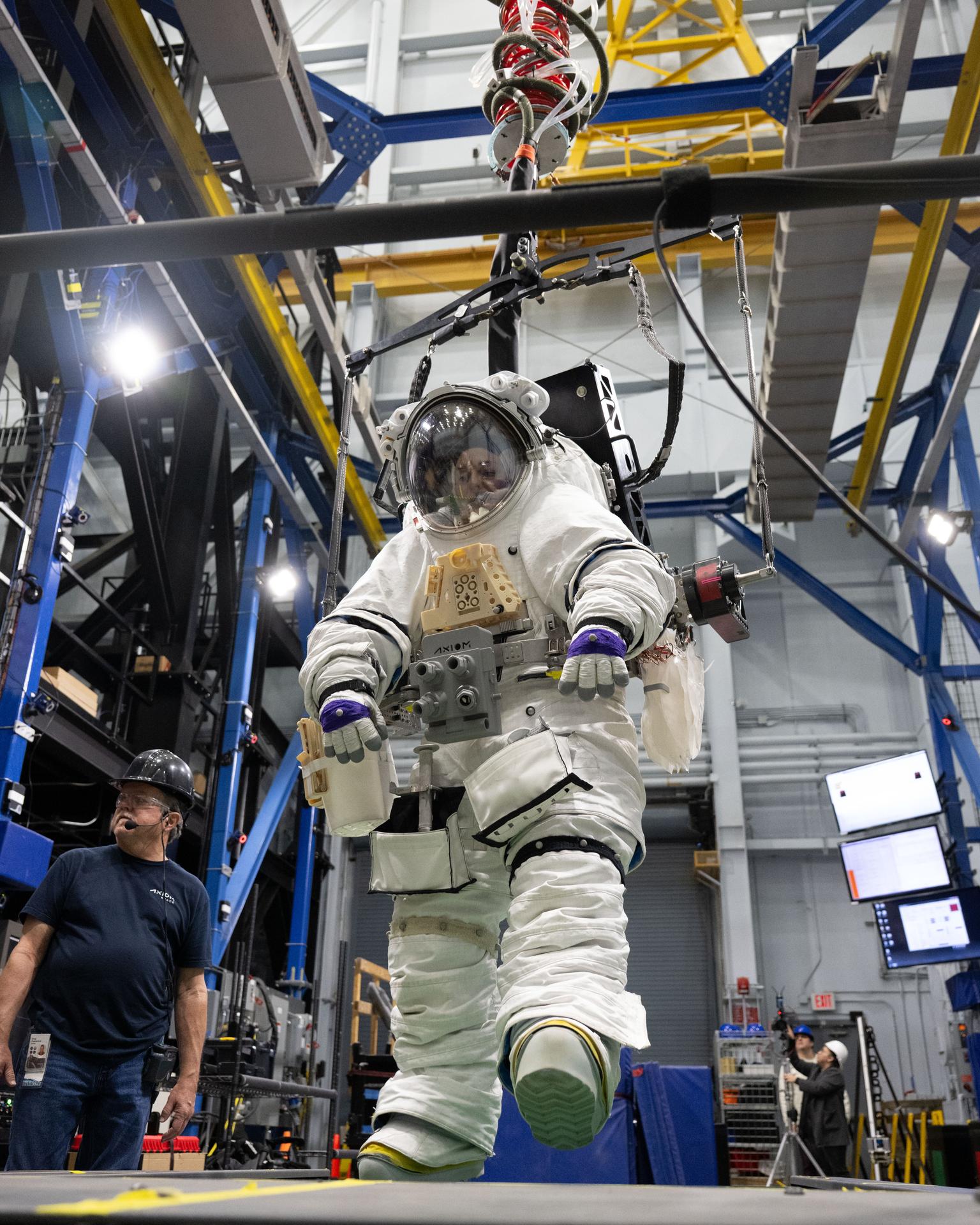
A NASA crew member practices simulated lunar surface operations at NASA’s Johnson Space Center during an elevated suit pressure test where teams evaluate how well crew perform tasks in different suit pressure levels while wearing the Artemis III lunar spacesuit developed by Axiom Space called the AxEMU (Axiom Extravehicular Mobility Unit).
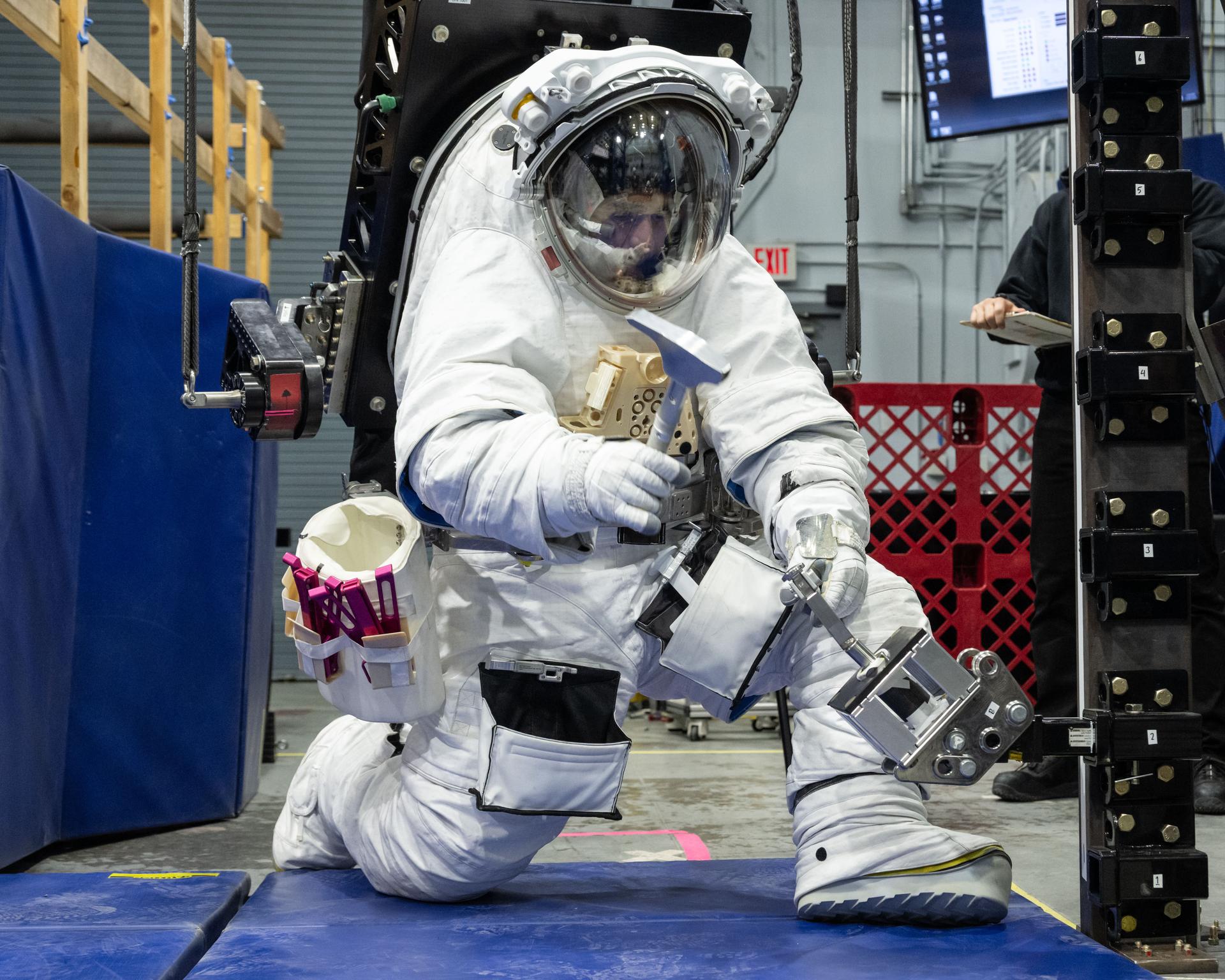
A NASA crew member practices simulated lunar surface operations at NASA’s Johnson Space Center during an elevated suit pressure test where teams evaluate how well crew perform tasks in different suit pressure levels while wearing the Artemis III lunar spacesuit developed by Axiom Space called the AxEMU (Axiom Extravehicular Mobility Unit).
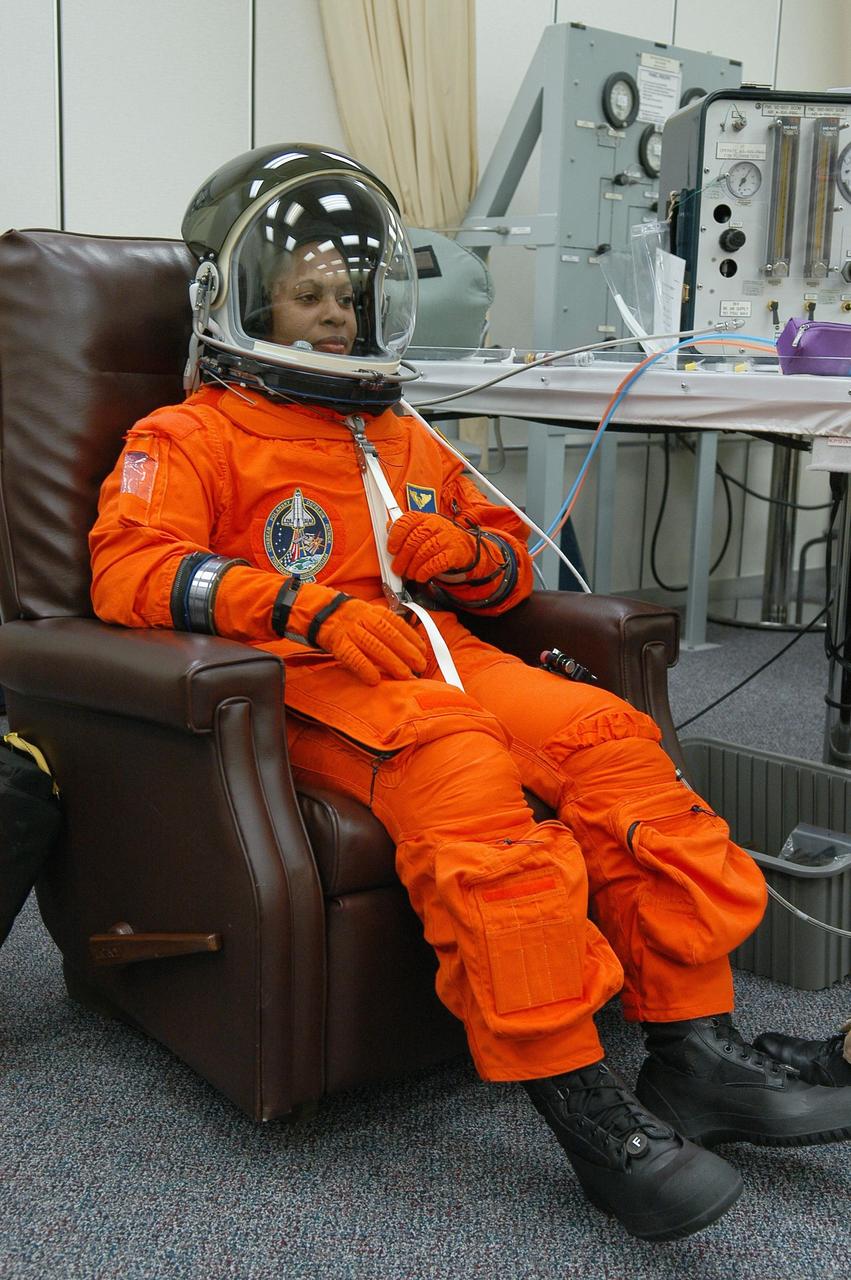
KENNEDY SPACE CENTER, FLA. -- The STS-116 mission crew practices for launch with a simulation of activities, from crew breakfast and suit-up to countdown in the orbiter. In this photo Mission Specialist Joan Higginbotham is suited up before heading to Launch Pad 39B. The STS-116 mission is No. 20 to the International Space Station and construction flight 12A.1. The mission payload is the SPACEHAB module, the P5 integrated truss structure and other key components. Launch is scheduled for no earlier than Dec. 7. Photo credit: NASA/Kim Shiflett
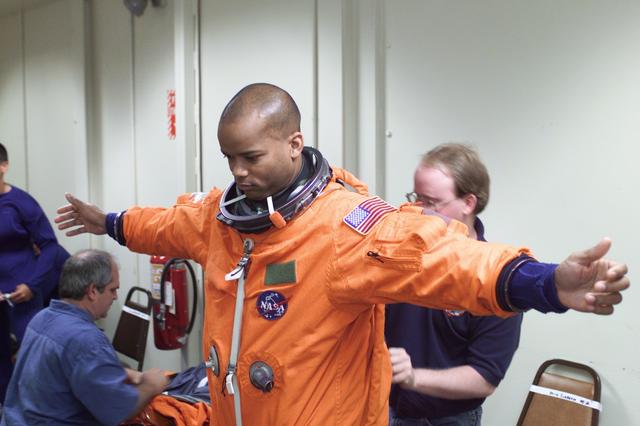
JSC2002-E-33368 (29 July 2002) --- Astronaut Robert L. Curbeam, Jr., STS-116 mission specialist, dons his training version of the shuttle launch and entry suit prior to the start of a mission training session in the Jake Garn Simulation and Training Facility at the Johnson Space Center (JSC). United Space Alliance (USA) suit technician Daniel Palmer assisted Curbeam.
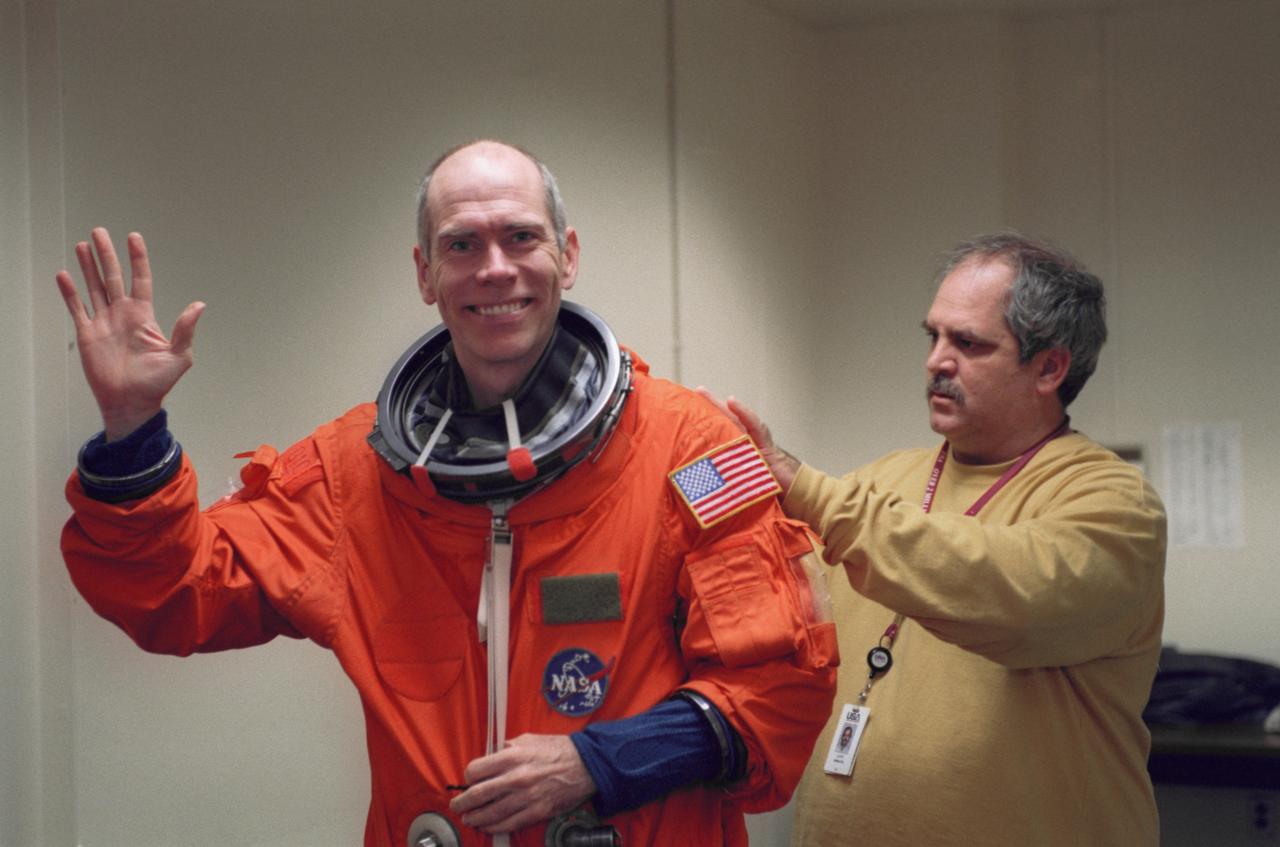
JSC2000-07655 (19 December 2000) --- Astronaut Daniel T. Barry, STS-105 mission specialist, dons a training version of the full-pressure launch and entry suit prior to a training session in one of the trainer/mockups (out of frame) in the Jake Garn Simulation and Training Facility at Johnson Space Center (JSC). Barry is assisted by United Space Alliance (USA) suit technician Lloyd Armintor.
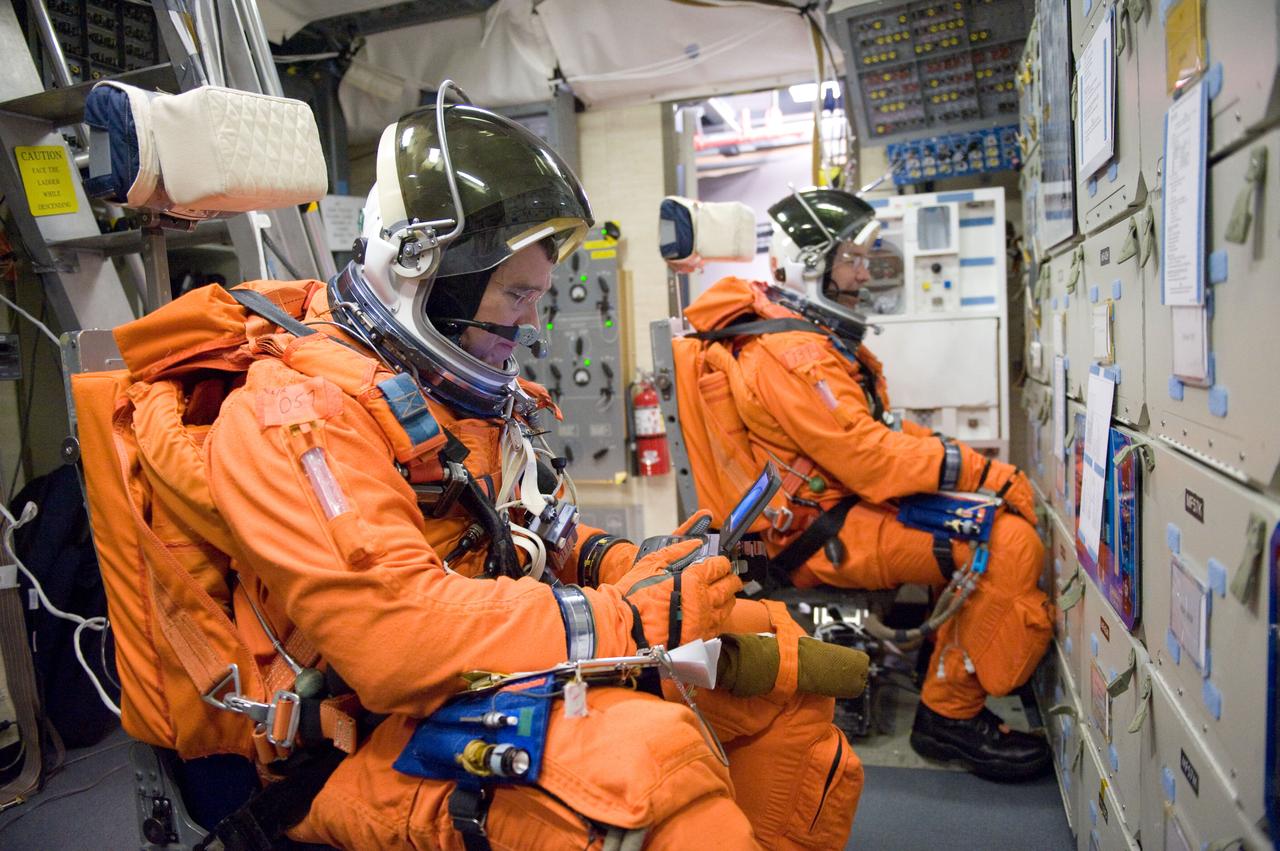
JSC2011-E-006690 (27 Jan. 2011) --- NASA astronauts Steve Bowen (foreground) and Michael Barratt, both STS-133 mission specialists, attired in training versions of their shuttle launch and entry suits, participate in a training session in the fixed-base shuttle mission simulator (SMS) in the Jake Garn Simulation and Training Facility at NASA's Johnson Space Center. Photo credit: NASA or National Aeronautics and Space Administration
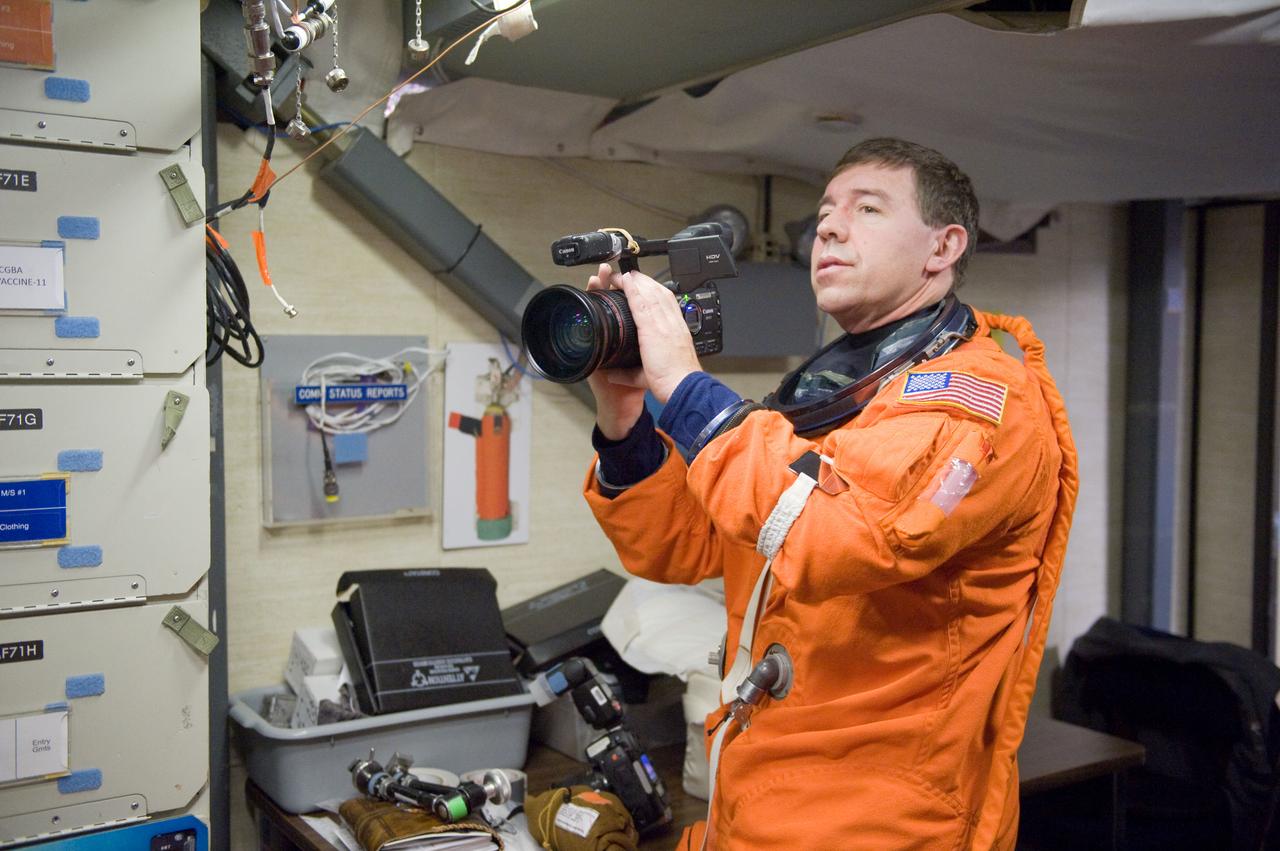
JSC2011-E-006704 (27 Jan. 2011) --- NASA astronaut Michael Barratt, STS-133 mission specialist, attired in a training version of his shuttle launch and entry suit, uses a High Definition Video (HDV) camera during a training session in the fixed-base shuttle mission simulator (SMS) in the Jake Garn Simulation and Training Facility at NASA's Johnson Space Center. Photo credit: NASA or National Aeronautics and Space Administration
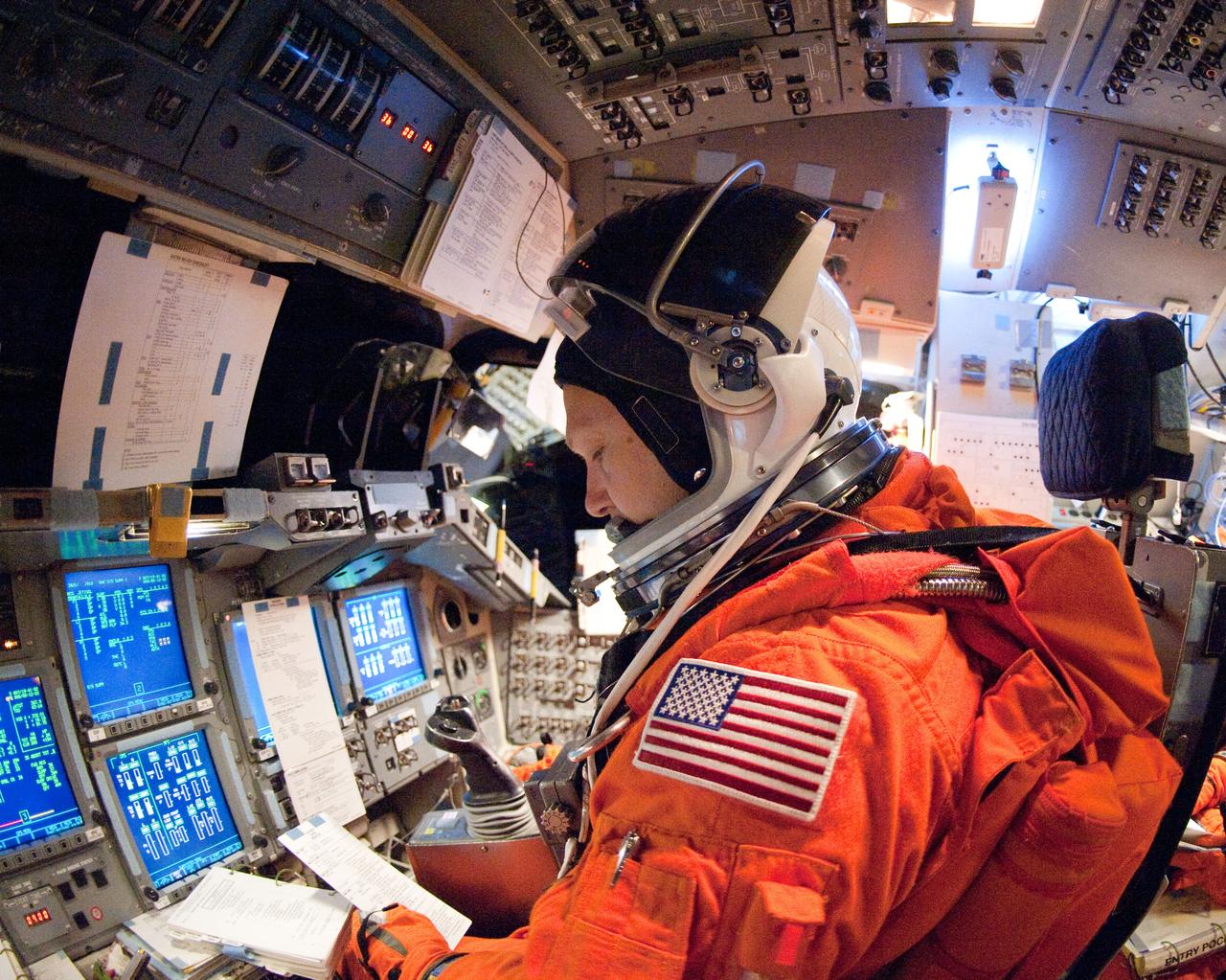
JSC2011-E-023123 (2 March 2011) --- NASA astronaut Doug Hurley, STS-135 pilot, attired in a training version of his shuttle launch and entry suit, participates in a training session in the fixed-base shuttle mission simulator (SMS) in the Jake Garn Simulation and Training Facility at NASA's Johnson Space Center. Photo credit: NASA or National Aeronautics and Space Administration
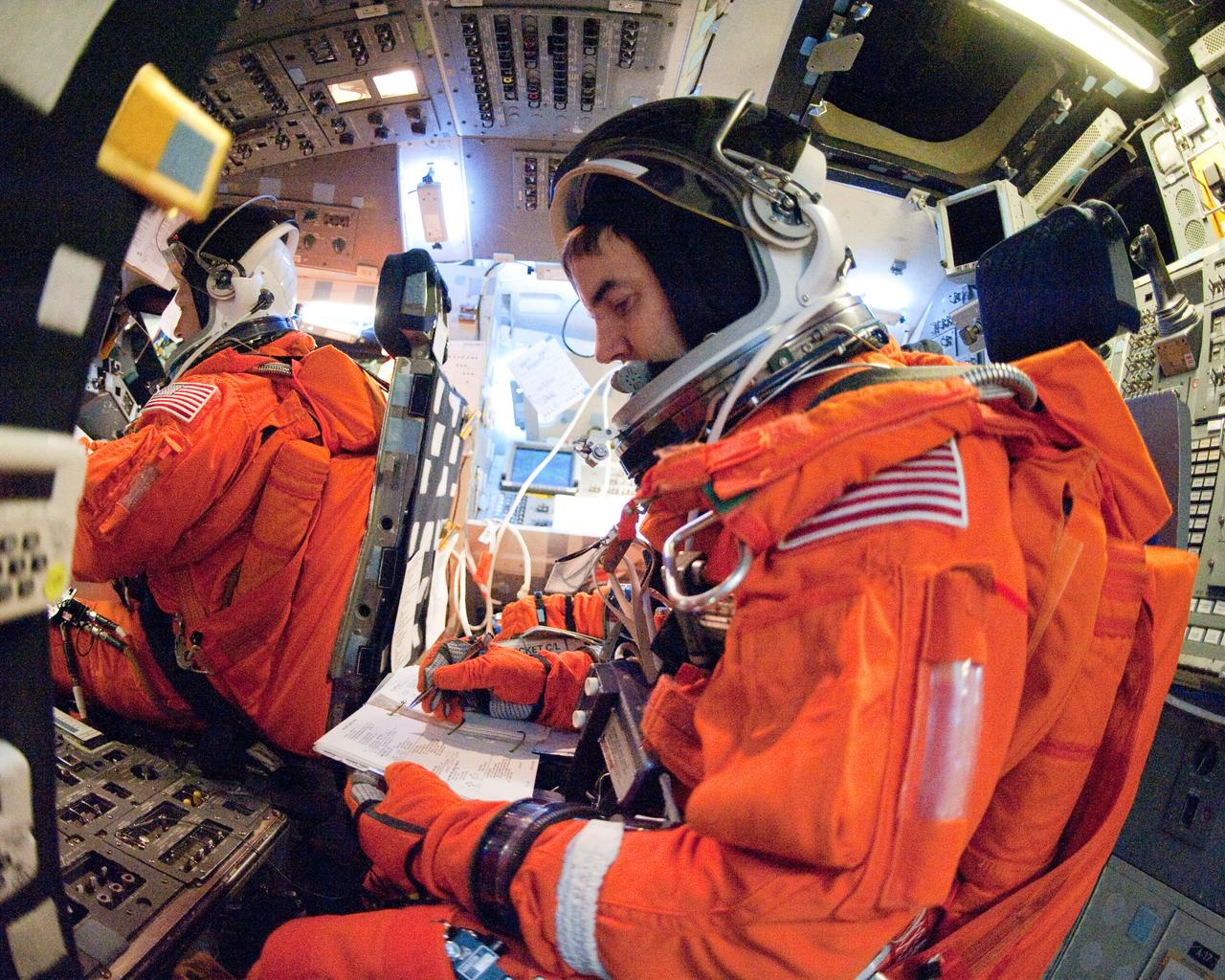
JSC2011-E-023121 (2 March 2011) --- NASA astronauts Rex Walheim, STS-135 mission specialist; and Doug Hurley (background), pilot, attired in training versions of their shuttle launch and entry suits, participate in a training session in the fixed-base shuttle mission simulator (SMS) in the Jake Garn Simulation and Training Facility at NASA's Johnson Space Center. Photo credit: NASA or National Aeronautics and Space Administration
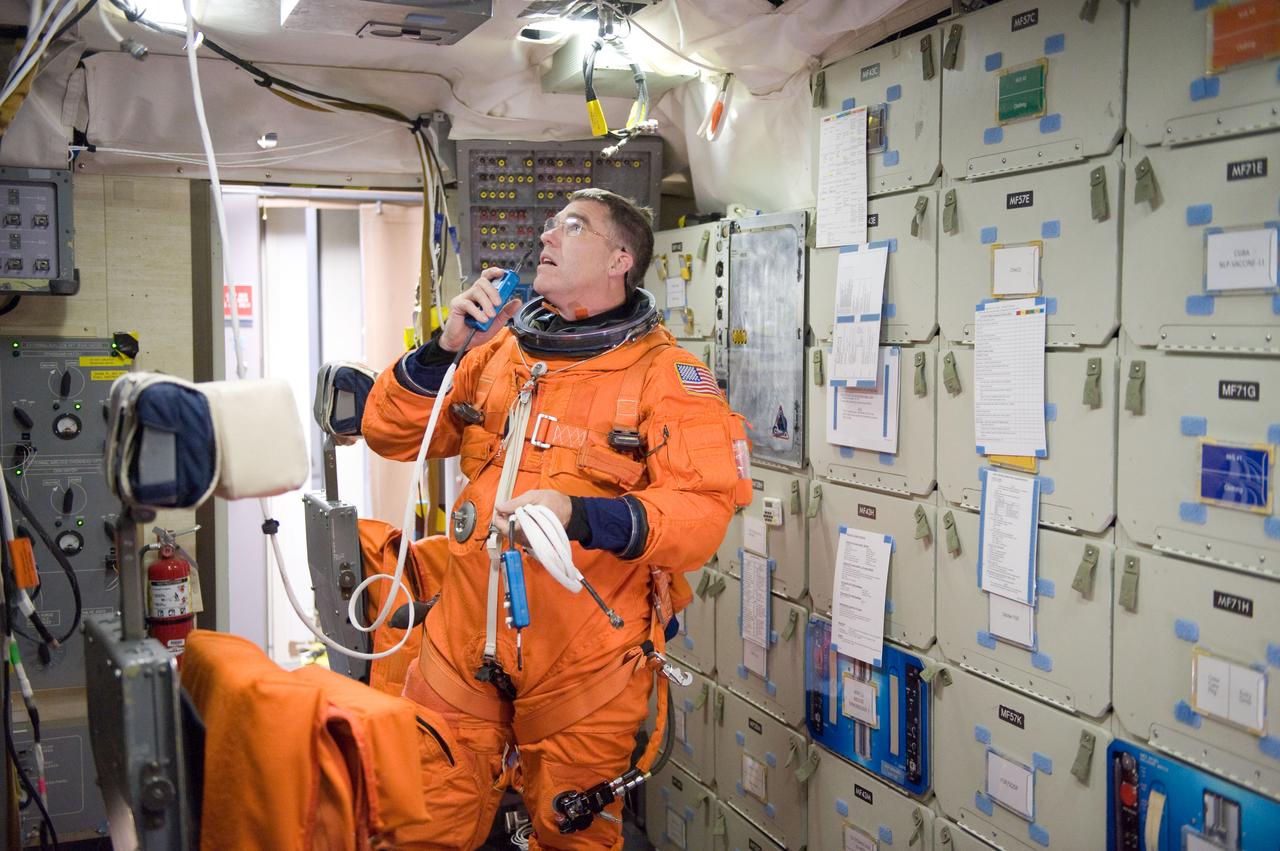
JSC2011-E-006696 (27 Jan. 2011) --- NASA astronaut Steve Bowen, STS-133 mission specialist, attired in a training version of his shuttle launch and entry suit, uses a communication system during a training session in the fixed-base shuttle mission simulator (SMS) in the Jake Garn Simulation and Training Facility at NASA's Johnson Space Center. Photo credit: NASA or National Aeronautics and Space Administration
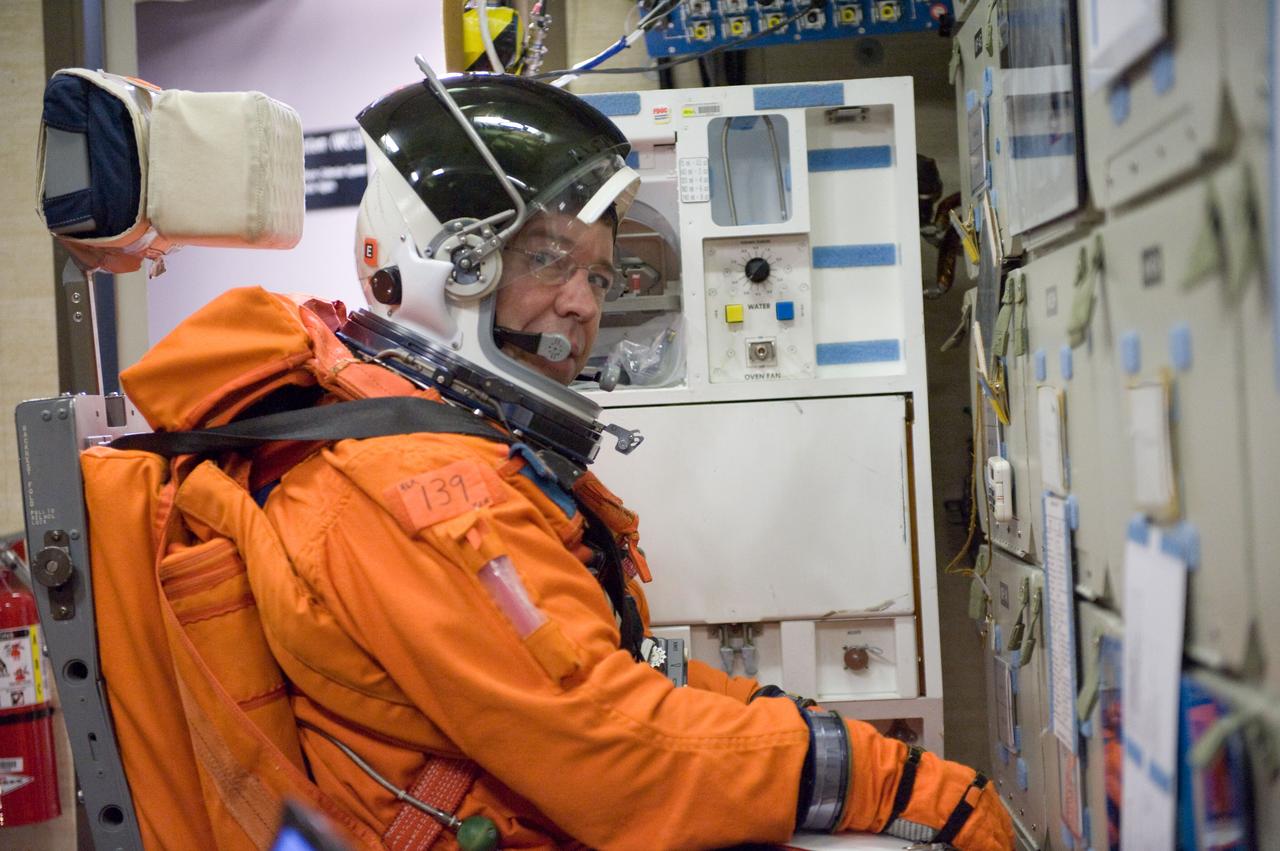
JSC2011-E-006691 (27 Jan. 2011) --- NASA astronaut Steve Bowen, STS-133 mission specialist, attired in a training version of his shuttle launch and entry suit, participates in a training session in the fixed-base shuttle mission simulator (SMS) in the Jake Garn Simulation and Training Facility at NASA's Johnson Space Center. Photo credit: NASA or National Aeronautics and Space Administration
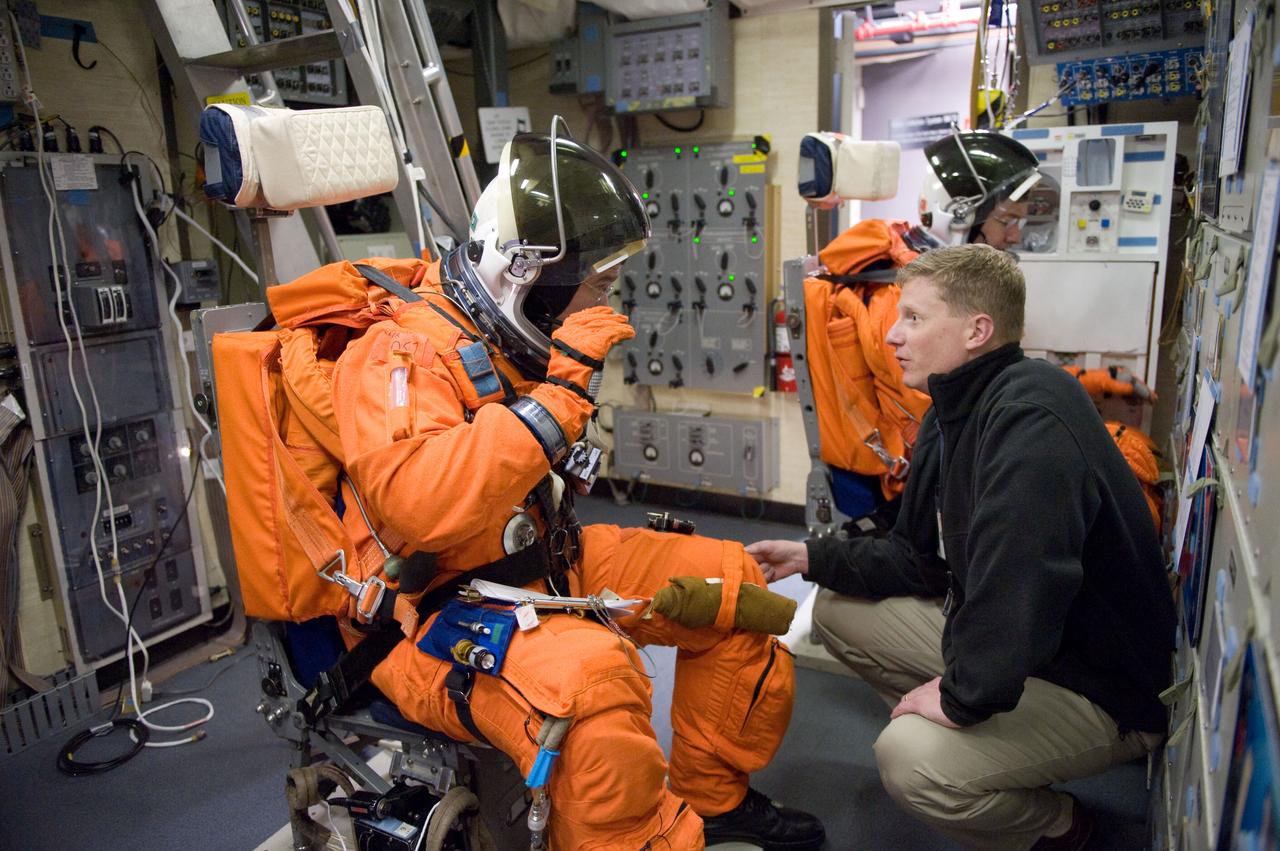
JSC2011-E-006687 (27 Jan. 2011) --- NASA astronauts Steve Bowen (left foreground) and Michael Barratt, both STS-133 mission specialists, attired in training versions of their shuttle launch and entry suits, participate in a training session in the fixed-base shuttle mission simulator (SMS) in the Jake Garn Simulation and Training Facility at NASA's Johnson Space Center. Crew instructor Gary W. Kilgo assisted the crew members. Photo credit: NASA or National Aeronautics and Space Administration
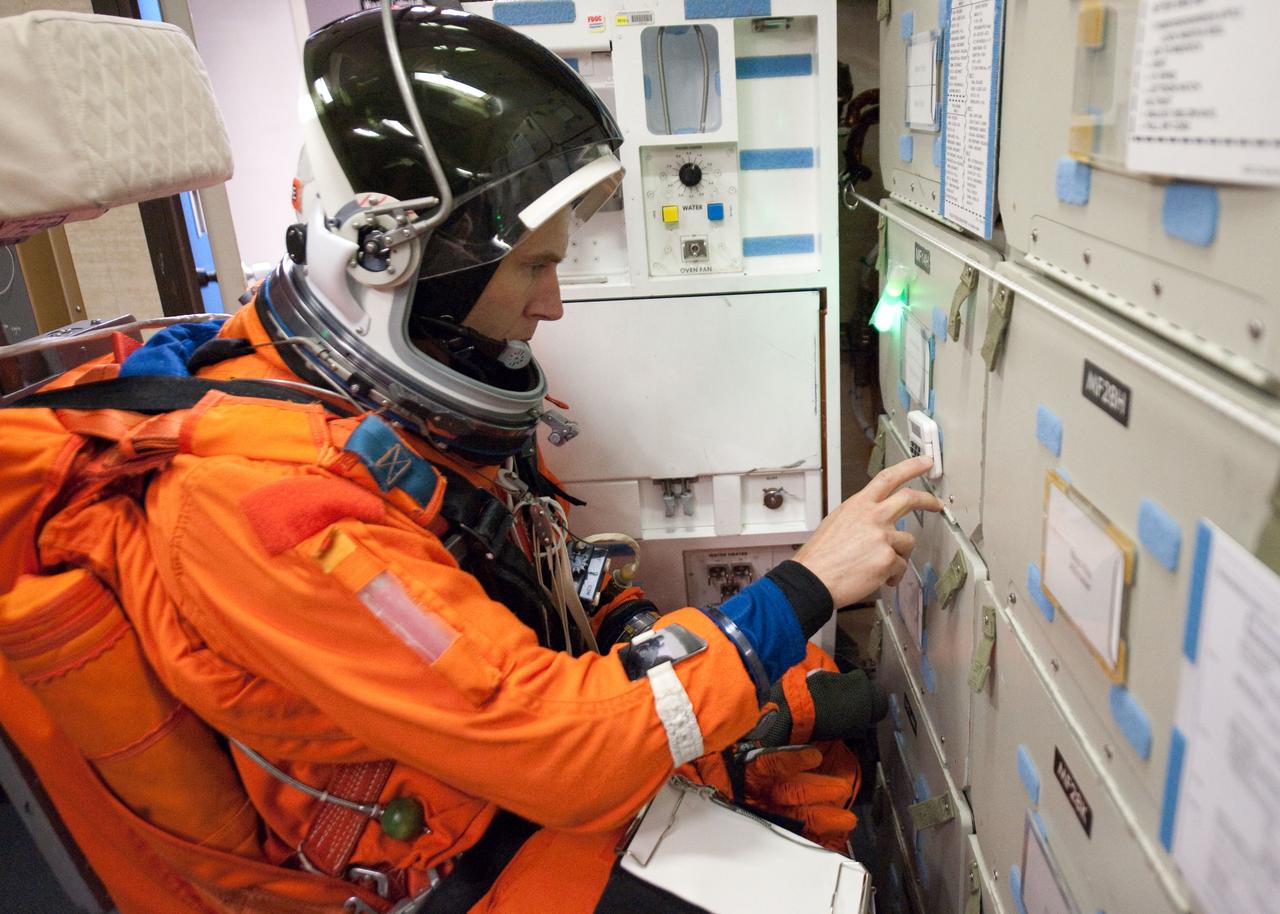
JSC2010-E-124284 (8 Sept. 2010) --- NASA astronaut Andrew Feustel, attired in a training version of his shuttle launch and entry suit, participates in a training session in the fixed-base shuttle mission simulator (SMS) in the Jake Garn Simulation and Training Facility at NASA?s Johnson Space Center. Photo credit: NASA or National Aeronautics and Space Administration
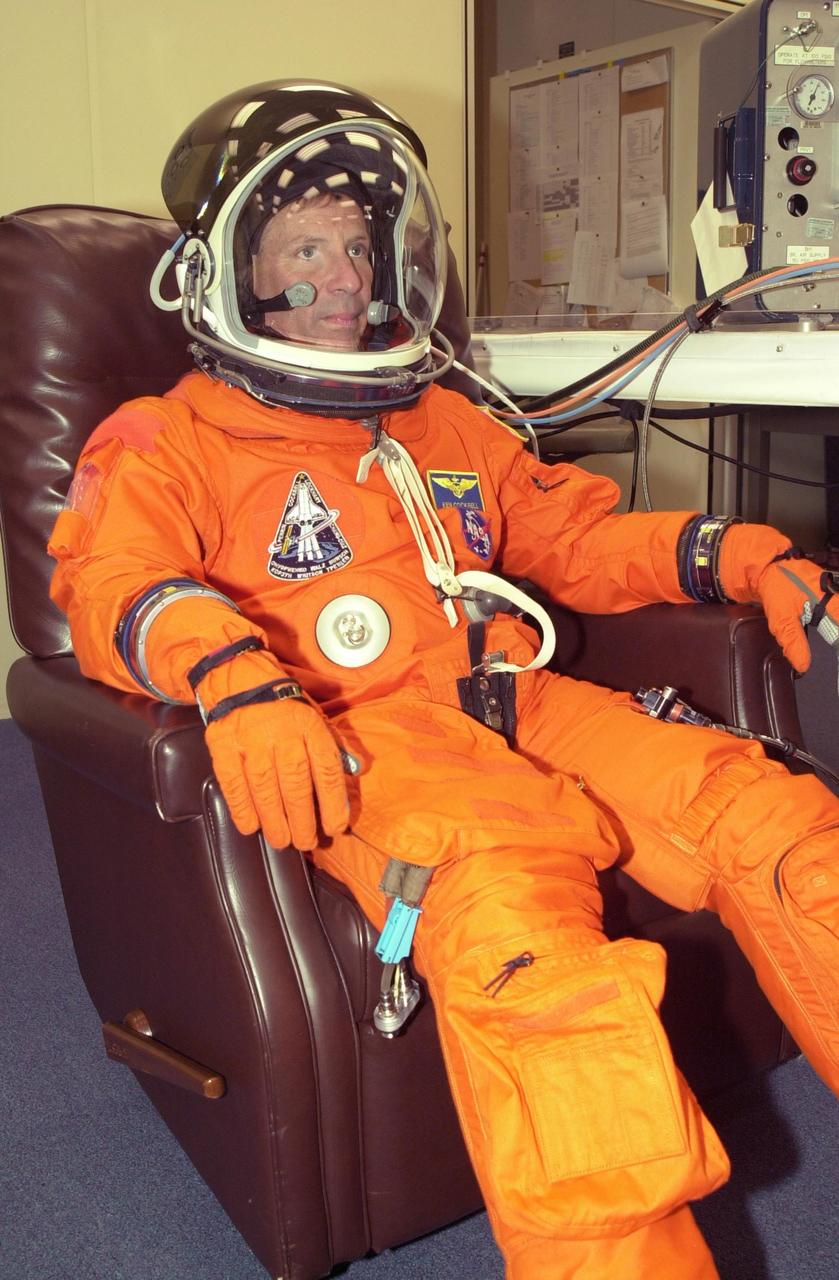
KENNEDY SPACE CENTER, FLA. - STS-111 Commander Kenneth Cockrell has suited up in preparation for a simulated launch countdown at the pad. The simulation is part of STS-111 Terminal Countdown Demonstration Test activities for the crew and Expedition 5. The payload on the mission to the International Space Station includes the Mobile Base System, an Orbital Replacement Unit and Multi-Purpose Logistics Module Leonardo. The Expedition 5 crew is traveling on Endeavour to replace the Expedition 4 crew on the Station. Launch of Endeavour is scheduled for May 30, 2002
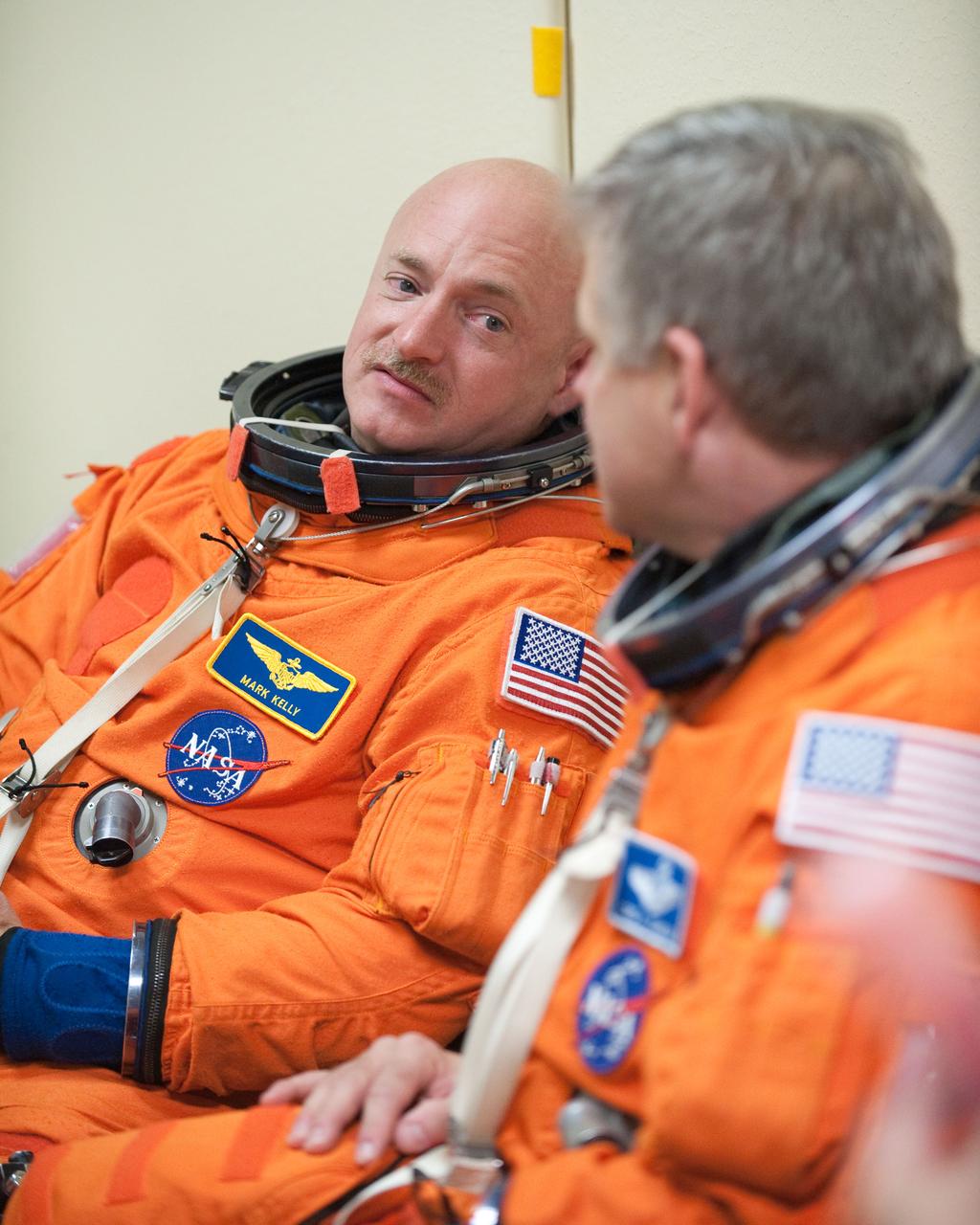
JSC2010-E-124272 (8 Sept. 2010) --- NASA astronauts Mark Kelly (background) and Gregory H. Johnson, STS-134 commander and pilot, respectively, attired in training versions of their shuttle launch and entry suits, prepare for a training session in the fixed-base shuttle mission simulator (SMS) in the Jake Garn Simulation and Training Facility at NASA?s Johnson Space Center. Photo credit: NASA or National Aeronautics and Space Administration
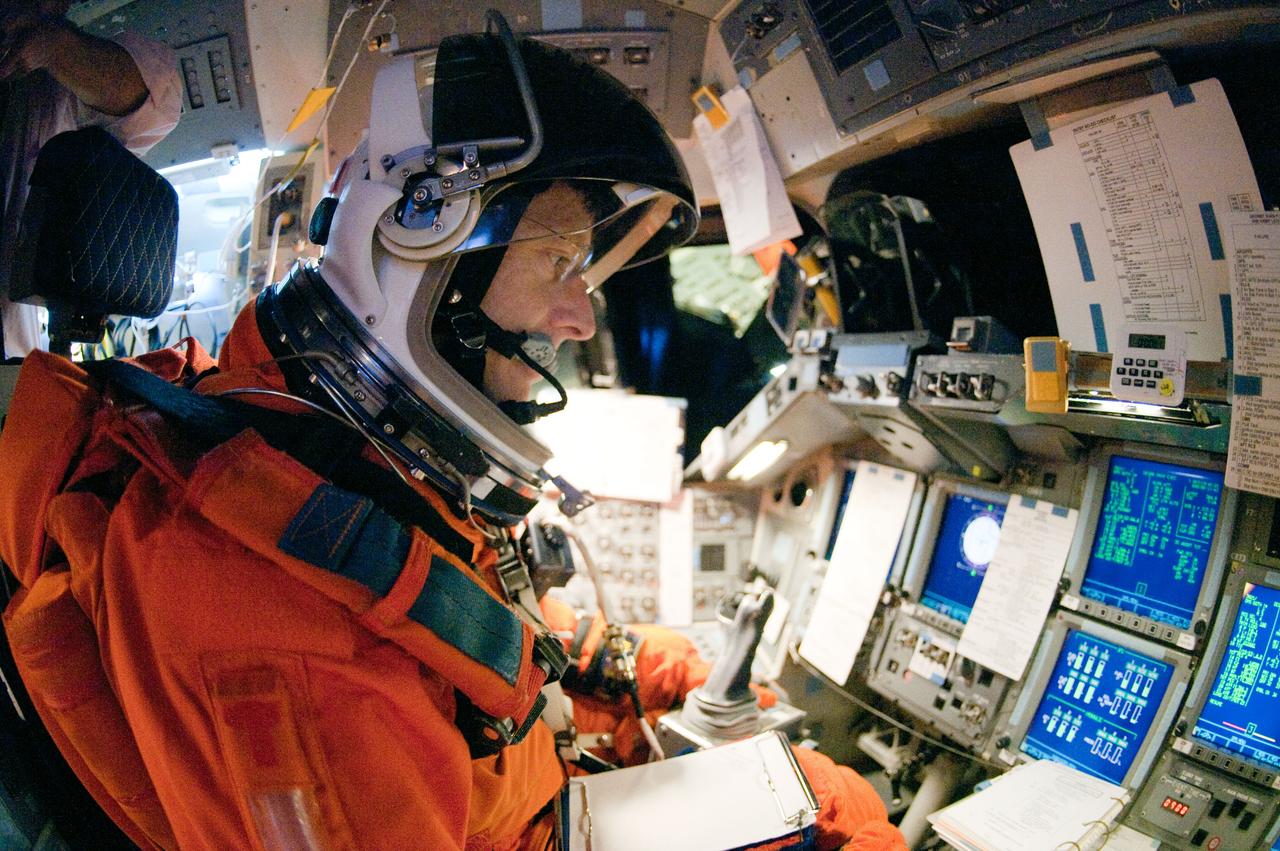
JSC2011-E-023124 (2 March 2011) --- NASA astronaut Chris Ferguson, STS-135 commander, attired in a training version of his shuttle launch and entry suit, participates in a training session in the fixed-base shuttle mission simulator (SMS) in the Jake Garn Simulation and Training Facility at NASA's Johnson Space Center. Photo credit: NASA or National Aeronautics and Space Administration
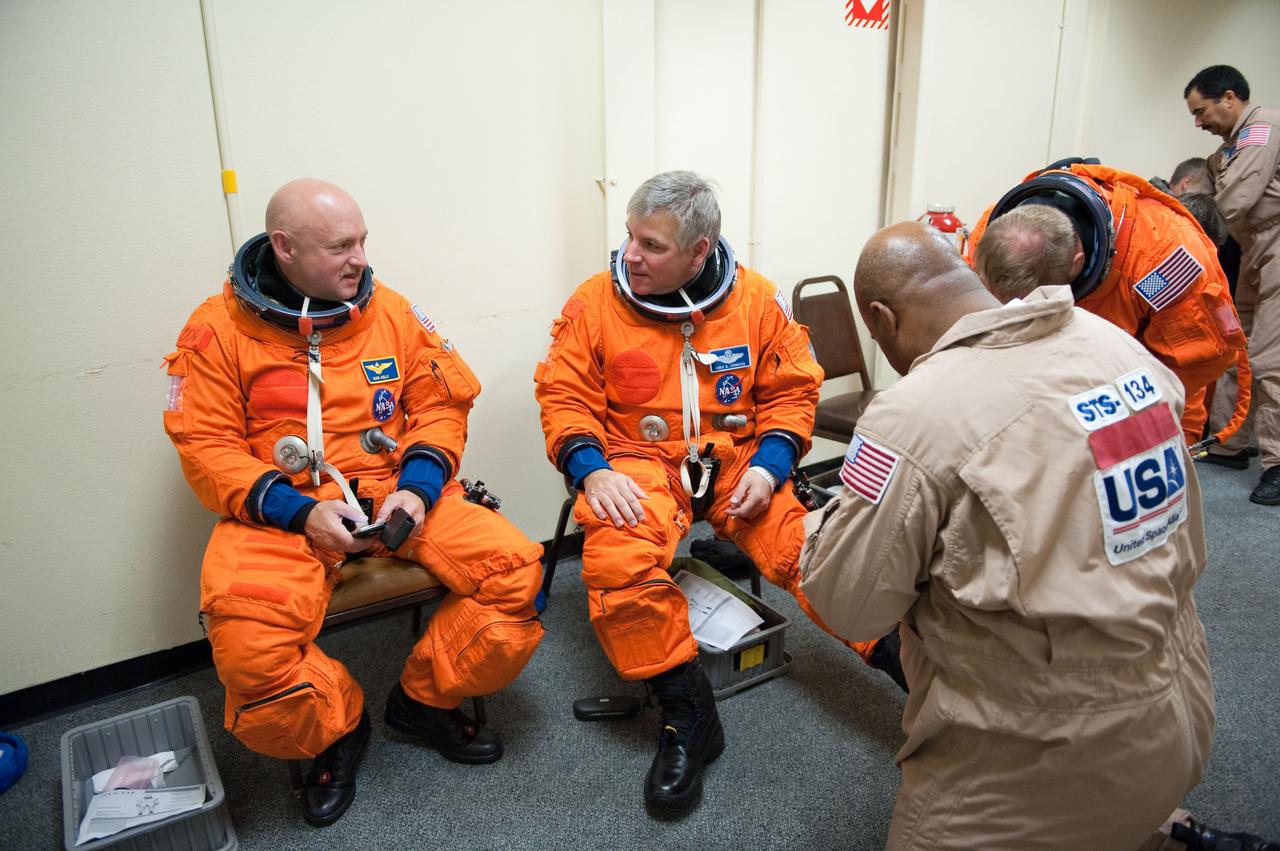
JSC2010-E-124267 (8 Sept. 2010) --- NASA astronauts Mark Kelly (left) and Gregory H. Johnson, STS-134 commander and pilot, respectively, attired in training versions of their shuttle launch and entry suits, prepare for a training session in the fixed-base shuttle mission simulator (SMS) in the Jake Garn Simulation and Training Facility at NASA?s Johnson Space Center. Photo credit: NASA or National Aeronautics and Space Administration
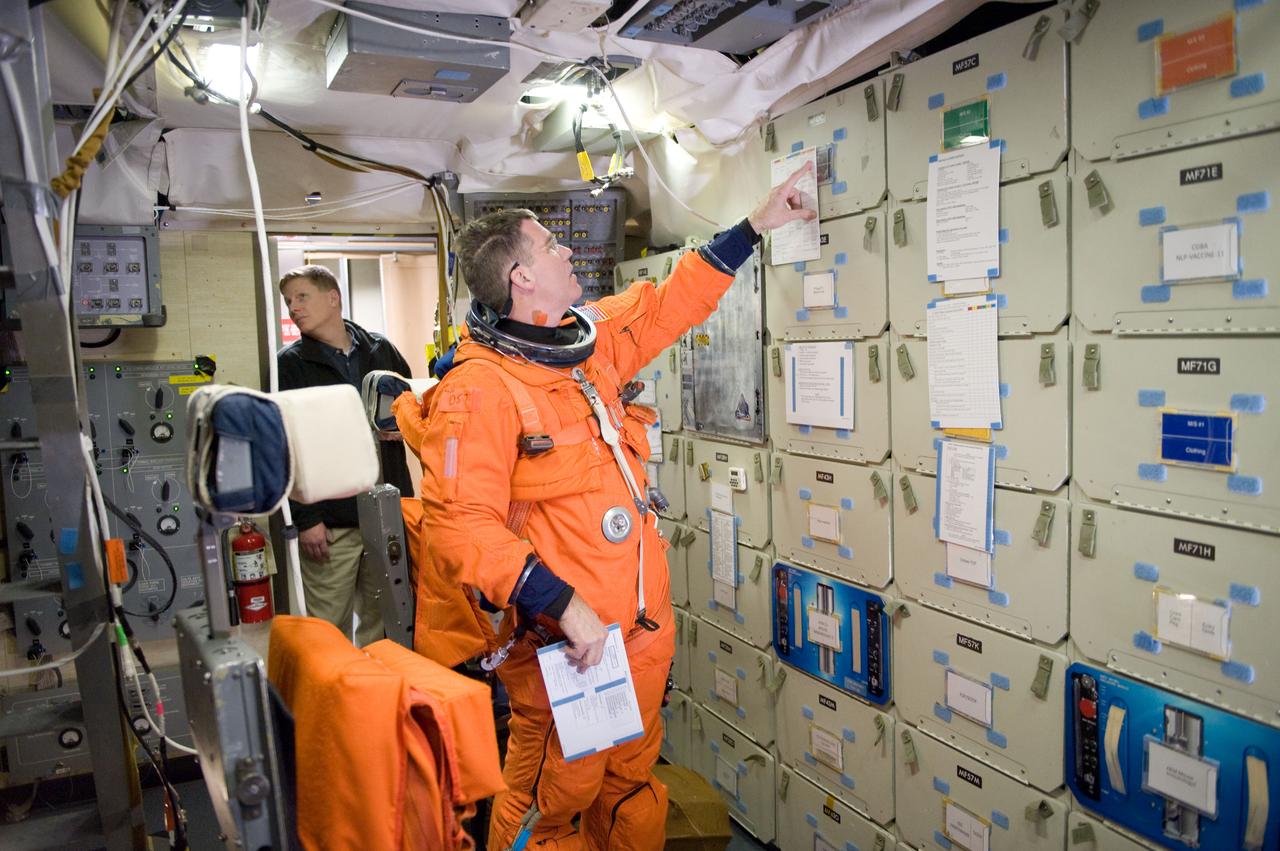
JSC2011-E-006699 (27 Jan. 2011) --- NASA astronaut Steve Bowen, STS-133 mission specialist, attired in a training version of his shuttle launch and entry suit, participates in a training session in the fixed-base shuttle mission simulator (SMS) in the Jake Garn Simulation and Training Facility at NASA's Johnson Space Center. Photo credit: NASA or National Aeronautics and Space Administration
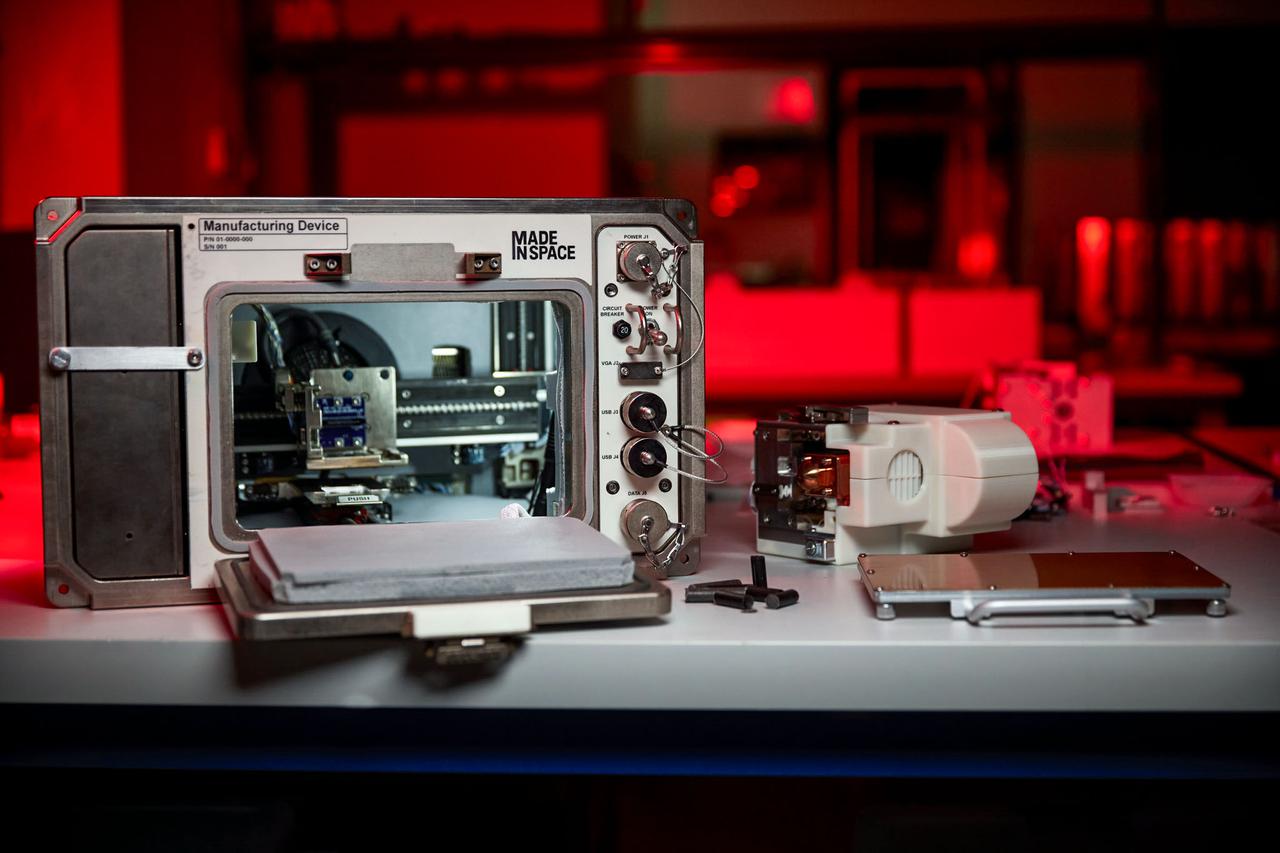
jsc2021e031160 (7/22/2021) --- The Redwire Regolith Print facility suite, consisting of Redwire's Additive Manufacturing Facility, and the print heads, plates and lunar regolith simulant feedstock that will be launching to the International Space Station. Photo courtesy of Redwire Space.

JSC2002-00866 (24 April 2002) --- Astronaut David A. Wolf, STS-112 mission specialist, wearing a training version of the full-pressure launch and entry suit, lowers himself from a simulated shuttle in trouble during an emergency egress training session in the Space Vehicle Mockup Facility at the Johnson Space Center (JSC).
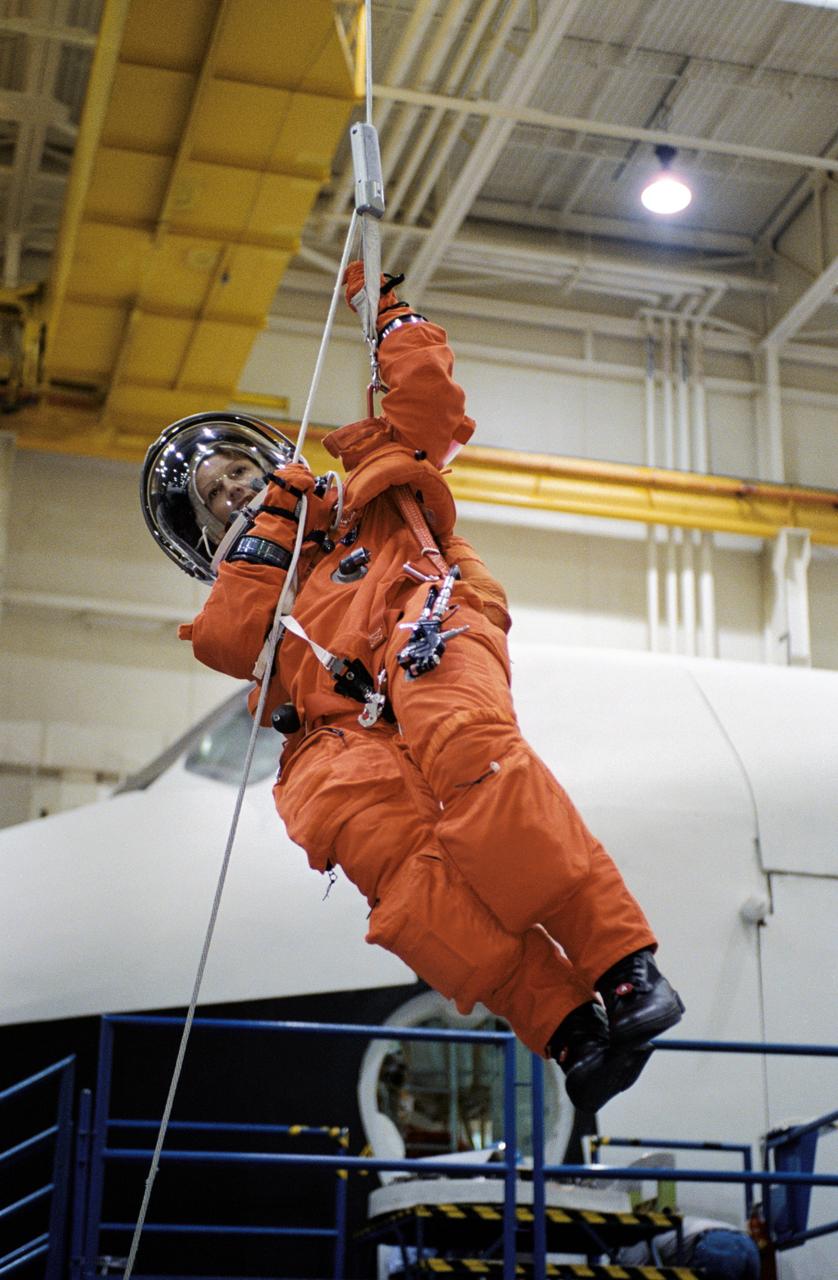
JSC2002-01651 (12 September 2002) --- Astronaut Eileen M. Collins, STS-114 mission commander, wearing a training version of the full-pressure launch and entry suit, lowers herself from a simulated shuttle in trouble during an emergency egress training session in the Space Vehicle Mockup Facility at the Johnson Space Center (JSC).
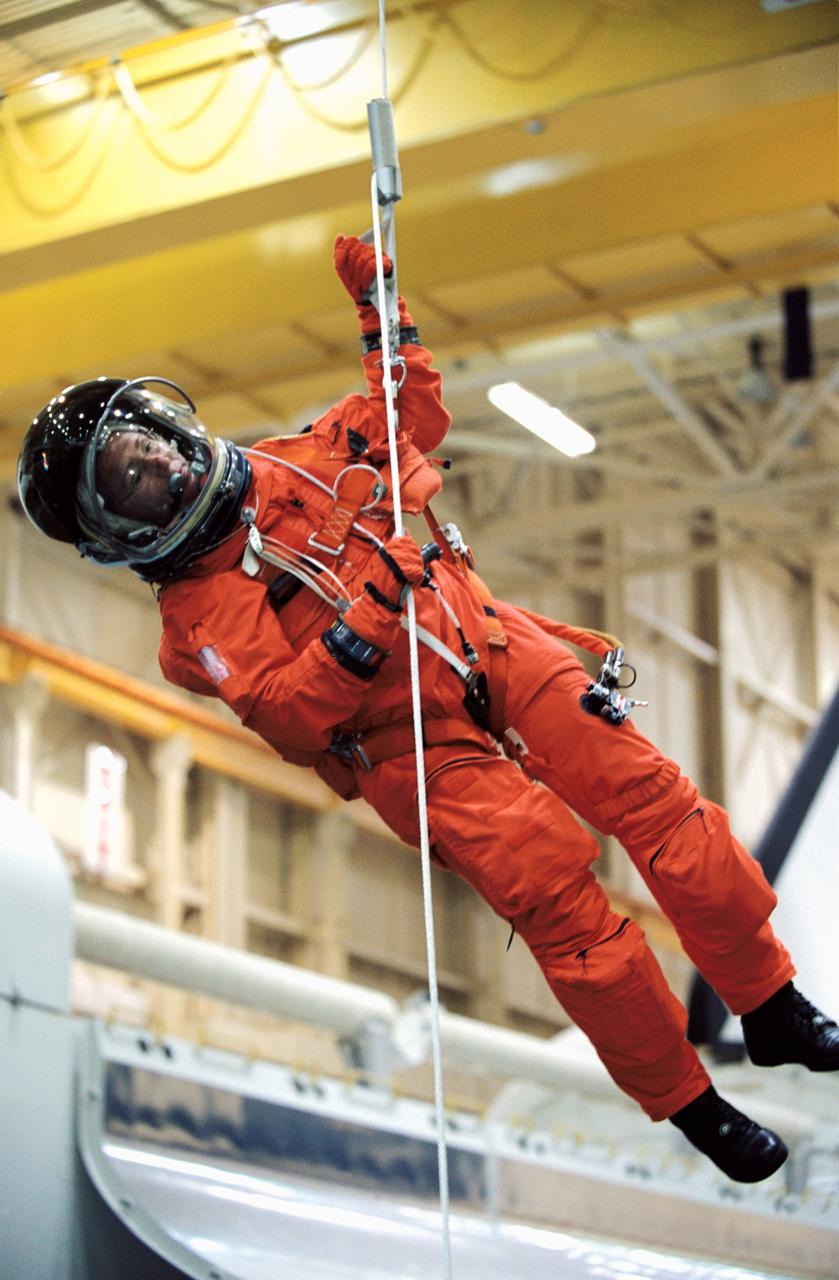
JSC2002-00879 (24 April 2002) --- Astronaut Sandra H. Magnus, STS-112 mission specialist, wearing a training version of the full-pressure launch and entry suit, lowers herself from a simulated shuttle in trouble during an emergency egress training session in the Space Vehicle Mockup Facility at the Johnson Space Center (JSC).
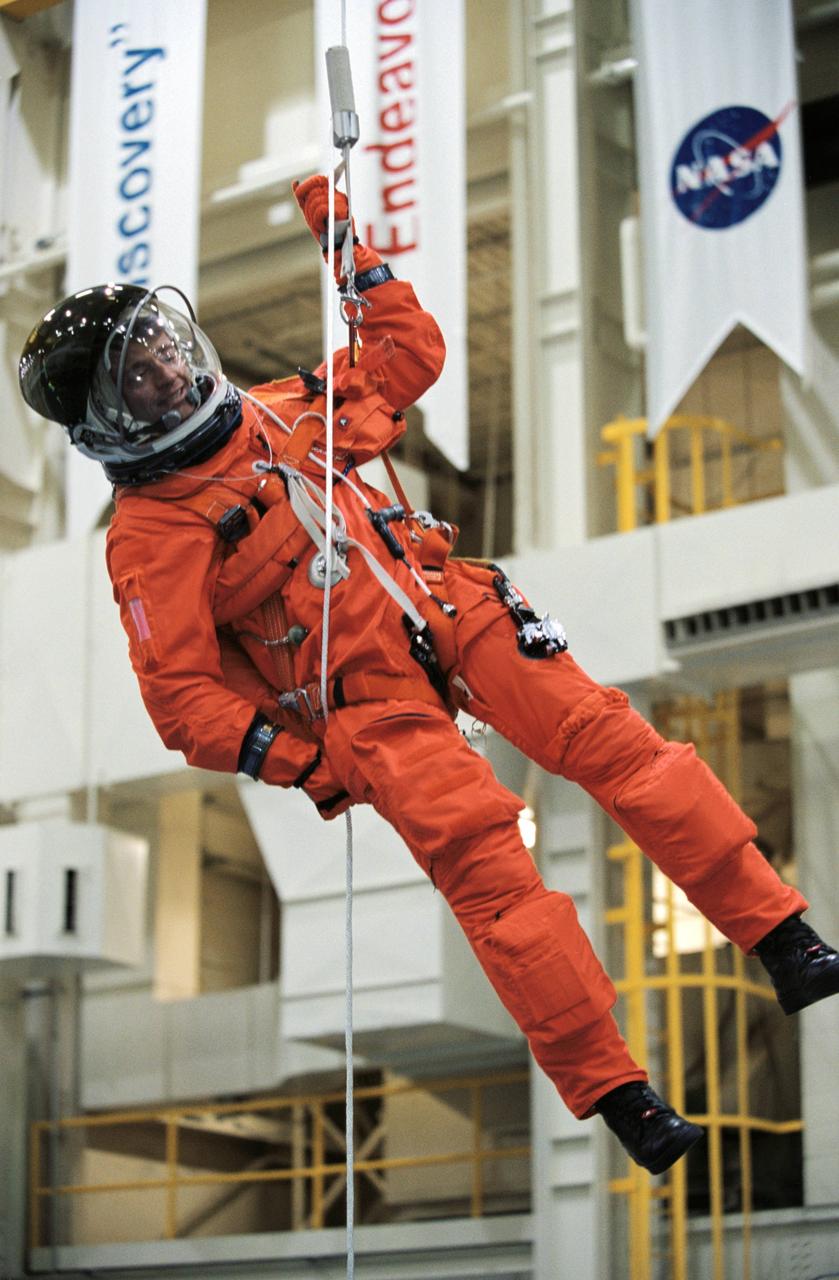
JSC2002-00868 (24 April 2002) --- Astronaut Jeffrey S. Ashby, STS-112 mission commander, wearing a training version of the full-pressure launch and entry suit, lowers himself from a simulated shuttle in trouble during an emergency egress training session in the Space Vehicle Mockup Facility at the Johnson Space Center (JSC).

JSC2009-E-286678 (21 Dec. 2009) --- Astronaut Nicholas Patrick, STS-130 mission specialist, attired in a training version of his shuttle launch and entry suit, participates in a training session in the Mission Simulation Development Facility at NASA's Johnson Space Center.

JSC2009-E-286657 (21 Dec. 2009) --- Astronaut Terry Virts, STS-130 pilot, attired in a training version of his shuttle launch and entry suit, occupies the pilot?s station during a training session in the Mission Simulation Development Facility at NASA's Johnson Space Center.
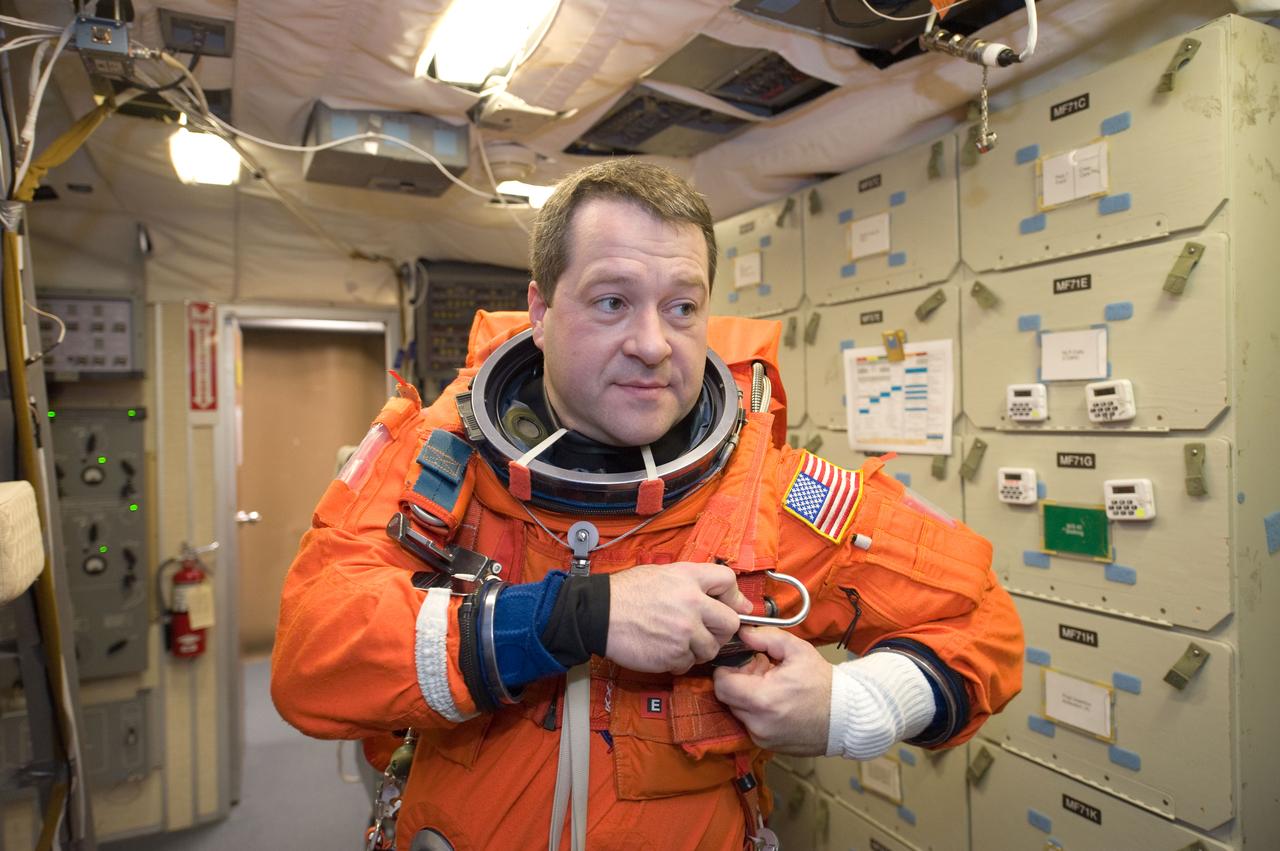
JSC2009-E-286664 (21 Dec. 2009) --- Astronaut Nicholas Patrick, STS-130 mission specialist, dons a training version of his shuttle launch and entry suit in preparation for a training session in the Mission Simulation Development Facility at NASA's Johnson Space Center.
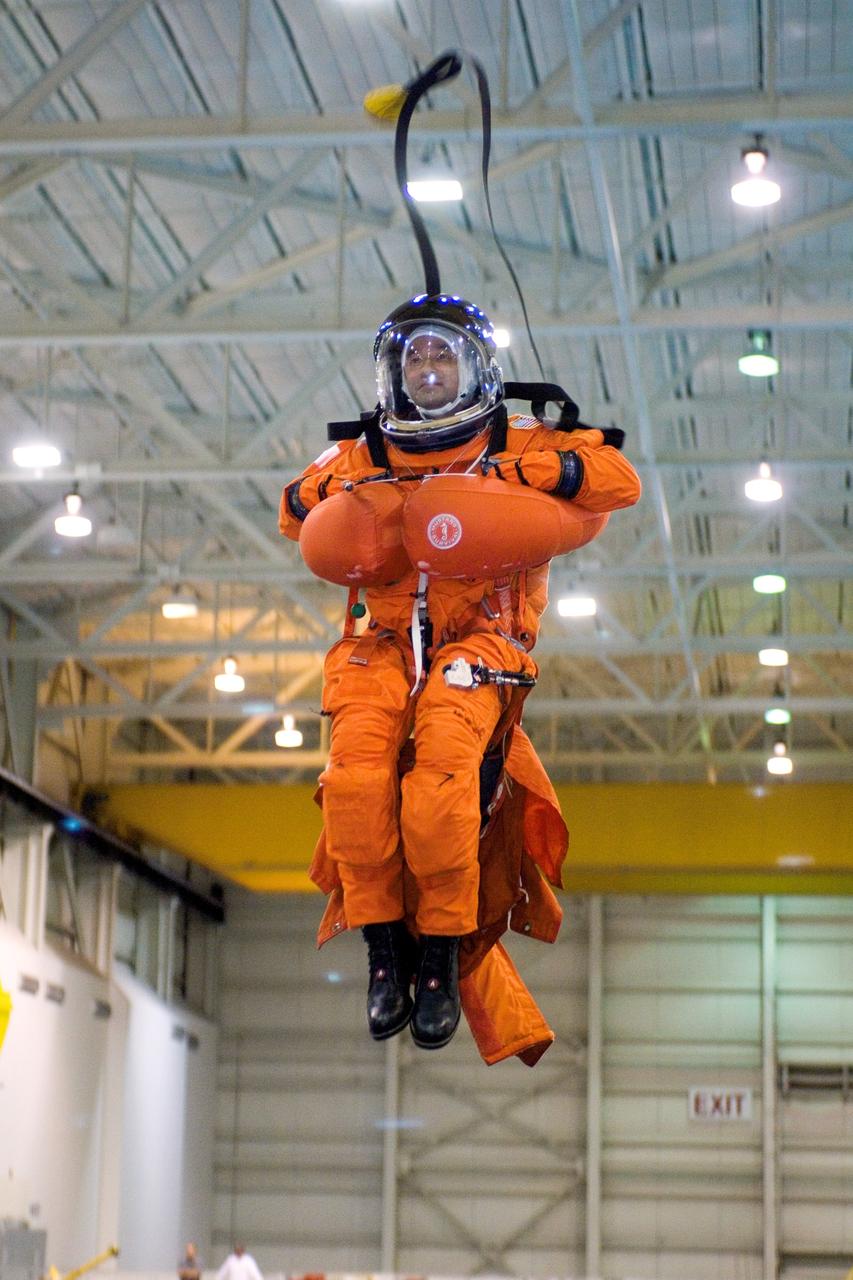
JSC2005-E-31233 (28 July 2005) --- Astronaut Mark L. Polansky, STS-116 commander, attired in a training version of the shuttle launch and entry suit, simulates a parachute drop into water during an emergency bailout training session at the Neutral Buoyancy Laboratory (NBL) near the Johnson Space Center.
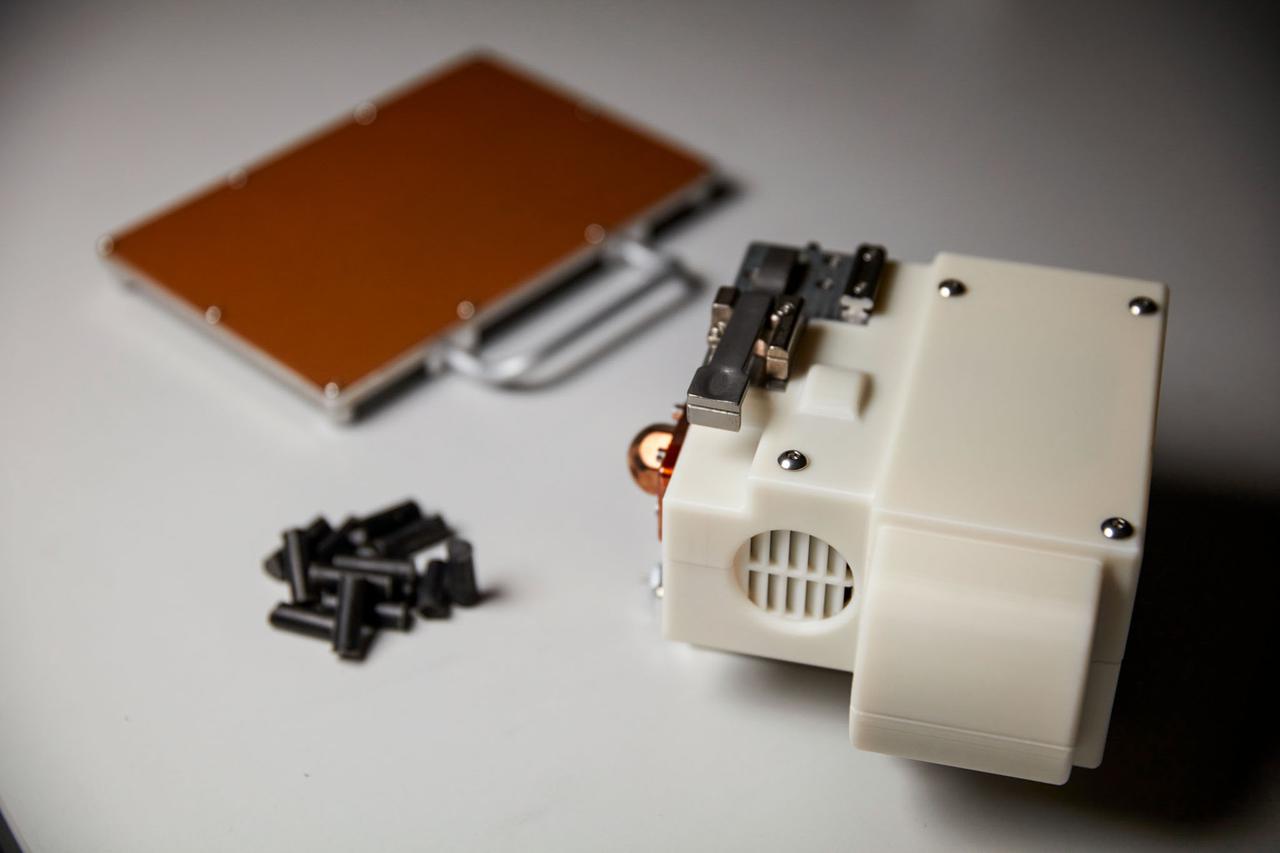
jsc2021e031161 (7/22/2021) --- A preflight view of the Redwire Regolith Print (RRP) facility suite launching aboard NG-16, including the RRP print heads, plates and lunar regolith simulant feedstock Photo courtesy of Redwire Space.

JSC2009-E-286671 (21 Dec. 2009) --- Astronaut Nicholas Patrick, STS-130 mission specialist, attired in a training version of his shuttle launch and entry suit, participates in a training session in the Mission Simulation Development Facility at NASA's Johnson Space Center.

JSC2000-02225 (March 2000) --- Astronaut Daniel C. Burbank, mission specialist, fastens the communications carrier assembly (CCA) on his launch and entry suit (LES). Burbank was about to join his six STS-106 crewmates for a simulation exercise in the Systems Integration Facility at the Johnson Space Center (JSC).
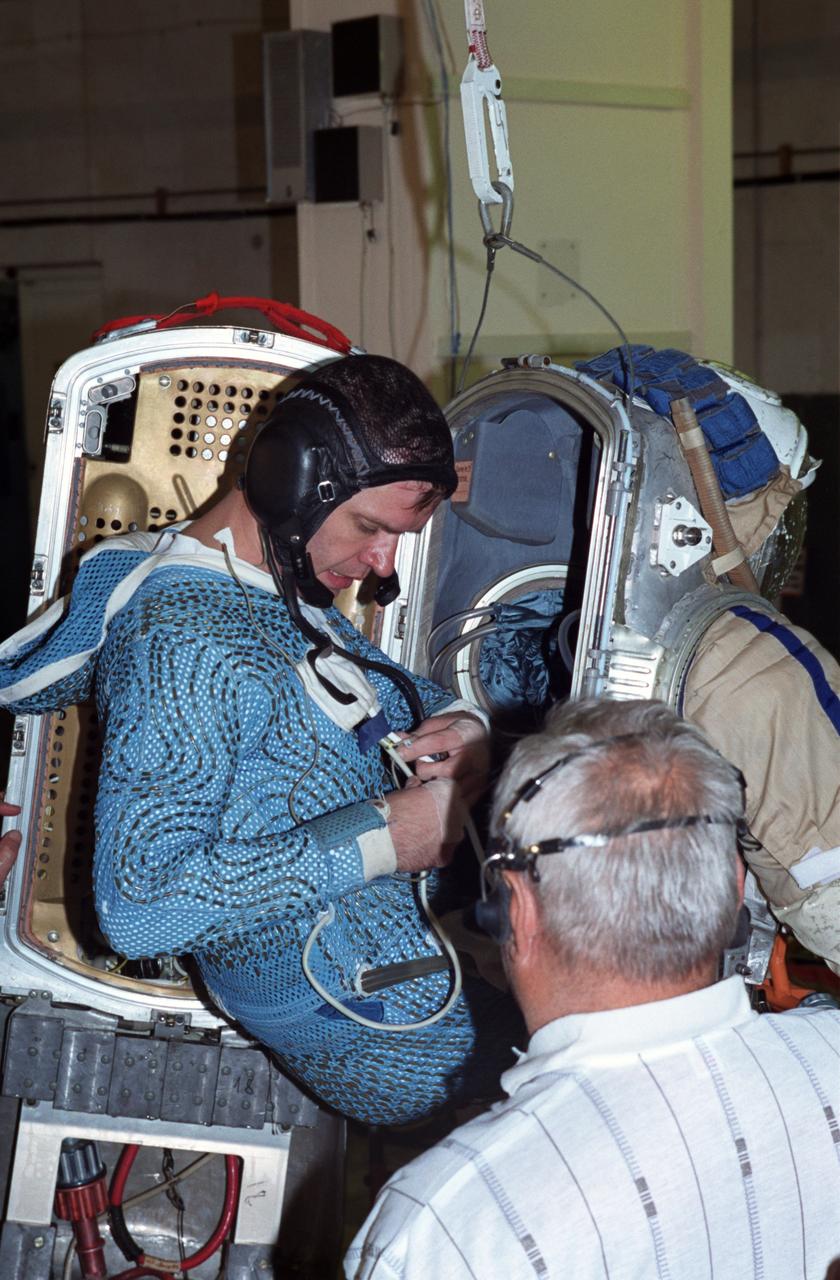
JSC2000-05364 (7 June 2000) --- Cosmonaut Yuri Gidzenko, Soyuz commander for the Expedition One crew, checks his thermal undergarment prior to donning an Orlan space suit. Gidzenko was about to participate in an underwater spacewalk simulation in the Hydrolab facility at the Gagarin Cosmonaut Training Center in Russia.