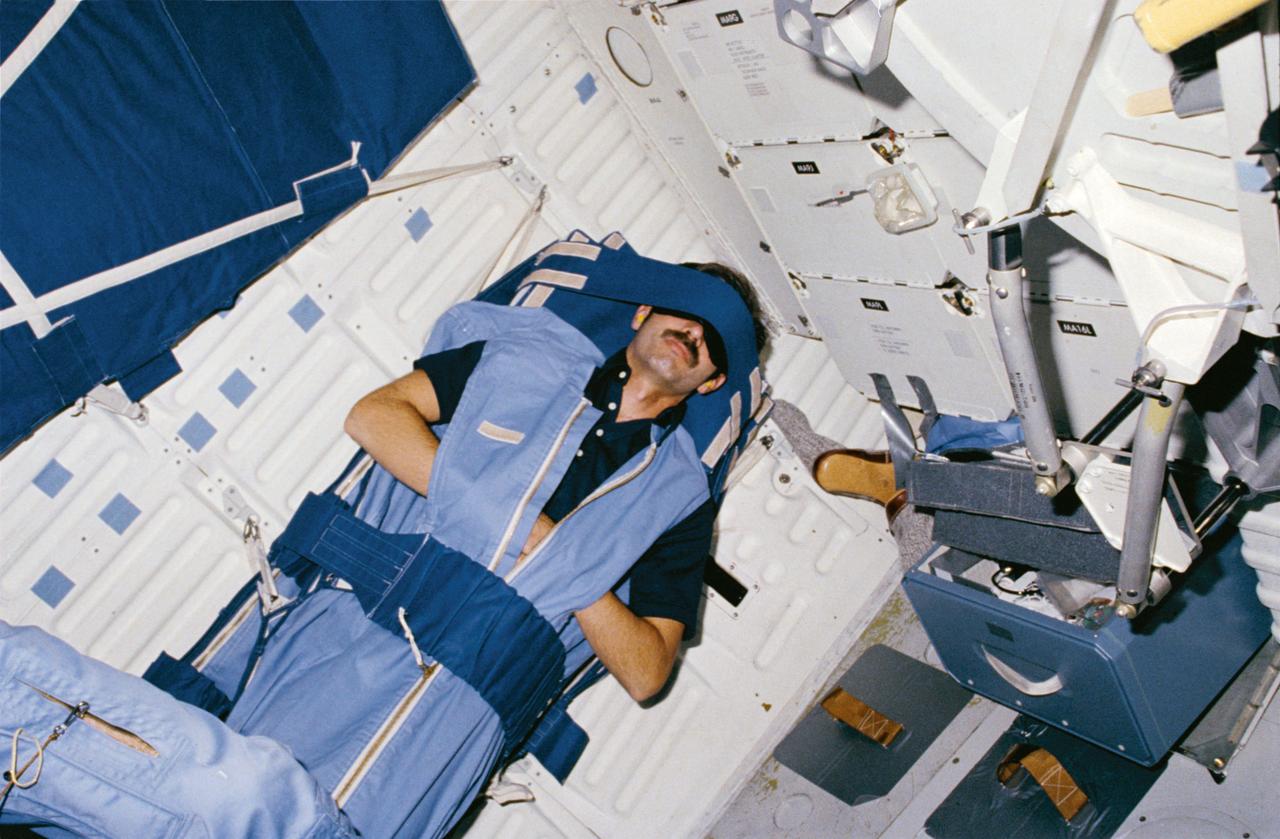
STS008-05-145 (5 Sept 1983) --- On middeck (MDK), Mission Specialist (MS) Gardner sleeps in sleep restraint attached to starboard wall. Open airlock hatch, airlock hatch hinge, and free-floating footwear appear in view.
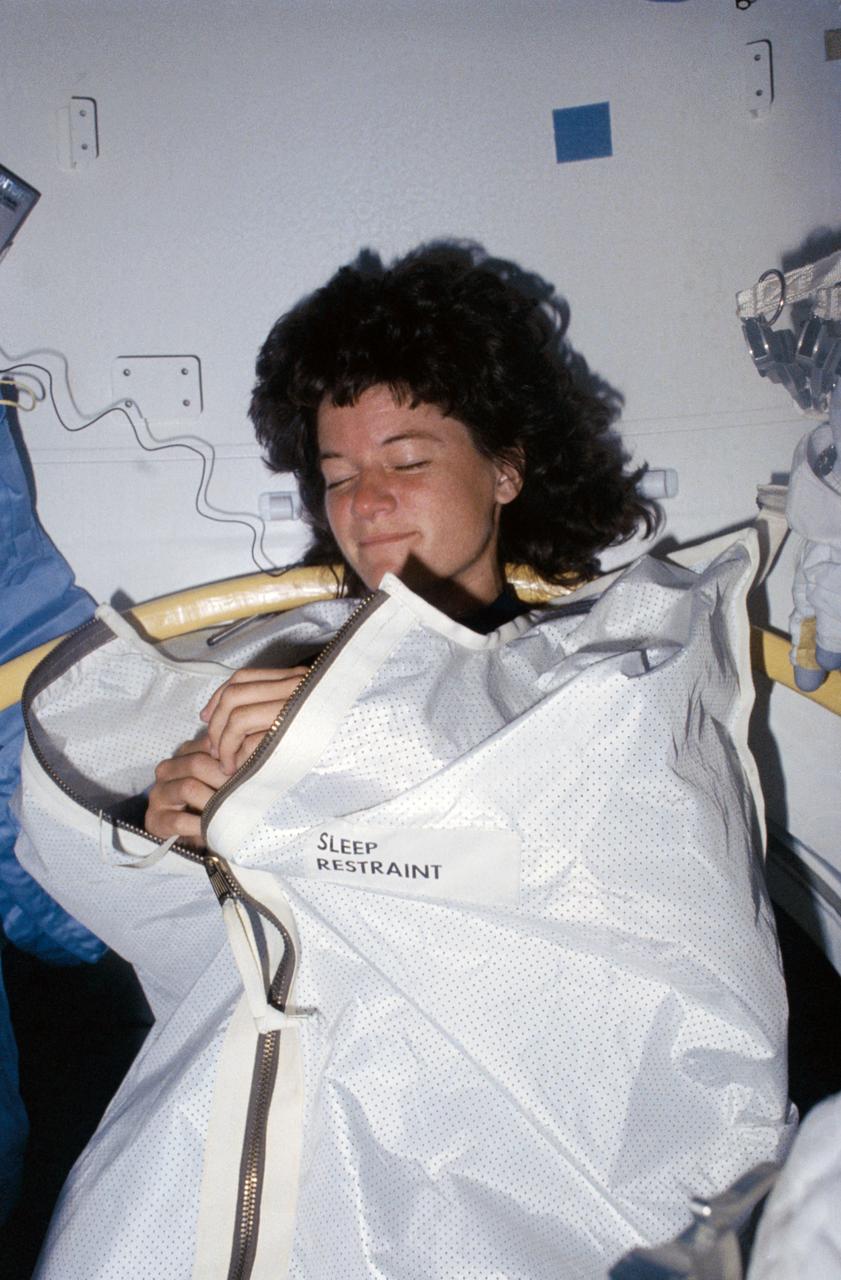
STS007-26-1438 (18-24 June 1983) --- Astronaut Sally K. Ride, mission specialist, was captured at her sleep station in the Space Shuttle Challenger's middeck by a fellow crew member using a 35mm camera. This method of sleep is just one used by the 20 astronauts who have now flown aboard NASA's first two Space Shuttle Orbiters. Some astronauts choose to sleep in various positions with either their feet or upper bodies or both anchored and others elect to use the sleep restraint device demonstrated here by Dr. Ride.

STS007-06-0314 (18-24 June 1983) --- Astronaut John M. Fabian, STS-7 mission specialist, sleeps in a zip-up blue sleep restraint device in the locker area of the Earth-orbiting space shuttle Challenger's middeck. The frame was exposed with a 35mm camera. Photo credit: NASA

Scientist-Astronaut Joseph P. Kerwin, Skylab 2 science pilot, is photographed strapped into the sleep restraint in the crew quarters of the Orbital Workshop of the Skylab 1 and 2 space station cluster in Earth orbit. Kerwin is wearing the special cap which contains biomedical instrumentation for the M133 Sleep Monitoring Experiment. The purpose of the M133 experiment is to evaluate quantity and quality of sleep during prolonged space flight by the analysis of electroencephalographic (EEG) and electrooculographic (EOG) activity.

SL3-111-1505 (July-September 1973) --- View of scientist-astronaut Owen K. Garriott, Skylab 3 science pilot, in his sleep restraints in the crew quarters of the Orbital Workshop (OWS). Photo credit: NASA
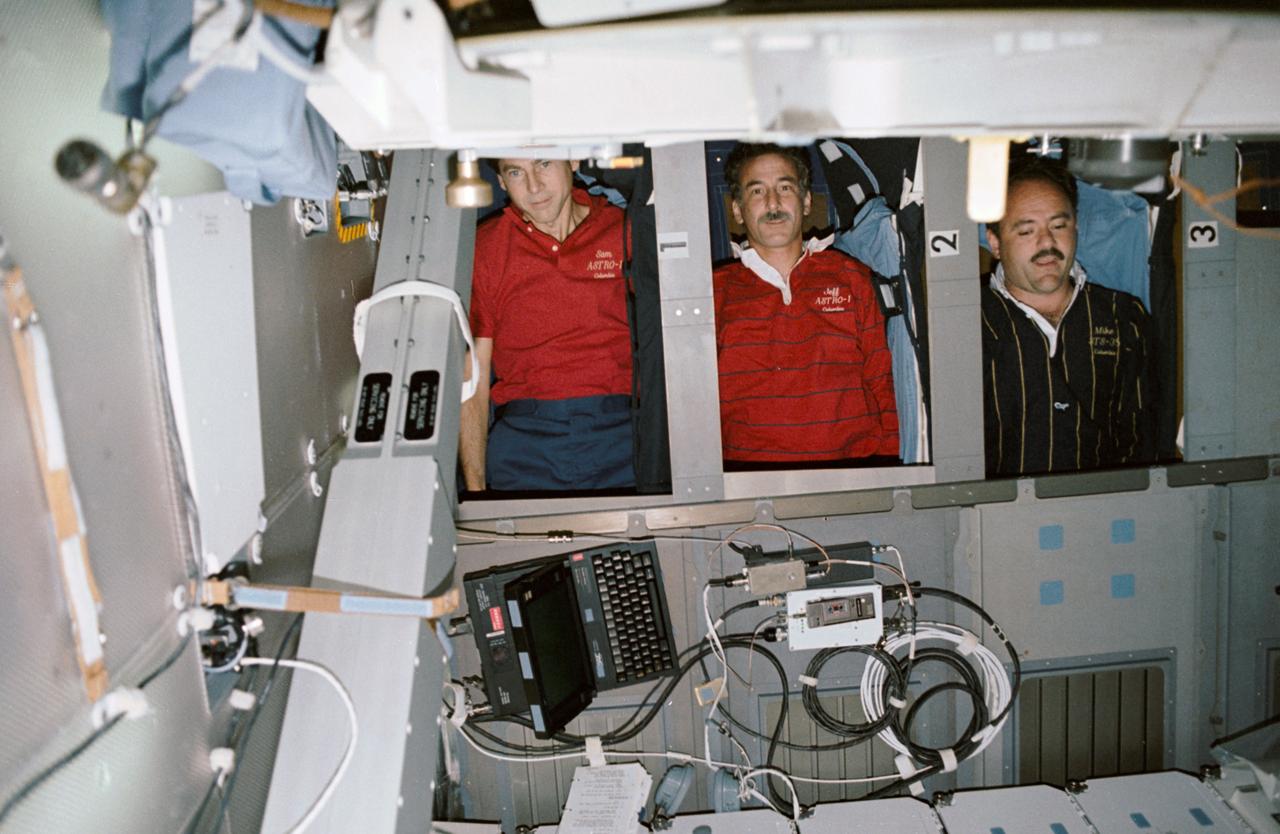
Though they are not actually asleep, three STS-35 crewmembers demonstrate the bunk-style sleep compartments onboard Columbia's, Orbiter Vehicle (OV) 102's, middeck. From top to bottom are Payload Specialist Samuel T. Durrance, Mission Specialist (MS) Jeffrey A. Hoffman, and MS John M. Lounge. At the left is the shuttle amateur radio experiment (SAREX). The crew escape pole (CES) is visible overhead and the open airlock hatch in the foreground. The sleep station is located against the middeck starboard wall.

STS007-26-1439 (18-24 June 1983) --- Astronaut John M. Fabian, STS-7 mission specialist, is captured with a 35mm camera at his sleep station in the middeck of the Earth-orbiting space shuttle Challenger. This scene was selected by the five-member astronaut crew for showing at its July 1, 1983 Post Flight Press Conference (PFPC) at the Johnson Space Center's (JSC) main auditorium. Photo credit: NASA
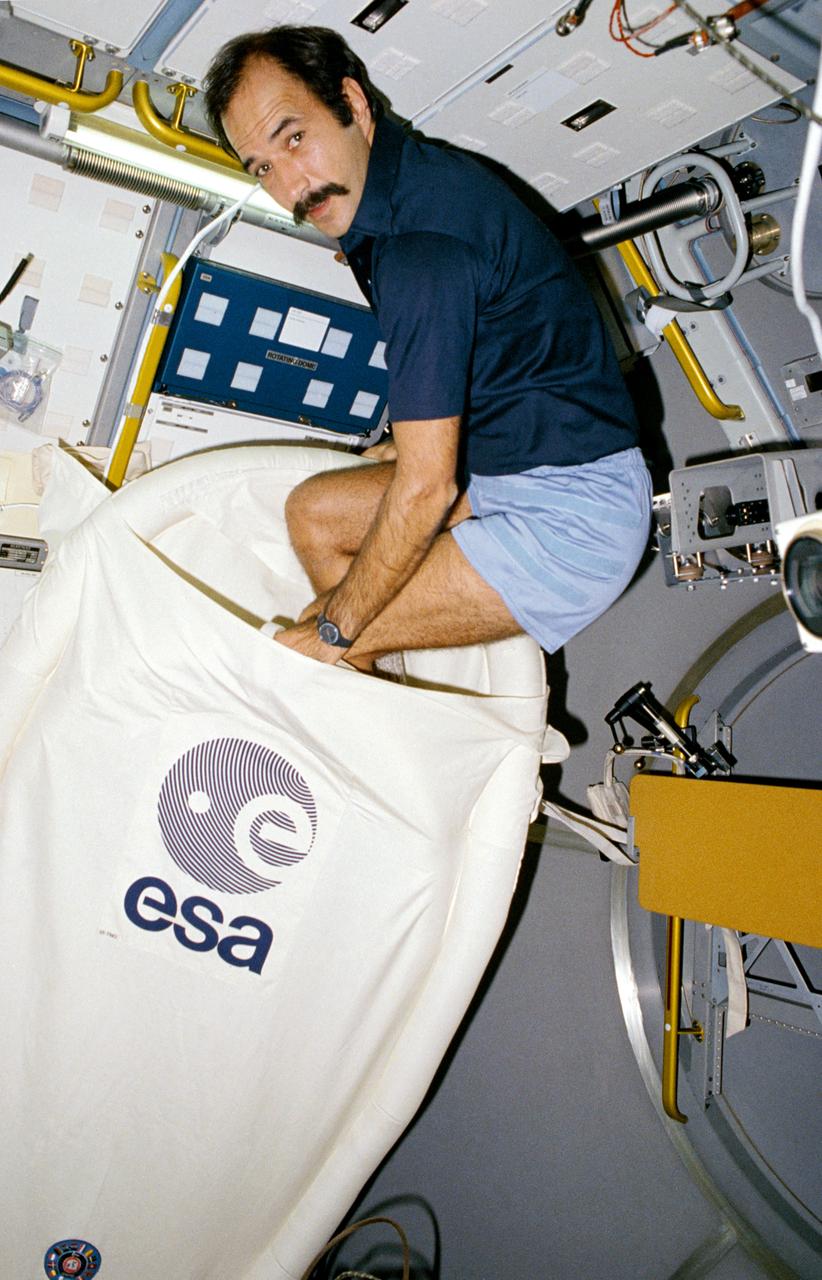
61A-08-018 (30 Oct.-6 Nov. 1985) --- Wubbo J. Ockels, a Dutch scientists representing the European Space Agency (ESA), crawls from an unique sleeping restraint in D-1 science module. Unlike the other crewmembers on STS 61A, Ockels did not sleep in the middeck of the Challenger. Ockels proposed this concept of sleeping facility and the actual hardware was developed by the Technisch Natur Wetenschappelyk Onderzoek (TNO), a Dutch government organization.
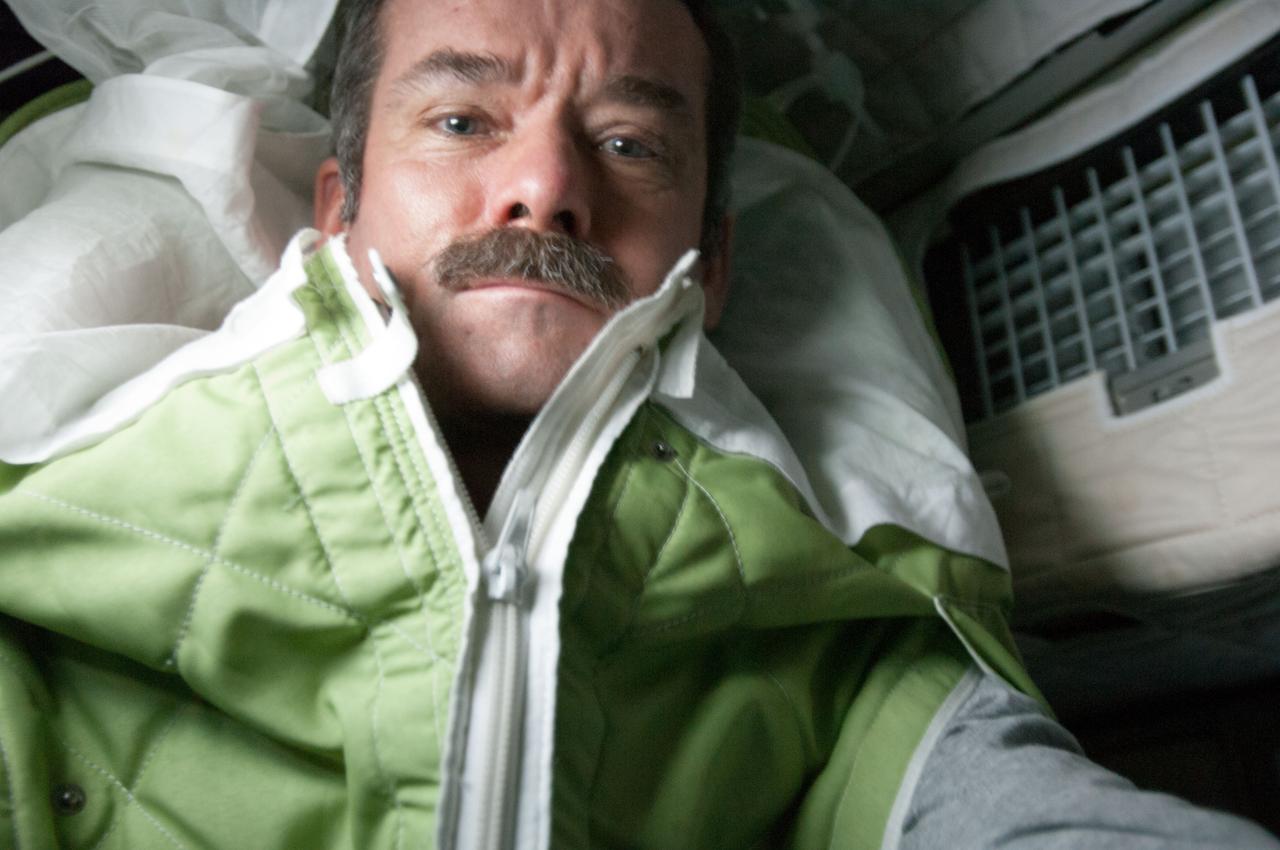
View of Canadian Space Agency (CSA) Chris Hadfield, Expedition 34 Flight Engineer (FE), in sleep station, in the Node 2. Photo was taken during Expedition 34.
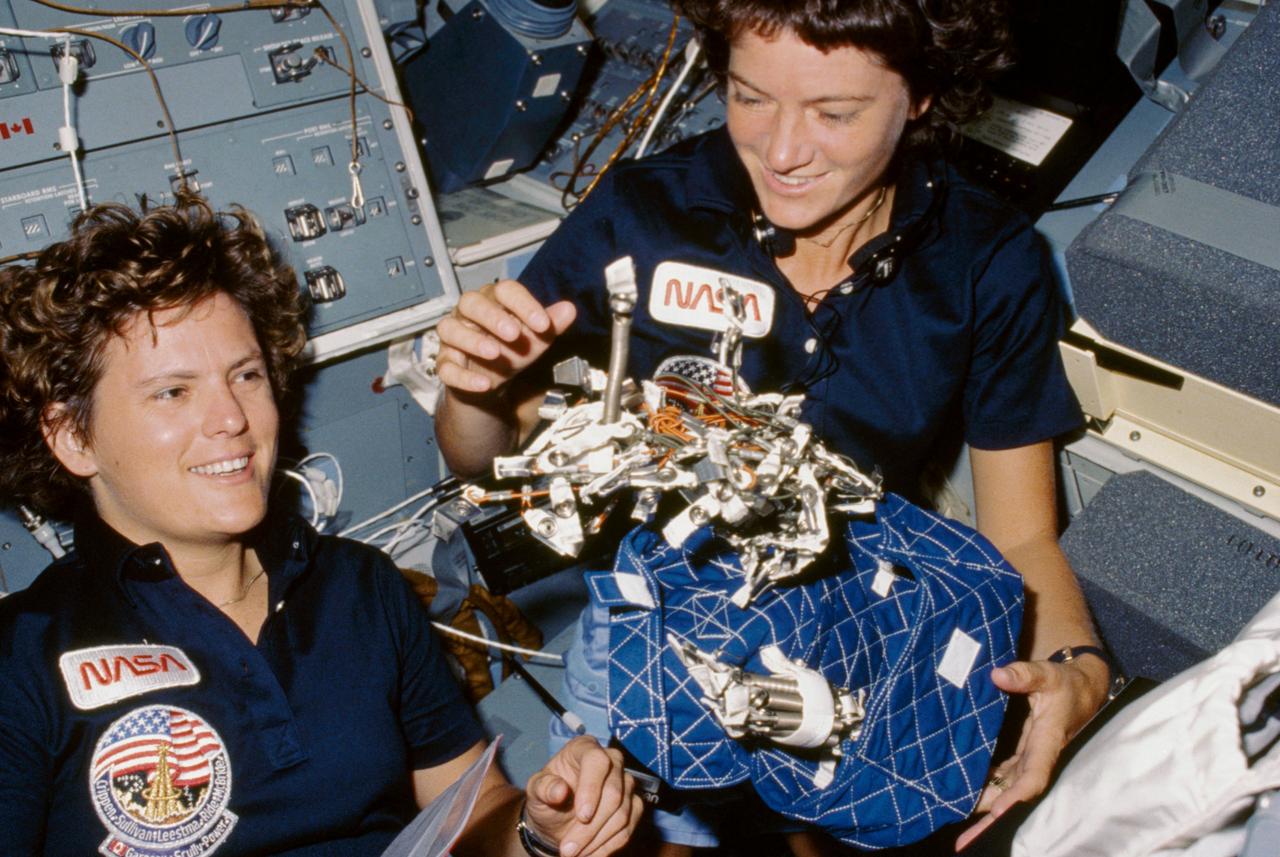
41G-07-021 (5-13 October 1984) --- Astronauts Kathryn D. Sullivan, left, and Sally K. Ride show off what appears to be a "bag of worms", a product of their creativity. The "bag" is a sleep restraint and the majority of the "worms" are springs and clips used with the sleep restraint in its normal application. Clamps, a bungee cord and Velcro strips are other recognizable items in the "creation".
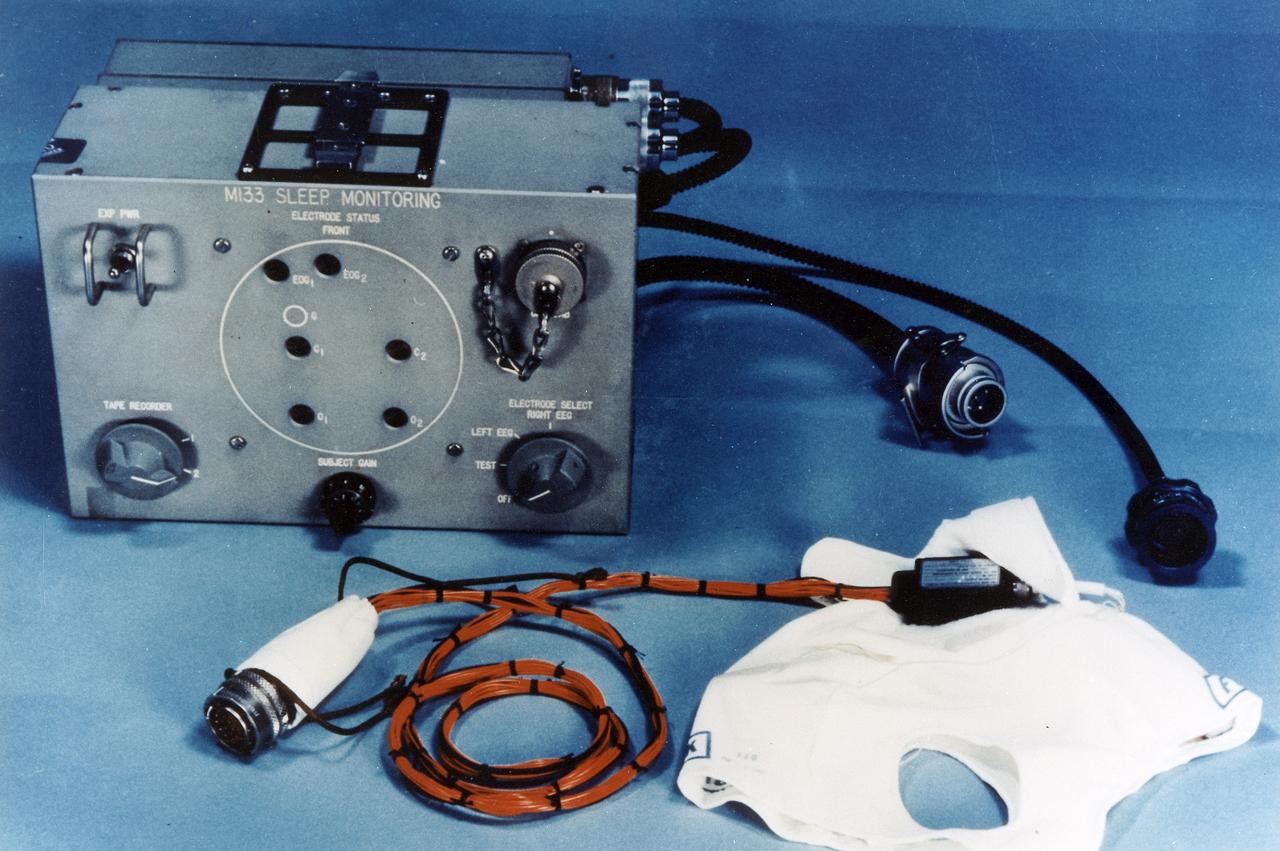
This 1970 photograph shows equipment for the Skylab's Sleep Monitoring Experiment (M133), a medical evaluation designed to objectively determine the amount and quality of crewmembers' inflight sleep. The experiment monitored and recorded electroencephalographic (EEG) and electrooculographic (EOG) activity during astronauts' sleep periods. One of the astronauts was selected for this experiment and wore a fitted cap during his sleep periods. The Marshall Space Flight Center had program management responsibility for the development of Skylab hardware and experiments.
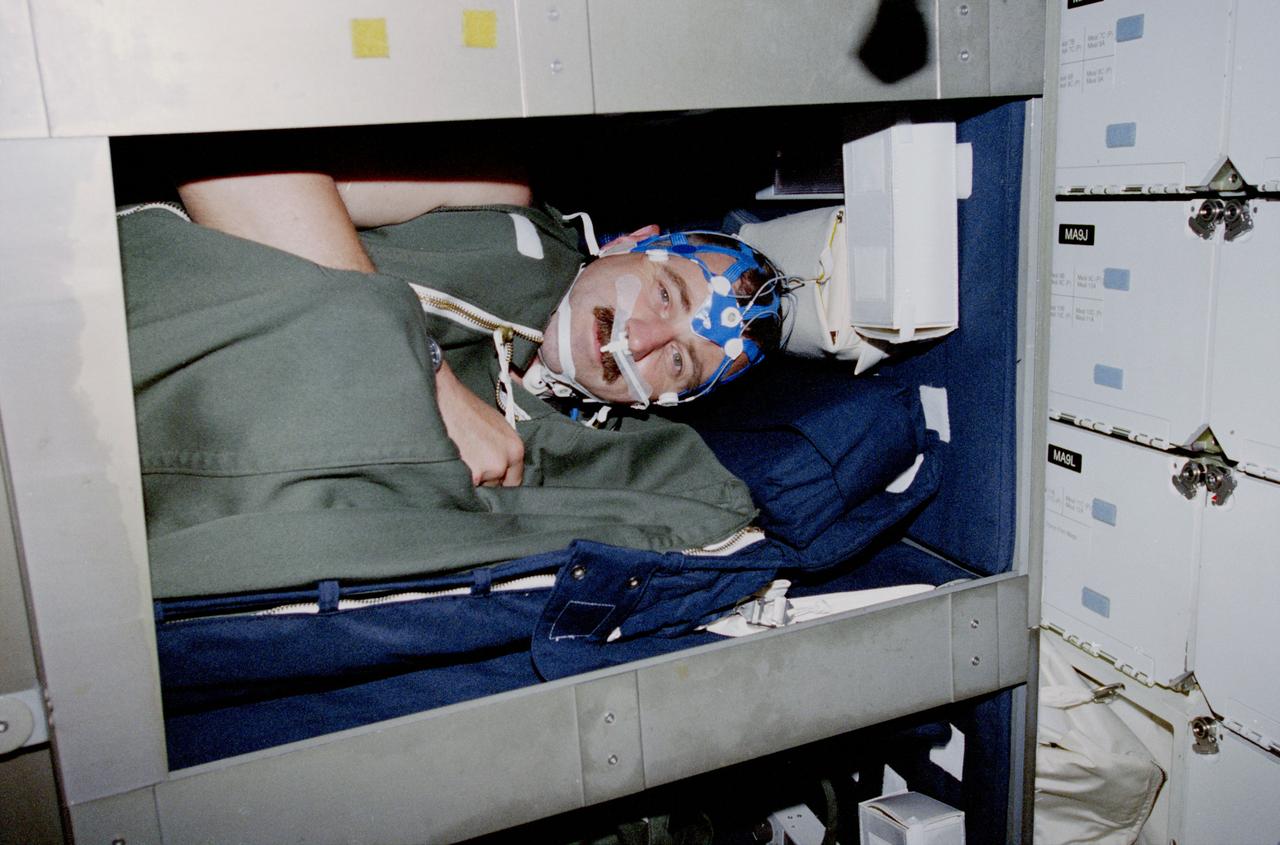
STS090-377-011 (17 APRIL-3 MAY 1998) --- Astronaut Dafydd R. (Dave) Williams, mission specialist representing the Canadian Space Agency (CSA), accomplishes more than one purpose when he sleeps in this bunk aboard the Earth-orbiting Space Shuttle Columbia. Conducting a Neurolab sleep experiment, Williams wears equipment which includes a sleep net (mesh cap that monitors and records brain waves); a Respiratory Inductance Plethysmograph (RIP) suit for monitoring respiration; and an activity monitor -- a device (out of view) worn on the wrist to detect and record body movement. Data on brain waves, eye movements, respiration, heart rate, and oxygen concentration are routed to a portable data recorder. The entire system has capabilities similar to a fully equipped sleep laboratory on Earth. The sleeping bag is conventional Shuttle ware and not part of the experiment.
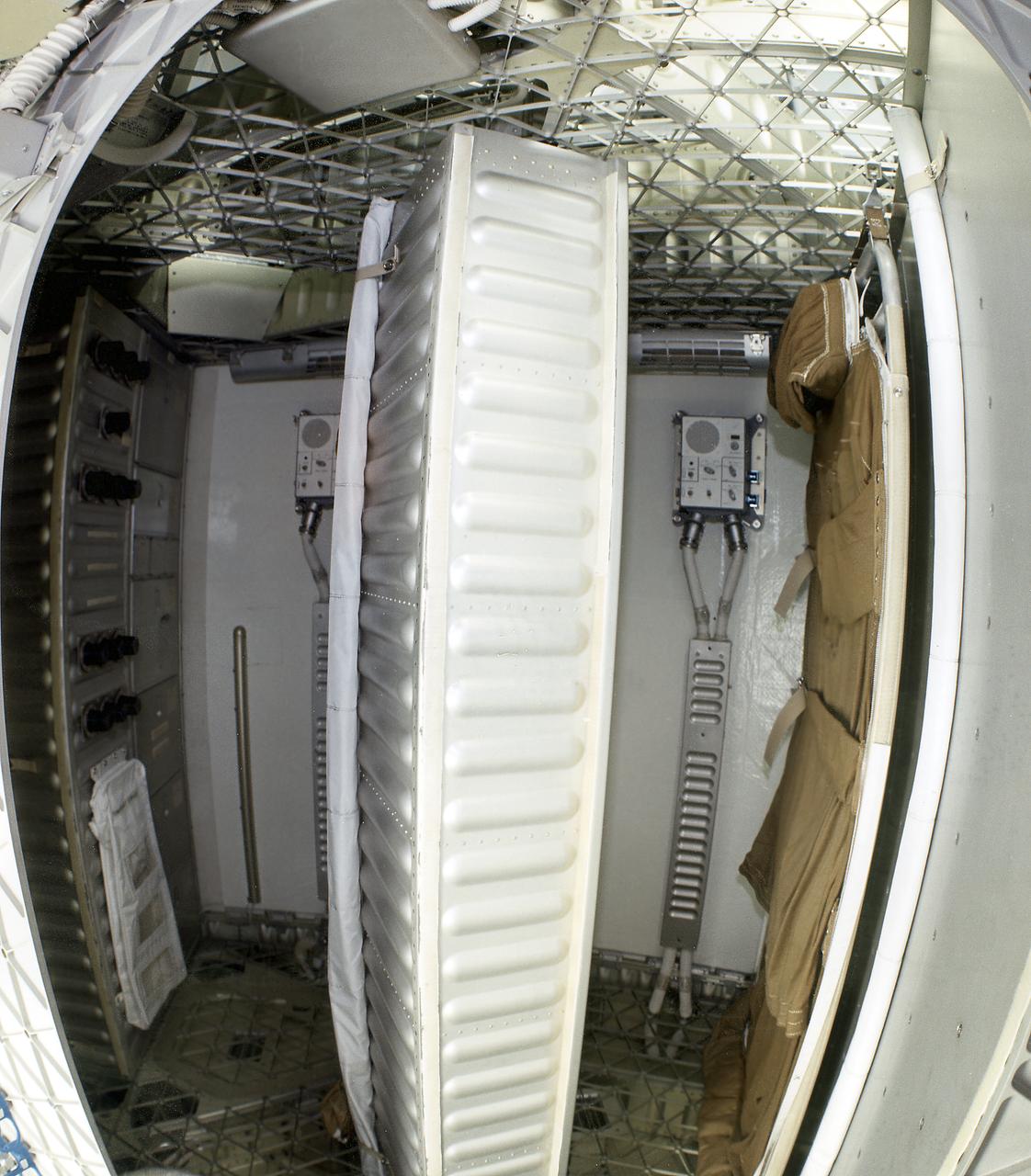
This wide-angle view is of the Orbital Workshop (OWS) sleep compartment, located in the lower level of the OWS. Each crewman was assigned a small space for sleeping and zipped themselves into sleeping bags stretched against the wall. Because of the absence of gravity, sleeping comfort was achieved in any position relative to the spacecraft; body support was not necessary. Sleeping could be accommodated quite comfortably in a bag that held the body at a given place in Skylab.
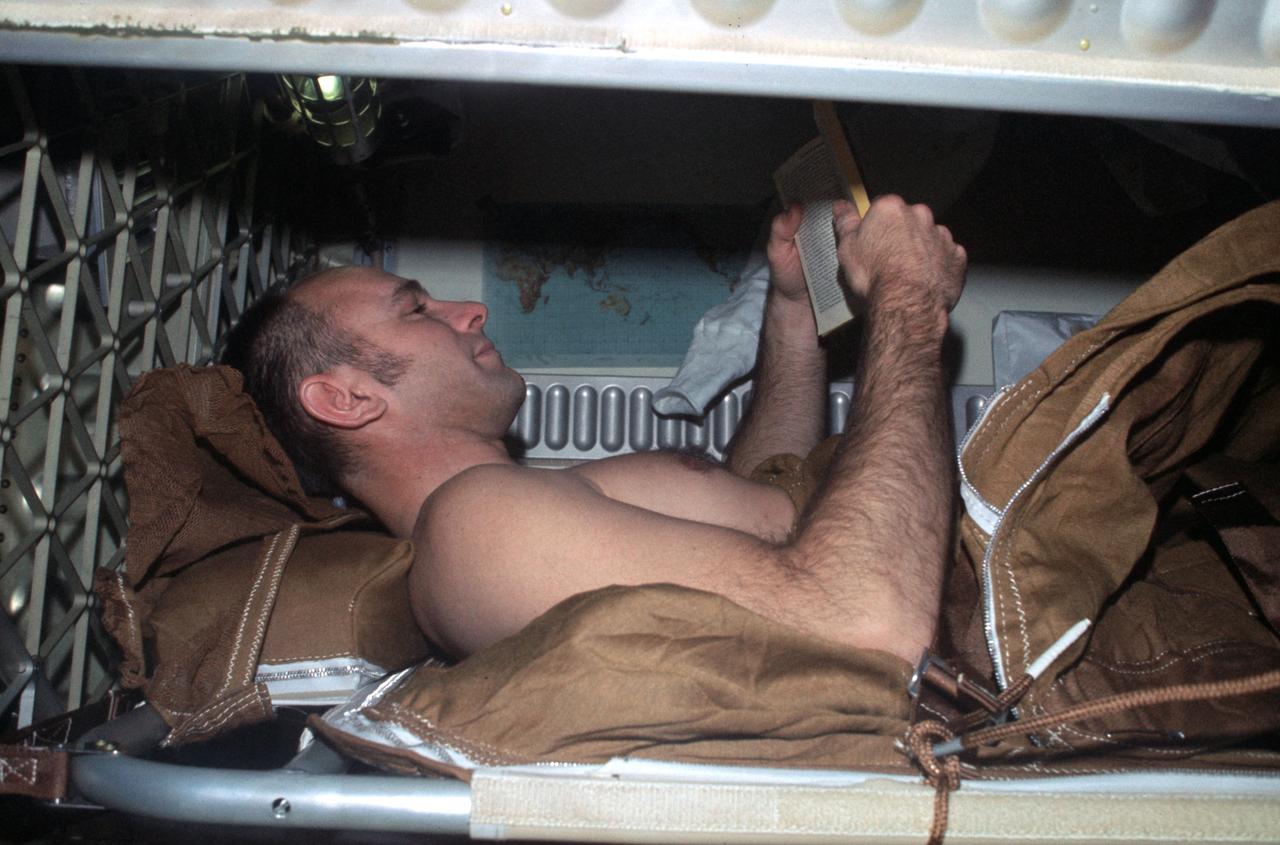
SL3-112-1527 (July-September 1973) --- View of astronaut Alan L. Bean, Skylab 3 commander, in his sleep compartment, reading a book. Photo credit: NASA
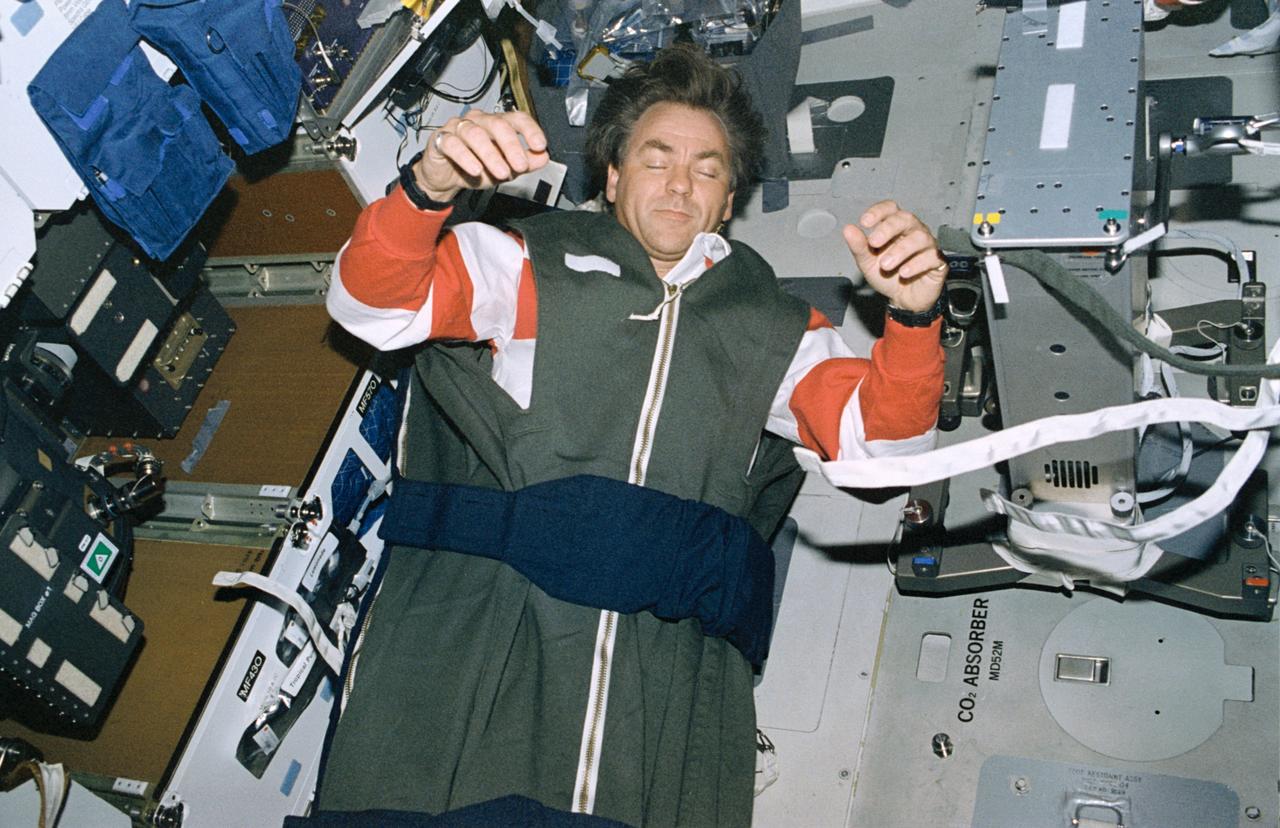
STS085-327-026 (7 - 19 August 1997) --- Payload specialist Bjarni V. Tryggvason, representing the Canadian Space Agency (CSA), sleeps on the Space Shuttle Discovery's mid-deck floor. Tryggvason elected to not use a pillow, allowing his head to float freely in the Microgravity environment.
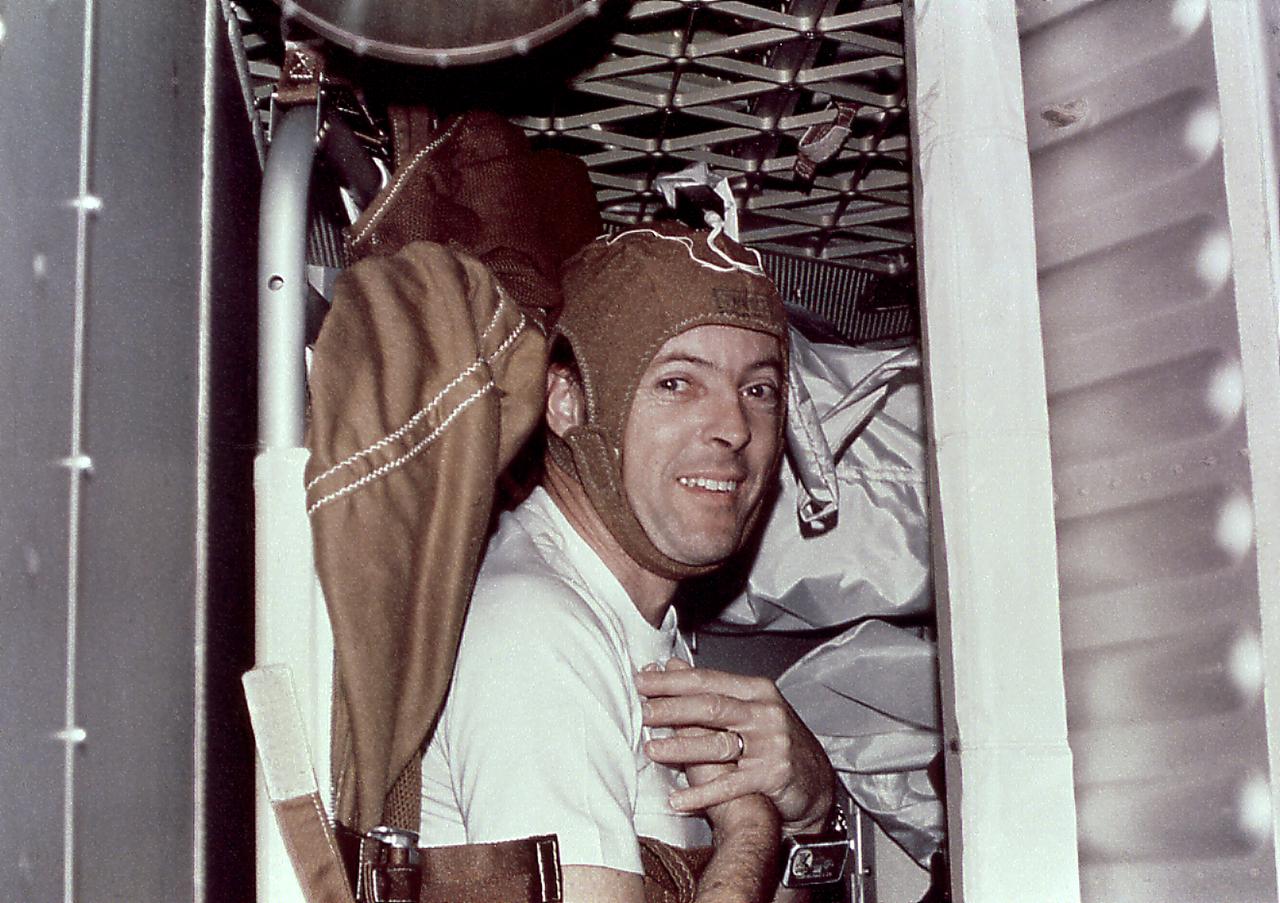
This photograph is of Astronaut Kerwin wearing the Sleep Monitoring cap (Experiment M133) taken during the Skylab-2 mission. The Sleep Monitoring Experiment was a medical evaluation designed to objectively determine the amount and quality of crew members' inflight sleep. The experiment monitored and recorded electroencephalographic (EEG) and electrooculographic (EOG) activity during astronauts' sleep periods. One of the astronauts was selected for this experiment and wore a fitted cap during his sleep periods.
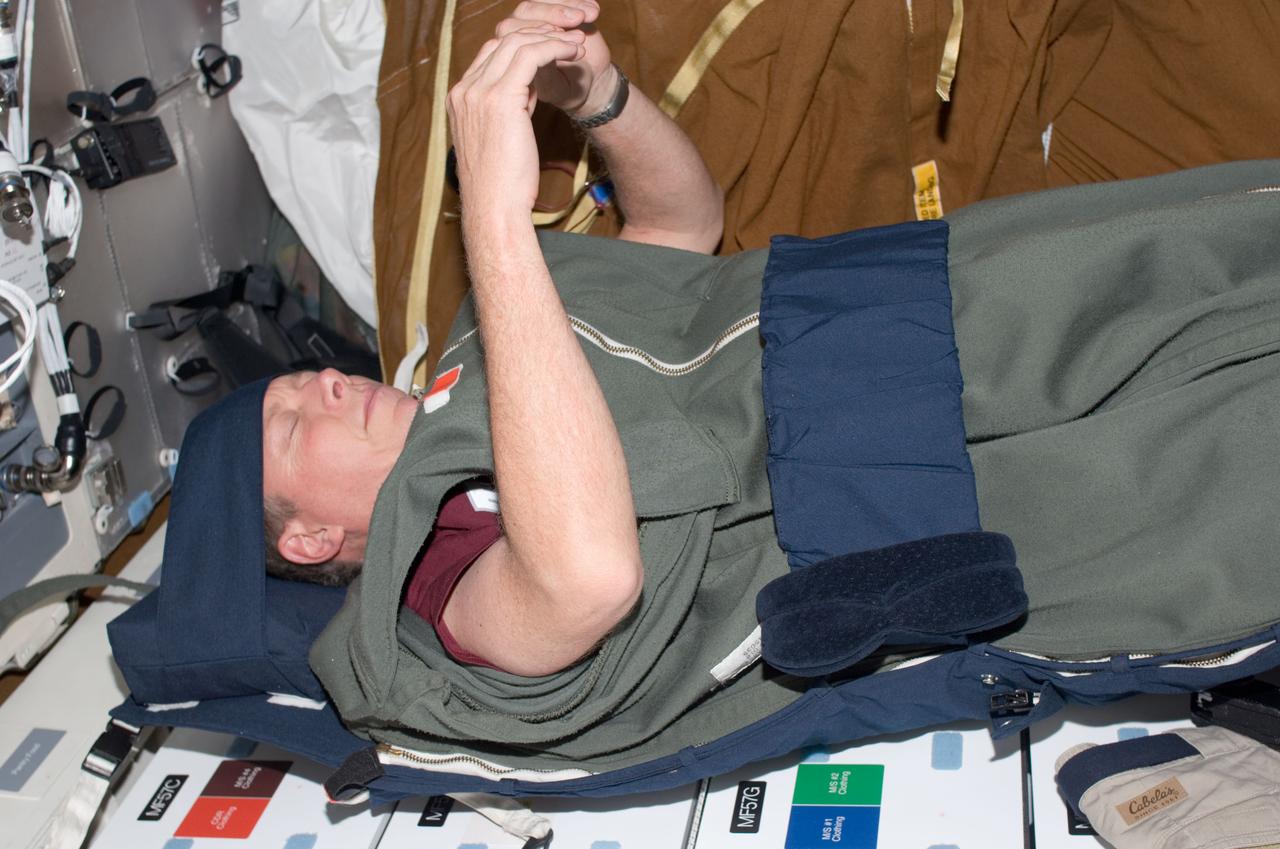
S124-E-007975 (9 June 2008) --- Astronaut Mike Fossum, STS-124 mission specialist, sleeps in his sleeping bag, which is attached to the lockers on the middeck of the Space Shuttle Discovery, while docked with the International Space Station.
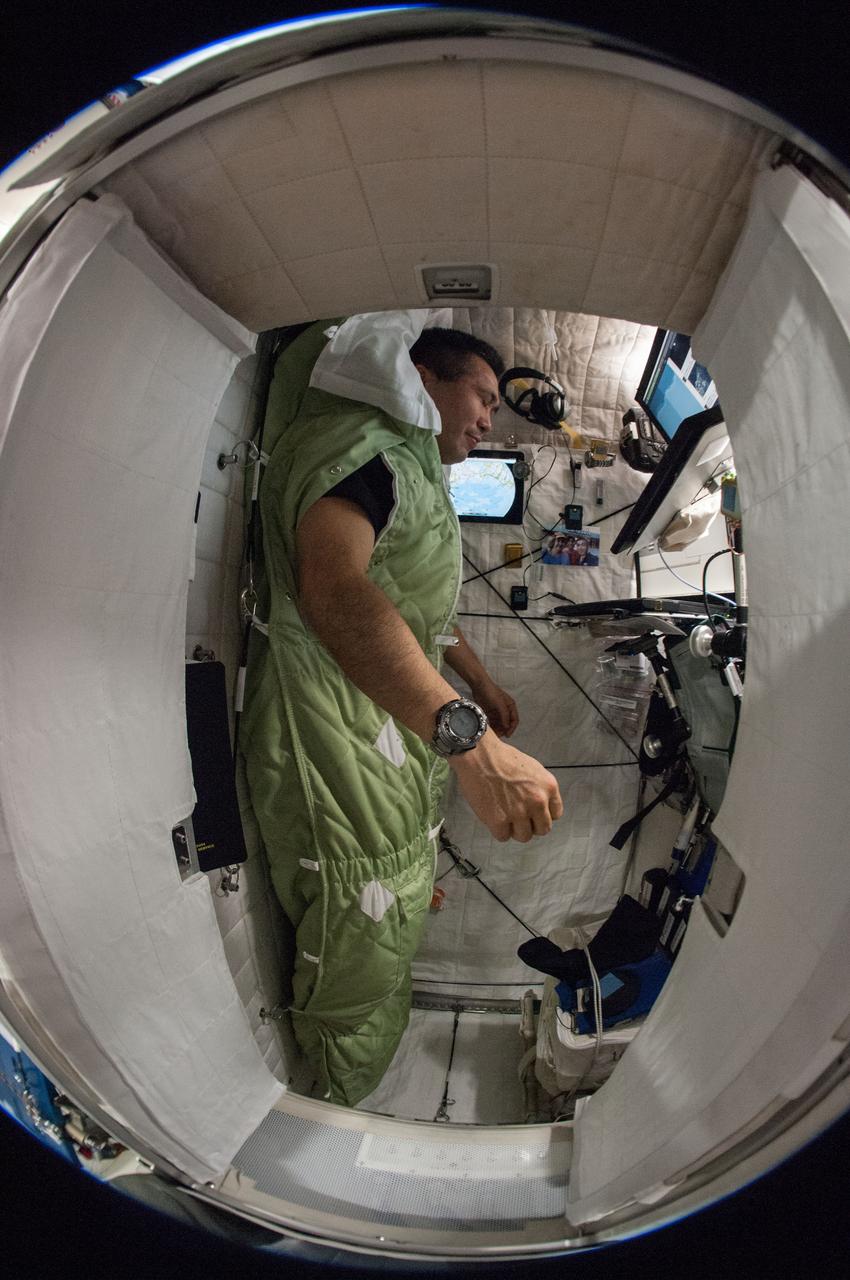
iss038e024951 (1/5/2014) --- Japan Aerospace Exploration Agency (JAXA) Koichi Wakata strapped into his sleeping bag in his sleep station located in the Node 2. Circadian Rhythms investigates the role of synchronized circadian rhythms, or the “biological clock,” and how it changes during long-duration spaceflight.
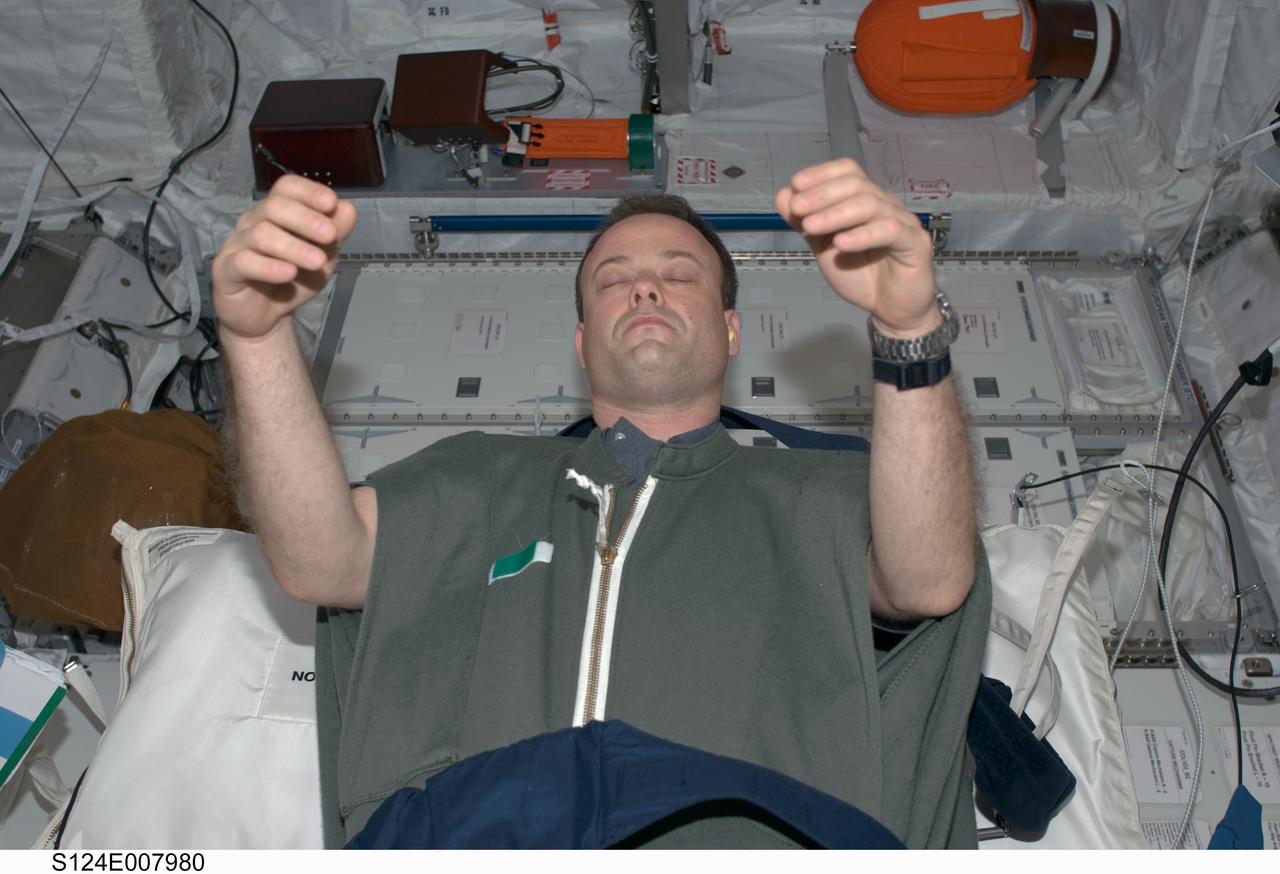
S124-E-007980 (9 June 2008) --- Astronaut Ron Garan, STS-124 mission specialist, sleeps in his sleeping bag in the Columbus laboratory of the International Space Station while Space Shuttle Discovery is docked with the station.
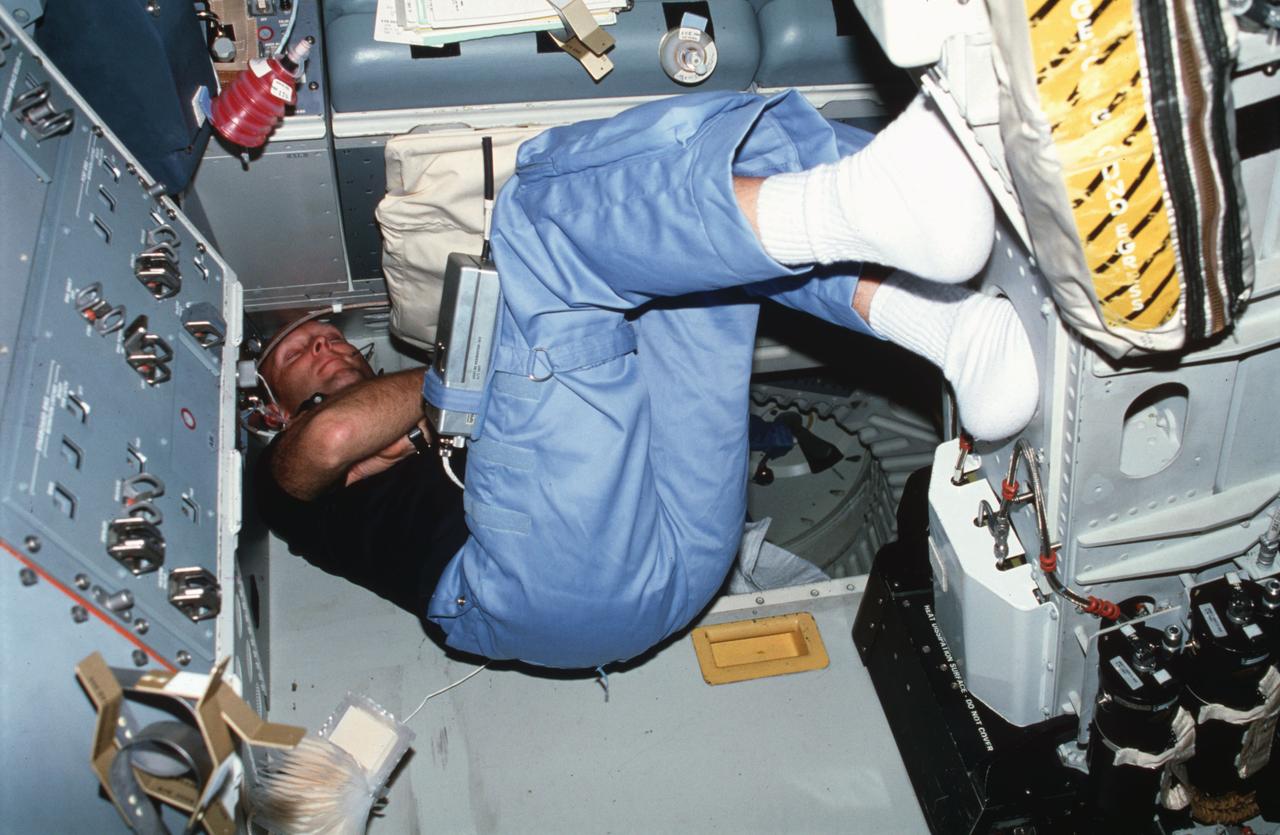
STS003-22-113 (24 March 1982) --- Astronaut Gordon Fullerton, STS-3 pilot, wearing communication kit assembly mini-headset (HDST), sleeps on aft flight deck resting his back against the floor and his feet against commander's ejection seat (S1) back. On-orbit station control panel A8 and payload station panel L15 appear above Fullerton. Special clips for holding notebooks open and beverage containers are velcroed on various panels. Photo credit: NASA

STS070-334-031 (13-22 JULY 1995) --- Astronaut Kevin R. Kregel demonstrates the new shuttle sleep restraints on the space shuttle Discovery?s middeck. During an August 11, 1995, post flight presentation to fellow employees at the Johnson Space Center (JSC), the STS-70 pilot discussed features of the device and lauded its ability to add comfort for crew members.
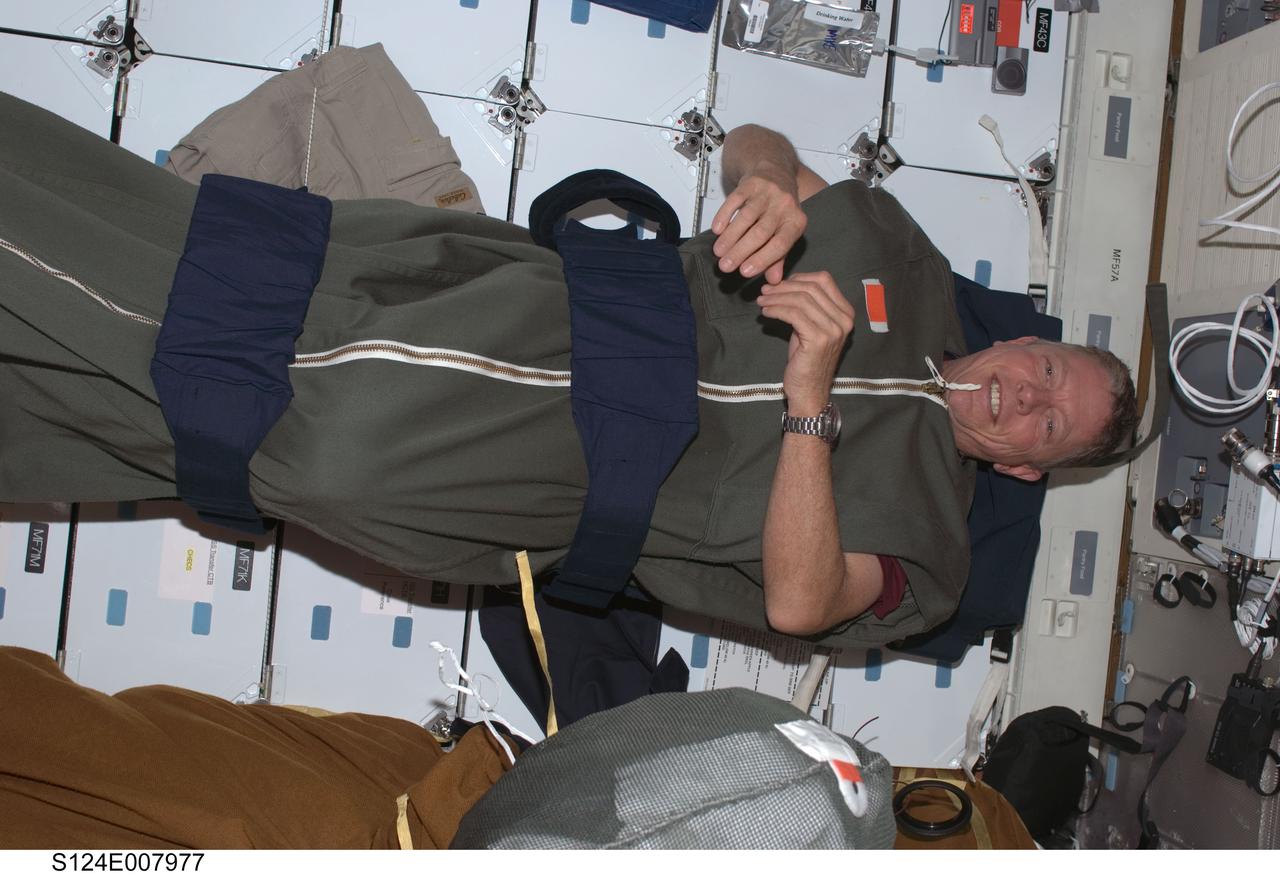
S124-E-007977 (9 June 2008) --- Astronaut Mike Fossum, STS-124 mission specialist, is pictured in his sleeping bag, which is attached to the lockers on the middeck of the Space Shuttle Discovery, while docked with the International Space Station.
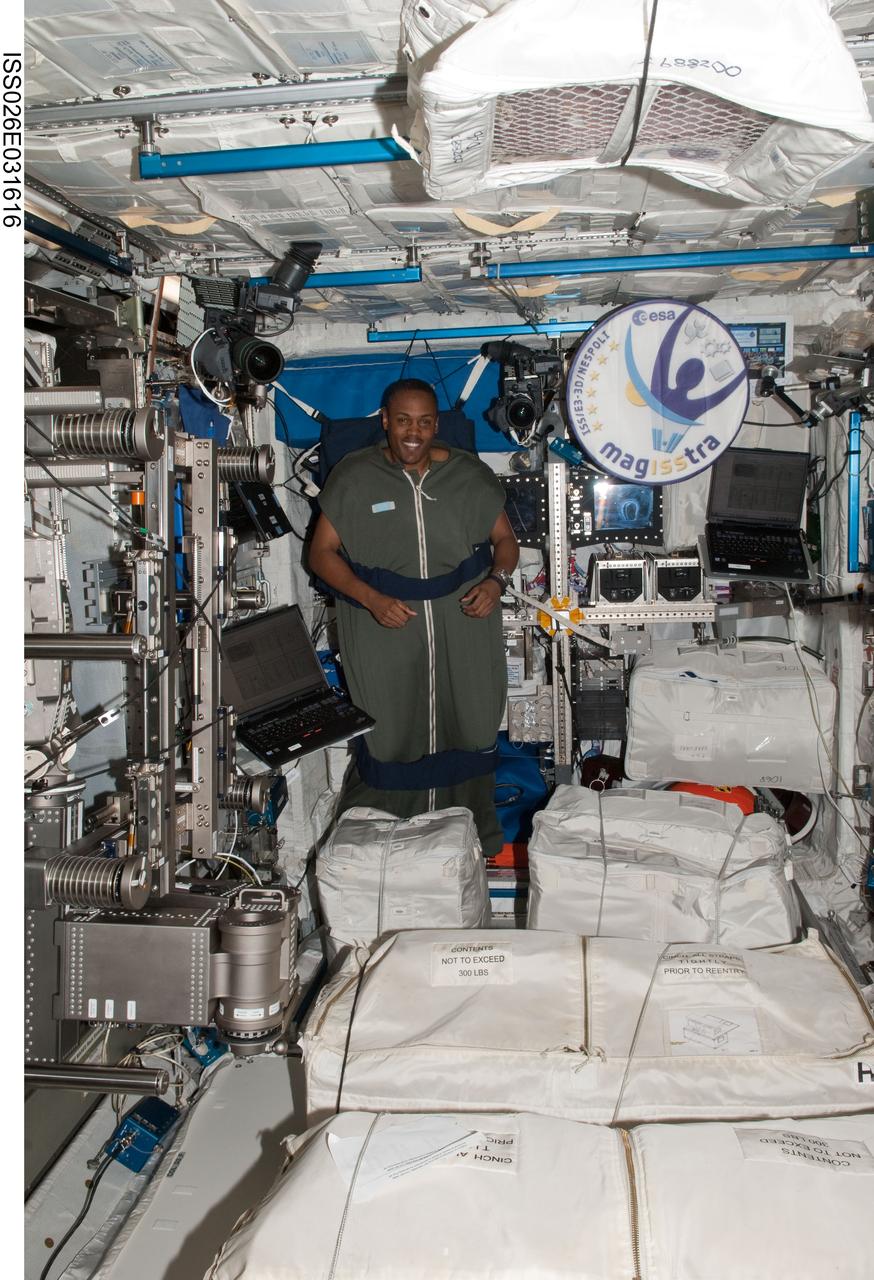
ISS026-E-031616 (3 March 2011) --- NASA astronaut Alvin Drew, STS-133 mission specialist, is pictured in his sleeping bag, which is attached in the Columbus laboratory of the International Space Station while space shuttle Discovery remains docked with the station.
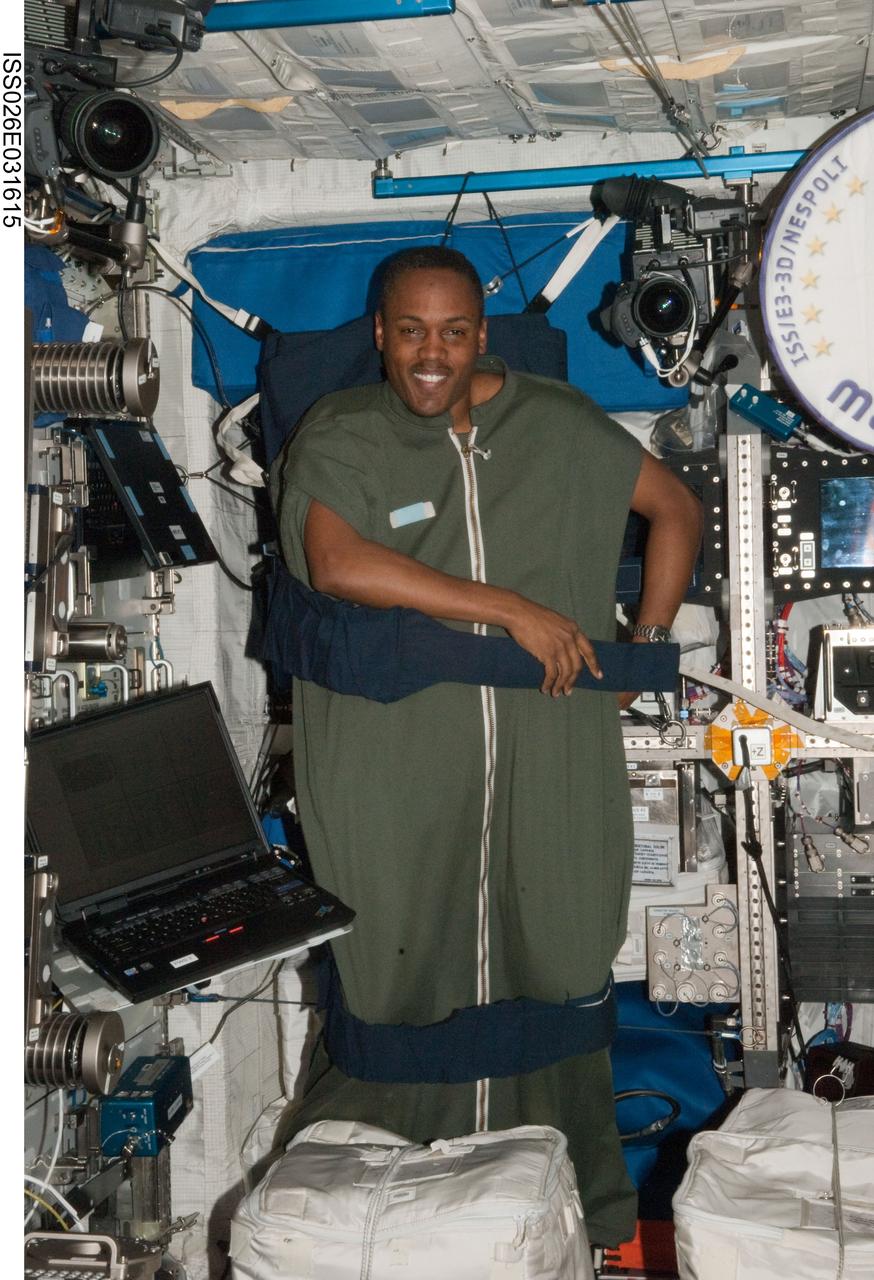
ISS026-E-031615 (3 March 2011) --- NASA astronaut Alvin Drew, STS-133 mission specialist, is pictured in his sleeping bag, which is attached in the Columbus laboratory of the International Space Station while space shuttle Discovery remains docked with the station.
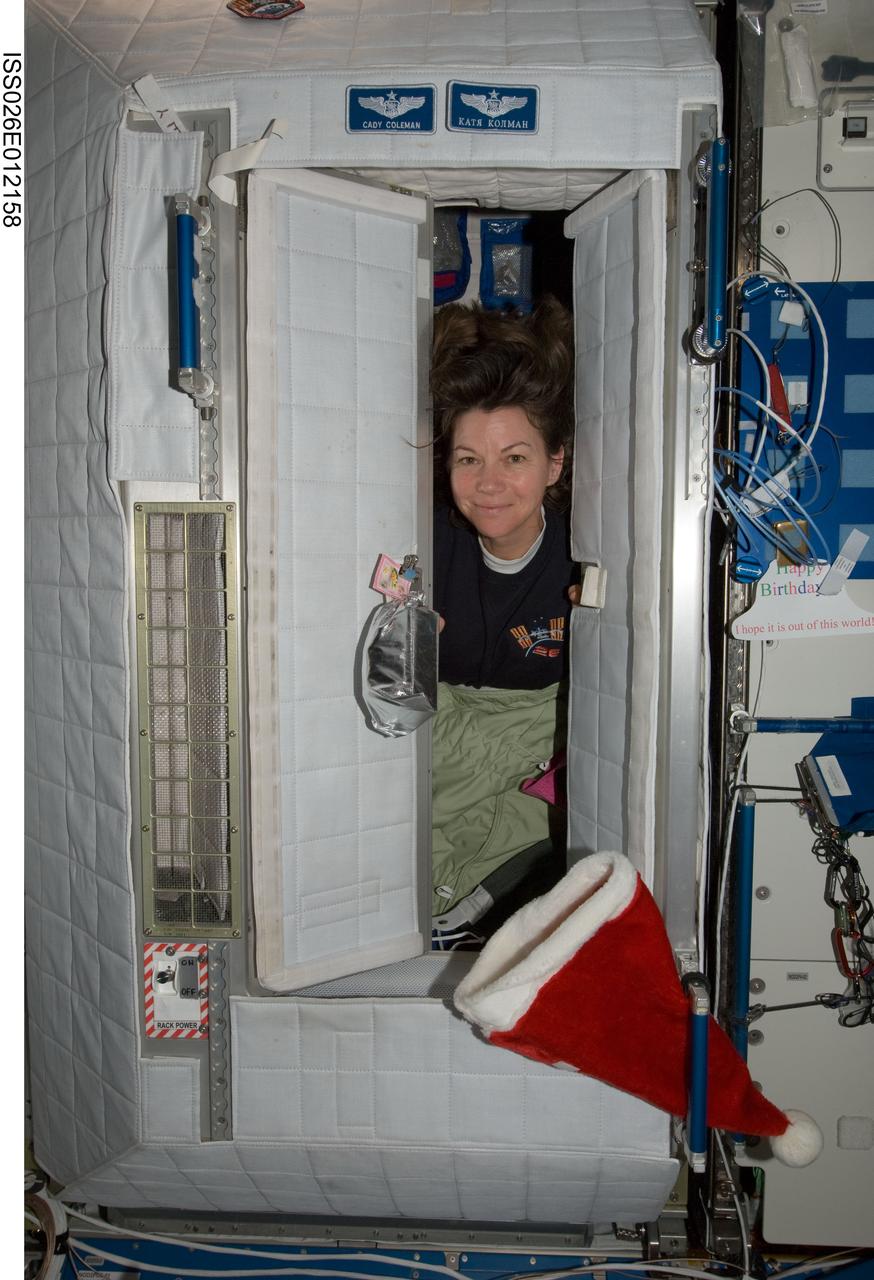
ISS026-E-012158 (25 Dec. 2010) --- NASA astronaut Catherine (Cady) Coleman, Expedition 26 flight engineer, and one of six crew members currently aboard the International Space Station, peeks out of her sleeping quarters on Christmas morning to view the station’s decorations and gifts.
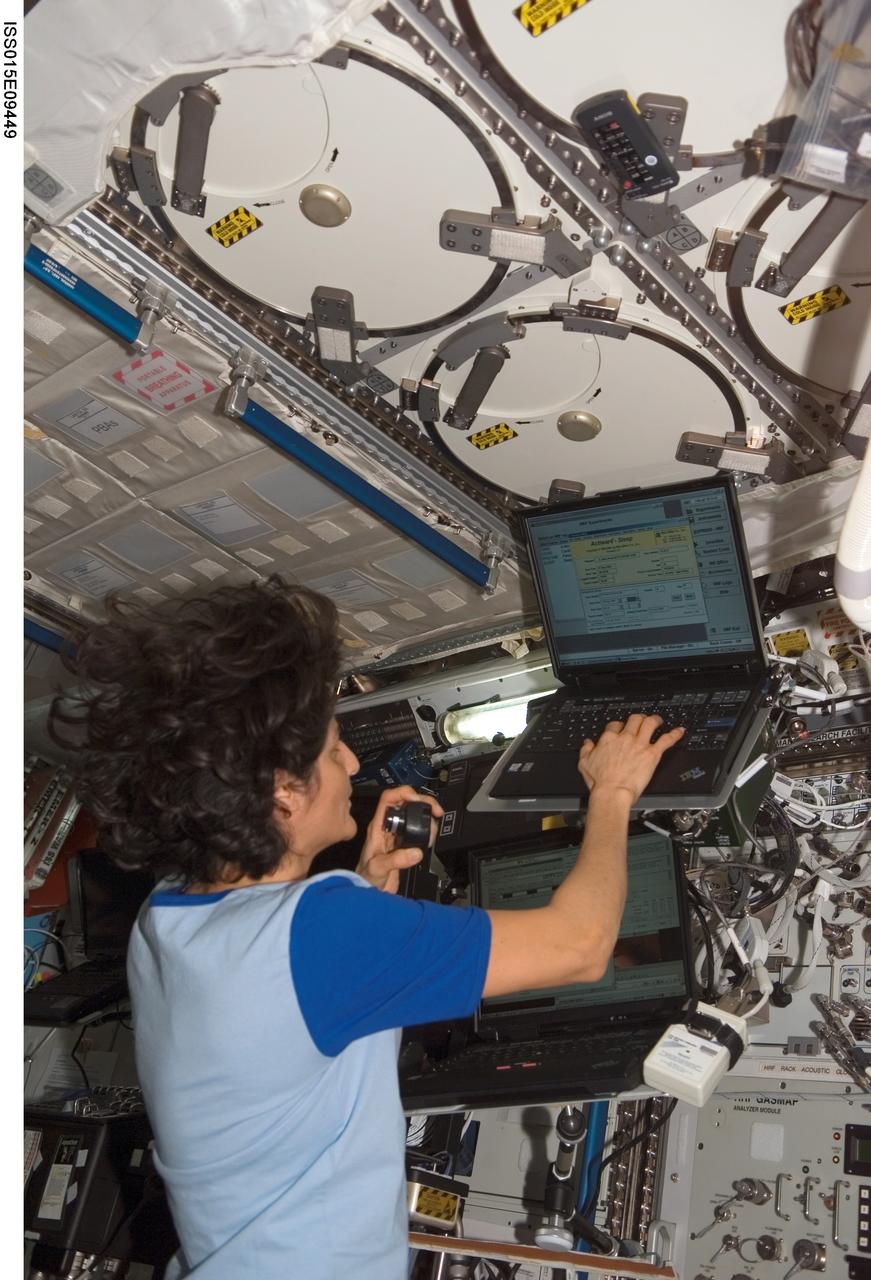
ISS015-E-09449 (24 May 2007) --- Astronaut Sunita L. Williams, Expedition 15 flight engineer, enters data in a computer for the Sleep-Wake Actigraphy and Light Exposure During Spaceflight-Long (Sleep-Long) experiment in the Destiny laboratory of the International Space Station. Sleep-Long will examine the effects of spaceflight and ambient light exposure on the sleep-wake cycles of the crewmembers during long-duration stays on the station.
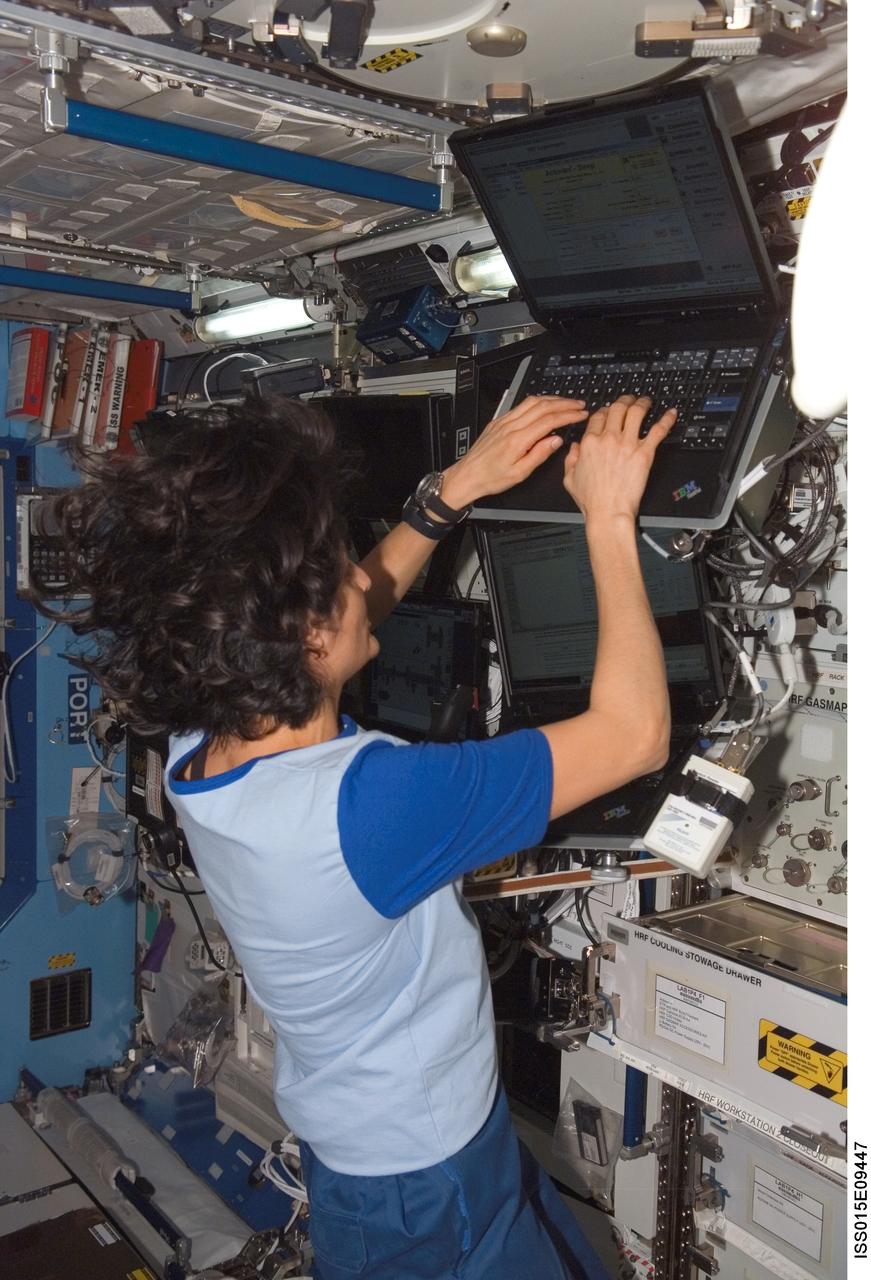
ISS015-E-09447 (24 May 2007) --- Astronaut Sunita L. Williams, Expedition 15 flight engineer, enters data in a computer for the Sleep-Wake Actigraphy and Light Exposure During Spaceflight-Long (Sleep-Long) experiment in the Destiny laboratory of the International Space Station. Sleep-Long will examine the effects of spaceflight and ambient light exposure on the sleep-wake cycles of the crewmembers during long-duration stays on the station.
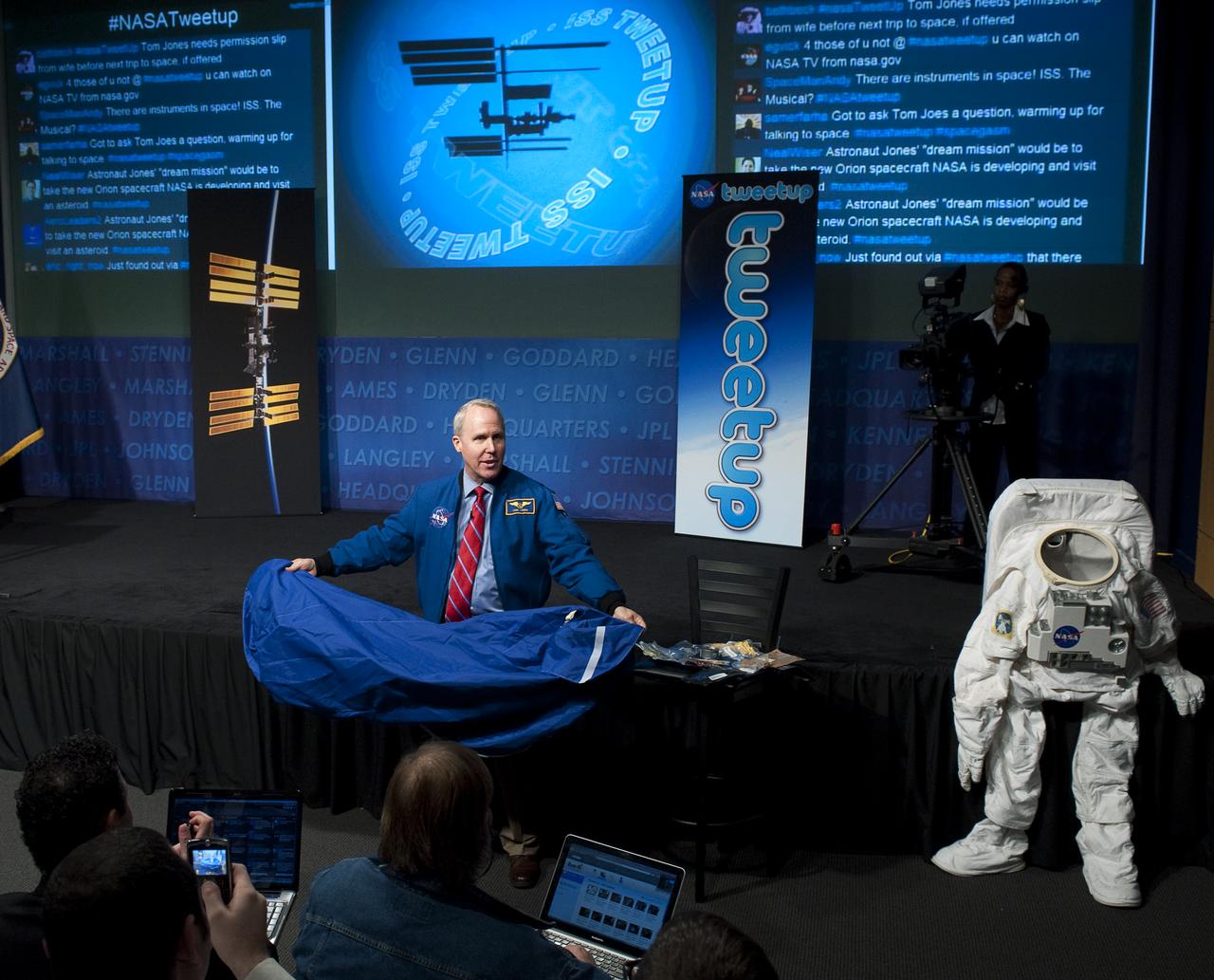
Former NASA astronaut Tom Jones shows off a sleeping bag used by astronauts living aboard the International Space Station during a NASA Tweetup event at NASA Headquarters in Washington, Wednesday, Oct. 21, 2009. Photo Credit: (NASA/Carla Cioffi)
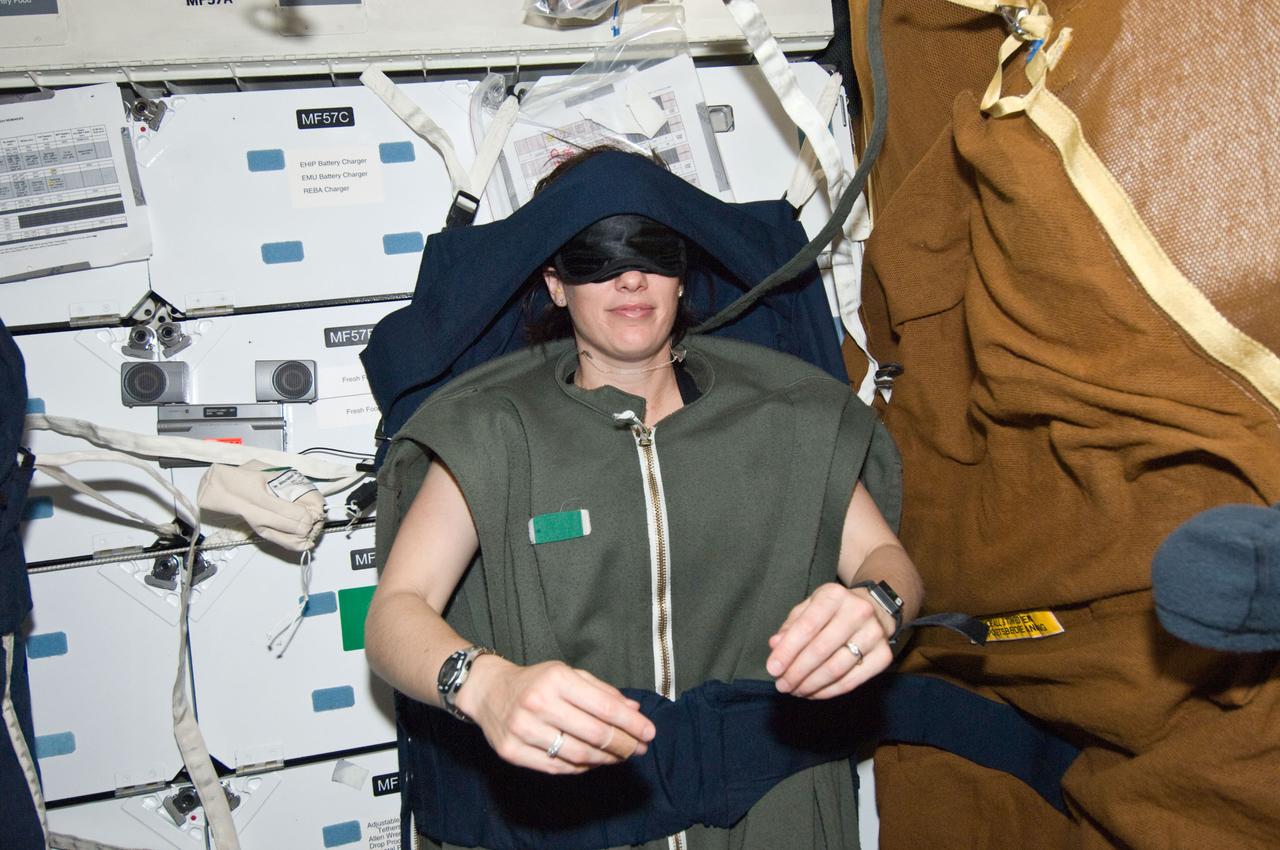
S125-E-011487 (18 May 2009) --- Astronaut Megan McArthur, STS-125 mission specialist, rests in her sleeping bag, which is attached to the lockers on the middeck of the Earth-orbiting Space Shuttle Atlantis at the end of flight day eight.
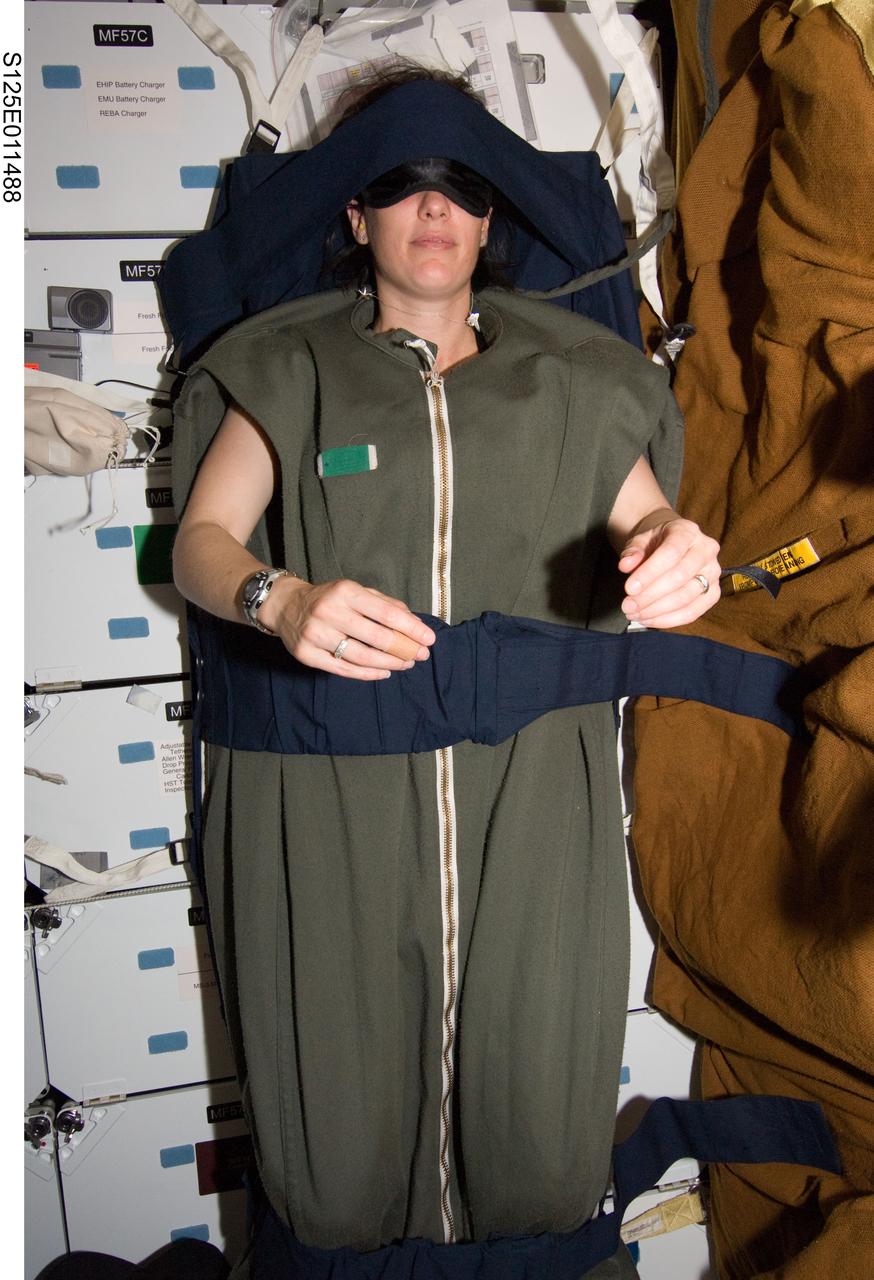
S125-E-011488 (18 May 2009) --- Astronaut Megan McArthur, STS-125 mission specialist, rests in her sleeping bag, which is attached to the lockers on the middeck of the Earth-orbiting Space Shuttle Atlantis at the end of flight day eight.
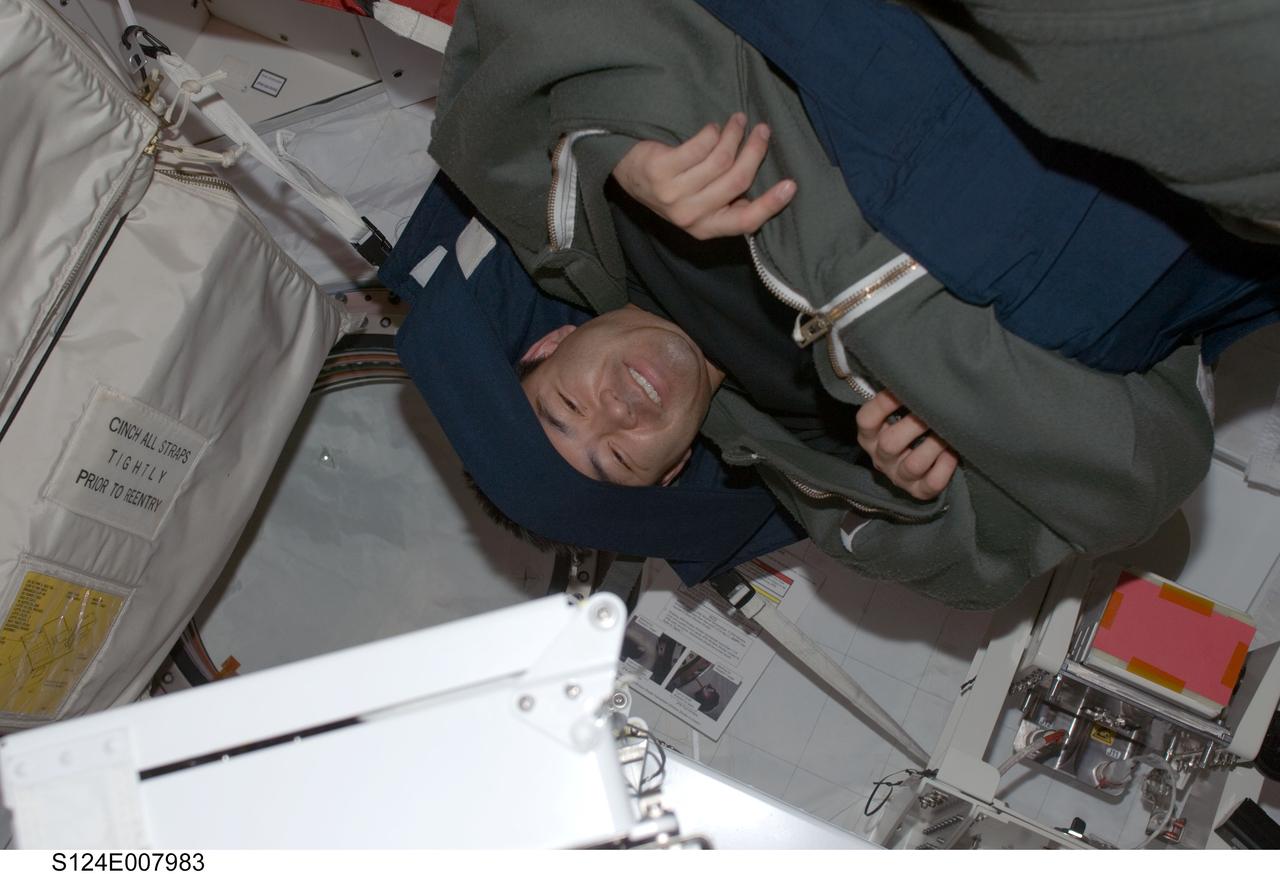
S124-E-007983 (9 June 2008) --- Japan Aerospace Exploration Agency astronaut Akihiko Hoshide, STS-124 mission specialist, is pictured in his sleeping bag in Kibo Japanese Pressurized Module of the International Space Station while Space Shuttle Discovery is docked with the station.
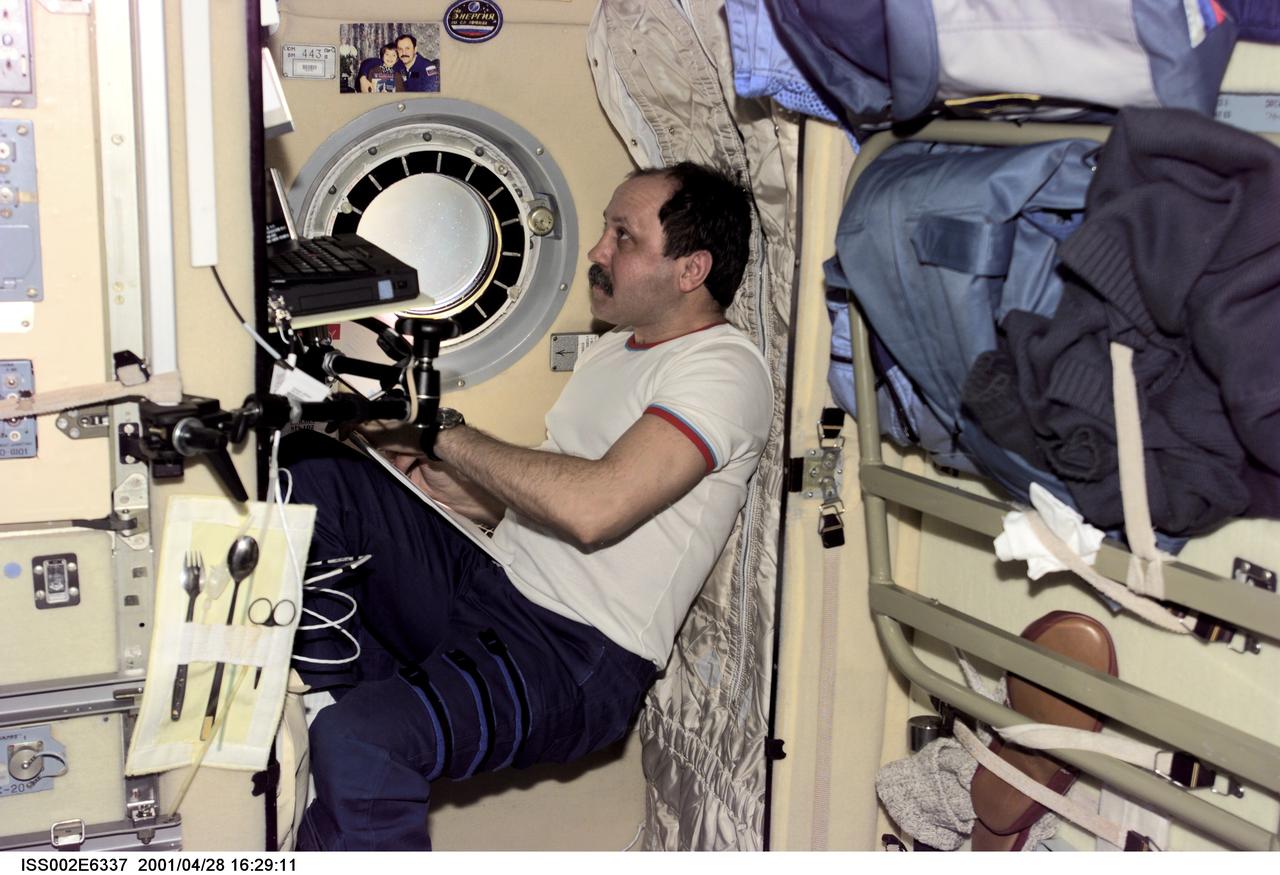
ISS002-E-6337 (28 April 2001) --- Cosmonaut Yury V. Usachev, Expedition Two mission commander, writes down some notes in his sleeping compartment in the Zvezda / Service Module of the International Space Station (ISS). The image was taken with a digital still camera.
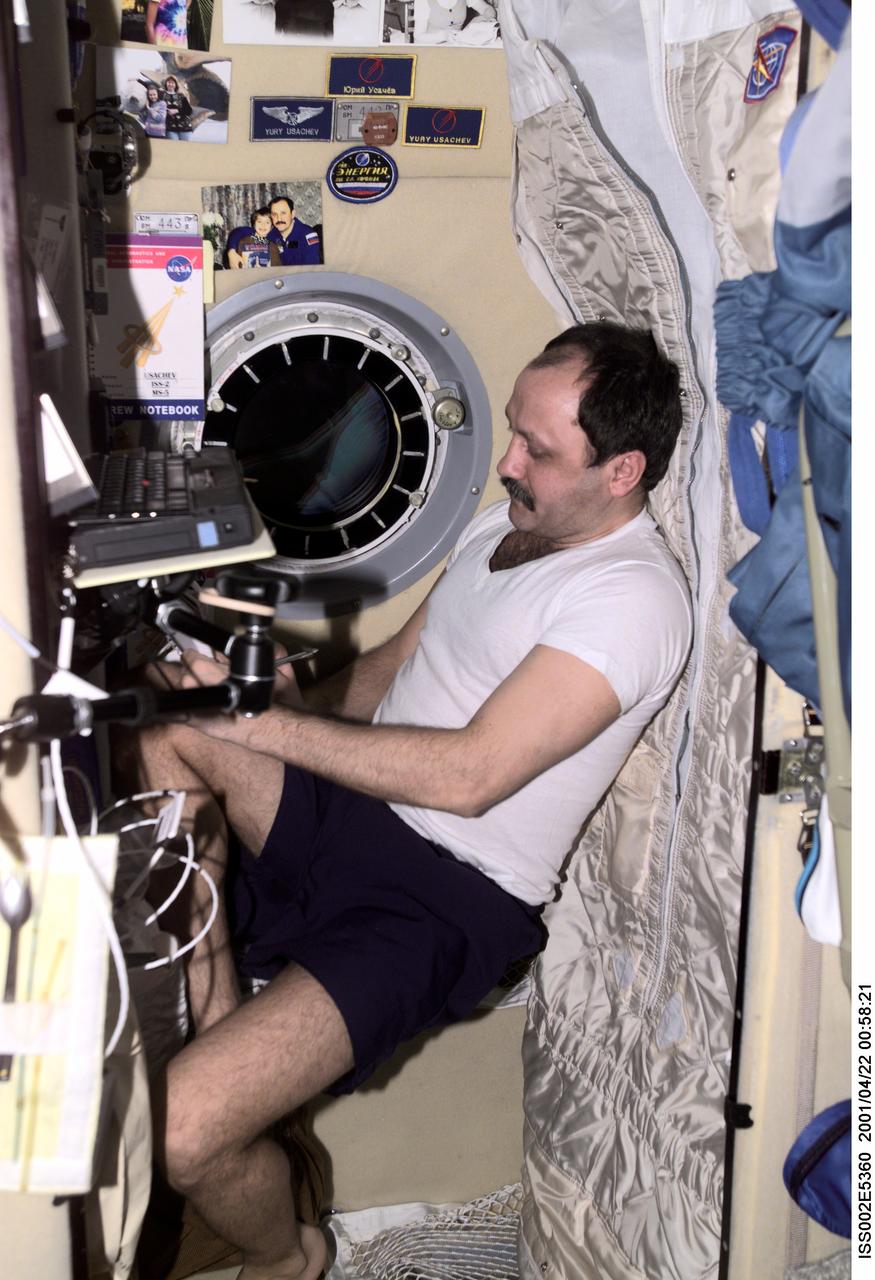
ISS002-E-5360 (22 April 2001) --- Cosmonaut Yury V. Usachev, Expedition Two mission commander, writes down some notes in his sleeping compartment in the Zvezda / Service Module of the International Space Station (ISS). This image was recorded with a digital still camera.
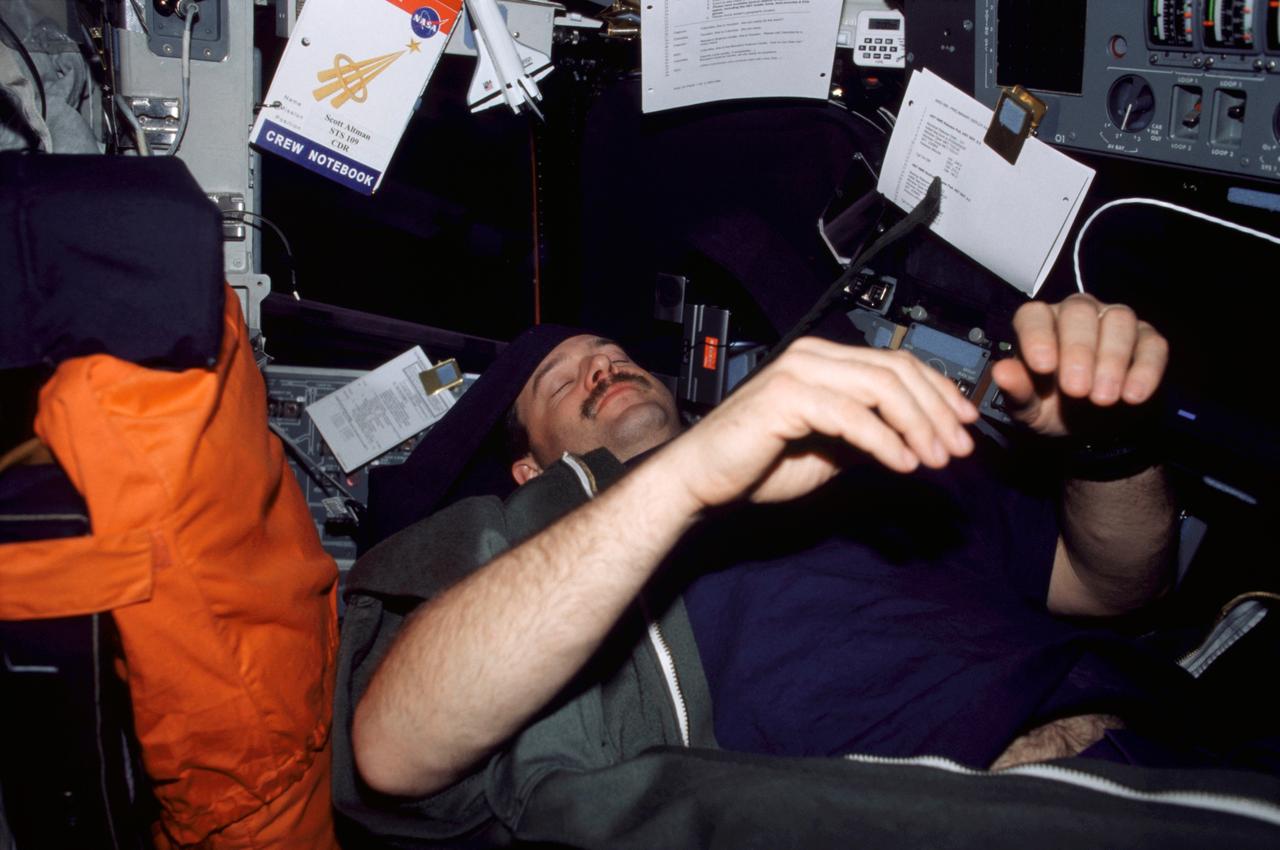
STS109-335-020 (1-12 March 2002) --- Astronaut Scott D. Altman, STS-109 mission commander, sleeps on the flight deck of the Space Shuttle Columbia.
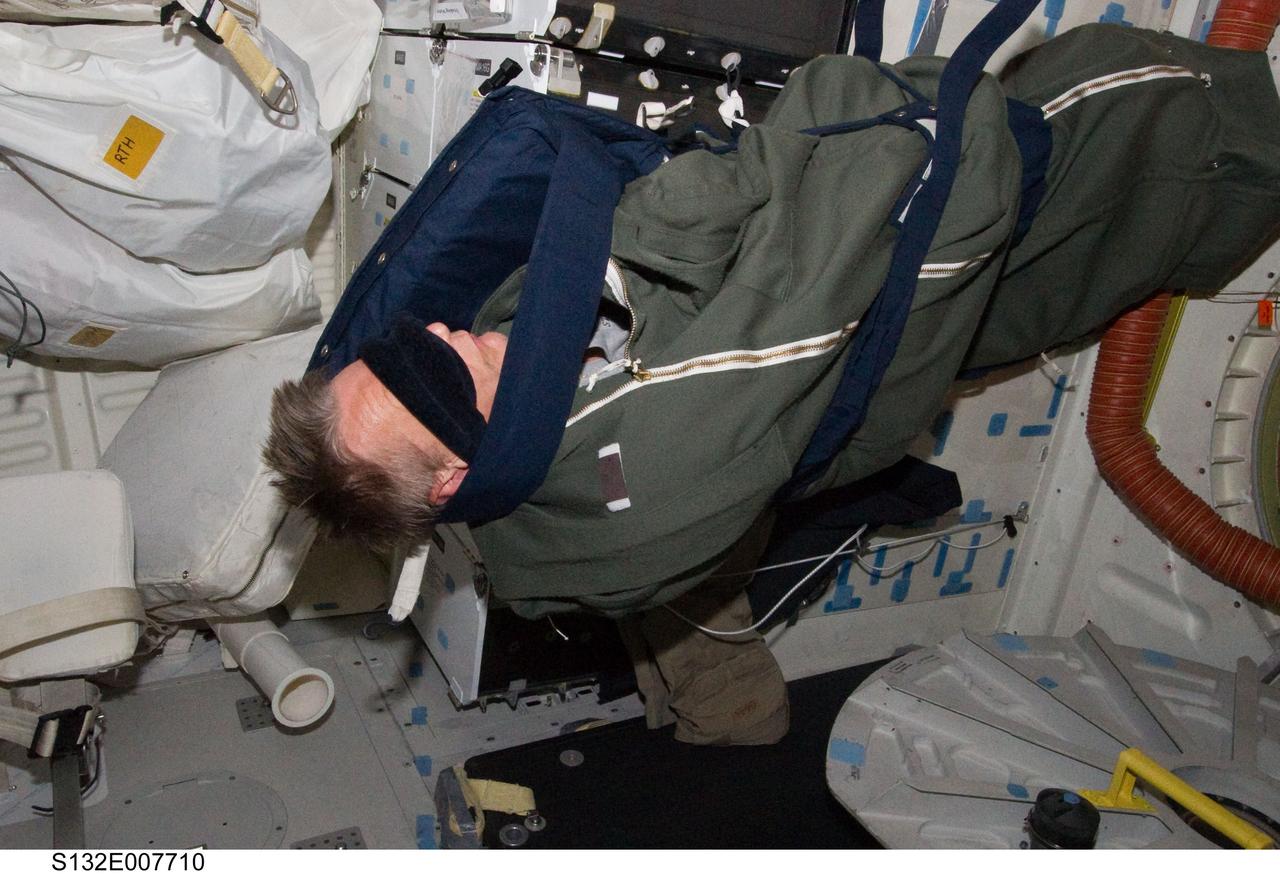
S132-E-007710 (17 May 2010) --- NASA astronaut Piers Sellers, STS-132 mission specialist, rests in his sleeping bag on the middeck of the space shuttle Atlantis while docked with the International Space Station.
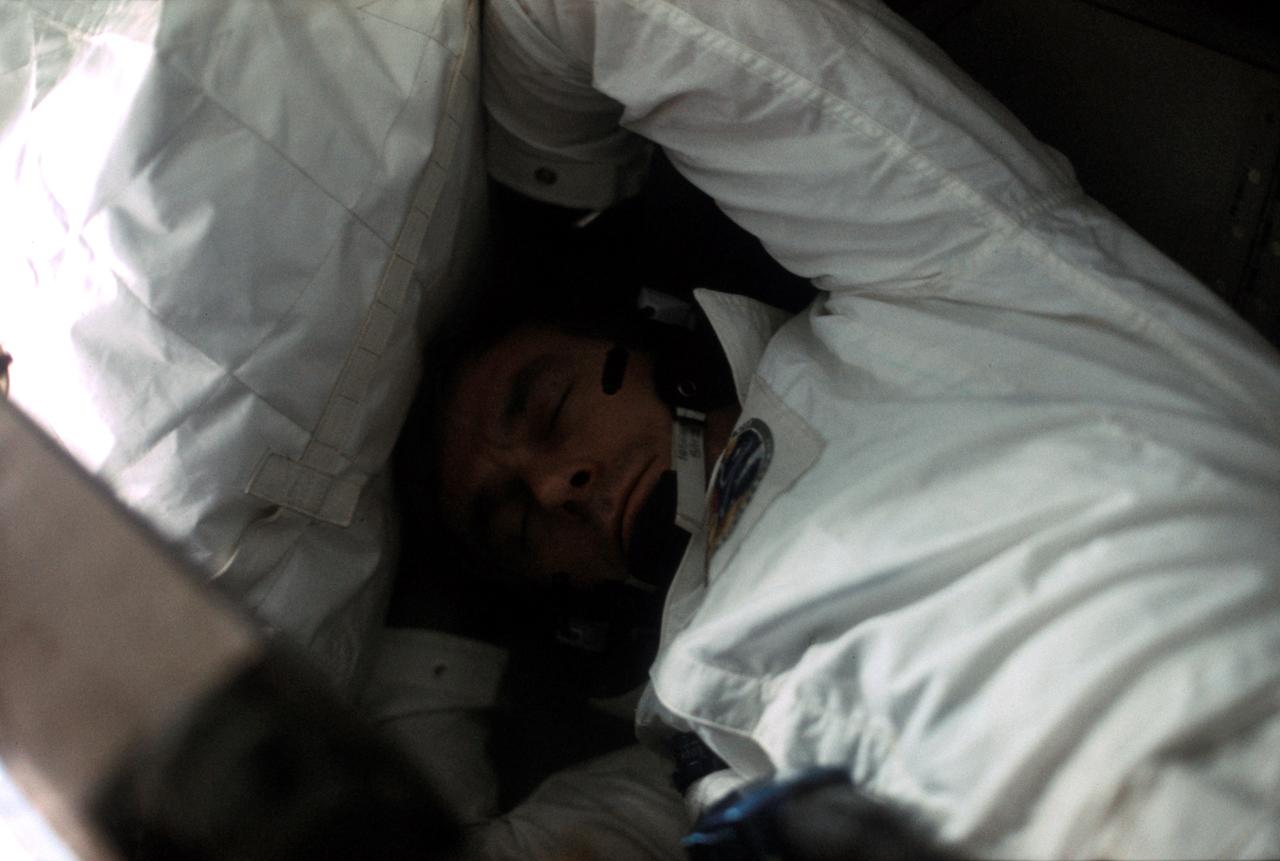
AS17-162-24049 (7-19 Dec. 1972) --- A fellow crewman took this picture of astronaut Eugene A. Cernan dozing aboard the Apollo 17 spacecraft during the final lunar landing mission in NASA's Apollo program. Also, aboard Apollo 17 were astronaut Ronald E. Evans, command module pilot, and scientist-astronaut Harrison H. "Jack" Schmitt, lunar module pilot. Cernan was the mission commander.
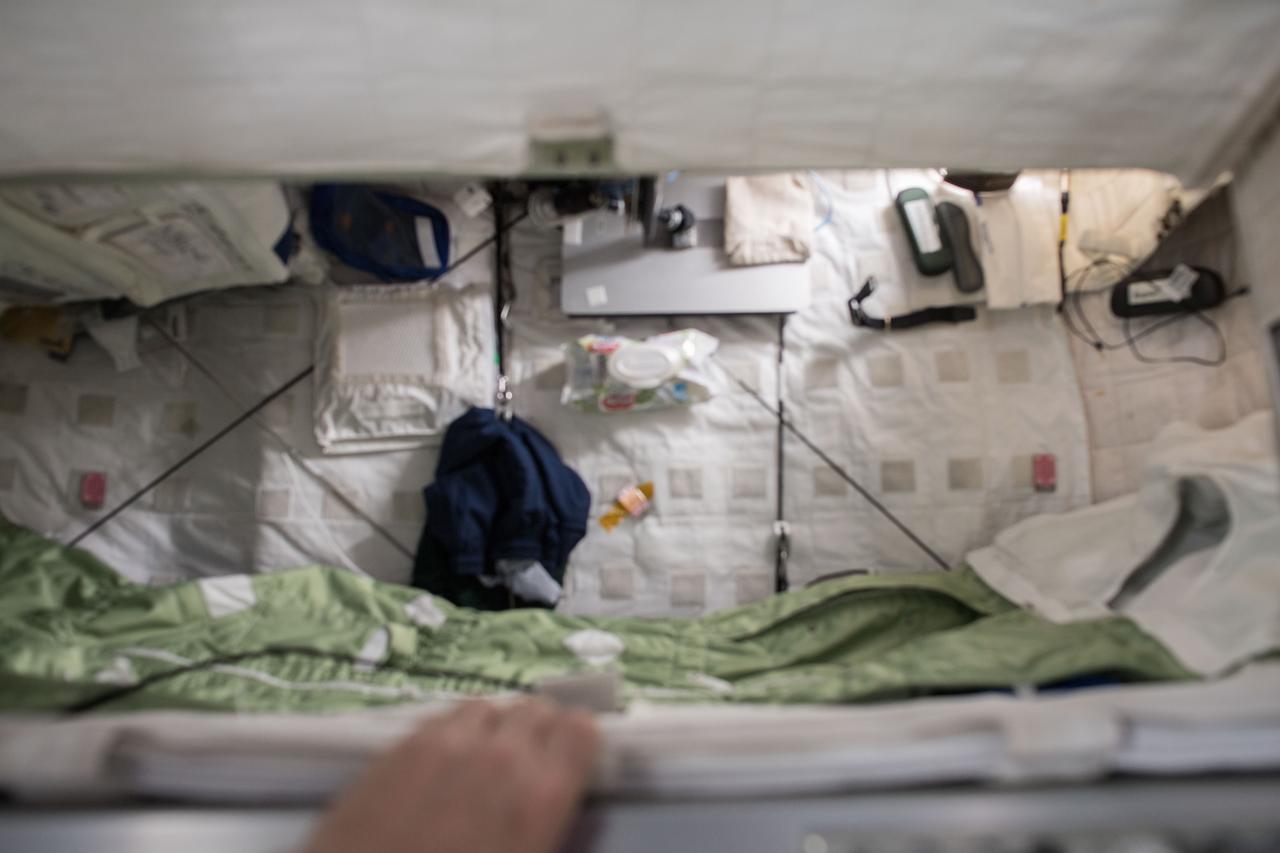
iss054e022260 (Jan. 17, 2018) --- View inside the crew quarters where astronauts sleep on the International Space Station.
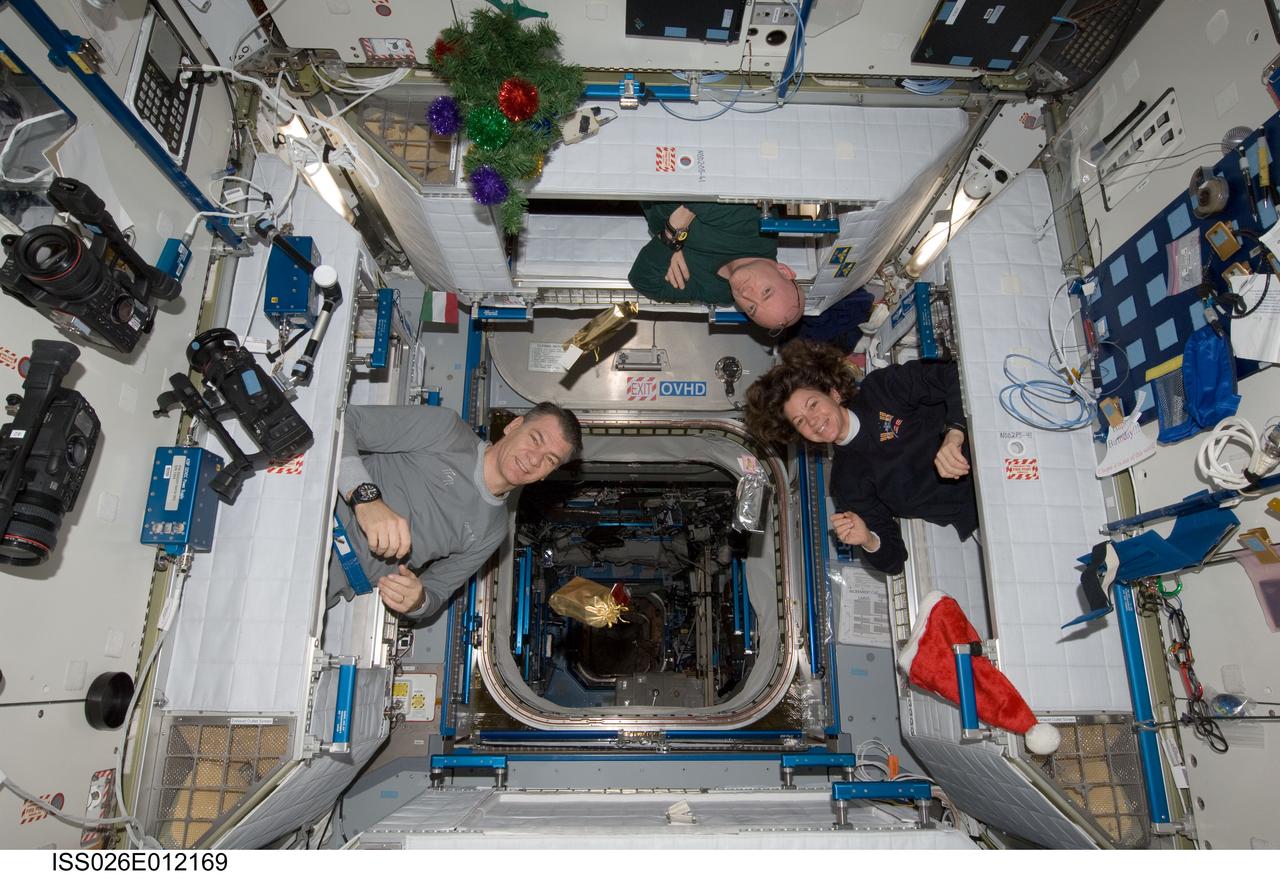
ISS026-E-012169 (25 Dec. 2010) --- Three of the six crew members aboard the International Space Station peek out of their sleeping quarters on Christmas morning to view the station?s decorations and gifts. Shown, from left, are European Space Agency astronaut Paolo Nespoli, Expedition 26 flight engineer, NASA astronaut Scott Kelly, Expedition 26 commander, and NASA astronaut Catherine (Cady) Coleman, flight engineer.
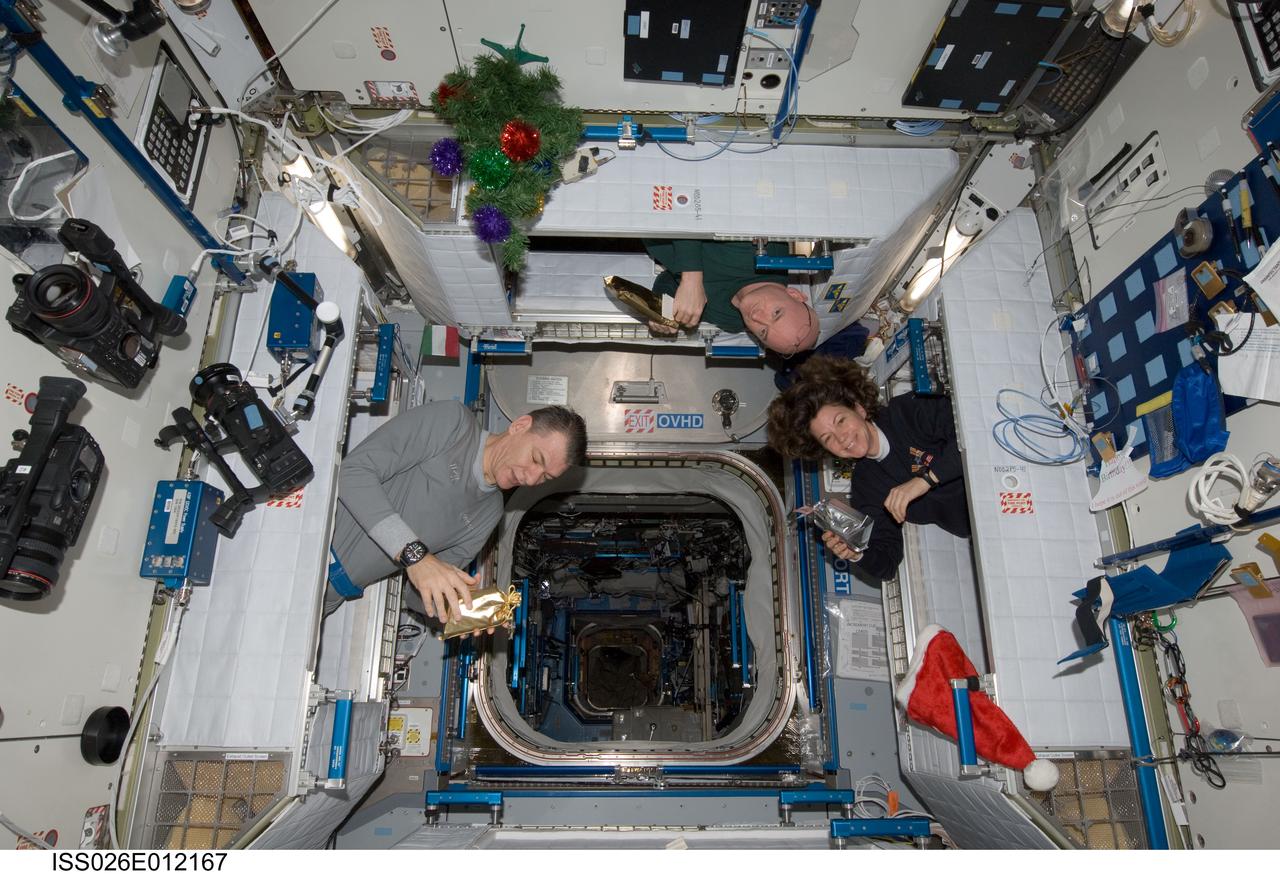
ISS026-E-012167 (25 Dec. 2010) --- Three of the six crew members aboard the International Space Station peek out of their sleeping quarters on Christmas morning to view the station’s decorations and gifts. Shown, from left, are European Space Agency astronaut Paolo Nespoli, Expedition 26 flight engineer, NASA astronaut Scott Kelly, Expedition 26 commander, and NASA astronaut Catherine (Cady) Coleman, flight engineer
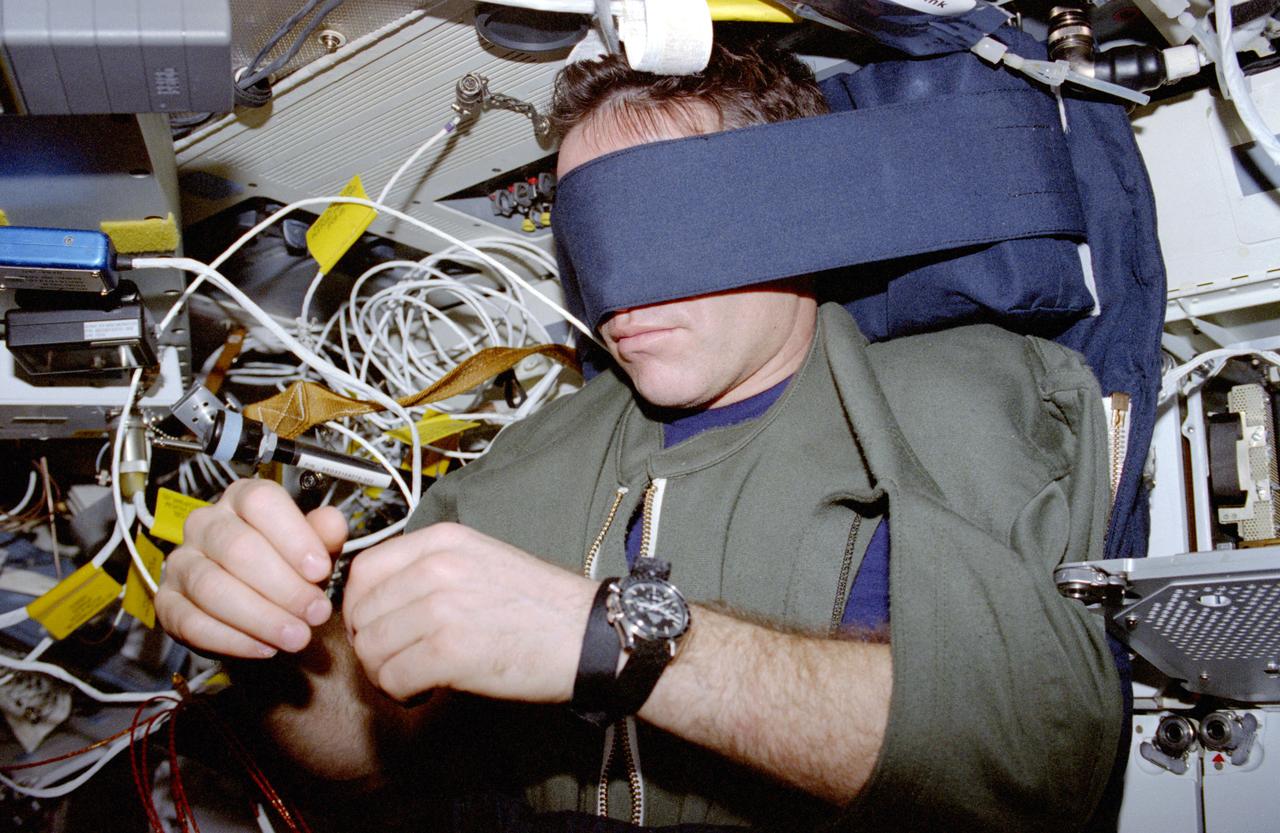
STS087-323-030 (19 November – 5 December 1997) --- Ukrainian payload specialist Leonid K. Kadenyuk blocks out the world and much more as he sleeps on the mid-deck of the Earth-orbiting Space Shuttle Columbia. Kadenyuk joined five NASA astronauts for 16 days aboard Columbia in support of the United States Microgravity Payload (USMP) mission.
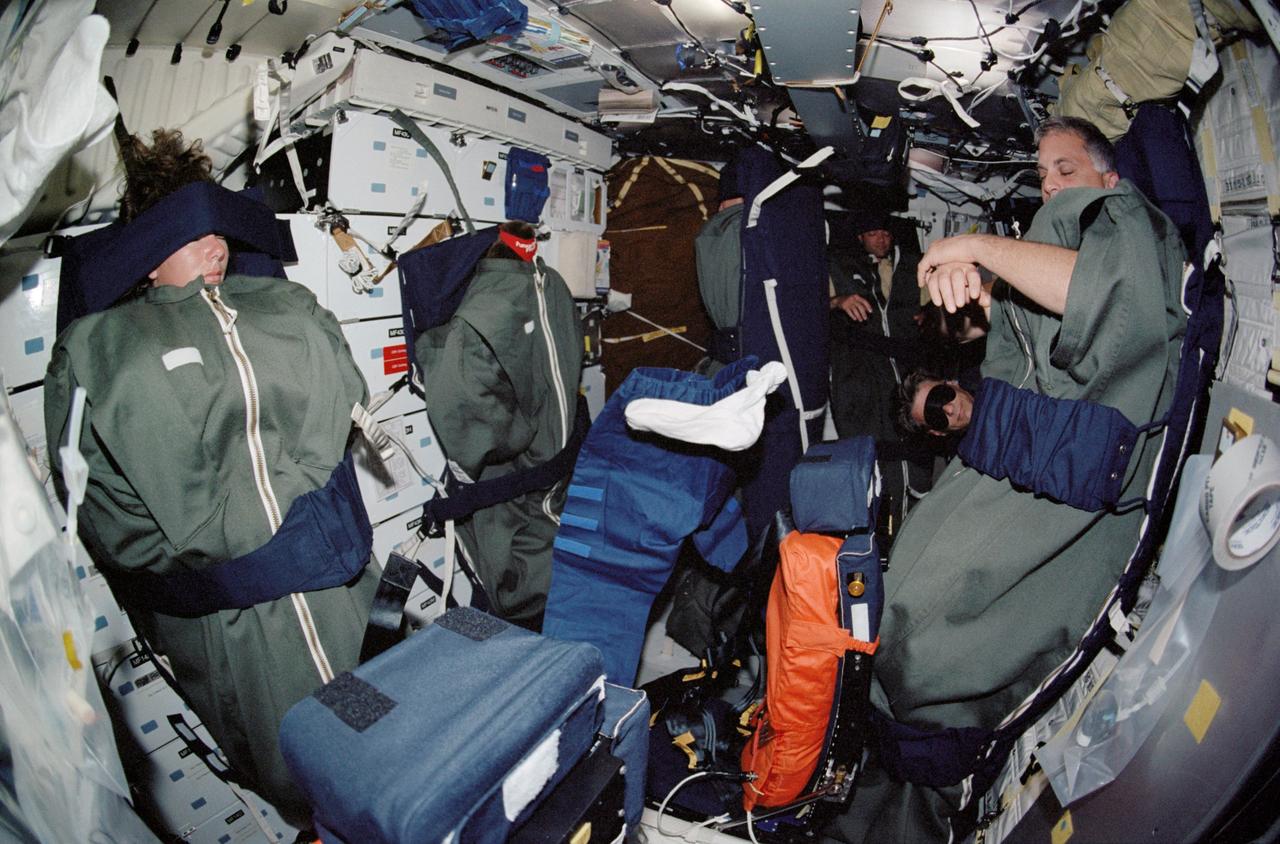
STS112-345-028 (7-18 October 2002) --- The STS-112 crewmembers sleep on the middeck of the Space Shuttle Atlantis. Pictured are astronauts Sandra H. Magnus, David A. Wolf, Piers J. Sellers, mission specialists, and Jeffrey S. Ashby, mission commander.
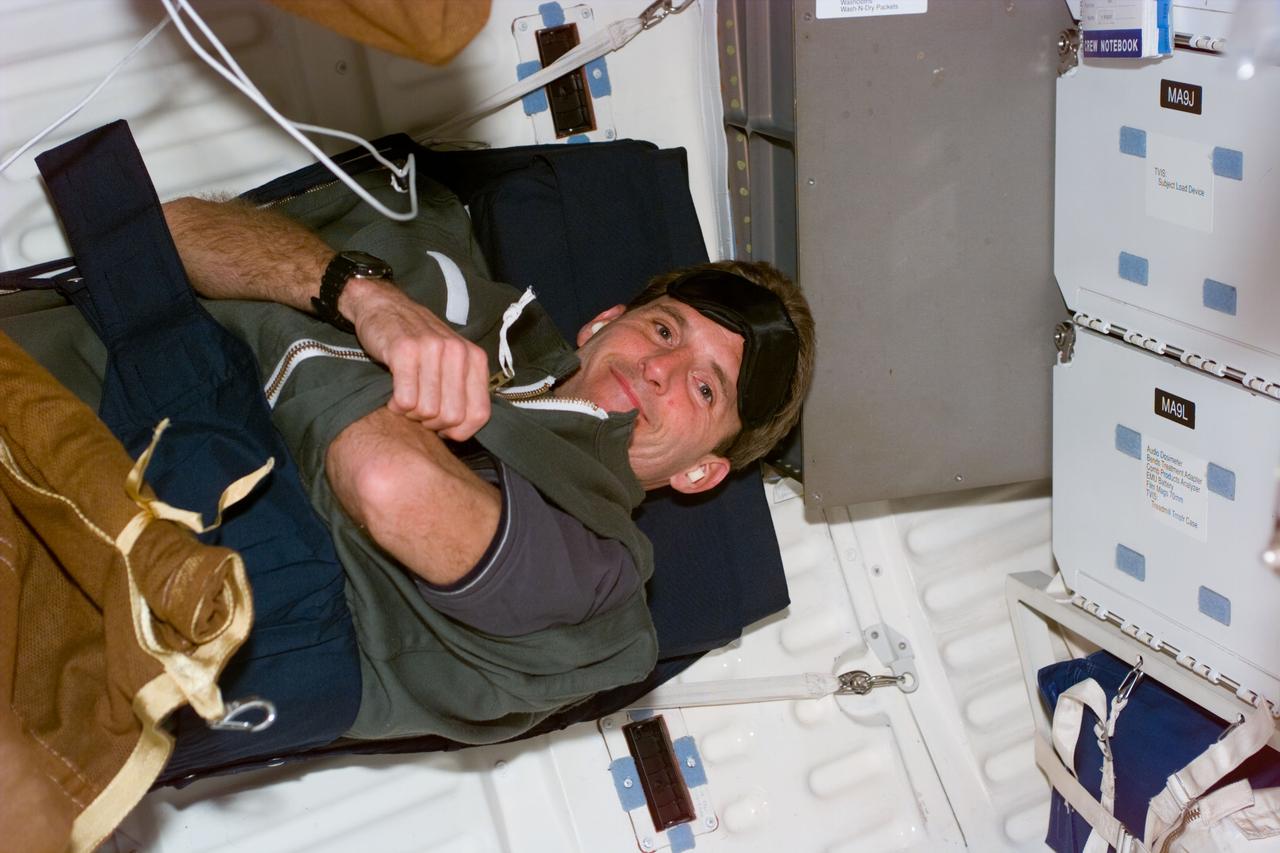
STS081-E-5006 (12 Jan. 1997) --- Aboard the Space Shuttle Atlantis on its first day in orbit for the mission, astronaut Jerry M. Linenger, mission specialist, has arranged his sleep station to his liking and prepares for his first rest period. Linenger and five crew mates are flying the Spacehab Double Module (DM), replete with supplies for the three-man crew aboard Russia's Mir Space Station with which Atlantis will be docking later in the week. Linenger will trade places with John E. Blaha marking the second such exchange of American astronaut - cosmonaut guest researcher's aboard Mir. Blaha had replaced Shannon W. Lucid in September of 1996. The scene was recorded with an Electronic Still Camera (ESC) and later downlinked to flight controllers in Houston, Texas.
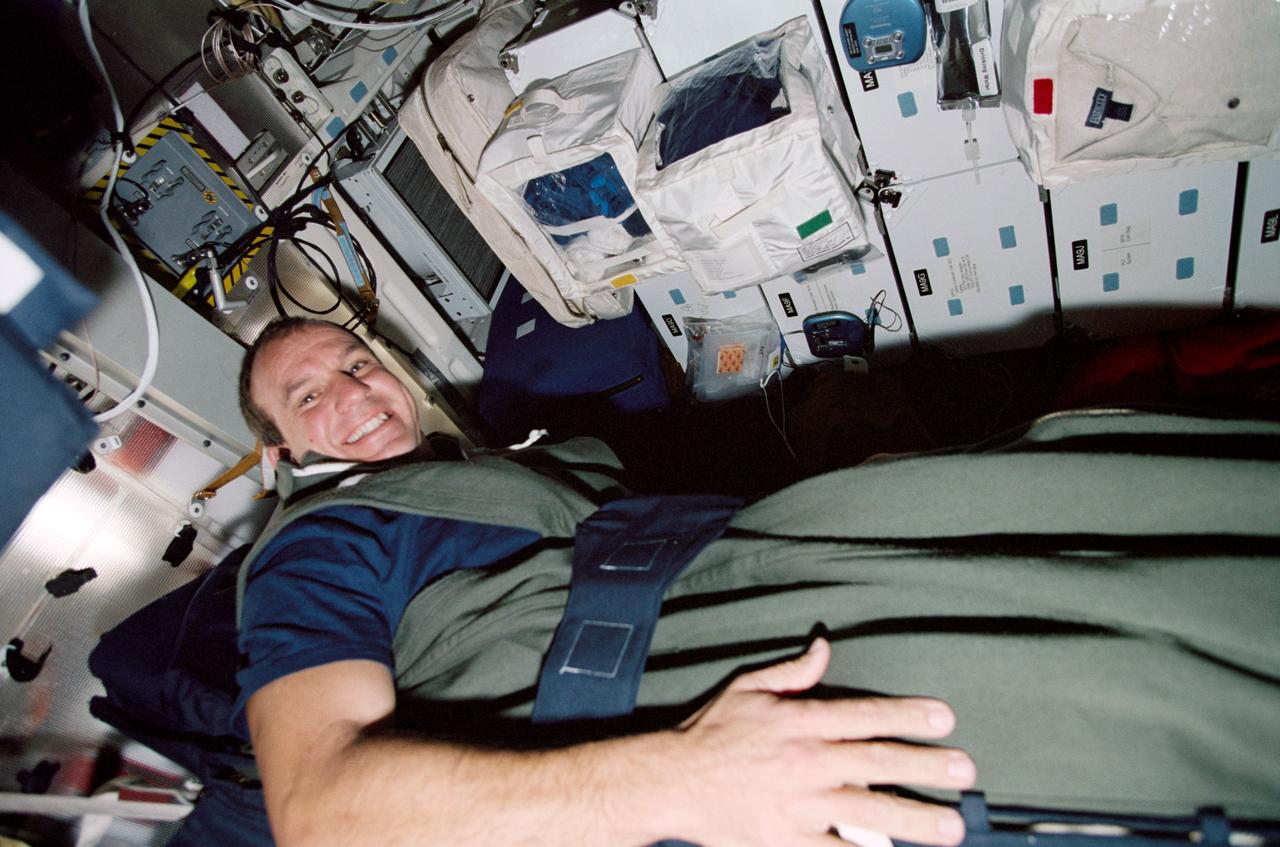
STS097-327-027 (30 Nov.-11 Dec. 2000) --- Astronaut Michael J. Bloomfield, STS-97 pilot, prepares for his sleep shift on the middeck of the Earth-orbiting Space Shuttle Endeavour.
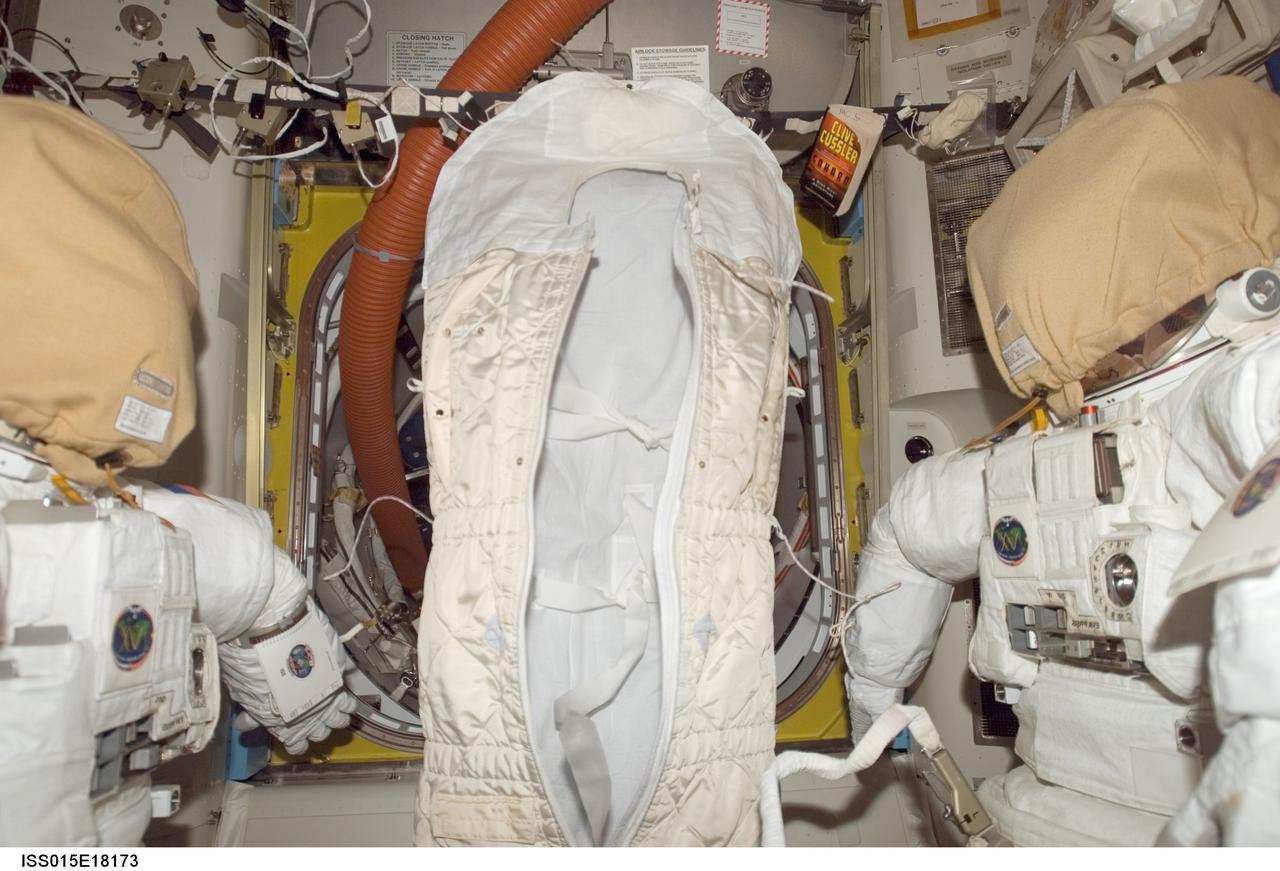
ISS015-E-18173 (11 July 2007) --- A sleeping bag floats near two extravehicular mobility unit (EMU) spacesuits in the Quest Airlock of the International Space Station.
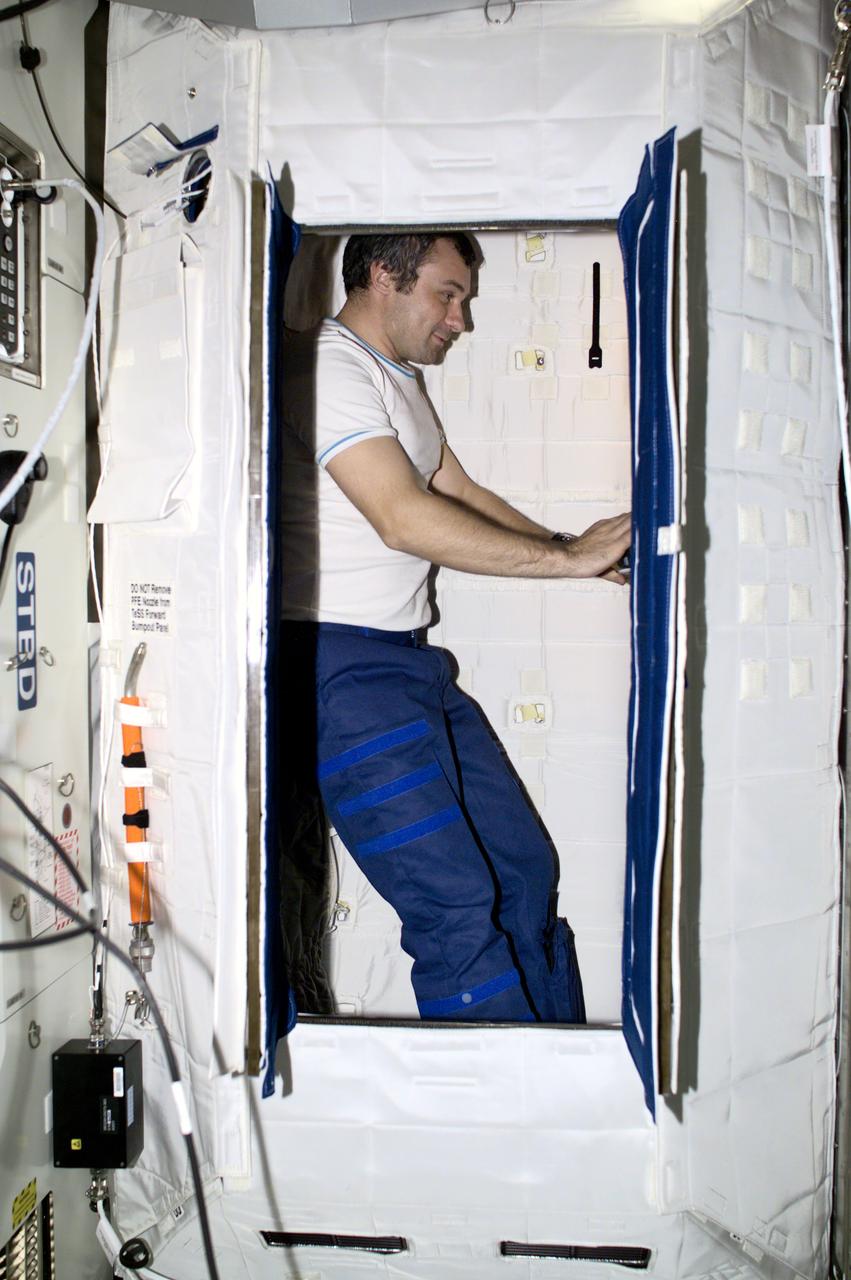
ISS003-E-5558 (9 September 2001) --- Cosmonaut Vladimir Dezhurov of Rosaviakosmos, Expedition 3 flight engineer, works on a laptop computer in the temporary sleep station of the in the U.S. Laboratory Destiny onboard the International Space Station.
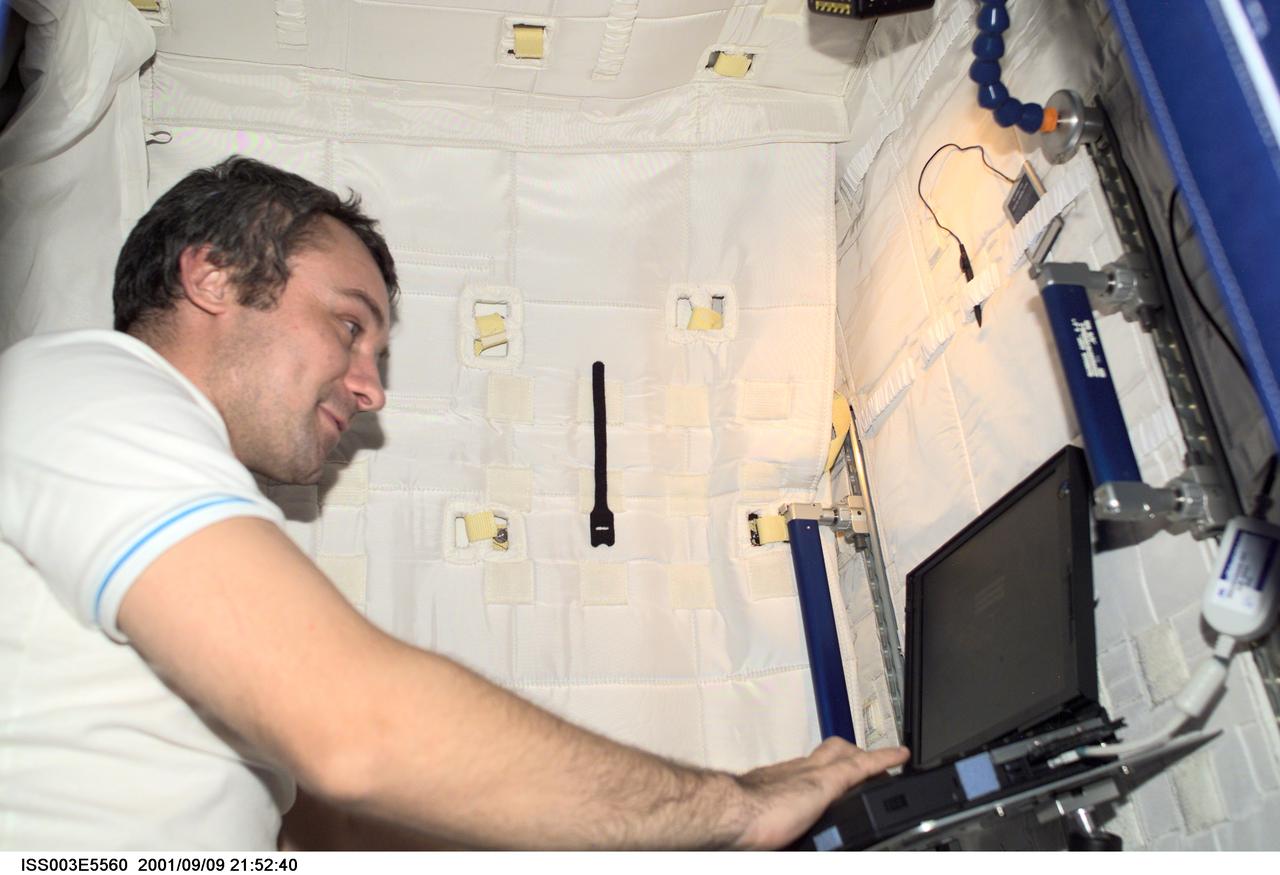
ISS003-E-5560 (9 September 2001) --- Cosmonaut Vladimir Dezhurov of Rosaviakosmos, Expedition Three flight engineer, works on a laptop computer in the Temporary Sleep Station (TSS) in the U.S. Laboratory.
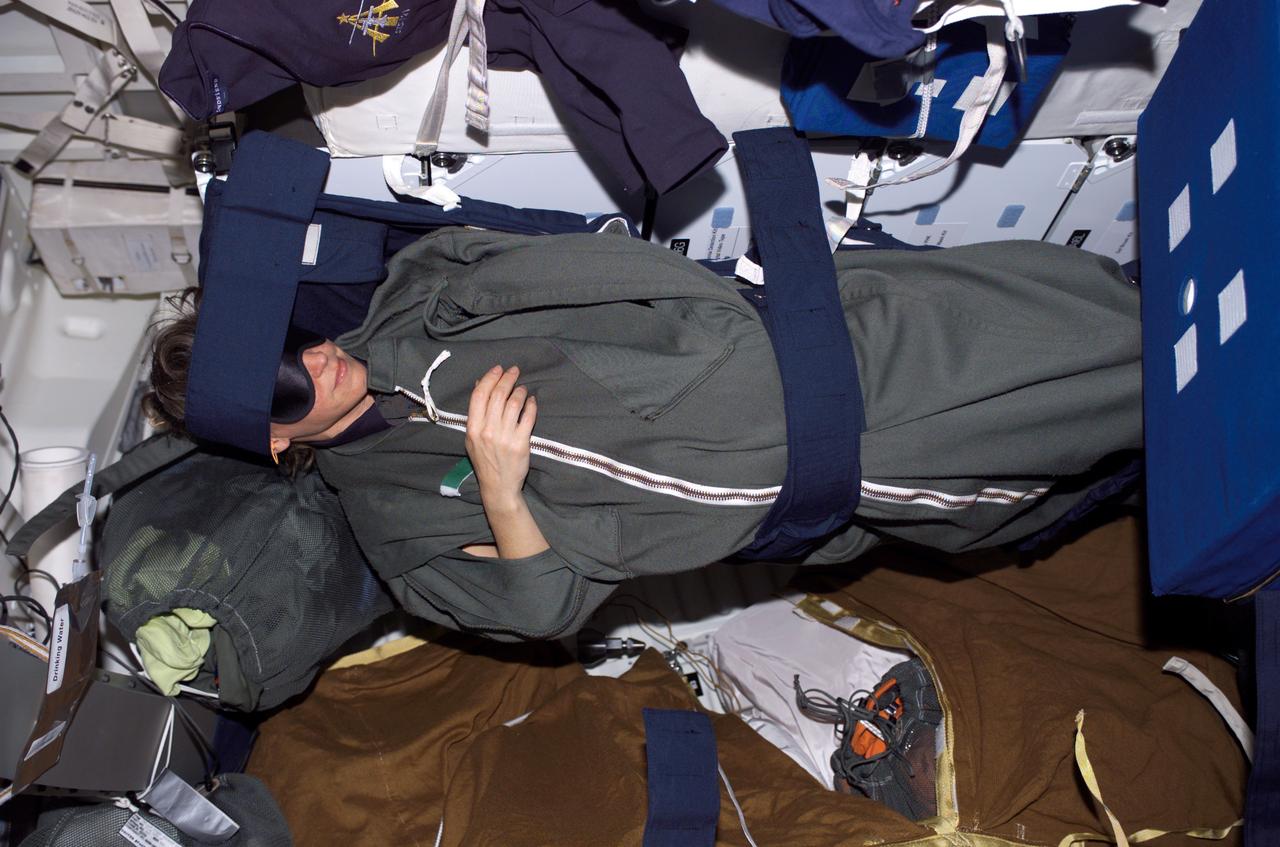
S121-E-06151 (8 July 2006) --- Astronaut Lisa M. Nowak, STS-121 mission specialist, sleeps in her sleeping bag, which is attached to the lockers on the middeck of the Space Shuttle Discovery while docked with the International Space Station.
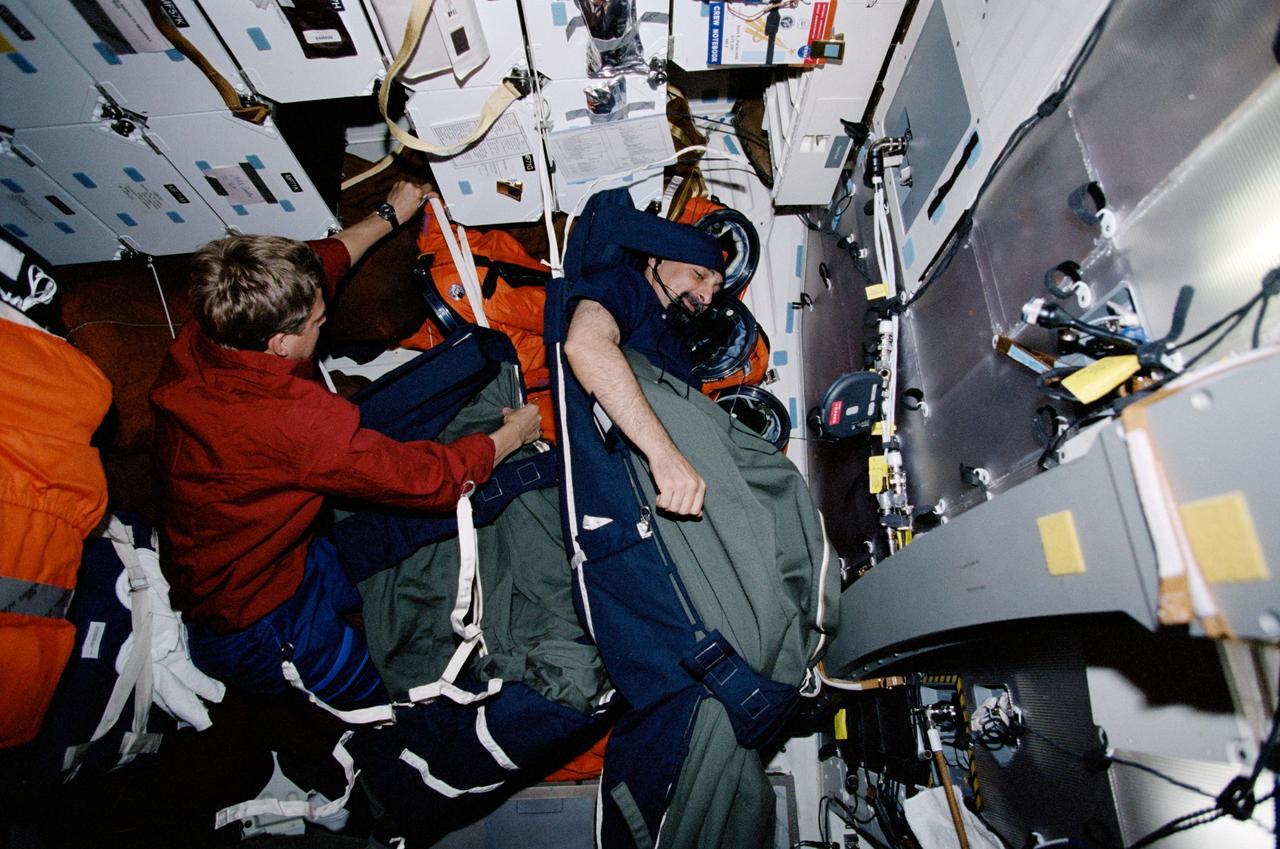
STS100-363-012 (19 April-1 May 2001) --- Astronaut Umberto Guidoni, STS-100 mission specialist, sleeps while astronaut Scott E. Parazynski, mission specialist, prepares for his sleep shift on the Space Shuttle Endeavour's middeck.
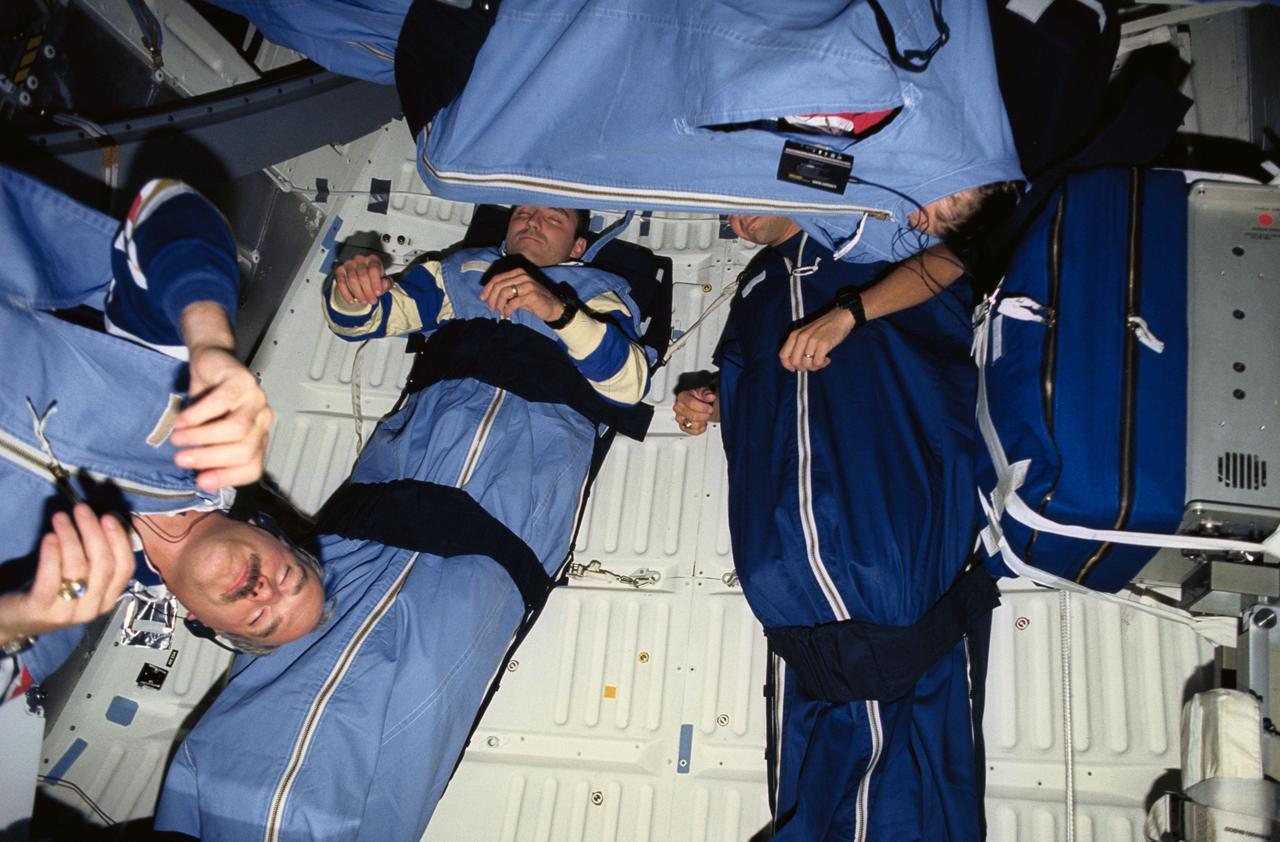
STS051-20-037 (12-22 Sept 1993) --- Four of the five astronaut crew members were photographed during one of their sleep periods on the Space Shuttle Discovery's mid-deck. At bottom center, astronaut Frank L. Culbertson, Jr., mission commander, is barely visible, with most of his body zipped securely in the sleep restraint. Others, left to right, are astronauts Daniel W. Bursch and Carl E. Walz, mission specialists, and William F. Readdy, pilot. The photograph was taken by astronaut James H. Newman, mission specialist.
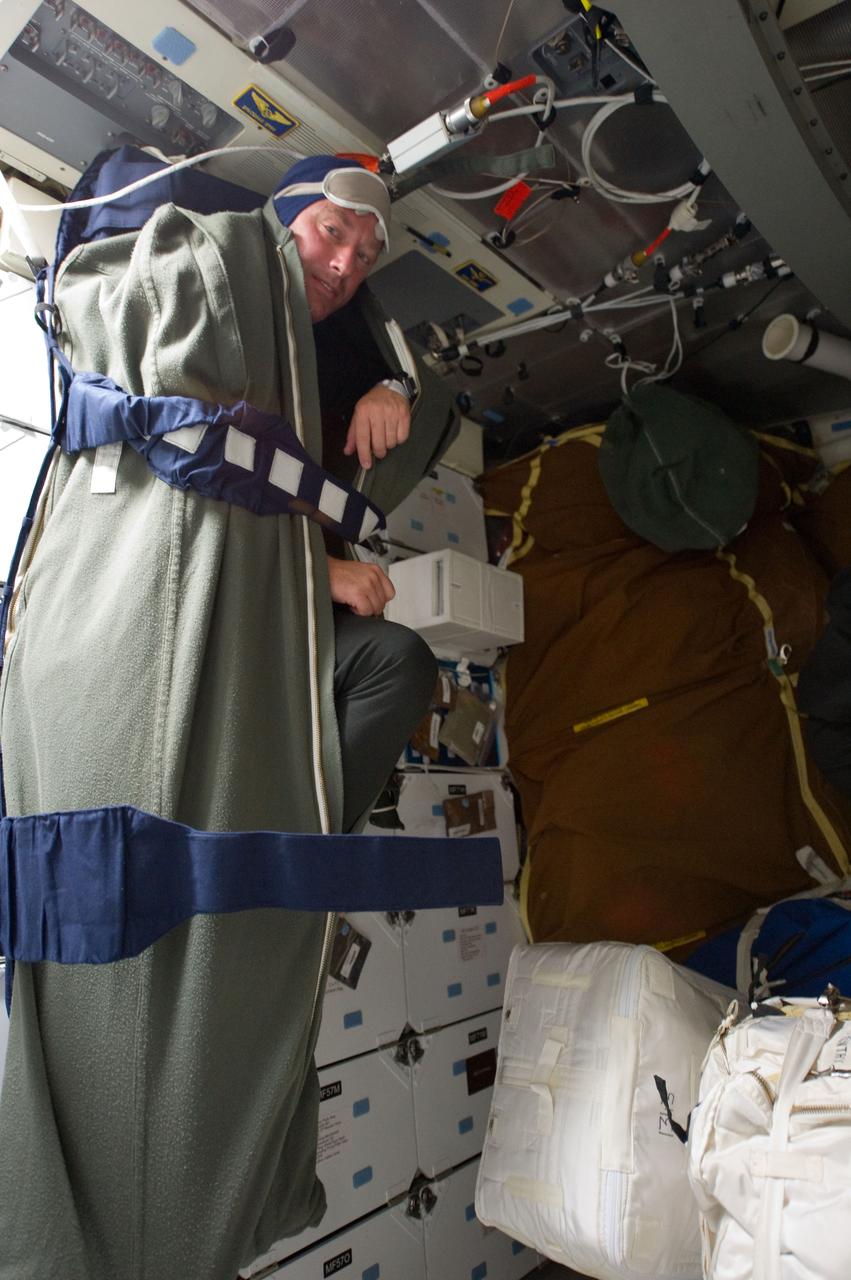
S134-E-006404 (16 May 2011) --- European Space Agency astronaut Roberto Vittori, STS-134 mission specialist, rests in his sleeping bag, which is attached to the lockers on the middeck of the space shuttle Endeavour. Photo credit: NASA
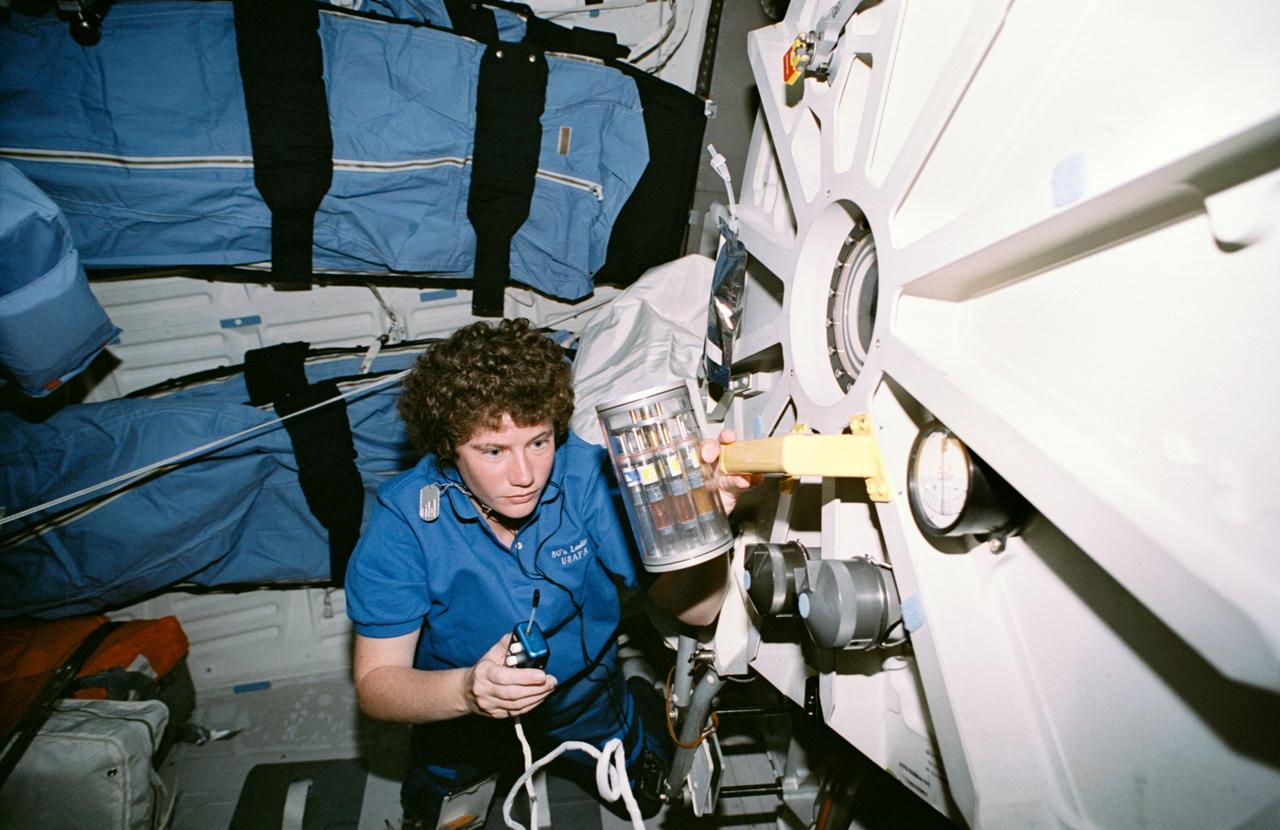
STS054-30-009 (13 Jan 1993) --- Astronaut Susan J. Helms communicates with ground controllers about the Commercial Generic Bioprocessing Apparatus (CGBA) on Endeavour's middeck. The mission specialist holds samples from the CGBA in her left hand. Sleep restraints can be seen in their temporary stow position in the left part of the frame, near the airlock hatch. Also onboard the spacecraft for the six-day mission were astronauts John H. Casper, Donald R. McMonagle, Gregory J. Harbaugh and Mario Runco Jr.
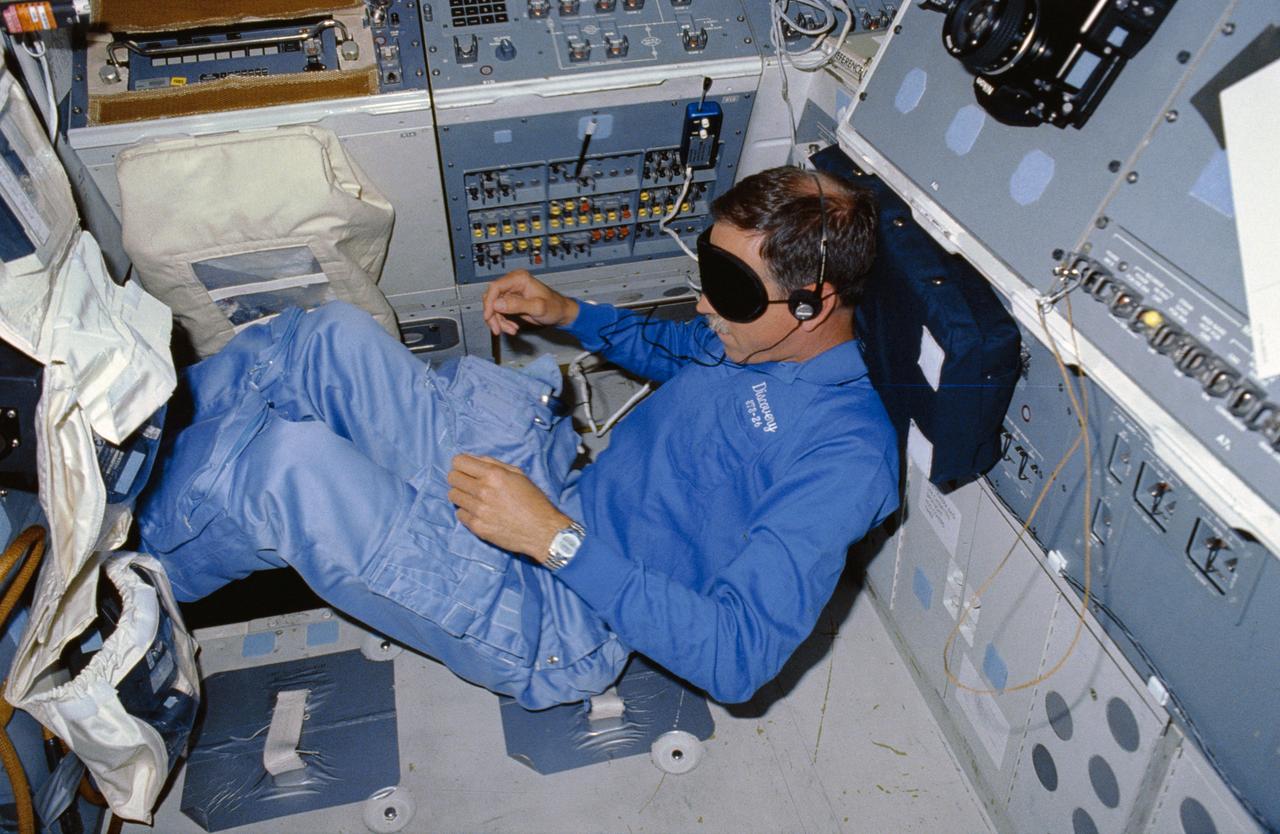
STS026-09-021 (3 Oct 1988) --- Astronaut Richard O. Covey, STS-26 pilot, wearing sleep mask (blindfold) and a headset, props his feet under the pilots seat and rests his head and back on the aft flight deck on orbit station panels while he sleeps. At Covey's right are the mission station control panels.
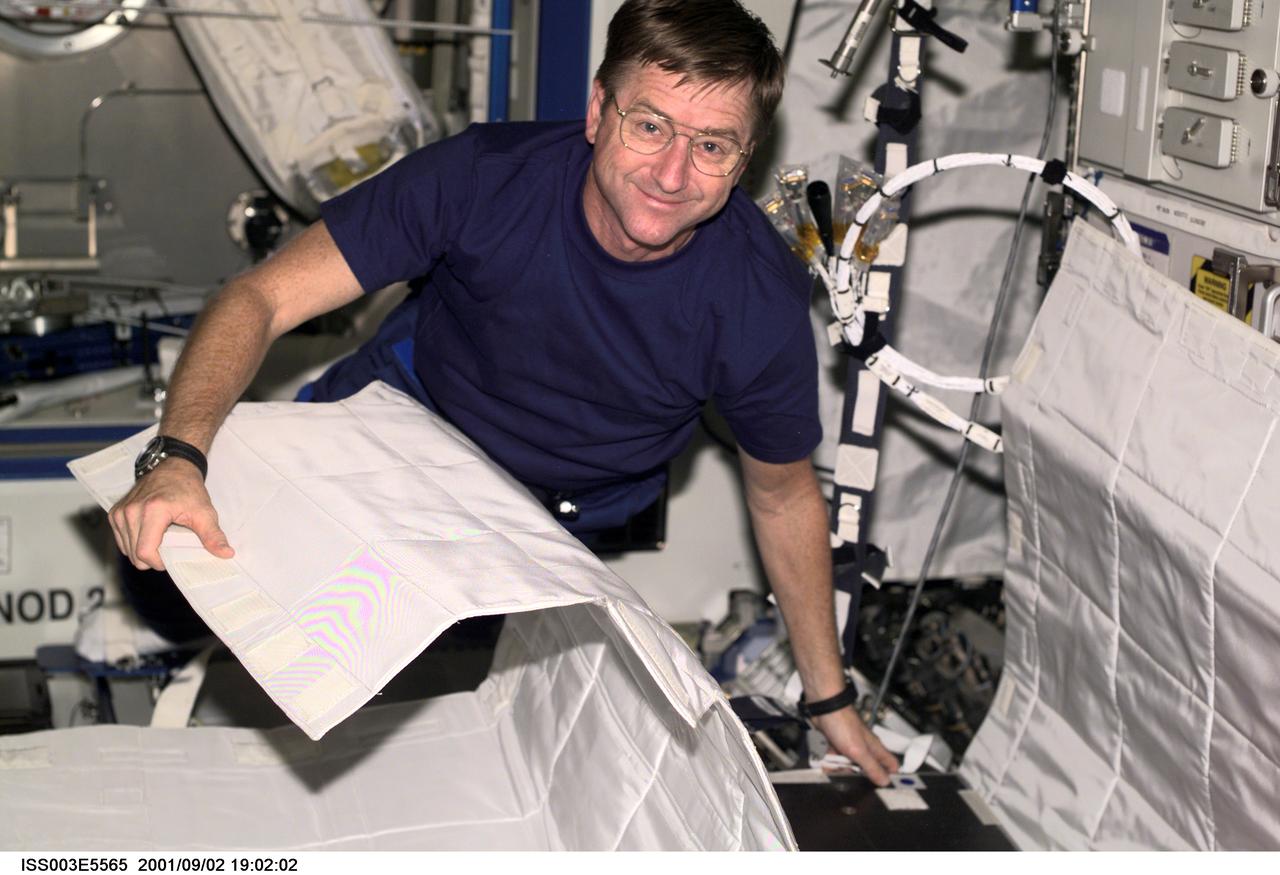
ISS003-E-5565 (2 September 2001) --- Astronaut Frank L. Culbertson, Jr., Expedition Three mission commander, assembles the Temporary Sleep Station (TESS) in the U.S. Laboratory.
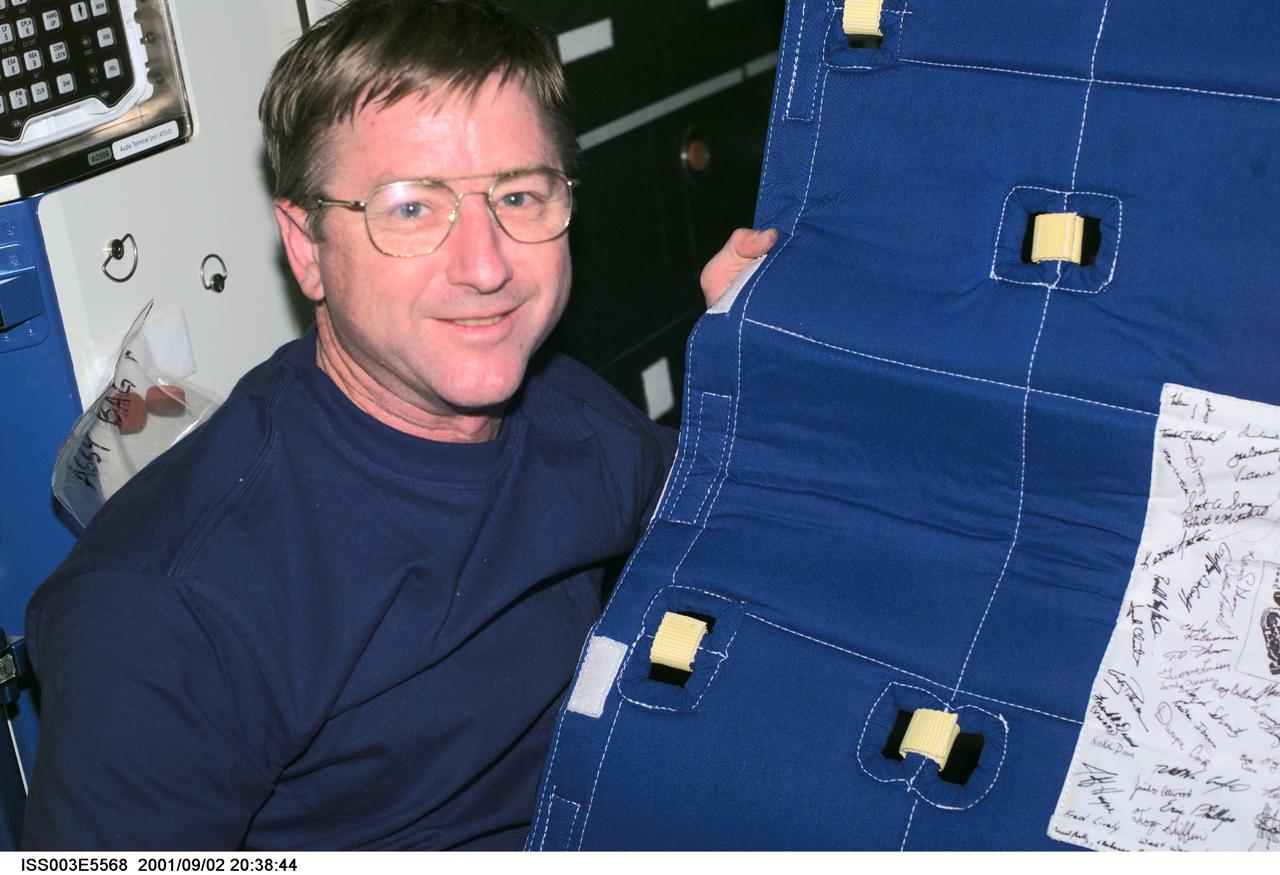
ISS003-E-5568 (2 September 2001) --- Astronaut Frank L. Culbertson, Jr., Expedition Three mission commander, assembles the Temporary Sleep Station (TESS) in the U.S. Laboratory.
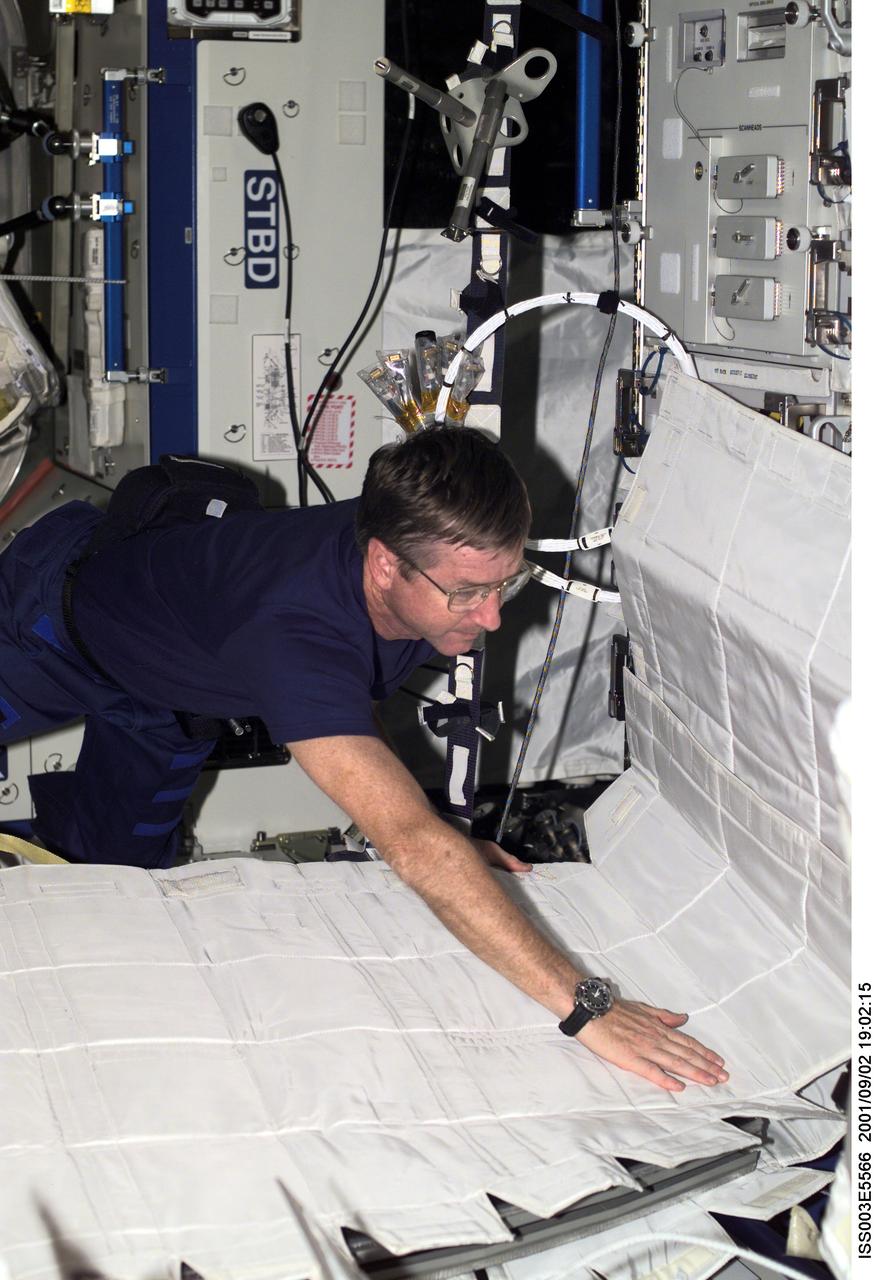
ISS003-E-5566 (2 September 2001) --- Astronaut Frank L. Culbertson, Jr., Expedition Three mission commander, assembles the Temporary Sleep Station (TESS) in the U.S. Laboratory.
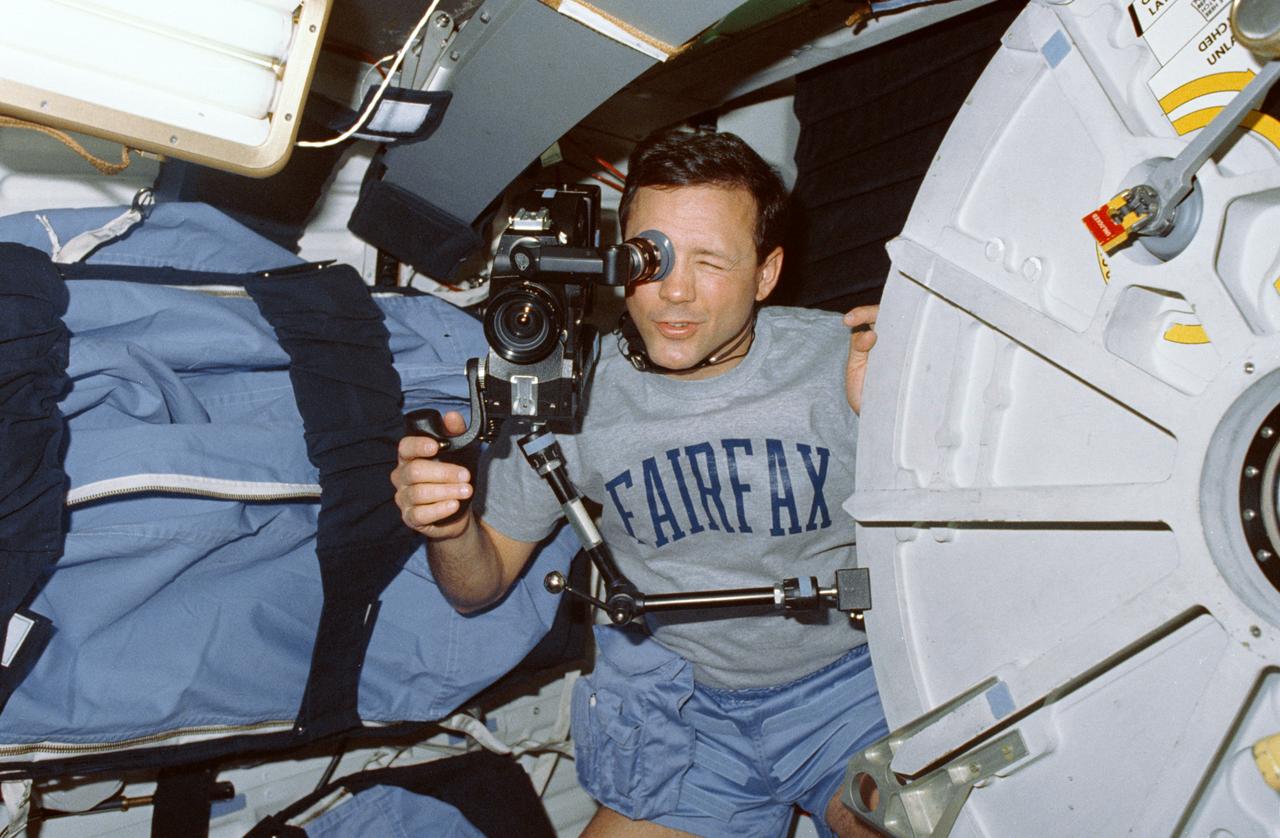
STS-36 Mission Specialist (MS) Pierre J. Thuot operates 16mm ARRIFLEX motion picture camera mounted on the open airlock hatch via a bracket. Thuot uses the camera to record activity of his fellow STS-36 crewmembers on the middeck of Atlantis, Orbiter Vehicle (OV) 104. Positioned between the airlock hatch and the starboard wall-mounted sleep restraints, Thuot, wearing a FAIRFAX t-shirt, squints into the cameras eye piece. Thuot and four other astronauts spent four days, 10 hours and 19 minutes aboard OV-104 for the Department of Defense (DOD) devoted mission.
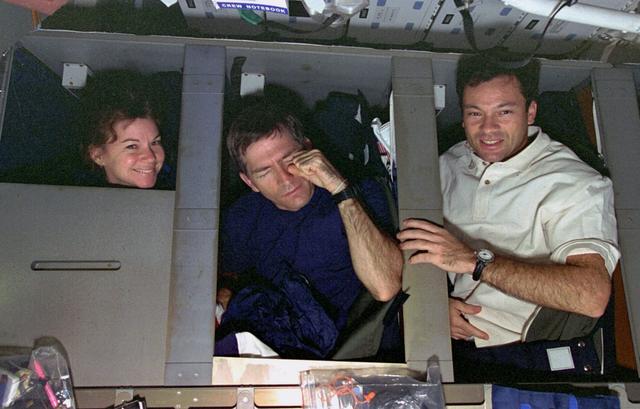
STS073-351-035 (20 October - 5 November 1995) --- Three crew members are captured on camera at the end of their sleep shift on the middeck of the Earth-orbiting Space Shuttle Columbia. Pictured are (left to right) astronaut Catherine G. Coleman, mission specialist; payload specialist Fred W. Leslie and astronaut Michael E. Lopez-Alegria, mission specialist. The trio joined four other crewmembers for 16 days of in-space research in support of the United States Microgravity Laboratory (USML-2) mission.
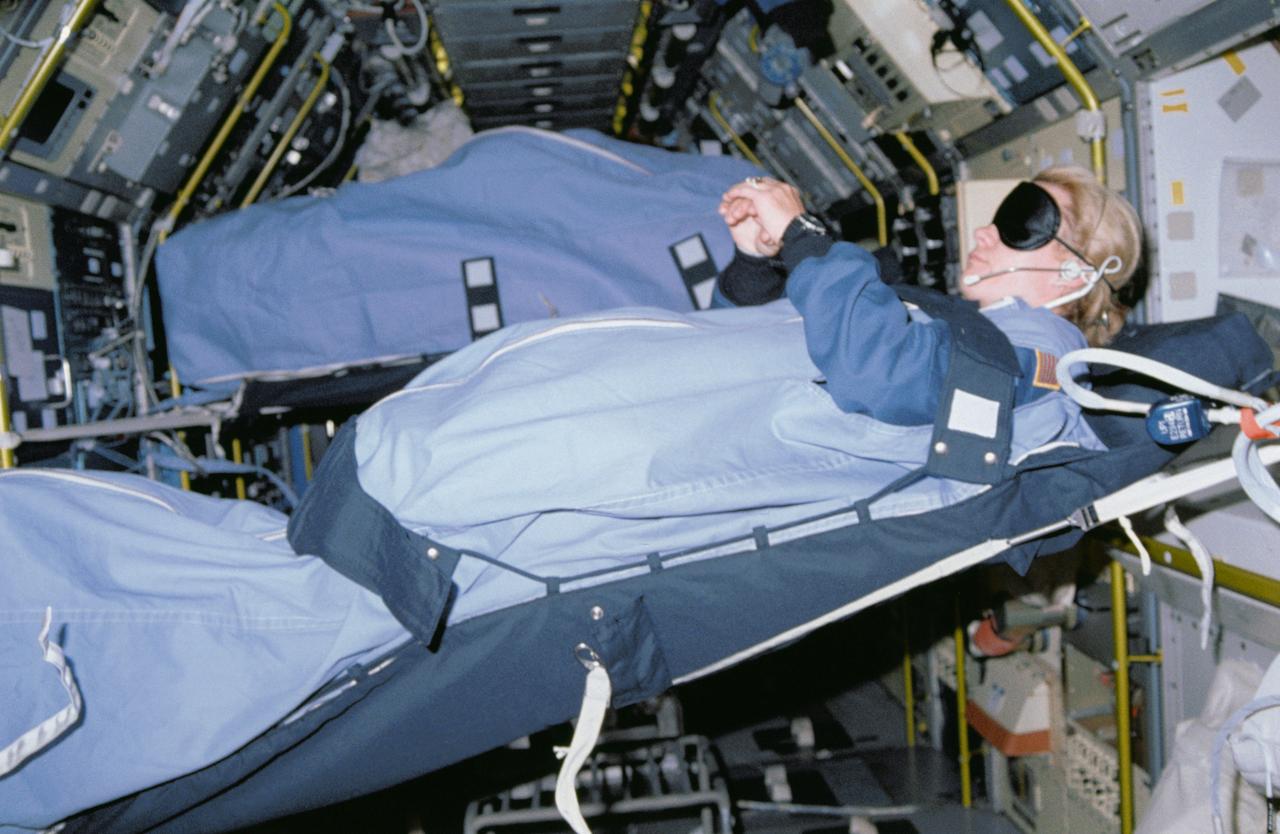
STS040-31-020 (5-14 June 1991) --- During the nine-day mission, some of the crew slept in the SLS-1 module. Astronaut Rhea Seddon, using various restraints, sleeps horizontally in this scene. The image was one of 25 visuals used by the STS-40 crew at its Post Flight Press Conference (PFPC) on June 28, 1991.
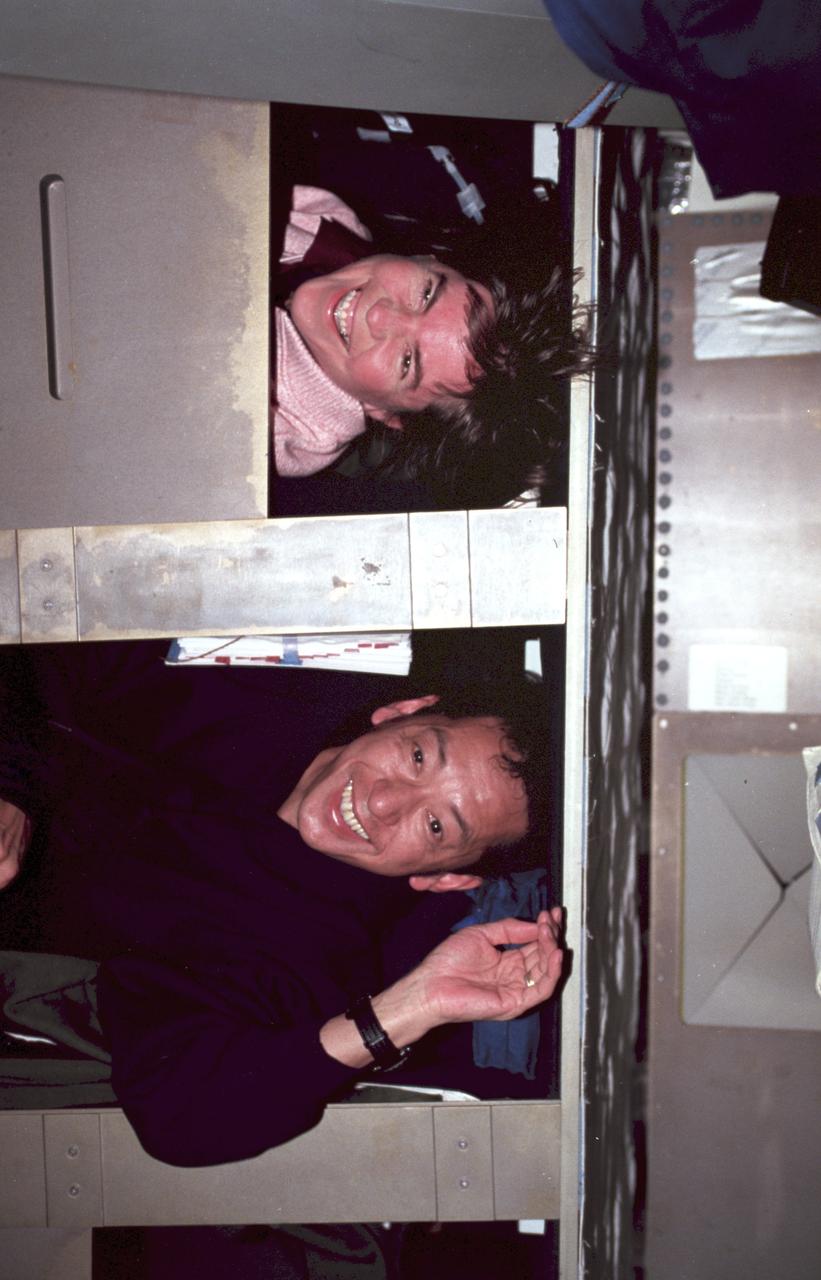
STS099-308-019 (11-22 February 2000) ---Astronauts Janice E. Voss and Mamoru Mohri, both members of the Blue Team portion of 24-hour SRTM support, prepare for their sleep shift on the middeck of the Earth-orbiting Space Shuttle Endeavour. Mohri represents Japan?s National Space Development Agency (NASDA).
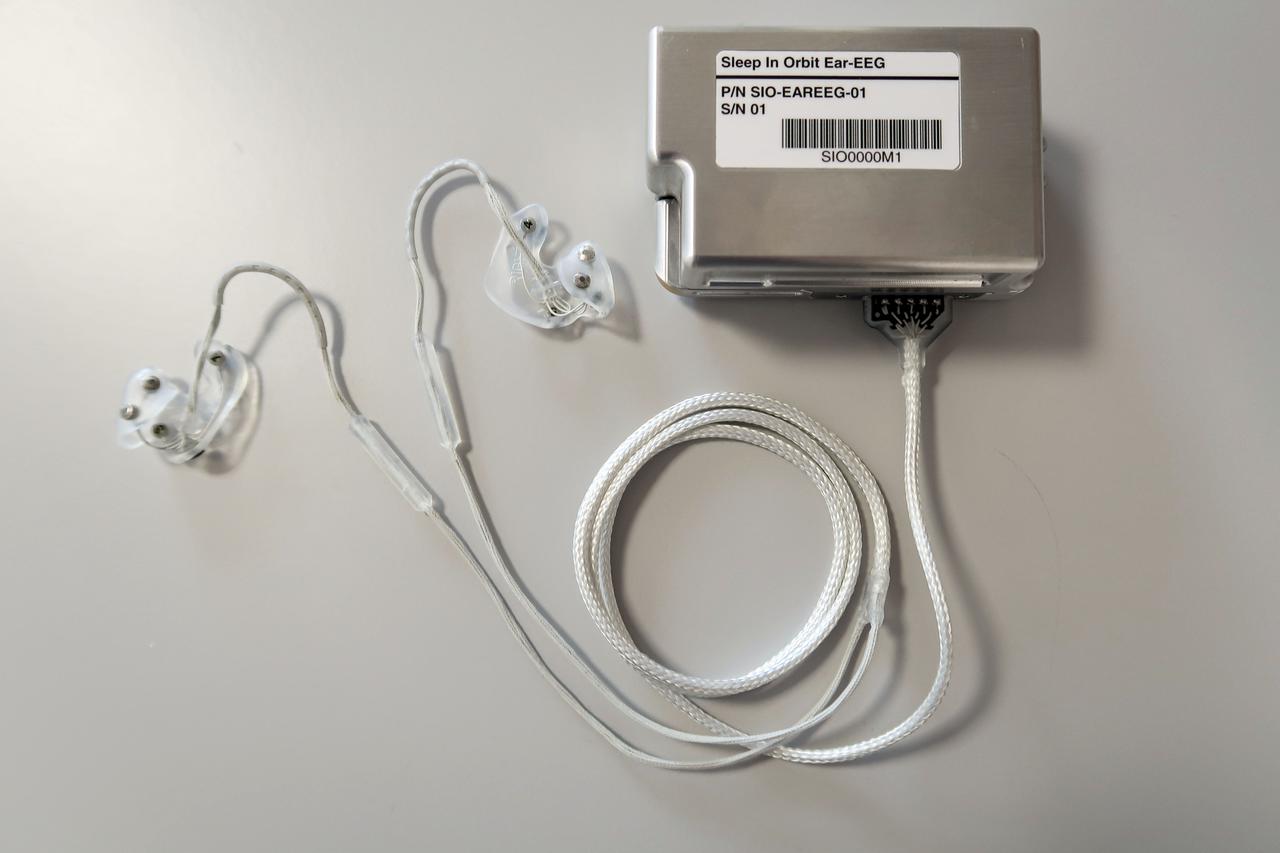
jsc2023e031742 (2/20/2023) --- Long-term Sleep Monitoring Before, During and After Extended Spaceflight (Sleep in Orbit) ear-EEG (electroencephalography) hardware. The Sleep in Orbit investigation studies the physiological differences between sleep on Earth and in space using ear-EEG (electroencephalography) based sleep monitoring. Image courtesy of Preben Kidmose.
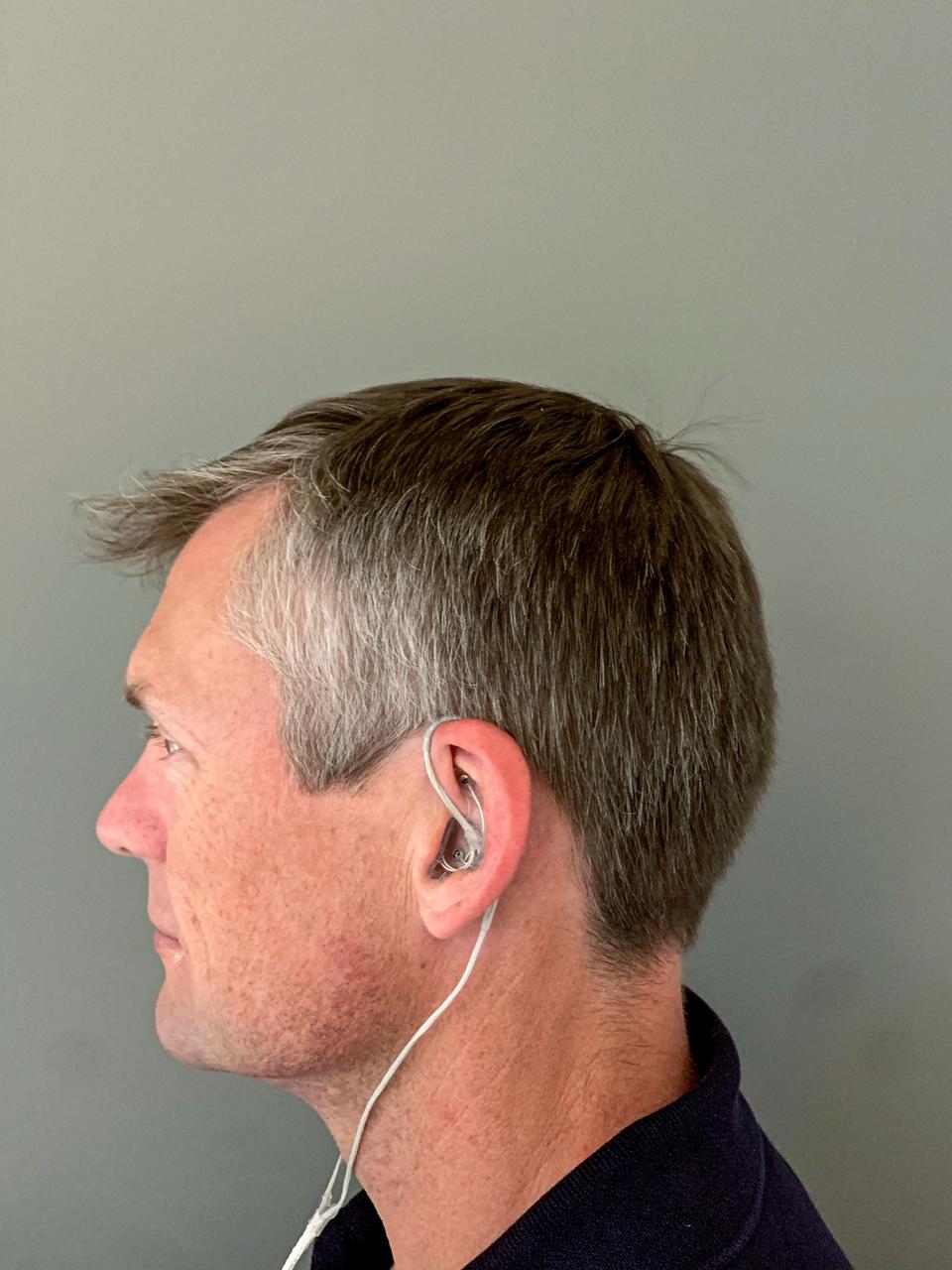
jsc2023e031741 (5/24/2023) --- Long-term Sleep Monitoring Before, During and After Extended Spaceflight (Sleep in Orbit) ear-EEG (electroencephalography) hardware worn by subject. The Sleep in Orbit investigation studies the physiological differences between sleep on Earth and in space using ear-EEG (electroencephalography) based sleep monitoring. Image courtesy of Preben Kidmose.
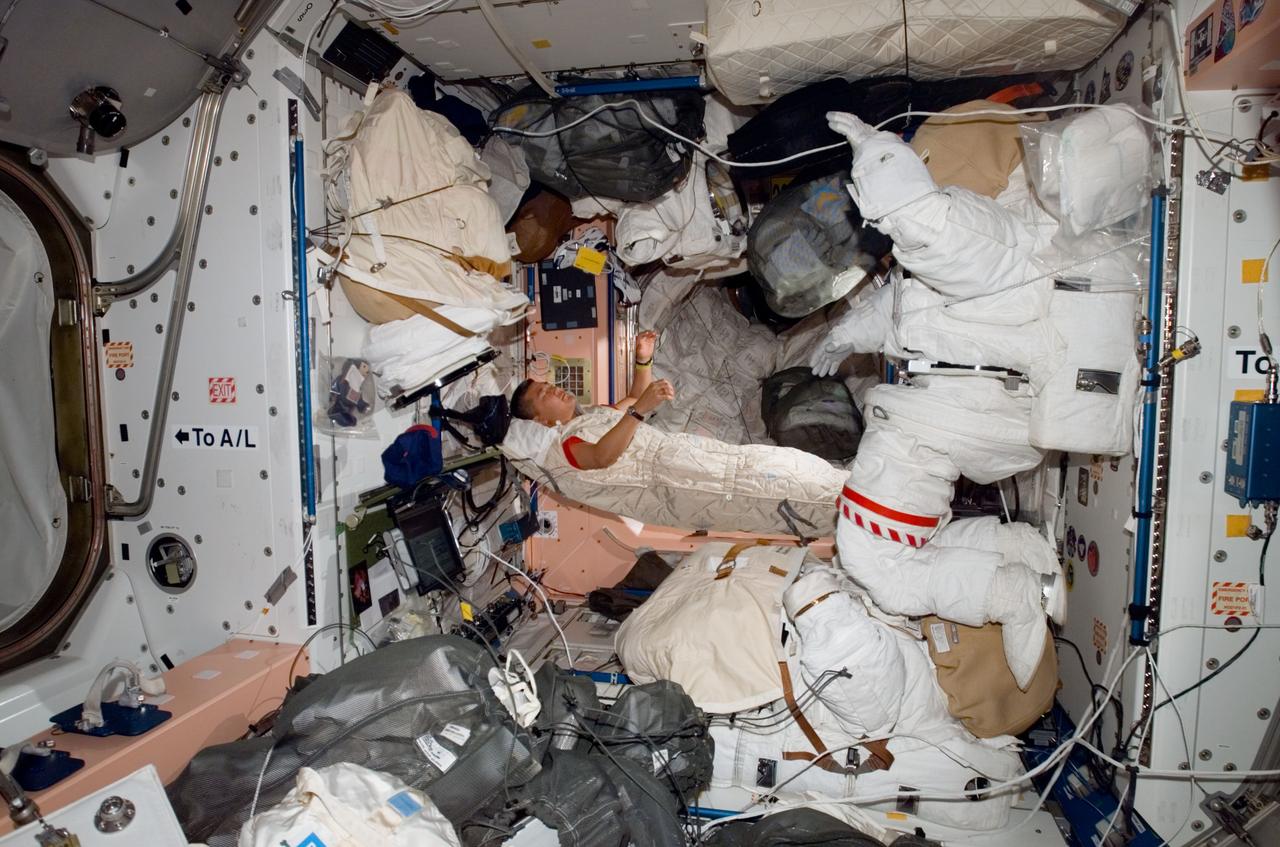
ISS016-E-008034 (2 Nov. 2007) --- Astronaut Daniel Tani, Expedition 16 flight engineer, sleeps in his sleeping bag in the Unity node of the International Space Station while Space Shuttle Discovery is docked with the station.
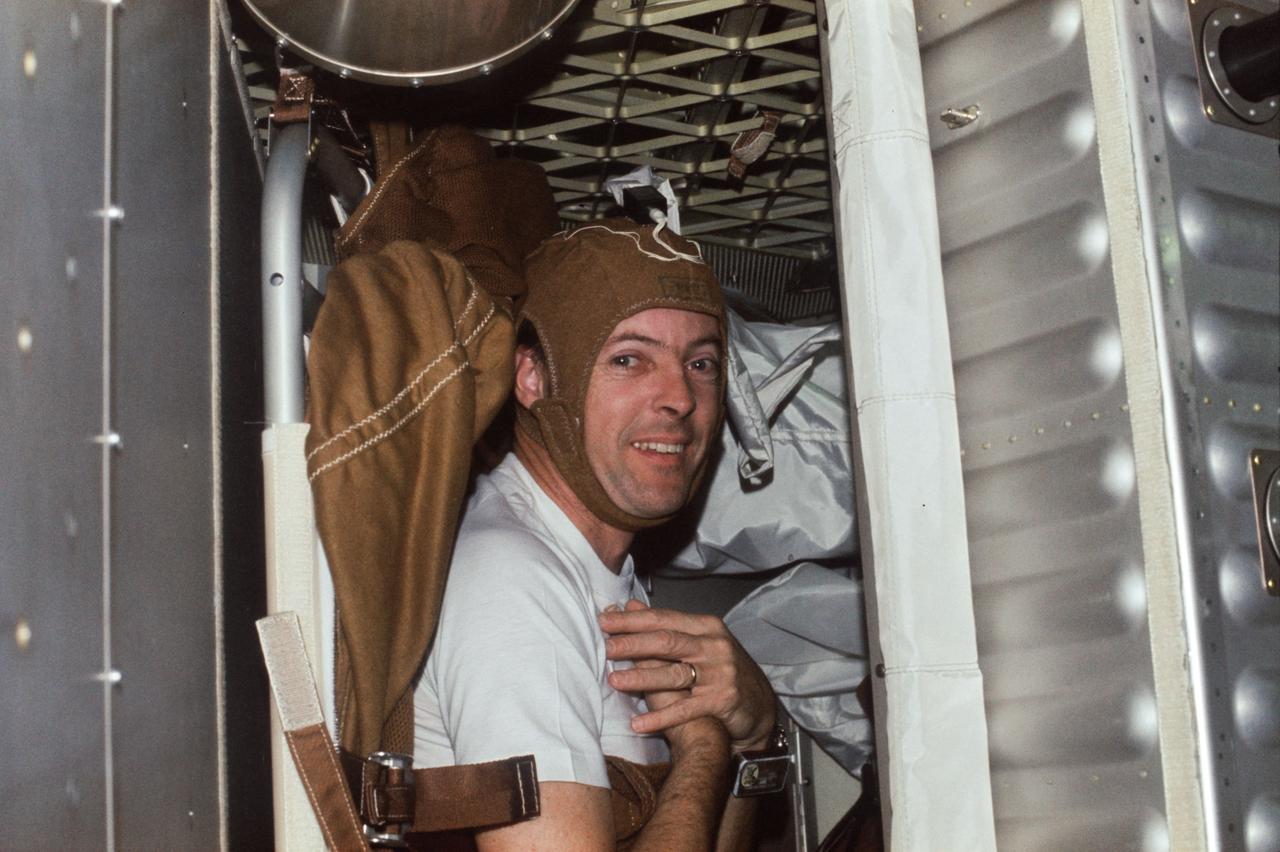
SL2-X3-205 (June 1973) --- Scientist-astronaut Joseph P. Kerwin, Skylab 2 science pilot, is photographed strapped into the sleep restraint in the crew quarters of the Orbital Workshop of the Skylab 1 & 2 space station cluster in Earth orbit. Kerwin is wearing the special cap which contains biomedical instrumentation for the M133 Sleep Monitoring Experiment. The purpose of the M133 experiment is to evaluate quantity and quality of sleep during prolonged space flight by the analysis of electroencephalographic (EEG) and electrooculographic (EOG) activity. Photo credit: NASA
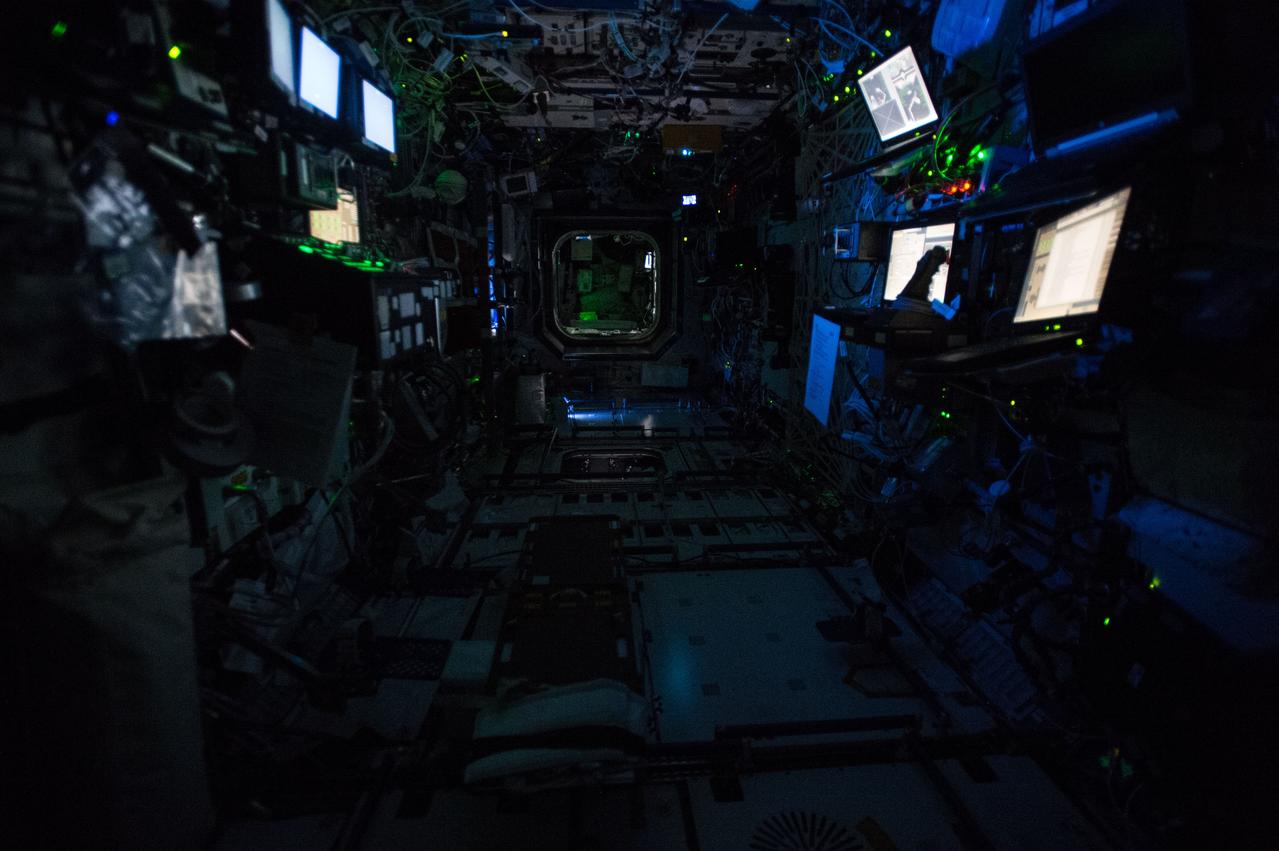
ISS047e016355 (03/23/2016) --- The International Space Station's Destiny Laboratory at “night” shortly before the Expedition 47 crew entered its scheduled sleep period. The space station experiences 16 sunrises and sunsets every day which can alter the crew’s circadian rhythm and disrupt sleep patterns. Lights are turned off and windows are covered to give the interior of the station a nighttime environment during sleep cycles.
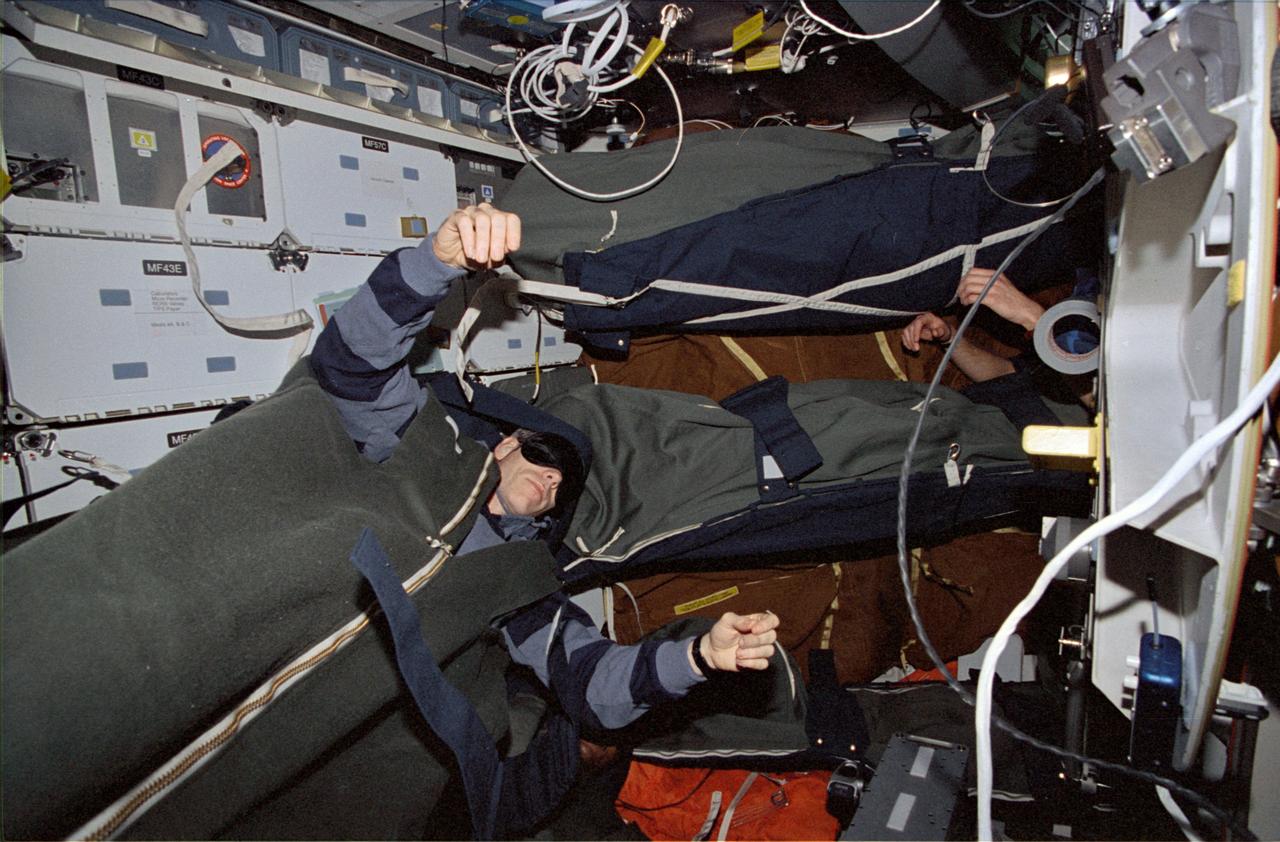
STS072-306-024 (11-20 Jan. 1996) --- Astronaut Daniel T. Barry sleeps on the middeck of the Earth-orbiting Space Shuttle Endeavour. The sleeping bag is considered advantageous primarily because it restricts movement in the microgravity environment, as Barry’s crew mates pointed out during a televised NASA briefing following the mission.
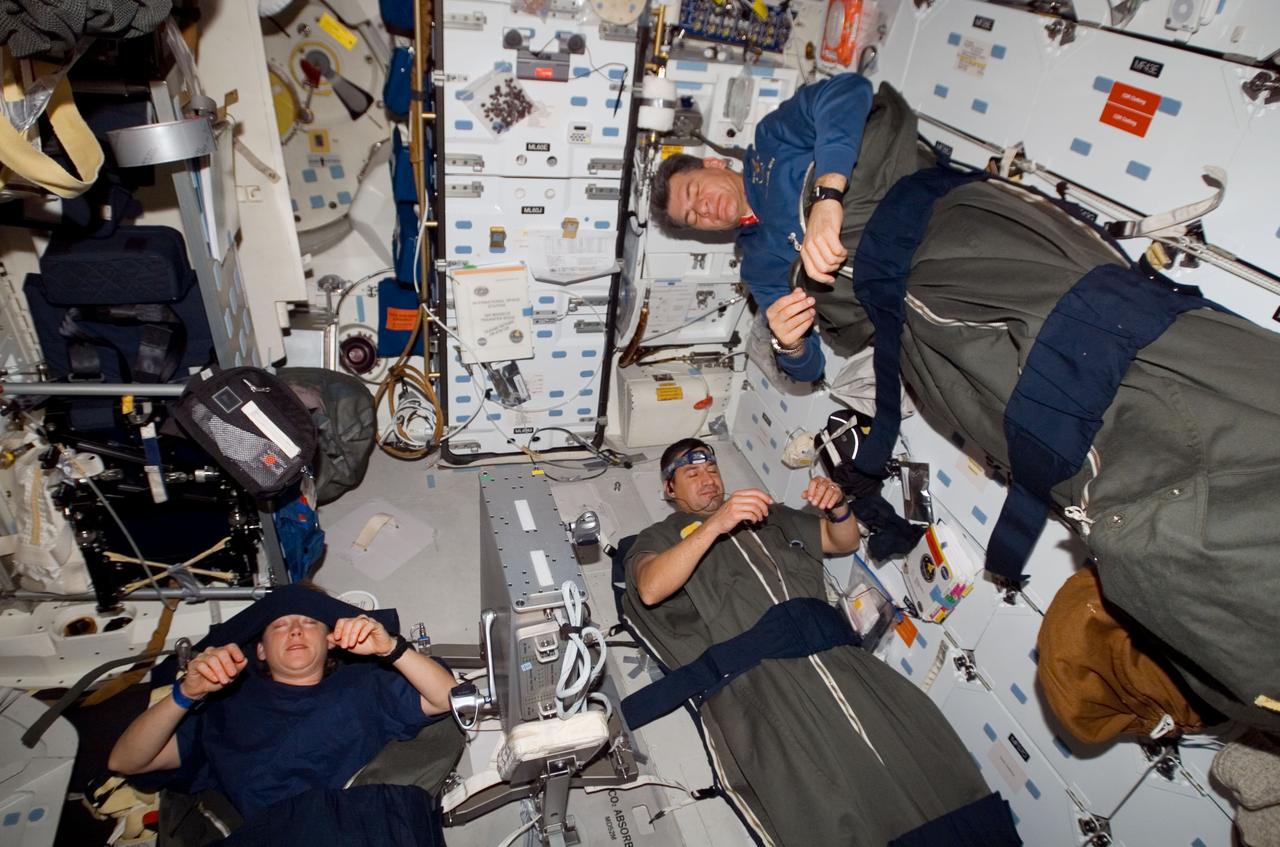
S120-E-007889 (1 Nov. 2007) --- Astronauts Pam Melroy (left), STS-120 commander; George Zamka (bottom right), pilot; and European Space Agency's (ESA) Paolo Nespoli, mission specialist, sleep in their sleeping bags, which are secured on the middeck of the Space Shuttle Discovery while docked with the International Space Station.
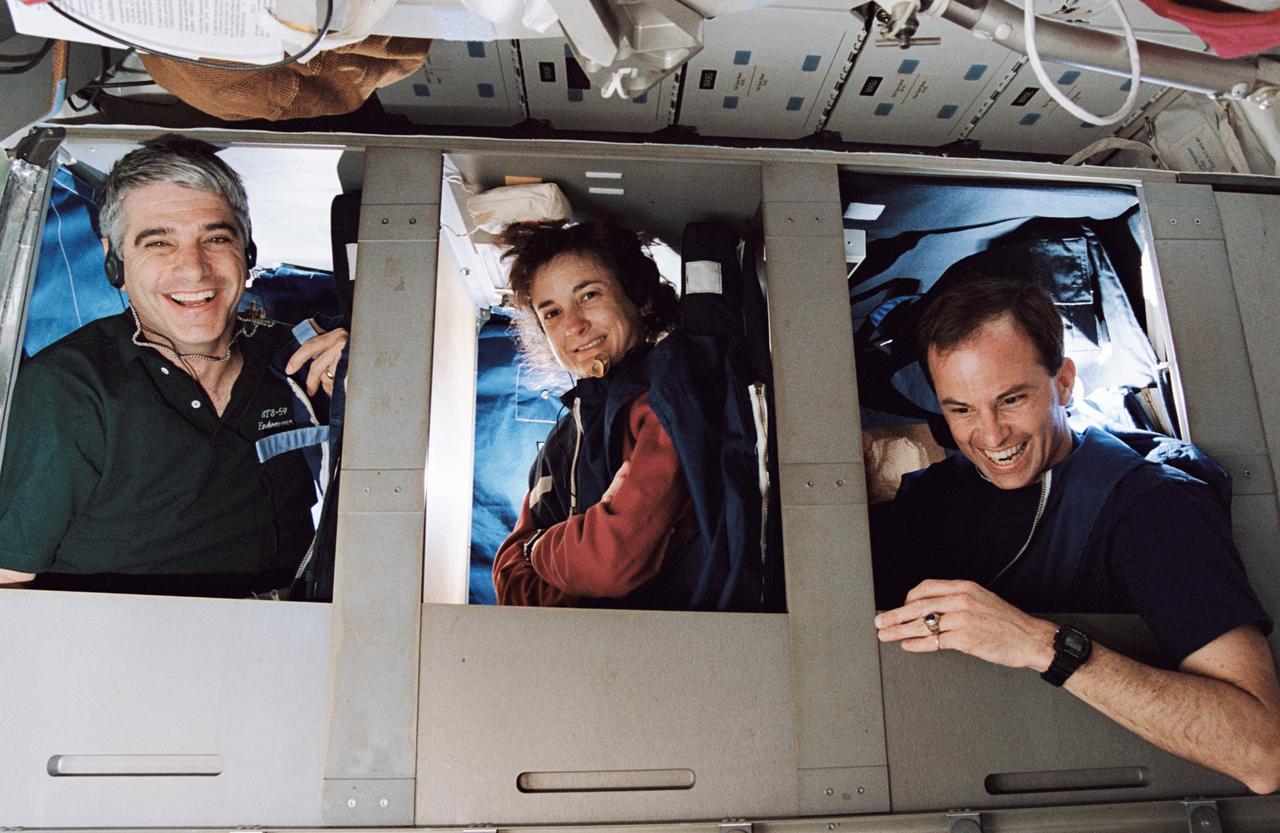
STS059-22-004 (9-20 April 1994) --- Half of Space Shuttle Endeavour's crew of six astronauts are pictured in bunks on the middeck. With the picture held horizontally, the red shift crew members pictured are, left to right, astronauts Sidney M. Gutierrez, mission commander; Linda M. Godwin, payload commander; and Kevin P. Chilton, pilot.
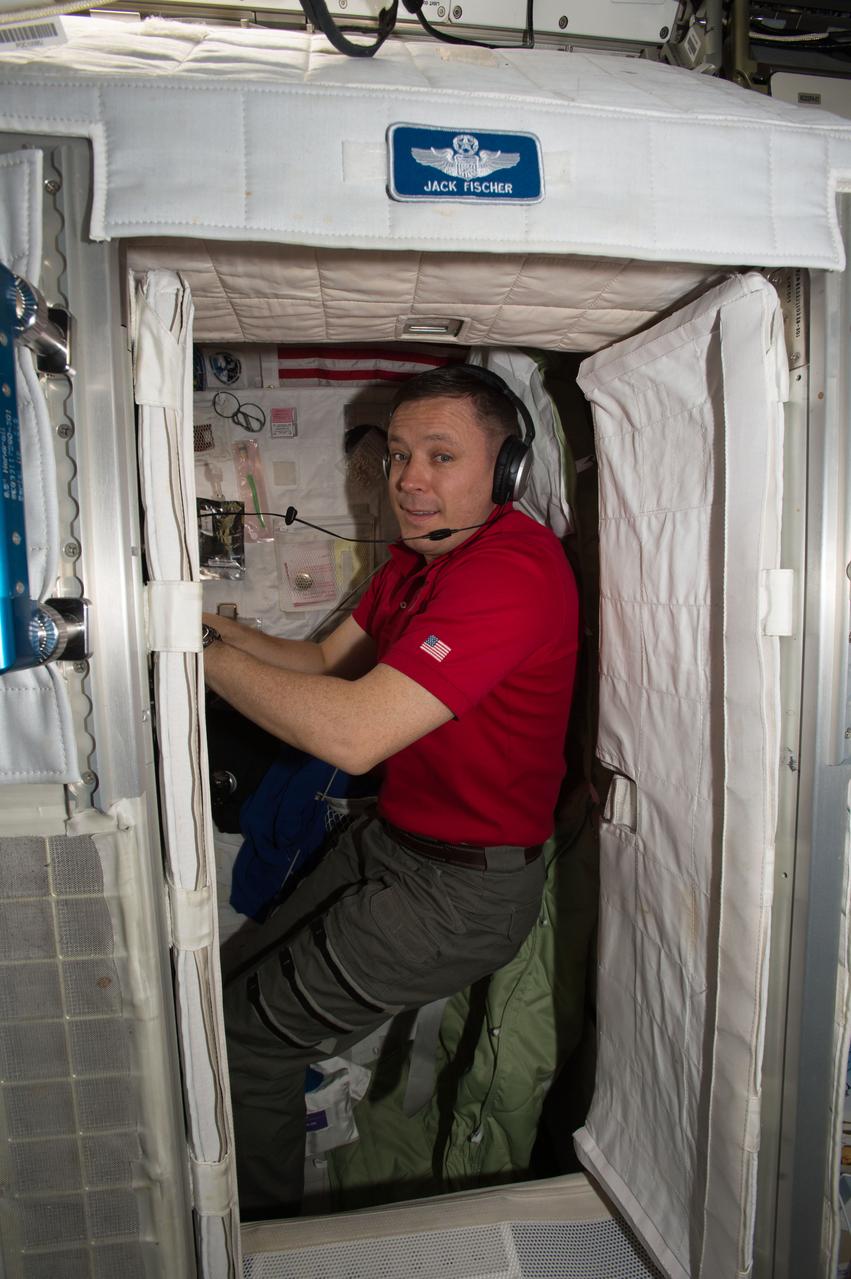
iss051e029443 (May 1, 2017) --- Air Force colonel and NASA astronaut Jack "2Fish" Fischer inhabits a personal sleep station inside the International Space Station.
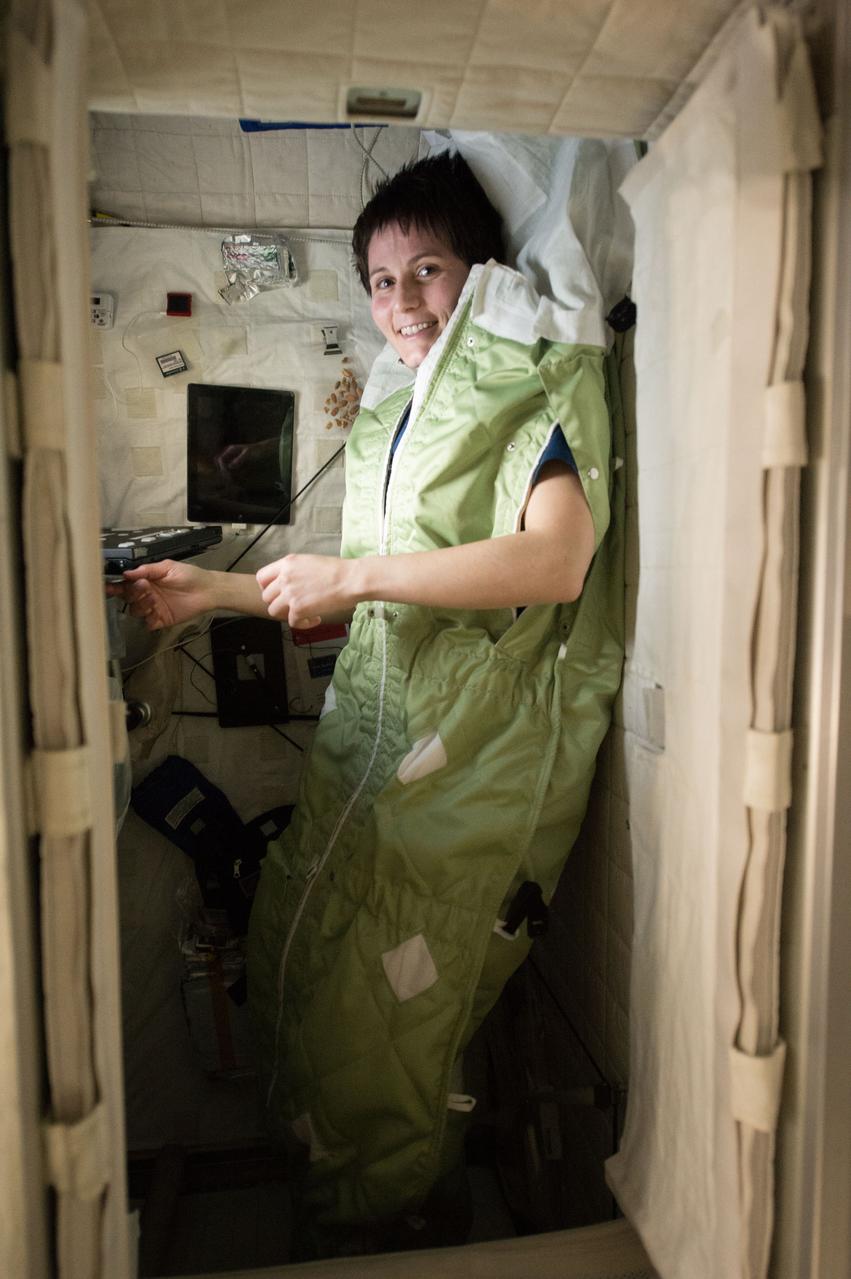
iss042e023422 (12/6/14) --- Expedition 42 Flight Engineer Samantha Cristoforetti of the European Space Agency (ESA) on 6 December 2014 is seen inside of a sleeping bag in her personal crew quarters on the International Space Station. Astronauts will strap the bag to the wall to prevent from free floating and potentially bumping into equipment while sleeping.
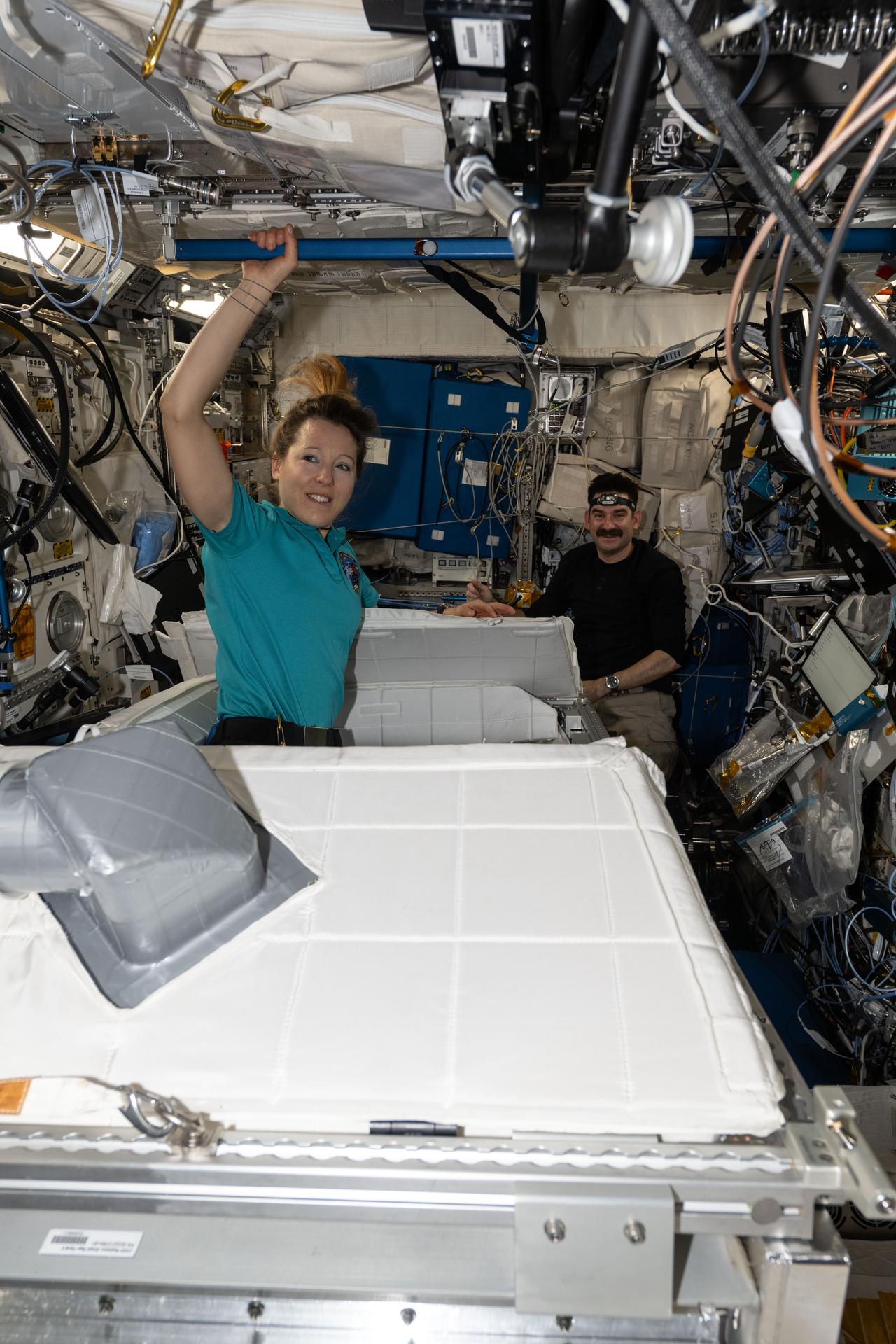
iss074e0792341 (June 7 ,2026) --- Expedition 74 flight engineers Sophie Adenot of ESA (European Space Agency) and Jack Hathaway of NASA (background) are pictured inside the International Space Station's Columbus laboratory module. The astronauts were upgrading a temporary sleep station, also called the Crew Alternate Sleep Accommodation (CASA), aboard Columbus. CASA modifications include a better fit for crew members, improved airflow velocity, an updated lighting configuration, and upgraded side panels and interior liners. Credit: NASA/Jessica Meir
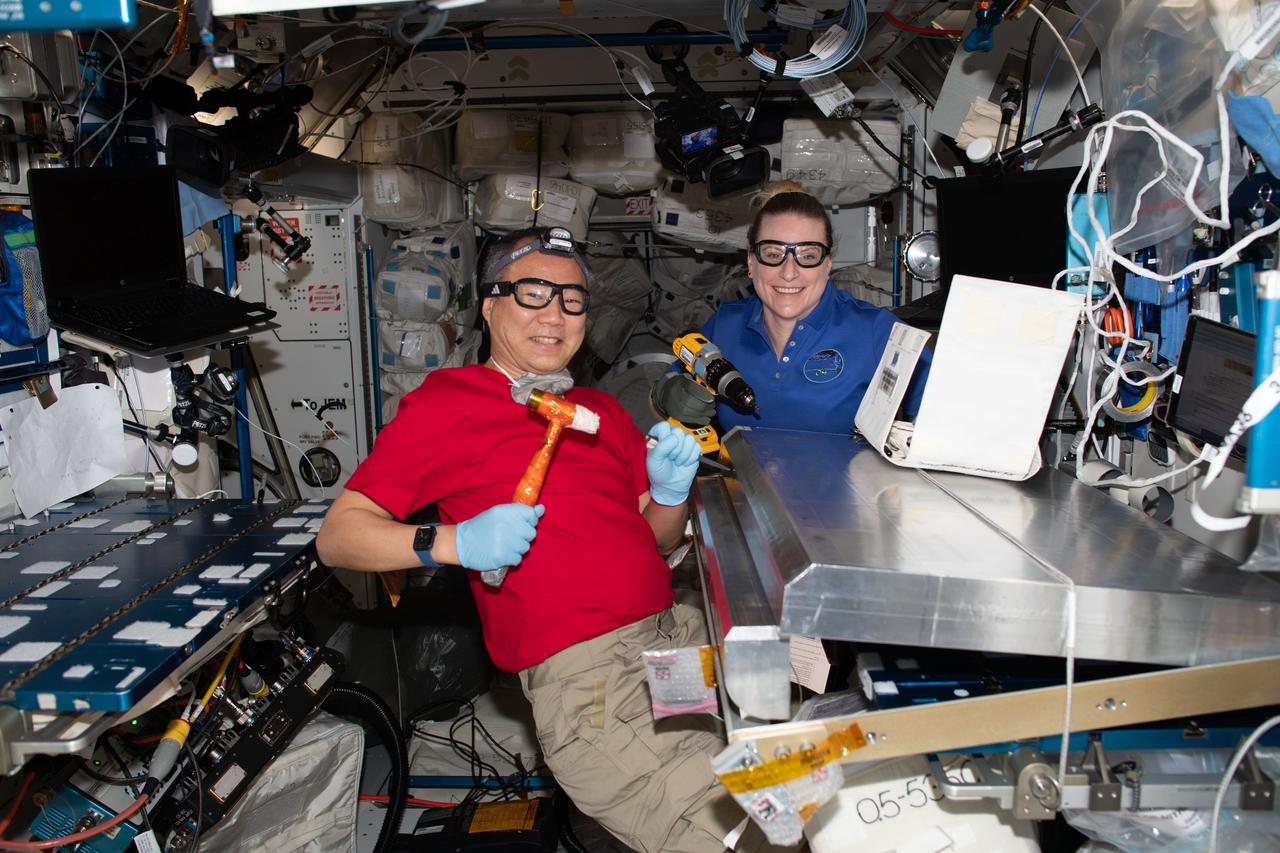
iss064e053432 (April 6, 2021) --- Expedition 64 Flight Engineers Soichi Noguchi of the Japan Aerospace Exploration Agency and Kate Rubins of NASA configure a radiation shield for temporary sleeping quarters, or the Crew Alternate Sleep Accommodation (CASA). The CASA will allow extra space for the short period when up to 11 crew members will be occupying the International Space Station in April.
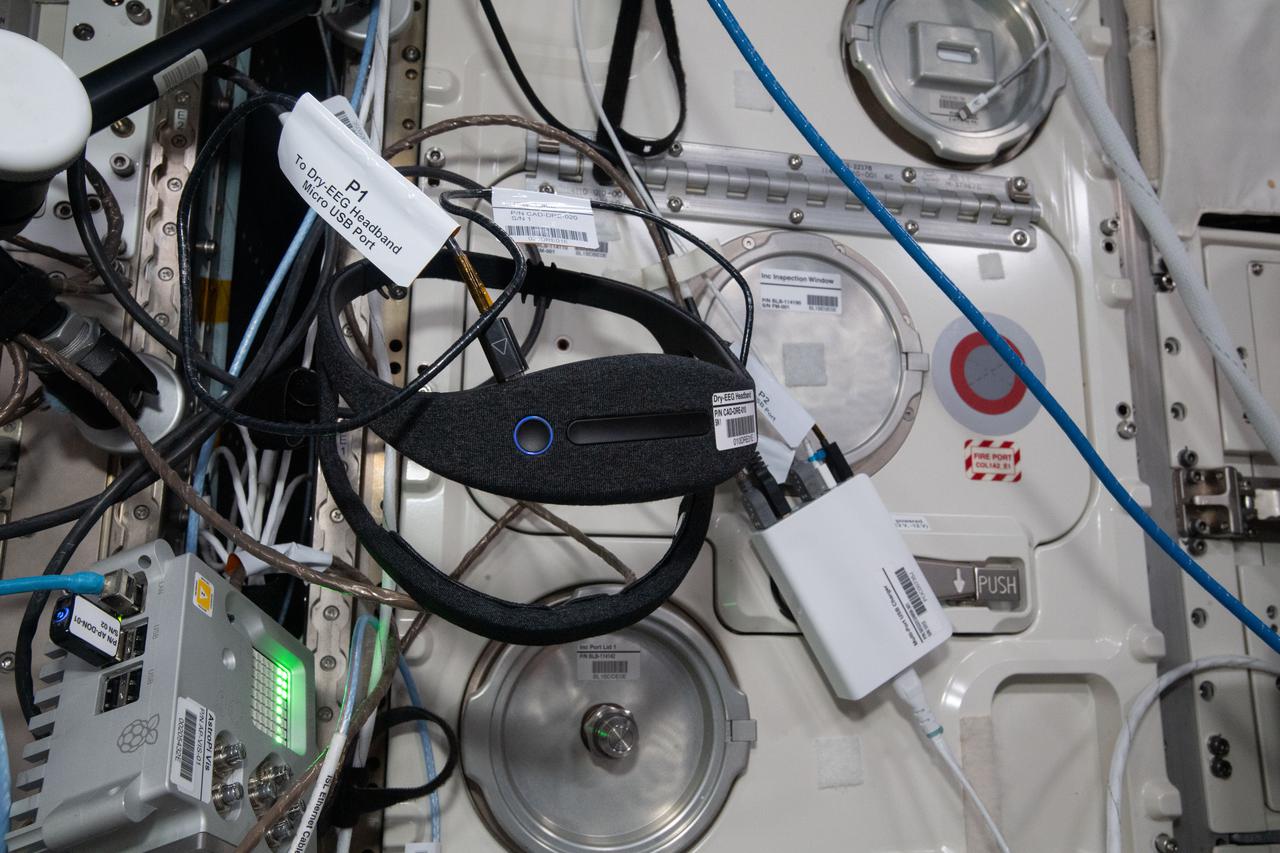
iss065e423775 (9/20/2021) --- A view of the Sleep Monitoring in Space with Dry-EEG Headband (Dreams) hardware in the Columbus module aboard the International Space Station (ISS). Dreams is a technology demonstration investigation that utilizes the Dry-EEG Headband: an effective, affordable, and comfortable solution to monitor astronaut sleep quality during long-duration spaceflight aboard the International Space Station (ISS).
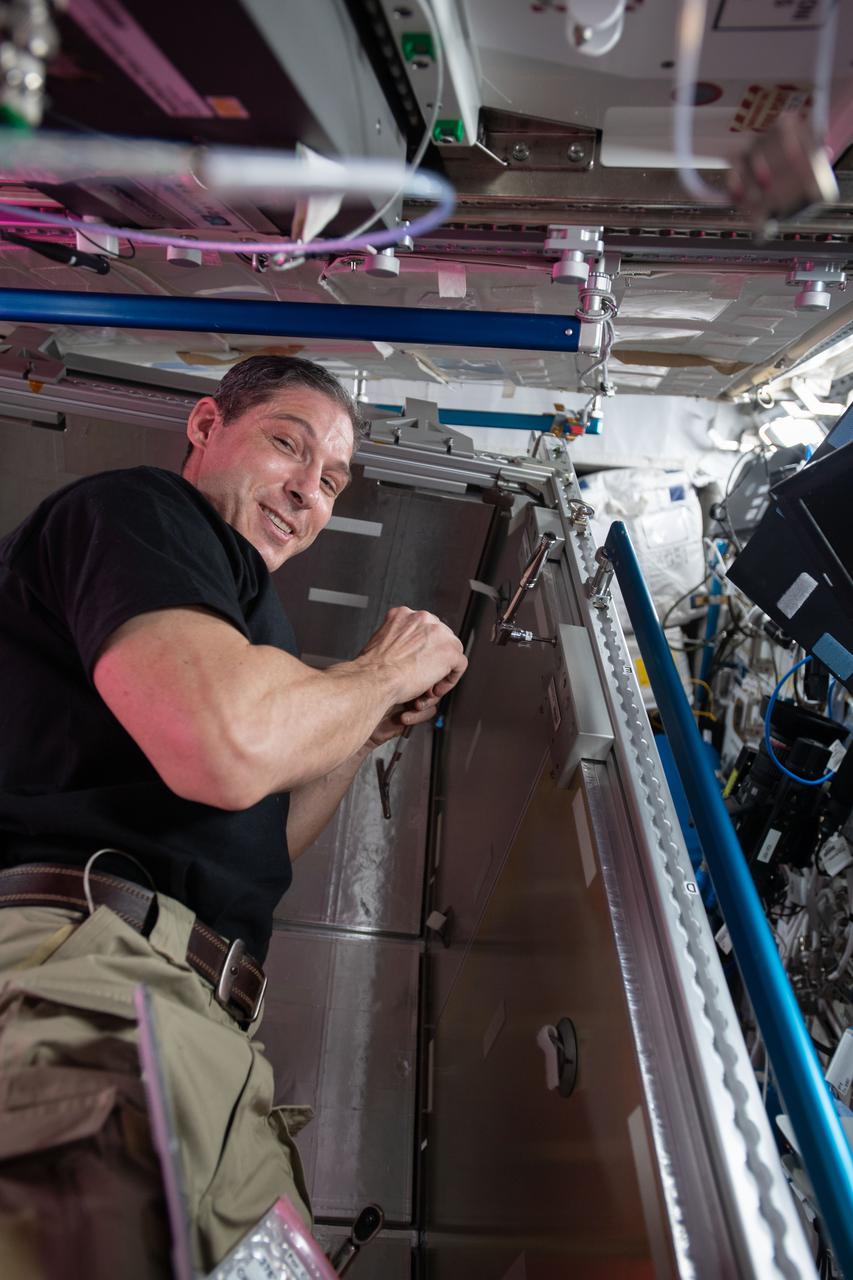
iss064e053494 (April 7, 2021) --- NASA astronaut and Expedition 64 Flight Engineer Michael Hopkins installs temporary sleeping quarters inside the Columbus laboratory module from the European Space Agency. The new Crew Alternate Sleep Accommodation, which can also be converted to a cargo storage rack, will allow extra space for the short period when up to 11 crew members will be occupying the International Space Station in April.
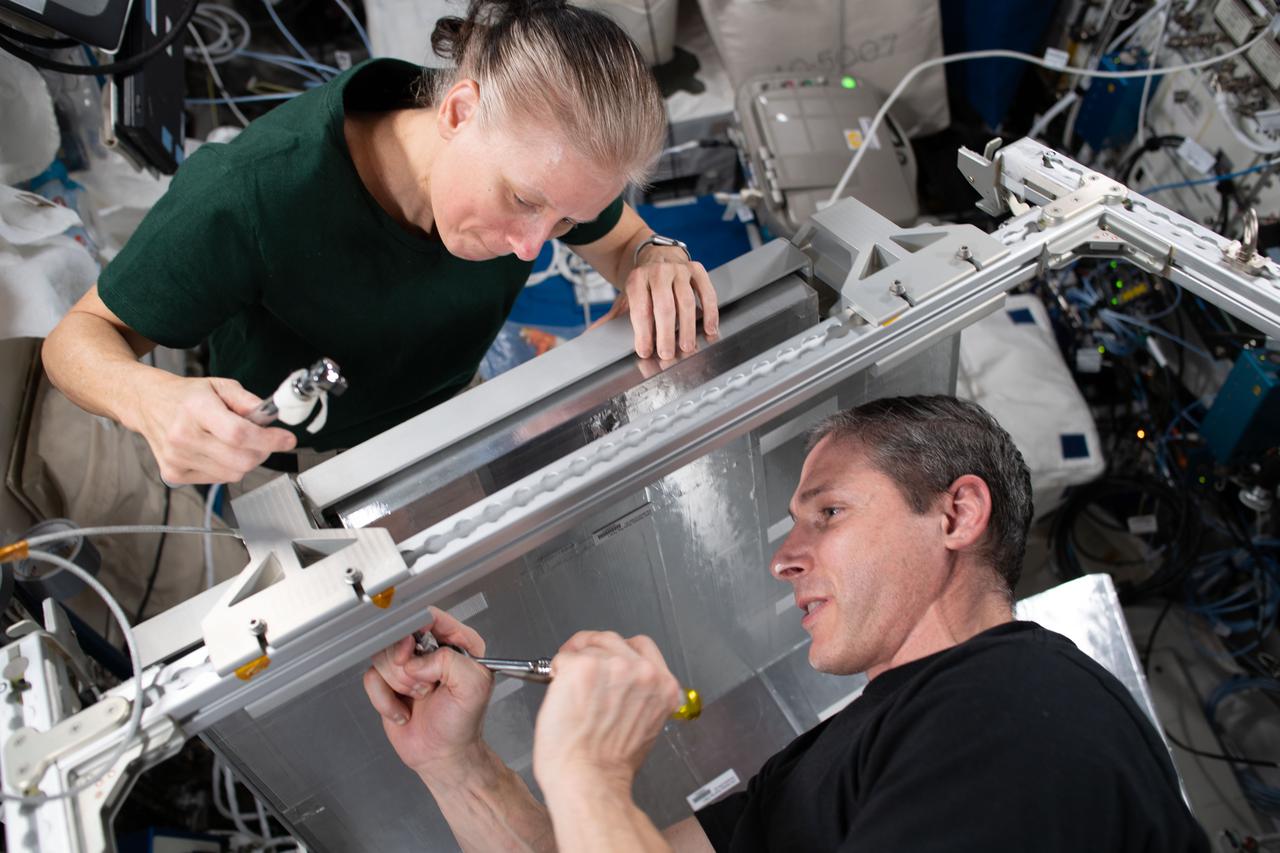
iss064e053521 (April 7, 2021) --- NASA Flight Engineers Shannon Walker and Michael Hopkins install temporary sleeping quarters inside the Columbus laboratory module from the European Space Agency. The new Crew Alternate Sleep Accommodation, which can also be converted to a cargo storage rack, will allow extra space for the short period when up to 11 crew members will be occupying the International Space Station in April.
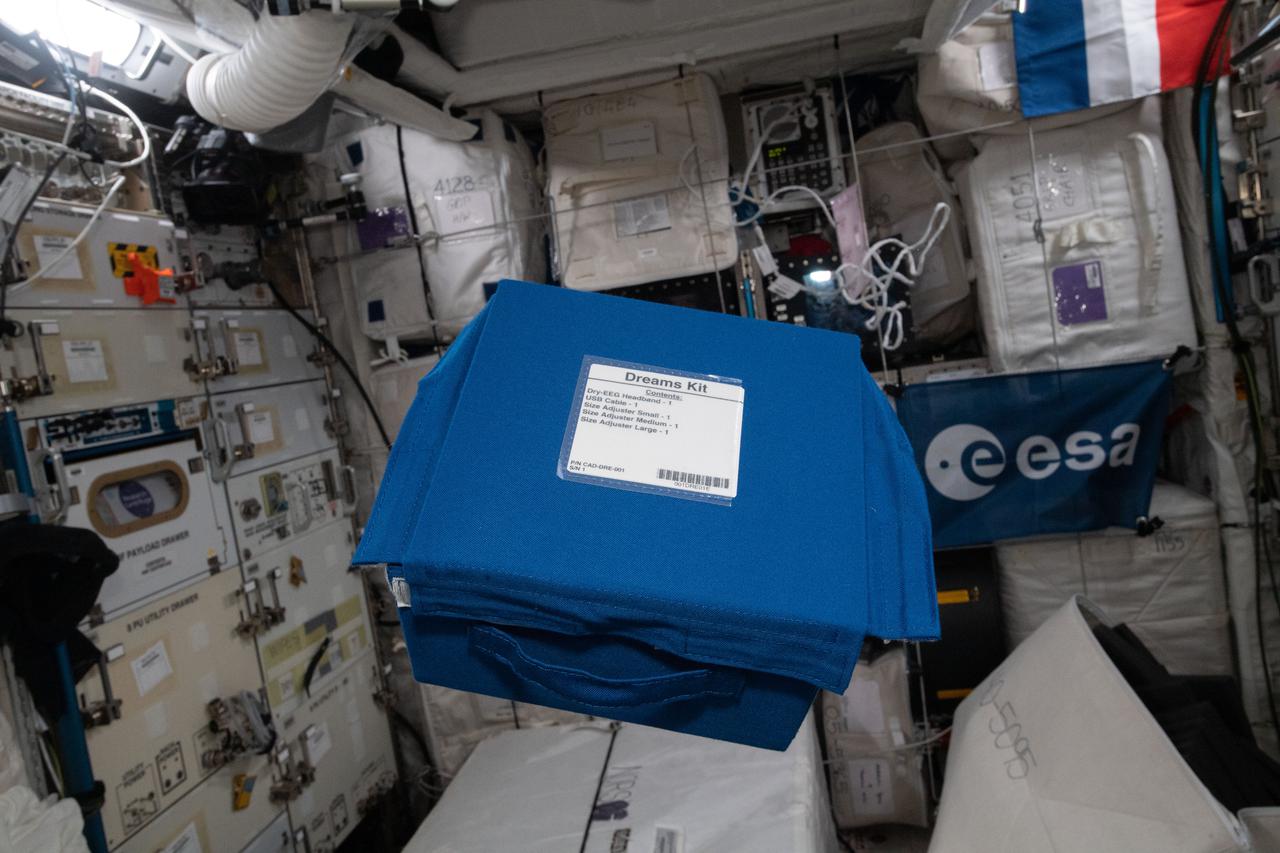
iss065e423768 (9/20/2021) --- A view of the Sleep Monitoring in Space with Dry-EEG Headband (Dreams) hardware in the Columbus module aboard the International Space Station (ISS). Dreams is a technology demonstration investigation that utilizes the Dry-EEG Headband: an effective, affordable, and comfortable solution to monitor astronaut sleep quality during long-duration spaceflight aboard the International Space Station (ISS).
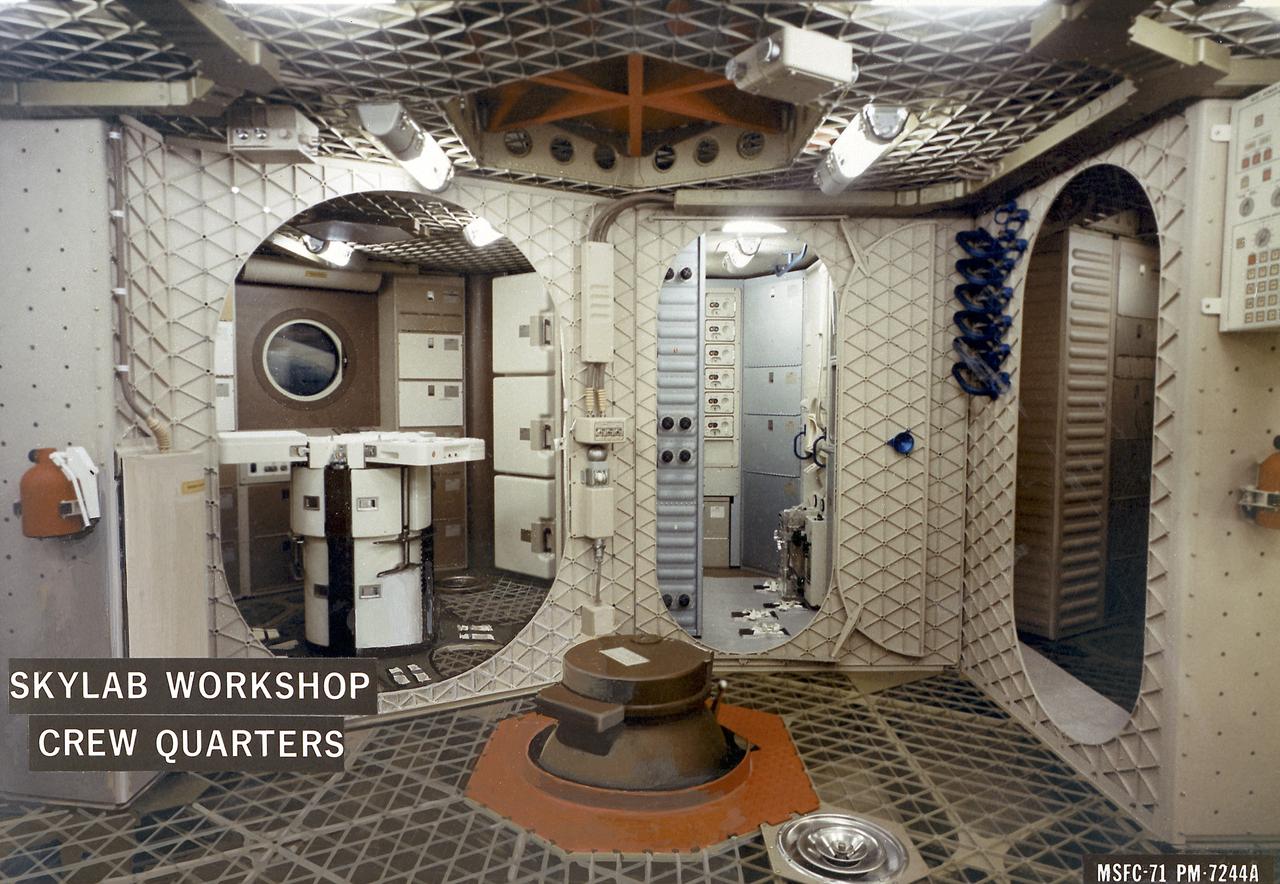
The wardroom deck of the Orbital Workshop, showing the living quarters arrangement, is seen here in good detail. From left to right is the dining area, waste management, and sleeping quarters. Portable restraints are on the wall beside the sleeping quarters. The ergometer for the vectorcardiograph (Experiment - M093) and lower-body Negative Pressure (Experiment M092) unit, used in some of the medical experiments, are in the foreground. The round brown object in the center of the room is the trash disposal airlock.
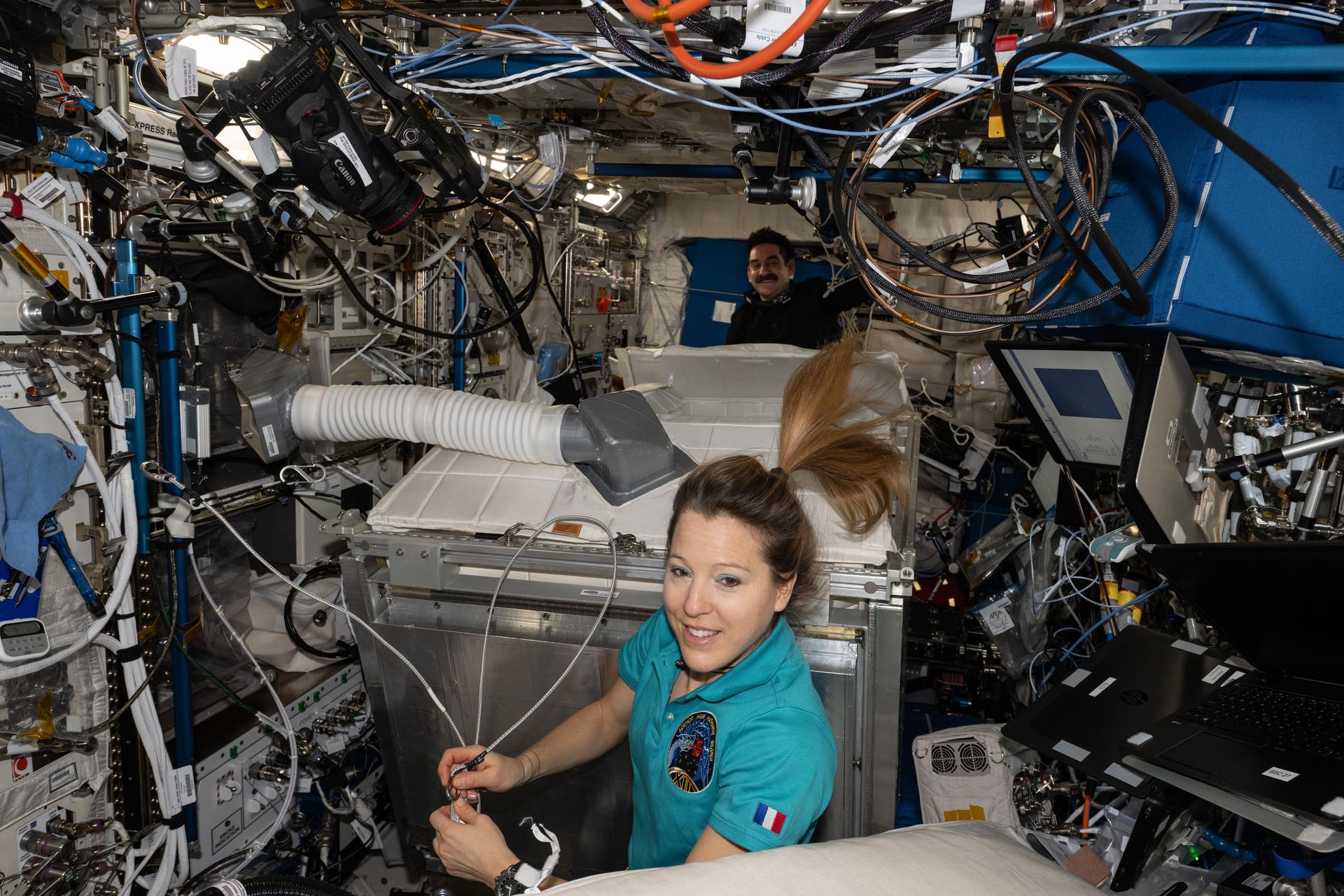
iss074e0792345 (June 7, 2026) --- Expedition 74 flight engineers Sophie Adenot of ESA (European Space Agency) and Jack Hathaway of NASA (background) are pictured inside the International Space Station's Columbus laboratory module. The astronauts were upgrading a temporary sleep station, also called the Crew Alternate Sleep Accommodation (CASA), aboard Columbus. CASA modifications include a better fit for crew members, improved airflow velocity, an updated lighting configuration, and upgraded side panels and interior liners. Credit: NASA/Jessica Meir
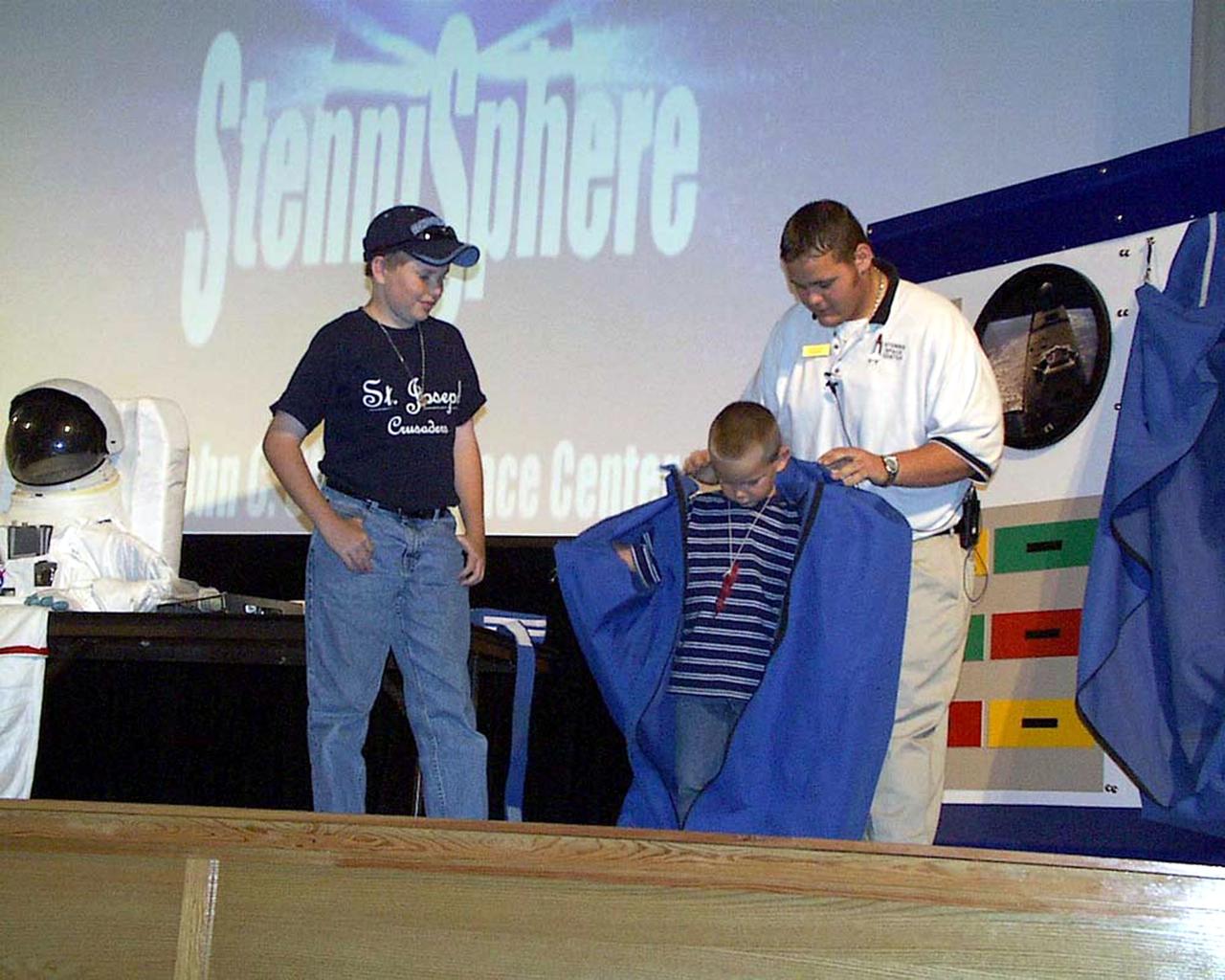
Students try on a sleep restraint like the ones used by astronauts. This demonstration is part of a program called 'Living and Working in Space,' that is presented by NASA's Stennis Space Center in the StenniSphere Auditorium and in the community.
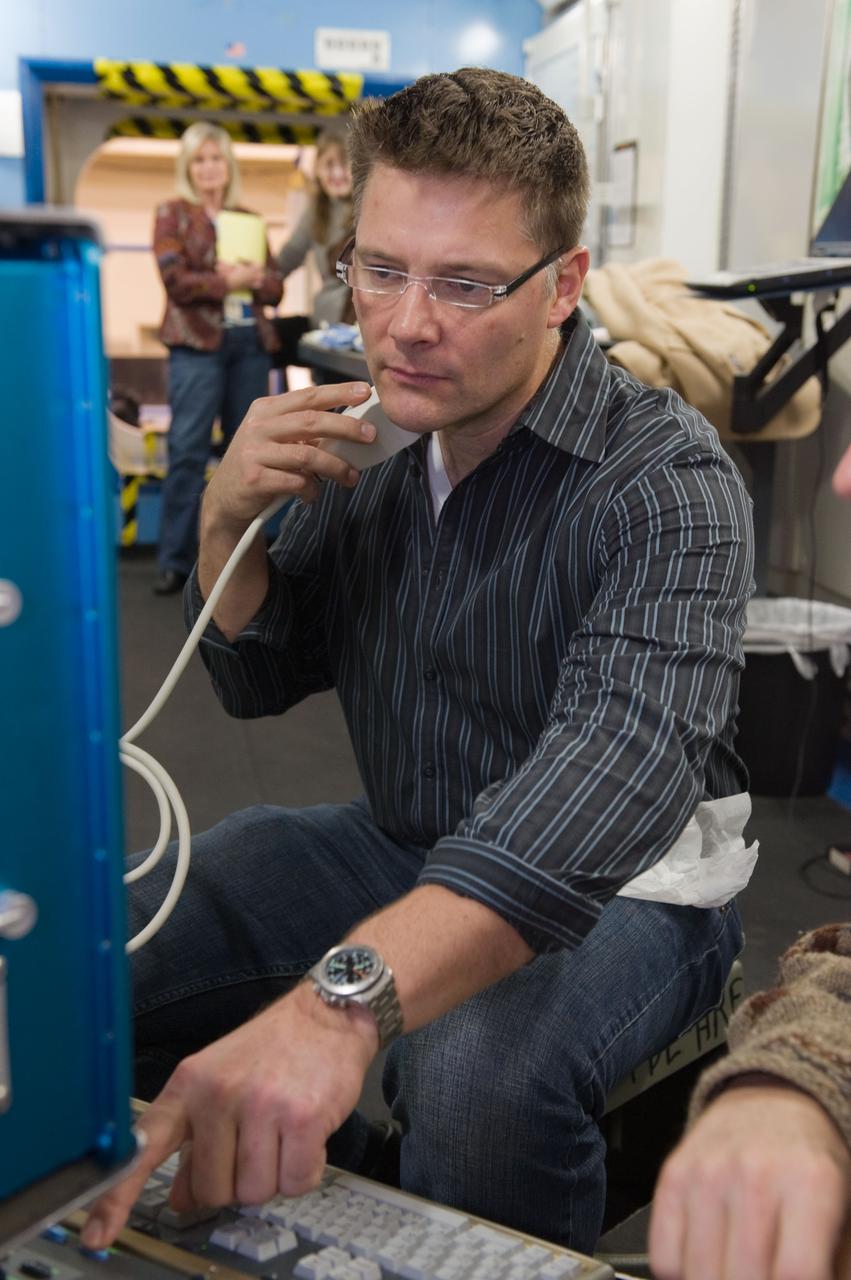
Date: 01-12-09 Location: Bldg 9NW, PLD Subject: Expedition Prefligth Training with Doug Wheelock. Cardio Ambulatory Monitoring, CCISS Task and Sleep Ops. ISS PDL. Photographer: Blair
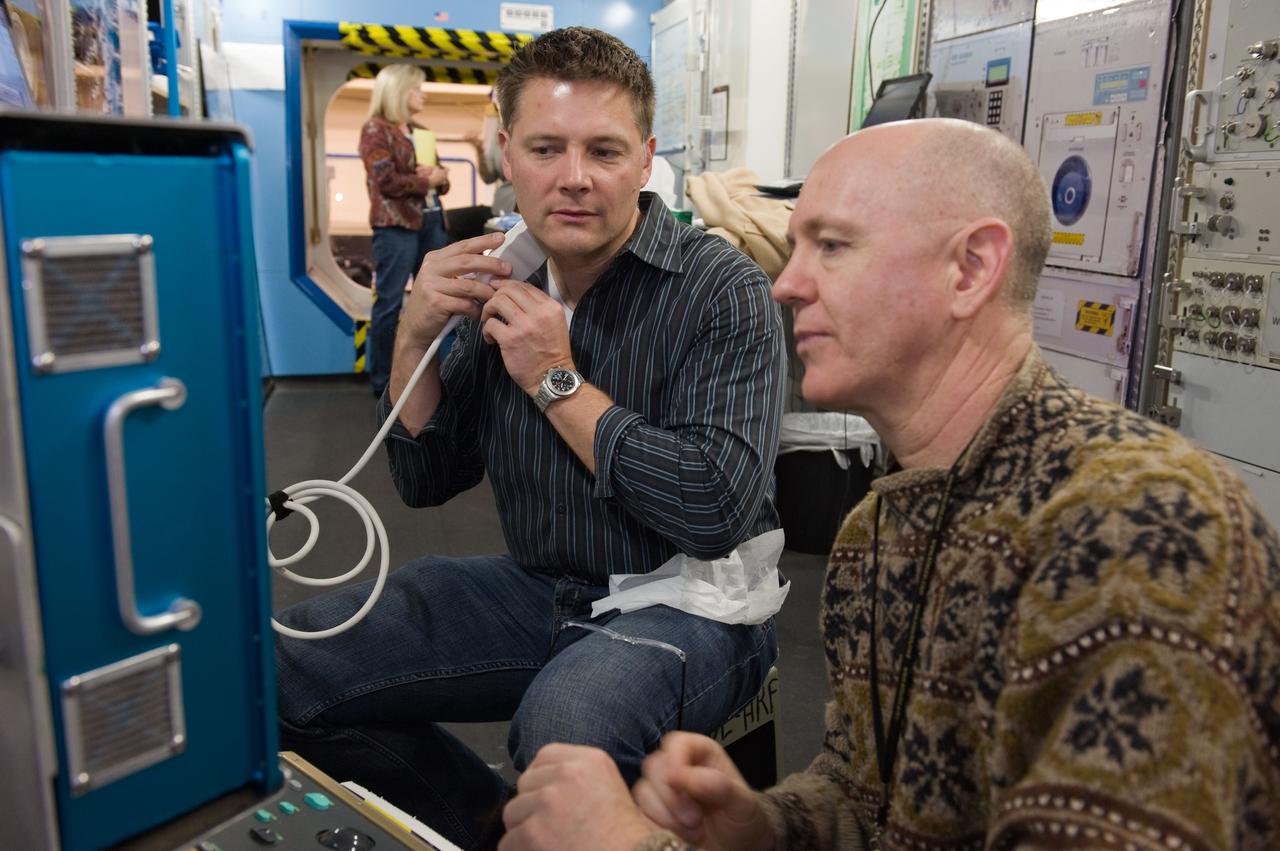
Date: 01-12-09 Location: Bldg 9NW, PLD Subject: Expedition Prefligth Training with Doug Wheelock. Cardio Ambulatory Monitoring, CCISS Task and Sleep Ops. ISS PDL. Photographer: Blair
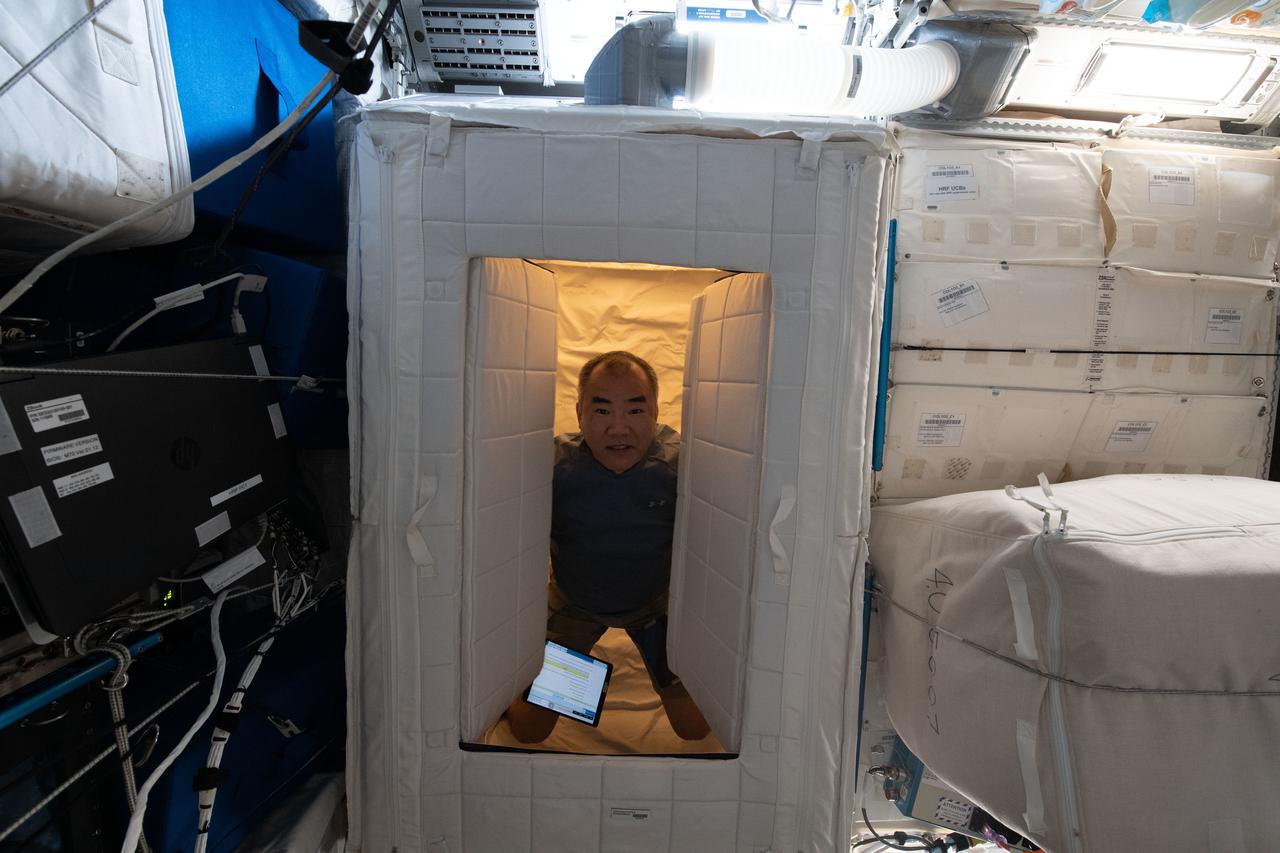
iss065e002499 (April 24, 2021) --- Expedition 64 Flight Engineer Soichi Noguchi of the Japan Aerospace Exploration Agency is pictured inside a sleep station aboard the International Space Station.

ISS045E107821 (11/13/2015) --- As night falls the astronauts and cosmonauts aboard the International Space Station prepare for sleep while also viewing the softening curvature of the Earth go by with lighted cities below them and sparkling stars above.
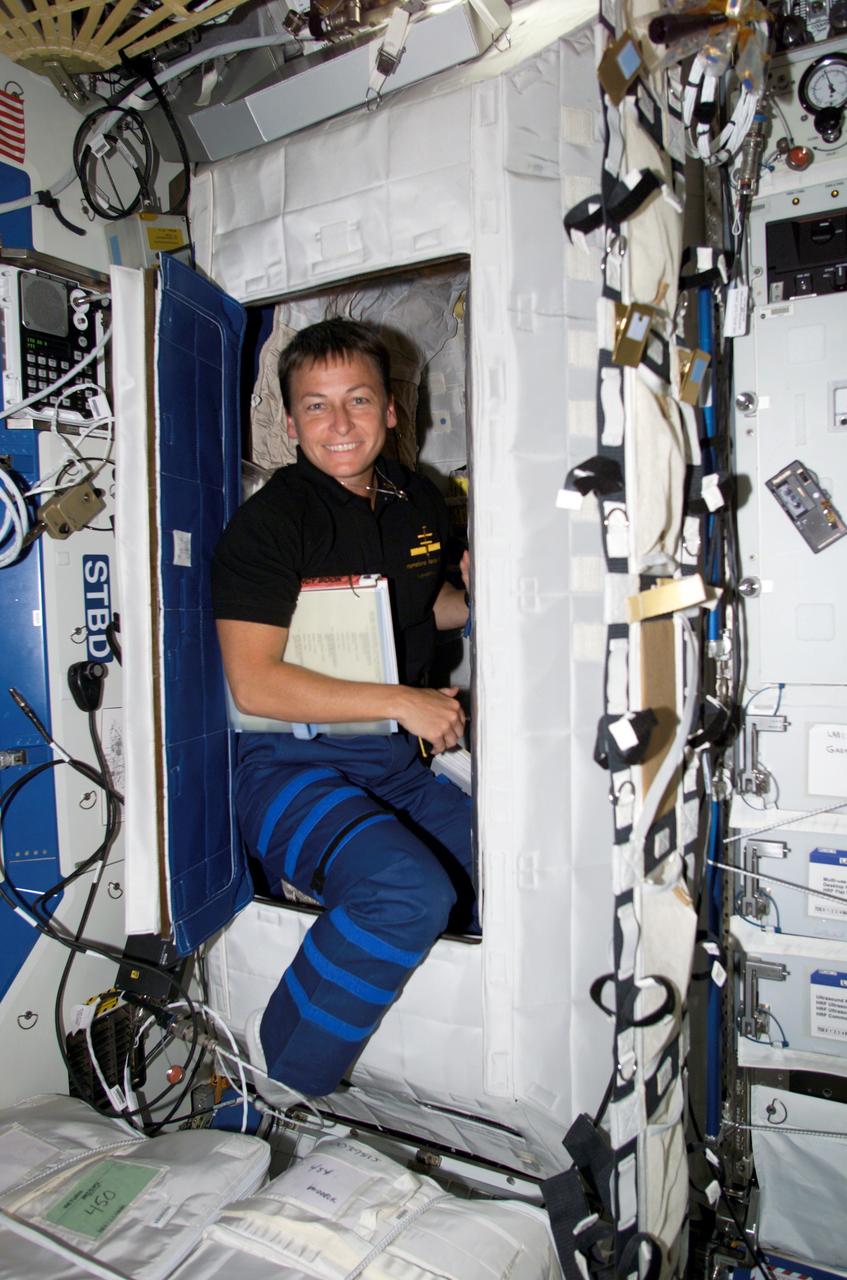
STS111-E-5122 (9 June 2002) --- Astronaut Peggy A. Whitson, Expedition Five flight engineer, was photographed in the doorway of the Temporary Sleep Station (TSS) in the Destiny laboratory on International Space Station (ISS).
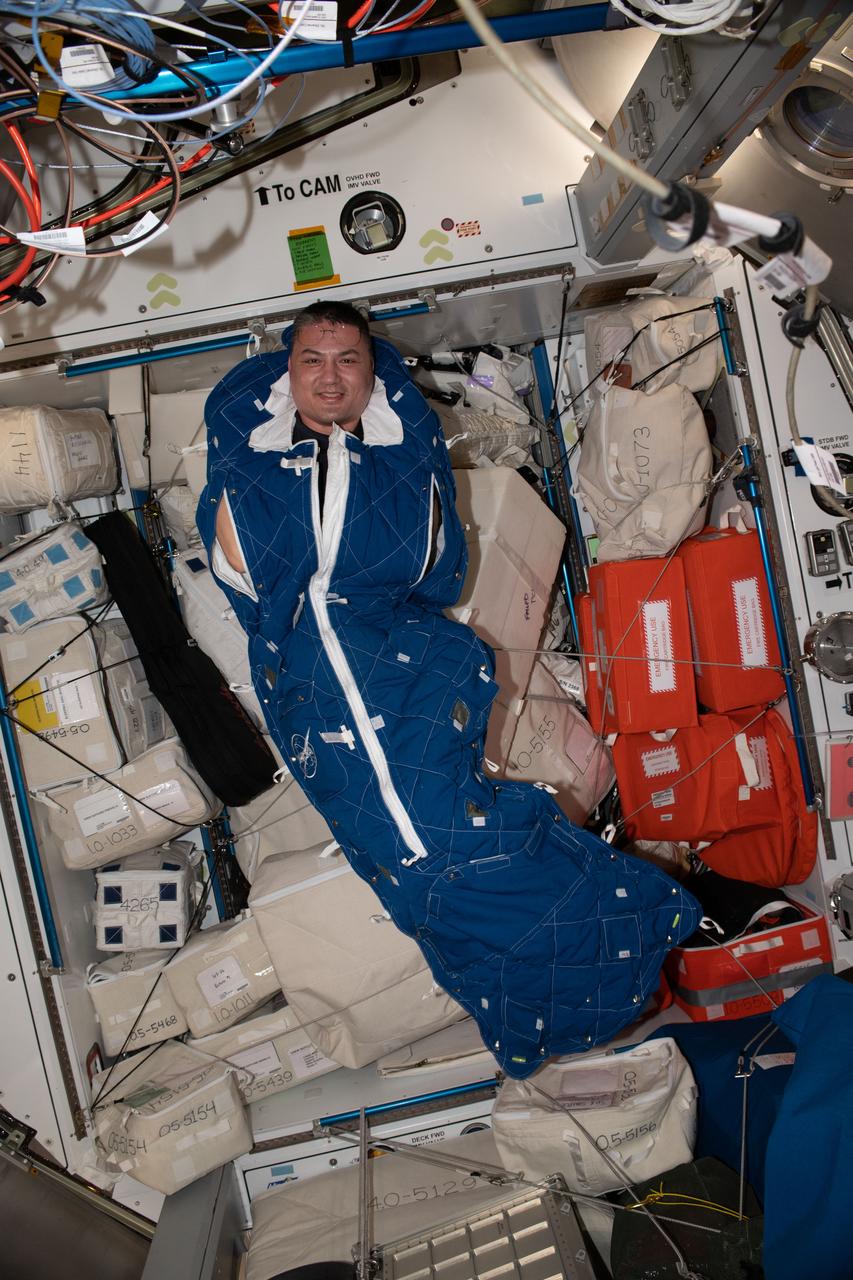
iss067e379057 (Sept. 23, 2022) --- NASA astronaut and Expedition 67 Flight Engineer Kjell Lindgren poses for a portrait inside a crew sleeping bag aboard the International Space Station.
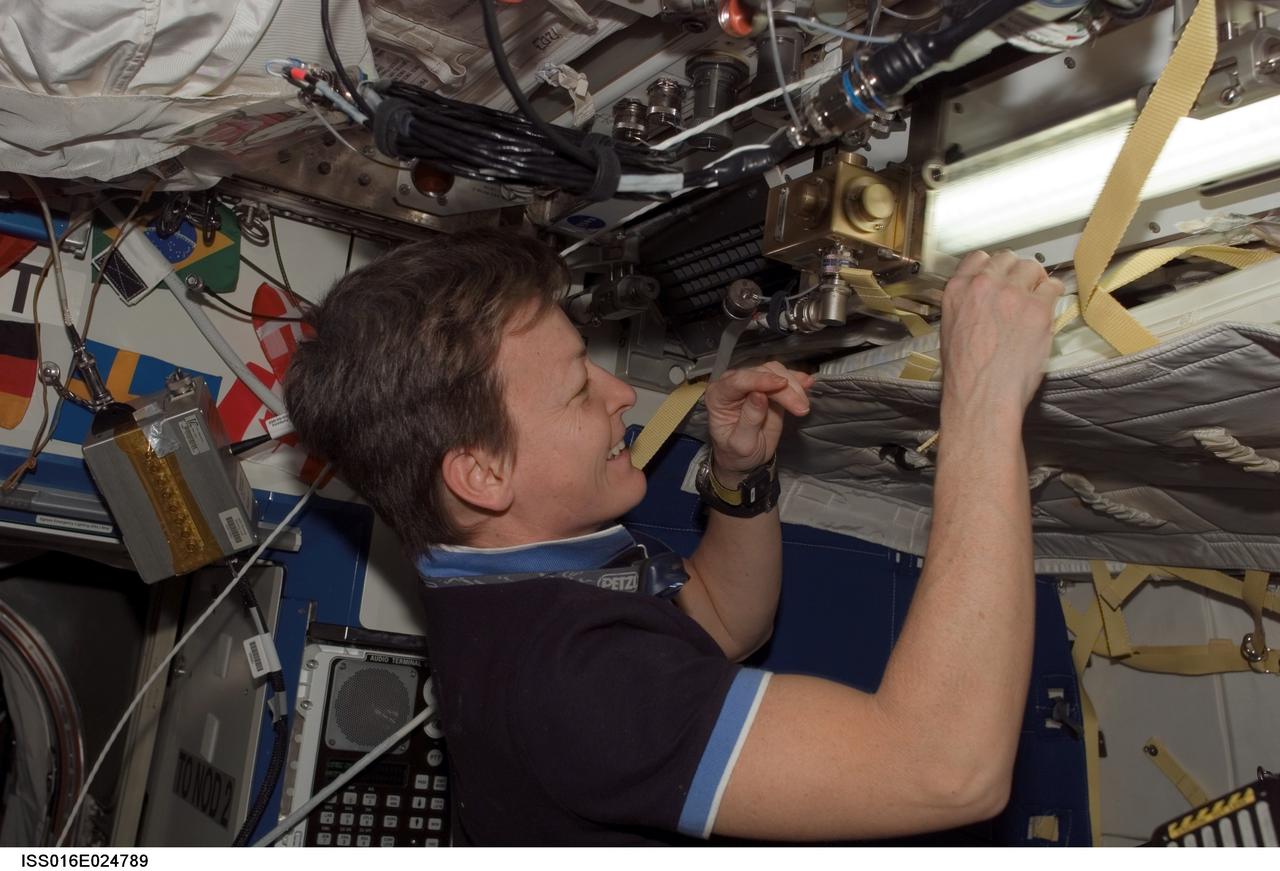
ISS016-E-024789 (18 Jan. 2008) --- Astronaut Peggy Whitson, Expedition 16 commander, prepares to retrieve a sleep restraint device from a stowage location on the Earth-orbiting International Space Station.
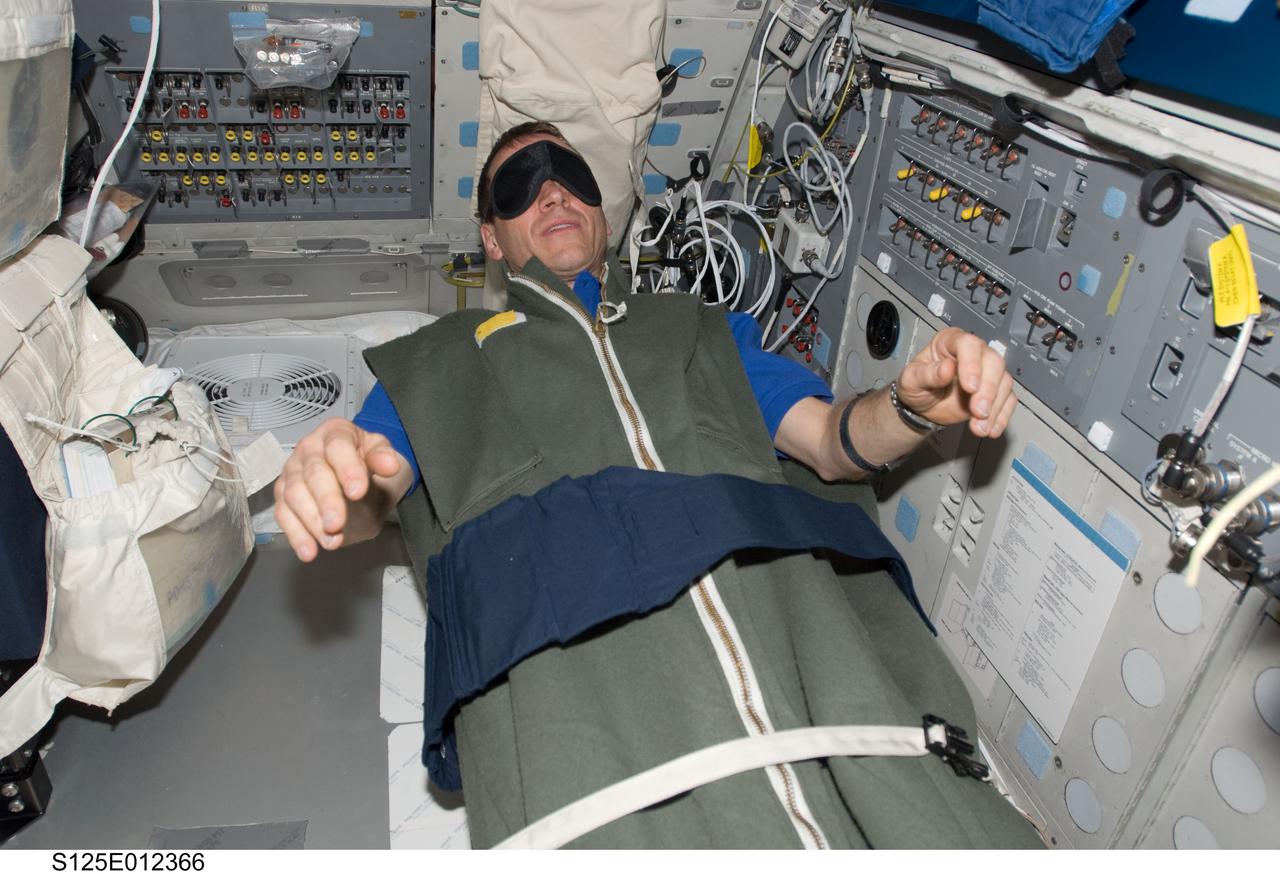
S125-E-012366 (20 May 2009) --- Astronaut Gregory C. Johnson, STS-125 pilot, rests in his sleeping bag on the flight deck of the Earth-orbiting Space Shuttle Atlantis at the end of flight day 10.
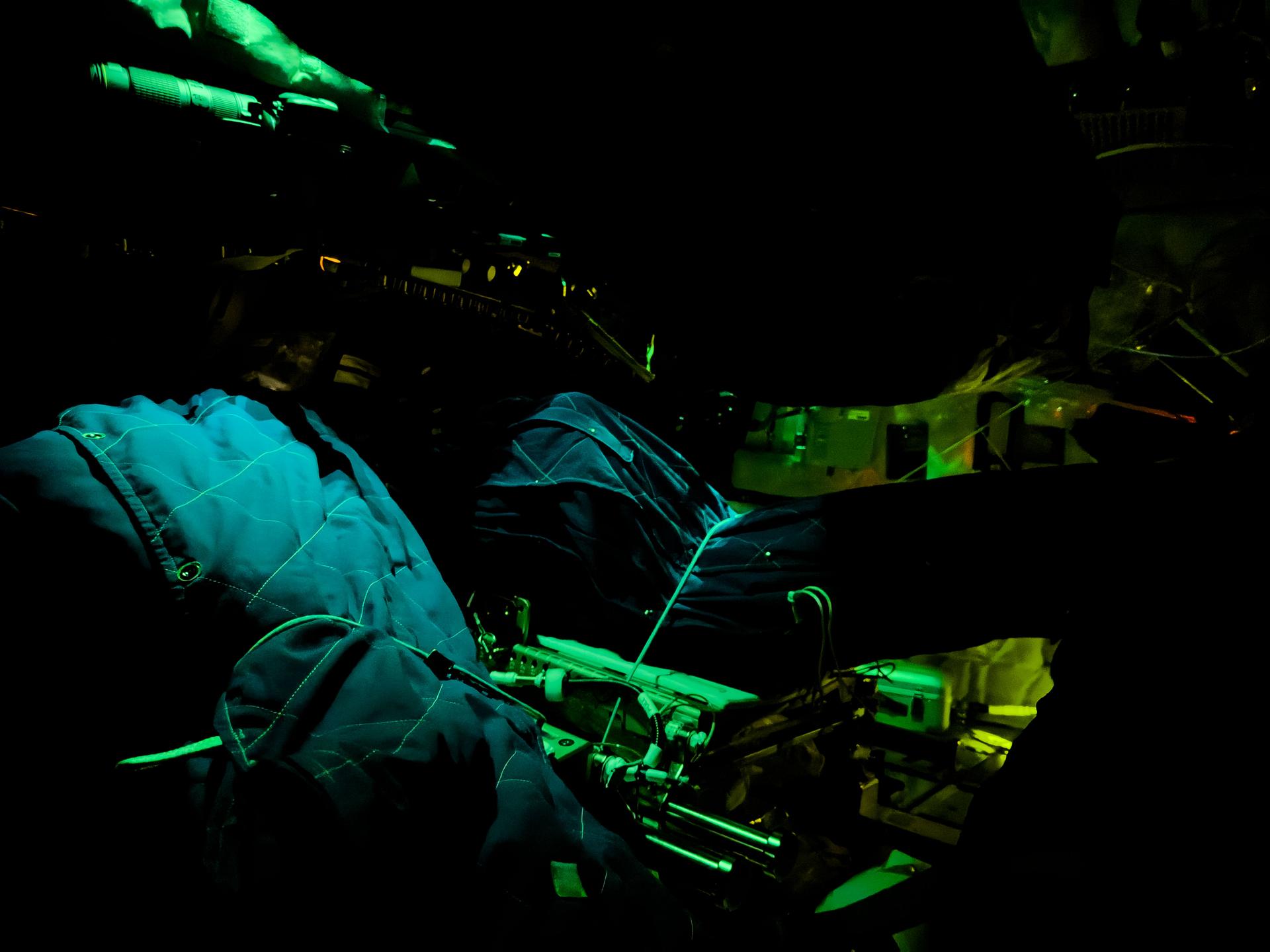
art002e009215 (April 6, 2026) - Artemis II crewmember sleeping bags are illuminated inside the Orion spacecraft on Flight Day 5 of the mission and ahead of the crew's lunar flyby on April 6, 2026.

art002e026067 (April 7, 2026) - NASA astronaut Christina Koch focused on the task at hand as she works with storage straps inside the Orion spacecraft. For the ARCHeR study, participating crew members will wear movement and sleep monitors, called actigraphy devices, before, during, and after the mission, like the one seen here. The monitors will enable crew members and flight controllers in mission control to study real-time health and behavioral information for crew safety, and help scientists study how crew members’ sleep and activity patterns affect overall health and performance. Other data related to cognition, behavior, and team dynamics will also be gathered before and after the mission.
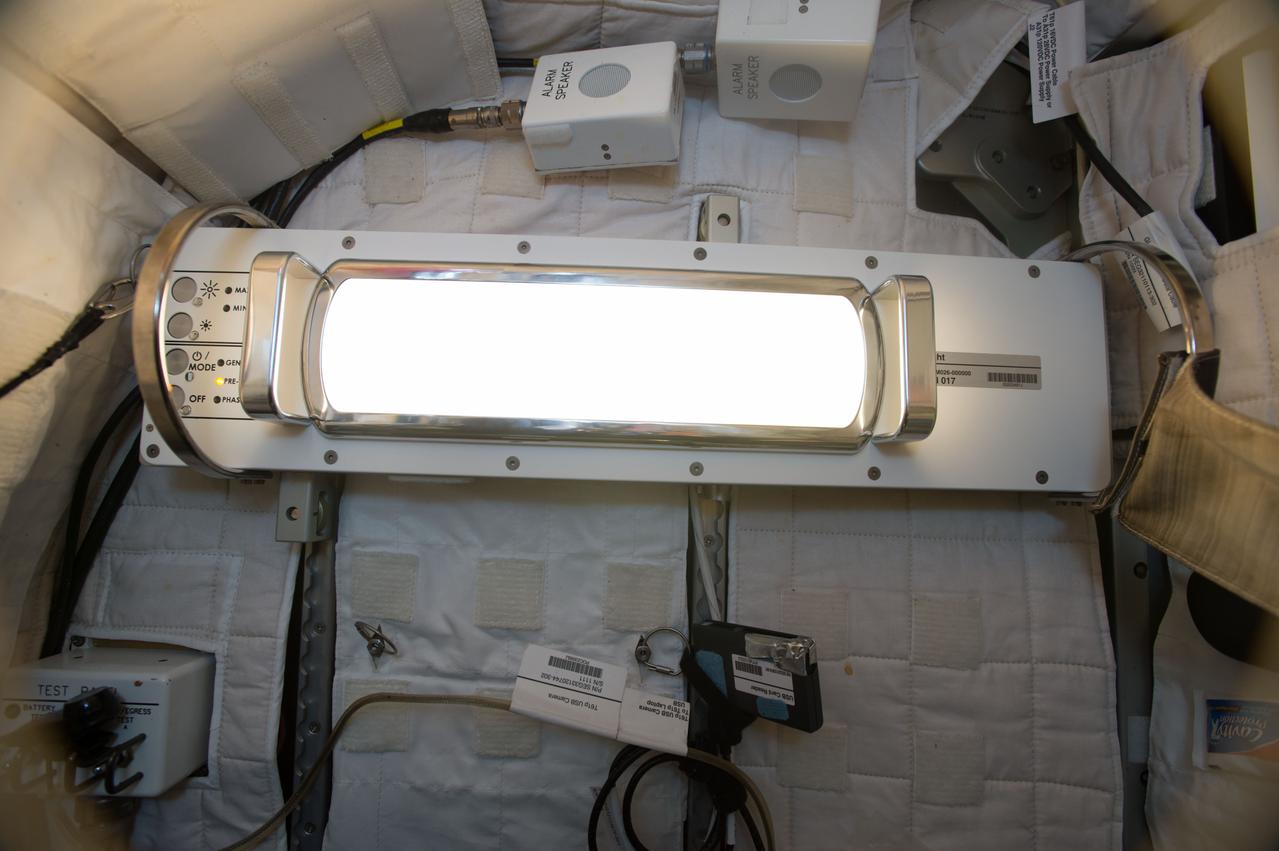
iss049e028948 (10/5/2016) --- Photographic documentation taken during Solid State Lighting Assembly (SSLA) Installation in the starboard Crew Quarters (CQ). The SSLAs were designed to replace General Luminaire Assemblies (GLAs) to improve visual acuity and to provide a crew health countermeasure for circadian rhythms, sleep, alertness and performance. Lighting Effects studies new light sources that can be adjusted for intensity and wavelength across the day, simulating a more regular schedule. Results are expected to provide new information for flight surgeons, psychologists, and crew members to better regulate circadian rhythms and improve sleep.
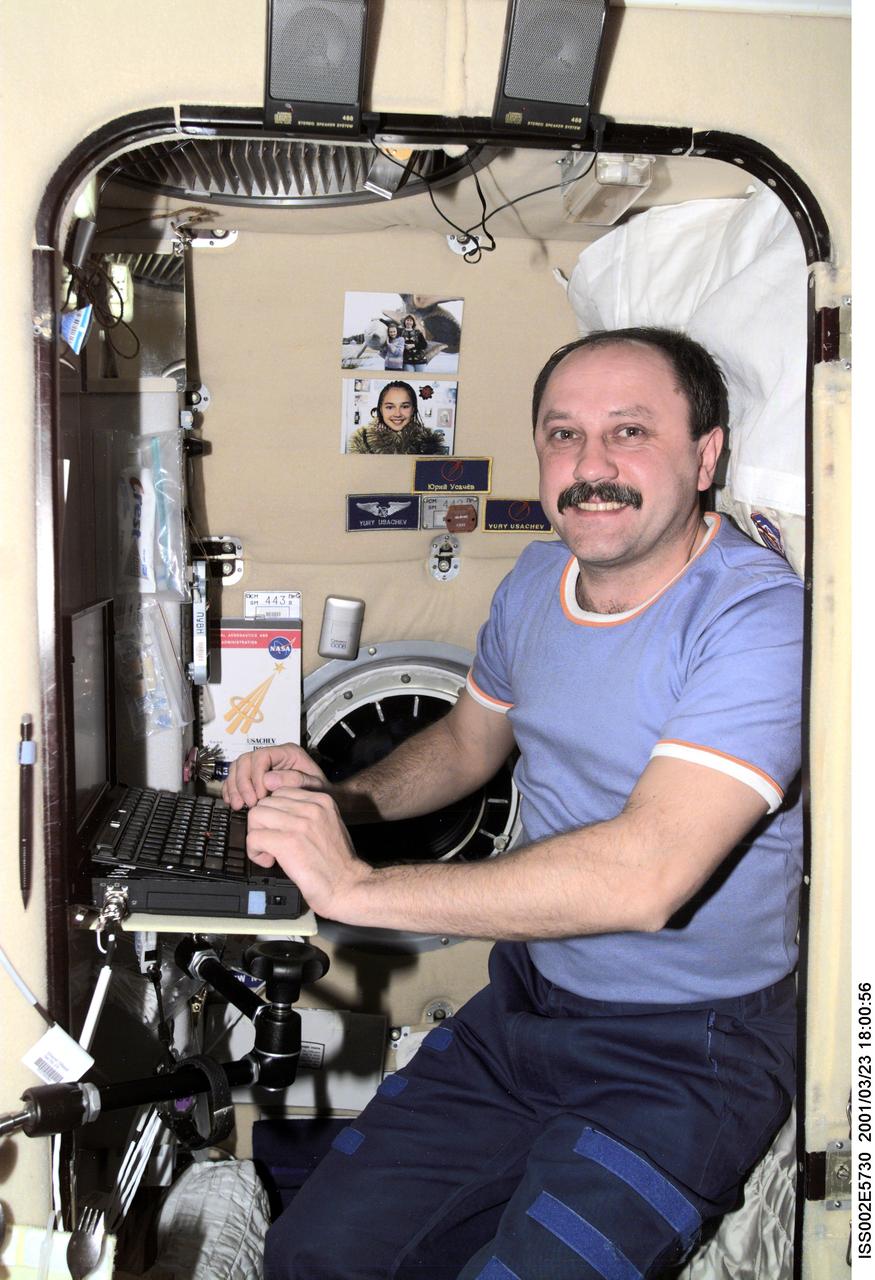
ISS002-E-5730 (23 March 2001) --- Cosmonaut Yury V. Usachev, Expedition Two commander, works at a laptop computer in his crew compartment in the Zvezda Service Module aboard the International Space Station (ISS). The image was recorded with a digital still camera.
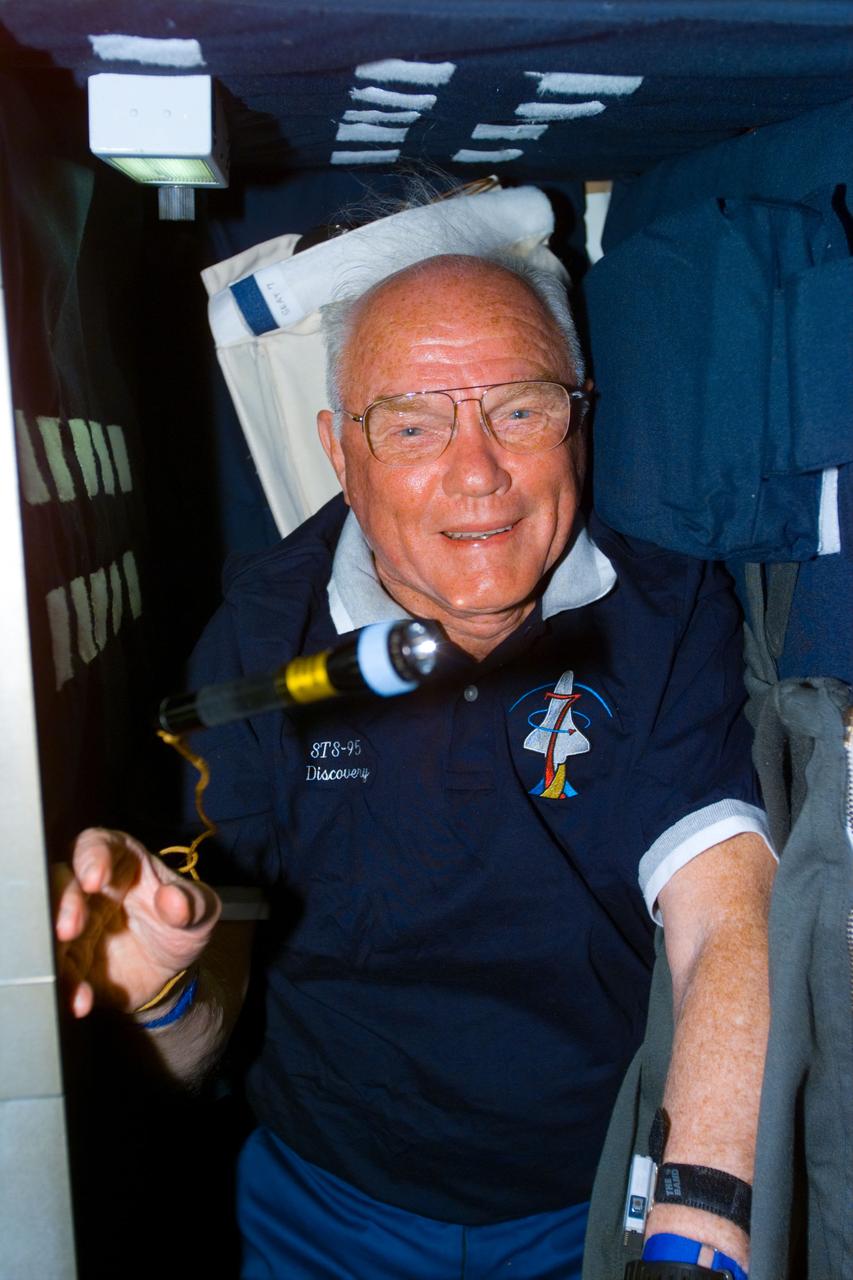
STS095-E-5032 (10-29-98) --- During Flight Day 1 activties, U.S. Sen. John H. Glenn Jr. takes part in his assigned medical studies as a payload specialist onboard the Space Shuttle Discovery. A flashlight floats in front of Sen. Glenn. The photo was made with an electronic still camera (ESC) at ll:48:35 GMT, Oct. 29.
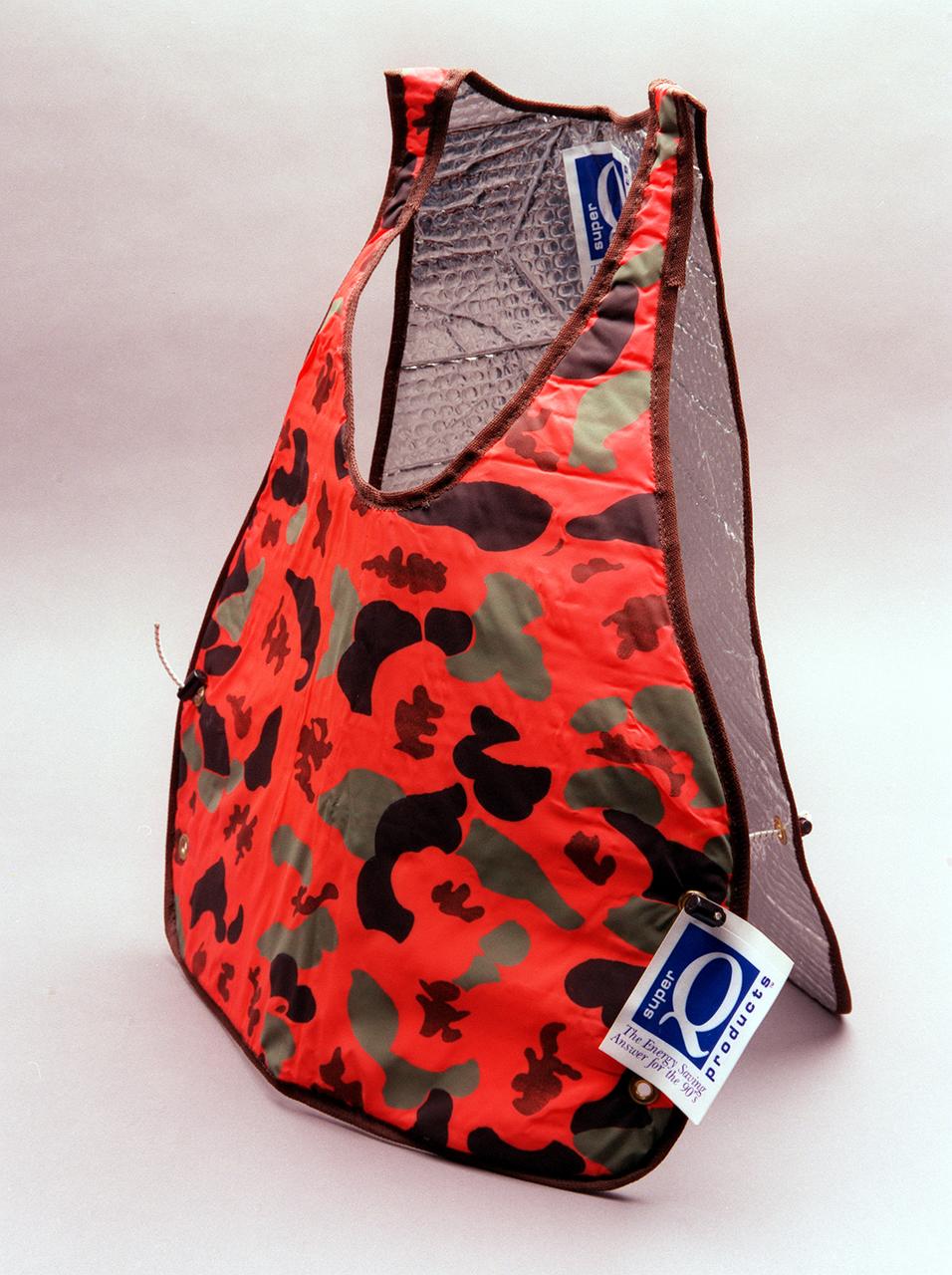
Radiation insulation technology from Apollo and subsequent spacecraft was used to develop superinsulators, used by makers of cold weather apparel, to make parkas, jackets, boots and outdoor gear such as sleeping bags. The radiant barrier technology offers warmth retention at minimal weight and bulk.
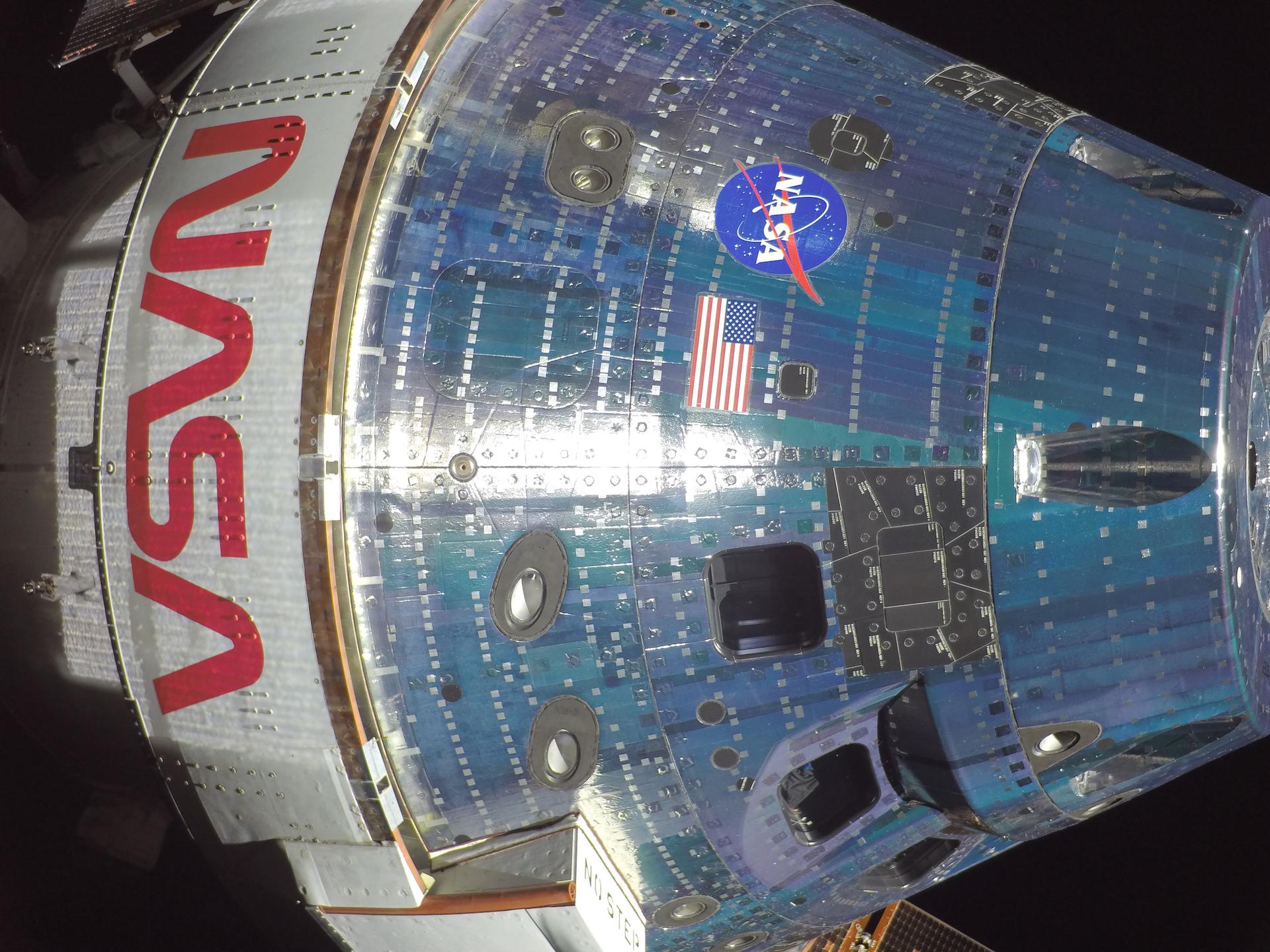
art002e012476 (April 7, 2026) - NASA’s Orion spacecraft is pictured here from one of the cameras mounted on its solar array wings. At the time this photo was taken at 8:33 a.m. ET, the Artemis II crew was in a sleep period ahead of beginning their seventh day into the mission.
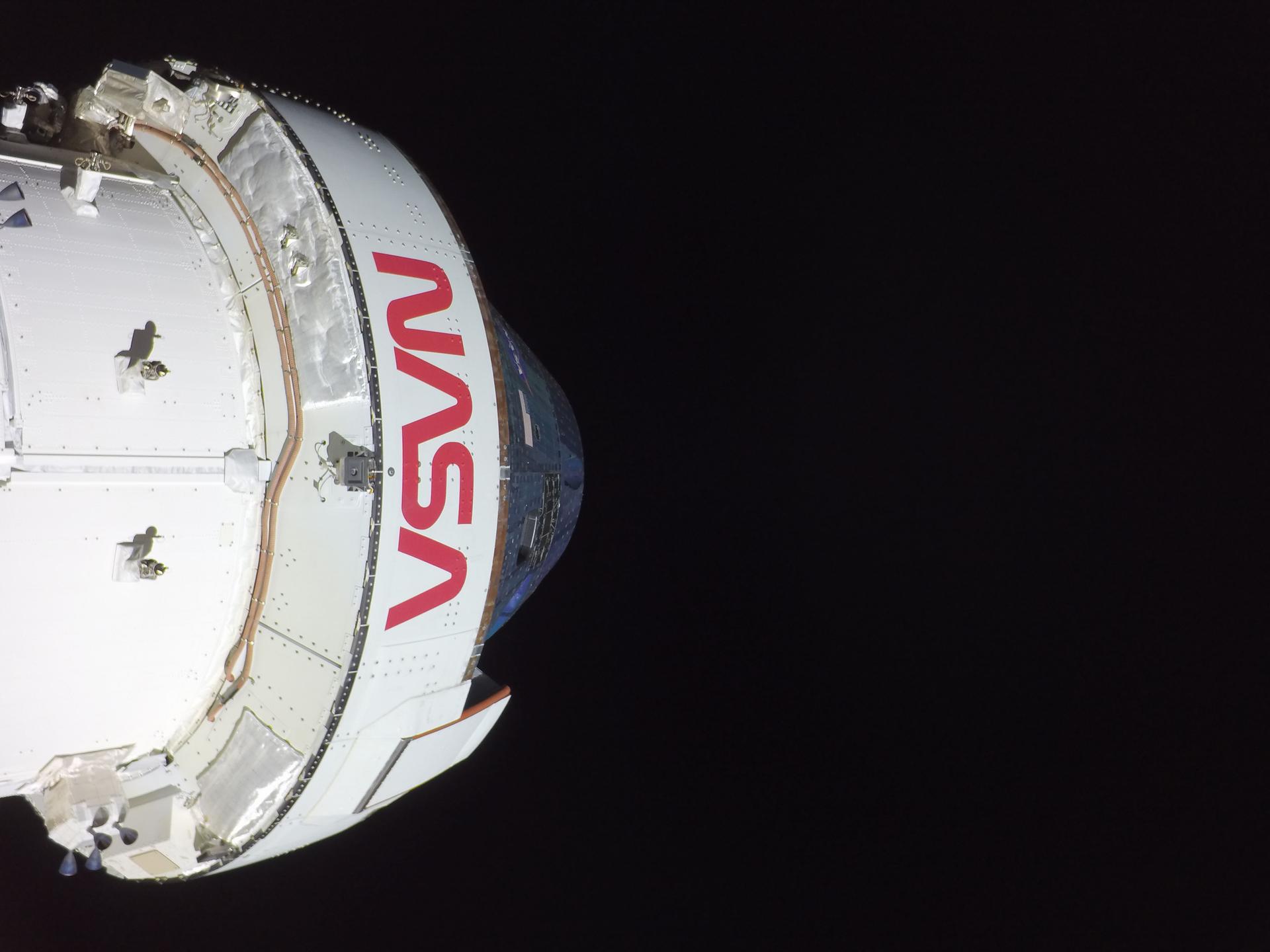
art002e012495 (April 7, 2026) - NASA’s Orion spacecraft is pictured here from one of the cameras mounted on its solar array wings. At the time this photo was taken at 9:03 a.m. ET, the Artemis II crew was in a sleep period ahead of beginning their seventh day into the mission. Credit: NASA
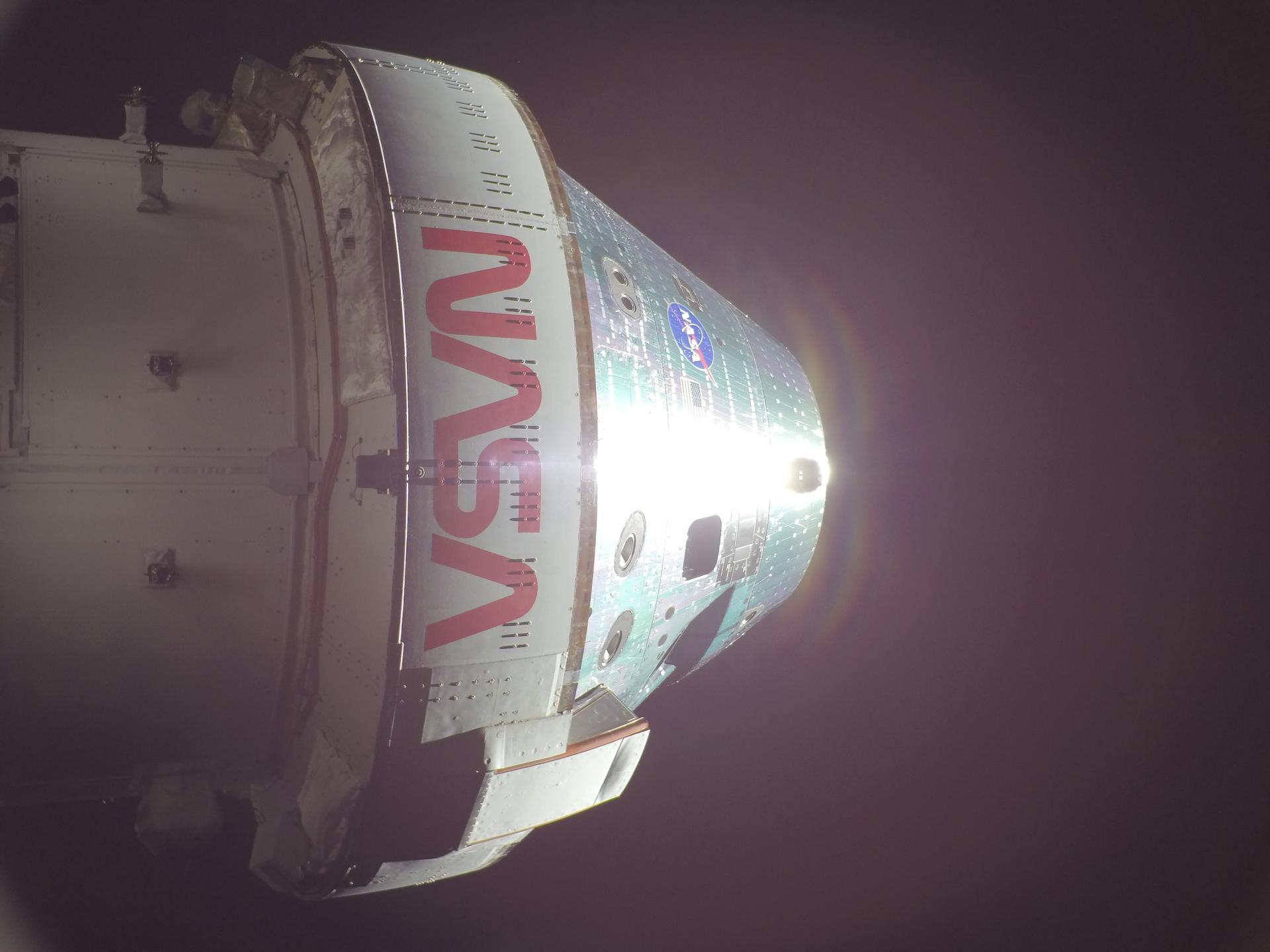
art002e012487 (April 7, 2026) - NASA’s Orion spacecraft is pictured here from one of the cameras mounted on its solar array wings. At the time this photo was taken at 8:33 a.m. ET, the Artemis II crew was in a sleep period ahead of beginning their seventh day into the mission.
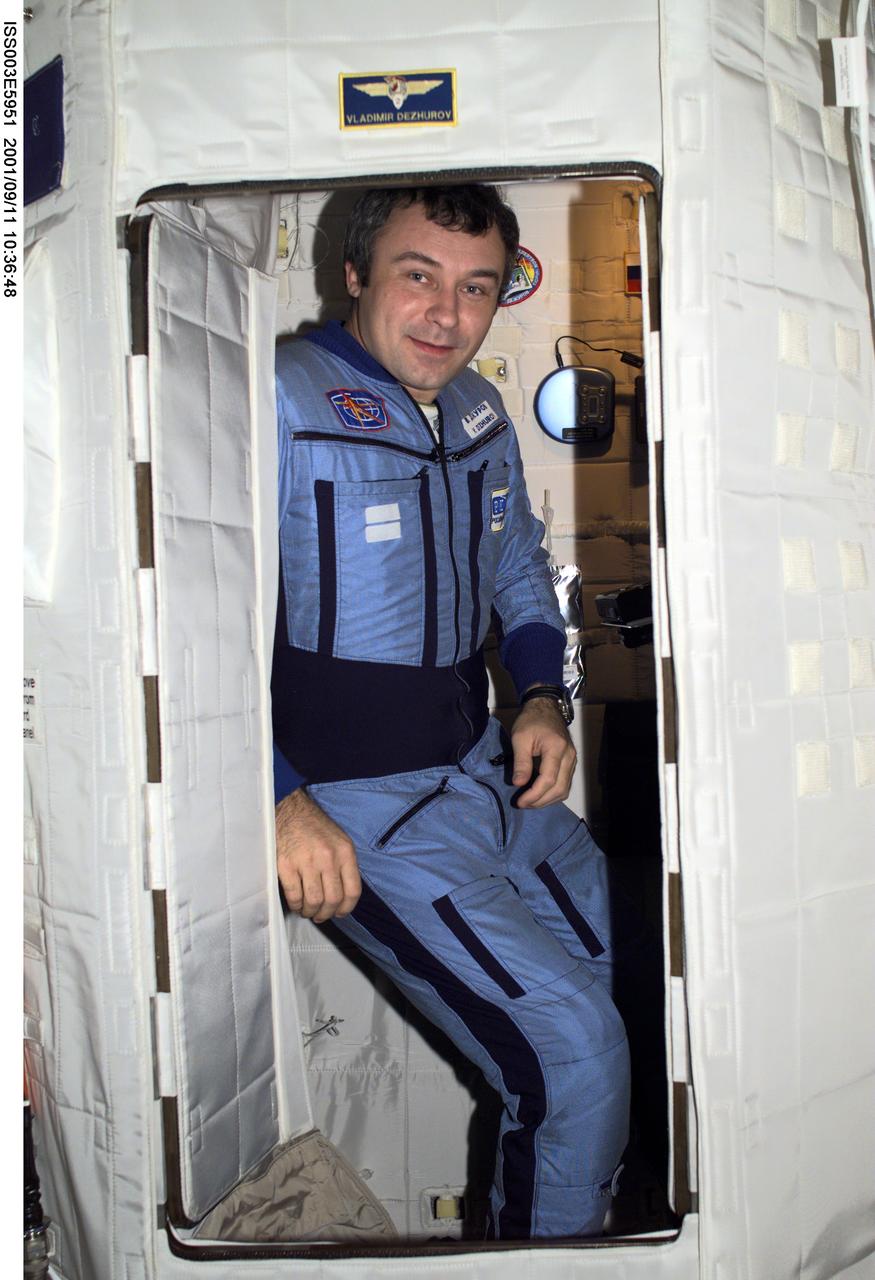
ISS003-E-5951 (11 September 2001) --- Cosmonaut Vladimir N. Dezhurov, Expedition Three flight engineer, takes a break from a busy day in the Temporary Sleep Station (TSS) in the Destiny laboratory on the International Space Station (ISS). Dezhurov represents Rosaviakosmos. This image was taken with a digital still camera.
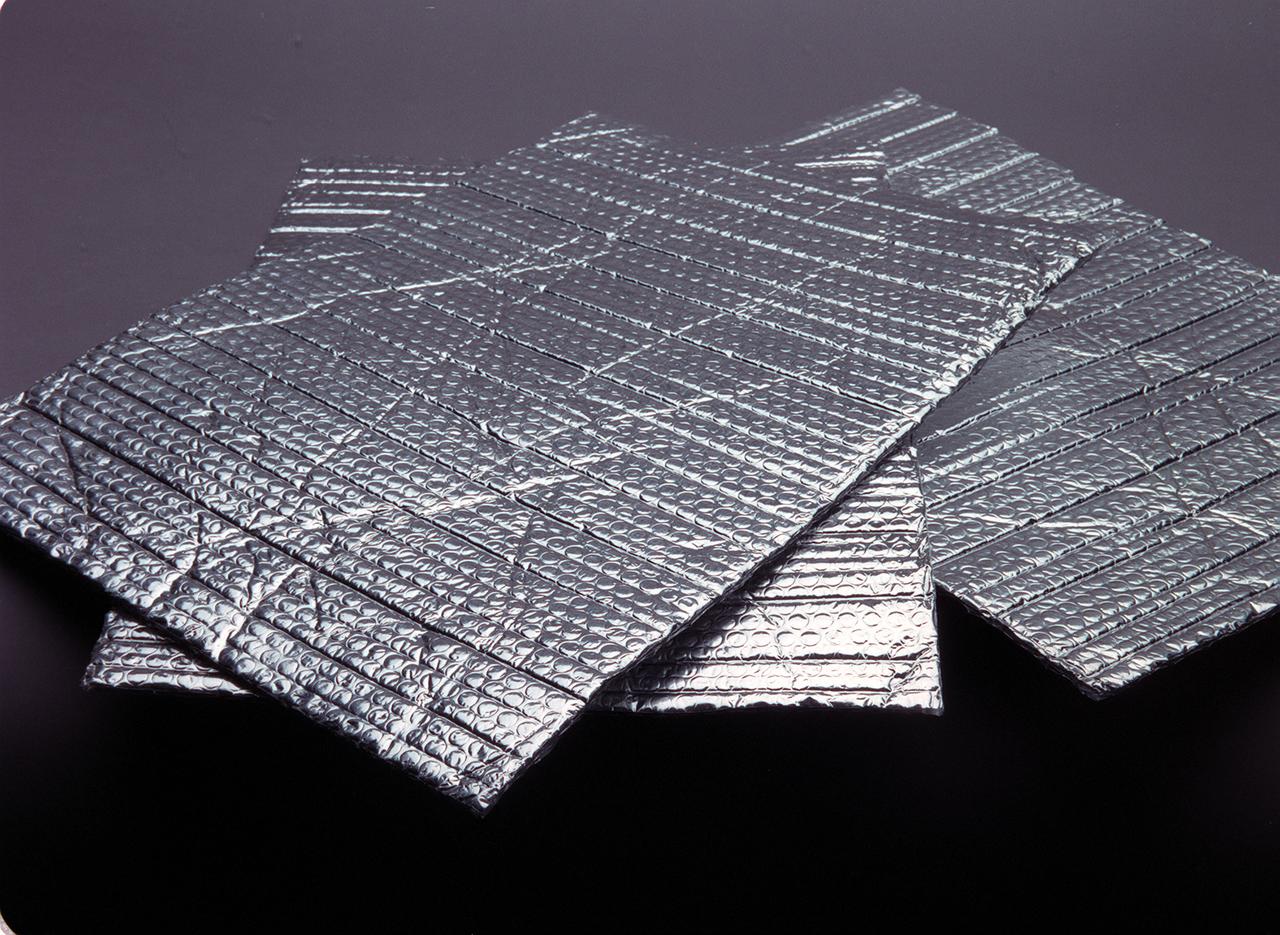
Radiation insulation technology from Apollo and subsequent spacecraft was used to develop superinsulators, used by makers of cold weather apparel, to make parkas, jackets, boots and outdoor gear such as sleeping bags. The radiant barrier technology offers warmth retention at minimal weight and bulk.
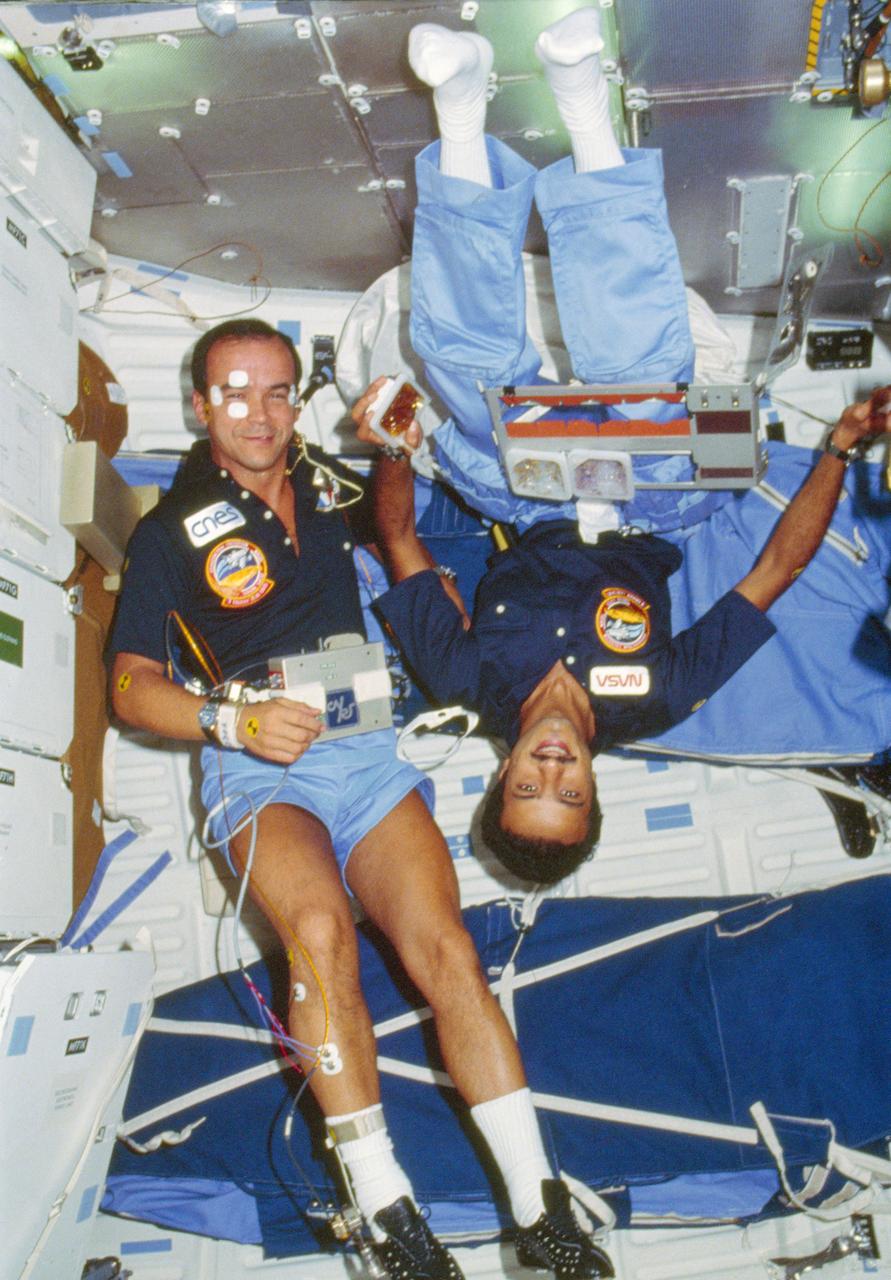
51G-102-035 (17-24 June 1985) --- The two payload specialists for the week-long flight share a middeck scene on the earth-orbiting Discovery. Sultan Salman Abdelazize Al-Saud (left) is in the midst of a meal while Patrick Baudry conducts a phase of the French Postural Experiment (FPE) on himself. Sleep restraints are in the background.
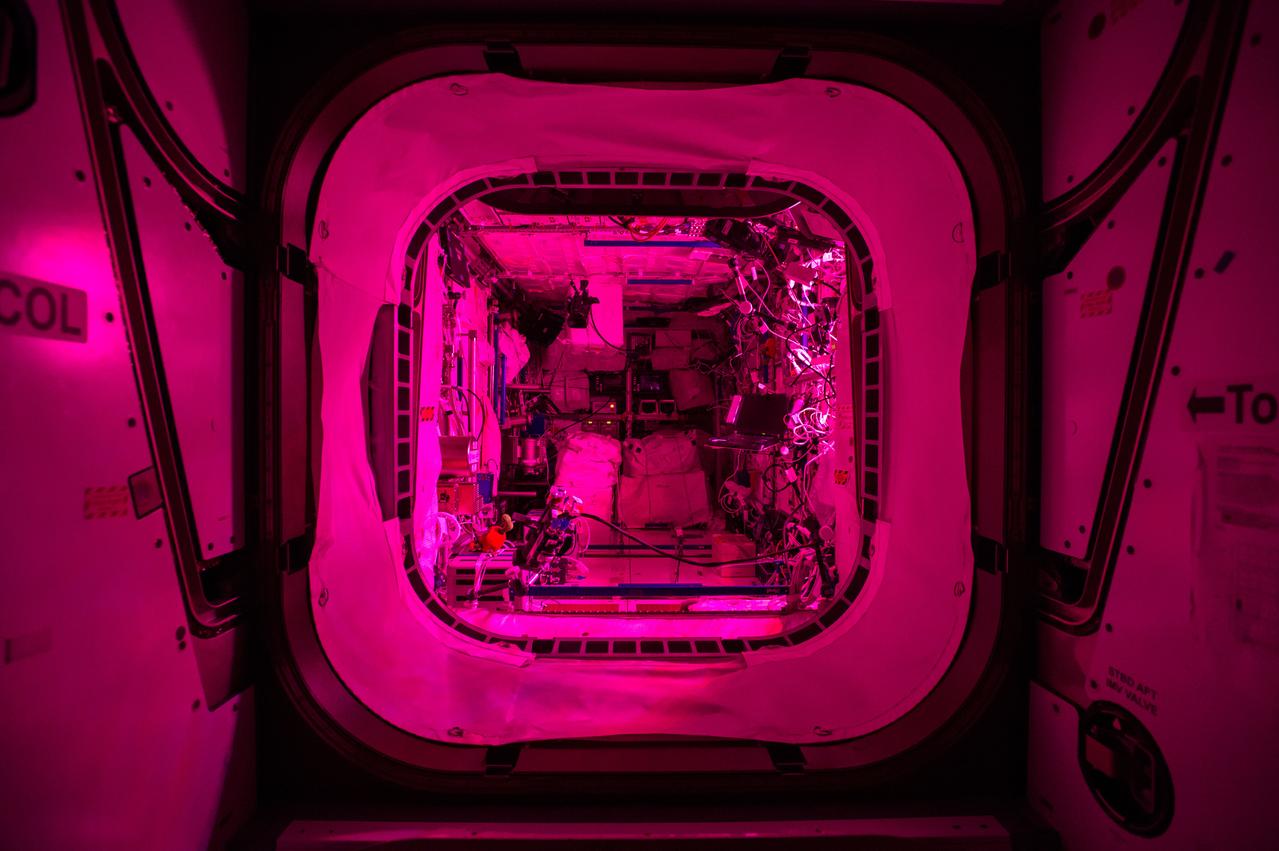
ISS042e136099 (Jan 15, 20105) -- Interior view of the Columbus European Laboratory taken during the crew's sleep period (main lights are turned off). The pink glow comes from the Vegetable Production System (Veggie) greenhouse, housed in the module.
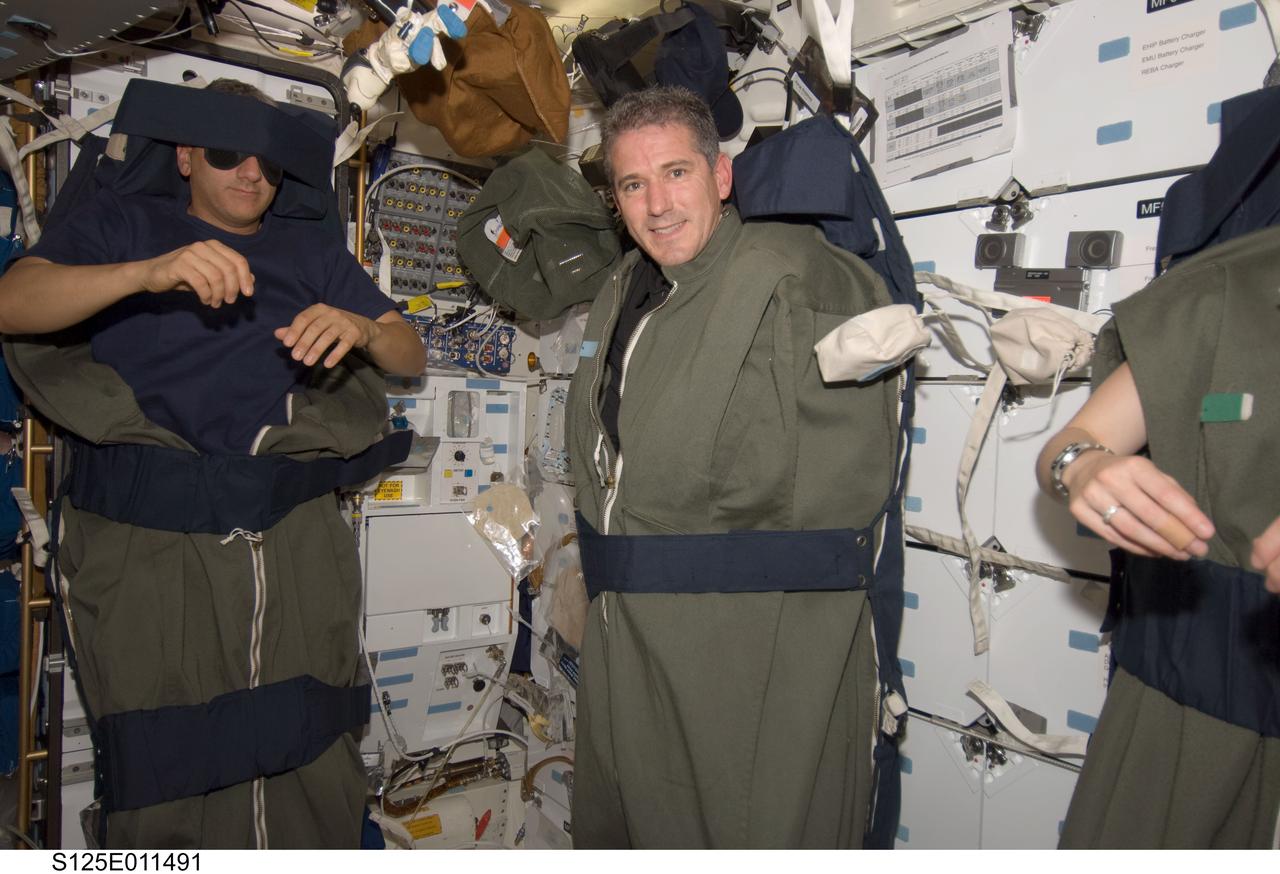
S125-E-011491 (18 May 2009) --- Astronauts Mike Massimino (left), Michael Good and Megan McArthur (mostly out of frame at right), all STS-125 mission specialists, are pictured in their sleeping bags, which are attached to the lockers on the middeck of the Earth-orbiting Space Shuttle Atlantis at the end of flight day eight.