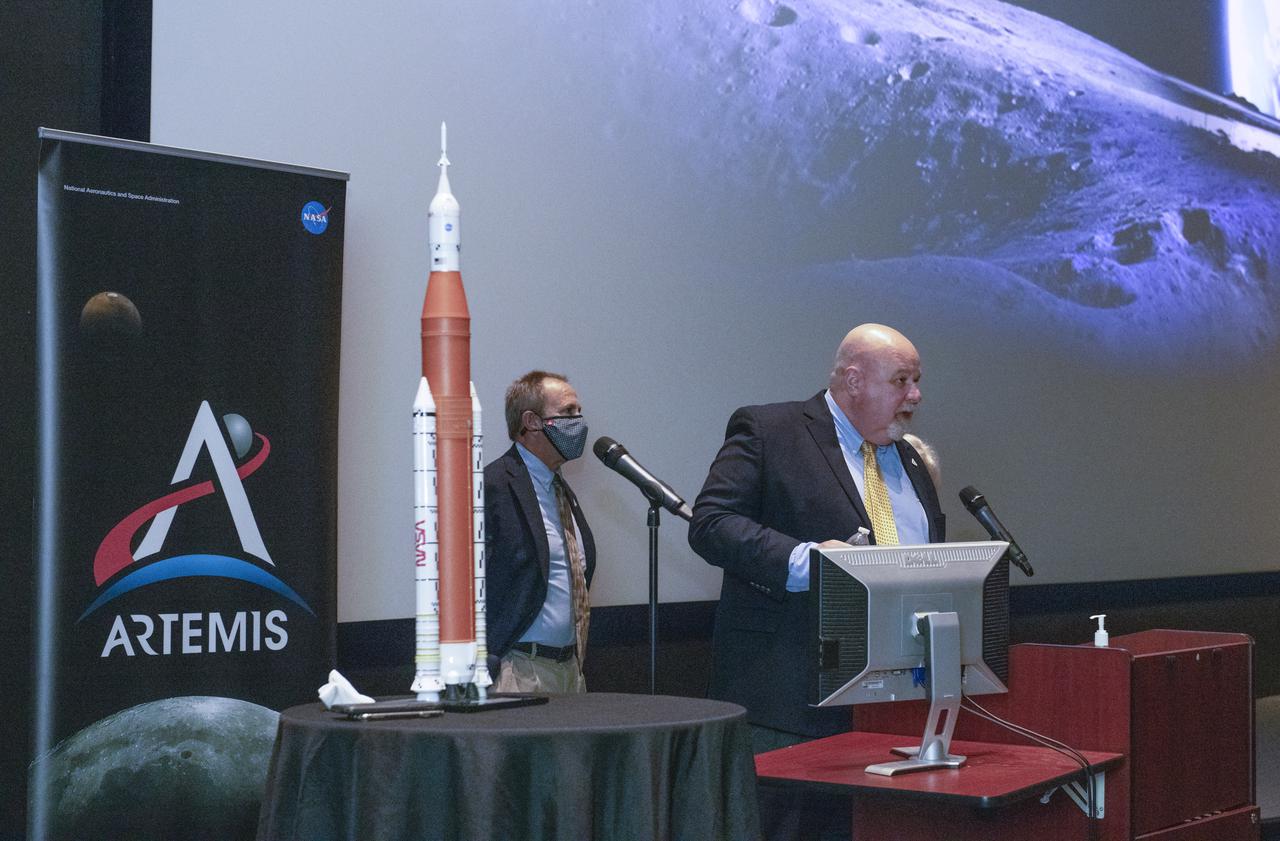
John Honeycutt, SLS Program Manager, takes questions at Chamber Media Briefing at USSRC
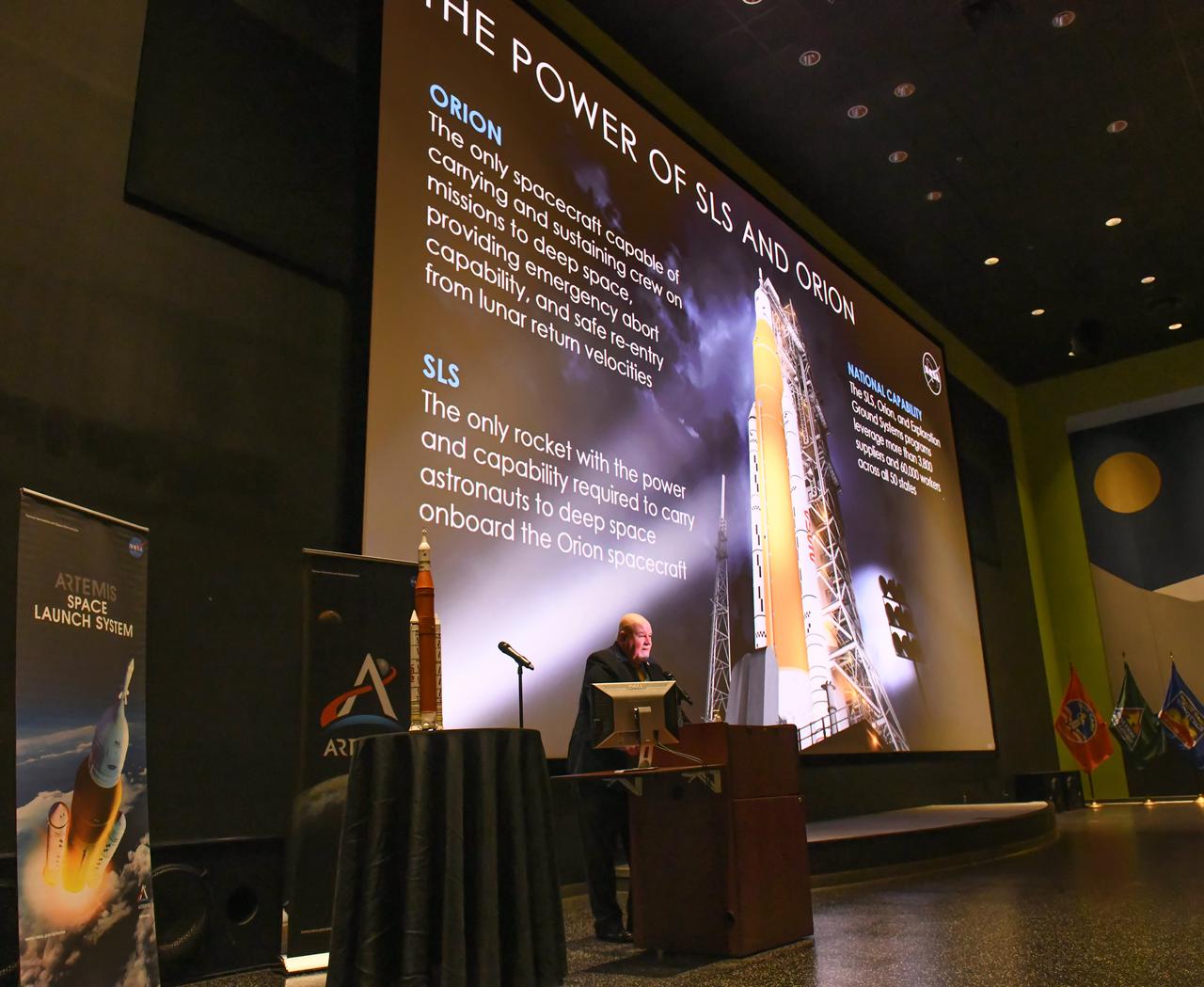
John Honeycutt, SLS Program Manager gives ARTEMIS update to audience at Chamber Media Briefing at USSRC.
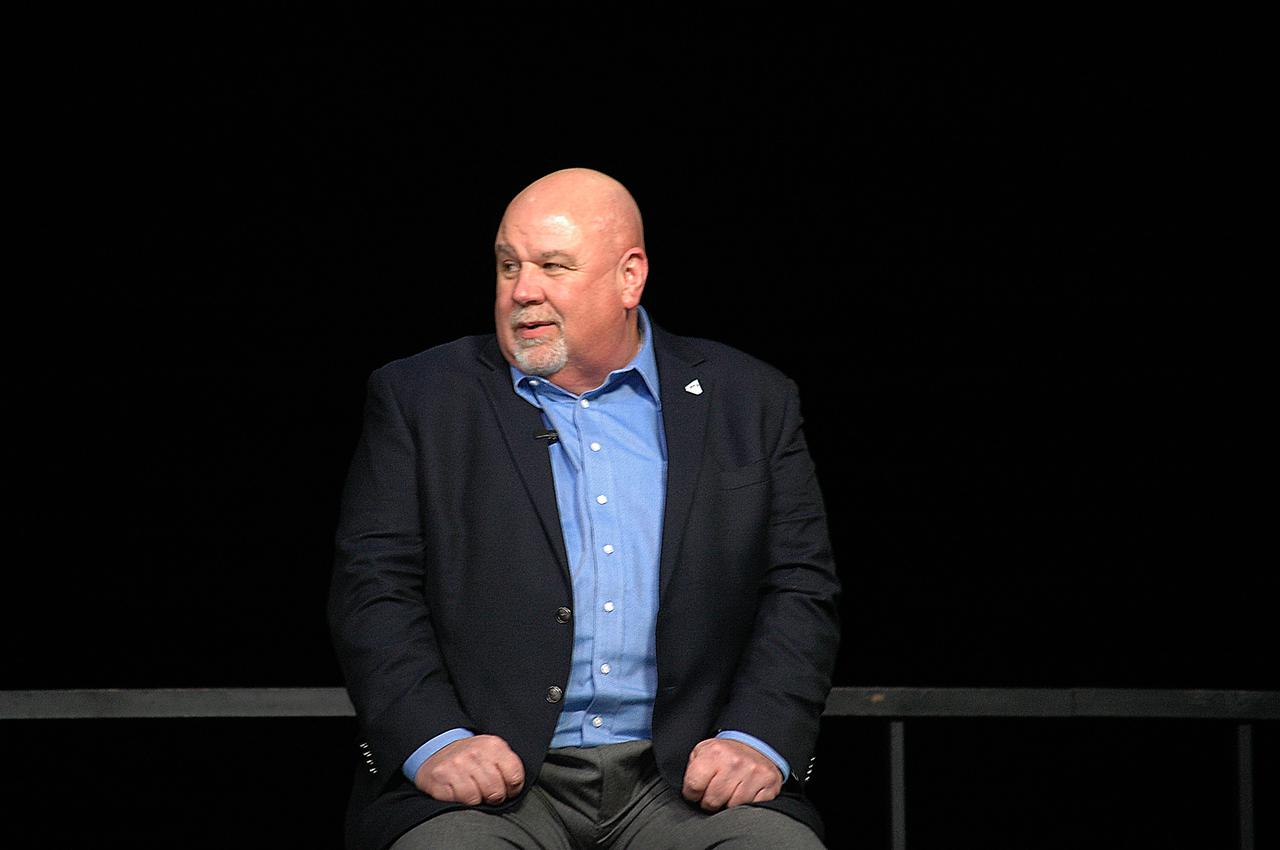
SLS Program Manager John Honeycutt from NASA’s Marshall Space Flight Center participates in a press conference following the Green Run hot fire test of the core stage for NASA’s Space Launch System (SLS) rocket on Saturday, January 16, 2021. NASA conducted a hot fire test of the core stage’s four RS-25 engines on the B-2 Test Stand at Stennis Space Center near Bay St. Louis, Mississippi. Scheduled for as long as eight minutes, the engines fired for a little more than one minute to generate a combined 1.6 million pounds of thrust, just as will occur during an actual launch. The hot fire is the final test of the Green Run test series, a comprehensive assessment of the SLS core stage prior to launching the Artemis I mission to the Moon.
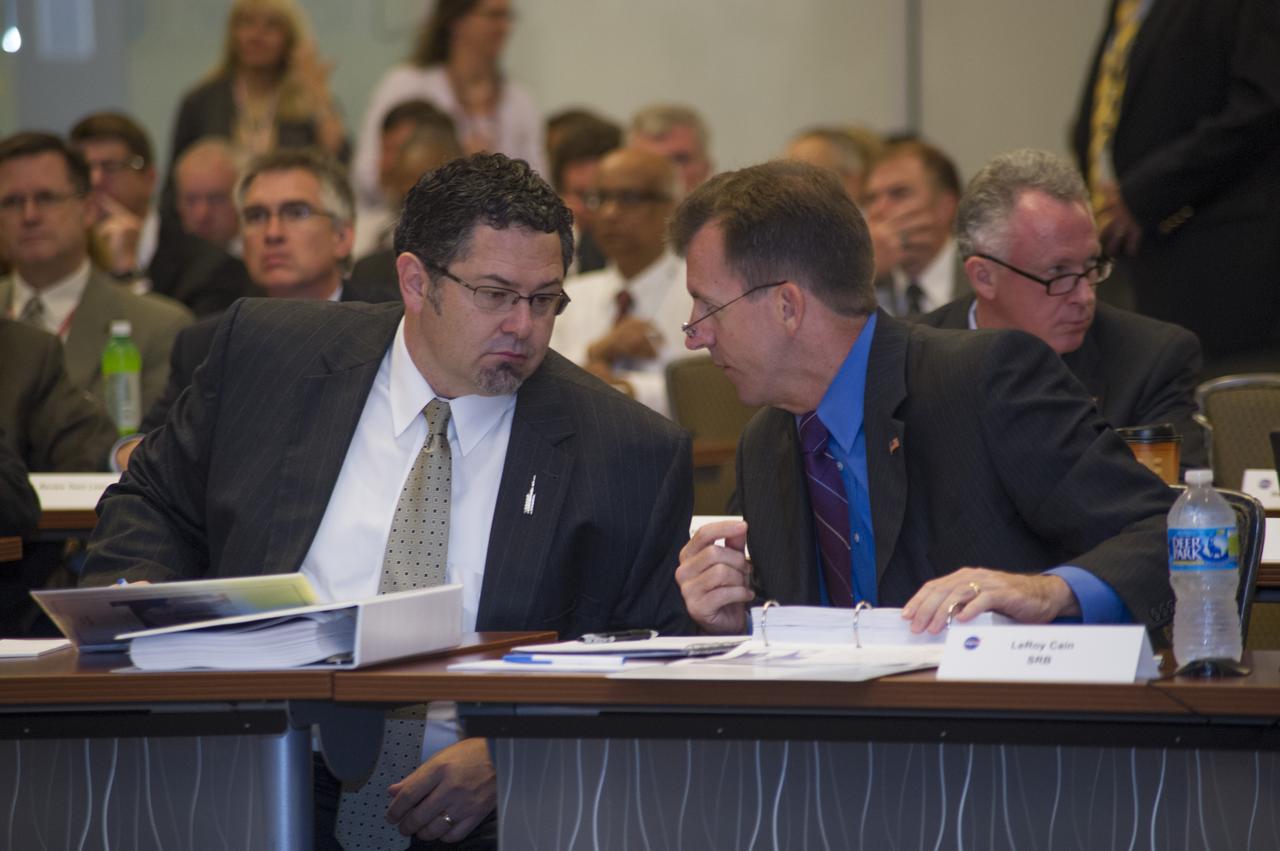
TODD MAY, LEFT, MANAGER OF THE SLS PROGRAM AT THE MARSHALL CENTER, DISCUSSES THE ROCKET'S SPECIFICATIONS WITH LEROY CAIN, WHO HEADS THE INDEPENDENT STANDING REVIEW BOARD FOR SLS, DURING THE SLS PROGRAM'S PRELIMINARY DESIGN REVIEW. THE REVIEW KICKED OFF JUNE 18-19
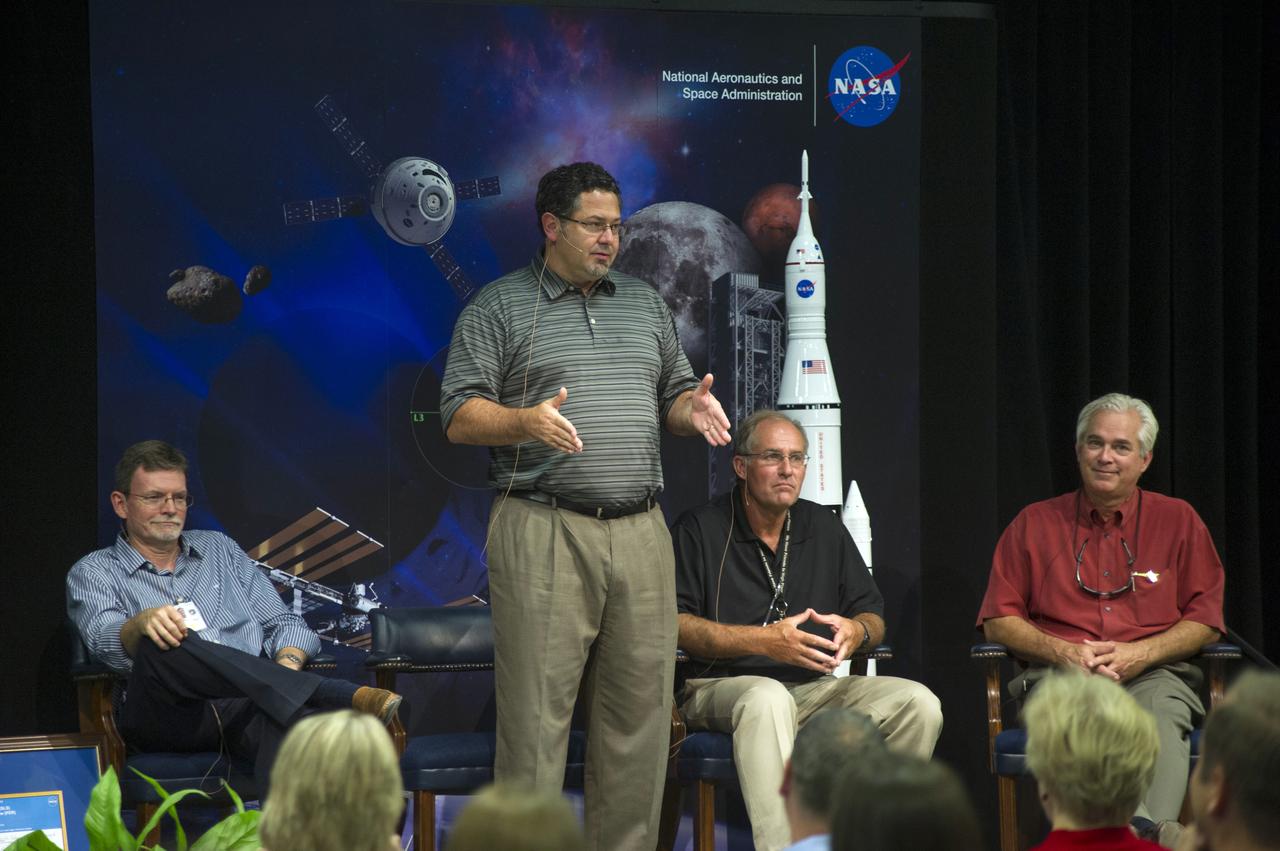
MORE THAN 250 PEOPLE FROM ACROSS NASA'S MARSHALL SPACE FLIGHT CENTER PARTICIPATED IN THE SPACE LAUNCH SYSTEM (SLS) POST-PRELIMINARY DESIGN REVIEW REPORT, HELD AUG. 5 IN ACTIVITIES BUILDING 4316. DISCUSSING THE REVIEW AND THANKING THE MARSHALL TEAM FOR A JOB WELL DONE, ARE FROM LEFT, GARRY LYLES, SLS CHIEF ENGINEER; TODD MAY, MANAGER OF THE SLS PROGRAM; STEVE CASH, DIRECTOR OF MARSHALL’S SAFETY & MISSION ASSURANCE DIRECTORATE; AND CHRIS SINGER, MANAGER OF MARSHALL’S ENGINEERING DIRECTORATE
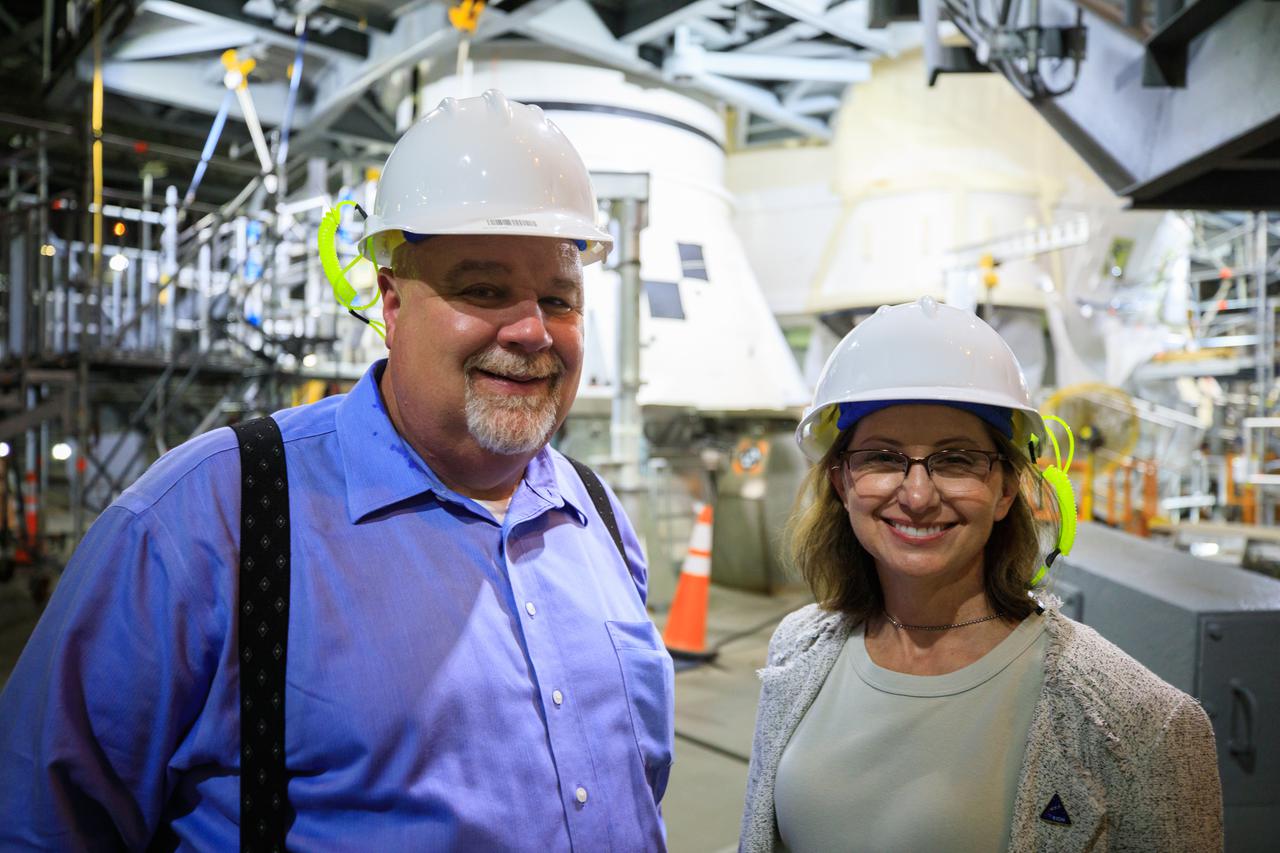
Space Launch System (SLS) Program Manager John Honeycutt, left, and Orion Program Manager Cathy Koerner pose for a photo while touring the Vehicle Assembly Building (VAB) during a visit to the agency’s Kennedy Space Center in Florida on June 23, 2021. Seen in the background are the aft booster segments – or the bottommost portion – of the SLS twin solid rocket boosters for Artemis I. The first in an increasingly complex set of missions, Artemis I will test SLS and the Orion spacecraft as an integrated system prior to crewed flights to the Moon. Through Artemis, NASA will land the first woman and first person of color on the lunar surface, as well as establish a sustainable presence on and around the Moon.
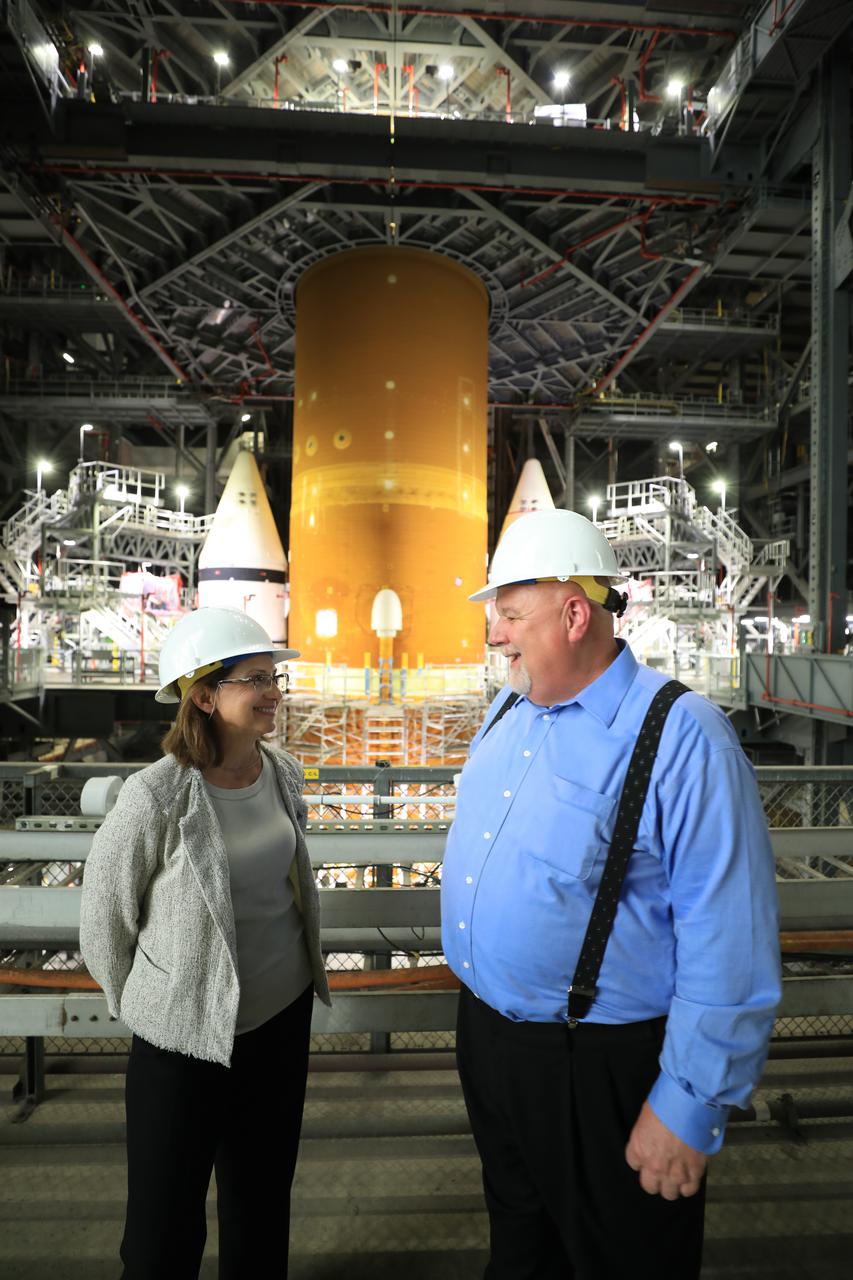
Orion Program Manager Cathy Koerner, left, and Space Launch System (SLS) Program Manager John Honeycutt tour the Vehicle Assembly Building (VAB) during a visit to the agency’s Kennedy Space Center in Florida on June 23, 2021. Seen in the background is the SLS core stage in between the twin solid rocket boosters for Artemis I. The first in an increasingly complex set of missions, Artemis I will test SLS and the Orion spacecraft as an integrated system prior to crewed flights to the Moon. Through Artemis, NASA will land the first woman and first person of color on the lunar surface, as well as establish a sustainable presence on and around the Moon.
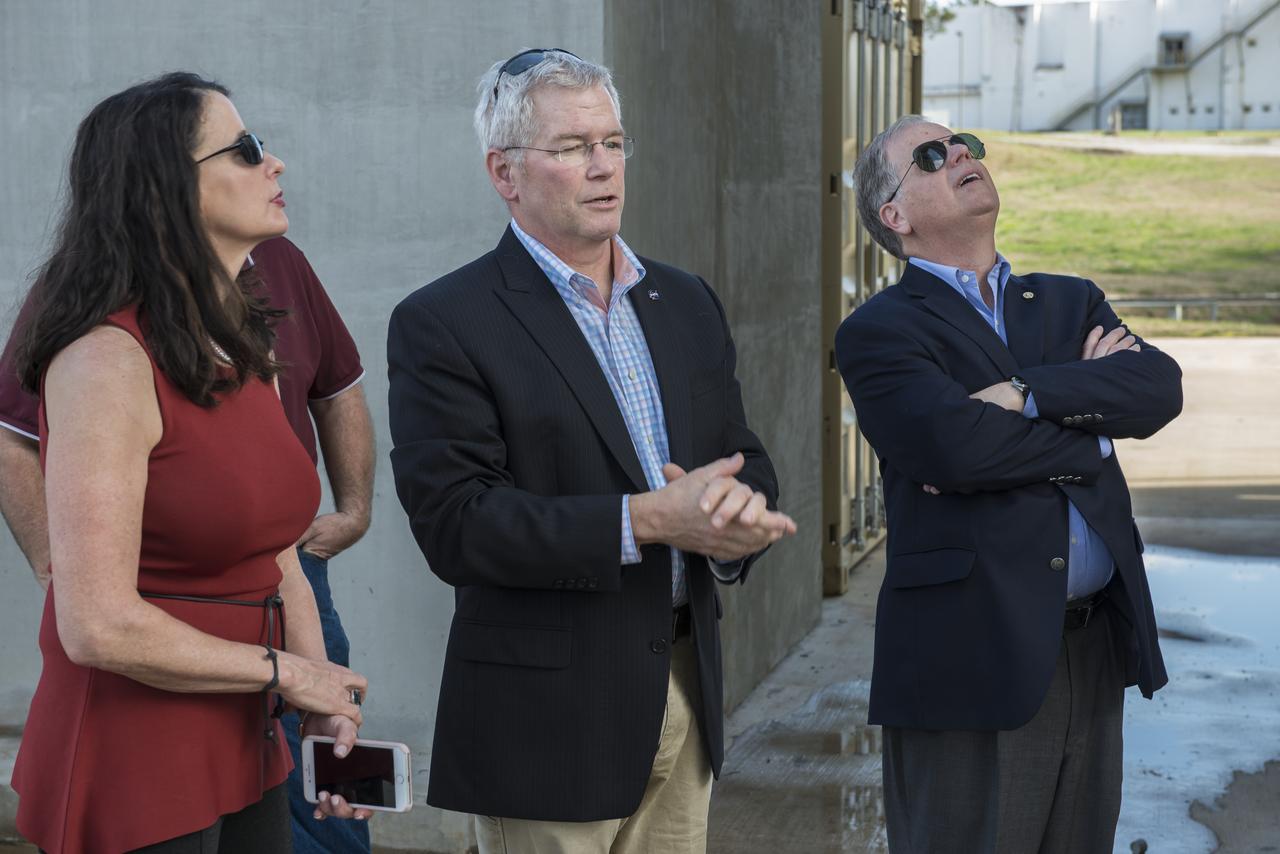
Senator Doug Jones (D-AL.) and wife, Louise, tour Marshall Space Flight facilities. Steve Doering, manager, Stages Element, Space Launch System (SLS) program at MSFC, views the test stand 4693 where key SLS structural elements will be subjected to stress testing simulating space flight.
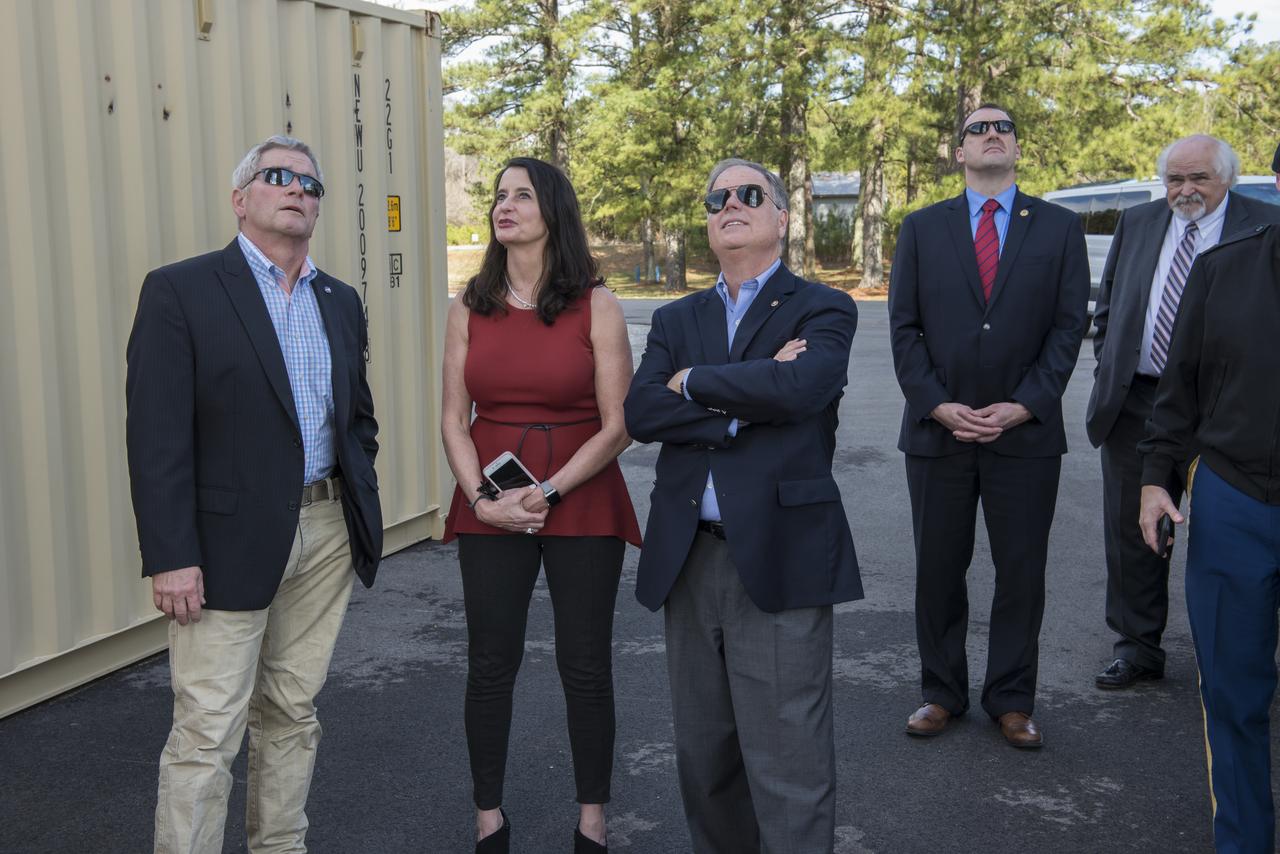
Senator Doug Jones (D-AL.) and wife, Louise, tour Marshall Space Flight facilities. Steve Doering, manager, Stages Element, Space Launch System (SLS) program at MSFC, views the test stand 4693 where key SLS structural elements will be subjected to stress testing simulating space flight.
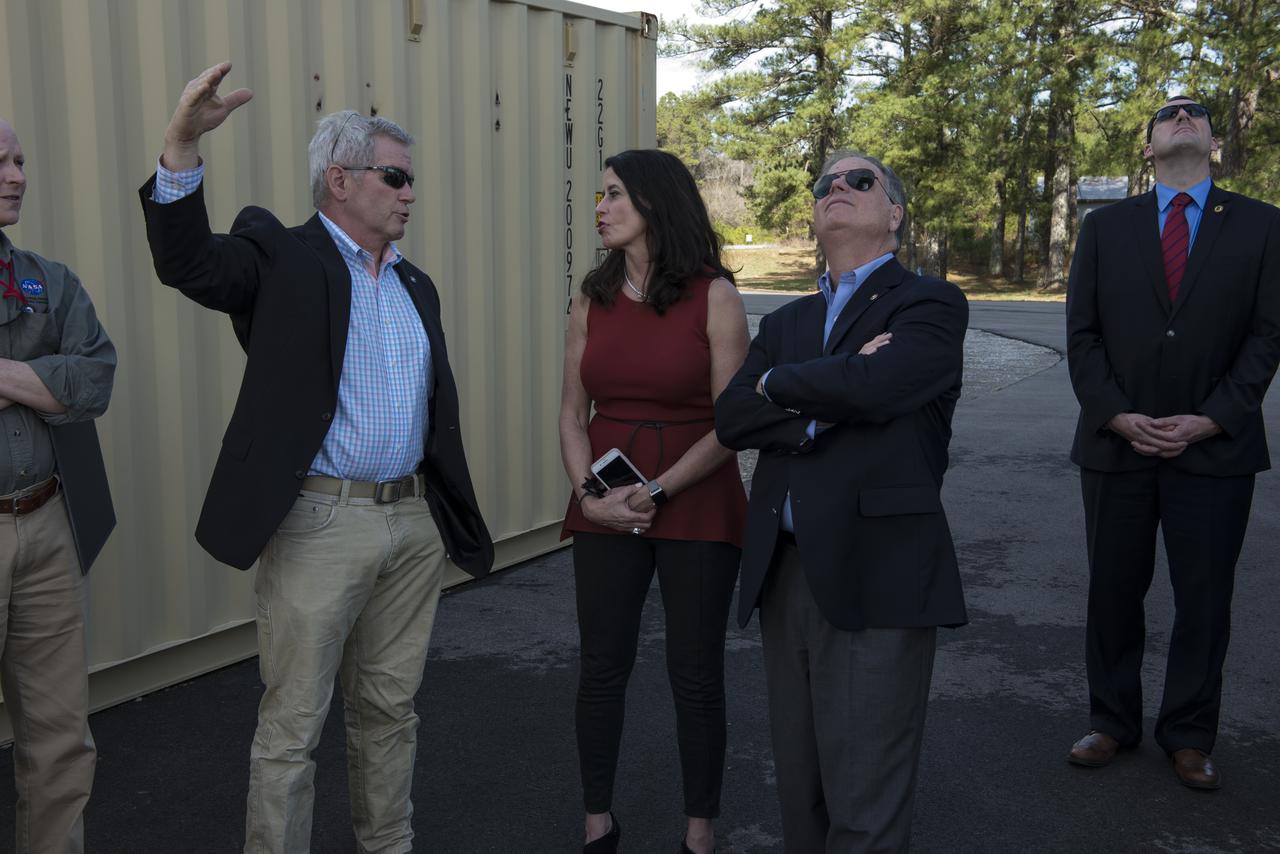
Senator Doug Jones (D-AL.) and wife, Louise, tour Marshall Space Flight facilities. Steve Doering, manager, Stages Element, Space Launch System (SLS) program at MSFC, views the test stand 4693 where key SLS structural elements will be subjected to stress testing simulating space flight.
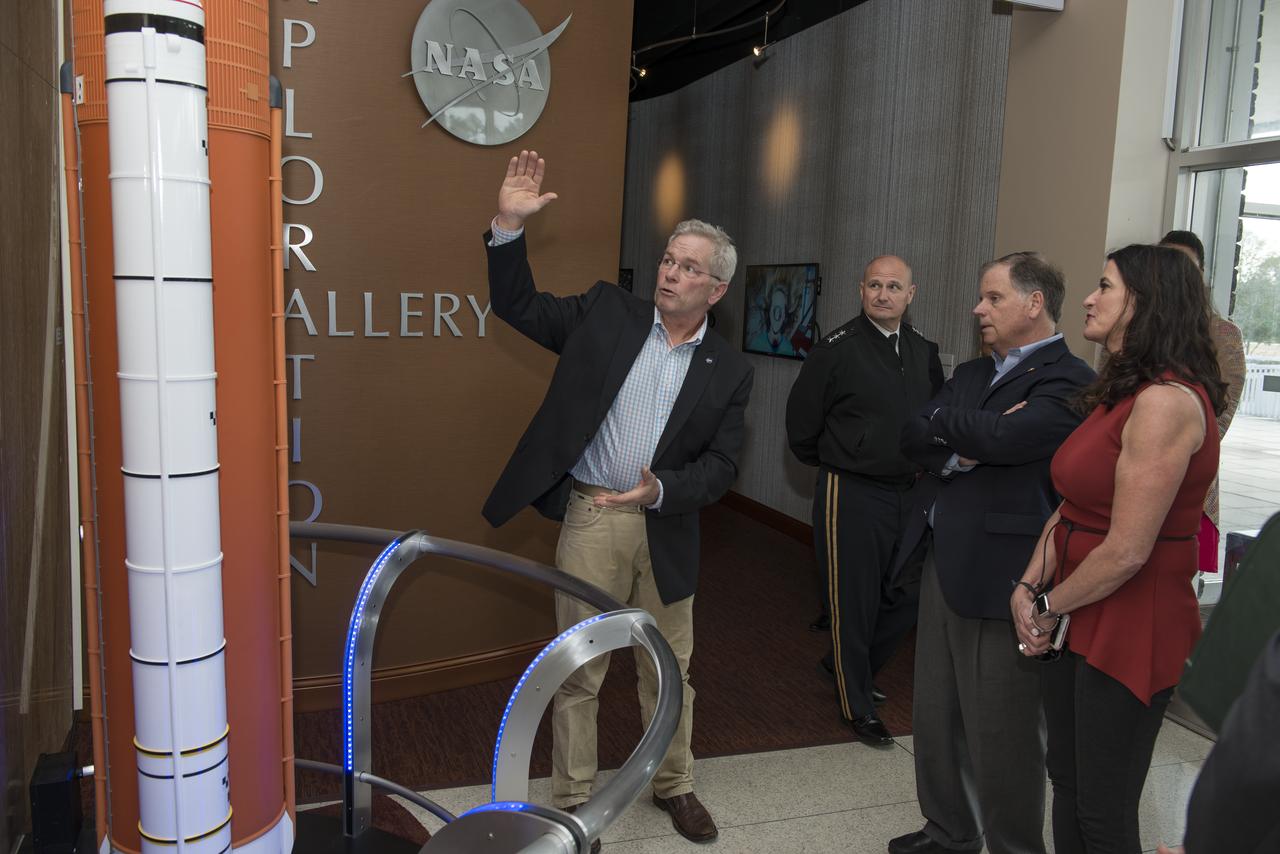
Senator Doug Jones (D-AL.) and wife, Louise, tour Marshall Space Flight facilities. Steve Doering, manager, Stages Element, Space Launch System (SLS) program at MSFC, explains the stages of the SLS rocket with the scale model rocket located in the lobby of building 4200.
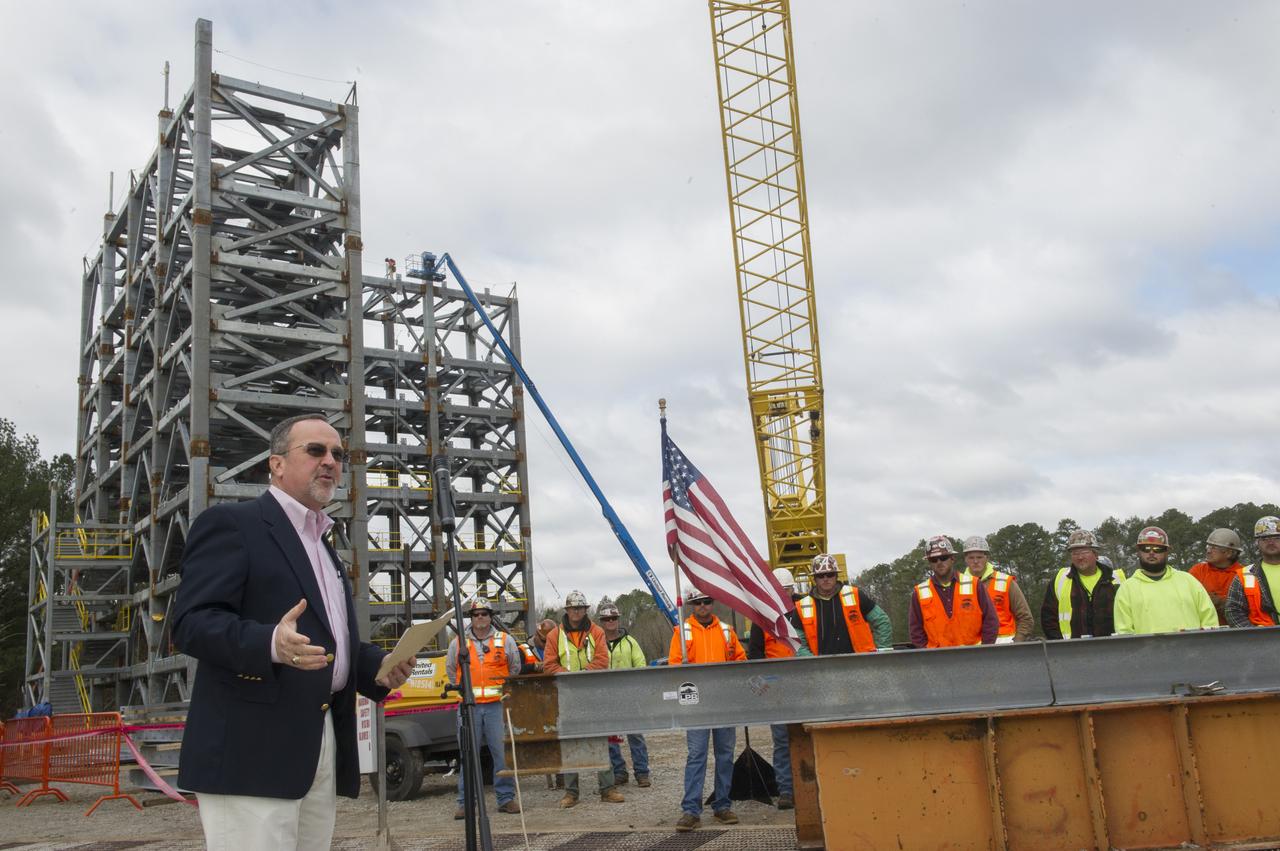
"YOUR WORK IS CRITICAL TO THE JOURNEY TO MARS," SAID SLS DEPUTY PROGRAM MANAGER JERRY COOK TO THE CONSTRUCTION CREW AT THE "TOP OUT" CEREMONY FOR TEST STAND 4697 AT MARSHALL.
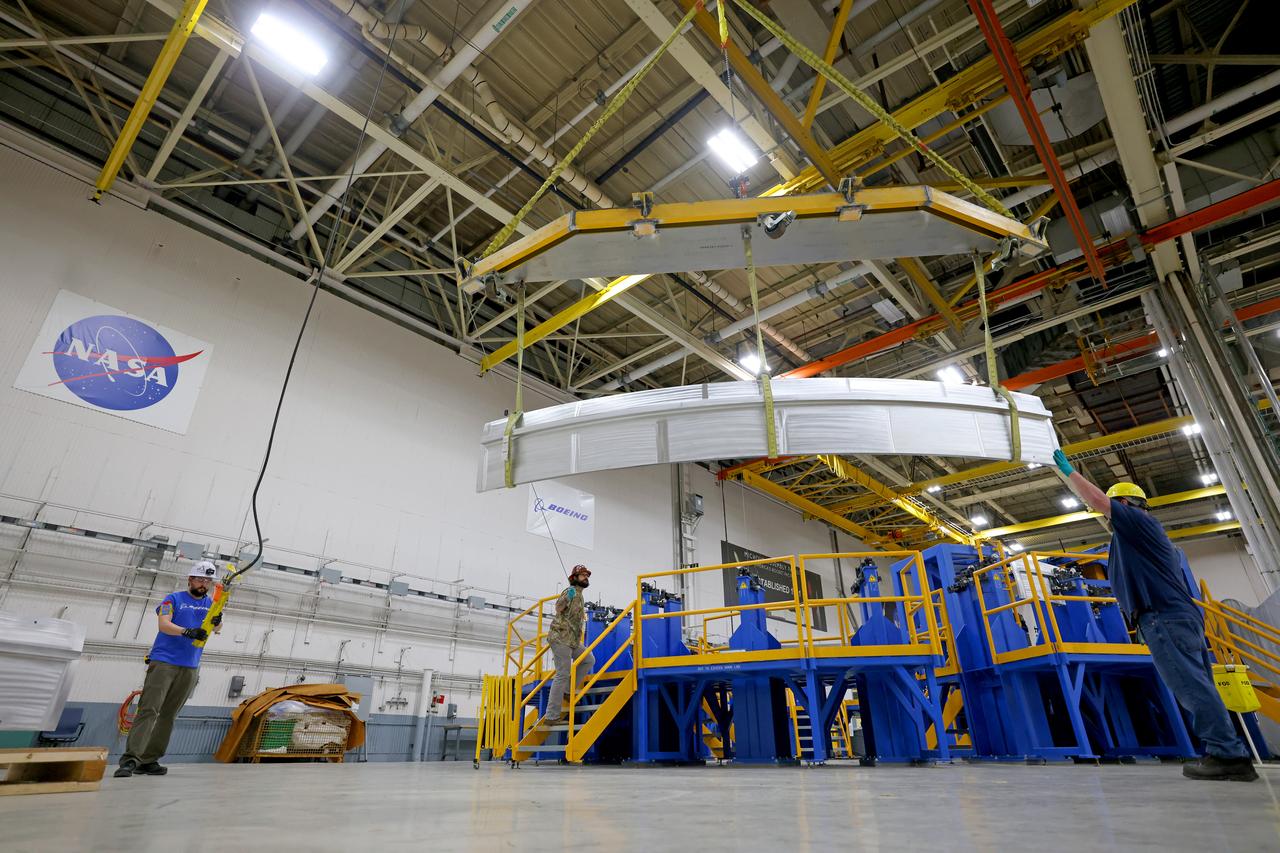
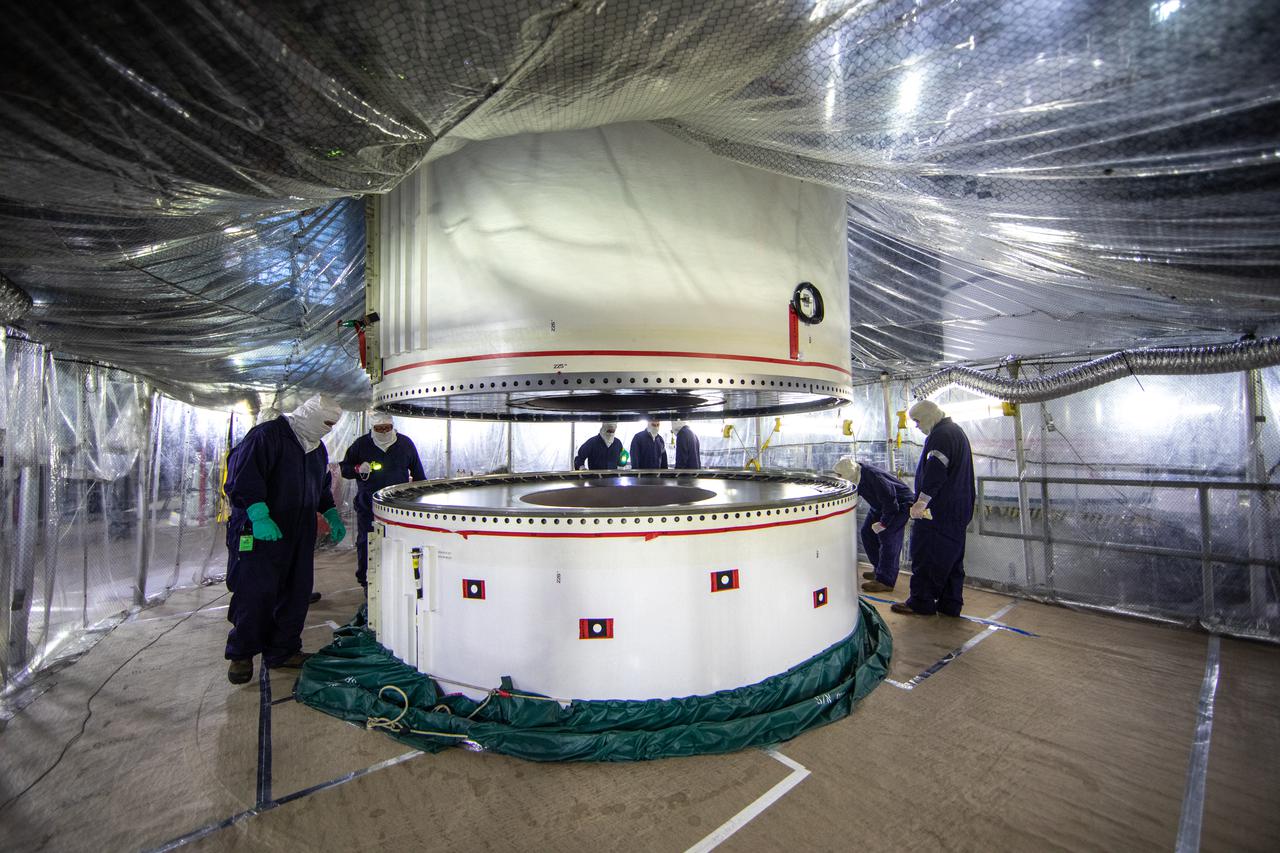
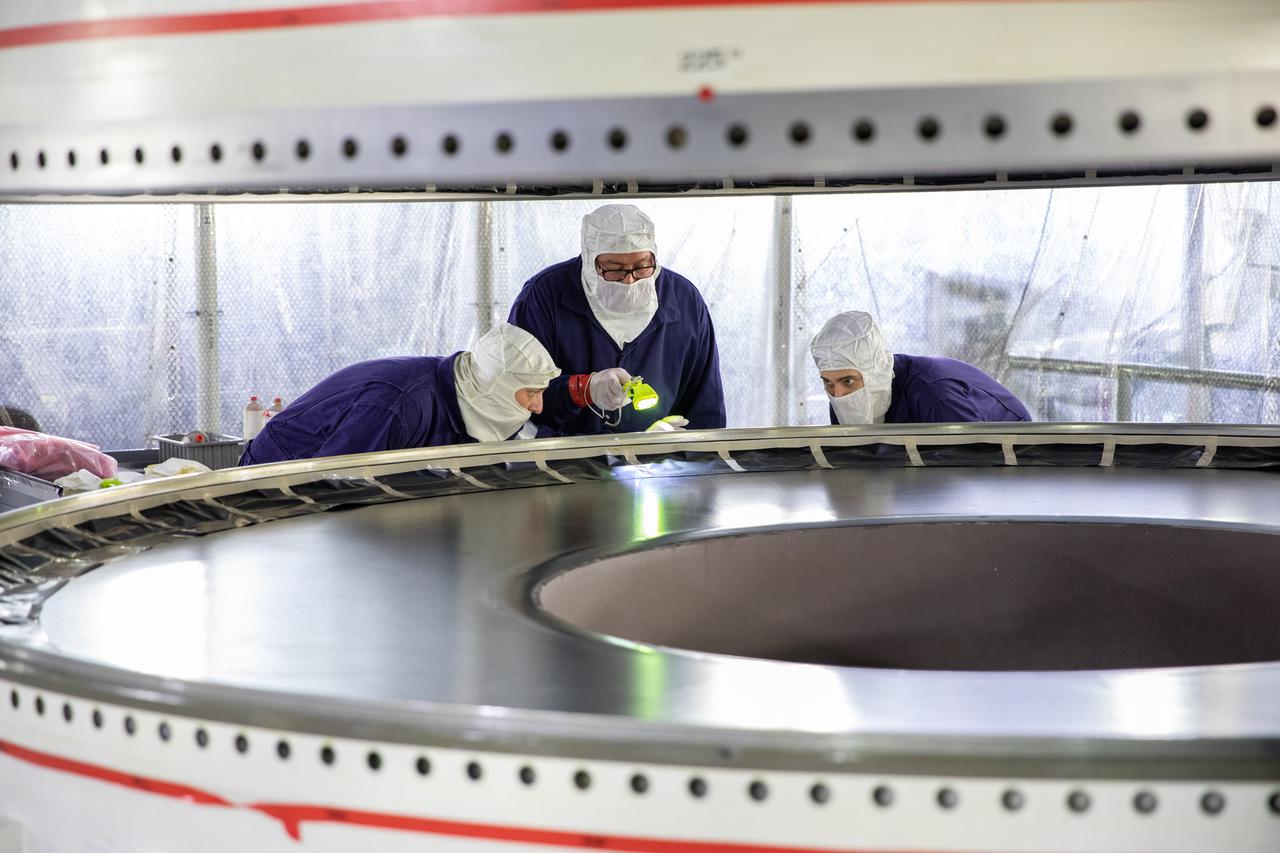
These photos show how teams at NASA’s Michoud Assembly Facility in New Orleans manufactured the Y-ring that will be used on the evolved Block 1B configuration of the SLS (Space Launch System) rocket. It is one of the first components that will make up a portion of the core stage that will power NASA’s Artemis V mission. The large metal ring will serve as the aft ring for the rocket’s liquid hydrogen tank. The SLS core stage is the backbone of the SLS rocket, stretching 212 feet from top to bottom, and includes four RS-25 engines at its base. At launch, its two huge liquid propellant tanks provide more than 733,000 gallons of fuel to produce more than 2 million pounds of thrust. Michoud Assembly Facility and the SLS Program are managed by NASA’s Marshall Space Flight Center in Huntsville, Alabama. Image credit: NASA/Michael DeMocker
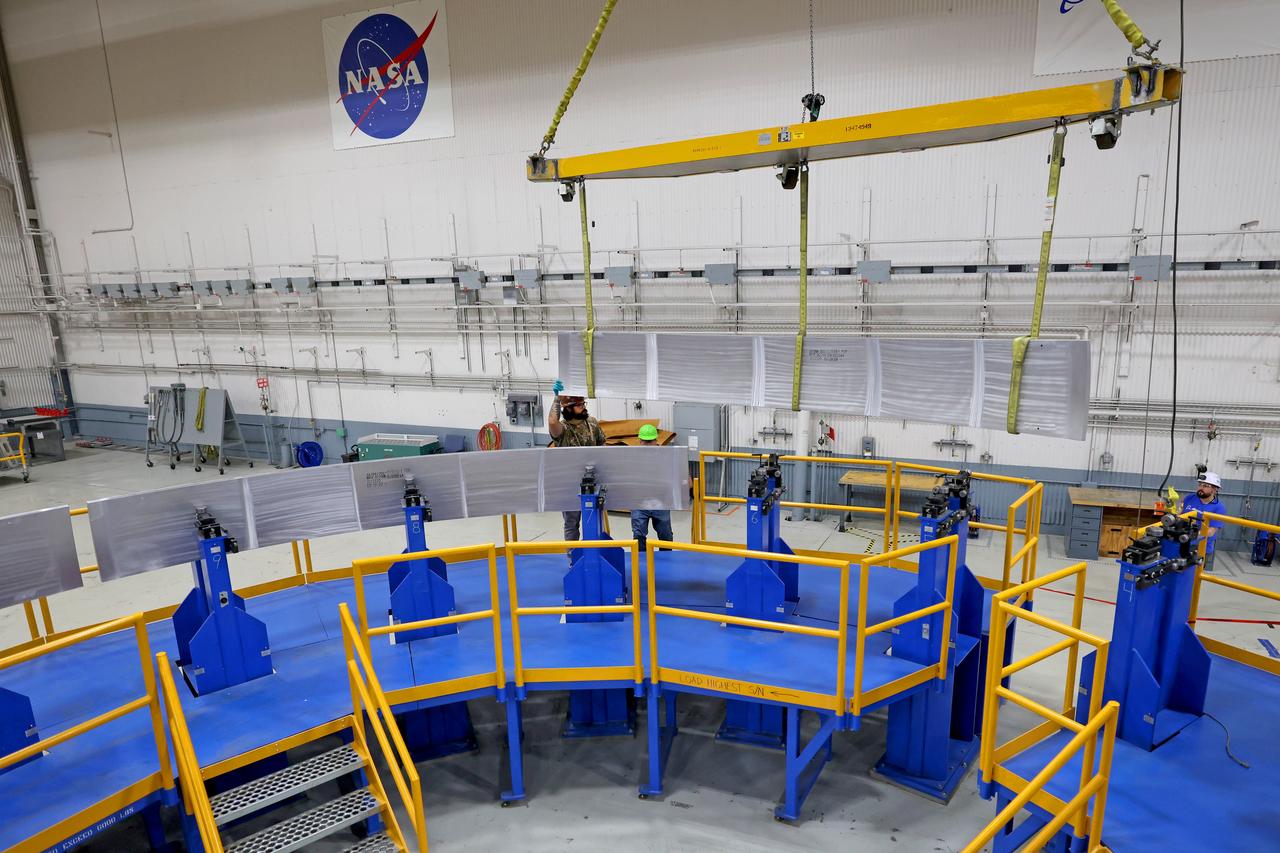
These photos show how teams at NASA’s Michoud Assembly Facility in New Orleans manufactured the Y-ring that will be used on the evolved Block 1B configuration of the SLS (Space Launch System) rocket. It is one of the first components that will make up a portion of the core stage that will power NASA’s Artemis V mission. The large metal ring will serve as the aft ring for the rocket’s liquid hydrogen tank. The SLS core stage is the backbone of the SLS rocket, stretching 212 feet from top to bottom, and includes four RS-25 engines at its base. At launch, its two huge liquid propellant tanks provide more than 733,000 gallons of fuel to produce more than 2 million pounds of thrust. Michoud Assembly Facility and the SLS Program are managed by NASA’s Marshall Space Flight Center in Huntsville, Alabama. Image credit: NASA/Michael DeMocker

These photos show how teams at NASA’s Michoud Assembly Facility in New Orleans manufactured the Y-ring that will be used on the evolved Block 1B configuration of the SLS (Space Launch System) rocket. It is one of the first components that will make up a portion of the core stage that will power NASA’s Artemis V mission. The large metal ring will serve as the aft ring for the rocket’s liquid hydrogen tank. The SLS core stage is the backbone of the SLS rocket, stretching 212 feet from top to bottom, and includes four RS-25 engines at its base. At launch, its two huge liquid propellant tanks provide more than 733,000 gallons of fuel to produce more than 2 million pounds of thrust. Michoud Assembly Facility and the SLS Program are managed by NASA’s Marshall Space Flight Center in Huntsville, Alabama. Image credit: NASA/Michael DeMocker
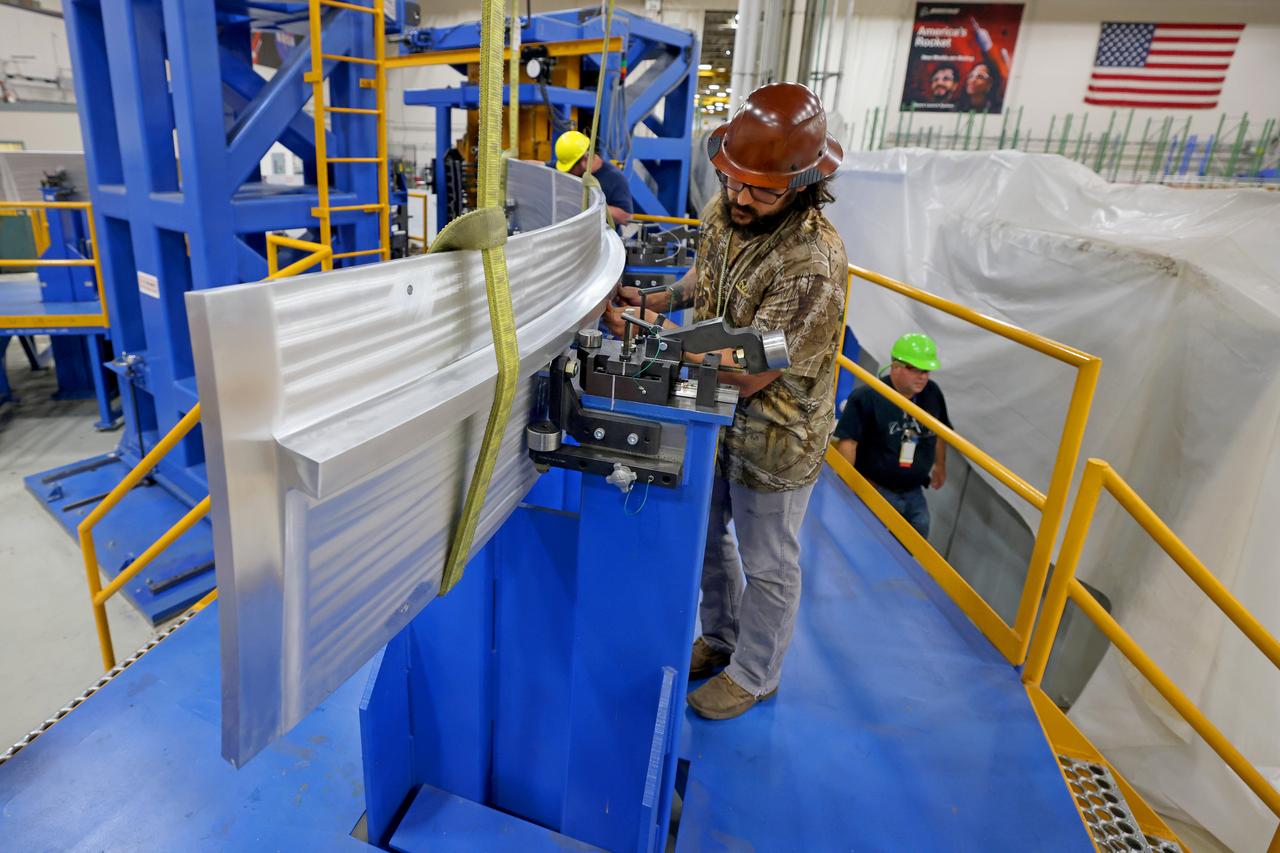
These photos show how teams at NASA’s Michoud Assembly Facility in New Orleans manufactured the Y-ring that will be used on the evolved Block 1B configuration of the SLS (Space Launch System) rocket. It is one of the first components that will make up a portion of the core stage that will power NASA’s Artemis V mission. The large metal ring will serve as the aft ring for the rocket’s liquid hydrogen tank. The SLS core stage is the backbone of the SLS rocket, stretching 212 feet from top to bottom, and includes four RS-25 engines at its base. At launch, its two huge liquid propellant tanks provide more than 733,000 gallons of fuel to produce more than 2 million pounds of thrust. Michoud Assembly Facility and the SLS Program are managed by NASA’s Marshall Space Flight Center in Huntsville, Alabama. Image credit: NASA/Michael DeMocker
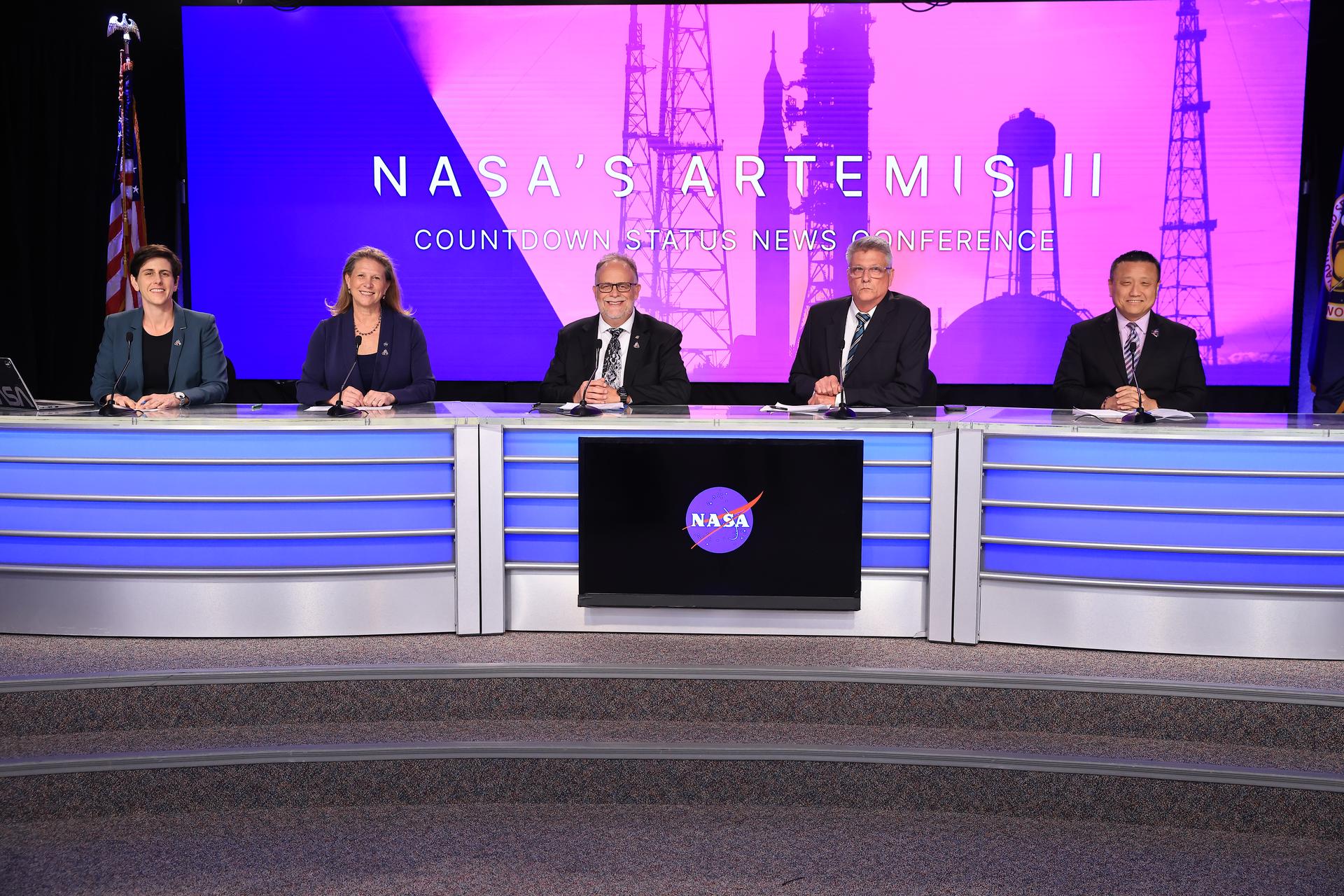
From left to right, Rachel Kraft, NASA communications; Lori Glaze, acting associate administrator, Exploration Systems Development Mission Directorate; Shawn Quinn, program manager, Exploration Ground Systems; Chris Cianciola, deputy manager, NASA’s SLS (Space Launch System) Program; and Howard Hu, manager, Orion Program, participates in a news conference on Sunday, March 29, 2026, to discuss the upcoming Artemis II test flight at NASA’s Kennedy Space Center in Florida. The Artemis II mission will take Artemis II Commander Reid Wiseman, Pilot Victor Glover, and Mission Specialist Christina Koch from NASA, and Mission Specialist Jeremy Hansen from the CSA (Canadian Space Agency) on a 10-day journey around the Moon and back aboard NASA’s SLS (Space Launch System) rocket and Orion spacecraft from Launch Complex 39B no earlier than 6:24 p.m. EDT on Wednesday, April 1.
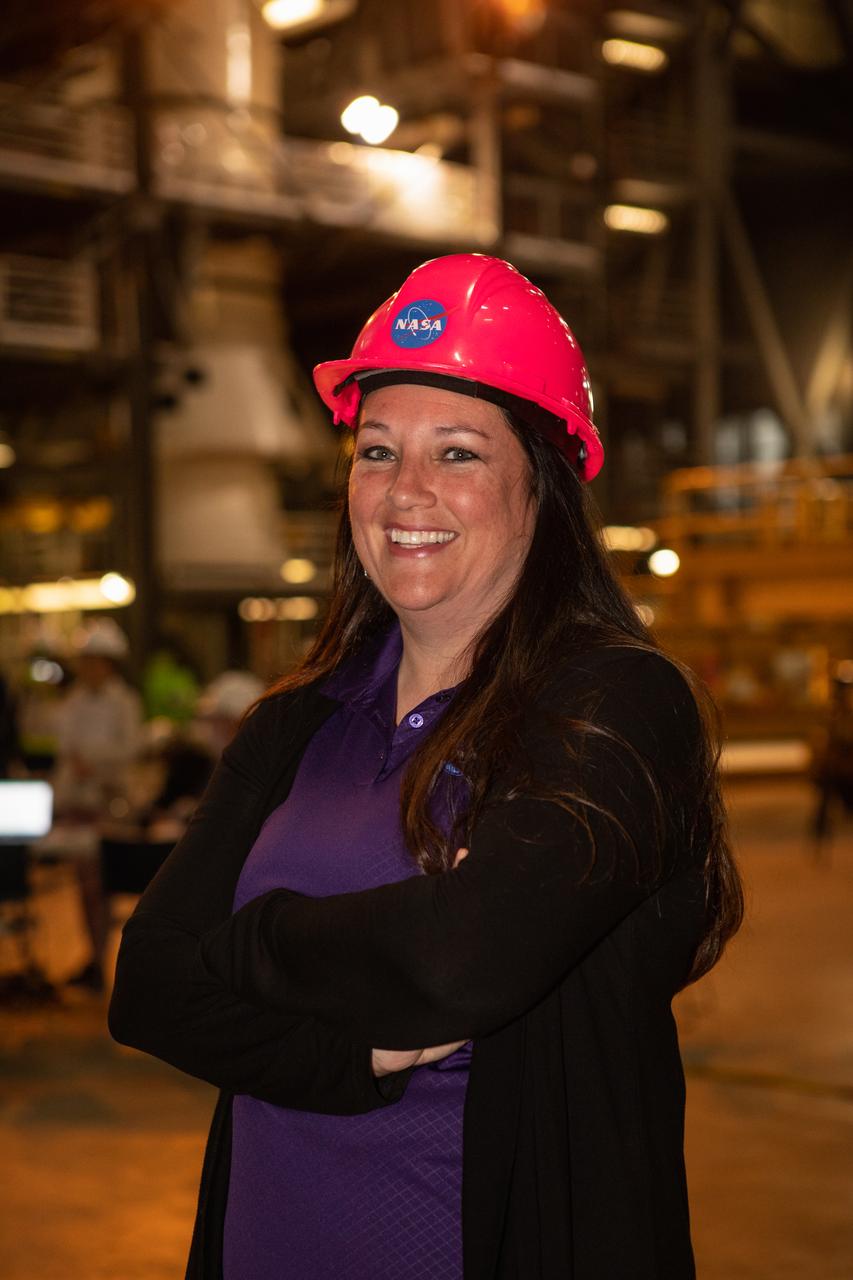
NASA Vehicle Assembly Building (VAB) Element Operations Manager Elizabeth Kline stands inside the VAB’s high bay 4 in front of mockups of the Space Launch System (SLS) booster segments on Nov. 19, 2019. Teams from NASA’s Exploration Ground Systems and SLS practiced booster segment mate, training around the clock from Nov. 18 through Nov. 20. SLS will launch the first woman and next man to the Moon by 2024 through the Artemis program.
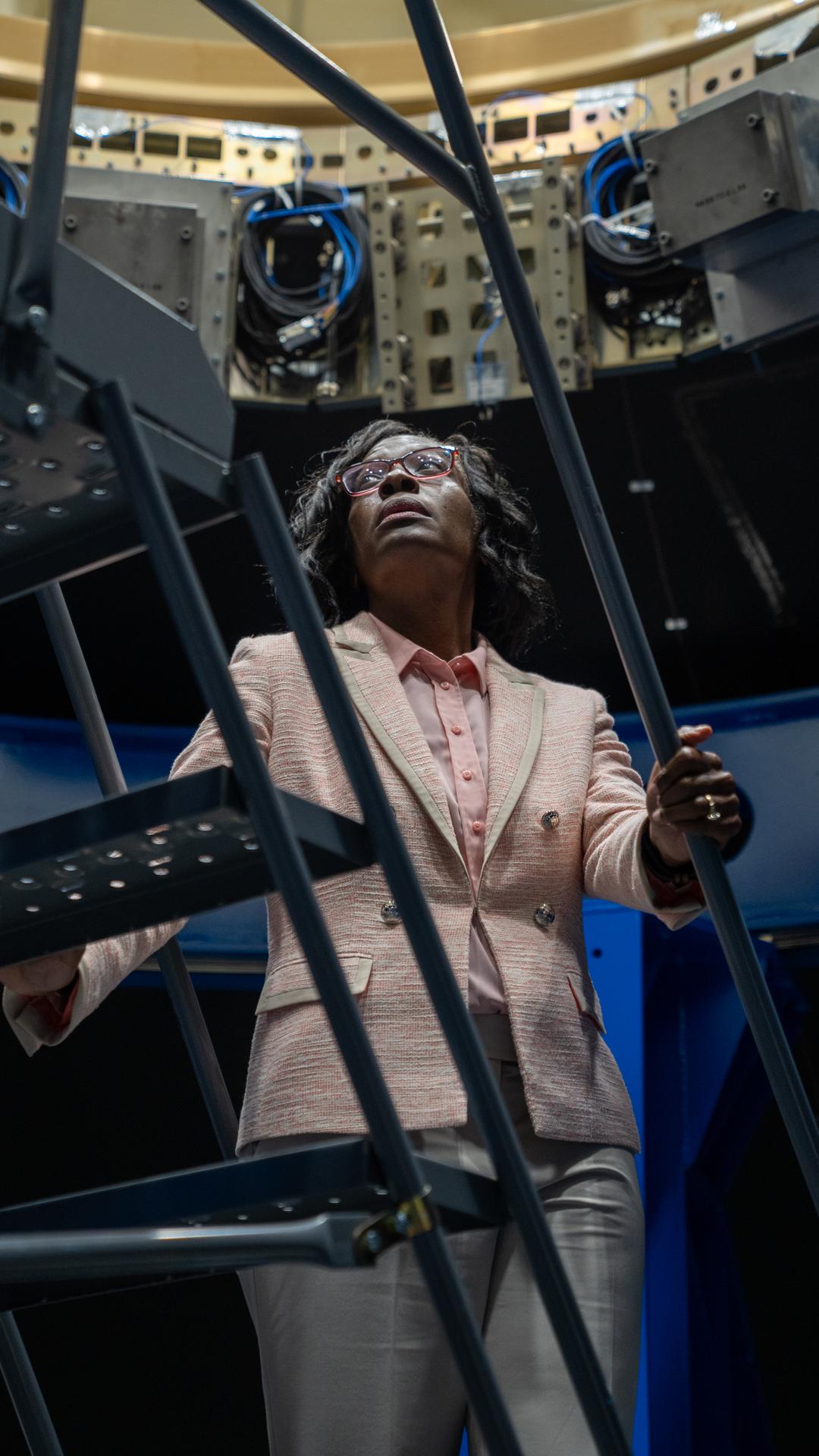
Lakiesha Hawkins, Assistant Deputy Associate Administrator for the Moon to Mars (M2M) Program within the Exploration Systems Development Mission Directorate (ESDMD), takes a peek at the Payload Adapter test article at Marshall Space Flight Center. The adapter, which will debut on NASA’s Artemis IV mission, is an evolution from the Orion stage adapter used in the Block 1 configuration of the rocket for the first three Artemis missions. It will be housed inside the universal stage adapter atop the rocket’s more powerful in-space stage, called the exploration upper stage. The payload adapter, like the launch vehicle stage adapter and the Orion stage adapter, is fully manufactured and tested at Marshall, which manages the SLS Program.
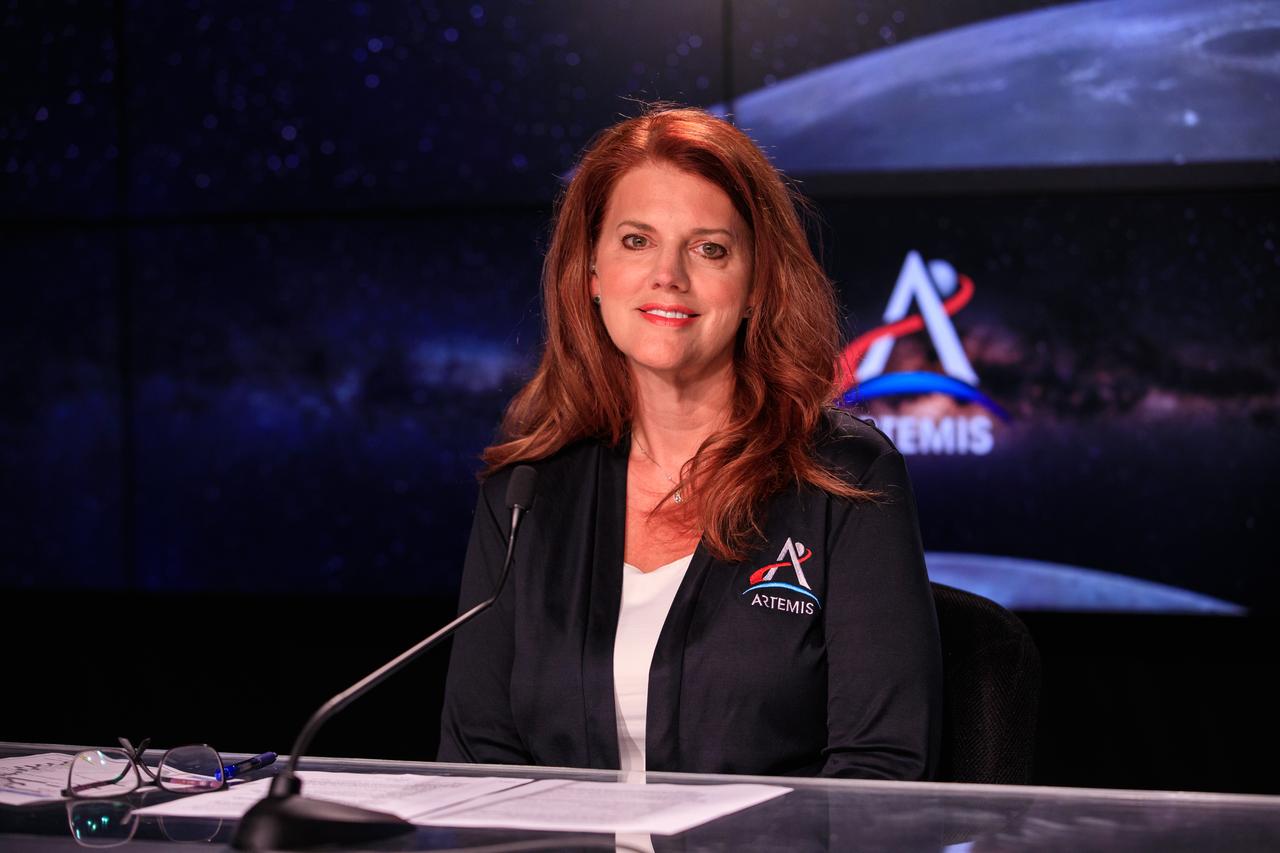
Launch Director Charlie Blackwell-Thompson participates in an Artemis I mission overview briefing inside the Press Site auditorium at NASA’s Kennedy Space Center in Florida on Aug. 3, 2022. Also participating in the briefing from various locations were NASA Administrator Bill Nelson; Associate Administrator for Technology, Policy, and Strategy Bhavya Lal; Mission Manager Mike Sarafin; Space Launch System (SLS) Program Manager John Honeycutt; and Orion Program Manager Howard Hu. The first in an increasingly complex series of missions, Artemis I will test the SLS rocket and Orion spacecraft as an integrated system prior to crewed flights to the Moon. Through Artemis, NASA will land the first woman and first person of color on the lunar surface, paving the way for long-term lunar presence and serving as a steppingstone before venturing to Mars.
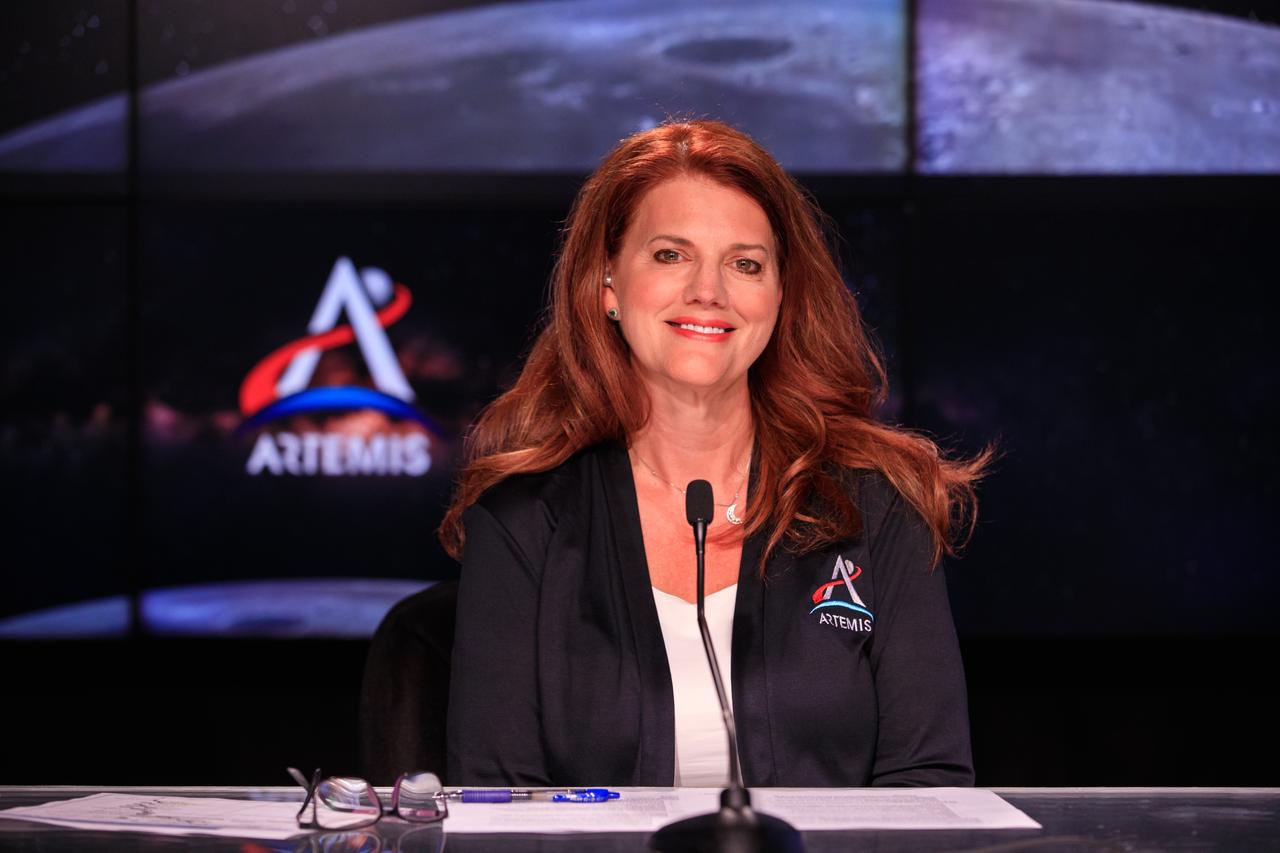
Launch Director Charlie Blackwell-Thompson participates in an Artemis I mission overview briefing inside the Press Site auditorium at NASA’s Kennedy Space Center in Florida on Aug. 3, 2022. Also participating in the briefing from various locations were NASA Administrator Bill Nelson; Associate Administrator for Technology, Policy, and Strategy Bhavya Lal; Mission Manager Mike Sarafin; Space Launch System (SLS) Program Manager John Honeycutt; and Orion Program Manager Howard Hu. The first in an increasingly complex series of missions, Artemis I will test the SLS rocket and Orion spacecraft as an integrated system prior to crewed flights to the Moon. Through Artemis, NASA will land the first woman and first person of color on the lunar surface, paving the way for long-term lunar presence and serving as a steppingstone before venturing to Mars.
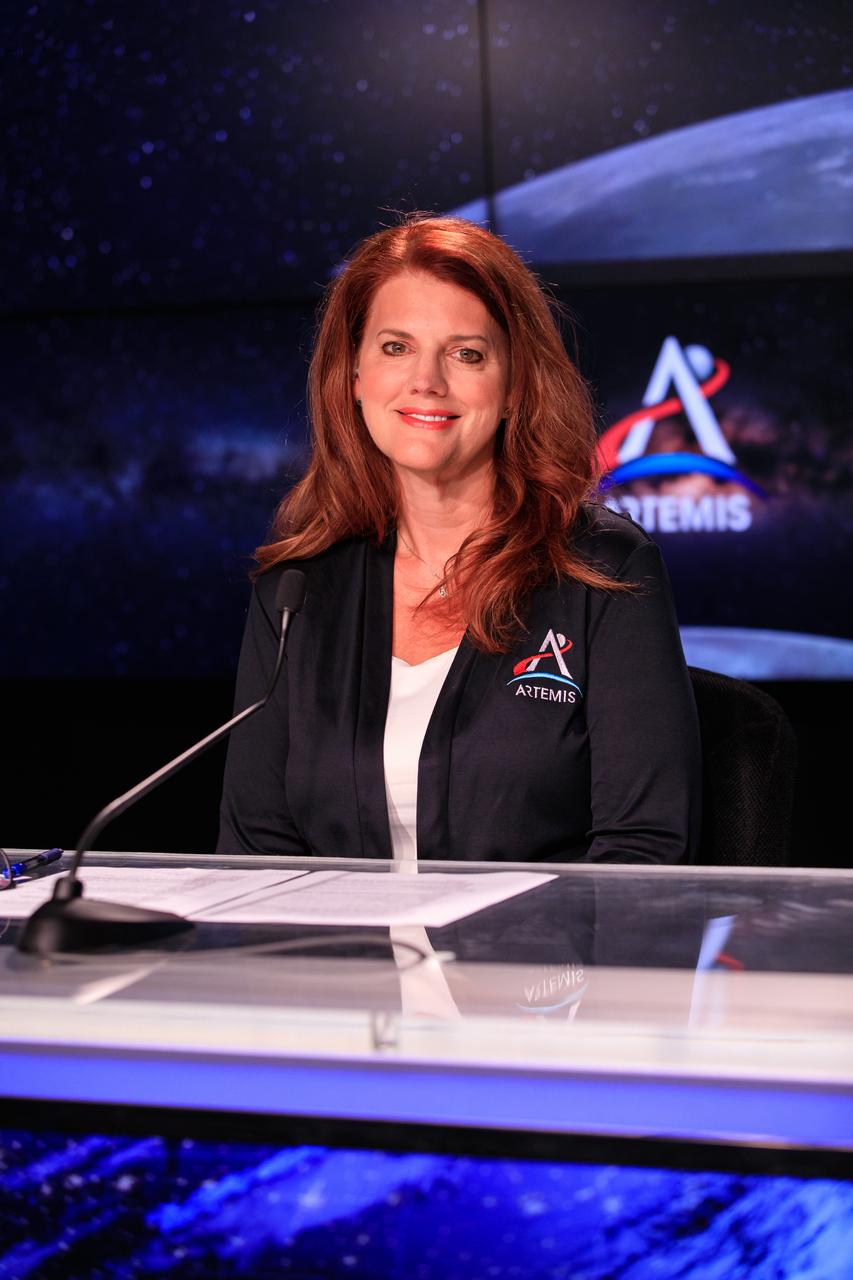
Launch Director Charlie Blackwell-Thompson participates in an Artemis I mission overview briefing inside the Press Site auditorium at NASA’s Kennedy Space Center in Florida on Aug. 3, 2022. Also participating in the briefing from various locations were NASA Administrator Bill Nelson; Associate Administrator for Technology, Policy, and Strategy Bhavya Lal; Mission Manager Mike Sarafin; Space Launch System (SLS) Program Manager John Honeycutt; and Orion Program Manager Howard Hu. The first in an increasingly complex series of missions, Artemis I will test the SLS rocket and Orion spacecraft as an integrated system prior to crewed flights to the Moon. Through Artemis, NASA will land the first woman and first person of color on the lunar surface, paving the way for long-term lunar presence and serving as a steppingstone before venturing to Mars.
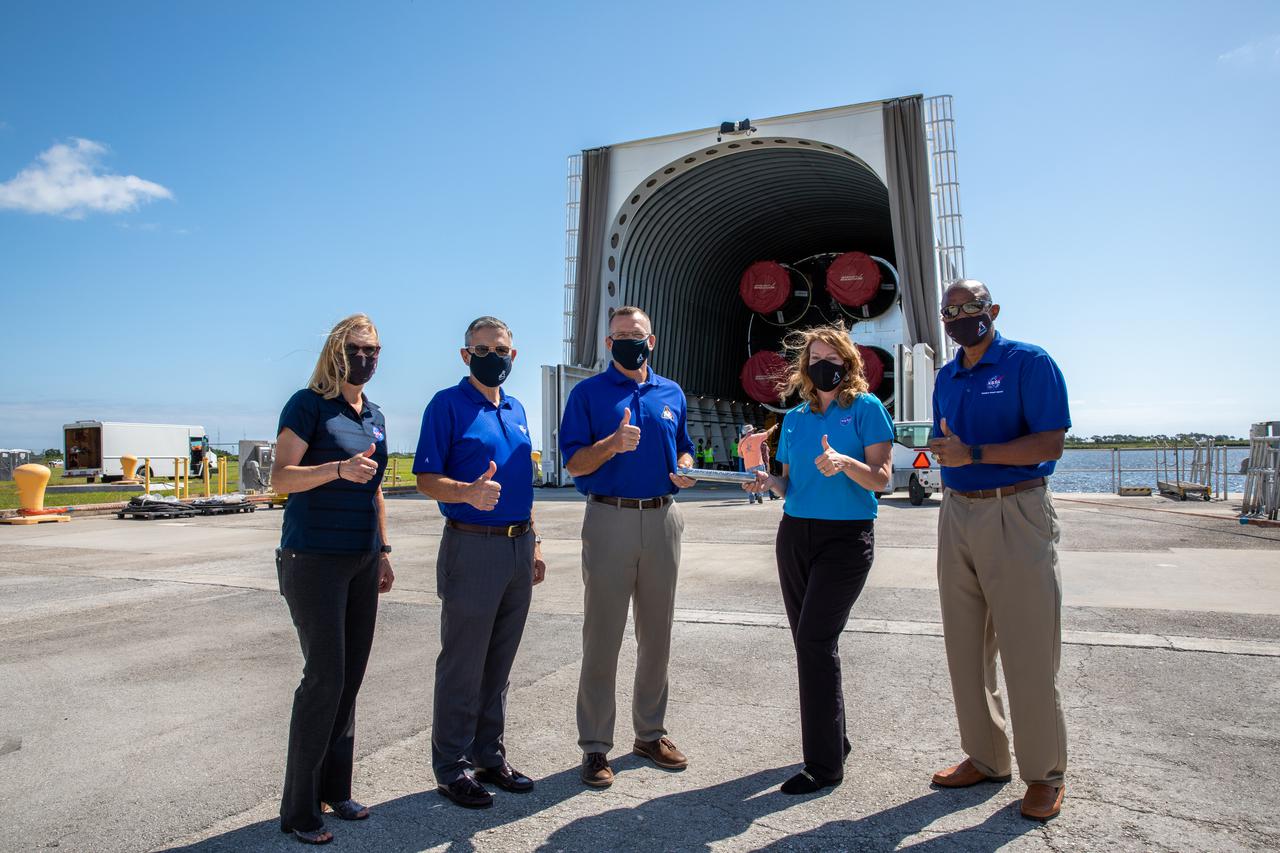
From left, Kennedy Space Center Deputy Director Janet Petro, Director Bob Cabana, Exploration Ground Systems’ (EGS) Senior Vehicle Operations Manager Cliff Lanham, Space Launch System (SLS) Stages Manager Julie Bassler, and Associate Director, Technical, Kelvin Manning celebrate the arrival of the SLS core stage on April 28, 2021, with a symbolic “passing of the baton” from the SLS program to EGS. Journeying from NASA’s Stennis Space Center in Mississippi aboard the Pegasus barge, the core stage arrived at the Florida spaceport on April 27 to be processed for flight by EGS. It is the final piece of Artemis hardware to arrive at Kennedy and will be offloaded and moved to the Vehicle Assembly Building, where it will be prepared for integration atop the mobile launcher with the completed stack of solid rocket boosters ahead of the Artemis I launch. The first in a series of increasingly complex missions, Artemis I will test SLS and Orion as an integrated system prior to crewed flights to the Moon.
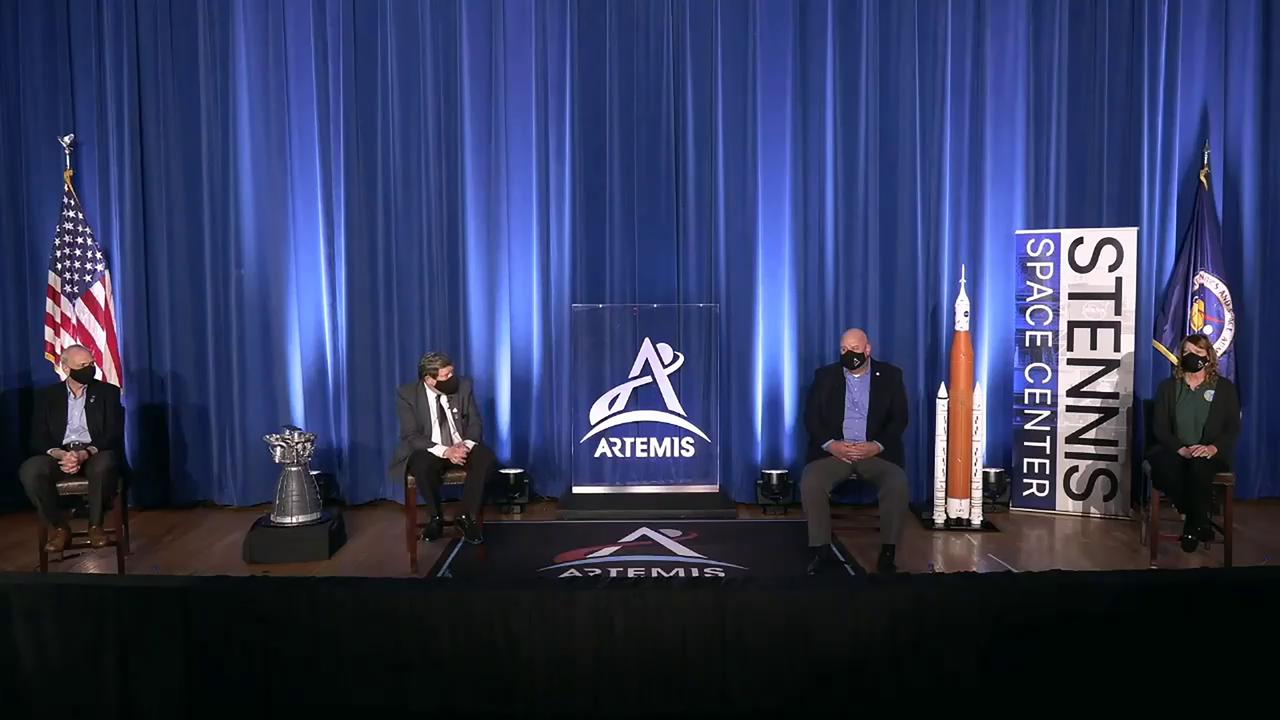
NASA leaders participated in a participate in a virtual press briefing following the Space Launch System core stage hot fire test at Stennis Space Center near Bay St. Louis, Mississippi, on March 18. The leaders fielded questions submitted by offsite media during the post-test session. Agency participants present at Stennis included (l to r): NASA acting Administrator Steve Jurczyk; Tom Whitmeyer, NASA deputy associate administrator for Exploration Systems Development; John Honeycutt, SLS Program manager at Marshall Space Flight Center; and Julie Bassler, SLS Stages Office manager at Marshall Space Flight Center.
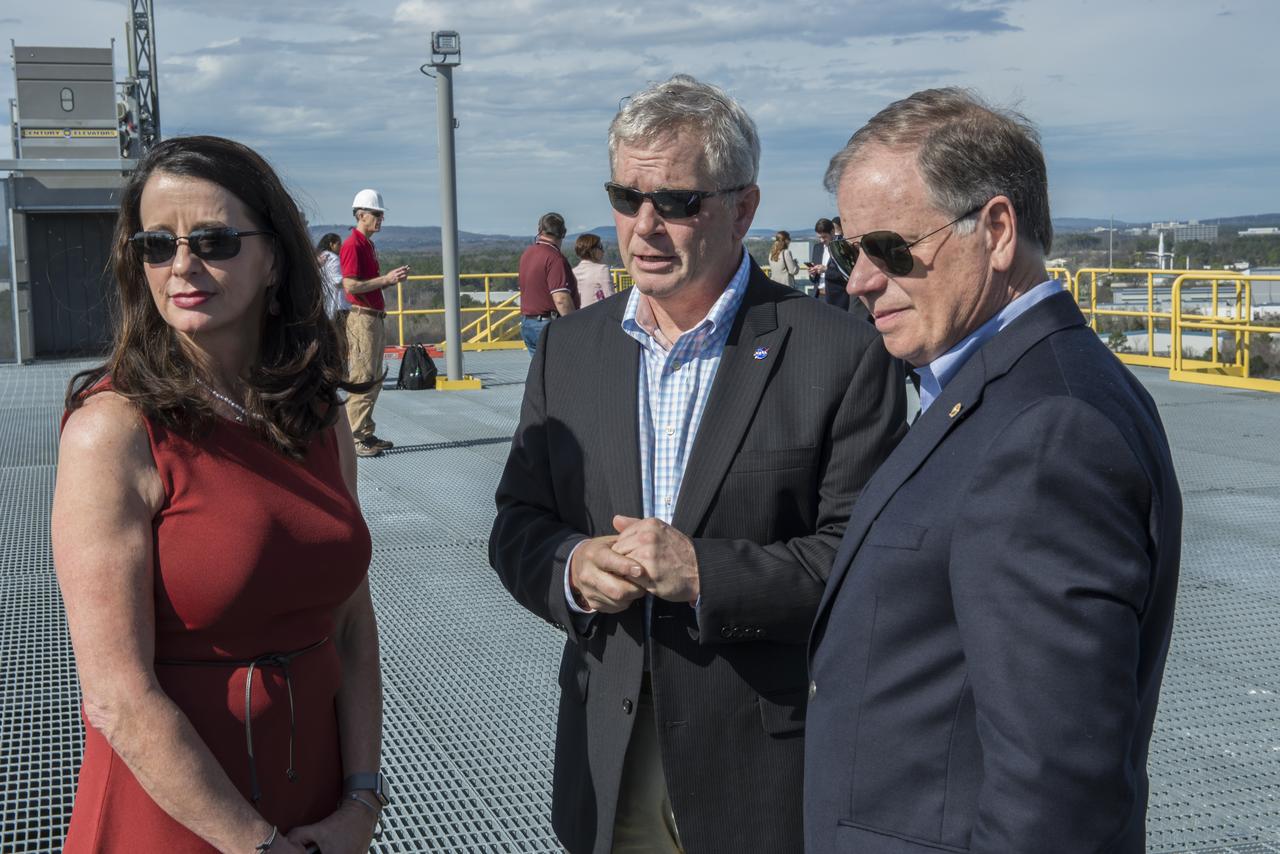
Senator Doug Jones (D-AL.) and wife, Louise, tour Marshall Space Flight facilities. Steve Doering, manager, Stages Element, Space Launch System (SLS) program at MSFC, along with Senator and Mrs. Jones, viewed the MSFC campus from the top of test stand 4693.
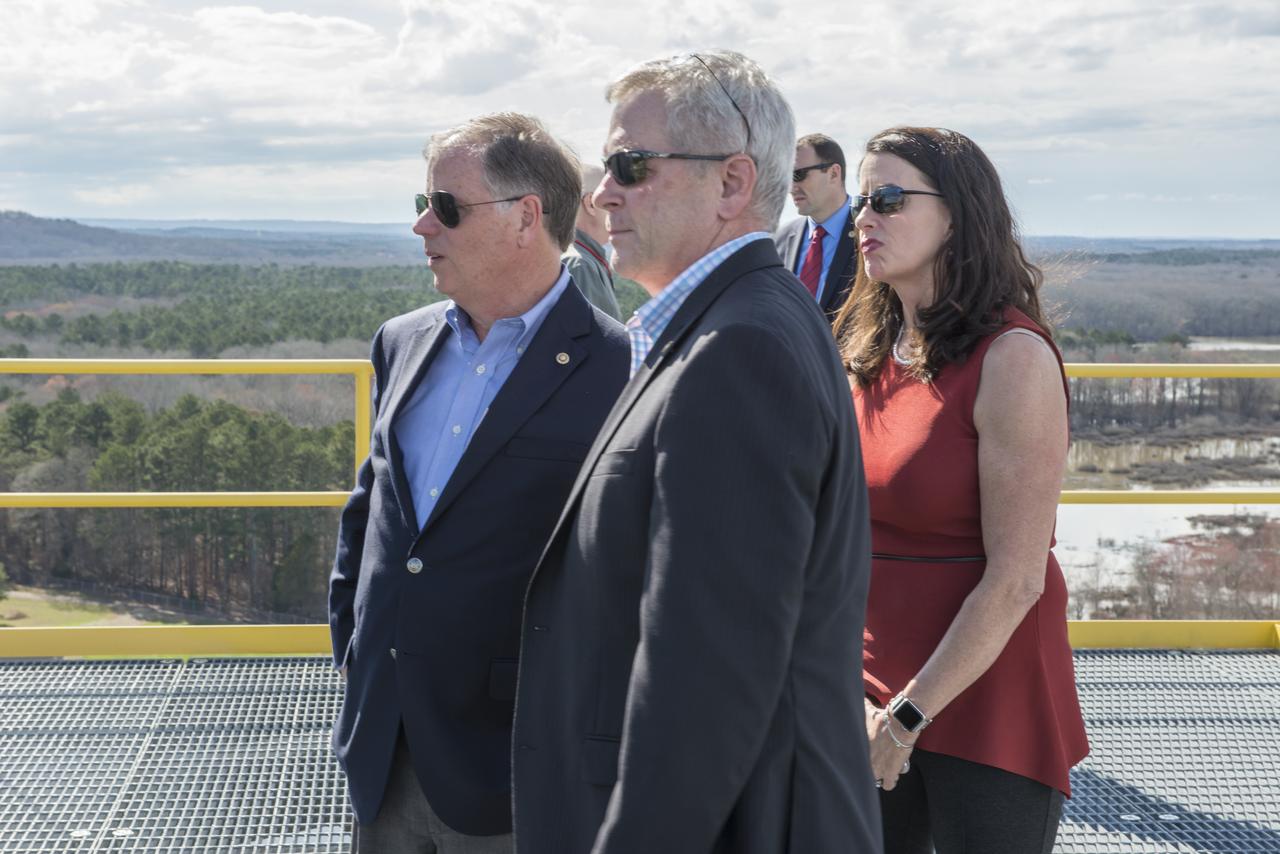
Senator Doug Jones (D-AL.) and wife, Louise, tour Marshall Space Flight facilities. Steve Doering, manager, Stages Element, Space Launch System (SLS) program at MSFC, along with Senator and Mrs. Jones, viewed the MSFC campus from the top of test stand 4693.
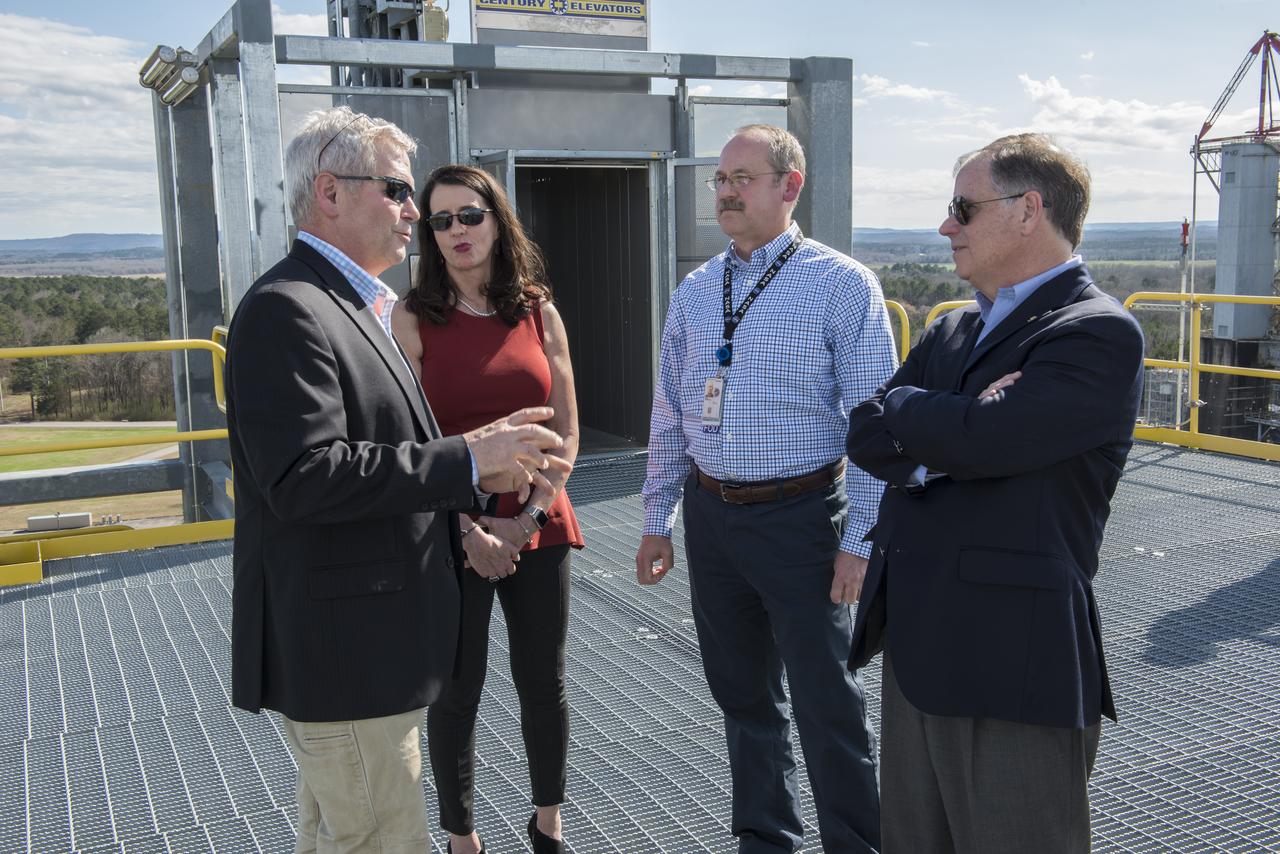
Senator Doug Jones (D-AL.) and wife, Louise, tour Marshall Space Flight facilities. Steve Doering, manager, Stages Element, Space Launch System (SLS) program at MSFC, along with Senator and Mrs. Jones, viewed the MSFC campus from the top of test stand 4693.
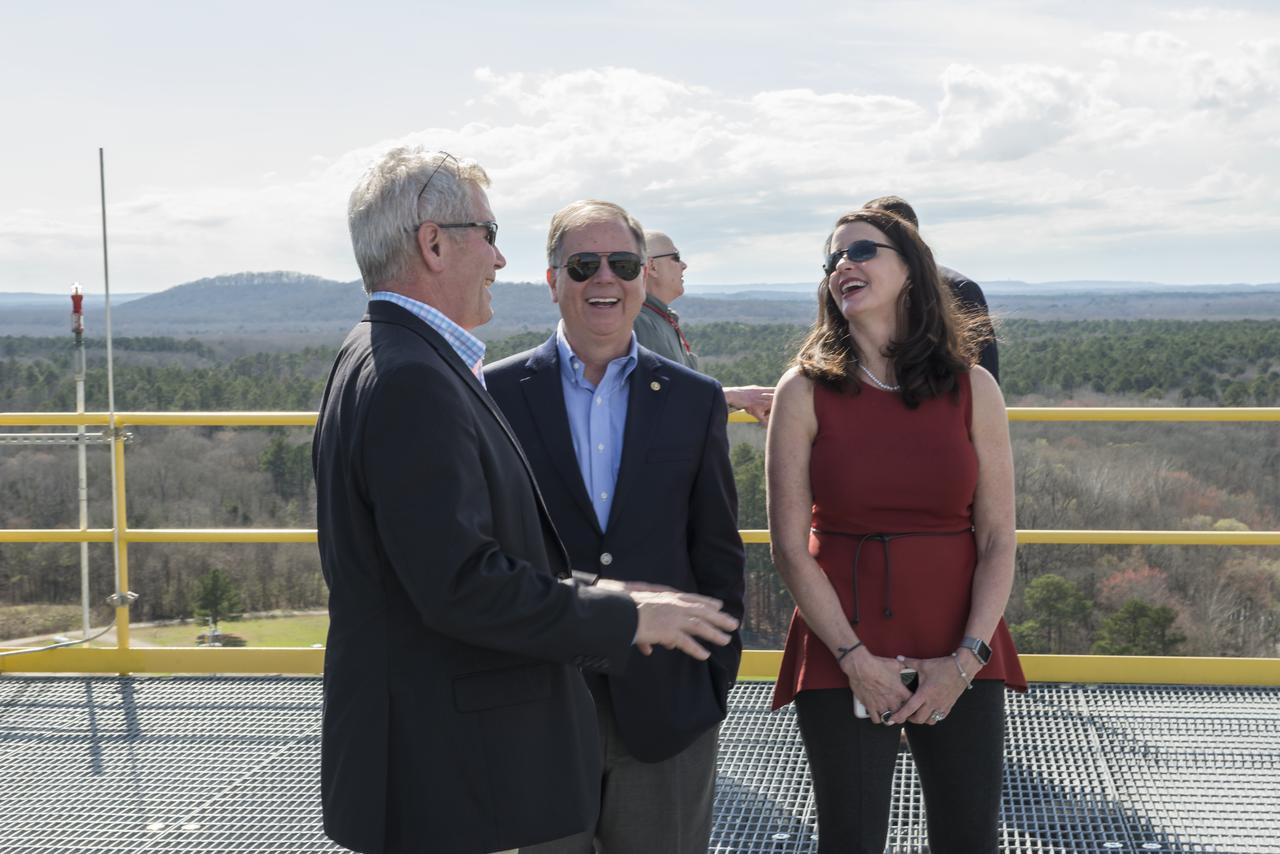
Senator Doug Jones (D-AL.) and wife, Louise, tour Marshall Space Flight facilities. Steve Doering, manager, Stages Element, Space Launch System (SLS) program at MSFC, along with Senator and Mrs. Jones, viewed the MSFC campus from the top of test stand 4693.

From left, Shawn Quinn, manager, Exploration Ground Systems Program; Cliff Lanham, deputy manager, Exploration Ground Systems; and Charlie Blackwell-Thompson, launch director, Exploration Ground Systems Program Program at NASA’s Kennedy Space Center in Florida, participate in the Artemis II Flight Readiness Review with NASA leadership on Wednesday, March 11, 2026, at NASA Kennedy. The review is an assessment of the readiness of NASA’s SLS (Space Launch System) rocket and Orion spacecraft to support the Artemis II test flight as four astronauts journey around the Moon and return to Earth.
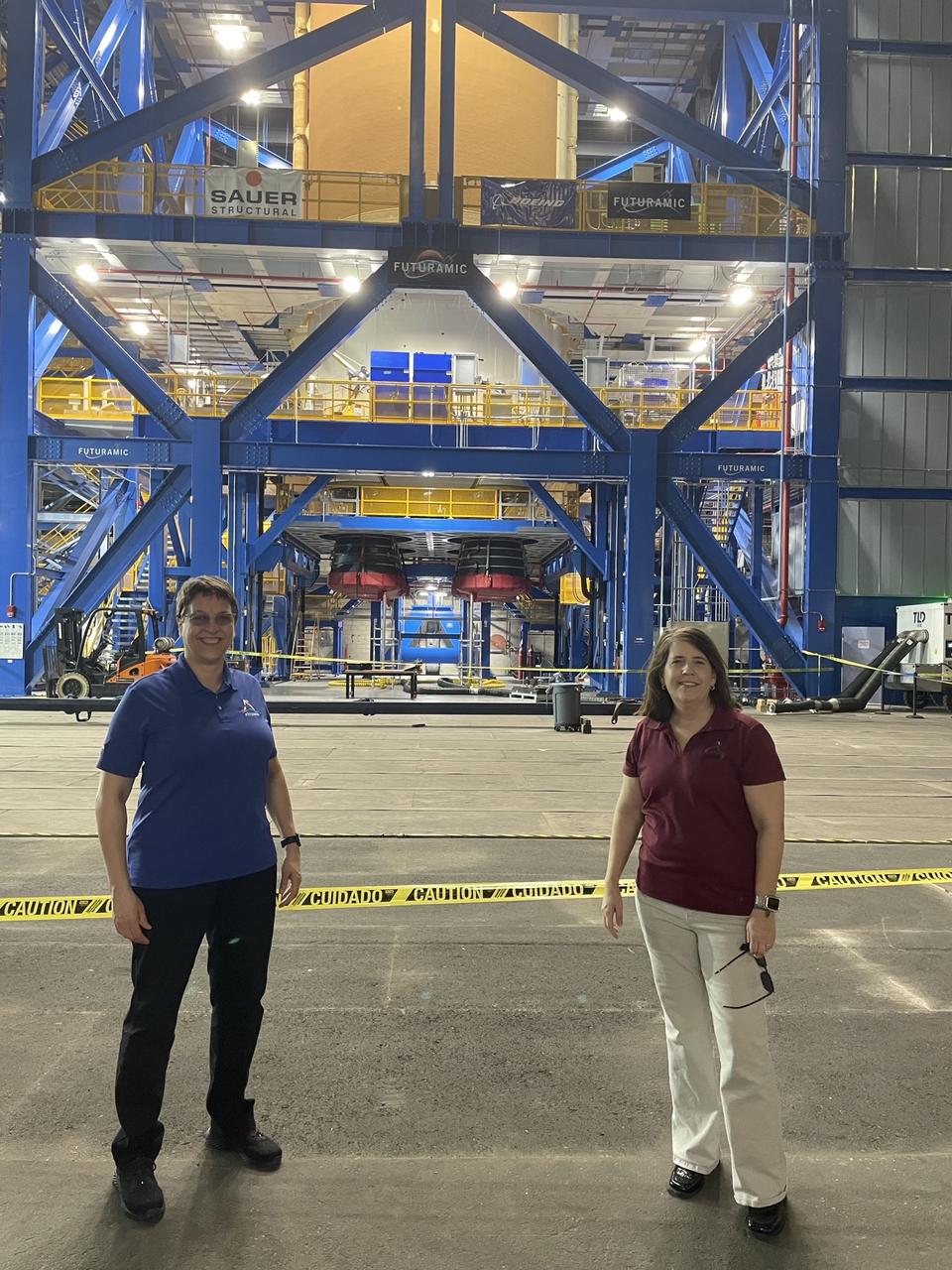
NASA Stennis Deputy Director Christine Powell and NASA Rocket Propulsion Test Program Manager Michele Beisler tour the Vehicle Assembly Building to view the SLS (Space Launch System) rocket expected to fly on the Artemis II mission and the mobile launcher ground structure used to assemble, process, and launch SLS during a visit to NASA’s Kennedy Space Center on Jan. 31.
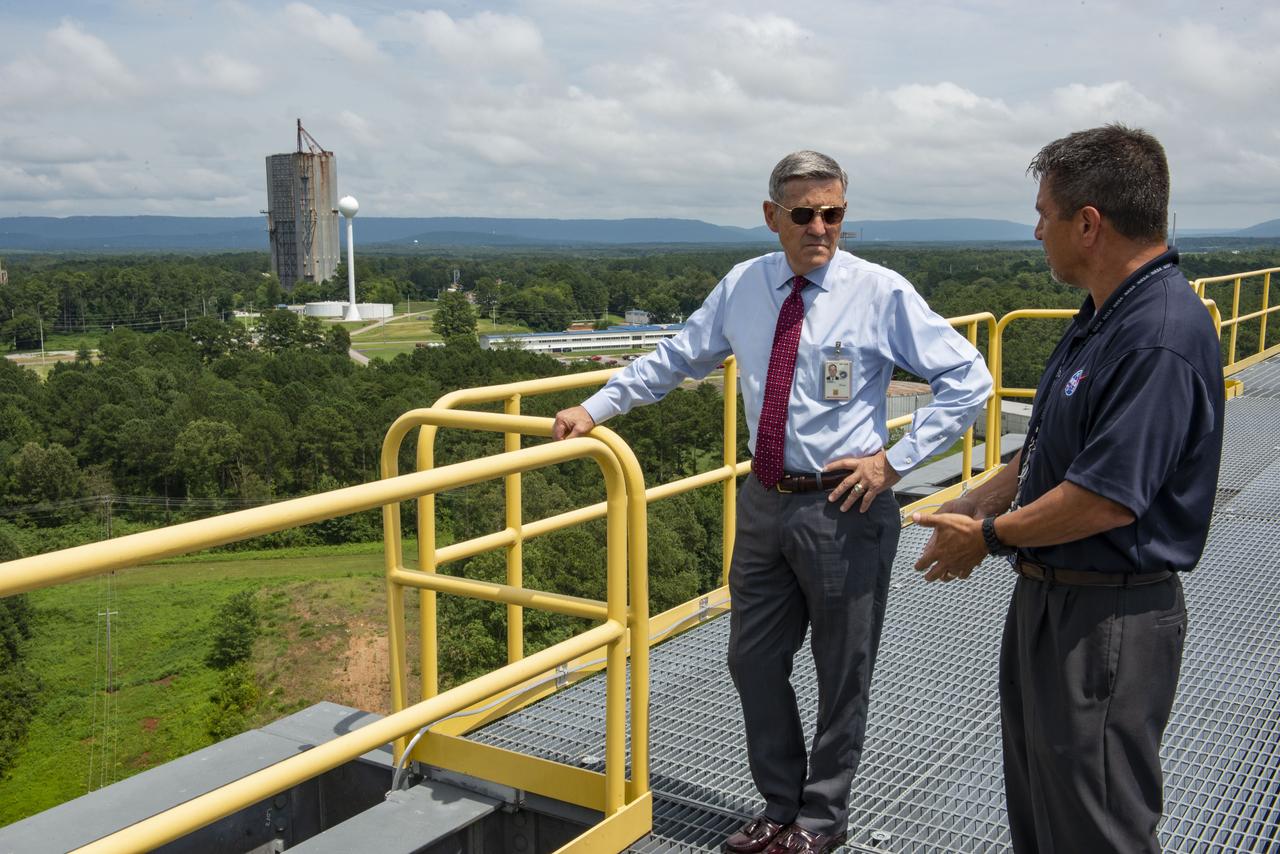
NASA's Kennedy Space Center Director Robert Cabana visited Marshall Space Flight Center July 16. With the Dynamic Test Stand in the background, Cabana, left, talks with Tim Flores, integration manager for stages in the Space Launch System Program Office, on top of Test Stand 4693, NASA’s largest SLS structural test stand. In addition to viewing SLS hardware, Cabana spoke to the Marshall Association and National Space Club Huntsville during his visit.
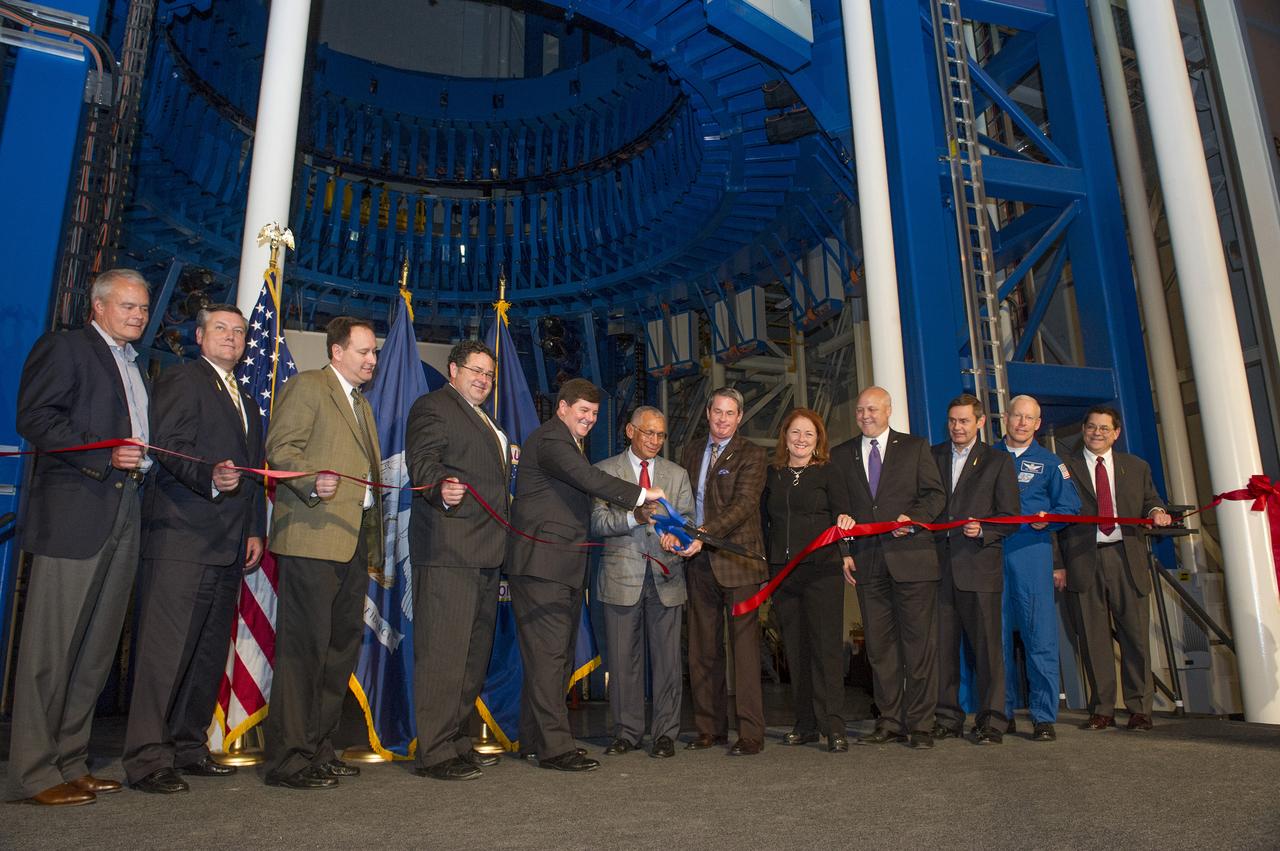
RIBBON CUTTING AT VERTICAL ASSEMBLY CENTER, MICHOUD ASSEMBLY FACILITY, SEPTEMBER 12, 2014, (L TO R): CLAY KIEFABER, CEO OF ESAB (COMPANY THAT BUILT WELDING TOOL)…PATRICK SCHEUERMANN…ROBERT LIGHTFOOT…TODD MAY…MISSISSIPPI CONGRESSMAN STEVEN PALAZZO…CHARLIE BOLDEN…LOUISIANA SENATOR DAVID VITTER…VIRGINIA BARNES, VICE-PRESIDENT AND PROGRAM MANAGER FOR SLS - BOEING… MITCH LANDRIEU, MAYOR OF NEW ORLEANS… JOHN ELBON, VICE PRESIDENT/GENERAL MANAGER, SPACE EXPLORATIONS – BOEING…PATRICK FORRESTER, ASTRONAUT…ROY MALONE.
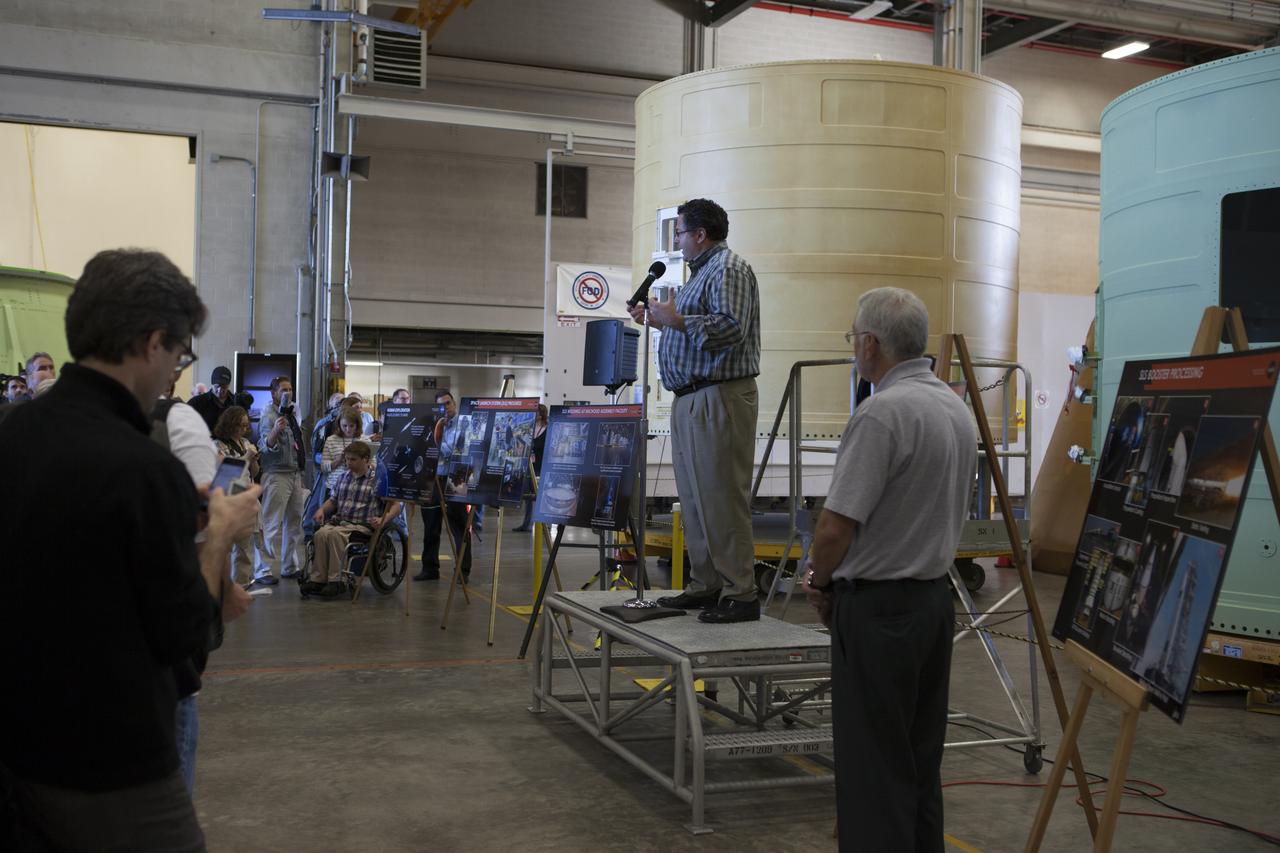
At NASA's Kennedy Space Center in Florida, members of the news media are briefed on the agency's Space Launch System SLS Program by Todd May, program manager for Space Launch Systems SLS at NASA's Marshall Space Flight Center in Huntsville, Alabama. The briefing took place in the spaceport's Booster Fabrication Facility BFF. During the Space Shuttle Program, the facility was used for processing forward segments and aft skirts for the solid rocket boosters. The BFF will serve a similar role for the SLS. Orion is the exploration spacecraft designed to carry astronauts to destinations not yet explored by humans, including an asteroid and Mars. It will have emergency abort capability, sustain the crew during space travel and provide safe re-entry from deep space return velocities. The first unpiloted flight test of Orion is scheduled to launch Dec. 4, 2014 atop a United Launch Alliance Delta IV Heavy rocket, and in 2018 on NASA’s Space Launch System rocket.
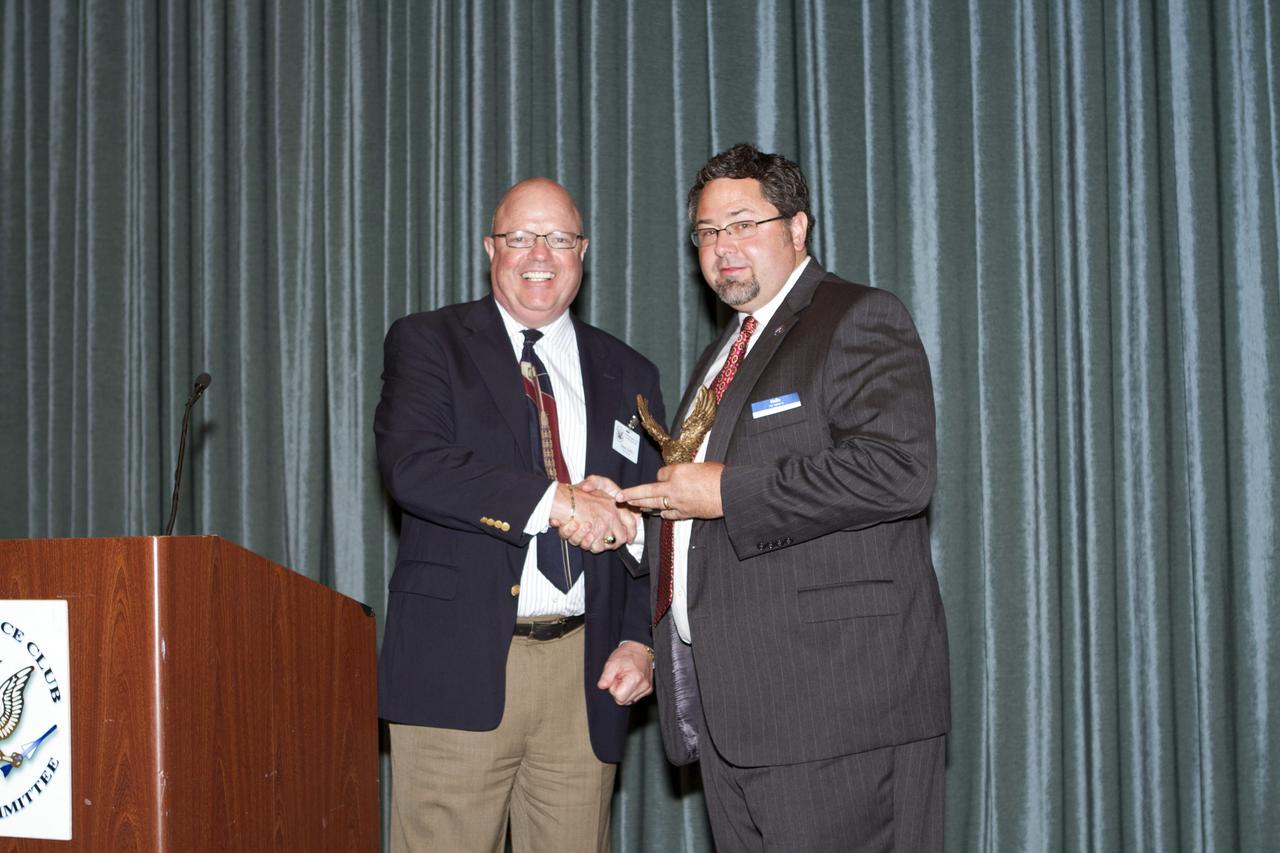
COCOA BEACH, Fla.. -- Todd May, program manager of the Space Launch System, receives a sculpture from the National Space Club after his address to the National Space Club's Florida Committee during the organization's monthly luncheon in Cocoa Beach, Fla. May, who works at NASA's Marshall Space Flight Center in Huntsville, Ala., discussed the status of the SLS program. Photo credit: NASA/Kim Shiflett
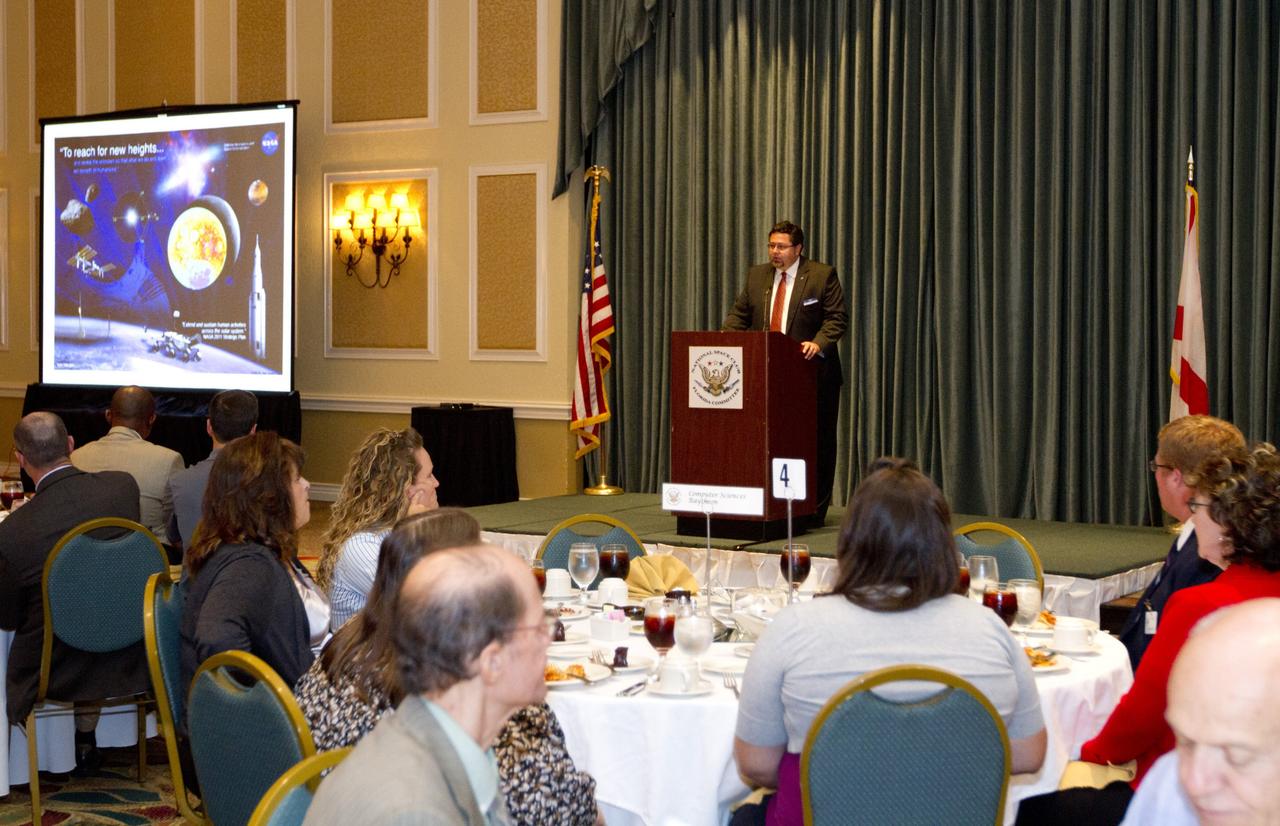
COCOA BEACH, Fla.. -- Todd May, program manager of the Space Launch System, addresses the National Space Club's Florida Committee during the organization's monthly luncheon in Cocoa Beach, Fla. May, who works at NASA's Marshall Space Flight Center in Huntsville, Ala., discussed the status of the SLS program. Photo credit: NASA/Kim Shiflett
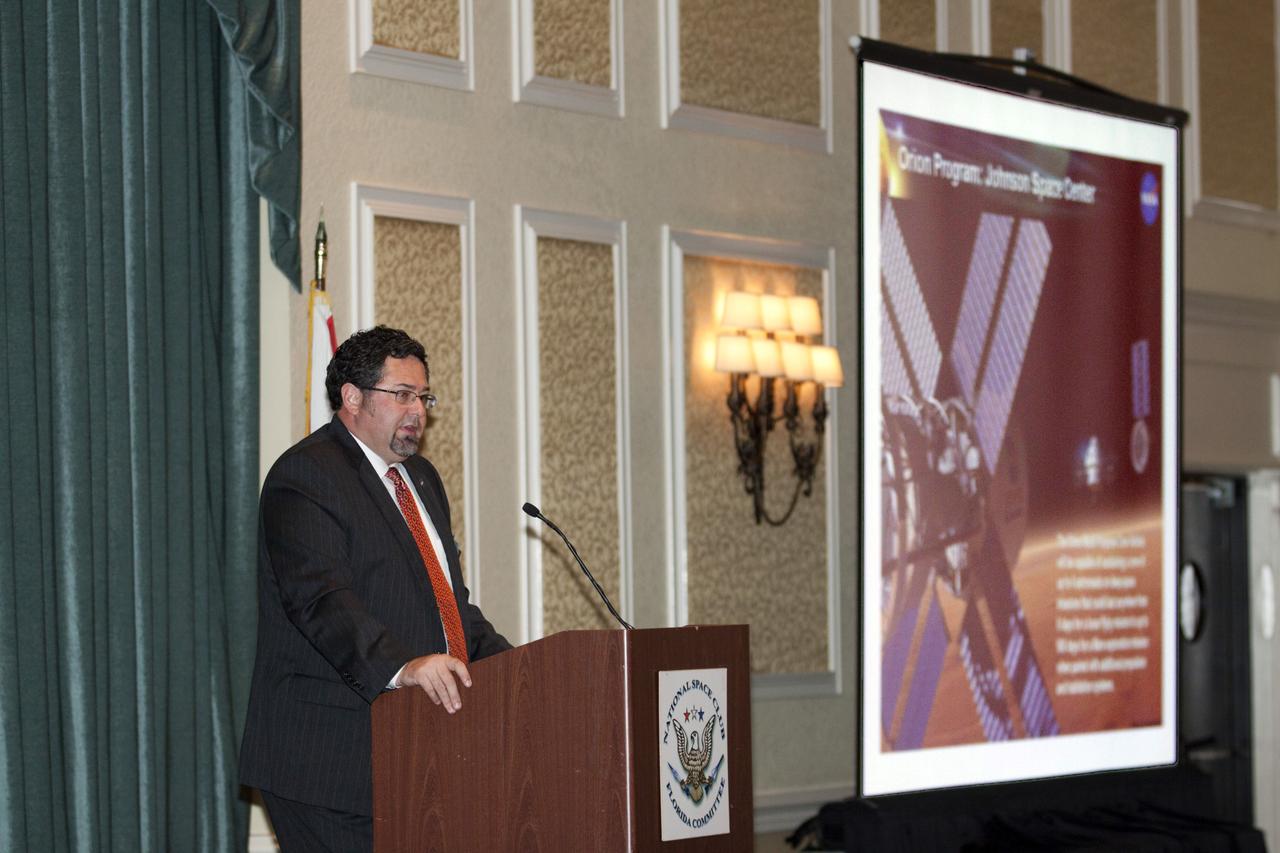
COCOA BEACH, Fla.. -- Todd May, program manager of the Space Launch System, addresses the National Space Club's Florida Committee during the organization's monthly luncheon in Cocoa Beach, Fla. May, who works at NASA's Marshall Space Flight Center in Huntsville, Ala., discussed the status of the SLS program. Photo credit: NASA/Kim Shiflett

From left, Kennedy Space Center Director Janet Petro; Charlie Blackwell-Thompson, launch director, Exploration Ground Systems Program; and Shawn Quinn, manager, Exploration Ground Systems Program, participate in the Artemis II Flight Readiness Review with NASA leadership on Wednesday, March 11, 2026, at NASA’s Kennedy Space Center in Florida. The review is an assessment of the readiness of NASA’s SLS (Space Launch System) rocket and Orion spacecraft to support the Artemis II test flight as four astronauts journey around the Moon and return to Earth.
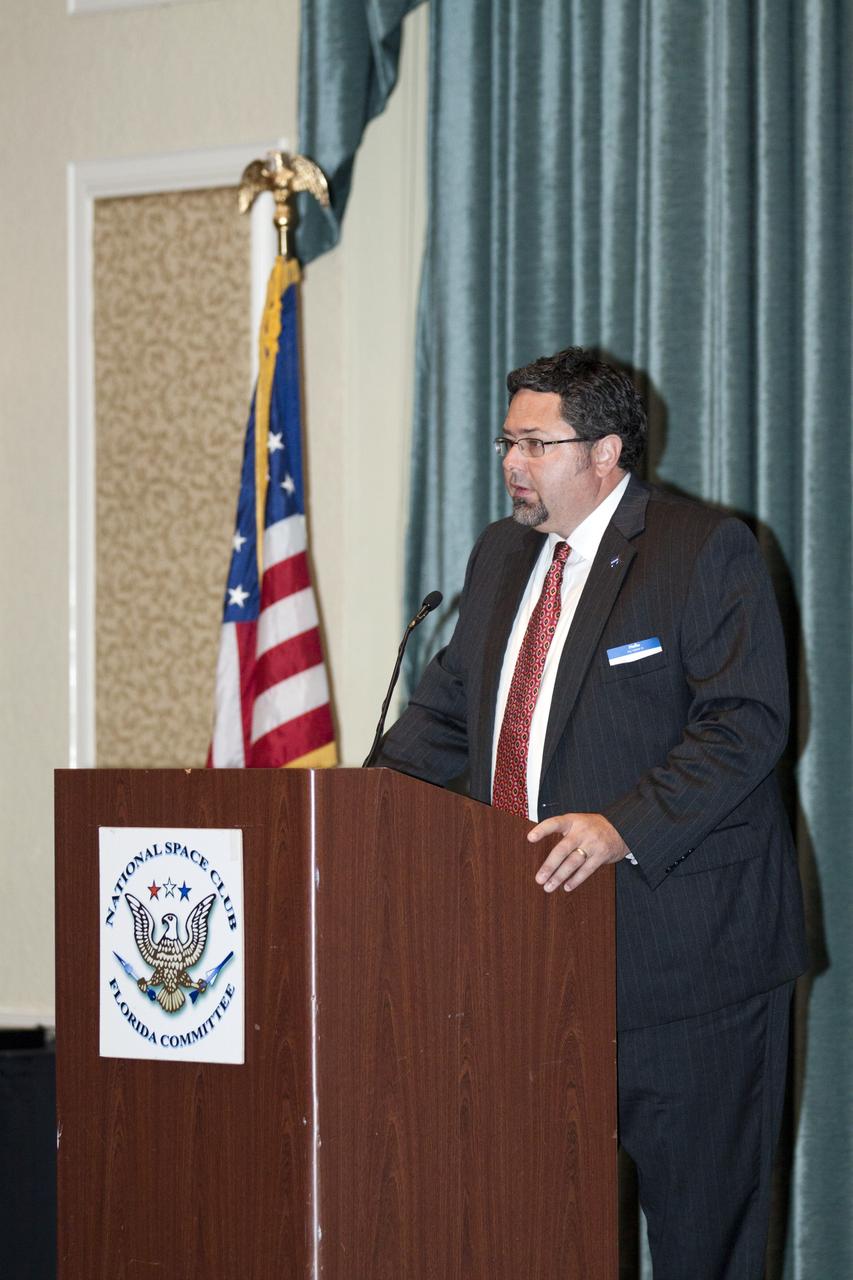
COCOA BEACH, Fla.. --Todd May, program manager of the Space Launch System, addresses the National Space Club's Florida Committee during the organization's monthly luncheon in Cocoa Beach, Fla. May, who works at NASA's Marshall Space Flight Center in Huntsville, Ala., discussed the status of the SLS program. Photo credit: NASA/Kim Shiflett
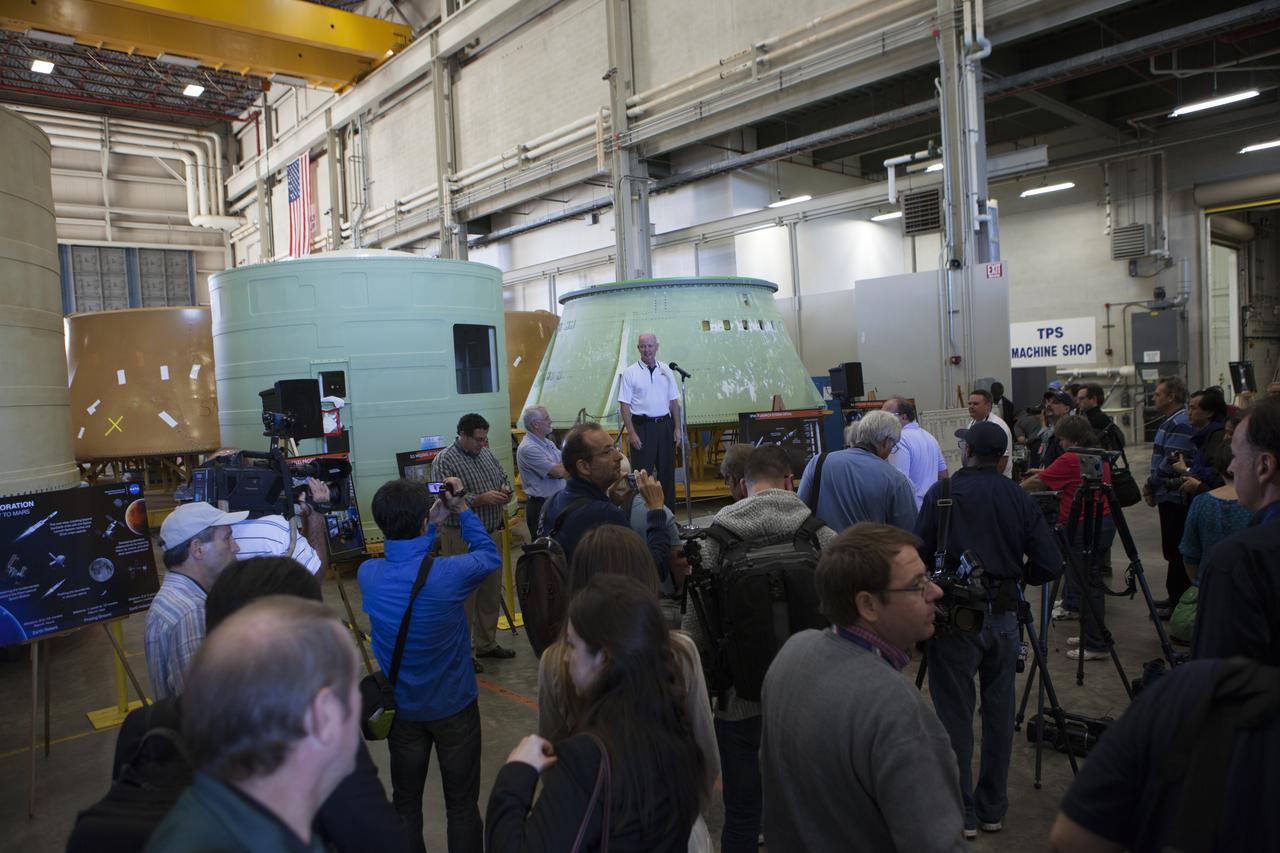
At NASA's Kennedy Space Center in Florida, members of the news media are briefed on the agency's Space Launch System SLS Program by former astronaut Brian Duffy who is now vice president and program manager of Exploration Systems at Alliant Techsystems Inc. ATK. The briefing took place in the spaceport's Booster Fabrication Facility BFF. During the Space Shuttle Program, the facility was used for processing forward segments and aft skirts for the solid rocket boosters. The BFF will serve a similar role for the SLS. Orion is the exploration spacecraft designed to carry astronauts to destinations not yet explored by humans, including an asteroid and Mars. It will have emergency abort capability, sustain the crew during space travel and provide safe re-entry from deep space return velocities. The first unpiloted flight test of Orion is scheduled to launch Dec. 4, 2014 atop a United Launch Alliance Delta IV Heavy rocket, and in 2018 on NASA’s Space Launch System rocket.
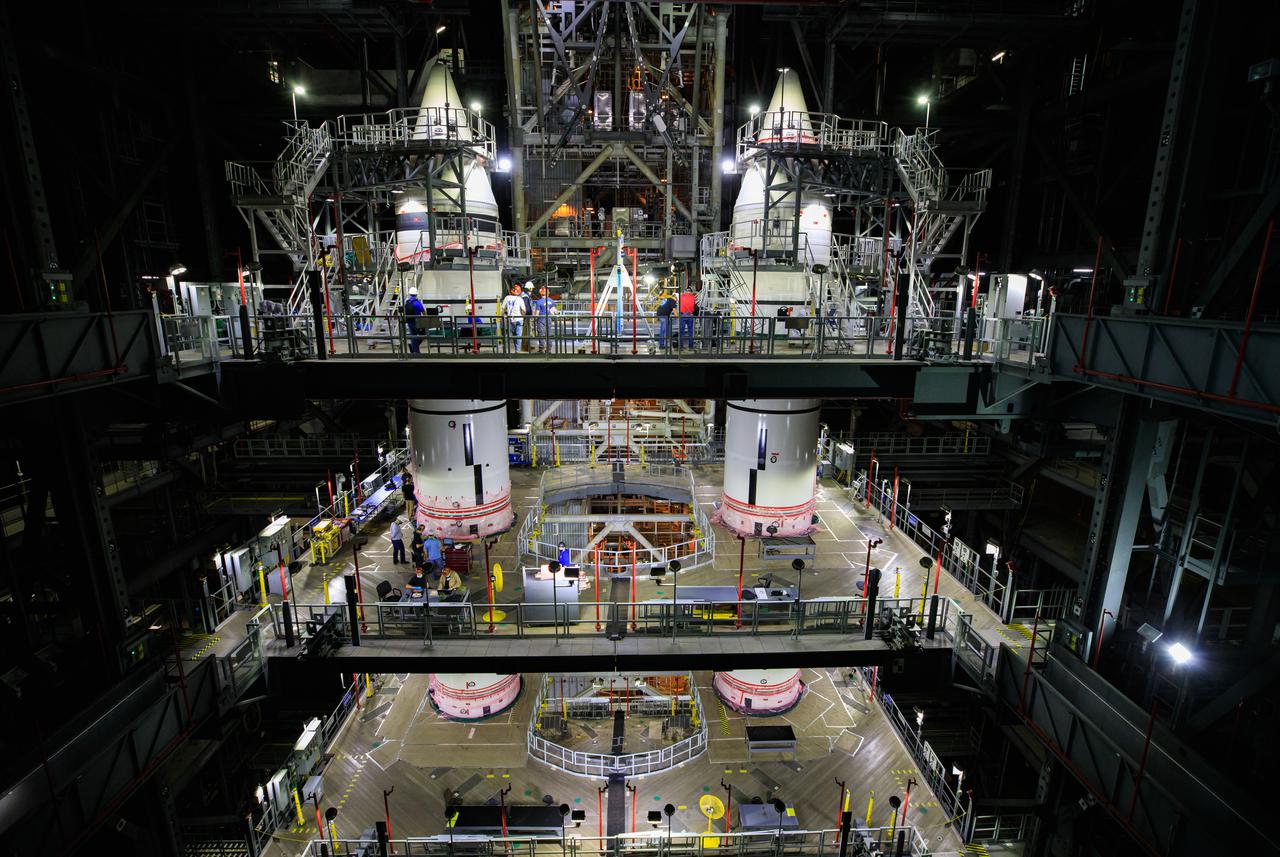
In High Bay 3 of the Vehicle Assembly Building at NASA’s Kennedy Space Center in Florida, the right-hand forward segment is lowered by crane on top of the center forward segment on the mobile launcher (ML) for the Space Launch System (SLS) on March 3, 2021. Workers with Exploration Ground Systems and contractor Jacobs teams are stacking the twin five-segment boosters on the ML over a number of weeks. When the core stage arrives, it will join the boosters on the mobile launcher, followed by the interim cryogenic propulsion stage and Orion spacecraft. Manufactured by Northrop Grumman in Utah, the twin boosters provide more than 75 percent of the total SLS thrust at launch. Marshall Space Flight Center in Huntsville, Alabama, manages the SLS. Under the Artemis program, NASA will land the first woman and the next man on the Moon. The first in a series of increasingly complex missions, Artemis I will test the Orion spacecraft and SLS as an integrated system ahead of crewed flights to the Moon.
Workers with Exploration Ground Systems and contractor Jacobs teams assist as the right-hand forward segment for NASA’s Space Launch System (SLS) is lowered onto the center forward segment on the mobile launcher in High Bay 3 of the Vehicle Assembly Building at NASA’s Kennedy Space Center in Florida on Feb. 23, 2021. Stacking of the twin five-segment boosters on the mobile launcher is nearing completion. When the core stage arrives, it will join the boosters on the mobile launcher, followed by the interim cryogenic propulsion stage and Orion spacecraft. Manufactured by Northrop Grumman in Utah, the twin boosters provide more than 75 percent of the total SLS thrust at launch. The SLS is managed by Marshall Space Flight Center in Huntsville, Alabama. Under the Artemis program, NASA will land the first woman and the next man on the Moon by 2024. The first in a series of increasingly complex missions, Artemis I will test the Orion spacecraft and SLS as an integrated system ahead of crewed flights to the Moon.
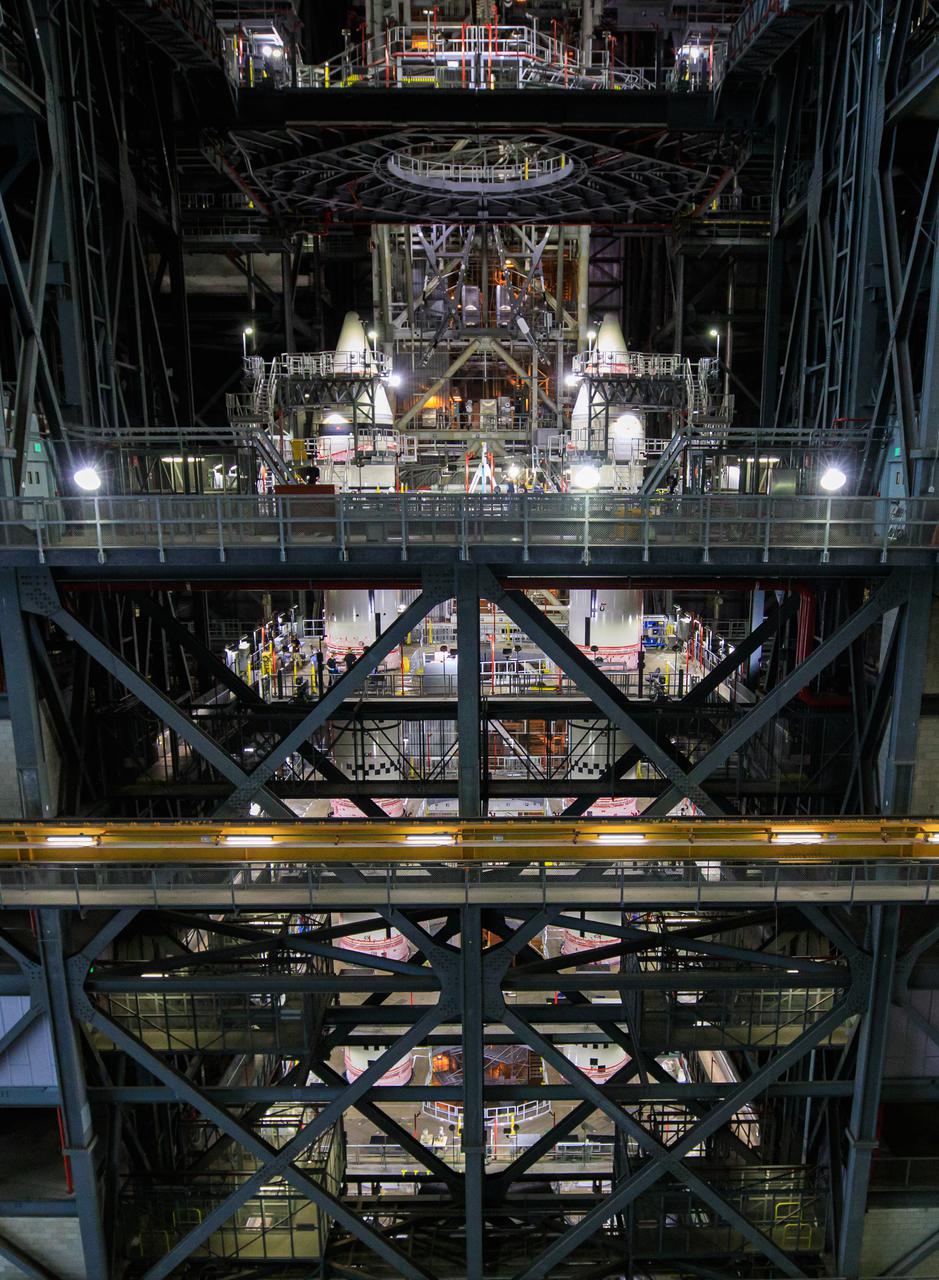
In High Bay 3 of the Vehicle Assembly Building at NASA’s Kennedy Space Center in Florida, the right-hand and left-hand forward segments are secured on the center forward segments on the mobile launcher (ML) for the Space Launch System (SLS) on March 3, 2021. Workers with Exploration Ground Systems and contractor Jacobs teams stacked the twin five-segment boosters on the ML over a number of weeks. When the core stage arrives, it will join the boosters on the mobile launcher, followed by the interim cryogenic propulsion stage and Orion spacecraft. Manufactured by Northrop Grumman in Utah, the twin boosters provide more than 75 percent of the total SLS thrust at launch. Marshall Space Flight Center in Huntsville, Alabama, manages the SLS. Under the Artemis program, NASA will land the first woman and the next man on the Moon. The first in a series of increasingly complex missions, Artemis I will test the Orion spacecraft and SLS as an integrated system ahead of crewed flights to the Moon.
Workers with Exploration Ground Systems and contractor Jacobs teams assist as the right-hand forward segment for NASA’s Space Launch System (SLS) is lowered onto the center forward segment on the mobile launcher in High Bay 3 of the Vehicle Assembly Building at NASA’s Kennedy Space Center in Florida on Feb. 23, 2021. Stacking of the twin five-segment boosters on the mobile launcher is nearing completion. When the core stage arrives, it will join the boosters on the mobile launcher, followed by the interim cryogenic propulsion stage and Orion spacecraft. Manufactured by Northrop Grumman in Utah, the twin boosters provide more than 75 percent of the total SLS thrust at launch. The SLS is managed by Marshall Space Flight Center in Huntsville, Alabama. Under the Artemis program, NASA will land the first woman and the next man on the Moon by 2024. The first in a series of increasingly complex missions, Artemis I will test the Orion spacecraft and SLS as an integrated system ahead of crewed flights to the Moon.
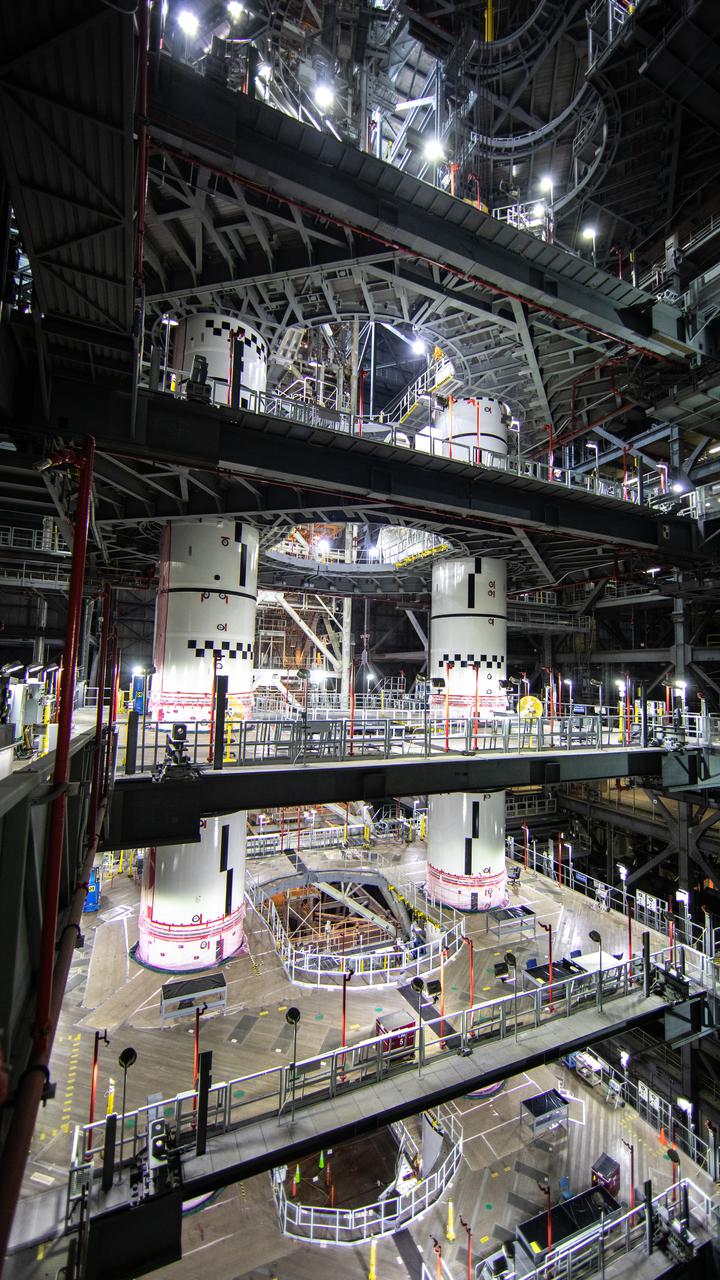
Inside High Bay 3 of the Vehicle Assembly Building at NASA’s Kennedy Space Center in Florida, a crane lowers the right-hand forward segment onto the center forward segment on Feb. 23, 2021. Workers with Exploration Ground Systems and contractor Jacobs are completing the stacking of the twin solid rocket boosters on the mobile launcher for NASA’s Space Launch System (SLS). When the core stage arrives, it will join the boosters on the mobile launcher, followed by the interim cryogenic propulsion stage and Orion spacecraft. Manufactured by Northrop Grumman in Utah, the twin boosters provide more than 75 percent of the total SLS thrust at launch. The SLS is managed by Marshall Space Flight Center in Huntsville, Alabama. Under the Artemis program, NASA will land the first woman and the next man on the Moon by 2024. The first in a series of increasingly complex missions, Artemis I will test the Orion spacecraft and SLS as an integrated system ahead of crewed flights to the Moon.
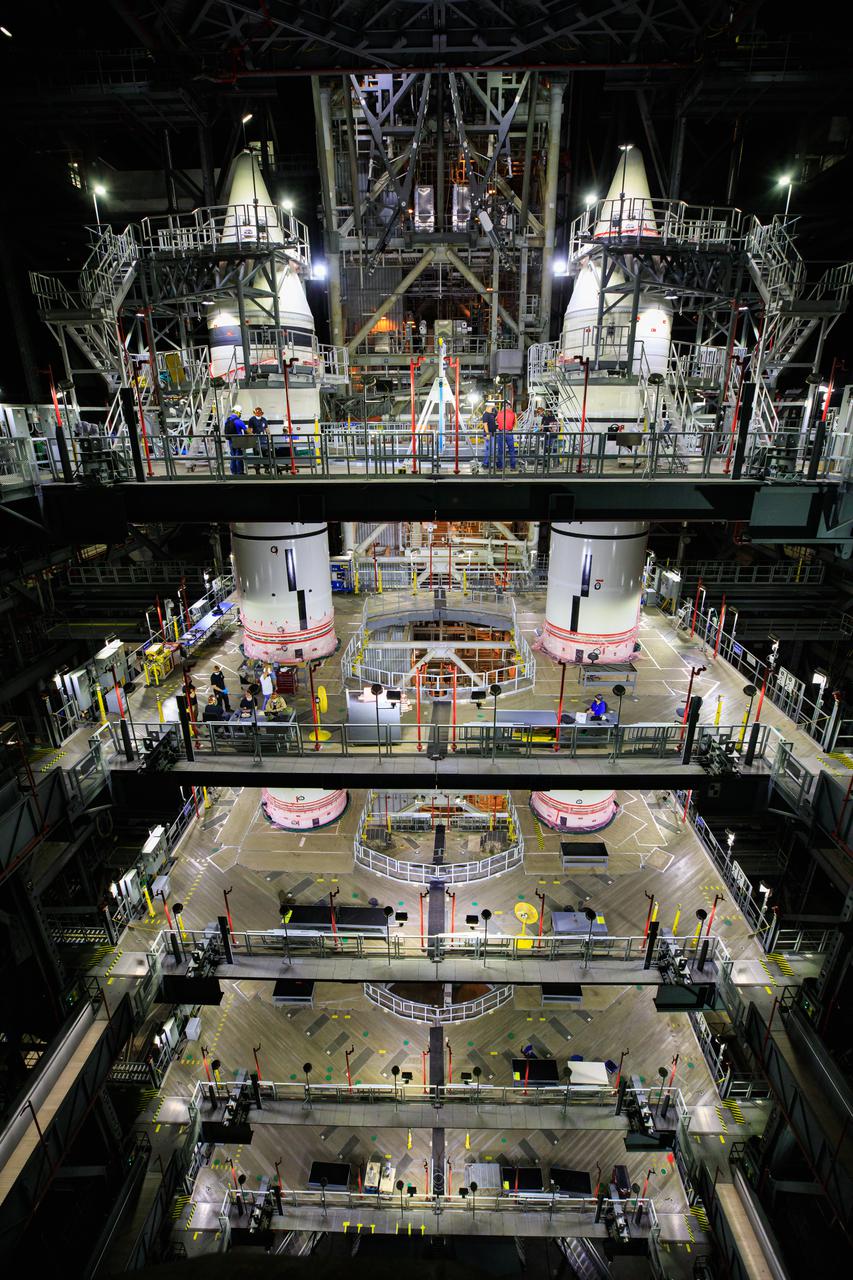
In High Bay 3 of the Vehicle Assembly Building at NASA’s Kennedy Space Center in Florida, right-hand and left-hand forward segments are secured on top of the center forward segments on the mobile launcher (ML) for the Space Launch System (SLS) on March 3, 2021. Workers with Exploration Ground Systems and contractor Jacobs teams completed the stacking of the boosters over several weeks. When the core stage arrives, it will join the boosters on the ML, followed by the interim cryogenic propulsion stage and Orion spacecraft. Manufactured by Northrop Grumman in Utah, the twin boosters provide more than 75 percent of the total SLS thrust at launch. Marshall Space Flight Center in Huntsville, Alabama, manages the SLS. Under the Artemis program, NASA will land the first woman and the next man on the Moon. The first in a series of increasingly complex missions, Artemis I will test the Orion spacecraft and SLS as an integrated system ahead of crewed flights to the Moon.
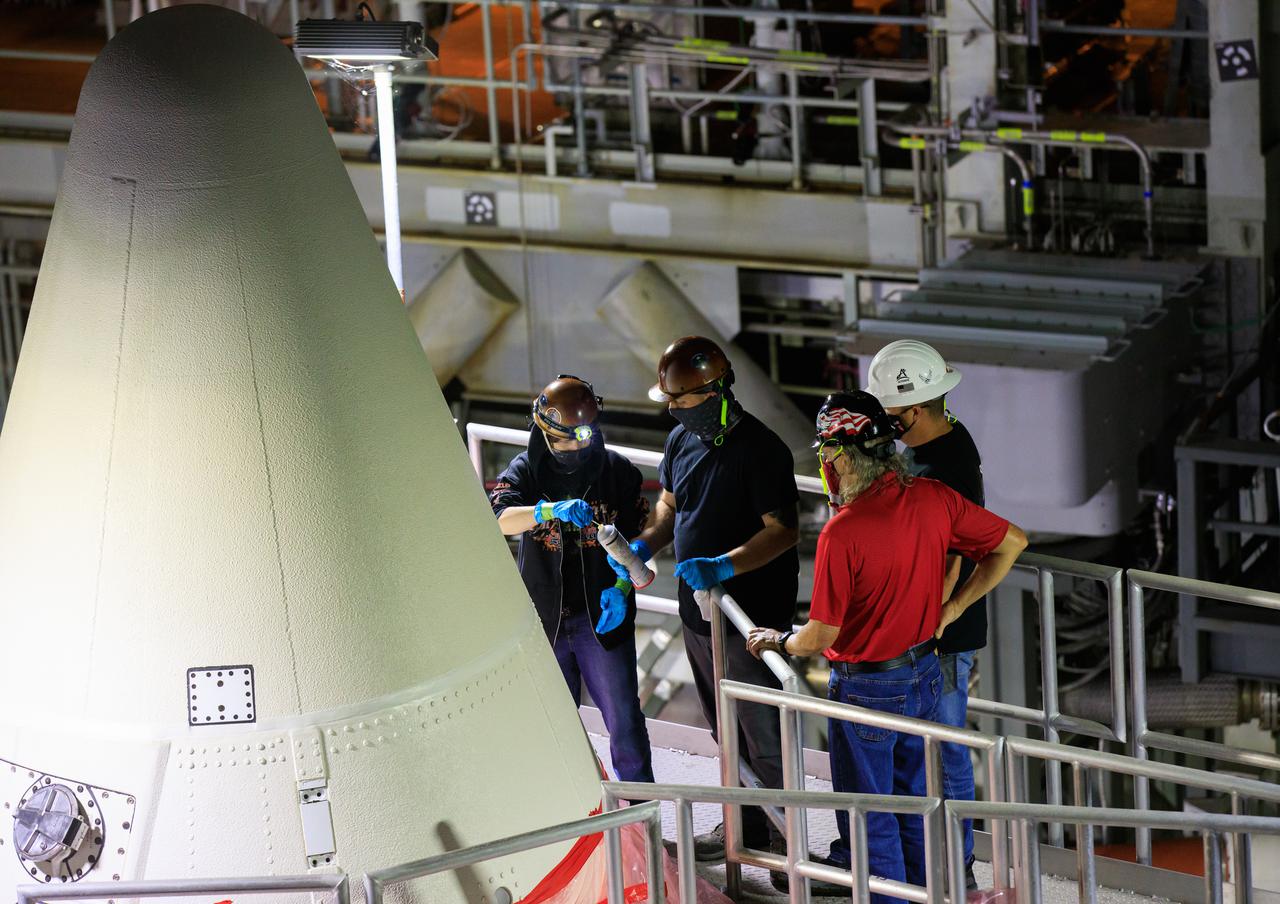
In High Bay 3 of the Vehicle Assembly Building at NASA’s Kennedy Space Center in Florida, workers assist as the right-hand forward segment is lowered onto the center forward segment on the mobile launcher (ML) for the Space Launch System (SLS) on March 3, 2021. Workers with Exploration Ground Systems and contractor Jacobs teams stacked the twin five-segment boosters on the ML over a number of weeks. When the core stage arrives, it will join the boosters on the mobile launcher, followed by the interim cryogenic propulsion stage and Orion spacecraft. Manufactured by Northrop Grumman in Utah, the twin boosters provide more than 75 percent of the total SLS thrust at launch. Marshall Space Flight Center in Huntsville, Alabama, manages the SLS. Under the Artemis program, NASA will land the first woman and the next man on the Moon. The first in a series of increasingly complex missions, Artemis I will test the Orion spacecraft and SLS as an integrated system ahead of crewed flights to the Moon.
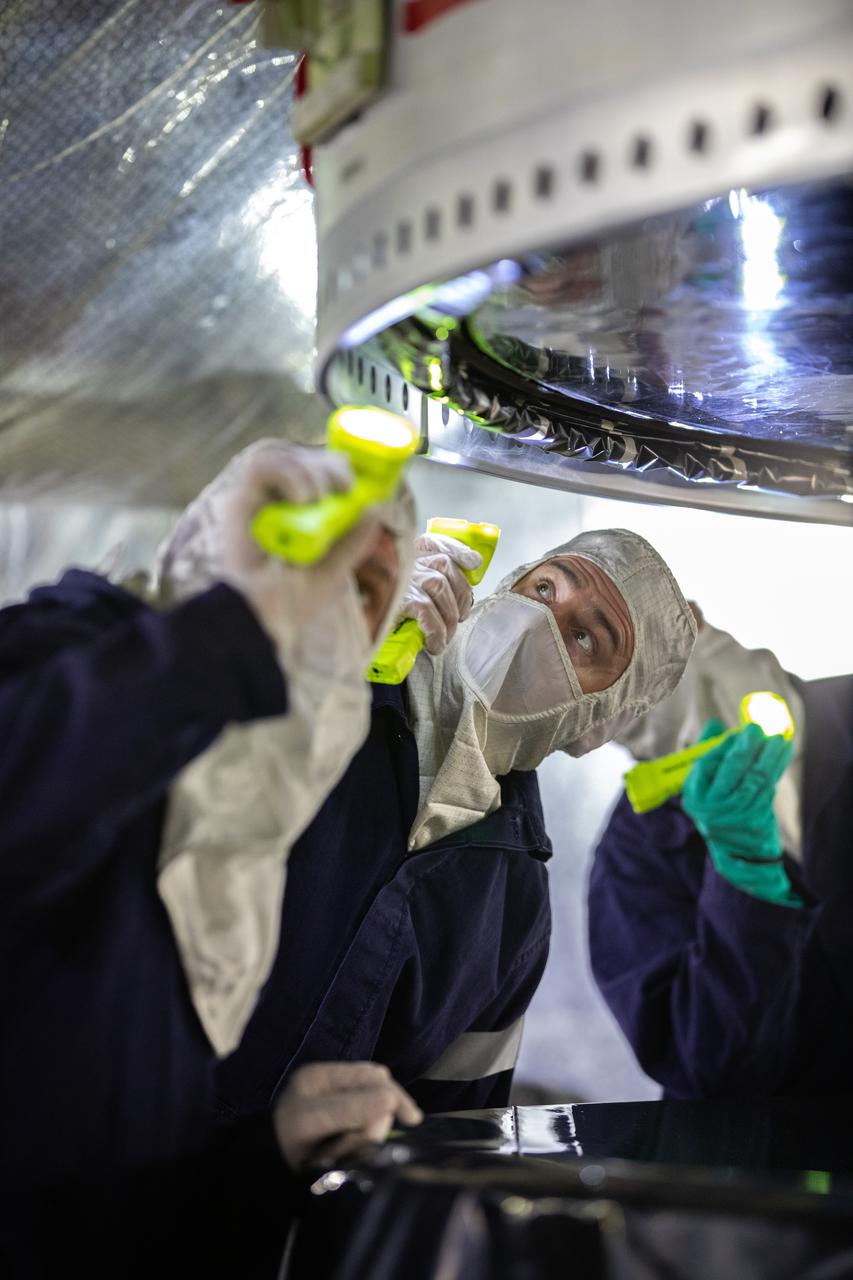
Workers with Exploration Ground Systems and contractor Jacobs teams assist as the right-hand forward segment for NASA’s Space Launch System (SLS) is lowered onto the center forward segment on the mobile launcher in High Bay 3 of the Vehicle Assembly Building at NASA’s Kennedy Space Center in Florida on Feb. 23, 2021. Stacking of the twin five-segment boosters on the mobile launcher is nearing completion. When the core stage arrives, it will join the boosters on the mobile launcher, followed by the interim cryogenic propulsion stage and Orion spacecraft. Manufactured by Northrop Grumman in Utah, the twin boosters provide more than 75 percent of the total SLS thrust at launch. The SLS is managed by Marshall Space Flight Center in Huntsville, Alabama. Under the Artemis program, NASA will land the first woman and the next man on the Moon by 2024. The first in a series of increasingly complex missions, Artemis I will test the Orion spacecraft and SLS as an integrated system ahead of crewed flights to the Moon.
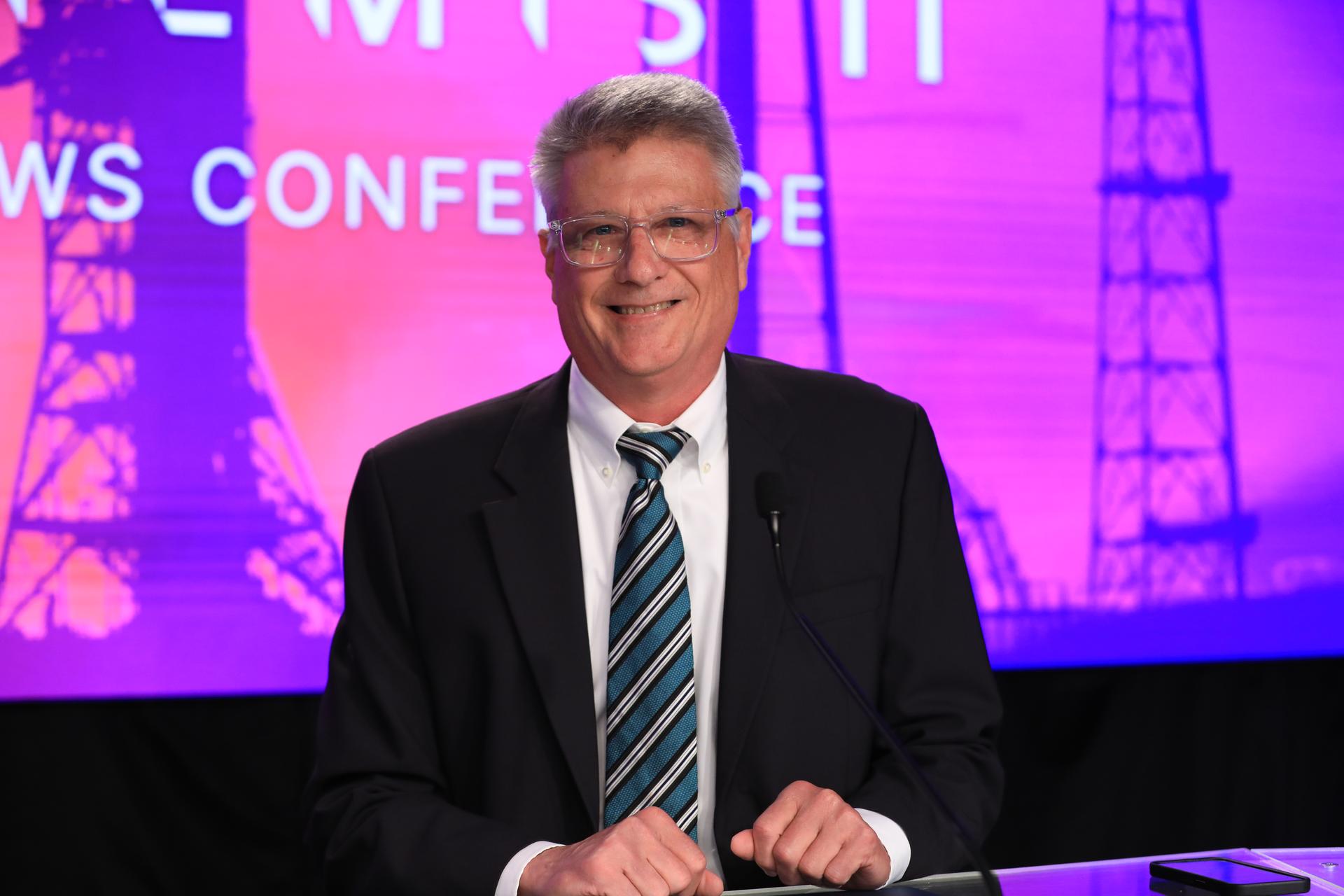
Chris Cianciola, deputy manager, NASA’s SLS (Space Launch System) Program, participates in a news conference on Sunday, March 29, 2026, to discuss the upcoming Artemis II test flight at NASA’s Kennedy Space Center in Florida. The Artemis II mission will take Artemis II Commander Reid Wiseman, Pilot Victor Glover, and Mission Specialist Christina Koch from NASA, and Mission Specialist Jeremy Hansen from the CSA (Canadian Space Agency) on a 10-day journey around the Moon and back aboard NASA’s SLS (Space Launch System) rocket and Orion spacecraft from Launch Complex 39B no earlier than 6:24 p.m. EDT on Wednesday, April 1.
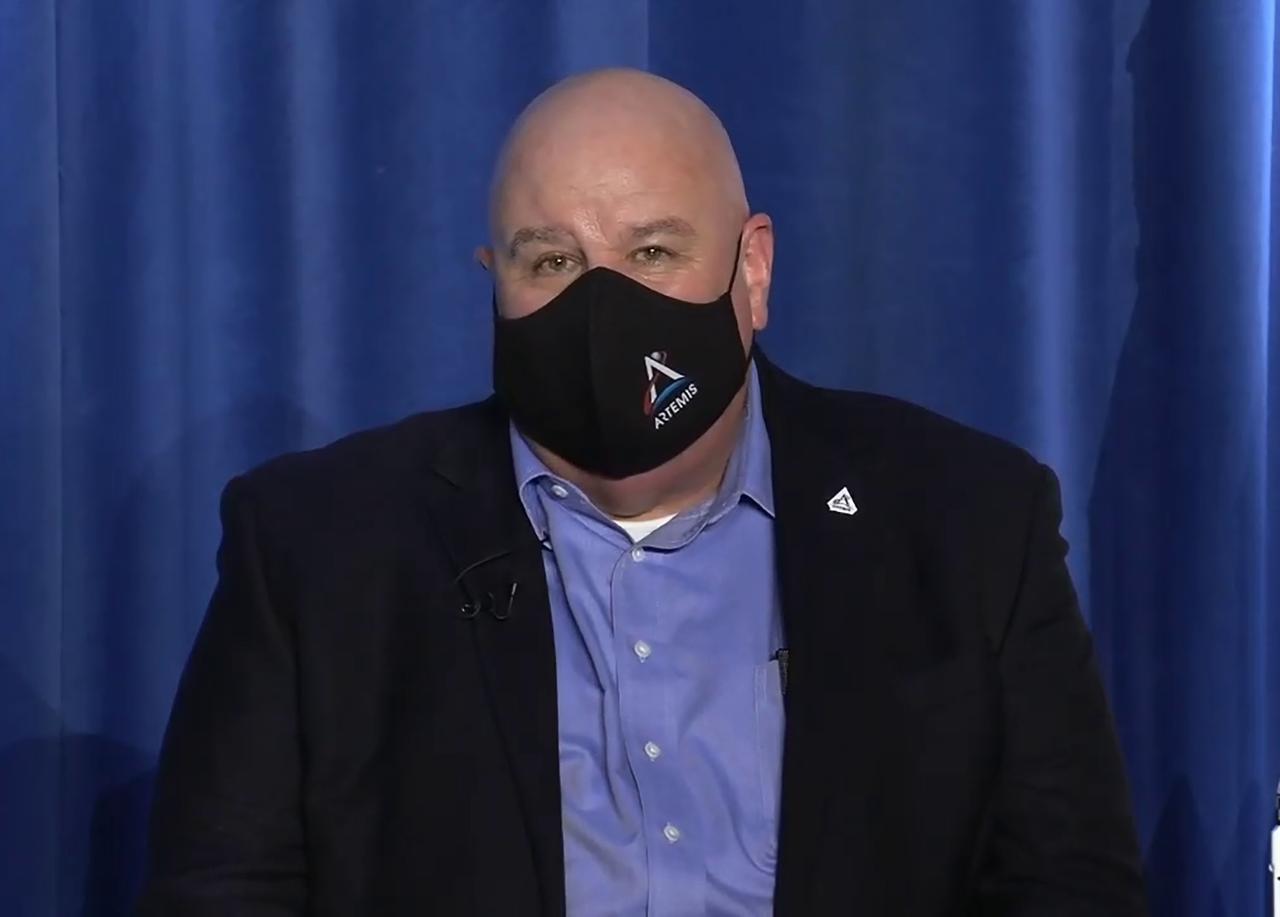
NASA leaders participated in a virtual press briefing following the Space Launch System core stage hot fire test at Stennis Space Center near Bay St. Louis, Mississippi, on March 18. The leaders fielded questions submitted by offsite media during the post-test session. Agency participants present at Stennis included John Honeycutt, SLS Program manager at Marshall Space Flight Center in Huntsville, Alabama.
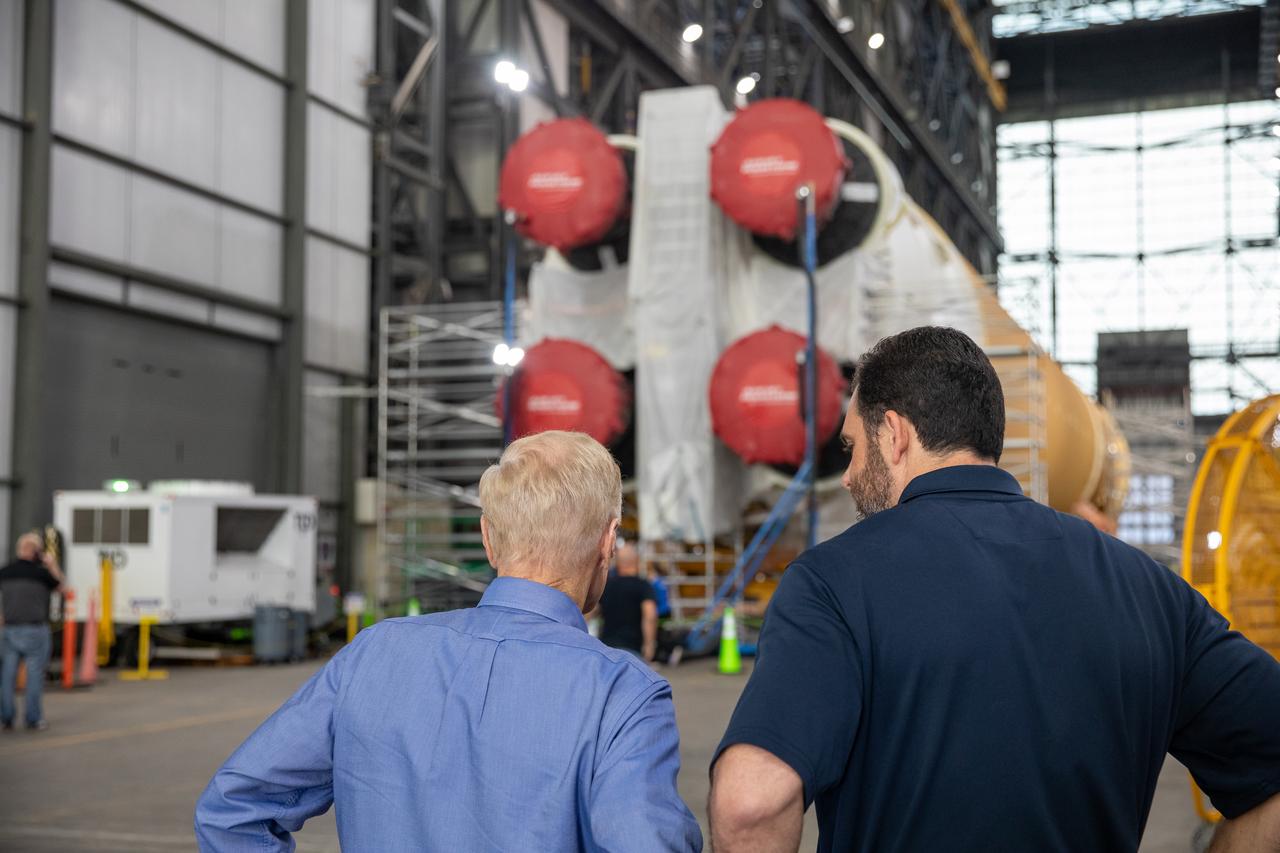
NASA Administrator Bill Nelson and NASA Exploration Ground Systems Program Deputy Manager Jeremy Parsons visit the agency’s SLS (Space Launch System) rocket core stage for the Artemis II mission inside NASA’s Kennedy Space Center in Florida on Thursday, Aug. 29, 2024. In the coming months, teams will integrate the rocket core stage atop the mobile launcher with the additional Artemis II flight hardware, including the twin solid rocket boosters, launch vehicle stage adapter, and the Orion spacecraft.
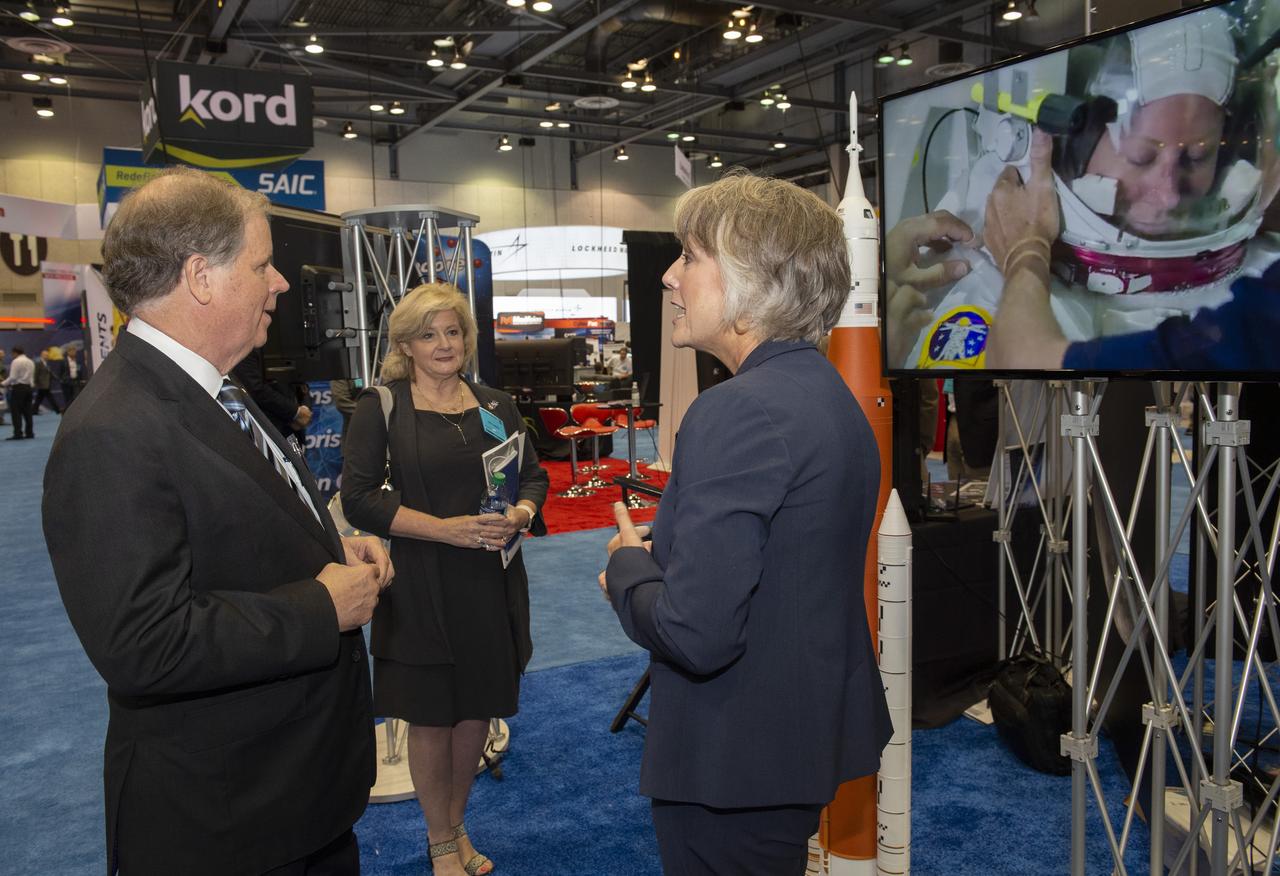
Sen. Doug Jones of Alabama, left, and Marshall Space Flight Center Director Jody Singer, center, talk with Marcia Lindstrom, Strategic Communications Manager for NASA’s Space Launch System, Aug. 7 at the annual Space & Missile Defense Symposium in Huntsville, Alabama. The SLS is the world’s most powerful rocket, and will be the backbone for deep space exploration as NASA’s Artemis program advances.
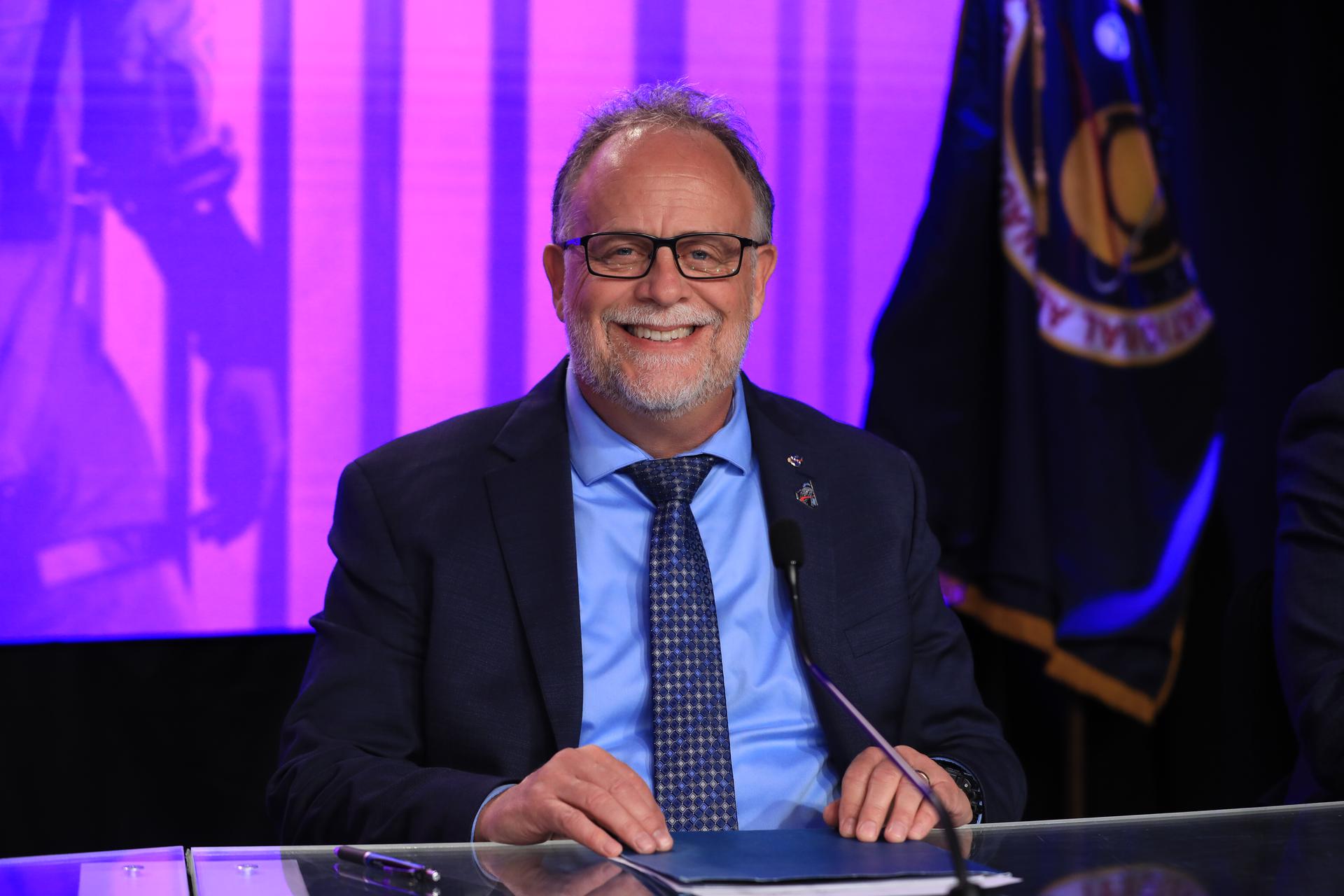
Shawn Quinn, manager, Exploration Ground Systems Program, participates in a post-Flight Readiness Review news conference for the Artemis II test flight inside the John Holliman Auditorium of the NASA News Center at the agency’s Kennedy Space Center in Florida on Thursday, March 12, 2026. The review is an assessment of the readiness of NASA’s SLS (Space Launch System) rocket and Orion spacecraft to support the Artemis II test flight as four astronauts journey around the Moon and return to Earth.
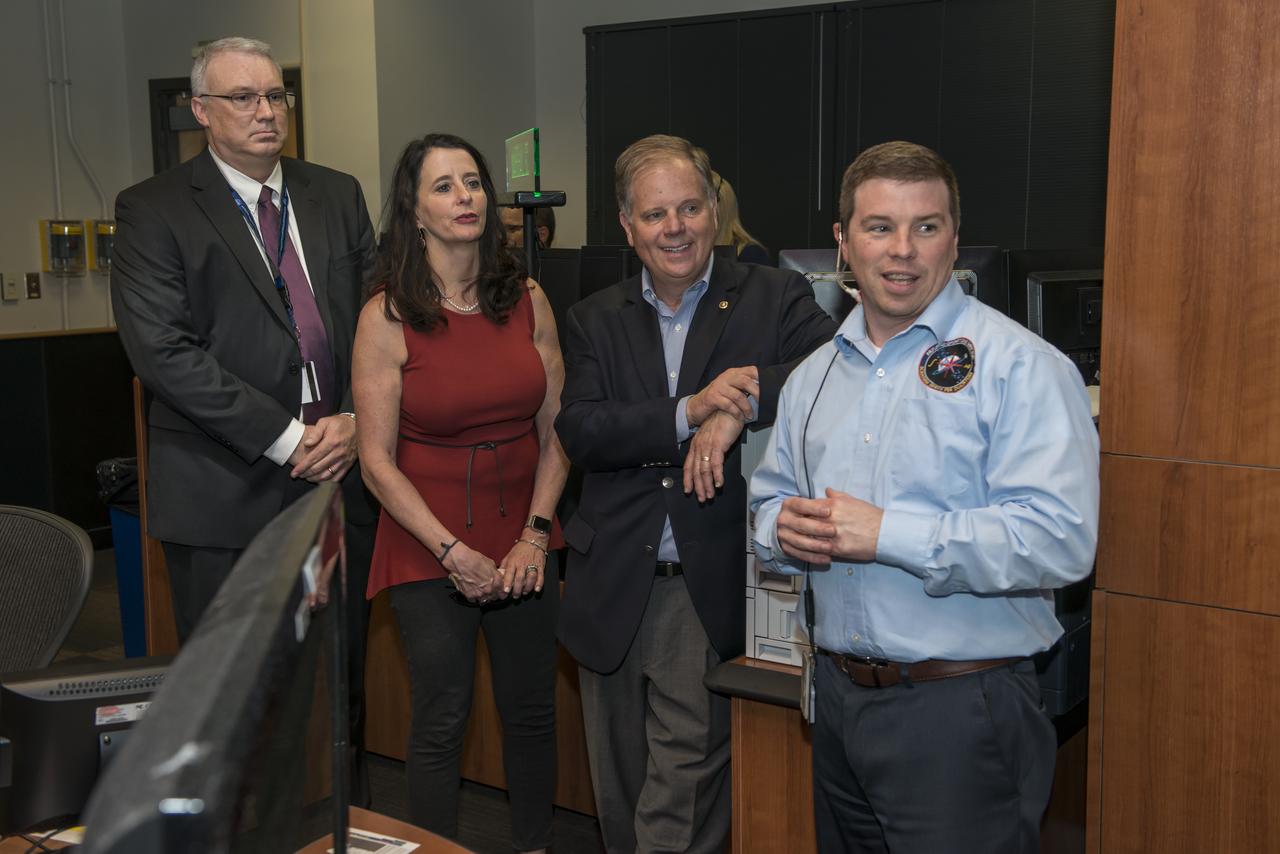
Senator Doug Jones (D-AL.) and wife, Louise, tour Marshall Space Flight facilities. Steve Doering, manager, Stages Element, Space Launch System (SLS) program at MSFC, also tour the Payload Operations Integration Center (POIC) where Marshall controllers oversee stowage requirements aboard the International Space Station (ISS) as well as scientific experiments. Different positions in the room are explained to Senator Jones by MSFC controller Beau Simpson.
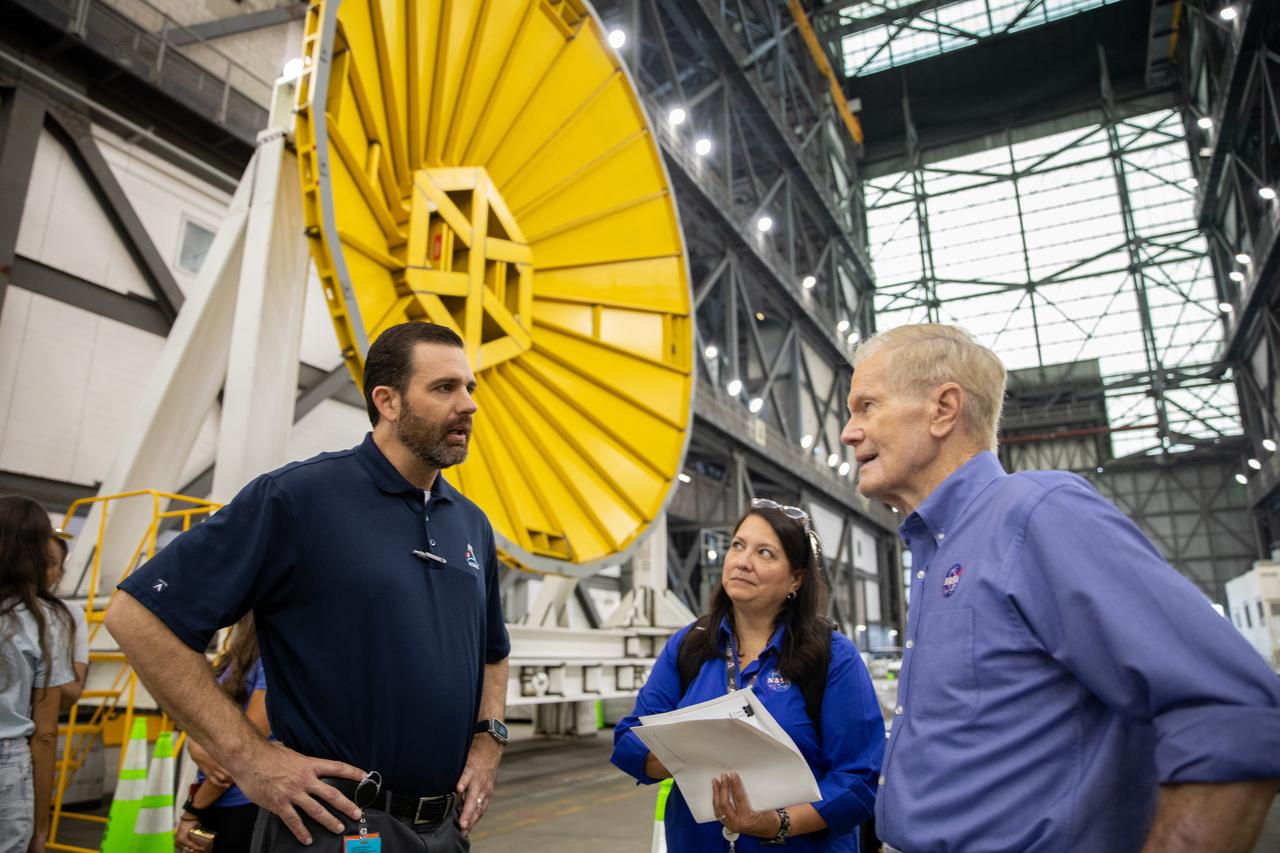
NASA Administrator Bill Nelson and NASA Exploration Ground Systems Program Deputy Manager Jeremy Parsons visit the agency’s SLS (Space Launch System) rocket core stage for the Artemis II mission inside NASA’s Kennedy Space Center in Florida on Thursday, Aug. 29, 2024. In the coming months, teams will integrate the rocket core stage atop the mobile launcher with the additional Artemis II flight hardware, including the twin solid rocket boosters, launch vehicle stage adapter, and the Orion spacecraft.
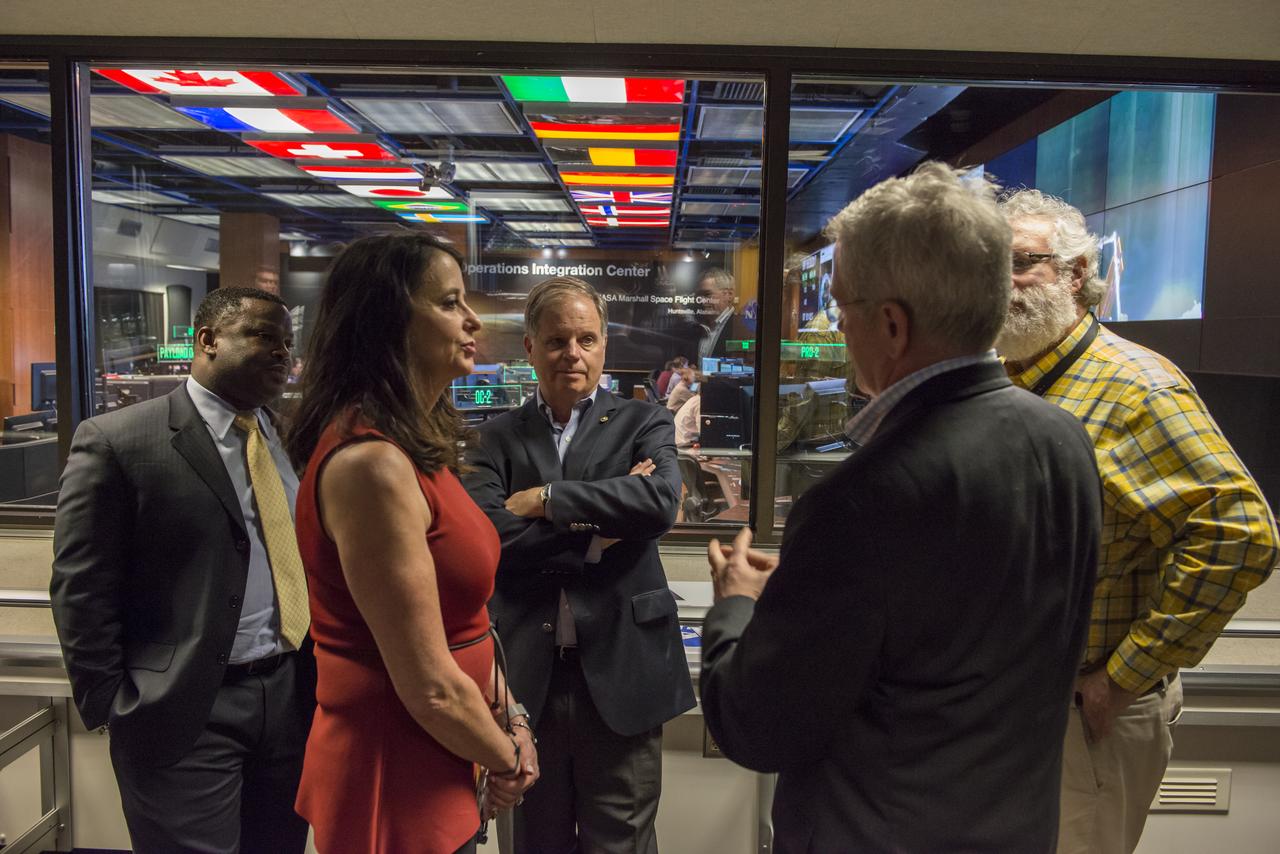
Senator Doug Jones (D-AL.) and wife, Louise, tour Marshall Space Flight facilities. Steve Doering, manager, Stages Element, Space Launch System (SLS) program at MSFC, also tour the Payload Operations Integration Center (POIC) where Marshall controllers oversee stowage requirements aboard the International Space Station (ISS) as well as scientific experiments.
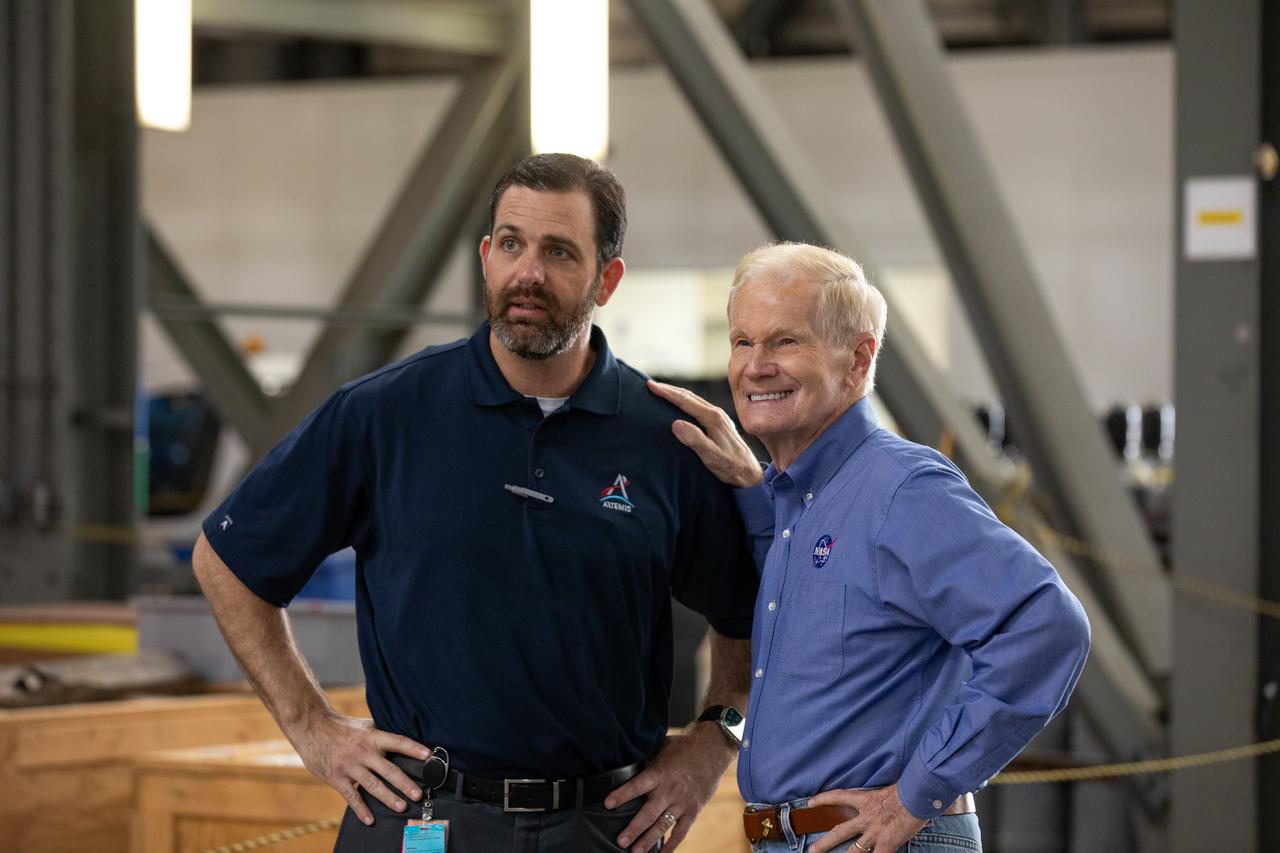
NASA Administrator Bill Nelson and NASA Exploration Ground Systems Program Deputy Manager Jeremy Parsons visit the agency’s SLS (Space Launch System) rocket core stage for the Artemis II mission inside NASA’s Kennedy Space Center in Florida on Thursday, Aug. 29, 2024. In the coming months, teams will integrate the rocket core stage atop the mobile launcher with the additional Artemis II flight hardware, including the twin solid rocket boosters, launch vehicle stage adapter, and the Orion spacecraft.
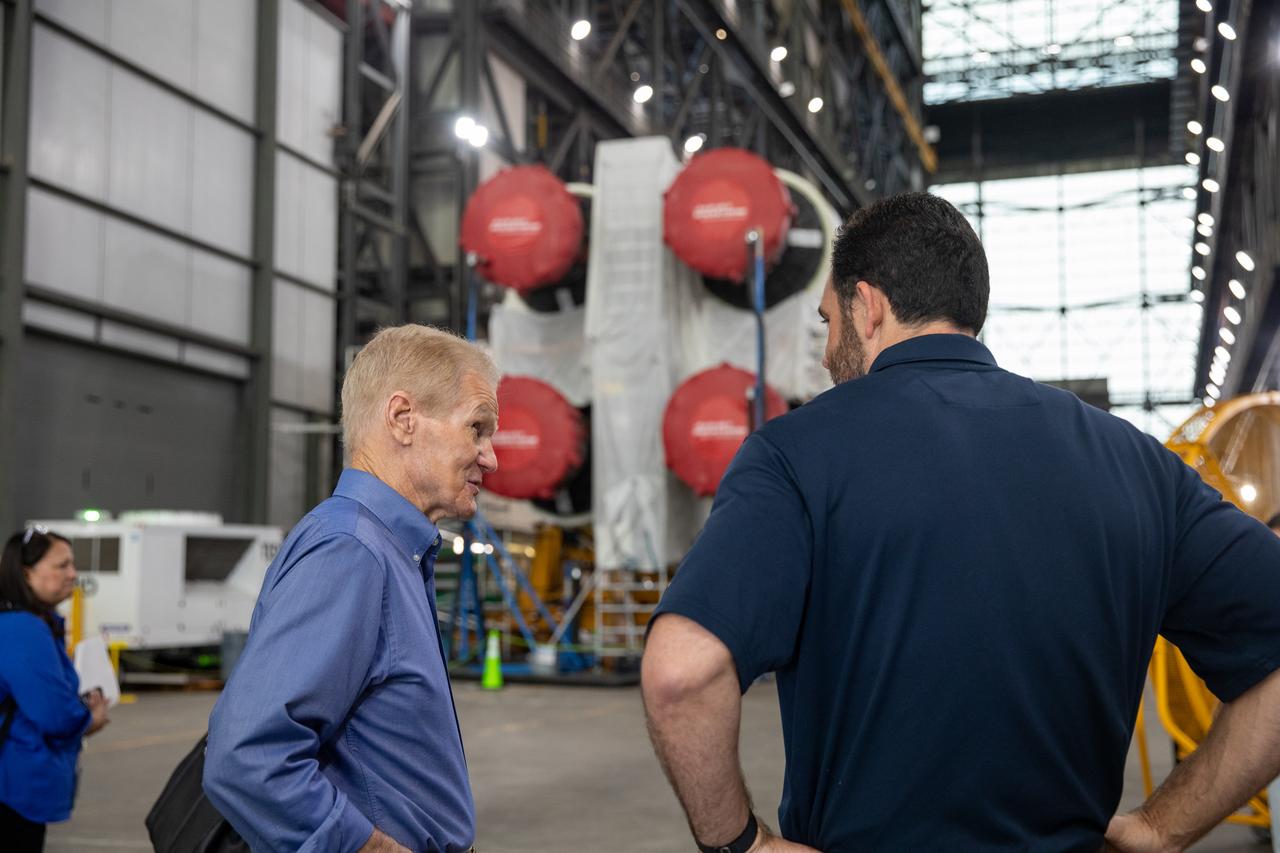
NASA Administrator Bill Nelson and NASA Exploration Ground Systems Program Deputy Manager Jeremy Parsons visit the agency’s SLS (Space Launch System) rocket core stage for the Artemis II mission inside NASA’s Kennedy Space Center in Florida on Thursday, Aug. 29, 2024. In the coming months, teams will integrate the rocket core stage atop the mobile launcher with the additional Artemis II flight hardware, including the twin solid rocket boosters, launch vehicle stage adapter, and the Orion spacecraft.
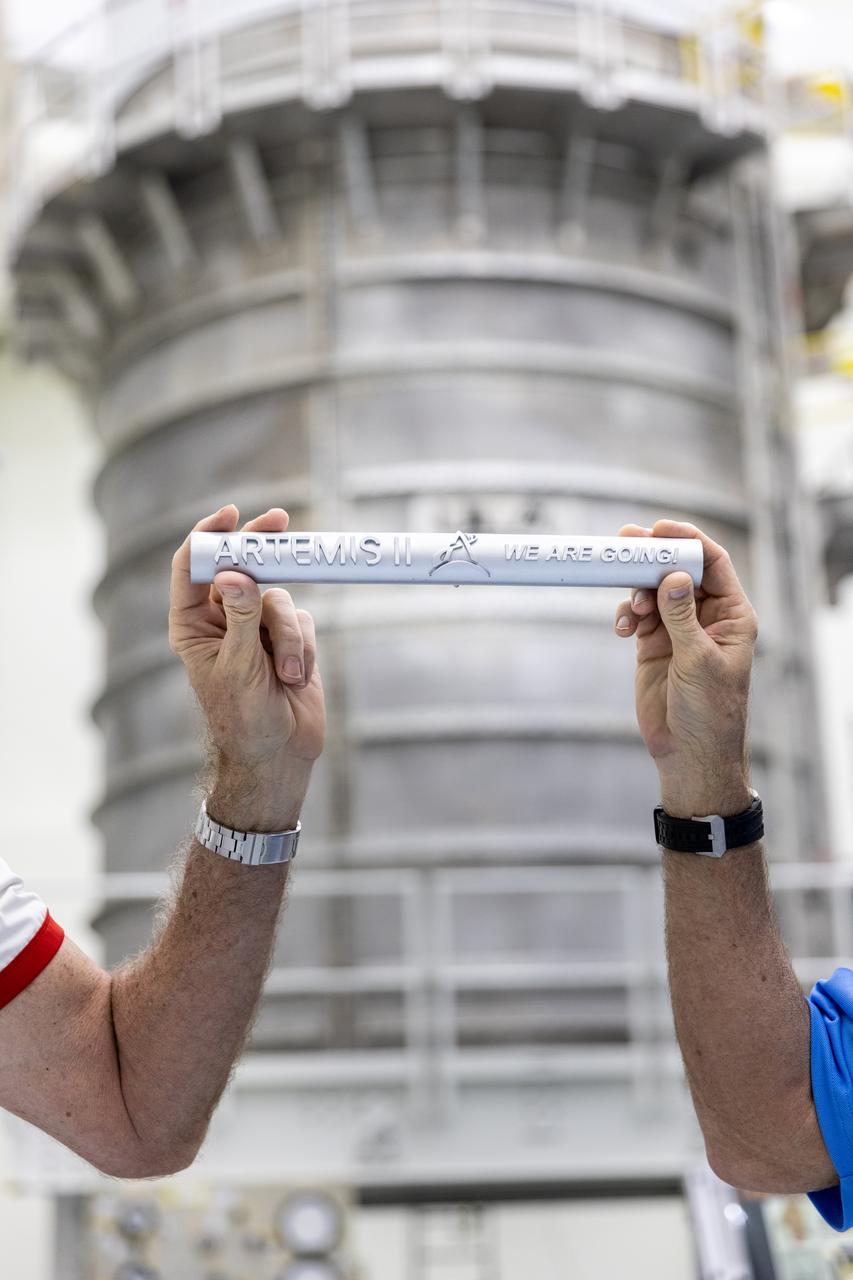
Managers from NASA’s Exploration Ground Systems (EGS) and SLS (Space Launch System) Programs hold a baton signifying the hand off of the SLS interim cryogenic propulsion stage to Kennedy’s EGS Program inside the Multi-Payload Processing Facility at NASA’s Kennedy Space Center in Florida on Monday, March 10, 2025, after being transported from United Launch Alliance’s Delta Operations Center at nearby Cape Canaveral Space Force Station. Teams with EGS will begin fueling the upper stage inside the facility ahead of the agency’s Artemis II mission. The interim cryogenic propulsion stage is a liquid oxygen and liquid hydrogen-based system that will fire its RL10 engine to give the Orion spacecraft the big in-space push needed to fly around the Moon and back.
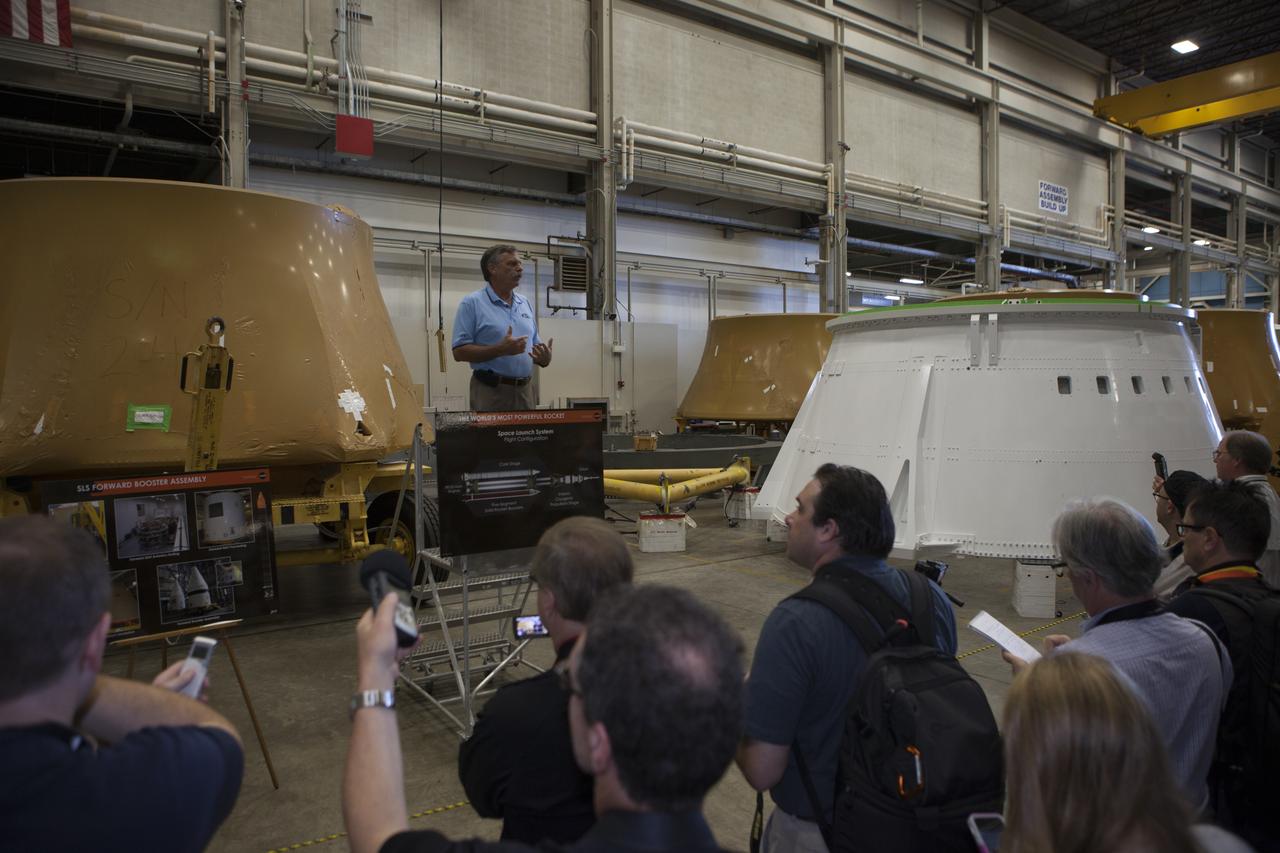
At NASA's Kennedy Space Center in Florida, members of the news media are briefed on the agency's Space Launch System SLS Program by Larry Clark, engineering manager for Alliant Techsystems Inc. ATK. The briefing took place in the spaceport's Booster Fabrication Facility BFF. During the Space Shuttle Program, the facility was used for processing forward segments and aft skirts for the solid rocket boosters. The BFF will serve a similar role for the SLS. Orion is the exploration spacecraft designed to carry astronauts to destinations not yet explored by humans, including an asteroid and Mars. It will have emergency abort capability, sustain the crew during space travel and provide safe re-entry from deep space return velocities. The first unpiloted flight test of Orion is scheduled to launch Dec. 4, 2014 atop a United Launch Alliance Delta IV Heavy rocket, and in 2018 on NASA’s Space Launch System rocket.
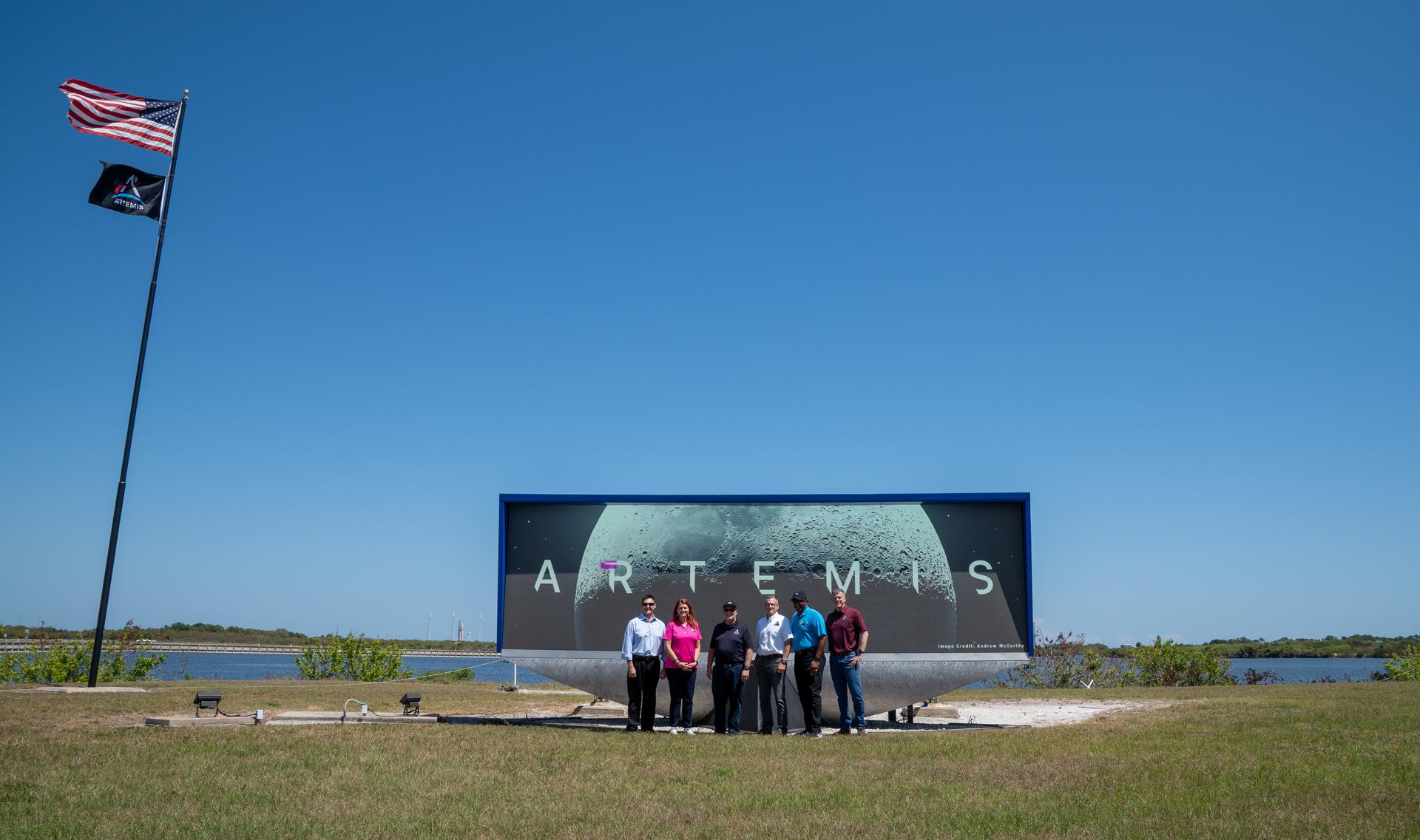
Robert Yaskovic, associate manager, Exploration Ground Systems Program; Charlie Blackwell-Thompson, Artemis II launch director; Shawn Quinn, manager, Exploration Ground Systems Program; Cliff Lanham, deputy manager, Exploration Ground Systems Program; NASA Kennedy Space Center Deputy Director Kelvin Manning; and Jeremy Graeber, assistant launch director, Exploration Ground Systems Program raise the Artemis flag near the countdown clock at the NASA News Center at NASA’s Kennedy Space Center in Florida on Friday, March 27, 2026. The Artemis II test flight mission will take Artemis II Commander Reid Wiseman, Pilot Victor Glover, and Mission Specialist Christina Koch from NASA, and Mission Specialist Jeremy Hansen from the CSA (Canadian Space Agency) on a 10-day journey around the Moon and back aboard NASA’s SLS (Space Launch System) rocket and Orion spacecraft from Launch Complex 39B no earlier than 6:24 p.m. EDT on Wednesday, April 1.
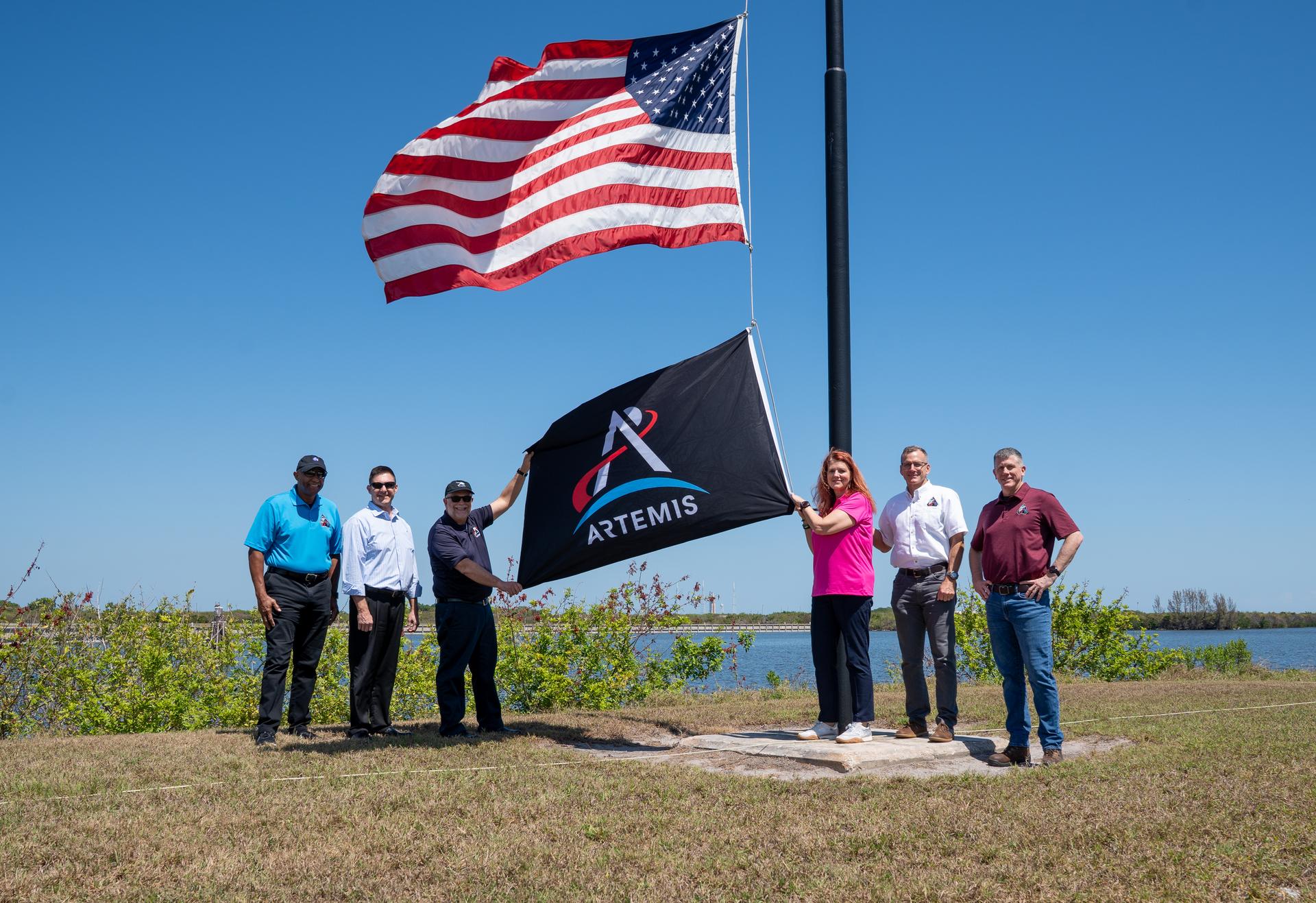
From left, NASA Kennedy Space Center Deputy Director Kelvin Manning; Robert Yaskovic, associate manager, Exploration Ground Systems Program; Shawn Quinn, manager, Exploration Ground Systems Program; Charlie Blackwell-Thompson, Artemis II launch director; Cliff Lanham, deputy manager, Exploration Ground Systems Program; and Jeremy Graeber, assistant launch director, Exploration Ground Systems Program raise the Artemis flag near the countdown clock at the NASA News Center at NASA’s Kennedy Space Center in Florida on Friday, March 27, 2026. The Artemis II test flight mission will take Artemis II Commander Reid Wiseman, Pilot Victor Glover, and Mission Specialist Christina Koch from NASA, and Mission Specialist Jeremy Hansen from the CSA (Canadian Space Agency) on a 10-day journey around the Moon and back aboard NASA’s SLS (Space Launch System) rocket and Orion spacecraft from Launch Complex 39B no earlier than 6:24 p.m. EDT on Wednesday, April 1.

From left, NASA Kennedy Space Center Deputy Director Kelvin Manning; Robert Yaskovic, associate manager, Exploration Ground Systems Program; Shawn Quinn, manager, Exploration Ground Systems Program; Charlie Blackwell-Thompson, Artemis II launch director; Cliff Lanham, deputy manager, Exploration Ground Systems Program; and Jeremy Graeber, assistant launch director, Exploration Ground Systems Program raise the Artemis flag near the countdown clock at the NASA News Center at NASA’s Kennedy Space Center in Florida on Friday, March 27, 2026. The Artemis II test flight mission will take Artemis II Commander Reid Wiseman, Pilot Victor Glover, and Mission Specialist Christina Koch from NASA, and Mission Specialist Jeremy Hansen from the CSA (Canadian Space Agency) on a 10-day journey around the Moon and back aboard NASA’s SLS (Space Launch System) rocket and Orion spacecraft from Launch Complex 39B no earlier than 6:24 p.m. EDT on Wednesday, April 1.
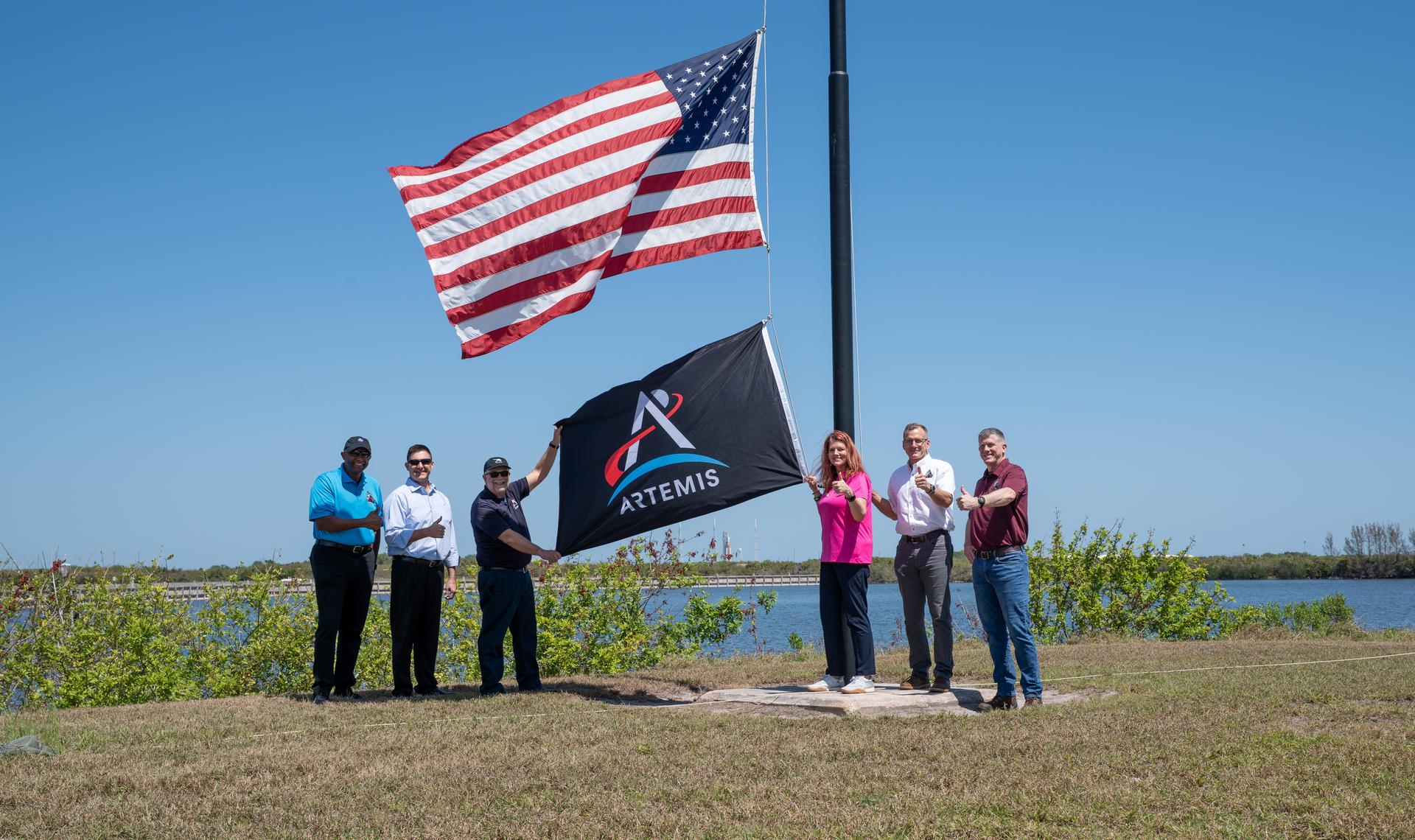
From left, NASA Kennedy Space Center Deputy Director Kelvin Manning; Robert Yaskovic, associate manager, Exploration Ground Systems Program; Shawn Quinn, manager, Exploration Ground Systems Program; Charlie Blackwell-Thompson, Artemis II launch director; Cliff Lanham, deputy manager, Exploration Ground Systems Program; and Jeremy Graeber, assistant launch director, Exploration Ground Systems Program raise the Artemis flag near the countdown clock at the NASA News Center at NASA’s Kennedy Space Center in Florida on Friday, March 27, 2026. The Artemis II test flight mission will take Artemis II Commander Reid Wiseman, Pilot Victor Glover, and Mission Specialist Christina Koch from NASA, and Mission Specialist Jeremy Hansen from the CSA (Canadian Space Agency) on a 10-day journey around the Moon and back aboard NASA’s SLS (Space Launch System) rocket and Orion spacecraft from Launch Complex 39B no earlier than 6:24 p.m. EDT on Wednesday, April 1.
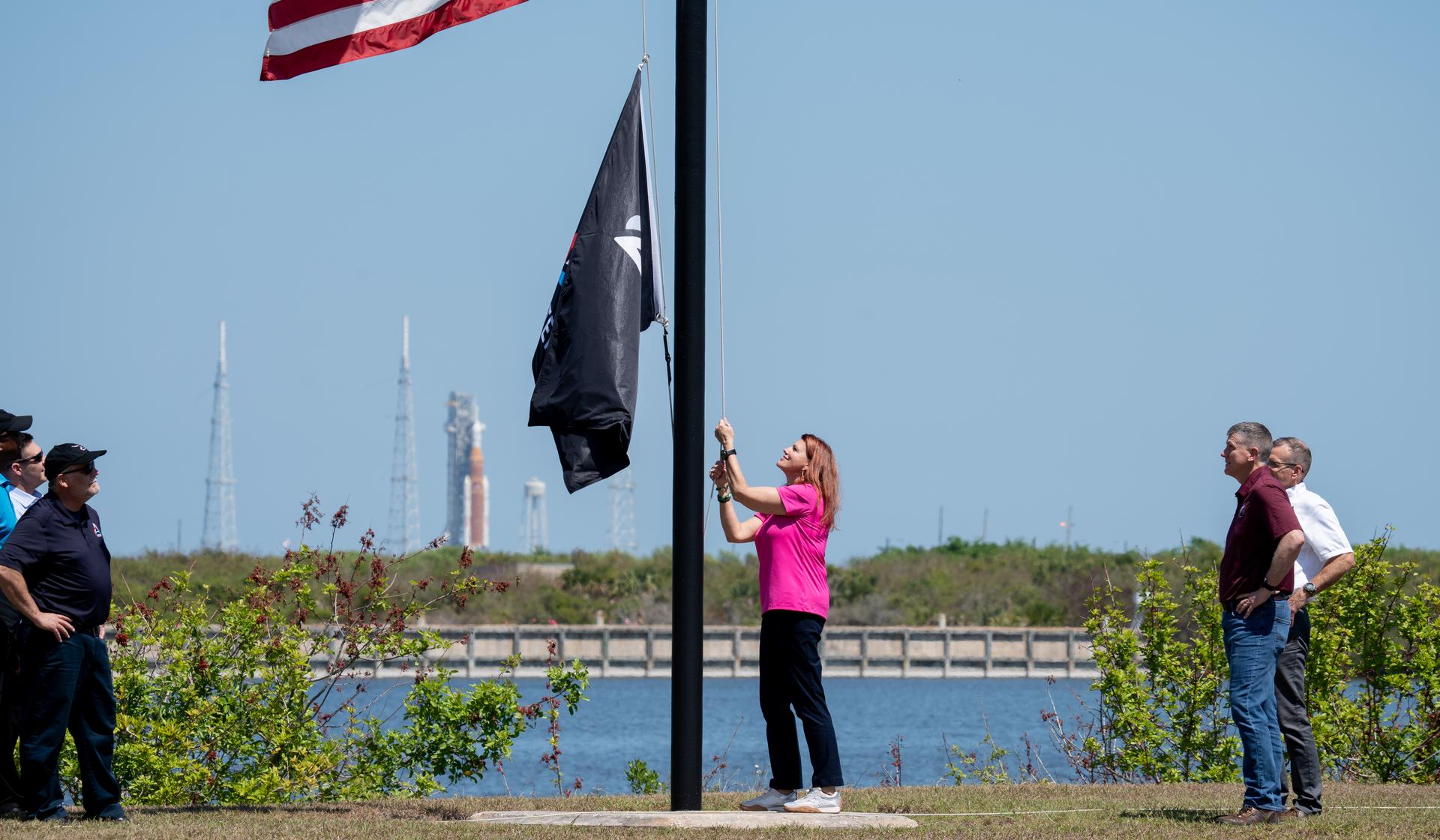
From left, NASA Kennedy Space Center Deputy Director Kelvin Manning; Robert Yaskovic, associate manager, Exploration Ground Systems Program; Shawn Quinn, manager, Exploration Ground Systems Program; Charlie Blackwell-Thompson, Artemis II launch director; Cliff Lanham, deputy manager, Exploration Ground Systems Program; and Jeremy Graeber, assistant launch director, Exploration Ground Systems Program raise the Artemis flag near the countdown clock at the NASA News Center at NASA’s Kennedy Space Center in Florida on Friday, March 27, 2026. The Artemis II test flight mission will take Artemis II Commander Reid Wiseman, Pilot Victor Glover, and Mission Specialist Christina Koch from NASA, and Mission Specialist Jeremy Hansen from the CSA (Canadian Space Agency) on a 10-day journey around the Moon and back aboard NASA’s SLS (Space Launch System) rocket and Orion spacecraft from Launch Complex 39B no earlier than 6:24 p.m. EDT on Wednesday, April 1.
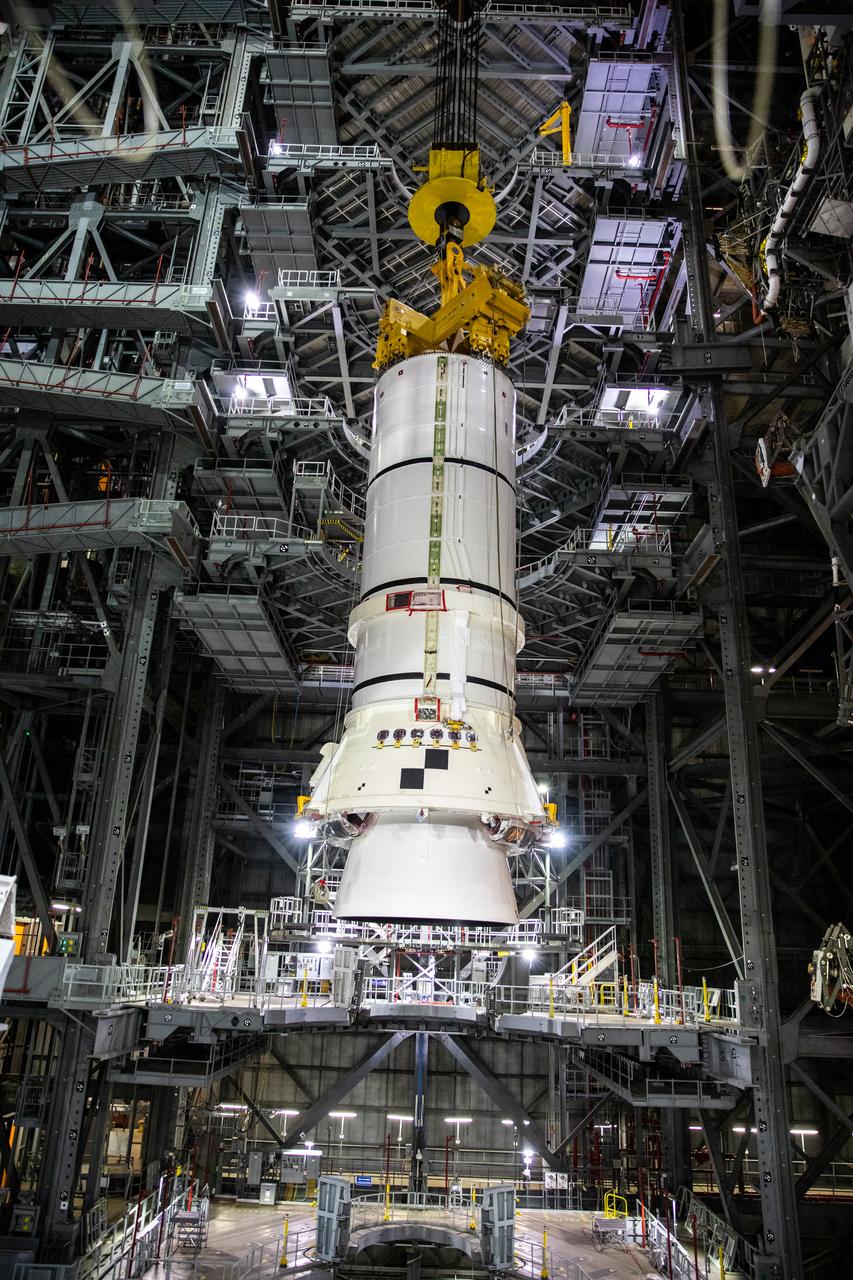
In the Vehicle Assembly Building (VAB) at NASA’s Kennedy Space Center in Florida, the second of two Artemis I aft booster segments for the Space Launch System is lowered by crane into High Bay 3 on Nov. 24, 2020. Workers with Exploration Ground Systems and contractor Jacobs teams will stack the twin five-segment boosters on the mobile launcher in High Bay 3 over a number of weeks. When the core stage arrives, it will join the boosters on the mobile launcher, followed by the interim cryogenic propulsion stage and Orion spacecraft. Manufactured by Northrop Grumman in Utah, the twin boosters provide more than 75 percent of the total SLS thrust at launch. The SLS is managed by Marshall Space Flight Center in Huntsville, Alabama. Under the Artemis program, NASA will land the first woman and the next man on the Moon by 2024. The first in a series of increasingly complex missions, Artemis I will test the Orion spacecraft and SLS as an integrated system ahead of crewed flights to the Moon.
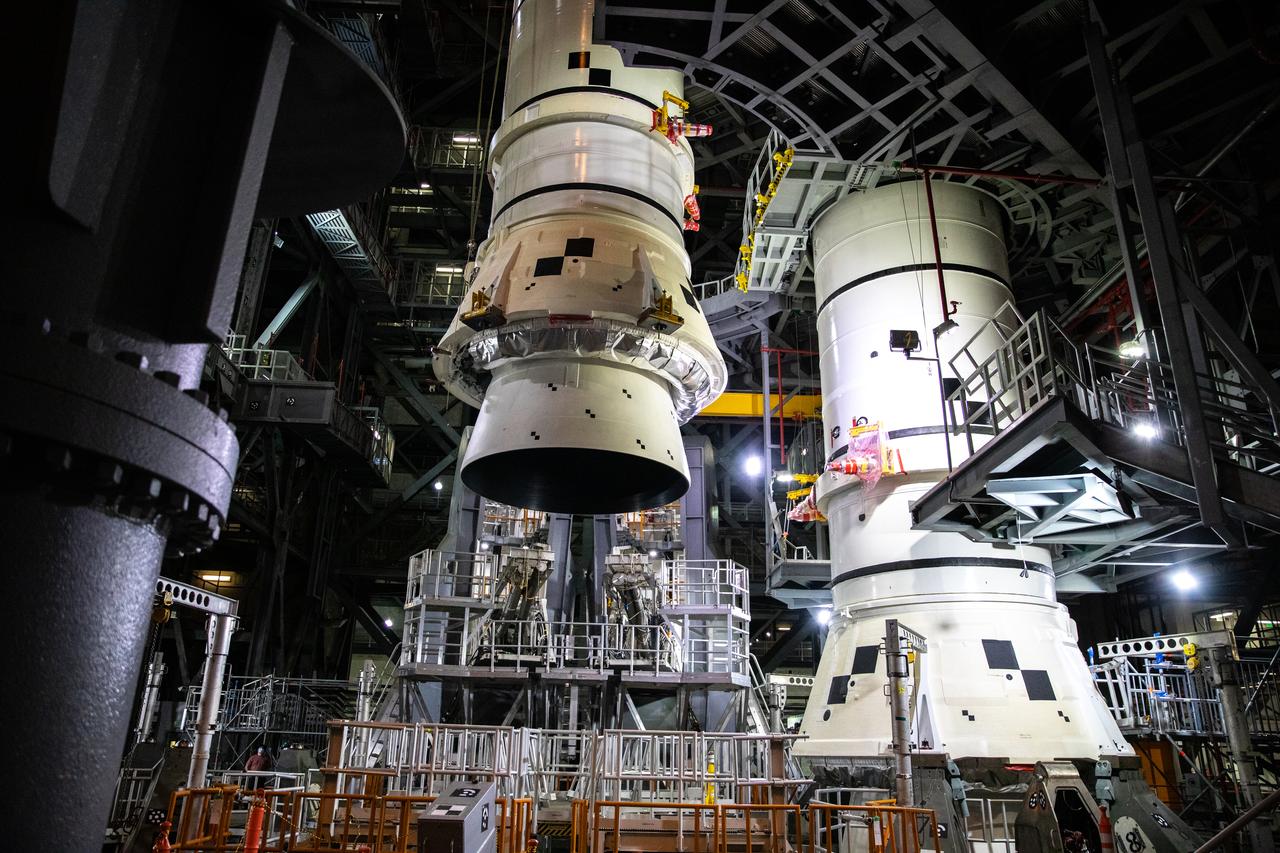
In the Vehicle Assembly Building (VAB) at NASA’s Kennedy Space Center in Florida, the second of two Artemis I aft booster segments for the Space Launch System is lowered by crane onto the mobile launcher in High Bay 3 on Nov. 24, 2020. Workers with Exploration Ground Systems and contractor Jacobs teams will stack the twin five-segment boosters on the mobile launcher over a number of weeks. When the core stage arrives, it will join the boosters on the mobile launcher, followed by the interim cryogenic propulsion stage and Orion spacecraft. Manufactured by Northrop Grumman in Utah, the twin boosters provide more than 75 percent of the total SLS thrust at launch. The SLS is managed by Marshall Space Flight Center in Huntsville, Alabama. Under the Artemis program, NASA will land the first woman and the next man on the Moon by 2024. The first in a series of increasingly complex missions, Artemis I will test the Orion spacecraft and SLS as an integrated system ahead of crewed flights to the Moon.
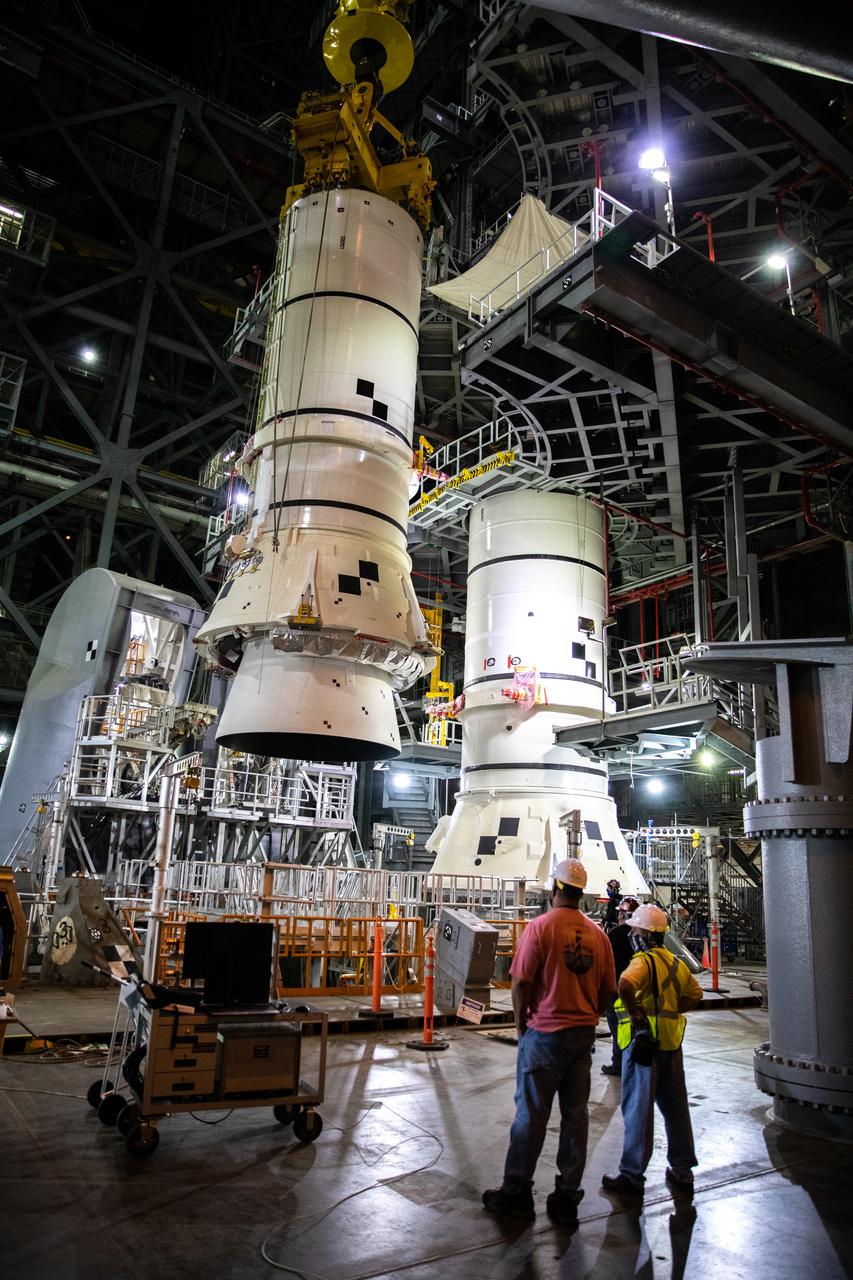
In the Vehicle Assembly Building (VAB) at NASA’s Kennedy Space Center in Florida, the second of two Artemis I aft booster segments for the Space Launch System is lowered by crane onto the mobile launcher in High Bay 3 on Nov. 24, 2020. Workers with Exploration Ground Systems and contractor Jacobs teams will stack the twin five-segment boosters on the mobile launcher over a number of weeks. When the core stage arrives, it will join the boosters on the mobile launcher, followed by the interim cryogenic propulsion stage and Orion spacecraft. Manufactured by Northrop Grumman in Utah, the twin boosters provide more than 75 percent of the total SLS thrust at launch. The SLS is managed by Marshall Space Flight Center in Huntsville, Alabama. Under the Artemis program, NASA will land the first woman and the next man on the Moon by 2024. The first in a series of increasingly complex missions, Artemis I will test the Orion spacecraft and SLS as an integrated system ahead of crewed flights to the Moon.
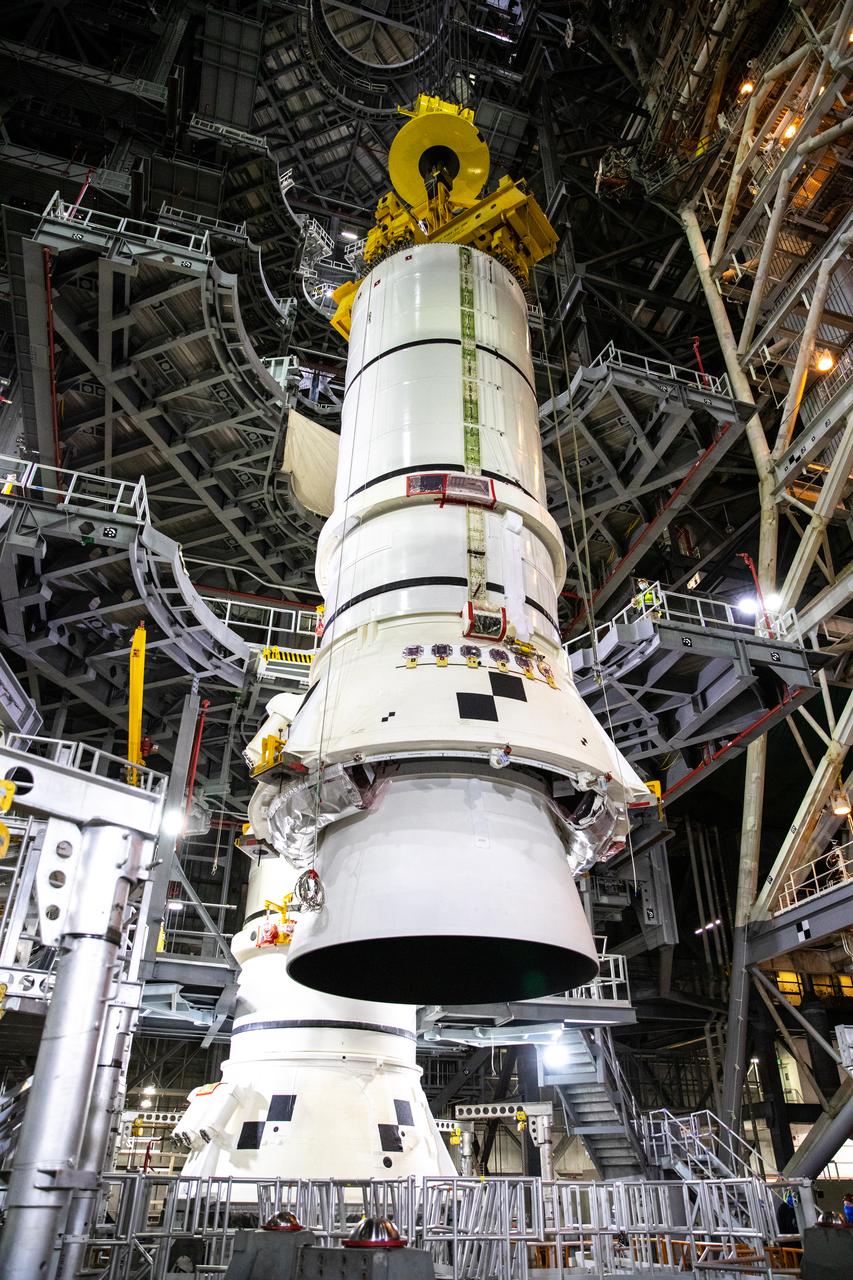
In the Vehicle Assembly Building (VAB) at NASA’s Kennedy Space Center in Florida, the second of two Artemis I aft booster segments for the Space Launch System is lowered by crane onto the mobile launcher in High Bay 3 on Nov. 24, 2020. Workers with Exploration Ground Systems and contractor Jacobs teams will stack the twin five-segment boosters on the mobile launcher over a number of weeks. When the core stage arrives, it will join the boosters on the mobile launcher, followed by the interim cryogenic propulsion stage and Orion spacecraft. Manufactured by Northrop Grumman in Utah, the twin boosters provide more than 75 percent of the total SLS thrust at launch. The SLS is managed by Marshall Space Flight Center in Huntsville, Alabama. Under the Artemis program, NASA will land the first woman and the next man on the Moon by 2024. The first in a series of increasingly complex missions, Artemis I will test the Orion spacecraft and SLS as an integrated system ahead of crewed flights to the Moon.
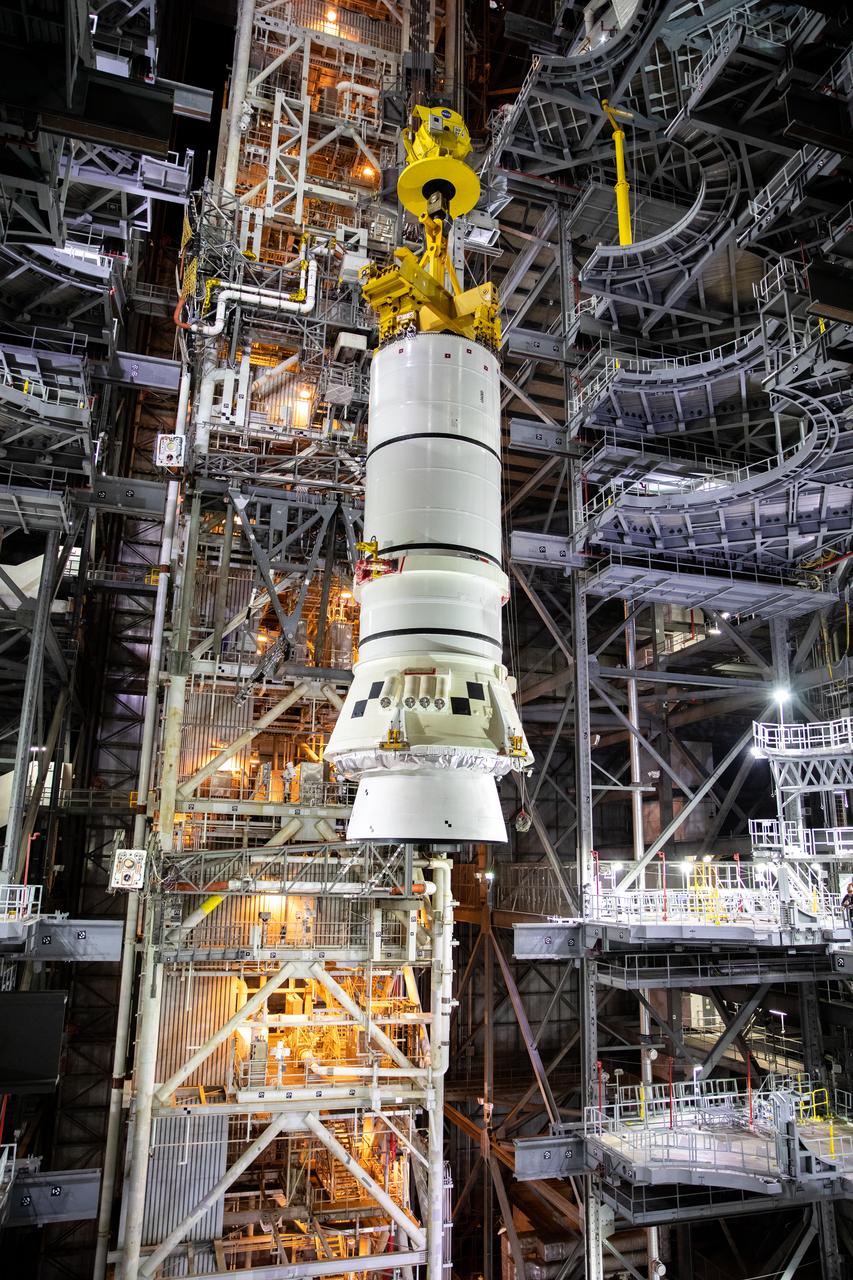
In the Vehicle Assembly Building (VAB) at NASA’s Kennedy Space Center in Florida, the second of two Artemis I aft booster segments for the Space Launch System is lowered by crane into High Bay 3 on Nov. 24, 2020. Workers with Exploration Ground Systems and contractor Jacobs teams will stack the twin five-segment boosters on the mobile launcher in High Bay 3 over a number of weeks. When the core stage arrives, it will join the boosters on the mobile launcher, followed by the interim cryogenic propulsion stage and Orion spacecraft. Manufactured by Northrop Grumman in Utah, the twin boosters provide more than 75 percent of the total SLS thrust at launch. The SLS is managed by Marshall Space Flight Center in Huntsville, Alabama. Under the Artemis program, NASA will land the first woman and the next man on the Moon by 2024. The first in a series of increasingly complex missions, Artemis I will test the Orion spacecraft and SLS as an integrated system ahead of crewed flights to the Moon.
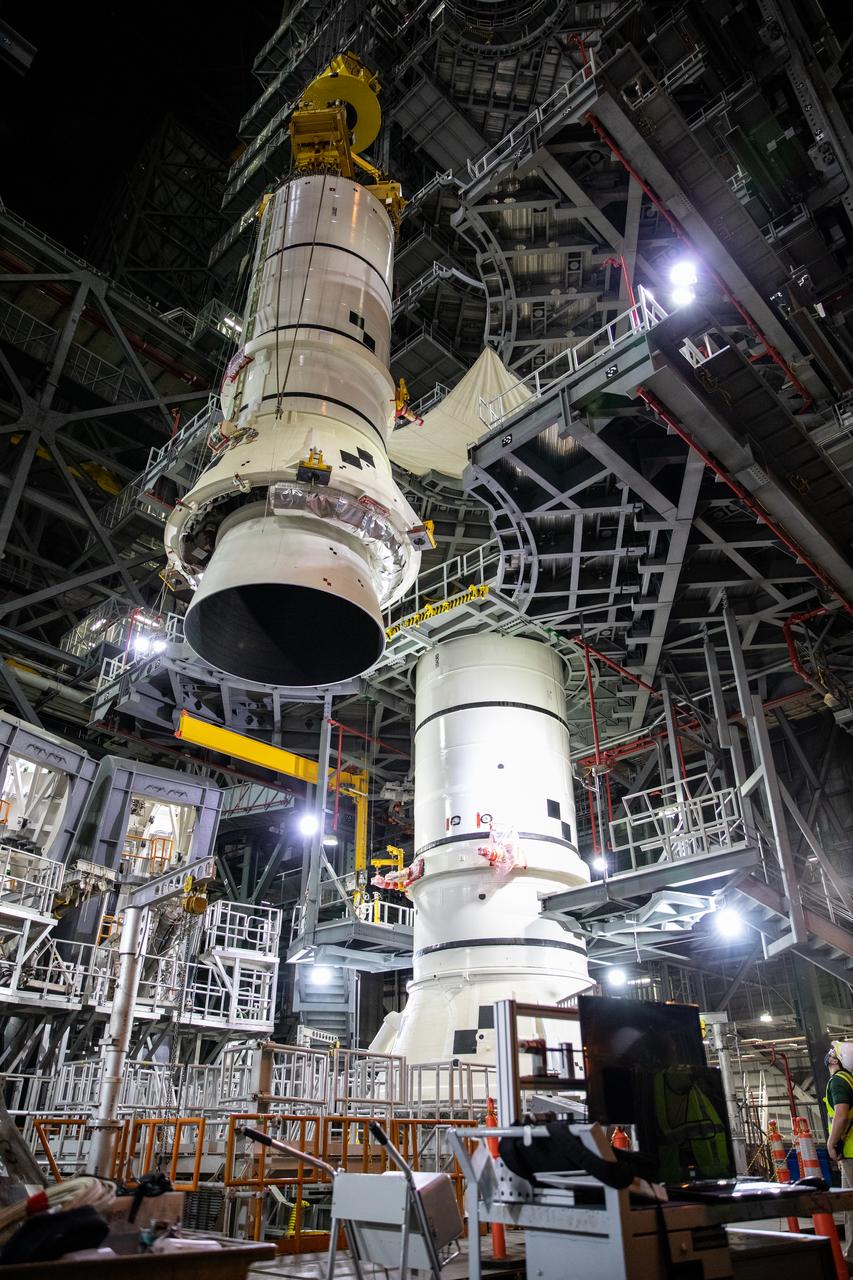
In the Vehicle Assembly Building (VAB) at NASA’s Kennedy Space Center in Florida, the second of two Artemis I aft booster segments for the Space Launch System is lowered by crane onto the mobile launcher in High Bay 3 on Nov. 24, 2020. Workers with Exploration Ground Systems and contractor Jacobs teams will stack the twin five-segment boosters on the mobile launcher over a number of weeks. When the core stage arrives, it will join the boosters on the mobile launcher, followed by the interim cryogenic propulsion stage and Orion spacecraft. Manufactured by Northrop Grumman in Utah, the twin boosters provide more than 75 percent of the total SLS thrust at launch. The SLS is managed by Marshall Space Flight Center in Huntsville, Alabama. Under the Artemis program, NASA will land the first woman and the next man on the Moon by 2024. The first in a series of increasingly complex missions, Artemis I will test the Orion spacecraft and SLS as an integrated system ahead of crewed flights to the Moon.
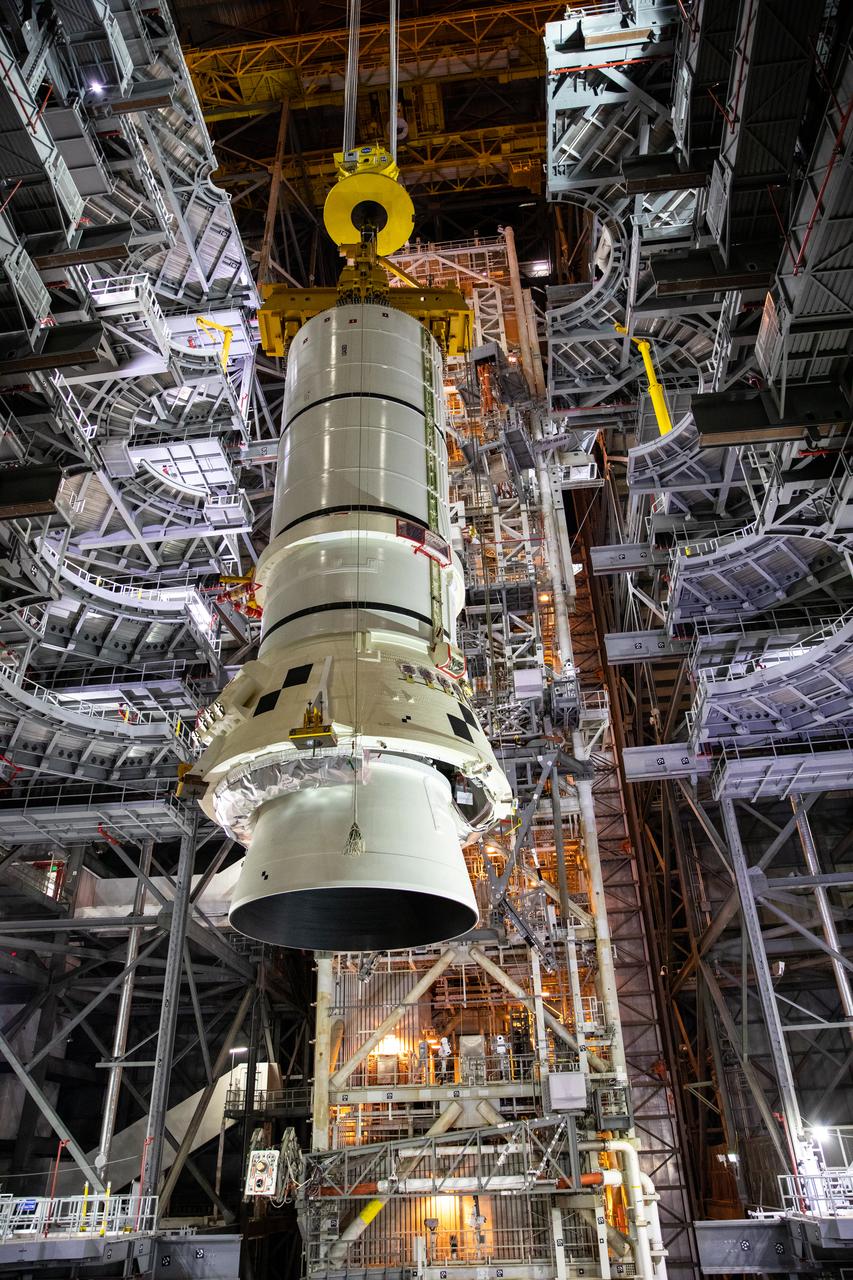
In the Vehicle Assembly Building (VAB) at NASA’s Kennedy Space Center in Florida, the second of two Artemis I aft booster segments for the Space Launch System is lowered by crane into High Bay 3 on Nov. 24, 2020. Workers with Exploration Ground Systems and contractor Jacobs teams will stack the twin five-segment boosters on the mobile launcher in High Bay 3 over a number of weeks. When the core stage arrives, it will join the boosters on the mobile launcher, followed by the interim cryogenic propulsion stage and Orion spacecraft. Manufactured by Northrop Grumman in Utah, the twin boosters provide more than 75 percent of the total SLS thrust at launch. The SLS is managed by Marshall Space Flight Center in Huntsville, Alabama. Under the Artemis program, NASA will land the first woman and the next man on the Moon by 2024. The first in a series of increasingly complex missions, Artemis I will test the Orion spacecraft and SLS as an integrated system ahead of crewed flights to the Moon.
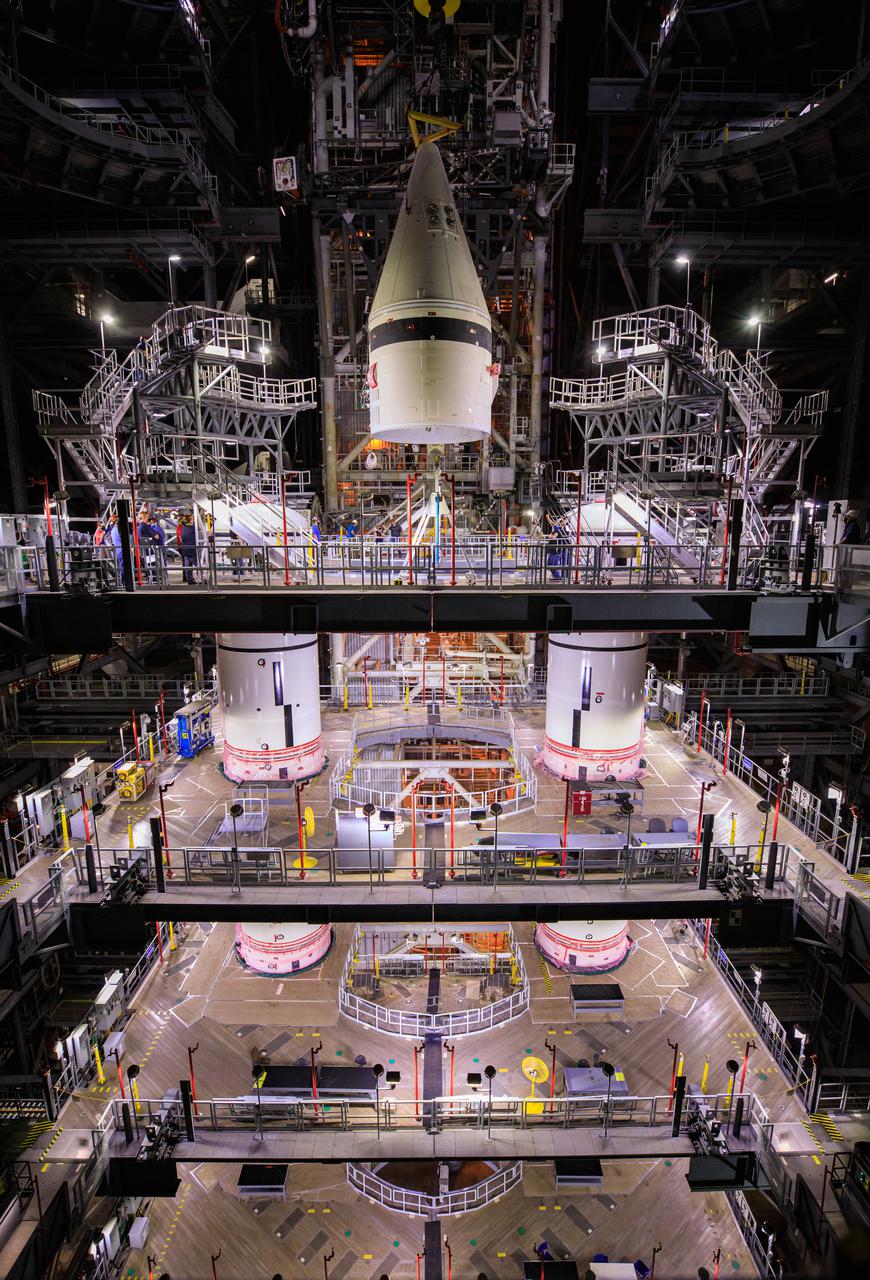
The left-hand booster forward assembly for NASA’s Space Launch System is lowered by crane onto the center forward segment on the mobile launcher (ML) in High Bay 3 of the Vehicle Assembly Building at Kennedy Space Center in Florida on March 1, 2021. Exploration Ground Systems and contractor Jacobs teams have been stacking the twin five-segment boosters on the ML over a number of weeks. When the core stage arrives, it will join the boosters on the mobile launcher, followed by the interim cryogenic propulsion stage and Orion spacecraft. Manufactured by Northrop Grumman in Utah, the twin boosters provide more than 75 percent of the total SLS thrust at launch. Marshall Space Flight Center in Huntsville, Alabama, manages the SLS. Under the Artemis program, NASA will land the first woman and the next man on the Moon. The first in a series of increasingly complex missions, Artemis I will test the Orion spacecraft and SLS as an integrated system ahead of crewed flights to the Moon.
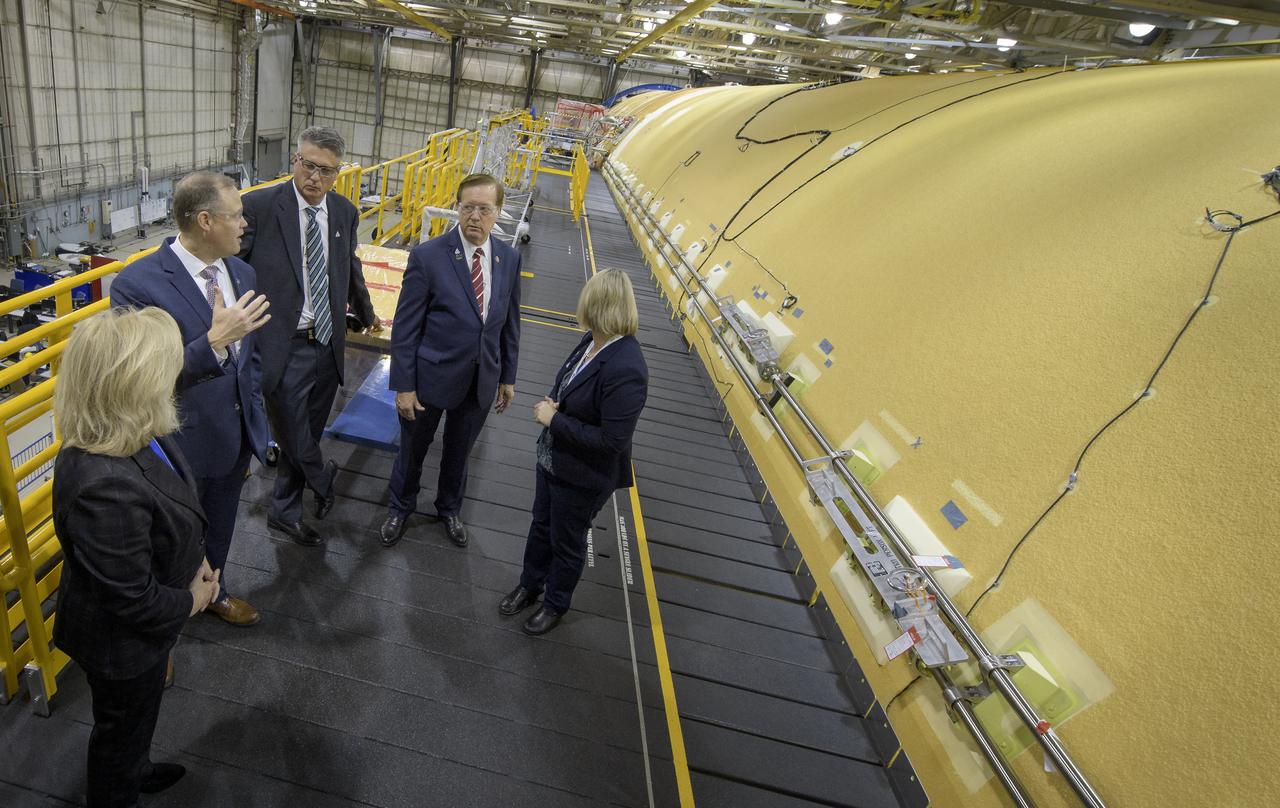
NASA Marshall Space Flight Center Director Jody Singer, left, NASA Administrator Jim Bridenstine, NASA Marshall Space Flight Center Deputy Program manager, Space Launch System Program, Chris Cianciola, U.S. Representative Randy Weber (R-TX), and Boeing Director of operations at Michoud Assembly Facility Jennifer Boland-Masterson, right, view the core stage for NASA’s Space Launch System (SLS) rocket that will help power the first Artemis mission to the Moon, Monday, Dec. 9, 2019, at NASA’s Michoud Assembly Facility in New Orleans. Through Artemis NASA will land the first woman and next man on the Moon by 2024. Photo Credit: (NASA/Bill Ingalls)
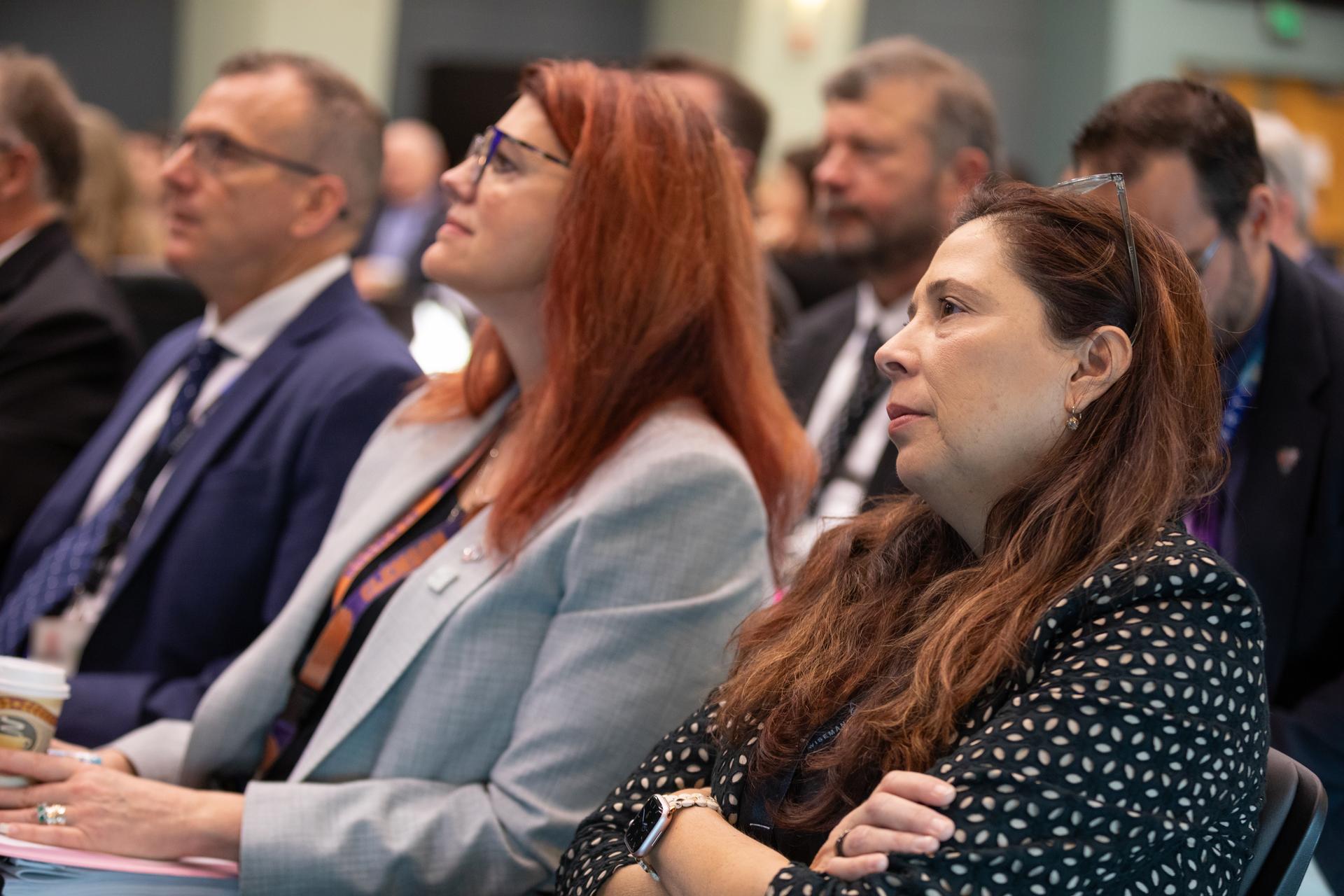
From left, Cliff Lanham, deputy manager, Exploration Ground Systems; Charlie Blackwell-Thompson, launch director, Exploration Ground Systems Program; and Lili Villarreal, Artemis II landing and recovery director in Exploration Ground Systems Program at NASA’s Kennedy Space Center in Florida, participate in the Artemis II Flight Readiness Review with NASA leadership on Wednesday, March 11, 2026, at NASA Kennedy. The review is an assessment of the readiness of NASA’s SLS (Space Launch System) rocket and Orion spacecraft to support the Artemis II test flight as four astronauts journey around the Moon and return to Earth.
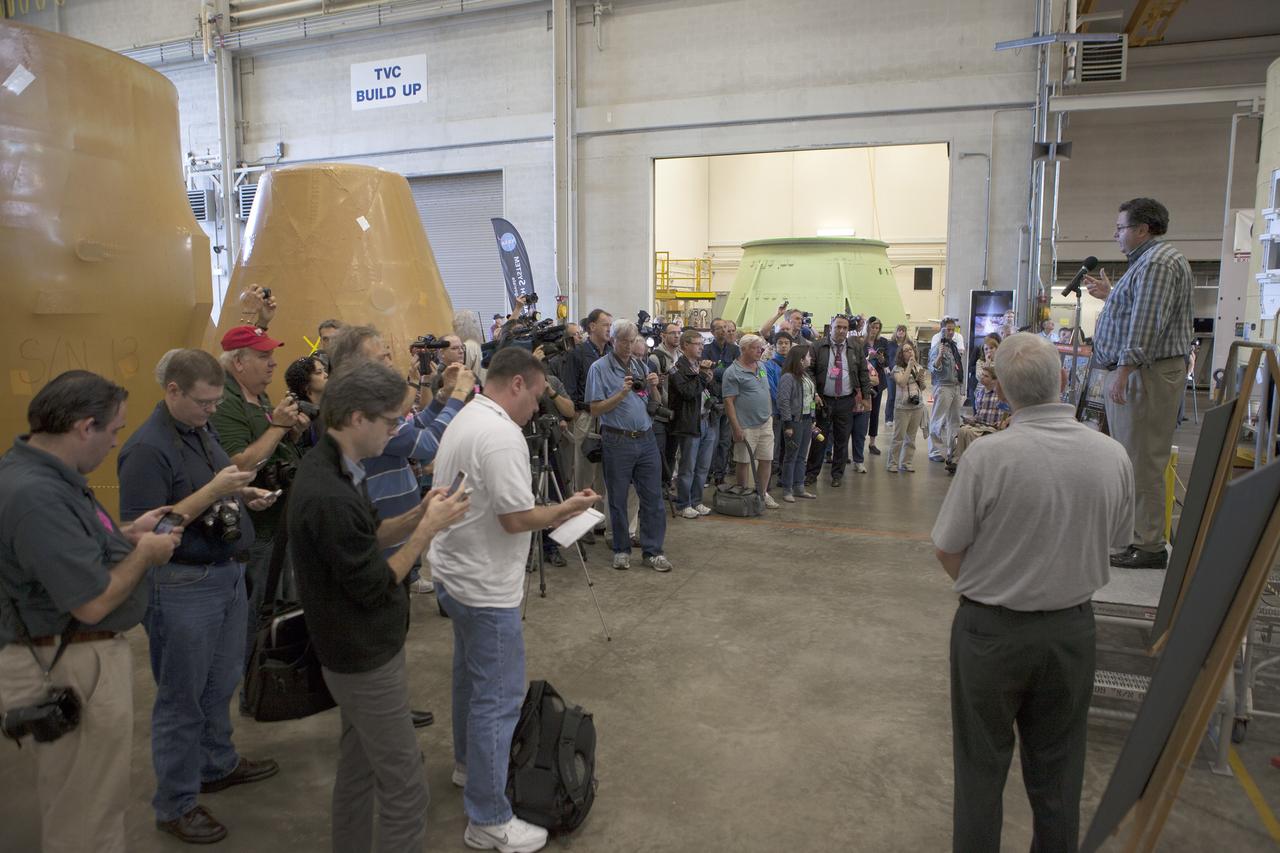
CAPE CANAVERAL, Fla. – At NASA's Kennedy Space Center in Florida, members of the news media are briefed on the agency's Space Launch System SLS Program Todd May, program manager for Space Launch Systems SLS at NASA's Marshall Space Flight Center in Huntsville, Alabama. The briefing took place in the spaceport's Booster Fabrication Facility BFF. During the Space Shuttle Program, the facility was used for processing forward segments and aft skirts for the solid rocket boosters. The BFF will serve a similar role for the SLS. Orion is the exploration spacecraft designed to carry astronauts to destinations not yet explored by humans, including an asteroid and Mars. It will have emergency abort capability, sustain the crew during space travel and provide safe re-entry from deep space return velocities. The first unpiloted flight test of Orion is scheduled to launch Dec. 4, 2014 atop a United Launch Alliance Delta IV Heavy rocket, and in 2018 on NASA’s Space Launch System rocket. For more information, visit www.nasa.gov/orion Photo credit: NASA/Kim Shiflett
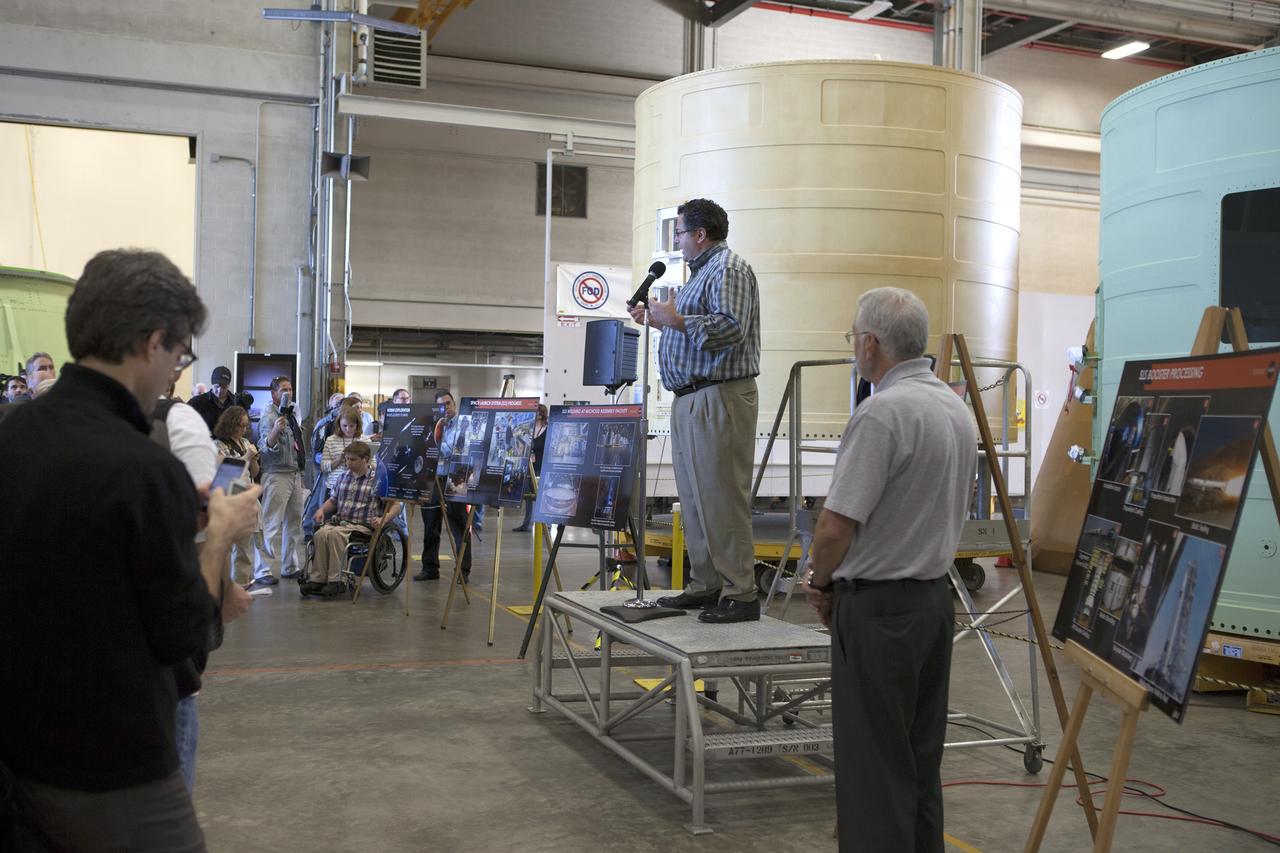
CAPE CANAVERAL, Fla. – At NASA's Kennedy Space Center in Florida, members of the news media are briefed on the agency's Space Launch System SLS Program Todd May, program manager for Space Launch Systems SLS at NASA's Marshall Space Flight Center in Huntsville, Alabama. The briefing took place in the spaceport's Booster Fabrication Facility BFF. During the Space Shuttle Program, the facility was used for processing forward segments and aft skirts for the solid rocket boosters. The BFF will serve a similar role for the SLS. Orion is the exploration spacecraft designed to carry astronauts to destinations not yet explored by humans, including an asteroid and Mars. It will have emergency abort capability, sustain the crew during space travel and provide safe re-entry from deep space return velocities. The first unpiloted flight test of Orion is scheduled to launch Dec. 4, 2014 atop a United Launch Alliance Delta IV Heavy rocket, and in 2018 on NASA’s Space Launch System rocket. For more information, visit www.nasa.gov/orion Photo credit: NASA/Kim Shiflett
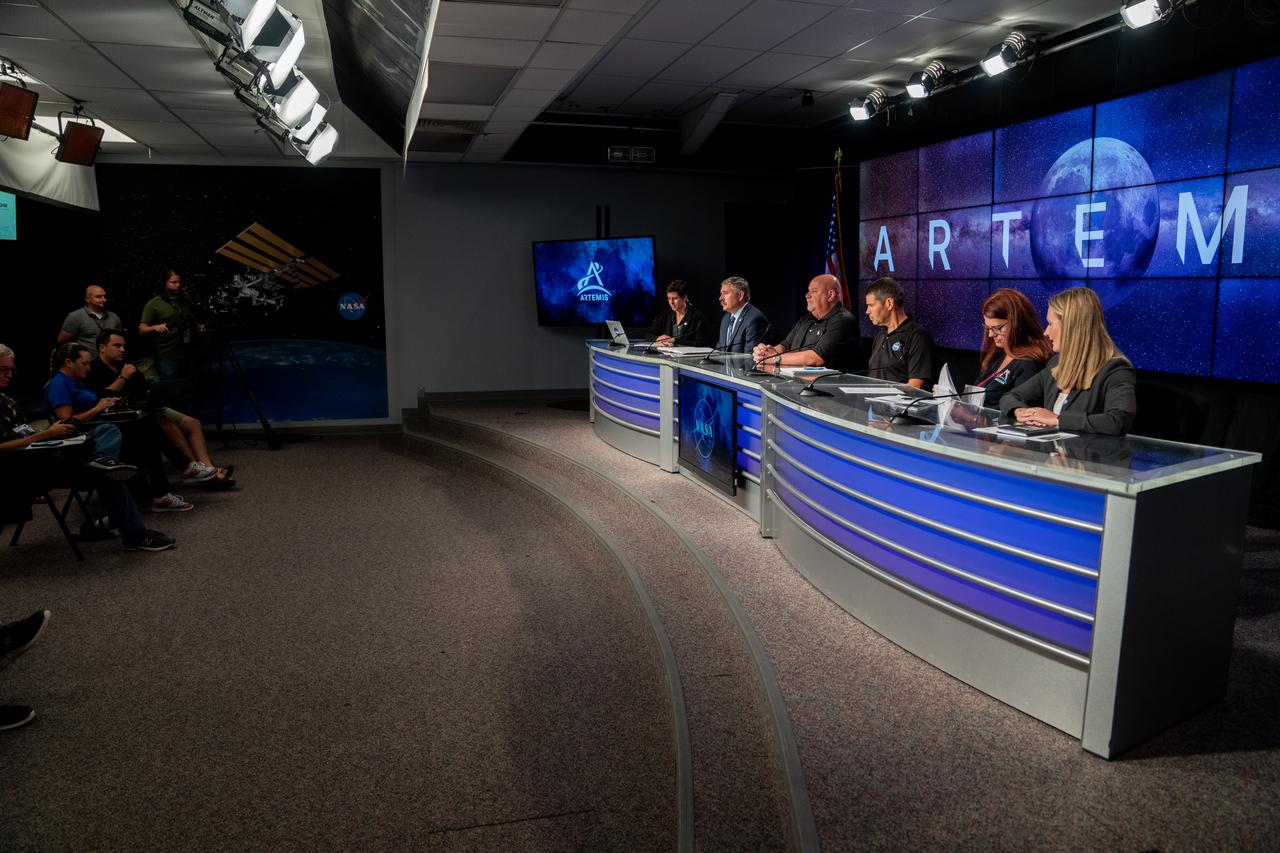
A prelaunch media briefing is held following a mission management team meeting for Artemis I on Sept. 1, 2022, at NASA’s Kennedy Space Center in Florida. Participants are, from left, Rachel Kraft, NASA Communications; Mike Sarafin, Artemis mission manager; John Honeycutt, Space Launch System (SLS) program manager; John Blevins, SLS chief engineer; Charlie Blackwell-Thompson, Artemis launch director; and Melody Lovin, Space Launch Delta 45 weather officer. Artemis I is scheduled to launch at 2:17 p.m. EDT on Sept. 3, from Kennedy’s Launch Complex 39B. Launch was waved off on Aug. 29 due to an issue during tanking. The first in a series of increasingly complex missions, Artemis I will provide a foundation for human deep space exploration and demonstrate NASA’s capability to extend human presence to the Moon and beyond. The primary goal of Artemis I is to thoroughly test the integrated systems before crewed missions by operating the spacecraft in a deep space environment, testing Orion’s heat shield, and recovering the crew module after reentry, descent, and splashdown.
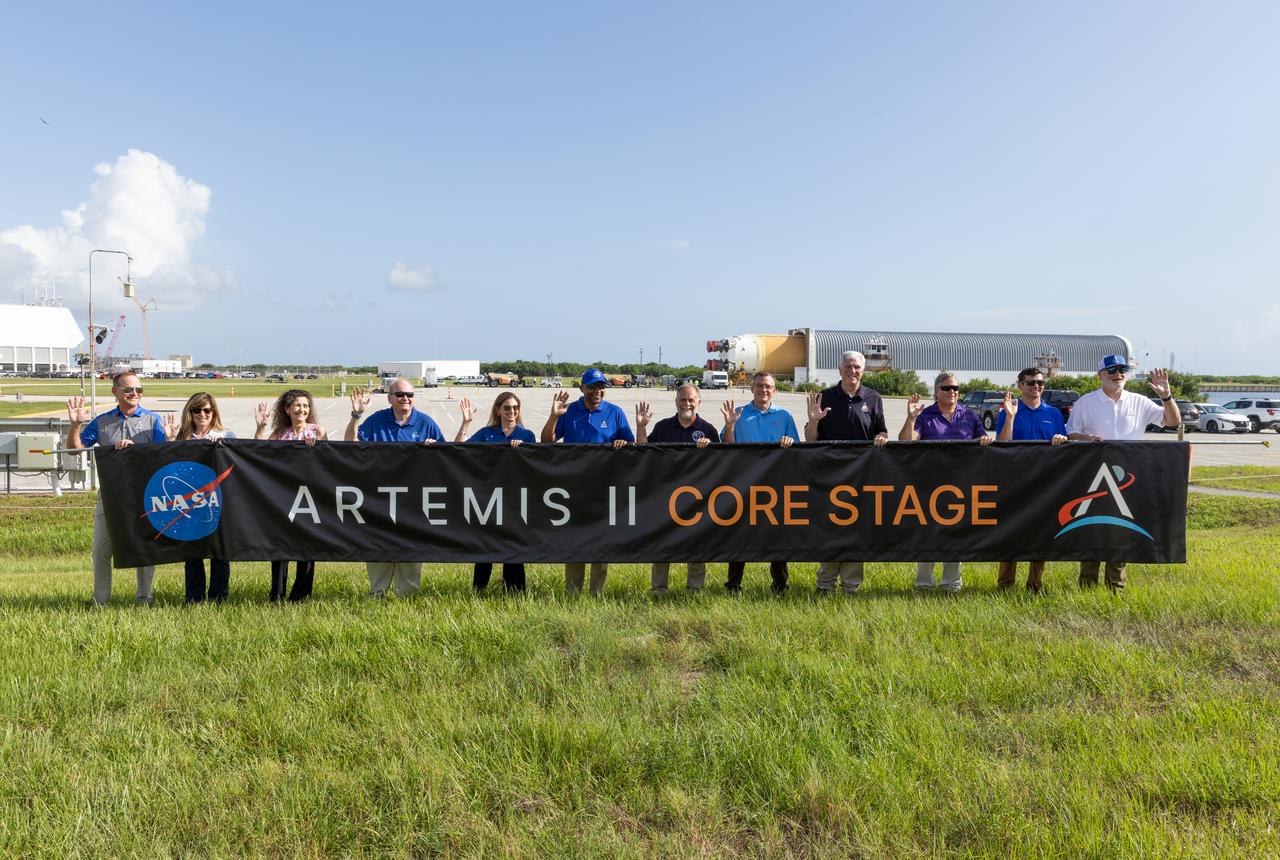
From left, John Ramsey, chief transformation officer for Jacobs; Jennifer Kunz, associate director, technical, NASA’s Kennedy Space Center; Lorna Kenna, vice president and general manager, Jacobs; Burt Summerfield, associate director, management, NASA Kennedy; Catherine Koerner, associate administrator for NASA’s Exploration Systems Development Mission Directorate; Kelvin Manning, deputy director, NASA Kennedy; Shawn Quinn, manager, NASA’s Exploration Ground Systems; Cliff Lanham, senior vehicle operations manager, NASA’s Exploration Ground Systems; Matthew Ramsey, Artemis II mission manager; Paul Hudson, Jacobs senior vehicle engineer; Jay Grow, Boeing’s associate chief engineer for Space Launch System Launch Operations; and Bill Muddle, lead RS-25 field engineer at Aerojet Rocketdyne, hold a banner to celebrate the arrival of the Artemis II SLS (Space Launch System) core stage at NASA’s Kennedy Space Center on Wednesday, July 24, 2024. Journeying from NASA’s Michoud Assembly Facility in New Orleans aboard the Pegasus barge, the core stage arrived at the Florida spaceport on July 23, 2024, to be processed for flight by NASA’s Exploration Ground Systems Program.
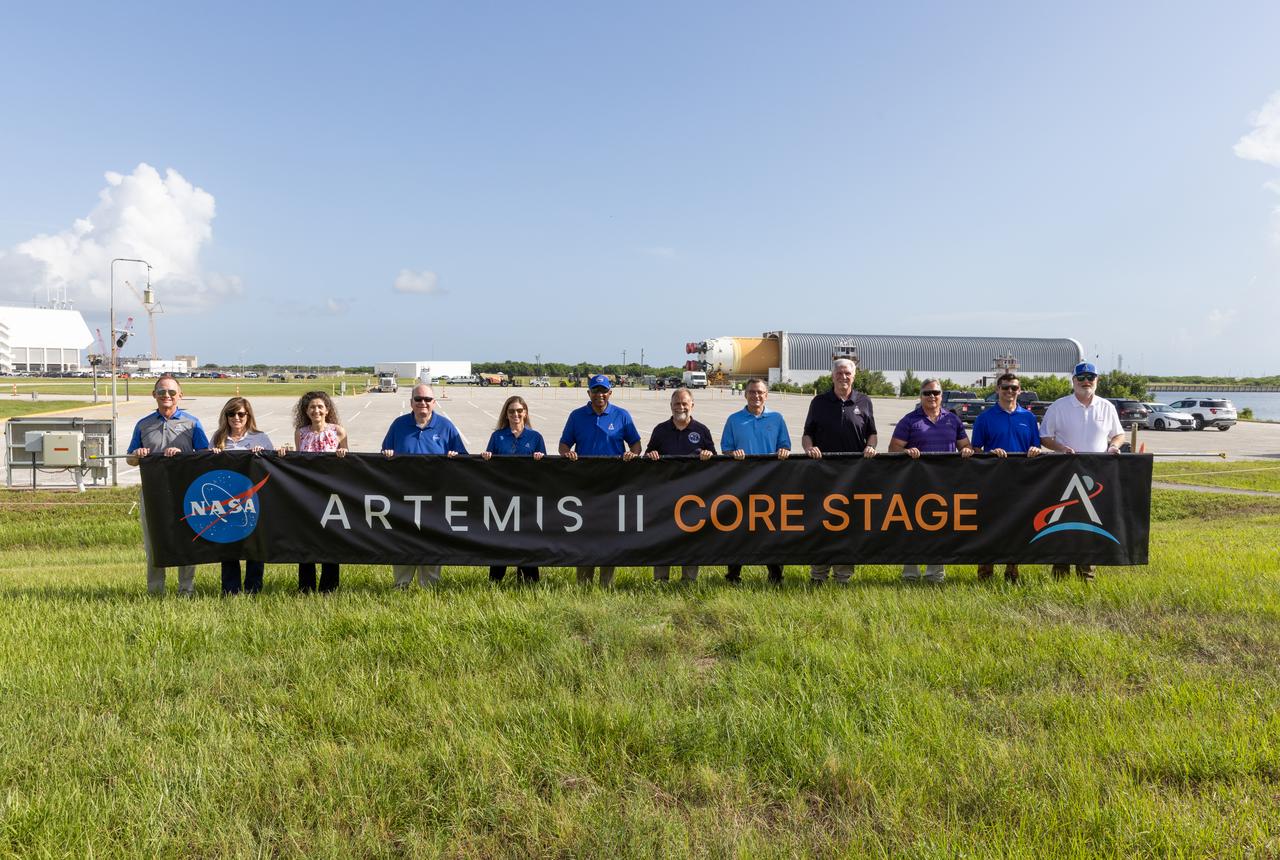
From left, John Ramsey, chief transformation officer for Jacobs; Jennifer Kunz, associate director, technical, NASA’s Kennedy Space Center; Lorna Kenna, vice president and general manager, Jacobs; Burt Summerfield, associate director, management, NASA Kennedy; Catherine Koerner, associate administrator for NASA’s Exploration Systems Development Mission Directorate; Kelvin Manning, deputy director, NASA Kennedy; Shawn Quinn, manager, NASA’s Exploration Ground Systems; Cliff Lanham, senior vehicle operations manager, NASA’s Exploration Ground Systems; Matthew Ramsey, Artemis II mission manager; Paul Hudson, Jacobs senior vehicle engineer; Jay Grow, Boeing’s associate chief engineer for Space Launch System Launch Operations; and Bill Muddle, lead RS-25 field engineer at Aerojet Rocketdyne, hold a banner to celebrate the arrival of the Artemis II SLS (Space Launch System) core stage at NASA’s Kennedy Space Center on Wednesday, July 24, 2024. Journeying from NASA’s Michoud Assembly Facility in New Orleans aboard the Pegasus barge, the core stage arrived at the Florida spaceport on July 23, 2024, to be processed for flight by NASA’s Exploration Ground Systems Program.
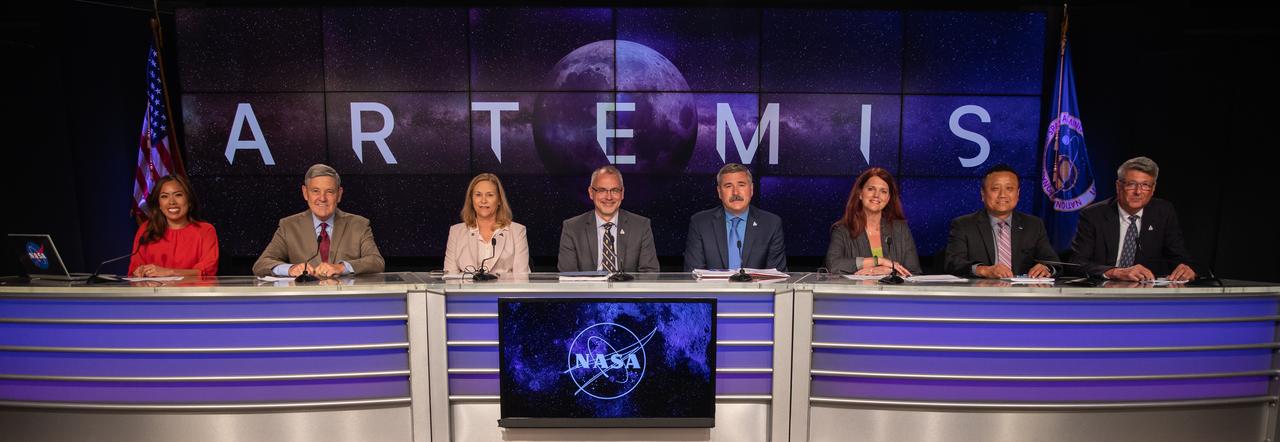
A prelaunch media briefing is held following completion of NASA’s Flight Readiness Review for Artemis I on Aug. 22, 2022, at the agency’s Kennedy Space Center in Florida. Participants are, from left, Megan Cruz, NASA Communications; Bob Cabana, NASA Associate Administrator; Janet Petro, Director, Kennedy Space Center; Jim Free, Associate Administrator, Exploration Systems Development; Mike Sarafin, Mission Manager, Artemis I; Charlie Blackwell-Thompson, Launch Director, Artemis I; Howard Hu, Manager, Orion Program; Chris Cianciola, Deputy Manager, SLS Program. Artemis I is scheduled to launch at 8:33 a.m. EDT on Aug. 29, 2022, from Kennedy’s Launch Complex 39B. The first in a series of increasingly complex missions, Artemis I will provide a foundation for human deep space exploration and demonstrate our commitment and capability to extend human presence to the Moon and beyond. The primary goal of Artemis I is to thoroughly test the integrated systems before crewed missions by operating the spacecraft in a deep space environment, testing Orion’s heat shield, and recovering the crew module after reentry, descent, and splashdown.
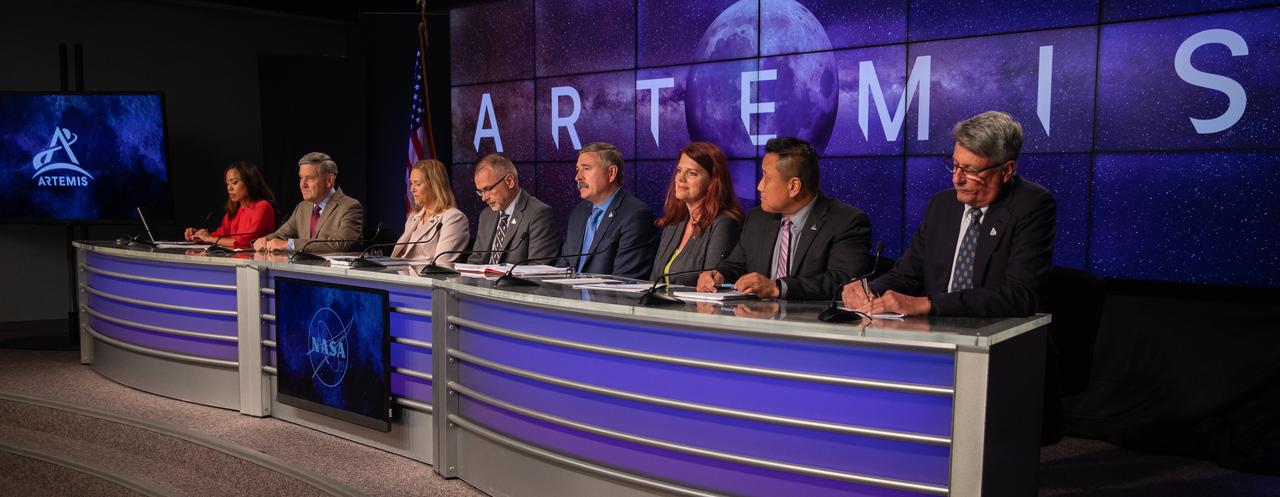
A prelaunch media briefing is held following completion of NASA’s Flight Readiness Review for Artemis I on Aug. 22, 2022, at the agency’s Kennedy Space Center in Florida. Participants are, from left, Megan Cruz, NASA Communications; Bob Cabana, NASA Associate Administrator; Janet Petro, Director, Kennedy Space Center; Jim Free, Associate Administrator, Exploration Systems Development; Mike Sarafin, Mission Manager, Artemis I; Charlie Blackwell-Thompson, Launch Director, Artemis I; Howard Hu, Manager, Orion Program; Chris Cianciola, Deputy Manager, SLS Program. Artemis I is scheduled to launch at 8:33 a.m. EDT on Aug. 29, 2022, from Kennedy’s Launch Complex 39B. The first in a series of increasingly complex missions, Artemis I will provide a foundation for human deep space exploration and demonstrate our commitment and capability to extend human presence to the Moon and beyond. The primary goal of Artemis I is to thoroughly test the integrated systems before crewed missions by operating the spacecraft in a deep space environment, testing Orion’s heat shield, and recovering the crew module after reentry, descent, and splashdown.
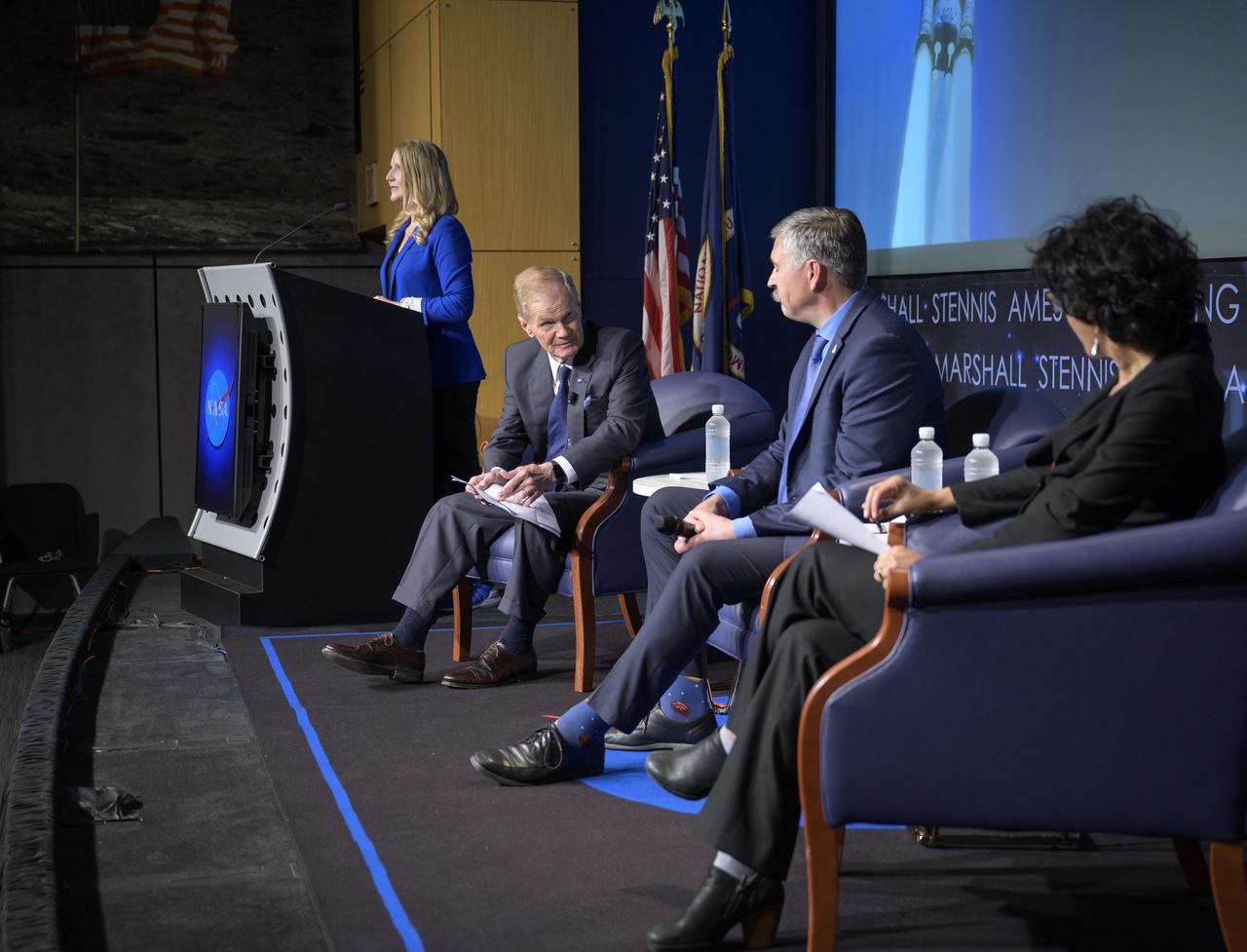
Stephanie Schierholz, a press secretary at NASA Headquarters, left, moderates a NASA briefing on the Artemis I Moon mission, with NASA Administrator Bill Nelson, Mike Sarafin, Artemis I mission manager at NASA Headquarters, and Bhavya Lal, associate administrator for technology, policy, and strategy at NASA Headquarters, right, Wednesday, Aug. 3, 2022, at the Mary W. Jackson NASA Headquarters building in Washington. Also participating remotely were Charlie Blackwell-Thompson, Artemis I launch director at NASA's Kennedy Space Center, John Honeycutt, Space Launch System (SLS) program manager at NASA's Marshall Space Flight Center, and Howard Hu, Orion program manager at NASA's Johnson Space Center. NASA’s Artemis I mission is the first integrated test of the agency’s deep space exploration systems: the Orion spacecraft, Space Launch System rocket, and supporting ground systems. Launch of the uncrewed flight test is targeted for no earlier than Monday, Aug. 29. Photo Credit: (NASA/Bill Ingalls)
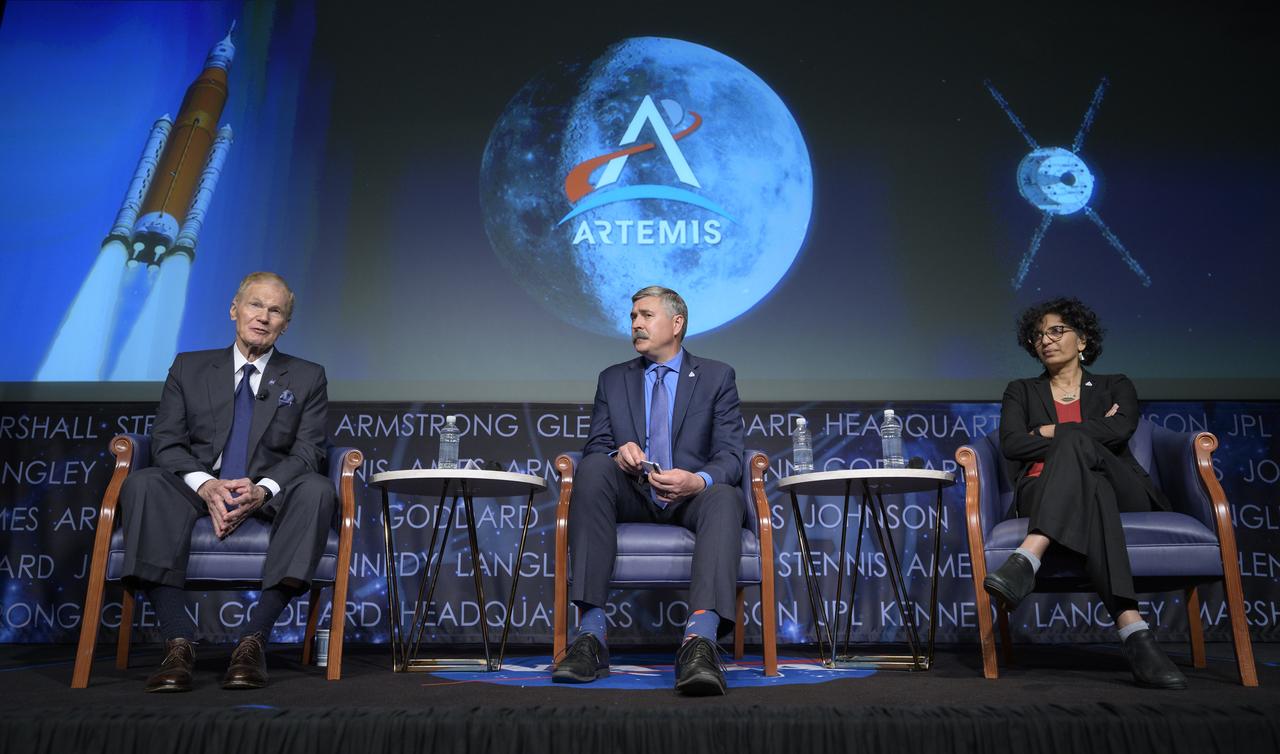
NASA Administrator Bill Nelson, left, Mike Sarafin, Artemis I mission manager at NASA Headquarters, and Bhavya Lal, associate administrator for technology, policy, and strategy at NASA Headquarters, right, are seen during a NASA briefing on the Artemis I Moon mission, Wednesday, Aug. 3, 2022, at the Mary W. Jackson NASA Headquarters building in Washington. Also participating remotely were Charlie Blackwell-Thompson, Artemis I launch director at NASA's Kennedy Space Center, John Honeycutt, Space Launch System (SLS) program manager at NASA's Marshall Space Flight Center, and Howard Hu, Orion program manager at NASA's Johnson Space Center. NASA’s Artemis I mission is the first integrated test of the agency’s deep space exploration systems: the Orion spacecraft, Space Launch System rocket, and supporting ground systems. Launch of the uncrewed flight test is targeted for no earlier than Monday, Aug. 29. Photo Credit: (NASA/Bill Ingalls)
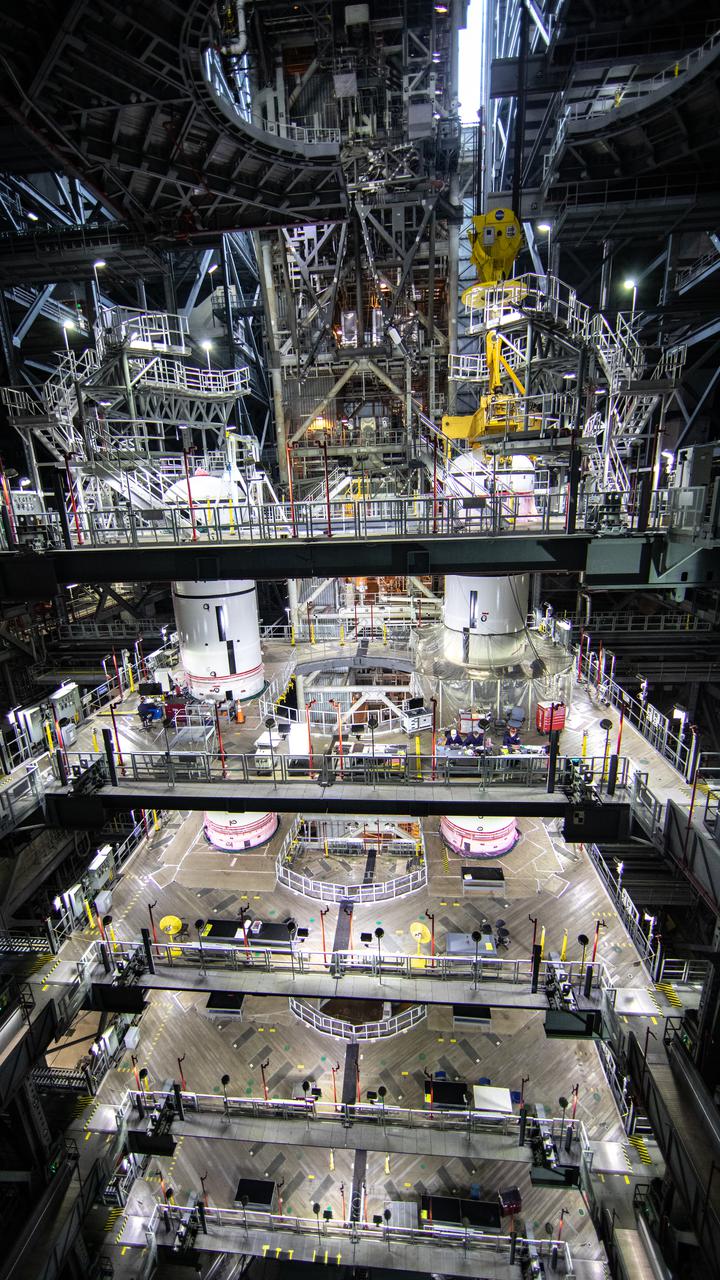
Inside High Bay 3 of the Vehicle Assembly Building at NASA’s Kennedy Space Center in Florida, a crane lowers the right-hand forward segment onto the center forward segment on Feb. 23, 2021. Workers with Exploration Ground Systems and contractor Jacobs are completing the stacking of the twin solid rocket boosters on the mobile launcher for NASA’s Space Launch System (SLS). In view at left is the left-hand solid rocket booster. When the core stage arrives, it will join the boosters on the mobile launcher, followed by the interim cryogenic propulsion stage and Orion spacecraft. Manufactured by Northrop Grumman in Utah, the twin boosters provide more than 75 percent of the total SLS thrust at launch. The SLS is managed by Marshall Space Flight Center in Huntsville, Alabama. Under the Artemis program, NASA will land the first woman and the next man on the Moon by 2024. The first in a series of increasingly complex missions, Artemis I will test the Orion spacecraft and SLS as an integrated system ahead of crewed flights to the Moon.
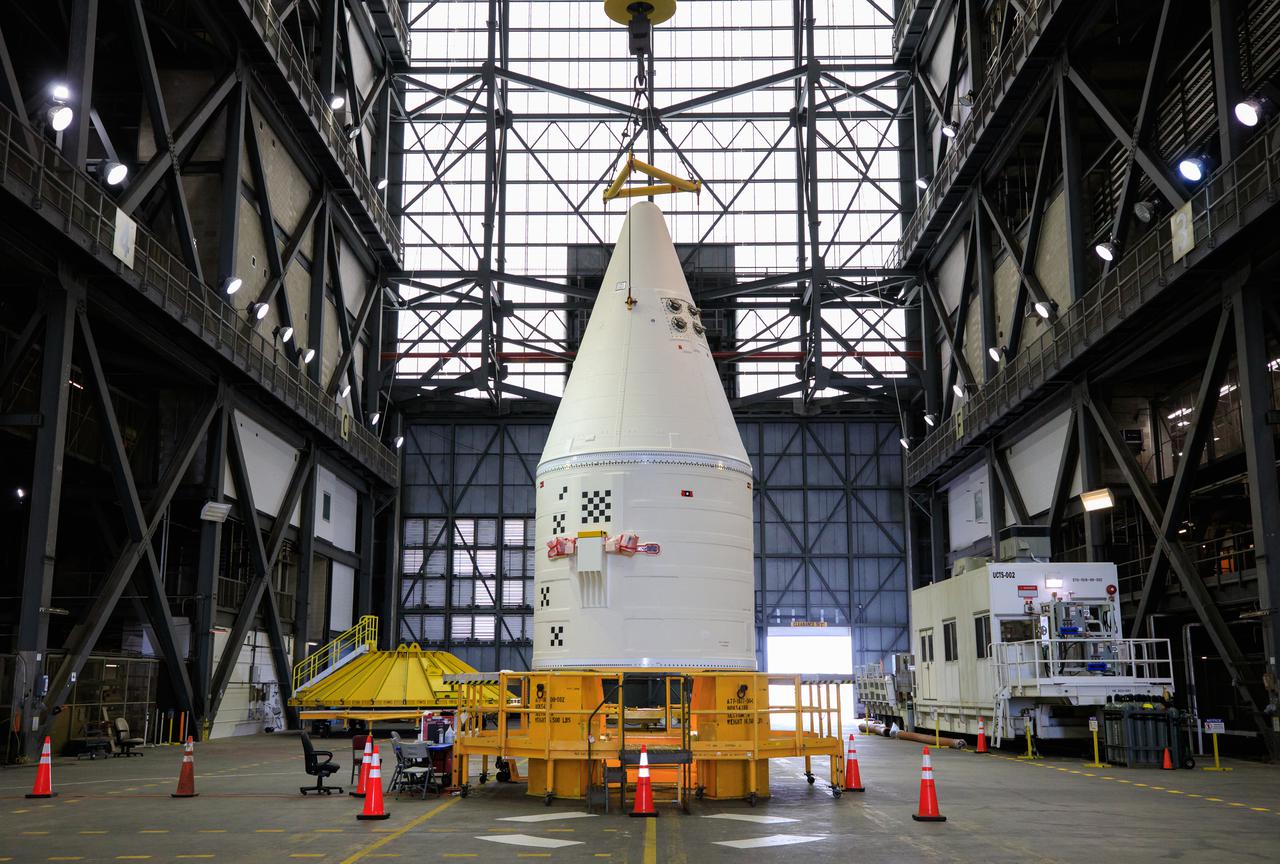
In the transfer aisle of the Vehicle Assembly Building at NASA’s Kennedy Space Center in Florida, workers use a crane to lift the right-hand forward assembly up for transfer into High Bay 3 for the Space Launch System (SLS) on March 2, 2021. The forward assembly will be attached to the center forward segment on the mobile launcher (ML). Workers with Exploration Ground Systems and contractor Jacobs teams are stacking the twin five-segment boosters on the ML over a number of weeks. When the core stage arrives, it will join the boosters on the mobile launcher, followed by the interim cryogenic propulsion stage and Orion spacecraft. Manufactured by Northrop Grumman in Utah, the twin boosters provide more than 75 percent of the total SLS thrust at launch. Marshall Space Flight Center in Huntsville, Alabama, manages the SLS. Under the Artemis program, NASA will land the first woman and the next man on the Moon. The first in a series of increasingly complex missions, Artemis I will test the Orion spacecraft and SLS as an integrated system ahead of crewed flights to the Moon.

In High Bay 3 of the Vehicle Assembly Building at NASA’s Kennedy Space Center in Florida, the left-hand center booster segment for Artemis I is lowered onto the aft booster segment on the mobile launcher for the Space Launch System (SLS) on Jan. 7, 2021. Workers with Exploration Ground Systems and contractor Jacobs teams will stack the twin five-segment boosters on the mobile launcher in High Bay 3 over a number of weeks. When the core stage arrives, it will join the boosters on the mobile launcher, followed by the interim cryogenic propulsion stage and Orion spacecraft. Manufactured by Northrop Grumman in Utah, the twin boosters provide more than 75 percent of the total SLS thrust at launch. The SLS is managed by Marshall Space Flight Center in Huntsville, Alabama. Under the Artemis program, NASA will land the first woman and the next man on the Moon by 2024. The first in a series of increasingly complex missions, Artemis I will test the Orion spacecraft and SLS as an integrated system ahead of crewed flights to the Moon.
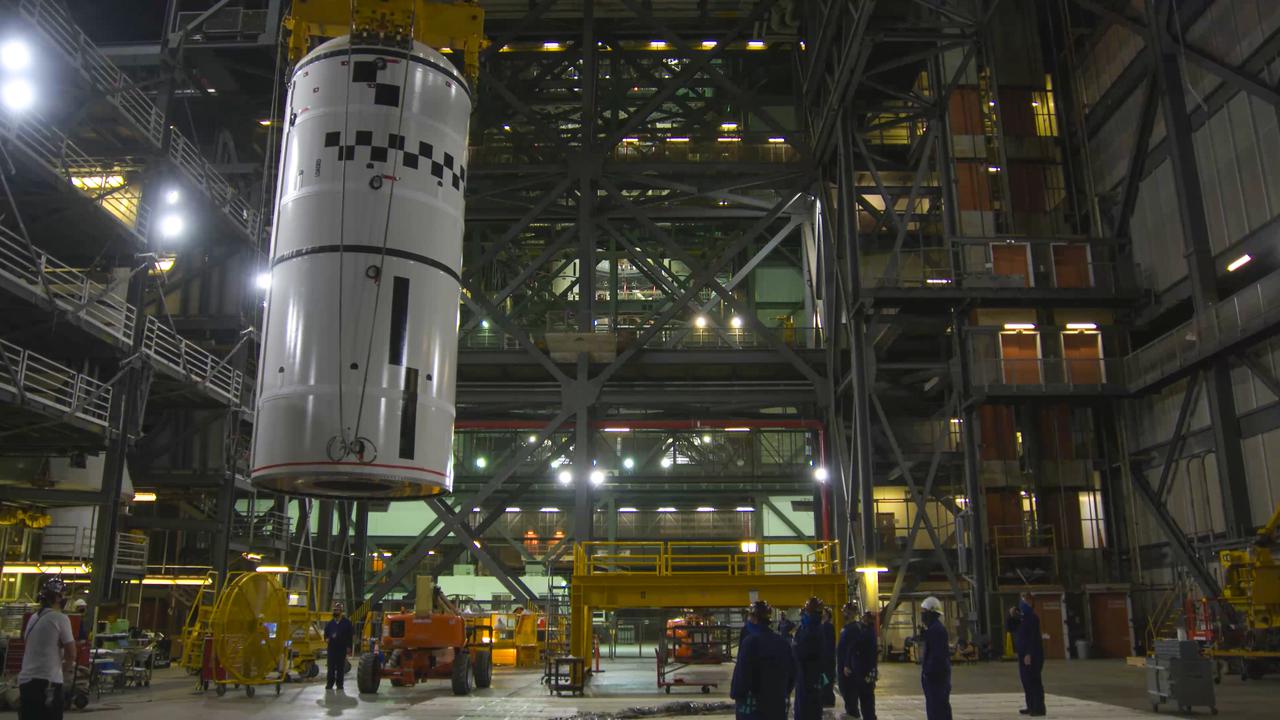
Workers use a crane to lift the left-hand forward segment up for transfer into High Bay 3 of the Vehicle Assembly Building for NASA’s Space Launch System (SLS) in the transfer aisle of the Vehicle Assembly Building at NASA’s Kennedy Space Center in Florida on Feb. 18, 2021. The forward segment will be attached to the center forward segment on the mobile launcher. Workers with Exploration Ground Systems and contractor Jacobs teams are stacking the twin five-segment boosters on the ML over a number of weeks. When the core stage arrives, it will join the boosters on the mobile launcher, followed by the interim cryogenic propulsion stage and Orion spacecraft. Manufactured by Northrop Grumman in Utah, the twin boosters provide more than 75 percent of the total SLS thrust at launch. The SLS is managed by Marshall Space Flight Center in Huntsville, Alabama. Under the Artemis program, NASA will land the first woman and the next man on the Moon by 2024. The first in a series of increasingly complex missions, Artemis I will test the Orion spacecraft and SLS as an integrated system ahead of crewed flights to the Moon.

In High Bay 3 of the Vehicle Assembly Building at NASA’s Kennedy Space Center in Florida, the left-hand and right-hand forward segments are secured on top of the center forward segments on the mobile launcher (ML) for the Space Launch System (SLS) on Feb. 24, 2021. Workers with Exploration Ground Systems and contractor Jacobs teams are stacking the twin five-segment boosters on the ML over a number of weeks. When the core stage arrives, it will join the boosters on the mobile launcher, followed by the interim cryogenic propulsion stage and Orion spacecraft. Manufactured by Northrop Grumman in Utah, the twin boosters provide more than 75 percent of the total SLS thrust at launch. The SLS is managed by Marshall Space Flight Center in Huntsville, Alabama. Under the Artemis program, NASA will land the first woman and the next man on the Moon by 2024. The first in a series of increasingly complex missions, Artemis I will test the Orion spacecraft and SLS as an integrated system ahead of crewed flights to the Moon.
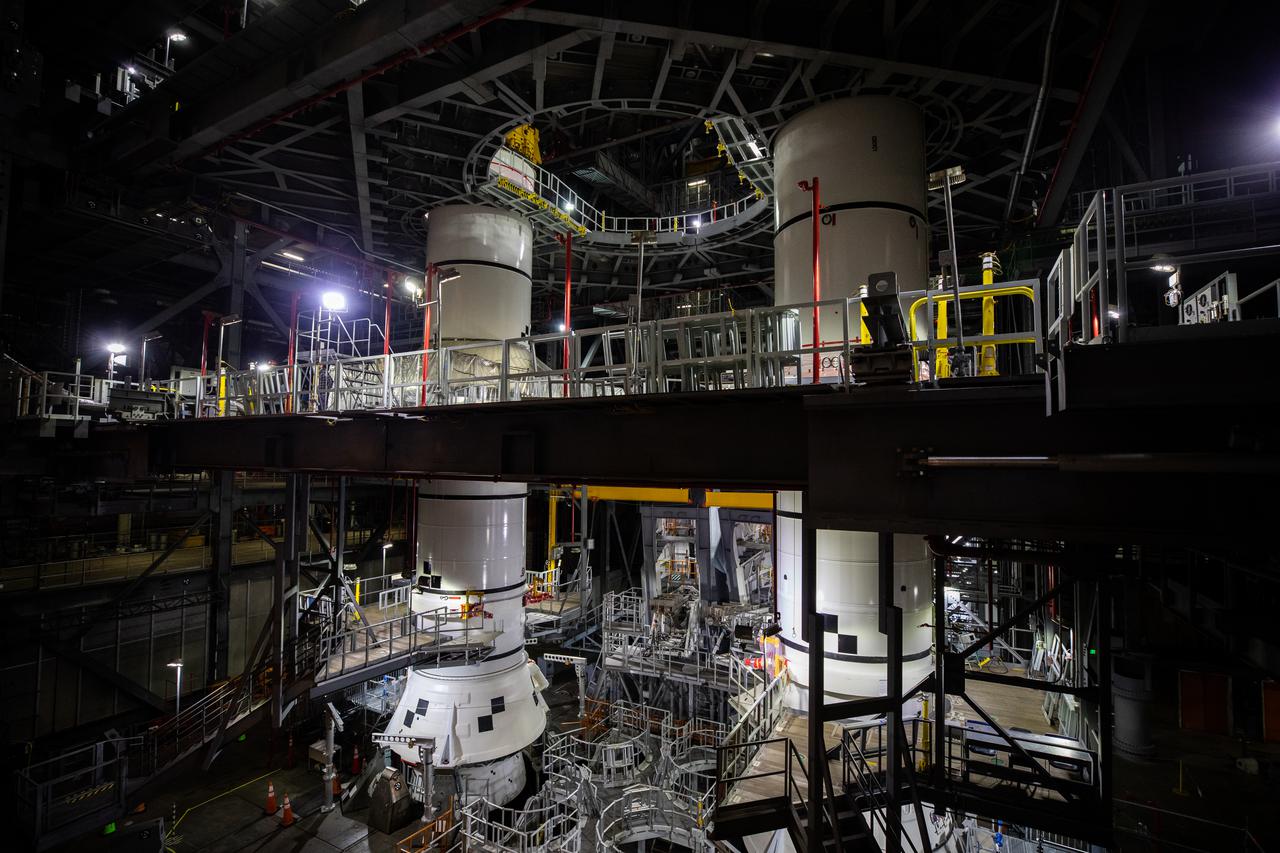
In High Bay 3 of the Vehicle Assembly Building at NASA’s Kennedy Space Center in Florida, the right-hand and left-hand center aft booster segments for Artemis I have been stacked onto the left and right aft booster segments on the mobile launcher for the Space Launch System (SLS) on Jan. 12, 2021. Workers with Exploration Ground Systems and contractor Jacobs teams will stack the twin five-segment boosters on the mobile launcher in High Bay 3 over a number of weeks. When the core stage arrives, it will join the boosters on the mobile launcher, followed by the interim cryogenic propulsion stage and Orion spacecraft. Manufactured by Northrop Grumman in Utah, the twin boosters provide more than 75 percent of the total SLS thrust at launch. The SLS is managed by Marshall Space Flight Center in Huntsville, Alabama. Under the Artemis program, NASA will land the first woman and the next man on the Moon by 2024. The first in a series of increasingly complex missions, Artemis I will test the Orion spacecraft and SLS as an integrated system ahead of crewed flights to the Moon.
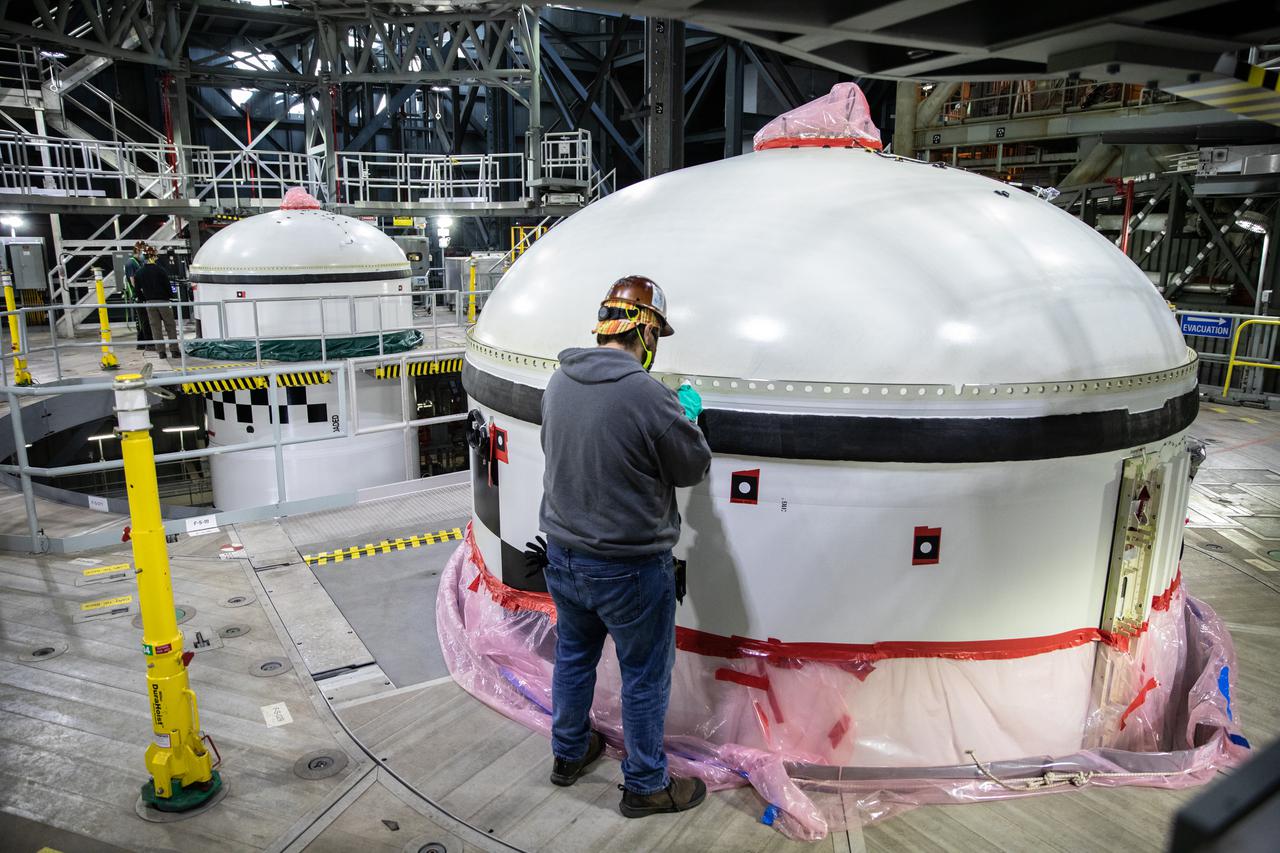
In High Bay 3 of the Vehicle Assembly Building at NASA’s Kennedy Space Center in Florida, a worker checks the right-hand forward segment on the center forward segment of the booster for Artemis I. The forward segments were lowered onto the twin solid rocket boosters on the mobile launcher (ML) for the Space Launch System (SLS) on Feb. 24, 2021. Workers with Exploration Ground Systems and contractor Jacobs teams are completing the stacking of the boosters. When the core stage arrives, it will join the boosters on the ML, followed by the interim cryogenic propulsion stage and Orion spacecraft. Manufactured by Northrop Grumman in Utah, the twin boosters provide more than 75 percent of the total SLS thrust at launch. The SLS is managed by Marshall Space Flight Center in Huntsville, Alabama. Under the Artemis program, NASA will land the first woman and the next man on the Moon by 2024. The first in a series of increasingly complex missions, Artemis I will test the Orion spacecraft and SLS as an integrated system ahead of crewed flights to the Moon.
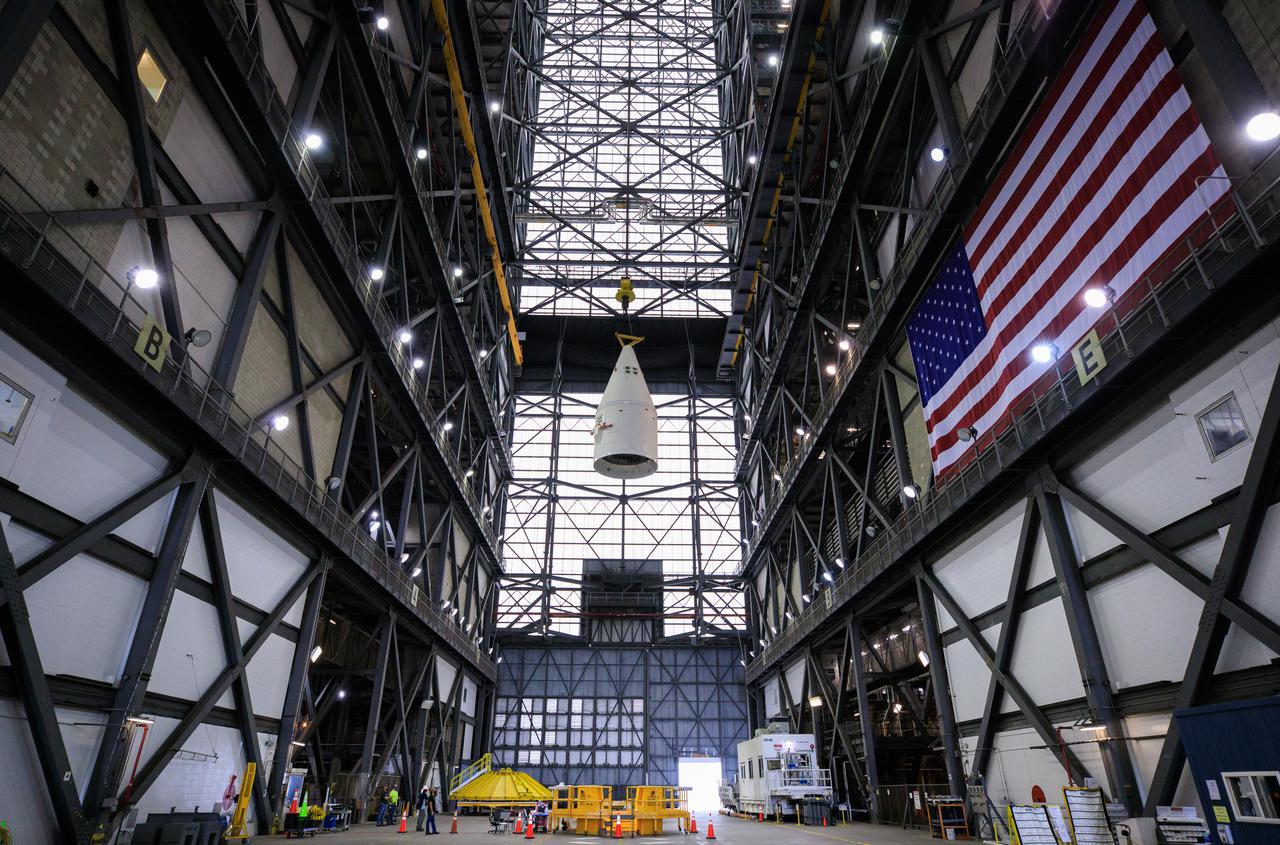
In the transfer aisle of the Vehicle Assembly Building at NASA’s Kennedy Space Center in Florida, workers use a crane to lift the right-hand forward assembly for the Space Launch System (SLS) high up for transfer into High Bay 3 on March 2, 2021. The forward assembly will be attached to the center forward segment on the mobile launcher (ML). Workers with Exploration Ground Systems and contractor Jacobs teams are stacking the twin five-segment boosters on the ML over a number of weeks. When the core stage arrives, it will join the boosters on the mobile launcher, followed by the interim cryogenic propulsion stage and Orion spacecraft. Manufactured by Northrop Grumman in Utah, the twin boosters provide more than 75 percent of the total SLS thrust at launch. Marshall Space Flight Center in Huntsville, Alabama, manages the SLS. Under the Artemis program, NASA will land the first woman and the next man on the Moon. The first in a series of increasingly complex missions, Artemis I will test the Orion spacecraft and SLS as an integrated system ahead of crewed flights to the Moon.
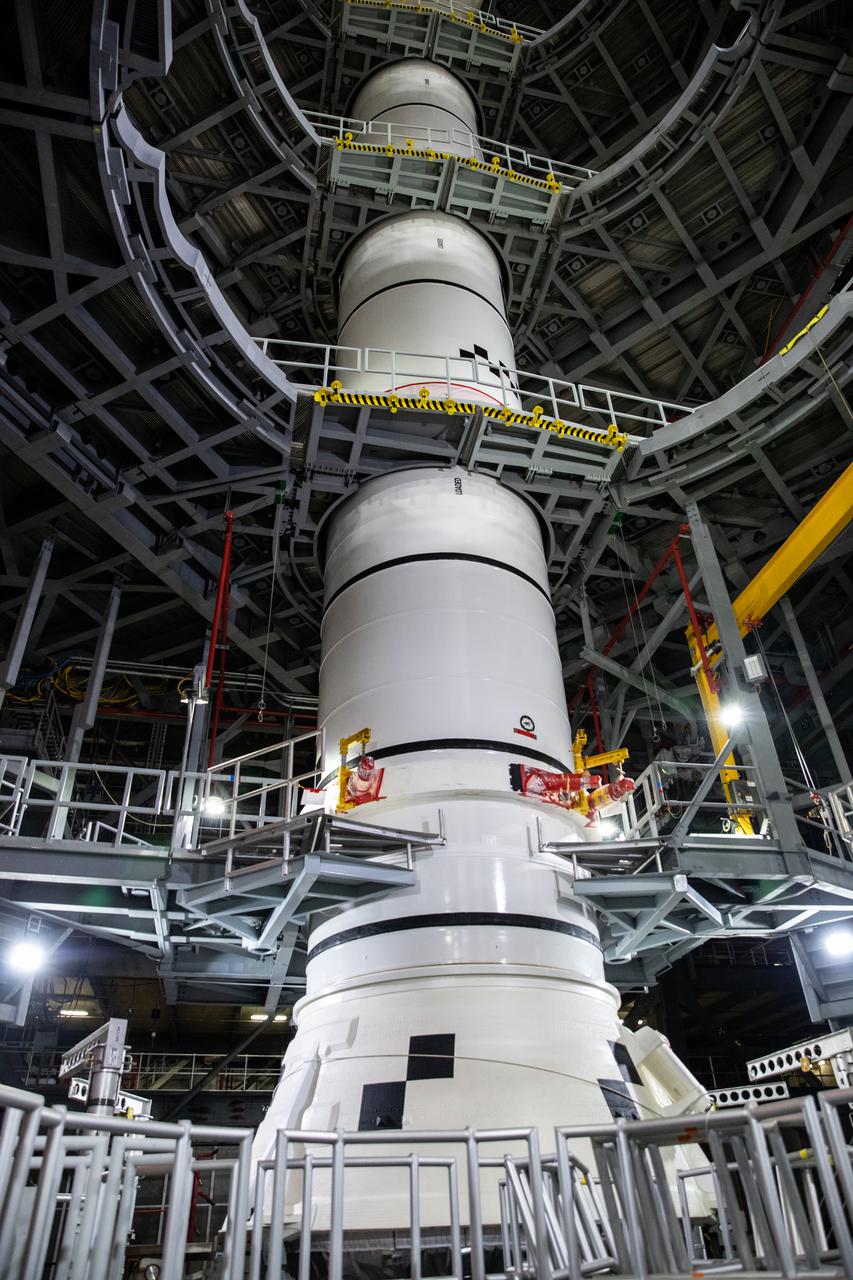
In High Bay 3 of the Vehicle Assembly Building at NASA’s Kennedy Space Center in Florida, the right-hand center center booster segment for Artemis I is lowered onto the center aft booster segment on the mobile launcher for the Space Launch System (SLS) on Jan. 26, 2021. Workers with Exploration Ground Systems and contractor Jacobs teams will stack the twin five-segment boosters on the mobile launcher in High Bay 3 over a number of weeks. When the core stage arrives, it will join the boosters on the mobile launcher, followed by the interim cryogenic propulsion stage and Orion spacecraft. Manufactured by Northrop Grumman in Utah, the twin boosters provide more than 75 percent of the total SLS thrust at launch. The SLS is managed by Marshall Space Flight Center in Huntsville, Alabama. Under the Artemis program, NASA will land the first woman and the next man on the Moon by 2024. The first in a series of increasingly complex missions, Artemis I will test the Orion spacecraft and SLS as an integrated system ahead of crewed flights to the Moon.
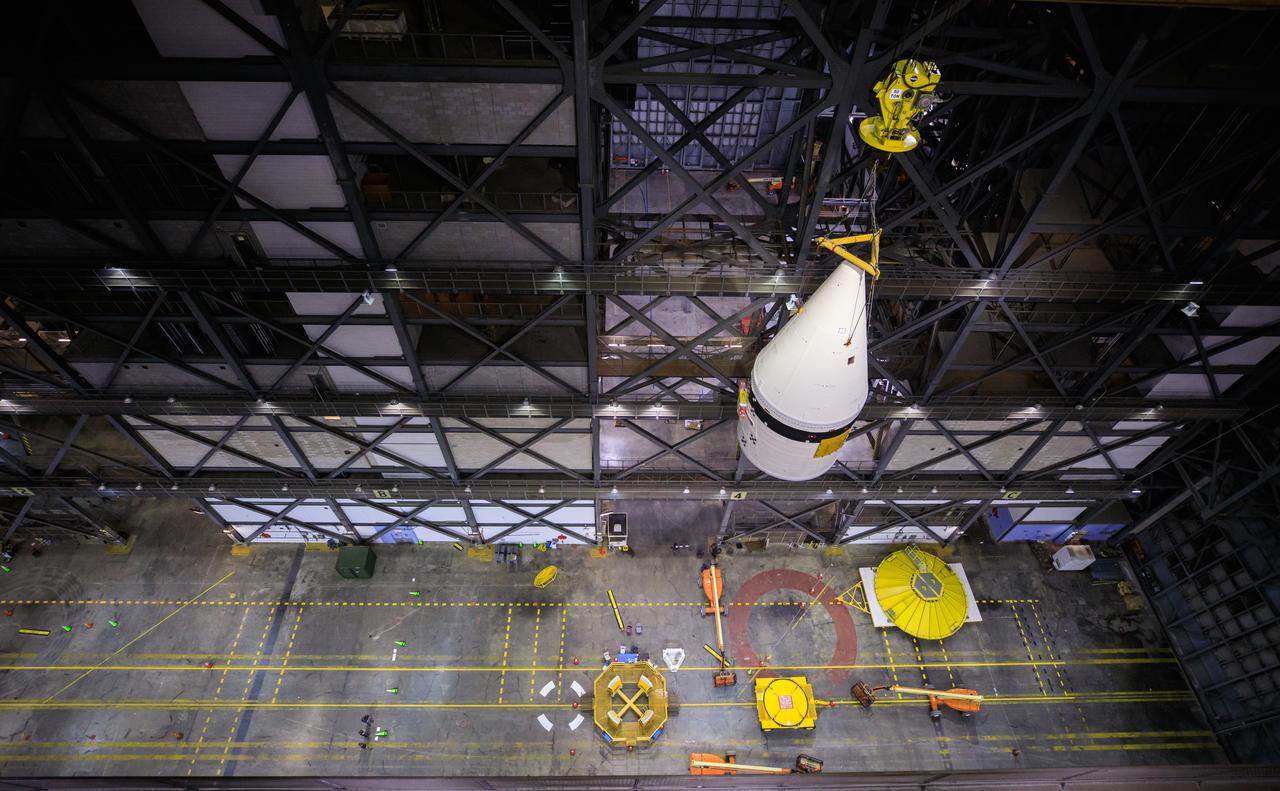
This view from high up in the Vehicle Assembly Building at NASA Kennedy Space Center in Florida, shows a crane lifting the left-hand forward assembly for NASA’s Space Launch System (SLS) in the transfer aisle on March 1, 2021. Workers are lifting the segment up for transfer into High Bay 3, where it will be attached to the center forward segment on the mobile launcher (ML). Exploration Ground Systems and contractor Jacobs teams have been stacking the twin five-segment boosters on the ML over a number of weeks. When the core stage arrives, it will join the boosters on the mobile launcher, followed by the interim cryogenic propulsion stage and Orion spacecraft. Manufactured by Northrop Grumman in Utah, the twin boosters provide more than 75 percent of the total SLS thrust at launch. Marshall Space Flight Center in Huntsville, Alabama, manages the SLS. Under the Artemis program, NASA will land the first woman and the next man on the Moon. The first in a series of increasingly complex missions, Artemis I will test the Orion spacecraft and SLS as an integrated system ahead of crewed flights to the Moon.
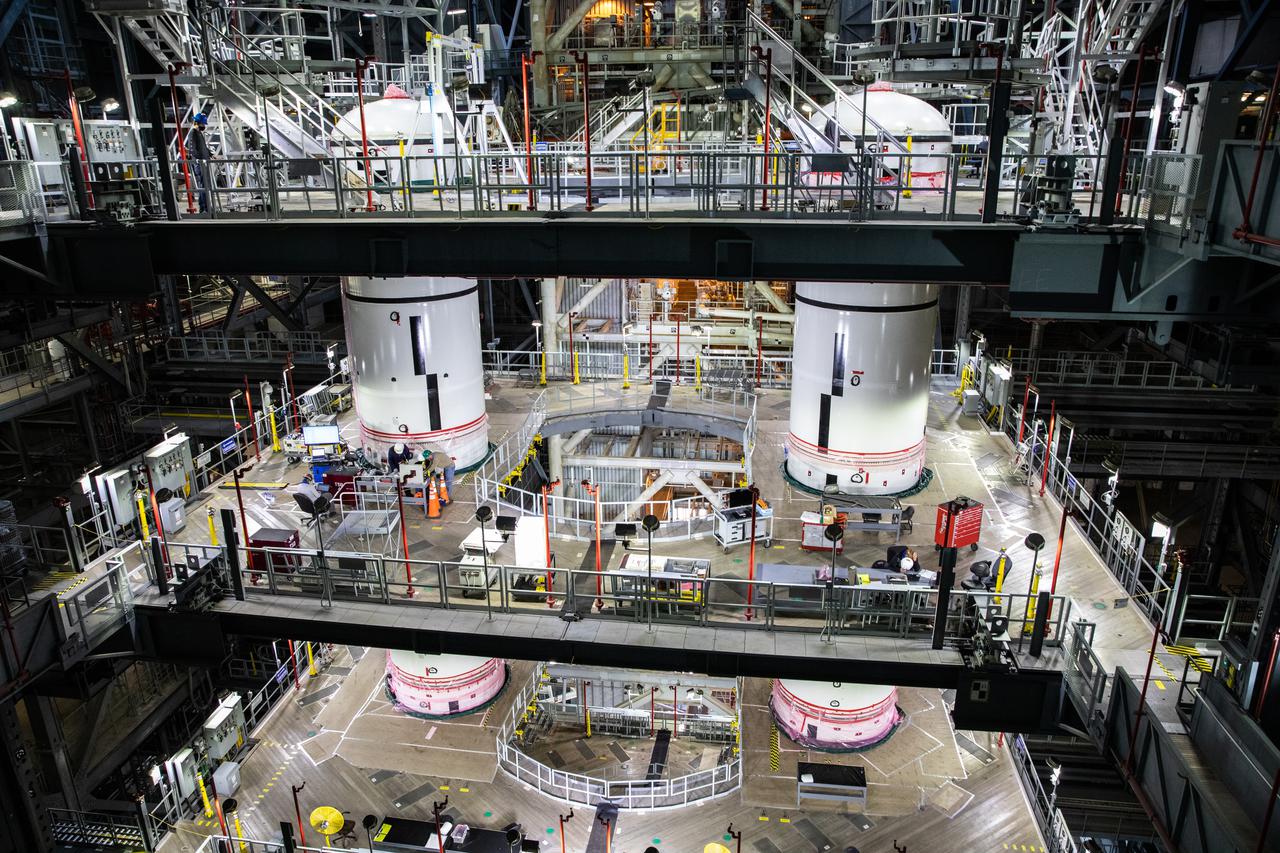
In High Bay 3 of the Vehicle Assembly Building at NASA’s Kennedy Space Center in Florida, the left-hand and right-hand forward segments are secured on top of the center forward segments on the mobile launcher (ML) for the Space Launch System (SLS) on Feb. 24, 2021. Workers with Exploration Ground Systems and contractor Jacobs teams are stacking the twin five-segment boosters on the ML over a number of weeks. When the core stage arrives, it will join the boosters on the mobile launcher, followed by the interim cryogenic propulsion stage and Orion spacecraft. Manufactured by Northrop Grumman in Utah, the twin boosters provide more than 75 percent of the total SLS thrust at launch. The SLS is managed by Marshall Space Flight Center in Huntsville, Alabama. Under the Artemis program, NASA will land the first woman and the next man on the Moon by 2024. The first in a series of increasingly complex missions, Artemis I will test the Orion spacecraft and SLS as an integrated system ahead of crewed flights to the Moon.
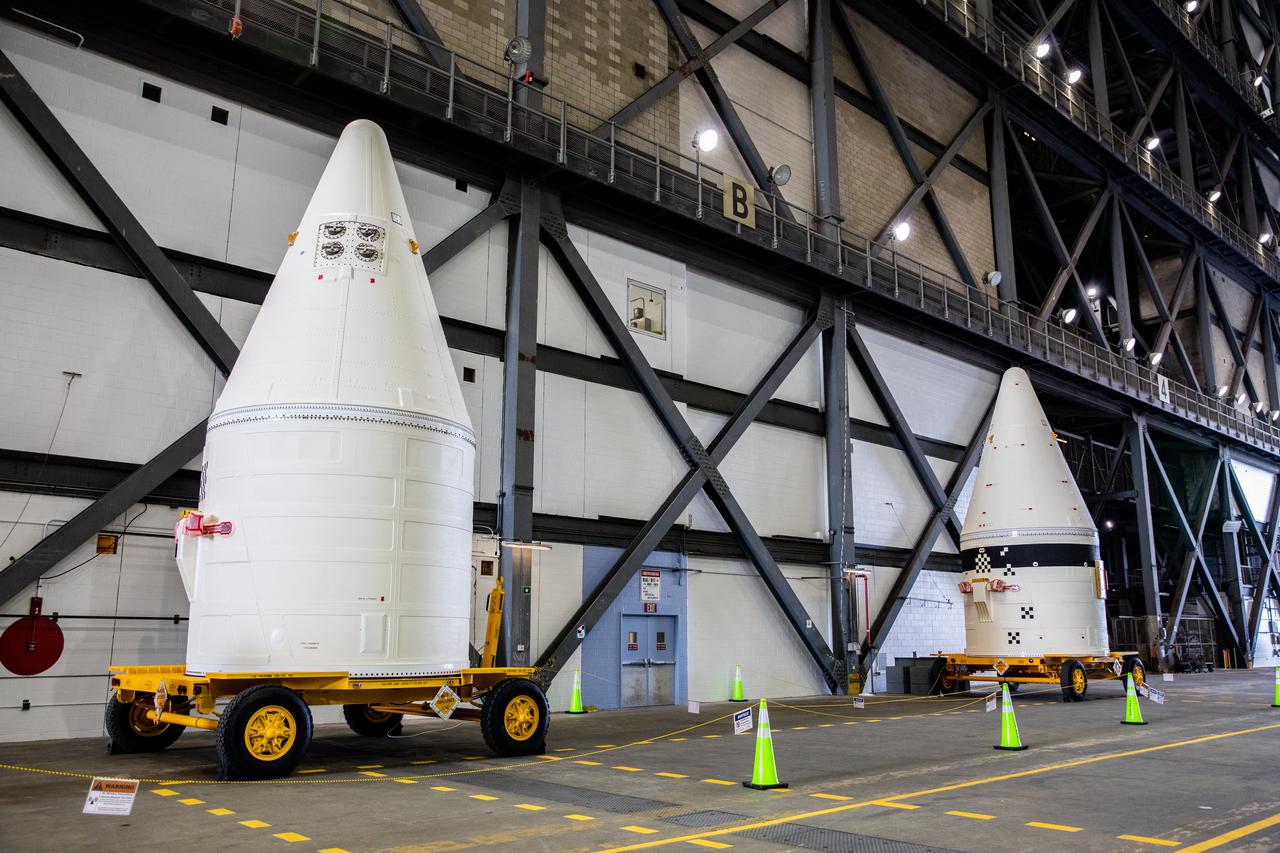
The right-hand and left-hand forward assembly exit cones for the Artemis I Space Launch System (SLS) are in the transfer aisle of the Vehicle Assembly Building at NASA’s Kennedy Space Center in Florida on Jan. 21, 2021. The exit cones will be transferred to High Bay 3 for stacking on the twin boosters on the mobile launcher. Workers with Exploration Ground Systems and contractor Jacobs teams will stack the twin five-segment boosters on the mobile launcher in High Bay 3 over a number of weeks. When the core stage arrives, it will join the boosters on the mobile launcher, followed by the interim cryogenic propulsion stage and Orion spacecraft. Manufactured by Northrop Grumman in Utah, the twin boosters provide more than 75 percent of the total SLS thrust at launch. The SLS is managed by Marshall Space Flight Center in Huntsville, Alabama. Under the Artemis program, NASA will land the first woman and the next man on the Moon by 2024. The first in a series of increasingly complex missions, Artemis I will test the Orion spacecraft and SLS as an integrated system ahead of crewed flights to the Moon.
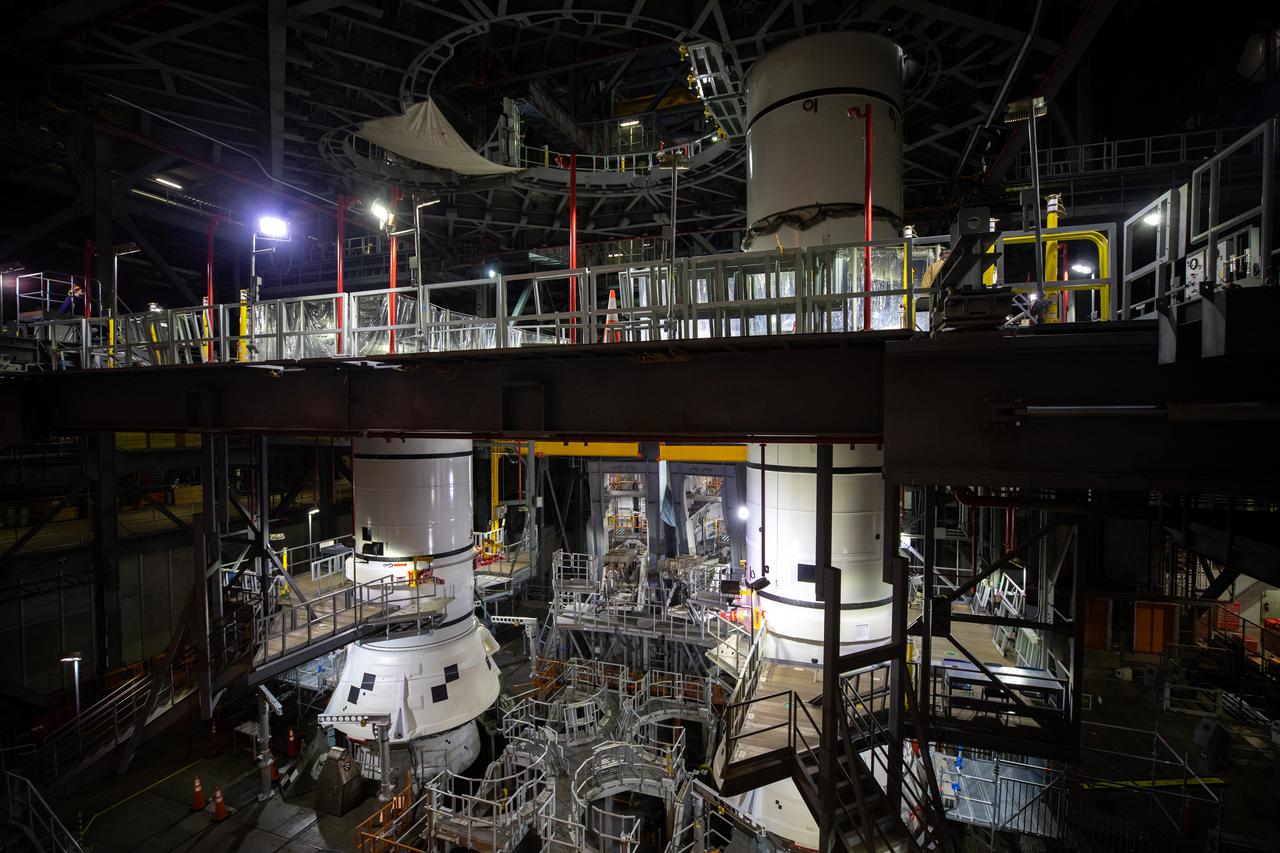
In High Bay 3 of the Vehicle Assembly Building at NASA’s Kennedy Space Center in Florida, the left-hand center booster segment for Artemis I is lowered onto the aft booster segment on the mobile launcher for the Space Launch System (SLS) on Jan. 7, 2021. Workers with Exploration Ground Systems and contractor Jacobs teams will stack the twin five-segment boosters on the mobile launcher in High Bay 3 over a number of weeks. When the core stage arrives, it will join the boosters on the mobile launcher, followed by the interim cryogenic propulsion stage and Orion spacecraft. Manufactured by Northrop Grumman in Utah, the twin boosters provide more than 75 percent of the total SLS thrust at launch. The SLS is managed by Marshall Space Flight Center in Huntsville, Alabama. Under the Artemis program, NASA will land the first woman and the next man on the Moon by 2024. The first in a series of increasingly complex missions, Artemis I will test the Orion spacecraft and SLS as an integrated system ahead of crewed flights to the Moon.
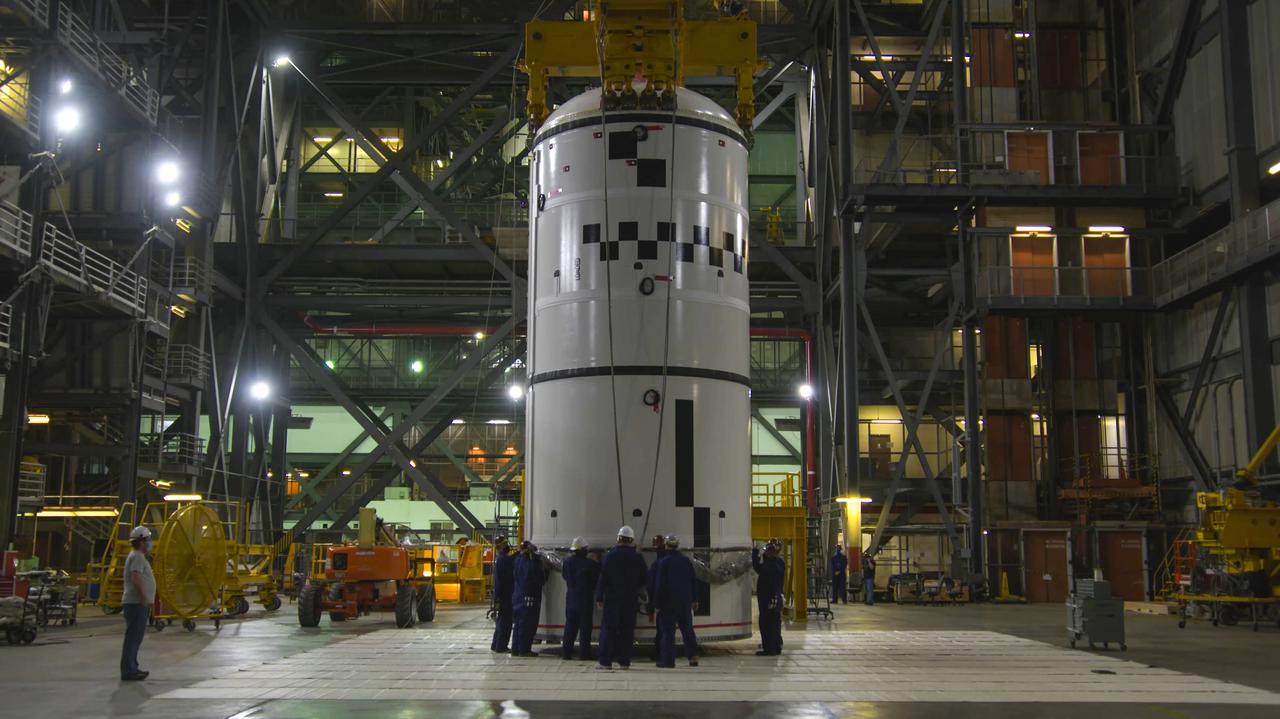
The left-hand forward segment for NASA’s Space Launch System (SLS) is in the transfer aisle of the Vehicle Assembly Building at NASA’s Kennedy Space Center in Florida on Feb. 18, 2021. Workers will use a crane to lift the segment up and transfer it into High Bay 3, where it will be attached to the center forward segment on the mobile launcher. Workers with Exploration Ground Systems and contractor Jacobs teams are stacking the twin five-segment boosters on the ML over a number of weeks. When the core stage arrives, it will join the boosters on the mobile launcher, followed by the interim cryogenic propulsion stage and Orion spacecraft. Manufactured by Northrop Grumman in Utah, the twin boosters provide more than 75 percent of the total SLS thrust at launch. The SLS is managed by Marshall Space Flight Center in Huntsville, Alabama. Under the Artemis program, NASA will land the first woman and the next man on the Moon by 2024. The first in a series of increasingly complex missions, Artemis I will test the Orion spacecraft and SLS as an integrated system ahead of crewed flights to the Moon.
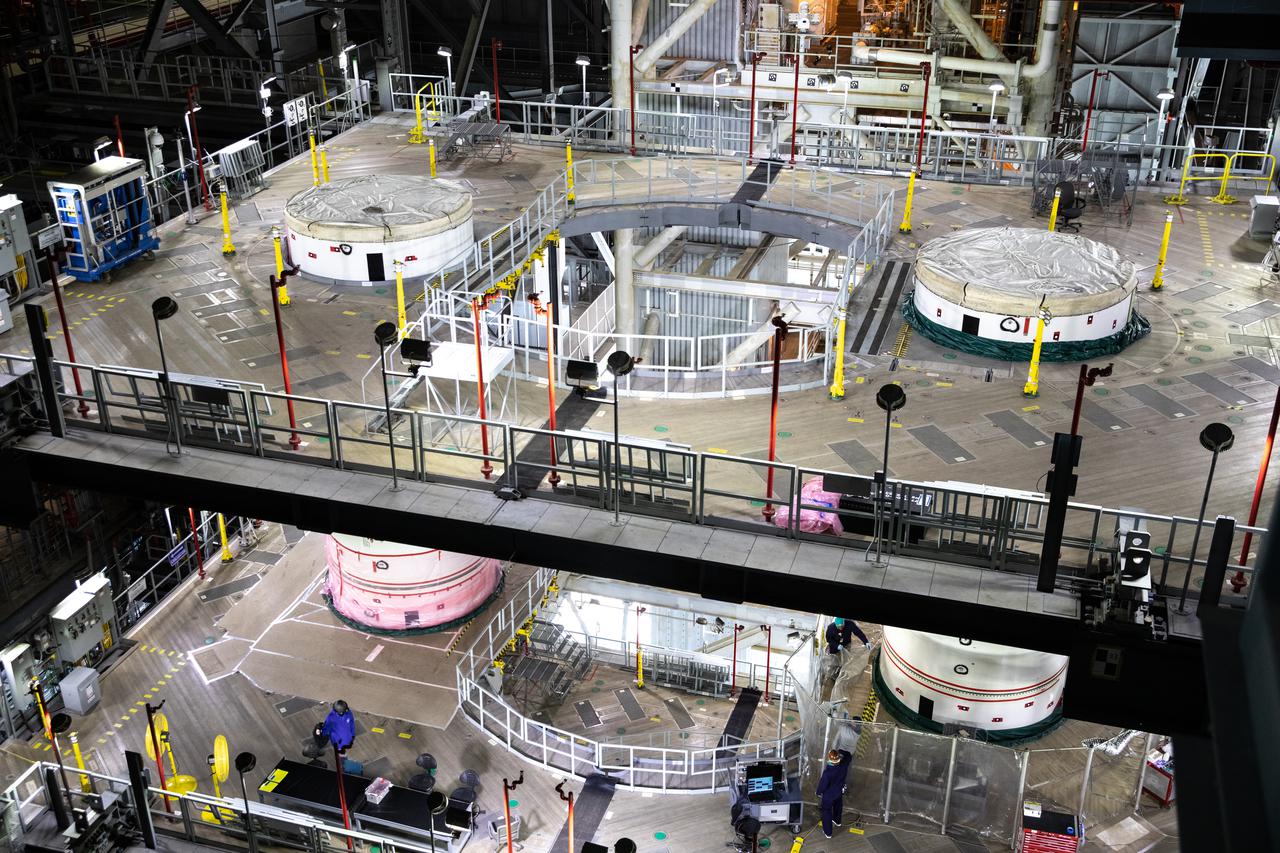
In High Bay 3 of the Vehicle Assembly Building at NASA’s Kennedy Space Center in Florida, the right-hand forward center booster segment for Artemis I is lowered onto the center center booster segment on the mobile launcher for the Space Launch System (SLS) on Feb. 4, 2021. Workers with Exploration Ground Systems and contractor Jacobs teams will stack the twin five-segment boosters on the mobile launcher in High Bay 3 over a number of weeks. When the core stage arrives, it will join the boosters on the mobile launcher, followed by the interim cryogenic propulsion stage and Orion spacecraft. Manufactured by Northrop Grumman in Utah, the twin boosters provide more than 75 percent of the total SLS thrust at launch. The SLS is managed by Marshall Space Flight Center in Huntsville, Alabama. Under the Artemis program, NASA will land the first woman and the next man on the Moon by 2024. The first in a series of increasingly complex missions, Artemis I will test the Orion spacecraft and SLS as an integrated system ahead of crewed flights to the Moon.
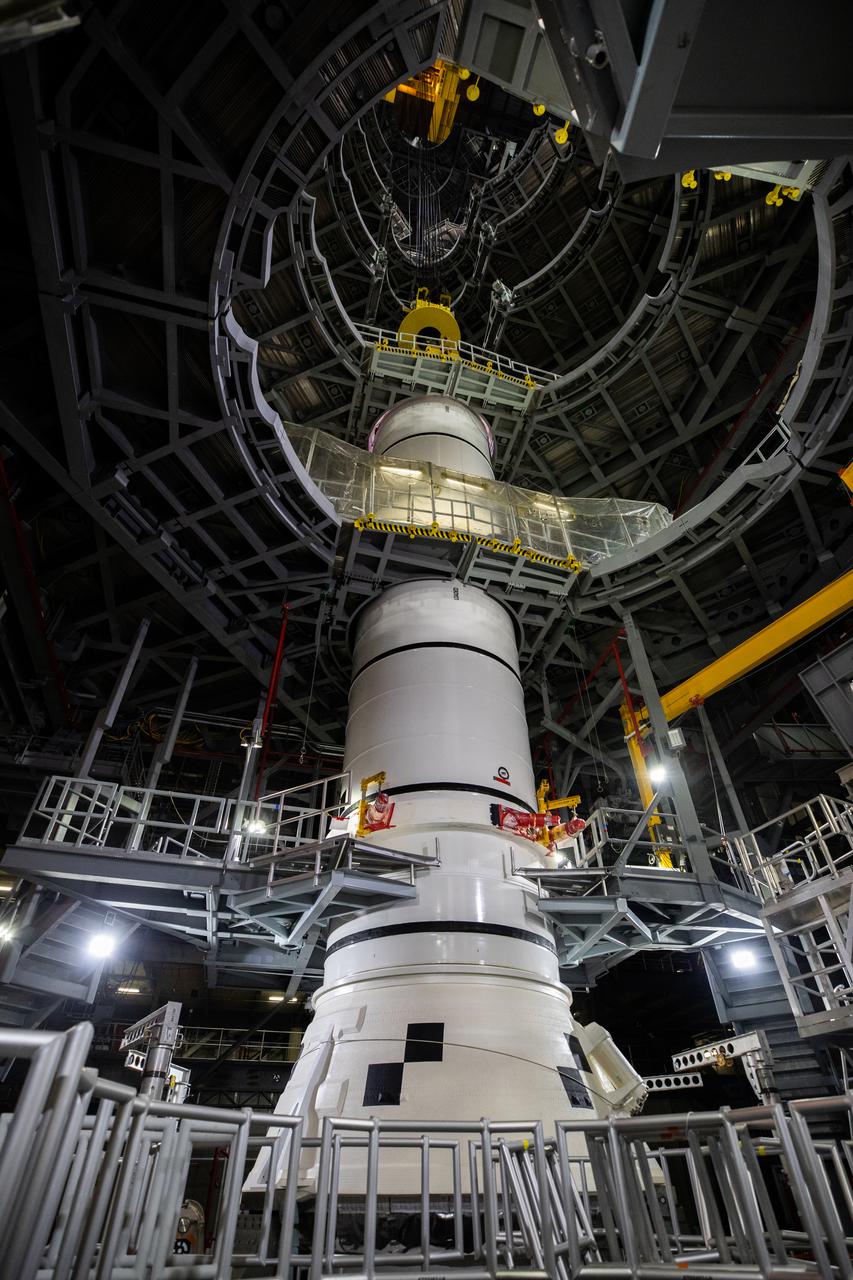
In High Bay 3 of the Vehicle Assembly Building at NASA’s Kennedy Space Center in Florida, the right-hand center aft booster segment for Artemis I is lowered onto the aft booster segment on the mobile launcher for the Space Launch System (SLS) on Jan. 12, 2021. Workers with Exploration Ground Systems and contractor Jacobs teams will stack the twin five-segment boosters on the mobile launcher in High Bay 3 over a number of weeks. When the core stage arrives, it will join the boosters on the mobile launcher, followed by the interim cryogenic propulsion stage and Orion spacecraft. Manufactured by Northrop Grumman in Utah, the twin boosters provide more than 75 percent of the total SLS thrust at launch. The SLS is managed by Marshall Space Flight Center in Huntsville, Alabama. Under the Artemis program, NASA will land the first woman and the next man on the Moon by 2024. The first in a series of increasingly complex missions, Artemis I will test the Orion spacecraft and SLS as an integrated system ahead of crewed flights to the Moon.
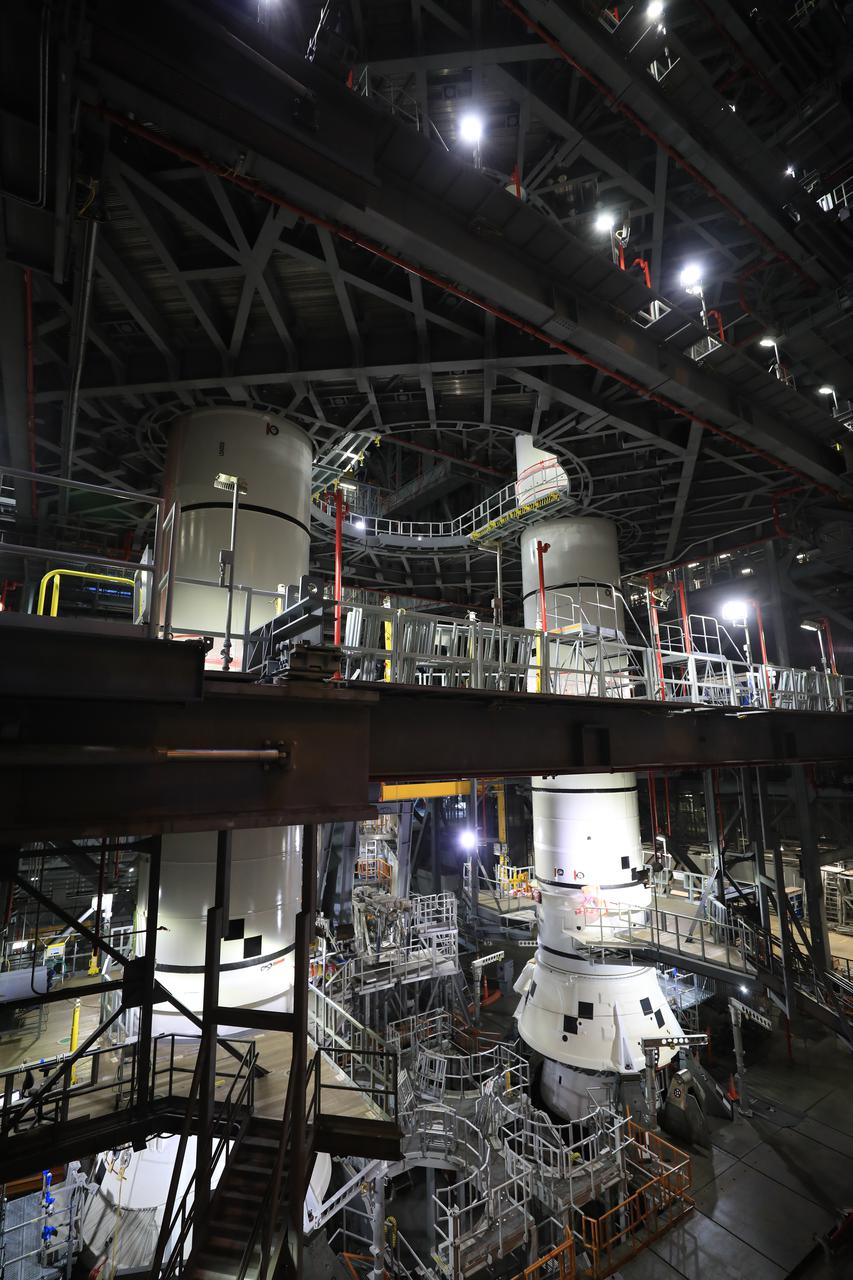
In High Bay 3 of the Vehicle Assembly Building at NASA’s Kennedy Space Center in Florida, the left-hand center center booster segment for Artemis I is lowered onto the center aft booster segment on the mobile launcher for the Space Launch System (SLS) on Jan. 21, 2021. Workers with Exploration Ground Systems and contractor Jacobs teams will stack the twin five-segment boosters on the mobile launcher in High Bay 3 over a number of weeks. When the core stage arrives, it will join the boosters on the mobile launcher, followed by the interim cryogenic propulsion stage and Orion spacecraft. Manufactured by Northrop Grumman in Utah, the twin boosters provide more than 75 percent of the total SLS thrust at launch. The SLS is managed by Marshall Space Flight Center in Huntsville, Alabama. Under the Artemis program, NASA will land the first woman and the next man on the Moon by 2024. The first in a series of increasingly complex missions, Artemis I will test the Orion spacecraft and SLS as an integrated system ahead of crewed flights to the Moon.