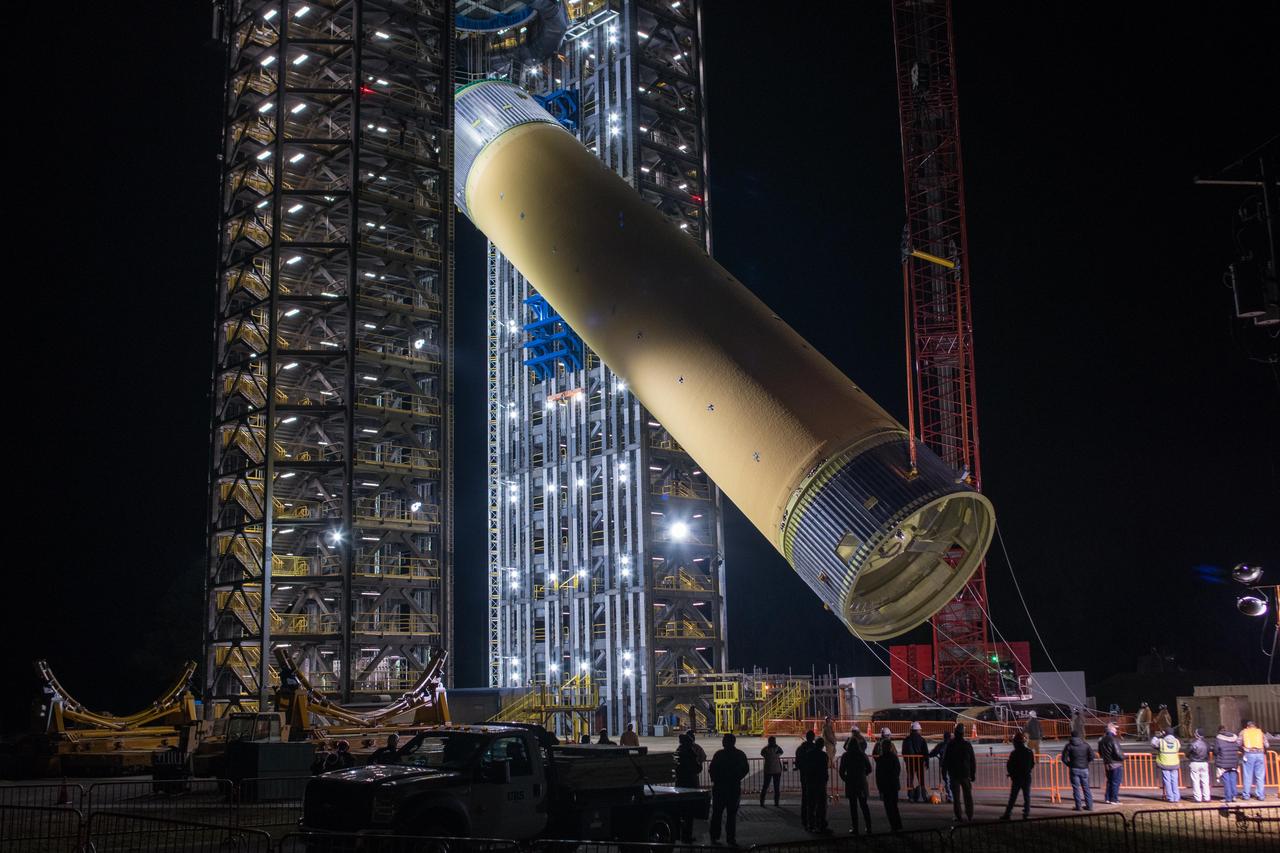
The Space Launch System (SLS) liquid hydrogen tank structural test article is loaded into Test Stand 4693 at NASA’s Marshall Space Flight Center in Huntsville, Alabama, on Jan. 14, 2019. The 149-foot piece of test hardware is the largest piece of structural hardware for the SLS core stage for America’s new deep space rocket Itis structurally identical to the flight version of the tank. It will undergo a series of tests in Test Stand 4693 to simulate the stresses and loads of liftoff and flight. These tests will help ensure designs are adequate for successful SLS missions to the Moon and beyond.
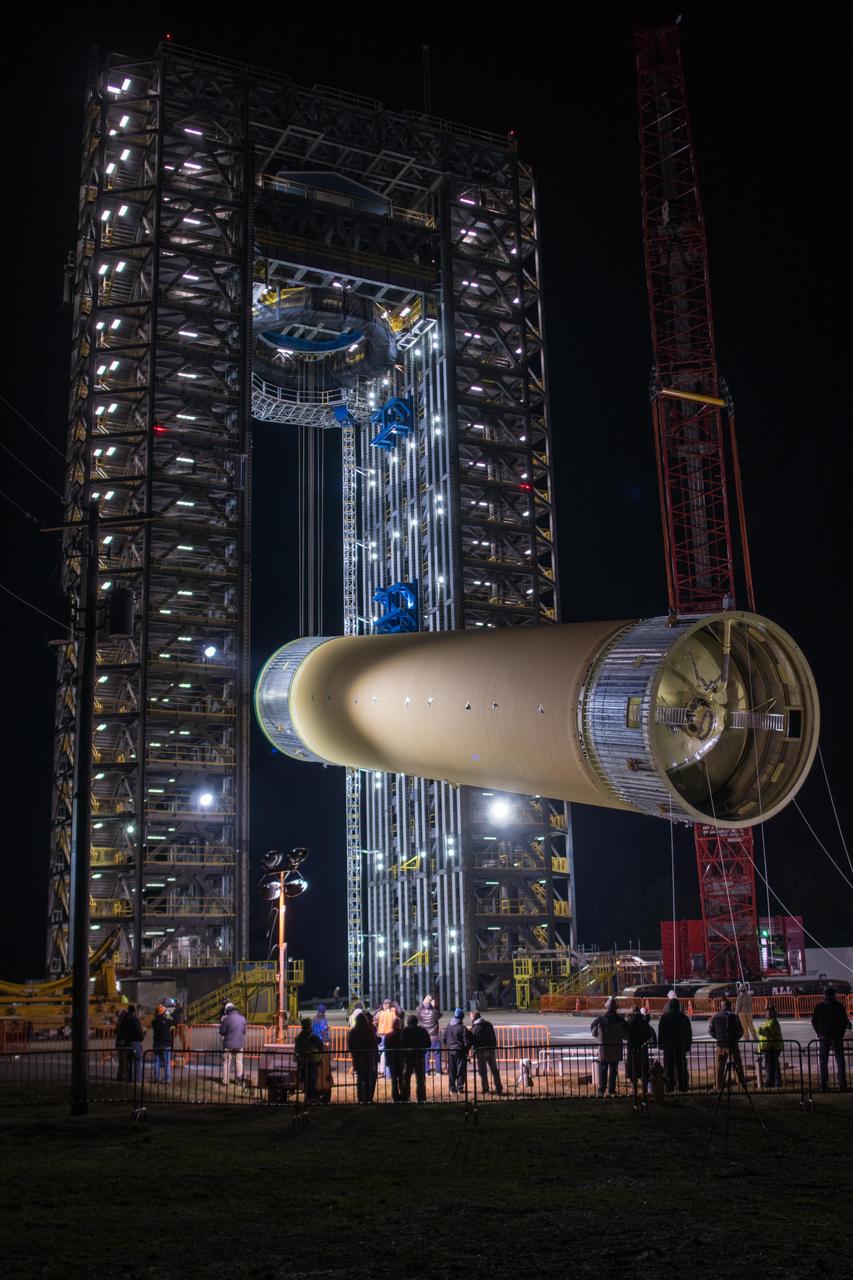
The Space Launch System (SLS) liquid hydrogen tank structural test article is loaded into Test Stand 4693 at NASA’s Marshall Space Flight Center in Huntsville, Alabama, on Jan. 14, 2019. The 149-foot piece of test hardware is the largest piece of structural hardware for the SLS core stage for America’s new deep space rocket Itis structurally identical to the flight version of the tank. It will undergo a series of tests in Test Stand 4693 to simulate the stresses and loads of liftoff and flight. These tests will help ensure designs are adequate for successful SLS missions to the Moon and beyond.
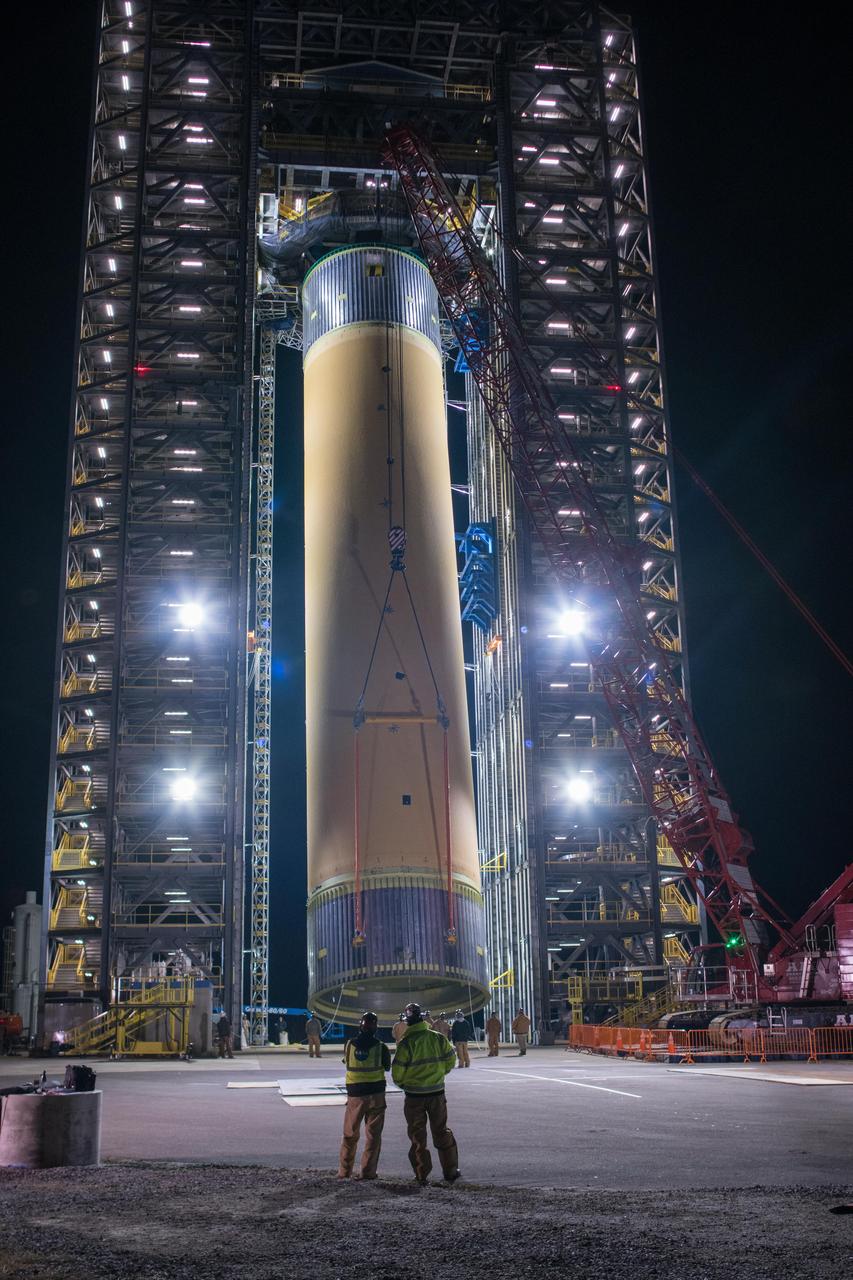
The Space Launch System (SLS) liquid hydrogen tank structural test article is loaded into Test Stand 4693 at NASA’s Marshall Space Flight Center in Huntsville, Alabama, on Jan. 14, 2019. The 149-foot piece of test hardware is the largest piece of structural hardware for the SLS core stage for America’s new deep space rocket Itis structurally identical to the flight version of the tank. It will undergo a series of tests in Test Stand 4693 to simulate the stresses and loads of liftoff and flight. These tests will help ensure designs are adequate for successful SLS missions to the Moon and beyond.
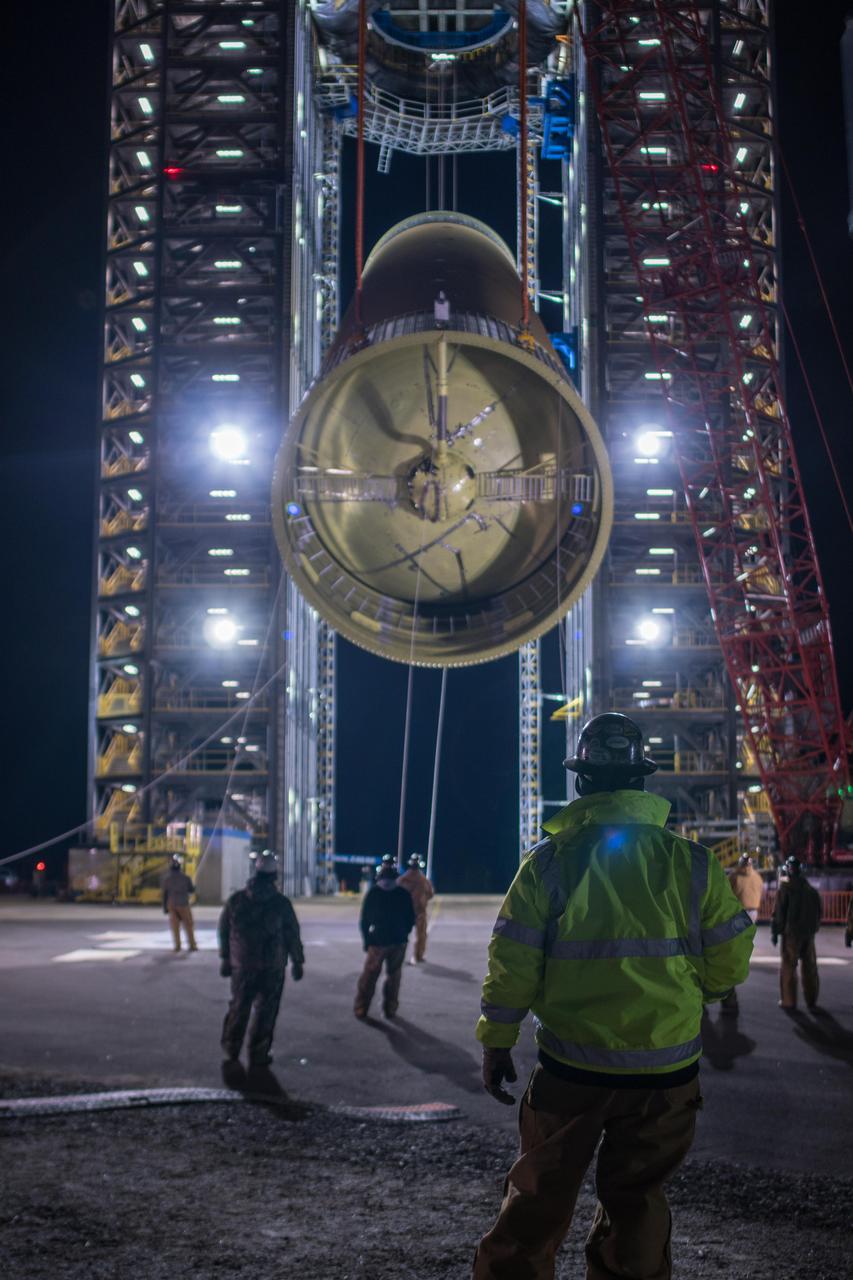
The Space Launch System (SLS) liquid hydrogen tank structural test article is loaded into Test Stand 4693 at NASA’s Marshall Space Flight Center in Huntsville, Alabama, on Jan. 14, 2019. The 149-foot piece of test hardware is the largest piece of structural hardware for the SLS core stage for America’s new deep space rocket Itis structurally identical to the flight version of the tank. It will undergo a series of tests in Test Stand 4693 to simulate the stresses and loads of liftoff and flight. These tests will help ensure designs are adequate for successful SLS missions to the Moon and beyond.
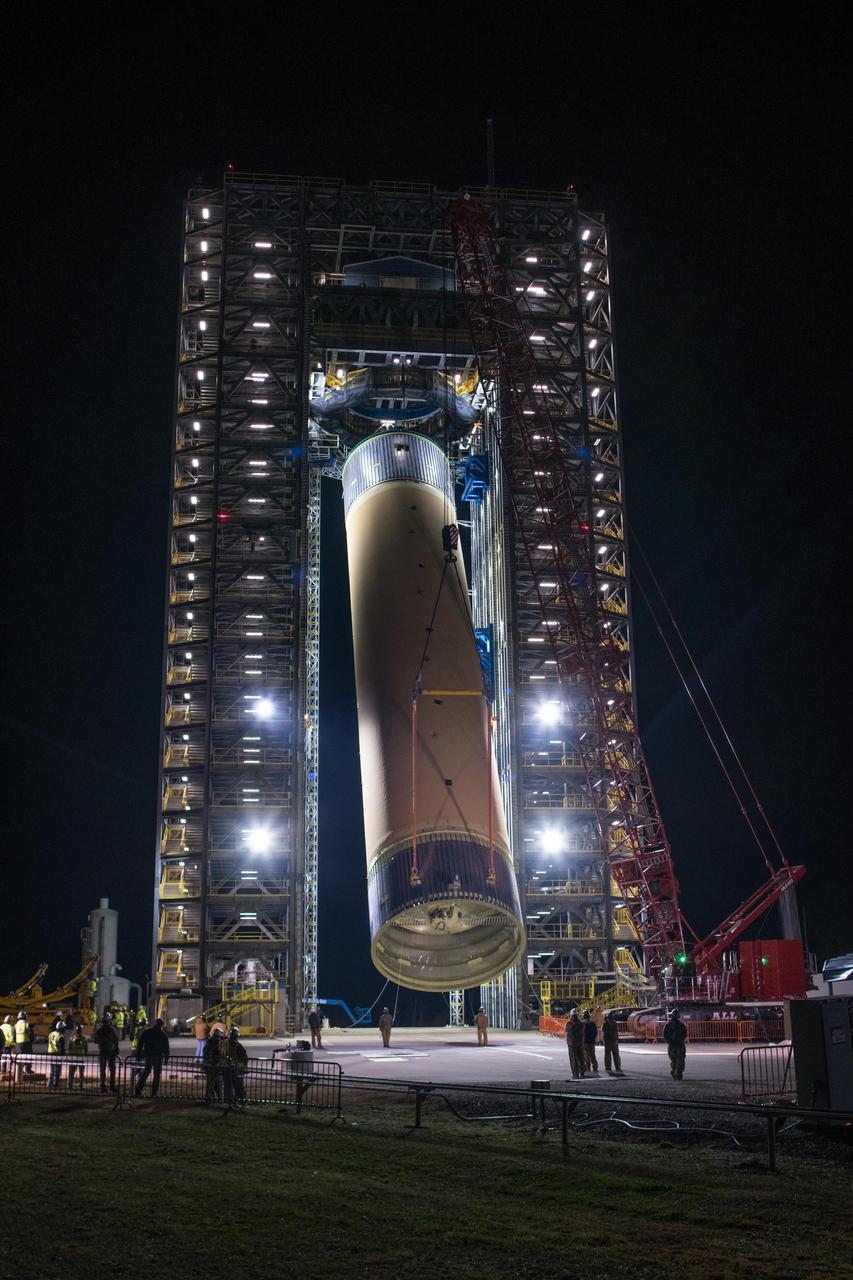
The Space Launch System (SLS) liquid hydrogen tank structural test article is loaded into Test Stand 4693 at NASA’s Marshall Space Flight Center in Huntsville, Alabama, on Jan. 14, 2019. The 149-foot piece of test hardware is the largest piece of structural hardware for the SLS core stage for America’s new deep space rocket Itis structurally identical to the flight version of the tank. It will undergo a series of tests in Test Stand 4693 to simulate the stresses and loads of liftoff and flight. These tests will help ensure designs are adequate for successful SLS missions to the Moon and beyond.
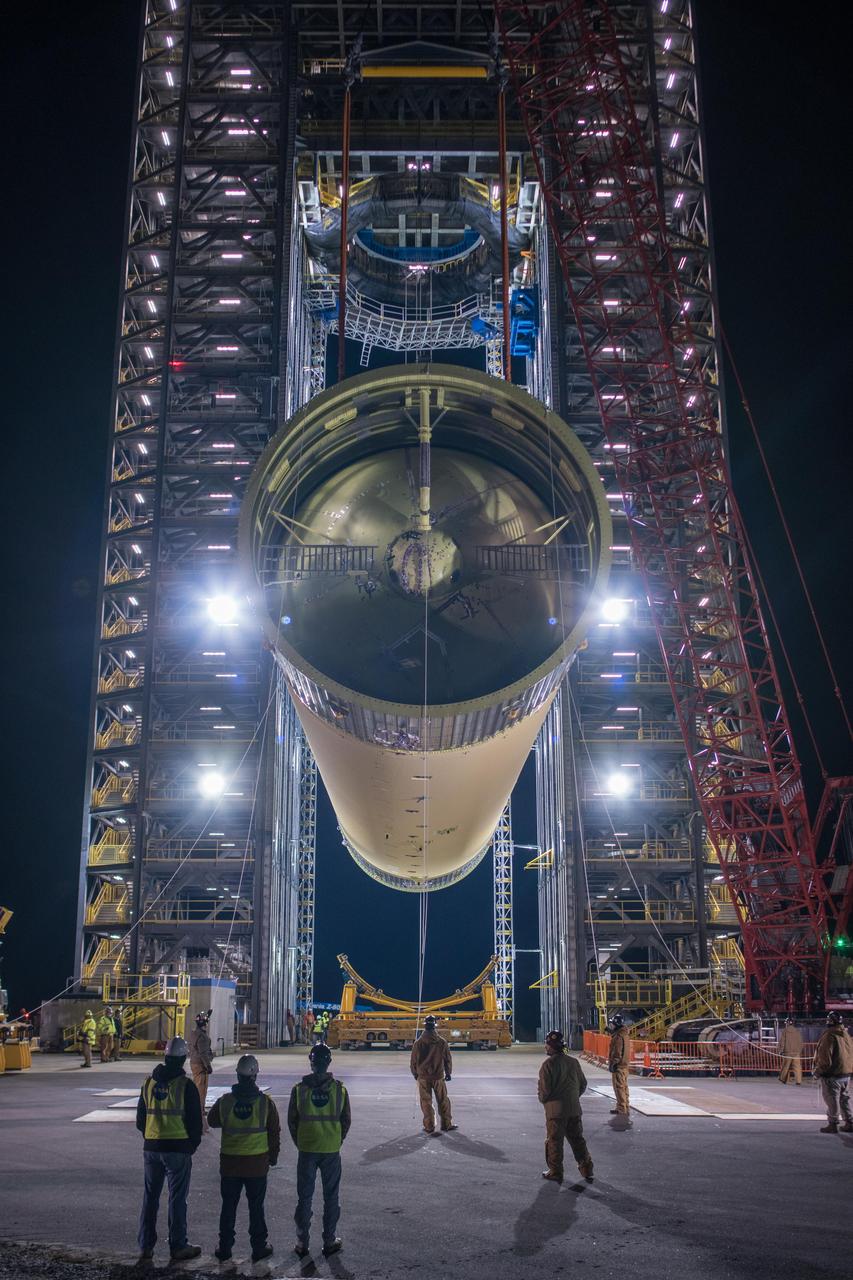
The Space Launch System (SLS) liquid hydrogen tank structural test article is loaded into Test Stand 4693 at NASA’s Marshall Space Flight Center in Huntsville, Alabama, on Jan. 14, 2019. The 149-foot piece of test hardware is the largest piece of structural hardware for the SLS core stage for America’s new deep space rocket Itis structurally identical to the flight version of the tank. It will undergo a series of tests in Test Stand 4693 to simulate the stresses and loads of liftoff and flight. These tests will help ensure designs are adequate for successful SLS missions to the Moon and beyond.
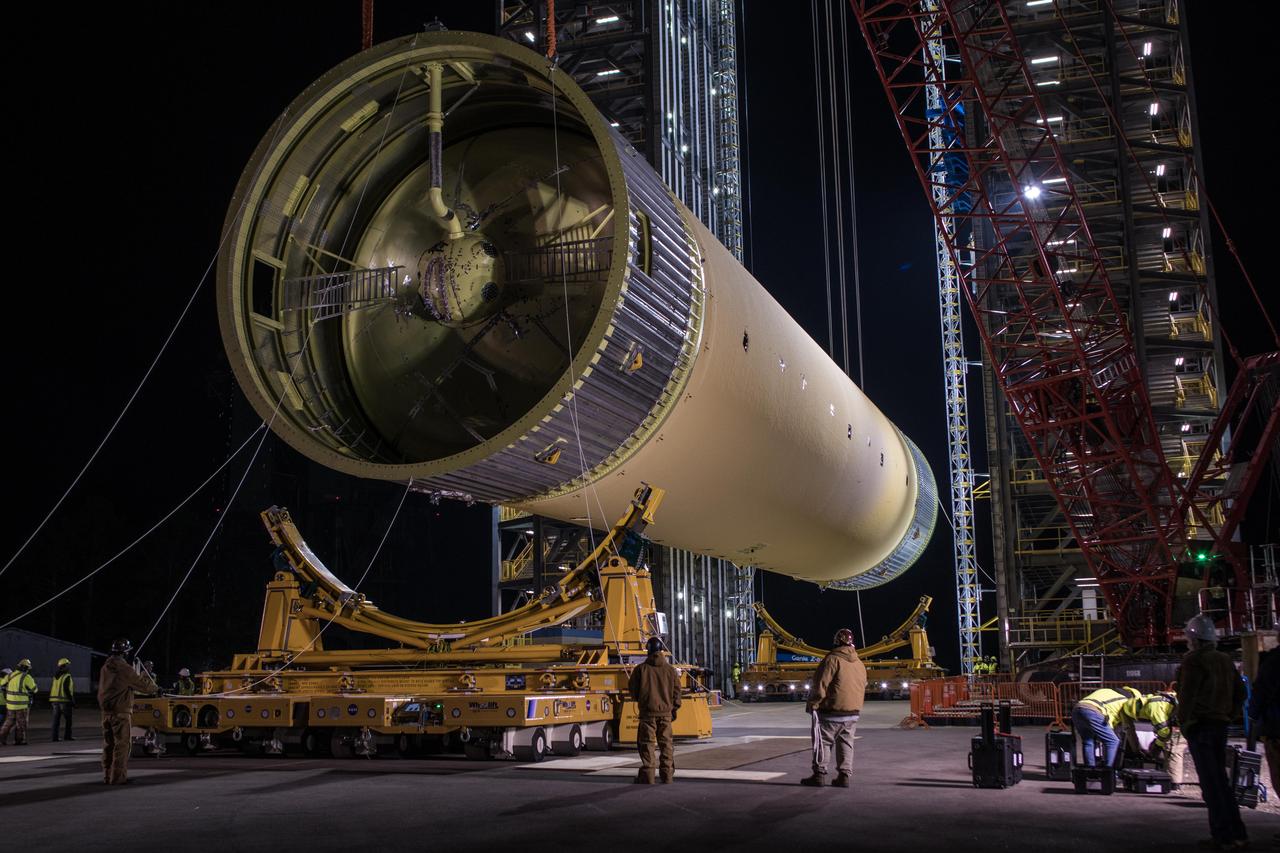
The Space Launch System (SLS) liquid hydrogen tank structural test article is loaded into Test Stand 4693 at NASA’s Marshall Space Flight Center in Huntsville, Alabama, on Jan. 14, 2019. The 149-foot piece of test hardware is the largest piece of structural hardware for the SLS core stage for America’s new deep space rocket Itis structurally identical to the flight version of the tank. It will undergo a series of tests in Test Stand 4693 to simulate the stresses and loads of liftoff and flight. These tests will help ensure designs are adequate for successful SLS missions to the Moon and beyond.
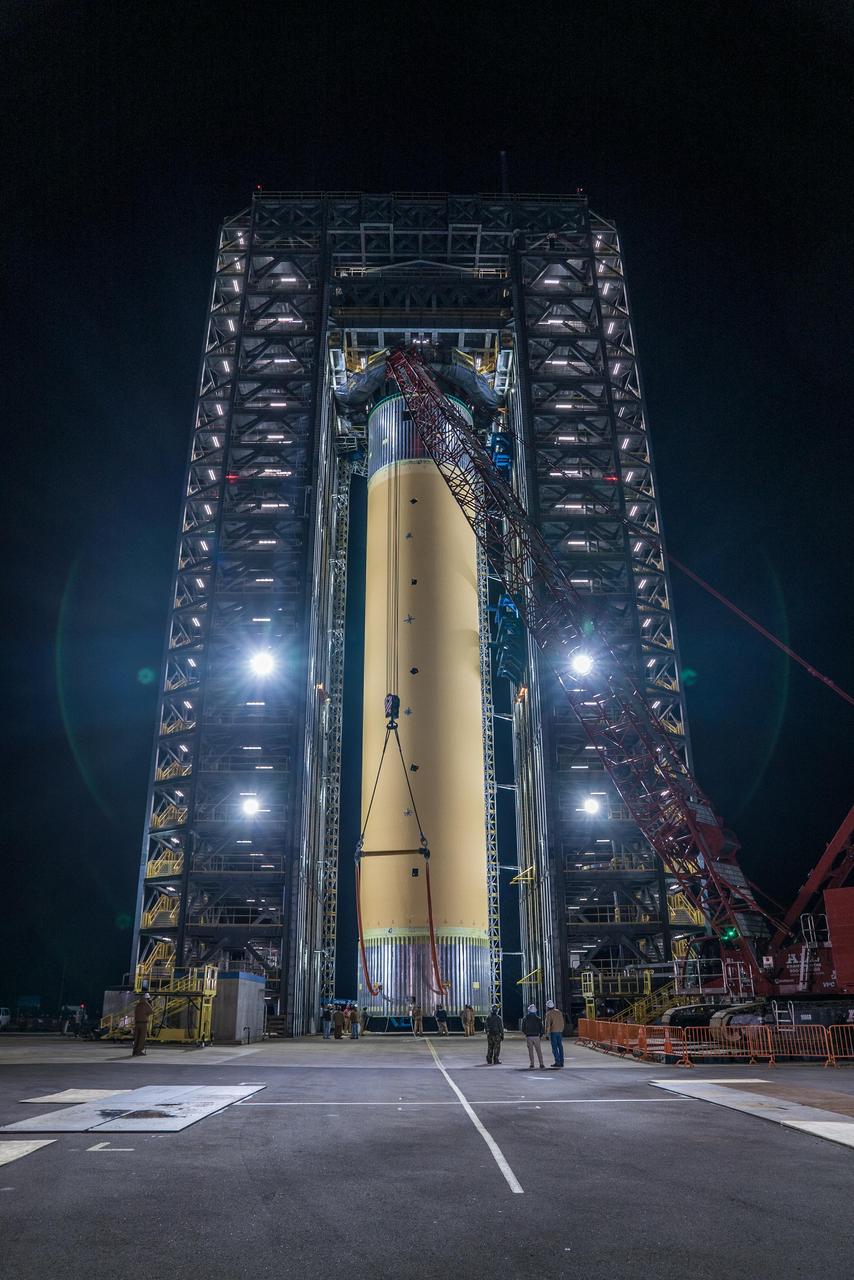
The Space Launch System (SLS) liquid hydrogen tank structural test article is loaded into Test Stand 4693 at NASA’s Marshall Space Flight Center in Huntsville, Alabama, on Jan. 14, 2019. The 149-foot piece of test hardware is the largest piece of structural hardware for the SLS core stage for America’s new deep space rocket Itis structurally identical to the flight version of the tank. It will undergo a series of tests in Test Stand 4693 to simulate the stresses and loads of liftoff and flight. These tests will help ensure designs are adequate for successful SLS missions to the Moon and beyond.
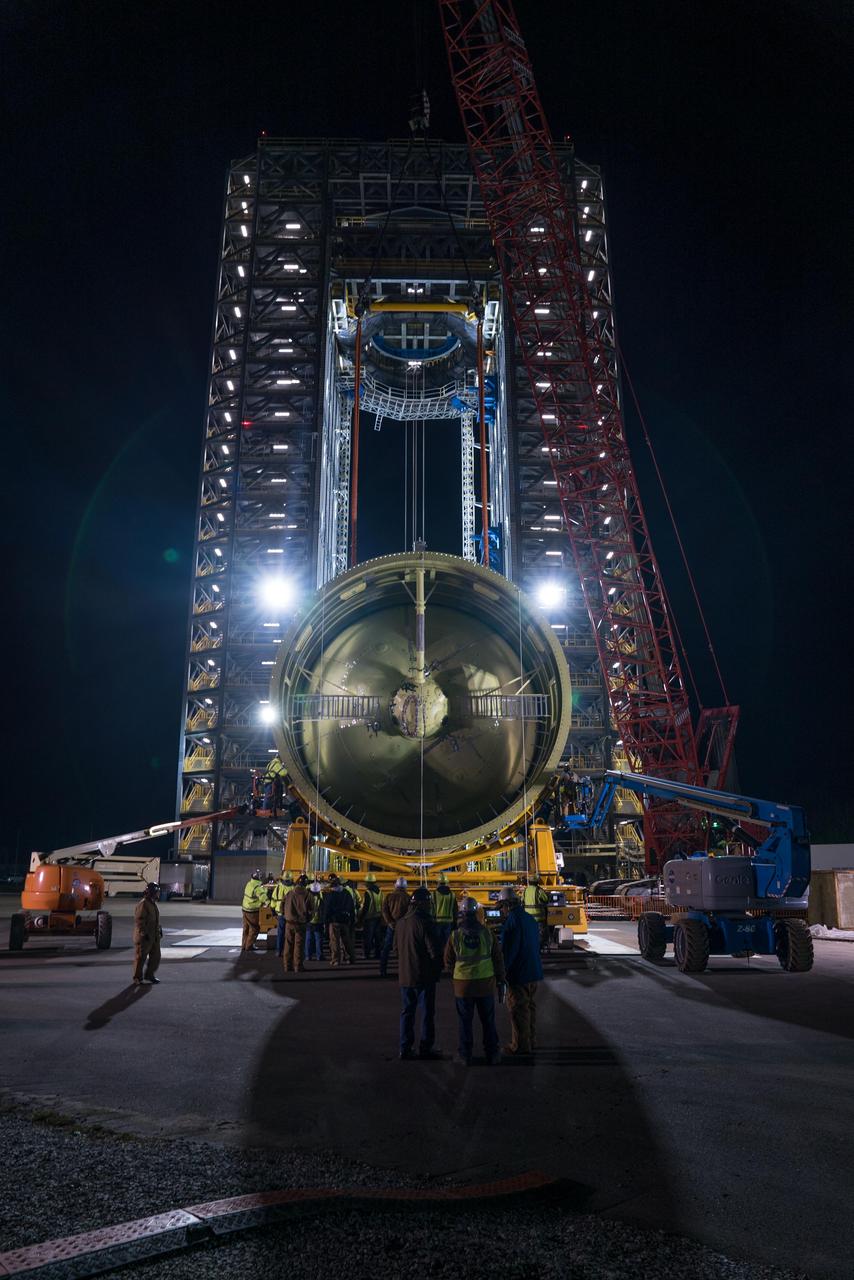
The Space Launch System (SLS) liquid hydrogen tank structural test article is loaded into Test Stand 4693 at NASA’s Marshall Space Flight Center in Huntsville, Alabama, on Jan. 14, 2019. The 149-foot piece of test hardware is the largest piece of structural hardware for the SLS core stage for America’s new deep space rocket Itis structurally identical to the flight version of the tank. It will undergo a series of tests in Test Stand 4693 to simulate the stresses and loads of liftoff and flight. These tests will help ensure designs are adequate for successful SLS missions to the Moon and beyond.
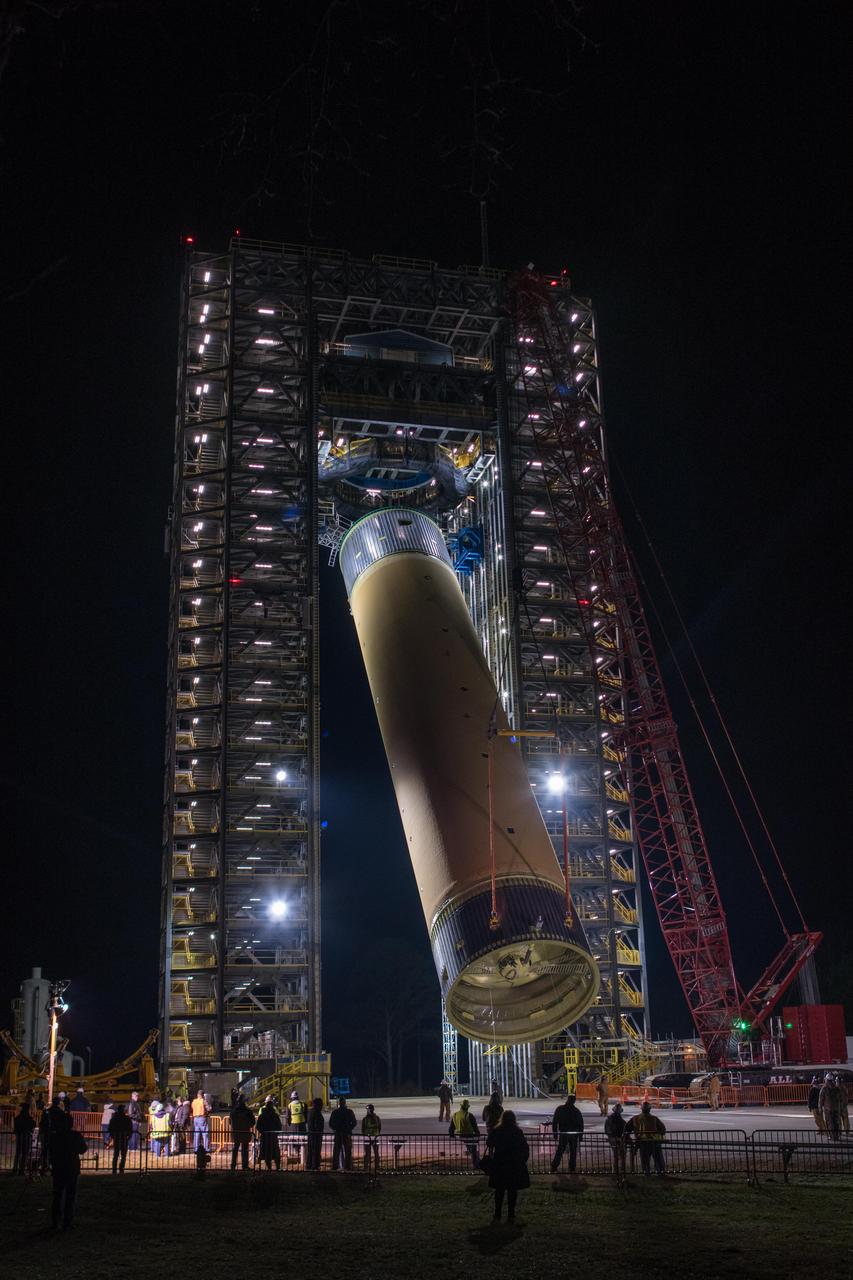
The Space Launch System (SLS) liquid hydrogen tank structural test article is loaded into Test Stand 4693 at NASA’s Marshall Space Flight Center in Huntsville, Alabama, on Jan. 14, 2019. The 149-foot piece of test hardware is the largest piece of structural hardware for the SLS core stage for America’s new deep space rocket Itis structurally identical to the flight version of the tank. It will undergo a series of tests in Test Stand 4693 to simulate the stresses and loads of liftoff and flight. These tests will help ensure designs are adequate for successful SLS missions to the Moon and beyond.
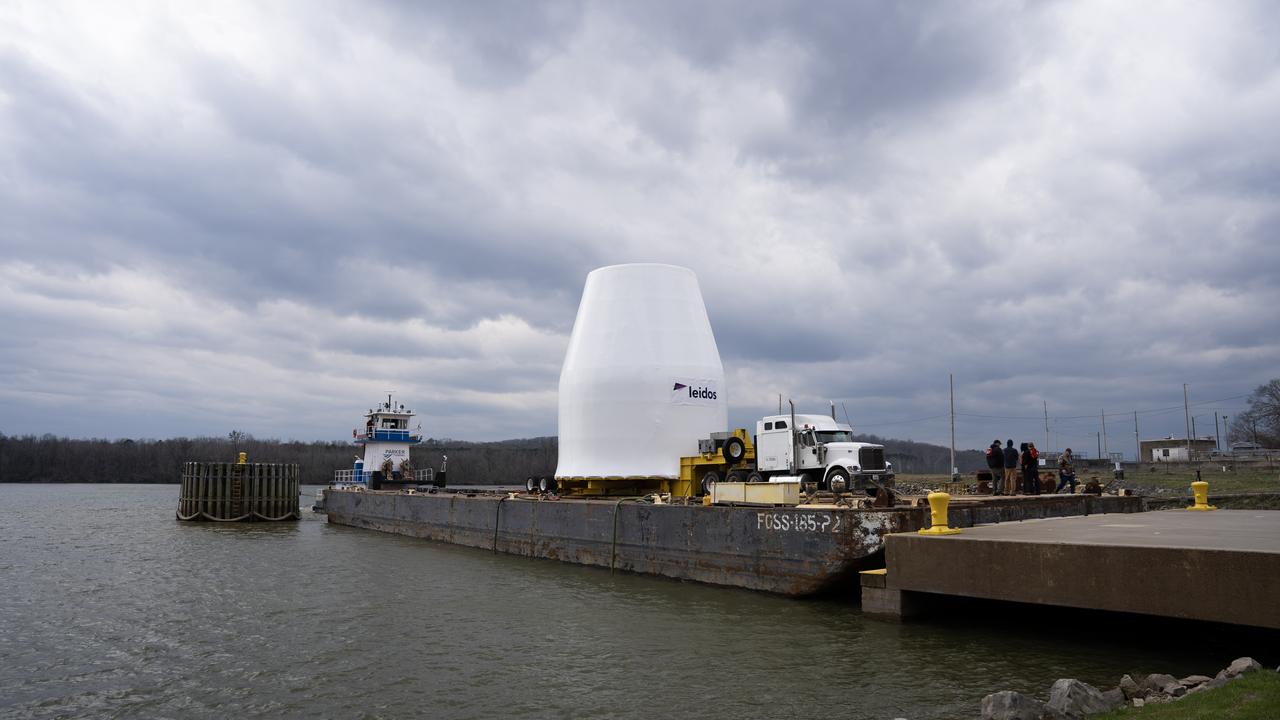
These photos and videos show how crews guided a test version of the universal stage adapter for NASA’s more powerful version of its SLS (Space Launch System) rocket to Building 4619 at the agency’s Marshall Space Flight Center in Huntsville, Alabama, Feb. 22. Built by Leidos, the lead contractor for the universal stage adapter, crews transported the hardware from a Leidos facility in Decatur, Alabama, the same day. The universal stage adapter will connect the SLS rocket’s upgraded in-space propulsion stage, called the exploration upper stage, to NASA’s Orion spacecraft as part of the evolved Block 1B configuration of the SLS rocket. It will also serve as a compartment capable of accommodating large payloads, such as modules or other exploration spacecraft. In Building 4619’s Load Test Annex High Bay at Marshall, the development test article will first undergo modal testing that will shake the hardware to validate dynamic models. Later, during ultimate load testing, force will be applied vertically and to the sides of the hardware. Unlike the flight hardware, the development test article has flaws intentionally included in its design, which will help engineers verity that the flight adapter can withstand the extreme forces it will face during launch and flight.
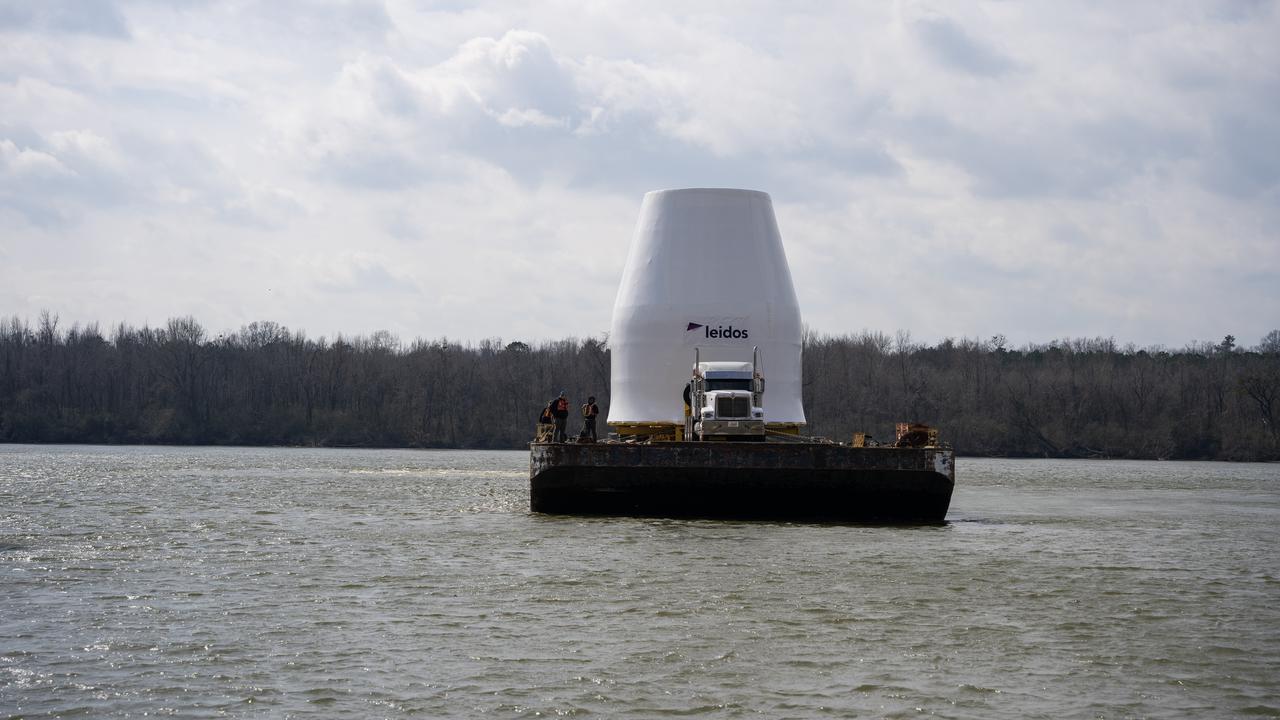
These photos and videos show how crews guided a test version of the universal stage adapter for NASA’s more powerful version of its SLS (Space Launch System) rocket to Building 4619 at the agency’s Marshall Space Flight Center in Huntsville, Alabama, Feb. 22. Built by Leidos, the lead contractor for the universal stage adapter, crews transported the hardware from a Leidos facility in Decatur, Alabama, the same day. The universal stage adapter will connect the SLS rocket’s upgraded in-space propulsion stage, called the exploration upper stage, to NASA’s Orion spacecraft as part of the evolved Block 1B configuration of the SLS rocket. It will also serve as a compartment capable of accommodating large payloads, such as modules or other exploration spacecraft. In Building 4619’s Load Test Annex High Bay at Marshall, the development test article will first undergo modal testing that will shake the hardware to validate dynamic models. Later, during ultimate load testing, force will be applied vertically and to the sides of the hardware. Unlike the flight hardware, the development test article has flaws intentionally included in its design, which will help engineers verity that the flight adapter can withstand the extreme forces it will face during launch and flight.
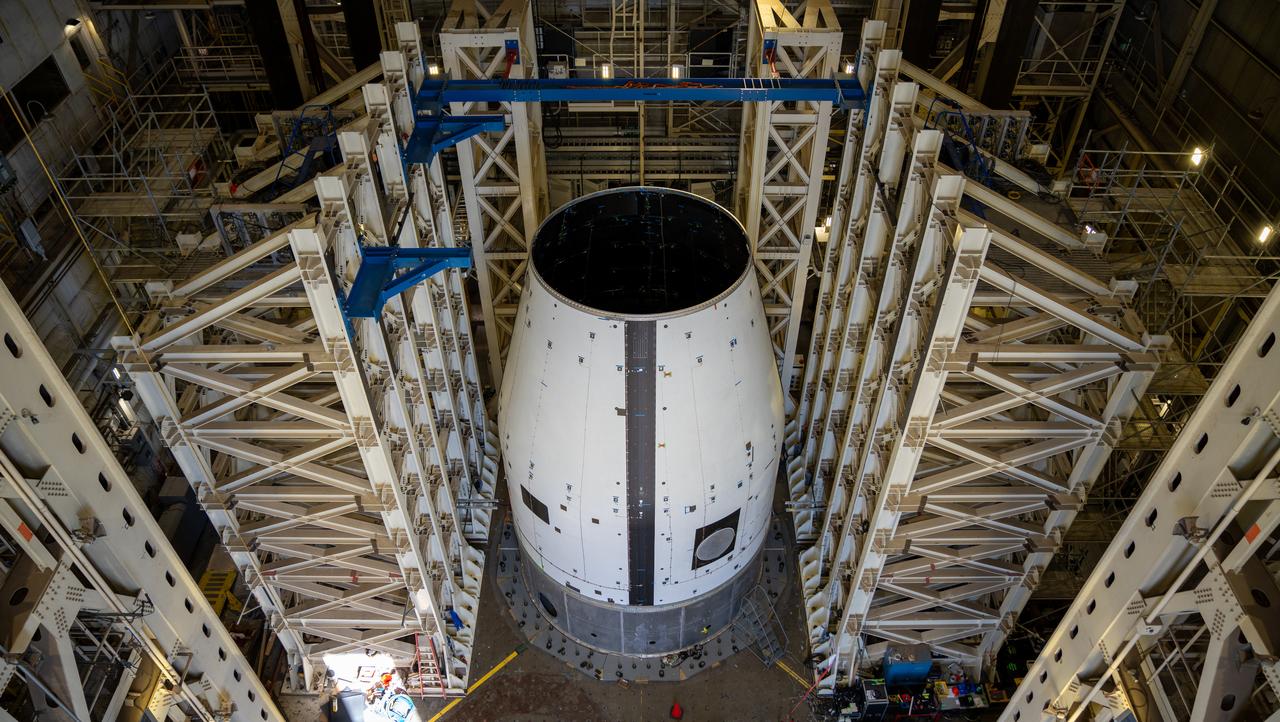
These photos and videos show how crews guided a test version of the universal stage adapter for NASA’s more powerful version of its SLS (Space Launch System) rocket to Building 4619 at the agency’s Marshall Space Flight Center in Huntsville, Alabama, Feb. 22. Built by Leidos, the lead contractor for the universal stage adapter, crews transported the hardware from a Leidos facility in Decatur, Alabama, the same day. The universal stage adapter will connect the SLS rocket’s upgraded in-space propulsion stage, called the exploration upper stage, to NASA’s Orion spacecraft as part of the evolved Block 1B configuration of the SLS rocket. It will also serve as a compartment capable of accommodating large payloads, such as modules or other exploration spacecraft. In Building 4619’s Load Test Annex High Bay at Marshall, the development test article will first undergo modal testing that will shake the hardware to validate dynamic models. Later, during ultimate load testing, force will be applied vertically and to the sides of the hardware. Unlike the flight hardware, the development test article has flaws intentionally included in its design, which will help engineers verity that the flight adapter can withstand the extreme forces it will face during launch and flight.
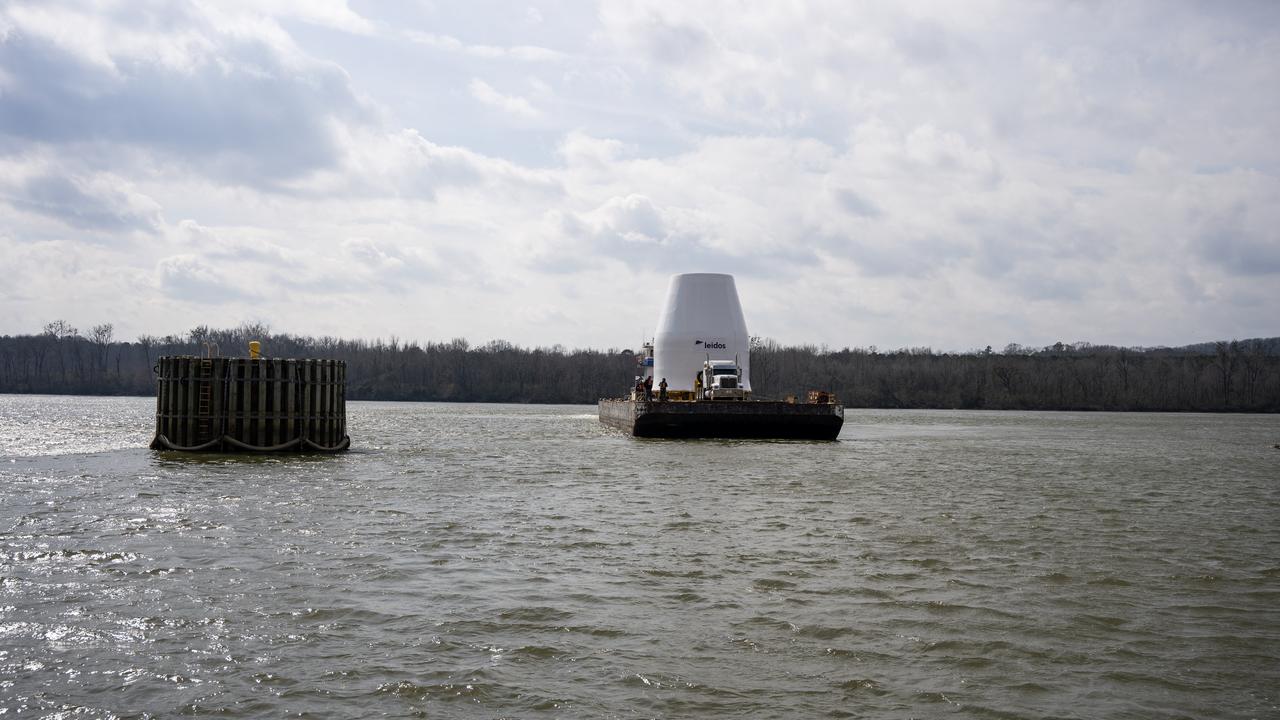
These photos and videos show how crews guided a test version of the universal stage adapter for NASA’s more powerful version of its SLS (Space Launch System) rocket to Building 4619 at the agency’s Marshall Space Flight Center in Huntsville, Alabama, Feb. 22. Built by Leidos, the lead contractor for the universal stage adapter, crews transported the hardware from a Leidos facility in Decatur, Alabama, the same day. The universal stage adapter will connect the SLS rocket’s upgraded in-space propulsion stage, called the exploration upper stage, to NASA’s Orion spacecraft as part of the evolved Block 1B configuration of the SLS rocket. It will also serve as a compartment capable of accommodating large payloads, such as modules or other exploration spacecraft. In Building 4619’s Load Test Annex High Bay at Marshall, the development test article will first undergo modal testing that will shake the hardware to validate dynamic models. Later, during ultimate load testing, force will be applied vertically and to the sides of the hardware. Unlike the flight hardware, the development test article has flaws intentionally included in its design, which will help engineers verity that the flight adapter can withstand the extreme forces it will face during launch and flight.

These photos and videos show how crews guided a test version of the universal stage adapter for NASA’s more powerful version of its SLS (Space Launch System) rocket to Building 4619 at the agency’s Marshall Space Flight Center in Huntsville, Alabama, Feb. 22. Built by Leidos, the lead contractor for the universal stage adapter, crews transported the hardware from a Leidos facility in Decatur, Alabama, the same day. The universal stage adapter will connect the SLS rocket’s upgraded in-space propulsion stage, called the exploration upper stage, to NASA’s Orion spacecraft as part of the evolved Block 1B configuration of the SLS rocket. It will also serve as a compartment capable of accommodating large payloads, such as modules or other exploration spacecraft. In Building 4619’s Load Test Annex High Bay at Marshall, the development test article will first undergo modal testing that will shake the hardware to validate dynamic models. Later, during ultimate load testing, force will be applied vertically and to the sides of the hardware. Unlike the flight hardware, the development test article has flaws intentionally included in its design, which will help engineers verity that the flight adapter can withstand the extreme forces it will face during launch and flight.
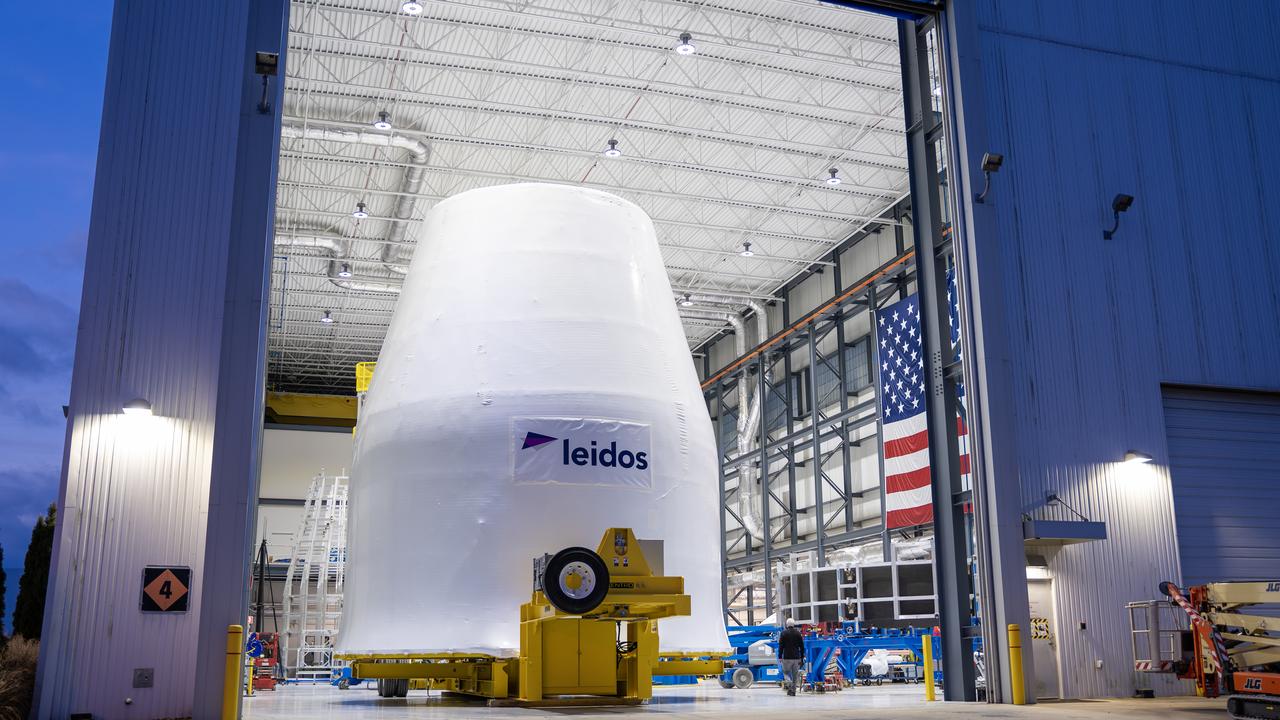
These photos and videos show how crews guided a test version of the universal stage adapter for NASA’s more powerful version of its SLS (Space Launch System) rocket to Building 4619 at the agency’s Marshall Space Flight Center in Huntsville, Alabama, Feb. 22. Built by Leidos, the lead contractor for the universal stage adapter, crews transported the hardware from a Leidos facility in Decatur, Alabama, the same day. The universal stage adapter will connect the SLS rocket’s upgraded in-space propulsion stage, called the exploration upper stage, to NASA’s Orion spacecraft as part of the evolved Block 1B configuration of the SLS rocket. It will also serve as a compartment capable of accommodating large payloads, such as modules or other exploration spacecraft. In Building 4619’s Load Test Annex High Bay at Marshall, the development test article will first undergo modal testing that will shake the hardware to validate dynamic models. Later, during ultimate load testing, force will be applied vertically and to the sides of the hardware. Unlike the flight hardware, the development test article has flaws intentionally included in its design, which will help engineers verity that the flight adapter can withstand the extreme forces it will face during launch and flight.
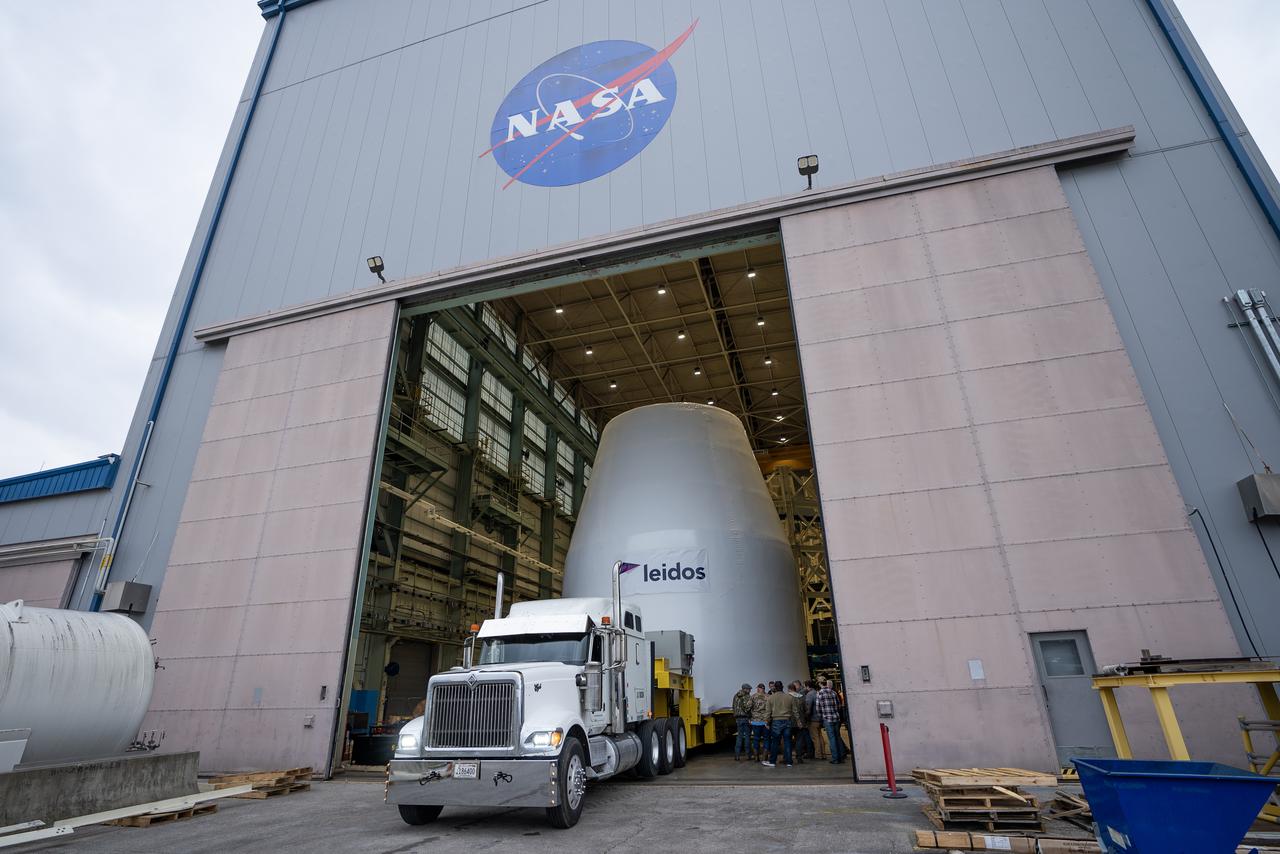
These photos and videos show how crews guided a test version of the universal stage adapter for NASA’s more powerful version of its SLS (Space Launch System) rocket to Building 4619 at the agency’s Marshall Space Flight Center in Huntsville, Alabama, Feb. 22. Built by Leidos, the lead contractor for the universal stage adapter, crews transported the hardware from a Leidos facility in Decatur, Alabama, the same day. The universal stage adapter will connect the SLS rocket’s upgraded in-space propulsion stage, called the exploration upper stage, to NASA’s Orion spacecraft as part of the evolved Block 1B configuration of the SLS rocket. It will also serve as a compartment capable of accommodating large payloads, such as modules or other exploration spacecraft. In Building 4619’s Load Test Annex High Bay at Marshall, the development test article will first undergo modal testing that will shake the hardware to validate dynamic models. Later, during ultimate load testing, force will be applied vertically and to the sides of the hardware. Unlike the flight hardware, the development test article has flaws intentionally included in its design, which will help engineers verity that the flight adapter can withstand the extreme forces it will face during launch and flight.

These photos and videos show how crews guided a test version of the universal stage adapter for NASA’s more powerful version of its SLS (Space Launch System) rocket to Building 4619 at the agency’s Marshall Space Flight Center in Huntsville, Alabama, Feb. 22. Built by Leidos, the lead contractor for the universal stage adapter, crews transported the hardware from a Leidos facility in Decatur, Alabama, the same day. The universal stage adapter will connect the SLS rocket’s upgraded in-space propulsion stage, called the exploration upper stage, to NASA’s Orion spacecraft as part of the evolved Block 1B configuration of the SLS rocket. It will also serve as a compartment capable of accommodating large payloads, such as modules or other exploration spacecraft. In Building 4619’s Load Test Annex High Bay at Marshall, the development test article will first undergo modal testing that will shake the hardware to validate dynamic models. Later, during ultimate load testing, force will be applied vertically and to the sides of the hardware. Unlike the flight hardware, the development test article has flaws intentionally included in its design, which will help engineers verity that the flight adapter can withstand the extreme forces it will face during launch and flight.
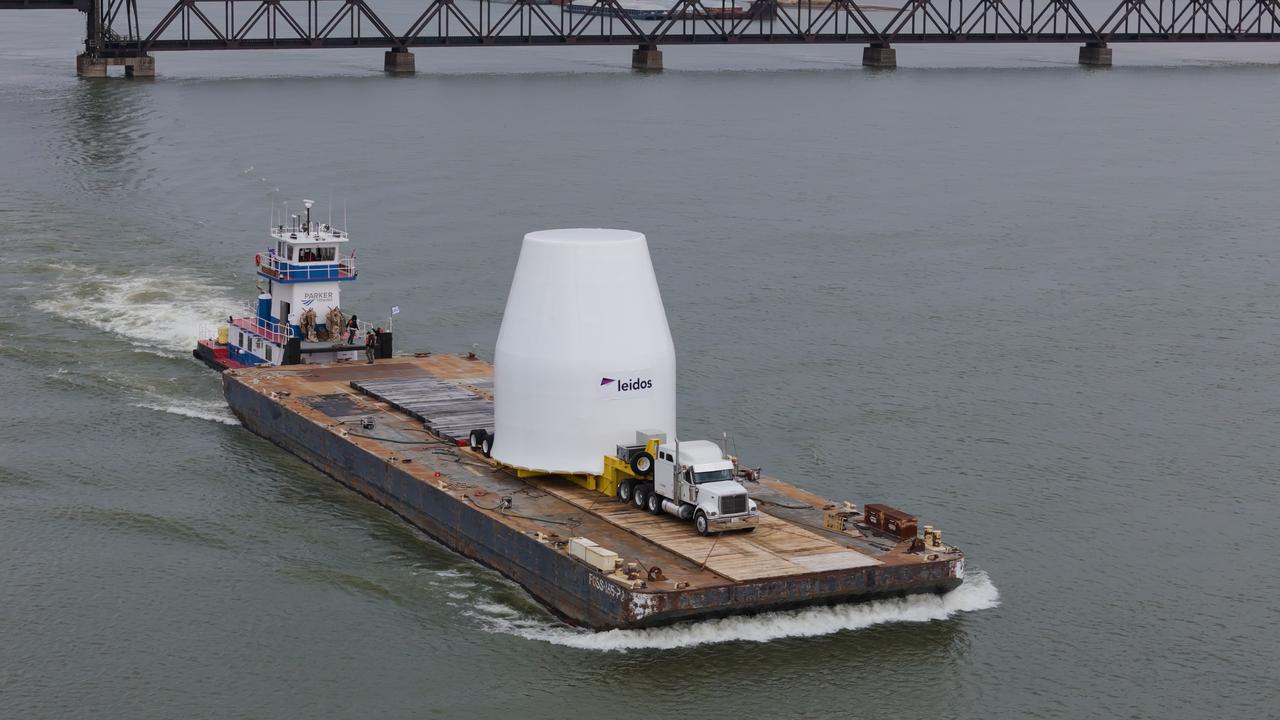
These photos and videos show how crews guided a test version of the universal stage adapter for NASA’s more powerful version of its SLS (Space Launch System) rocket to Building 4619 at the agency’s Marshall Space Flight Center in Huntsville, Alabama, Feb. 22. Built by Leidos, the lead contractor for the universal stage adapter, crews transported the hardware from a Leidos facility in Decatur, Alabama, the same day. The universal stage adapter will connect the SLS rocket’s upgraded in-space propulsion stage, called the exploration upper stage, to NASA’s Orion spacecraft as part of the evolved Block 1B configuration of the SLS rocket. It will also serve as a compartment capable of accommodating large payloads, such as modules or other exploration spacecraft. In Building 4619’s Load Test Annex High Bay at Marshall, the development test article will first undergo modal testing that will shake the hardware to validate dynamic models. Later, during ultimate load testing, force will be applied vertically and to the sides of the hardware. Unlike the flight hardware, the development test article has flaws intentionally included in its design, which will help engineers verity that the flight adapter can withstand the extreme forces it will face during launch and flight.
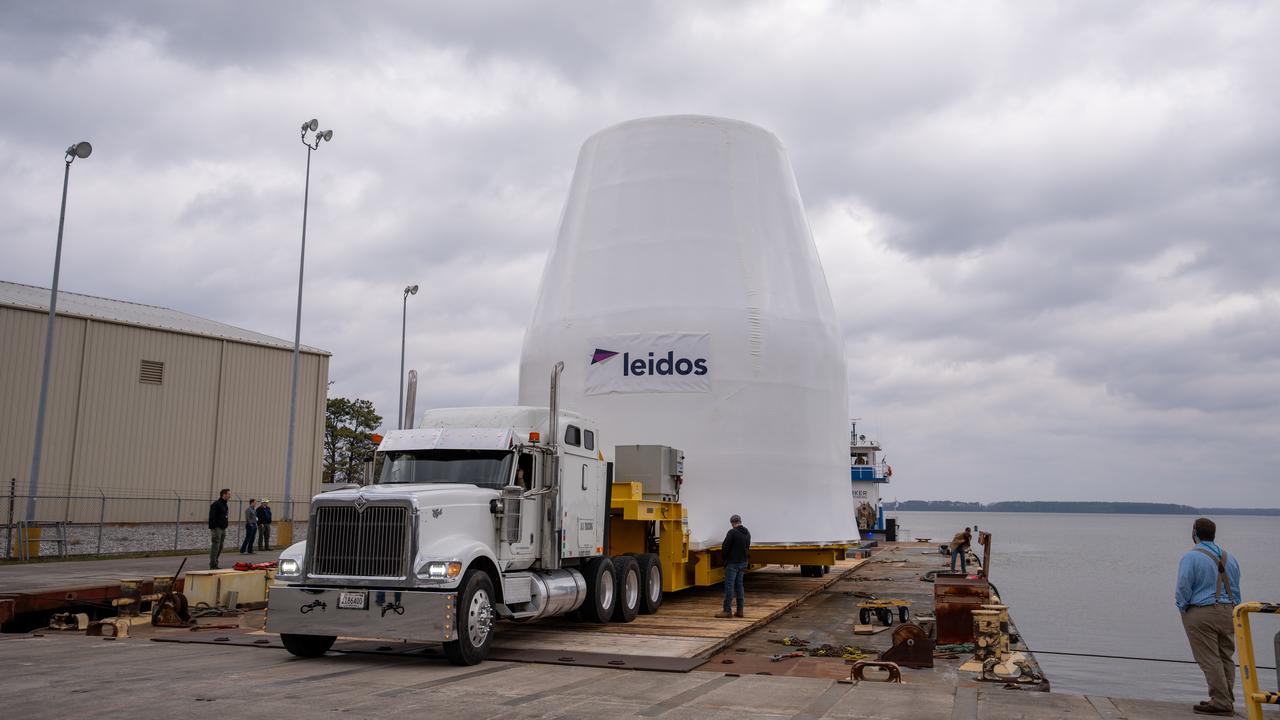
These photos and videos show how crews guided a test version of the universal stage adapter for NASA’s more powerful version of its SLS (Space Launch System) rocket to Building 4619 at the agency’s Marshall Space Flight Center in Huntsville, Alabama, Feb. 22. Built by Leidos, the lead contractor for the universal stage adapter, crews transported the hardware from a Leidos facility in Decatur, Alabama, the same day. The universal stage adapter will connect the SLS rocket’s upgraded in-space propulsion stage, called the exploration upper stage, to NASA’s Orion spacecraft as part of the evolved Block 1B configuration of the SLS rocket. It will also serve as a compartment capable of accommodating large payloads, such as modules or other exploration spacecraft. In Building 4619’s Load Test Annex High Bay at Marshall, the development test article will first undergo modal testing that will shake the hardware to validate dynamic models. Later, during ultimate load testing, force will be applied vertically and to the sides of the hardware. Unlike the flight hardware, the development test article has flaws intentionally included in its design, which will help engineers verity that the flight adapter can withstand the extreme forces it will face during launch and flight.
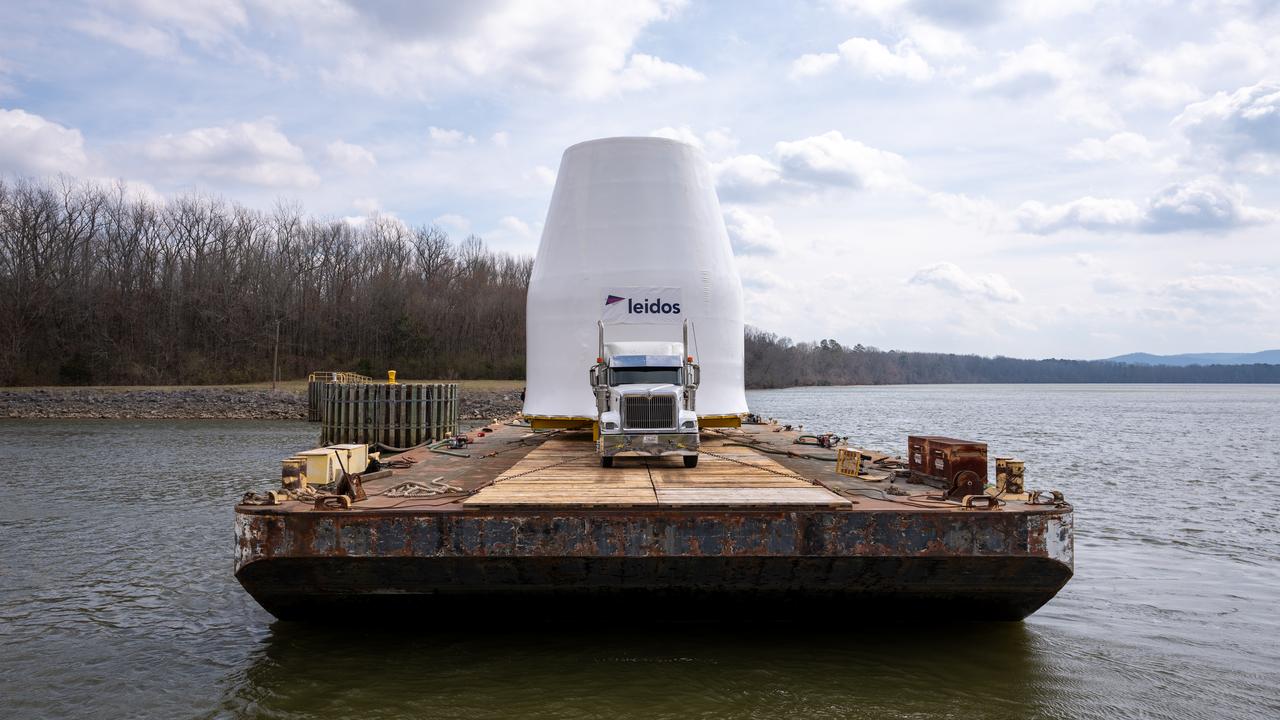
These photos and videos show how crews guided a test version of the universal stage adapter for NASA’s more powerful version of its SLS (Space Launch System) rocket to Building 4619 at the agency’s Marshall Space Flight Center in Huntsville, Alabama, Feb. 22. Built by Leidos, the lead contractor for the universal stage adapter, crews transported the hardware from a Leidos facility in Decatur, Alabama, the same day. The universal stage adapter will connect the SLS rocket’s upgraded in-space propulsion stage, called the exploration upper stage, to NASA’s Orion spacecraft as part of the evolved Block 1B configuration of the SLS rocket. It will also serve as a compartment capable of accommodating large payloads, such as modules or other exploration spacecraft. In Building 4619’s Load Test Annex High Bay at Marshall, the development test article will first undergo modal testing that will shake the hardware to validate dynamic models. Later, during ultimate load testing, force will be applied vertically and to the sides of the hardware. Unlike the flight hardware, the development test article has flaws intentionally included in its design, which will help engineers verity that the flight adapter can withstand the extreme forces it will face during launch and flight.

These photos and videos show how crews guided a test version of the universal stage adapter for NASA’s more powerful version of its SLS (Space Launch System) rocket to Building 4619 at the agency’s Marshall Space Flight Center in Huntsville, Alabama, Feb. 22. Built by Leidos, the lead contractor for the universal stage adapter, crews transported the hardware from a Leidos facility in Decatur, Alabama, the same day. The universal stage adapter will connect the SLS rocket’s upgraded in-space propulsion stage, called the exploration upper stage, to NASA’s Orion spacecraft as part of the evolved Block 1B configuration of the SLS rocket. It will also serve as a compartment capable of accommodating large payloads, such as modules or other exploration spacecraft. In Building 4619’s Load Test Annex High Bay at Marshall, the development test article will first undergo modal testing that will shake the hardware to validate dynamic models. Later, during ultimate load testing, force will be applied vertically and to the sides of the hardware. Unlike the flight hardware, the development test article has flaws intentionally included in its design, which will help engineers verity that the flight adapter can withstand the extreme forces it will face during launch and flight.
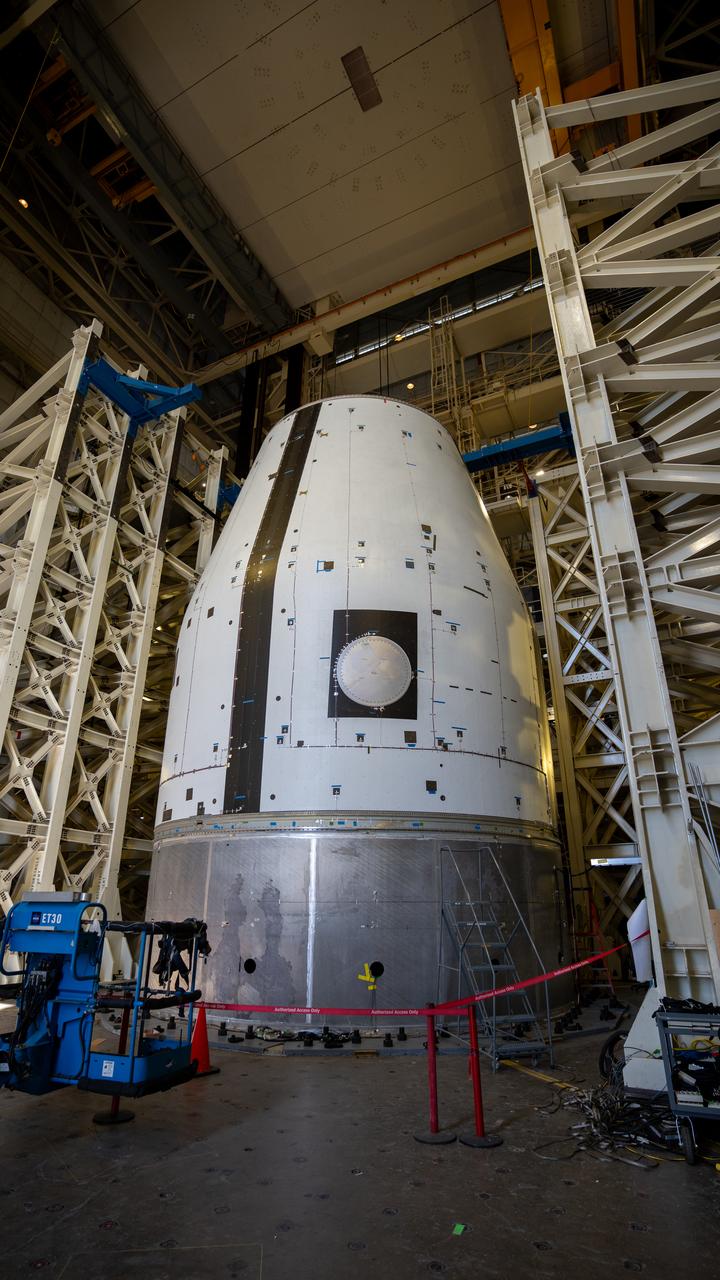
These photos and videos show how crews guided a test version of the universal stage adapter for NASA’s more powerful version of its SLS (Space Launch System) rocket to Building 4619 at the agency’s Marshall Space Flight Center in Huntsville, Alabama, Feb. 22. Built by Leidos, the lead contractor for the universal stage adapter, crews transported the hardware from a Leidos facility in Decatur, Alabama, the same day. The universal stage adapter will connect the SLS rocket’s upgraded in-space propulsion stage, called the exploration upper stage, to NASA’s Orion spacecraft as part of the evolved Block 1B configuration of the SLS rocket. It will also serve as a compartment capable of accommodating large payloads, such as modules or other exploration spacecraft. In Building 4619’s Load Test Annex High Bay at Marshall, the development test article will first undergo modal testing that will shake the hardware to validate dynamic models. Later, during ultimate load testing, force will be applied vertically and to the sides of the hardware. Unlike the flight hardware, the development test article has flaws intentionally included in its design, which will help engineers verity that the flight adapter can withstand the extreme forces it will face during launch and flight.
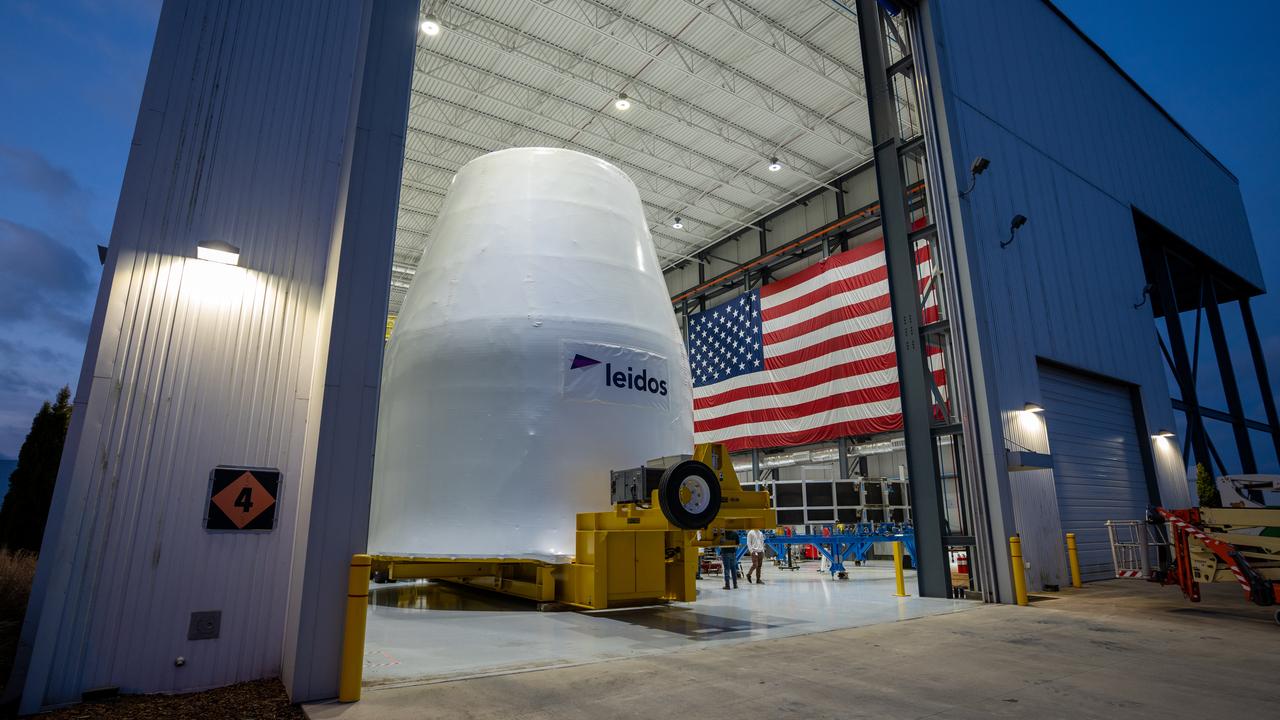
These photos and videos show how crews guided a test version of the universal stage adapter for NASA’s more powerful version of its SLS (Space Launch System) rocket to Building 4619 at the agency’s Marshall Space Flight Center in Huntsville, Alabama, Feb. 22. Built by Leidos, the lead contractor for the universal stage adapter, crews transported the hardware from a Leidos facility in Decatur, Alabama, the same day. The universal stage adapter will connect the SLS rocket’s upgraded in-space propulsion stage, called the exploration upper stage, to NASA’s Orion spacecraft as part of the evolved Block 1B configuration of the SLS rocket. It will also serve as a compartment capable of accommodating large payloads, such as modules or other exploration spacecraft. In Building 4619’s Load Test Annex High Bay at Marshall, the development test article will first undergo modal testing that will shake the hardware to validate dynamic models. Later, during ultimate load testing, force will be applied vertically and to the sides of the hardware. Unlike the flight hardware, the development test article has flaws intentionally included in its design, which will help engineers verity that the flight adapter can withstand the extreme forces it will face during launch and flight.
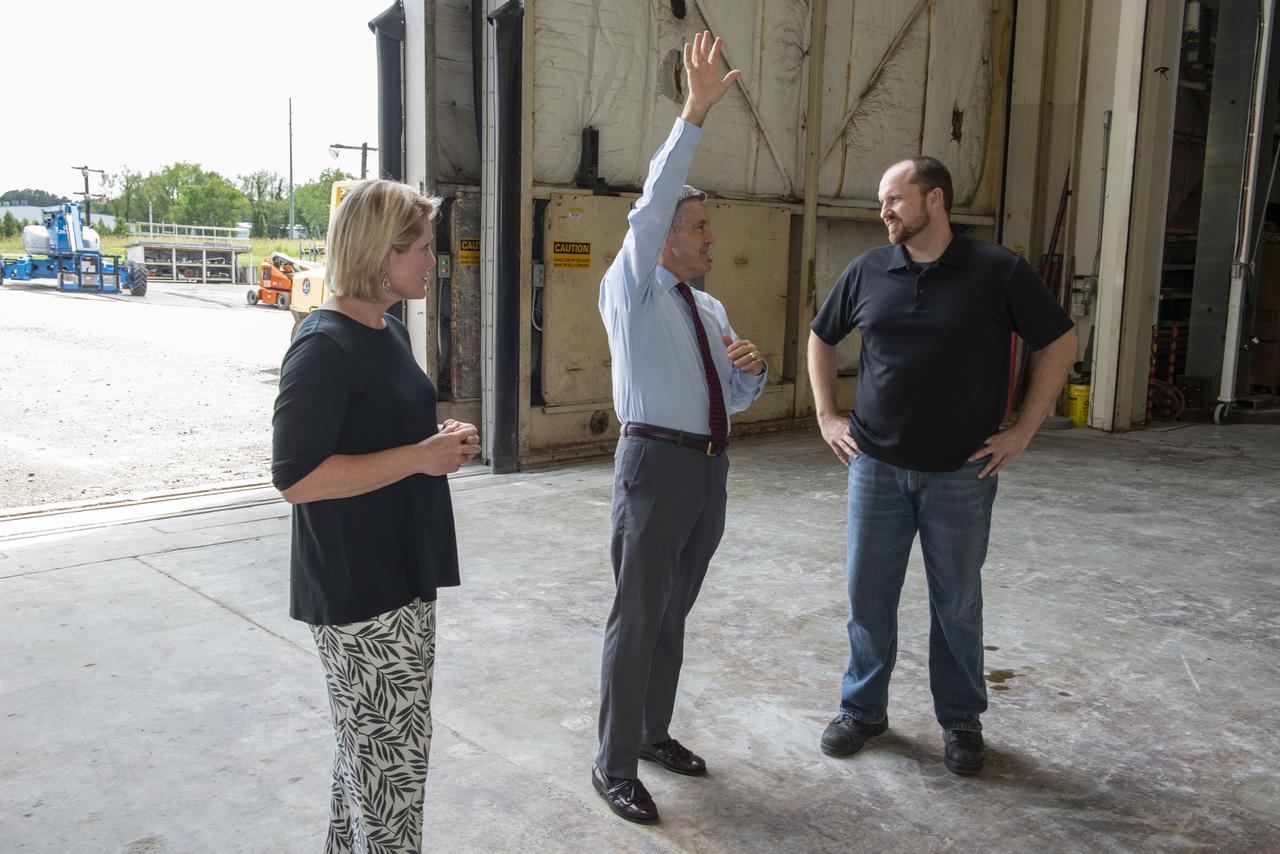
Kennedy Space Center Director Robert Cabana, center, receives an update on SLS hardware from Heather Haney, left, an engineer in the Space Launch System stages office, and Mark White, lead test engineer for the SLS core stage engine section, on July 16 in Marshall's Building 4619. Cabana, Haney and White are standing in front of a structural test version of the Intertank, the 212-foot-tall backbone of the SLS rocket. The structural test article is undergoing critical testing as engineers push, pull and bend the hardware with millions of pounds of force to ensure it can withstand the forces of launch and ascent.
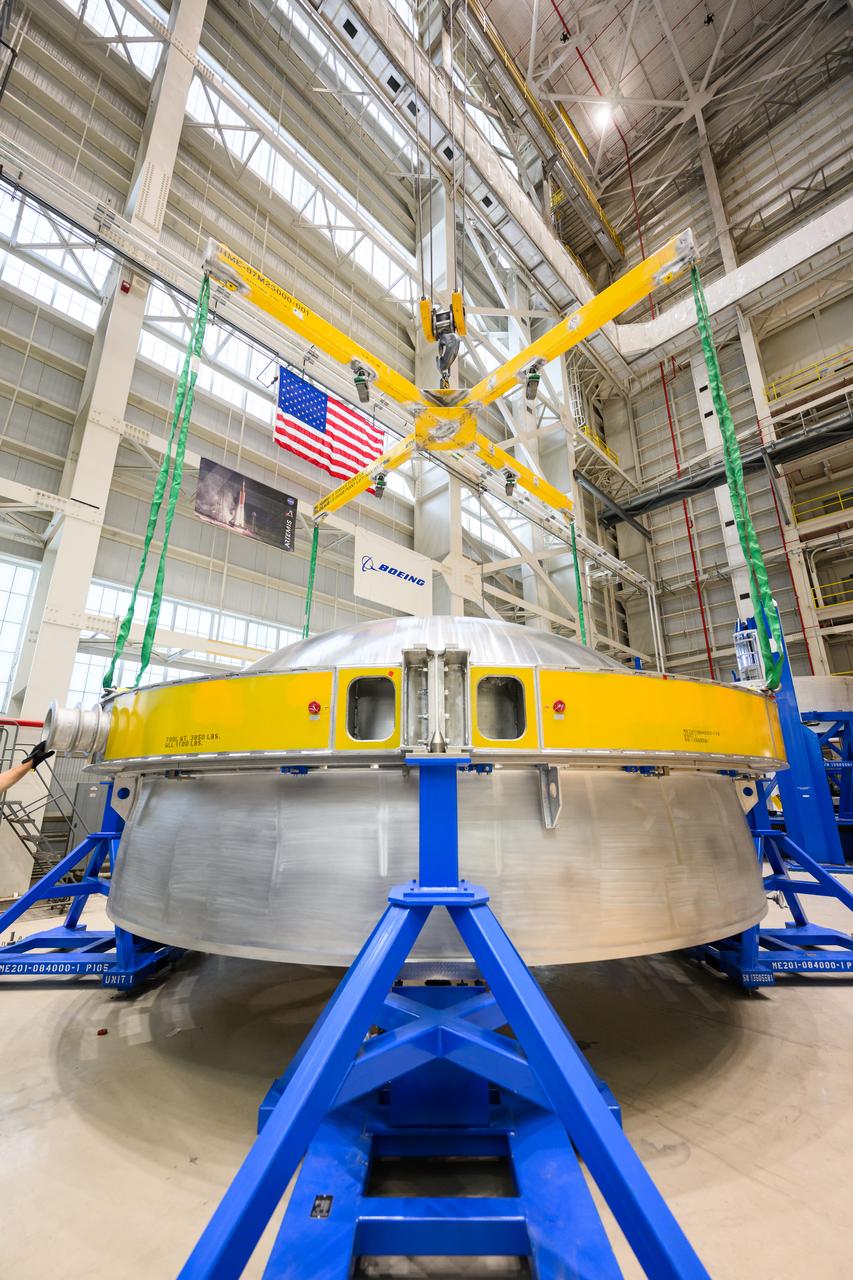
These images show technicians at NASA’s Michoud Assembly Facility in New Orleans lifting and installing the liquid oxygen dome weld confidence article for a future upper stage for NASA’s SLS (Space Launch System) rocket onto the LTAC (LOX Tank Assembly Center) in Building 115 at Michoud for the next phase of manufacturing in July 2023. The dome makes up a portion of the liquid oxygen tank weld confidence article for the EUS (exploration upper stage). Teams use weld confidence articles to verify welding procedures and structural integrity of the welds to manufacture structural test and flight versions of the hardware. EUS flight hardware is in early production at Michoud. The more powerful upper stage and its four RL10 engines will be used on the second configuration of the SLS rocket, known as Block 1B, and will provide in-space propulsion to send astronauts in NASA’s Orion spacecraft and heavy cargo on a precise trajectory to the Moon. NASA and Boeing, the lead contractor for the SLS core stage and EUS, are manufacturing SLS stages for Artemis II, III, IV, and V at the facility. NASA is working to land the first woman and first person of color on the Moon under Artemis. SLS is part of NASA’s backbone for deep space exploration, along with Orion and the Gateway in orbit around the Moon. SLS is the only rocket that can send Orion, astronauts, and supplies to the Moon in a single mission.
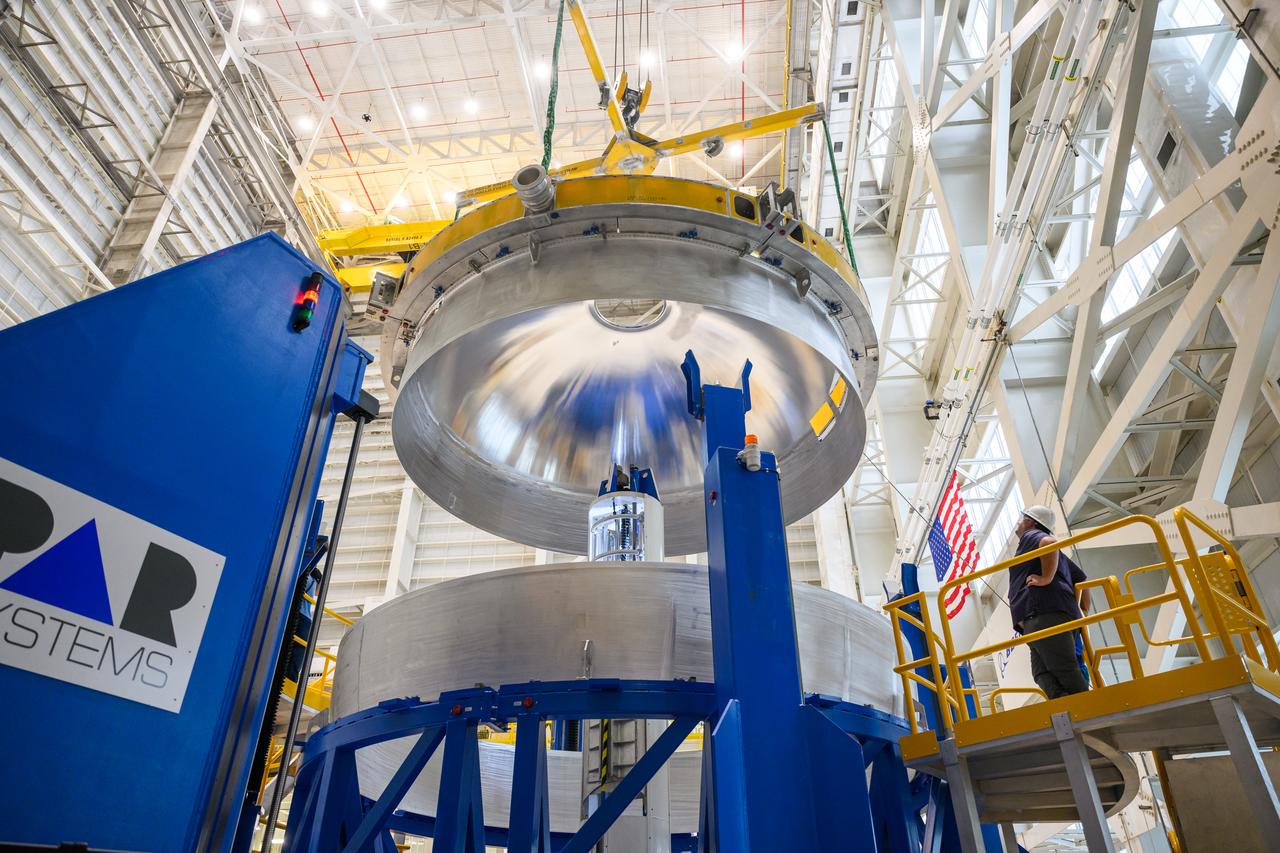
These images show technicians at NASA’s Michoud Assembly Facility in New Orleans lifting and installing the liquid oxygen dome weld confidence article for a future upper stage for NASA’s SLS (Space Launch System) rocket onto the LTAC (LOX Tank Assembly Center) in Building 115 at Michoud for the next phase of manufacturing in July 2023. The dome makes up a portion of the liquid oxygen tank weld confidence article for the EUS (exploration upper stage). Teams use weld confidence articles to verify welding procedures and structural integrity of the welds to manufacture structural test and flight versions of the hardware. EUS flight hardware is in early production at Michoud. The more powerful upper stage and its four RL10 engines will be used on the second configuration of the SLS rocket, known as Block 1B, and will provide in-space propulsion to send astronauts in NASA’s Orion spacecraft and heavy cargo on a precise trajectory to the Moon. NASA and Boeing, the lead contractor for the SLS core stage and EUS, are manufacturing SLS stages for Artemis II, III, IV, and V at the facility. NASA is working to land the first woman and first person of color on the Moon under Artemis. SLS is part of NASA’s backbone for deep space exploration, along with Orion and the Gateway in orbit around the Moon. SLS is the only rocket that can send Orion, astronauts, and supplies to the Moon in a single mission.
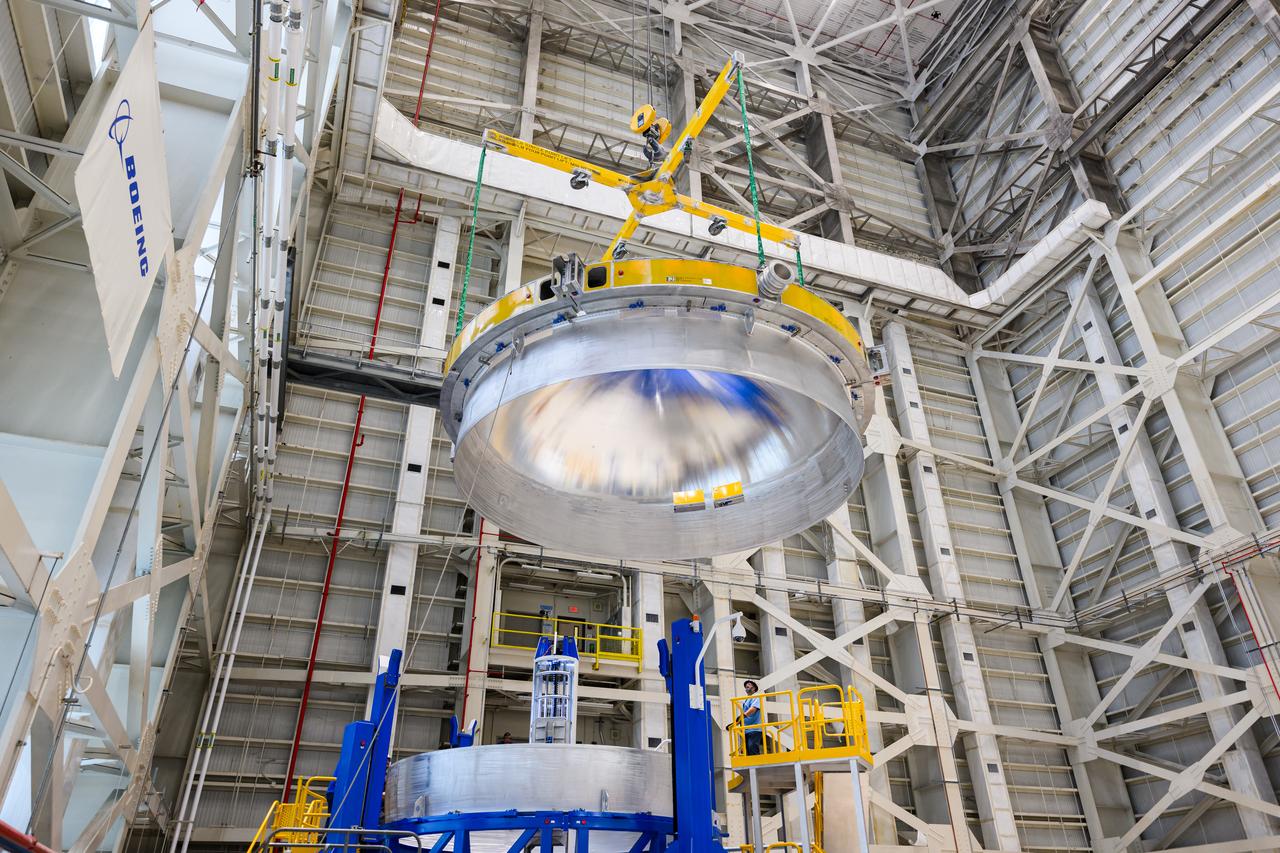
These images show technicians at NASA’s Michoud Assembly Facility in New Orleans lifting and installing the liquid oxygen dome weld confidence article for a future upper stage for NASA’s SLS (Space Launch System) rocket onto the LTAC (LOX Tank Assembly Center) in Building 115 at Michoud for the next phase of manufacturing in July 2023. The dome makes up a portion of the liquid oxygen tank weld confidence article for the EUS (exploration upper stage). Teams use weld confidence articles to verify welding procedures and structural integrity of the welds to manufacture structural test and flight versions of the hardware. EUS flight hardware is in early production at Michoud. The more powerful upper stage and its four RL10 engines will be used on the second configuration of the SLS rocket, known as Block 1B, and will provide in-space propulsion to send astronauts in NASA’s Orion spacecraft and heavy cargo on a precise trajectory to the Moon. NASA and Boeing, the lead contractor for the SLS core stage and EUS, are manufacturing SLS stages for Artemis II, III, IV, and V at the facility. NASA is working to land the first woman and first person of color on the Moon under Artemis. SLS is part of NASA’s backbone for deep space exploration, along with Orion and the Gateway in orbit around the Moon. SLS is the only rocket that can send Orion, astronauts, and supplies to the Moon in a single mission.
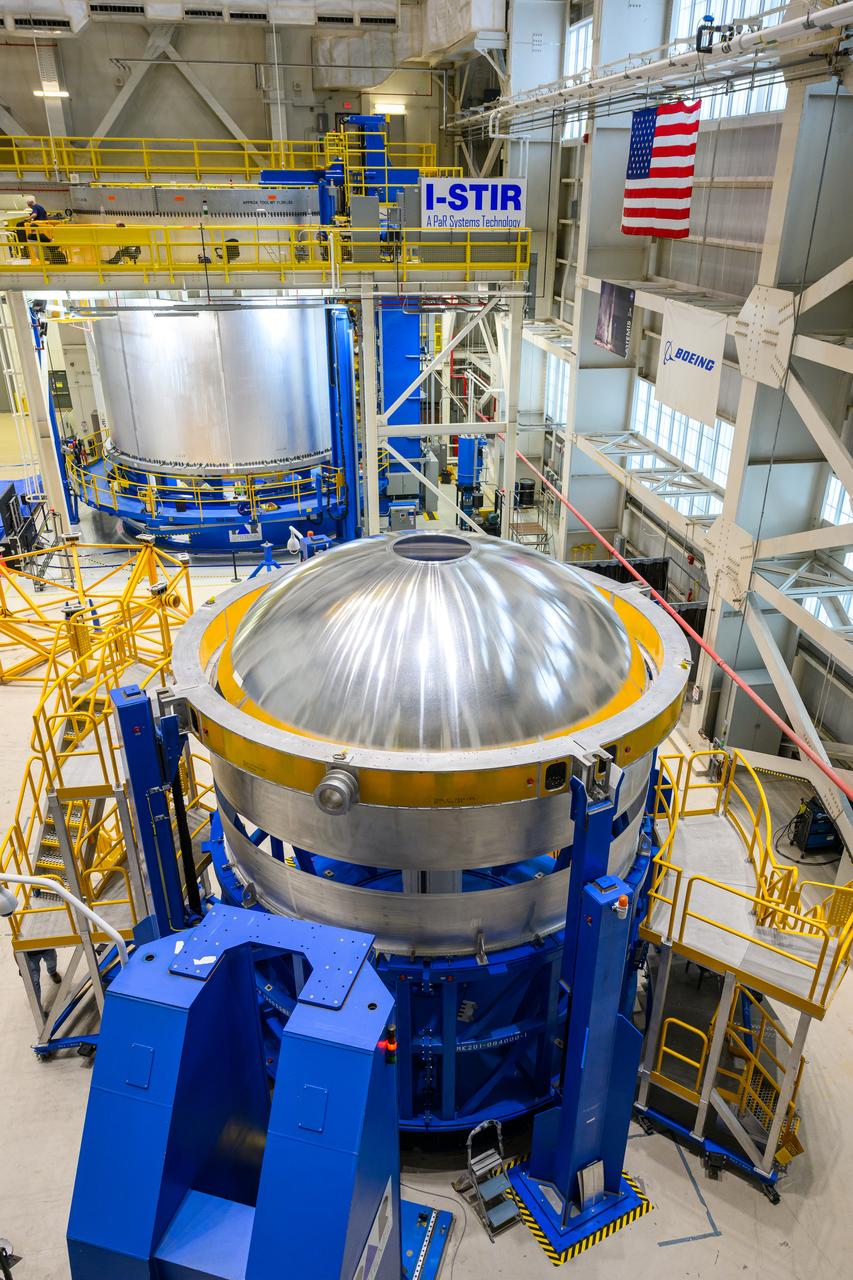
These images show technicians at NASA’s Michoud Assembly Facility in New Orleans lifting and installing the liquid oxygen dome weld confidence article for a future upper stage for NASA’s SLS (Space Launch System) rocket onto the LTAC (LOX Tank Assembly Center) in Building 115 at Michoud for the next phase of manufacturing in July 2023. The dome makes up a portion of the liquid oxygen tank weld confidence article for the EUS (exploration upper stage). Teams use weld confidence articles to verify welding procedures and structural integrity of the welds to manufacture structural test and flight versions of the hardware. EUS flight hardware is in early production at Michoud. The more powerful upper stage and its four RL10 engines will be used on the second configuration of the SLS rocket, known as Block 1B, and will provide in-space propulsion to send astronauts in NASA’s Orion spacecraft and heavy cargo on a precise trajectory to the Moon. NASA and Boeing, the lead contractor for the SLS core stage and EUS, are manufacturing SLS stages for Artemis II, III, IV, and V at the facility. NASA is working to land the first woman and first person of color on the Moon under Artemis. SLS is part of NASA’s backbone for deep space exploration, along with Orion and the Gateway in orbit around the Moon. SLS is the only rocket that can send Orion, astronauts, and supplies to the Moon in a single mission.

These images show technicians at NASA’s Michoud Assembly Facility in New Orleans lifting and installing the liquid oxygen dome weld confidence article for a future upper stage for NASA’s SLS (Space Launch System) rocket onto the LTAC (LOX Tank Assembly Center) in Building 115 at Michoud for the next phase of manufacturing in July 2023. The dome makes up a portion of the liquid oxygen tank weld confidence article for the EUS (exploration upper stage). Teams use weld confidence articles to verify welding procedures and structural integrity of the welds to manufacture structural test and flight versions of the hardware. EUS flight hardware is in early production at Michoud. The more powerful upper stage and its four RL10 engines will be used on the second configuration of the SLS rocket, known as Block 1B, and will provide in-space propulsion to send astronauts in NASA’s Orion spacecraft and heavy cargo on a precise trajectory to the Moon. NASA and Boeing, the lead contractor for the SLS core stage and EUS, are manufacturing SLS stages for Artemis II, III, IV, and V at the facility. NASA is working to land the first woman and first person of color on the Moon under Artemis. SLS is part of NASA’s backbone for deep space exploration, along with Orion and the Gateway in orbit around the Moon. SLS is the only rocket that can send Orion, astronauts, and supplies to the Moon in a single mission.
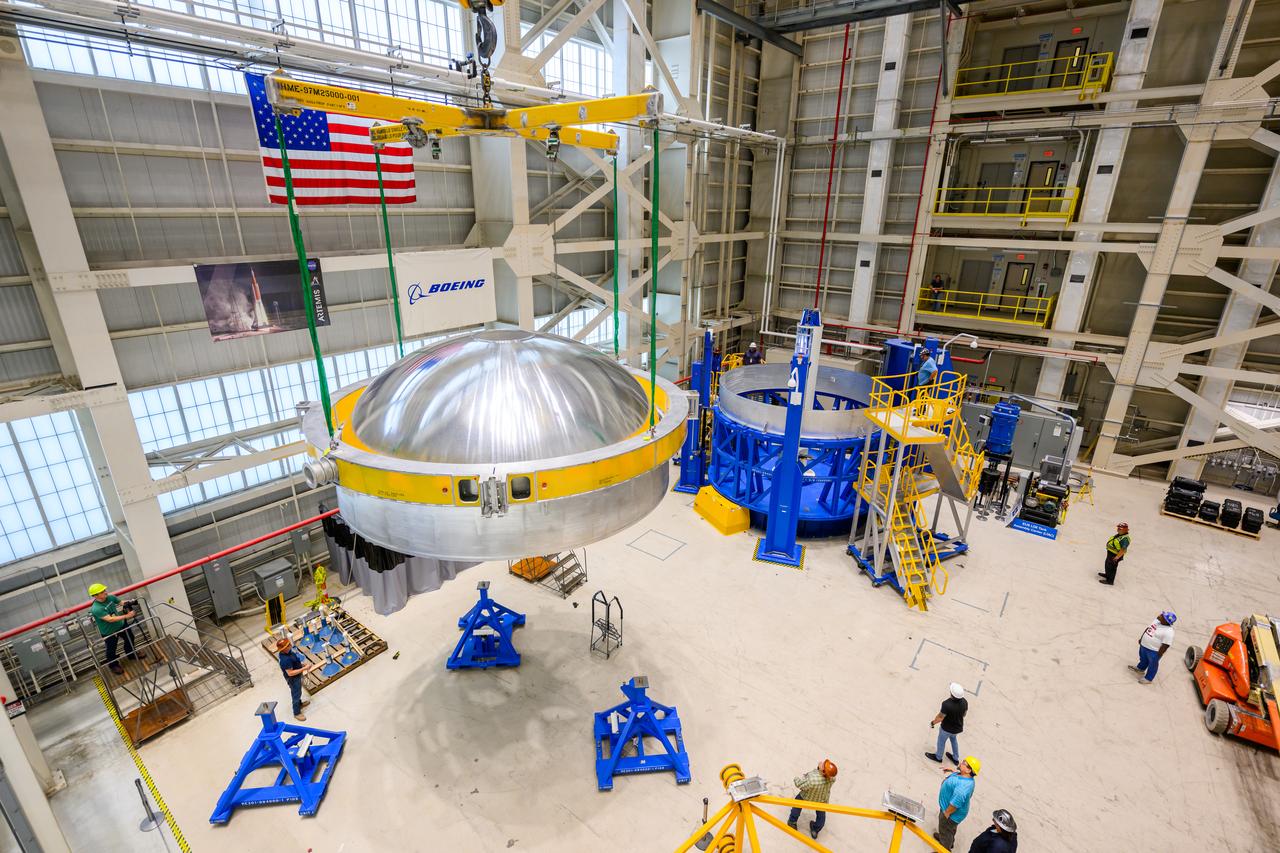
These images show technicians at NASA’s Michoud Assembly Facility in New Orleans lifting and installing the liquid oxygen dome weld confidence article for a future upper stage for NASA’s SLS (Space Launch System) rocket onto the LTAC (LOX Tank Assembly Center) in Building 115 at Michoud for the next phase of manufacturing in July 2023. The dome makes up a portion of the liquid oxygen tank weld confidence article for the EUS (exploration upper stage). Teams use weld confidence articles to verify welding procedures and structural integrity of the welds to manufacture structural test and flight versions of the hardware. EUS flight hardware is in early production at Michoud. The more powerful upper stage and its four RL10 engines will be used on the second configuration of the SLS rocket, known as Block 1B, and will provide in-space propulsion to send astronauts in NASA’s Orion spacecraft and heavy cargo on a precise trajectory to the Moon. NASA and Boeing, the lead contractor for the SLS core stage and EUS, are manufacturing SLS stages for Artemis II, III, IV, and V at the facility. NASA is working to land the first woman and first person of color on the Moon under Artemis. SLS is part of NASA’s backbone for deep space exploration, along with Orion and the Gateway in orbit around the Moon. SLS is the only rocket that can send Orion, astronauts, and supplies to the Moon in a single mission.
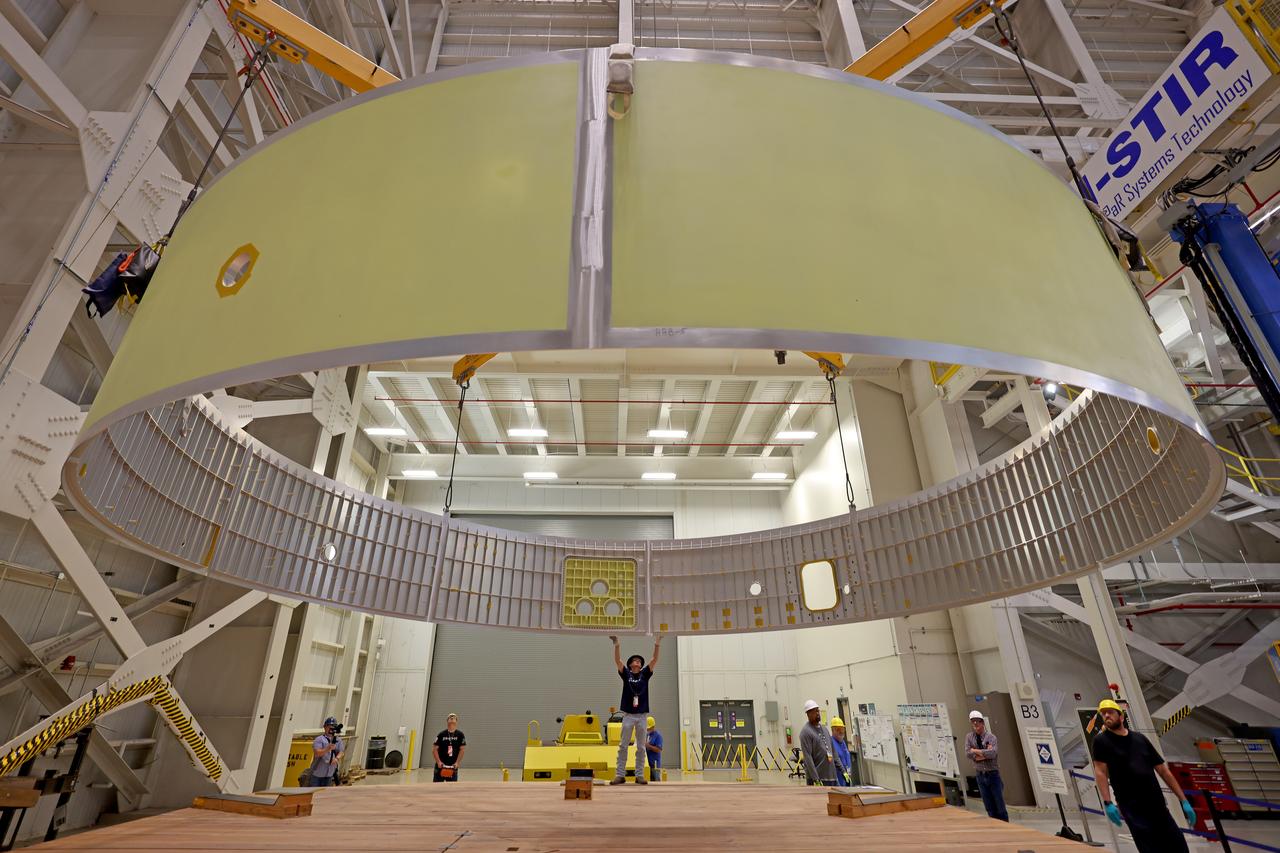
These images and videos show technicians at NASA’s Michoud Assembly Facility in New Orleans examining and lifting midbody barrels for the Exploration Upper Stage (EUS) structural test article of the SLS (Space Launch System) rocket in May 2023. The barrel sections make up the body, or main structure, of the future in-space propulsion stage for the mega rocket. The Exploration Upper Stage will be used on the second configuration of the SLS rocket, known as Block 1B, and will provide in-space propulsion to send astronauts in NASA’s Orion spacecraft and heavy cargo on a precise trajectory to the Moon. Beginning with Artemis IV, EUS will replace the interim cryogenic propulsion stage for the Block 1 configuration of SLS. It has larger propellant tanks and four RL10 engines, enabling SLS to launch 40% more cargo to the Moon along with crew. EUS flight hardware is in early production at Michoud. Crews with NASA and Boeing, the lead contractor for the SLS core stage and EUS, are also manufacturing the EUS structural test article. The test hardware is structurally identical to the flight version and will be used during a series of strenuous testing that simulates the forces the rocket will experience during launch and flight and verify its structural integrity. NASA is working to land the first woman and first person of color on the Moon under Artemis. SLS is part of NASA’s backbone for deep space exploration, along with Orion and the Gateway in orbit around the Moon. SLS is the only rocket that can send Orion, astronauts, and supplies to the Moon in a single mission.
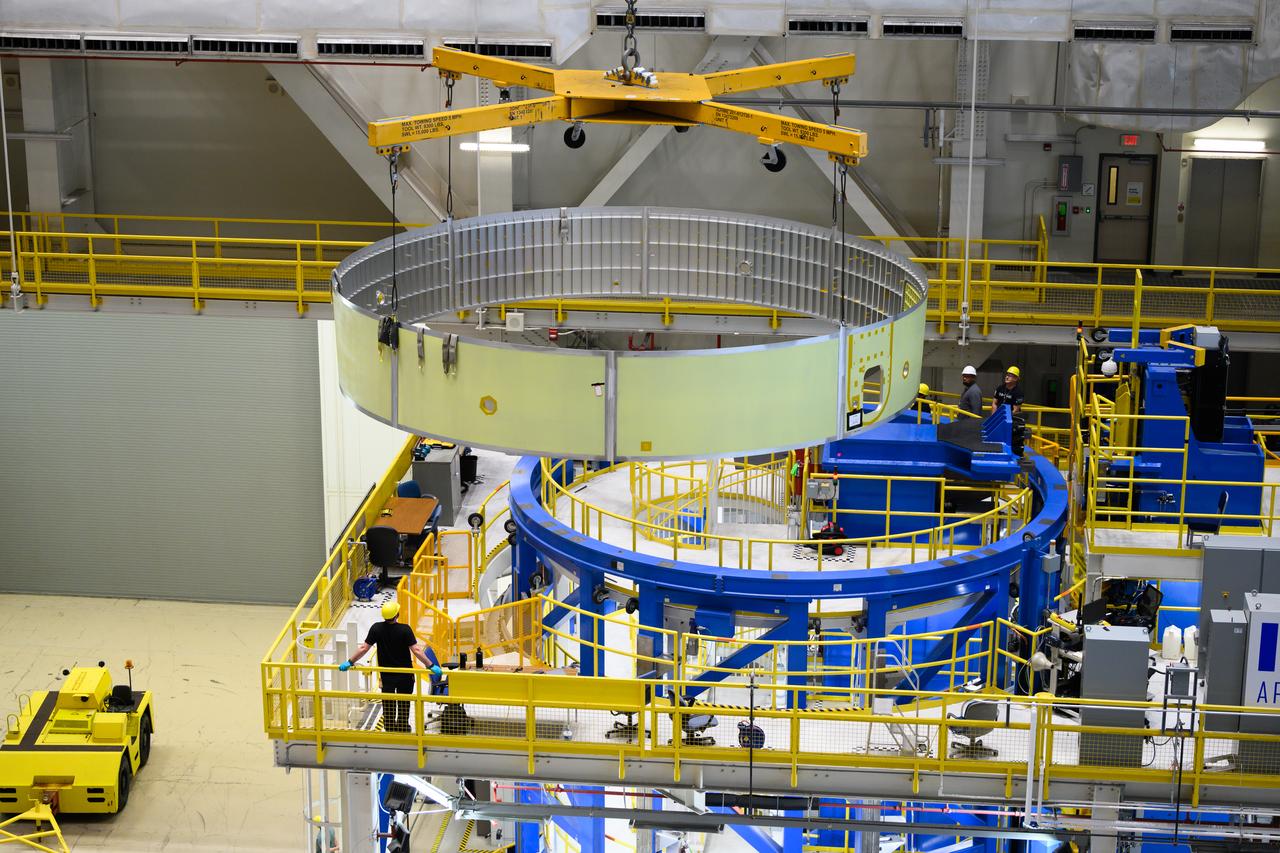
These images and videos show technicians at NASA’s Michoud Assembly Facility in New Orleans examining and lifting midbody barrels for the Exploration Upper Stage (EUS) structural test article of the SLS (Space Launch System) rocket in May 2023. The barrel sections make up the body, or main structure, of the future in-space propulsion stage for the mega rocket. The Exploration Upper Stage will be used on the second configuration of the SLS rocket, known as Block 1B, and will provide in-space propulsion to send astronauts in NASA’s Orion spacecraft and heavy cargo on a precise trajectory to the Moon. Beginning with Artemis IV, EUS will replace the interim cryogenic propulsion stage for the Block 1 configuration of SLS. It has larger propellant tanks and four RL10 engines, enabling SLS to launch 40% more cargo to the Moon along with crew. EUS flight hardware is in early production at Michoud. Crews with NASA and Boeing, the lead contractor for the SLS core stage and EUS, are also manufacturing the EUS structural test article. The test hardware is structurally identical to the flight version and will be used during a series of strenuous testing that simulates the forces the rocket will experience during launch and flight and verify its structural integrity. NASA is working to land the first woman and first person of color on the Moon under Artemis. SLS is part of NASA’s backbone for deep space exploration, along with Orion and the Gateway in orbit around the Moon. SLS is the only rocket that can send Orion, astronauts, and supplies to the Moon in a single mission.
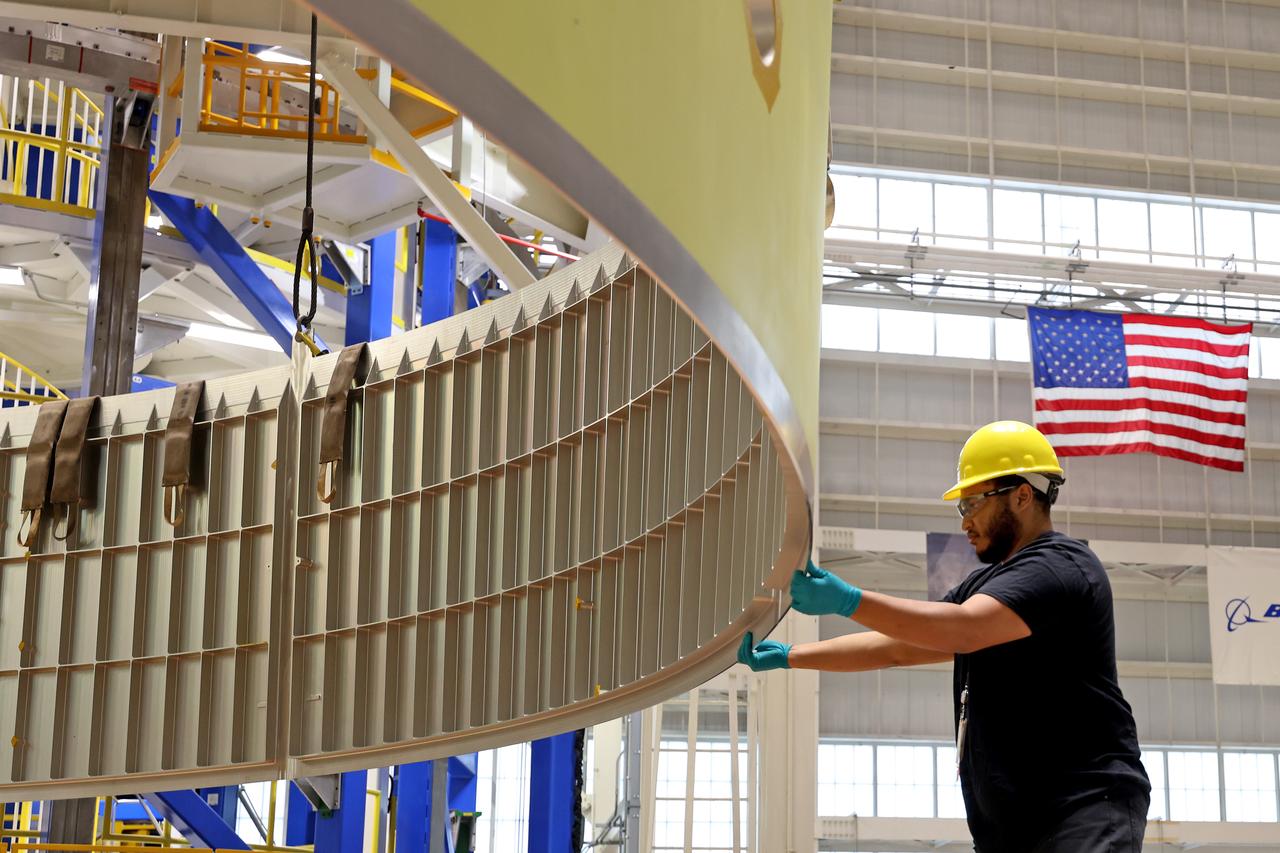
These images and videos show technicians at NASA’s Michoud Assembly Facility in New Orleans examining and lifting midbody barrels for the Exploration Upper Stage (EUS) structural test article of the SLS (Space Launch System) rocket in May 2023. The barrel sections make up the body, or main structure, of the future in-space propulsion stage for the mega rocket. The Exploration Upper Stage will be used on the second configuration of the SLS rocket, known as Block 1B, and will provide in-space propulsion to send astronauts in NASA’s Orion spacecraft and heavy cargo on a precise trajectory to the Moon. Beginning with Artemis IV, EUS will replace the interim cryogenic propulsion stage for the Block 1 configuration of SLS. It has larger propellant tanks and four RL10 engines, enabling SLS to launch 40% more cargo to the Moon along with crew. EUS flight hardware is in early production at Michoud. Crews with NASA and Boeing, the lead contractor for the SLS core stage and EUS, are also manufacturing the EUS structural test article. The test hardware is structurally identical to the flight version and will be used during a series of strenuous testing that simulates the forces the rocket will experience during launch and flight and verify its structural integrity. NASA is working to land the first woman and first person of color on the Moon under Artemis. SLS is part of NASA’s backbone for deep space exploration, along with Orion and the Gateway in orbit around the Moon. SLS is the only rocket that can send Orion, astronauts, and supplies to the Moon in a single mission.
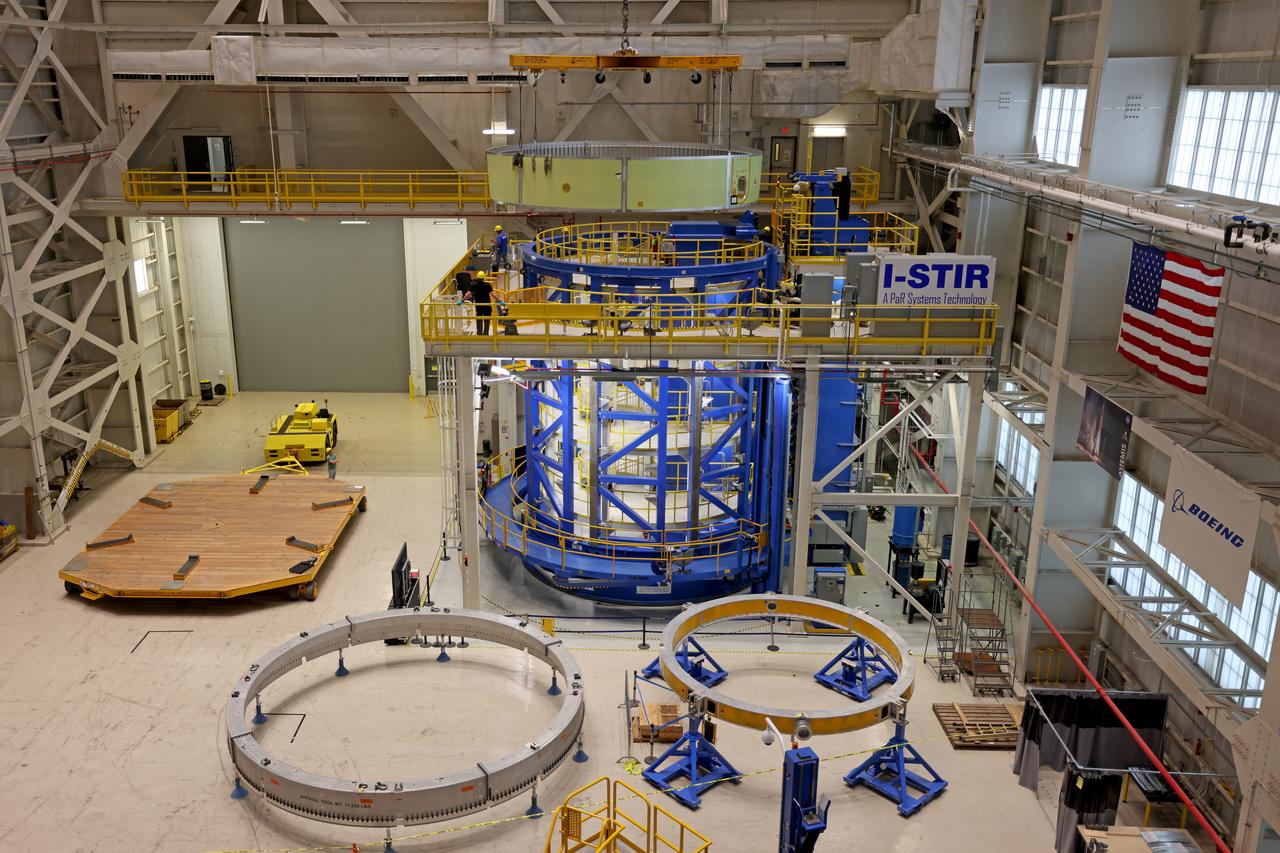
These images and videos show technicians at NASA’s Michoud Assembly Facility in New Orleans examining and lifting midbody barrels for the Exploration Upper Stage (EUS) structural test article of the SLS (Space Launch System) rocket in May 2023. The barrel sections make up the body, or main structure, of the future in-space propulsion stage for the mega rocket. The Exploration Upper Stage will be used on the second configuration of the SLS rocket, known as Block 1B, and will provide in-space propulsion to send astronauts in NASA’s Orion spacecraft and heavy cargo on a precise trajectory to the Moon. Beginning with Artemis IV, EUS will replace the interim cryogenic propulsion stage for the Block 1 configuration of SLS. It has larger propellant tanks and four RL10 engines, enabling SLS to launch 40% more cargo to the Moon along with crew. EUS flight hardware is in early production at Michoud. Crews with NASA and Boeing, the lead contractor for the SLS core stage and EUS, are also manufacturing the EUS structural test article. The test hardware is structurally identical to the flight version and will be used during a series of strenuous testing that simulates the forces the rocket will experience during launch and flight and verify its structural integrity. NASA is working to land the first woman and first person of color on the Moon under Artemis. SLS is part of NASA’s backbone for deep space exploration, along with Orion and the Gateway in orbit around the Moon. SLS is the only rocket that can send Orion, astronauts, and supplies to the Moon in a single mission.
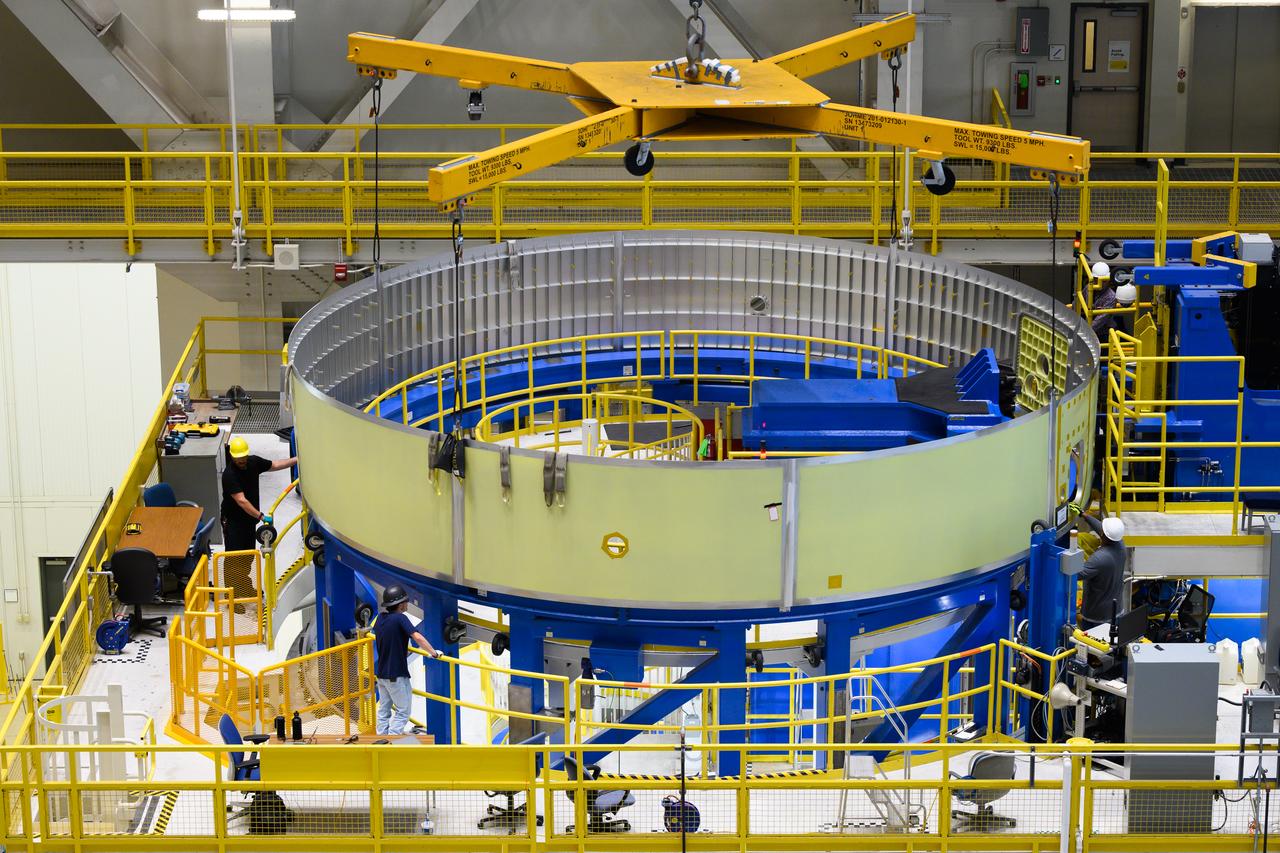
These images and videos show technicians at NASA’s Michoud Assembly Facility in New Orleans examining and lifting midbody barrels for the Exploration Upper Stage (EUS) structural test article of the SLS (Space Launch System) rocket in May 2023. The barrel sections make up the body, or main structure, of the future in-space propulsion stage for the mega rocket. The Exploration Upper Stage will be used on the second configuration of the SLS rocket, known as Block 1B, and will provide in-space propulsion to send astronauts in NASA’s Orion spacecraft and heavy cargo on a precise trajectory to the Moon. Beginning with Artemis IV, EUS will replace the interim cryogenic propulsion stage for the Block 1 configuration of SLS. It has larger propellant tanks and four RL10 engines, enabling SLS to launch 40% more cargo to the Moon along with crew. EUS flight hardware is in early production at Michoud. Crews with NASA and Boeing, the lead contractor for the SLS core stage and EUS, are also manufacturing the EUS structural test article. The test hardware is structurally identical to the flight version and will be used during a series of strenuous testing that simulates the forces the rocket will experience during launch and flight and verify its structural integrity. NASA is working to land the first woman and first person of color on the Moon under Artemis. SLS is part of NASA’s backbone for deep space exploration, along with Orion and the Gateway in orbit around the Moon. SLS is the only rocket that can send Orion, astronauts, and supplies to the Moon in a single mission.

These images and videos show technicians at NASA’s Michoud Assembly Facility in New Orleans examining and lifting midbody barrels for the Exploration Upper Stage (EUS) structural test article of the SLS (Space Launch System) rocket in May 2023. The barrel sections make up the body, or main structure, of the future in-space propulsion stage for the mega rocket. The Exploration Upper Stage will be used on the second configuration of the SLS rocket, known as Block 1B, and will provide in-space propulsion to send astronauts in NASA’s Orion spacecraft and heavy cargo on a precise trajectory to the Moon. Beginning with Artemis IV, EUS will replace the interim cryogenic propulsion stage for the Block 1 configuration of SLS. It has larger propellant tanks and four RL10 engines, enabling SLS to launch 40% more cargo to the Moon along with crew. EUS flight hardware is in early production at Michoud. Crews with NASA and Boeing, the lead contractor for the SLS core stage and EUS, are also manufacturing the EUS structural test article. The test hardware is structurally identical to the flight version and will be used during a series of strenuous testing that simulates the forces the rocket will experience during launch and flight and verify its structural integrity. NASA is working to land the first woman and first person of color on the Moon under Artemis. SLS is part of NASA’s backbone for deep space exploration, along with Orion and the Gateway in orbit around the Moon. SLS is the only rocket that can send Orion, astronauts, and supplies to the Moon in a single mission.
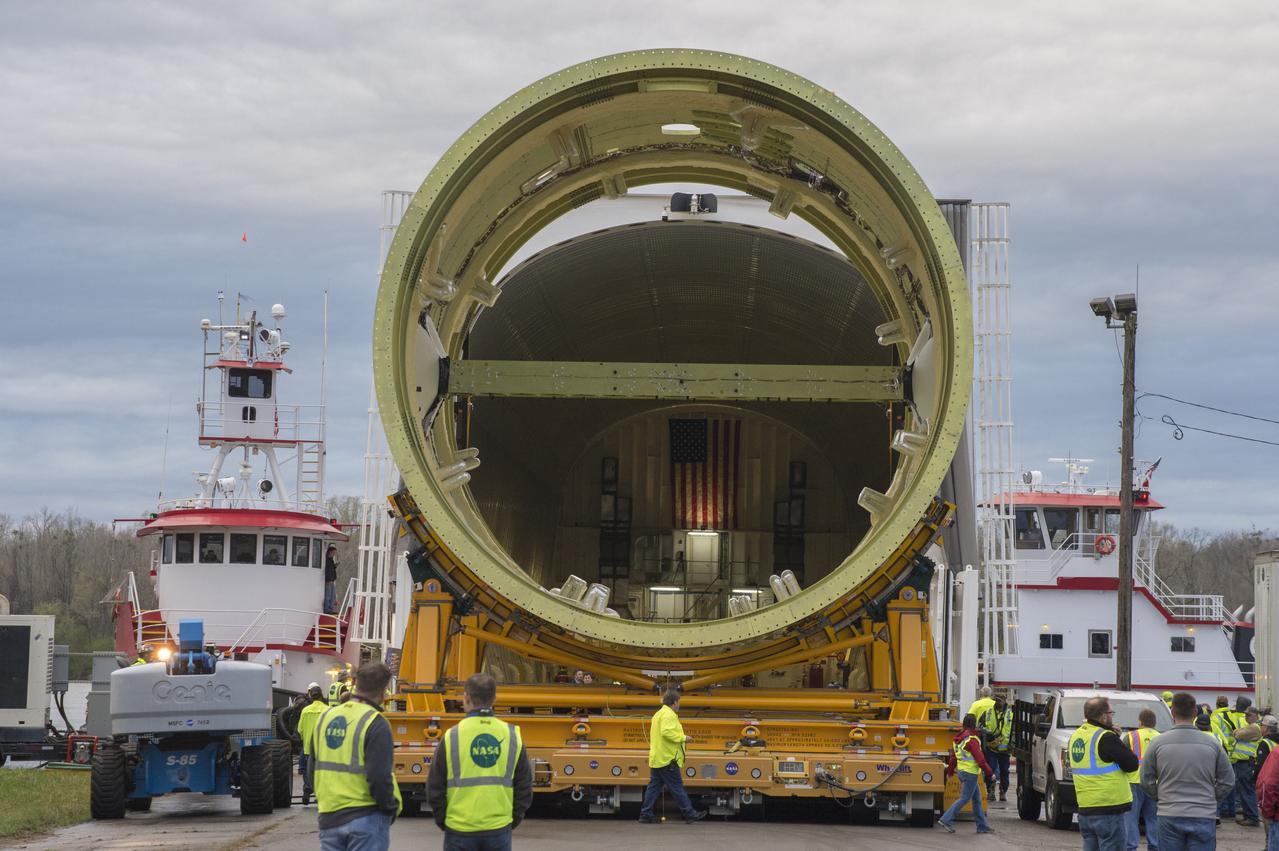
The SLS Stages Intertank Structural Test Assembly (STA) is rolling off the NASA Pegasus Barge at the MSFC Dock enroute to the MSFC 4619 Load Test Annex test facility for qualification testing. STA hardware completely free of barge and flanked by tug boats.
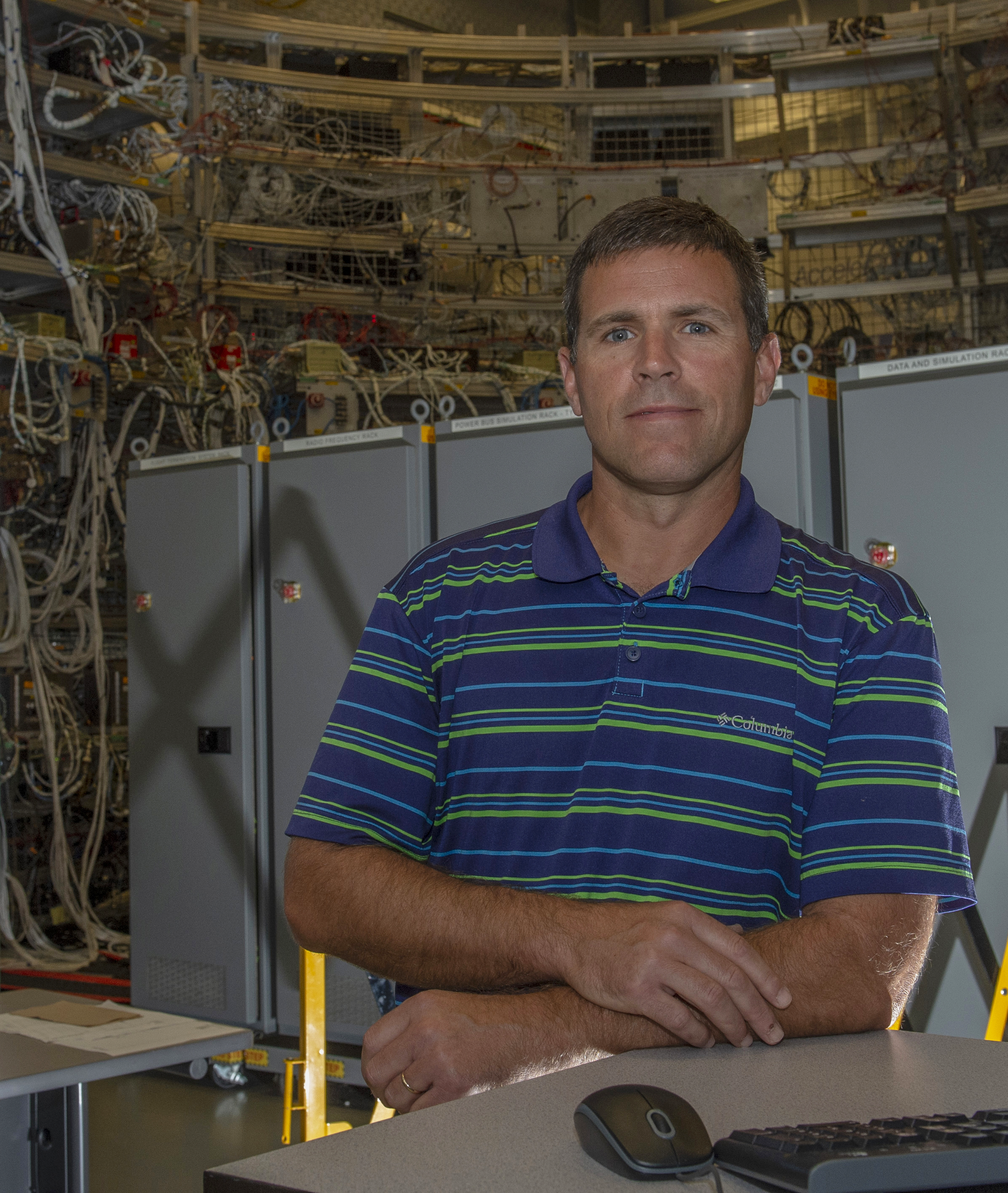
George Plattsmier, ARTEMIS developer supporting hardware/software development, integration and testing for the Space Launch System (SLS) in the Systems Integration Lab (SIL), Building 4205, lab 116.
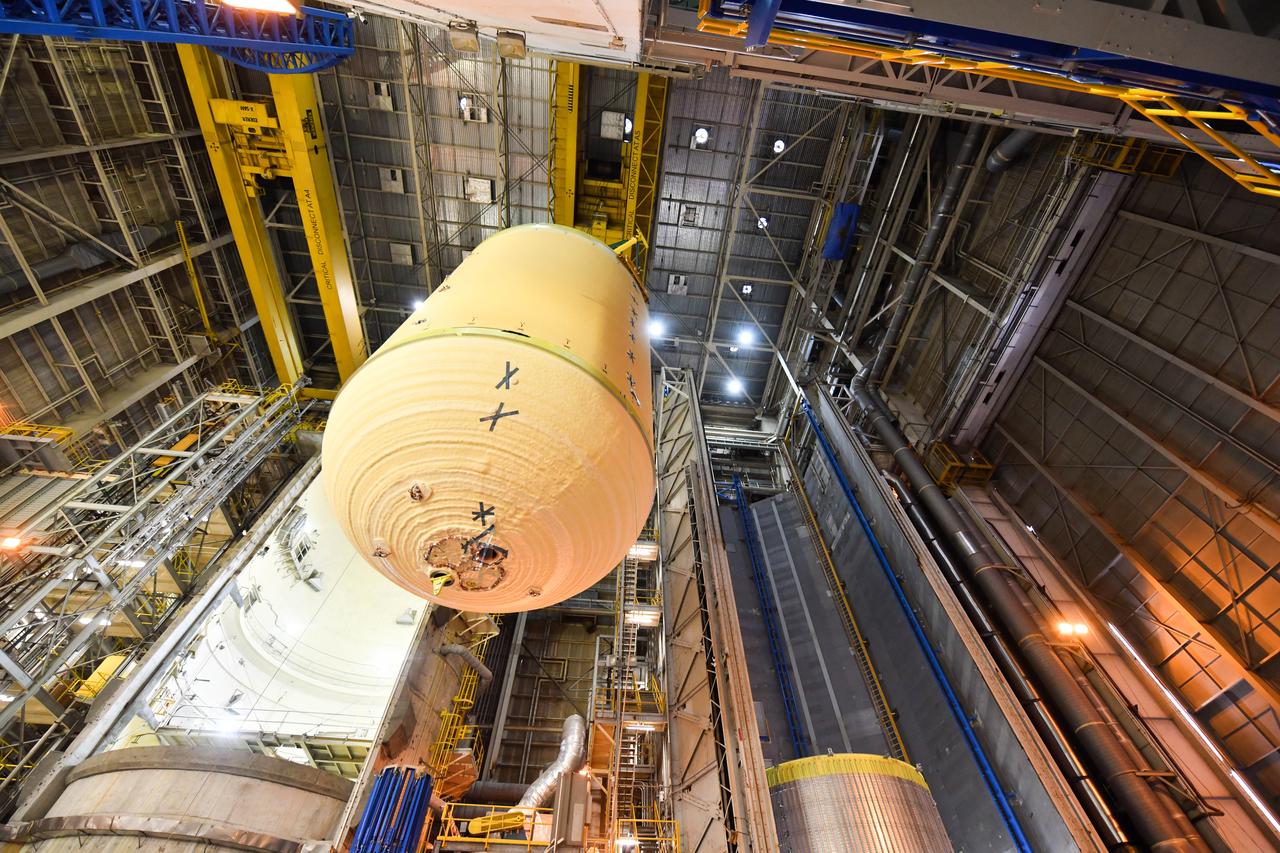
The Space Launch System (SLS) rocket’s liquid oxygen tank structural test article was manufactured and stacked in June 2019 at NASA’s Michoud Assembly Facility in New Orleans. To construct the test article, Boeing technicians at Michoud moved the liquid oxygen tank to the Vertical Assemby Building stacking and integration area. Here, they added simulators to mimic the two structures that connect to the tank, the intertank and the forward skirt. This structural hardware for the SLS core stage for America’s new deep space rocket is structurally identical to the flight version of the tank. It will be shipped on the Pegasus barge to NASA’s Marshall Space Flight Center in Hunstville, Alabama, where it will undergo a series of tests that simulate the stresses and loads of liftoff and flight. These tests will help ensure designs are adequate for successful SLS missions to the Moon and beyond. The flight liquid oxygen tank along with the liquid hydrogen tank supplies more than 500,000 gallons of propellant to the core stages four RS-25 engines, which produce 2 million pounds of thrust to help send the SLS rocket to space.
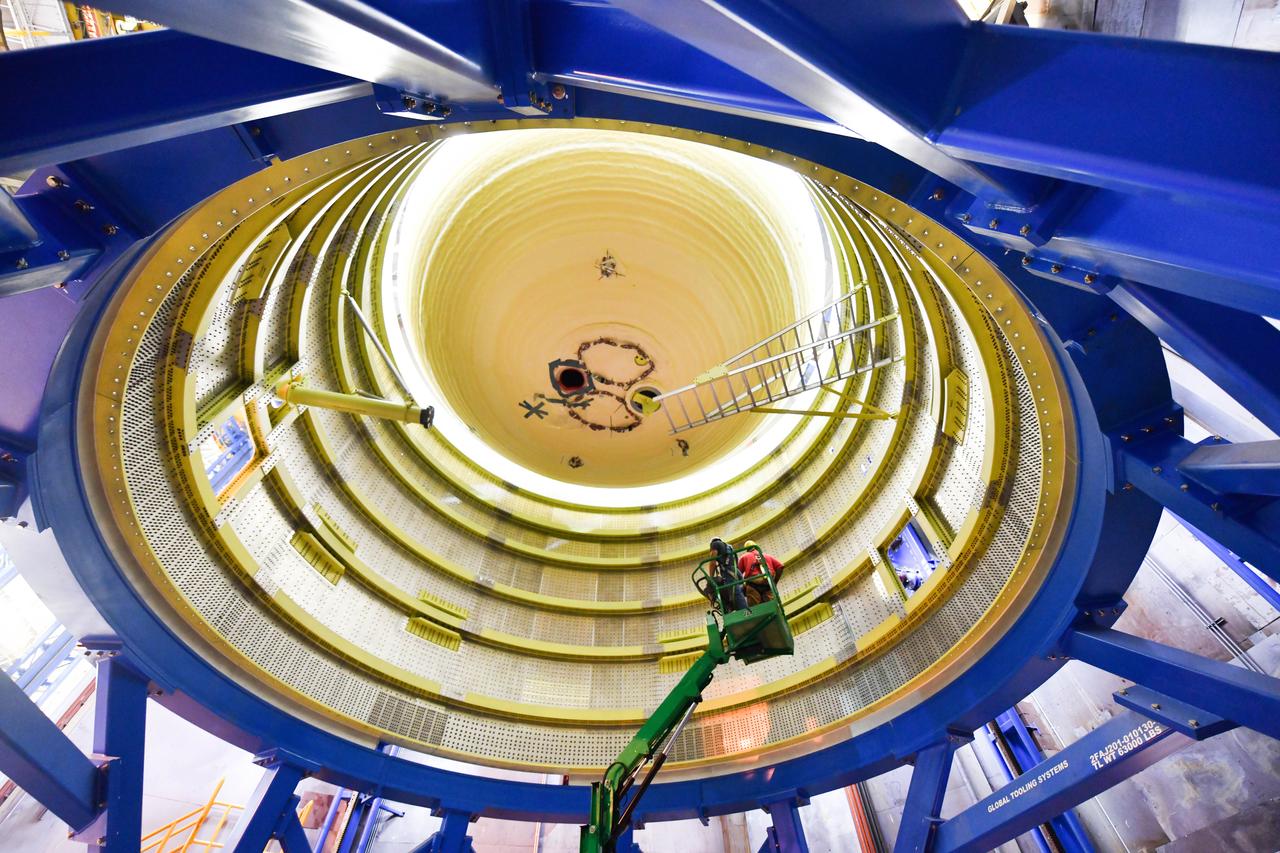
The Space Launch System (SLS) rocket’s liquid oxygen tank structural test article was manufactured and stacked in June 2019 at NASA’s Michoud Assembly Facility in New Orleans. To construct the test article, Boeing technicians at Michoud moved the liquid oxygen tank to the Vertical Assemby Building stacking and integration area. Here, they added simulators to mimic the two structures that connect to the tank, the intertank and the forward skirt. This structural hardware for the SLS core stage for America’s new deep space rocket is structurally identical to the flight version of the tank. It will be shipped on the Pegasus barge to NASA’s Marshall Space Flight Center in Hunstville, Alabama, where it will undergo a series of tests that simulate the stresses and loads of liftoff and flight. These tests will help ensure designs are adequate for successful SLS missions to the Moon and beyond. The flight liquid oxygen tank along with the liquid hydrogen tank supplies more than 500,000 gallons of propellant to the core stages four RS-25 engines, which produce 2 million pounds of thrust to help send the SLS rocket to space.
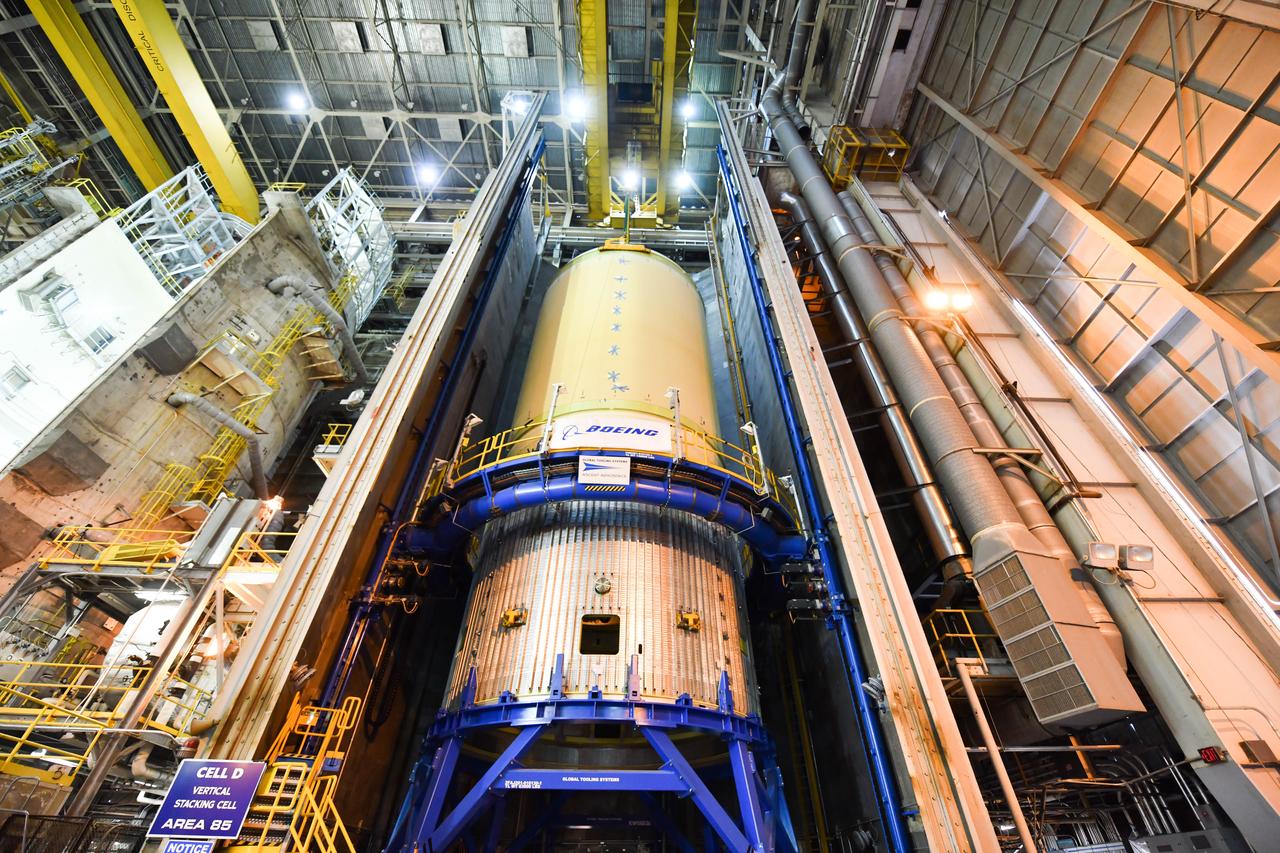
The Space Launch System (SLS) rocket’s liquid oxygen tank structural test article was manufactured and stacked in June 2019 at NASA’s Michoud Assembly Facility in New Orleans. To construct the test article, Boeing technicians at Michoud moved the liquid oxygen tank to the Vertical Assemby Building stacking and integration area. Here, they added simulators to mimic the two structures that connect to the tank, the intertank and the forward skirt. This structural hardware for the SLS core stage for America’s new deep space rocket is structurally identical to the flight version of the tank. It will be shipped on the Pegasus barge to NASA’s Marshall Space Flight Center in Hunstville, Alabama, where it will undergo a series of tests that simulate the stresses and loads of liftoff and flight. These tests will help ensure designs are adequate for successful SLS missions to the Moon and beyond. The flight liquid oxygen tank along with the liquid hydrogen tank supplies more than 500,000 gallons of propellant to the core stages four RS-25 engines, which produce 2 million pounds of thrust to help send the SLS rocket to space.
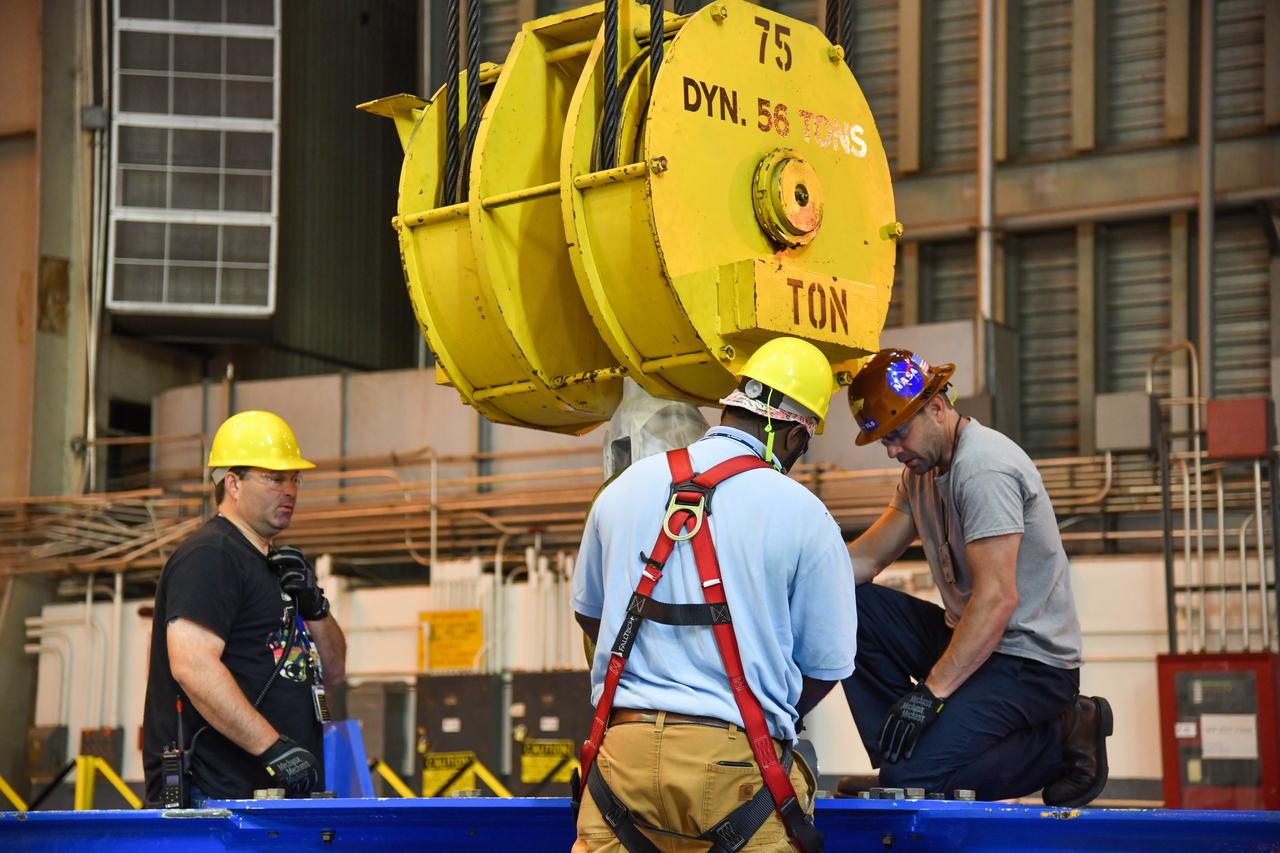
The Space Launch System (SLS) rocket’s liquid oxygen tank structural test article was manufactured and stacked in June 2019 at NASA’s Michoud Assembly Facility in New Orleans. To construct the test article, Boeing technicians at Michoud moved the liquid oxygen tank to the Vertical Assemby Building stacking and integration area. Here, they added simulators to mimic the two structures that connect to the tank, the intertank and the forward skirt. This structural hardware for the SLS core stage for America’s new deep space rocket is structurally identical to the flight version of the tank. It will be shipped on the Pegasus barge to NASA’s Marshall Space Flight Center in Hunstville, Alabama, where it will undergo a series of tests that simulate the stresses and loads of liftoff and flight. These tests will help ensure designs are adequate for successful SLS missions to the Moon and beyond. The flight liquid oxygen tank along with the liquid hydrogen tank supplies more than 500,000 gallons of propellant to the core stages four RS-25 engines, which produce 2 million pounds of thrust to help send the SLS rocket to space.
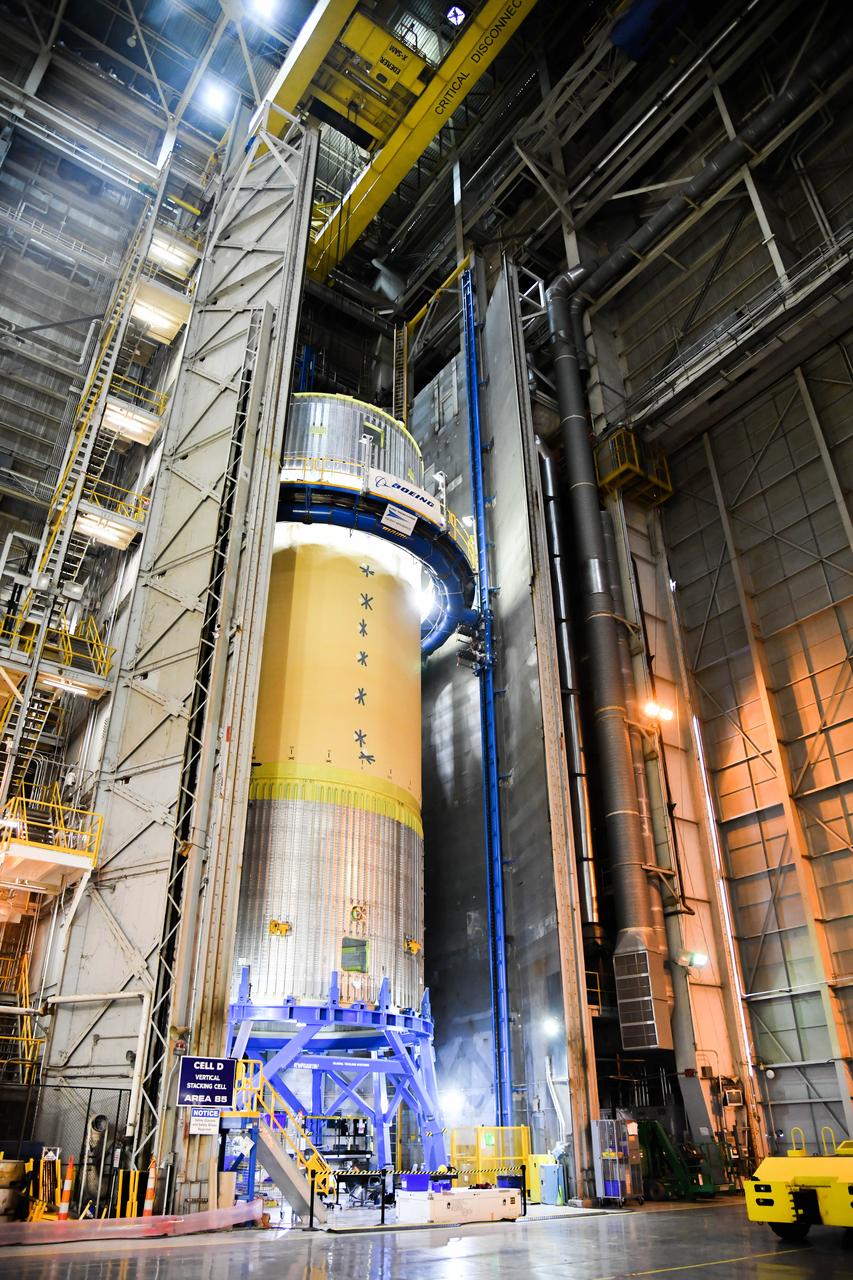
The Space Launch System (SLS) rocket’s liquid oxygen tank structural test article was manufactured and stacked in June 2019 at NASA’s Michoud Assembly Facility in New Orleans. To construct the test article, Boeing technicians at Michoud moved the liquid oxygen tank to the Vertical Assemby Building stacking and integration area. Here, they added simulators to mimic the two structures that connect to the tank, the intertank and the forward skirt. This structural hardware for the SLS core stage for America’s new deep space rocket is structurally identical to the flight version of the tank. It will be shipped on the Pegasus barge to NASA’s Marshall Space Flight Center in Hunstville, Alabama, where it will undergo a series of tests that simulate the stresses and loads of liftoff and flight. These tests will help ensure designs are adequate for successful SLS missions to the Moon and beyond. The flight liquid oxygen tank along with the liquid hydrogen tank supplies more than 500,000 gallons of propellant to the core stages four RS-25 engines, which produce 2 million pounds of thrust to help send the SLS rocket to space.
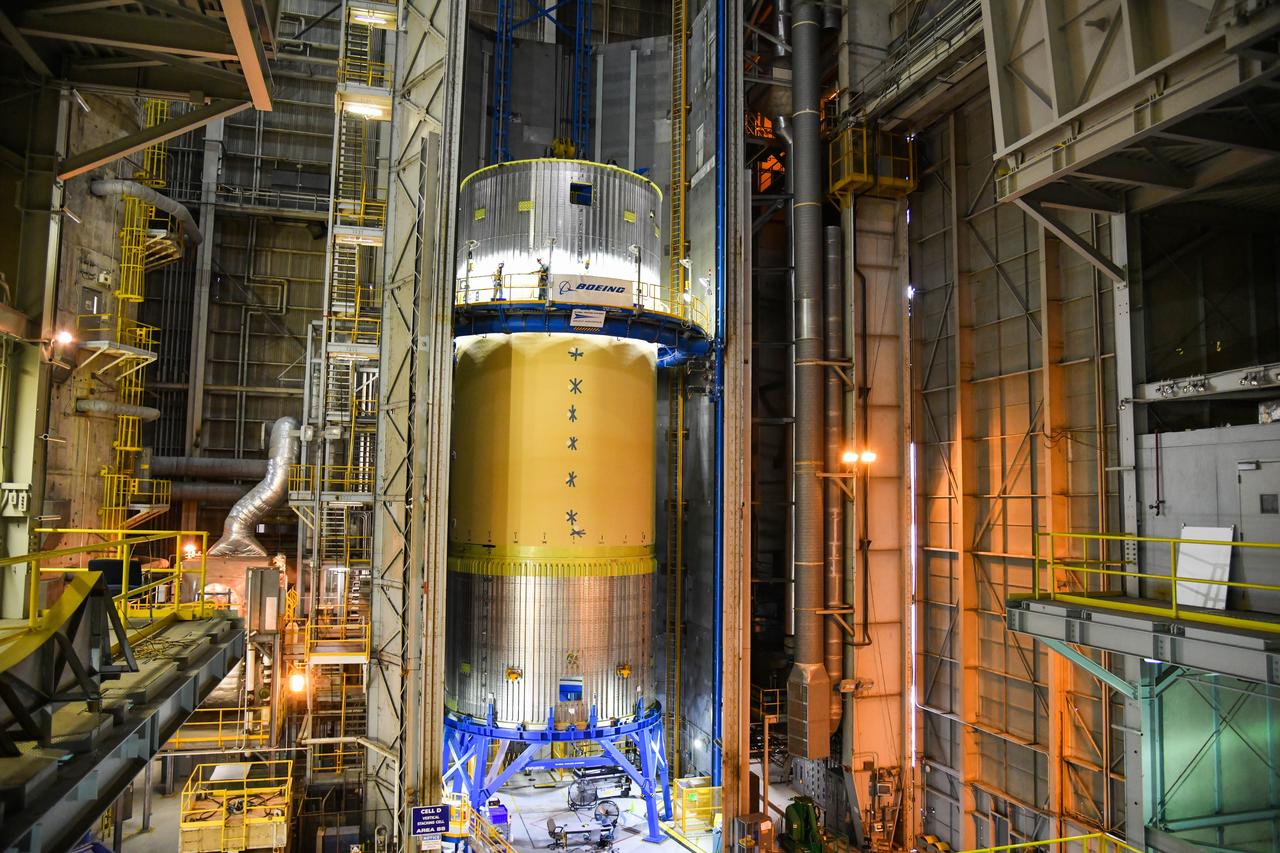
The Space Launch System (SLS) rocket’s liquid oxygen tank structural test article was manufactured and stacked in June 2019 at NASA’s Michoud Assembly Facility in New Orleans. To construct the test article, Boeing technicians at Michoud moved the liquid oxygen tank to the Vertical Assemby Building stacking and integration area. Here, they added simulators to mimic the two structures that connect to the tank, the intertank and the forward skirt. This structural hardware for the SLS core stage for America’s new deep space rocket is structurally identical to the flight version of the tank. It will be shipped on the Pegasus barge to NASA’s Marshall Space Flight Center in Hunstville, Alabama, where it will undergo a series of tests that simulate the stresses and loads of liftoff and flight. These tests will help ensure designs are adequate for successful SLS missions to the Moon and beyond. The flight liquid oxygen tank along with the liquid hydrogen tank supplies more than 500,000 gallons of propellant to the core stages four RS-25 engines, which produce 2 million pounds of thrust to help send the SLS rocket to space.
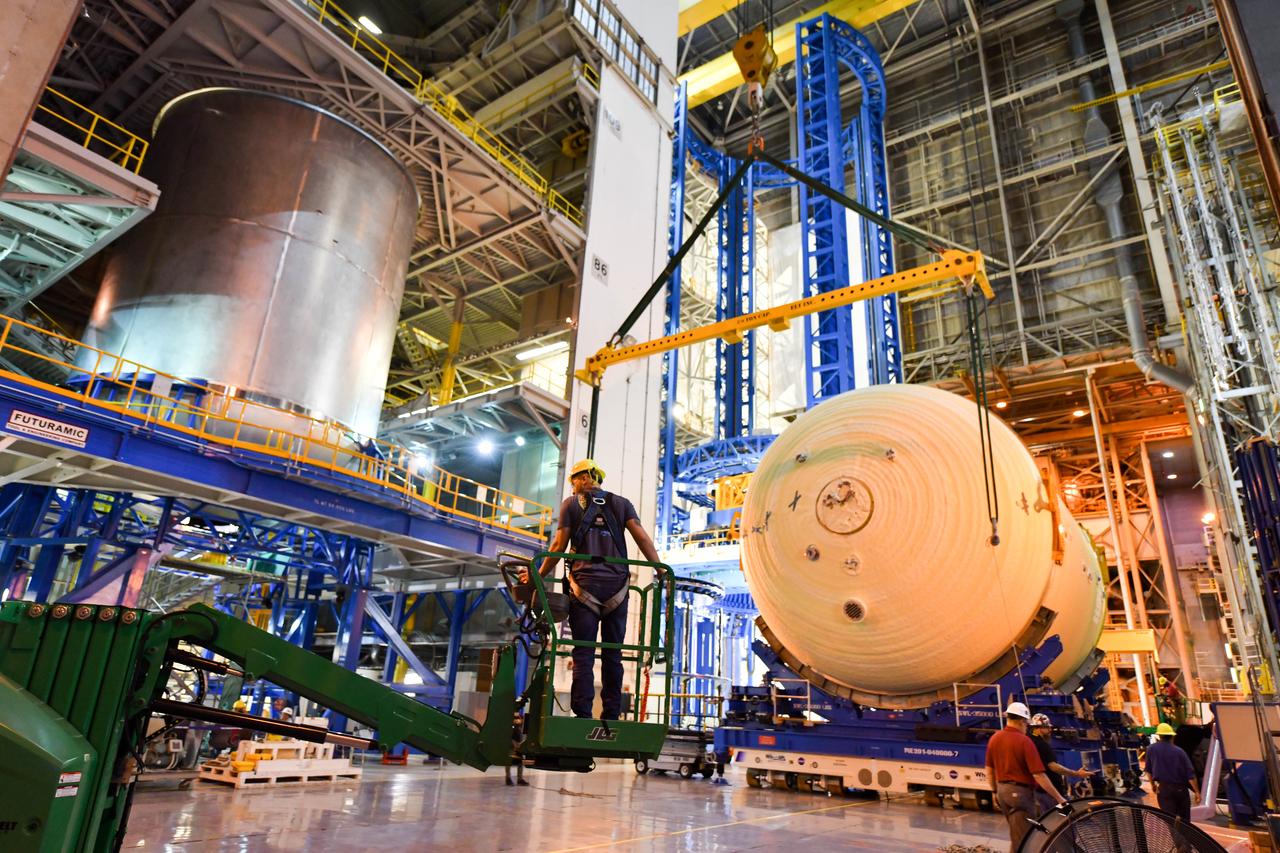
The Space Launch System (SLS) rocket’s liquid oxygen tank structural test article was manufactured and stacked in June 2019 at NASA’s Michoud Assembly Facility in New Orleans. To construct the test article, Boeing technicians at Michoud moved the liquid oxygen tank to the Vertical Assemby Building stacking and integration area. Here, they added simulators to mimic the two structures that connect to the tank, the intertank and the forward skirt. This structural hardware for the SLS core stage for America’s new deep space rocket is structurally identical to the flight version of the tank. It will be shipped on the Pegasus barge to NASA’s Marshall Space Flight Center in Hunstville, Alabama, where it will undergo a series of tests that simulate the stresses and loads of liftoff and flight. These tests will help ensure designs are adequate for successful SLS missions to the Moon and beyond. The flight liquid oxygen tank along with the liquid hydrogen tank supplies more than 500,000 gallons of propellant to the core stages four RS-25 engines, which produce 2 million pounds of thrust to help send the SLS rocket to space.
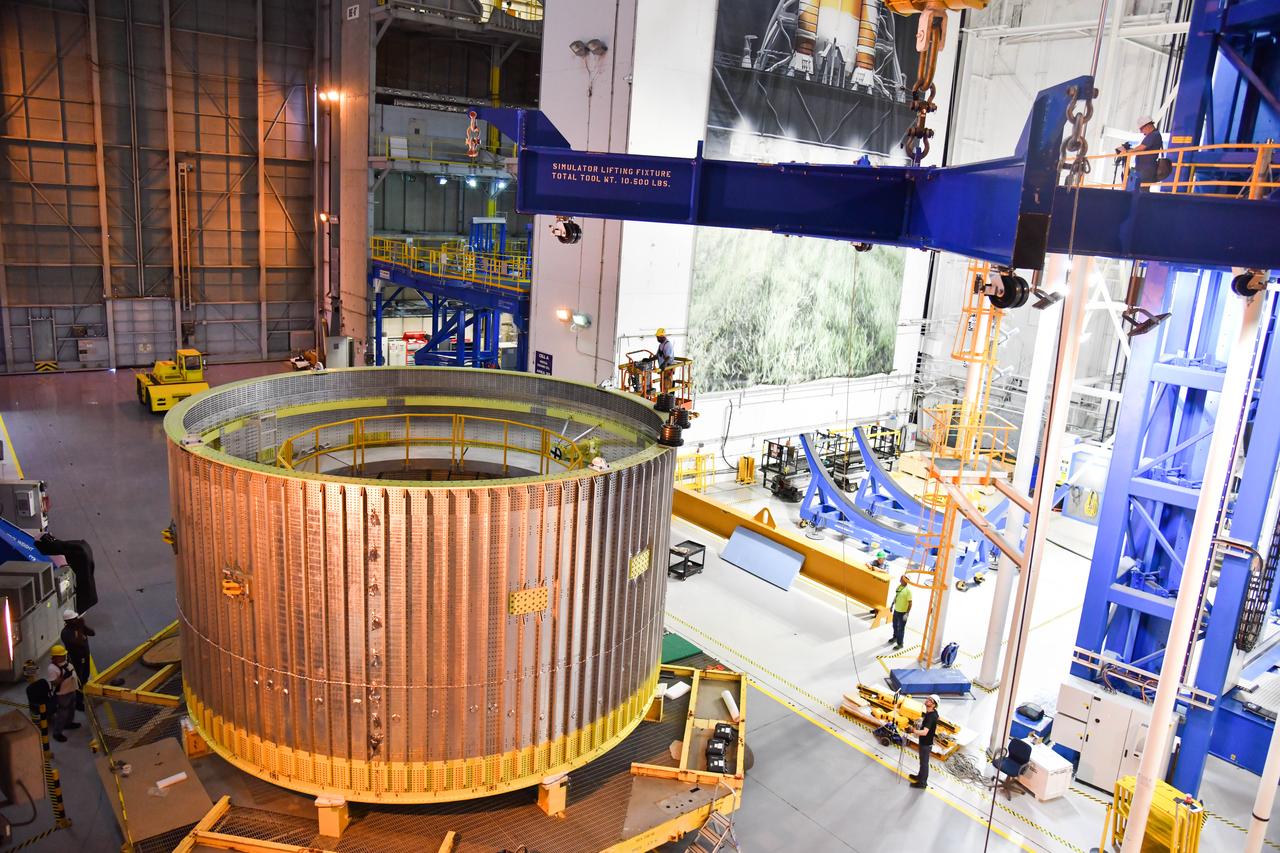
The Space Launch System (SLS) rocket’s liquid oxygen tank structural test article was manufactured and stacked in June 2019 at NASA’s Michoud Assembly Facility in New Orleans. To construct the test article, Boeing technicians at Michoud moved the liquid oxygen tank to the Vertical Assemby Building stacking and integration area. Here, they added simulators to mimic the two structures that connect to the tank, the intertank and the forward skirt. This structural hardware for the SLS core stage for America’s new deep space rocket is structurally identical to the flight version of the tank. It will be shipped on the Pegasus barge to NASA’s Marshall Space Flight Center in Hunstville, Alabama, where it will undergo a series of tests that simulate the stresses and loads of liftoff and flight. These tests will help ensure designs are adequate for successful SLS missions to the Moon and beyond. The flight liquid oxygen tank along with the liquid hydrogen tank supplies more than 500,000 gallons of propellant to the core stages four RS-25 engines, which produce 2 million pounds of thrust to help send the SLS rocket to space.

The Space Launch System (SLS) rocket’s liquid oxygen tank structural test article was manufactured and stacked in June 2019 at NASA’s Michoud Assembly Facility in New Orleans. To construct the test article, Boeing technicians at Michoud moved the liquid oxygen tank to the Vertical Assemby Building stacking and integration area. Here, they added simulators to mimic the two structures that connect to the tank, the intertank and the forward skirt. This structural hardware for the SLS core stage for America’s new deep space rocket is structurally identical to the flight version of the tank. It will be shipped on the Pegasus barge to NASA’s Marshall Space Flight Center in Hunstville, Alabama, where it will undergo a series of tests that simulate the stresses and loads of liftoff and flight. These tests will help ensure designs are adequate for successful SLS missions to the Moon and beyond. The flight liquid oxygen tank along with the liquid hydrogen tank supplies more than 500,000 gallons of propellant to the core stages four RS-25 engines, which produce 2 million pounds of thrust to help send the SLS rocket to space.
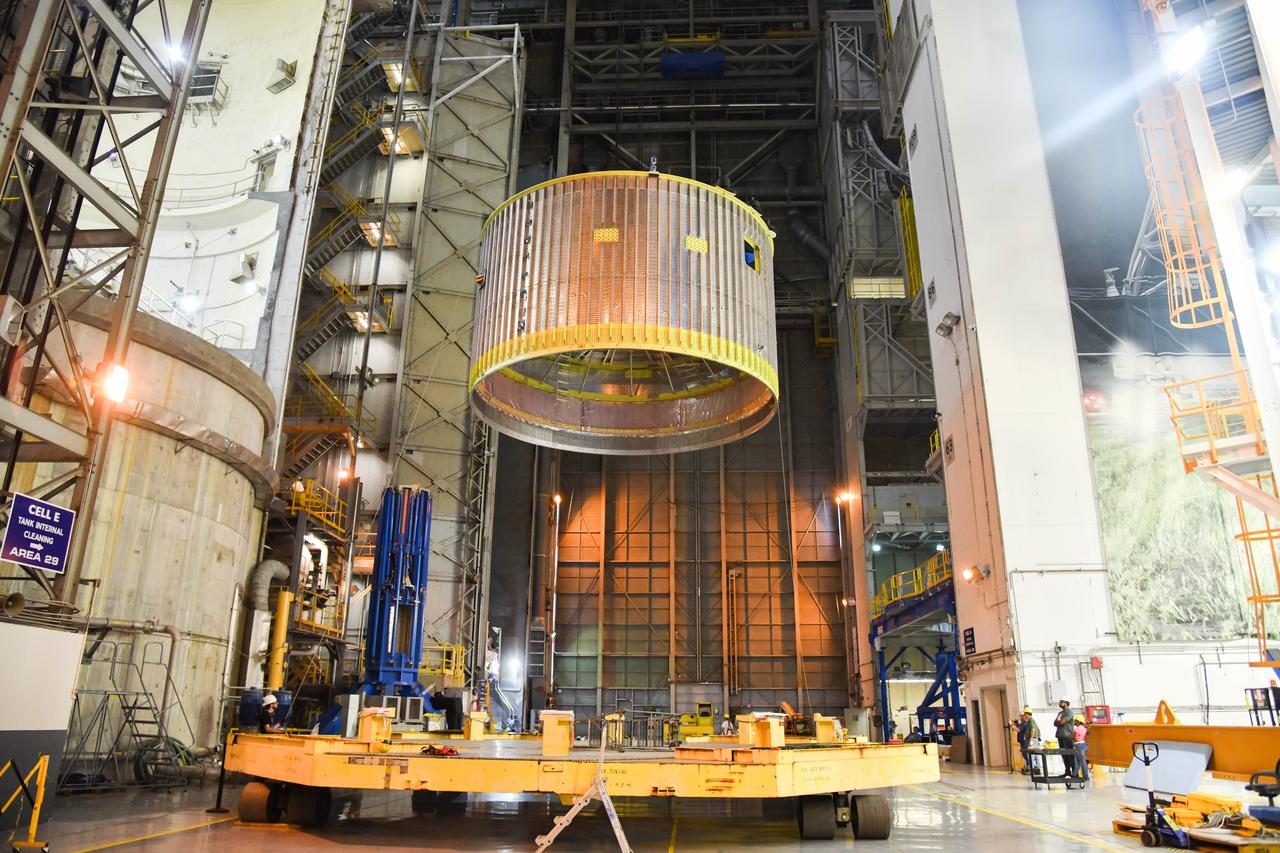
The Space Launch System (SLS) rocket’s liquid oxygen tank structural test article was manufactured and stacked in June 2019 at NASA’s Michoud Assembly Facility in New Orleans. To construct the test article, Boeing technicians at Michoud moved the liquid oxygen tank to the Vertical Assemby Building stacking and integration area. Here, they added simulators to mimic the two structures that connect to the tank, the intertank and the forward skirt. This structural hardware for the SLS core stage for America’s new deep space rocket is structurally identical to the flight version of the tank. It will be shipped on the Pegasus barge to NASA’s Marshall Space Flight Center in Hunstville, Alabama, where it will undergo a series of tests that simulate the stresses and loads of liftoff and flight. These tests will help ensure designs are adequate for successful SLS missions to the Moon and beyond. The flight liquid oxygen tank along with the liquid hydrogen tank supplies more than 500,000 gallons of propellant to the core stages four RS-25 engines, which produce 2 million pounds of thrust to help send the SLS rocket to space.
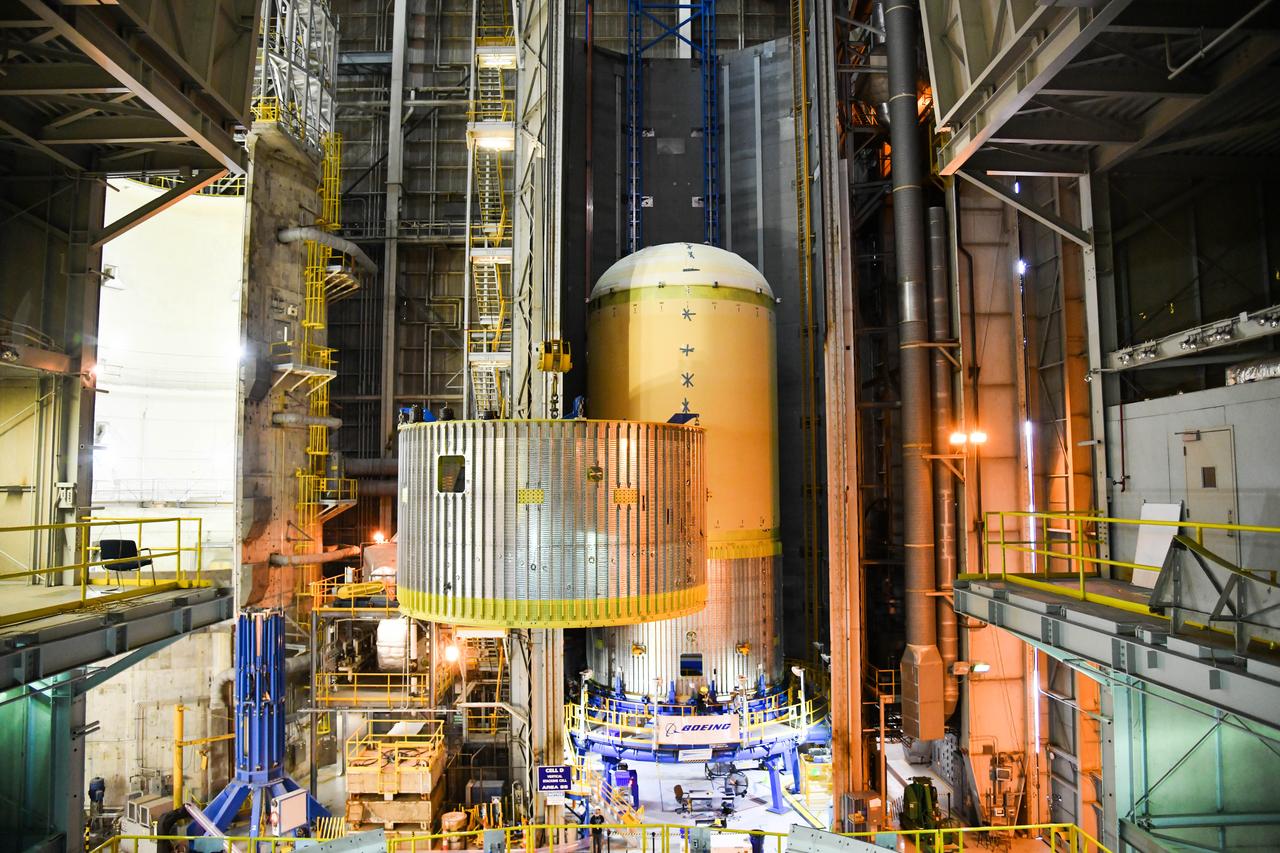
The Space Launch System (SLS) rocket’s liquid oxygen tank structural test article was manufactured and stacked in June 2019 at NASA’s Michoud Assembly Facility in New Orleans. To construct the test article, Boeing technicians at Michoud moved the liquid oxygen tank to the Vertical Assemby Building stacking and integration area. Here, they added simulators to mimic the two structures that connect to the tank, the intertank and the forward skirt. This structural hardware for the SLS core stage for America’s new deep space rocket is structurally identical to the flight version of the tank. It will be shipped on the Pegasus barge to NASA’s Marshall Space Flight Center in Hunstville, Alabama, where it will undergo a series of tests that simulate the stresses and loads of liftoff and flight. These tests will help ensure designs are adequate for successful SLS missions to the Moon and beyond. The flight liquid oxygen tank along with the liquid hydrogen tank supplies more than 500,000 gallons of propellant to the core stages four RS-25 engines, which produce 2 million pounds of thrust to help send the SLS rocket to space.
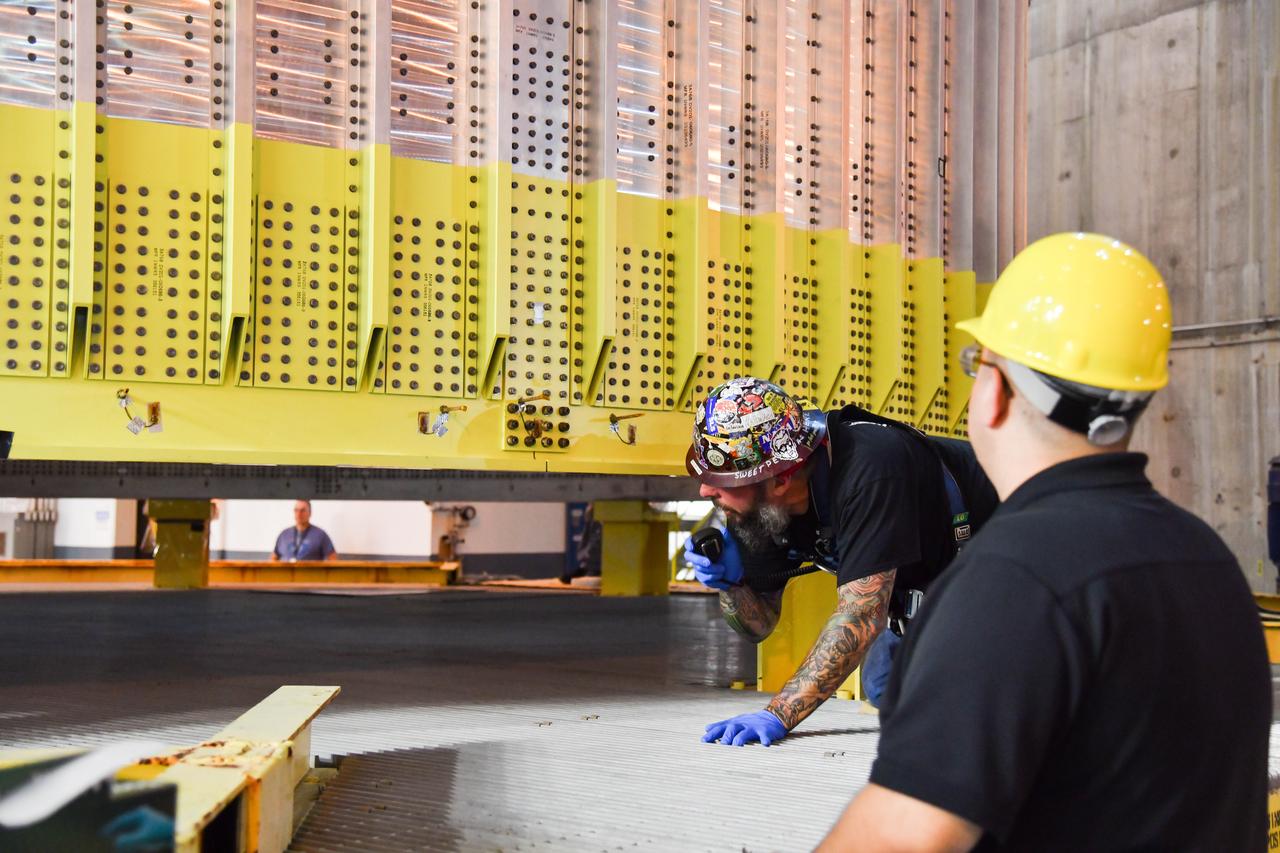
The Space Launch System (SLS) rocket’s liquid oxygen tank structural test article was manufactured and stacked in June 2019 at NASA’s Michoud Assembly Facility in New Orleans. To construct the test article, Boeing technicians at Michoud moved the liquid oxygen tank to the Vertical Assemby Building stacking and integration area. Here, they added simulators to mimic the two structures that connect to the tank, the intertank and the forward skirt. This structural hardware for the SLS core stage for America’s new deep space rocket is structurally identical to the flight version of the tank. It will be shipped on the Pegasus barge to NASA’s Marshall Space Flight Center in Hunstville, Alabama, where it will undergo a series of tests that simulate the stresses and loads of liftoff and flight. These tests will help ensure designs are adequate for successful SLS missions to the Moon and beyond. The flight liquid oxygen tank along with the liquid hydrogen tank supplies more than 500,000 gallons of propellant to the core stages four RS-25 engines, which produce 2 million pounds of thrust to help send the SLS rocket to space.
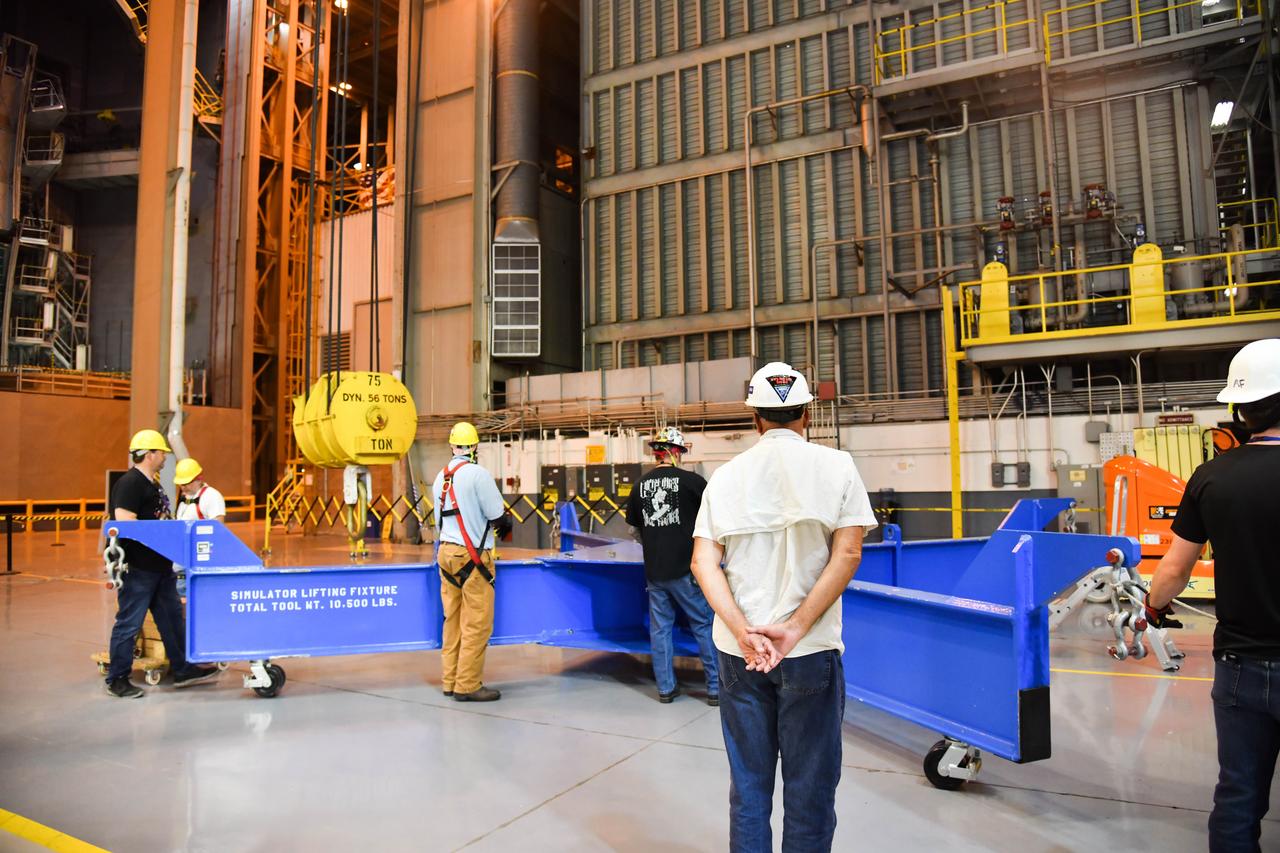
The Space Launch System (SLS) rocket’s liquid oxygen tank structural test article was manufactured and stacked in June 2019 at NASA’s Michoud Assembly Facility in New Orleans. To construct the test article, Boeing technicians at Michoud moved the liquid oxygen tank to the Vertical Assemby Building stacking and integration area. Here, they added simulators to mimic the two structures that connect to the tank, the intertank and the forward skirt. This structural hardware for the SLS core stage for America’s new deep space rocket is structurally identical to the flight version of the tank. It will be shipped on the Pegasus barge to NASA’s Marshall Space Flight Center in Hunstville, Alabama, where it will undergo a series of tests that simulate the stresses and loads of liftoff and flight. These tests will help ensure designs are adequate for successful SLS missions to the Moon and beyond. The flight liquid oxygen tank along with the liquid hydrogen tank supplies more than 500,000 gallons of propellant to the core stages four RS-25 engines, which produce 2 million pounds of thrust to help send the SLS rocket to space.
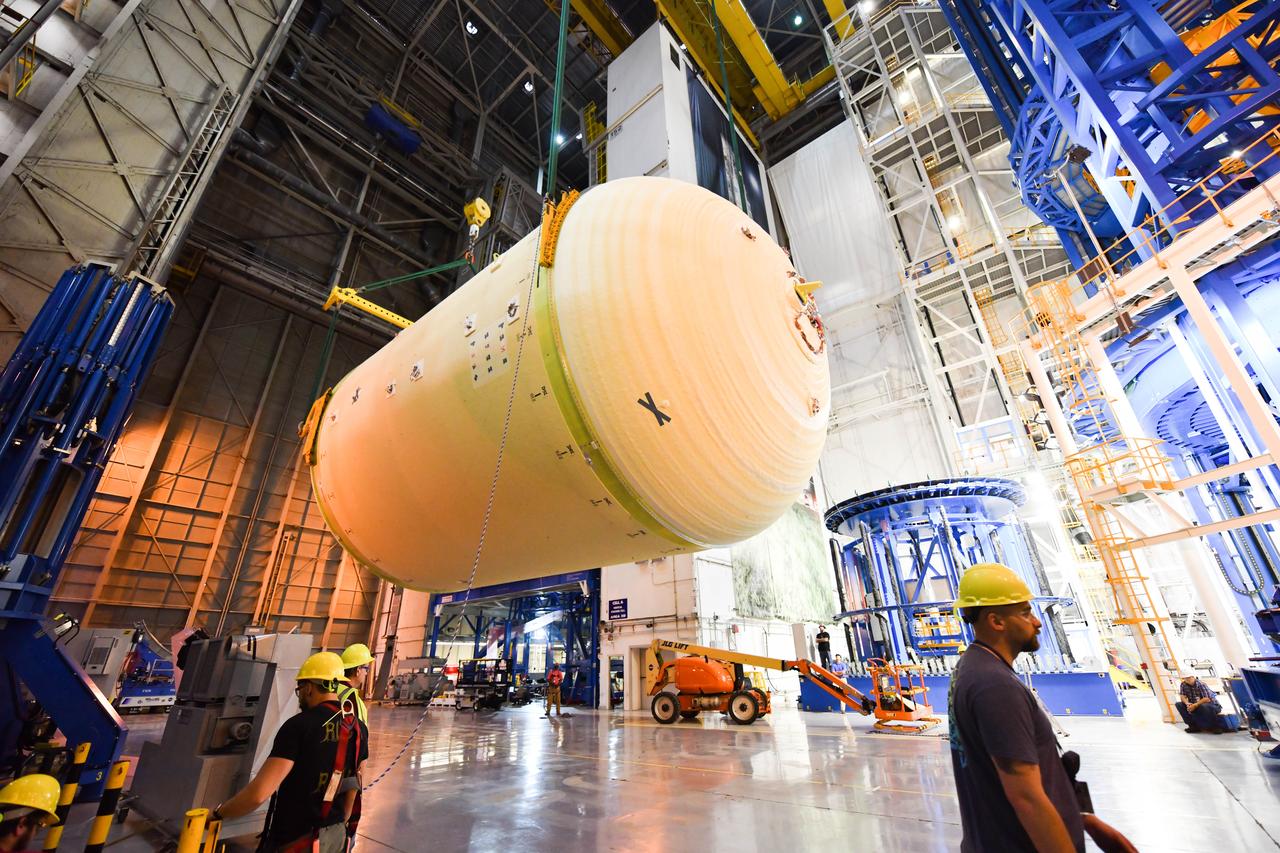
The Space Launch System (SLS) rocket’s liquid oxygen tank structural test article was manufactured and stacked in June 2019 at NASA’s Michoud Assembly Facility in New Orleans. To construct the test article, Boeing technicians at Michoud moved the liquid oxygen tank to the Vertical Assemby Building stacking and integration area. Here, they added simulators to mimic the two structures that connect to the tank, the intertank and the forward skirt. This structural hardware for the SLS core stage for America’s new deep space rocket is structurally identical to the flight version of the tank. It will be shipped on the Pegasus barge to NASA’s Marshall Space Flight Center in Hunstville, Alabama, where it will undergo a series of tests that simulate the stresses and loads of liftoff and flight. These tests will help ensure designs are adequate for successful SLS missions to the Moon and beyond. The flight liquid oxygen tank along with the liquid hydrogen tank supplies more than 500,000 gallons of propellant to the core stages four RS-25 engines, which produce 2 million pounds of thrust to help send the SLS rocket to space.
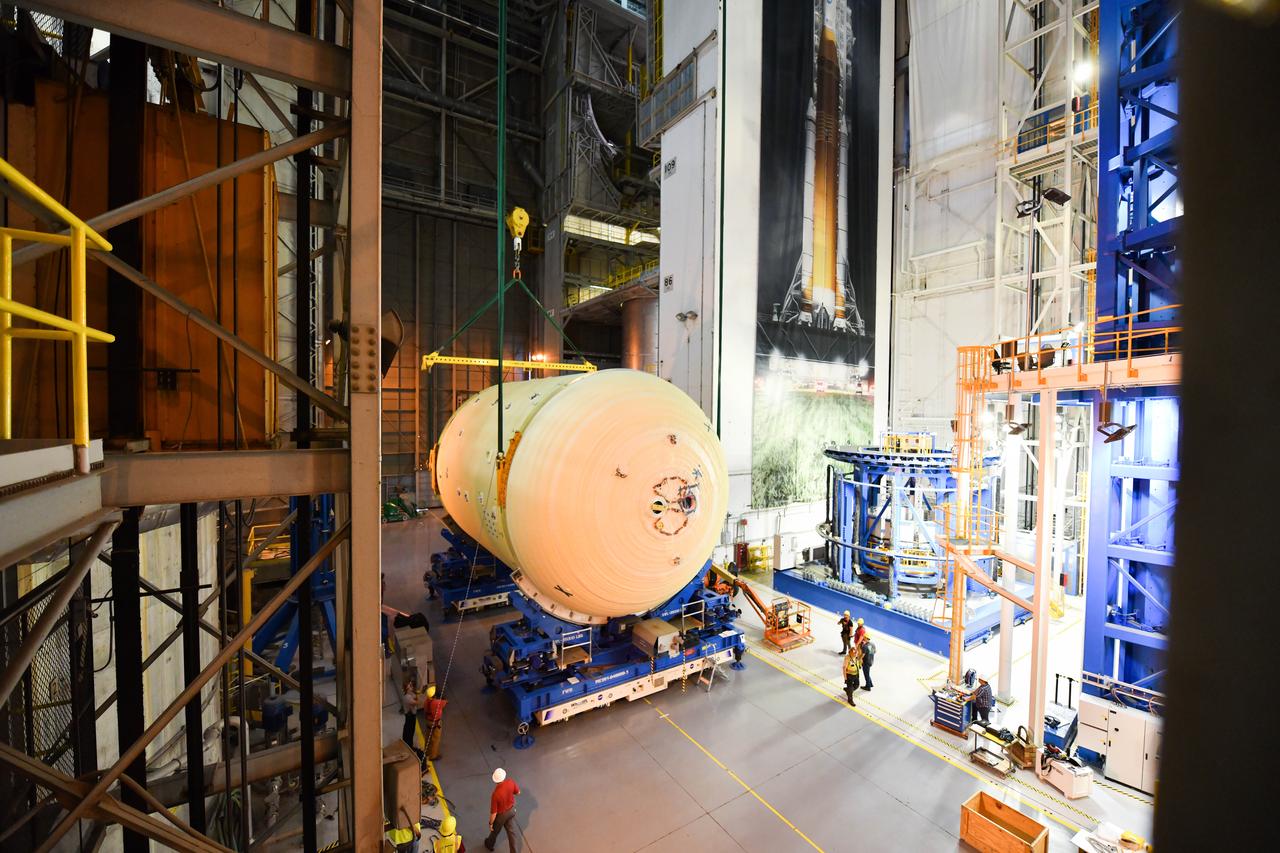
The Space Launch System (SLS) rocket’s liquid oxygen tank structural test article was manufactured and stacked in June 2019 at NASA’s Michoud Assembly Facility in New Orleans. To construct the test article, Boeing technicians at Michoud moved the liquid oxygen tank to the Vertical Assemby Building stacking and integration area. Here, they added simulators to mimic the two structures that connect to the tank, the intertank and the forward skirt. This structural hardware for the SLS core stage for America’s new deep space rocket is structurally identical to the flight version of the tank. It will be shipped on the Pegasus barge to NASA’s Marshall Space Flight Center in Hunstville, Alabama, where it will undergo a series of tests that simulate the stresses and loads of liftoff and flight. These tests will help ensure designs are adequate for successful SLS missions to the Moon and beyond. The flight liquid oxygen tank along with the liquid hydrogen tank supplies more than 500,000 gallons of propellant to the core stages four RS-25 engines, which produce 2 million pounds of thrust to help send the SLS rocket to space.
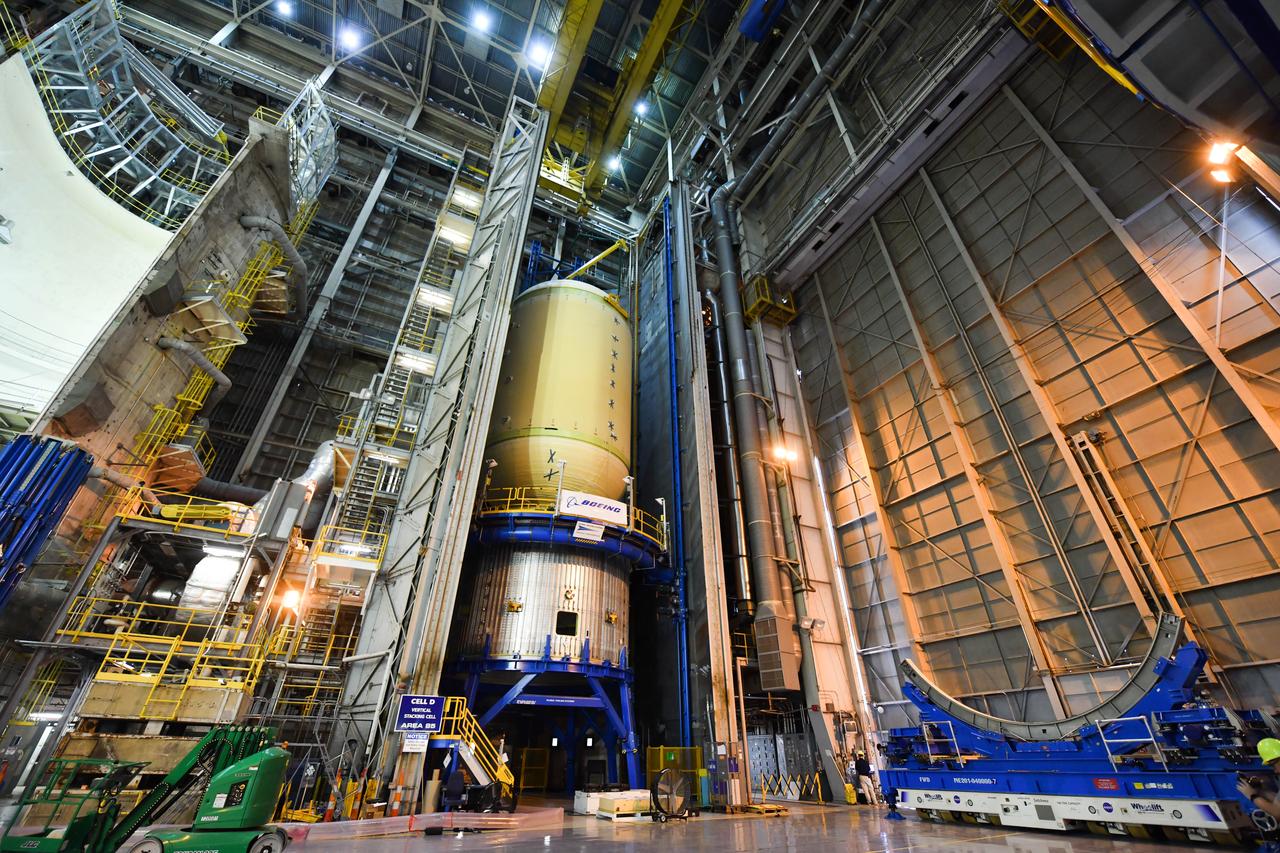
The Space Launch System (SLS) rocket’s liquid oxygen tank structural test article was manufactured and stacked in June 2019 at NASA’s Michoud Assembly Facility in New Orleans. To construct the test article, Boeing technicians at Michoud moved the liquid oxygen tank to the Vertical Assemby Building stacking and integration area. Here, they added simulators to mimic the two structures that connect to the tank, the intertank and the forward skirt. This structural hardware for the SLS core stage for America’s new deep space rocket is structurally identical to the flight version of the tank. It will be shipped on the Pegasus barge to NASA’s Marshall Space Flight Center in Hunstville, Alabama, where it will undergo a series of tests that simulate the stresses and loads of liftoff and flight. These tests will help ensure designs are adequate for successful SLS missions to the Moon and beyond. The flight liquid oxygen tank along with the liquid hydrogen tank supplies more than 500,000 gallons of propellant to the core stages four RS-25 engines, which produce 2 million pounds of thrust to help send the SLS rocket to space.
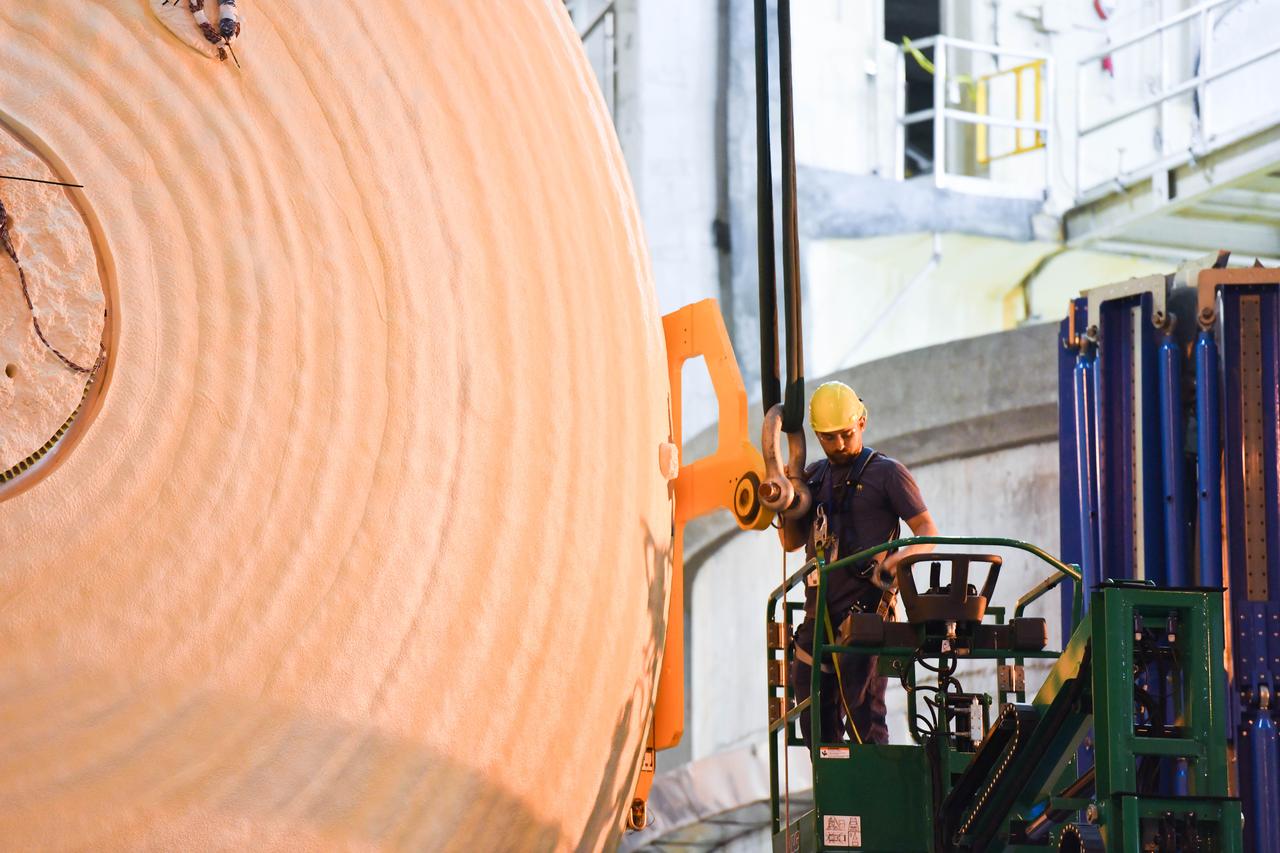
The Space Launch System (SLS) rocket’s liquid oxygen tank structural test article was manufactured and stacked in June 2019 at NASA’s Michoud Assembly Facility in New Orleans. To construct the test article, Boeing technicians at Michoud moved the liquid oxygen tank to the Vertical Assemby Building stacking and integration area. Here, they added simulators to mimic the two structures that connect to the tank, the intertank and the forward skirt. This structural hardware for the SLS core stage for America’s new deep space rocket is structurally identical to the flight version of the tank. It will be shipped on the Pegasus barge to NASA’s Marshall Space Flight Center in Hunstville, Alabama, where it will undergo a series of tests that simulate the stresses and loads of liftoff and flight. These tests will help ensure designs are adequate for successful SLS missions to the Moon and beyond. The flight liquid oxygen tank along with the liquid hydrogen tank supplies more than 500,000 gallons of propellant to the core stages four RS-25 engines, which produce 2 million pounds of thrust to help send the SLS rocket to space.
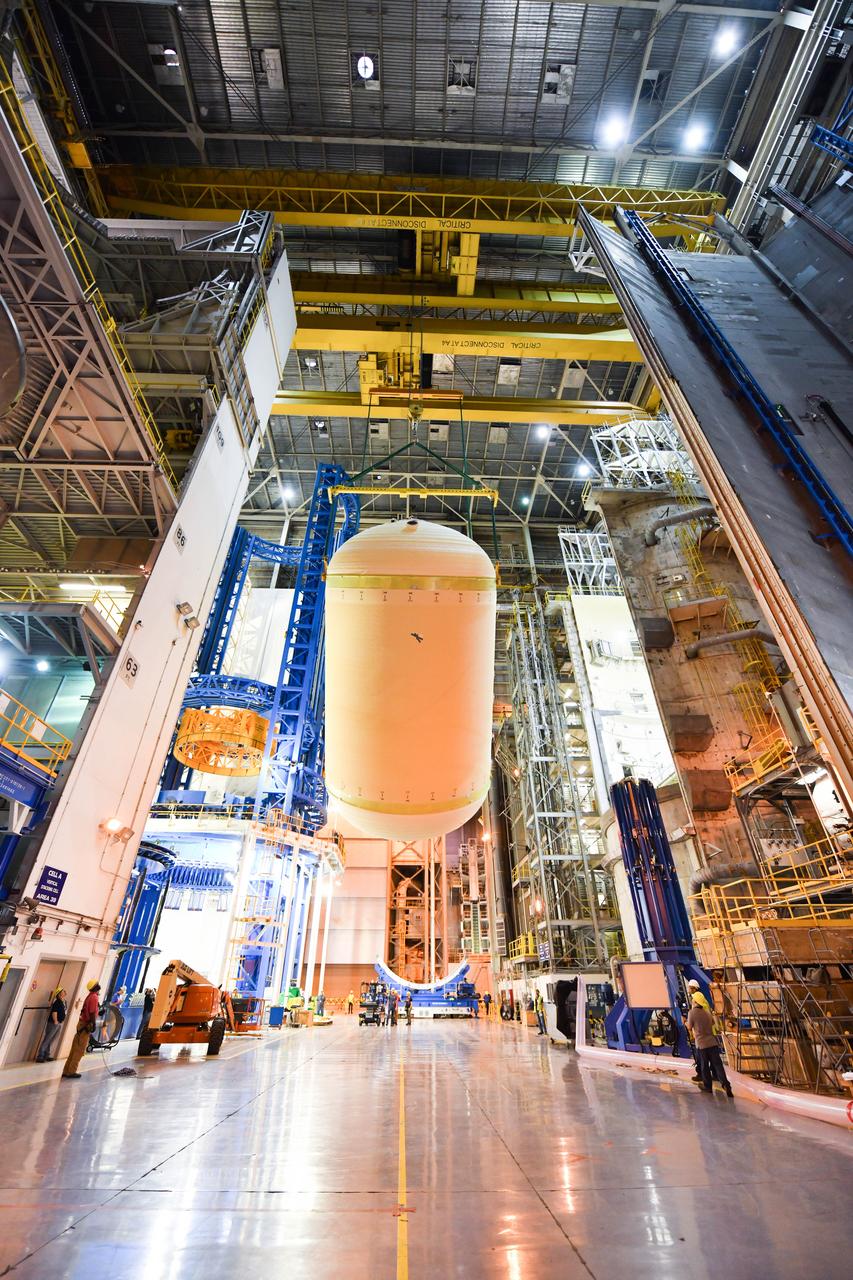
The Space Launch System (SLS) rocket’s liquid oxygen tank structural test article was manufactured and stacked in June 2019 at NASA’s Michoud Assembly Facility in New Orleans. To construct the test article, Boeing technicians at Michoud moved the liquid oxygen tank to the Vertical Assemby Building stacking and integration area. Here, they added simulators to mimic the two structures that connect to the tank, the intertank and the forward skirt. This structural hardware for the SLS core stage for America’s new deep space rocket is structurally identical to the flight version of the tank. It will be shipped on the Pegasus barge to NASA’s Marshall Space Flight Center in Hunstville, Alabama, where it will undergo a series of tests that simulate the stresses and loads of liftoff and flight. These tests will help ensure designs are adequate for successful SLS missions to the Moon and beyond. The flight liquid oxygen tank along with the liquid hydrogen tank supplies more than 500,000 gallons of propellant to the core stages four RS-25 engines, which produce 2 million pounds of thrust to help send the SLS rocket to space.
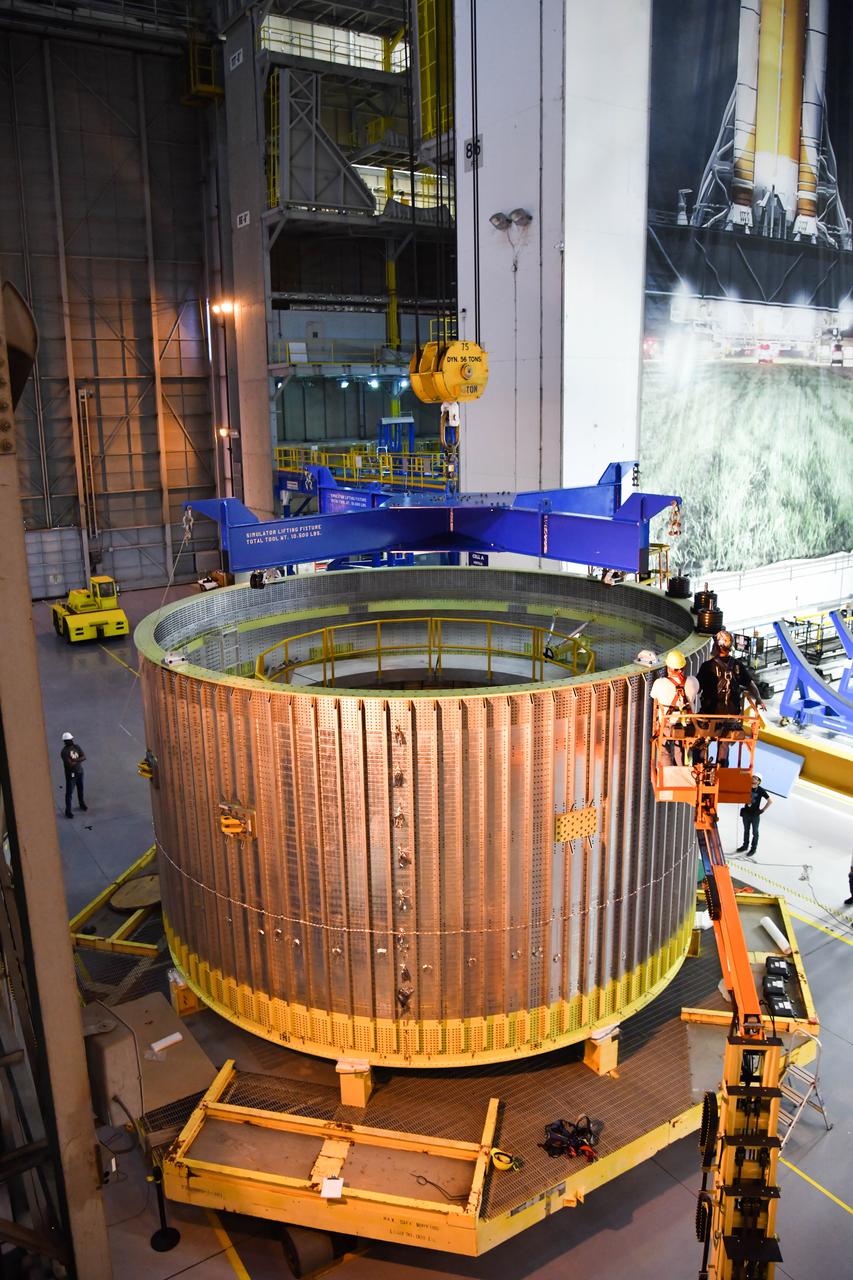
The Space Launch System (SLS) rocket’s liquid oxygen tank structural test article was manufactured and stacked in June 2019 at NASA’s Michoud Assembly Facility in New Orleans. To construct the test article, Boeing technicians at Michoud moved the liquid oxygen tank to the Vertical Assemby Building stacking and integration area. Here, they added simulators to mimic the two structures that connect to the tank, the intertank and the forward skirt. This structural hardware for the SLS core stage for America’s new deep space rocket is structurally identical to the flight version of the tank. It will be shipped on the Pegasus barge to NASA’s Marshall Space Flight Center in Hunstville, Alabama, where it will undergo a series of tests that simulate the stresses and loads of liftoff and flight. These tests will help ensure designs are adequate for successful SLS missions to the Moon and beyond. The flight liquid oxygen tank along with the liquid hydrogen tank supplies more than 500,000 gallons of propellant to the core stages four RS-25 engines, which produce 2 million pounds of thrust to help send the SLS rocket to space.
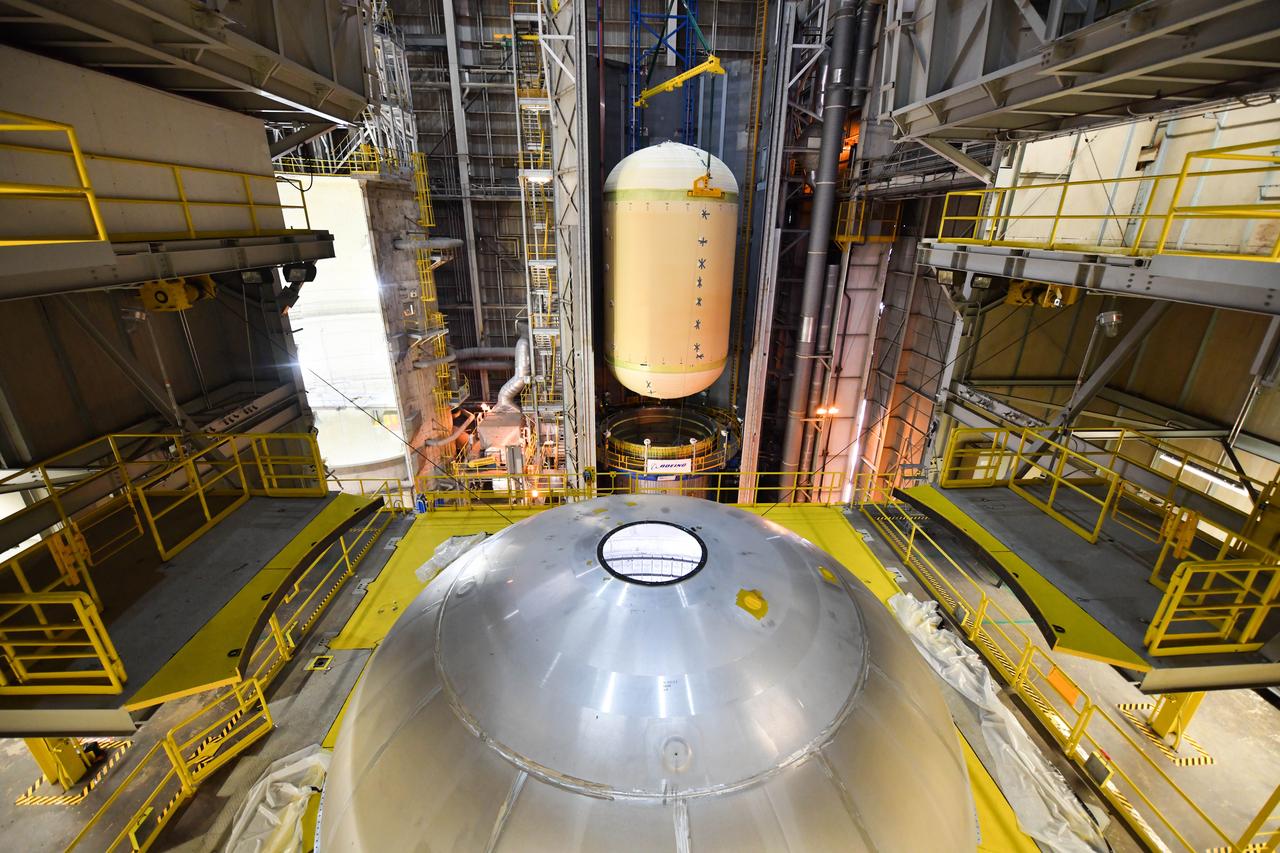
The Space Launch System (SLS) rocket’s liquid oxygen tank structural test article was manufactured and stacked in June 2019 at NASA’s Michoud Assembly Facility in New Orleans. To construct the test article, Boeing technicians at Michoud moved the liquid oxygen tank to the Vertical Assemby Building stacking and integration area. Here, they added simulators to mimic the two structures that connect to the tank, the intertank and the forward skirt. This structural hardware for the SLS core stage for America’s new deep space rocket is structurally identical to the flight version of the tank. It will be shipped on the Pegasus barge to NASA’s Marshall Space Flight Center in Hunstville, Alabama, where it will undergo a series of tests that simulate the stresses and loads of liftoff and flight. These tests will help ensure designs are adequate for successful SLS missions to the Moon and beyond. The flight liquid oxygen tank along with the liquid hydrogen tank supplies more than 500,000 gallons of propellant to the core stages four RS-25 engines, which produce 2 million pounds of thrust to help send the SLS rocket to space.
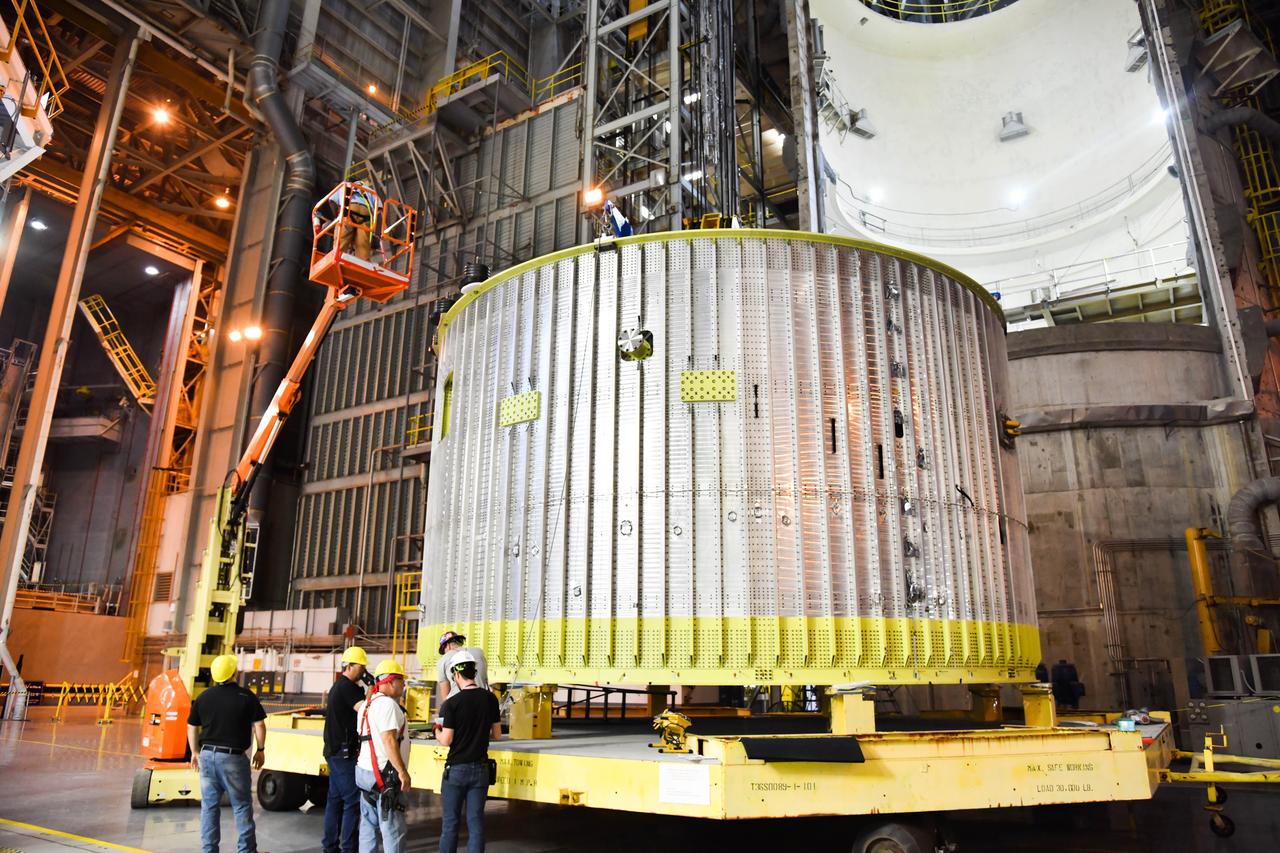
The Space Launch System (SLS) rocket’s liquid oxygen tank structural test article was manufactured and stacked in June 2019 at NASA’s Michoud Assembly Facility in New Orleans. To construct the test article, Boeing technicians at Michoud moved the liquid oxygen tank to the Vertical Assemby Building stacking and integration area. Here, they added simulators to mimic the two structures that connect to the tank, the intertank and the forward skirt. This structural hardware for the SLS core stage for America’s new deep space rocket is structurally identical to the flight version of the tank. It will be shipped on the Pegasus barge to NASA’s Marshall Space Flight Center in Hunstville, Alabama, where it will undergo a series of tests that simulate the stresses and loads of liftoff and flight. These tests will help ensure designs are adequate for successful SLS missions to the Moon and beyond. The flight liquid oxygen tank along with the liquid hydrogen tank supplies more than 500,000 gallons of propellant to the core stages four RS-25 engines, which produce 2 million pounds of thrust to help send the SLS rocket to space.
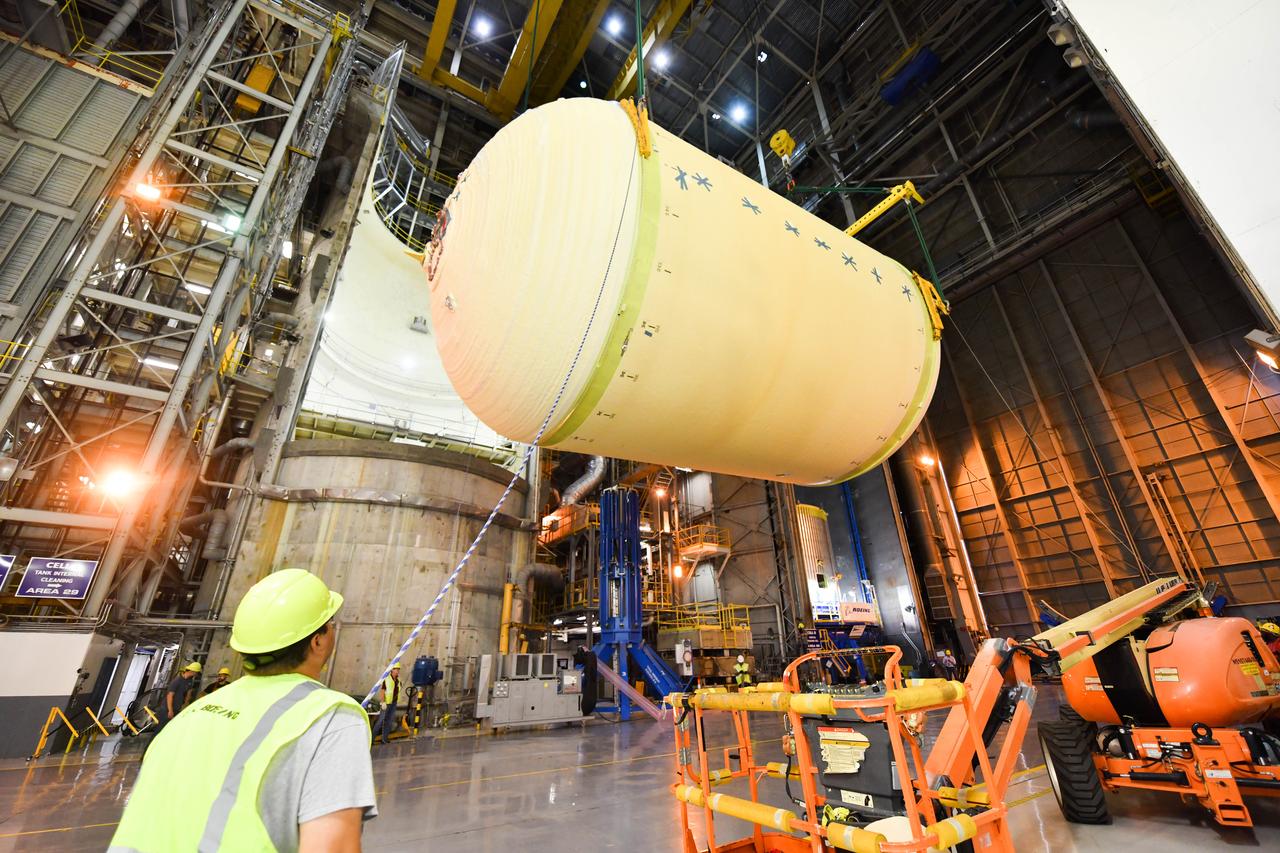
The Space Launch System (SLS) rocket’s liquid oxygen tank structural test article was manufactured and stacked in June 2019 at NASA’s Michoud Assembly Facility in New Orleans. To construct the test article, Boeing technicians at Michoud moved the liquid oxygen tank to the Vertical Assemby Building stacking and integration area. Here, they added simulators to mimic the two structures that connect to the tank, the intertank and the forward skirt. This structural hardware for the SLS core stage for America’s new deep space rocket is structurally identical to the flight version of the tank. It will be shipped on the Pegasus barge to NASA’s Marshall Space Flight Center in Hunstville, Alabama, where it will undergo a series of tests that simulate the stresses and loads of liftoff and flight. These tests will help ensure designs are adequate for successful SLS missions to the Moon and beyond. The flight liquid oxygen tank along with the liquid hydrogen tank supplies more than 500,000 gallons of propellant to the core stages four RS-25 engines, which produce 2 million pounds of thrust to help send the SLS rocket to space.
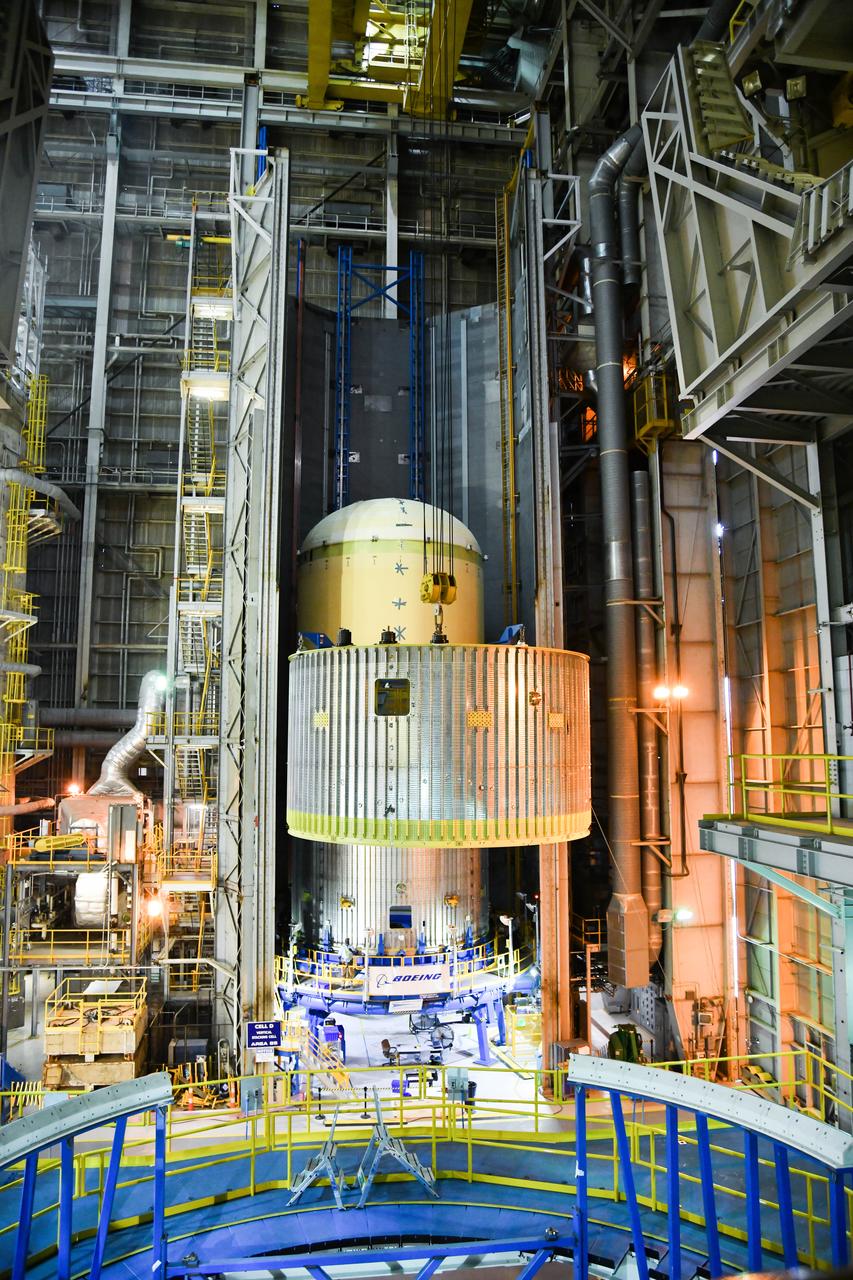
The Space Launch System (SLS) rocket’s liquid oxygen tank structural test article was manufactured and stacked in June 2019 at NASA’s Michoud Assembly Facility in New Orleans. To construct the test article, Boeing technicians at Michoud moved the liquid oxygen tank to the Vertical Assemby Building stacking and integration area. Here, they added simulators to mimic the two structures that connect to the tank, the intertank and the forward skirt. This structural hardware for the SLS core stage for America’s new deep space rocket is structurally identical to the flight version of the tank. It will be shipped on the Pegasus barge to NASA’s Marshall Space Flight Center in Hunstville, Alabama, where it will undergo a series of tests that simulate the stresses and loads of liftoff and flight. These tests will help ensure designs are adequate for successful SLS missions to the Moon and beyond. The flight liquid oxygen tank along with the liquid hydrogen tank supplies more than 500,000 gallons of propellant to the core stages four RS-25 engines, which produce 2 million pounds of thrust to help send the SLS rocket to space.
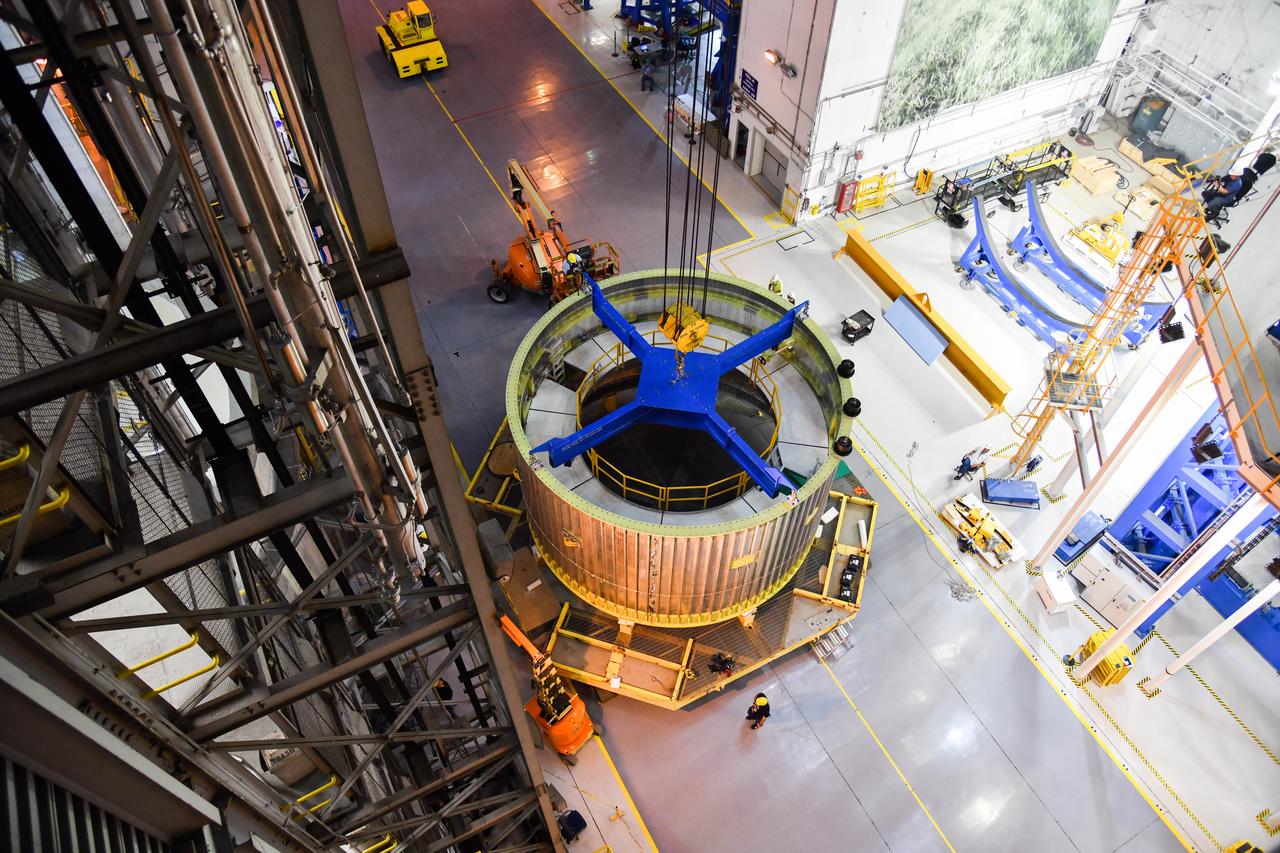
The Space Launch System (SLS) rocket’s liquid oxygen tank structural test article was manufactured and stacked in June 2019 at NASA’s Michoud Assembly Facility in New Orleans. To construct the test article, Boeing technicians at Michoud moved the liquid oxygen tank to the Vertical Assemby Building stacking and integration area. Here, they added simulators to mimic the two structures that connect to the tank, the intertank and the forward skirt. This structural hardware for the SLS core stage for America’s new deep space rocket is structurally identical to the flight version of the tank. It will be shipped on the Pegasus barge to NASA’s Marshall Space Flight Center in Hunstville, Alabama, where it will undergo a series of tests that simulate the stresses and loads of liftoff and flight. These tests will help ensure designs are adequate for successful SLS missions to the Moon and beyond. The flight liquid oxygen tank along with the liquid hydrogen tank supplies more than 500,000 gallons of propellant to the core stages four RS-25 engines, which produce 2 million pounds of thrust to help send the SLS rocket to space.
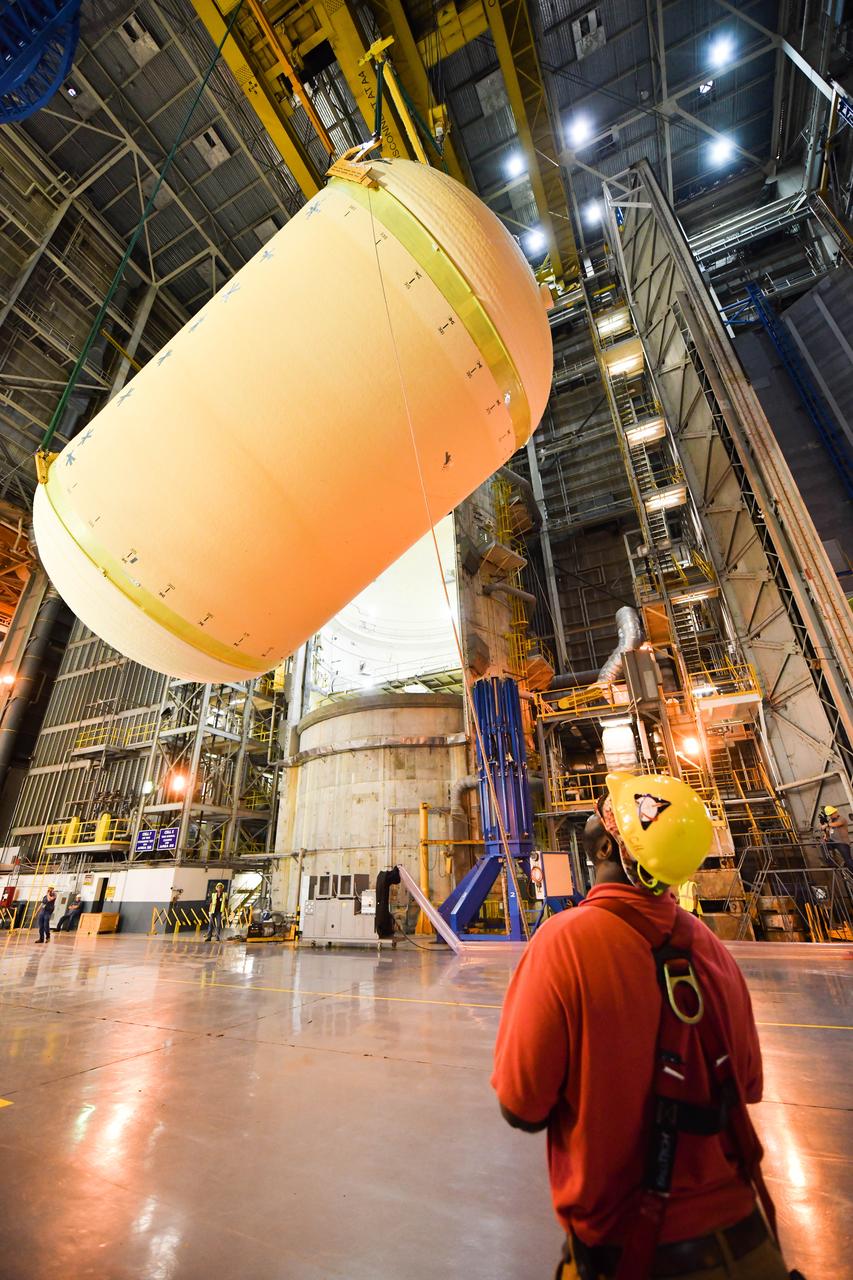
The Space Launch System (SLS) rocket’s liquid oxygen tank structural test article was manufactured and stacked in June 2019 at NASA’s Michoud Assembly Facility in New Orleans. To construct the test article, Boeing technicians at Michoud moved the liquid oxygen tank to the Vertical Assemby Building stacking and integration area. Here, they added simulators to mimic the two structures that connect to the tank, the intertank and the forward skirt. This structural hardware for the SLS core stage for America’s new deep space rocket is structurally identical to the flight version of the tank. It will be shipped on the Pegasus barge to NASA’s Marshall Space Flight Center in Hunstville, Alabama, where it will undergo a series of tests that simulate the stresses and loads of liftoff and flight. These tests will help ensure designs are adequate for successful SLS missions to the Moon and beyond. The flight liquid oxygen tank along with the liquid hydrogen tank supplies more than 500,000 gallons of propellant to the core stages four RS-25 engines, which produce 2 million pounds of thrust to help send the SLS rocket to space.
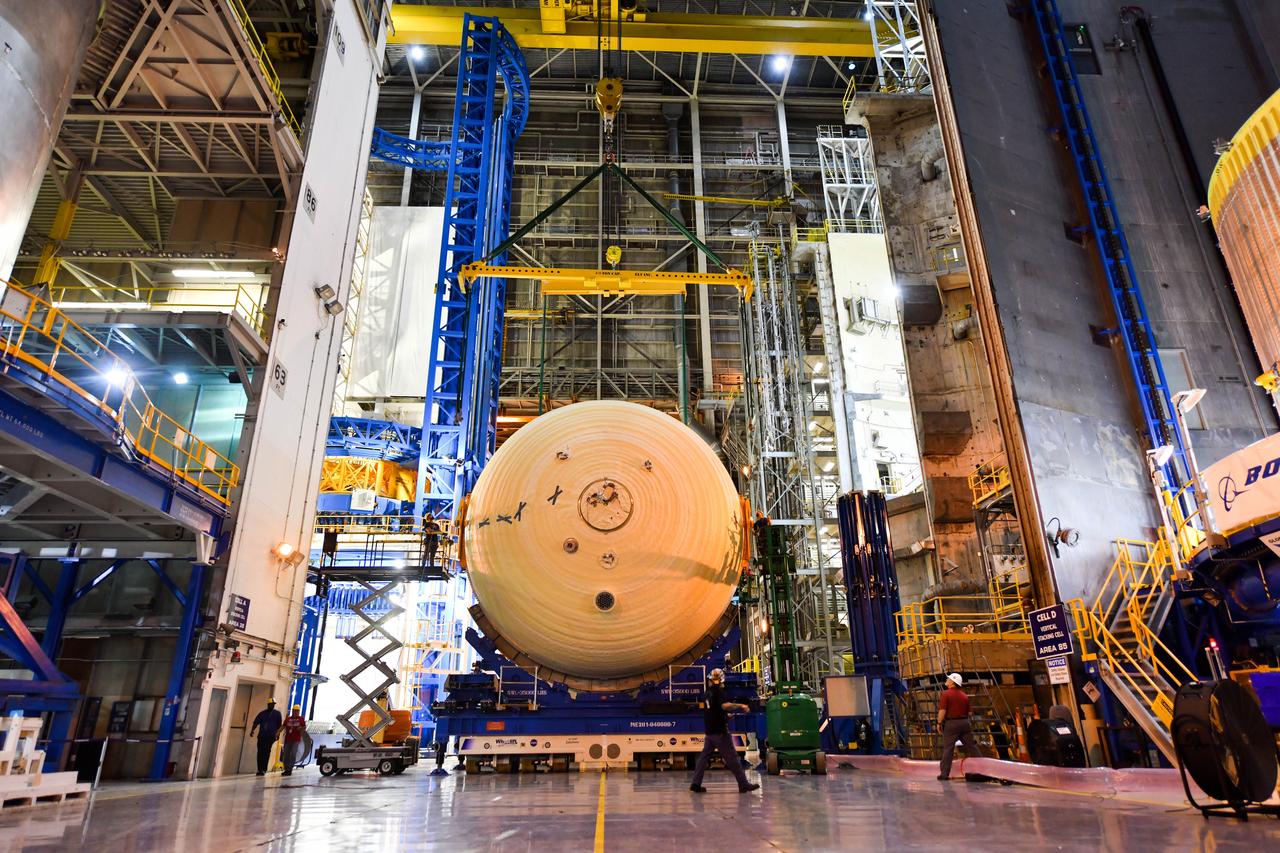
The Space Launch System (SLS) rocket’s liquid oxygen tank structural test article was manufactured and stacked in June 2019 at NASA’s Michoud Assembly Facility in New Orleans. To construct the test article, Boeing technicians at Michoud moved the liquid oxygen tank to the Vertical Assemby Building stacking and integration area. Here, they added simulators to mimic the two structures that connect to the tank, the intertank and the forward skirt. This structural hardware for the SLS core stage for America’s new deep space rocket is structurally identical to the flight version of the tank. It will be shipped on the Pegasus barge to NASA’s Marshall Space Flight Center in Hunstville, Alabama, where it will undergo a series of tests that simulate the stresses and loads of liftoff and flight. These tests will help ensure designs are adequate for successful SLS missions to the Moon and beyond. The flight liquid oxygen tank along with the liquid hydrogen tank supplies more than 500,000 gallons of propellant to the core stages four RS-25 engines, which produce 2 million pounds of thrust to help send the SLS rocket to space.
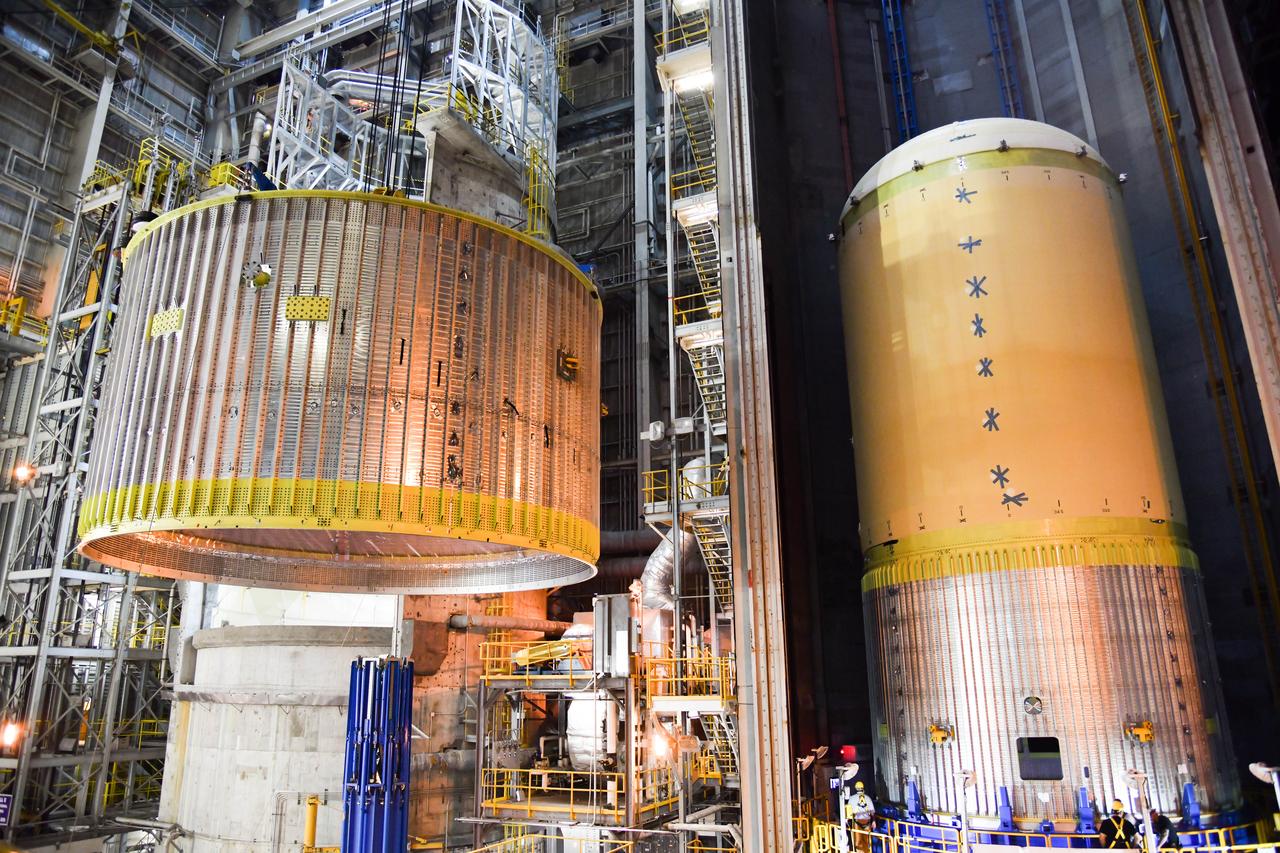
The Space Launch System (SLS) rocket’s liquid oxygen tank structural test article was manufactured and stacked in June 2019 at NASA’s Michoud Assembly Facility in New Orleans. To construct the test article, Boeing technicians at Michoud moved the liquid oxygen tank to the Vertical Assemby Building stacking and integration area. Here, they added simulators to mimic the two structures that connect to the tank, the intertank and the forward skirt. This structural hardware for the SLS core stage for America’s new deep space rocket is structurally identical to the flight version of the tank. It will be shipped on the Pegasus barge to NASA’s Marshall Space Flight Center in Hunstville, Alabama, where it will undergo a series of tests that simulate the stresses and loads of liftoff and flight. These tests will help ensure designs are adequate for successful SLS missions to the Moon and beyond. The flight liquid oxygen tank along with the liquid hydrogen tank supplies more than 500,000 gallons of propellant to the core stages four RS-25 engines, which produce 2 million pounds of thrust to help send the SLS rocket to space.
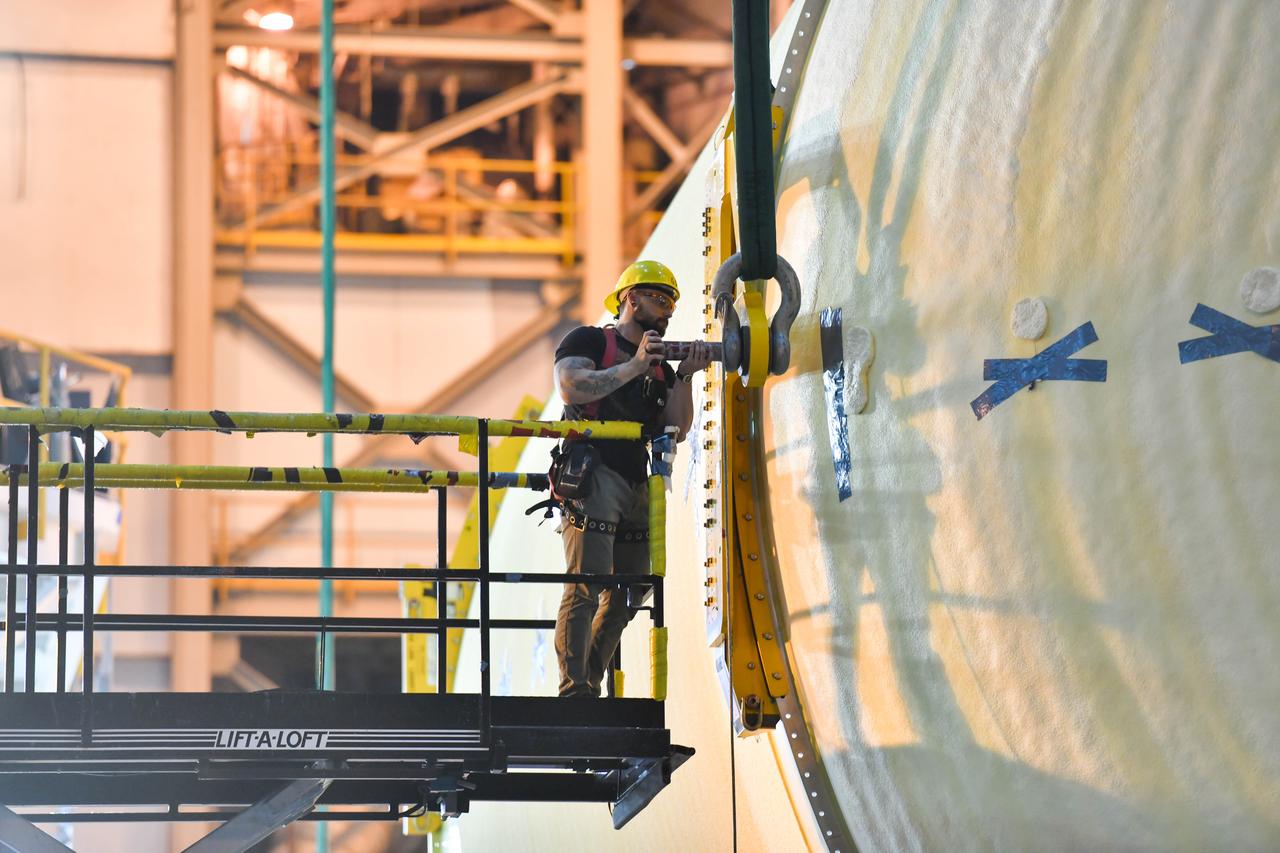
The Space Launch System (SLS) rocket’s liquid oxygen tank structural test article was manufactured and stacked in June 2019 at NASA’s Michoud Assembly Facility in New Orleans. To construct the test article, Boeing technicians at Michoud moved the liquid oxygen tank to the Vertical Assemby Building stacking and integration area. Here, they added simulators to mimic the two structures that connect to the tank, the intertank and the forward skirt. This structural hardware for the SLS core stage for America’s new deep space rocket is structurally identical to the flight version of the tank. It will be shipped on the Pegasus barge to NASA’s Marshall Space Flight Center in Hunstville, Alabama, where it will undergo a series of tests that simulate the stresses and loads of liftoff and flight. These tests will help ensure designs are adequate for successful SLS missions to the Moon and beyond. The flight liquid oxygen tank along with the liquid hydrogen tank supplies more than 500,000 gallons of propellant to the core stages four RS-25 engines, which produce 2 million pounds of thrust to help send the SLS rocket to space.
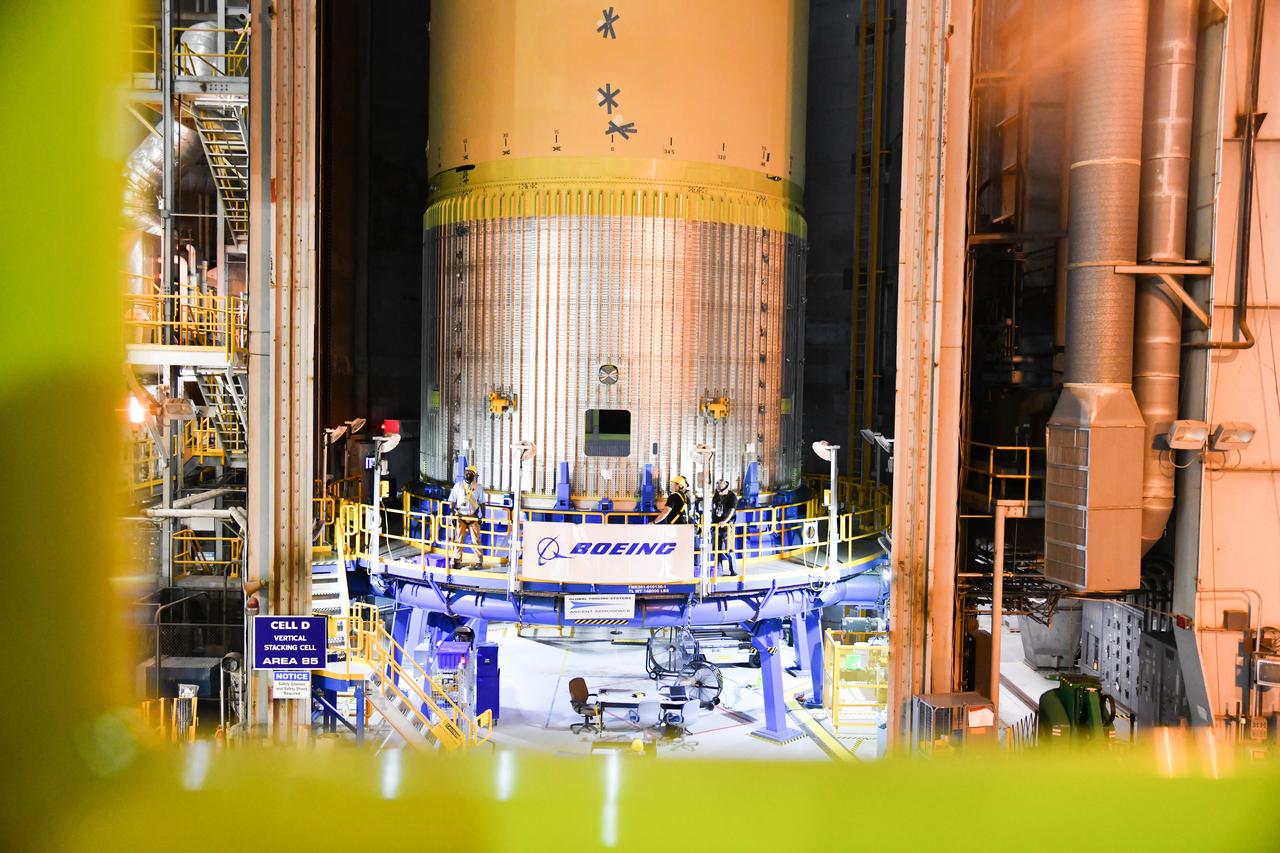
The Space Launch System (SLS) rocket’s liquid oxygen tank structural test article was manufactured and stacked in June 2019 at NASA’s Michoud Assembly Facility in New Orleans. To construct the test article, Boeing technicians at Michoud moved the liquid oxygen tank to the Vertical Assemby Building stacking and integration area. Here, they added simulators to mimic the two structures that connect to the tank, the intertank and the forward skirt. This structural hardware for the SLS core stage for America’s new deep space rocket is structurally identical to the flight version of the tank. It will be shipped on the Pegasus barge to NASA’s Marshall Space Flight Center in Hunstville, Alabama, where it will undergo a series of tests that simulate the stresses and loads of liftoff and flight. These tests will help ensure designs are adequate for successful SLS missions to the Moon and beyond. The flight liquid oxygen tank along with the liquid hydrogen tank supplies more than 500,000 gallons of propellant to the core stages four RS-25 engines, which produce 2 million pounds of thrust to help send the SLS rocket to space.
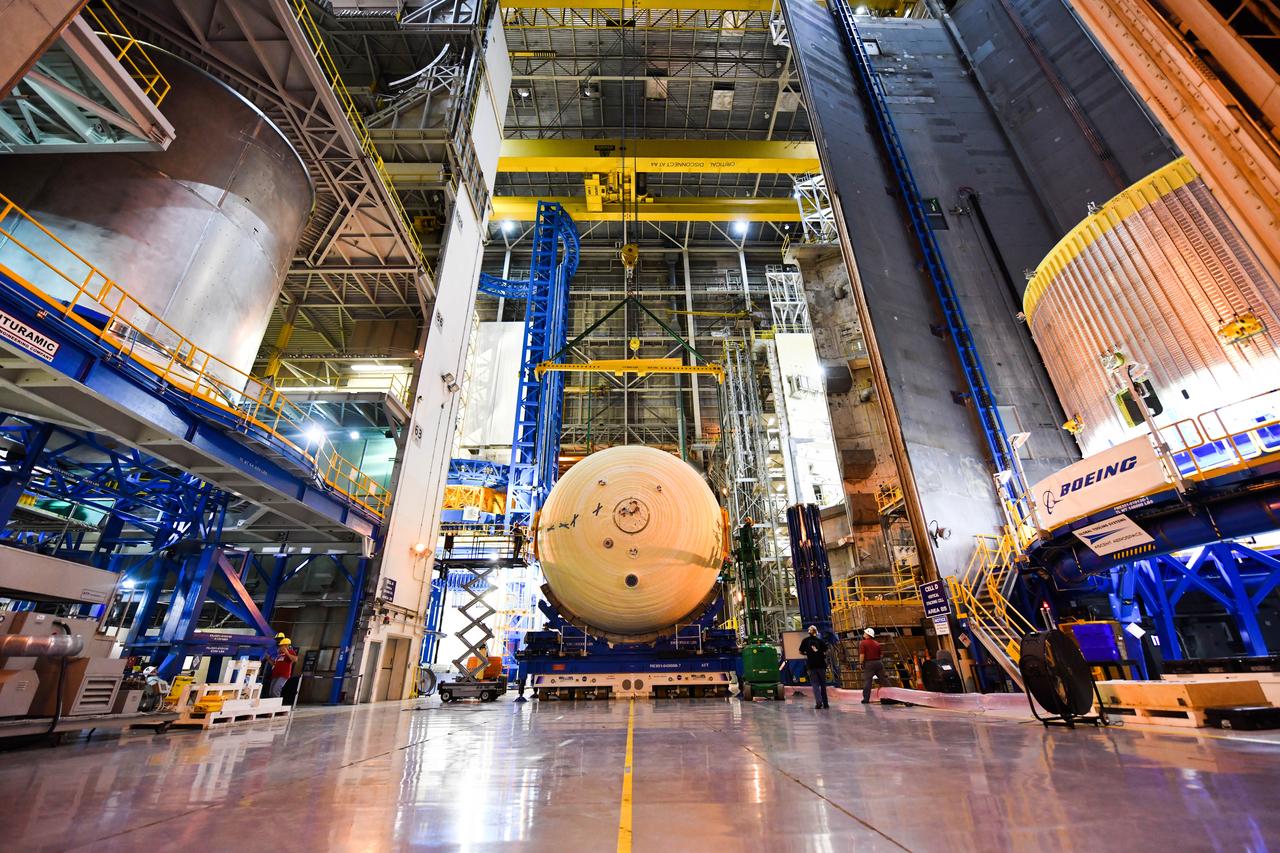
The Space Launch System (SLS) rocket’s liquid oxygen tank structural test article was manufactured and stacked in June 2019 at NASA’s Michoud Assembly Facility in New Orleans. To construct the test article, Boeing technicians at Michoud moved the liquid oxygen tank to the Vertical Assemby Building stacking and integration area. Here, they added simulators to mimic the two structures that connect to the tank, the intertank and the forward skirt. This structural hardware for the SLS core stage for America’s new deep space rocket is structurally identical to the flight version of the tank. It will be shipped on the Pegasus barge to NASA’s Marshall Space Flight Center in Hunstville, Alabama, where it will undergo a series of tests that simulate the stresses and loads of liftoff and flight. These tests will help ensure designs are adequate for successful SLS missions to the Moon and beyond. The flight liquid oxygen tank along with the liquid hydrogen tank supplies more than 500,000 gallons of propellant to the core stages four RS-25 engines, which produce 2 million pounds of thrust to help send the SLS rocket to space.
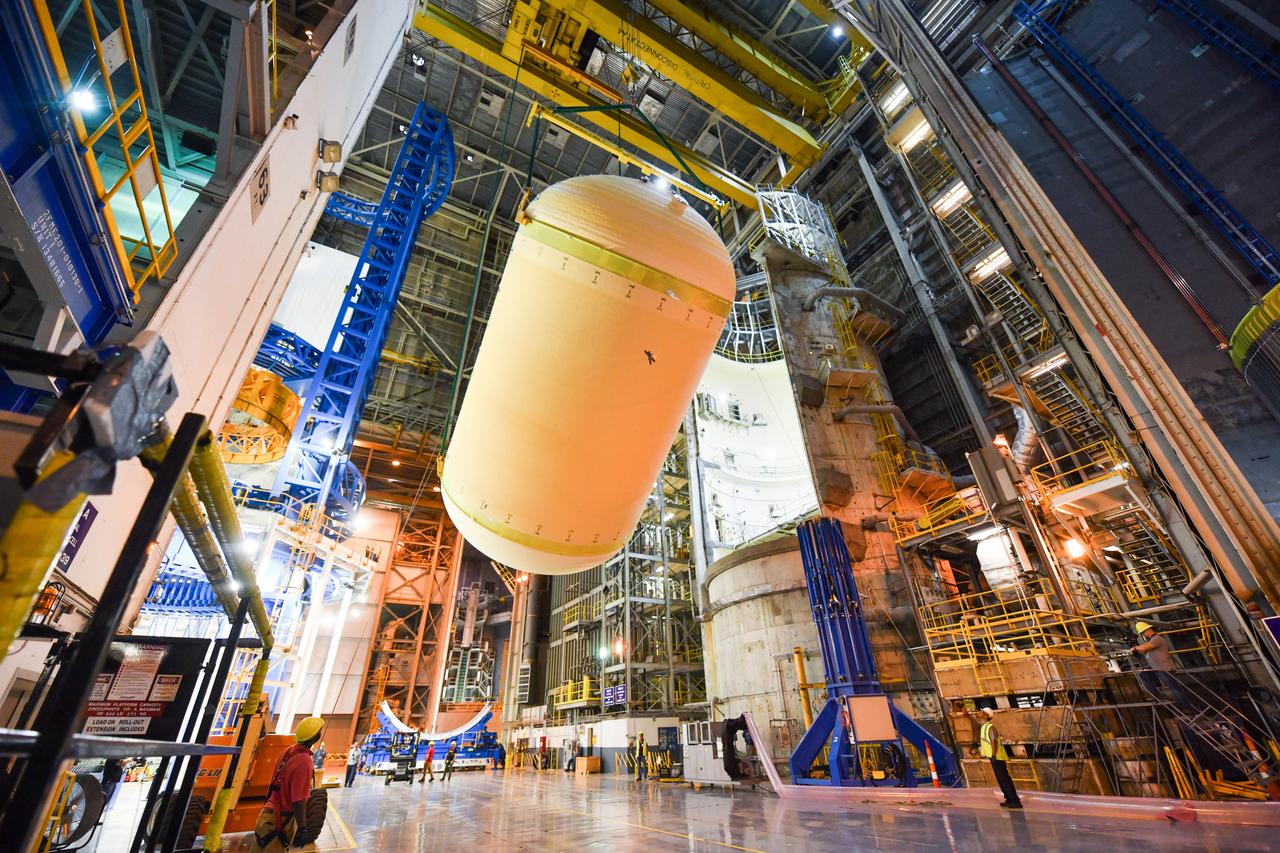
The Space Launch System (SLS) rocket’s liquid oxygen tank structural test article was manufactured and stacked in June 2019 at NASA’s Michoud Assembly Facility in New Orleans. To construct the test article, Boeing technicians at Michoud moved the liquid oxygen tank to the Vertical Assemby Building stacking and integration area. Here, they added simulators to mimic the two structures that connect to the tank, the intertank and the forward skirt. This structural hardware for the SLS core stage for America’s new deep space rocket is structurally identical to the flight version of the tank. It will be shipped on the Pegasus barge to NASA’s Marshall Space Flight Center in Hunstville, Alabama, where it will undergo a series of tests that simulate the stresses and loads of liftoff and flight. These tests will help ensure designs are adequate for successful SLS missions to the Moon and beyond. The flight liquid oxygen tank along with the liquid hydrogen tank supplies more than 500,000 gallons of propellant to the core stages four RS-25 engines, which produce 2 million pounds of thrust to help send the SLS rocket to space.
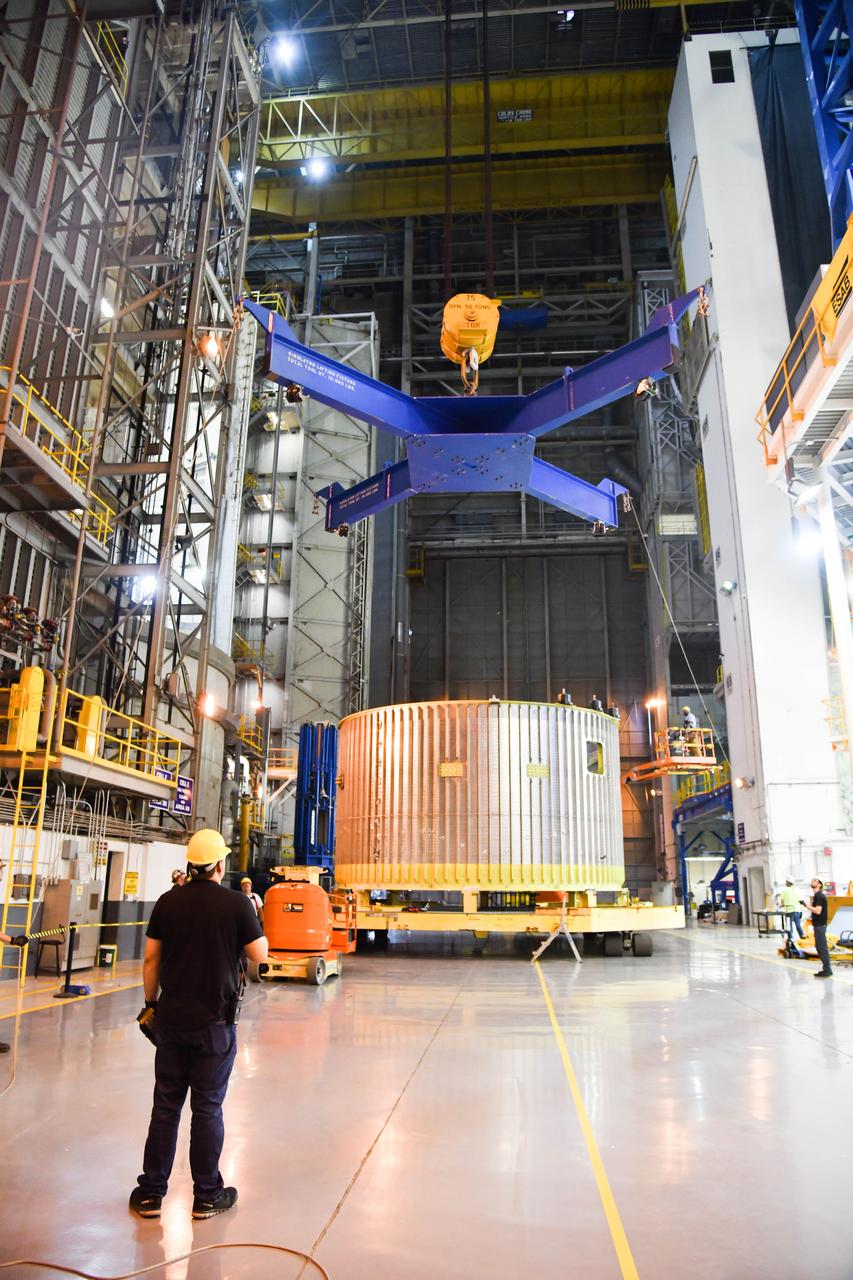
The Space Launch System (SLS) rocket’s liquid oxygen tank structural test article was manufactured and stacked in June 2019 at NASA’s Michoud Assembly Facility in New Orleans. To construct the test article, Boeing technicians at Michoud moved the liquid oxygen tank to the Vertical Assemby Building stacking and integration area. Here, they added simulators to mimic the two structures that connect to the tank, the intertank and the forward skirt. This structural hardware for the SLS core stage for America’s new deep space rocket is structurally identical to the flight version of the tank. It will be shipped on the Pegasus barge to NASA’s Marshall Space Flight Center in Hunstville, Alabama, where it will undergo a series of tests that simulate the stresses and loads of liftoff and flight. These tests will help ensure designs are adequate for successful SLS missions to the Moon and beyond. The flight liquid oxygen tank along with the liquid hydrogen tank supplies more than 500,000 gallons of propellant to the core stages four RS-25 engines, which produce 2 million pounds of thrust to help send the SLS rocket to space.
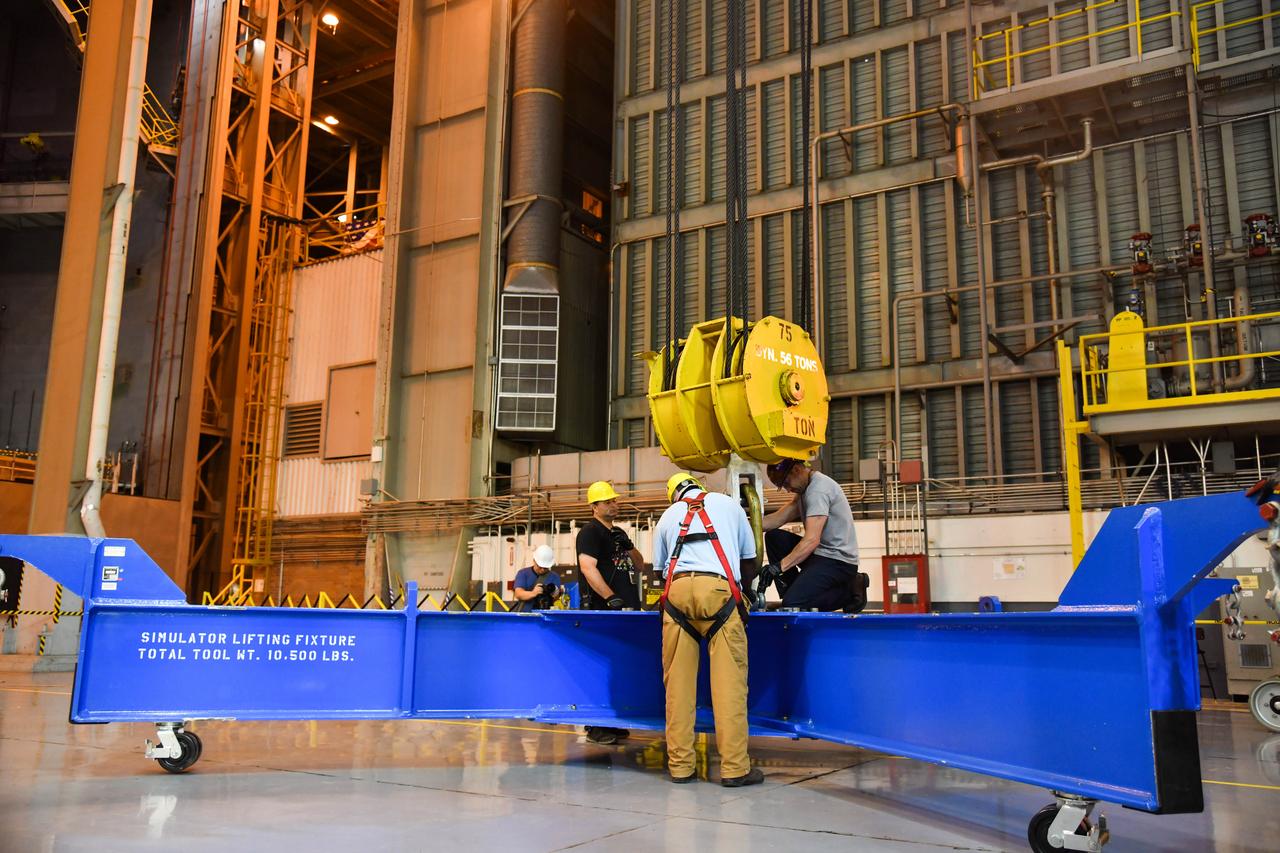
The Space Launch System (SLS) rocket’s liquid oxygen tank structural test article was manufactured and stacked in June 2019 at NASA’s Michoud Assembly Facility in New Orleans. To construct the test article, Boeing technicians at Michoud moved the liquid oxygen tank to the Vertical Assemby Building stacking and integration area. Here, they added simulators to mimic the two structures that connect to the tank, the intertank and the forward skirt. This structural hardware for the SLS core stage for America’s new deep space rocket is structurally identical to the flight version of the tank. It will be shipped on the Pegasus barge to NASA’s Marshall Space Flight Center in Hunstville, Alabama, where it will undergo a series of tests that simulate the stresses and loads of liftoff and flight. These tests will help ensure designs are adequate for successful SLS missions to the Moon and beyond. The flight liquid oxygen tank along with the liquid hydrogen tank supplies more than 500,000 gallons of propellant to the core stages four RS-25 engines, which produce 2 million pounds of thrust to help send the SLS rocket to space.
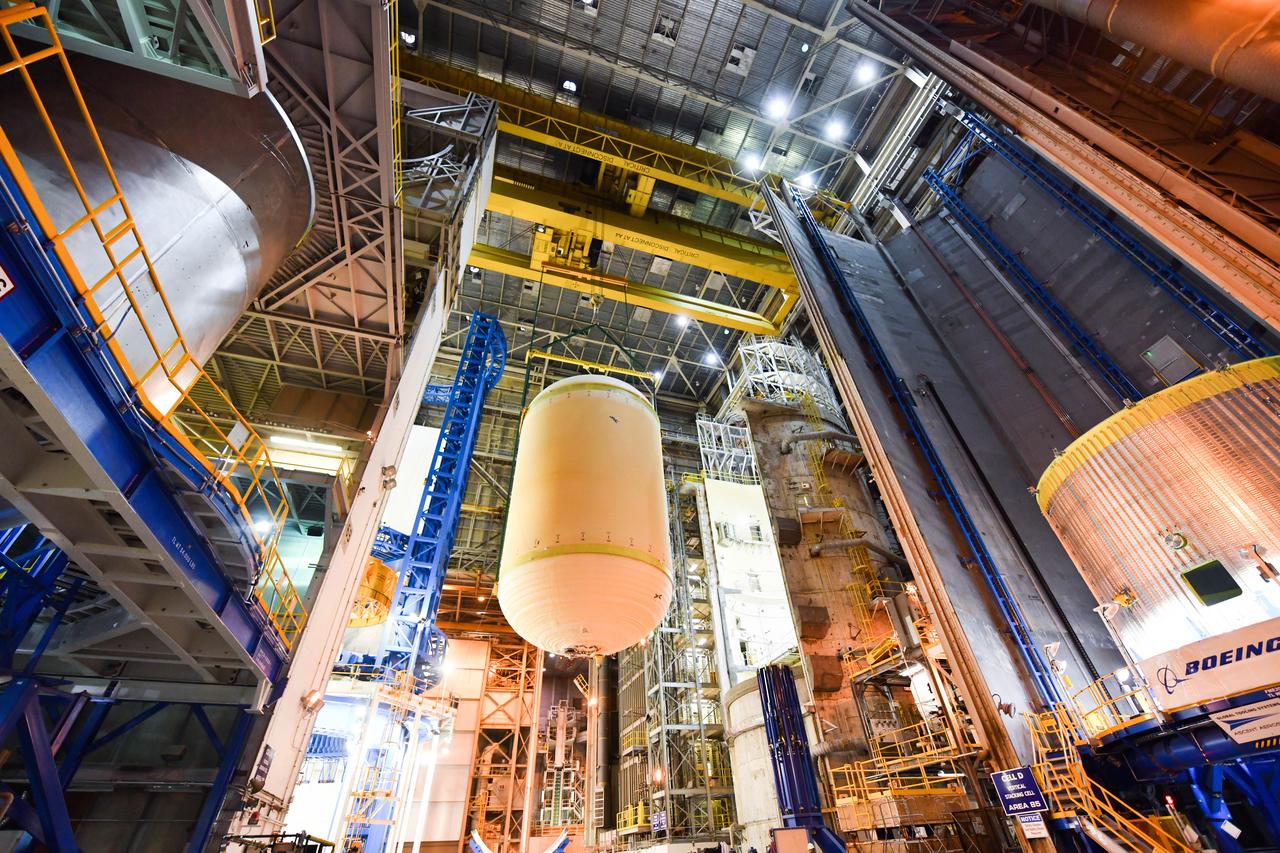
The Space Launch System (SLS) rocket’s liquid oxygen tank structural test article was manufactured and stacked in June 2019 at NASA’s Michoud Assembly Facility in New Orleans. To construct the test article, Boeing technicians at Michoud moved the liquid oxygen tank to the Vertical Assemby Building stacking and integration area. Here, they added simulators to mimic the two structures that connect to the tank, the intertank and the forward skirt. This structural hardware for the SLS core stage for America’s new deep space rocket is structurally identical to the flight version of the tank. It will be shipped on the Pegasus barge to NASA’s Marshall Space Flight Center in Hunstville, Alabama, where it will undergo a series of tests that simulate the stresses and loads of liftoff and flight. These tests will help ensure designs are adequate for successful SLS missions to the Moon and beyond. The flight liquid oxygen tank along with the liquid hydrogen tank supplies more than 500,000 gallons of propellant to the core stages four RS-25 engines, which produce 2 million pounds of thrust to help send the SLS rocket to space.
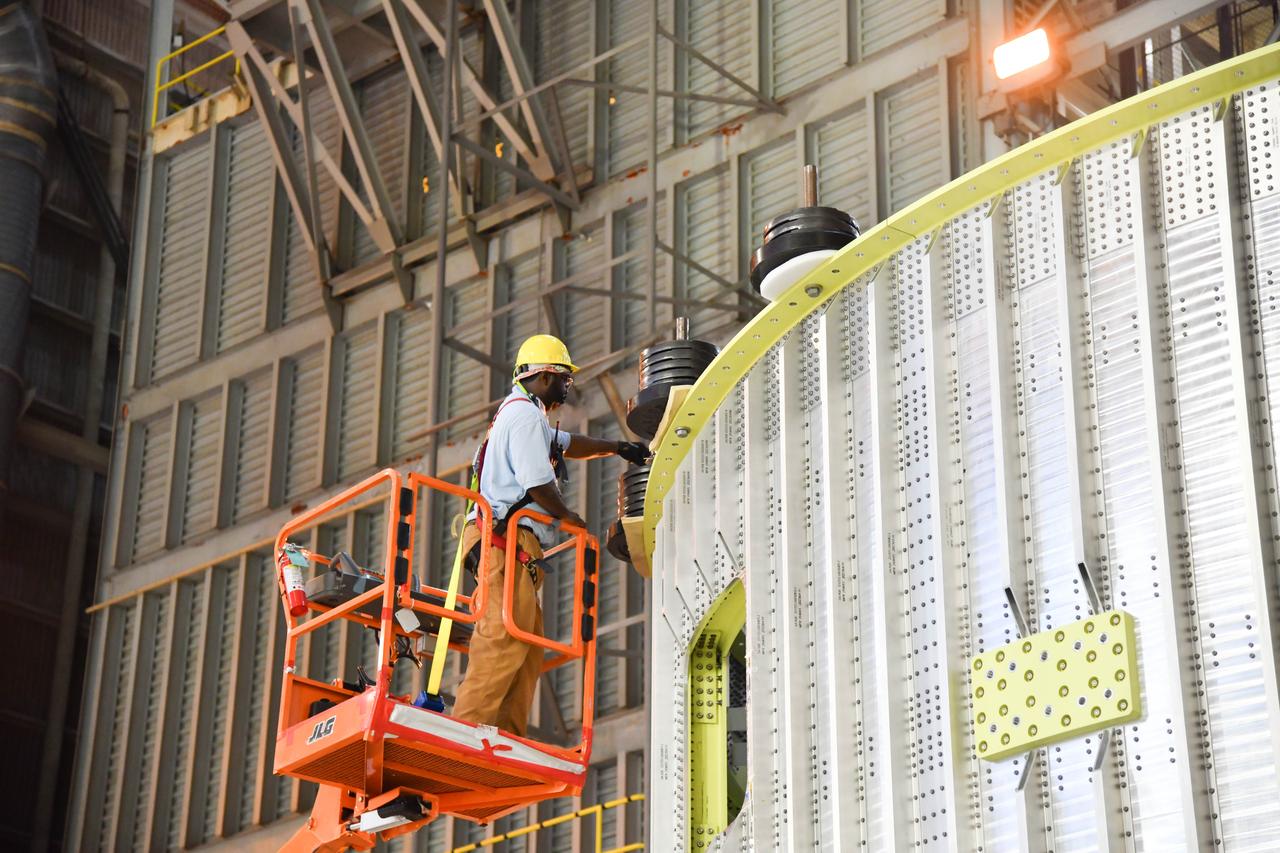
The Space Launch System (SLS) rocket’s liquid oxygen tank structural test article was manufactured and stacked in June 2019 at NASA’s Michoud Assembly Facility in New Orleans. To construct the test article, Boeing technicians at Michoud moved the liquid oxygen tank to the Vertical Assemby Building stacking and integration area. Here, they added simulators to mimic the two structures that connect to the tank, the intertank and the forward skirt. This structural hardware for the SLS core stage for America’s new deep space rocket is structurally identical to the flight version of the tank. It will be shipped on the Pegasus barge to NASA’s Marshall Space Flight Center in Hunstville, Alabama, where it will undergo a series of tests that simulate the stresses and loads of liftoff and flight. These tests will help ensure designs are adequate for successful SLS missions to the Moon and beyond. The flight liquid oxygen tank along with the liquid hydrogen tank supplies more than 500,000 gallons of propellant to the core stages four RS-25 engines, which produce 2 million pounds of thrust to help send the SLS rocket to space.
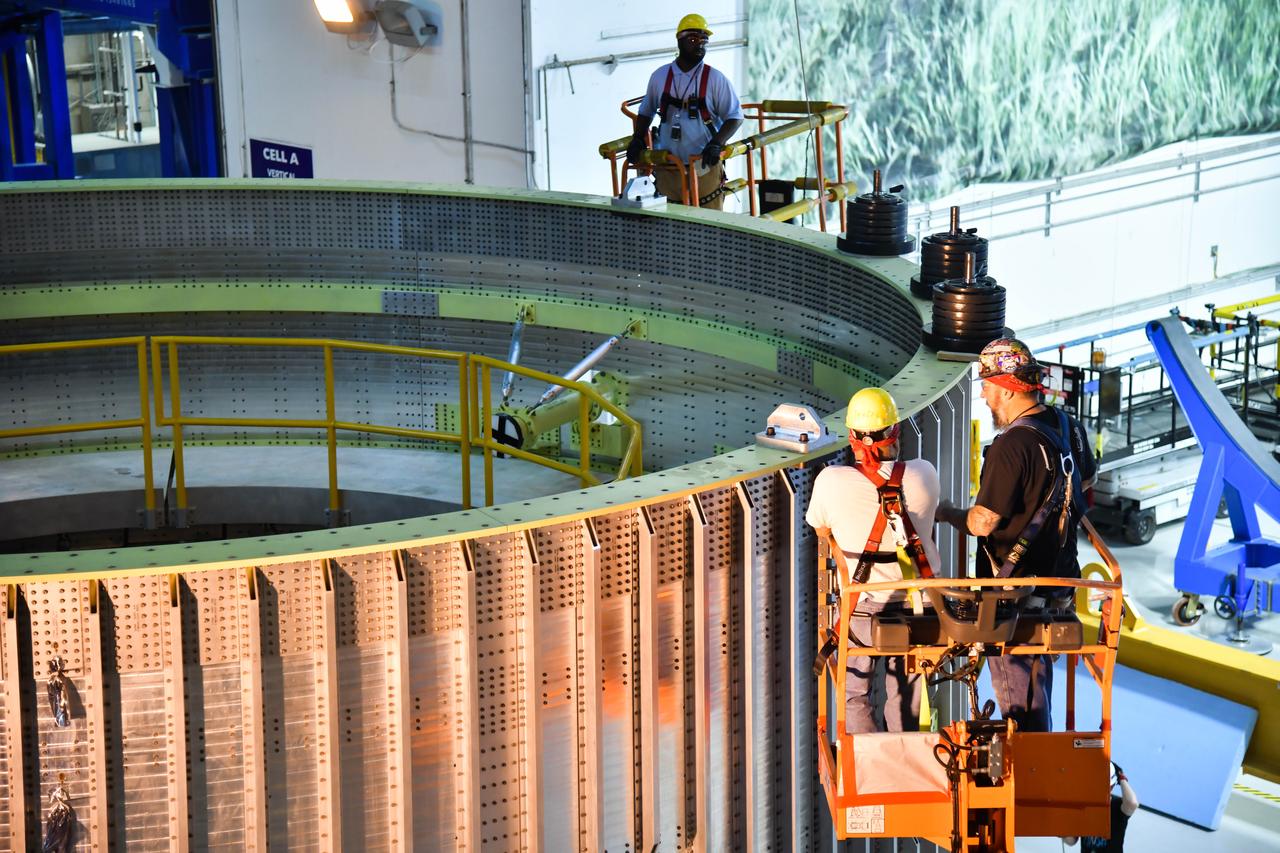
The Space Launch System (SLS) rocket’s liquid oxygen tank structural test article was manufactured and stacked in June 2019 at NASA’s Michoud Assembly Facility in New Orleans. To construct the test article, Boeing technicians at Michoud moved the liquid oxygen tank to the Vertical Assemby Building stacking and integration area. Here, they added simulators to mimic the two structures that connect to the tank, the intertank and the forward skirt. This structural hardware for the SLS core stage for America’s new deep space rocket is structurally identical to the flight version of the tank. It will be shipped on the Pegasus barge to NASA’s Marshall Space Flight Center in Hunstville, Alabama, where it will undergo a series of tests that simulate the stresses and loads of liftoff and flight. These tests will help ensure designs are adequate for successful SLS missions to the Moon and beyond. The flight liquid oxygen tank along with the liquid hydrogen tank supplies more than 500,000 gallons of propellant to the core stages four RS-25 engines, which produce 2 million pounds of thrust to help send the SLS rocket to space.
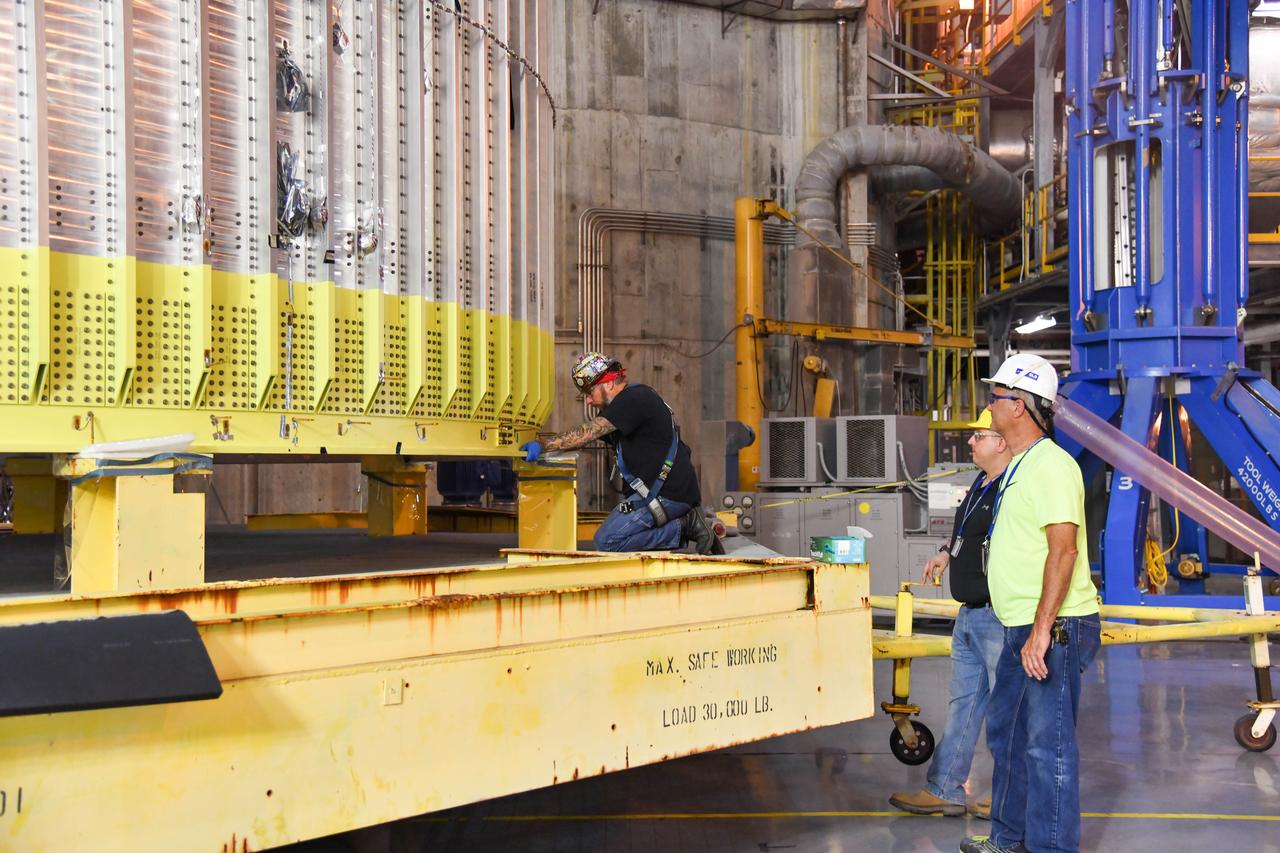
The Space Launch System (SLS) rocket’s liquid oxygen tank structural test article was manufactured and stacked in June 2019 at NASA’s Michoud Assembly Facility in New Orleans. To construct the test article, Boeing technicians at Michoud moved the liquid oxygen tank to the Vertical Assemby Building stacking and integration area. Here, they added simulators to mimic the two structures that connect to the tank, the intertank and the forward skirt. This structural hardware for the SLS core stage for America’s new deep space rocket is structurally identical to the flight version of the tank. It will be shipped on the Pegasus barge to NASA’s Marshall Space Flight Center in Hunstville, Alabama, where it will undergo a series of tests that simulate the stresses and loads of liftoff and flight. These tests will help ensure designs are adequate for successful SLS missions to the Moon and beyond. The flight liquid oxygen tank along with the liquid hydrogen tank supplies more than 500,000 gallons of propellant to the core stages four RS-25 engines, which produce 2 million pounds of thrust to help send the SLS rocket to space.
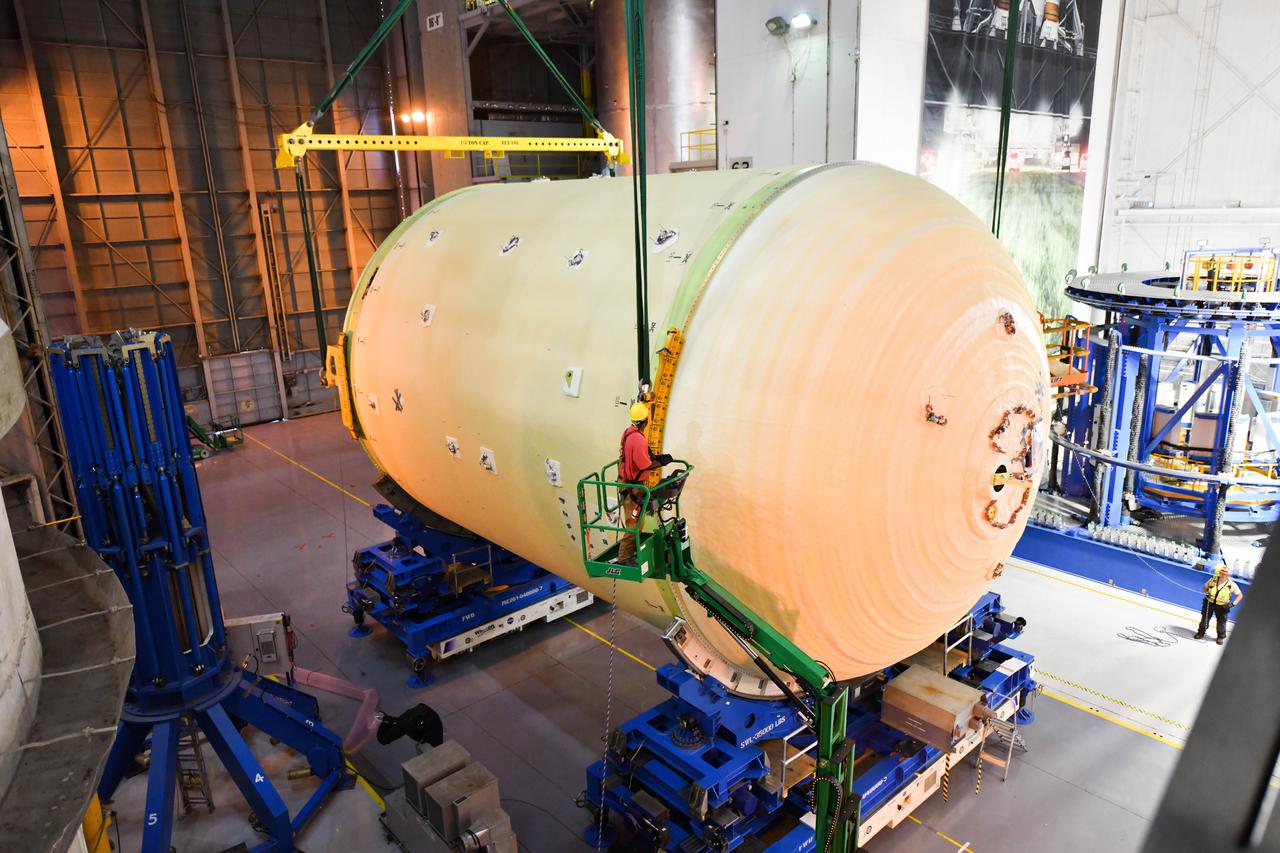
The Space Launch System (SLS) rocket’s liquid oxygen tank structural test article was manufactured and stacked in June 2019 at NASA’s Michoud Assembly Facility in New Orleans. To construct the test article, Boeing technicians at Michoud moved the liquid oxygen tank to the Vertical Assemby Building stacking and integration area. Here, they added simulators to mimic the two structures that connect to the tank, the intertank and the forward skirt. This structural hardware for the SLS core stage for America’s new deep space rocket is structurally identical to the flight version of the tank. It will be shipped on the Pegasus barge to NASA’s Marshall Space Flight Center in Hunstville, Alabama, where it will undergo a series of tests that simulate the stresses and loads of liftoff and flight. These tests will help ensure designs are adequate for successful SLS missions to the Moon and beyond. The flight liquid oxygen tank along with the liquid hydrogen tank supplies more than 500,000 gallons of propellant to the core stages four RS-25 engines, which produce 2 million pounds of thrust to help send the SLS rocket to space.
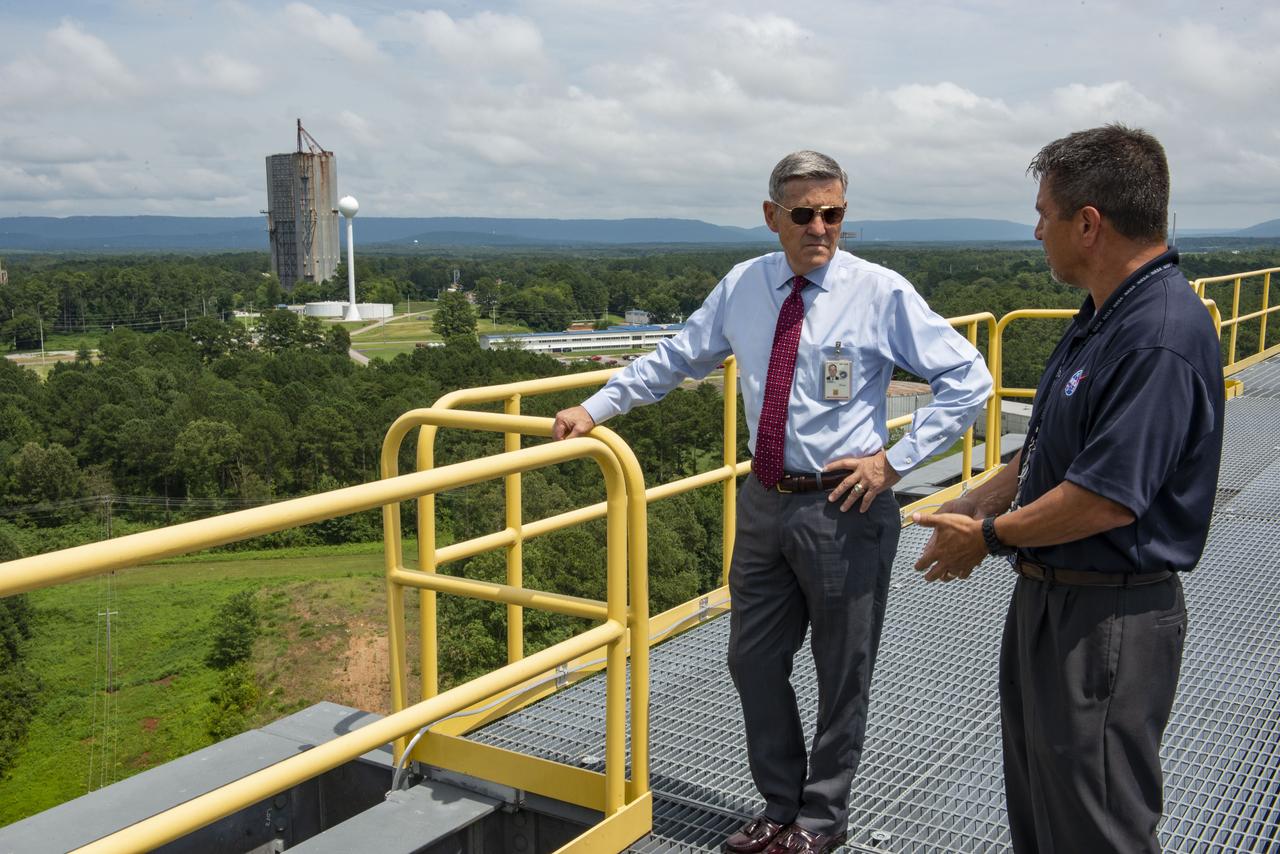
NASA's Kennedy Space Center Director Robert Cabana visited Marshall Space Flight Center July 16. With the Dynamic Test Stand in the background, Cabana, left, talks with Tim Flores, integration manager for stages in the Space Launch System Program Office, on top of Test Stand 4693, NASA’s largest SLS structural test stand. In addition to viewing SLS hardware, Cabana spoke to the Marshall Association and National Space Club Huntsville during his visit.
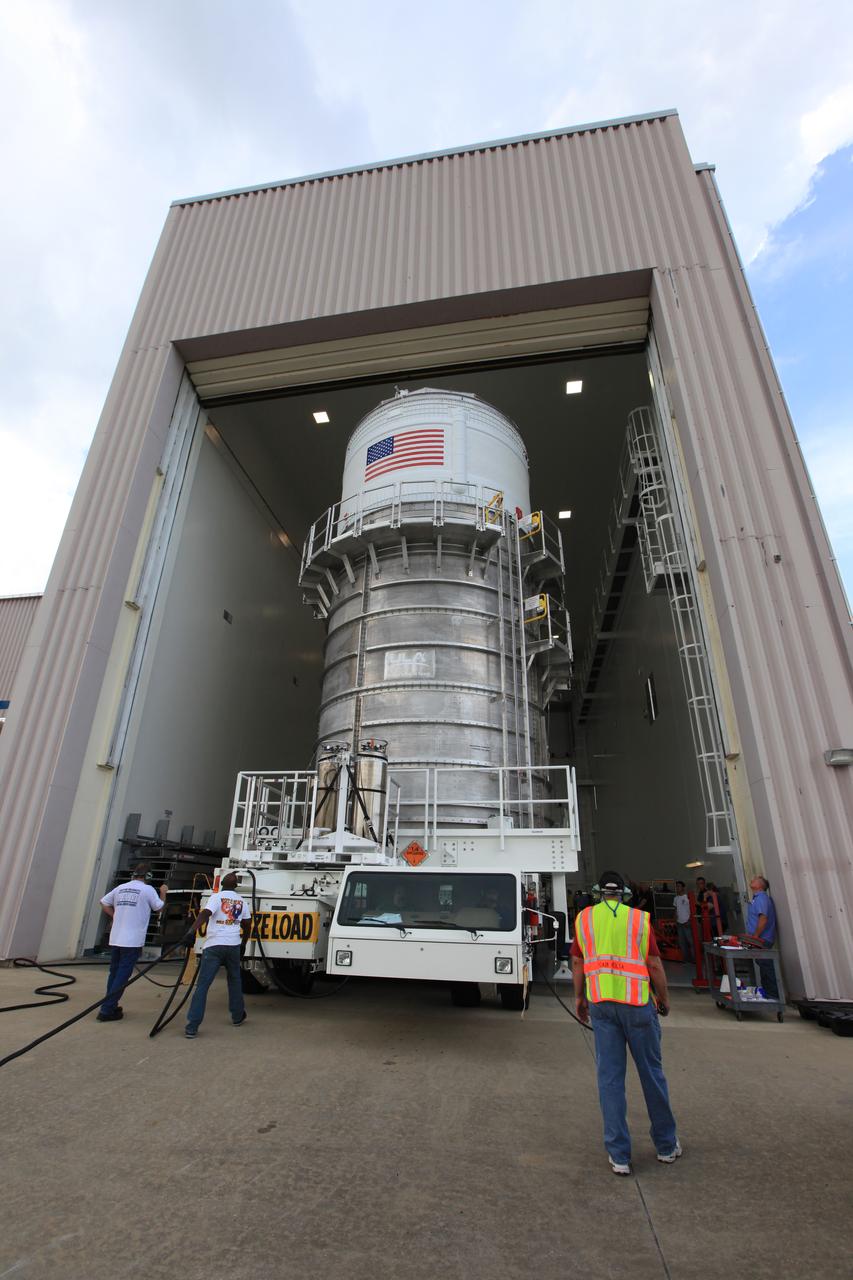
Packed inside its canister, the Interim Cryogenic Propulsion Stage (ICPS) for NASA's Space Launch System (SLS) rocket is moved into the low bay entrance of the Space Station Processing Facility at NASA's Kennedy Space Center in Florida. The ICPS is the first integrated piece of flight hardware to arrive for the SLS. It is the in-space stage that is located toward the top of the rocket, between the Launch Vehicle Stage Adapter and the Orion Spacecraft Adapter. It will provide some of the in-space propulsion during Orion's first flight test atop the SLS on Exploration Mission-1.
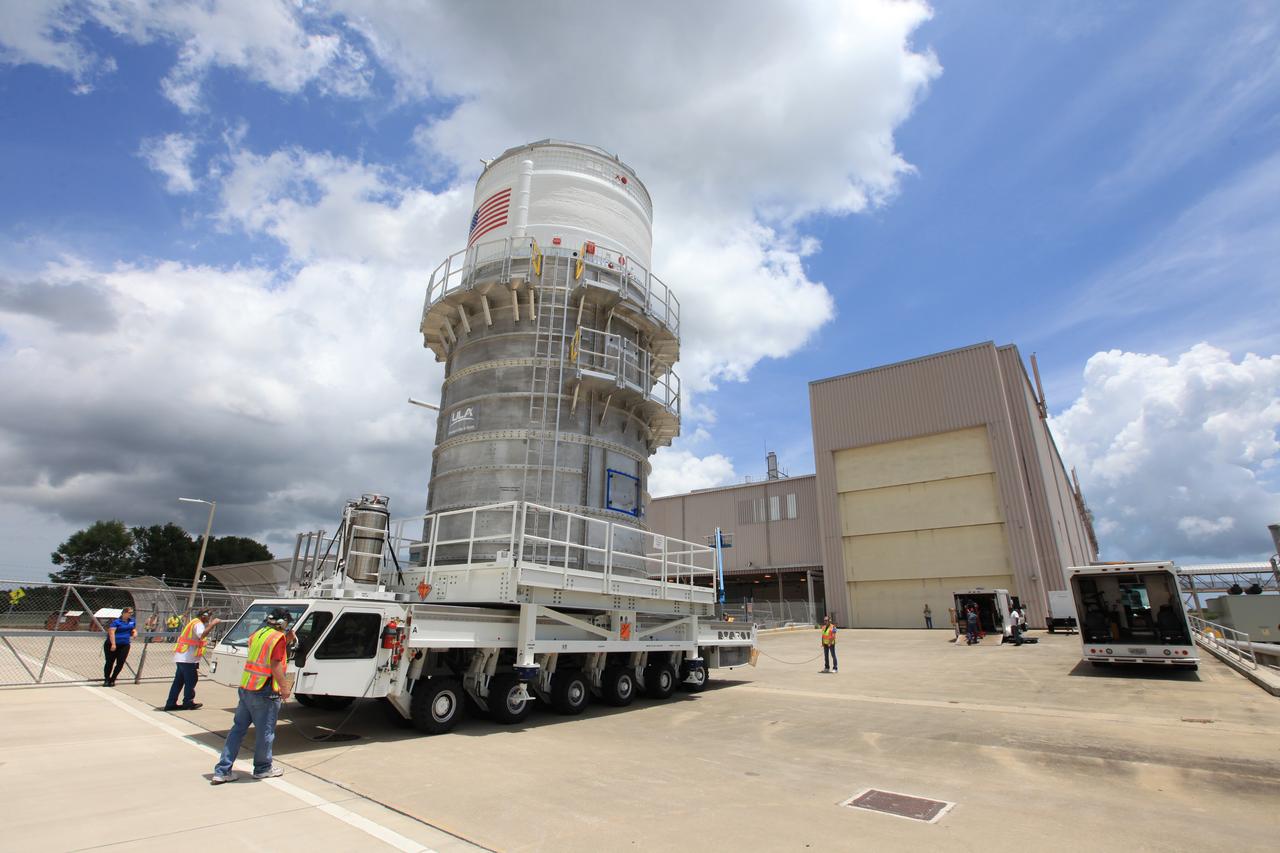
Packed inside its canister, the Interim Cryogenic Propulsion Stage (ICPS) for NASA's Space Launch System (SLS) rocket arrives at the low bay entrance of the Space Station Processing Facility at NASA's Kennedy Space Center in Florida. The ICPS is the first integrated piece of flight hardware to arrive for the SLS. It is the in-space stage that is located toward the top of the rocket, between the Launch Vehicle Stage Adapter and the Orion Spacecraft Adapter. It will provide some of the in-space propulsion during Orion's first flight test atop the SLS on Exploration Mission-1.
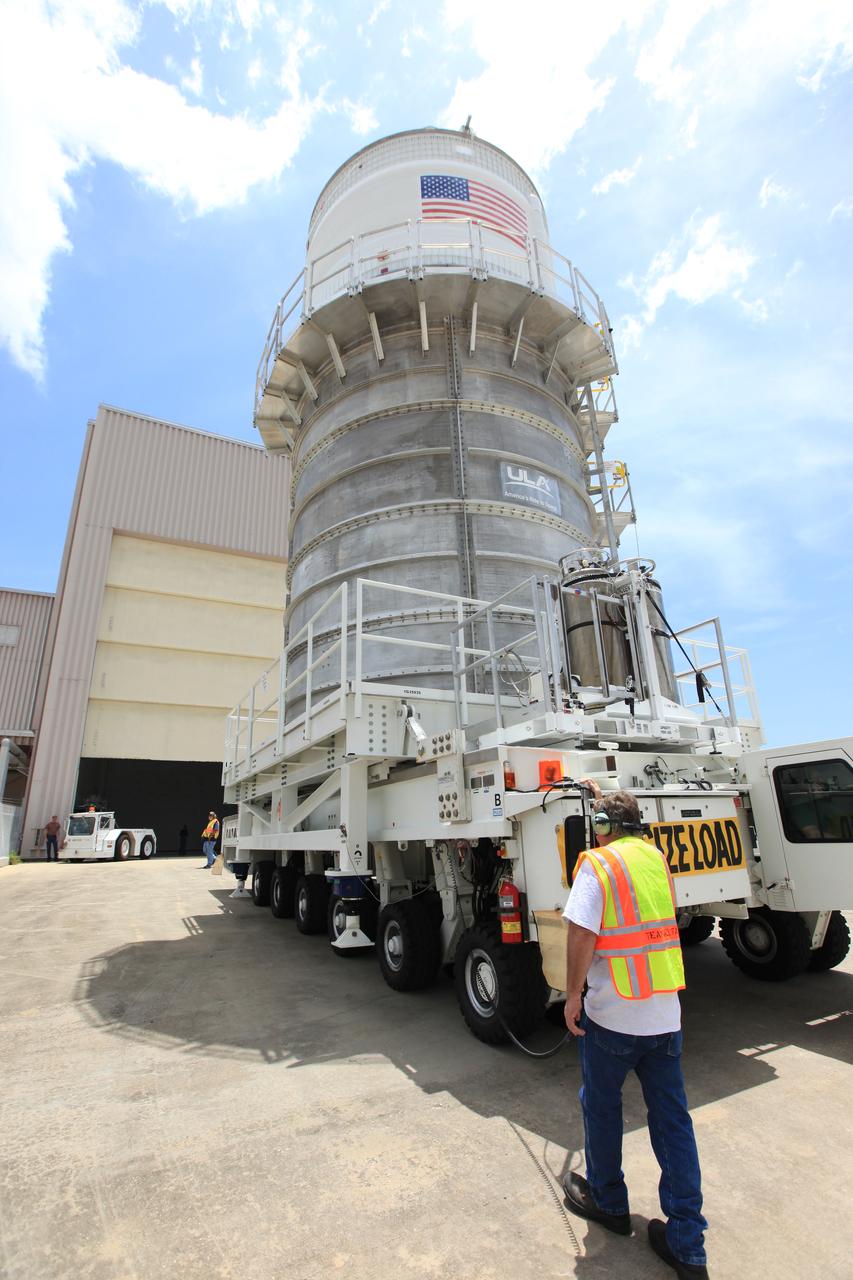
Packed inside its canister, the Interim Cryogenic Propulsion Stage (ICPS) for NASA's Space Launch System (SLS) rocket arrives at the low bay entrance of the Space Station Processing Facility at NASA's Kennedy Space Center in Florida. The ICPS is the first integrated piece of flight hardware to arrive for the SLS. It is the in-space stage that is located toward the top of the rocket, between the Launch Vehicle Stage Adapter and the Orion Spacecraft Adapter. It will provide some of the in-space propulsion during Orion's first flight test atop the SLS on Exploration Mission-1.
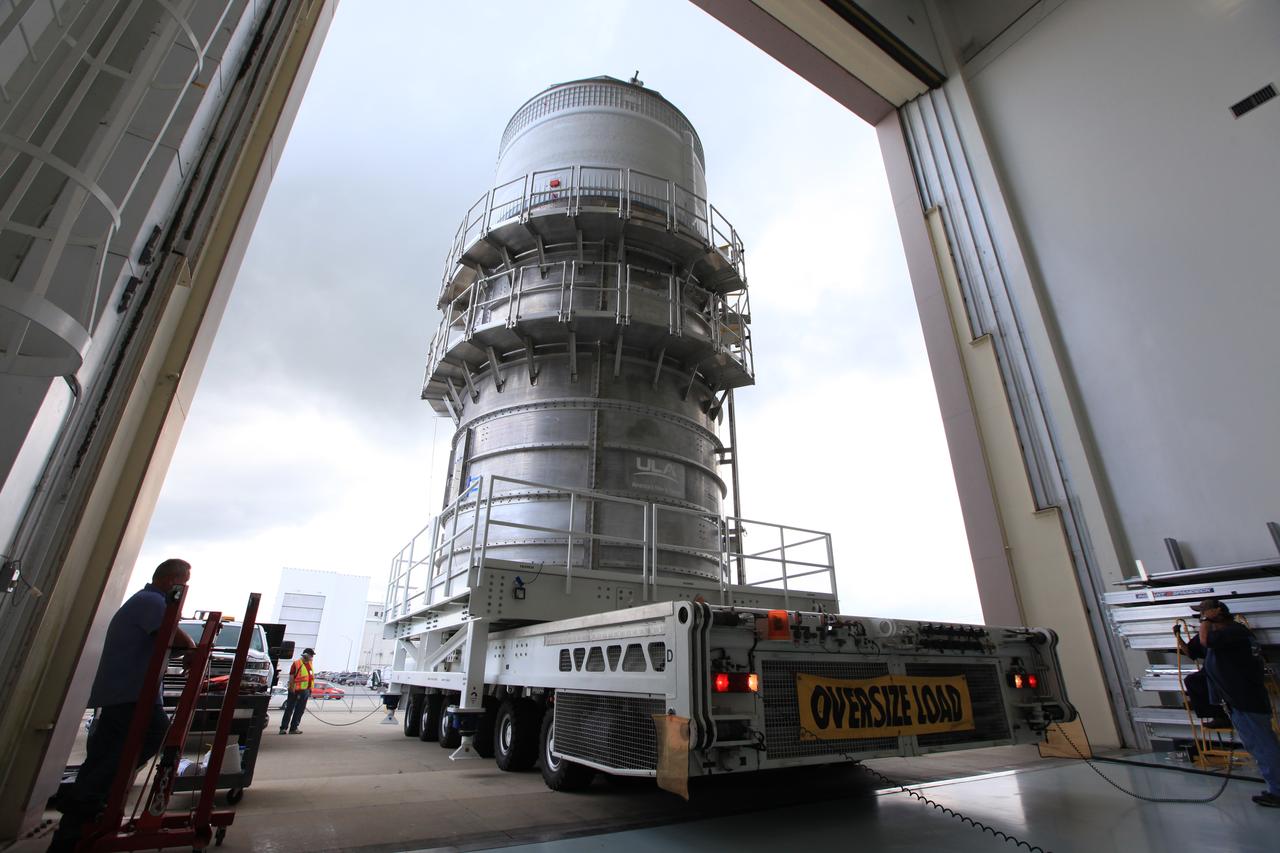
Packed inside its canister, the Interim Cryogenic Propulsion Stage (ICPS) for NASA's Space Launch System (SLS) rocket is moved into the low bay entrance of the Space Station Processing Facility at NASA's Kennedy Space Center in Florida. The ICPS is the first integrated piece of flight hardware to arrive for the SLS. It is the in-space stage that is located toward the top of the rocket, between the Launch Vehicle Stage Adapter and the Orion Spacecraft Adapter. It will provide some of the in-space propulsion during Orion's first flight test atop the SLS on Exploration Mission-1.
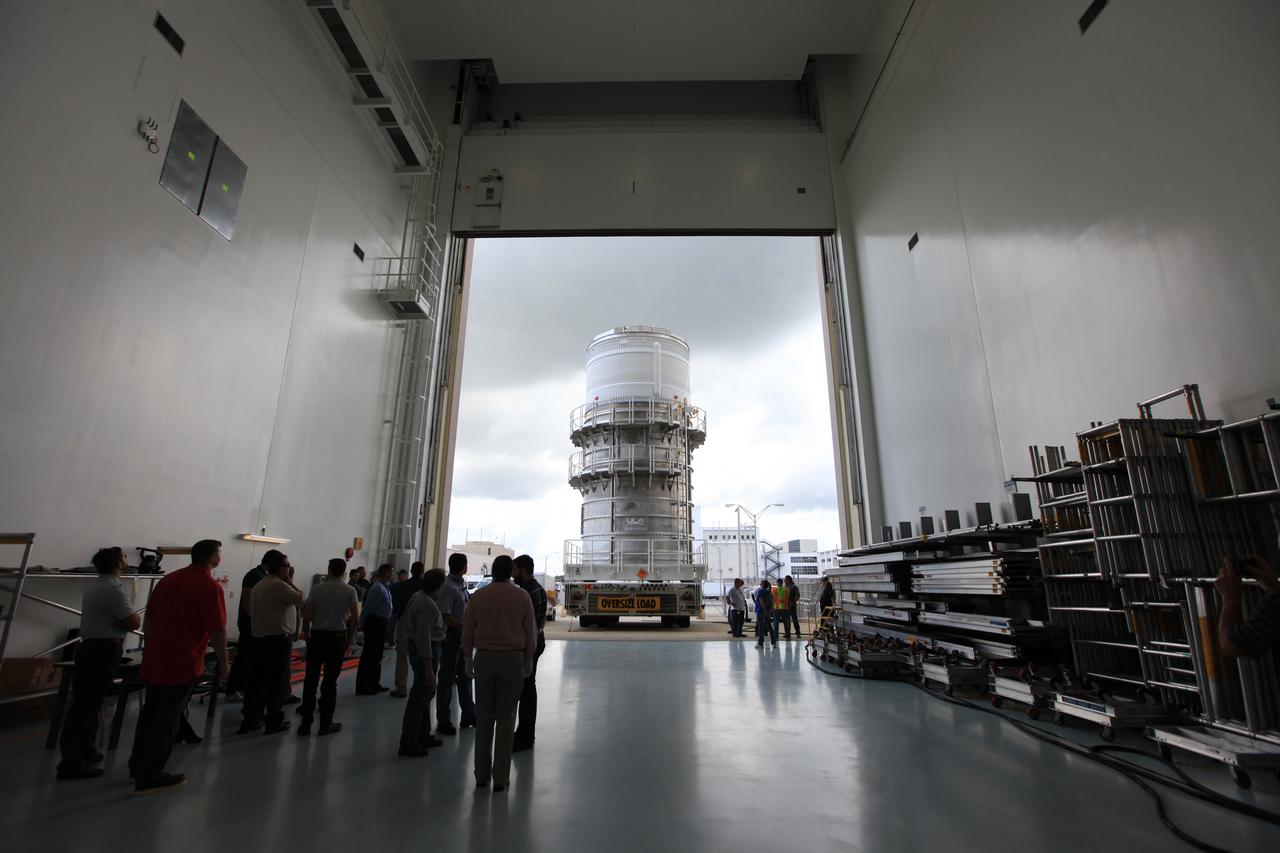
Packed inside its canister, the Interim Cryogenic Propulsion Stage (ICPS) for NASA's Space Launch System (SLS) rocket arrives at the low bay entrance of the Space Station Processing Facility at NASA's Kennedy Space Center in Florida. The ICPS is the first integrated piece of flight hardware to arrive for the SLS. It is the in-space stage that is located toward the top of the rocket, between the Launch Vehicle Stage Adapter and the Orion Spacecraft Adapter. It will provide some of the in-space propulsion during Orion's first flight test atop the SLS on Exploration Mission-1.
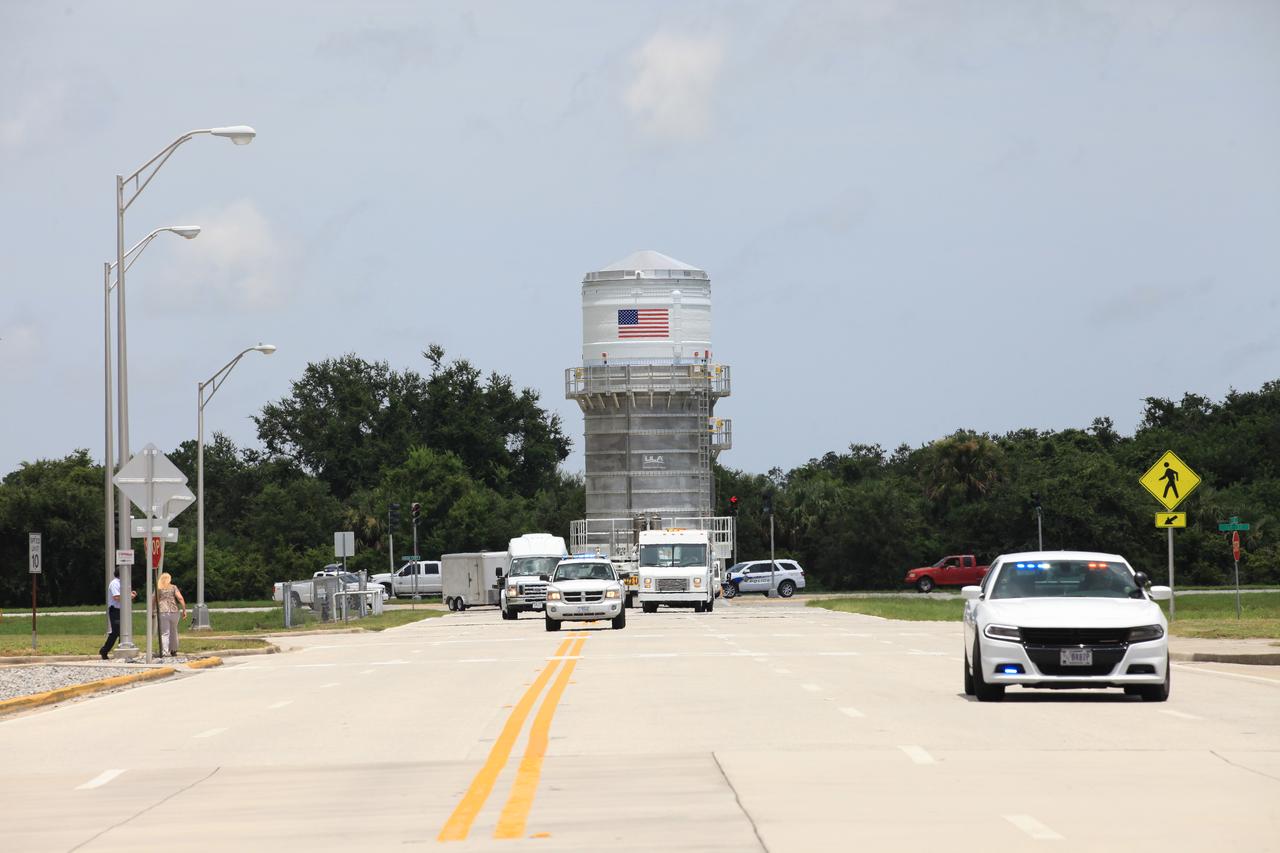
Packed inside its canister, the Interim Cryogenic Propulsion Stage (ICPS) for NASA's Space Launch System (SLS) rocket is being transported to the Space Station Processing Facility at NASA's Kennedy Space Center in Florida. The ICPS is the first integrated piece of flight hardware to arrive for the SLS. It is the in-space stage that is located toward the top of the rocket, between the Launch Vehicle Stage Adapter and the Orion Spacecraft Adapter. It will provide some of the in-space propulsion during Orion's first flight test atop the SLS on Exploration Mission-1.
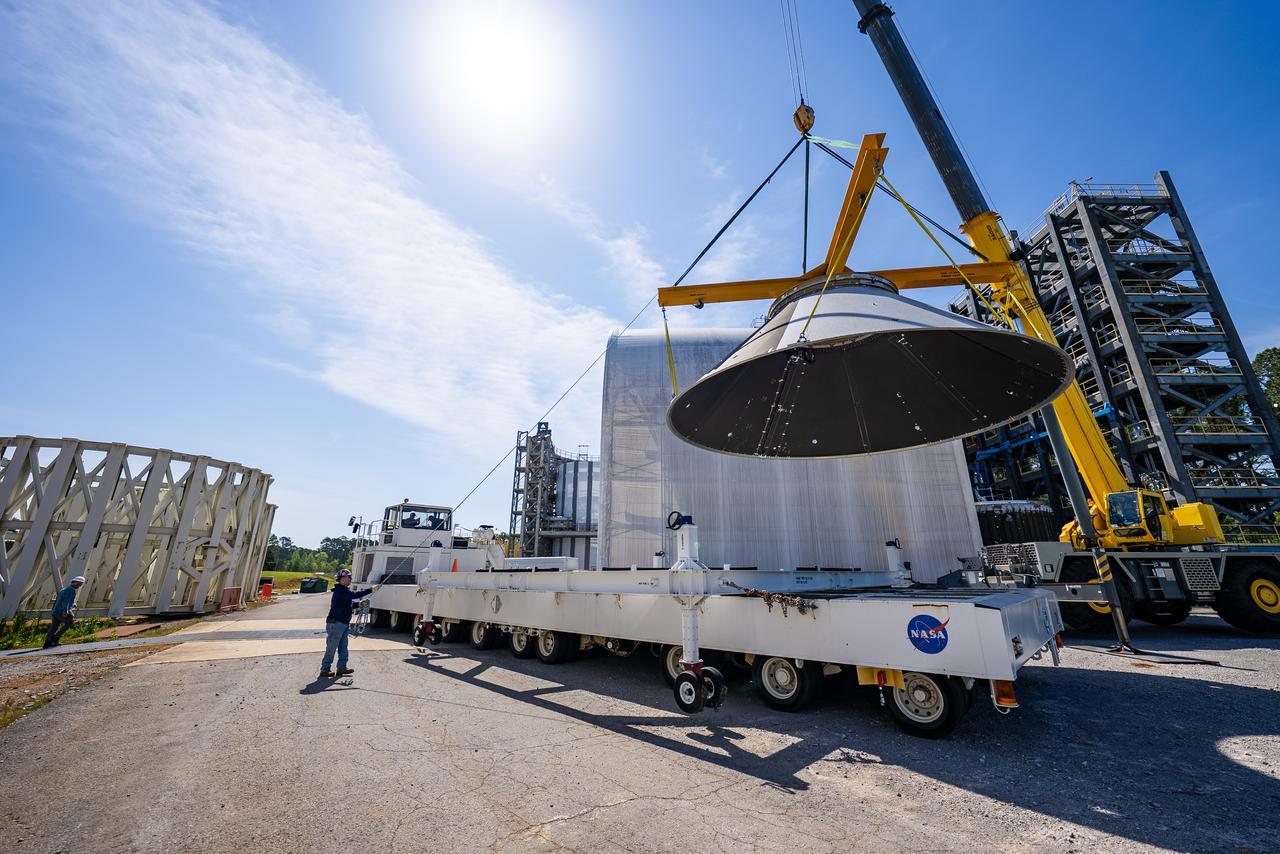
Technicians at NASA’s Marshall Space Flight Center in Huntsville, Alabama, are seen in these images taken April 17, 2025, moving the payload adapter test article from Building 4697 to Building 4705 for storage. This move marks the end of structural testing for the test article. Next, engineers will complete the qualification article and conduct additional for further testing before building the final flight hardware. Manufactured at Marshall, the test article underwent extensive and rigorous testing to validate the design before engineers finalized the configuration for the flight article. The newly completed composite payload adapter is an evolution from the Orion stage adapter to be used in the upgraded Block 1B configuration of the SLS (Space Launch System) rocket, debuting with Artemis IV.
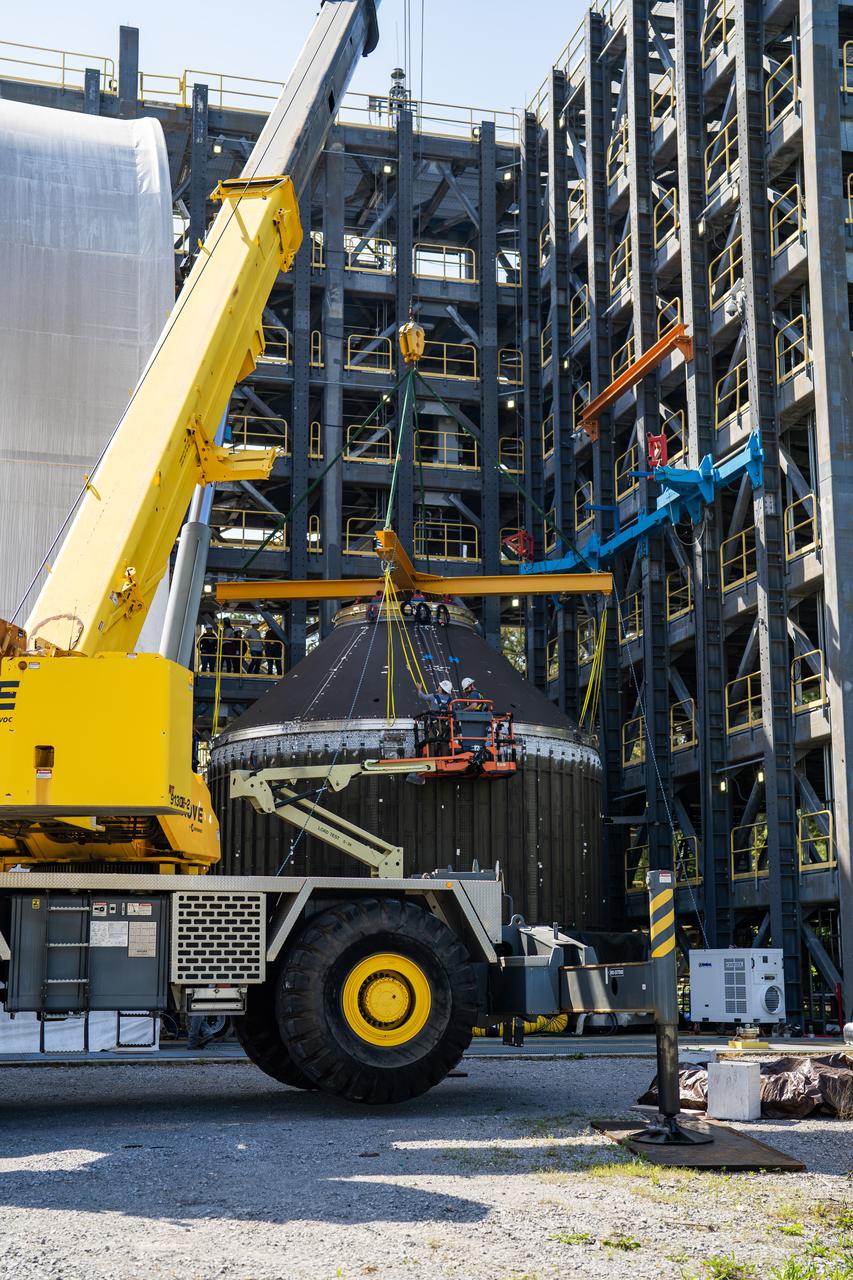
Technicians at NASA’s Marshall Space Flight Center in Huntsville, Alabama, are seen in these images taken April 17, 2025, moving the payload adapter test article from Building 4697 to Building 4705 for storage. This move marks the end of structural testing for the test article. Next, engineers will complete the qualification article and conduct additional for further testing before building the final flight hardware. Manufactured at Marshall, the test article underwent extensive and rigorous testing to validate the design before engineers finalized the configuration for the flight article. The newly completed composite payload adapter is an evolution from the Orion stage adapter to be used in the upgraded Block 1B configuration of the SLS (Space Launch System) rocket, debuting with Artemis IV.
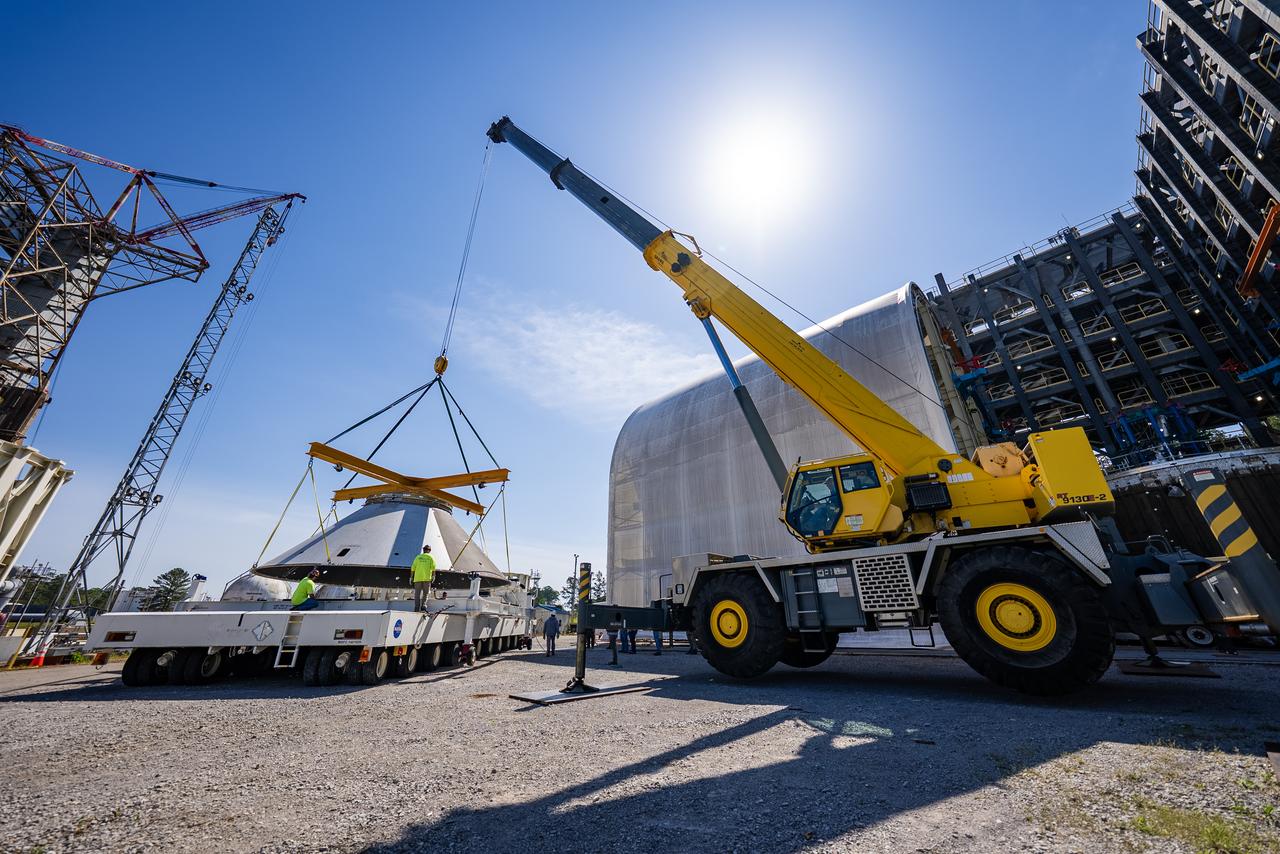
Technicians at NASA’s Marshall Space Flight Center in Huntsville, Alabama, are seen in these images taken April 17, 2025, moving the payload adapter test article from Building 4697 to Building 4705 for storage. This move marks the end of structural testing for the test article. Next, engineers will complete the qualification article and conduct additional for further testing before building the final flight hardware. Manufactured at Marshall, the test article underwent extensive and rigorous testing to validate the design before engineers finalized the configuration for the flight article. The newly completed composite payload adapter is an evolution from the Orion stage adapter to be used in the upgraded Block 1B configuration of the SLS (Space Launch System) rocket, debuting with Artemis IV.

Technicians at NASA’s Marshall Space Flight Center in Huntsville, Alabama, are seen in these images taken April 17, 2025, moving the payload adapter test article from Building 4697 to Building 4705 for storage. This move marks the end of structural testing for the test article. Next, engineers will complete the qualification article and conduct additional for further testing before building the final flight hardware. Manufactured at Marshall, the test article underwent extensive and rigorous testing to validate the design before engineers finalized the configuration for the flight article. The newly completed composite payload adapter is an evolution from the Orion stage adapter to be used in the upgraded Block 1B configuration of the SLS (Space Launch System) rocket, debuting with Artemis IV.
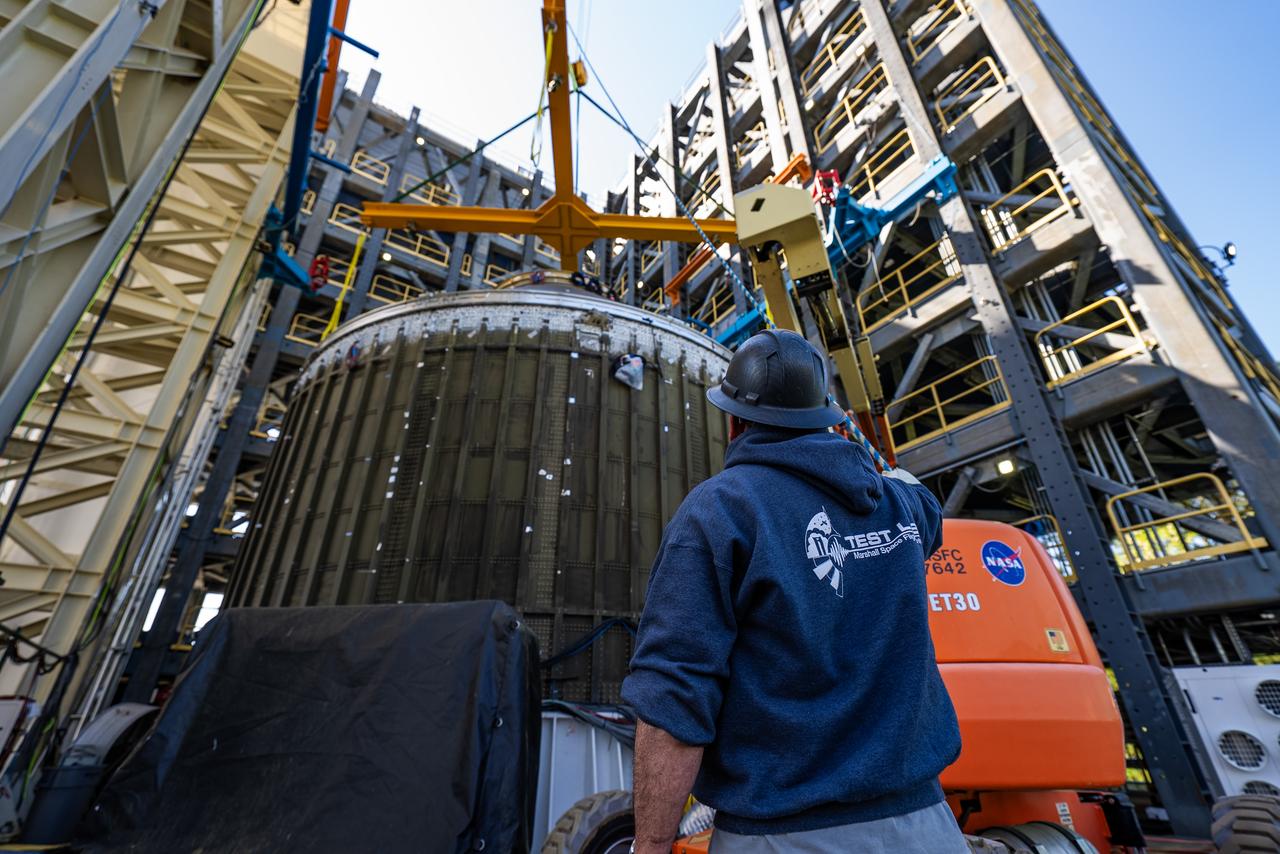
Technicians at NASA’s Marshall Space Flight Center in Huntsville, Alabama, are seen in these images taken April 17, 2025, moving the payload adapter test article from Building 4697 to Building 4705 for storage. This move marks the end of structural testing for the test article. Next, engineers will complete the qualification article and conduct additional for further testing before building the final flight hardware. Manufactured at Marshall, the test article underwent extensive and rigorous testing to validate the design before engineers finalized the configuration for the flight article. The newly completed composite payload adapter is an evolution from the Orion stage adapter to be used in the upgraded Block 1B configuration of the SLS (Space Launch System) rocket, debuting with Artemis IV.
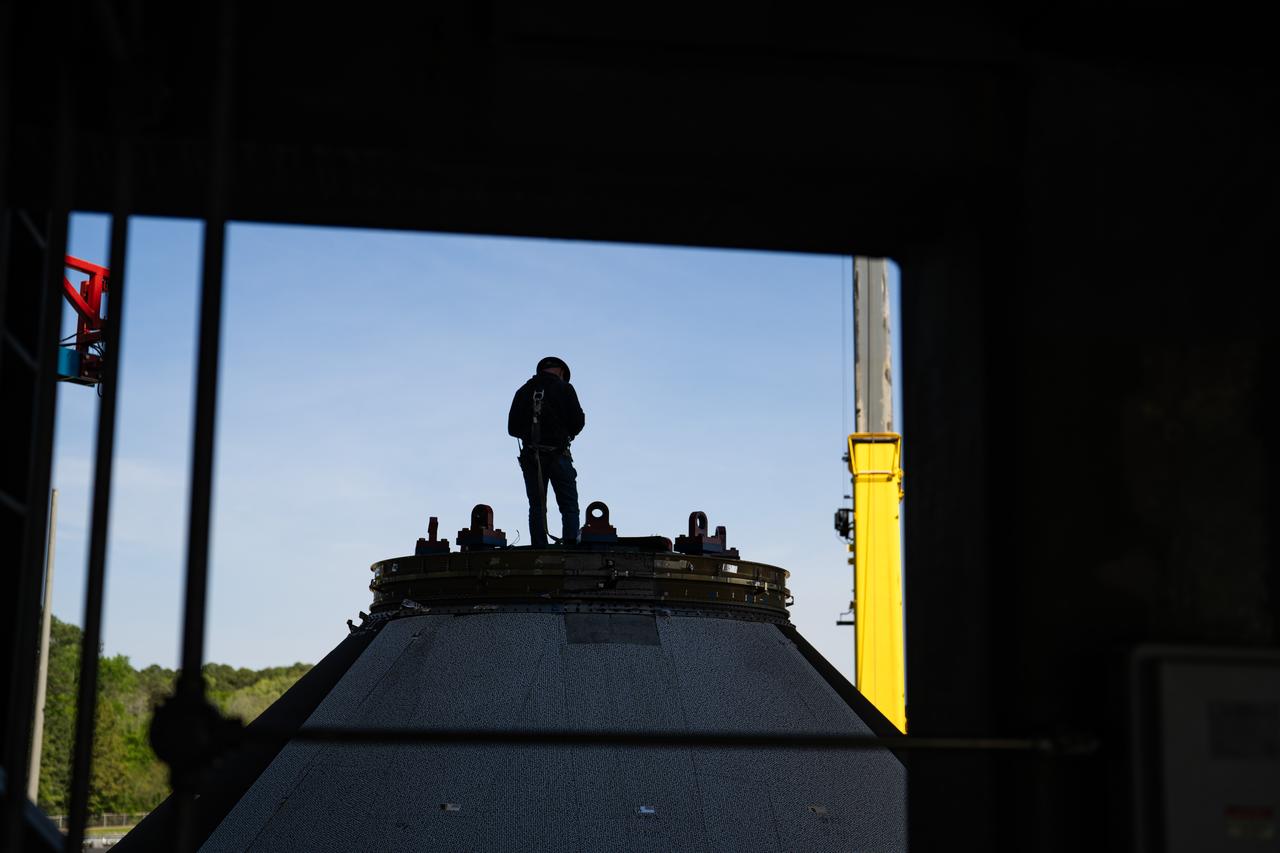
Technicians at NASA’s Marshall Space Flight Center in Huntsville, Alabama, are seen in these images taken April 17, 2025, moving the payload adapter test article from Building 4697 to Building 4705 for storage. This move marks the end of structural testing for the test article. Next, engineers will complete the qualification article and conduct additional for further testing before building the final flight hardware. Manufactured at Marshall, the test article underwent extensive and rigorous testing to validate the design before engineers finalized the configuration for the flight article. The newly completed composite payload adapter is an evolution from the Orion stage adapter to be used in the upgraded Block 1B configuration of the SLS (Space Launch System) rocket, debuting with Artemis IV.
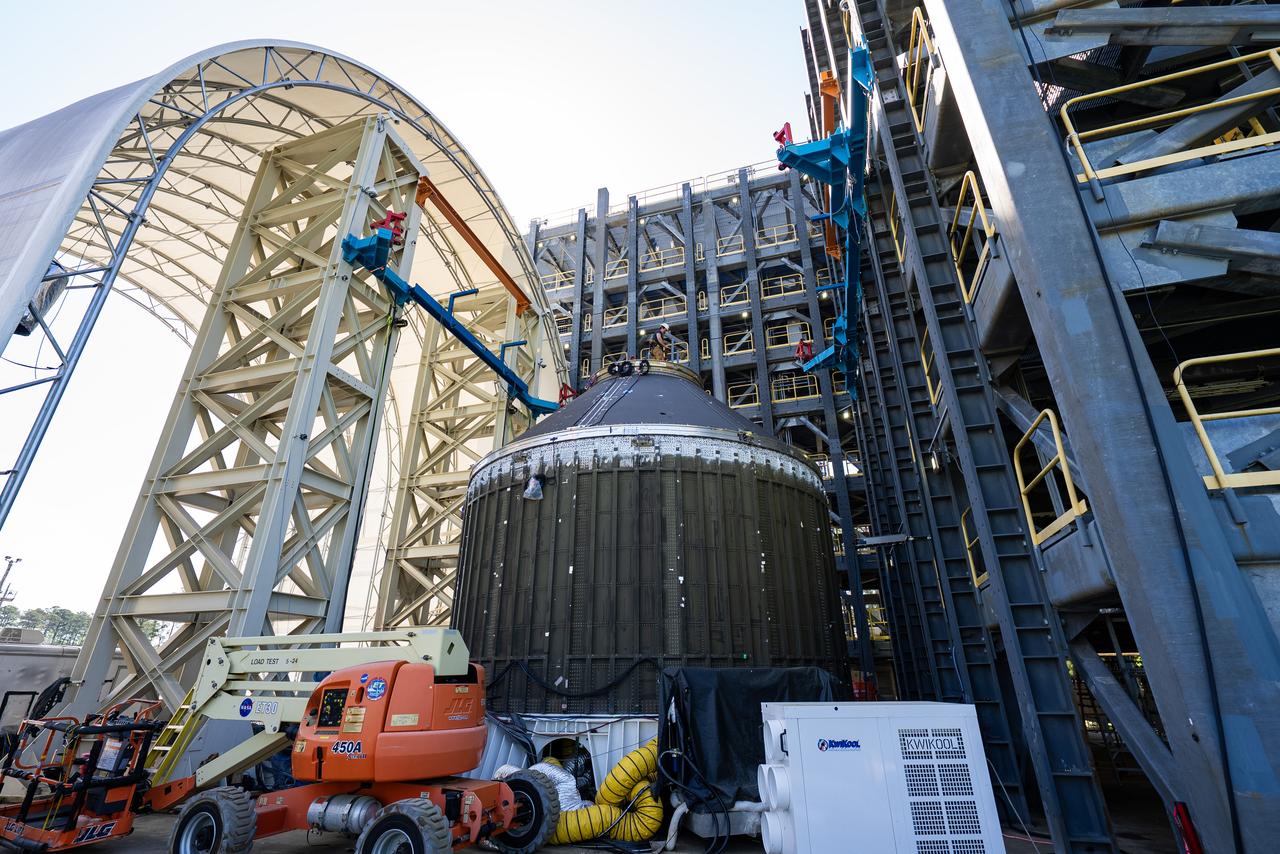
Technicians at NASA’s Marshall Space Flight Center in Huntsville, Alabama, are seen in these images taken April 17, 2025, moving the payload adapter test article from Building 4697 to Building 4705 for storage. This move marks the end of structural testing for the test article. Next, engineers will complete the qualification article and conduct additional for further testing before building the final flight hardware. Manufactured at Marshall, the test article underwent extensive and rigorous testing to validate the design before engineers finalized the configuration for the flight article. The newly completed composite payload adapter is an evolution from the Orion stage adapter to be used in the upgraded Block 1B configuration of the SLS (Space Launch System) rocket, debuting with Artemis IV.
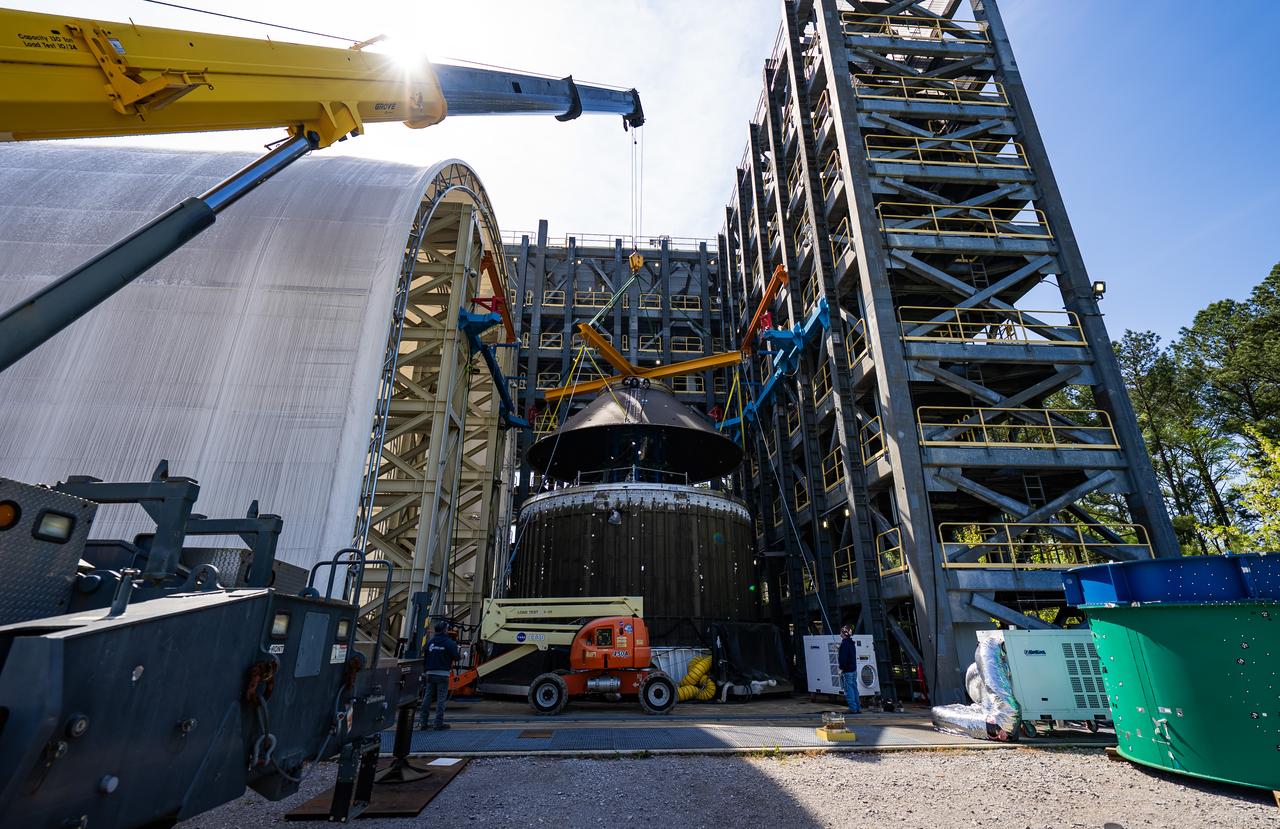
Technicians at NASA’s Marshall Space Flight Center in Huntsville, Alabama, are seen in these images taken April 17, 2025, moving the payload adapter test article from Building 4697 to Building 4705 for storage. This move marks the end of structural testing for the test article. Next, engineers will complete the qualification article and conduct additional for further testing before building the final flight hardware. Manufactured at Marshall, the test article underwent extensive and rigorous testing to validate the design before engineers finalized the configuration for the flight article. The newly completed composite payload adapter is an evolution from the Orion stage adapter to be used in the upgraded Block 1B configuration of the SLS (Space Launch System) rocket, debuting with Artemis IV.
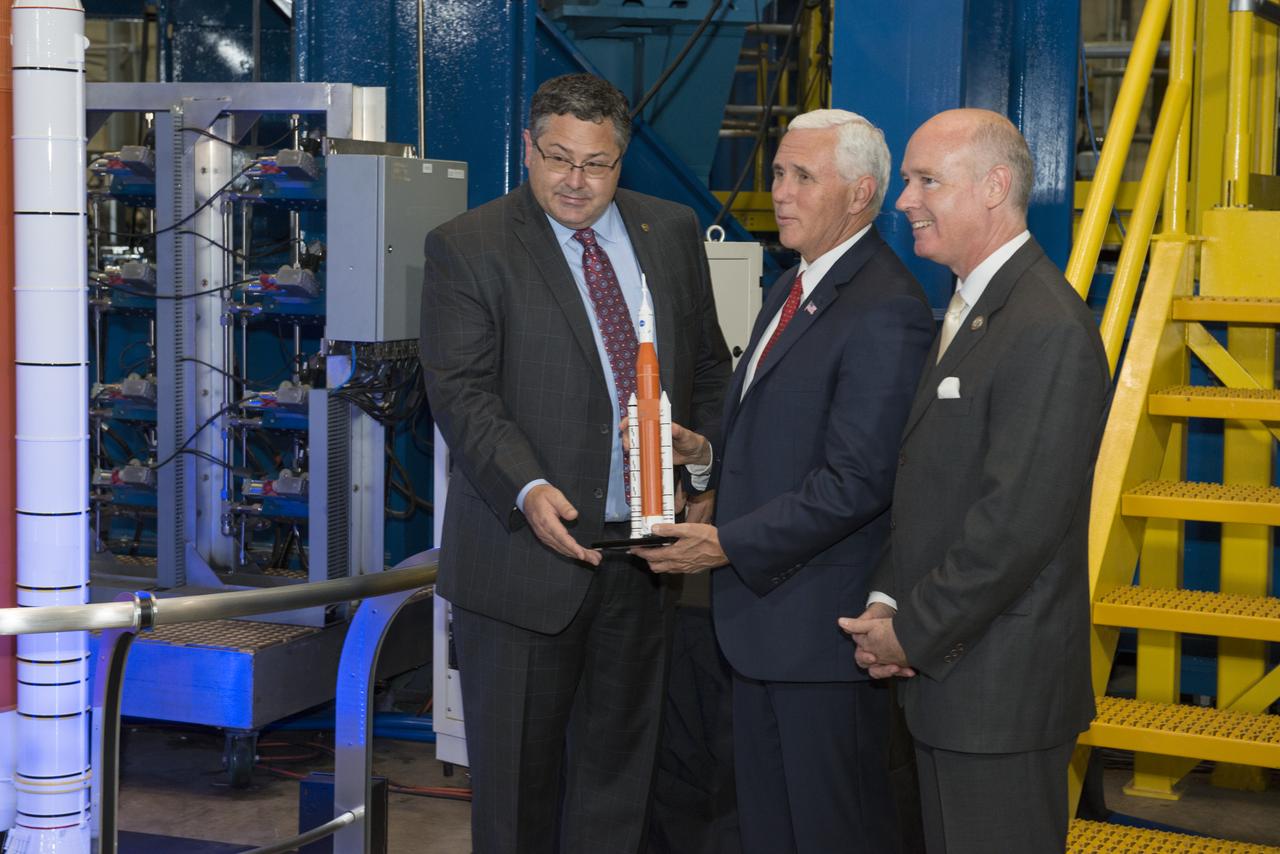
Marshall Space Flight Center Director Todd May (left) presents Vice President Mike Pence (center) with a Space Launch System model. May, Vice President Pence, and Congressman Robert Aderholt (R-AL) (right) are standing in front of an SLS test stand where the engine section, the bottom section of the 212-foot-tall core stage, is being tested. Earlier, engineers working on the test gave the Vice President a close up look at test hardware. The test hardware is for the SLS core stage engine section, which is the bottom of the core stage where the four RS-25 engines are housed. The engine section structure must withstand the incredible stresses produced by more than 8 million pounds of thrust during launch and ascent.
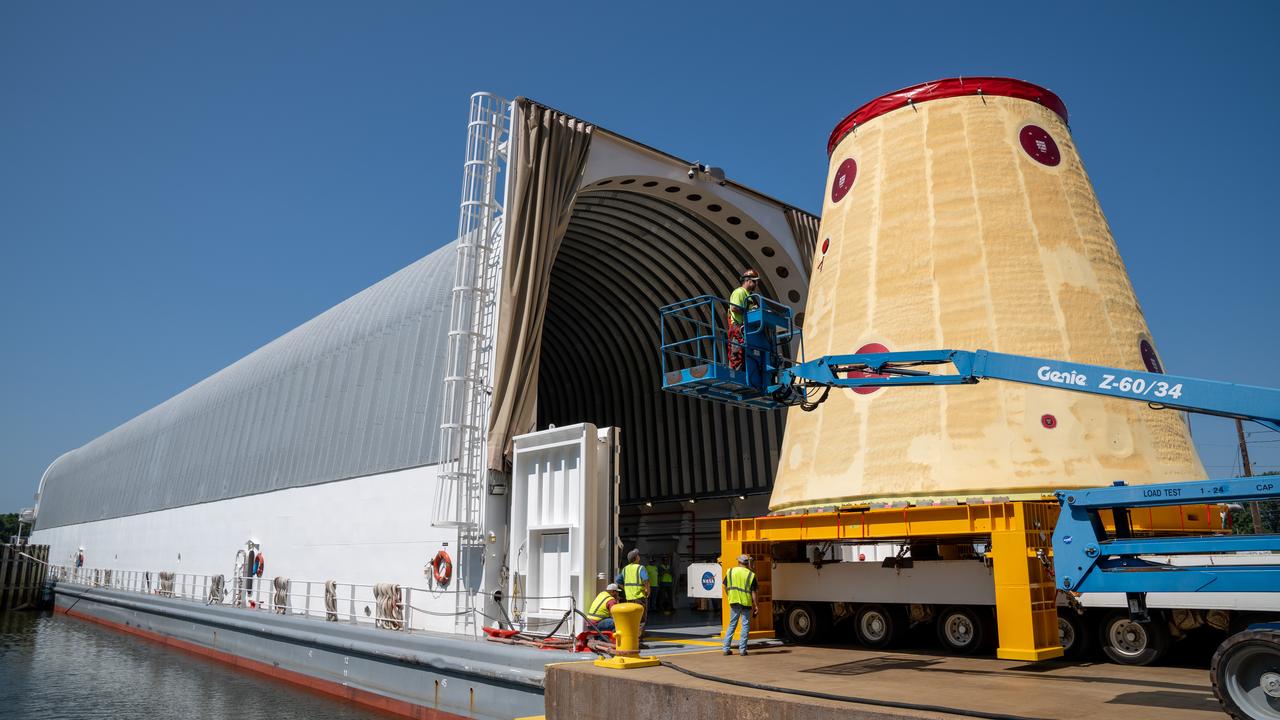
NASA rolled out a key piece of space flight hardware for the SLS (Space Launch System) rocket for the first crewed mission of NASA’s Artemis campaign from Marshall Space Flight Center in Huntsville, Alabama, on Wednesday, Aug. 21 to board the Pegasus barge for shipment to the agency’s spaceport in Florida. The cone-shaped launch vehicle stage adapter connects the rocket’s core stage to the upper stage and helps protect the upper stage’s engine that will help propel the Artemis II test flight around the Moon, slated for 2026.

Seen here is a close-up view of the Orion stage adapter (OSA) structural test article atop the Space Launch System (SLS) rocket inside the Vehicle Assembly Building (VAB) at NASA’s Kennedy Space Center in Florida on Aug. 12, 2021. The test article, representing the mass and weight of the actual flight hardware, is being used for various tests inside the VAB ahead of OSA stacking operations. The first in an increasingly complex set of missions, Artemis I will test SLS and the Orion spacecraft as an integrated system prior to crewed flights to the Moon. Through Artemis, NASA will send the first woman and the first person of color to the lunar surface, as well as establish a sustainable presence on and around the Moon.

Seen here is a close-up view of the Orion stage adapter (OSA) structural test article atop the Space Launch System (SLS) rocket inside the Vehicle Assembly Building (VAB) at NASA’s Kennedy Space Center in Florida on Aug. 12, 2021. The test article, representing the mass and weight of the actual flight hardware, is being used for various tests inside the VAB ahead of OSA stacking operations. The first in an increasingly complex set of missions, Artemis I will test SLS and the Orion spacecraft as an integrated system prior to crewed flights to the Moon. Through Artemis, NASA will send the first woman and the first person of color to the lunar surface, as well as establish a sustainable presence on and around the Moon.
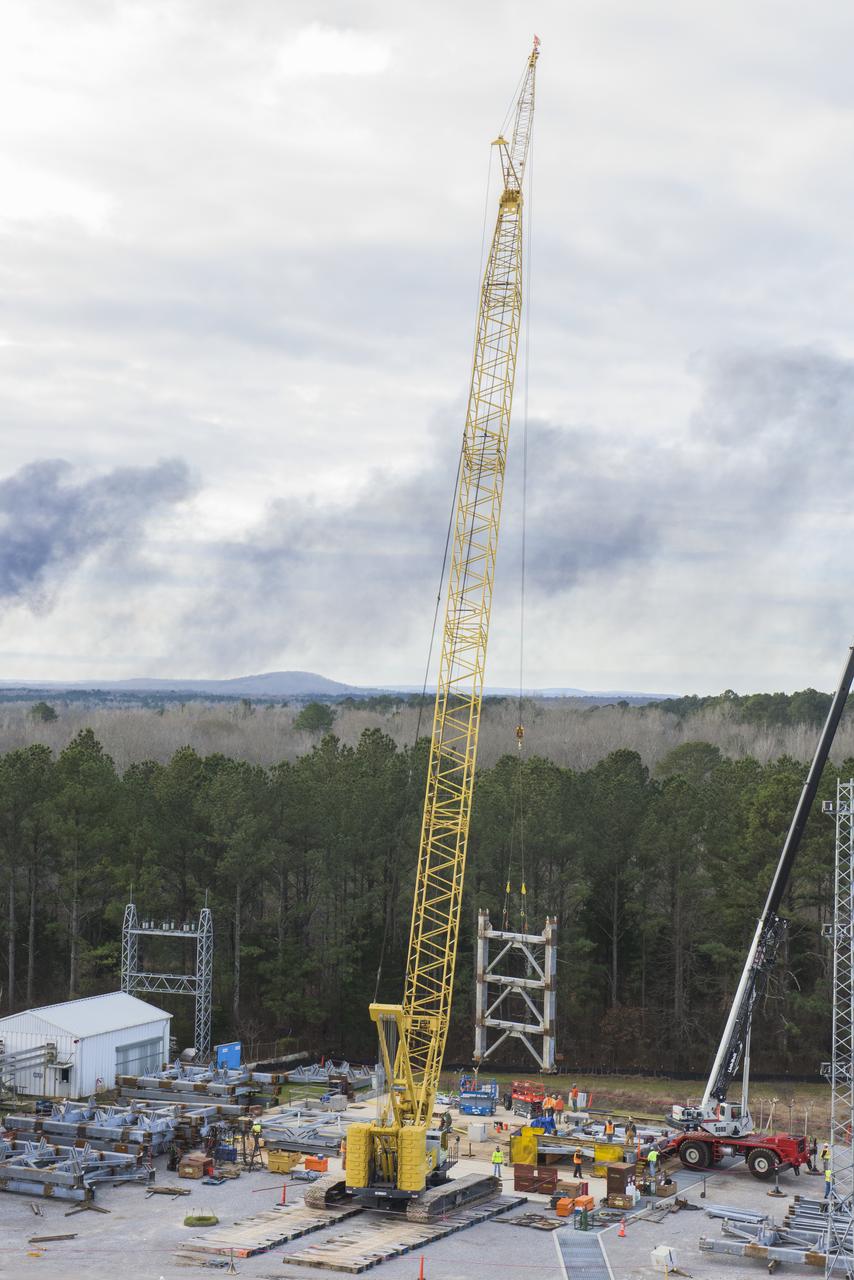
A CRANE MOVES THE FIRST STEEL TIER TO BE BOLTED INTO PLACE ON JAN. 6, FOR WELDING OF A SECOND NEW STRUCTURAL TEST STAND AT NASA'S MARSHALL SPACE FLIGHT CENTER IN HUNTSVILLE, ALABAMA -- CRITICAL TO DEVELOPMENT OF NASA'S SPACE LAUNCH SYSTEM. WHEN COMPLETED THIS SUMMER, THE 85-FOOT-TALL TEST STAND 4697 WILL USE HYDRAULIC CYLINDERS TO SUBJECT THE LIQUID OXYGEN TANK AND HARDWARE OF THE MASSIVE SLS CORE STAGE TO THE SAME LOADS AND STRESSES IT WILL ENDURE DURING A LAUNCH. THE STAND IS RISING IN MARSHALL'S WEST TEST AREA, WHERE WORK IS ALSO UNDERWAY ON THE 215-FOOT-TALL TOWERS OF TEST STAND 4693, WHICH WILL CONDUCT SIMILAR STRUCTURAL TESTS ON THE SLS CORE STAGE'S LIQUID HYDROGEN TANK. SLS, THE MOST POWERFUL ROCKET EVER BUILT, WILL CARRY ASTRONAUTS IN NASA'S ORION SPACECRAFT ON DEEP SPACE MISSIONS, INCLUDING THE JOURNEY TO MARS.
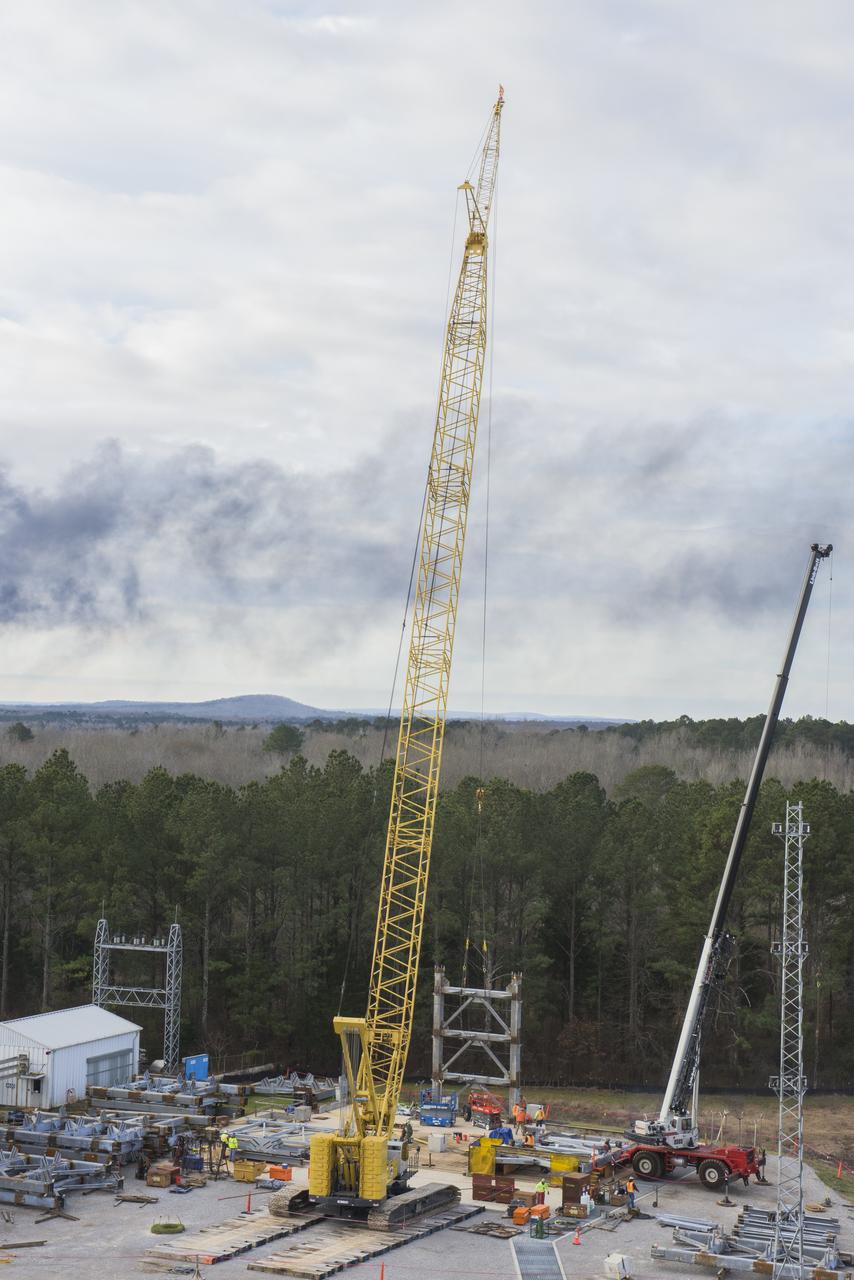
A CRANE MOVES THE FIRST STEEL TIER TO BE BOLTED INTO PLACE ON JAN. 6, FOR WELDING OF A SECOND NEW STRUCTURAL TEST STAND AT NASA'S MARSHALL SPACE FLIGHT CENTER IN HUNTSVILLE, ALABAMA -- CRITICAL TO DEVELOPMENT OF NASA'S SPACE LAUNCH SYSTEM. WHEN COMPLETED THIS SUMMER, THE 85-FOOT-TALL TEST STAND 4697 WILL USE HYDRAULIC CYLINDERS TO SUBJECT THE LIQUID OXYGEN TANK AND HARDWARE OF THE MASSIVE SLS CORE STAGE TO THE SAME LOADS AND STRESSES IT WILL ENDURE DURING A LAUNCH. THE STAND IS RISING IN MARSHALL'S WEST TEST AREA, WHERE WORK IS ALSO UNDERWAY ON THE 215-FOOT-TALL TOWERS OF TEST STAND 4693, WHICH WILL CONDUCT SIMILAR STRUCTURAL TESTS ON THE SLS CORE STAGE'S LIQUID HYDROGEN TANK. SLS, THE MOST POWERFUL ROCKET EVER BUILT, WILL CARRY ASTRONAUTS IN NASA'S ORION SPACECRAFT ON DEEP SPACE MISSIONS, INCLUDING THE JOURNEY TO MARS.
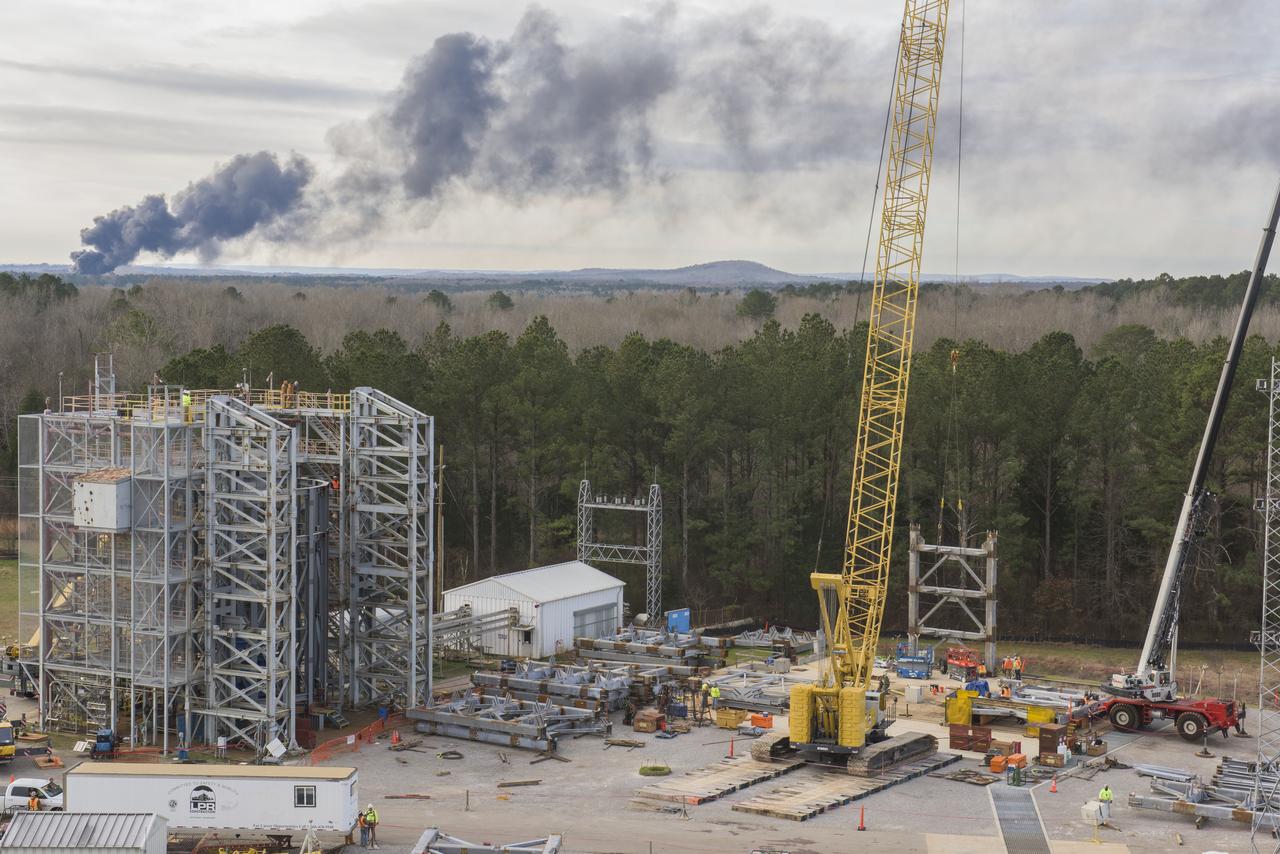
A CRANE MOVES THE FIRST STEEL TIER TO BE BOLTED INTO PLACE ON JAN. 6, FOR WELDING OF A SECOND NEW STRUCTURAL TEST STAND AT NASA'S MARSHALL SPACE FLIGHT CENTER IN HUNTSVILLE, ALABAMA -- CRITICAL TO DEVELOPMENT OF NASA'S SPACE LAUNCH SYSTEM. WHEN COMPLETED THIS SUMMER, THE 85-FOOT-TALL TEST STAND 4697 WILL USE HYDRAULIC CYLINDERS TO SUBJECT THE LIQUID OXYGEN TANK AND HARDWARE OF THE MASSIVE SLS CORE STAGE TO THE SAME LOADS AND STRESSES IT WILL ENDURE DURING A LAUNCH. THE STAND IS RISING IN MARSHALL'S WEST TEST AREA, WHERE WORK IS ALSO UNDERWAY ON THE 215-FOOT-TALL TOWERS OF TEST STAND 4693, WHICH WILL CONDUCT SIMILAR STRUCTURAL TESTS ON THE SLS CORE STAGE'S LIQUID HYDROGEN TANK. SLS, THE MOST POWERFUL ROCKET EVER BUILT, WILL CARRY ASTRONAUTS IN NASA'S ORION SPACECRAFT ON DEEP SPACE MISSIONS, INCLUDING THE JOURNEY TO MARS.
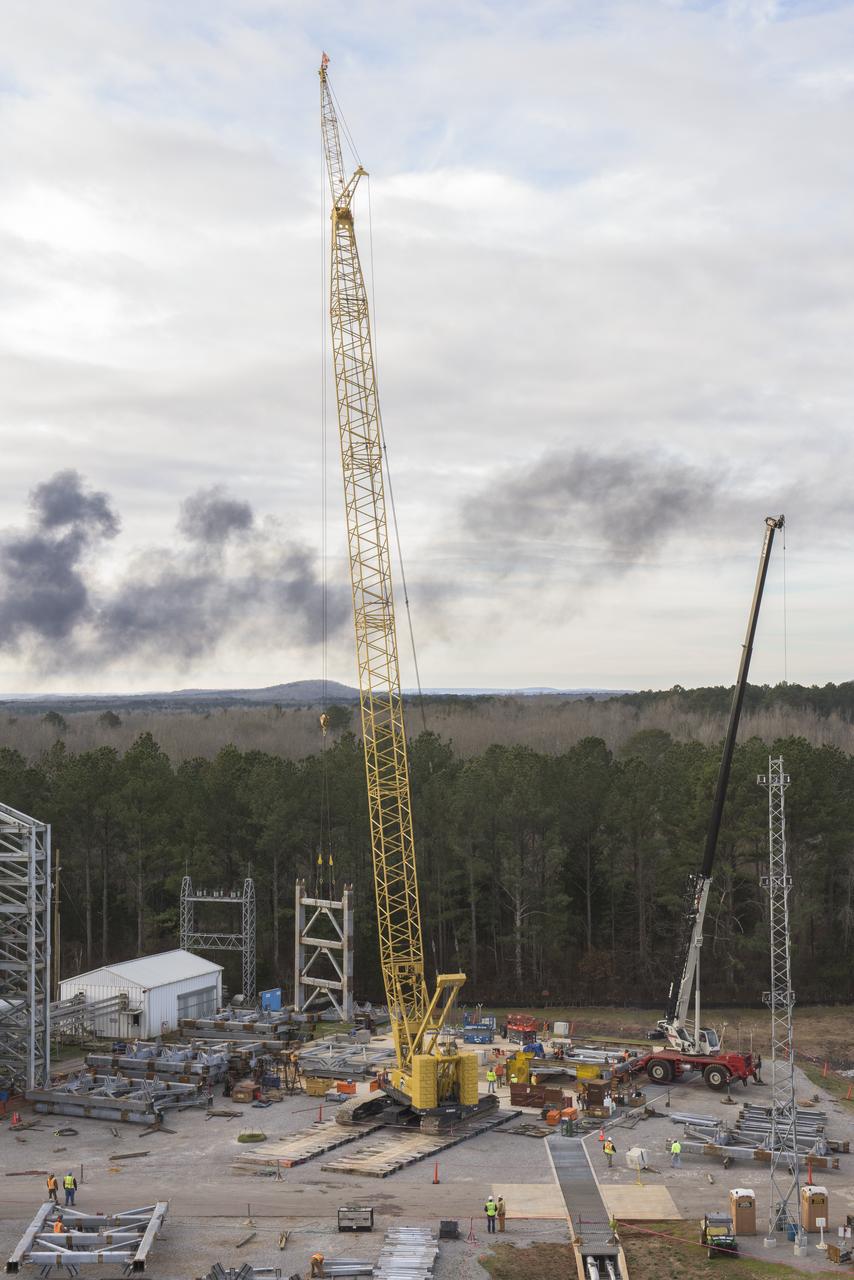
A CRANE MOVES THE FIRST STEEL TIER TO BE BOLTED INTO PLACE ON JAN. 6, FOR WELDING OF A SECOND NEW STRUCTURAL TEST STAND AT NASA'S MARSHALL SPACE FLIGHT CENTER IN HUNTSVILLE, ALABAMA -- CRITICAL TO DEVELOPMENT OF NASA'S SPACE LAUNCH SYSTEM. WHEN COMPLETED THIS SUMMER, THE 85-FOOT-TALL TEST STAND 4697 WILL USE HYDRAULIC CYLINDERS TO SUBJECT THE LIQUID OXYGEN TANK AND HARDWARE OF THE MASSIVE SLS CORE STAGE TO THE SAME LOADS AND STRESSES IT WILL ENDURE DURING A LAUNCH. THE STAND IS RISING IN MARSHALL'S WEST TEST AREA, WHERE WORK IS ALSO UNDERWAY ON THE 215-FOOT-TALL TOWERS OF TEST STAND 4693, WHICH WILL CONDUCT SIMILAR STRUCTURAL TESTS ON THE SLS CORE STAGE'S LIQUID HYDROGEN TANK. SLS, THE MOST POWERFUL ROCKET EVER BUILT, WILL CARRY ASTRONAUTS IN NASA'S ORION SPACECRAFT ON DEEP SPACE MISSIONS, INCLUDING THE JOURNEY TO MARS.