
S73-02395 (August 1973) --- An artist?s concept illustrating an Apollo-type spacecraft (on left) about to dock with a Soviet Soyuz-type spacecraft. A recent agreement between the United States and the Union of Soviet Socialist Republics provides for the docking in space of the Soyuz and Apollo-type spacecraft in Earth orbit in 1975. The joint venture is called the Apollo-Soyuz Test Project.
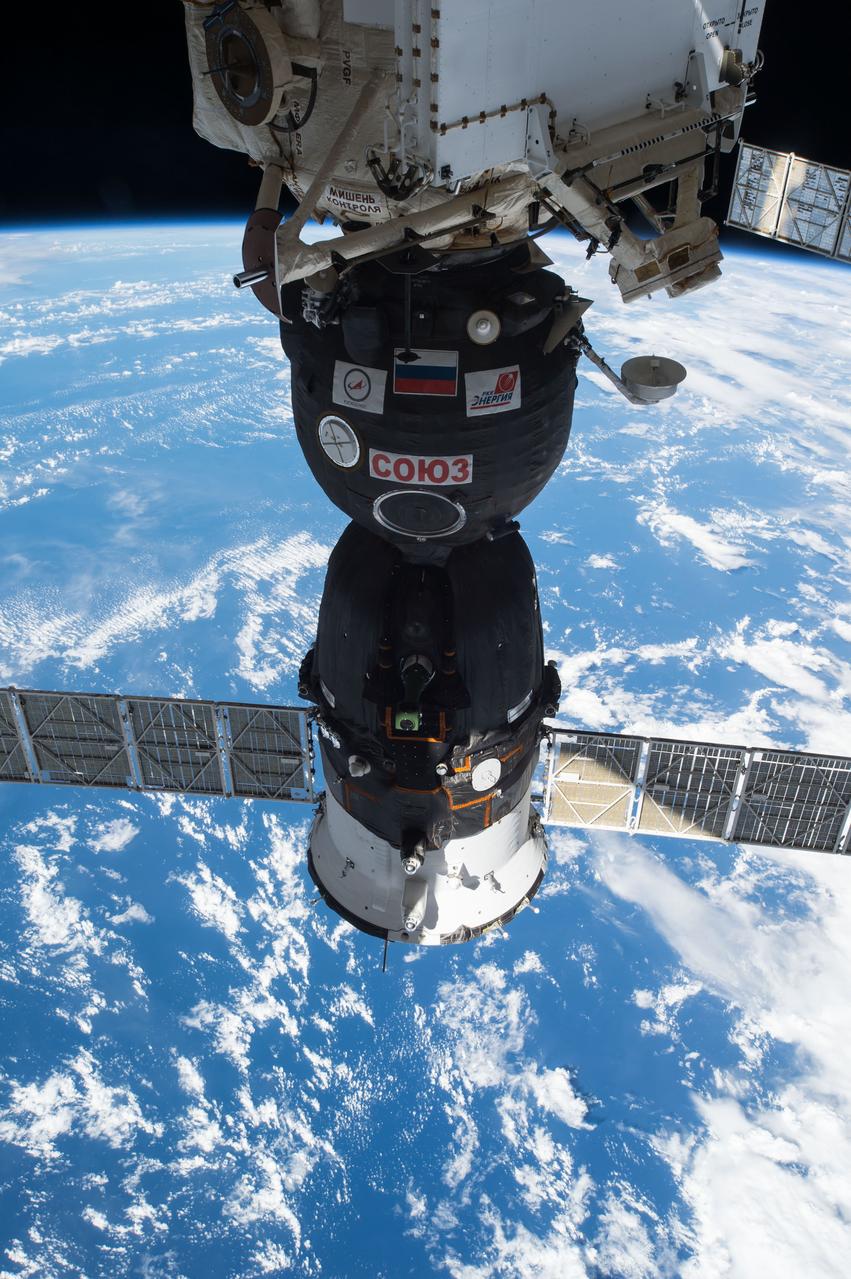
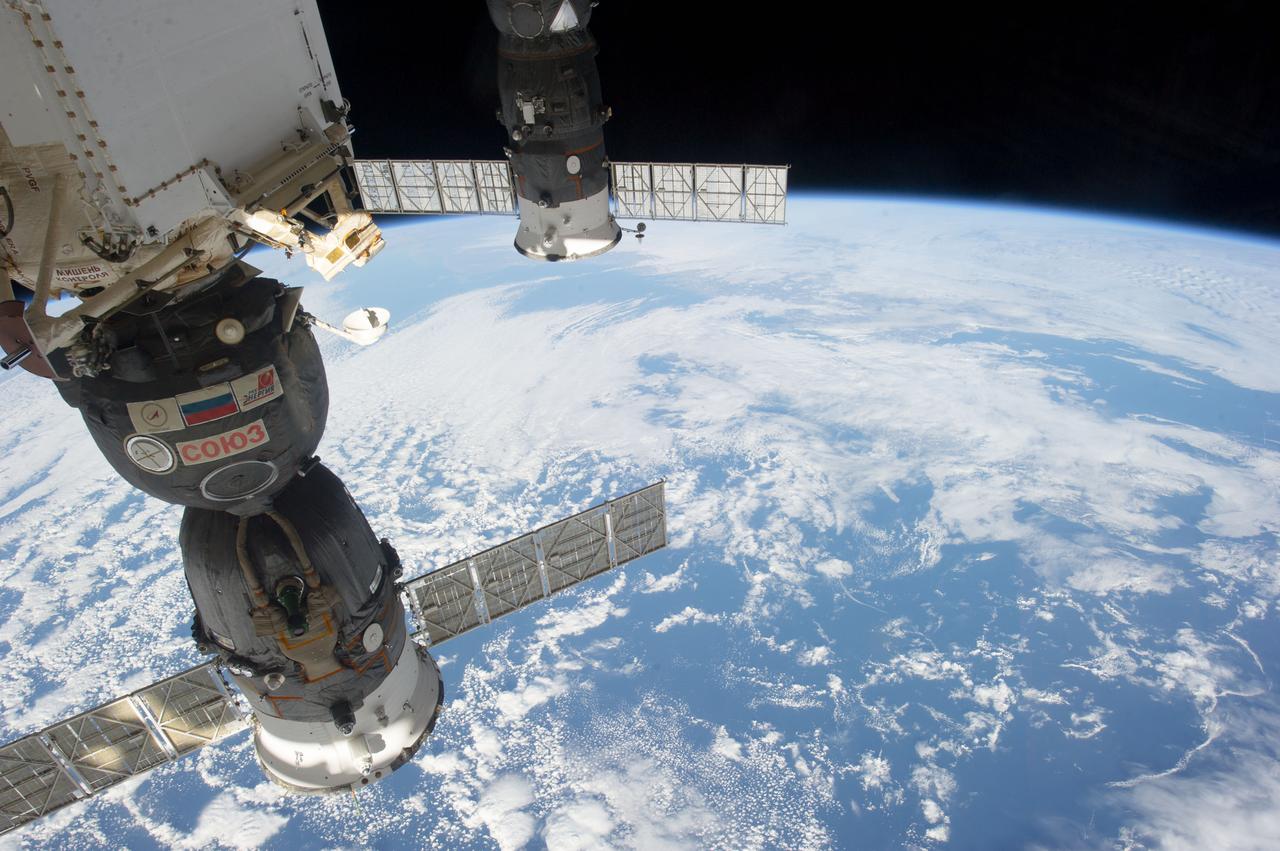
View of the Soyuz TMA-15M spacecraft docked to Rassvet Mini-Research Module 1 (MRM1) An Earth limb is in view.
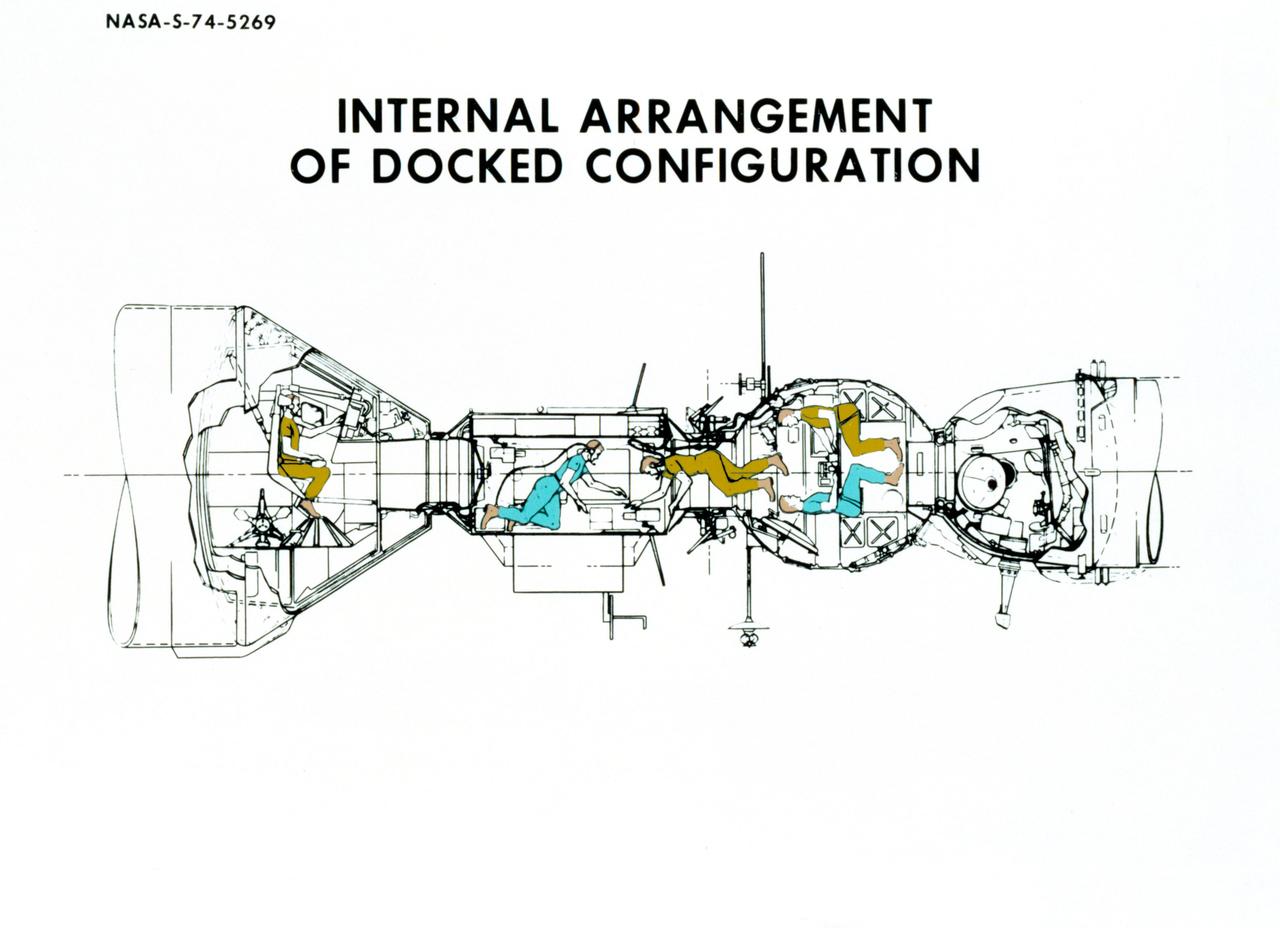
S74-05269 (December 1974) --- An artist?s drawing illustrating the internal arrangement of the Apollo and Soyuz spacecraft in Earth orbit in a docked configuration. The three American Apollo crewmen and the two Soviet Soyuz crewmen will transfer to each other?s spacecraft during the July 1975 ASTP mission. The four Apollo-Soyuz Test Project visible components are, left to right, the Apollo Command Module, the Docking Module, the Soyuz Orbital Module and the Soyuz Descent Vehicle.
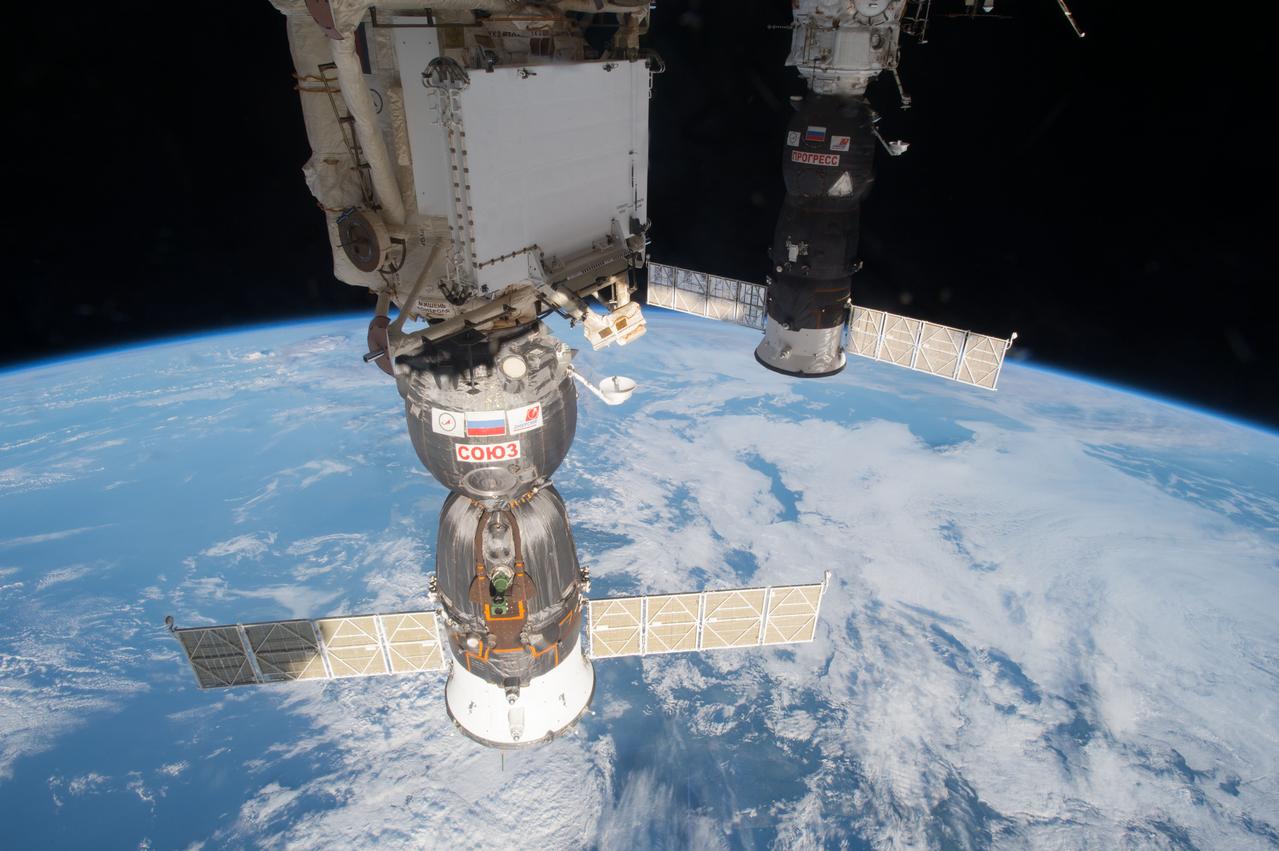
View of the docked Soyuz MS-01 (47S) and Progress 64P spacecraft against a backdrop of Earth and space.
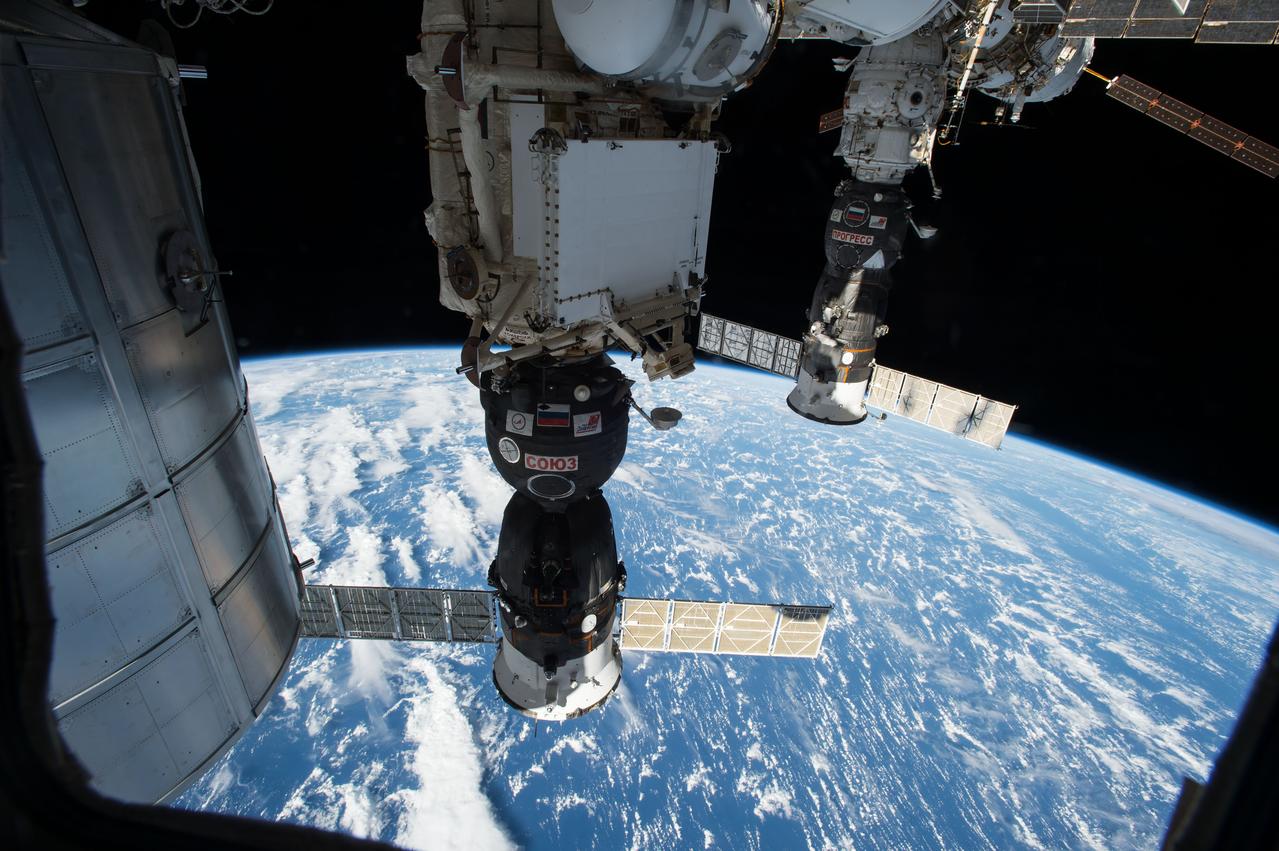
View of the Soyuz TMA-15M spacecraft docked to Rassvet Mini-Research Module 1 (MRM1) and the Progress 57P spacecraft docked to Pirs Docking Compartment (DC1). Portions of the Leonardo Permanent Multipurpose Module (PMM), aft ISS, and an Earth limb are in view. Image was released by astronaut on Twitter.
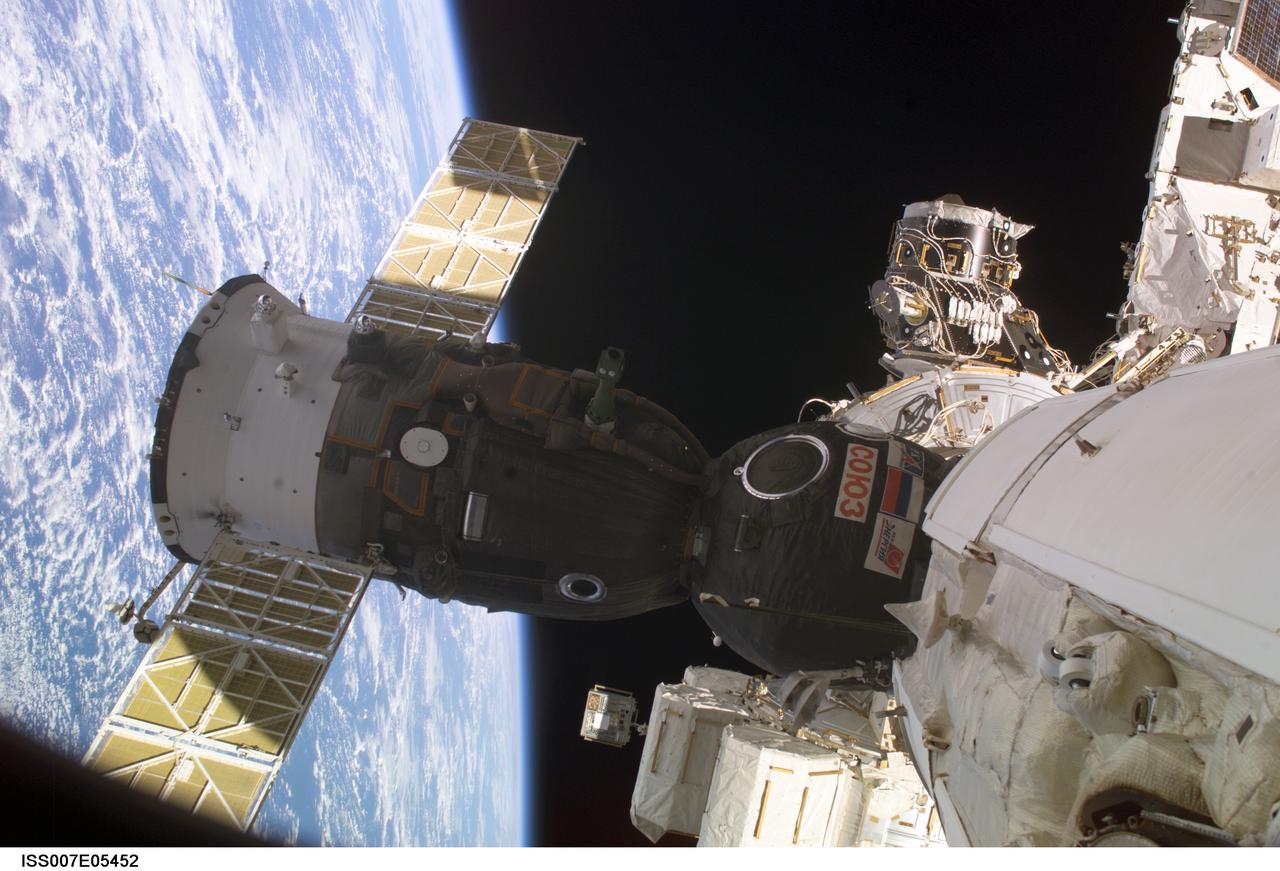
ISS007-E-05452 (14 May 2003) --- The Soyuz TMA-2 spacecraft, docked to the functional cargo block (FGB) nadir port on the International Space Station (ISS), was photographed by an Expedition Seven crewmember. The blackness of space and Earth’s horizon provide the backdrop for the scene.
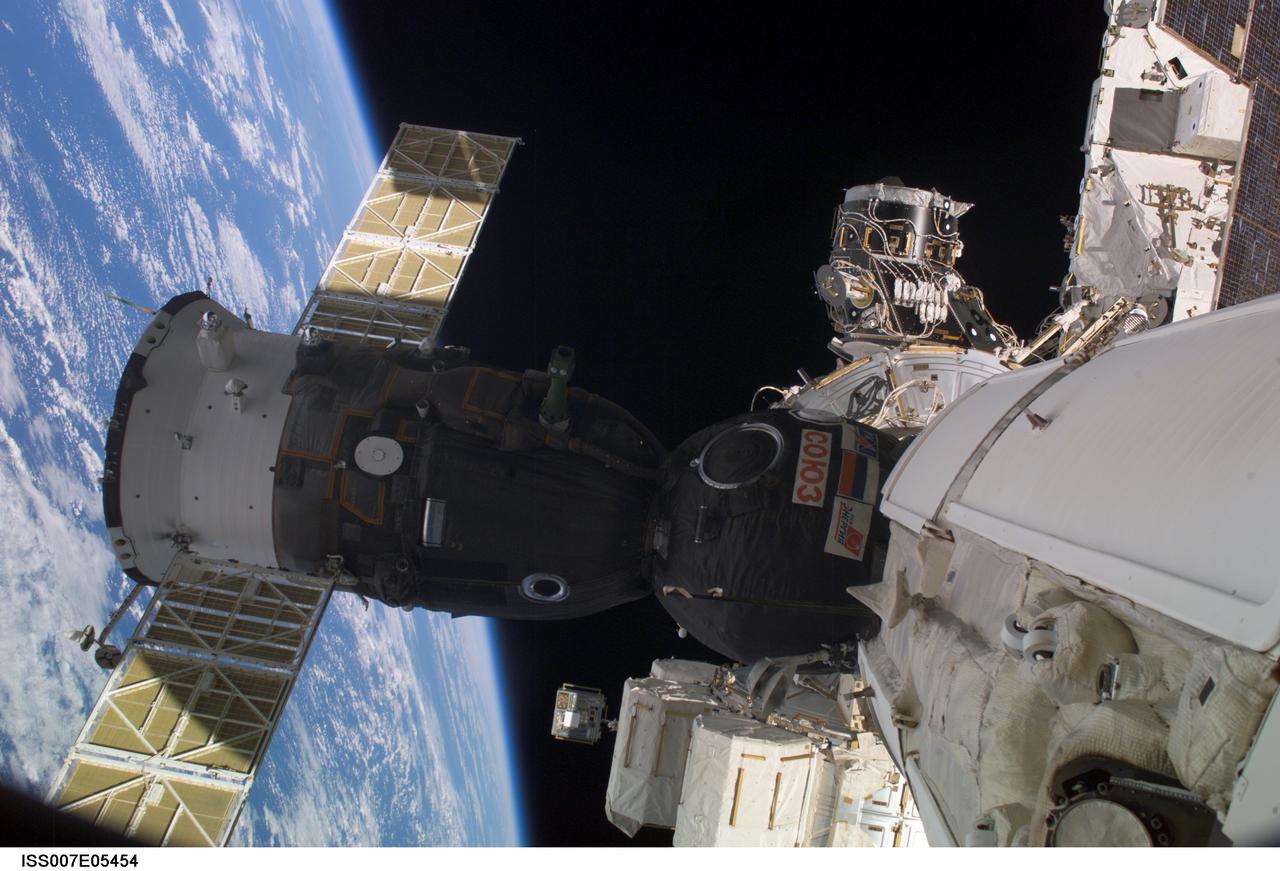
ISS007-E-05454 (14 May 2003) --- The Soyuz TMA-2 spacecraft, docked to the functional cargo block (FGB) nadir port on the International Space Station (ISS), was photographed by an Expedition Seven crewmember. The blackness of space and Earth’s horizon provide the backdrop for the scene.
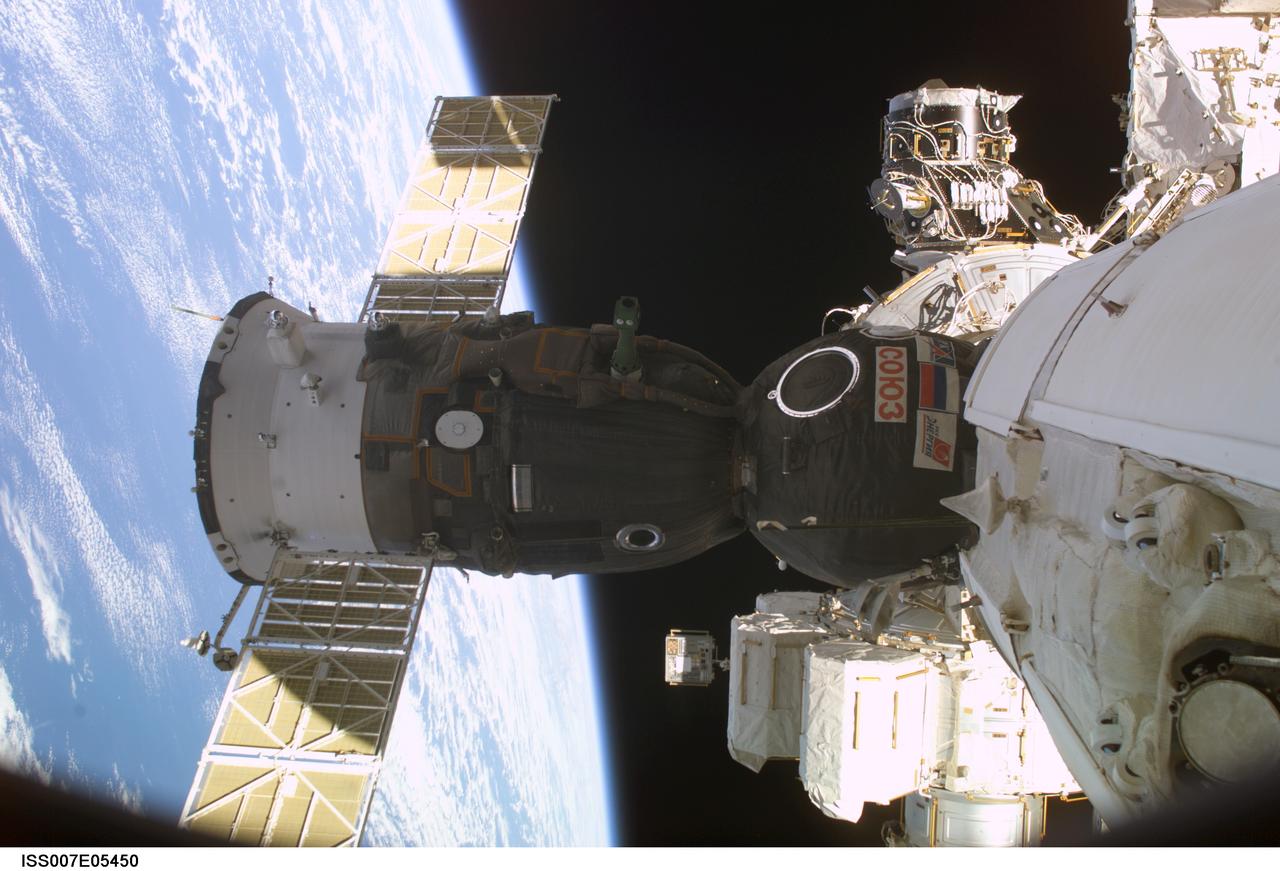
ISS007-E-05450 (14 May 2003) --- The Soyuz TMA-2 spacecraft, docked to the functional cargo block (FGB) nadir port on the International Space Station (ISS), was photographed by an Expedition Seven crewmember. The blackness of space and Earth’s horizon provide the backdrop for the scene.
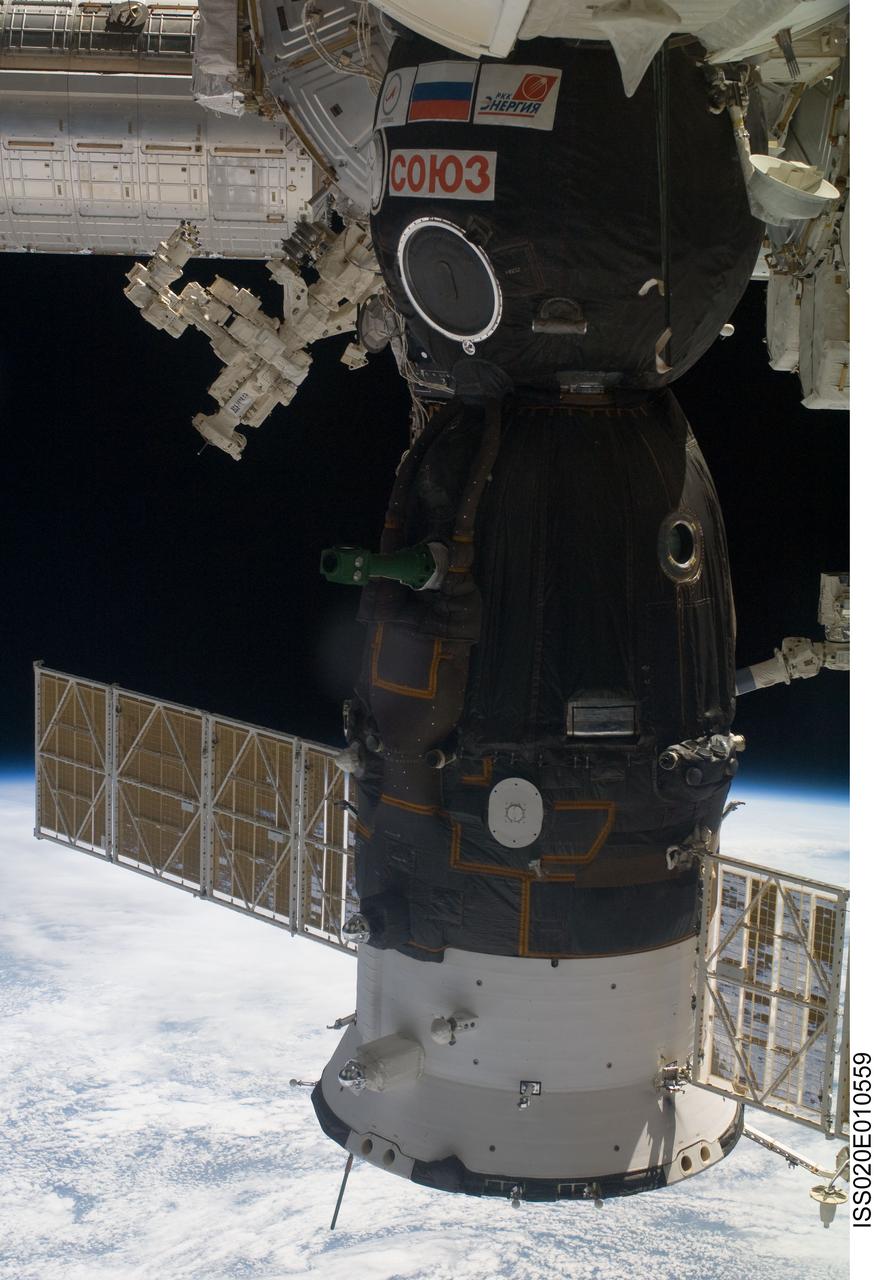
ISS020-E-010559 (16 June 2009) --- A Soyuz spacecraft docked with the International Space Station, the Canadian-built Dextre, also known as the Special Purpose Dextrous Manipulator (top left) and a portion of the Japanese Kibo laboratory (upper left corner) are featured in this image photographed by an Expedition 20 crew member on the station. The blackness of space and Earth’s horizon provide the backdrop for the scene.
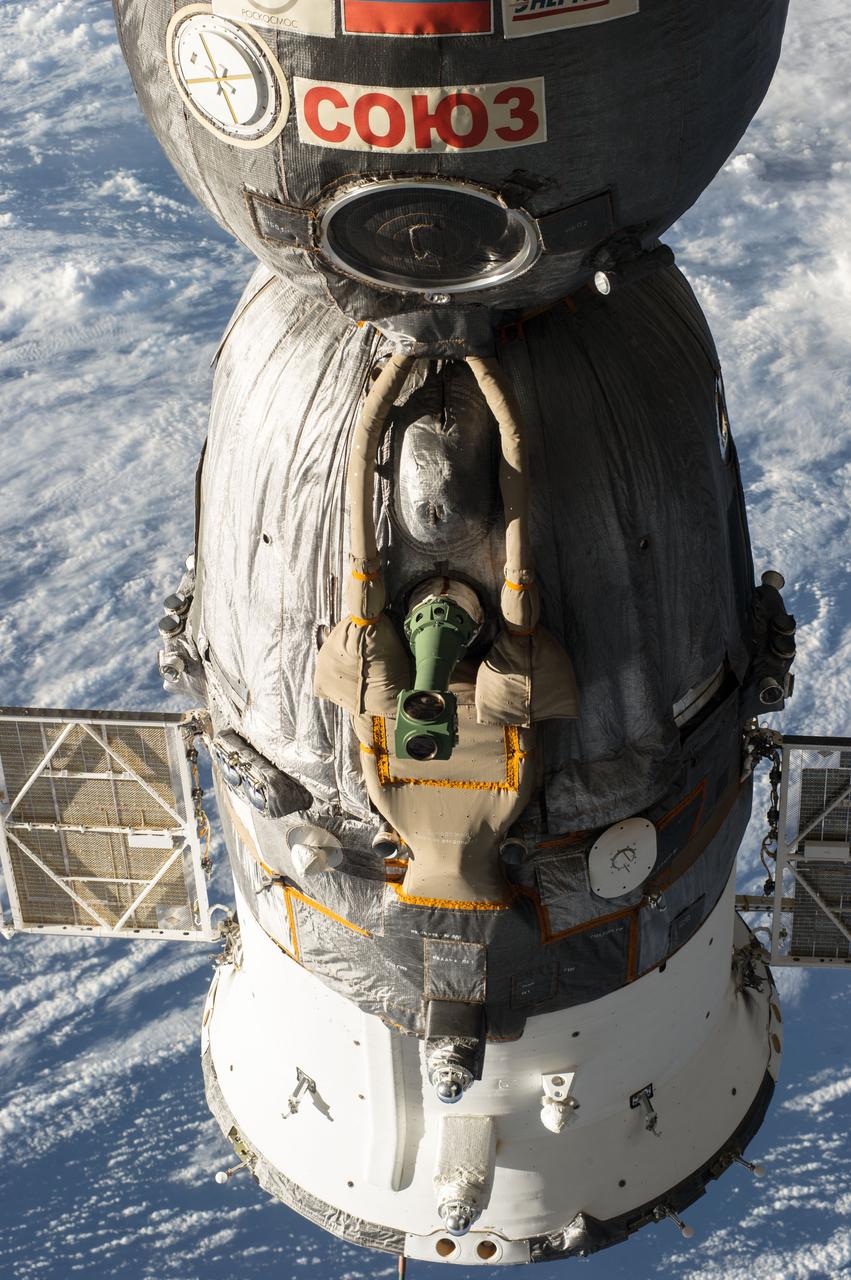
ISS039-E-019122 (5 May 2014) --– A Russian Soyuz spacecraft is seen docked to the International Space Station, as photographed by one of the Expedition 39 crew members aboard the orbital outpost. The Soyuz's periscope is in the center of the vehicle.
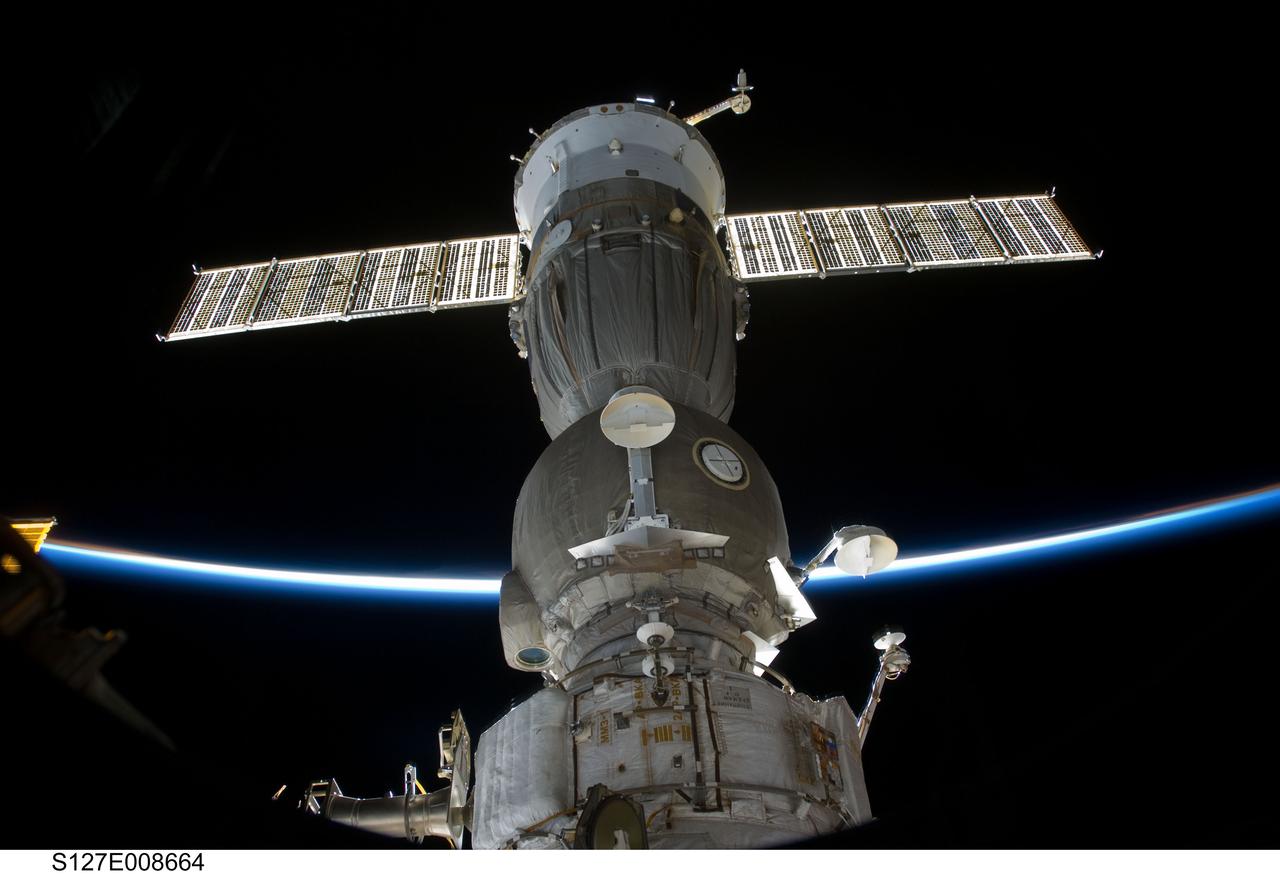
S127-E-008664 (25 July 2009) --- The limb of Earth intersects one of two Soyuz spacecraft that are docked with the Inernational Space Station.
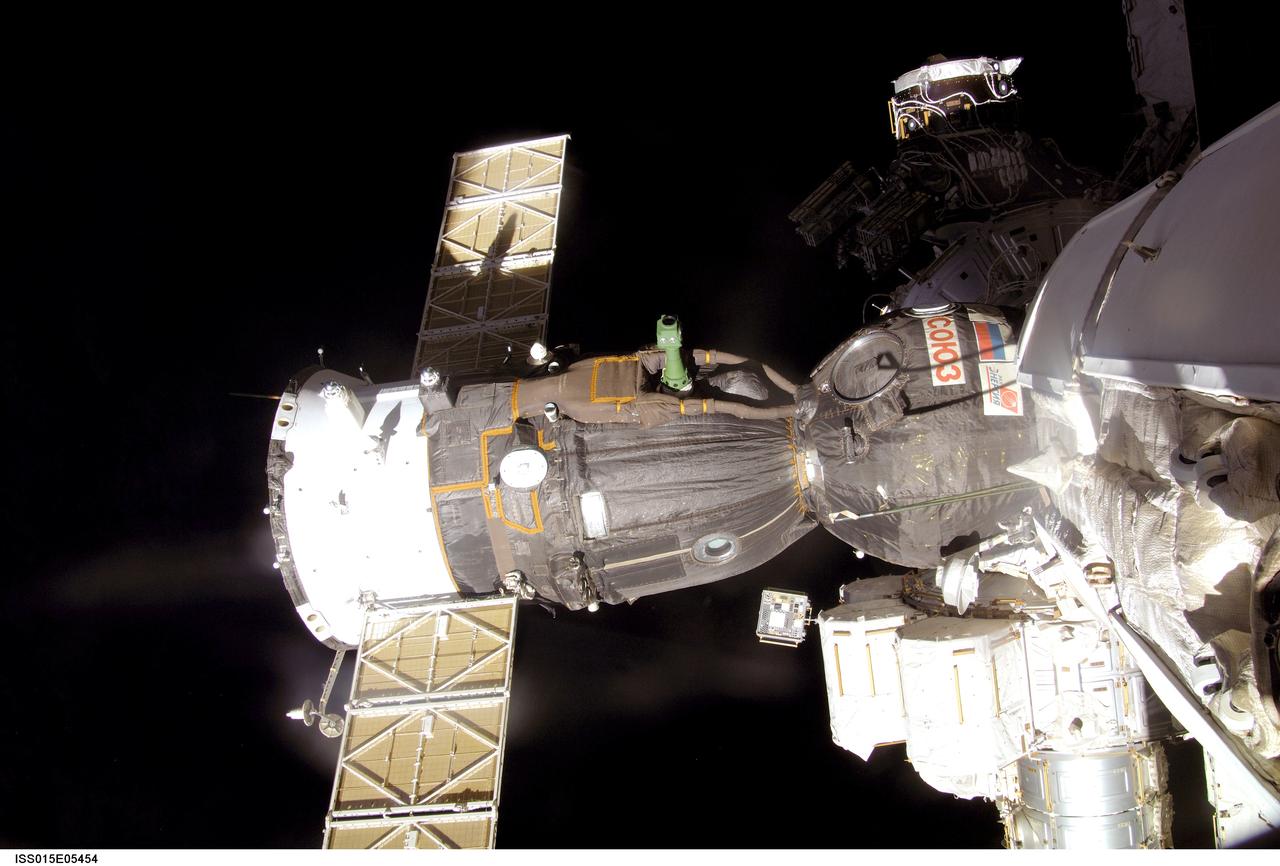
ISS015-E-05454 (April 2007) --- Backdropped by the blackness of space, the Soyuz 14 (TMA-10) spacecraft docked to the Zarya Module nadir port of the International Space Station is featured in this image photographed by an Expedition 15 crewmember.
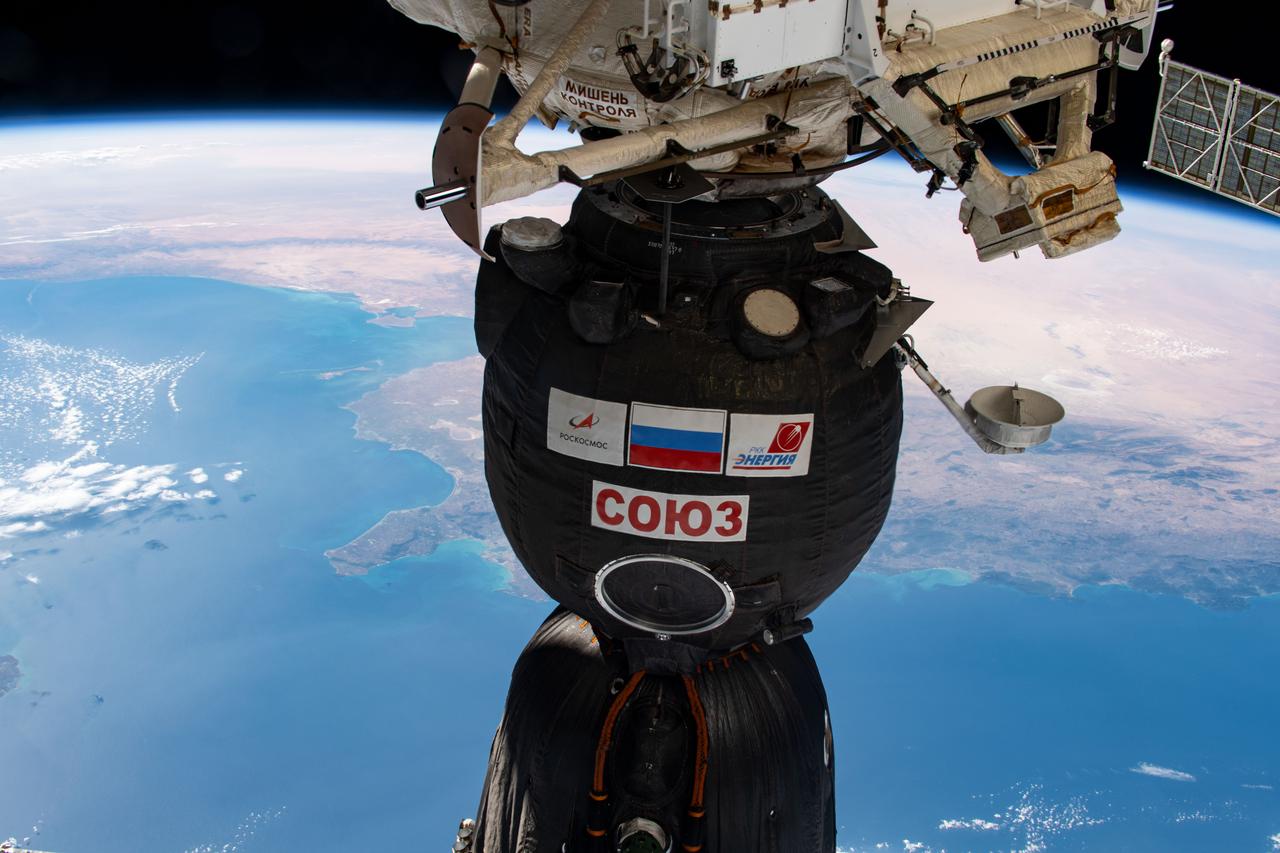
iss063e107419 (Oct. 14, 2020) --- The Soyuz MS-17 spacecraft, with Expedition 64 crew members Kate Rubins of NASA and Roscosmos cosmonauts Sergey Ryzhikov and Sergey Kud-Sverchkov, docked to the Rassvet module as the International Space Station was orbiting above the Mediterranean Sea.
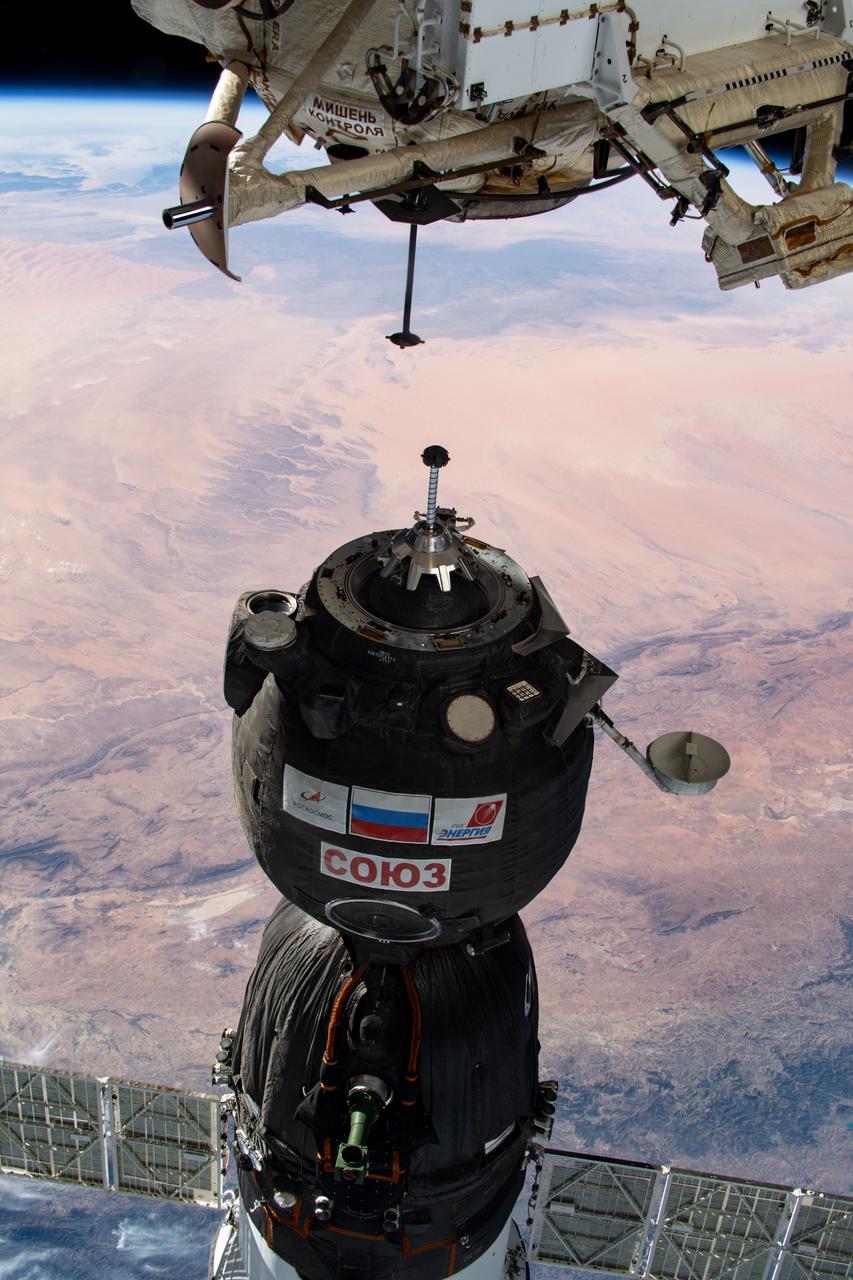
iss063e107308 (Oct. 14, 2020) --- The Soyuz MS-17 spacecraft, with Expedition 64 crew members Kate Rubins of NASA and Roscosmos cosmonauts Sergey Ryzhikov and Sergey Kud-Sverchkov, is just a few meters from docking to the Rassvet module. This photograph was taken as the International Space Station was orbiting above the Mediterranean Sea.
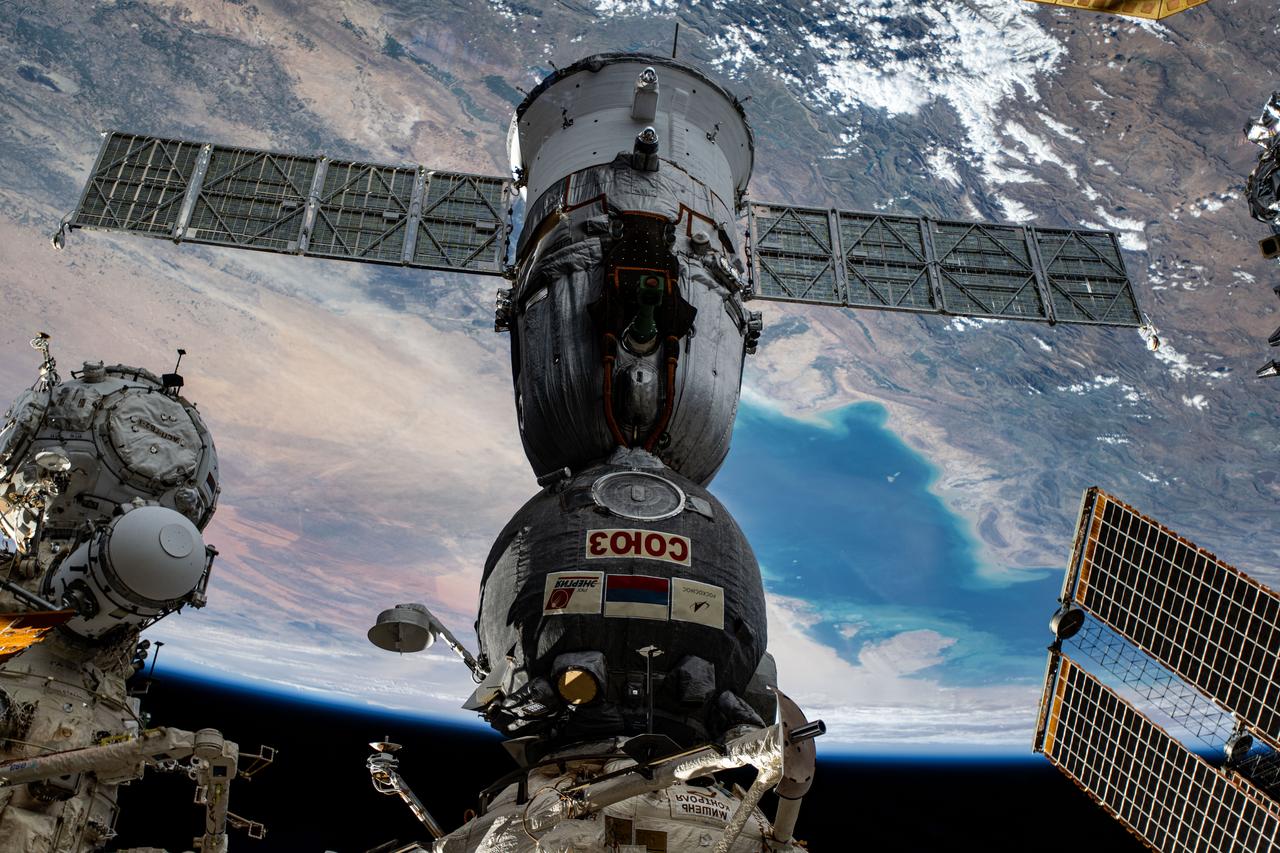
iss072e838101 (March 24, 2025) --- The Soyuz MS-26 spacecraft that launched NASA astronaut Don Pettit and Roscosmos cosmonauts Alexey Ovchinin and Ivan Vagner to the International Space Station is pictured docked to the Rassvet module. The orbiting lab was soaring 260 miles above Turkmenistan near the Caspian Sea.
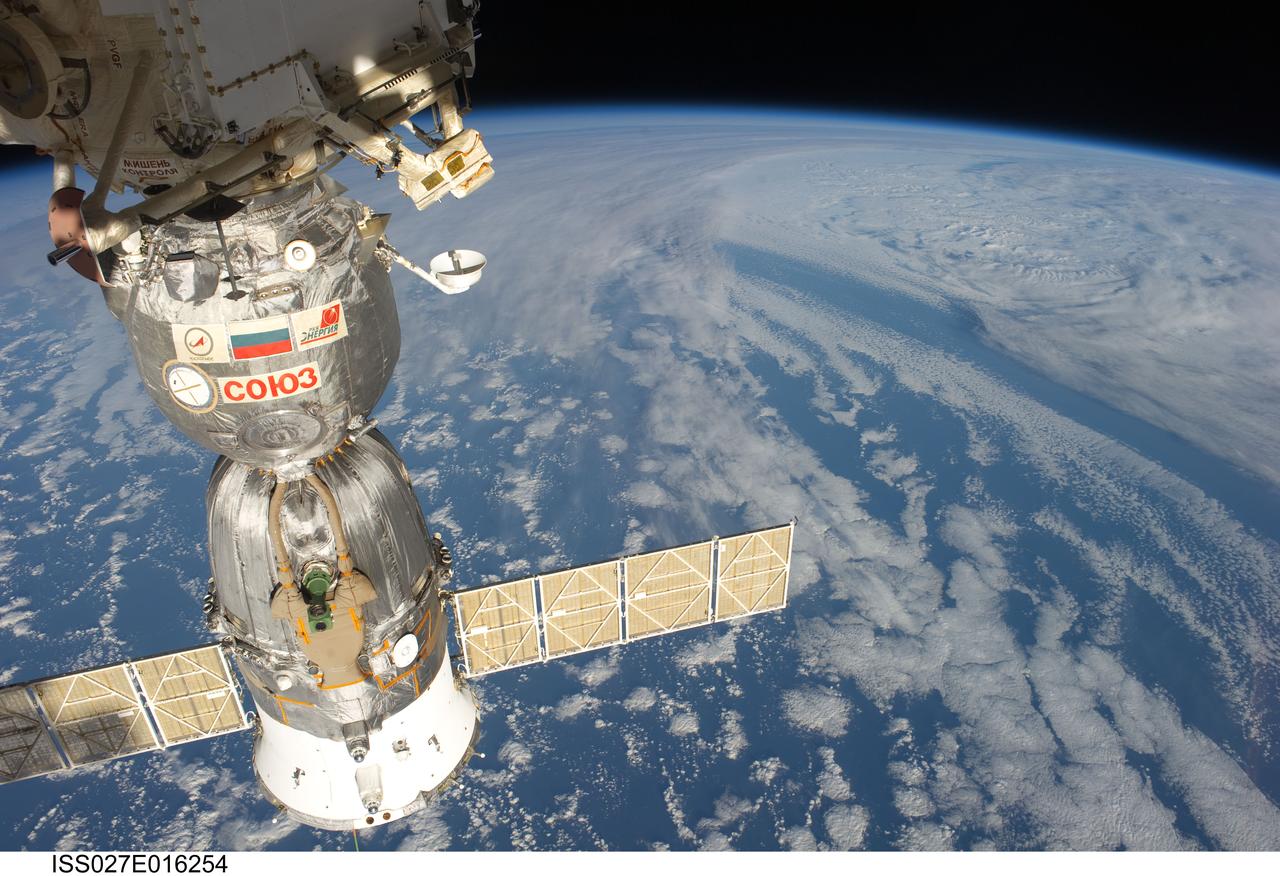
ISS027-E-016254 (22 April 2011) --- A docked Russian Soyuz spacecraft is featured in this image photographed by an Expedition 27 crew member on the International Space Station. A blue and white part of Earth and the blackness of space provide the backdrop for the scene.
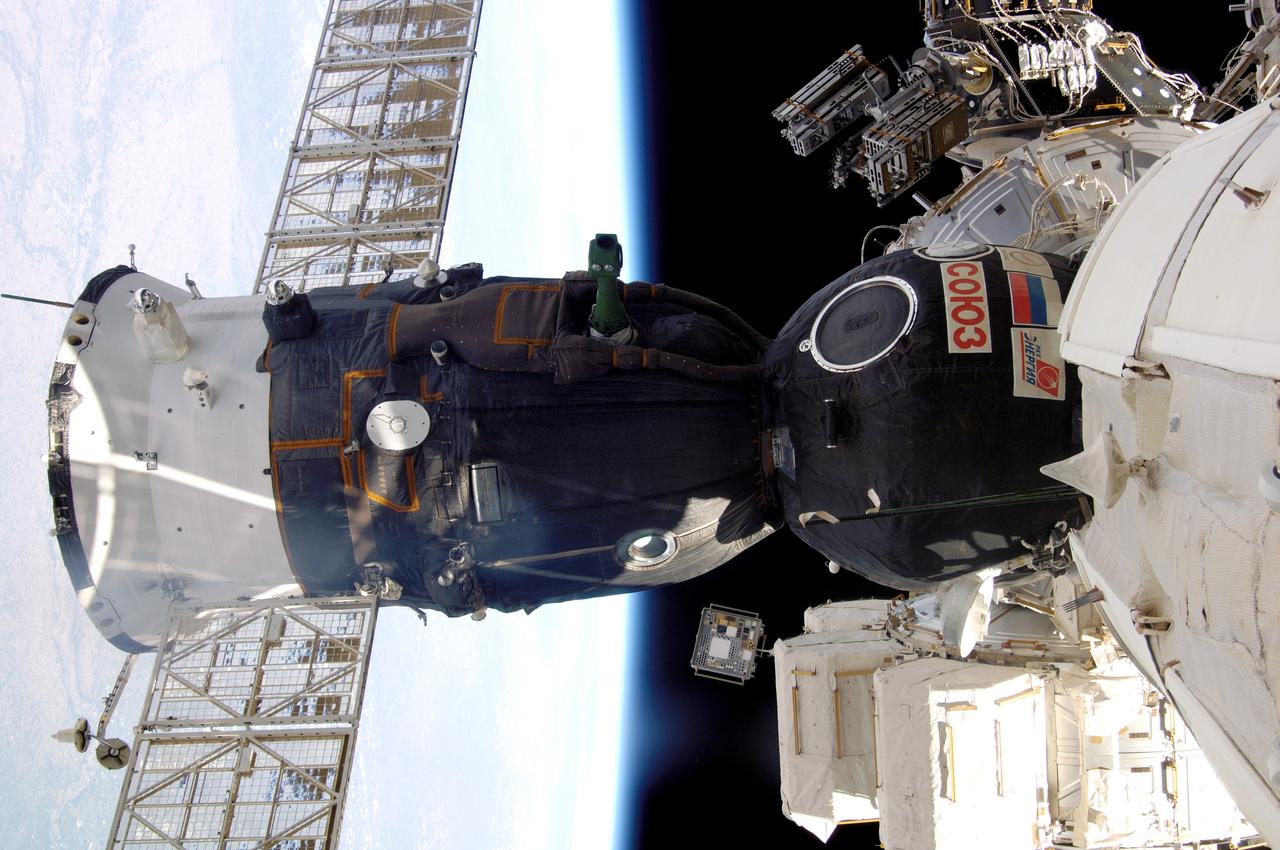
ISS015-E-05371 (April 2007) --- Backdropped by the blackness of space and Earth's horizon, the Soyuz 14 (TMA-10) spacecraft docked to the Zarya Module nadir port of the International Space Station is featured in this image photographed by an Expedition 15 crewmember.
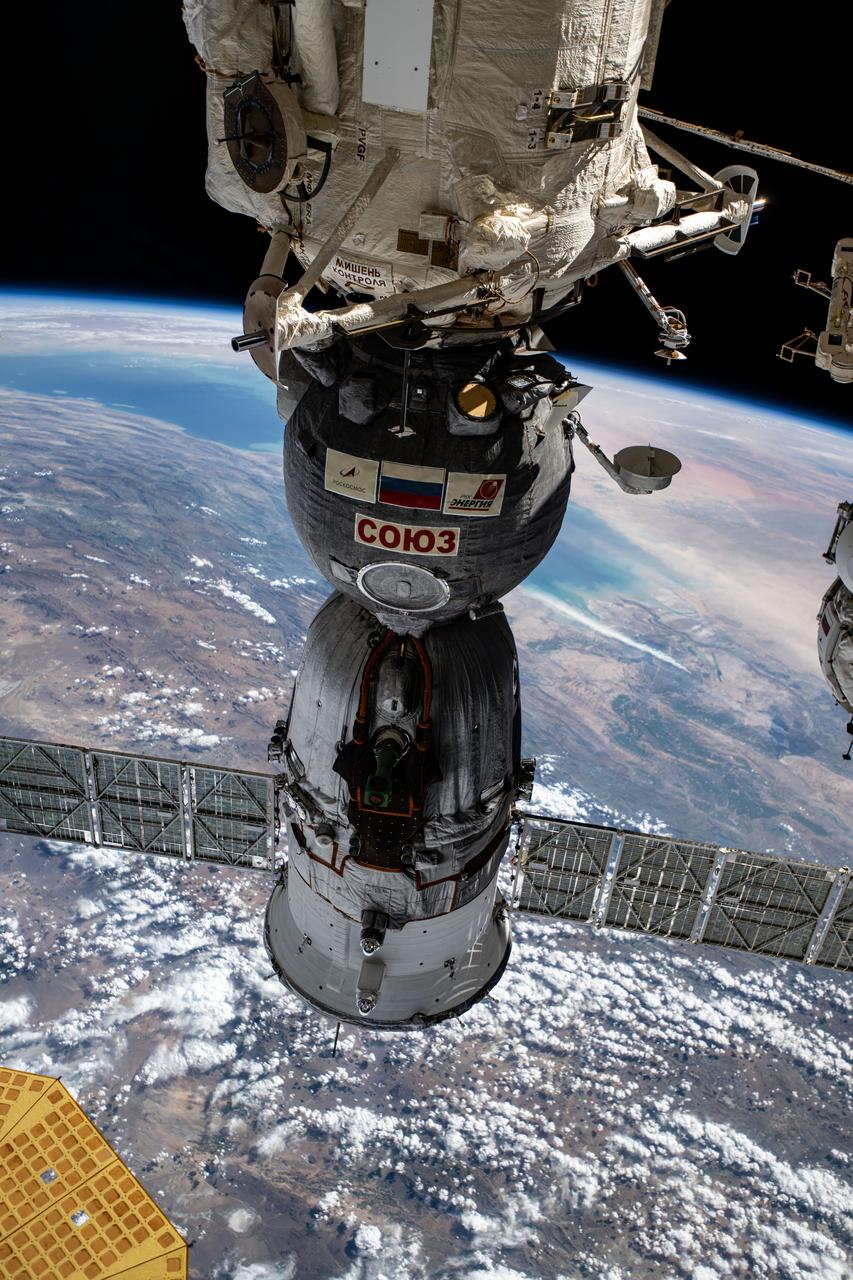
iss072e838106 (March 24, 2025) --- The Soyuz MS-26 spacecraft that launched NASA astronaut Don Pettit and Roscosmos cosmonauts Alexey Ovchinin and Ivan Vagner to the International Space Station is pictured docked to the Rassvet module. The orbiting lab was soaring 260 miles above Turkmenistan near the Caspian Sea.

ISS005-E-19567 (4 November 2002) --- A Soyuz spacecraft, which carried the Soyuz 5 taxi crew, is docked to the Pirs docking compartment on the International Space Station (ISS). The new Soyuz TMA-1 vehicle was designed to accommodate larger or smaller crewmembers, and is equipped with upgraded computers, a new cockpit control panel and improved avionics. The blackness of space and Earth’s horizon provide the backdrop for the scene.

iss073e0775543 (Sept. 8, 2025) --- The Soyuz MS-27 spacecraft, which launched three Expedition 73 crew members to the International Space Station, is pictured docked to the Prichal module. Prichal is itself connected to the Nauka science module on the station’s Roscosmos segment. Below, the Pacific Ocean fades from view as an orbital sunset descends 258 miles beneath the orbiting complex.
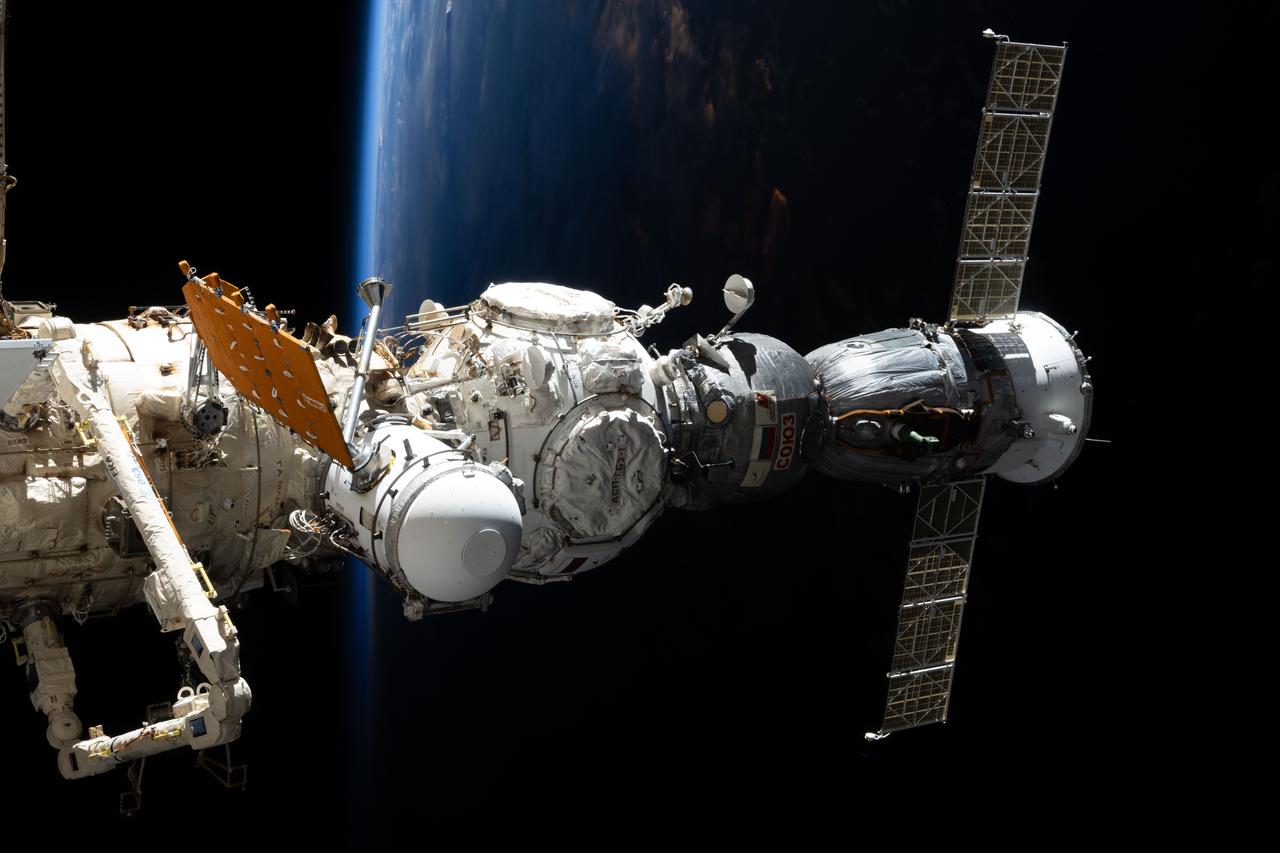
iss073e0775529 (Sept. 8, 2025) --- The Soyuz MS-27 spacecraft, which launched three Expedition 73 crew members to the International Space Station, is pictured docked to the Prichal module. Prichal is itself connected to the Nauka science module on the station’s Roscosmos segment. Below, the Pacific Ocean fades from view as an orbital sunset descends 258 miles beneath the orbiting complex.
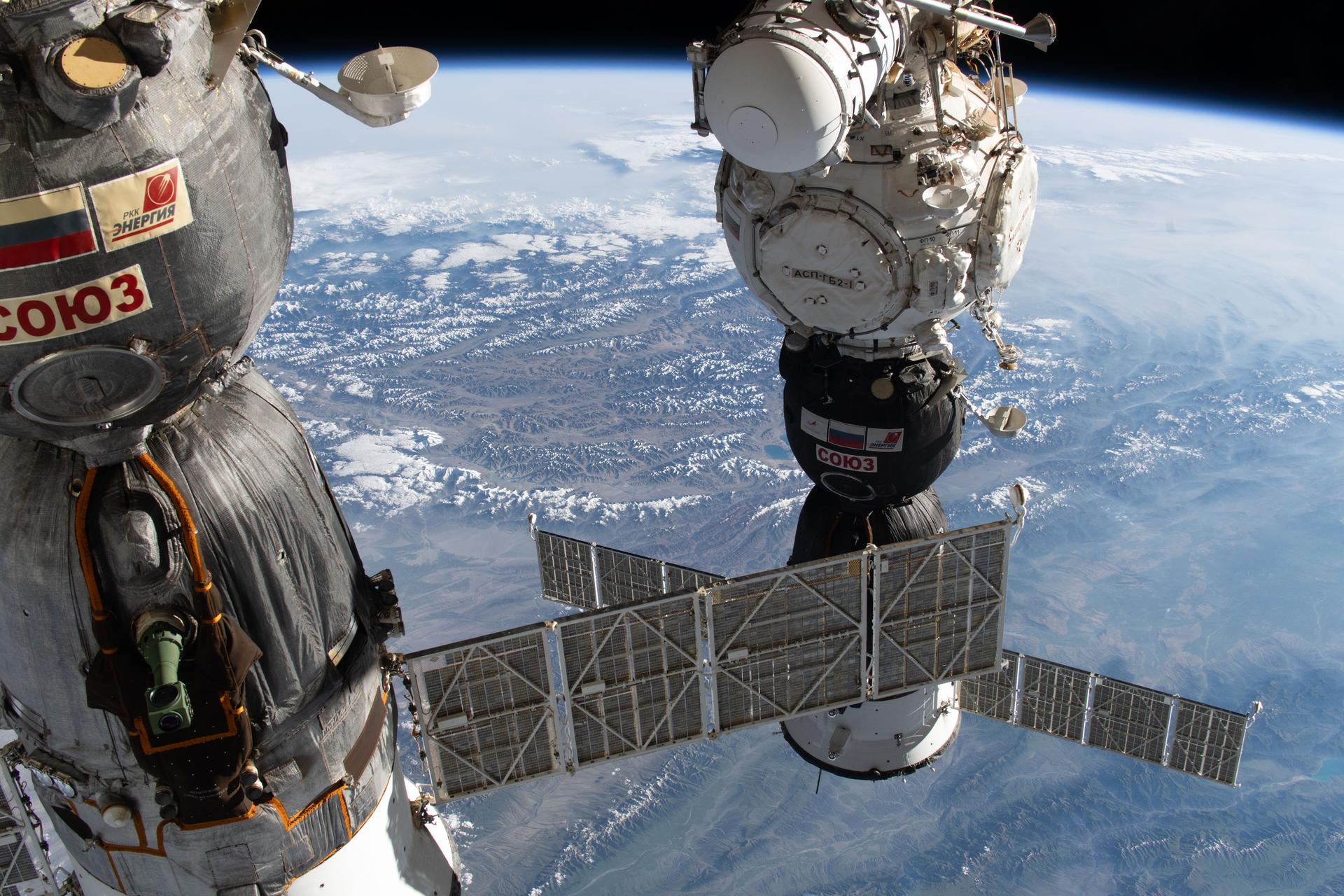
iss074e0825704 (July 17, 2026) --- Two Soyuz crew spacecraft, the MS-28 docked to the Rassvet module (foreground) and the MS-29 docked to the Prichal module (background), are pictured attached to the International Space Station as it orbited 265 miles above eastern Kazakhstan. Credit: NASA/Jessica Meir
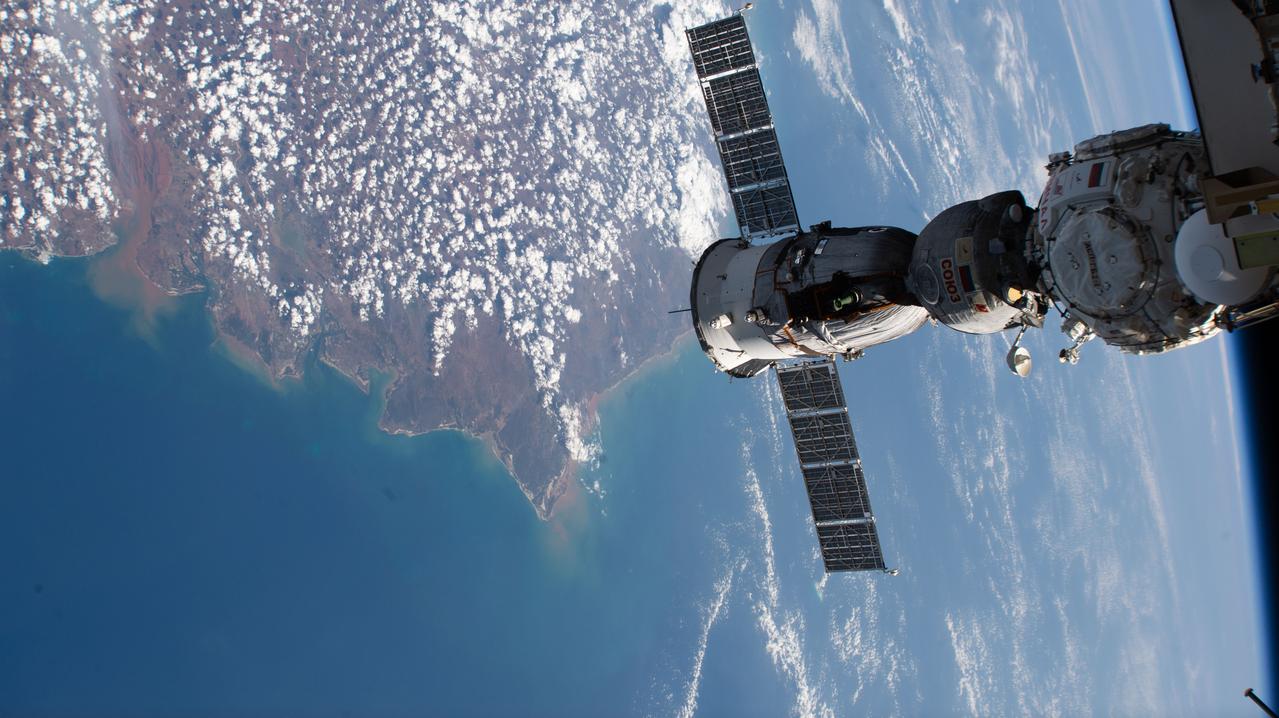
iss073e0659744 (Sept. 14, 2025) --- The Soyuz MS-27 spacecraft is pictured docked to the International Space Station's Prichal module as the orbital outpost soared 259 miles above the northern coast of Madagascar.

ISS013-E-08167 (19 April 2006) --- A mass of storm clouds was photographed by an Expedition 13 crewmember from a window on the International Space Station. A Soyuz spacecraft docked to the station and the Canadarm2 are visible at right.
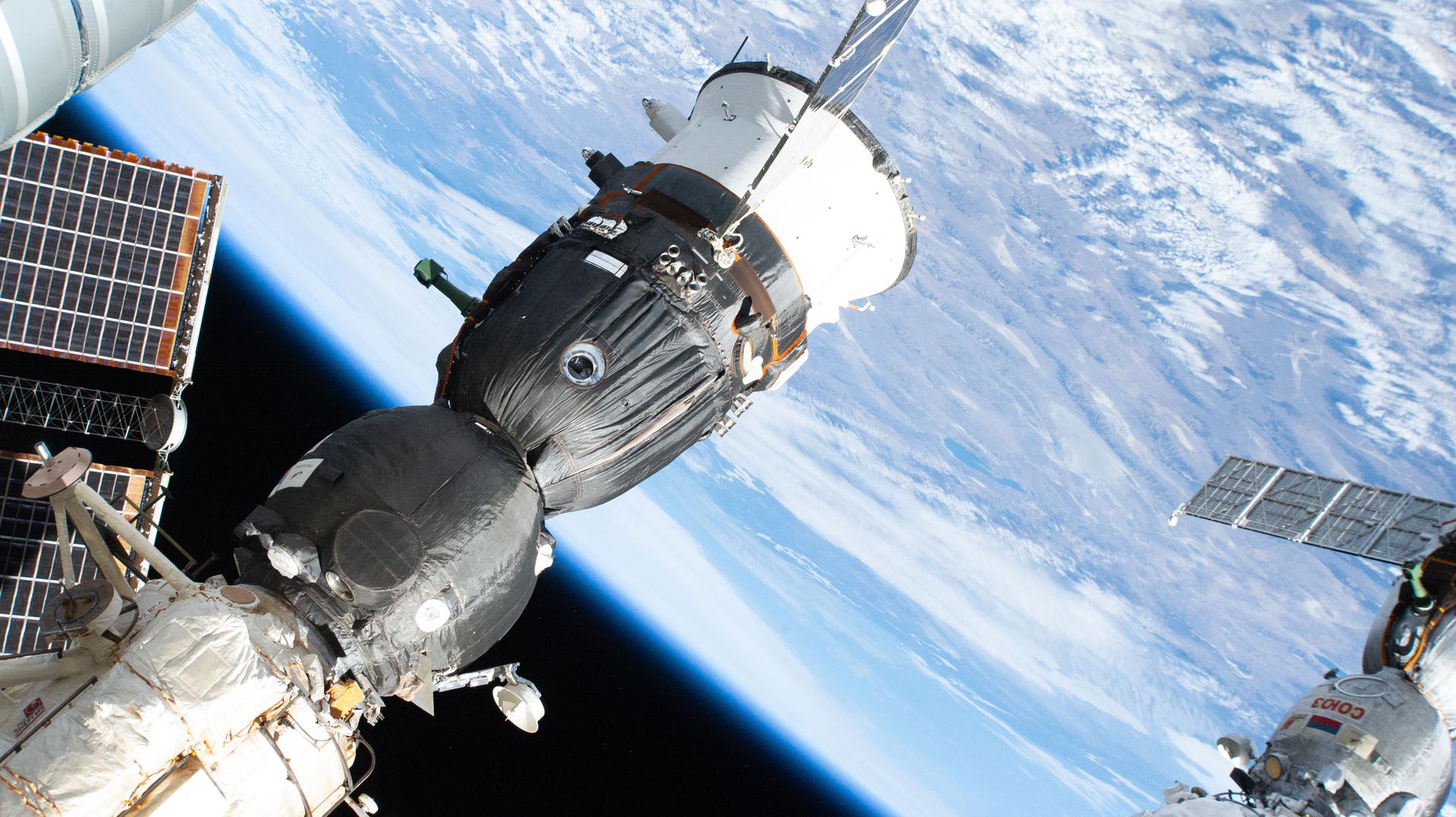
iss073e1231962 (Dec. 2, 2025) --- The Soyuz MS-28 crew spacecraft is pictured docked to the Rassvet module as the International Space Station orbited 264 miles the midwestern United States. The Soyuz launched NASA astronaut Chris Williams and Roscosmos cosmonauts Sergey Kud-Sverchkov and Sergei Mikaev to the orbital outpost on Nov. 27, 2025.
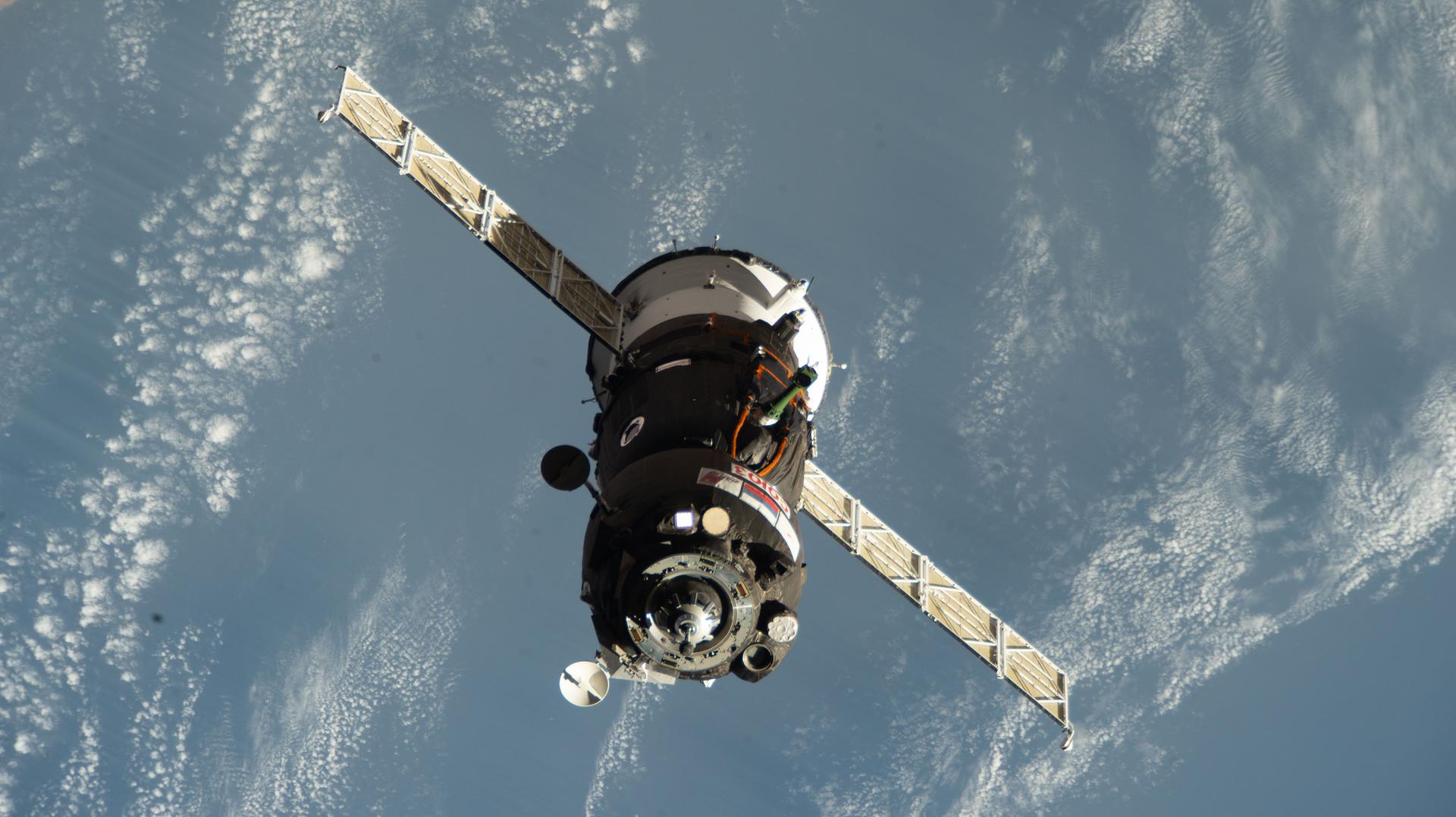
iss074e0814091 (June 14, 2026) --- The Soyuz MS-29 spacecraft, carrying NASA astronaut Anil Menon and Roscosmos cosmonauts Pyotr Dubrov and Anna Kikina, approaches the International Space Station for an automated docking while both spacecraft were orbiting 262 miles above Western Sahara. Credit: NASA
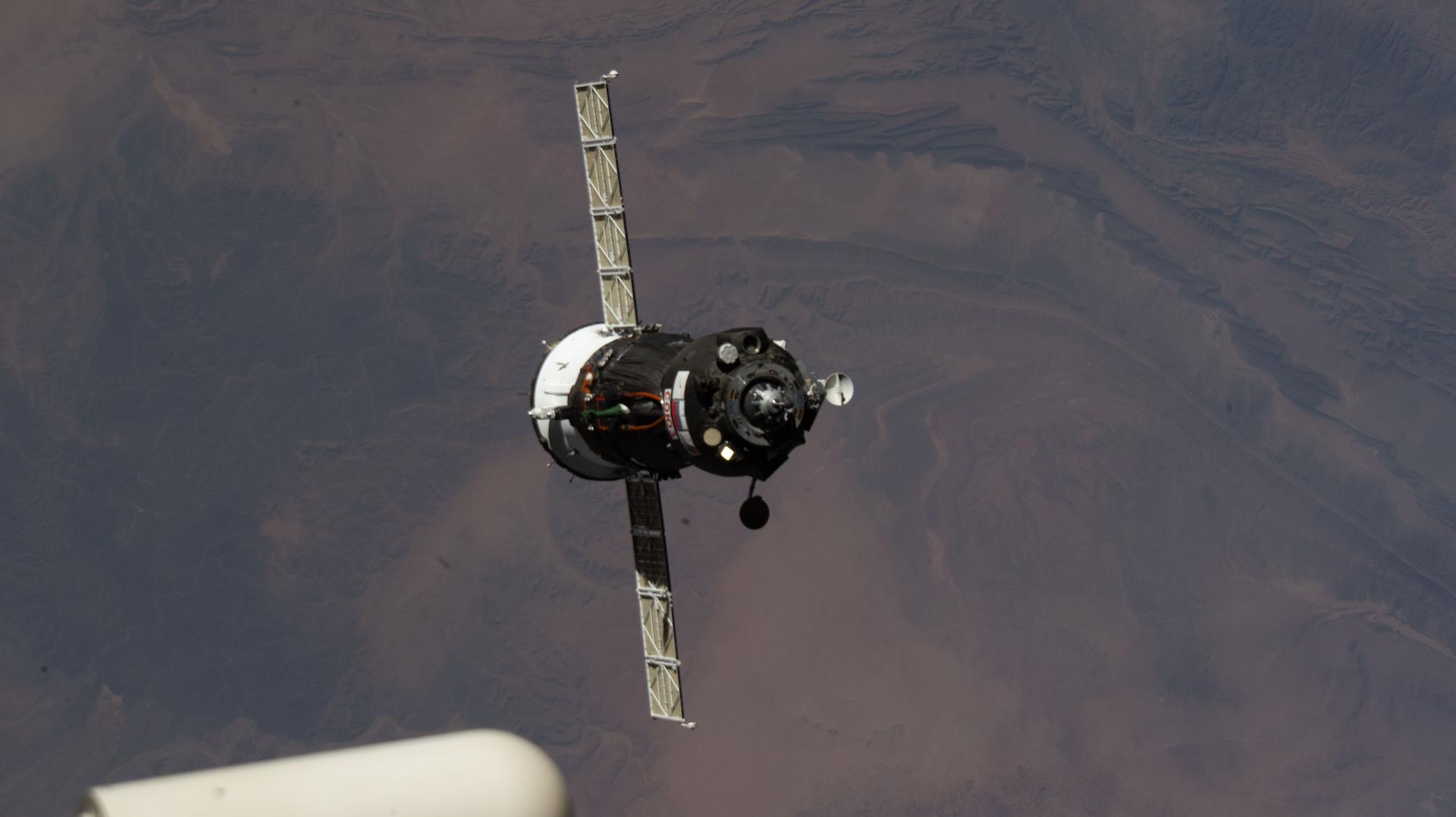
iss074e0814100 (June 14, 2026) --- The Soyuz MS-29 spacecraft, carrying NASA astronaut Anil Menon and Roscosmos cosmonauts Pyotr Dubrov and Anna Kikina, approaches the International Space Station for an automated docking while both spacecraft were orbiting 262 miles above Western Sahara. Credit: NASA
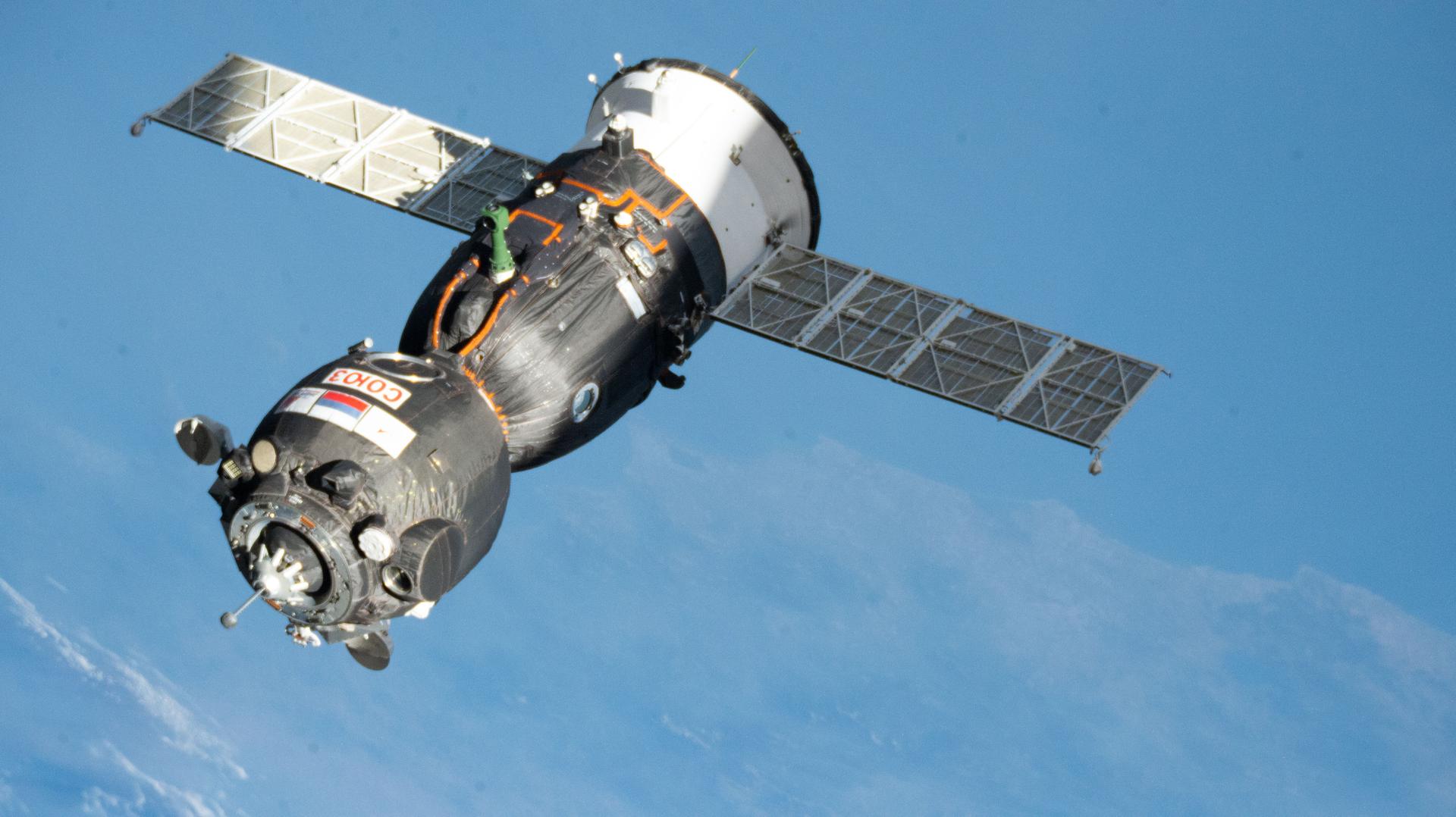
iss074e0814098 (June 14, 2026) --- The Soyuz MS-29 spacecraft, carrying NASA astronaut Anil Menon and Roscosmos cosmonauts Pyotr Dubrov and Anna Kikina, approaches the International Space Station for an automated docking while both spacecraft were orbiting 264 miles above the Mediterranean Sea in between Spain and Italy. Credit: NASA
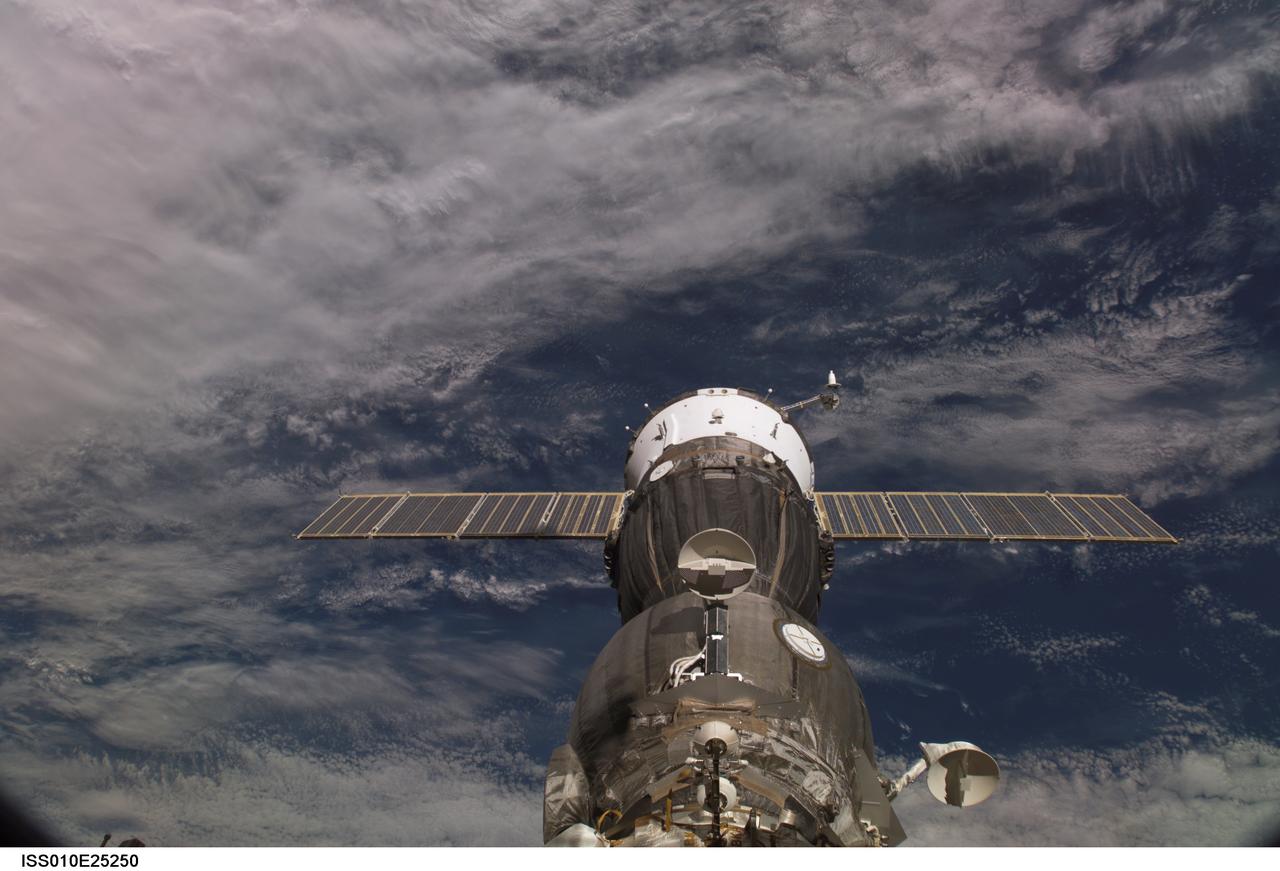
ISS010-E-25250 (18 April 2005) --- A blanket of clouds provides the backdrop for this scene of the Soyuz TMA-6 spacecraft, docked to the Pirs Docking Compartment on the International Space Station (ISS). The scene was photographed by an Expedition 10 crewmember.
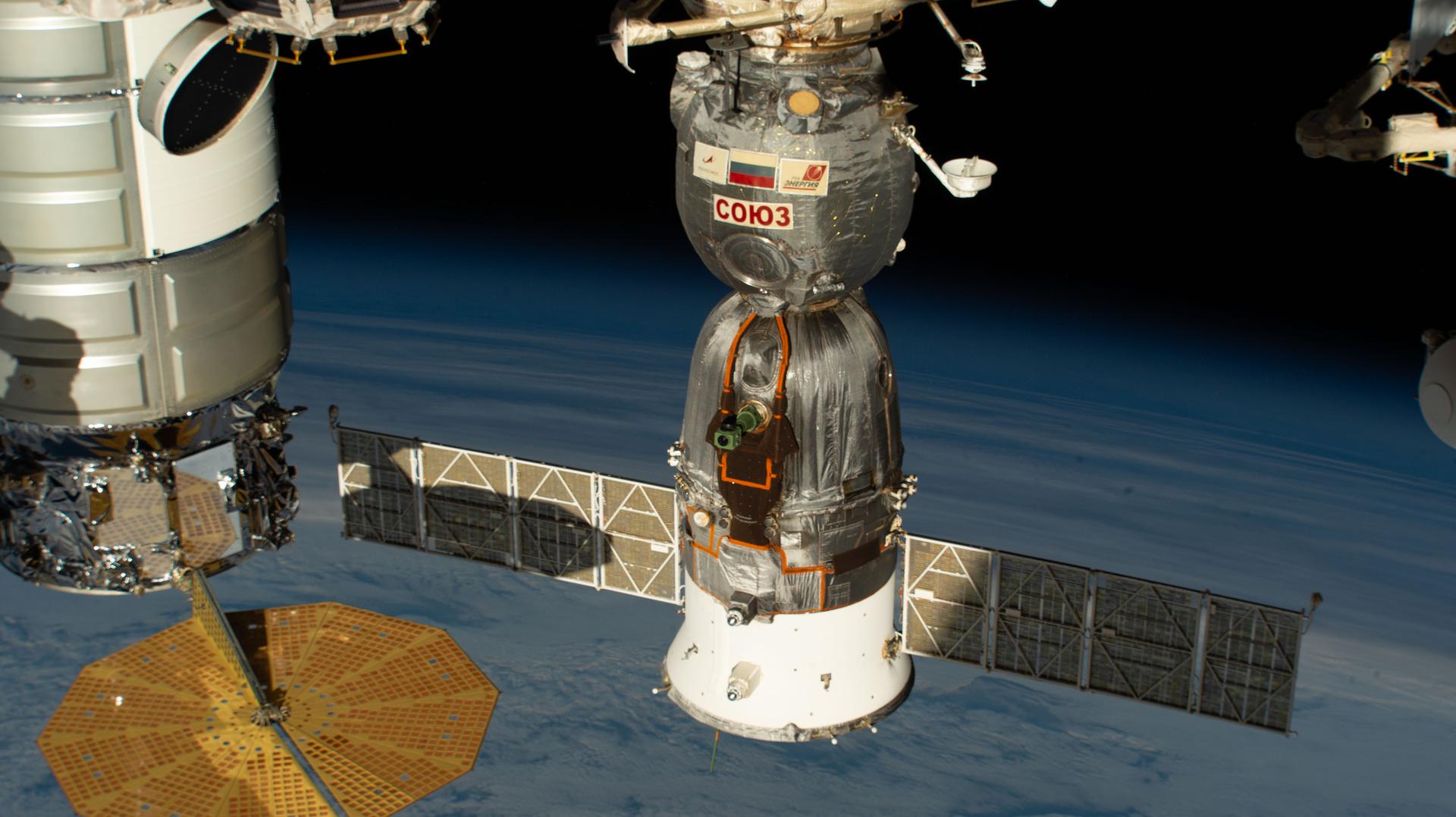
iss074e0812341 (July 13, 2026) --- The Soyuz MS‑28 crew spacecraft, which launched and docked to the International Space Station on Nov. 25, 2025, is pictured docked to the Rassvet module. The Soyuz MS‑28 will return NASA astronaut Chris Williams and Roscosmos cosmonauts Sergey Kud‑Sverchkov and Sergei Mikaev to Earth at the end of July, completing an eight‑month space research mission. Credit: NASA
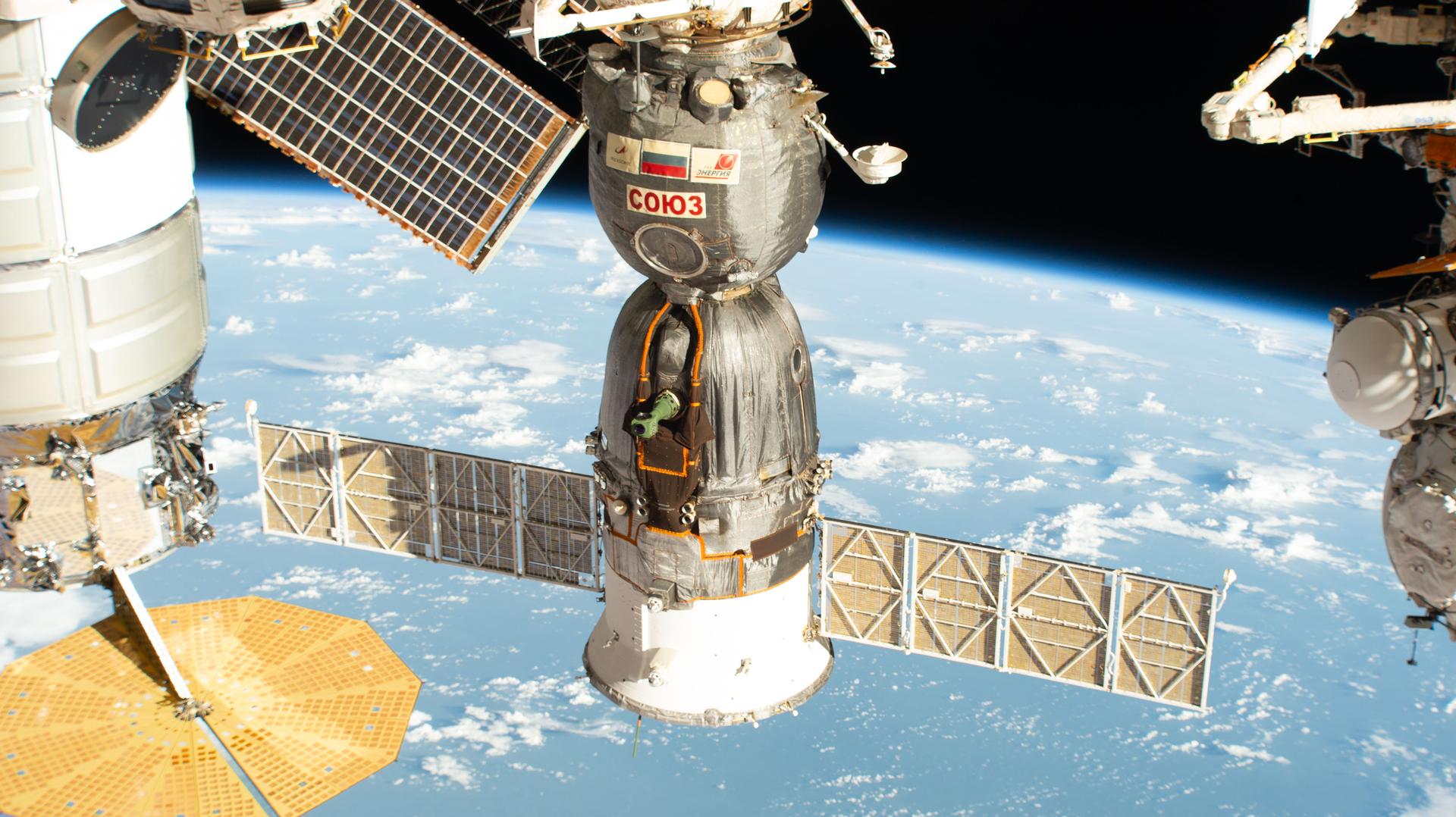
iss074e0812301 (July 13, 2026) --- The Soyuz MS‑28 crew spacecraft, which launched and docked to the International Space Station on Nov. 25, 2025, is pictured docked to the Rassvet module. The Soyuz MS‑28 will return NASA astronaut Chris Williams and Roscosmos cosmonauts Sergey Kud‑Sverchkov and Sergei Mikaev to Earth at the end of July, completing an eight‑month space research mission. Credit: NASA
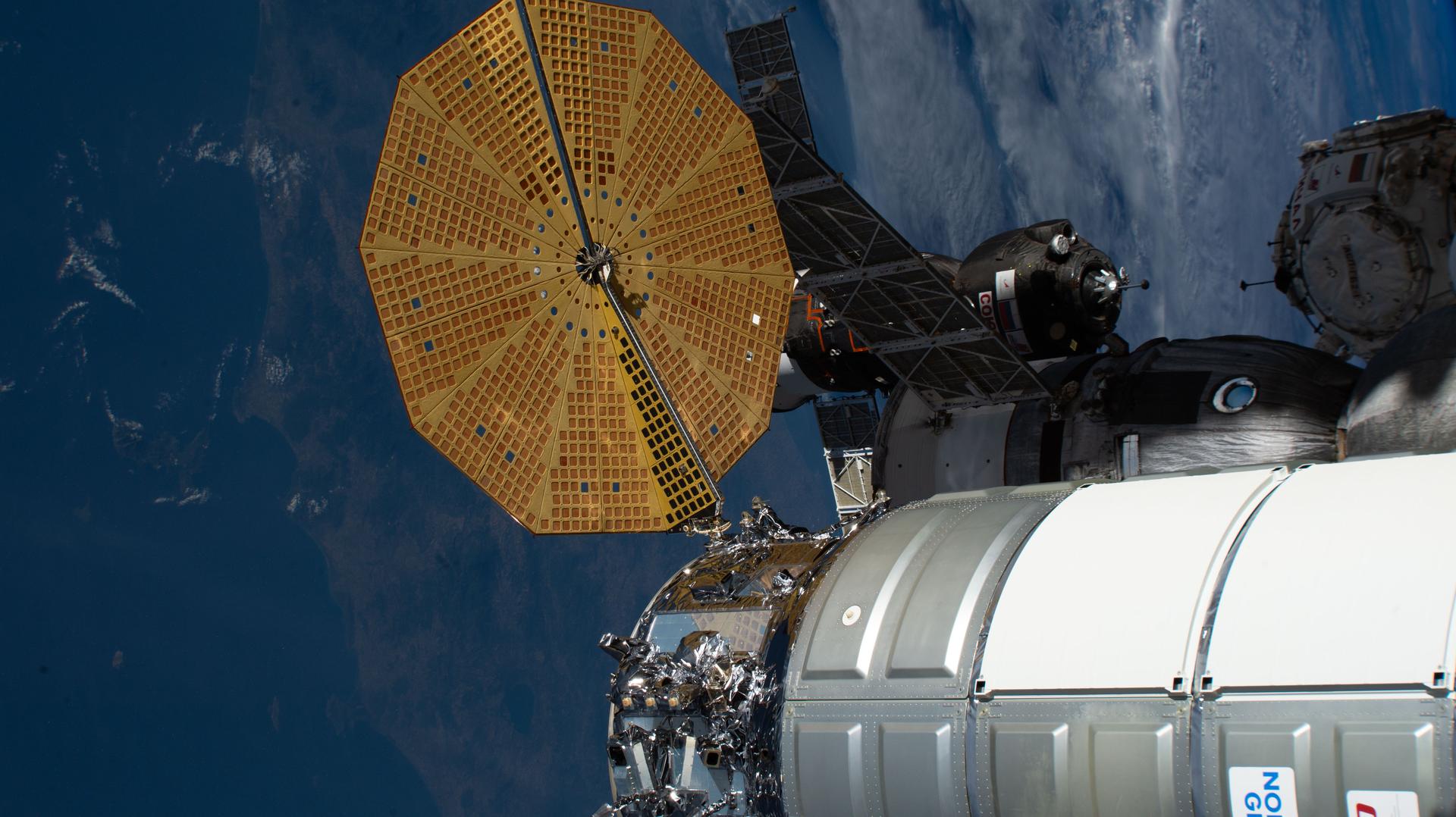
iss074e0814102 (June 14, 2026) --- In the background, the Soyuz MS-29 spacecraft, carrying NASA astronaut Anil Menon and Roscosmos cosmonauts Pyotr Dubrov and Anna Kikina, approaches the International Space Station for an automated docking to the Prichal module while both spacecraft were orbiting 264 miles above the Mediterranean Sea in between Spain and Italy. In the foreground, is the Northrop Grumman Cygnus XL cargo spacecraft with one of its prominent cymbal-shaped UltraFlex solar arrays. Credit: NASA

iss073e0248045 (May 29, 2025) --- The Soyuz MS-27 spacecraft is pictured docked to the International Space Station's Prichal module while soaring 263 miles above the Canadian province of Quebec. Prominently featured in the center of this photograph is the 214 million-year-old Manicouagan crater.

iss073e1197954 (Dec. 2, 2025) --- The Soyuz MS-28 crew spacecraft carrying NASA astronaut Chris Williams and Roscosmos cosmonauts Sergey Kud-Sverchkov and Sergei Mikaev is pictured shortly after docking to the International Space Station's Rassvet module.

ISS013-E-08180 (19 April 2006) --- A Soyuz spacecraft, docked to the International Space Station, and the Canadarm2 are featured in this image photographed by an Expedition 13 crewmember from a station window. Earth’s horizon and the blackness of space provided the backdrop for this scene.
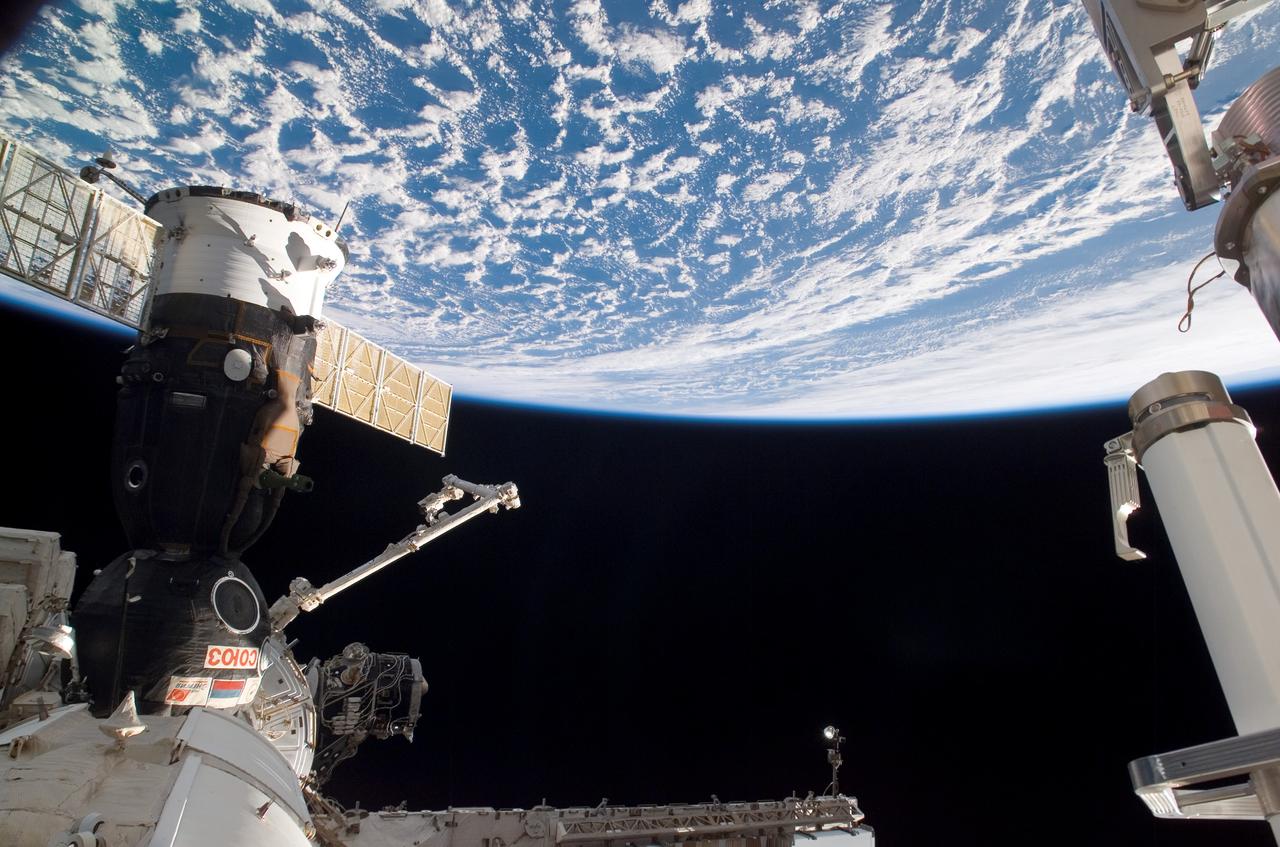
ISS013-E-08178 (19 April 2006) --- A Soyuz spacecraft, docked to the International Space Station, and the Canadarm2 are featured in this image photographed by an Expedition 13 crewmember from a station window. Earth's horizon and the blackness of space provided the backdrop for this scene.
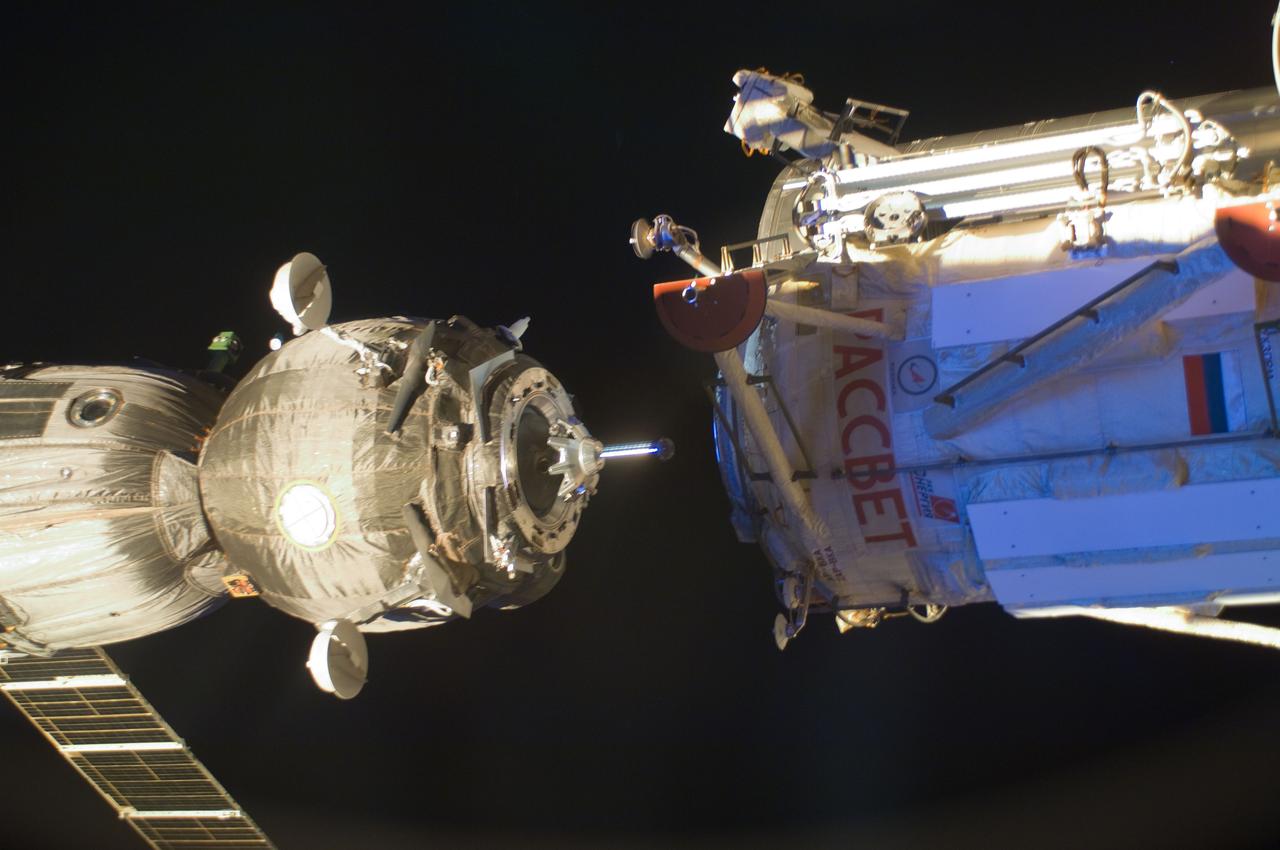
ISS030-E-015605 (23 Dec. 2011) --- With the three Expedition 30/31 crew members aboard, the Soyuz TMA-03M spacecraft (left) eases toward its docking with the Russian-built Mini-Research Module 1 (MRM-1), also known as Rassvet, Russian for "dawn." The docking, which once more enables six astronauts and cosmonauts to work together aboard the Earth-orbiting International Space Station, took place at 9:19 a.m. (CST) on Dec. 23, 2011.
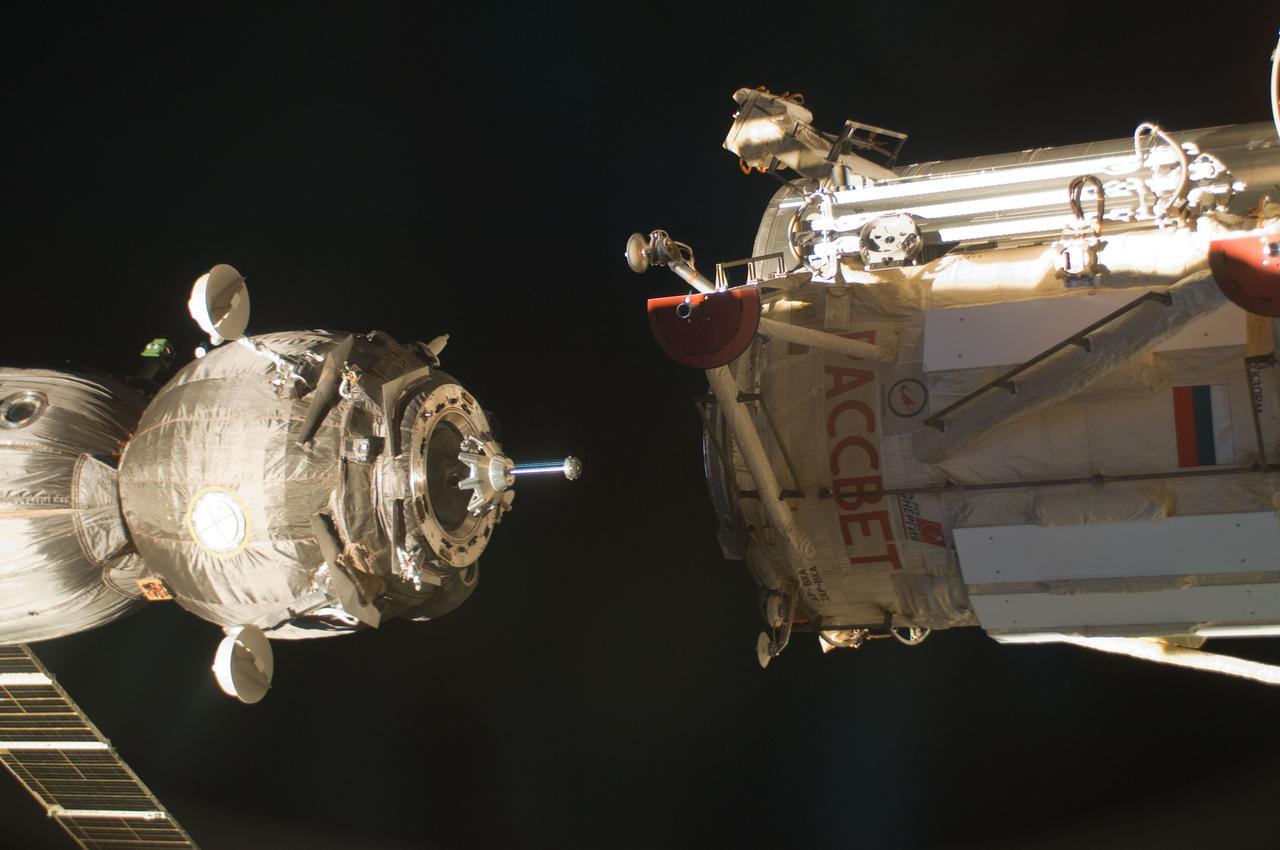
ISS030-E-015603 (23 Dec. 2011) --- With the three Expedition 30/31 crew members aboard, the Soyuz TMA-03M spacecraft (left) eases toward its docking with the Russian-built Mini-Research Module 1 (MRM-1), also known as Rassvet, Russian for "dawn." The docking, which once more enables six astronauts and cosmonauts to work together aboard the Earth-orbiting International Space Station, took place at 9:19 a.m. (CST) on Dec. 23, 2011.
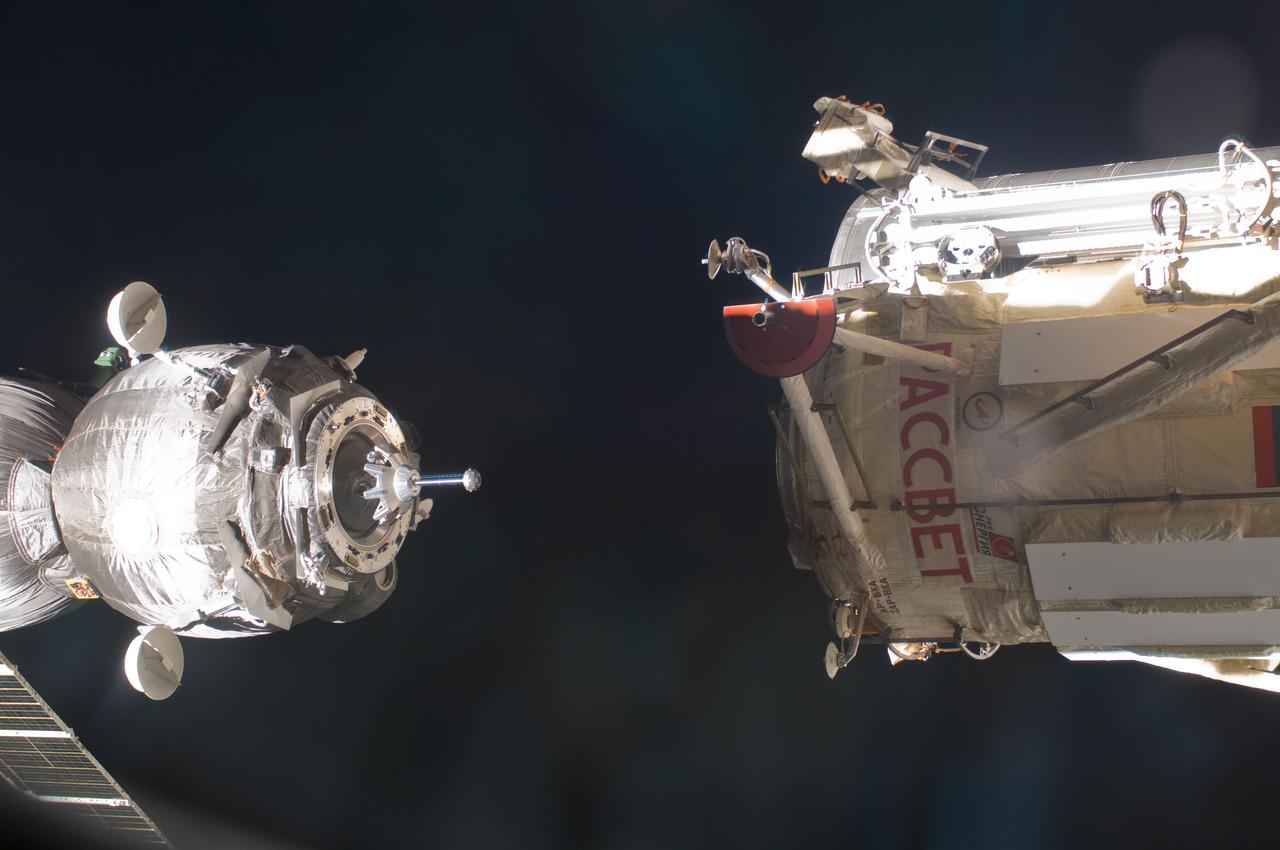
ISS030-E-015599 (23 Dec. 2011) --- With the three Expedition 30/31 crew members aboard, the Soyuz TMA-03M spacecraft (left) eases toward its docking with the Russian-built Mini-Research Module 1 (MRM-1), also known as Rassvet, Russian for "dawn." The docking, which once more enables six astronauts and cosmonauts to work together aboard the Earth-orbiting International Space Station, took place at 9:19 a.m. (CST) on Dec. 23, 2011.
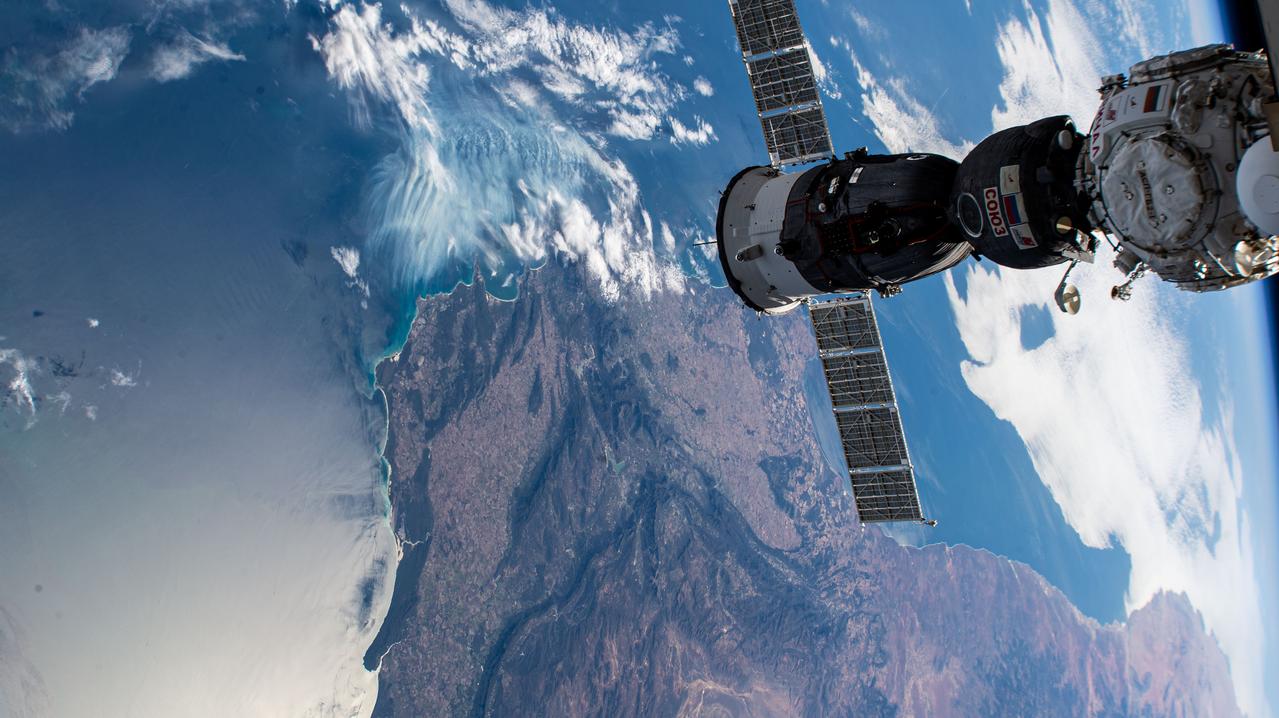
iss073e0002707 (April 27, 2025) --- The Soyuz MS-27 spacecraft is pictured docked to the Prichal module as the International Space Station orbited 269 miles above the Indian Ocean off the coast of South Africa. The Soyuz launched NASA astronaut Jonny Kim and Roscosmos cosmonauts Sergey Ryzhikov and Alexey Zubritsky to the orbital outpost on April 8.
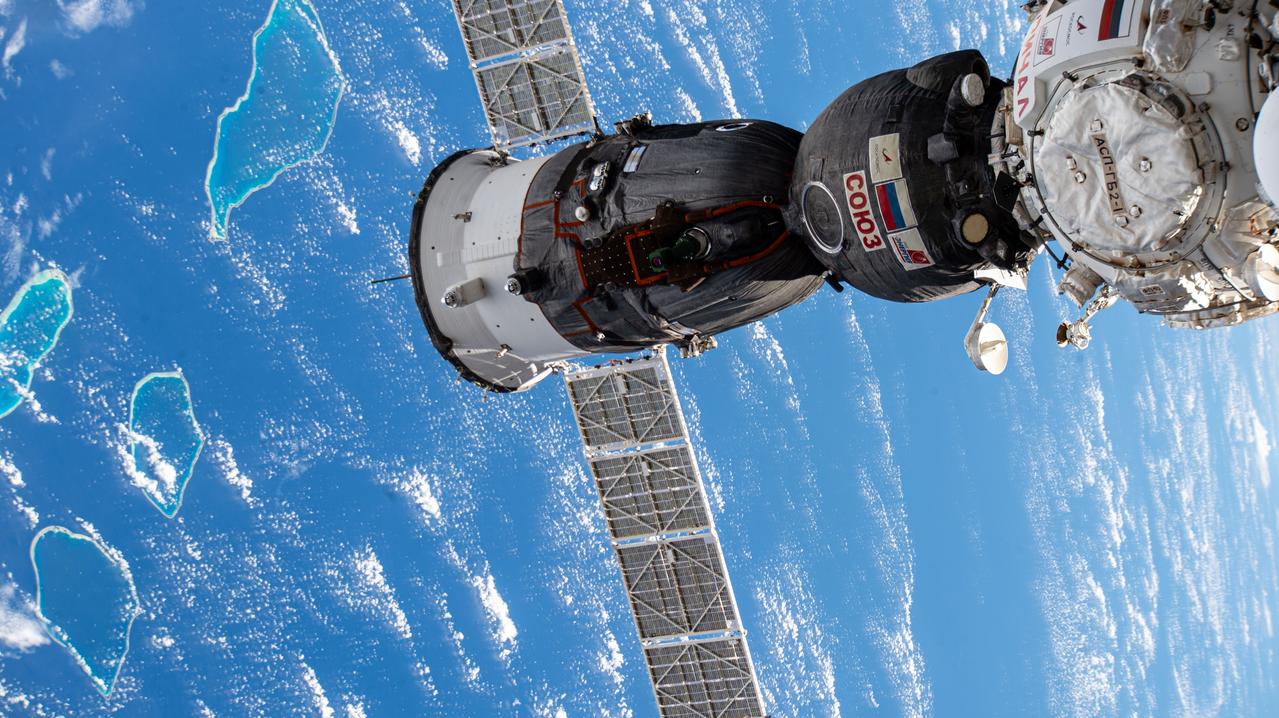
iss073e0002705 (April 26, 2025) --- The Soyuz MS-27 spacecraft is pictured docked to the Prichal module as the International Space Station orbited 264 miles above French Polynesia, France's oveseas collectivity of over 100 islands in the Pacific Ocean. The Soyuz launched NASA astronaut Jonny Kim and Roscosmos cosmonauts Sergey Ryzhikov and Alexey Zubritsky to the orbital outpost on April 8.
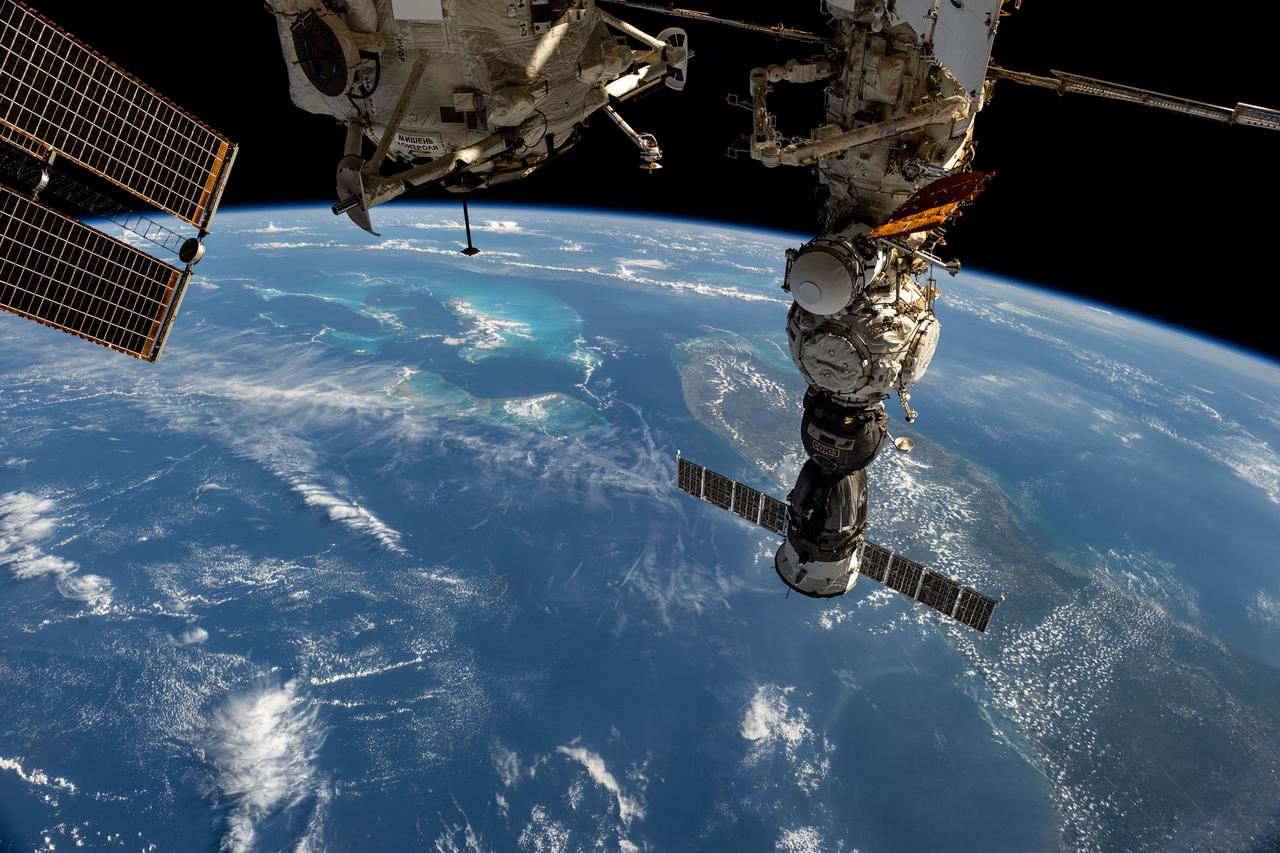
iss073e0134239 (May 20, 2025) --- The Soyuz MS-27 spacecraft that launched three Expedition 72-73 flight engineers to the International Space Station on April 8, 2025, is pictured docked to the Prichal module. 261 miles below the orbital outpost is the state of Florida and the island country of the Bahamas, also known as the Commonwealth of the Bahamas, in the Atlantic Ocean.
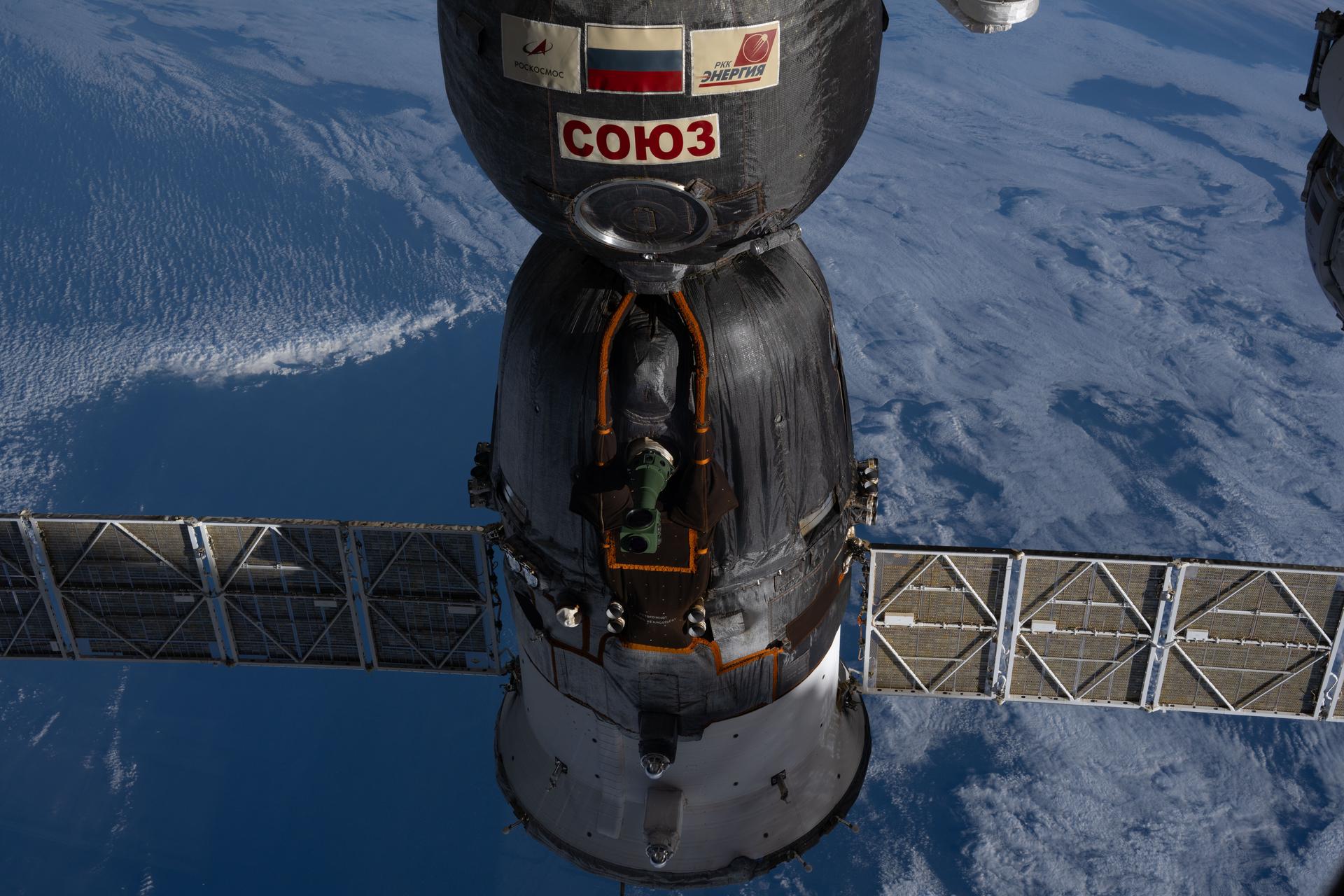
iss074e0794862 (July 4, 2026) --- The Soyuz MS-28 spacecraft, which will carry NASA astronaut Chris Williams and Roscosmos cosmonauts Sergey Kud-Sverchkov and Sergei Mikaev back to Earth, is pictured docked to the International Space Station. The orbital outpost was soaring 269 miles above the South Atlantic Ocean between the tips of South America and Africa at the time of this photograph. Credit: NASA/Chris Williams
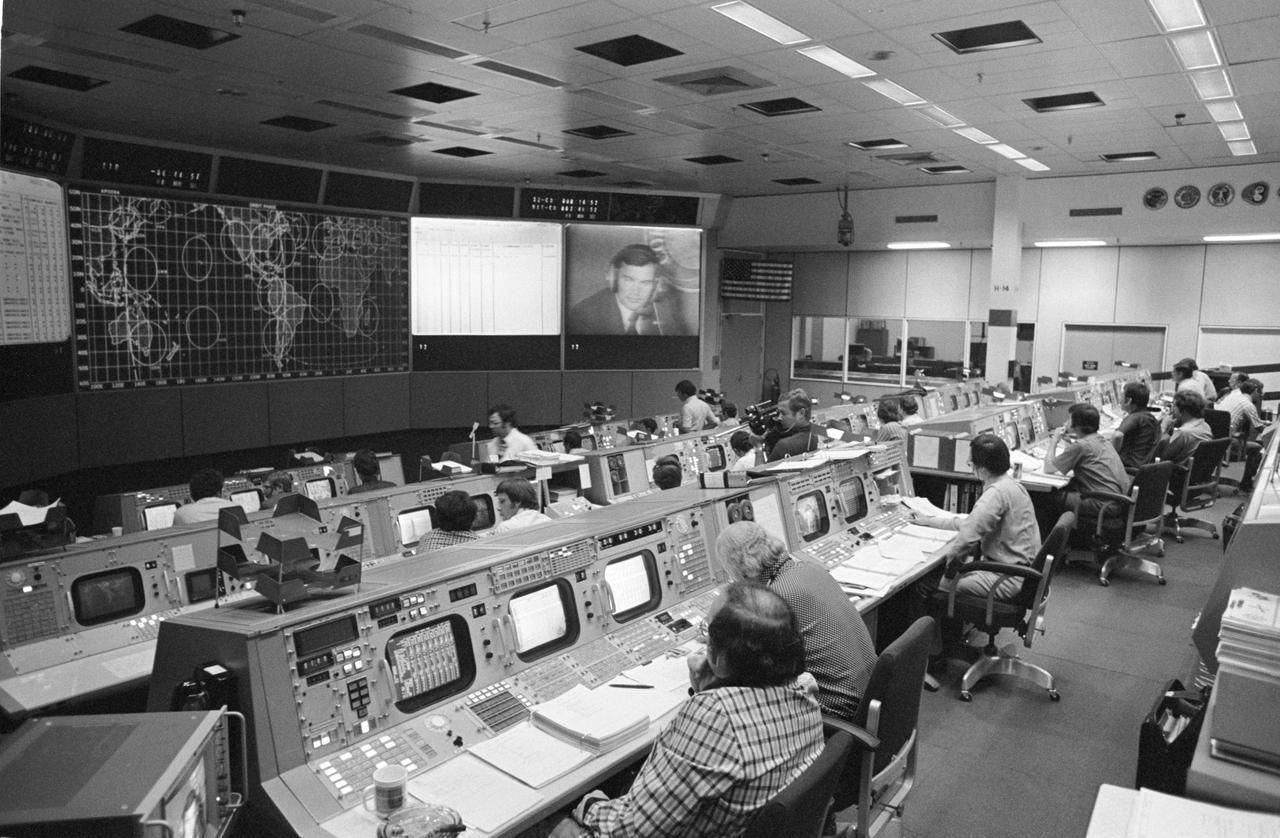
S75-28483 (15 July 1975) --- An overall view of the Mission Operations Control Room in the Mission Control Center on the first day of the Apollo-Soyuz Test Project docking mission in Earth orbit. The American ASTP flight controllers at NASA's Johnson Space Center were monitoring the progress of the Soviet ASTP launch when this photograph was taken. The television monitor shows cosmonaut Yuri V. Romanenko at his spacecraft communicator?s console in the ASTP mission control center in the Soviet Union. The American ASTP liftoff followed the Soviet ASTP launch by seven and one-half hours.
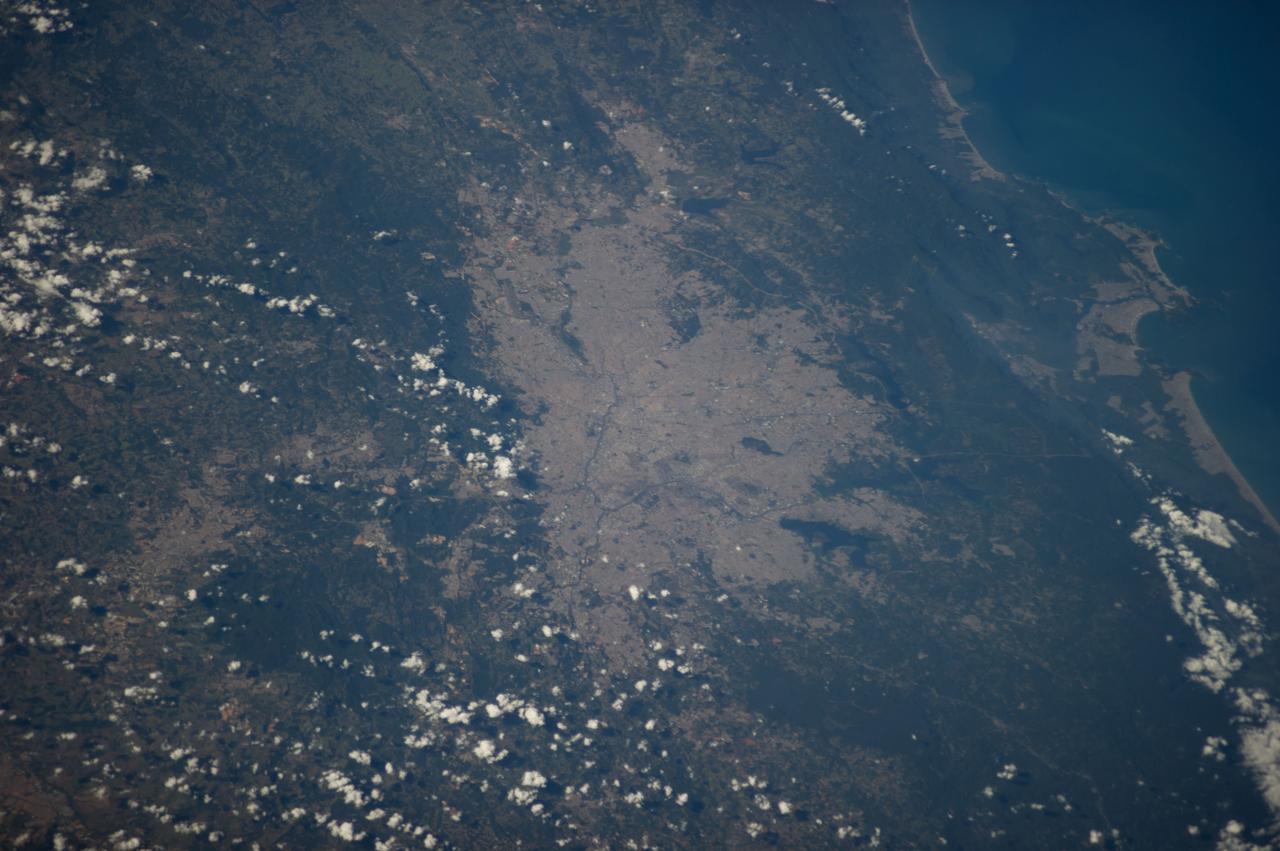
ISS040-E-010803 (12 June 2014) --- One of the Expedition 40 crew members aboard the International Space Station photographed this image featuring Sao Paulo, one of the host cities in Brazil for the 2014 World Cup. A 200mm focal length was used to record the photograph on June 12.
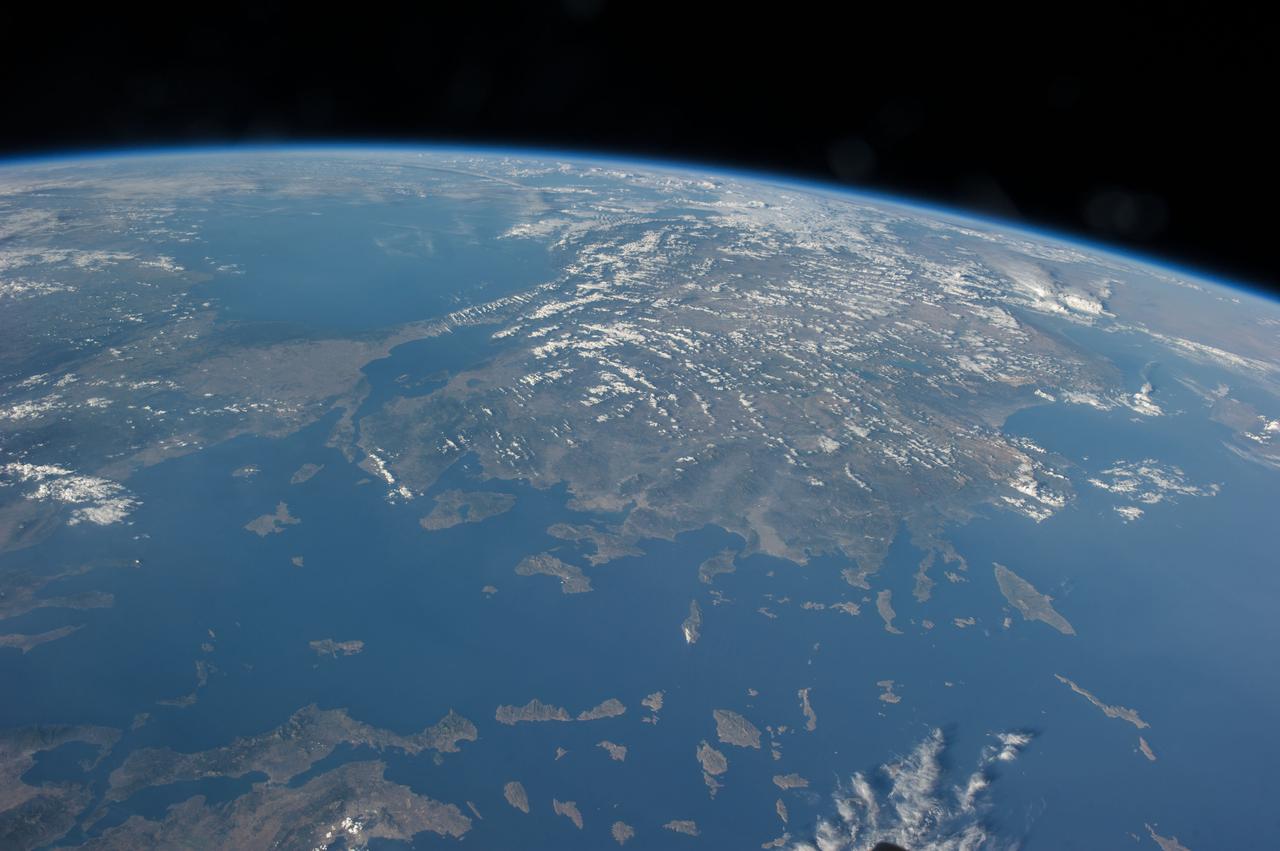
Earth Observation taken during a day pass by the Expedition 40 crew aboard the International Space Station (ISS). Folder lists this group as: Italy,Greece,and a little bit of Russia.
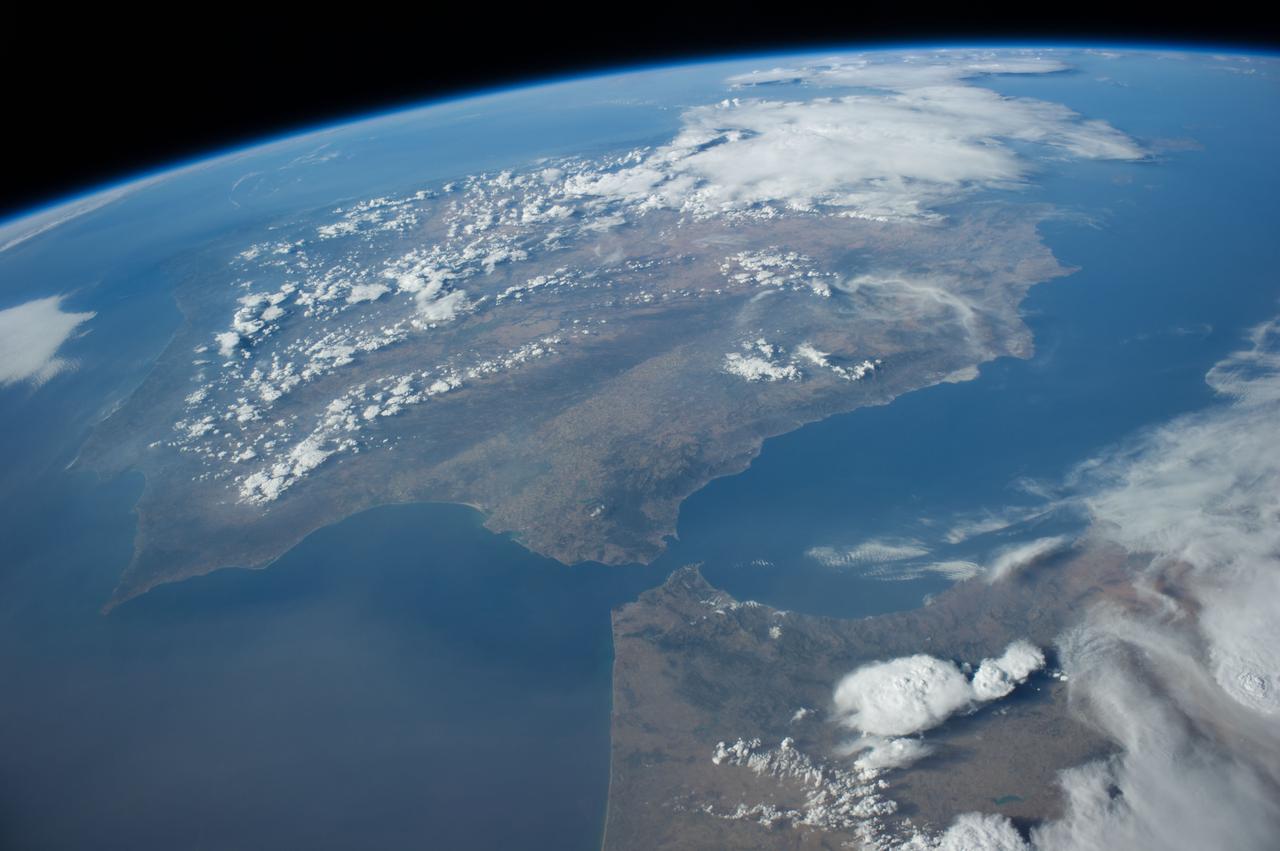
ISS040-E-010889 (12 June 2014) --- One of the Expedition 40 crew members aboard the Earth-orbiting International Space Station recorded this image of the Strait of Gibraltar, showing parts of Morocco and Spain, on June 12, 2014.
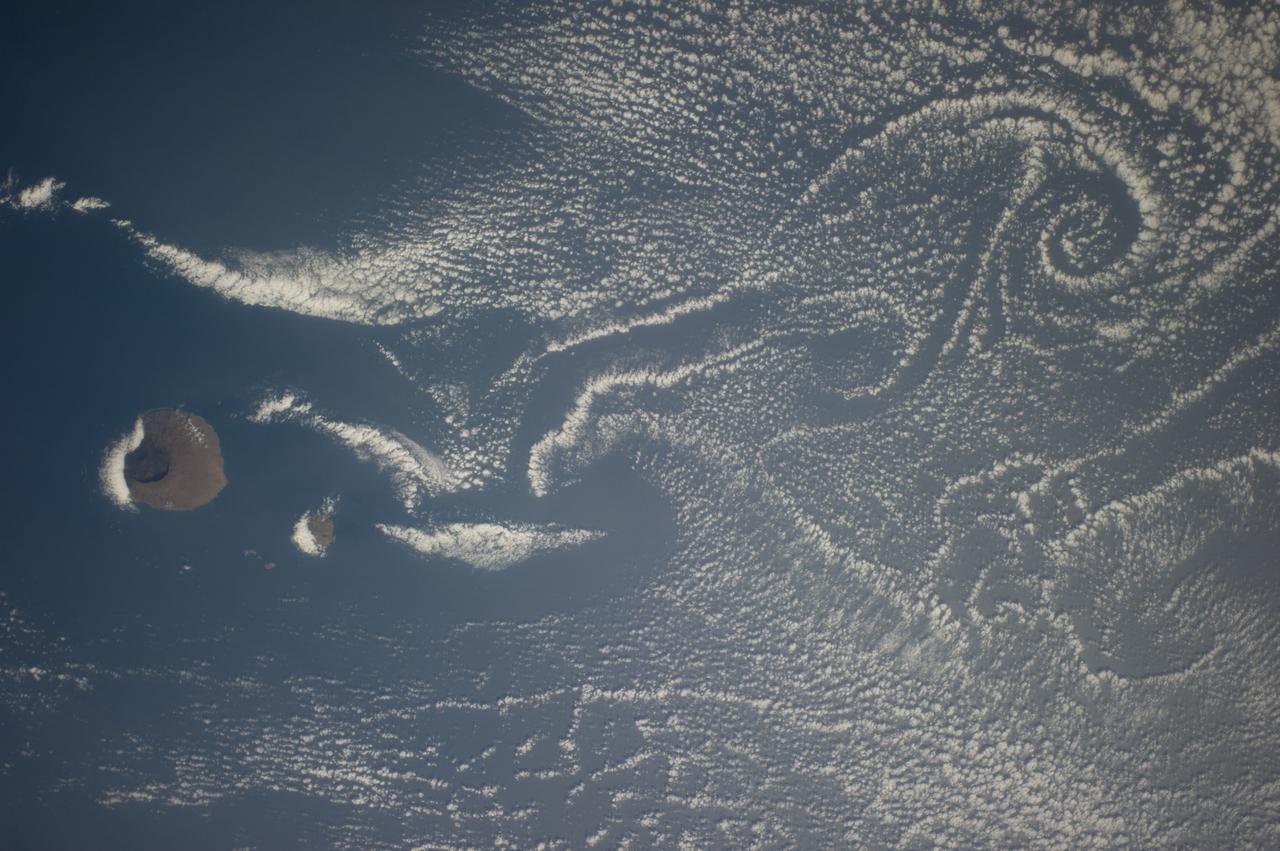
Earth Observation taken during a day pass by the Expedition 40 crew aboard the International Space Station (ISS). Folder lists this group as: Brazil, Africa, Volcanoes, Gibralter, Spain, Portugal.
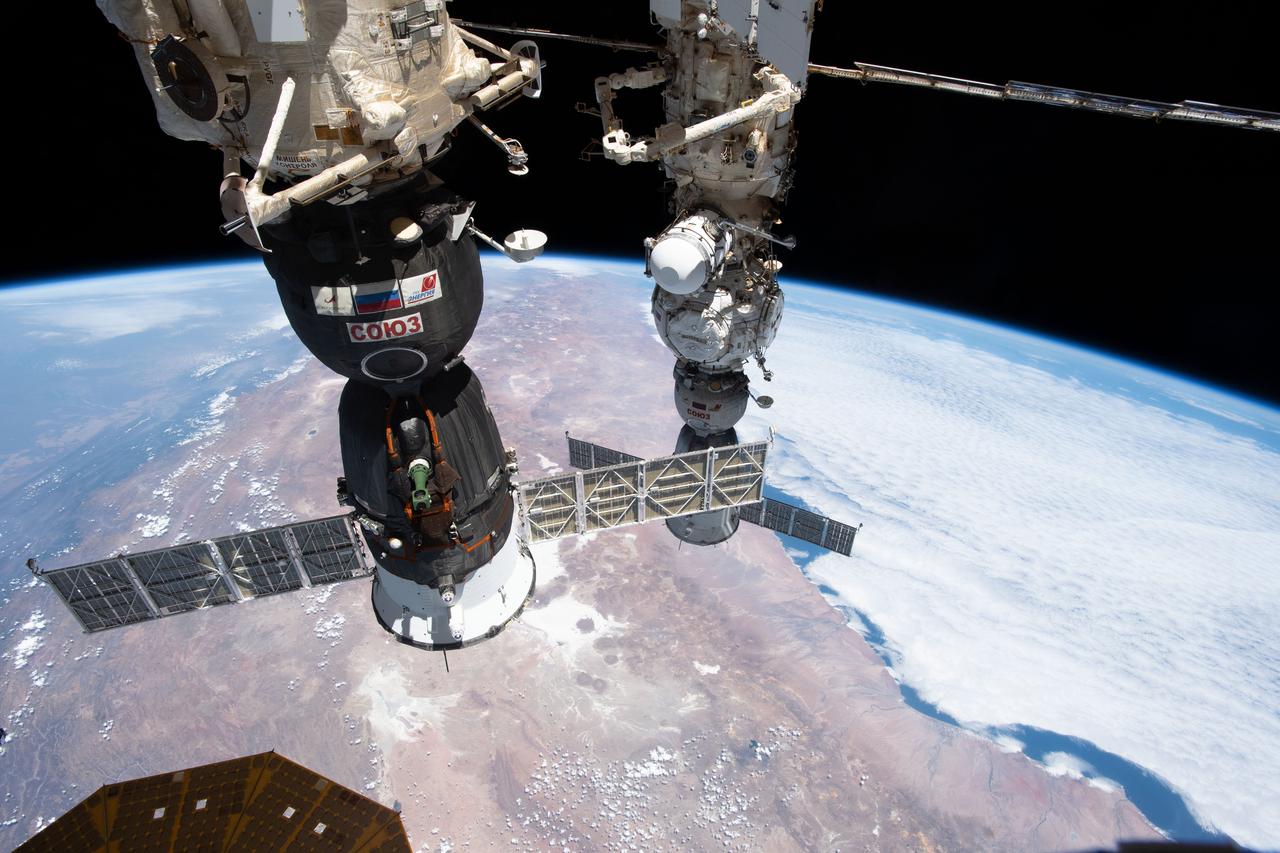
iss069e091770 (Sept. 23, 2023) --- Two Soyuz crew ships are pictured docked to the International Space Station as it orbited 262 miles above La Paz, Bolivia, on the South American continent. In the foreground, is the Soyuz MS-24 spacecraft docked to the Rassvet module. In the background is the Soyuz MS-23 spacecraft docked to the Prichal docking module.
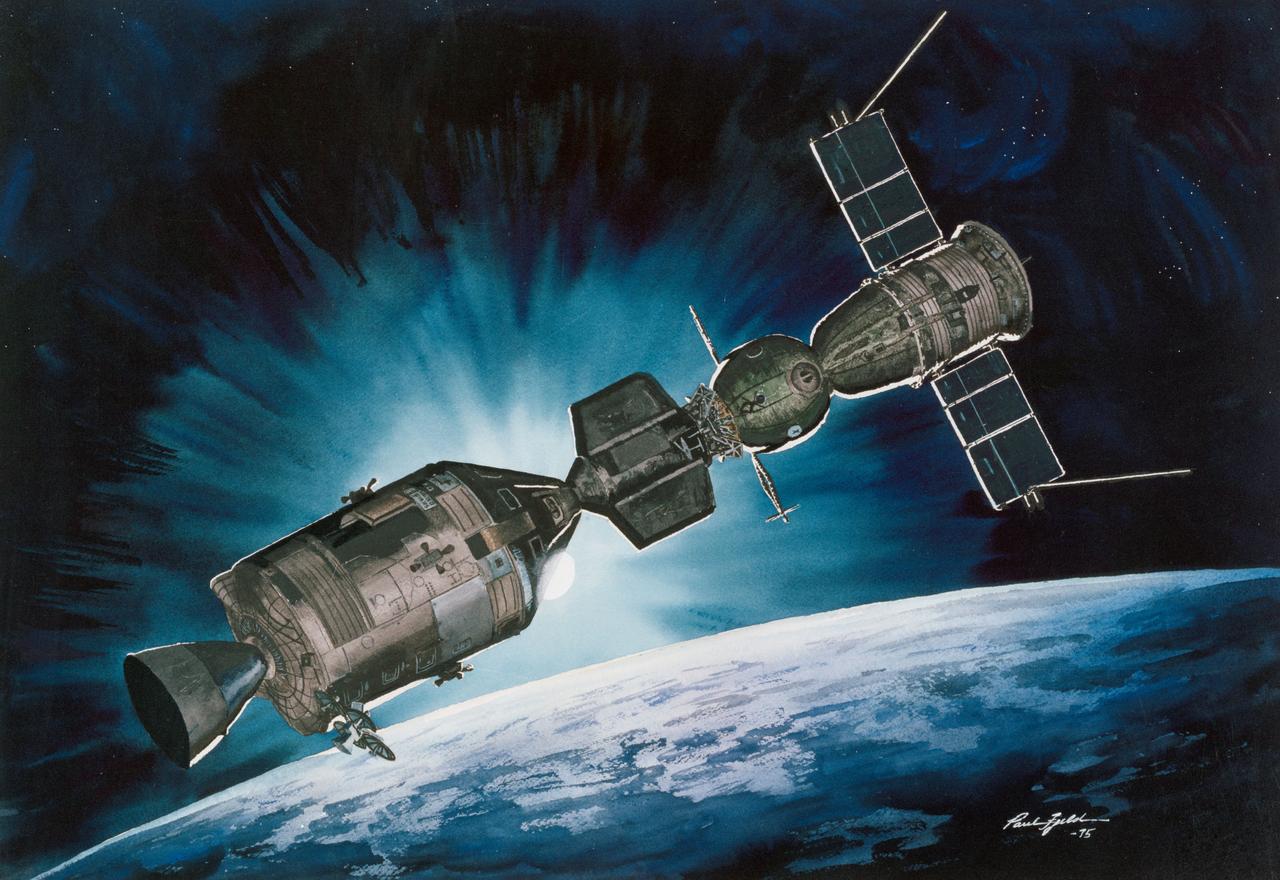
S75-28511 (July 1975) --- An artist?s concept depicting the American and Soviet spacecraft docked in Earth orbit during the July 1975 Apollo-Soyuz Test Project mission. The Apollo Command/Service Module is on the left, the Docking Module is in the center, and the Soyuz spacecraft is on the right. The first docking of spacecraft from two different nations was scheduled for July 17, 1975. The American and Soviet ASTP crewmen planned to visit each other?s spacecraft while Apollo and Soyuz are docked for a maximum period of two days. The docking system on the Docking Module and the docking system on the Soyuz Orbital Module are designed to interface with each other. The painting is by artist Paul Fjeld.
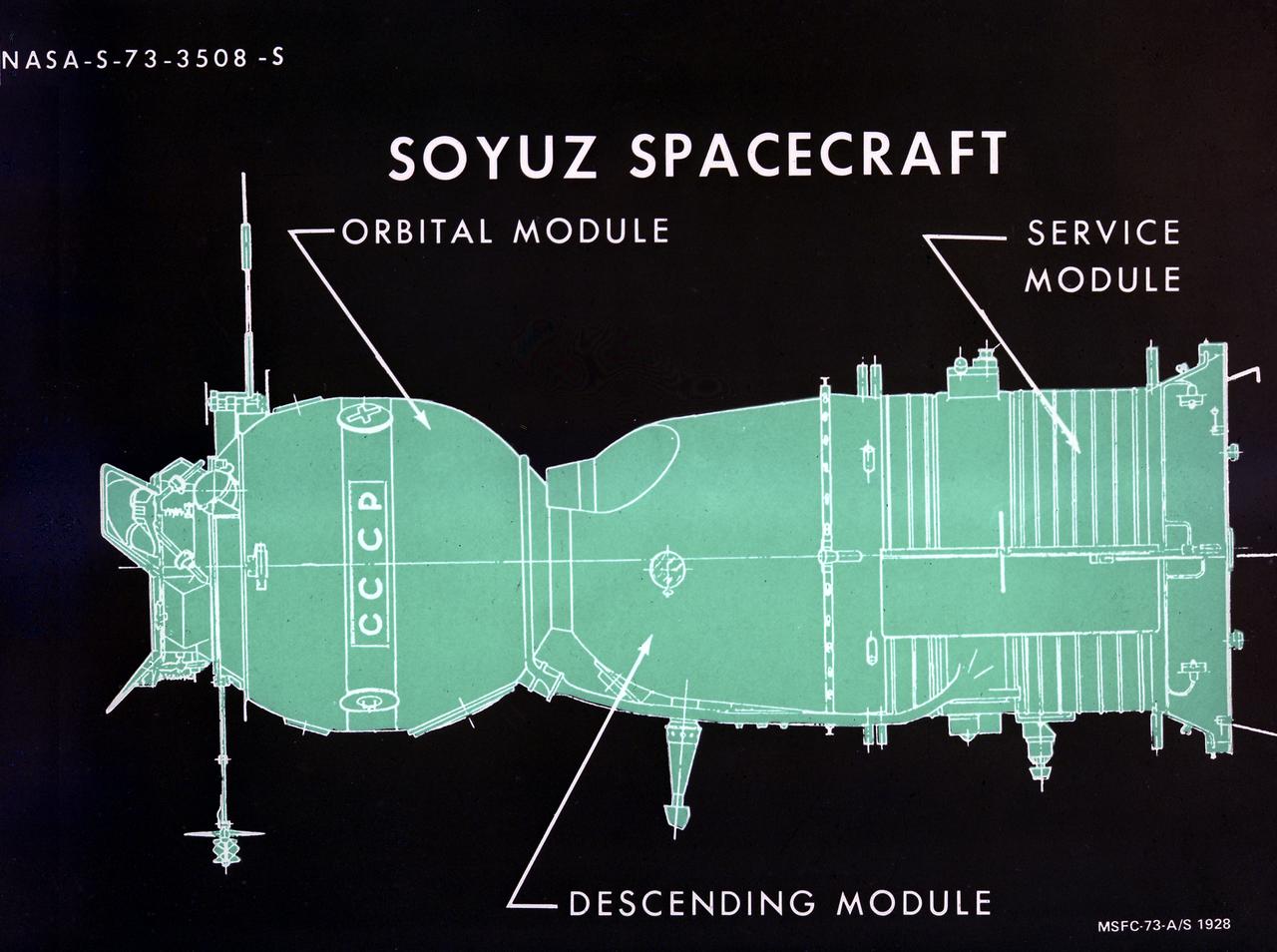
This illustration depicts a configuration of the Soyuz spacecraft for the Apollo-Soyuz Test Project (ASTP). The ASTP was the first international docking of the U.S.'s Apollo spacecraft and the U.S.S.R.'s Soyuz spacecraft in space. For this project, the Soviets built another in their continuing series of Soyuz space capsules. The U.S. used the Saturn IB Apollo capsule. A joint engineering team from the two countries met to develop a docking system that permitted the two spacecraft to link in space and allowed the crews to travel from one spacecraft to the other.
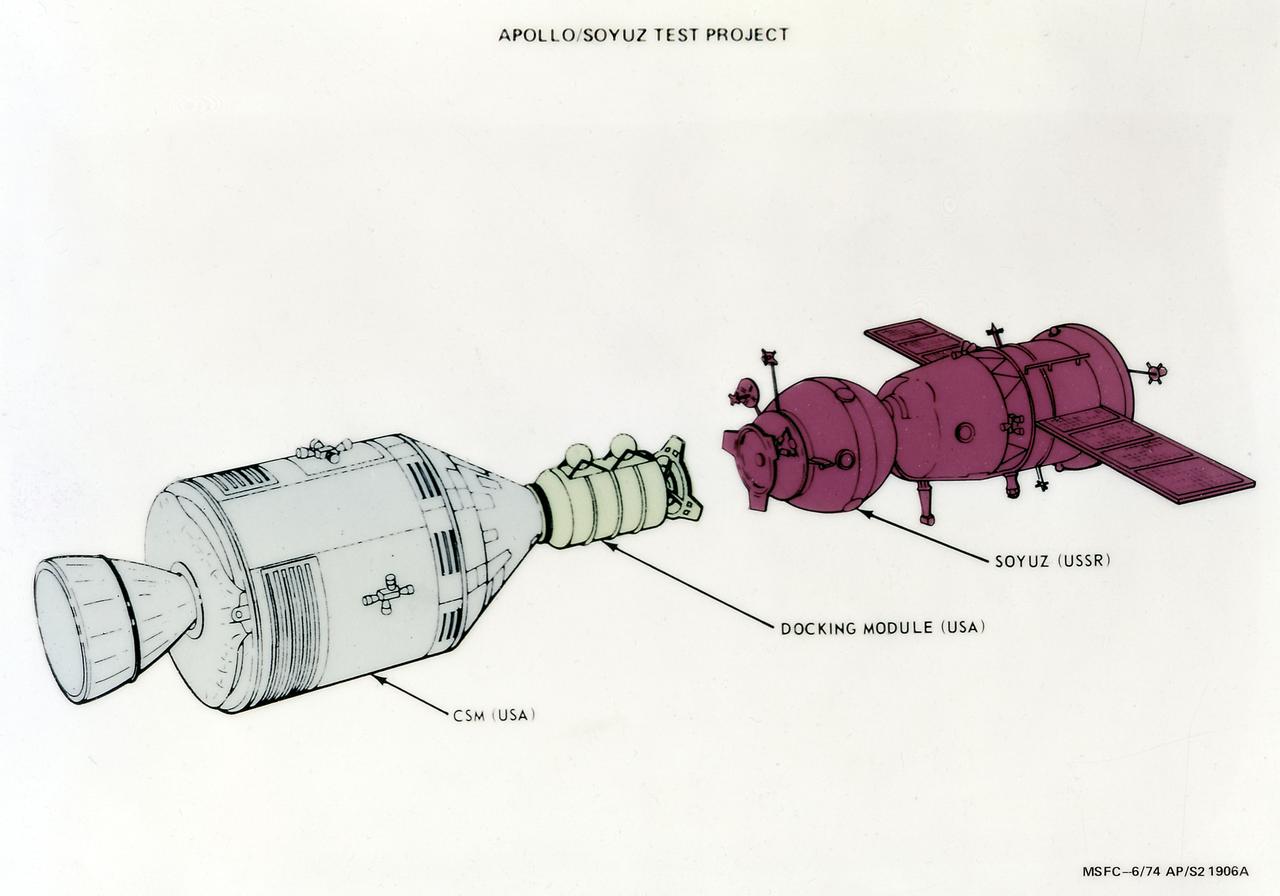
This illustration shows the docking configuration of the Apollo-Soyuz Test Project (ASTP). The ASTP was the first international docking of the U.S.'s Apollo spacecraft and the U.S.S.R.'s Soyuz spacecraft in space. A joint engineering team from the two countries met to develop a docking system that permitted the two spacecraft to link in space and allowed the two crews to travel from one spacecraft to the other. This system entailed developing a large habitable Docking Module (DM) to be carried on the Apollo spacecraft to facilitate the joining of two dissimilar spacecraft. The Marshall Space Flight Center was responsible for development and sustaining engineering of the Saturn IB launch vehicle during the mission. The ASTP marked the last use of the Saturn Launch Vehicle.
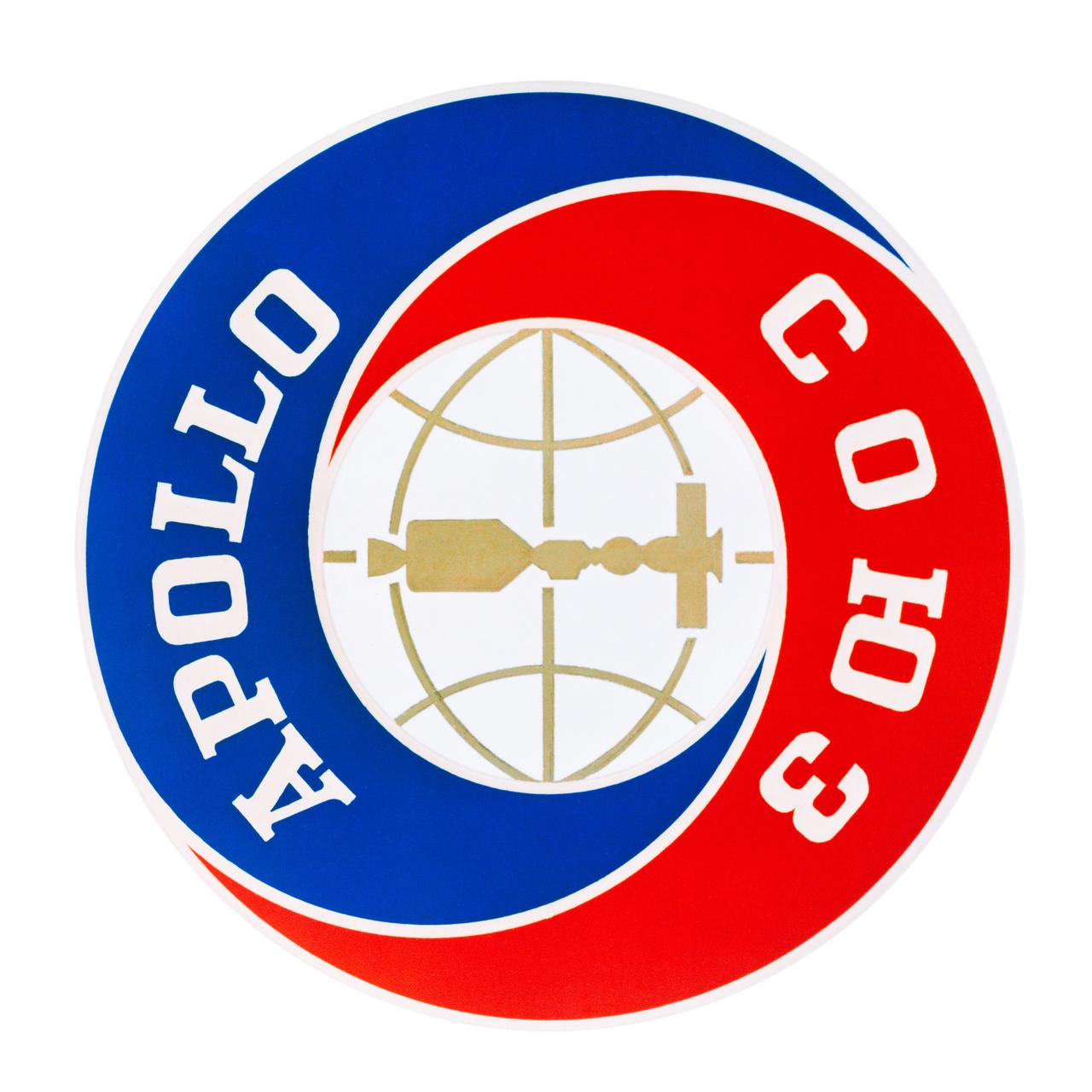
S74-17843 (March 1974) --- This is the official emblem of the Apollo-Soyuz Test Project chosen by NASA and the Soviet Academy of Sciences. The joint U.S.-USSR space mission is scheduled to be flown in July 1975. Of circular design, the emblem has the words Apollo in English and Soyuz in Russian around a center disc which depicts the two spacecraft docked together in Earth orbit. The Apollo-Soyuz Test Project will be carried out by a Soviet Soyuz spacecraft and a U.S. Apollo spacecraft which will rendezvous and dock in orbit. Soyuz and Apollo will remain docked for as long as two days in which period, the three Apollo astronauts will enter Soyuz and the two Soyuz cosmonauts will visit Apollo via a docking module. The Russian word "soyuz" means "union" in English.
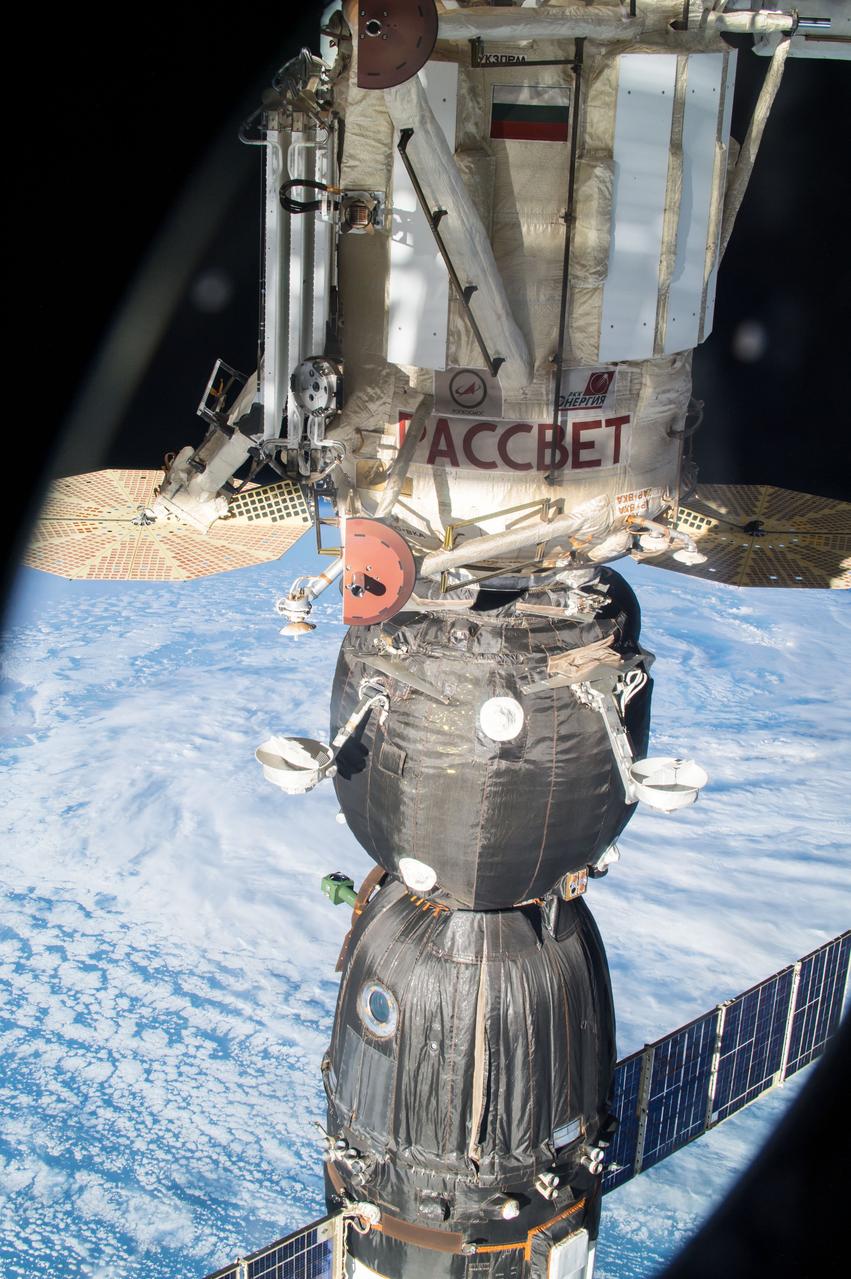
iss053e210873 (Nov. 16, 2017) --- The Soyuz MS-05 crew spacecraft is pictured docked to the Rassvet Mini-Research Module-1. Pictured behind the Soyuz spacecraft and its docking port are the dual cymbal-like UltraFlex solar arrays that power the Orbital ATK Cygnus resupply ship.
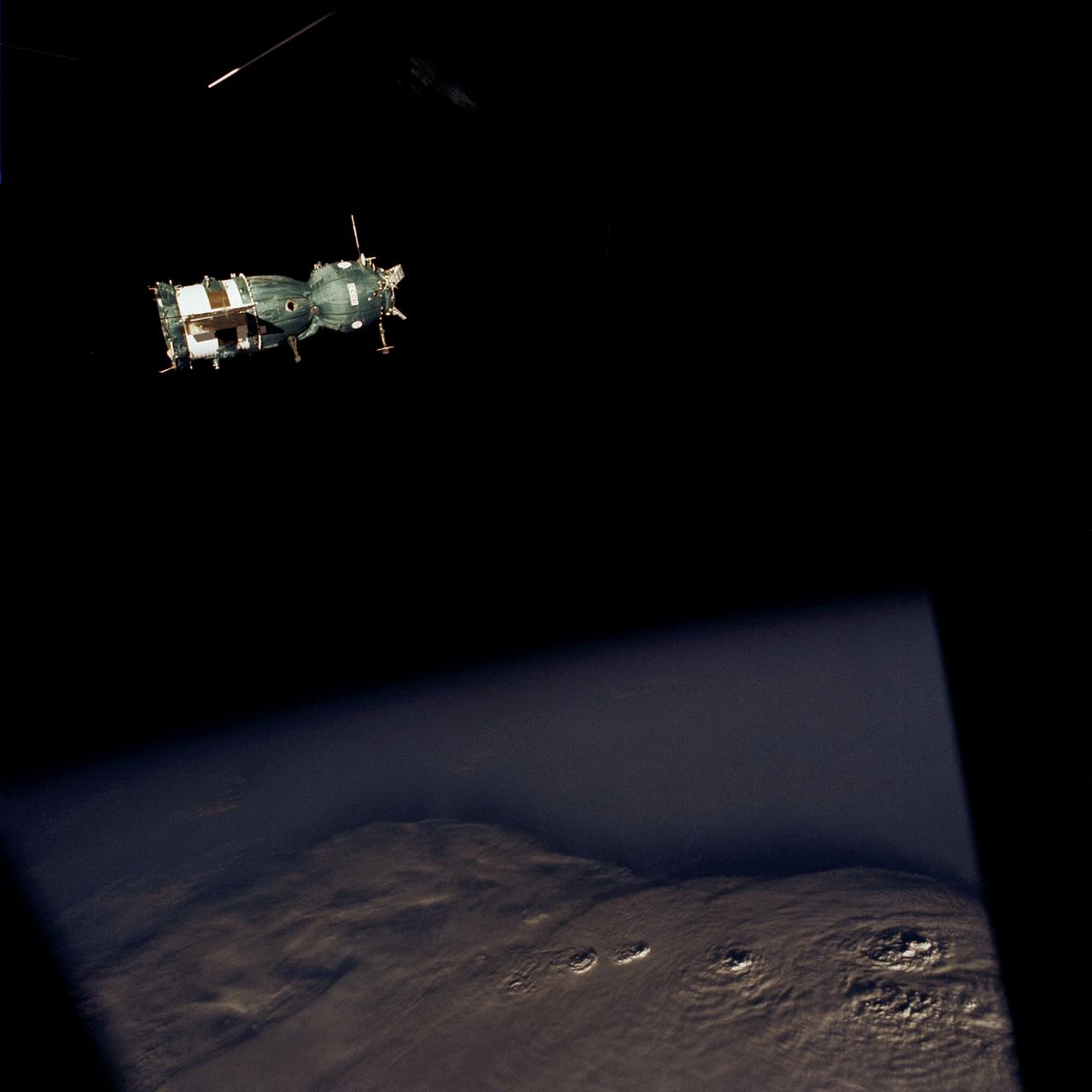
AST-02-096 (18 July 1975) --- This scene photograph from a rendezvous window of the American Apollo spacecraft in Earth orbit shows the Soviet Soyuz spacecraft contrasted against a black-sky background with a heavily cloud-covered Earth below. The three major components of the Soyuz are the spherical-shaped Orbital Module, the bell-shaped Descent Vehicle, the cylindrical-shaped Instrument Assembly Module. The docking system on the Orbital Module was specially designed to interface with the docking system on the Apollo's Docking Module. The ASTP astronauts and cosmonauts visited each other's spacecraft while the Soyuz and Apollo were docked in Earth orbit for two days.
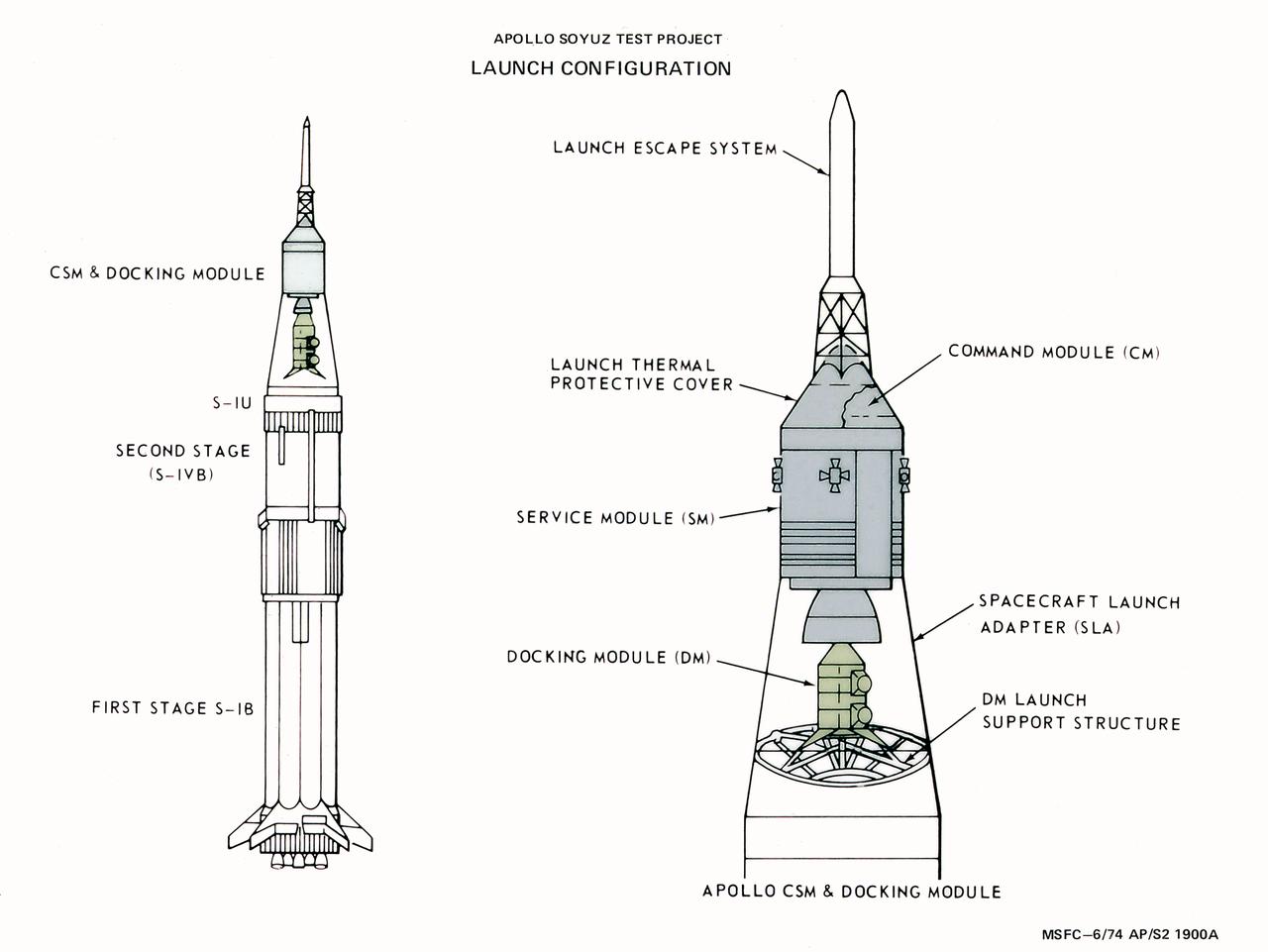
This illustration depicts the launch configuration of the Apollo spacecraft for the Apollo-Soyuz Test Project (ASTP). The ASTP was the first international docking of the U.S.'s Apollo spacecraft and the U.S.S.R.'s Soyuz spacecraft in space. A joint engineering team from the two countries met to develop a docking system that permitted the two spacecraft to link in space and allowed the two crews to travel from one spacecraft to the other. This system entailed developing a large habitable Docking Module (DM) to be carried on the Apollo spacecraft to facilitate the joining of two dissimilar spacecraft. The Marshall Space Flight Center was responsible for development and sustaining engineering of the Saturn IB launch vehicle during the mission.
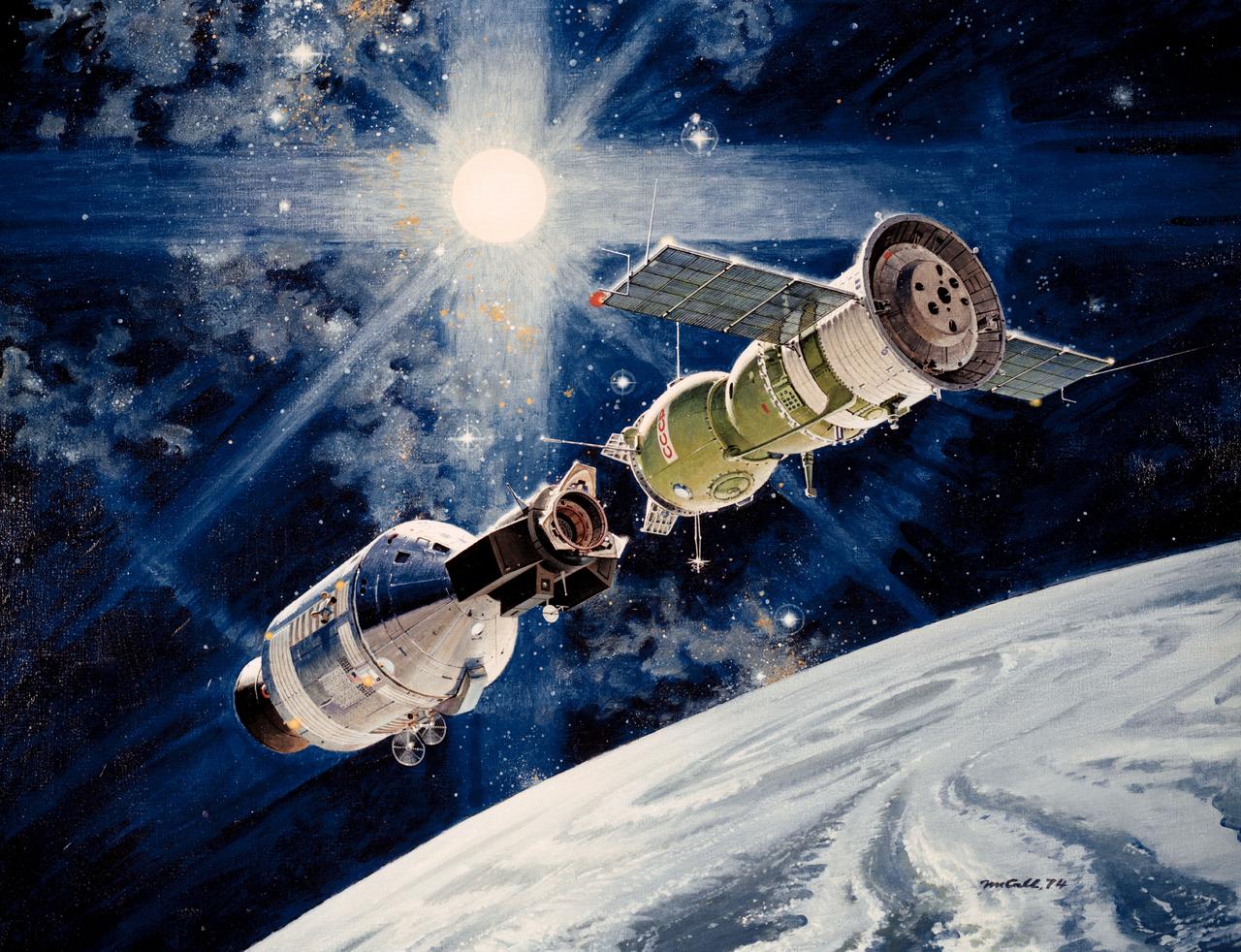
S74-24913 (August 1973) --- An artist's concept illustrating an Apollo-type spacecraft (left) about to dock with a Soviet Soyuz-type spacecraft. A recent agreement between the United States (USA) and the Union of Soviet Socialist Republic (USSR) provides for the docking in space of the Soyuz and Apollo-type spacecraft in Earth orbit in 1975. The joint space venture is called the Apollo-Soyuz Test Project (ASTP).
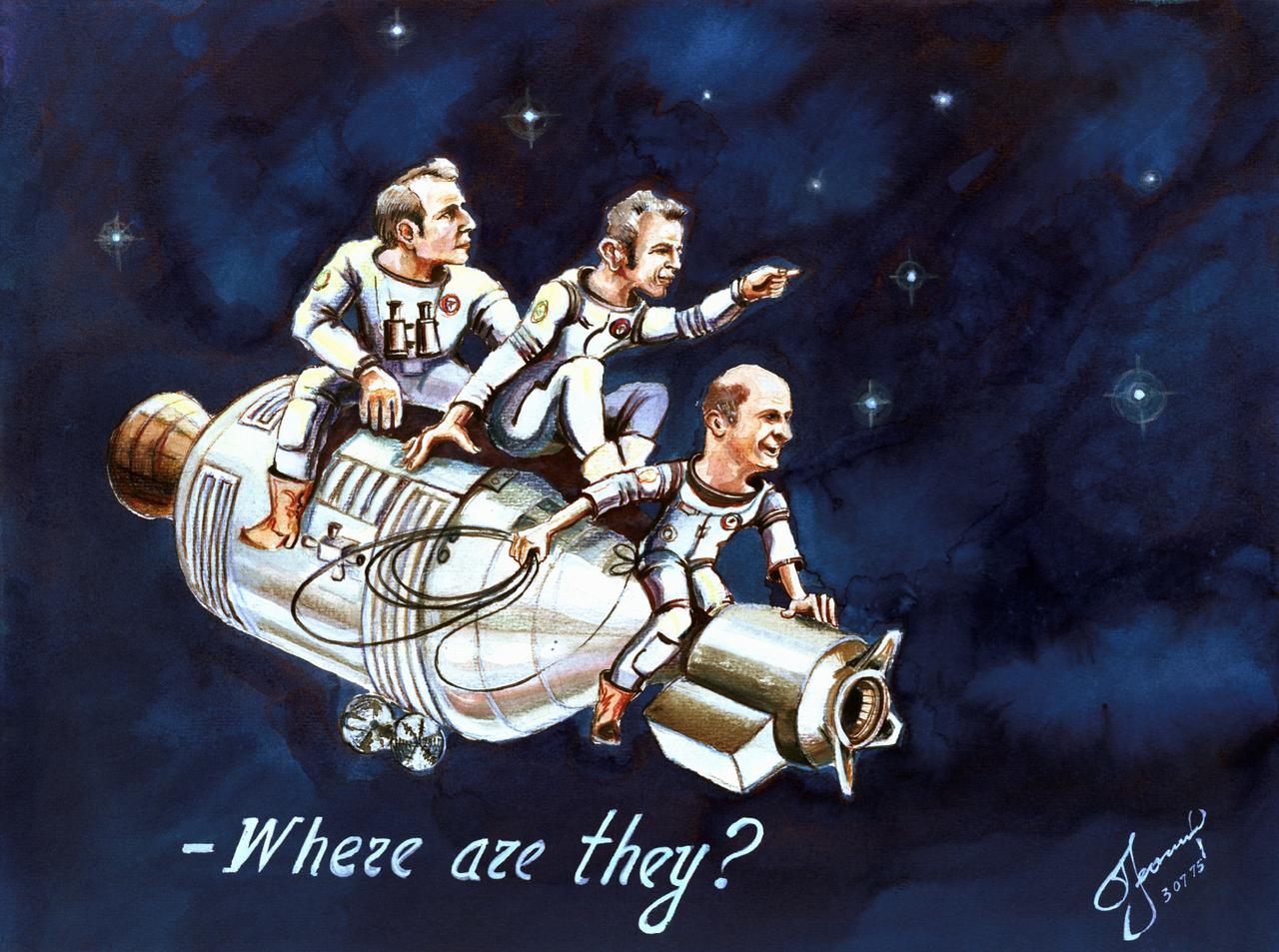
S75-28504 (17 July 1975) --- The American ASTP crewmen search the skies for the Soviet Soyuz spacecraft in this humorous artwork by cosmonaut Aleksey A. Leonov. Astronauts Vance D. Brand, Donald K. Slayton and Thomas P. Stafford (left to right) sit astride the Apollo spacecraft and Docking Module ready to lasso Soyuz. The cartoon humorously depicts the approaching historic event of an American spacecraft rendezvousing and docking in Earth orbit with a USSR spacecraft, scheduled today (July 17, 1975). Aboard Soyuz are Leonov, crew commander, and his fellow cosmonaut, Valeriy N. Kubasov. Stafford is the Apollo crew commander. The U.S. and USSR crewmen will visit each other's spacecraft while the Apollo and Soyuz are docked in Earth orbit for two days. Leonov, an accomplished artist, specializes in paintings on space subjects. He has a number of paintings on public exhibit in his native land.
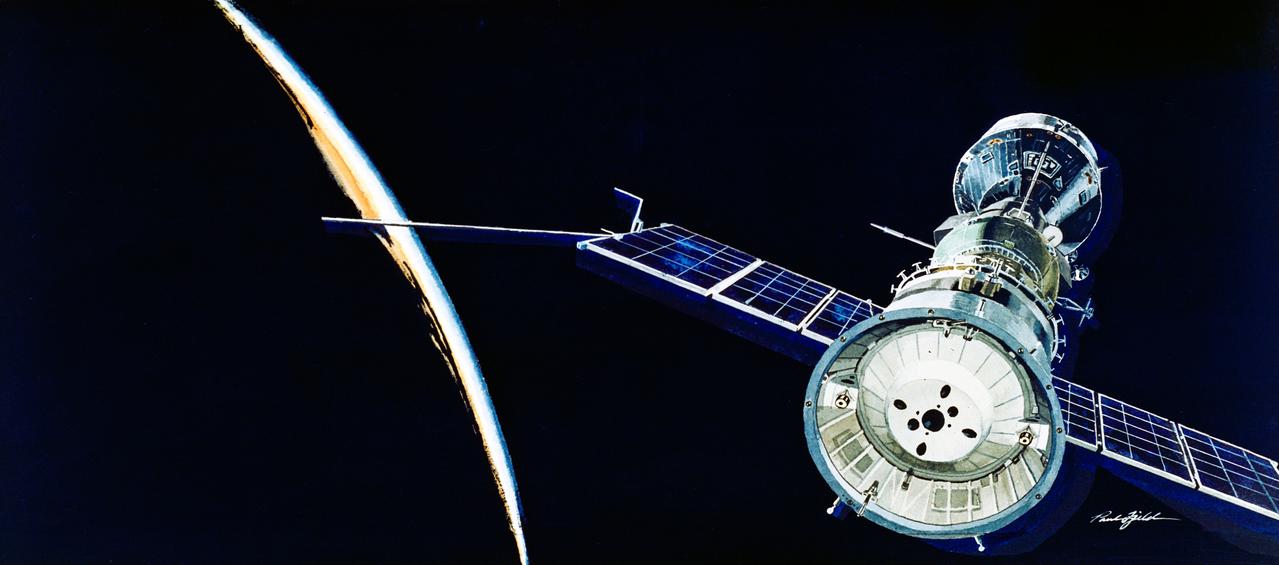
S75-27287 (May 1975) --- An artist?s concept depicting an American Apollo spacecraft docked with a Soviet Soyuz spacecraft in Earth orbit. This view is looking toward the aft end of Soyuz, with the Apollo in the background. Two solar panels protrude out from the instrument assembly module of the Soyuz. The glow on Earth?s horizon is seen on the left. During the joint U.S.-USSR Apollo-Soyuz Test Project mission, scheduled for July 1975, the American and Soviet crews will visit one another?s spacecraft while the Soyuz and Apollo are docked for a maximum period of two days. This artwork is by Paul Fjeld.
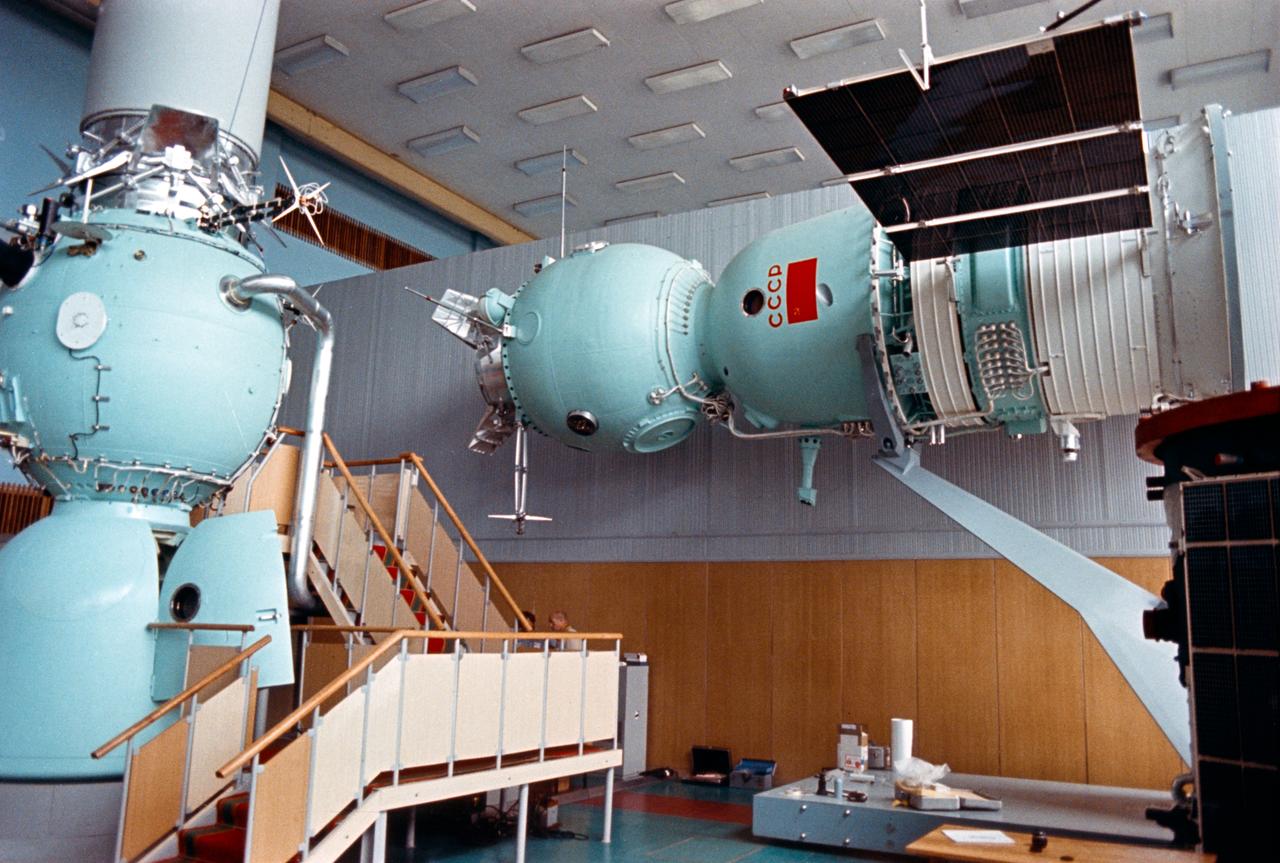
S74-24675 (June 1974) --- Two mock-ups of the USSR Soyuz spacecraft which are on display at the Cosmonaut Training Center (Star City) near Moscow. The Soyuz spacecraft mounted vertically on the left is a training mock-up. The Soyuz mounted horizontally on the right was exhibited at the Paris air show in May-June 1973 in a docked configuration with an Apollo spacecraft. The spherical-shaped section of the Soyuz is called the orbital module. The middle section with the lettering ?CCCP? (USSR) on it called the descent vehicle. Two solar panels extend out from the instrument-assembly module. The joint U.S.-USSR Apollo-Soyuz docking mission in Earth orbit is scheduled for the summer of 1975. A docking module mock-up is atop the Soyuz training mock-up on the left.
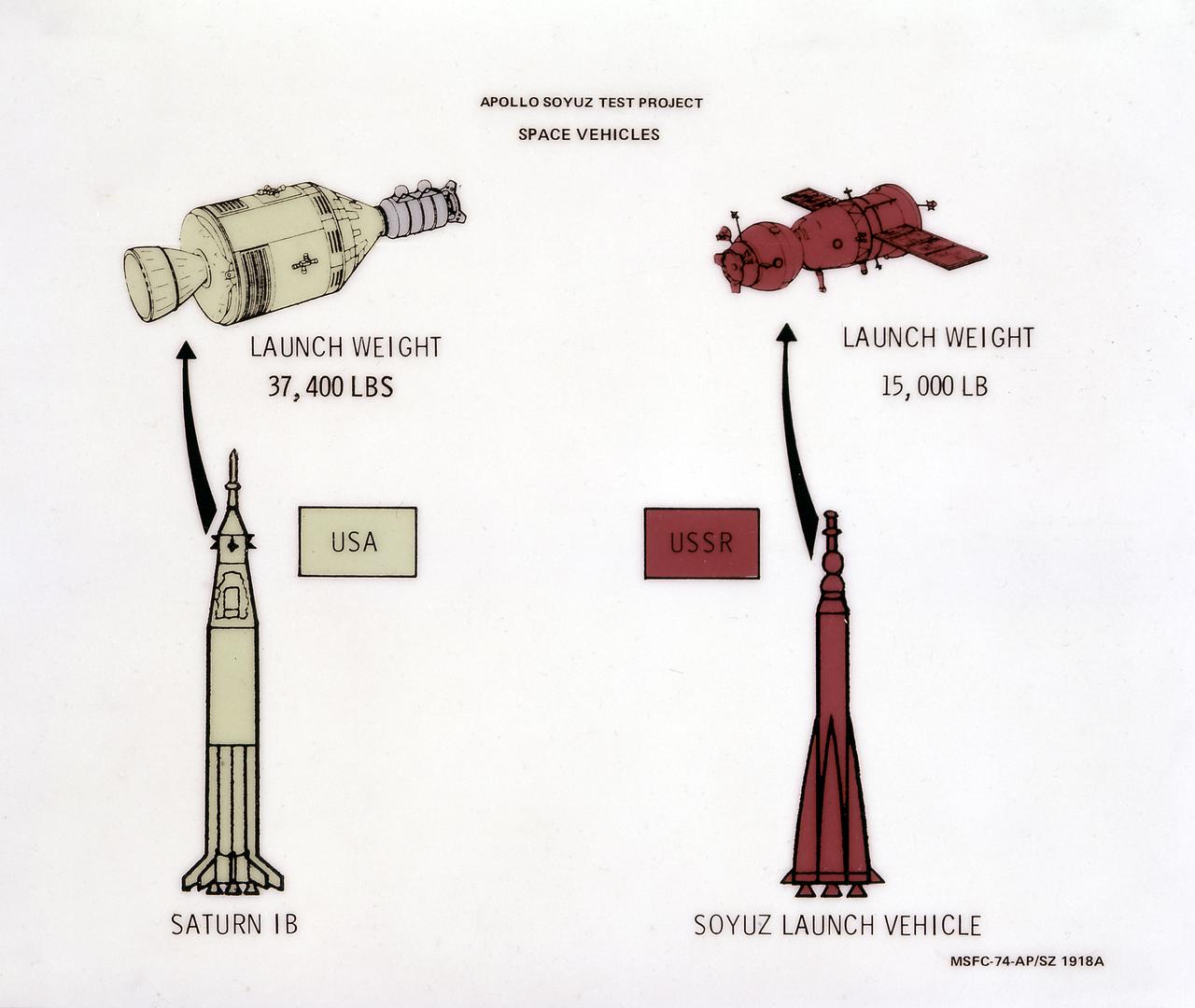
This illustration depicts a comparison of two space vehicles, the U.S.'s Saturn IB launch vehicle and the U.S.S.R.'s Soyuz launch vehicle, for the Apollo-Soyuz Test Project. The ASTP was the first international docking of the U.S.'s Apollo spacecraft and the U.S.S.R.'s Soyuz spacecraft in space. A joint engineering team from the two countries met to develop a docking system that permitted the two spacecraft to link in space and allowed the two crews to travel from one spacecraft to the other. This system entailed developing a large habitable Docking Module (DM) to be carried on the Apollo spacecraft to facilitate the joining of two dissimilar spacecraft. The Marshall Space Flight Center was responsible for development and sustaining engineering of the Saturn IB launch vehicle during the mission.
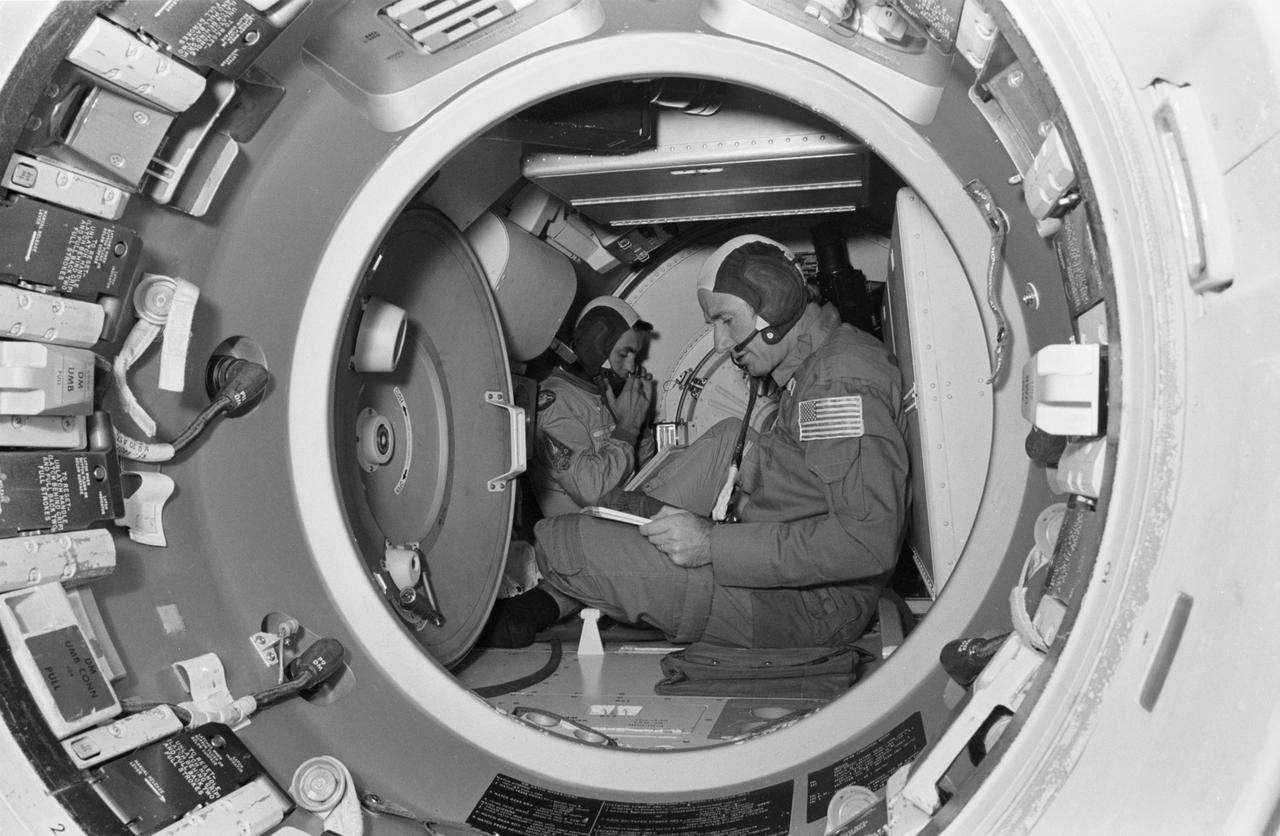
S74-28972 (20 Sept. 1974) --- Astronaut Vance D. Brand (foreground) and cosmonaut Aleksandr S. Ivanchenko are seated in the Docking Module trainer in Building 35 during Apollo-Soyuz Test Project simulation training at the Johnson Space Center. Brand is the command module pilot of the American ASTP prime crew. Ivanchenko is the engineer on the Soviet ASTP fourth crew (backup). During the exercise the American ASTP crew and the Soviet ASTP crew simulated docking the Apollo and Soyuz in Earth orbit and transferring to each other?s spacecraft. The Docking Module is designed to link the Apollo and Soyuz spacecraft. The ASTP crewmen are training in both the U.S. and USSR for the joint mission scheduled for the summer of 1975. This view is looking from inside the Command Module into the Docking Module. The hatchway loading into the Soyuz spacecraft orbital module mock-up is in the background.
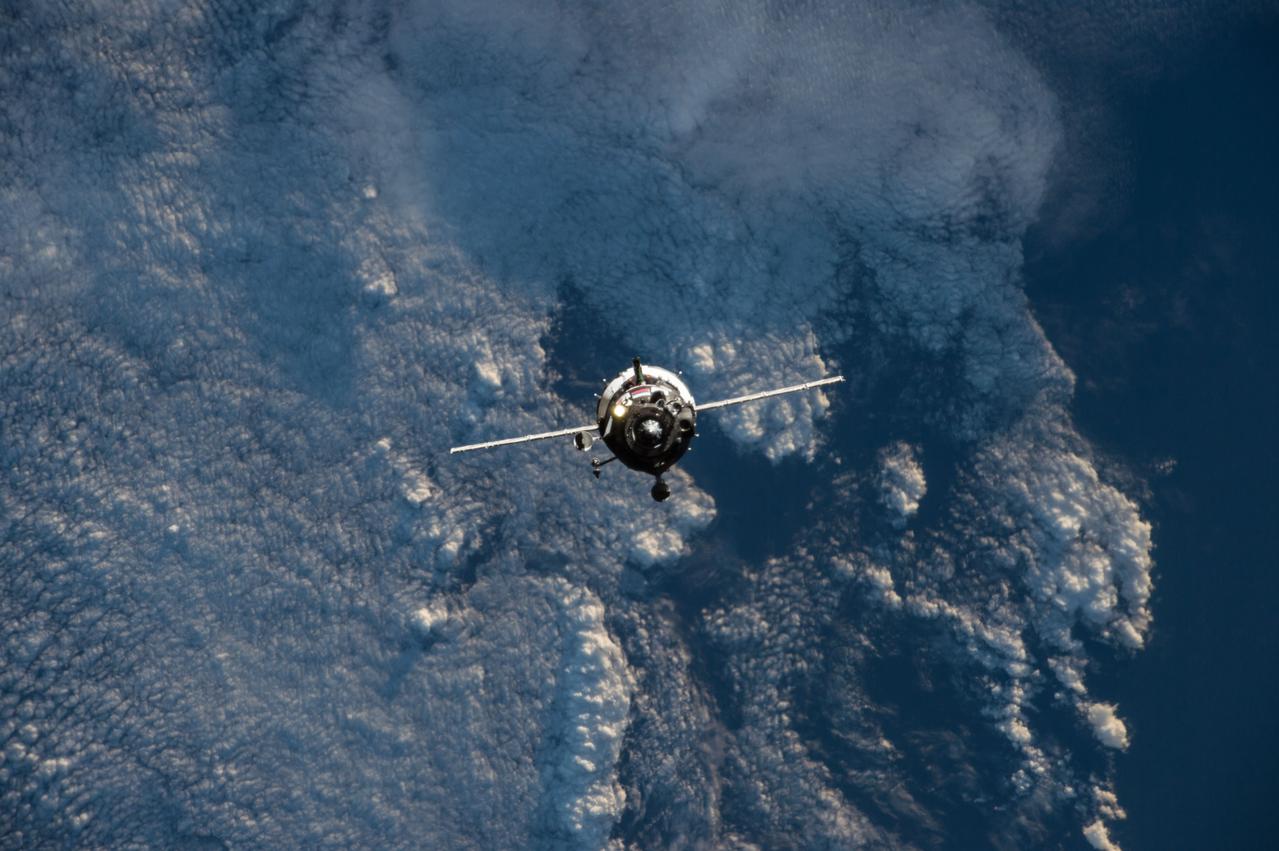
View of the Soyuz TMA-15M spacecraft as it approaches the ISS for rendezvous and docking. Image was released by astronaut on Instagram.

View of the Cupola window as documented by the Expedition 36 crew. Earth is visible through the window as well as docked Soyuz and Progress spacecraft.
Earth observation taken by the Expedition 35 crew aboard the ISS. The docked Soyuz TMA-07M and Progress 50P spacecraft are in view.
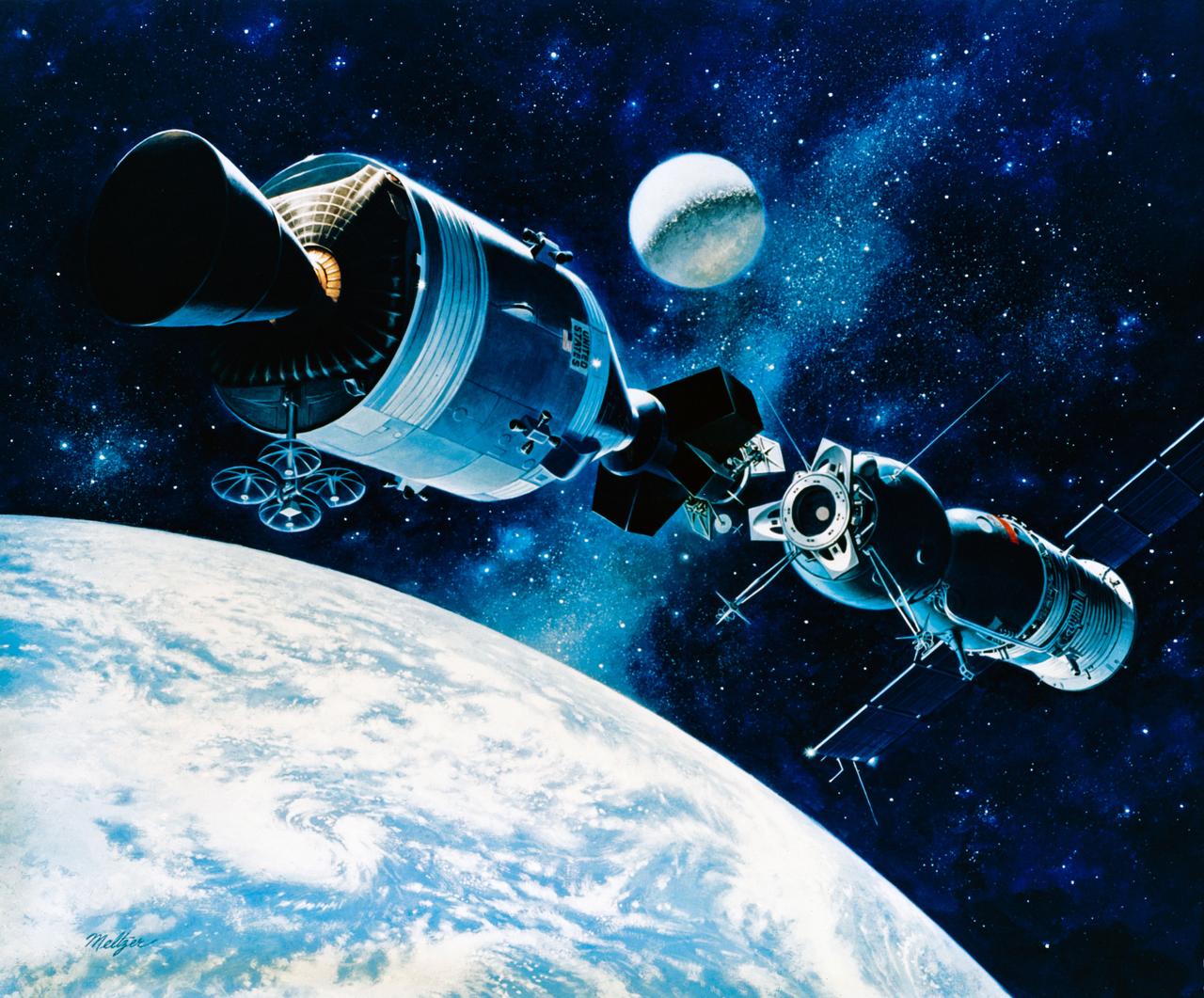
S75-27285 (April 1975) --- An artist's concept depicting an American Apollo spacecraft rendezvousing with a Soviet Soyuz spacecraft in Earth orbit. The two spacecraft are in a near-docked configuration. During the joint U.S.-USSR Apollo-Soyuz Test Project (ASTP) mission, which is scheduled for July 1975, the American and Soviet crews will visit each other's spacecraft while the Soyuz and Apollo are docked for a maximum period of two days. The mission is designed to test equipment and techniques that will establish international crew rescue capability in space, as well as permit future cooperative scientific missions. This artwork is by Davis Meltzer.
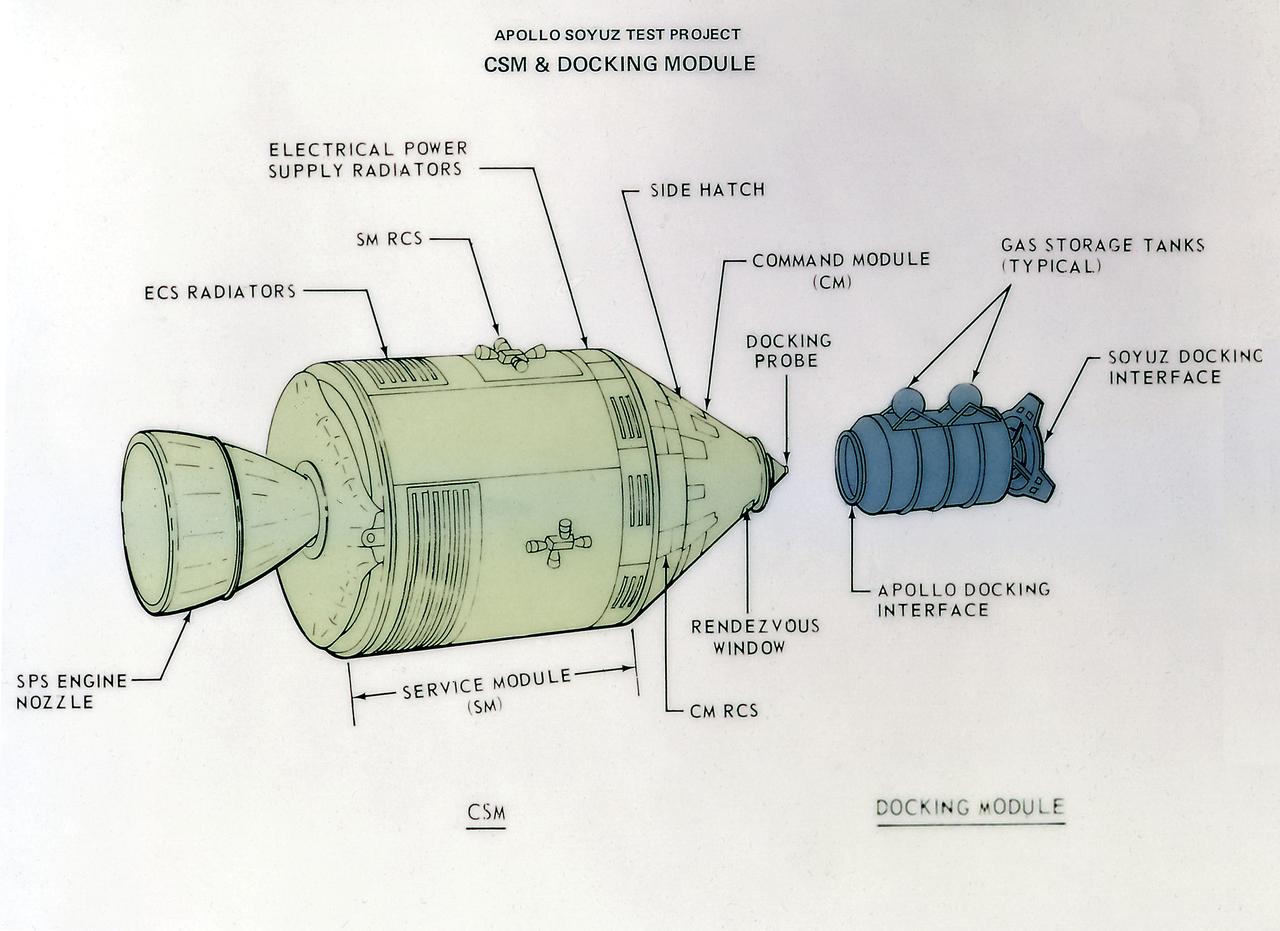
This illustration depicts a configuration of the Command Service Module (CSM) and Docking Module (DM) for the Apollo-Soyuz Test Project (ASTP). The ASTP was the first international docking of the U.S.'s Apollo spacecraft and the U.S.S.R.'s Soyuz spacecraft in space. A joint engineering team from the two countries met to develop a docking system that permitted the two spacecraft to link in space and allowed the two crews to travel from one spacecraft to the other. This system entailed developing a large habitable Docking Module (DM) to be carried on the Apollo spacecraft to facilitate the joining of two dissimilar spacecraft. The Marshall Space Flight Center was responsible for development and sustaining engineering of the Saturn IB launch vehicle during the mission. The ASTP marked the last use of the Saturn Launch Vehicle.
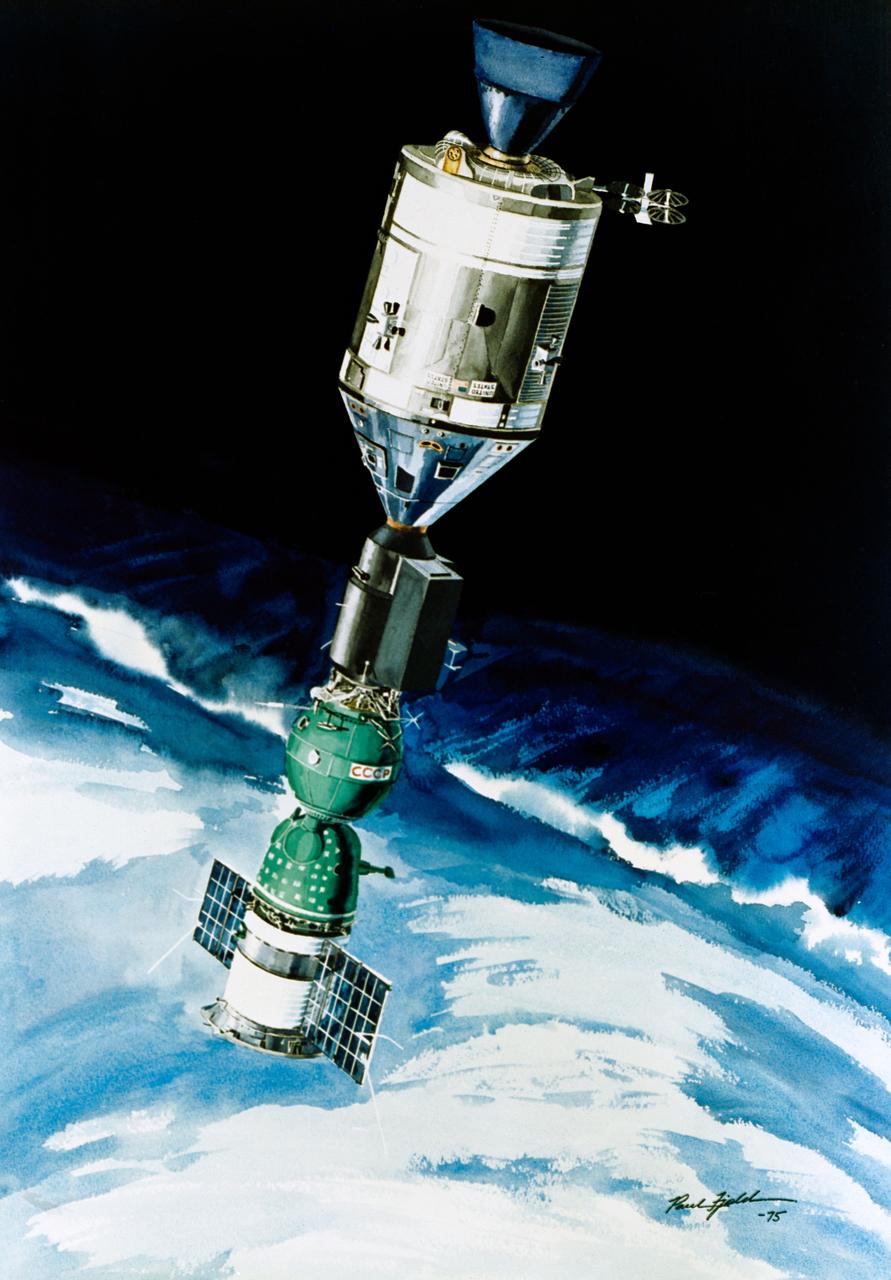
S75-27289 (May 1975) --- An artist?s concept depicting the American Apollo spacecraft docked with a Soviet Soyuz spacecraft in Earth orbit. During the joint U.S.-USSR Apollo-Soyuz Test Project mission, scheduled for July 1975, the American and Soviet crews will visit one another?s spacecraft while the Soyuz and Apollo are docked for a maximum period of two days. The mission is designed to test equipment and techniques that will establish international crew rescue capability in space, as well as permit future cooperative scientific missions. Each nation has developed separately docking systems based on a mutually agreeable single set of interface design specifications. The major new U.S. program elements are the docking module and docking system necessary to achieve compatibility of rendezvous and docking systems with the USSR-developed hardware to be used on the Soyuz spacecraft. The DM and docking system together with an Apollo Command/Service Module will be launched by a Saturn 1B launch vehicle. This artwork is by Paul Fjeld.
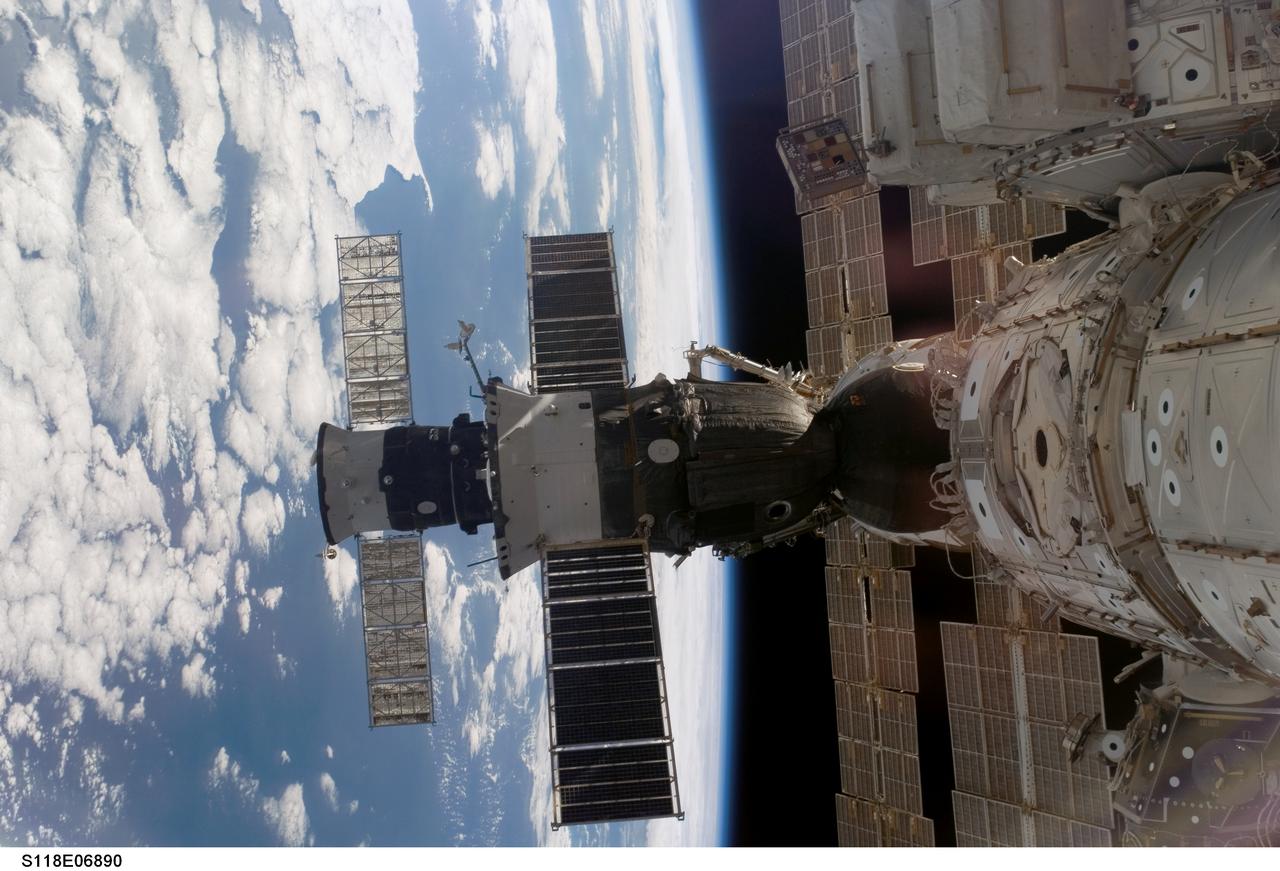
S118-E-06890 (12 Aug. 2007) --- The docked Soyuz 14 (TMA-10) (foreground) and Progress 26 resupply vehicle are featured in this image photographed by a STS-118 crewmember from a window on the International Space Station while Space Shuttle Endeavour remains docked with the station. The blackness of space and a blue and white Earth provide the backdrop for the scene.
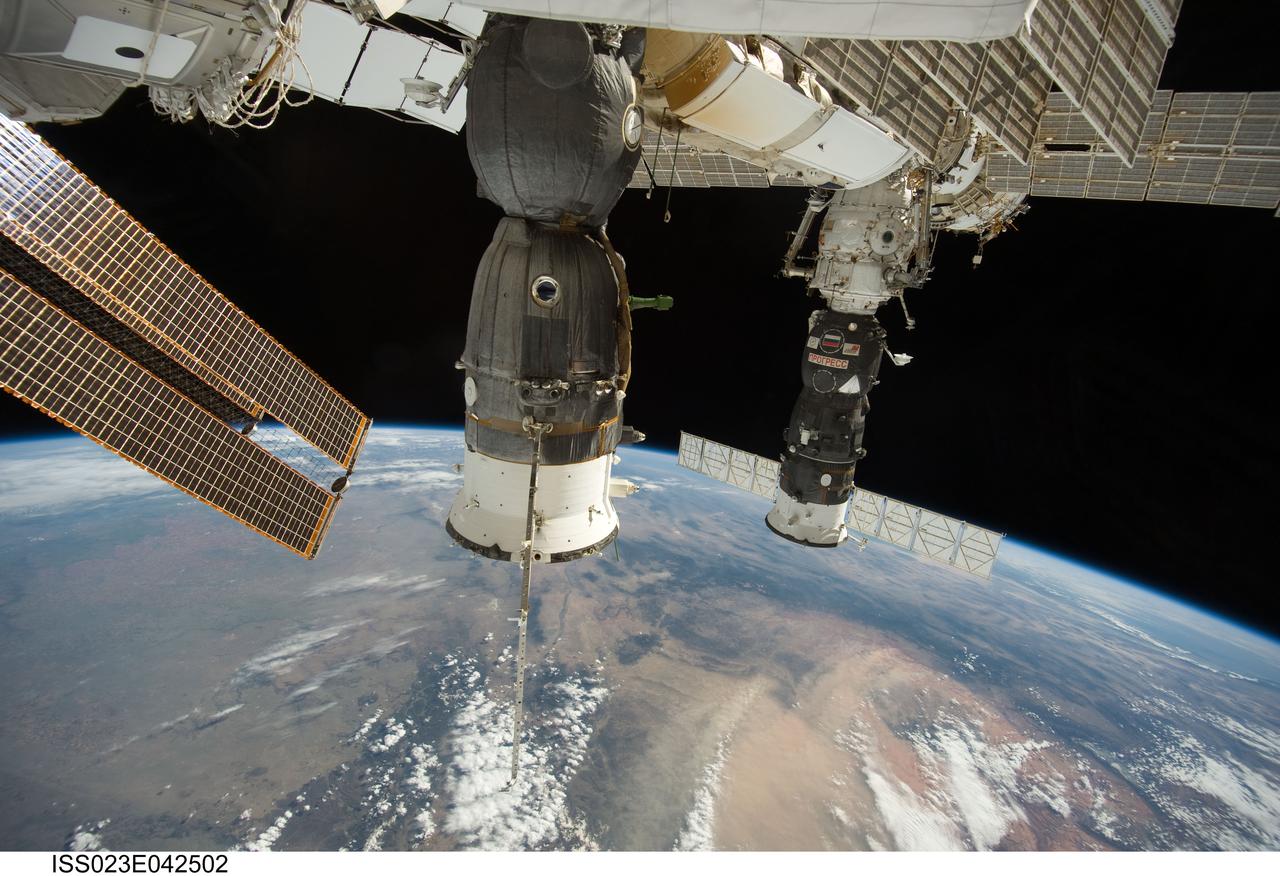
ISS023-E-042502 (11 May 2010) --- Two Russian spacecraft, docked with the International Space Station, are featured in this image photographed by an Expedition 23 crew member on the station. Earth?s horizon and the blackness of space provide the backdrop for the scene.
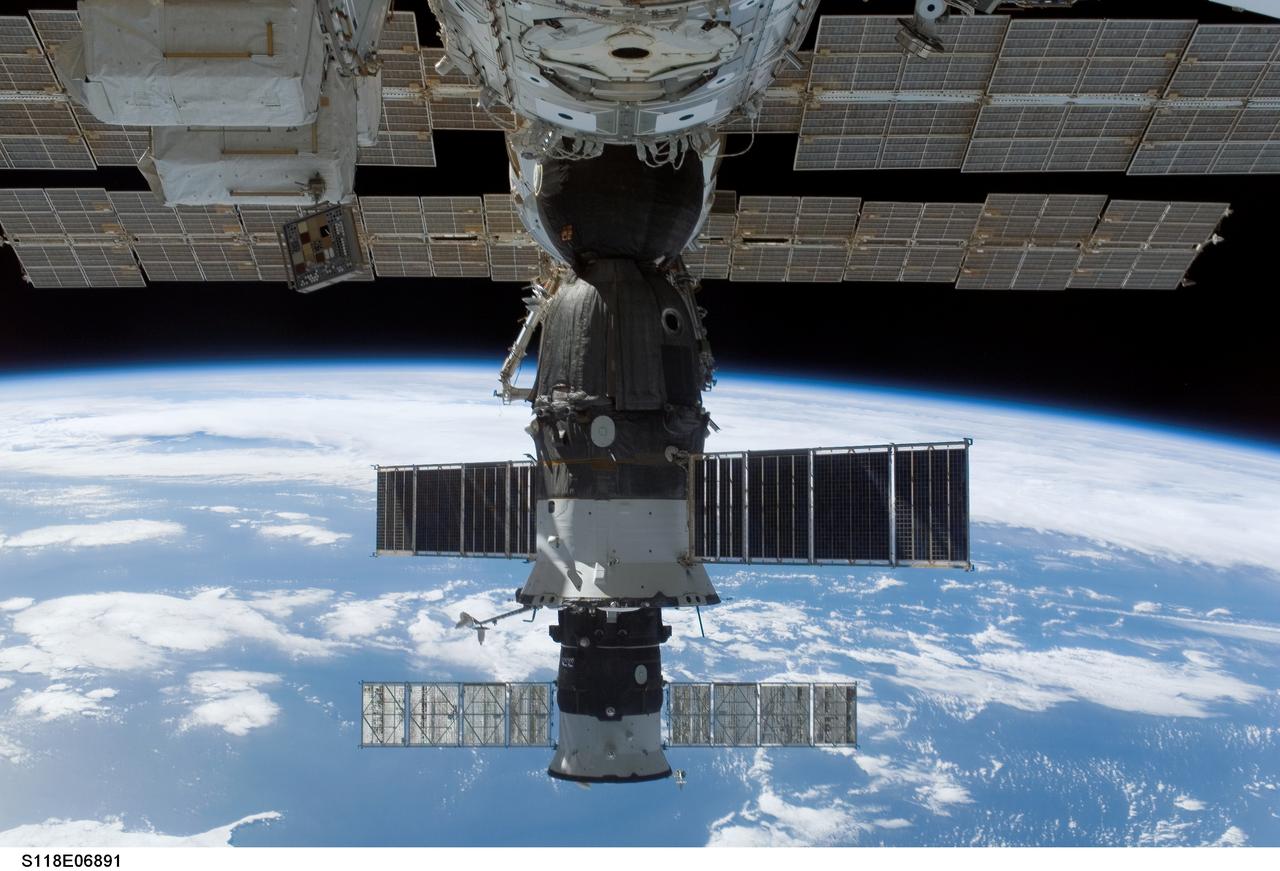
S118-E-06891 (12 Aug. 2007) --- The docked Soyuz 14 (TMA-10) (foreground) and Progress 26 resupply vehicle are featured in this image photographed by a STS-118 crewmember from a window on the International Space Station while Space Shuttle Endeavour remains docked with the station. The blackness of space and a blue and white Earth provide the backdrop for the scene.
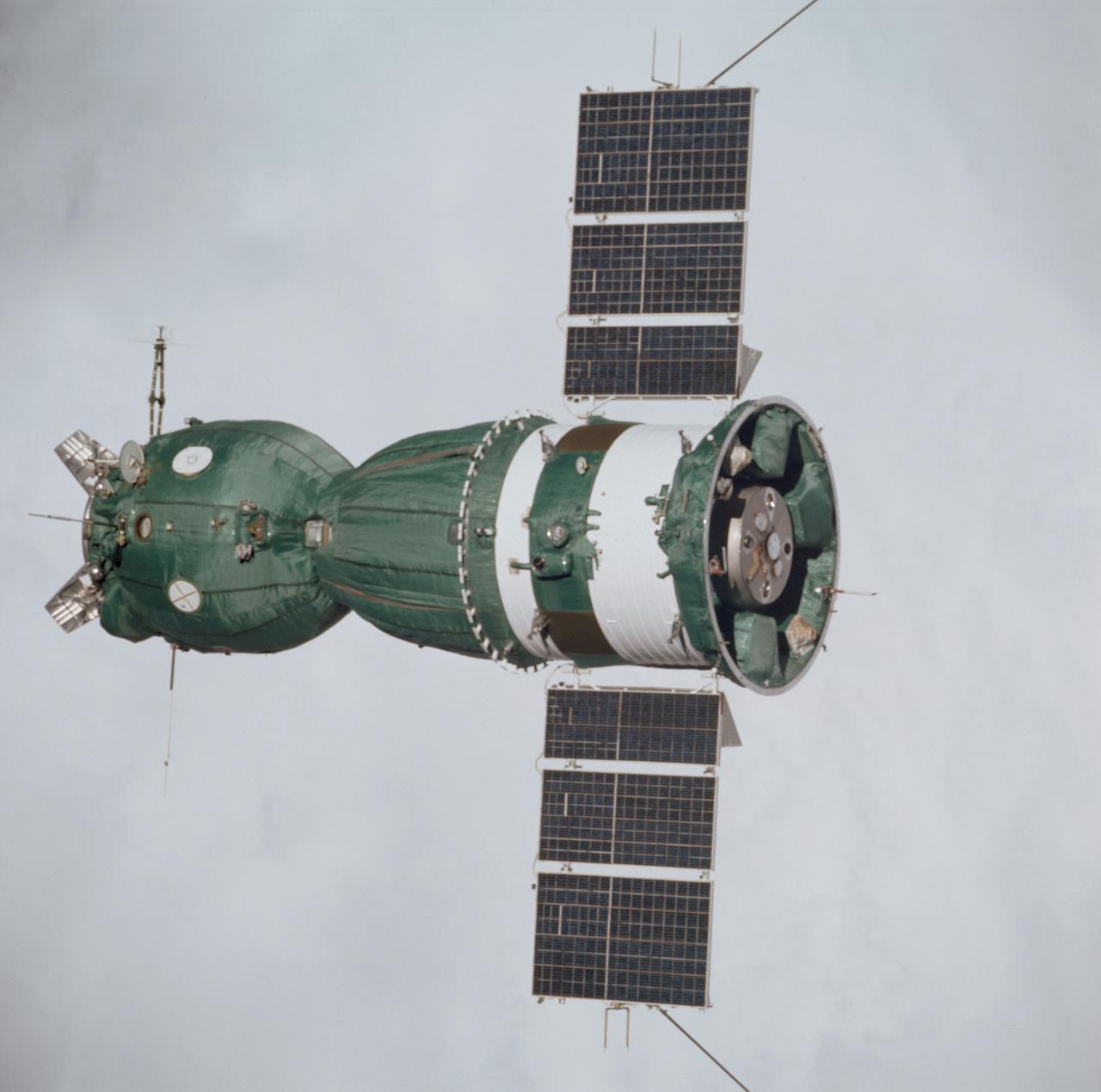
AST-01-056 (18 July 1975) --- An excellent view of the Soviet Soyuz spacecraft in Earth orbit, photographed from the American Apollo spacecraft during the joint U.S.-USSR Apollo-Soyuz Test Project (ASTP) docking mission in Earth orbit. The Soyuz is contrasted against a white-cloud background in this overhead view. The three major components of the Soyuz are the spherical-shaped Orbital Module, the bell-shaped Descent Vehicle and the cylindrical-shaped instrument Assembly Module from which two solar panels protrude. The docking system on the Orbital Module was specially designed to interface with the docking system on the Apollo's Docking Module. The ASTP astronauts and cosmonauts visited each other's spacecraft while the Soyuz and Apollo were docked in Earth orbit for two days. The Apollo crew consisted of astronauts Stafford, commander; Donald K. "Deke" Slayton, docking module pilot; and Vance D. Brand, command module pilot. The Soyuz 19 crew consisted of cosmonauts Leonov, command pilot; and Valeri N. Kubasov, flight engineer.
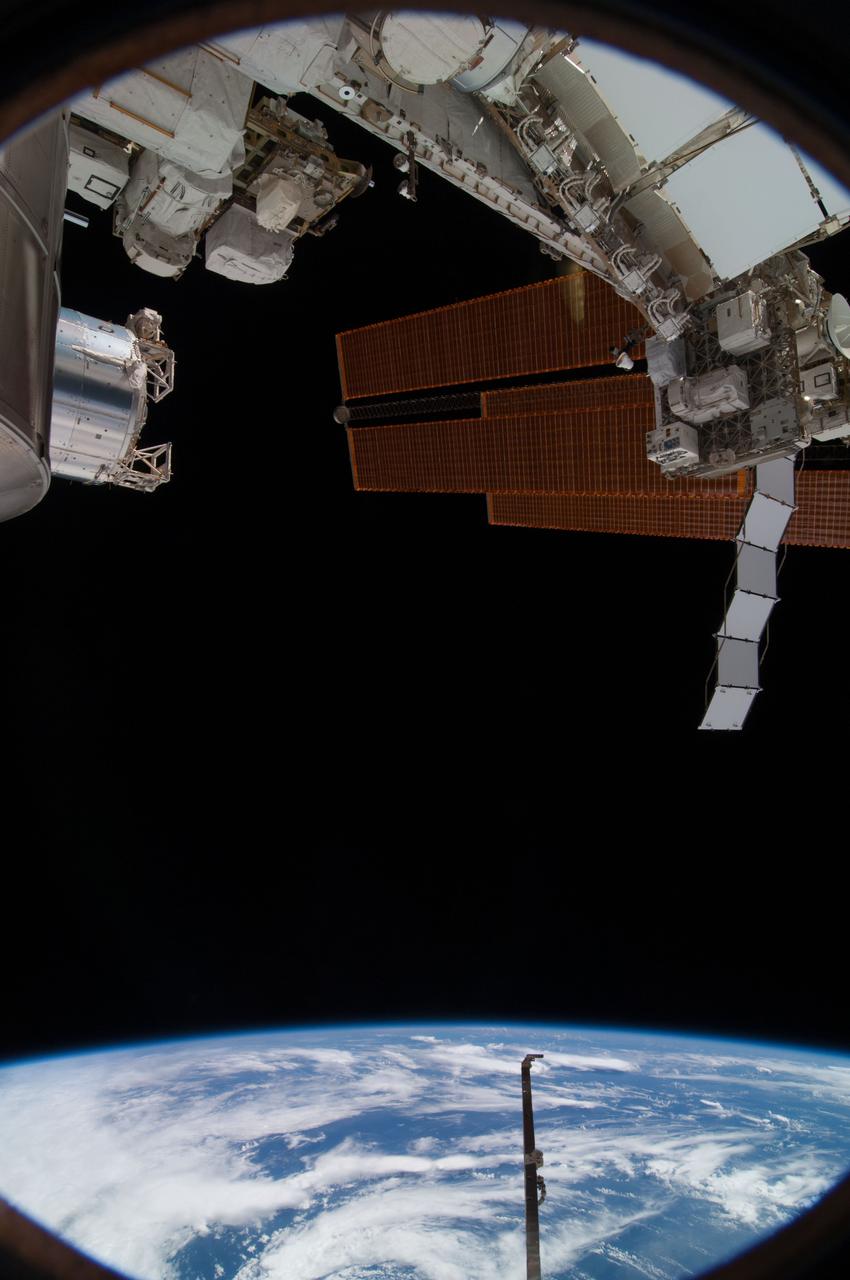
View of antenna and solar arrays (with an Earth limb in the background) taken from a window in the Russian Soyuz spacecraft currently docked to the International Space Station. Photo taken by an Expedition 36 crewmember. Per Twitter message: View out the window to the right of my seat in Soyuz while docked to ISS.
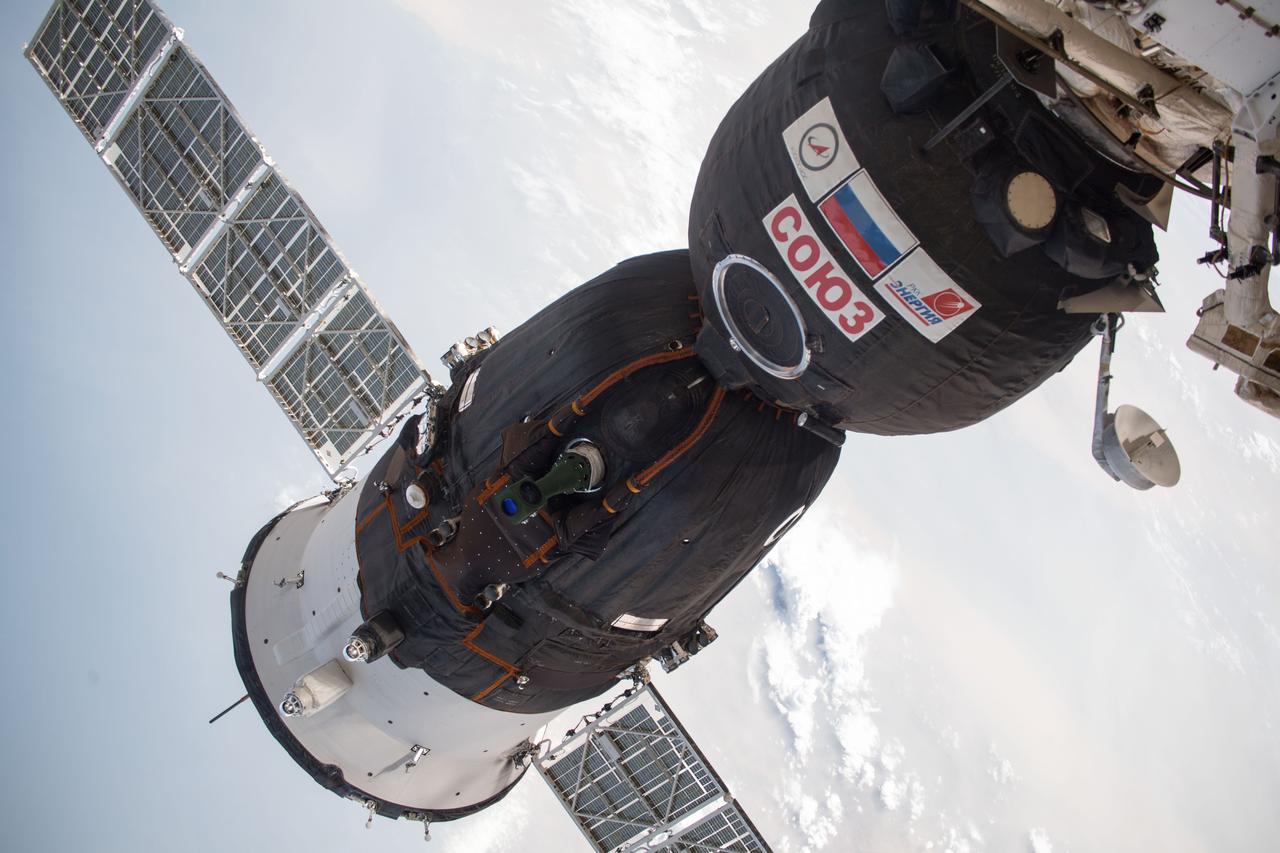
iss056e055758 (June 29, 2018) --- The Soyuz MS-09 spacecraft is pictured docked to the Rassvet module of the International Space Station's Russian segment. The Soyuz MS-09 launched Expedition 56-57 crew members Serena Auñón-Chancellor, Alexander Gerst and Sergey Prokopyev to the station on June 6, 2018 and docked on June 8.
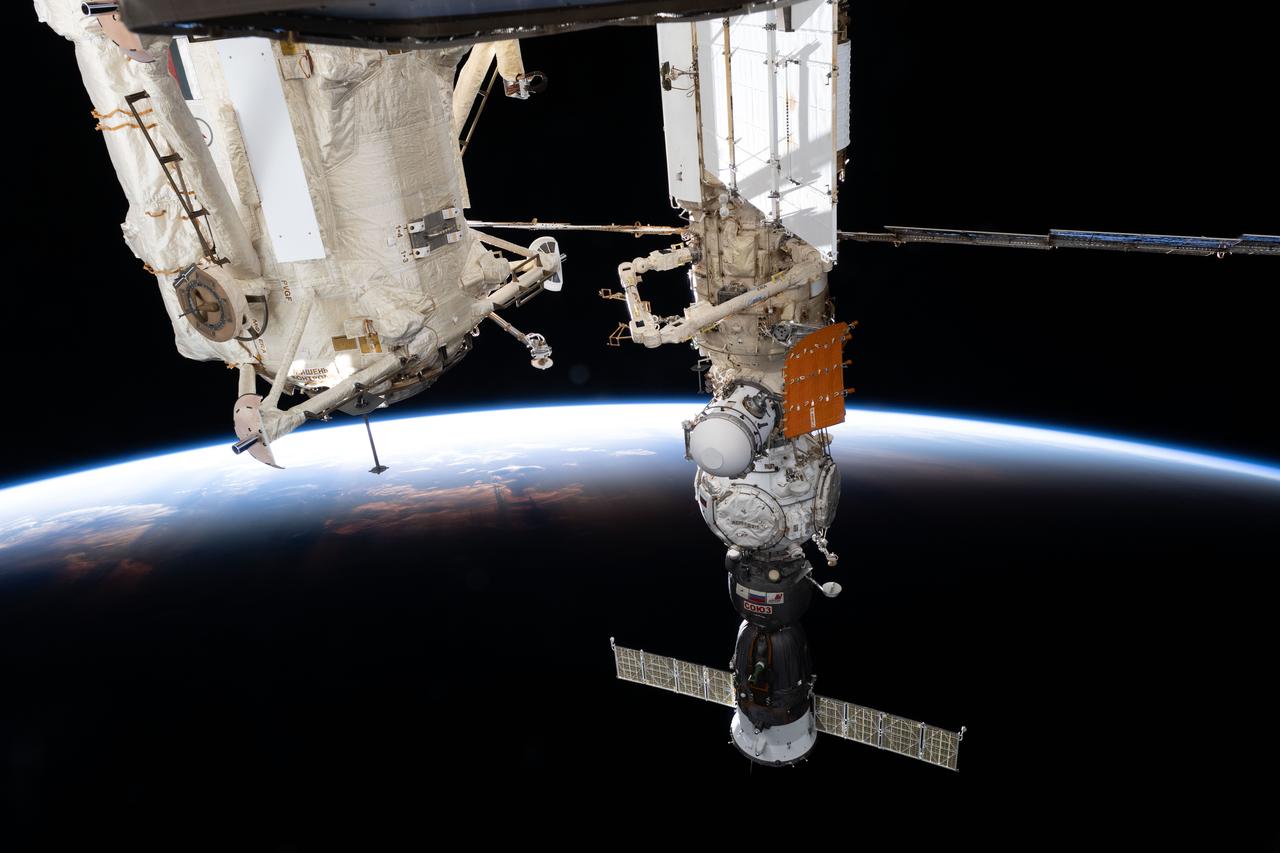
iss071e000013 (April 7, 2024) --- The Soyuz MS-25 spacecraft is pictured docked to the Prichal docking module as the International Space Station soared into an orbital sunset 260 miles above the Indian Ocean off the coast on Indonesia.
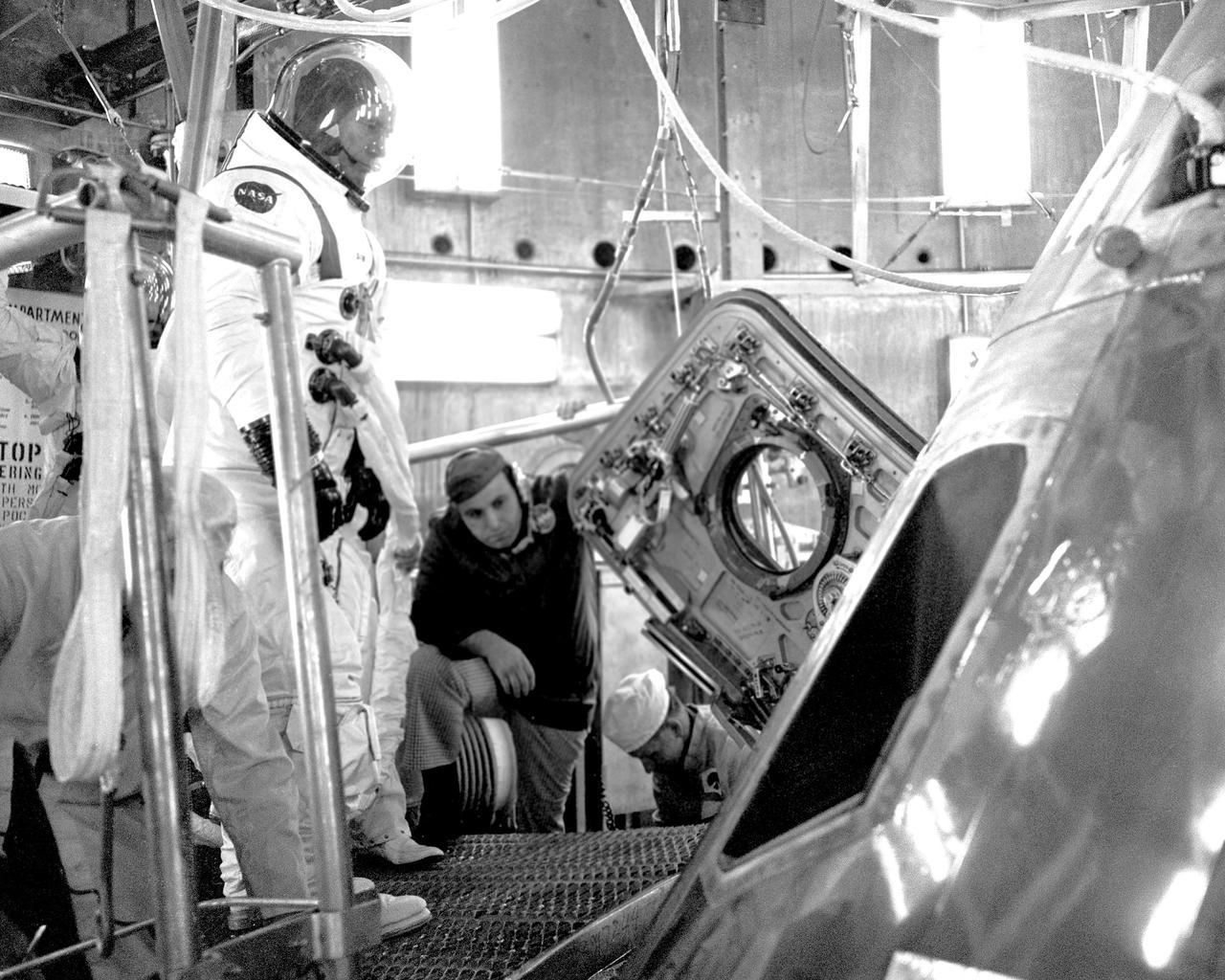
CAPE CANAVERAL, Fla. – The docking module and Apollo spacecraft for this summer's joint manned mission with the Soviet were mated in the Manned Spacecraft Operations Building today. The docking module will provide a mechanical and electrical link between the Apollo and Soyuz spacecraft while they are docked and also serve as an airlock. On hand to participate in the operation were two members of the Apollo prime crew, Astronauts Donald K. Slayton and Vance D. Brand. Launch of the Saturn 1B/Apollo from Complex 39 is scheduled for July 15. The first international crewed spaceflight was a joint U.S.-U.S.S.R. rendezvous and docking mission. The Apollo-Soyuz Test Project, or ASTP, took its name from the spacecraft employed: the American Apollo and the Soviet Soyuz. The three-man Apollo crew lifted off from Kennedy Space Center aboard a Saturn IB rocket on July 15, 1975, to link up with the Soyuz that had launched a few hours earlier. A cylindrical docking module served as an airlock between the two spacecraft for transfer of the crew members. Photo credit: NASA
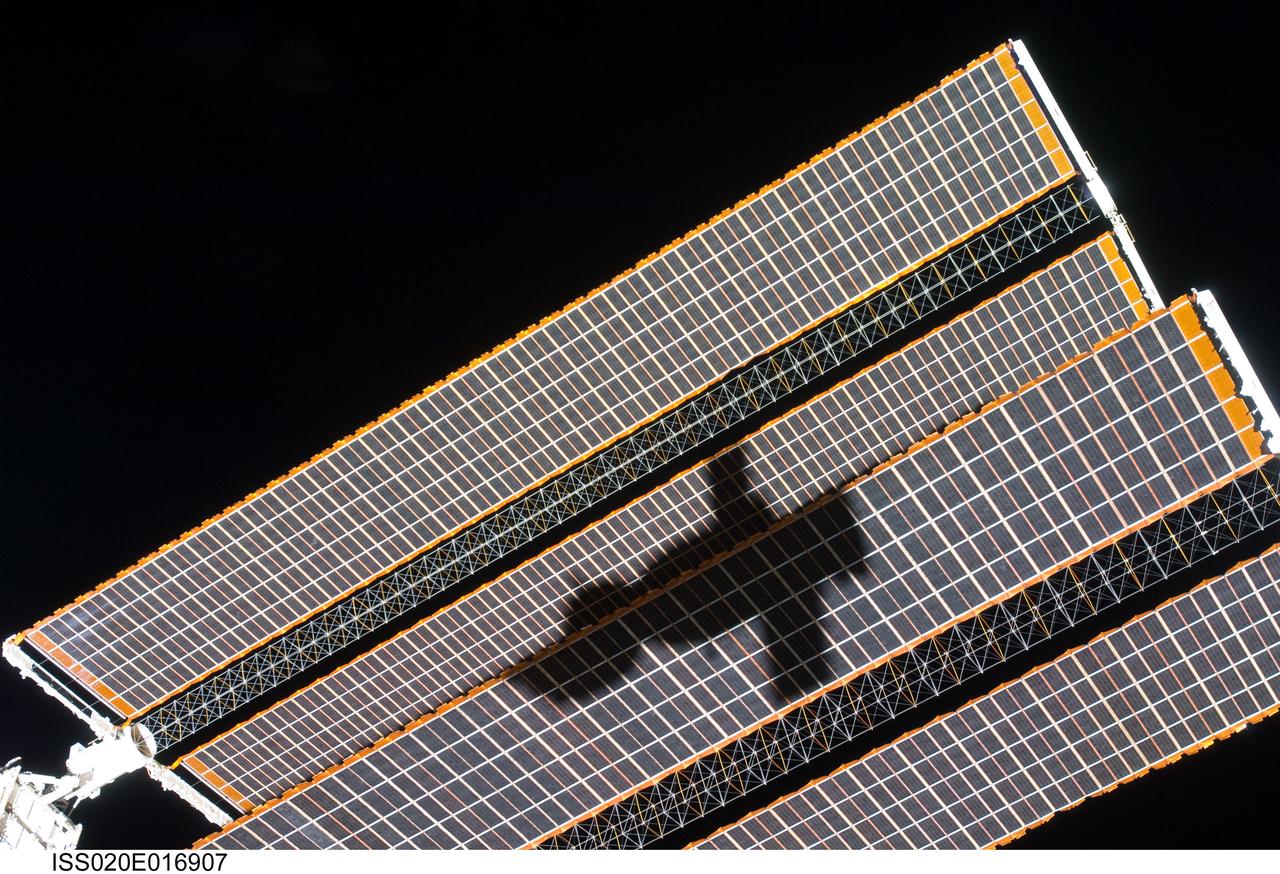
ISS020-E-016907 (2 July 2009) --- The shadow of the Soyuz TMA-14 spacecraft is visible against solar array panels of the International Space Station during the relocation of the Soyuz from the Zvezda Service Module’s aft port to the Pirs Docking Compartment. Cosmonaut Gennady Padalka, commander; along with NASA astronaut Michael Barratt and Japan Aerospace Exploration Agency (JAXA) astronaut Koichi Wakata, both flight engineers, undocked the Soyuz spacecraft at 4:26 p.m. (CDT) and docked to the Pirs Docking Compartment at 4:54 p.m. on July 2, 2009.
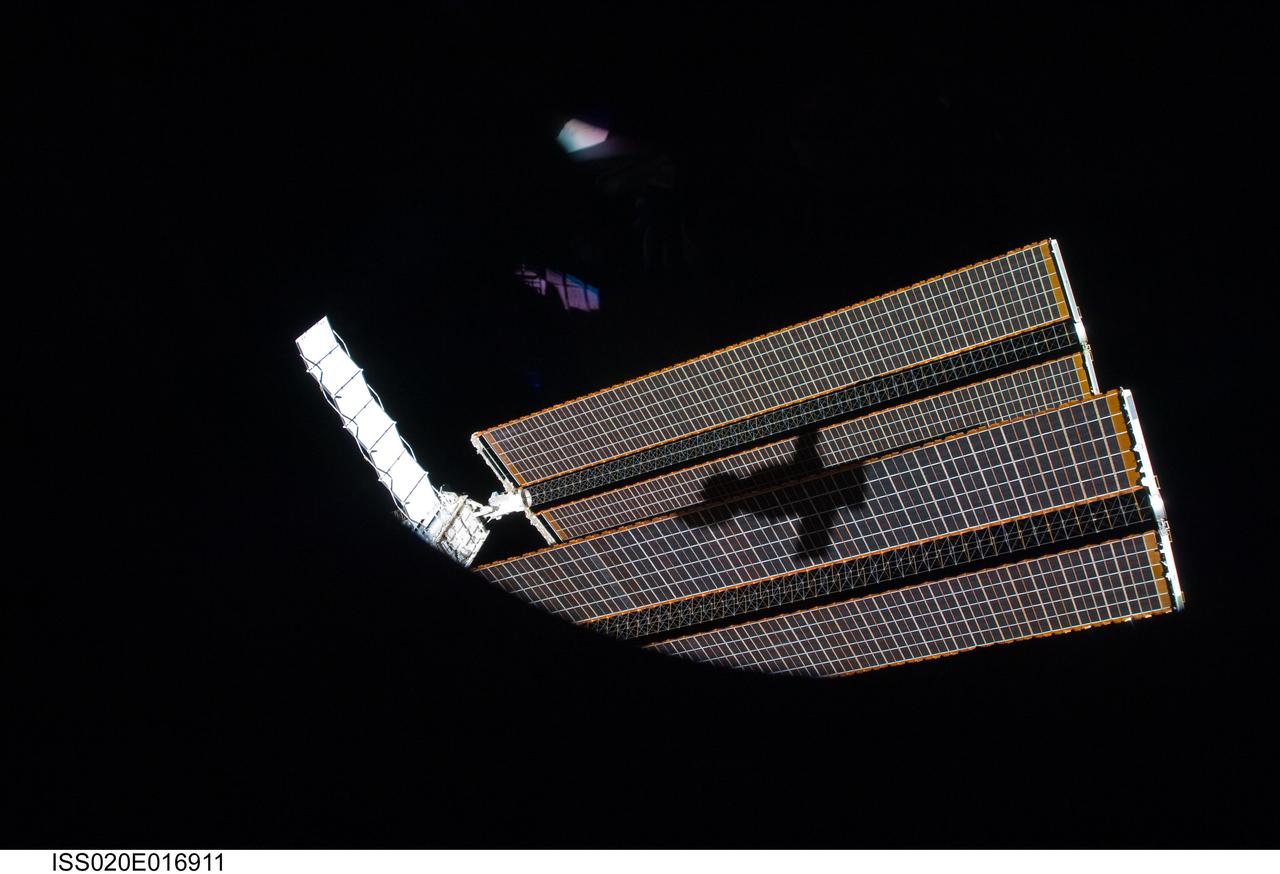
ISS020-E-016911 (2 July 2009) --- The shadow of the Soyuz TMA-14 spacecraft is visible against solar array panels of the International Space Station during the relocation of the Soyuz from the Zvezda Service Module’s aft port to the Pirs Docking Compartment. Cosmonaut Gennady Padalka, commander; along with NASA astronaut Michael Barratt and Japan Aerospace Exploration Agency (JAXA) astronaut Koichi Wakata, both flight engineers, undocked the Soyuz spacecraft at 4:26 p.m. (CDT) and docked to the Pirs Docking Compartment at 4:54 p.m. on July 2, 2009.
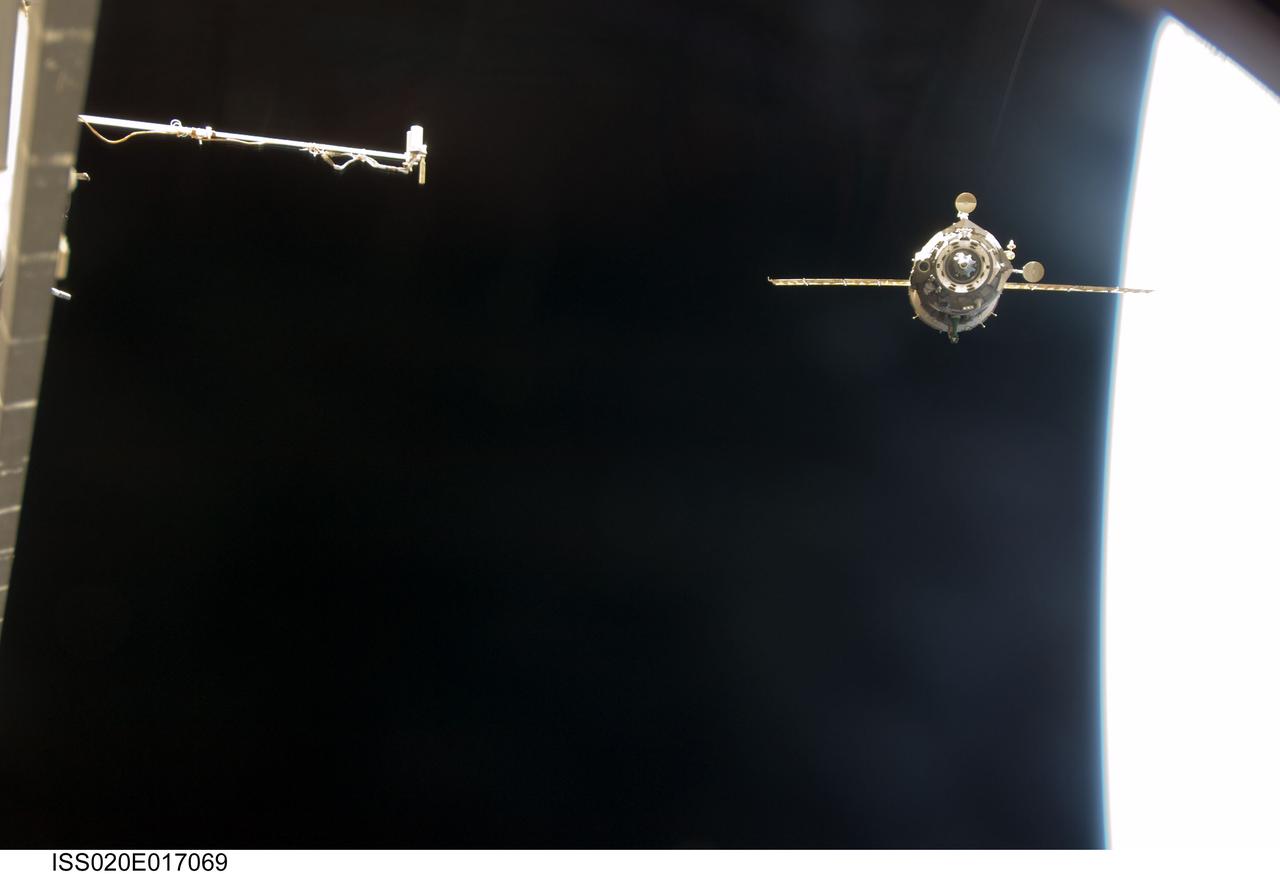
ISS020-E-017069 (2 July 2009) --- The Soyuz TMA-14 spacecraft is featured in this image photographed by an Expedition 20 crew member on the International Space Station during the relocation of the Soyuz from the Zvezda Service Module?s aft port to the Pirs Docking Compartment. Cosmonaut Gennady Padalka, commander; along with NASA astronaut Michael Barratt and Japan Aerospace Exploration Agency (JAXA) astronaut Koichi Wakata, both flight engineers, undocked the Soyuz spacecraft at 4:26 p.m. (CDT) and docked to the Pirs Docking Compartment at 4:54 p.m. on July 2, 2009.
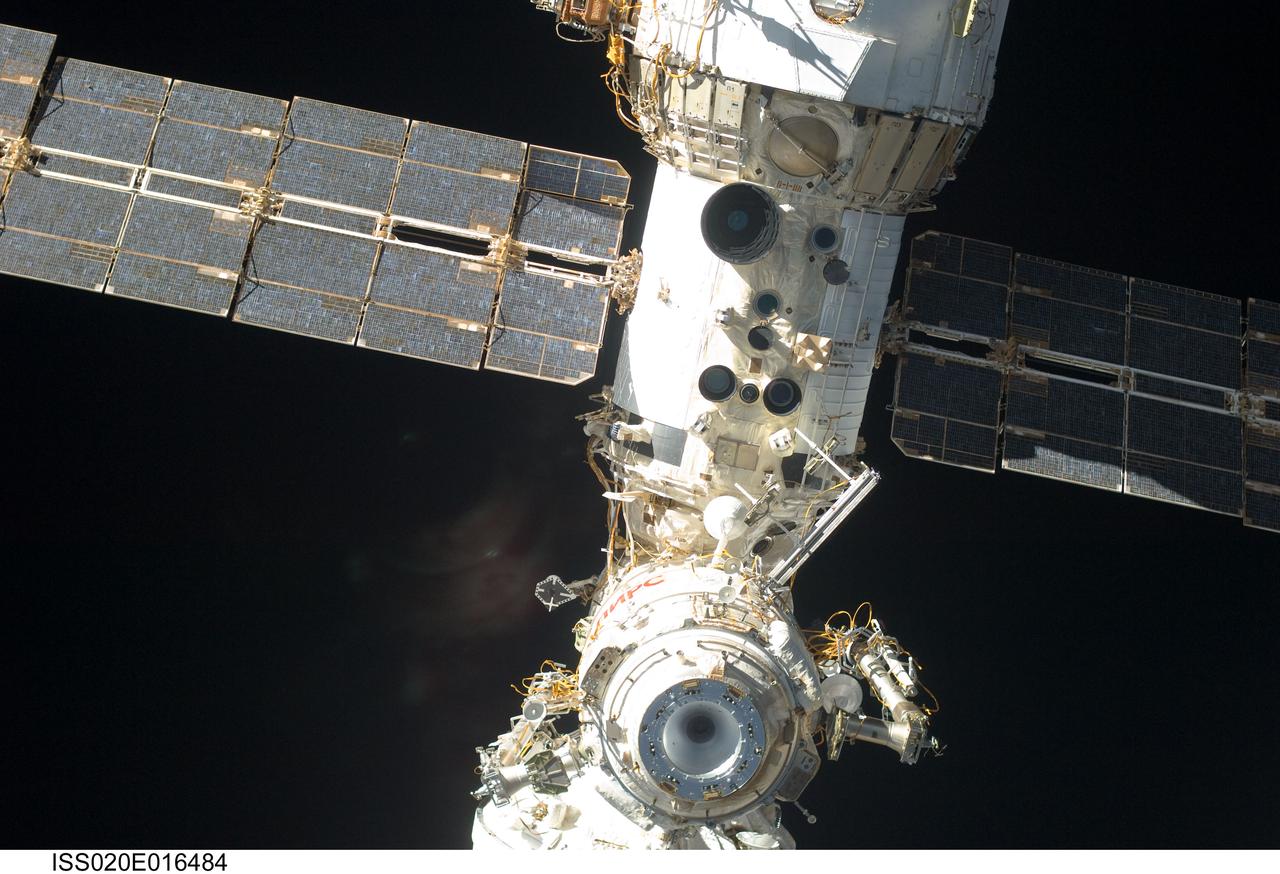
ISS020-E-016484 (2 July 2009) --- A portion of the International Space Station is featured in this image photographed by an Expedition 20 crew member aboard the Soyuz TMA-14 spacecraft during the relocation of the Soyuz from the Zvezda Service Module?s aft port to the Pirs Docking Compartment. Cosmonaut Gennady Padalka, commander; along with NASA astronaut Michael Barratt and Japan Aerospace Exploration Agency (JAXA) astronaut Koichi Wakata, both flight engineers, undocked the Soyuz spacecraft at 4:26 p.m. (CDT) and docked to the Pirs Docking Compartment at 4:54 p.m. on July 2, 2009.
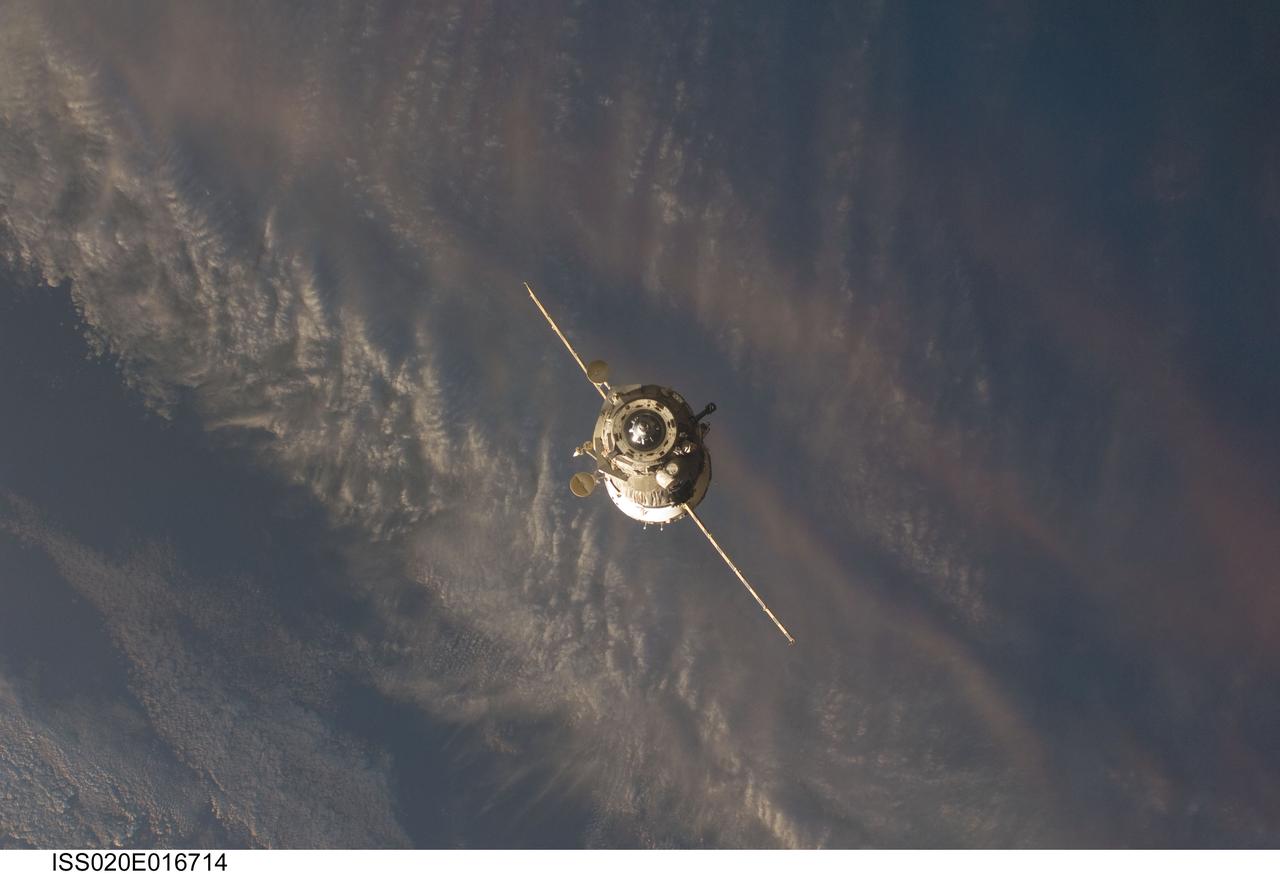
ISS020-E-016714 (2 July 2009) --- The Soyuz TMA-14 spacecraft is featured in this image photographed by an Expedition 20 crew member on the International Space Station during the relocation of the Soyuz from the Zvezda Service Module?s aft port to the Pirs Docking Compartment. Cosmonaut Gennady Padalka, commander; along with NASA astronaut Michael Barratt and Japan Aerospace Exploration Agency (JAXA) astronaut Koichi Wakata, both flight engineers, undocked the Soyuz spacecraft at 4:26 p.m. (CDT) and docked to the Pirs Docking Compartment at 4:54 p.m. on July 2, 2009.
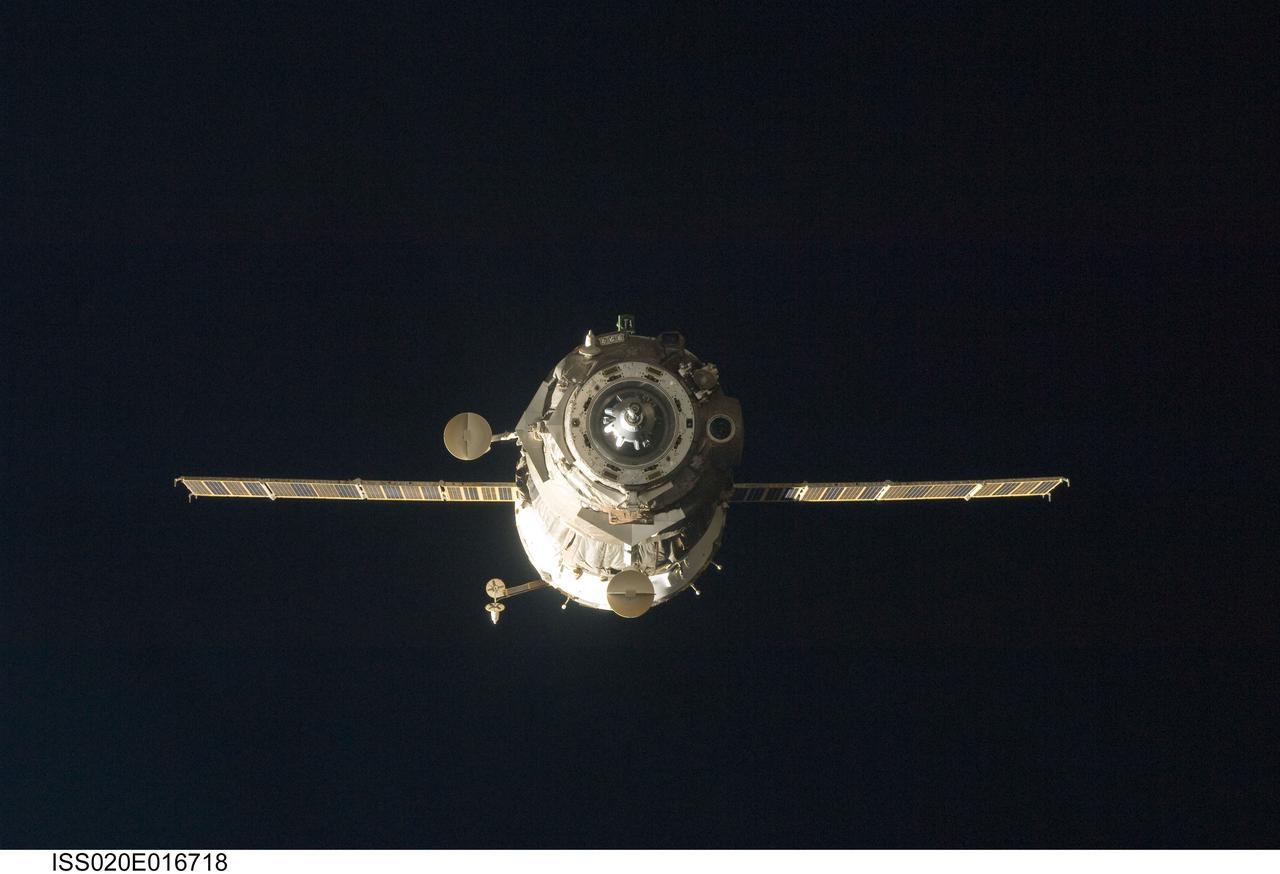
ISS020-E-016718 (2 July 2009) --- The Soyuz TMA-14 spacecraft is featured in this image photographed by an Expedition 20 crew member on the International Space Station during the relocation of the Soyuz from the Zvezda Service Module?s aft port to the Pirs Docking Compartment. Cosmonaut Gennady Padalka, commander; along with NASA astronaut Michael Barratt and Japan Aerospace Exploration Agency (JAXA) astronaut Koichi Wakata, both flight engineers, undocked the Soyuz spacecraft at 4:26 p.m. (CDT) and docked to the Pirs Docking Compartment at 4:54 p.m. on July 2, 2009.
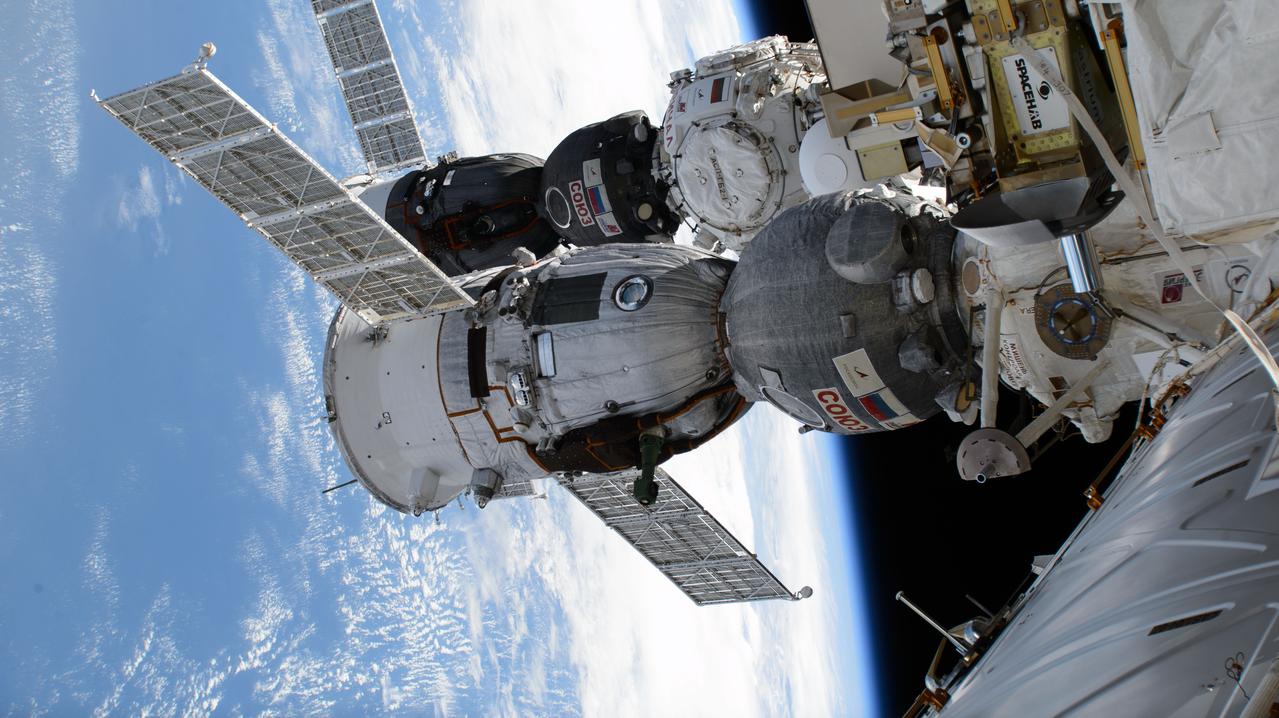
iss072e1021804 (April 19, 2025) --- The Soyuz crew ships that each brought three crew members to the International Space Station are pictured docked to the orbital outpost. In the foreground, is the Soyuz MS-26 spacecraft docked to the Rassvet module moments before it undocked and returned to Earth with NASA astronaut Pettit and Roscosmos cosmonauts Alexey Ovchinin and Ivan Vagner after 220 days in space. In the rear, is the Soyuz MS-27 spacecraft docked to the Prichal module after it launched on April 8, 2025, with NASA astronaut Jonny Kim and Roscosmos cosmonauts Sergey Ryzhikov and Alexey Zubritsky beginning an eight-month space research mission.
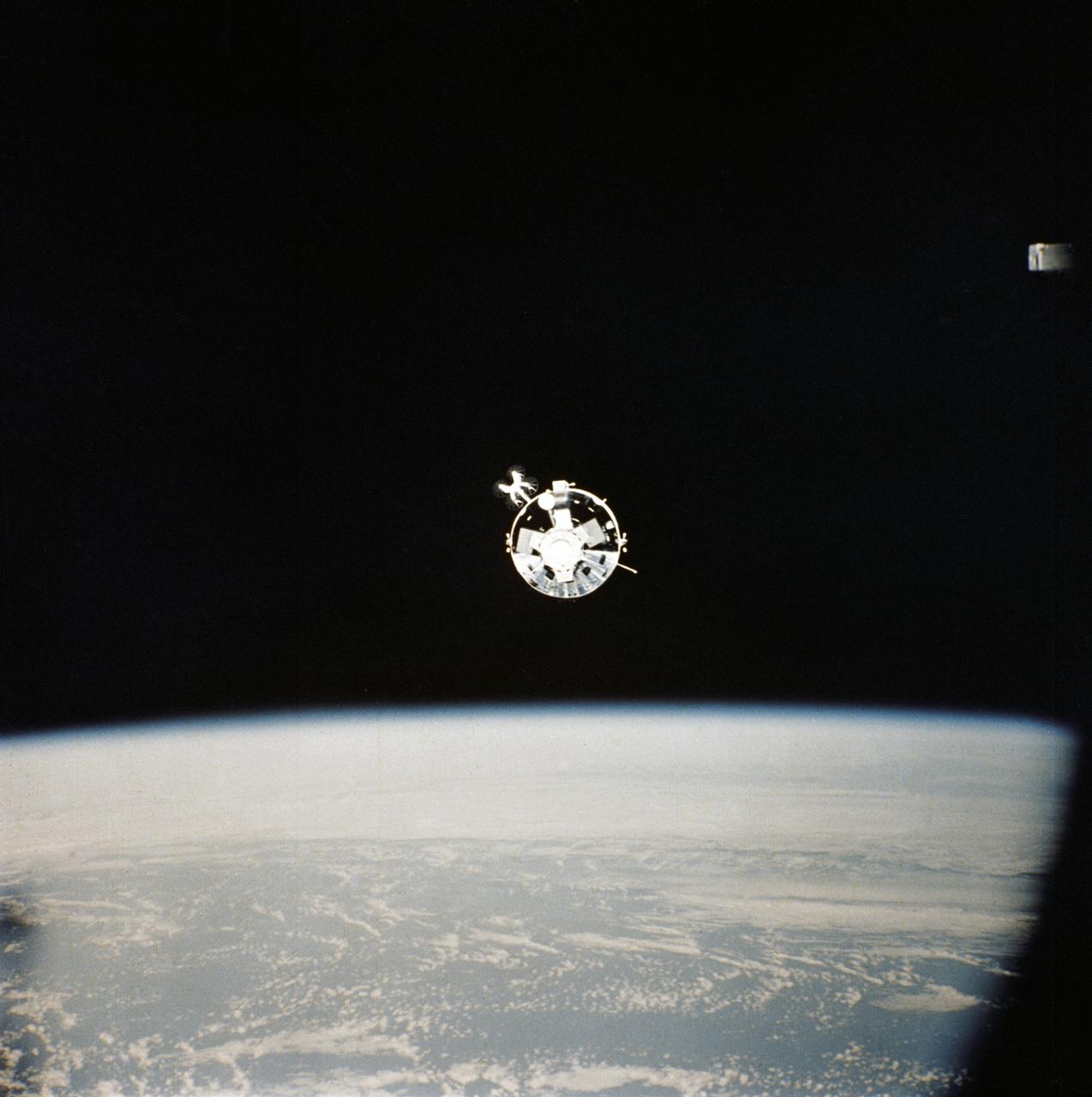
AST-32-2675 (17-19 July 1975) --- The American Apollo spacecraft as seen in Earth orbit from the Soviet Soyuz spacecraft during the joint U.S.-USSR Apollo-Soyuz Test Project mission. The Command/Service Module and Docking Module are contrasted against a black-sky background. This is a "head on" view of the Apollo. The horizon of Earth is below. This picture was furnished by the USSR in an exchange of photography taken during the ASTP flight. The American and Soviet spacecraft were joined together in space for approximately 47 hours on July 17-18-19, 1975. Note the docking mechanism on the Docking Module. PHOTO COURTESY: USSR ACADEMY OF SCIENCES
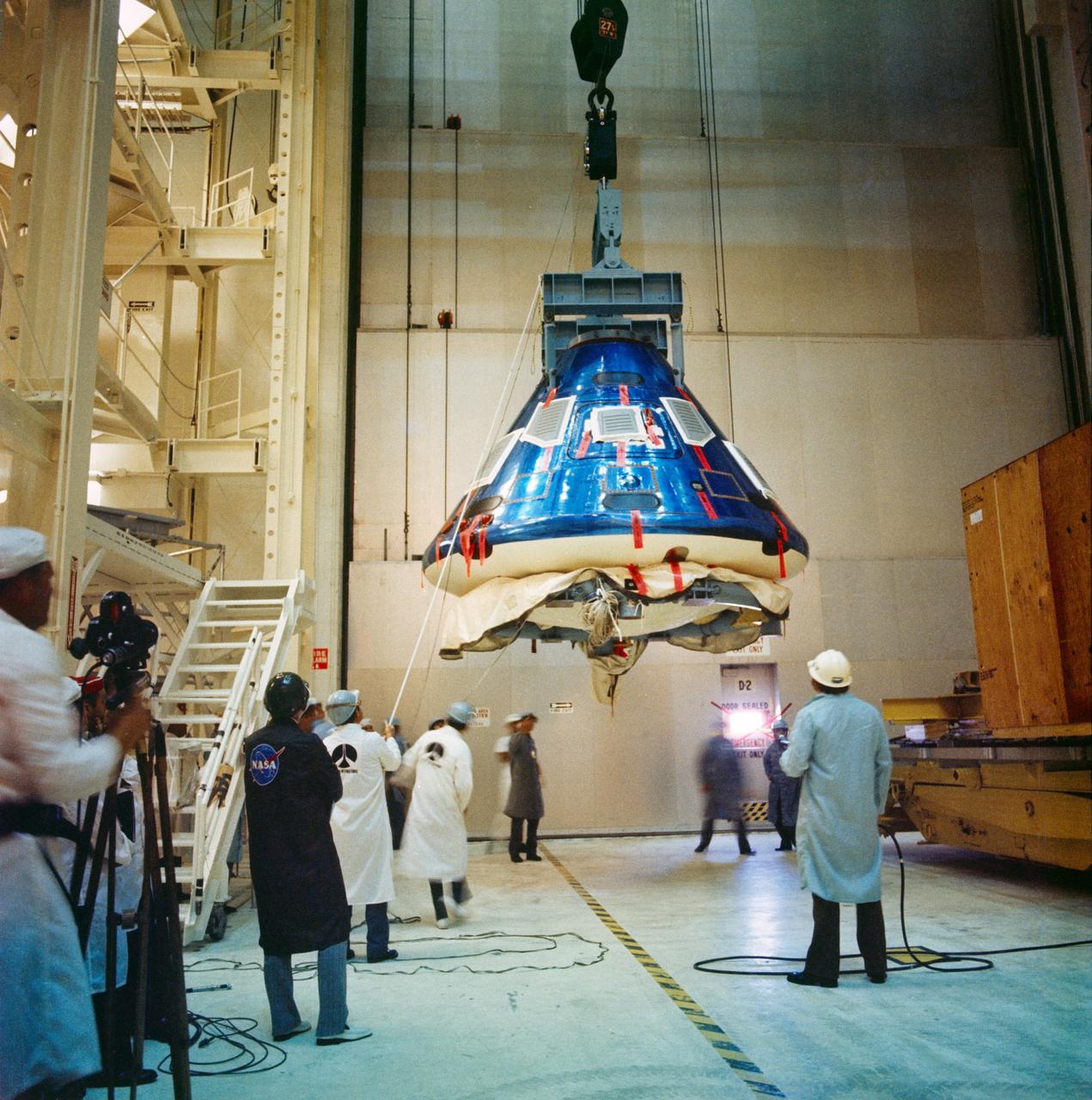
S74-32049 (8 Sept. 1974) --- The Apollo Command Module for the Apollo-Soyuz Test Project mission goes through receiving, inspection and checkout procedures in the Manned Spacecraft Operations Building at the Kennedy Space Center. The spacecraft had just arrived by air from the Rockwell International plant at Downey, California. The Apollo spacecraft (Command Module, Service Module and Docking Module), with astronauts Thomas P. Stafford, Vance D. Brand and Donald K. Slayton aboard, will dock in Earth orbit with a Soviet Soyuz spacecraft during the joint U.S.-USSR ASTP flight scheduled for July 1975. The Soviet and American crews will visit one another?s spacecraft.
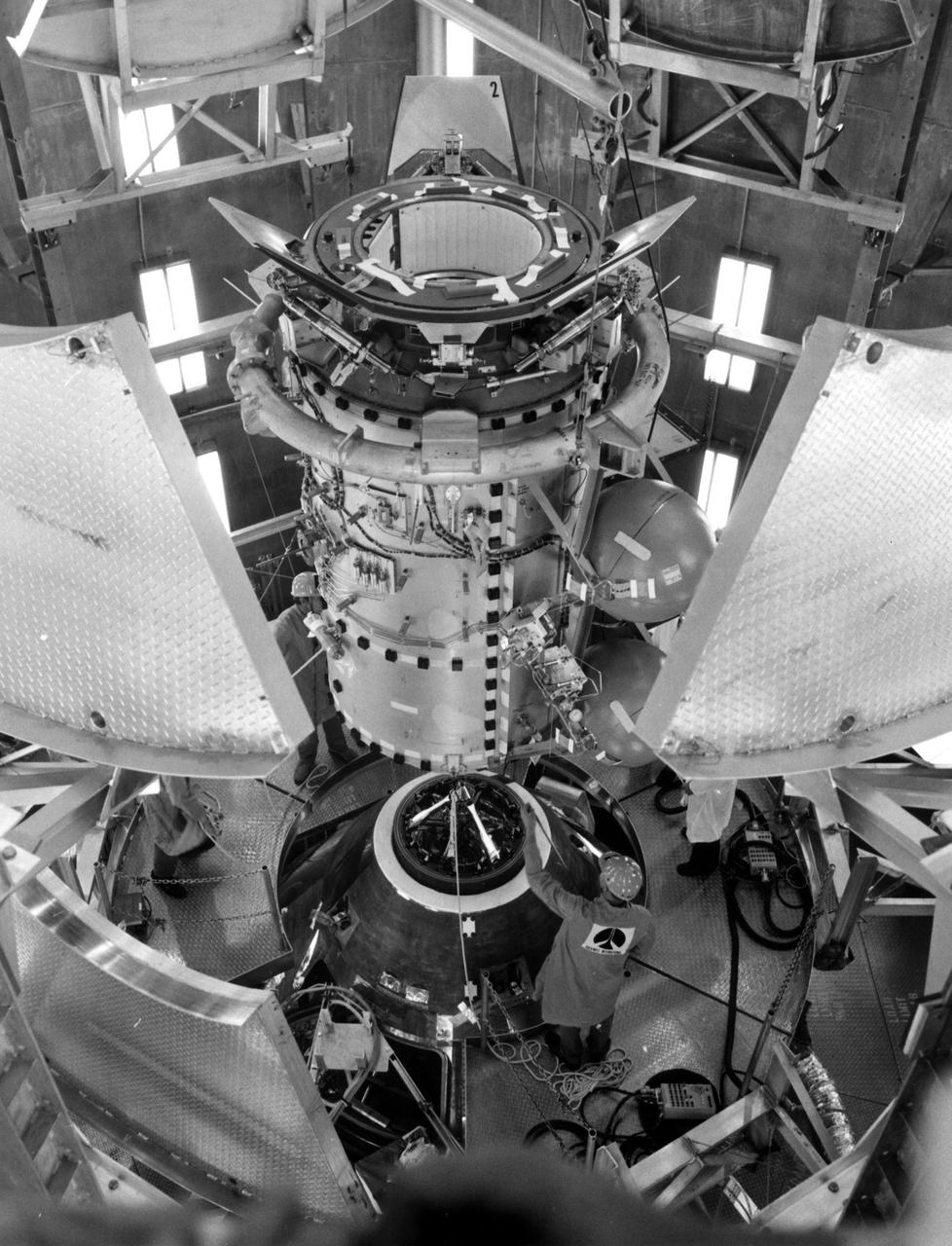
KENNEDY SPACE CENTER, FLA. -- NASA_APOLLO-SOYUZ: Fit checks were performed in an altitude chamber at KSC today between the Apollo spacecraft and the Docking Module to be used during the Apollo Soyuz Test Project.
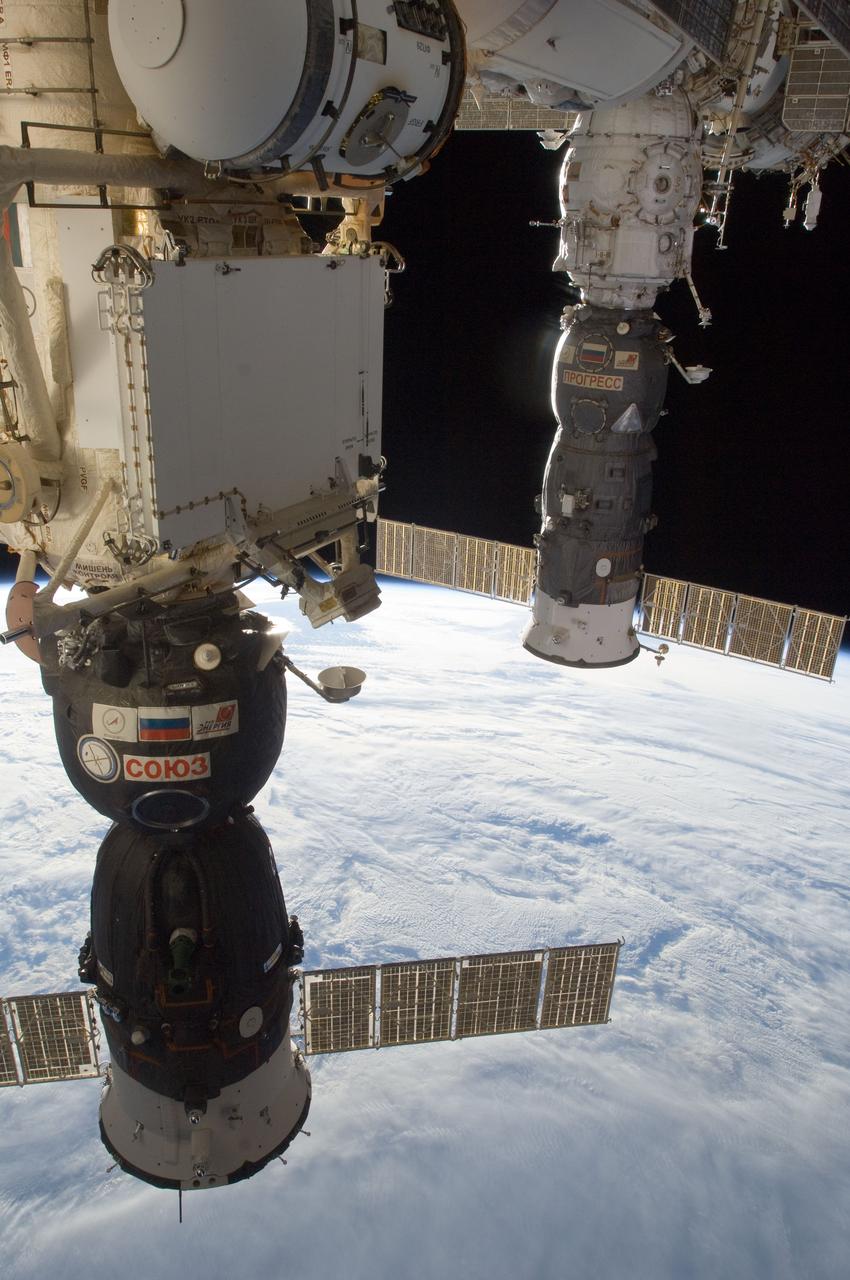
View of Soyuz Spacecraft connected to the Mini Research Module 1 MRM1), and Progress Spacecraft connected to the Pirs Docking Compartment 1 (DC1). Photo was taken during Expedition 34.
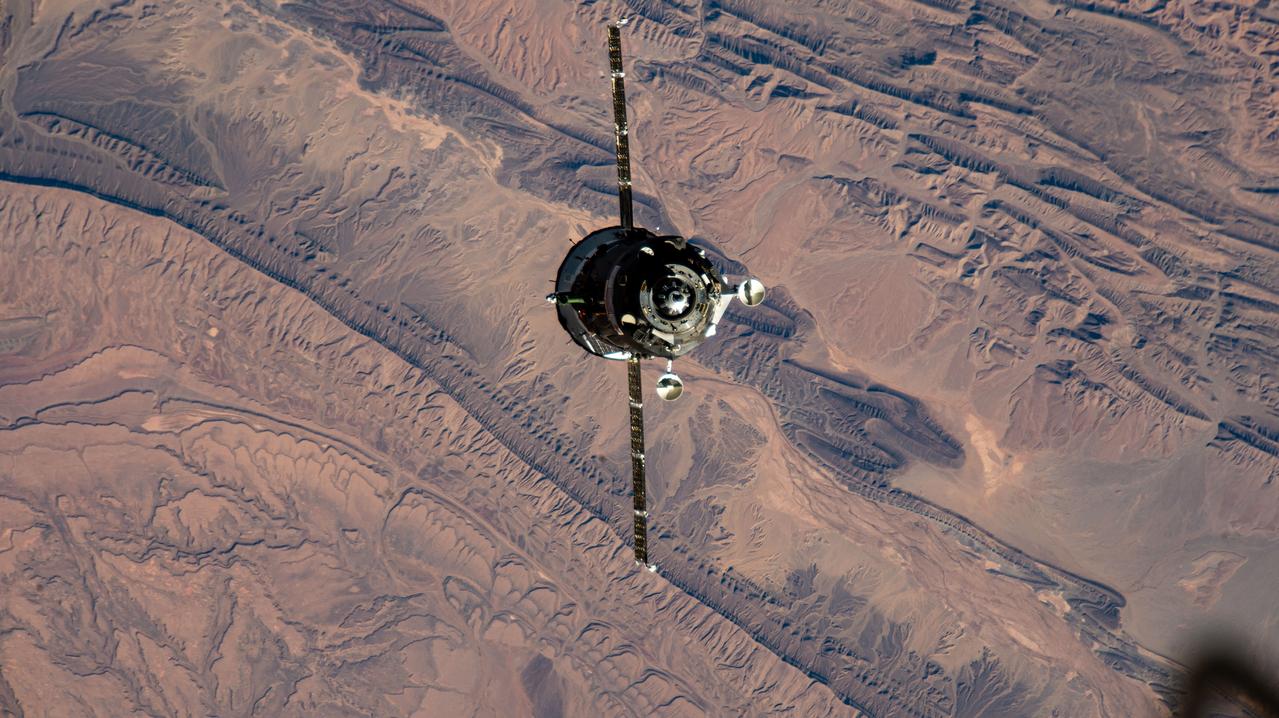
iss072e941654 (April 8, 2025) --- The Soyuz MS-27 spacecraft approaches the International Space Station 259 miles above Morocco on the African continent. The Soyuz spacecraft would dock shortly afterward to the Prichal module bringing NASA astronaut Jonny Kim and Roscosmos cosmonauts Sergey Ryzhikov and Alexey Zubritsky to the orbital outpost.
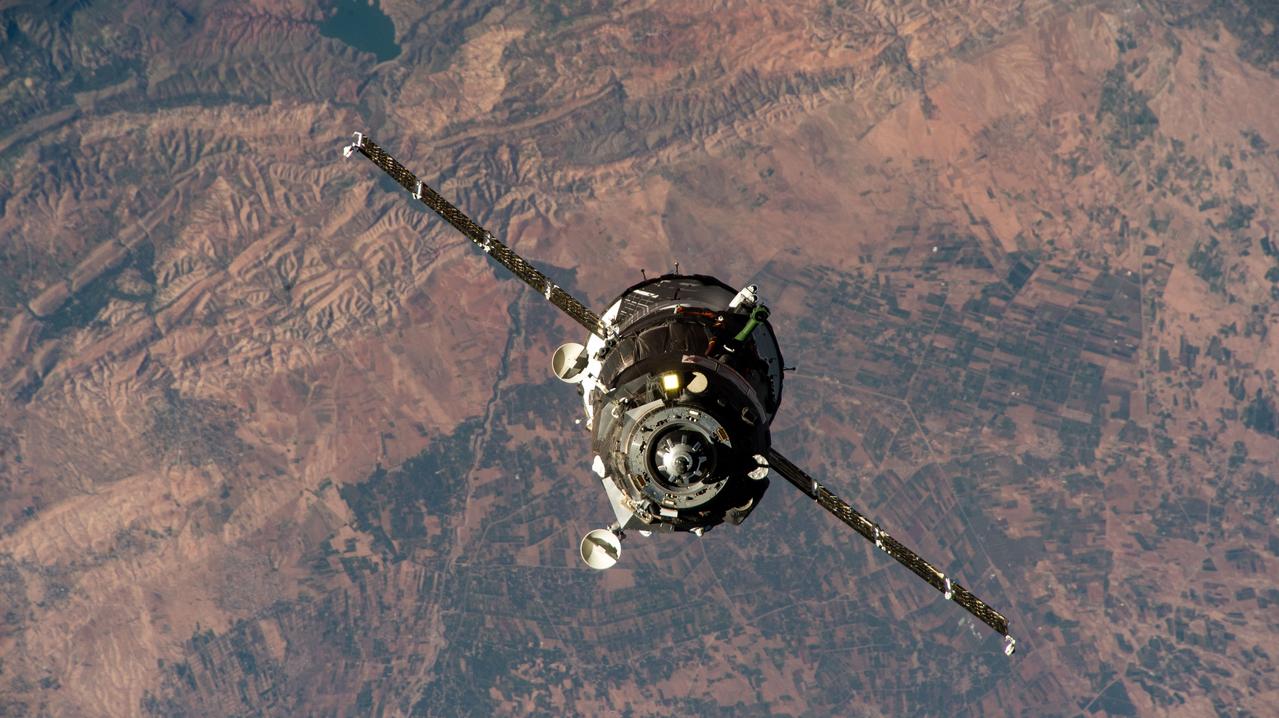
iss072e941647 (April 8, 2025) --- The Soyuz MS-27 spacecraft approaches the International Space Station 259 miles above Morocco on the African continent. The Soyuz spacecraft would dock shortly afterward to the Prichal module bringing NASA astronaut Jonny Kim and Roscosmos cosmonauts Sergey Ryzhikov and Alexey Zubritsky to the orbital outpost.
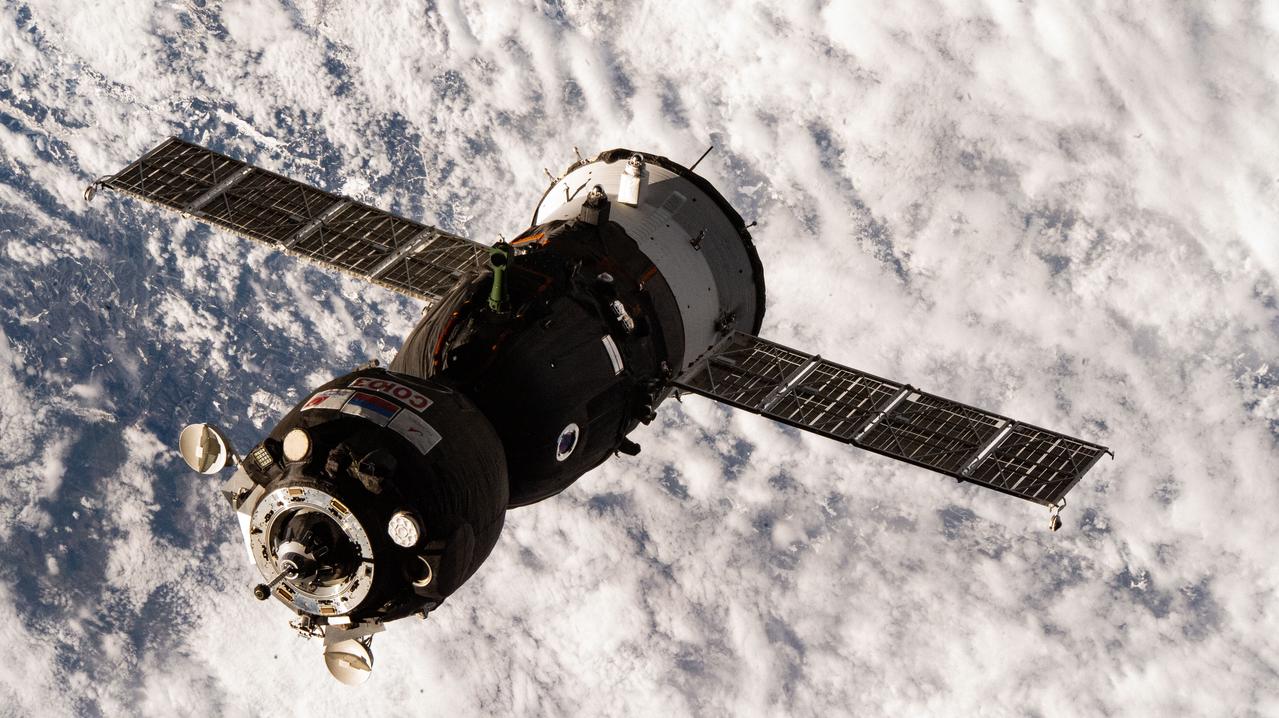
iss072e941652 (April 8, 2025) --- The Soyuz MS-27 spacecraft approaches the International Space Station 262 miles above Hungary on the European continent. The Soyuz spacecraft would dock shortly afterward to the Prichal module bringing NASA astronaut Jonny Kim and Roscosmos cosmonauts Sergey Ryzhikov and Alexey Zubritsky to the orbital outpost.
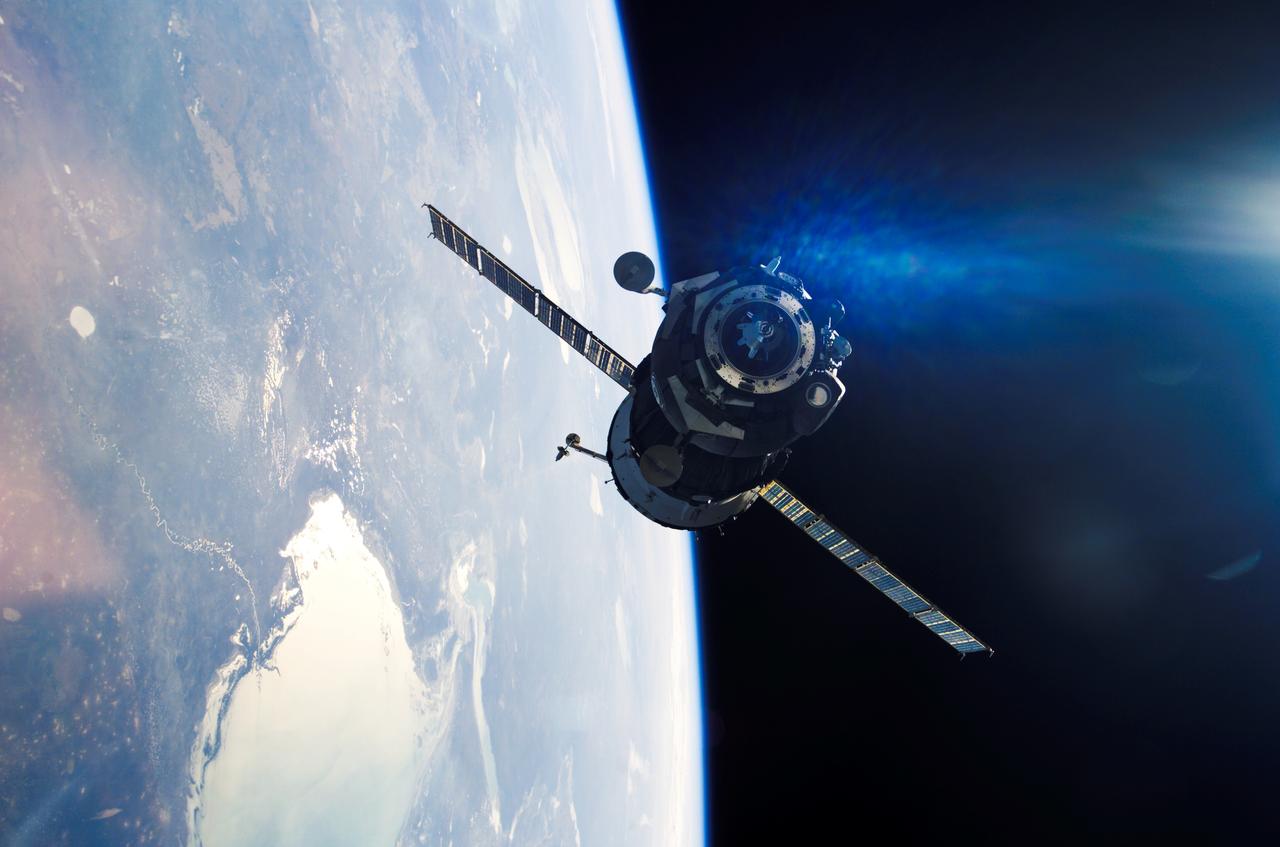
ISS011-E-14107 (3 Oct. 2005) --- Backdropped by the blackness of space and Earth’s horizon, the Soyuz TMA-7 spacecraft approaches the international space station. Onboard the spacecraft are astronaut William S. McArthur, Jr., Expedition 12 commander and NASA science officer; cosmonaut Valery I. Tokarev, Expedition 12 flight engineer and Soyuz commander; and U. S. Spaceflight Participant Gregory Olsen. The Soyuz linked up to the Pirs Docking Compartment at 12:27 a.m. (CDT) on Oct. 3, 2005 as the two spacecraft flew over eastern Asia. The docking followed Friday’s launch from Baikonur Cosmodrome in Kazakhstan.
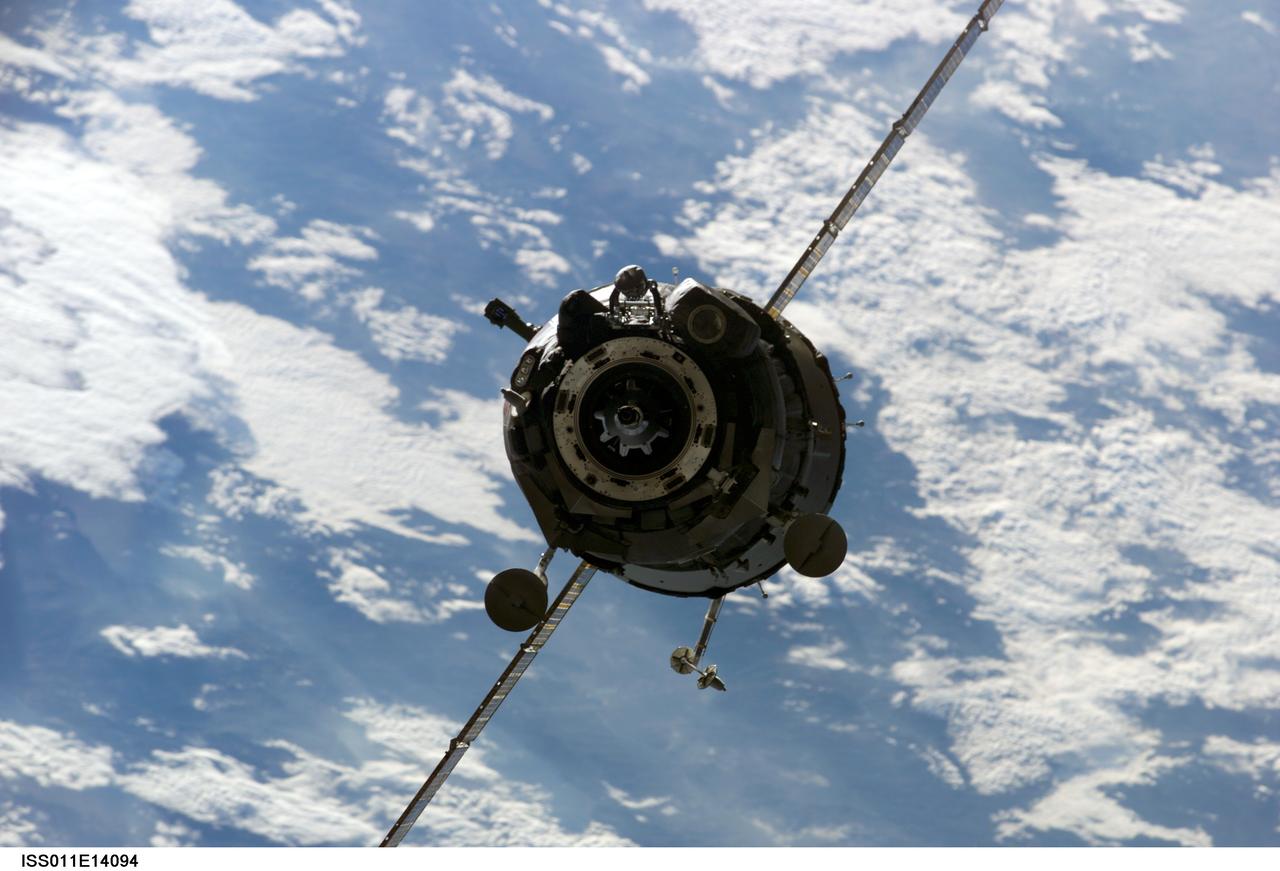
ISS011-E-14094 (3 October 2005) --- Backdropped by a blanket of clouds, the Soyuz TMA-7 spacecraft approaches the international space station. Onboard the spacecraft are astronaut William S. McArthur, Jr., Expedition 12 commander and NASA science officer; cosmonaut Valery I. Tokarev, Expedition 12 flight engineer and Soyuz commander; and U. S. Spaceflight Participant Gregory Olsen. The Soyuz linked up to the Pirs Docking Compartment at 12:27 a.m. (CDT) on Oct. 3, 2005 as the two spacecraft flew over eastern Asia. The docking followed Friday’s launch from Baikonur Cosmodrome in Kazakhstan.
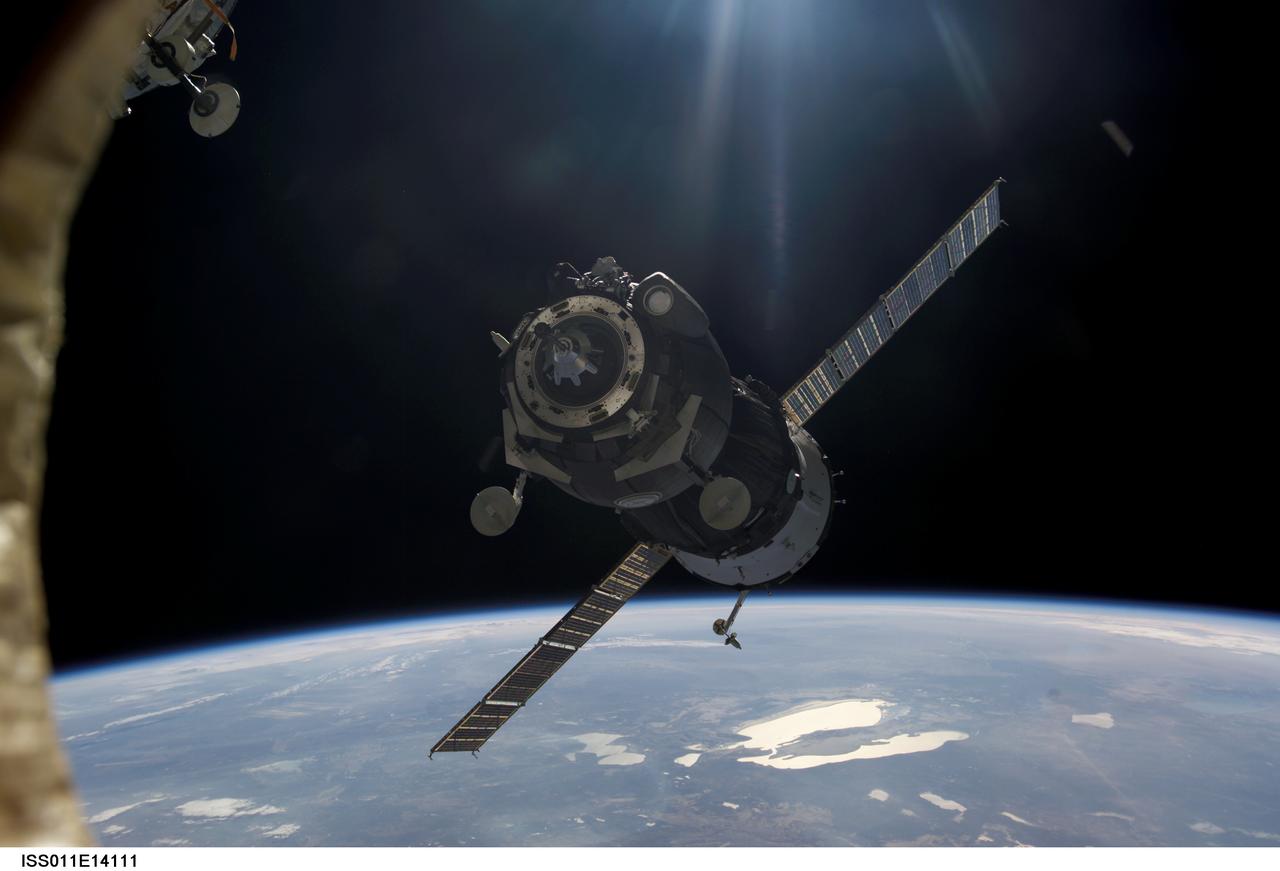
ISS011-E-14111 (3 October 2005) --- Backdropped by the blackness of space and Earth’s horizon, the Soyuz TMA-7 spacecraft approaches the international space station. Onboard the spacecraft are astronaut William S. McArthur, Jr., Expedition 12 commander and NASA science officer; cosmonaut Valery I. Tokarev, Expedition 12 flight engineer and Soyuz commander; and U. S. Spaceflight Participant Gregory Olsen. The Soyuz linked up to the Pirs Docking Compartment at 12:27 a.m. (CDT) on Oct. 3, 2005 as the two spacecraft flew over eastern Asia. The docking followed Friday’s launch from Baikonur Cosmodrome in Kazakhstan.
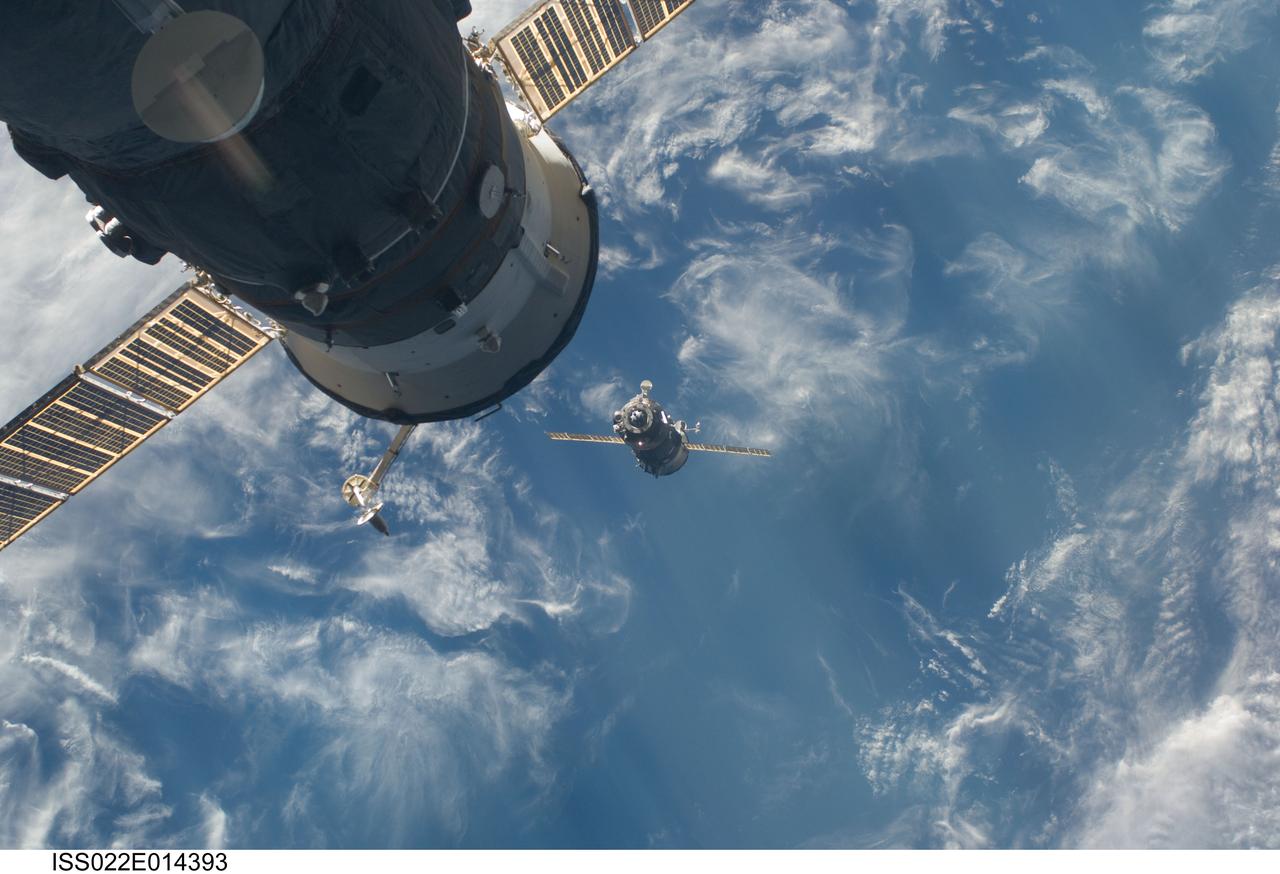
ISS022-E-014393 (22 Dec. 2009) --- The Soyuz TMA-17 spacecraft approaches the International Space Station, carrying Russian cosmonaut Oleg Kotov, Soyuz commander and Expedition 22 flight engineer; along with NASA astronaut T.J. Creamer and Japan Aerospace Exploration Agency astronaut Soichi Noguchi, both flight engineers. Docking to the Zarya nadir port occurred at 4:48 p.m. (CST) on Dec. 22, 2009. The trio launched aboard the Soyuz TMA-17 spacecraft at 3:52 p.m. on Dec. 20 from the Baikonur Cosmodrome in Kazakhstan. A docked Russian spacecraft is at top left.
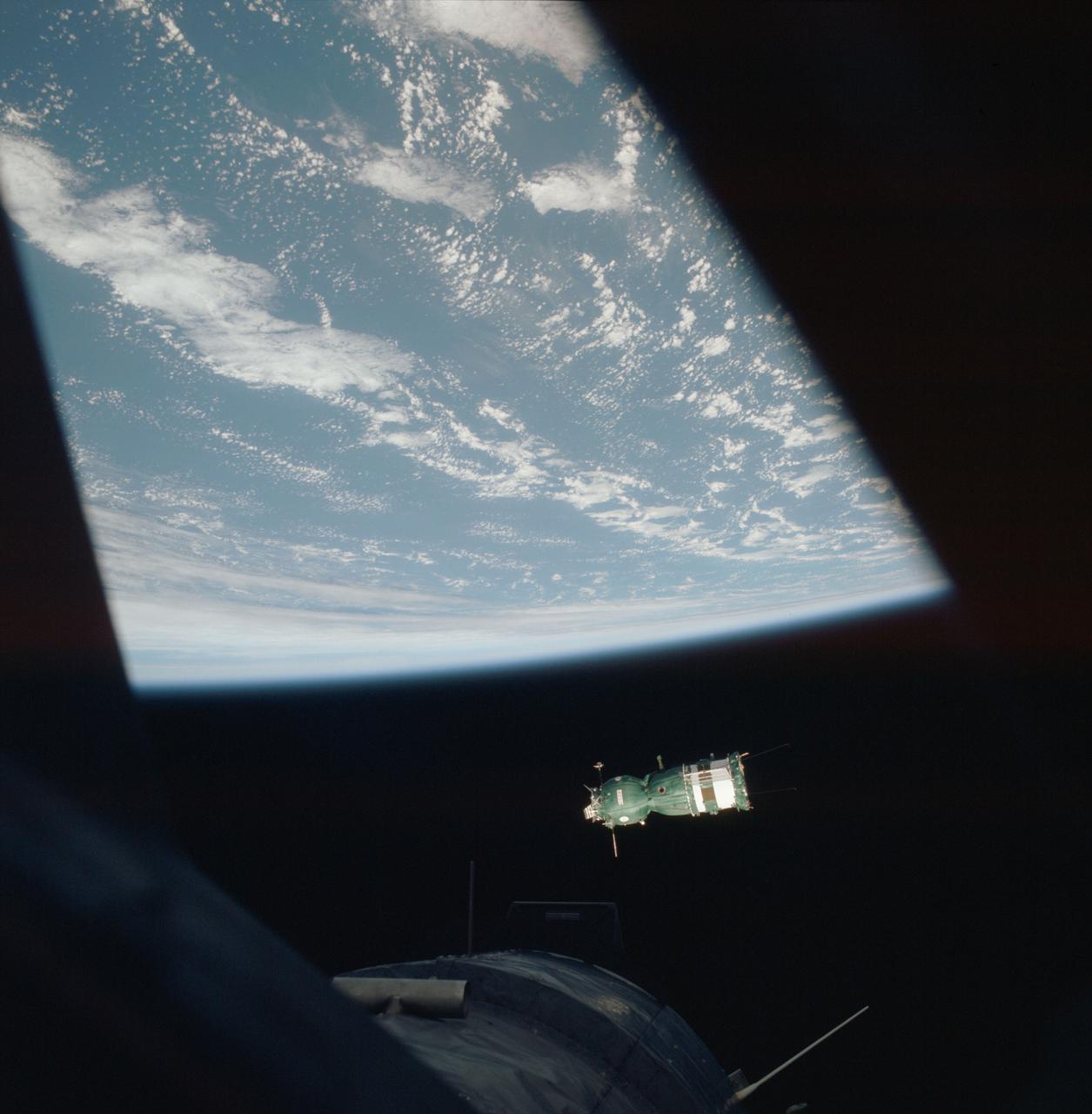
AST-02-093 (18 July 1975) --- This scene photographed with a hand-held 70mm camera from a rendezvous window of the American Apollo spacecraft in Earth orbit shows the Soviet Soyuz spacecraft contrasted against a black-sky background with Earth's horizon below. The three major components of the Soyuz are the spherical-shaped Orbital Module (OM), the bell-shaped Descent Vehicle (DV) and the cylindrical-shaped instrument Assembly Module (AM). The docking system on the Orbital Module was specially designed to interface with the docking system on the Apollo's Docking Module (DM). The DM is visible very faintly at the bottom of the picture. The ASTP astronauts and cosmonauts visited each other's spacecraft while the Soyuz and Apollo were docked in Earth orbit for two days.
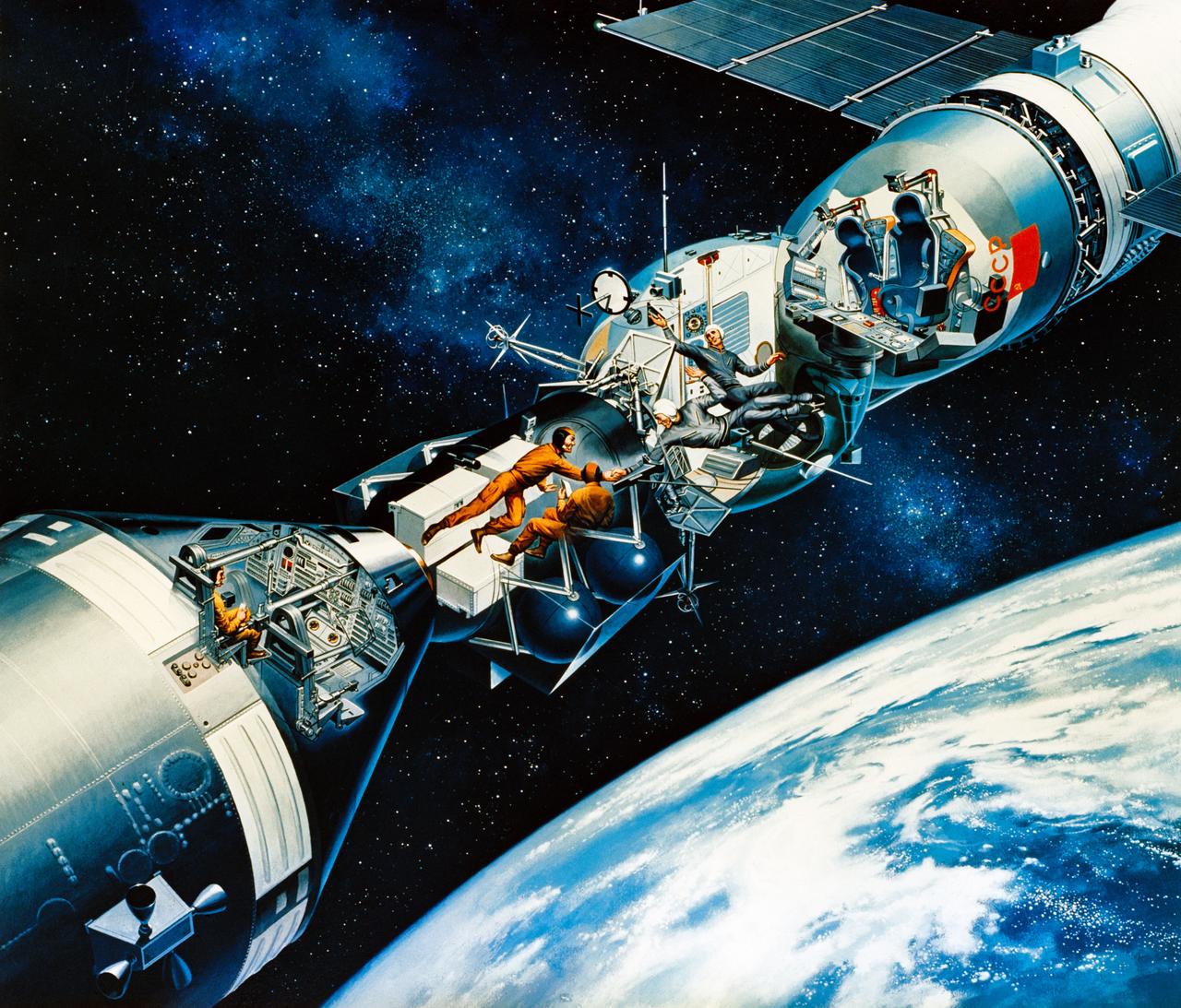
S75-27290 (April 1975) --- An artist?s concept illustrating a cutaway view of the docked Apollo and Soyuz spacecraft in Earth orbit. This scene depicts the moment the two international crews meet in space for the first time. Two of the three American crewmen are in the Docking Module. The two Soviet crewmen are in the Soyuz spacecraft?s Orbital Module. The two crew commanders are shaking hands through the hatchway. The third American crewman is in the Apollo Command Module. During the joint U.S.-USSR Apollo-Soyuz Test Project mission, which is scheduled for July 1975, the American and Soviet crews will visit one another?s spacecraft while the Soyuz and Apollo are docked for a maximum period of two days. The mission is designed to test equipment and techniques that will establish international crew rescue capability in space, as well as permit future cooperative scientific missions. The artwork is by Davis Meltzer.

View of the Soyuz TMA-12M spacecraft as it approaches the ISS for rendezvous and docking. Image was taken during Expedition 39 and released by two astronauts on Twitter.
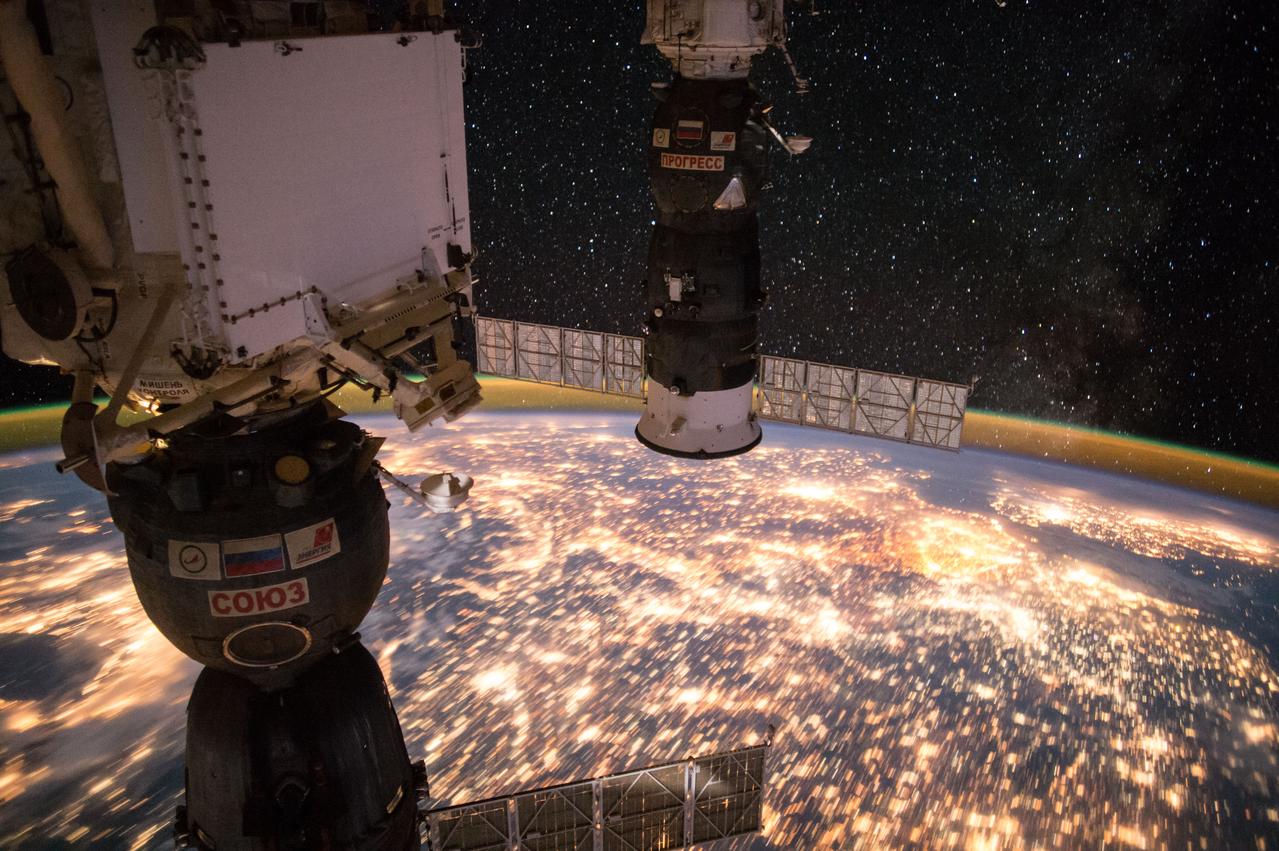
Earth observation taken during a night pass by the Expedition 49 crew aboard the International Space Station (ISS). Docked Soyuz and Progress spacecraft visible.
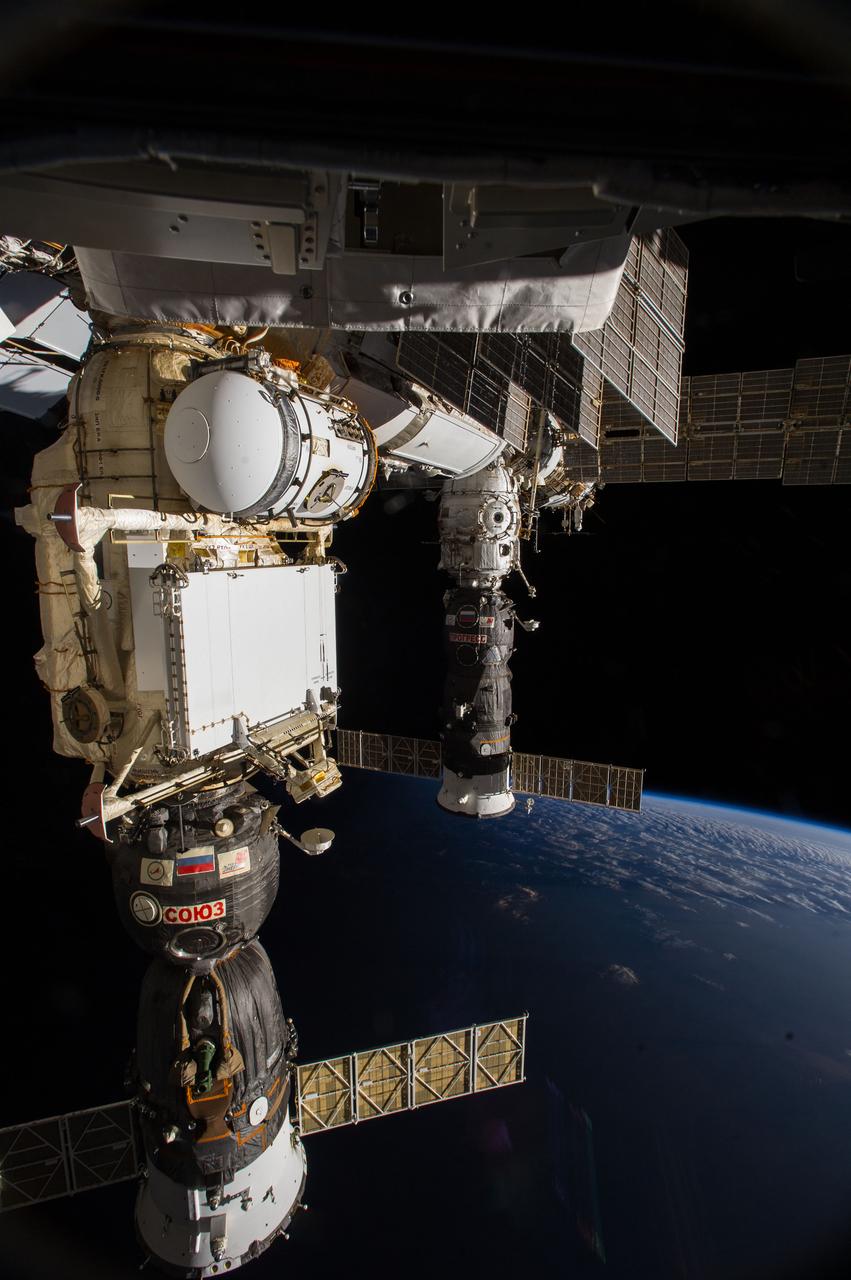
Earth Observation taken during a day pass by the Expedition 40 crew aboard the International Space Station (ISS). Docked Soyuz and Progress spacecraft are visible in the foreground.

ISS012-E-22031 (30 March 2006) --- Cyclone Glenda and a docked Soyuz spacecraft are featured in this image photographed by an Expedition 12 crewmember on the International Space Station.