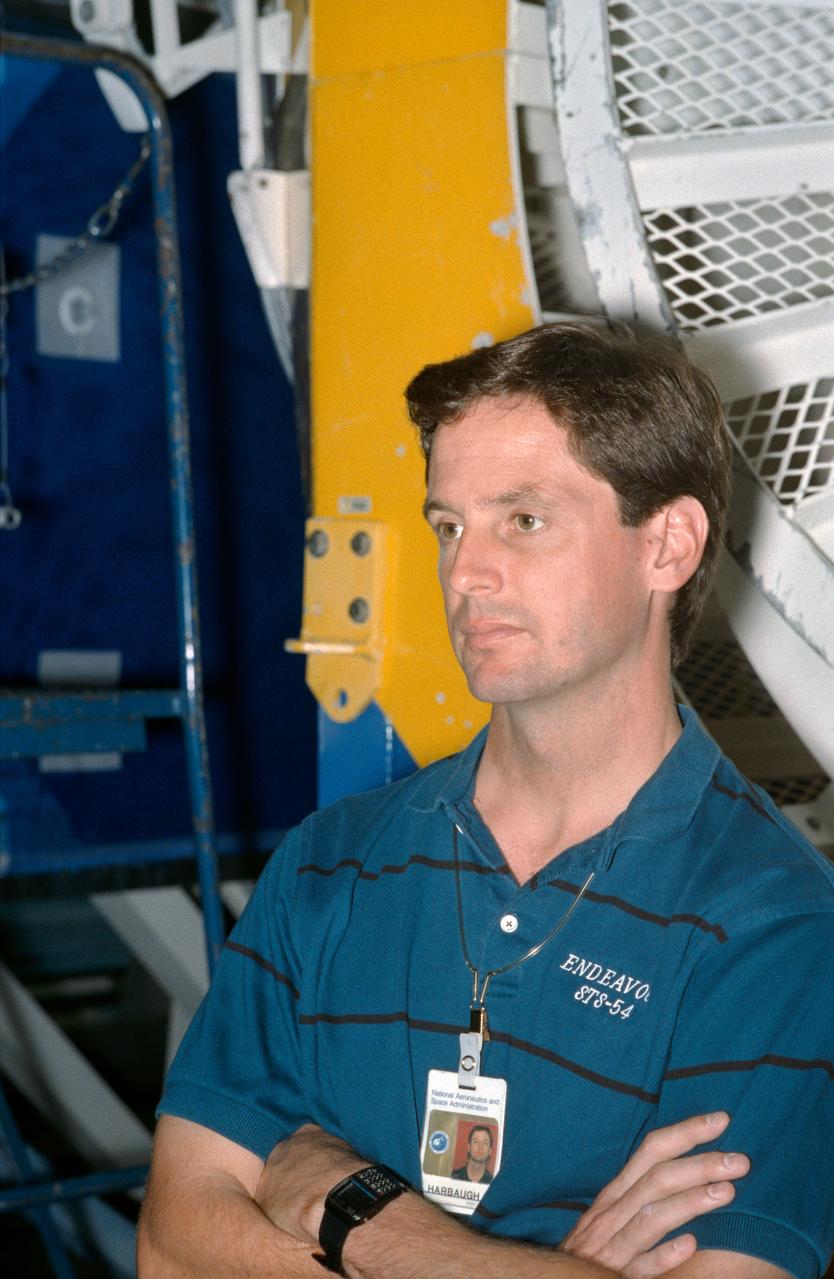
S92-40569 (Aug 1992) --- Gregory J. Harbaugh, one of five astronaut crewmembers assigned to fly aboard the Space Shuttle Endeavour for the STS-54 mission, pauses for a break during training and preparations for the six-day mission. Harbaugh will be joined by John H. Casper, mission Donald R. McMonagle, pilot; along with Mario Runco Jr. and Susan J. Helms, mission specialists. Harbaugh is in the weightless environment training facility (WET-F) at the Johnson Space Center (JSC).
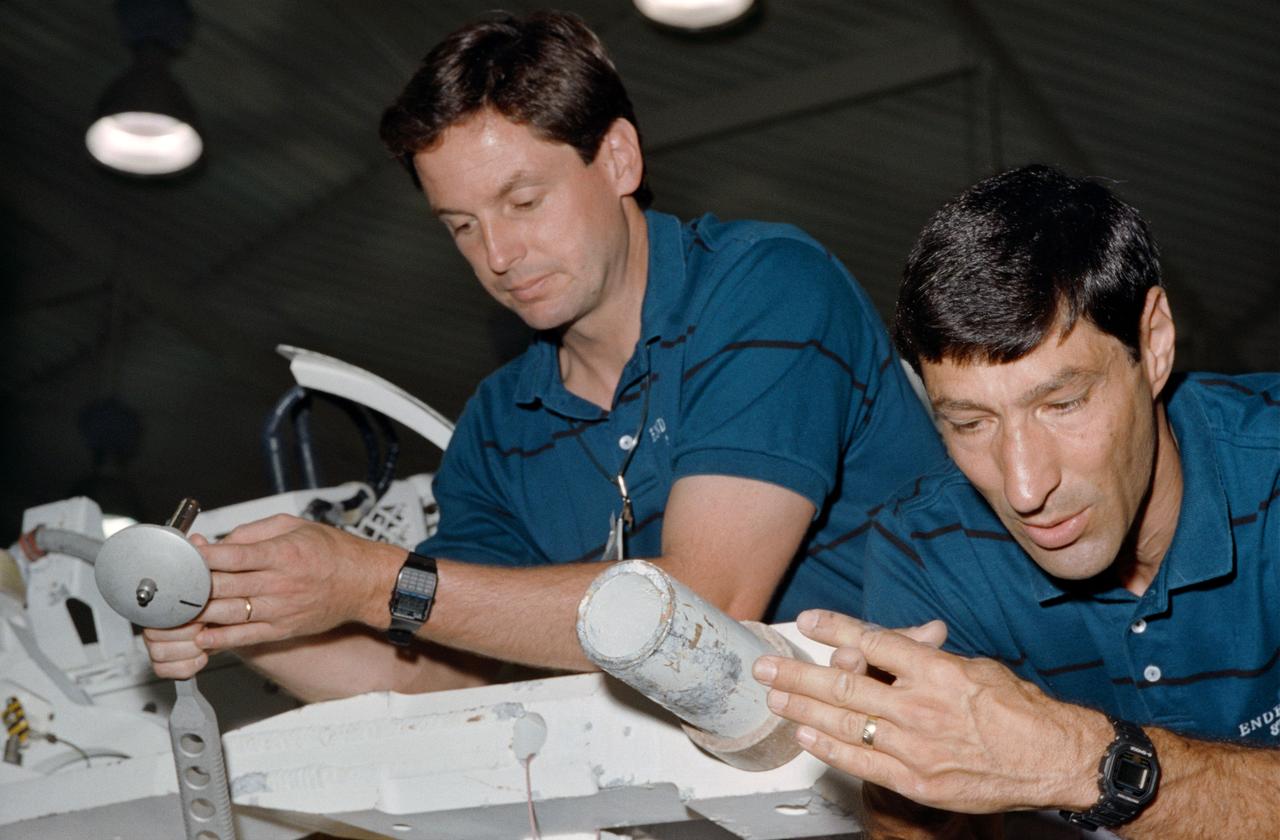
STS-54 Endeavour, Orbiter Vehicle (OV) 105, Mission Specialist 1 (MS1) Mario Runco, Jr (right) and MS2 Gregory J. Harbaugh, holding an ESSEX wrench, examine mockup and tools prior to an underwater simulation in JSC's Weightless Environment Training Facility (WETF) Bldg 29 pool. Runco and Harbaugh discuss the trunnion / payload retention latch assembly (PRLA) configuration.
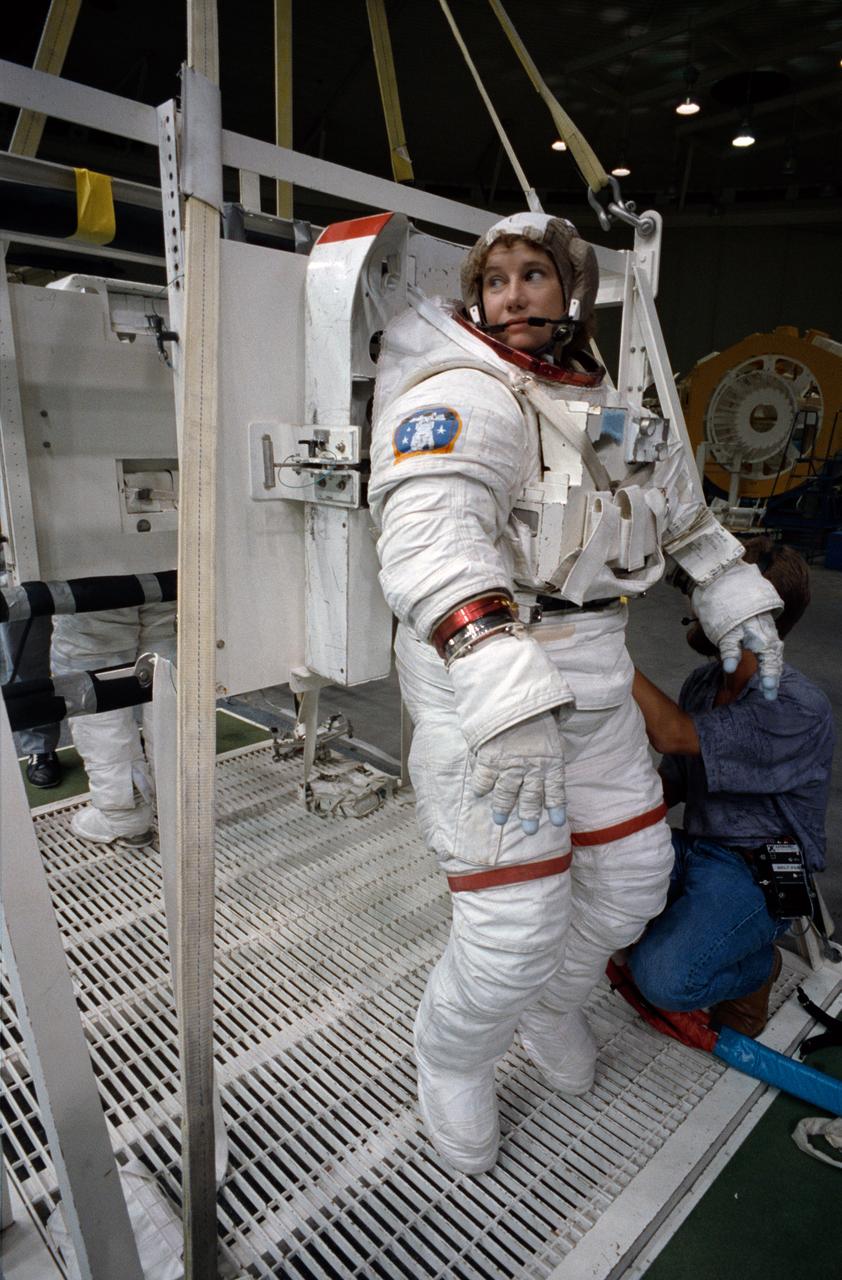
S92-42753 (31 July 1992) --- Astronaut Susan J. Helms, mission specialist assigned to fly aboard the Space Shuttle Endeavour for the STS-54 mission, gets assistance to complete the donning of her spacesuit. Though not assigned to the scheduled extravehicular activity (EVA), Helms is trained in the weightless environment training facility (WET-F). She will aid astronauts Gregory J. Harbaugh and Mario Runco Jr. in their planned EVA, scheduled for January of next year, and serve a backup role. Wearing this high fidelity training version of the extravehicular mobility unit (EMU), Helms was later lowered into the 25-ft. deep WET-F pool. The pressurized suit is weighted so as to allow Helms to achieve neutral buoyancy and simulate the various chores of the spacewalk.
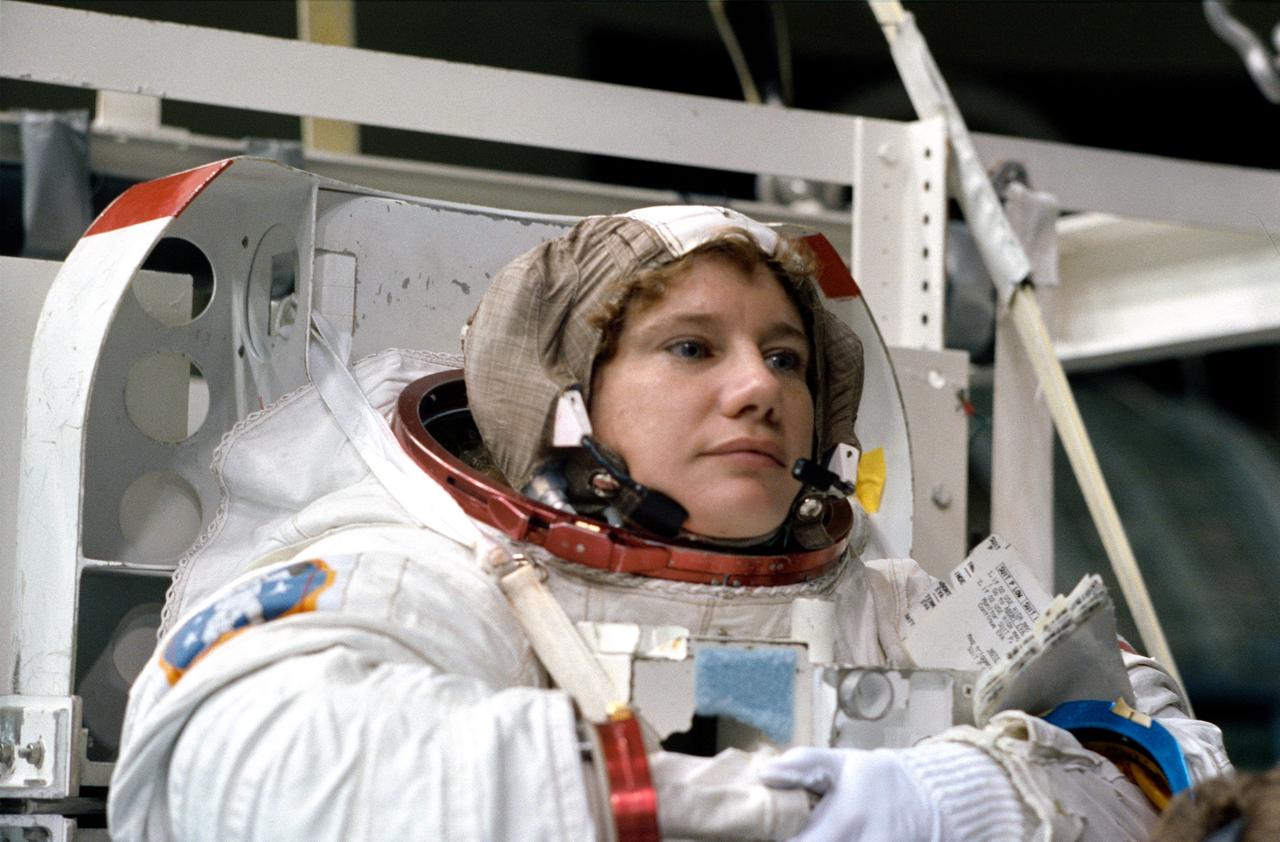
S92-42755 (31 July 1992) --- Astronaut Susan J. Helms, mission specialist assigned to fly aboard the Space Shuttle Endeavour for the STS-54 mission, completes the donning of her spacesuit before a training exercise. Though not assigned to the scheduled extravehicular activity (EVA), Helms is trained in the weightless environment training facility (WET-F). She will aid astronauts Gregory J. Harbaugh and Mario Runco Jr. in their planned EVA, scheduled for January of next year, and serve a backup role. Wearing this high fidelity training version of the extravehicular mobility unit (EMU), Helms was later lowered into the 25-ft. deep WET-F pool. The pressurized suit is weighted so as to allow Helms to achieve neutral buoyancy and simulate the various chores of the spacewalk.
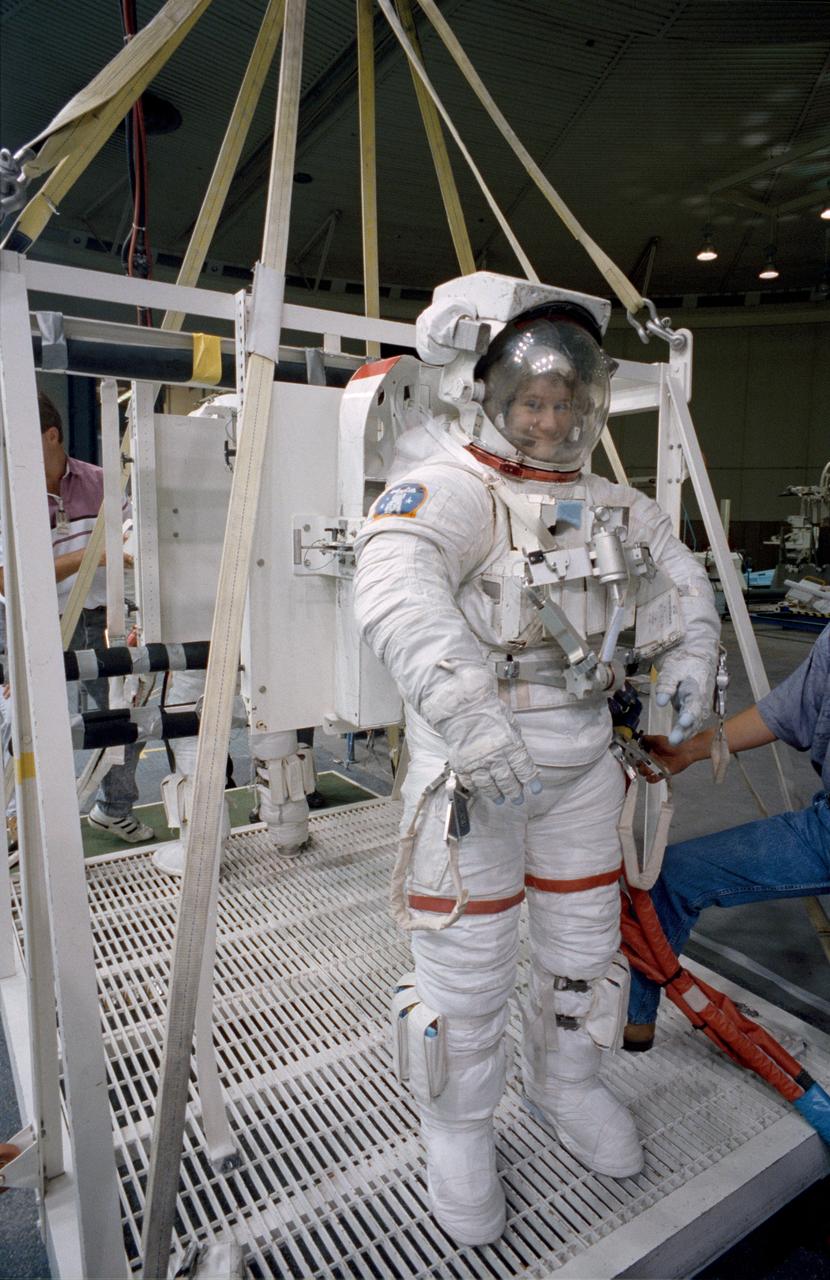
S92-42754 (31 July 1992) --- Astronaut Susan J. Helms, mission specialist assigned to fly aboard the Space Shuttle Endeavour for the STS-54 mission, gets assistance to complete the donning of her spacesuit. Though not assigned to the scheduled extravehicular activity (EVA), Helms is trained in the weightless environment training facility (WET-F). She will aid astronauts Gregory J. Harbaugh and Mario Runco Jr. in their planned EVA, scheduled for January of next year, and serve a backup role. Wearing this high fidelity training version of the extravehicular mobility unit (EMU), Helms was later lowered into the 25-ft. deep WET-F pool. The pressurized suit is weighted so as to allow Helms to achieve neutral buoyancy and simulate the various chores of the spacewalk.
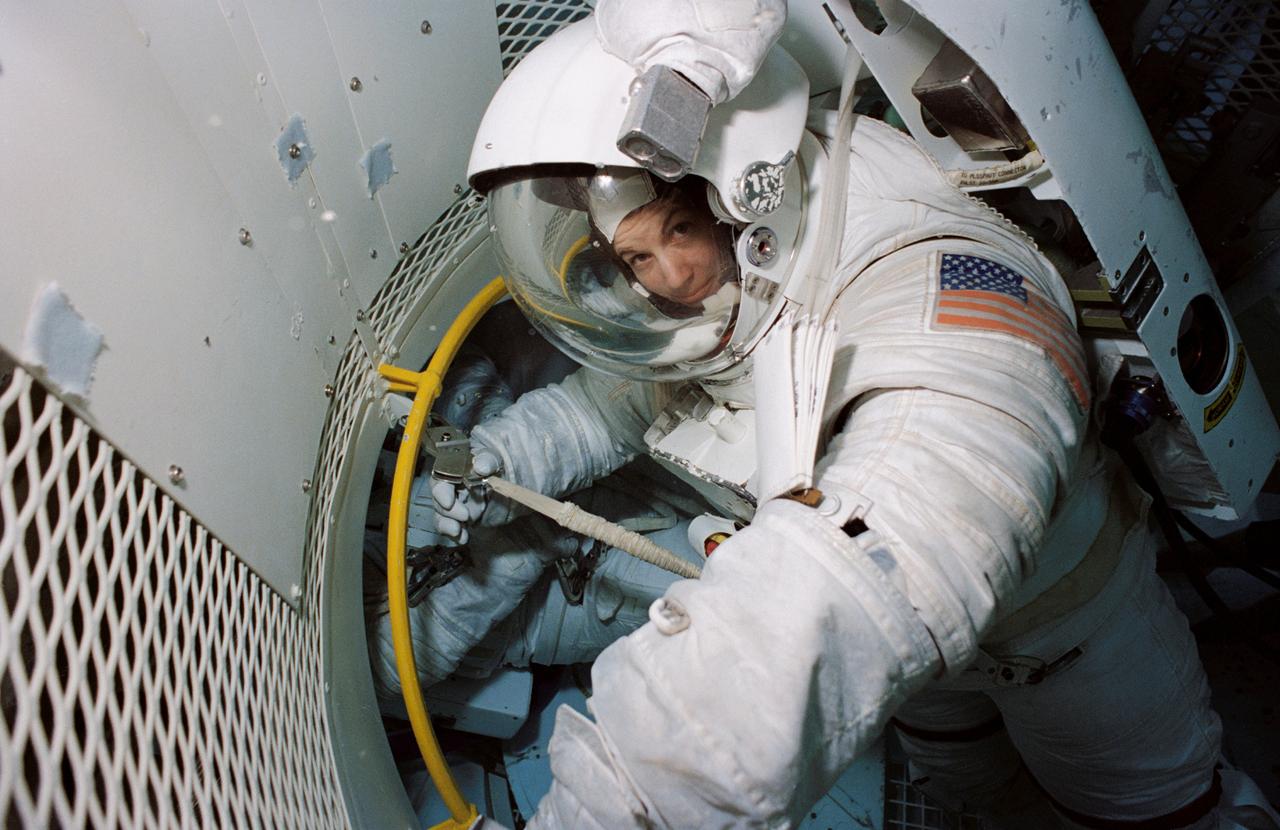
Astronaut and mission specialist Catherine G. Coleman,attired in a high fidelity training version of the Extravehicular Mobility Unit (EMU) space suit, trains for a contingency space walk at the Johnson Space Center’s (JSC) Weightless Environment Training Facility (WET-F). This particular training was in preparation for the STS-73 mission. The STS-73 mission was the second flight of the United States Microgravity Laboratory (USML-2), managed by scientists and engineers from the Marshall Space Flight Center.

The Reduced-Gravity Program provides the unique weightless or zero-g environment of space flight for testing and training of human and hardware reactions. The reduced-gravity environment is obtained with a specially modified KC-135A turbojet transport which flies parabolic arcs to produce weightless periods of 20 to 25 seconds. KC-135A cargo bay test area is approximately 60 feet long, 10 feet wide, and 7 feet high. The image shows KC-135A in flight.
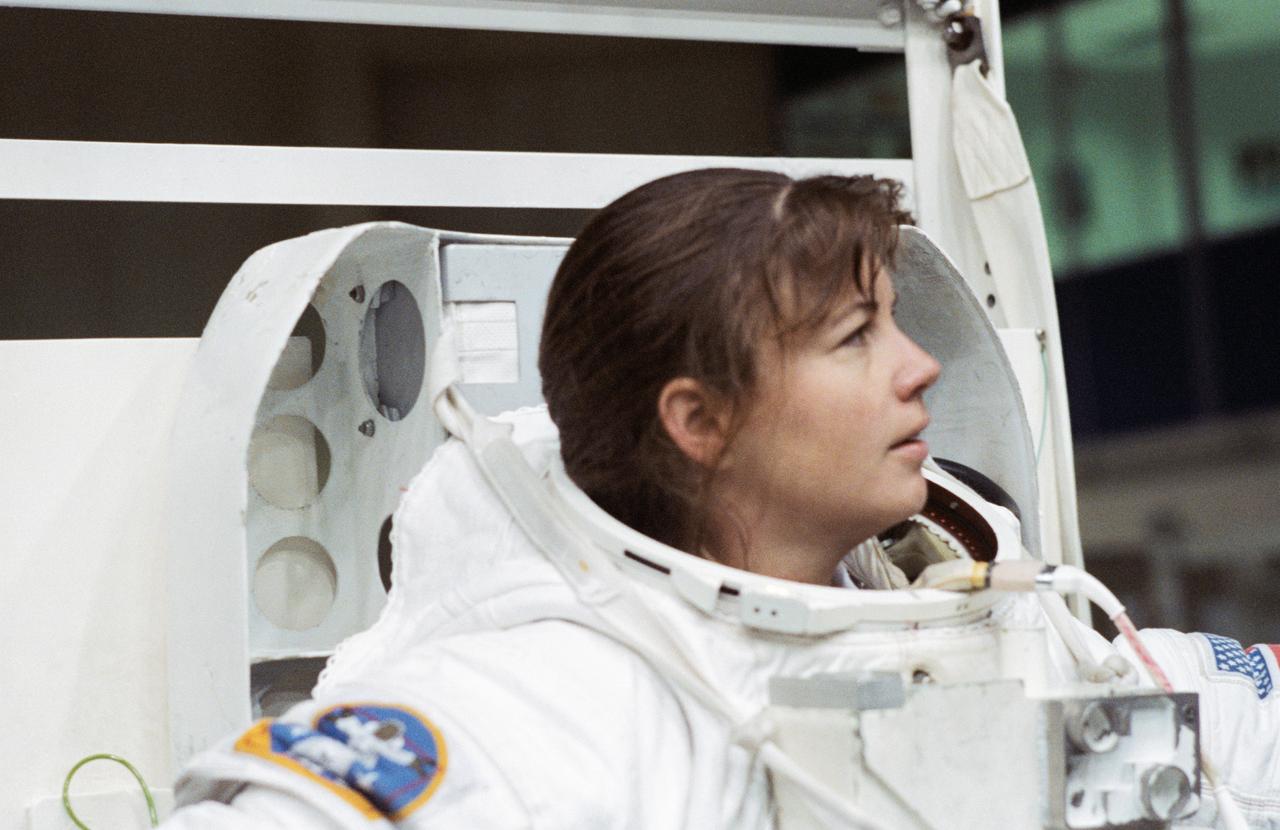
Astronaut and mission specialist Catherine G. Coleman is about to don the helmet portion of a high fidelity training version of the Extravehicular Mobility Unit (EMU) space suit at the Johnson Space Center’s (JSC) Weightless Environment Training Facility (WET-F). This particular training was in preparation for the STS-73 mission. The STS-73 mission was the second flight of the United States Microgravity Laboratory (USML-2), managed by scientists and engineers from the Marshall Space Flight Center.
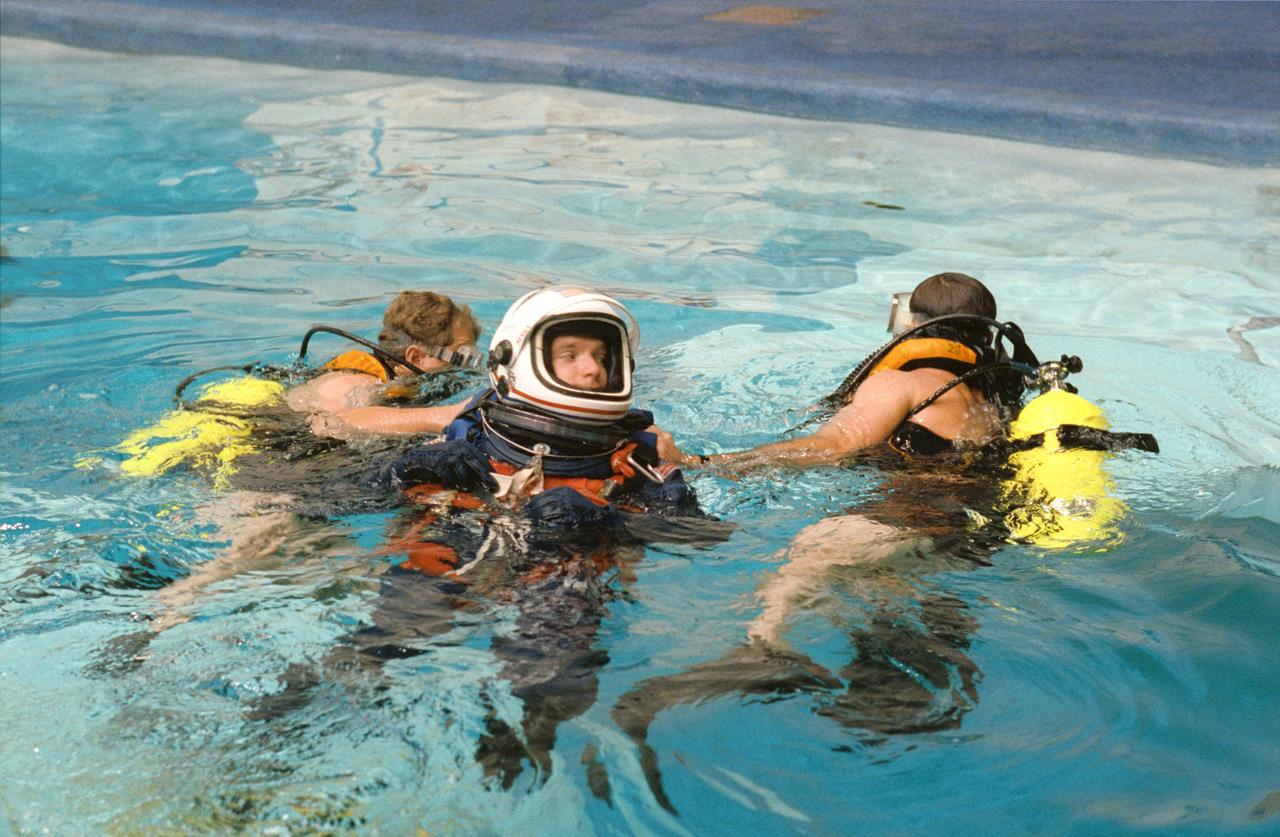
S92-50647 (Dec 1992) --- Assisted by two SCUBA-equipped divers, astronaut Charles J. Precourt, mission specialist for the STS-55/D-2 mission, participates in bailout training at the Johnson Space Center's (JSC) Weightless Environment and Training Facility (WET-F). Precourt is attired in a training version of the partial pressure Shuttle launch and entry garment. All seven prime flight crewmembers and the two backup payload specialists participated in the training session.
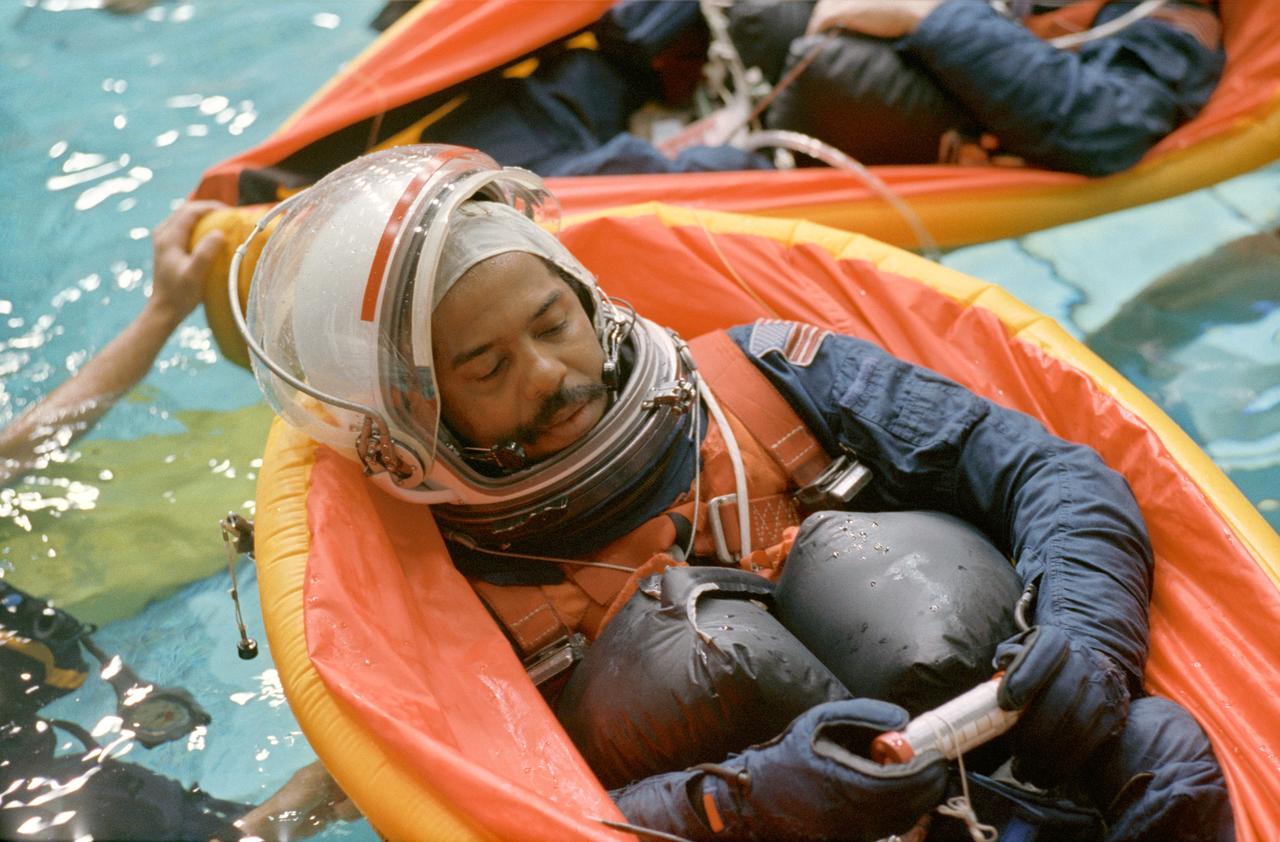
S92-50679 (Dec 1992) --- Using a small life raft, astronaut Bernard A. Harris Jr., mission specialist for the STS-55\D-2 mission, participates in bailout training at the Johnson Space Center's (JSC) Weightless Environment and Training Facility (WET-F). Harris is attired in a training version of the partial pressure Shuttle launch and entry garment. All seven prime flight crew members and the two back-up payload specialists participated in the training session.
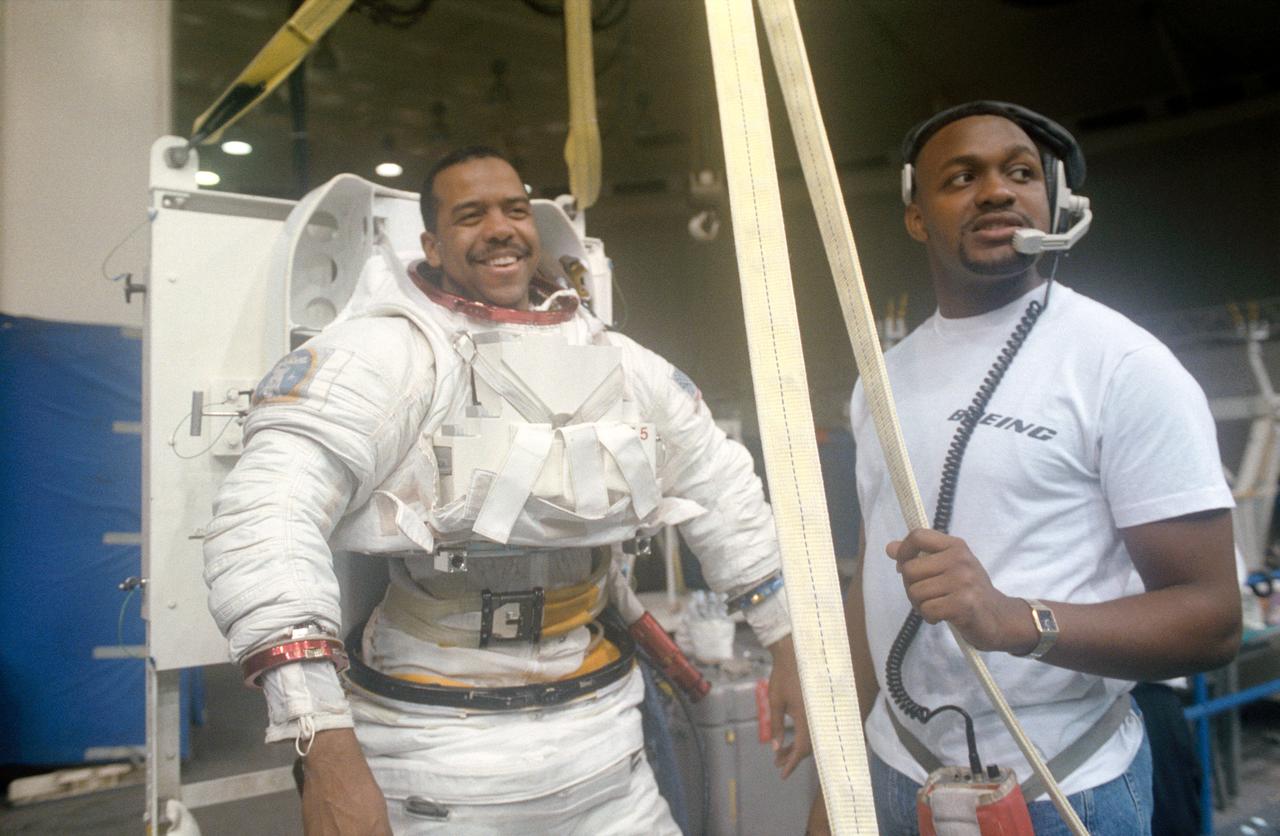
S91-51063 (Dec 1991) --- Partially attired in a special training version of the Extravehicular Mobility Unit (EMU) spacesuit, astronaut Bernard J. Harris Jr. is pictured before a training session at the Johnson Space Center's (JSC) Weightless Environment Training Facility (WET-F). Harris, STS-55 mission specialist, is assisted by Laney Lee. Minutes later, Harris was in a 25-feet deep pool, simulating a contingency extravehicular activity (EVA). There is no scheduled EVA for the 1993 flight but each spaceflight crew includes astronauts trained for a variety of contingency tasks that could require exiting the shirt-sleeve environment of a Shuttle's cabin.
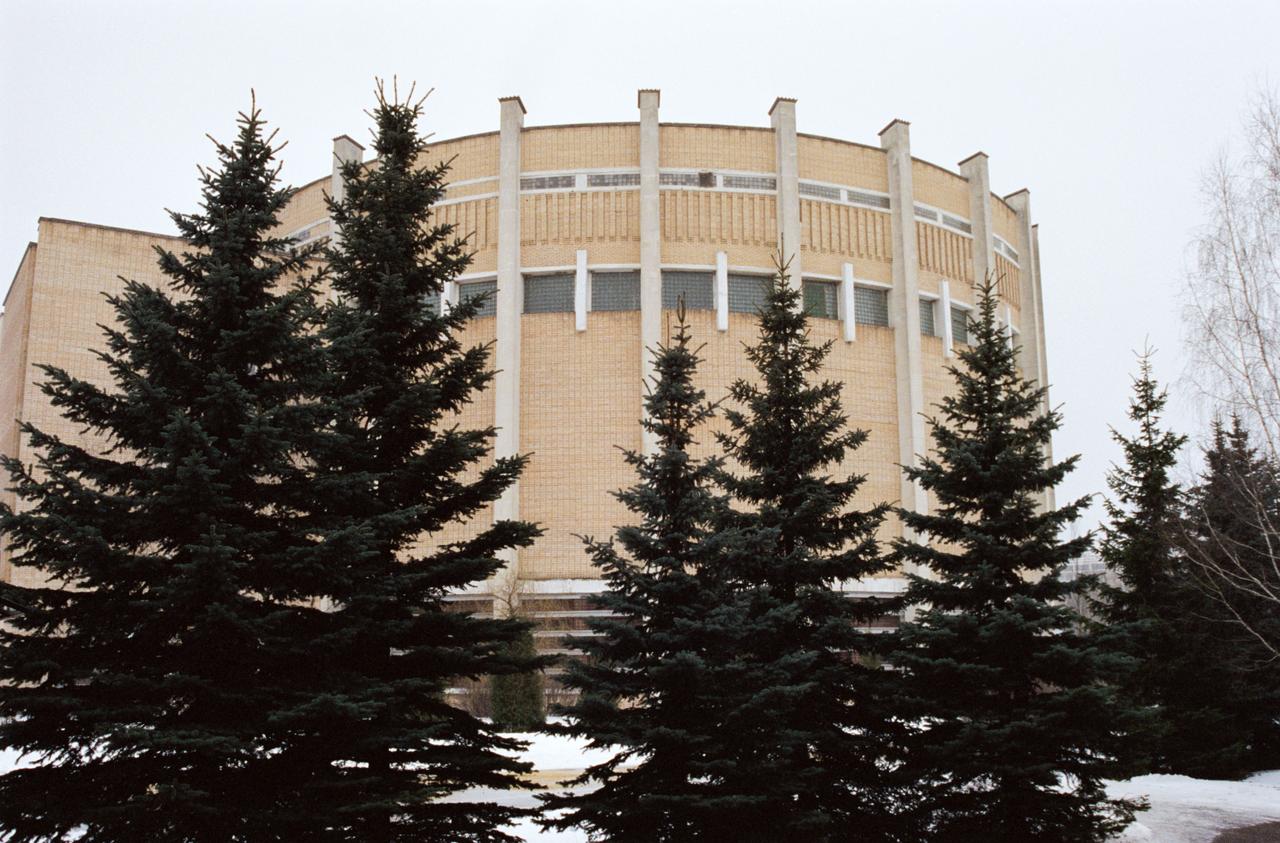
S95-04319 (22 Feb 1995) --- The neutral buoyancy facility at the Gagarin Cosmonaut Training Center in Star City, Russia, is used for underwater training for missions aboard the Russian Mir Space Station. The facility is similar to NASA's Weightless Environment Training Facility (WET-F) at the Johnson Space Center (JSC) in Houston, Texas, and the Neutral Buoyancy Simulator (NBS) at the Marshall Space Flight Center (MSFC) in Huntsville, Alabama.
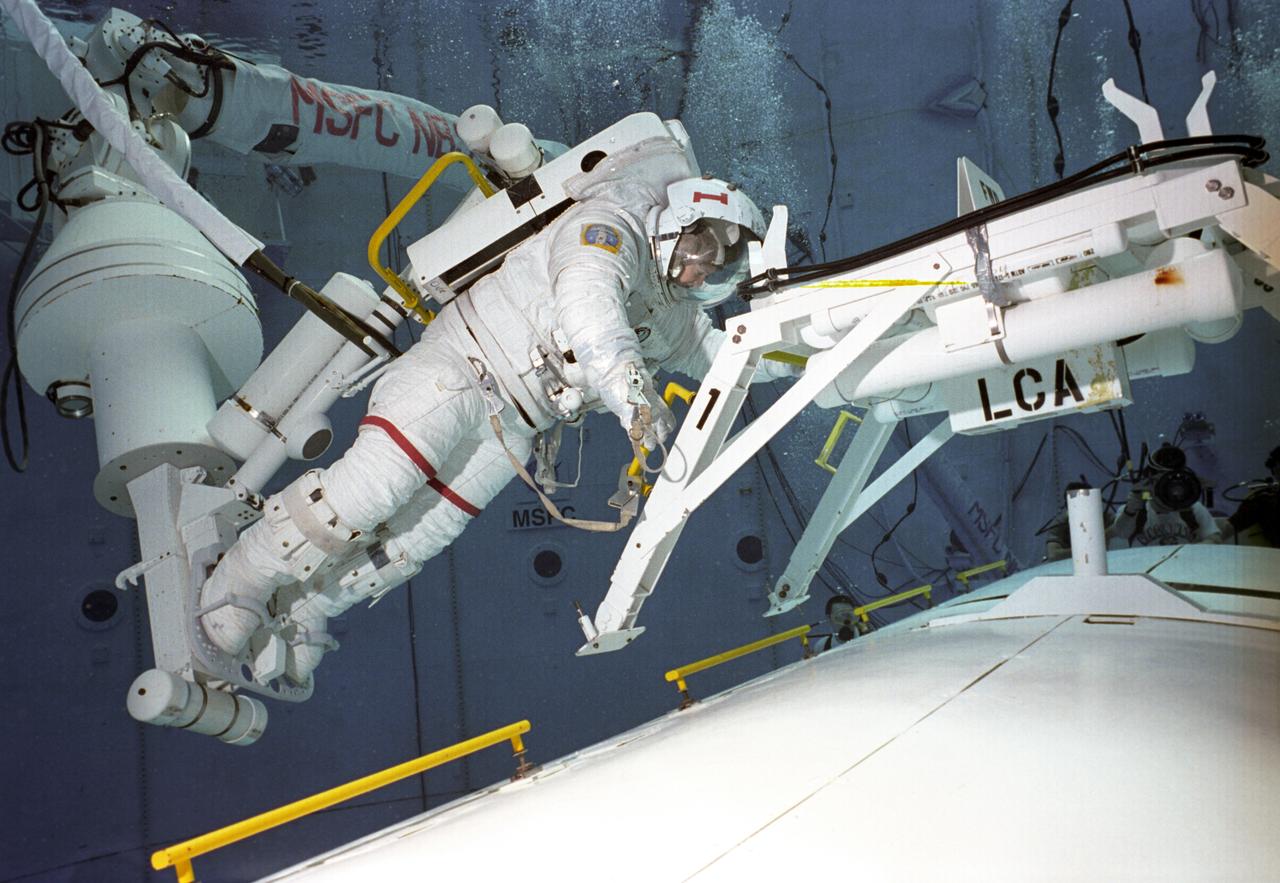
Astronauts Susan Helms (#1) and Carl Walz (#2) are training in the Neutral Buoyancy Simulator (NBS) at Marshall Space Flight center with an exercise for International Space Station Alpha. The NBS provided the weightless environment encountered in space needed for testing and the practices of Extravehicular Activities (EVA).
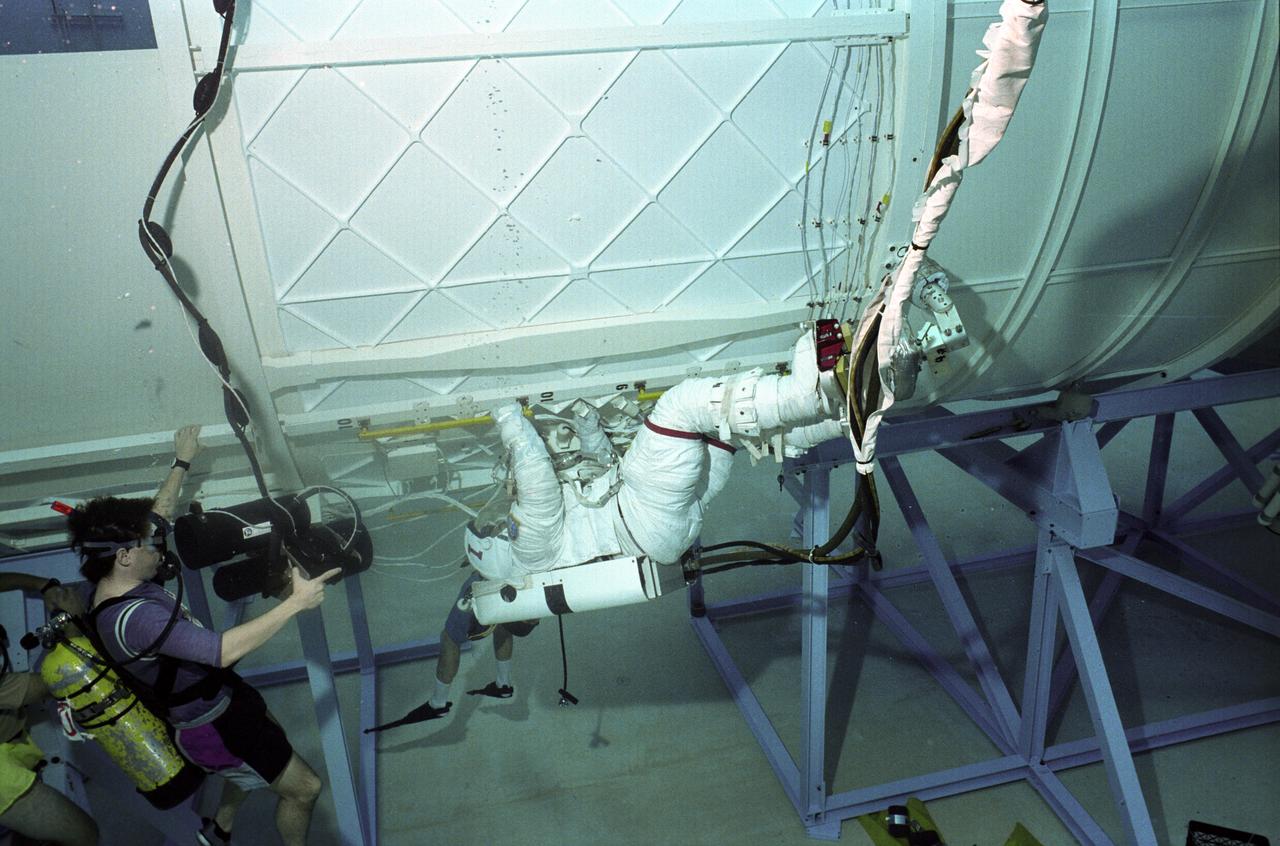
Astronauts Tamara Jernigan (#1) and David Wolf (#2) are training in the Neutral Buoyancy Simulator (NBS) at Marshall Space Flight center with an exercise for International Space Station Alpha. The NBS provided the weightless environment encountered in space needed for testing and the practices of Extravehicular Activities (EVA).
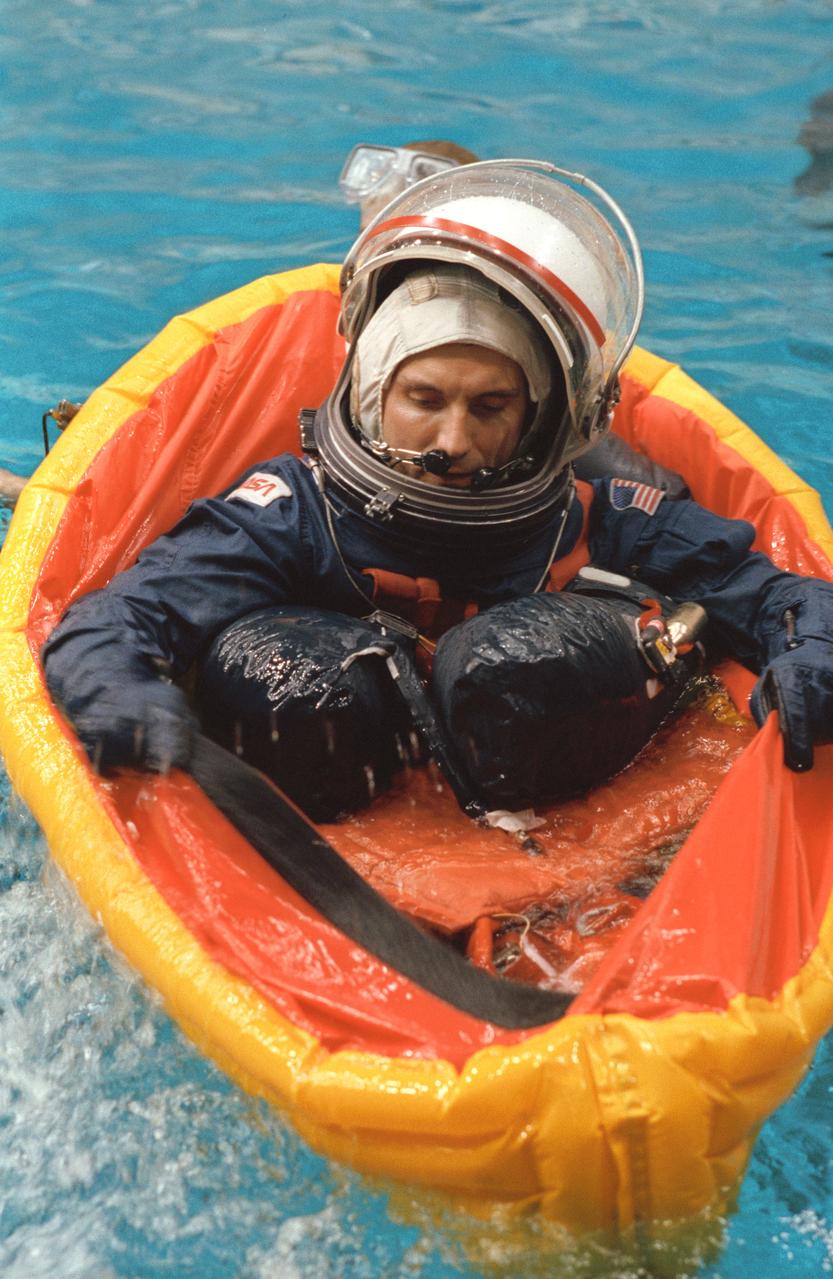
S93-31928 (24 March 1993) --- Astronaut Carl E. Walz, mission specialist, navigates a one-person life raft during emergency bailout training exercises at the Johnson Space Center's Weightless Environment Training Facility (WET-F). Walz was joined in the training session by the four other NASA astronauts assigned to the STS-51 flight.
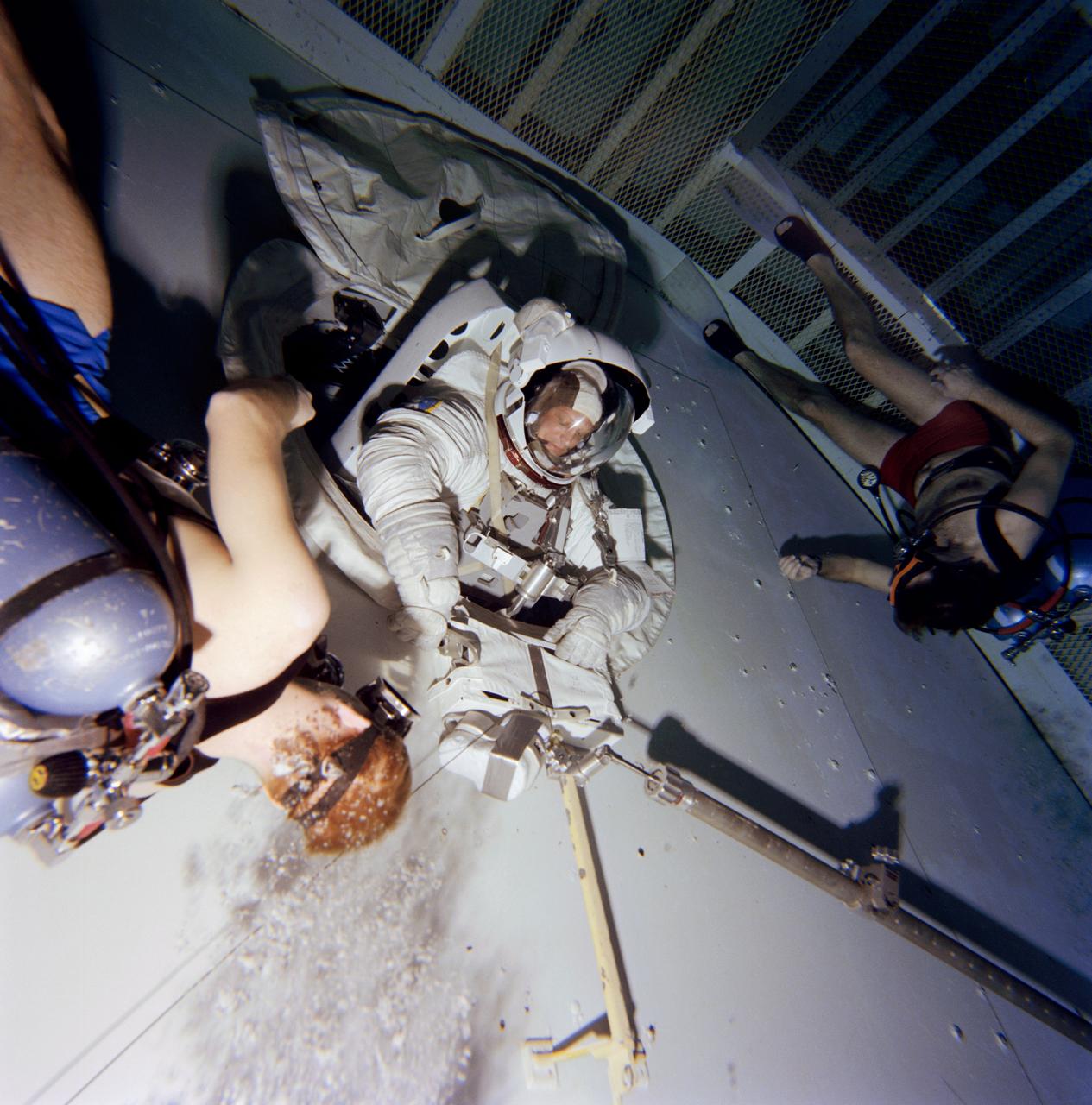
Dr. Norman E. Thagard, mission specialist for STS-7, moves through the hatchway of the mockup of the Space Shuttle orbiter which is part of JSC's weightless environment training facility (WETF). Thagard is wearing an extravehicular mobility unit and is practicing procedures used when performing an extravehicular activity (EVA) during a flight.
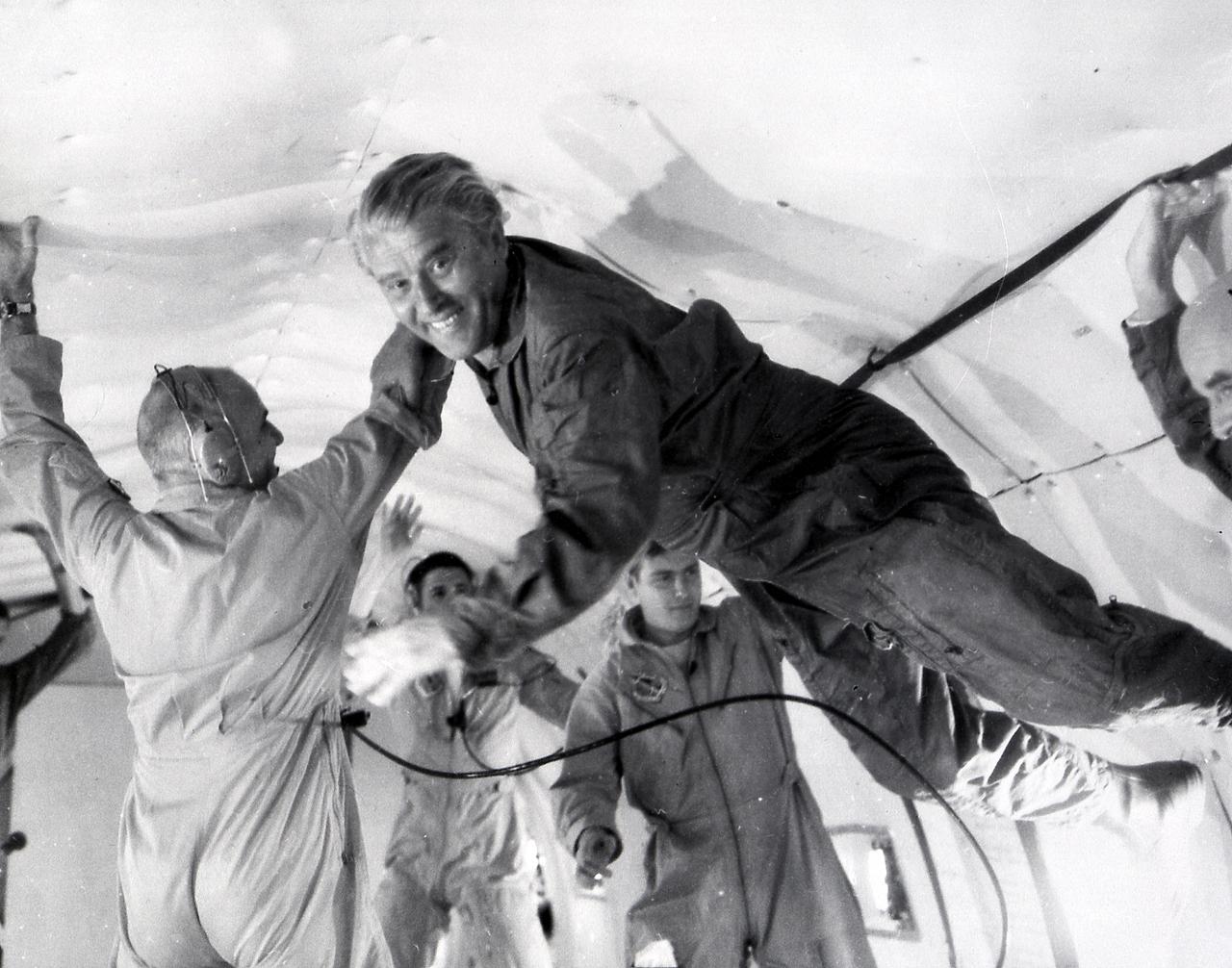
Dr. von Braun inside the KC-135 in flight. The KC-135 provide NASA's Reduced-Gravity Program the unique weightlessness or zero-g environment of space flight for testing and training of human and hardware reactions. The recent version, KC-135A, is a specially modified turbojet transport which flies parabolic arcs to produce weightlessness periods of 20 to 25 seconds and its cargo bay test area is approximately 60 feet long, 10 feet wide, and 7 feet high.
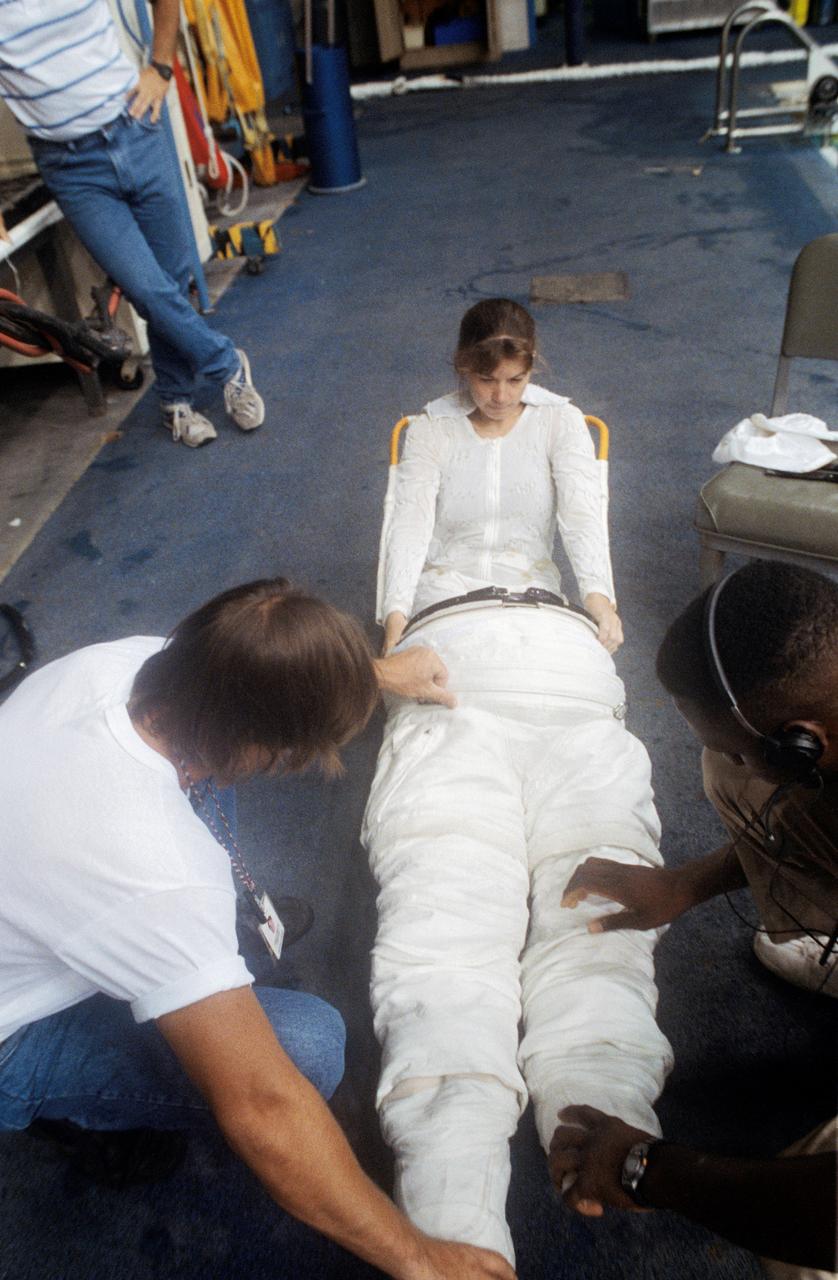
Astronaut and mission specialist for STS-73, Catherine G. Coleman, dons a high fidelity training version of the Extravehicular Mobility Unit (EMU) space suit at the Johnson Space Center’s (JSC) Weightless Environment Training Facility (WET-F) in preparation for the mission. The STS-73 mission was the second flight of the United States Microgravity Laboratory (USML-2), managed by scientists and engineers from the Marshall Space Flight Center.
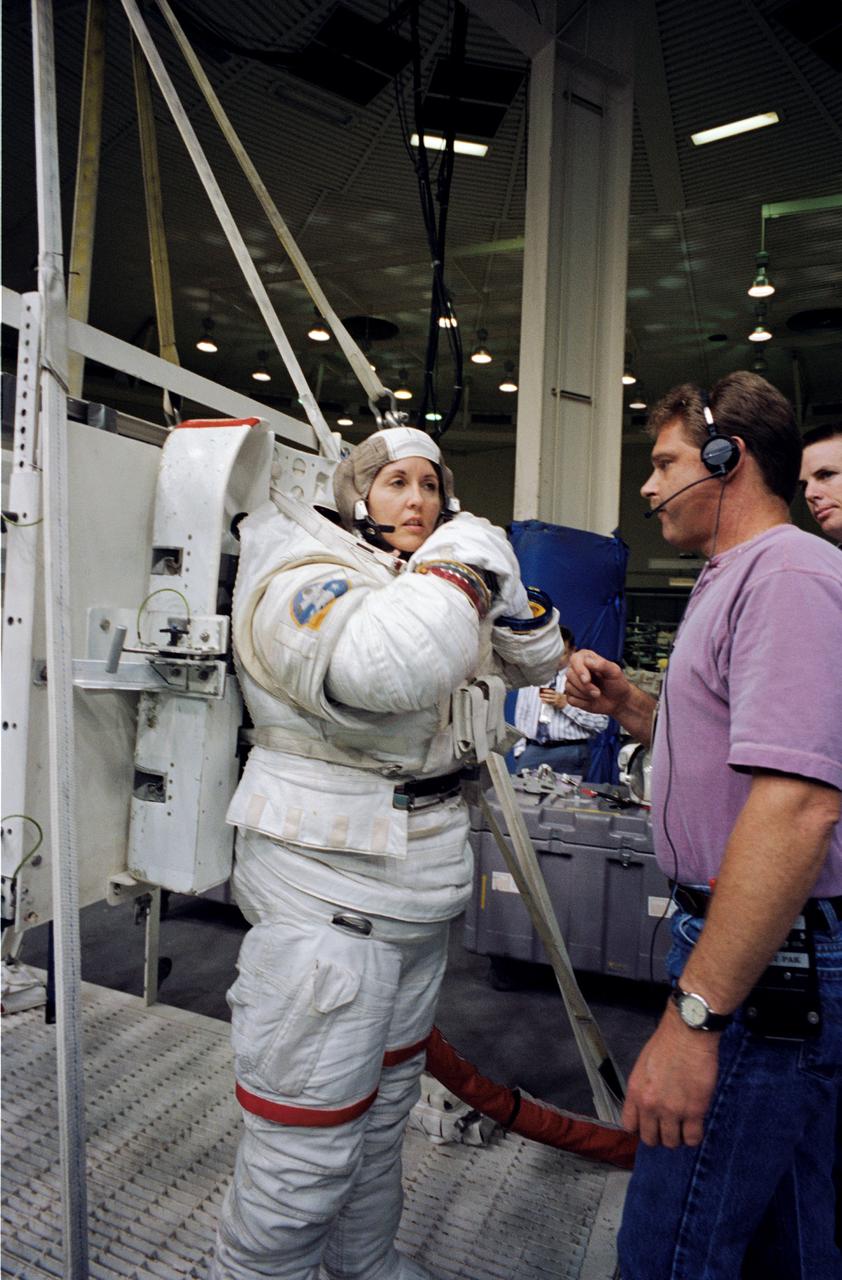
Astronaut Kathryn Thornton, payload commander for the STS-73 mission, attired in a high fidelity training version of the Extravehicular Mobility Unit (EMU) space suit, prepares to go underwater in the Johnson Space Center’s (JSC) Weightless Environment Training Facility (WET-F). The STS-73 mission was the second flight of the United States Microgravity Laboratory (USML-2), managed by scientists and engineers from the Marshall Space Flight Center.
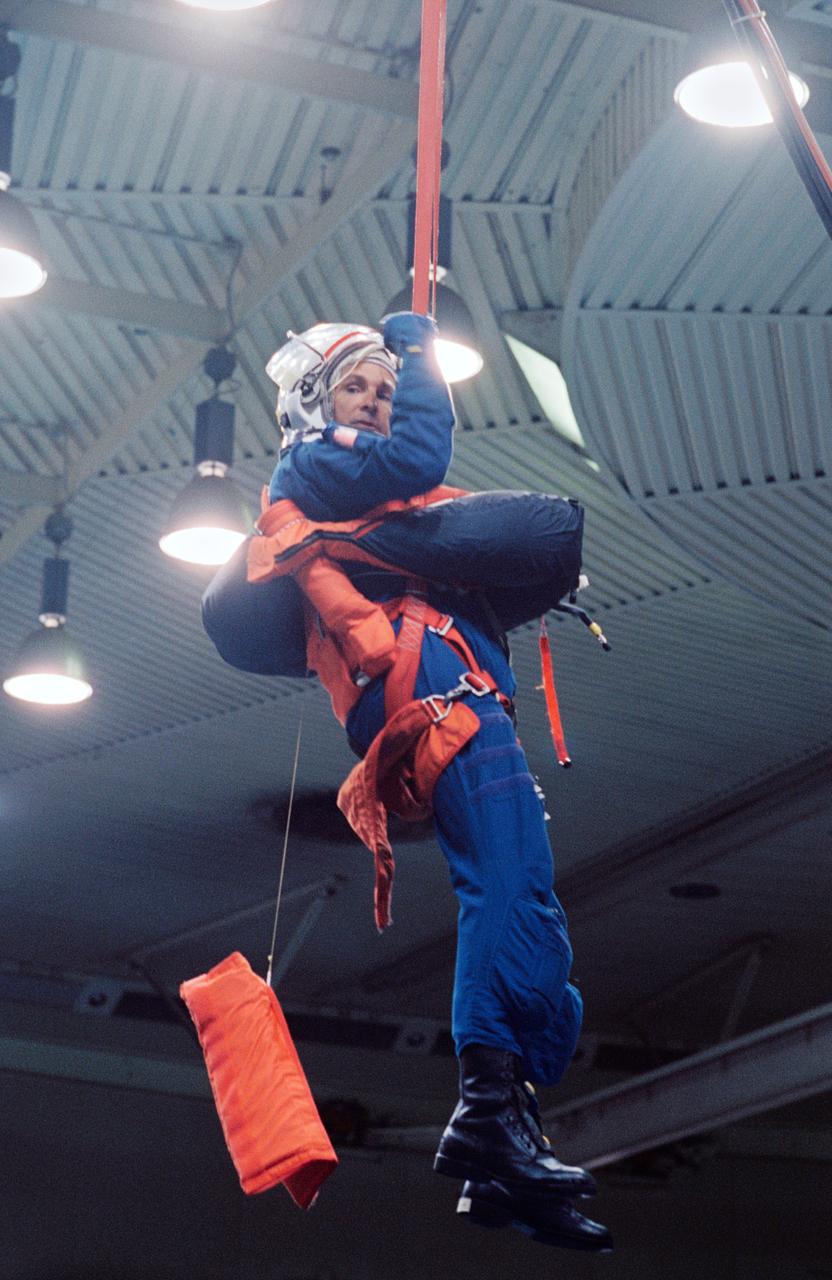
S94-37516 (28 June 1994) --- Astronaut Curtis L. Brown is suspended by a simulated parachute gear during an emergency bailout training exercise in the Johnson Space Center's (JSC) Weightless Environment Training Facility (WET-F). Making his second flight in space, Brown will join four other NASA astronauts and a European mission specialist for a week and a half in space aboard the Space Shuttle Atlantis in support of the Atmospheric Laboratory for Applications and Science (ATLAS-3) mission.
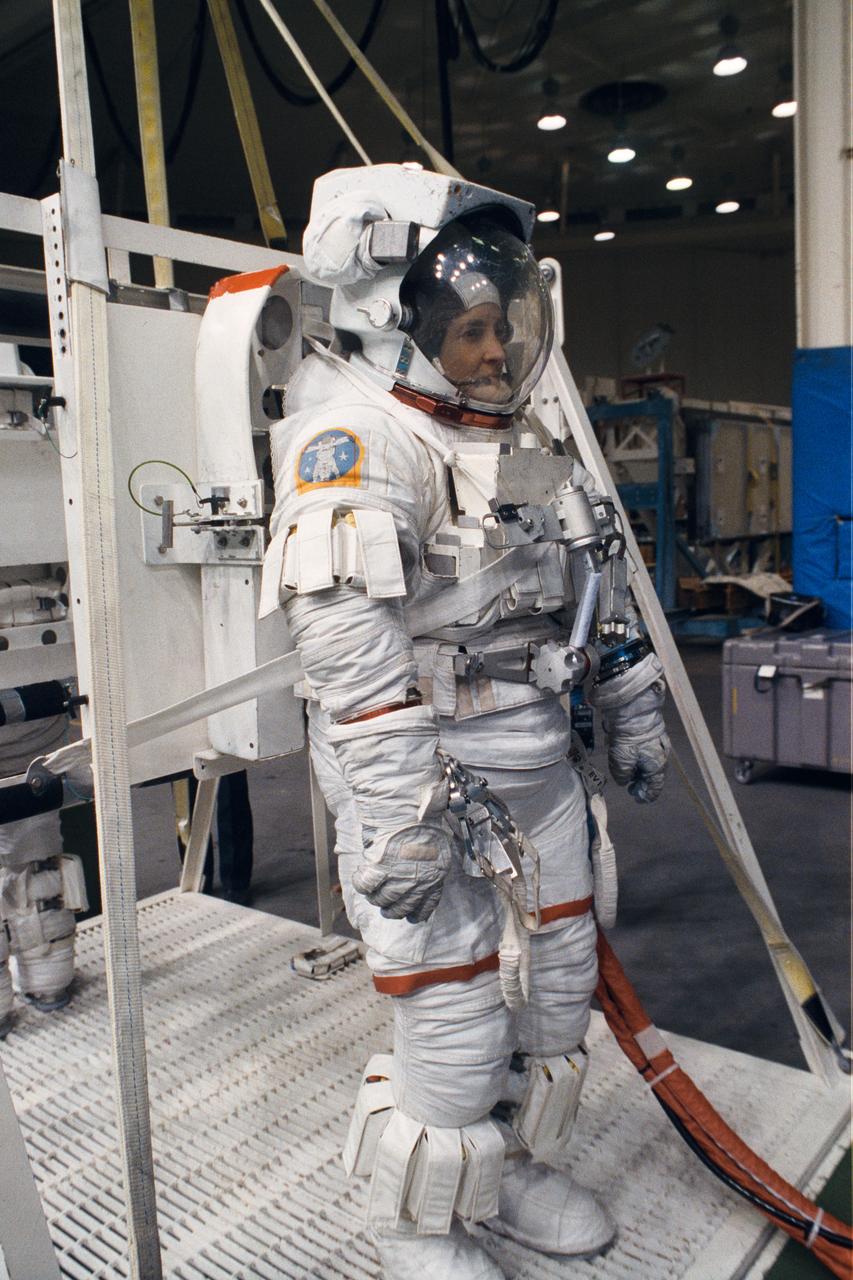
S93-41574 (17 Aug 1993) --- Astronaut Linda M. Godwin, payload commander, prepares to be submerged in a 25-feet deep pool at the Johnson Space Center's (JSC) Weightless Environment Training Facility (WET-F). Astronauts Godwin and Thomas D. Jones (out of frame at left), mission specialist, are using the WET-F to train for contingency space walks for their STS-59 Space Shuttle Endeavour mission next year. No space walks are planned for the flight.
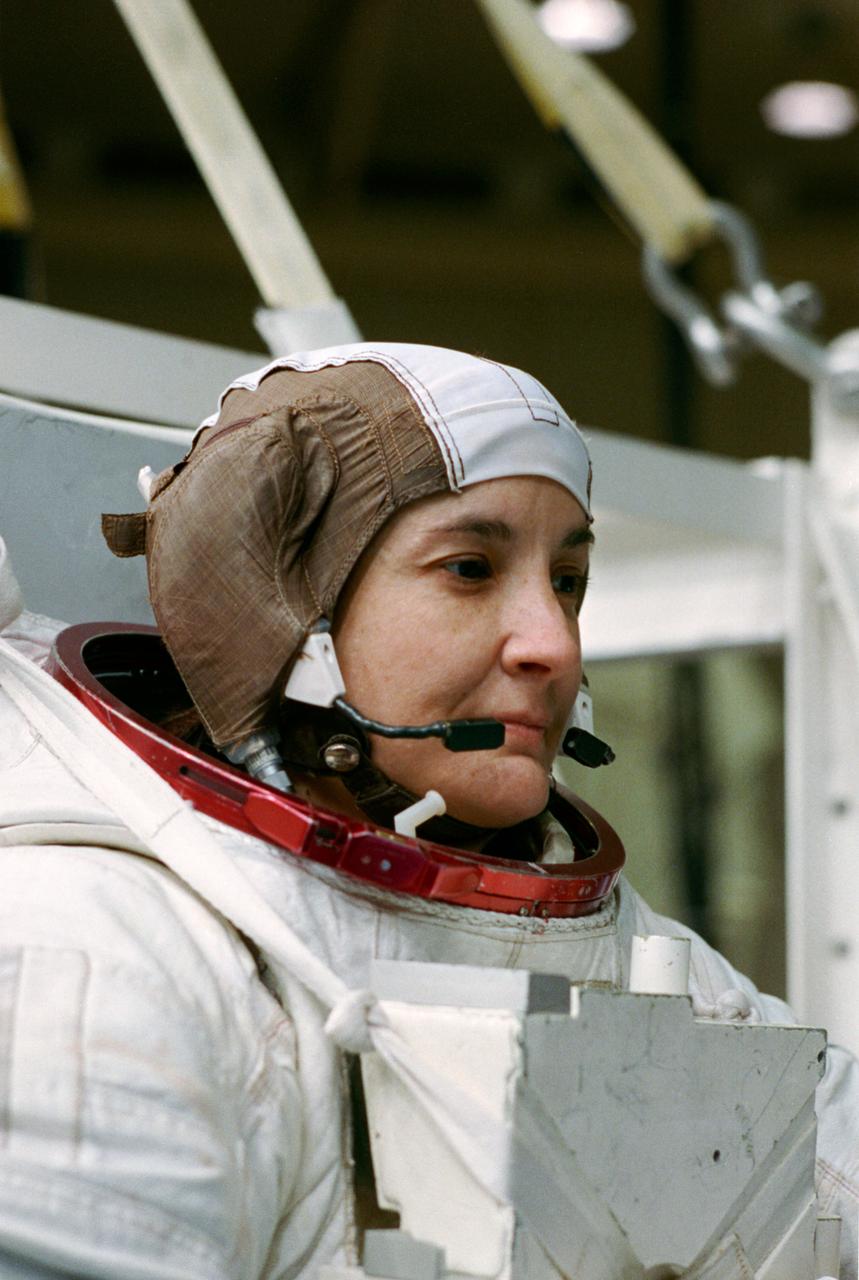
S93-41572 (17 Aug 1993) --- Astronaut Linda M. Godwin, payload commander, prepares to donn her helmet before being submerged in a 25-feet deep pool at the Johnson Space Center's (JSC) Weightless Environment Training Facility (WET-F). Astronauts Godwin and Thomas D. Jones, mission specialist, are using the WET-F to train for contingency space walks for their Space Shuttle Endeavour mission next year. No space walks are planned for the flight.
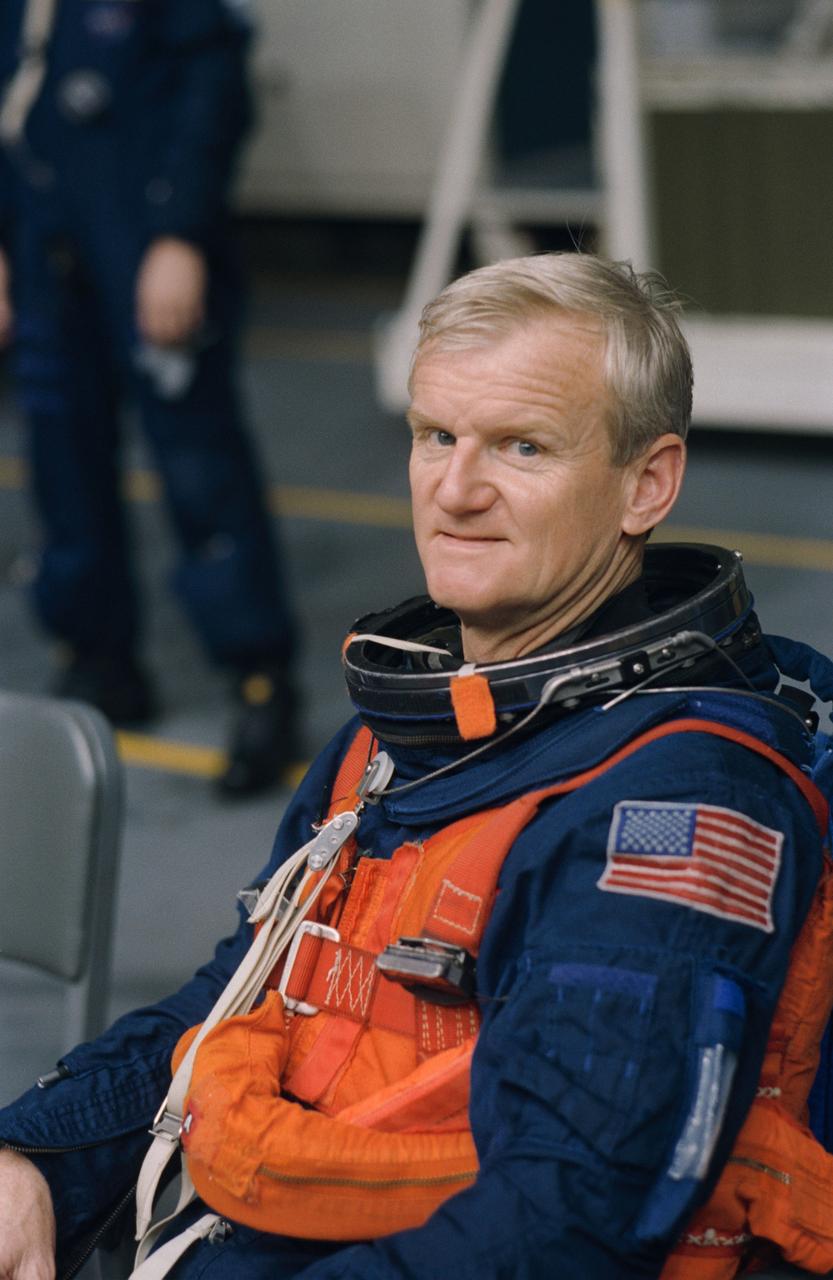
S96-08065 (April 1996) --- Astronaut John H. Casper, mission commander and veteran of three Space Shuttle flights, awaits the beginning of a training session for emergency bailout. All six crew members participated in the session, held in the Johnson Space Center?s (JSC) Weightless Environment Training Facility (WET-F). The six astronauts will spend nine days aboard the Space Shuttle Endeavour next month.
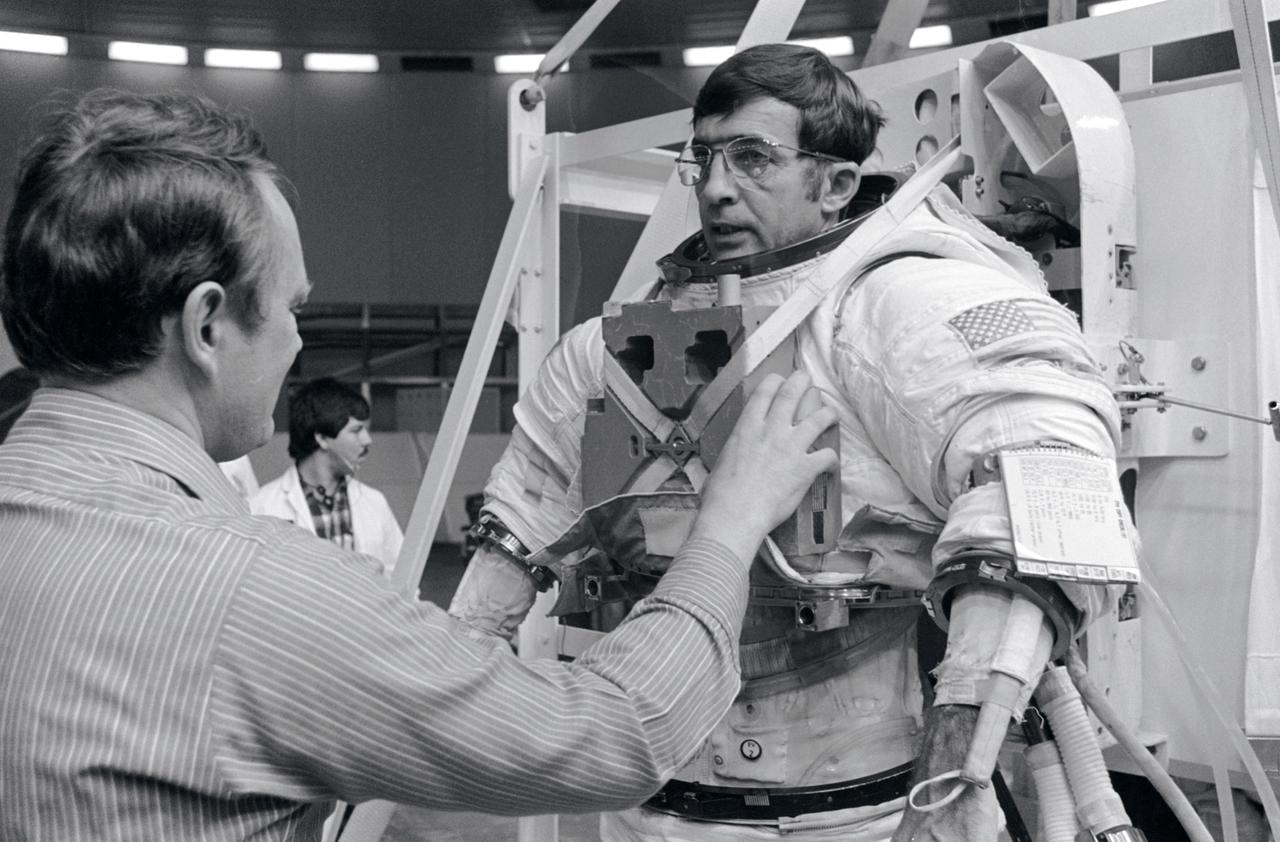
S82-41606 (December 1982) --- Astronaut Karol J. Bobko, left, STS-6 pilot, assists astronaut Donald H. Peterson, STS-6 mission specialist, prior to an underwater training session in the Johnson Space Center?s weightless environment training facility (WET-F). Astronauts F. Story Musgrave and Peterson are scheduled to perform the Space Transportation System?s first extravehicular activity on Challenger?s first flight, slated for early next year. Photo credit: NASA
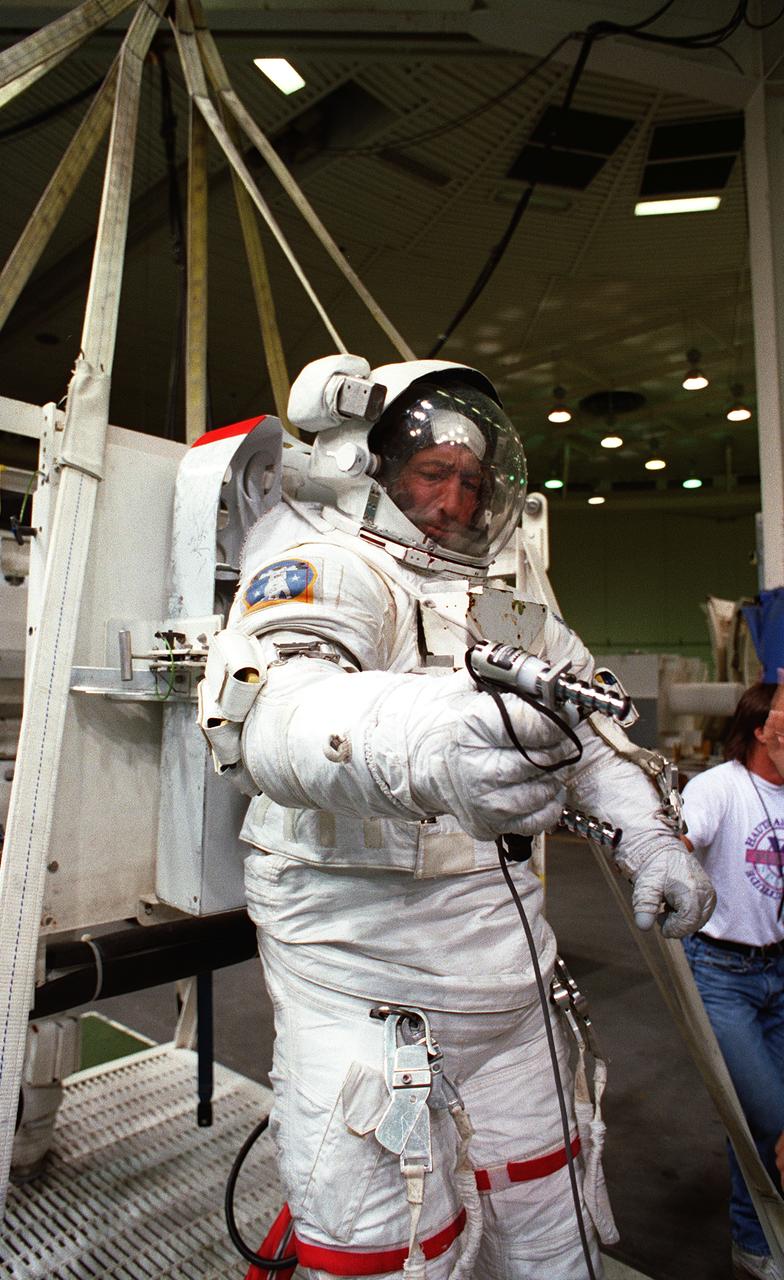
S95-15847 (26 July 1995) --- Wearing a training version of the Extravehicular Mobility Unit (EMU) space suit, astronaut Mario Runco Jr., mission specialist, prepares to participate in an underwater rehearsal of a contingency Extravehicular Activity (EVA). This type of training routinely takes place in the 25-feet deep pool of the Johnson Space Center's (JSC) Weightless Environment Training Center (WET-F). The training prepares at least two crew members on each flight for procedures to follow outside the spacecraft in event of failure of remote methods to perform various chores.
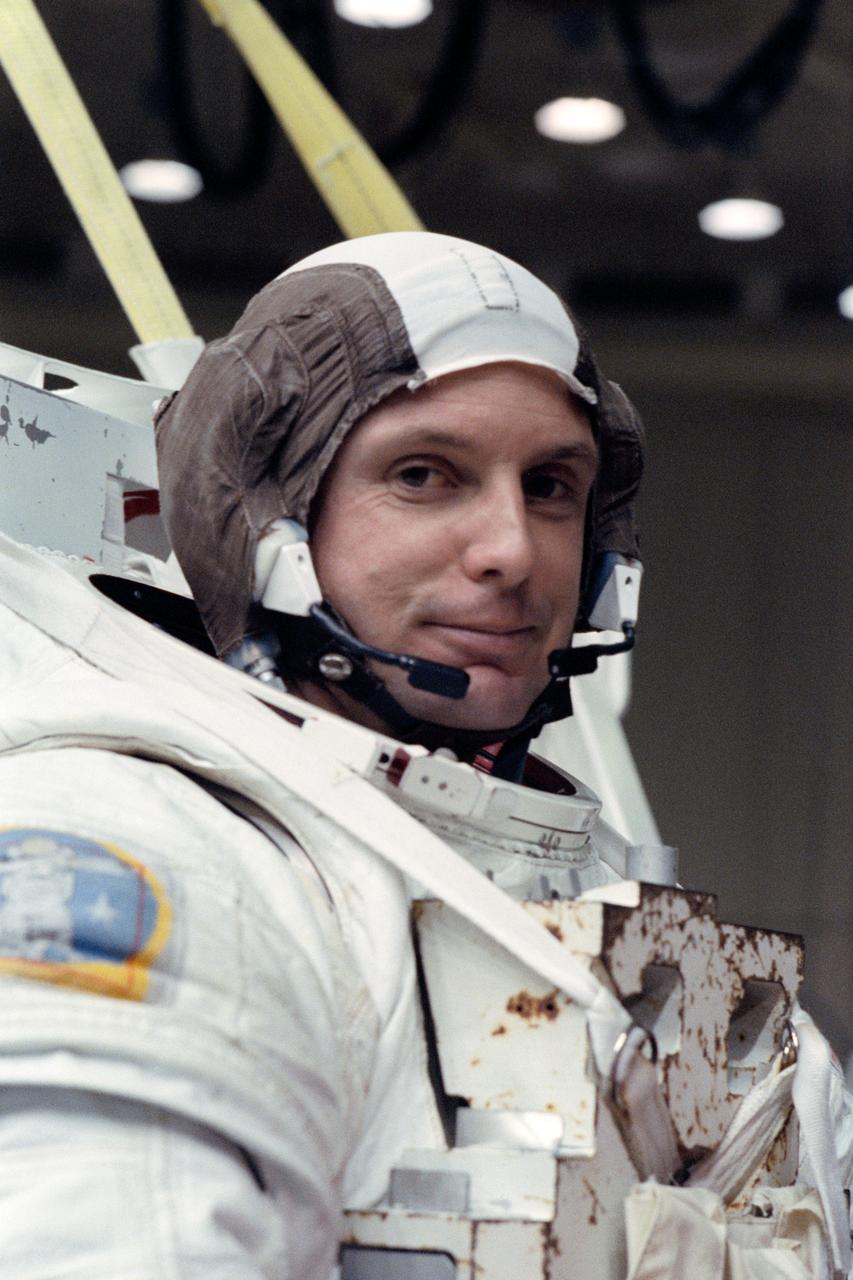
S90-41497 (Aug 1990) --- Astronaut Gregory J. Harbaugh, STS-39 mission specialist, completes suiting up process for a training exercise in the weightless environment training facility (WET-F) at the Johnson Space Center (JSC). Harbaugh and fellow crewmembers are using JSC's WET-F facility to participate in simulations of contingency extravehicular activity (EVA) for the flight.
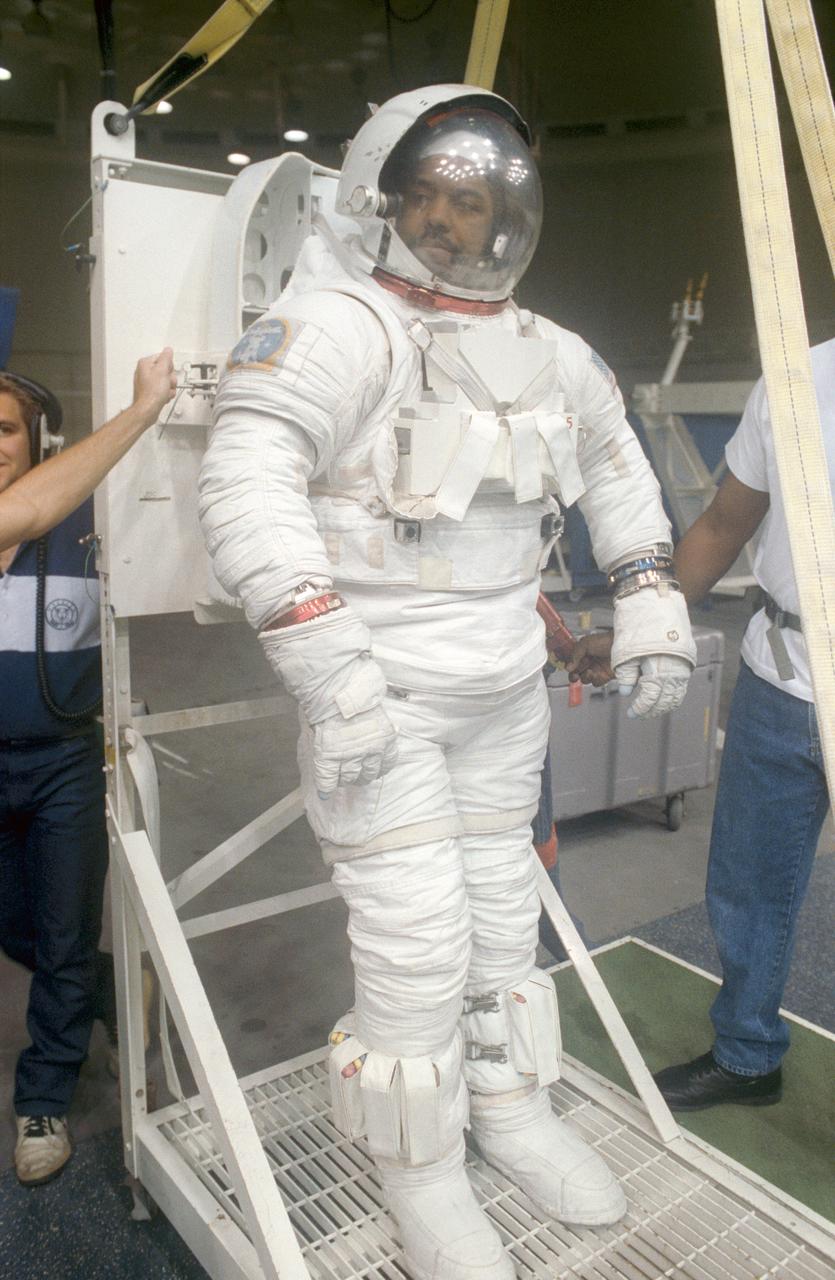
S91-51058 (Dec 1991) --- Partially attired in a special training version of the Extravehicular Mobility Unit (EMU) space suit, astronaut Bernard A. Harris Jr. is pictured before a training session at the Johnson Space Center's (JSC) Weightless Environment Training Facility (WET-F). Minutes later the STS-55 mission specialist was in a 25-feet deep pool simulating a contingency extravehicular activity (EVA). The platform on which he is standing was used to lower him into the water where, with the aid of weights on his environmentally-controlled pressurized suit, he was able to achieve neutral buoyancy. There is no scheduled EVA for the 1993 flight but each space flight crew includes astronauts trained for a variety of contingency tasks that could require exiting the shirt-sleeve environment of a Shuttle's cabin.
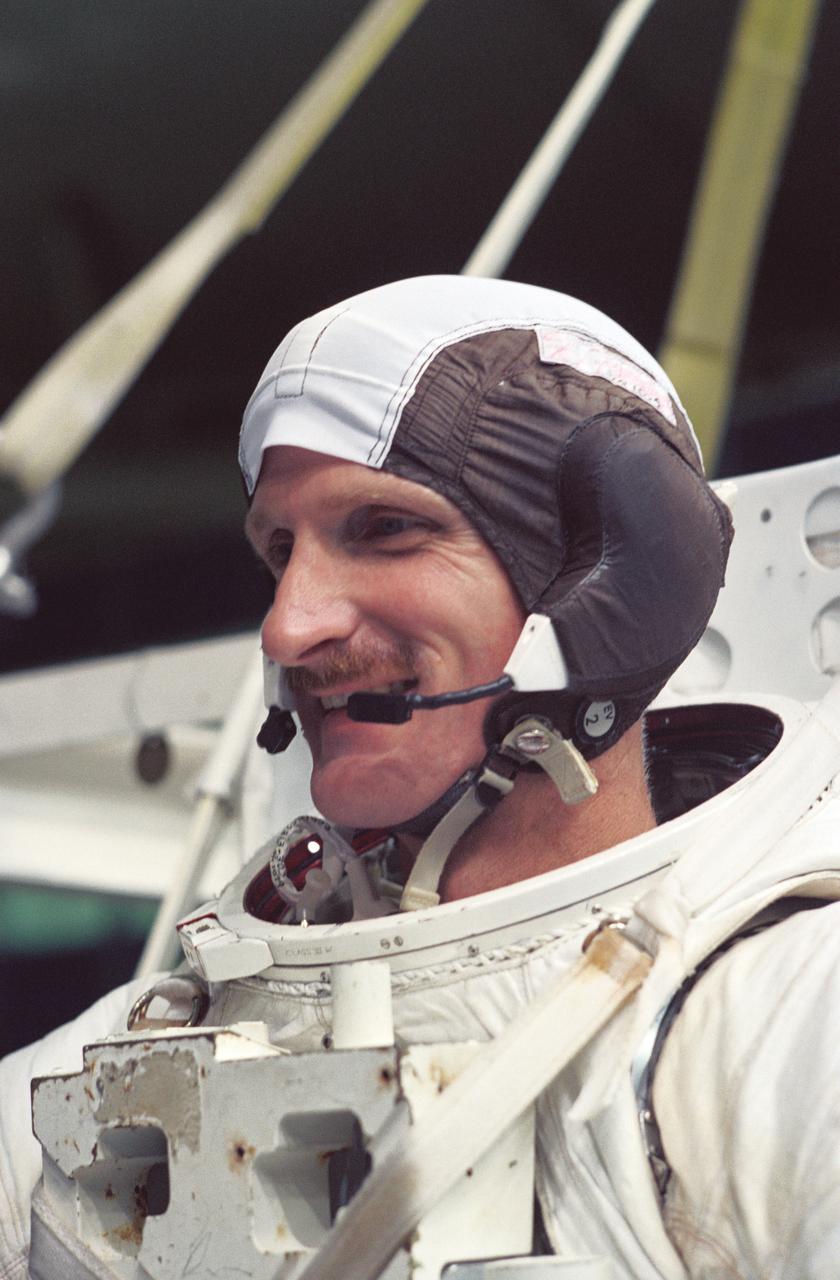
S94-40049 (1 August 1994) --- Attired in a training version of the Extravehicular Mobility Unit (EMU), astronaut Joseph R. Tanner, mission specialist, prepares to be submerged in a 25-feet deep pool at the Johnson Space Center's (JSC) Weightless Environment Training Facility (WET-F). Though no extravehicular activity (EVA) is planned for the mission, at least two astronauts are trained to perform tasks that would require a space walk in the event of failure of remote systems. In November, Tanner will join four other NASA astronauts and a European mission specialist for a week and a half in space aboard the Space Shuttle Atlantis. The flight will support the Atmospheric Laboratory for Applications and Science (ATLAS-3) mission.
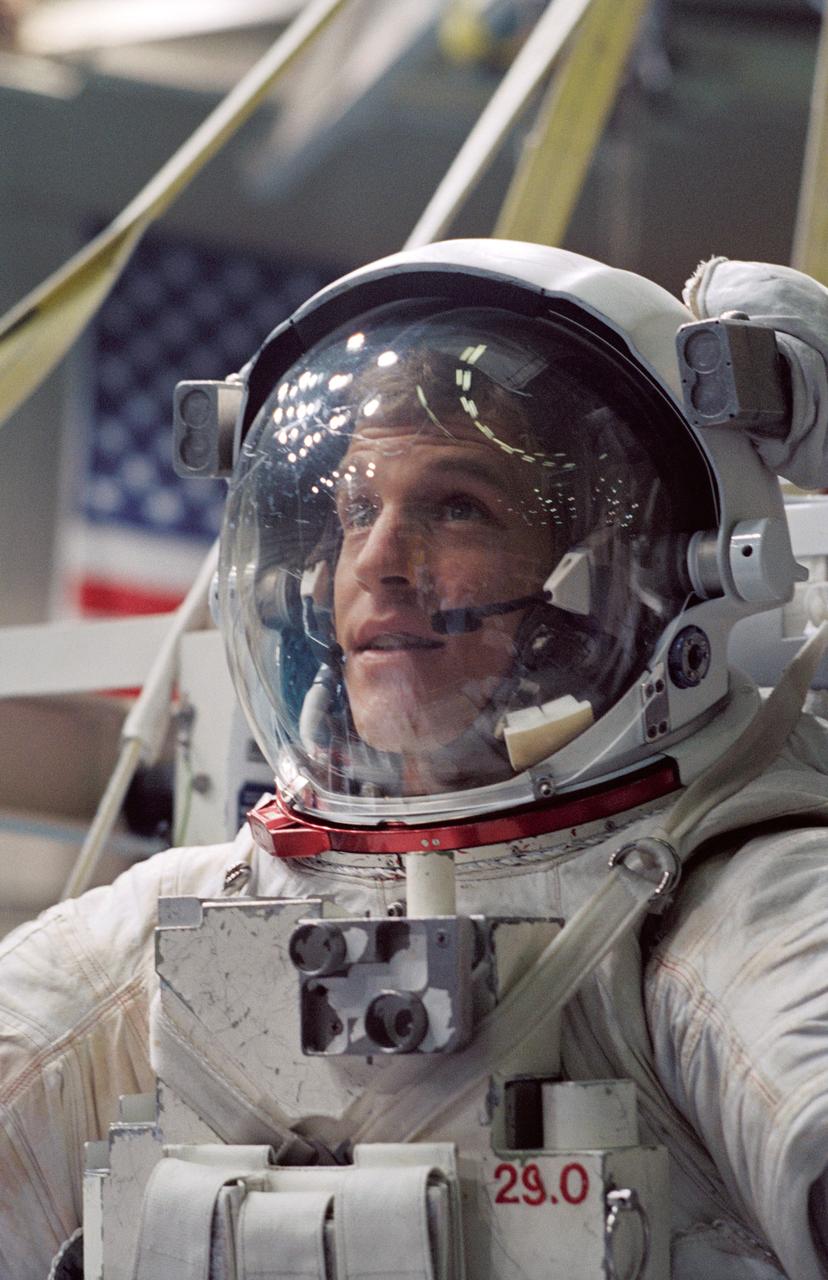
S94-40051 (1 August 1994) --- Attired in a training version of the Extravehicular Mobility Unit (EMU), astronaut Scott E. Parazynski, mission specialist, prepares to be submerged in a 25-feet deep pool at the Johnson Space Center's (JSC) Weightless Environment Training Facility (WET-F). Though no extravehicular activity (EVA) is planned for the mission, at least two astronauts are trained to perform tasks that would require a space walk in the event of failure of remote systems. In November, Parazynski will join four other NASA astronauts and a European mission specialist for a week and a half in space aboard the Space Shuttle Atlantis. The flight will support the Atmospheric Laboratory for Applications and Science (ATLAS-3) mission.
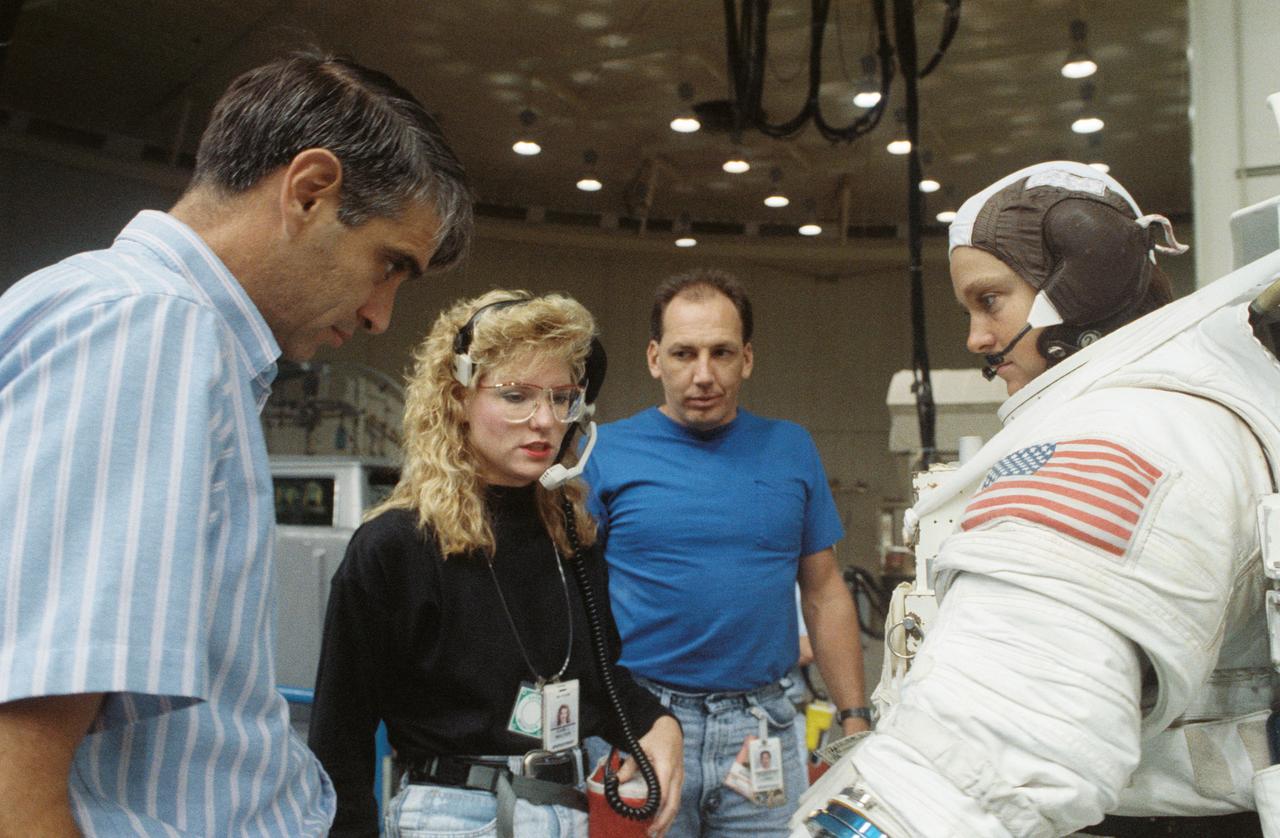
S90-45785 (16 Aug 1990) --- Astronaut Tamara E. Jernigan, STS-40 mission specialist, is pictured in a training version of the extravehicular mobility unit (EMU) spacesuit talking with a fellow crewmember and members of the crew training staff. At left is astronaut Sidney M. Gutierrez, pilot for the flight. Dr. Jernigan was about to be submerged in the Johnson Space Center's 25-ft. deep weightless environment training facility (WET-F) pool to simulate a contingency extravehicular activity (EVA). There is no EVA scheduled for STS-40, the Spacelab Life Sciences (SLS-1) mission.

STS-48 Mission Specialist (MS) James F. Buchli, wearing an extravehicular mobility unit (EMU), is watched by SCUBA-equipped divers as the platform he is standing on is lowered into JSC's Weightless Environment Training Facility (WETF) Bldg 29 pool. When completely underwater, Buchli will be released from the platform and will perform contingency extravehicular activity (EVA) operations. This underwater simulation of a spacewalk is part of the training required for Buchli's upcoming mission aboard Discovery, Orbiter Vehicle (OV) 103.
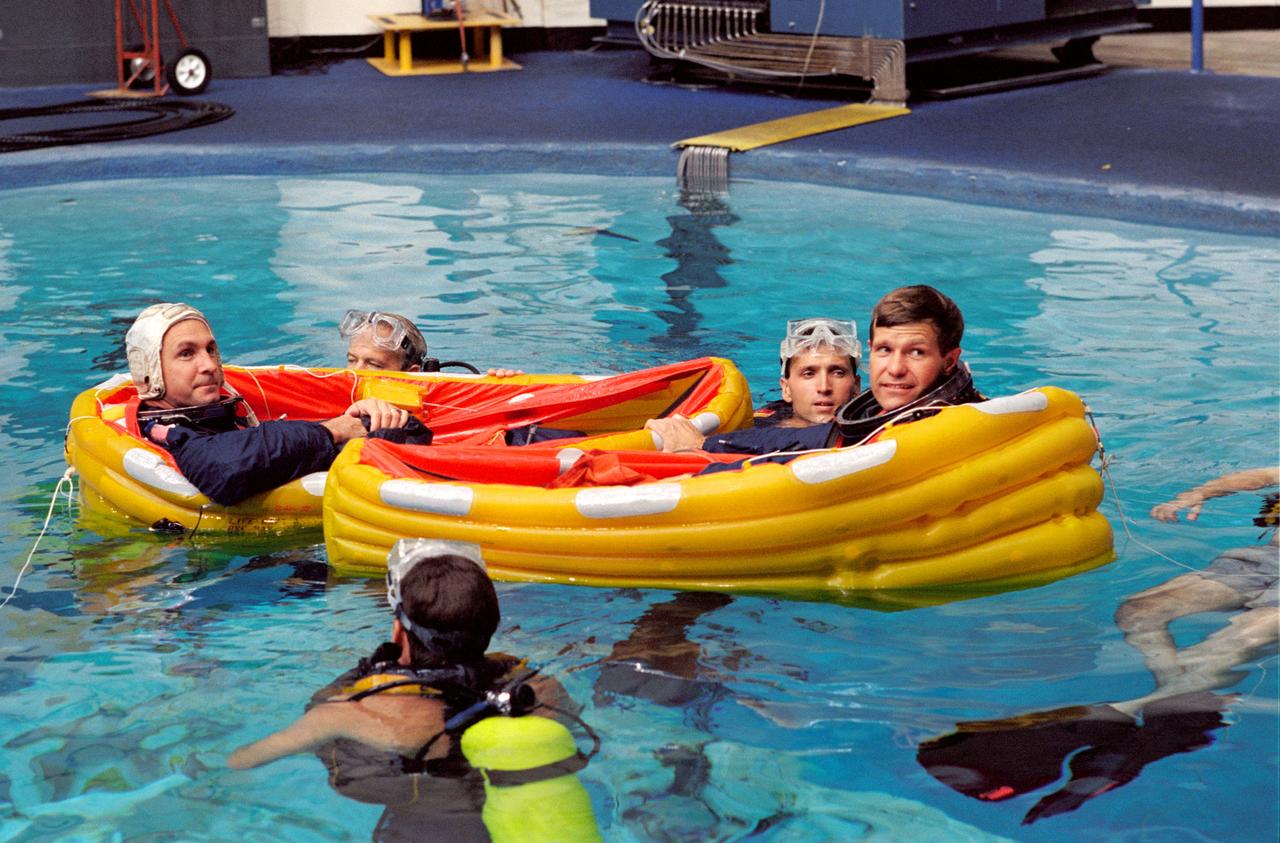
S94-37526 (28 June 1994) --- In separate life rafts, astronauts Donald R. McMonagle (right), mission commander, and Curtis L. Brown, pilot, are assisted by several SCUBA-equipped divers during an emergency bailout training exercise in the Johnson Space Center's (JSC) Weightless Environment Training Facility (WET-F). Making their third and second flights in space, respectively, McMonagle and Brown will be joined by three other NASA astronauts and a European mission specialist for a week and a half in space aboard the Space Shuttle Atlantis. The flight will support the Atmospheric Laboratory for Applications and Science (ATLAS-3) mission.
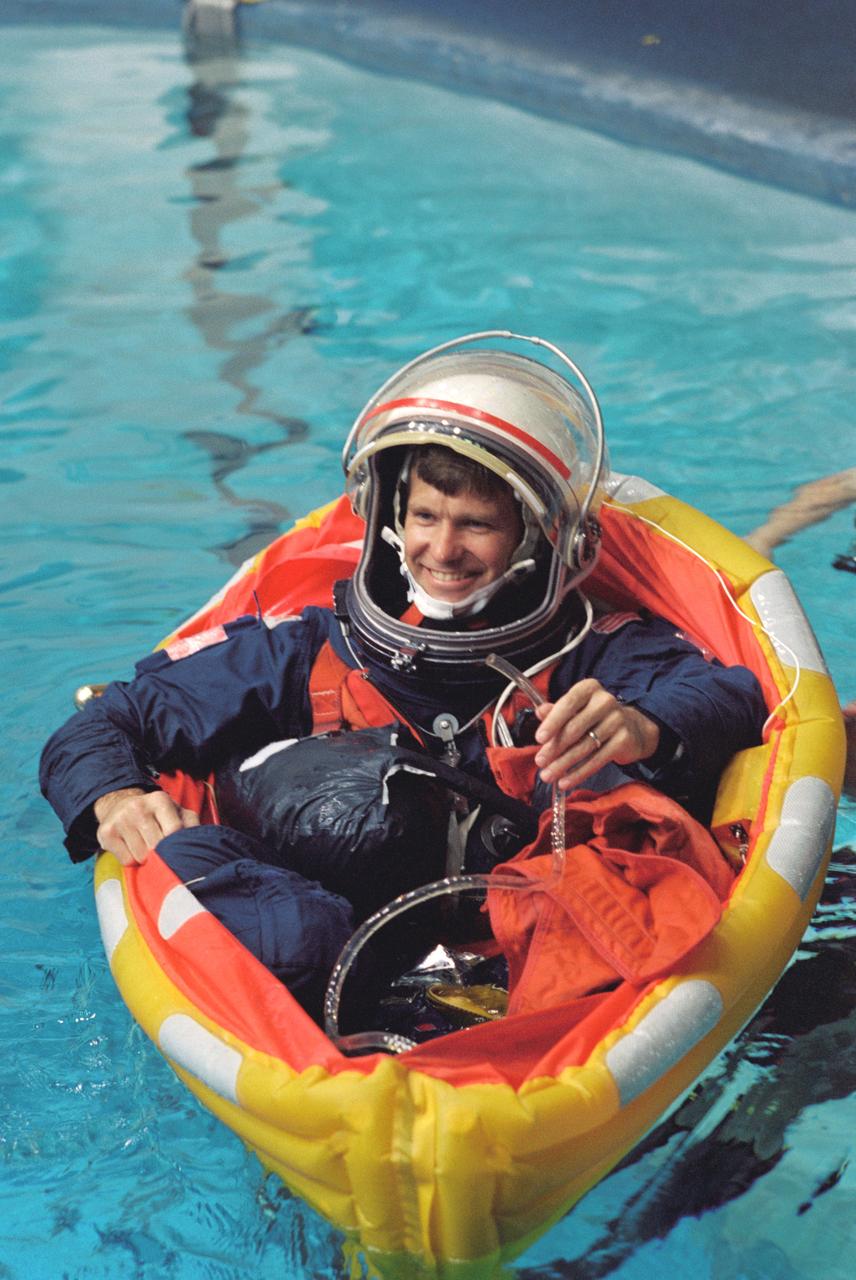
S94-37521 (28 June 1994) --- Astronaut Donald R. McMonagle, mission commander, checks the drainage hose on his rapidly fashioned life raft during an emergency bailout training exercise in the Johnson Space Center's (JSC) Weightless Environment Training Facility (WET-F). Making his third flight in space covering 343 hours, McMonagle will be joined by four other NASA astronauts and a European mission specialist for a week and a half in space aboard the Space Shuttle Atlantis. The flight will support the Atmospheric Laboratory for Applications and Science (ATLAS-3) mission.
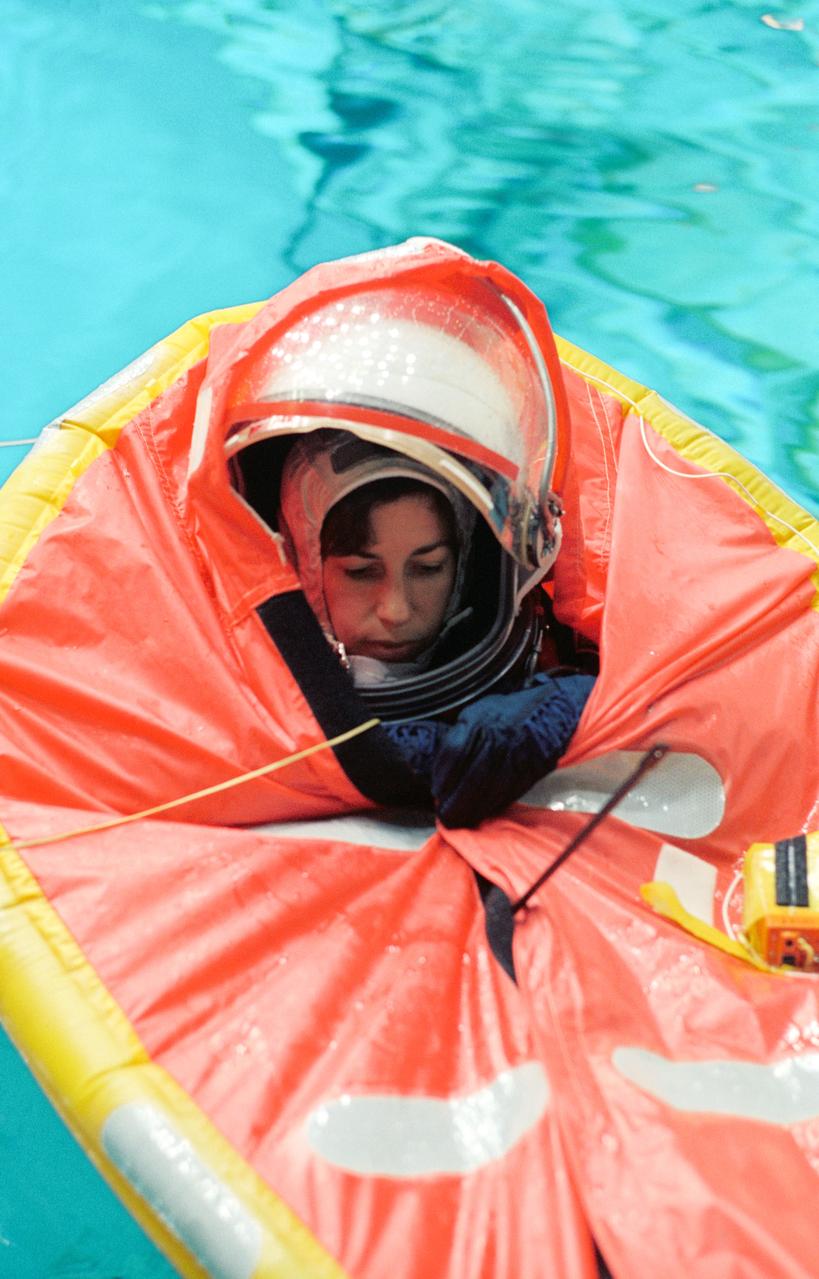
S94-37520 (28 June 1994) --- Astronaut Ellen Ochoa, STS-66 payload commander, secures herself in a small life raft during an emergency bailout training exercise in the Johnson Space Center's (JSC) Weightless Environment Training Facility (WET-F). Making her second flight in space, Ochoa will join four other NASA astronauts and a European mission specialist for a week and a half in space aboard the Space Shuttle Atlantis in support of the Atmospheric Laboratory for Applications and Science (ATLAS-3) mission. Ochoa was a mission specialist on the ATLAS-2 mission in April of 1993.
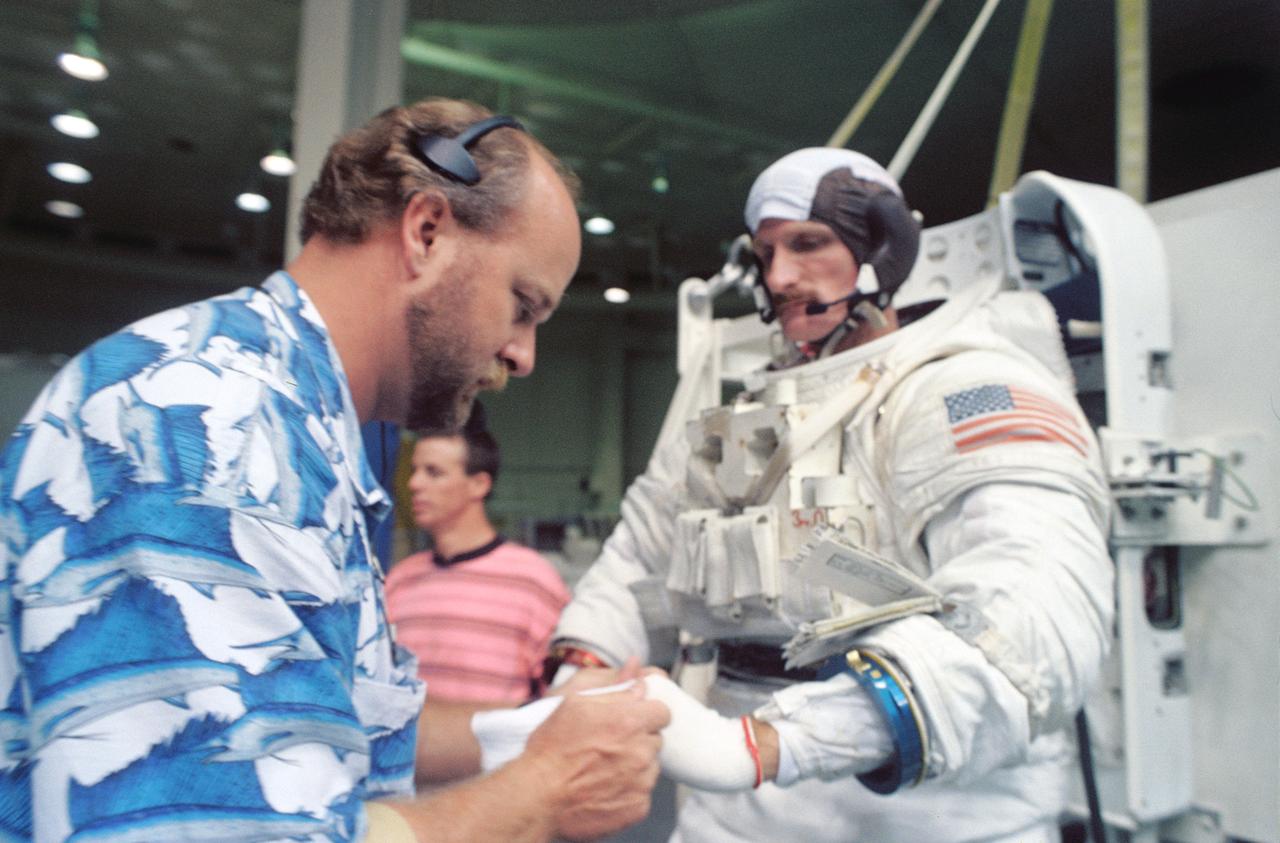
S94-40048 (1 August 1994) --- Astronaut Joseph R. Tanner, mission specialist, is assisted by Boeing suit expert Steve Voyles as he prepares to be submerged in a 25-feet deep pool at the Johnson Space Center's (JSC) Weightless Environment Training Facility (WET-F). Though no extravehicular activity (EVA) is planned for the mission, at least two astronauts are trained to perform tasks that would require a space walk in the event of failure of remote systems. In November, Tanner will join four other NASA astronauts and a European mission specialist for a week and a half in space aboard the Space Shuttle Atlantis. The flight will support the Atmospheric Laboratory for Applications and Science (ATLAS-3) mission.
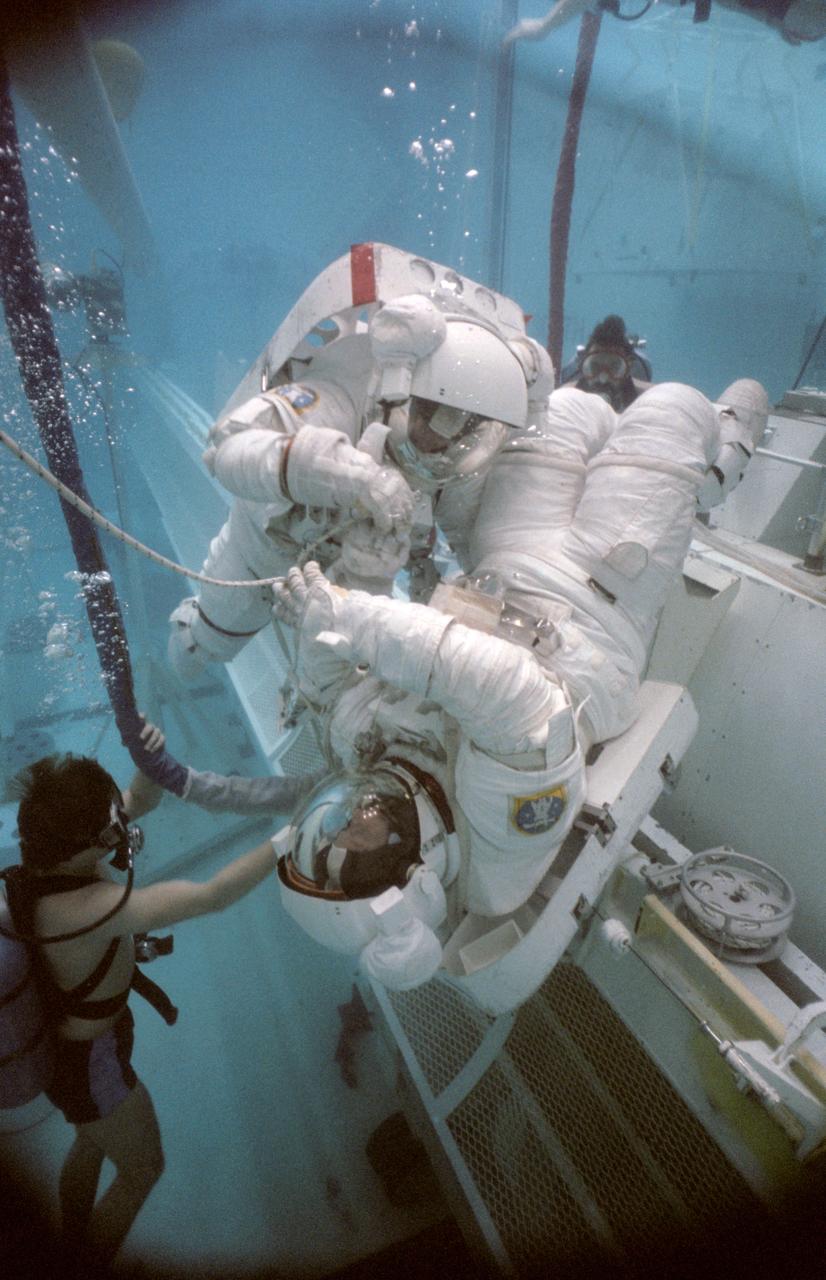
S84-28206 (26 Feb 1984) --- Astronauts Richard M. (Mike) Mullane (with striped suit and PLSS) and Steven A. Hawley participate in and underwater simulation of a 41-D contingency extravehicular activity (EVA) in the Johnson Space Center's weightless environment training facility (WET-F). All Shuttle crews, many of which are not scheduled for definite EVAs, possess team members trained to perform in space certain tasks normally done remotely in the event of systems failures. Among those contingent tasks is the manual closing of the payload bay doors. Mullane and Hawley are two of three mission specialists assigned duty on the seven-day 41-D flight. This photograph was taken by Otis Imboden.
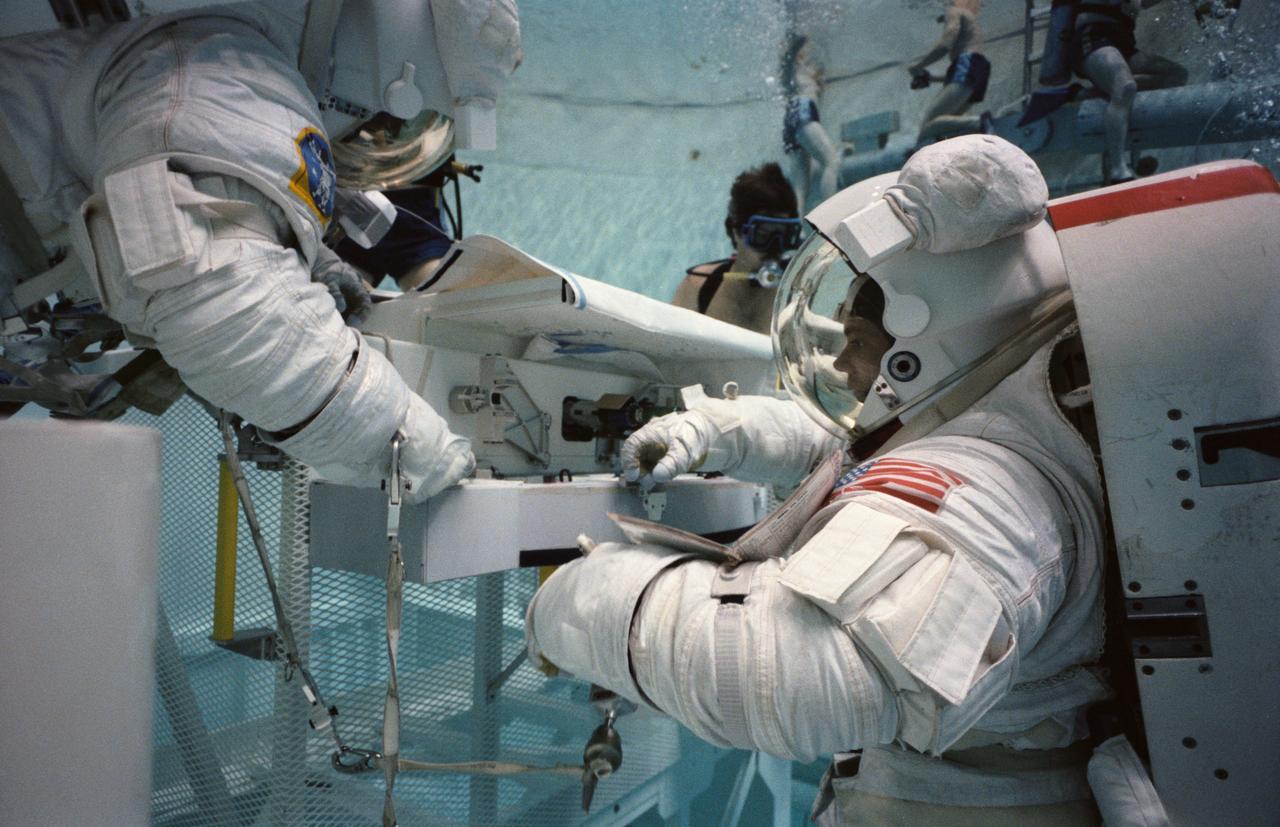
S84-36960 (5 July 1984) --- Astronauts Kathryn D. Sullivan, left, and David C. Leestma, Mission 41-G crewmembers, simulate the transfer of cryogenics in space during an Earth-bound underwater session in the Johnson Space Center's weightless environment training facility (WET-F). The two mission specialists will be joined by three NASA astronauts and two payload specialists for a flight aboard the Columbia later this year. The photograph was taken by Otis Imboden.
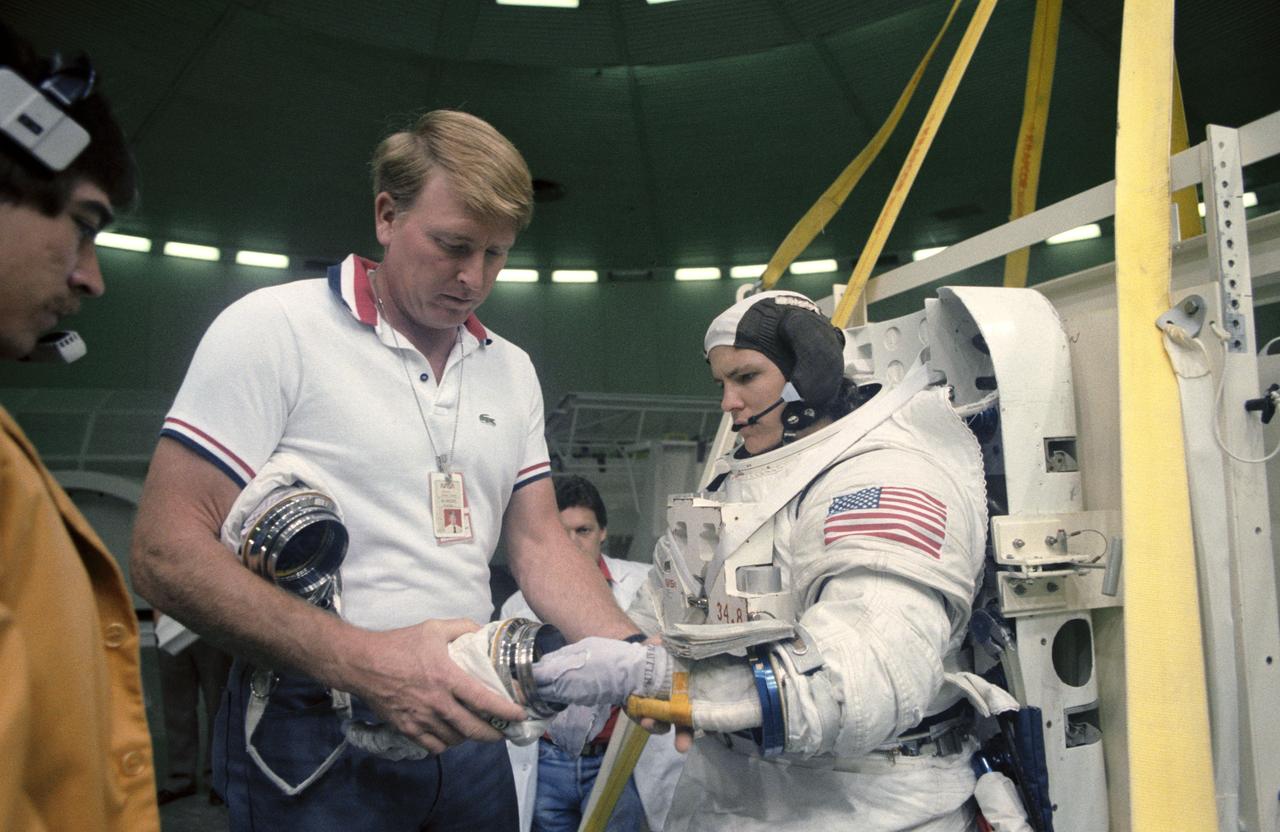
S84-33898 (21 May 1984) --- Astronaut Jon A. McBride, 41-G pilot, assists his crewmate, Astronaut Kathryn D. Sullivan with the glove portion of her extravehicular mobility unit (EMU) prior to Dr. Sullivan's underwater session in the Johnson Space Center's weightless environment training facility (WET-F). Mission specialists Sullivan and David C. Leestma are scheduled for extravehicular activity (EVA) on the Columbia for NASA's 17th scheduled flight.
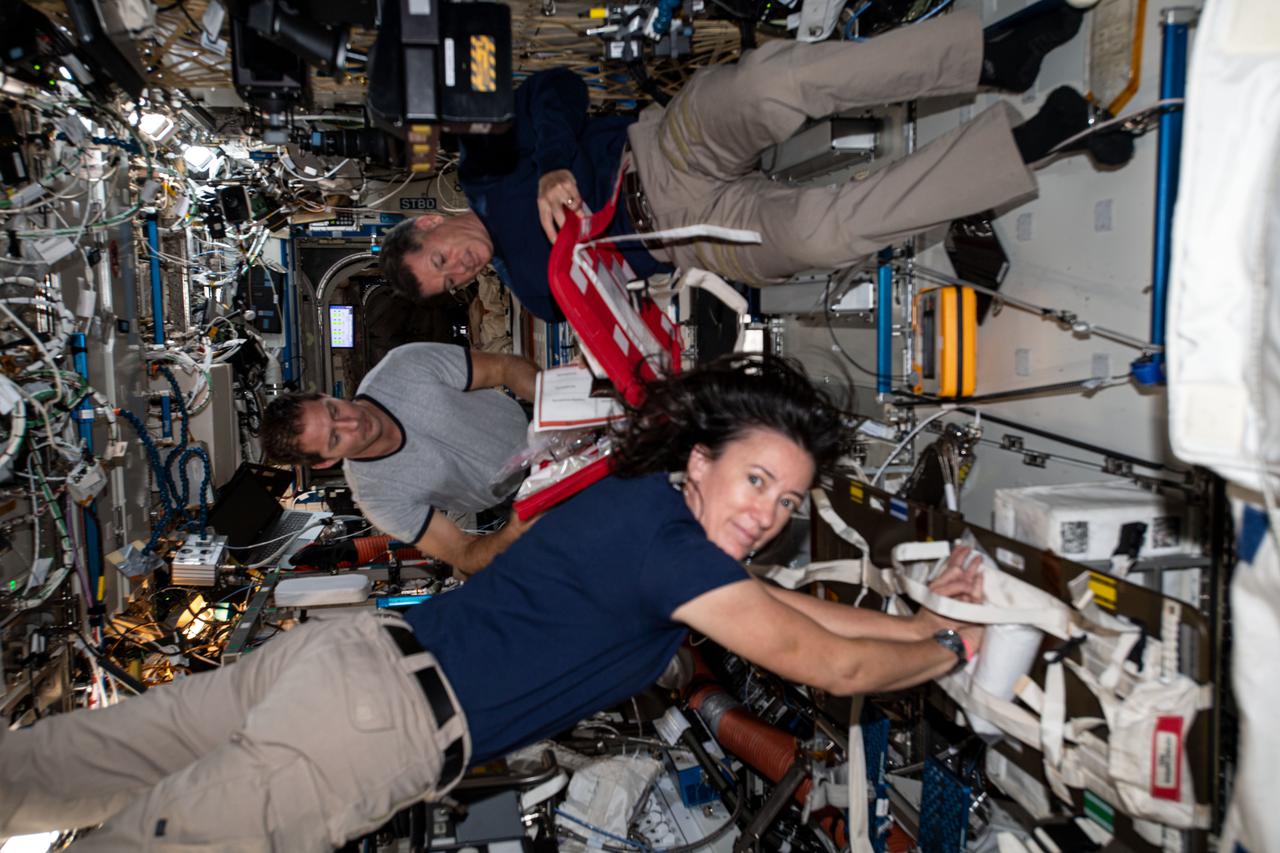
iss065e074846 (May 25, 2021) --- Expedition 65 Flight Engineers (clockwise from left) Thomas Pesquet, Shane Kimbrough and Megan McArthur train for a medical emergency aboard the International Space Station. Pesquet and Kimbrough review medical hardware while McArthur practices chest compressions, or cardiopulmonary resuscitation (CPR), in the weightless environment of the orbiting lab.
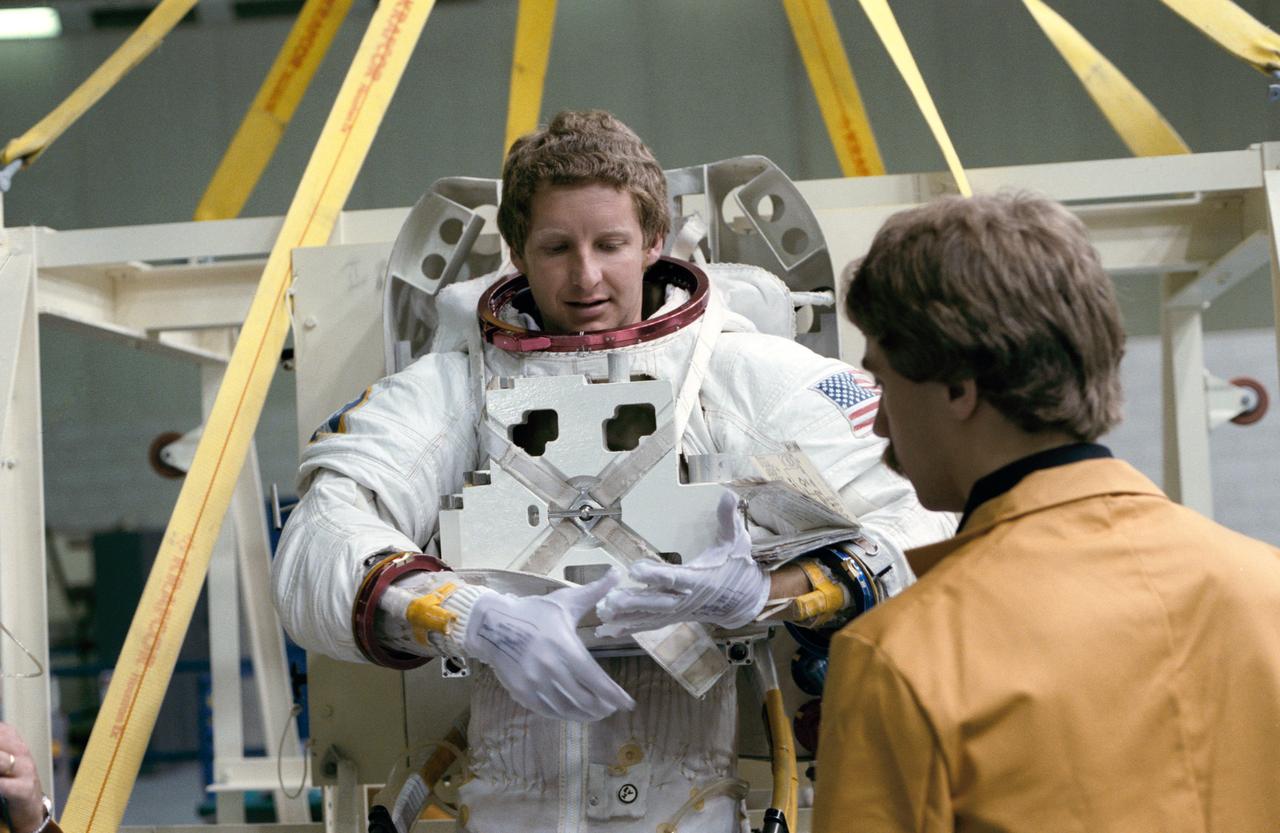
S84-28203 (24 Feb 1984) --- Astronaut Steven A. Hawley, 41-D mission specialists, completes suiting up procedures before being submerged in the Johnson Space Center's (JSC) 25 ft. deep weightless environment training facility (WET-F). Obscured behind Dr. Hawley is astronaut Richard M. (Mike) Mullane, 41-D mission specialist. later the pair were lowered into the facility for an underwater simulation of a contingent extravehicular activity for the week-long flight.
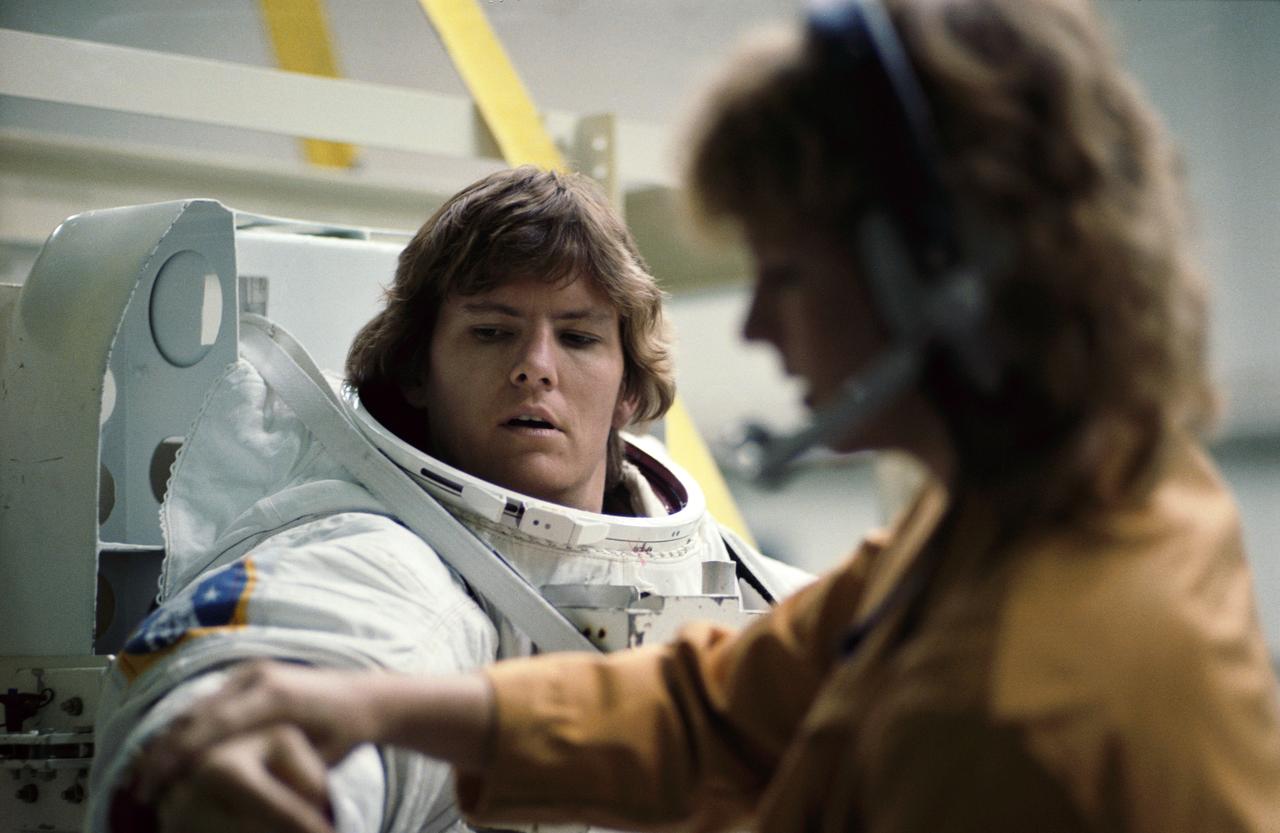
S84-36954 (5 July 1984) --- Astronaut Kathryn D.Sullivan, 41-G mission specialist, gets some help with her extravehicular mobility unit (EMU) prior to participating in an underwater simultion of an extrvehicular activity (EVA) scheduled for her flight aboard the Columbia later this year. Dr. Sullivan and David C. Leestma (out of frame) participated in the rehearsal in NASA's weightless environment training facility (WET-F) at the Johnson Space Center.
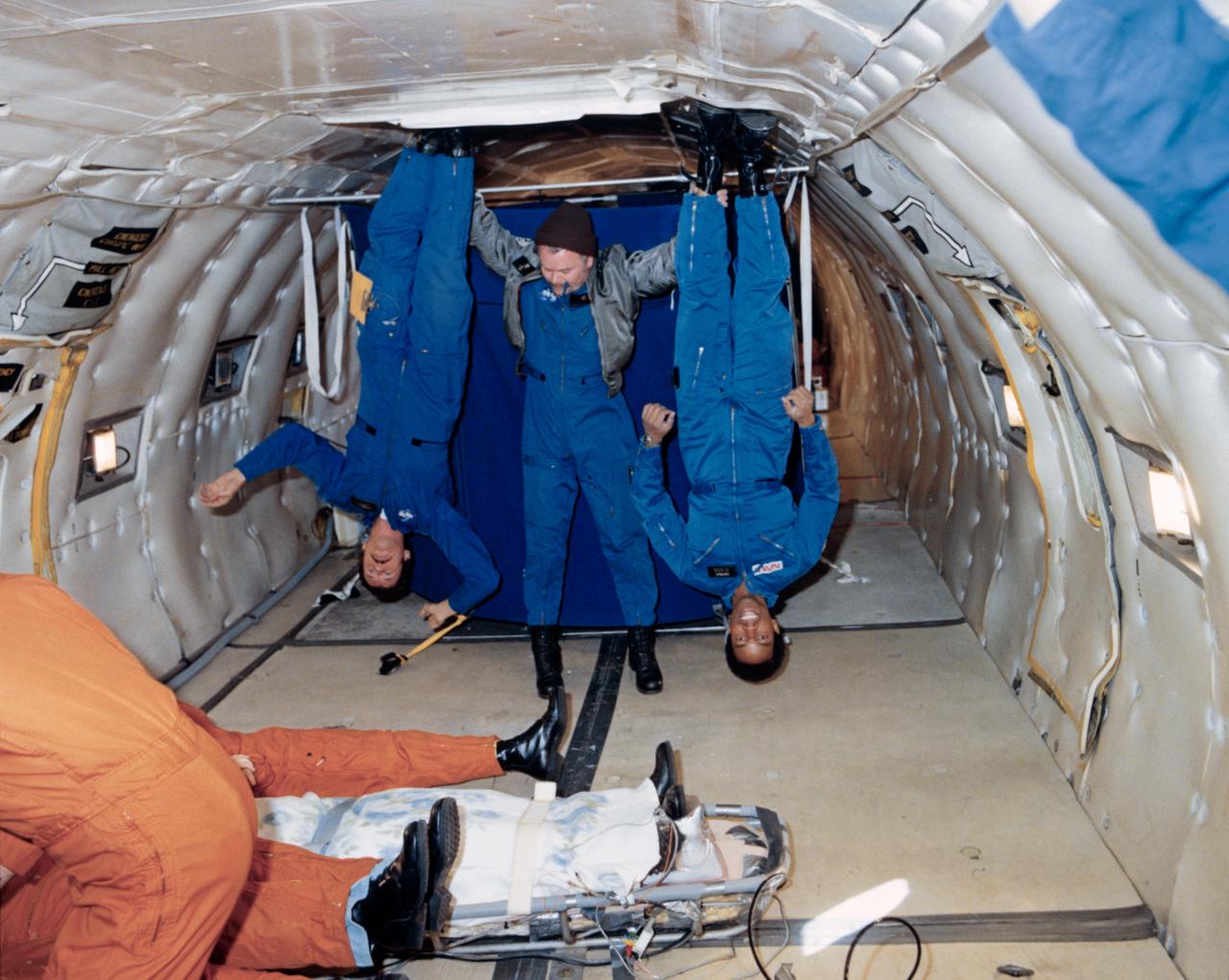
S79-28602 (2 March 1979) --- Astronaut candidate Guion S. Bluford and Aviation Safety Officer Charles F. Hayes got a unique perspective of their environment during a zero gravity flight. They are aboard a KC-135 aircraft, which flies a special pattern repeatedly to afford a series of 30-seconds-of-weightlessness sessions. Bluford and Hayes are being assisted by C. P. Stanley of the photography branch of the photographic technology division at Johnson Space Center (JSC). Some medical studies and a motion sickness experiment were conducted on this particular flight. Bluford is one of 20 scientist-astronaut candidates who began training at JSC in July of 1978. Photo credit: NASA
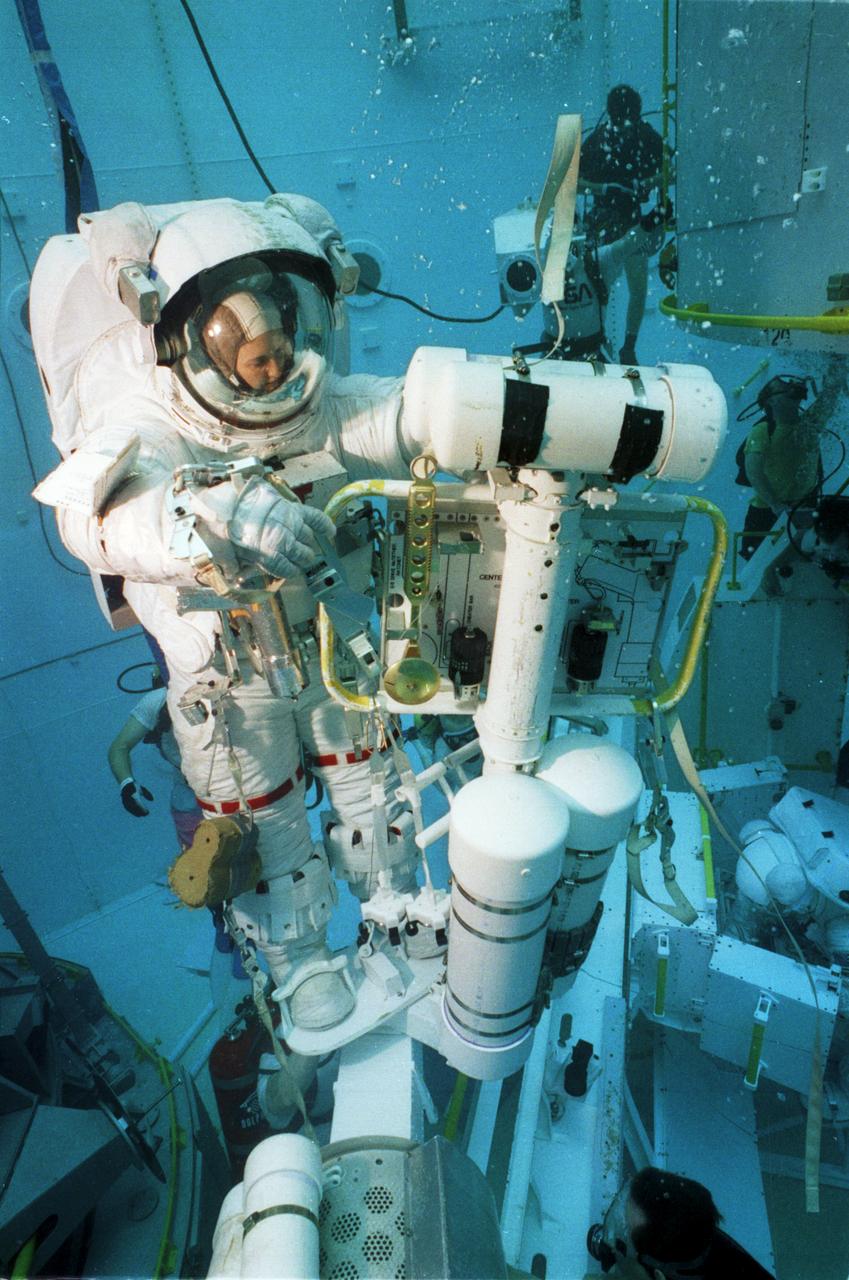
This close-up of astronaut and mission specialist, Kathryn Thornton, was captured under water in the Marshall Space Flight Center (MSFC) Neural Buoyancy Simulator (NBS) where she is participating in a training session for the STS-61 mission. The NBS provided the weightless environment encountered in space needed for testing and the practices of Extravehicular Activities (EVA). Launched on December 2, 1993 aboard the Space Shuttle Orbiter Endeavor, STS-61 was the first Hubble Space Telescope (HST) serving mission. During the 2nd EVA of the mission, Thornton, along with astronaut and mission specialist Thomas Akers, performed the task of replacing the solar arrays. The EVA lasted 6 hours and 35 minutes.
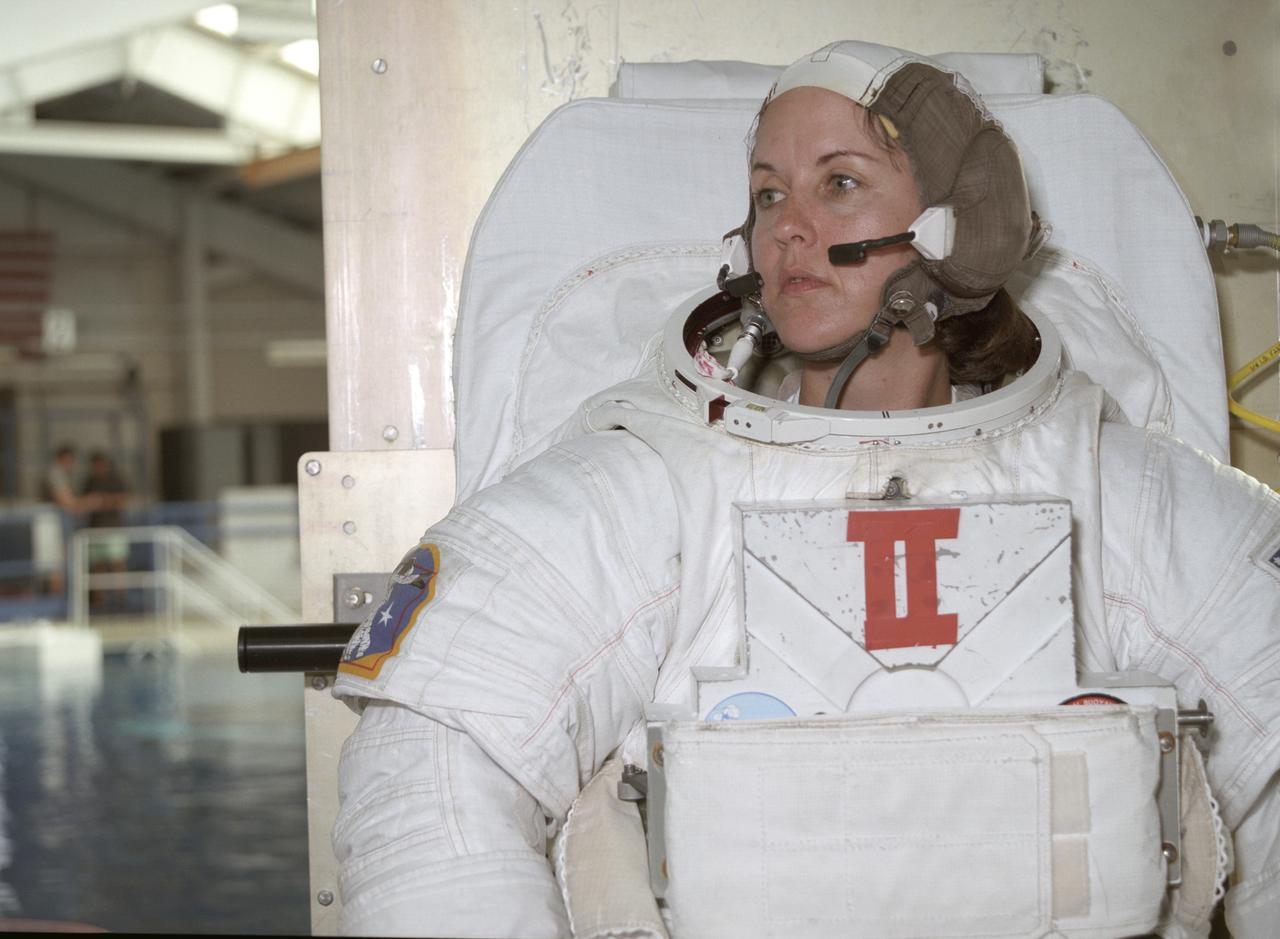
This close-up of astronaut and mission specialist Kathryn Thornton readies herself for submersion into the water in the Marshall Space Flight Center (MSFC) Neutral Buoyancy Simulator (NBS) where she is participating in a training session for the STS-61 mission. The NBS provided the weightless environment encountered in space needed for testing and the practices of Extravehicular Activities (EVA). Launched on December 2, 1993 aboard the Space Shuttle Orbiter Endeavor, STS-61 was the first Hubble Space Telescope (HST) serving mission. During the 2nd EVA of the mission, Thornton, along with astronaut and mission specialist Thomas Akers, performed the task of replacing the solar arrays. The EVA lasted 6 hours and 35 minutes.
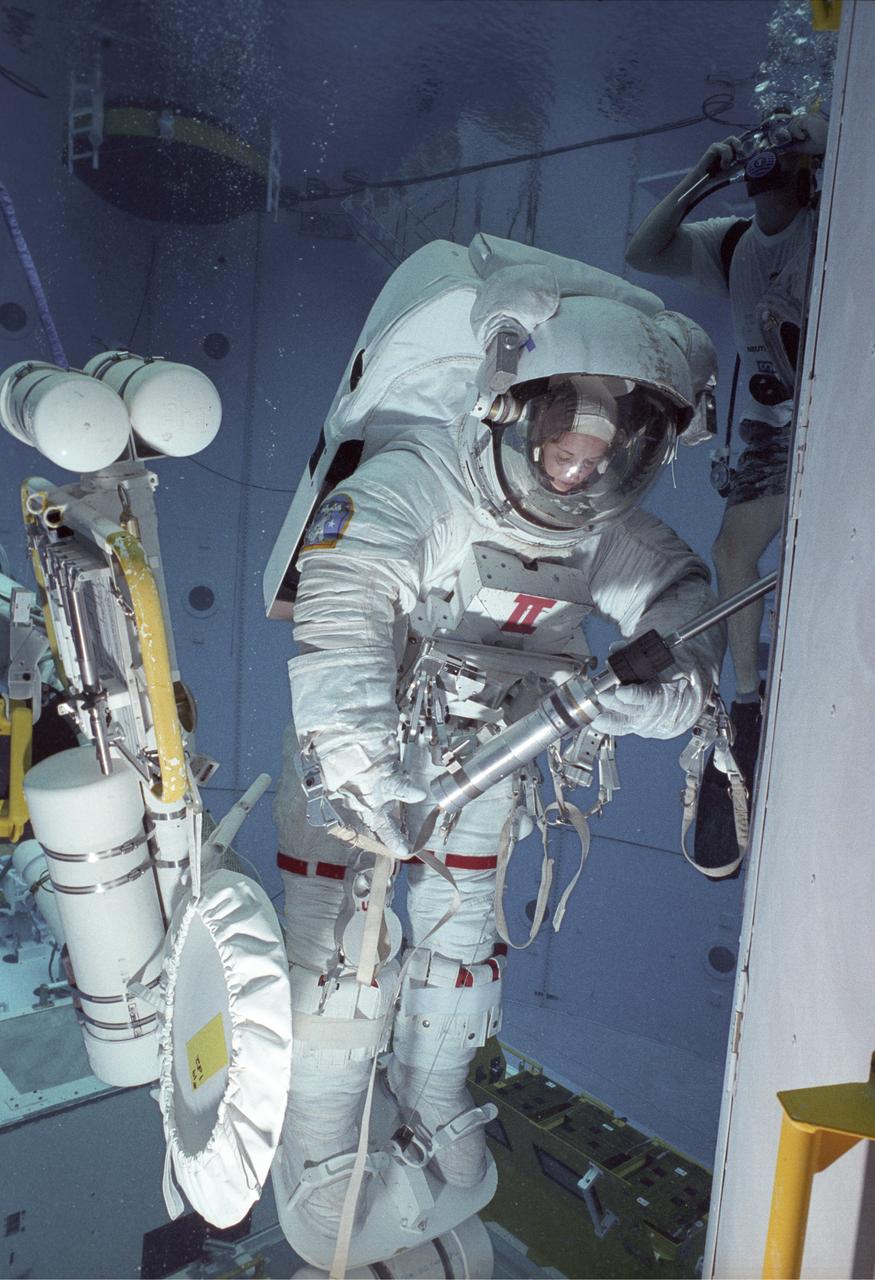
This close-up of astronaut and mission specialist Kathryn Thornton was captured under water in the Marshall Space Flight Center (MSFC) Neural Buoyancy Simulator (NBS) where she is participating in a training session for the STS-61 mission. The NBS provided the weightless environment encountered in space needed for testing and the practices of Extravehicular Activities (EVA). Launched on December 2, 1993 aboard the Space Shuttle Orbiter Endeavor, STS-61 was the first Hubble Space Telescope (HST) serving mission. During the 2nd EVA of the mission, Thornton, along with astronaut and mission specialist Thomas Akers, performed the task of replacing the solar arrays. The EVA lasted 6 hours and 35 minutes.
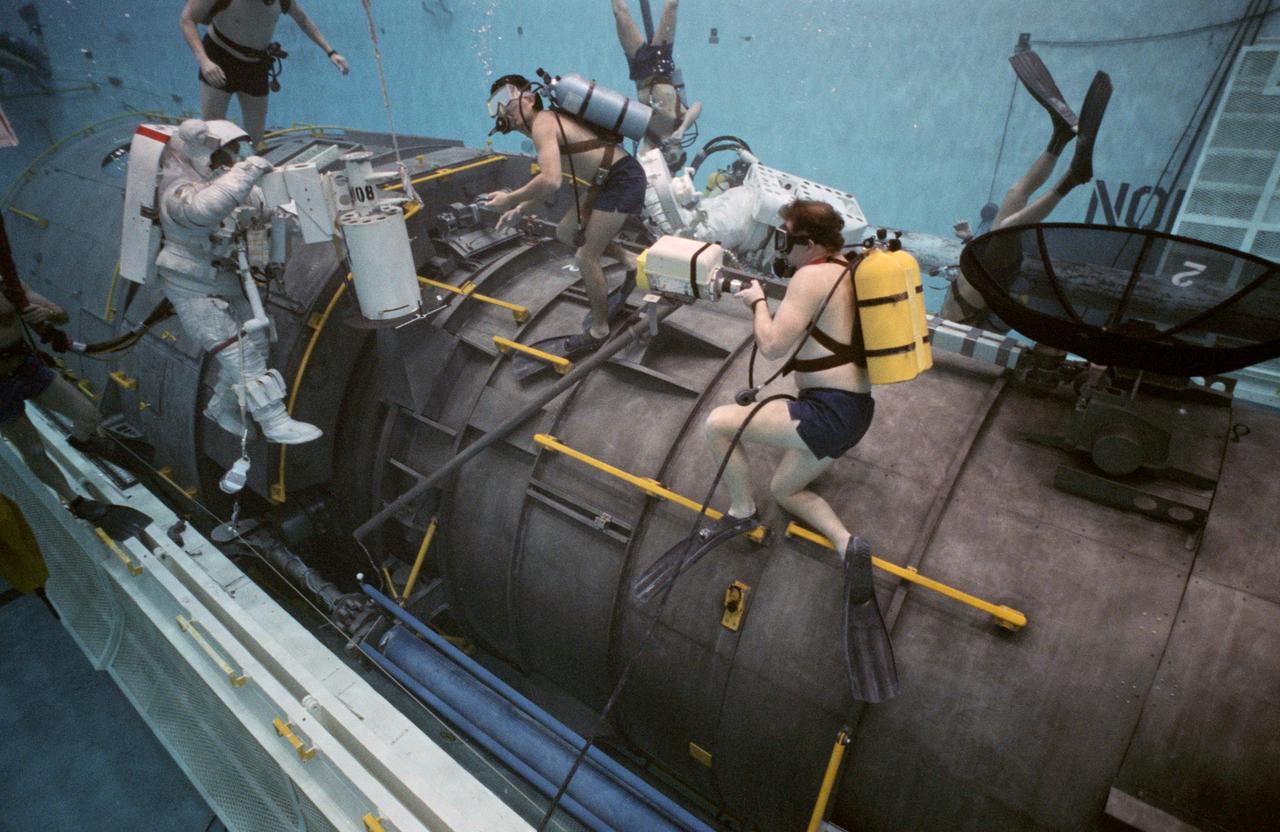
STS-31 Mission Specialist (MS) Bruce McCandless II (left), wearing an extravehicular mobility unit (EMU), maneuvers his way around a mockup of the remote manipulator system (RMS) end effector during an underwater simulation in JSC's Weightless Environment Training Facility (WETF) Bldg 29 pool. The end effector is attached to a grapple fixture on the Hubble Space Telescope (HST) mockup. As McCandless performs contingency extravehicular activity (EVA) procedures, fellow crewmember MS Kathryn D. Sullivan, in EMU, works on the opposite side of the HST mockup, and SCUBA-equipped divers monitor the activity. Though no EVA is planned for STS-31, the two crewmembers train for contingencies that would necessitate leaving the shirt sleeve environment of Discovery's, Orbiter Vehicle (OV) 103's, crew cabin and performing chores with the HST payload or related hardware in the payload bay (PLB).
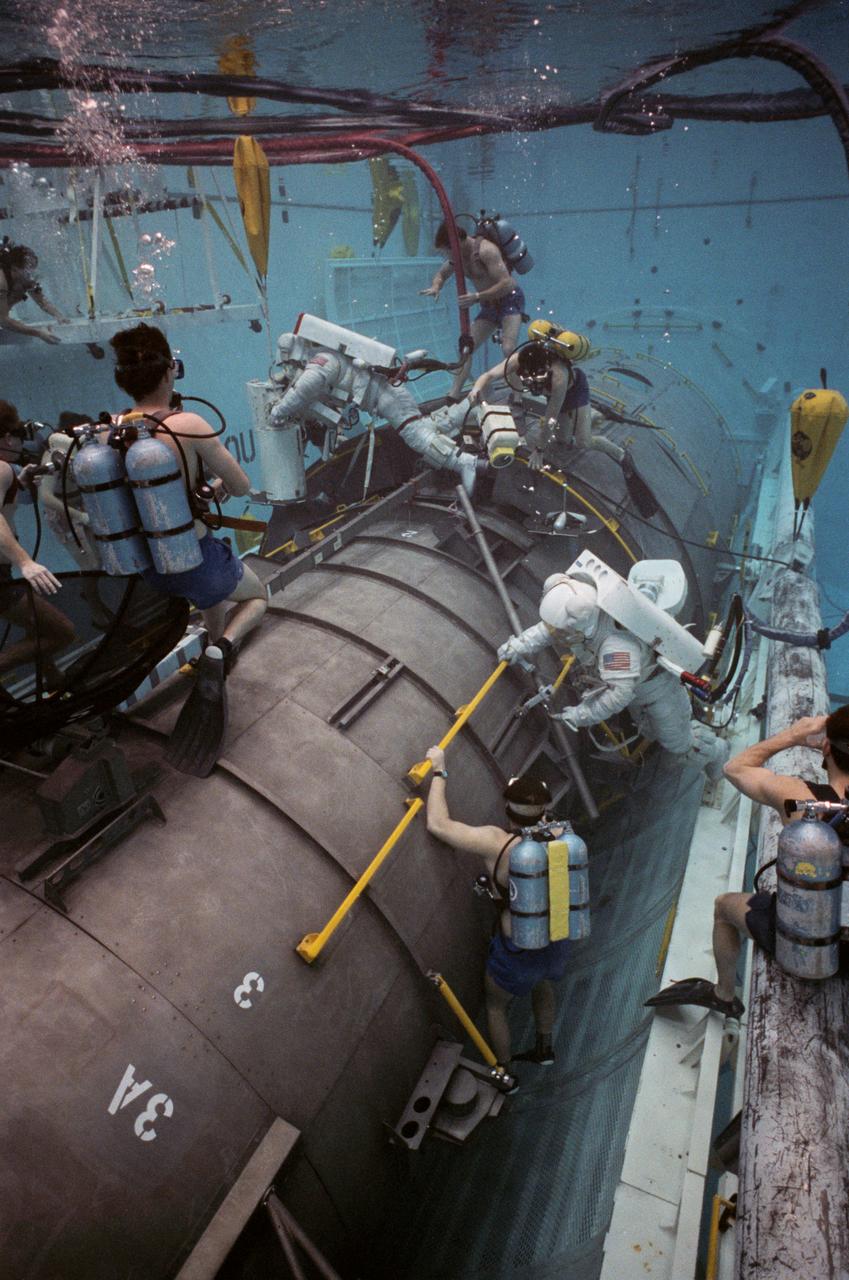
This overall view shows STS-31 Mission Specialist (MS) Bruce McCandless II (left) and MS Kathryn D. Sullivan making a practice space walk in JSC's Weightless Environment Training Facility (WETF) Bldg 29 pool. McCandless works with a mockup of the remote manipulator system (RMS) end effector which is attached to a grapple fixture on the Hubble Space Telescope (HST) mockup. Sullivan manipulates HST hardware on the Support System Module (SSM) forward shell. SCUBA-equipped divers monitor the extravehicular mobility unit (EMU) suited crewmembers during this simulated extravehicular activity (EVA). No EVA is planned for the Hubble Space Telescope (HST) deployment, but the duo has trained for contingencies which might arise during the STS-31 mission aboard Discovery, Orbiter Vehicle (OV) 103. Photo taken by NASA JSC photographer Sheri Dunnette.
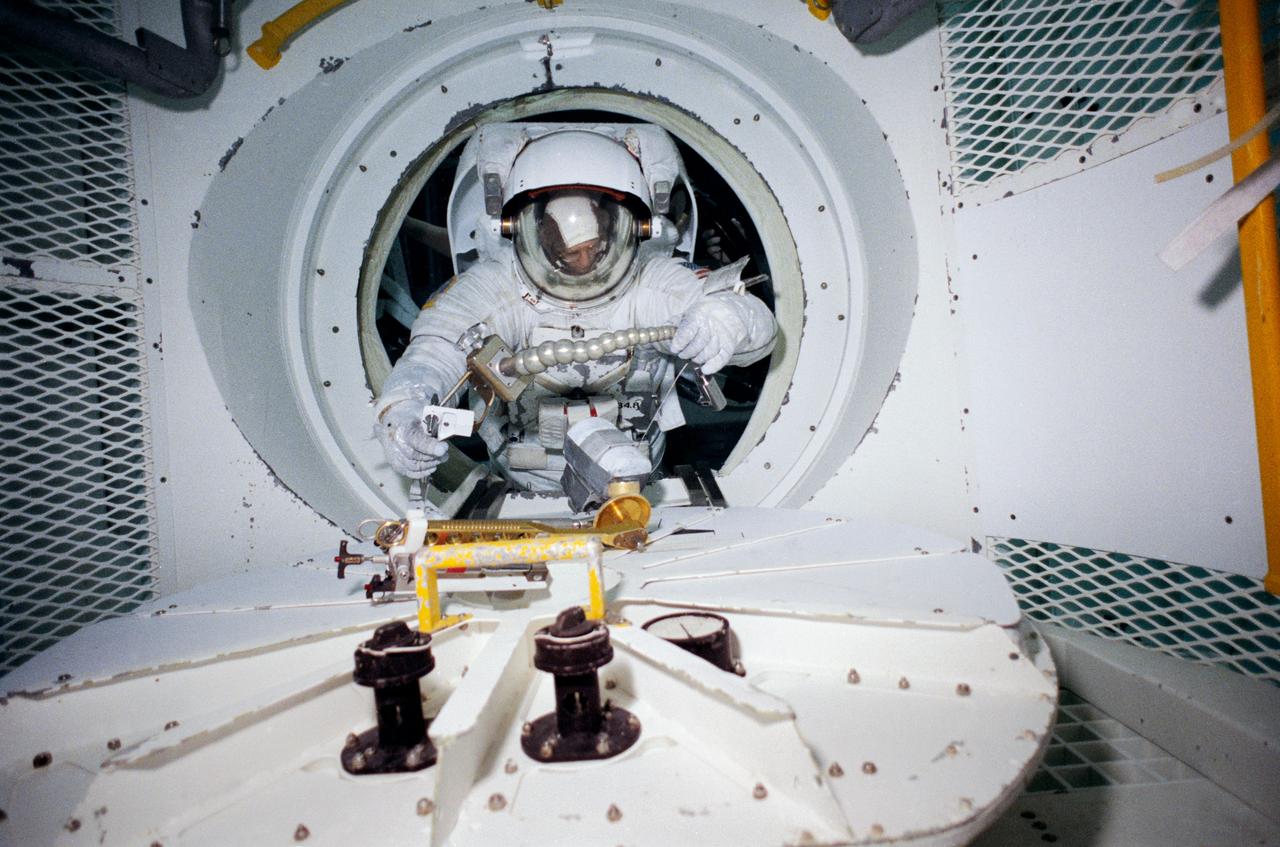
S90-30521 (20 Feb 1990) --- Though no extravehicular activity is planned for STS-31, two crewmembers train for contingencies that would necessitate leaving their shirt sleeve environment of Discovery's cabin and performing chores with their Hubble Space Telescope payload or related hardware. Astronaut Kathryn D. Sullivan, mission specialist, is seen egressing the hatchway of the airlock of a full scale mockup of a Shuttle cabin to interface with an HST mockup in JSC's 25.-ft. deep pool in the weightless environment training facility (WET-F). Two SCUBA-equipped divers who assisted in the training session are also seen. Astronaut Bruce McCandless II, mission specialist, is out of frame.
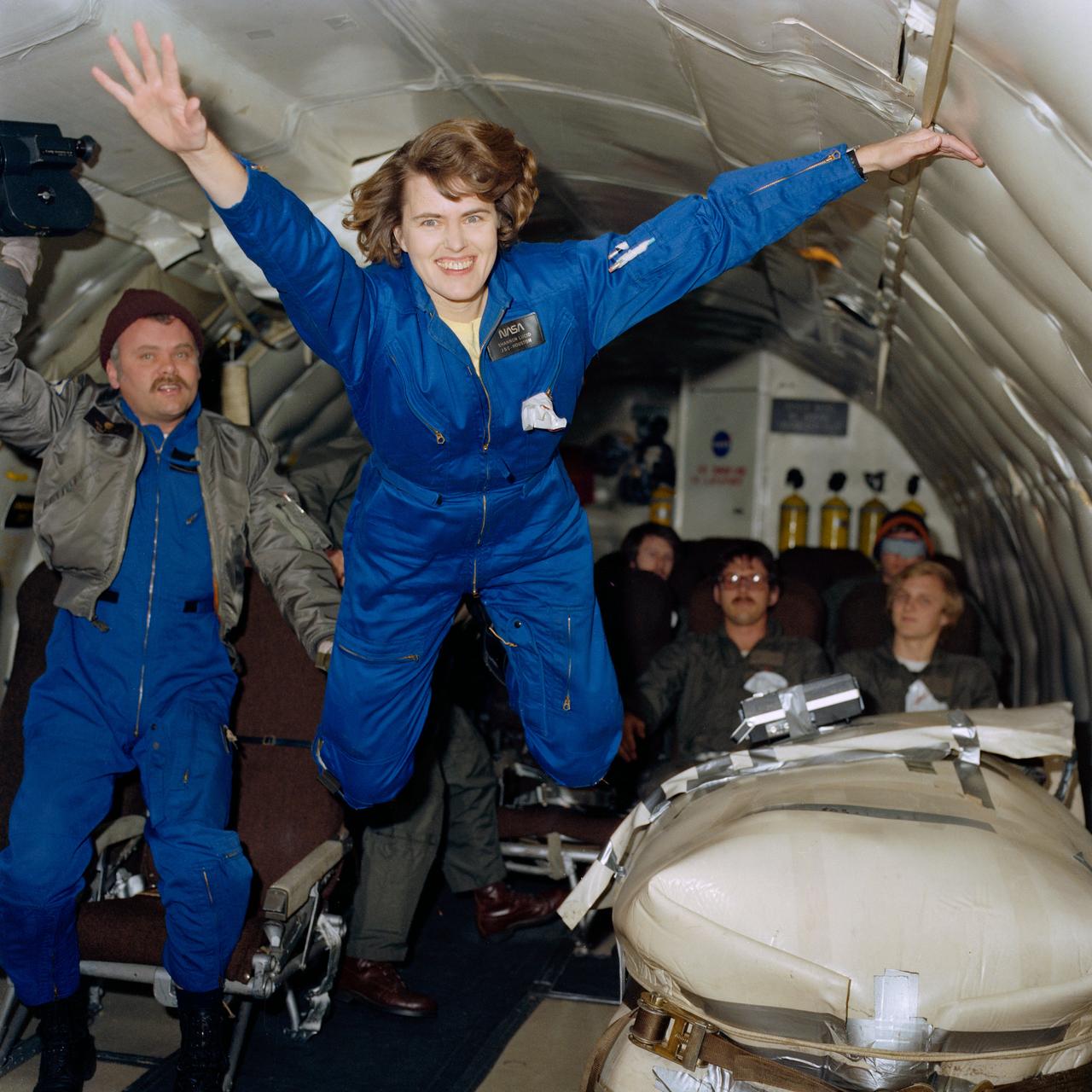
Astronaut -Candidate (ASCAN) Guion S. Bluford and Aviation Safety Officer Charles F. Hayes got a unique perspective of their environment during a zero- gravity flight. They are aboard a KC-135 Aircraft, which flies a special pattern repeatedly to afford a series of 30-seconds-of-weightlessness sessions. Astronauts Bluford and Hayes are being assisted by C. P. Stanley of the Photography Branch of the Photographic Technology Division (PTD) at Johnson Space Center (JSC). Some medical studies and a Motion Sickness Experiment were conducted on this particular flight. Astronaut Bluford is one of 20 Scientist/ASCAN's who began training at JSC, 07/1978. 1. Dr. Jeffrey A. Hoffman - Zero-G 2. ASCAN Shannon Lucid - Zero-G 3. ASCAN Guion Bluford - Zero-G
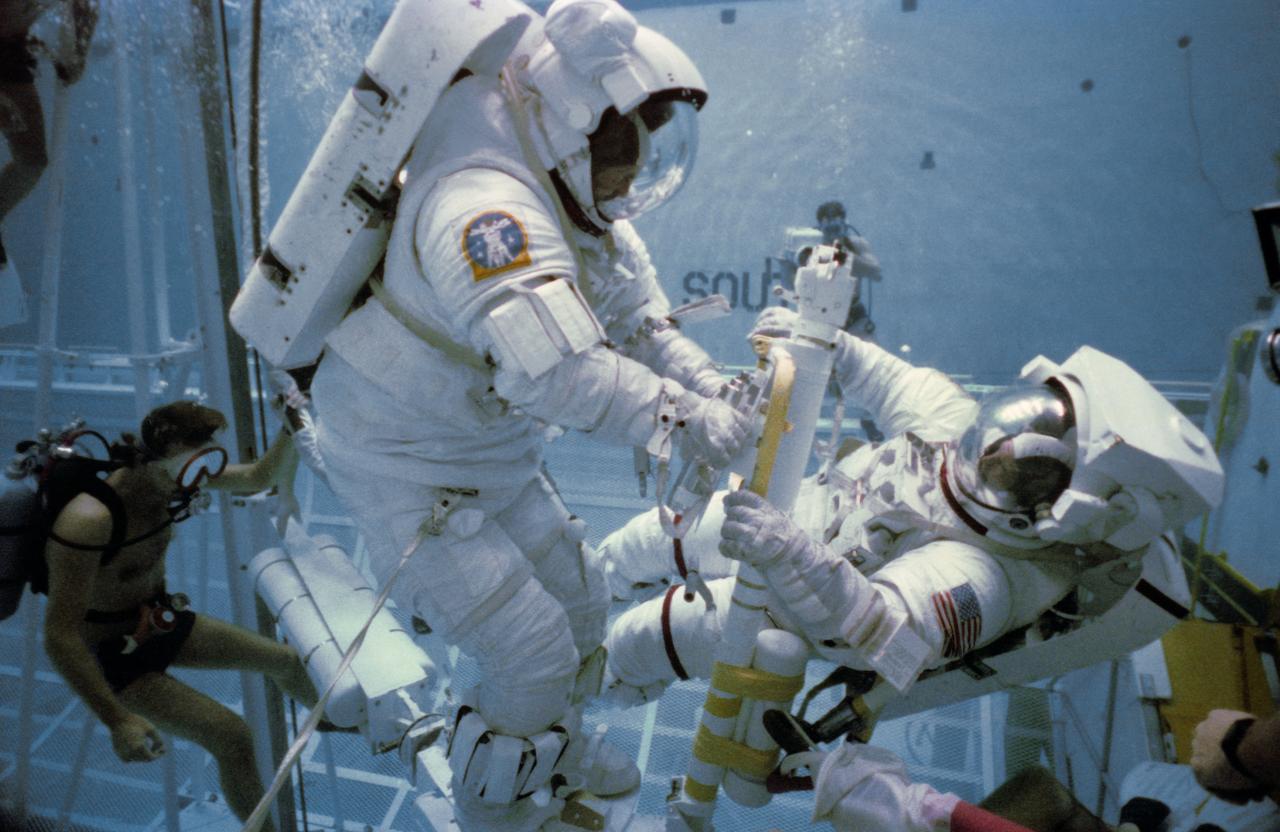
S83-42895 (19 Oct 1983) --- Astronauts George D. Nelson and James D. van Hoften, NASA Flight STS-41C mission specialists, offer an underwater version of a preview of their mission's extravehicular activity (EVA). The April 1984 flight includes as one of its primary objectives a two-person EVA and a visit to the damaged Solar Maximum Satellite (SMS). Van Hoften, left, and Nelson work here with the mobile foot restraint (MFR), which attaches to the remote manipulator system (RMS) arm to form a "cherry-picker" device. Van Hoften is standing on the MFR. The two are making use of the Johnson Space Center's (JSC) weightless environment training facility (WET-F). This photograph was taken by Otis Imboden.
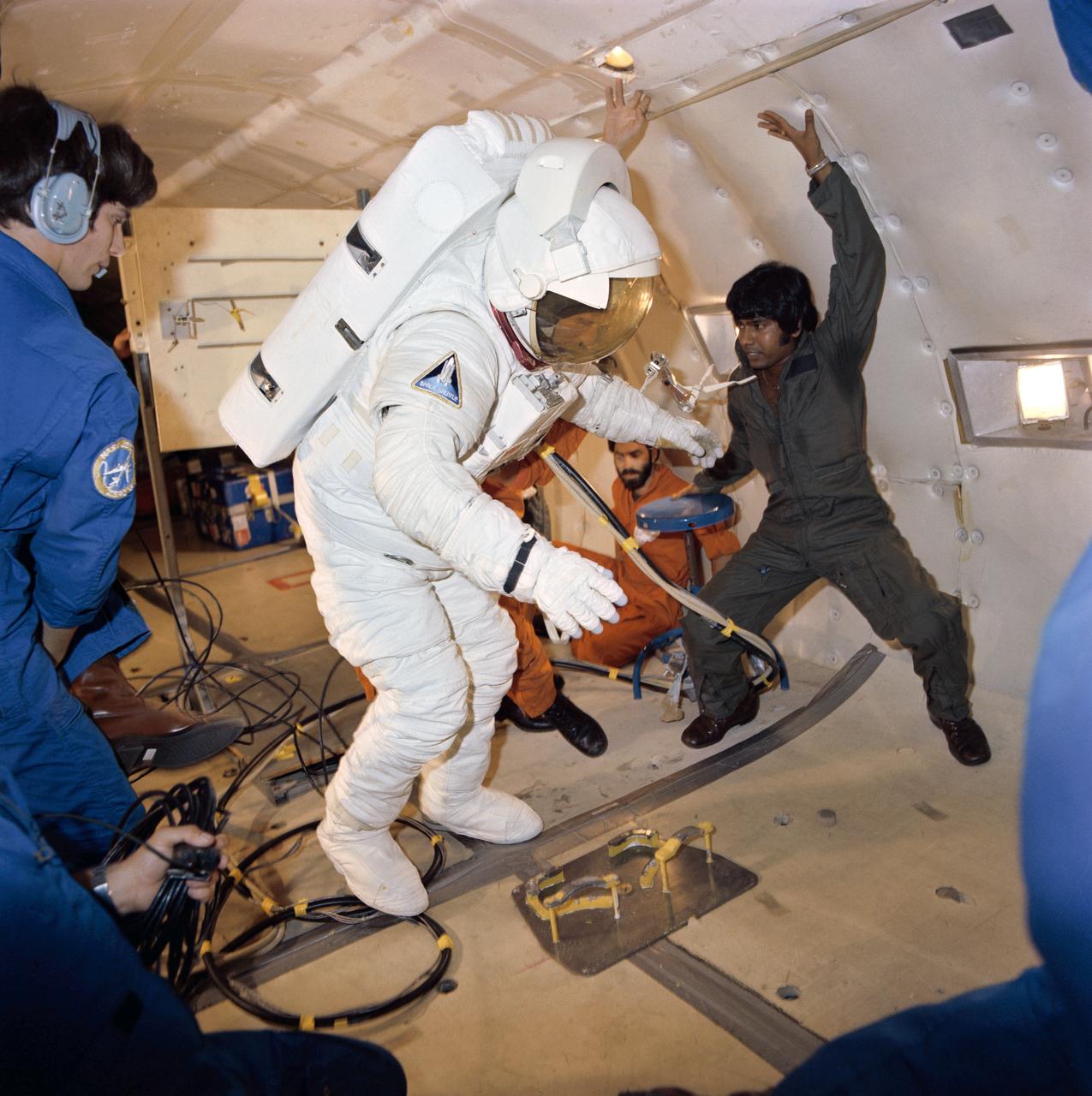
S81-34448 (July 1981) --- Astronaut C. Gordon Fullerton, STS-3 pilot, fully suited, gets a preview of what it might be like in space during a flight aboard NASA's KC-135 "zero-gravity" aircraft. A special parabolic pattern flown the aircraft provides short periods of weightlessness. Fullerton's suit is an Extravehicular Mobility Unit (EMU), used by astronauts when leaving the shirt-sleeve environment of their shuttle orbiter to go outside perform tasks in space. There are no such EVA plans on STS-3, but crew members are trained in this area in the event of the necessity to perform chores in space that for some reason or other can't be done remotely. The astronaut has just donned his suit during a parabola and now takes the opportunity to float around in the absence of gravity. Photo credit: NASA
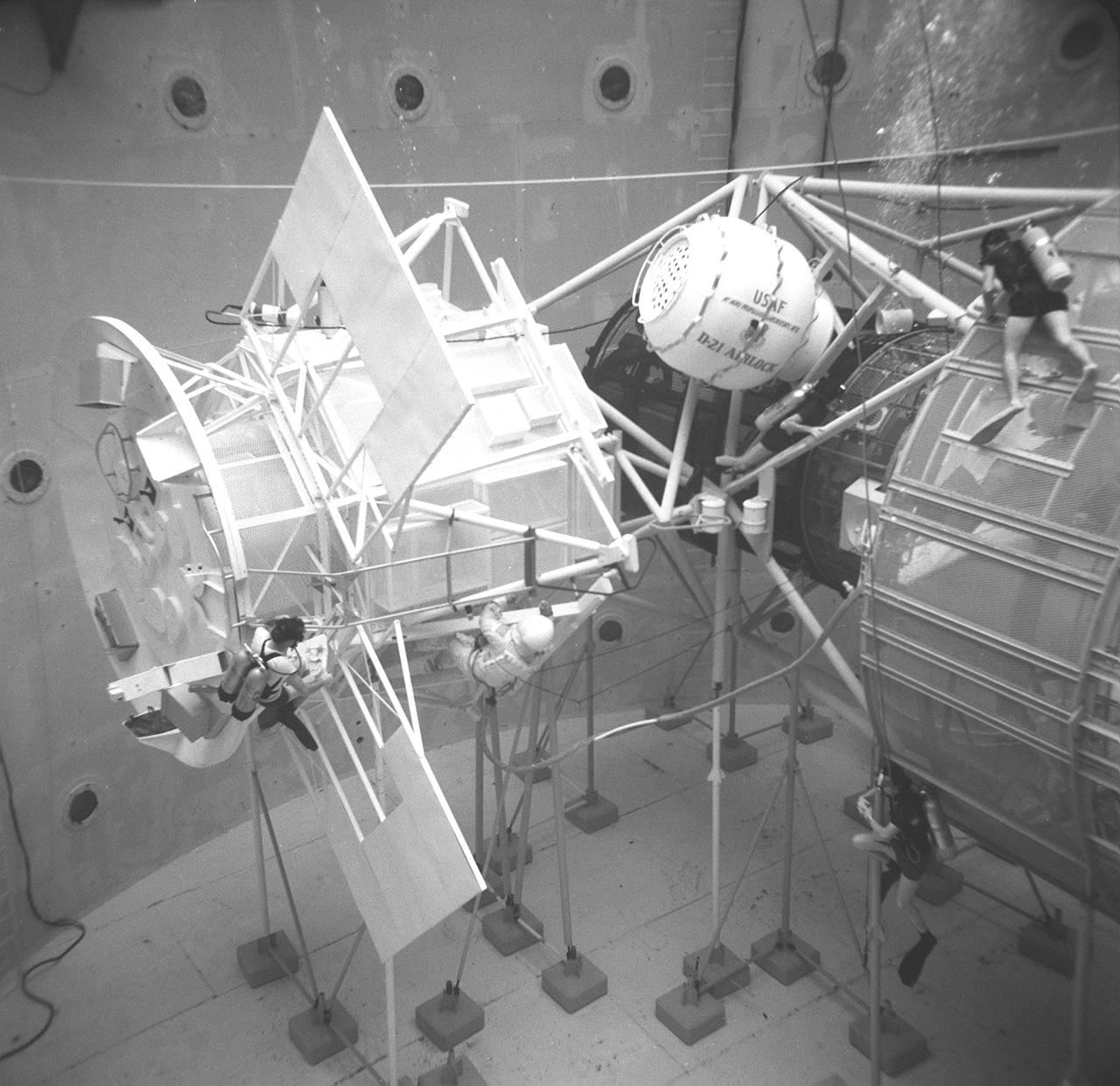
After the end of the Apollo missions, NASA's next adventure into space was the marned spaceflight of Skylab. Using an S-IVB stage of the Saturn V launch vehicle, Skylab was a two-story orbiting laboratory, one floor being living quarters and the other a work room. The objectives of Skylab were to enrich our scientific knowledge of the Earth, the Sun, the stars, and cosmic space; to study the effects of weightlessness on living organisms, including man; to study the effects of the processing and manufacturing of materials utilizing the absence of gravity; and to conduct Earth resource observations. At the Marshall Space Flight Center (MSFC), astronauts and engineers spent hundreds of hours in an MSFC Neutral Buoyancy Simulator (NBS) rehearsing procedures to be used during the Skylab mission, developing techniques, and detecting and correcting potential problems. The NBS was a 40-foot deep water tank that simulated the weightlessness environment of space. This photograph shows astronaut Ed Gibbon (a prime crew member of the Skylab-4 mission) during the neutral buoyancy Skylab extravehicular activity training at the Apollo Telescope Mount (ATM) mockup. One of Skylab's major components, the ATM was the most powerful astronomical observatory ever put into orbit to date.
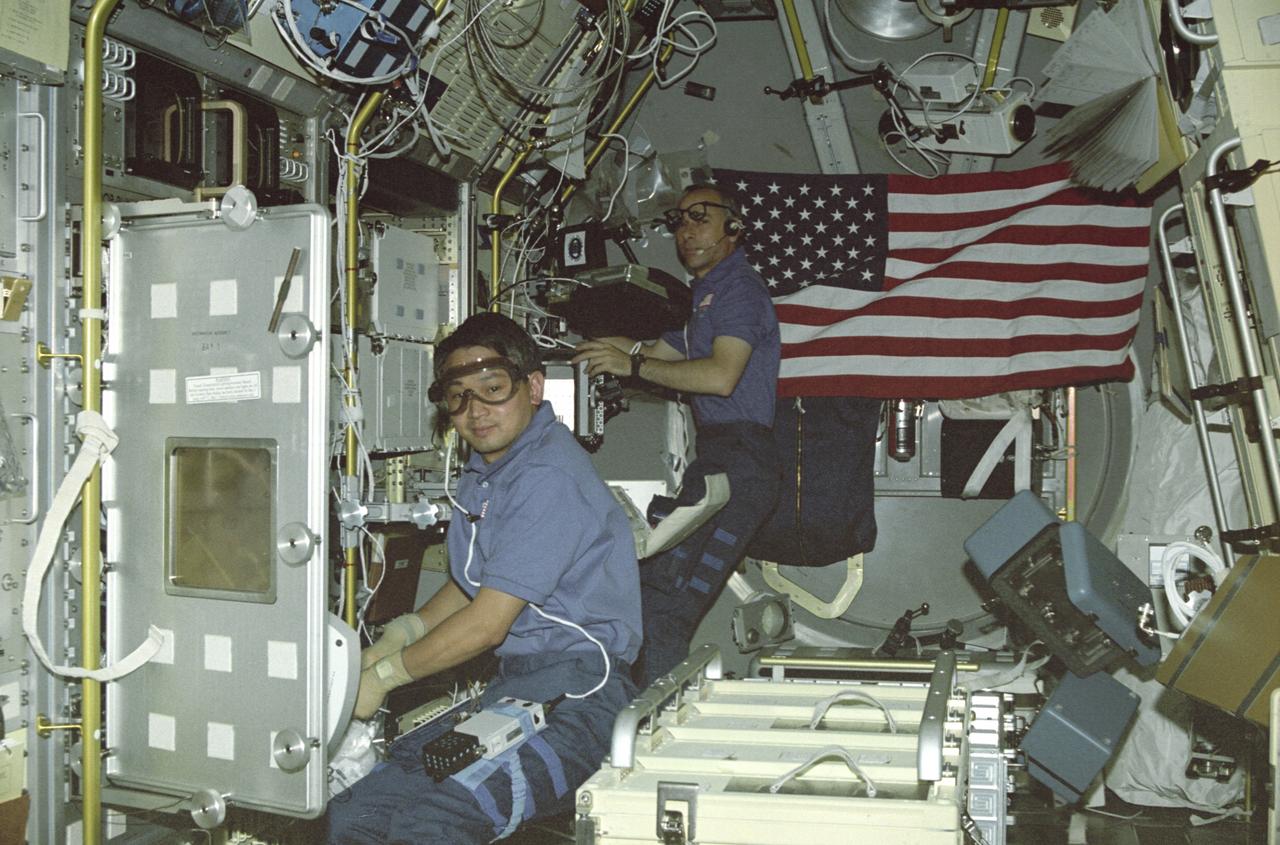
In this photograph, astronaut Eugene Trinh, a payload specialist for this mission, is working at the Drop Physics Module (DPM), and mission specialist Carl Meade is working on the experiment at the Glovebox inside the first United States Microgravity Laboratory (USML-1) Science Module. The USML-1 was one of NASA's missions dedicated to scientific investigations in a microgravity environment inside the Spacelab module. Investigations aboard the USML-1 included: materials science, fluid dynamics, biotechnology (crystal growth), and combustion science. The DPM is dedicated to the detailed study of the dynamics of fluid drops in microgravity. The Glovebox offers experimenters new capabilities and technologies in microgravity with a clean working space and minimizes contamination risks to both Spacelab and experiment samples. Payload specialists are professional scientists or engineers whose only assignment on a space flight is to carry out scientific and technological experiments. Their specific training for a space flight is usually limited to a short period of learning how to live and work in weightlessness. Mission Specialists are both professional scientists and career astronauts. Thus they are a link or bridge between the other crew members, and combine the functions of resident maintenance engineers, in-space counterparts of flight engineers in aircraft, and fully qualified scientists. The USML-1 flew aboard the STS-50 mission on June 1992, and was managed by the Marshall Space Flight Center.
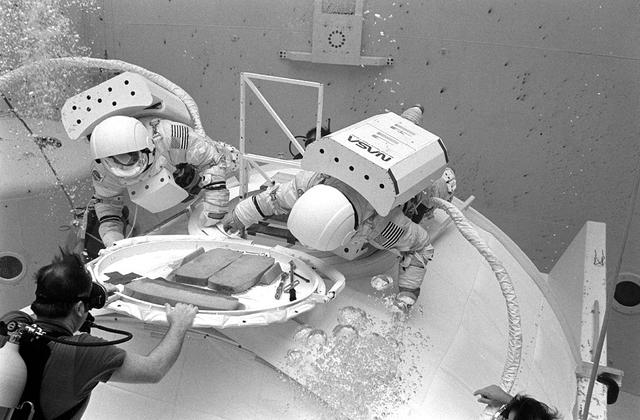
Once the United States' space program had progressed from Earth's orbit into outerspace, the prospect of building and maintaining a permanent presence in space was realized. To accomplish this feat, NASA launched a temporary workstation, Skylab, to discover the effects of low gravity and weightlessness on the human body, and also to develop tools and equipment that would be needed in the future to build and maintain a more permanent space station. The structures, techniques, and work schedules had to be carefully designed to fit this unique construction site. The components had to be lightweight for transport into orbit, yet durable. The station also had to be made with removable parts for easy servicing and repairs by astronauts. All of the tools necessary for service and repairs had to be designed for easy manipulation by a suited astronaut. Construction methods had to be efficient due to the limited time the astronauts could remain outside their controlled environment. In lieu of all the specific needs for this project, an environment on Earth had to be developed that could simulate a low gravity atmosphere. A Neutral Buoyancy Simulator (NBS) was constructed by NASA Marshall Space Flight Center (MSFC) in 1968. Since then, NASA scientists have used this facility to understand how humans work best in low gravity and also provide information about the different kinds of structures that can be built. With the help of the NBS, building a space station became more of a reality. Pictured is Astronaut Paul Weitz training on a mock-up of Spacelab's airlock-hatch cover. Training was also done on the use of foot restraints which had recently been developed to help astronauts maintain their positions during space walks rather than having their feet float out from underneath them while they tried to perform maintenance and repair operations. Every aspect of every space mission was researched and demonstrated in the NBS. Using the airlock hatch cover and foot restraints were just a small example of the preparation that went into each mission.
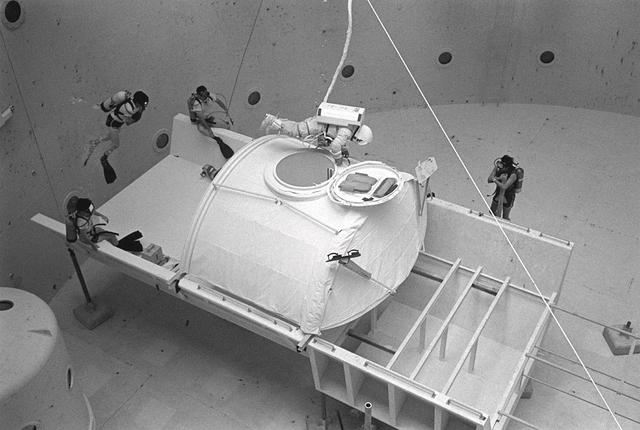
Once the United States' space program had progressed from Earth's orbit into outerspace, the prospect of building and maintaining a permanent presence in space was realized. To accomplish this feat, NASA launched a temporary workstation, Skylab, to discover the effects of low gravity and weightlessness on the human body, and also to develop tools and equipment that would be needed in the future to build and maintain a more permanent space station. The structures, techniques, and work schedules had to be carefully designed to fit this unique construction site. The components had to be lightweight for transport into orbit, yet durable. The station also had to be made with removable parts for easy servicing and repairs by astronauts. All of the tools necessary for service and repairs had to be designed for easy manipulation by a suited astronaut. Construction methods had to be efficient due to the limited time the astronauts could remain outside their controlled environment. In lieu of all the specific needs for this project, an environment on Earth had to be developed that could simulate a low gravity atmosphere. A Neutral Buoyancy Simulator (NBS) was constructed by NASA Marshall Space Flight Center (MSFC) in 1968. Since then, NASA scientists have used this facility to understand how humans work best in low gravity and also provide information about the different kinds of structures that can be built. With the help of the NBS, building a space station became more of a reality. Pictured is Astronaut Paul Weitz training on a mock-up of Spacelab's airlock-hatch cover. Training was also done on the use of foot restraints which had recently been developed to help astronauts maintain their positions during space walks rather than having their feet float out from underneath them while they tried to perform maintenance and repair operations. Every aspect of every space mission was researched and demonstrated in the NBS. Using the airlock hatch cover and foot restraints were just a small example of the preparation that went into each mission.
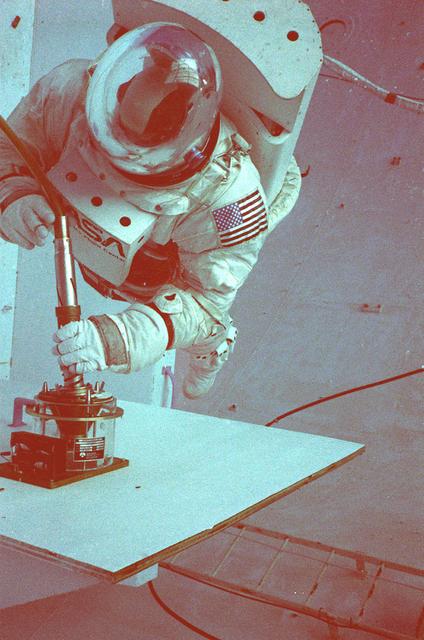
Once the United States' space program had progressed from Earth's orbit into outerspace, the prospect of building and maintaining a permanent presence in space was realized. To accomplish this feat, NASA launched a temporary workstation, Skylab, to discover the effects of low gravity and weightlessness on the human body, and also to develop tools and equipment that would be needed in the future to build and maintain a more permanent space station. The structures, techniques, and work schedules had to be carefully designed to fit this unique construction site. The components had to be lightweight for transport into orbit, yet durable. The station also had to be made with removable parts for easy servicing and repairs by astronauts. All of the tools necessary for service and repairs had to be designed for easy manipulation by a suited astronaut. And construction methods had to be efficient due to limited time the astronauts could remain outside their controlled environment. In lieu of all the specific needs for this project, an environment on Earth had to be developed that could simulate a low gravity atmosphere. A Neutral Buoyancy Simulator (NBS) was constructed by NASA Marshall Space Flight Center (MSFC) in 1968. Since then, NASA scientists have used this facility to understand how humans work best in low gravity and also provide information about the different kinds of structures that can be built. Another facet of the space station would be electrical cornectors which would be used for powering tools the astronauts would need for construction, maintenance and repairs. Shown is an astronaut training during an underwater electrical connector test in the NBS.
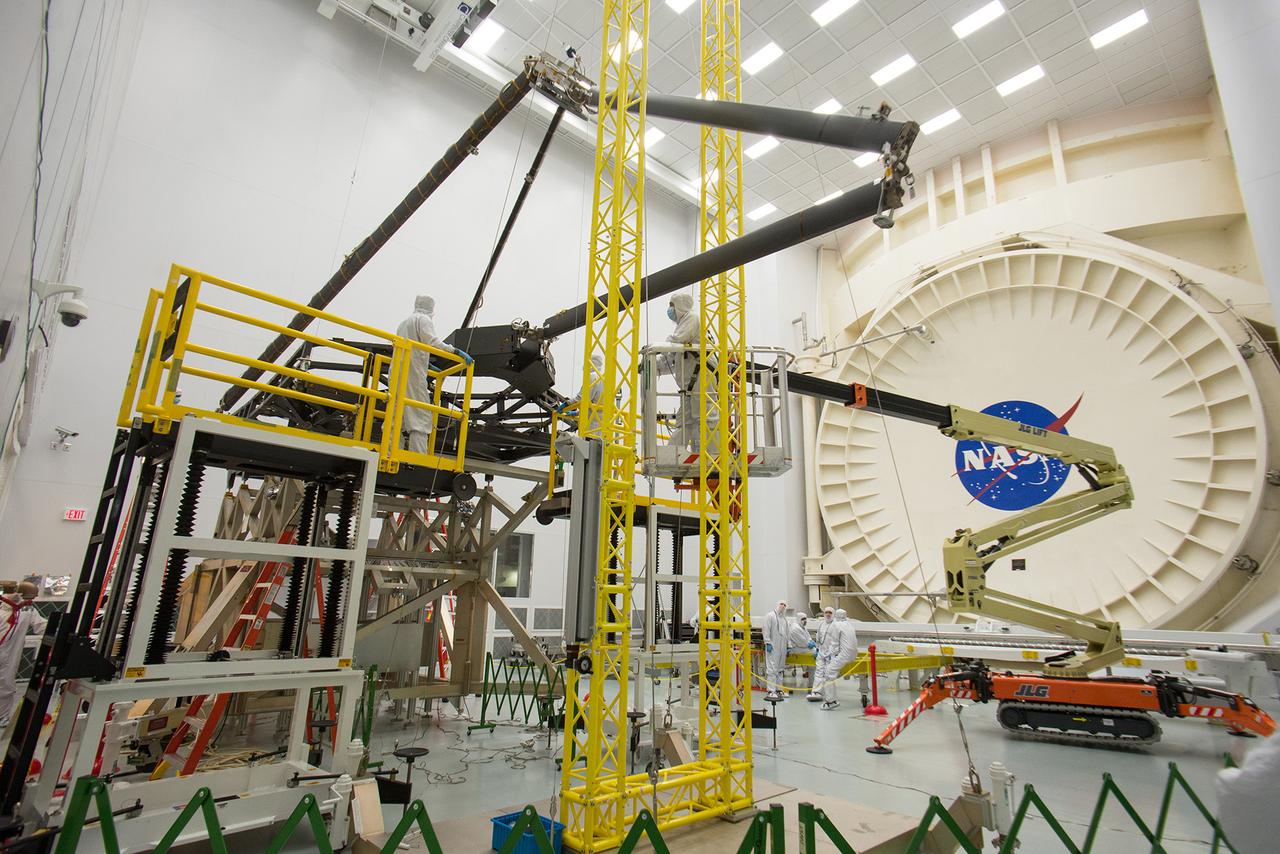
Engineers and technicians manually deployed the secondary mirror support structure (SMSS) of the James Webb Space Telescope's Pathfinder backplane test model, outside of a giant space simulation chamber called Chamber A, at NASA's Johnson Space Center in Houston. This historic test chamber was previously used in manned spaceflight missions and is being readied for a cryogenic test of a Webb telescope component. In the weightless environment of space, the SMSS is deployed by electric motors. On the ground, specially trained operators use a hand crank and a collection of mechanical ground support equipment to overcome the force of gravity. "This structure needs to be in the deployed configuration during the cryogenic test to see how the structure will operate in the frigid temperatures of space," said Will Rowland, senior mechanical test engineer for Northrop Grumman Aerospace Systems, Redondo Beach, California. "The test also demonstrates that the system works and can be successfully deployed." After the deployment was completed, Chamber A's circular door was opened and the rails (seen in the background of the photo) were installed so that the Pathfinder unit could be lifted, installed and rolled into the chamber on a cart. The team completed a fit check for the Pathfinder. Afterwards they readied the chamber for the cryogenic test, which will simulate the frigid temperatures the Webb telescope will encounter in space. “The team has been doing a great job keeping everything on schedule to getting our first optical test results, " said Lee Feinberg, NASA Optical Telescope Element Manager. The James Webb Space Telescope is the scientific successor to NASA's Hubble Space Telescope. It will be the most powerful space telescope ever built. Webb is an international project led by NASA with its partners, the European Space Agency and the Canadian Space Agency. Image credit: NASA/Desiree Stover Text credit: Laura Betz, NASA's Goddard Space Flight Center, Greenbelt, Maryland <b><a href="http://www.nasa.gov/audience/formedia/features/MP_Photo_Guidelines.html" rel="nofollow">NASA image use policy.</a></b> <b><a href="http://www.nasa.gov/centers/goddard/home/index.html" rel="nofollow">NASA Goddard Space Flight Center</a></b> enables NASA’s mission through four scientific endeavors: Earth Science, Heliophysics, Solar System Exploration, and Astrophysics. Goddard plays a leading role in NASA’s accomplishments by contributing compelling scientific knowledge to advance the Agency’s mission. <b>Follow us on <a href="http://twitter.com/NASAGoddardPix" rel="nofollow">Twitter</a></b> <b>Like us on <a href="http://www.facebook.com/pages/Greenbelt-MD/NASA-Goddard/395013845897?ref=tsd" rel="nofollow">Facebook</a></b> <b>Find us on <a href="http://instagrid.me/nasagoddard/?vm=grid" rel="nofollow">Instagram</a></b>