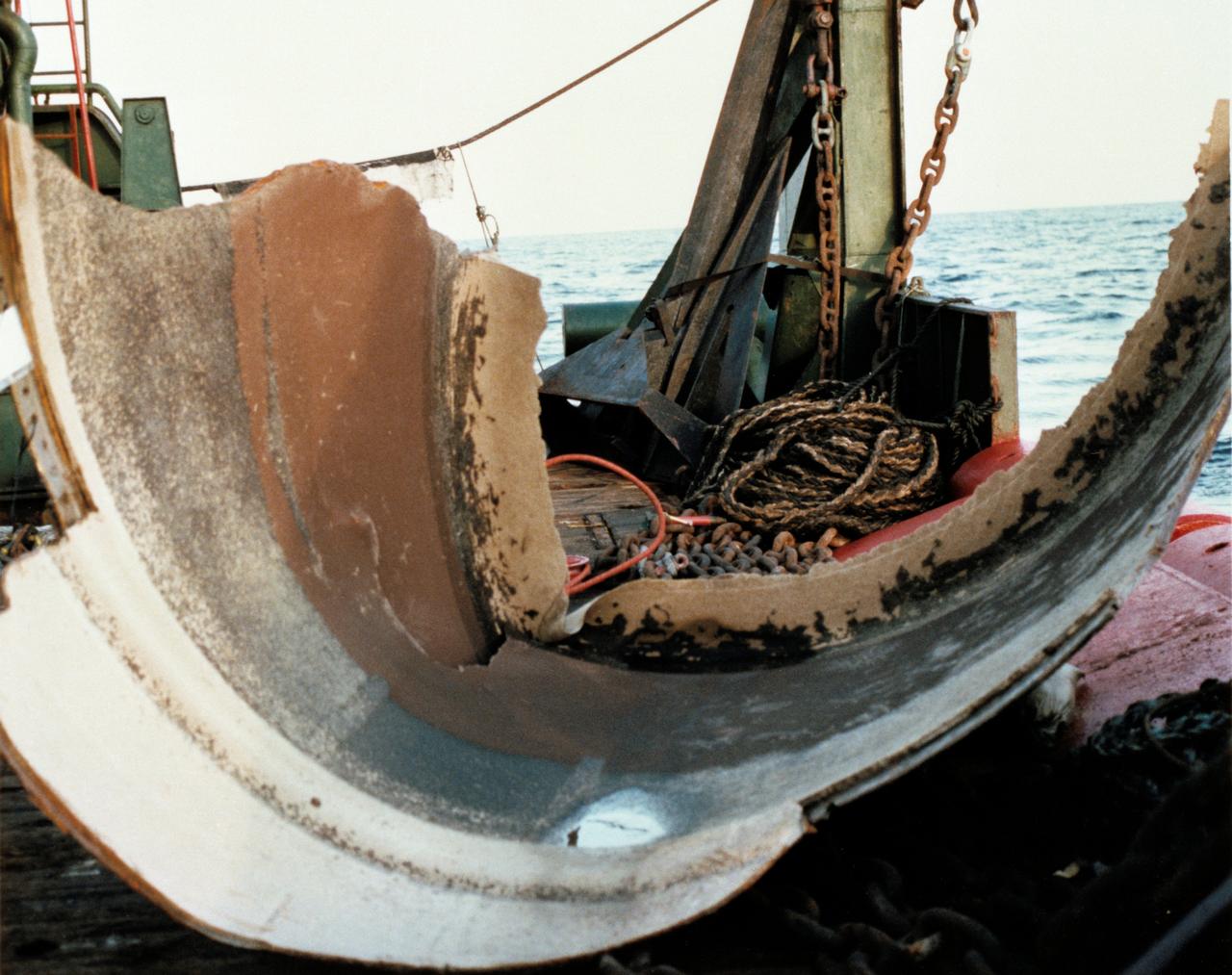
51L-10162 (8-9 March 1986) --- View of the left solid rocket booster first piece retrieval #11 (STS-51L space shuttle Challenger). Photo credit: NASA
View of left SRB first piece retrieval
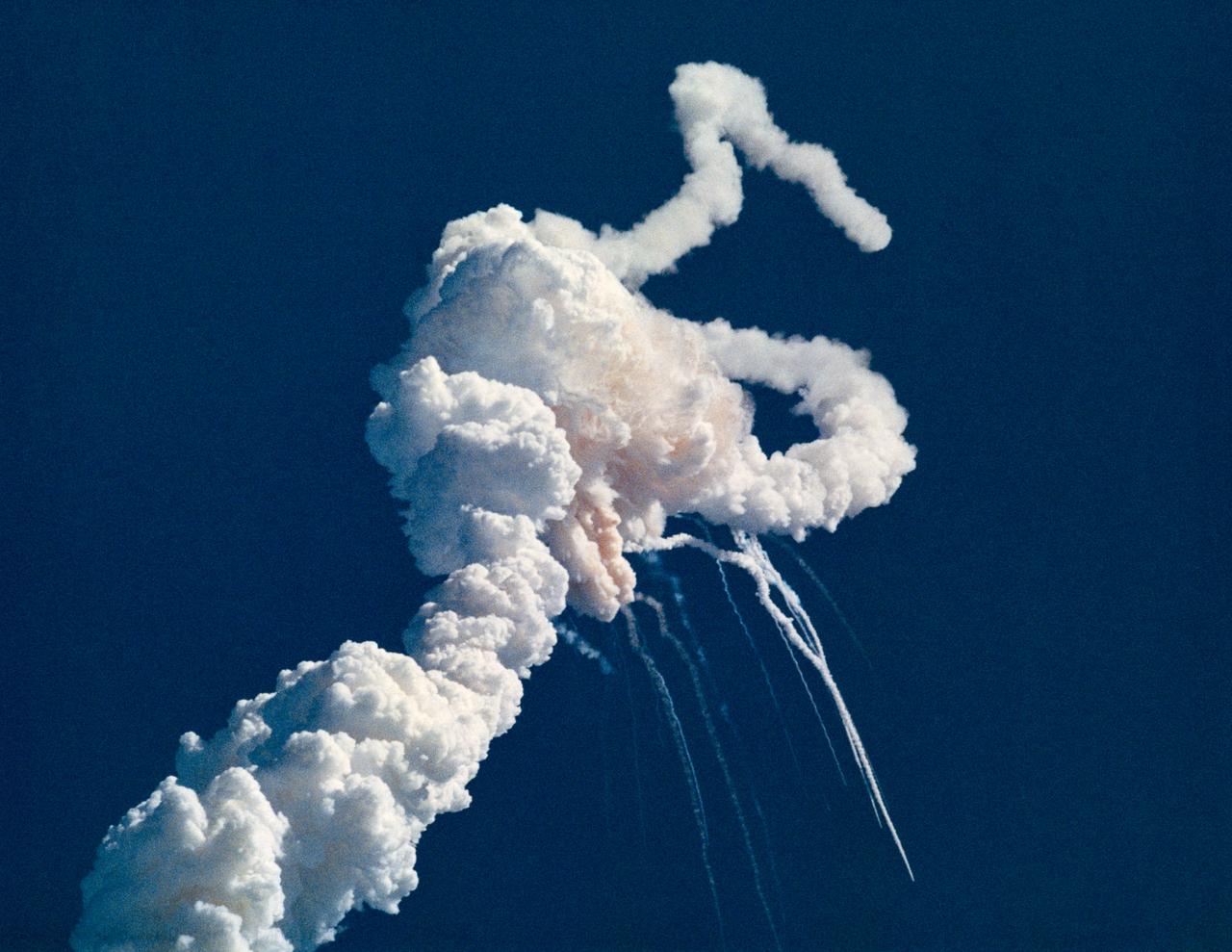
S86-38989 (28 Jan. 1986) --- Main engine exhaust, solid rocket booster plume and an expanding ball of gas from the external tank is visible seconds after the space shuttle Challenger accident on Jan. 28, 1986.     (NOTE: The 51-L crew members lost their lives in the space shuttle Challenger accident moments after launch on Jan. 28, 1986 from the Kennedy Space Center.) Photo credit: NASA
Challenger accident after launch
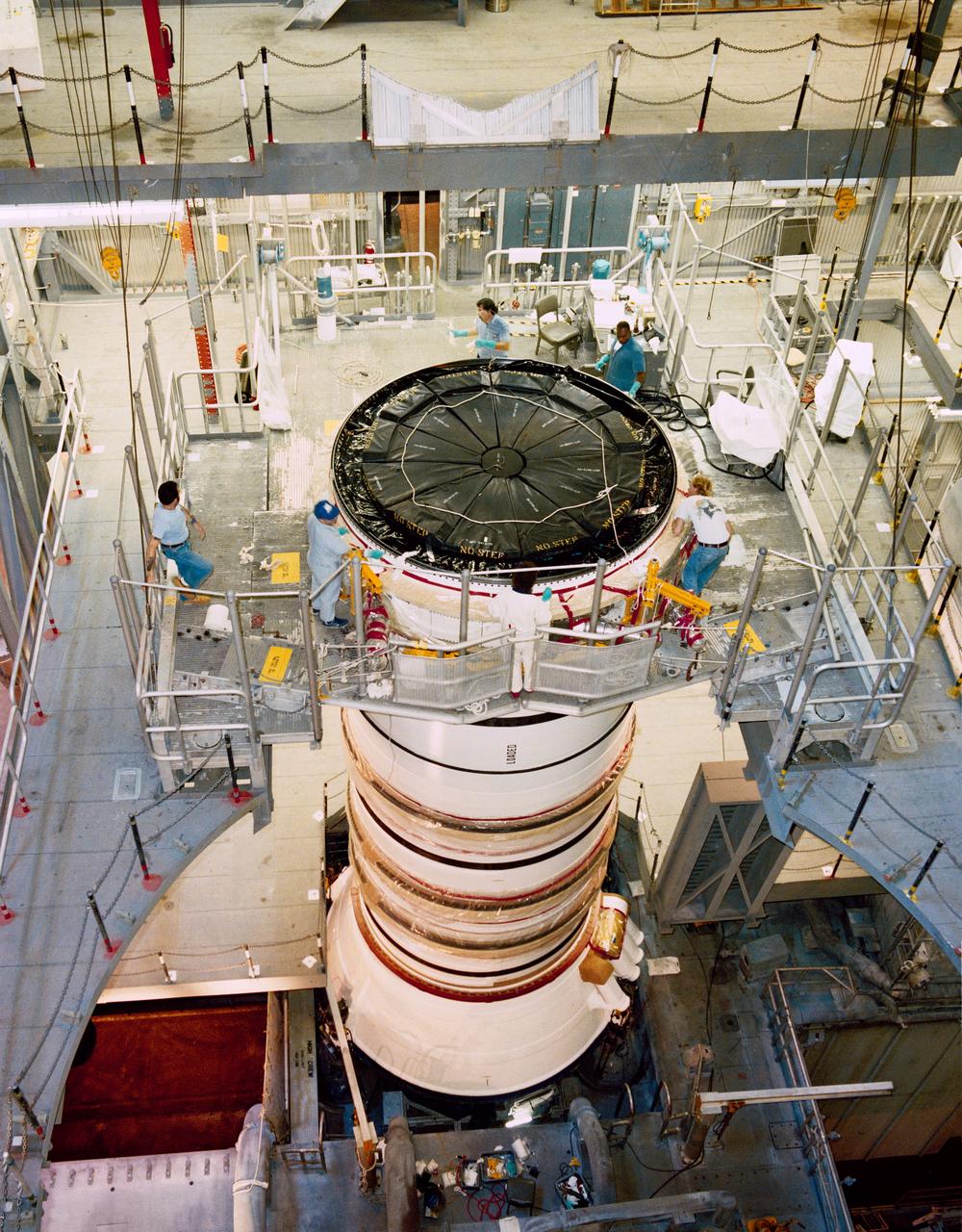
STS-29 Discovery, Orbiter Vehicle (OV) 103, solid rocket booster (SRB) right aft segment is being prepared for stacking in the Kennedy Space Center (KSC) Vehicle Assembly Building (VAB). Technicians examine and work with SRB seal from scaffolding platform. The twin sets of boosters provide 80 percent of the space shuttle launch thrust. Each SRB is made up of four "loaded" or fueled segments. The SRBs operate in parallel with the space shuttle main engines (SSMEs) for the first two minutes of flight providing additional thrust needed to escape the gravitational pull of the Earth. At an altitude of approximately 24 nautical miles, the SRBs separate, descend on parachutes, and land in the Atlantic Ocean where they are recovered and reused on future flights. View provided by KSC with alternate number KSC-88PC-1323.
STS-29 Discovery, OV-103, solid rocket booster (SRB) preparation at KSC
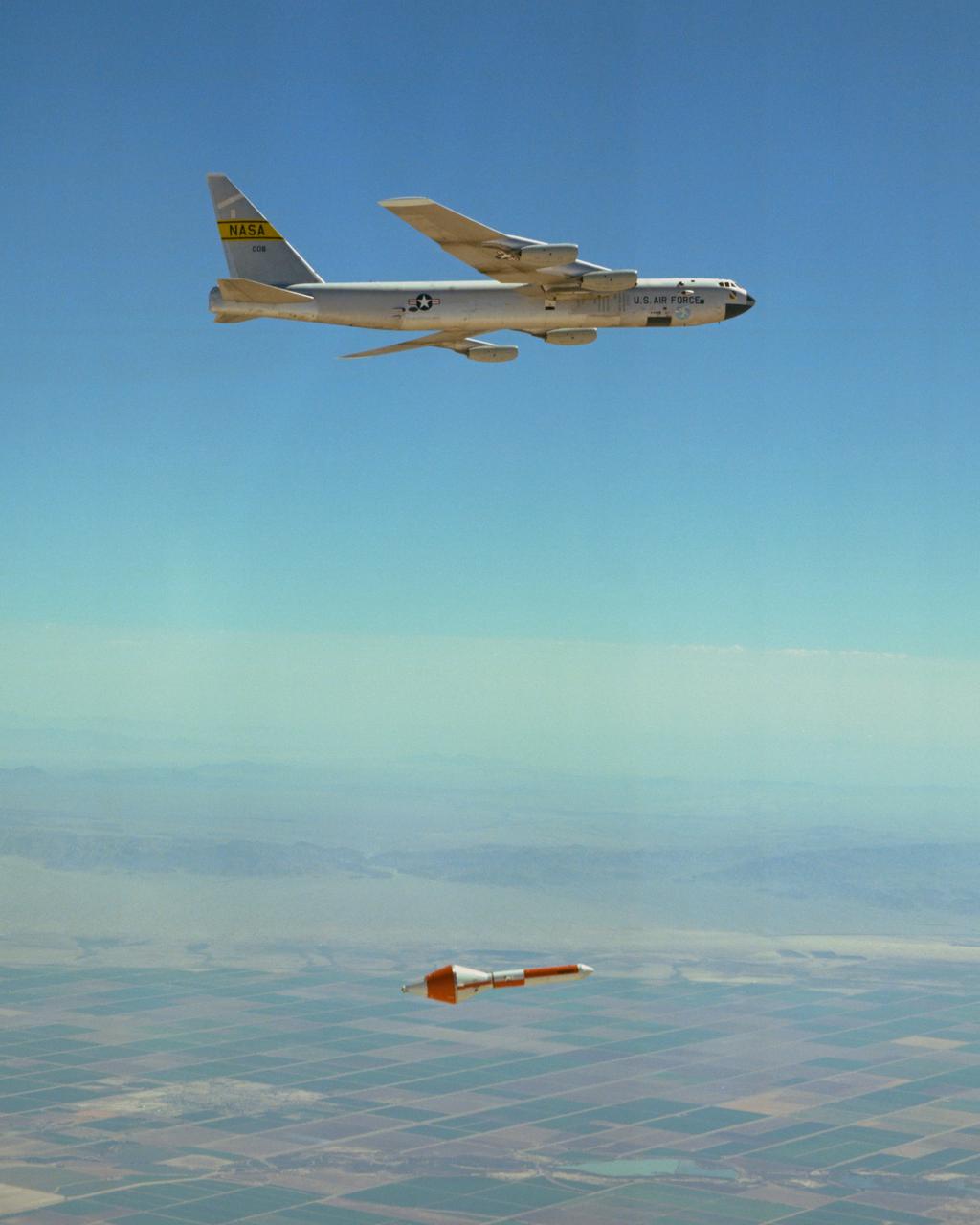
Space Shuttle Solid Rocket Booster Drop Test Vehicle (SRB-DTV) first release from NB-52B
EC77-8184
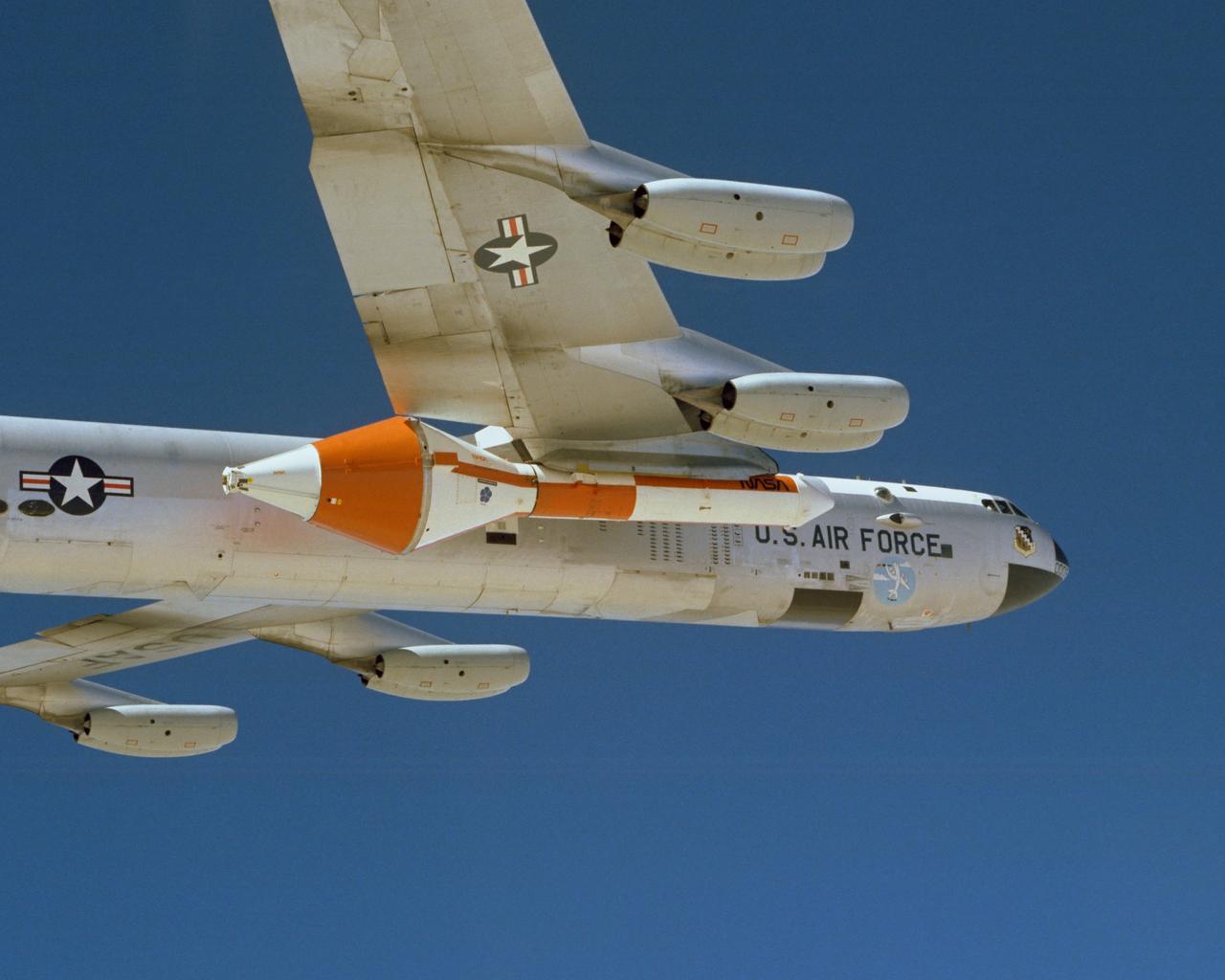
Space Shuttle Solid Rocket Booster Drop Test Vehicle (SRB-DTV) captive flight on NB-52B
EC77-7428
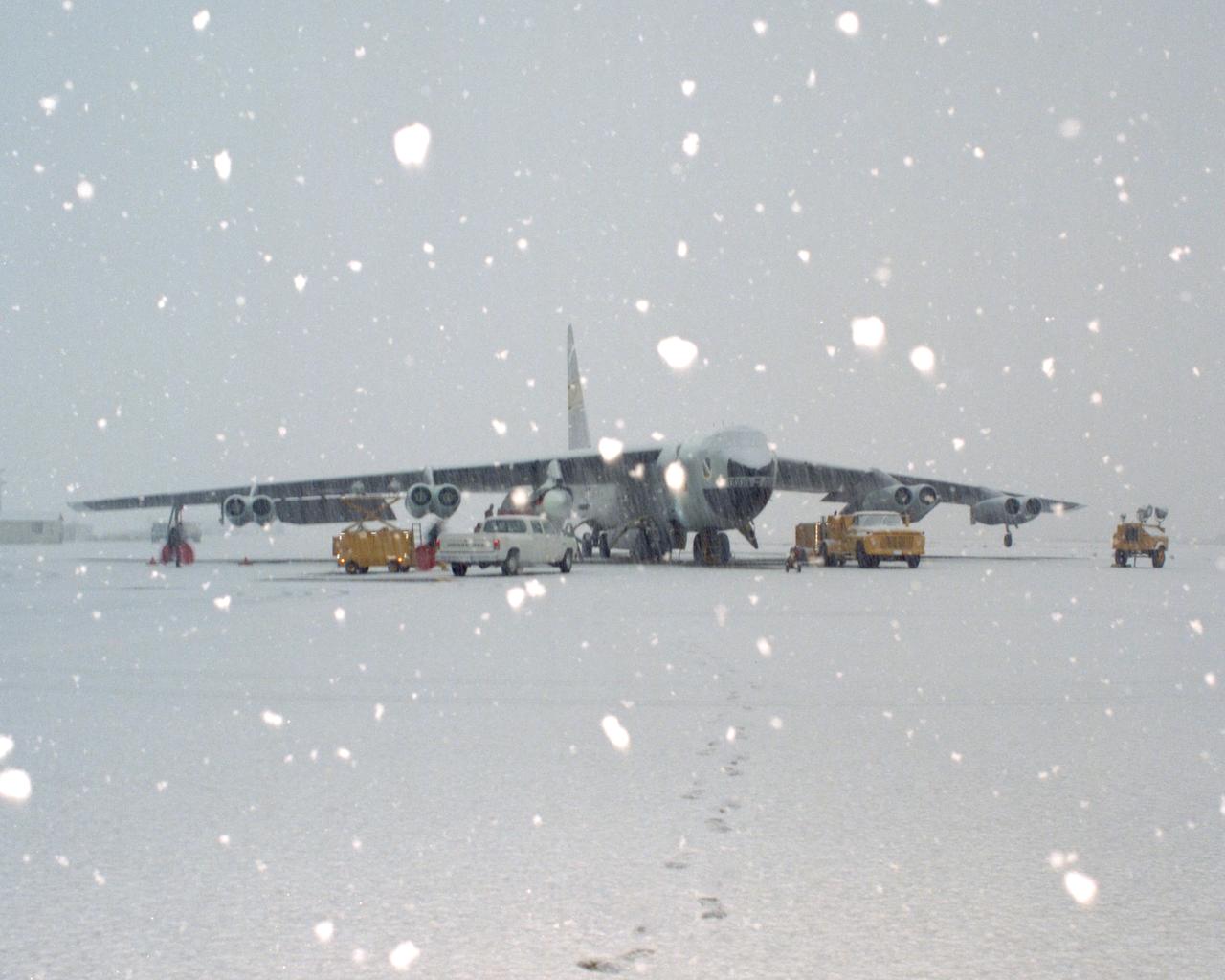
Space Shuttle Solid Rocket Booster Drop Test Vehicle (SRB-DTV) mated to NB-52B in snow
EC84-32107
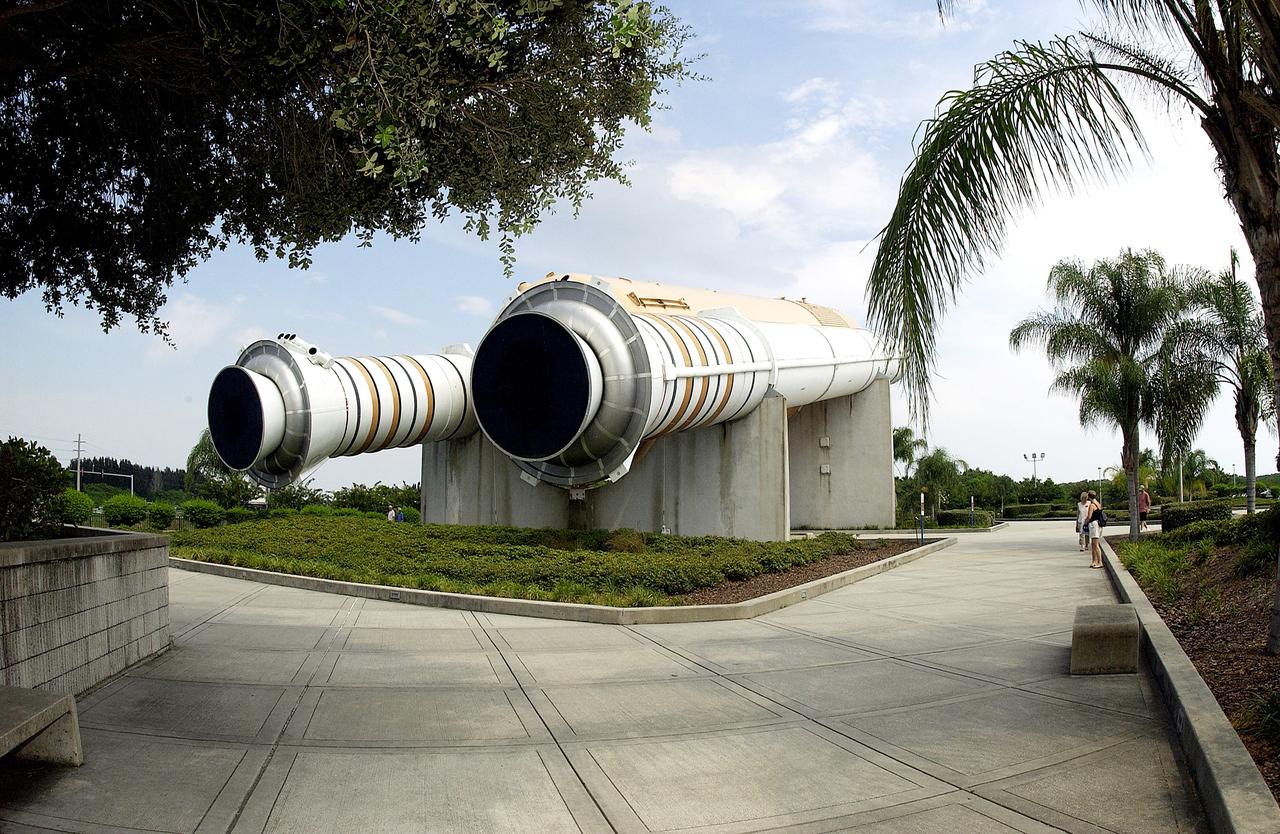
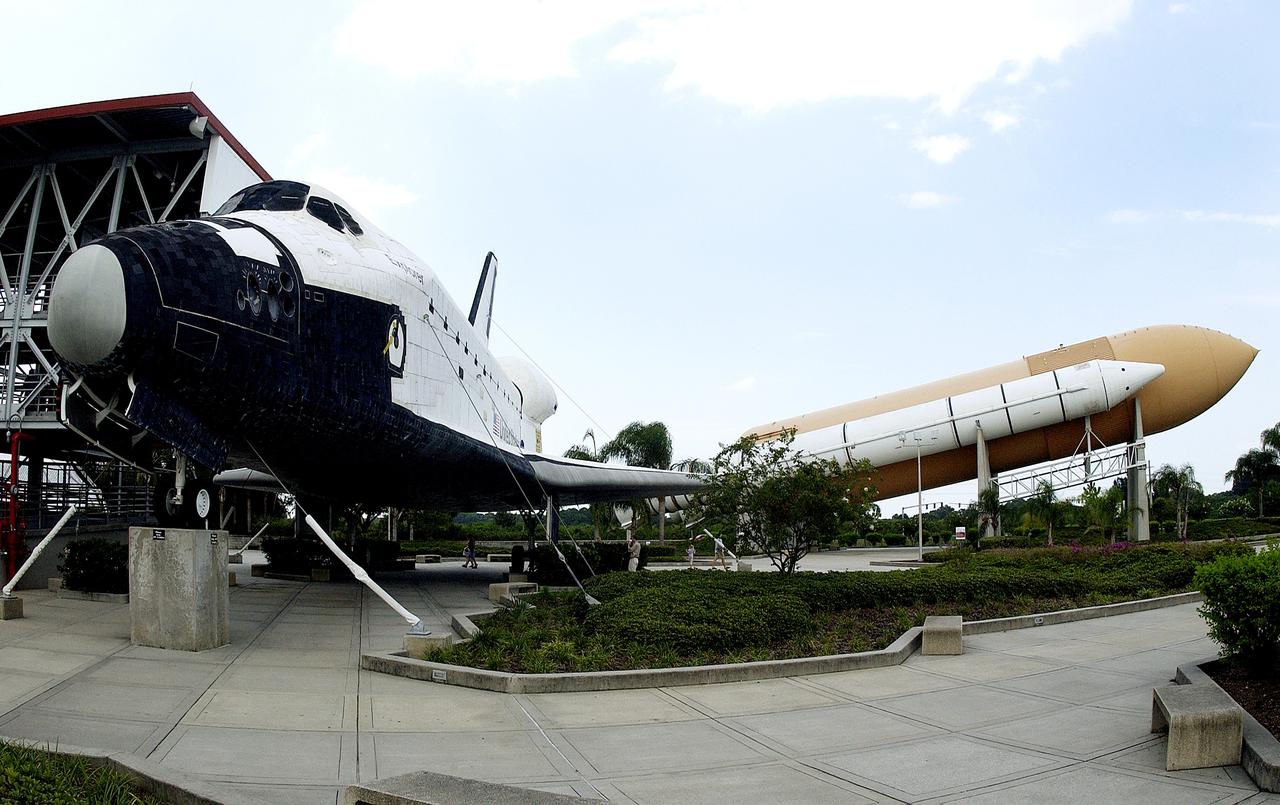
KENNEDY SPACE CENTER, FLA.  -  One of the featured displays at the KSC Visitor Complex is a genuine external tank with twin solid rocket boosters, seen here.  The tank and boosters are paired with a full-size replica of a Space Shuttle Orbiter in the Shuttle Plaza.
KENNEDY SPACE CENTER, FLA. - One of the featured displays at the KSC Visitor Complex is a genuine external tank with twin solid rocket boosters, seen here. The tank and boosters are paired with a full-size replica of a Space Shuttle Orbiter in the Shuttle Plaza.
KENNEDY SPACE CENTER, FLA.  -  One of the featured displays at the KSC Visitor Complex is the genuine external tank  (center) with twin solid rocket boosters, seen here at the lower end.  The tank and boosters are paired with a full-size replica of a Space Shuttle Orbiter in the Shuttle Plaza.
KENNEDY SPACE CENTER, FLA. - One of the featured displays at the KSC Visitor Complex is the genuine external tank (center) with twin solid rocket boosters, seen here at the lower end. The tank and boosters are paired with a full-size replica of a Space Shuttle Orbiter in the Shuttle Plaza.
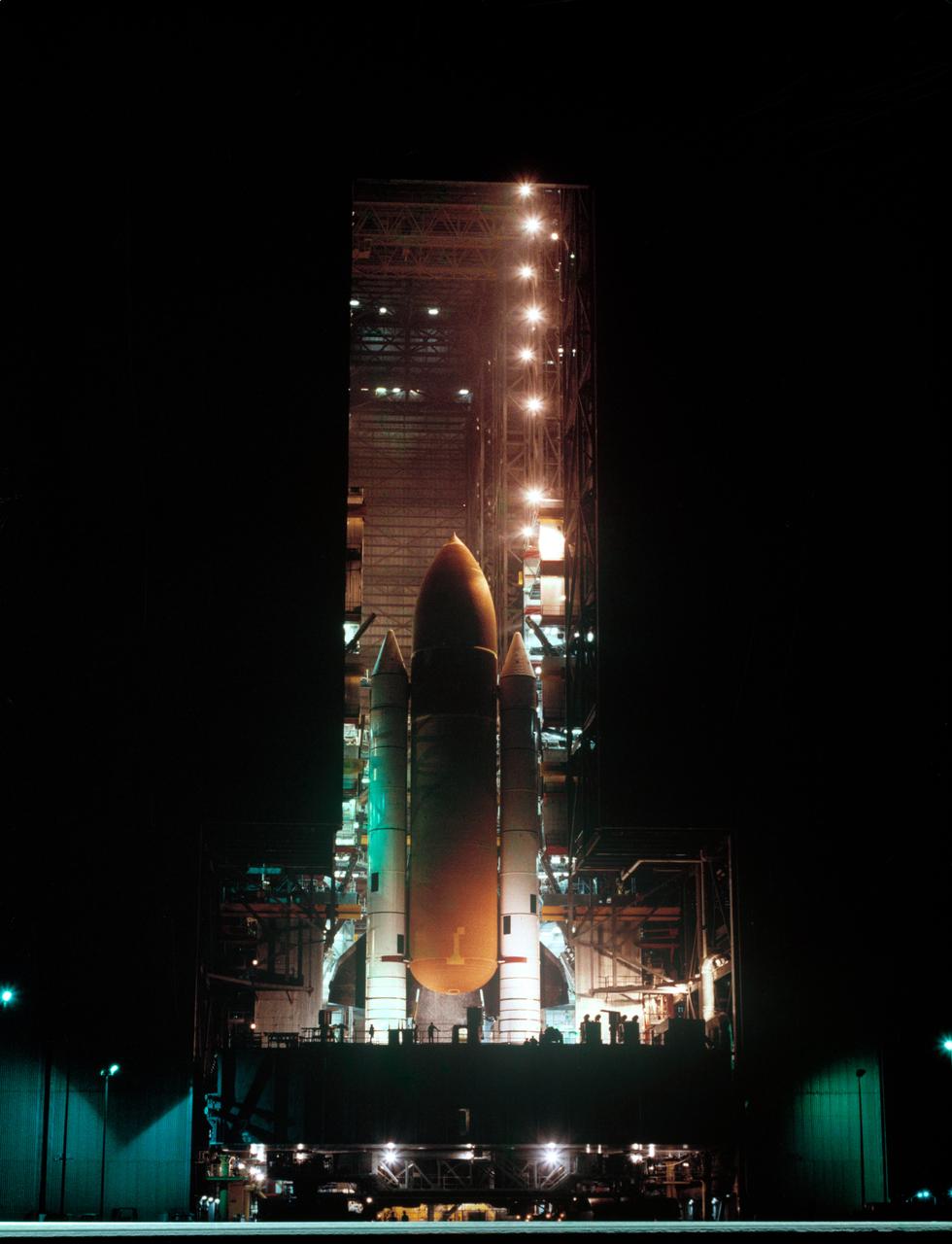
S89-40392 (12 July 1989) ---  Inside KSC's giant vehicle assembly building, Space Shuttle Columbia is mated to two solid rocket boosters (SRB) and an external fuel tank as preparations continue for an early September launch.  The mission is scheduled as a DOD-devoted flight, set for launch early next month.
STS-28 Columbia, Orbiter Vehicle (OV) 102, ET/SRB mating operations at KSC
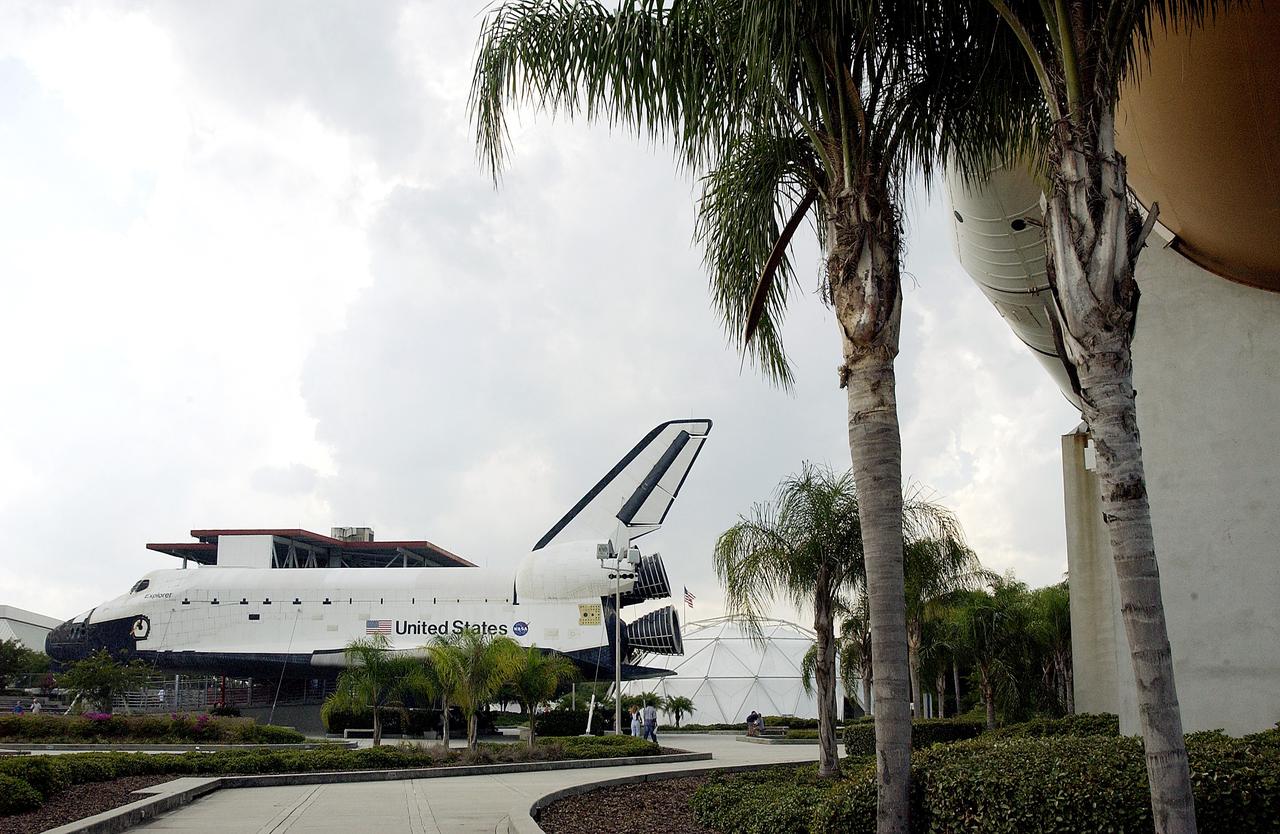
KENNEDY SPACE CENTER, FLA.  -  Featured displays at the KSC Visitor Complex are this full-size replica of a Space Shuttle Orbiter and the genuine solid rocket boosters and external tank, in the Shuttle Plaza.
KENNEDY SPACE CENTER, FLA. - Featured displays at the KSC Visitor Complex are this full-size replica of a Space Shuttle Orbiter and the genuine solid rocket boosters and external tank, in the Shuttle Plaza.
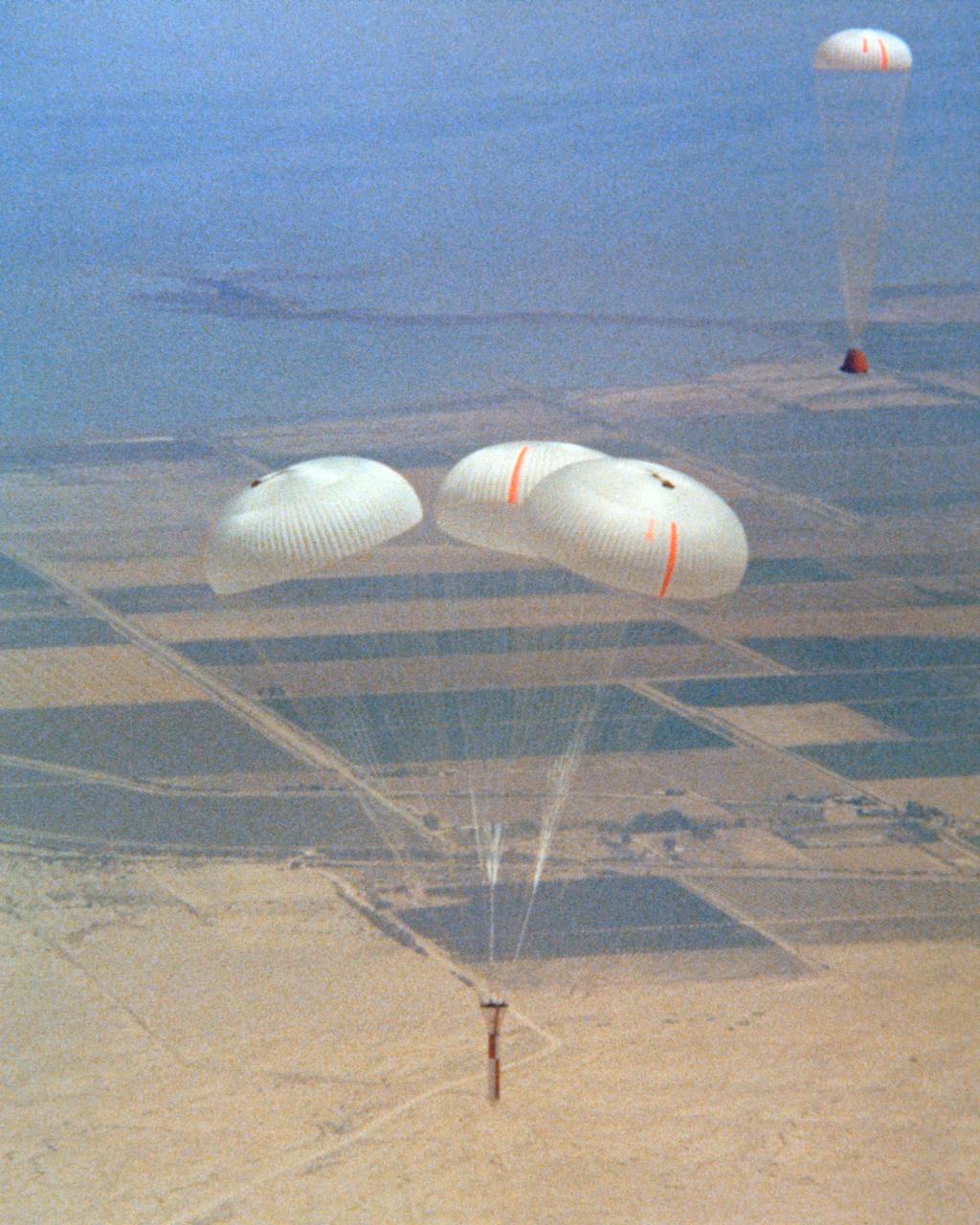
Space Shuttle Solid Rocket Booster Drop Test Vehicle (SRB-DTV) with chutes open after release from NB-52B
EC79-10168
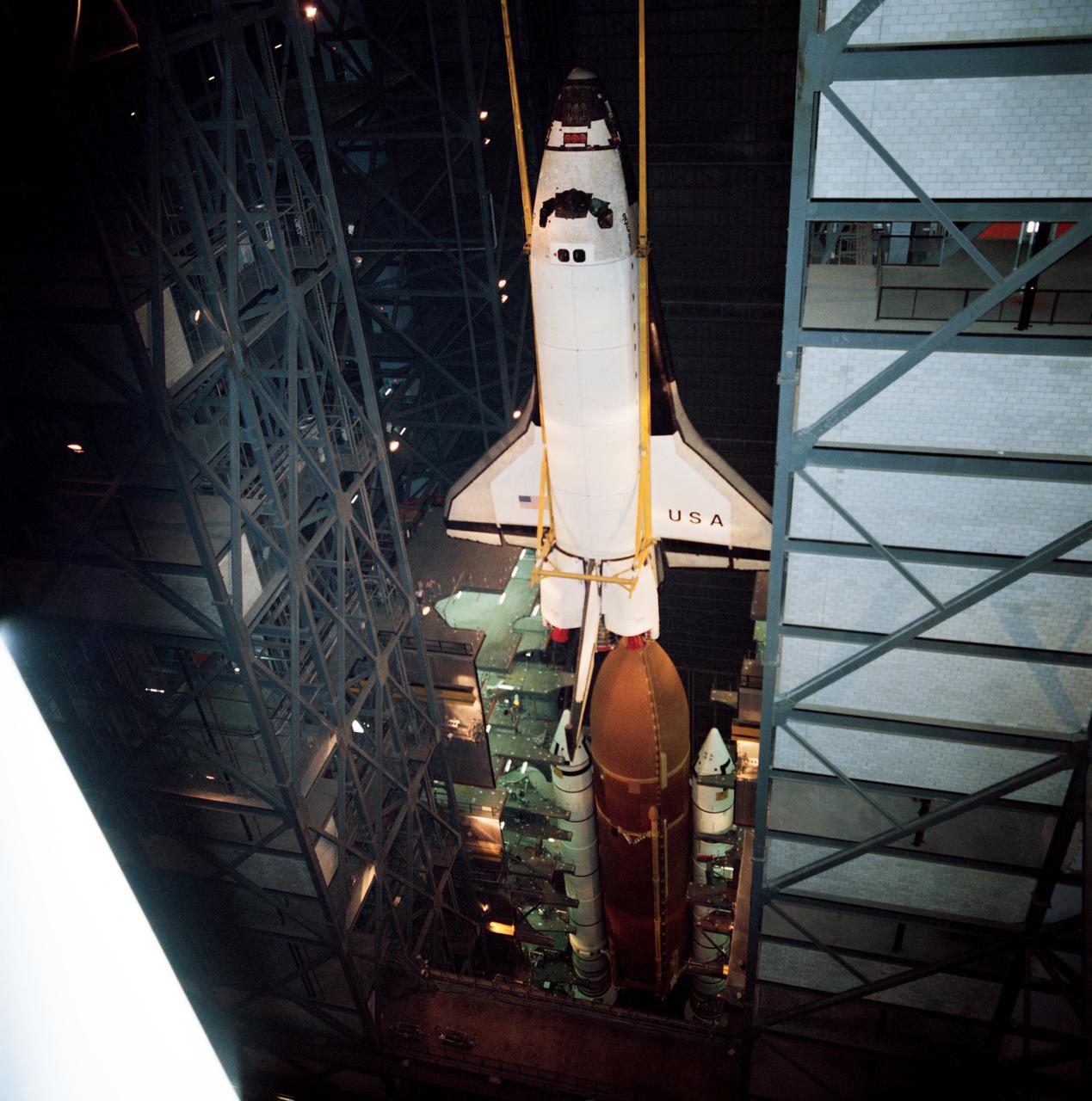
S89-28089 (24 Jan 1989) --- The Space Shuttle Discovery is lowered for mating to the external tank and two solid rockert boosters in the vehicle assembly building (VAB) at the Kennedy Space Center.   Onboard the spacecraft in  mid-March for a five-day mission, on which will be deployed a third tracking and data relay satellite (TDRS-D), will be Astronauts Michael L. Coats, John E. Blaha, James F. Buchli, James P. Bagian and Robert C. Springer.
STS-29 Discovery, OV-103, external tank (ET) and SRB mating at KSC
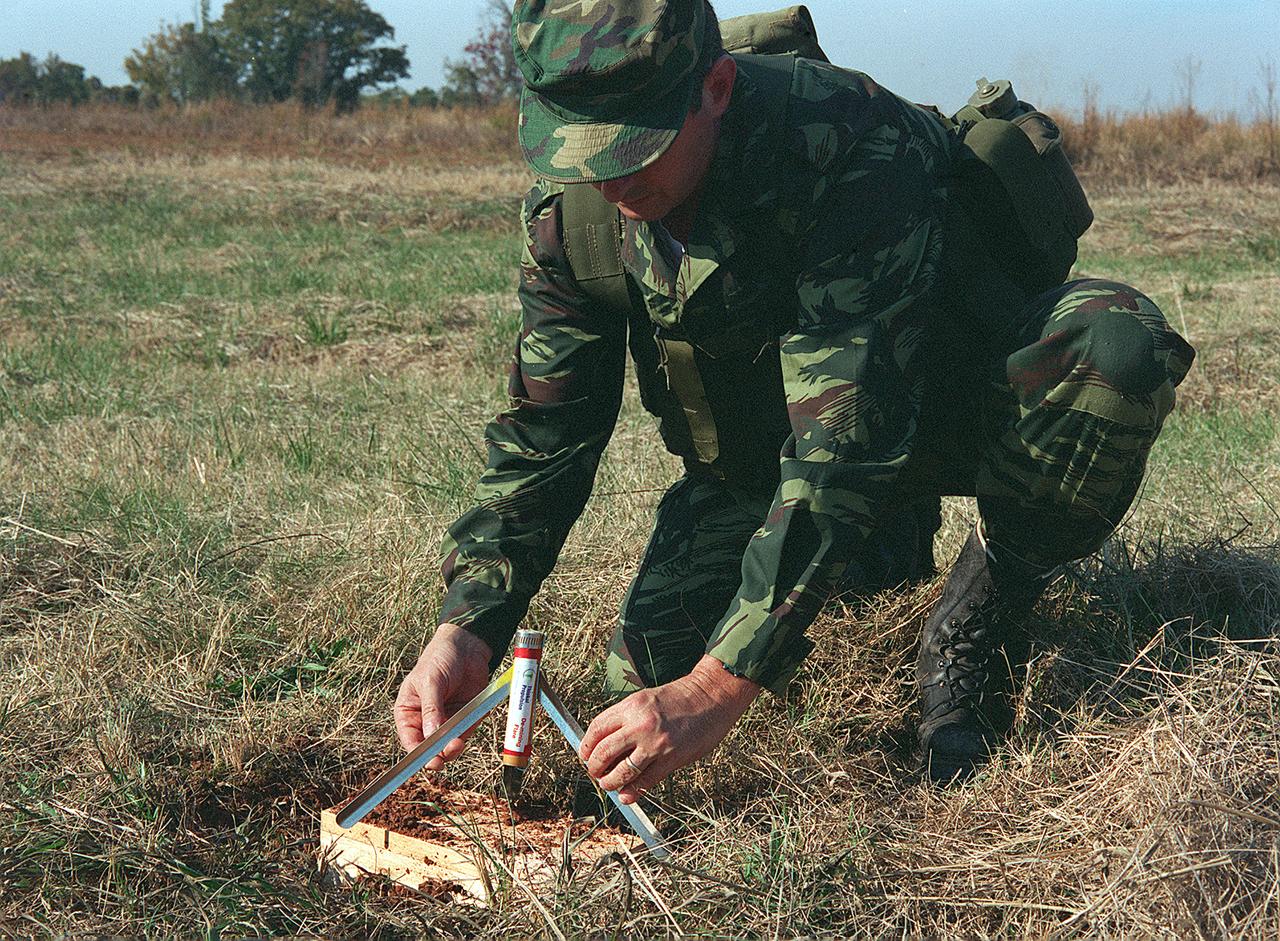
The same rocket fuel that helps power the Space Shuttle as it thunders into orbit will now be taking on a new role, with the potential to benefit millions of people worldwide. Leftover rocket fuel from NASA is being used to make a flare that destroys land mines where they were buried, without using explosives. The flare is safe to handle and easy to use. People working to deactivate the mines simply place the flare next to the uncovered land mine and ignite it from a safe distance using a battery-triggered electric match. The flare burns a hole in the land mine's case and ignites its explosive contents. The explosive burns away, disabling the mine and rendering it harmless. Using leftover rocket fuel to help destroy land mines incurs no additional costs to taxpayers. To ensure enough propellant is available for each Shuttle mission, NASA allows for a small percentage of extra propellant in each batch. Once mixed, surplus fuel solidifies and carnot be saved for use in another launch. In its solid form, it is an ideal ingredient for the new flare. The flare was developed by Thiokol Propulsion in Brigham City, Utah, the NASA contractor that designs and builds rocket motors for the Solid Rocket Booster Space Shuttle. An estimated 80 million or more active land mines are scattered around the world in at least 70 countries, and kill or maim 26,000 people a year. Worldwide, there is one casualty every 22 minutes
Benefit from NASA
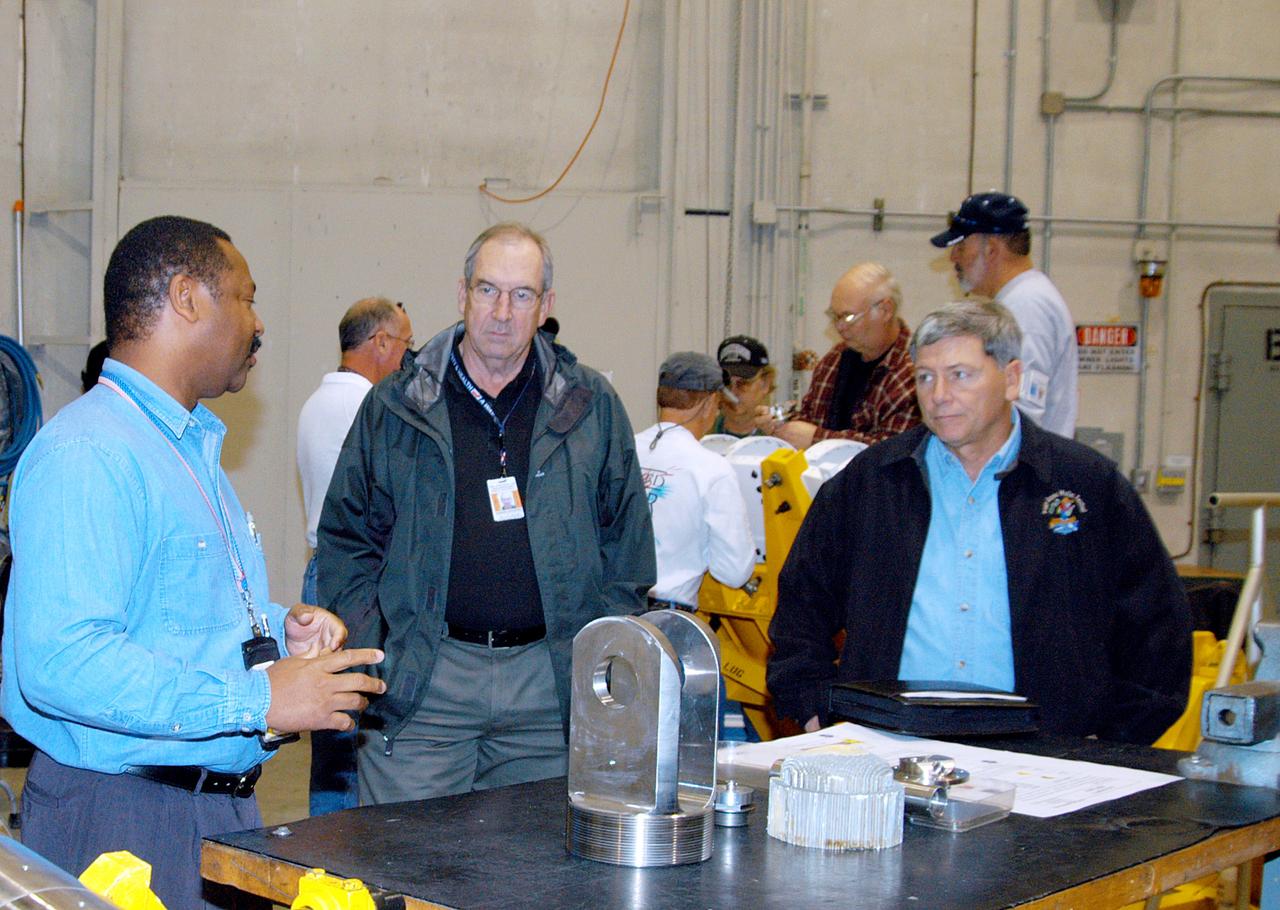
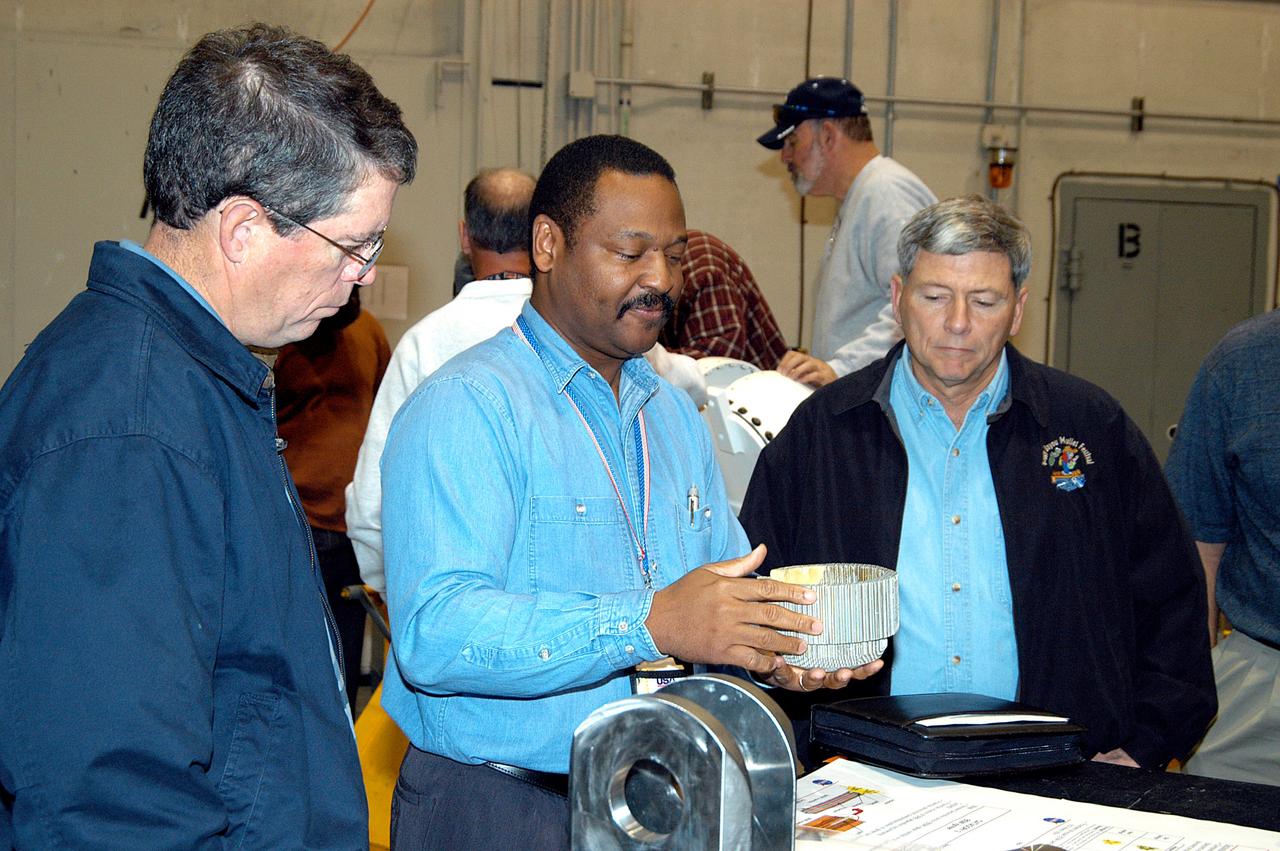
KENNEDY SPACE CENTER, FLA. -- From left, a United Space Alliance (USA) technician discusses aspects of Shuttle processing performed in the Solid Rocket Booster (SRB) Assembly and Refurbishment Facility (ARF) with USA Vice President and Space Shuttle Program Manager Howard DeCastro and NASA Deputy Associate Administrator for Space Station and Shuttle Programs Michael Kostelnik.  NASA and USA Space Shuttle program management are participating in a leadership workday.  The day is intended to provide management with an in-depth, hands-on look at Shuttle processing activities at KSC.
KENNEDY SPACE CENTER, FLA. -- From left, a United Space Alliance (USA) technician discusses aspects of Shuttle processing performed in the Solid Rocket Booster (SRB) Assembly and Refurbishment Facility (ARF) with USA Vice President and Space Shuttle Program Manager Howard DeCastro and NASA Deputy Associate Administrator for Space Station and Shuttle Programs Michael Kostelnik. NASA and USA Space Shuttle program management are participating in a leadership workday. The day is intended to provide management with an in-depth, hands-on look at Shuttle processing activities at KSC.
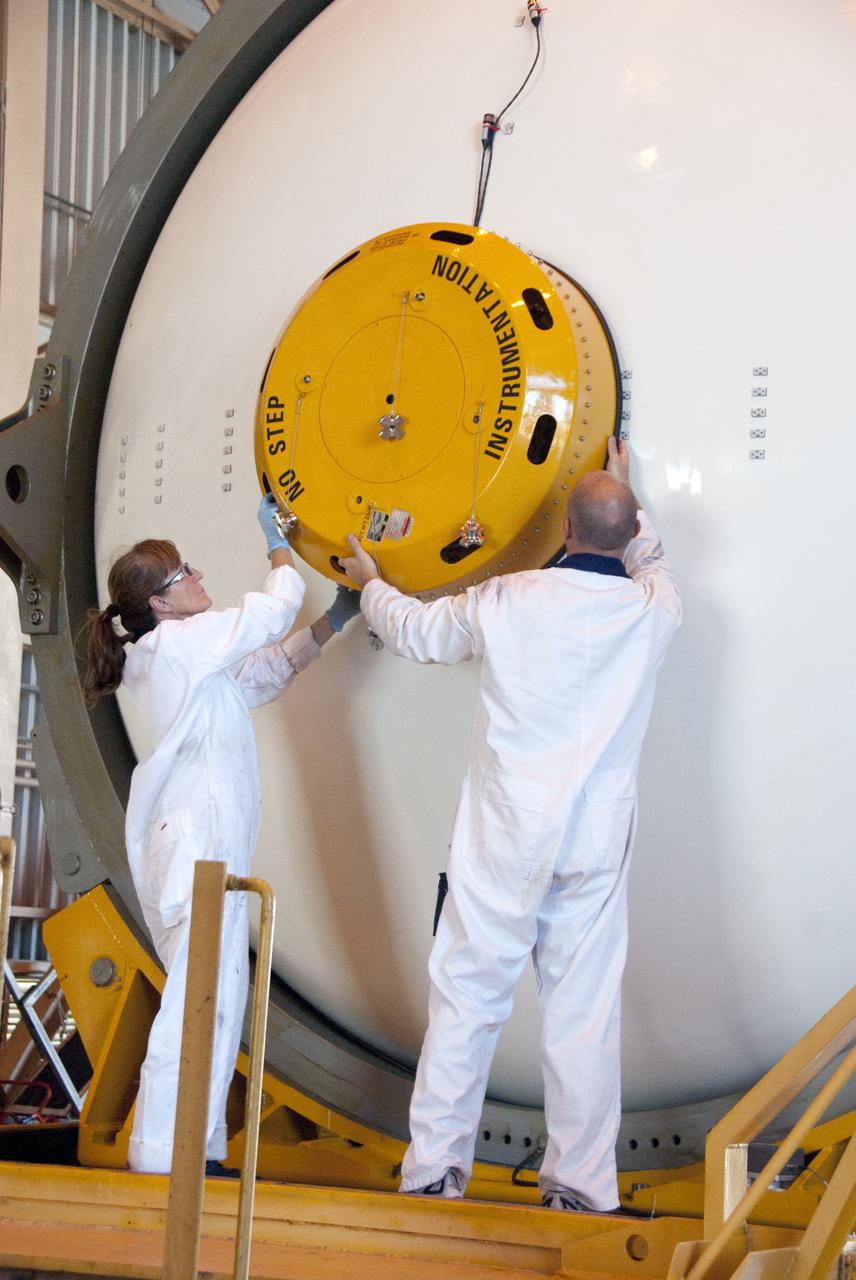
KENNEDY SPACE CENTER, FLA. -  In the Solid Rocket Booster Assembly and Refurbishment Facility (ARF), Vernon Gibbs, with United Space Alliance, prepares the forward skirt of a solid rocket booster for installation of the parachute camera.  Refurbishment and subassembly of Shuttle SRB hardware - primarily the forward and aft assemblies - is carried out in the ARF.
KENNEDY SPACE CENTER, FLA. - In the Solid Rocket Booster Assembly and Refurbishment Facility (ARF), Vernon Gibbs, with United Space Alliance, prepares the forward skirt of a solid rocket booster for installation of the parachute camera. Refurbishment and subassembly of Shuttle SRB hardware - primarily the forward and aft assemblies - is carried out in the ARF.
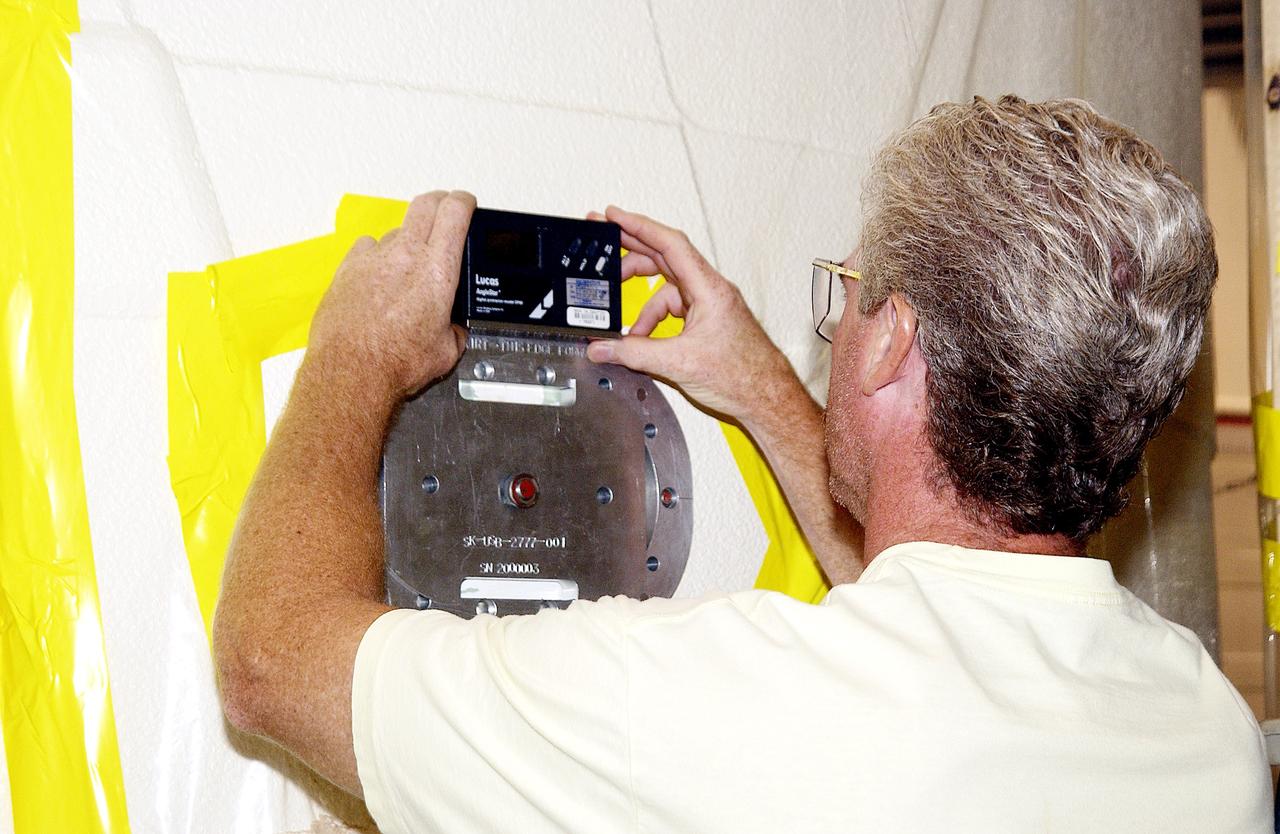
KENNEDY SPACE CENTER, FLA. -  In the Solid Rocket Booster Assembly and Refurbishment Facility (ARF), Donnie Cardigan, with United Space Alliance,  installs the parachute camera on the solid rocket booster forward skirt.  Refurbishment and subassembly of Shuttle SRB hardware - primarily the forward and aft assemblies - is carried out in the ARF.
KENNEDY SPACE CENTER, FLA. - In the Solid Rocket Booster Assembly and Refurbishment Facility (ARF), Donnie Cardigan, with United Space Alliance, installs the parachute camera on the solid rocket booster forward skirt. Refurbishment and subassembly of Shuttle SRB hardware - primarily the forward and aft assemblies - is carried out in the ARF.
KENNEDY SPACE CENTER, FLA. - In the Solid Rocket Booster Assembly and Refurbishment Facility (ARF), Vernon Gibbs, with United Space Alliance, prepares the forward skirt of a solid rocket booster for installation of the parachute camera.  Refurbishment and subassembly of Shuttle SRB hardware - primarily the forward and aft assemblies - is carried out in the ARF.
KENNEDY SPACE CENTER, FLA. - In the Solid Rocket Booster Assembly and Refurbishment Facility (ARF), Vernon Gibbs, with United Space Alliance, prepares the forward skirt of a solid rocket booster for installation of the parachute camera. Refurbishment and subassembly of Shuttle SRB hardware - primarily the forward and aft assemblies - is carried out in the ARF.
KENNEDY SPACE CENTER, FLA. - In the Solid Rocket Booster Assembly and Refurbishment Facility (ARF), Vernon Gibbs, with United Space Alliance, prepares the forward skirt of a solid rocket booster for installation of the parachute camera.  Refurbishment and subassembly of Shuttle SRB hardware - primarily the forward and aft assemblies - is carried out in the ARF.
KENNEDY SPACE CENTER, FLA. - In the Solid Rocket Booster Assembly and Refurbishment Facility (ARF), Vernon Gibbs, with United Space Alliance, prepares the forward skirt of a solid rocket booster for installation of the parachute camera. Refurbishment and subassembly of Shuttle SRB hardware - primarily the forward and aft assemblies - is carried out in the ARF.
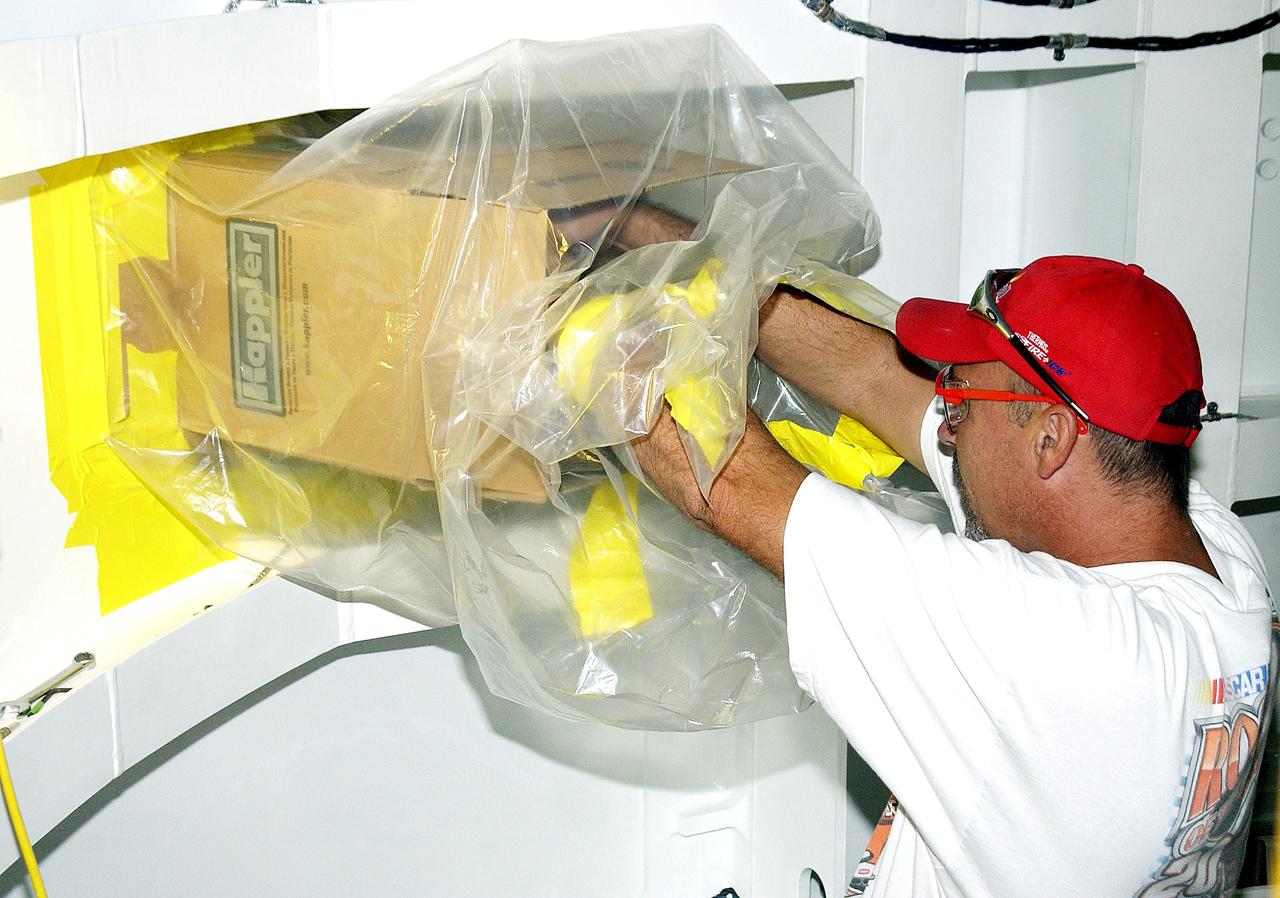
KENNEDY SPACE CENTER, FLA. - In the Solid Rocket Booster Assembly and Refurbishment Facility (ARF), Troy Krout, with United Space Alliance, works on positioning the parachute camera after installation on the solid rocket booster forward skirt.  Refurbishment and subassembly of Shuttle SRB hardware - primarily the forward and aft assemblies - is carried out in the ARF.
KENNEDY SPACE CENTER, FLA. - In the Solid Rocket Booster Assembly and Refurbishment Facility (ARF), Troy Krout, with United Space Alliance, works on positioning the parachute camera after installation on the solid rocket booster forward skirt. Refurbishment and subassembly of Shuttle SRB hardware - primarily the forward and aft assemblies - is carried out in the ARF.
S83-39238 (1 Aug. 1983) --- The giant cluster of spaceflight hardware for NASA's eighth Space Transportation System (STS) mission begins its slow move to the launch pad at launch complex 39 at NASA's Kennedy Space Center (KSC). Following its mating to the two solid rocket boosters (SRB) and the external fuel tank (ET) in the huge vehicle assembly building (VAB), the space shuttle Challenger is slowly moved to the launch pad atop the mobile launch platform.  Photo credit: NASA
STS-8 Challenger's roll-out to launch pad
KENNEDY SPACE CENTER, FLA. -- A United Space Alliance (USA) technician (center) discusses aspects of Shuttle processing performed in the Solid Rocket Booster (SRB) Assembly and Refurbishment Facility (ARF) with NASA Deputy Associate Administrator for Space Station and Shuttle Programs Michael Kostelnik (right).  NASA and USA Space Shuttle program management are participating in a leadership workday.  The day is intended to provide management with an in-depth, hands-on look at Shuttle processing activities at KSC.
KENNEDY SPACE CENTER, FLA. -- A United Space Alliance (USA) technician (center) discusses aspects of Shuttle processing performed in the Solid Rocket Booster (SRB) Assembly and Refurbishment Facility (ARF) with NASA Deputy Associate Administrator for Space Station and Shuttle Programs Michael Kostelnik (right). NASA and USA Space Shuttle program management are participating in a leadership workday. The day is intended to provide management with an in-depth, hands-on look at Shuttle processing activities at KSC.
KENNEDY SPACE CENTER, FLA. -  Mark Northcraft adjusts the position of the parachute camera just installed on the solid rocket booster forward skirt in the Solid Rocket Booster Assembly and Refurbishment Facility (ARF).  Refurbishment and subassembly of Shuttle SRB hardware - primarily the forward and aft assemblies - is carried out in the ARF.
KENNEDY SPACE CENTER, FLA. - Mark Northcraft adjusts the position of the parachute camera just installed on the solid rocket booster forward skirt in the Solid Rocket Booster Assembly and Refurbishment Facility (ARF). Refurbishment and subassembly of Shuttle SRB hardware - primarily the forward and aft assemblies - is carried out in the ARF.
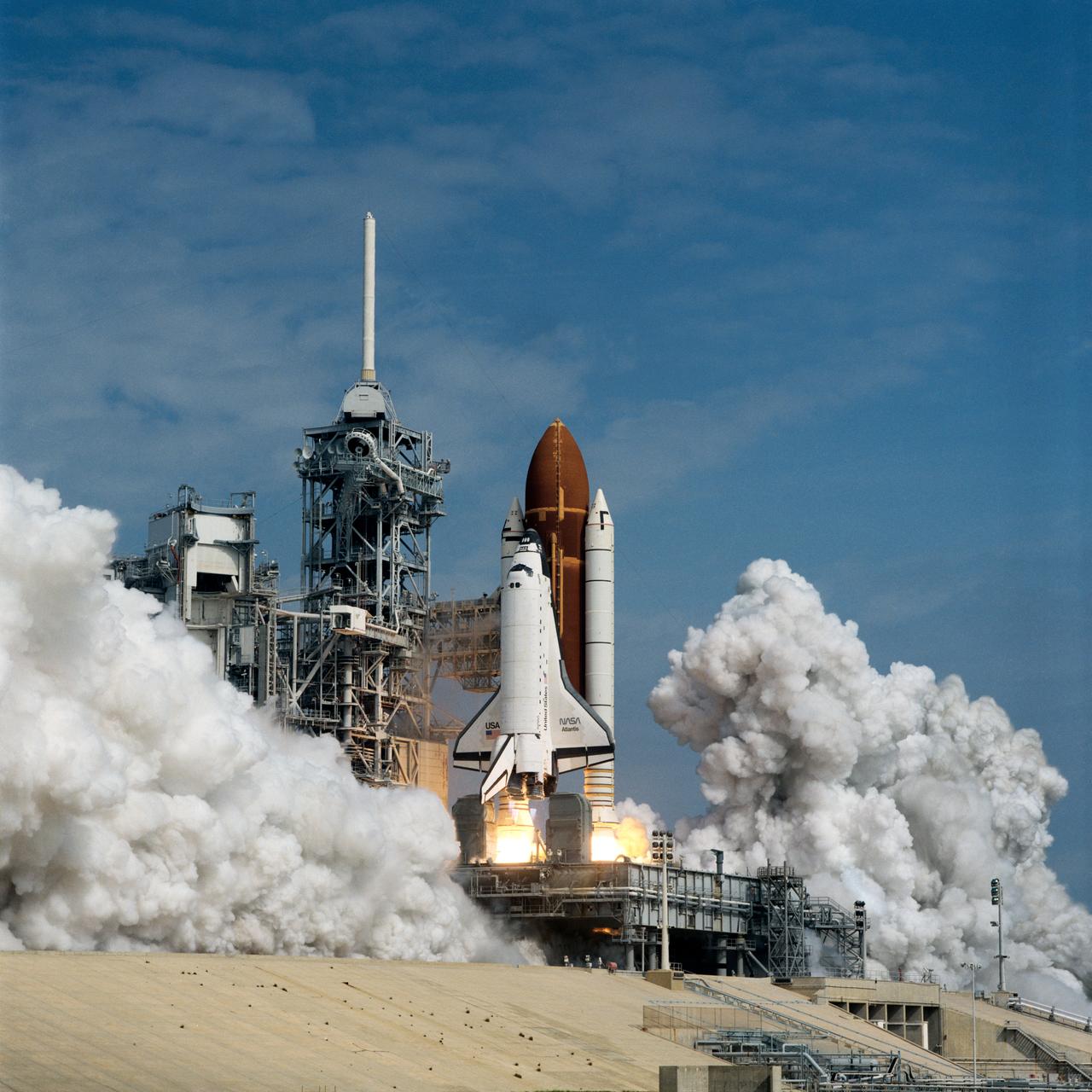
STS-37 Atlantis, Orbiter Vehicle (OV) 104, lifts off from Kennedy Space Center (KSC) Launch Complex (LC) Pad at 9:22:45:0439 (Eastern Standard Time (EST)). OV-104, atop its external tank (ET) and flanked by its two solid rocket boosters (SRBs), is captured just after space shuttle main engine (SSME) firing and as it rises above the mobile launcher platform. The fixed service structure (FSS) and retracted rotating service structure (RSS) appear along side OV-104. Clouds of exhaust smoke begin to fill the launch pad area.
STS-37 Atlantis, Orbiter Vehicle (OV) 104, lifts off from KSC LC Pad
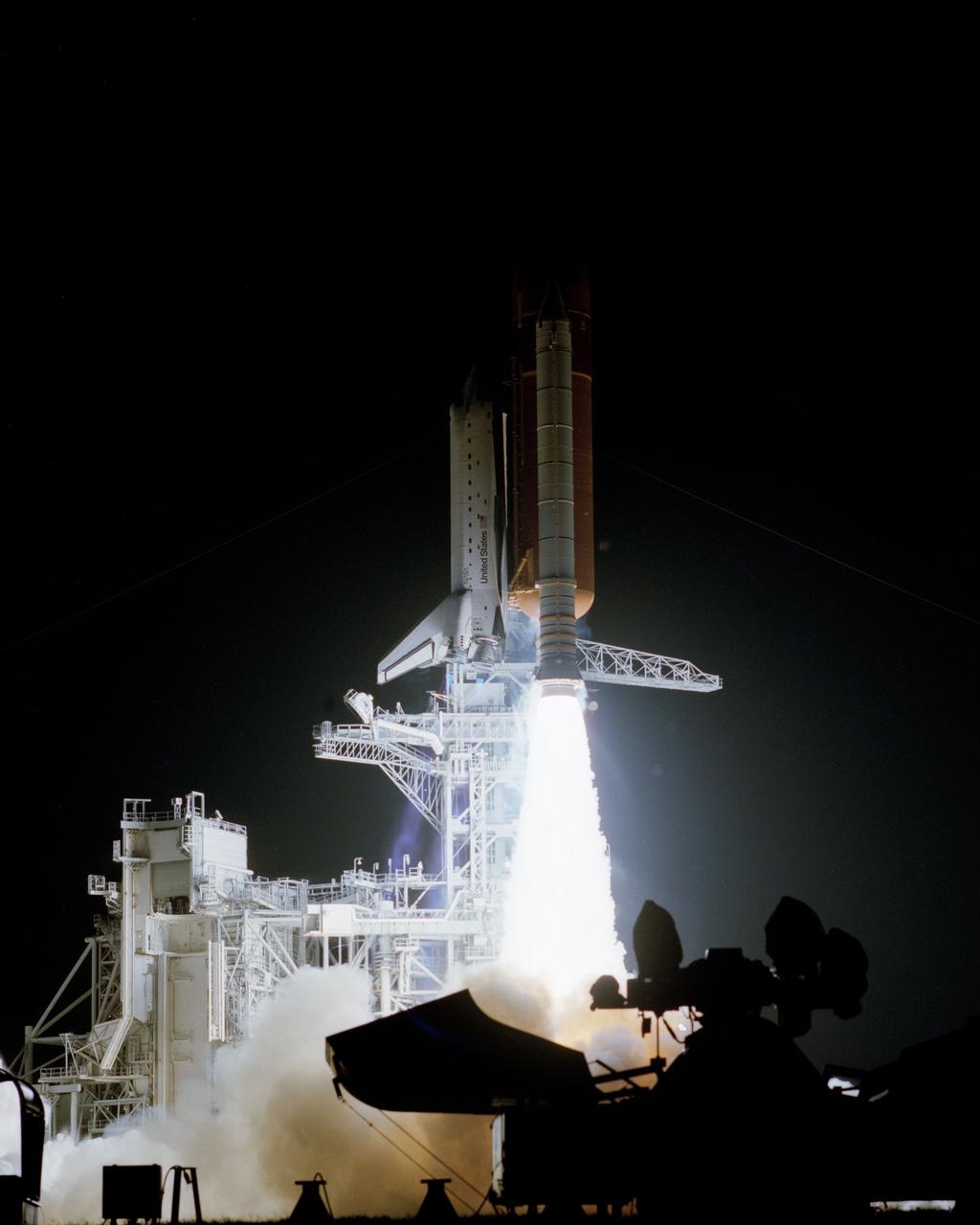
STS-38 Atlantis, Orbiter Vehicle (OV) 104, lifts off from Kennedy Space Center (KSC) Launch Complex Pad at 6:46:15:0639 pm (Eastern Standard Time (EST)). As OV-104, atop the external tank (ET) and flanked by two solid rocket boosters (SRBs), rises above the mobile launcher platform, exhaust smoke fills the area surrounding the launch pad. SRB and space shuttle main engine (SSME) firings glow against the night darkness and light up the fixed service structure (FSS) and retracted rotating service structure (RSS). STS-38 is a Department of Defense (DOD) devoted mission.
STS-38 Atlantis, OV-104, lifting off from KSC LC Pad during night launch
STS-38 Atlantis, Orbiter Vehicle (OV) 104, lifts off from Kennedy Space Center (KSC) Launch Complex (LC) Pad at 6:48:15:0639 pm (Eastern Standard Time (EST)) for Department of Defense (DOD)-devoted mission. OV-104, atop the external tank (ET) and flanked by solid rocket boosters (SRBs), is almost clear of the launch tower which is lit up by the SRB and space shuttle main engine (SSME) firings. Spotlight equipment is silhouetted against the SRB/SSME glow in the foreground. The retracted rotating service structure (RSS) is highlighted against the evening darkness by the launch fireworks.
STS-38 Atlantis, OV-104, lifts off from KSC LC Pad during night launch
STS-41 Discovery, Orbiter Vehicle (OV) 103, lifts off from the Kennedy Space Center (KSC) Launch Complex (LC) Pad 39 mobile launcher platform at 7:47 am (Eastern Daylight Time (EDT)). OV-103 riding atop the external tank (ET) and flanked by two solid rocket boosters (SRBs), is captured just moments after liftoff. Not yet clear of the fixed service structure (FSS) tower, OV-103 is highlighted against the cloudless morning sky. Exhaust smoke billows from the SRBs and the space shuttle main engines (SSMEs) creating a cloud over the launch pad area.
STS-41 Discovery, OV-103, lifts off from KSC Launch Complex (LC) Pad 39
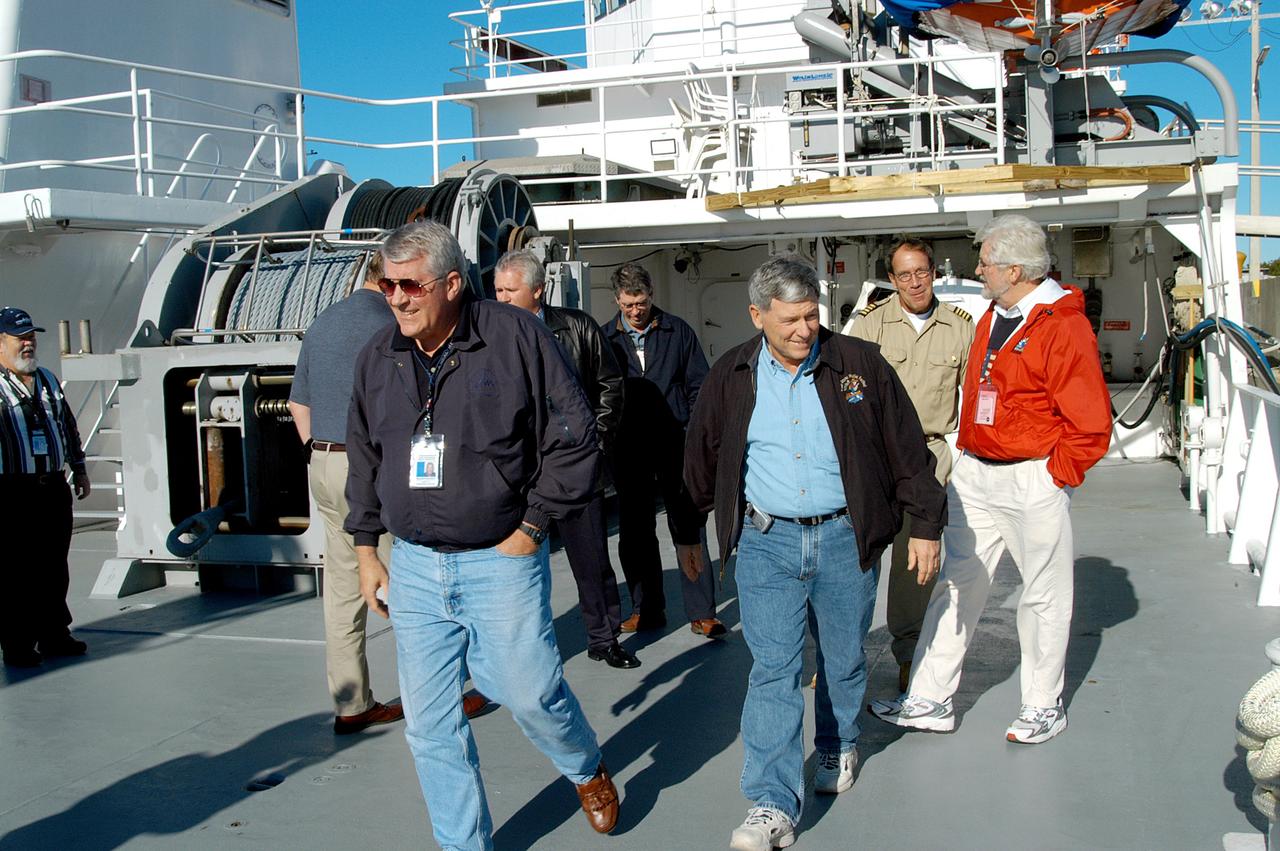
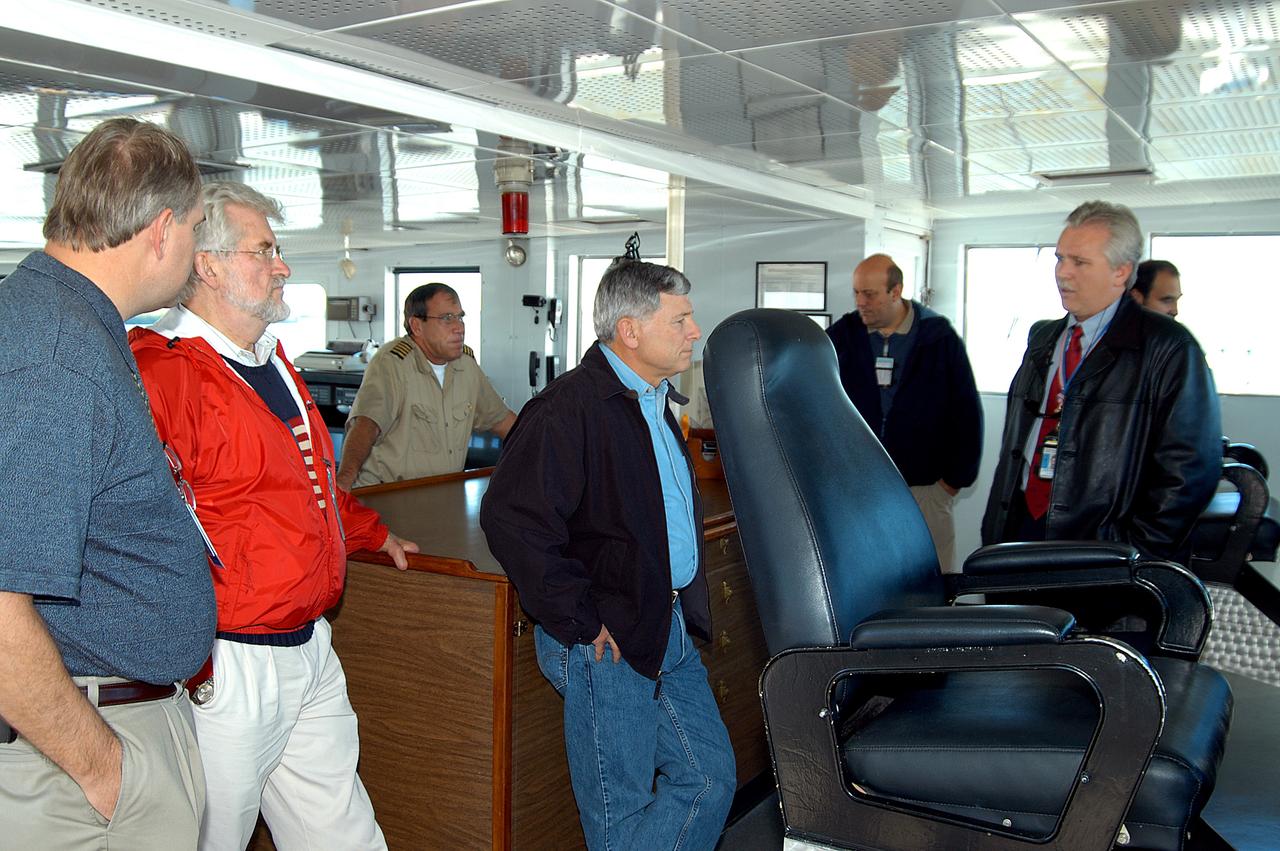
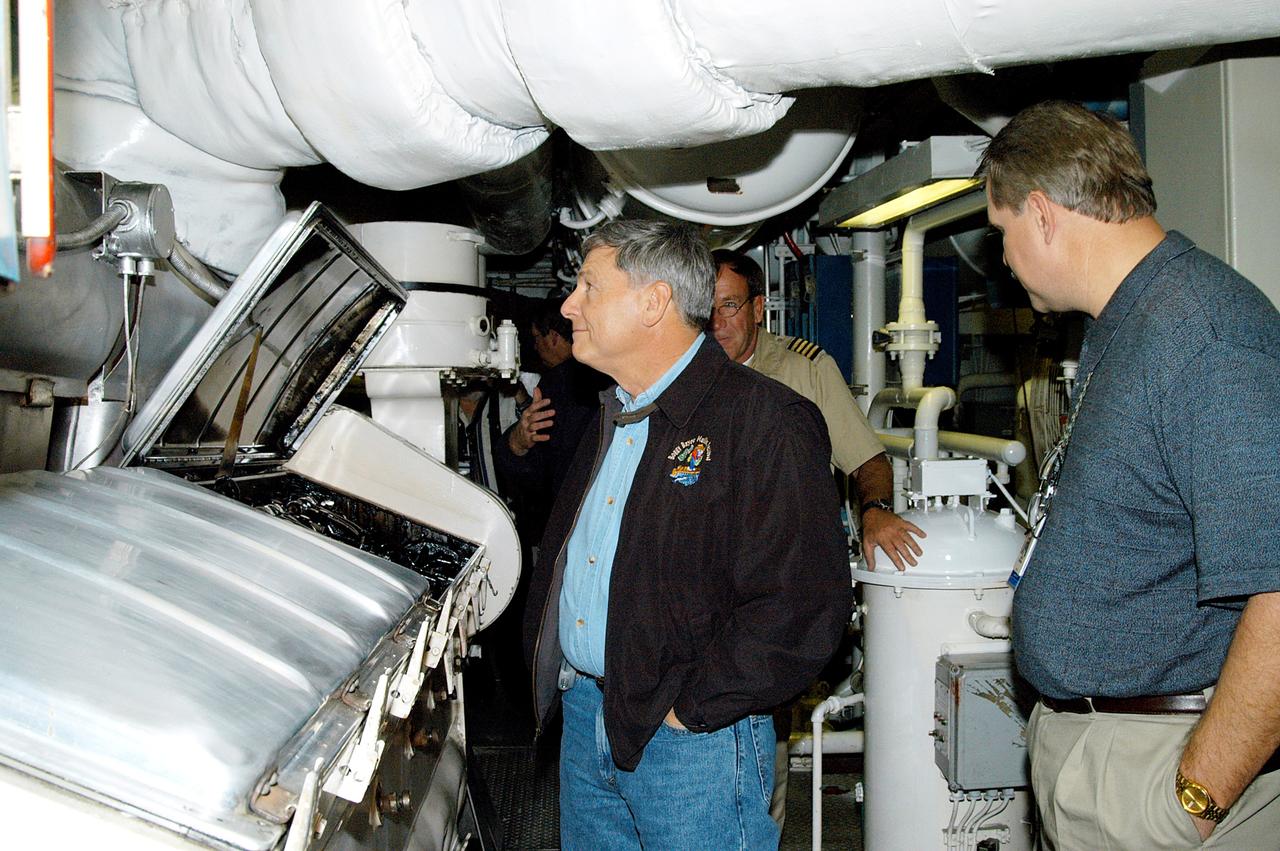
KENNEDY SPACE CENTER, FLA. -- NASA Deputy Associate Administrator for Space Station and Shuttle Programs Michael Kostelnik (center) is given a tour of a solid rocket booster (SRB) retrieval ship by United Space Alliance (USA) employee Joe Chaput (right).  NASA and USA Space Shuttle program management are participating in a leadership workday.  The day is intended to provide management with an in-depth, hands-on look at Shuttle processing activities at KSC.
KENNEDY SPACE CENTER, FLA. -- NASA Deputy Associate Administrator for Space Station and Shuttle Programs Michael Kostelnik (center) is given a tour of a solid rocket booster (SRB) retrieval ship by United Space Alliance (USA) employee Joe Chaput (right). NASA and USA Space Shuttle program management are participating in a leadership workday. The day is intended to provide management with an in-depth, hands-on look at Shuttle processing activities at KSC.
KENNEDY SPACE CENTER, FLA. -- United Space Alliance (USA) Vice President and Associate Program Manager of Florida Operations Bill Pickavance (left front) and NASA Deputy Associate Administrator for Space Station and Shuttle Programs Michael Kostelnik (right front) tour a solid rocket booster (SRB) retrieval ship at Cape Canaveral.  NASA and USA Space Shuttle program management are participating in a leadership workday.  The day is intended to provide management with an in-depth, hands-on look at Shuttle processing activities at KSC.
KENNEDY SPACE CENTER, FLA. -- United Space Alliance (USA) Vice President and Associate Program Manager of Florida Operations Bill Pickavance (left front) and NASA Deputy Associate Administrator for Space Station and Shuttle Programs Michael Kostelnik (right front) tour a solid rocket booster (SRB) retrieval ship at Cape Canaveral. NASA and USA Space Shuttle program management are participating in a leadership workday. The day is intended to provide management with an in-depth, hands-on look at Shuttle processing activities at KSC.
KENNEDY SPACE CENTER, FLA. -- NASA Deputy Associate Administrator for Space Station and Shuttle Programs Michael Kostelnik (left) tours a solid rocket booster (SRB) retrieval ship at Cape Canaveral.  NASA and United Space Alliance (USA) Space Shuttle program management are participating in a leadership workday.  The day is intended to provide management with an in-depth, hands-on look at Shuttle processing activities at KSC.
KENNEDY SPACE CENTER, FLA. -- NASA Deputy Associate Administrator for Space Station and Shuttle Programs Michael Kostelnik (left) tours a solid rocket booster (SRB) retrieval ship at Cape Canaveral. NASA and United Space Alliance (USA) Space Shuttle program management are participating in a leadership workday. The day is intended to provide management with an in-depth, hands-on look at Shuttle processing activities at KSC.
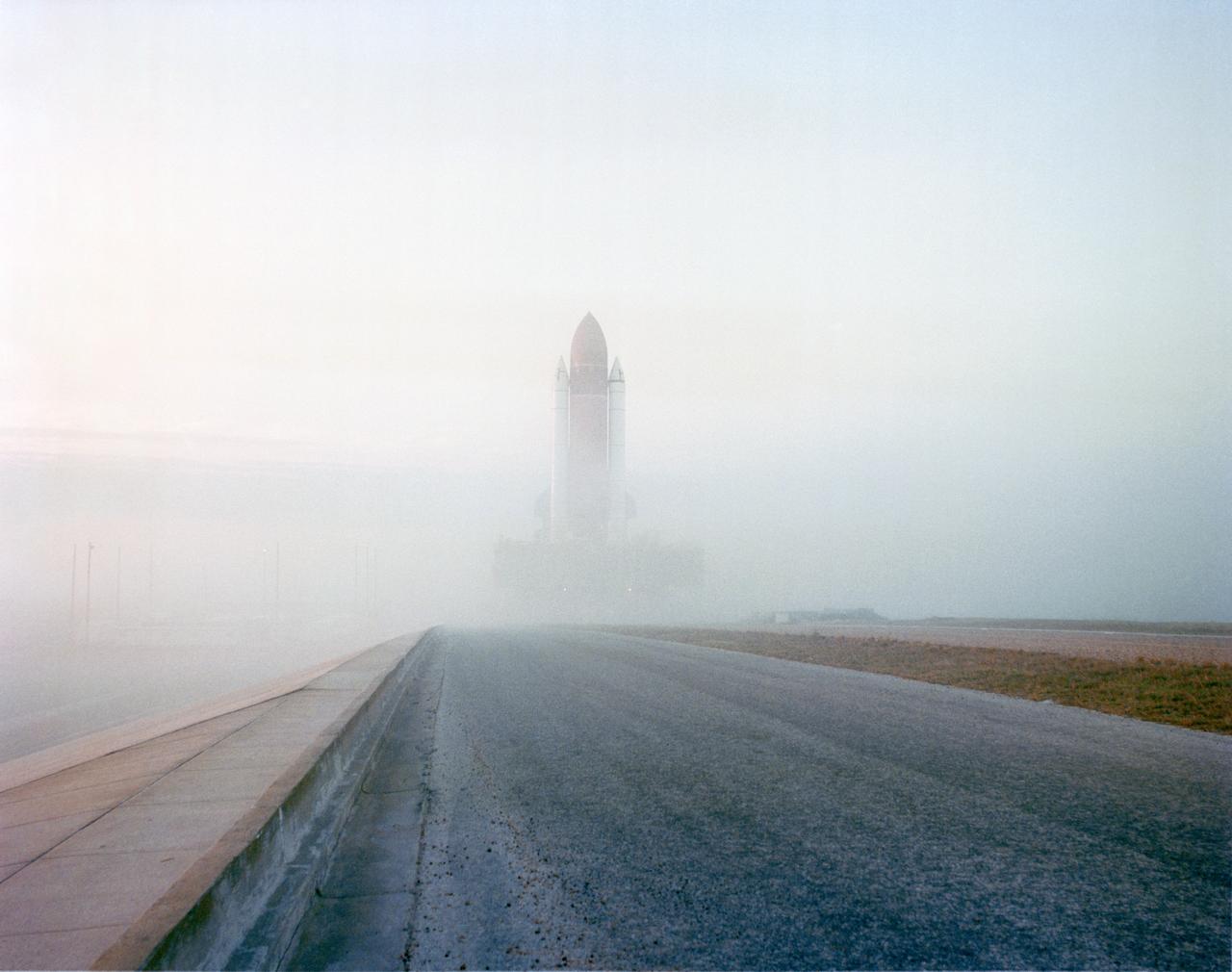
STS-32 Columbia, Orbiter Vehicle (OV) 102, rolls through the morning's foggy mist atop the mobile launcher platform and crawler transporter to Kennedy Space Center (KSC) Launch Complex (LC) Pad 39A. OV-102's wings appear on either side of the two solid rocket boosters (SRBs) and external tank (ET). Rollout from the Vehicle Assembly Building (VAB) began at 2:32 am Eastern Standard Time (EST), and OV-102 was on the pad pedestals about 8 hours later. This marks the first time a Space Shuttle has been at LC Pad 39A since 01-12-85 when OV-102 was launched on mission 61C. View provided by KSC with alternate number KSC-89PC-1259.
STS-32 Columbia, OV-102, rolls through the foggy mist to KSC LC Pad 39A
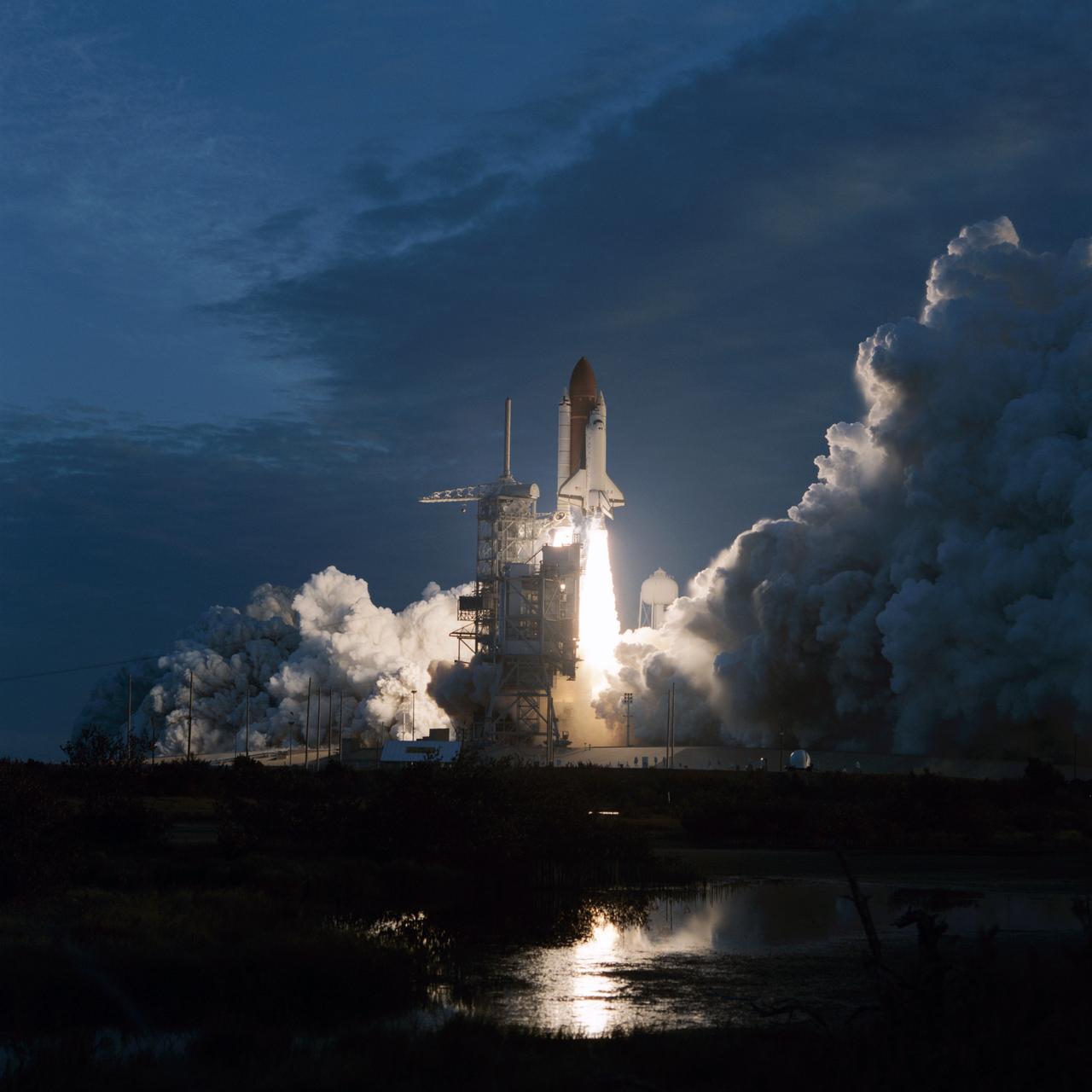
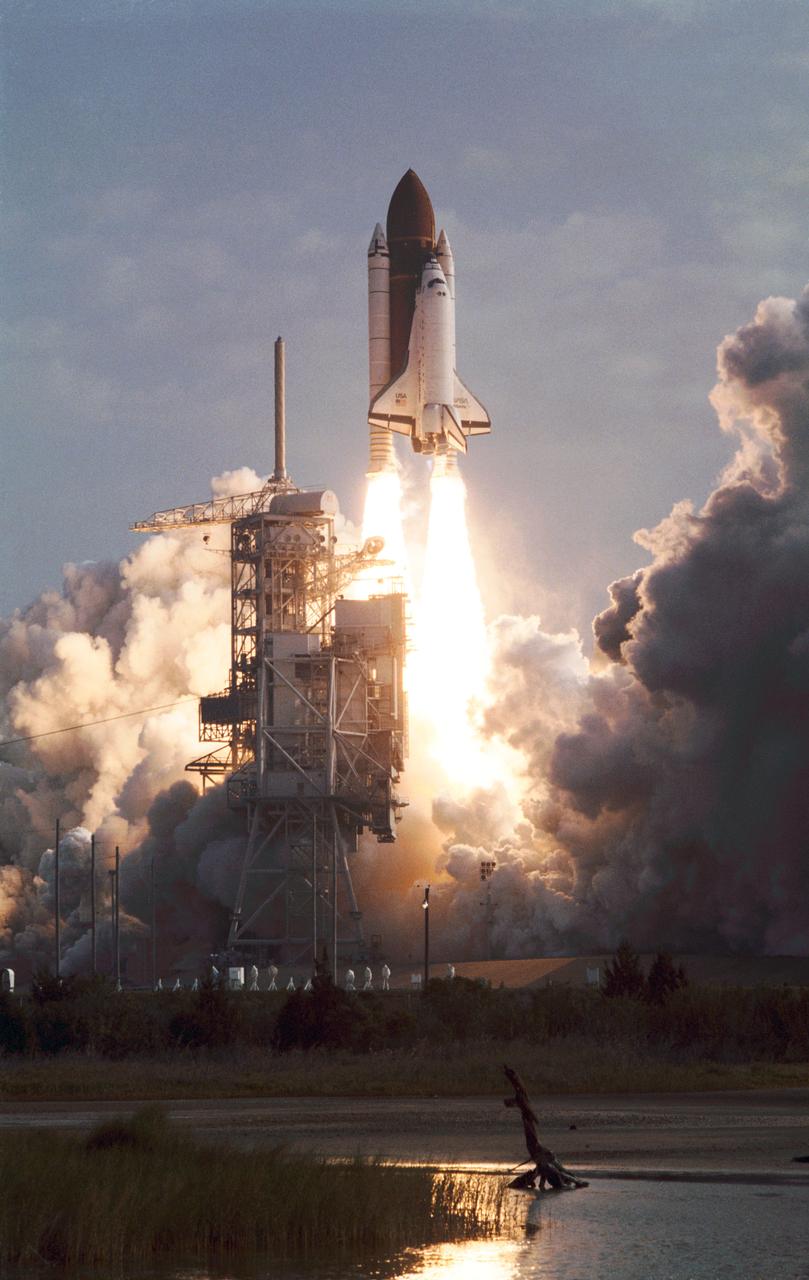
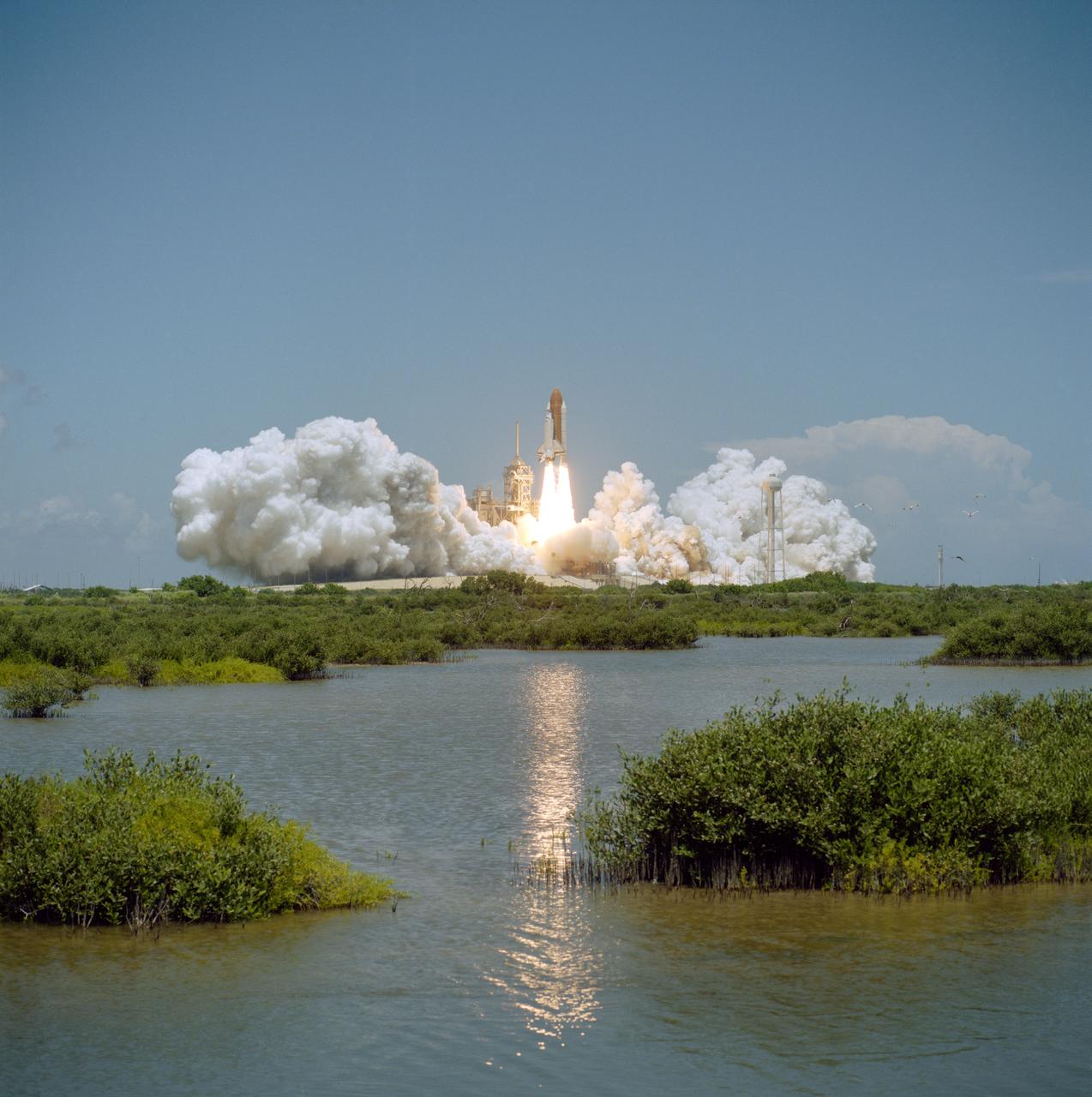
STS-32 Columbia, Orbiter Vehicle (OV) 102, its external tank (ET), and solid rocket boosters (SRBs) rise above the mobile launcher platform and begin to clear fixed service structure (FSS) tower (with rotating service structure (RSS) retracted) at Kennedy Space Center (KSC) Launch Complex (LC) Pad 39A. Liftoff occurred at 7:34:59:98 am Eastern Standard Time (EST) some 24 hours after dubious weather at the return-to-landing site (RTLS) had cancelled a scheduled launch. An exhaust cloud covers the launch pad. The firing SRBs and space shuttle main engines (SSMEs) are reflected in a nearby waterway. OV-102's launch is highlighted against the early morning darkness.
STS-32 Columbia, OV-102, liftoff from KSC LC Pad 39A
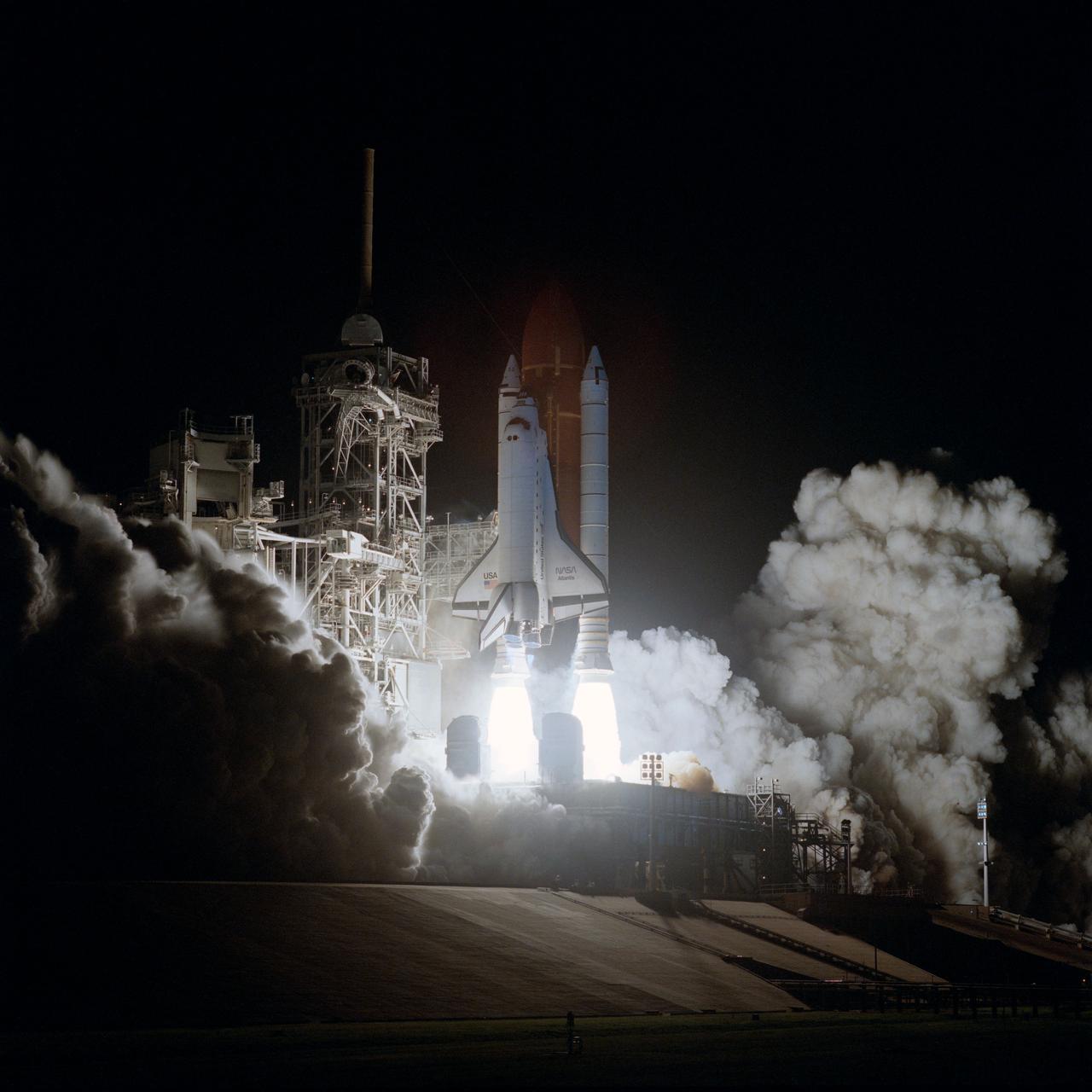
STS-45 Atlantis, Orbiter Vehicle (OV) 104, lifts off from a Kennedy Space Center (KSC) Launch Complex (LC) Pad at 8:13:40:048 am (Eastern Standard Time (EST)). Exhaust billows out the solid rocket boosters (SRBs) as OV-104 atop its external tank (ET) soars above the mobile launcher platform and is nearly clear of the fixed service structure (FSS) tower. The diamond shock effect produced by the space shuttle main engines (SSMEs) is visible. The glow of the SRB/SSME firings is reflected in a nearby waterway. An exhaust cloud covers the launch pad area.
STS-45 Atlantis, OV-104, lifts off from KSC Launch Complex (LC) Pad
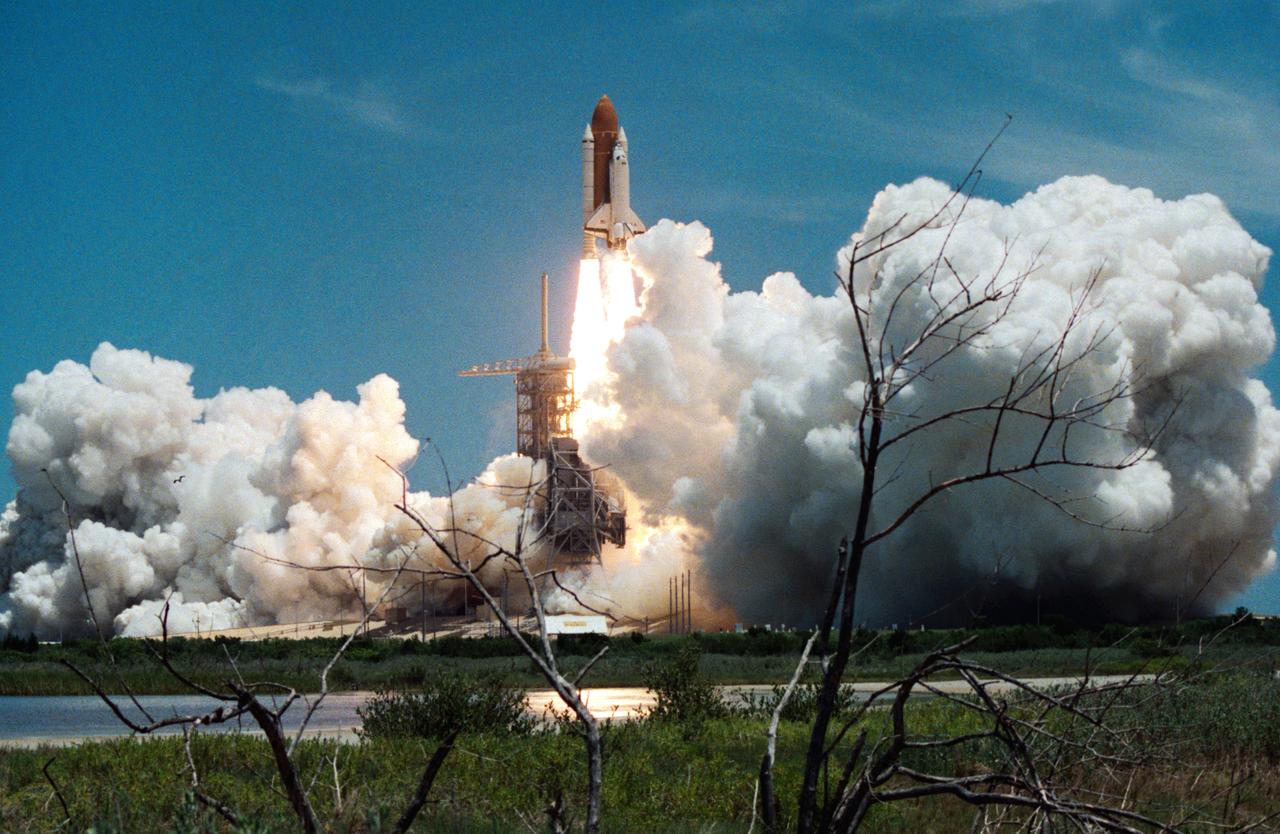
Columbia, Orbiter Vehicle (OV) 102, begins its roll maneuver after clearing the fixed service structure (FSS) tower as it rises above Kennedy Space Center (KSC) Launch Complex (LC) Pad 39A. In the foreground of this horizontal scene is Florida brush and a waterway. Beyond the brush, the shuttle's exhaust cloud envelops the immediate launch pad area. Launch occurred at 12:43 pm Eastern Daylight Time (EDT). The glow of the space shuttle main engine (SSME) and solid rocket booster (SRB) firings is reflected in the nearby waterway. Once in Earth orbit, STS-65's six NASA astronauts and a Japanese Payload Specialist aboard OV-102 will begin two weeks of experimentation in support of the second International Microgravity Laboratory (IML-2).
STS-65 Columbia, OV-102, lifts off from KSC LC Pad 39A
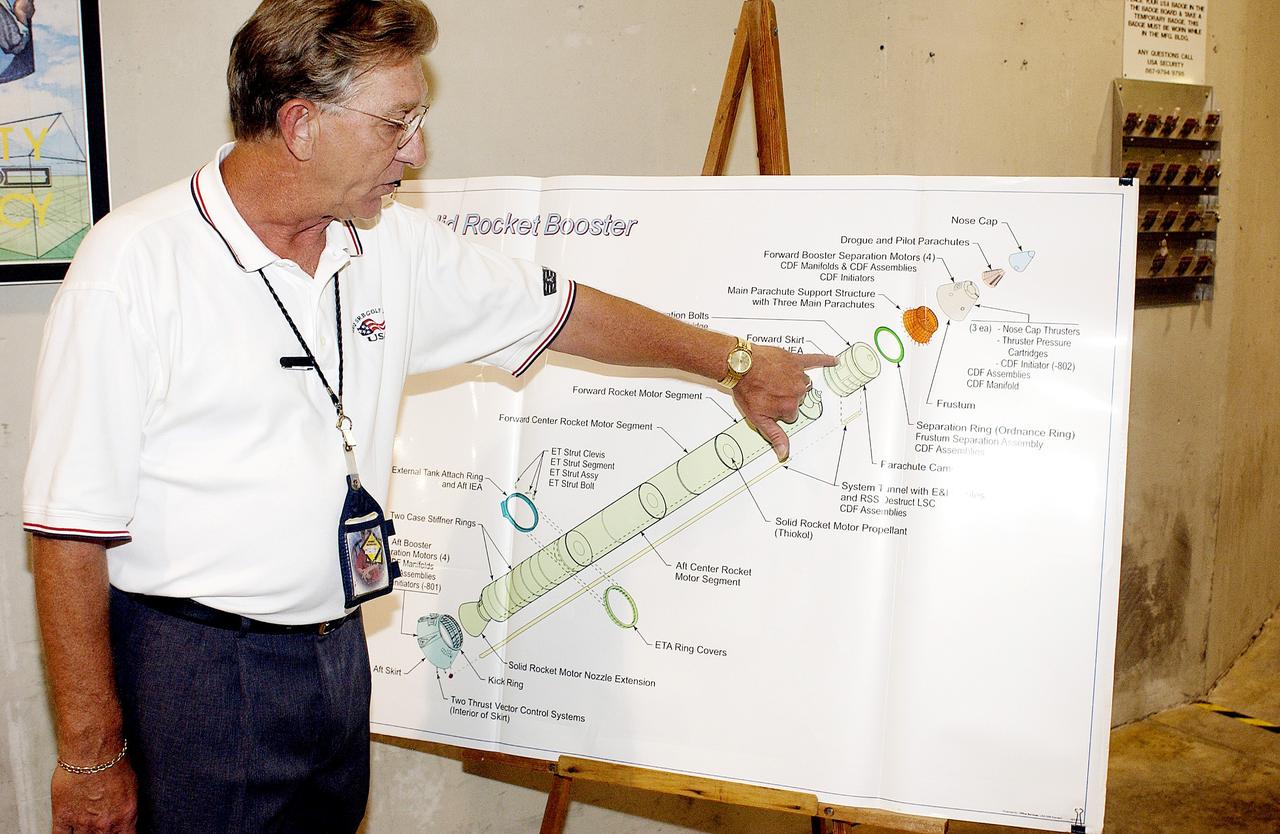
KENNEDY SPACE CENTER, FLA. - On a drawing of a solid rocket booster (SRB), Mark Northcraft, with United Space Alliance, points to the spot where a parachute camera will be installed, on the forward skirt of the SRB.  The work is being done in the Solid Rocket Booster Assembly and Refurbishment Facility, which routinely carries out refurbishment and subassembly of Shuttle SRB hardware.
KENNEDY SPACE CENTER, FLA. - On a drawing of a solid rocket booster (SRB), Mark Northcraft, with United Space Alliance, points to the spot where a parachute camera will be installed, on the forward skirt of the SRB. The work is being done in the Solid Rocket Booster Assembly and Refurbishment Facility, which routinely carries out refurbishment and subassembly of Shuttle SRB hardware.
Columbia, Orbiter Vehicle (OV) 102, rises above Kennedy Space Center (KSC) Launch Complex (LC) Pad 39A after liftoff at 12:43 pm Eastern Daylight Time (EDT). An exhaust cloud covers the launch pad area and the glow of the space shuttle main engine (SSME) and solid rocket booster (SRB) firings is reflected in a nearby marsh as OV-102 atop its external tank (ET) heads toward Earth orbit. A small flock of birds is visible at the right. Once in Earth's orbit, STS-65's six NASA astronauts and a Japanese Payload Specialist aboard OV-102 will begin two weeks of experimentation in support of the second International Microgravity Laboratory (IML-2) mission.
STS-65 Columbia, OV-102, rises above KSC LC Pad 39A during liftoff
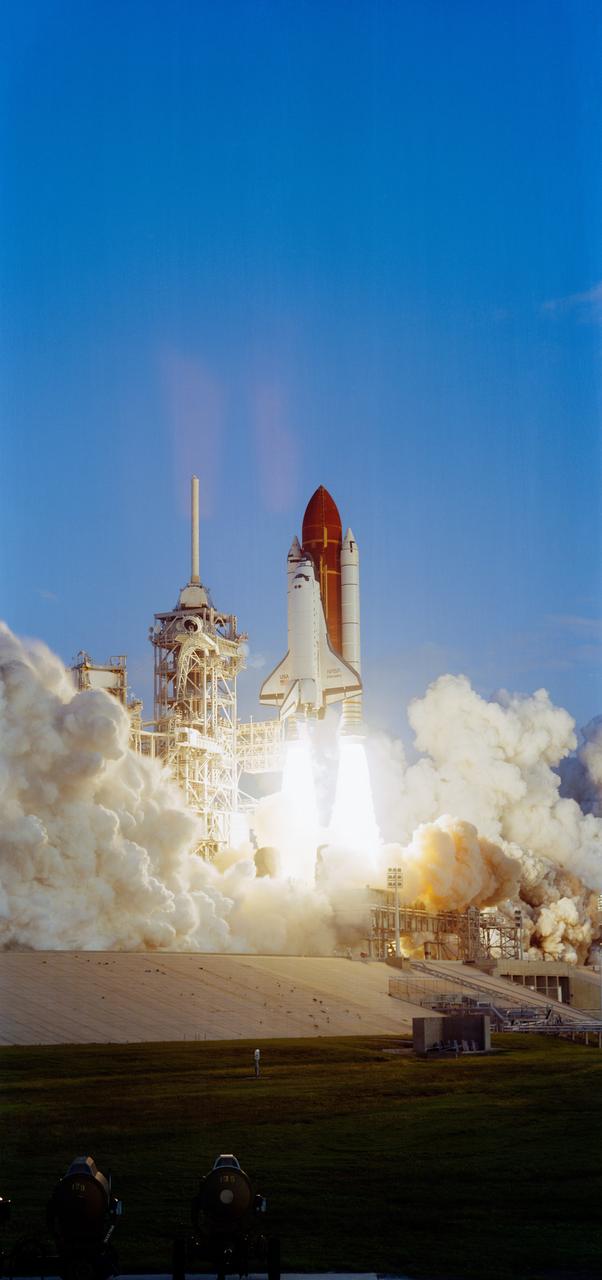
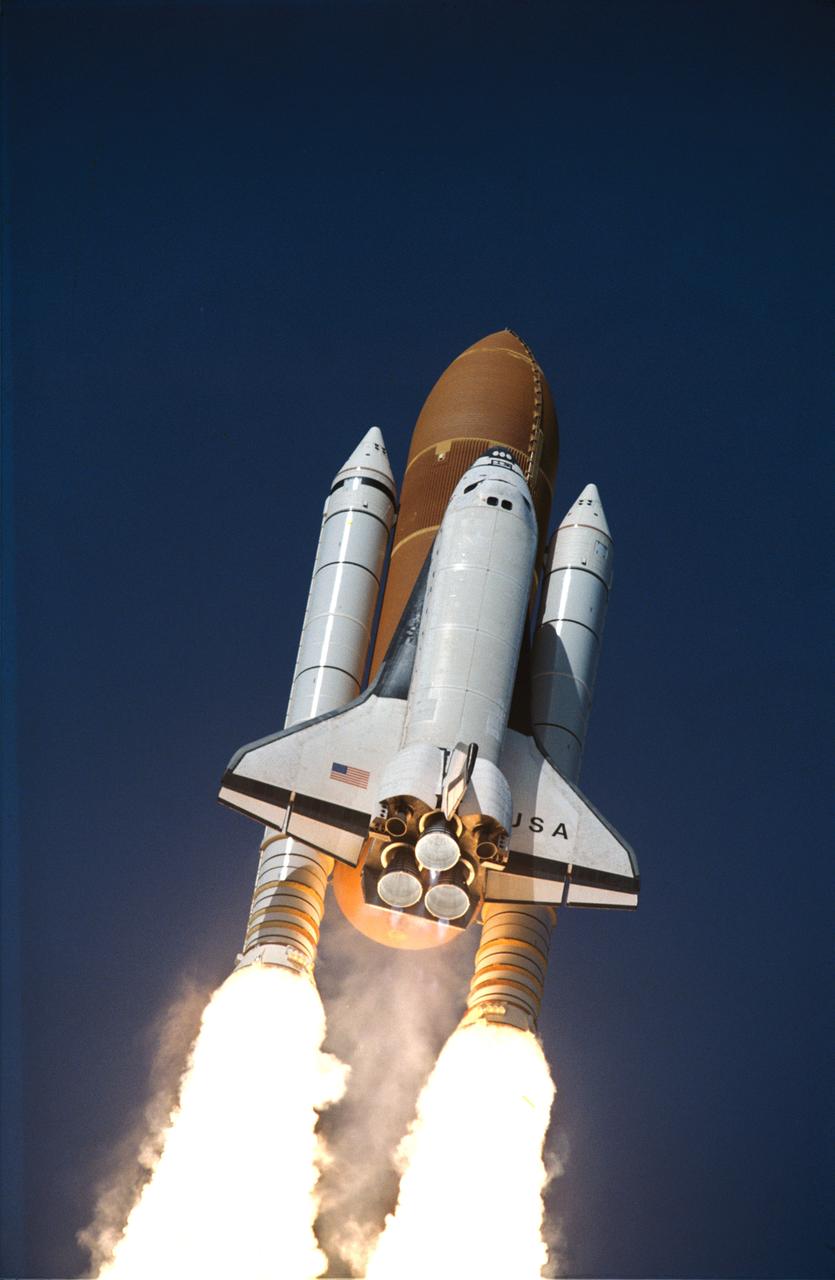
STS062-S-055 (4 March 1994) --- A low-angle view captures early stages of the sixteenth launch of Space Shuttle Columbia.  Launch occurred at 8:53 a.m. (EST), March 4, 1994.  Onboard were astronauts John H. Casper, Andrew M. Allen, Marsha S. Ivins, Charles D. (Sam) Gemar and Pierre J. Thuot.
Columbia in blue sky after the STS-62 launching
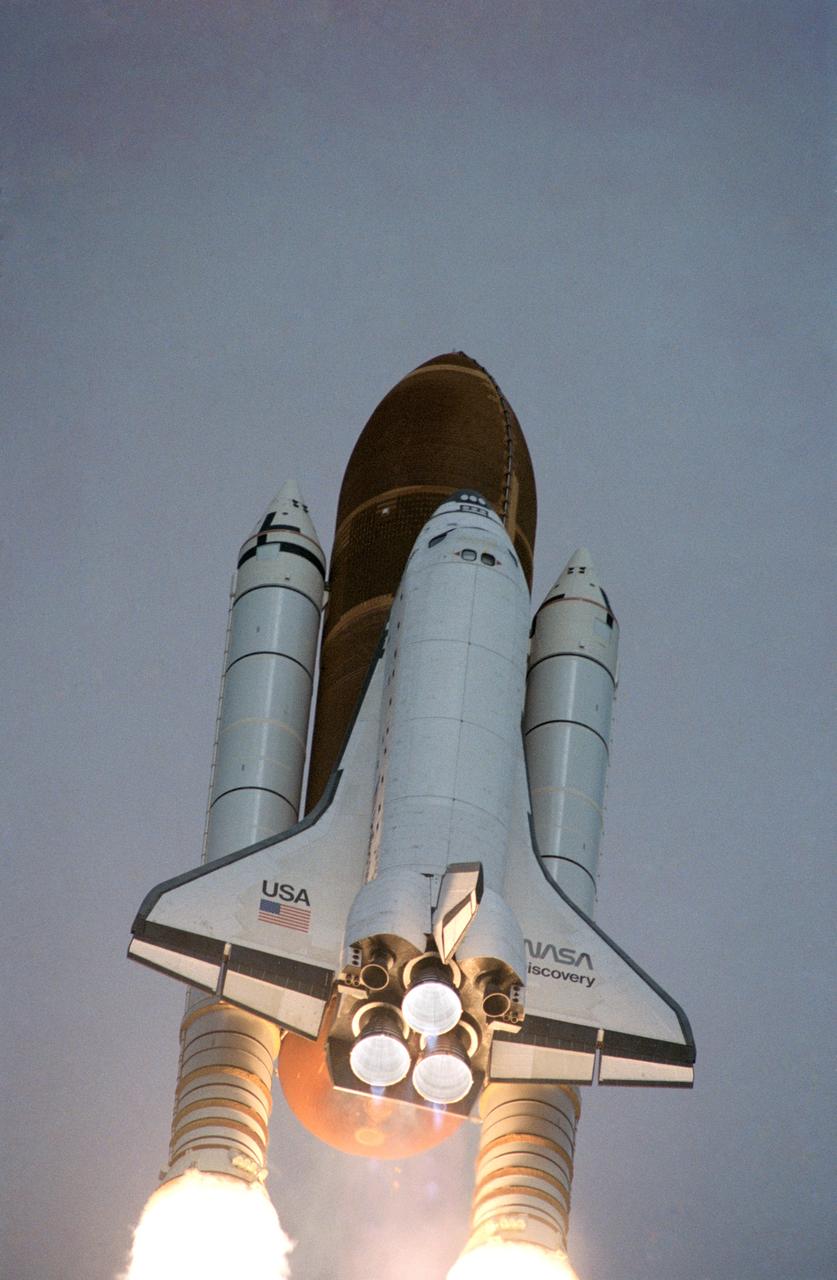
STS031-S-074 (24 April 1990) --- A low-angle view of the launch of the STS-31 mission. Onboard Discovery are a crew of five veteran astronauts and the Hubble Space Telescope (HST). Official launch time was 8:33:51.0492 a.m. (EDT). Headed for approximately five days in space are astronauts Loren J. Shriver, Charles F. Bolden Jr., Bruce McCandless II, Kathryn D. Sullivan and Steven S. Hawley.
STS-31 Discovery, OV-103, begins its roll maneuver after liftoff from KSC
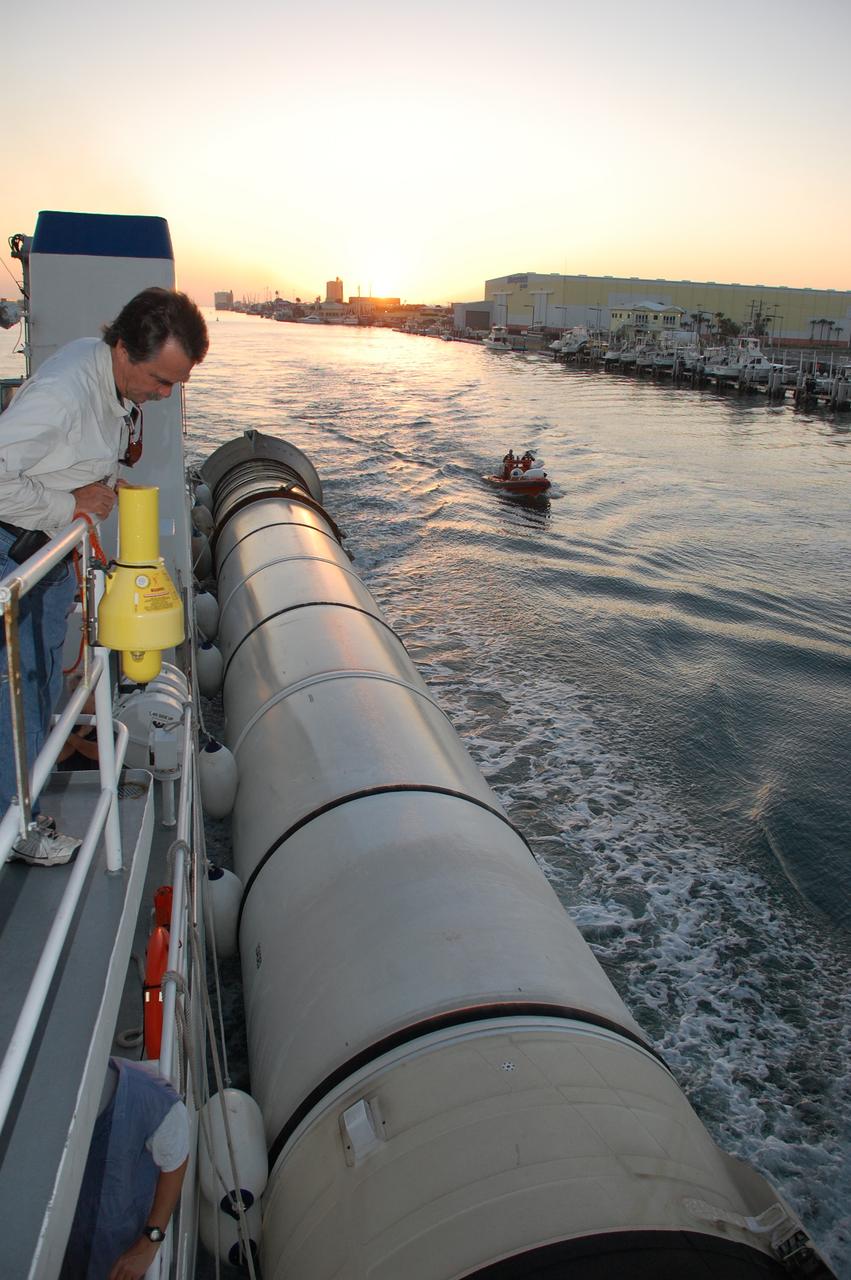
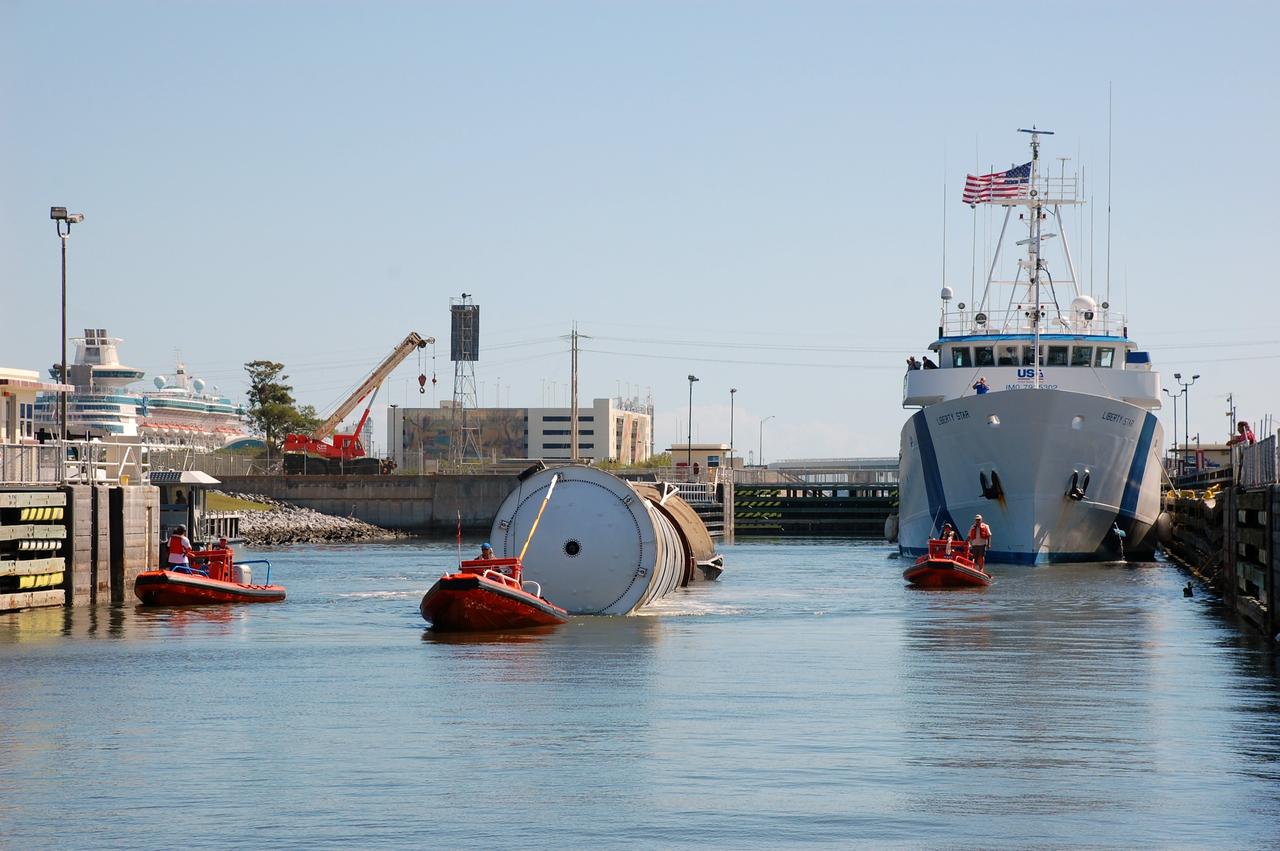
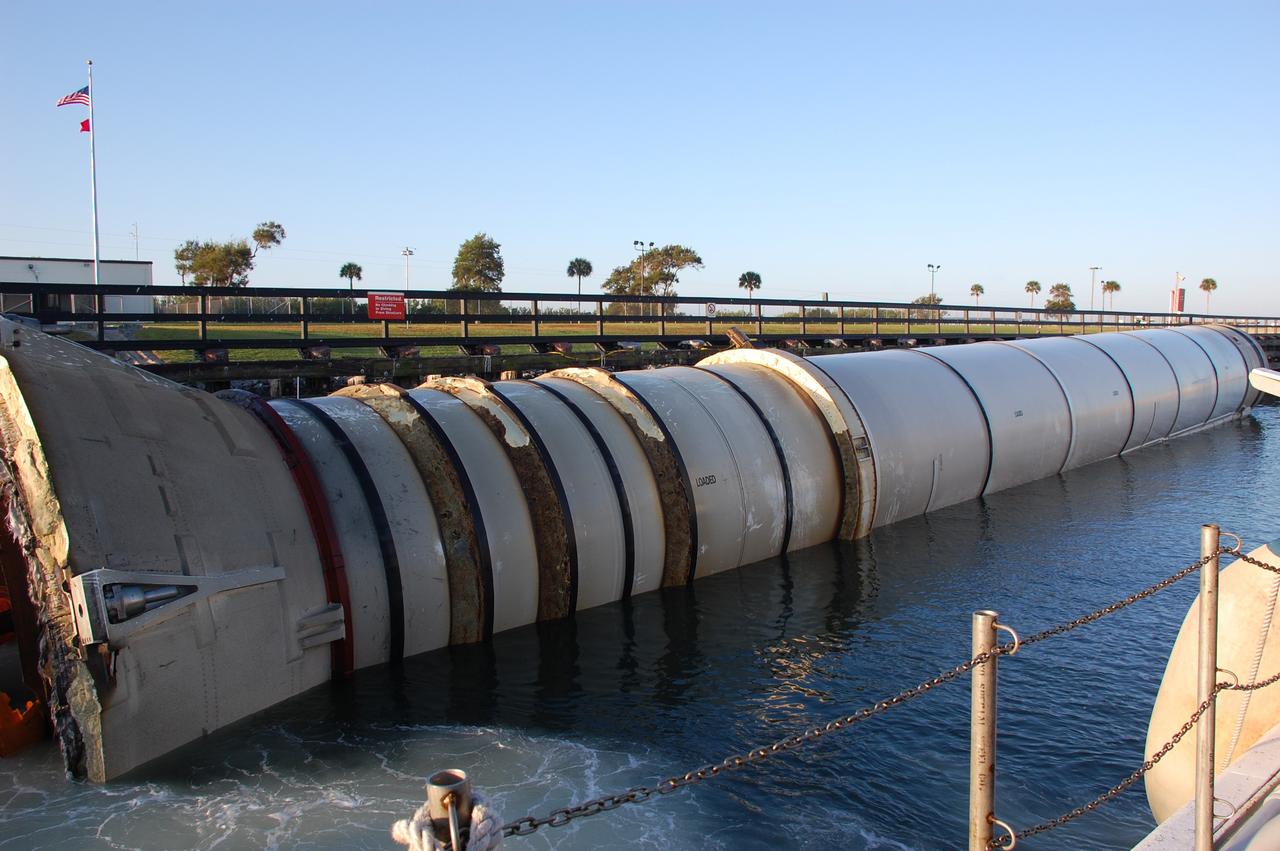
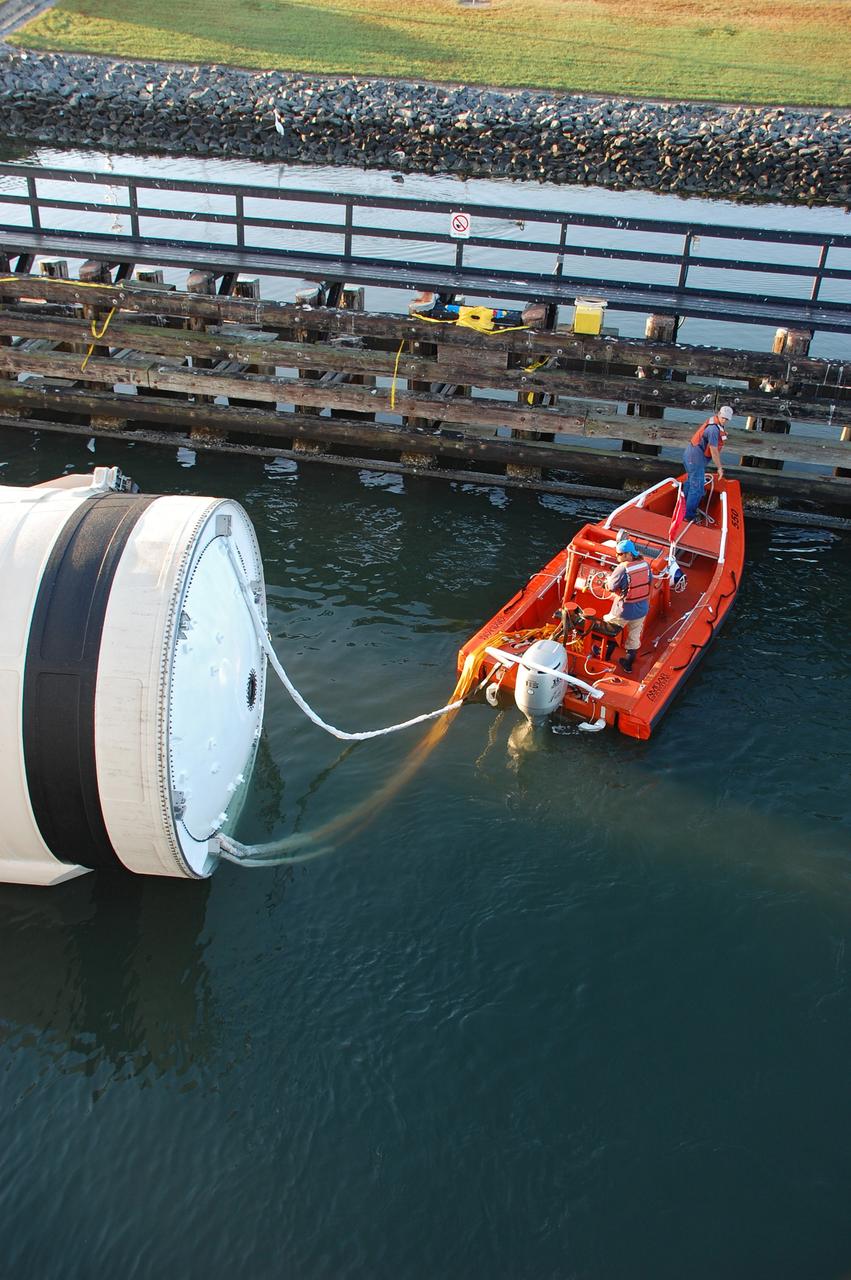
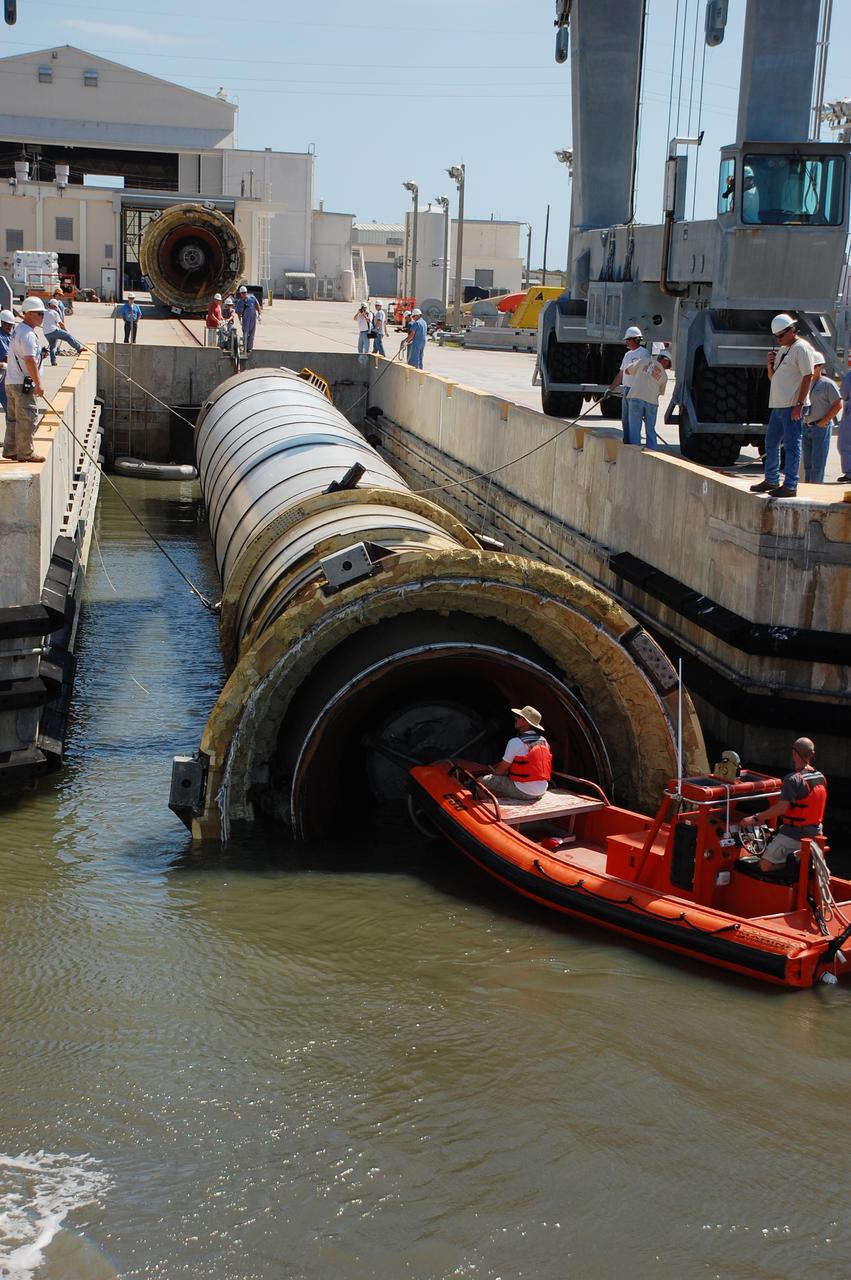
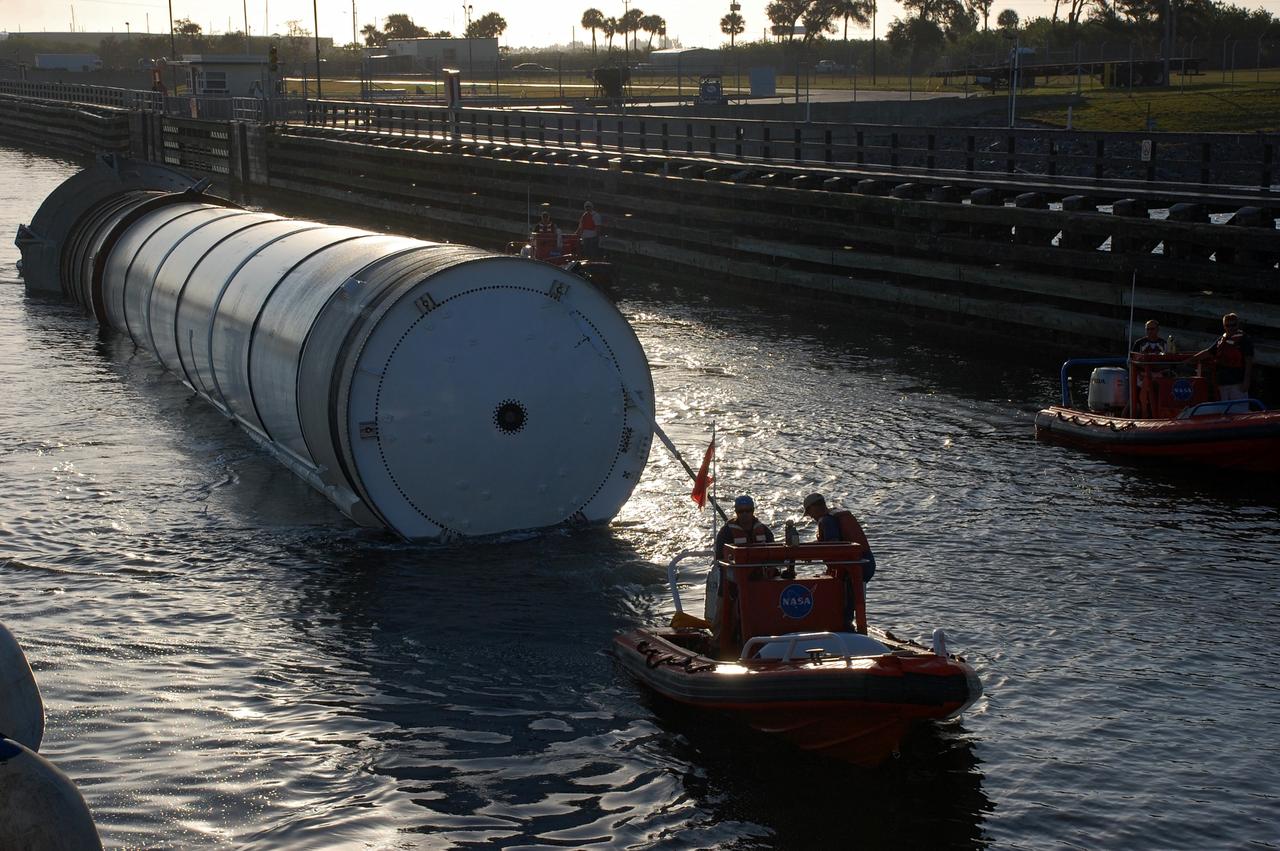
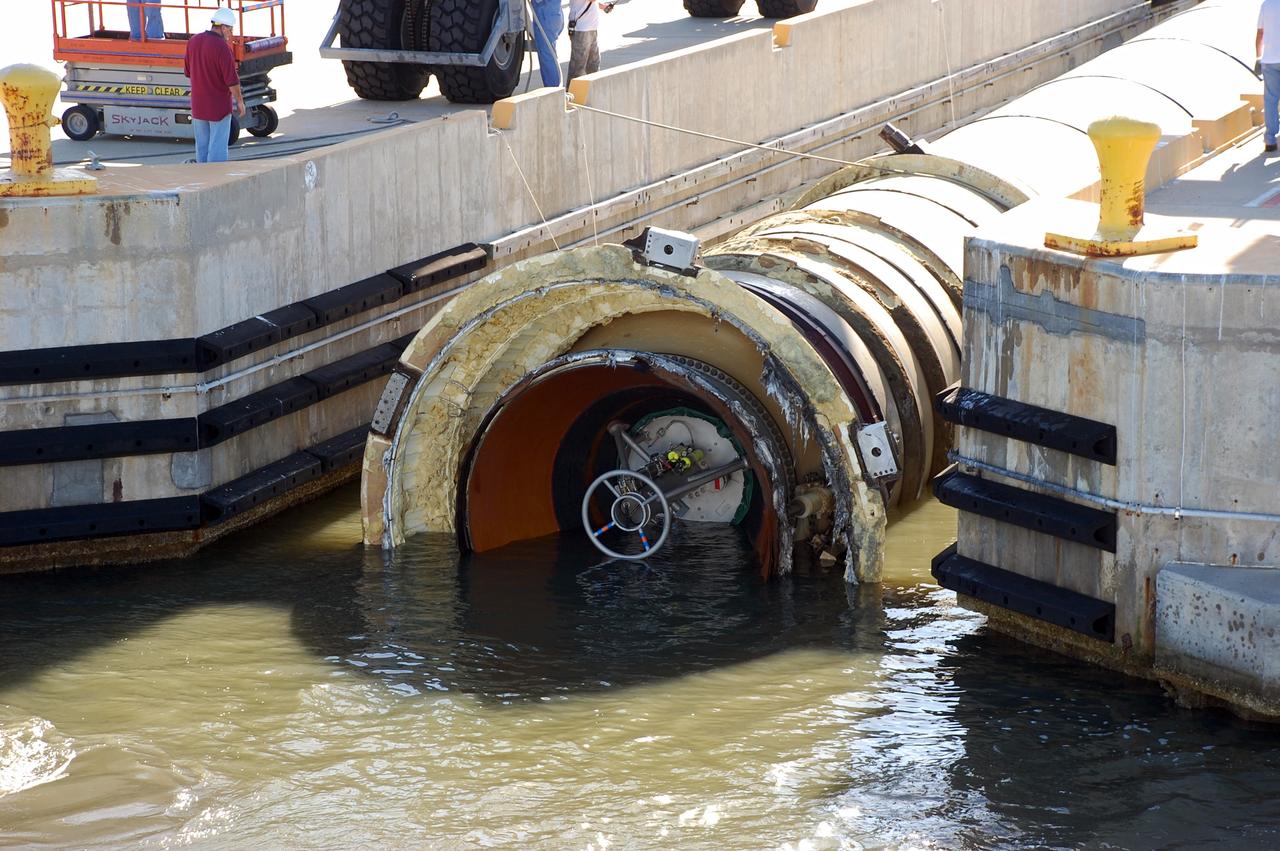
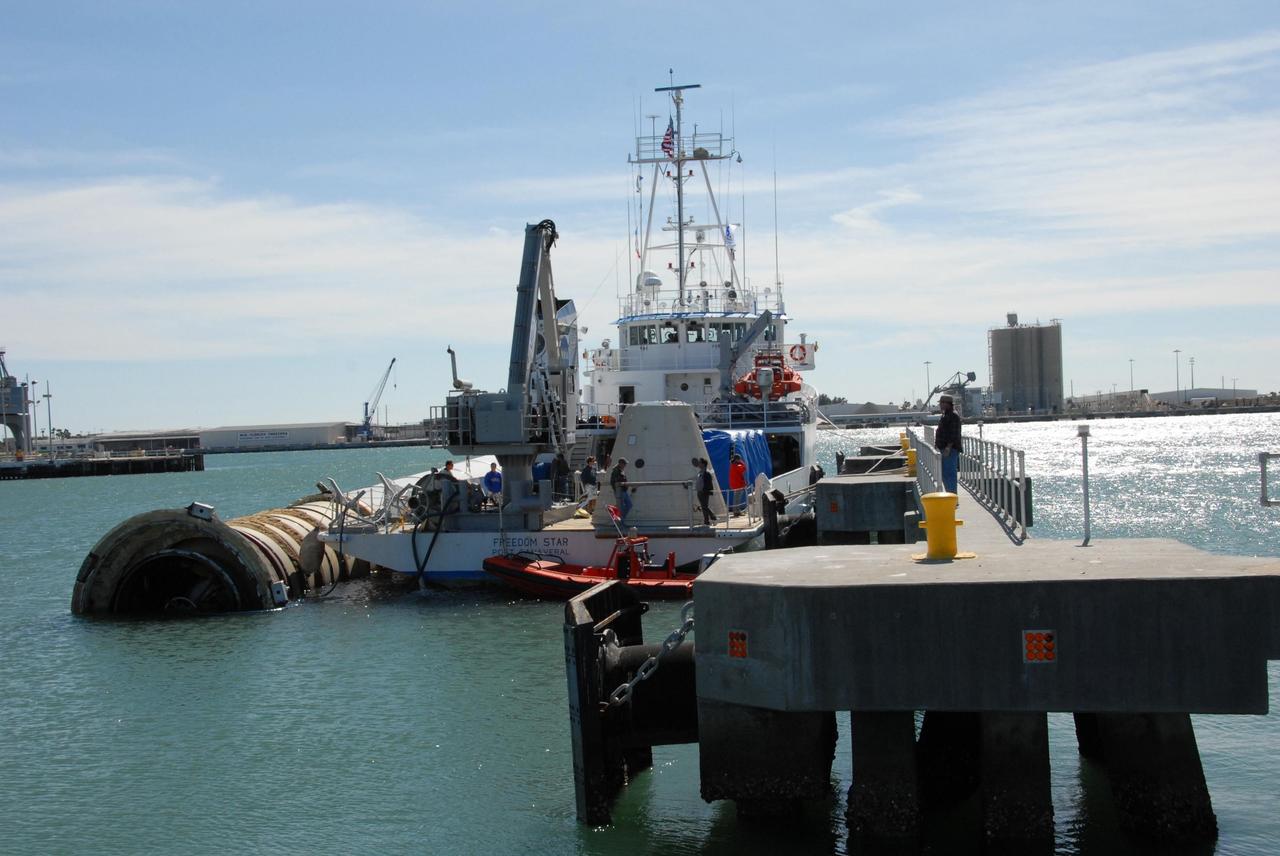
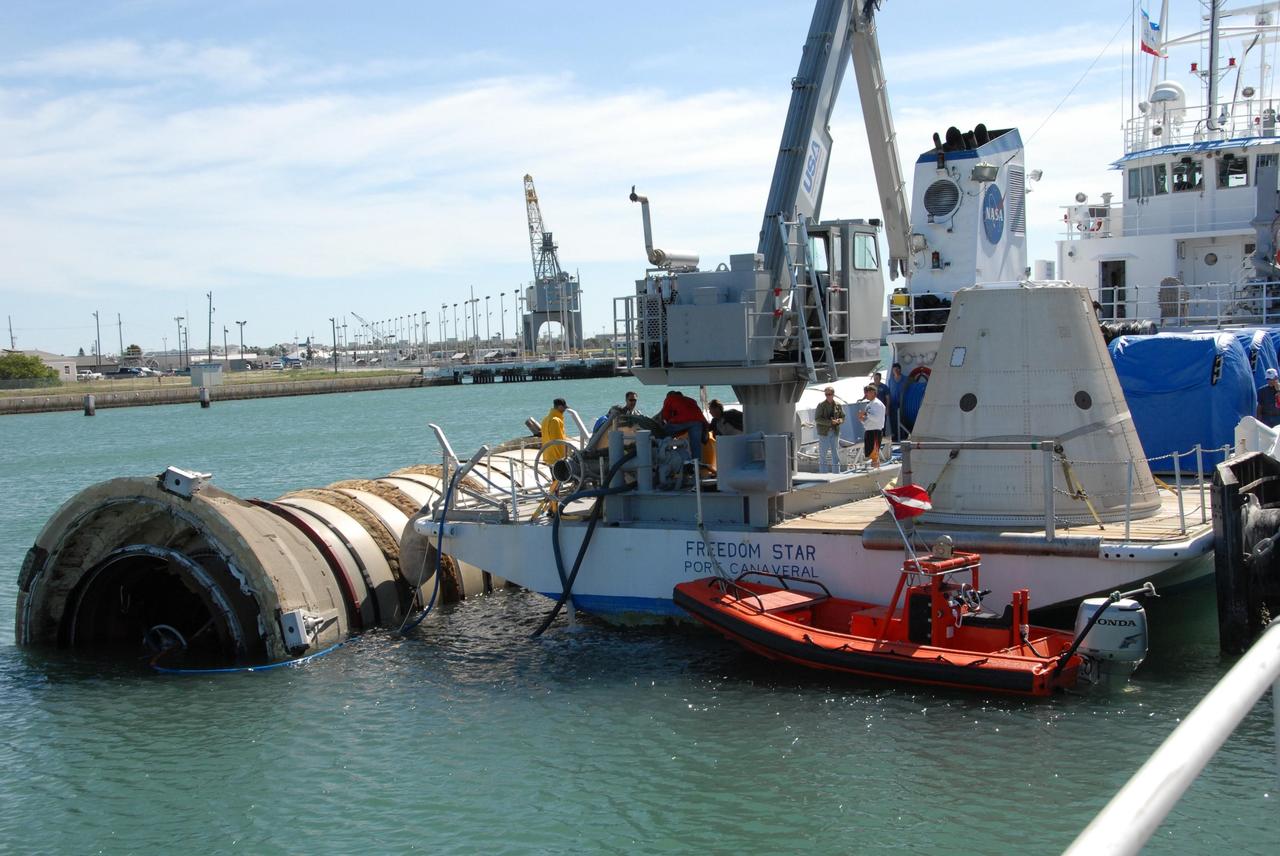
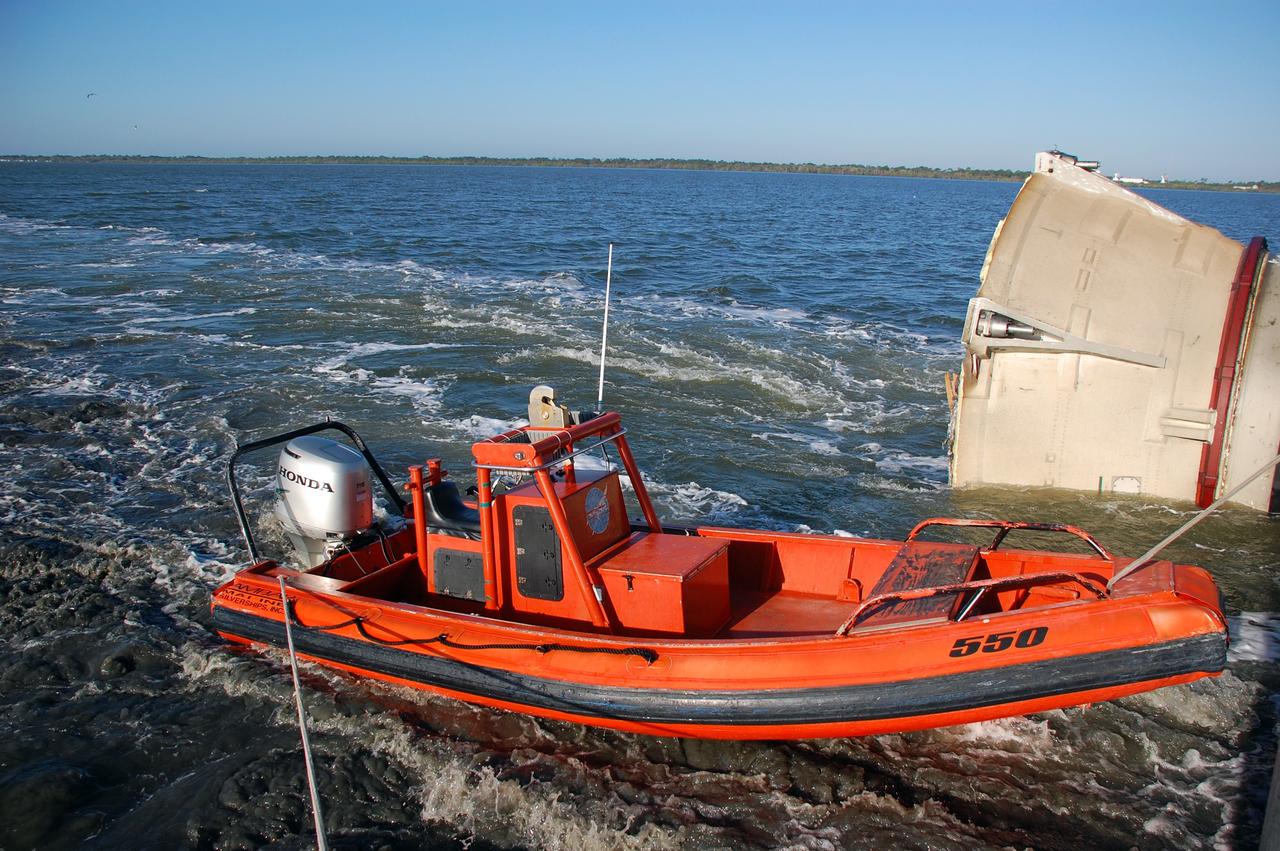
CAPE CANAVERAL, Fla. -- A skiff from Freedom Star, one of NASA's solid rocket booster retrieval ships, helped usher a spent shuttle booster through the shallow waters of the locks at Port Canaveral, Fla. The booster will be re-tied to the ship for the rest of the journey to Hangar AF at Cape Canaveral Air Force Station. The booster was used during space shuttle Discovery's STS-133 launch from NASA Kennedy Space Center's Launch Pad 39A on Feb. 24. The shuttle’s two solid rocket booster casings and associated flight hardware are recovered in the Atlantic Ocean after every launch by Freedom Star and Liberty Star. The boosters impact the Atlantic about seven minutes after liftoff and the retrieval ships are stationed about 10 miles from the impact area at the time of splashdown.  After the spent segments are processed, they will be transported to Utah, where they will be refurbished and stored, if needed. Photo credit: NASA/Ben Smegelsky
KSC-2011-1938
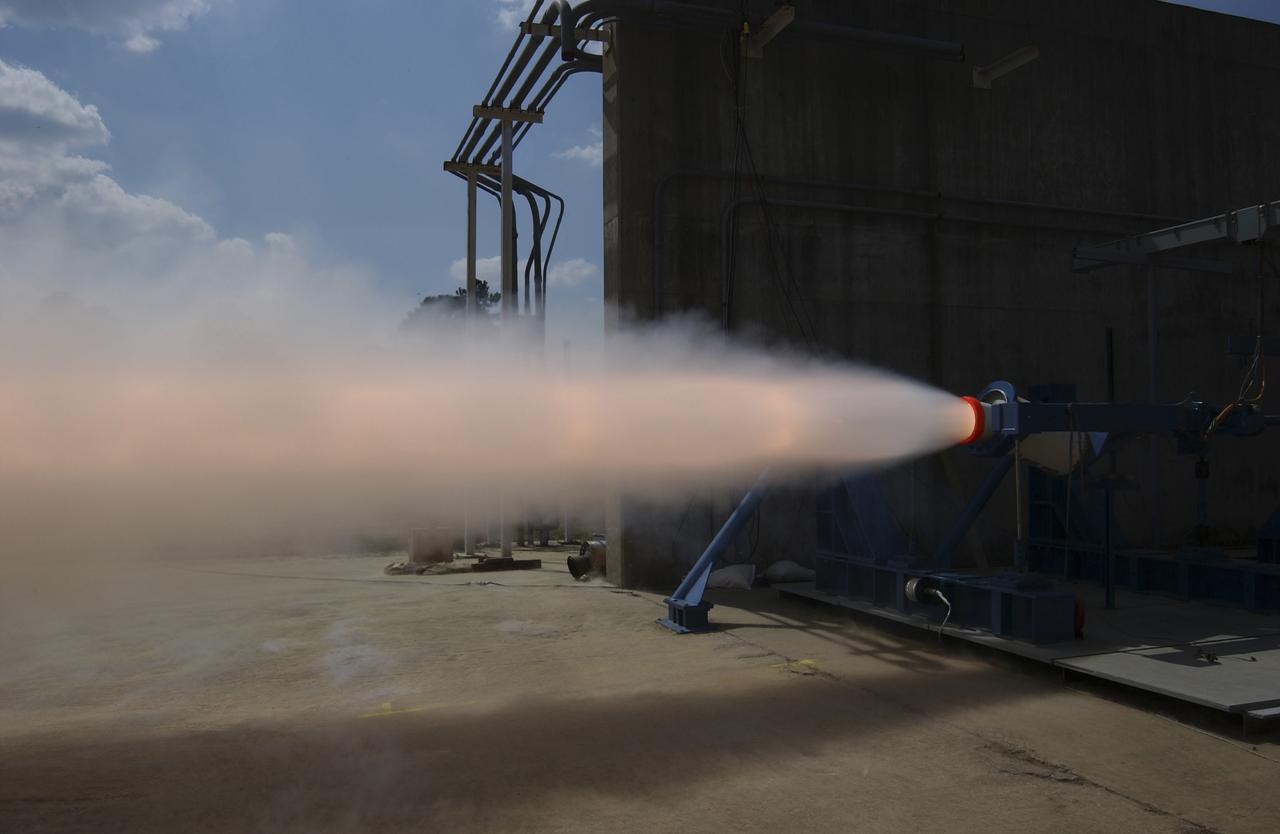
This photograph depicts a hot fire test of the Shuttle Booster Separation Motor (BSM)  at the Marshall Space Flight Center (MSFC) test stand 116. The objective of the  test was to test the aft heat seal in flight configuration. The function of the motor is to separate the Shuttle vehicle from the boosters that carry it into space.
Around Marshall
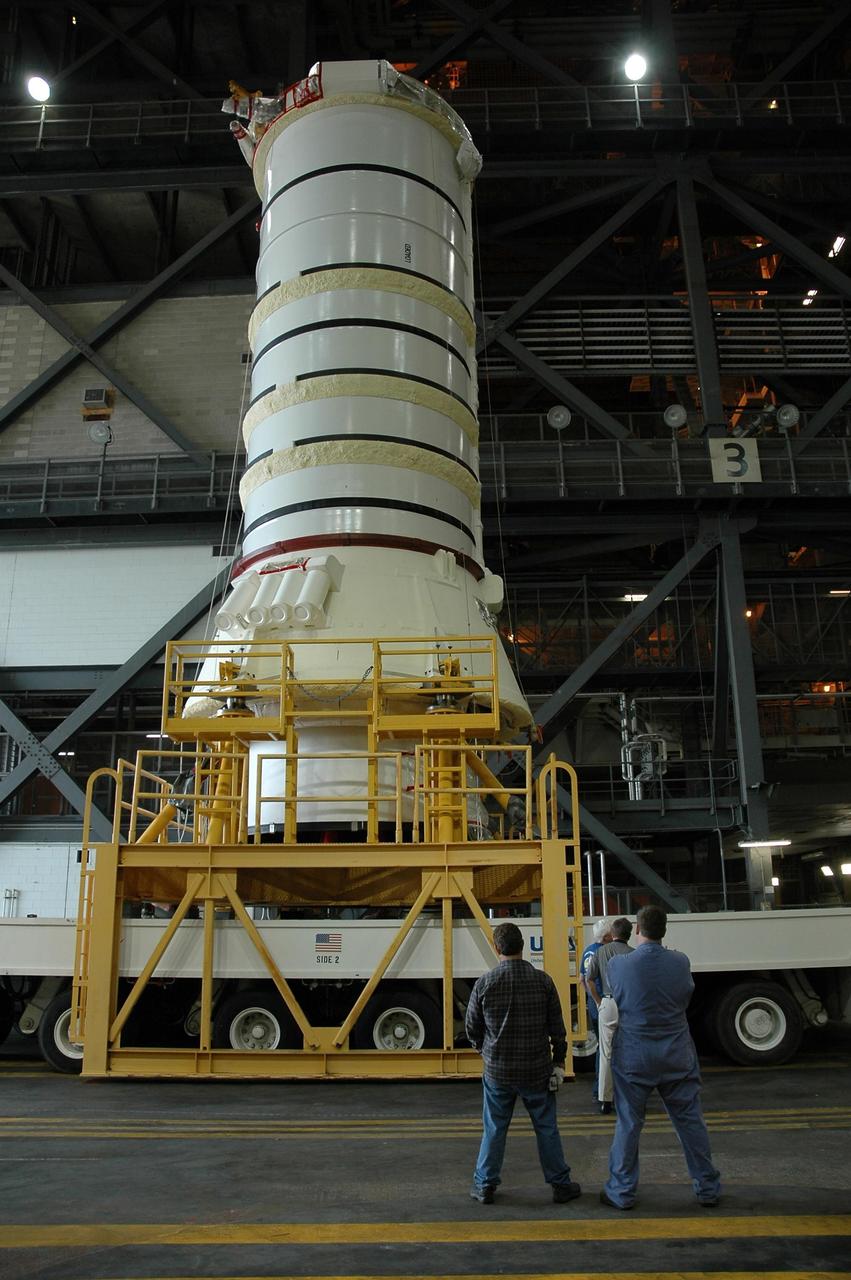
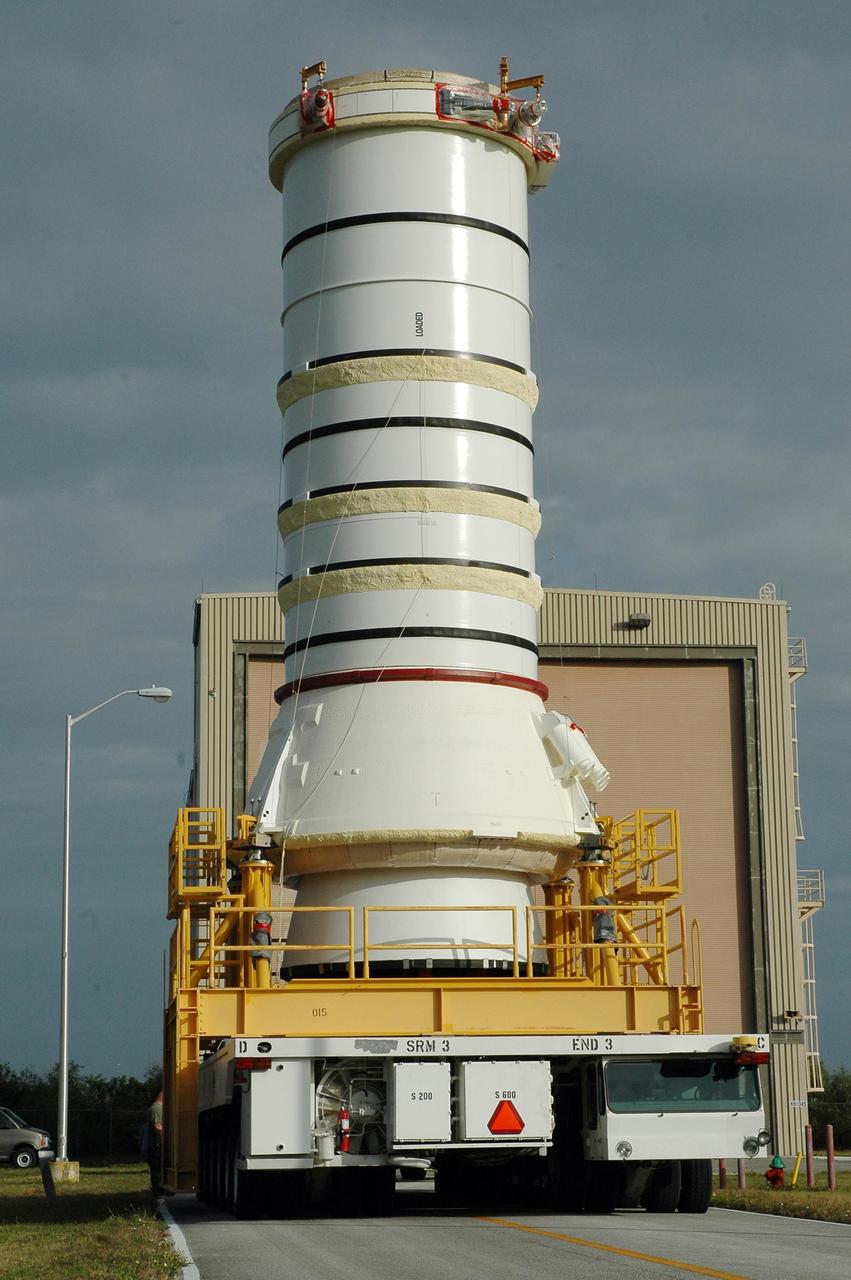
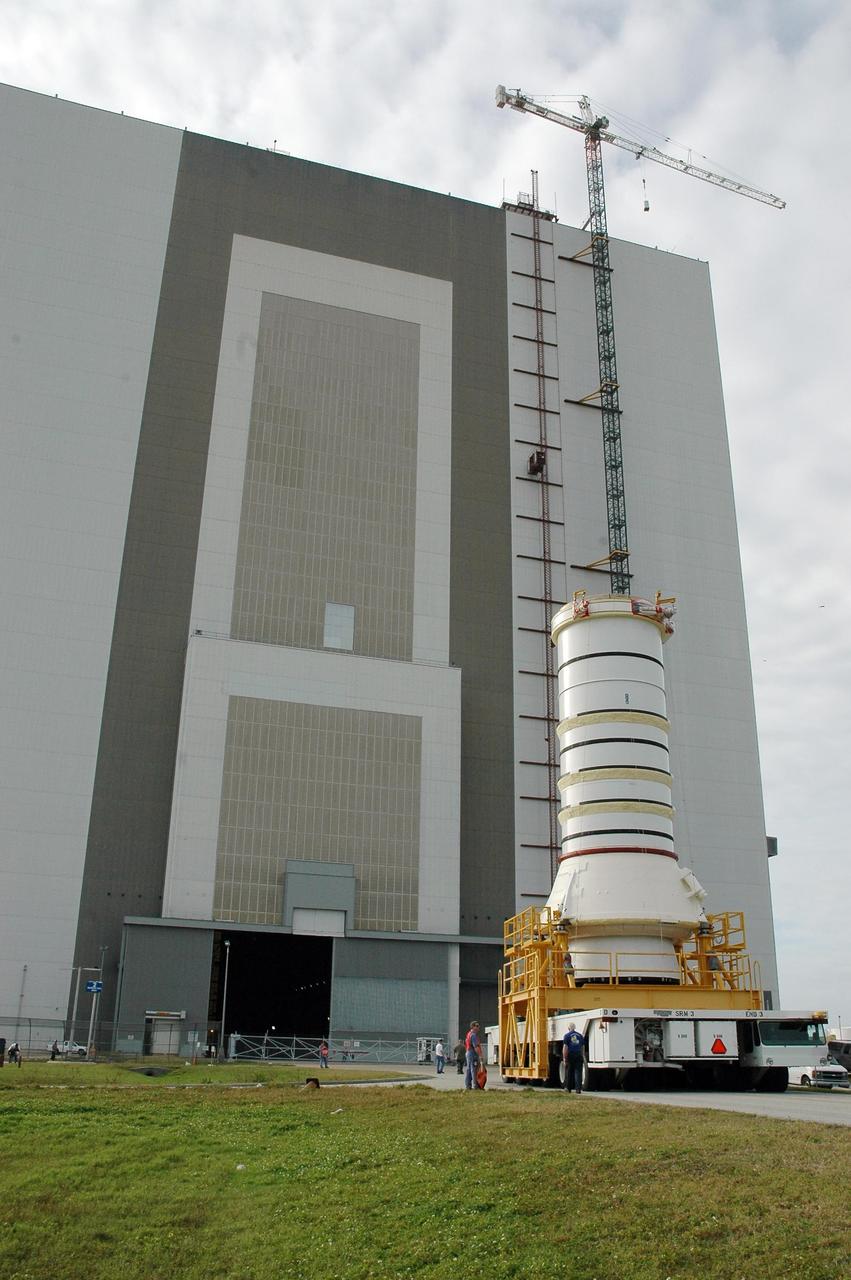
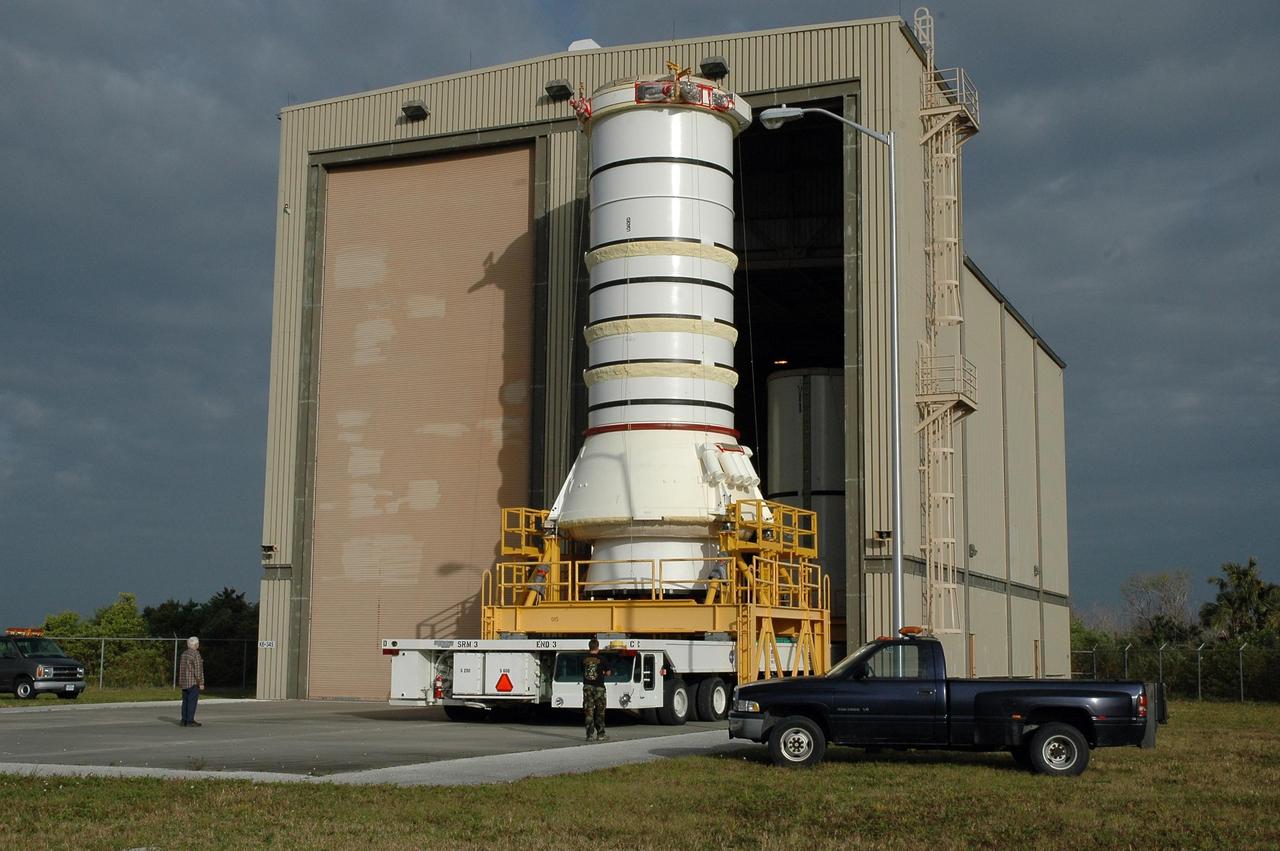
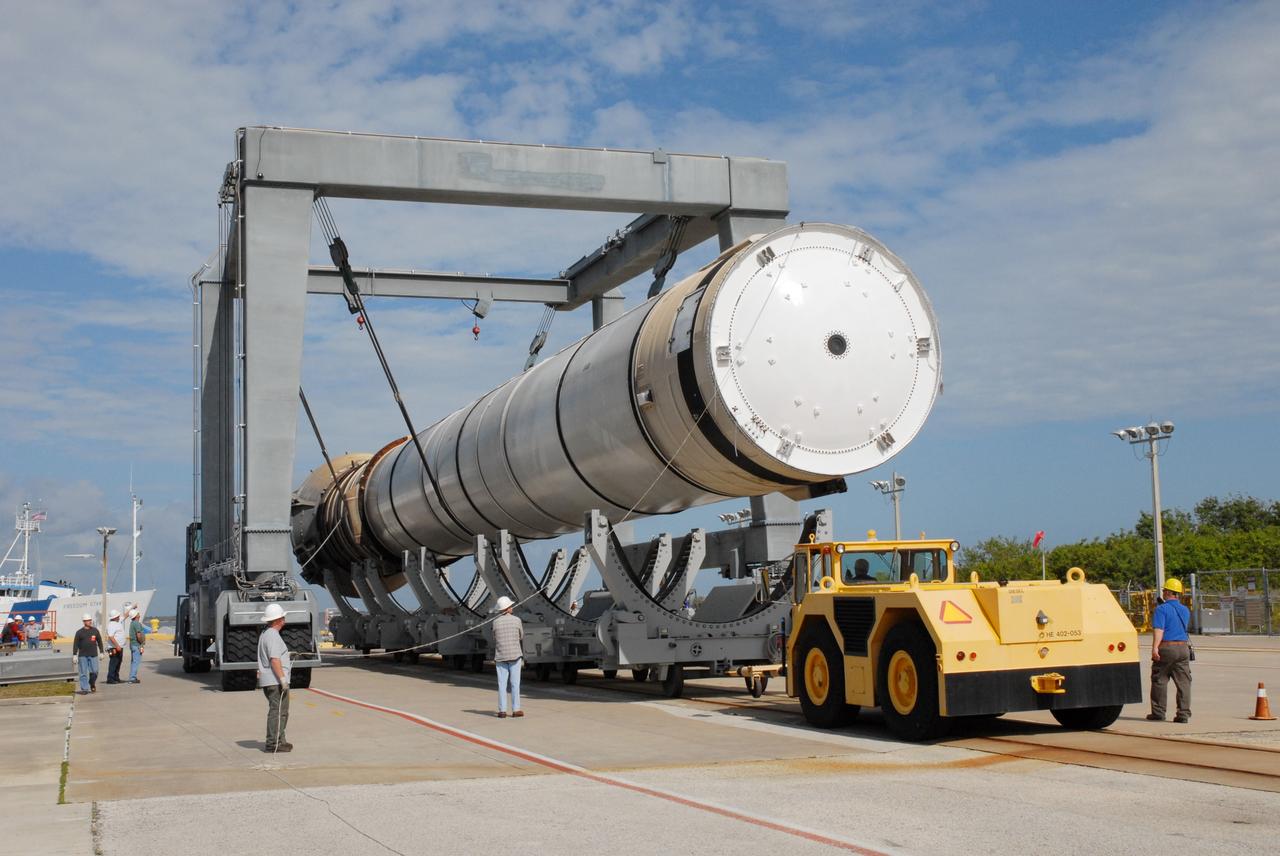
KENNEDY SPACE CENTER, FLA.  —   The right aft booster, comprised of the aft skirt and the aft motor segment, leaves the Rotation Processing and Surge Facility for transfer to the Vehicle Assembly Building where it will be lifted onto the mobile launcher platform.  The booster is being assembled for the space shuttle Discovery on mission STS-121, the second space shuttle mission in the return-to-flight sequence. The booster assembly is a major milestone in the processing sequence that leads to launch.  The launch date is targeted no earlier than May.  Photo credit:  NASA/Jack Pfaller
KSC-06pd0109
KENNEDY SPACE CENTER, FLA.  —   The right aft booster, comprised of the aft skirt and the aft motor segment, rolls into the transfer aisle of the Vehicle Assembly Building where it will be lifted onto the mobile launcher platform.  The booster is being assembled for the space shuttle Discovery on mission STS-121, the second space shuttle mission in the return-to-flight sequence. The booster assembly is a major milestone in the processing sequence that leads to launch.  The launch date is targeted no earlier than May.  Photo credit:  NASA/Jack Pfaller
KSC-06pd0112
KENNEDY SPACE CENTER, FLA.  —   The right aft booster, comprised of the aft skirt and the aft motor segment, is ready to be lifted onto the mobile launcher platform inside the Vehicle Assembly Building.  The booster is being assembled for the space shuttle Discovery on mission STS-121, the second space shuttle mission in the return-to-flight sequence. The booster assembly is a major milestone in the processing sequence that leads to launch.  The launch date is targeted no earlier than May.  Photo credit:  NASA/Jack Pfaller
KSC-06pd0113
KENNEDY SPACE CENTER, FLA.  —   The right aft booster, comprised of the aft skirt and the aft motor segment, rolls toward the Vehicle Assembly Building where it will be lifted onto the mobile launcher platform.  The booster is being assembled for the space shuttle Discovery on mission STS-121, the second space shuttle mission in the return-to-flight sequence. The booster assembly is a major milestone in the processing sequence that leads to launch.  The launch date is targeted no earlier than May.  Photo credit:  NASA/Jack Pfaller
KSC-06pd0110
KENNEDY SPACE CENTER, FLA.  —   The right aft booster, comprised of the aft skirt and the aft motor segment, rolls toward the open door of the Vehicle Assembly Building where it will be lifted onto the mobile launcher platform.  The booster is being assembled for the space shuttle Discovery on mission STS-121, the second space shuttle mission in the return-to-flight sequence. The booster assembly is a major milestone in the processing sequence that leads to launch.  The launch date is targeted no earlier than May.  Photo credit:  NASA/Jack Pfaller
KSC-06pd0111
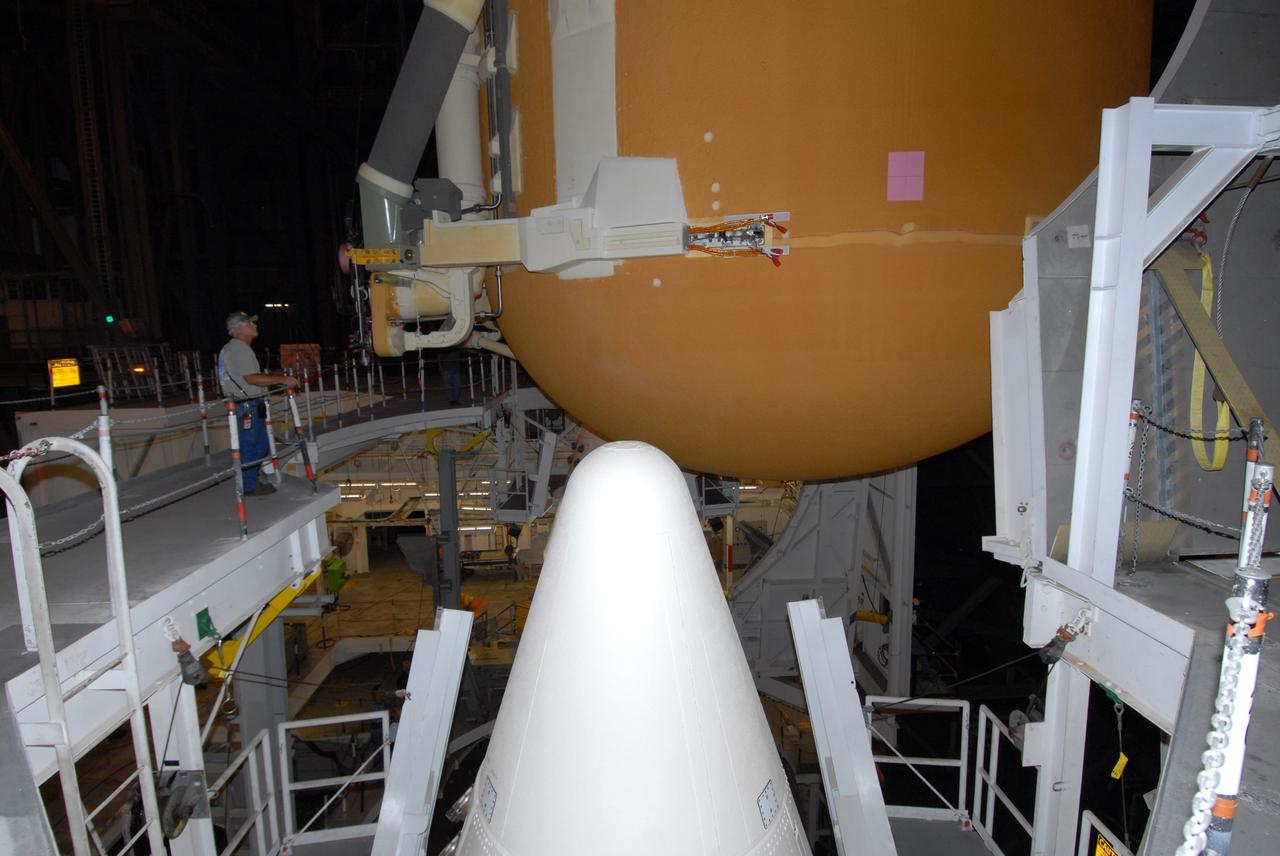
CAPE CANAVERAL, Fla. – In the Vehicle Assembly Building at NASA's Kennedy Space Center, the external tank for space shuttle Atlantis is lowered toward the solid rocket boosters (the nose cone of one of the boosters is seen here) for mating. The tank and boosters will be secured on the mobile launcher platform below.  Atlantis' STS-125 mission is the fifth and final shuttle servicing mission to NASA’s Hubble Space Telescope.  Launch is targeted for Oct. 8.    Photo credit: NASA/Jack Pfaller
KSC-08pd2265
KENNEDY SPACE CENTER, FLA.  —   The right aft booster, comprised of the aft skirt and the aft motor segment, rolls out of the Rotation Processing and Surge Facility for transfer to the Vehicle Assembly Building where it will be lifted onto the mobile launcher platform. The booster is being assembled for the space shuttle Discovery on mission STS-121, the second space shuttle mission in the return-to-flight sequence. The booster assembly is a major milestone in the processing sequence that leads to launch.  The launch date is targeted no earlier than May.  Photo credit:  NASA/Jack Pfaller
KSC-06pd0108
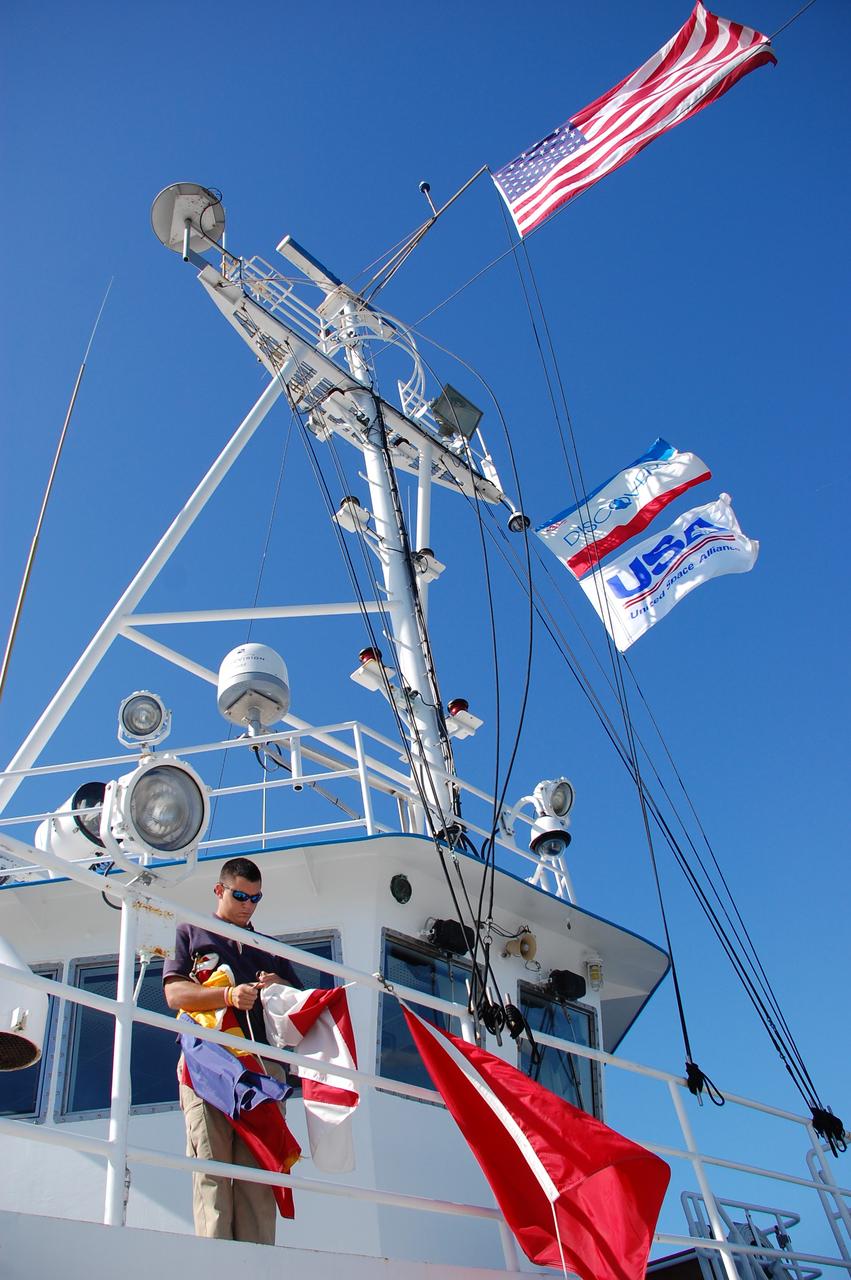
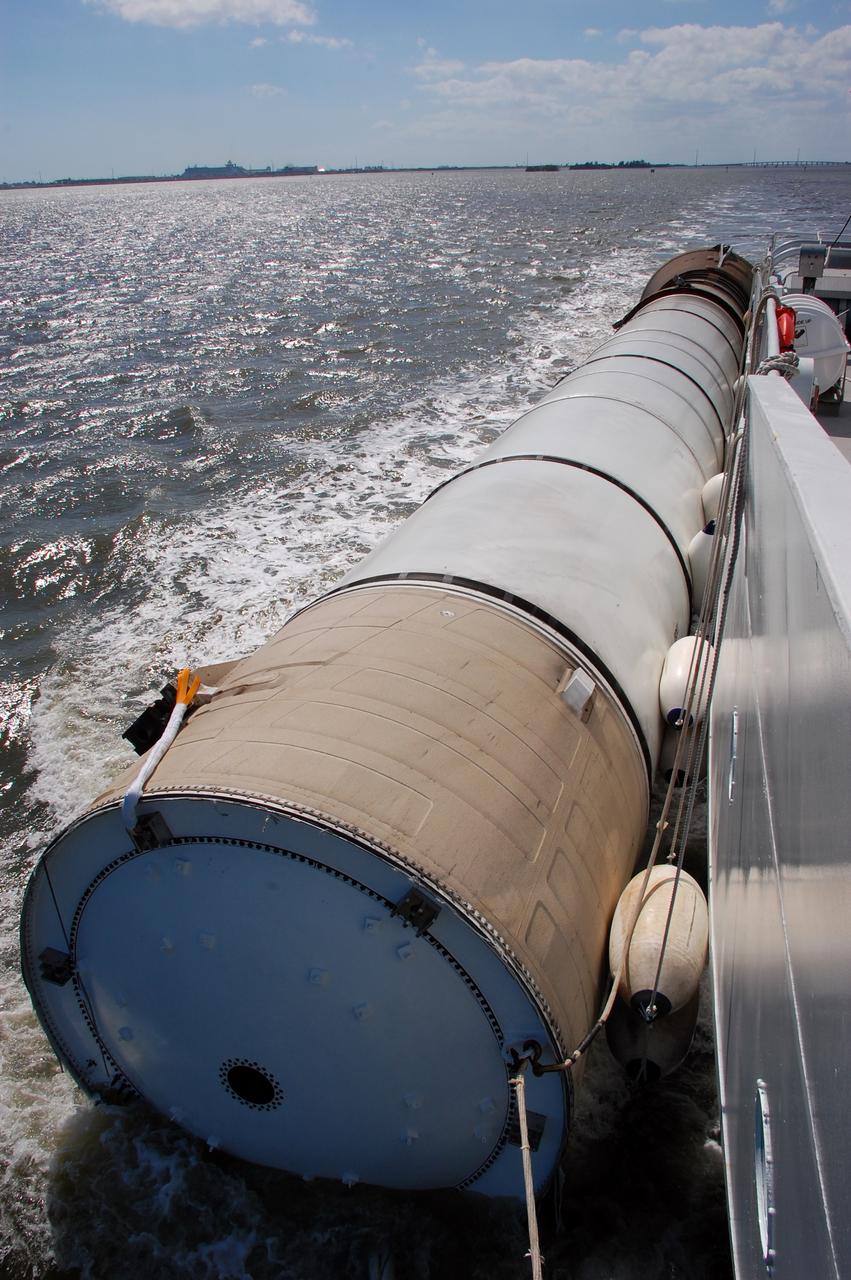
CAPE CANAVERAL, Fla. -- As daylight breaks, Walt Adams, a space shuttle solid rocket booster retrieval and dive supervisor, monitors a spent booster as it's towed by the Freedom Star retrieval ship through Port Canaveral in Florida on a journey to Hangar AF at Cape Canaveral Air Force Station. The booster was used during space shuttle Discovery's STS-133 launch from NASA Kennedy Space Center's Launch Pad 39A on Feb. 24. The shuttle’s two solid rocket booster casings and associated flight hardware are recovered in the Atlantic Ocean after every launch by Freedom Star and Liberty Star. The boosters impact the Atlantic about seven minutes after liftoff and the retrieval ships are stationed about 10 miles from the impact area at the time of splashdown.  After the spent segments are processed, they will be transported to Utah, where they will be refurbished and stored, if needed. Photo credit: NASA/Ben Smegelsky
KSC-2011-1931
S83-35782 (18 June 1983) --- An Orbital Maneuvering System (OMS) engine firing caused this bright glow at the aft end of the Earth-orbiting space shuttle Challenger on June 18, 1983.  Also visible in the 70mm exposure are parts of the Shuttle Pallet Satellite (SPAS-01). The experiment package for NASA's Office of Space and Terrestrial Applications (OSTA-2), the protective cradles for the Indonesian Palapa-B and Telesat Canada Anik C2 satellites, some getaway special (GAS) canisters and the Canadian-built Remote Manipulator System (RMS). The firing took place less than an hour after deployment of Anik.  Photo credit: NASA
OMS engine firing
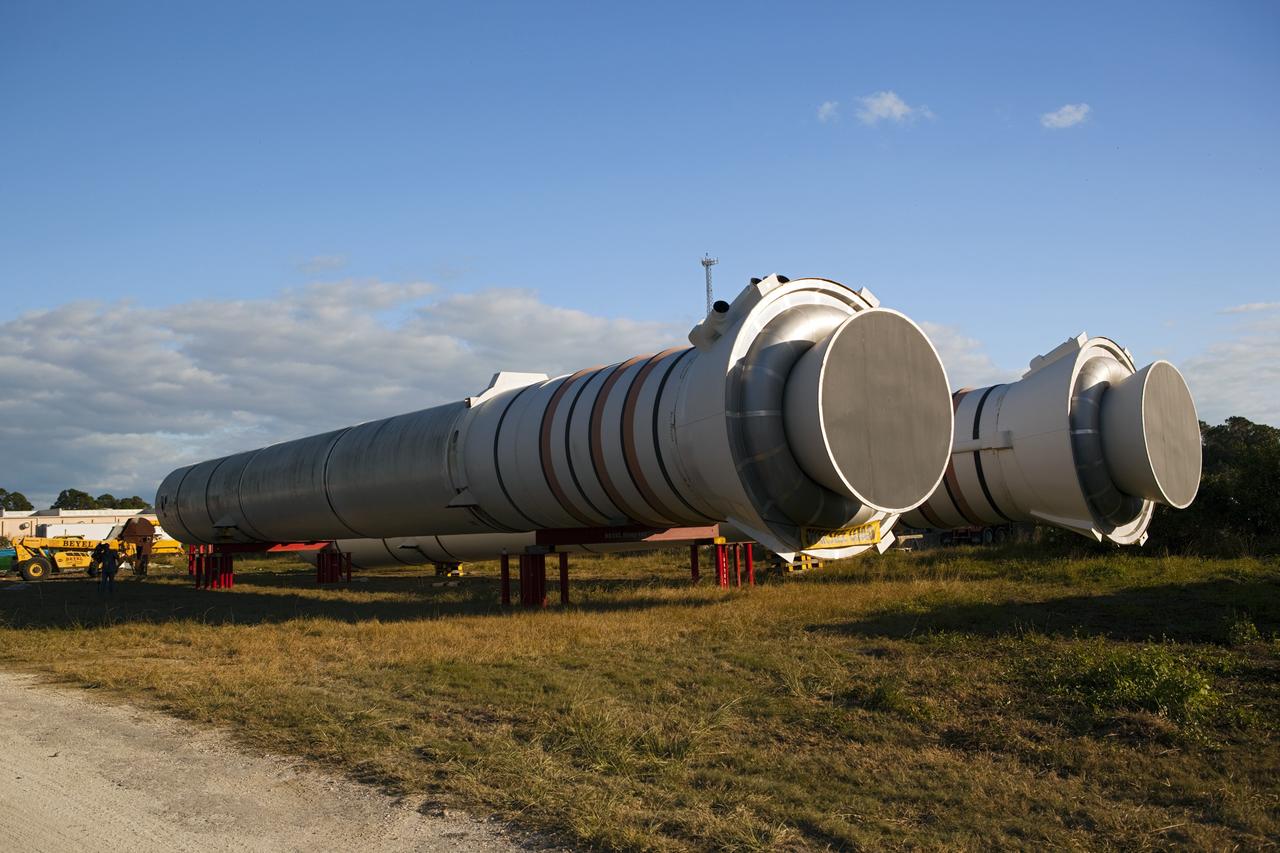
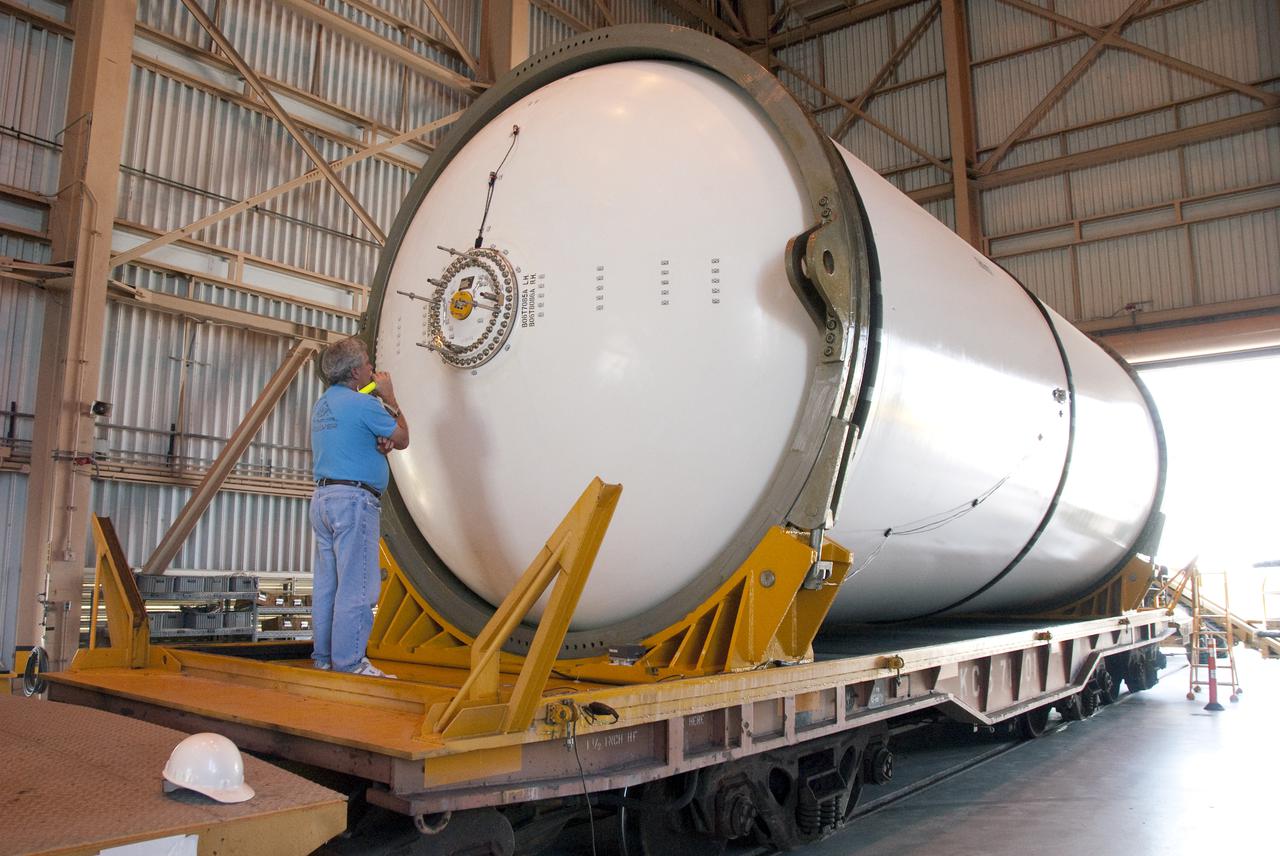
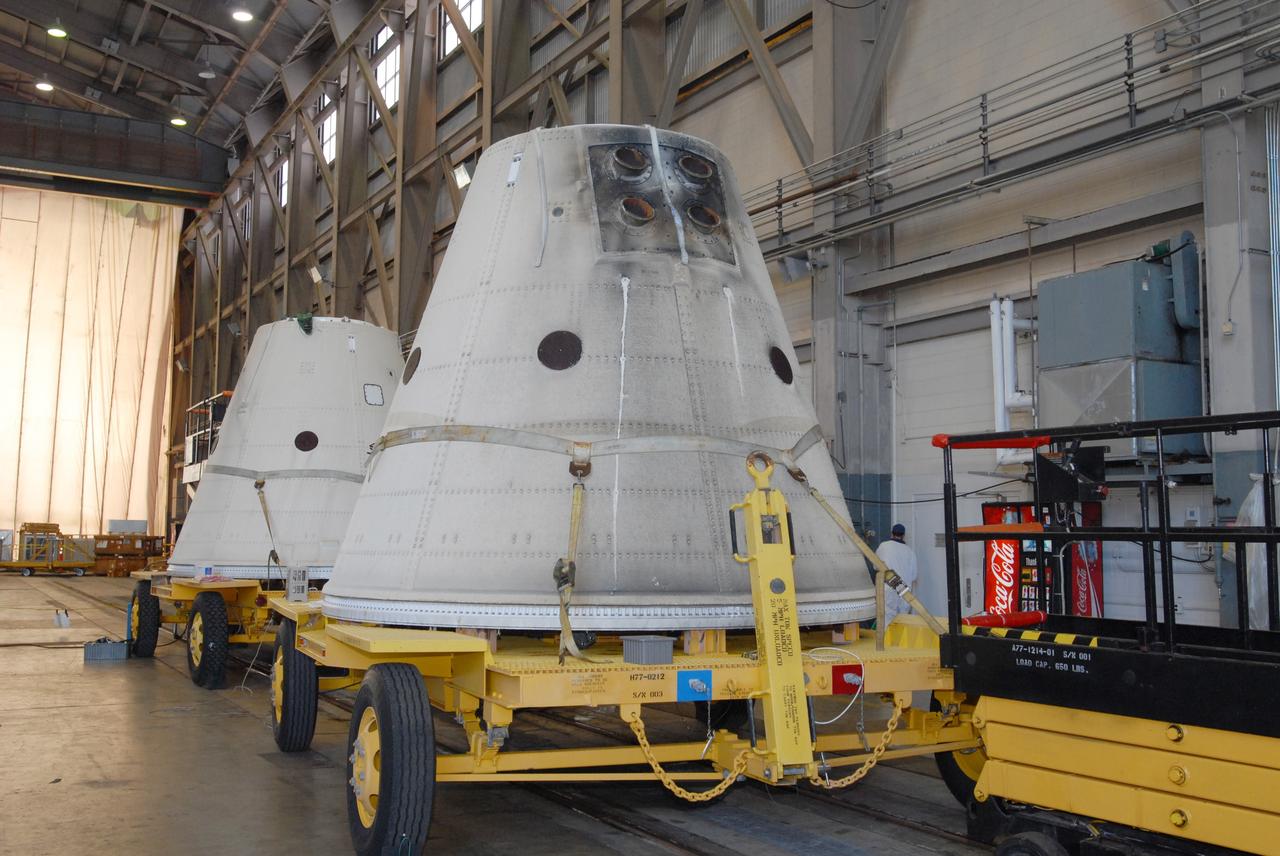
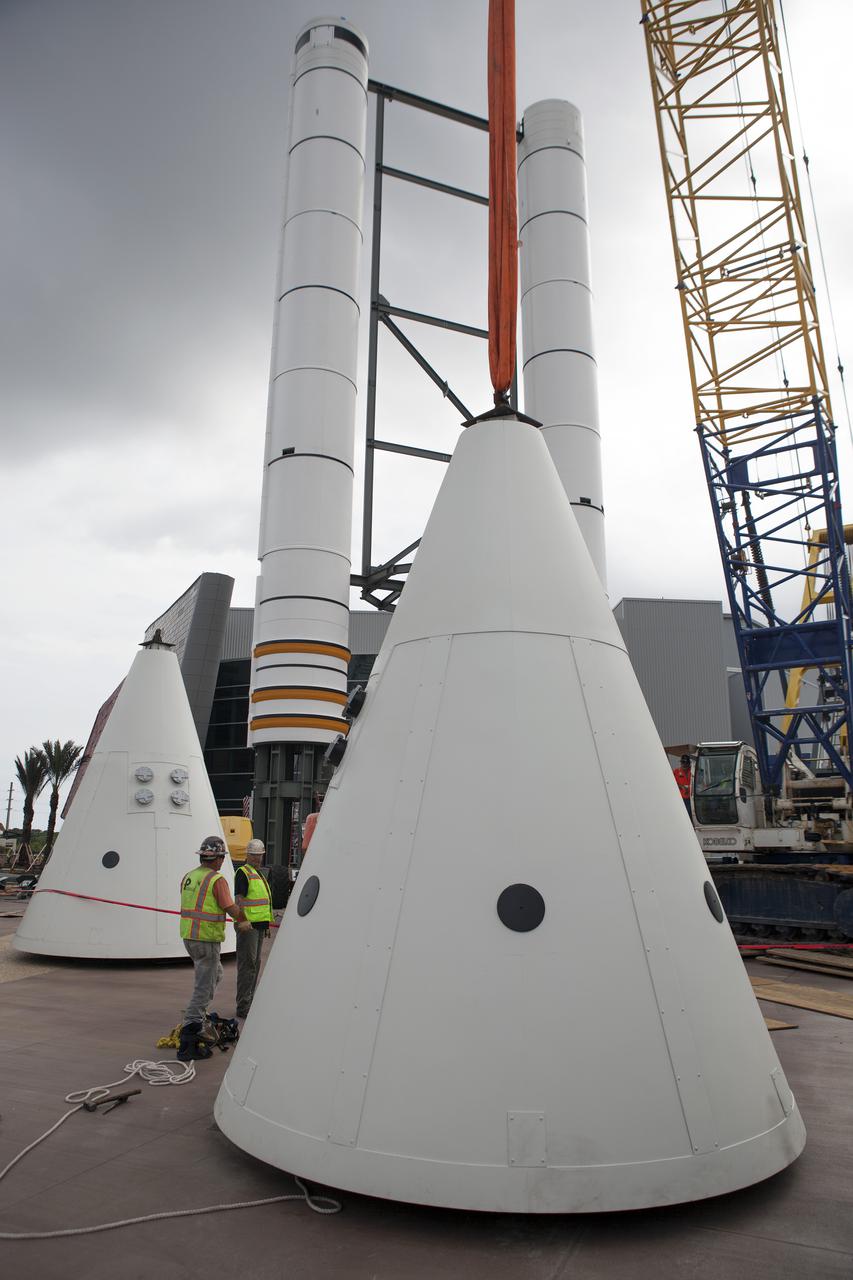
CAPE CANAVERAL, Fla. – A pair of 149-foot-long, space shuttle solid rocket booster, or SRB, displays from the Kennedy Space Center Visitor Complex sit inside a temporary storage area at NASA's Kennedy Space Center. The SRBs were part of a display of the external tank and two SRBs at the visitor complex that were used to show visitors the size of actual space shuttle components. A space shuttle rode piggyback on the tank and boosters at liftoff and during the ascent into space. The SRBs burned out after about two-and-a-half minutes of flight. After recovery from the ocean, the boosters could be used repeatedly. Photo credit: NASA/ Dmitri Gerondidakis
KSC-2011-8163
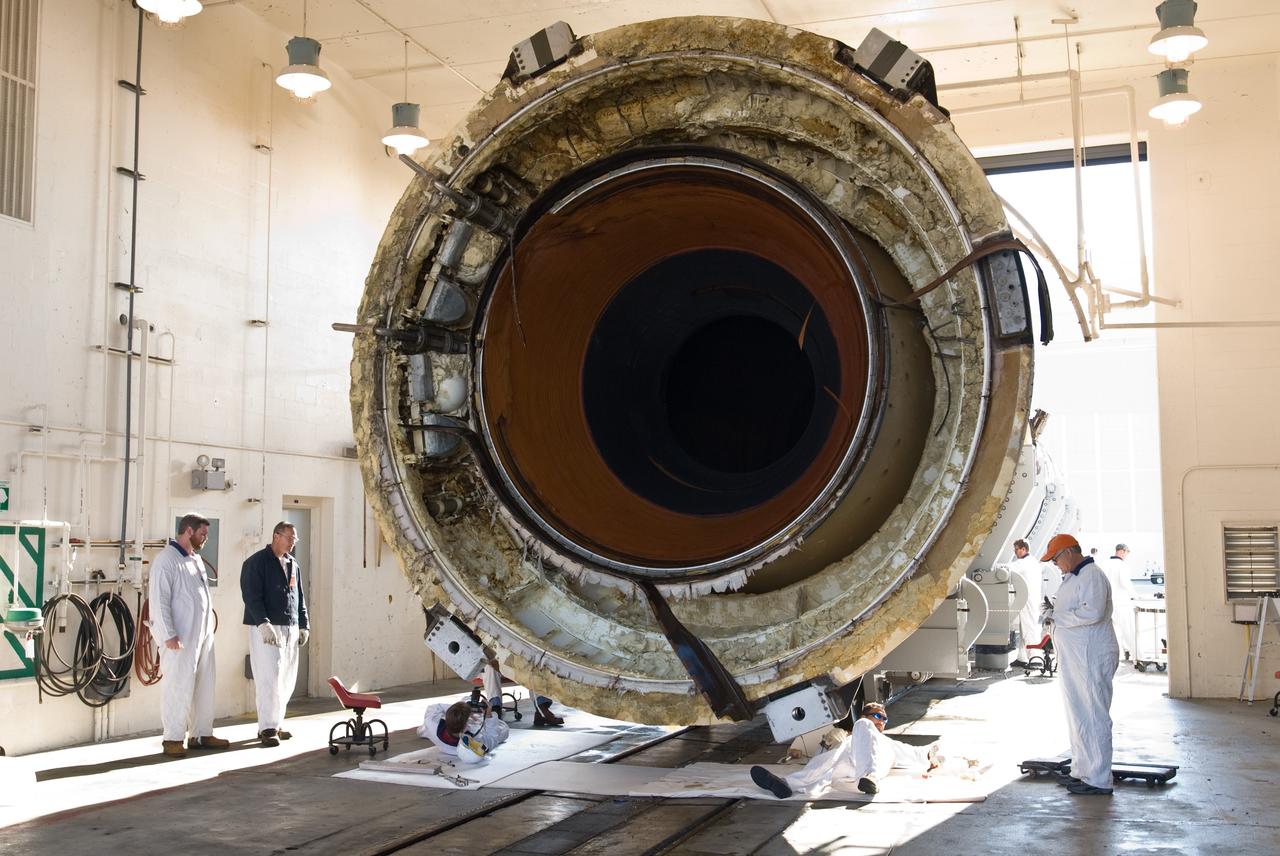
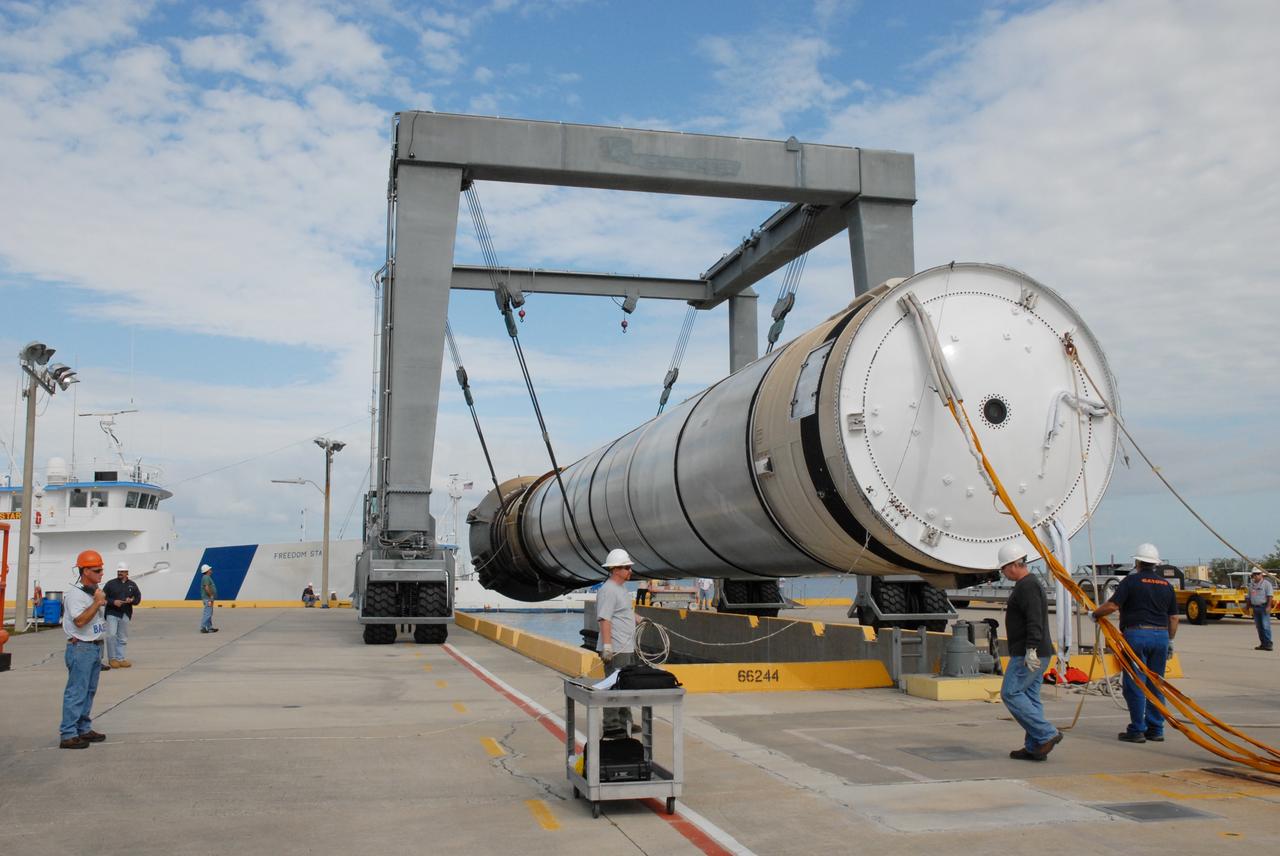
CAPE CANAVERAL, Fla. – At the Solid Rocket Booster Disassembly Facility at Hangar AF on Cape Canaveral Air Force Station in Florida, one of the solid rocket boosters used during space shuttle Atlantis' STS-132 launch, atop a tracked dolly, undergoes its first washing.  The booster was used during space shuttle Atlantis' STS-132 launch from NASA Kennedy Space Center's Launch Pad 39A on May 14. The shuttle’s two solid rocket boosters' casings and associated flight hardware are recovered from the Atlantic Ocean shortly after launch by special recovery ships, the Liberty Star and Freedom Star, and returned for refurbishment and reuse on future shuttle flights, if needed.  Hangar AF was originally used to support Project Mercury, the first U.S. human space program. Photo credit: NASA_Jim Grossmann
KSC-2010-3481
CAPE CANAVERAL, Fla. -- A spent shuttle booster will be ushered through the shallow waters of the locks at Port Canaveral, Fla., by a skiff from Freedom Star, one of NASA's solid rocket booster retrieval ships. The booster, which was used during space shuttle Discovery's STS-133 launch from NASA Kennedy Space Center's Launch Pad 39A on Feb. 24, is on its way to Hangar AF at Cape Canaveral Air Force Station. The shuttle’s two solid rocket booster casings and associated flight hardware are recovered in the Atlantic Ocean after every launch by Freedom Star and Liberty Star. The boosters impact the Atlantic about seven minutes after liftoff and the retrieval ships are stationed about 10 miles from the impact area at the time of splashdown.  After the spent segments are processed, they will be transported to Utah, where they will be refurbished and stored, if needed. Photo credit: NASA/Ben Smegelsky
KSC-2011-1935
CAPE CANAVERAL, Fla. -- Crew members in a skiff from Freedom Star, one of NASA's solid rocket booster retrieval ships, will usher a spent shuttle booster through the shallow waters of the locks at Port Canaveral, Fla. The booster, which was used during space shuttle Discovery's STS-133 launch from NASA Kennedy Space Center's Launch Pad 39A on Feb. 24, is on its way to Hangar AF at Cape Canaveral Air Force Station. The shuttle’s two solid rocket booster casings and associated flight hardware are recovered in the Atlantic Ocean after every launch by Freedom Star and Liberty Star. The boosters impact the Atlantic about seven minutes after liftoff and the retrieval ships are stationed about 10 miles from the impact area at the time of splashdown.  After the spent segments are processed, they will be transported to Utah, where they will be refurbished and stored, if needed. Photo credit: NASA/Ben Smegelsky
KSC-2011-1934
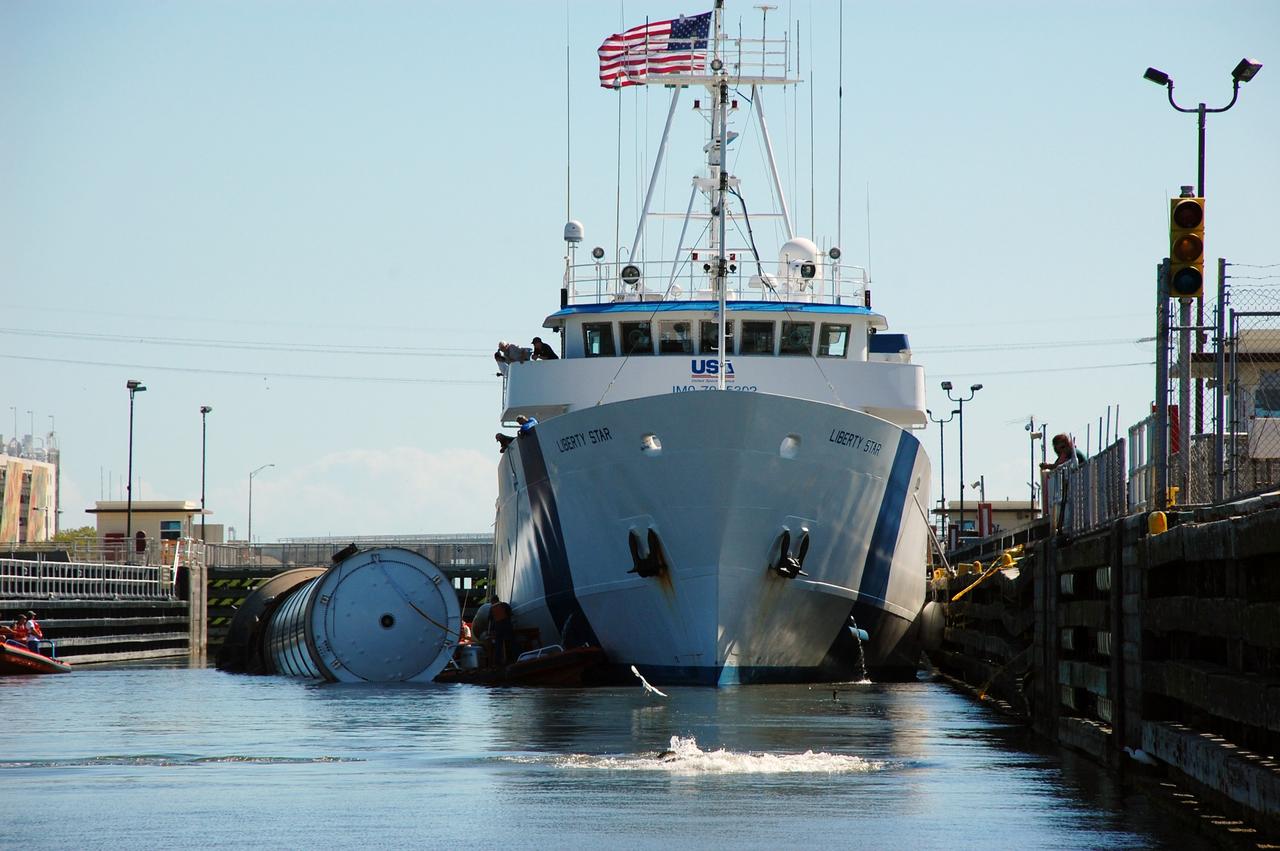
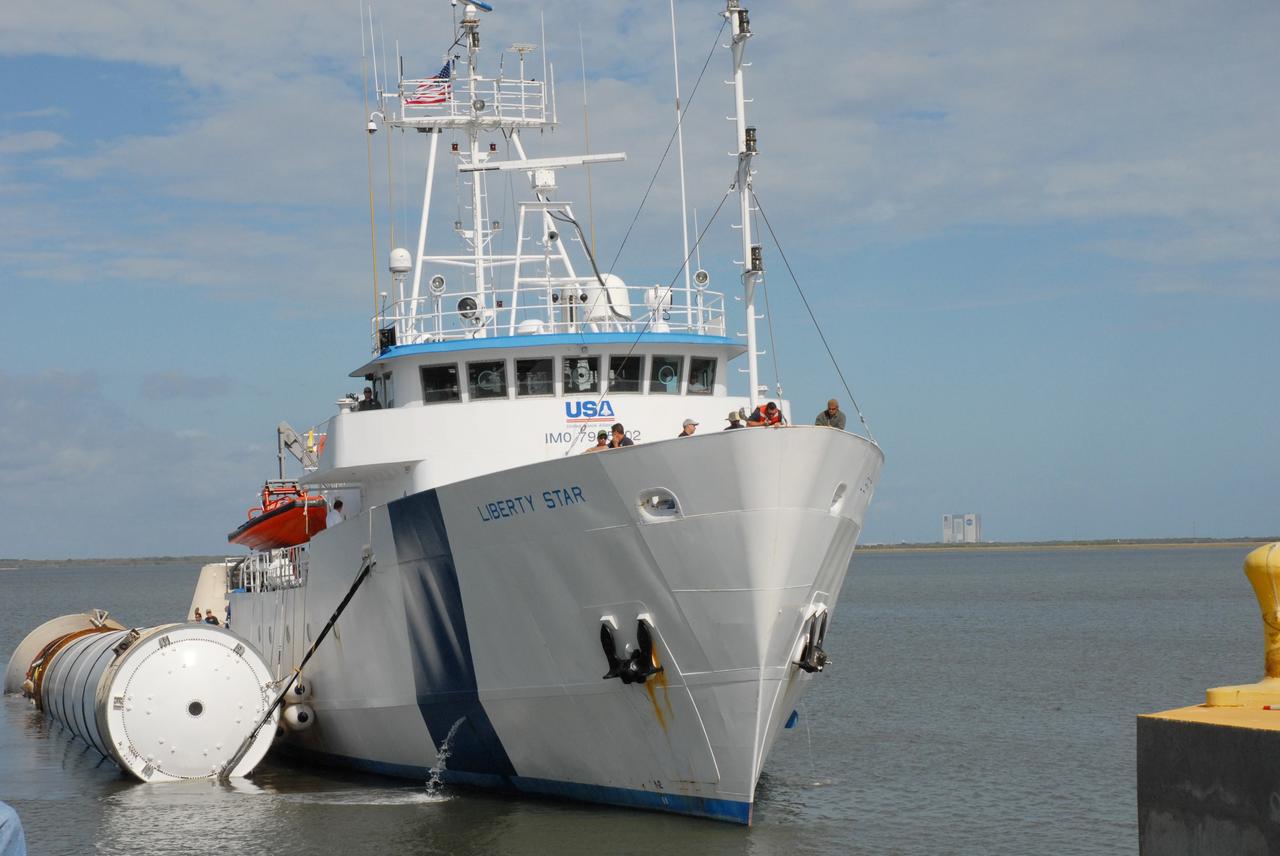
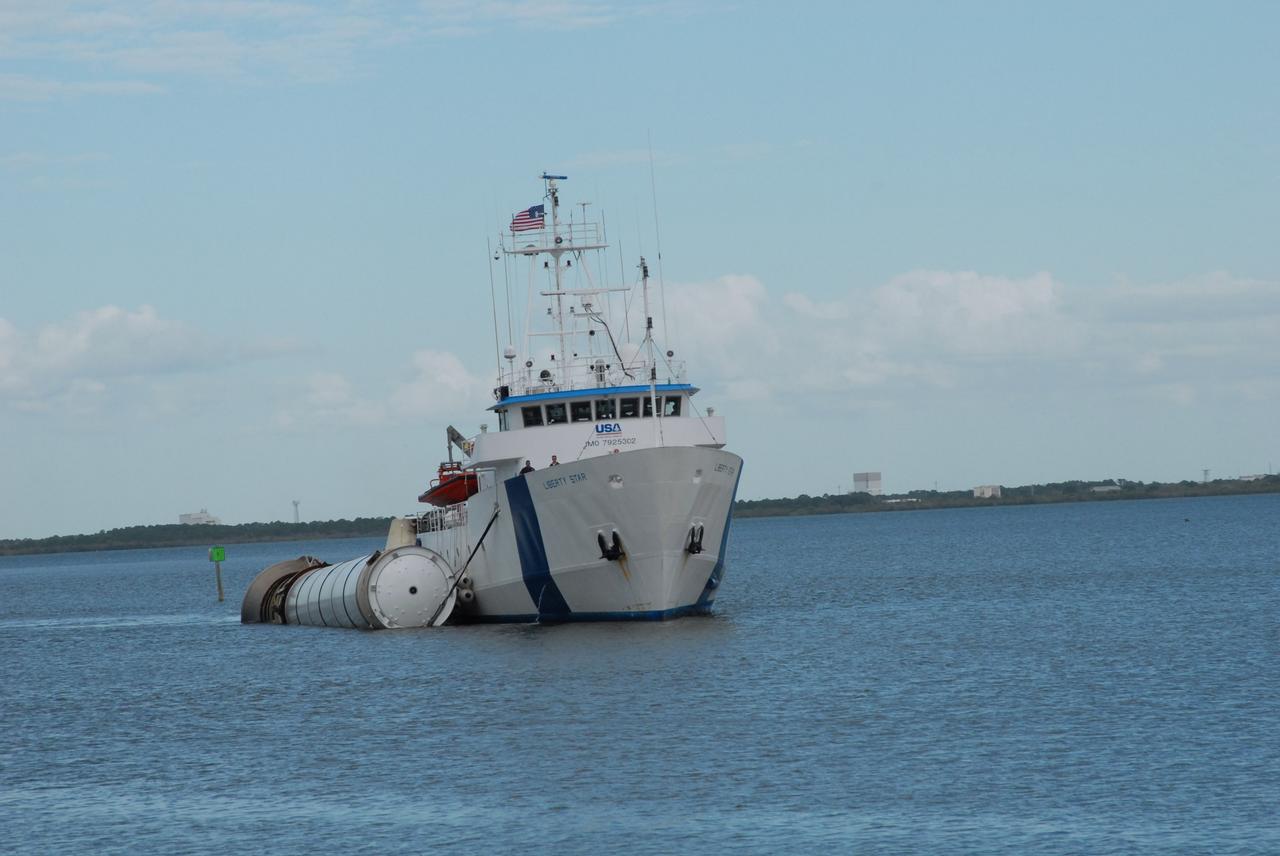
CAPE CANAVERAL, Fla. -- Liberty Star, one of NASA's solid rocket booster retrieval ships, ushers a spent shuttle booster to Hangar AF at Cape Canaveral Air Force Station in Florida. The booster was used during space shuttle Discovery's STS-133 launch from NASA Kennedy Space Center's Launch Pad 39A on Feb. 24. The shuttle’s two solid rocket booster casings and associated flight hardware are recovered in the Atlantic Ocean after every launch by Freedom Star and Liberty Star. The boosters impact the Atlantic about seven minutes after liftoff and the retrieval ships are stationed about 10 miles from the impact area at the time of splashdown.  After the spent segments are processed, they will be transported to Utah, where they will be refurbished and stored, if needed. Photo credit: NASA/Ben Smegelsky
KSC-2011-1942
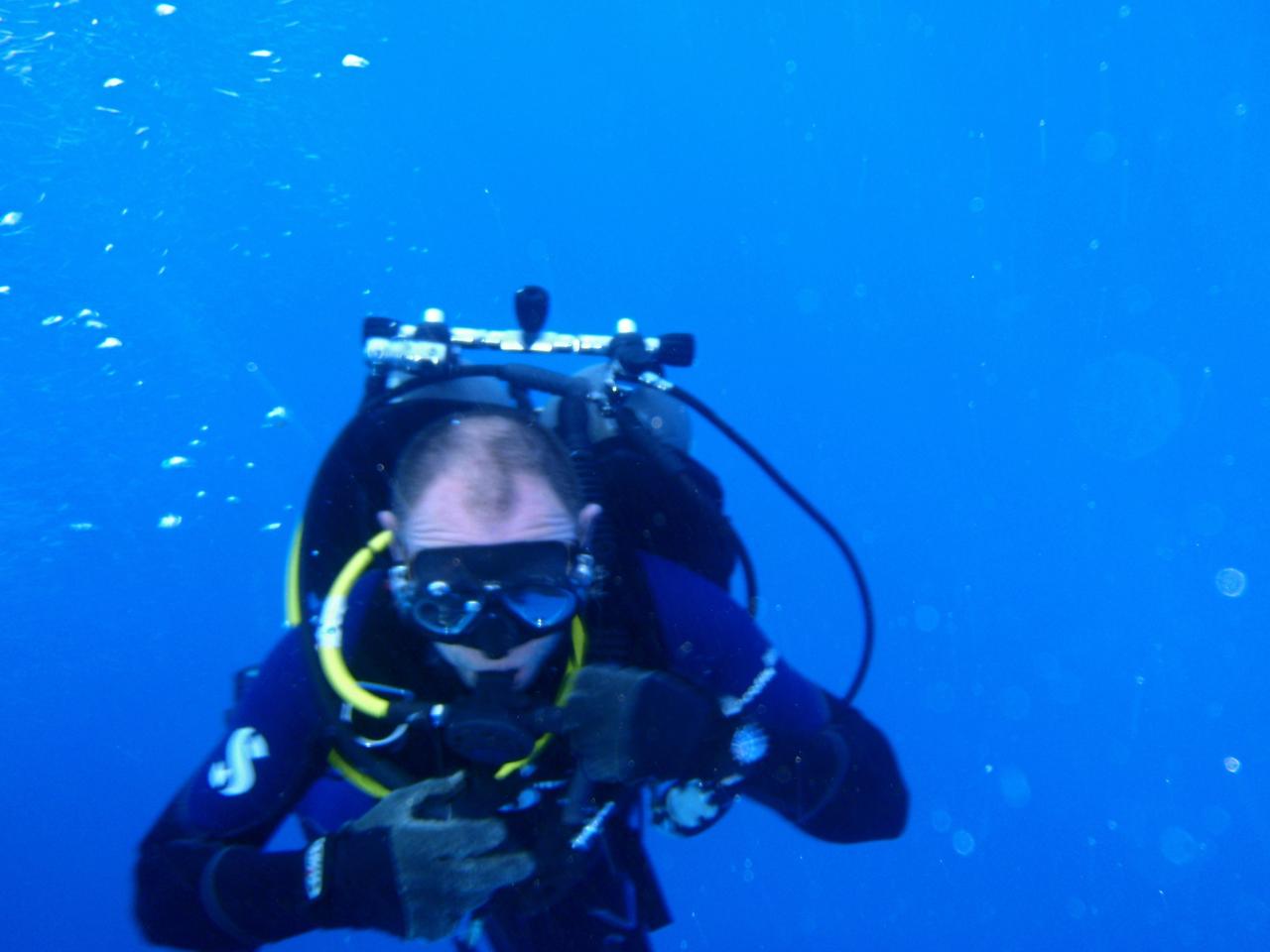
CAPE CANAVERAL, Fla. -- A diver from Liberty Star, one of NASA's solid rocket booster retrieval ships, helps retrieve a spent shuttle booster in the Atlantic Ocean off the coast of Florida. The booster, which was used during space shuttle Discovery's STS-133 launch from NASA Kennedy Space Center's Launch Pad 39A on Feb. 24, will be transported to Hangar AF at Cape Canaveral Air Force Station. The shuttle’s two solid rocket booster casings and associated flight hardware are recovered after every launch by Liberty Star and Freedom Star.          The boosters impact the Atlantic about seven minutes after liftoff and the retrieval ships are stationed about 10 miles from the impact area at the time of splashdown.  After the spent segments are processed, they will be transported to Utah, where they will be refurbished and stored, if needed. Photo credit: NASA/Frank Michaux
KSC-2011-1929
CAPE CANAVERAL, Fla. -- Crew members in a skiff and aboard Liberty Star, one of NASA's solid rocket booster retrieval ships, usher a spent shuttle booster to Hangar AF at Cape Canaveral Air Force Station in Florida. The booster was used during space shuttle Discovery's STS-133 launch from NASA Kennedy Space Center's Launch Pad 39A on Feb. 24. The shuttle’s two solid rocket booster casings and associated flight hardware are recovered in the Atlantic Ocean after every launch by Freedom Star and Liberty Star. The boosters impact the Atlantic about seven minutes after liftoff and the retrieval ships are stationed about 10 miles from the impact area at the time of splashdown.  After the spent segments are processed, they will be transported to Utah, where they will be refurbished and stored, if needed. Photo credit: NASA/Ben Smegelsky
KSC-2011-1943
CAPE CANAVERAL, Fla. -- The Solid Rocket Booster Retrieval Ship Freedom Star is tied back up to a spent shuttle booster and ready to continue the journey to the dock at Hangar AF at Cape Canaveral Air Force Station in Florida. The booster was used during space shuttle Discovery's STS-133 launch from NASA Kennedy Space Center's Launch Pad 39A on Feb. 24. The shuttle’s two solid rocket booster casings and associated flight hardware are recovered in the Atlantic Ocean after every launch by Freedom Star and Liberty Star. The boosters impact the Atlantic about seven minutes after liftoff and the retrieval ships are stationed about 10 miles from the impact area at the time of splashdown.  After the spent segments are processed, they will be transported to Utah, where they will be refurbished and stored, if needed. Photo credit: NASA/Ben Smegelsky
KSC-2011-1937
CAPE CANAVERAL, Fla. -- The Solid Rocket Booster Retrieval Ship Freedom Star delivers a spent shuttle booster to workers at Hangar AF at Cape Canaveral Air Force Station in Florida. The booster was used during space shuttle Discovery's STS-133 launch from NASA Kennedy Space Center's Launch Pad 39A on Feb. 24. The shuttle’s two solid rocket booster casings and associated flight hardware are recovered in the Atlantic Ocean after every launch by Freedom Star and Liberty Star. The boosters impact the Atlantic about seven minutes after liftoff and the retrieval ships are stationed about 10 miles from the impact area at the time of splashdown.  After the spent segments are processed, they will be transported to Utah, where they will be refurbished and stored, if needed. Photo credit: NASA/Ben Smegelsky
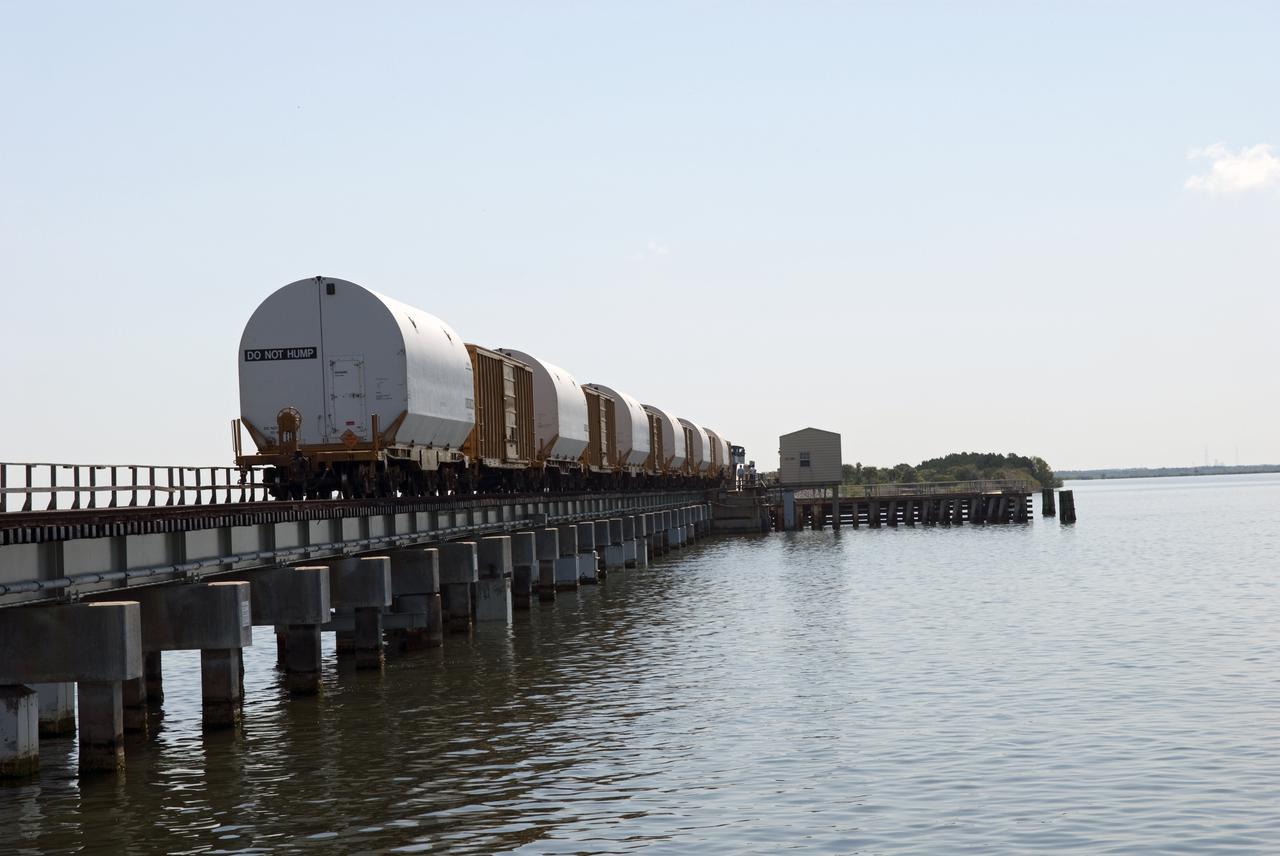
KSC-2011-1940
CAPE CANAVERAL, Fla. -- Liberty Star, one of NASA's solid rocket booster retrieval ships, ushers a spent shuttle booster to Hangar AF at Cape Canaveral Air Force Station in Florida. The booster was used during space shuttle Discovery's STS-133 launch from NASA Kennedy Space Center's Launch Pad 39A on Feb. 24. The shuttle’s two solid rocket booster casings and associated flight hardware are recovered in the Atlantic Ocean after every launch by Freedom Star and Liberty Star. The boosters impact the Atlantic about seven minutes after liftoff and the retrieval ships are stationed about 10 miles from the impact area at the time of splashdown.  After the spent segments are processed, they will be transported to Utah, where they will be refurbished and stored, if needed. Photo credit: NASA/Ben Smegelsky
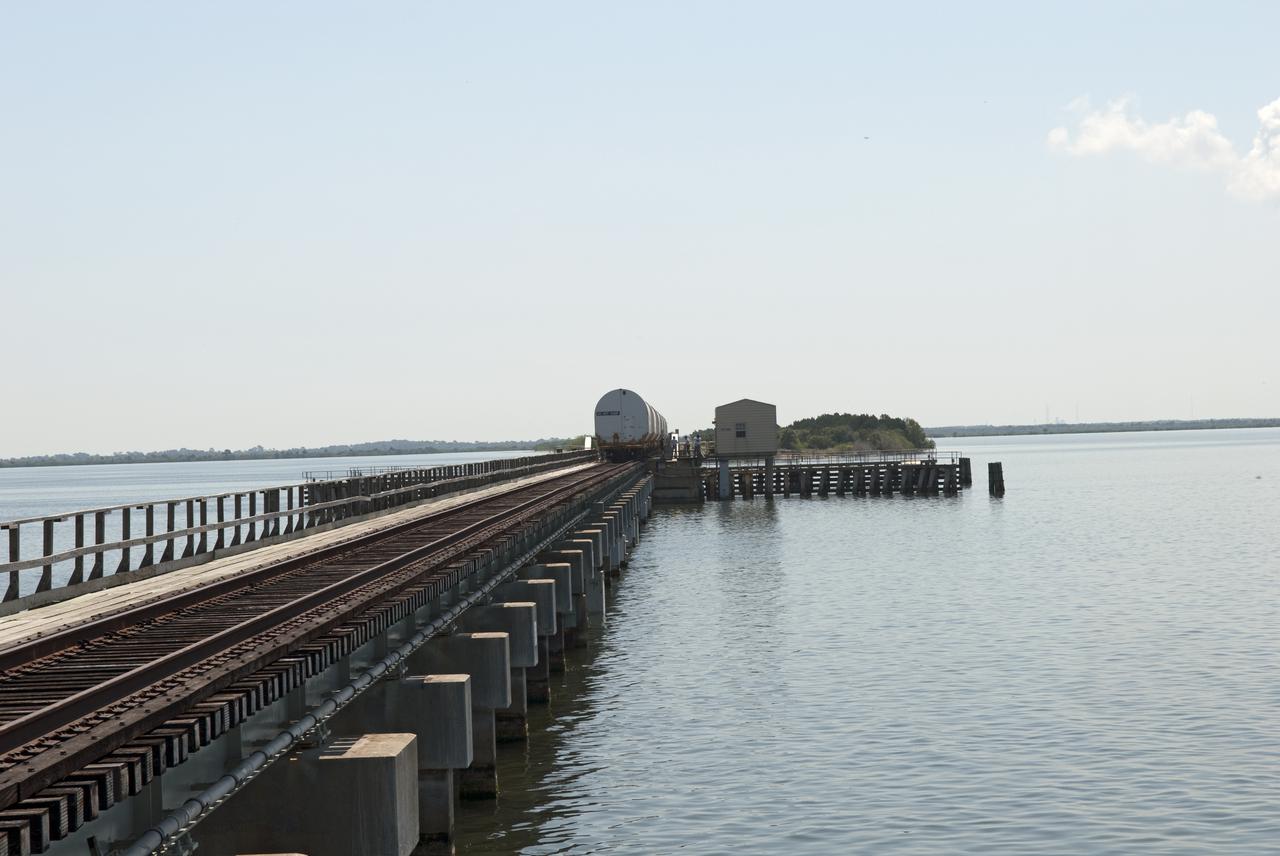
KSC-2011-1944
CAPE CANAVERAL, Fla. -- The Solid Rocket Booster Retrieval Ship Freedom Star delivers a spent shuttle booster to workers at Hangar AF at Cape Canaveral Air Force Station in Florida. The booster was used during space shuttle Discovery's STS-133 launch from NASA Kennedy Space Center's Launch Pad 39A on Feb. 24. The shuttle’s two solid rocket booster casings and associated flight hardware are recovered in the Atlantic Ocean after every launch by Freedom Star and Liberty Star. The boosters impact the Atlantic about seven minutes after liftoff and the retrieval ships are stationed about 10 miles from the impact area at the time of splashdown.  After the spent segments are processed, they will be transported to Utah, where they will be refurbished and stored, if needed. Photo credit: NASA/Ben Smegelsky
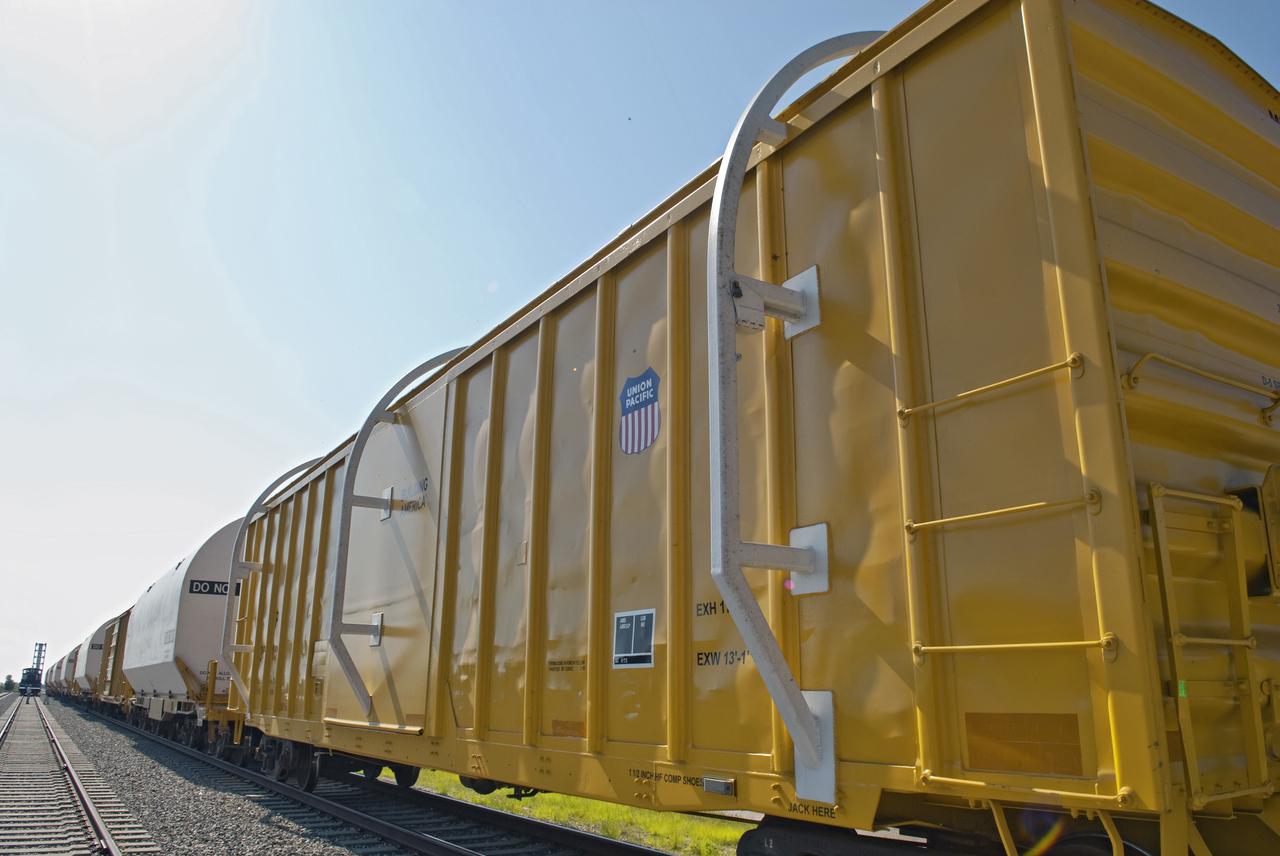
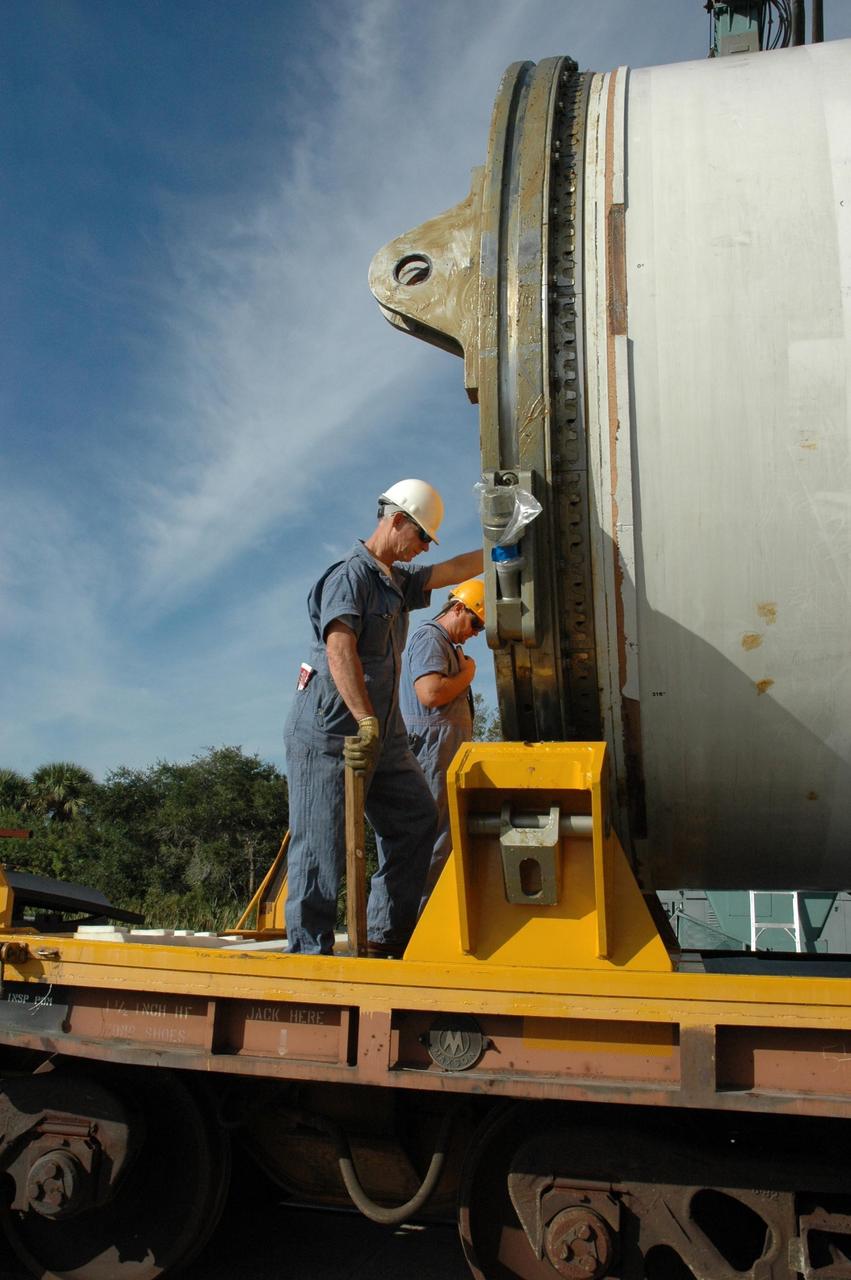
KSC-2011-1941
CAPE CANAVERAL, Fla. -- The Solid Rocket Booster Retrieval Ship Freedom Star, with a spent shuttle booster in tow, just passed through a drawbridge on its way to the dock at Hangar AF at Cape Canaveral Air Force Station in Florida. The booster was used during space shuttle Discovery's STS-133 launch from NASA Kennedy Space Center's Launch Pad 39A on Feb. 24. The shuttle’s two solid rocket booster casings and associated flight hardware are recovered in the Atlantic Ocean after every launch by Freedom Star and Liberty Star. The boosters impact the Atlantic about seven minutes after liftoff and the retrieval ships are stationed about 10 miles from the impact area at the time of splashdown.  After the spent segments are processed, they will be transported to Utah, where they will be refurbished and stored, if needed. Photo credit: NASA/Ben Smegelsky
KSC-2011-1933
CAPE CANAVERAL, Fla. -- The Solid Rocket Booster Retrieval Ship Freedom Star delivers a spent shuttle booster to workers at Hangar AF at Cape Canaveral Air Force Station in Florida. The booster was used during space shuttle Discovery's STS-133 launch from NASA Kennedy Space Center's Launch Pad 39A on Feb. 24. The shuttle’s two solid rocket booster casings and associated flight hardware are recovered in the Atlantic Ocean after every launch by Freedom Star and Liberty Star. The boosters impact the Atlantic about seven minutes after liftoff and the retrieval ships are stationed about 10 miles from the impact area at the time of splashdown.  After the spent segments are processed, they will be transported to Utah, where they will be refurbished and stored, if needed. Photo credit: NASA/Ben Smegelsky
KSC-2011-1939
CAPE CANAVERAL, Fla. -- Crew members in a skiff from Liberty Star, one of NASA's solid rocket booster retrieval ships, usher a spent shuttle booster to Hangar AF at Cape Canaveral Air Force Station in Florida. The booster was used during space shuttle Discovery's STS-133 launch from NASA Kennedy Space Center's Launch Pad 39A on Feb. 24. The shuttle’s two solid rocket booster casings and associated flight hardware are recovered in the Atlantic Ocean after every launch by Freedom Star and Liberty Star. The boosters impact the Atlantic about seven minutes after liftoff and the retrieval ships are stationed about 10 miles from the impact area at the time of splashdown.  After the spent segments are processed, they will be transported to Utah, where they will be refurbished and stored, if needed. Photo credit: NASA/Ben Smegelsky
KSC-2011-1946
CAPE CANAVERAL, Fla. -- Crew members in a skiff from Freedom Star, one of NASA's solid rocket booster retrieval ships, usher a spent shuttle booster through the shallow waters of the locks at Port Canaveral, Fla. The booster, which was used during space shuttle Discovery's STS-133 launch from NASA Kennedy Space Center's Launch Pad 39A on Feb. 24, is on its way to Hangar AF at Cape Canaveral Air Force Station. The shuttle’s two solid rocket booster casings and associated flight hardware are recovered in the Atlantic Ocean after every launch by Freedom Star and Liberty Star. The boosters impact the Atlantic about seven minutes after liftoff and the retrieval ships are stationed about 10 miles from the impact area at the time of splashdown.  After the spent segments are processed, they will be transported to Utah, where they will be refurbished and stored, if needed. Photo credit: NASA/Ben Smegelsky
KSC-2011-1936
CAPE CANAVERAL, Fla. – The Solid Rocket Booster Retrieval Ship Liberty Star tows a booster to the dock at Hangar AF at Cape Canaveral Air Force Station in Florida.  The booster was used during space shuttle Discovery's launch from NASA's Kennedy Space Center in Florida March 15 on mission STS-119. The space shuttle’s solid rocket booster casings and associated flight hardware are recovered at sea after a launch. The spent rockets were recovered by NASA's Solid Rocket Booster Retrieval Ships Freedom Star and Liberty Star. The boosters impact the Atlantic Ocean approximately seven minutes after liftoff.  The splashdown area is a square of about six by nine nautical miles located about 140 nautical miles downrange from the launch pad. The retrieval ships are stationed approximately 8 to 10 nautical miles from the impact area at the time of splashdown. As soon as the boosters enter the water, the ships accelerate to a speed of 15 knots and quickly close on the boosters. The pilot chutes and main parachutes are the first items to be brought on board. With the chutes and frustum recovered, attention turns to the boosters. The ship’s tow line is connected and the booster is returned to the Port and, after transfer to a position alongside the ship, to Hangar AF. There, the expended boosters are disassembled, refurbished and reloaded with solid propellant for reuse.  Photo credit: NASA/Jack Pfaller
KSC-2009-2144
CAPE CANAVERAL, Fla. – The Solid Rocket Booster Retrieval Ship Liberty Star tows a booster to the dock at Hangar AF at Cape Canaveral Air Force Station in Florida.  The booster was used during space shuttle Discovery's launch from NASA's Kennedy Space Center in Florida March 15 on mission STS-119.  The space shuttle’s solid rocket booster casings and associated flight hardware are recovered at sea after a launch. The spent rockets were recovered by NASA's Solid Rocket Booster Retrieval Ships Freedom Star and Liberty Star. The boosters impact the Atlantic Ocean approximately seven minutes after liftoff.  The splashdown area is a square of about six by nine nautical miles located about 140 nautical miles downrange from the launch pad. The retrieval ships are stationed approximately 8 to 10 nautical miles from the impact area at the time of splashdown. As soon as the boosters enter the water, the ships accelerate to a speed of 15 knots and quickly close on the boosters. The pilot chutes and main parachutes are the first items to be brought on board. With the chutes and frustum recovered, attention turns to the boosters. The ship’s tow line is connected and the booster is returned to the Port and, after transfer to a position alongside the ship, to Hangar AF. There, the expended boosters are disassembled, refurbished and reloaded with solid propellant for reuse.  Photo credit: NASA/Jack Pfaller
KSC-2009-2141
This is a computer generated image of a Shuttle launch utilizing 2nd generation Reusable Launch Vehicle (RLV) flyback boosters, a futuristic concept that is currently undergoing study by NASA's Space Launch Initiative (SLI) Propulsion Office, managed by the Marshall Space Fight Center in Huntsville, Alabama, working in conjunction with the Agency's Glenn Research Center in Cleveland, Ohio. Currently, after providing thrust to the Space Shuttle, the solid rocket boosters are parachuted into the sea and are retrieved for reuse. The SLI is considering vehicle concepts that would fly first-stage boosters back to a designated landing site after separation from the orbital vehicle. These flyback boosters would be powered by several jet engines integrated into the booster capable of providing over 100,000 pounds of thrust. The study will determine the requirements for the engines, identify risk mitigation activities, and identify costs associated with risk mitigation and jet engine development and production, as well as determine candidate jet engine options to pursue for the flyback booster.
Advanced Space Transportation Program (ASTP)
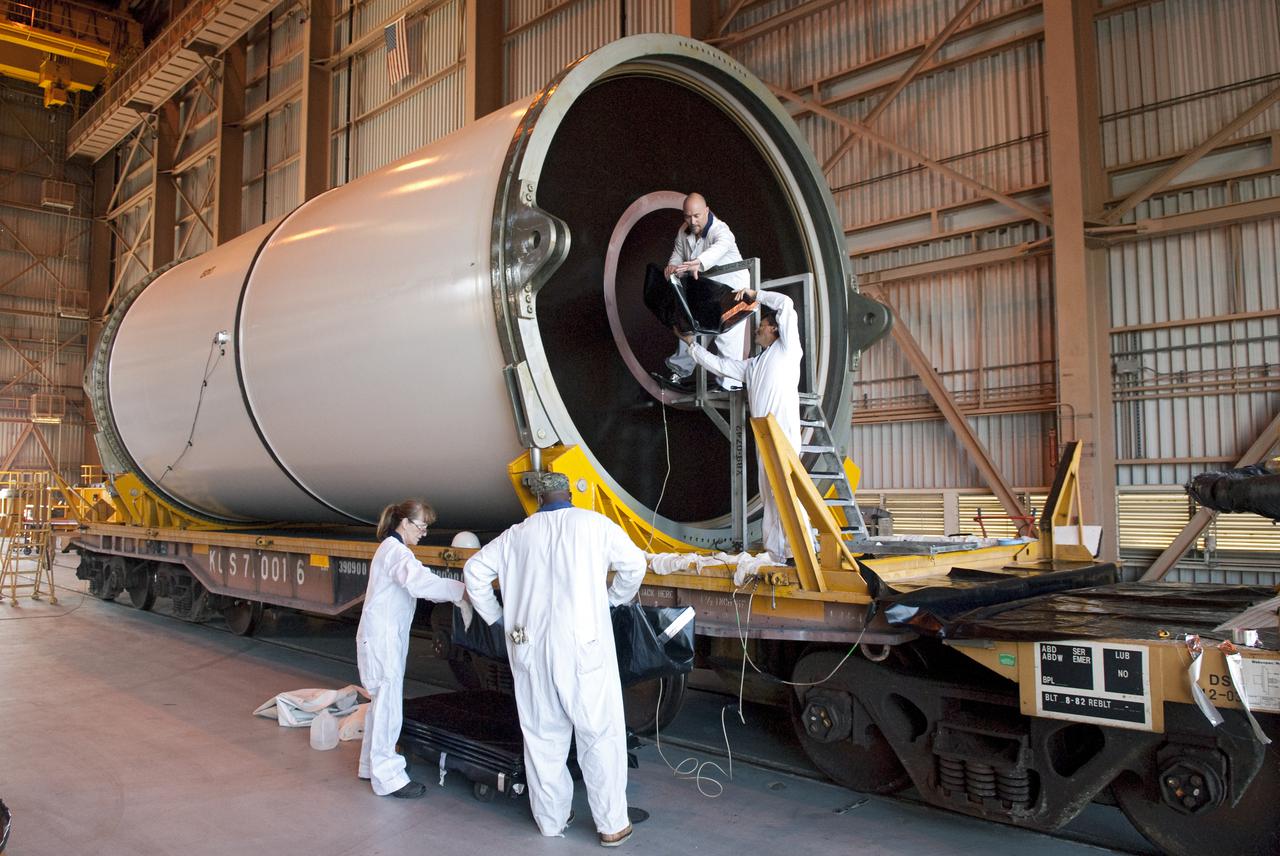
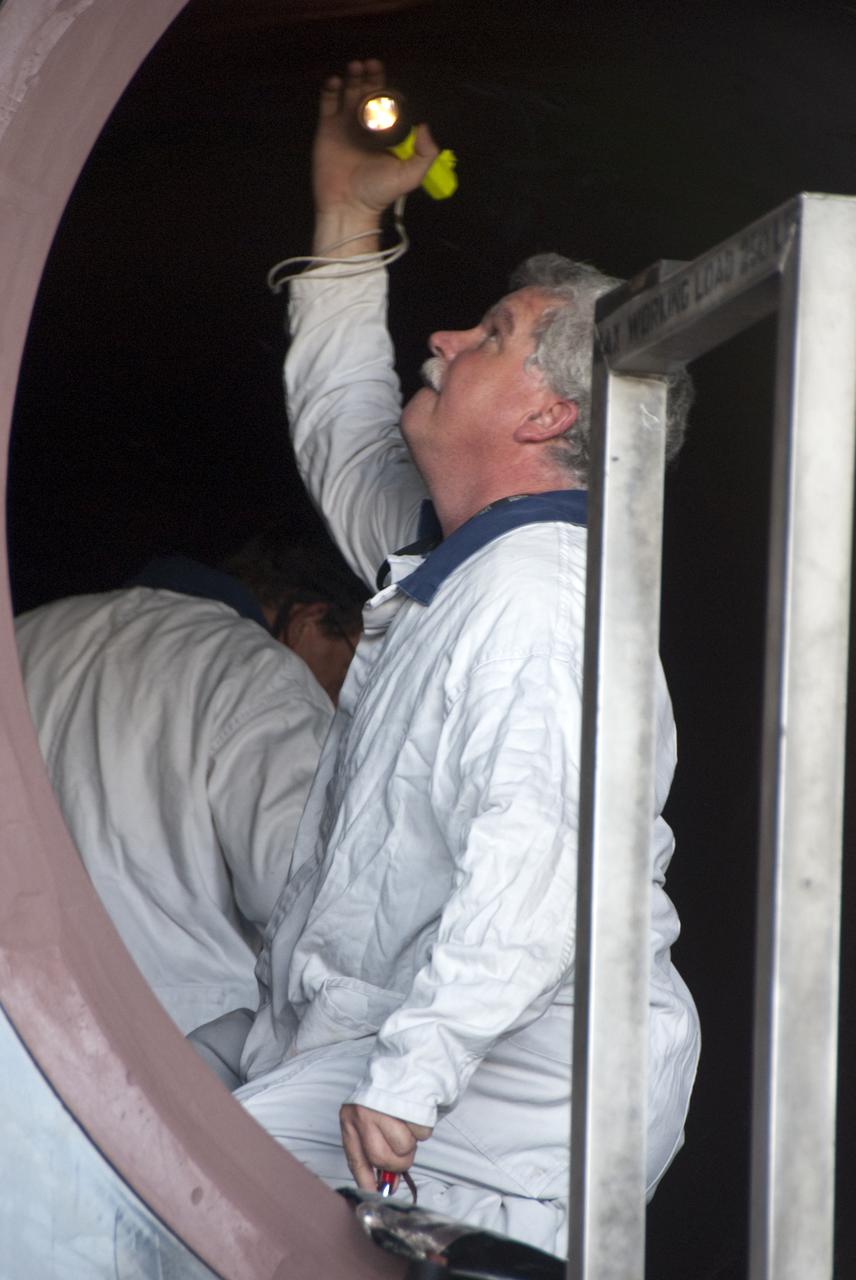
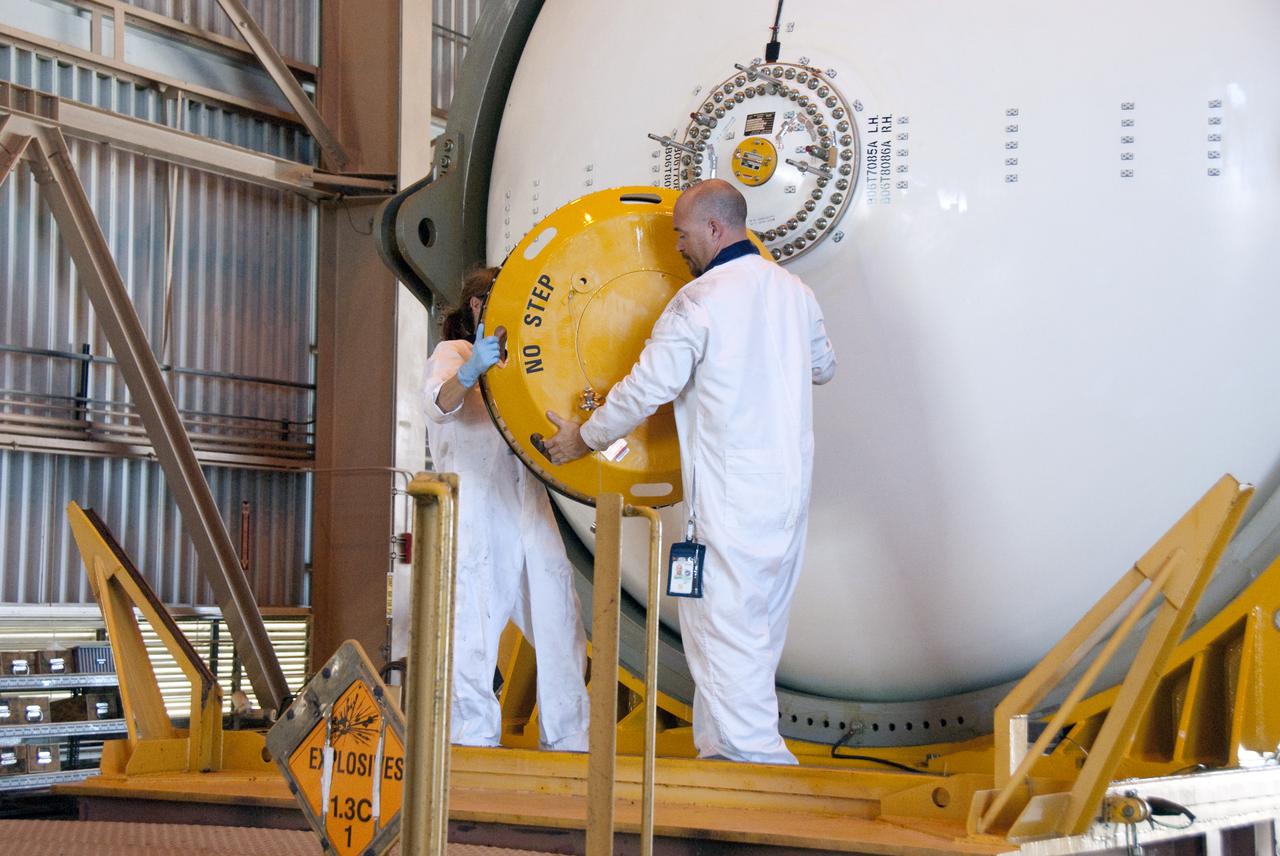
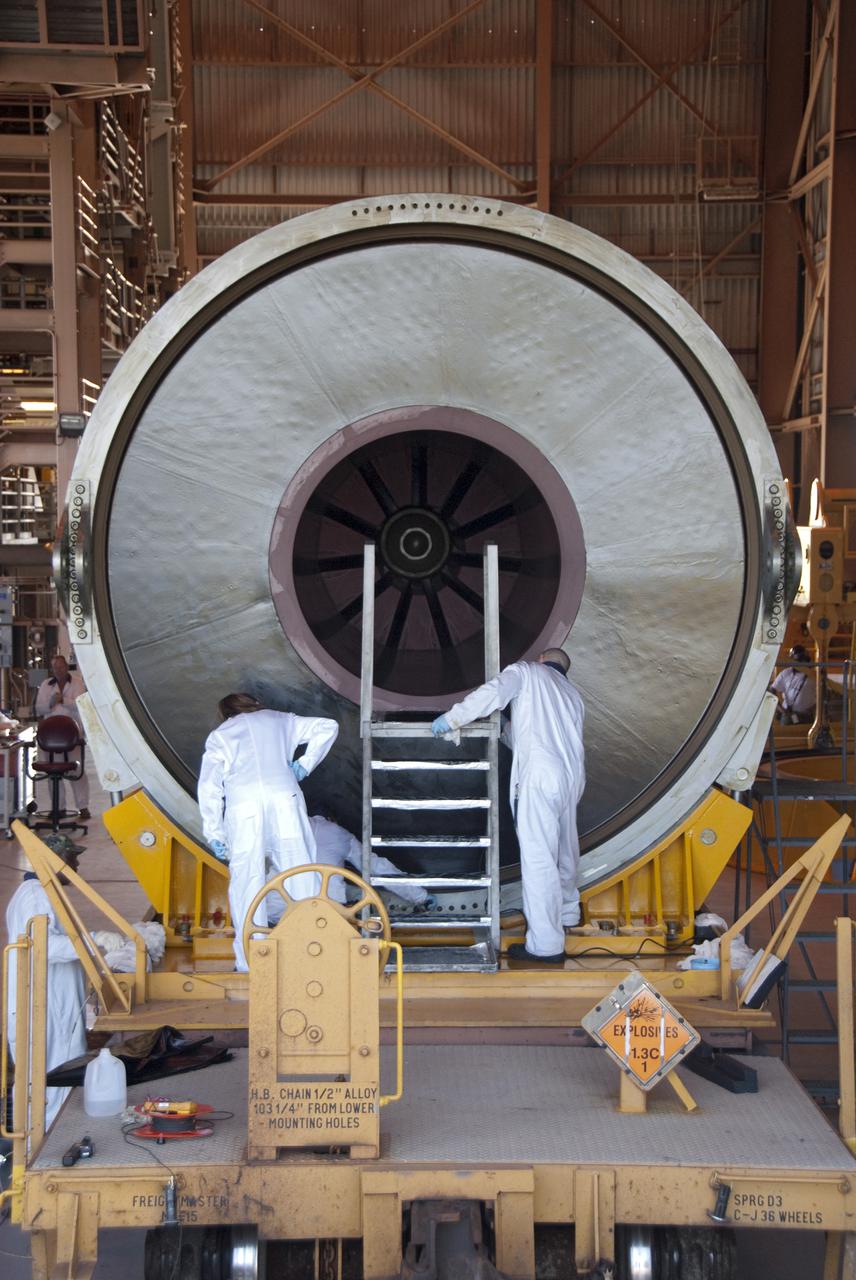
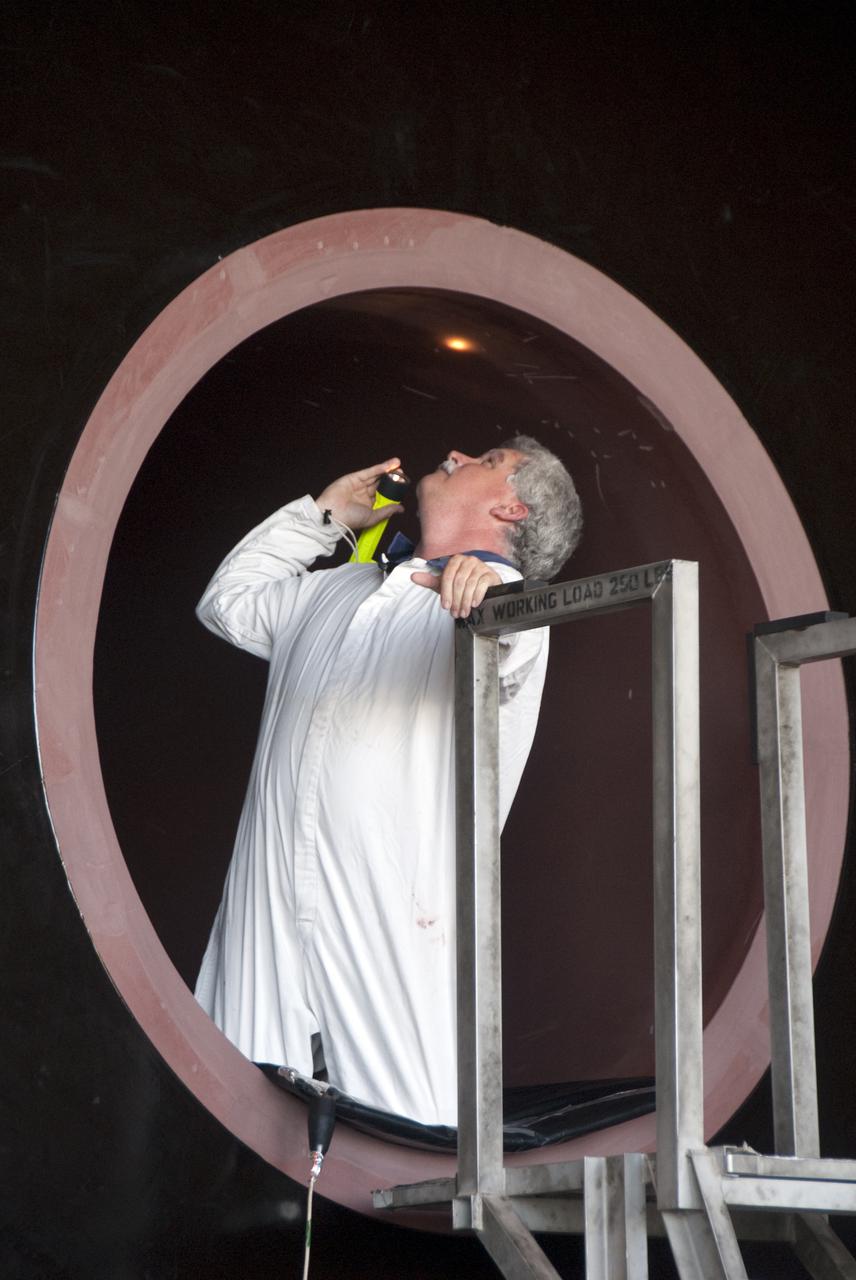
CAPE CANAVERAL, Fla. -- In the Rotation, Processing and Surge Facility, or RSPF, at NASA's Kennedy Space Center in Florida, workers perform the propellant grain inspection of the final solid rocket booster segments, which is a required safety analysis. The booster segments were manufactured at the ATK solid rocket booster plant in Promontory, Utah, and traveled to Kennedy along the Florida East Coast Railway.  The booster segments will be stacked and then mated to space shuttle Atlantis and its external fuel tank in the Vehicle Assembly Building. The segments will be used for what currently is planned as the 'launch on need,' or potential rescue mission for the final shuttle flight, Endeavour's STS-134 mission. For information, visit www.nasa.gov_shuttle. Photo credit: NASA_Cory Huston
KSC-2010-3771
CAPE CANAVERAL, Fla. –  At Hangar AF at Cape Canaveral Air Force Station in Florida, workers inspect the aft section of one of two spent solid rocket boosters from space shuttle Endeavour, which launched Nov. 14 on the STS-126 mission.  The space shuttle’s solid rocket booster casings and associated flight hardware are recovered at sea after being jettisoned. The boosters impact the Atlantic Ocean approximately seven minutes after liftoff. After their recovery and transport to Hangar AF, the boosters are cleaned, inspected, disassembled, refurbished and reloaded with solid propellant for reuse.  Photo credit: NASA/Jim Grossmann
KSC-08pd3764
CAPE CANAVERAL, Fla. –   At Hangar AF at Cape Canaveral Air Force Station in Florida, the frustum from two spent solid rocket boosters from space shuttle Endeavour, which launched Nov. 14 on the STS-126 mission, wait to be examined.  The space shuttle’s solid rocket booster casings and associated flight hardware are recovered at sea after being jettisoned. The boosters impact the Atlantic Ocean approximately seven minutes after liftoff. After their recovery and transport to Hangar AF, the boosters are cleaned, inspected, disassembled, refurbished and reloaded with solid propellant for reuse.  Photo credit: NASA/Jim Grossmann
KSC-08pd3765
CAPE CANAVERAL, Fla. -- In the Rotation, Processing and Surge Facility, or RSPF, at NASA's Kennedy Space Center in Florida, a worker performs the propellant grain inspection of the final solid rocket booster segments, which is a required safety analysis. The booster segments were manufactured at the ATK solid rocket booster plant in Promontory, Utah, and traveled to Kennedy along the Florida East Coast Railway.  The booster segments will be stacked and then mated to space shuttle Atlantis and its external fuel tank in the Vehicle Assembly Building. The segments will be used for what currently is planned as the 'launch on need,' or potential rescue mission for the final shuttle flight, Endeavour's STS-134 mission. For information, visit www.nasa.gov_shuttle. Photo credit: NASA_Cory Huston
KSC-2010-3768
CAPE CANAVERAL, Fla. -- In the Rotation, Processing and Surge Facility, or RSPF, at NASA's Kennedy Space Center in Florida, workers prepare for the propellant grain inspection of the final solid rocket booster segments, which is a required safety analysis. The booster segments were manufactured at the ATK solid rocket booster plant in Promontory, Utah, and traveled to Kennedy along the Florida East Coast Railway.  The booster segments will be stacked and then mated to space shuttle Atlantis and its external fuel tank in the Vehicle Assembly Building. The segments will be used for what currently is planned as the 'launch on need,' or potential rescue mission for the final shuttle flight, Endeavour's STS-134 mission. For information, visit www.nasa.gov_shuttle. Photo credit: NASA_Cory Huston
KSC-2010-3766
CAPE CANAVERAL, Fla. -- In the Rotation, Processing and Surge Facility, or RSPF, at NASA's Kennedy Space Center in Florida, workers prepare for the propellant grain inspection of the final solid rocket booster segments, which is a required safety analysis. The booster segments were manufactured at the ATK solid rocket booster plant in Promontory, Utah, and traveled to Kennedy along the Florida East Coast Railway.  The booster segments will be stacked and then mated to space shuttle Atlantis and its external fuel tank in the Vehicle Assembly Building. The segments will be used for what currently is planned as the 'launch on need,' or potential rescue mission for the final shuttle flight, Endeavour's STS-134 mission. For information, visit www.nasa.gov_shuttle. Photo credit: NASA_Cory Huston
KSC-2010-3765
CAPE CANAVERAL, Fla. –  At Hangar AF at Cape Canaveral Air Force Station in Florida, two spent solid rocket boosters from space shuttle Endeavour, which launched Nov. 14 on the STS-126 mission, move into the hangar for inspection. The space shuttle’s solid rocket booster casings and associated flight hardware are recovered at sea after being jettisoned. The boosters impact the Atlantic Ocean approximately seven minutes after liftoff. After their recovery and transport to Hangar AF, the boosters are cleaned, inspected, disassembled, refurbished and reloaded with solid propellant for reuse.  Photo credit: NASA/Jim Grossmann
KSC-08pd3763
CAPE CANAVERAL, Fla. -- In the Rotation, Processing and Surge Facility, or RSPF, at NASA's Kennedy Space Center in Florida, workers perform the propellant grain inspection of the final solid rocket booster segments, which is a required safety analysis. The booster segments were manufactured at the ATK solid rocket booster plant in Promontory, Utah, and traveled to Kennedy along the Florida East Coast Railway.  The booster segments will be stacked and then mated to space shuttle Atlantis and its external fuel tank in the Vehicle Assembly Building. The segments will be used for what currently is planned as the 'launch on need,' or potential rescue mission for the final shuttle flight, Endeavour's STS-134 mission. For information, visit www.nasa.gov_shuttle. Photo credit: NASA_Cory Huston
KSC-2010-3770
CAPE CANAVERAL, Fla. -- In the Rotation, Processing and Surge Facility, or RSPF, at NASA's Kennedy Space Center in Florida, a worker performs the propellant grain inspection of the final solid rocket booster segments, which is a required safety analysis. The booster segments were manufactured at the ATK solid rocket booster plant in Promontory, Utah, and traveled to Kennedy along the Florida East Coast Railway.  The booster segments will be stacked and then mated to space shuttle Atlantis and its external fuel tank in the Vehicle Assembly Building. The segments will be used for what currently is planned as the 'launch on need,' or potential rescue mission for the final shuttle flight, Endeavour's STS-134 mission. For information, visit www.nasa.gov_shuttle. Photo credit: NASA_Cory Huston
KSC-2010-3767
CAPE CANAVERAL, Fla. -- In the Rotation, Processing and Surge Facility, or RSPF, at NASA's Kennedy Space Center in Florida, workers perform the propellant grain inspection of the final solid rocket booster segments, which is a required safety analysis. The booster segments were manufactured at the ATK solid rocket booster plant in Promontory, Utah, and traveled to Kennedy along the Florida East Coast Railway.  The booster segments will be stacked and then mated to space shuttle Atlantis and its external fuel tank in the Vehicle Assembly Building. The segments will be used for what currently is planned as the 'launch on need,' or potential rescue mission for the final shuttle flight, Endeavour's STS-134 mission. For information, visit www.nasa.gov_shuttle. Photo credit: NASA_Cory Huston
KSC-2010-3769
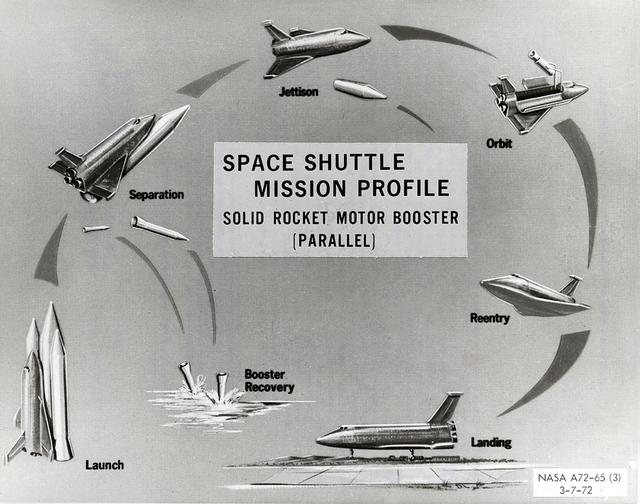
This early chart conceptualizes the use of two parallel Solid Rocket Motor Boosters in conjunction with three main engines to launch the proposed Space Shuttle to orbit. At approximately twenty-five miles altitude, the boosters would detach from the Orbiter and parachute back to Earth where they would be recovered and refurbished for future use. The Shuttle was designed as NASA's first reusable space vehicle, launching vertically like a spacecraft and landing on runways like conventional aircraft. Marshall Space Flight Center had management responsibility for the Shuttle's propulsion elements, including the Solid Rocket Boosters.
Space Shuttle Project
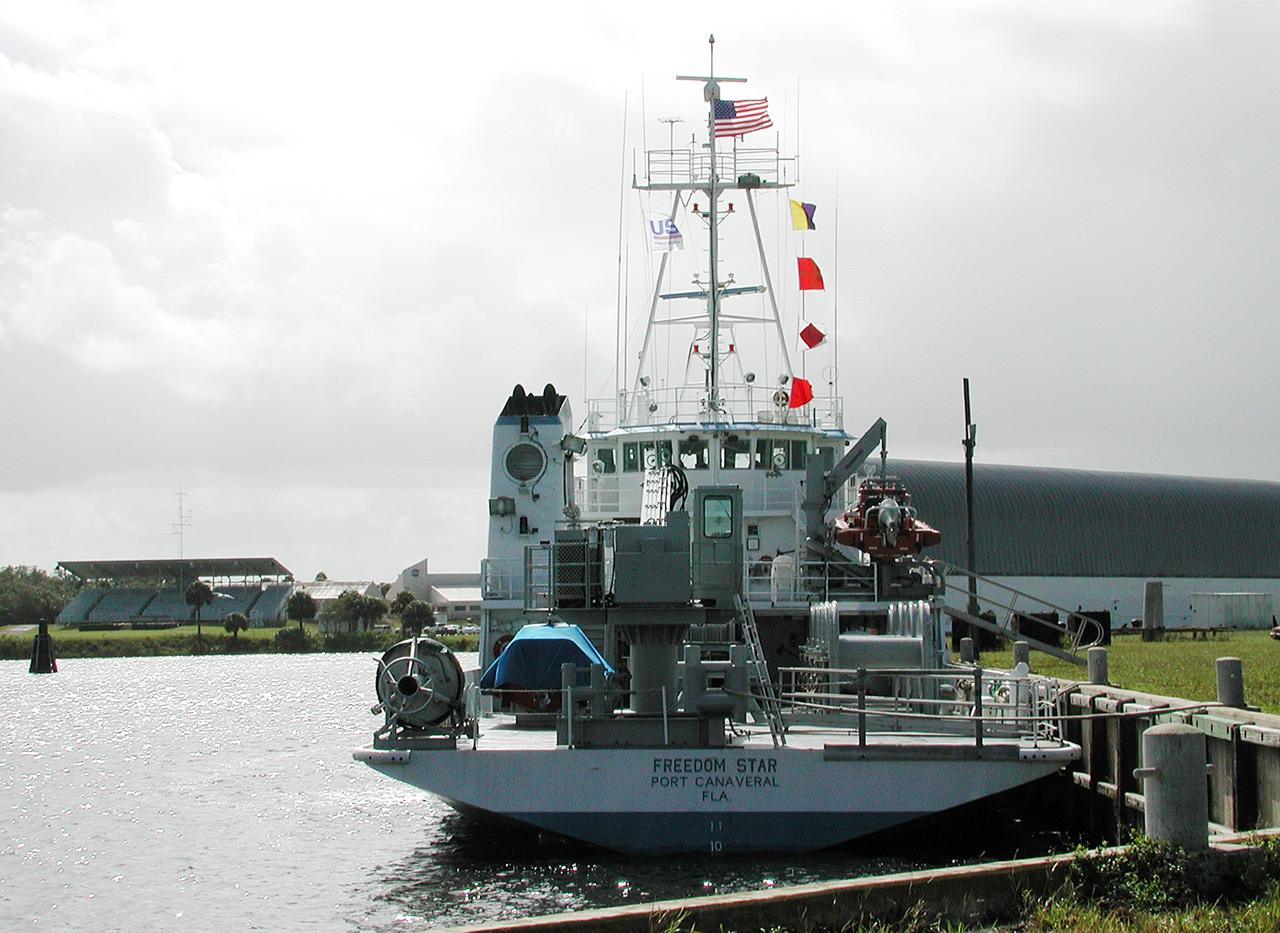
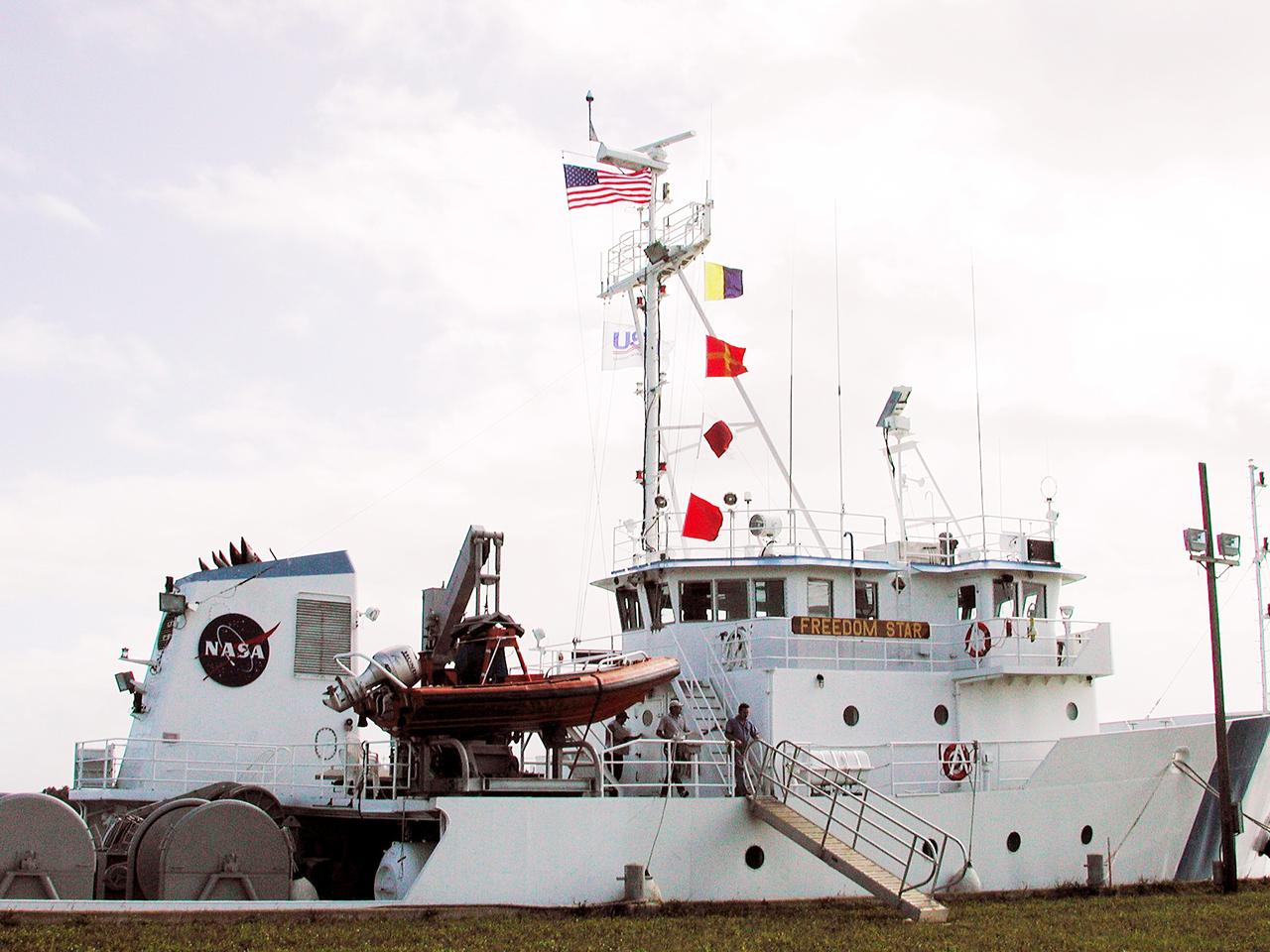
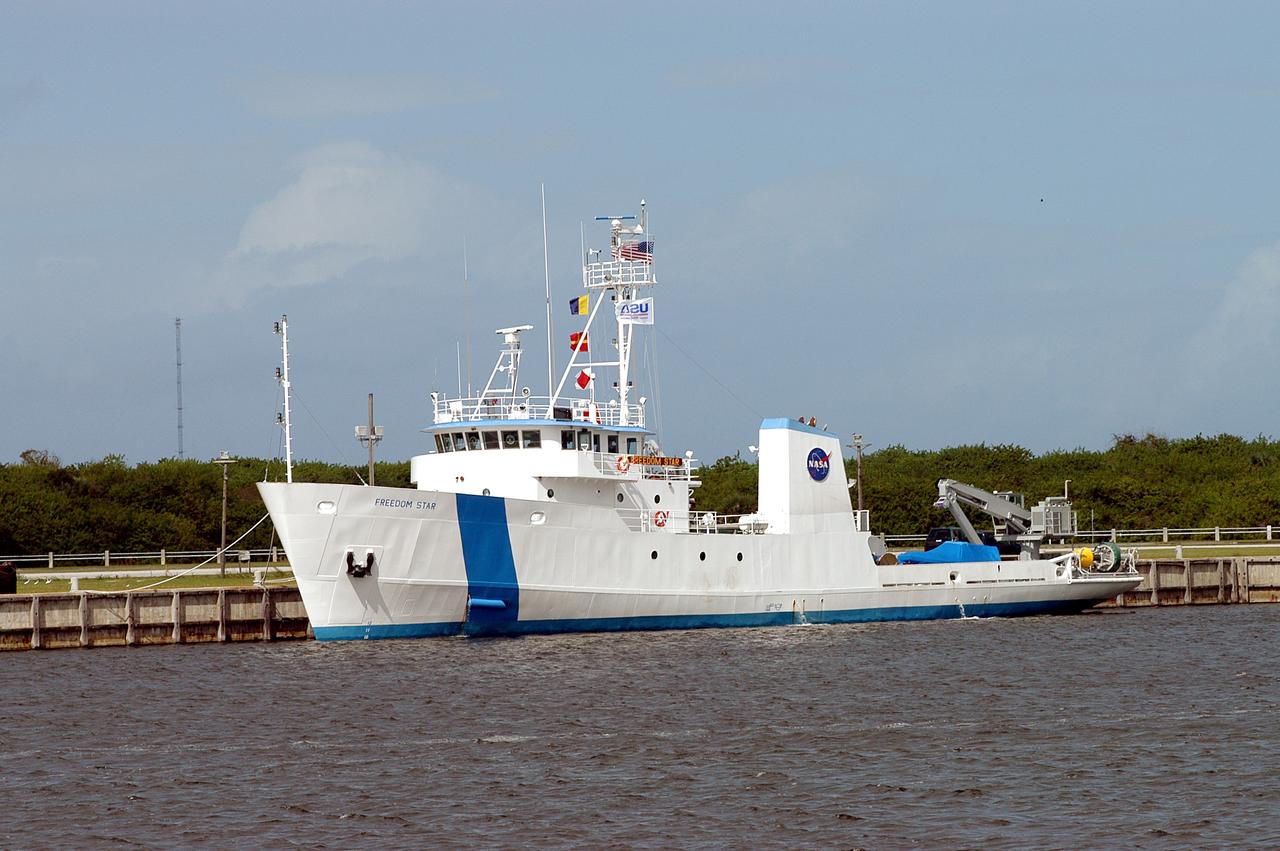
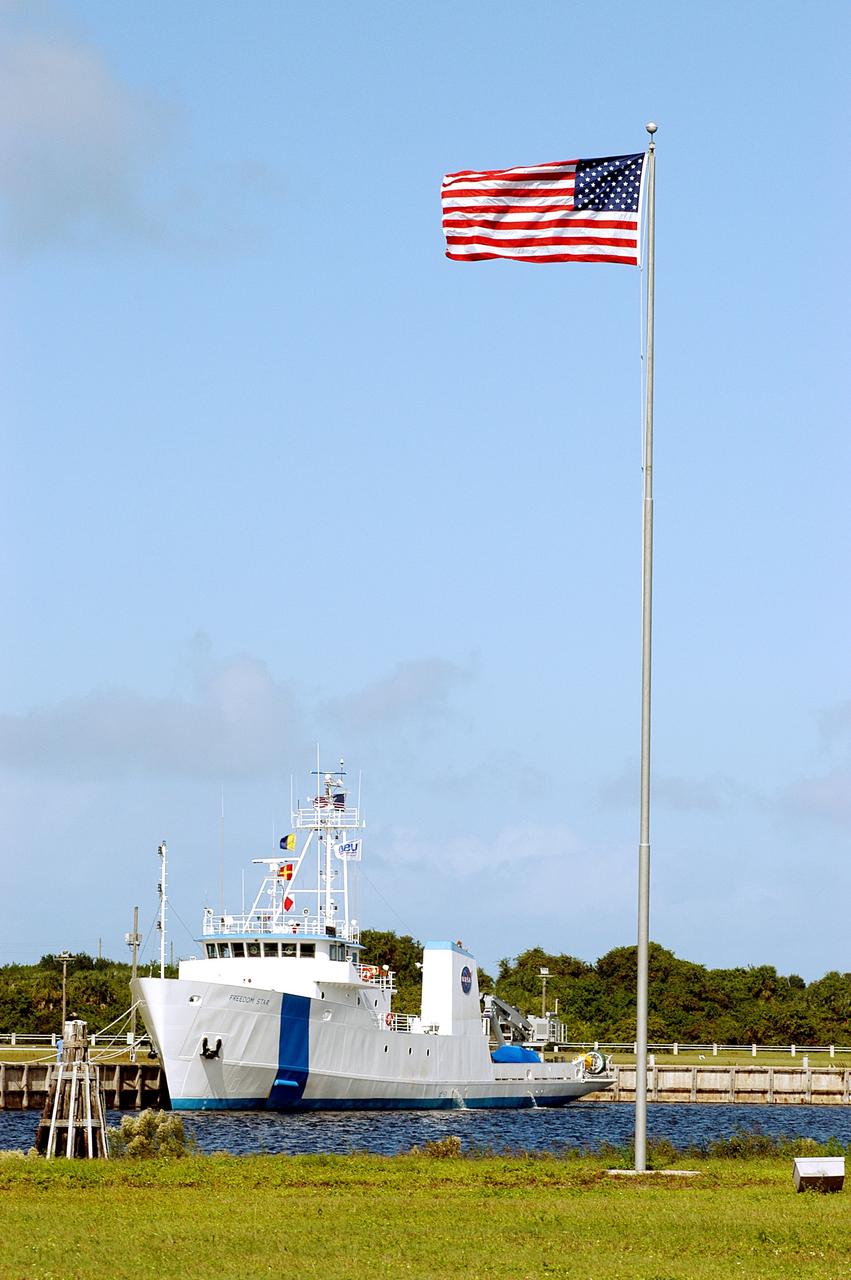
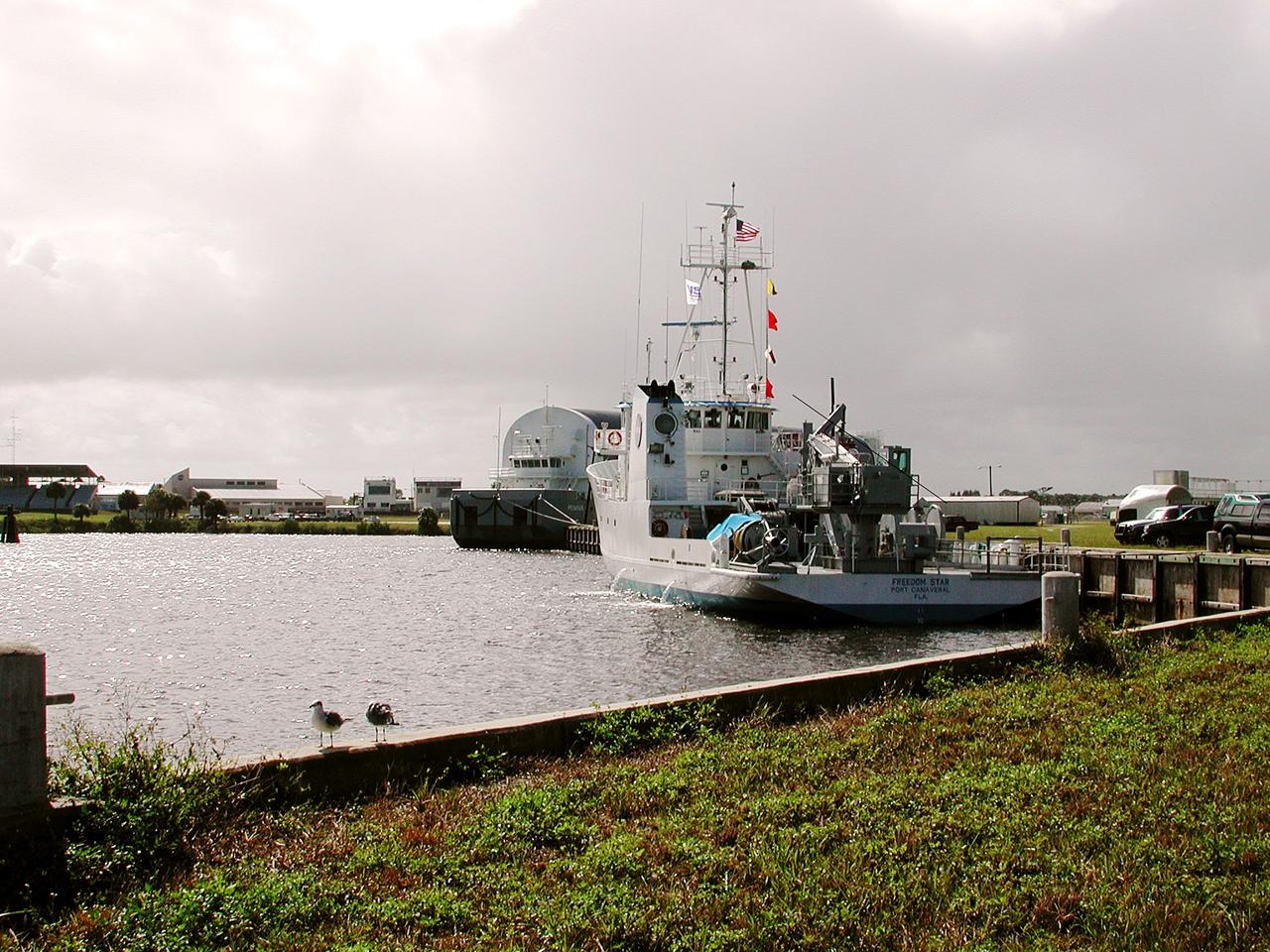
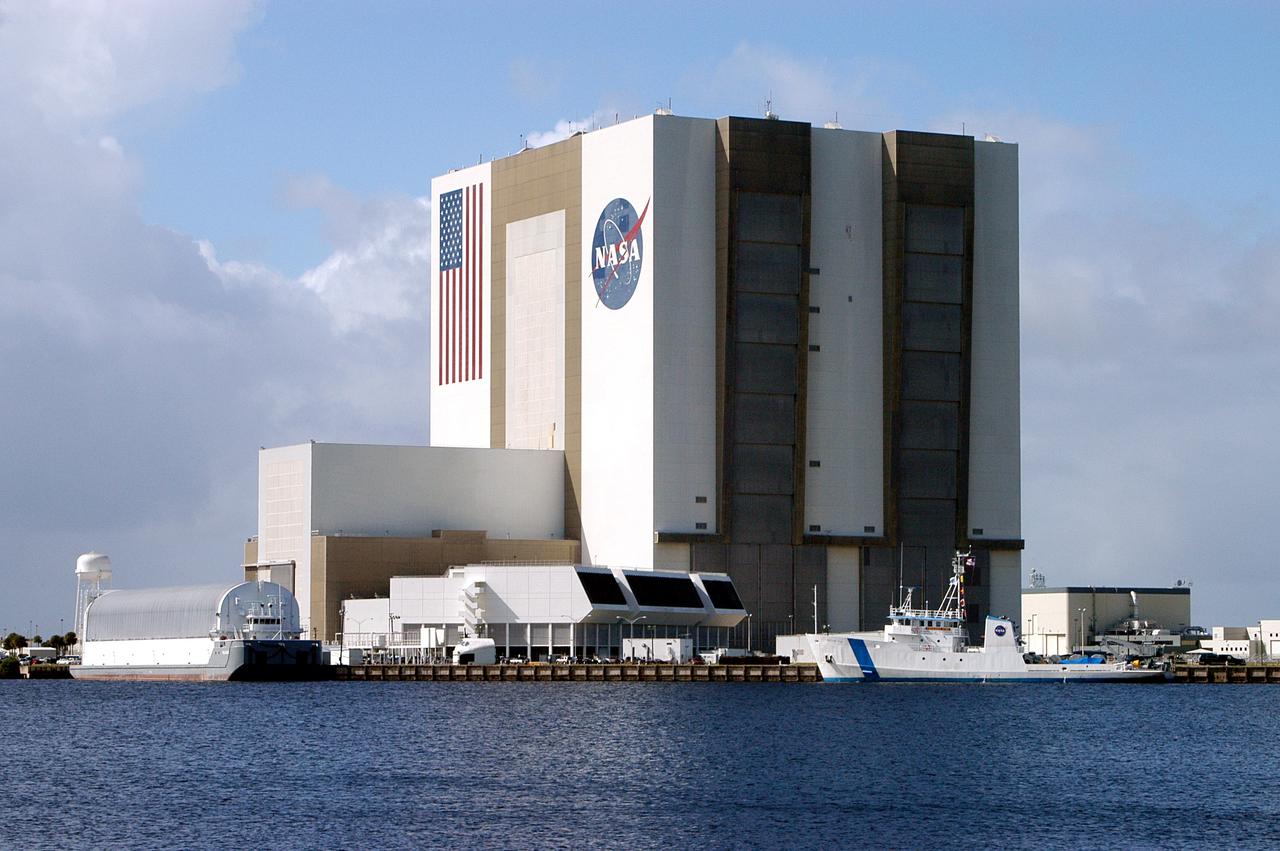
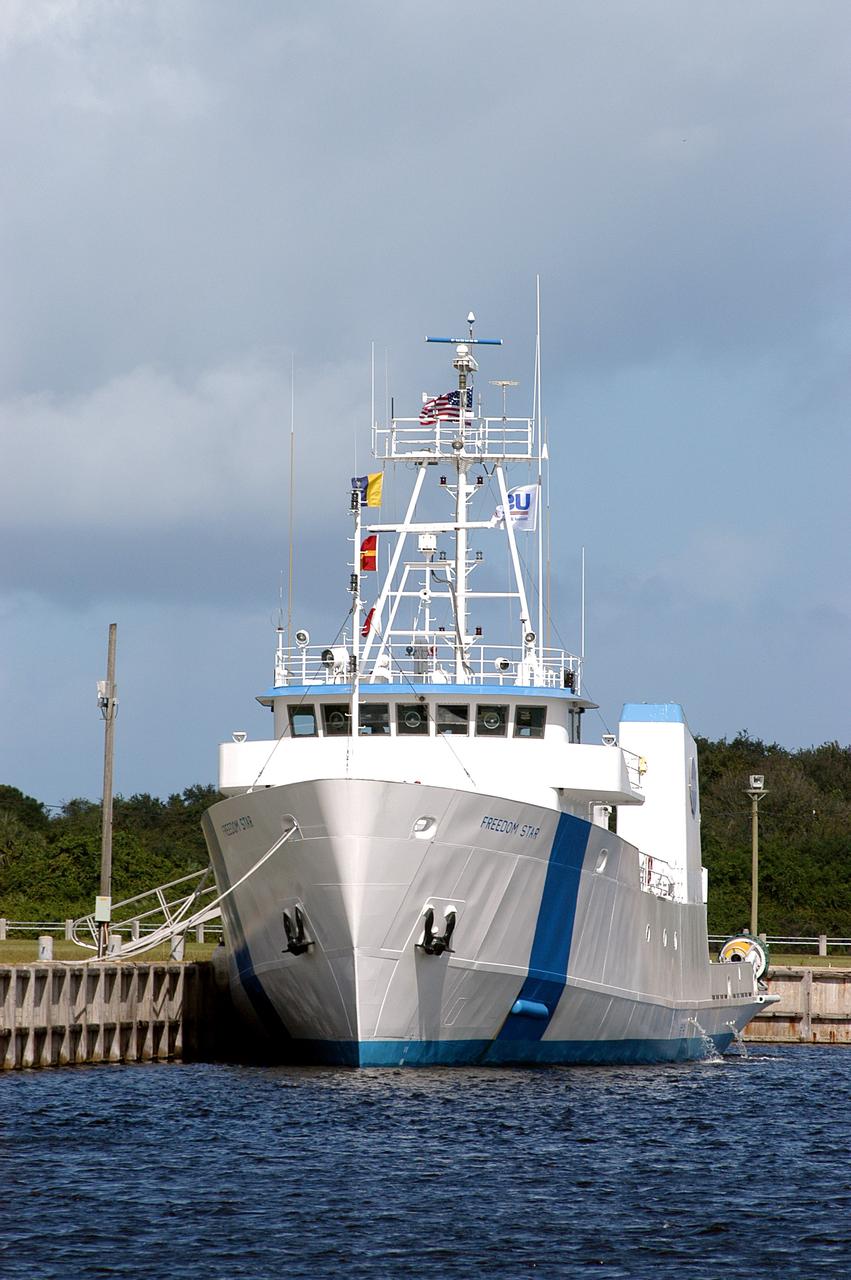
KENNEDY SPACE CENTER, FLA. -  The Freedom Star is berthed at the Turn Basin near the Vehicle Assembly Building.  The ship has recently returned to KSC after refurbishment at Fort George Island, Fla., including new paint.  Freedom Star is one of the solid rocket booster (SRB) retrieval ships built to recover the SRB casings released over the Atlantic Ocean after launch of a Space Shuttle.  In addition to the SRBs, the ship recovers the drogue and main parachutes that slow the boosters’ speed before splashdown.  Some of the retrieval equipment can be seen on the rear deck.  The ships also tow the external tanks built at the Michoud Space Systems Assembly Facility near New Orleans to Port Canaveral, Fla.  Freedom Star was brought to KSC today for a visit by NATO Parliamentarians.
KENNEDY SPACE CENTER, FLA. - The Freedom Star is berthed at the Turn Basin near the Vehicle Assembly Building. The ship has recently returned to KSC after refurbishment at Fort George Island, Fla., including new paint. Freedom Star is one of the solid rocket booster (SRB) retrieval ships built to recover the SRB casings released over the Atlantic Ocean after launch of a Space Shuttle. In addition to the SRBs, the ship recovers the drogue and main parachutes that slow the boosters’ speed before splashdown. Some of the retrieval equipment can be seen on the rear deck. The ships also tow the external tanks built at the Michoud Space Systems Assembly Facility near New Orleans to Port Canaveral, Fla. Freedom Star was brought to KSC today for a visit by NATO Parliamentarians.
KENNEDY SPACE CENTER, FLA. - The Freedom Star is berthed at the Turn Basin near the Vehicle Assembly Building.  The ship has recently returned to KSC after refurbishment at Fort George Island, Fla., including new paint.  Freedom Star is one of the solid rocket booster (SRB) retrieval ships built to recover the SRB casings released over the Atlantic Ocean after launch of a Space Shuttle.  In addition to the SRBs, the ship recovers the drogue and main parachutes that slow the boosters’ speed before splashdown.  Some of the retrieval equipment can be seen on the rear deck.  The ships also tow the external tanks built at the Michoud Space Systems Assembly Facility near New Orleans to Port Canaveral, Fla.  Freedom Star was brought to KSC today for a visit by NATO Parliamentarians.
KENNEDY SPACE CENTER, FLA. - The Freedom Star is berthed at the Turn Basin near the Vehicle Assembly Building. The ship has recently returned to KSC after refurbishment at Fort George Island, Fla., including new paint. Freedom Star is one of the solid rocket booster (SRB) retrieval ships built to recover the SRB casings released over the Atlantic Ocean after launch of a Space Shuttle. In addition to the SRBs, the ship recovers the drogue and main parachutes that slow the boosters’ speed before splashdown. Some of the retrieval equipment can be seen on the rear deck. The ships also tow the external tanks built at the Michoud Space Systems Assembly Facility near New Orleans to Port Canaveral, Fla. Freedom Star was brought to KSC today for a visit by NATO Parliamentarians.
KENNEDY SPACE CENTER, FLA. - The Freedom Star is berthed at the Turn Basin near the Vehicle Assembly Building.  The ship has recently returned to KSC after refurbishment at Fort George Island, Fla., including new paint.  Freedom Star is one of the solid rocket booster (SRB) retrieval ships built to recover the SRB casings released over the Atlantic Ocean after launch of a Space Shuttle.  In addition to the SRBs, the ship recovers the drogue and main parachutes that slow the boosters’ speed before splashdown.  Some of the retrieval equipment can be seen on the rear deck.  The ships also tow the external tanks built at the Michoud Space Systems Assembly Facility near New Orleans to Port Canaveral, Fla.  Freedom Star was brought to KSC today for a visit by NATO Parliamentarians.
KENNEDY SPACE CENTER, FLA. - The Freedom Star is berthed at the Turn Basin near the Vehicle Assembly Building. The ship has recently returned to KSC after refurbishment at Fort George Island, Fla., including new paint. Freedom Star is one of the solid rocket booster (SRB) retrieval ships built to recover the SRB casings released over the Atlantic Ocean after launch of a Space Shuttle. In addition to the SRBs, the ship recovers the drogue and main parachutes that slow the boosters’ speed before splashdown. Some of the retrieval equipment can be seen on the rear deck. The ships also tow the external tanks built at the Michoud Space Systems Assembly Facility near New Orleans to Port Canaveral, Fla. Freedom Star was brought to KSC today for a visit by NATO Parliamentarians.
KENNEDY SPACE CENTER, FLA. - The Freedom Star is berthed at the Turn Basin near the Vehicle Assembly Building.  The ship has recently returned to KSC after refurbishment at Fort George Island, Fla., including new paint.  Freedom Star is one of the solid rocket booster (SRB) retrieval ships built to recover the SRB casings released over the Atlantic Ocean after launch of a Space Shuttle.  In addition to the SRBs, the ship recovers the drogue and main parachutes that slow the boosters’ speed before splashdown.  The ships also tow the external tanks built at the Michoud Space Systems Assembly Facility near New Orleans to Port Canaveral, Fla.  Freedom Star was brought to KSC today for a visit by NATO Parliamentarians.
KENNEDY SPACE CENTER, FLA. - The Freedom Star is berthed at the Turn Basin near the Vehicle Assembly Building. The ship has recently returned to KSC after refurbishment at Fort George Island, Fla., including new paint. Freedom Star is one of the solid rocket booster (SRB) retrieval ships built to recover the SRB casings released over the Atlantic Ocean after launch of a Space Shuttle. In addition to the SRBs, the ship recovers the drogue and main parachutes that slow the boosters’ speed before splashdown. The ships also tow the external tanks built at the Michoud Space Systems Assembly Facility near New Orleans to Port Canaveral, Fla. Freedom Star was brought to KSC today for a visit by NATO Parliamentarians.
KENNEDY SPACE CENTER, FLA. -  The Freedom Star is berthed at the Turn Basin near the Vehicle Assembly Building and NASA-KSC News Center.  The flag is near the News Center.   The ship has recently returned to KSC after refurbishment at Fort George Island, Fla., including new paint.  Freedom Star is one of the solid rocket booster (SRB) retrieval ships built to recover the SRB casings released over the Atlantic Ocean after launch of a Space Shuttle.  In addition to the SRBs, the ship recovers the drogue and main parachutes that slow the boosters’ speed before splashdown.   The ships also tow the external tanks built at the Michoud Space Systems Assembly Facility near New Orleans to Port Canaveral, Fla.  Freedom Star was brought to KSC today for a visit by NATO Parliamentarians.
KENNEDY SPACE CENTER, FLA. - The Freedom Star is berthed at the Turn Basin near the Vehicle Assembly Building and NASA-KSC News Center. The flag is near the News Center. The ship has recently returned to KSC after refurbishment at Fort George Island, Fla., including new paint. Freedom Star is one of the solid rocket booster (SRB) retrieval ships built to recover the SRB casings released over the Atlantic Ocean after launch of a Space Shuttle. In addition to the SRBs, the ship recovers the drogue and main parachutes that slow the boosters’ speed before splashdown. The ships also tow the external tanks built at the Michoud Space Systems Assembly Facility near New Orleans to Port Canaveral, Fla. Freedom Star was brought to KSC today for a visit by NATO Parliamentarians.
KENNEDY SPACE CENTER, FLA. - The Freedom Star is berthed at the Turn Basin near the Vehicle Assembly Building.  The ship has recently returned to KSC after refurbishment at Fort George Island, Fla., including new paint.  Freedom Star is one of the solid rocket booster (SRB) retrieval ships built to recover the SRB casings released over the Atlantic Ocean after launch of a Space Shuttle.  In addition to the SRBs, the ship recovers the drogue and main parachutes that slow the boosters’ speed before splashdown.  Some of the retrieval equipment can be seen on the rear deck.  The ships also tow the external tanks built at the Michoud Space Systems Assembly Facility near New Orleans to Port Canaveral, Fla.  Freedom Star was brought to KSC today for a visit by NATO Parliamentarians.
KENNEDY SPACE CENTER, FLA. - The Freedom Star is berthed at the Turn Basin near the Vehicle Assembly Building. The ship has recently returned to KSC after refurbishment at Fort George Island, Fla., including new paint. Freedom Star is one of the solid rocket booster (SRB) retrieval ships built to recover the SRB casings released over the Atlantic Ocean after launch of a Space Shuttle. In addition to the SRBs, the ship recovers the drogue and main parachutes that slow the boosters’ speed before splashdown. Some of the retrieval equipment can be seen on the rear deck. The ships also tow the external tanks built at the Michoud Space Systems Assembly Facility near New Orleans to Port Canaveral, Fla. Freedom Star was brought to KSC today for a visit by NATO Parliamentarians.
KENNEDY SPACE CENTER, FLA. -  The Freedom Star is berthed at the Turn Basin near the Vehicle Assembly Building.  The ship has recently returned to KSC after refurbishment at Fort George Island, Fla., including new paint.  Freedom Star is one of the solid rocket booster (SRB) retrieval ships built to recover the SRB casings released over the Atlantic Ocean after launch of a Space Shuttle.  In addition to the SRBs, the ship recovers the drogue and main parachutes that slow the boosters’ speed before splashdown.   The ships also tow the external tanks built at the Michoud Space Systems Assembly Facility near New Orleans to Port Canaveral, Fla.  Freedom Star was brought to KSC today for a visit by NATO Parliamentarians.
KENNEDY SPACE CENTER, FLA. - The Freedom Star is berthed at the Turn Basin near the Vehicle Assembly Building. The ship has recently returned to KSC after refurbishment at Fort George Island, Fla., including new paint. Freedom Star is one of the solid rocket booster (SRB) retrieval ships built to recover the SRB casings released over the Atlantic Ocean after launch of a Space Shuttle. In addition to the SRBs, the ship recovers the drogue and main parachutes that slow the boosters’ speed before splashdown. The ships also tow the external tanks built at the Michoud Space Systems Assembly Facility near New Orleans to Port Canaveral, Fla. Freedom Star was brought to KSC today for a visit by NATO Parliamentarians.
KENNEDY SPACE CENTER, FLA. -- The solid rocket booster retrieval ship Freedom Star is temporarily docked at Port Canaveral while the booster it was towing is moved alongside for the remainder of the trip upriver to Cape Canaveral Air Force Station.  Freedom Star retrieved the booster after the launch of space shuttle Atlantis' STS-122 mission.  The space shuttle's solid rocket booster casings and associated flight hardware are recovered at sea. The boosters impact the Atlantic Ocean approximately seven minutes after liftoff. The splashdown area is a square of about 6 by 9 nautical miles located about 140 nautical miles downrange from the launch pad. The retrieval ships are stationed approximately 8 to 10 nautical miles from the impact area at the time of splashdown. As soon as the boosters enter the water, the ships accelerate to a speed of 15 knots and quickly close on the boosters. The pilot chutes and main parachutes are the first items to be brought on board. With the chutes and frustum recovered, attention turns to the boosters. The ship's tow line is connected and the booster is returned to the Port and, after transfer to a position alongside the ship, to Hangar AF at Cape Canaveral Air Force Station. There, the expended boosters are disassembled, refurbished and reloaded with solid propellant for reuse.  Photo credit: NASA/Jack Pfaller
KSC-08pd0263
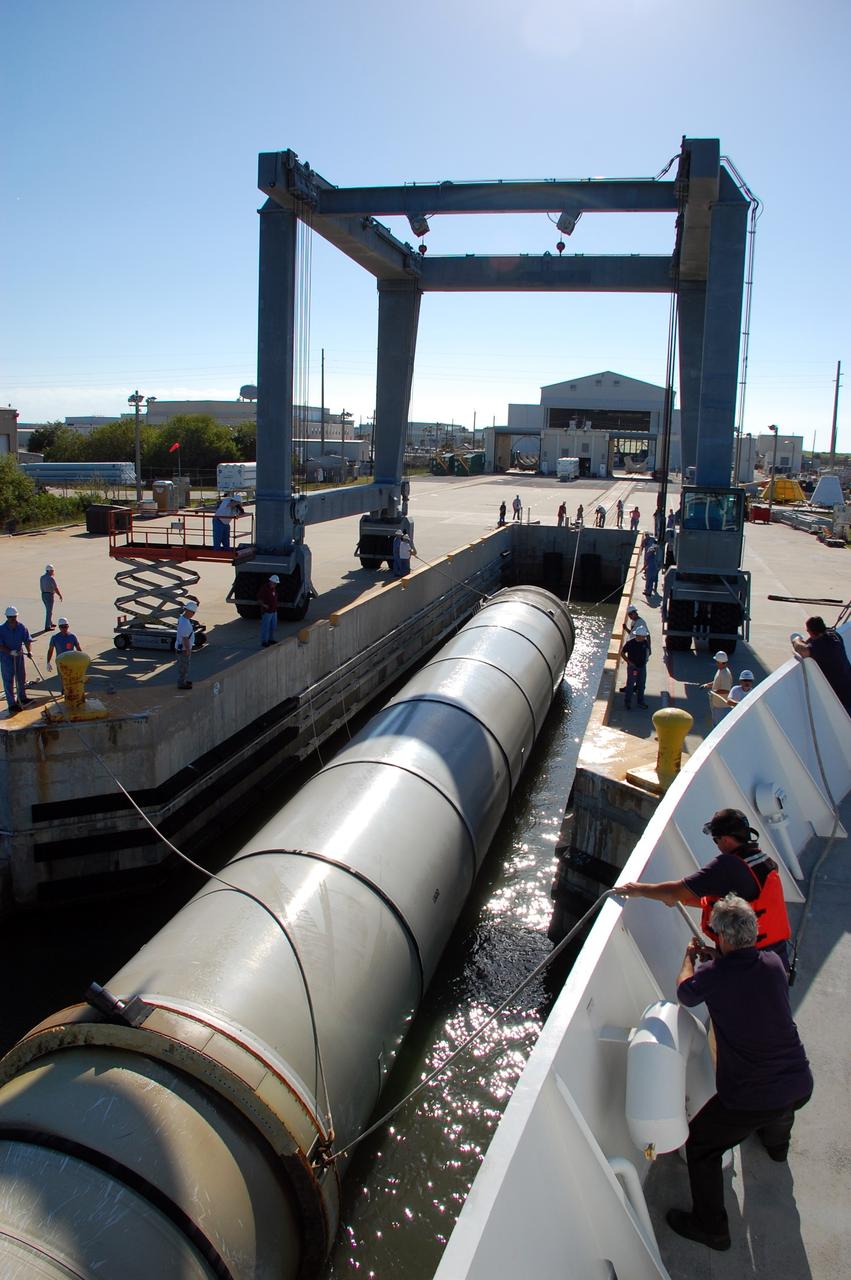
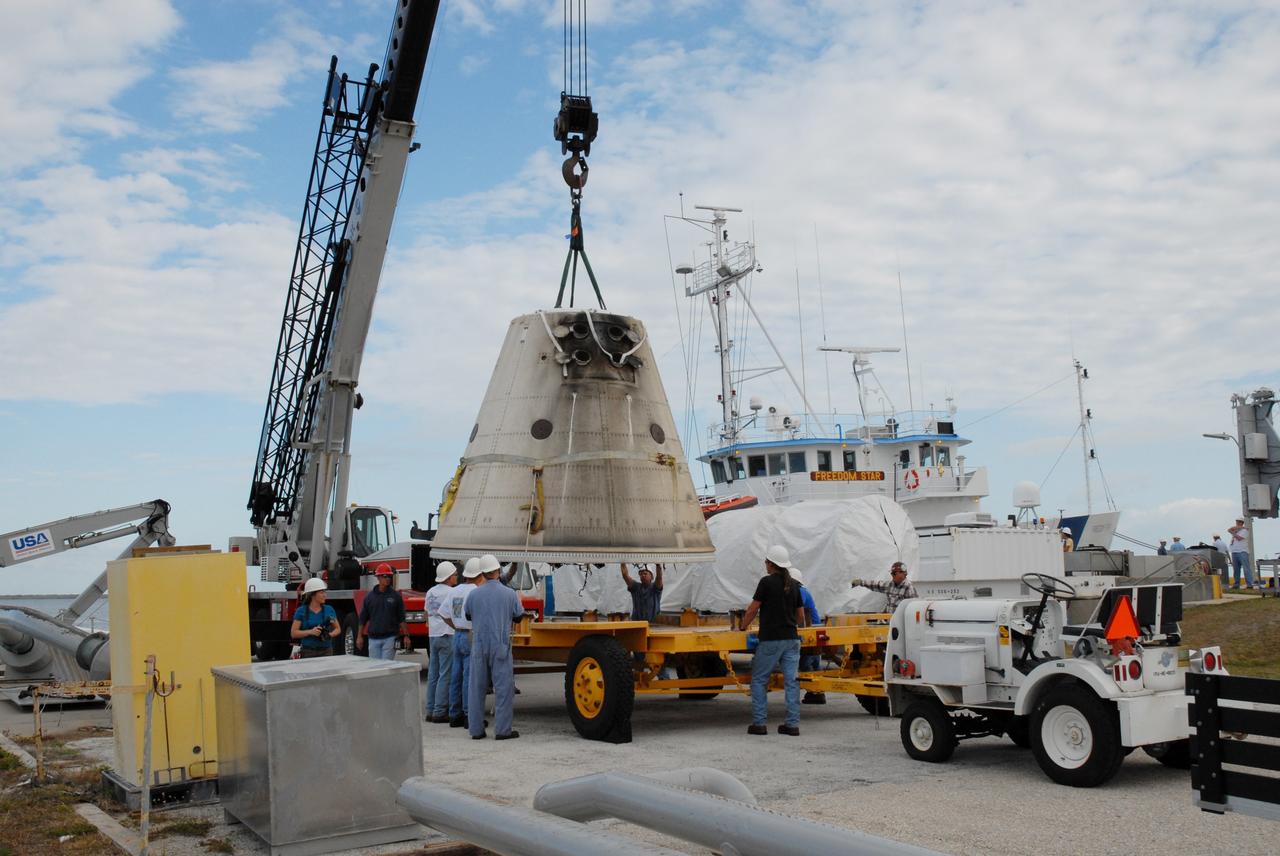
CAPE CANAVERAL, Fla. – At the dock at Hangar AF at Cape Canaveral Air Force Station in Florida, the solid rocket booster is lifted out of the water by the straddle crane.  The booster, used during space shuttle Discovery's launch from NASA's Kennedy Space Center in Florida March 15 on mission STS-119, will be placed on a transporter. The space shuttle’s solid rocket booster casings and associated flight hardware are recovered at sea after a launch. The spent rockets were recovered by NASA's Solid Rocket Booster Retrieval Ships Freedom Star and Liberty Star. The boosters impact the Atlantic Ocean approximately seven minutes after liftoff.  The splashdown area is a square of about six by nine nautical miles located about 140 nautical miles downrange from the launch pad. The retrieval ships are stationed approximately 8 to 10 nautical miles from the impact area at the time of splashdown. As soon as the boosters enter the water, the ships accelerate to a speed of 15 knots and quickly close on the boosters. The pilot chutes and main parachutes are the first items to be brought on board. With the chutes and frustum recovered, attention turns to the boosters. The ship’s tow line is connected and the booster is returned to the Port and, after transfer to a position alongside the ship, to Hangar AF. There, the expended boosters are disassembled, refurbished and reloaded with solid propellant for reuse.  Photo credit: NASA/Jack Pfaller
KSC-2009-2142
KENNEDY SPACE CENTER, FLA. -- The solid rocket booster retrieval ship Freedom Star is temporarily docked at Port Canaveral while the booster it was towing is moved alongside for the remainder of the trip upriver to Cape Canaveral Air Force Station.  Freedom Star retrieved the booster after the launch of space shuttle Atlantis' STS-122 mission. The space shuttle's solid rocket booster casings and associated flight hardware are recovered at sea. The boosters impact the Atlantic Ocean approximately seven minutes after liftoff. The splashdown area is a square of about 6 by 9 nautical miles located about 140 nautical miles downrange from the launch pad. The retrieval ships are stationed approximately 8 to 10 nautical miles from the impact area at the time of splashdown. As soon as the boosters enter the water, the ships accelerate to a speed of 15 knots and quickly close on the boosters. The pilot chutes and main parachutes are the first items to be brought on board. With the chutes and frustum recovered, attention turns to the boosters. The ship's tow line is connected and the booster is returned to the Port and, after transfer to a position alongside the ship, to Hangar AF at Cape Canaveral Air Force Station. There, the expended boosters are disassembled, refurbished and reloaded with solid propellant for reuse.  Photo credit: NASA/Jack Pfaller
KSC-08pd0262
CAPE CANAVERAL, Fla. – At the dock at Hangar AF at Cape Canaveral Air Force Station in Florida, the frustum of a solid rocket booster is moved onto a transporter.  The booster was used during space shuttle Discovery's launch on mission STS-119 from NASA's Kennedy Space Center in Florida March 15.  The space shuttle’s solid rocket booster casings and associated flight hardware are recovered at sea after a launch. The spent rockets were recovered by NASA's Solid Rocket Booster Retrieval Ships Freedom Star and Liberty Star. The boosters impact the Atlantic Ocean approximately seven minutes after liftoff.  The splashdown area is a square of about six by nine nautical miles located about 140 nautical miles downrange from the launch pad. The retrieval ships are stationed approximately 8 to 10 nautical miles from the impact area at the time of splashdown. As soon as the boosters enter the water, the ships accelerate to a speed of 15 knots and quickly close on the boosters. The pilot chutes and main parachutes are the first items to be brought on board. With the chutes and frustum recovered, attention turns to the boosters. The ship’s tow line is connected and the booster is returned to the Port and, after transfer to a position alongside the ship, to Hangar AF. There, the expended boosters are disassembled, refurbished and reloaded with solid propellant for reuse.  Photo credit: NASA/Jack Pfaller
KSC-2009-2140
CAPE CANAVERAL, Fla. – At the dock at Hangar AF at Cape Canaveral Air Force Station in Florida, the straddle crane lowers a solid rocket booster onto a transporter. The booster was used during space shuttle Discovery's launch from NASA's Kennedy Space Center in Florida March 15 on mission STS-119. The space shuttle’s solid rocket booster casings and associated flight hardware are recovered at sea after a launch. The spent rockets were recovered by NASA's Solid Rocket Booster Retrieval Ships Freedom Star and Liberty Star. The boosters impact the Atlantic Ocean approximately seven minutes after liftoff.  The splashdown area is a square of about six by nine nautical miles located about 140 nautical miles downrange from the launch pad. The retrieval ships are stationed approximately 8 to 10 nautical miles from the impact area at the time of splashdown. As soon as the boosters enter the water, the ships accelerate to a speed of 15 knots and quickly close on the boosters. The pilot chutes and main parachutes are the first items to be brought on board. With the chutes and frustum recovered, attention turns to the boosters. The ship’s tow line is connected and the booster is returned to the Port and, after transfer to a position alongside the ship, to Hangar AF. There, the expended boosters are disassembled, refurbished and reloaded with solid propellant for reuse.  Photo credit: NASA/Jack Pfaller
KSC-2009-2143
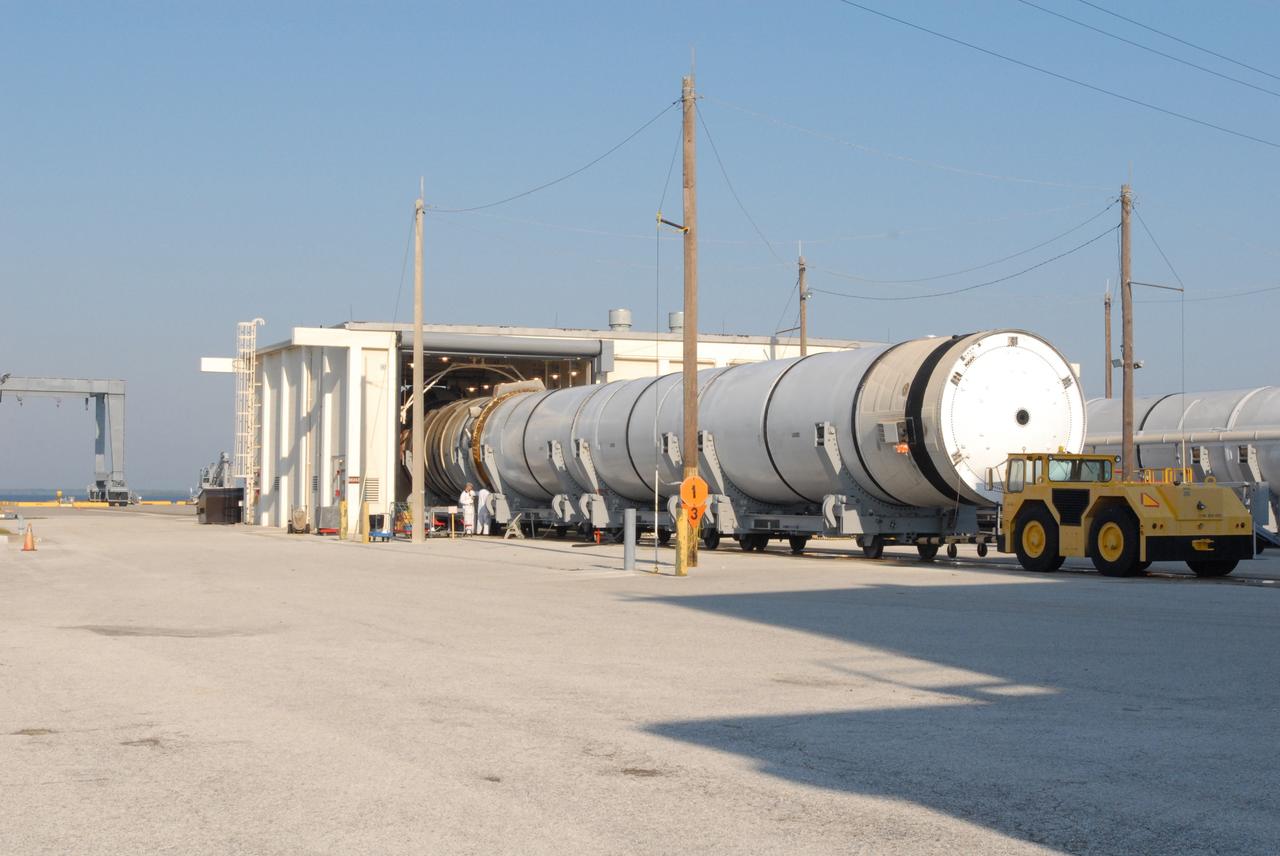
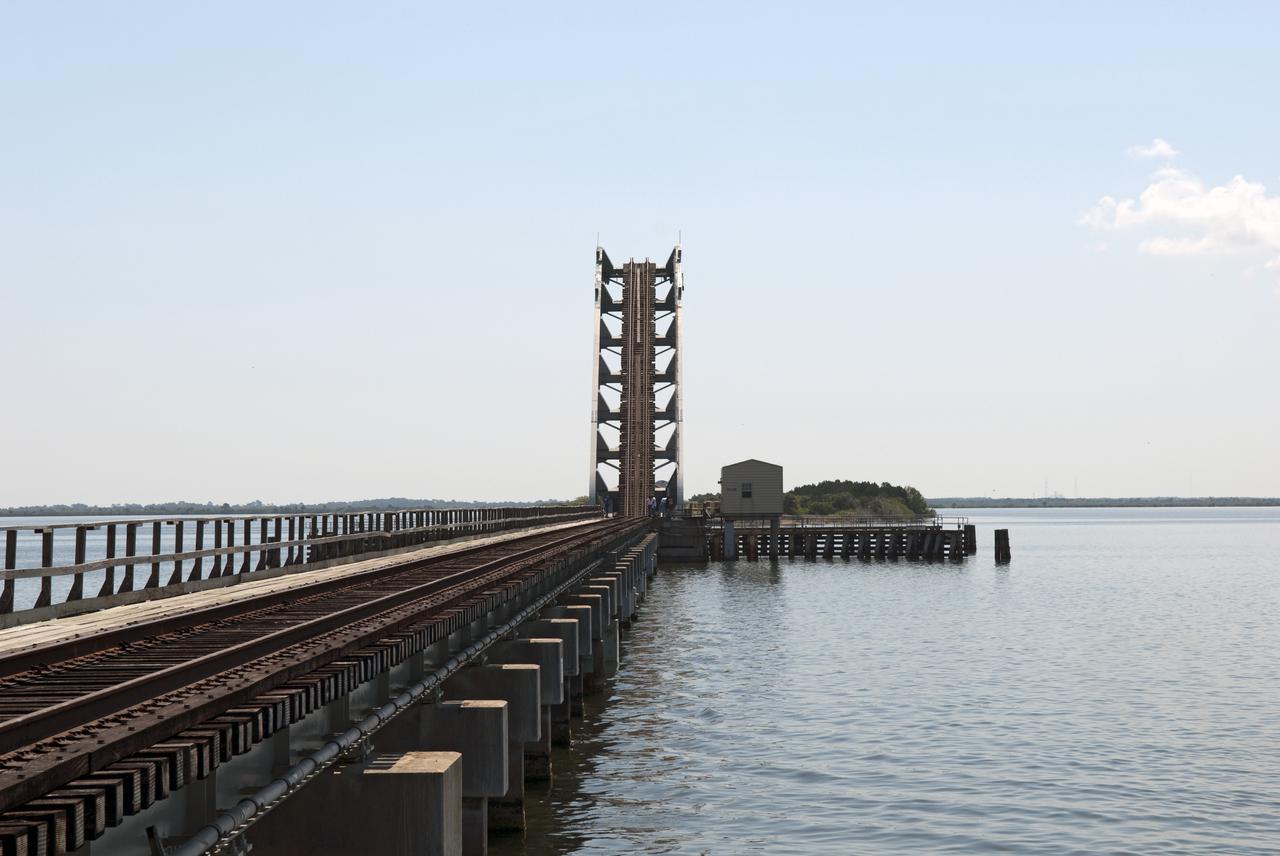
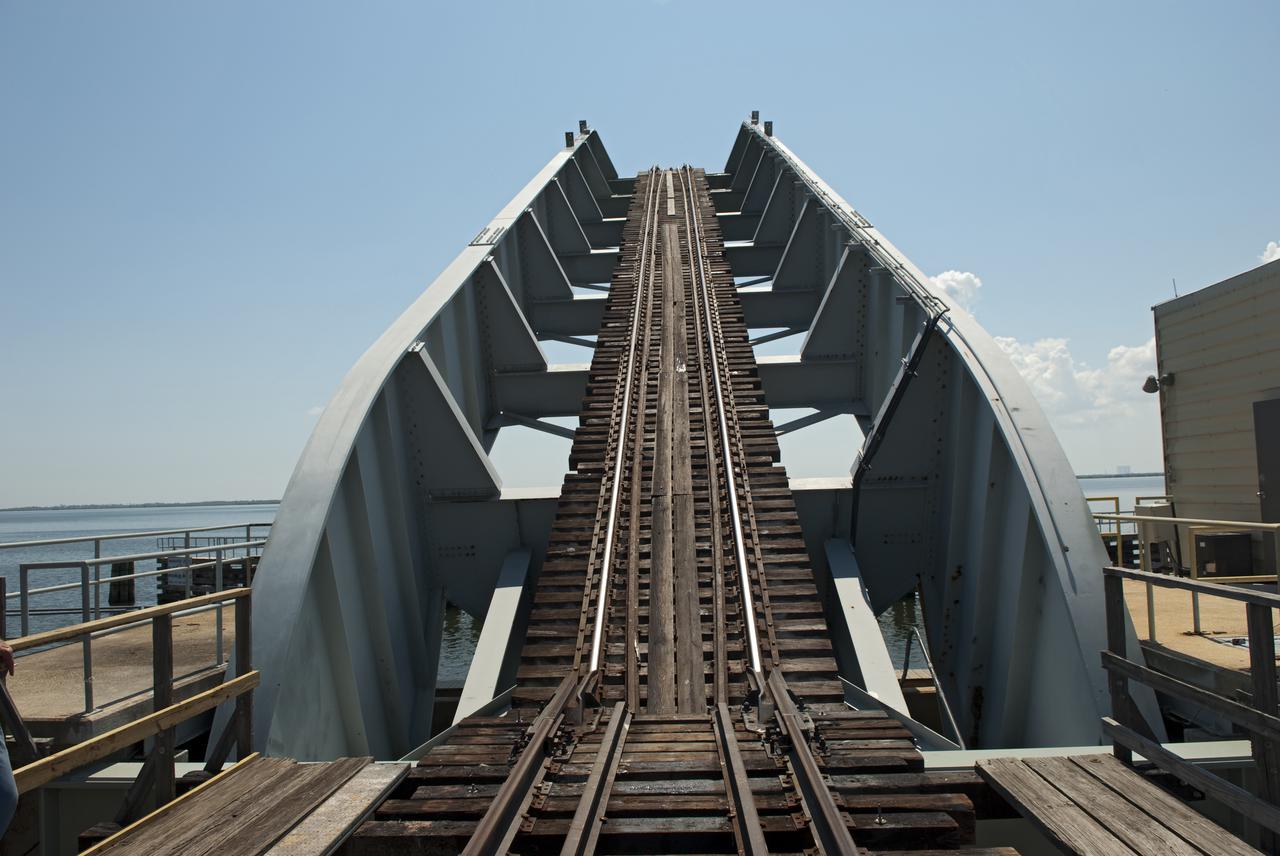
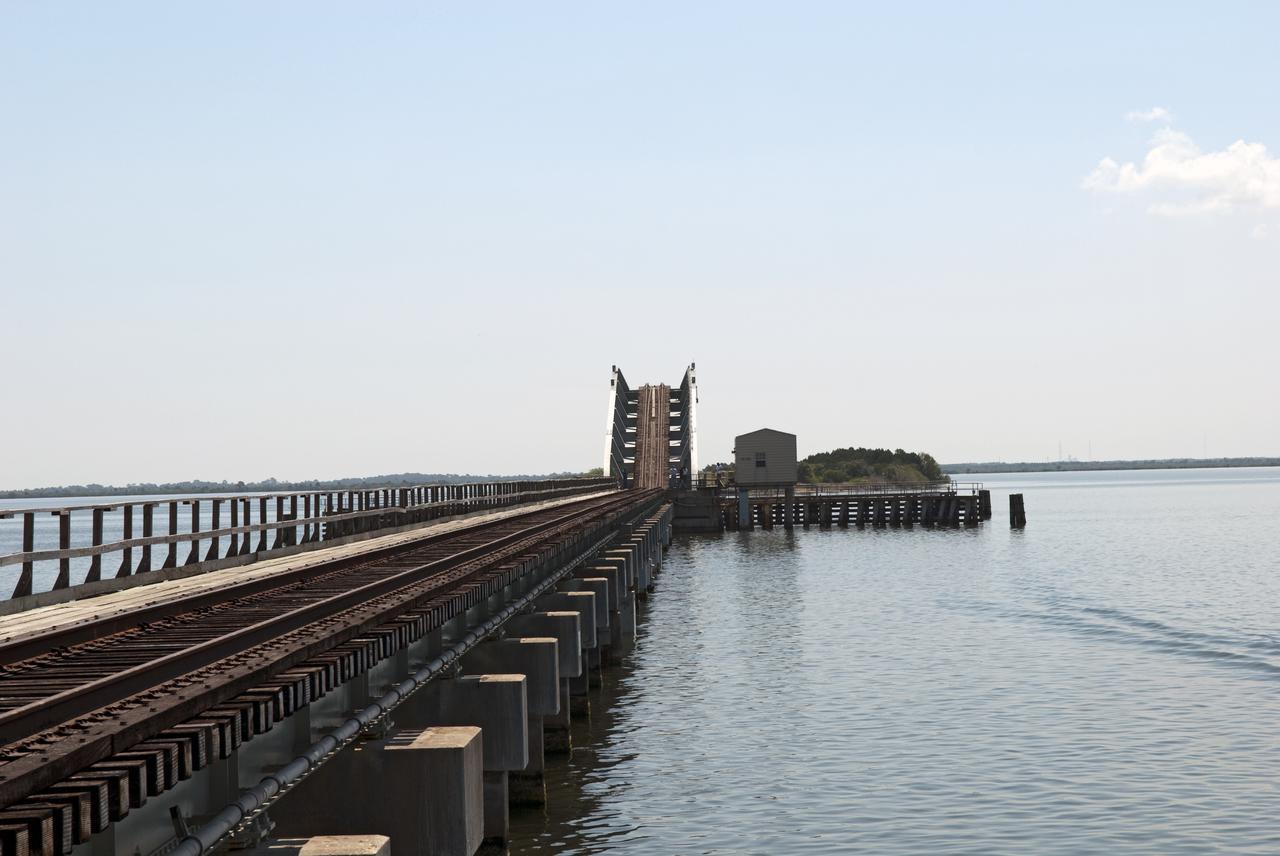
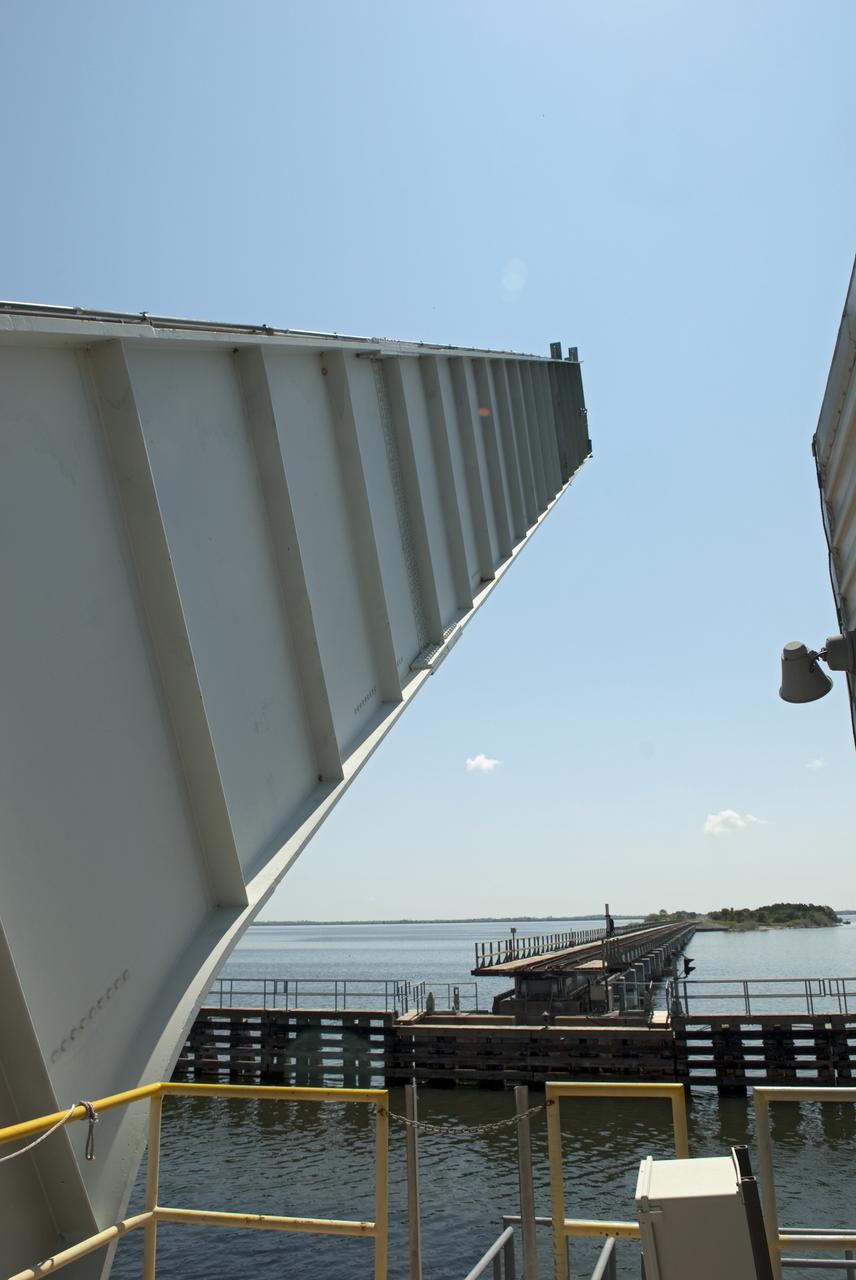
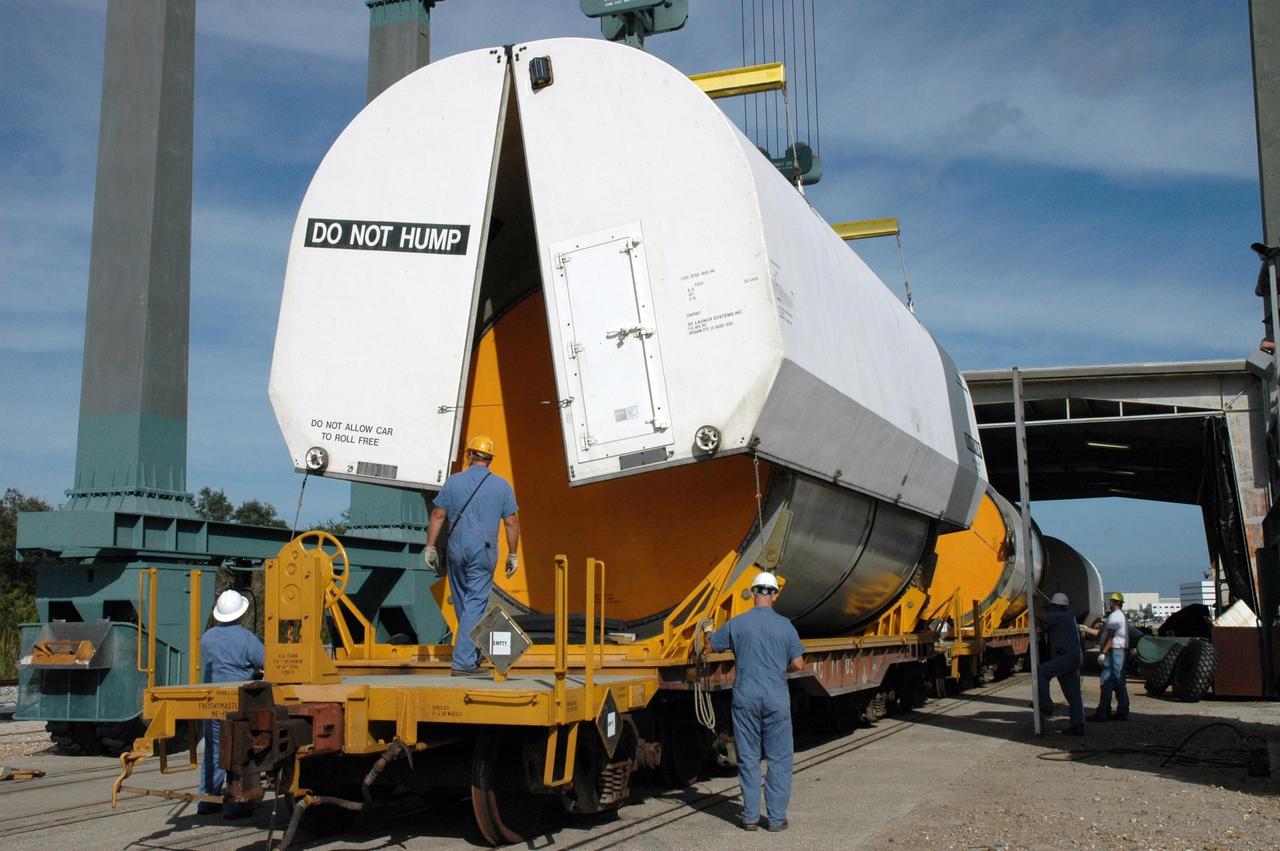
CAPE CANAVERAL, Fla. - The NASA Railroad draw bridge over the Indian River begins to close for the train carrying the last space shuttle solid rocket booster segments to NASA's Kennedy Space Center. Six cars transported the segments along the Florida East Coast Railway, which began at the ATK solid rocket booster plant in Promontory, Utah.  The booster segments will be used for shuttle Atlantis on what currently is planned as the 'launch on need,' or potential rescue mission for the final shuttle flight, Endeavour's STS-134 mission.  For information, visit www.nasa.gov_shuttle. Photo credit: NASA_Jim Grossmann
KSC-2010-3645
CAPE CANAVERAL, Fla. - The NASA Railroad draw bridge over the Indian River begins to close for the train carrying the last space shuttle solid rocket booster segments to NASA's Kennedy Space Center. Six cars transported the segments along the Florida East Coast Railway, which began at the ATK solid rocket booster plant in Promontory, Utah.  The booster segments will be used for shuttle Atlantis on what currently is planned as the 'launch on need,' or potential rescue mission for the final shuttle flight, Endeavour's STS-134 mission.  For information, visit www.nasa.gov_shuttle. Photo credit: NASA_Jim Grossmann
KSC-2010-3647
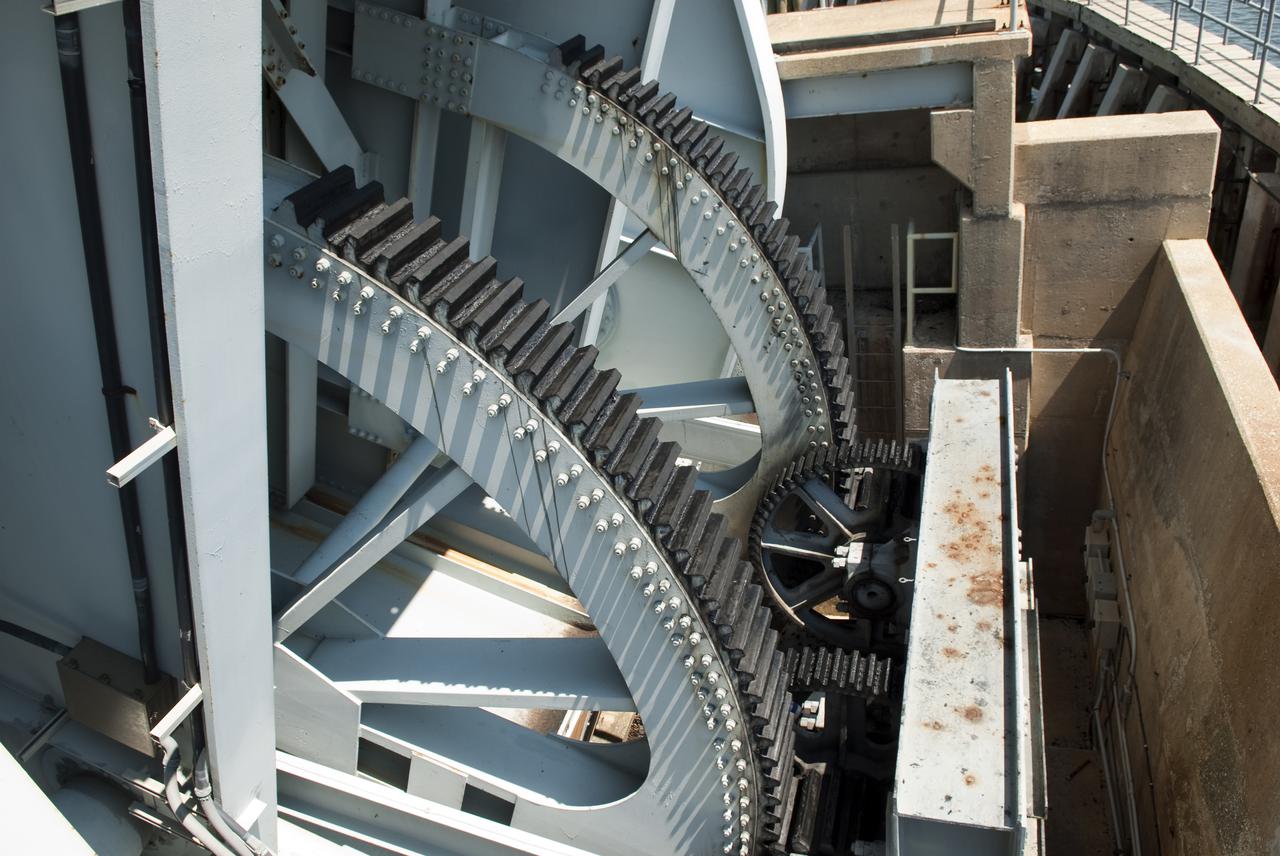
CAPE CANAVERAL, Fla. - Gears close the NASA Railroad draw bridge over the Indian River for the train carrying the last space shuttle solid rocket booster segments to NASA's Kennedy Space Center. Six cars transported the segments along the Florida East Coast Railway, which began at the ATK solid rocket booster plant in Promontory, Utah.  The booster segments will be used for shuttle Atlantis on what currently is planned as the 'launch on need,' or potential rescue mission for the final shuttle flight, Endeavour's STS-134 mission.  For information, visit www.nasa.gov_shuttle. Photo credit: NASA_Jim Grossmann
KSC-2010-3648
CAPE CANAVERAL, Fla. - The NASA Railroad train transports the last space shuttle solid rocket booster segments over the Indian River on the 13-mile trip from the Jay Jay Rail Yard in Titusville, Fla., to NASA's Kennedy Space Center. Six cars transported the segments along the Florida East Coast Railway, which began at the ATK solid rocket booster plant in Promontory, Utah.  The booster segments will be used for shuttle Atlantis on what currently is planned as the 'launch on need,' or potential rescue mission for the final shuttle flight, Endeavour's STS-134 mission.  For information, visit www.nasa.gov_shuttle. Photo credit: NASA_Jim Grossmann
KSC-2010-3643
CAPE CANAVERAL, Fla. - The NASA Railroad train transports the last space shuttle solid rocket booster segments over the Indian River on the 13-mile trip from the Jay Jay Rail Yard in Titusville, Fla., to NASA's Kennedy Space Center. Six cars transported the segments along the Florida East Coast Railway, which began at the ATK solid rocket booster plant in Promontory, Utah.  The booster segments will be used for shuttle Atlantis on what currently is planned as the 'launch on need,' or potential rescue mission for the final shuttle flight, Endeavour's STS-134 mission.  For information, visit www.nasa.gov_shuttle. Photo credit: NASA_Jim Grossmann
KSC-2010-3642
CAPE CANAVERAL, Fla. - At the Jay Jay Rail Yard in Titusville, Fla., the NASA Railroad train is ready to carry the last space shuttle solid rocket booster segments into NASA's Kennedy Space Center. The white railings on the orange spacer cars ensure clearance on their journey. Six cars transported the segments along the Florida East Coast Railway, which began at the ATK solid rocket booster plant in Promontory, Utah.  The booster segments will be used for shuttle Atlantis on what currently is planned as the 'launch on need,' or potential rescue mission for the final shuttle flight, Endeavour's STS-134 mission.  For information, visit www.nasa.gov_shuttle. Photo credit: NASA_Jim Grossmann
KSC-2010-3641
CAPE CANAVERAL, Fla. - The NASA Railroad draw bridge over the Indian River begins to close for the train carrying the last space shuttle solid rocket booster segments to NASA's Kennedy Space Center. Six cars transported the segments along the Florida East Coast Railway, which began at the ATK solid rocket booster plant in Promontory, Utah.  The booster segments will be used for shuttle Atlantis on what currently is planned as the 'launch on need,' or potential rescue mission for the final shuttle flight, Endeavour's STS-134 mission.  For information, visit www.nasa.gov_shuttle. Photo credit: NASA_Jim Grossmann
KSC-2010-3646
CAPE CANAVERAL, Fla. - The NASA Railroad draw bridge over the Indian River begins to close for the train carrying the last space shuttle solid rocket booster segments to NASA's Kennedy Space Center. Six cars transported the segments along the Florida East Coast Railway, which began at the ATK solid rocket booster plant in Promontory, Utah. The booster segments will be used for shuttle Atlantis on what currently is planned as the 'launch on need,' or potential rescue mission for the final shuttle flight, Endeavour's STS-134 mission.  For information, visit www.nasa.gov_shuttle. Photo credit: NASA_Jim Grossmann
KSC-2010-3644
KENNEDY SPACE CENTER, FLA. --  Workers at the railroad yard at NASA's Kennedy Space Center stand ready to secure the transportation cover over the solid rocket booster segment that is being transported to Utah.  The spent segments are part of the booster used to launch space shuttle Discovery in October.   After a mission, the spent boosters are recovered, cleaned, disassembled, refurbished and reused after each launch. After hydrolasing the interior of each segment, they are placed on flatbed trucks.  The individual booster segments are transferred to a railhead located at the railroad yard at NASA's Kennedy Space Center. The long train of segments is part of the twin solid rocket boosters used to launch space shuttle Discovery in October.  The NASA Railroad locomotive backs up the rail cars and the segment is lowered onto the car. The covered segments are moved to Titusville for interchange with Florida East Coast Railway to begin the trip back to Utah.  Photo credit: NASA/Amanda Diller
KSC-07pd3464
KENNEDY SPACE CENTER, FLA. --  Workers oversee the placement of a solid rocket booster segment onto a railroad car at the railroad yard at NASA's Kennedy Space Center.  The spent segment is part of the booster used to launch space shuttle Discovery in October. The segment will be placed on the car and covered for the long trip back to Utah.  After a mission, the spent boosters are recovered, cleaned, disassembled, refurbished and reused after each launch. After hydrolasing the interior of each segment, they are placed on flatbed trucks.  The individual booster segments are transferred to a railhead located at the railroad yard at NASA's Kennedy Space Center. The long train of segments is part of the twin solid rocket boosters used to launch space shuttle Discovery in October.  The NASA Railroad locomotive backs up the rail cars and the segment is lowered onto the car. The covered segments are moved to Titusville for interchange with Florida East Coast Railway to begin the trip back to Utah.  Photo credit: NASA/Amanda Diller
KSC-07pd3457
KENNEDY SPACE CENTER, FLA. --  The Freedom Star, one of NASA's solid rocket booster retrieval ships, tows a solid rocket booster alongside, heading for Hangar AF at Cape Canaveral Air Force Station.  Barely visible in the background at right is the Vehicle Assembly Building at NASA's Kennedy Space Center. The booster is from space shuttle Endeavour, which launched the STS-123 mission on March 11. The space shuttle’s solid rocket booster casings and associated flight hardware are recovered at sea. The boosters impact the Atlantic Ocean approximately seven minutes after liftoff. The splashdown area is a square of about 6 by 9 nautical miles located about 140 nautical miles downrange from the launch pad. The retrieval ships are stationed approximately 8 to 10 nautical miles from the impact area at the time of splashdown. As soon as the boosters enter the water, the ships accelerate to a speed of 15 knots and quickly close on the boosters, which they tow back to port.  After transfer to a position alongside the ship, the booster will be towed  to Hangar AF at Cape Canaveral Air Force Station. There, the expended boosters are disassembled, refurbished and reloaded with solid propellant for reuse.   Photo credit: NASA/Jack Pfaller
KSC-08pd0739