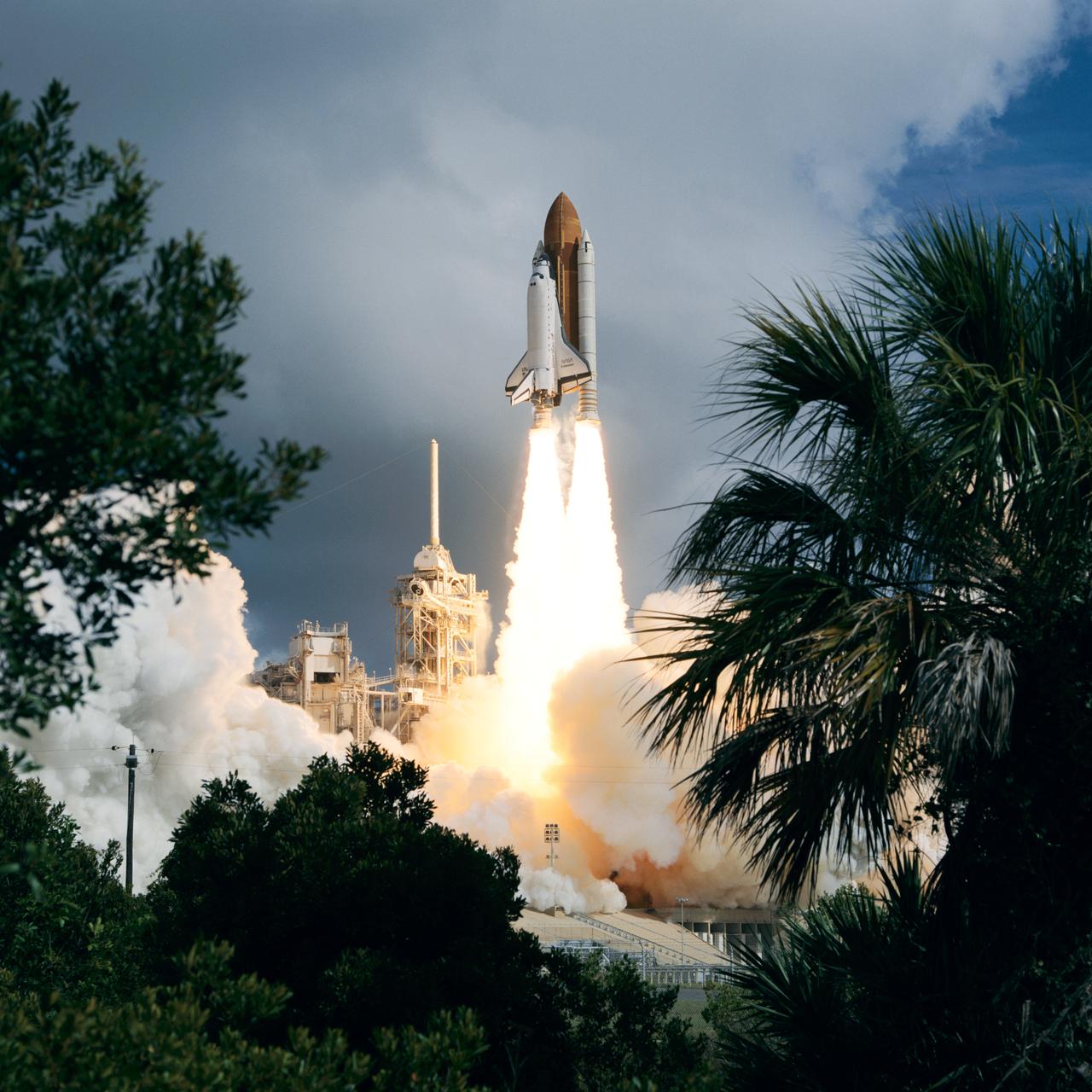
STS057-S-055 (21 June 1993) --- Framed by a variety of flora types, the Space Shuttle Endeavour lifts off Launch Pad 39B to begin the STS-57 mission. Launch occurred at 9:07:22 a.m. (EDT), June 21, 1993. The mission represents the first flight of the commercially developed SPACEHAB laboratory module and also will feature a retrieval of the European Retrievable Carrier (EURECA). Onboard for Endeavour's fourth flight are a crew of six - Ronald J. Grabe, mission commander; Brian Duffy, pilot; G. David Low, payload commander; and Nancy J. Sherlock, Peter J.K. (Jeff) Wisoff and Janice E. Voss, all mission specialists. An earlier launch attempt was scrubbed due to unacceptable weather conditions both at KSC and the overseas contingency landing sites.
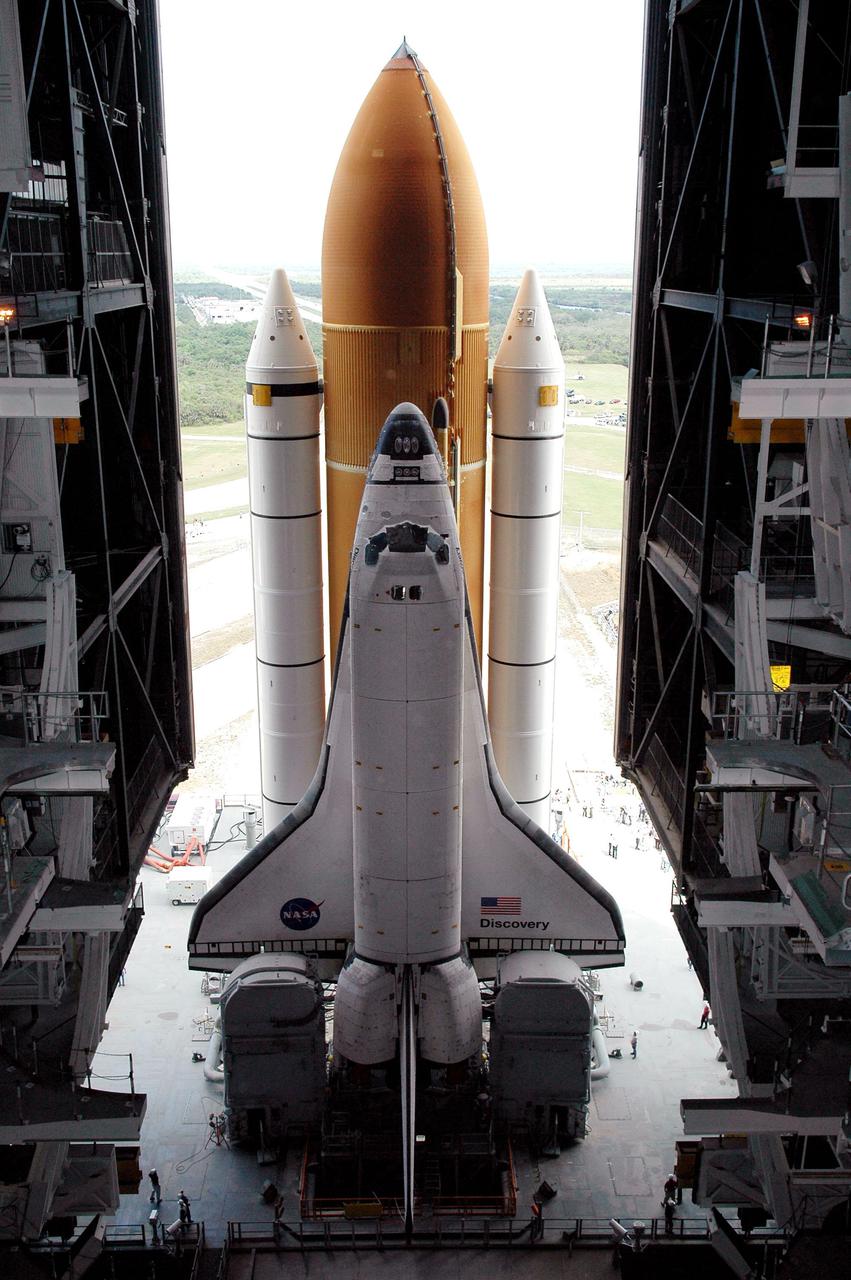
KENNEDY SPACE CENTER, FLA. - In the Vehicle Assembly Building (VAB) at NASA’s Kennedy Space Center, Space Shuttle Discovery passes through the open doors as it begins its long, slow journey to Launch Pad 39B. First motion was at 2:04 p.m. EDT. The Shuttle comprises the orbiter, External Tank (ET) and twin Solid Rocket Boosters (SRBs). The Space Shuttle rests on the Mobile Launcher Platform, which is moved by the Crawler-Transporter underneath. The Crawler is 20 feet high, 131 feet long and 114 feet wide. It moves on eight tracks, each containing 57 shoes, or cleats, weighing one ton each. Loaded with the Space Shuttle, the Crawler can move at a maximum speed of approximately 1 mile an hour. A leveling system in the Crawler keeps the Shuttle vertical while negotiating the 5 percent grade leading to the top of the launch pad. Launch of Discovery on its Return to Flight mission, STS-114, is targeted for May 15 with a launch window that extends to June 3. During its 12-day mission, Discovery’s seven-person crew will test new hardware and techniques to improve Shuttle safety, as well as deliver supplies to the International Space Station. Discovery was moved on March 29 from the Orbiter Processing Facility to the VAB and attached to its propulsion elements, a redesigned ET and twin SRBs.
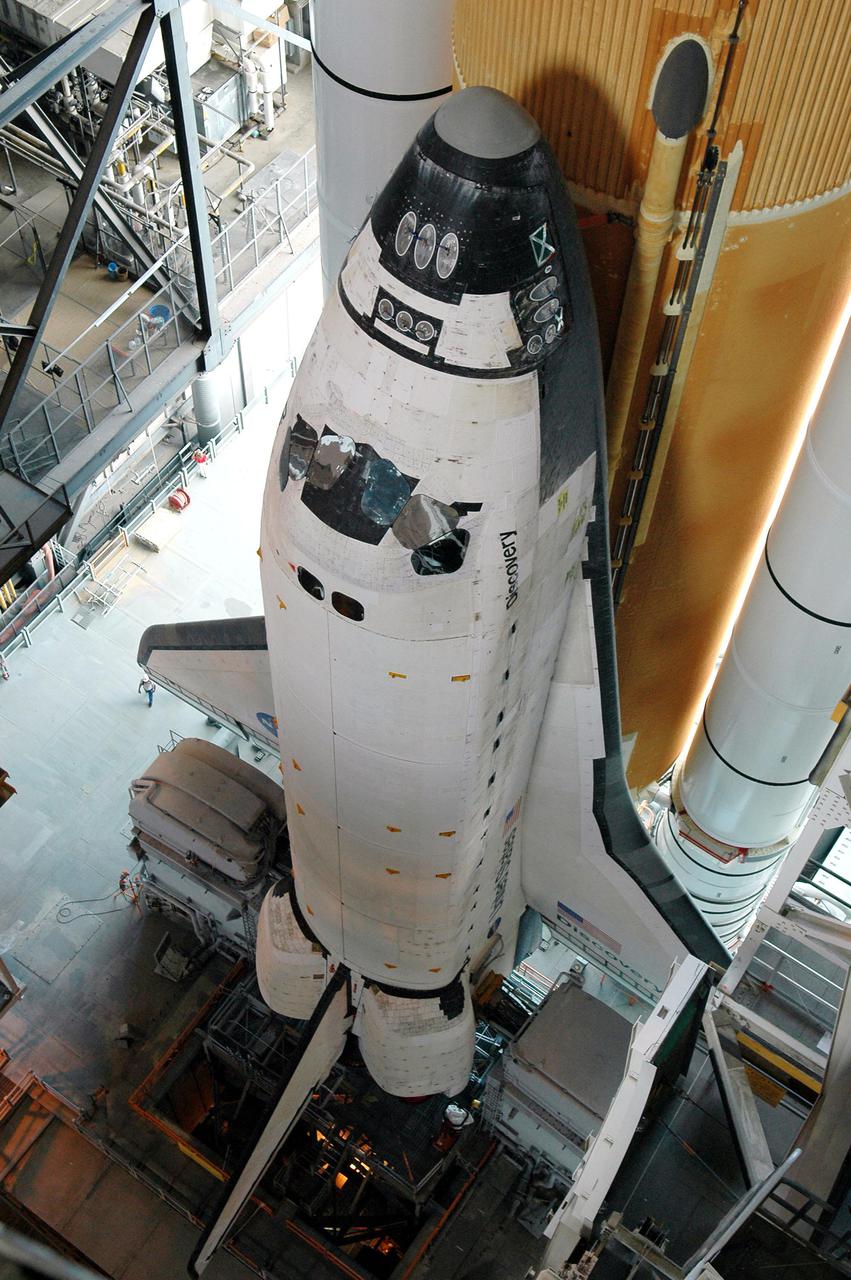
KENNEDY SPACE CENTER, FLA. - In the Vehicle Assembly Building (VAB) at NASA’s Kennedy Space Center, Space Shuttle Discovery is beginning its long, slow journey to Launch Pad 39B. First motion was at 2:04 p.m. EDT. The Shuttle comprises the orbiter, External Tank (ET) and twin Solid Rocket Boosters (SRBs). The Space Shuttle rests on the Mobile Launcher Platform, which is moved by the Crawler-Transporter underneath. The Crawler is 20 feet high, 131 feet long and 114 feet wide. It moves on eight tracks, each containing 57 shoes, or cleats, weighing one ton each. Loaded with the Space Shuttle, the Crawler can move at a maximum speed of approximately 1 mile an hour. A leveling system in the Crawler keeps the Shuttle vertical while negotiating the 5 percent grade leading to the top of the launch pad. Launch of Discovery on its Return to Flight mission, STS-114, is targeted for May 15 with a launch window that extends to June 3. During its 12-day mission, Discovery’s seven-person crew will test new hardware and techniques to improve Shuttle safety, as well as deliver supplies to the International Space Station. Discovery was moved on March 29 from the Orbiter Processing Facility to the VAB and attached to its propulsion elements, a redesigned ET and twin SRBs.
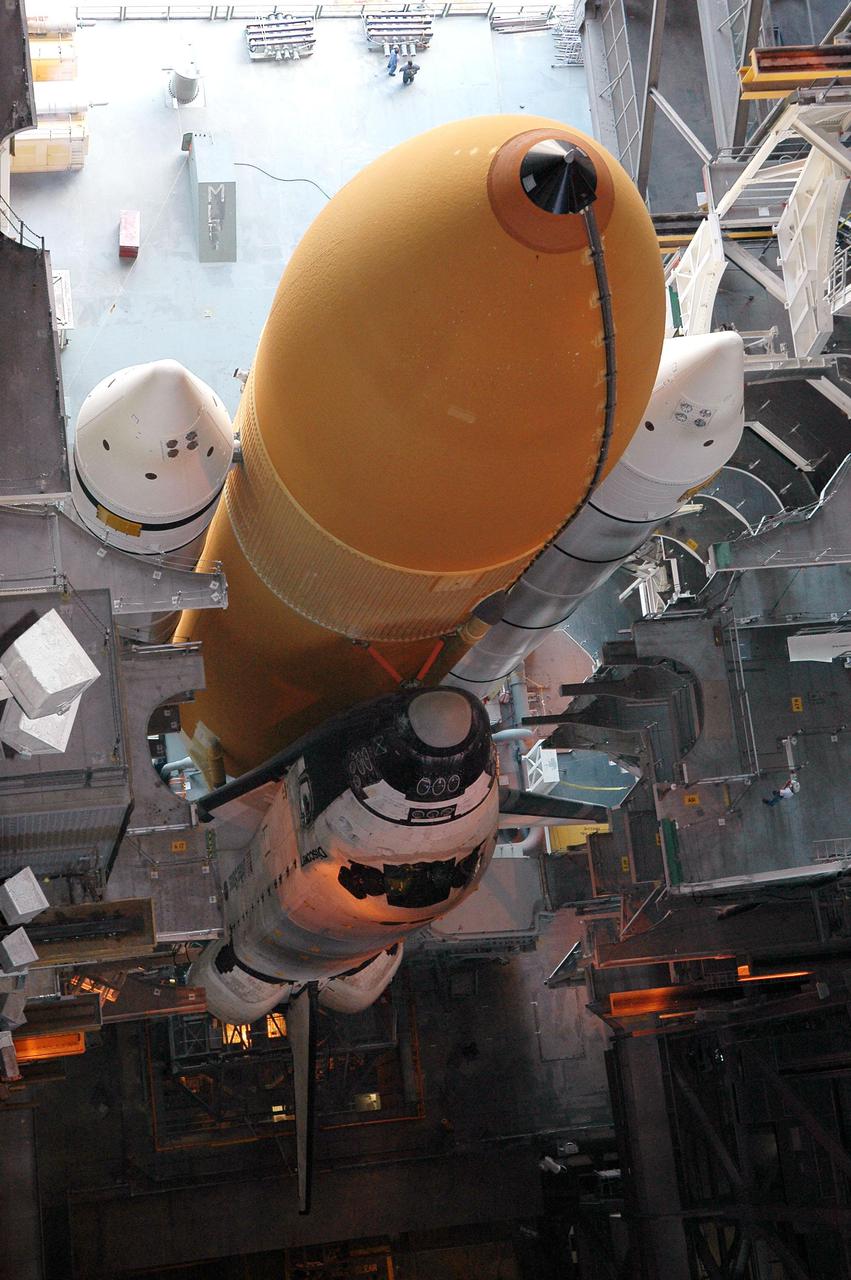
KENNEDY SPACE CENTER, FLA. - The open doors of the Vehicle Assembly Building (VAB) at NASA’s Kennedy Space Center cast light on Space Shuttle Discovery. The Shuttle, which comprises the orbiter, External Tank (ET) and twin Solid Rocket Boosters (SRBs), is beginning its long, slow journey to Launch Pad 39B. First motion was at 2:04 p.m. EDT. The Space Shuttle rests on the Mobile Launcher Platform, which is moved by the Crawler-Transporter underneath. The Crawler is 20 feet high, 131 feet long and 114 feet wide. It moves on eight tracks, each containing 57 shoes, or cleats, weighing one ton each. Loaded with the Space Shuttle, the Crawler can move at a maximum speed of approximately 1 mile an hour. A leveling system in the Crawler keeps the Shuttle vertical while negotiating the 5 percent grade leading to the top of the launch pad. Launch of Discovery on its Return to Flight mission, STS-114, is targeted for May 15 with a launch window that extends to June 3. During its 12-day mission, Discovery’s seven-person crew will test new hardware and techniques to improve Shuttle safety, as well as deliver supplies to the International Space Station. Discovery was moved on March 29 from the Orbiter Processing Facility to the VAB and attached to its propulsion elements, a redesigned ET and twin SRBs.
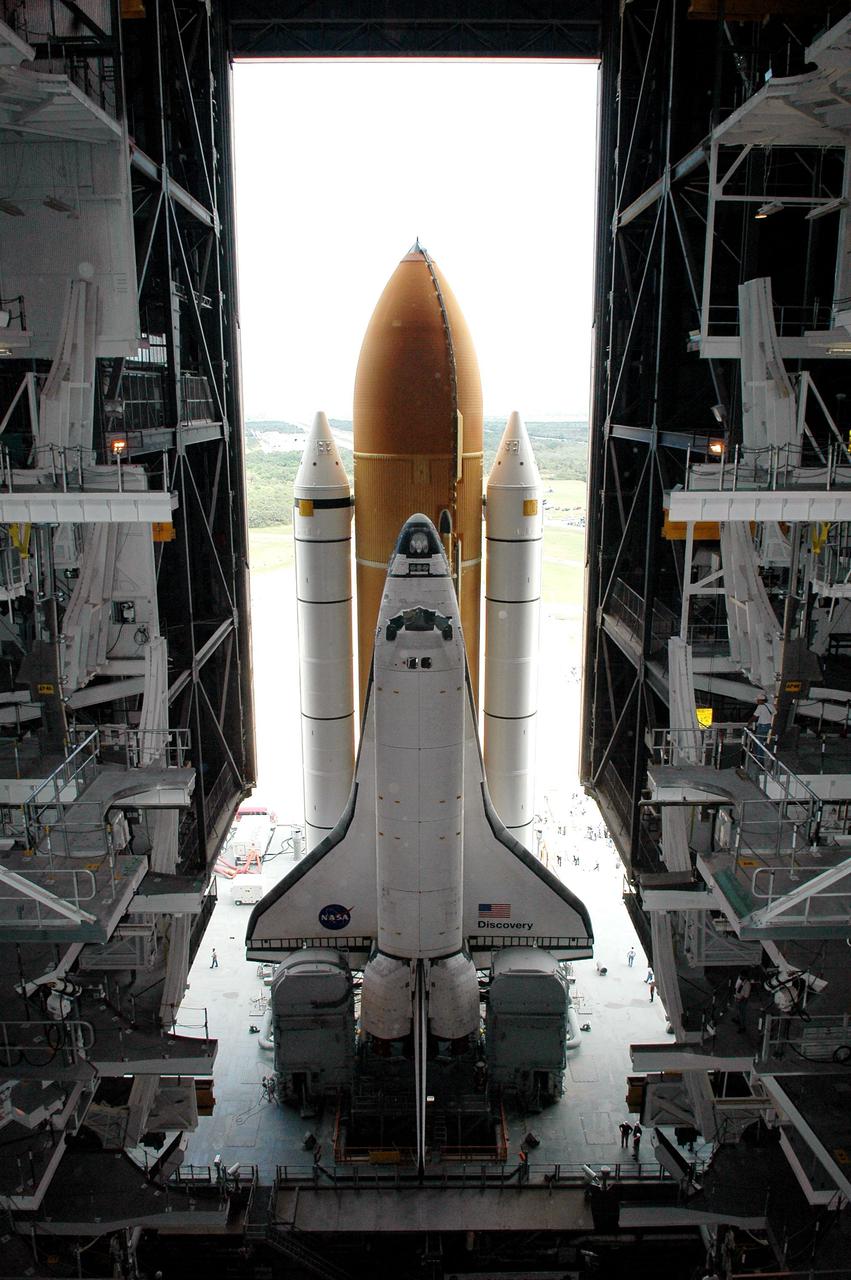
KENNEDY SPACE CENTER, FLA. - In the Vehicle Assembly Building (VAB) at NASA’s Kennedy Space Center, Space Shuttle Discovery is framed in the open doors as it begins its long, slow journey to Launch Pad 39B. First motion was at 2:04 p.m. EDT. The Shuttle comprises the orbiter, External Tank (ET) and twin Solid Rocket Boosters (SRBs). The Space Shuttle rests on the Mobile Launcher Platform, which is moved by the Crawler-Transporter underneath. The Crawler is 20 feet high, 131 feet long and 114 feet wide. It moves on eight tracks, each containing 57 shoes, or cleats, weighing one ton each. Loaded with the Space Shuttle, the Crawler can move at a maximum speed of approximately 1 mile an hour. A leveling system in the Crawler keeps the Shuttle vertical while negotiating the 5 percent grade leading to the top of the launch pad. Launch of Discovery on its Return to Flight mission, STS-114, is targeted for May 15 with a launch window that extends to June 3. During its 12-day mission, Discovery’s seven-person crew will test new hardware and techniques to improve Shuttle safety, as well as deliver supplies to the International Space Station. Discovery was moved on March 29 from the Orbiter Processing Facility to the VAB and attached to its propulsion elements, a redesigned ET and twin SRBs.
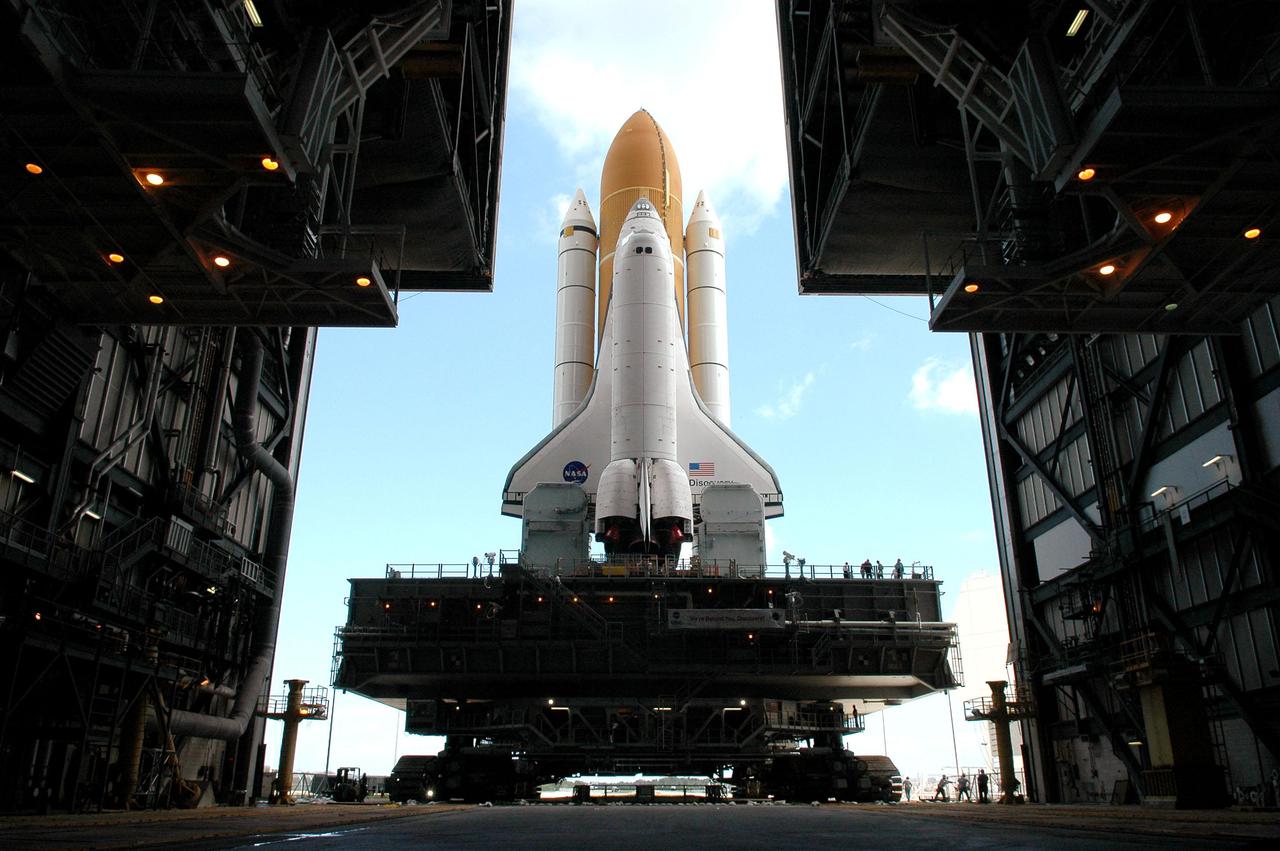
KENNEDY SPACE CENTER, FLA. - Framed in the open doors of the Vehicle Assembly Building (VAB) at NASA’s Kennedy Space Center, Space Shuttle Discovery meets the light of day as it begins its long, slow journey to Launch Pad 39B. First motion was at 2:04 p.m. EDT. The Shuttle comprises the orbiter, External Tank (ET) and twin Solid Rocket Boosters (SRBs). The Space Shuttle rests on the Mobile Launcher Platform, which is moved by the Crawler-Transporter underneath. The Crawler is 20 feet high, 131 feet long and 114 feet wide. It moves on eight tracks, each containing 57 shoes, or cleats, weighing one ton each. Loaded with the Space Shuttle, the Crawler can move at a maximum speed of approximately 1 mile an hour. A leveling system in the Crawler keeps the Shuttle vertical while negotiating the 5 percent grade leading to the top of the launch pad. Launch of Discovery on its Return to Flight mission, STS-114, is targeted for May 15 with a launch window that extends to June 3. During its 12-day mission, Discovery’s seven-person crew will test new hardware and techniques to improve Shuttle safety, as well as deliver supplies to the International Space Station. Discovery was moved on March 29 from the Orbiter Processing Facility to the VAB and attached to its propulsion elements, a redesigned ET and twin SRBs.
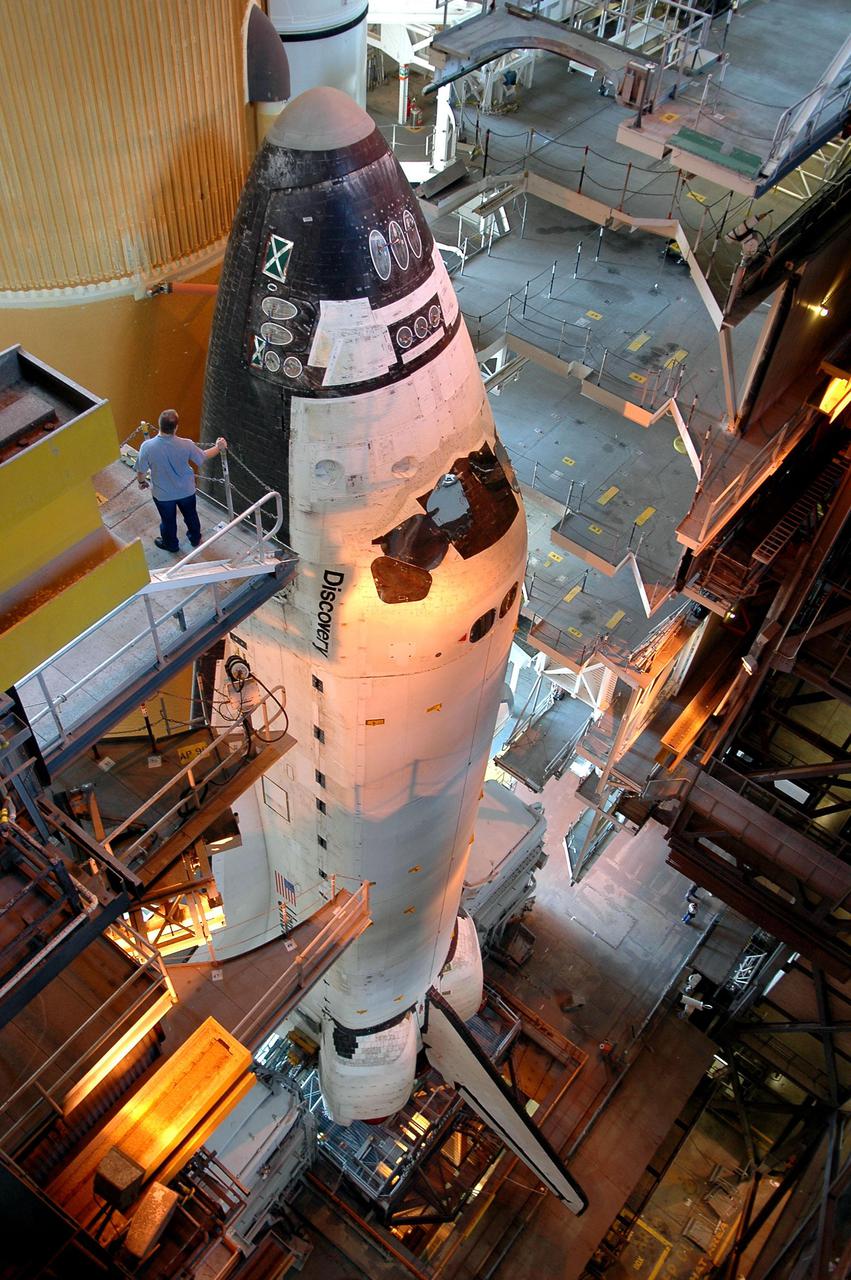
KENNEDY SPACE CENTER, FLA. - In the Vehicle Assembly Building (VAB) at NASA’s Kennedy Space Center, Space Shuttle Discovery begins its long, slow journey to Launch Pad 39B. First motion was at 2:04 p.m. EDT. The Shuttle comprises the orbiter, External Tank (ET) and twin Solid Rocket Boosters (SRBs). The Space Shuttle rests on the Mobile Launcher Platform, which is moved by the Crawler-Transporter underneath. The Crawler is 20 feet high, 131 feet long and 114 feet wide. It moves on eight tracks, each containing 57 shoes, or cleats, weighing one ton each. Loaded with the Space Shuttle, the Crawler can move at a maximum speed of approximately 1 mile an hour. A leveling system in the Crawler keeps the Shuttle vertical while negotiating the 5 percent grade leading to the top of the launch pad. Launch of Discovery on its Return to Flight mission, STS-114, is targeted for May 15 with a launch window that extends to June 3. During its 12-day mission, Discovery’s seven-person crew will test new hardware and techniques to improve Shuttle safety, as well as deliver supplies to the International Space Station. Discovery was moved on March 29 from the Orbiter Processing Facility to the VAB and attached to its propulsion elements, a redesigned ET and twin SRBs.
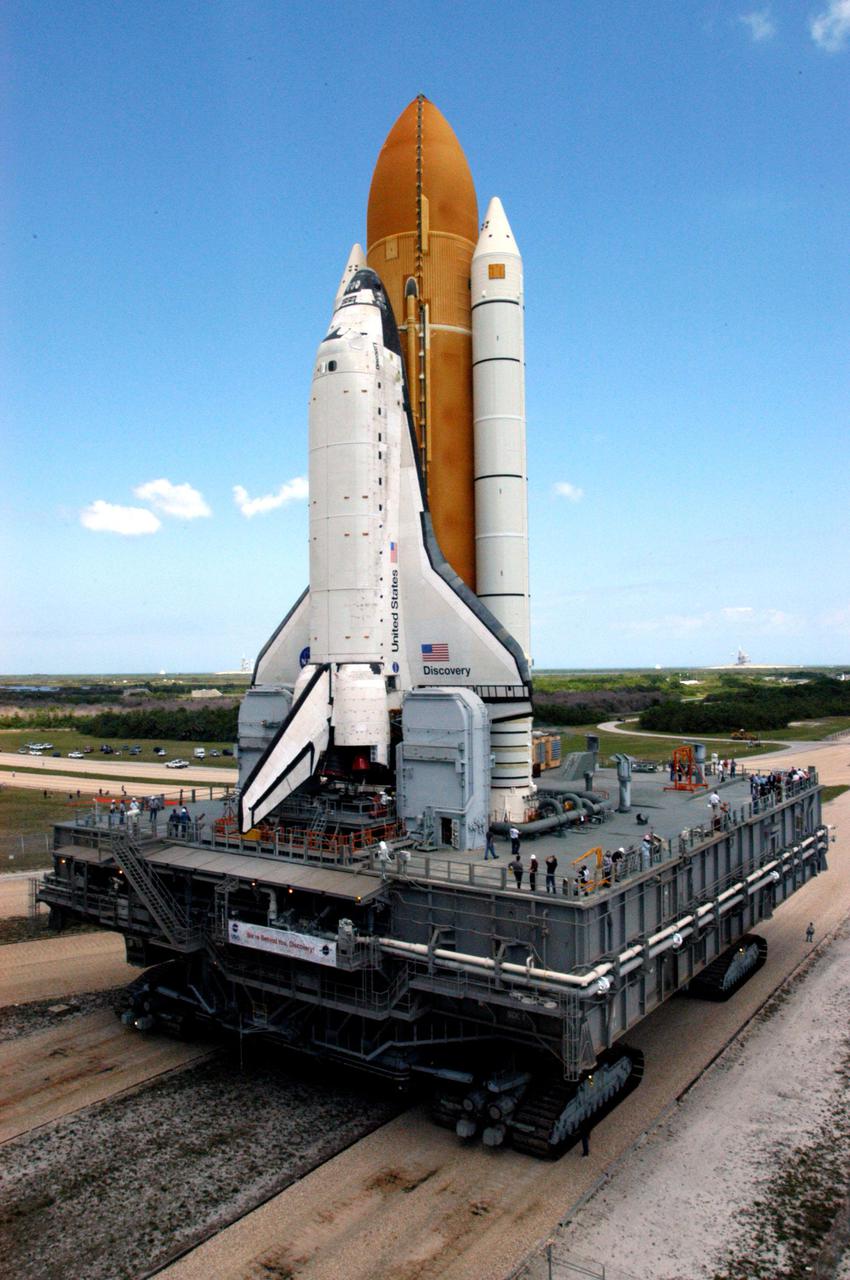
KENNEDY SPACE CENTER, FLA. - Under brilliant-blue Florida skies, Space Shuttle Discovery, atop the Mobile Launcher Platform, is on its way to Launch Pad 39B at NASA’s Kennedy Space Center. First motion out of the Vehicle Assembly Building (VAB) was at 2:04 p.m. EDT. The Shuttle comprises the orbiter, External Tank (ET) and twin Solid Rocket Boosters (SRBs). The Mobile Launcher Platform moved by the Crawler-Transporter underneath. The Crawler is 20 feet high, 131 feet long and 114 feet wide. It moves on eight tracks, each containing 57 shoes, or cleats, weighing one ton each. Loaded with the Space Shuttle, the Crawler can move at a maximum speed of approximately 1 mile an hour. A leveling system in the Crawler keeps the Shuttle vertical while negotiating the 5 percent grade leading to the top of the launch pad. Launch of Discovery on its Return to Flight mission, STS-114, is targeted for May 15 with a launch window that extends to June 3. During its 12-day mission, Discovery’s seven-person crew will test new hardware and techniques to improve Shuttle safety, as well as deliver supplies to the International Space Station. Discovery was moved on March 29 from the Orbiter Processing Facility to the VAB and attached to its propulsion elements, a redesigned ET and twin SRBs.
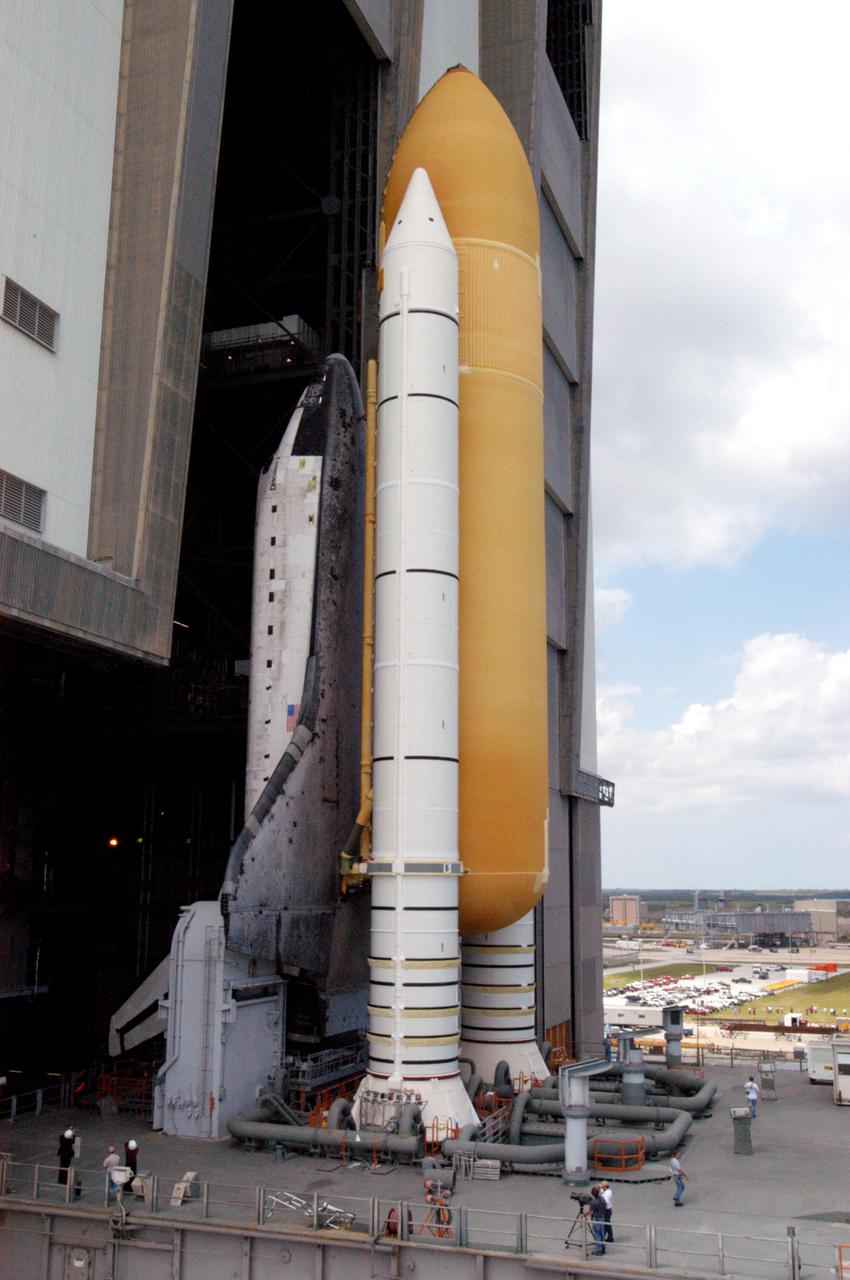
KENNEDY SPACE CENTER, FLA. - Space Shuttle Discovery, atop the Mobile Launcher Platform, slowly rolls out of the Vehicle Assembly Building (VAB) at NASA’s Kennedy Space Center. First motion was at 2:04 p.m. EDT. The Shuttle comprises the orbiter, External Tank (ET) and twin Solid Rocket Boosters (SRBs). The Mobile Launcher Platform moved by the Crawler-Transporter underneath. The Crawler is 20 feet high, 131 feet long and 114 feet wide. It moves on eight tracks, each containing 57 shoes, or cleats, weighing one ton each. Loaded with the Space Shuttle, the Crawler can move at a maximum speed of approximately 1 mile an hour. A leveling system in the Crawler keeps the Shuttle vertical while negotiating the 5 percent grade leading to the top of the launch pad. Launch of Discovery on its Return to Flight mission, STS-114, is targeted for May 15 with a launch window that extends to June 3. During its 12-day mission, Discovery’s seven-person crew will test new hardware and techniques to improve Shuttle safety, as well as deliver supplies to the International Space Station. Discovery was moved on March 29 from the Orbiter Processing Facility to the VAB and attached to its propulsion elements, a redesigned ET and twin SRBs.
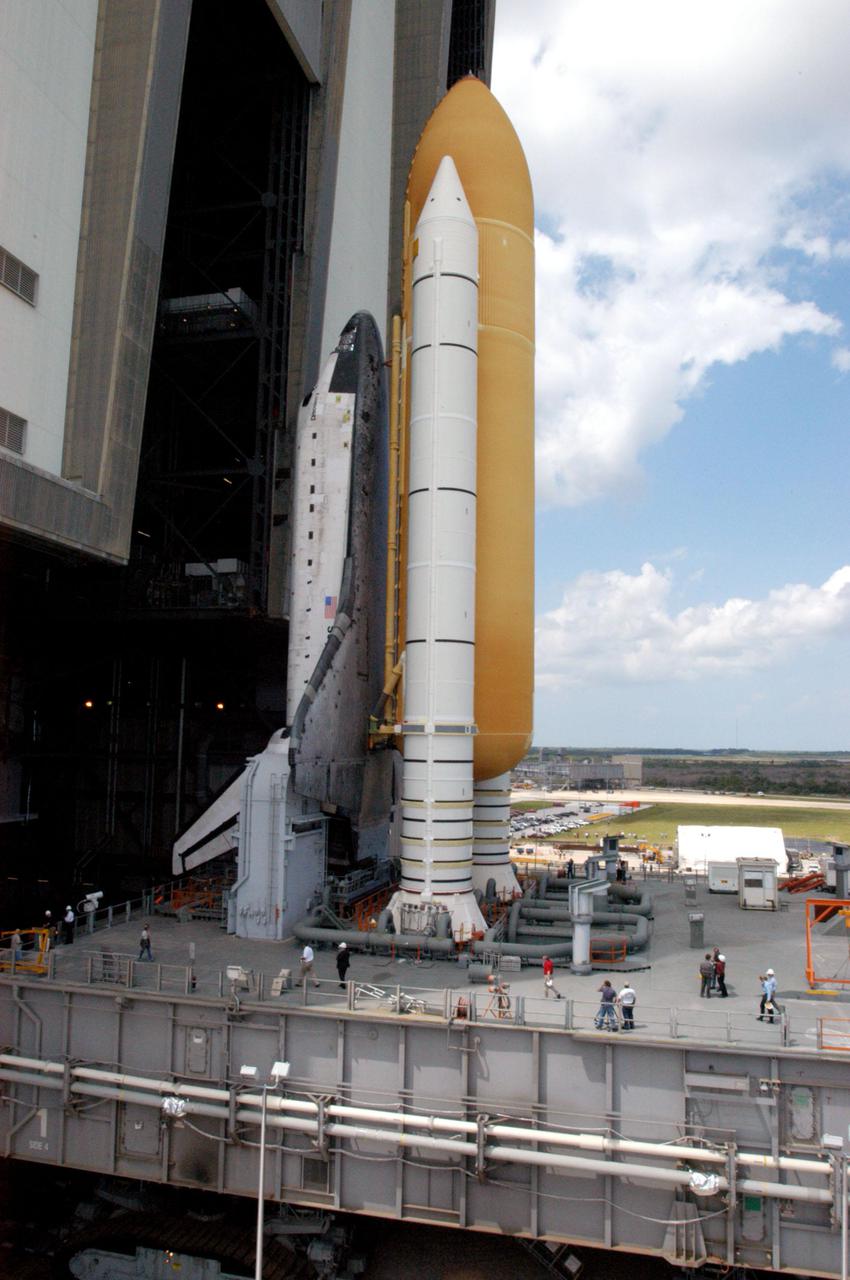
KENNEDY SPACE CENTER, FLA. - Space Shuttle Discovery, atop the Mobile Launcher Platform, slowly rolls out of the Vehicle Assembly Building (VAB) at NASA’s Kennedy Space Center. First motion was at 2:04 p.m. EDT. The Shuttle comprises the orbiter, External Tank (ET) and twin Solid Rocket Boosters (SRBs). The Mobile Launcher Platform moved by the Crawler-Transporter underneath. The Crawler is 20 feet high, 131 feet long and 114 feet wide. It moves on eight tracks, each containing 57 shoes, or cleats, weighing one ton each. Loaded with the Space Shuttle, the Crawler can move at a maximum speed of approximately 1 mile an hour. A leveling system in the Crawler keeps the Shuttle vertical while negotiating the 5 percent grade leading to the top of the launch pad. Launch of Discovery on its Return to Flight mission, STS-114, is targeted for May 15 with a launch window that extends to June 3. During its 12-day mission, Discovery’s seven-person crew will test new hardware and techniques to improve Shuttle safety, as well as deliver supplies to the International Space Station. Discovery was moved on March 29 from the Orbiter Processing Facility to the VAB and attached to its propulsion elements, a redesigned ET and twin SRBs.
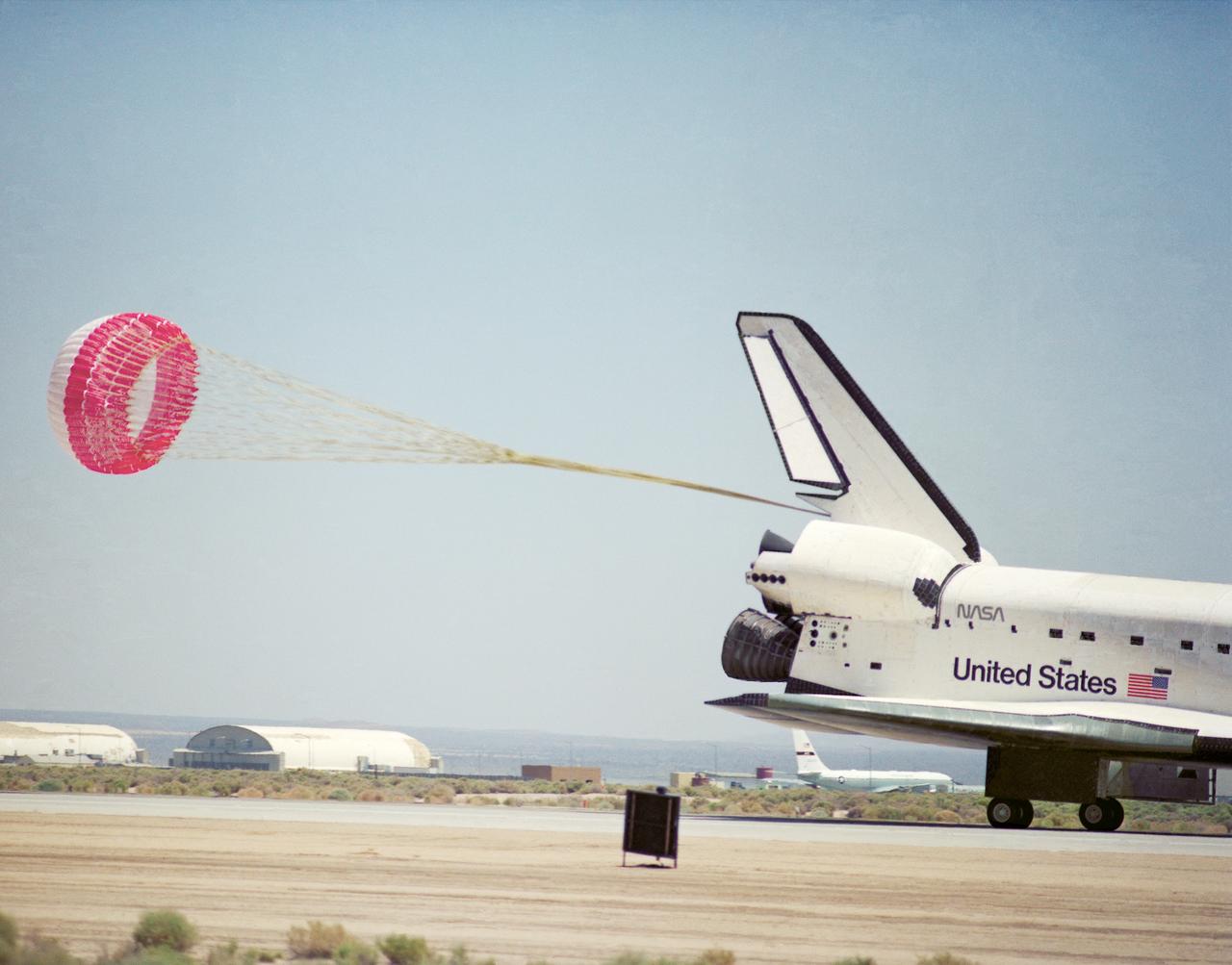
The Space Shuttle Endeavour concludes mission STS-49 at NASA's Ames-Dryden Flight Research Facility (later redesignated Dryden Flight Research Center), Edwards, California, with a 1:57 p.m. (PDT) landing 16 May on Edward's concrete runway 22. The planned 7-day mission, which began with a launch from Kennedy Space Center, Florida, at 4:41 p.m. (PFT), 7 May, was extended two days to allow extra time to rescue the Intelsat VI satellite and complete Space Station assembly techniques originally planned. After a perfect rendezvous in orbit and numerous attempts to grab the satellite, space walking astronauts Pierre Thuot, Rick Hieb and Tom Akers successfully rescued it by hand on the third space walk with the support of mission specialists Kathy Thornton and Bruce Melnick. The three astronauts, on a record space walk, took hold of the satellite and directed it to the shuttle where a booster motor was attached to launch it to its proper orbit. Commander Dan Brandenstein and Pilot Kevin Chilton brought Endeavours's record setting maiden voyage to a perfect landing at Edwards AFB with the first deployment of a drag chute on a shuttle mission.
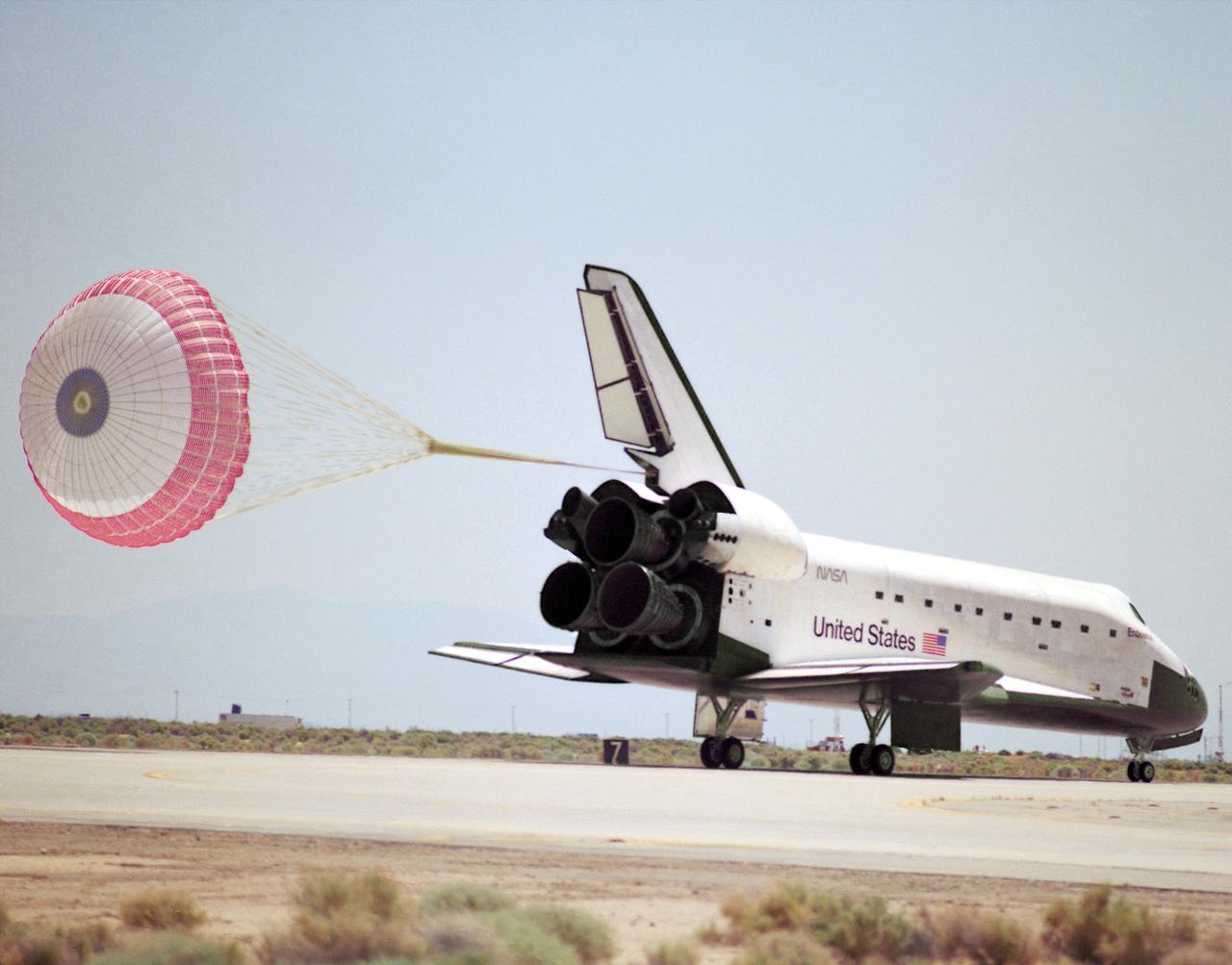
The Space Shuttle Endeavour concludes mission STS-49 at NASA's Ames-Dryden Flight Research Facility (later redesignated Dryden Flight Research Center), Edwards, California, with a 1:57 p.m. (PDT) landing May 16 on Edward's concrete runway 22. The planned 7-day mission, which began with a launch from Kennedy Space Center, Florida, at 4:41 p.m. (PFT), 7 May, was extended two days to allow extra time to rescue the Intelsat VI satellite and complete Space Station assembly techniques originally planned. After a perfect rendezvous in orbit and numerous attempts to grab the satellite, space walking astronauts Pierre Thuot, Rick Hieb and Tom Akers successfully rescued it by hand on the third space walk with the support of mission specialists Kathy Thornton and Bruce Melnick. The three astronauts, on a record space walk, took hold of the satellite and directed it to the shuttle where a booster motor was attached to launch it to its proper orbit. Commander Dan Brandenstein and Pilot Kevin Chilton brought Endeavours's record setting maiden voyage to a perfect landing at Edwards with the first deployment of a drag chute on a shuttle mission.
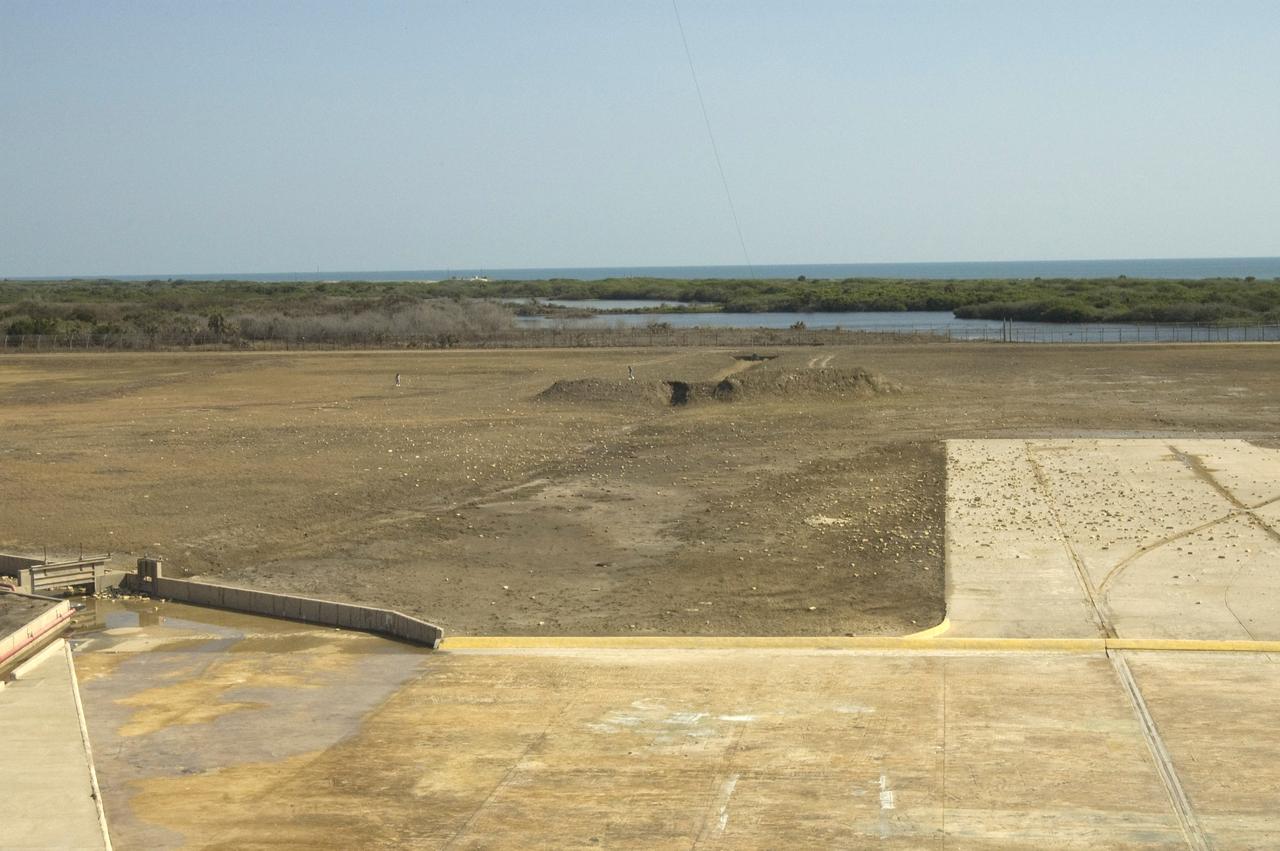
CAPE CANAVERAL, Fla. -- Debris is scattered across Launch Pad 39A at NASA's Kennedy Space Center following launch of space shuttle Discovery on its STS-124 mission. During the post-launch walk down, the pad team noted severe launch damage on a 100’ X 20’ section of the east wall of the north flame trench. Broken sections of the flame trench wall were scattered from the flame trench to the pad perimeter fence. NASA is forming an investigation board. The flame trench transecting the pad's mound at ground level is 490 feet long, 58 feet wide and 40 feet high. It is made of concrete and refractory brick. The top of the solid rocket booster flame deflector abuts with that of the orbiter flame deflector to form a flattened, inverted V-shaped structure beneath the mobile launcher platform's three exhaust holes. The orbiter flame deflector is fixed and is 38 feet high, 72 feet long and 57.6 feet wide. The deflector weighs 1.3 million pounds. The solid rocket booster deflector is 42.5 feet high, 42 feet long and 57 feet wide. The structure weighs 1.1 million pounds. The deflectors are built of steel and covered with a high-temperature concrete surface with an average thickness of 5 inches. There are two movable solid rocket booster side flame deflectors, one located on each side of the flame trench. They are 19.5 feet high, 44 feet long and 17.5 feet wide. Photo credit: NASA/Jim Grossmann
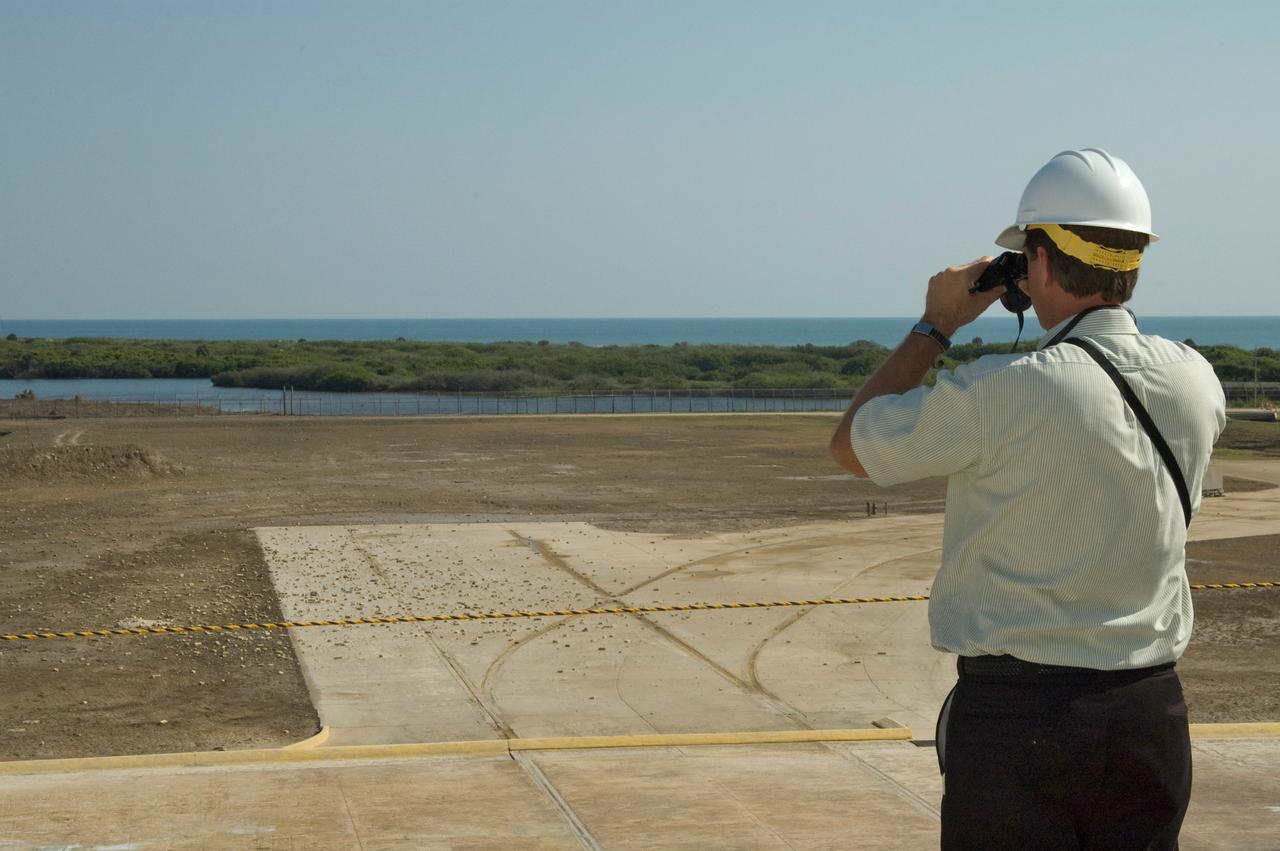
CAPE CANAVERAL, Fla. -- A member of the walk-down team takes a close look at debris scattered across Launch Pad 39A at NASA's Kennedy Space Center following launch of space shuttle Discovery on its STS-124 mission. During the post-launch walk down, the pad team noted severe launch damage on a 100’ X 20’ section of the east wall of the north flame trench. Broken sections of the flame trench wall were scattered from the flame trench to the pad perimeter fence. NASA is forming an investigation board. The flame trench transecting the pad's mound at ground level is 490 feet long, 58 feet wide and 40 feet high. It is made of concrete and refractory brick. The top of the solid rocket booster flame deflector abuts with that of the orbiter flame deflector to form a flattened, inverted V-shaped structure beneath the mobile launcher platform's three exhaust holes. The orbiter flame deflector is fixed and is 38 feet high, 72 feet long and 57.6 feet wide. The deflector weighs 1.3 million pounds. The solid rocket booster deflector is 42.5 feet high, 42 feet long and 57 feet wide. The structure weighs 1.1 million pounds. The deflectors are built of steel and covered with a high-temperature concrete surface with an average thickness of 5 inches. There are two movable solid rocket booster side flame deflectors, one located on each side of the flame trench. They are 19.5 feet high, 44 feet long and 17.5 feet wide. Photo credit: NASA/Jim Grossmann
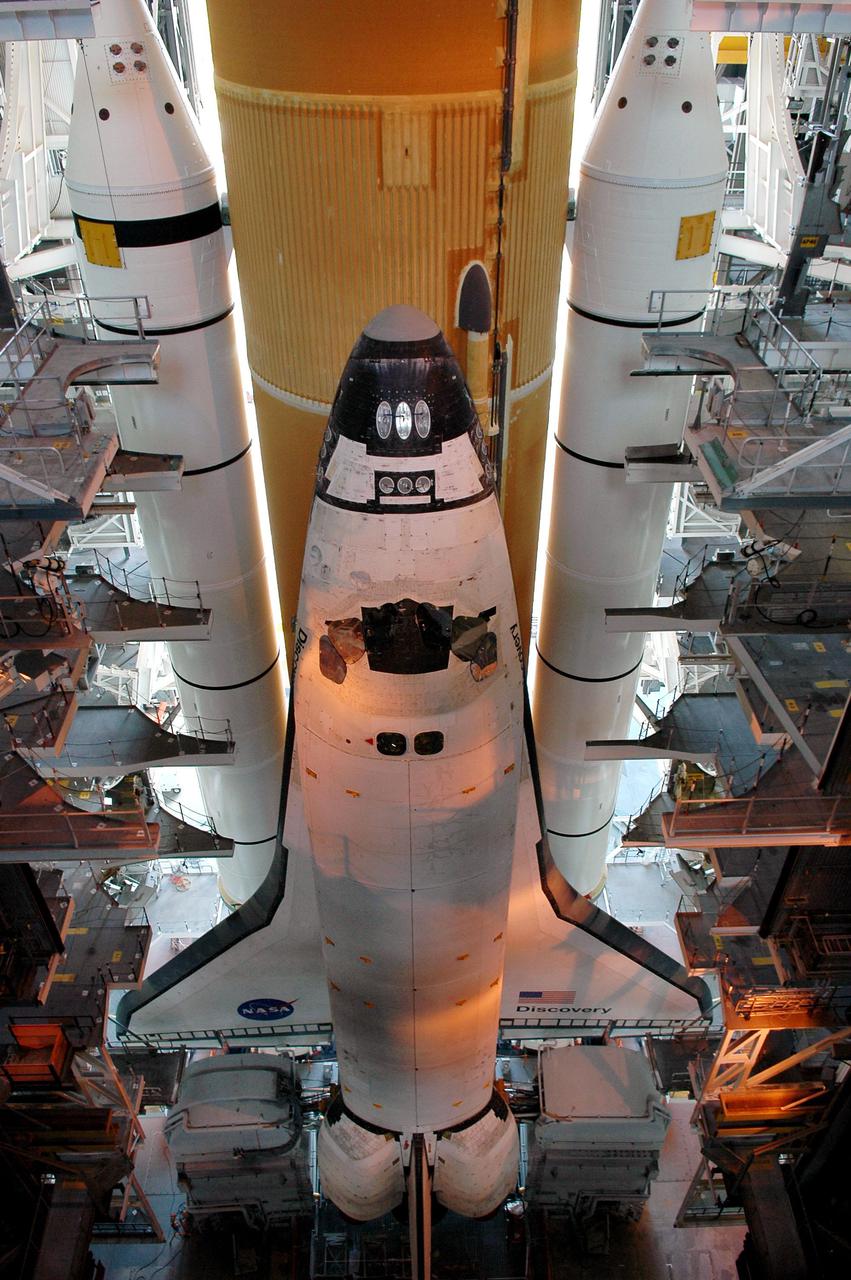
KENNEDY SPACE CENTER, FLA. - The open doors of the Vehicle Assembly Building (VAB) at NASA’s Kennedy Space Center shed a light border around the External Tank on Space Shuttle Discovery. The Shuttle, which comprises the orbiter, External Tank (ET) and twin Solid Rocket Boosters (SRBs), is beginning its long, slow journey to Launch Pad 39B. First motion was at 2:04 p.m. EDT. The Space Shuttle rests on the Mobile Launcher Platform, which is moved by the Crawler-Transporter underneath. The Crawler is 20 feet high, 131 feet long and 114 feet wide. It moves on eight tracks, each containing 57 shoes, or cleats, weighing one ton each. Loaded with the Space Shuttle, the Crawler can move at a maximum speed of approximately 1 mile an hour. A leveling system in the Crawler keeps the Shuttle vertical while negotiating the 5 percent grade leading to the top of the launch pad. Launch of Discovery on its Return to Flight mission, STS-114, is targeted for May 15 with a launch window that extends to June 3. During its 12-day mission, Discovery’s seven-person crew will test new hardware and techniques to improve Shuttle safety, as well as deliver supplies to the International Space Station. Discovery was moved on March 29 from the Orbiter Processing Facility to the VAB and attached to its propulsion elements, a redesigned ET and twin SRBs.