
STS-41 Discovery, Orbiter Vehicle (OV) 103, with nose landing gear (NLG) and main landing gear (MLG) deployed, glides over concrete runway 22 at Edwards Air Force Base (EAFB), California, prior to touchdown.
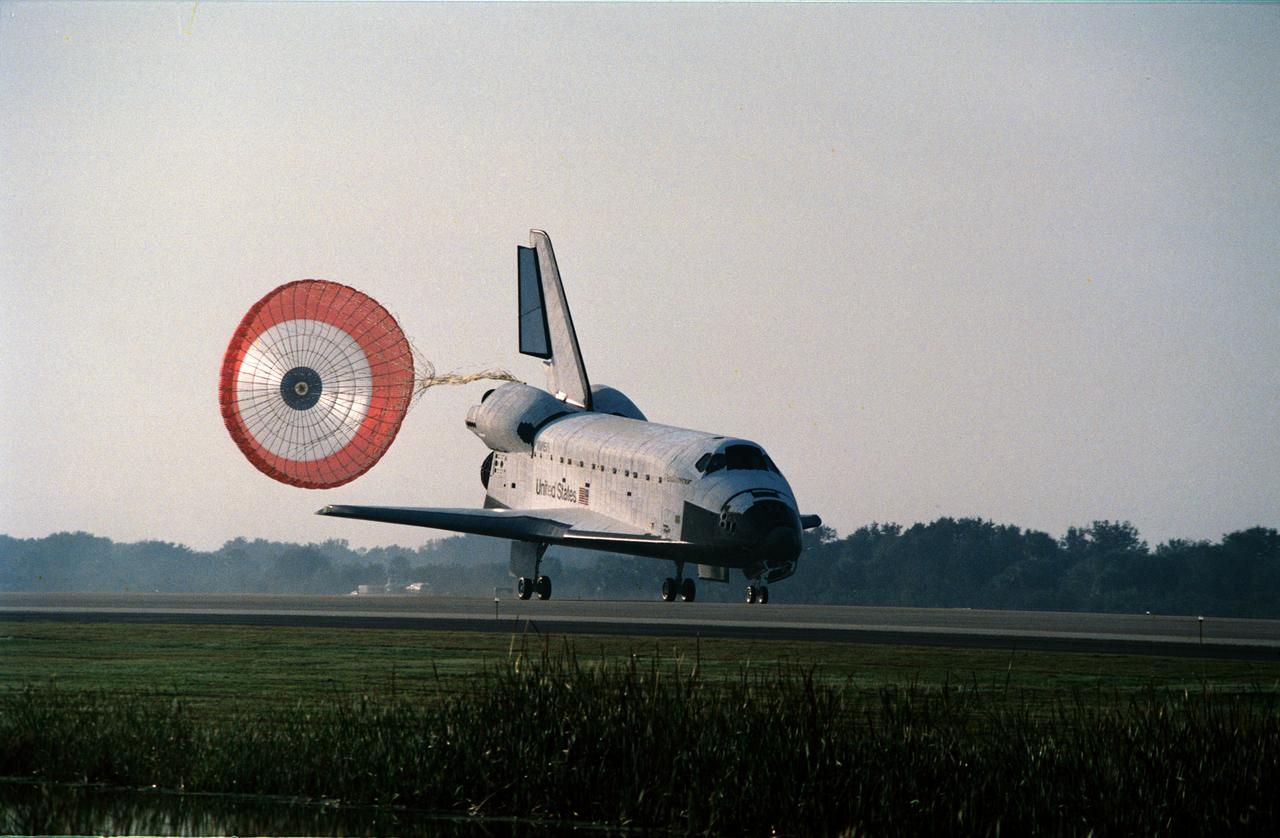
STS054-S-101 (19 Jan 1993) --- The drag chute is just about to be released as the Space Shuttle Endeavour rolls toward wheelstop at KSC's Shuttle landing facility. Landing occurred at 8:38 a.m. (EST), Jan. 19, 1993. Onboard for the six-day mission were astronauts John H. Casper, mission commander, Donald R. McMonagle, pilot, Gregory J. Harbaugh, Mario Runco Jr. and Susan J. Helms, mission specialists.
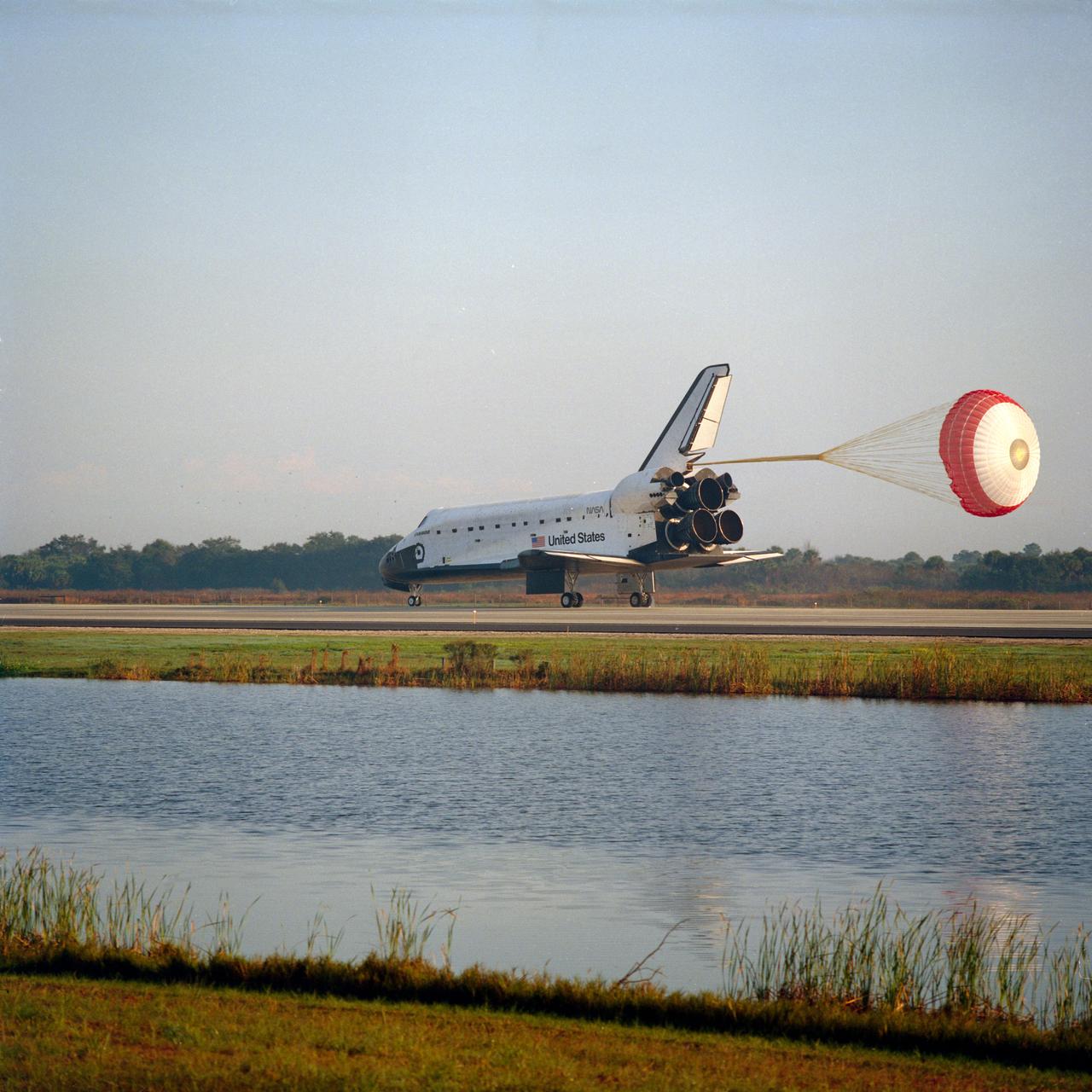
STS054-S-100 (19 Jan 1993) --- The drag chute is fully deployed as the Space Shuttle Endeavour rolls toward wheelstop at KSC's Shuttle landing facility. Landing occurred at 8:38 a.m. (EST), Jan. 19, 1993. Onboard for the six-day mission were astronauts John H. Casper, mission commander, Donald R. McMonagle, pilot, Gregory J. Harbaugh, Mario Runco Jr. and Susan J. Helms, mission specialists.
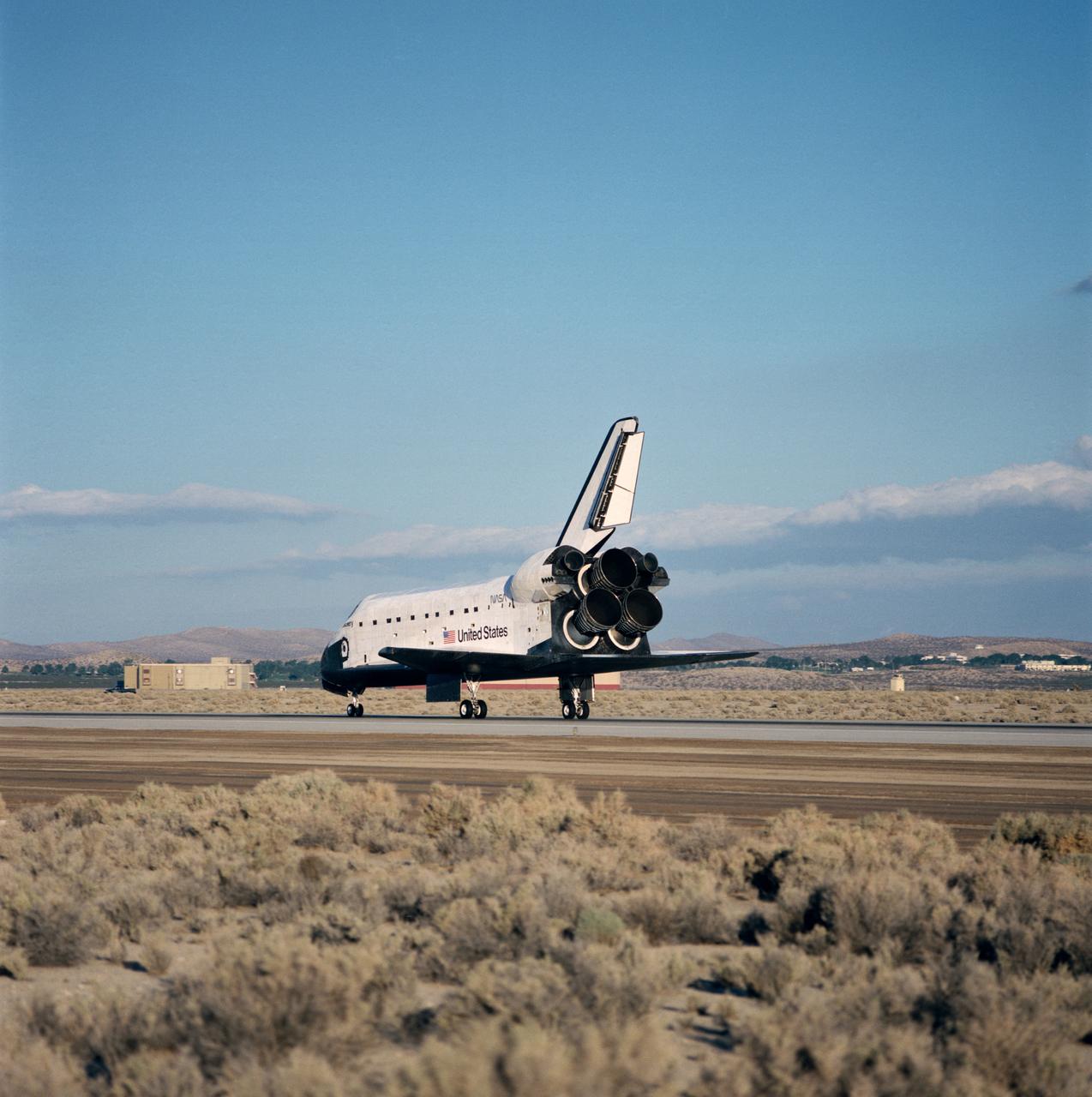
STS-31 Discovery, Orbiter Vehicle (OV) 103, rolls along concrete runway 22 at Edwards Air Force Base (EAFB), California, after nose landing gear (NLG) and main landing gear (MLG) touchdown. This view looks down OV-103's port side from the space shuttle main engines (SSMEs) to the nose section. The SSMEs are gimbaled to their descent position and the rudder/speedbrake is deployed on the vertical stabilizer. Wheel stop occurred at 6:51 am (Pacific Daylight Time (PDT)). In the distance EAFB facilities are visible.
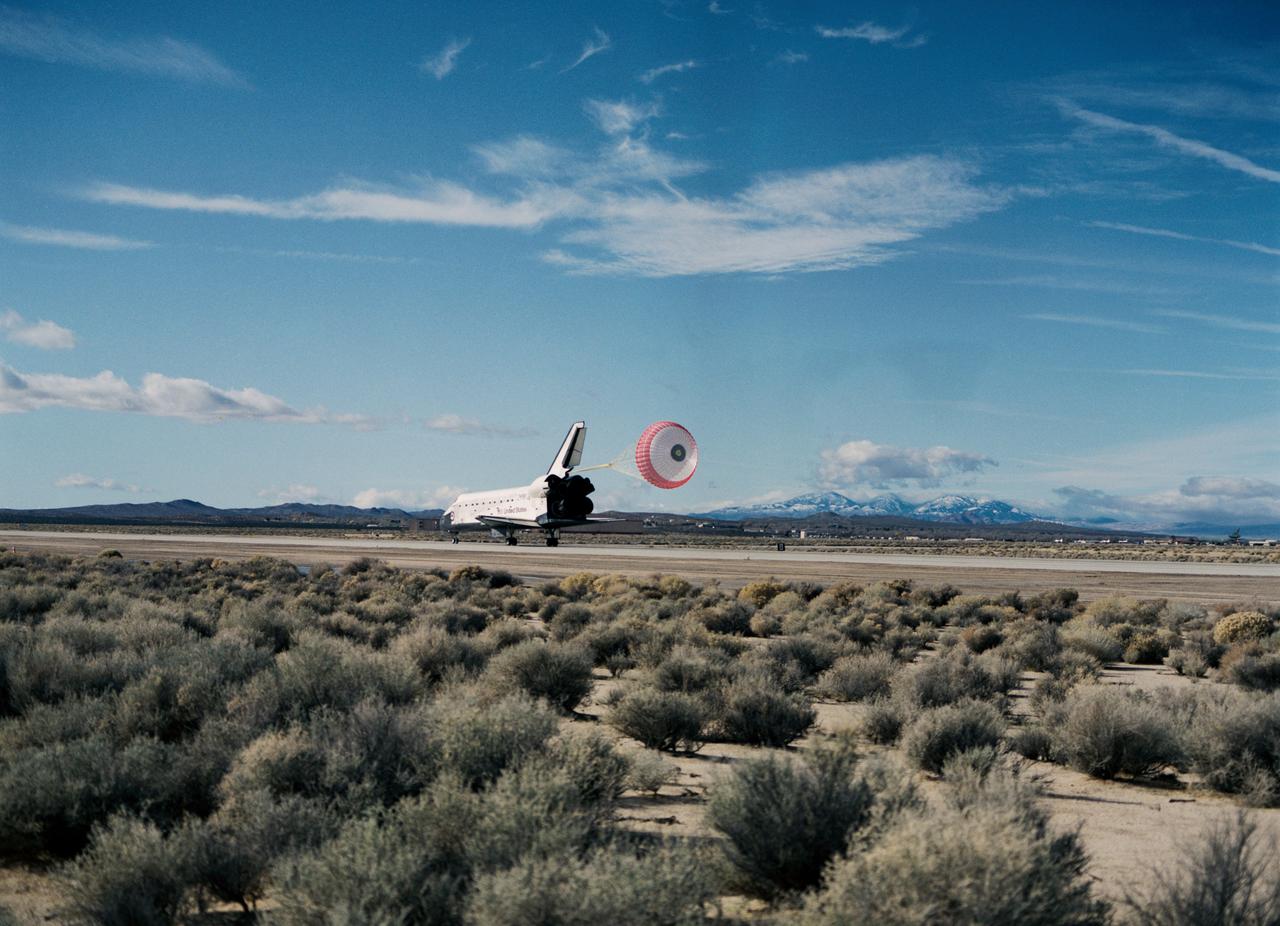
STS-53 Discovery, Orbiter Vehicle (OV) 103, is slowed by a red, white, and blue drag chute during its landing on concrete runway 22 at Edwards Air Force Base (EAFB), California. Main landing gear (MLG) touchdown occurred at 12:43:17 pm (Pacific Standard Time (PST)). This aft view of OV-103 shows the drag chute deployed from its compartment at the base of the vertical tail, the speedbrake/rudder flaps open, and the space shuttle main engines (SSMEs). Both MLG and nose landing gear (NLG) ride along the runway surface. Desert scrub brush appears in the foreground and mountains are seen in the background.

STS049-S-301 (16 May 1992) --- A three-quarter aft view of the Space Shuttle Endeavour making its first landing, following a successful nine-day mission in Earth orbit. Fully deployed here is the main chute in NASA's first exercise of its detailed test objective (DTO-521) on the drag chute system. Main gear touchdown occurred at 1:57:38 p.m. (PDT), May 16, 1992.
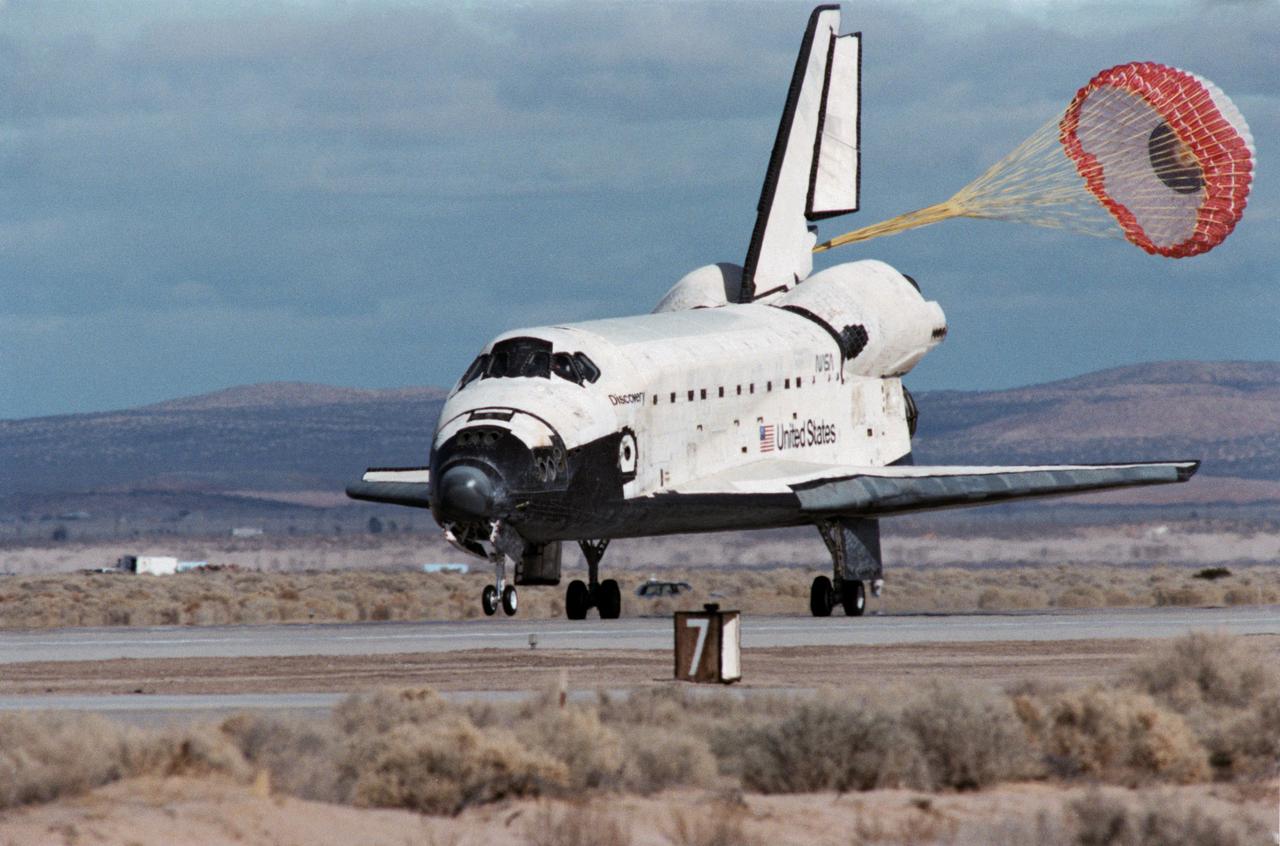
STS053-S-085 (9 Dec. 1992) --- The drag chute on the space shuttle Discovery is partially deployed during landing on Runway 22 at Edwards Air Force Base. The landing ended an eight-day space mission for the STS-53 crew. Main gear touchdown occurred at 12:43:17 p.m. (PST) on Dec. 9, 1992. Onboard were astronauts David M. Walker, Robert D. Cabana, Guion S. Bluford Jr., James S. Voss and Michael R.U. (Rich) Clifford.
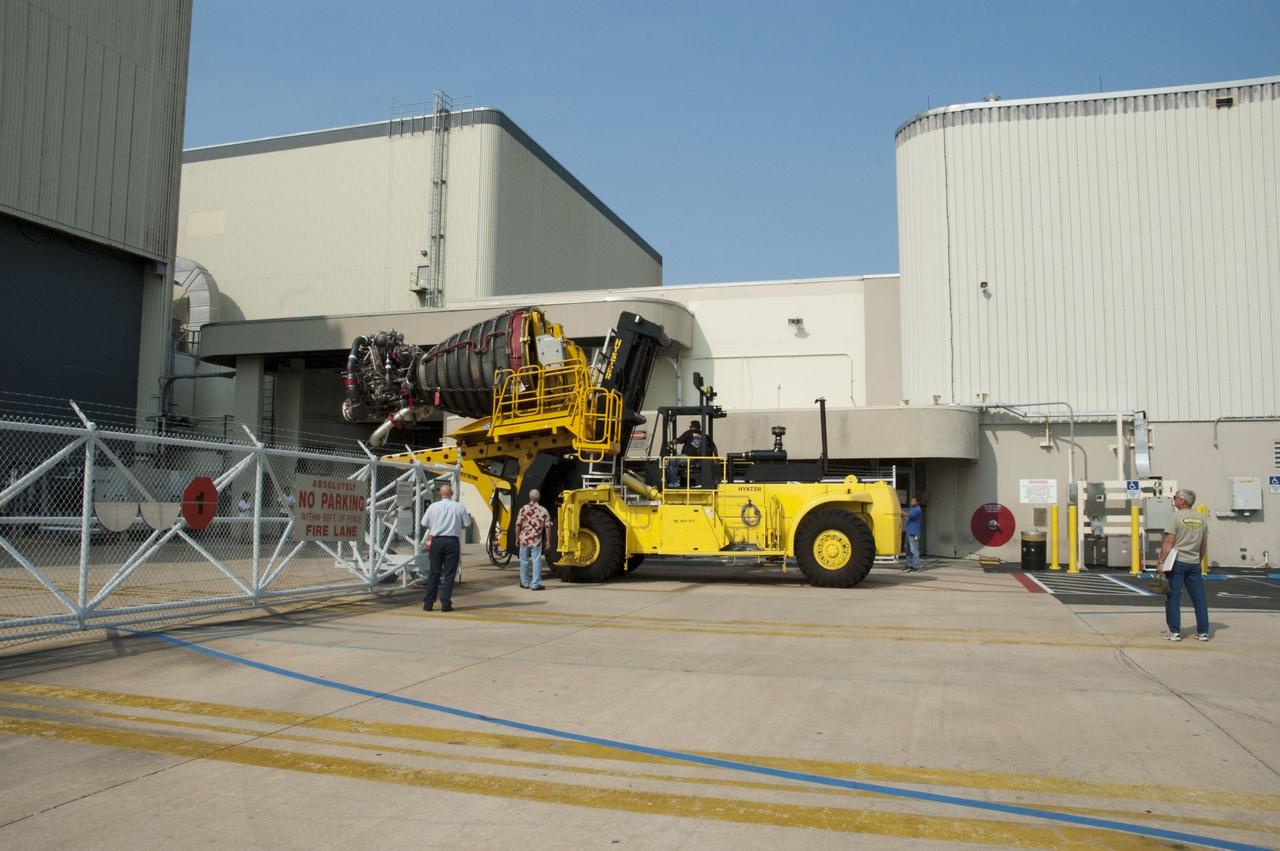
CAPE CANAVERAL, Fla. -- Engine No. 1, one of three space shuttle main engines, was removed from shuttle Endeavour and is being transported from Orbiter Processing Facility-1 to the Space Shuttle Main Engine Processing Facility at NASA's Kennedy Space Center in Florida. The work is part of Endeavour's transition and retirement processing. The spacecraft is being prepared for public display at the California Science Center in Los Angeles. Endeavour flew 25 missions, spent 299 days in space, orbited Earth 4,671 times and traveled 122,883,151 miles over the course of its 19-year career. Endeavour's STS-134 and final mission was completed after landing on June 1, 2011. Photo credit: NASA/Chris Chamberland
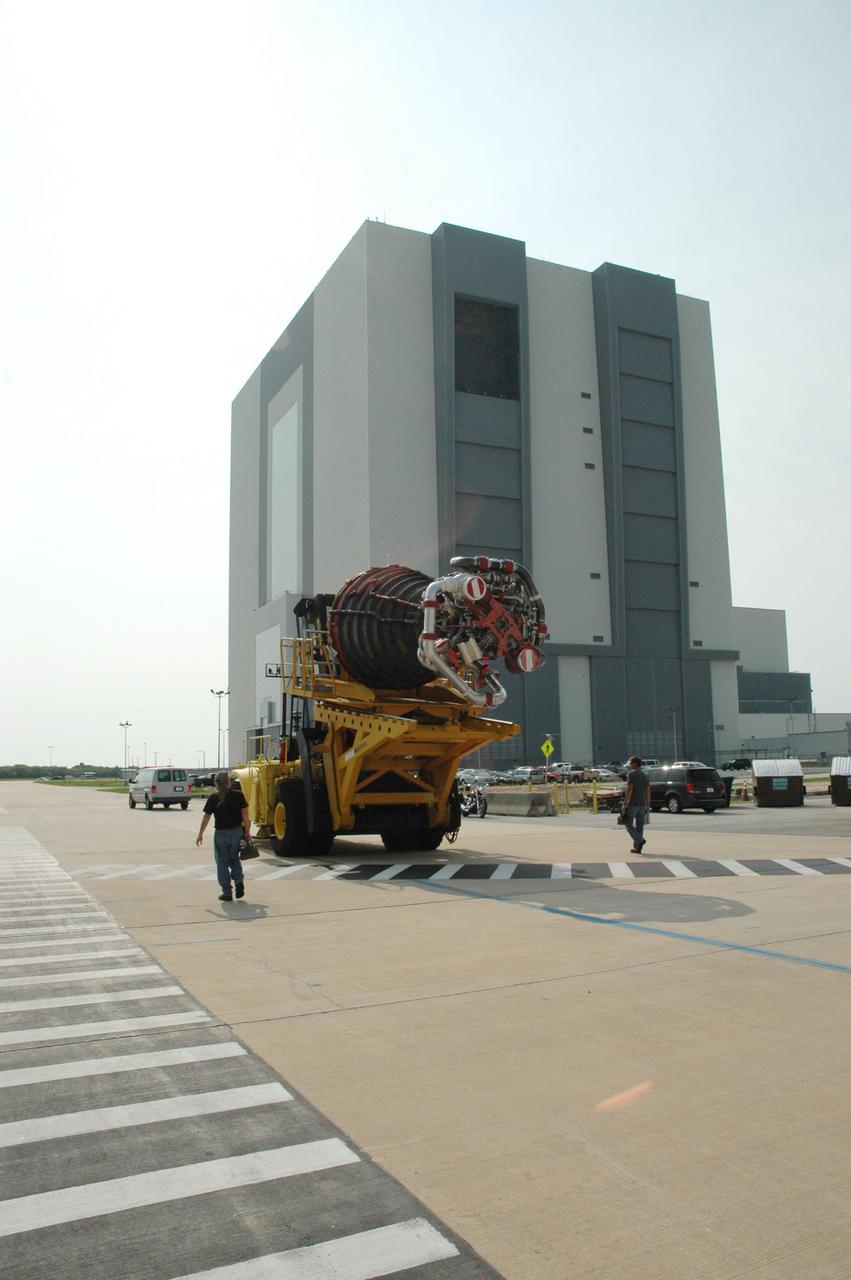
CAPE CANAVERAL, Fla. -- Engine No. 1, one of three space shuttle main engines, was removed from shuttle Endeavour and is being transported from Orbiter Processing Facility-1 to the Space Shuttle Main Engine Processing Facility at NASA's Kennedy Space Center in Florida. The work is part of Endeavour's transition and retirement processing. The spacecraft is being prepared for public display at the California Science Center in Los Angeles. Endeavour flew 25 missions, spent 299 days in space, orbited Earth 4,671 times and traveled 122,883,151 miles over the course of its 19-year career. Endeavour's STS-134 and final mission was completed after landing on June 1, 2011. Photo credit: NASA/Chris Chamberland
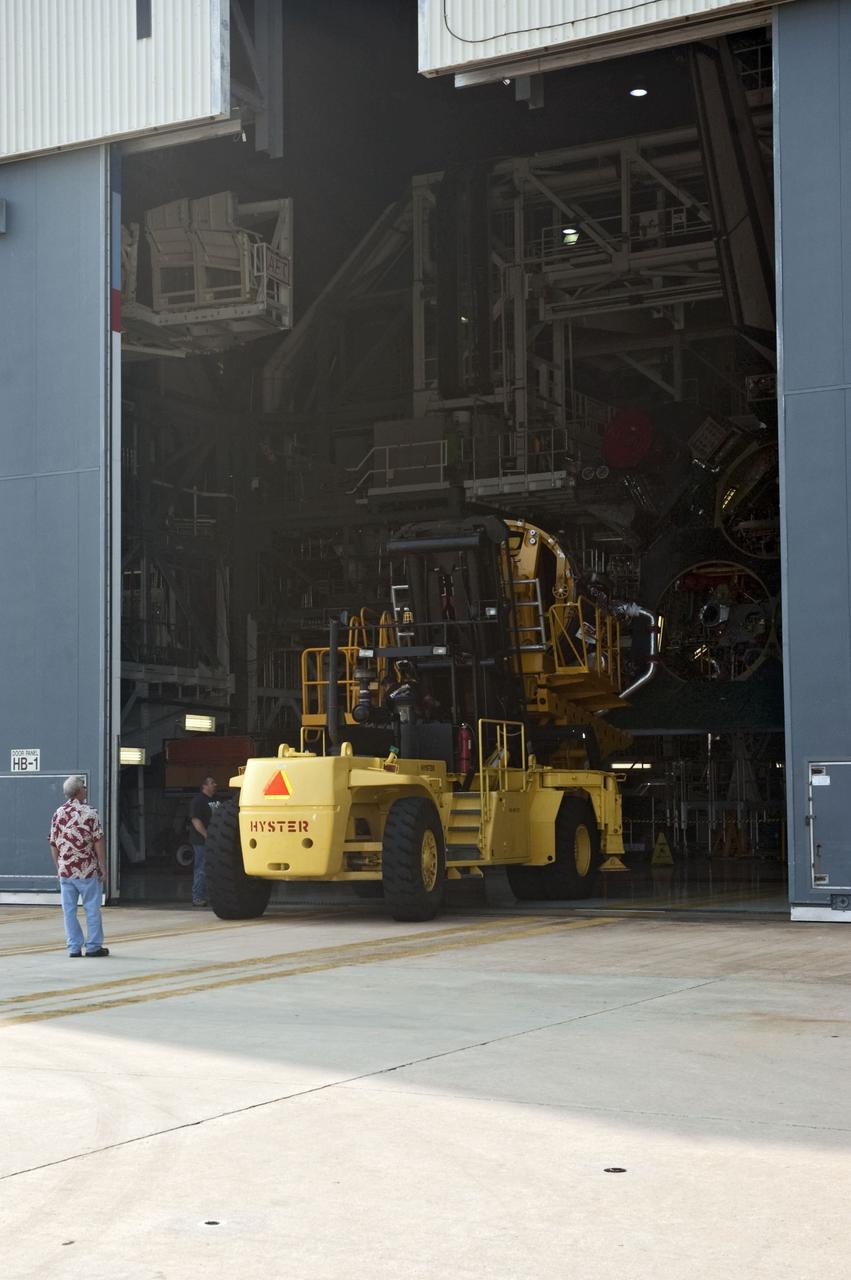
CAPE CANAVERAL, Fla. -- Engine No. 1, one of three space shuttle main engines, was removed from shuttle Endeavour and is being transported from Orbiter Processing Facility-1 to the Space Shuttle Main Engine Processing Facility at NASA's Kennedy Space Center in Florida. The work is part of Endeavour's transition and retirement processing. The spacecraft is being prepared for public display at the California Science Center in Los Angeles. Endeavour flew 25 missions, spent 299 days in space, orbited Earth 4,671 times and traveled 122,883,151 miles over the course of its 19-year career. Endeavour's STS-134 and final mission was completed after landing on June 1, 2011. Photo credit: NASA/Chris Chamberland
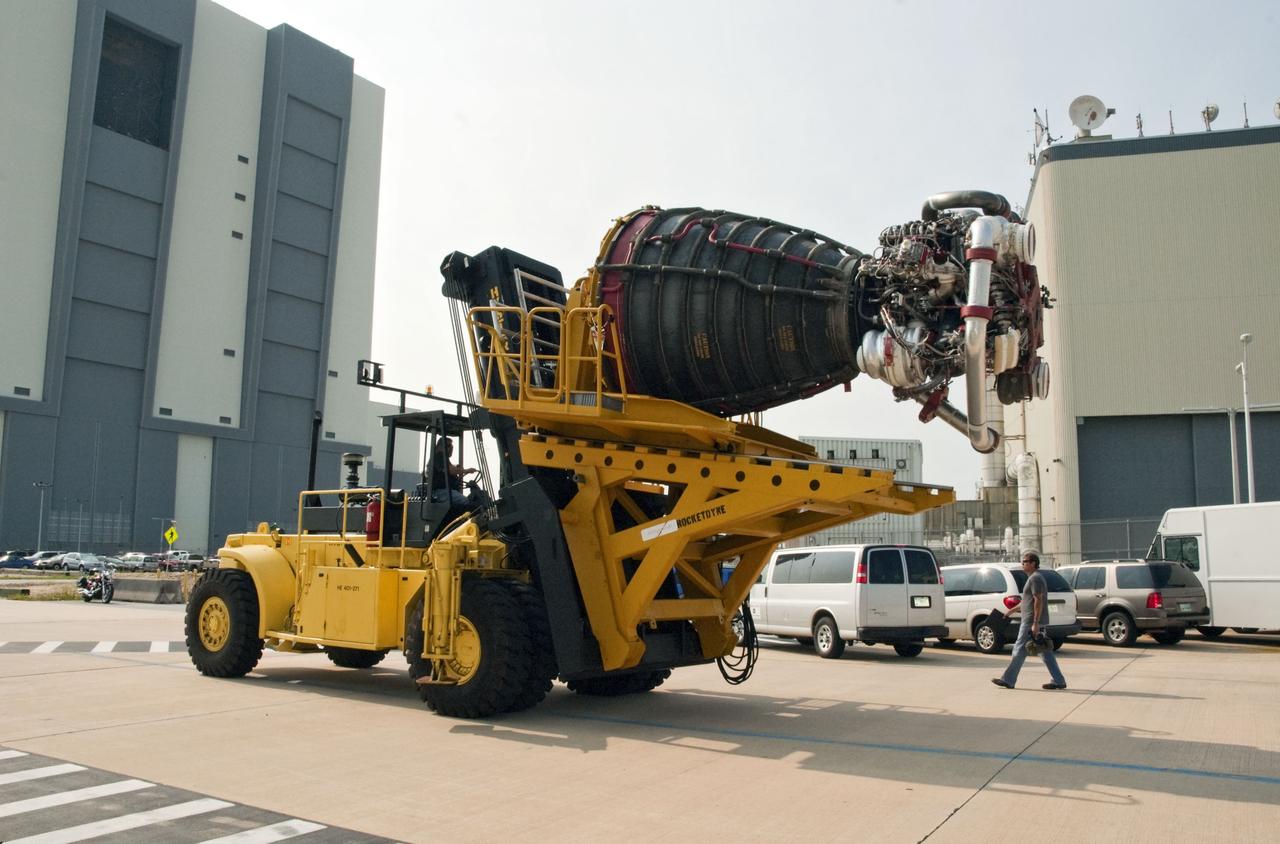
CAPE CANAVERAL, Fla. -- Engine No. 1, one of three space shuttle main engines, was removed from shuttle Endeavour and is being transported from Orbiter Processing Facility-1 to the Space Shuttle Main Engine Processing Facility at NASA's Kennedy Space Center in Florida. The work is part of Endeavour's transition and retirement processing. The spacecraft is being prepared for public display at the California Science Center in Los Angeles. Endeavour flew 25 missions, spent 299 days in space, orbited Earth 4,671 times and traveled 122,883,151 miles over the course of its 19-year career. Endeavour's STS-134 and final mission was completed after landing on June 1, 2011. Photo credit: NASA/Chris Chamberland
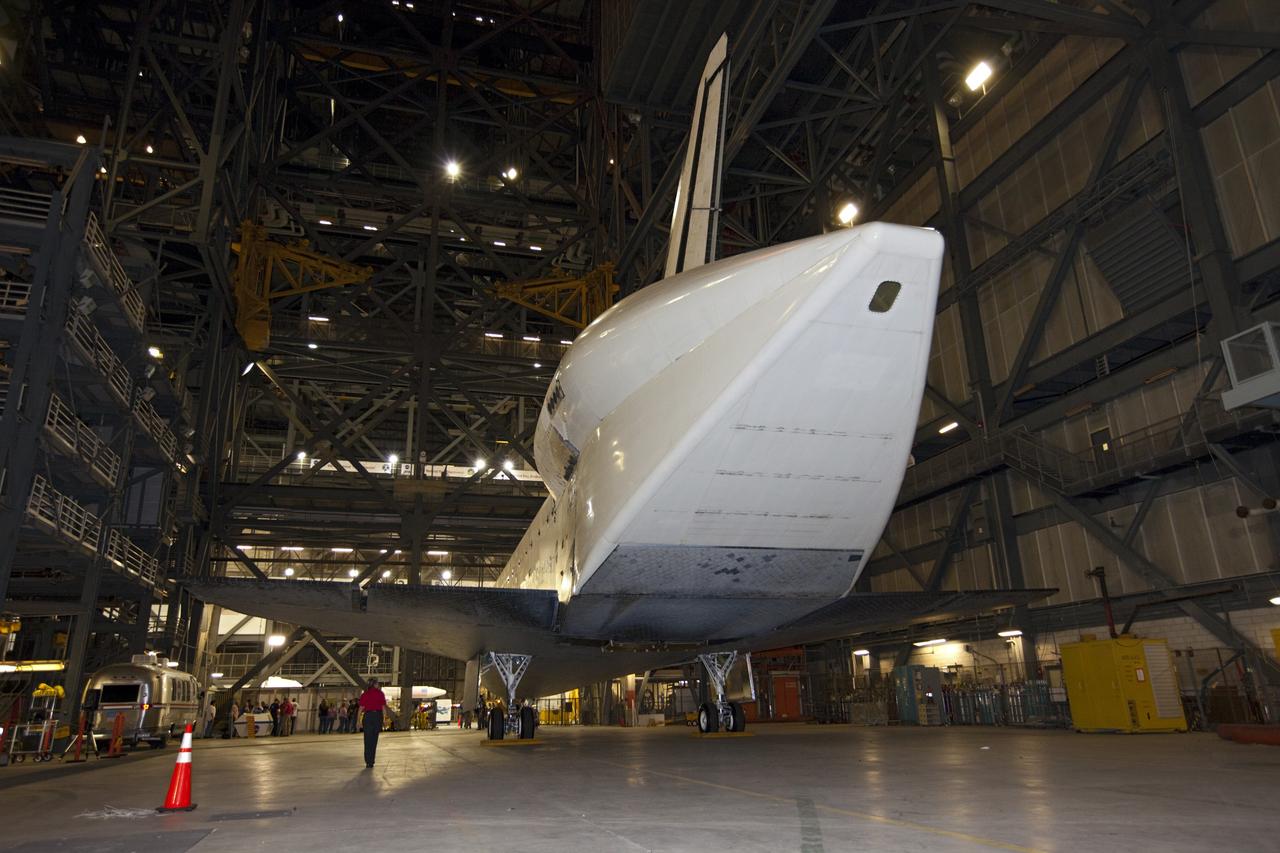
CAPE CANAVERAL, Fla. – An aerodynamic tail cone covers space shuttle Endeavour's trio of replica shuttle main engines as the spacecraft backs out of the Vehicle Assembly Building at NASA's Kennedy Space Center in Florida. Endeavour moved to the nearby Shuttle Landing Facility, where it will be lifted in the gantry-like Mate-Demate Device and placed atop NASA's modified 747 Shuttle Carrier Aircraft for the final ferry flight of the Space Shuttle Program. Endeavour will be placed on permanent public display at the California Science Center in Los Angeles. Photo credit: NASA/Kim Shiflett
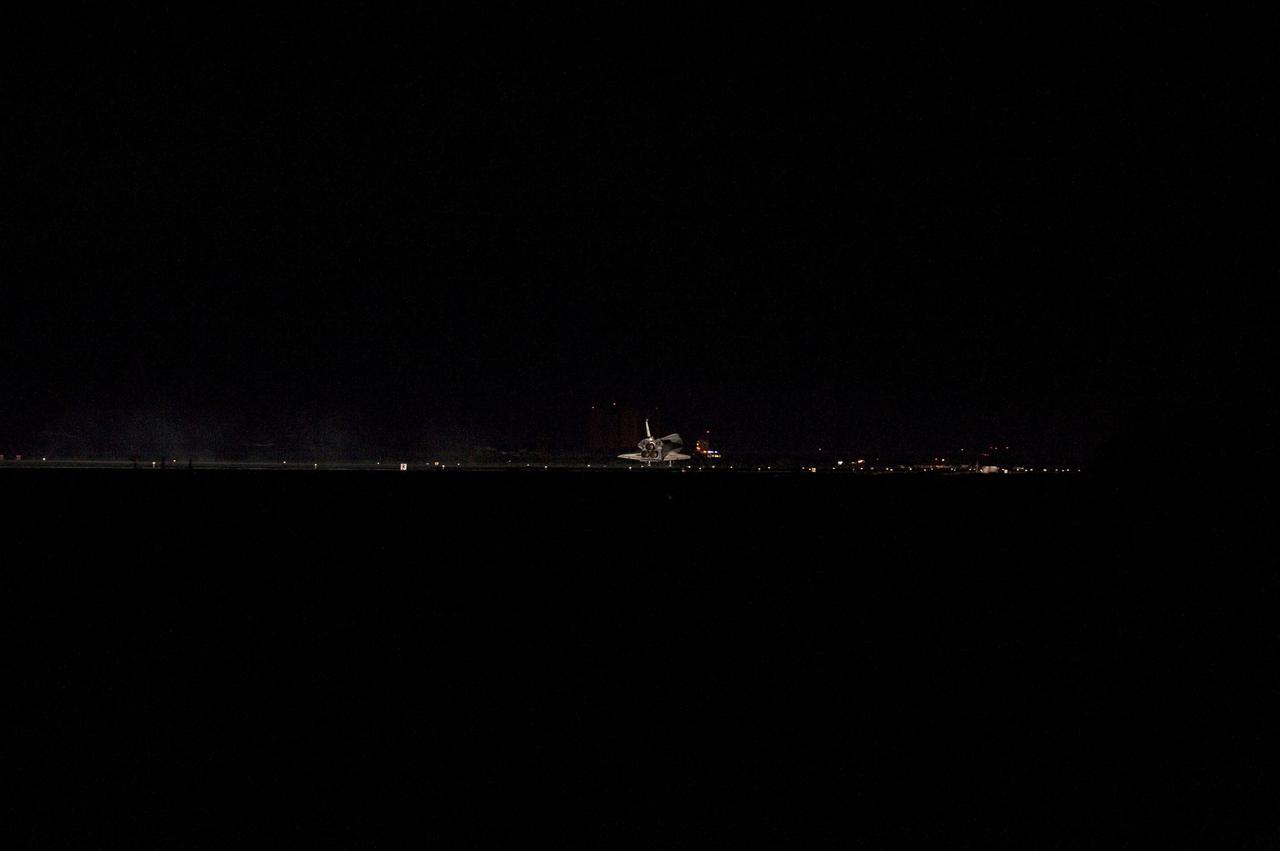
CAPE CANAVERAL, Fla. -- Space shuttle Atlantis' three main engines glow a red hue in the spacecraft's tail end as it touches down on the Shuttle Landing Facility's Runway 15 at NASA's Kennedy Space Center in Florida for the final time. Securing the space shuttle fleet's place in history, Atlantis marked the 26th nighttime landing of NASA's Space Shuttle Program and the 78th landing at Kennedy. Main gear touchdown was at 5:57:00 a.m. EDT, followed by nose gear touchdown at 5:57:20 a.m., and wheelstop at 5:57:54 a.m. On board are STS-135 Commander Chris Ferguson, Pilot Doug Hurley, and Mission Specialists Sandra Magnus and Rex Walheim. On the 37th shuttle mission to the International Space Station, STS-135 delivered more than 9,400 pounds of spare parts, equipment and supplies in the Raffaello multi-purpose logistics module that will sustain station operations for the next year. STS-135 was the 33rd and final flight for Atlantis, which has spent 307 days in space, orbited Earth 4,848 times and traveled 125,935,769 miles. For more information visit, www.nasa.gov/mission_pages/shuttle/shuttlemissions/sts135/index.html. Photo credit: NASA/Sandra Joseph
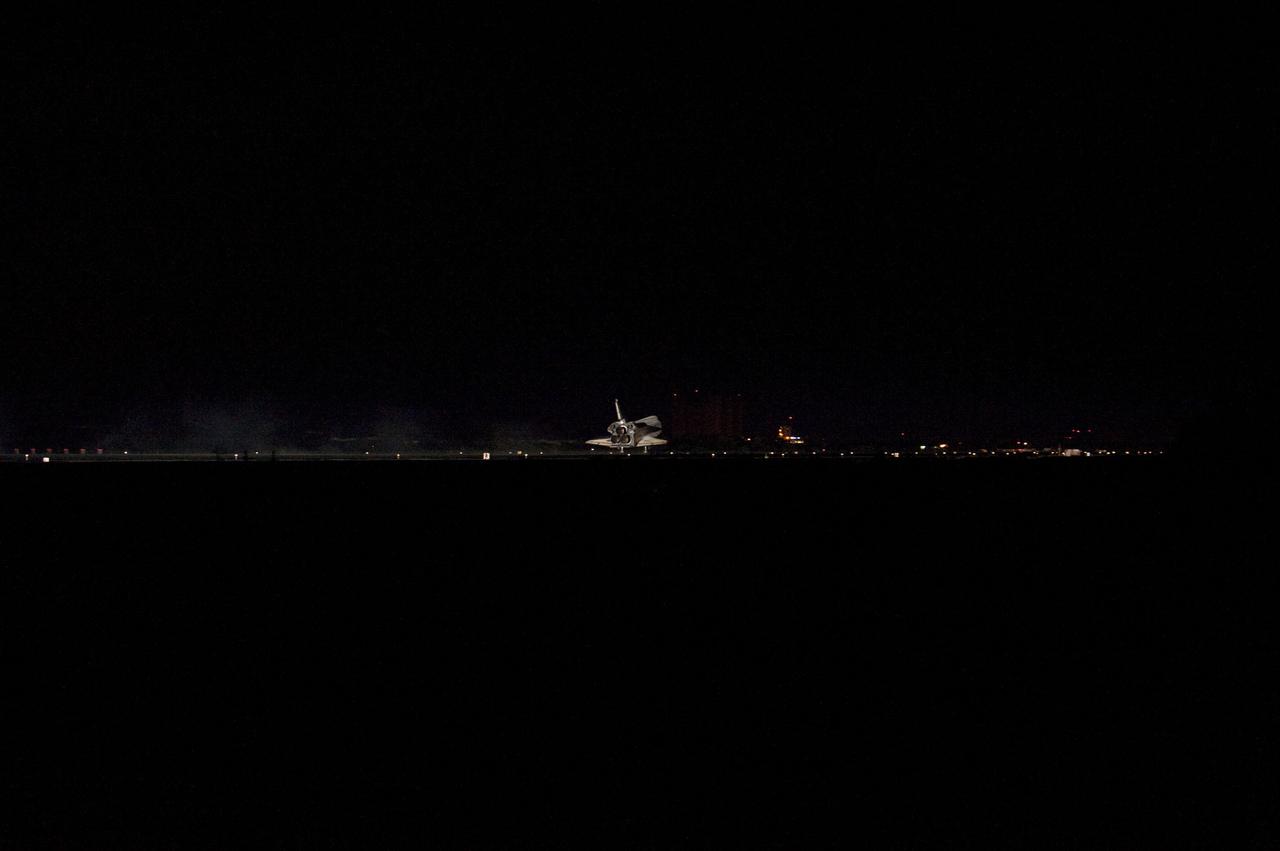
CAPE CANAVERAL, Fla. -- Space shuttle Atlantis' three main engines glow a red hue in the spacecraft's tail end as it touches down on the Shuttle Landing Facility's Runway 15 at NASA's Kennedy Space Center in Florida for the final time. Securing the space shuttle fleet's place in history, Atlantis marked the 26th nighttime landing of NASA's Space Shuttle Program and the 78th landing at Kennedy. Main gear touchdown was at 5:57:00 a.m. EDT, followed by nose gear touchdown at 5:57:20 a.m., and wheelstop at 5:57:54 a.m. On board are STS-135 Commander Chris Ferguson, Pilot Doug Hurley, and Mission Specialists Sandra Magnus and Rex Walheim. On the 37th shuttle mission to the International Space Station, STS-135 delivered more than 9,400 pounds of spare parts, equipment and supplies in the Raffaello multi-purpose logistics module that will sustain station operations for the next year. STS-135 was the 33rd and final flight for Atlantis, which has spent 307 days in space, orbited Earth 4,848 times and traveled 125,935,769 miles. For more information visit, www.nasa.gov/mission_pages/shuttle/shuttlemissions/sts135/index.html. Photo credit: NASA/Sandra Joseph
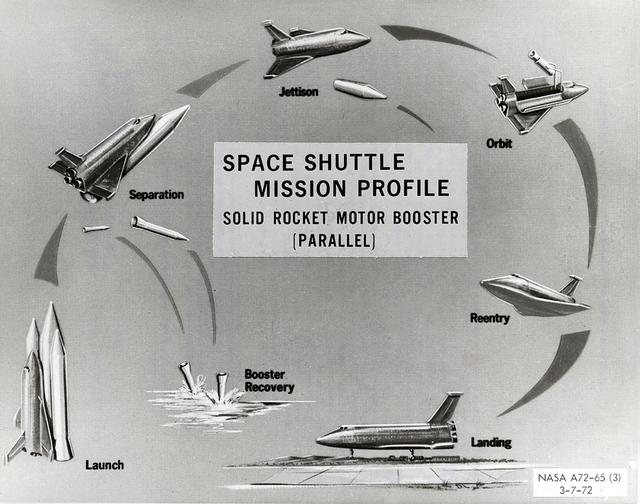
This early chart conceptualizes the use of two parallel Solid Rocket Motor Boosters in conjunction with three main engines to launch the proposed Space Shuttle to orbit. At approximately twenty-five miles altitude, the boosters would detach from the Orbiter and parachute back to Earth where they would be recovered and refurbished for future use. The Shuttle was designed as NASA's first reusable space vehicle, launching vertically like a spacecraft and landing on runways like conventional aircraft. Marshall Space Flight Center had management responsibility for the Shuttle's propulsion elements, including the Solid Rocket Boosters.
STS135-S-183 (21 July 2011) --- Space shuttle Atlantis' three main engines glow a red hue in the spacecraft's tail end as it touches down on the Shuttle Landing Facility's Runway 15 at NASA's Kennedy Space Center in Florida for the final time. Securing the space shuttle fleet's place in history, Atlantis marked the 26th nighttime landing of NASA's Space Shuttle Program and the 78th landing at Kennedy. Main gear touchdown was at 5:57:00 a.m. (EDT) on July 21, 2011, followed by nose gear touchdown at 5:57:20 a.m., and wheelstop at 5:57:54 a.m. Onboard are NASA astronauts Chris Ferguson, STS-135 commander; Doug Hurley, pilot; Sandy Magnus and Rex Walheim, both mission specialists. On the 37th shuttle mission to the International Space Station, STS-135 delivered more than 9,400 pounds of spare parts, equipment and supplies in the Raffaello multi-purpose logistics module that will sustain station operations for the next year. STS-135 was the 33rd and final flight for Atlantis, which has spent 307 days in space, orbited Earth 4,848 times and traveled 125,935,769 miles. Photo credit: NASA
STS135-S-184 (21 July 2011) --- Space shuttle Atlantis' three main engines glow a red hue in the spacecraft's tail end as it touches down on the Shuttle Landing Facility's Runway 15 at NASA's Kennedy Space Center in Florida for the final time. Securing the space shuttle fleet's place in history, Atlantis marked the 26th nighttime landing of NASA's Space Shuttle Program and the 78th landing at Kennedy. Main gear touchdown was at 5:57:00 a.m. (EDT) on July 21, 2011, followed by nose gear touchdown at 5:57:20 a.m., and wheelstop at 5:57:54 a.m. Onboard are NASA astronauts Chris Ferguson, STS-135 commander; Doug Hurley, pilot; Sandy Magnus and Rex Walheim, both mission specialists. On the 37th shuttle mission to the International Space Station, STS-135 delivered more than 9,400 pounds of spare parts, equipment and supplies in the Raffaello multi-purpose logistics module that will sustain station operations for the next year. STS-135 was the 33rd and final flight for Atlantis, which has spent 307 days in space, orbited Earth 4,848 times and traveled 125,935,769 miles. Photo credit: NASA
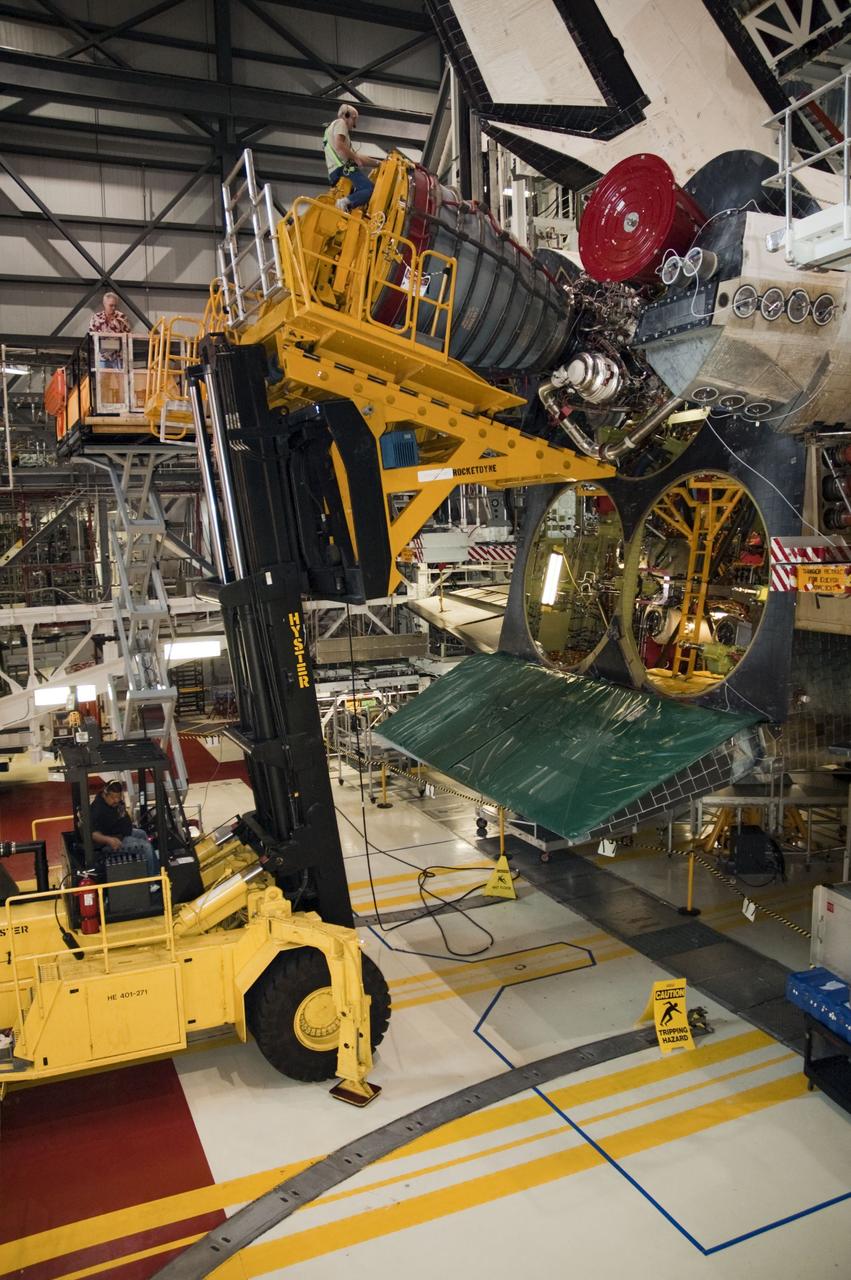
CAPE CANAVERAL, Fla. -- In Orbiter Processing Facility-1 at NASA's Kennedy Space Center in Florida, technicians remove engine No. 1, one of three space shuttle main engines from shuttle Endeavour using a specially designed engine installer, called a Hyster forklift. The work is part of Endeavour's transition and retirement processing. The spacecraft is being prepared for public display at the California Science Center in Los Angeles. Endeavour flew 25 missions, spent 299 days in space, orbited Earth 4,671 times and traveled 122,883,151 miles over the course of its 19-year career. Endeavour's STS-134 and final mission was completed after landing on June 1, 2011. Photo credit: NASA/Chris Chamberland
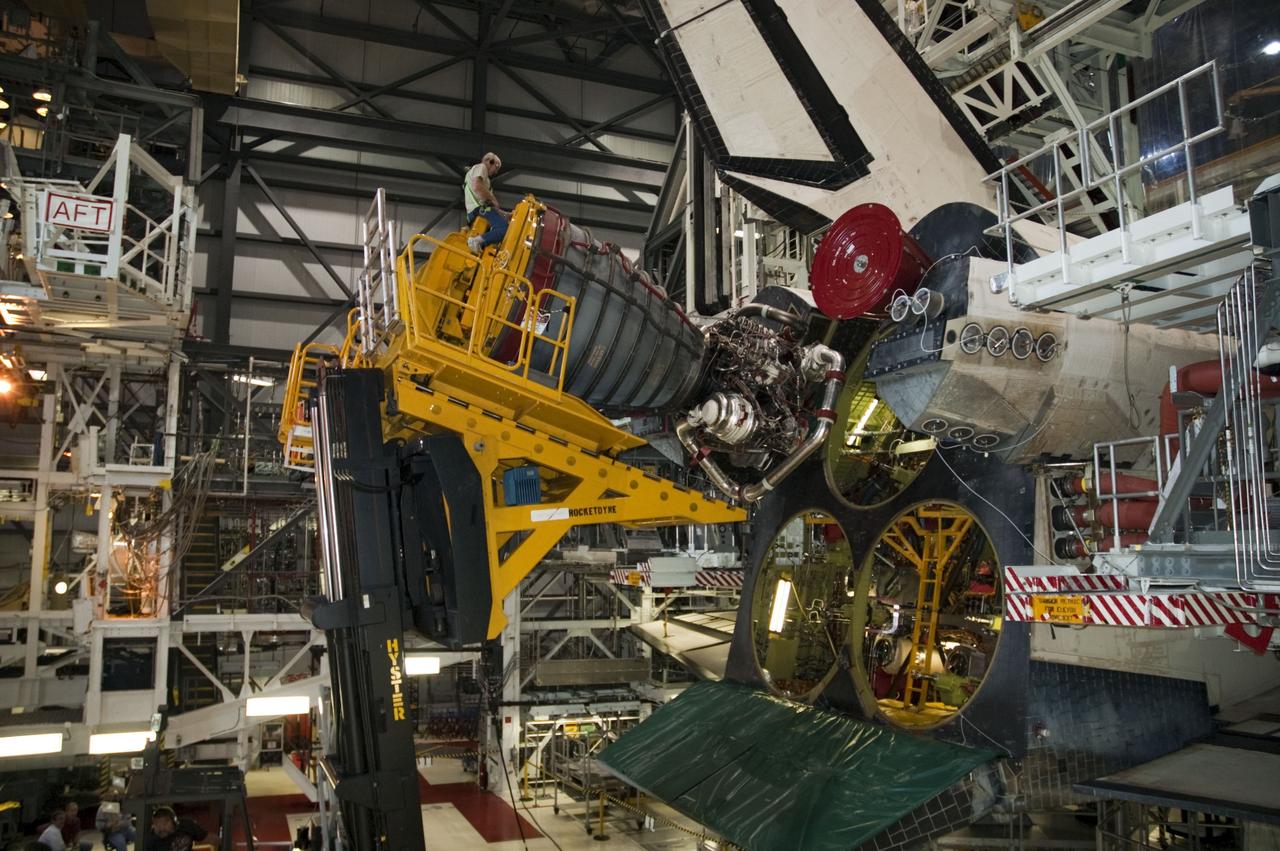
CAPE CANAVERAL, Fla. -- In Orbiter Processing Facility-1 at NASA's Kennedy Space Center in Florida, technicians remove engine No. 1, one of three space shuttle main engines from shuttle Endeavour using a specially designed engine installer, called a Hyster forklift. The work is part of Endeavour's transition and retirement processing. The spacecraft is being prepared for public display at the California Science Center in Los Angeles. Endeavour flew 25 missions, spent 299 days in space, orbited Earth 4,671 times and traveled 122,883,151 miles over the course of its 19-year career. Endeavour's STS-134 and final mission was completed after landing on June 1, 2011. Photo credit: NASA/Chris Chamberland
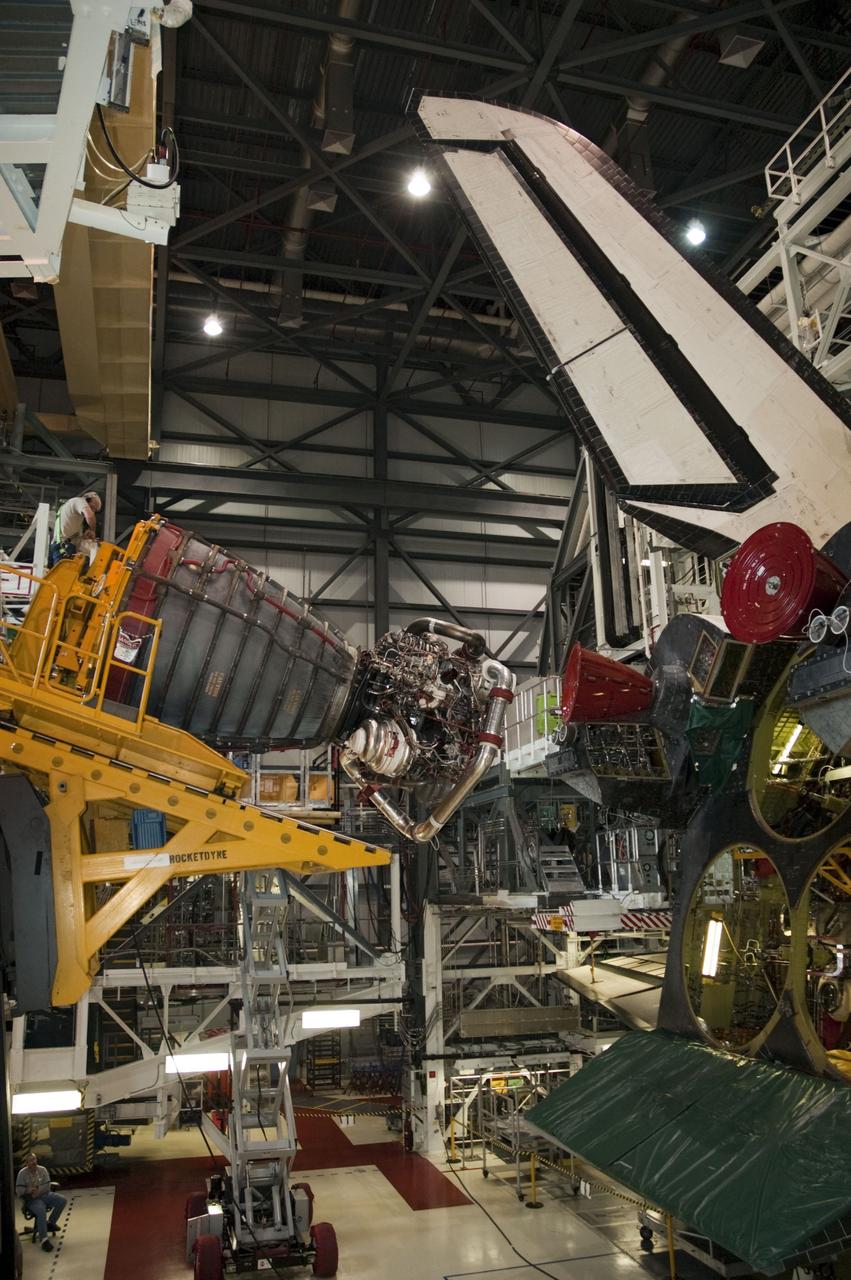
CAPE CANAVERAL, Fla. -- In Orbiter Processing Facility-1 at NASA's Kennedy Space Center in Florida, technicians remove engine No. 1, one of three space shuttle main engines from shuttle Endeavour using a specially designed engine installer, called a Hyster forklift. The work is part of Endeavour's transition and retirement processing. The spacecraft is being prepared for public display at the California Science Center in Los Angeles. Endeavour flew 25 missions, spent 299 days in space, orbited Earth 4,671 times and traveled 122,883,151 miles over the course of its 19-year career. Endeavour's STS-134 and final mission was completed after landing on June 1, 2011. Photo credit: NASA/Chris Chamberland
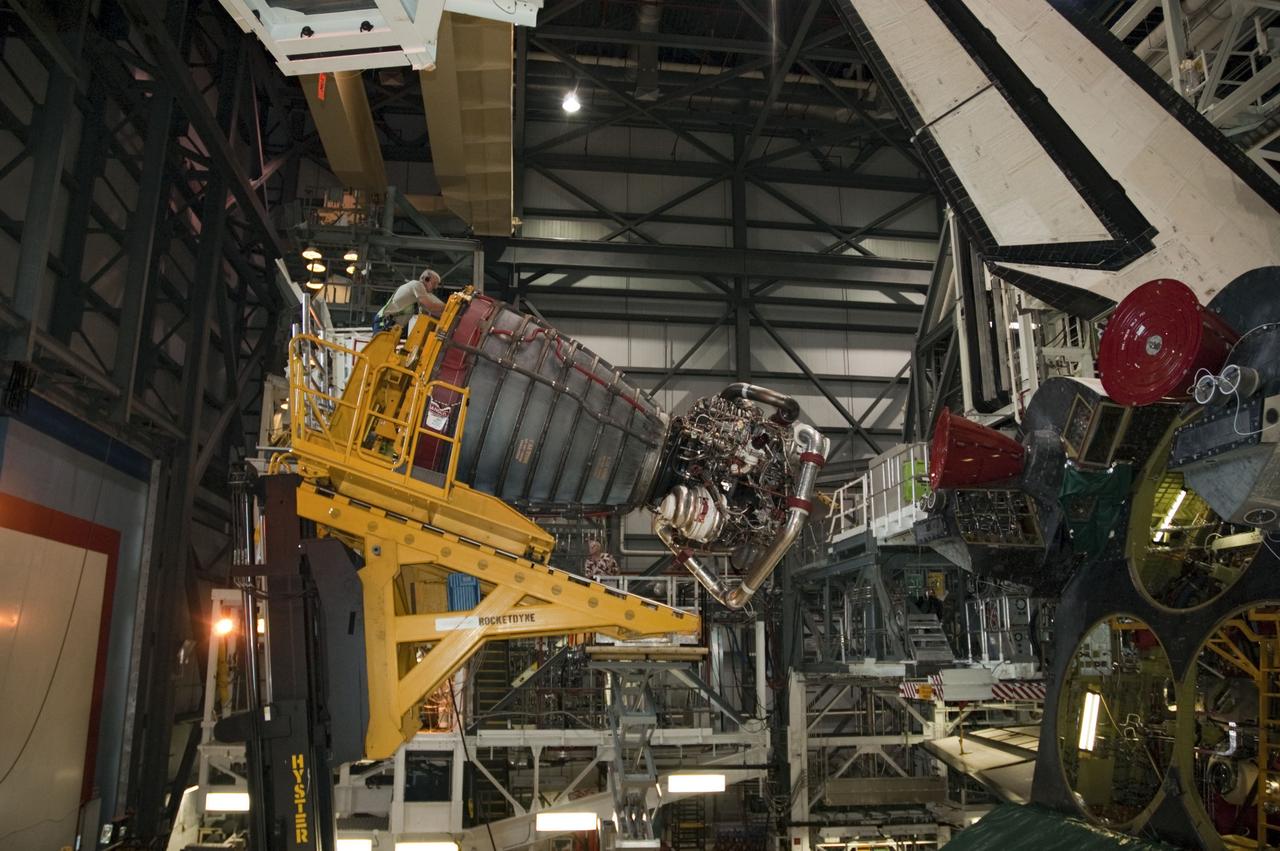
CAPE CANAVERAL, Fla. -- In Orbiter Processing Facility-1 at NASA's Kennedy Space Center in Florida, technicians remove engine No. 1, one of three space shuttle main engines from shuttle Endeavour using a specially designed engine installer, called a Hyster forklift. The work is part of Endeavour's transition and retirement processing. The spacecraft is being prepared for public display at the California Science Center in Los Angeles. Endeavour flew 25 missions, spent 299 days in space, orbited Earth 4,671 times and traveled 122,883,151 miles over the course of its 19-year career. Endeavour's STS-134 and final mission was completed after landing on June 1, 2011. Photo credit: NASA/Chris Chamberland
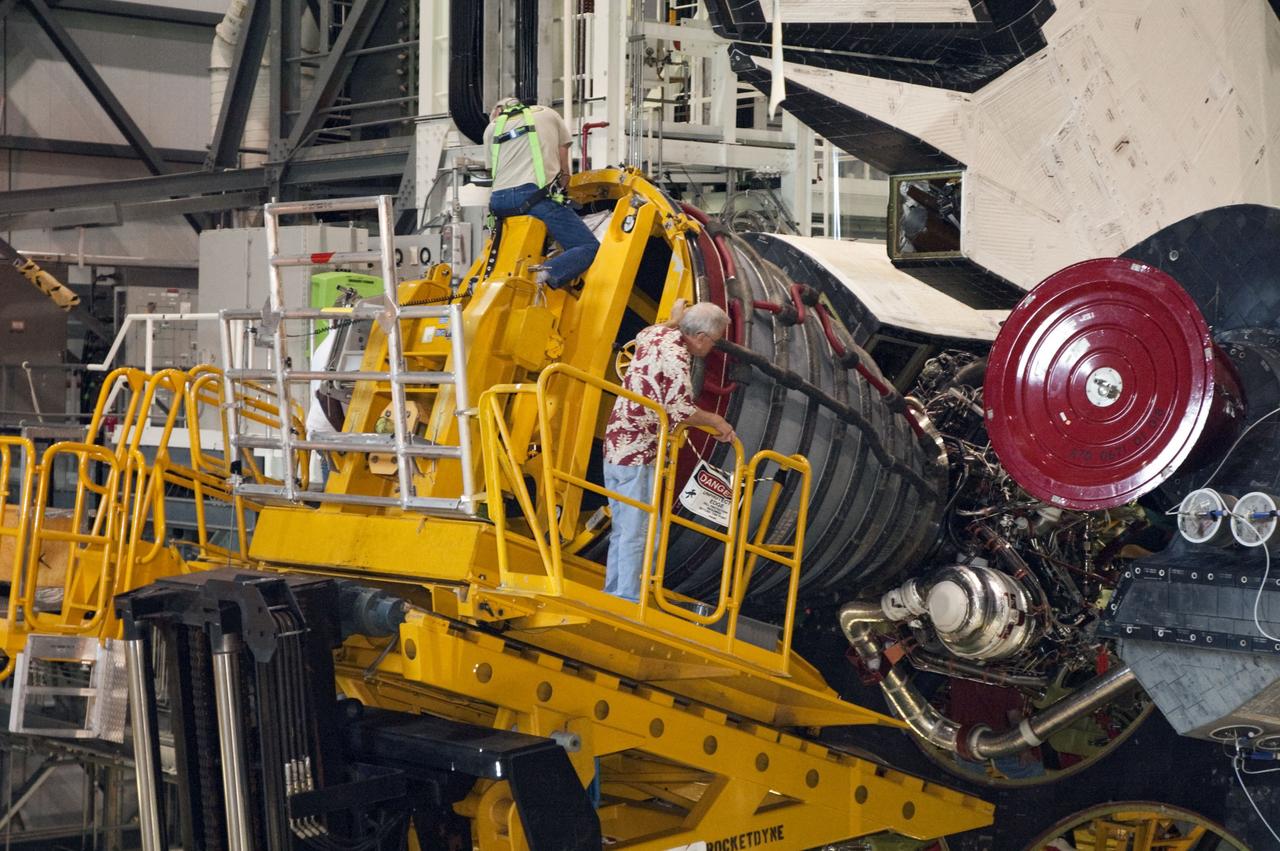
CAPE CANAVERAL, Fla. -- In Orbiter Processing Facility-1 at NASA's Kennedy Space Center in Florida, technicians remove engine No. 1, one of three space shuttle main engines from shuttle Endeavour using a specially designed engine installer, called a Hyster forklift. The work is part of Endeavour's transition and retirement processing. The spacecraft is being prepared for public display at the California Science Center in Los Angeles. Endeavour flew 25 missions, spent 299 days in space, orbited Earth 4,671 times and traveled 122,883,151 miles over the course of its 19-year career. Endeavour's STS-134 and final mission was completed after landing on June 1, 2011. Photo credit: NASA/Chris Chamberland
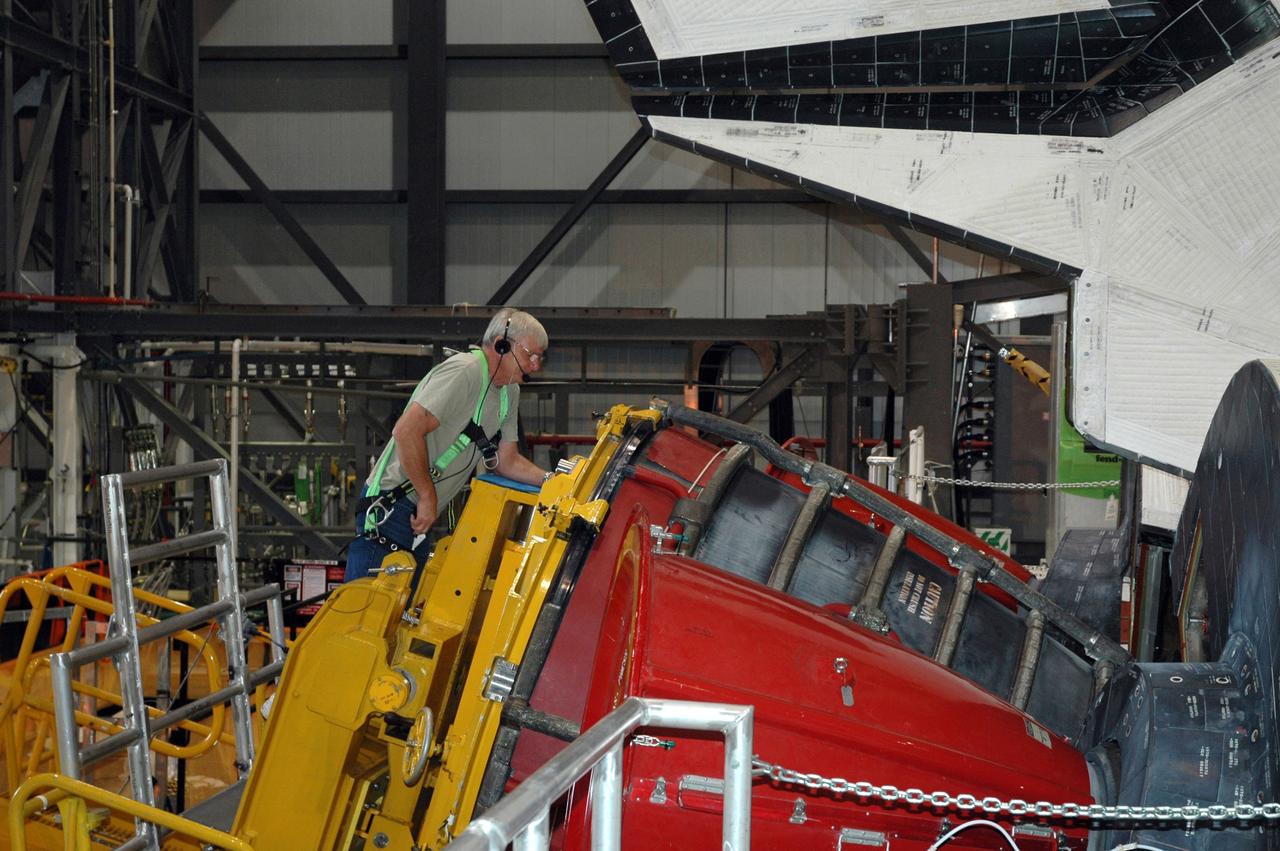
CAPE CANAVERAL, Fla. -- In Orbiter Processing Facility-1 at NASA's Kennedy Space Center in Florida, technicians remove engine No. 1, one of three space shuttle main engines from shuttle Endeavour using a specially designed engine installer, called a Hyster forklift. The work is part of Endeavour's transition and retirement processing. The spacecraft is being prepared for public display at the California Science Center in Los Angeles. Endeavour flew 25 missions, spent 299 days in space, orbited Earth 4,671 times and traveled 122,883,151 miles over the course of its 19-year career. Endeavour's STS-134 and final mission was completed after landing on June 1, 2011. Photo credit: NASA/Chris Chamberland
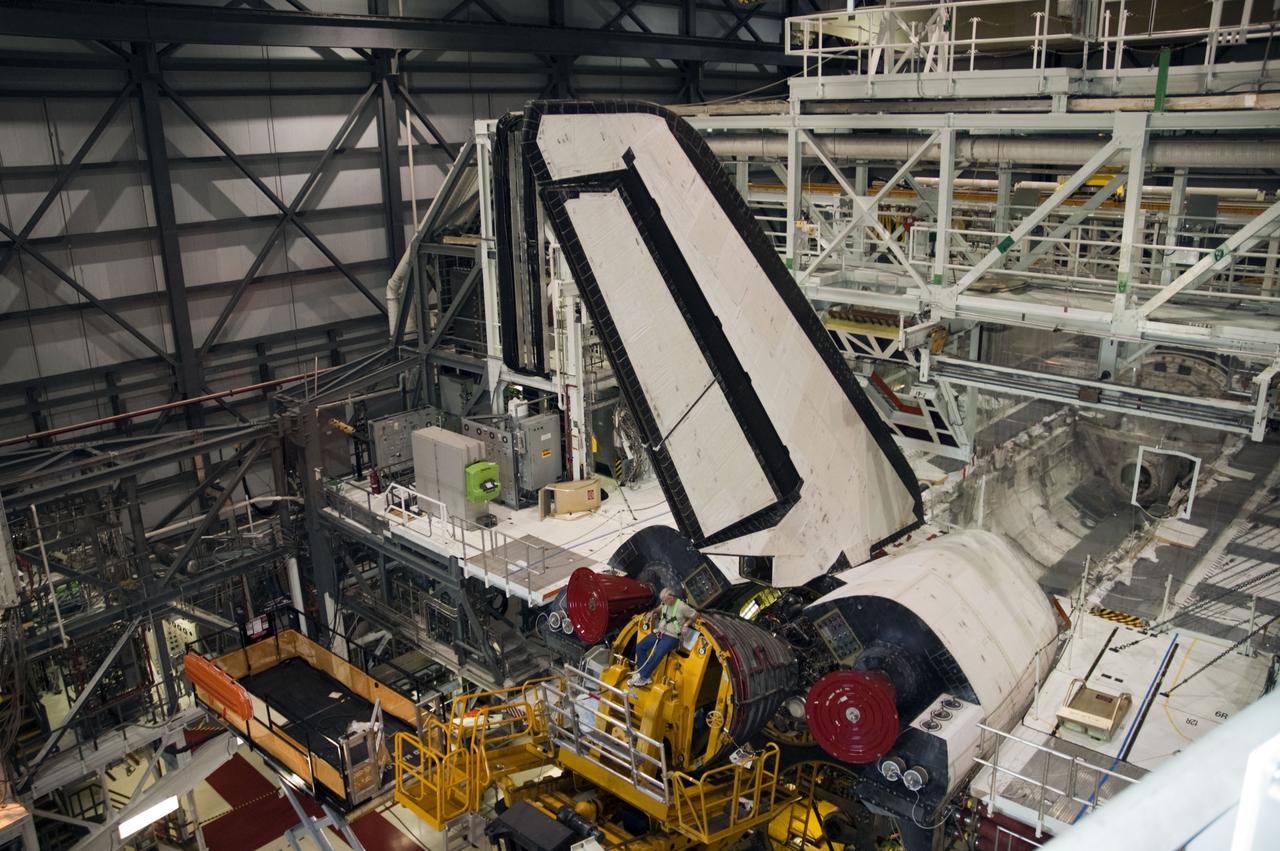
CAPE CANAVERAL, Fla. -- In Orbiter Processing Facility-1 at NASA's Kennedy Space Center in Florida, technicians remove engine No. 1, one of three space shuttle main engines from shuttle Endeavour using a specially designed engine installer, called a Hyster forklift. The work is part of Endeavour's transition and retirement processing. The spacecraft is being prepared for public display at the California Science Center in Los Angeles. Endeavour flew 25 missions, spent 299 days in space, orbited Earth 4,671 times and traveled 122,883,151 miles over the course of its 19-year career. Endeavour's STS-134 and final mission was completed after landing on June 1, 2011. Photo credit: NASA/Chris Chamberland
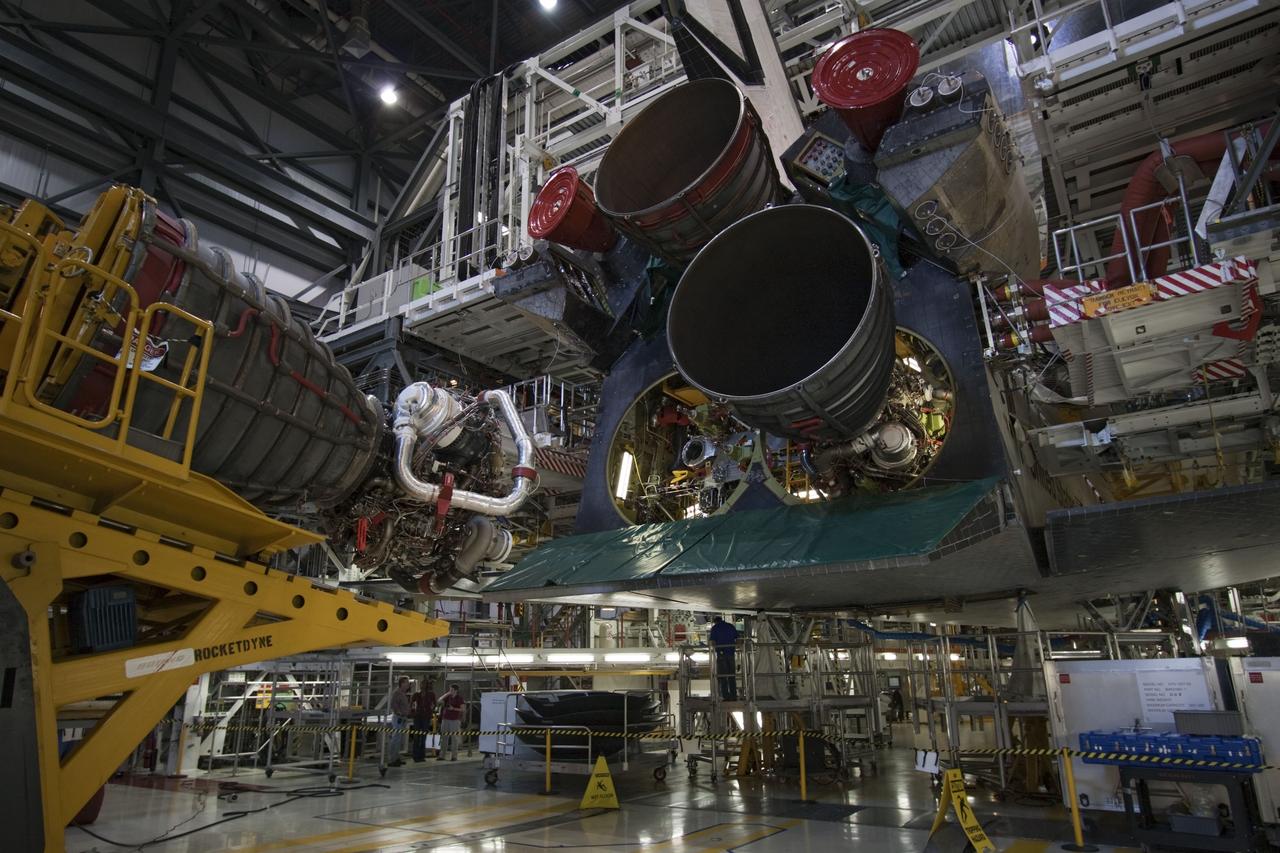
CAPE CANAVERAL, Fla. -- In Orbiter Processing Facility-1 at NASA's Kennedy Space Center in Florida, technicians carefully remove engine No. 2, one of three space shuttle main engines from Endeavour using a specially designed engine installer, called a Hyster forklift. The work is part of Endeavour's transition and retirement processing. The spacecraft is being prepared for public display at the California Science Center in Los Angeles. Endeavour flew 25 missions, spent 299 days in space, orbited Earth 4,671 times and traveled 122,883,151 miles over the course of its 19-year career. Endeavour's STS-134 and final mission was completed after landing on June 1, 2011. Photo credit: NASA/Jim Grossmann
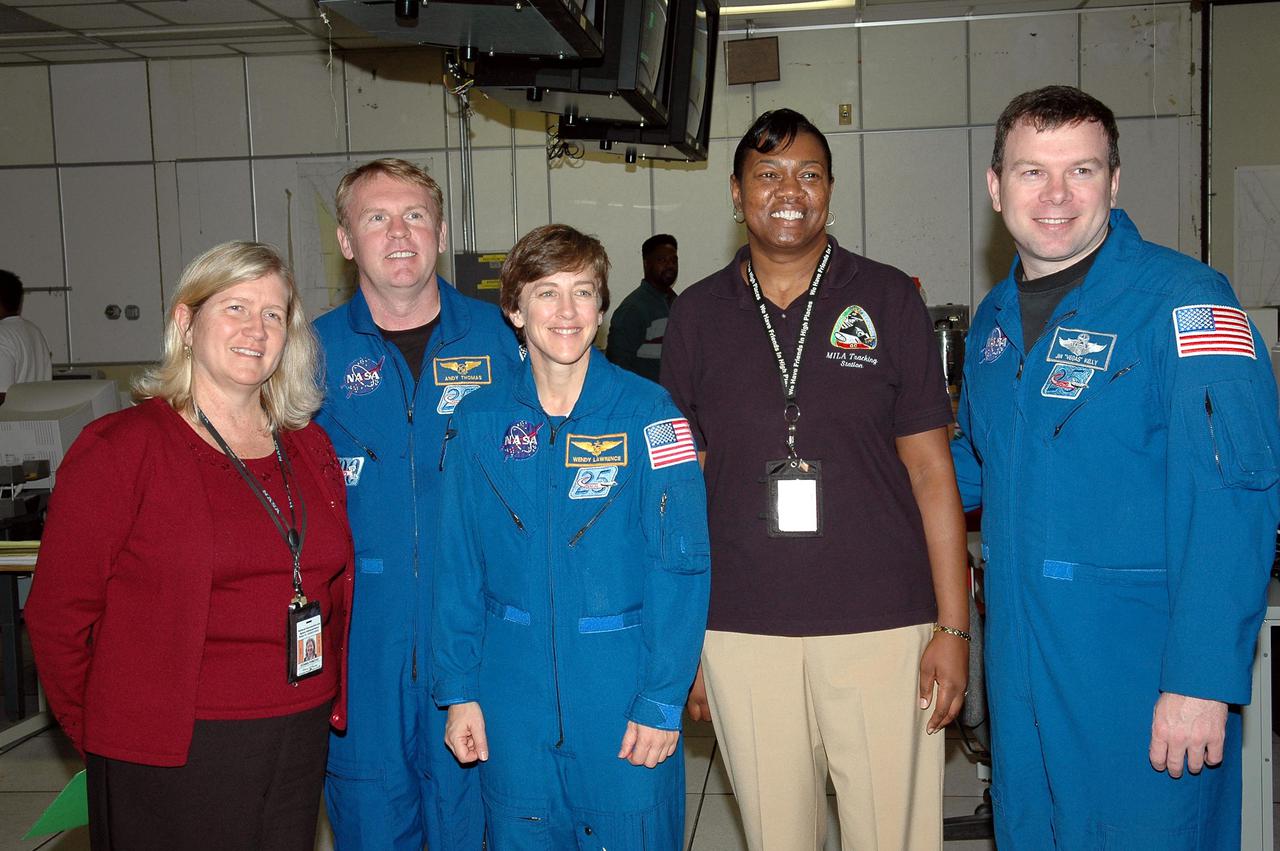
KENNEDY SPACE CENTER, FLA. - - While visiting Kennedy Space Center, members of the STS-114 crew stop to talk with workers in the MILA Spaceflight Tracking and Data Network Station. From left are Donna Pancho, MILA software engineer, Mission Specialists Andrew Thomas and Wendy Lawrence, Melissa Blizzard, MILA operations manager, and Pilot James Kelly. The tracking station serves as the primary voice, data and telemetry communications link between the Shuttle and the ground from launch until 7-1_2 minutes into the flight. Millions of clues about the performance of the Space Shuttle’s main engines and other components are communicated to launch managers, technicians and engineers on the ground, who must keep their fingers on the pulse of the Space Shuttle during the critical ascent period. In a typical year, MILA provides through KSC more than 10,000 hours of data between spacecraft and data users. MILA is also used during a Space Shuttle landing at KSC and provides communications beginning about 13 minutes before touchdown. Also, MILA can be called upon to provide data transfer support for NASA’s Expendable Launch Vehicle missions and orbiting scientific satellites.
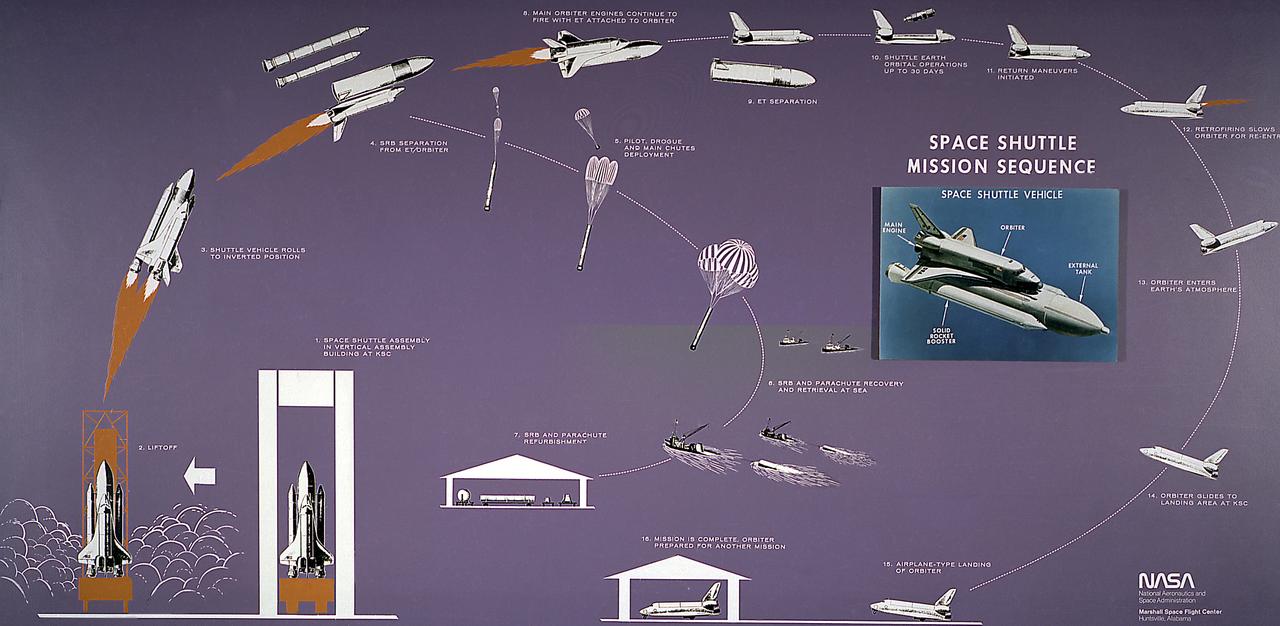
This diagram illustrates the Space Shuttle mission sequence. The Space Shuttle was approved as a national program in 1972 and developed through the 1970s. Part spacecraft and part aircraft, the Space Shuttle orbiter, the brain and the heart of the Space Transportation System (STS), required several technological advances, including thousands of insulating tiles able to stand the heat of reentry over the course of many missions, as well as sophisticated engines that could be used again and again without being thrown away. The airplane-like orbiter has three main engines, that burn liquid hydrogen and oxygen stored in the large external tank, the single largest structure in the Shuttle. Attached to the tank are two solid rocket boosters that provide the vehecile with most of the thrust needed for liftoff. Two minutes into the flight, the spent solids drop into the ocean to be recovered and refurbished for reuse, while the orbiter engines continue burning until approximately 8 minutes into the flight. After the mission is completed, the orbiter lands on a runway like an airplane.
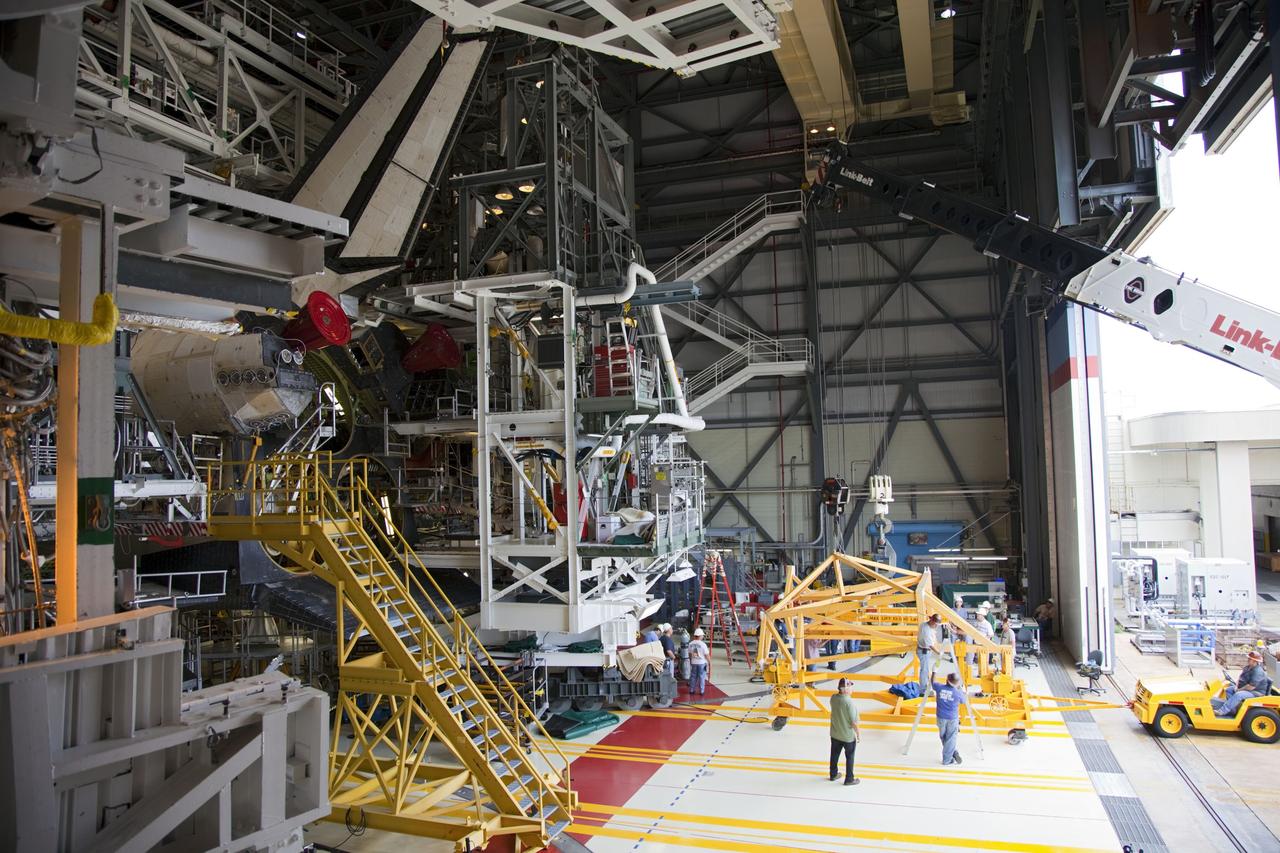
CAPE CANAVERAL, Fla. -- In Orbiter Processing Facility-1 at NASA’s Kennedy Space Center in Florida, the main engines have been removed from shuttle Endeavour and workers begin to remove the orbital maneuvering system, or OMS, pods from the spacecraft. The work is part of Endeavour’s transition and retirement processing. The spacecraft is being prepared for public display at the California Science Center in Los Angeles. Endeavour flew 25 missions, spent 299 days in space, orbited Earth 4,671 times and traveled 122, 883, 151 miles over the course of its 19-year career. Endeavour’s STS-134 and final mission was completed after landing on June 1, 2011. Photo credit: Frank Michaux
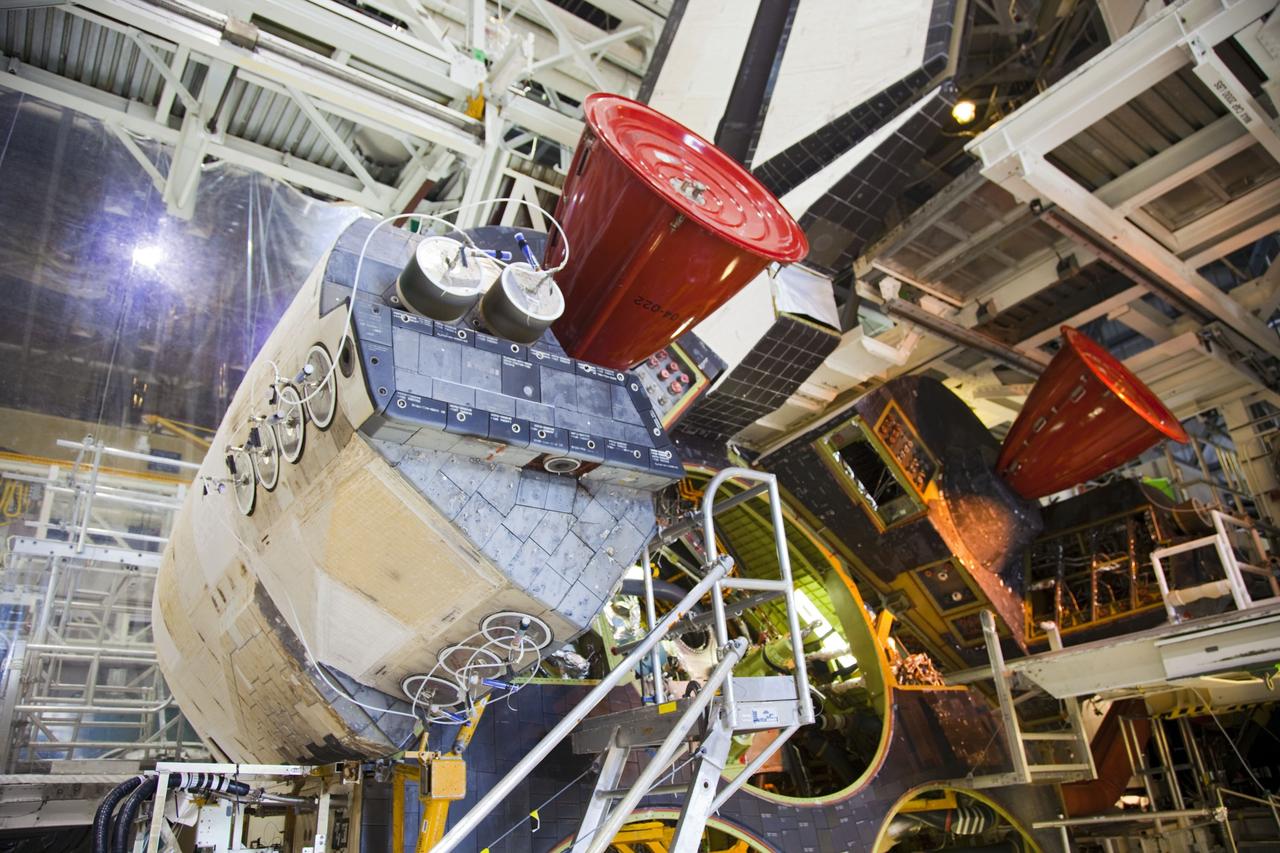
CAPE CANAVERAL, Fla. -- In Orbiter Processing Facility-1 at NASA’s Kennedy Space Center in Florida, the main engines have been removed from shuttle Endeavour and work begins to remove the orbital maneuvering system, or OMS, pods from the spacecraft. The work is part of Endeavour’s transition and retirement processing. The spacecraft is being prepared for public display at the California Science Center in Los Angeles. Endeavour flew 25 missions, spent 299 days in space, orbited Earth 4,671 times and traveled 122, 883, 151 miles over the course of its 19-year career. Endeavour’s STS-134 and final mission was completed after landing on June 1, 2011. Photo credit: Frank Michaux
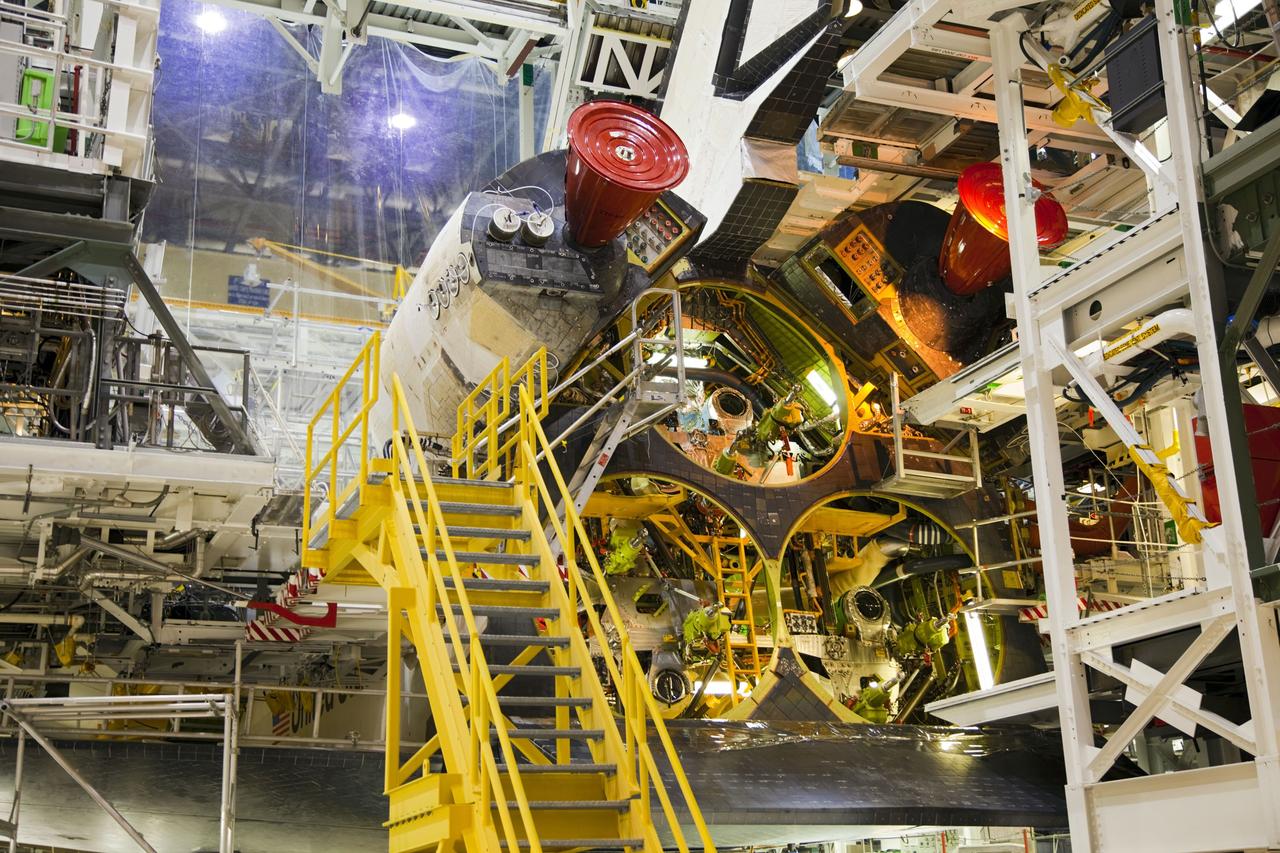
CAPE CANAVERAL, Fla. -- In Orbiter Processing Facility-1 at NASA’s Kennedy Space Center in Florida, the main engines have been removed from shuttle Endeavour and work begins to remove the orbital maneuvering system, or OMS, pods from the spacecraft. The work is part of Endeavour’s transition and retirement processing. The spacecraft is being prepared for public display at the California Science Center in Los Angeles. Endeavour flew 25 missions, spent 299 days in space, orbited Earth 4,671 times and traveled 122, 883, 151 miles over the course of its 19-year career. Endeavour’s STS-134 and final mission was completed after landing on June 1, 2011. Photo credit: Frank Michaux
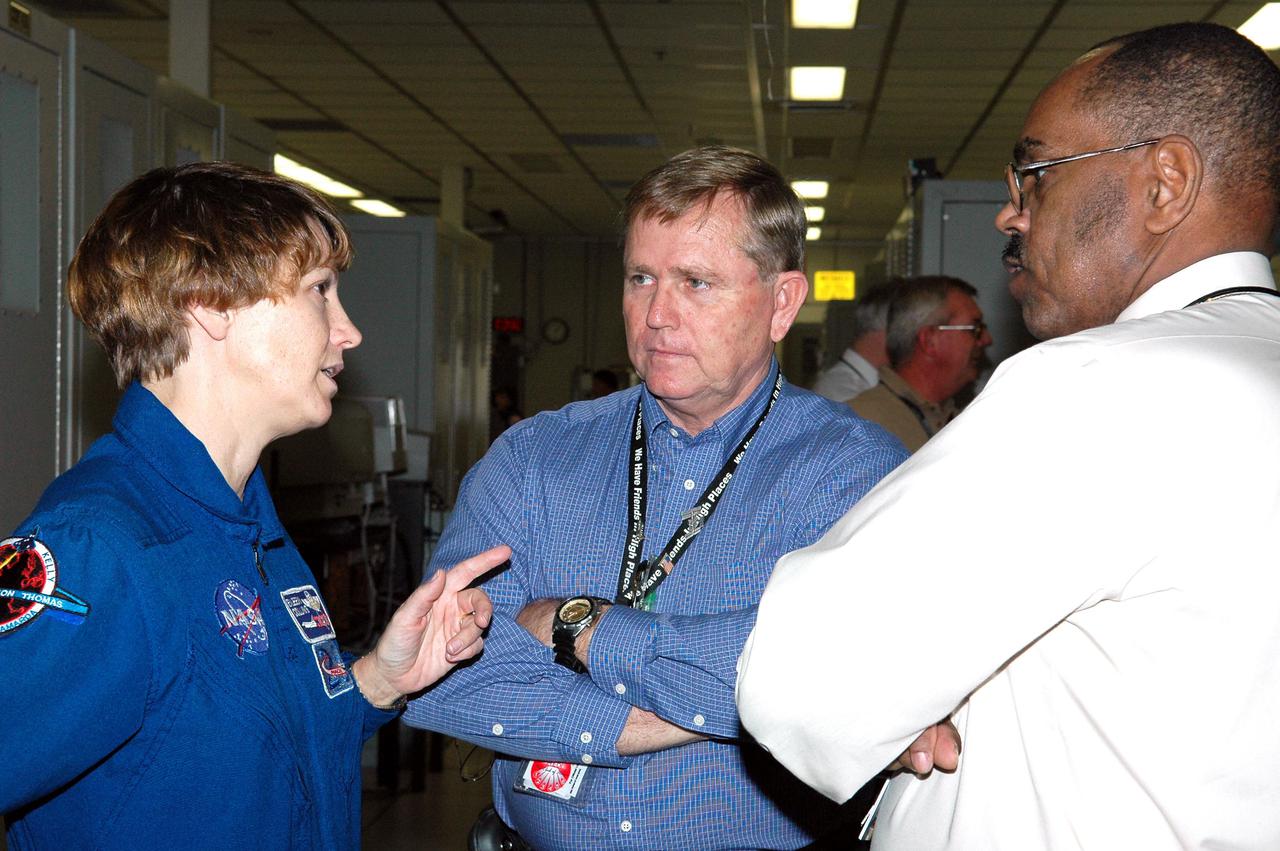
KENNEDY SPACE CENTER, FLA. - While visiting Kennedy Space Center, STS-114 Commander Eileen Collins (left) talks with John Bailey, MILA Support Services manager, and Harold Stinger, SGT president, in the MILA Spaceflight Tracking and Data Network Station. The tracking station serves as the primary voice, data and telemetry communications link between the Shuttle and the ground from launch until 7-1_2 minutes into the flight. Millions of clues about the performance of the Space Shuttle’s main engines and other components are communicated to launch managers, technicians and engineers on the ground, who must keep their fingers on the pulse of the Space Shuttle during the critical ascent period. In a typical year, MILA provides through KSC more than 10,000 hours of data between spacecraft and data users. MILA is also used during a Space Shuttle landing at KSC and provides communications beginning about 13 minutes before touchdown. Also, MILA can be called upon to provide data transfer support for NASA’s Expendable Launch Vehicle missions and orbiting scientific satellites.
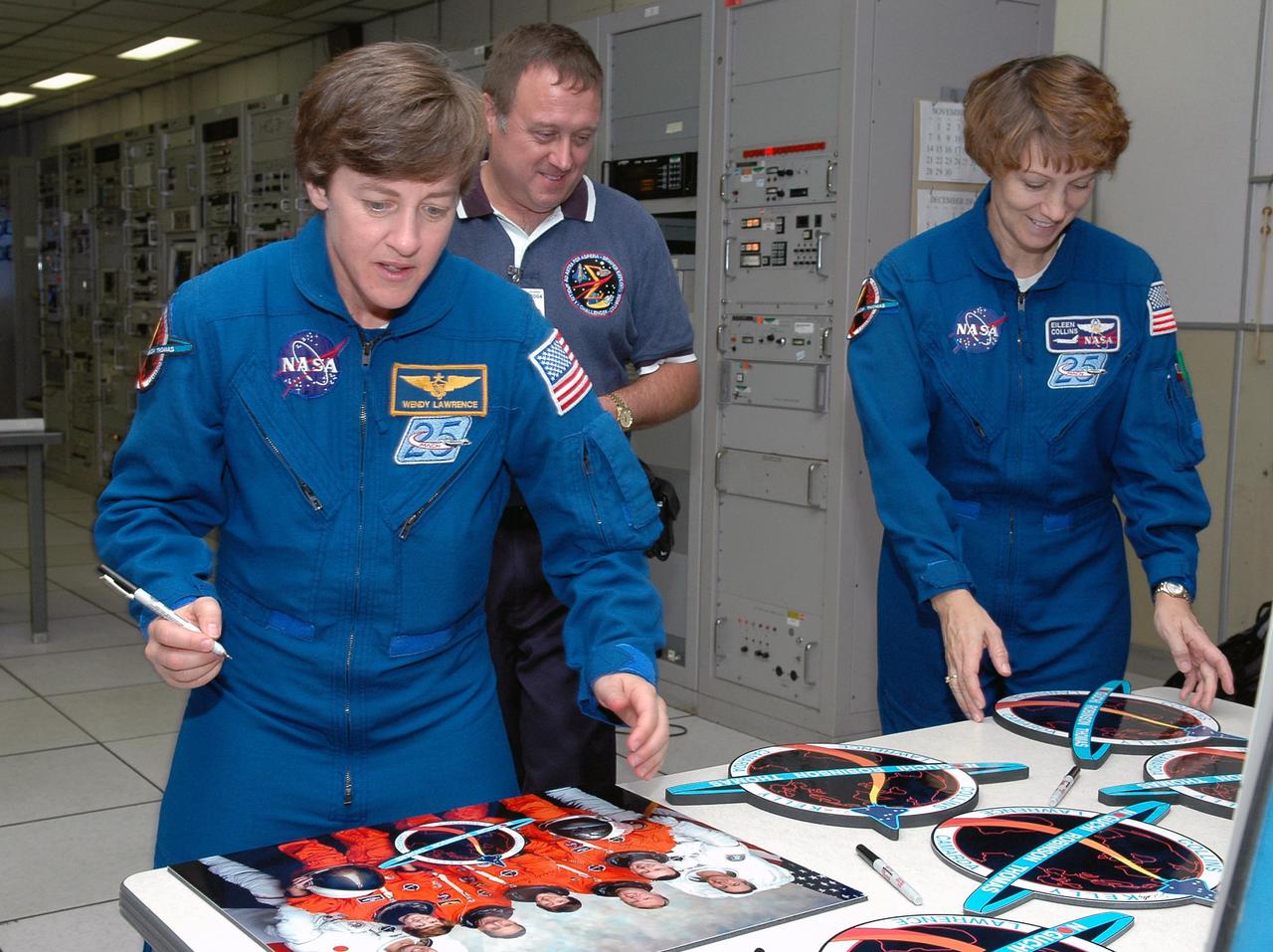
KENNEDY SPACE CENTER, FLA. - Inside the MILA Spaceflight Tracking and Data Network Station during a visit to Kennedy, STS-114 Mission Specialist Wendy Lawrence and Commander Eileen Collins sign crew photos and logos. William Foster, Johnson Space Center ground controller, looks on. The tracking station serves as the primary voice, data and telemetry communications link between the Shuttle and the ground from launch until 7-1_2 minutes into the flight. Millions of clues about the performance of the Space Shuttle’s main engines and other components are communicated to launch managers, technicians and engineers on the ground, who must keep their fingers on the pulse of the Space Shuttle during the critical ascent period. In a typical year, MILA provides through KSC more than 10,000 hours of data between spacecraft and data users. MILA is also used during a Space Shuttle landing at KSC and provides communications beginning about 13 minutes before touchdown. Also, MILA can be called upon to provide data transfer support for NASA’s Expendable Launch Vehicle missions and orbiting scientific satellites.
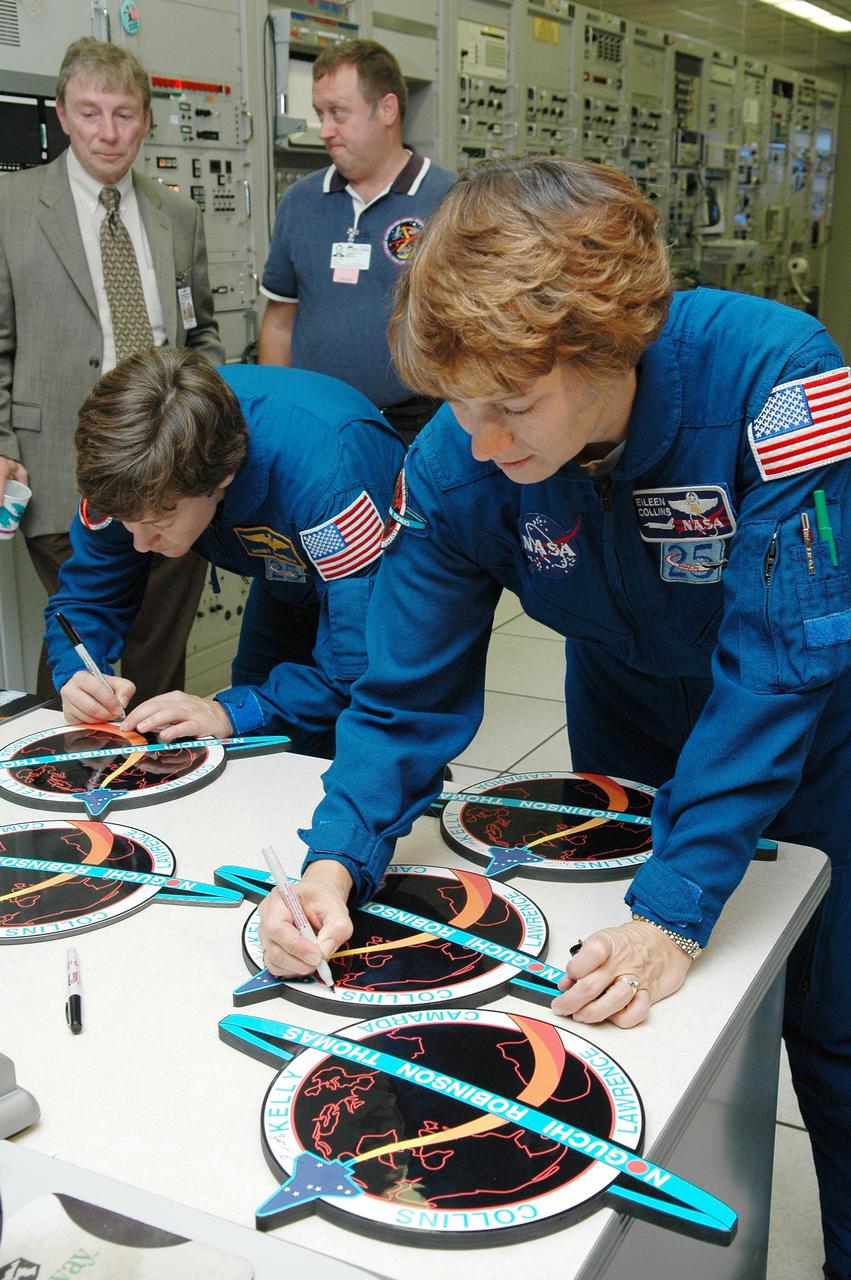
KENNEDY SPACE CENTER, FLA. - Inside the MILA Spaceflight Tracking and Data Network Station during a visit to Kennedy, STS-114 Mission Specialist Wendy Lawrence and Commander Eileen Collins sign crew photos and logos. Behind Lawrence is Anthony Ippolito, current director of MILA_PDL, and William Foster, Johnson Space Center ground controller. (MILA refers to Merritt Island Launch Area; PDL designates the Ponce De Leon Inlet site.) The tracking station serves as the primary voice, data and telemetry communications link between the Shuttle and the ground from launch until 7-1_2 minutes into the flight. Millions of clues about the performance of the Space Shuttle’s main engines and other components are communicated to launch managers, technicians and engineers on the ground, who must keep their fingers on the pulse of the Space Shuttle during the critical ascent period. In a typical year, MILA provides through KSC more than 10,000 hours of data between spacecraft and data users. MILA is also used during a Space Shuttle landing at KSC and provides communications beginning about 13 minutes before touchdown. Also, MILA can be called upon to provide data transfer support for NASA’s Expendable Launch Vehicle missions and orbiting scientific satellites.
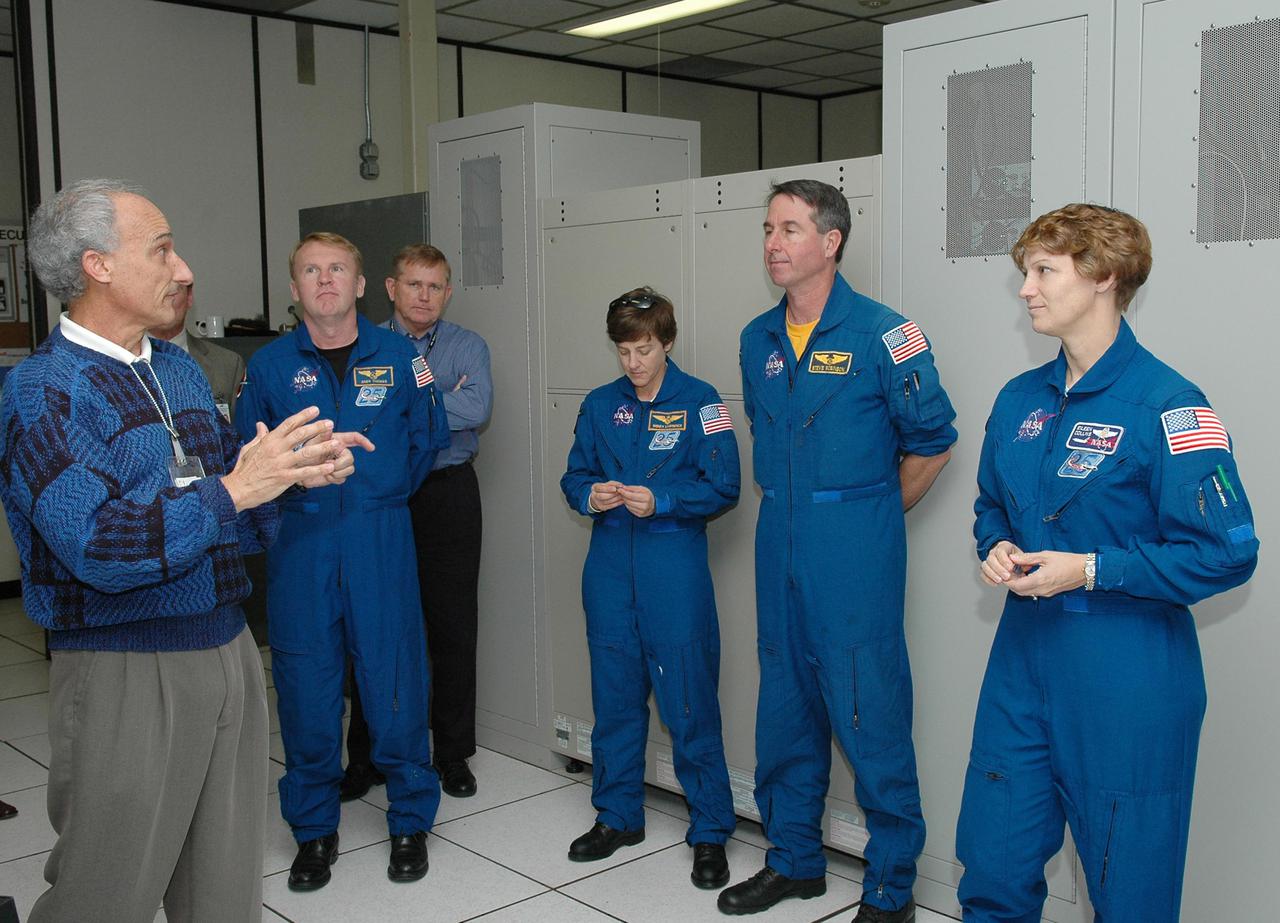
KENNEDY SPACE CENTER, FLA. - Inside the MILA Spaceflight Tracking and Data Network Station during a visit to Kennedy, members of the STS-114 crew listen to Gary Morse (left), incumbent MILA_PDL station director. (MILA refers to Merritt Island Launch Area; PDL designates the Ponce De Leon Inlet site.) The astronauts, from left, are Mission Specialists Andrew Thomas, Wendy Lawrence and Stephen Robinson, and Commander Eileen Collins. The tracking station serves as the primary voice, data and telemetry communications link between the Shuttle and the ground from launch until 7-1_2 minutes into the flight. Millions of clues about the performance of the Space Shuttle’s main engines and other components are communicated to launch managers, technicians and engineers on the ground, who must keep their fingers on the pulse of the Space Shuttle during the critical ascent period. In a typical year, MILA provides through KSC more than 10,000 hours of data between spacecraft and data users. MILA is also used during a Space Shuttle landing at KSC and provides communications beginning about 13 minutes before touchdown. Also, MILA can be called upon to provide data transfer support for NASA’s Expendable Launch Vehicle missions and orbiting scientific satellites.
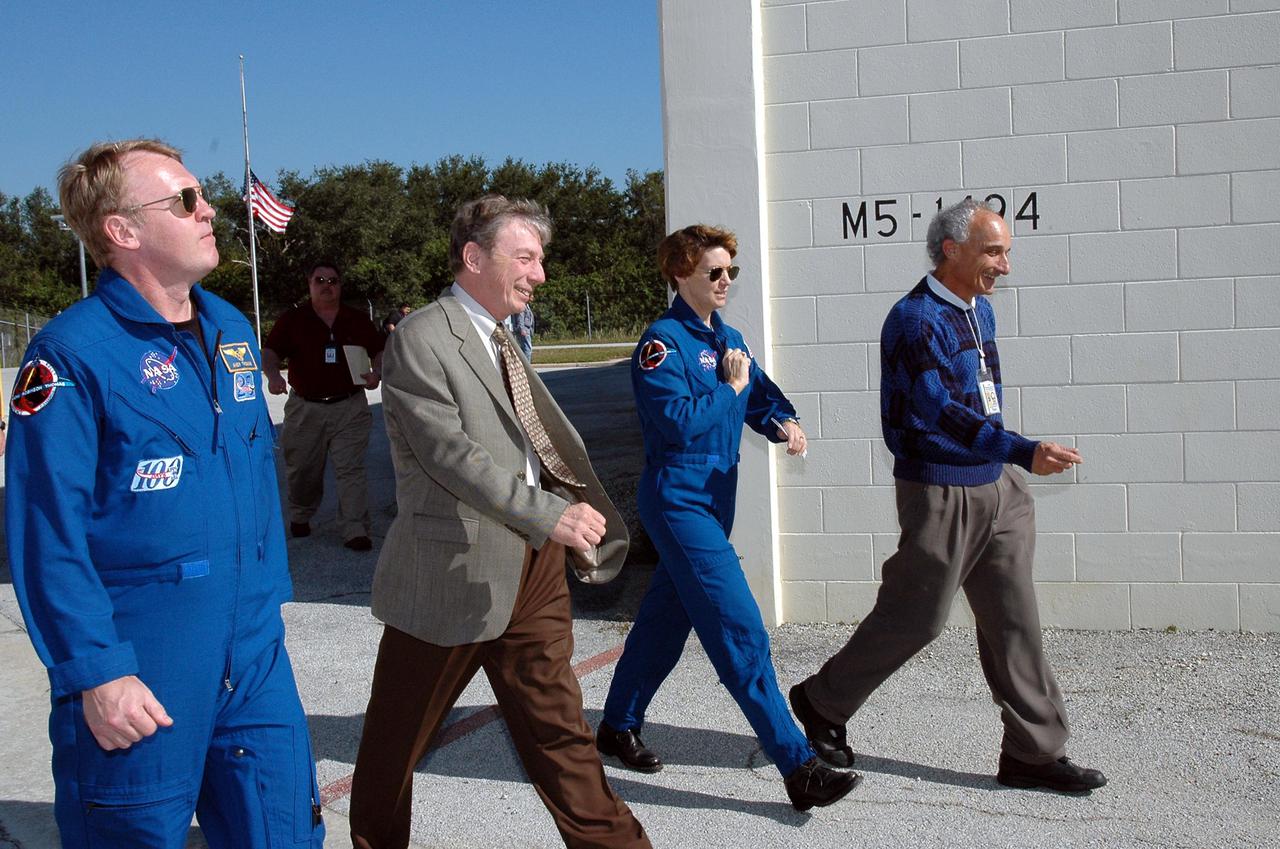
KENNEDY SPACE CENTER, FLA. - During a visit to Kennedy, members of the STS-114 crew visit the MILA Spaceflight Tracking and Data Network Station. From left are Mission Specialist Andrew Thomas; Anthony Ippolito, current director of MILA_PDL; Commander Eileen Collins; and Gary Morse, incumbent MILA_PDL station director. MILA refers to Merritt Island Launch Area; PDL designates the Ponce De Leon Inlet site. The tracking station serves as the primary voice, data and telemetry communications link between the Shuttle and the ground from launch until 7-1_2 minutes into the flight. Millions of clues about the performance of the Space Shuttle’s main engines and other components are communicated to launch managers, technicians and engineers on the ground, who must keep their fingers on the pulse of the Space Shuttle during the critical ascent period. In a typical year, MILA provides through KSC more than 10,000 hours of data between spacecraft and data users. MILA is also used during a Space Shuttle landing at KSC and provides communications beginning about 13 minutes before touchdown. Also, MILA can be called upon to provide data transfer support for NASA’s Expendable Launch Vehicle missions and orbiting scientific satellites.
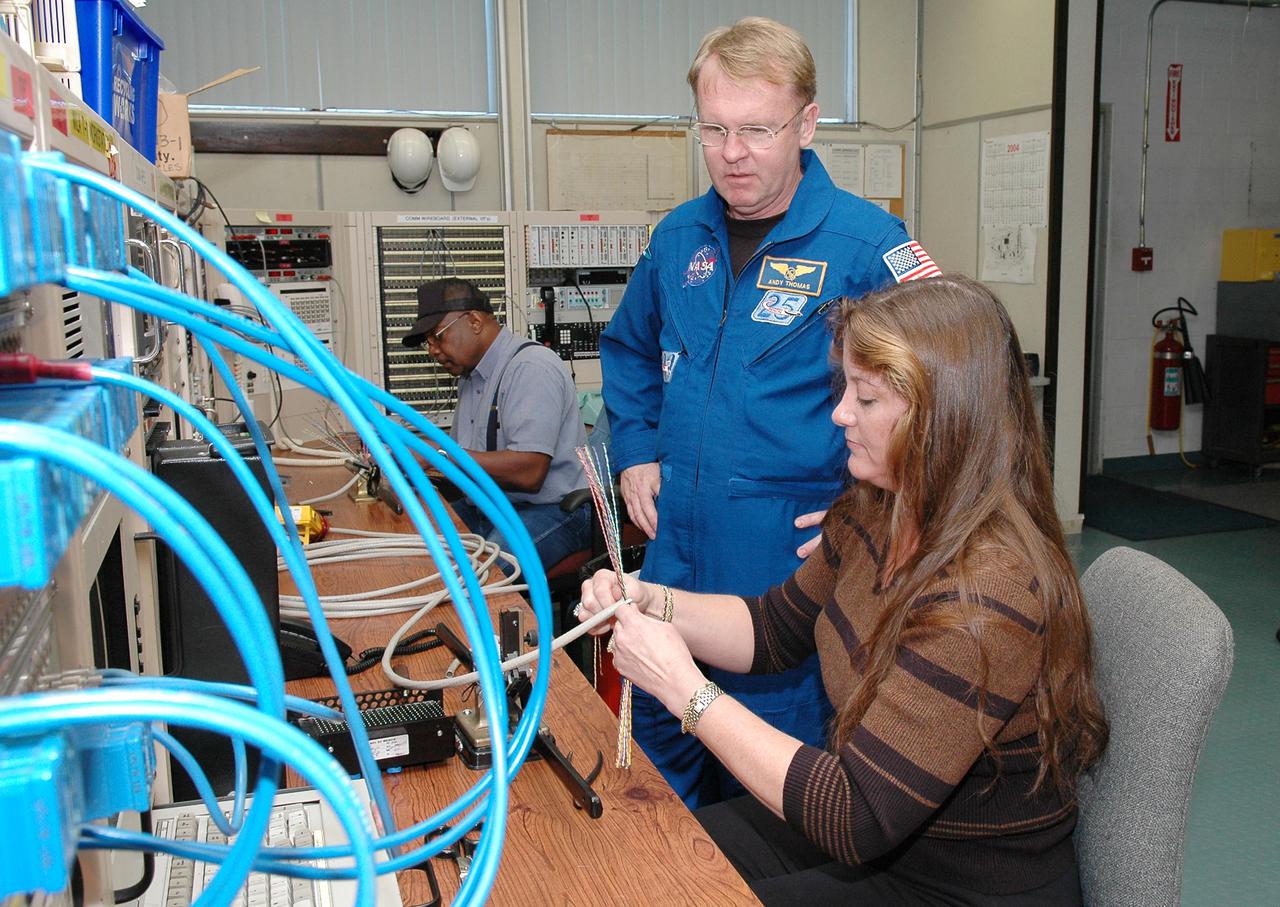
KENNEDY SPACE CENTER, FLA. - Inside the MILA Spaceflight Tracking and Data Network Station during a visit to Kennedy, mission STS-114 Mission Specialist Andrew Thomas watches Sonja Ashworth, with Honeywell, as she builds communication cables. The tracking station serves as the primary voice, data and telemetry communications link between the Shuttle and the ground from launch until 7-1_2 minutes into the flight. Millions of clues about the performance of the Space Shuttle’s main engines and other components are communicated to launch managers, technicians and engineers on the ground, who must keep their fingers on the pulse of the Space Shuttle during the critical ascent period. In a typical year, MILA provides through KSC more than 10,000 hours of data between spacecraft and data users. MILA is also used during a Space Shuttle landing at KSC and provides communications beginning about 13 minutes before touchdown. Also, MILA can be called upon to provide data transfer support for NASA’s Expendable Launch Vehicle missions and orbiting scientific satellites.
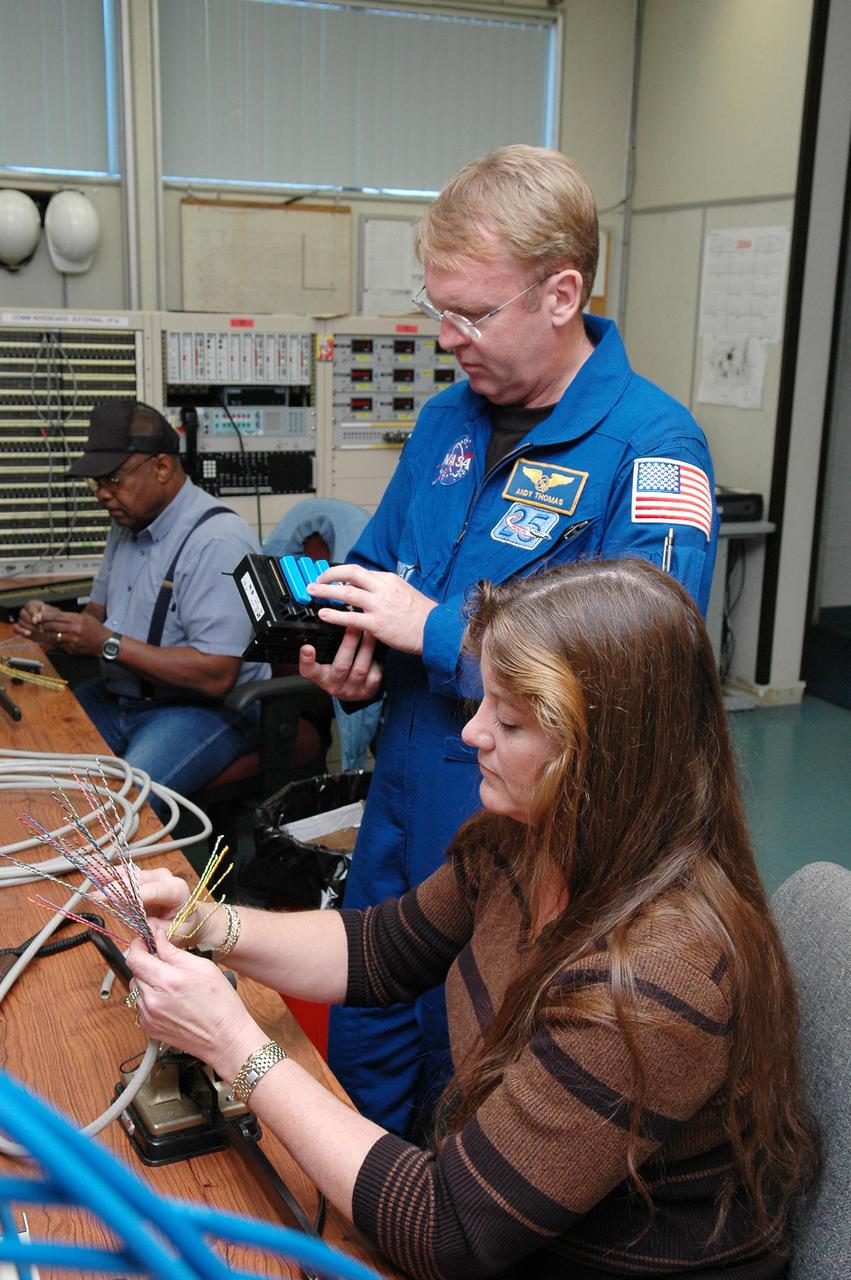
KENNEDY SPACE CENTER, FLA. - Inside the MILA Spaceflight Tracking and Data Network Station during a visit to Kennedy, mission STS-114 Mission Specialist Andrew Thomas (center) looks at equipment while Sonja Ashworth, with Honeywell, builds communication cables. The tracking station serves as the primary voice, data and telemetry communications link between the Shuttle and the ground from launch until 7-1_2 minutes into the flight. Millions of clues about the performance of the Space Shuttle’s main engines and other components are communicated to launch managers, technicians and engineers on the ground, who must keep their fingers on the pulse of the Space Shuttle during the critical ascent period. In a typical year, MILA provides through KSC more than 10,000 hours of data between spacecraft and data users. MILA is also used during a Space Shuttle landing at KSC and provides communications beginning about 13 minutes before touchdown. Also, MILA can be called upon to provide data transfer support for NASA’s Expendable Launch Vehicle missions and orbiting scientific satellites.
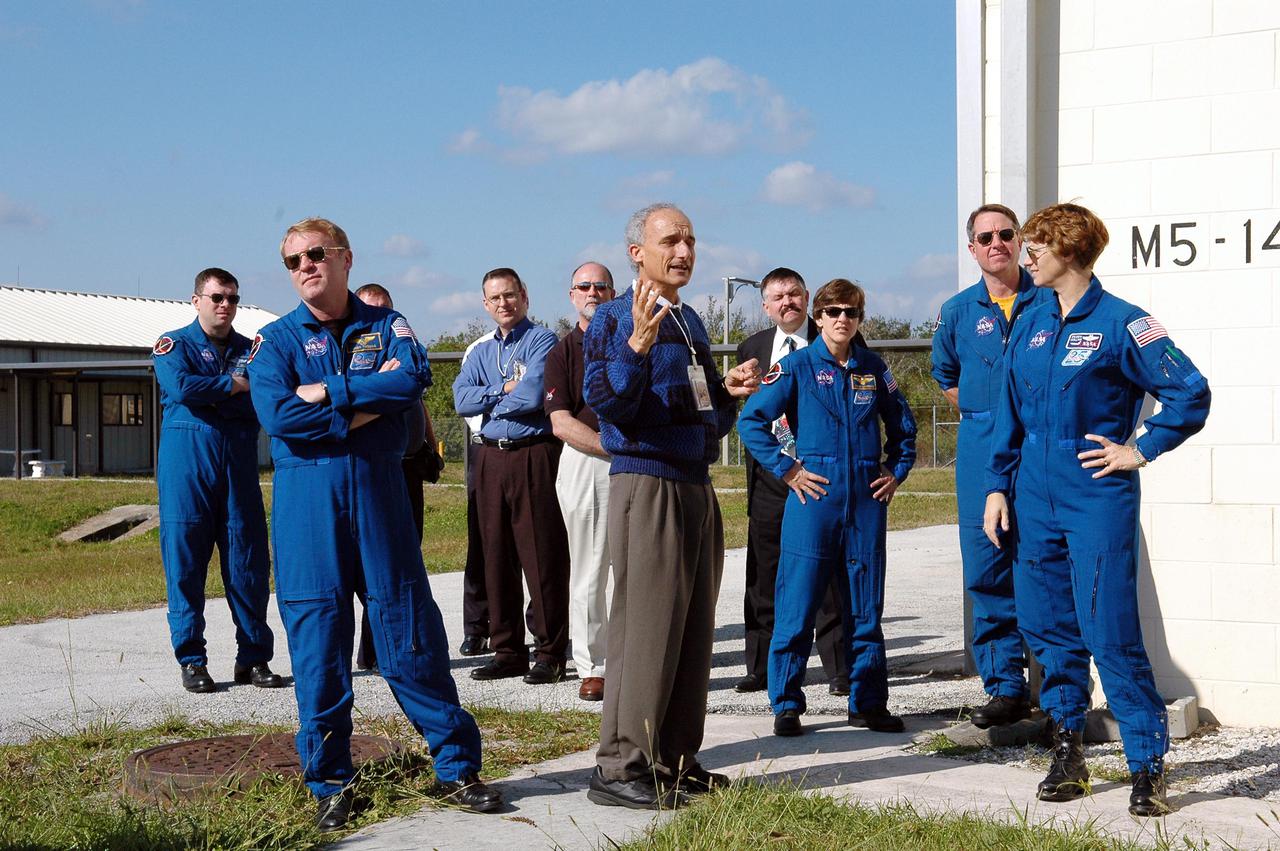
KENNEDY SPACE CENTER, FLA. - During a visit to Kennedy, at the MILA Spaceflight Tracking and Data Network Station, members of the STS-114 crew listen to Gary Morse (center), incumbent MILA_PDL station director. (MILA refers to Merritt Island Launch Area; PDL designates the Ponce De Leon Inlet site.) The astronauts, from left, are Pilot James Kelly, Mission Specialists Andrew Thomas, Wendy Lawrence and Stephen Robinson, and Commander Eileen Collins. The tracking station serves as the primary voice, data and telemetry communications link between the Shuttle and the ground from launch until 7-1_2 minutes into the flight. Millions of clues about the performance of the Space Shuttle’s main engines and other components are communicated to launch managers, technicians and engineers on the ground, who must keep their fingers on the pulse of the Space Shuttle during the critical ascent period. In a typical year, MILA provides through KSC more than 10,000 hours of data between spacecraft and data users. MILA is also used during a Space Shuttle landing at KSC and provides communications beginning about 13 minutes before touchdown. Also, MILA can be called upon to provide data transfer support for NASA’s Expendable Launch Vehicle missions and orbiting scientific satellites.
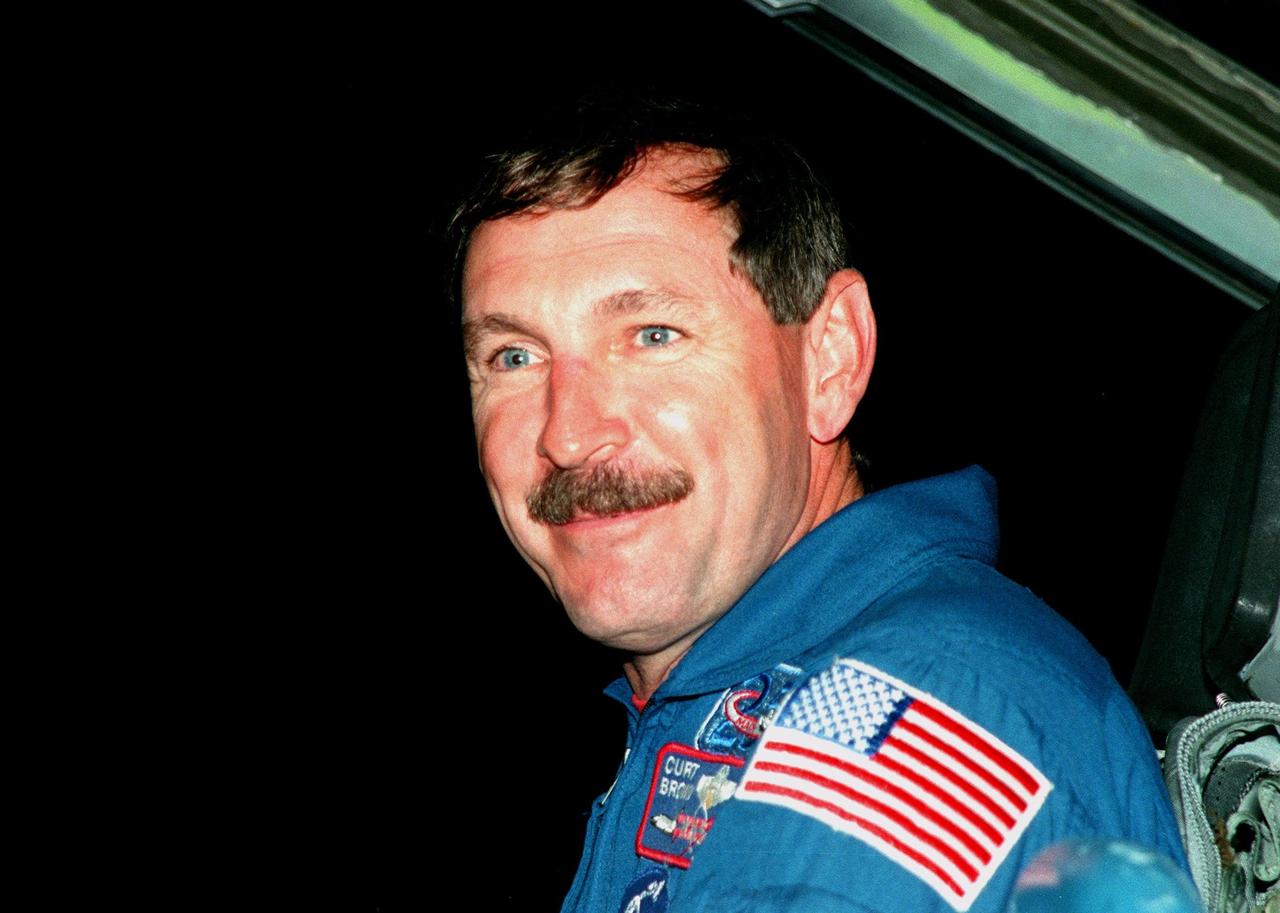
STS-95 Mission Commander Curtis L. Brown arrives aboard a T-38 jet aircraft at the Shuttle Landing Facility at KSC to participate in a Terminal Countdown Demonstration Test (TCDT). Mission launch is scheduled for liftoff on Oct. 29, 1998. The TCDT includes mission familiarization activities, training in emergency exit from the orbiter and launch pad, and a simulated main engine cut-off exercise. Other crew members on the mission are Pilot Steven W. Lindsey; Mission Specialists Scott E. Parazynski, Stephen K. Robinson, and Pedro Duque of Spain, representing the European Space Agency (ESA); and Payload Specialist Chiaki Mukai, representing the National Space Development Agency of Japan (NASDA). The STS-95 mission includes research payloads such as the Spartan solar-observing deployable spacecraft, the Hubble Space Telescope Orbital Systems Test Platform, the International Extreme Ultraviolet Hitchhiker, as well as the SPACEHAB single module with experiments on space flight and the aging process
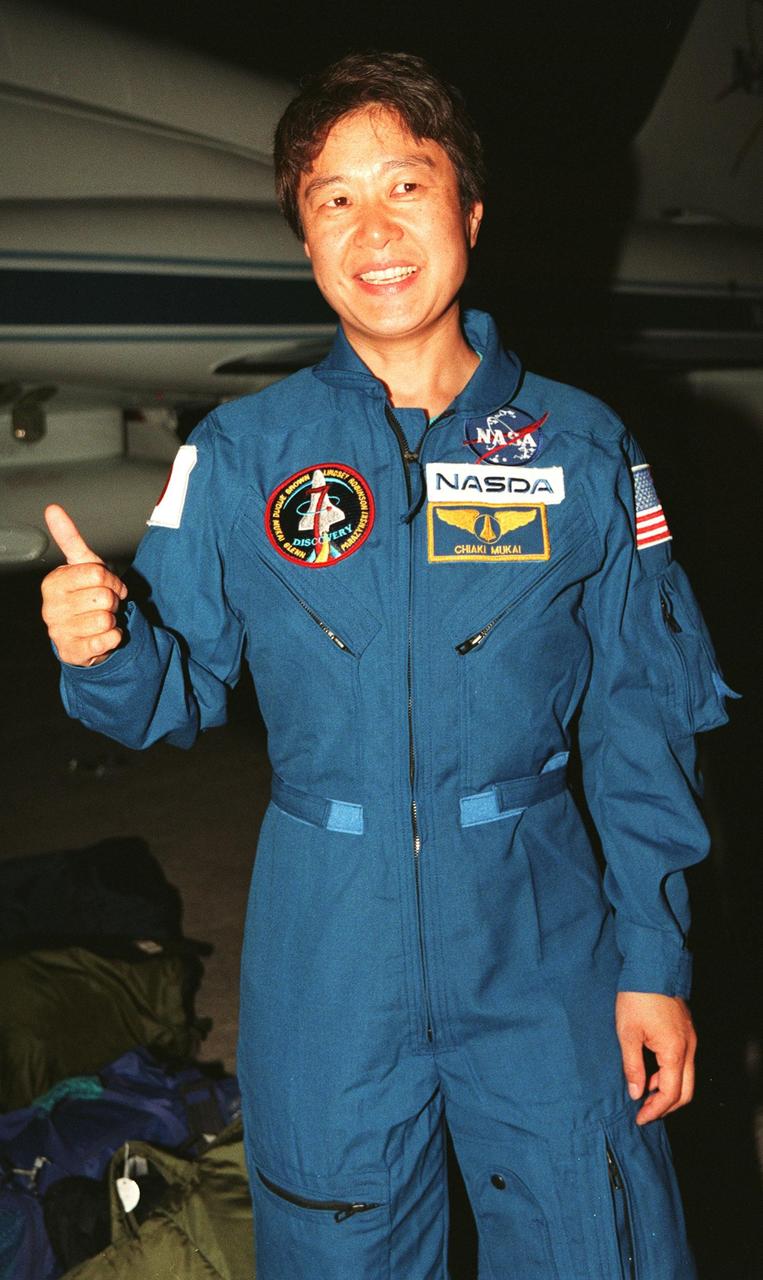
STS-95 Payload Specialist Chiaki Mukai, representing the National Space Development Agency of Japan (NASDA), gives a thumbs up after her arrival aboard a T-38 jet aircraft at the Shuttle Landing Facility at KSC. Mukai and the rest of the crew are at KSC to participate in a Terminal Countdown Demonstration Test (TCDT). The TCDT includes mission familiarization activities, training in emergency exit from the orbiter and launch pad, and a simulated main engine cut-off exercise. The other members on the mission are Mission Commander Curtis L. Brown, Pilot Steven W. Lindsey; Mission Specialists Scott E. Parazynski, Stephen K. Robinson, and Pedro Duque of Spain, representing the European Space Agency (ESA); and Payload Specialist John H. Glenn Jr., senator from Ohio. The STS-95 mission, scheduled for liftoff on Oct. 29, includes research payloads such as the Spartan solar-observing deployable spacecraft, the Hubble Space Telescope Orbital Systems Test Platform, the International Extreme Ultraviolet Hitchhiker, as well as the SPACEHAB single module with experiments on space flight and the aging process
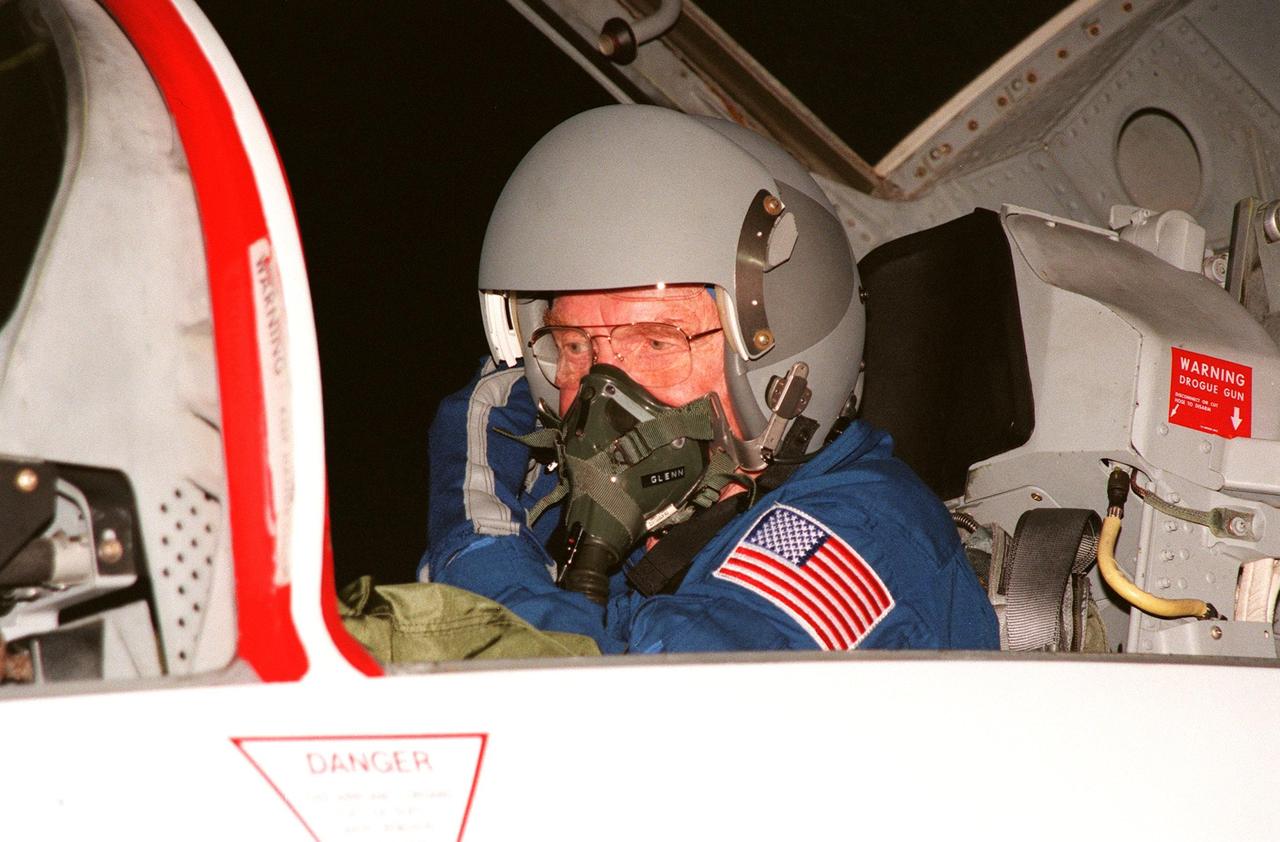
STS-95 Payload Specialist John H. Glenn Jr. arrives aboard a T-38 jet aircraft at the Shuttle Landing Facility at KSC to participate in a Terminal Countdown Demonstration Test (TCDT) for the launch scheduled for liftoff on Oct. 29, 1998. The TCDT includes activities to familiarize them with the mission, training in emergency exit from the orbiter and launch pad, and a simulated main engine cut-off exercise. Other crew members on the mission are Mission Commander Curtis L. Brown , Pilot Steven W. Lindsey; Mission Specialists Scott E. Parazynski, Stephen K. Robinson, and Pedro Duque of Spain, representing the European Space Agency (ESA); and Payload Specialist Chiaki Mukai, representing the National Space Development Agency of Japan (NASDA). The STS-95 mission includes research payloads such as the Spartan solar-observing deployable spacecraft, the Hubble Space Telescope Orbital Systems Test Platform, the International Extreme Ultraviolet Hitchhiker, as well as the SPACEHAB single module with experiments on space flight and the aging process
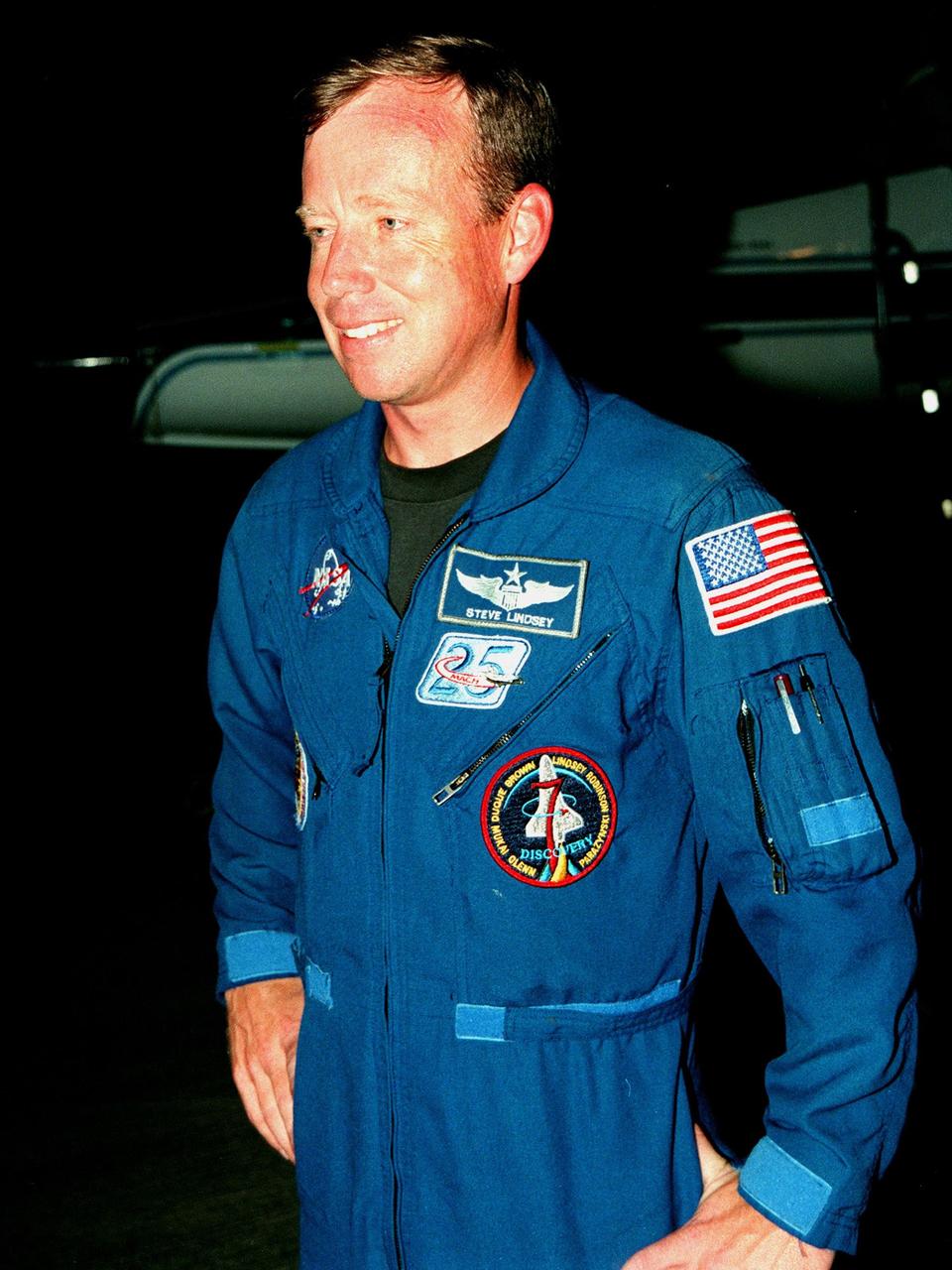
STS-95 Pilot Steven W. Lindsey smiles after his arrival aboard a T-38 jet aircraft at the Shuttle Landing Facility at KSC. The STS-95 crew are at KSC to participate in a Terminal Countdown Demonstration Test (TCDT). The TCDT includes mission familiarization activities, training in emergency exit from the orbiter and launch pad, and a simulated main engine cut-off exercise. The other members on the mission are Mission Commander Curtis L. Brown, Mission Specialists Scott E. Parazynski, Stephen K. Robinson, and Pedro Duque of Spain, representing the European Space Agency (ESA); and Payload Specialists John H. Glenn Jr., senator from Ohio, and Chiaki Mukai, representing the National Space Development Agency of Japan (NASDA). The STS-95 mission, scheduled for liftoff on Oct. 29, includes research payloads such as the Spartan solar-observing deployable spacecraft, the Hubble Space Telescope Orbital Systems Test Platform, the International Extreme Ultraviolet Hitchhiker, as well as the SPACEHAB single module with experiments on space flight and the aging process

Center Director Roy Bridges (left) greets STS-95 Mission Commander Curtis L. Brown after his arrival on a T-38 jet aircraft at the Shuttle Landing Facility at KSC. Payload Specialist John H. Glenn Jr., a senator from Ohio, is at the right. Glenn arrived with Brown. They and the rest of the crew are at KSC to participate in a Terminal Countdown Demonstration Test (TCDT). The TCDT includes mission familiarization activities, training in emergency exit from the orbiter and launch pad, and a simulated main engine cut-off exercise. Other crew members on the mission are Pilot Steven W. Lindsey; Mission Specialists Scott E. Parazynski, Stephen K. Robinson, and Pedro Duque of Spain, representing the European Space Agency (ESA); and Payload Specialist Chiaki Mukai, representing the National Space Development Agency of Japan (NASDA). The STS-95 mission includes research payloads such as the Spartan solar-observing deployable spacecraft, the Hubble Space Telescope Orbital Systems Test Platform, the International Extreme Ultraviolet Hitchhiker, as well as the SPACEHAB single module with experiments on space flight and the aging process
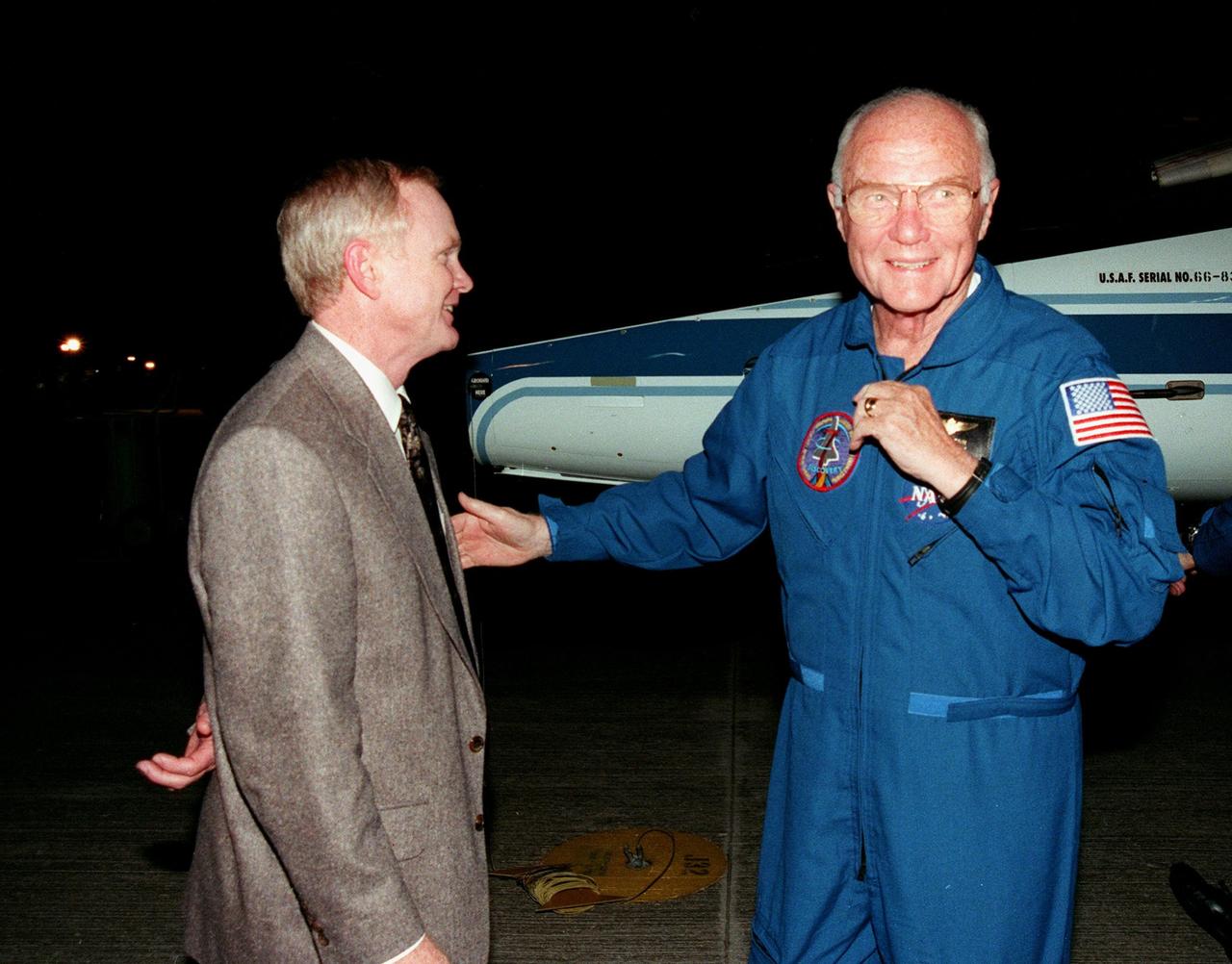
Center Director Roy Bridges (left) greets STS-95 Payload Specialist John H. Glenn Jr. after his arrival on a T-38 jet aircraft at the Shuttle Landing Facility at KSC. Glenn, a senator from Ohio, and the rest of the crew are at KSC to participate in a Terminal Countdown Demonstration Test (TCDT). The TCDT includes mission familiarization activities, training in emergency exit from the orbiter and launch pad, and a simulated main engine cut-off exercise. The other crew members on the mission are Mission Commander Curtis L. Brown; Pilot Steven W. Lindsey; Mission Specialists Scott E. Parazynski, Stephen K. Robinson, and Pedro Duque of Spain, representing the European Space Agency (ESA); and Payload Specialist Chiaki Mukai, representing the National Space Development Agency of Japan (NASDA). The STS-95 mission includes research payloads such as the Spartan solar-observing deployable spacecraft, the Hubble Space Telescope Orbital Systems Test Platform, the International Extreme Ultraviolet Hitchhiker, as well as the SPACEHAB single module with experiments on space flight and the aging process
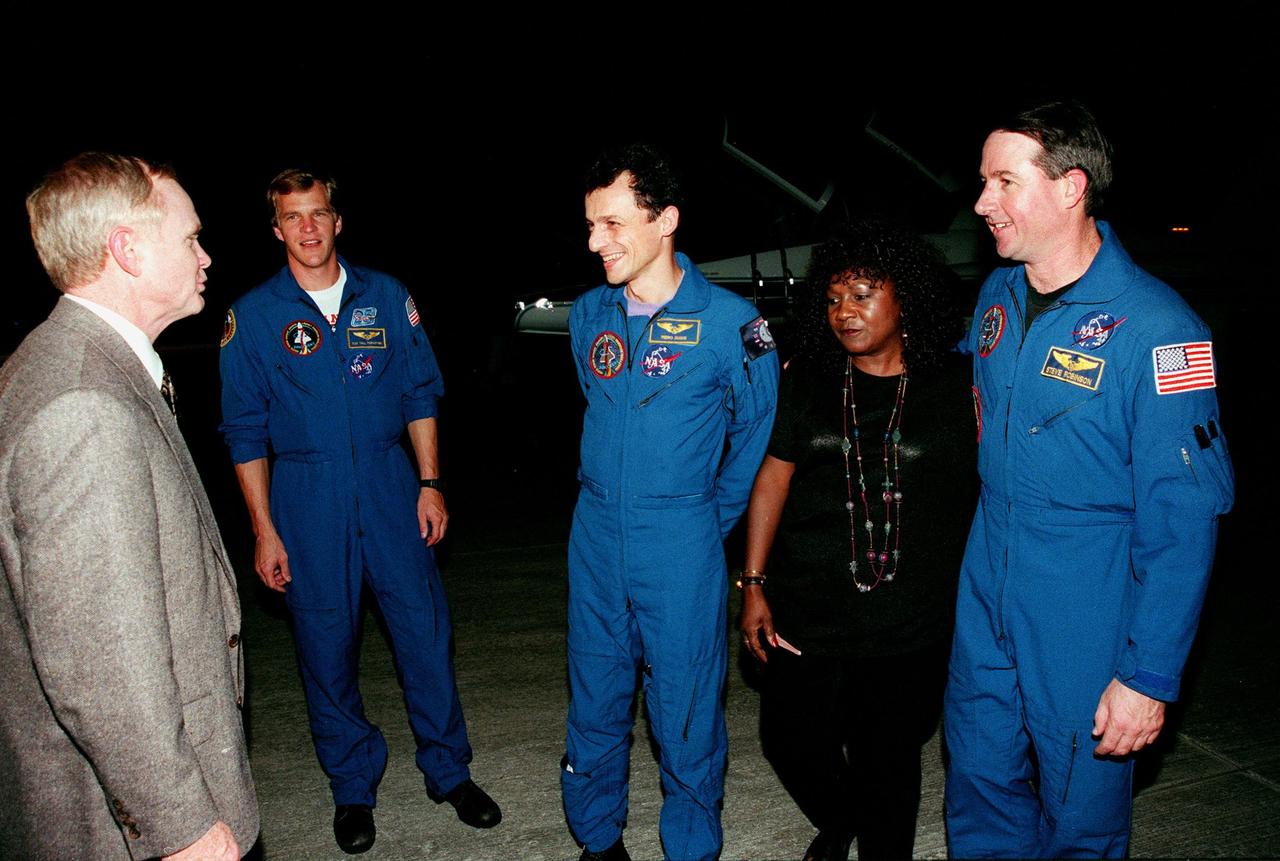
(Left to right) Center Director Roy Bridges welcomes STS-95 Mission Specialists Scott E. Parazynski, Pedro Duque of Spain, representing the European Space Agency (ESA), and Stephen K. Robinson (far right) after their arrival aboard T-38 jet aircraft at the Shuttle Landing Facility at KSC. Standing between Duque and Robinson is Dolores Green, NASA. The STS-95 crew are at KSC to participate in a Terminal Countdown Demonstration Test (TCDT). The TCDT includes mission familiarization activities, training in emergency exit from the orbiter and launch pad, and a simulated main engine cut-off exercise. The other members on the mission are Mission Commander Curtis L. Brown, Pilot Steven W. Lindsey; and Payload Specialists Chiaki Mukai, representing the National Space Development Agency of Japan (NASDA), and John H. Glenn Jr., senator from Ohio. The STS-95 mission, scheduled for liftoff on Oct. 29, includes research payloads such as the Spartan solar-observing deployable spacecraft, the Hubble Space Telescope Orbital Systems Test Platform, the International Extreme Ultraviolet Hitchhiker, as well as the SPACEHAB single module with experiments on space flight and the aging process
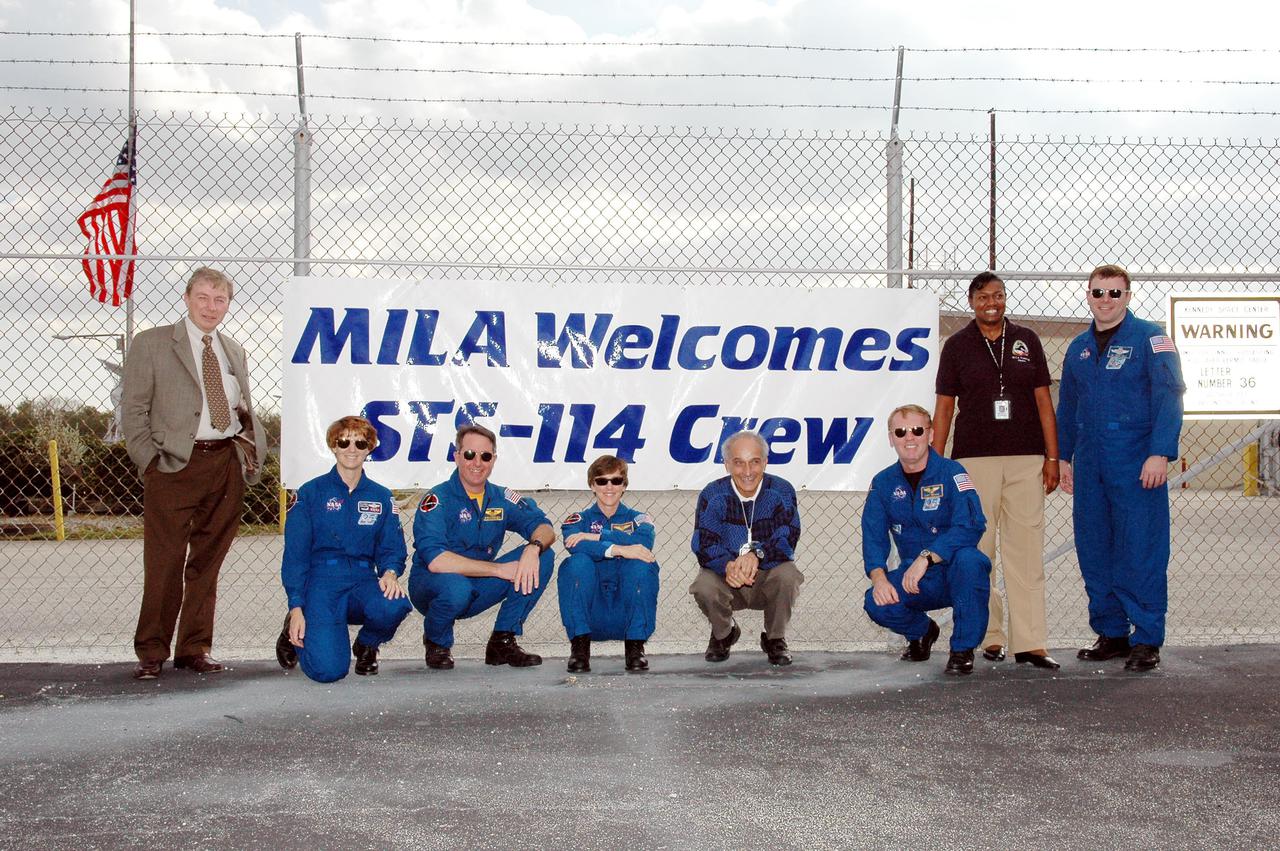
KENNEDY SPACE CENTER, FLA. - Outside the MILA Spaceflight Tracking and Data Network Station during a visit to Kennedy, members of the STS-114 crew pause for a photo with Anthony Ippolito (far left), current director of MILA_PDL. (MILA refers to Merritt Island Launch Area; PDL designates the Ponce De Leon Inlet site.). The crew members are (left to right) commander Eileen Collins, Mission Specialists Stephen Robinson, Wendy Lawrence and Andrew Thomas; and Pilot James Kelly. Between Lawrence and Thomas is Gary Morse (left), incumbent MILA_PDL station director. Between Thomas and Kelly is Melissa Blizzard, MILA operations manager. The tracking station serves as the primary voice, data and telemetry communications link between the Shuttle and the ground from launch until 7-1_2 minutes into the flight. Millions of clues about the performance of the Space Shuttle’s main engines and other components are communicated to launch managers, technicians and engineers on the ground, who must keep their fingers on the pulse of the Space Shuttle during the critical ascent period. In a typical year, MILA provides through KSC more than 10,000 hours of data between spacecraft and data users. MILA is also used during a Space Shuttle landing at KSC and provides communications beginning about 13 minutes before touchdown. Also, MILA can be called upon to provide data transfer support for NASA’s Expendable Launch Vehicle missions and orbiting scientific satellites.