
41C-3029 (6 April 1984) --- The space shuttle Challenger and its five-member astronaut crew leave the launch pad at the Kennedy Space Center to begin a six-day stay in space. Astronaut John W. Young, a veteran of two shuttle missions and six spaceflights overall, recorded the image with a handheld 70mm camera from the shuttle training aircraft which he was using to monitor environmental conditions around Florida. This is the eighth mission on which Young photographed one of NASA's orbiter vehicles beginning its orbital stay. Photo credit: NASA
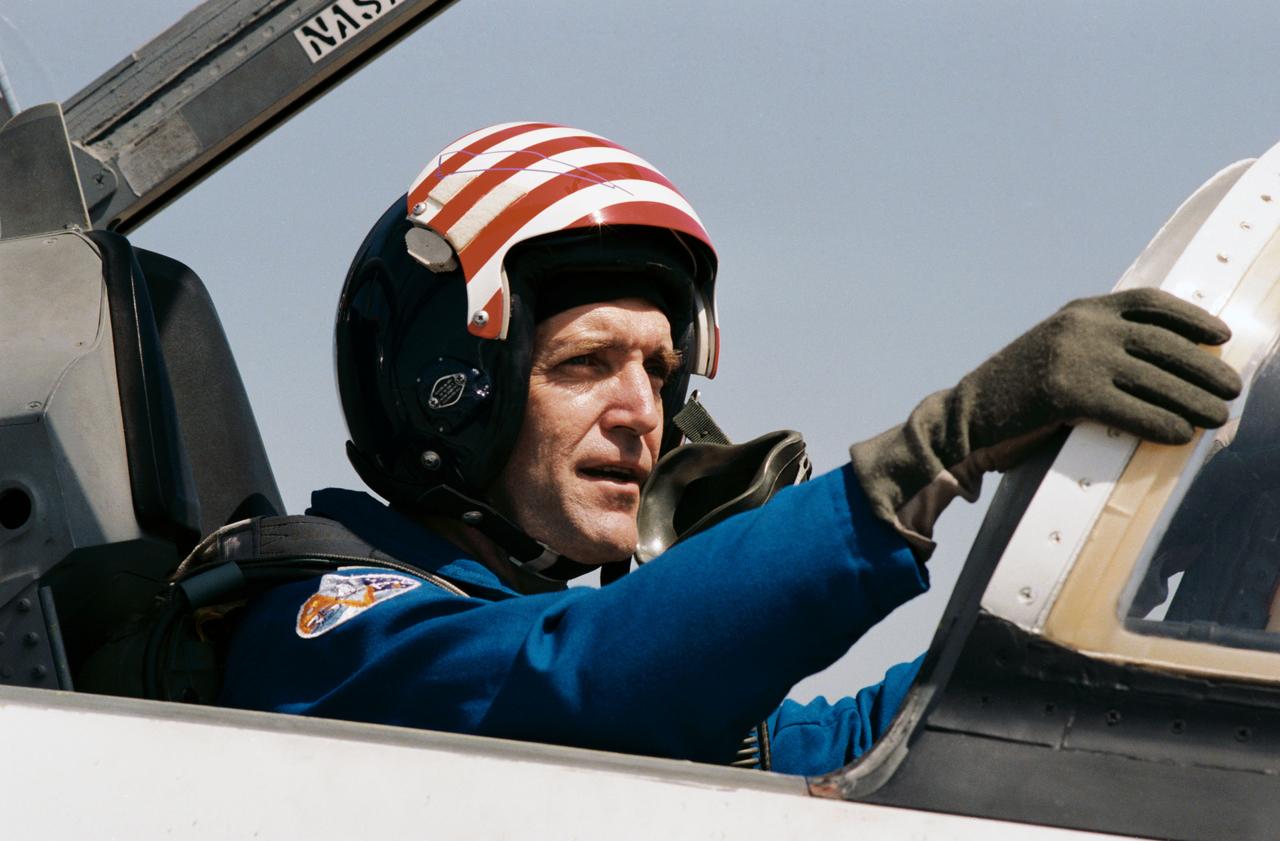
41C-3002 (3 April 1984) --- Astronaut Francis R. (Dick) Scobee, 41-C pilot, is only minutes away from leaving Ellington Air Base in a T-38. Scobee and four other 41-C crewmembers, along with Astronaut John W. Young, are headed for Florida, site of a launch in three days of the Space Shuttle Challenger. Scobee, an experienced pilot, is responsible for helping a number of other NASA astronauts learn to fly. The eleventh Space Shuttle mission will mark his first experience in space. This photograph was taken by Otis Imboden.
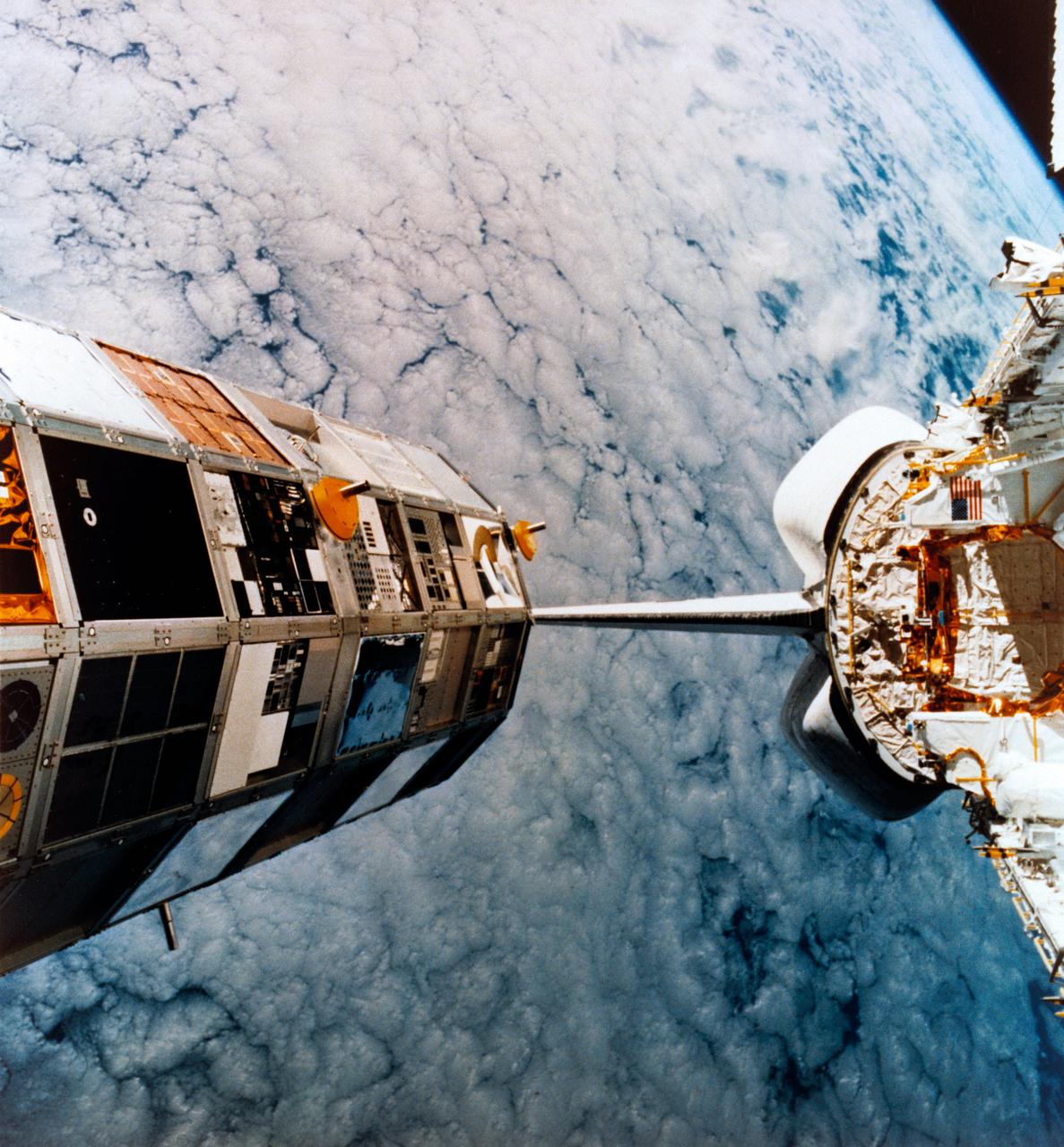
Photo from Space Shuttle Mission 41-C of the Long Duration Exposure Facility (LDEF) deploy by CHALLENGER and a Langley Research Center (LRC) supplied art concept of the LDEF recovery by COLUMBIA during Space Shuttle Mission STS-32. LRC # L-89-11-720 for JSC # S89-50779
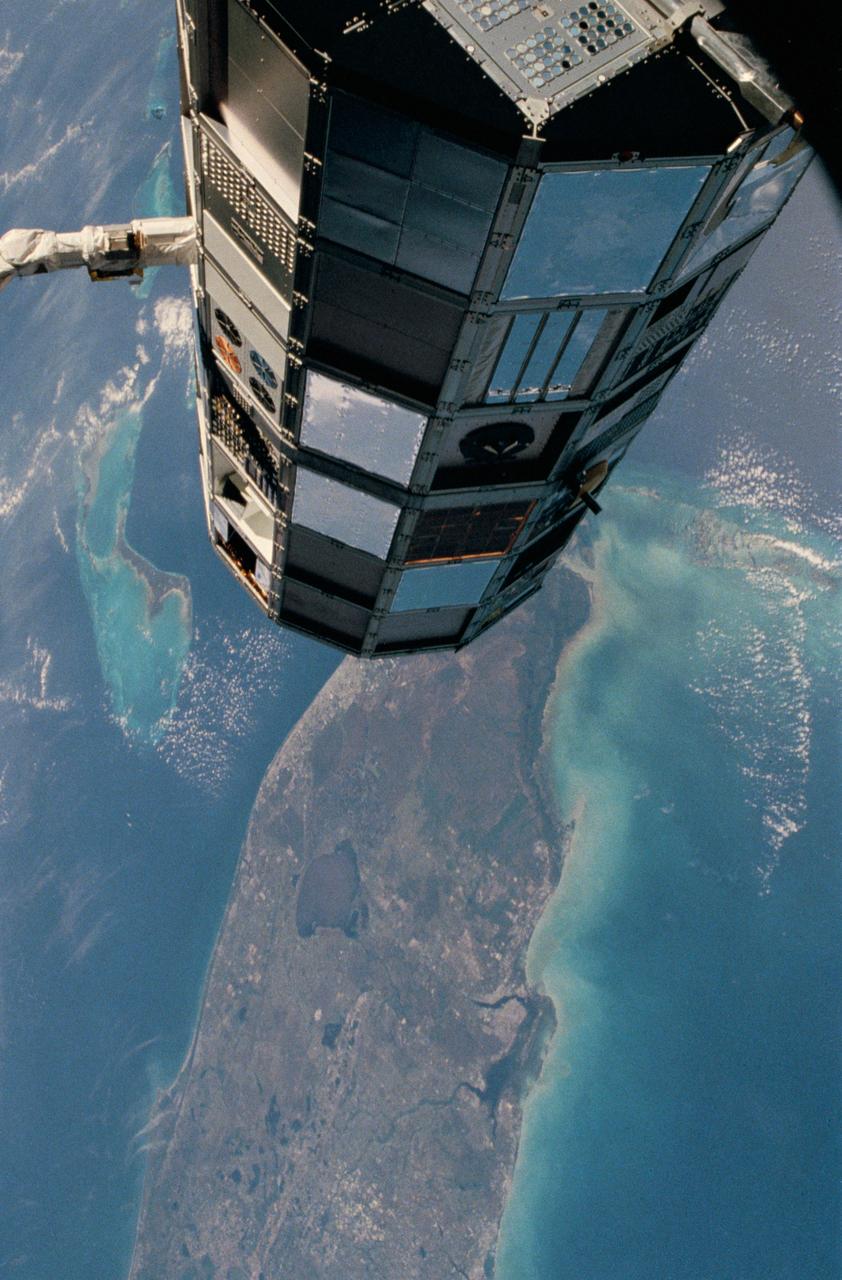
41C-02-067 (6-13 April 1984) --- One of the first major accomplishments of Flight 41-C?s crew aboard the Challenger was to place this giant satellite into Earth orbit. Still attached to the remote manipulator system (RMS) end effector, the Long-Duration Exposure Facility (LDEF) is backdropped against Florida, the Bahama Bank, the Gulf of Mexico and Atlantic waters. The multi-colored cylinder carries 50-odd passive scientific experiments representing 194 investigators from around world. The LDEF program is directed by the Langley Research Center in Hampton, Virginia. The facility will be retrieved in a little less than a year by a Space Shuttle crew. This frame was one of the visuals used by the 41-C astronauts for their April 24, 1984 post-flight press conference. Cape Canaveral, where this seven-day mission got its start, and Lake Okeechobee, are easily recognized in the frame, photographed shortly before 11:30 a.m. (CST), April 7, 1984.
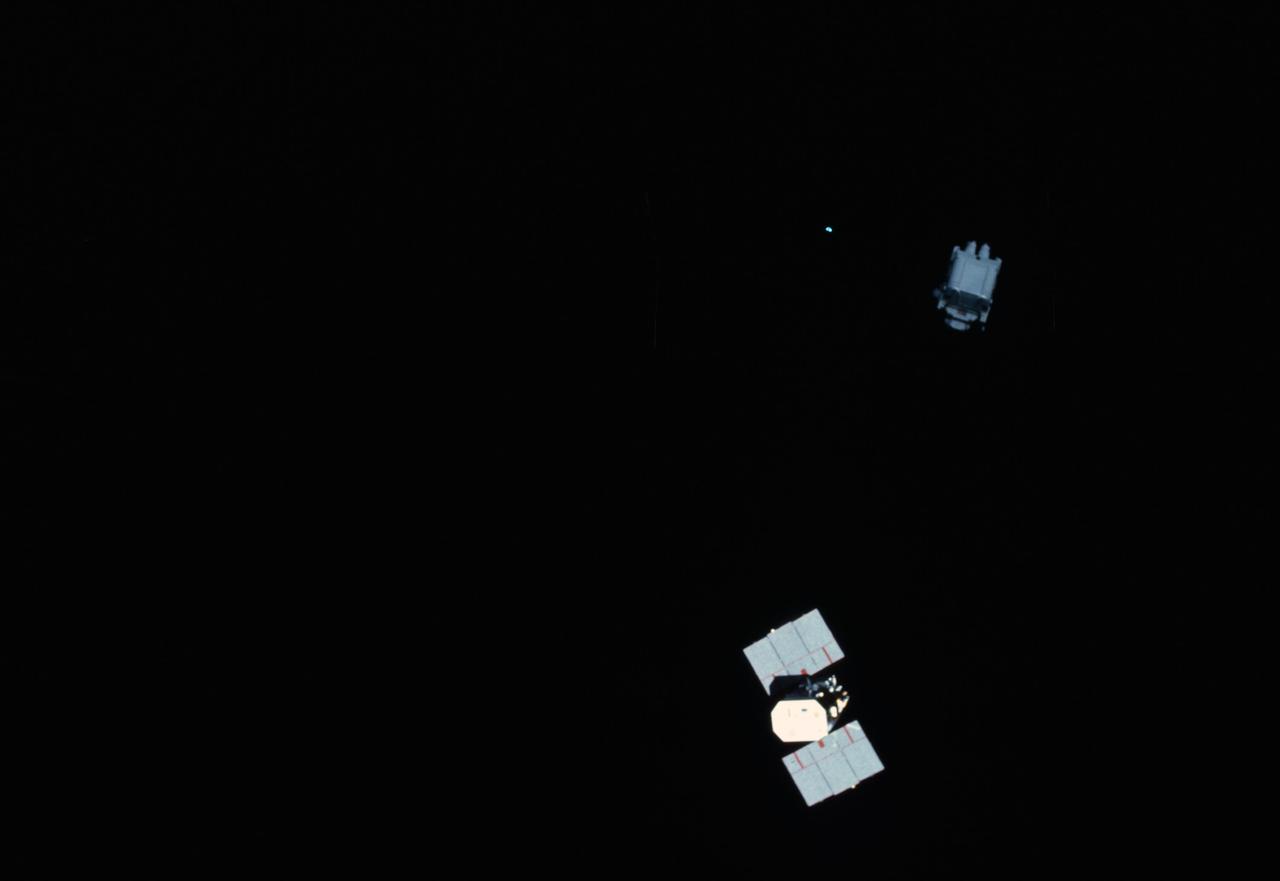
41C-22-885 (8 April 1984) --- The 35mm camera was used to photograph this scene of Astronaut George D. Nelson, STS-41C mission specialist, as he uses the manned maneuvering unit (MMU) to make an excursion to the plagued Solar Maximum, Mission Satellite (SMMS)._Astronaut James D. van Hoften remained in the Challenger's cargo bay during the April 8 extravehicular activity (EVA).
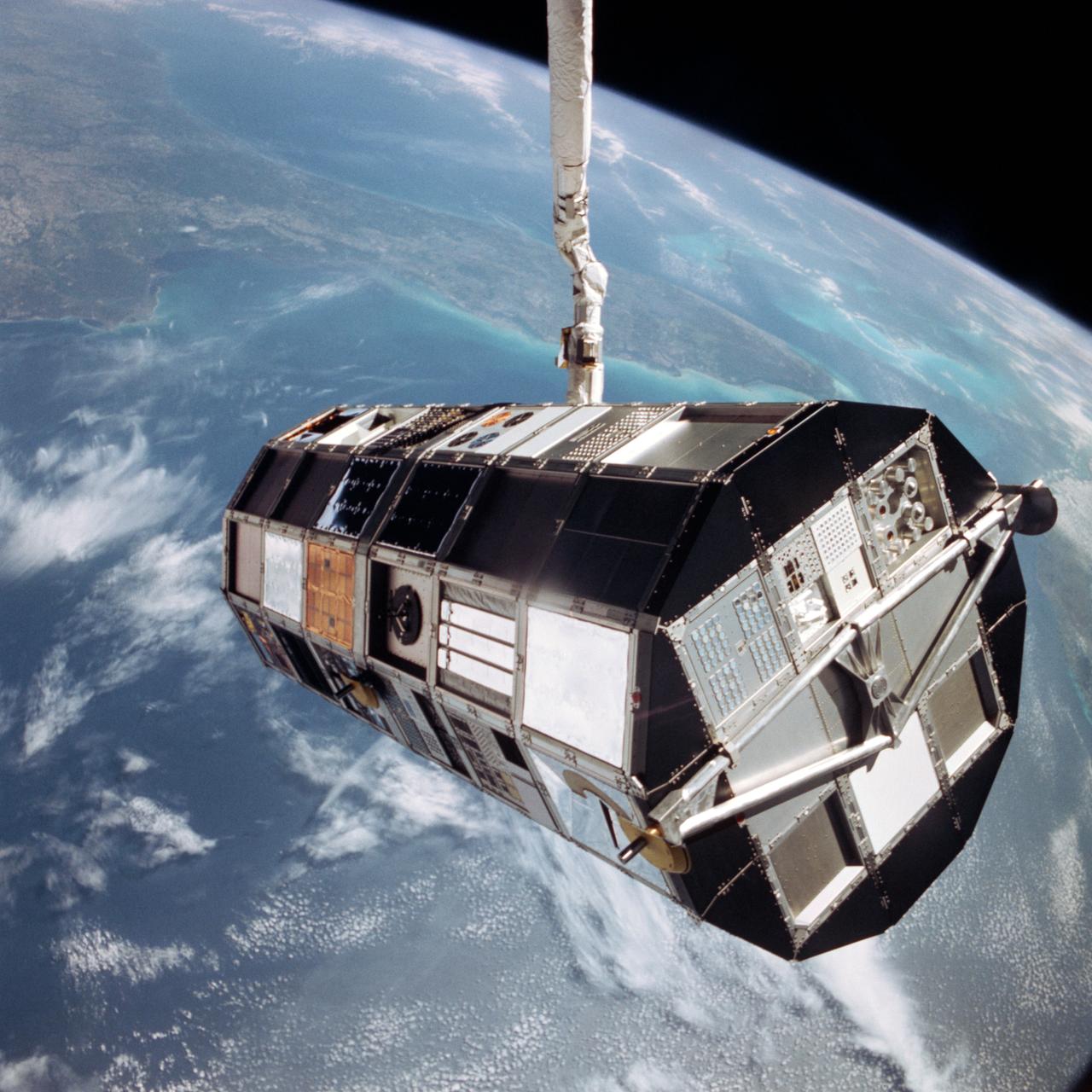
41C-36-1618 (7 April 1984) --- The Remote Manipulator System (RMS) arm suspends the giant Long Duration Exposure Facility (LDEF) high above the Gulf of Mexico prior to releasing it into space. Carried into Earth orbit with the STS-41C crew by the Space Shuttle Challenger, LDEF will remain in space until retrieved by a future Shuttle mission, in nine or ten months. Florida and the Bahama Banks are visible near the Earth's horizon in the 70mm frame.
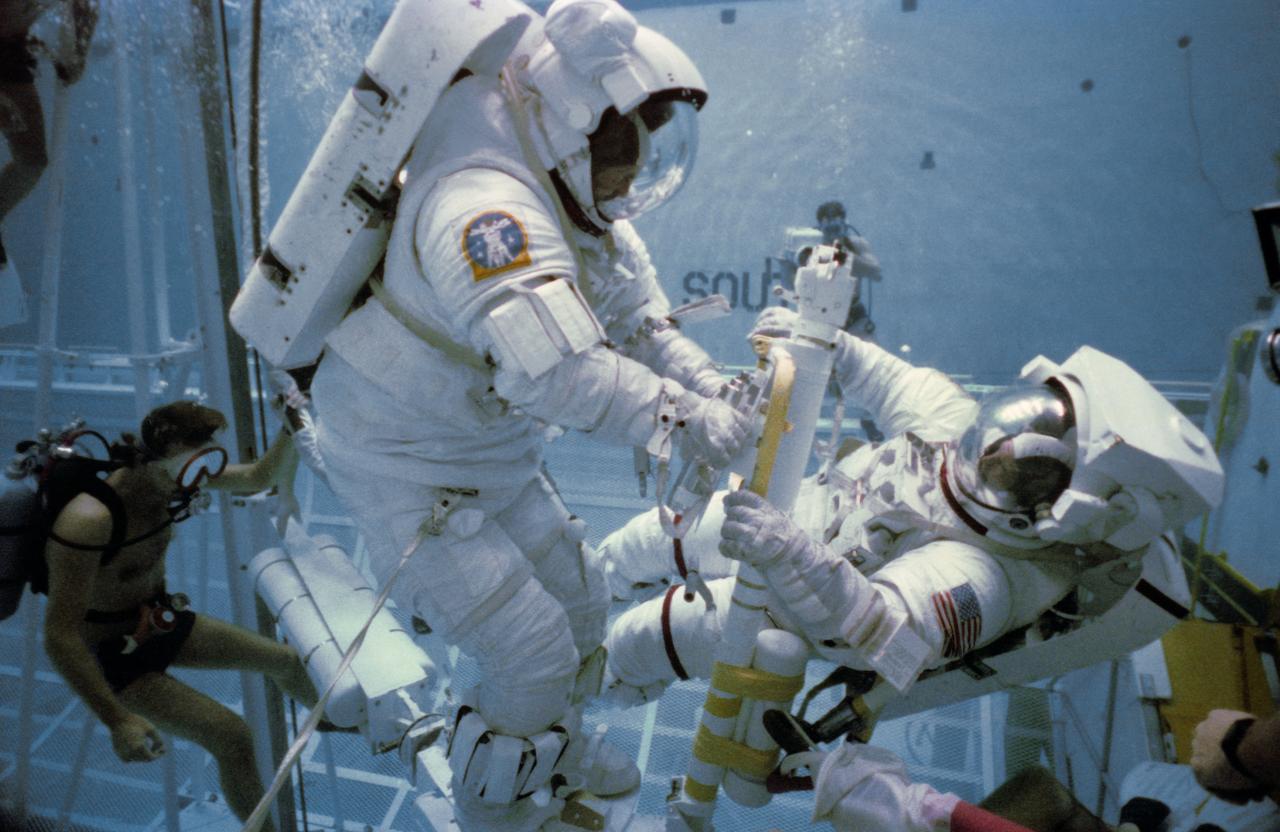
S83-42895 (19 Oct 1983) --- Astronauts George D. Nelson and James D. van Hoften, NASA Flight STS-41C mission specialists, offer an underwater version of a preview of their mission's extravehicular activity (EVA). The April 1984 flight includes as one of its primary objectives a two-person EVA and a visit to the damaged Solar Maximum Satellite (SMS). Van Hoften, left, and Nelson work here with the mobile foot restraint (MFR), which attaches to the remote manipulator system (RMS) arm to form a "cherry-picker" device. Van Hoften is standing on the MFR. The two are making use of the Johnson Space Center's (JSC) weightless environment training facility (WET-F). This photograph was taken by Otis Imboden.
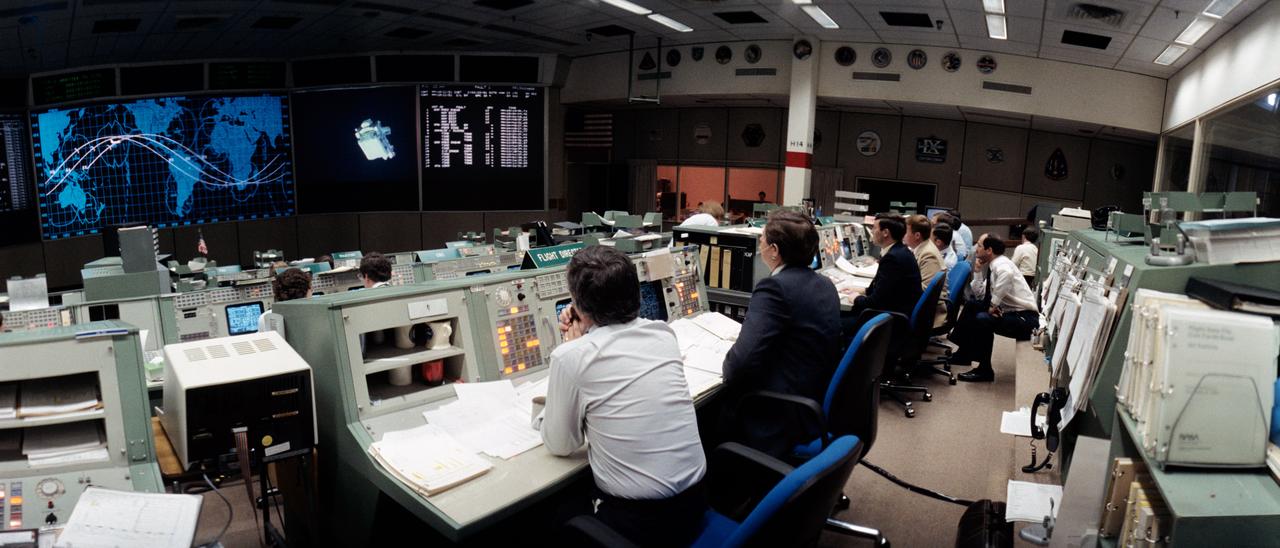
Astronaut George D. Nelson (see monitor at front of room) is viewed by flight controllers in the Mission Operations Control Room (MOCR) of JSC's Mission Control Center during 41-C extravehicular activity (EVA). In the foreground are Flight Directors Jay H. Greene and John T. Cox. Astronauts Jerry L. Ross and Richard H. Richards are seated at the CAPCOM or spacecraft communicators console at right background. Astronaut Guy S. Gardner is perched just behind them.
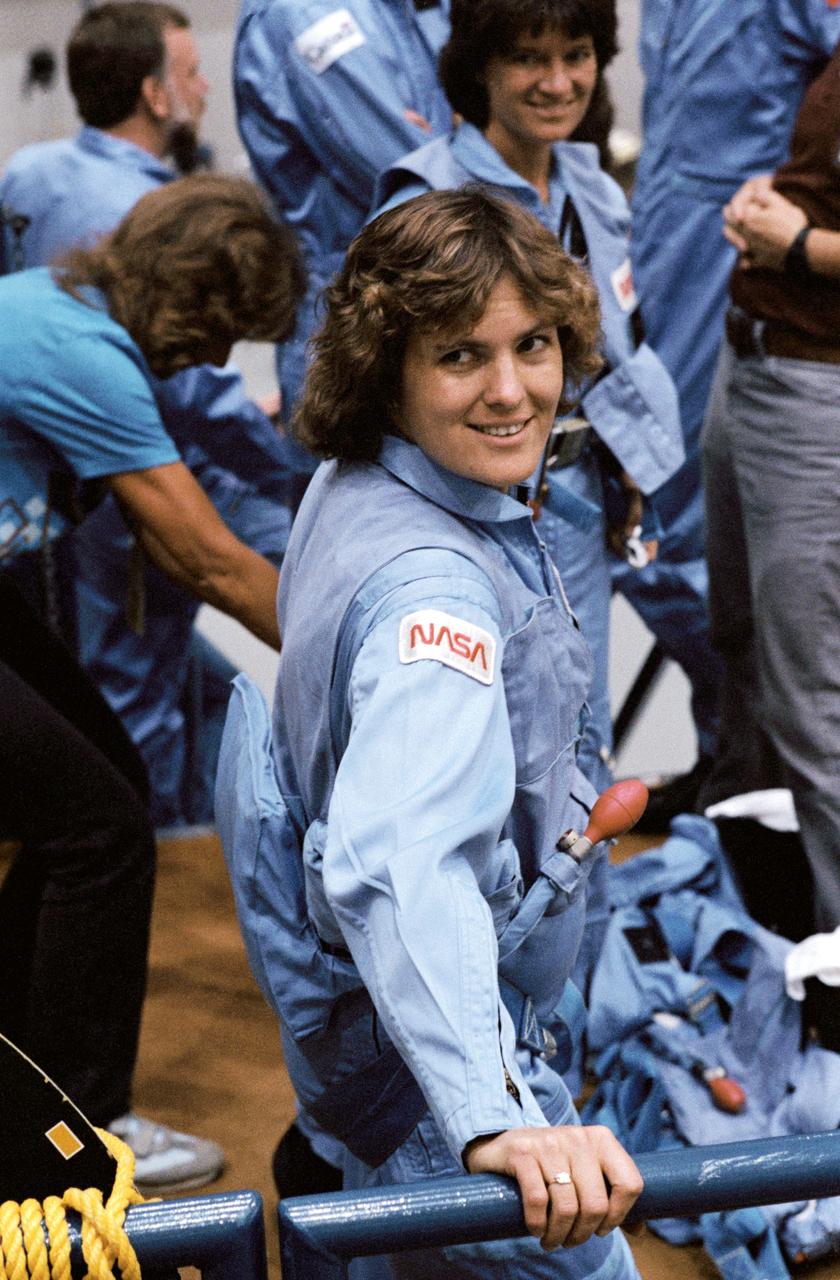
41D-3188 (2 September 1984) --- Astronaut Kathryn D. Sullivan, 41-G mission specialist, joins with other members of the seven-person crew prior to a training session in the Shuttle mockup and integration laboratory at the Johnson Space Center. Dr. Sullivan will be the first American woman to perform an extravehicular activity (EVA) in space when she joins Astronaut David C. Leestma for some outside-the-Challenger duty on October 9. The mission is scheduled for an October 5, 1984 launch.
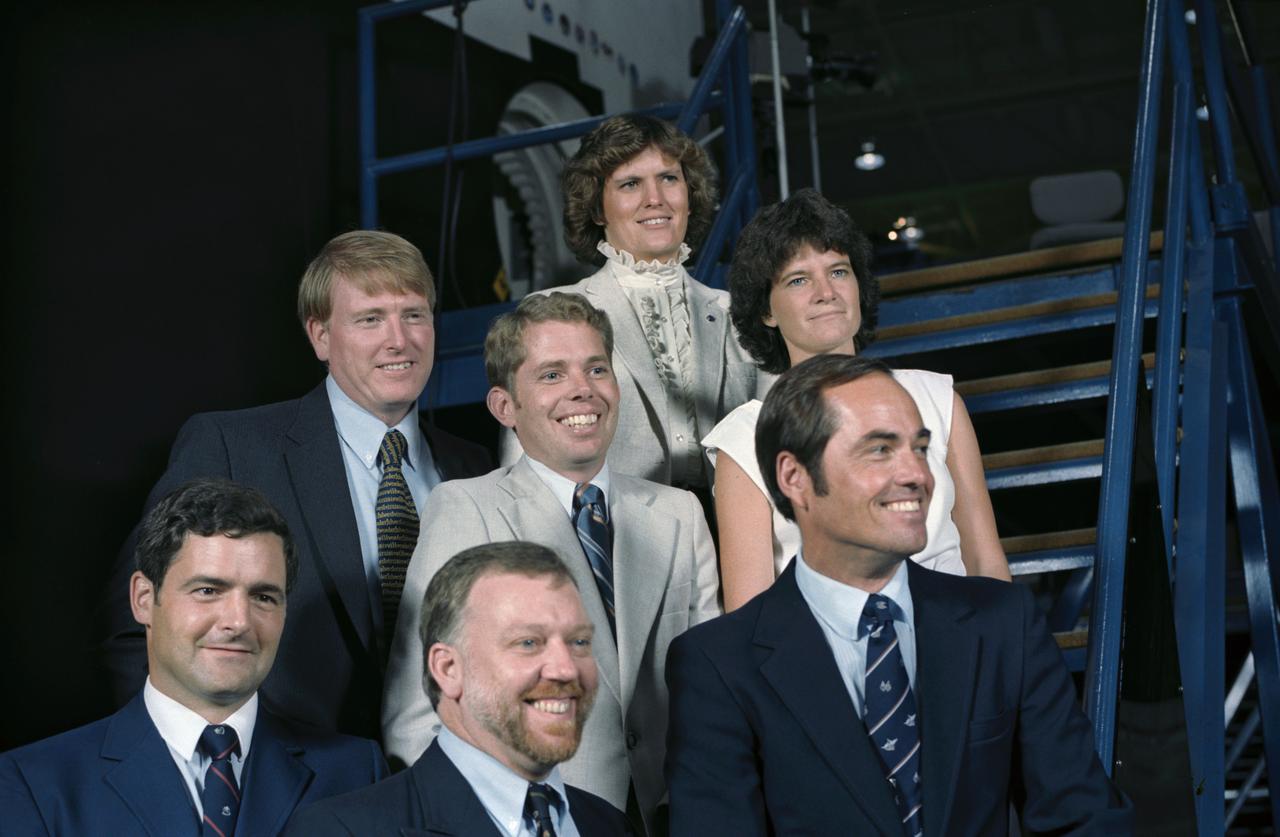
41D-3277 (S14-3277) (4 Sept 1984) --- Having met the press for the first time as a group, members of the STS 41-G crew pose for photographs in the Shuttle mockup and integration laboratory at the Johnson Space Center. They are (bottom row, left, to right) Marc Garneau and Paul D. Scully-Power, both payload specialists; and Robert L. Crippen, crew commander; (second row, l.-r.) Astronauts Jon A. McBride, pilot; David C. Leestma and Sally K. Ride, both mission specialists; and Kathryn D. Sullivan, mission specialist. They are scheduled for an October 5, 1984 launch aboard the Space Shuttle Challenger.
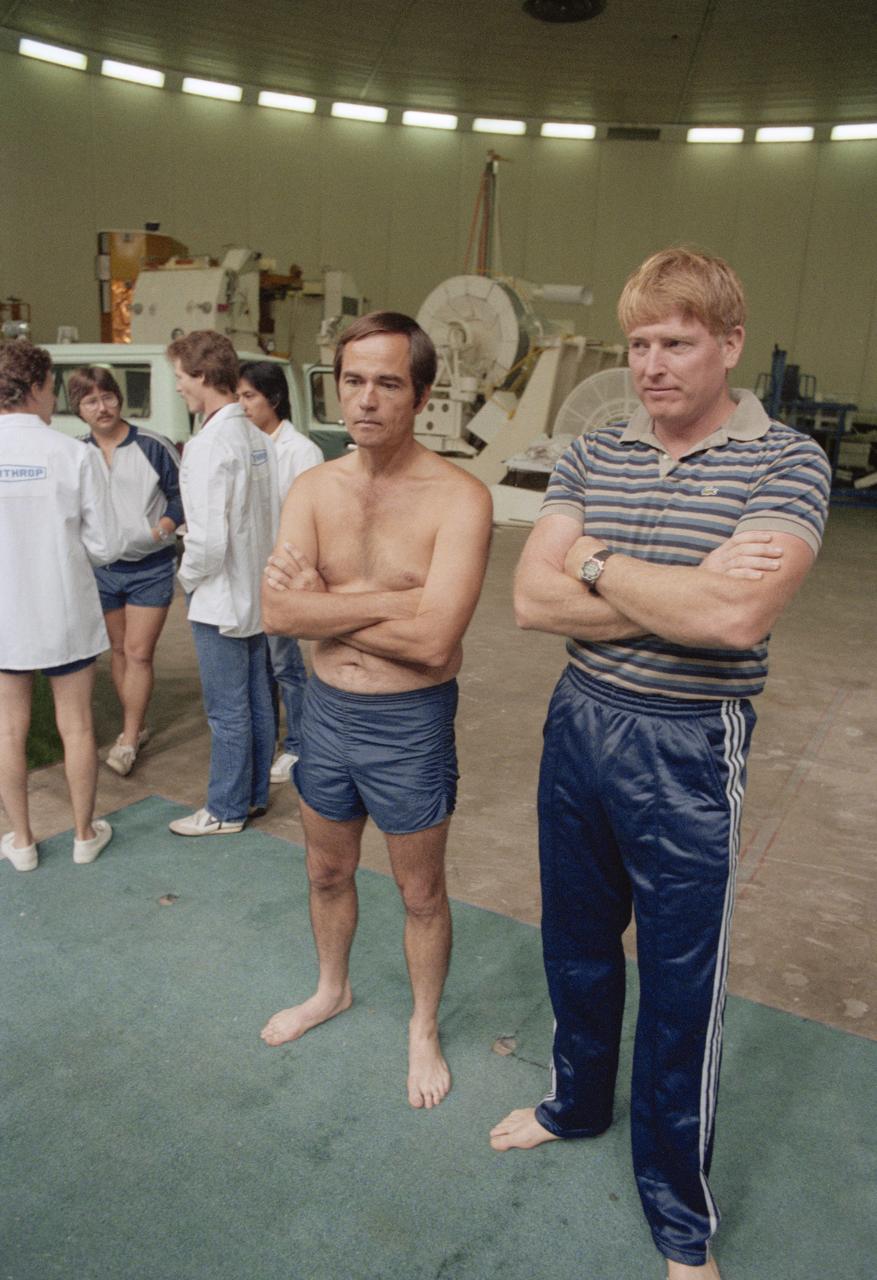
S84-36898 (29 June 1984) --- Astronauts Robert L. Crippen (left) and Jon A. McBride, crew commander and pilot, respectively for NASA's 41-G Space Shuttle mission, await the delivery of self contained underwater breathing apparatus (SCUBA) gear prior to their going underwater to observe a simulation of an extravehicular activity (EVA) scheduled for their mission. The EVA will be performed by Astronauts Kathryn D. Sullivan and David C. Leestma, two of three mission specialists named for the seven-member crew. The underwater training took place in the Johnson Space Center's weightless environment training facility (WET-F).
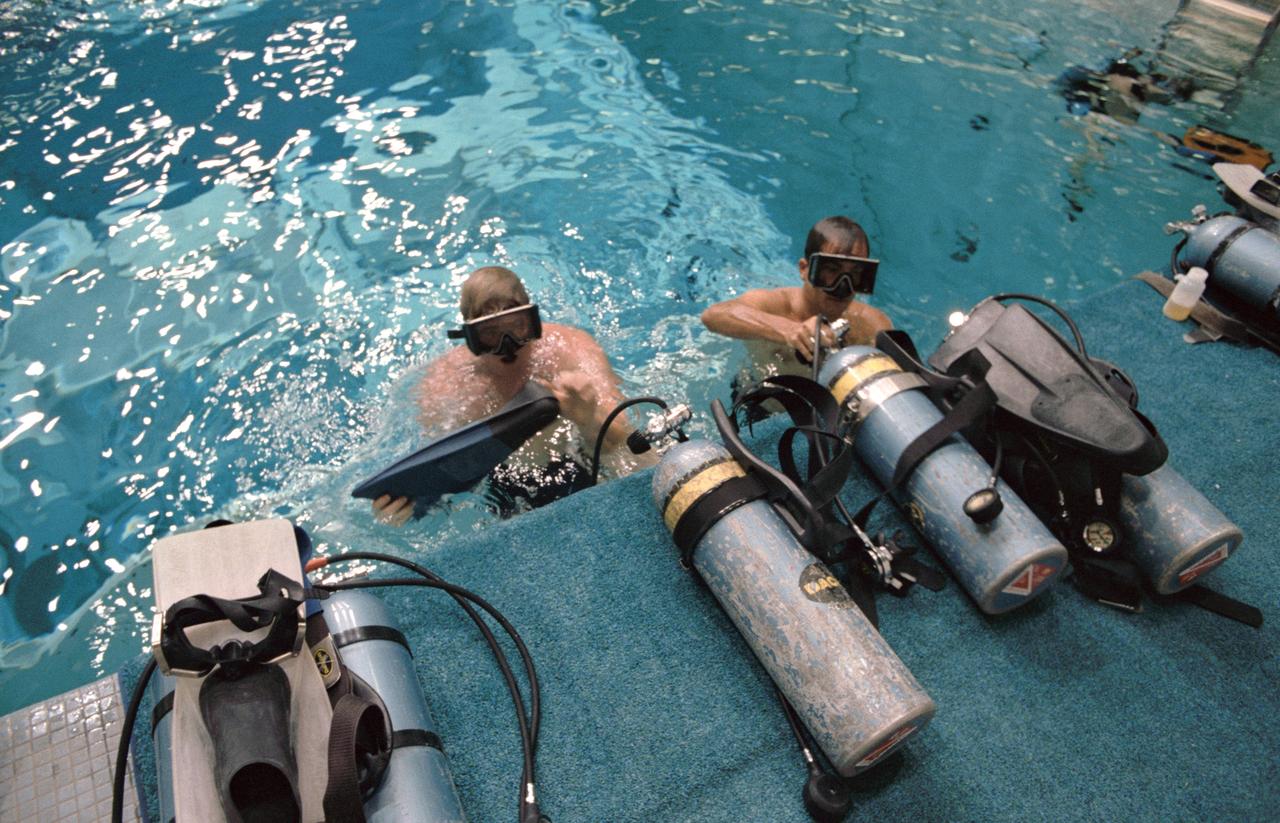
S84-36900 (29 June 1984) ---Astronauts Robert L. Crippen (right) and Jon A. McBride, crew commander and pilot, respectively, for NASA's 41-G Space Shuttle mission, don self contained underwater breathing apparatus (SCUBA) gear prior to their underwater to observe a simulation of an extravehicular activity (EVA) to be performed on their mission. Astronauts Kathryn D. Sullivan and David C. Leestma, two of three mission specialists on the seven-member crew, are scheduled for the EVA. The underwater training took place in the Johnson Space Center's weightless environment training facility (WET-F).
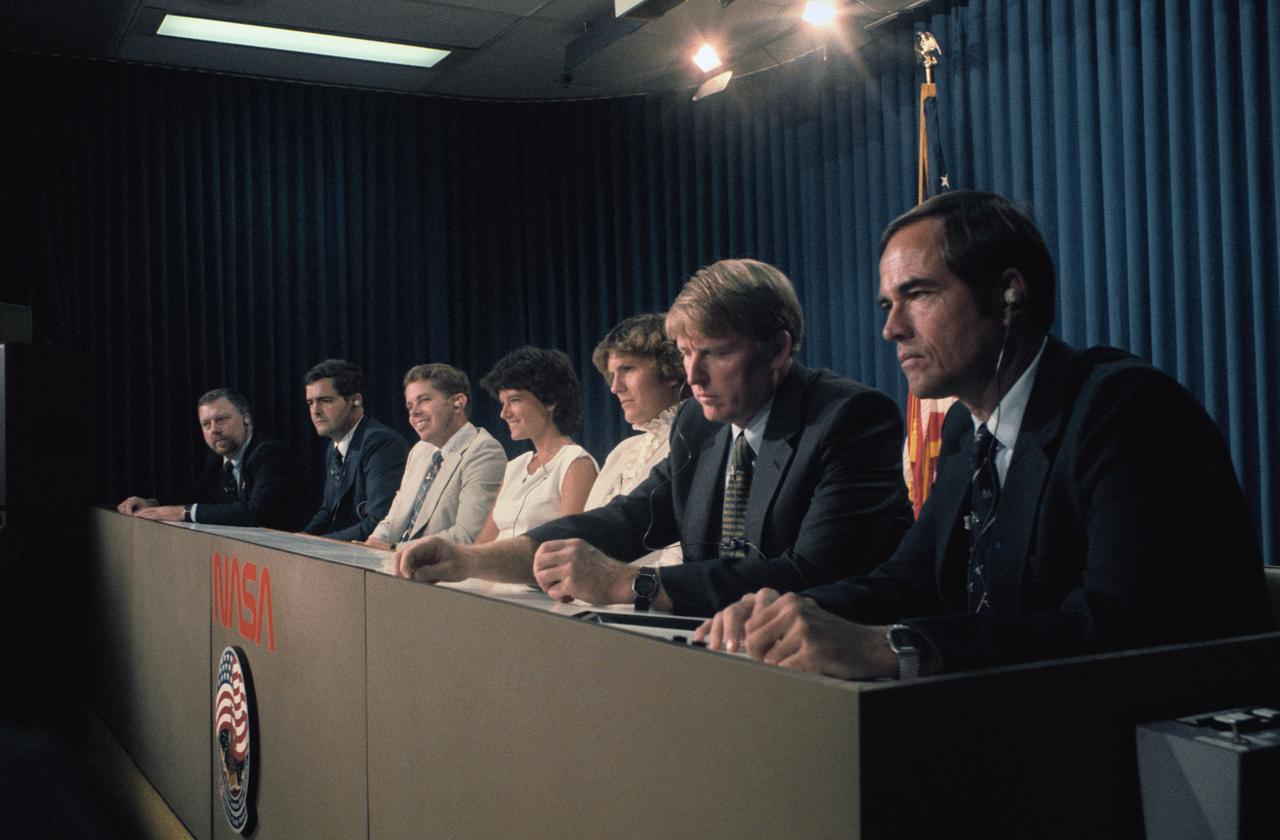
S84-41580 (3 Sept 1984) --- Assembled together publicly for the first time, the seven crewmembers for NASA's 41-G Space Shuttle mission field questions from the press corps at the Johnson Space Center. Pictured (foreground right to left) are Robert L. Crippen, crew commander ;Jon A. McBride, pilot; Kathryn D. Sullivan, Sally K. Ride and David C. Leestma--all mission specialists; Marc Garneau, representing the Canadian National Research Council, and Paul D. Scully-Power, U.S. Navy oceanographer, both payload specialists. Their flight is scheduled for early October.
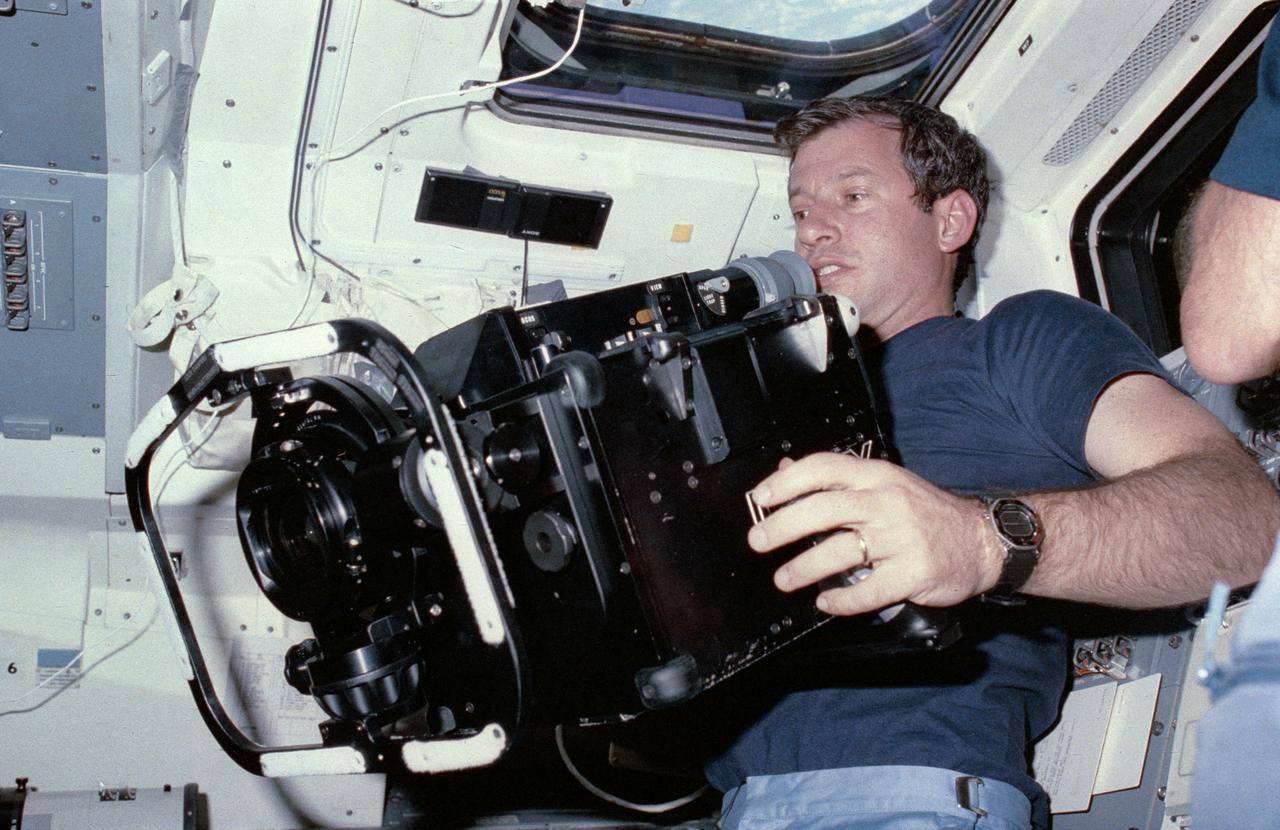
41C-05-180 (9 April 1984) --- Astronaut Terry J. Hart, 41-C mission specialist, holds a 70 pound IMAX camera in the middeck of the Earth orbiting Space Shuttle Challenger. The motion picture camera (65mm) handles 1,000 ft. rolls which have a running time of three minutes (24 frames per second). Hart, who used a black bag as a sort of in space darkroom for five film change outs throughout the flight, commented to ground controllers that the film magazines were much easier to reload in space than in the normal one G environment on Earth.
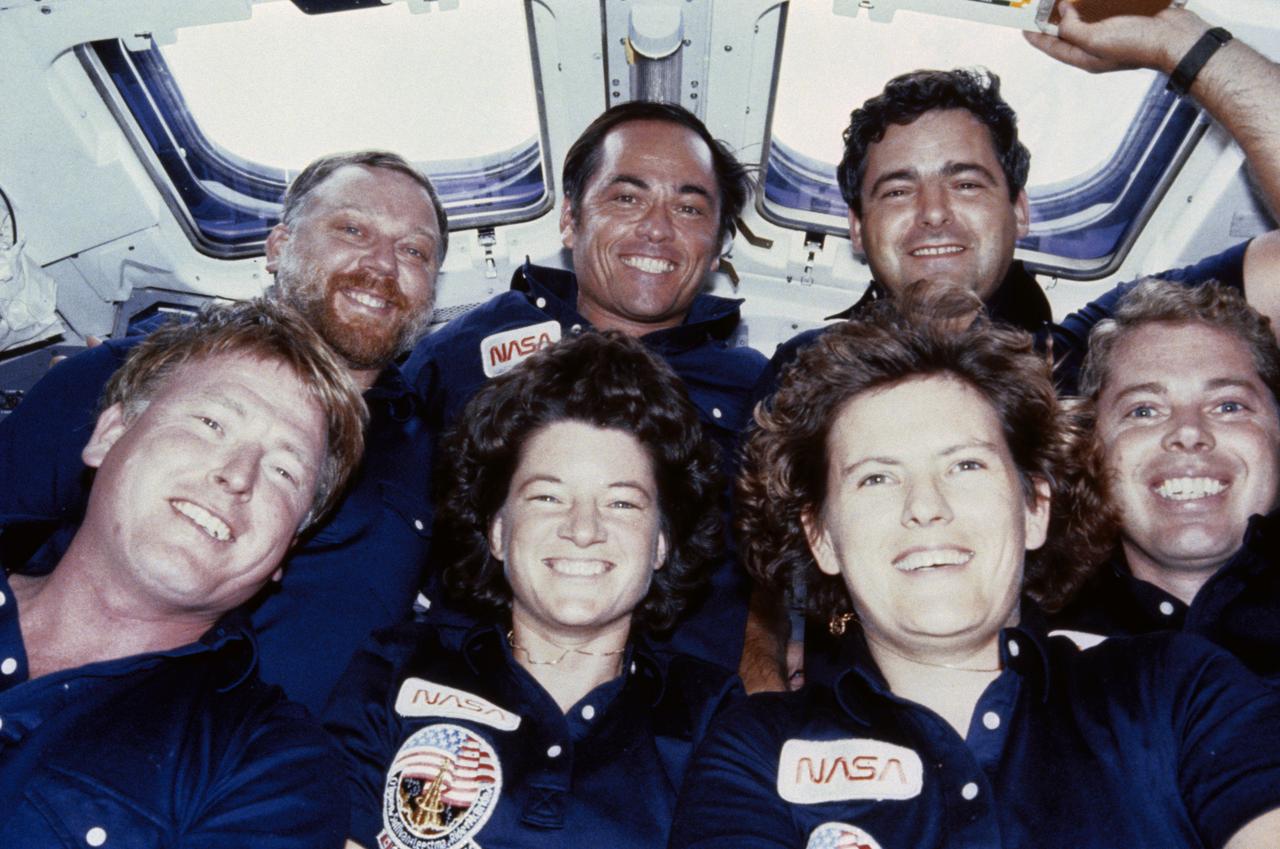
41G-19-006 (5-13 Oct. 1984) --- The seven-member 41-G crew assembles for a group shot on the flight deck of the Earth-orbiting space shuttle Challenger. Robert L. Crippen, commander, is in center of the back row. Others pictured are (front row, l.-r.) Jon A. McBride, pilot; Sally K. Ride, Kathryn D. Sullivan and David C. Leestma, all mission specialists; and Paul D. Scully-Power (left) and Marc Garneau, both payload specialists, on the back row. Garneau represents the National Research Council of Canada and Scully-Power is a civilian oceanographer with the U.S. Navy. Photo credit: NASA
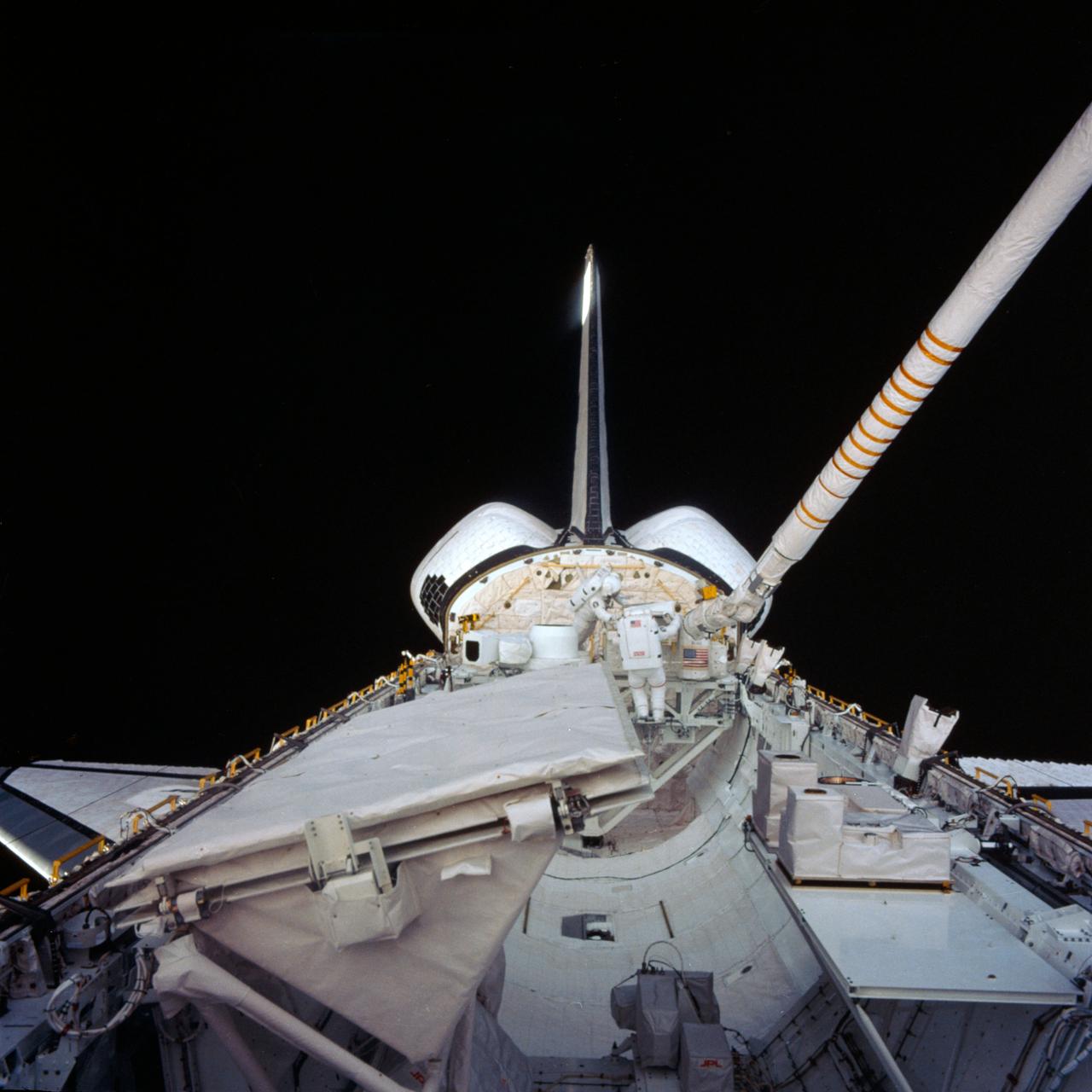
S84-43432 (11 Oct. 1984) --- Appearing small in the center background of this image, astronauts Kathryn D. Sullivan, left, and David C. Leestma, both 41-G mission specialists, perform an in-space simulation of refueling another spacecraft in orbit. Their station on the space shuttle Challenger is the orbital refueling system (ORS), positioned on the mission peculiar support structure (MPR ESS). The Large Format Camera (LFC) is left of the two mission specialists. In the left foreground is the antenna for the shuttle imaging radar (SIR-B) system onboard. The Canadian-built remote manipulator system (RMS) is positioned to allow close-up recording capability of the busy scene. A 50mm lens on a 70mm camera was used to photograph this scene. Photo credit: NASA
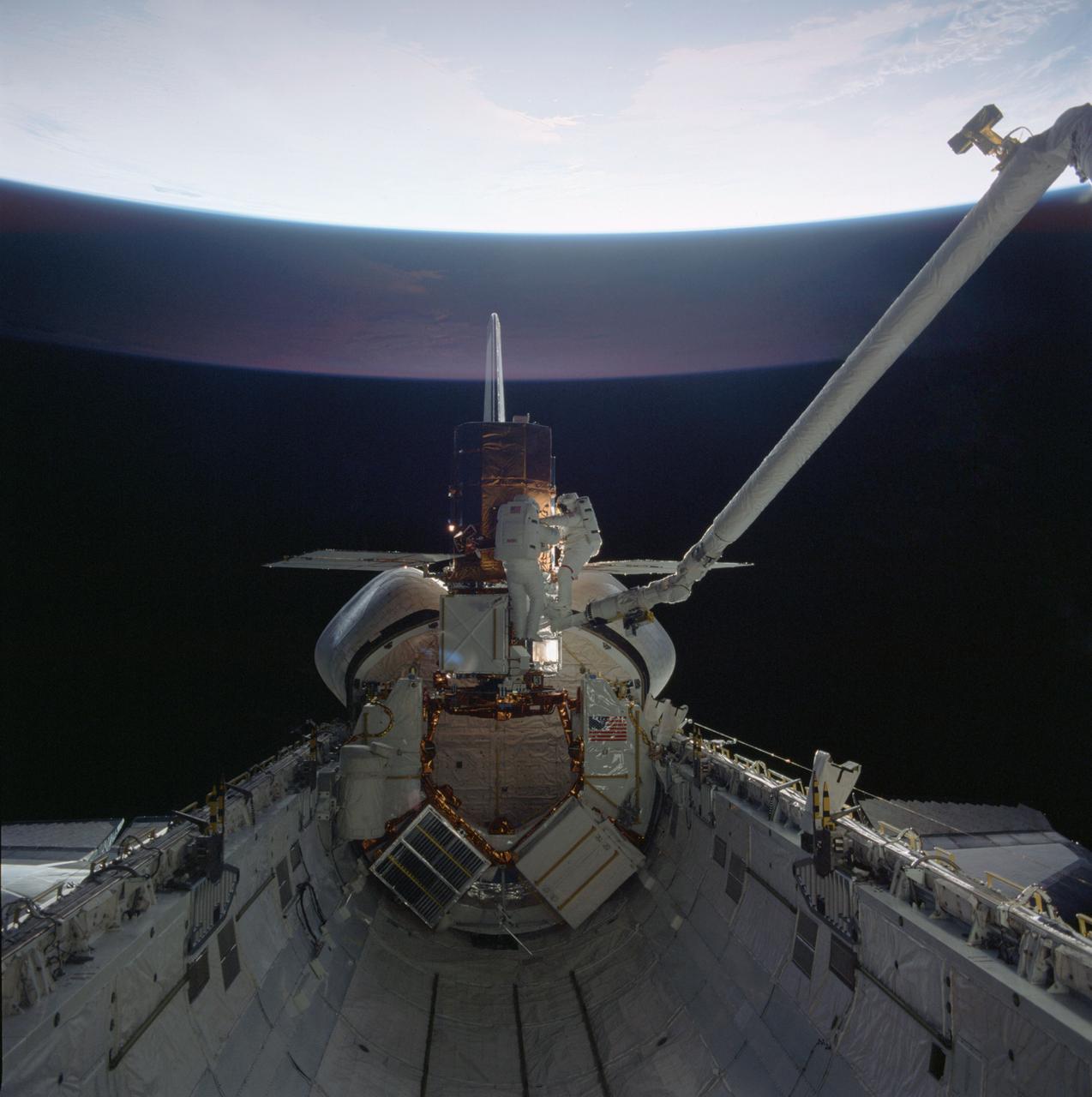
41C-37-1711 (11 April 1984) --- The two mission specialist-EVA participants of Flight 41-C share a repair task at the "captured" Solar Maximum Mission Satellite (SMMS) in the aft end of the Challenger's cargo bay. Astronauts George D. Nelson, right, and James D. van Hoften uses the mobile foot restraint and the Remote Manipulator System (RMS) as a "cherry picker" device for moving about. Later, the RMS lifted the SMMS into space once more.
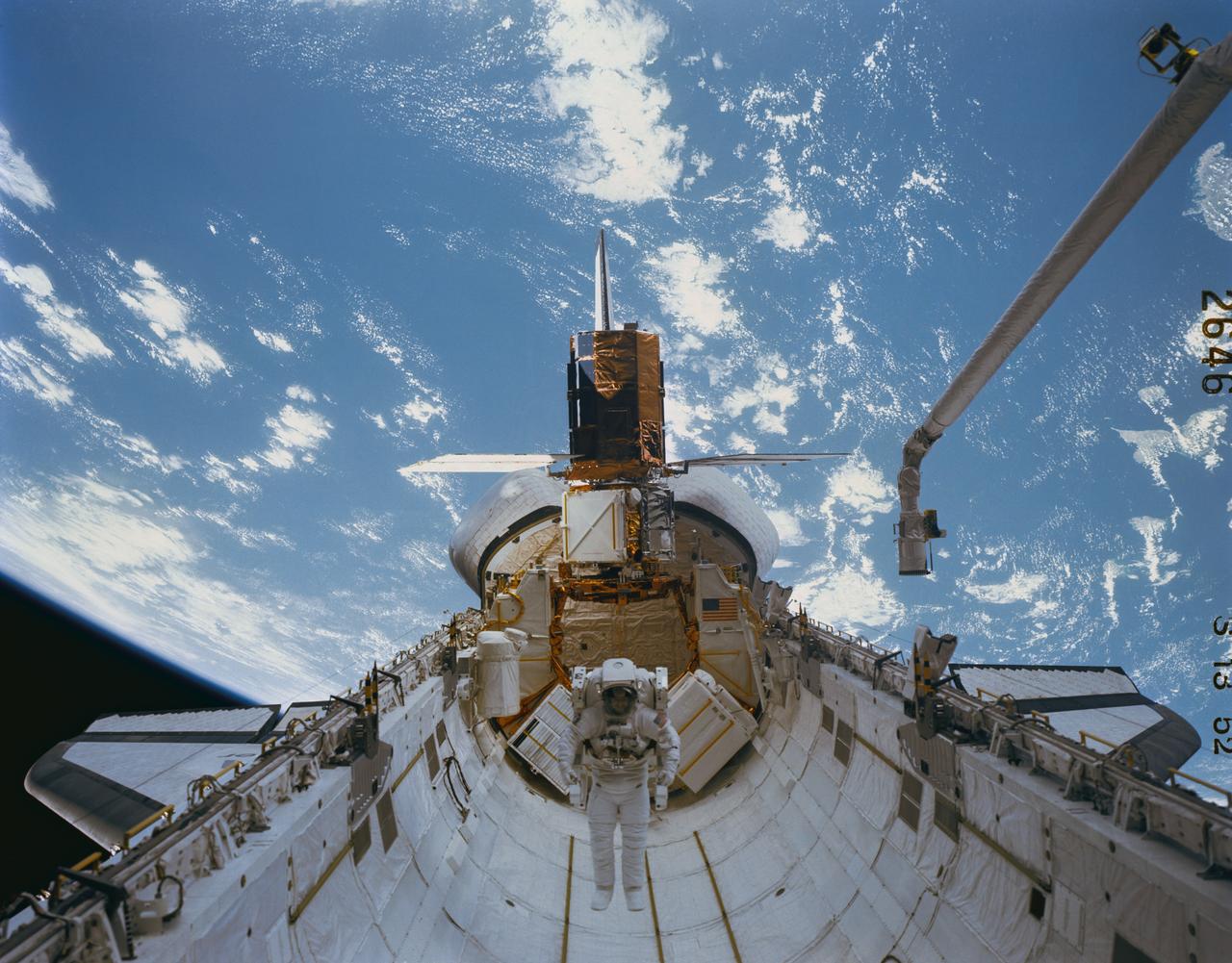
41C-52-2646 (11 April 1984) --- Astronaut James D. van Hoften and a repaired satellite are in a wide panorama recorded on film with a Linhof camera, making its initial flight aboard the Space Shuttle Challenger. Dr. van Hoften is getting in his first "field" test of the Manned Maneuvering Unit (MMU) after months of training in an underwater facility and in a simulator on Earth. The Solar Maximum Mission Satellite (SMMS), revived and almost ready for release into space once more, is docked at the Flight Support System (FSS). The Remote Manipulator System (RMS) is backdropped against the blue and white Earth at frame's edge. Outside of pictures made of the Earth from astronauts on the way to the Moon, this frame showing the planet from 285 nautical miles represents the highest orbital photography in the manned space program.
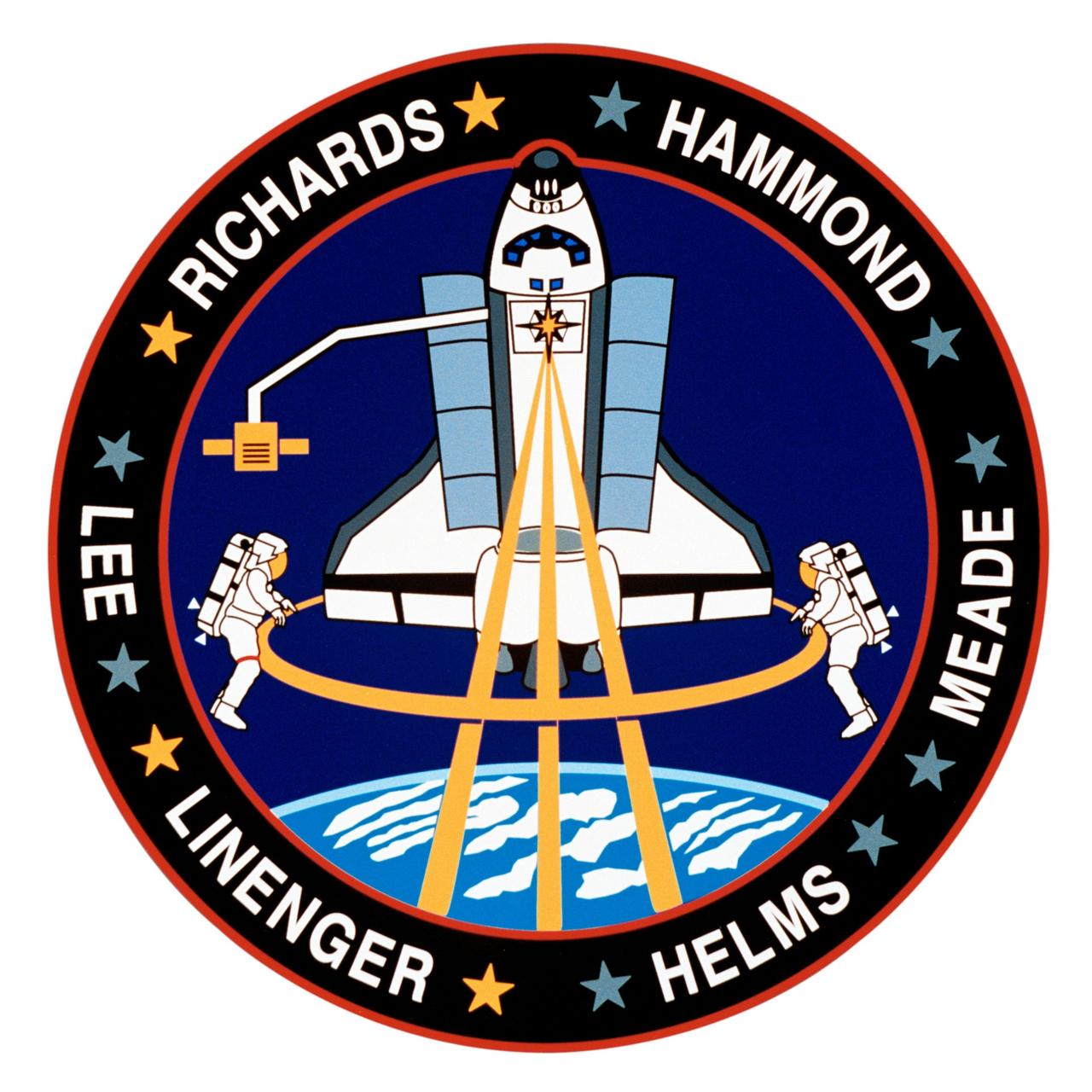
STS064-S-001 (July 1994) --- The patch depicts the space shuttle Discovery in a payload-bay-to-Earth attitude with its primary payload, Lidar In-Space Technology Experiment (LITE-1) operating in support of Mission to Planet Earth. LITE-1 is a lidar (light detection and ranging) system that uses a three-wavelength laser, symbolized by the three gold rays emanating from the star in the payload bay that form part of the astronaut symbol. The major objective of this first flight of LITE-1 is to validate its design and operating characteristics by gathering data about the Earth's troposphere and stratosphere, represented by the clouds and dual-colored Earth limb. A secondary payload on STS-64 is the free-flier SPARTAN-201 satellite shown on the Remote Manipulator System (RMS) arm post-retrieval. The objective of SPARTAN-201 is to investigate the physics of the solar wind and complement data being obtained from the ULYSSES satellite launched on STS-41. The RMS will also operate another secondary payload, Shuttle Plume Impingement Flight Experiment (SPIFEX), which will assess the plume effects from the Orbiter's Reaction Control System thrusters. Additionally, STS-64 will test a new extravehicular activity (EVA) maneuvering device, Simplified Aid for EVA Rescue (SAFER), represented symbolically by the two small nozzles on the backpacks of the two untethered EVA crew men. The names of the crew members encircle the patch: astronauts Richard N. Richards, commander; L. Blaine Hammond Jr., pilot; Jerry M. Linenger; Susan J. Helms, Carl J. Meade and Mark C. Lee, all mission specialists. The gold or silver stars by each name represent that person's parent service. The NASA insignia design for space shuttle flights is reserved for use by the astronauts and for other official use as the NASA Administrator may authorize. Public availability has been approved only in the forms of illustrations by the various news media. When and if there is any change in this policy, which is not anticipated, the change will be publicly announced. Photo credit: NASA