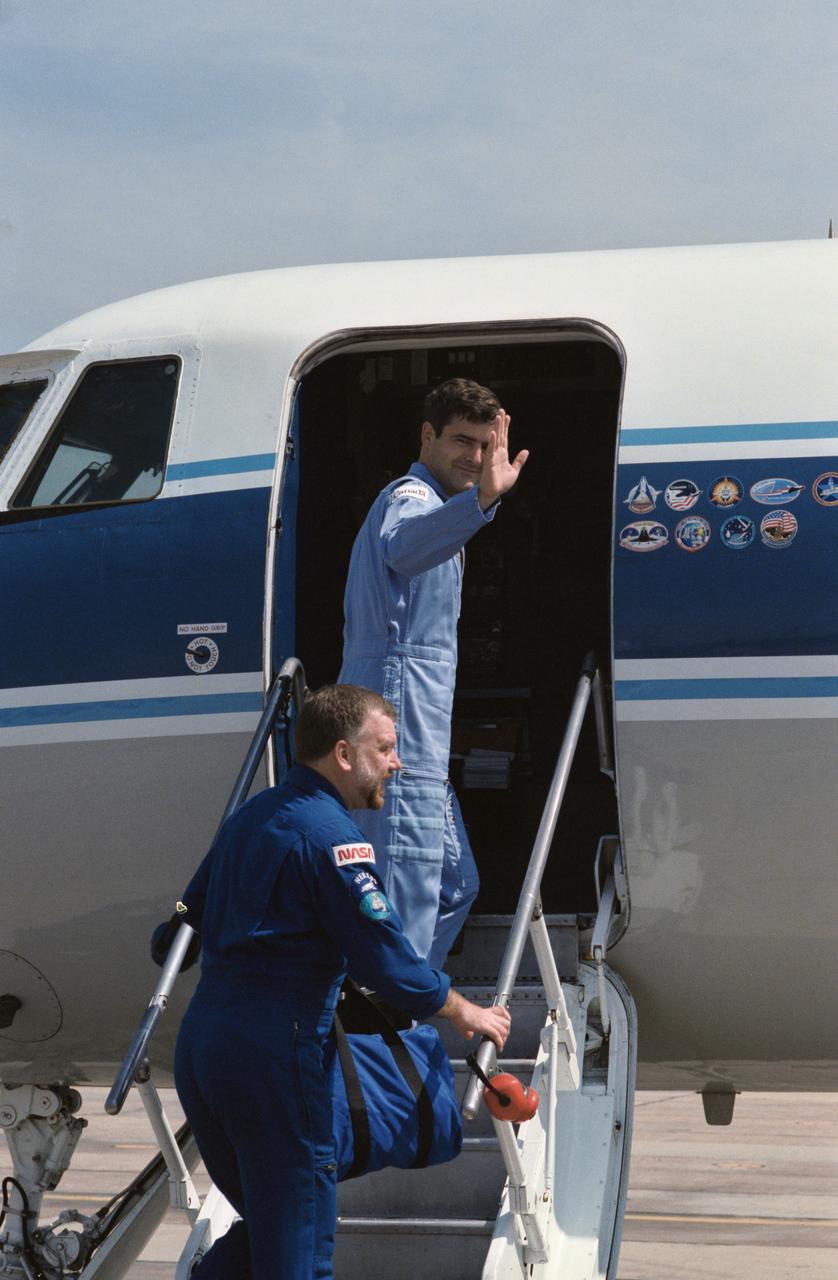
Payload Specialists Marc Garneau and Paul Scully-Power prepare to board the Shuttle Trainer aircraft to leave for the Kennedy Space Center (KSC) for the STS 41-G mission.
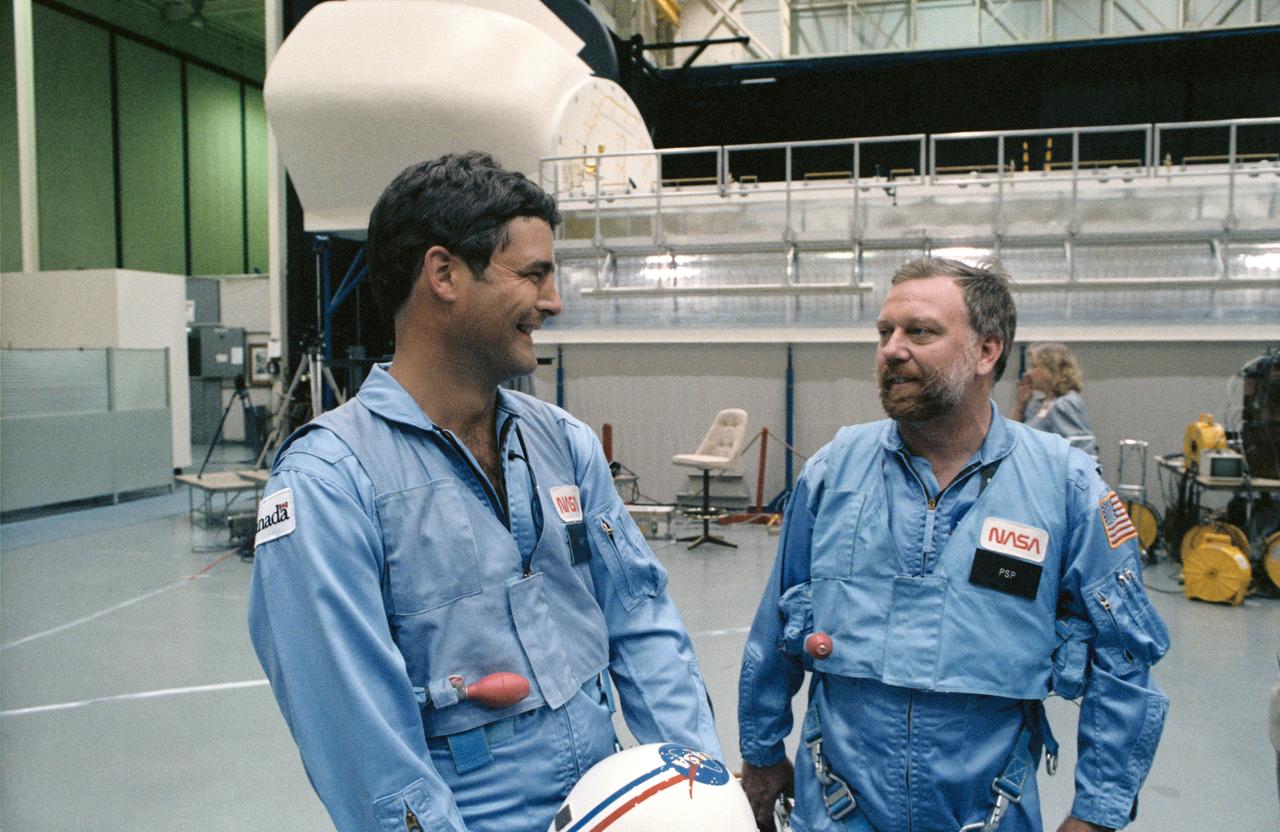
41D-3185 (S14-3185) (4 Sept 1984) --- The two payload specialists for NASA's 41-G mission aboard the Challenger chat prior to a simulation session in the Shuttle mockup and integration laboratory at the Johnson Space Center. They are Marc Garneau, left, representing the Canadian National Research Council, and Paul D. Scully-Power, an oceanographer with the U.S. Navy. They are standing near the manipulator development facility (MDF), pictured in background.
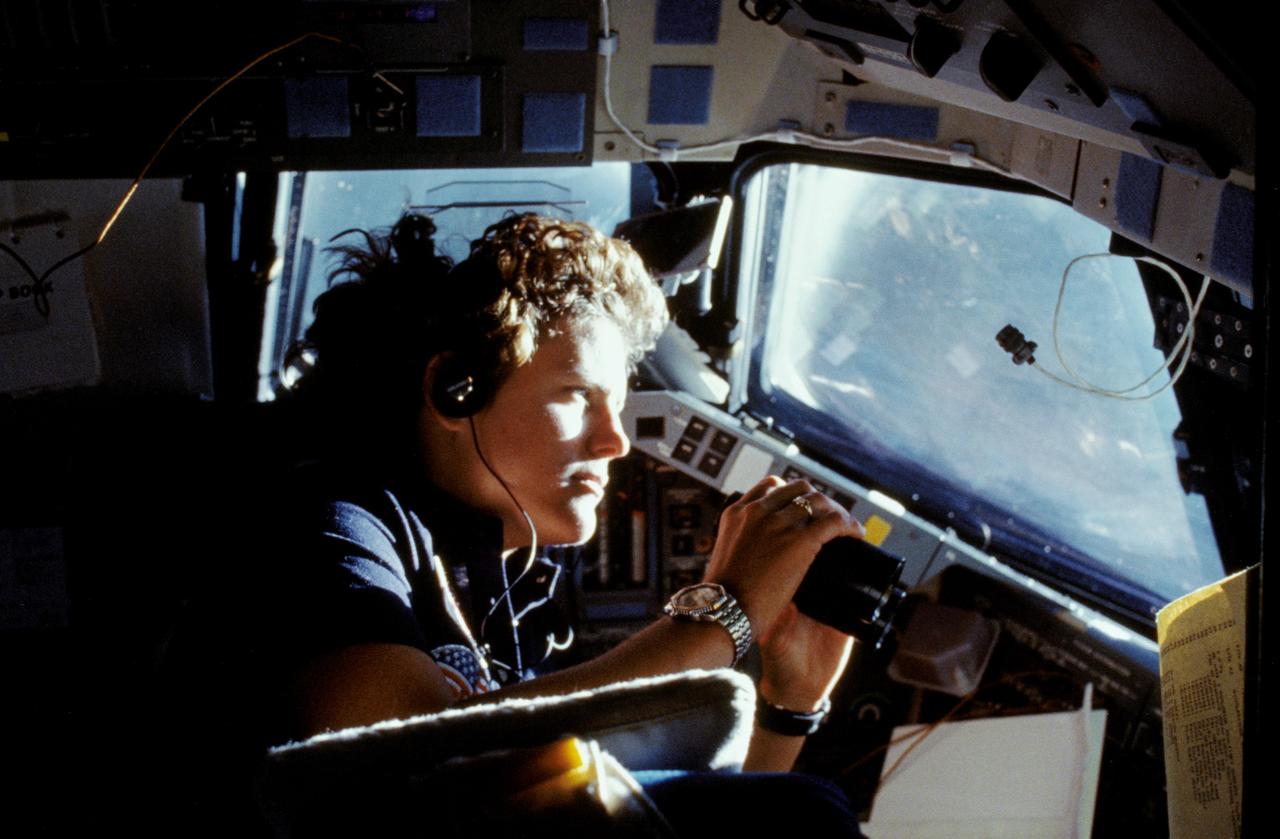
41G-11-027 (14 Oct. 1984) --- Kathryn D. Sullivan, 41-G mission specialist, uses a pair of binoculars to do some magnified viewing through the forward cabin windows of the Earth-orbiting space shuttle Challenger. The 35mm frame was part of the first photographic release from the eight-day 41-G mission on Oct. 14, 1984. Photo credit: NASA
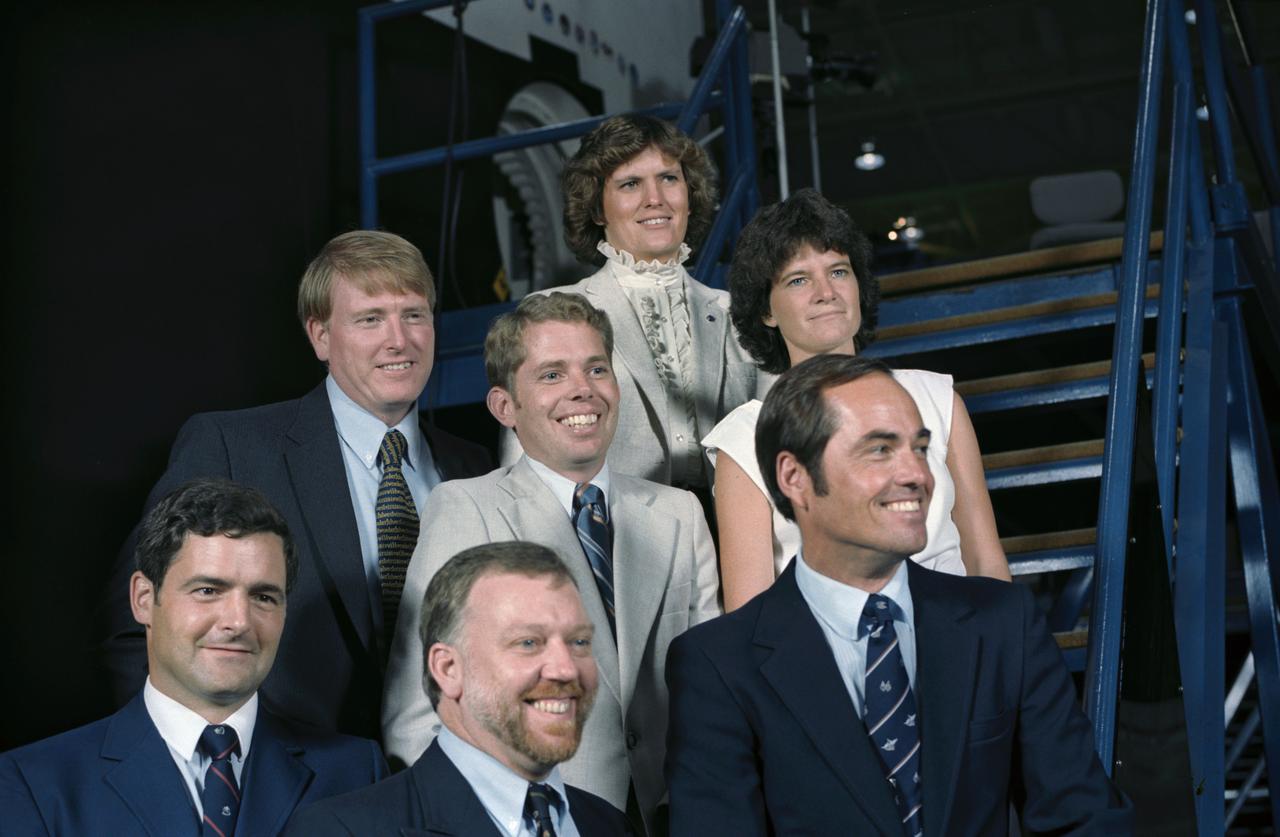
41D-3277 (S14-3277) (4 Sept 1984) --- Having met the press for the first time as a group, members of the STS 41-G crew pose for photographs in the Shuttle mockup and integration laboratory at the Johnson Space Center. They are (bottom row, left, to right) Marc Garneau and Paul D. Scully-Power, both payload specialists; and Robert L. Crippen, crew commander; (second row, l.-r.) Astronauts Jon A. McBride, pilot; David C. Leestma and Sally K. Ride, both mission specialists; and Kathryn D. Sullivan, mission specialist. They are scheduled for an October 5, 1984 launch aboard the Space Shuttle Challenger.
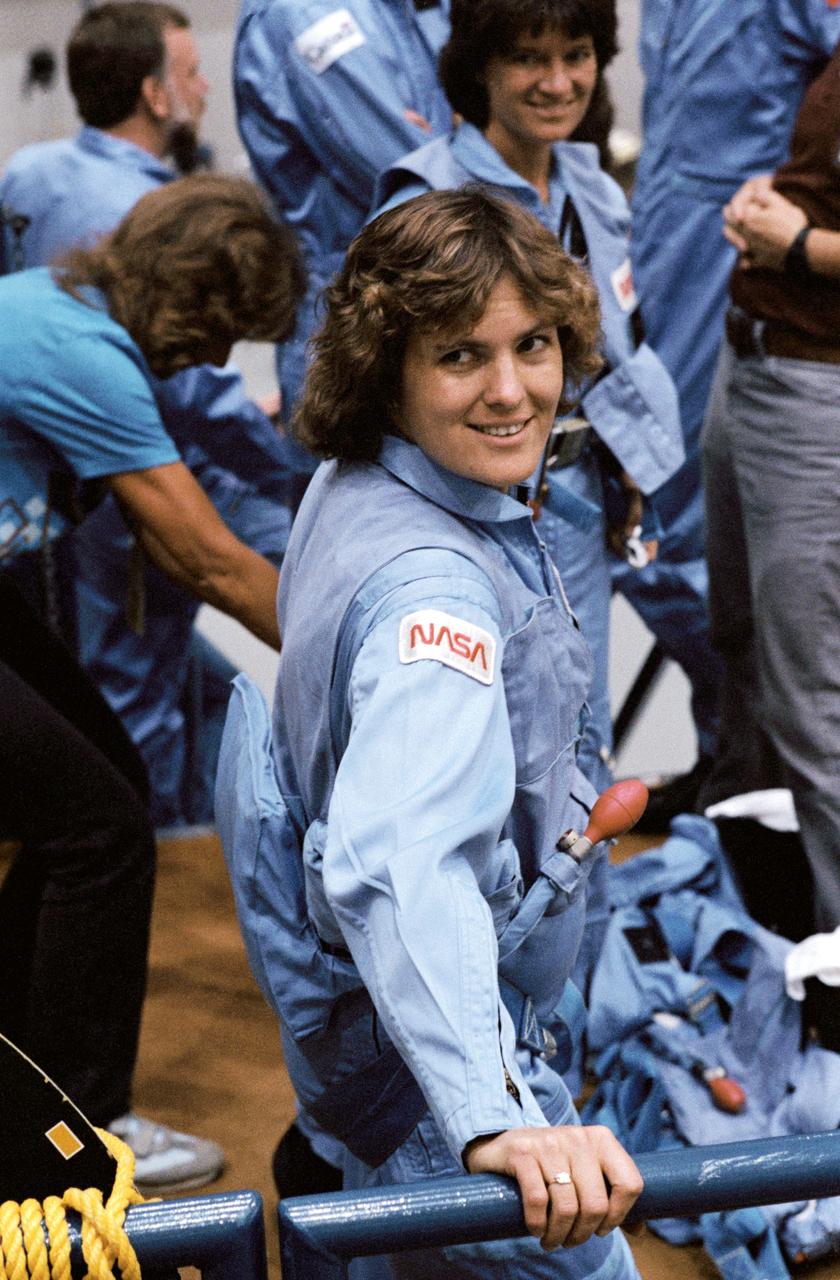
41D-3188 (2 September 1984) --- Astronaut Kathryn D. Sullivan, 41-G mission specialist, joins with other members of the seven-person crew prior to a training session in the Shuttle mockup and integration laboratory at the Johnson Space Center. Dr. Sullivan will be the first American woman to perform an extravehicular activity (EVA) in space when she joins Astronaut David C. Leestma for some outside-the-Challenger duty on October 9. The mission is scheduled for an October 5, 1984 launch.
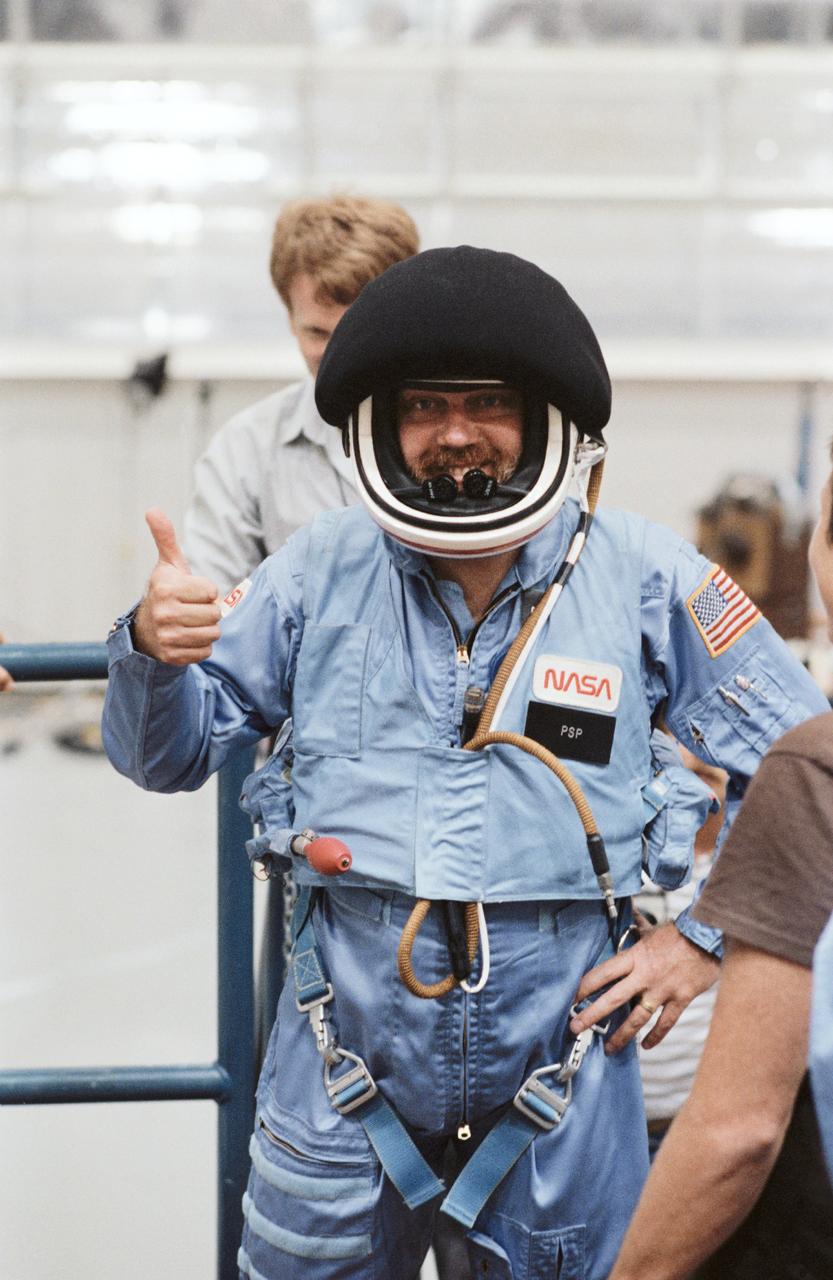
41D-3183 (2 Sept. 1984) --- Paul D. Scully-Power, 41-G payload specialist, appears ready to participate in the eight-day space shuttle mission in this photograph taken during a pause in training in the Johnson Space Center's mockup and integration laboratory. The U.S. Navy oceanographer and a Canadian will join five NASA astronauts for a busy stay in space aboard the Challenger next month. The team was practicing for emergency egress. Photo credit: NASA (Editor's note: Please ignore the odd photo identification number for this image. This is a 41-G training image.)
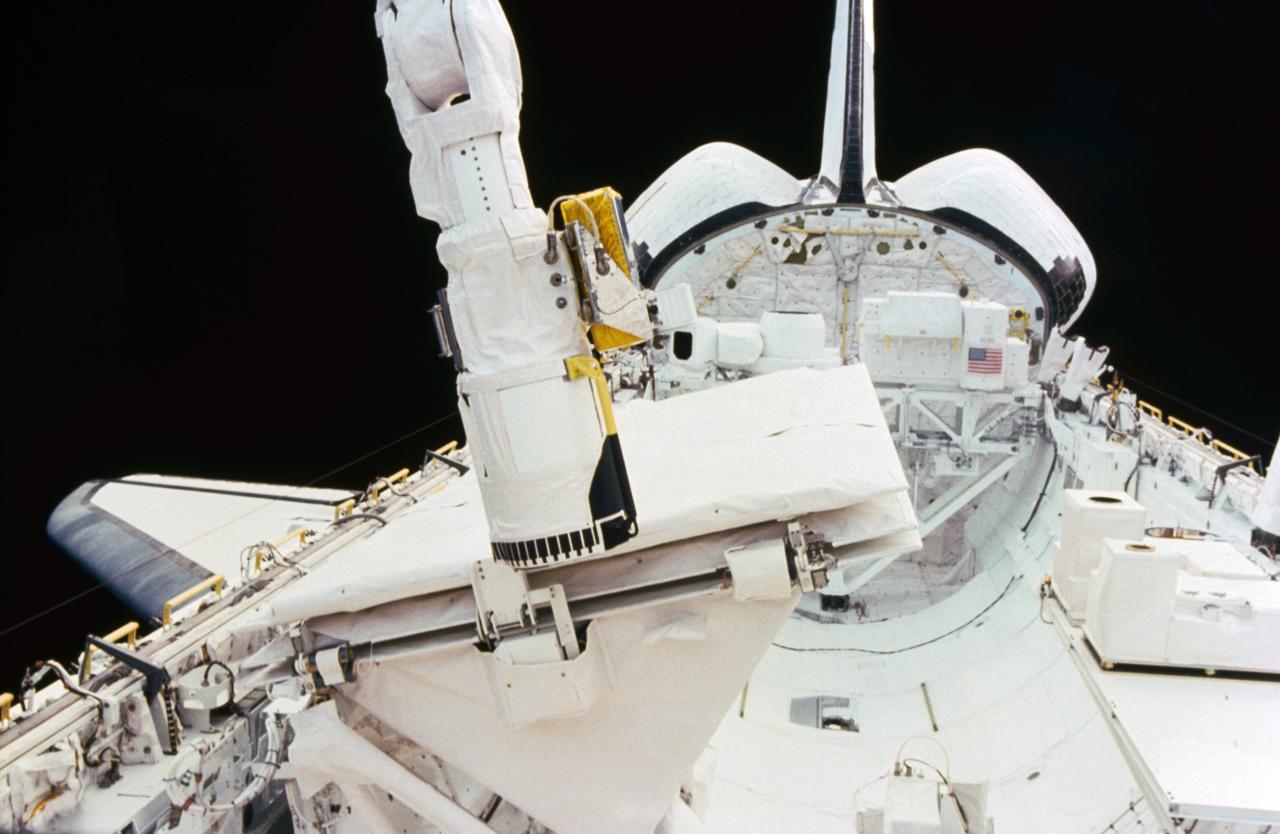
41G-03-008 (5-13 Oct. 1984) --- The end effector of the space shuttle Challenger's remote manipulator system (RMS) taps against the shuttle imaging radar's (SIR-B) antenna to secure it during NASA's 41-G mission. Photo credit: NASA

41G-102-047 (13 Oct. 1984) --- An unusual picture, photographed by astronaut Kathryn D. Sullivan, shows the beginning and ending location of her eight-day mission in space with six other 41-G crew members aboard the space shuttle Challenger. The picture was made moments before touchdown at the KSC landing facility. Dr. Sullivan aimed a 35mm camera through the port hole in Challenger's hatch. The five ground features represented as circles or pentagonals are launch areas. Photo credit: NASA

41G-121-099 (5-13 Oct. 1984) --- Hurricane Josephine was photographed with a medium format camera aimed through the space shuttle Challenger's aft flight deck windows during NASA's 41-G mission. The hurricane's eye can be seen below the orbiter's vertical stabilizer. The large storm off the Florida coast did not prevent the spacecraft with its record of seven crew members aboard from landing safely at the KSC landing facility. Photo credit: NASA
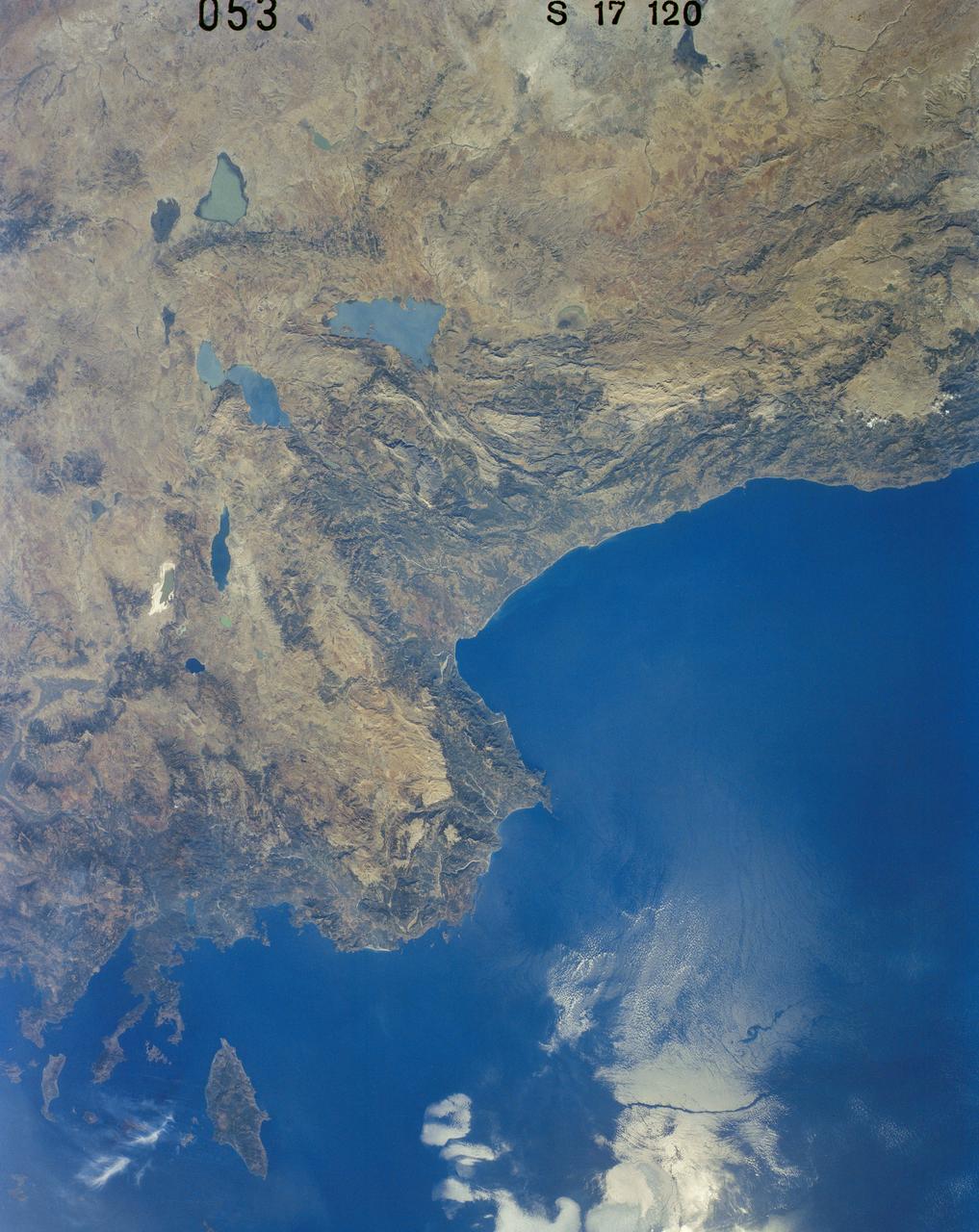
41G-120-053 (5-13 Oct. 1984) --- Turkey and a portion of the Mediterranean Sea, with the city of Antalya visible, were photographed with a medium format camera during the 41-G mission aboard the space shuttle Challenger. Numerous eddies and an ocean front can be observed in the sun's glint off the water's surface. The folded mountains indicate the rugged topography in this region. Photo credit: NASA
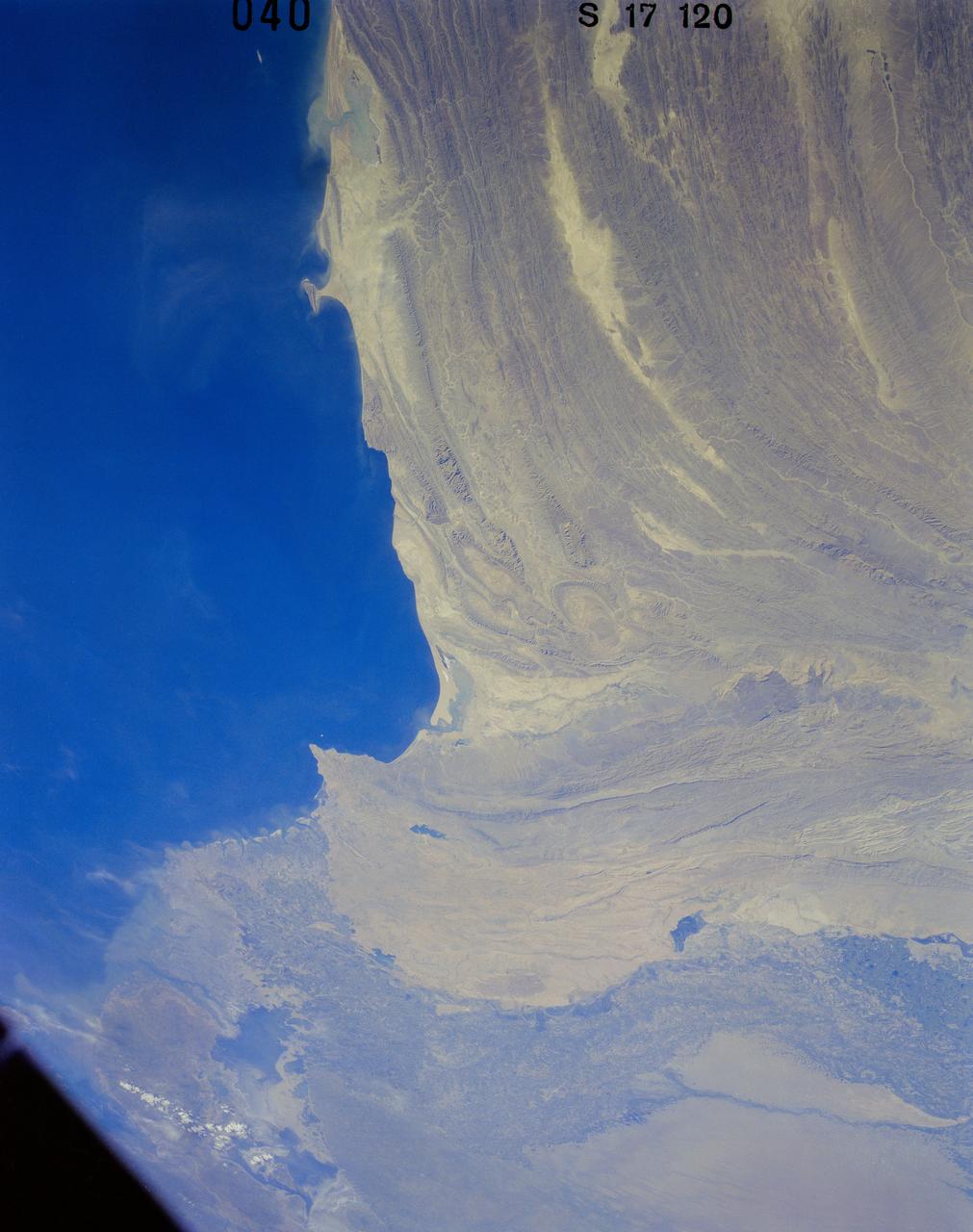
41G-120-040 (5-13 Oct. 1984) --- Pakistan, featuring the city of Karachi, the Makran mountain range, the mouth of the Indus River and the North Arabian Sea were photographed with a medium format camera aboard the space shuttle Challenger during the 41-G mission. Photo credit: NASA
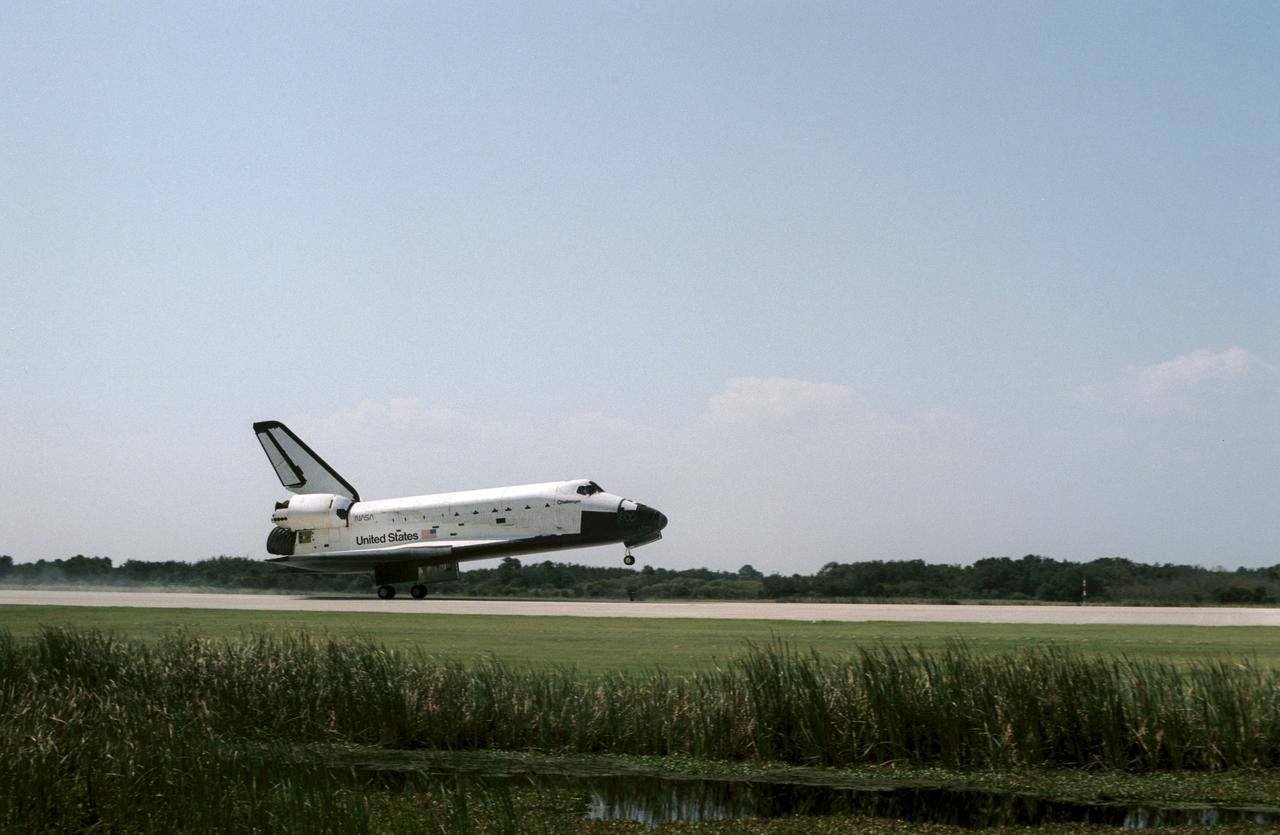
The Space Shuttle Challenger lands at Kennedy Space Center (KSC) at the end of the STS 41-G mission. The main landing gear has already touched down in this view, but the nose gear is still in the air (90232); Front view through tall grass of the Challenger making its landing at KSC (90233); Close-up side view of the Challenger making its landing at KSC (90234); Aerial view of the Challenger making its final approach to the runway to land at KSC (90235).
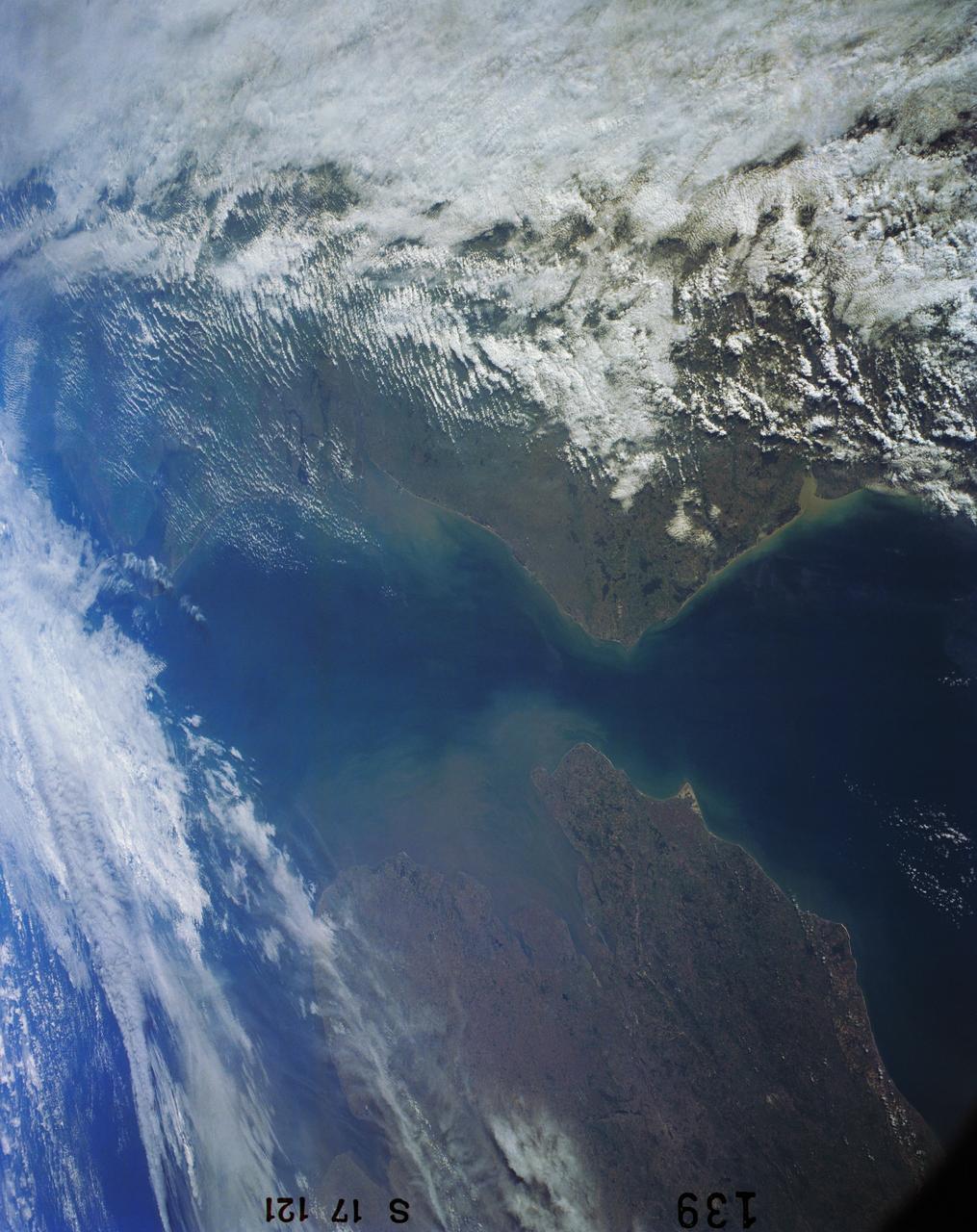
41G-121-139 (5-13 Oct. 1984) --- The Strait of Dover and London, seldom seen in space photography, can be delineated in this medium format camera's scene showing parts of England and France from onboard the Earth-orbiting space shuttle Challenger. Parts of the Thames River can also be traced in the frame. The 41-G crew consisted of astronauts Robert L. Crippen, commander; Jon A. McBride, pilot; and Mission Specialists Kathryn D. Sullivan, Sally K. Ride, and David D. Leestma; along with Canadian astronaut Marc Garneau; and Paul D. Scully-Power, both payload specialists. Photo credit: NASA
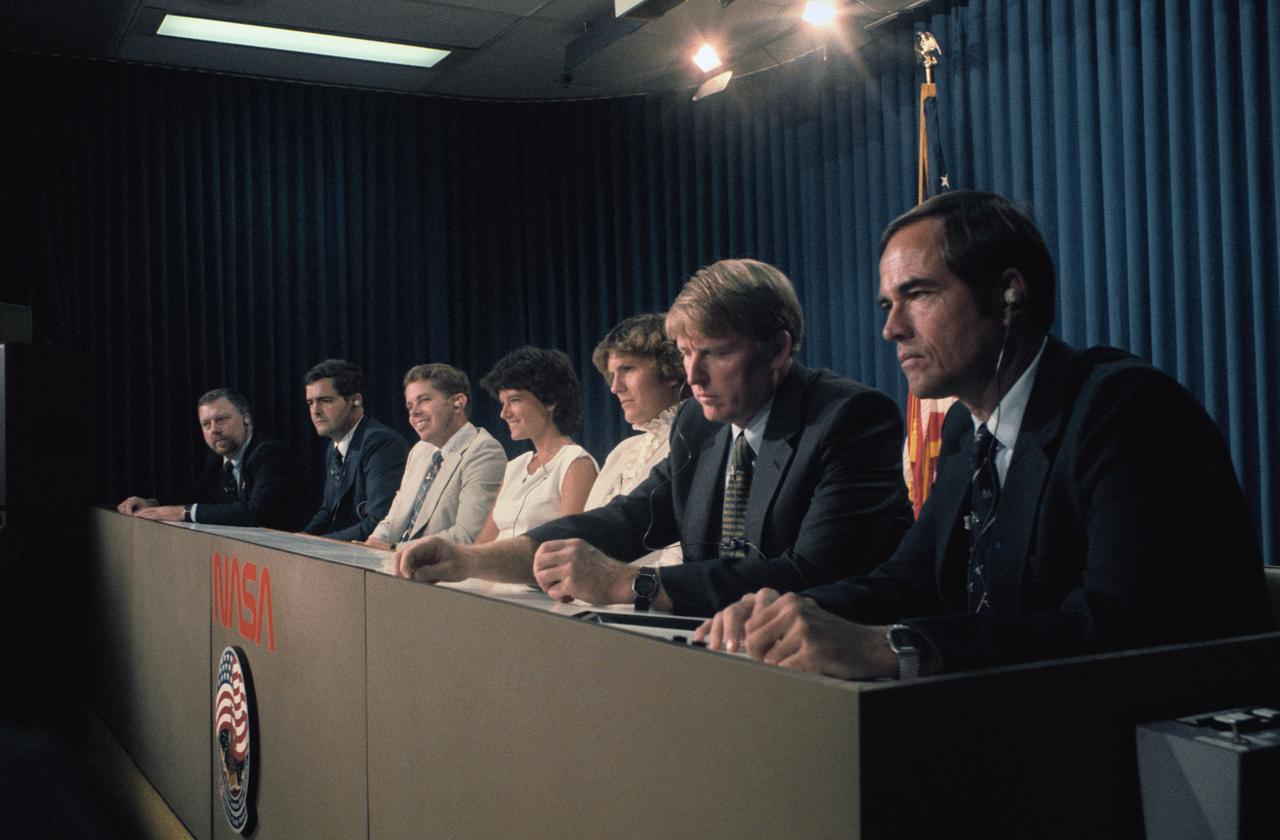
S84-41580 (3 Sept 1984) --- Assembled together publicly for the first time, the seven crewmembers for NASA's 41-G Space Shuttle mission field questions from the press corps at the Johnson Space Center. Pictured (foreground right to left) are Robert L. Crippen, crew commander ;Jon A. McBride, pilot; Kathryn D. Sullivan, Sally K. Ride and David C. Leestma--all mission specialists; Marc Garneau, representing the Canadian National Research Council, and Paul D. Scully-Power, U.S. Navy oceanographer, both payload specialists. Their flight is scheduled for early October.
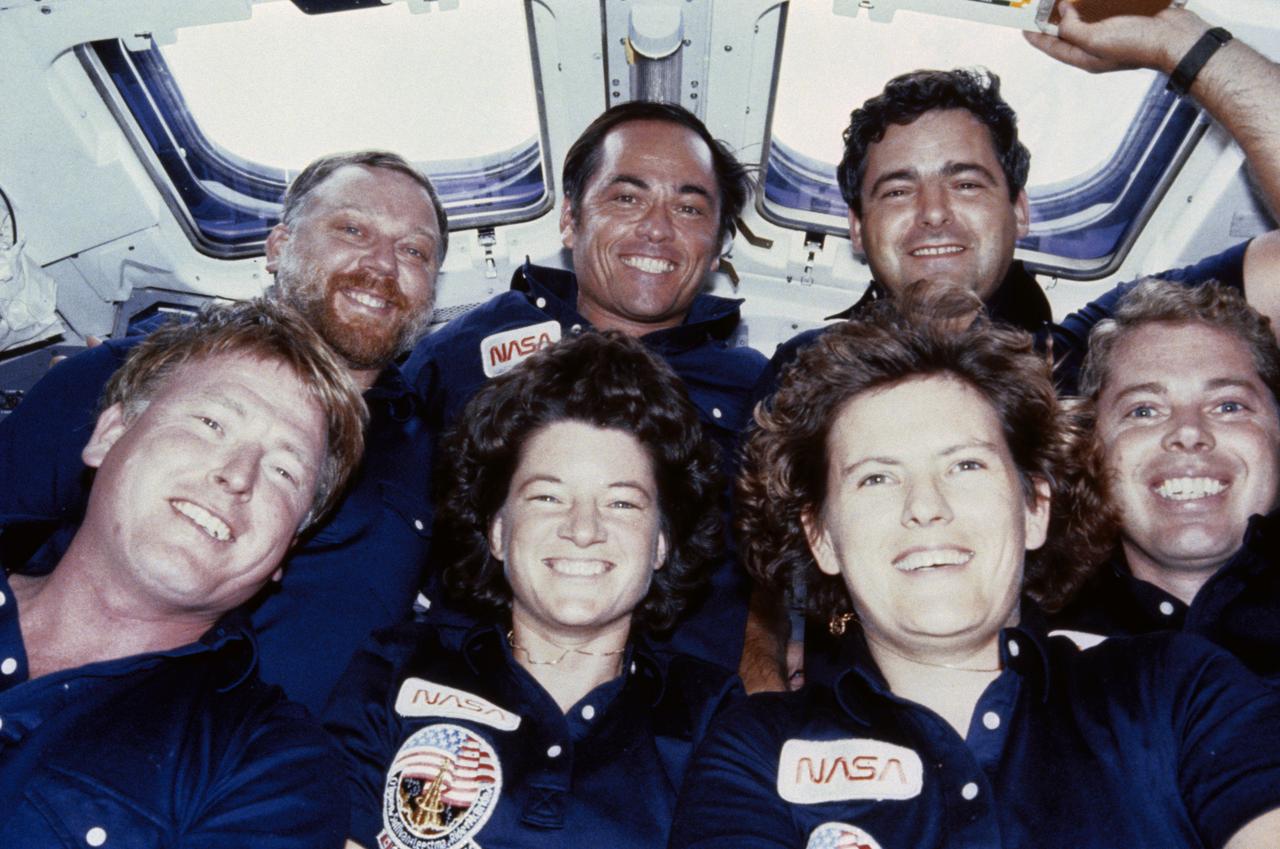
41G-19-006 (5-13 Oct. 1984) --- The seven-member 41-G crew assembles for a group shot on the flight deck of the Earth-orbiting space shuttle Challenger. Robert L. Crippen, commander, is in center of the back row. Others pictured are (front row, l.-r.) Jon A. McBride, pilot; Sally K. Ride, Kathryn D. Sullivan and David C. Leestma, all mission specialists; and Paul D. Scully-Power (left) and Marc Garneau, both payload specialists, on the back row. Garneau represents the National Research Council of Canada and Scully-Power is a civilian oceanographer with the U.S. Navy. Photo credit: NASA
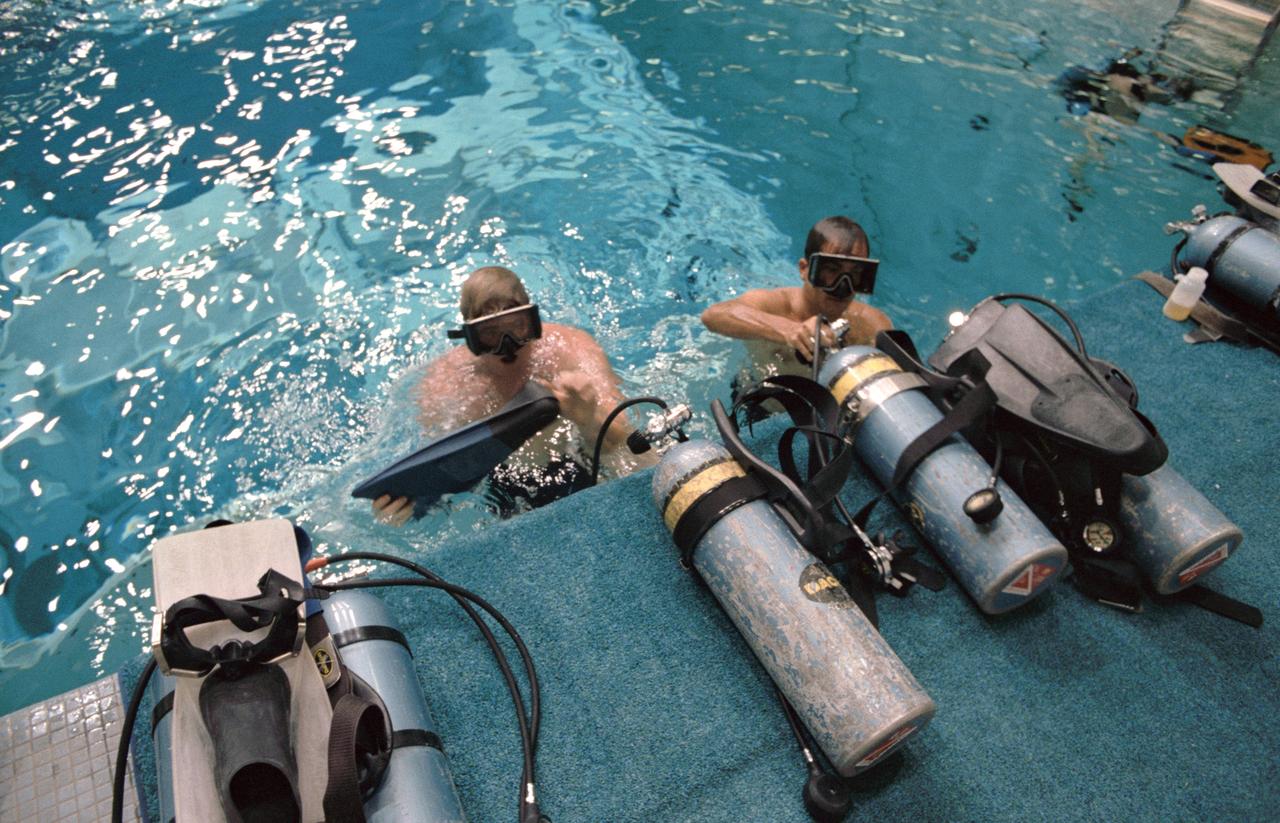
S84-36900 (29 June 1984) ---Astronauts Robert L. Crippen (right) and Jon A. McBride, crew commander and pilot, respectively, for NASA's 41-G Space Shuttle mission, don self contained underwater breathing apparatus (SCUBA) gear prior to their underwater to observe a simulation of an extravehicular activity (EVA) to be performed on their mission. Astronauts Kathryn D. Sullivan and David C. Leestma, two of three mission specialists on the seven-member crew, are scheduled for the EVA. The underwater training took place in the Johnson Space Center's weightless environment training facility (WET-F).
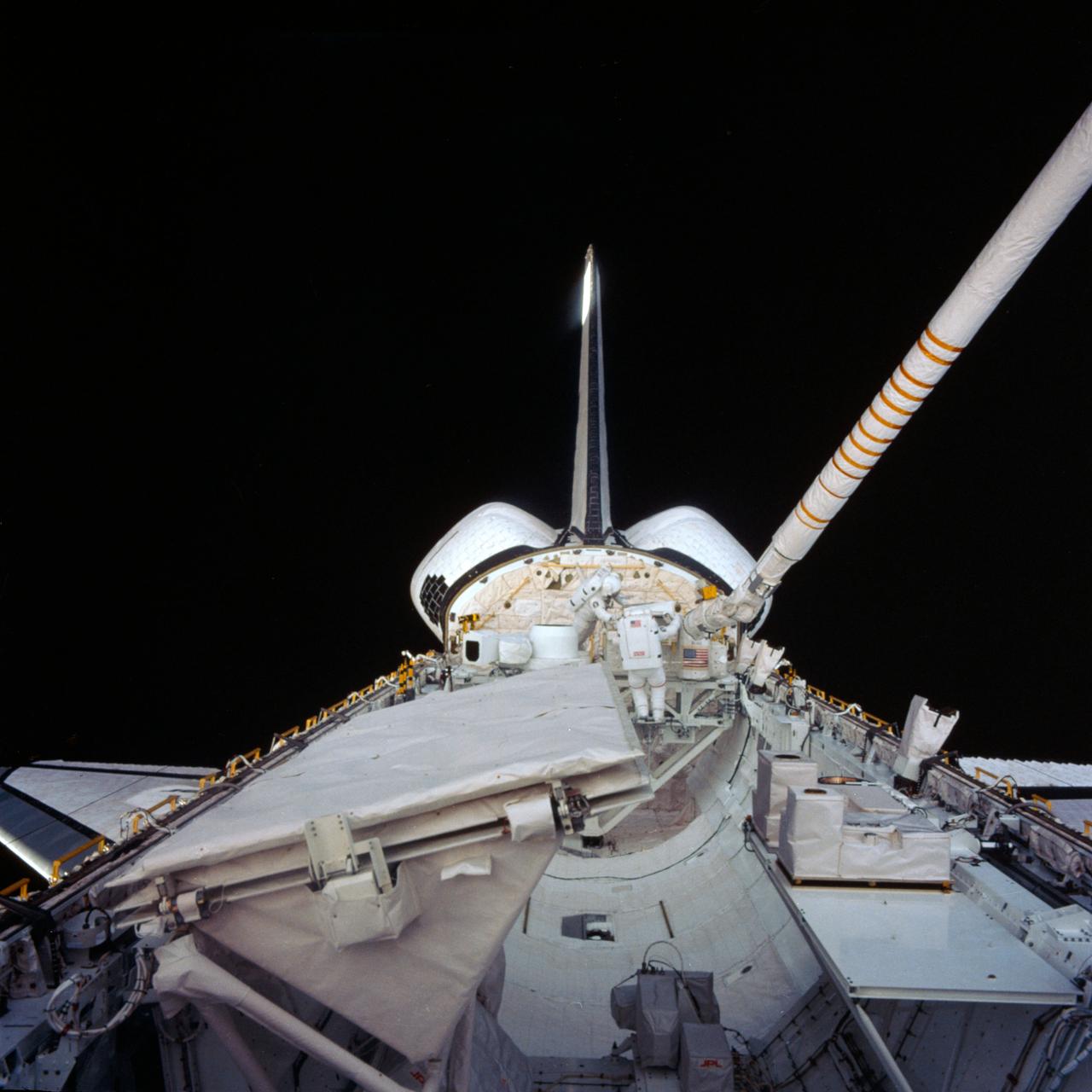
S84-43432 (11 Oct. 1984) --- Appearing small in the center background of this image, astronauts Kathryn D. Sullivan, left, and David C. Leestma, both 41-G mission specialists, perform an in-space simulation of refueling another spacecraft in orbit. Their station on the space shuttle Challenger is the orbital refueling system (ORS), positioned on the mission peculiar support structure (MPR ESS). The Large Format Camera (LFC) is left of the two mission specialists. In the left foreground is the antenna for the shuttle imaging radar (SIR-B) system onboard. The Canadian-built remote manipulator system (RMS) is positioned to allow close-up recording capability of the busy scene. A 50mm lens on a 70mm camera was used to photograph this scene. Photo credit: NASA
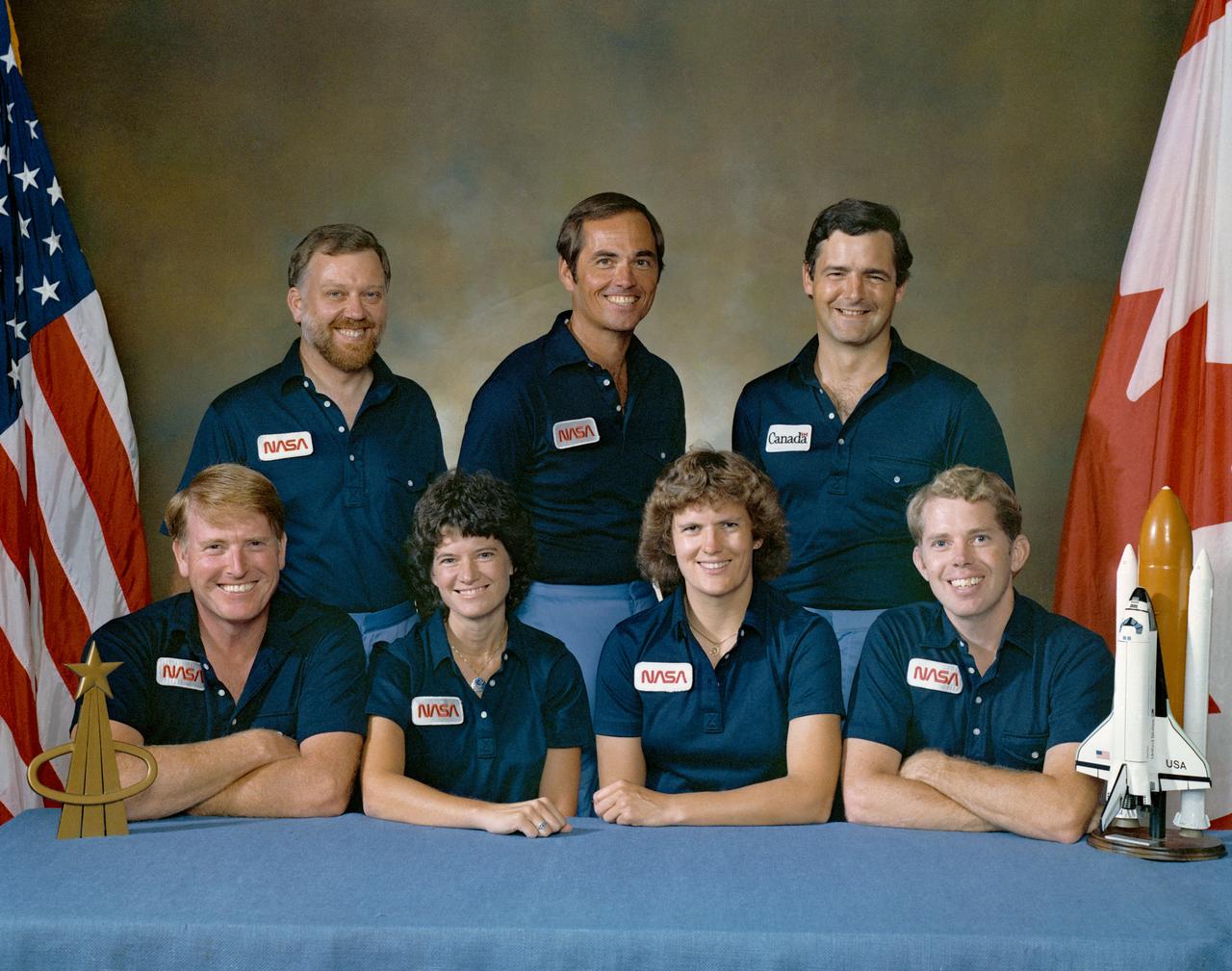
S84-37981 (20 July 1984) --- The space shuttle Challenger will carry these seven persons into space for NASA's STS-41G mission scheduled for October 1984. They are (bottom row, left to right) astronauts Jon A. McBride, pilot; and Sally K. Ride, Kathryn D. Sullivan and David C. Leestma -- all mission specialists. Astronaut Robert L. Crippen crew commander, is flanked by Paul D. Scully-Power and Marc Garneau, both payload specialists. Scully-Power is an oceanographer for the U.S. Navy and Garneau represents the National Research Council (Canada). The replica of a gold astronaut pin near McBride signifies unity. The group represents the largest space shuttle crew thus far. Photo credit: NASA
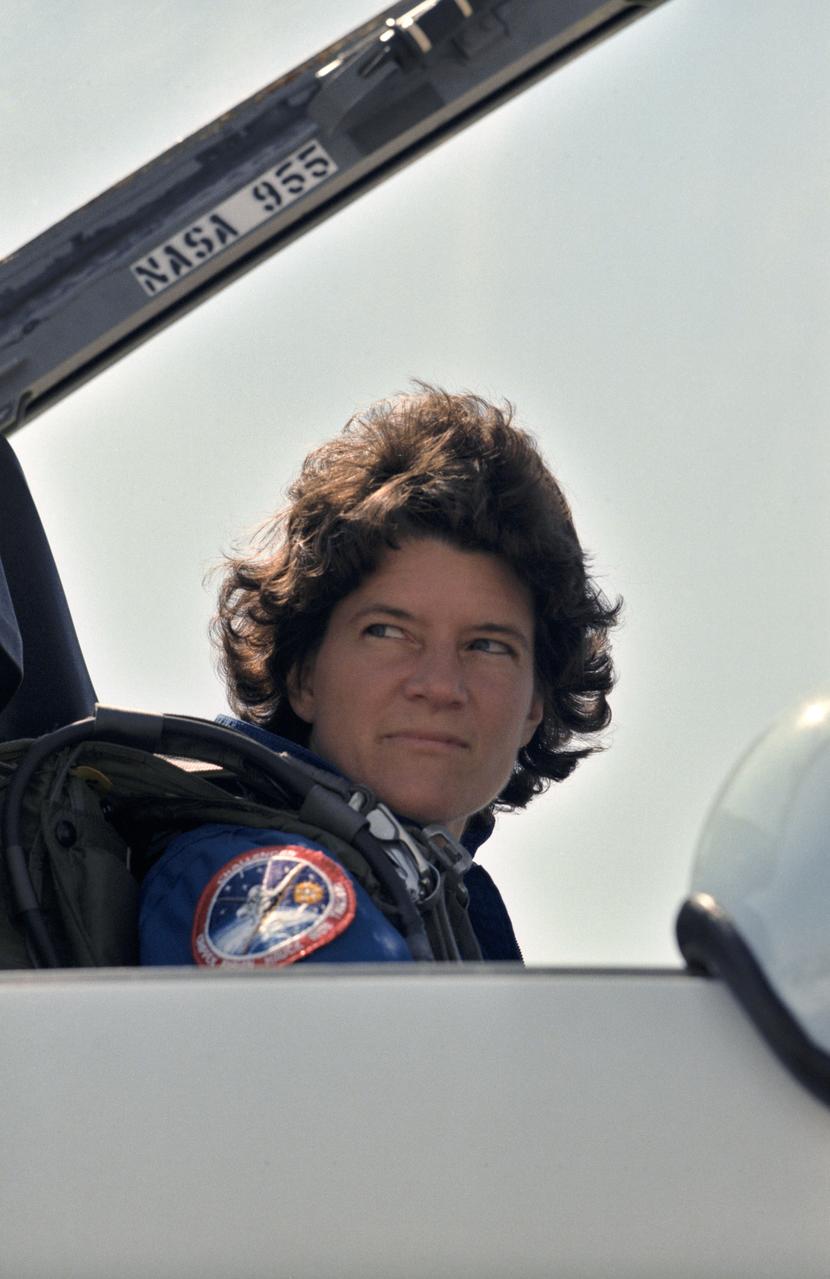
41G-90028 / S17-90028 (2 Oct 1984) --- Astronaut Sally K. Ride, 41-G mission specialist, gets a last look of Houston from the ground prior to departing the area in a T-38 jet aircraft to begin preparations in Florida for her 41-G space mission later in the week. Dr. Ride is in the rear station of a NASA T-38 at Ellington Air Base, near the Johnson Space Center. She and four other astronauts used the jet trainers to fly to Florida while the mission's two payload specialists flew there aboard a Gulfstream aircraft.
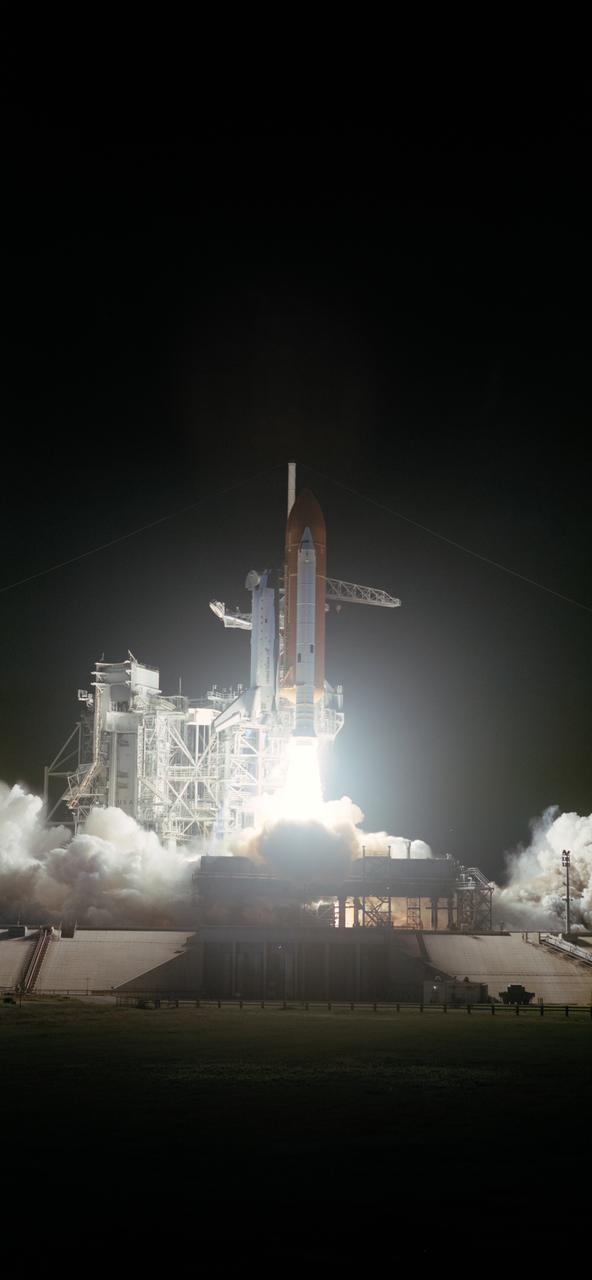
View of the early morning launch of STS 41-G Challenger. The dark launch complex is illuminated by spotlights as the orbiter begins its ascent from the pad.
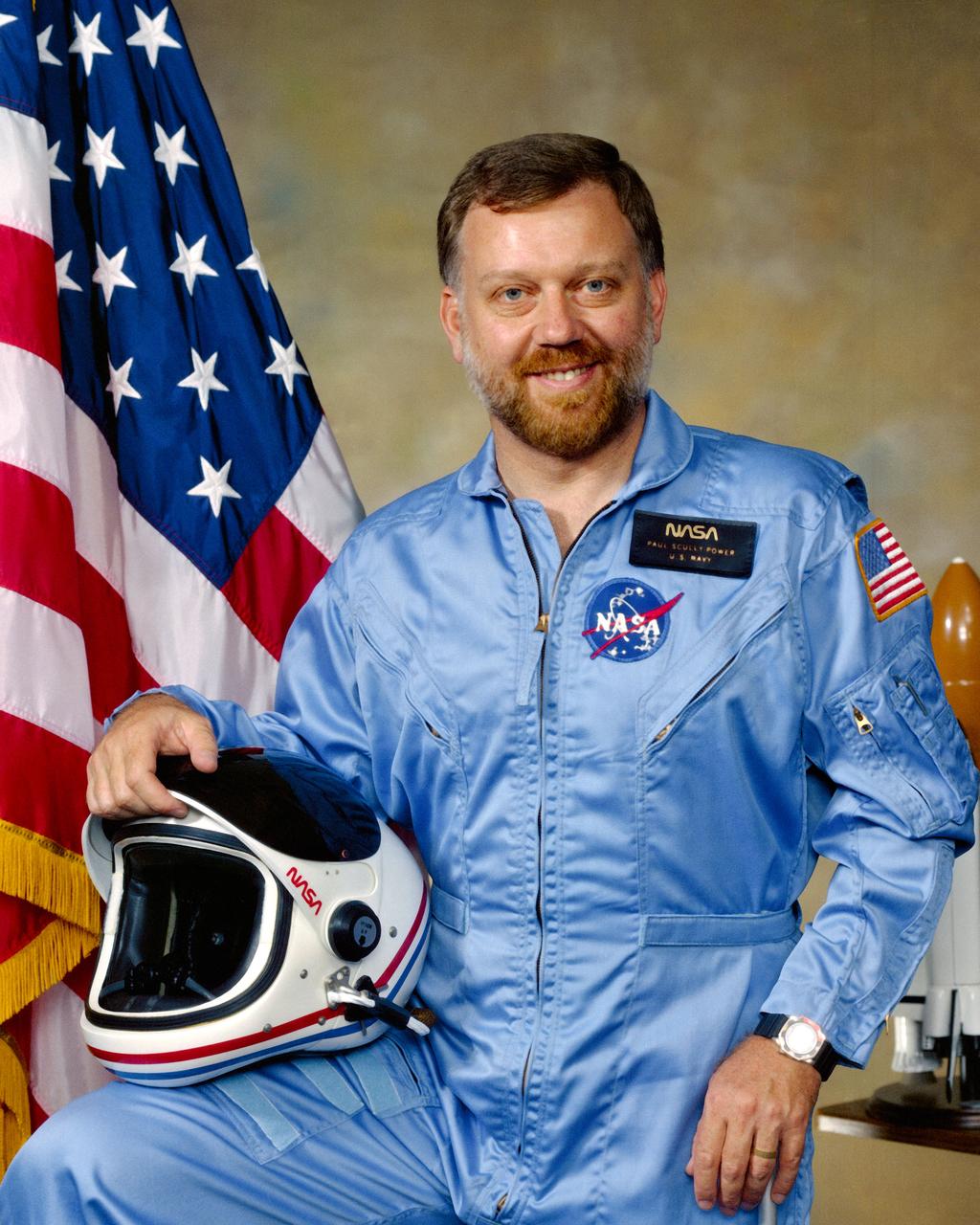
S84-38407 (26 July 1984) --- Astronaut Paul D. Scully-Power, payload specialist.
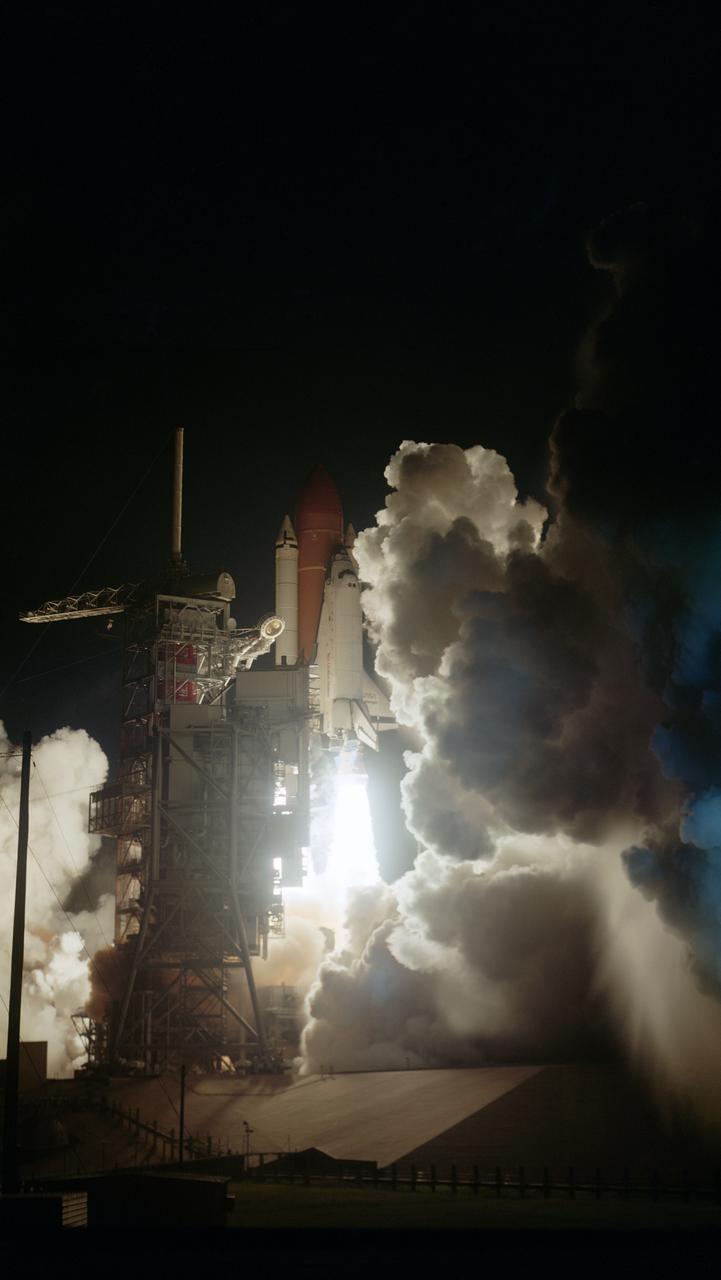
View of the early morning launch of STS 41-G Challenger. The dark launch complex is illuminated by spotlights as the orbiter begins its ascent from the pad. The light is reflected off the clouds of smoke from the orbiter's engines.
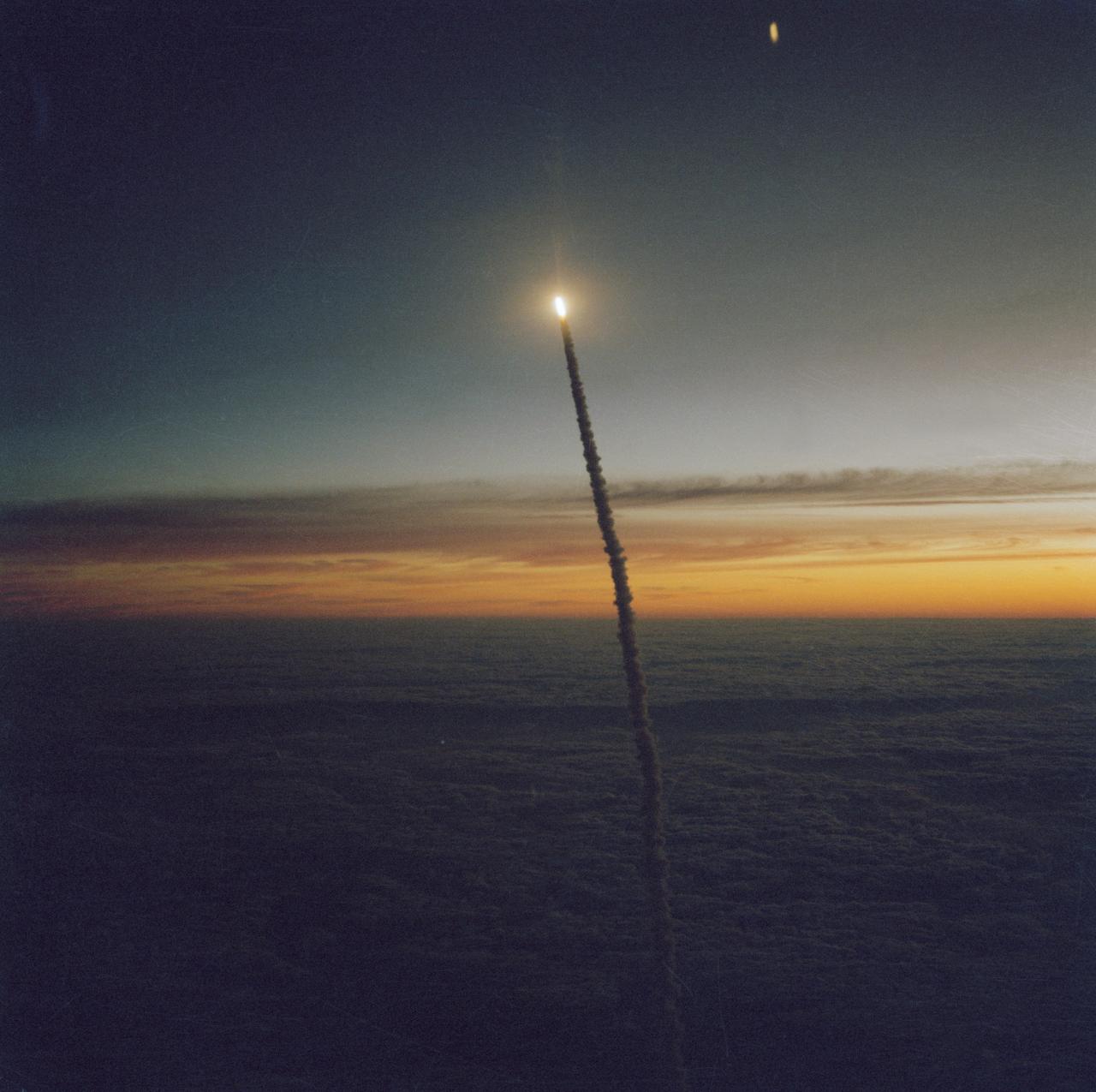
41G-90139 (5 October 1984) --- A Florida dawn scene forms the backdrop for the climbing Space Shuttle Challenger, its two solid rocket boosters and external fuel tank. Seven crewmembers, a space record, head for a busy eight-day stay in Earth orbit. The scene was photographed by astronaut Paul J. Weitz, who was piloting the Shuttle training aircraft (STA).
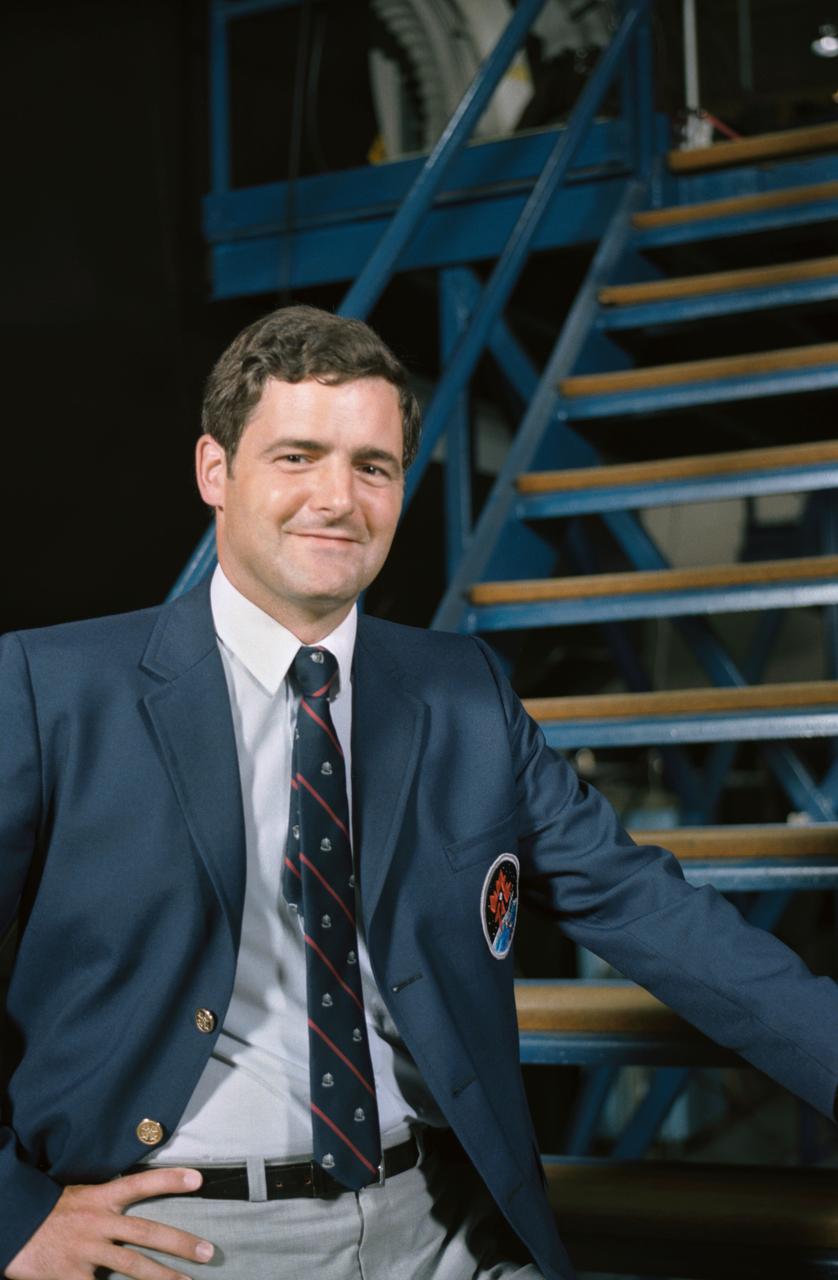
41D-3276 (S14-3276)(4 Sept 1984) --- Marc Garnea, 41-G payload specialist, will represent the Canadian National Research Council when the seven-member crew lauches aboard the Space Shuttle Challenger on Oct. 5, 1984. Garneau and other members of the crew had earlier met the press for the first time as a group.
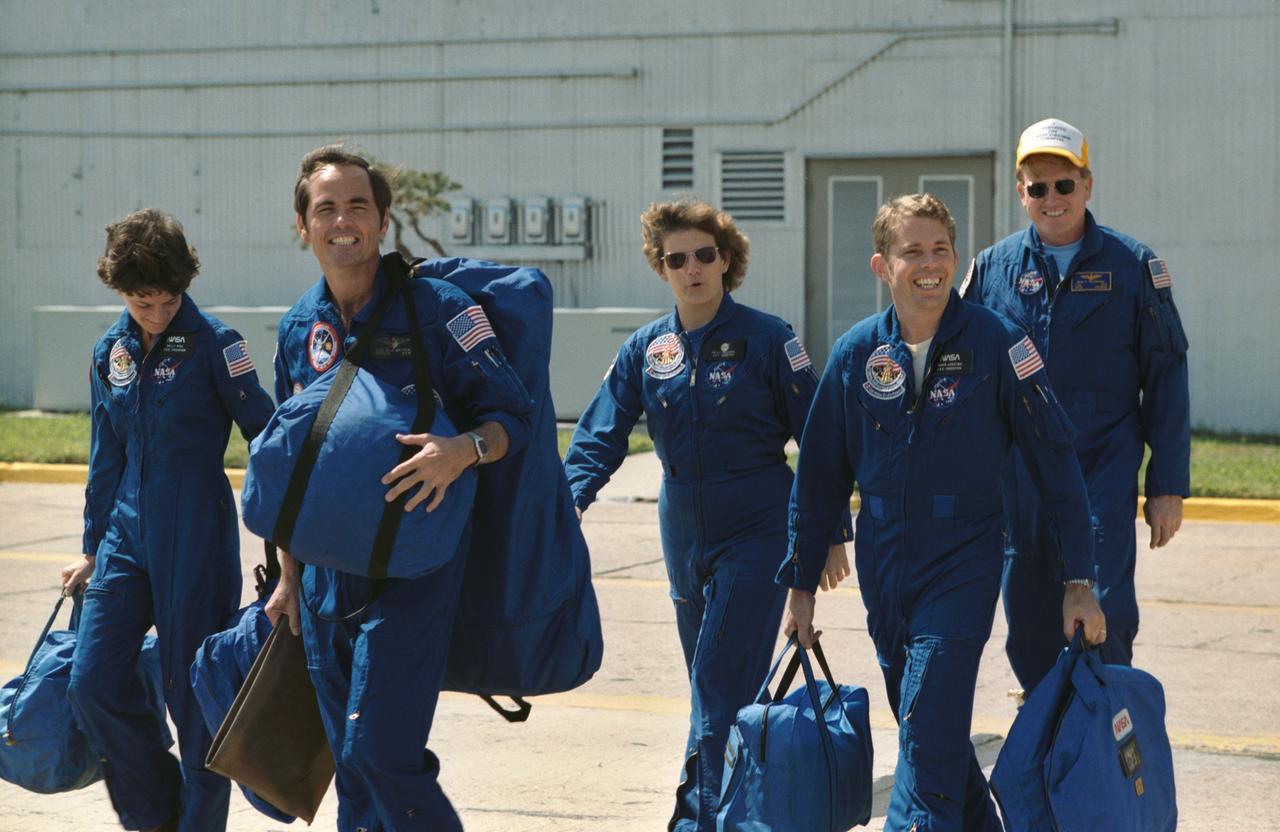
41G-90029 / S17-90029 (2 Oct 1984) --- These five astronauts prepare to board T-38 jet aircraft for a trip to Florida where they will begin preparations for a trip into space aboard the Challenger later this week. Astronaut Robert L. Crippen, left, leads the way. The crew commander is followed by (l.-r.) Sally K. Ride (extreme left edge), Kathryn D. Sullivan, David C. Leestma and Jon A. McBride, McBride is pilot and the others are mission specialists. Marc Garneau, representing the National Research Council of Canada and Paul D. Scully-Power, a civilian oceanographer with the U.S. Navy, are the payload specialists who will fly to Florida aboard a Gulfstream aircraft.
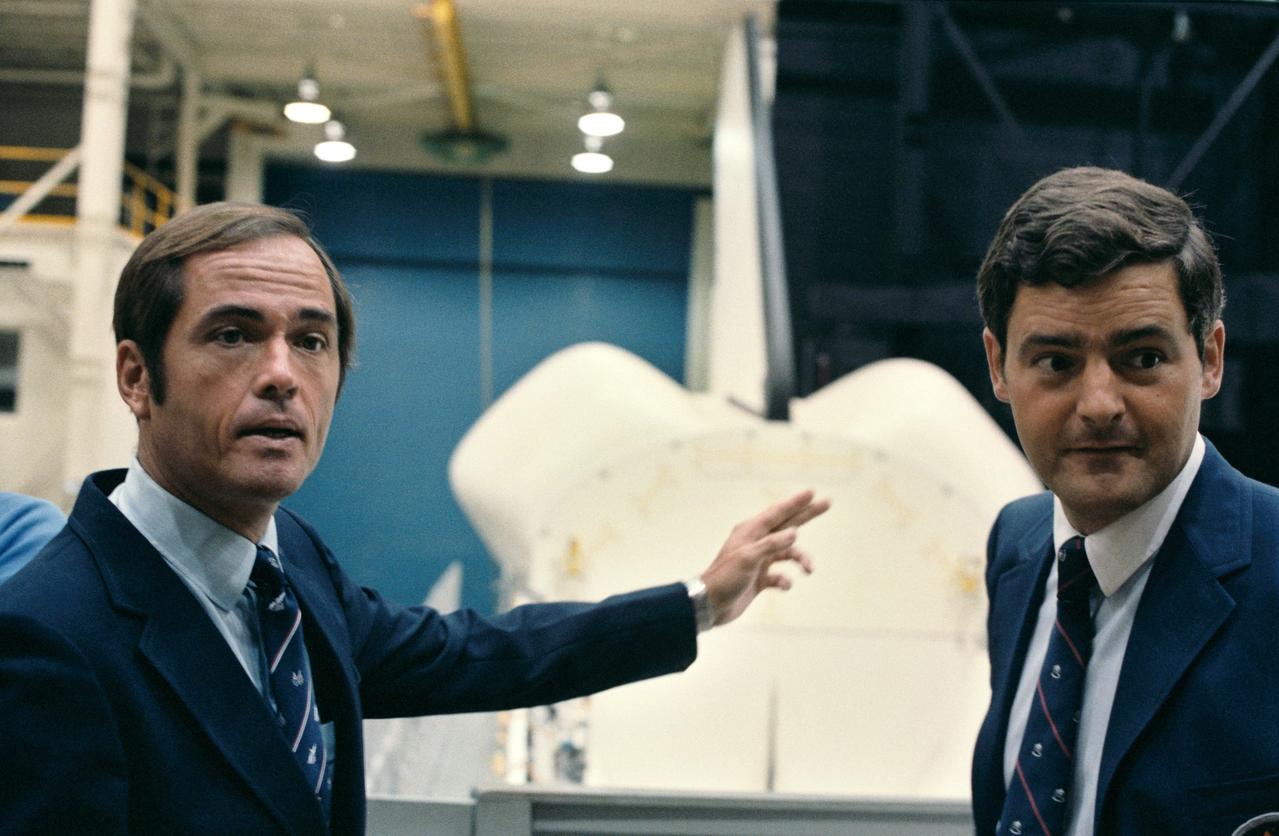
41D-3142 (3 Sept 1984) --- Astronaut Robert L. Crippen, left, crew commander for NASA's 41-G flight, and Marc Garneau, payload specialist representing the Canadian National Research Council (NRC), participate in a briefing in the Shuttle mockup and integration laboratory at the Johnson Space Center.
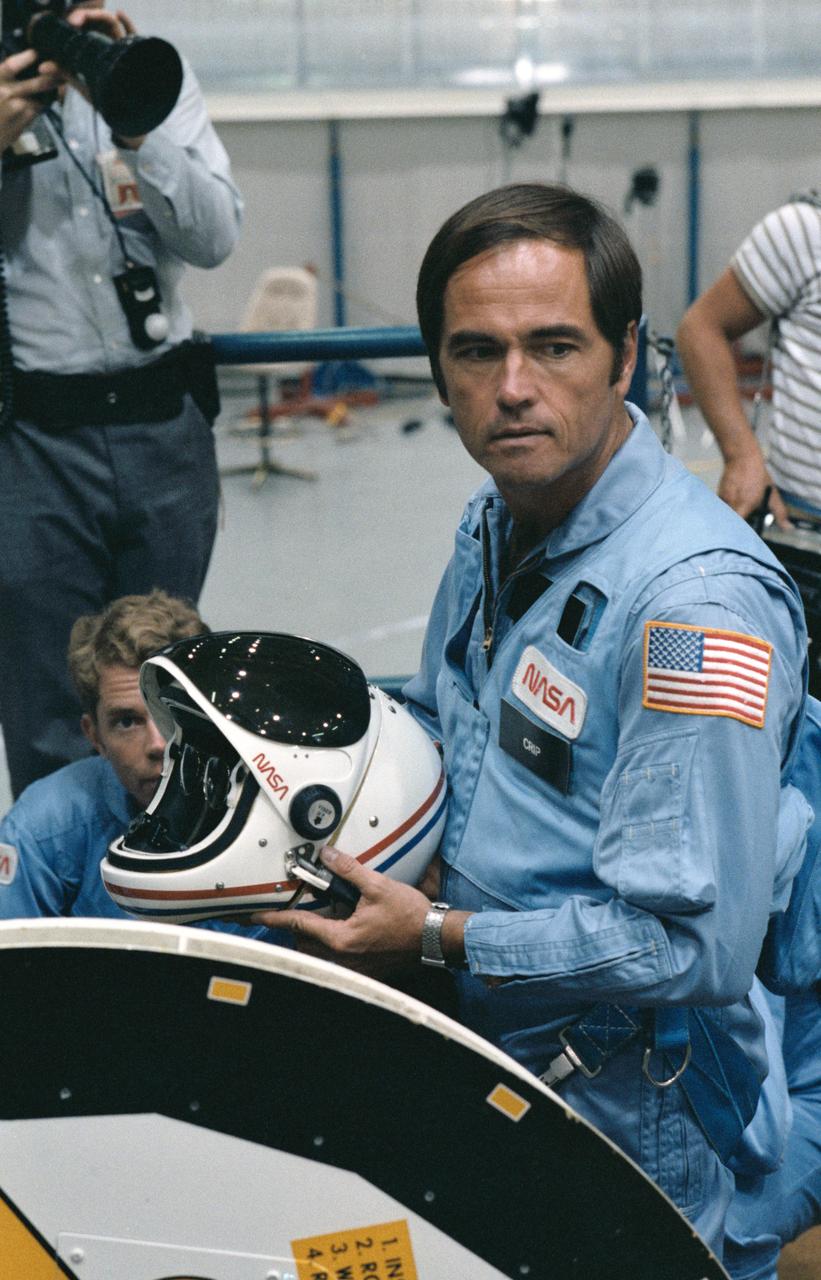
41D-3186 (4 Sept 1984) --- Astronaut Robert L. Crippen, 41-G crew commander, prepares to join his six fellow crewmembers for some training in the mockup and integration laboratory at the Johnson Space Center. Astronaut David C. Leestma, 41-G mission specialist, left, will participate in a scheduled extravehicular activity (EVA) on the Challenger's next mission. Today's training is for launch phase procedures.
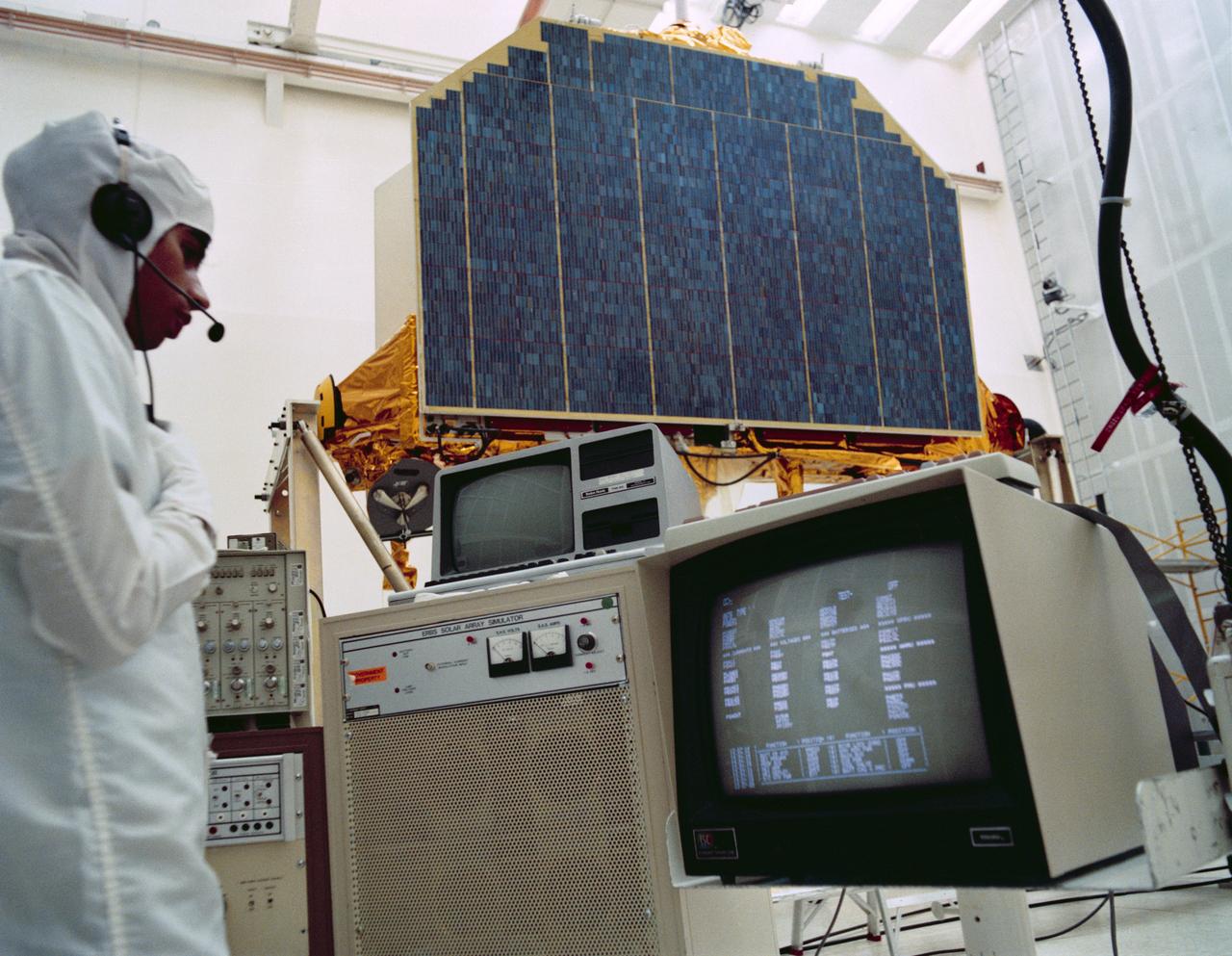
Documentation of STS 41-G payloads while in Hangar AE at Cape Canaveral. Views include documentation of the Earth Radiation Budget Satllite (ERBS) antenna (41266) and solar array panels (41265).
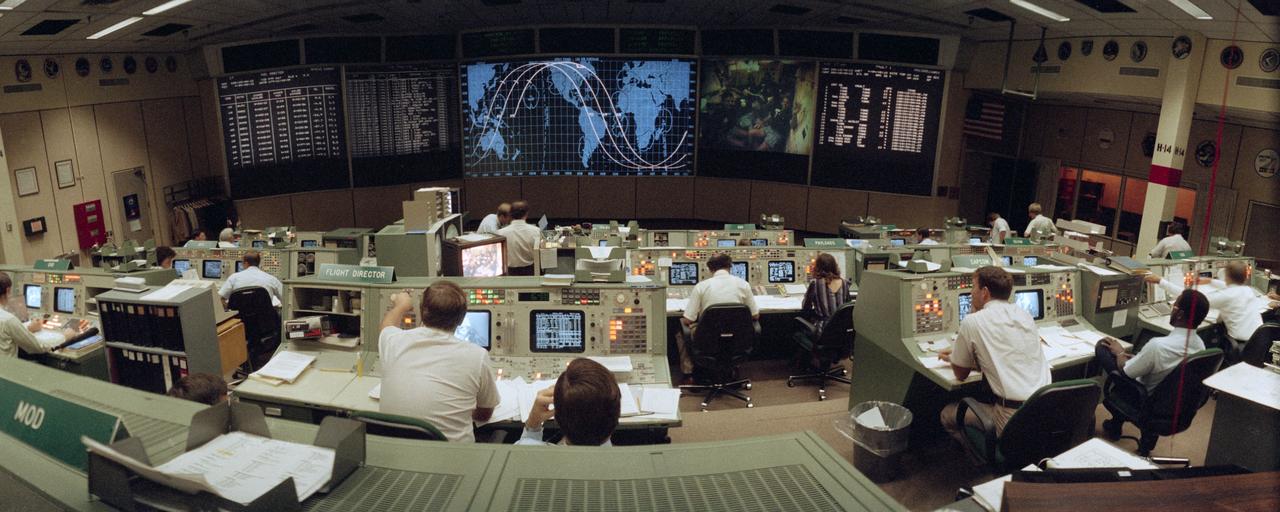
Fisheye view from the back of the Flight Control Room (FCR) of the Mission Control Center (MCC). Visible are the Flight Directors console (left front), the CAPCOM console (right front) and the Payloads console. Some of the STS 41-G crew can be seen on a large screen at the front of the MCC along with a map tracking the progress of the orbiter.
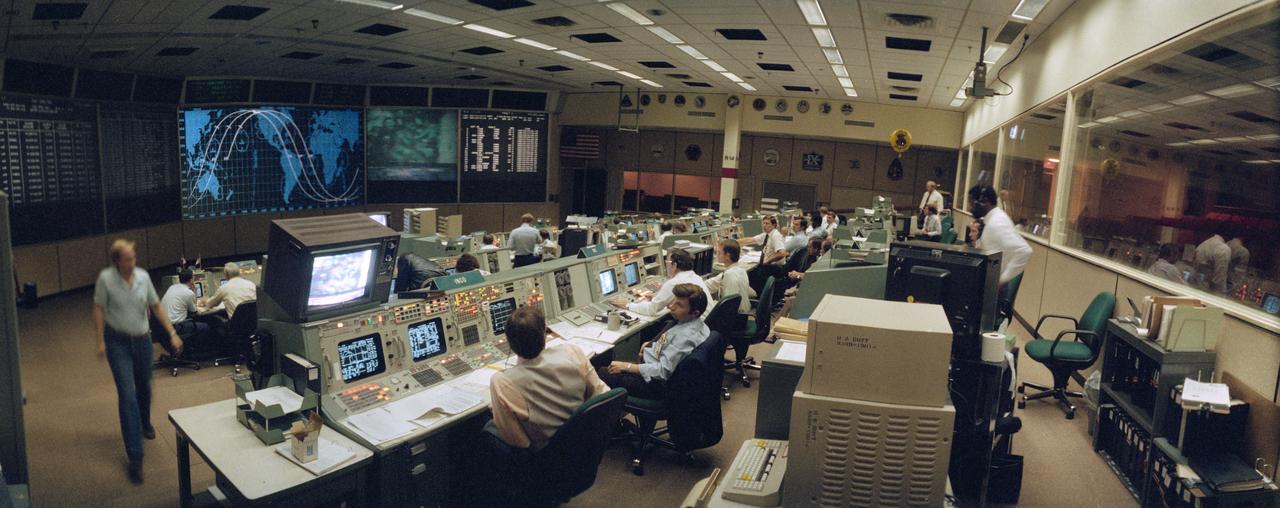
Wide angle view of the flight control room (FCR) of the Mission Control Center (MCC). Some of the STS 41-G crew can be seen on a large screen at the front of the MCC along with a map tracking the progress of the orbiter.
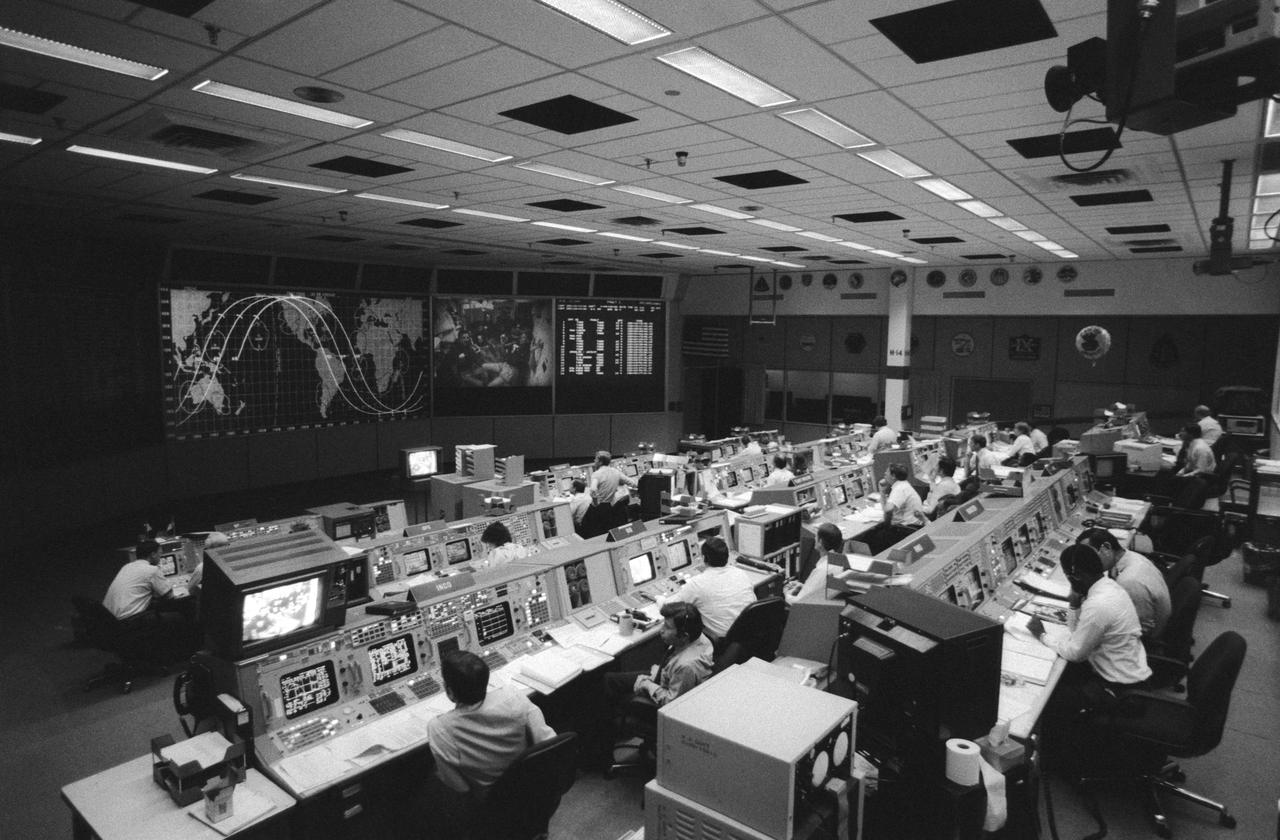
Wide angle view of the flight control room (FCR) of the Mission Control Center (MCC). Some of the STS 41-G crew can be seen on a large screen at the front of the MCC along with a map tracking the progress of the orbiter.
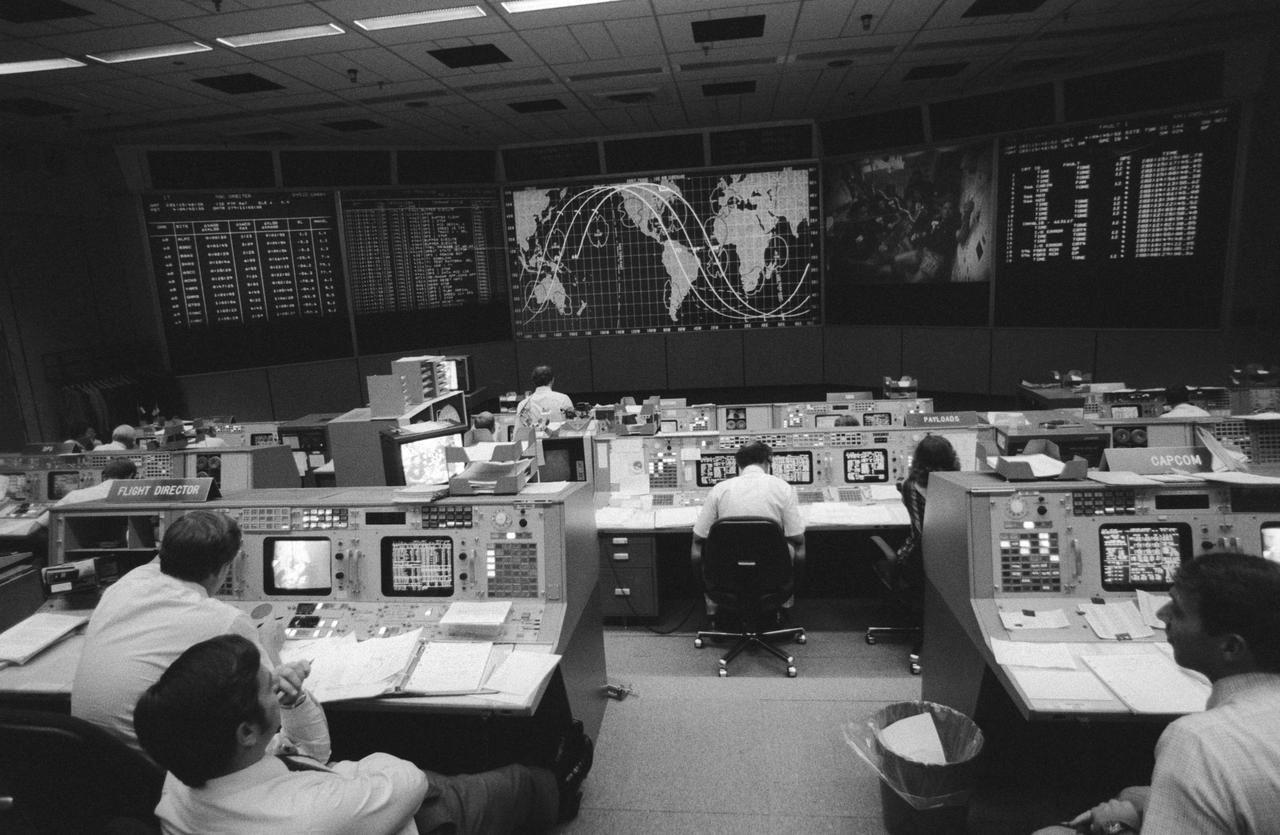
View from the back of the Mission Control Center (MCC). Visible are the Flight Directors console (left front), the CAPCOM console (right front) and the Payloads console. Some of the STS 41-G crew can be seen on a large screen at the front of the MCC along with a map tracking the progress of the orbiter.
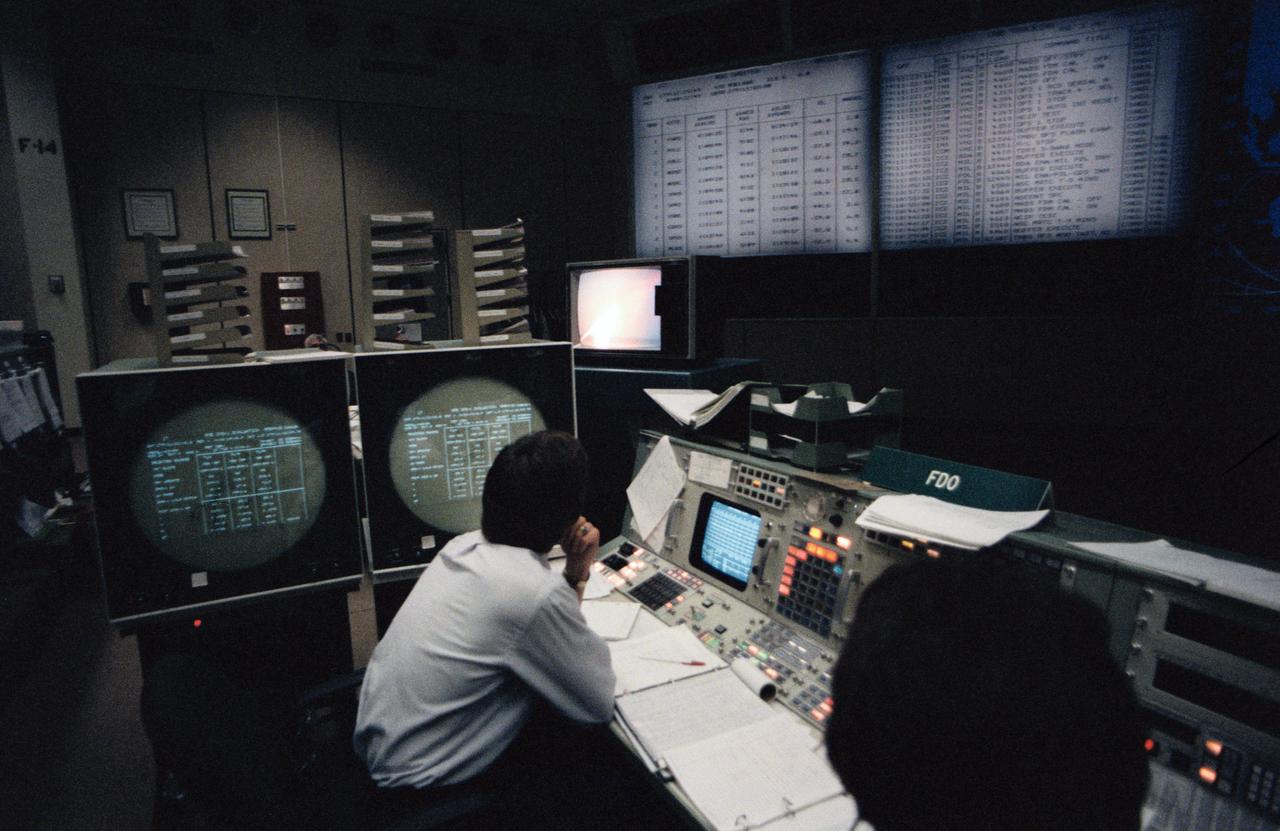
View of the Flight Dynamics Officer (FDO) console in the Mission Control Center (MCC) during the flight of STS41-G. The officer at the FDO console appears to be examining the large screens in front of him which are displaying lists of data.
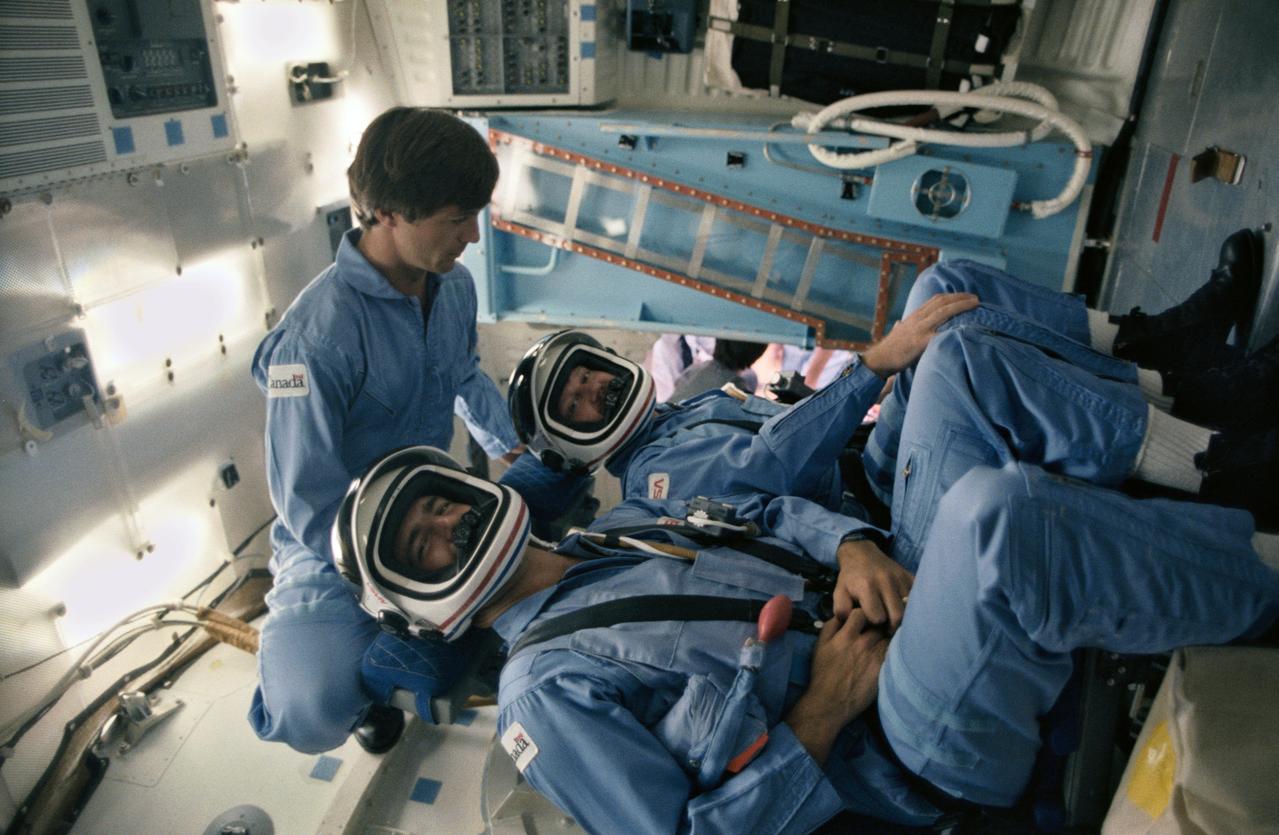
41D-3138 (4 Sept 1984)--- Canada's backup payload specialist assists the two 41-G prime payload specialists during a training session in the Johnson Space Center's Shuttle mockup and integration laboratory. Robert Thirsk (without helmet) represents the National Research Council (NRC) and is backup to Marc Garneau (nearest camera), also of the NRC. Paul D. Scully-Power, seated in the other middeck seat for the launch phase, is a civilian oceanographer with the U.S. Navy. The 41-G flight aboard the Challenger is NASA's first to utilize a crew of more than six persons. This photograph was taken by Otis Imboden.
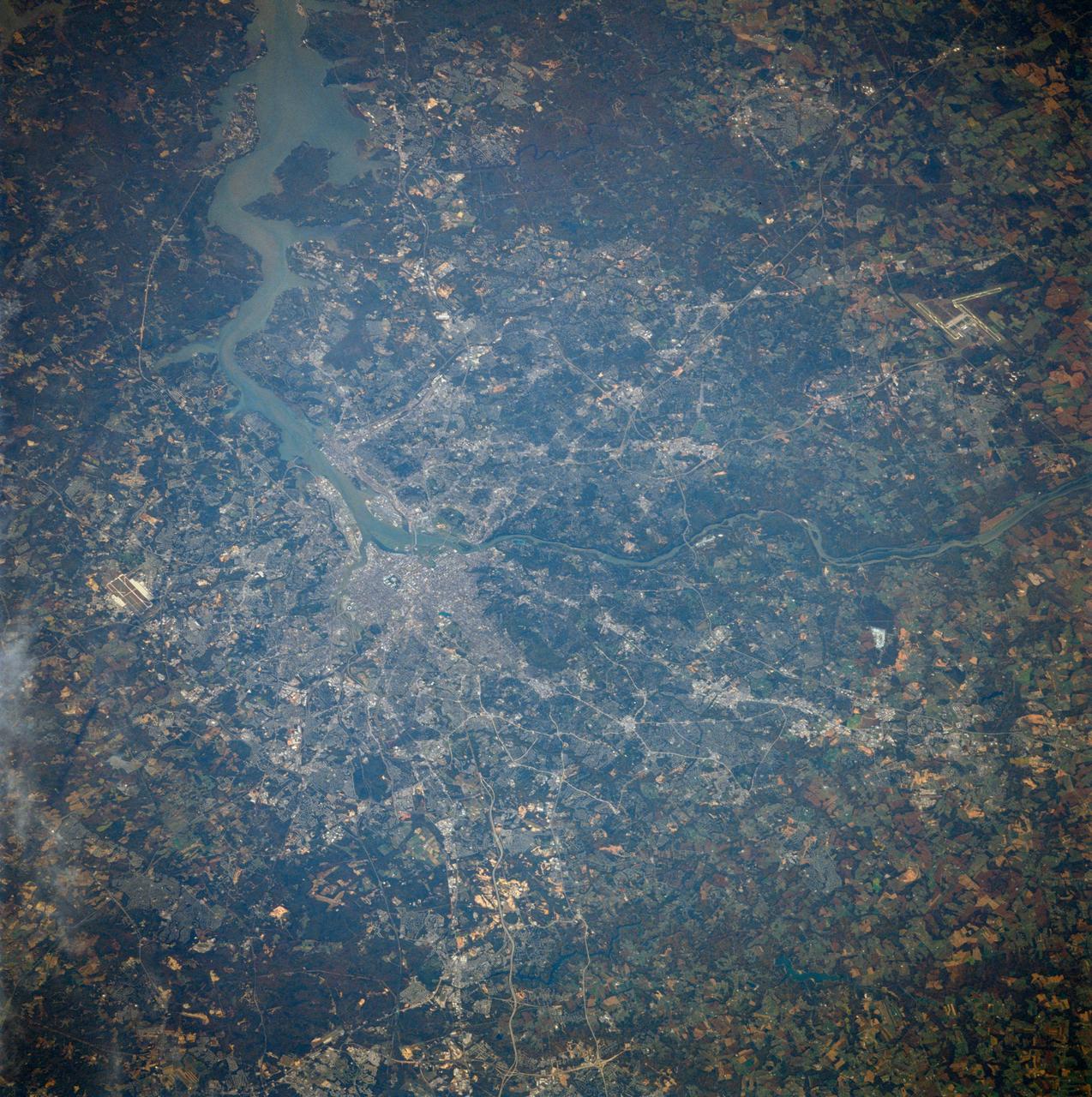
41G-40-071 (5-13 Oct. 1984) --- Washington, D.C. -- the nation's capital -- is at right center in this phtograph from the Earth-orbiting space shuttle Challenger. J.F. Dulles Airport at lower left. Andrews Air Force Base is at right center edge. The Potomac River enters at left center, flows past Washington and as a tidal estuary at lower right. Also visible are the Great Falls of the Potomac. Photo credit: NASA
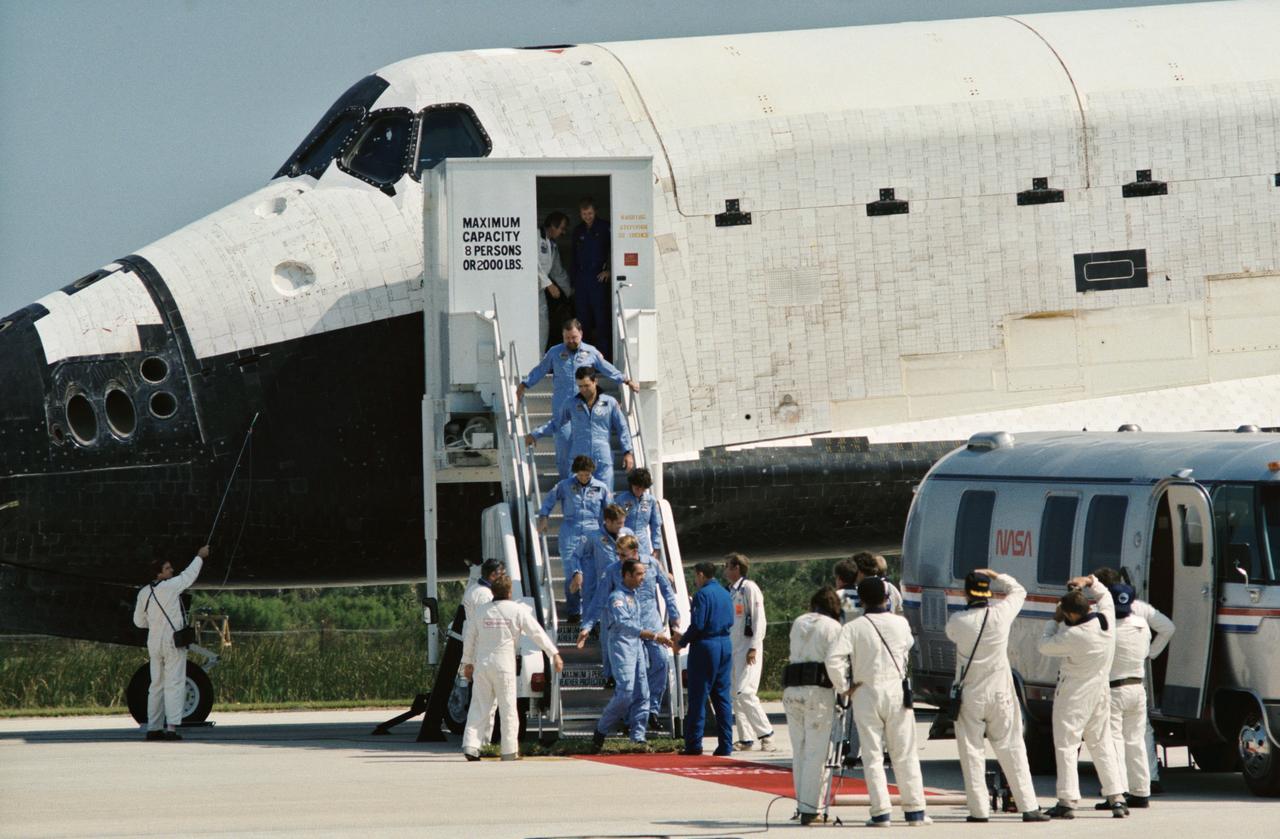
41G-90217 (13 Oct 1984) --- 41-G crew leaves the orbiter after landing at Kennedy Space Center at the end of their mission. Astronaut Robert Crippen shakes hands with George W.S. Abbey, Director of JSC's Flight Crew Operations, while the other crewmembers wait behind him. They are Jon McBride, David Leestma, Sally K. Ride, Kathryn Sullivan, Marc Garneau and Paul Scully-Power.
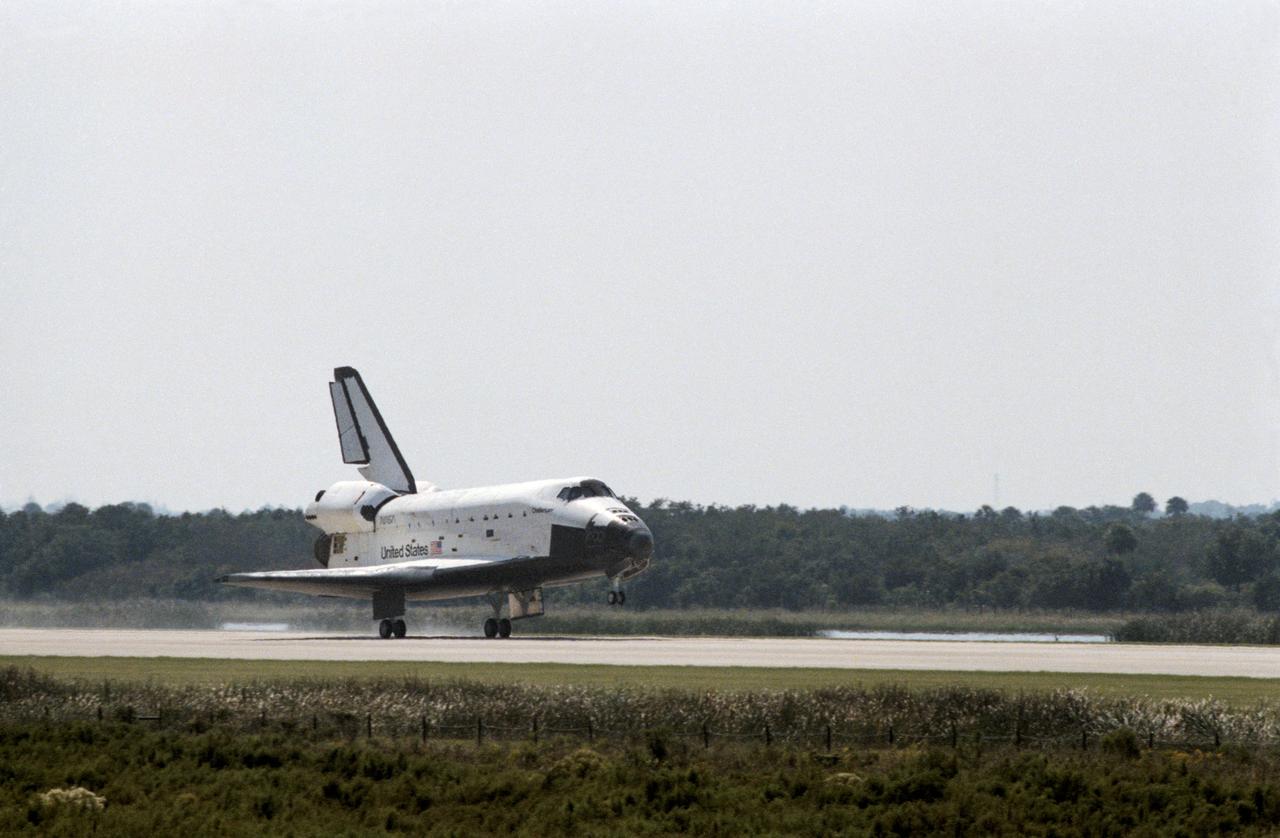
41G-90218 (13 October 1984) --- Space Shuttle Challenger makes its second touchdown at Kennedy Space Center's landing facility. The photo was taken by Otis Imboden.
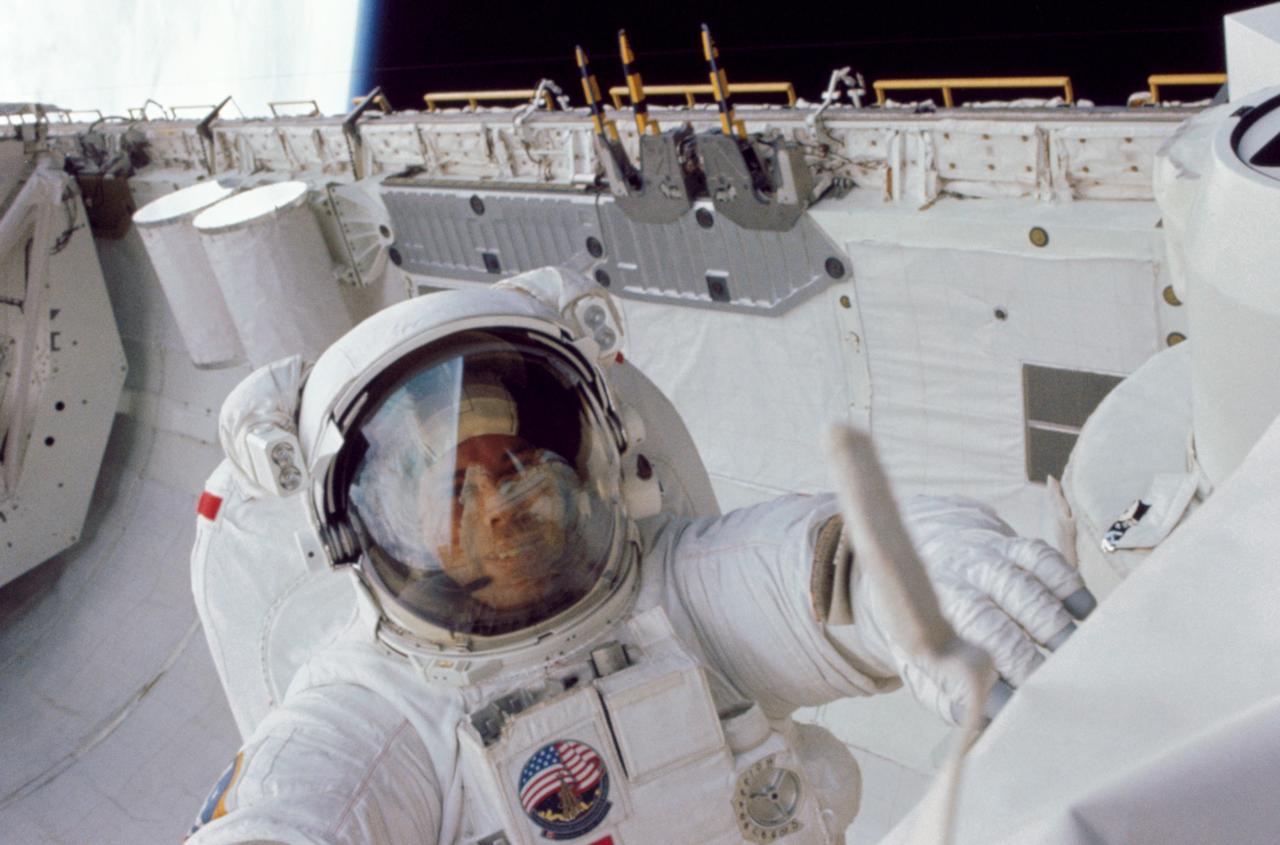
41G-101-014 (13 October 1984) --- Astronaut David C. Leestma, in a 35mm frame exposed by fellow mission specialist, Astronaut Kathryn D. Sullivan, participates in extravehicular activity of Oct. 11 in the Challenger's aft cargo bay. Leestma's right hand (out of frame) was inside a special work station called the orbital refueling system (ORS).
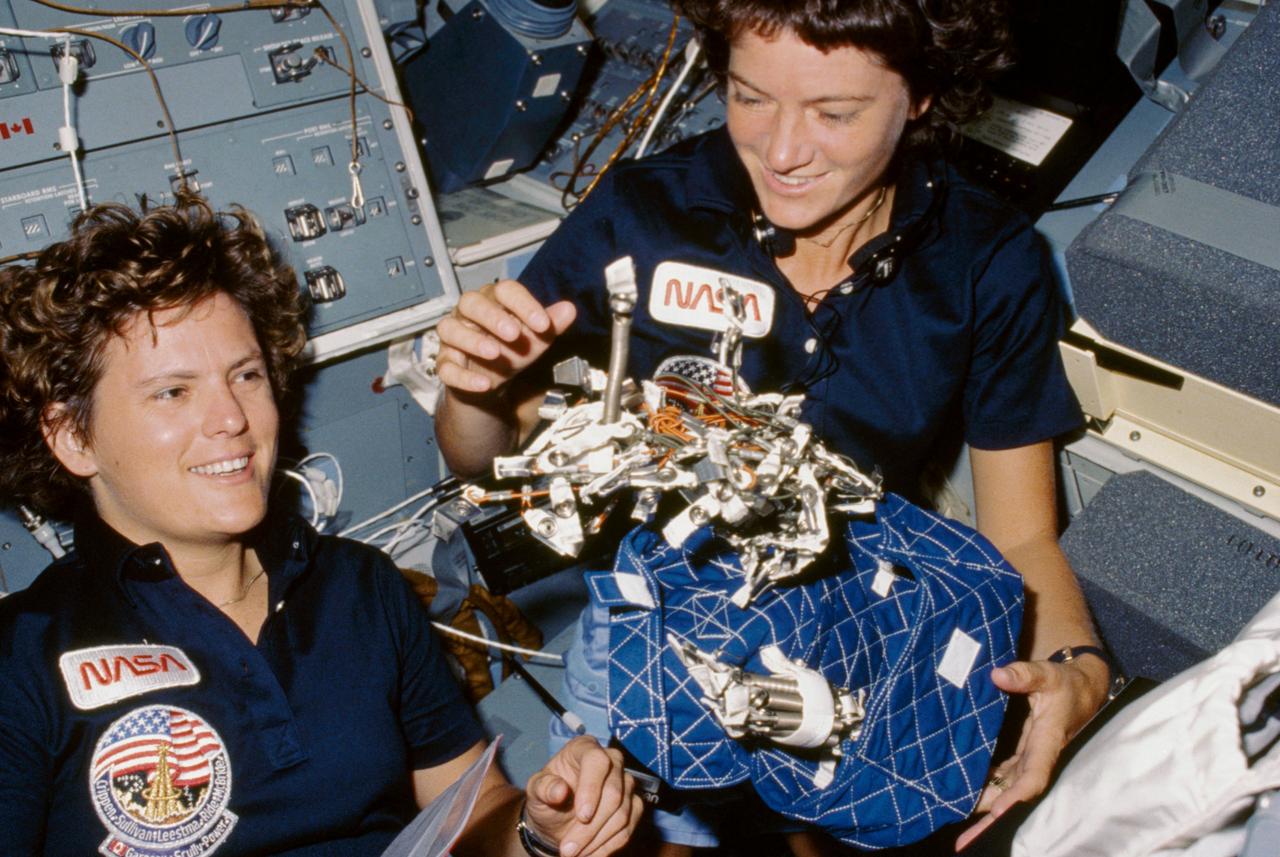
41G-07-021 (5-13 October 1984) --- Astronauts Kathryn D. Sullivan, left, and Sally K. Ride show off what appears to be a "bag of worms", a product of their creativity. The "bag" is a sleep restraint and the majority of the "worms" are springs and clips used with the sleep restraint in its normal application. Clamps, a bungee cord and Velcro strips are other recognizable items in the "creation".
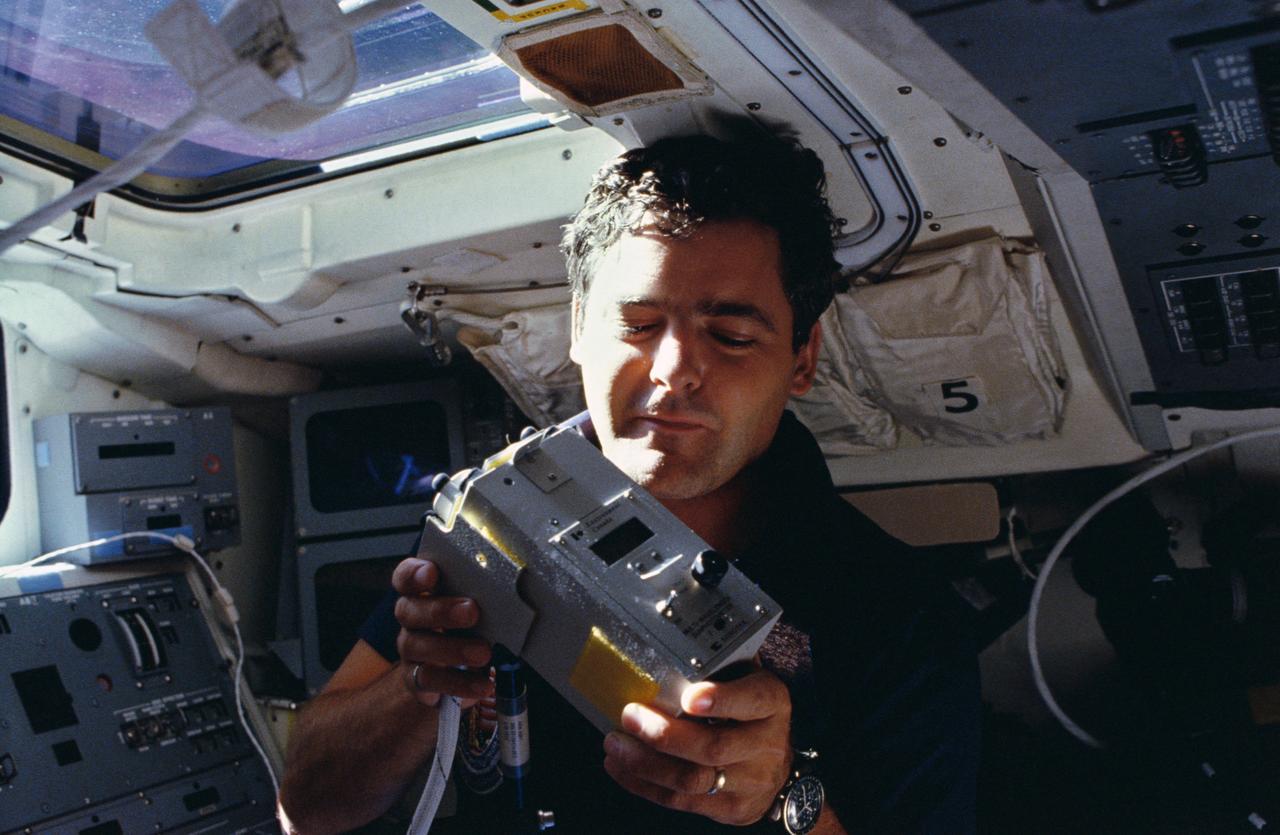
Payload specialist Marc Garneau displays a Canadian made Sunphotometer, part of a package of experiments which he is concentrating on during this mission. He is sitting on the Challenger's flight deck at the aft station.
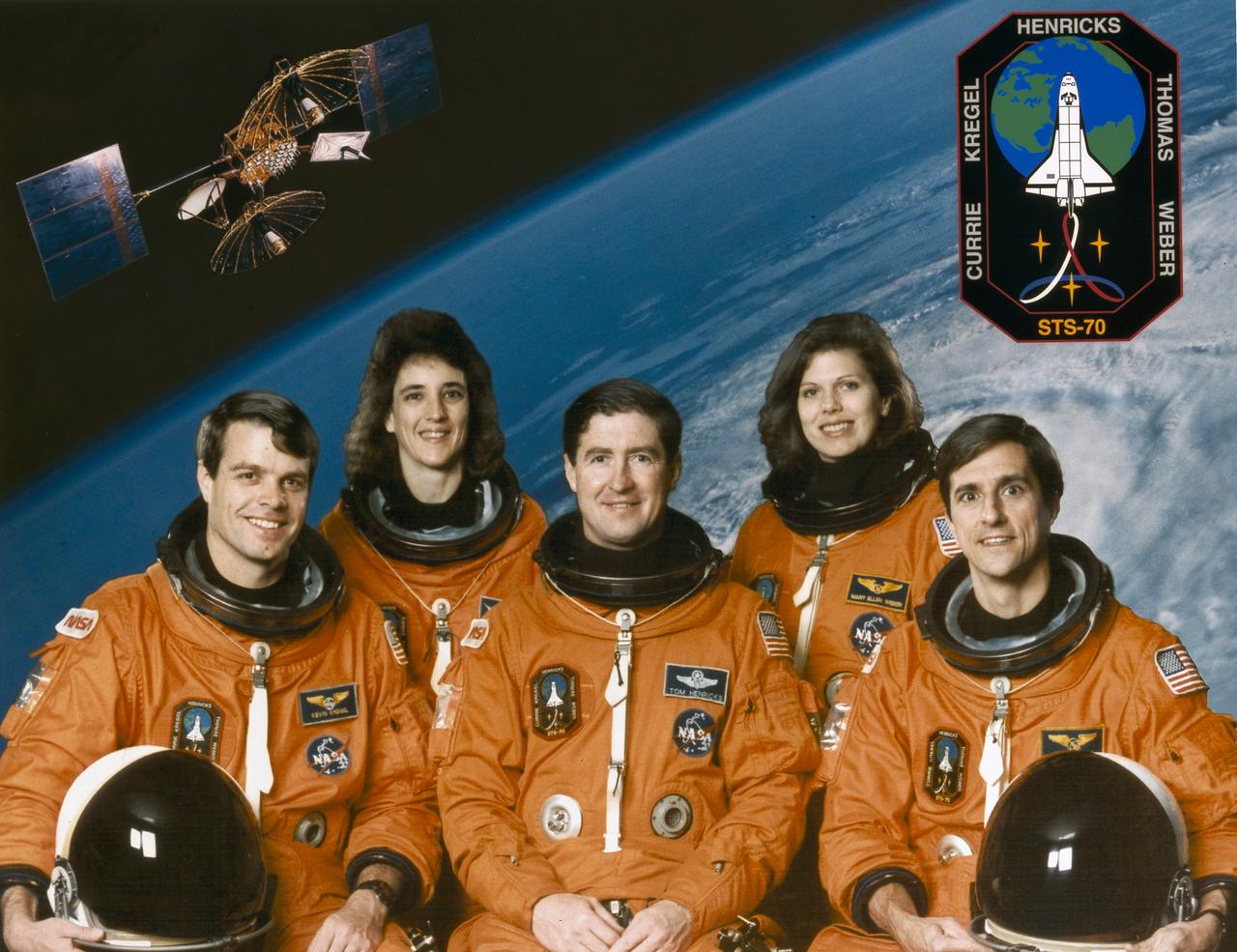
The crew assigned to the STS-70 mission included (front left to right) Kevin R. Kregel, pilot; Nancy J. Currie, mission specialist; Terrence T, Henricks, commander; Mary Ellen Weber, mission specialist, and Donald A. Thomas, mission specialist. Launched aboard the Space Shuttle Discovery on July 13,9:41:55.078 am (EDT), the STS-70 mission’s primary payload was the Tracking and Data Relay Satellite-G (TDRS-G).
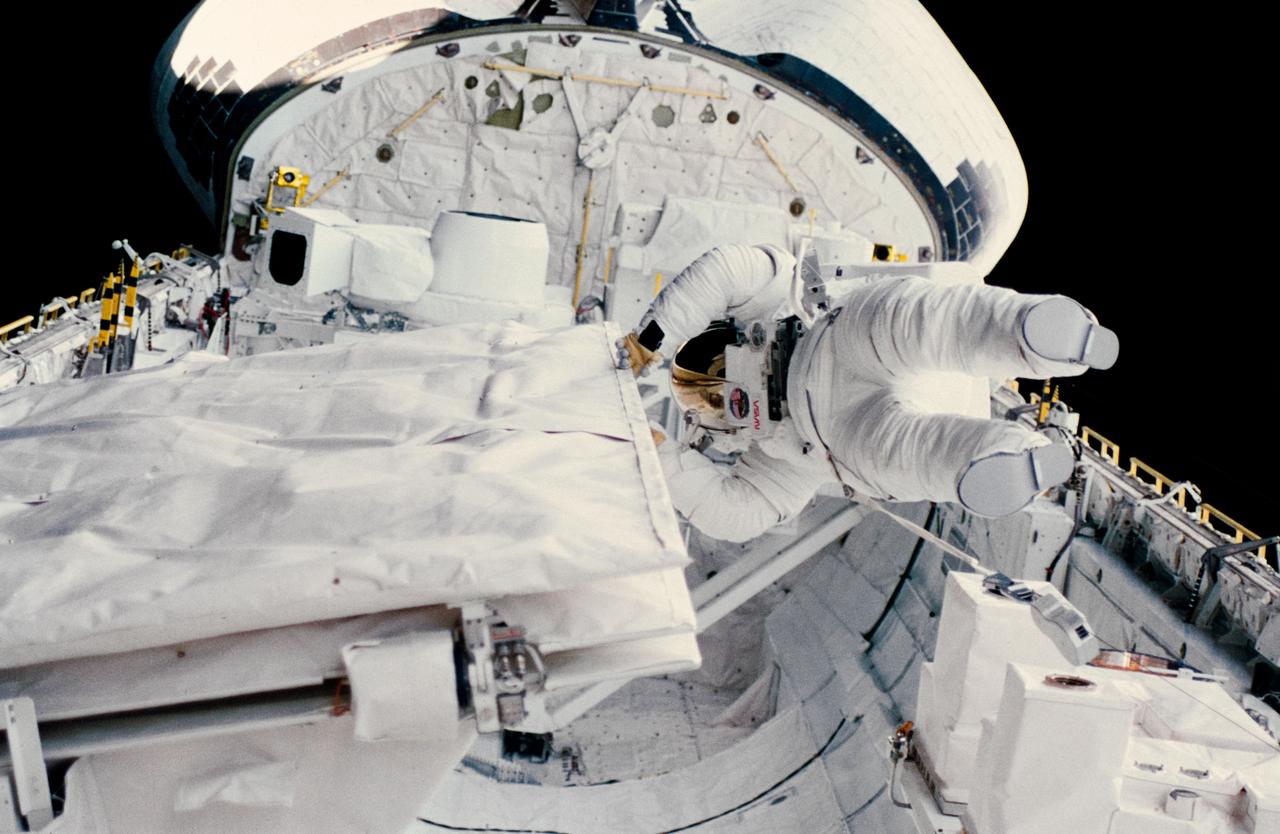
41G-13-032 (11 Oct. 1984) --- Astronaut Kathryn D. Sullivan checks the latch of the SIR-B antenna in the space shuttle Challenger's open cargo bay during her historic extravehicular activity (EVA) on Oct. 11, 1984. Earlier, America's first woman to perform an EVA and astronaut David C. Leestma, participated in an in-space simulation of refueling a spacecraft in orbit. The Orbital Refueling System (ORS) is just beyond the astronaut mission specialist's helmet. To the left is the Large Format Camera (LFC). The LFC and ORS are stationed on a device called the Mission Peculiar Support Structure (MPESS). Crew members consisted of astronauts Robert L. Crippen, commander; Jon A. McBride, pilot; along with Kathryn D. Sullivan, Sally K. Ride, and David D. Leestma, all mission specialists; and Canadian astronaut Marc Garneau and Paul D. Scully-Power, both payload specialist. EDITOR'S NOTE: The STS-41G mission had the first American female EVA (Sullivan); first seven-person crew; first orbital fuel transfer; and the first Canadian (Garneau).
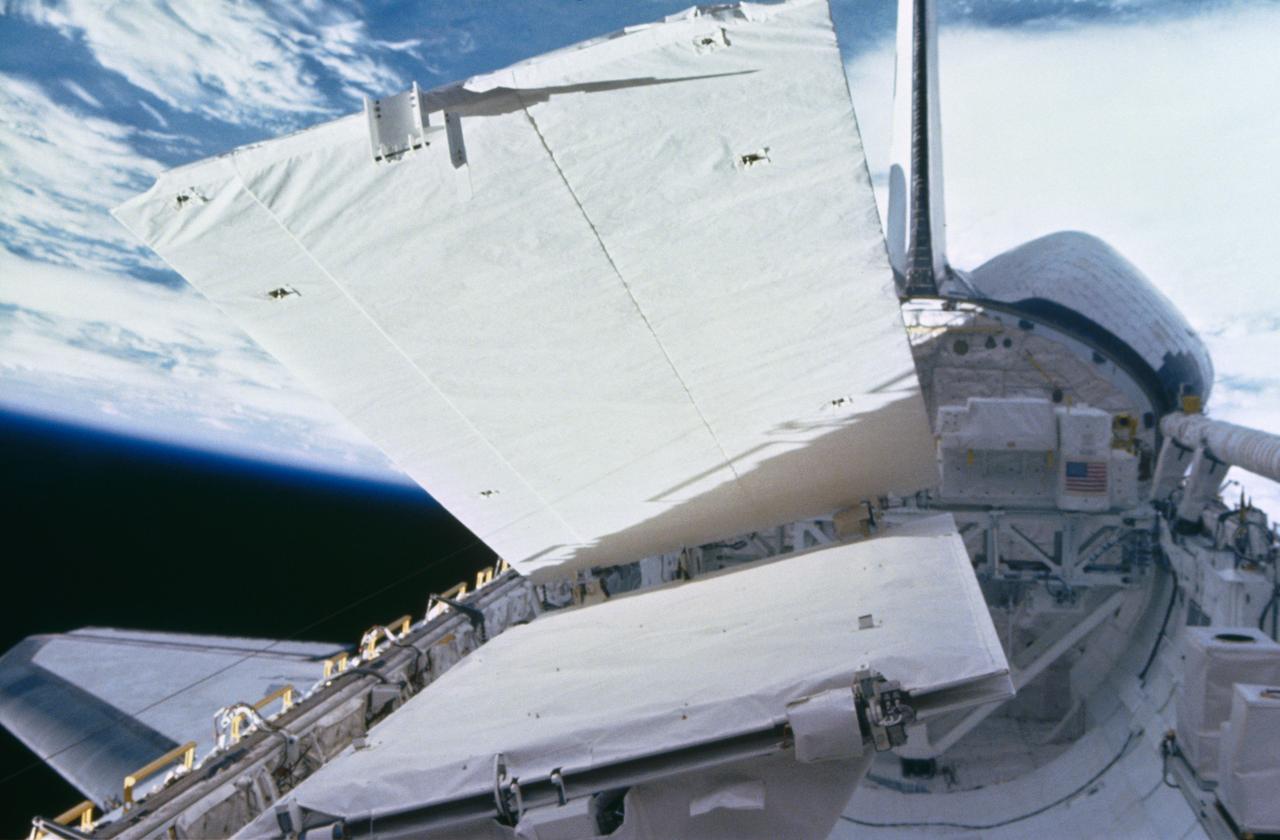
View of the SIR-B antenna being deployed during STS 41-G. The Challenger's payload bay is open and the remote manipulator system (RMS) arm is in the stowed position at the right of the view.
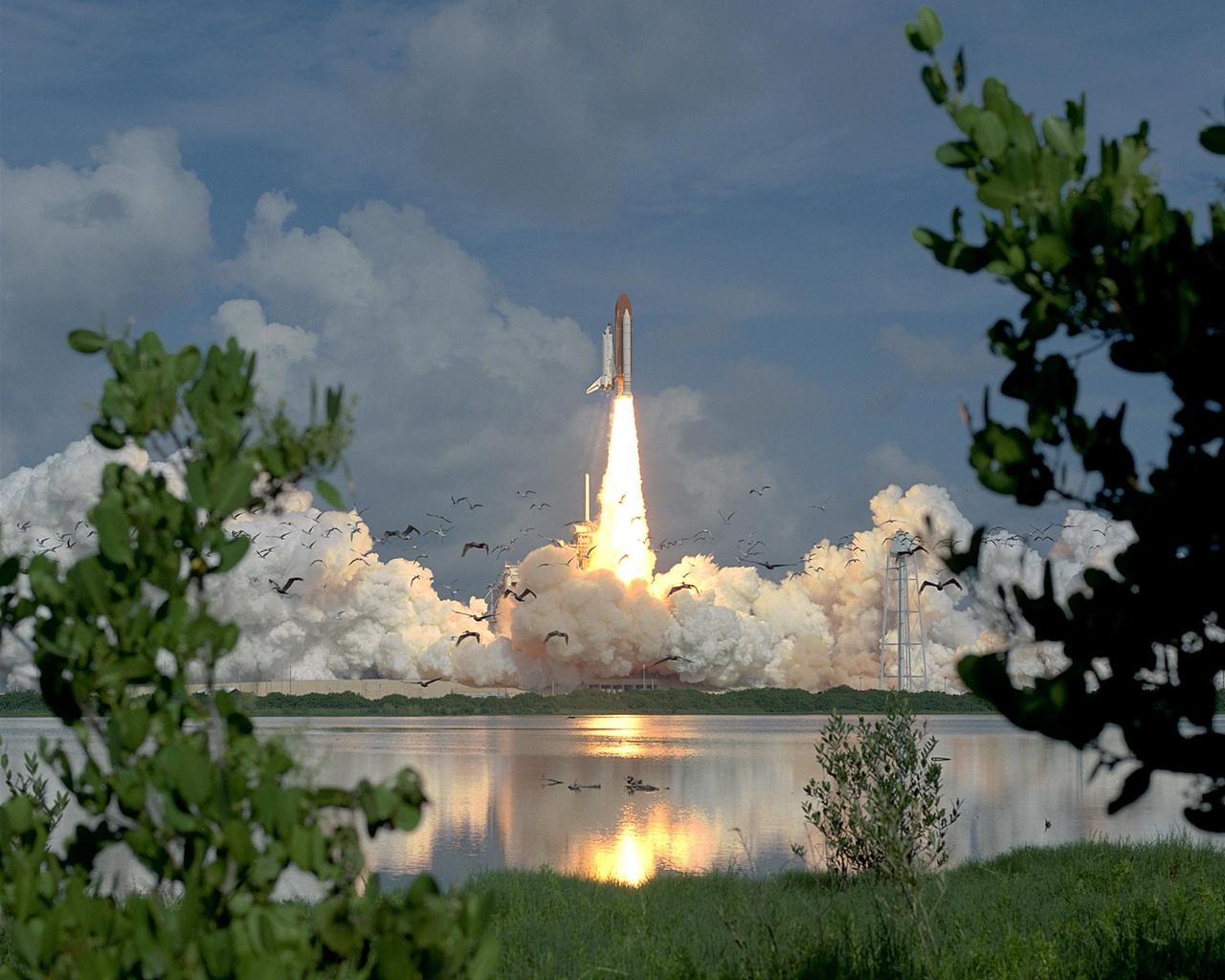
Startled birds scatter as the stillness of a summer morning is broken by a giant's roar. The Space Shuttle Discovery thundered into space from Launch Pad 39B at 9:41:55:078 a.m. EDT. STS-70 is the 70th Shuttle flight overall, the 21st for Discovery (OV-103), and the fourth Shuttle flight in 1995. On board for the nearly eight-day mission are a crew of five: Commander Terence "Tom" Henricks, Pilot Kevin R. Kregel, and Mission Specialists Nancy Jane Currie, Donald A. Thomas and Mary Ellen Weber. The crew's primary objective is to deploy the Tracking and Data Relay Satellite-G (TDRS-G), which will join a constellation of other TDRS spacecraft already on orbit

41D-3391 (10 April 1984) --- Astronaut Michael L. Coats positions himself for a photographic briefing during a training session for 41-D crew members in the shuttle one-g trainer at the Johnson Space Center (JSC). Coats will assume pilot duties aboard the space shuttle Discovery for the scheduled seven-day 41-D mission in late June. This photograph was taken for NASA by Otis Imboden.
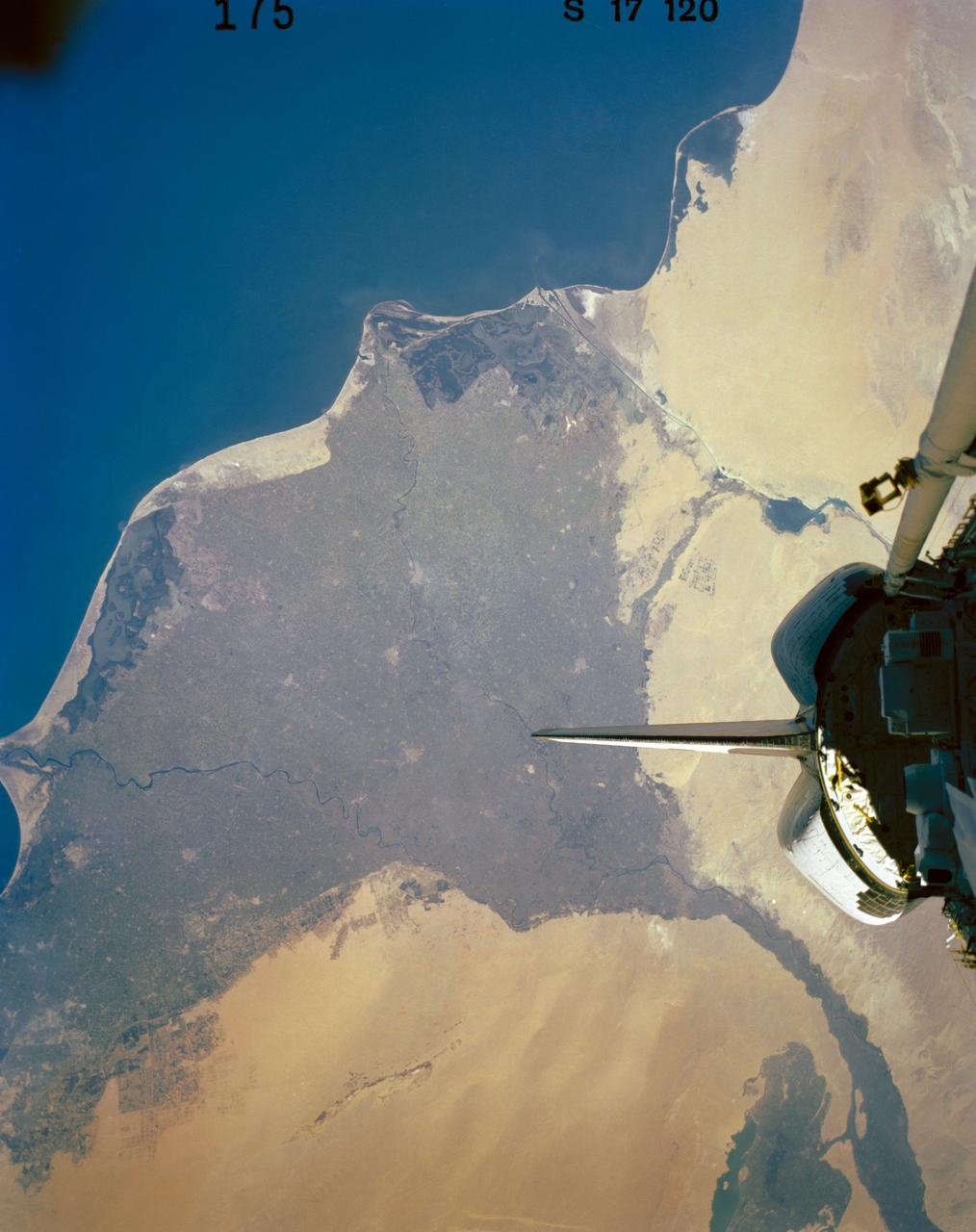
41G-120-175 (5-13 Oct. 1984) --- Egypt and the Nile River Delta are easily recognizable in this 250mm frame photographed by one of the seven 41-G crew members aboard the Earth-orbiting space shuttle Challenger. Cairo and the Egyptian pyramids are also visible in the lower left side of this photograph. The 41-G crew consisted of astronauts Robert L. Crippen, commander, Jon A. McBride, pilot; Mission Specialists Kathryn D. Sullivan, Sally K. Ride, and David D. Leestma; along with Canadian astronaut Marc Garneau; and Paul D. Scully-Power, both payload specialists. Photo credit: NASA
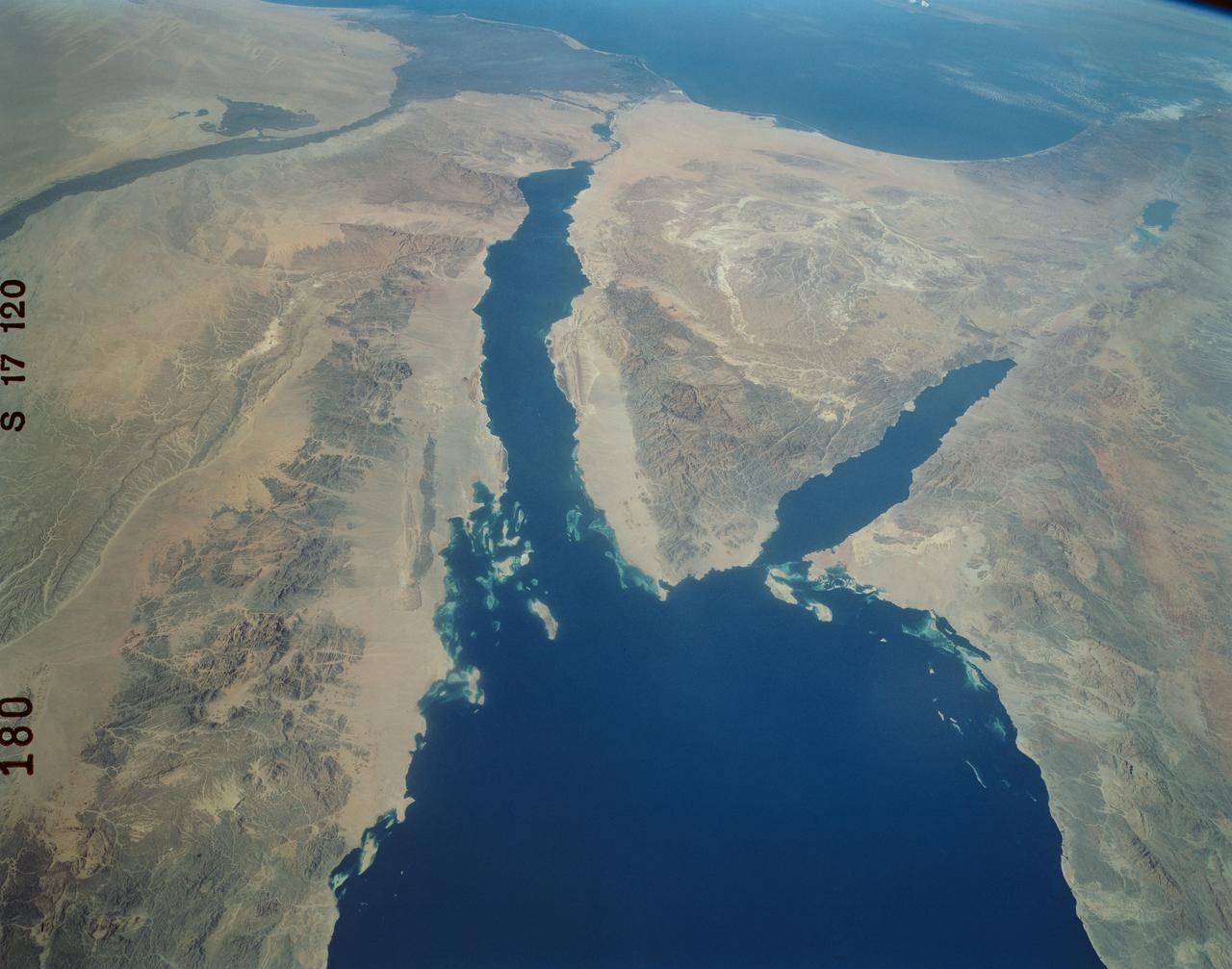
An excellent panoramic view of the entire Sinai Peninsula (29.0N, 34.0E) and the nearby Nile River Delta and eastern Mediterranean coastal region. The Suez Canal, at the top of the scene just to the right of the Delta, connects the Mediterranean Sea with the Gulf of Suez on the west side of the Sinai Peninsula and the Gulf of Aqaba is on the west where they both flow into the Red Sea. At upper right, is the Dead Sea, Jordan River and Lake Tiberius.
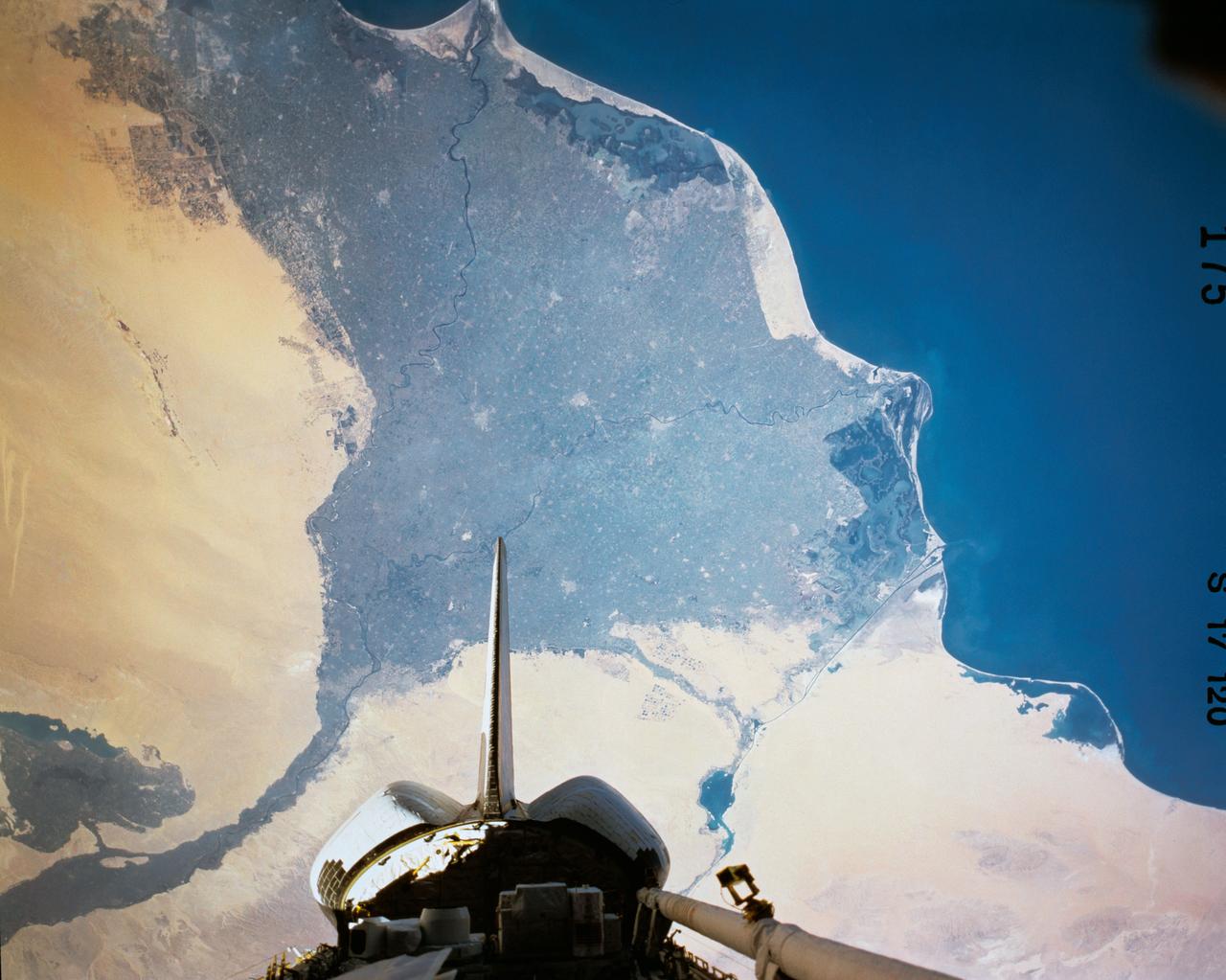
The Nile River Delta of Egypt (30.0N, 31.0E) irrigated by the Nile River and its many distributaries, is some of the richest farm land in the world and home to some 45 million people, over half of Egypt's population. The capital city of Cairo is at the apex of the delta. Just across the river from Cairo can be seen the ancient three big pyramids and sphinx at Giza and the Suez Canal is just to the right of the delta.
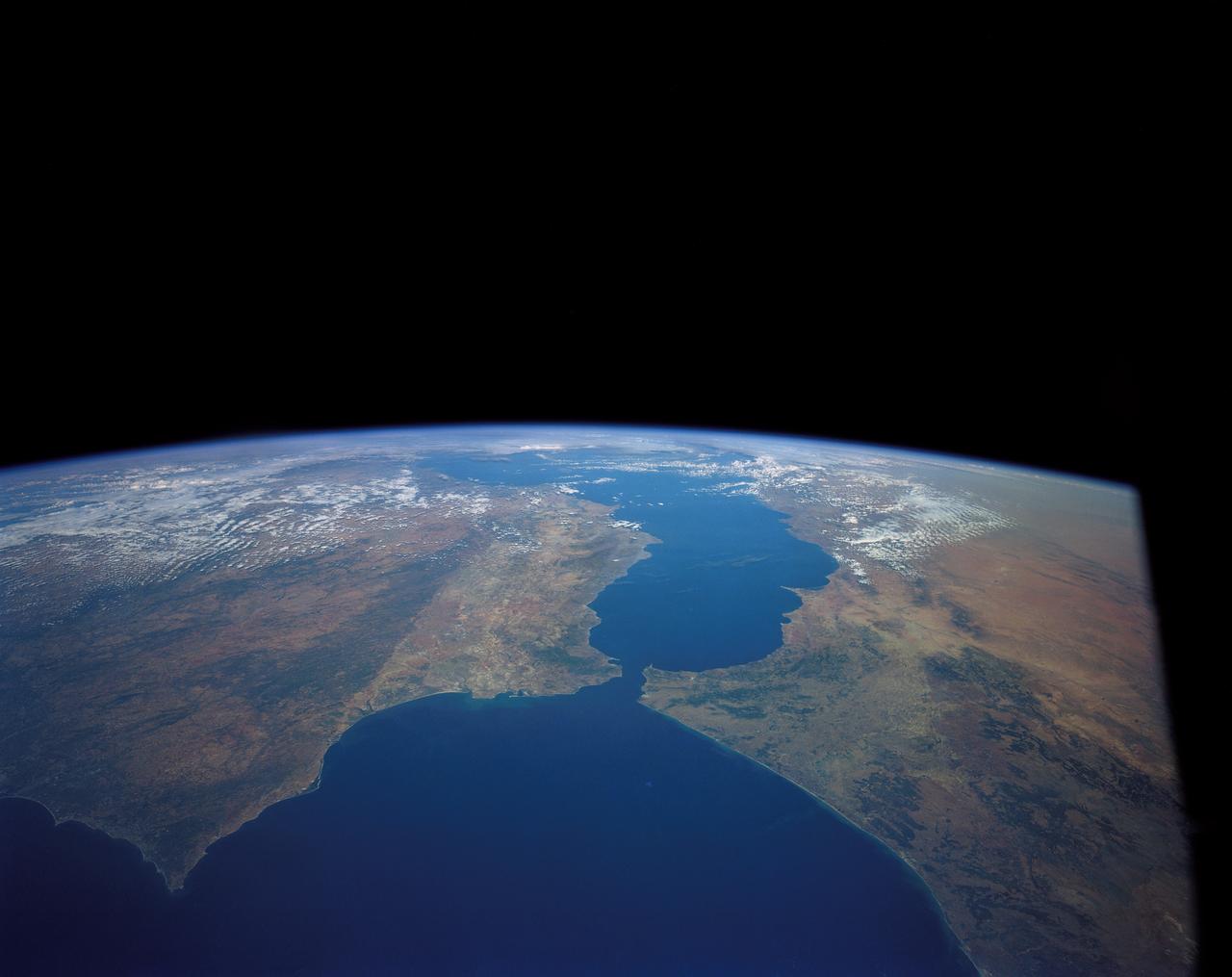
41G-120-082 (5-13 Oct. 1984) --- This High oblique view was photographed with a medium format camera aboard the Earth-orbiting space shuttle Challenger. It features the Strait of Gibraltar and the Mediterranean Sea. Unlike vertical photographs from this area taken by crews of previous spaceflights, this oblique view allows extensive viewing into Spain and Morocco. Photo credit: NASA
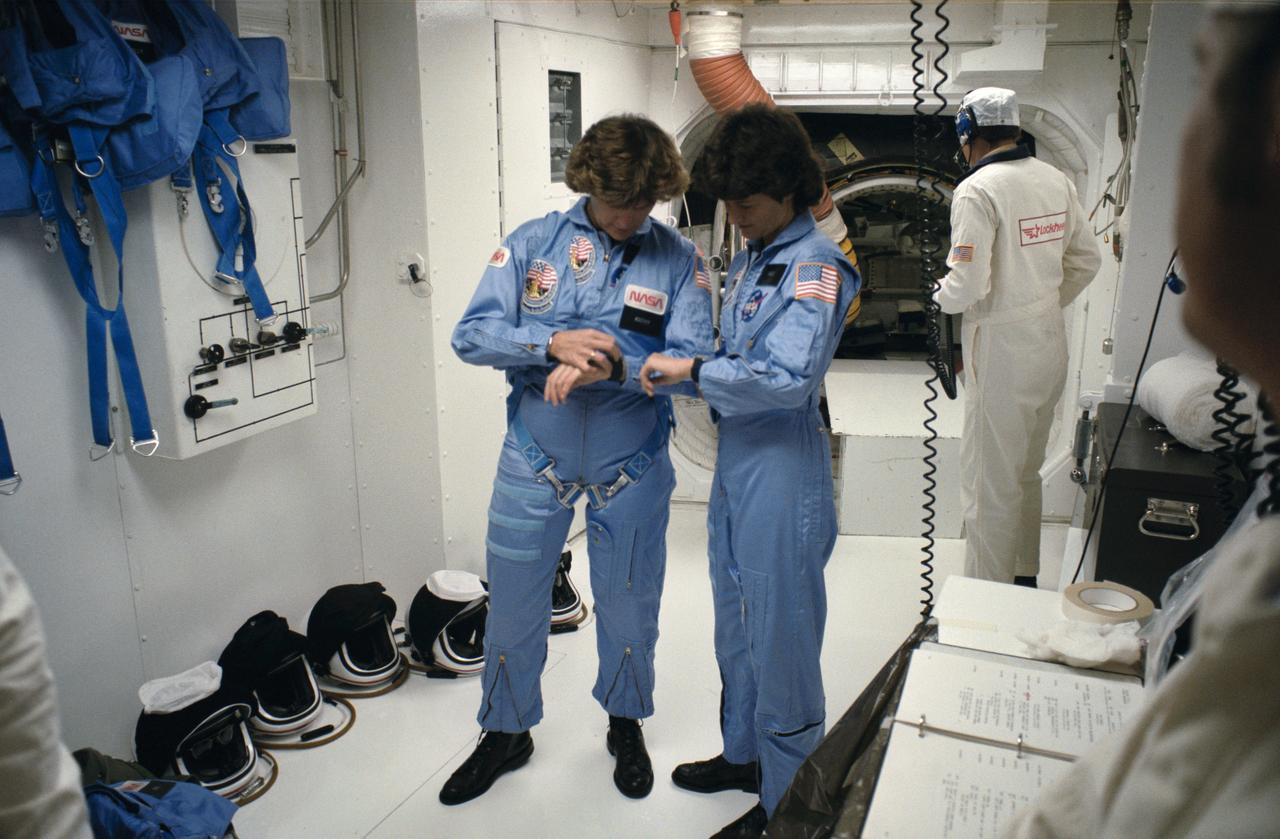
41G-90082 / S17-90082 (5 Oct 1984) --- Astronauts Sally K. Ride (right) and Kathryn D. Sullivan, two of three mission specialists, synchronize their watches prior to ingressing the Space Shuttle Challenger on the launch pad at Kennedy Space Center (KSC). They are in the White Room leading to the entry hatch of the vertically configured spacecraft.
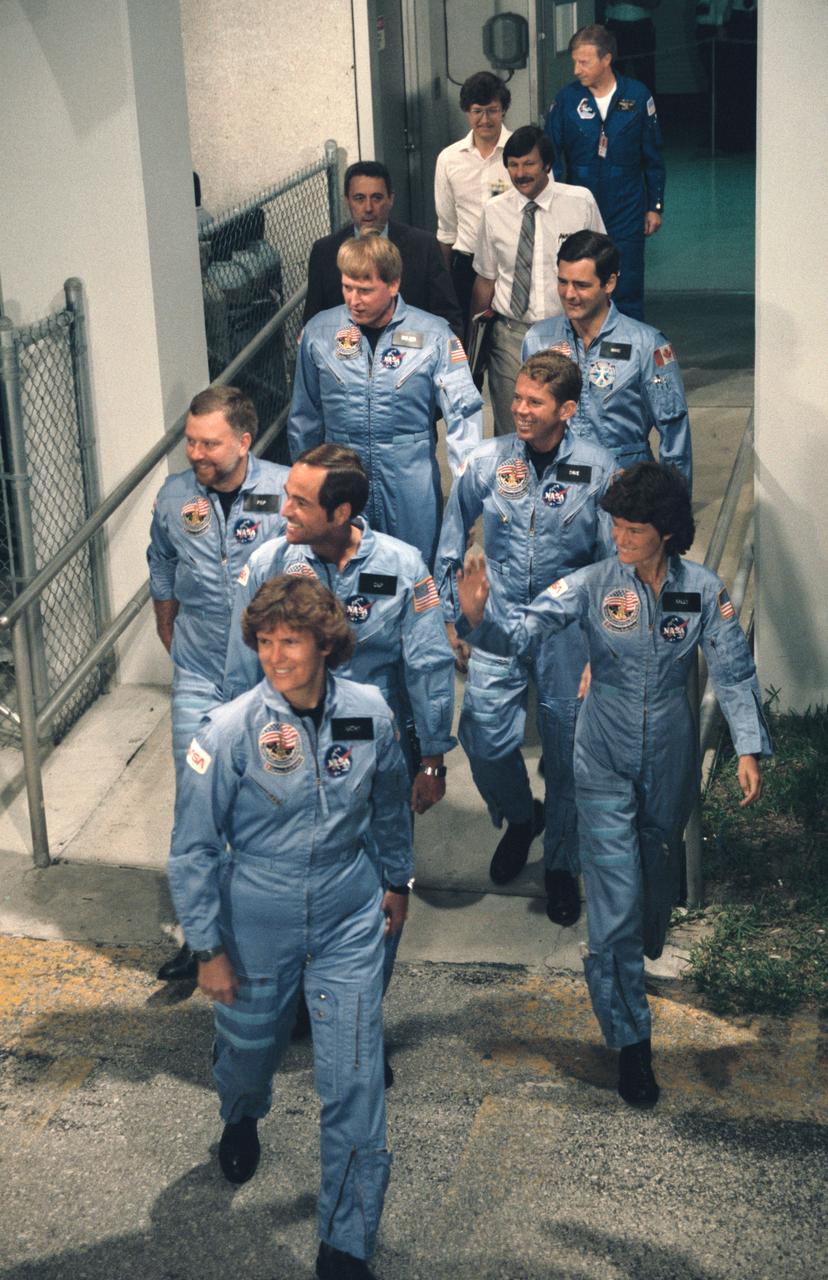
41G-90081 / S17-90081 (5 Oct 1984) --- The seven member crew leaves the Operations and Checkout Building (OCB) to take a van ride to the launch pad. Leading the way is Kathryn D. Sullivan followed in file by Robert L. Crippen, Paul D. Scully-Power and Jon A. McBride. On the right side are Sally K. Ride, David C. Leestma and Marc Garneau. Trailing the crew are George W. S. Abbey, Richard Nygren, Paul Bulver, and Paul J. Weitz.
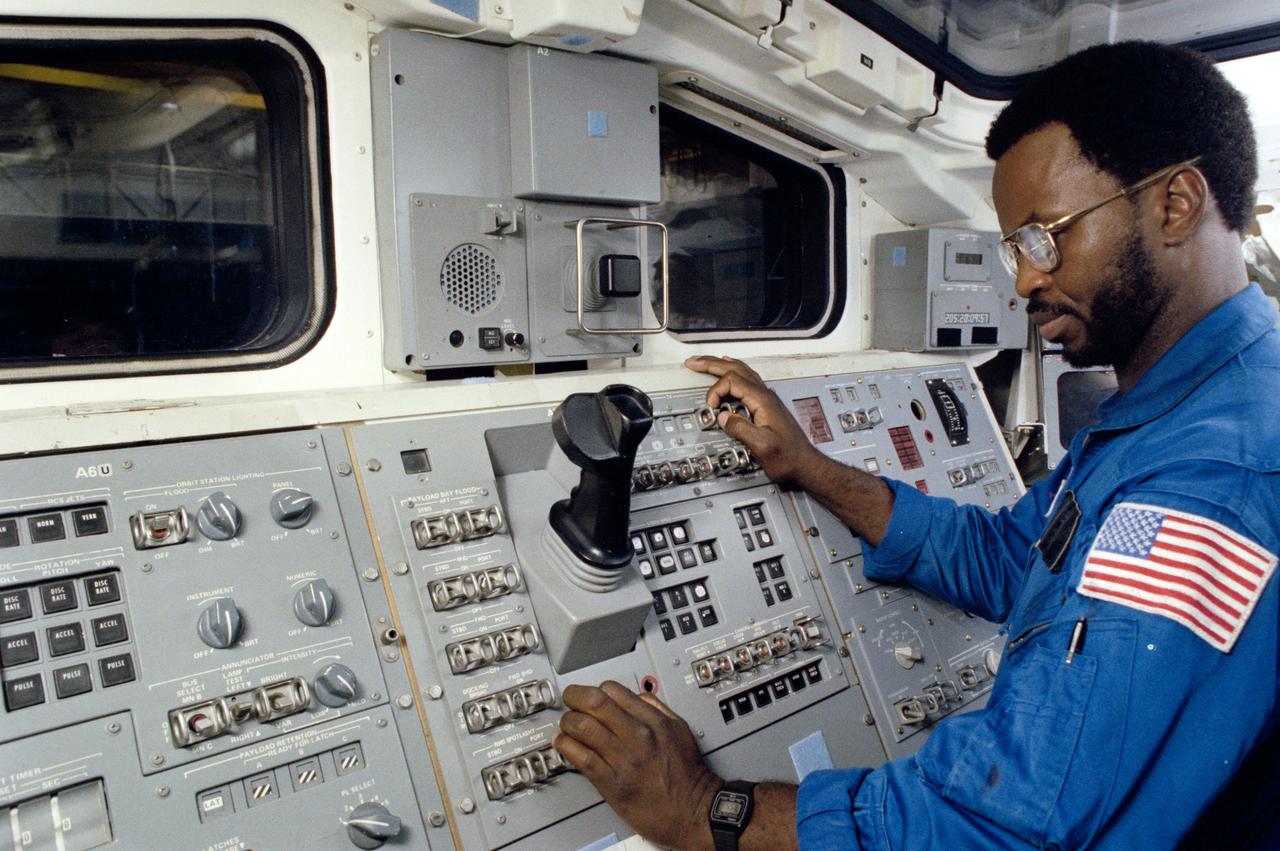
S83-33925 (14 June 1983) --- Astronaut Ronald E. McNair, one of NASA?s three 41-B mission specialists, participates in a training session in the Shuttle one-g trainer in the Johnson Space Center?s mockup and integrating laboratory. He stands at the aft flight deck, where controls for the remote manipulator system (RMS) arm are located. Dr. McNair and the remainder of the five-man astronaut crew are scheduled to lift into space aboard the Challenger on February 3, 1984.
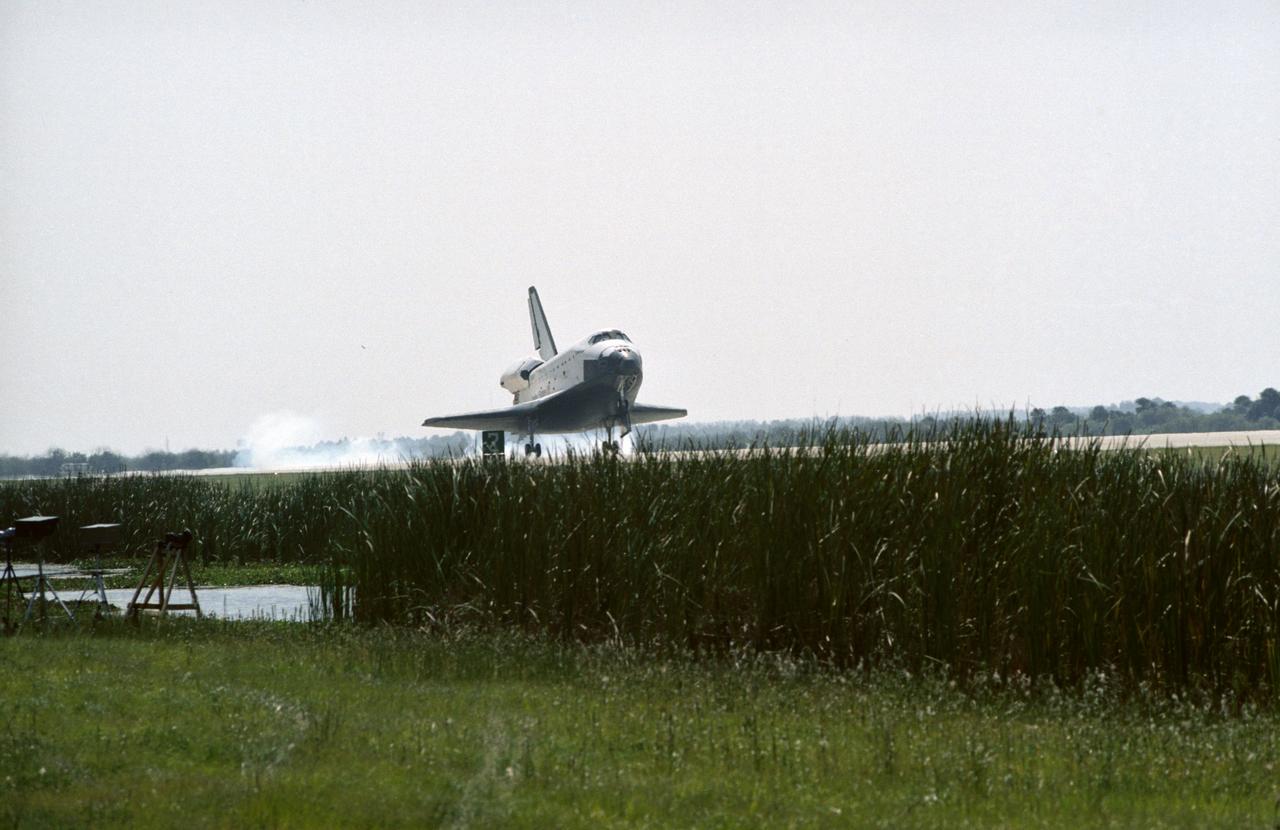
The Space Shuttle Challenger lands at Kennedy Space Center (KSC) at the end of the STS 41-G mission. The main landing gear has already touched down in this view, but the nose gear is still in the air (90232); Front view through tall grass of the Challenger making its landing at KSC (90233); Close-up side view of the Challenger making its landing at KSC (90234); Aerial view of the Challenger making its final approach to the runway to land at KSC (90235).
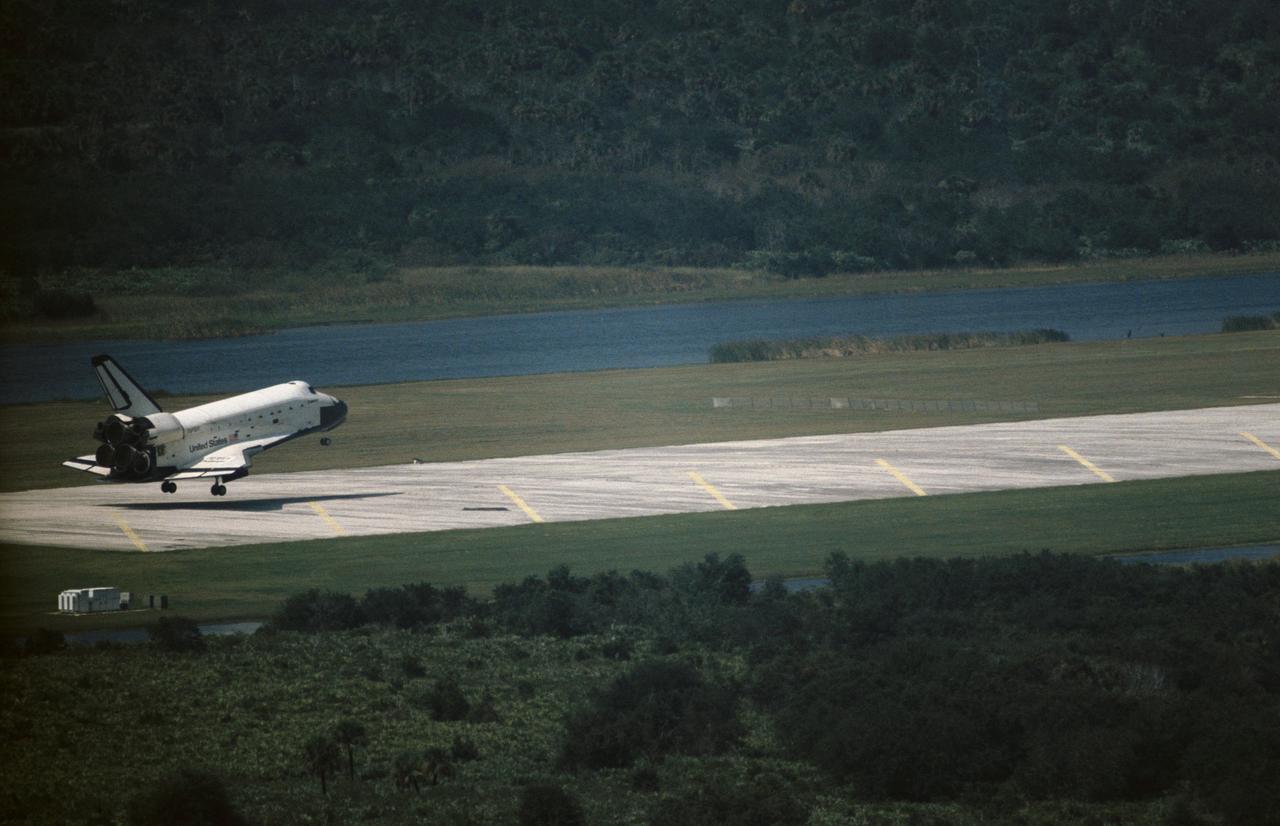
The Space Shuttle Challenger lands at Kennedy Space Center (KSC) at the end of the STS 41-G mission. The main landing gear has already touched down in this view, but the nose gear is still in the air (90232); Front view through tall grass of the Challenger making its landing at KSC (90233); Close-up side view of the Challenger making its landing at KSC (90234); Aerial view of the Challenger making its final approach to the runway to land at KSC (90235).
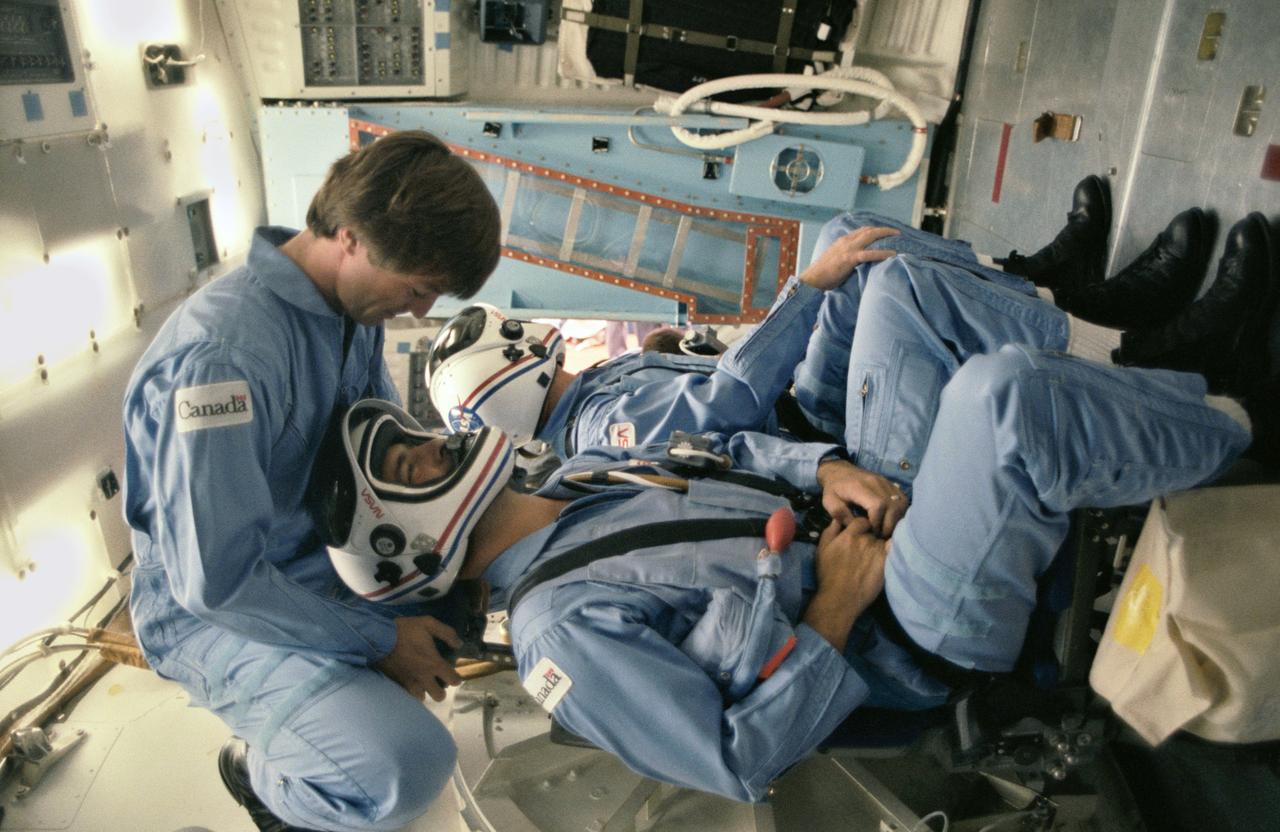
41D-3139 (2 Sept 1984) --- Two prime crew member payload specialist and a backup for NASA's 41-G Space Shuttle mission participate in launch phase simulations at the Johnson Space Center. Securing themselves in temporary stations in the middeck of a trainer are Marc Garneau, representing the Canadian National Research Council (NRC), and Paul D. Scully-Power (background), a U.S. Navy oceanographer. Robert Thirsk, also with the NRC, is a backup payload specialist. This photograph was taken by Otis Imboden.
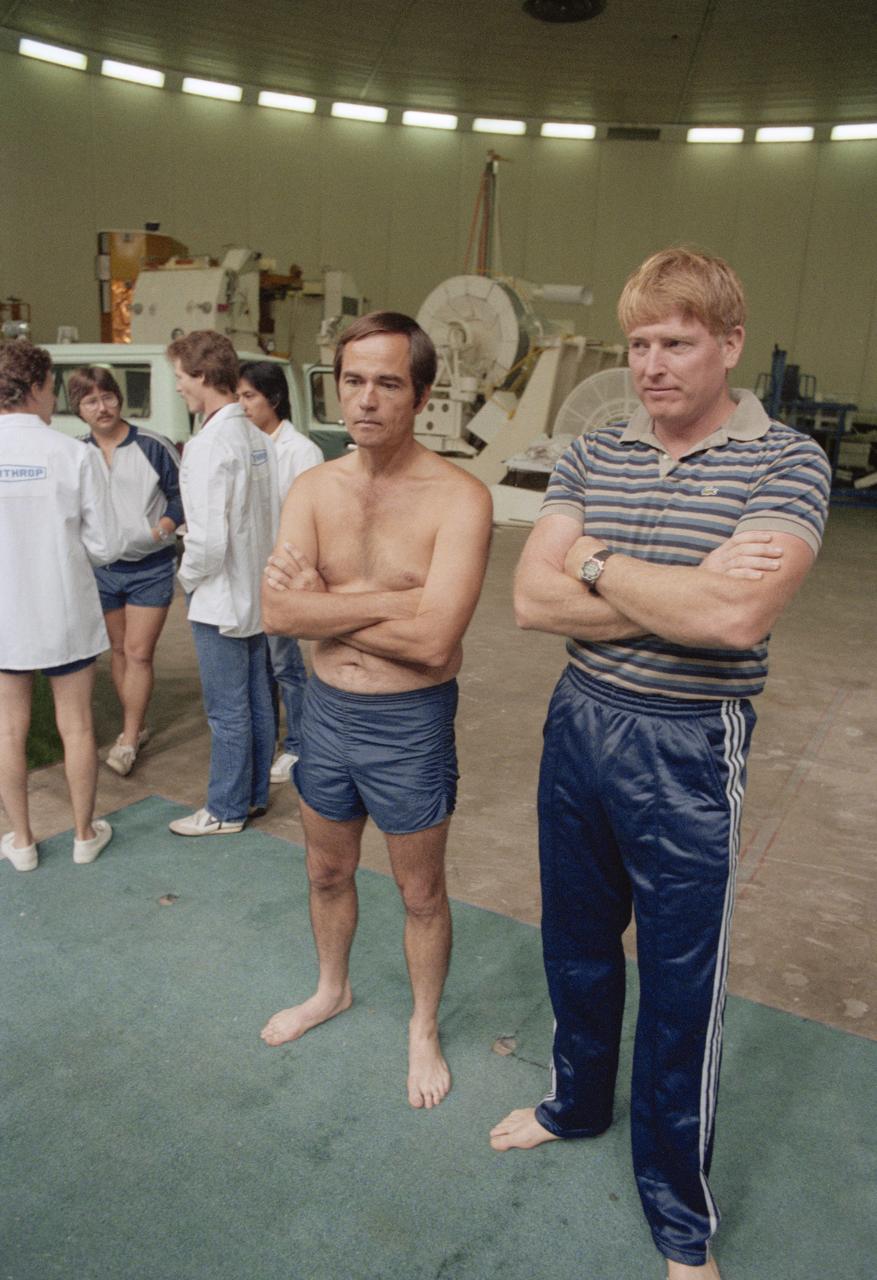
S84-36898 (29 June 1984) --- Astronauts Robert L. Crippen (left) and Jon A. McBride, crew commander and pilot, respectively for NASA's 41-G Space Shuttle mission, await the delivery of self contained underwater breathing apparatus (SCUBA) gear prior to their going underwater to observe a simulation of an extravehicular activity (EVA) scheduled for their mission. The EVA will be performed by Astronauts Kathryn D. Sullivan and David C. Leestma, two of three mission specialists named for the seven-member crew. The underwater training took place in the Johnson Space Center's weightless environment training facility (WET-F).
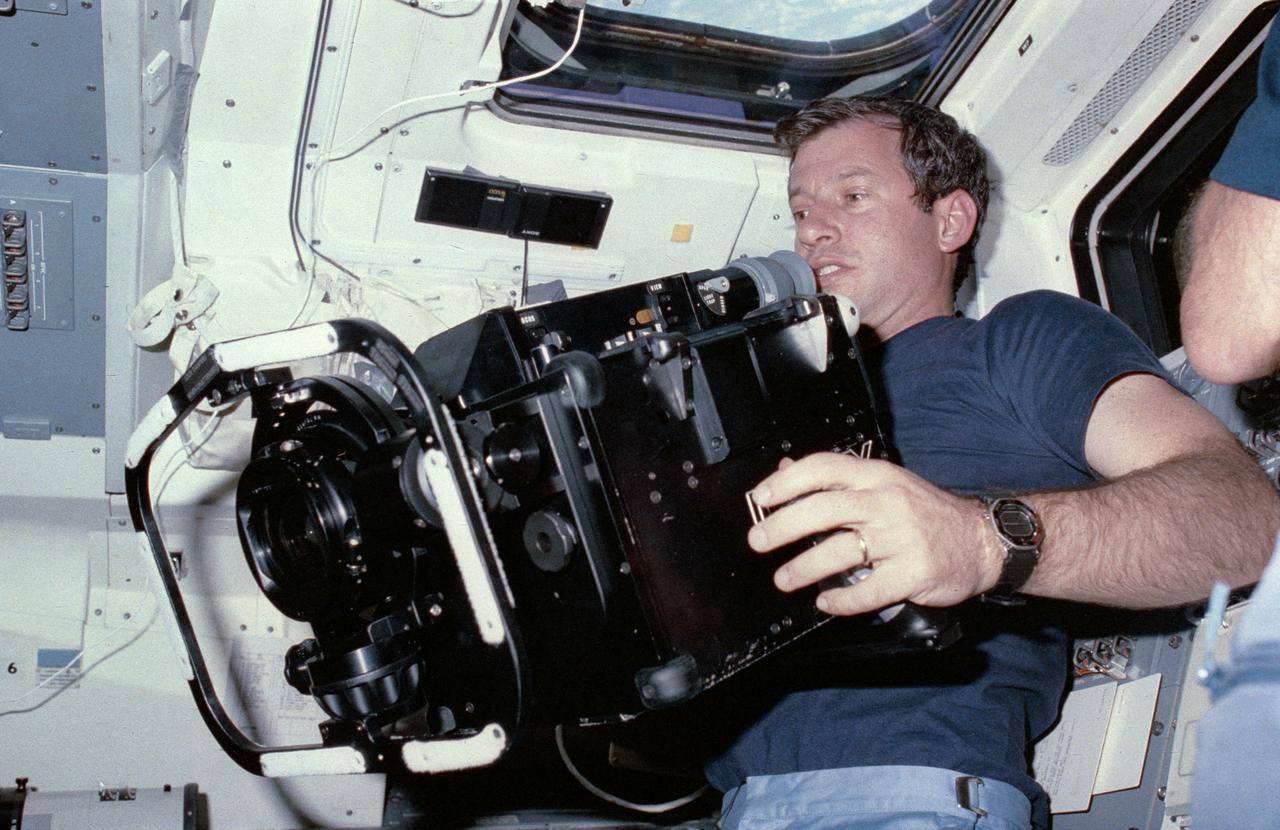
41C-05-180 (9 April 1984) --- Astronaut Terry J. Hart, 41-C mission specialist, holds a 70 pound IMAX camera in the middeck of the Earth orbiting Space Shuttle Challenger. The motion picture camera (65mm) handles 1,000 ft. rolls which have a running time of three minutes (24 frames per second). Hart, who used a black bag as a sort of in space darkroom for five film change outs throughout the flight, commented to ground controllers that the film magazines were much easier to reload in space than in the normal one G environment on Earth.
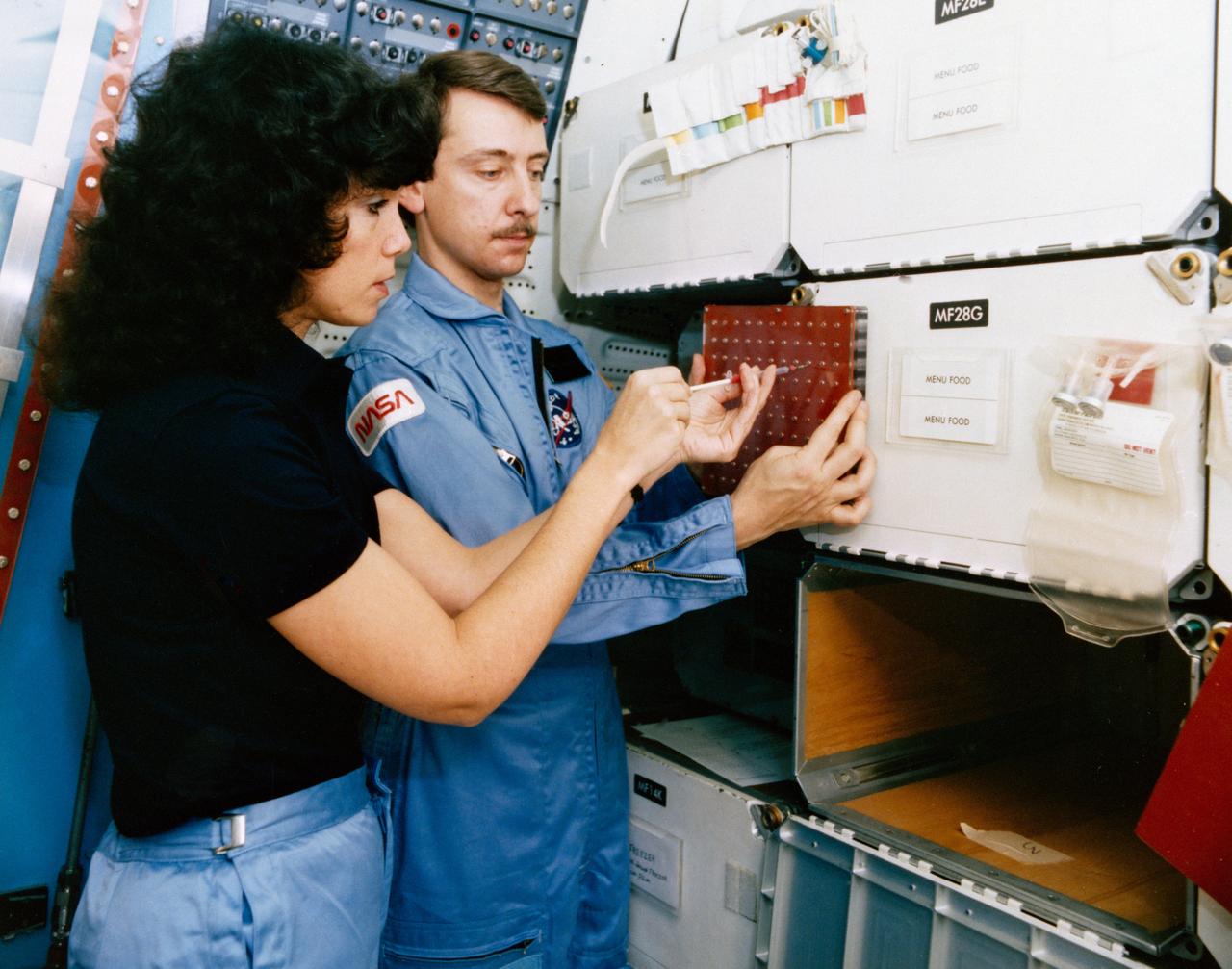
S84-35757 (May 1984) --- Astronaut Judith A. Resnik, 41-D mission specialist, and Charles Walker, payload specialist for that June 1984 flight, prepare for some scheduled intravehicular activity involving the continuous flow electrophoresis systems (CFES) experiment. CFES will join the six-member crew aboard the Earth-orbiting Discovery for a seven day mission. The two share in preparing a sample to be processed by the CFES. In the background are stowage lockers and a CFES trainer-- part of the Shuttle one-g trainer at NASA's Johnson Space Center (JSC). Walker, an engineer at McDonnell Douglas Astronautics Co. in St. Louis, Missouri, will be the first Shuttle payload specialist to represent a project designed for commercial purposes. As payload specialist, his job will be to run the materials electrophoresis-operations-in-space project. The project is aimed at separating large quantities of biological materials in space for ultimate use in new pharmaceuticals. The photo was taken by a McDonnell Douglas photographer.