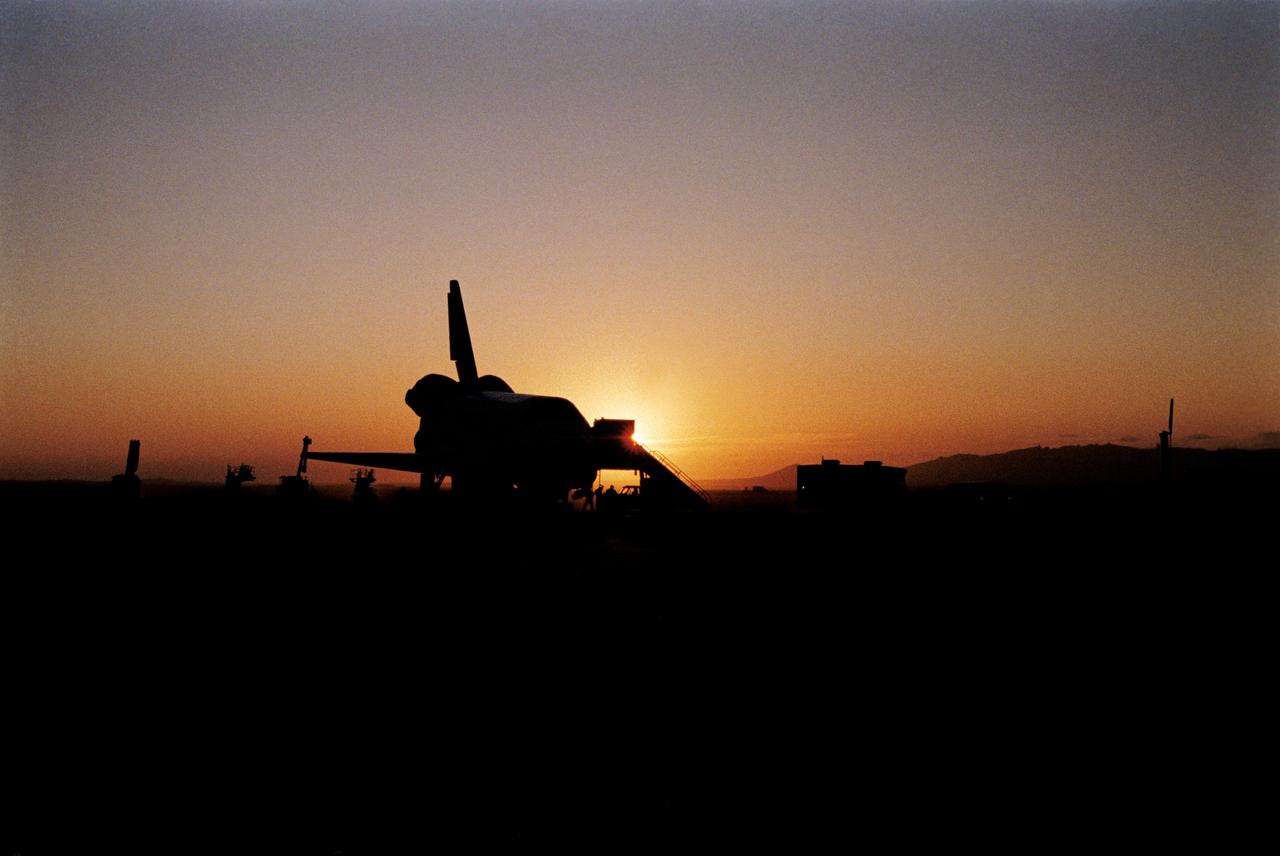
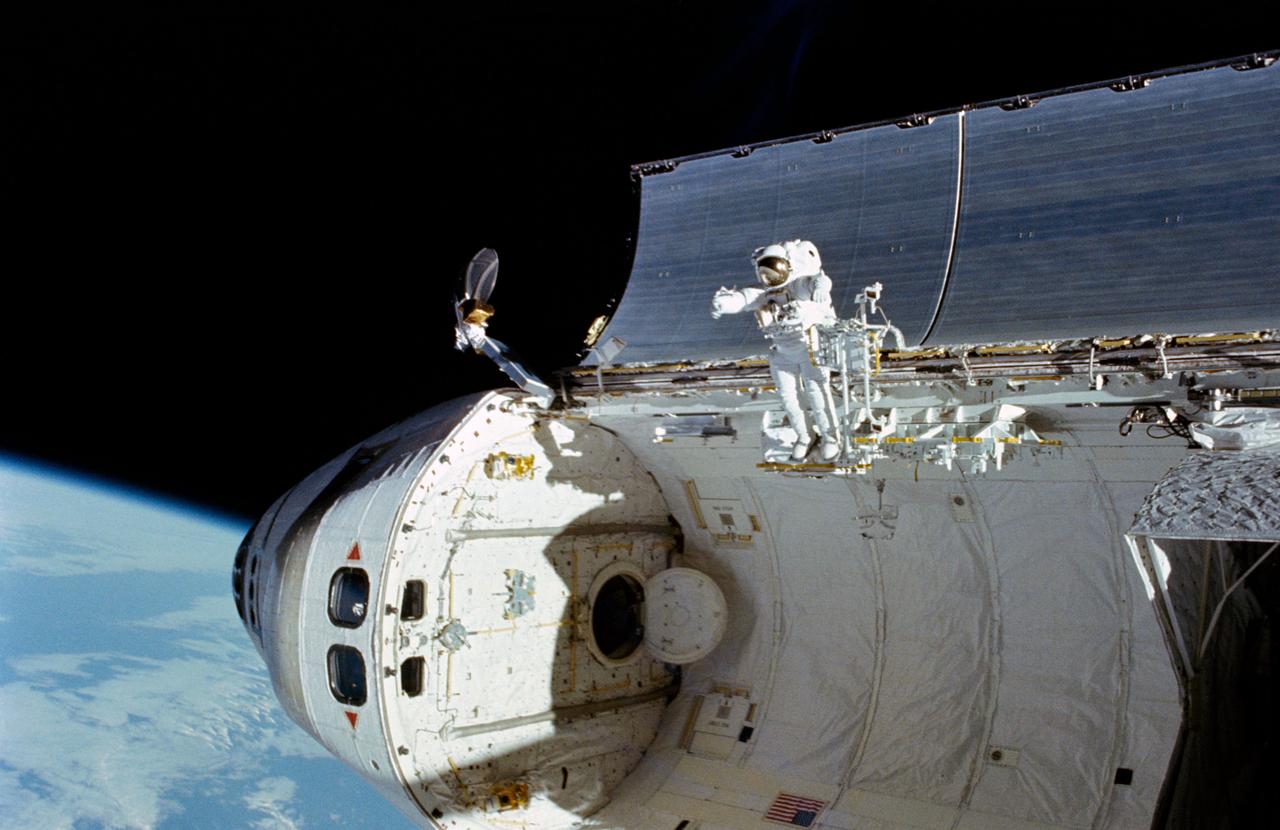
51I-S-225 (3 September 1985) --- The Space Shuttle Discovery lands on September 3, 1985 on Runway 23, Edwards Air Force Base, CA, to successfully complete the 51-I mission.
Landing of the Shuttle Discovery and end of STS 51-I mission
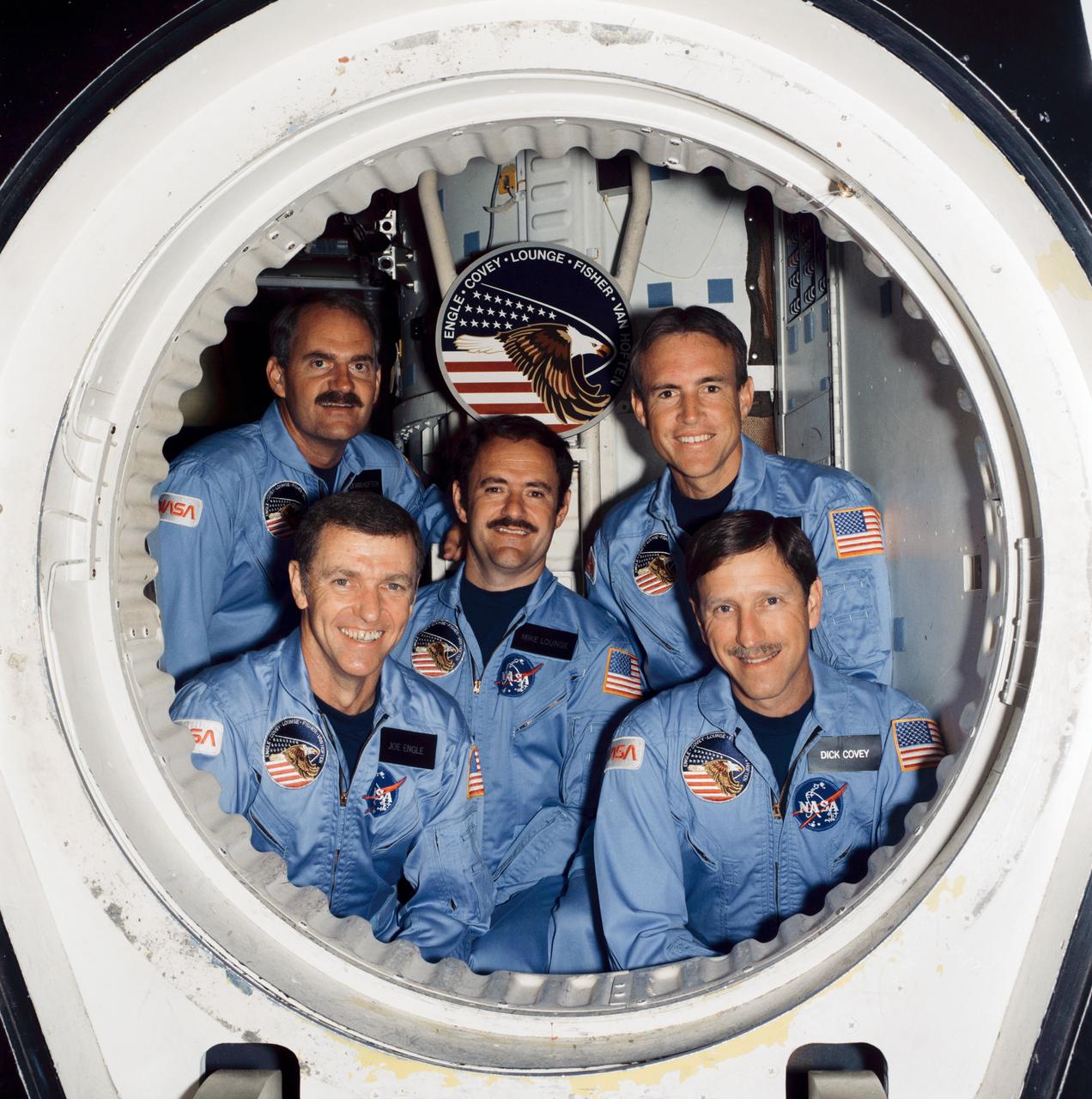
S85-36062 (1 July 1985) --- These five NASA astronauts make up the crew for the mission STS-51I, scheduled for launch in August of this year. Taking a break from rehearsals in the crew compartment trainer in the Shuttle Mockup and Integration Laboratory at JSC are astronauts Joe H. Engle (front left), crew commander; Richard O. Covey (front right), pilot; and (back row, left-to-right) astronauts James D. van Hoften, John M. (Mike) Lounge and William F. Fisher -- all mission specialists.
CREW PORTRAIT - STS-27/51I
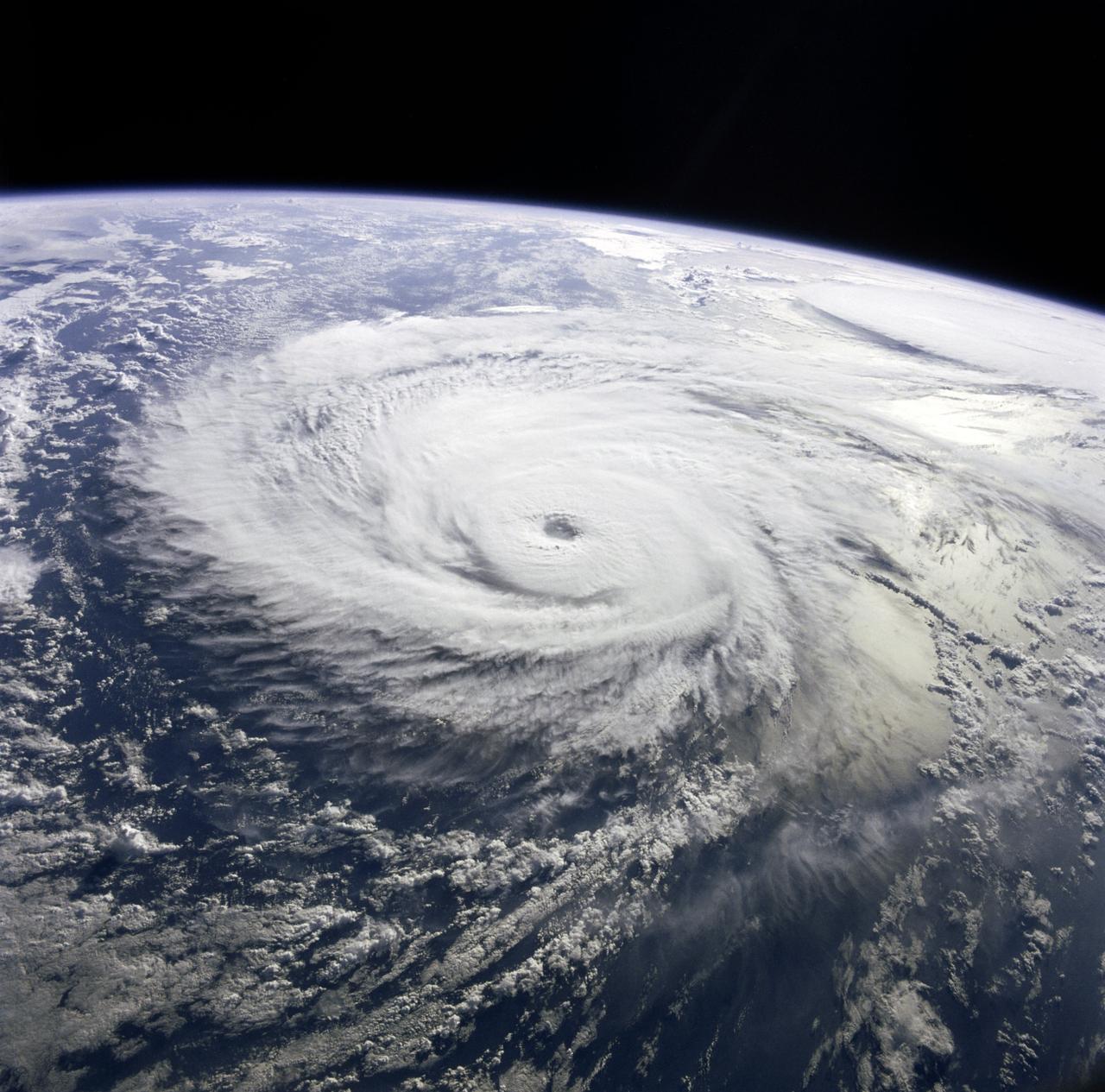
51I-35-075 (30 Aug 1985)  --- Typhoon Pat was photographed on the morning of August 30th at a position of approximately 25 degrees N, 131 degrees E. Stereoscopically-overlapping photographs taken by the 51I crew provide much more detail of the three-dimensional structure of tropical cyclones than can be determined from data returned from meteorological satellites. The 51I shuttle mission was launched on August 27 and landed September 3. The mission was flown in the space shuttle orbiter Discovery.
Typhoon Pat, western Pacific
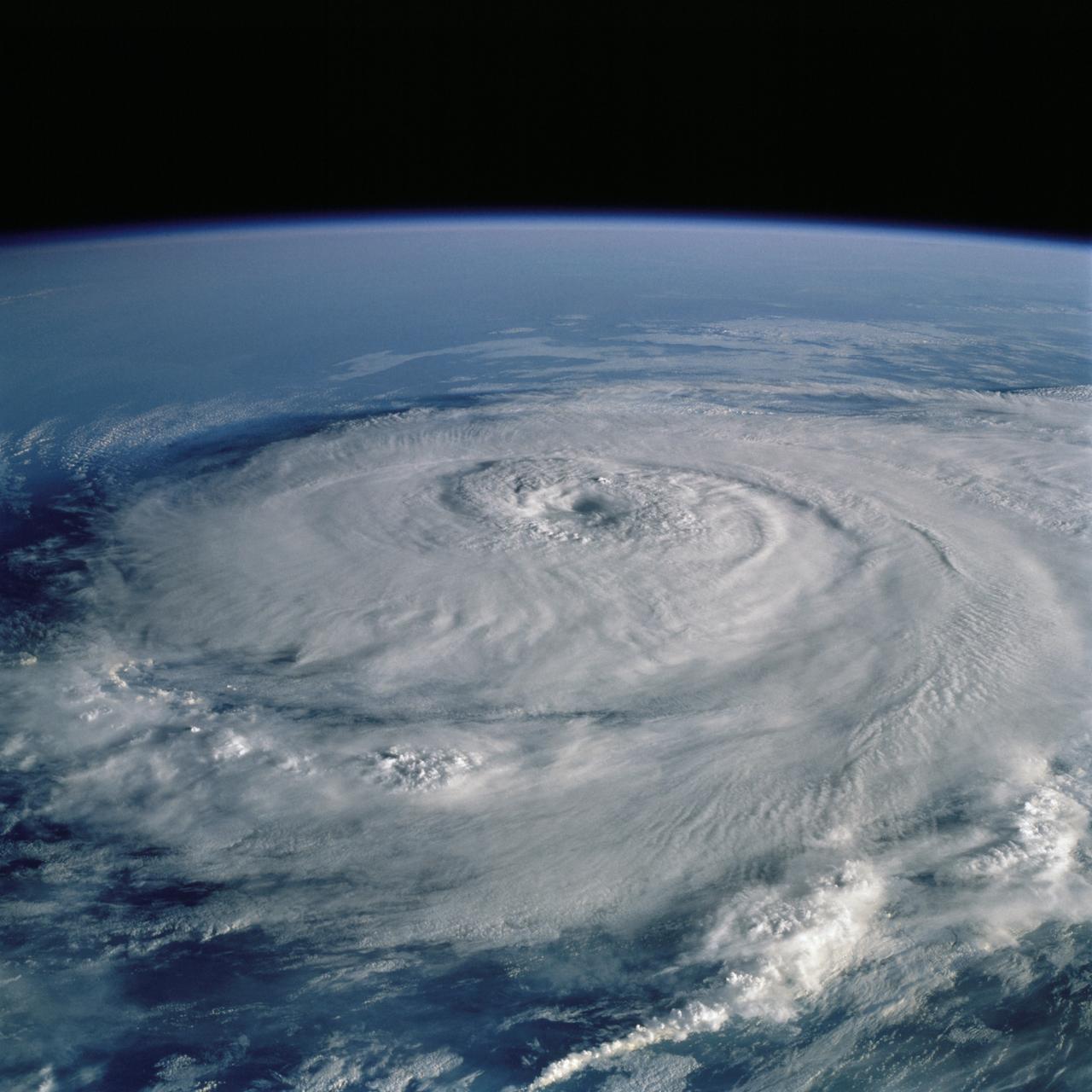
51I-44-052 (2 Sept. 1985) --- An oblique view of Hurricane Elena, photographed with a 70mm camera by STS-51I crew members of the space shuttle Discovery on Sept. 2, 1985. Photo credit: NASA
Hurricane Elana, Gulf of Mexico
51I-S-240 (3 Sept. 1985) --- Servicing of the space shuttle Discovery after its landing at Edwards Air Force Base ending the STS-51I mission. Photo credit: NASA
Servicing of Shuttle Discovery after landing at end of STS 51-I mission
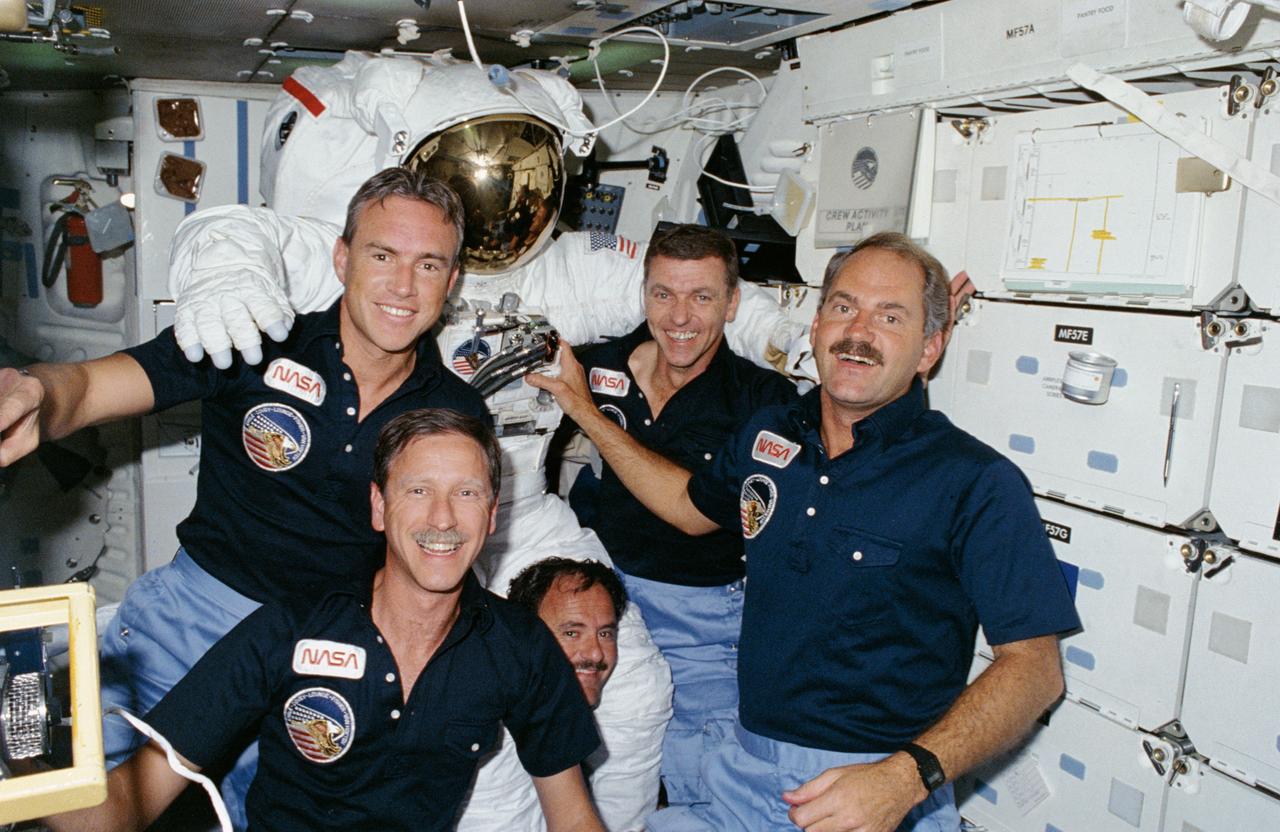
51I-07-015 (4-5 Sept 1985) --- All five STS 51-I crewmembers pose with one of two extravehicular mobility unit (EMU) spacesuits used by Astronauts van Hoften and Fisher on their two-day EVA.
Onboard portrait of the STS 51-I crewmembers in the middeck
51I-32-059 (27 August 1985) --- The American Satellite Company (ASC) communications satellite rises from the cargo bay at 6:54 a.m. August 27, 1985.
The American Satellite Company (ASC) satellite deployed from payload bay
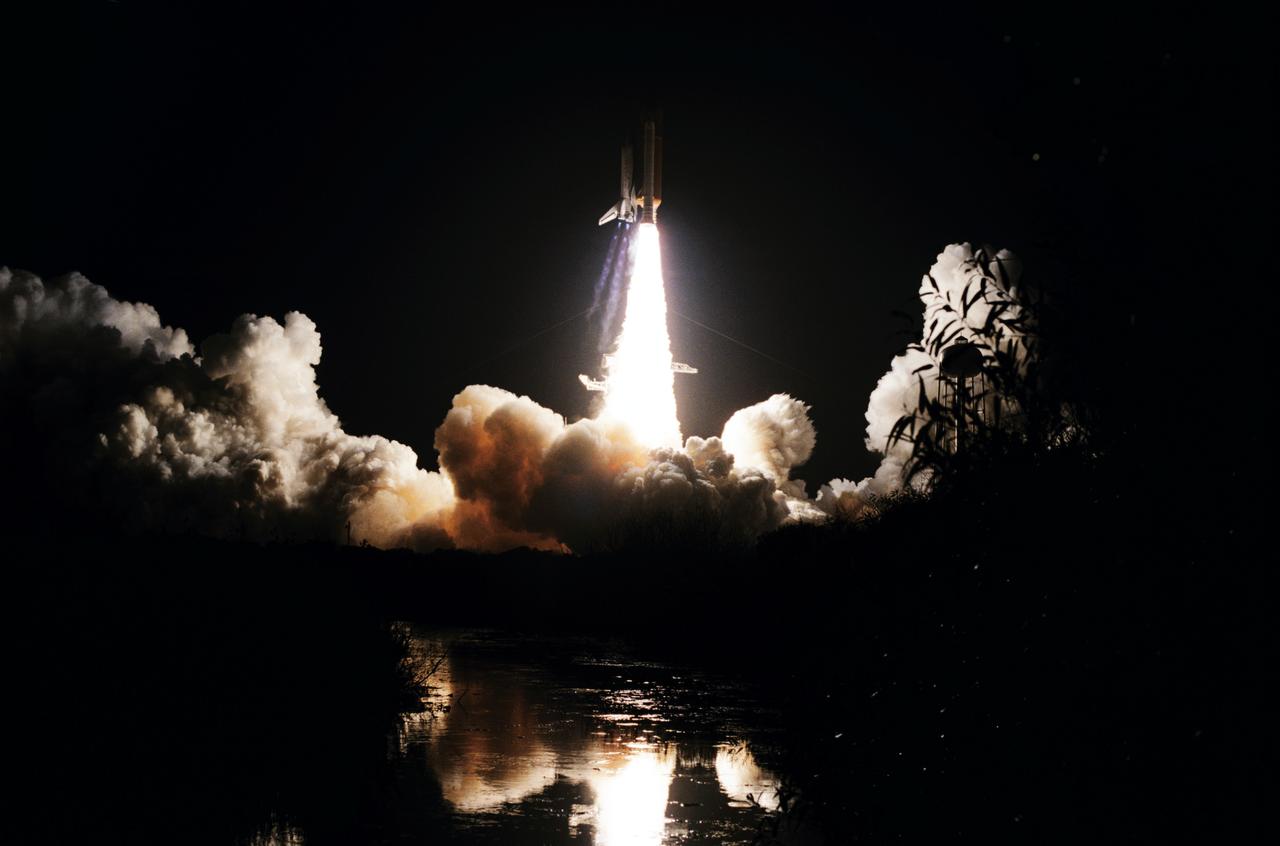
51I-S-223 (27 August 1985) --- Launch of the Space Shuttle Discovery and beginning of STS-51I mission. View of the pre-dawn launch shows a reflection of the ignition in the river across from the launch complex.
Launch of the Shuttle Discovery and begining of STS 51-I mission
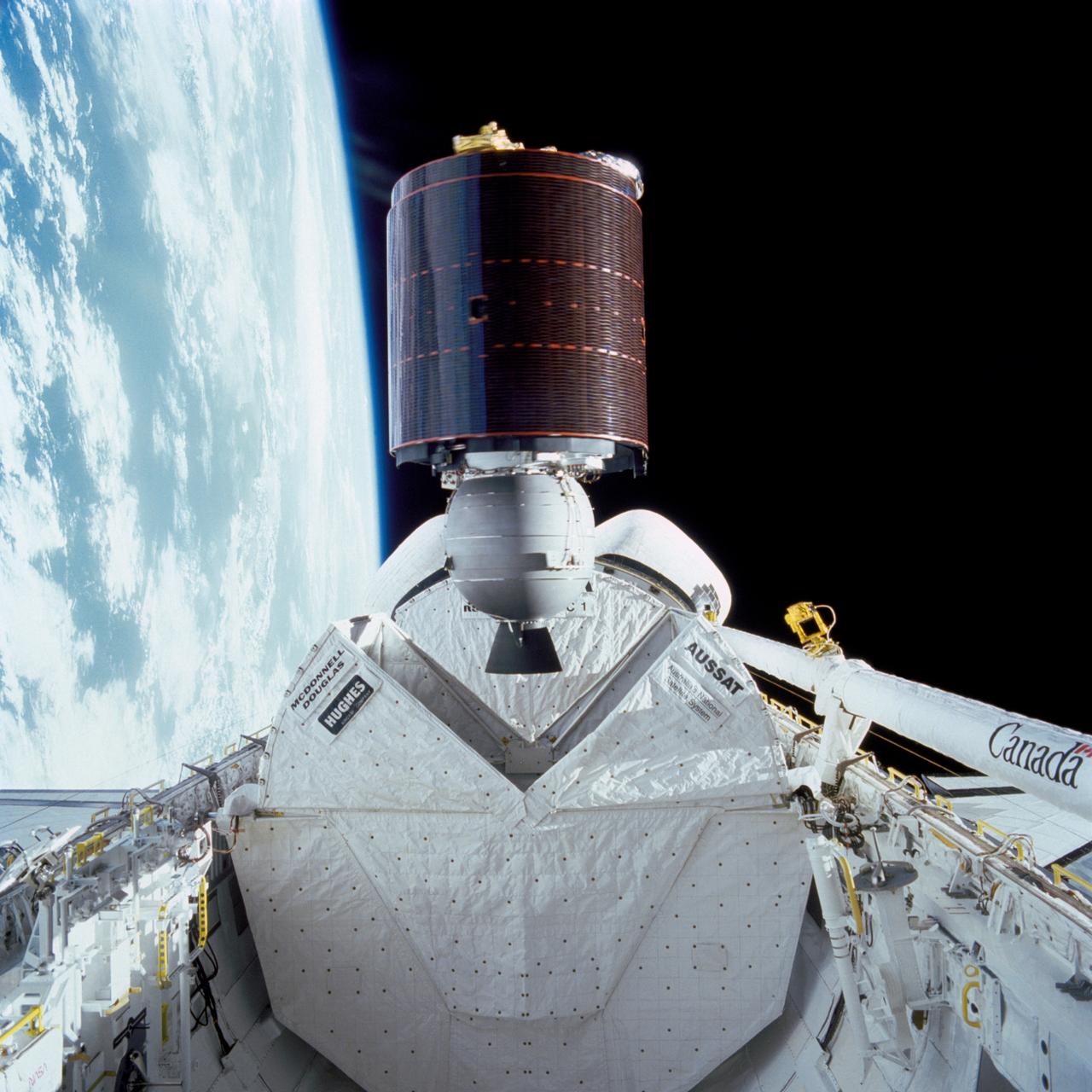
51I-32-023 (27 Aug. 1985) --- Australia's AUSSAT communications satellite is deployed from the payload bay of the space shuttle Discovery on flight day one. A portion of the cloudy surface of Earth can be seen to the left of the frame. Photo credit: NASA
Australia's AUSSAT satellite deployed from payload bay
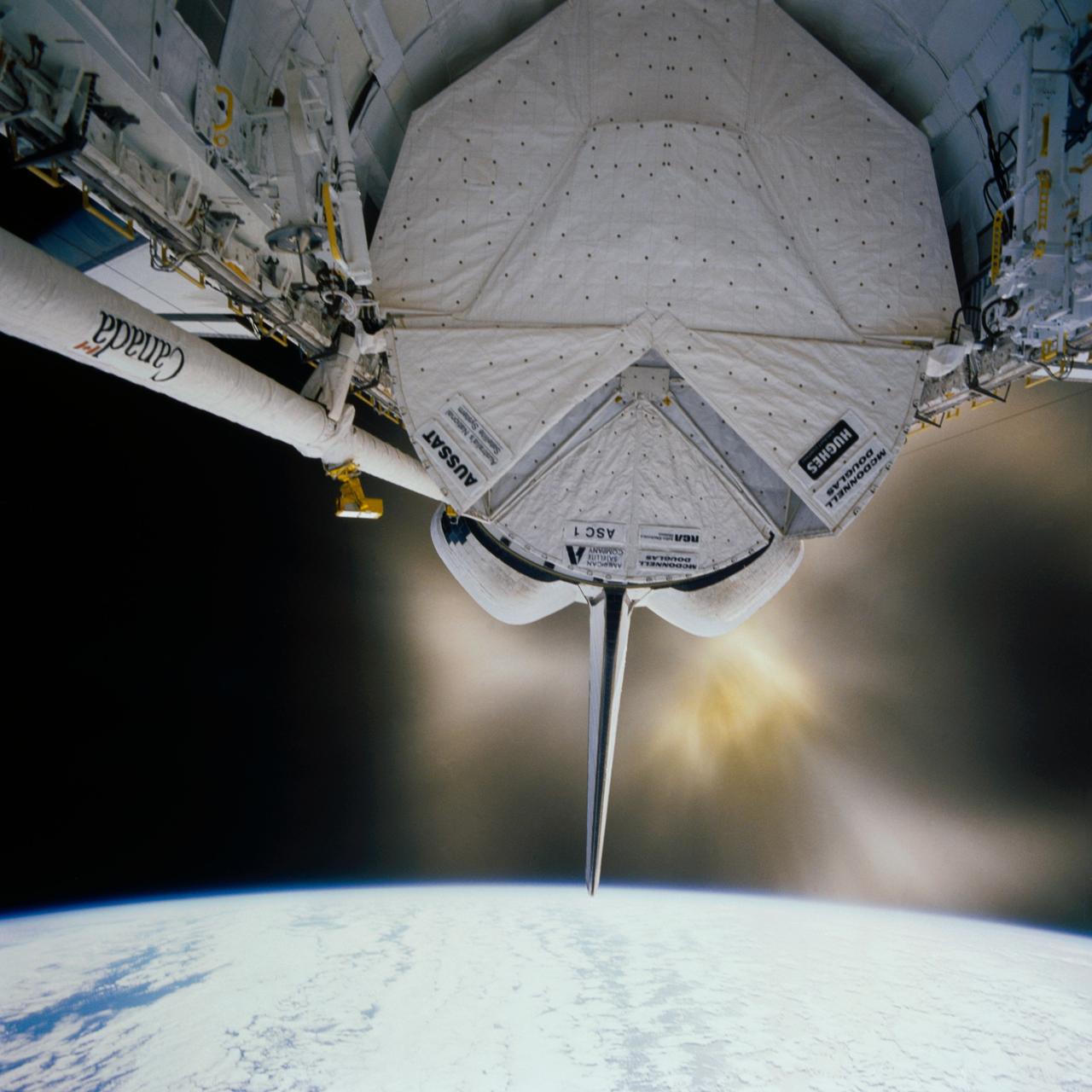
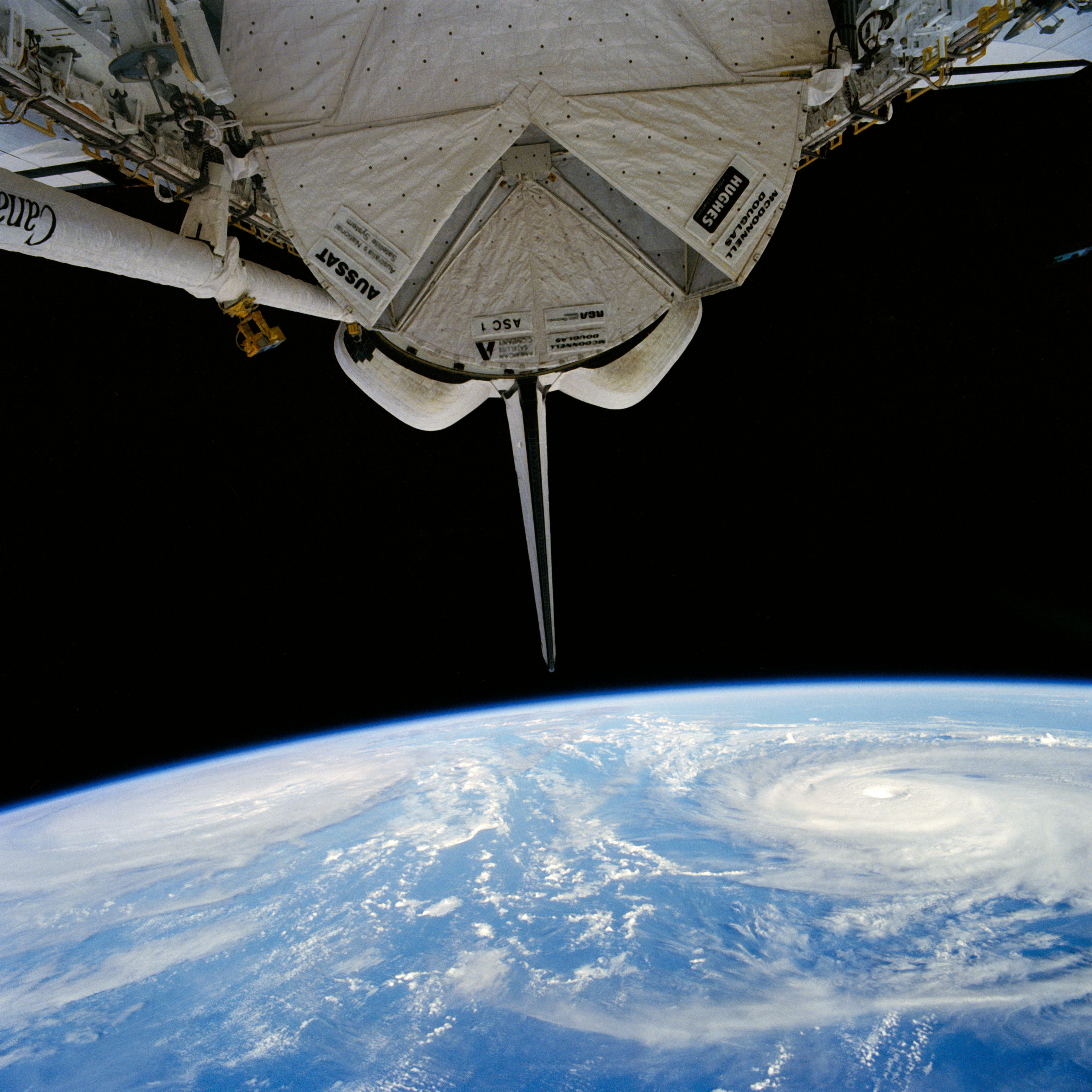
View of a single engine orbital maneuvering system (OMS) firing on the Discovery. The payload bay is open and the protective canisters for the AUSSAT communications satellite (open) and the ASC-1 are visible. A cloudy Earth's horizon can be seen above the orbiter.
View of the firing of a single engine OMS
51I-35-078 (30 Aug 1985) --- Typhoons Pat (left) and Odessa in the western Pacific.  Of the many tropical cyclones photographed by the STS 51-I crew, the dual typhoons of Pat and Odessa were the most unusual.  The twin typhoons constitute a Fujiwara system of connected cyclones first described by the Japanese meteorologist after whom the phenomena has been named. Never before have such paired typhoons been photographed from orbit.
Typhoons Pat and Odessa in the Western Pacific Ocean
51I-S-237 (1 Sept. 1985) --- A still photo made from a video downlink shows astronaut James D. van Hoften, just after giving a shove to the Syncom IV-3 communications satellite. NASA's 51-I astronaut crew aboard the space shuttle Discovery had earlier captured and repaired the previously errant satellite. Photo credit: NASA
Astronaut James van Hoften working with Syncom IV-3 satellite
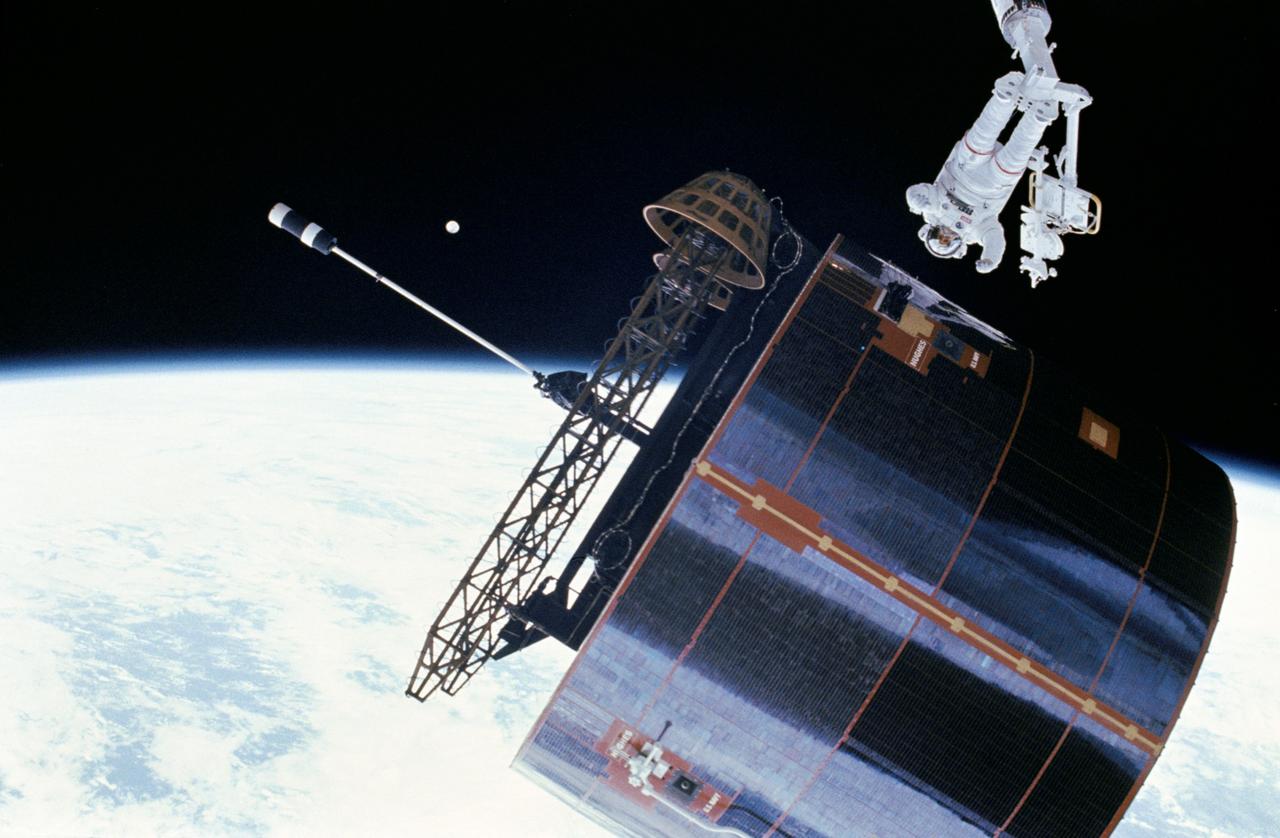
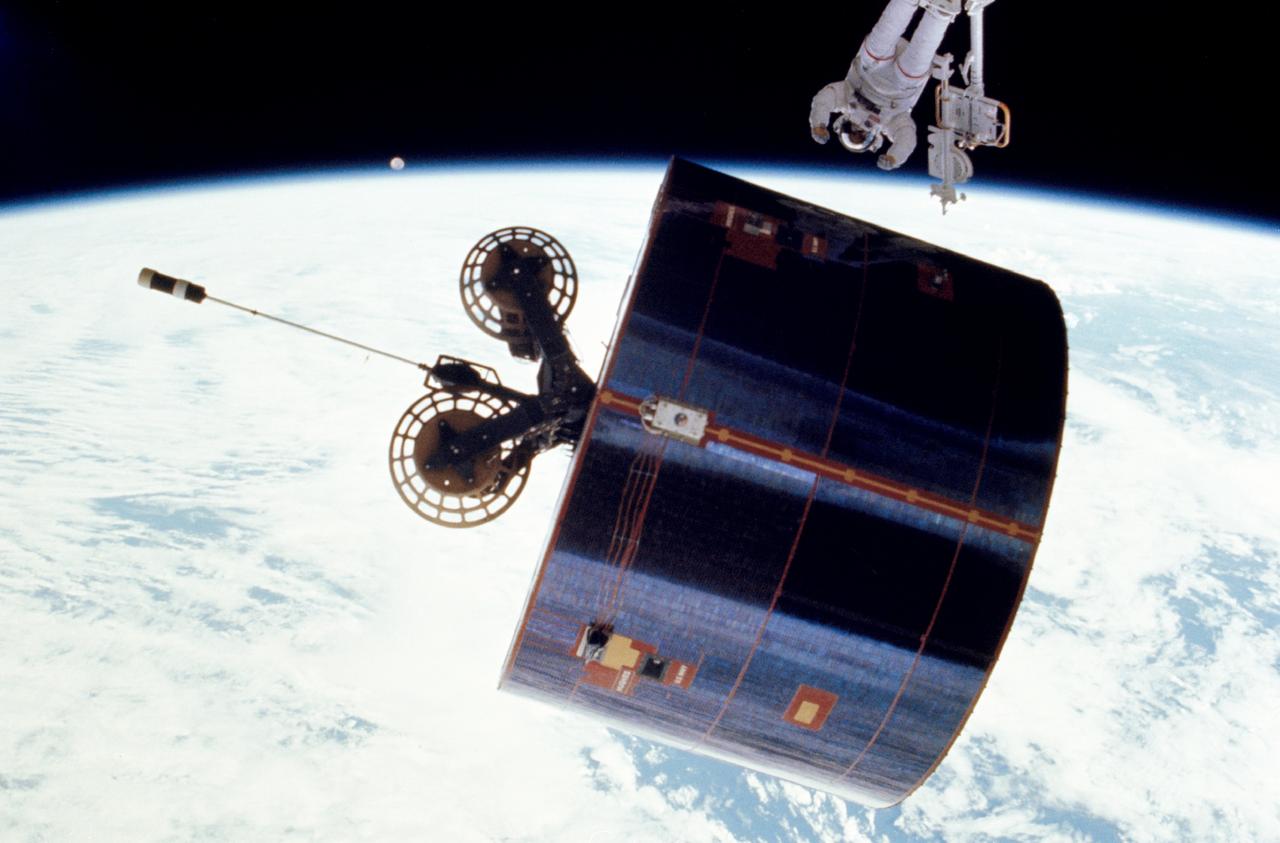
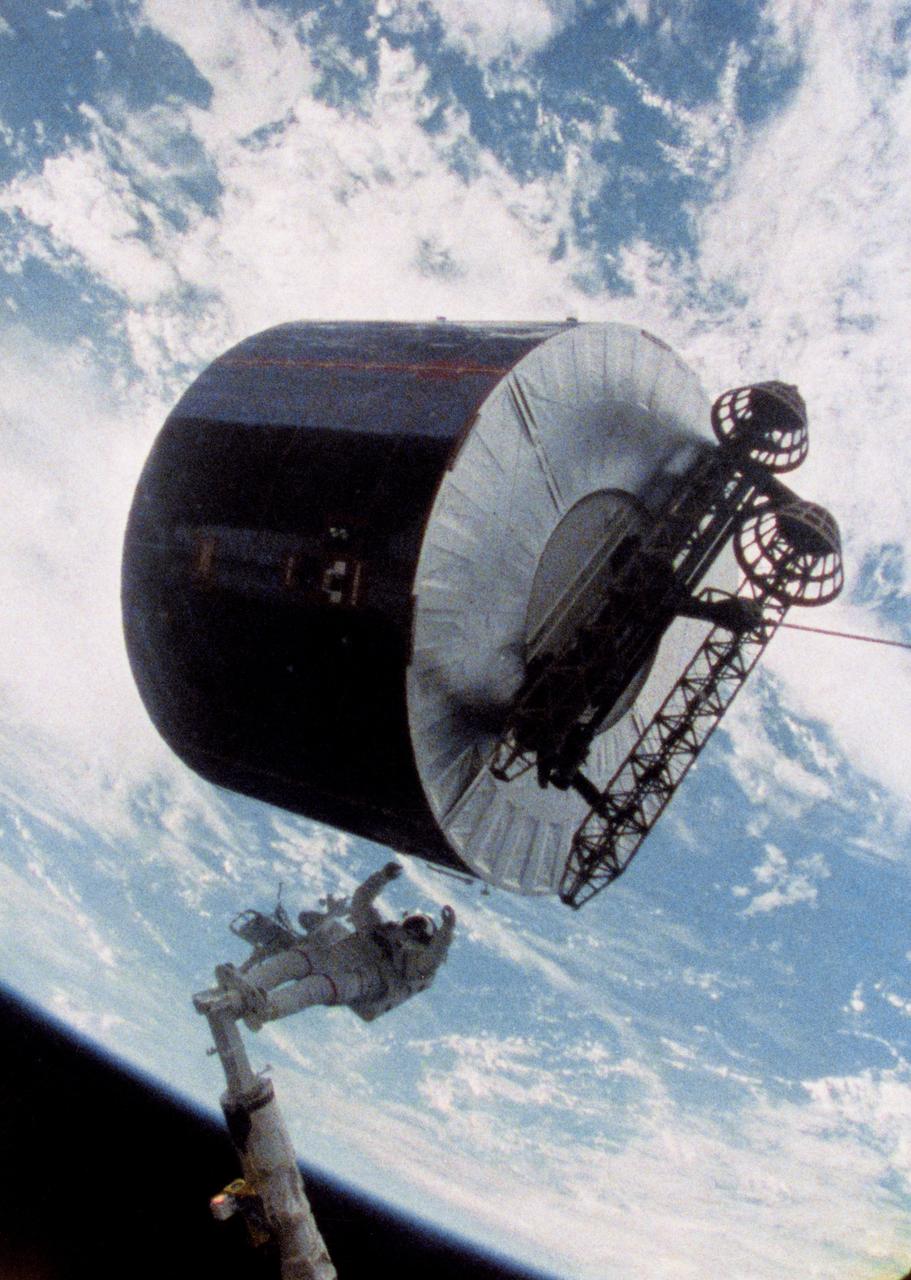
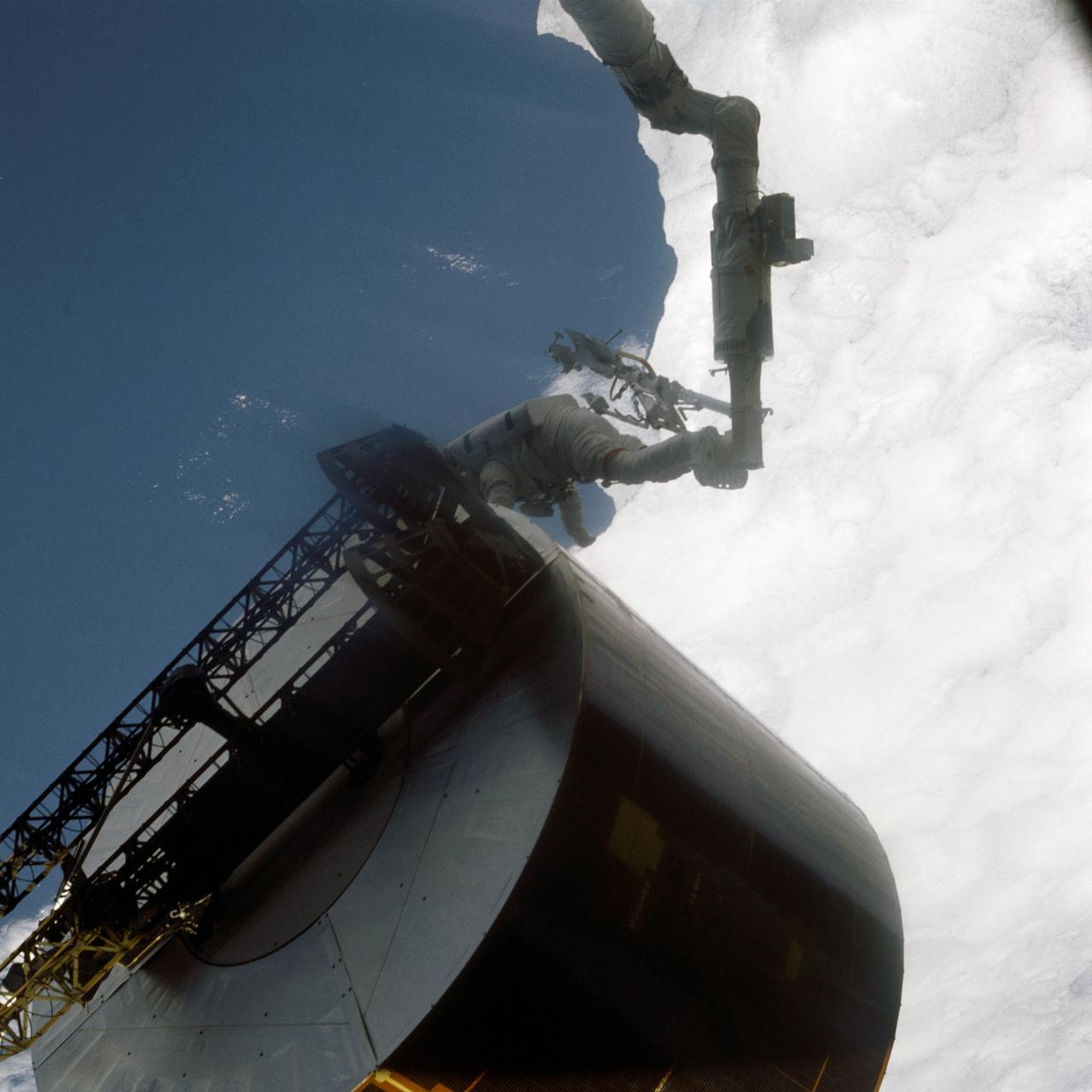
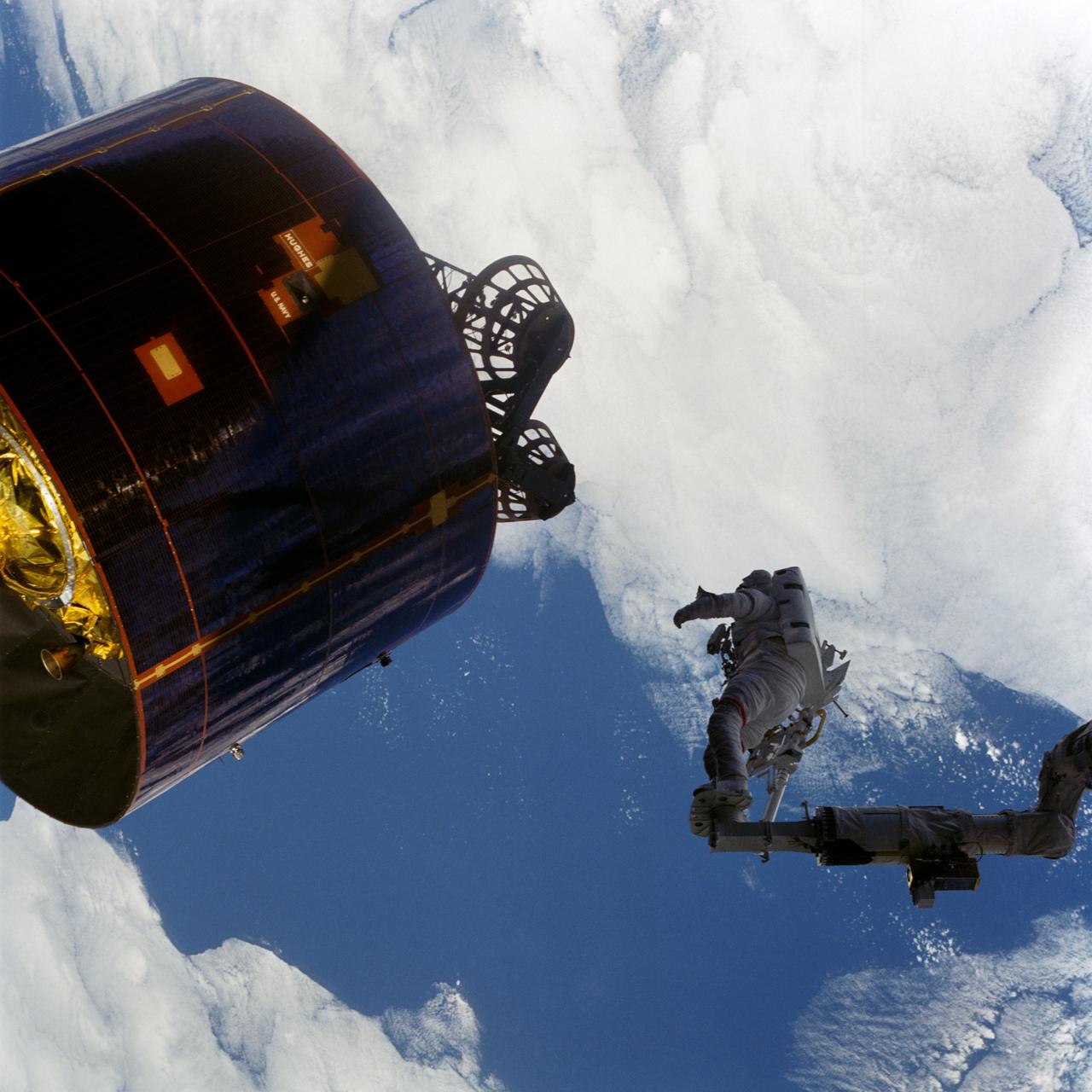
51I-44-014 (31 Aug-1 Sept. 1985) --- This photograph is one of a series of six covering extravehicular activity (EVA) which were released by NASA on Sept. 4, 1985. Here, astronaut James D. van Hoften, dwarfed by the large satellite, moves in for initial contact. Astronaut John M. (Mike) Lounge, out of frame inside cabin, maneuvers the remote manipulator system (RMS) arm to assist astronauts van Hoften and William F. Fisher. Photo credit: NASA
Astronaut James van Hoften working with Syncom IV-3 satellite
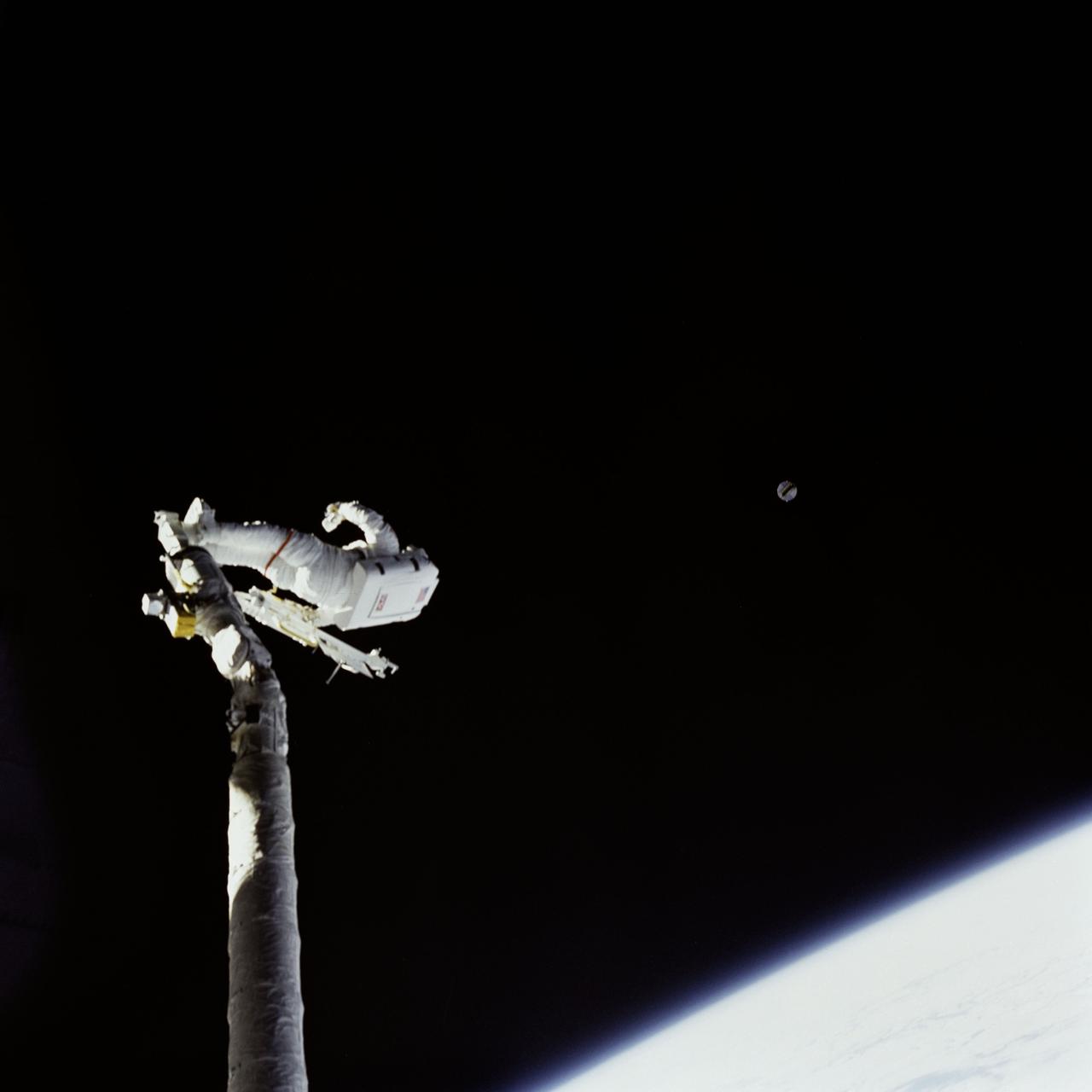
51I-102-033 (31 August - 1 September 1985) --- This is one of a series of six photographs released by NASA covering the extravehicular activity (EVA) of astronauts James D. van Hoften and William F. Fisher, who helped to capture, repair and release the previously errant Syncom IV-3 communications satellite.  Here, Dr. van Hoften has just given a shove to the the Syncom. (For orientation, moon should be in lower right quadrant).
Astronaut James van Hoften working with Syncom IV-3 satellite
51I-102-029 (31 August - 1 September 1985) --- This is one of a series of six photographs released by NASA covering the extravehicular activity (EVA) of astronauts James D. van Hoften and William F. Fisher, who helped to capture, repair and release the previously errant Syncom IV-3 communications satellite. Here, Dr. van Hoften has just given a shove to the the Syncom. (For orientation, moon should be in lower right quadrant).
Astronaut James van Hoften working with Syncom IV-3 satellite
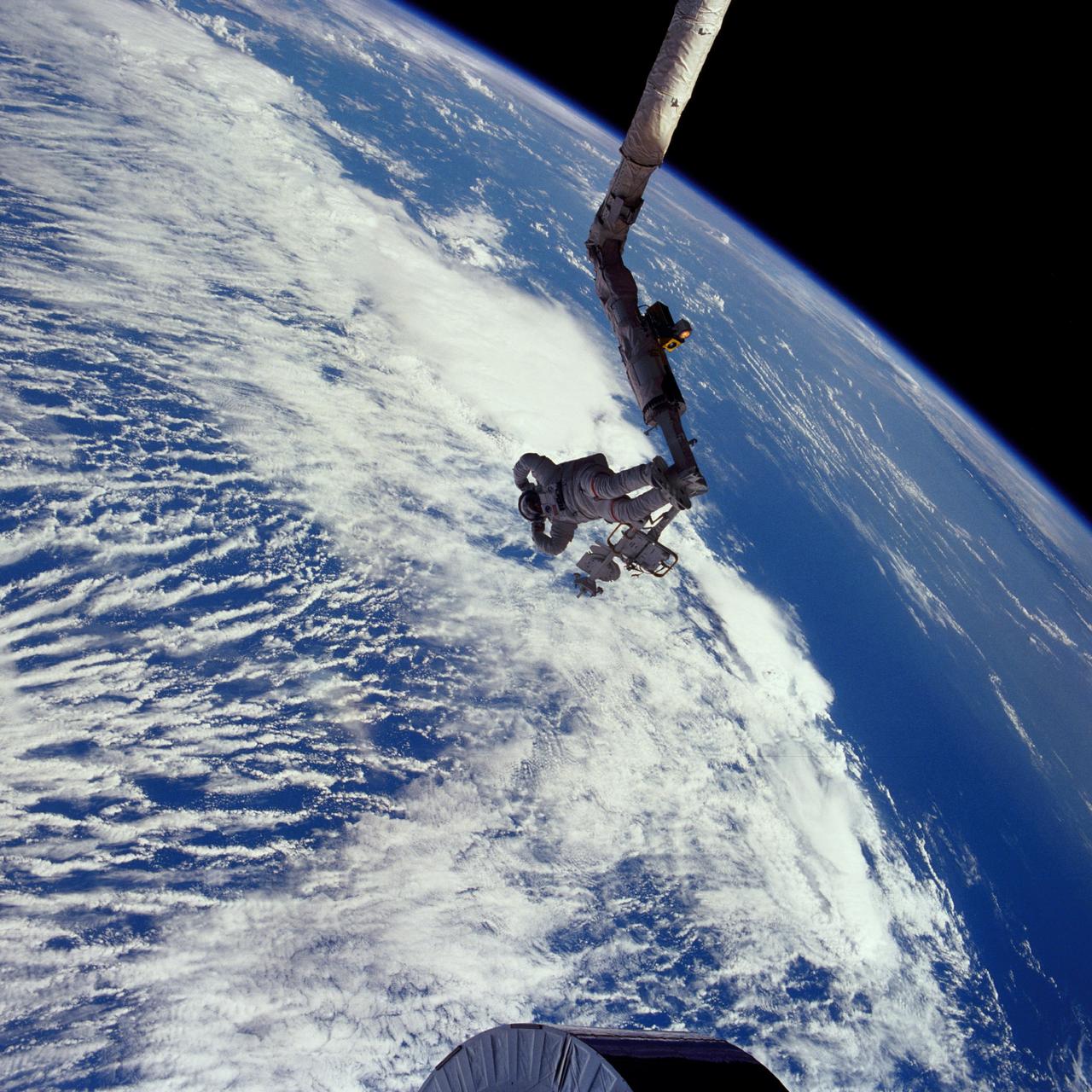
51I-41-086 (1 September 1985) --- Astronaut James D. van Hoften, mission specialist, flexes his muscles in celebration of a triumphant extravehicular task.  Clouds over the ocean form the backdrop for this 70mm scene, toward the end of a two-day effort to capture, repair and release the previously errant Syncom IV-3 communications satellite.  Van Hoften, anchored to a special foot restraint device on the end of Discovery's Remote Manipulator System (RMS), had just performed the final "shove" that started the relative separation of the Shuttle and the Syncom, which is not far out of frame.  He had been joined by astronaut William F. Fisher for the busy two days of EVA.
Astronaut James van Hoften on RMS tracking Syncom IV-3 after deployment
51I-44-081 (1 Sept  1985) --- Astronaut James D. van Hoften on the Discovery's remote manipulator system (RMS) arm visually tracks the distant Syncom IV-3 communications satellite after its second release, on Sept. 1, 1985.
Astronaut James van Hoften on RMS tracking Syncom IV-3 after deployment
51I-44-012 (1 Sept. 1985) --- Astronaut James D. van Hoften looks on as the Syncom IVC-3 satellite responds to his push against it moments earlier.  Dr. van Hoften, mission specialist, is anchored to a foot restraint on the end of the remote manipulator system (RMS) arm of the Earth-orbiting space shuttle Discovery. The 51-I crew members showed this photograph at their Sept. 11 postflight press conference. Photo credit: NASA
LEASAT-3 repair during the van Hoften and Fisher EVA
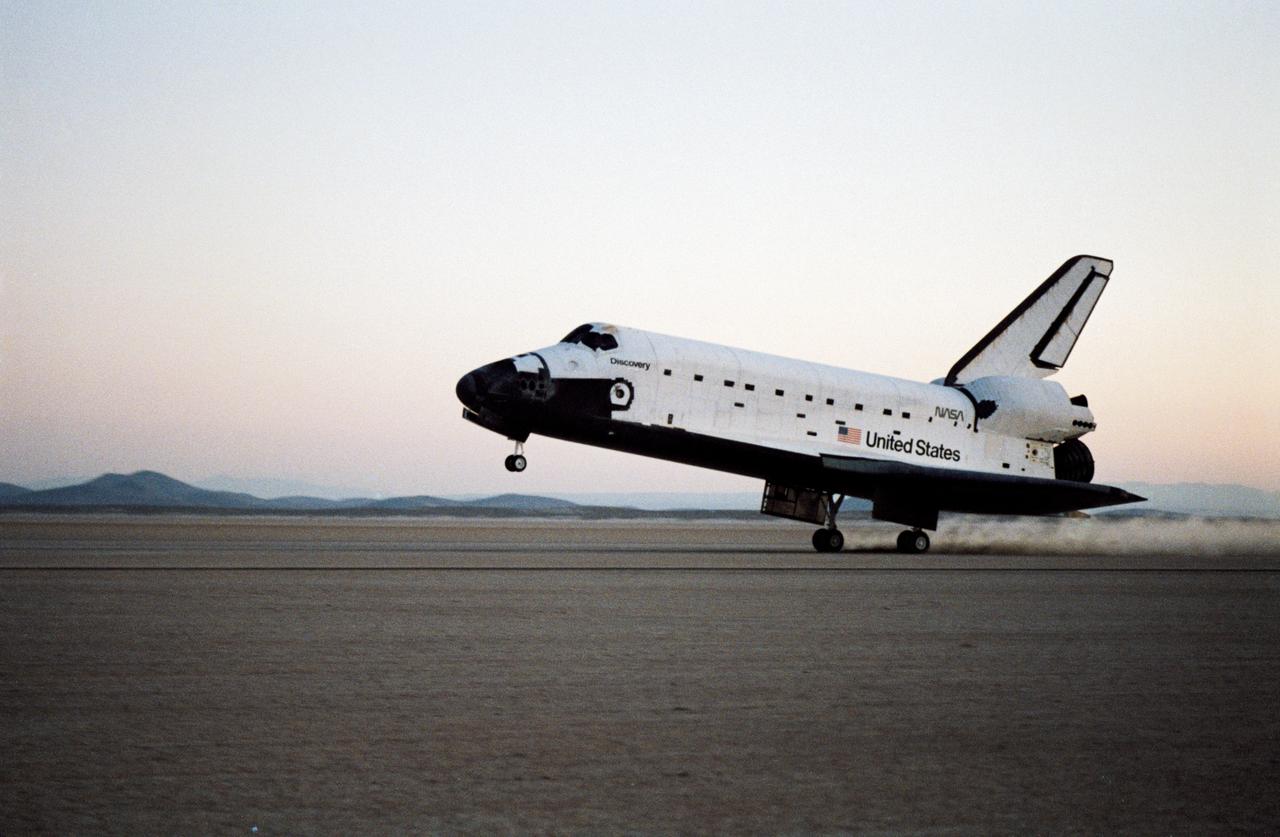
51I-102-048 (4-5 Sept 1985) --- A 35mm frame showing astronaut William F. Fisher standing on the edge of Discovery's cargo bay (in foot restraint) during the second day of a two-day effort to capture, repair and re-release the Syncom IV-3 communications satellite.  Astronaut James D. van Hoften, standing on the Discovery's RMS arm, exposed the frame.
Astronaut William Fisher anchored to foot restraint on Discovery