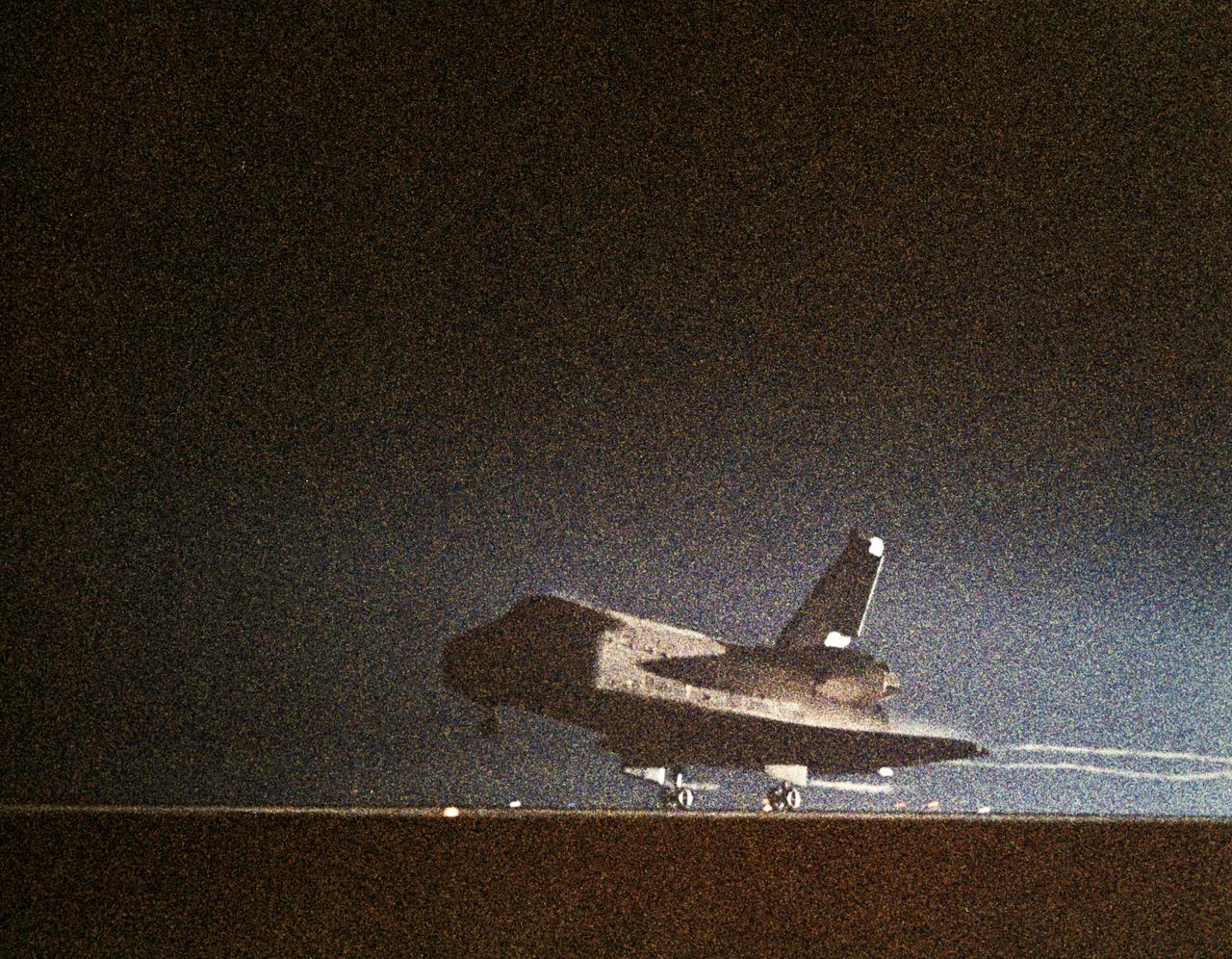
61C-S-050 (18 Jan 1986) --- This NASA photo records the night landing of space shuttle Columbia at Edwards Air Force Base and end of the STS 61-C mission. View is of the shuttle's main landing gear touching down, with streams of light trailing behind the orbiter. Photo credit: NASA
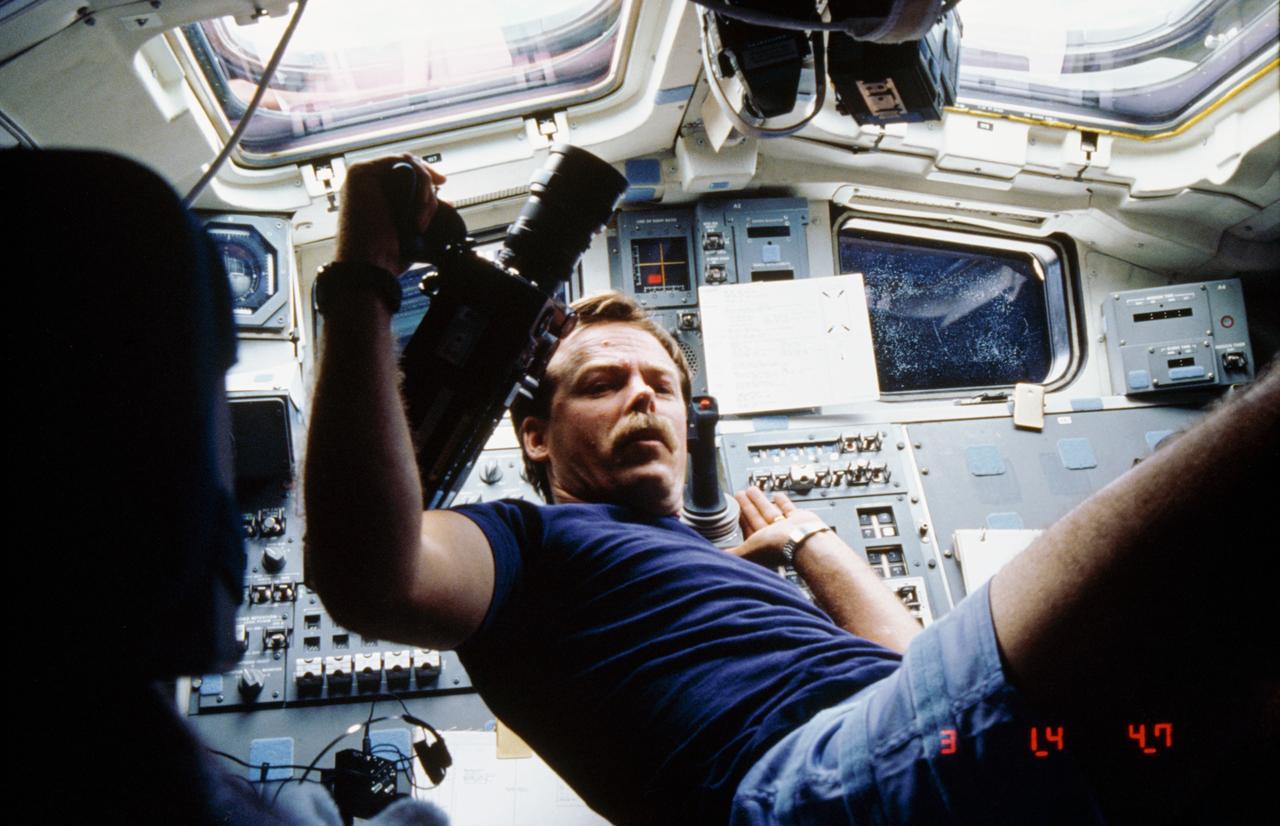
61C-07-030 (15 Jan 1986) --- Astronaut Robert L. Gibson, STS 61-C mission commander, partially floats on the aft flight deck of the earth-orbiting Space Shuttle Columbia while preparing to use a motion picture camera. The windows overlooking the cargo bay are visible in the background.
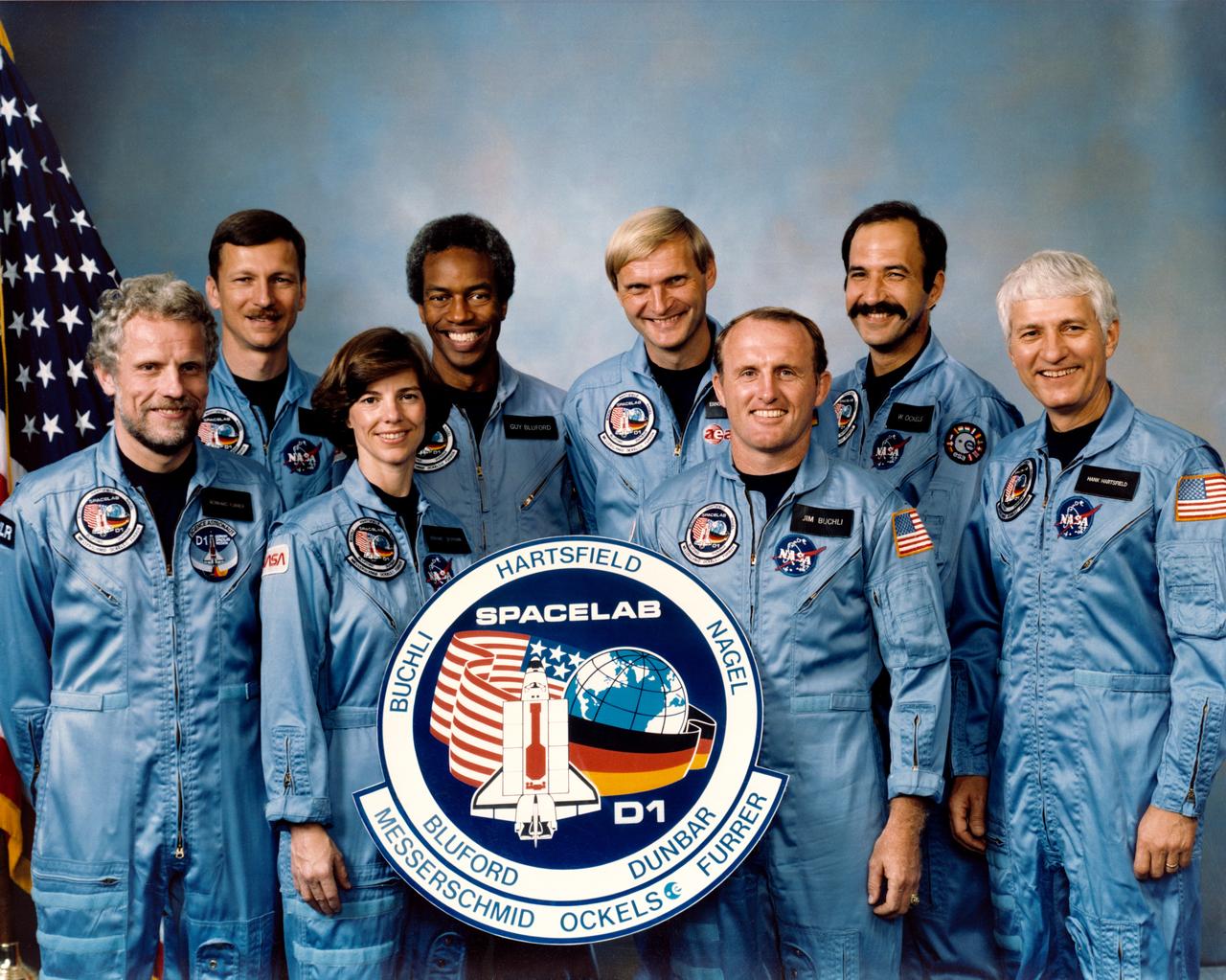
S85-40783 (27 Sept. 1985) --- This international crew expected to fly aboard the space shuttle Challenger when it launches next month represents the largest number (eight) of persons to occupy an orbiting spacecraft at the same time. Posing with the mission insignia are (front row, left to right) Reinhard Furrer, German payload specialist; Bonnie J. Dunbar, mission specialist; James F. Buchli, mission specialist; and Henry W. Hartsfield Jr., commander; and (back row, left to right) Steven R. Nagel, pilot; Guion S. Bluford, mission specialist; Ernst Messerschmid, German payload specialist; and Wubbo J. Ockels, Dutch payload specialist. Photo credit: NASA
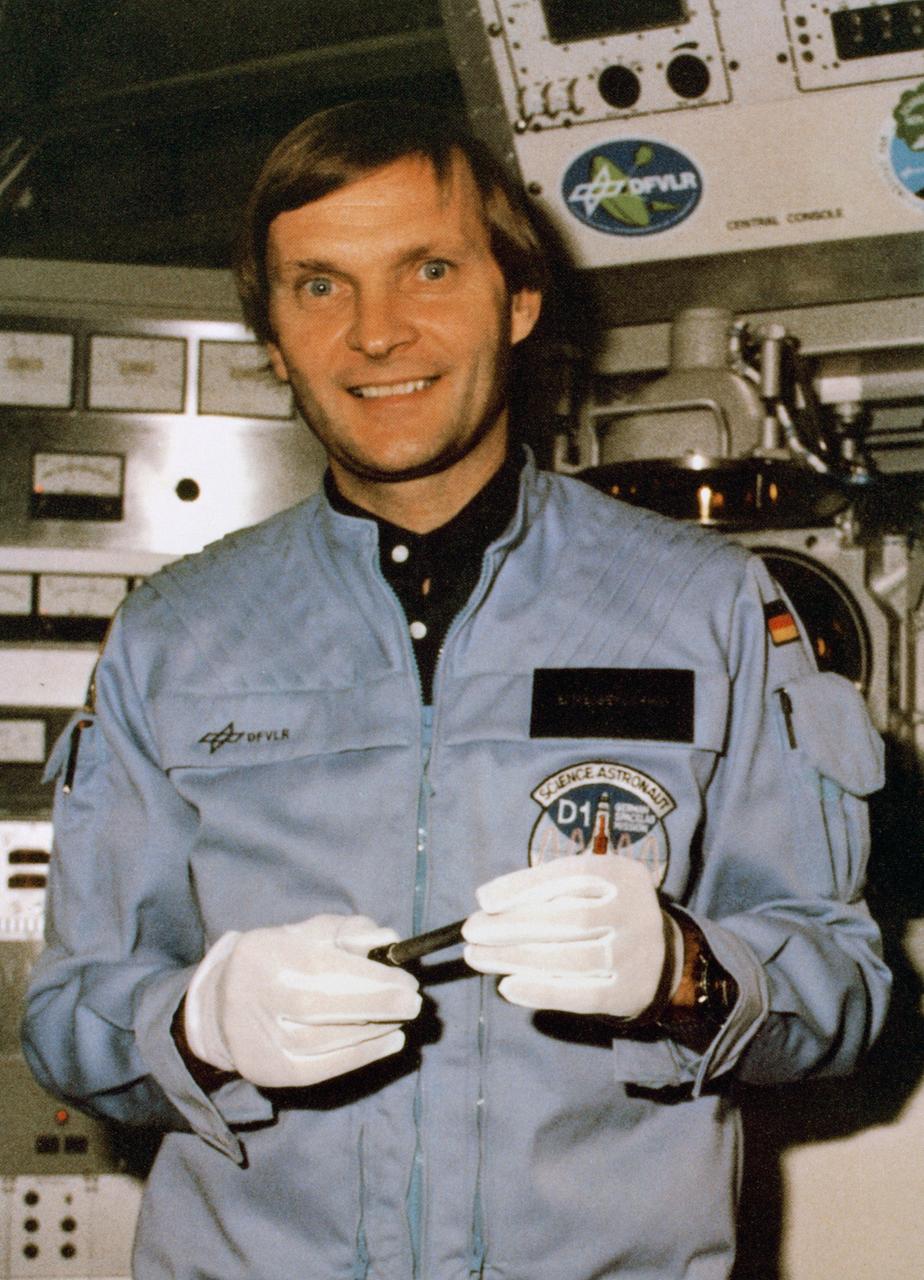
S84-47034 (Nov 1984) --- Astronaut Ernst Messerschmid, payload specialist, D-1 German Spacelab mission.
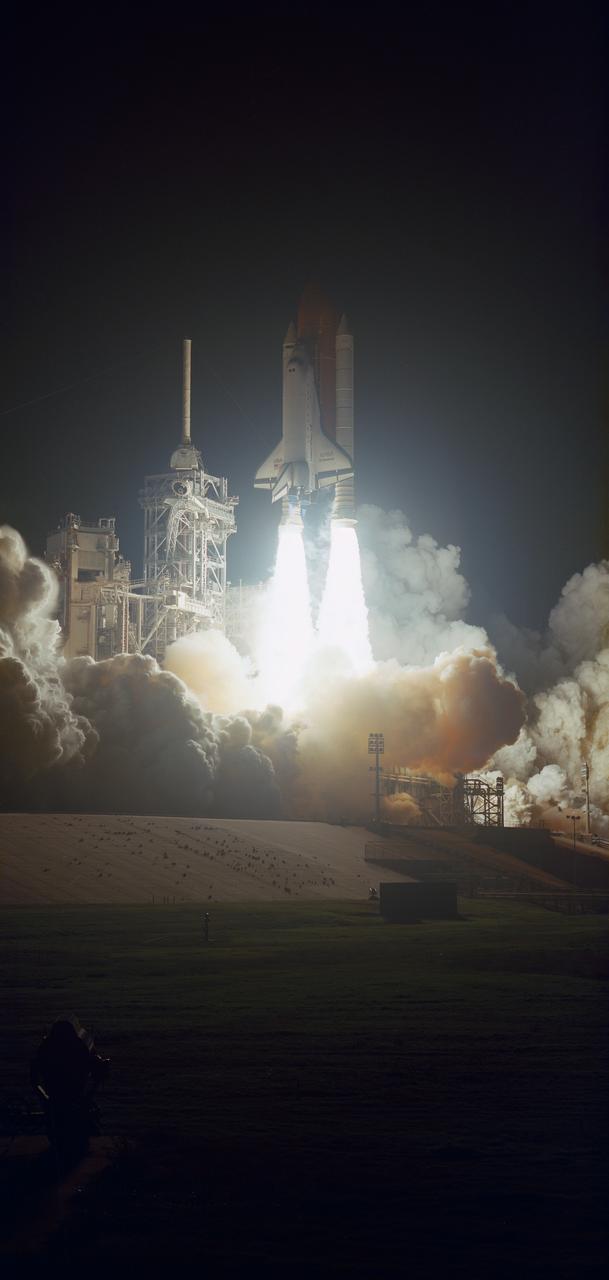
STS061-S-088 (2 Dec 1993) --- The Space Shuttle Endeavour lifts off from Launch Pad 39B with a crew of six NASA astronauts, a Swiss mission specialist and a variety of special tools aboard. Launch occurred at 4:27:00 a.m. (EST), December 2, 1993. The seven member crew will team to perform a variety of service tasks on the Hubble Space Telescope (HST). Four of the group will break into pairs on alternating sessions to carry out a total of five days Extravehicular Activity (EVA). Onboard are astronauts Richard O. Covey, Kenneth D. Bowersox, F. Story Musgrave, Kathy C. Thornton, Jeffrey A. Hoffman and Thomas D. Akers, along with Swiss scientist Claude Nicollier.
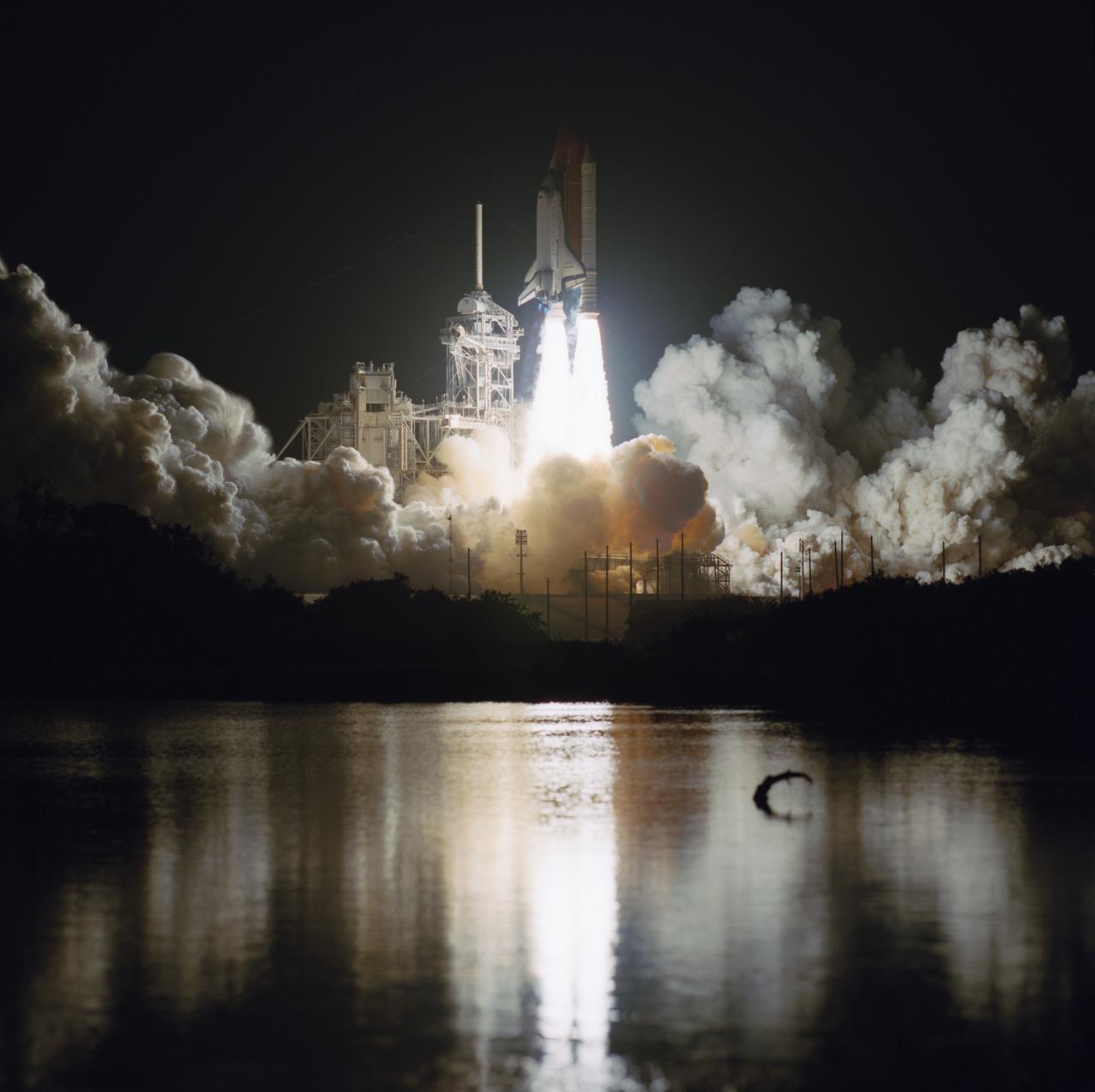
STS061-S-089 (2 Dec 1993) --- The Space Shuttle Endeavour lifts off from Launch Pad 39B with a crew of six NASA astronauts, a Swiss mission specialist and a variety of special tools aboard. Launch occurred at 4:27:00 a.m. (EST), December 2, 1993. The seven member crew will team to perform a variety of service tasks on the Hubble Space Telescope (HST). Four of the group will break into pairs on alternating sessions to carry out a total of five days Extravehicular Activity (EVA). Onboard are astronauts Richard O. Covey, Kenneth D. Bowersox, F. Story Musgrave, Kathy C. Thornton, Jeffrey A. Hoffman and Thomas D. Akers, along with Swiss scientist Claude Nicollier.
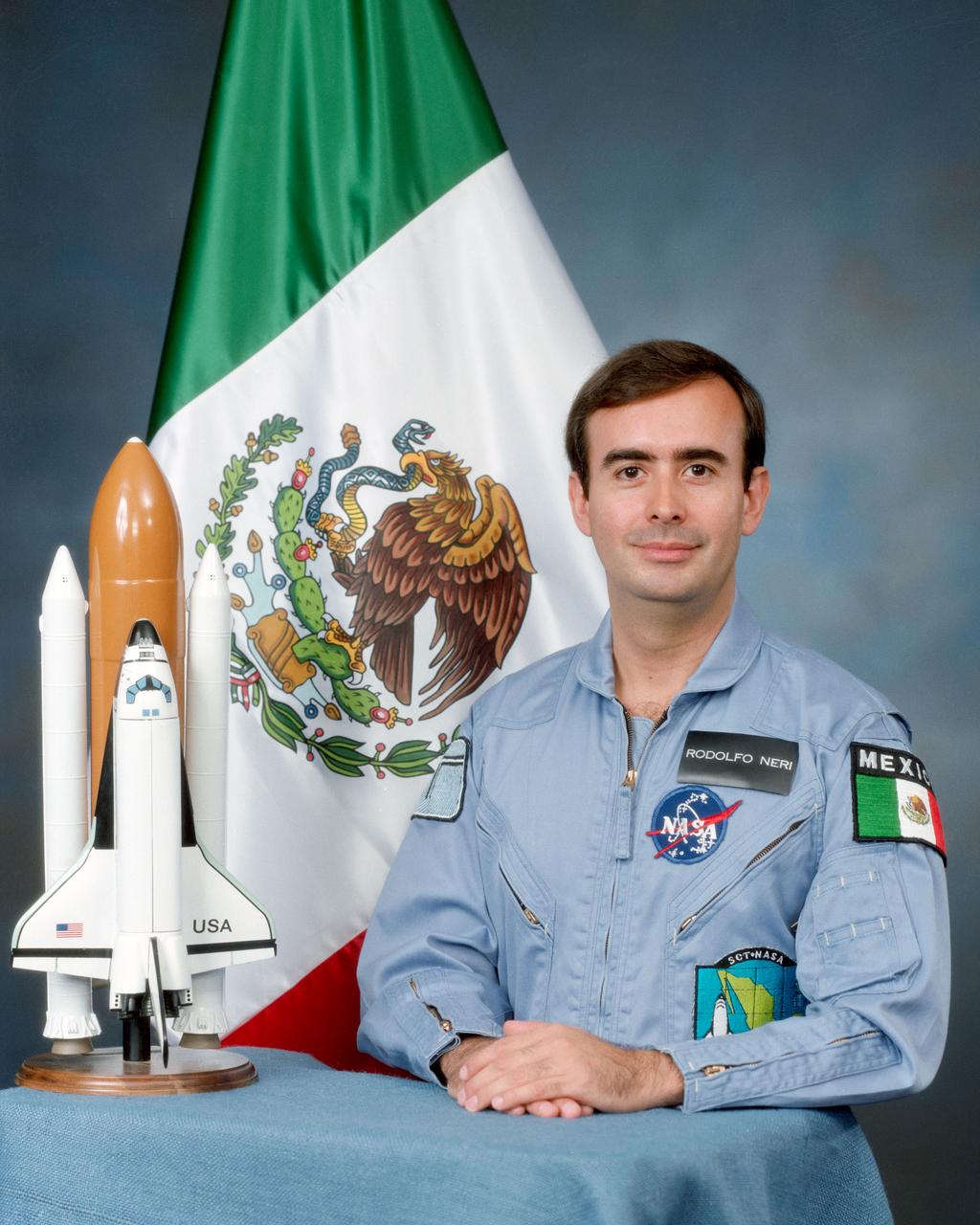
S85-39865 (4 Sept 1985) --- Astronaut Rodolfo Neri, payload specialist
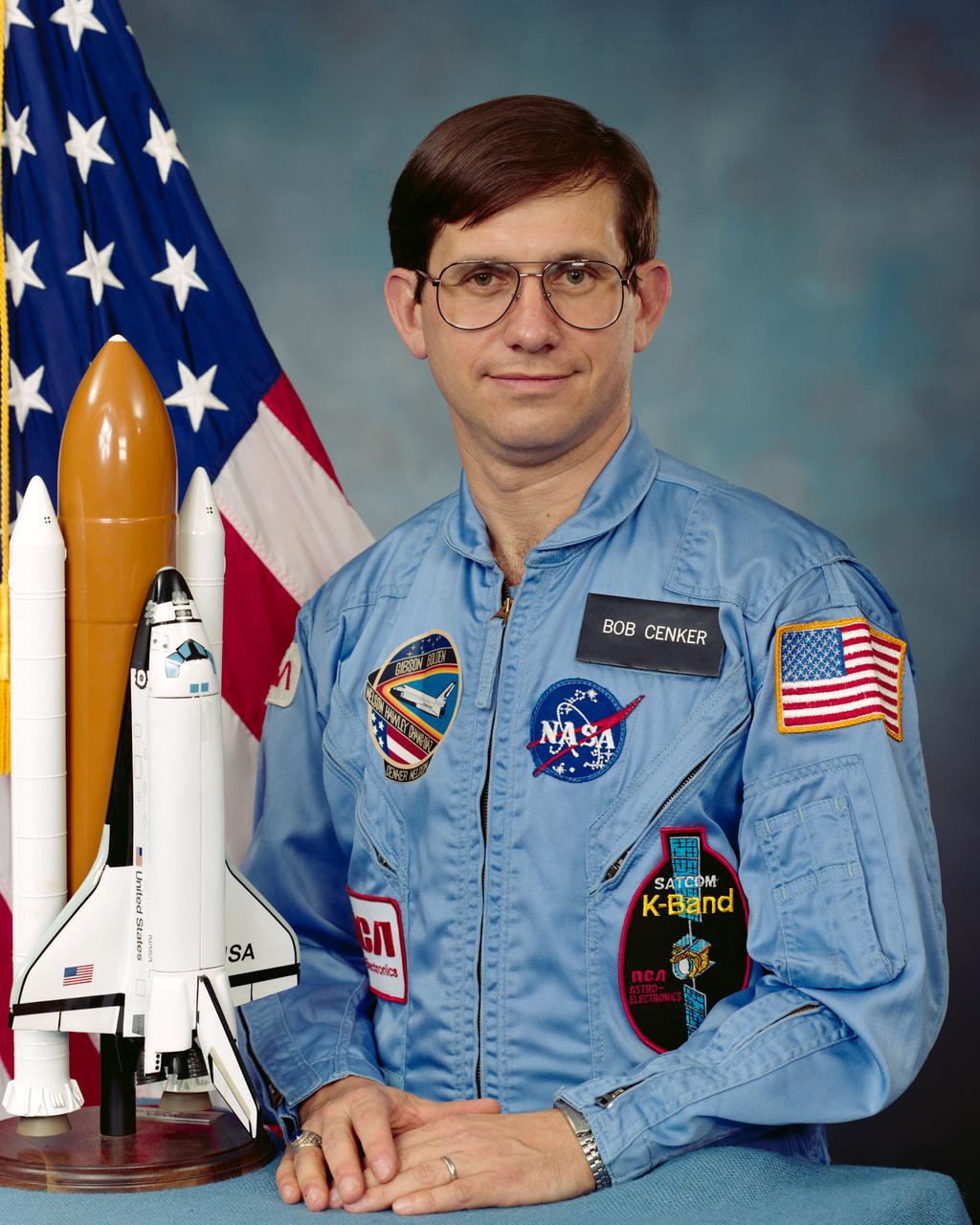
S85-45499 (2 Dec 1985) --- Payload specialist Robert J. Cenker.
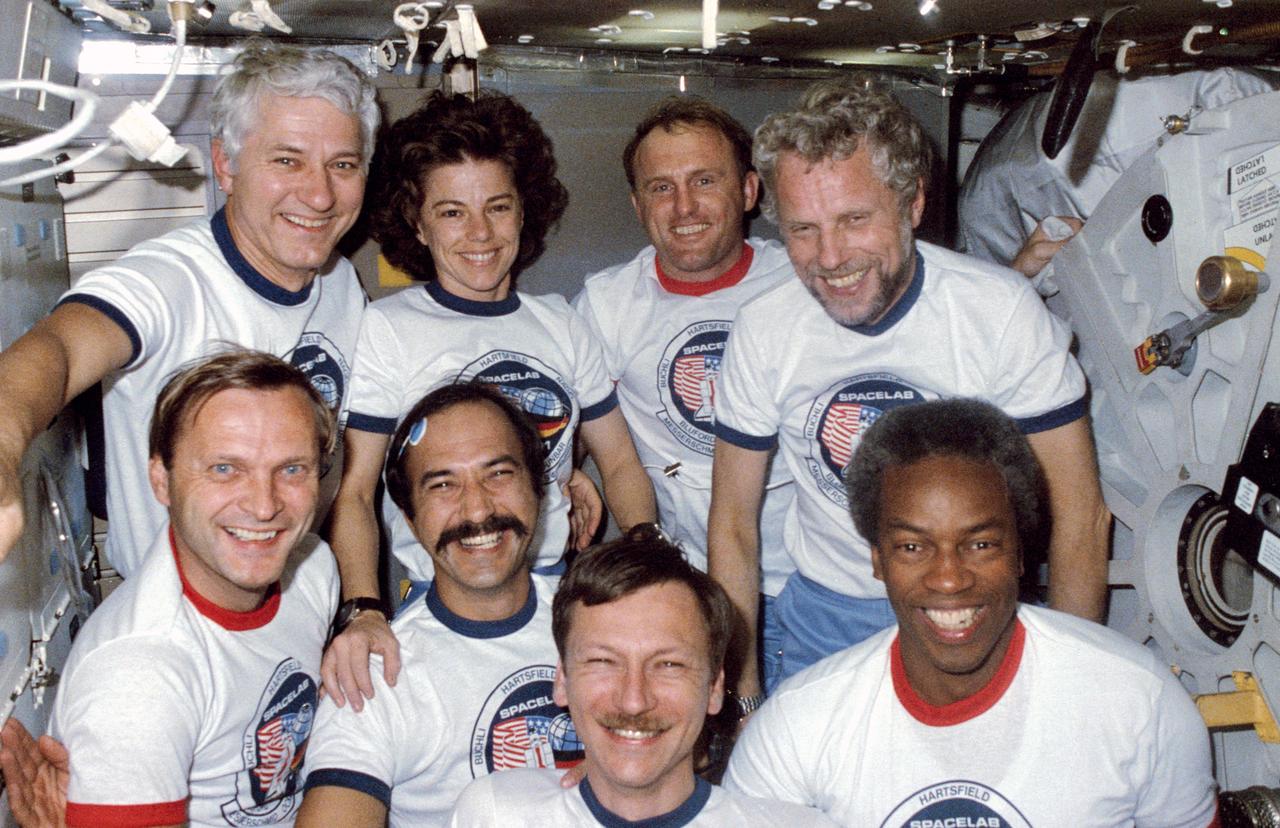
61A-117-019 (30 Oct.-6 Nov. 1985) --- Traditional in-flight portrait of all eight STS-61A crew members was made with an automatic exposure of a 35mm camera. Left to right, back row, Henry W. Hartsfield Jr., commander; Bonnie J. Dunbar, mission specialist; James F. Buchli, mission specialist; and Reinhard Furrer, payload specialist. Left to right, front row, Ernst Messerschmid, payload specialist; Wubbo J. Ockels, payload specialist representing the European Space Agency (ESA); Steven R. Nagel, pilot; and Guion S. Bluford Jr., mission specialist. Photo credit: NASA
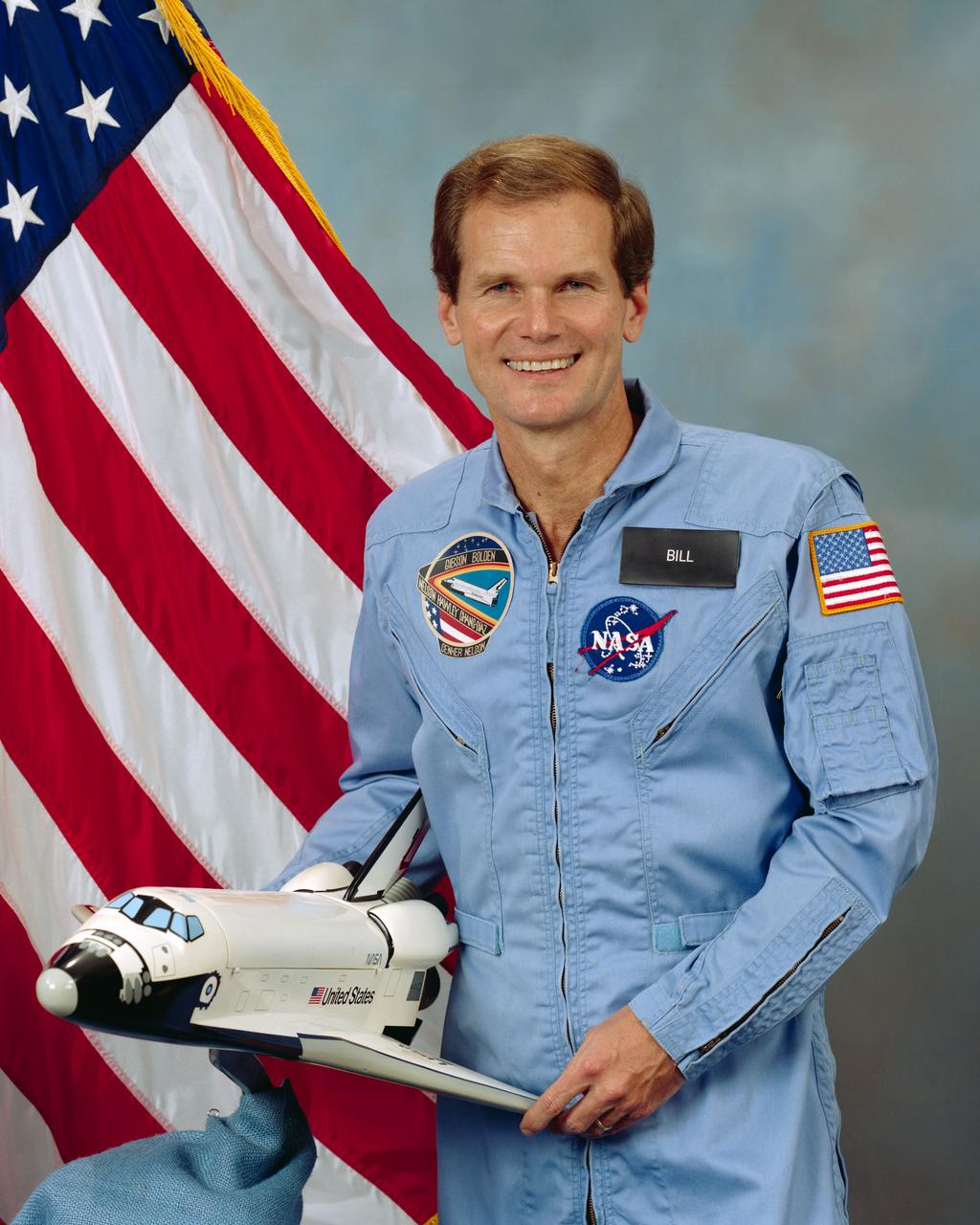
S85-43440 (25 Oct. 1985) --- Official portrait of Congressman Bill Nelson, U.S. House of Representatives - Florida, STS 61-C payload specialist. He is in the blue shuttle flight suit, holding a model of the shuttle with an American flag behind him.
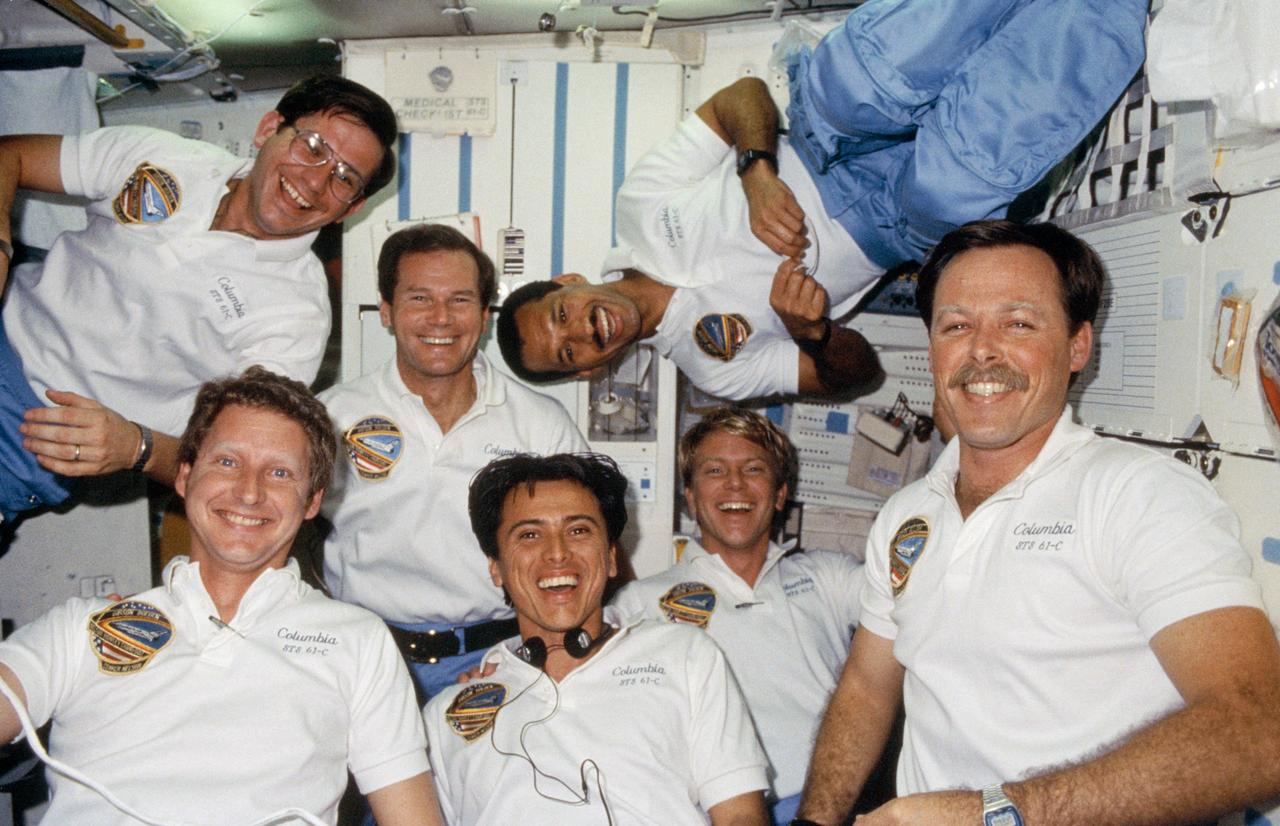
61C-14-008 (12-18 Jan. 1986) --- The seven crew members for STS-61C mission use the space shuttle Columbia's middeck for the traditional in-flight group portrait. Astronaut Robert L. Gibson (lower right corner), commander, is surrounded by fellow crew members, counter-clockwise from upper right: astronaut Charles F. Bolden, pilot; U.S. Representative Bill Nelson (D., Florida), payload specialist; Robert J. Cenker, RCA payload specialist; and astronauts Steven A. Hawley, Franklin R. Chang-Diaz and George D. Nelson, all mission specialists. Photo credit: NASA
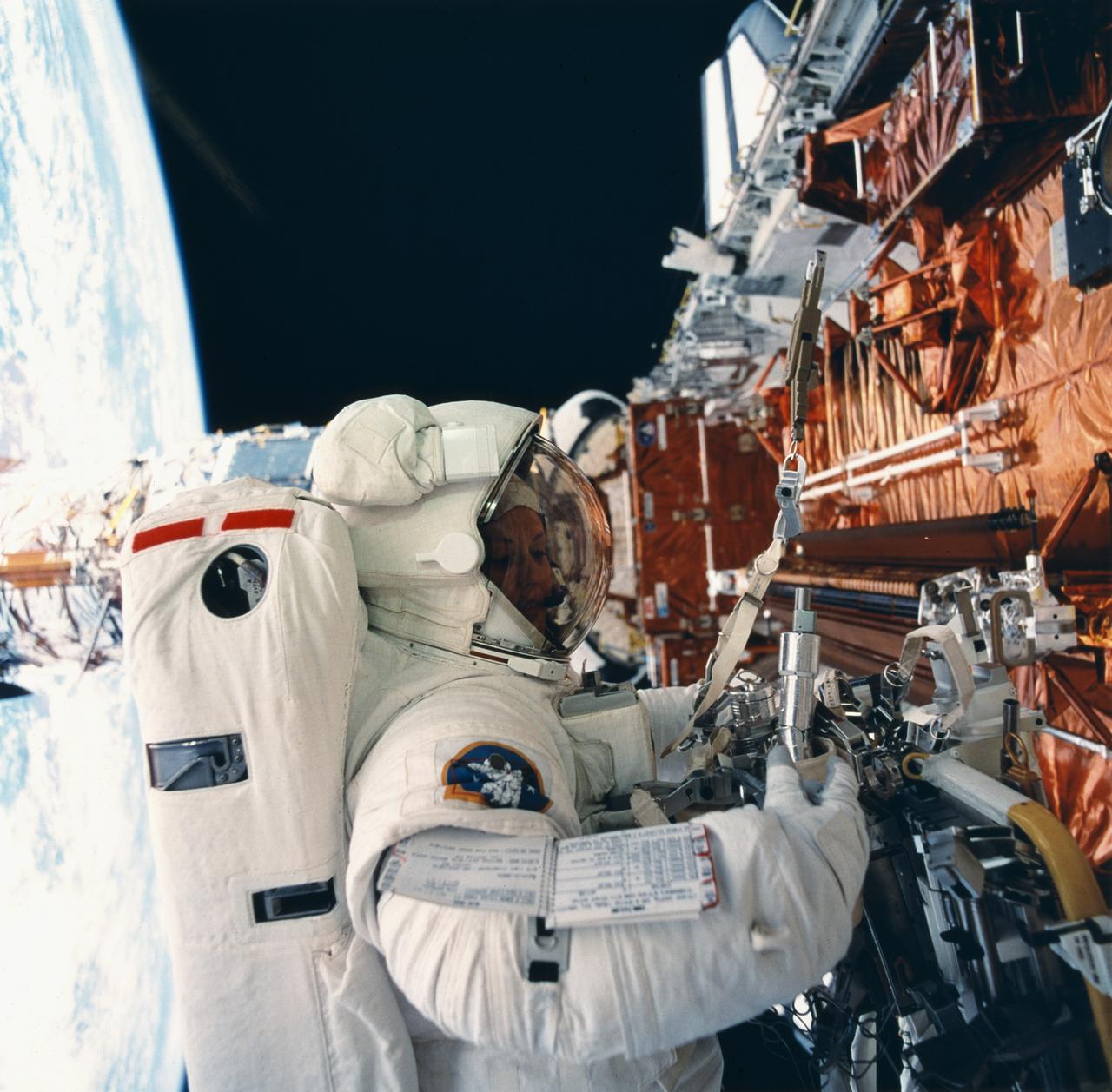
This STS-61 onboard photo depicts Astronaut and mission specialist Kathryn Thornton performing the 2nd extra-vehicular activity (EVA) of the STS-61 mission. Thornton, along with astronaut and mission specialist Thomas Akers (out of frame), performed the task of replacing the solar arrays. The EVA lasted 6 hours and 35 minutes. Launched December 1, 1993 aboard the Space Shuttle Orbiter Endeavor, the STS-61 mission was solely dedicated to servicing the HST.
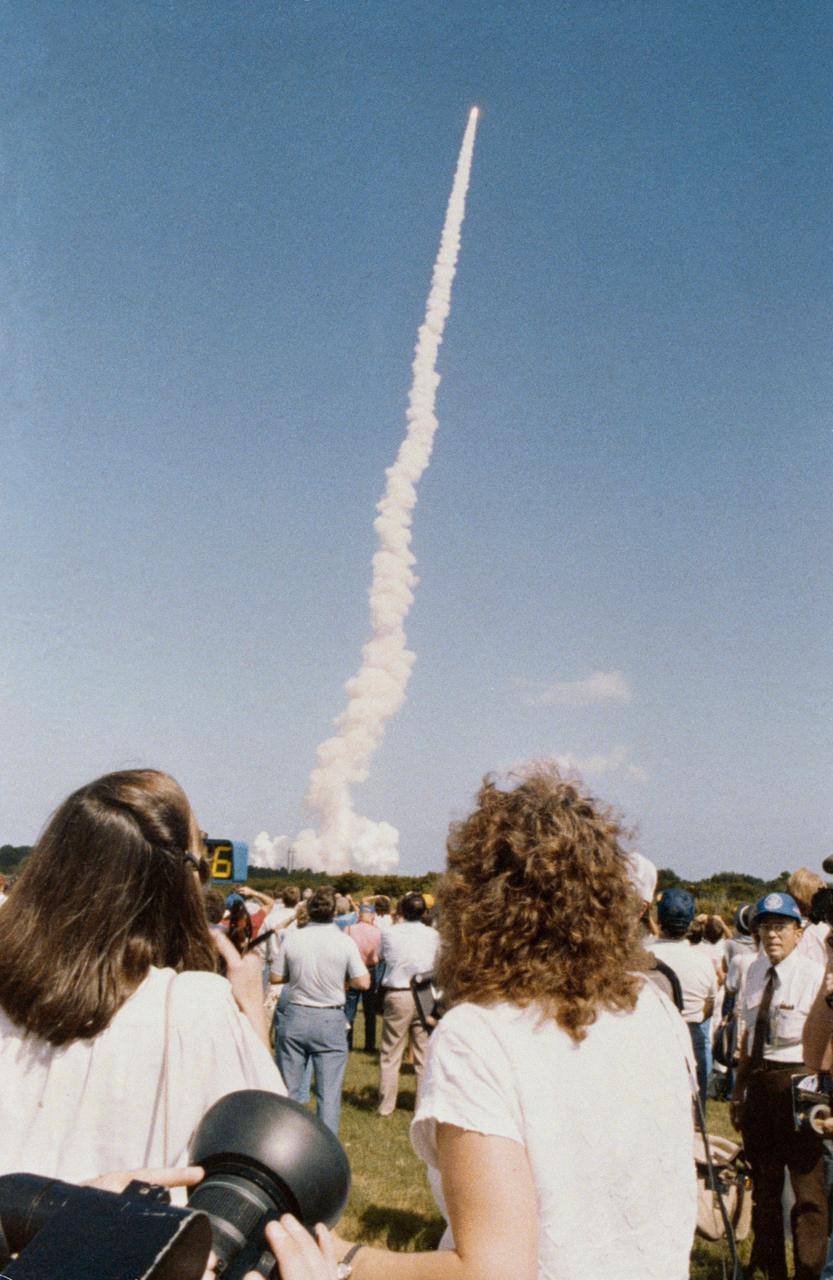
S86-25293 (30 Oct. 1985) --- Barbara R. Morgan and Sharon Christa McAuliffe (right) are pictured during a visit to NASA's Kennedy Space Center (KSC) Launch Complex 39 to witness the launch of the space shuttle Challenger. McAuliffe is scheduled to launch aboard the space shuttle Challenger, STS-51L mission, herself early next year as the United States? first in-space citizen observer. Morgan is the backup for the Teacher-in-Space Project?s payload specialist position. The photo was taken by Keith Meyers of the New York Times. EDITOR'S NOTE: The STS-51L crew members lost their lives in the space shuttle Challenger accident moments after launch on Jan. 28, 1986 from the Kennedy Space Center (KSC). Photo credit: NASA
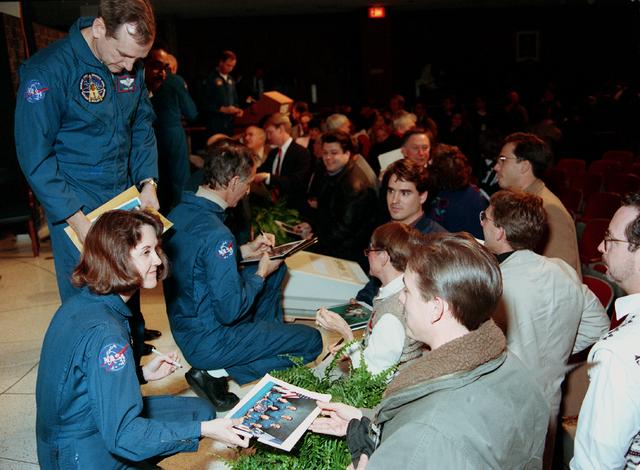
STS-61 astronauts Kathryn Thornton, Jeffrey Hoffman and Thomas Akers (standing) sign autographs in Marshall Space Flight Center's Morris Auditorium, January 19, 1994. Space Shuttle crews traditionally visited NASA field centers following each mission to present mission highlights and recognize employees who made contributions to the Shuttle program. Many of the techniques used during the STS-61 Hubble Space Telescope Servicing mission were rehearsed at the Center's Neutral Buoyancy Simulator.

STS051-98-010 (16 Sept 1993) --- Astronaut James H. Newman, mission specialist, conducts an in-space evaluation of the Portable Foot Restraint (PFR) which will be used operationally on the first Hubble Space Telescope (HST) STS-61 servicing mission and future Shuttle missions. Astronauts Newman and Carl E. Walz spent part of their lengthy extravehicular activity (EVA) evaluating gear to be used on the STS-61 HST servicing mission. The frame was exposed with a 70mm handheld Hasselblad camera from the Space Shuttle Discovery's flight deck.
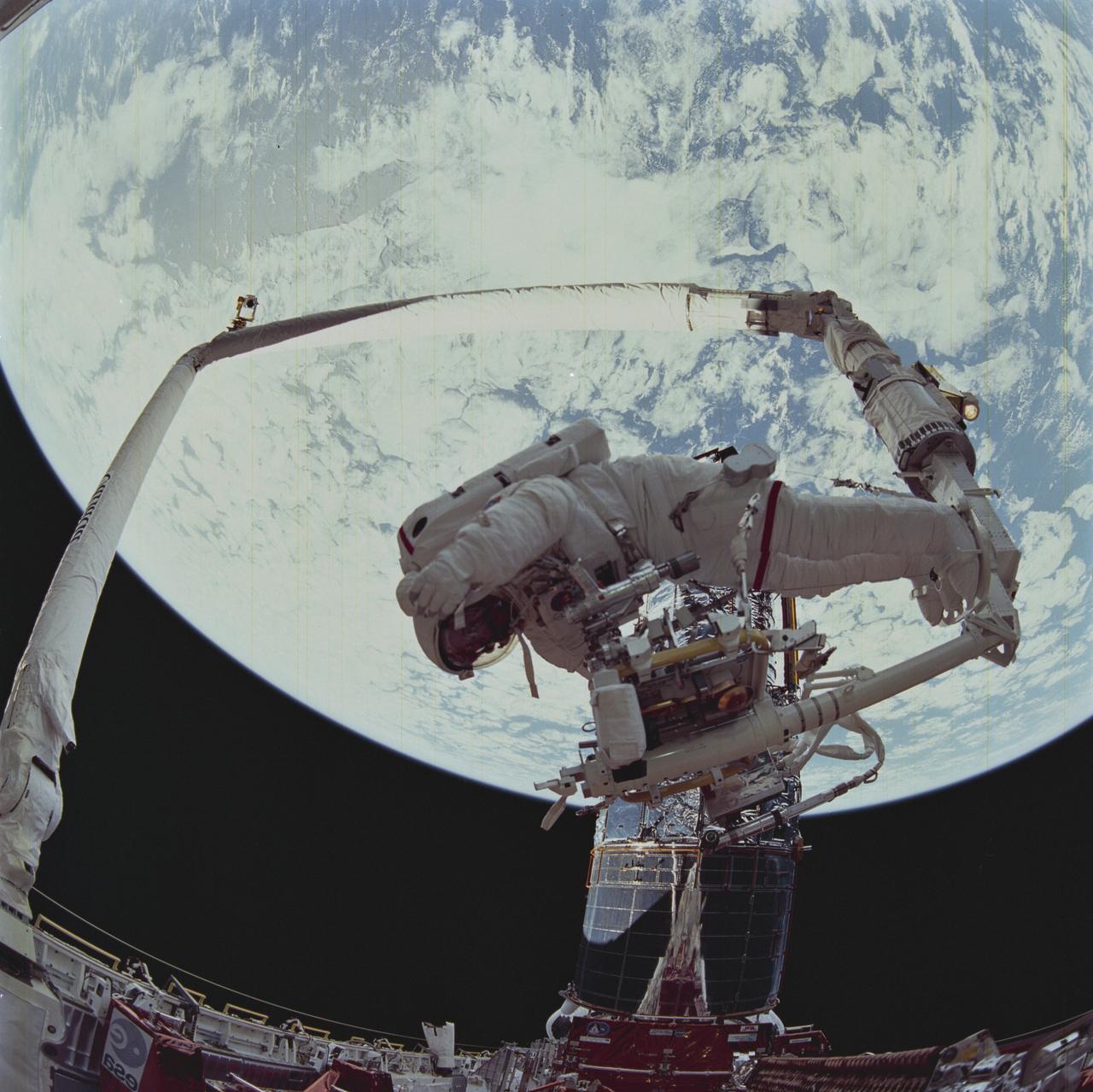
Space Shuttle mission STS-61 onboard view taken by a fish-eyed camera lens showing astronauts Story Musgrave and Jeffrey Hoffman's Extra Vehicular Activity (EVA) to repair the Hubble Space Telescope (HST).
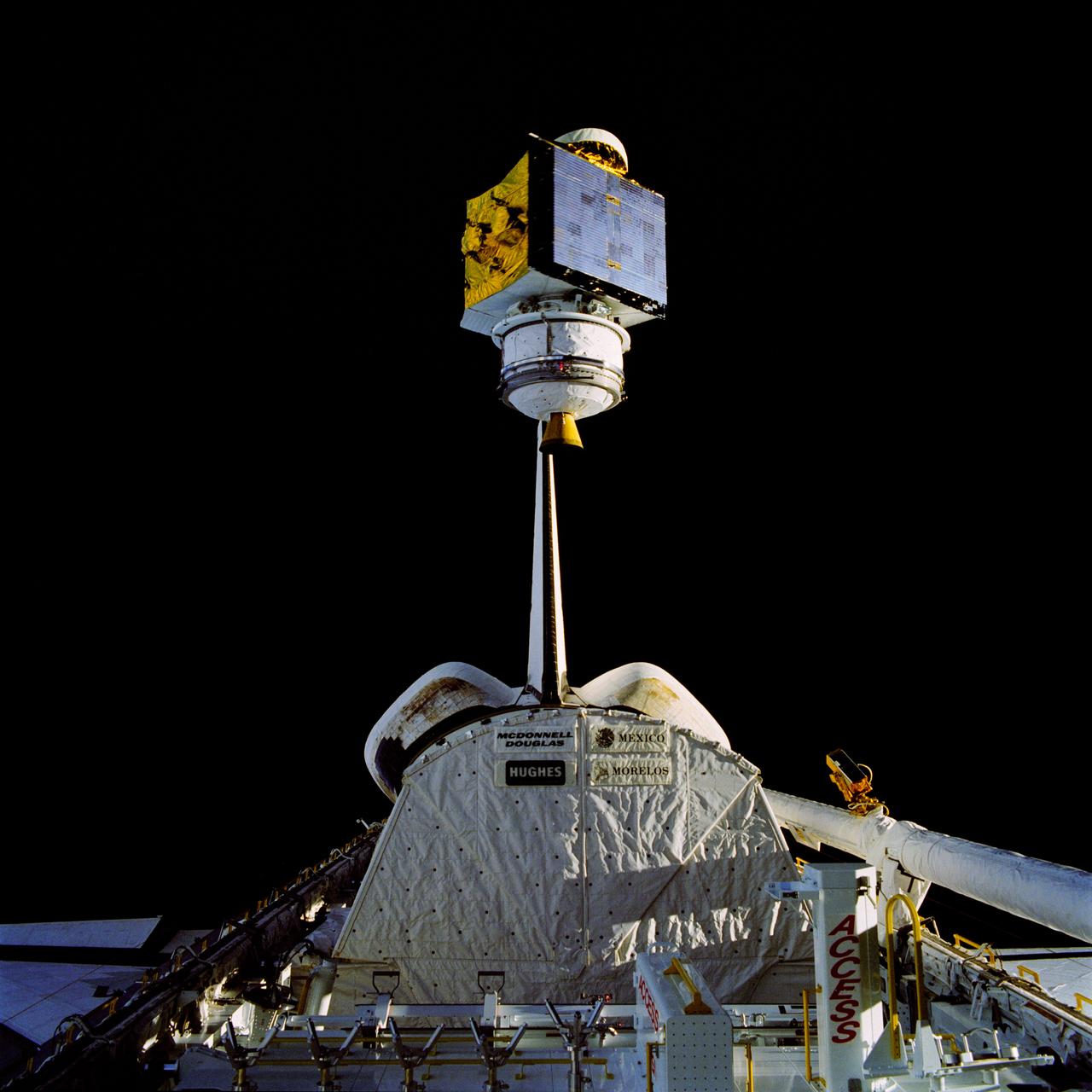
61B-38-36W (28 Nov 1985) --- The 4,144-pound RCA Satcom K-2 communications satellite is photographed as it spins from the cargo bay of the Earth-orbiting Atlantis. A TV camera at right records the deployment for a later playback to Earth. This frame was photographed with a handheld Hasselblad camera inside the spacecraft.
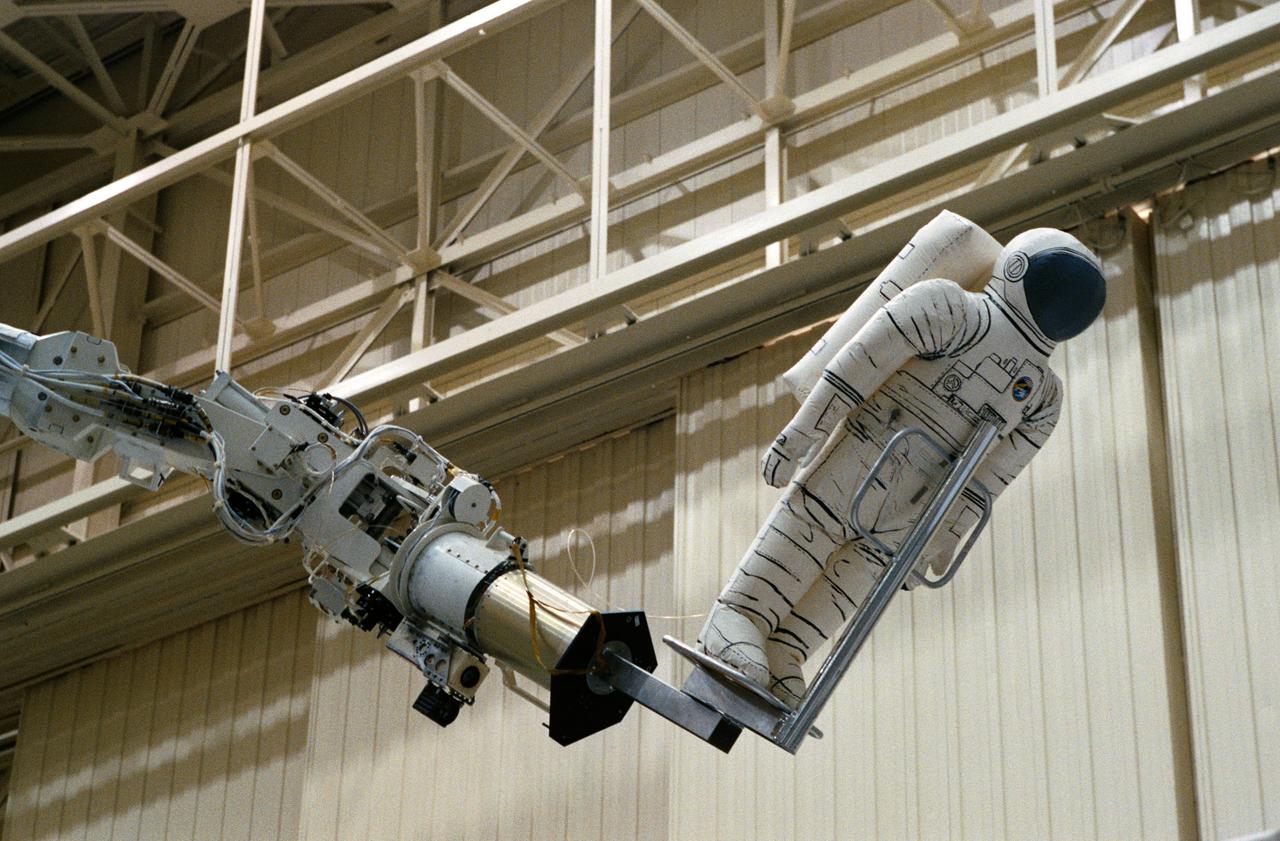
The Remote Manipulator System (RMS) eases a mannequin representing an astronaut into position for an STS-61 Hubble Space Telescope (HST) servicing task in the Space Shuttle mockup and integration laboratory at JSC (35699, 35703); Wide-angle view of the RMS easing a mannequin into position for work on the HST mock-up in bldg 9N (35700-1); Swiss scientist Claude Nicollier, mission specialist, works the control of the RMS during a training session in the manipulator development facility (MDF) in JSC's Shuttle mock-up and integration laboratory. Astronaut Kenneth D. Bowersox (left), pilot, is among the other crewmembers in training for the STS-61 HST servicing mission (35702).
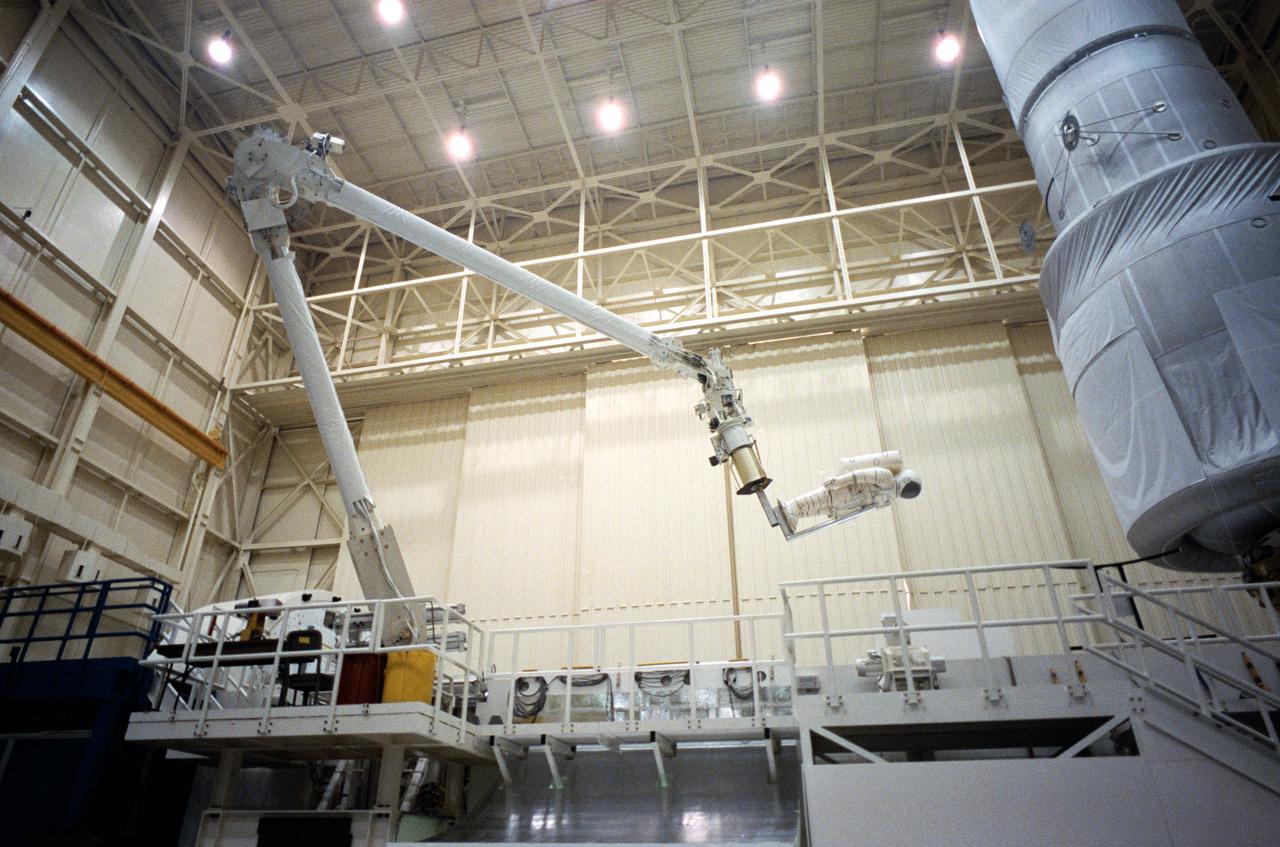
The Remote Manipulator System (RMS) eases a mannequin representing an astronaut into position for an STS-61 Hubble Space Telescope (HST) servicing task in the Space Shuttle mockup and integration laboratory at JSC (35699, 35703); Wide-angle view of the RMS easing a mannequin into position for work on the HST mock-up in bldg 9N (35700-1); Swiss scientist Claude Nicollier, mission specialist, works the control of the RMS during a training session in the manipulator development facility (MDF) in JSC's Shuttle mock-up and integration laboratory. Astronaut Kenneth D. Bowersox (left), pilot, is among the other crewmembers in training for the STS-61 HST servicing mission (35702).
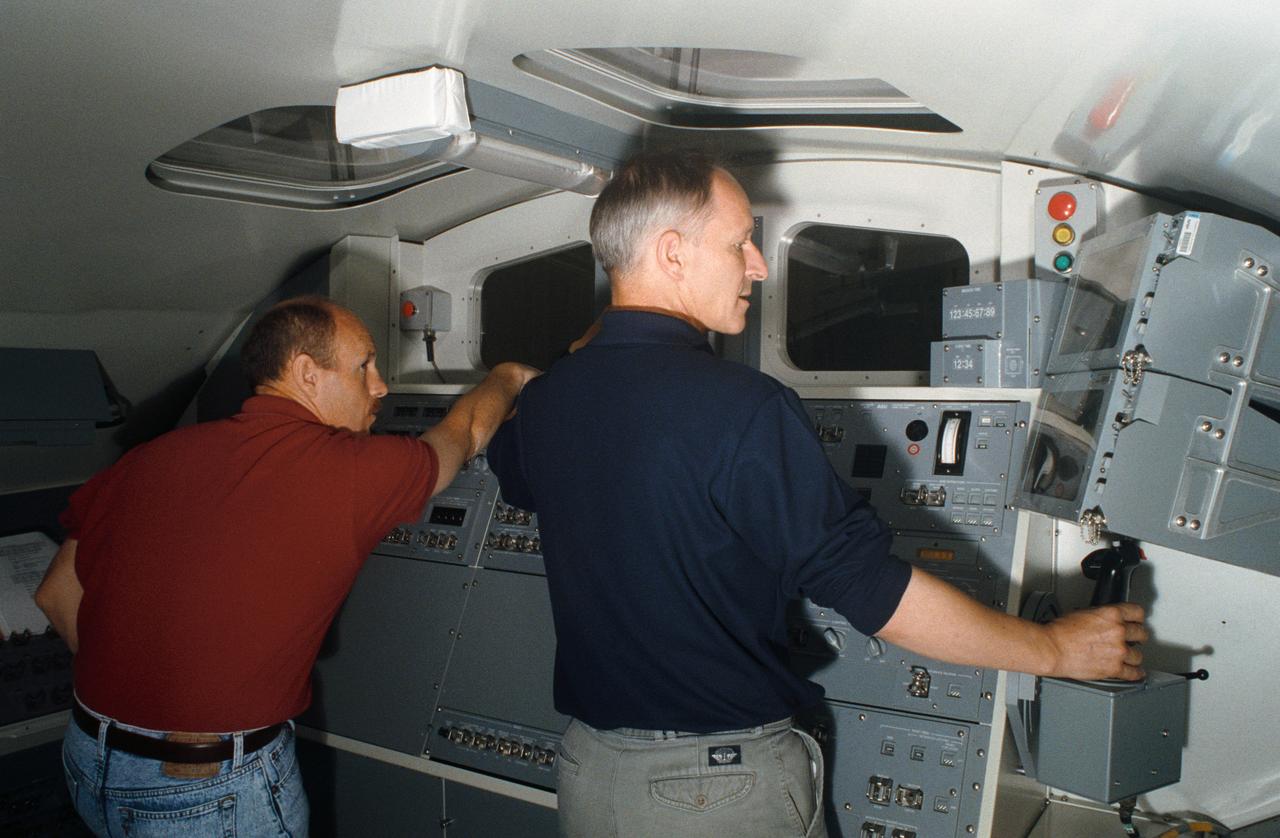
The Remote Manipulator System (RMS) eases a mannequin representing an astronaut into position for an STS-61 Hubble Space Telescope (HST) servicing task in the Space Shuttle mockup and integration laboratory at JSC (35699, 35703); Wide-angle view of the RMS easing a mannequin into position for work on the HST mock-up in bldg 9N (35700-1); Swiss scientist Claude Nicollier, mission specialist, works the control of the RMS during a training session in the manipulator development facility (MDF) in JSC's Shuttle mock-up and integration laboratory. Astronaut Kenneth D. Bowersox (left), pilot, is among the other crewmembers in training for the STS-61 HST servicing mission (35702).
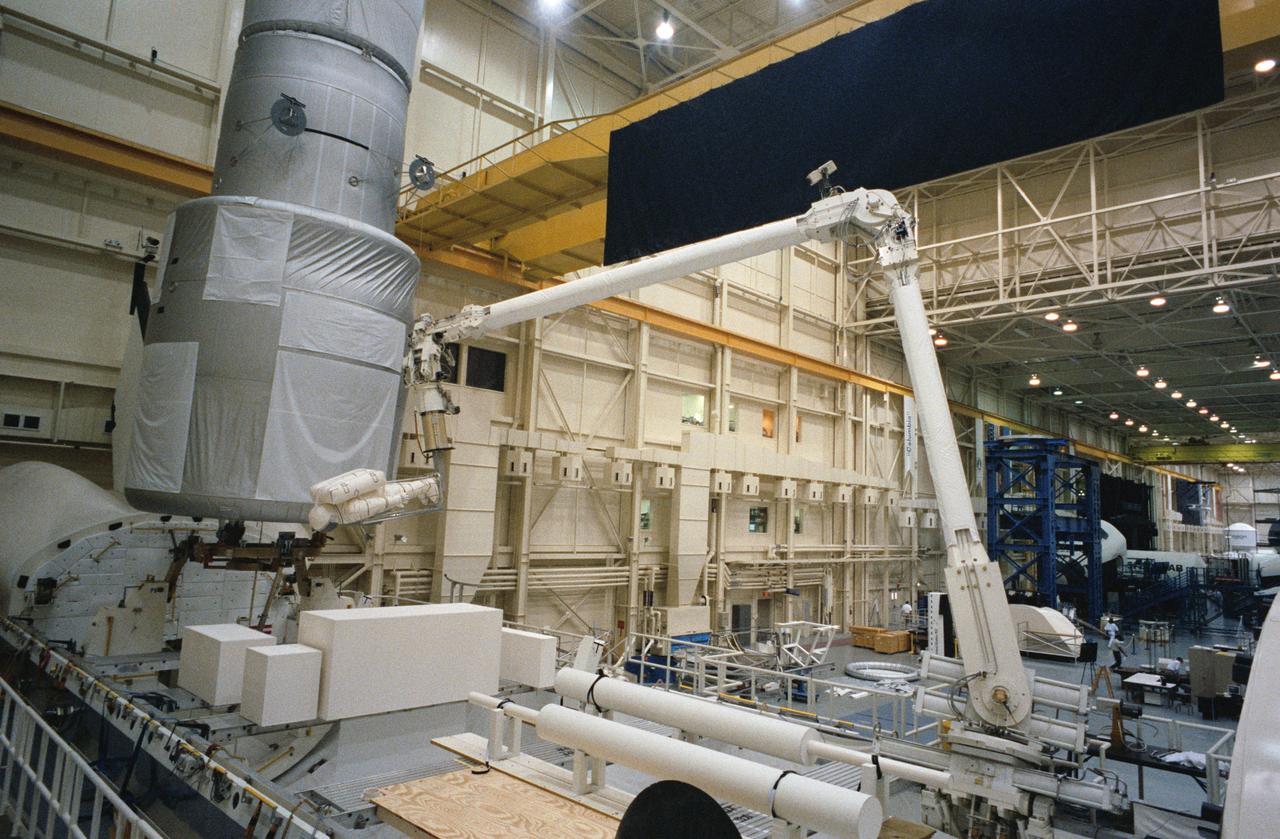
The Remote Manipulator System (RMS) eases a mannequin representing an astronaut into position for an STS-61 Hubble Space Telescope (HST) servicing task in the Space Shuttle mockup and integration laboratory at JSC (35699, 35703); Wide-angle view of the RMS easing a mannequin into position for work on the HST mock-up in bldg 9N (35700-1); Swiss scientist Claude Nicollier, mission specialist, works the control of the RMS during a training session in the manipulator development facility (MDF) in JSC's Shuttle mock-up and integration laboratory. Astronaut Kenneth D. Bowersox (left), pilot, is among the other crewmembers in training for the STS-61 HST servicing mission (35702).
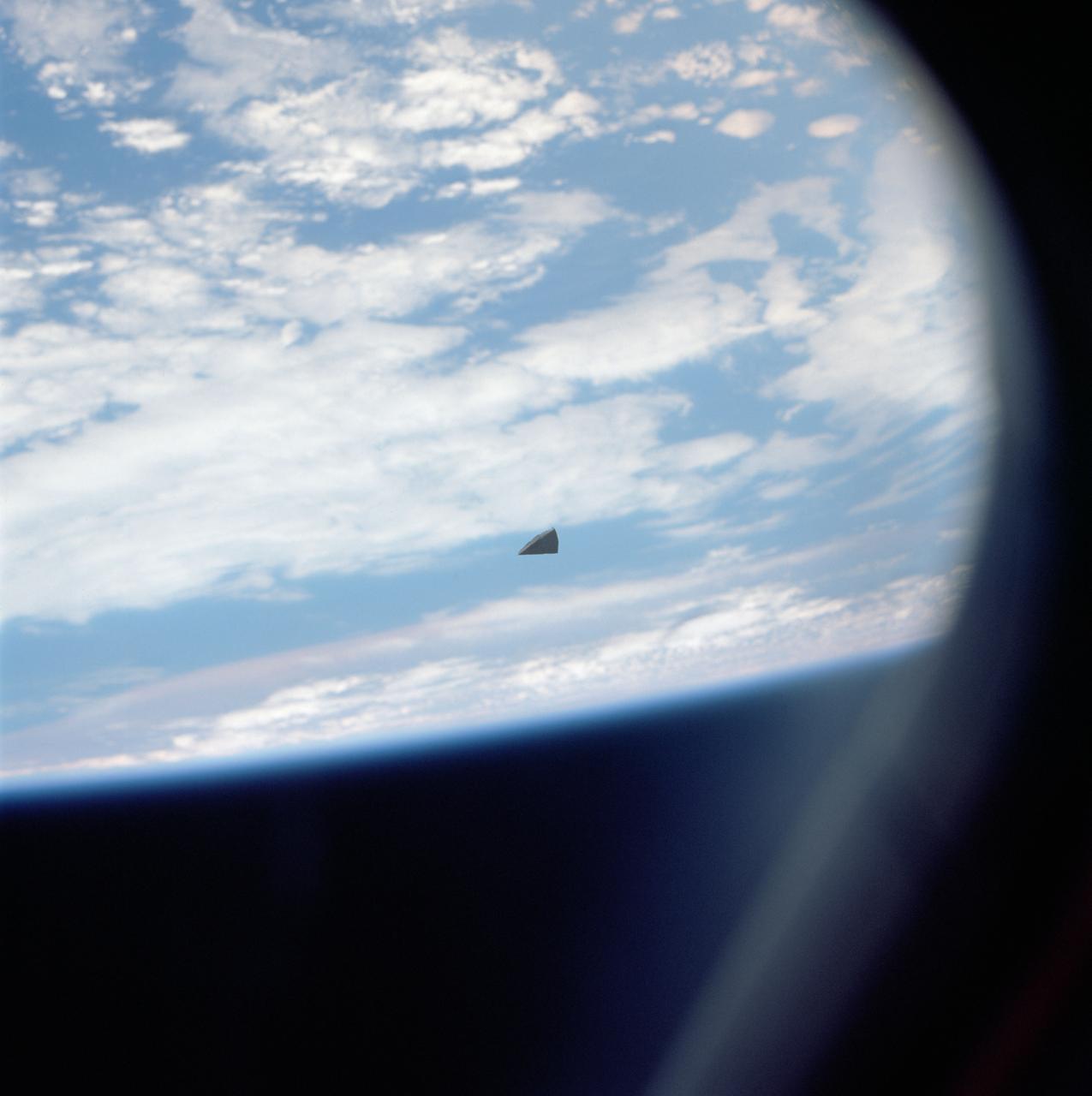
A small piece of thermal insulation tile floats in space near the Shuttle Columbia. The cloudy surface of the earth is used as a background.
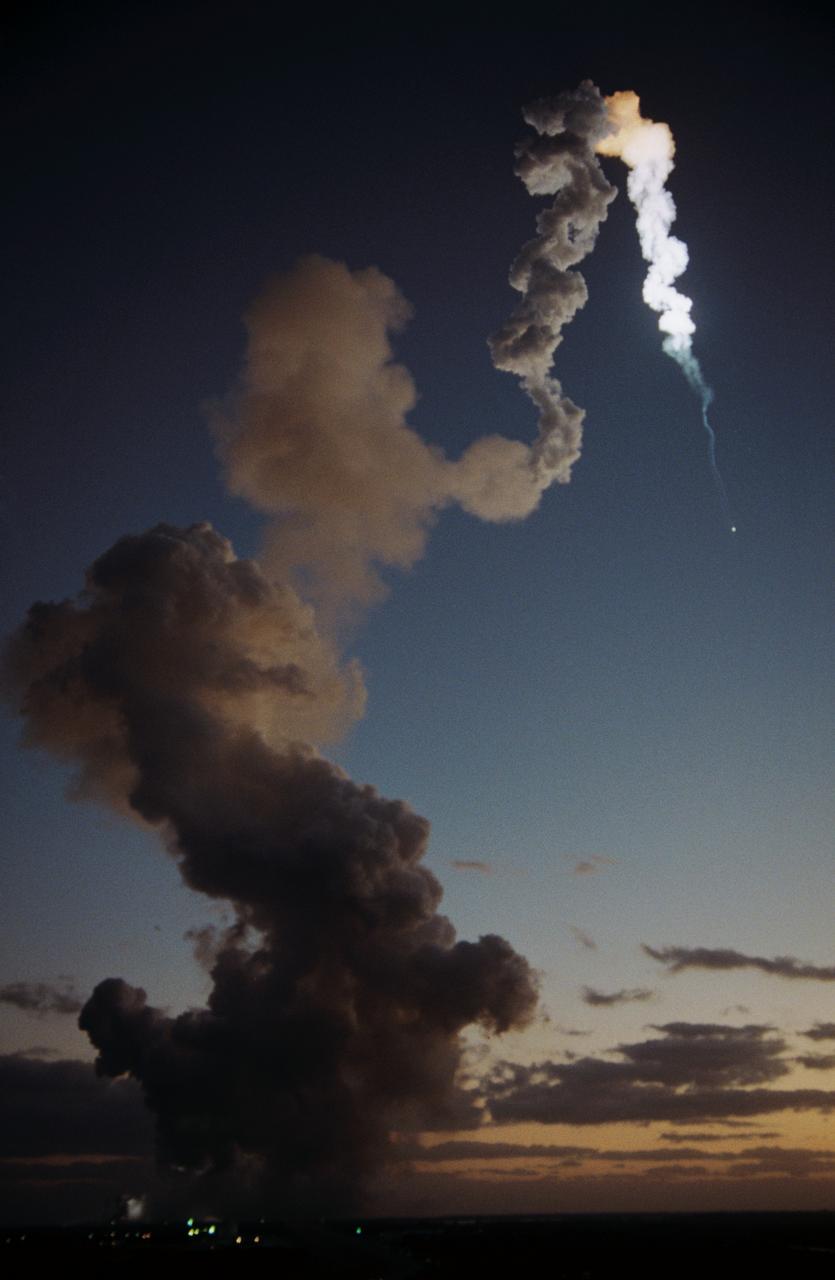
STS61C-S-046 (12 Jan. 1986) --- Although many miles away from the launch pad, the space shuttle Columbia can still be seen in this distant scene. The scene was recorded around 7 a.m. (EST), Jan. 12, 1986. Photo credit: NASA
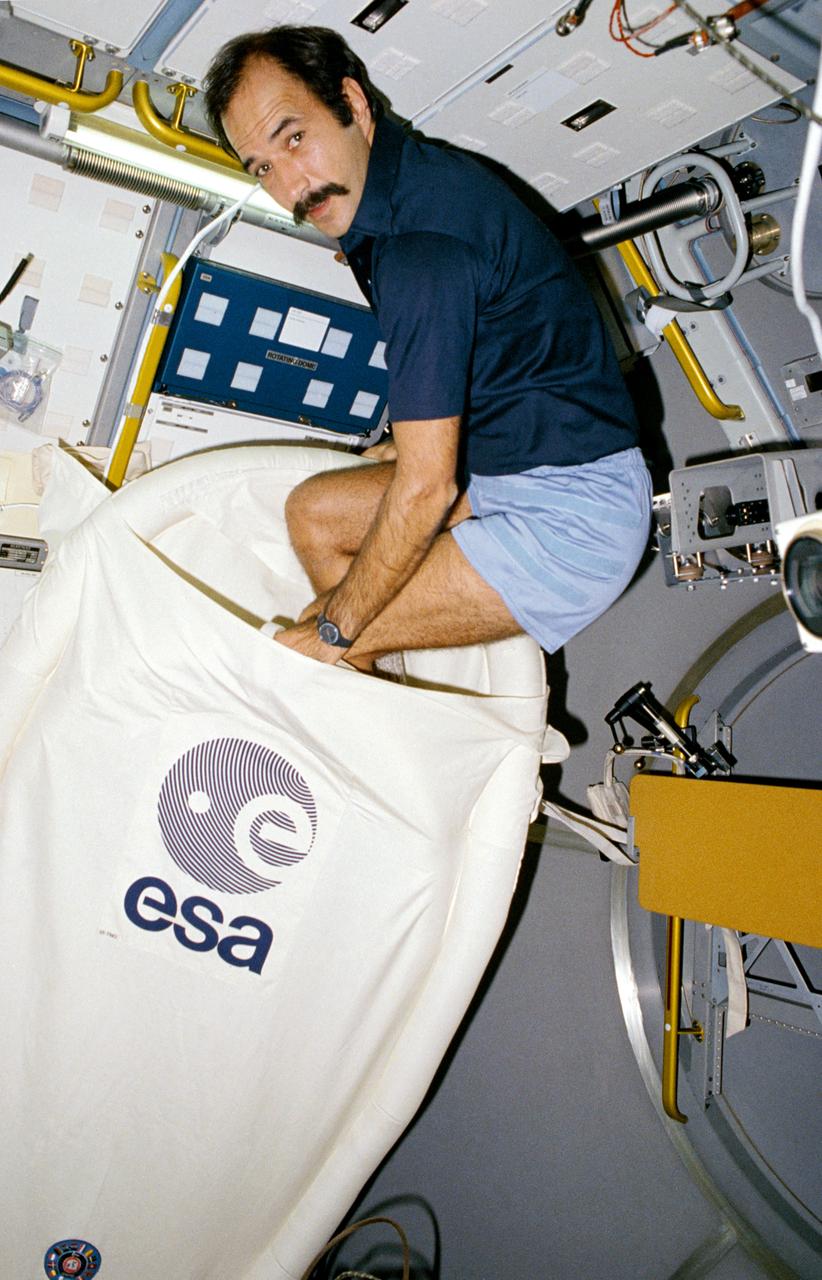
61A-08-018 (30 Oct.-6 Nov. 1985) --- Wubbo J. Ockels, a Dutch scientists representing the European Space Agency (ESA), crawls from an unique sleeping restraint in D-1 science module. Unlike the other crewmembers on STS 61A, Ockels did not sleep in the middeck of the Challenger. Ockels proposed this concept of sleeping facility and the actual hardware was developed by the Technisch Natur Wetenschappelyk Onderzoek (TNO), a Dutch government organization.
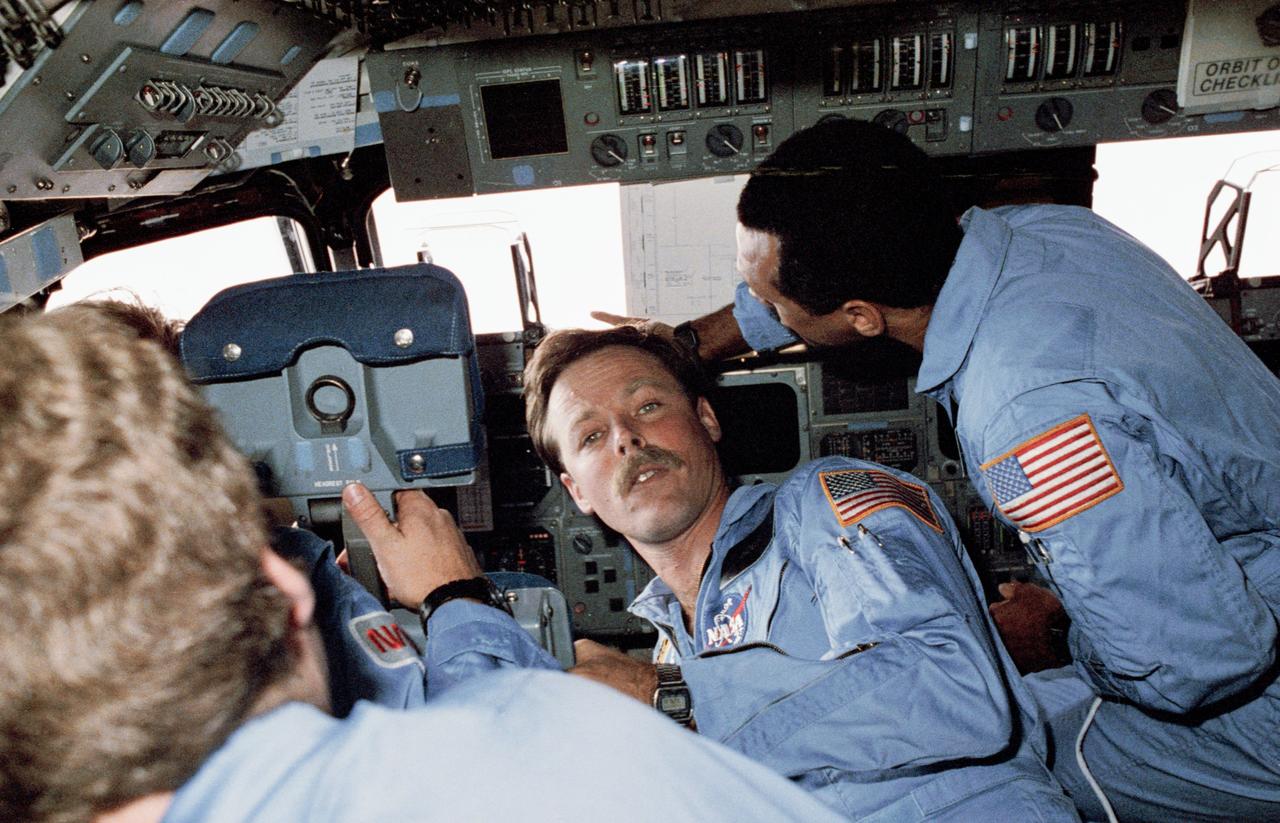
61C-21-009 (12-17 Jan 1986) --- Four members of the seven-man STS 61-C crew aboard the Columbia convene at the commander's station during the five-day mission which kicks off a busy 1986 for the Space Transportation System (STS). Astronaut Robert L. Gibson (center frame), mission commander, is surrounded by (l.-r.). Astronaut Steven A. Hawley, mission specialist, an unidentified crewmember (only partially visible) and astronaut Charles F. Bolden, pilot.
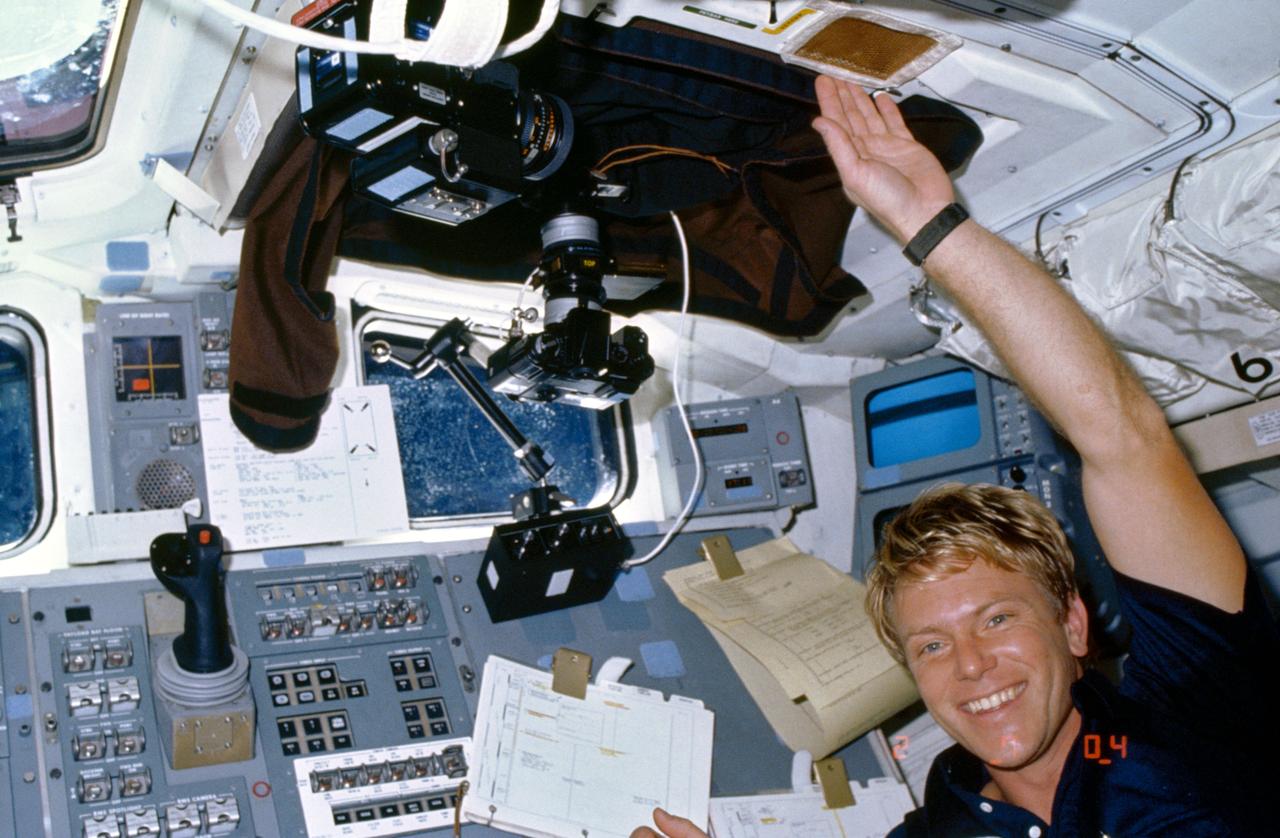
61C-05-026 (14 Jan. 1986) --- Astronaut George D. Nelson smiles for a fellow crew man's 35mm camera exposure while participating in the Comet Halley active monitoring program (CHAMP). Camera equipment and a protective shroud used to eliminate all cabin light interference surround the mission specialist. This is the first of three 1986 missions which are scheduled to monitor the rare visit by the comet. The principal investigators for CHAMP are S. Alan Stern of the Laboratory for Atmospheric and Space Physics at the University of Colorado; and Dr. Stephen Mende of Lockheed Palo Alto Research Laboratory.
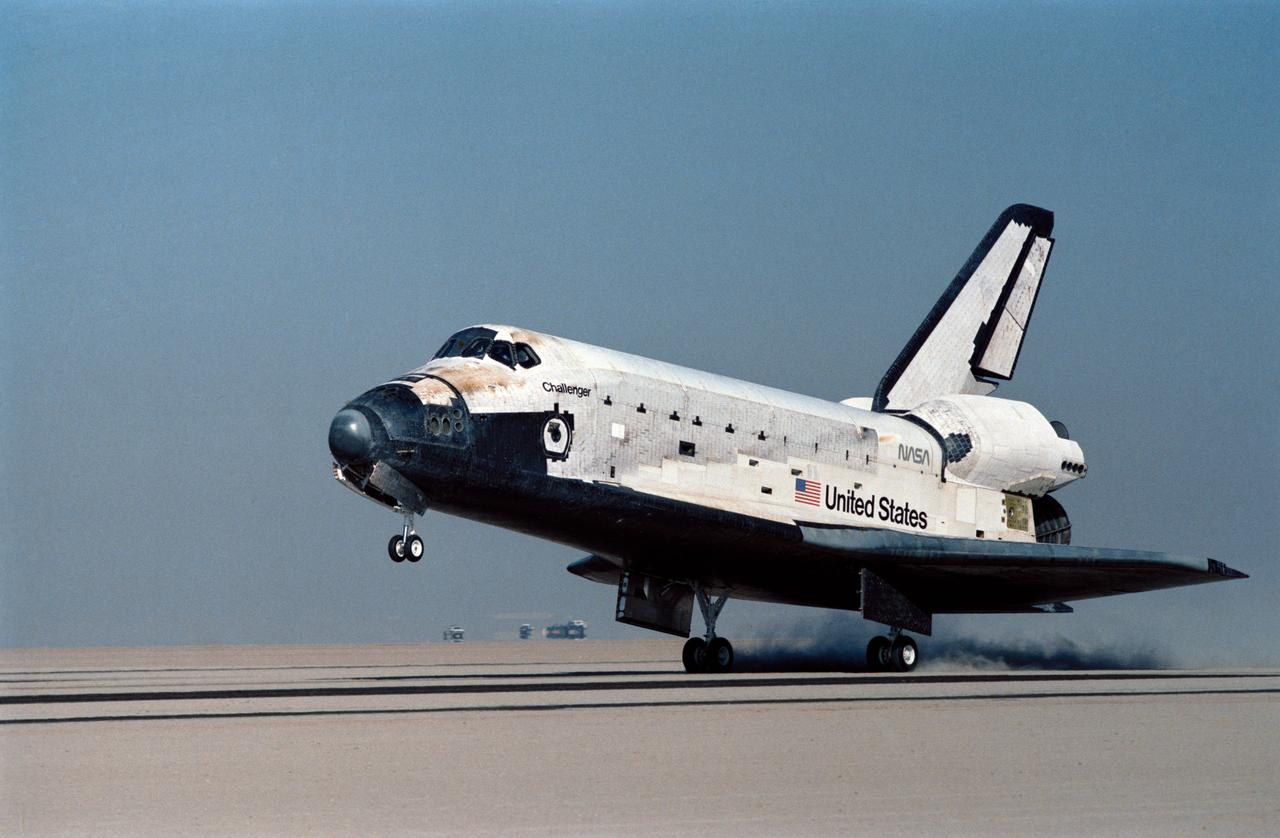
61A-S-139 (6 Nov 1985) --- Eight persons returning from space at one time is a record which was set at 9:45:39 a.m. (PST) today when the Space Shuttle Challenger's wheels came to a stop on the runway at Edwards Air Force Base. The main gear is seen touching down at 9:44:51 a.m. Inside the spacecraft are astronauts Henry W. Hartsfield Jr., Steven R. Nagel, Bonnie J. Dunbar, James F. Buchli, Guion S. Bluford Jr., Reinard Furrer, Ernst Messerschmid and Wubbo J. Ockels. A number of West German and other European experiments were performed during the week-long Spacelab D-1 mission.
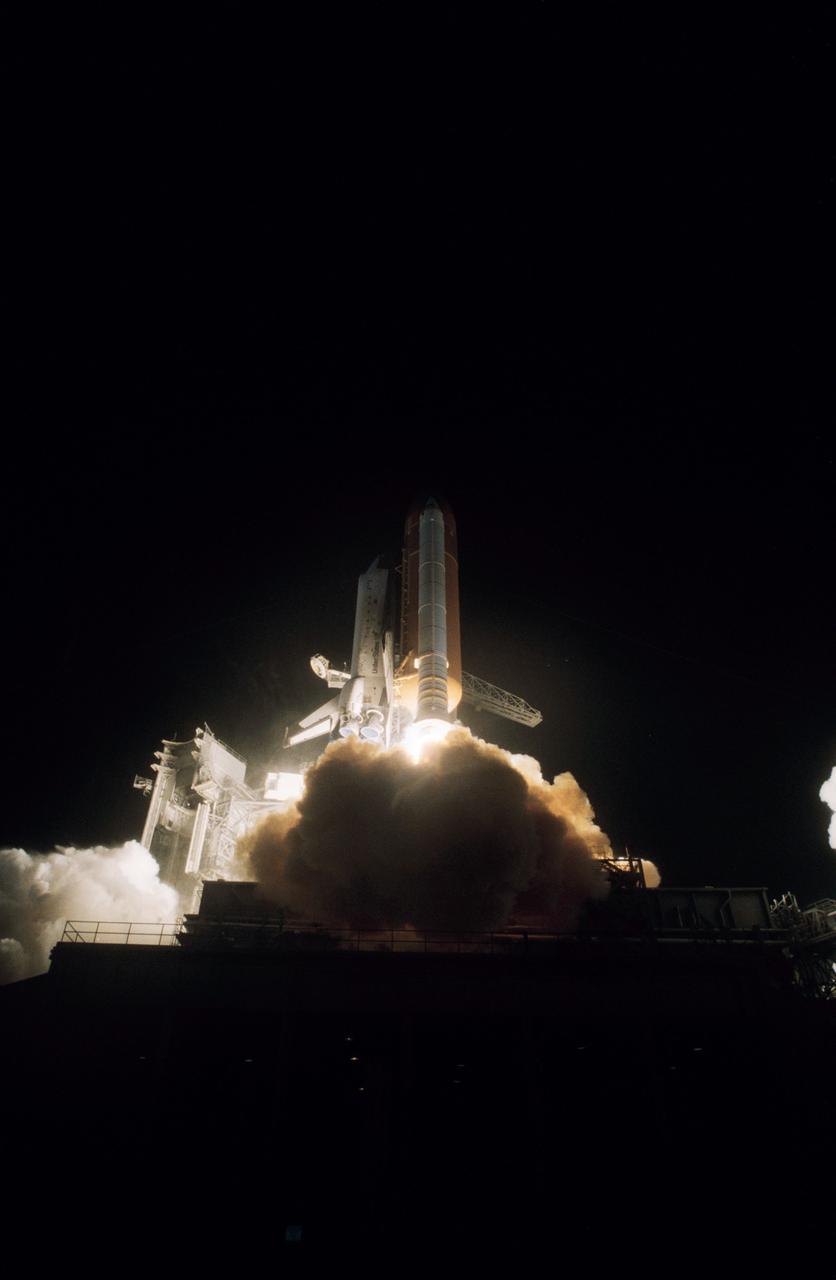
STS61C-S-047 (12 Jan. 1986) --- A remote camera records the early morning launch at Florida?s Kennedy Space Center of the space shuttle Columbia and the STS-61C crew on Jan. 12, 1986. Onboard were the following crew members -- Mission Commander Robert L. Gibson and Pilot Charles F. Bolden, along with Mission Specialists Franklin R. Chang-Diaz, Steven A. Hawley and George D. Nelson and Payload Specialists Robert J. Cenker of RCA and U.S. Rep. Bill Nelson. Photo credit: NASA
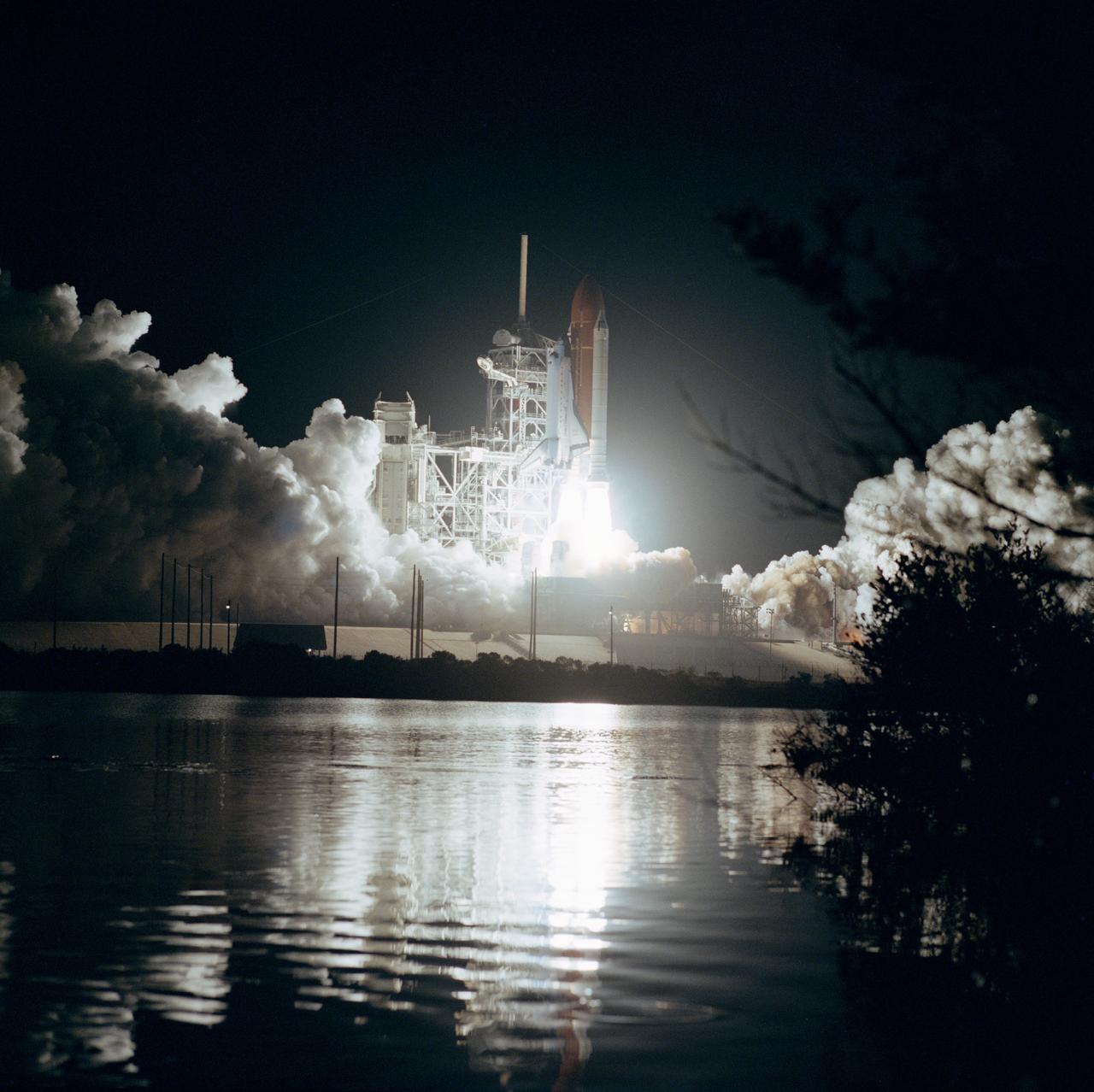
61B-S-067 (26 Nov 1985) --- Space Shuttle Atlantis ascends into the night sky at 7:29 p.m. (EST), November 26, with a seven member crew and three communications satellites aboard. The STS 61-B crewmembers are Brewster Shaw Jr., Bryan D. O?Connor, Mary L. Cleave, Sherwood C. Spring, Jerry L. Ross and Payload Specialists Rodolfo Neri of Mexico (Morelos) and Charles D. Walker of McDonnell Douglas.
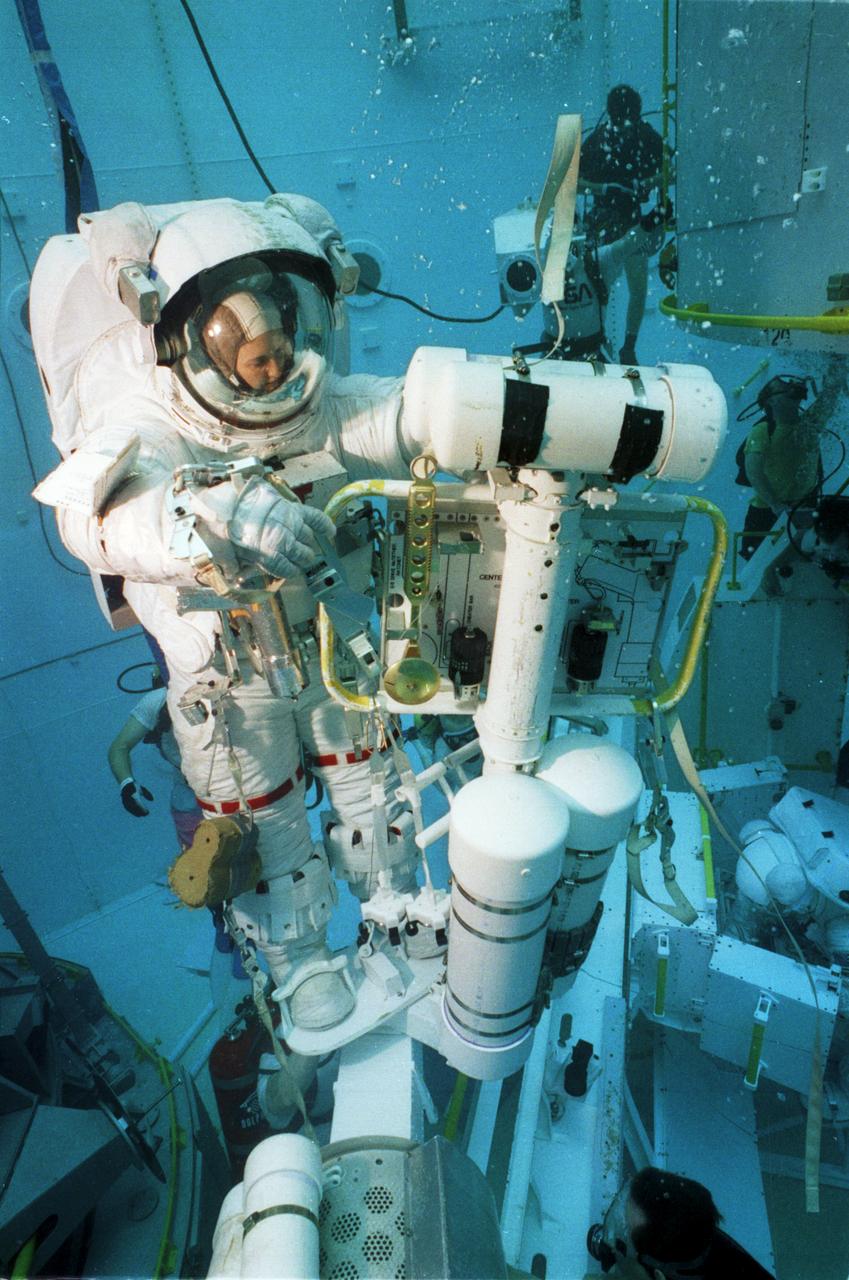
This close-up of astronaut and mission specialist, Kathryn Thornton, was captured under water in the Marshall Space Flight Center (MSFC) Neural Buoyancy Simulator (NBS) where she is participating in a training session for the STS-61 mission. The NBS provided the weightless environment encountered in space needed for testing and the practices of Extravehicular Activities (EVA). Launched on December 2, 1993 aboard the Space Shuttle Orbiter Endeavor, STS-61 was the first Hubble Space Telescope (HST) serving mission. During the 2nd EVA of the mission, Thornton, along with astronaut and mission specialist Thomas Akers, performed the task of replacing the solar arrays. The EVA lasted 6 hours and 35 minutes.
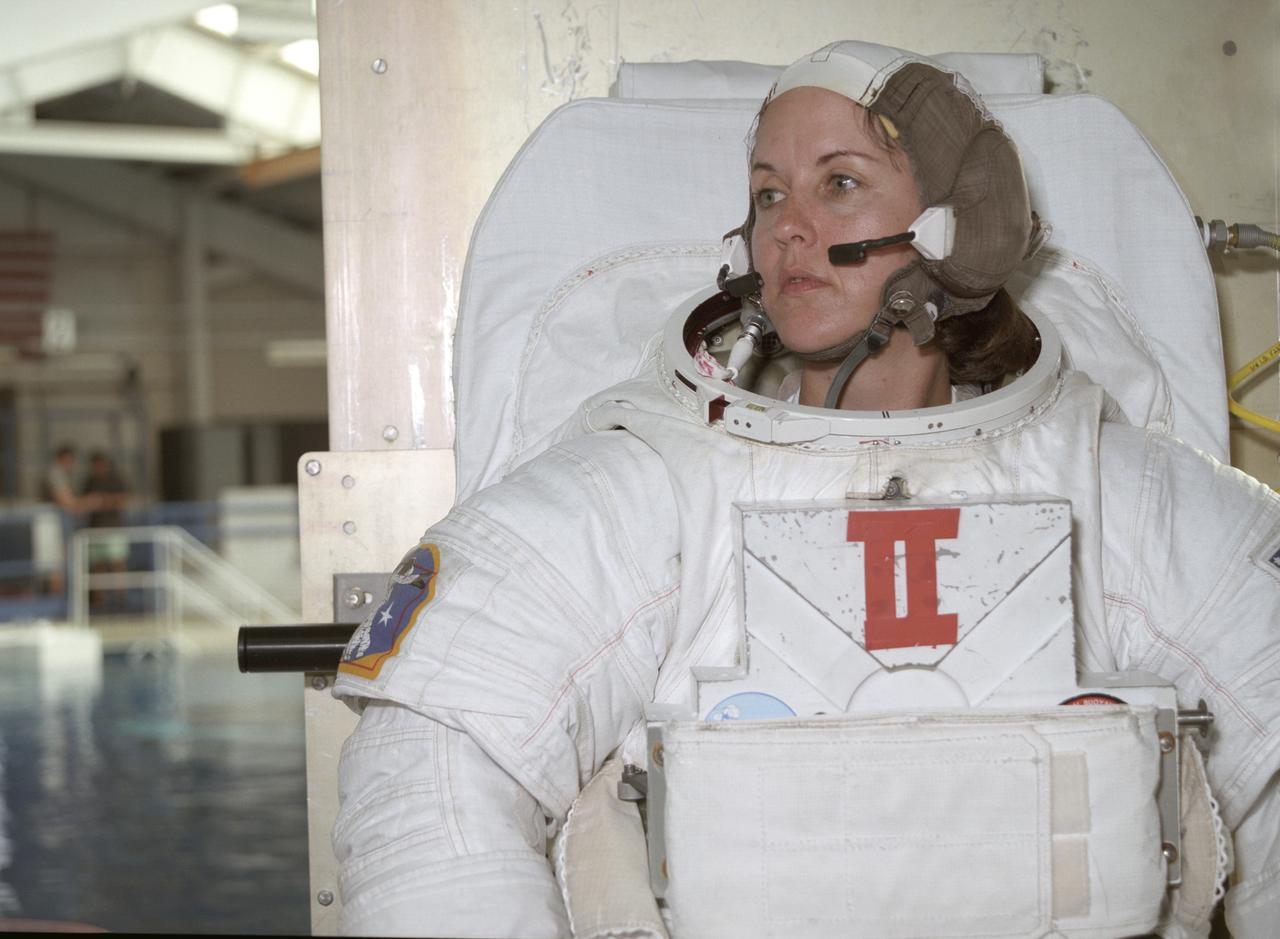
This close-up of astronaut and mission specialist Kathryn Thornton readies herself for submersion into the water in the Marshall Space Flight Center (MSFC) Neutral Buoyancy Simulator (NBS) where she is participating in a training session for the STS-61 mission. The NBS provided the weightless environment encountered in space needed for testing and the practices of Extravehicular Activities (EVA). Launched on December 2, 1993 aboard the Space Shuttle Orbiter Endeavor, STS-61 was the first Hubble Space Telescope (HST) serving mission. During the 2nd EVA of the mission, Thornton, along with astronaut and mission specialist Thomas Akers, performed the task of replacing the solar arrays. The EVA lasted 6 hours and 35 minutes.
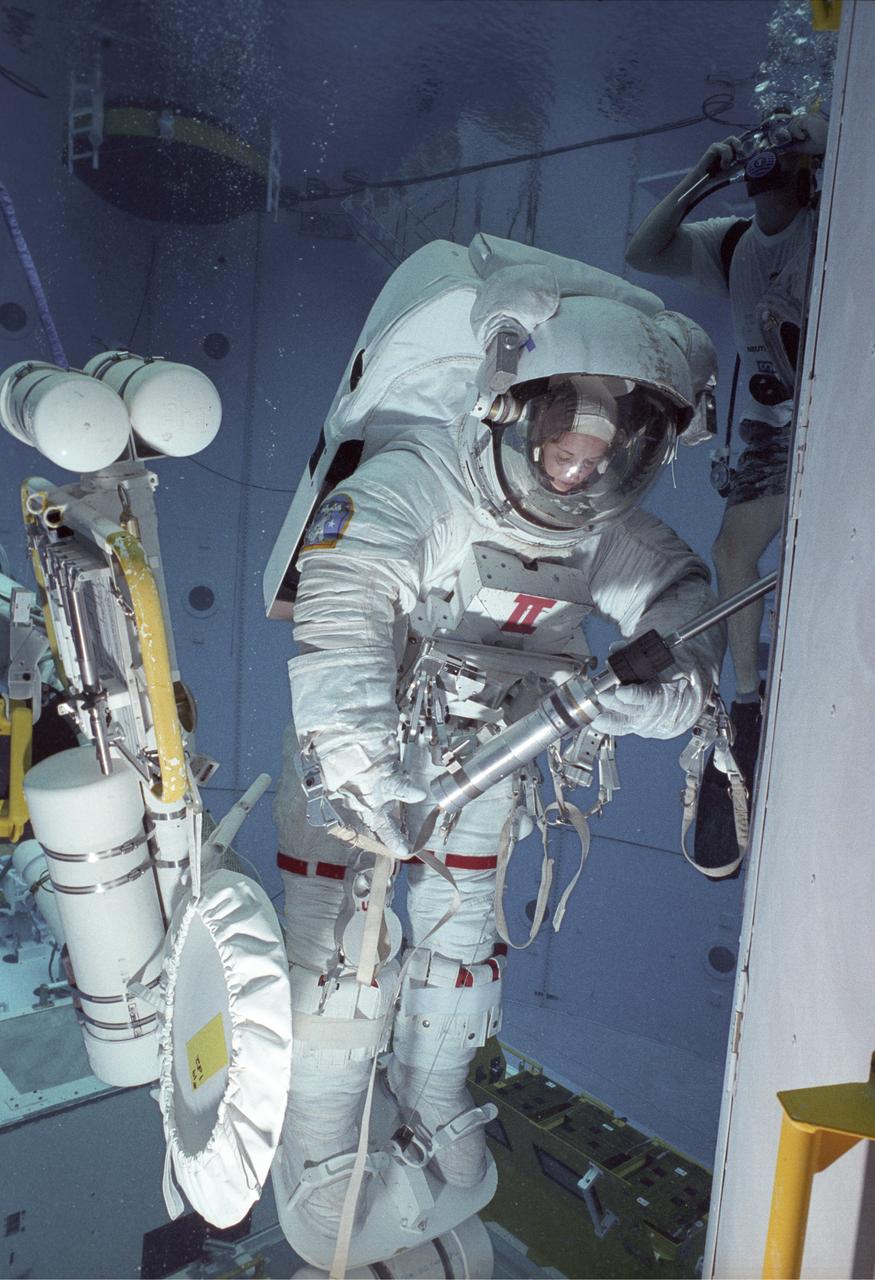
This close-up of astronaut and mission specialist Kathryn Thornton was captured under water in the Marshall Space Flight Center (MSFC) Neural Buoyancy Simulator (NBS) where she is participating in a training session for the STS-61 mission. The NBS provided the weightless environment encountered in space needed for testing and the practices of Extravehicular Activities (EVA). Launched on December 2, 1993 aboard the Space Shuttle Orbiter Endeavor, STS-61 was the first Hubble Space Telescope (HST) serving mission. During the 2nd EVA of the mission, Thornton, along with astronaut and mission specialist Thomas Akers, performed the task of replacing the solar arrays. The EVA lasted 6 hours and 35 minutes.
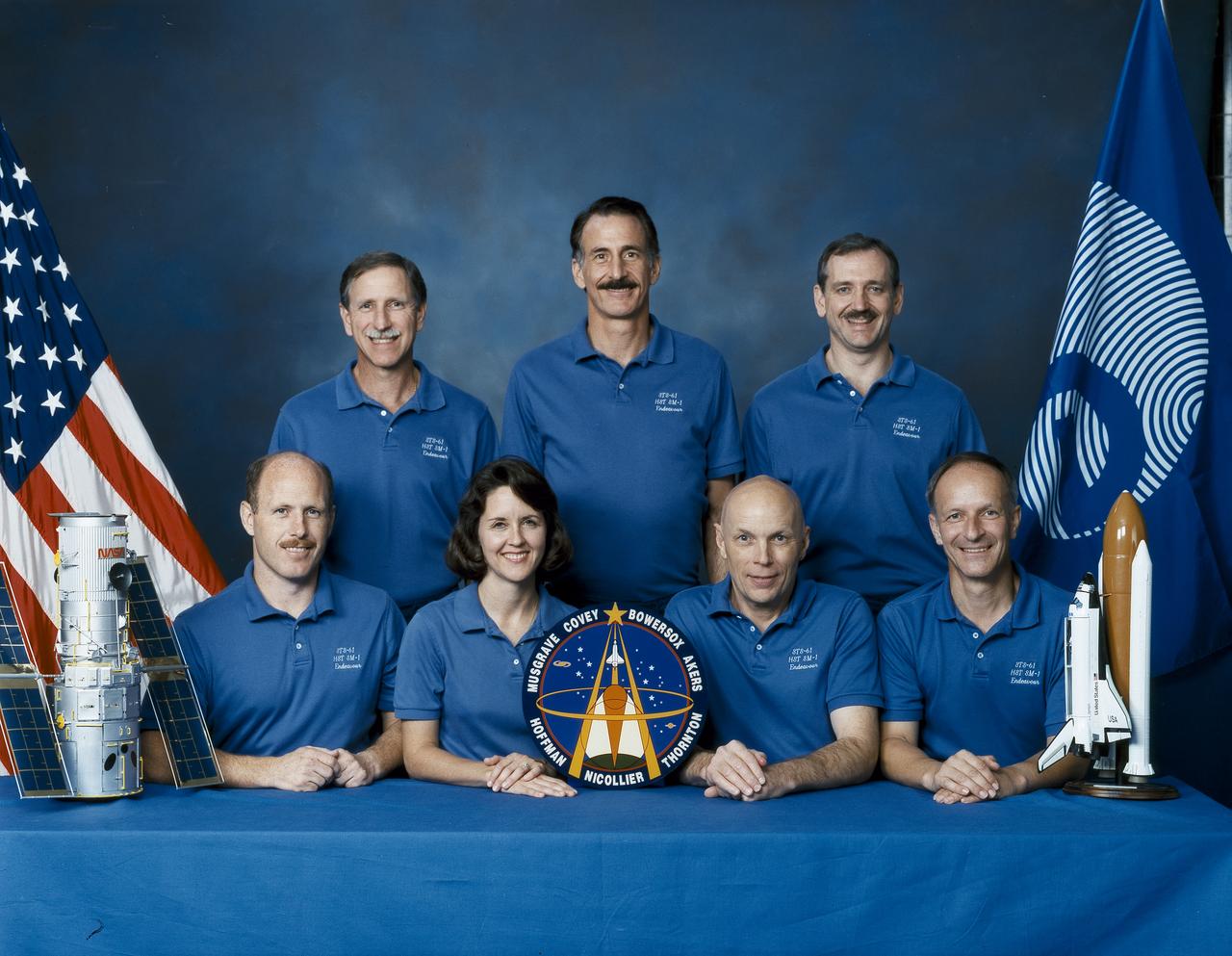
Astronauts included in the STS-61 crew portrait include (standing in rear left to right) Richard O. Covey, commander; and mission specialists Jeffrey A. Hoffman, and Thomas D. Akers. Seated left to right are Kenneth D. Bowersox, pilot; Kathryn C. Thornton, mission specialist; F. Story Musgrave, payload commander; and Claude Nicollier, mission specialist. Launched aboard the Space Shuttle Endeavor on December 2, 1993 at 4:27:00 am (EST), the STS-61 mission was the first Hubble Space Telescope (HST) servicing mission, and the last mission of 1993.
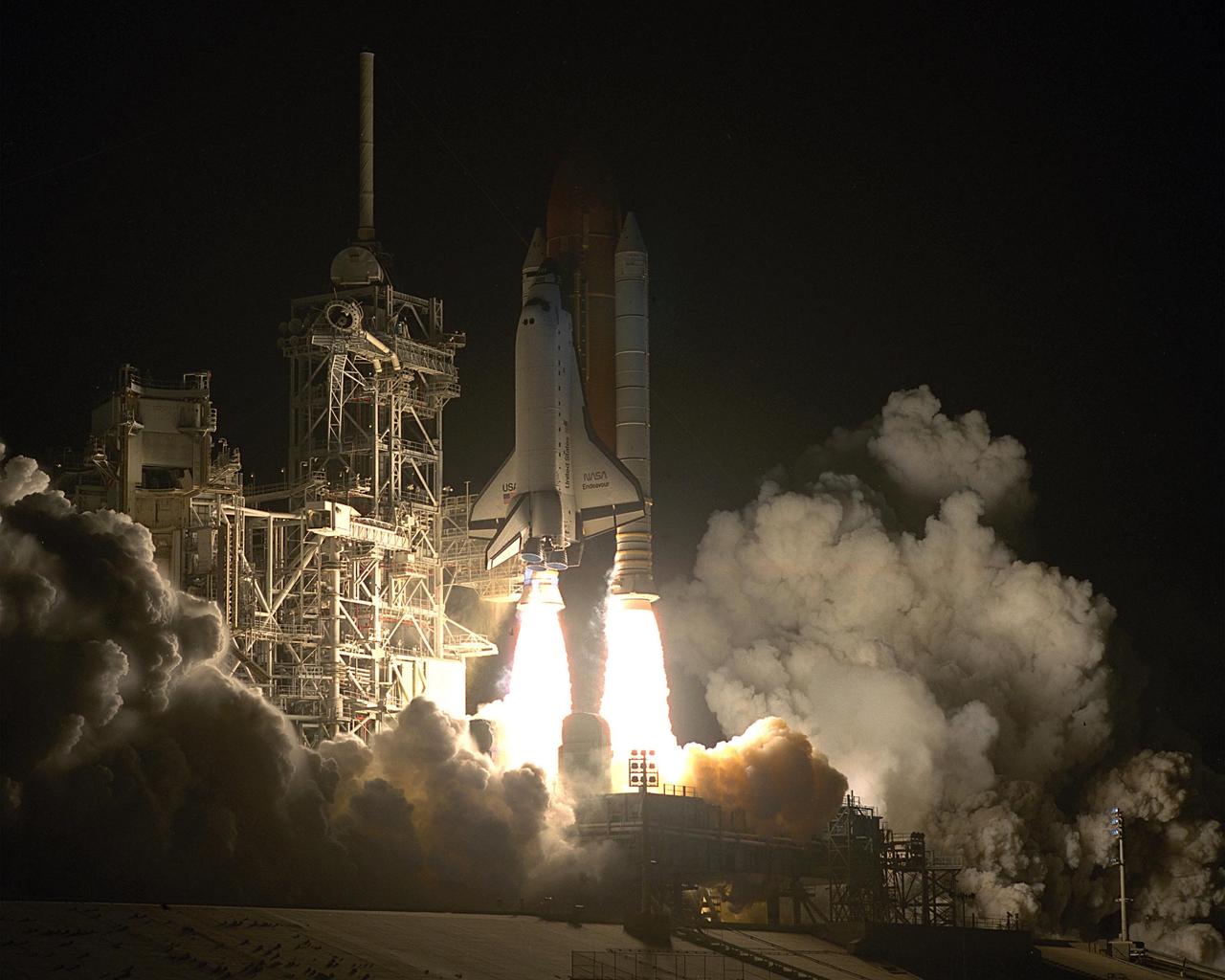
KENNEDY SPACE CENTER, FLA. - The Space Shuttle Endeavour lifts off from Launch Pad 39B on mission STS-61 with a crew of six NASA astronauts, a Swiss mission specialist and a variety of special tools aboard. Launch occured at 4:27:00 a.m. December 2, 1993.
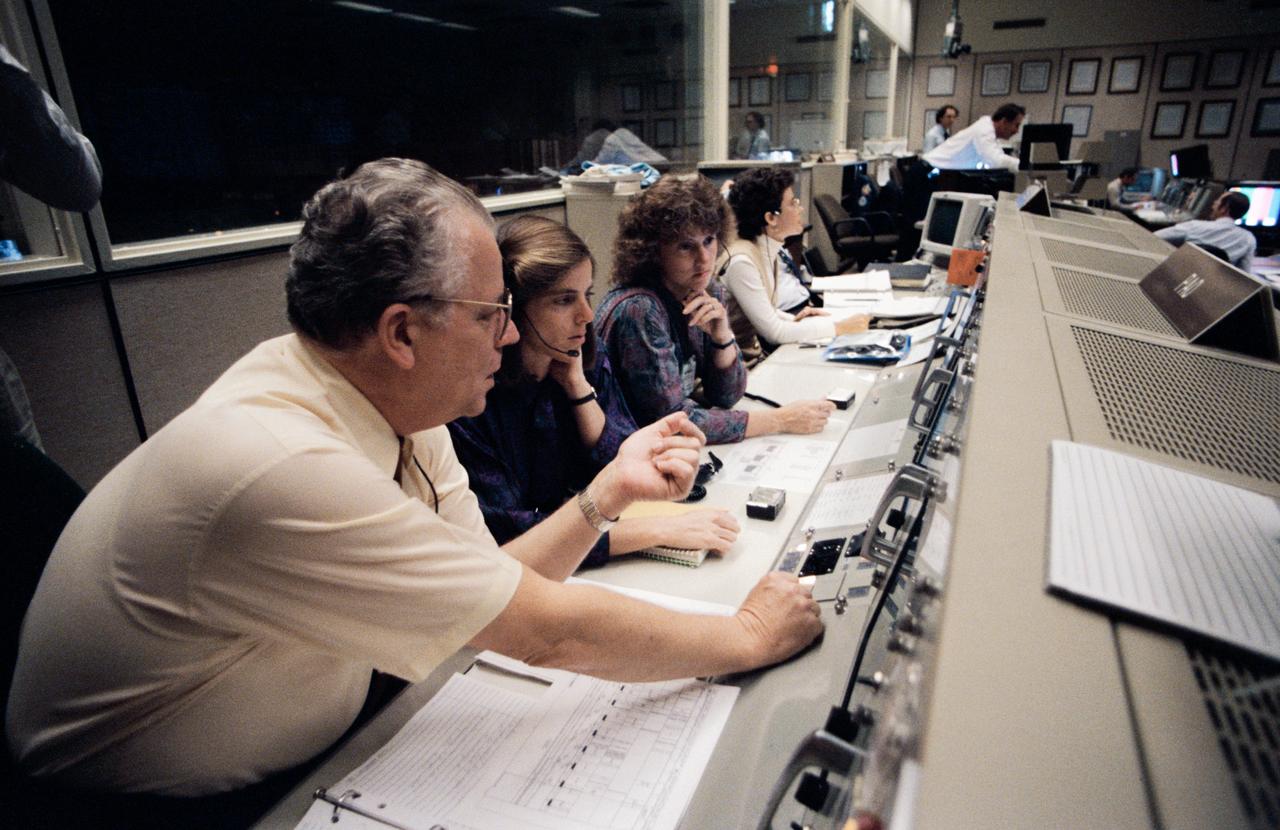
61A-S-135 (5 Nov 1985) --- Two school teachers in training at the Johnson Space Center got their first ?real time? exposure to a Space Shuttle mission as they monitor activity aboard the Spacelab D-1 science module from the mission control center. Sharon Christa McAuliffe (frame center) and Barbara R. Morgan are briefed by Terry White at the Public Affairs console during a television downlink from the Earth-orbiting Space Shuttle Challenger. McAuliffe is scheduled to fly as teacher/citizen observer on the STS 51-L mission early next year; and Morgan is in training as her backup.
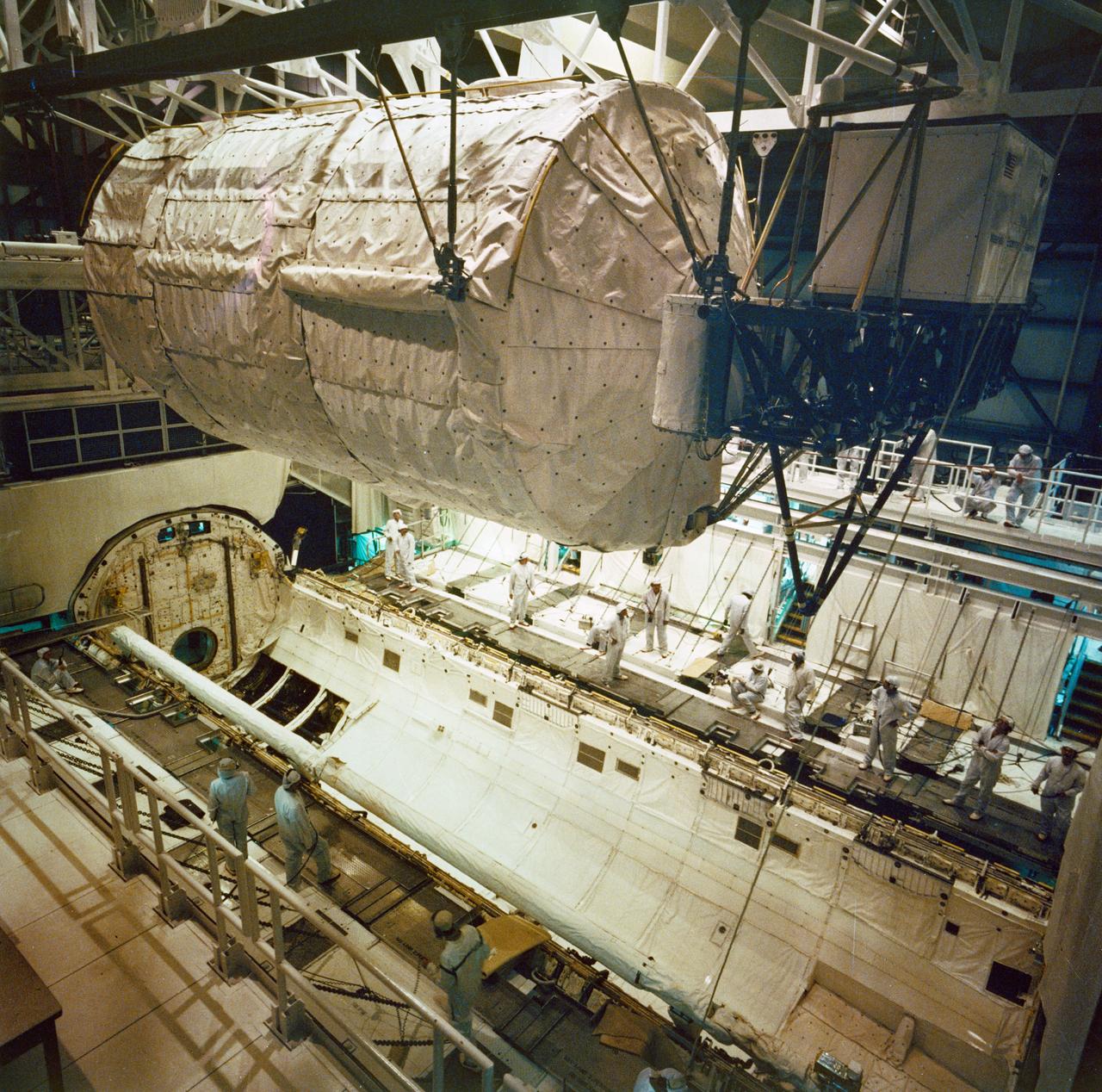
S85-43138 (20 Sept 1985) --- Spacelab D-1, the first payload dedicated to a German mission, is installed into the Space Shuttle Challenger in the orbiter processing facility (OPF) at the Kennedy Space Center. Launch for the 61-A eight crewmembers and their extensive scientific experiments is scheduled for no earlier than Oct. 30.
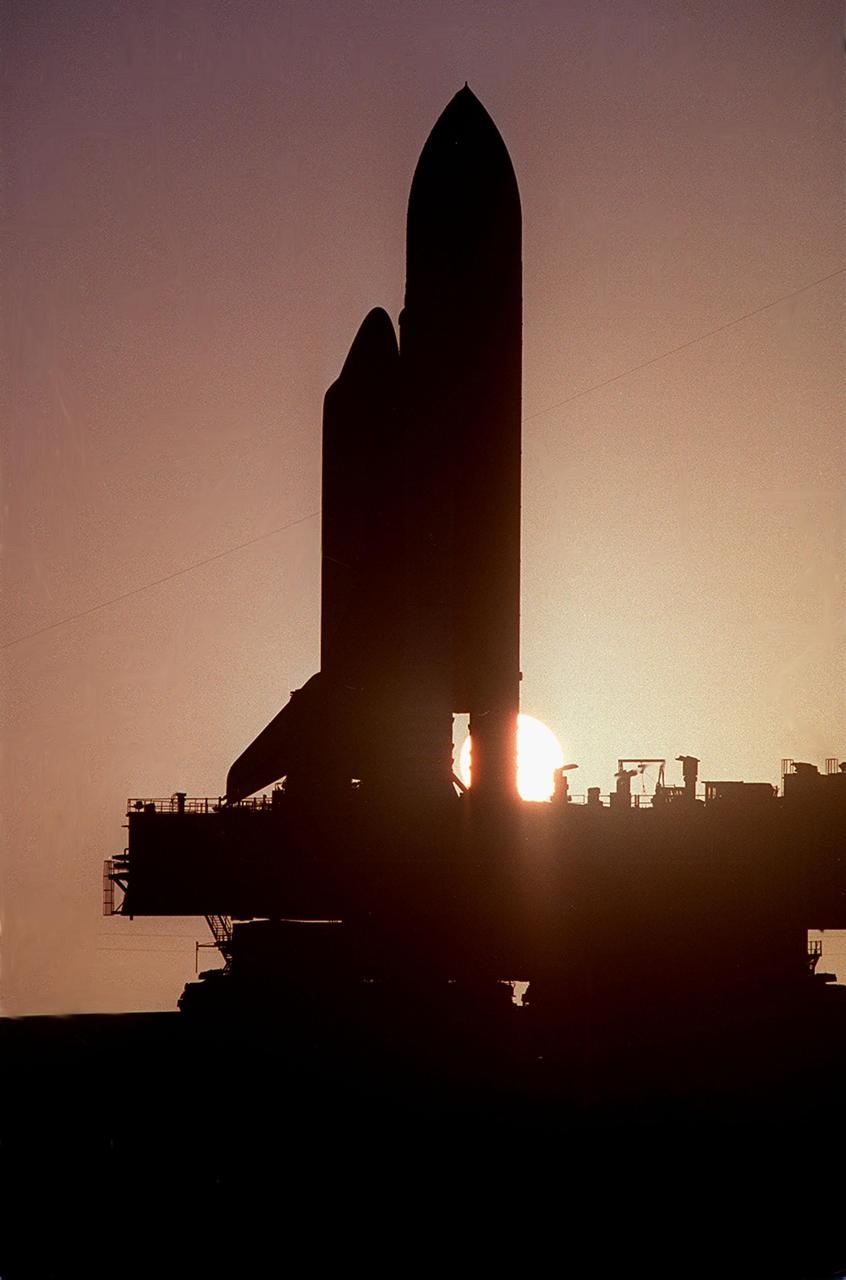
KENNEDY SPACE CENTER, FLA. -- The Space Shuttle Endeavour is being "rolled around" from Launch Pad 39A to Launch Pad 39B. The rare pad switch was deemed necessary after contamination was discovered in the Payload Changeout Room at pad A. Still to come are the payloads for the upcoming STS-61 mission, the first servicing of the Hubble Telescope
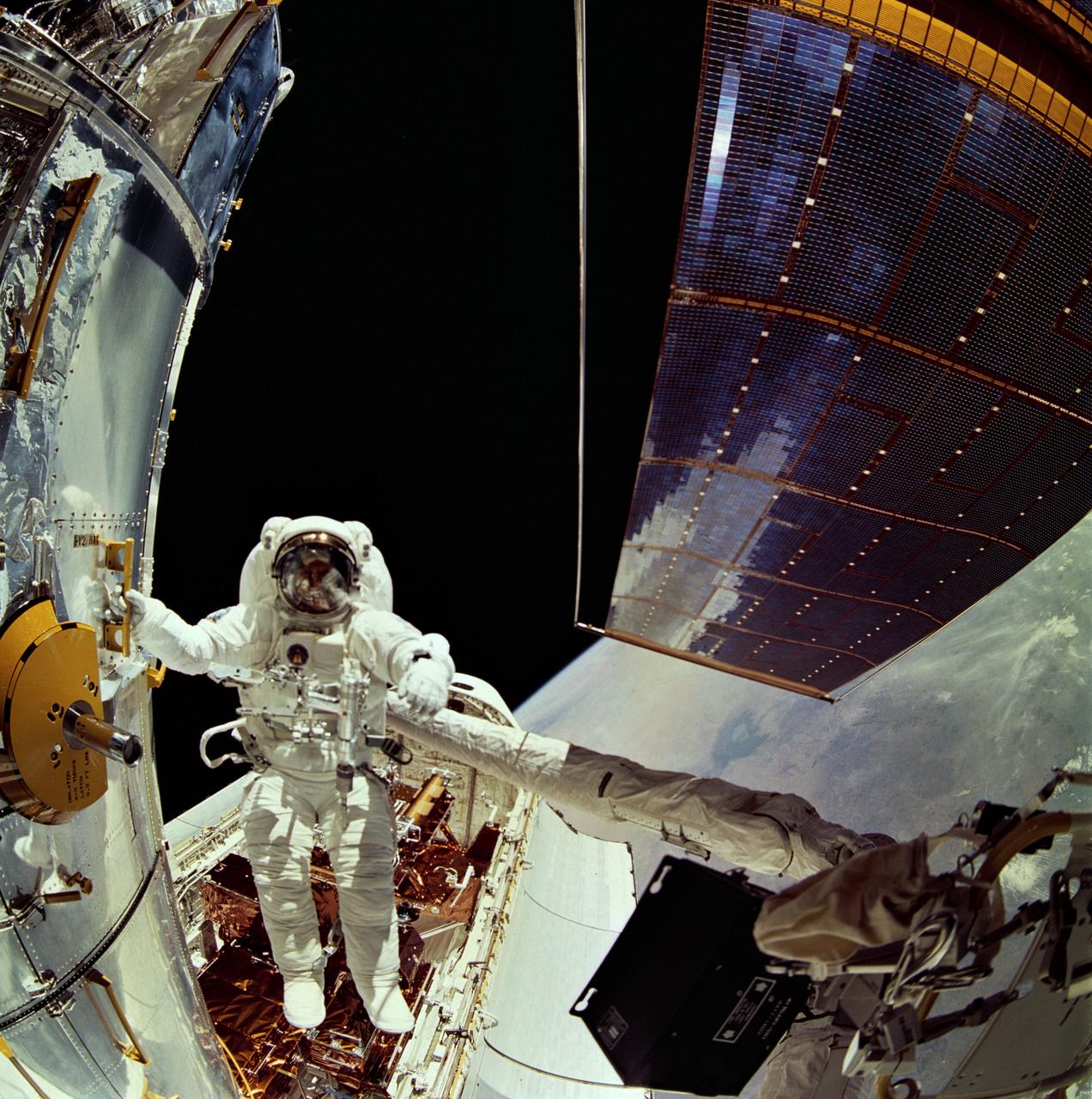
This is a Space Shuttle mission STS-61 onboard view showing astronauts Story Musgrave and Jeffrey Hoffman preforming repairs to the Hubble Space Telescope (HST) during their Extra Vehicular Activity (EVA). Astronauts' work was made easier by the HST's many crew aids. Astronaut Musgrave makes use of one of the spacecraft's handholds. Launched on December 1, 1993, the Space Shuttle Orbiter Endeavor STS-061 mission was the 59th Shuttle flight.
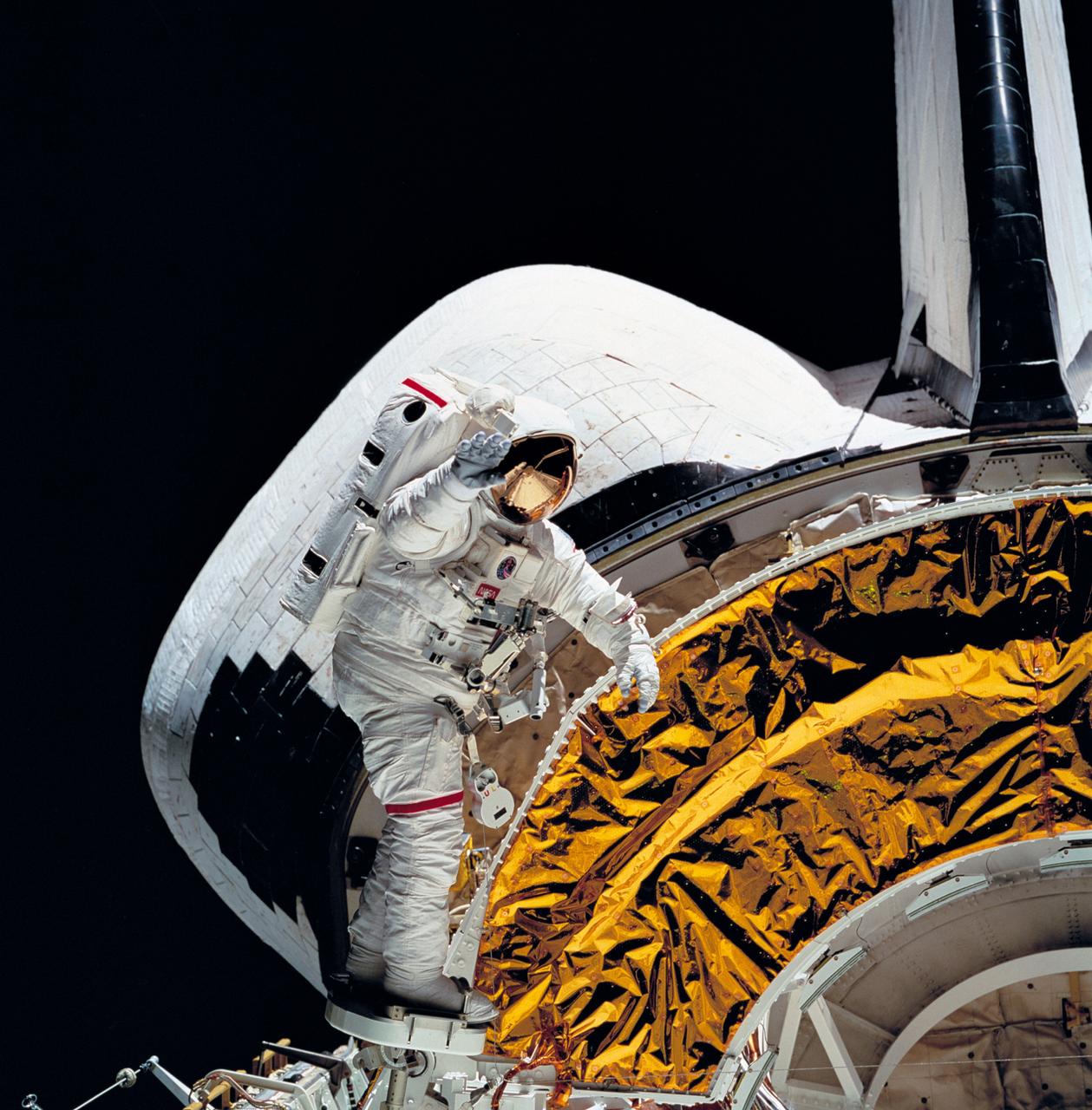
STS051-98-021 (16 Sept. 1993) --- In the Space Shuttle Discovery's aft cargo bay, astronaut Carl E. Walz gets his turn on the Portable Foot Restraint (PFR). Astronauts Walz, waving to his crew mates inside Discovery's cabin, and James H. Newman each put in some time evaluating the PFR, one of the pieces of gear to be used on the Hubble Space Telescope (HST) STS-61 servicing mission (scheduled later this year) and other Shuttle missions.
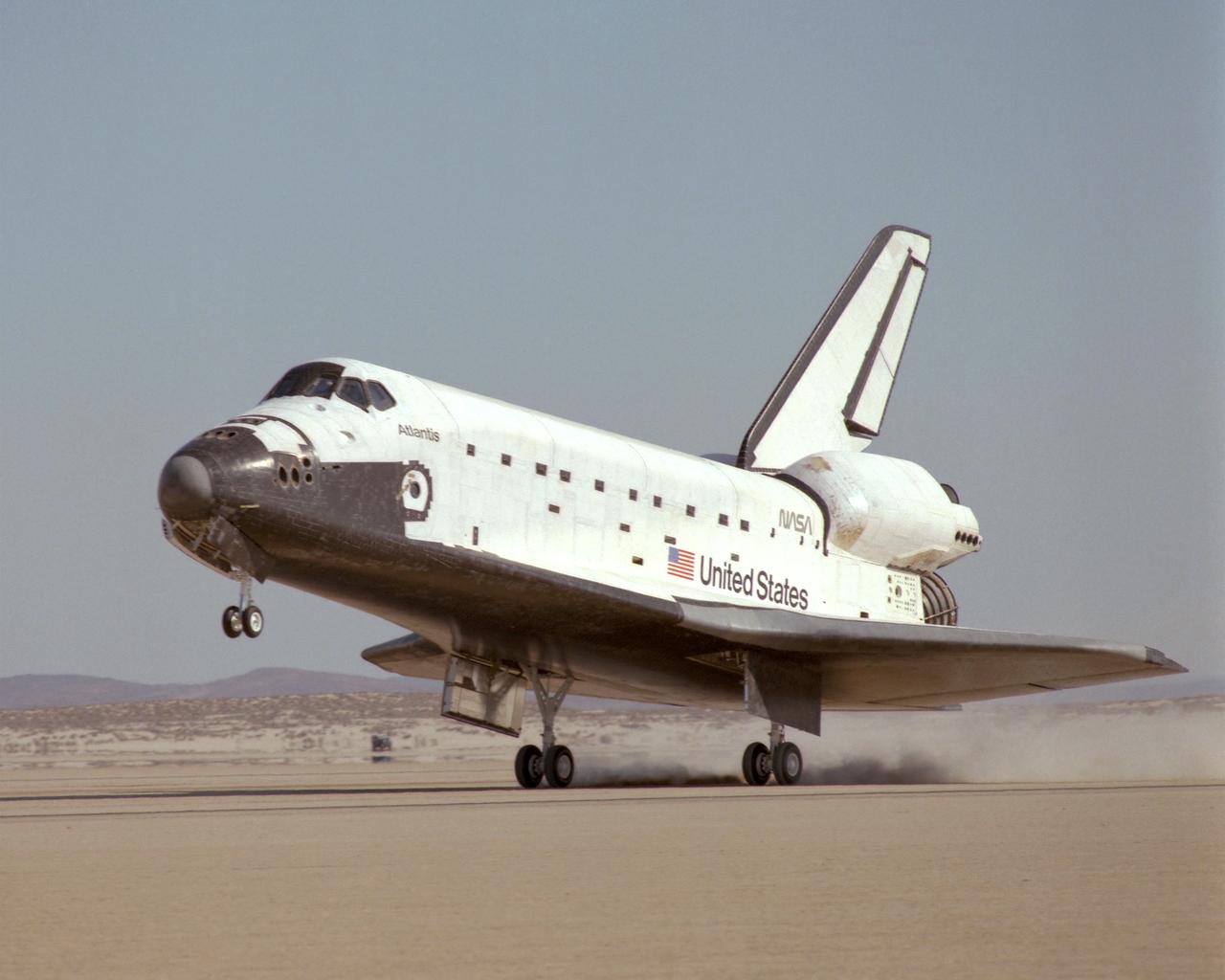
NASA's Space Shuttle Atlantis touched down on the lakebed runway at Edwards Air Force Base in California's Mojave Desert Tuesday, 3 December 1985 at 1:33:49 p.m. Pacific Standard Time, concluding the STS 61-B international mission. The eight-day mission successfully deployed three communications satellites including the Mexican Morelos B, the Australian Aussat 2 and an RCA Satcom K-2 satellite. In addition, two spacewalks were performed to experiment with construction of structures in space. Crew of the 61-B mission included Commander Brewster H. Shaw, Jr.; Pilot Bryan D. O'Connor; Mission Specialists Mary L. Cleave, Sherwood C. Spring and Jerry L. Ross; and Payload Specialists Rudolfo Neri Vela of Mexico and Charles Walker of McDonnell Douglas Astronautics Co.
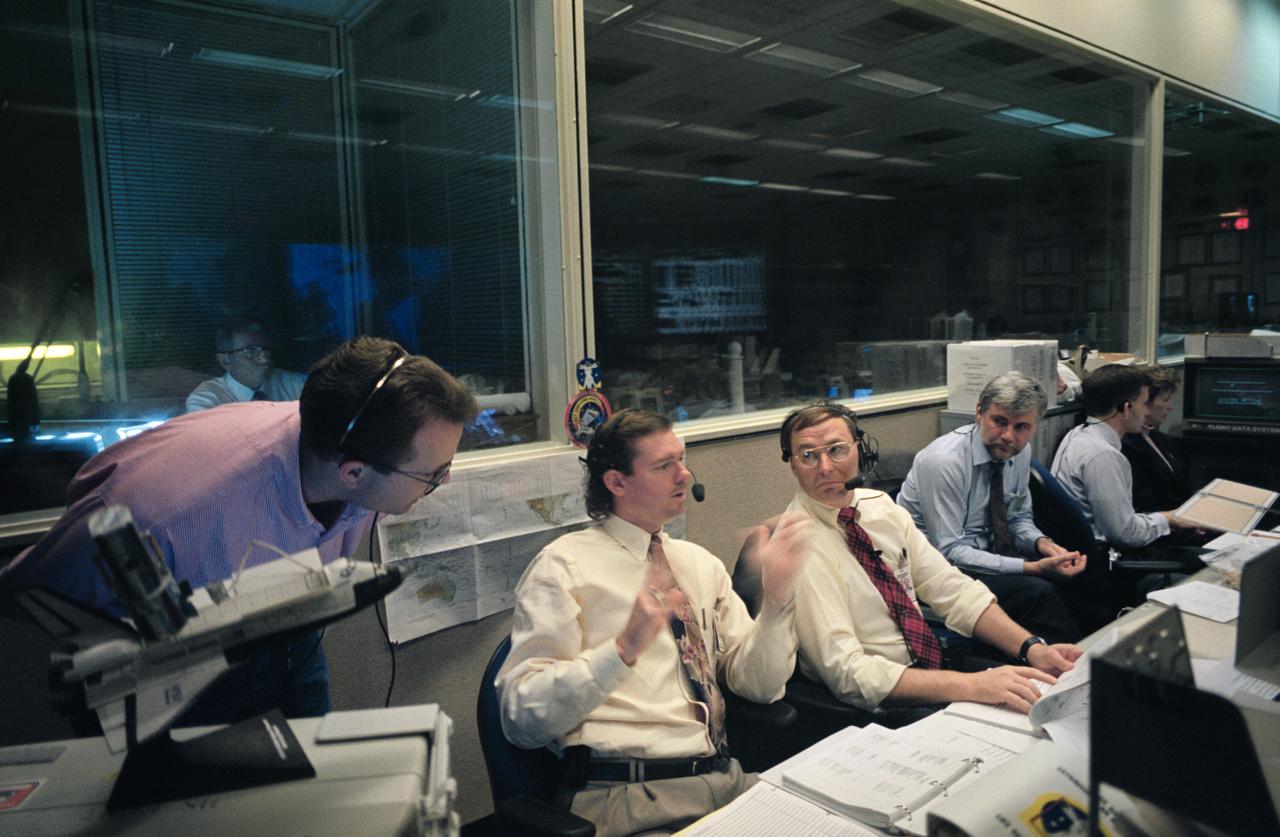
STS61-S-094 (5 Dec 1993) --- Kyle Herring, second left, illustrates a point during mission commentary for the second Extravehicular Activity (EVA-2) of the STS-61 Hubble Space Telescope (HST) servicing mission. Astronaut Jerry L. Ross (center), a space walker on two previous NASA shuttle missions, amplified Herring's explanations. At the flight surgeon's console is Dr. Klaus Lohn (third right) of the Institute for Flight Medicine in Koln, Germany.
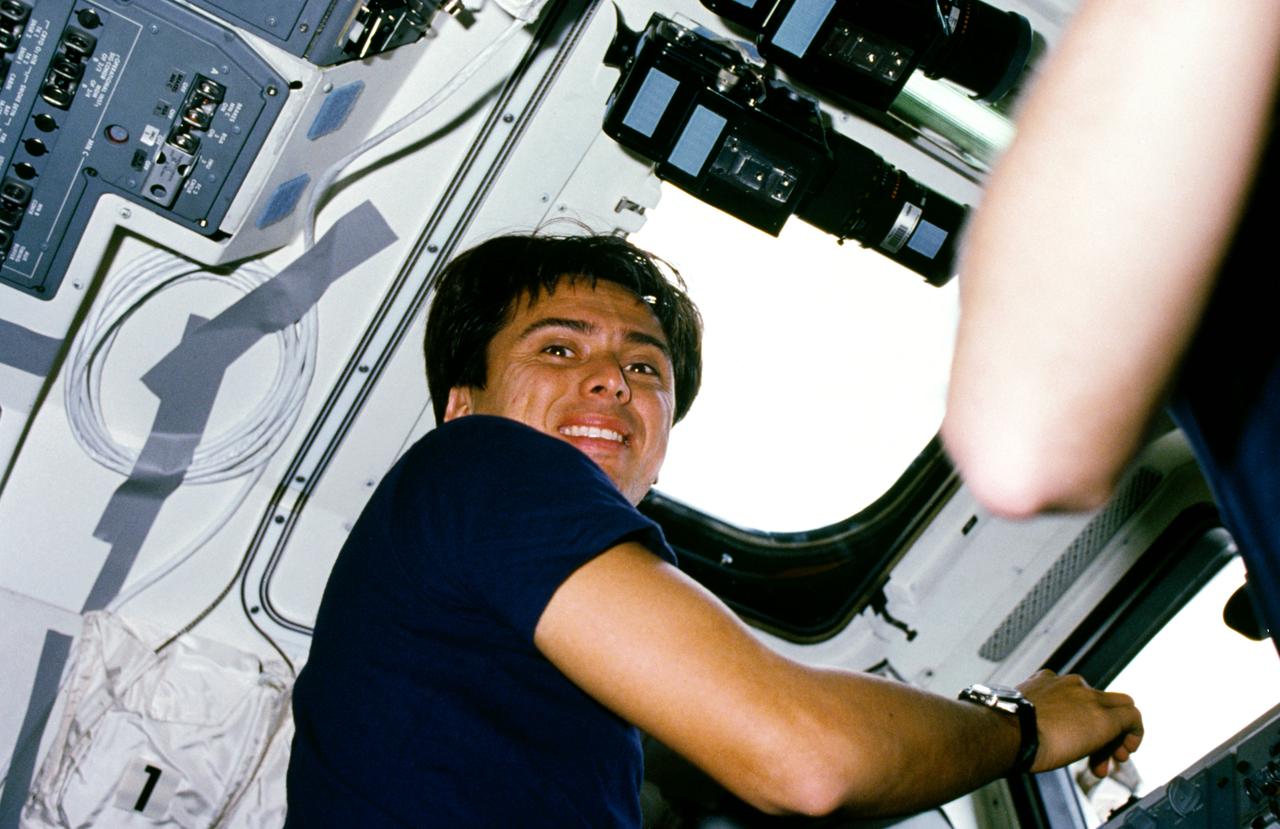
61C-02-032 (12-18 Jan. 1986) --- Astronaut Franklin R. Chang-Diaz, STS-61C mission specialist, while checking cargo in the space shuttle Columbia's payload bay, turns to smile at a fellow crew member using a 35mm camera. Some of the prolific camera gear onboard the spacecraft is affixed above the mission specialist's right shoulder.
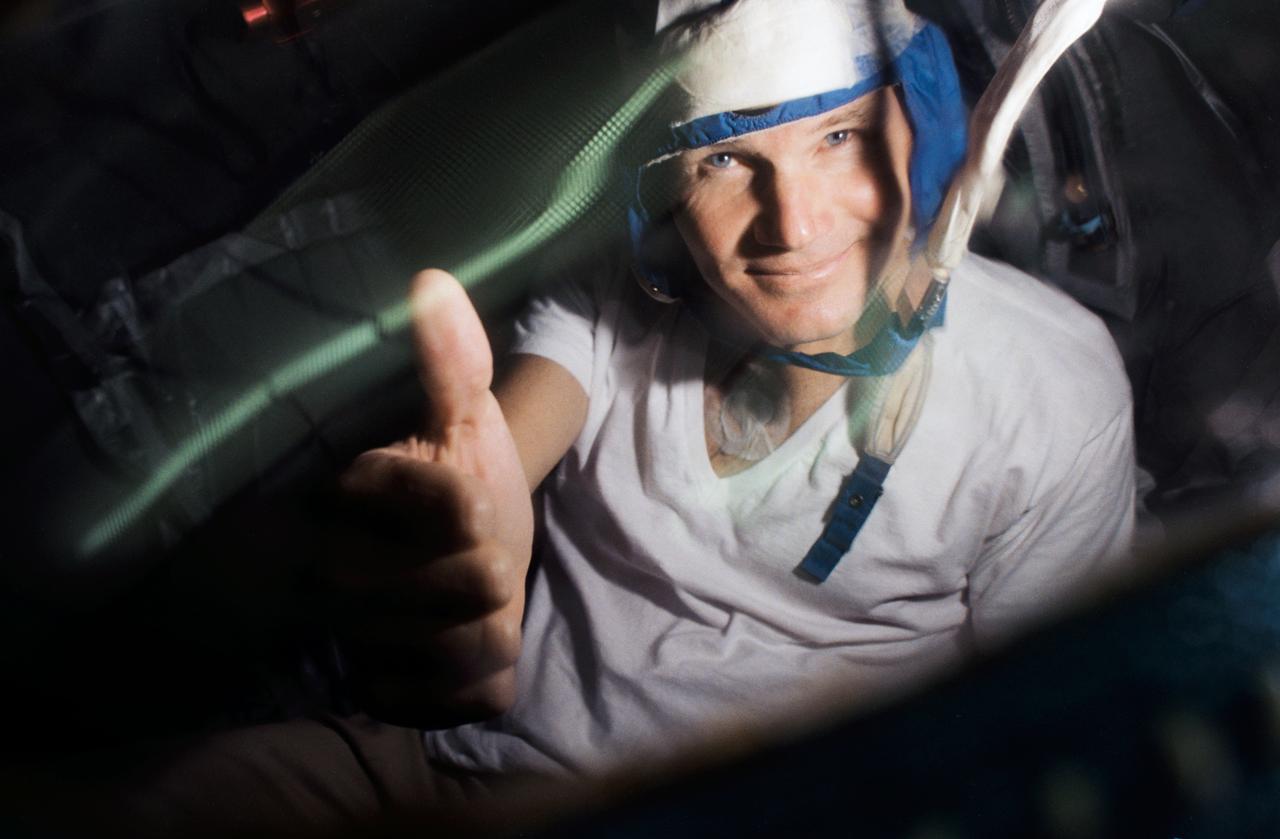
U.S. Representative Bill Nelson (D.,Florida) gives a thumbs up signal from inside a small ball called a personal rescue sphere (PRS). The PRS is not part of STS 61-C hardware, but serves to evaluate a subject's reaction to close quarters. The photo was taken through a visor on the 39-inch diameter fabric rescue sphere.
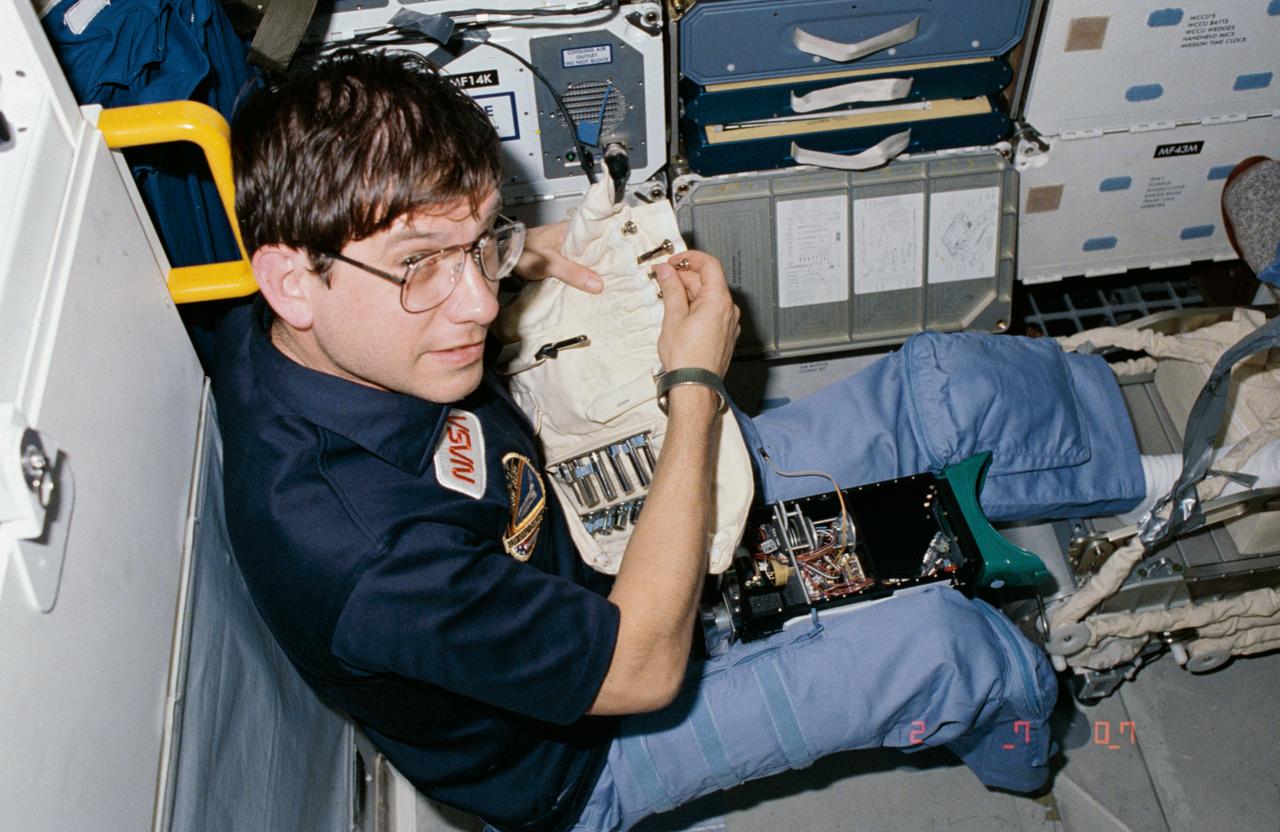
61C-05-035 (12-17 Jan 1986) --- Robert J. Cenker, 61-C payload specialist representing RCA, returns a tiny tool to its stowage position after adjusting the inner workings of a device used in one of a number of detailed supplementary objective (DSO) studies for NASA's Space Biomedical Research Institute. The device is a pair of ocular counter-rolling goggles used by U.S. Rep. Bill Nelson (D., Florida), 61-C's other payload specialist aboard the Columbia for this five-day flight.
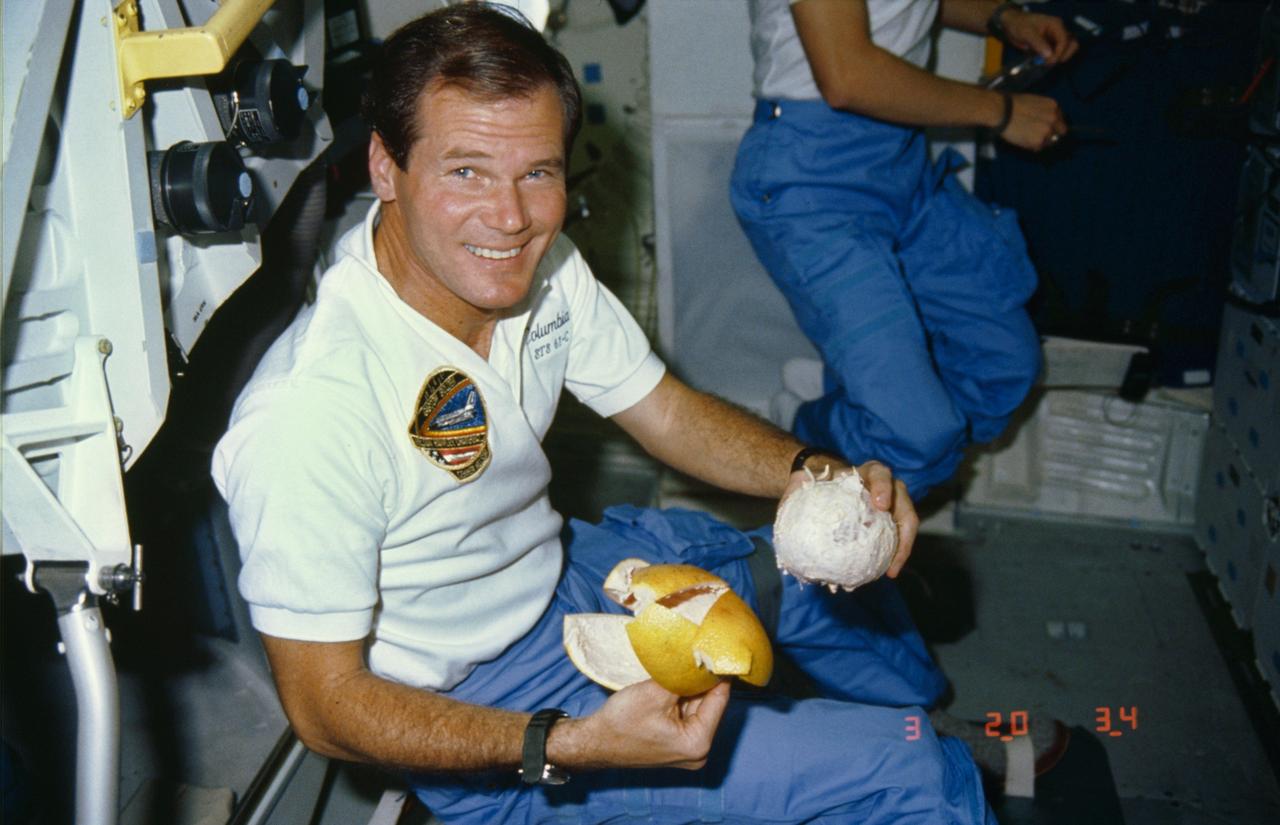
61C-09-005 (15 Jan 1986) --- U.S. Representative Bill Nelson, (D. Florida), STS 61-C payload specialist, prepares to enjoy a freshly peeled grapefruit on the middeck of the earth-orbiting Space Shuttle Columbia.
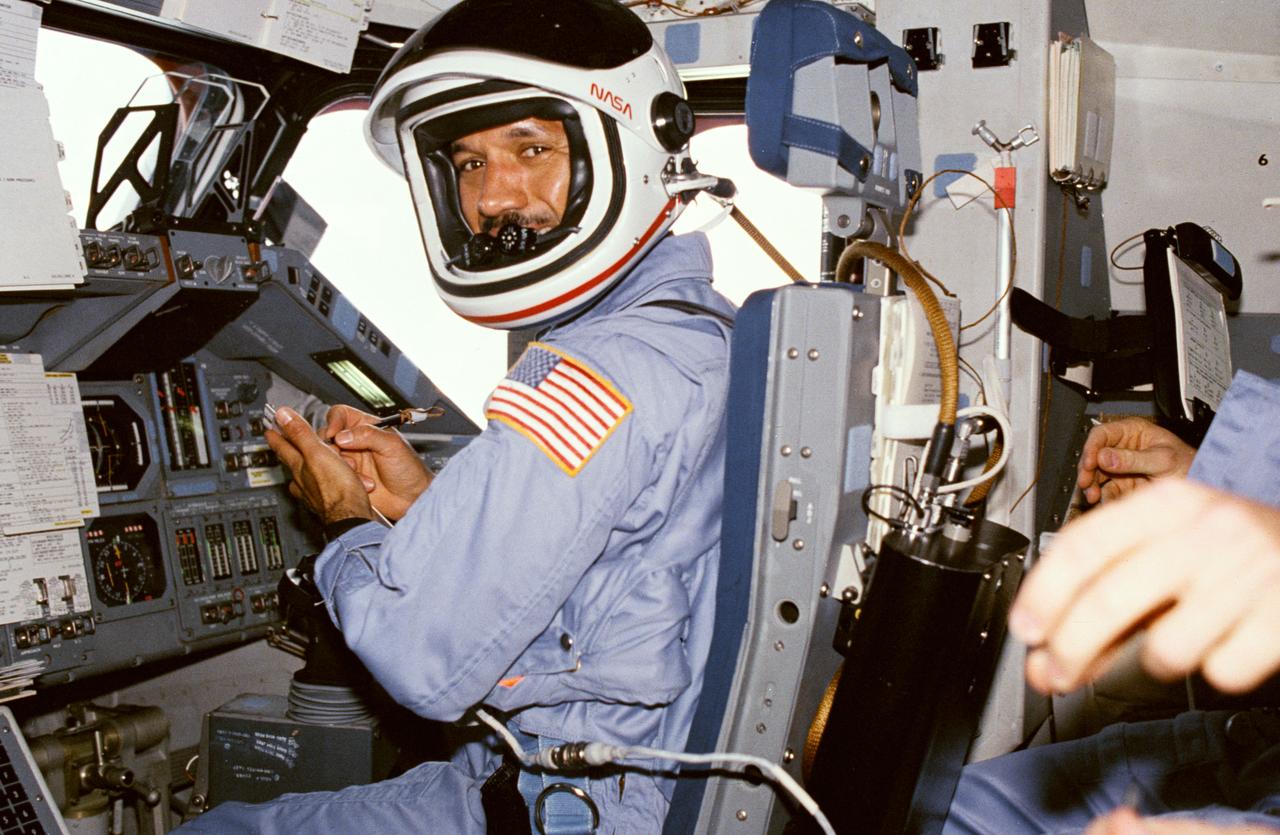
61C-01-007 (12-17 Jan 1986)--- Astronaut Charles F. Bolden STS 61-C pilot, mans the pilot's station on Columbia's flight deck prior to re-entry.
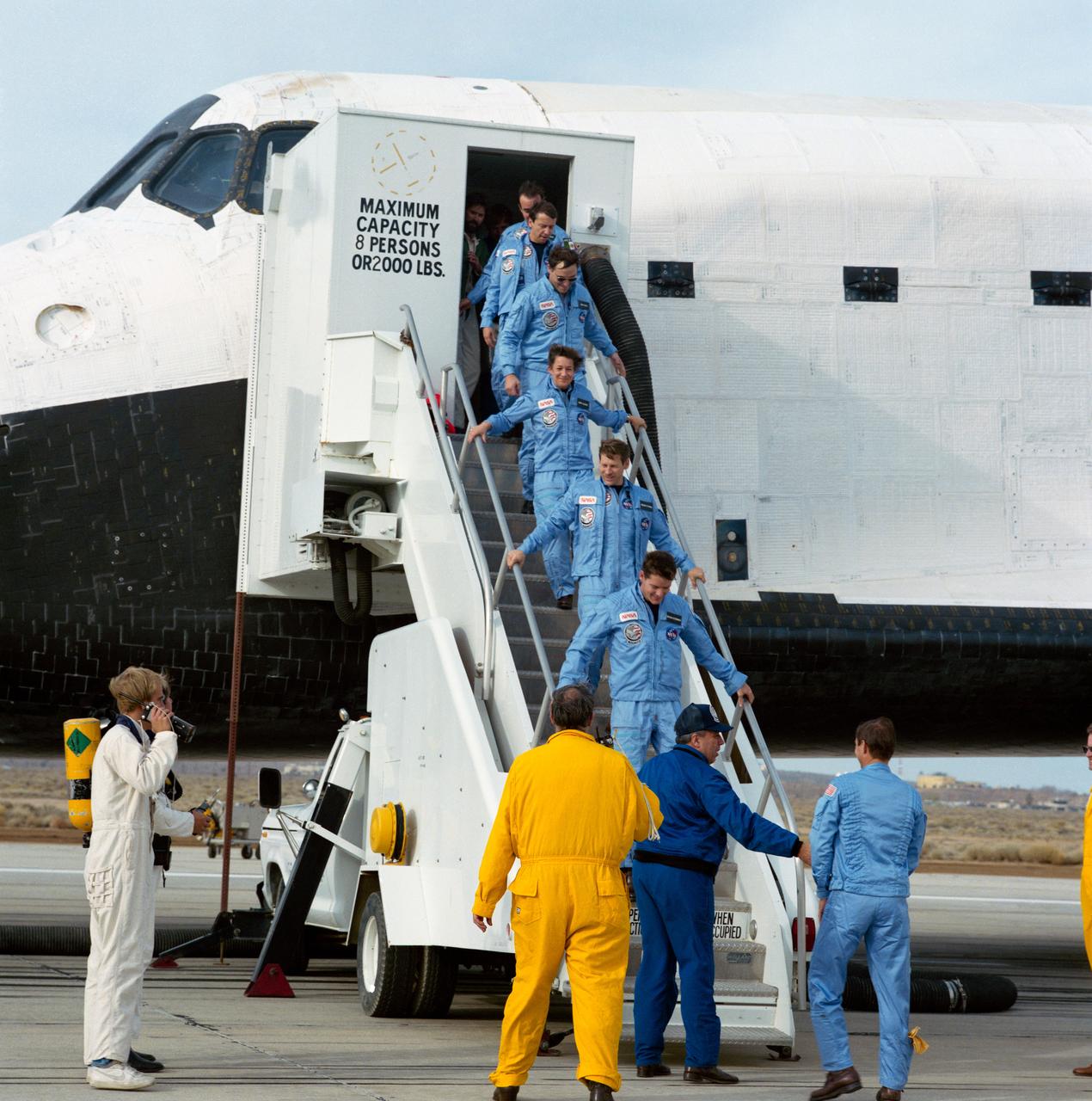
61B-S-071 (3 Dec 1985) --- George W.S. Abbey, director of flight crew operations at the Johnson Space Center (JSC), shakes hands with astronaut Brewster Shaw Jr., STS 61-B mission commander, as the seven-member crew descends the steps from its space-bound "home" for the last week. Following Shaw down the steps (bottom to top) were astronauts Bryan D. O'Connor, Sherwood C. Spring, Mary L. Cleave, Jerry L. Ross and Payload Specialists Charles D. Walker and Rodolfo Neri.
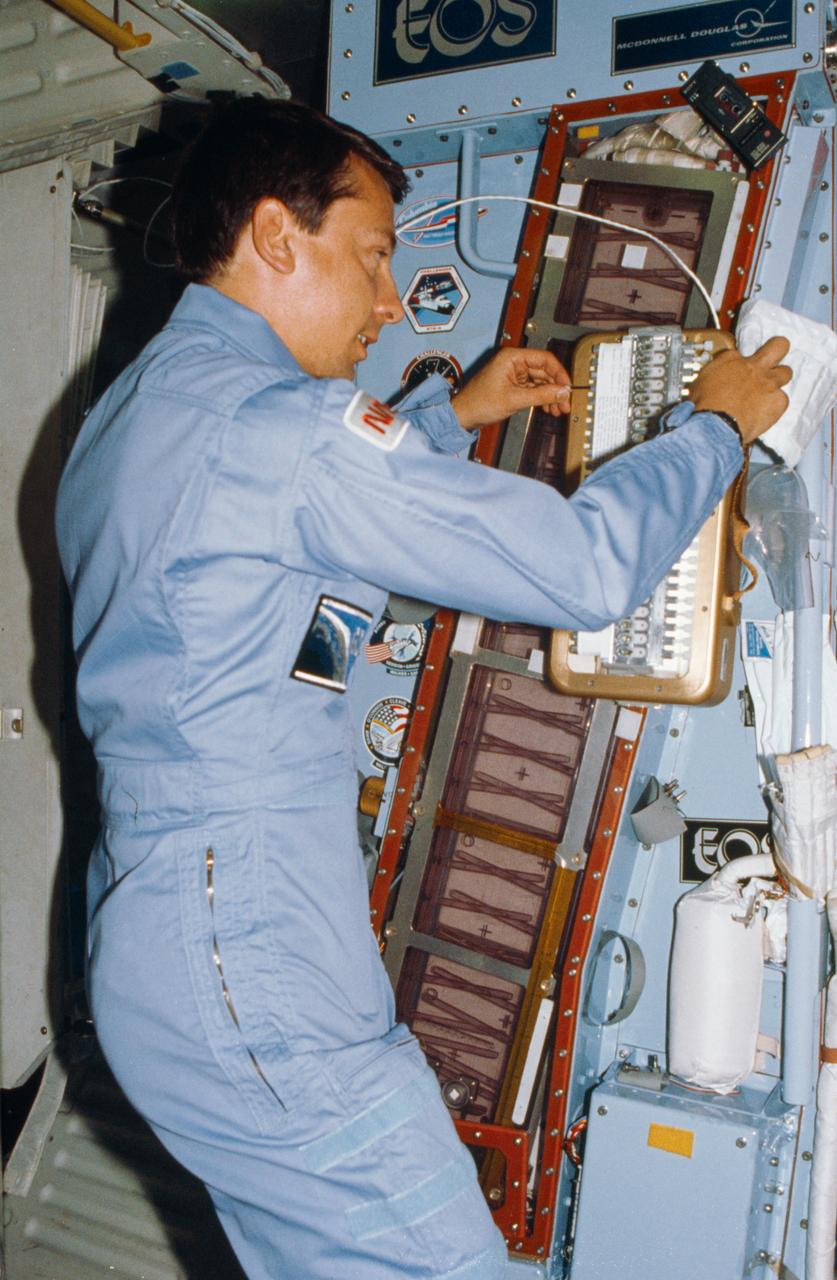
61B-02-014 (26 Nov-3 Dec 1985) --- Payload Specialist Charles D. Walker works with the handheld protein growth experiment -- one of a series of tests being flown to study the possibility of crystallizing biological materials. Walker rests the experiment against the larger continuous flow electrophoresis systems experiment.
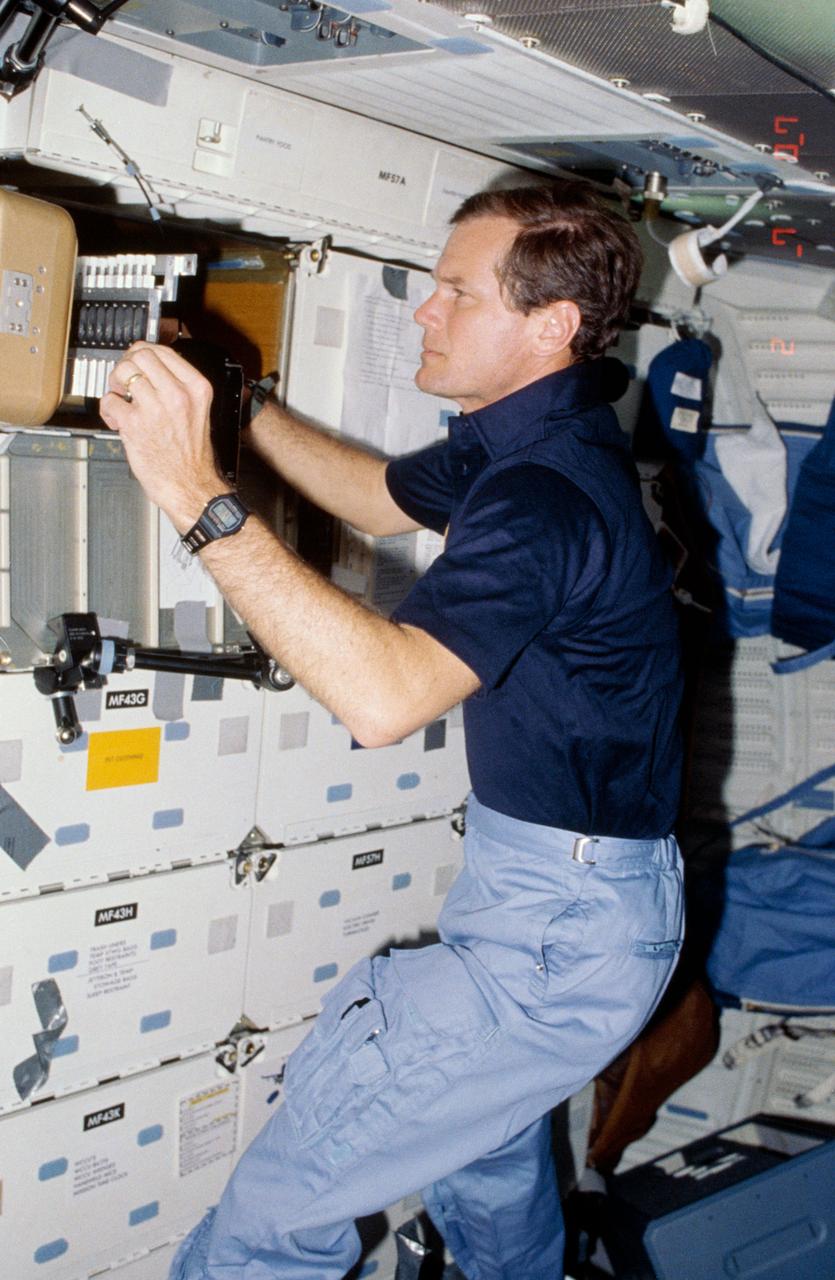
61C-05-036 (12-18 Jan. 1986) --- U.S. Representative Bill Nelson (Democrat - Florida), STS-61C payload specialist, prepares to photograph individual samples in the Handheld Protein Crystal Growth Experiment (HPCG) on Columbia's middeck. The operations involve the use of four pieces of equipment to attempt the growth of 60 different types of crystals -- 12 by means of dialysis and 48 via the vapor diffusion method. The photo was used by members of the STS-61C crew at their Jan. 23, 1986, Post-Flight Press Conference.
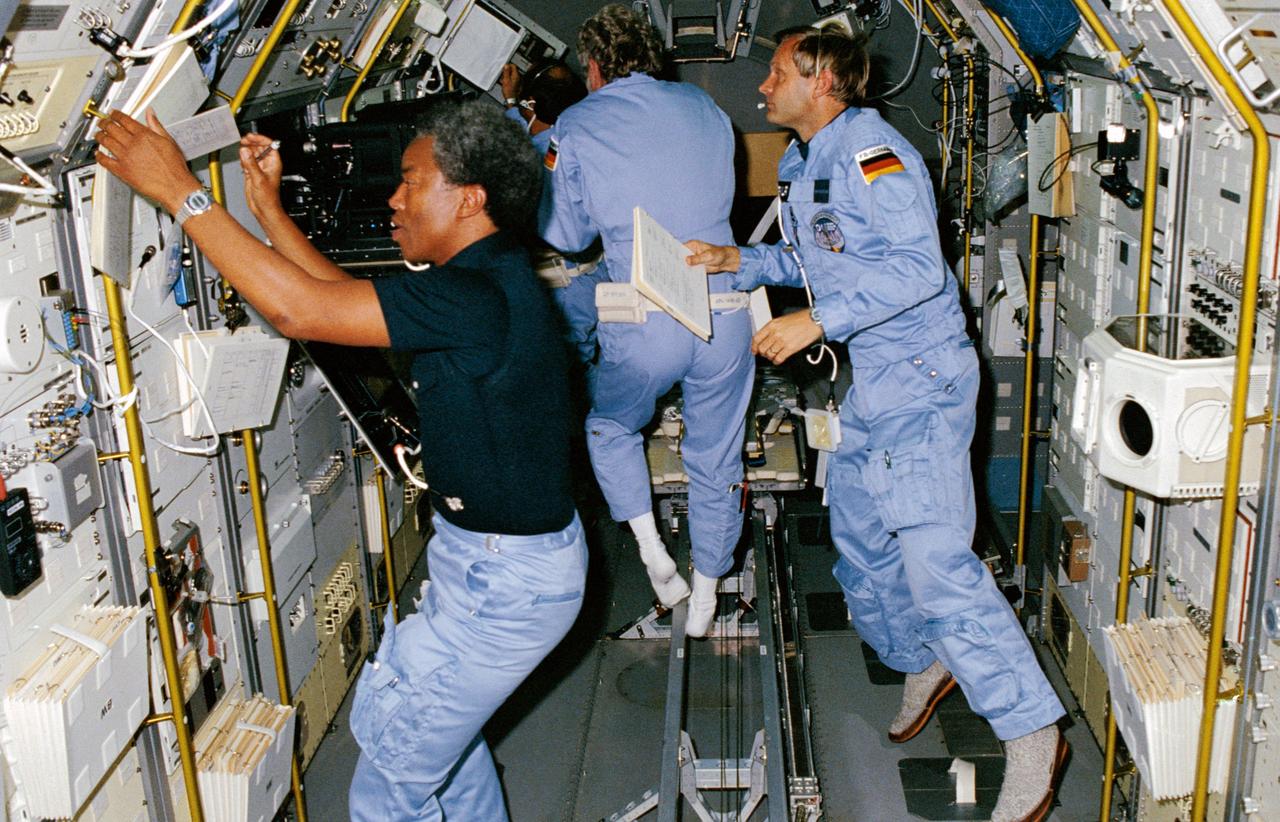
61A-01-030 (30 Oct.-6 Nov. 1985) --- Mission specialist Guion S. Bluford prepares to perform a physics experiment onboard the D-1 science module in the cargo bay of the earth-orbiting Space Shuttle Challenger. In the backgroud, three European payload specialists busy themselves with experiment chores: (L-R) Wubbo J. Ockels (partially obscured), Reinhard Furrer and Ernst Messerschmid.
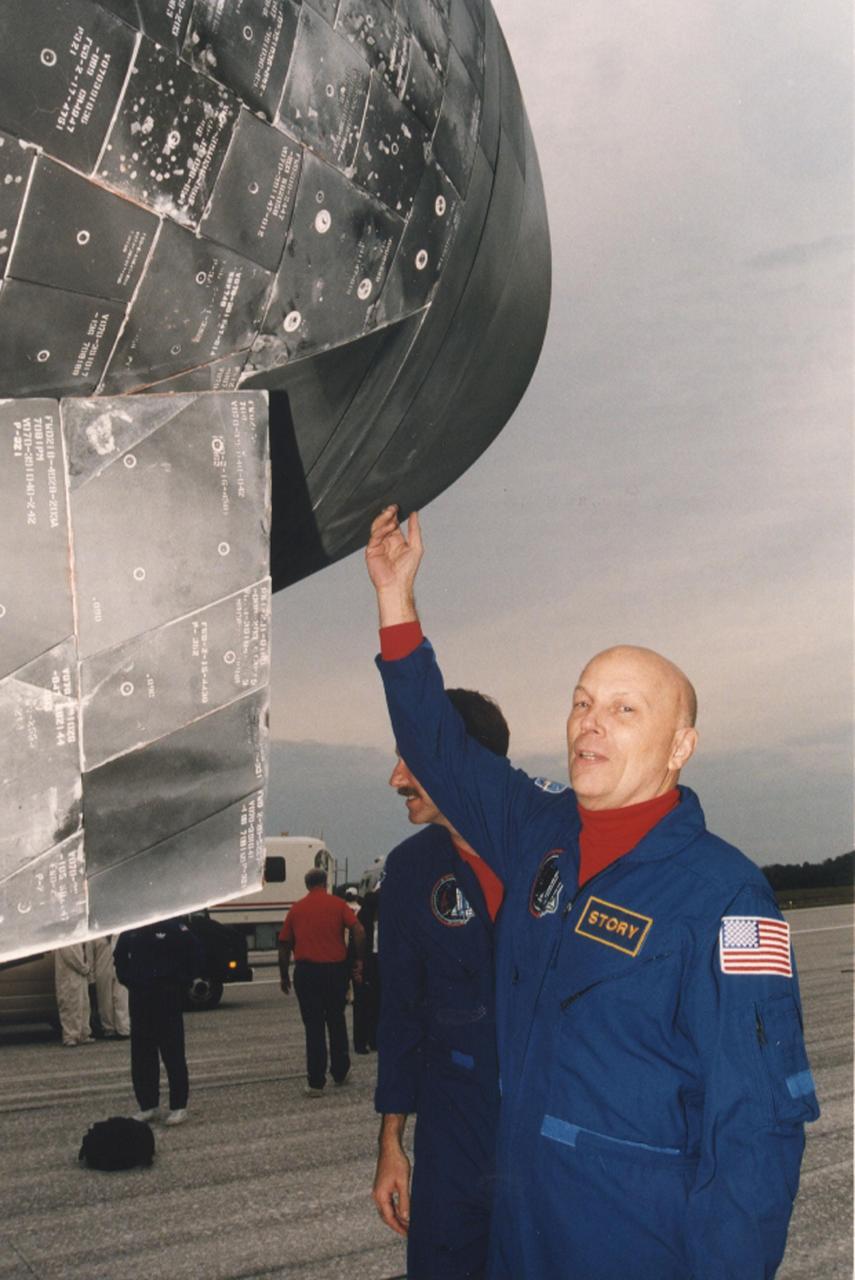
KENNEDY SPACE CENTER, FLA. -- His last spaceflight behind him, STS-80 Mission Specialist Story Musgrave takes one last look at the orbiter Columbia parked on Runway 33 of KSC’s Shuttle Landing Facility. Musgrave became at age 61 the oldest human being to fly into space and in completing his sixth spaceflight ties astronaut John Young’s record for most human spaceflight, while also setting a new record for most Shuttle flights. Columbia touched down at 6:49:05 a.m. EST, Dec. 7, wrapping up Mission STS-80 and the final Shuttle flight of 1996.
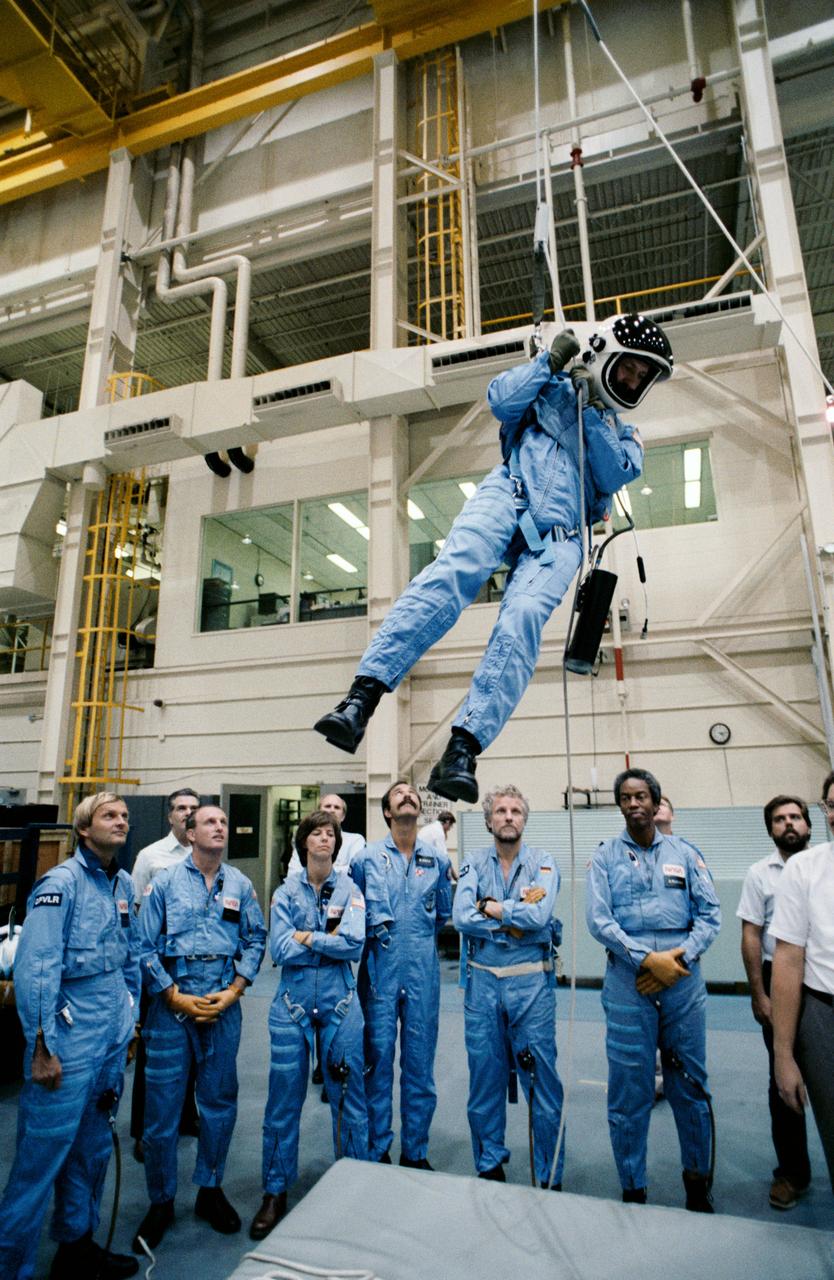
S85-41246 (26 Sept 1985) --- The STS 61-A/Spacelab D-1 crewmembers are seen in this training scene in the Johnson Space Center's Space Shuttle mockup and integration laboratory. Descending from a simulated Shuttle orbiter in distress, using a Sky-Genie device, is Astronaut Henry W. Hartsfield, Jr. mission commander. Watching in blue flight garments are other members of the crew. They are, left to right, Ernst Messerschmid, German payload specialist (PS1); James F. Buchli, NASA mission specialist (MS2); Bonnie J. Dunbar, NASA mission specialist (MS1); Wubbo J. Ockels, Dutch PS3. Not pictured is Steven R. Nagel, pilot. Photo was taken by Otis Imboden.
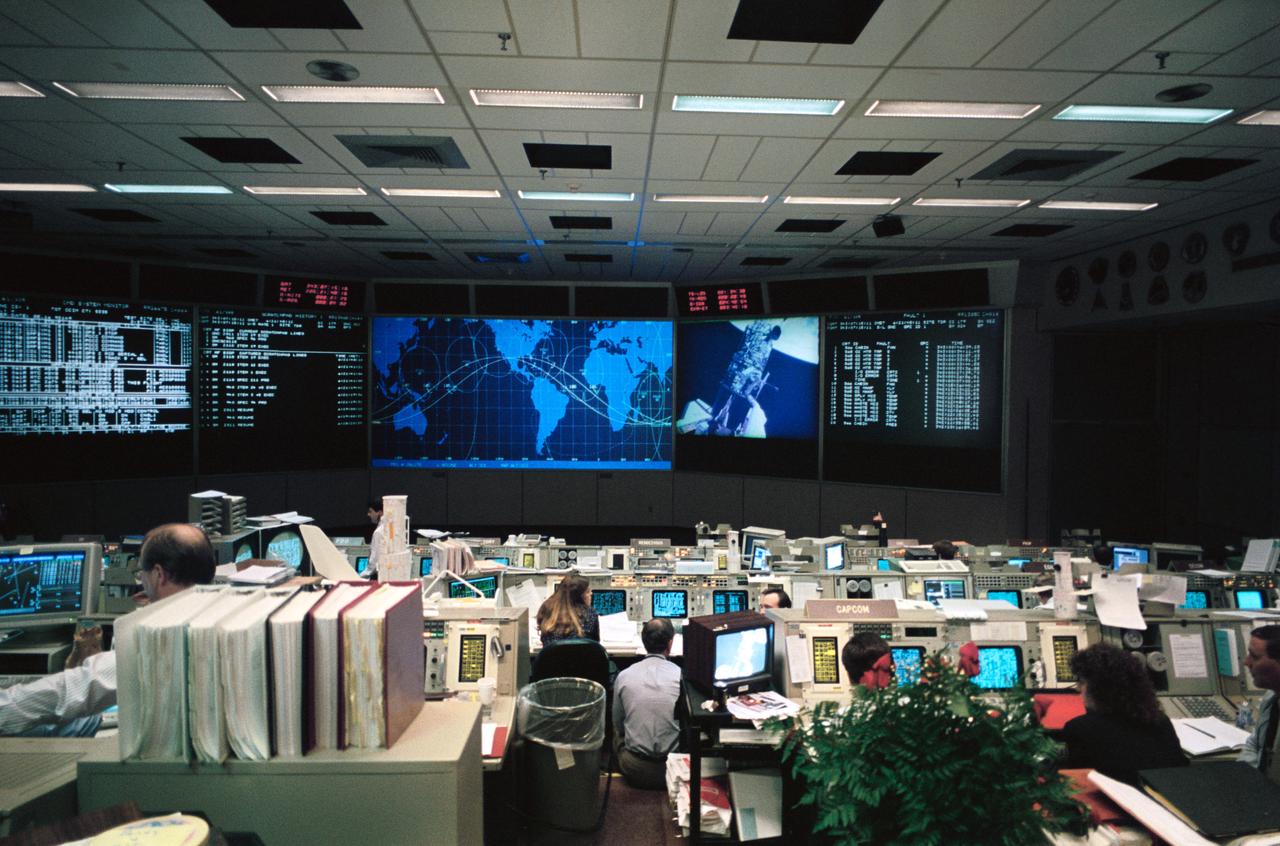
STS061-S-104 (2-13 DEC 1993) --- An overall view in the Johnson Space Center's (JSC) Mission Control Center (MCC) during one of the five space walks performed to service the Hubble Space Telescope (HST) temporarily berthed in the Space Shuttle Endeavour's cargo bay. STS-61 lead flight director Milt Heflin is at right edge of frame.
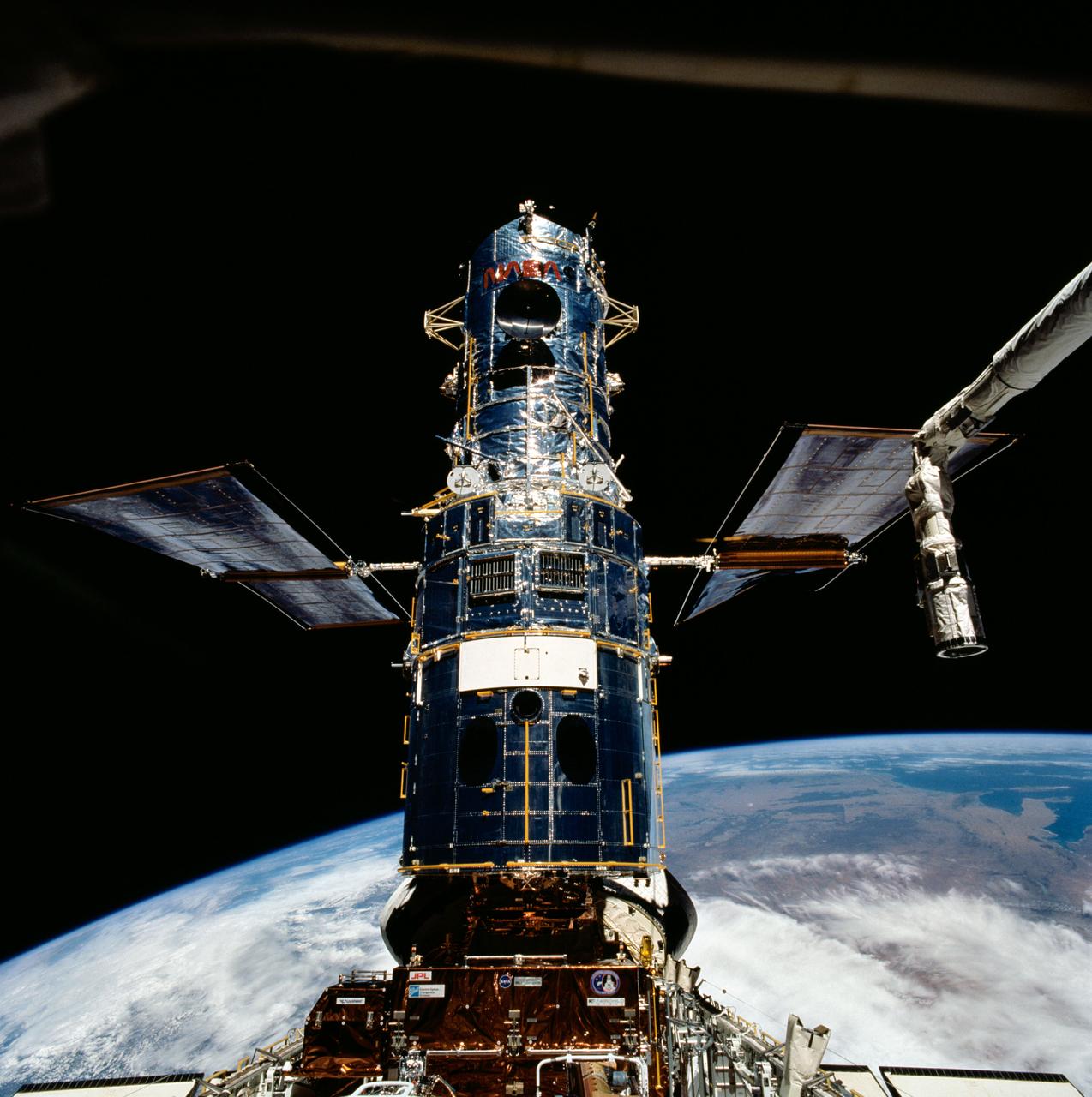
STS061-86-030 (4 Dec 1993) --- The Hubble Space Telescope (HST) is pictured in the Space Shuttle Endeavour's cargo bay following its capture and berthing early in the eleven-day STS-61 mission. The Remote Manipulator System (RMS) arm, with television cameras mounted on it, was maneuvered from inside the cabin in order to survey HST. Five days of space walks followed, during which a variety of servicing tasks were performed by four crew members.
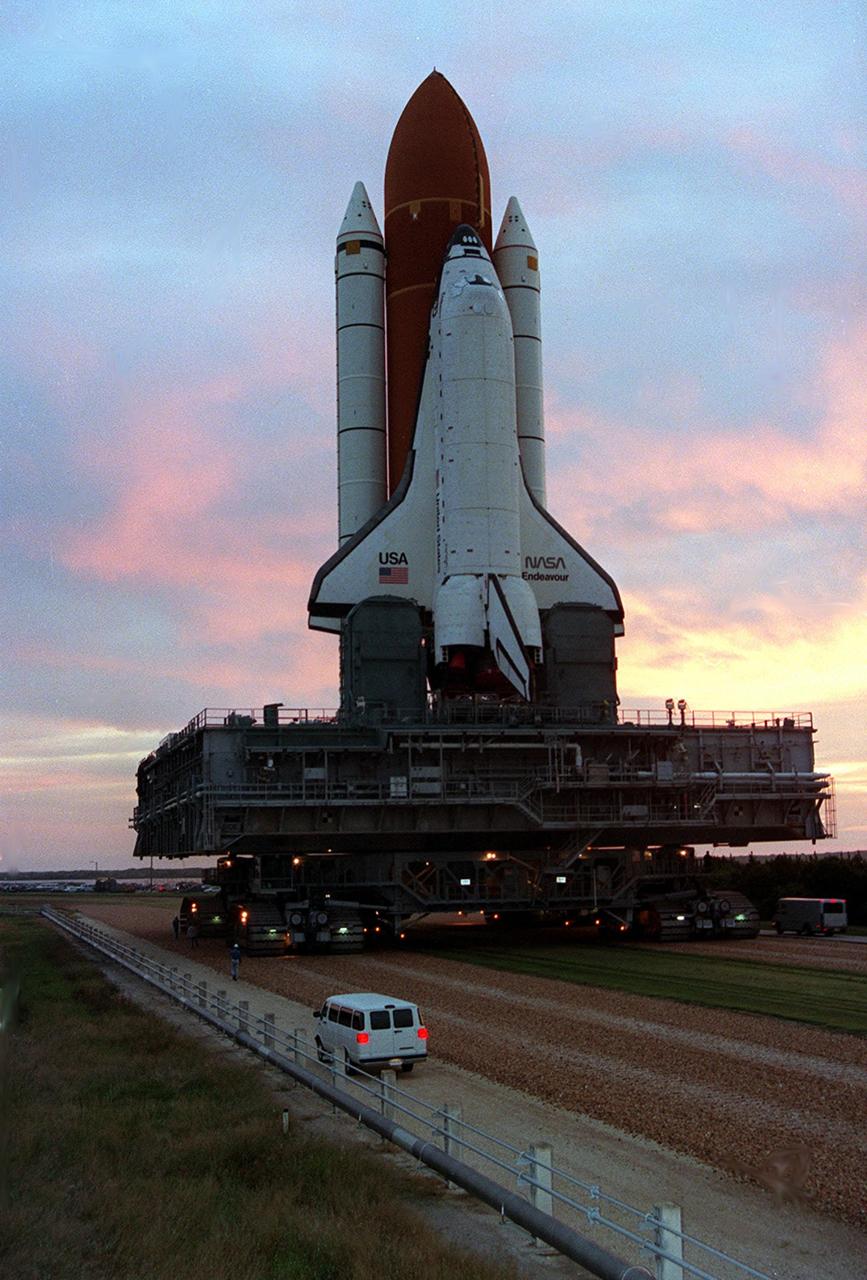
KENNEDY SPACE CENTER, FLA. -- A morning sky drenched in vibrant color welcomes the Space Shuttle Endeavour as it rolls out to Launch Pad 39A today. Endeavour is being readied for the STS-61 mission, targeted for liftoff in early December. During the 11-day flight, a seven-member crew will carry out the first servicing of the Hubble Space Telescope
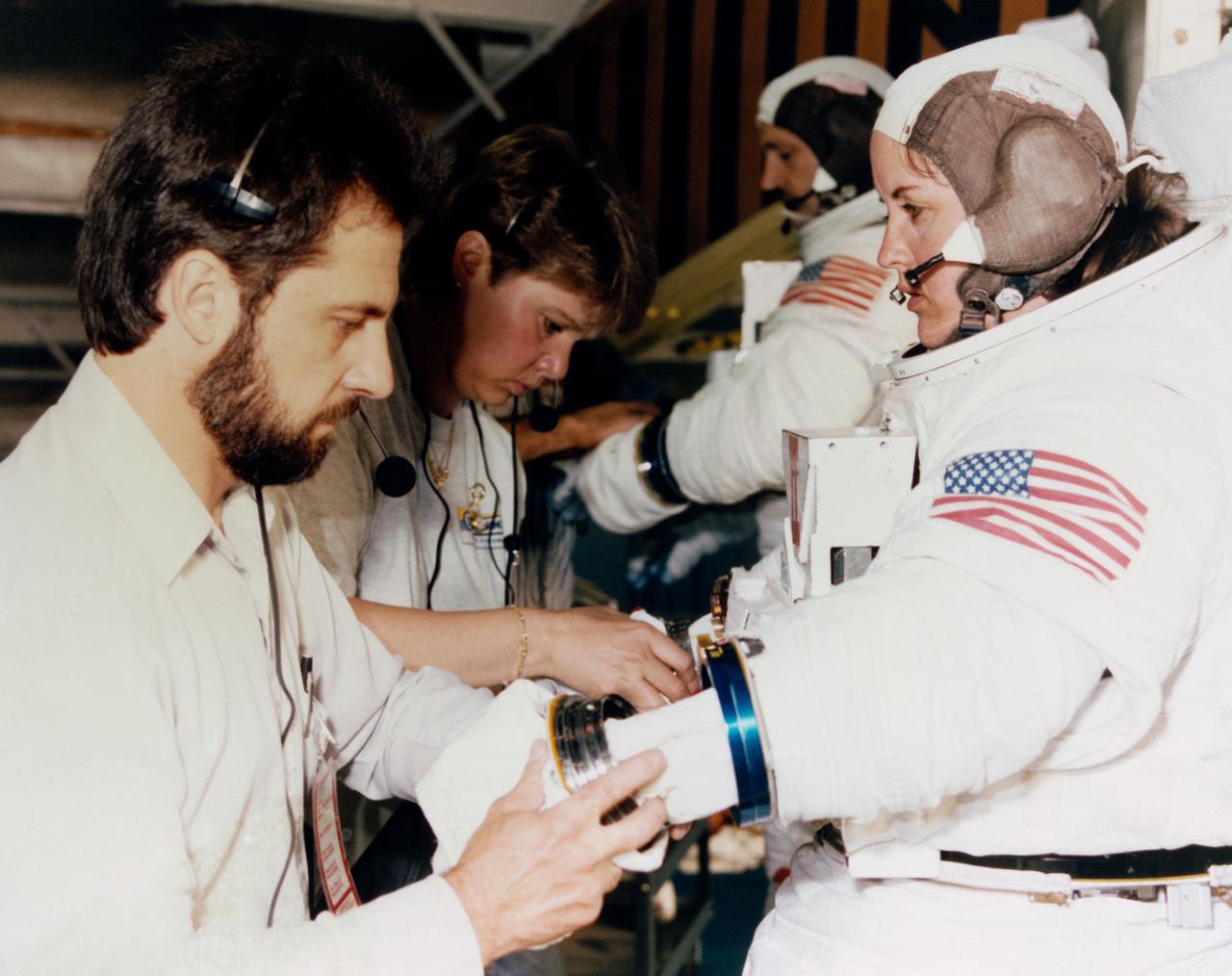
Astronaut Thomas D. Akers gets assistance in donning a training version of the Shuttle extravehicular mobility unit (EMU) space suit prior to a training session in the Neutral Buoyancy Simulator at Marshall Space Flight Center (MSFC) (39735); Astronaut Kathryn C. Thornton (foreground) and Thomas Akers, STS-61 mission specialists scheduled for extravehicular activity (EVA) duty, prepare for an underwater rehearsal session. Thornton recieves assistance from a technician in donning her EMU gloves (39736).
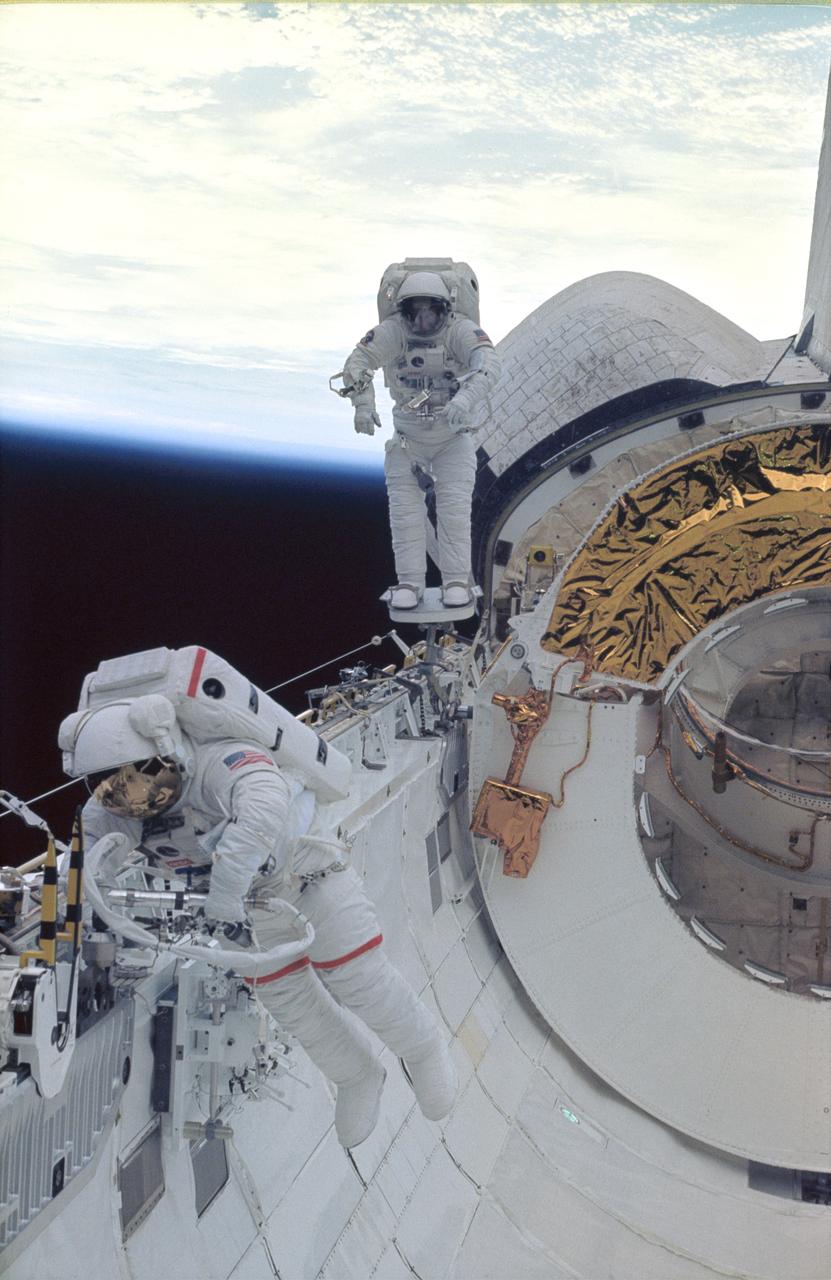
STS051-06-037 (16 Sept 1993) --- Astronauts Carl E. Walz (foreground) and James H. Newman evaluate some important gear. Walz reaches for the Power Ratchet Tool (PRT) while Newman checks out mobility on the Portable Foot Restraint (PFR) near the Space Shuttle Discovery's starboard Orbital Maneuvering System (OMS) pod. The tools and equipment will be instrumental on some of the five periods of extravehicular activity (EVA) scheduled for the Hubble Space Telescope (HST) STS-61 servicing mission later this year.
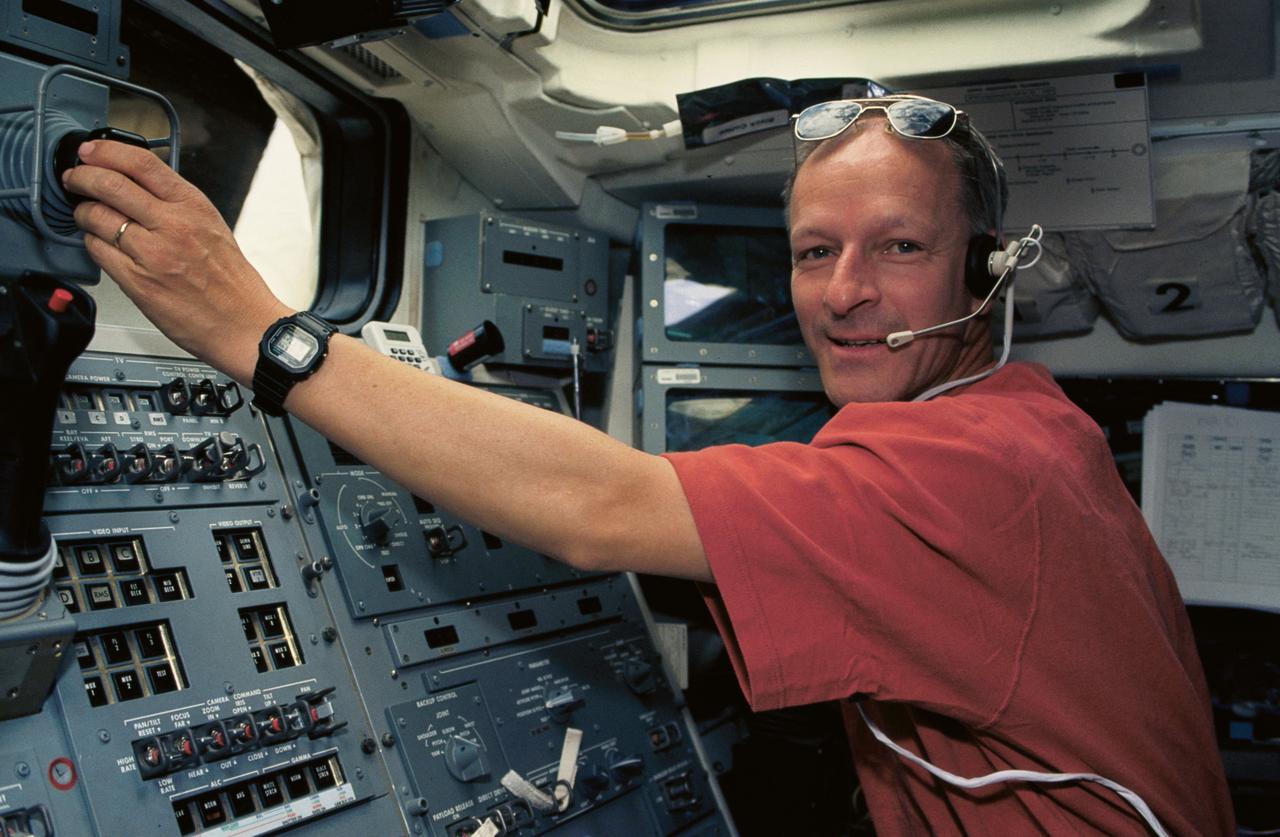
STS061-07-003 (4 Dec 1993) --- Swiss astronaut Claude Nicollier is pictured at the aft flight deck station he occupied during much of the time on NASA's STS-61 mission aboard the Space Shuttle Endeavour. Among Nicollier's responsibilities were the control of the Remote Manipulator System (RMS) during operations with the Hubble Space Telescope (HST).
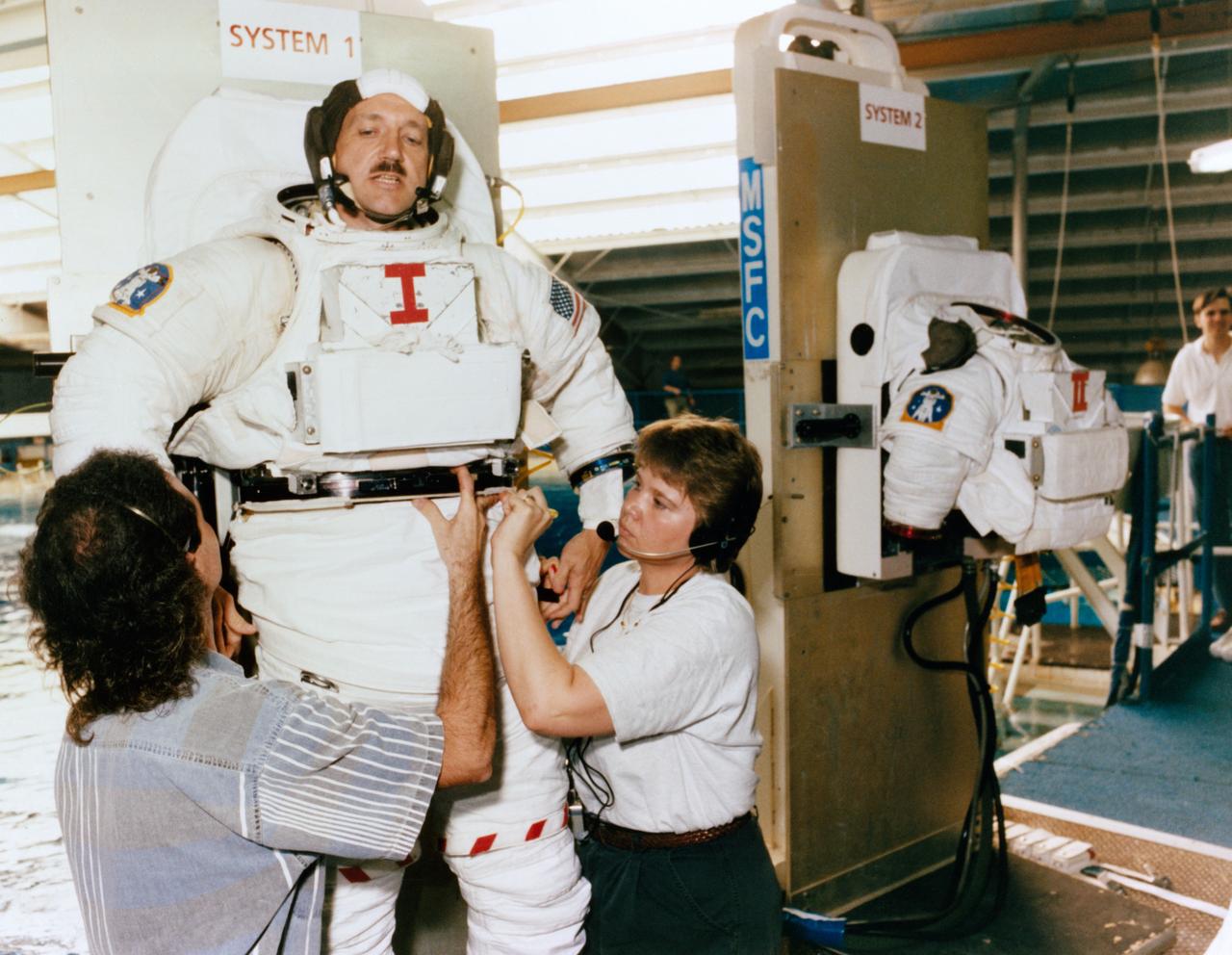
Astronaut Thomas D. Akers gets assistance in donning a training version of the Shuttle extravehicular mobility unit (EMU) space suit prior to a training session in the Neutral Buoyancy Simulator at Marshall Space Flight Center (MSFC) (39735); Astronaut Kathryn C. Thornton (foreground) and Thomas Akers, STS-61 mission specialists scheduled for extravehicular activity (EVA) duty, prepare for an underwater rehearsal session. Thornton recieves assistance from a technician in donning her EMU gloves (39736).
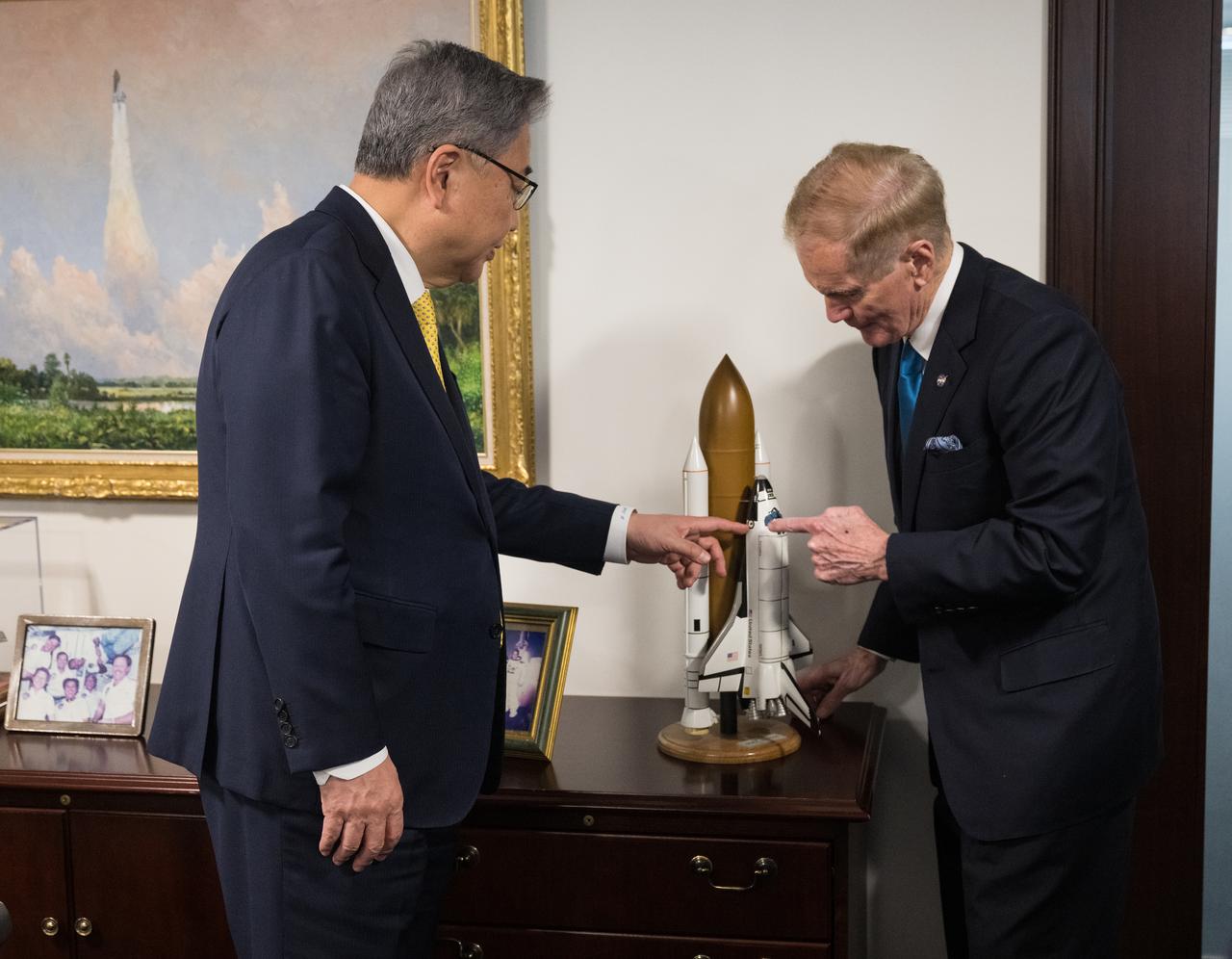
NASA Administrator Bill Nelson shows Republic of Korea Minister of Foreign Affairs, Jin Park, where he sat on the Space Shuttle Columbia during his mission STS-61-C, Thursday, Feb. 2, 2023 at the Mary W. Jackson NASA Headquarters building in Washington DC. Photo Credit: (NASA/Aubrey Gemignani)

S86-28458 (28 Feb. 1986) --- Astronaut Michael L. Coats participates in a rehearsal for his assigned flight at the commander's station of the Shuttle Mission Simulator (SMS) at the Johnson Space Center (JSC). NOTE: Coats, a veteran of spaceflight, originally trained for STS 61-H, which was cancelled in the wake of the Challenger accident. Following the Janaury 1986 accident he was named to serve on a mock crew (STS-61M) for personnel training and simulation purposes. Photo credit: NASA
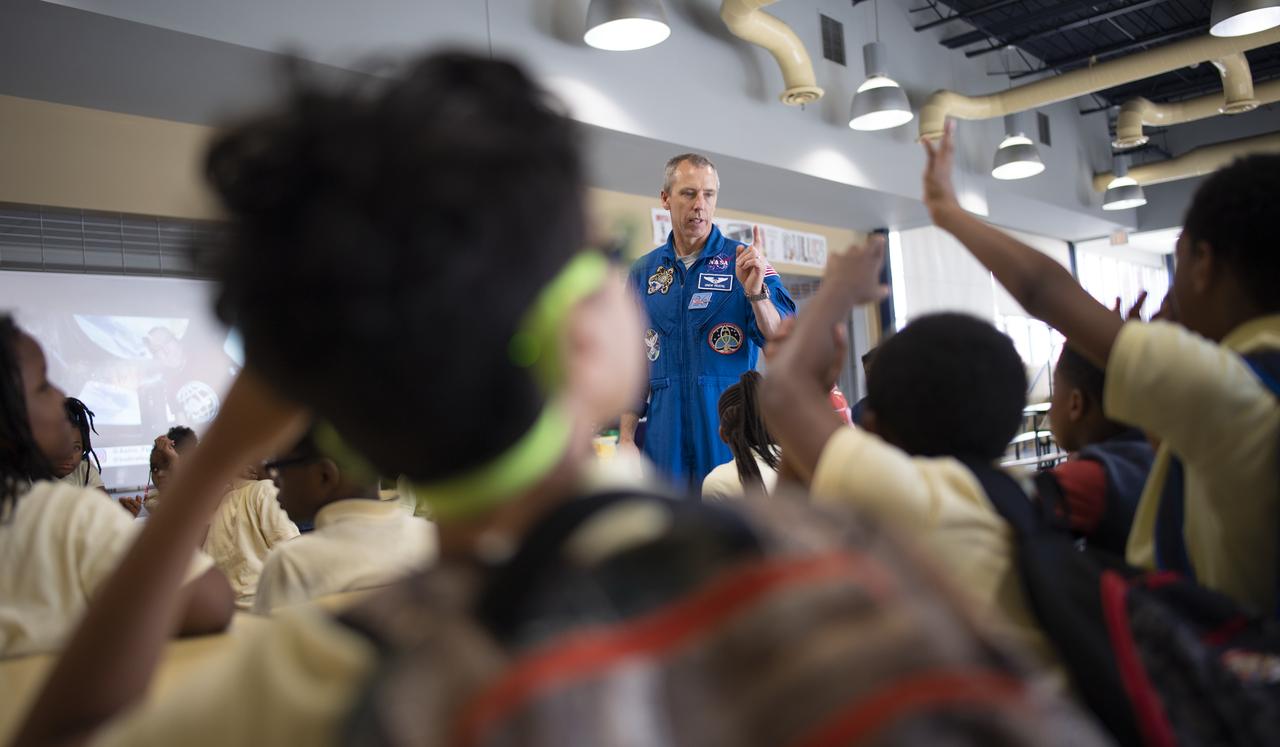
NASA astronaut Drew Feustel speaks to students at John Burroughs Elementary School about his experiences on two space shuttle missions, STS-125 and STS-134, and a long duration mission onboard the International Space Station, Tuesday, May 7, 2019 in Washington, DC. Feustel most recently spent 197 days living and working onboard the International Space Station as part of Expedition 55 and as commander of Expedition 56. Feustel ventured outside the space station on three spacewalks, moving him up to second among U.S. spacewalkers with a cumulative time of 61 hours 48 minutes over nine spacewalks. Photo Credit: (NASA/Joel Kowsky)
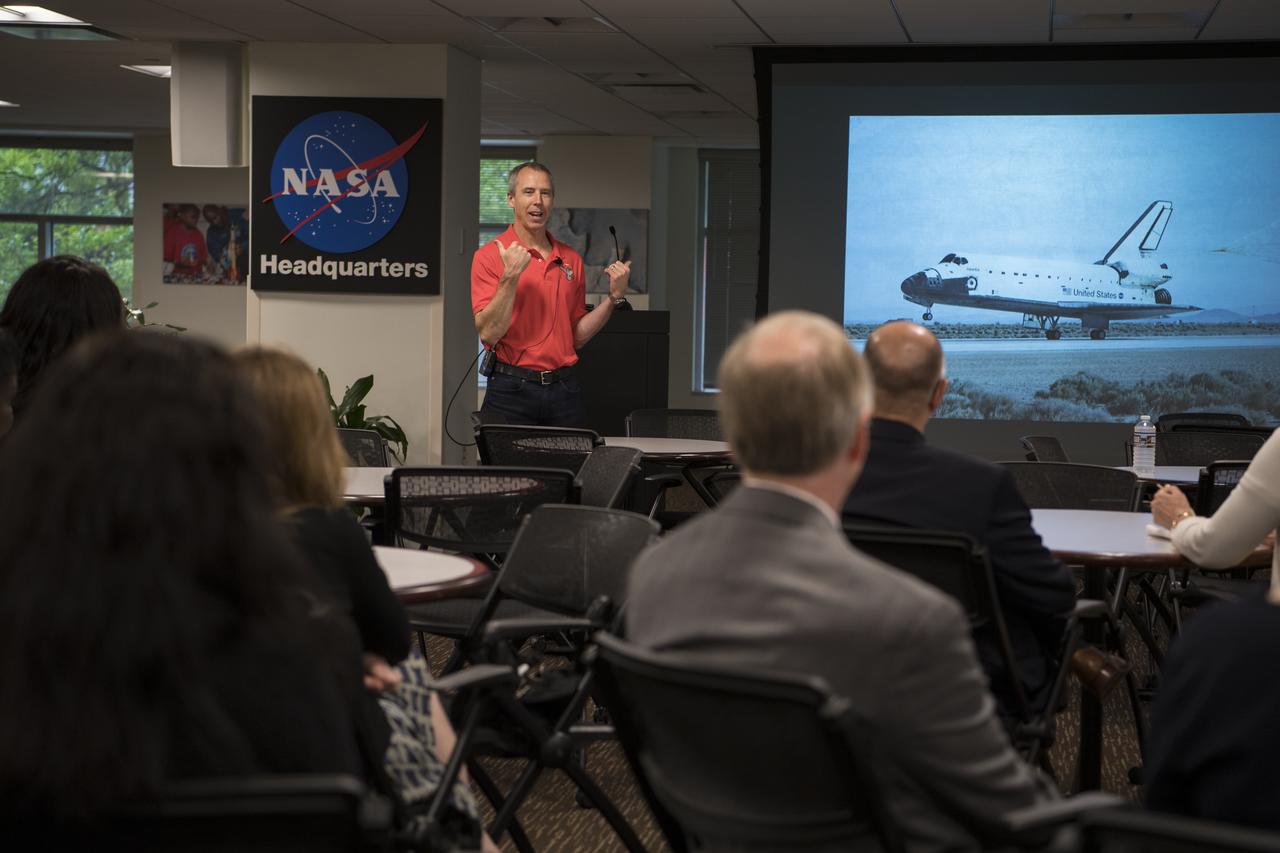
NASA astronaut Drew Feustel speaks about his experience on two space shuttle missions, STS-125 and STS-134, and a long duration mission onboard the International Space Station at NASA Headquarters, Thursday, May 9, 2019 in Washington, DC. Feustel most recently spent 197 days living and working onboard the International Space Station as part of Expedition 55 and as commander of Expedition 56. Feustel ventured outside the space station on three spacewalks, moving him up to second among U.S. spacewalkers with a cumulative time of 61 hours 48 minutes over nine spacewalks. Photo Credit: (NASA/Aubrey Gemignani)
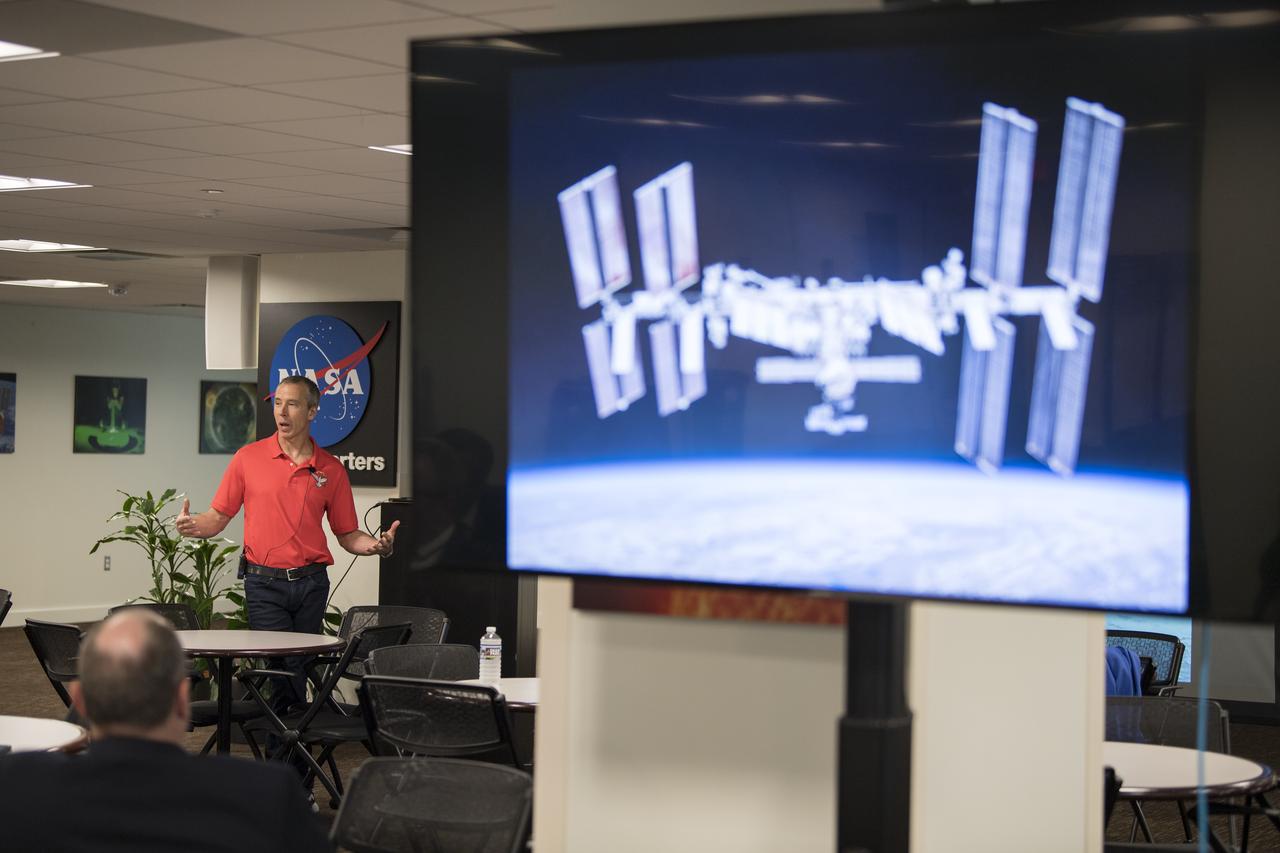
NASA astronaut Drew Feustel speaks about his experience on two space shuttle missions, STS-125 and STS-134, and a long duration mission onboard the International Space Station at NASA Headquarters, Thursday, May 9, 2019 in Washington, DC. Feustel most recently spent 197 days living and working onboard the International Space Station as part of Expedition 55 and as commander of Expedition 56. Feustel ventured outside the space station on three spacewalks, moving him up to second among U.S. spacewalkers with a cumulative time of 61 hours 48 minutes over nine spacewalks. Photo Credit: (NASA/Aubrey Gemignani)
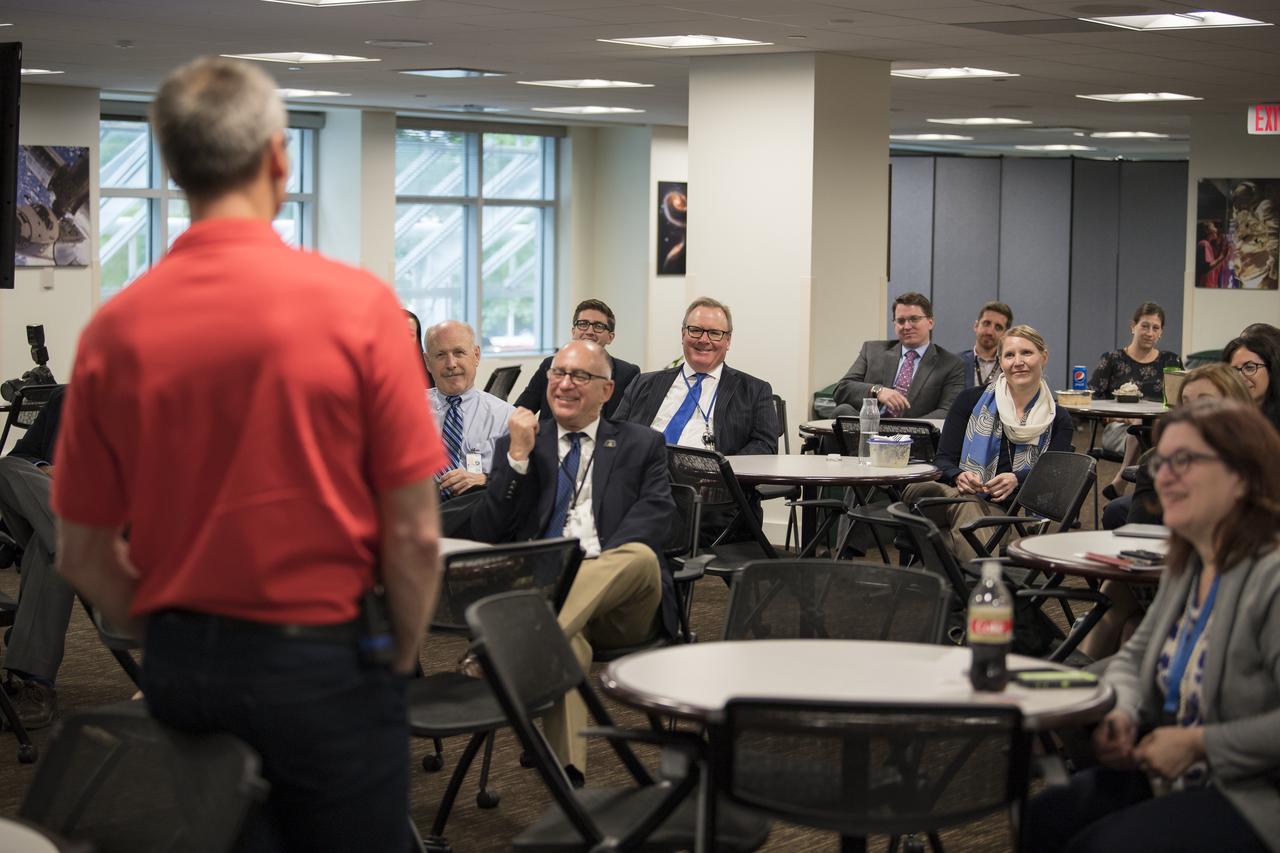
NASA astronaut Drew Feustel speaks about his experience on two space shuttle missions, STS-125 and STS-134, and a long duration mission onboard the International Space Station at NASA Headquarters, Thursday, May 9, 2019 in Washington, DC. Feustel most recently spent 197 days living and working onboard the International Space Station as part of Expedition 55 and as commander of Expedition 56. Feustel ventured outside the space station on three spacewalks, moving him up to second among U.S. spacewalkers with a cumulative time of 61 hours 48 minutes over nine spacewalks. Photo Credit: (NASA/Aubrey Gemignani)
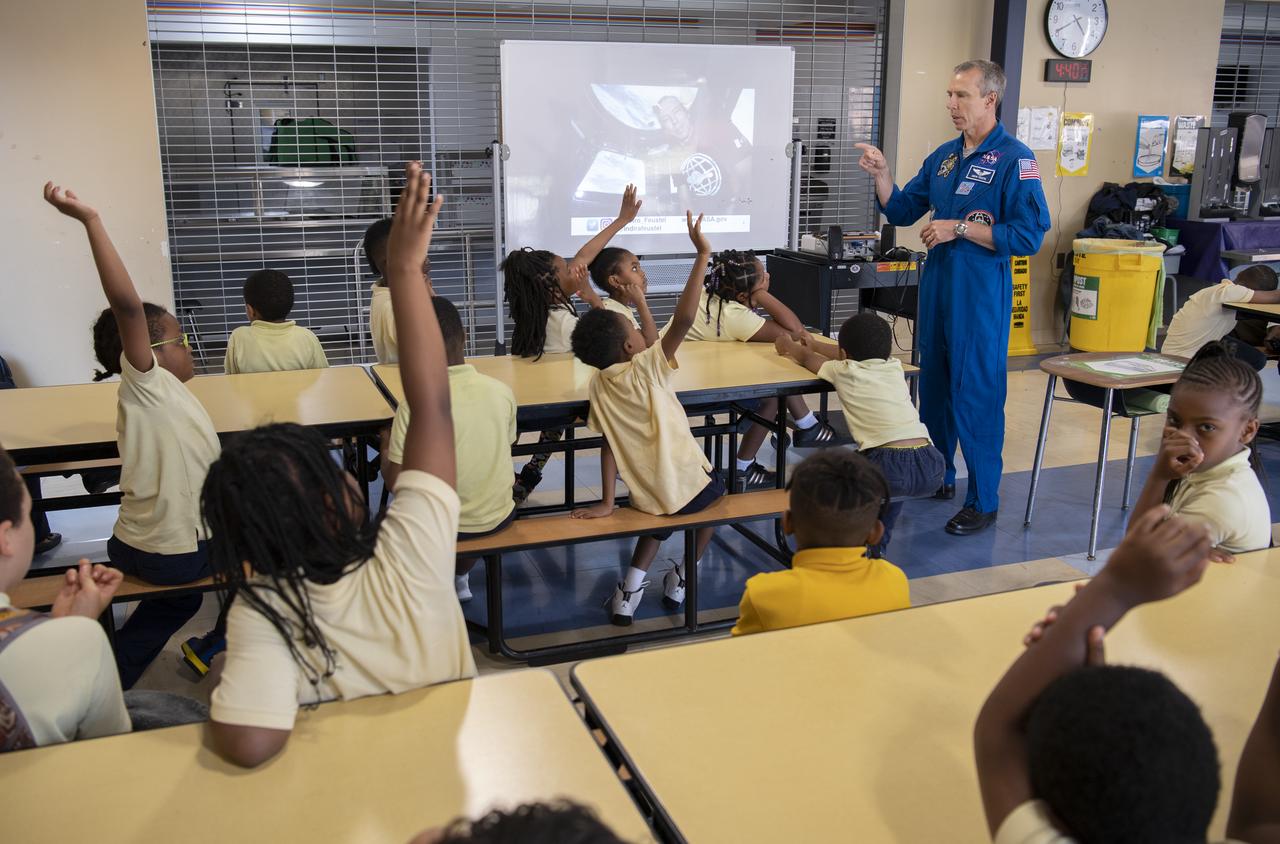
NASA astronaut Drew Feustel speaks to students at John Burroughs Elementary School about his experiences on two space shuttle missions, STS-125 and STS-134, and a long duration mission onboard the International Space Station, Tuesday, May 7, 2019 in Washington, DC. Feustel most recently spent 197 days living and working onboard the International Space Station as part of Expedition 55 and as commander of Expedition 56. Feustel ventured outside the space station on three spacewalks, moving him up to second among U.S. spacewalkers with a cumulative time of 61 hours 48 minutes over nine spacewalks. Photo Credit: (NASA/Joel Kowsky)

NASA astronaut Drew Feustel speaks about his experience on two space shuttle missions, STS-125 and STS-134, and a long duration mission onboard the International Space Station at NASA Headquarters, Thursday, May 9, 2019 in Washington, DC. Feustel most recently spent 197 days living and working onboard the International Space Station as part of Expedition 55 and as commander of Expedition 56. Feustel ventured outside the space station on three spacewalks, moving him up to second among U.S. spacewalkers with a cumulative time of 61 hours 48 minutes over nine spacewalks. Photo Credit: (NASA/Aubrey Gemignani)
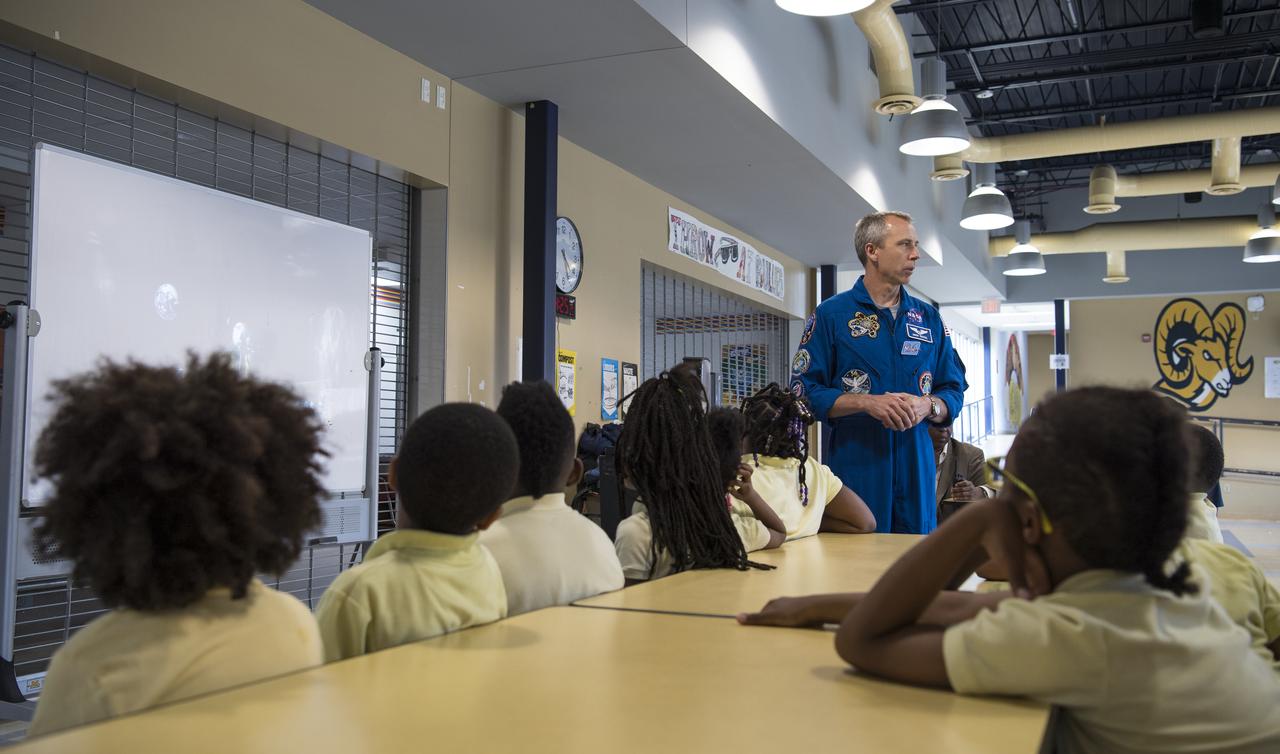
NASA astronaut Drew Feustel speaks to students at John Burroughs Elementary School about his experiences on two space shuttle missions, STS-125 and STS-134, and a long duration mission onboard the International Space Station, Tuesday, May 7, 2019 in Washington, DC. Feustel most recently spent 197 days living and working onboard the International Space Station as part of Expedition 55 and as commander of Expedition 56. Feustel ventured outside the space station on three spacewalks, moving him up to second among U.S. spacewalkers with a cumulative time of 61 hours 48 minutes over nine spacewalks. Photo Credit: (NASA/Joel Kowsky)
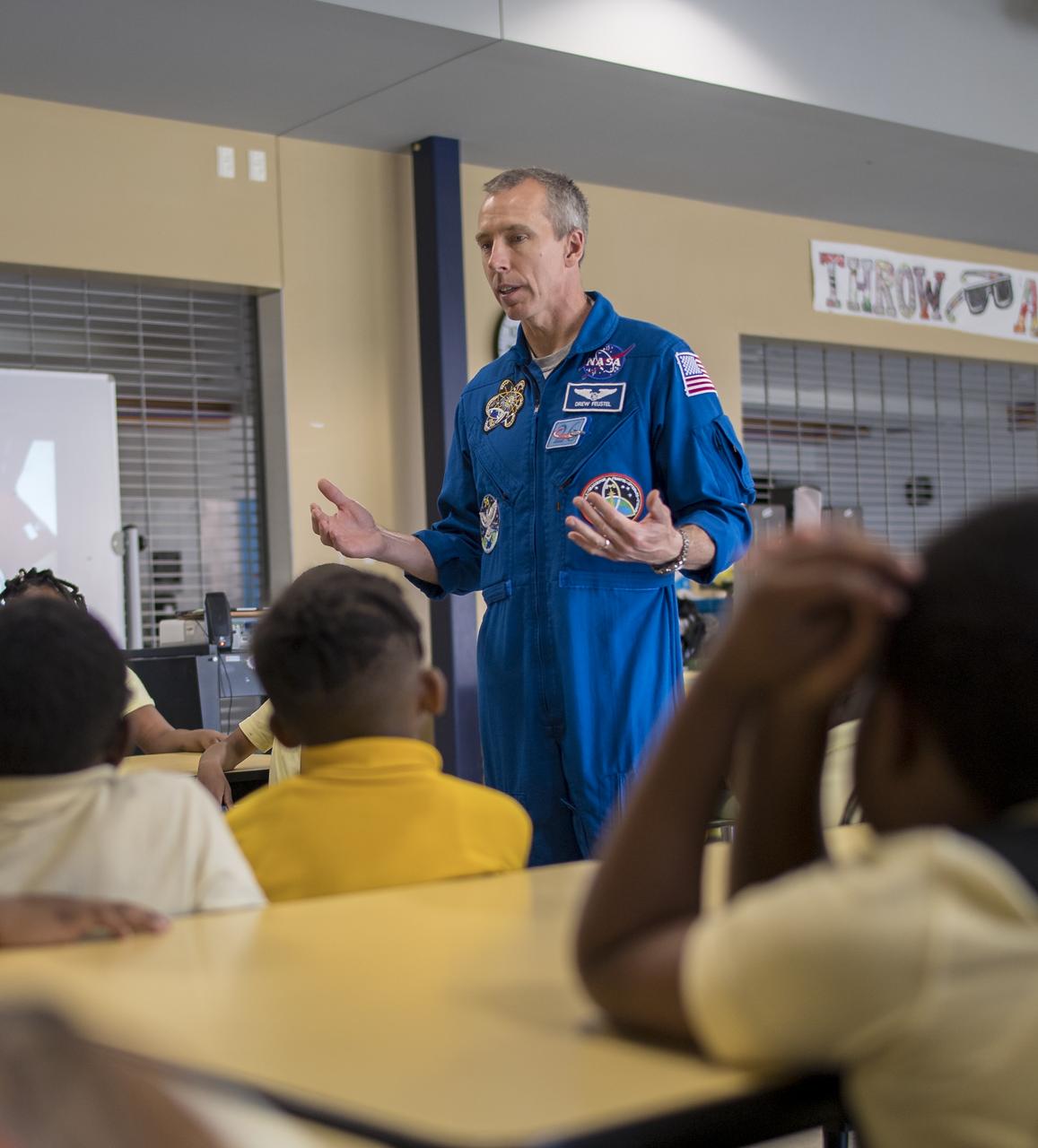
NASA astronaut Drew Feustel speaks to students at John Burroughs Elementary School about his experiences on two space shuttle missions, STS-125 and STS-134, and a long duration mission onboard the International Space Station, Tuesday, May 7, 2019 in Washington, DC. Feustel most recently spent 197 days living and working onboard the International Space Station as part of Expedition 55 and as commander of Expedition 56. Feustel ventured outside the space station on three spacewalks, moving him up to second among U.S. spacewalkers with a cumulative time of 61 hours 48 minutes over nine spacewalks. Photo Credit: (NASA/Joel Kowsky)
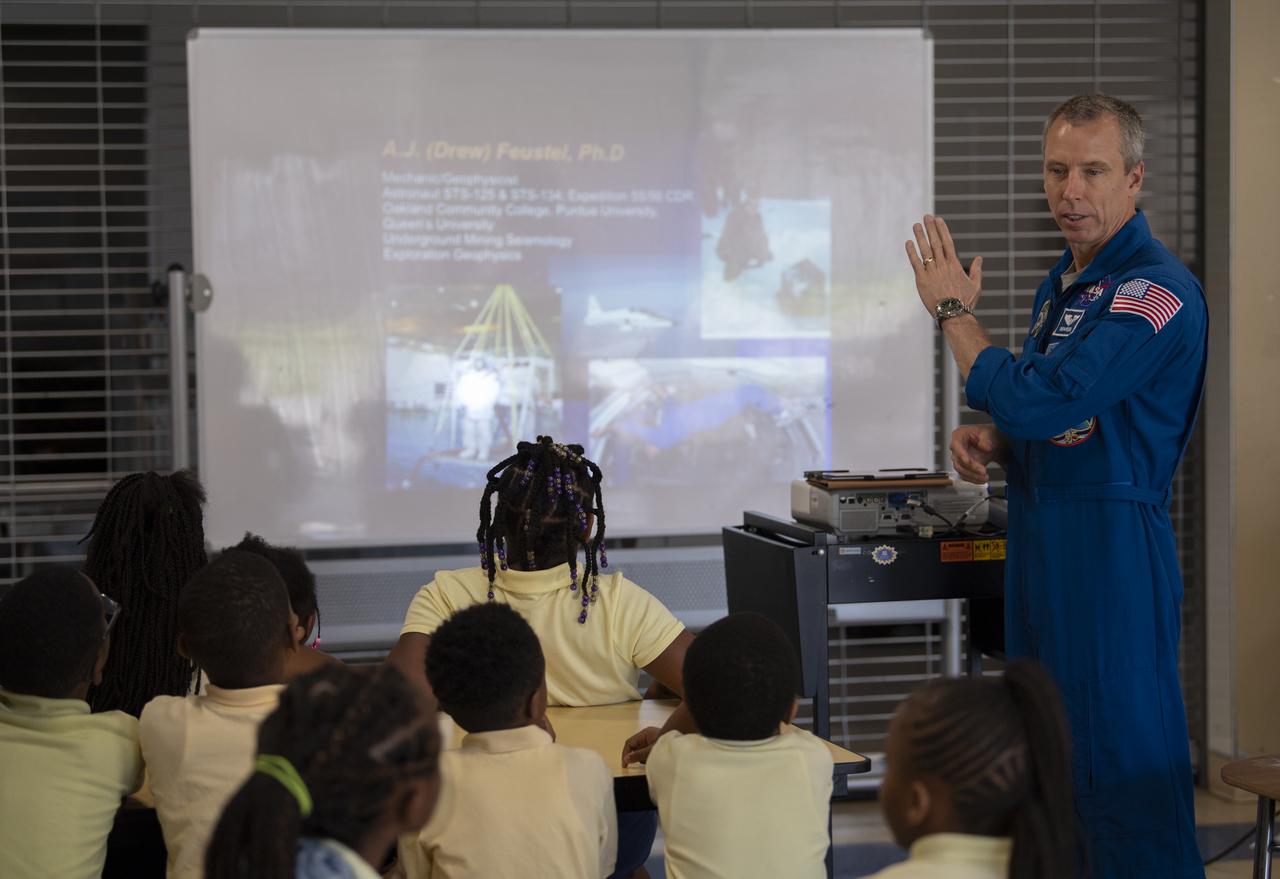
NASA astronaut Drew Feustel speaks to students at John Burroughs Elementary School about his experiences on two space shuttle missions, STS-125 and STS-134, and a long duration mission onboard the International Space Station, Tuesday, May 7, 2019 in Washington, DC. Feustel most recently spent 197 days living and working onboard the International Space Station as part of Expedition 55 and as commander of Expedition 56. Feustel ventured outside the space station on three spacewalks, moving him up to second among U.S. spacewalkers with a cumulative time of 61 hours 48 minutes over nine spacewalks. Photo Credit: (NASA/Joel Kowsky)
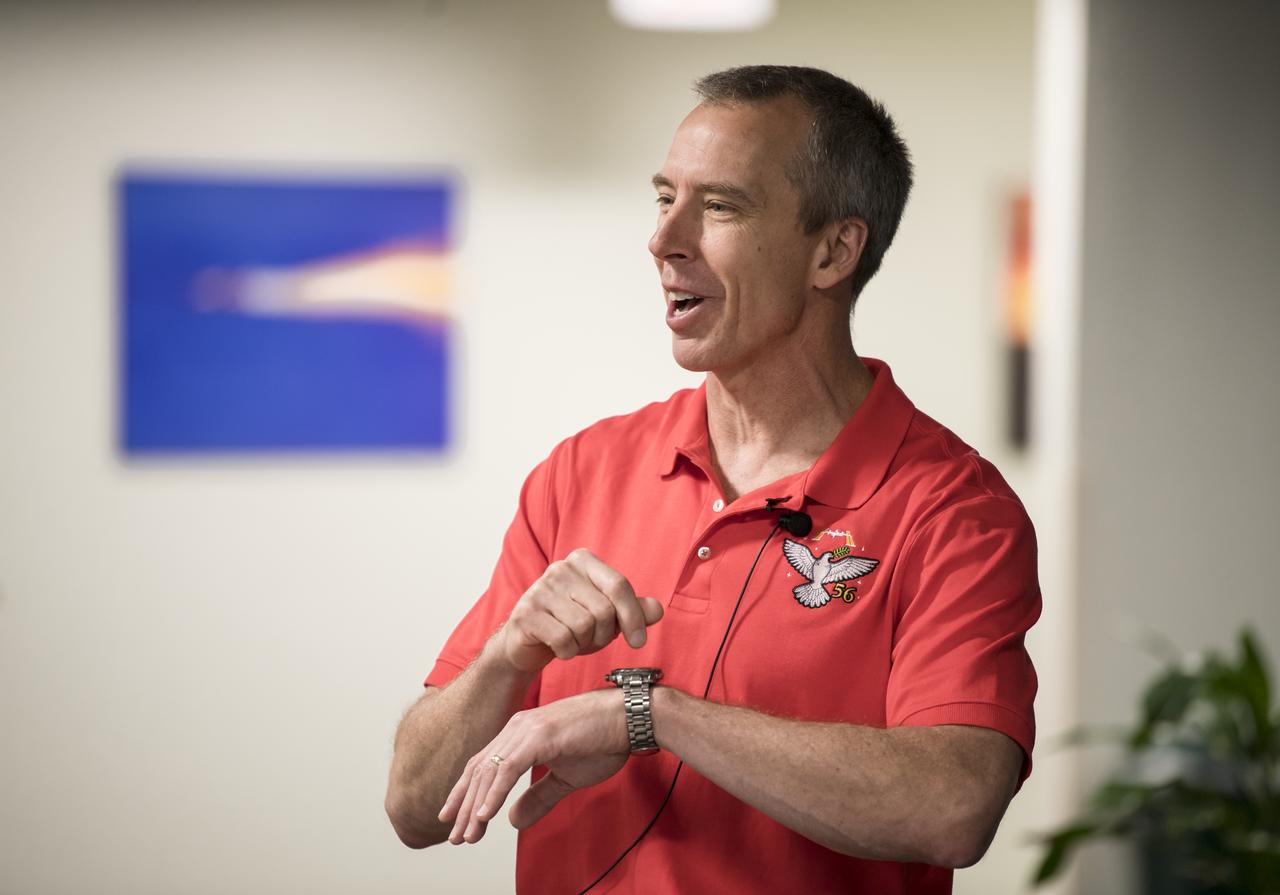
NASA astronaut Drew Feustel speaks about his experience on two space shuttle missions, STS-125 and STS-134, and a long duration mission onboard the International Space Station at NASA Headquarters, Thursday, May 9, 2019 in Washington, DC. Feustel most recently spent 197 days living and working onboard the International Space Station as part of Expedition 55 and as commander of Expedition 56. Feustel ventured outside the space station on three spacewalks, moving him up to second among U.S. spacewalkers with a cumulative time of 61 hours 48 minutes over nine spacewalks. Photo Credit: (NASA/Aubrey Gemignani)
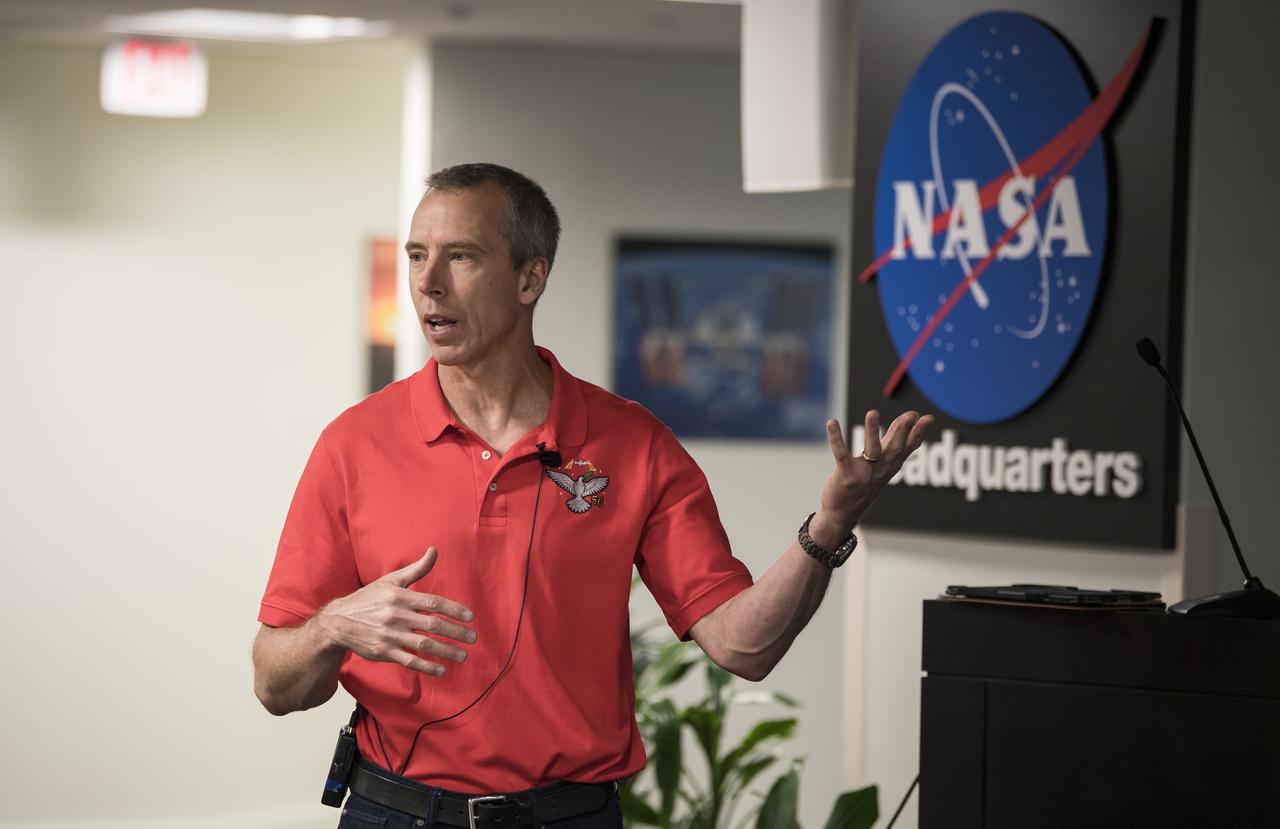
NASA astronaut Drew Feustel speaks about his experience on two space shuttle missions, STS-125 and STS-134, and a long duration mission onboard the International Space Station at NASA Headquarters, Thursday, May 9, 2019 in Washington, DC. Feustel most recently spent 197 days living and working onboard the International Space Station as part of Expedition 55 and as commander of Expedition 56. Feustel ventured outside the space station on three spacewalks, moving him up to second among U.S. spacewalkers with a cumulative time of 61 hours 48 minutes over nine spacewalks. Photo Credit: (NASA/Aubrey Gemignani)
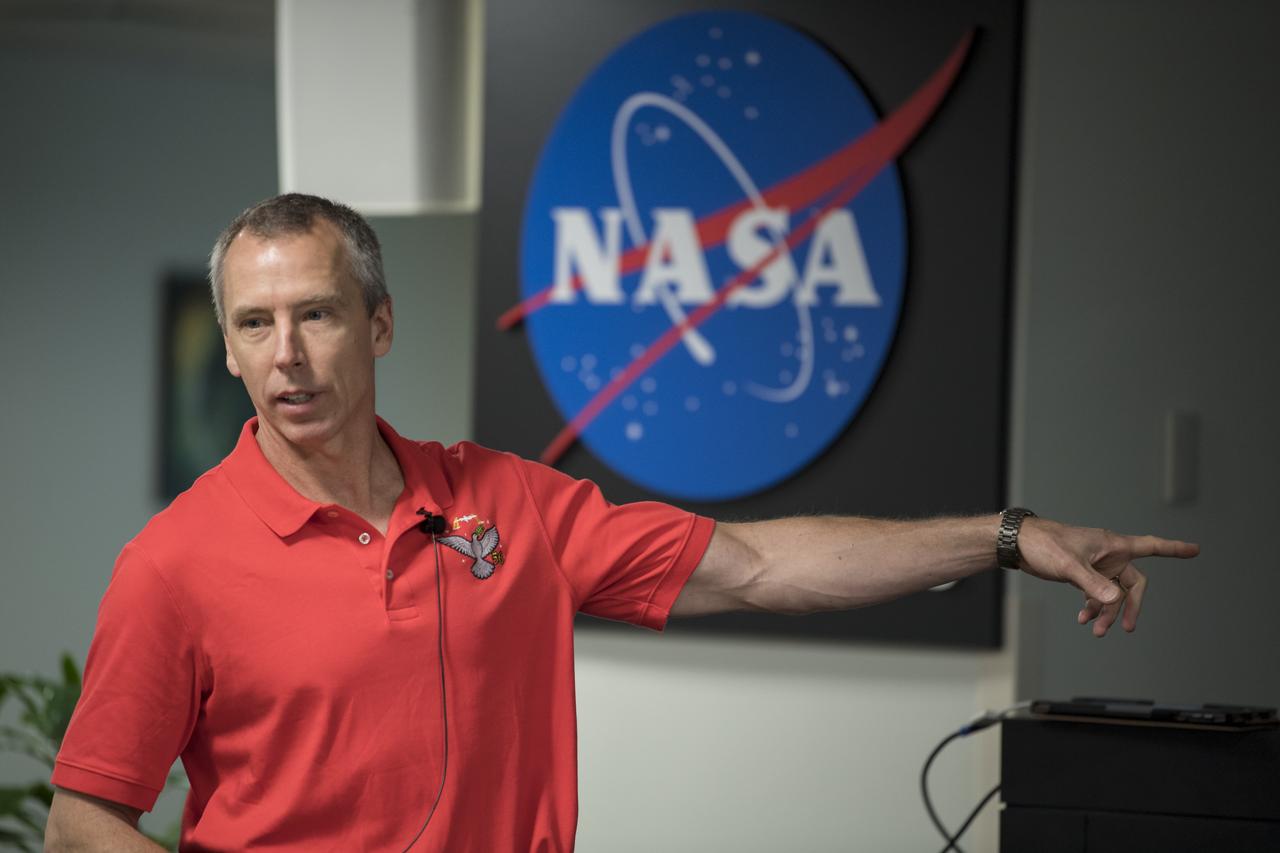
NASA astronaut Drew Feustel speaks about his experience on two space shuttle missions, STS-125 and STS-134, and a long duration mission onboard the International Space Station at NASA Headquarters, Thursday, May 9, 2019 in Washington, DC. Feustel most recently spent 197 days living and working onboard the International Space Station as part of Expedition 55 and as commander of Expedition 56. Feustel ventured outside the space station on three spacewalks, moving him up to second among U.S. spacewalkers with a cumulative time of 61 hours 48 minutes over nine spacewalks. Photo Credit: (NASA/Aubrey Gemignani)
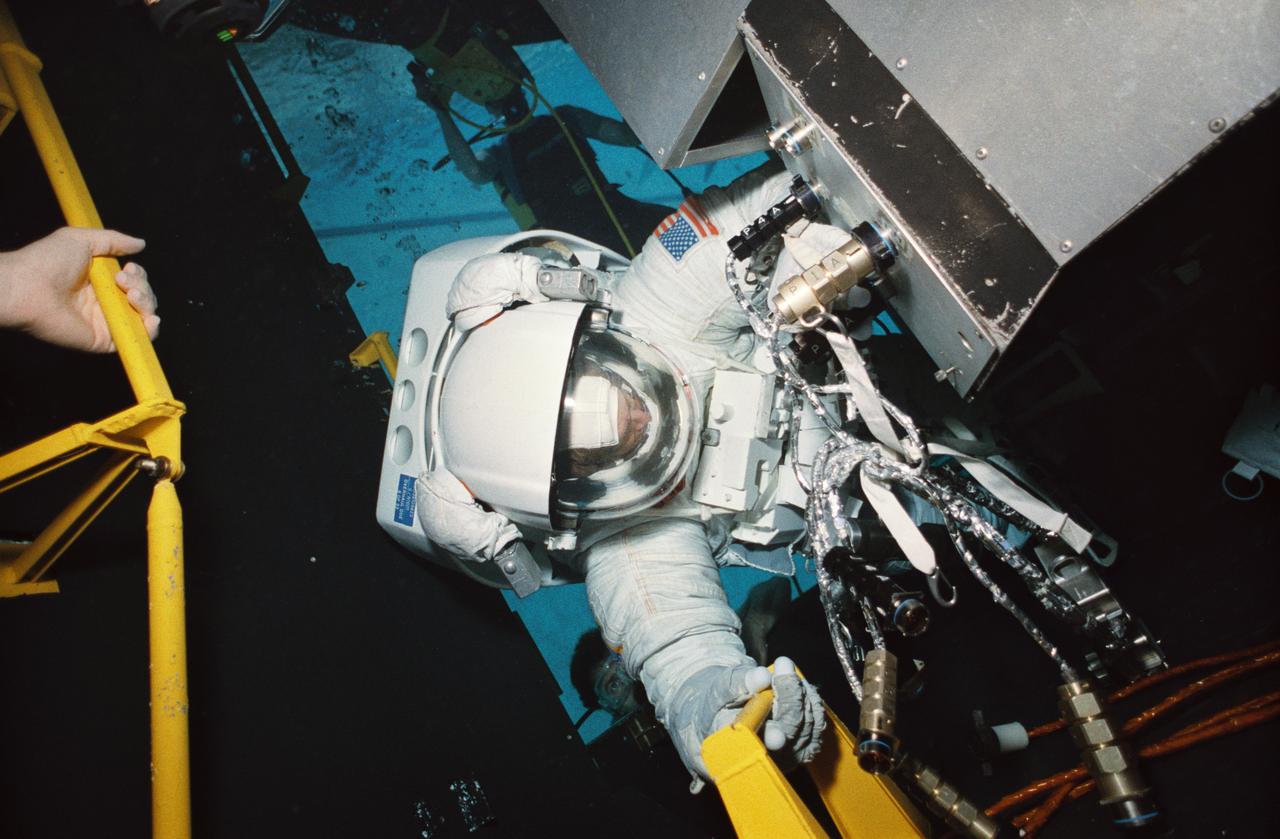
S93-33104 (7 Apr 1993) --- Wearing a training version of Space Shuttle Extravehicular Mobility Unit (EMU), astronaut Jeffrey A. Hoffman uses the giant pool of the Johnson Space Center's (JSC) Weightless Environment Training Facility (WET-F) to rehearse for the Hubble Space Telescope (HST) repair mission. Out of frame is astronaut F. Story Musgrave, who will join Hoffman in STS-61 EVA. The hand at top frame belongs to a SCUBA-equipped diver. A number of divers are on hand for all training sessions in the WET-F. A total of five extravehicular activity (EVA) sessions will be conducted during the scheduled December mission of the Endeavour.
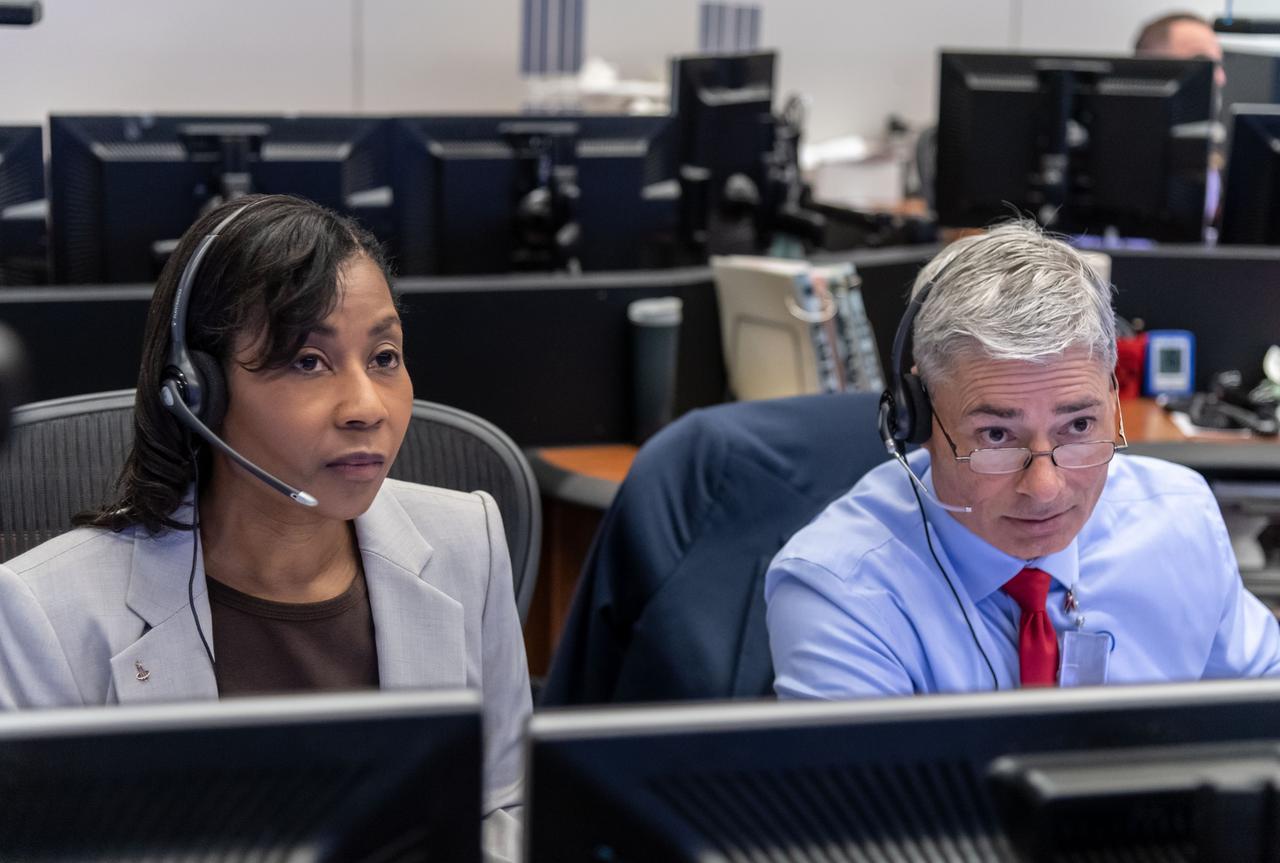
jsc2019e060008 (Oct. 18, 2019) --- From the Mission Control Center in Houston, veteran NASA astronauts Stephanie Wilson and Mark Vande Hei are on the CAPCOM (capsule communicator) console monitoring the spacewalk being conducted by Expedition 61 Flight Engineers Christina Koch and Jessica Meir. Wilson provided robotic arm support maneuvering spacewalkers during the STS-120 and STS-131 space shuttle missions to the International Space Station. Vande Hei conducted four spacewalks totaling 26 hours and 42 minutes during his stay aboard the orbiting lab as an Expedition 53-54 Flight Engineer.
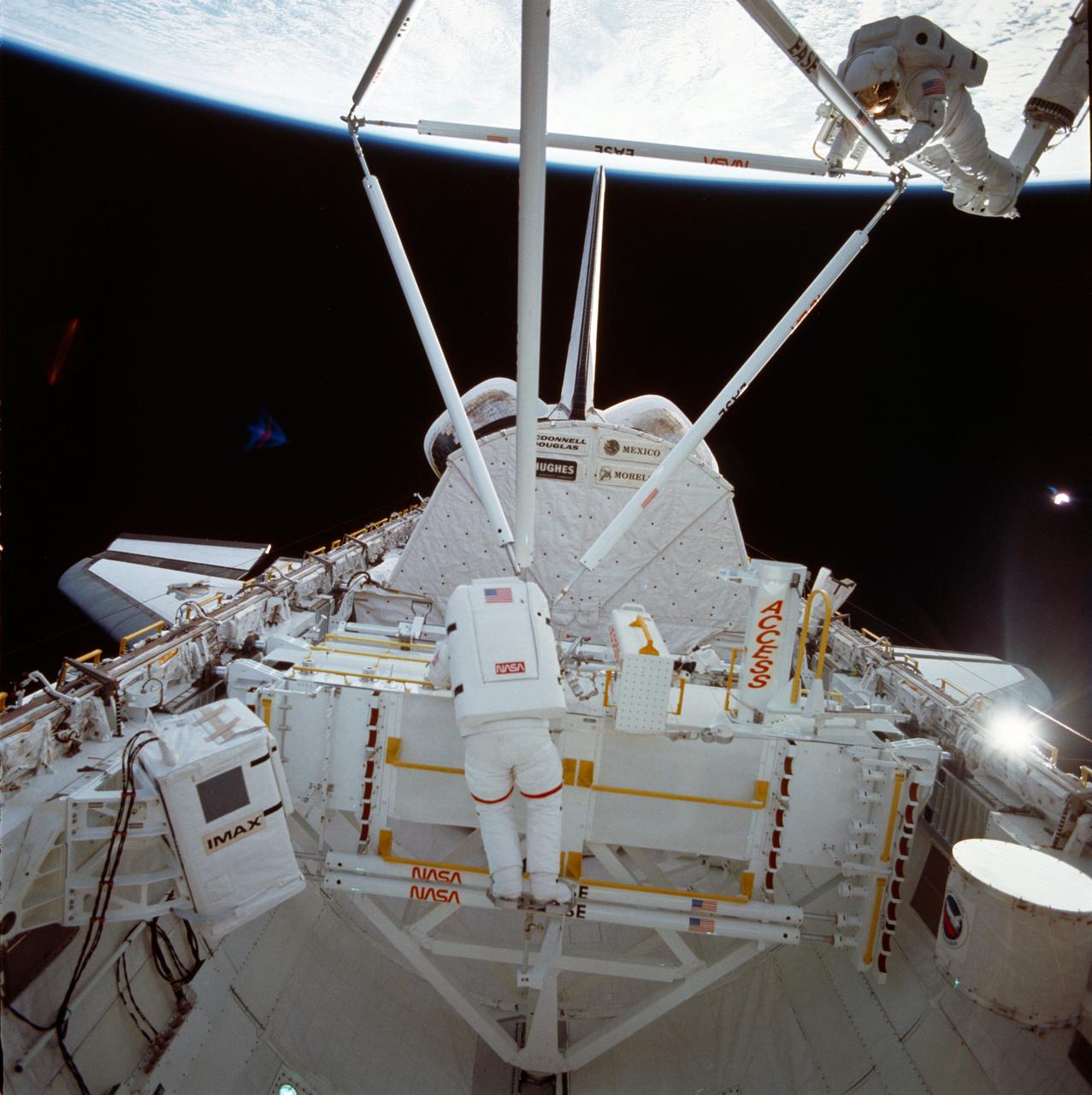
61B-41-047 (1 Dec 1985) --- Astronauts Jerry L. Ross (left) and Sherwood C. (Woody) Spring are photographed by Astronaut Bryan D. O'Connor as they continue to assemble more pieces of the EASE (Experimental Assembly of Structures in Extravehicular Activities) device during the week-long STS 61-B mission. This frame is one of a series covering the structure's build-up.
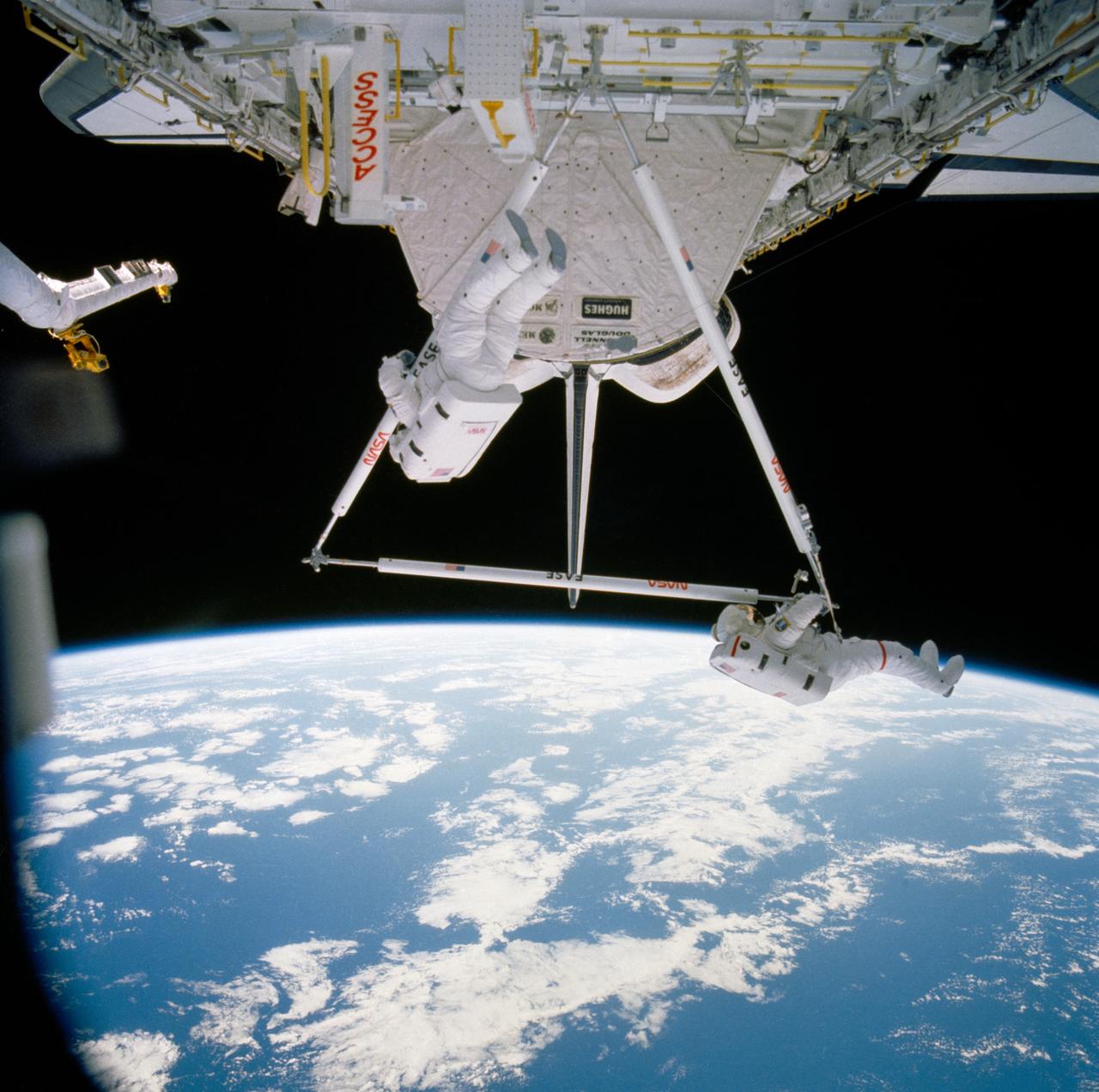
Astronauts Jerry L. Ross (left) and Sherwood C. (Woody) Spring are photographed as they assemble pieces of the Experimental Assembly of Structures in Extravehicular Activities (EASE) device in the open payload bay. The Canadian-built remote manipulator system (RMS) arm (partially obscured in the right portion of the frame) is in position to allow television cameras to record the activity.
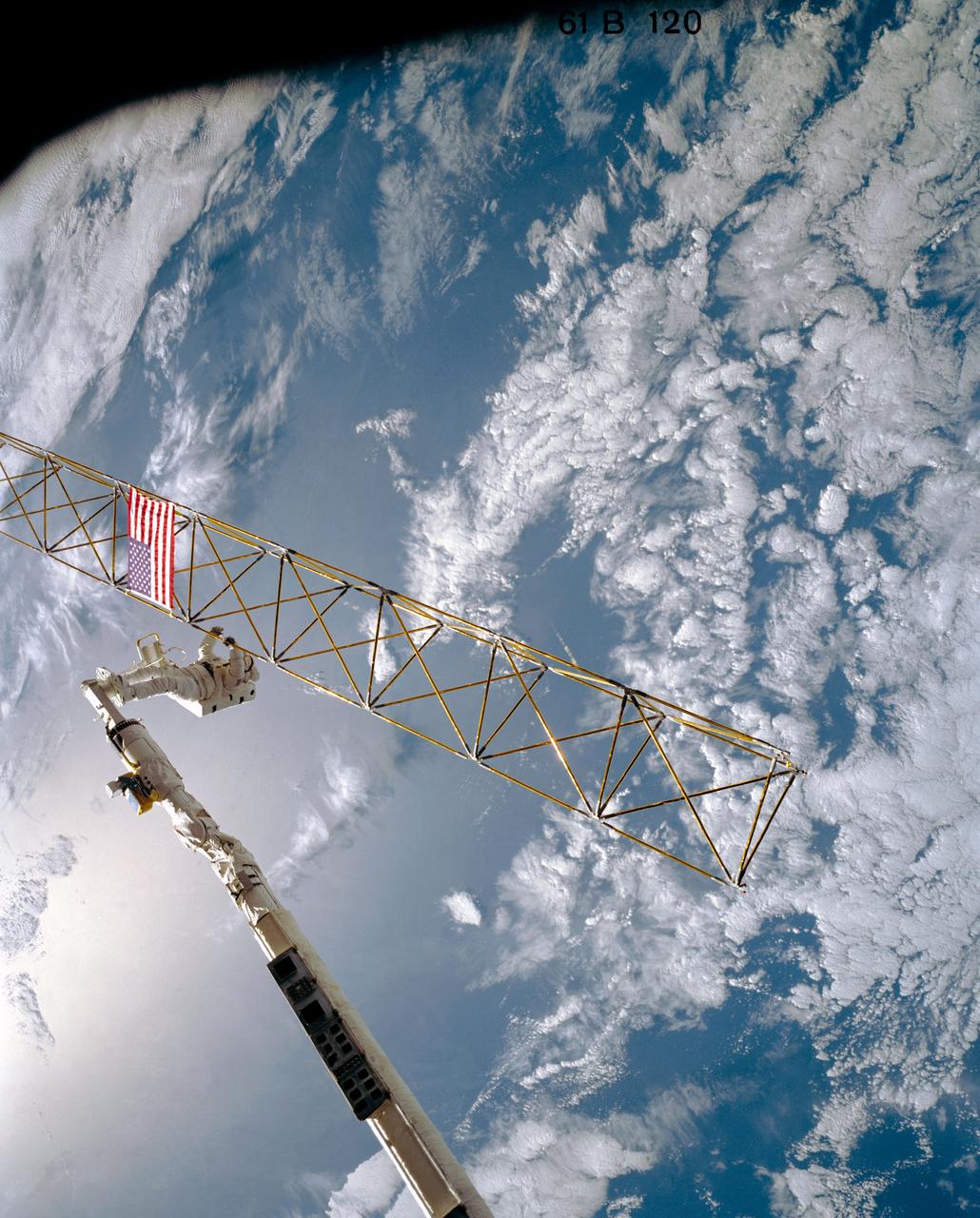
Astronaut Sherwood C. Spring, anchored to the foot restraint on the remote manipulator system (RMS) arm, checks joints on the tower-like Assembly Concept for Construction of Erectable Space Structures (ACCESS) device extending from the payload bay as the Atlantis flies over white clouds and blue ocean waters. The Gulf of Mexico waters form the backdrop for the scene.
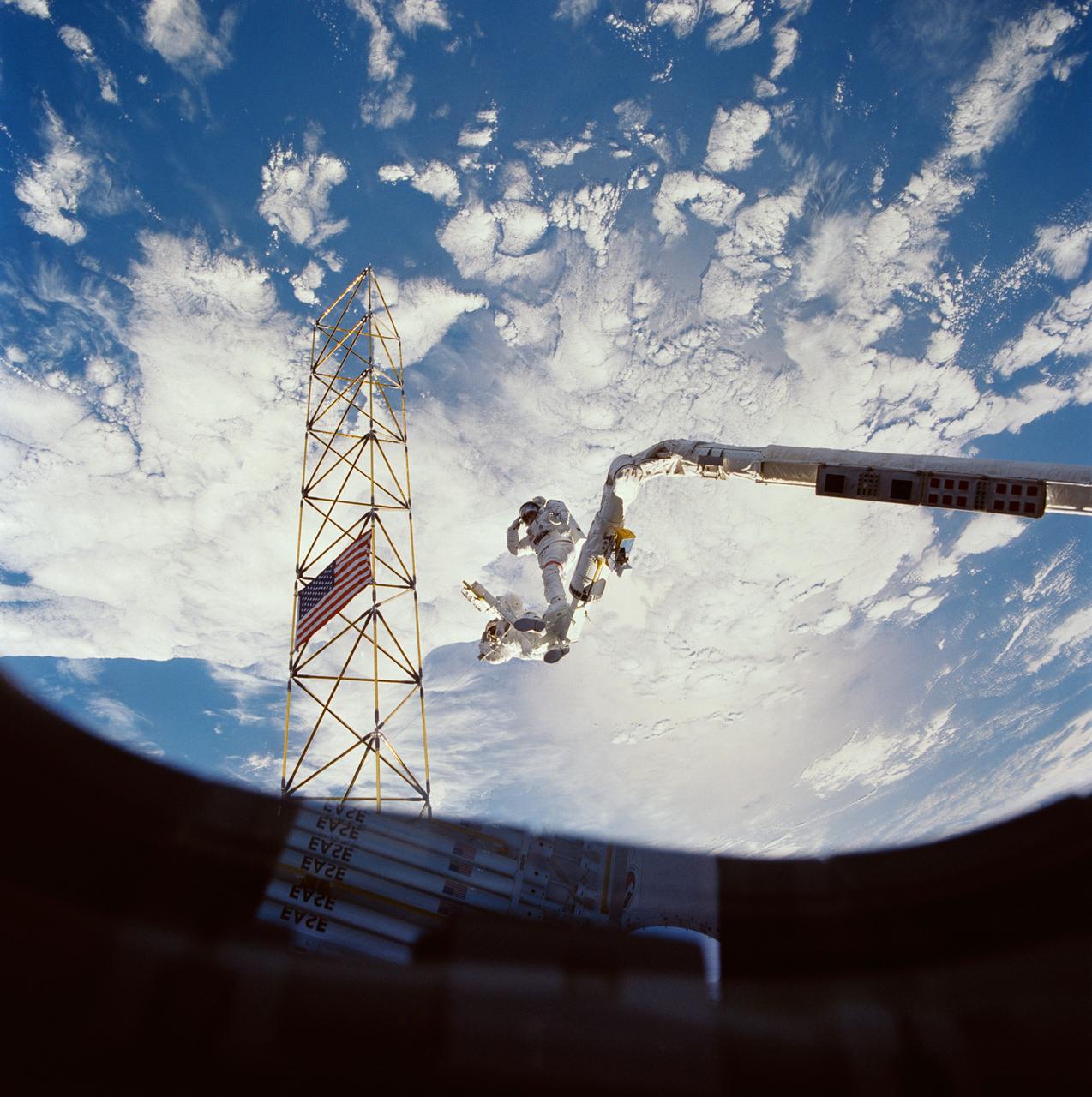
Astronauts Jerry L. Ross (right) and Sherwood C. (Woody) Spring (left) share a foot restraint as they survey the assembled ACCESS components after a lengthy extravehicular activity. Both men salute the American flag placed on the assembled ACCESS tower. Stowed EASE pieces are reflected in the window through which the photo was taken.
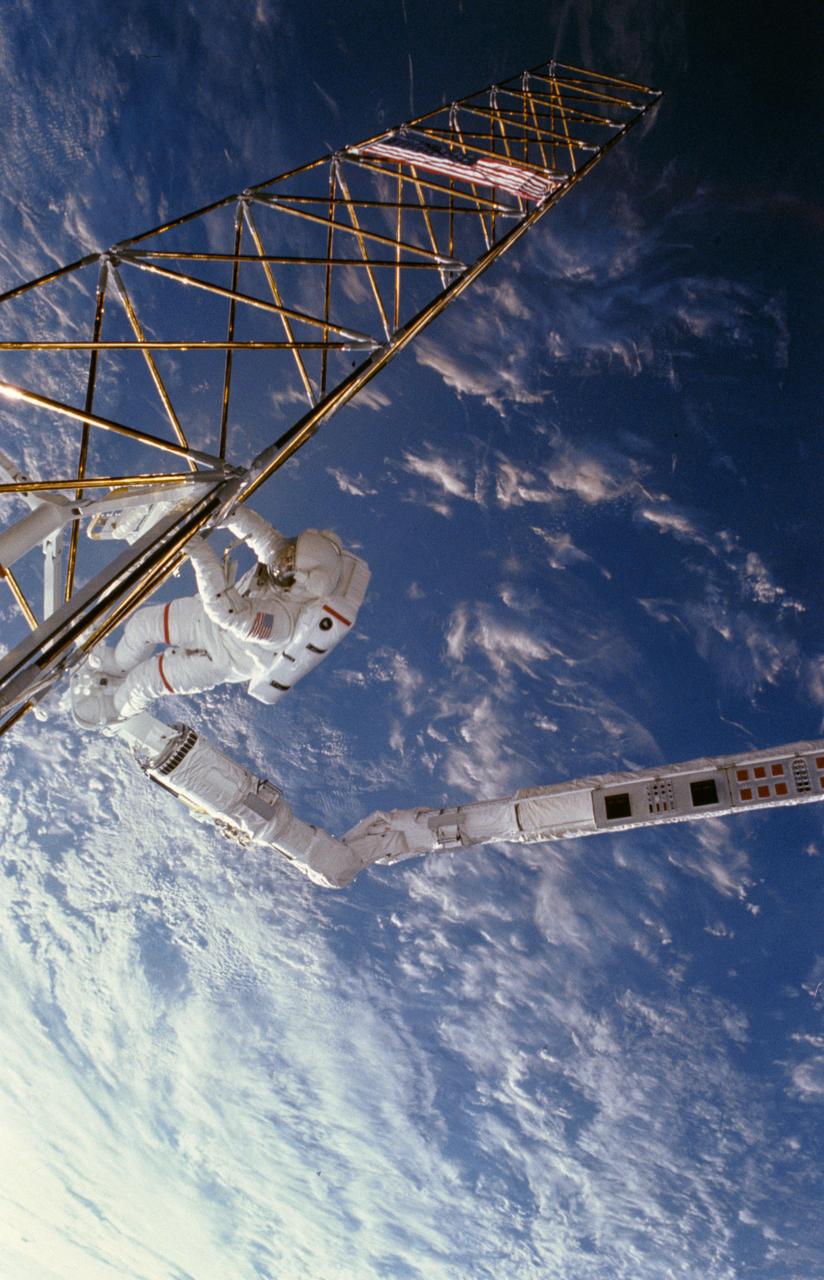
61B-102-022 (1 Dec 1985) --- Astronaut Jerry L. Ross, anchored to the foot restraint on the remote manipulator system (RMS), holds onto the tower-like Assembly Concept for Construction of Erectable Space Structures (ACCESS) device, as the Atlantis flies over white clouds and blue ocean waters. The frame was exposed with a negative-equipped camera held by Astronaut Sherwood C. Spring, who was also on the EVA-task.
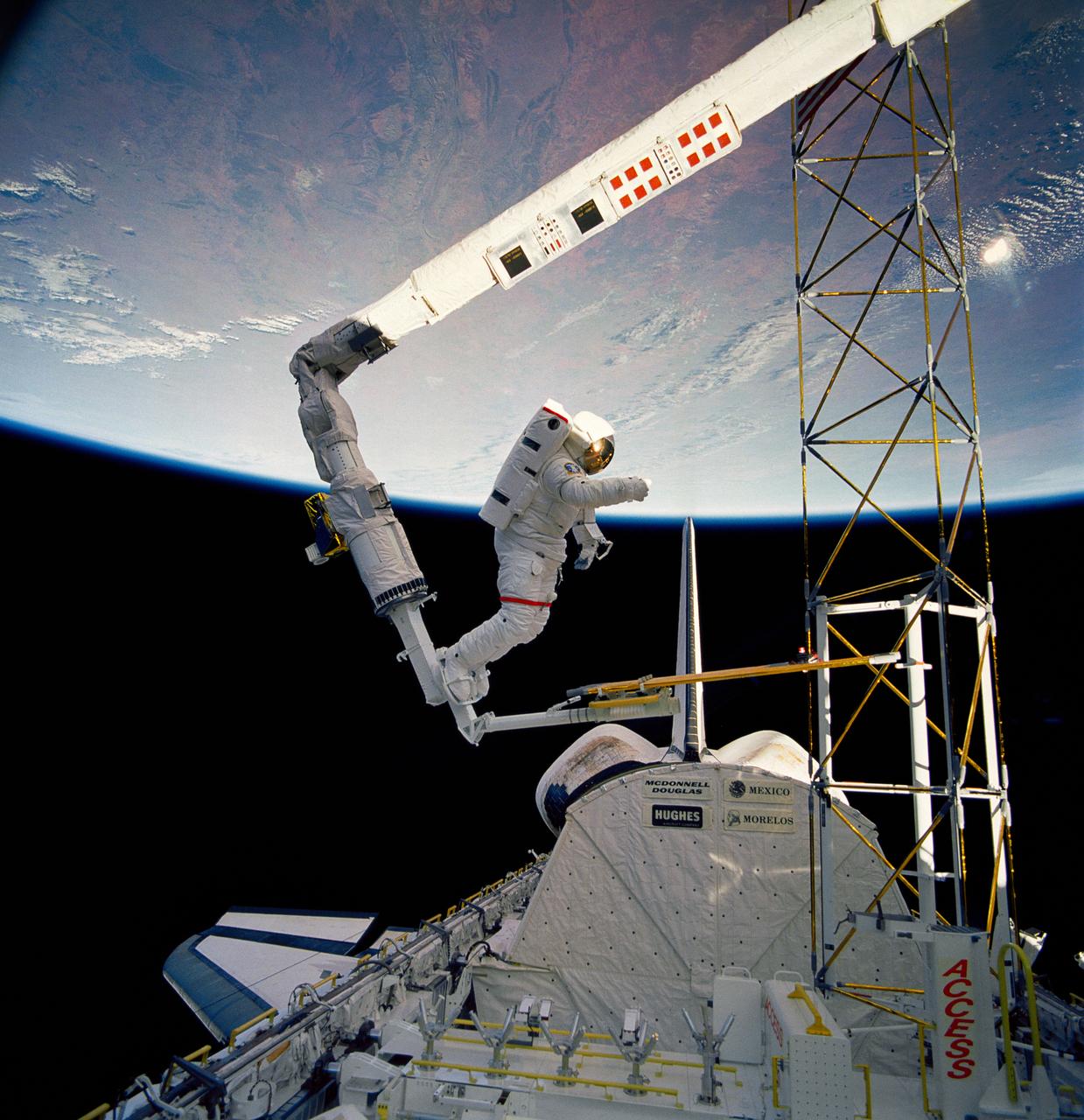
61B-41-019 (26 Nov. ? 3 Dec. 1985) --- Astronaut Jerry L. Ross, one of NASA flight 6l-B's mission specialists, approaches a tower device just erected by Ross and astronaut Sherwood (Woody) C. Spring during the second of two extravehicular activities. The tower was called Assembly Concept for Construction of Erectable Space Structures. Ross is secured on a foot restraint device connected to the Canadian-built remote manipulator system (RMS) arm aboard the Earth orbiting Atlantis.
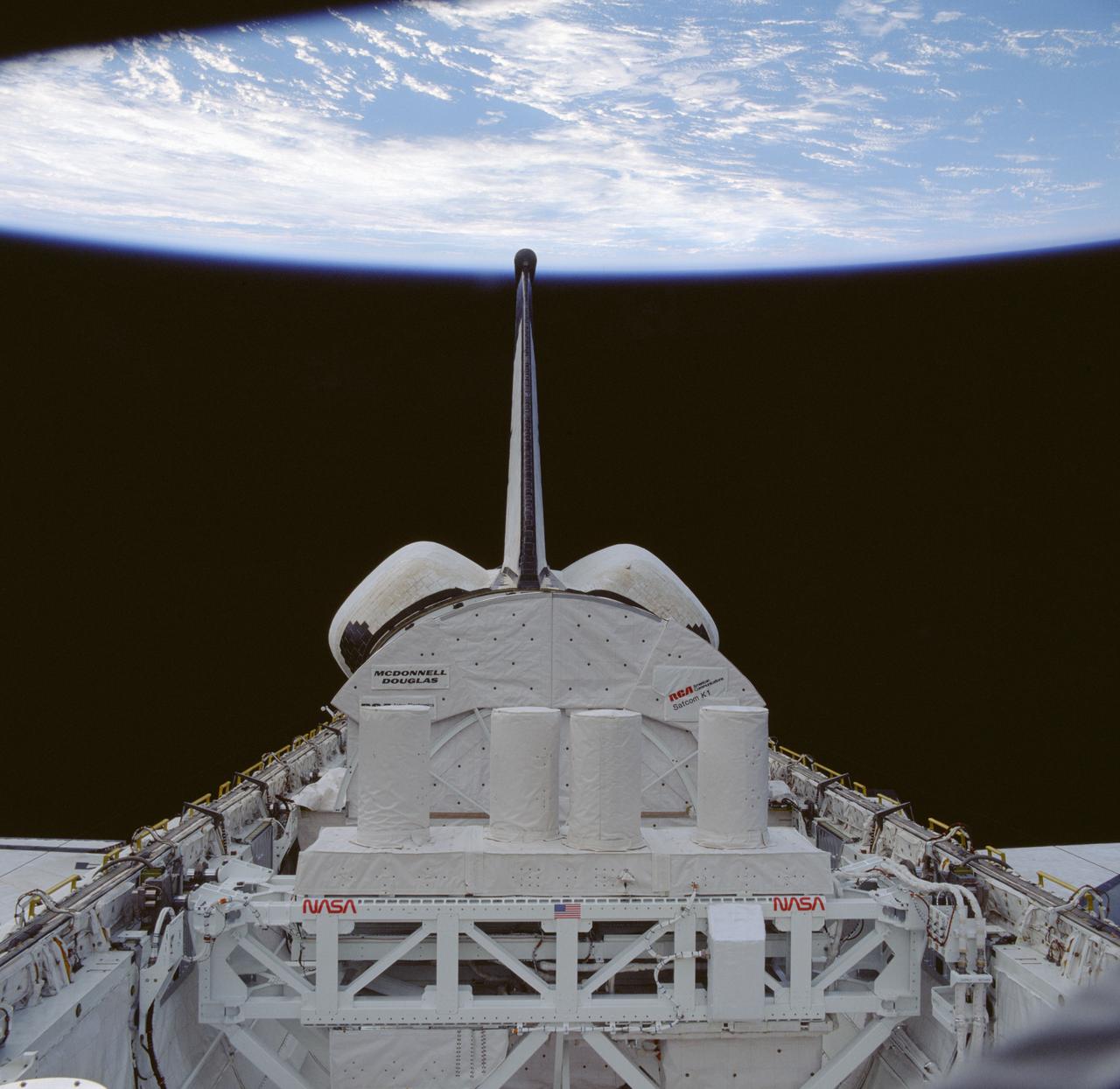
61C-39-002 (12-17 Jan 1986) --- This view of the cargo bay of the Earth-orbiting Space Shuttle Columbia reveals some of the STS 61-C mission payloads. The materials science laboratory (MSL-2), sponsored by the Marshall Space Flight Center (MSFC), is in the foreground. A small portion of the first Hitchhiker payload, sponsored by the Goddard Space Flight Center (GSFC), is in the immediate foreground, mounted to the spacecraft's starboard side. The closed sun shield for the now-vacated RCA SATCOM K-1 communications satellite is behind the MSL. Completely out of view, behind the shield, are 13 getaway specials in canisters. Clouds over ocean and the blackness of space share the backdrop for the 70mm camera's frame.
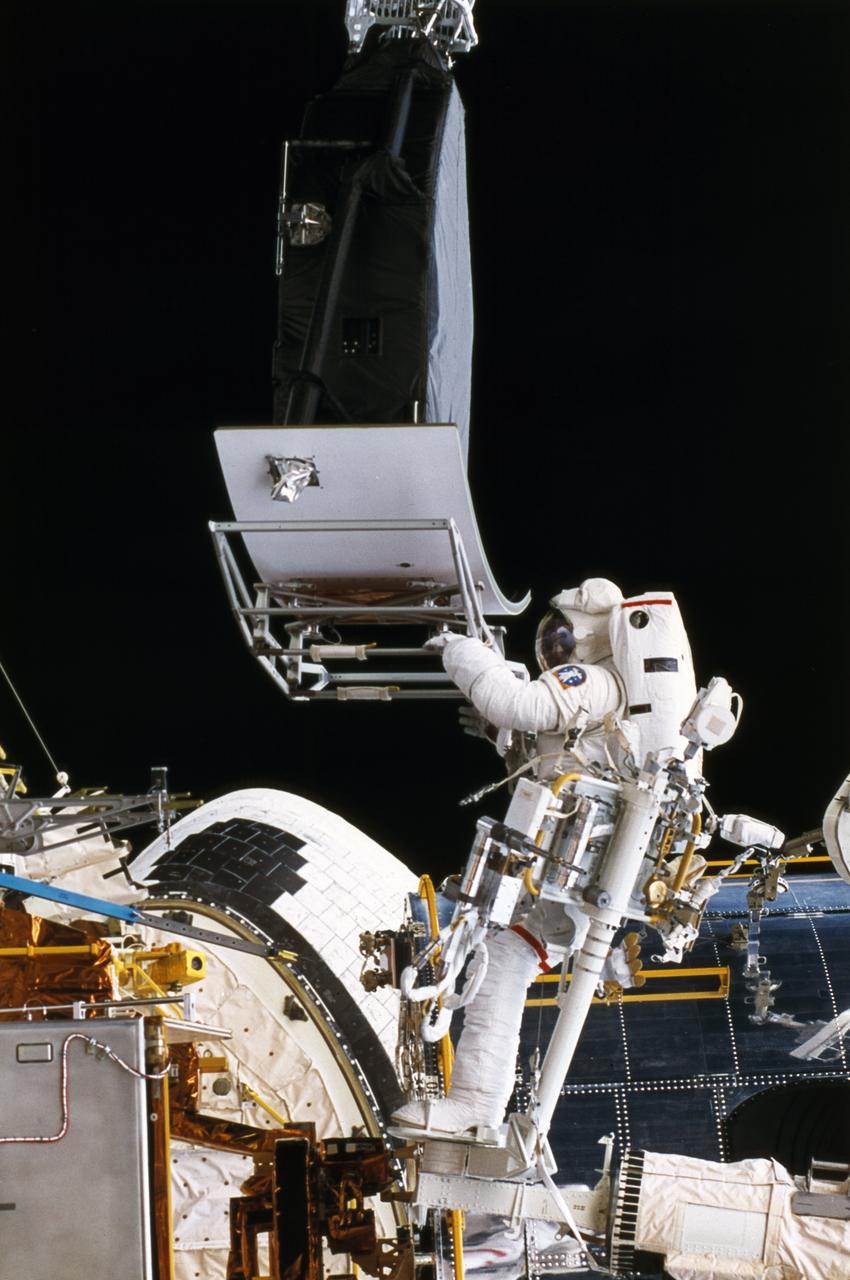
Astronaut Hoffman held the Hubble Space Telescope (HST) Wide Field/Planetary Camera-1 (WF/PC1) that was replaced by WF/PC2 in the cargo bay of the Space Shuttle orbiter Endeavour during Extravehicular Activity (EVA). The STS-61 mission was the first of the series of the HST servicing missions. Two months after its deployment in space, scientists detected a 2-micron spherical aberration in the primary mirror of the HST that affected the telescope's ability to focus faint light sources into a precise point. This imperfection was very slight, one-fiftieth of the width of a human hair. During four spacewalks, the STS-61 crew replaced the solar panel with its flexing problems; the WF/PC1 with WF/PC2, with built-in corrective optics; and the High-Speed Photometer with the Corrective Optics Space Telescope Axial Replacement (COSTAR) to correct the aberration for the remaining instruments. The purpose of the HST, the most complex and sensitive optical telescope ever made, is to study the cosmos from a low-Earth orbit for 15 years or more. The HST provides fine detail imaging, produces ultraviolet images and spectra, and detects very faint objects. The Marshall Space Flight Center had responsibility for design, development, and construction of the HST. The Perkin-Elmer Corporation, in Danbury, Cornecticut, developed the optical system and guidance sensors.
KENNEDY SPACE CENTER, FLA. -- A diversified mission of astronomy, commercial space research and International Space Station preparation gets under way as the Space Shuttle Columbia climbs skyward from Launch Pad 39B at 2:55:47 p.m. EST, Nov. 19, 1996. Leading the veteran crew of Mission STS-80 is Commander Kenneth D. Cockrell; Kent V. Rominger is the pilot and the three mission specialists are Tamara E. Jernigan, Story Musgrave and Thomas D. Jones. At age 61, Musgrave becomes the oldest person ever to fly in space; he also ties astronaut John Young’s record for most number of spaceflights by a human being, and in embarking on his sixth Shuttle flight Musgrave has logged the most flights ever aboard NASA’s reusable space vehicle. The two primary payloads for STS-80 are the Wake Shield Facility-3 (WSF-3) and the Orbiting and Retrievable Far and Extreme Ultraviolet Spectrometer-Shuttle Pallet Satellite II (ORFEUS-SPAS II). Two spacewalks also will be performed during the nearly 16-day mission. Mission STS-80 closes out the Shuttle flight schedule for 1996; it marks the 21st flight for Columbia and the 80th in Shuttle program history.
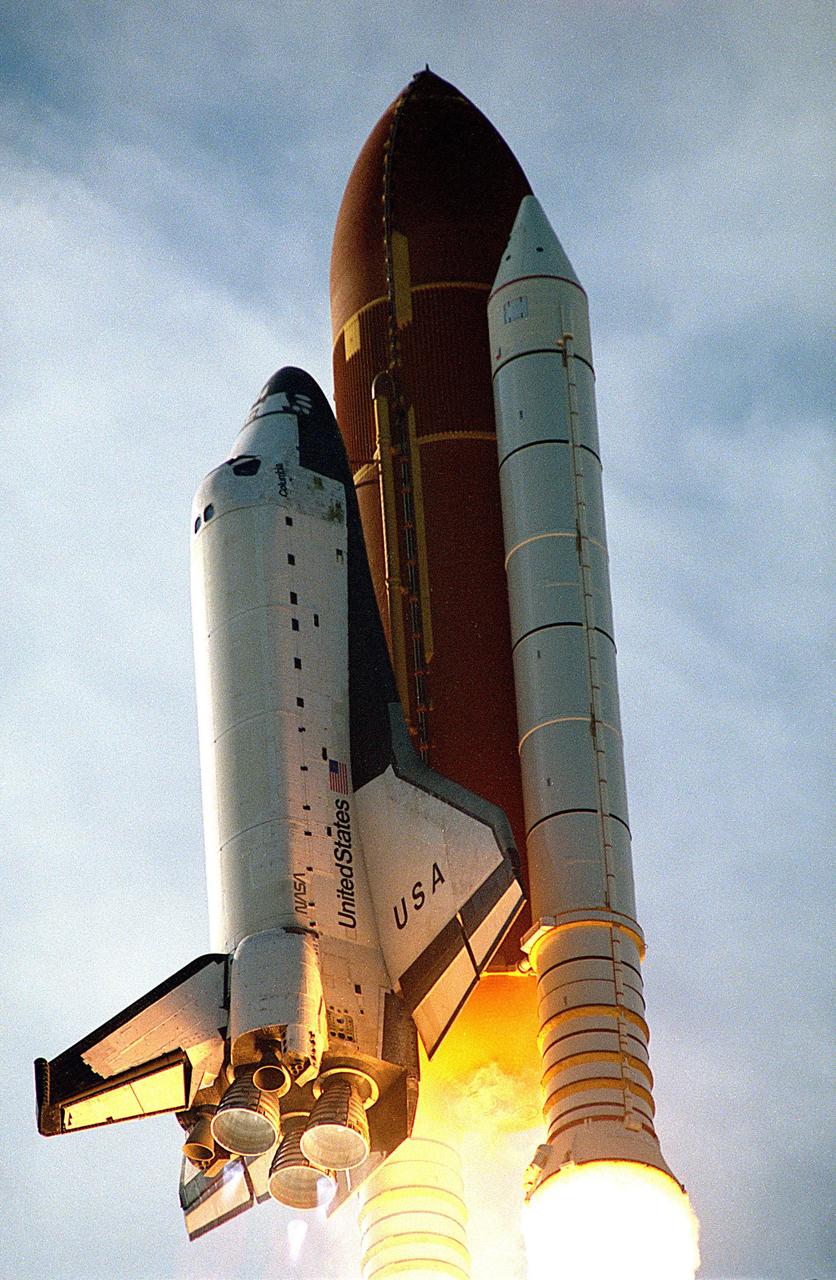
KENNEDY SPACE CENTER, FLA. -- A diversified mission of astronomy, commercial space research and International Space Station preparation gets under way as the Space Shuttle Columbia climbs skyward from Launch Pad 39B at 2:55:47 p.m. EST, Nov. 19, 1996. Leading the veteran crew of Mission STS-80 is Commander Kenneth D. Cockrell; Kent V. Rominger is the pilot and the three mission specialists are Tamara E. Jernigan, Story Musgrave and Thomas D. Jones. At age 61, Musgrave becomes the oldest person ever to fly in space; he also ties astronaut John Young’s record for most number of spaceflights by a human being, and in embarking on his sixth Shuttle flight Musgrave has logged the most flights ever aboard NASA’s reusable space vehicle. The two primary payloads for STS-80 are the Wake Shield Facility-3 (WSF-3) and the Orbiting and Retrievable Far and Extreme Ultraviolet Spectrometer-Shuttle Pallet Satellite II (ORFEUS-SPAS II). Two spacewalks also will be performed during the nearly 16-day mission. Mission STS-80 closes out the Shuttle flight schedule for 1996; it marks the 21st flight for Columbia and the 80th in Shuttle program history.
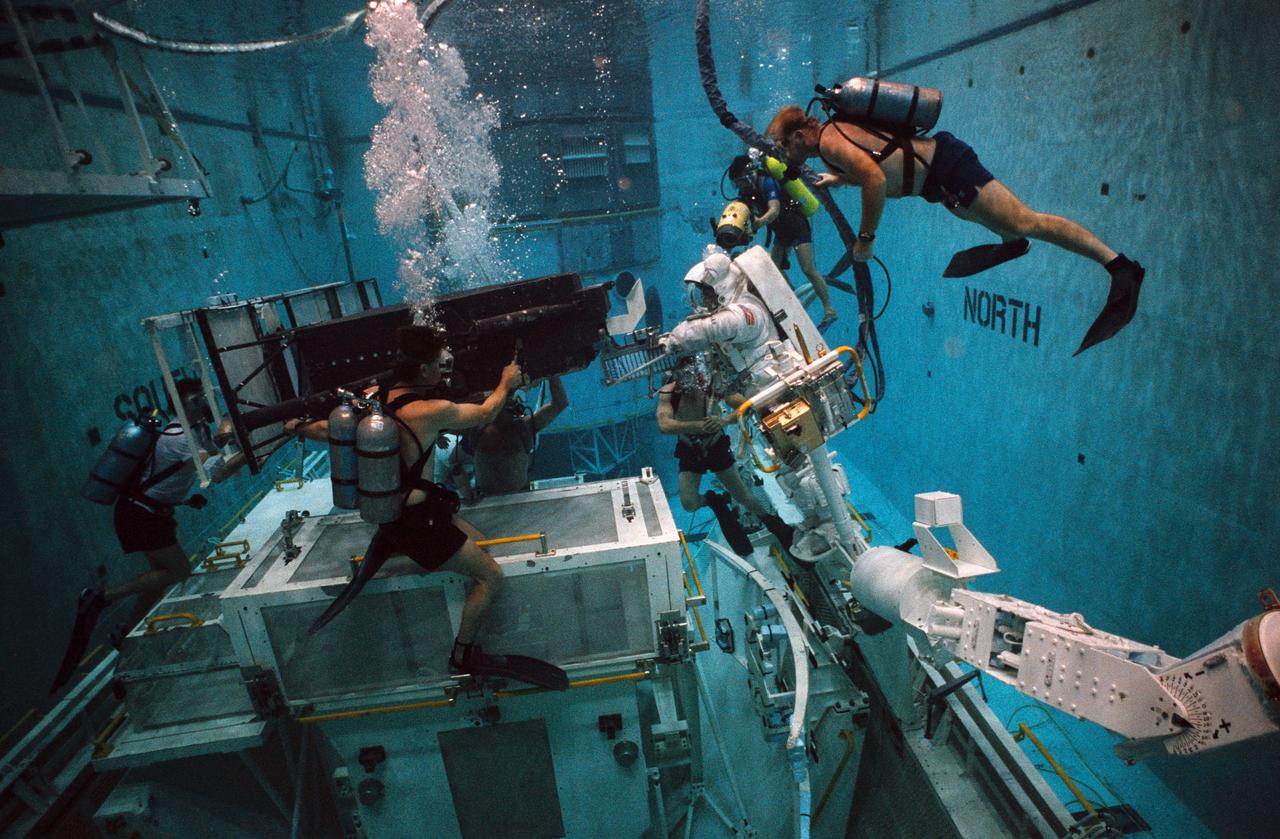
S93-33102 (5 Apr 1993) --- Wearing a training version of Space Shuttle Extravehicular Mobility Unit (EMU), astronaut Thomas D. Akers uses the giant pool of the Johnson Space Center's (JSC) Weightless Environment Training Facility (WET-F) to rehearse for the Hubble Space Telescope (HST) repair mission. Standing on a mobile foot restraint connected to the Shuttle's robot arm, Akers works with a full-scale training version of the Wide Field/Planetary Camera (WF/PC). The current WF/PC on the HST will be replaced with WF/PC-2. The giant box is a stowage area for both WF/PC facilities. Out of frame is astronaut Kathryn C. Thornton, who will join Akers in STS-61 EVA. Several SCUBA-equipped divers assist in the rehearsal. A total of five extravehicular activity (EVA) sessions will be conducted during the scheduled December mission of the Endeavour.
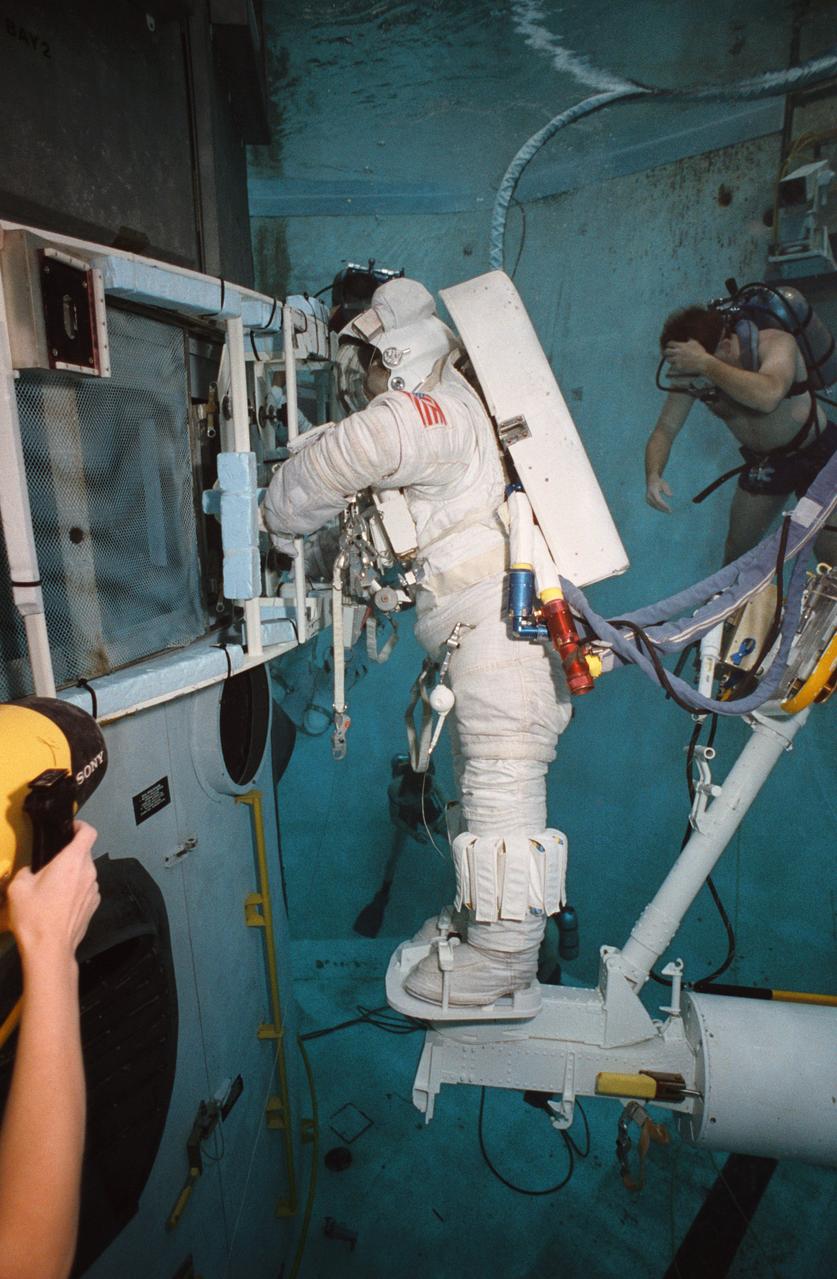
S93-33101 (5 Apr 1993) --- Wearing a training version of Space Shuttle Extravehicular Mobility Unit (EMU), astronaut Kathryn C. Thornton uses the giant pool of the Johnson Space Center's (JSC) Weightless Environment Training Facility (WET-F) to rehearse for the Hubble Space Telescope (HST) repair mission. Standing on a mobile foot restraint connected to the Shuttle's robot arm, Thornton grasps a large structure which attaches to the Wide Field/Planetary Camera (WF/PC). The current WF/PC on the HST will be replaced with WF/PC-2. Out of frame is astronaut Thomas D. Akers, who will join Thornton in STS-61 EVA. A SCUBA-equipped diver can be seen in the background. A number of divers are on hand for all training sessions in the WET-F. A total of five extravehicular activity (EVA) sessions will be conducted during the scheduled December mission of the Endeavour.
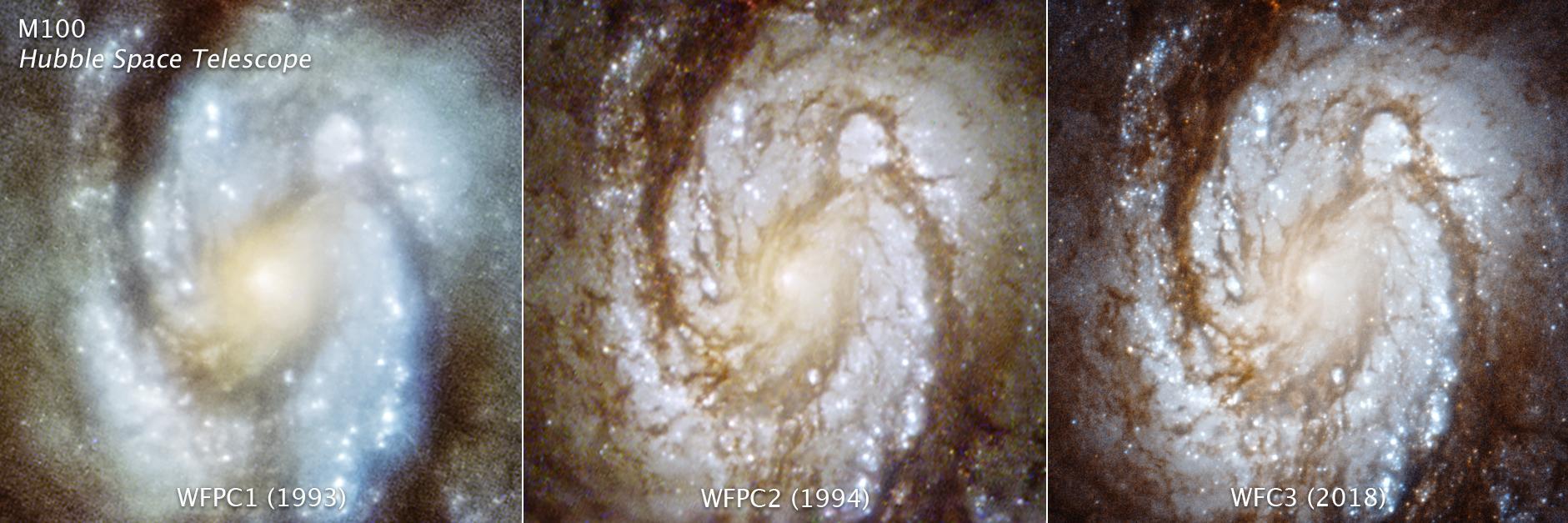
These three images are of the central region of the spiral galaxy M100, taken with three generations of cameras that were sequentially swapped out aboard the Hubble Space Telescope, and document the consistently improving capability of the observatory. The image on the left was taken with the Wide Field and Planetary Camera 1 in 1993. The photo is blurry due to a flaw (called spherical aberration) in Hubble's primary mirror. Celestial images could not be brought into a single focus. The middle image was taken in late 1993 with Wide Field and Planetary Camera 2 that was installed during the December 2 - 13 space shuttle servicing mission (SM1, STS-61). The camera contained corrective optics to compensate for the mirror flaw, and so the galaxy snapped into sharp focus when photographed. The image on the right was taken with a newer instrument, Wide Field Camera 3, that was installed on Hubble during the space shuttle servicing mission 4 (SM4) in May, 2009. https://photojournal.jpl.nasa.gov/catalog/PIA22913
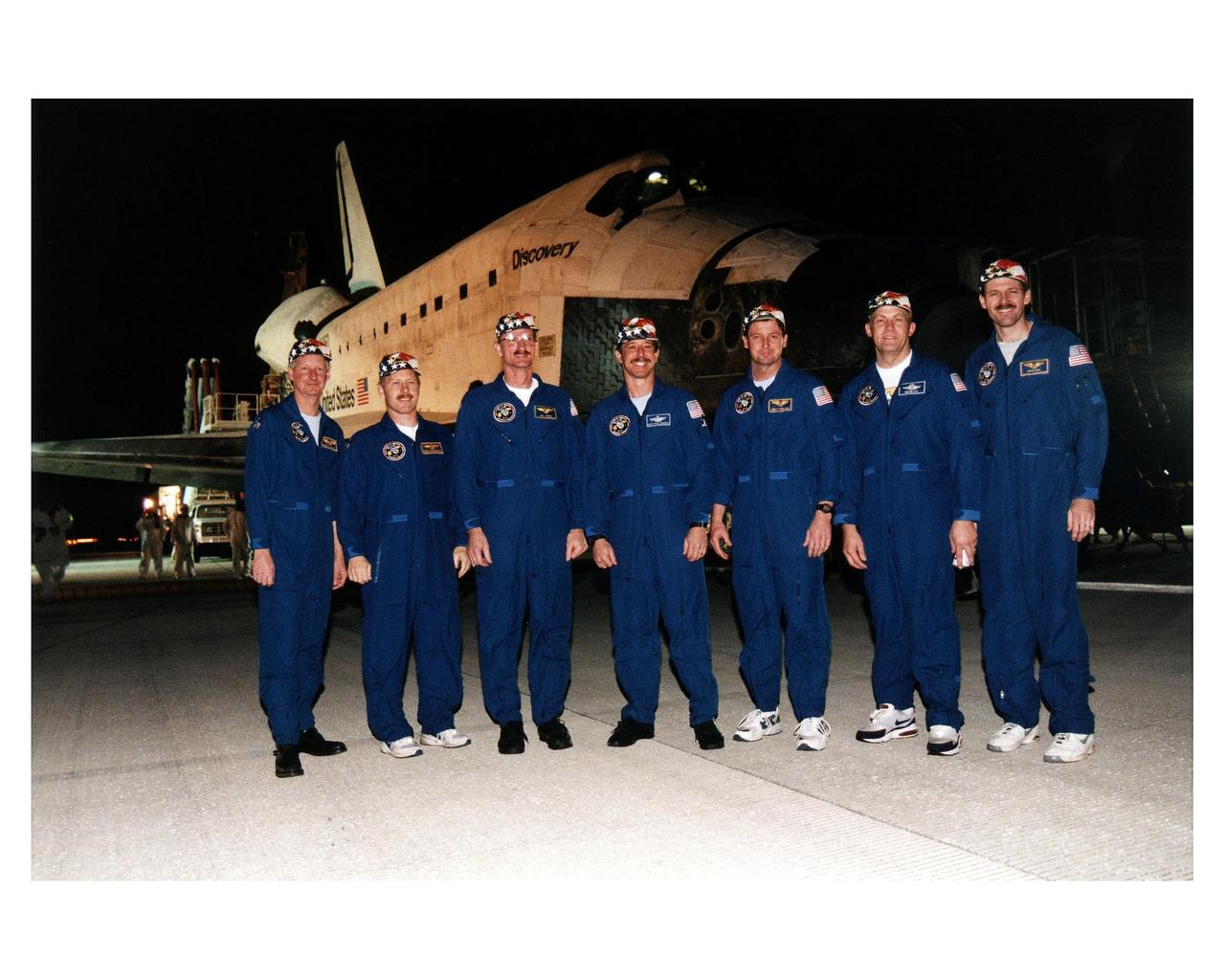
The STS-82 crew stands in front of the Space Shuttle Discovery after landing at KSC's Shuttle Landing Facility on Runway 15 to conclude a 10-day mission to service the orbiting Hubble Space Telescope (HST). Crew members are (from left to right) Mission Specialist Steven A. Hawley, Mission Commander Kenneth D. Bowersox, Mission Specialist Joseph R. "Joe" Tanner, Pilot Scott J. "Doc" Horowitz, Mission Specialist Gregory J. Harbaugh, Payload Commander Mark C. Lee and Mission Specialist Steven L. Smith. STS-82 is the ninth Shuttle nighttime landing, and the fourth nighttime landing at KSC. The seven-member crew performed a record-tying five back-to-back extravehicular activities (EVAs) or spacewalks to service the telescope, which has been in orbit for nearly seven years. Two new scientific instruments were installed, replacing two outdated instruments. Five spacewalks also were performed on the first servicing mission, STS-61, in December 1993. Only four spacewalks were scheduled for STS-82, but a fifth one was added during the flight to install several thermal blankets over some aging insulation covering three HST compartments containing key data processing, electronics and scientific instrument telemetry packages. STS-82 was the 82nd Space Shuttle flight and the second mission of 1997
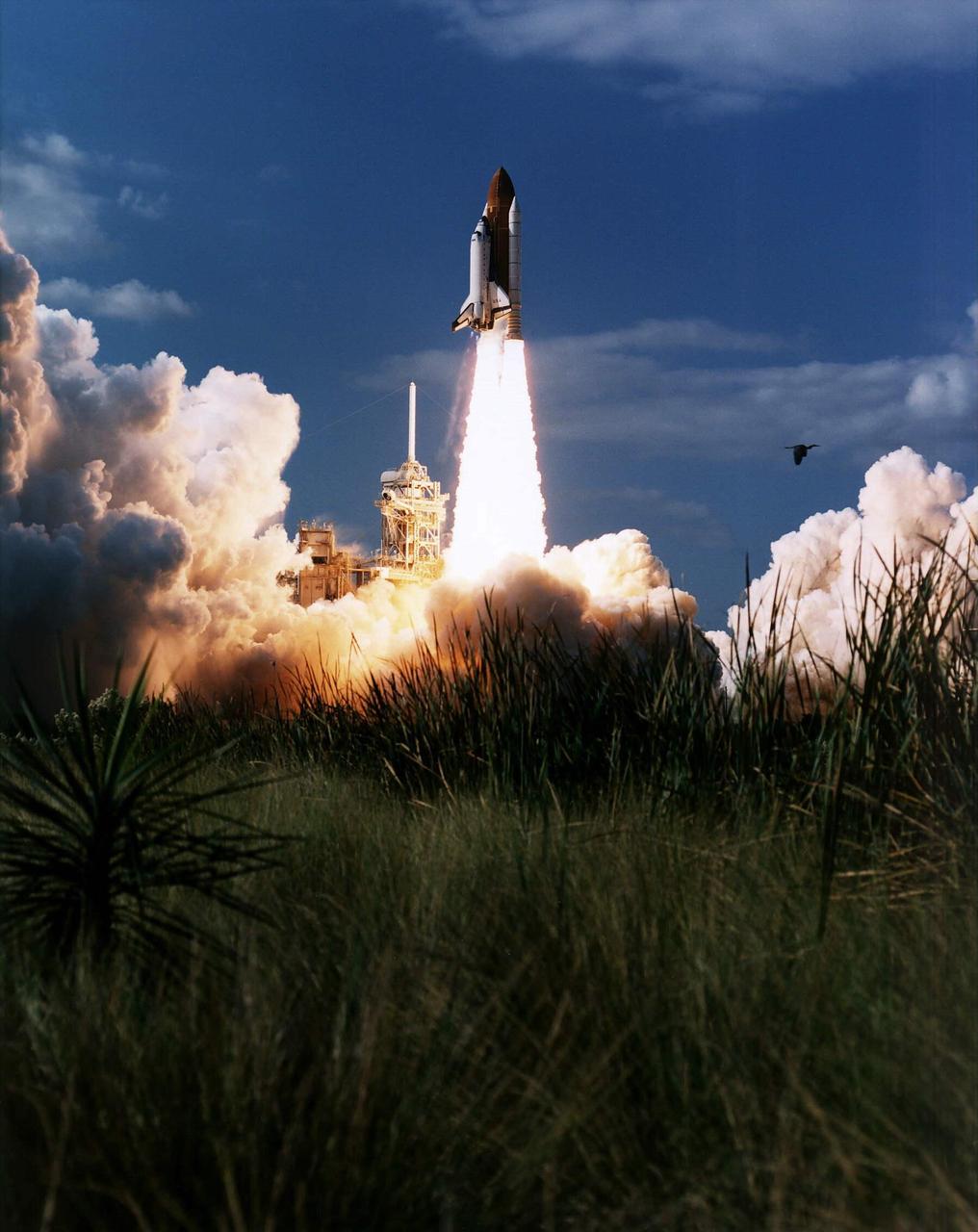
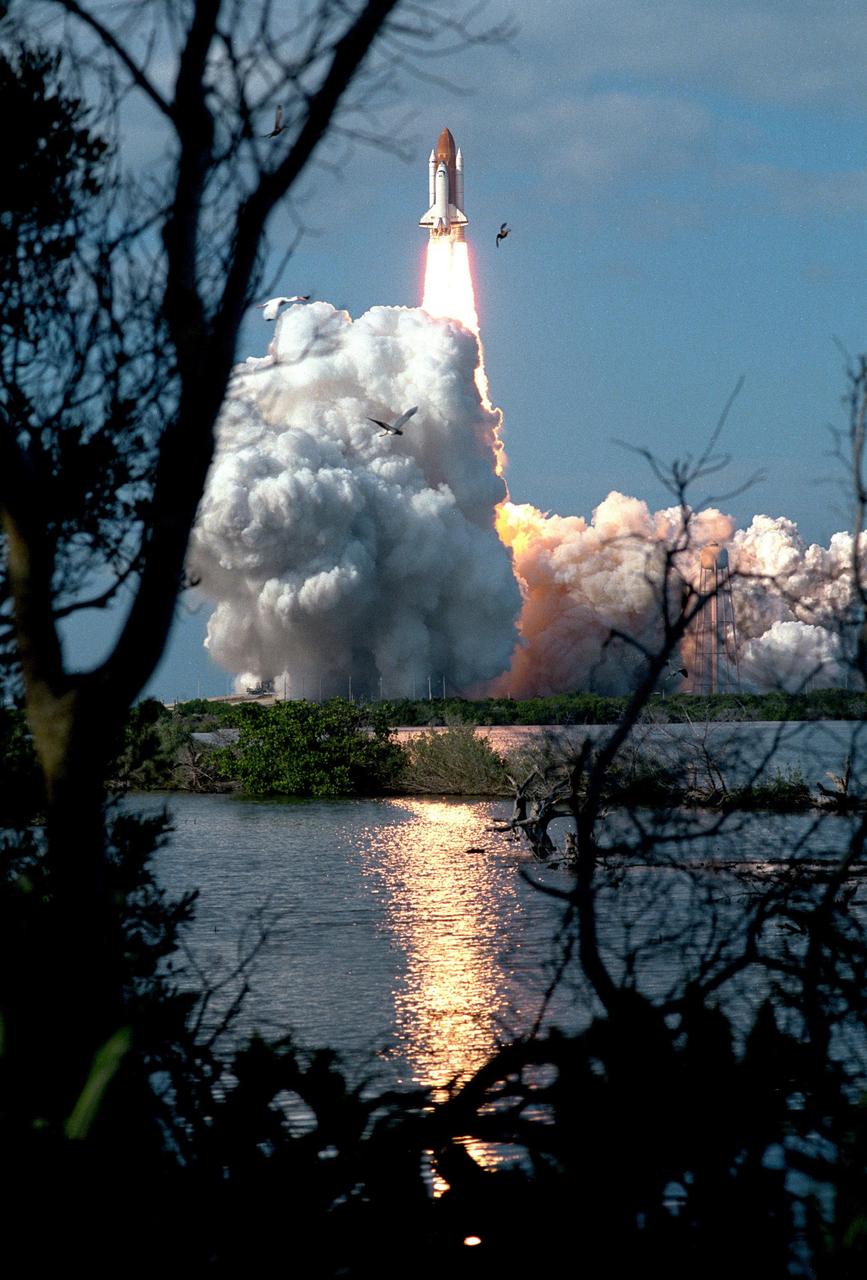
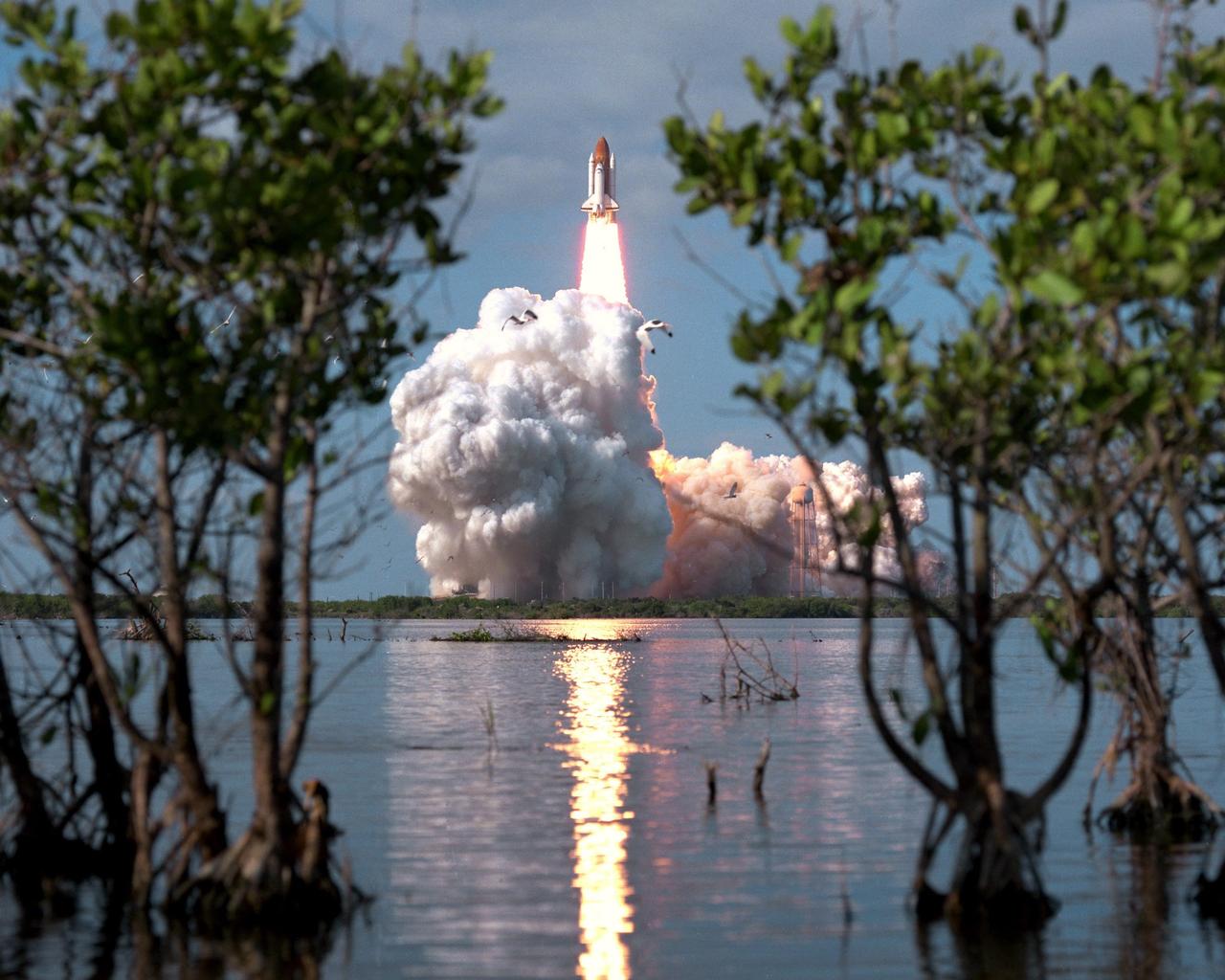
KENNEDY SPACE CENTER, FLA. -- Vividly framed by a tranquil Florida landscape, the Space Shuttle Columbia lifts off from Launch Pad 39B at 2:55:47 p.m. EST, Nov. 19, 1996. Leading the veteran crew of Mission STS-80 is Commander Kenneth D. Cockrell; Kent V. Rominger is the pilot and the three mission specialists are Tamara E. Jernigan, Story Musgrave and Thomas D. Jones. At age 61, Musgrave becomes the oldest person ever to fly in space; he also ties astronaut John Young’s record for most number of spaceflights by a human being, and in embarking on his sixth Shuttle flight Musgrave has logged the most flights ever aboard NASA’s reusable space vehicle. The two primary payloads for STS-80 are the Wake Shield Facility-3 (WSF-3) and the Orbiting and Retrievable Far and Extreme Ultraviolet Spectrometer-Shuttle Pallet Satellite II (ORFEUS-SPAS II). Two spacewalks also will be performed during the nearly 16-day mission. Mission STS-80 closes out the Shuttle flight schedule for 1996; it marks the 21st flight for Columbia and the 80th in Shuttle program history.
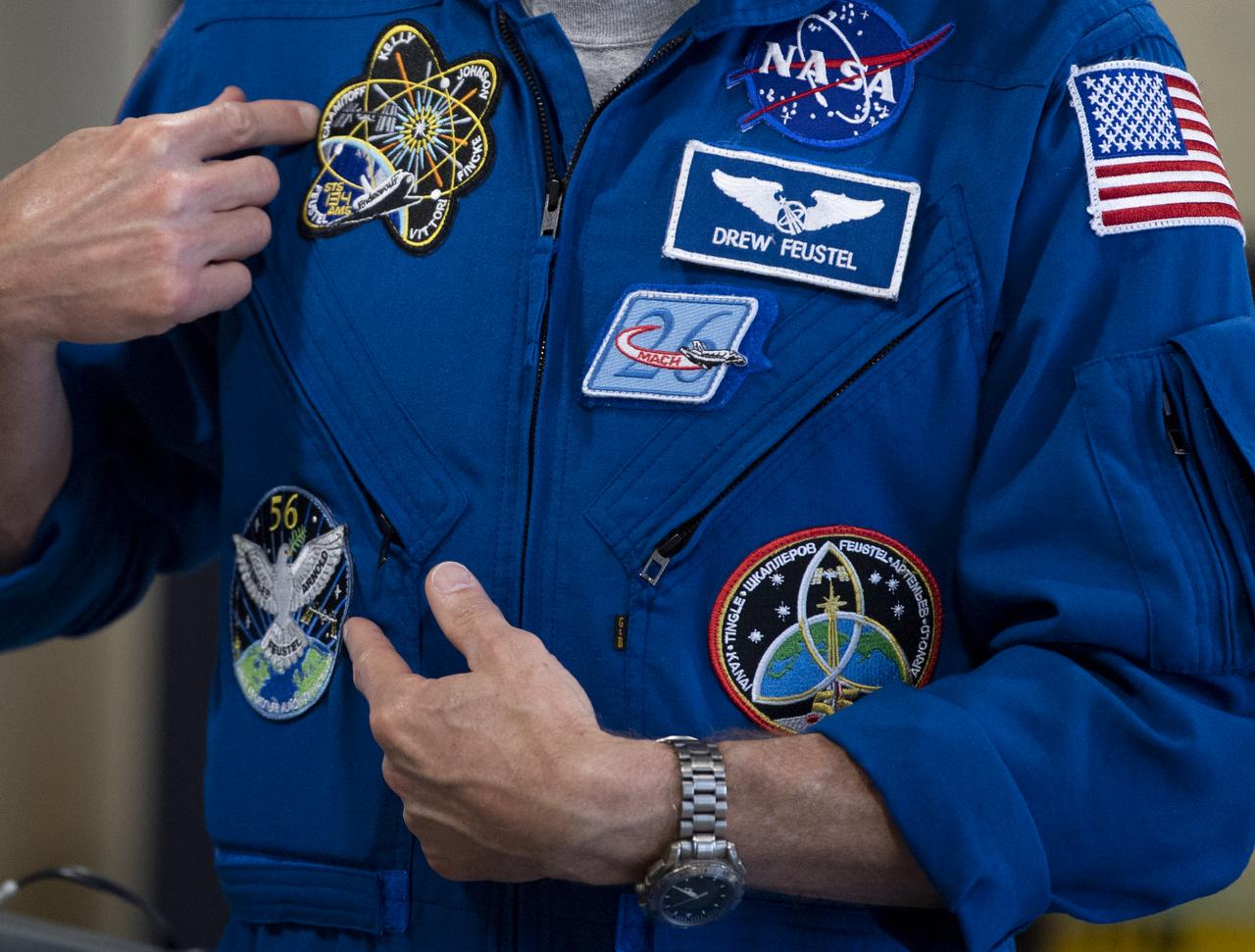
NASA astronaut Drew Feustel points to mission patches on his flight suit as he speaks to students at John Burroughs Elementary School about his experiences on two space shuttle missions, STS-125 and STS-134, and a long duration mission onboard the International Space Station, Tuesday, May 7, 2019 in Washington, DC. Feustel most recently spent 197 days living and working onboard the International Space Station as part of Expedition 55 and as commander of Expedition 56. Feustel ventured outside the space station on three spacewalks, moving him up to second among U.S. spacewalkers with a cumulative time of 61 hours 48 minutes over nine spacewalks. Photo Credit: (NASA/Joel Kowsky)
KENNEDY SPACE CENTER, FLA. -- A diversified mission of astronomy, commercial space research and International Space Station preparation gets under way as the Space Shuttle Columbia climbs into orbit from Launch Pad 39B at 2:55:47 p.m. EST, Nov. 19, 1996. During Mission STS- 80, Columbia’s five-person crew will deploy and retrieve two free-flying spacecraft, conduct two spacewalks and perform a variety of microgravity research experiments in the Shuttle’s middeck area. The veteran crew is led by Commander Kenneth D. Cockrell; Kent V. Rominger is the pilot and the three mission specialists are Tamara E. Jernigan, Story Musgrave and Thomas D. Jones. At age 61, Musgrave becomes the oldest person ever to fly in space; he also ties astronaut John Young’s record for most number of spaceflights by a human being, and in embarking on his sixth Shuttle flight Musgrave has logged the most flights ever aboard NASA’s reusable space vehicle. The two primary payloads for STS-80 are the Wake Shield Facility-3 (WSF-3) and the Orbiting and Retrievable Far and Extreme Ultraviolet Spectrometer-Shuttle Pallet Satellite II (ORFEUS-SPAS II).
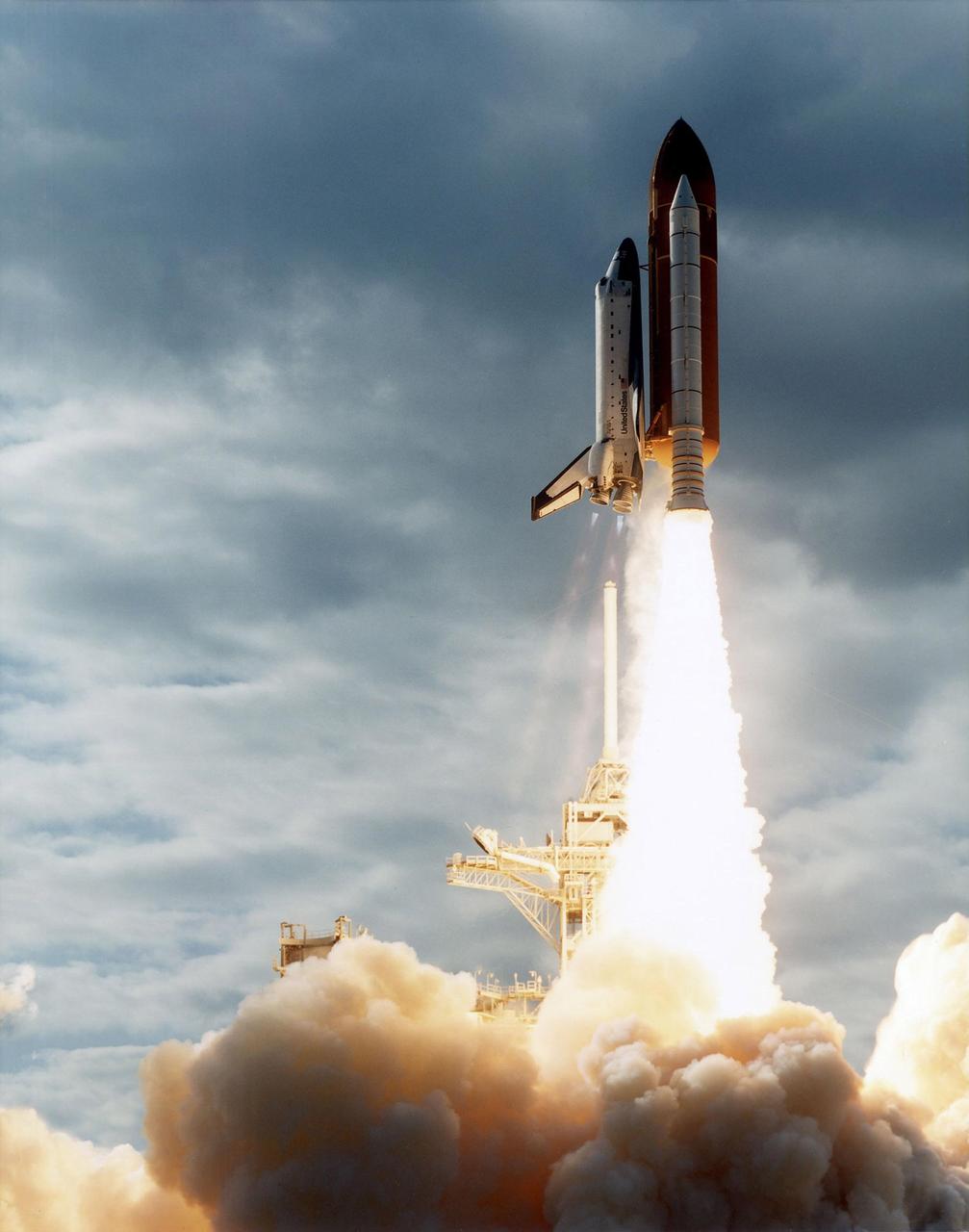
KENNEDY SPACE CENTER, FLA. -- A diversified mission of astronomy, commercial space research and International Space Station preparation gets under way as the Space Shuttle Columbia climbs into orbit from Launch Pad 39B at 2:55:47 p.m. EST, Nov. 19, 1996. During Mission STS- 80, Columbia’s five-person crew will deploy and retrieve two free-flying spacecraft, conduct two spacewalks and perform a variety of microgravity research experiments in the Shuttle’s middeck area. The veteran crew is led by Commander Kenneth D. Cockrell; Kent V. Rominger is the pilot and the three mission specialists are Tamara E. Jernigan, Story Musgrave and Thomas D. Jones. At age 61, Musgrave becomes the oldest person ever to fly in space; he also ties astronaut John Young’s record for most number of spaceflights by a human being, and in embarking on his sixth Shuttle flight Musgrave has logged the most flights ever aboard NASA’s reusable space vehicle. The two primary payloads for STS-80 are the Wake Shield Facility-3 (WSF-3) and the Orbiting and Retrievable Far and Extreme Ultraviolet Spectrometer-Shuttle Pallet Satellite II (ORFEUS-SPAS II).
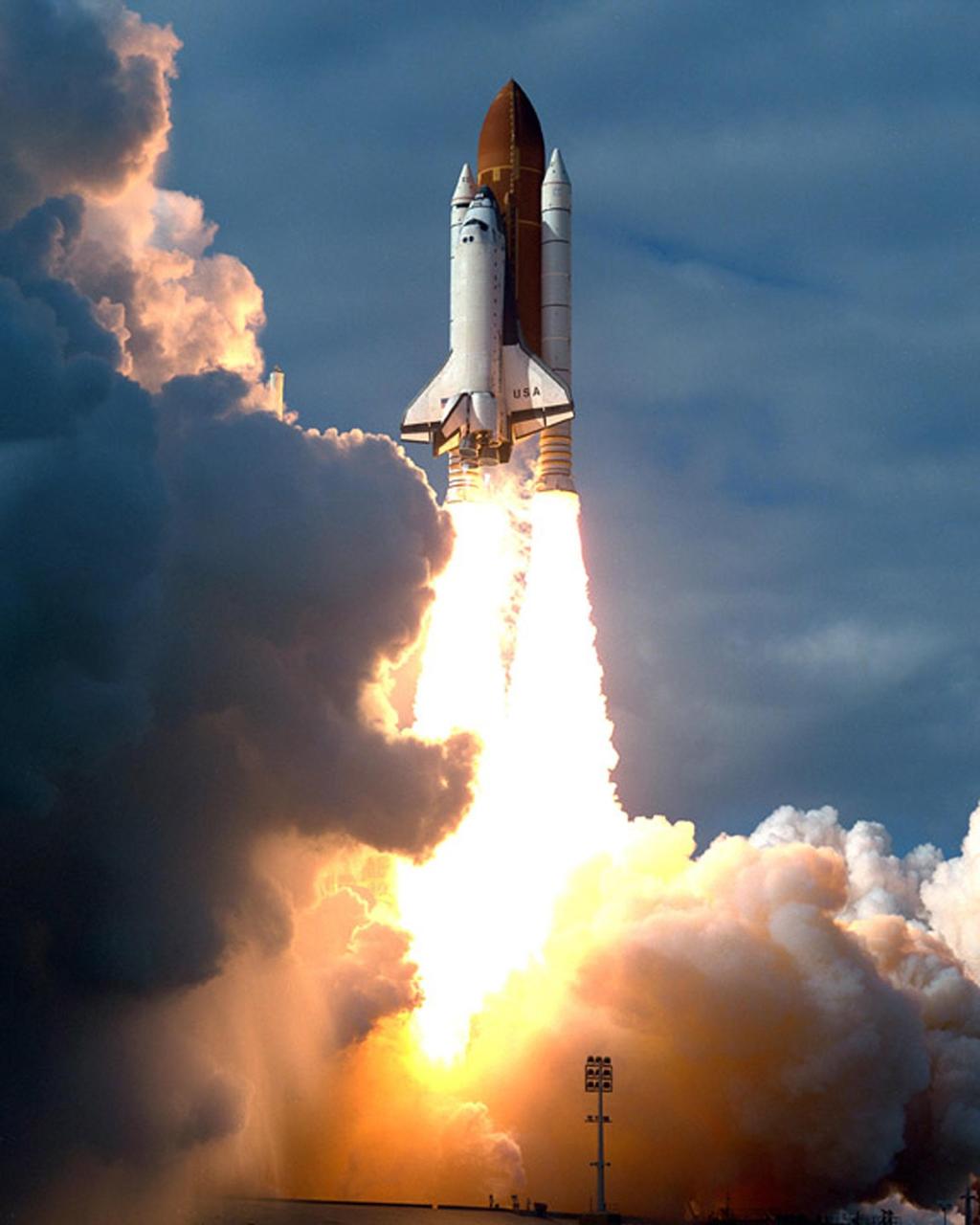
KENNEDY SPACE CENTER, FLA. -- A diversified mission of astronomy, commercial space research and International Space Station preparation gets under way as the Space Shuttle Columbia climbs into orbit from Launch Pad 39B at 2:55:47 p.m. EST, Nov. 19, 1996. During Mission STS- 80, Columbia’s five-person crew will deploy and retrieve two free-flying spacecraft, conduct two spacewalks and perform a variety of microgravity research experiments in the Shuttle’s middeck area. The veteran crew is led by Commander Kenneth D. Cockrell; Kent V. Rominger is the pilot and the three mission specialists are Tamara E. Jernigan, Story Musgrave and Thomas D. Jones. At age 61, Musgrave becomes the oldest person ever to fly in space; he also ties astronaut John Young’s record for most number of spaceflights by a human being, and in embarking on his sixth Shuttle flight Musgrave has logged the most flights ever aboard NASA’s reusable space vehicle. The two primary payloads for STS-80 are the Wake Shield Facility-3 (WSF-3) and the Orbiting and Retrievable Far and Extreme Ultraviolet Spectrometer-Shuttle Pallet Satellite II (ORFEUS-SPAS II).
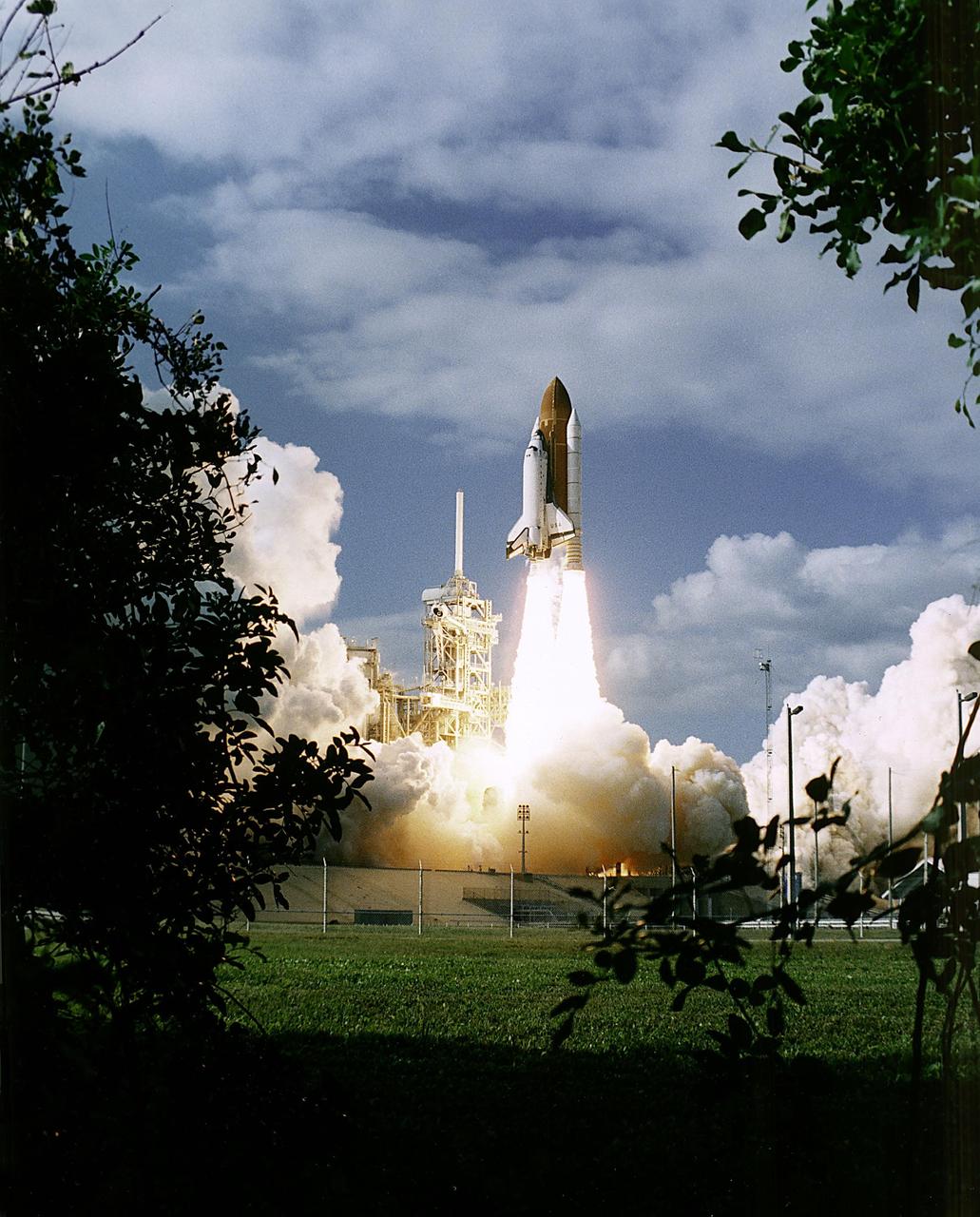
KENNEDY SPACE CENTER, FLA. -- A diversified mission of astronomy, commercial space research and International Space Station preparation gets under way as the Space Shuttle Columbia climbs into orbit from Launch Pad 39B at 2:55:47 p.m. EST, November 19, 1996. During Mission STS-80, Columbia's five-person crew will deploy and retrieve two free-flying spacecraft, conduct two spacewalks and perform a variety of microgravity research experiments in the Shuttle's middeck area. The veteran crew is led by Commander Kenneth D. Cockrell; Kent V. Rominger is the pilot and the three mission specialists are Tamara E. Jernigan, Story Musgrave and Thomas D. Jones. At age 61, Musgrave becomes the oldest person ever to fly in space; he also ties astronaut John Young's record for most number of spaceflights by a human being, and in embarking on his sixth Shuttle flight Musgrave has logged the most flights ever aboard NASA's reusable space vehicle. The two primary payloads for STS-80 are the Wake Shield Facility-3 (WSF-3) and the Orbiting and Retrievable Far and Extreme Ultraviolet Spectrometer-Shuttle Pallet Satellite II (ORFEUS-SPAS II).
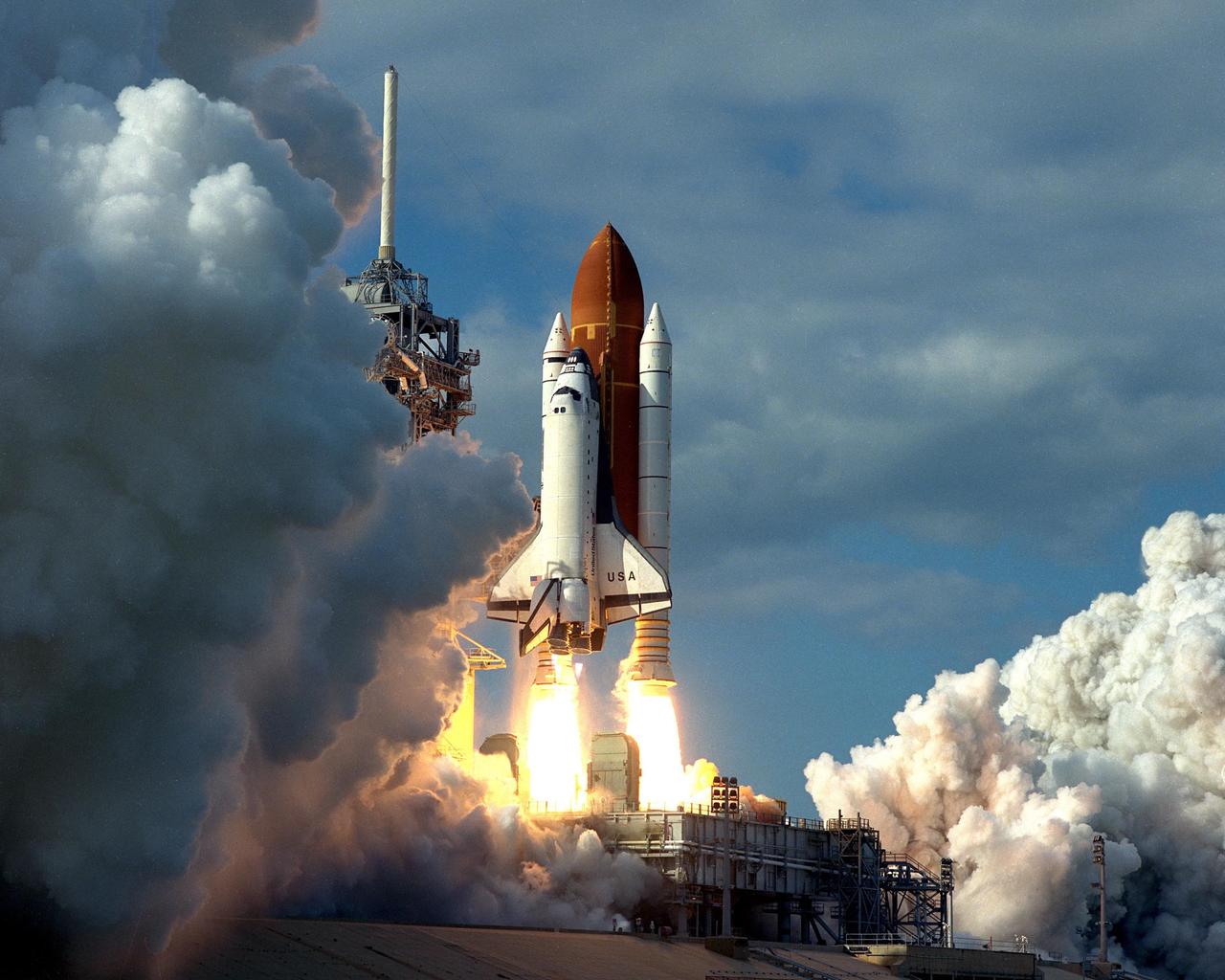
KENNEDY SPACE CENTER, FLA. -- A diversified mission of astronomy, commercial space research and International Space Station preparation gets under way as the Space Shuttle Columbia climbs into orbit from Launch Pad 39B at 2:55:47 p.m. EST, Nov. 19, 1996. During Mission STS- 80, Columbia’s five-person crew will deploy and retrieve two free-flying spacecraft, conduct two spacewalks and perform a variety of microgravity research experiments in the Shuttle’s middeck area. The veteran crew is led by Commander Kenneth D. Cockrell; Kent V. Rominger is the pilot and the three mission specialists are Tamara E. Jernigan, Story Musgrave and Thomas D. Jones. At age 61, Musgrave becomes the oldest person ever to fly in space; he also ties astronaut John Young’s record for most number of spaceflights by a human being, and in embarking on his sixth Shuttle flight Musgrave has logged the most flights ever aboard NASA’s reusable space vehicle. The two primary payloads for STS-80 are the Wake Shield Facility-3 (WSF-3) and the Orbiting and Retrievable Far and Extreme Ultraviolet Spectrometer-Shuttle Pallet Satellite II (ORFEUS-SPAS II).
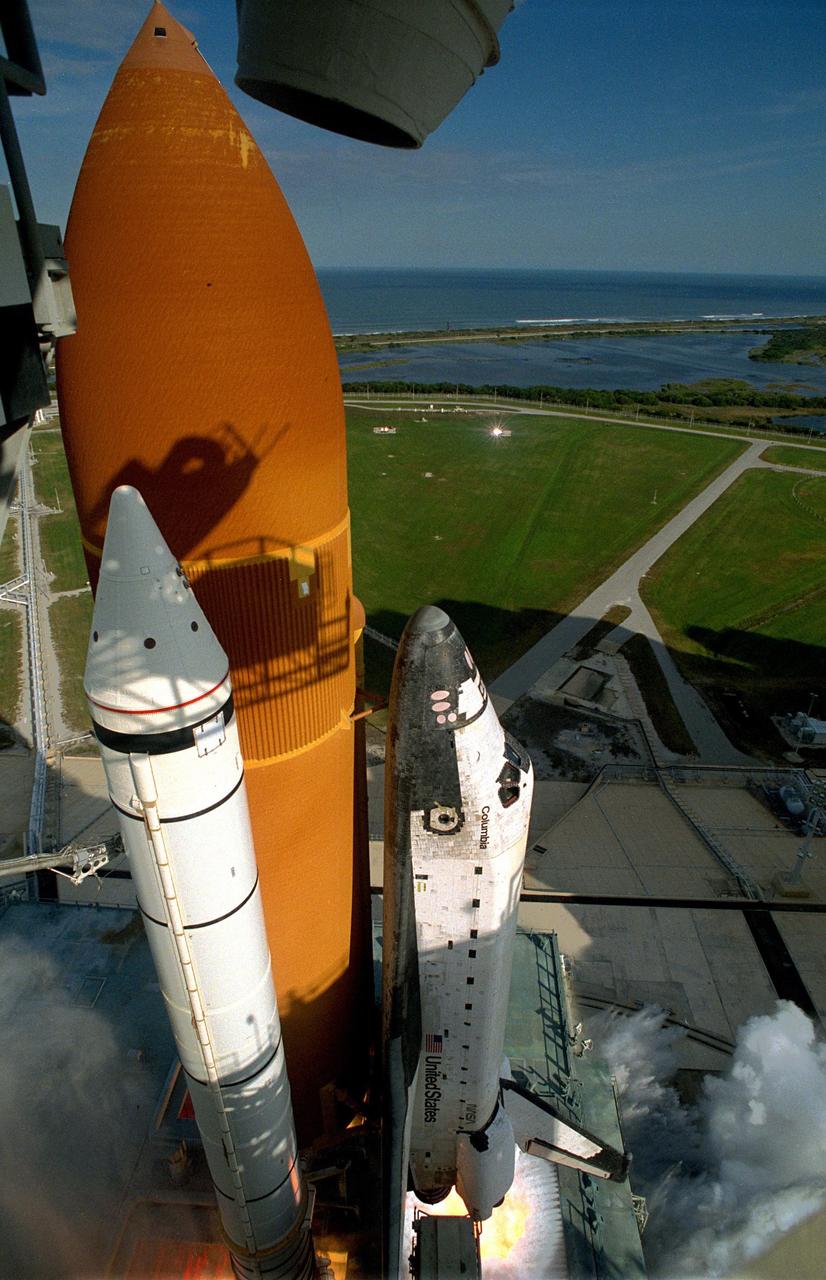
KENNEDY SPACE CENTER, FLA. -- A diversified mission of astronomy, commercial space research and International Space Station preparation gets under way as the Space Shuttle Columbia climbs into orbit from Launch Pad 39B at 2:55:47 p.m. EST, Nov. 19, 1996. During Mission STS- 80, Columbia’s five-person crew will deploy and retrieve two free-flying spacecraft, conduct two spacewalks and perform a variety of microgravity research experiments in the Shuttle’s middeck area. The veteran crew is led by Commander Kenneth D. Cockrell; Kent V. Rominger is the pilot and the three mission specialists are Tamara E. Jernigan, Story Musgrave and Thomas D. Jones. At age 61, Musgrave becomes the oldest person ever to fly in space; he also ties astronaut John Young’s record for most number of spaceflights by a human being, and in embarking on his sixth Shuttle flight Musgrave has logged the most flights ever aboard NASA’s reusable space vehicle. The two primary payloads for STS-80 are the Wake Shield Facility-3 (WSF-3) and the Orbiting and Retrievable Far and Extreme Ultraviolet Spectrometer-Shuttle Pallet Satellite II (ORFEUS-SPAS II).
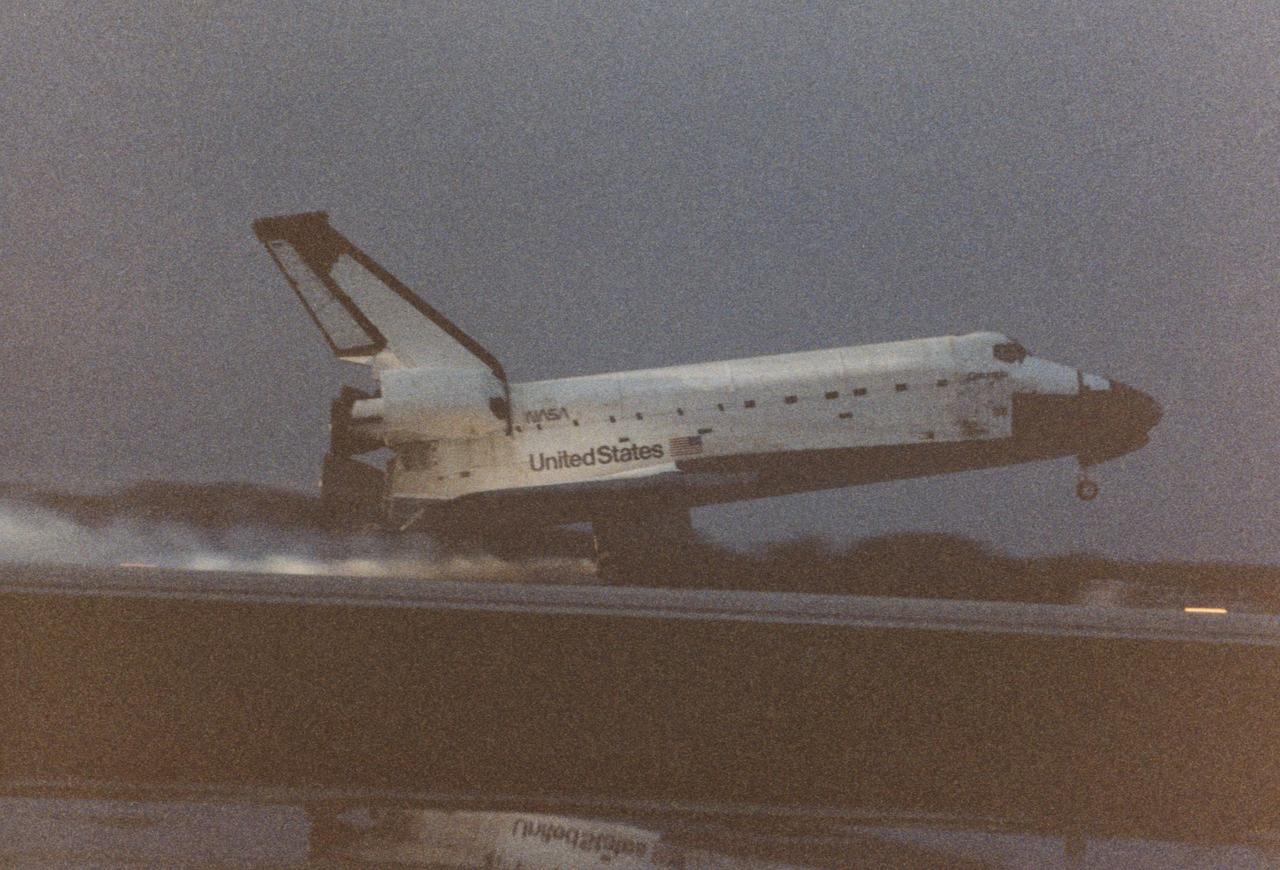
KENNEDY SPACE CENTER, FLA. -- The final Space Shuttle flight of 1996 comes to a successful close as the orbiter Columbia touches down on Runway 33 of KSC’s Shuttle Landing Facility. Main gear touchdown occurred at 6:49:05 a.m. EST, Dec. 7. The mission duration of 17 days, 15 hours and 53 minutes establishes a new record for extended Shuttle flight. The five- member STS-80 crew is led by Commander Kenneth D. Cockrell and Pilot Kent V. Rominger. The three mission specialists on board are Tamara E. Jernigan, Thomas D. Jones and Story Musgrave. At age 61, Musgrave is the oldest person ever to fly in space; he also becomes the first person to fly six times on the Shuttle. The two primary payloads of the 80th Shuttle flight are the Orbiting and Retrievable Far and Extreme Ultraviolet Spectrometer-Shuttle Pallet Satellite II (ORFEUS-SPAS II) and the Wake Shield Facility-3 (WSF-3).
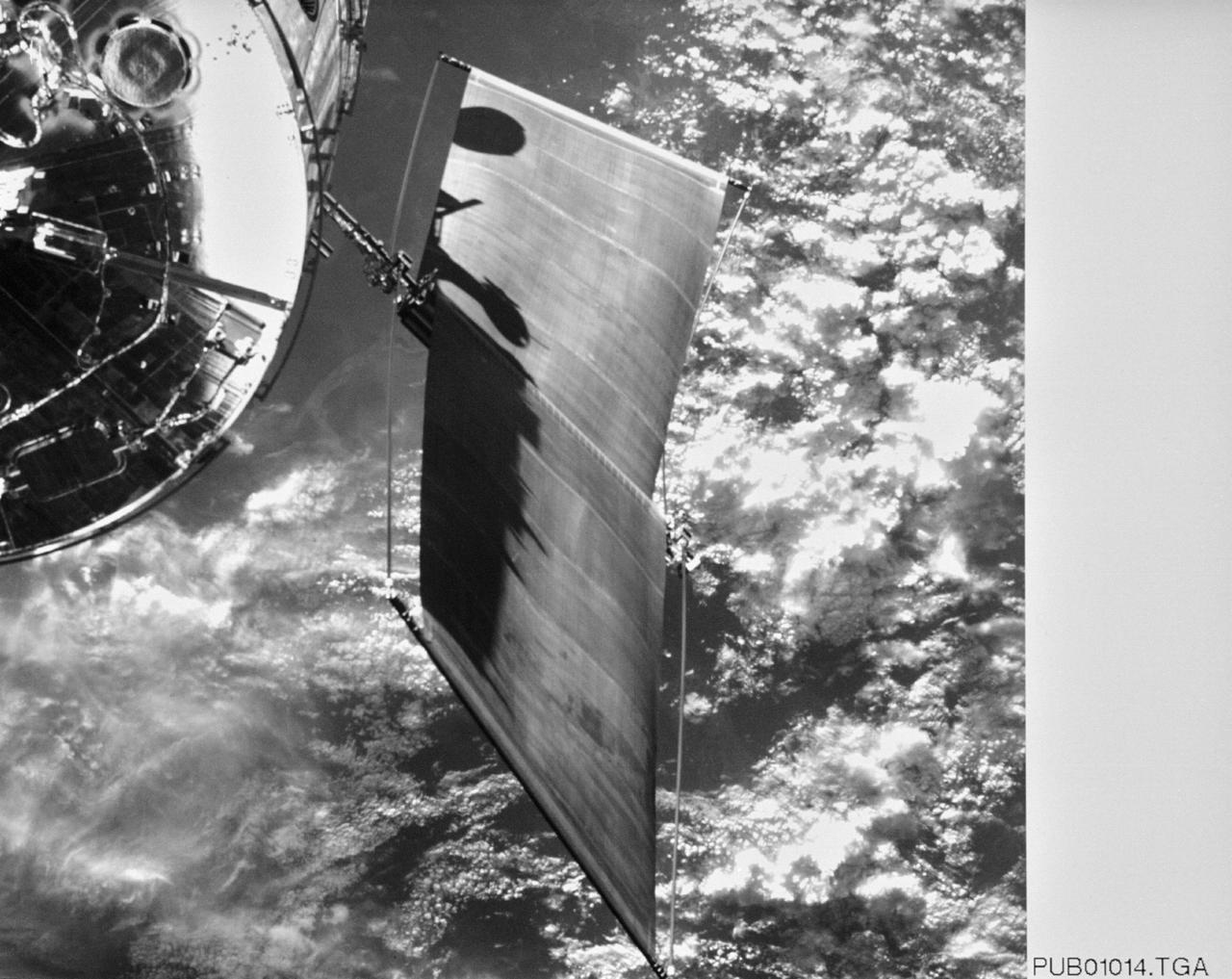
S61-E-009 (4 Dec 1993) --- This view of one of two High Gain Antennae (HGA) on the Hubble Space Telescope (HST) was photographed with an Electronic Still Camera (ESC). The scene was down linked to ground controllers soon after the Space Shuttle Endeavour caught up to the orbiting telescope 320 miles above Earth. Shown here before grapple, the HST was captured on December 4, 1993 in order to service the telescope. Over a period of five days, four of the seven STS-61 crew members will work in alternating pairs outside Endeavour's shirt sleeve environment. Electronic still photography is a relatively new technology which provides the means for a handheld camera to electronically capture and digitize an image with resolution approaching film quality. The electronic still camera has flown as an experiment on several other shuttle missions.
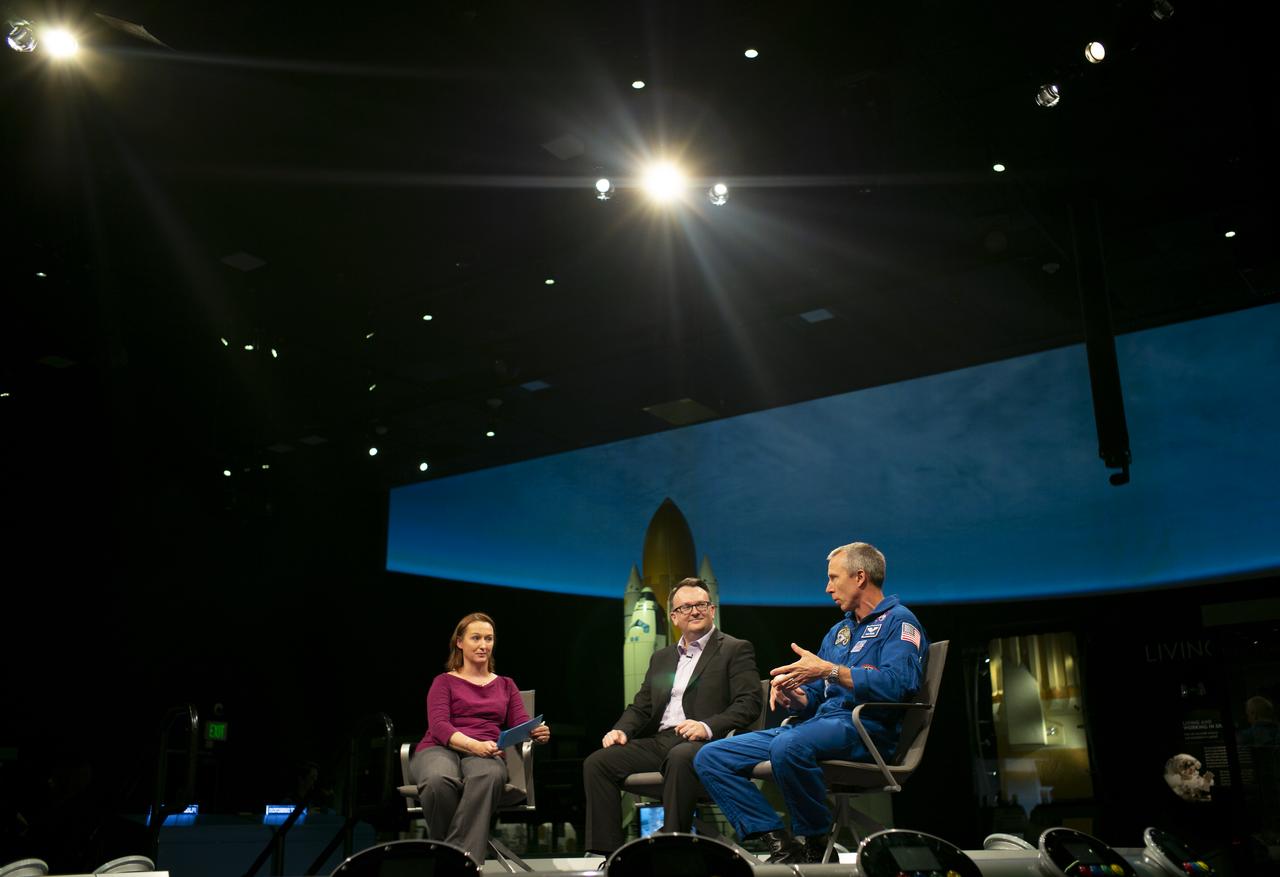
Smithsonian National Air and Space Museum curators Jennifer Levasseur, left, and Jeremy Kinney, center, speak with NASA astronaut Drew Feustel about his experiences on two space shuttle missions, STS-125 and STS-134, and a long duration mission onboard the International Space Station during “What’s New in Aerospace,” Thursday, May 9, 2019 at the Smithsonian’s National Air and Space Museum in Washington, DC. Feustel most recently spent 197 days living and working onboard the International Space Station as part of Expedition 55 and as commander of Expedition 56. Feustel ventured outside the space station on three spacewalks, moving him up to second among U.S. spacewalkers with a cumulative time of 61 hours 48 minutes over nine spacewalks. Photo Credit: (NASA/Joel Kowsky)