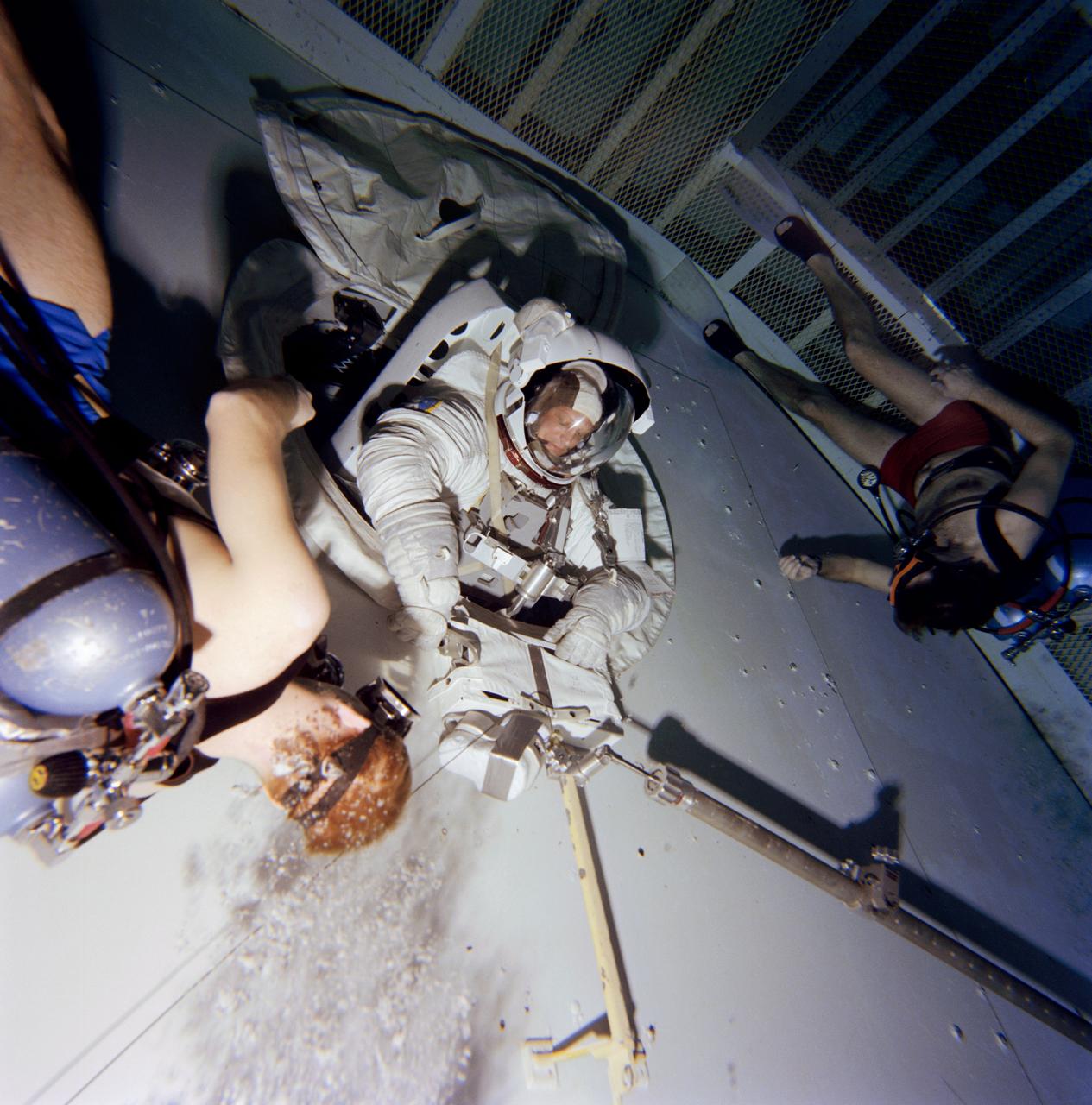
Dr. Norman E. Thagard, mission specialist for STS-7, moves through the hatchway of the mockup of the Space Shuttle orbiter which is part of JSC's weightless environment training facility (WETF). Thagard is wearing an extravehicular mobility unit and is practicing procedures used when performing an extravehicular activity (EVA) during a flight.
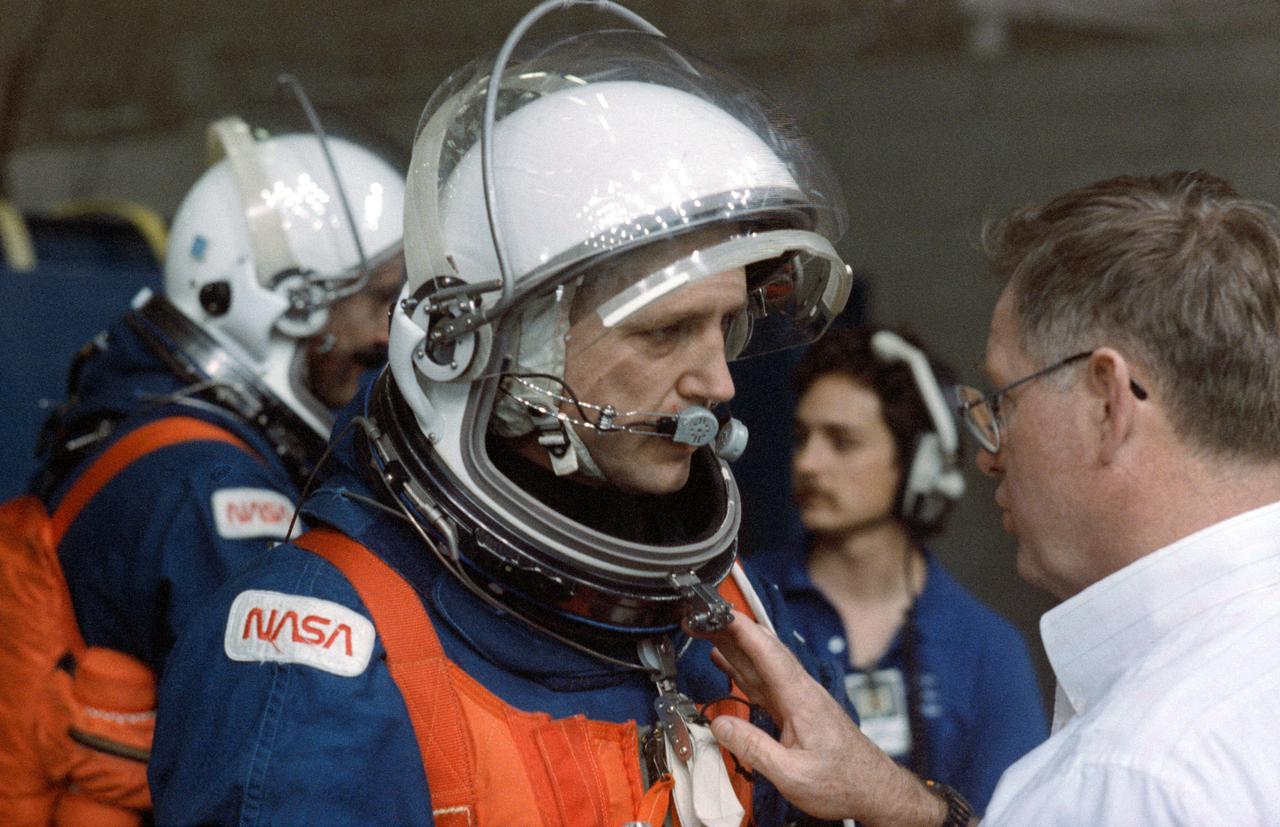
S92-26413 (March 1992) --- Astronaut Thomas D. Akers, left, is briefed by suit technician Alan M. Rochford of JSC's EVA branch office during a bailout training exercise in the Johnson Space Center's weightless environment training facility (WET-F). Akers was joined by six crewmates for the training session in the Johnson Space Center's Shuttle Mockup and Integration Laboratory. The seven will be aboard Endeavour in May for a week-long mission, during which a satellite will be retrieved and boosted toward a higher orbit, and extravehicular activity evaluations for Space Station Freedom assembly techniques will be conducted.
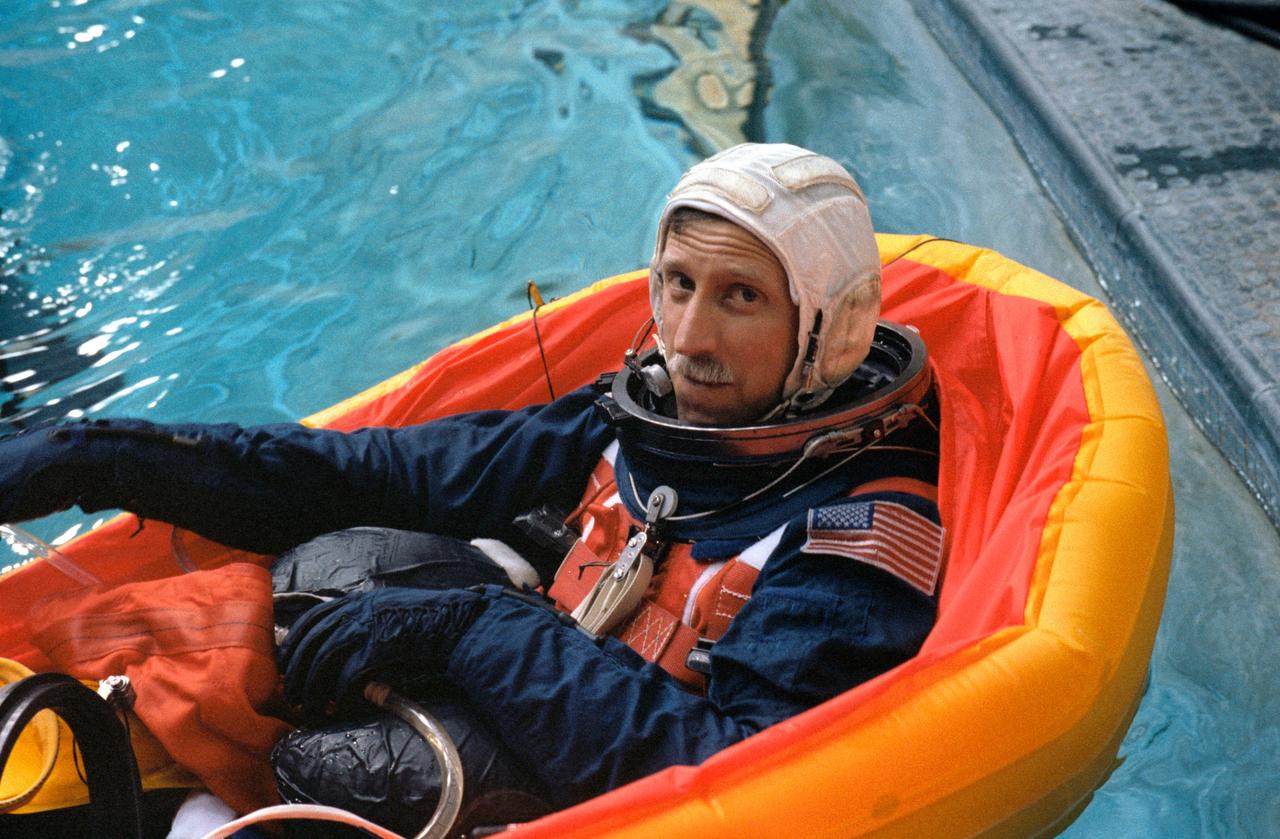
S88-42425 (20 July 1988) --- STS-26 Discovery, Orbiter Vehicle (OV) 103, Pilot Richard O. Covey, wearing the newly designed launch and entry suit (LES), floats in single-occupant life raft in JSC Weightless Environment Training Facility (WETF) Bldg 29 pool. The simulation of the escape and rescue operations utilized the crew escape system (CES) pole method of egress from the Space Shuttle.
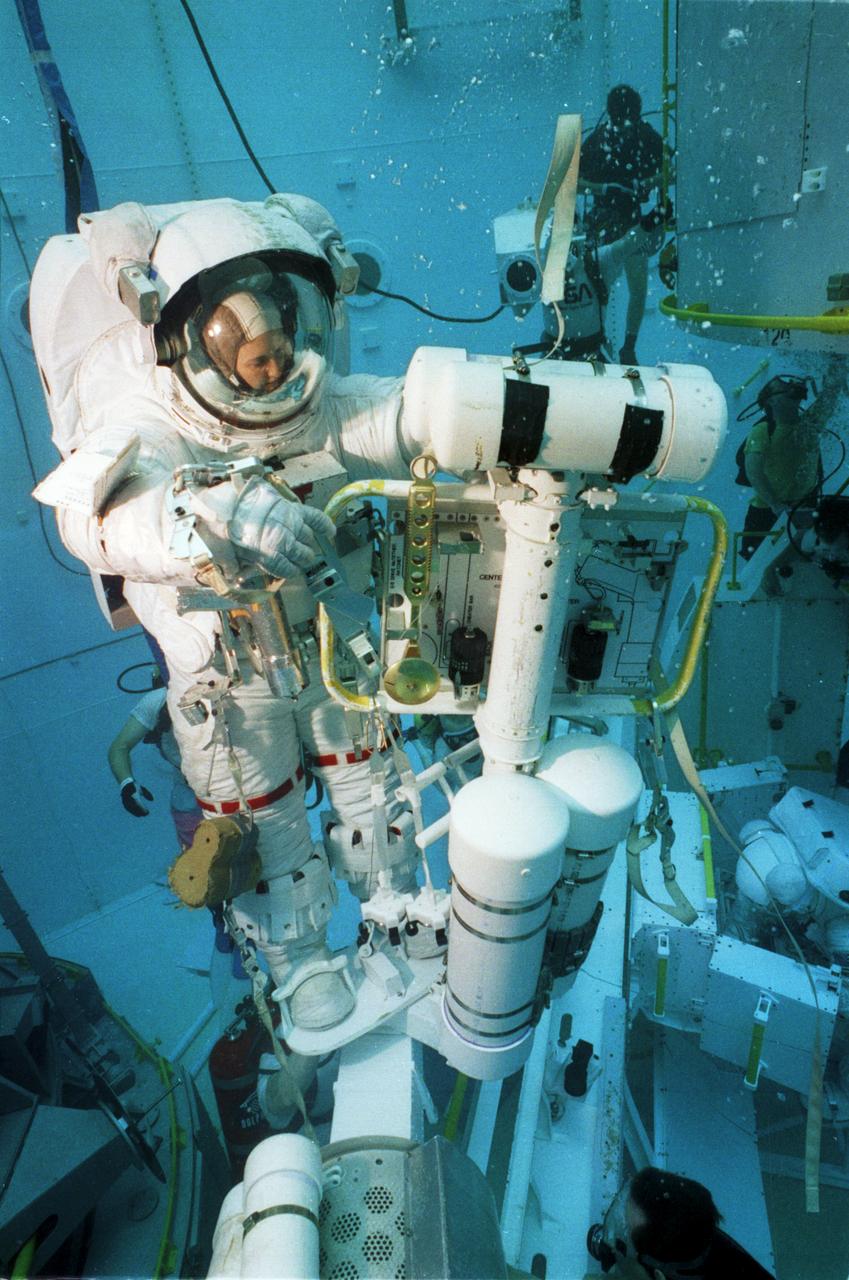
This close-up of astronaut and mission specialist, Kathryn Thornton, was captured under water in the Marshall Space Flight Center (MSFC) Neural Buoyancy Simulator (NBS) where she is participating in a training session for the STS-61 mission. The NBS provided the weightless environment encountered in space needed for testing and the practices of Extravehicular Activities (EVA). Launched on December 2, 1993 aboard the Space Shuttle Orbiter Endeavor, STS-61 was the first Hubble Space Telescope (HST) serving mission. During the 2nd EVA of the mission, Thornton, along with astronaut and mission specialist Thomas Akers, performed the task of replacing the solar arrays. The EVA lasted 6 hours and 35 minutes.
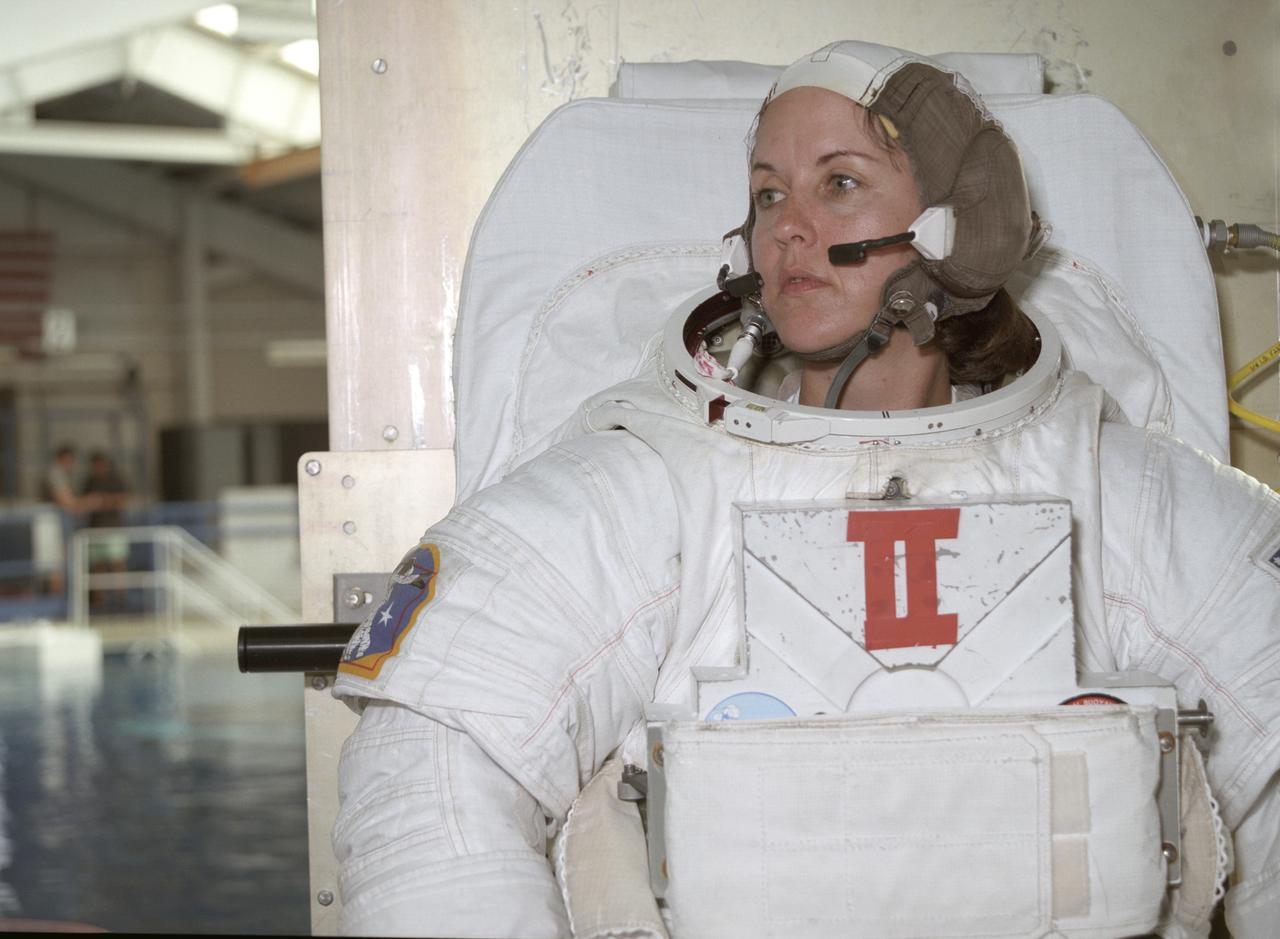
This close-up of astronaut and mission specialist Kathryn Thornton readies herself for submersion into the water in the Marshall Space Flight Center (MSFC) Neutral Buoyancy Simulator (NBS) where she is participating in a training session for the STS-61 mission. The NBS provided the weightless environment encountered in space needed for testing and the practices of Extravehicular Activities (EVA). Launched on December 2, 1993 aboard the Space Shuttle Orbiter Endeavor, STS-61 was the first Hubble Space Telescope (HST) serving mission. During the 2nd EVA of the mission, Thornton, along with astronaut and mission specialist Thomas Akers, performed the task of replacing the solar arrays. The EVA lasted 6 hours and 35 minutes.
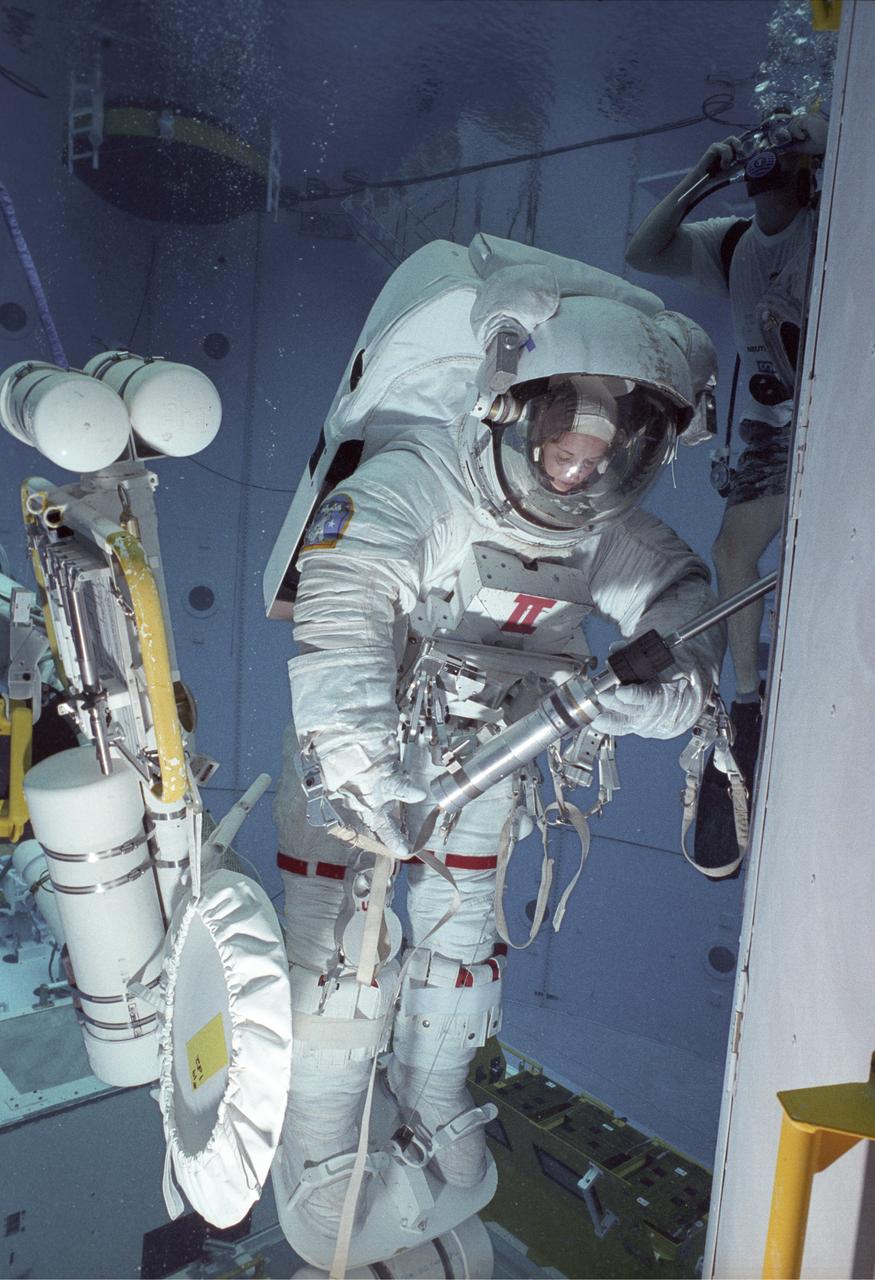
This close-up of astronaut and mission specialist Kathryn Thornton was captured under water in the Marshall Space Flight Center (MSFC) Neural Buoyancy Simulator (NBS) where she is participating in a training session for the STS-61 mission. The NBS provided the weightless environment encountered in space needed for testing and the practices of Extravehicular Activities (EVA). Launched on December 2, 1993 aboard the Space Shuttle Orbiter Endeavor, STS-61 was the first Hubble Space Telescope (HST) serving mission. During the 2nd EVA of the mission, Thornton, along with astronaut and mission specialist Thomas Akers, performed the task of replacing the solar arrays. The EVA lasted 6 hours and 35 minutes.
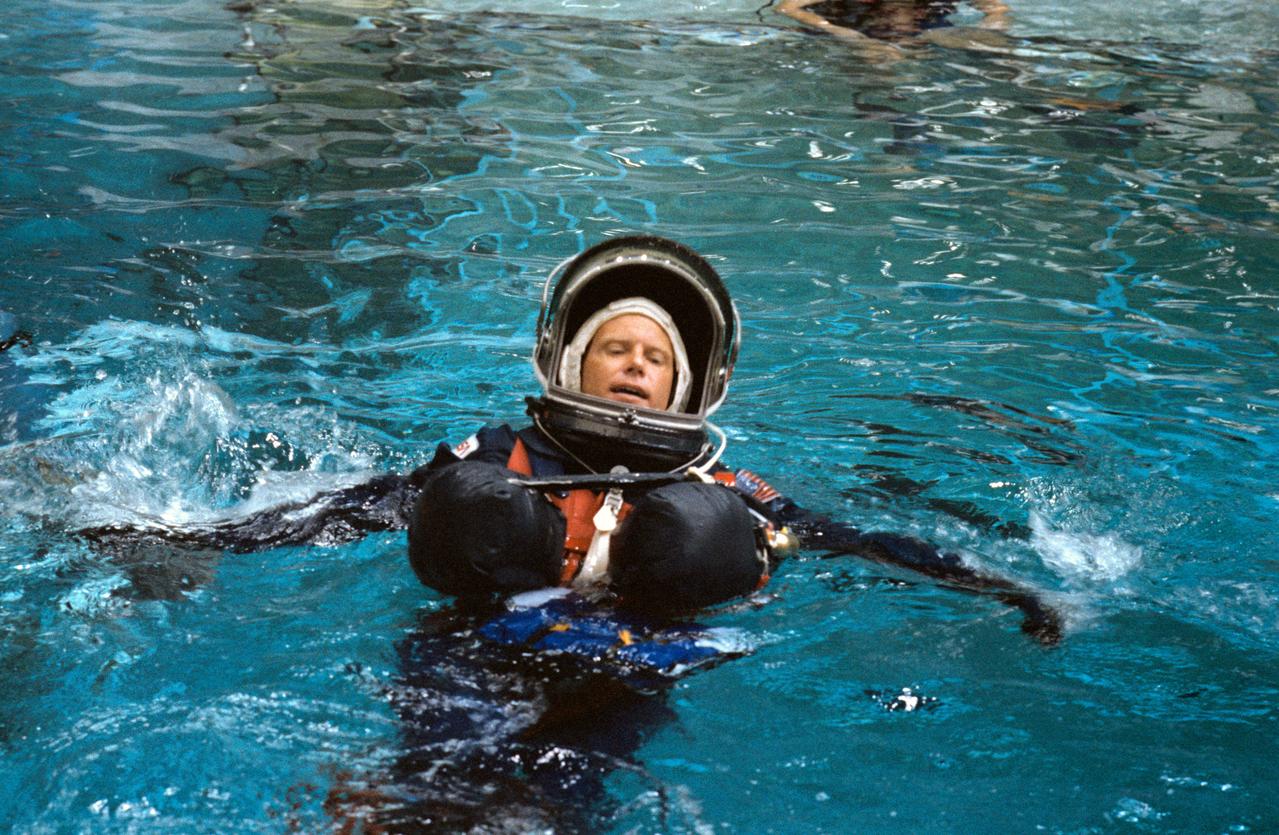
S88-42409 (20 July 1988) --- STS-26 Discovery, Orbiter Vehicle (OV) 103, Mission Specialist (MS) George D. Nelson participates in crew escape system (CES) testing in JSC Weightless Environment Training Facility (WETF) Bldg 29. Nelson, wearing the newly designed (navy blue) launch and entry suit (LES), floats in WETF pool with the aid of an underarm flotation device (modern version of Mas West floats). He awaits the assistance of SCUBA-equipped divers during a simulation of escape and rescue operations utilizing a new CES pole for emergency exit from the Space Shuttle.
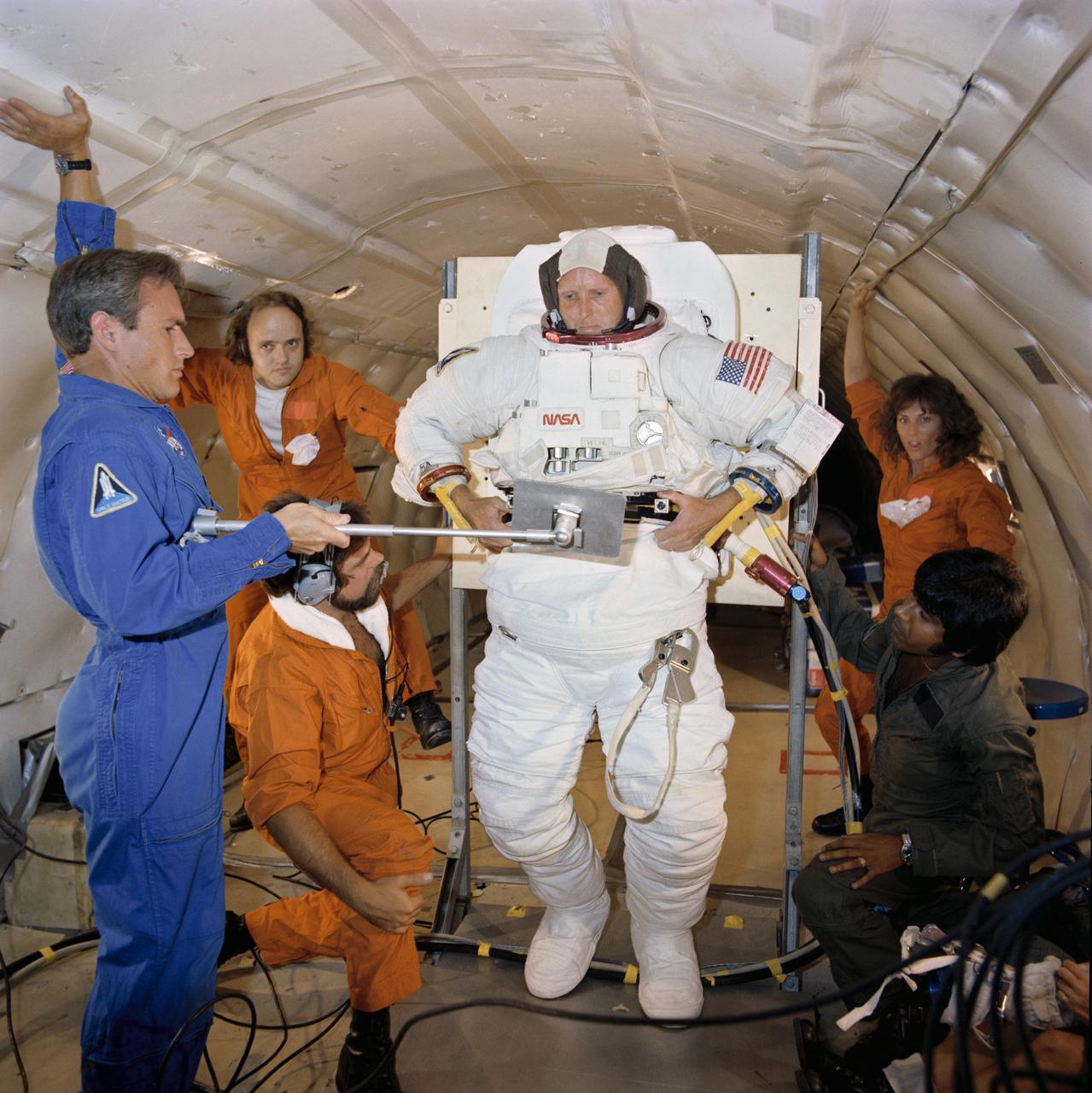
S81-34432 (July 1981) --- Astronaut C. Gordon Fullerton, STS-3 pilot, takes part in a suit donning and doffing exercise aboard a KC-135 "zero-gravity" aircraft. Mission specialist/astronaut William F. Fisher holds a mirror to assist Fullerton with hose and cable linkups to his suit. A special parabolic pattern flown by the KC-135 provides short durations of weightlessness. Fullerton's suit is an Extravehicular Mobility Unit (EMU), used by astronauts when leaving the shirt-sleeve environment of their shuttle orbiter to go outside and perform tasks in the vacuum of space. There are no such EVA plans on STS-3, but the crewmen are trained in this area in the event of a contingency. Photo credit: NASA
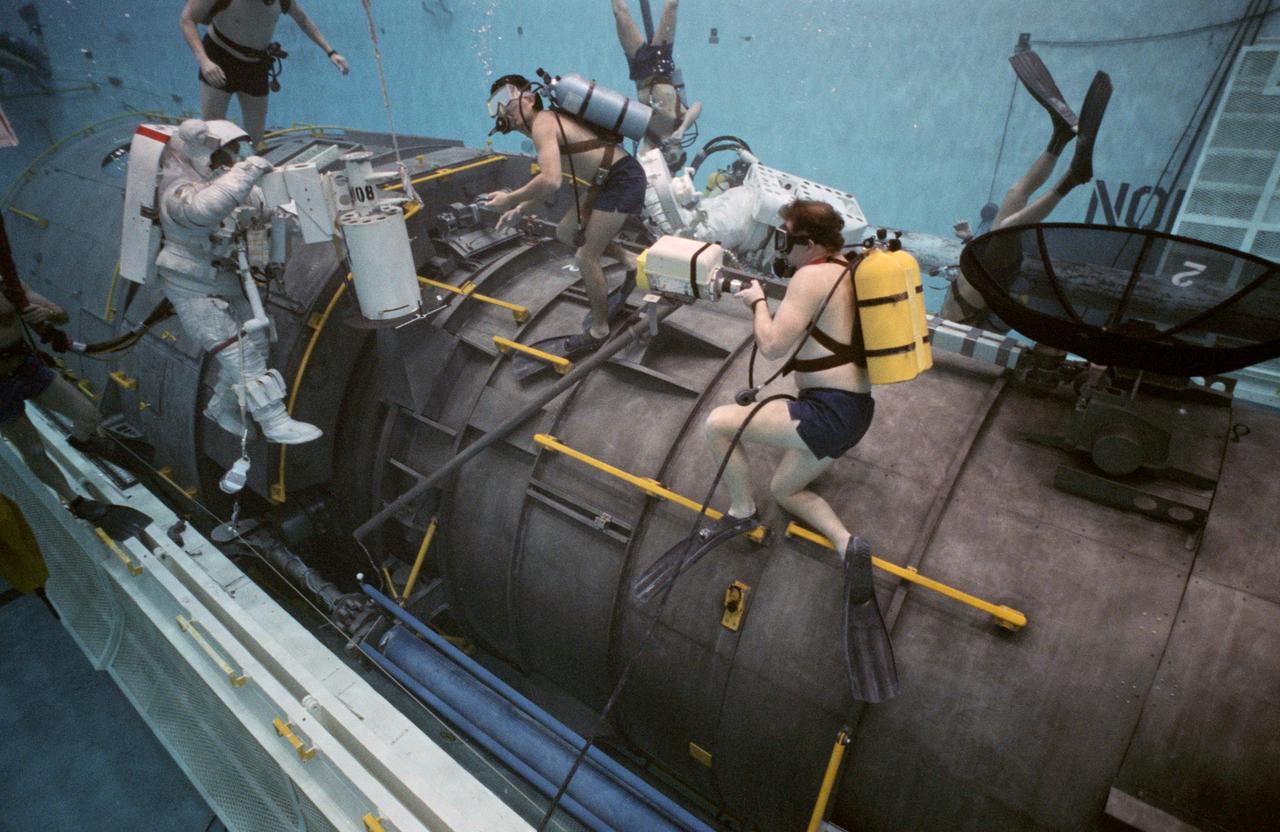
STS-31 Mission Specialist (MS) Bruce McCandless II (left), wearing an extravehicular mobility unit (EMU), maneuvers his way around a mockup of the remote manipulator system (RMS) end effector during an underwater simulation in JSC's Weightless Environment Training Facility (WETF) Bldg 29 pool. The end effector is attached to a grapple fixture on the Hubble Space Telescope (HST) mockup. As McCandless performs contingency extravehicular activity (EVA) procedures, fellow crewmember MS Kathryn D. Sullivan, in EMU, works on the opposite side of the HST mockup, and SCUBA-equipped divers monitor the activity. Though no EVA is planned for STS-31, the two crewmembers train for contingencies that would necessitate leaving the shirt sleeve environment of Discovery's, Orbiter Vehicle (OV) 103's, crew cabin and performing chores with the HST payload or related hardware in the payload bay (PLB).
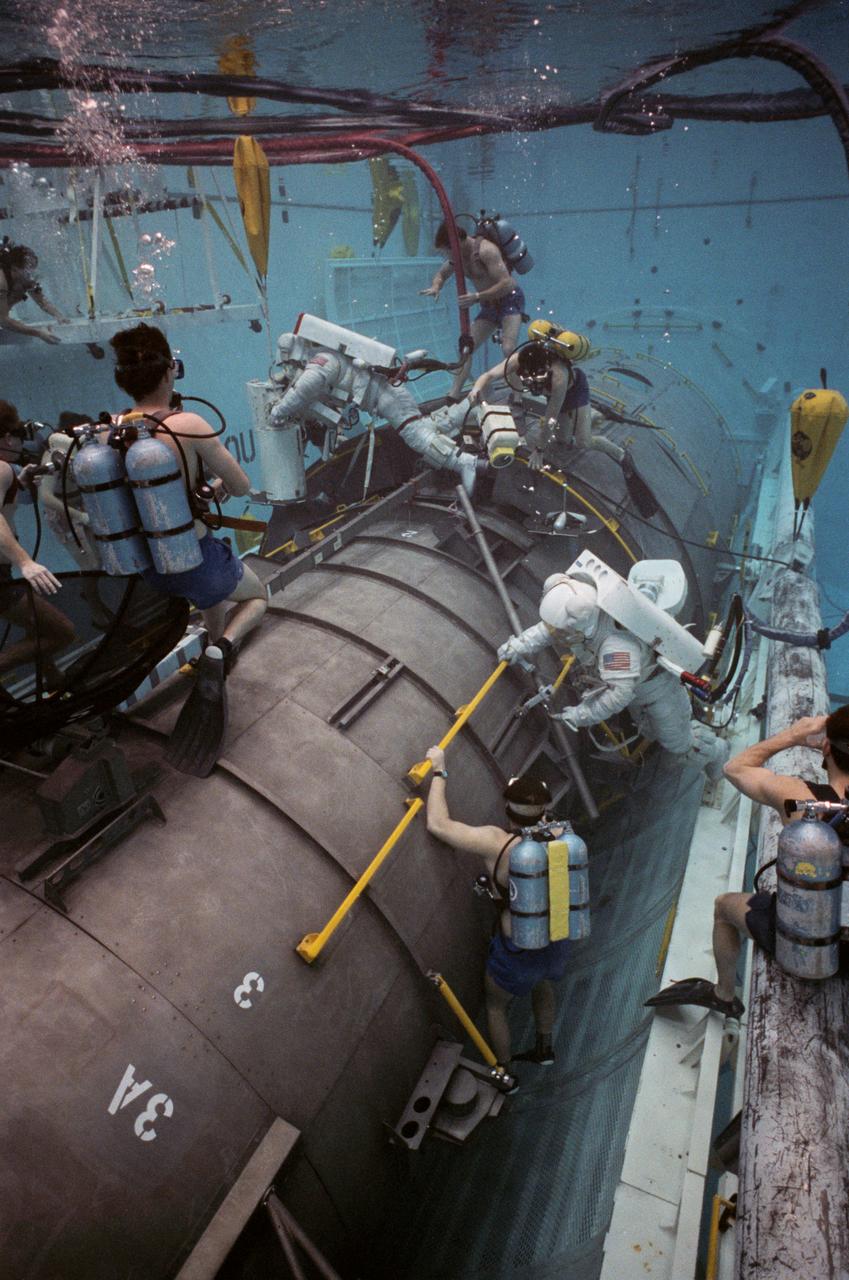
This overall view shows STS-31 Mission Specialist (MS) Bruce McCandless II (left) and MS Kathryn D. Sullivan making a practice space walk in JSC's Weightless Environment Training Facility (WETF) Bldg 29 pool. McCandless works with a mockup of the remote manipulator system (RMS) end effector which is attached to a grapple fixture on the Hubble Space Telescope (HST) mockup. Sullivan manipulates HST hardware on the Support System Module (SSM) forward shell. SCUBA-equipped divers monitor the extravehicular mobility unit (EMU) suited crewmembers during this simulated extravehicular activity (EVA). No EVA is planned for the Hubble Space Telescope (HST) deployment, but the duo has trained for contingencies which might arise during the STS-31 mission aboard Discovery, Orbiter Vehicle (OV) 103. Photo taken by NASA JSC photographer Sheri Dunnette.
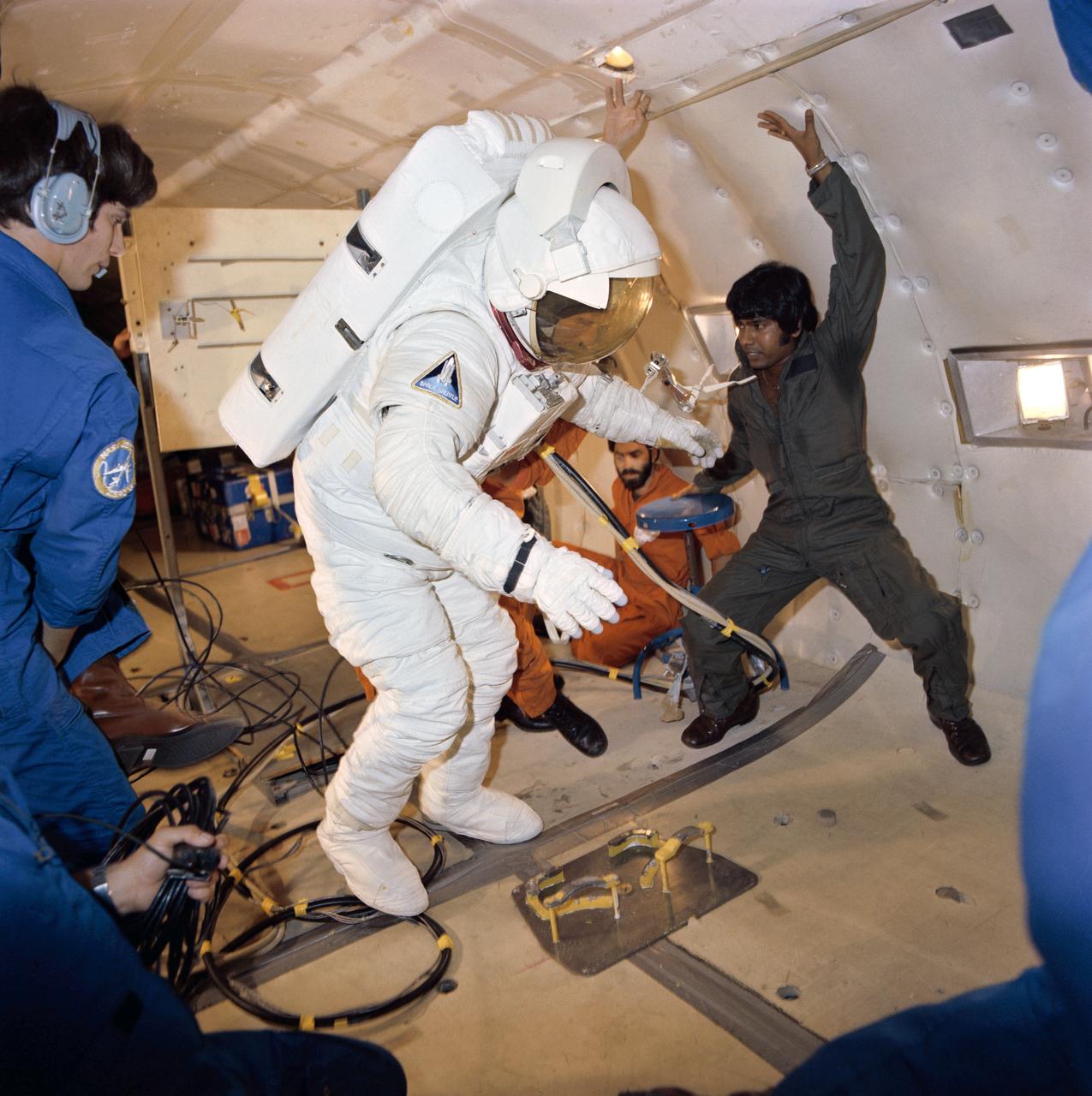
S81-34448 (July 1981) --- Astronaut C. Gordon Fullerton, STS-3 pilot, fully suited, gets a preview of what it might be like in space during a flight aboard NASA's KC-135 "zero-gravity" aircraft. A special parabolic pattern flown the aircraft provides short periods of weightlessness. Fullerton's suit is an Extravehicular Mobility Unit (EMU), used by astronauts when leaving the shirt-sleeve environment of their shuttle orbiter to go outside perform tasks in space. There are no such EVA plans on STS-3, but crew members are trained in this area in the event of the necessity to perform chores in space that for some reason or other can't be done remotely. The astronaut has just donned his suit during a parabola and now takes the opportunity to float around in the absence of gravity. Photo credit: NASA