/61-mr4-55(s)~medium.jpg)
KENNEDY SPACE CENTER, FLA. -- Project Mercury Astronaut Virgil I. Grissom, primary pilot for the Mercury-Redstone 4 manned space flight known as Liberty Bell 7, gets an assist from suit specialist Joe W. Schmidt as he prepares for the Mercury-Redstone 4 manned space flight. The flight, the second manned shot in the Mercury program, was postponed because of bad weather in the launch area. (NASA Photo
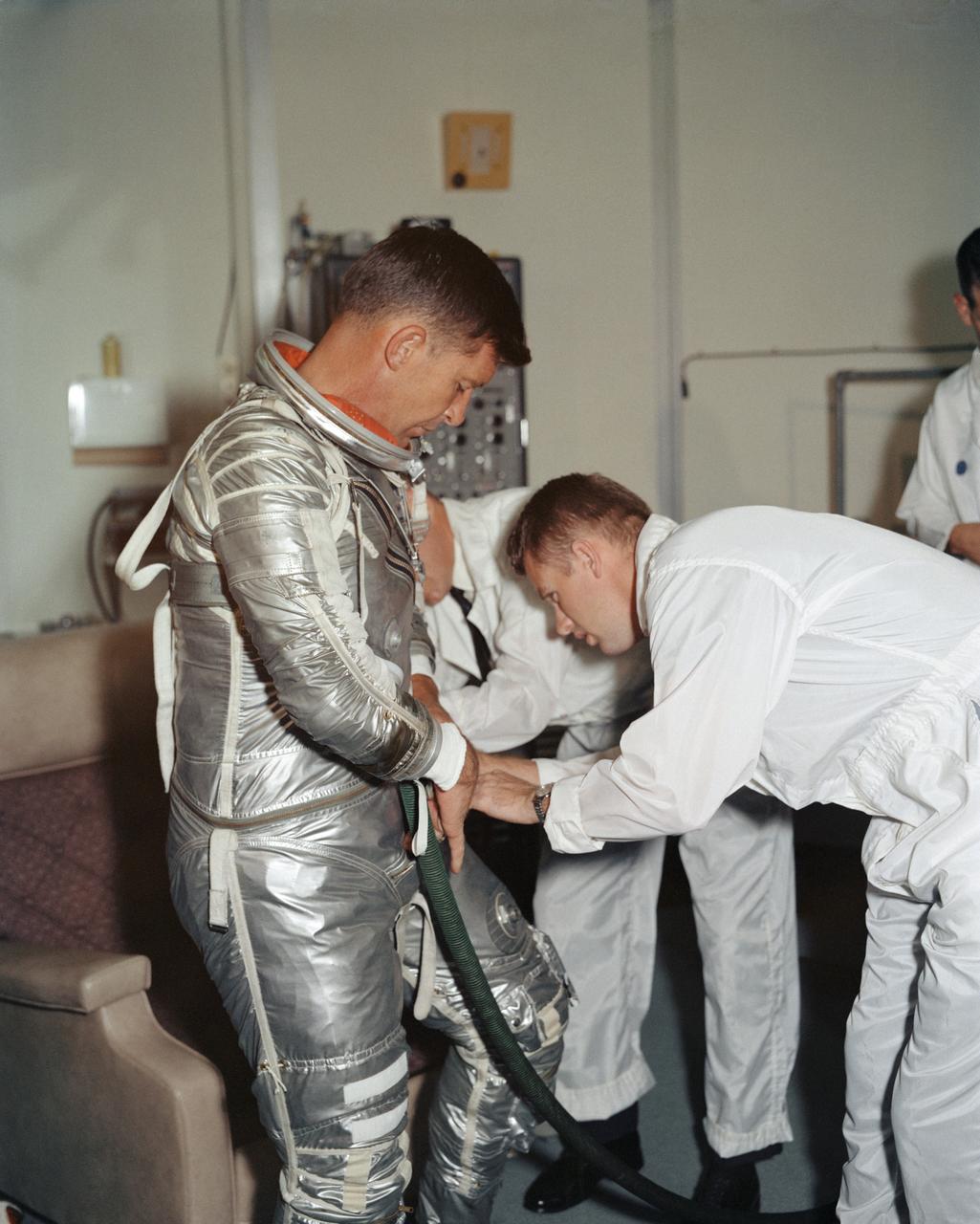
S62-08895 (1962) --- Astronaut Walter M. Schirra Jr., pilot of the Mercury-Atlas 8 (MA-8) Earth-orbital spaceflight, goes through a suiting-up exercise in Hangar "S" at Cape Canaveral several weeks prior to his scheduled Oct. 3, 1962 flight. Photo credit: NASA
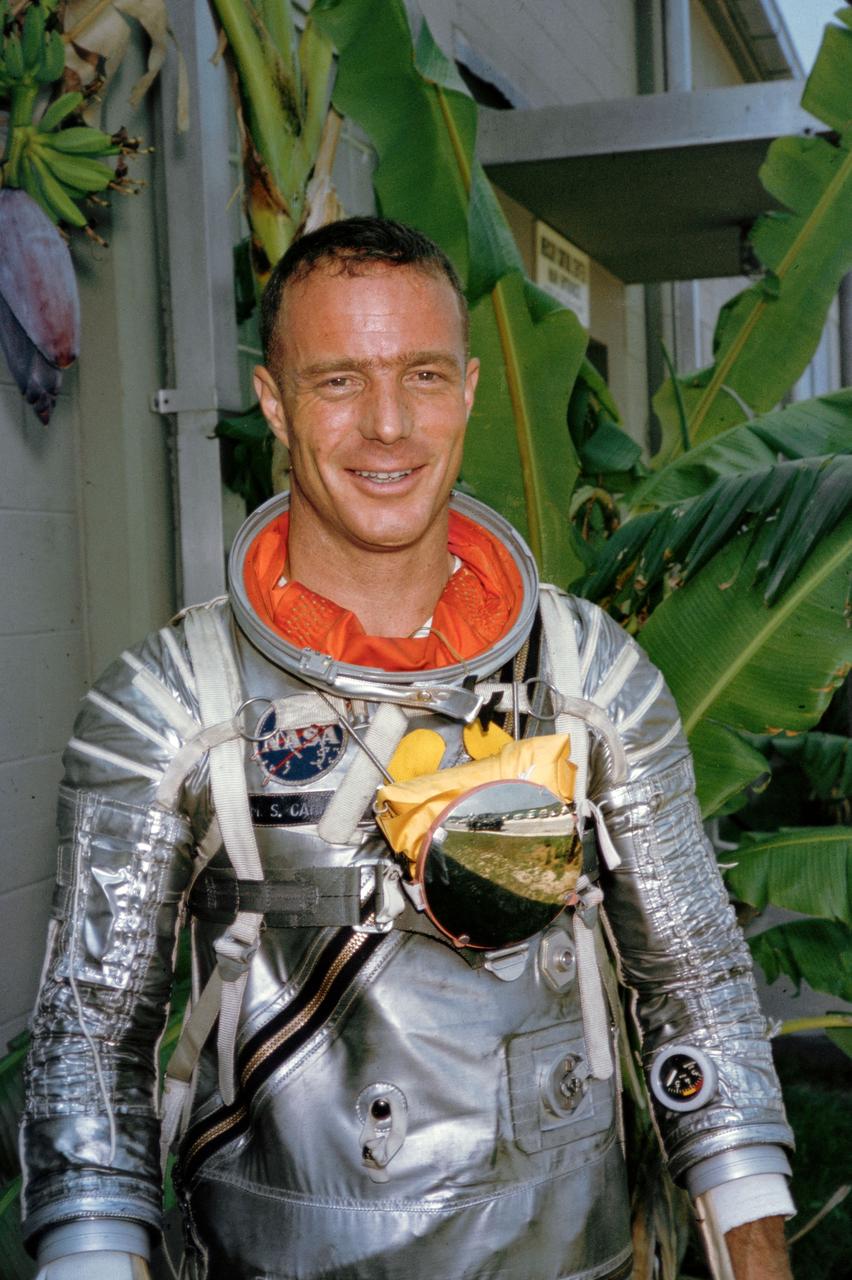
S64-36908 (1962) --- Portrait view of astronaut M. Scott Carpenter, wearing Mercury pressure suit, posing for pictures during astronaut training at the Cape Canaveral, Florida. Photo credit: NASA
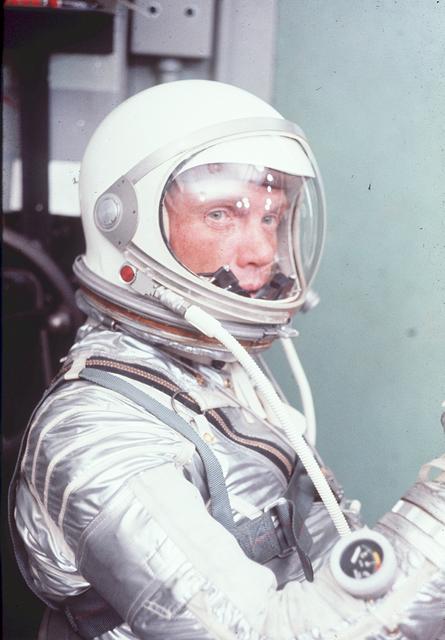
S64-36910 (February 1962) --- Astronaut John H. Glenn Jr., wearing a Mercury pressure suit, was the pilot of the Mercury-Atlas 6 (MA-6) mission. Glenn made America's first manned Earth-orbiting spaceflight on Feb. 20, 1962. This photograph was taken at Cape Canaveral, Florida, during MA-6 preflight training activities. Photo credit: NASA
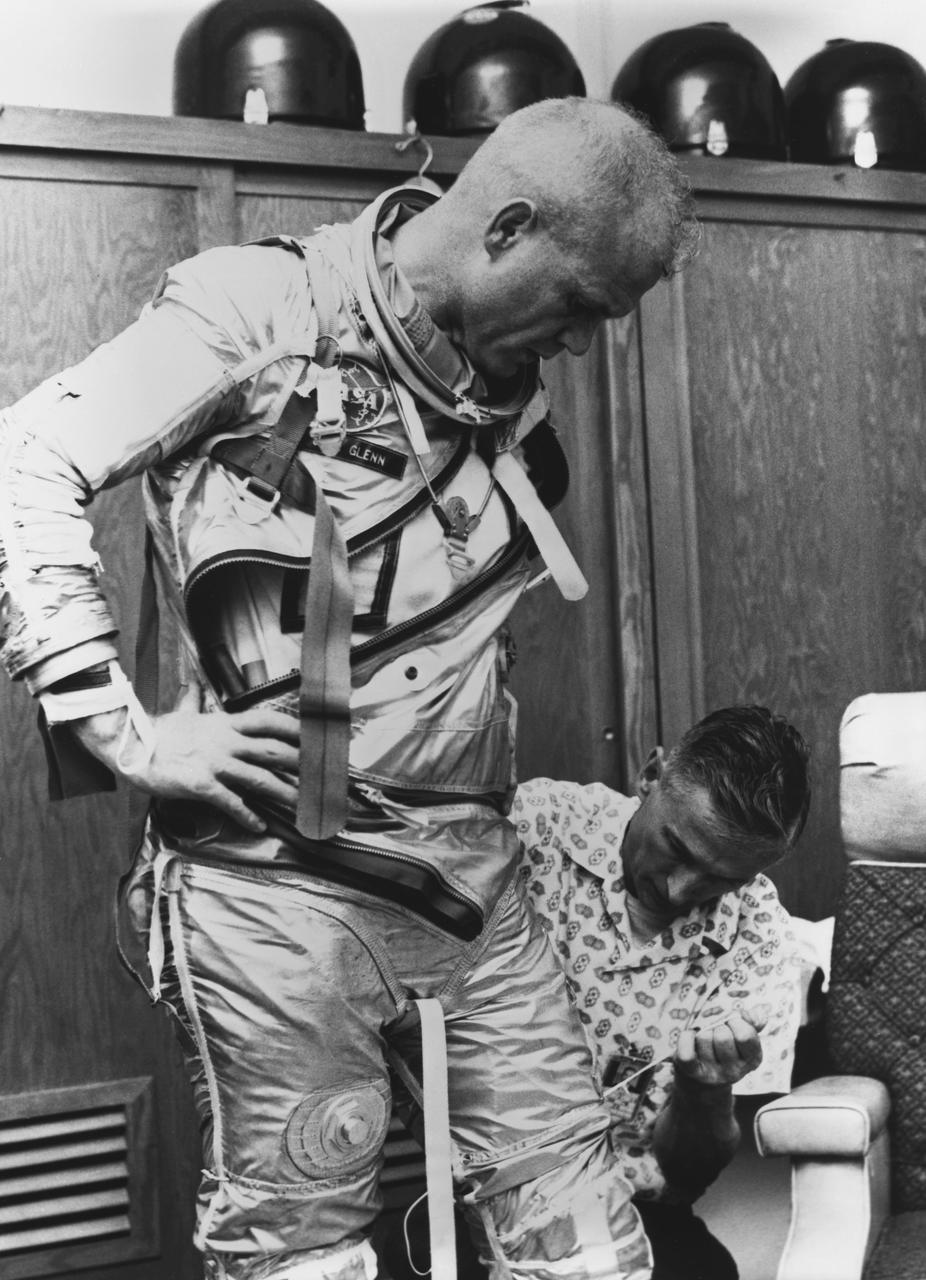
S62-00246 (5 Feb. 1962) --- Astronaut John H. Glenn Jr. is assisted by Joe W. Schmitt as he suits up in practice for the preparation of Mercury-Atlas 6 (MA-6) mission. Photo credit: NASA
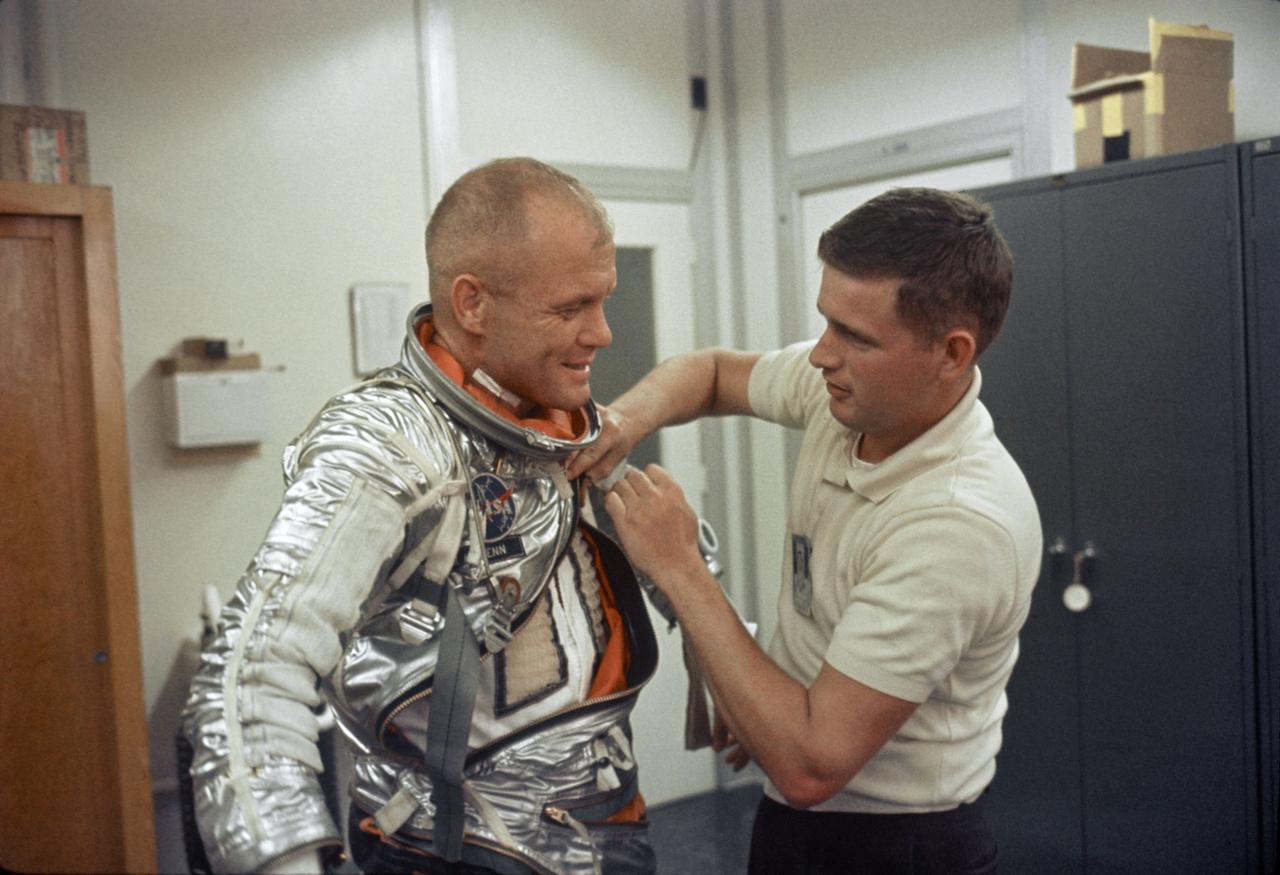
S64-14843 (1962) --- Astronaut John H. Glenn Jr., pilot of the Mercury-Atlas 6 Earth-orbital space mission, is suited up at Cape Canaveral, Florida, during MA-6 preflight activities. Assisting Glenn is suit technician Al Rochford. Photo credit: NASA
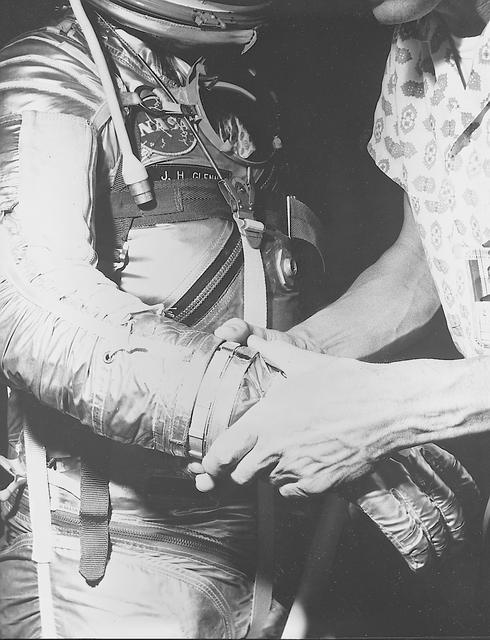
S62-00249 (1962) --- View of astronaut John H. Glenn Jr. being fitted with gloves for his spacesuit during preflight training activities at Cape Canaveral, Florida. Glenn is assisted by suit technician Joe Schmitt. Photo credit: NASA
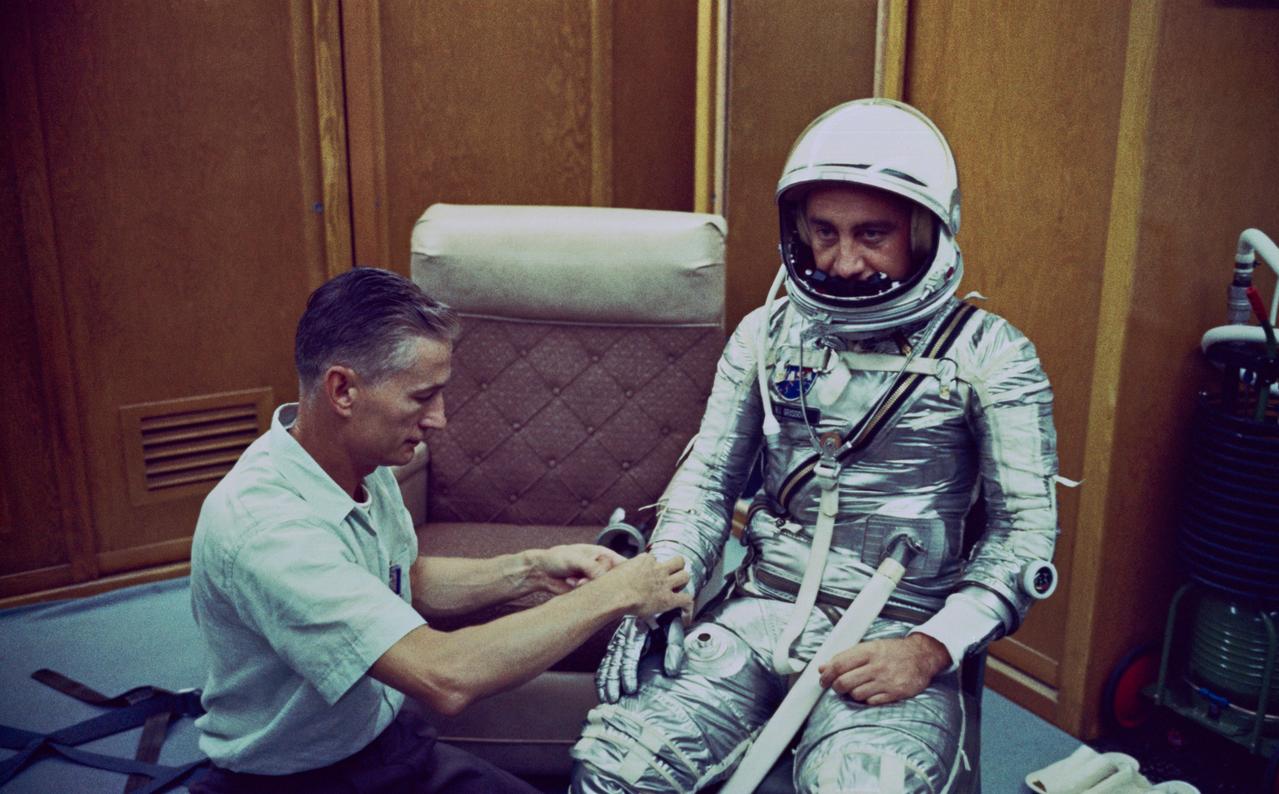
S88-55875 (19 July 1961) --- Donning a spacesuit for the Mercury-Redstone 4 (MR-4) mission, astronaut Virgil I. (Gus) Grissom chats with spaceflight equipment specialist Joe W. Schmitt in the personal equipment room of Hangar S at Cape Canaveral, Florida. Shortly after this photograph was taken, the launch was postponed two days due to unfavorable weather conditions in the area. Photo credit: NASA
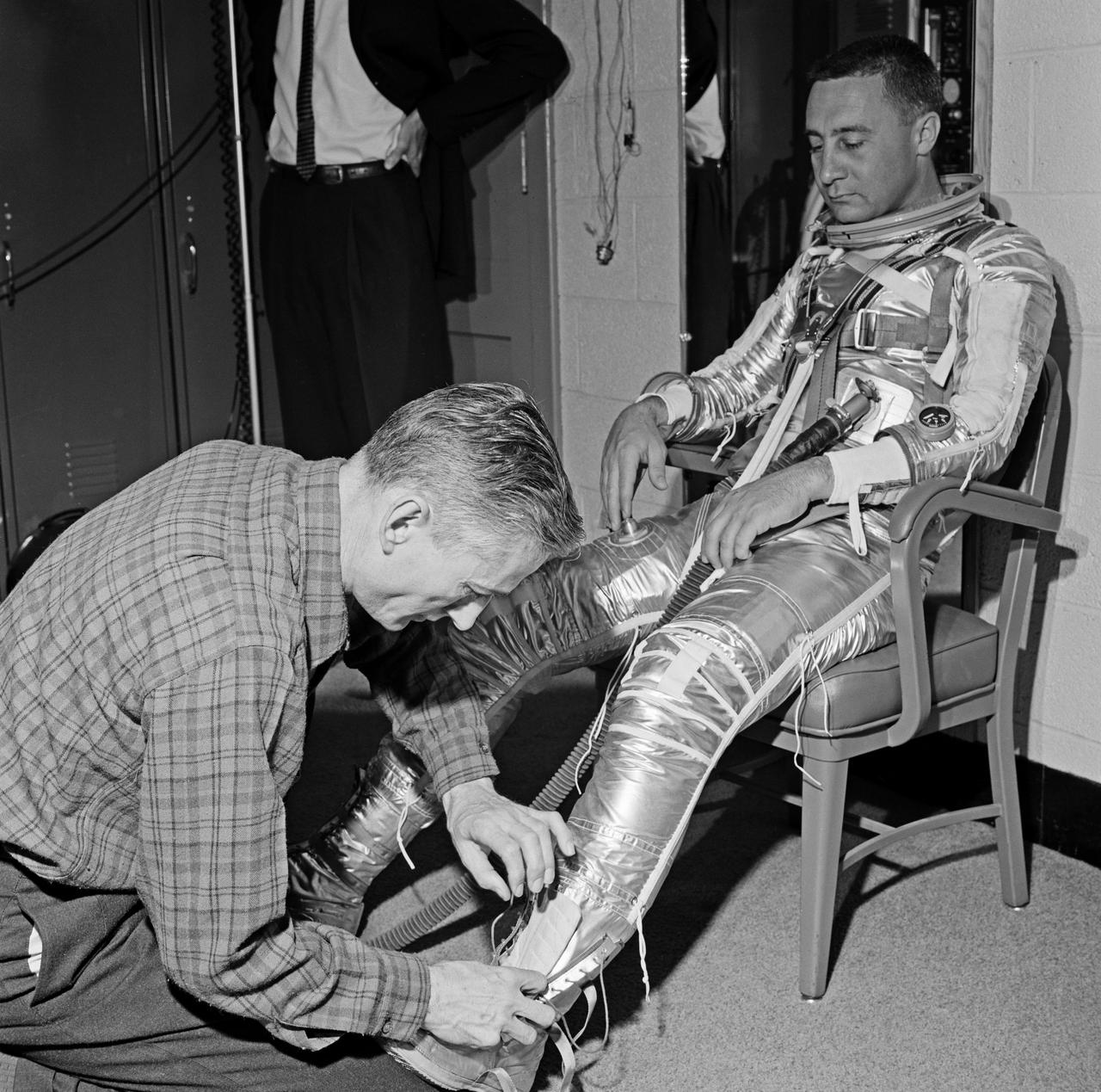
Gus Grissom trying on a Spacesuit; Seated with assistant; Seated with assistant putting on boots; Standing by mirror, name tag visible; Outside in suit, name tag visible. Mercury Project photo, 1961. Original negatives sent to Johnson Space Center when astronauts moved to that center. Photograph take on 03/27/1961.
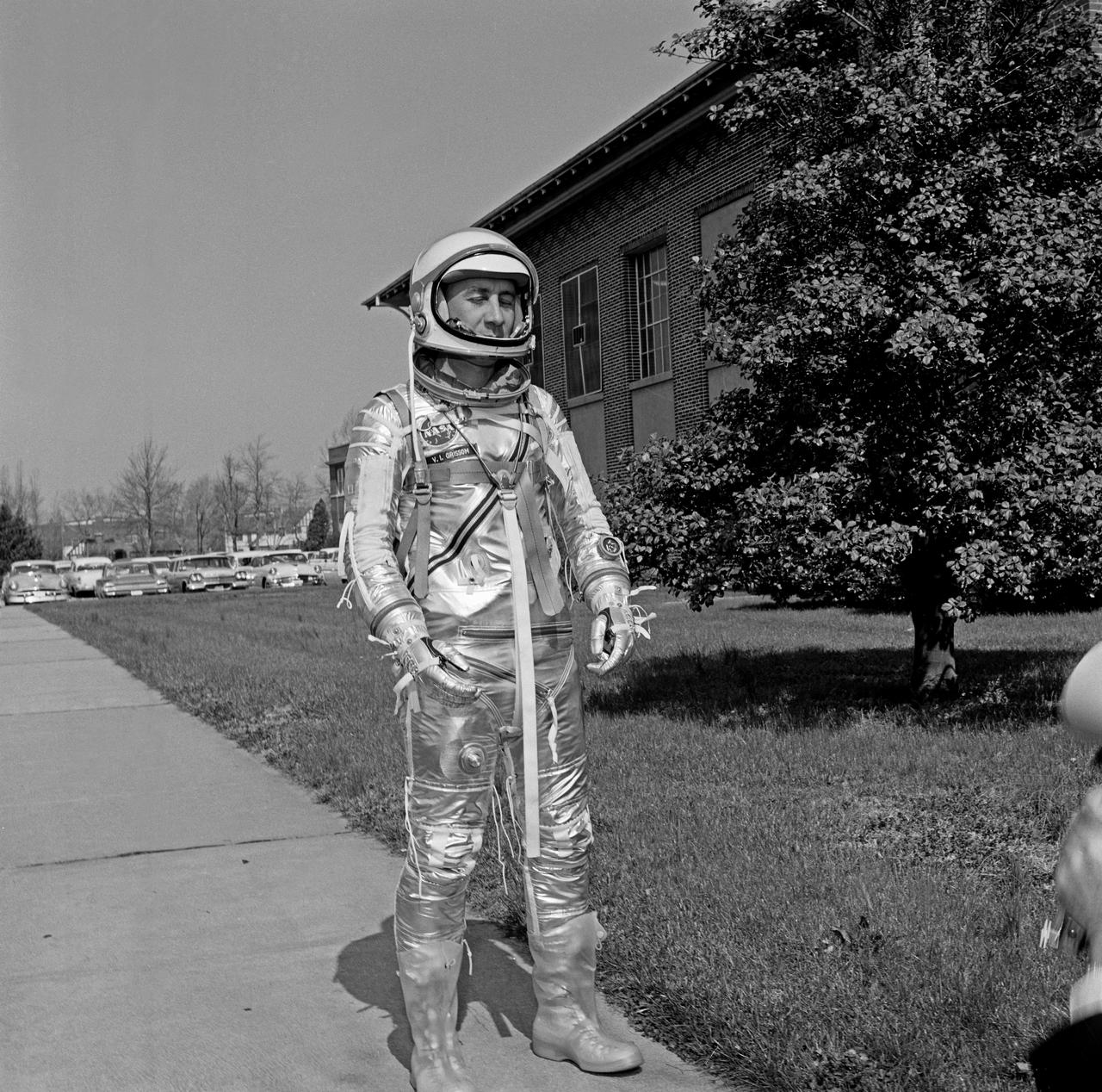
Gus Grissom trying on a Spacesuit; Seated with assistant; Seated with assistant putting on boots; Standing by mirror, name tag visible; Outside in suit, name tag visible. Mercury Project photo, 1961. Original negatives sent to Johnson Space Center when astronauts moved to that center. Photograph take on 03/27/1961.
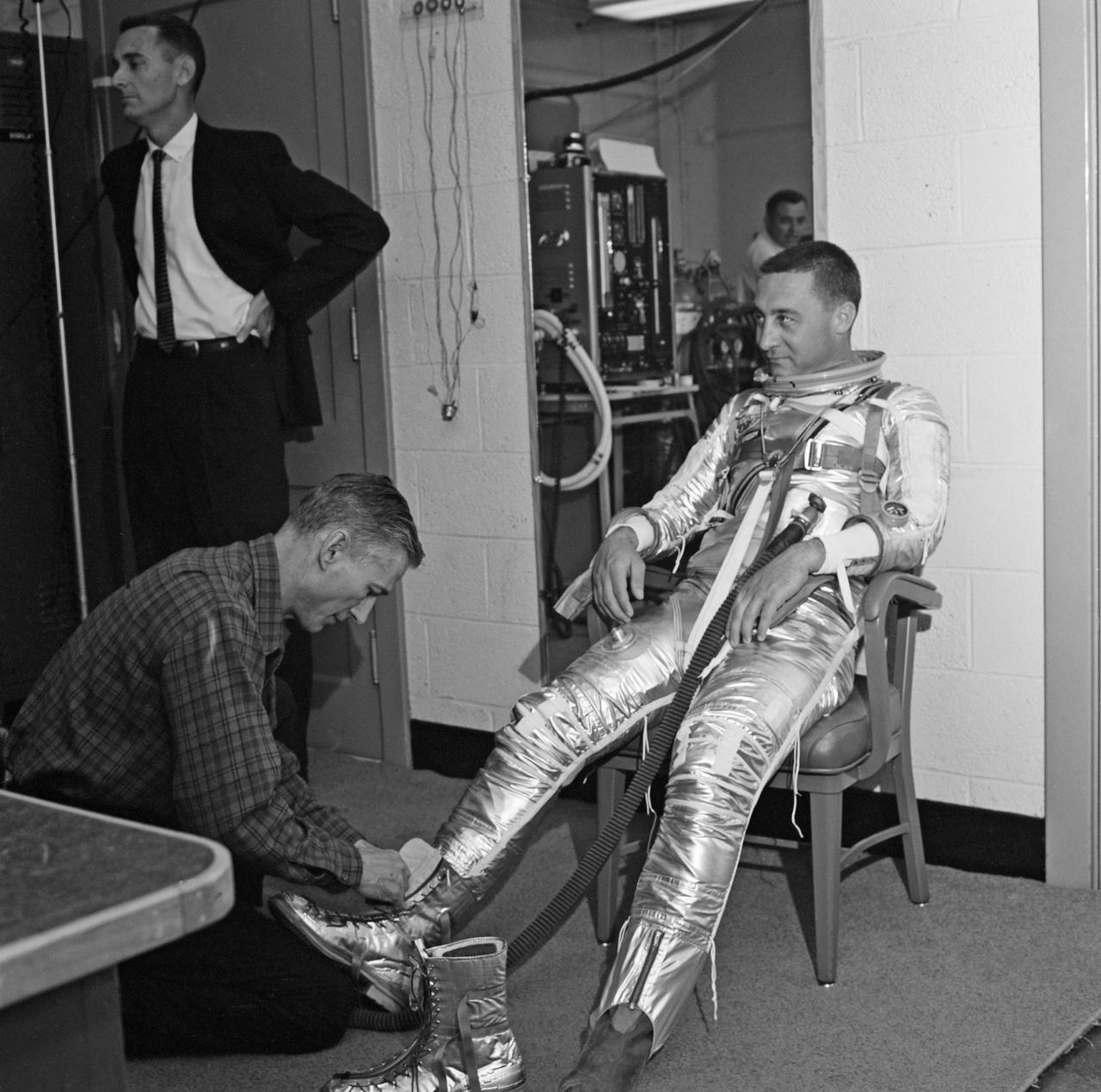
Gus Grissom trying on a Spacesuit; Seated with assistant; Seated with assistant putting on boots; Standing by mirror, name tag visible; Outside in suit, name tag visible. Mercury Project photo, 1961. Original negatives sent to Johnson Space Center when astronauts moved to that center. Photograph take on 03/27/1961.
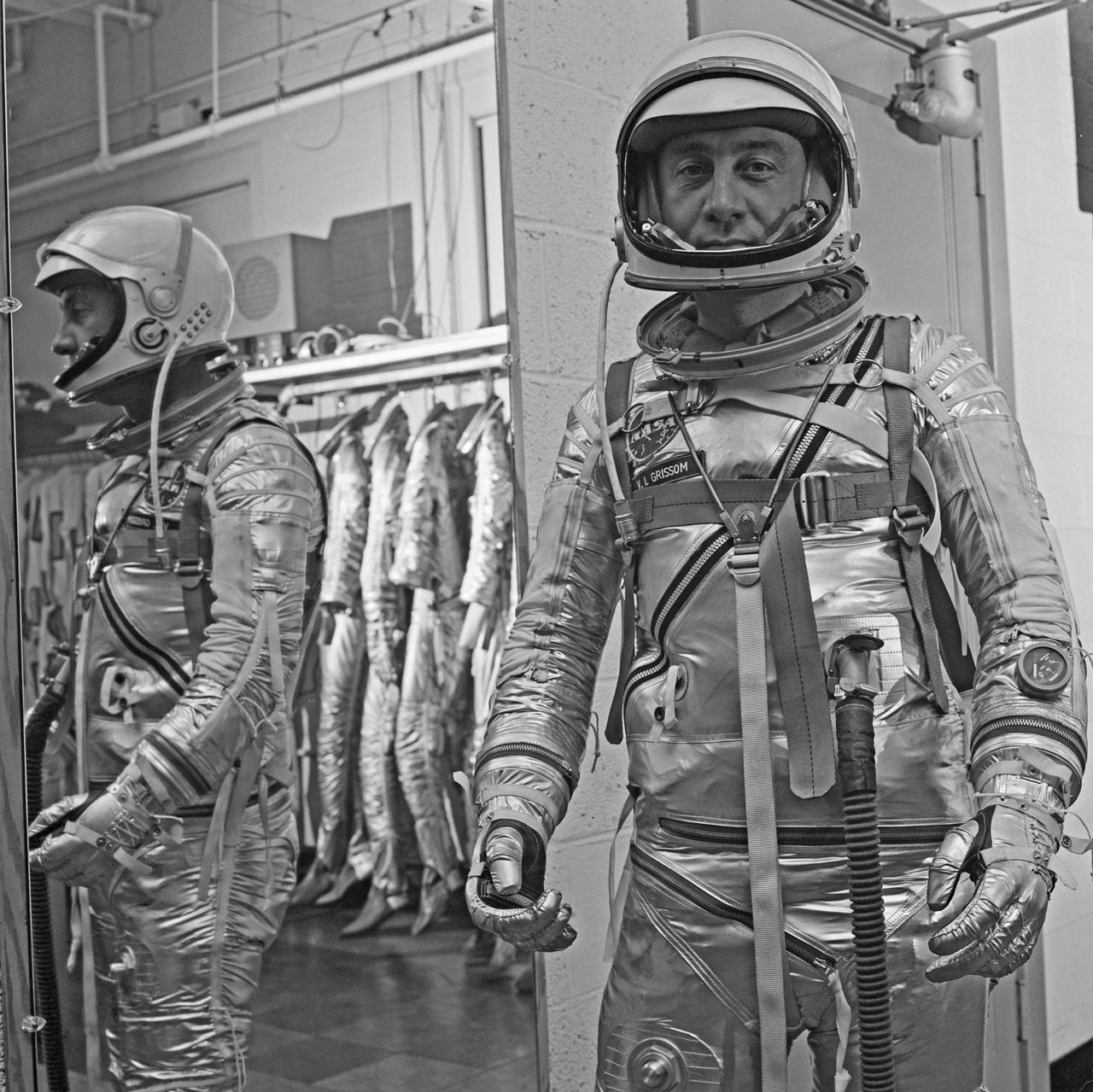
Gus Grissom trying on a Spacesuit; Seated with assistant; Seated with assistant putting on boots; Standing by mirror, name tag visible; Outside in suit, name tag visible. Mercury Project photo, 1961. Original negatives sent to Johnson Space Center when astronauts moved to that center. Photograph take on 03/27/1961.
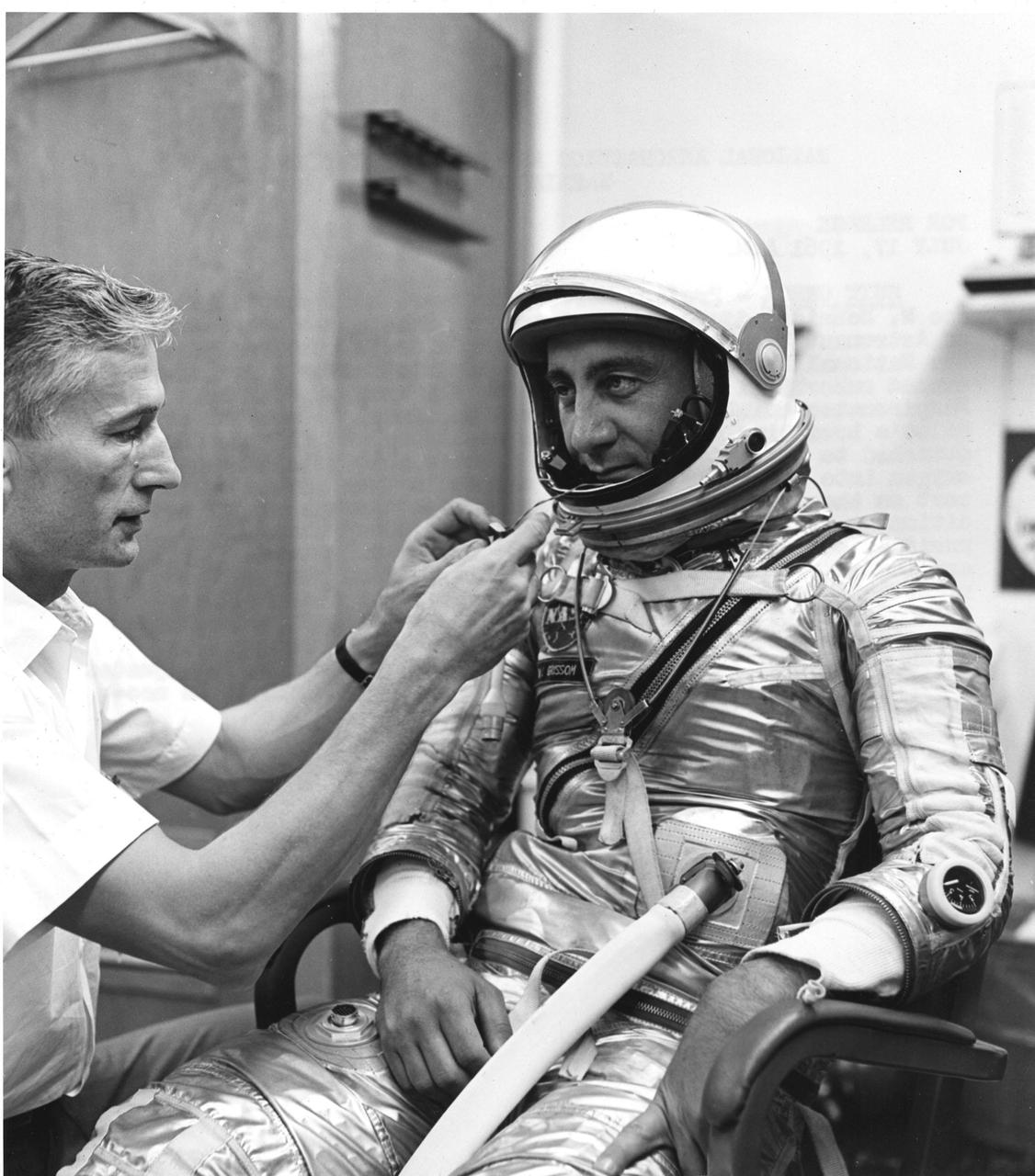
KENNEDY SPACE CENTER, FLA. -- SUIT CHECK - Project Mercury pressure suit specialist Joe. W. Schidt adjusts a respirometer attached to the helmet of astronaut Virgil I. Grissom during a dress rehearsal for the National Aeronautics and Space Administration's second manned suborbital flight, dubbed Liberty Bell 7, planned for the week of July 16. Respirometer enables ground medical personnel to monitor the pilot's breathing rate during the countdown and flight. Hose attached to the left side of the pilot's suit brings breathing oxygen into the suit. Expelled oxygen is then vented out a port on the side of the helmet and passed through an air conditioning system beneath the astronaut's couch where it is purified before being recycled into the suit. Gauge on left arm indicates pressure within the suit. Canon plug on the right thigh brings medical information out of the suit for telemetering to ground stations. Suit is not inflated during the mission unless there is a failure in cabin pressure, in which event the 'V' shaped cable around the neck ring is adjusted prior to flight to prevent helmet from rising should it be necessary to pressurize the suit
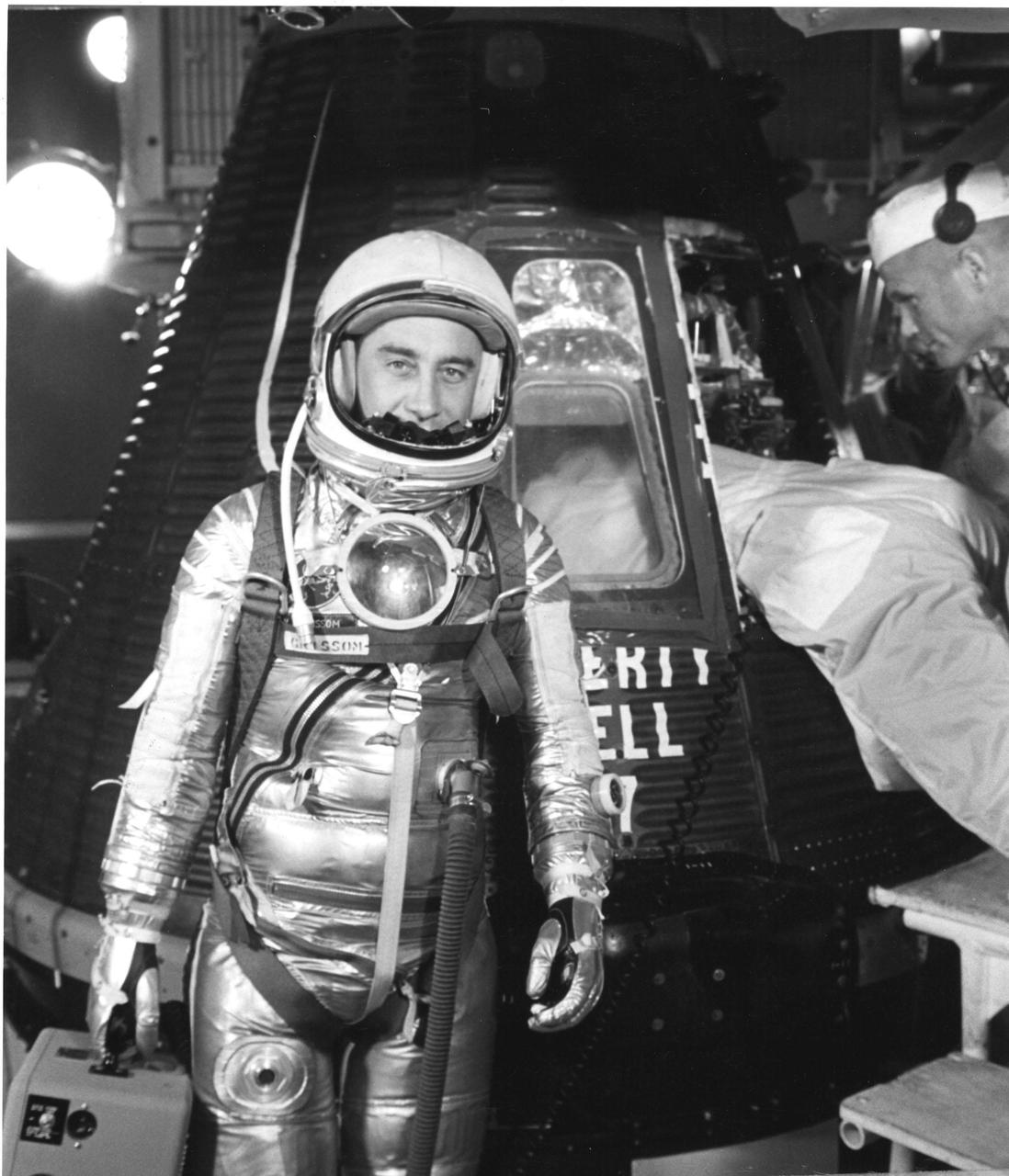
KENNEDY SPACE CENTER, FLA. -- READY FOR FLIGHT - On level three of gantry on pad 5, Project Mercury astronaut Virgil I. 'Gus' Grissom pauses briefly while a technician completes final adjustment in the Liberty Bell 7 spacecraft, which carried Grissom 118 miles into space on Friday, July 21, 1961. The craft's large trapezoidal observation window can be seen behind the pilot. The Pilot Observer Camera, which brought the astronaut's head and shoulders into view, was to reflect the lights on the flight events sequence panel through the 5-inch plexiglas parabolic mirror attached to Grissom's suit, to provide and accurately time record the pilot's voice communications, eye scan pattern and arm motions. The spacecraft sank on landing and has not been recovered. (NASA Photo)
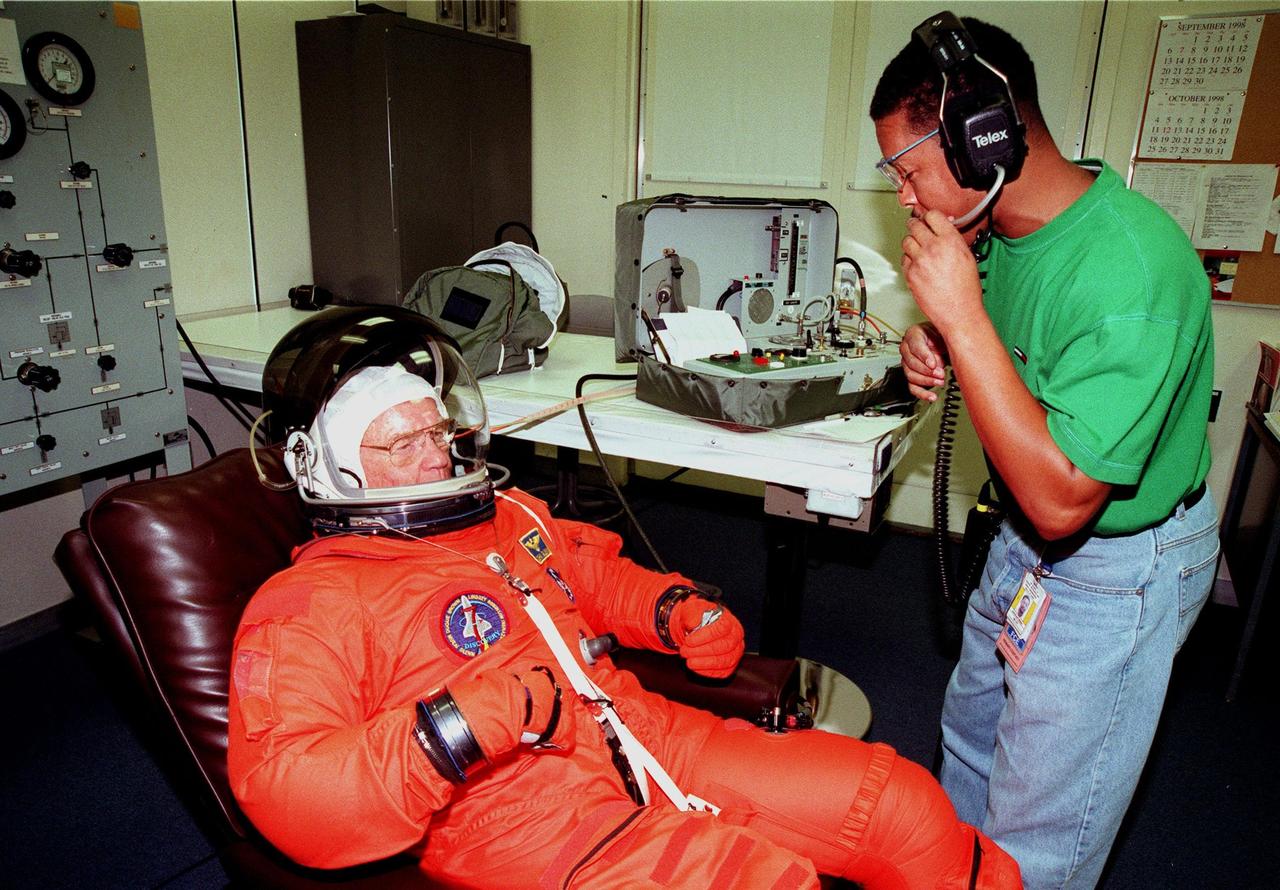
STS-95 Payload Specialist John H. Glenn Jr., a senator from Ohio and one of the original seven Project Mercury astronauts, suits up with the help of George Brittingham, of United Space Alliance, in the Operations and Checkout (O&C)Building prior to his trip to Launch Pad 39-B. Glenn and the rest of the STS-95 crew are at KSC to participate in the Terminal Countdown Demonstration Test (TCDT) which includes mission familiarization activities, emergency egress training, and a simulated main engine cutoff. The other crew members are Payload Specialist Chiaki Mukai (M.D., Ph.D.), representing the National Space Development Agency of Japan (NASDA), Pilot Steven W. Lindsey, Mission Specialist Scott E. Parazynski, Mission Specialist Stephen K. Robinson, Mission Specialist Pedro Duque of Spain, representing the European Space Agency (ESA), and Mission Commander Curtis L. Brown. The STS-95 mission, targeted for liftoff on Oct. 29, includes research payloads such as the Spartan solar-observing deployable spacecraft, the Hubble Space Telescope Orbital Systems Test Platform, the International Extreme Ultraviolet Hitchhiker, as well as the SPACEHAB single module with experiments on space flight and the aging process. Following the TCDT, the crew will be returning to Houston for final flight preparations
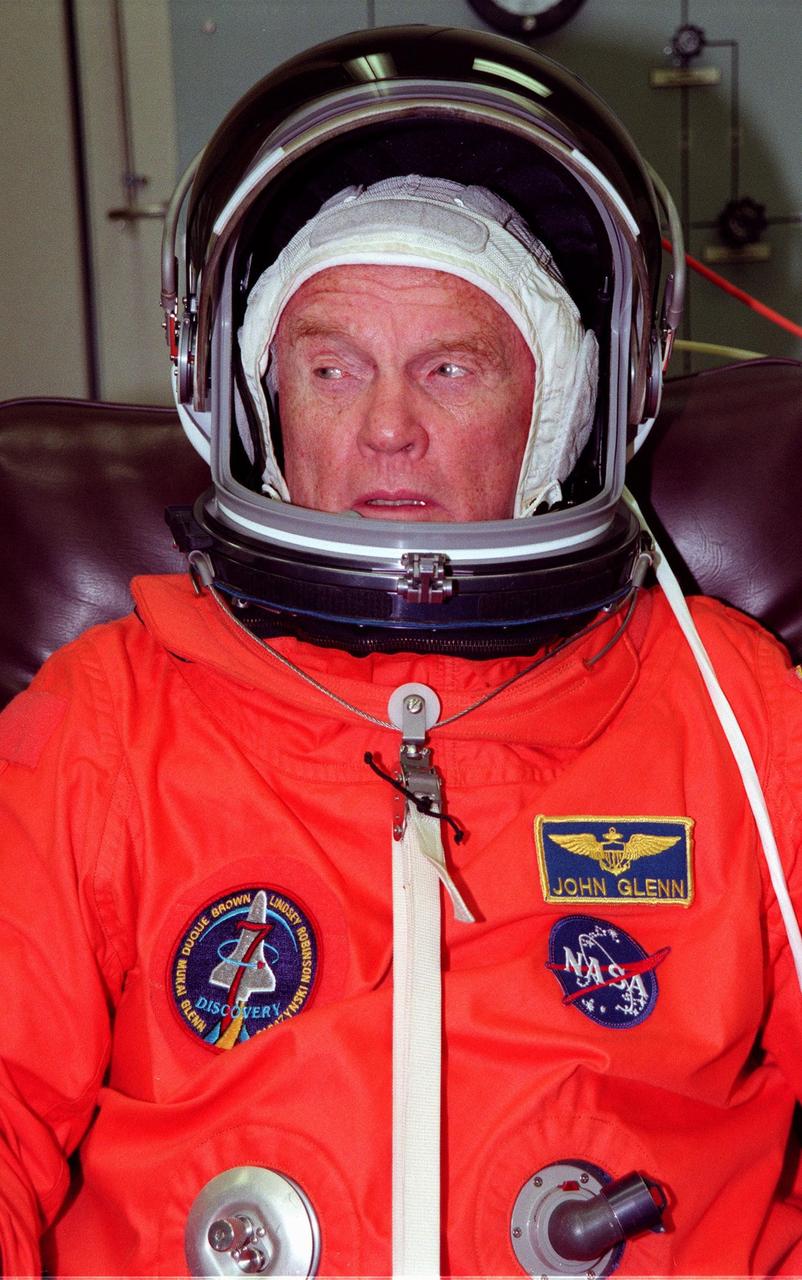
STS-95 Payload Specialist John H. Glenn Jr., a senator from Ohio and one of the original seven Project Mercury astronauts, suits up in the Operations and Checkout (O&C) Building prior to his trip to Launch Pad 39-B. Glenn and the rest of the STS-95 crew are at KSC to participate in the Terminal Countdown Demonstration Test (TCDT) which includes mission familiarization activities, emergency egress training, and a simulated main engine cutoff. The other crew members are Payload Specialist Chiaki Mukai (M.D., Ph.D.), representing the National Space Development Agency of Japan (NASDA), Pilot Steven W. Lindsey, Mission Specialist Scott E. Parazynski, Mission Specialist Stephen K. Robinson, Mission Specialist Pedro Duque of Spain, representing the European Space Agency (ESA), and Mission Commander Curtis L. Brown. The STS-95 mission, targeted for liftoff on Oct. 29, includes research payloads such as the Spartan solar-observing deployable spacecraft, the Hubble Space Telescope Orbital Systems Test Platform, the International Extreme Ultraviolet Hitchhiker, as well as the SPACEHAB single module with experiments on space flight and the aging process. Following the TCDT, the crew will be returning to Houston for final flight preparations
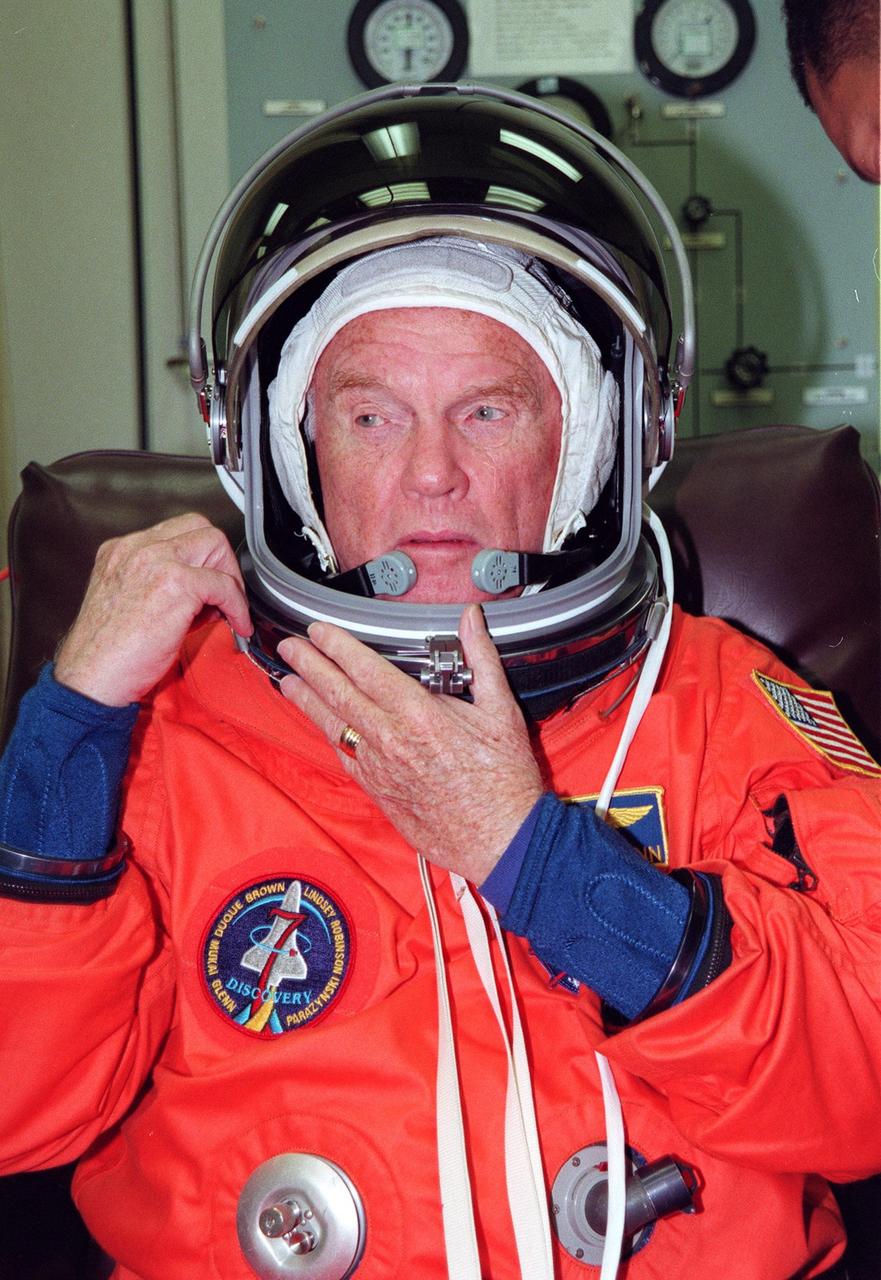
STS-95 Payload Specialist John H. Glenn Jr., a senator from Ohio and one of the original seven Project Mercury astronauts, suits up in the Operations and Checkout (O&C) Building prior to his trip to Launch Pad 39-B. Glenn and the rest of the STS-95 crew are at KSC to participate in the Terminal Countdown Demonstration Test (TCDT) which includes mission familiarization activities, emergency egress training, and a simulated main engine cutoff. The other crew members are Payload Specialist Chiaki Mukai (M.D., Ph.D.), representing the National Space Development Agency of Japan (NASDA), Pilot Steven W. Lindsey, Mission Specialist Scott E. Parazynski, Mission Specialist Stephen K. Robinson, Mission Specialist Pedro Duque of Spain, representing the European Space Agency (ESA), and Mission Commander Curtis L. Brown. The STS-95 mission, targeted for liftoff on Oct. 29, includes research payloads such as the Spartan solar-observing deployable spacecraft, the Hubble Space Telescope Orbital Systems Test Platform, the International Extreme Ultraviolet Hitchhiker, as well as the SPACEHAB single module with experiments on space flight and the aging process. Following the TCDT, the crew will be returning to Houston for final flight preparations