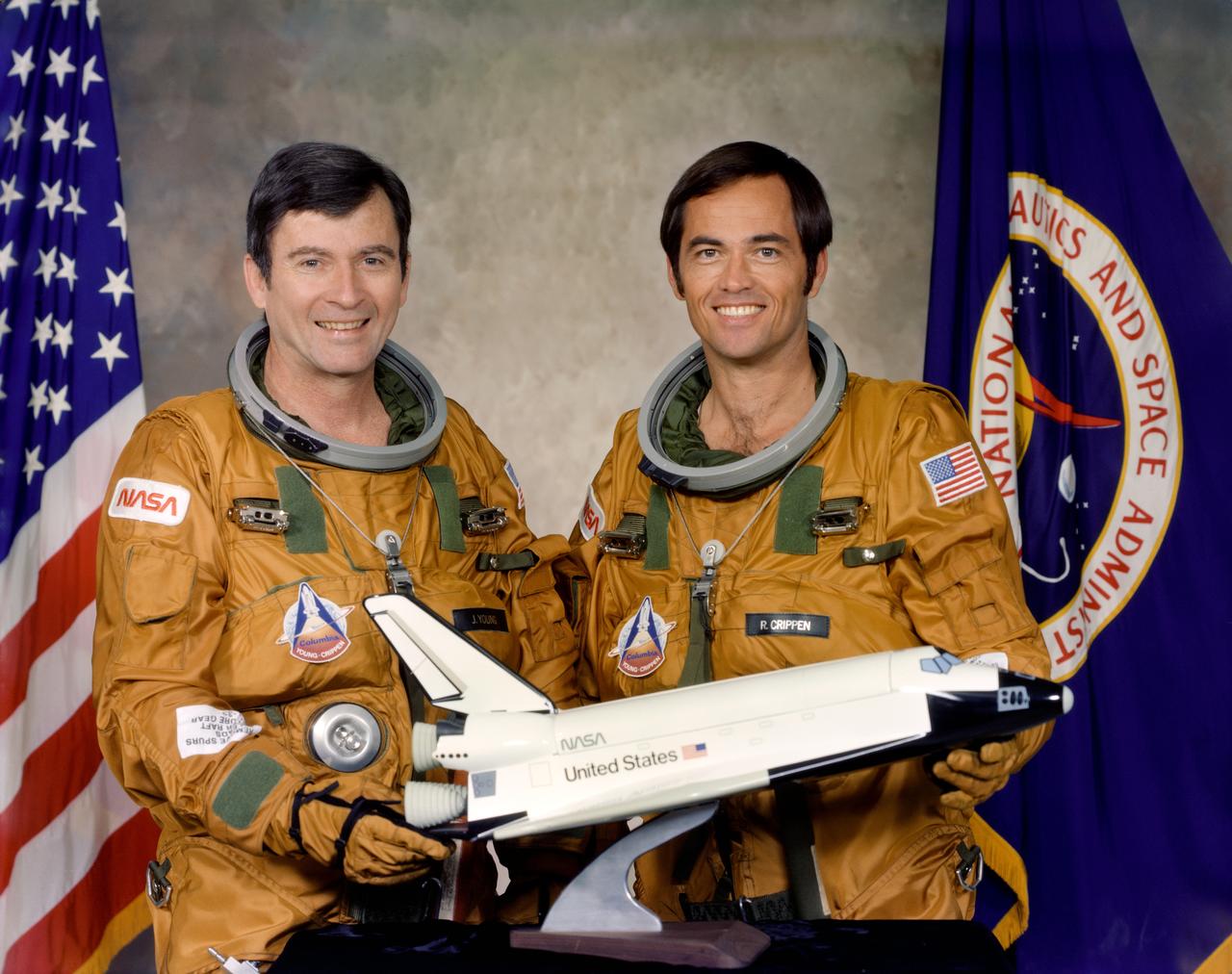
S79-31775 (29 April 1979) --- These two astronauts are the prime crewmen for the first flight in the Space Transportation System (STS-1) program. Astronauts John W. Young, left, commander, and Robert L. Crippen, pilot, will man the space shuttle orbiter 102 Columbia for the first orbital flight test. Photo credit: NASA
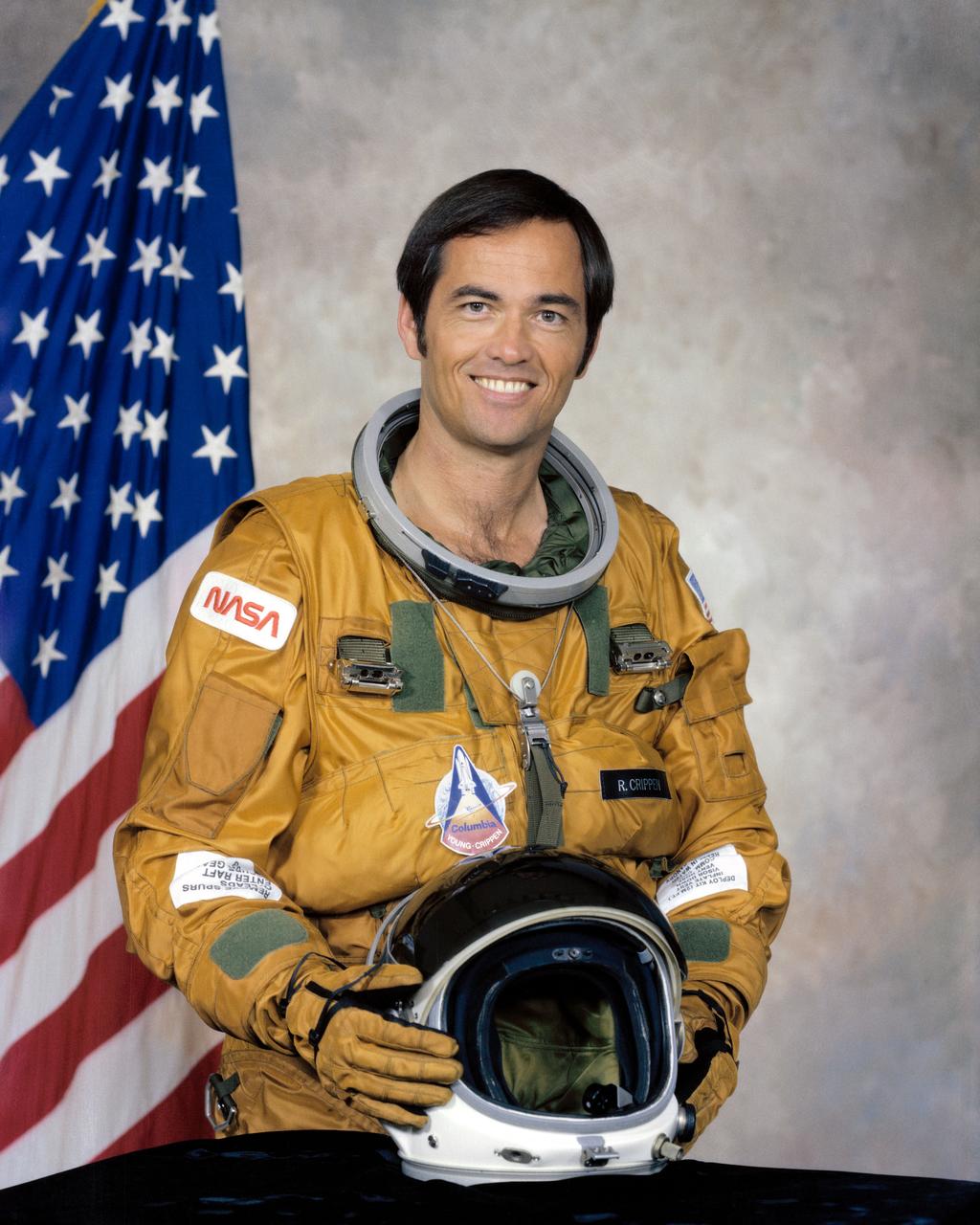
S79-31777 (7 May 1979) --- Astronaut Robert L. Crippen.

S82-28456 (19 Feb. 1982) --- Astronauts Jack R. Lousma, left, STS-3 commander, and C. Gordon Fullerton, pilot, are briefed on emergency procedures at Launch Pad 39A by Buck Tomlinson, a safety instructor with Wackenhut Services, Inc. Also pictured is astronaut Daniel C. Brandenstein, STS-8 pilot. The men were at Kennedy Space Center (KSC) for participation in a countdown demonstration test (CDDT). Photo credit: NASA
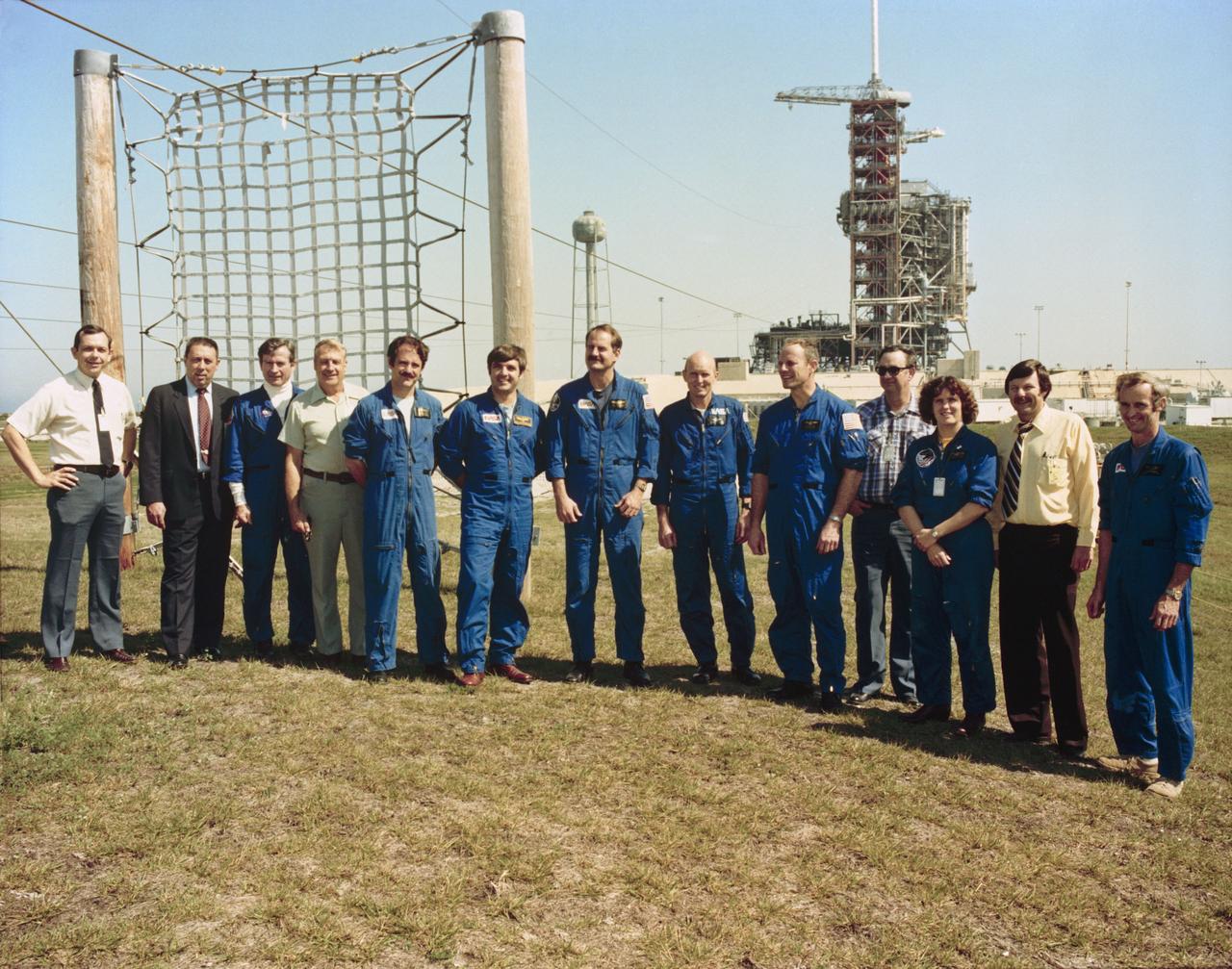
S82-28457 (19 Feb. 1982) --- Member of the JSC astronaut corps., STS-3 vehicle integration test (VIT) team and other personnel pose for a photograph at the completion of a countdown demonstration test (CDDT) and safety briefings at Launch Pad 39A, Kennedy Space Center (KSC). Participants are, from the left, Wilbur J. Etbauer, engineer with the VIT team; George W. S. Abbey, director of flight operations at JSC; astronaut John W. Young, chief of the astronaut office at JSC; Jack Fleming of Rockwell International; mission specialist-astronaut John M. Lounge; astronaut Daniel C. Brandenstein; mission specialist-astronaut James D. Van Hoften; astronauts C. Gordon Fullerton and Jack Lousma, prime crew for STS-3; Olan J. Bertrand, VIT team member; mission specialist-astronaut Kathryn D. Sullivan; Richard W. Nygren, head of the VIT team; and astronaut Donald E. Williams. The space shuttle Columbia is obscured by its service structure on Launch Pad 39A in the background. Part of slide-wire type emergency escape system is visible in the picture. Photo credit: NASA
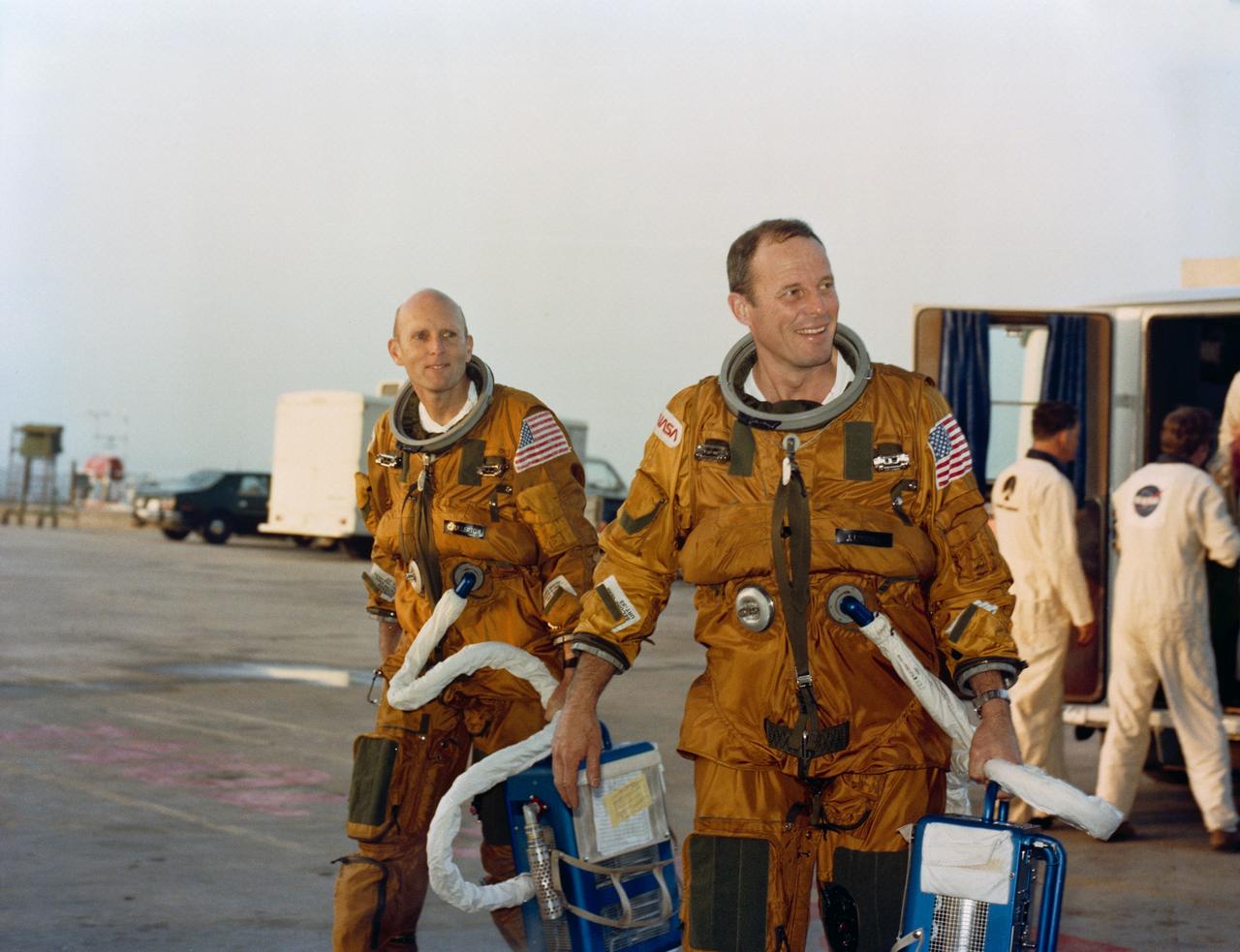
S82-28454 (19 Feb. 1982) --- Astronaut Jack R. Lousma, right, STS-3 commander, and C. Gordon Fullerton, pilot, carry portable spacesuit air controllers as they walk from a transport van to Launch Pad 39A to participate in a simulated countdown and launch. This countdown demonstration test (CDDT) is part of the preparations for NASA?s third orbital flight test in the space shuttle Columbia. The two are scheduled to spend a week orbiting Earth in Columbia this spring. Photo credit: NASA
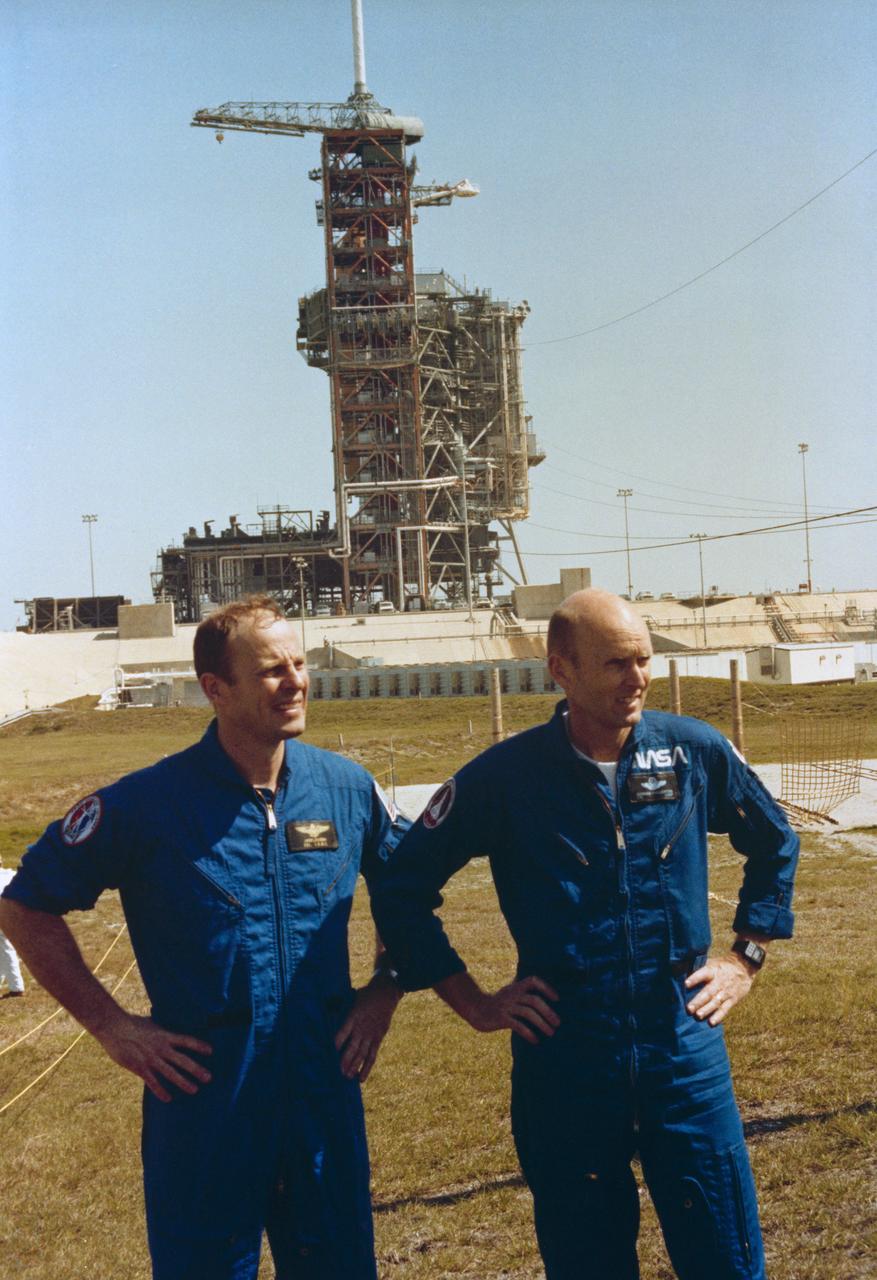
S82-28455 (19 Feb. 1982) --- The prime crew members for STS-3 take a break in their training schedule at KSC to pose for a few pictures. Astronaut Jack R. Lousma, left, is crew commander; and C. Gordon Fullerton, pilot, for STS-3 scheduled to launch this spring. Launch Pad 39A is in the background. Photo credit: NASA
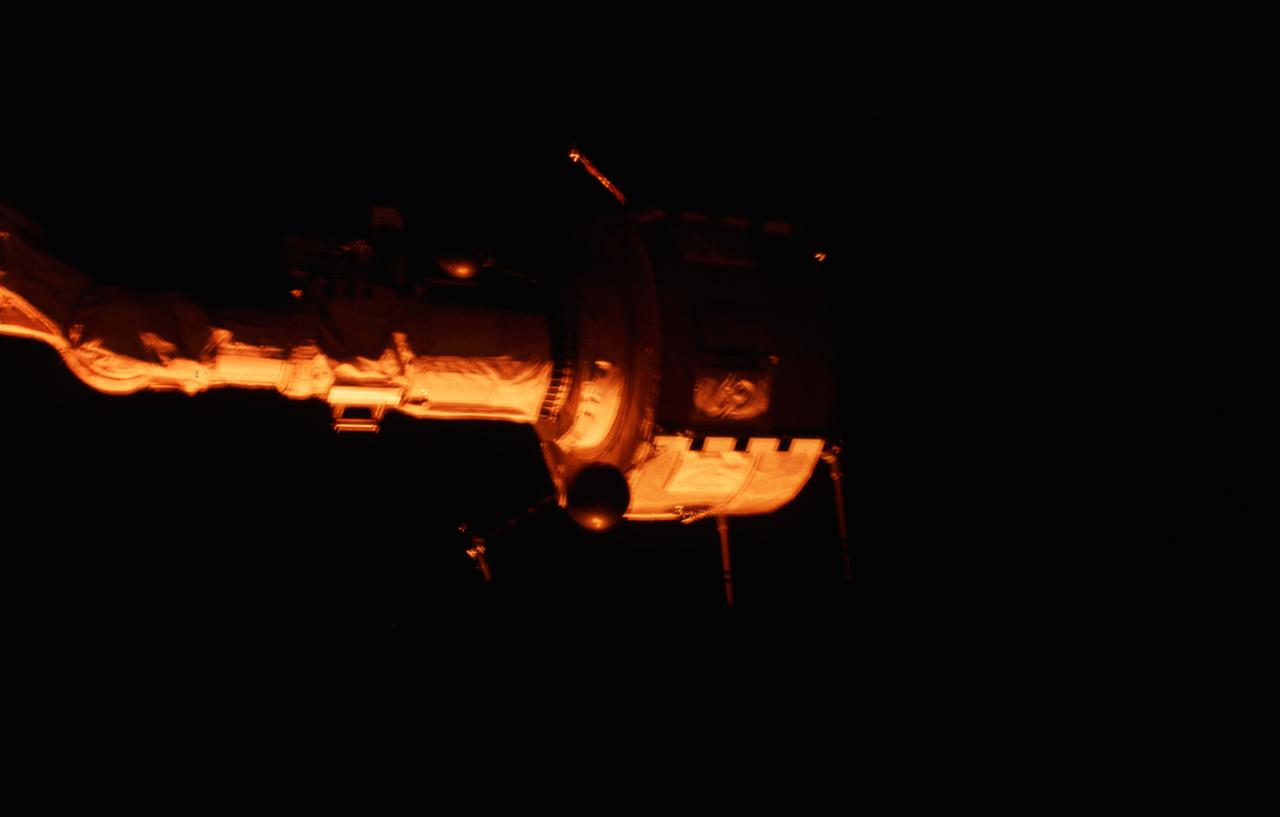
STS003-21-080 (22-30 March 1982) --- Plasma Diagnostics Package (PDP) grappled by remote manipulator system (RMS) end effector is positioned above payload bay (PLB) at sunrise. Photo credit: NASA
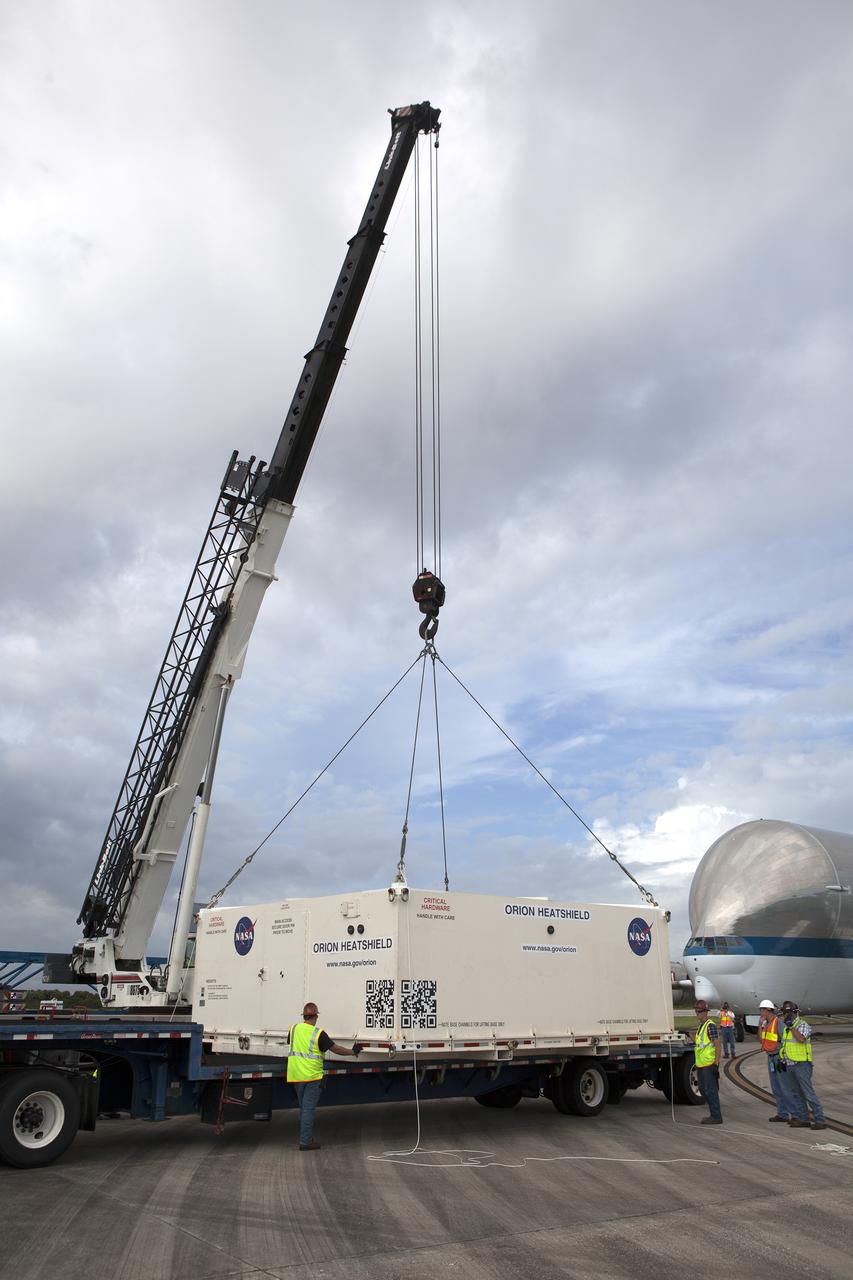
The shipping container carrying the Orion heat shield for Exploration Mission 1 (EM-1) is lowered by crane onto the flatbed of a transporter at the Shuttle Landing Facility, managed and operated by Space Florida, at NASA’s Kennedy Space Center in Florida. The heat shield arrived aboard the agency’s Super Guppy aircraft from Lockheed Martin’s manufacturing facility near Denver. The heat shield will be transported to the Neil Armstrong Operations and Checkout Building high bay for processing. The Orion spacecraft will launch atop NASA’s Space Launch System rocket on EM-1, an uncrewed test flight, in 2018.

The shipping container carrying the Orion heat shield for Exploration Mission 1 (EM-1) is lowered by crane onto the flatbed of a transporter at the Shuttle Landing Facility, managed and operated by Space Florida, at NASA’s Kennedy Space Center in Florida. The heat shield arrived aboard the agency’s Super Guppy aircraft from Lockheed Martin’s manufacturing facility near Denver. The heat shield will be transported to the Neil Armstrong Operations and Checkout Building high bay for processing. The Orion spacecraft will launch atop NASA’s Space Launch System rocket on EM-1, an uncrewed test flight, in 2018.
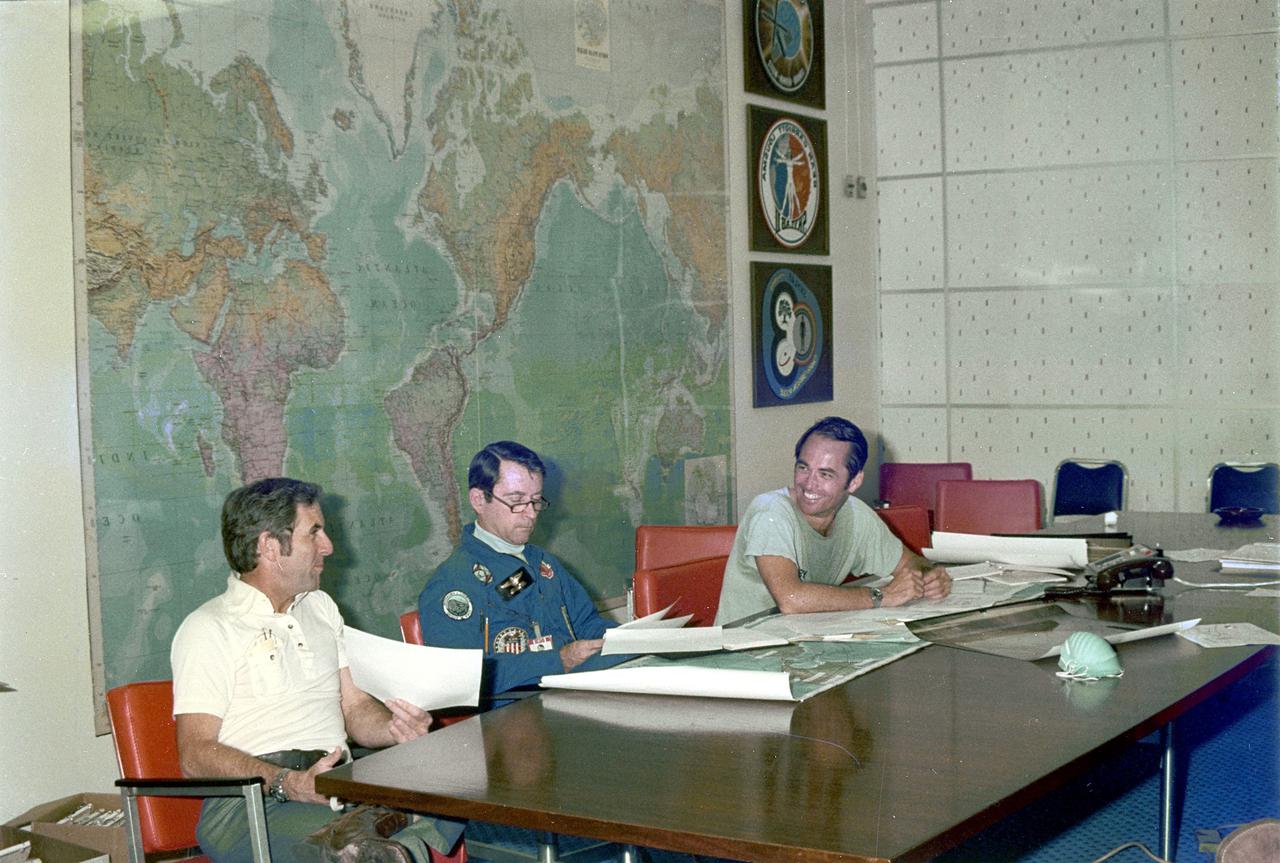
KENNEDY SPACE CENTER, FLA. - Space Shuttle prime crew members Robert Crippen, left, pilot, and John Young, center, commander, along with backup crewman Richard Truly, study forecasts of weather conditions for launch of the maiden flight of STS-1, America’s first reusable space transportation system.
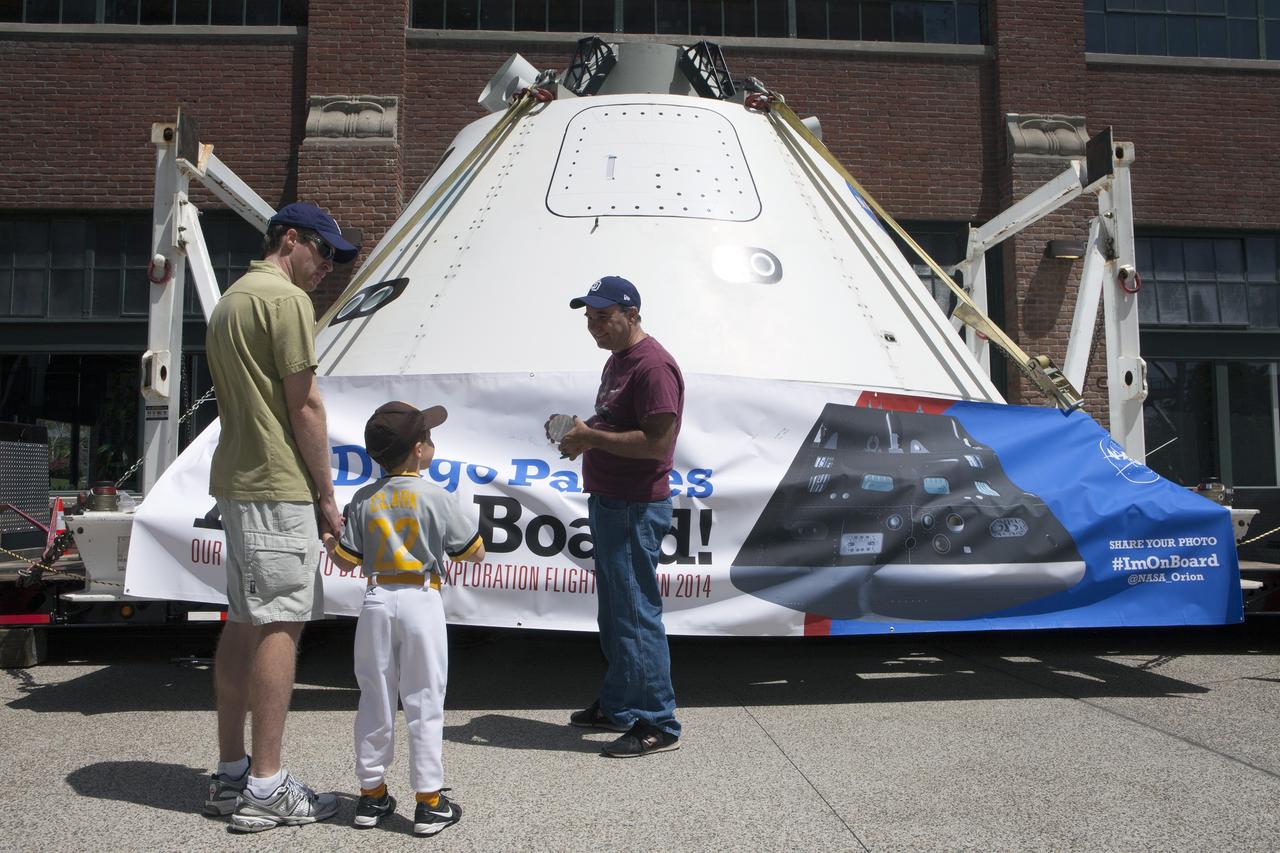
CAPE CANAVERAL, Fla. – San Diego Padres fans talk to Doug Lenhardt, Kennedy Space Center's Exploration Flight Test-1, or EFT-1, mission integration manager outside Petco Field in San Diego, California. NASA's Orion boilerplate test vehicle is on display. The boilerplate test vehicle is being prepared for an Exploration Flight Test-1, or EFT-1, pre-transportation test. The Ground Systems Development and Operations Program will run the test at the U.S. Naval Base San Diego to simulate retrieval and transportation procedures for Orion after it splashes down in the ocean and is retrieved for return to land and ground transportation back to Kennedy Space Center in Florida. Orion is the exploration spacecraft designed to carry astronauts to destinations not yet explored by humans, including an asteroid and Mars. It will have emergency abort capability, sustain the crew during space travel and provide safe re-entry from deep space return velocities. The first unpiloted test flight of the Orion is scheduled to launch later this year atop a Delta IV rocket and in 2017 on NASA’s Space Launch System rocket. For more information, visit http://www.nasa.gov/orion. Photo credit: NASA/Kim Shiflett
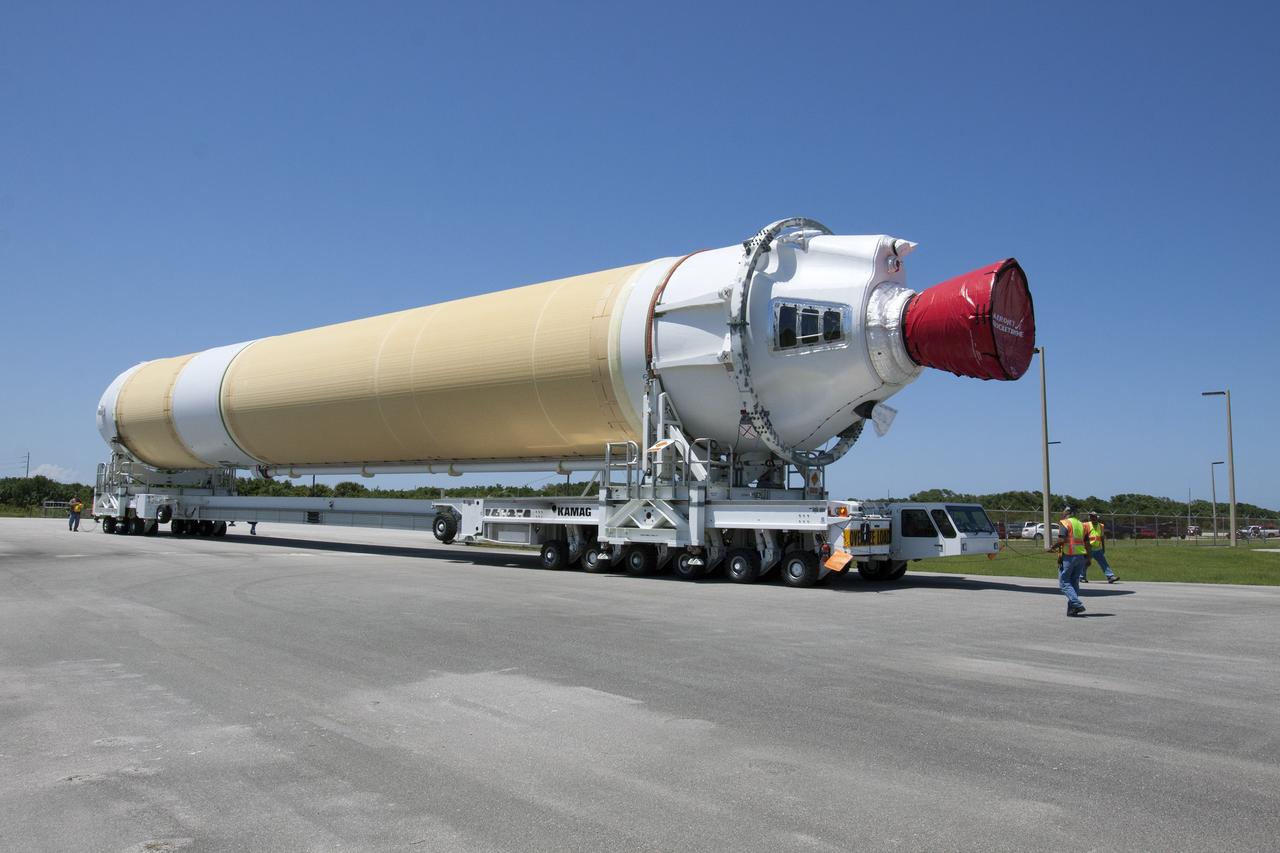
CAPE CANAVERAL, Fla. -- A transporter for oversize loads carries the port booster for the United Launch Alliance Delta IV Heavy for Exploration Flight Test-1, or EFT-1, to Space Launch Complex 37 on Cape Canaveral Air Force Station after it was offloaded from the barge at the U.S. Army Outpost wharf at Port Canaveral in Florida. The booster will be transported to the Horizontal Integration Facility, or HIF, at the launch complex. The upper stage and spacecraft adapter arrived with the booster and were transported to the HIF on May 6. At the HIF, all three booster stages will be processed and checked out before being moved to the nearby launch pad and hoisted into position. The spacecraft adapter will connect Orion to the ULA Delta IV, and also will connect Orion to NASA's new rocket, the Space Launch System, on its first mission in 2017. During the EFT-1 mission, Orion will travel farther into space than any human spacecraft has gone in more than 40 years. The data gathered during the flight will influence design decisions, validate existing computer models and innovative new approaches to space systems development, as well as reduce overall mission risks and costs for later Orion flights. Liftoff of Orion on EFT-1 is planned for fall 2014. Photo credit: NASA/Kim Shiflett
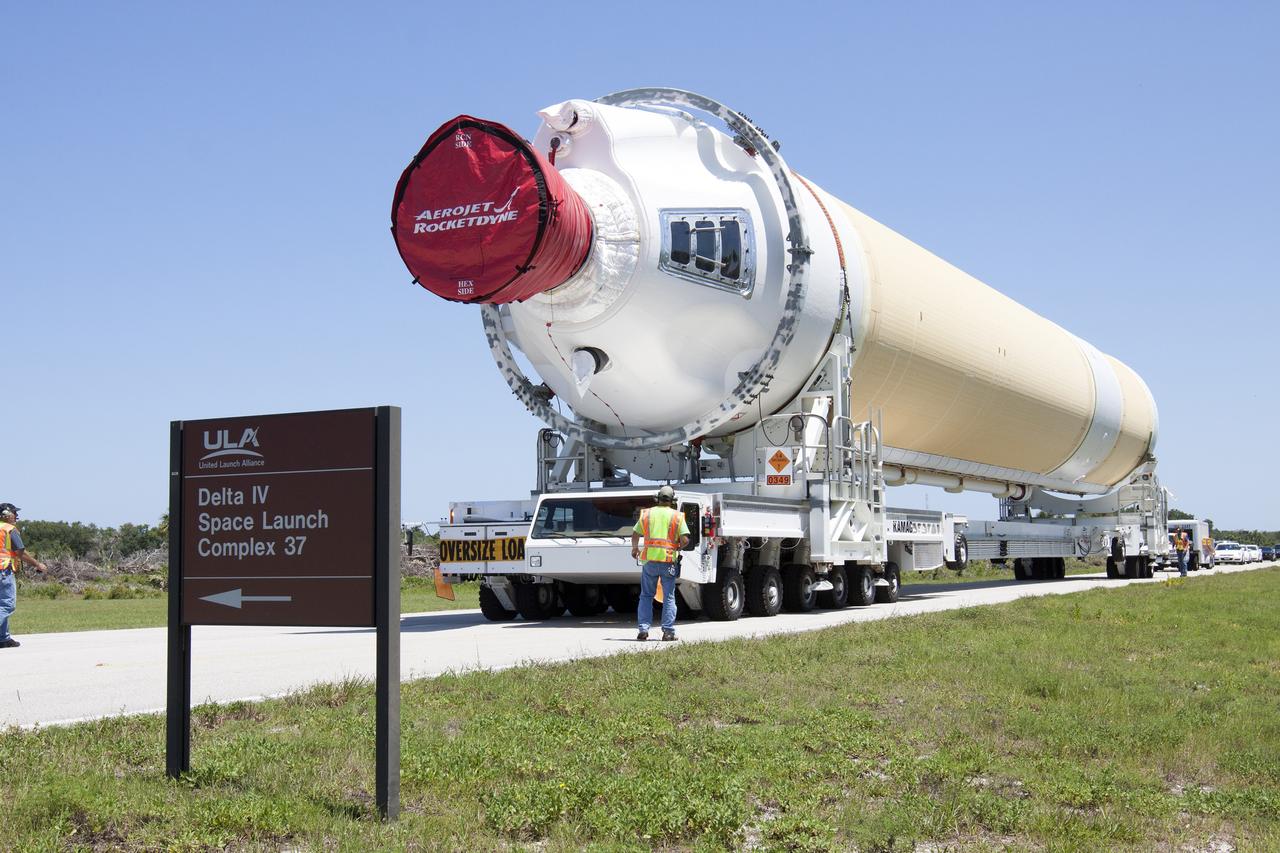
CAPE CANAVERAL, Fla. -- A transporter for oversize loads carries the port booster for the United Launch Alliance Delta IV Heavy for Exploration Flight Test-1, or EFT-1, to Space Launch Complex 37 on Cape Canaveral Air Force Station after it was offloaded from the barge at the U.S. Army Outpost wharf at Port Canaveral in Florida. The booster will be transported to the Horizontal Integration Facility, or HIF, at the launch complex. The upper stage and spacecraft adapter arrived with the booster and were transported to the HIF on May 6. At the HIF, all three booster stages will be processed and checked out before being moved to the nearby launch pad and hoisted into position. The spacecraft adapter will connect Orion to the ULA Delta IV, and also will connect Orion to NASA's new rocket, the Space Launch System, on its first mission in 2017. During the EFT-1 mission, Orion will travel farther into space than any human spacecraft has gone in more than 40 years. The data gathered during the flight will influence design decisions, validate existing computer models and innovative new approaches to space systems development, as well as reduce overall mission risks and costs for later Orion flights. Liftoff of Orion on EFT-1 is planned for fall 2014. Photo credit: NASA/Kim Shiflett
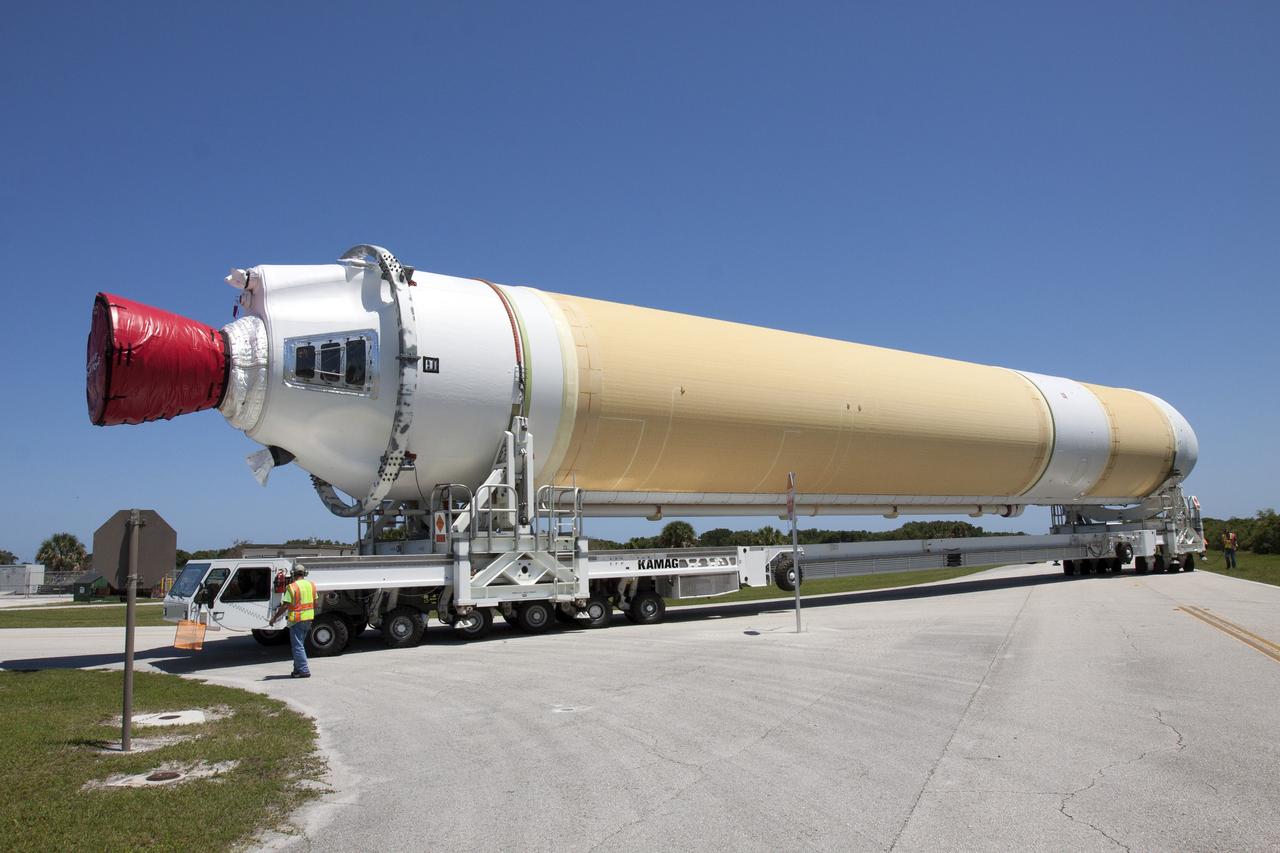
CAPE CANAVERAL, Fla. -- A transporter for oversize loads carries the port booster for the United Launch Alliance Delta IV Heavy for Exploration Flight Test-1, or EFT-1, to Space Launch Complex 37 on Cape Canaveral Air Force Station after it was offloaded from the barge at the U.S. Army Outpost wharf at Port Canaveral in Florida. The booster will be transported to the Horizontal Integration Facility, or HIF, at the launch complex. The upper stage and spacecraft adapter arrived with the booster and were transported to the HIF on May 6. At the HIF, all three booster stages will be processed and checked out before being moved to the nearby launch pad and hoisted into position. The spacecraft adapter will connect Orion to the ULA Delta IV, and also will connect Orion to NASA's new rocket, the Space Launch System, on its first mission in 2017. During the EFT-1 mission, Orion will travel farther into space than any human spacecraft has gone in more than 40 years. The data gathered during the flight will influence design decisions, validate existing computer models and innovative new approaches to space systems development, as well as reduce overall mission risks and costs for later Orion flights. Liftoff of Orion on EFT-1 is planned for fall 2014. Photo credit: NASA/Kim Shiflett
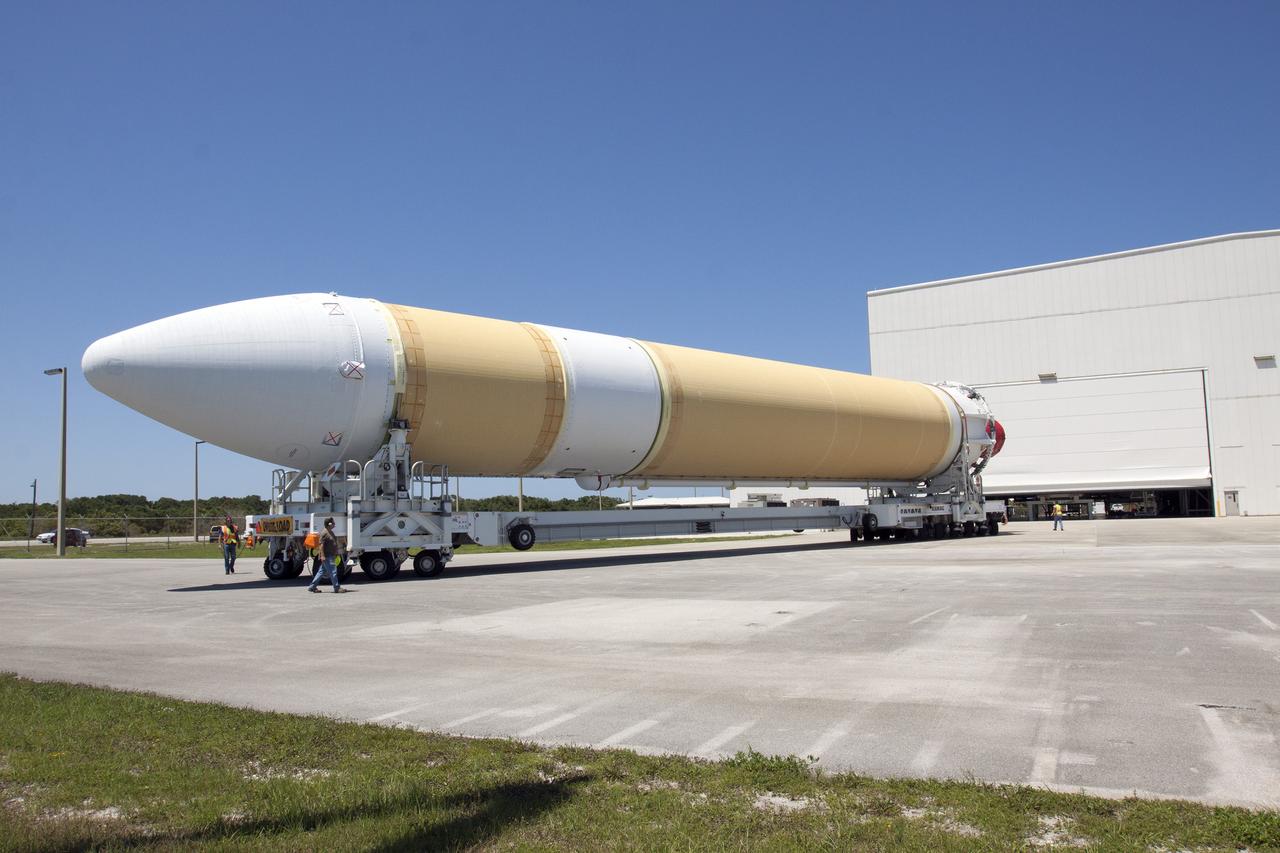
CAPE CANAVERAL, Fla. -- A transporter for oversize loads carries the port booster for the United Launch Alliance Delta IV Heavy for Exploration Flight Test-1, or EFT-1, to Space Launch Complex 37 on Cape Canaveral Air Force Station after it was offloaded from the barge at the U.S. Army Outpost wharf at Port Canaveral in Florida. The booster will be transported to the Horizontal Integration Facility, or HIF, at the launch complex. The upper stage and spacecraft adapter arrived with the booster and were transported to the HIF on May 6. At the HIF, all three booster stages will be processed and checked out before being moved to the nearby launch pad and hoisted into position. The spacecraft adapter will connect Orion to the ULA Delta IV, and also will connect Orion to NASA's new rocket, the Space Launch System, on its first mission in 2017. During the EFT-1 mission, Orion will travel farther into space than any human spacecraft has gone in more than 40 years. The data gathered during the flight will influence design decisions, validate existing computer models and innovative new approaches to space systems development, as well as reduce overall mission risks and costs for later Orion flights. Liftoff of Orion on EFT-1 is planned for fall 2014. Photo credit: NASA/Kim Shiflett
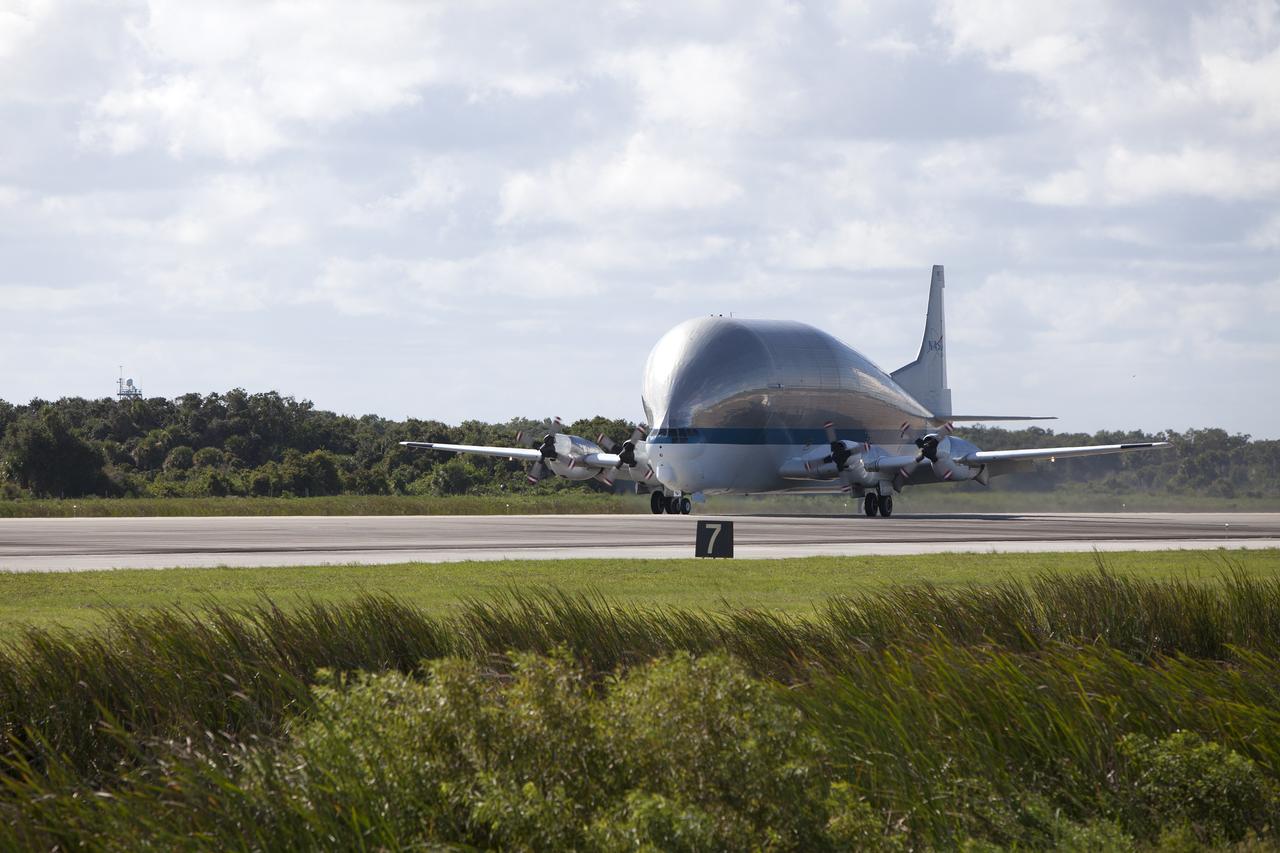
NASA’s Super Guppy aircraft touched down at the Shuttle Landing Facility, managed and operated by Space Florida, at the agency’s Kennedy Space Center in Florida, carrying the heat shield for Exploration Mission 1 (EM-1). The heat shield will be offloaded and transported to the Neil Armstrong Operations and Checkout Building high bay for processing. The heat shield arrived from manufacturer Lockheed Martin in Denver. The Orion spacecraft will launch atop NASA’s Space Launch System rocket on EM-1, an uncrewed test flight, in 2018.
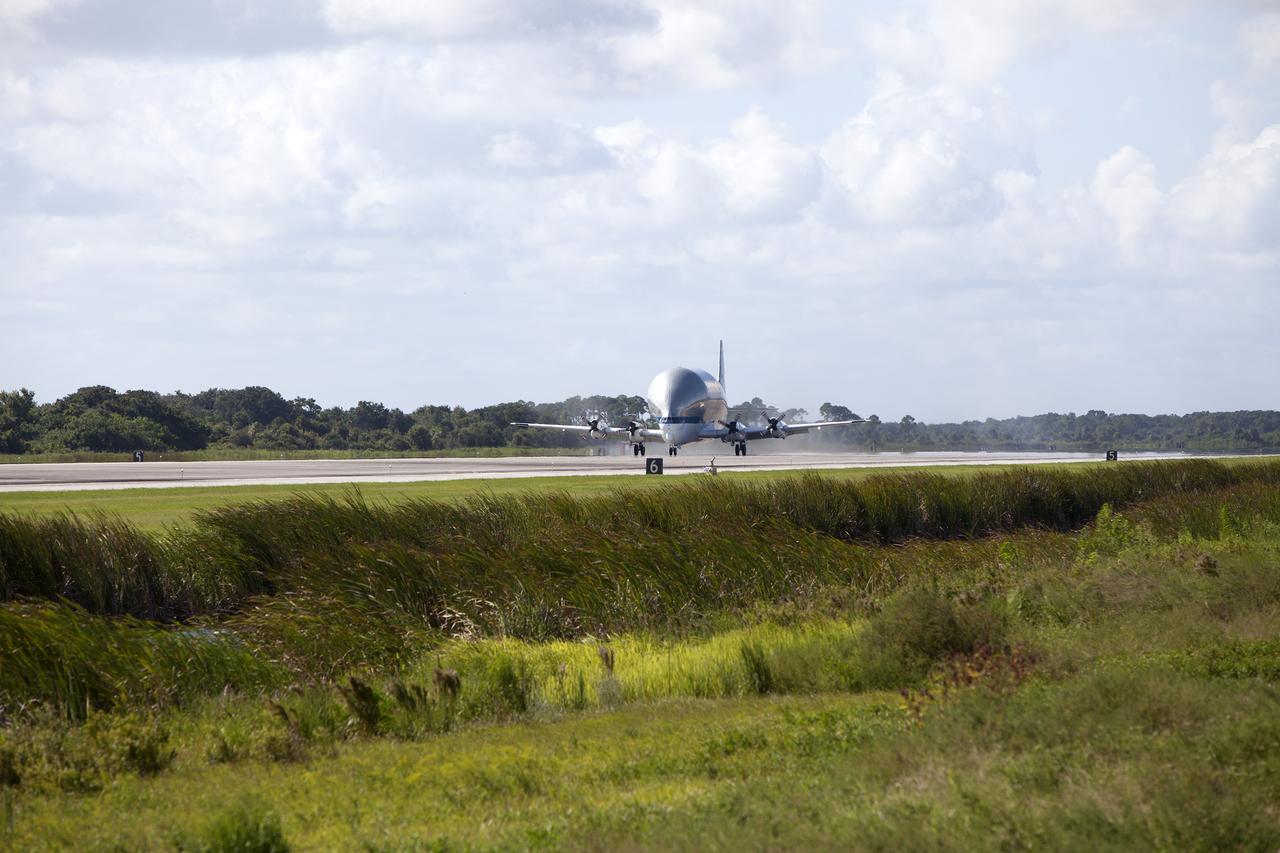
NASA’s Super Guppy aircraft touches down at the Shuttle Landing Facility, managed and operated by Space Florida, at the agency’s Kennedy Space Center in Florida, carrying the heat shield for Exploration Mission 1 (EM-1). The heat shield will be offloaded and transported to the Neil Armstrong Operations and Checkout Building high bay for processing. The heat shield arrived from manufacturer Lockheed Martin in Denver. The Orion spacecraft will launch atop NASA’s Space Launch System rocket on EM-1, an uncrewed test flight, in 2018.
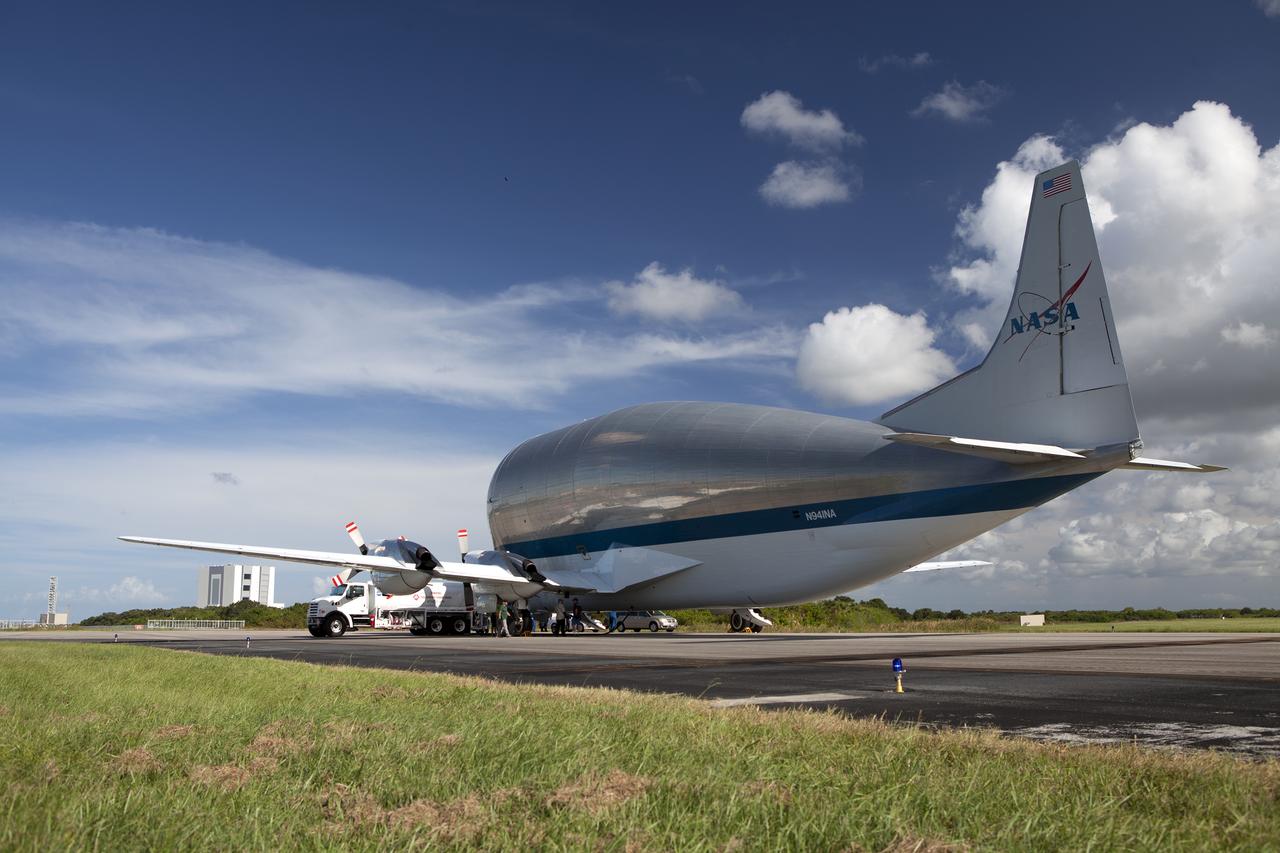
NASA’s Super Guppy aircraft touched and came to a stop at the Shuttle Landing Facility, managed and operated by Space Florida, at the agency’s Kennedy Space Center in Florida, carrying the heat shield for Exploration Mission 1 (EM-1). The heat shield will be offloaded and transported to the Neil Armstrong Operations and Checkout Building high bay for processing. The heat shield arrived from manufacturer Lockheed Martin in Denver. The Orion spacecraft will launch atop NASA’s Space Launch System rocket on EM-1, an uncrewed test flight, in 2018.
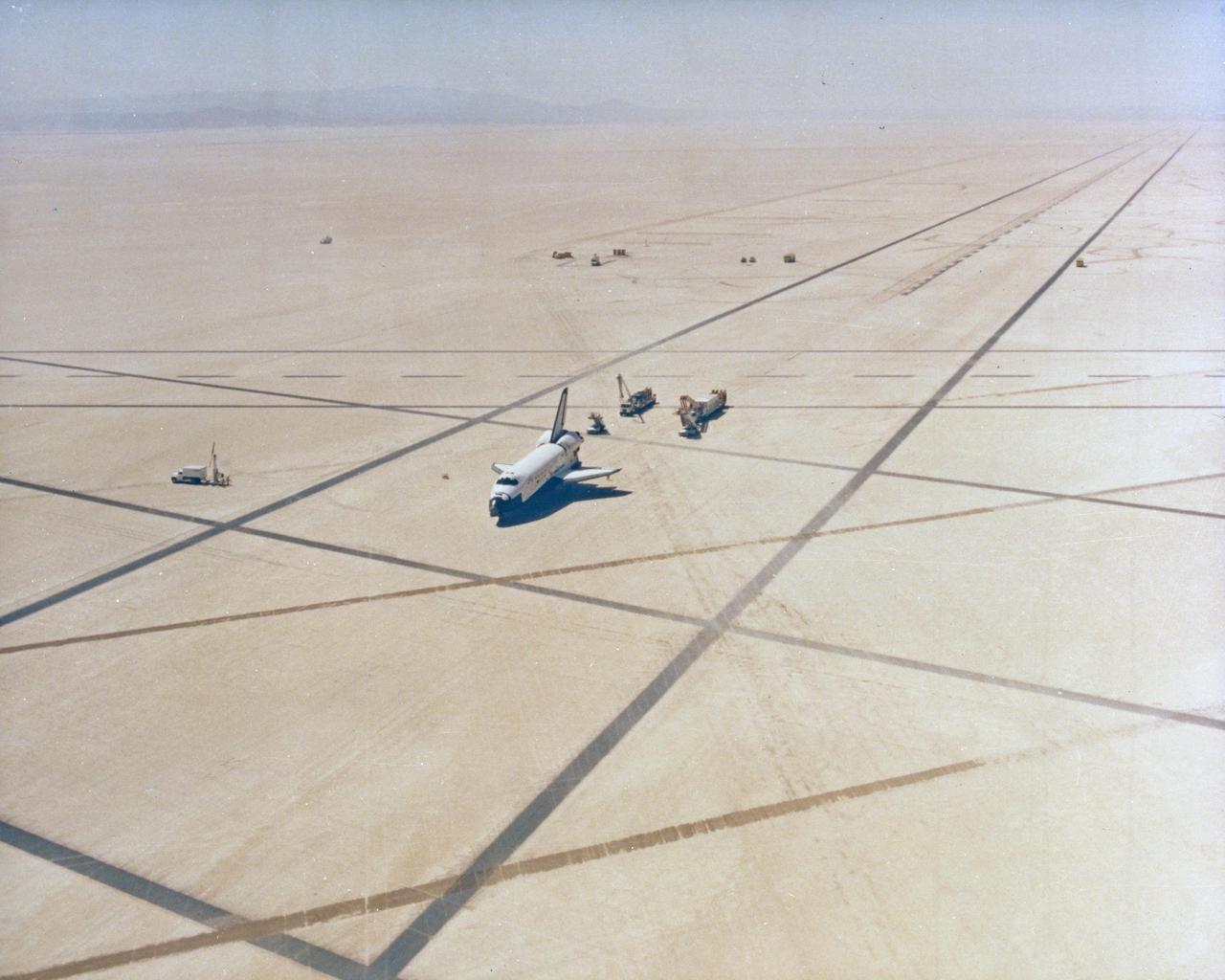
DRYDEN FLIGHT RESEARCH CENTER, CALIF. - Columbia returns to Earth after completing the first full test of the Space Transportation System (STS-1). The orbiter Columbia is seen here on the Rogers dry lake, Runway 23, at NASA's Dryden Flight Research Center, Edwards, California. From this aerial view, the orbiter Columbia is seen as it is being convoyed to a parking area. For this first flight, the Columbia was flown by Astronauts John Young, commander, and Robert Crippen, pilot. STS-1, known as a shuttle systems test flight, sought to demonstrate safe launch into orbit and safe return of the orbiter and crew and verify the combined performance of the entire shuttle vehicle -- orbiter, solid rocket boosters and external tank.
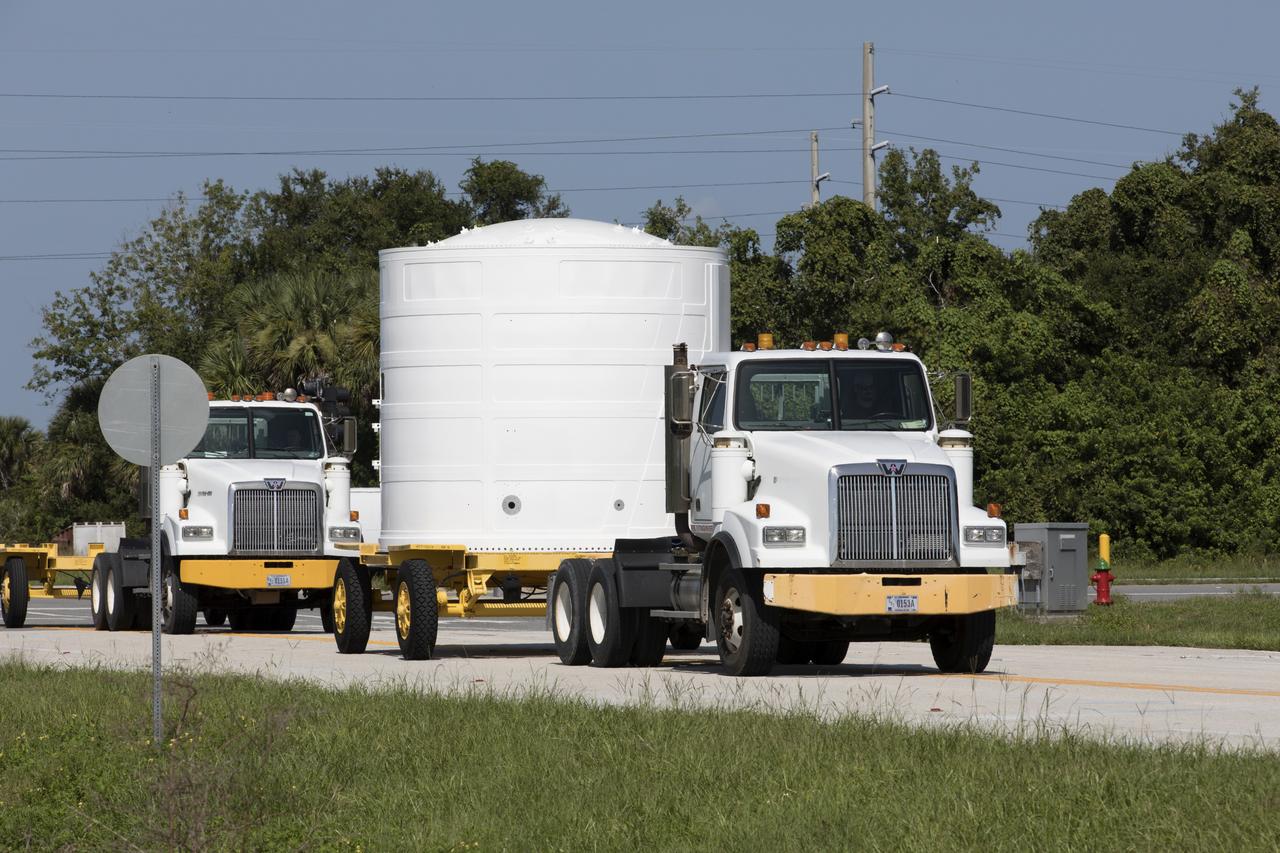
The Exploration Mission-1 (EM-1) left-hand forward skirt for NASA's Space Launch System (SLS) solid rocket boosters is transported by truck to the Booster Fabrication Facility (BFF) at NASA's Kennedy Space Center in Florida from Hangar AE at Cape Canaveral Air Force Station. In the BFF, the forward skirt will be inspected and prepared for use on the left-hand solid rocket booster for EM-1. NASA's Orion spacecraft will fly atop the SLS rocket on its first uncrewed flight test.
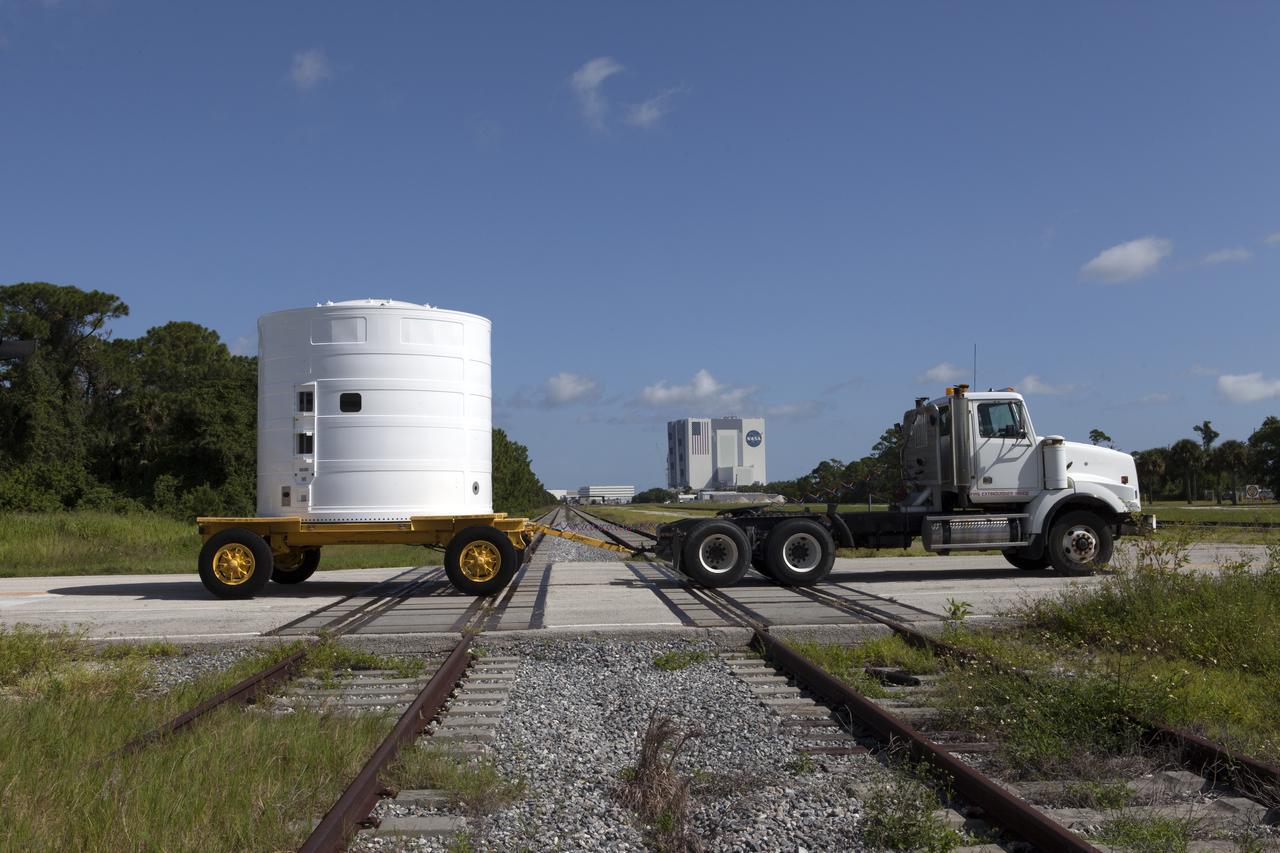
The Exploration Mission-1 (EM-1) left-hand forward skirt for NASA's Space Launch System (SLS) solid rocket boosters is transported by truck to the Booster Fabrication Facility (BFF) at NASA's Kennedy Space Center in Florida from Hangar AE at Cape Canaveral Air Force Station. In the BFF, the forward skirt will be inspected and prepared for use on the left-hand solid rocket booster for EM-1. NASA's Orion spacecraft will fly atop the SLS rocket on its first uncrewed flight test.
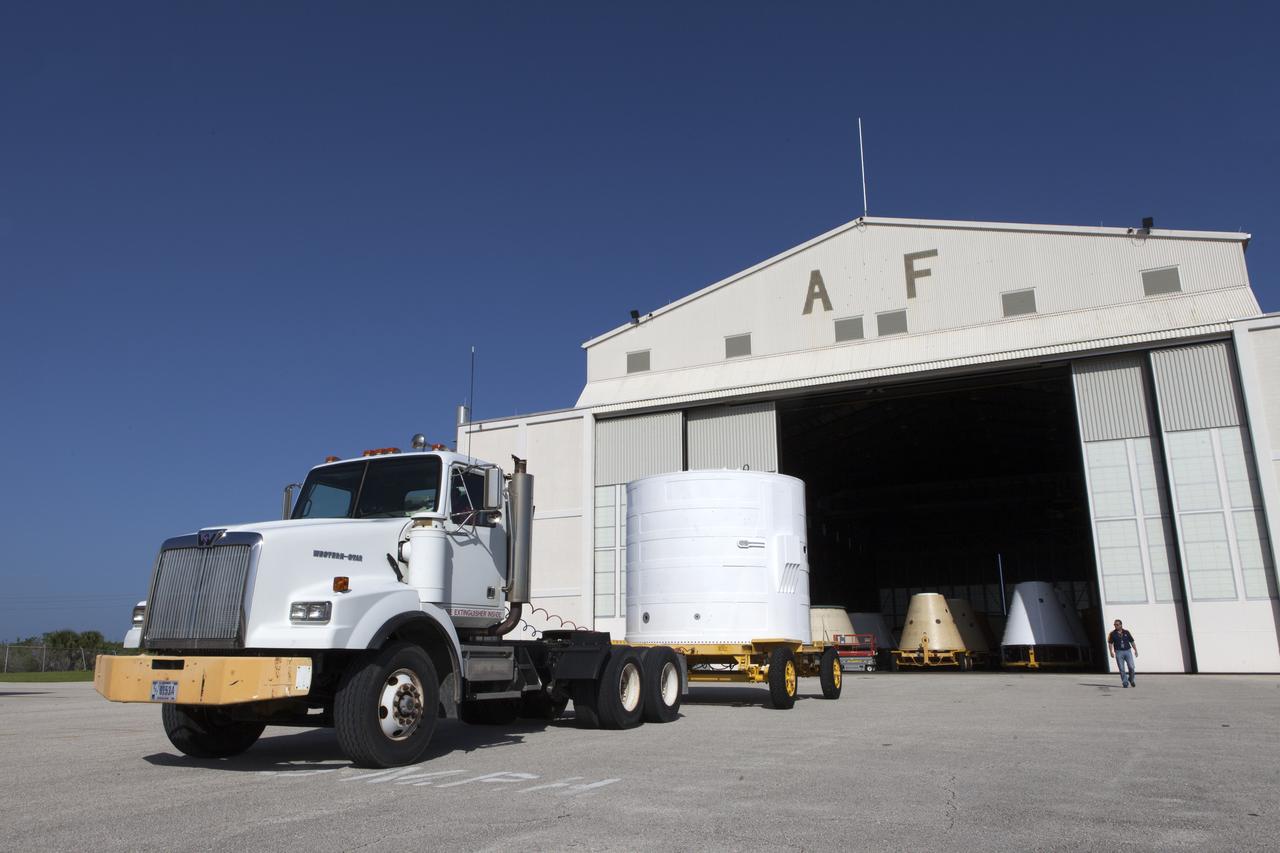
The Exploration Mission-1 (EM-1) left-hand forward skirt for NASA's Space Launch System (SLS) solid rocket boosters is moved out of Hangar AE at Cape Canaveral Air Force Station in Florida, for transport to the Booster Fabrication Facility (BFF) at Kennedy Space Center. In the BFF, the forward skirt will be inspected and prepared for use on the left-hand solid rocket booster for EM-1. NASA's Orion spacecraft will fly atop the SLS rocket on its first uncrewed flight test.

SAN DIEGO, Calif. – A flatbed truck carrying the crew module transportation fixture simulates the future transportation route of Orion at Naval Base San Diego in California. The Ground Systems Development and Operations Program, Lockheed Martin and the U.S. Navy are evaluating the hardware and processes for preparing the Orion crew module for Exploration Flight Test-1, or EFT-1, for overland transport from the naval base to NASA's Kennedy Space Center in Florida. Orion is the exploration spacecraft designed to carry astronauts to destinations not yet explored by humans, including an asteroid and Mars. It will have emergency abort capability, sustain the crew during space travel and provide safe re-entry from deep space return velocities. The first unpiloted test flight of the Orion is scheduled to launch later this year atop a Delta IV rocket from Cape Canaveral Air Force Station in Florida to an altitude of 3,600 miles above the Earth's surface. The two-orbit, four-hour flight test will help engineers evaluate the systems critical to crew safety including the heat shield, parachute system and launch abort system. For more information, visit http://www.nasa.gov/orion. Photo credit: NASA/Kim Shiflett

Johnson Space Center Deputy Director Vanessa Wyche signs the Human Rating Certification Plan for SpaceX’s crew transportation system, officially certifying the first commercial spacecraft system in history capable of transporting humans to and from the International Space Station as part of the agency’s Commercial Crew Program. The signing occurred during the Flight Readiness Review (FRR) for the NASA’s SpaceX Crew-1 mission at Kennedy Space Center in Florida on Nov. 10, 2020. The FRR focuses on the preparedness of SpaceX’s crew transportation system, the International Space Station, and its international partners to support the flight, and the certification of flight readiness. Crew-1 is the first regular crew mission of a U.S. commercial spacecraft with astronauts to the International Space Station as part of NASA’s Commercial Crew Program. The Crew Dragon Resilience capsule will launch atop a Falcon 9 rocket from Launch Complex 39A carrying NASA astronauts Michael Hopkins, Victor Glover, Shannon Walker and Japan Aerospace Exploration Agency (JAXA) astronaut Soichi Noguchi to the space station for a six-month science mission.
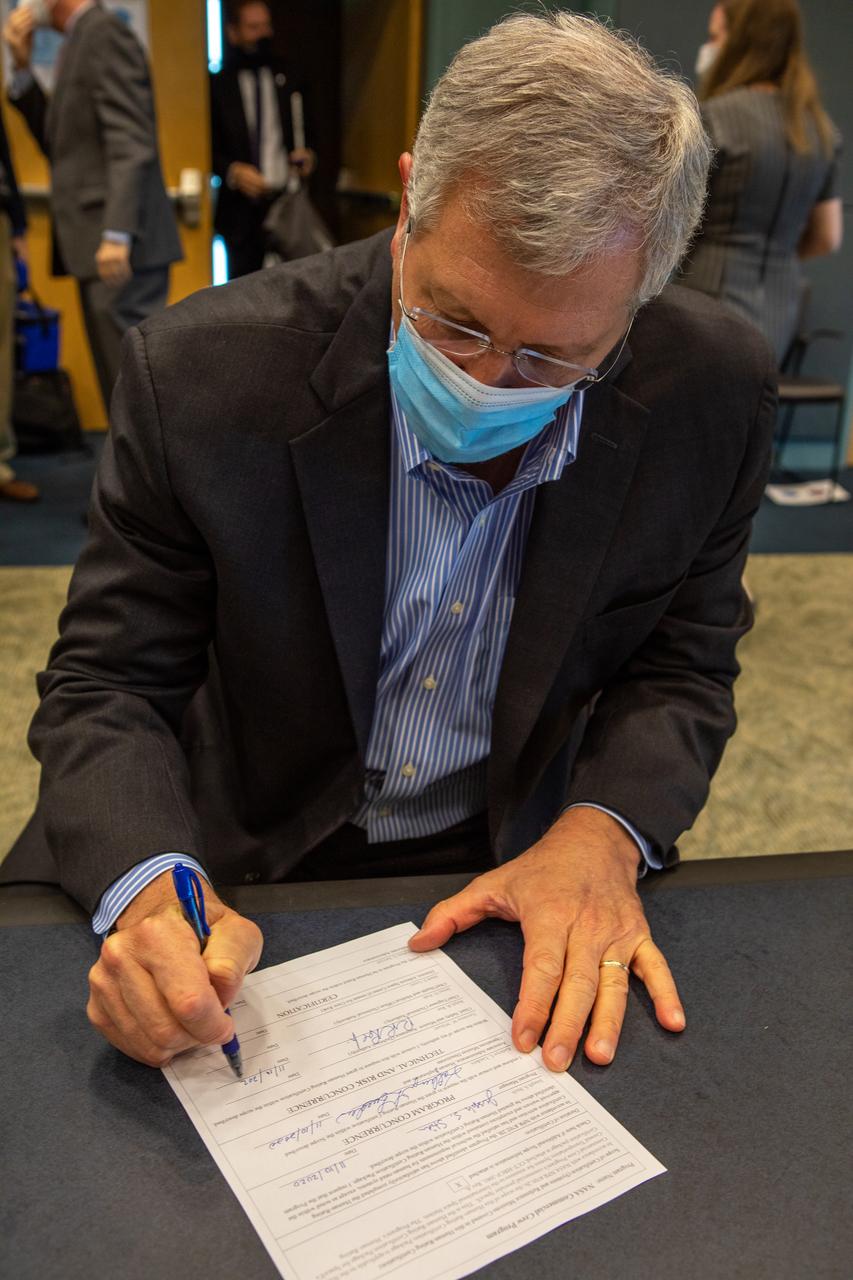
NASA Chief Engineer Ralph Roe signs the Human Rating Certification Plan for SpaceX’s crew transportation system, officially certifying the first commercial spacecraft system in history capable of transporting humans to and from the International Space Station as part of the agency’s Commercial Crew Program. The signing occurred during the Flight Readiness Review (FRR) for the NASA’s SpaceX Crew-1 mission at Kennedy Space Center in Florida on Nov. 10, 2020. The FRR focuses on the preparedness of SpaceX’s crew transportation system, the International Space Station, and its international partners to support the flight, and the certification of flight readiness. Crew-1 is the first regular crew mission of a U.S. commercial spacecraft with astronauts to the International Space Station as part of NASA’s Commercial Crew Program. The Crew Dragon Resilience capsule will launch atop a Falcon 9 rocket from Launch Complex 39A carrying NASA astronauts Michael Hopkins, Victor Glover, Shannon Walker and Japan Aerospace Exploration Agency (JAXA) astronaut Soichi Noguchi to the space station for a six-month science mission.

Kathy Lueders, NASA associate administrator of the Human Exploration and Operations Mission Directorate, signs the Human Rating Certification Plan for SpaceX’s crew transportation system, officially certifying the first commercial spacecraft system in history capable of transporting humans to and from the International Space Station as part of the agency’s Commercial Crew Program. The signing occurred during the Flight Readiness Review (FRR) for the agency’s SpaceX Crew-1 mission at NASA’s Kennedy Space Center in Florida on Nov. 10, 2020. The FRR focuses on the preparedness of SpaceX’s crew transportation system, the International Space Station, and its international partners to support the flight, and the certification of flight readiness. Crew-1 is the first regular crew mission of a U.S. commercial spacecraft with astronauts to the International Space Station as part of NASA’s Commercial Crew Program. The Crew Dragon Resilience capsule will launch atop a Falcon 9 rocket from Launch Complex 39A carrying NASA astronauts Michael Hopkins, Victor Glover, Shannon Walker and Japan Aerospace Exploration Agency (JAXA) astronaut Soichi Noguchi to the space station for a six-month science mission.
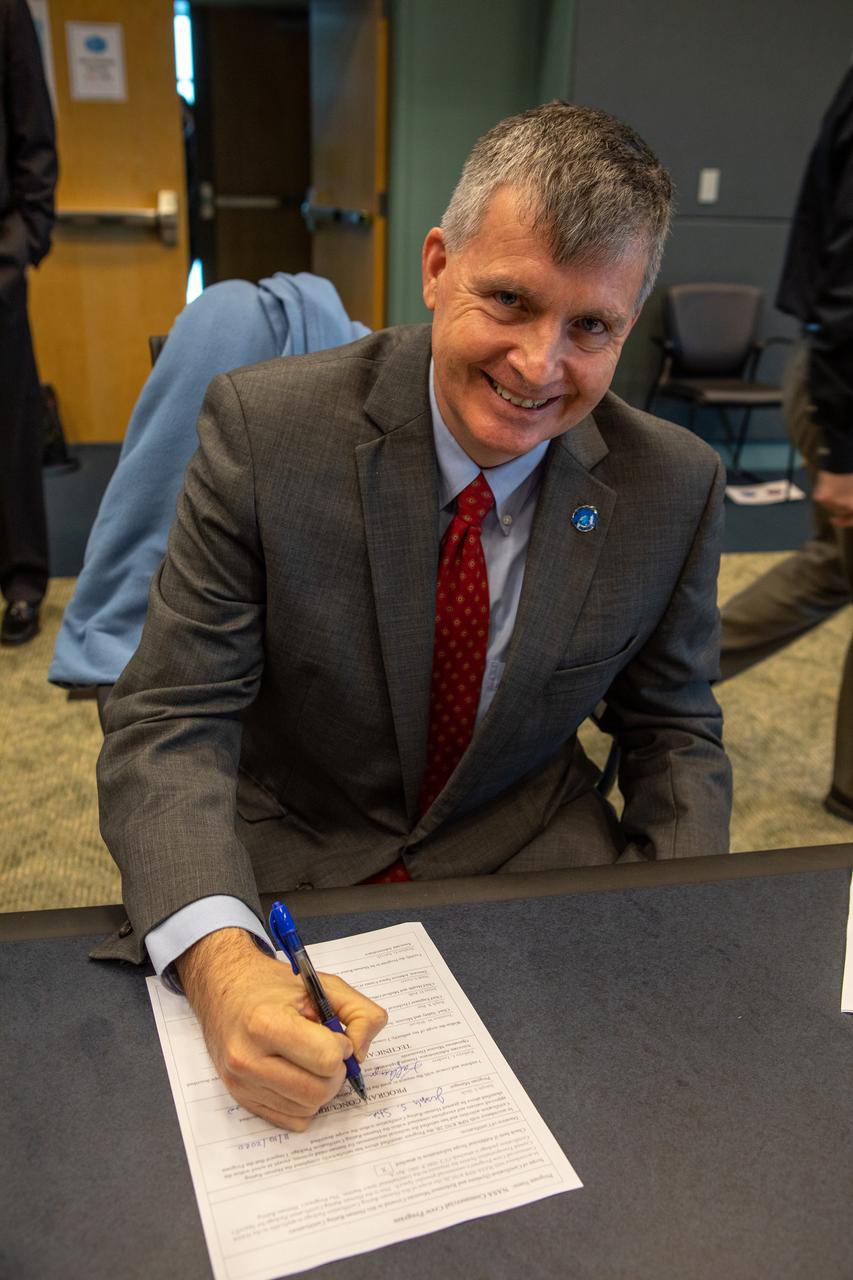
Steve Stich, manager of NASA’s Commercial Crew Program, signs the Human Rating Certification Plan for SpaceX’s crew transportation system, officially certifying the first commercial spacecraft system in history capable of transporting humans to and from the International Space Station as part of the agency’s Commercial Crew Program. The signing occurred during the Flight Readiness Review (FRR) for the NASA’s SpaceX Crew-1 mission at Kennedy Space Center in Florida on Nov. 10, 2020. The FRR focuses on the preparedness of SpaceX’s crew transportation system, the International Space Station, and its international partners to support the flight, and the certification of flight readiness. Crew-1 is the first regular crew mission of a U.S. commercial spacecraft with astronauts to the International Space Station as part of NASA’s Commercial Crew Program. The Crew Dragon Resilience capsule will launch atop a Falcon 9 rocket from Launch Complex 39A carrying NASA astronauts Michael Hopkins, Victor Glover, Shannon Walker and Japan Aerospace Exploration Agency (JAXA) astronaut Soichi Noguchi to the space station for a six-month science mission.
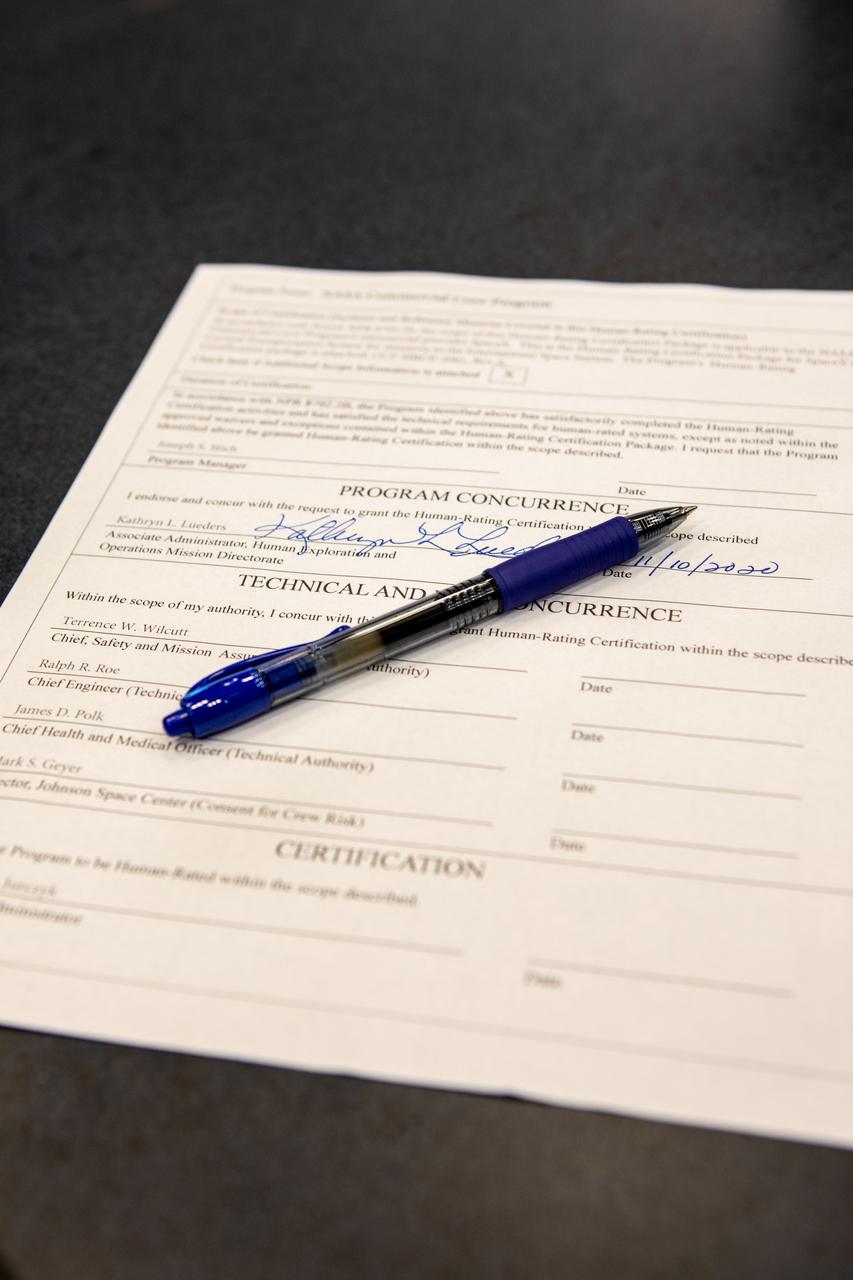
The Human Rating Certification Plan for SpaceX’s crew transportation system, officially certifying the first commercial spacecraft system in history capable of transporting humans to and from the International Space Station as part of the agency’s Commercial Crew Program was signed during the Flight Readiness Review (FRR) for the NASA’s SpaceX Crew-1 mission at Kennedy Space Center in Florida on Nov. 10, 2020. The FRR focuses on the preparedness of SpaceX’s crew transportation system, the International Space Station, and its international partners to support the flight, and the certification of flight readiness. Crew-1 is the first regular crew mission of a U.S. commercial spacecraft with astronauts to the International Space Station as part of NASA’s Commercial Crew Program. The Crew Dragon Resilience capsule will launch atop a Falcon 9 rocket from Launch Complex 39A carrying NASA astronauts Michael Hopkins, Victor Glover, Shannon Walker and Japan Aerospace Exploration Agency (JAXA) astronaut Soichi Noguchi to the space station for a six-month science mission.
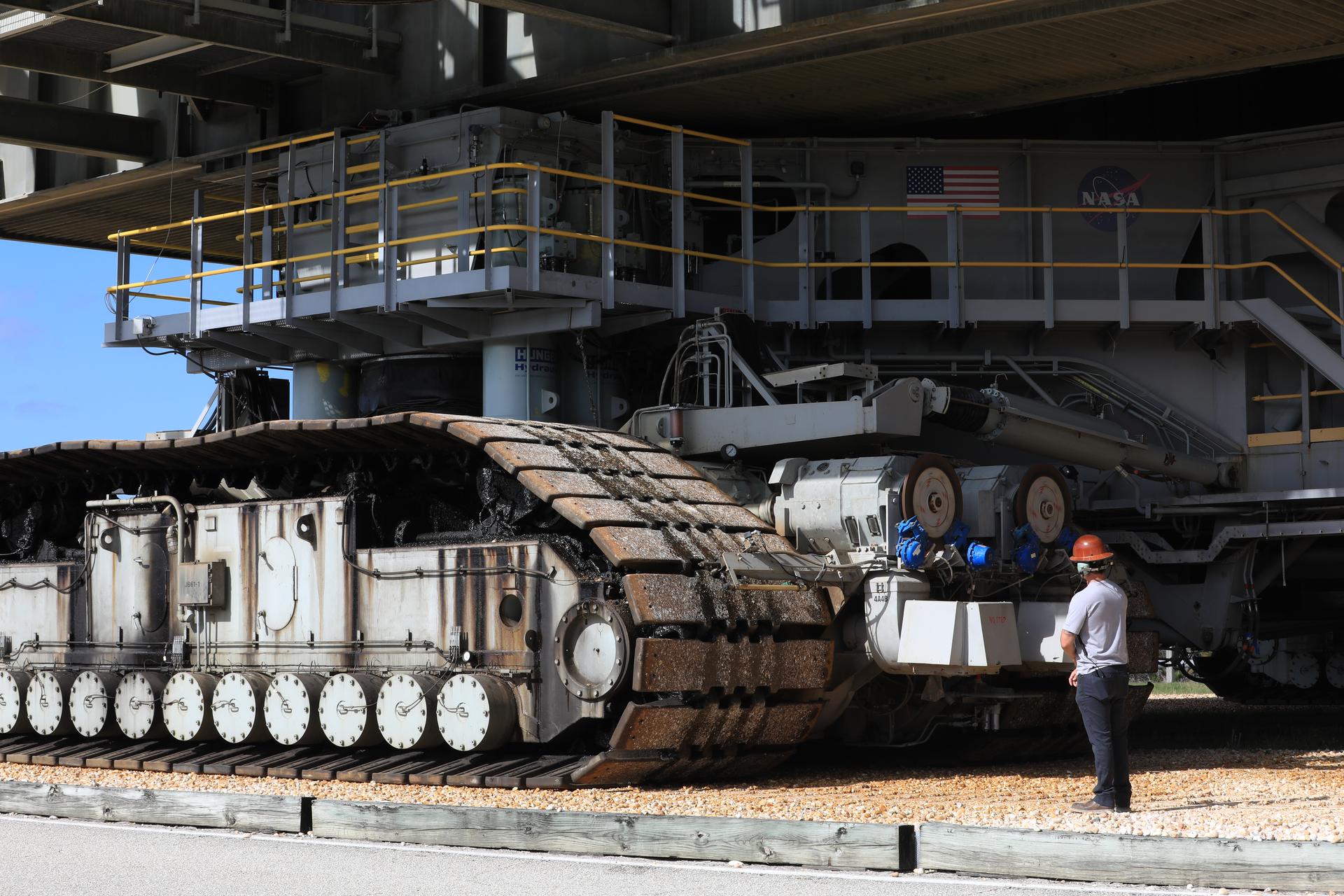
Technicians with NASA’s Exploration Gound Systems Program monitor crawler-transporter 2 as it transports the agency’s mobile launcher 1 slowly from Launch Complex 39B to the Vehicle Assembly Building at NASA’s Kennedy Space Center in Florida on Thursday, April 16, 2026, in preparation for Artemis III stacking operations. Teams will perform checkouts, inspections, and data analysis, and make repairs to the tower that saw damage during liftoff of the Artemis II test flight.
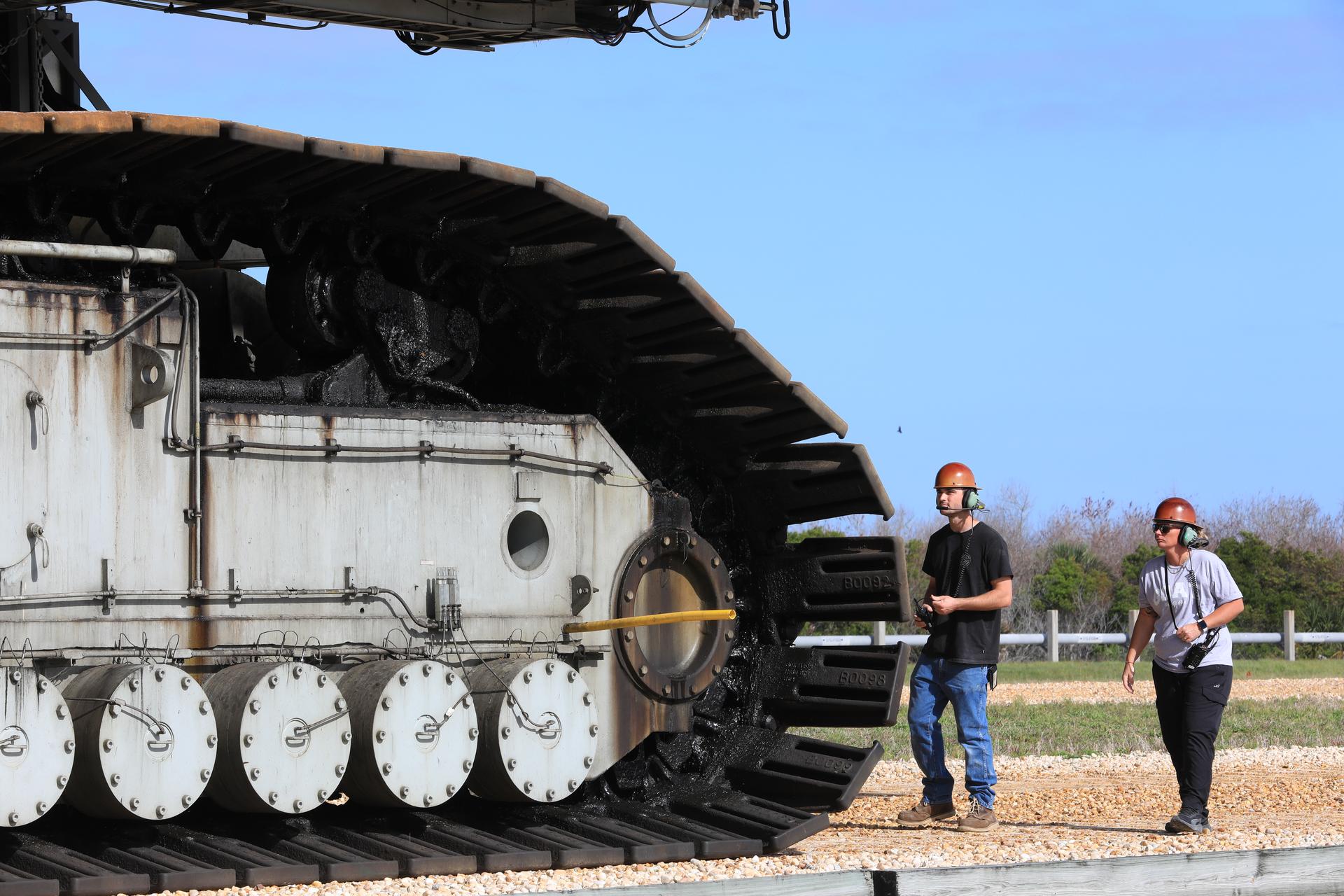
Technicians with NASA’s Exploration Gound Systems Program monitor crawler-transporter 2 as it transports the agency’s mobile launcher 1 slowly from Launch Complex 39B to the Vehicle Assembly Building at NASA’s Kennedy Space Center in Florida on Thursday, April 16, 2026, in preparation for Artemis III stacking operations. Teams will perform checkouts, inspections, and data analysis, and make repairs to the tower that saw damage during liftoff of the Artemis II test flight.

CAPE CANAVERAL, Fla. – Inside the Delta Operations Center at Cape Canaveral Air Force Station, United Launch Alliance technicians stand by with a transporter to move the second stage of a Delta IV Heavy rocket following testing in preparation for the unpiloted Exploration Flight Test-1, or EFT-1. The second stage will be transported to the Horizontal Integration Facility at Space Launch Complex 37 for mating with the Delta IV Heavy booster stages. During the mission, Orion will travel farther into space than any human spacecraft has gone in more than 40 years. The data gathered during the flight will influence design decisions, validate existing computer models and innovative new approaches to space systems development, as well as reduce overall mission risks and costs for later Orion flights. Liftoff of Orion on the first flight test is planned for December 2014. Photo credit: NASA/Kim Shiflett
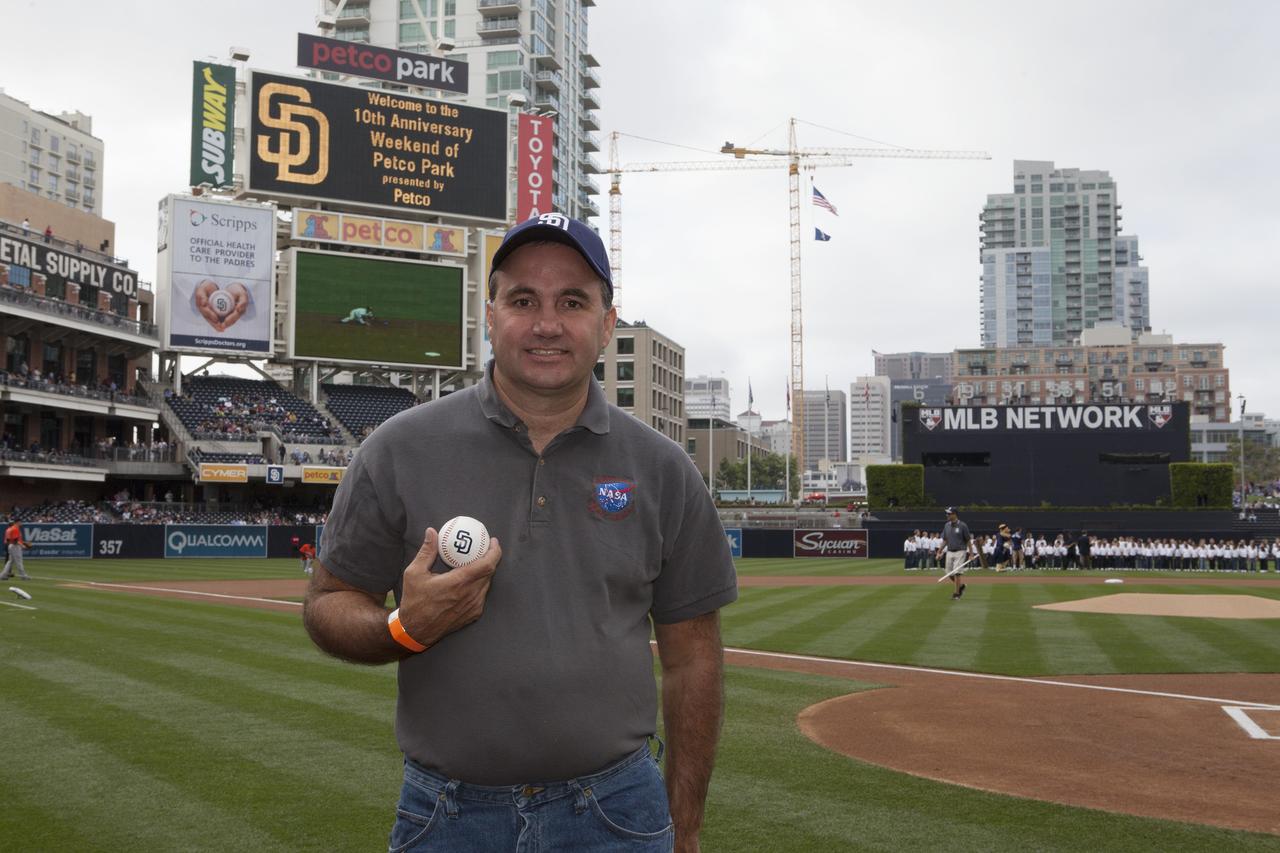
CAPE CANAVERAL, Fla. – Doug Lenhardt, Kennedy Space Center's Exploration Flight Test-1, or EFT-1, mission integration manager displays a baseball from the San Diego Padres inside Petco Park in San Diego, California. NASA's Orion boilerplate test vehicle is on display at the stadium. The boilerplate test vehicle is being prepared for an EFT-1 pre-transportation test. The Ground Systems Development and Operations Program will run the test to simulate retrieval and transportation procedures for Orion after it splashes down in the ocean and is retrieved for return to land and ground transportation back to Kennedy Space Center in Florida. Orion is the exploration spacecraft designed to carry astronauts to destinations not yet explored by humans, including an asteroid and Mars. It will have emergency abort capability, sustain the crew during space travel and provide safe re-entry from deep space return velocities. The first unpiloted test flight of the Orion is scheduled to launch later this year atop a Delta IV rocket and in 2017 on NASA’s Space Launch System rocket. For more information, visit http://www.nasa.gov/orion. Photo credit: NASA/Kim Shiflett

CAPE CANAVERAL, Fla. – Doug Lenhardt, Kennedy Space Center's Exploration Flight Test-1, or EFT-1, mission integration manager, and the San Diego Padres mascot wave at the crowds at Petco Field in San Diego, California before the start of the baseball game. The Orion boilerplate test vehicle is on display in the stadium. The boilerplate test vehicle is being prepared for an EFT-1 pre-transportation test. The Ground Systems Development and Operations Program will run the test at the U.S. Naval Base San Diego to simulate retrieval and transportation procedures for Orion after it splashes down in the ocean and is retrieved for return to land and ground transportation back to Kennedy Space Center in Florida. Orion is the exploration spacecraft designed to carry astronauts to destinations not yet explored by humans, including an asteroid and Mars. It will have emergency abort capability, sustain the crew during space travel and provide safe re-entry from deep space return velocities. The first unpiloted test flight of the Orion is scheduled to launch later this year atop a Delta IV rocket and in 2017 on NASA’s Space Launch System rocket. For more information, visit http://www.nasa.gov/orion. Photo credit: NASA/Kim Shiflett
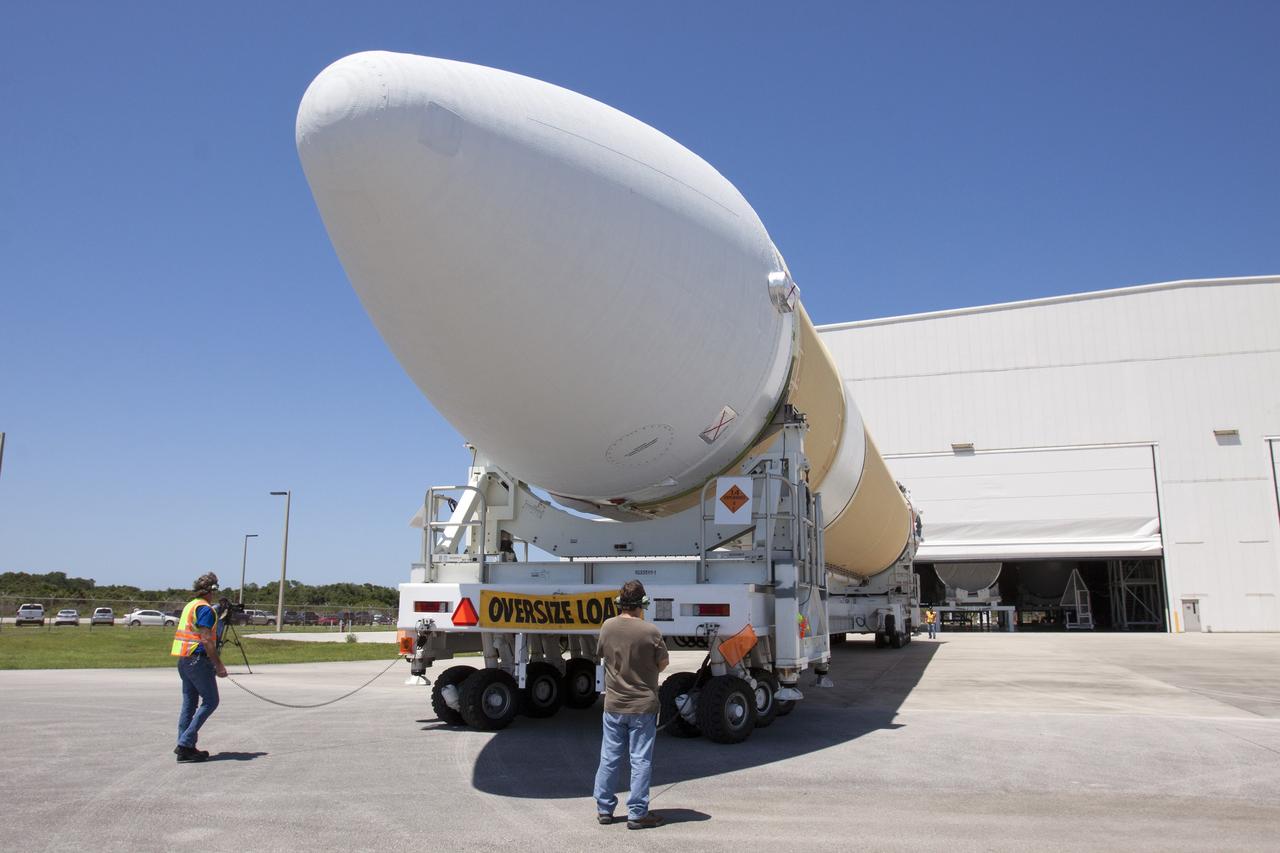
CAPE CANAVERAL, Fla. -- A transporter for oversize loads carries the port booster for the United Launch Alliance Delta IV Heavy for Exploration Flight Test-1, or EFT-1, to the Horizontal Integration Facility, or HIF, at Space Launch Complex 37 on Cape Canaveral Air Force Station in Florida. The upper stage and spacecraft adapter arrived with the booster on a barge at the U.S. Army Outpost wharf at Port Canaveral, and were transported to the HIF on May 6. At the HIF, all three booster stages will be processed and checked out before being moved to the nearby launch pad and hoisted into position. The spacecraft adapter will connect Orion to the ULA Delta IV, and also will connect Orion to NASA's new rocket, the Space Launch System, on its first mission in 2017. During the EFT-1 mission, Orion will travel farther into space than any human spacecraft has gone in more than 40 years. The data gathered during the flight will influence design decisions, validate existing computer models and innovative new approaches to space systems development, as well as reduce overall mission risks and costs for later Orion flights. Liftoff of Orion on EFT-1 is planned for fall 2014. Photo credit: NASA/Kim Shiflett
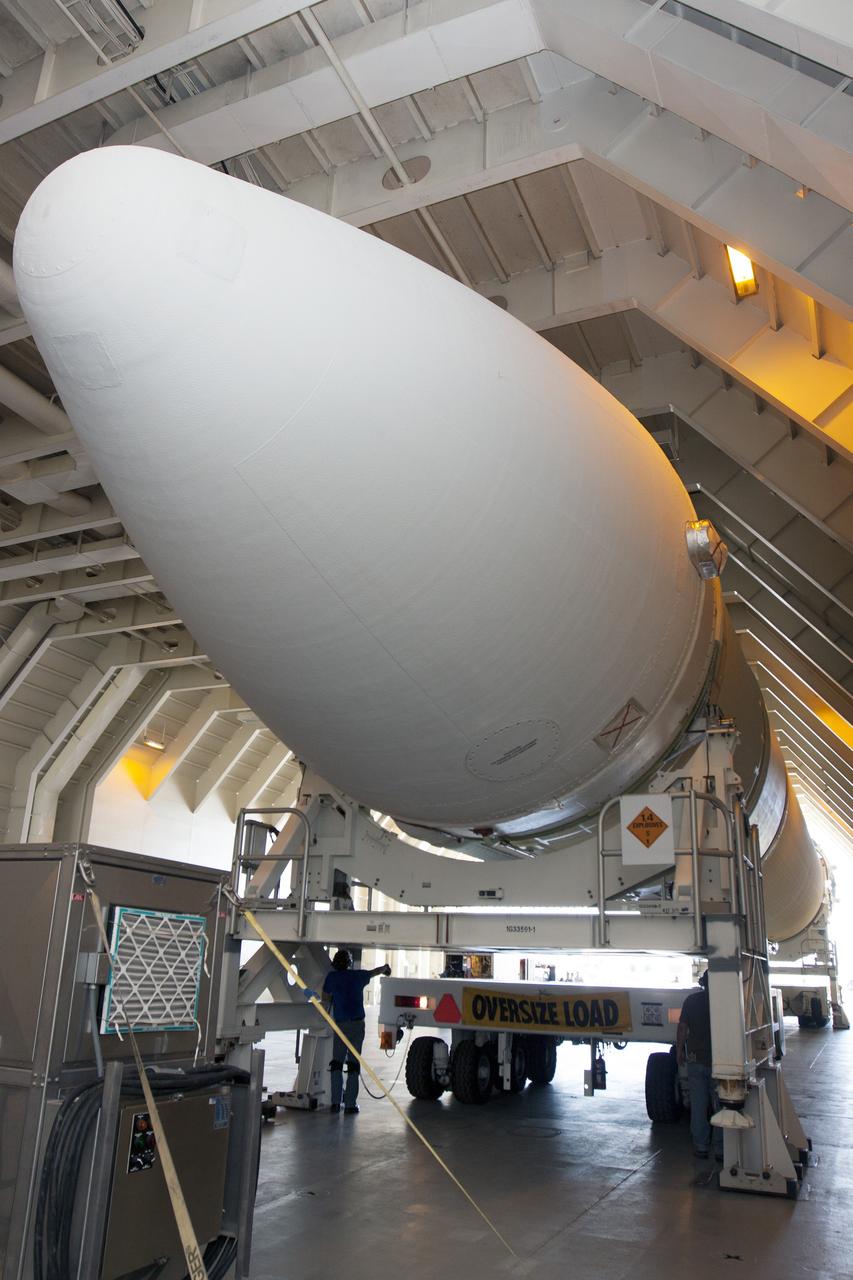
CAPE CANAVERAL, Fla. -- The port booster for the United Launch Alliance Delta IV Heavy for Exploration Flight Test-1, or EFT-1, is being offloaded from the barge at the U.S. Army Outpost wharf at Port Canaveral in Florida and will be transported to the Horizontal Integration Facility, or HIF, at Space Launch Complex 37 on Cape Canaveral Air Force Station. The upper stage and spacecraft adapter arrived with the booster and were transported to the HIF on May 6. At the HIF, all three booster stages will be processed and checked out before being moved to the nearby launch pad and hoisted into position. The spacecraft adapter will connect Orion to the ULA Delta IV, and also will connect Orion to NASA's new rocket, the Space Launch System, on its first mission in 2017. During the EFT-1 mission, Orion will travel farther into space than any human spacecraft has gone in more than 40 years. The data gathered during the flight will influence design decisions, validate existing computer models and innovative new approaches to space systems development, as well as reduce overall mission risks and costs for later Orion flights. Liftoff of Orion on EFT-1 is planned for fall 2014. Photo credit: NASA/Kim Shiflett
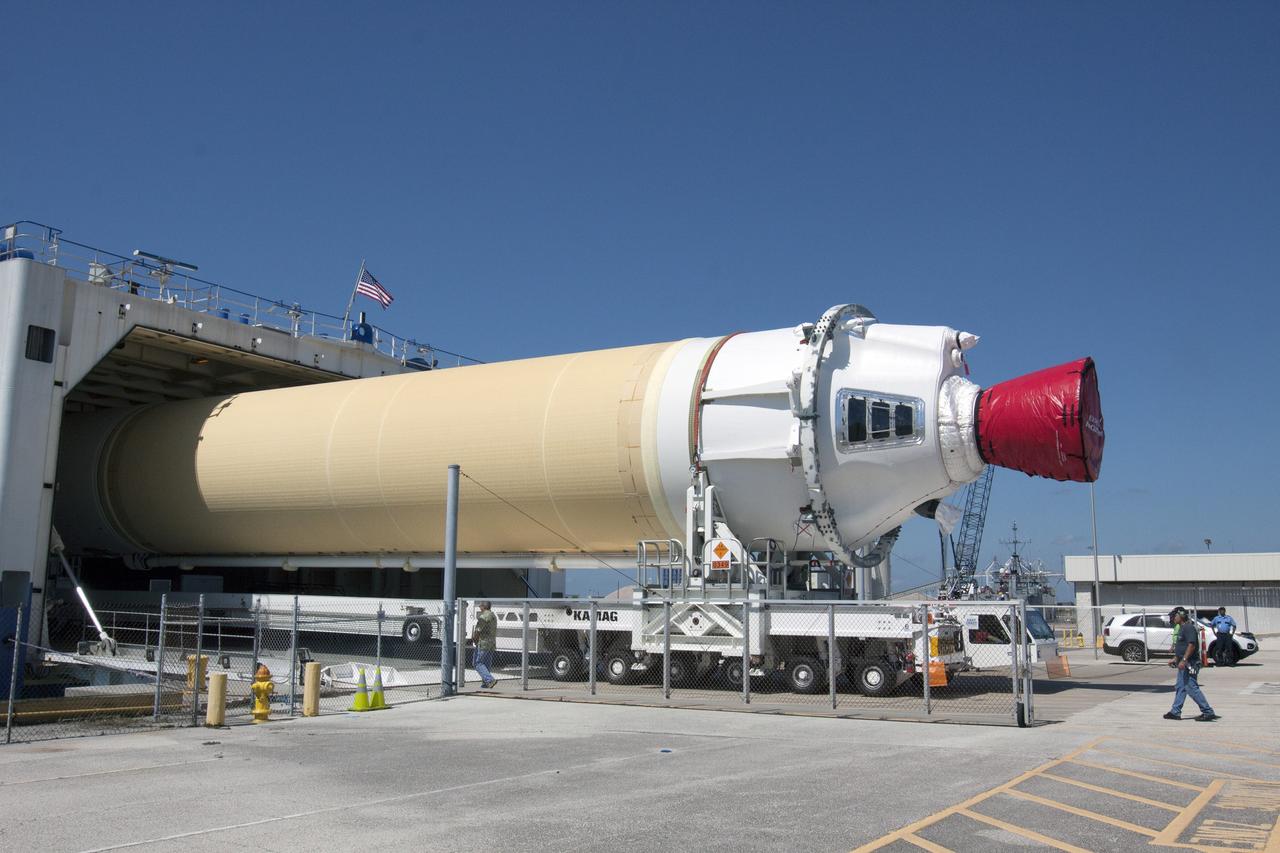
CAPE CANAVERAL, Fla. -- The port booster for the United Launch Alliance Delta IV Heavy for Exploration Flight Test-1, or EFT-1, has been offloaded from the barge at the U.S. Army Outpost wharf at Port Canaveral in Florida and will be transported to the Horizontal Integration Facility, or HIF, at Space Launch Complex 37 on Cape Canaveral Air Force Station. The upper stage and spacecraft adapter arrived with the booster and were transported to the HIF on May 6. At the HIF, all three booster stages will be processed and checked out before being moved to the nearby launch pad and hoisted into position. The spacecraft adapter will connect Orion to the ULA Delta IV, and also will connect Orion to NASA's new rocket, the Space Launch System, on its first mission in 2017. During the EFT-1 mission, Orion will travel farther into space than any human spacecraft has gone in more than 40 years. The data gathered during the flight will influence design decisions, validate existing computer models and innovative new approaches to space systems development, as well as reduce overall mission risks and costs for later Orion flights. Liftoff of Orion on EFT-1 is planned for fall 2014. Photo credit: NASA/Kim Shiflett
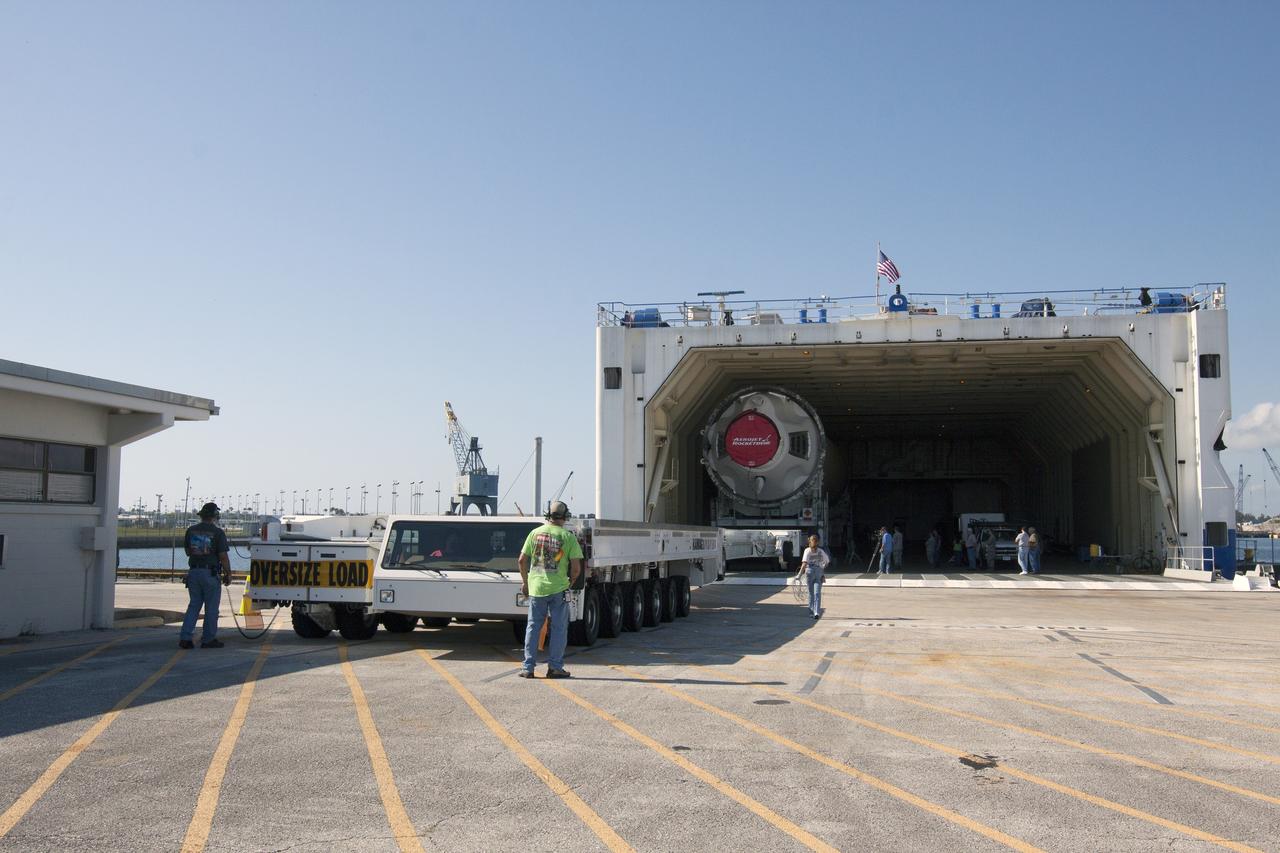
CAPE CANAVERAL, Fla. -- The port booster for the United Launch Alliance Delta IV Heavy for Exploration Flight Test-1, or EFT-1, is being offloaded from the barge at the U.S. Army Outpost wharf at Port Canaveral in Florida and will be transported to the Horizontal Integration Facility, or HIF, at Space Launch Complex 37 on Cape Canaveral Air Force Station. The upper stage and spacecraft adapter arrived with the booster and were transported to the HIF on May 6. At the HIF, all three booster stages will be processed and checked out before being moved to the nearby launch pad and hoisted into position. The spacecraft adapter will connect Orion to the ULA Delta IV, and also will connect Orion to NASA's new rocket, the Space Launch System, on its first mission in 2017. During the EFT-1 mission, Orion will travel farther into space than any human spacecraft has gone in more than 40 years. The data gathered during the flight will influence design decisions, validate existing computer models and innovative new approaches to space systems development, as well as reduce overall mission risks and costs for later Orion flights. Liftoff of Orion on EFT-1 is planned for fall 2014. Photo credit: NASA/Kim Shiflett
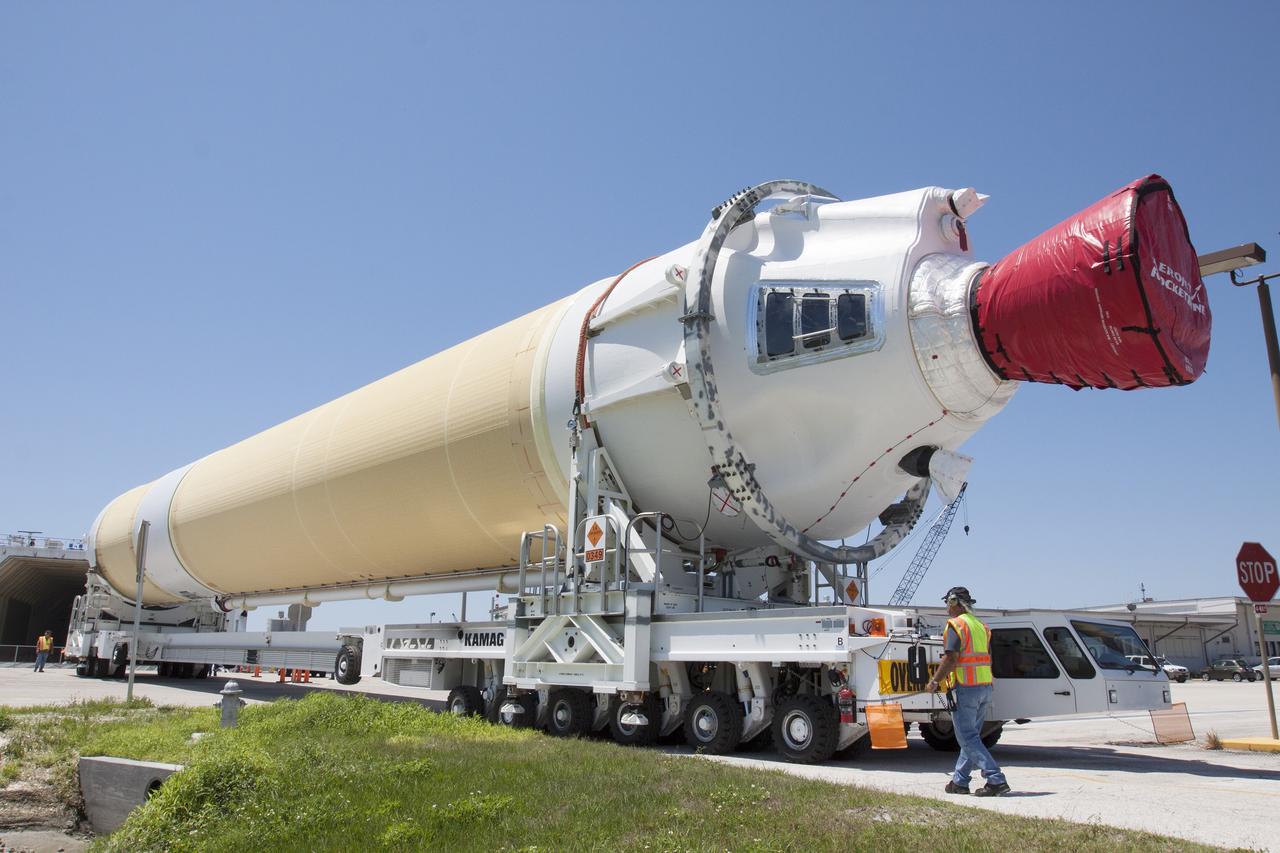
CAPE CANAVERAL, Fla. -- The port booster for the United Launch Alliance Delta IV Heavy for Exploration Flight Test-1, or EFT-1, has been offloaded from the barge at the U.S. Army Outpost wharf at Port Canaveral in Florida and is being transported to the Horizontal Integration Facility, or HIF, at Space Launch Complex 37 on Cape Canaveral Air Force Station. The upper stage and spacecraft adapter arrived with the booster and were transported to the HIF on May 6. At the HIF, all three booster stages will be processed and checked out before being moved to the nearby launch pad and hoisted into position. The spacecraft adapter will connect Orion to the ULA Delta IV, and also will connect Orion to NASA's new rocket, the Space Launch System, on its first mission in 2017. During the EFT-1 mission, Orion will travel farther into space than any human spacecraft has gone in more than 40 years. The data gathered during the flight will influence design decisions, validate existing computer models and innovative new approaches to space systems development, as well as reduce overall mission risks and costs for later Orion flights. Liftoff of Orion on EFT-1 is planned for fall 2014. Photo credit: NASA/Kim Shiflett
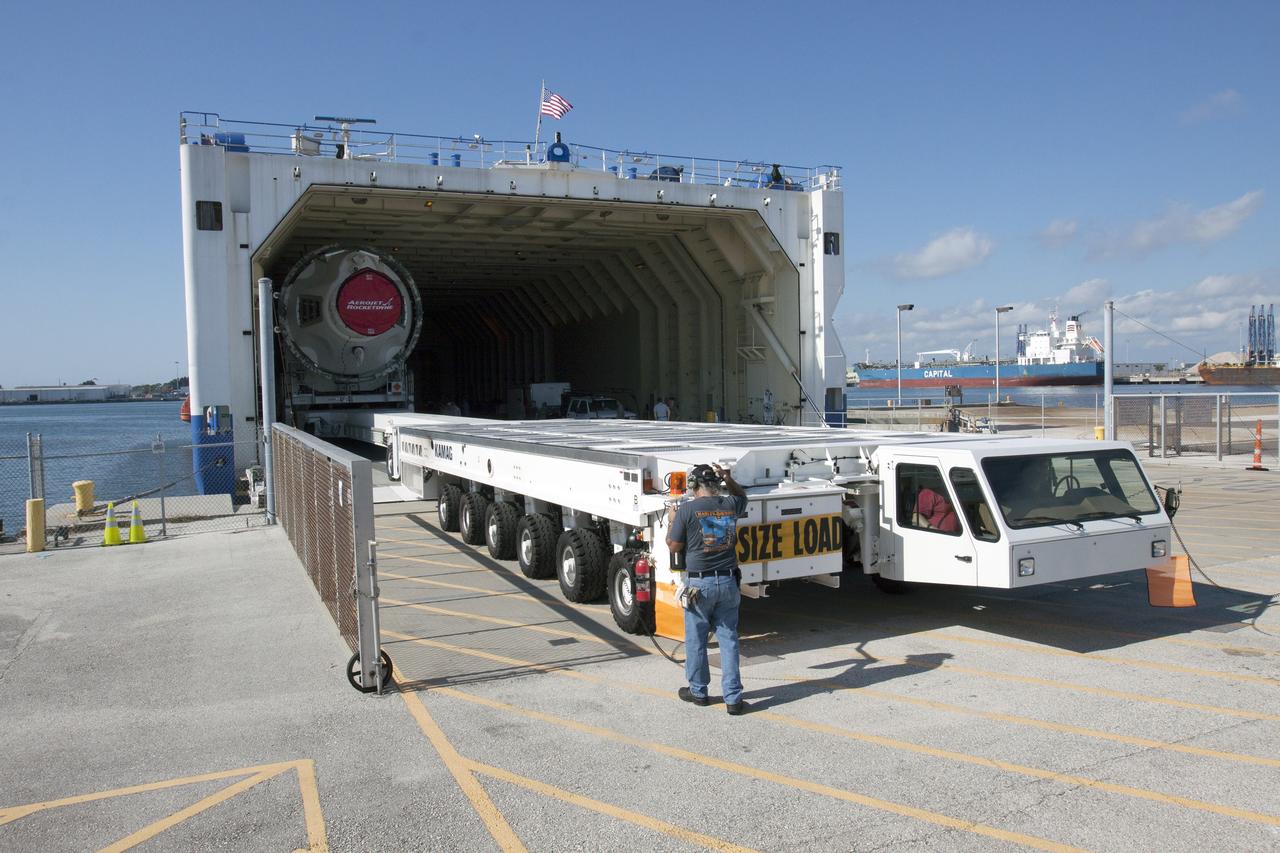
CAPE CANAVERAL, Fla. -- The port booster for the United Launch Alliance Delta IV Heavy for Exploration Flight Test-1, or EFT-1, is being offloaded from the barge at the U.S. Army Outpost wharf at Port Canaveral in Florida and will be transported to the Horizontal Integration Facility, or HIF, at Space Launch Complex 37 on Cape Canaveral Air Force Station. The upper stage and spacecraft adapter arrived with the booster and were transported to the HIF on May 6. At the HIF, all three booster stages will be processed and checked out before being moved to the nearby launch pad and hoisted into position. The spacecraft adapter will connect Orion to the ULA Delta IV, and also will connect Orion to NASA's new rocket, the Space Launch System, on its first mission in 2017. During the EFT-1 mission, Orion will travel farther into space than any human spacecraft has gone in more than 40 years. The data gathered during the flight will influence design decisions, validate existing computer models and innovative new approaches to space systems development, as well as reduce overall mission risks and costs for later Orion flights. Liftoff of Orion on EFT-1 is planned for fall 2014. Photo credit: NASA/Kim Shiflett
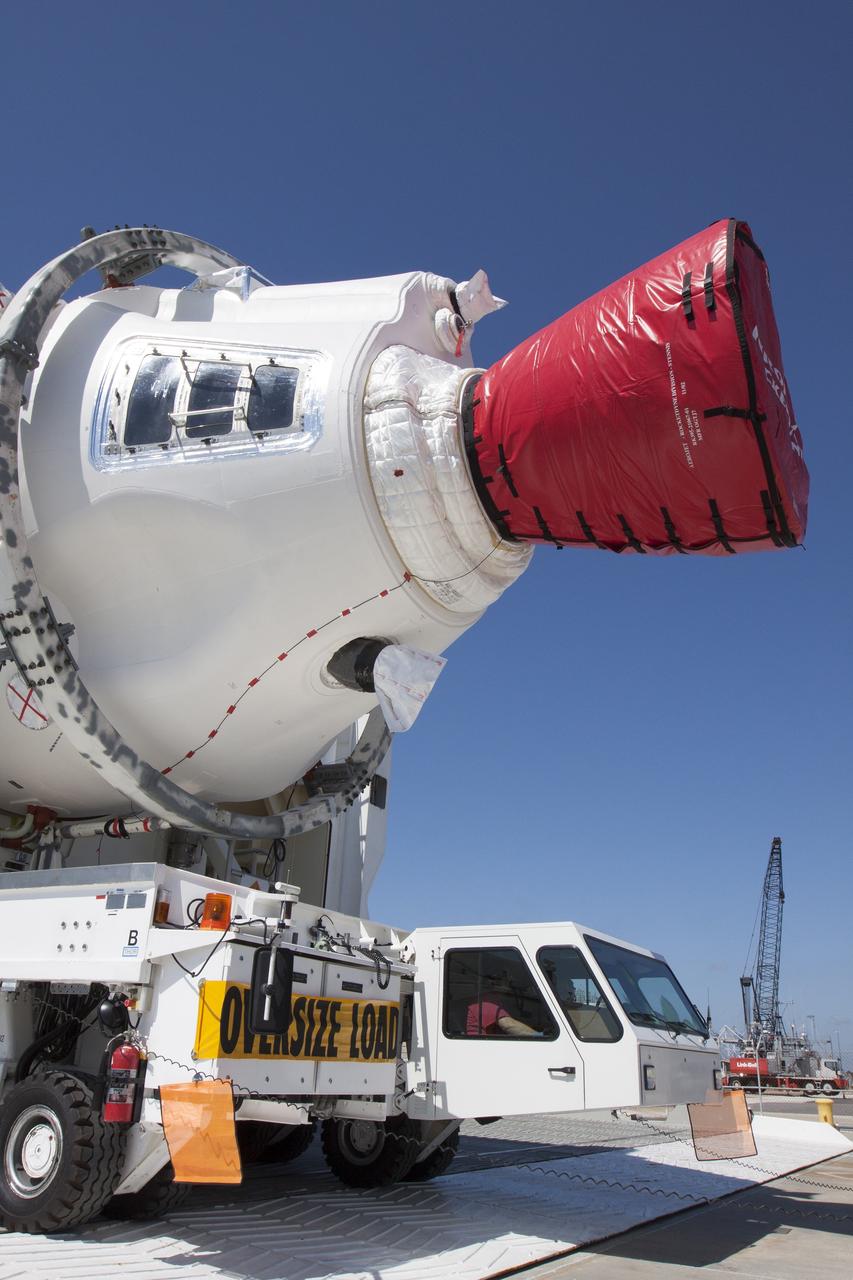
CAPE CANAVERAL, Fla. -- The port booster for the United Launch Alliance Delta IV Heavy for Exploration Flight Test-1, or EFT-1, has been offloaded from the barge at the U.S. Army Outpost wharf at Port Canaveral in Florida and will be transported to the Horizontal Integration Facility, or HIF, at Space Launch Complex 37 on Cape Canaveral Air Force Station. The upper stage and spacecraft adapter arrived with the booster and were transported to the HIF on May 6. At the HIF, all three booster stages will be processed and checked out before being moved to the nearby launch pad and hoisted into position. The spacecraft adapter will connect Orion to the ULA Delta IV, and also will connect Orion to NASA's new rocket, the Space Launch System, on its first mission in 2017. During the EFT-1 mission, Orion will travel farther into space than any human spacecraft has gone in more than 40 years. The data gathered during the flight will influence design decisions, validate existing computer models and innovative new approaches to space systems development, as well as reduce overall mission risks and costs for later Orion flights. Liftoff of Orion on EFT-1 is planned for fall 2014. Photo credit: NASA/Kim Shiflett
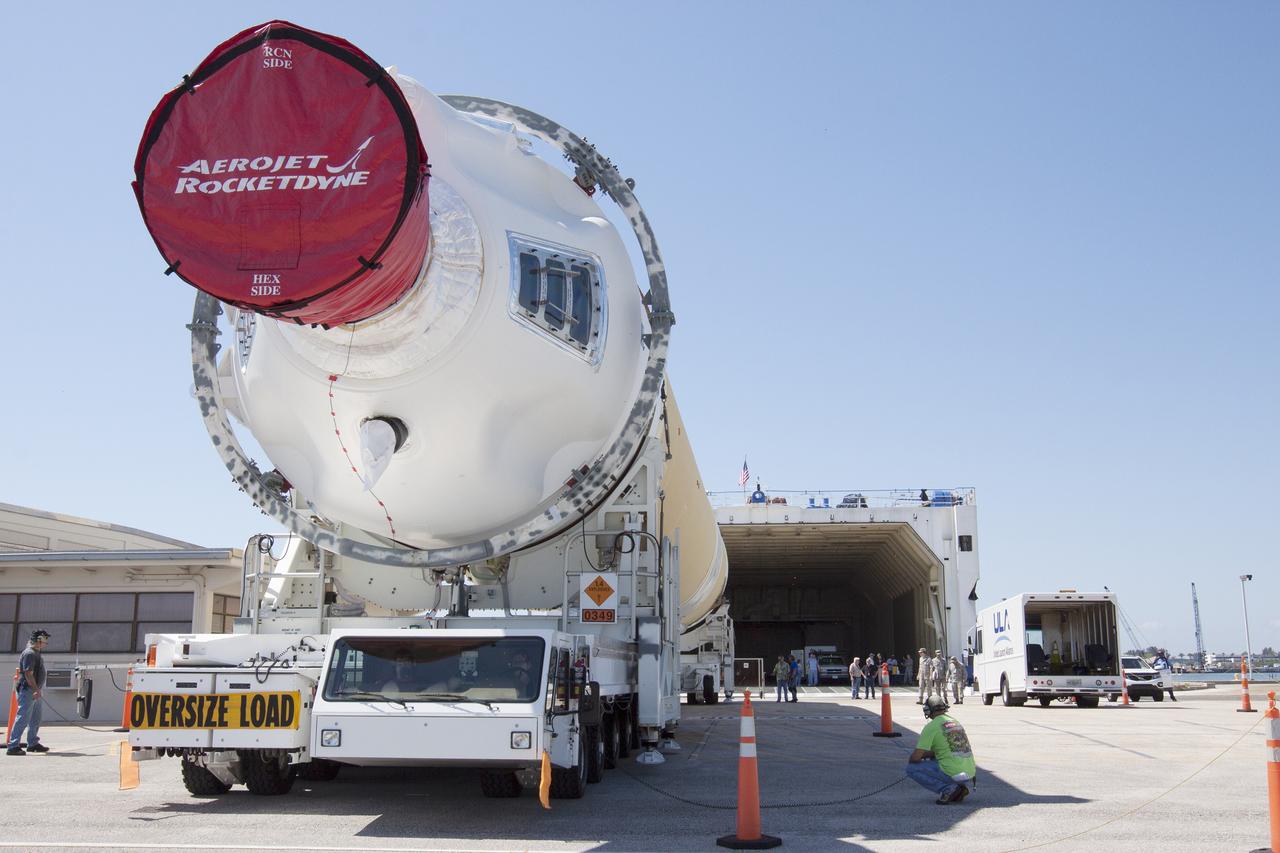
CAPE CANAVERAL, Fla. -- The port booster for the United Launch Alliance Delta IV Heavy for Exploration Flight Test-1, or EFT-1, has been offloaded from the barge at the U.S. Army Outpost wharf at Port Canaveral in Florida and will be transported to the Horizontal Integration Facility, or HIF, at Space Launch Complex 37 on Cape Canaveral Air Force Station. The upper stage and spacecraft adapter arrived with the booster and were transported to the HIF on May 6. At the HIF, all three booster stages will be processed and checked out before being moved to the nearby launch pad and hoisted into position. The spacecraft adapter will connect Orion to the ULA Delta IV, and also will connect Orion to NASA's new rocket, the Space Launch System, on its first mission in 2017. During the EFT-1 mission, Orion will travel farther into space than any human spacecraft has gone in more than 40 years. The data gathered during the flight will influence design decisions, validate existing computer models and innovative new approaches to space systems development, as well as reduce overall mission risks and costs for later Orion flights. Liftoff of Orion on EFT-1 is planned for fall 2014. Photo credit: NASA/Kim Shiflett
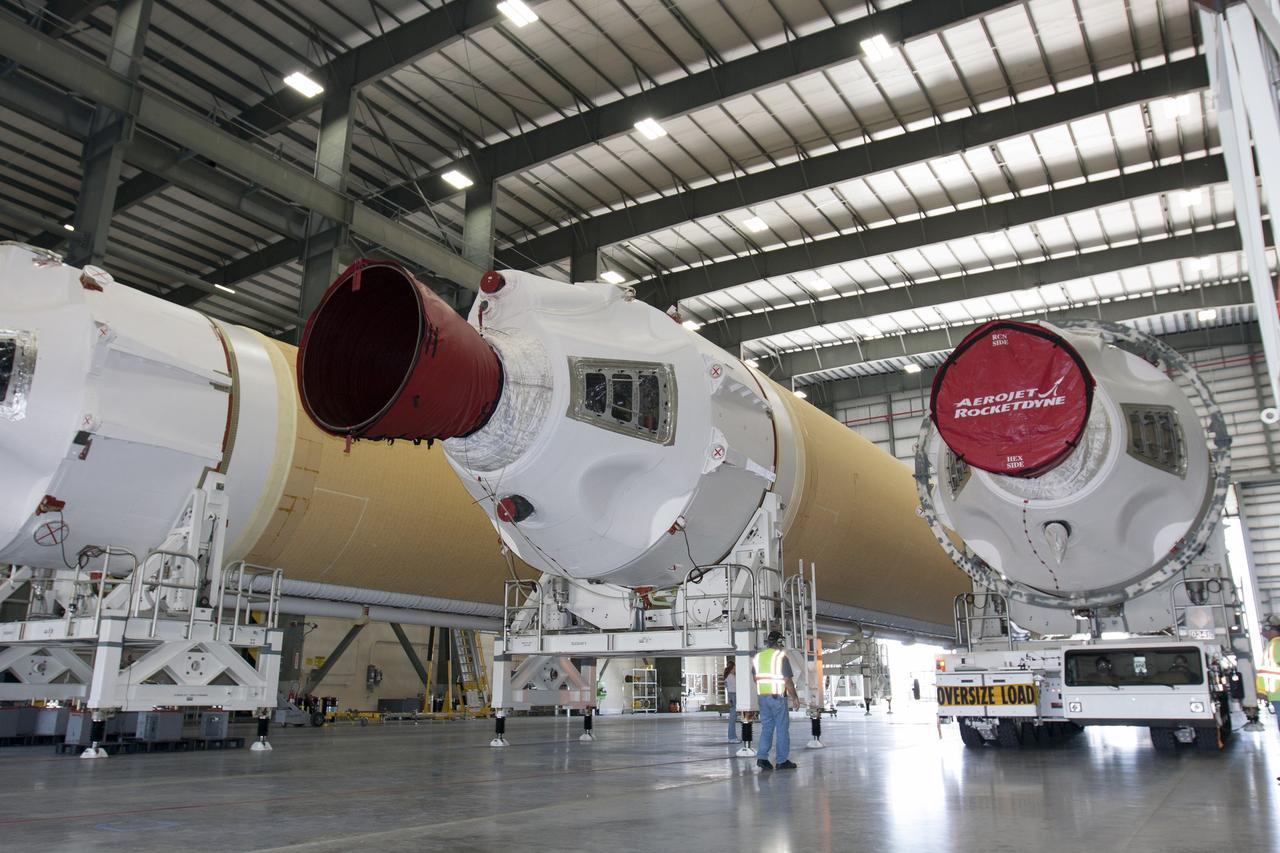
CAPE CANAVERAL, Fla. -- A transporter for oversize loads carries the port booster for the United Launch Alliance Delta IV Heavy for Exploration Flight Test-1, or EFT-1, into the Horizontal Integration Facility, or HIF, at Space Launch Complex 37 on Cape Canaveral Air Force Station in Florida. The port booster joins the other two boosters of the Delta IV Heavy already in the HIF. The upper stage and spacecraft adapter arrived with the booster on a barge at the U.S. Army Outpost wharf at Port Canaveral, and were transported to the HIF on May 6. At the HIF, all three booster stages will be processed and checked out before being moved to the nearby launch pad and hoisted into position. The spacecraft adapter will connect Orion to the ULA Delta IV, and also will connect Orion to NASA's new rocket, the Space Launch System, on its first mission in 2017. During the EFT-1 mission, Orion will travel farther into space than any human spacecraft has gone in more than 40 years. The data gathered during the flight will influence design decisions, validate existing computer models and innovative new approaches to space systems development, as well as reduce overall mission risks and costs for later Orion flights. Liftoff of Orion on EFT-1 is planned for fall 2014. Photo credit: NASA/Kim Shiflett
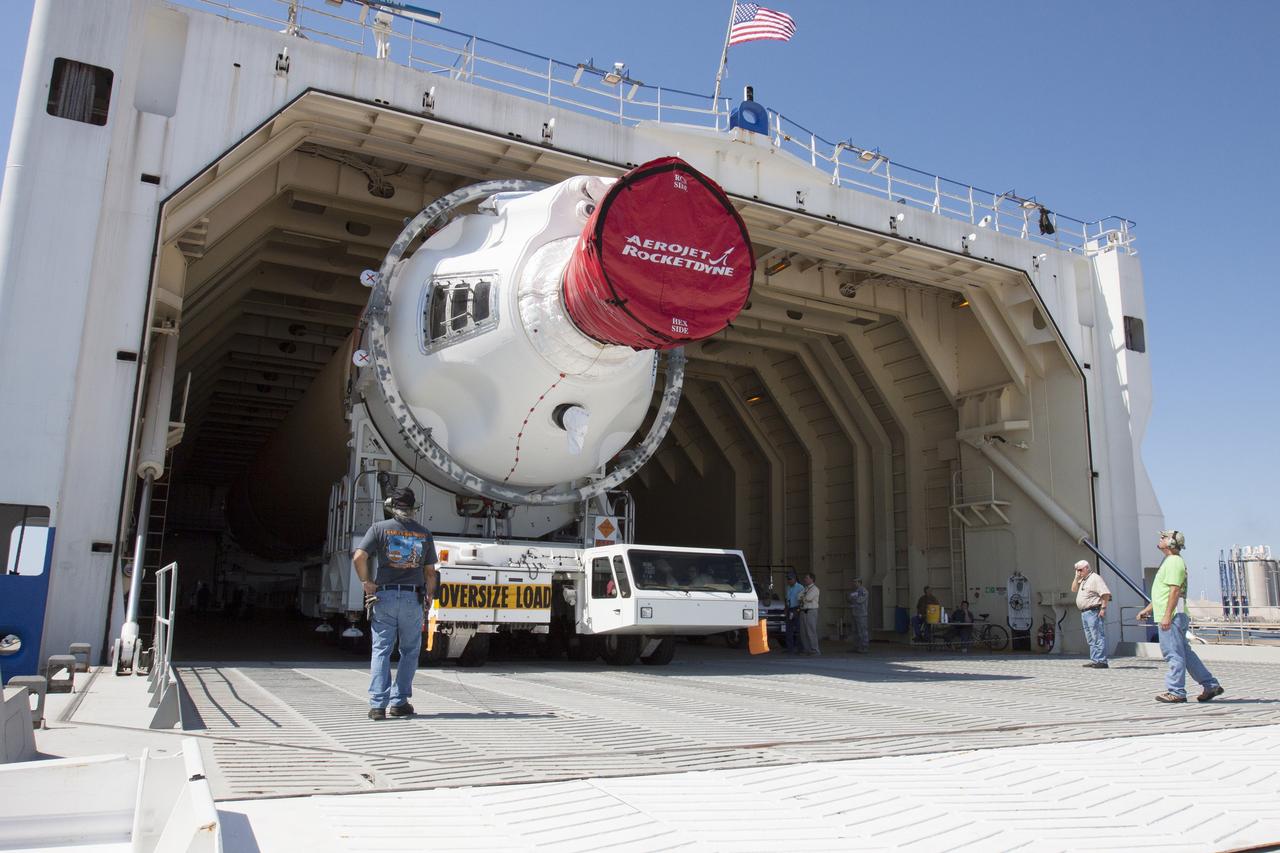
CAPE CANAVERAL, Fla. -- The port booster for the United Launch Alliance Delta IV Heavy for Exploration Flight Test-1, or EFT-1, is being offloaded from the barge at the U.S. Army Outpost wharf at Port Canaveral in Florida and will be transported to the Horizontal Integration Facility, or HIF, at Space Launch Complex 37 on Cape Canaveral Air Force Station. The upper stage and spacecraft adapter arrived with the booster and were transported to the HIF on May 6. At the HIF, all three booster stages will be processed and checked out before being moved to the nearby launch pad and hoisted into position. The spacecraft adapter will connect Orion to the ULA Delta IV, and also will connect Orion to NASA's new rocket, the Space Launch System, on its first mission in 2017. During the EFT-1 mission, Orion will travel farther into space than any human spacecraft has gone in more than 40 years. The data gathered during the flight will influence design decisions, validate existing computer models and innovative new approaches to space systems development, as well as reduce overall mission risks and costs for later Orion flights. Liftoff of Orion on EFT-1 is planned for fall 2014. Photo credit: NASA/Kim Shiflett
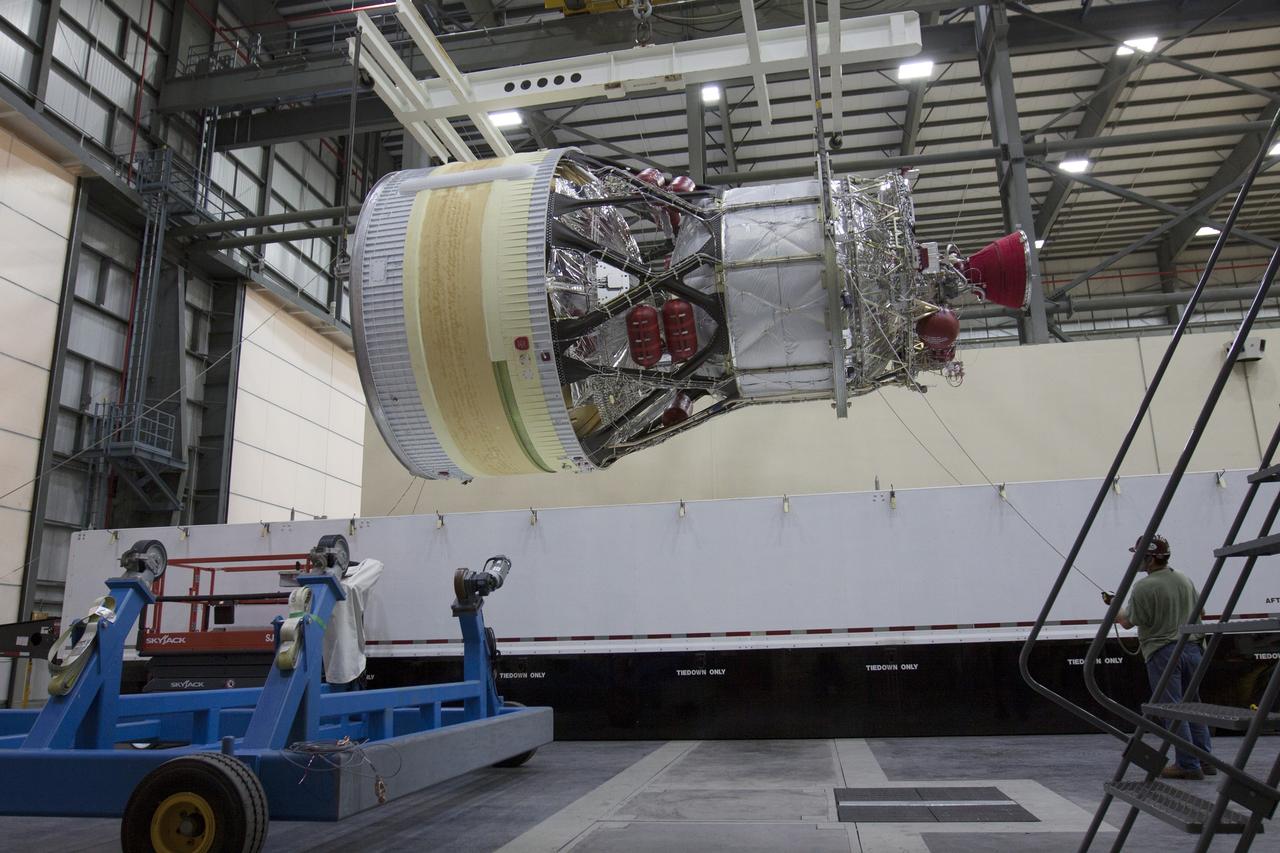
CAPE CANAVERAL, Fla. -- Inside the Horizontal Integration Facility, or HIF, at Space Launch Complex 37 on Cape Canaveral Air Force Station in Florida, the upper stage for the United Launch Alliance Delta IV Heavy for Exploration Flight Test-1, or EFT-1, is being removed from its transportation container. The upper stage, along with the port booster and spacecraft adapter arrived by barge at the U.S. Army Outpost wharf at Port Canaveral in Florida and were transported to the HIF. At the HIF, all three booster stages will be processed and checked out before being moved to the nearby launch pad and hoisted into position. The spacecraft adapter will connect Orion to the ULA Delta IV, and also will connect Orion to NASA's new rocket, the Space Launch System, on its first mission in 2017. During the EFT-1 mission, Orion will travel farther into space than any human spacecraft has gone in more than 40 years. The data gathered during the flight will influence design decisions, validate existing computer models and innovative new approaches to space systems development, as well as reduce overall mission risks and costs for later Orion flights. Liftoff of Orion on EFT-1 is planned for fall 2014. Photo credit: NASA/Kim Shiflett
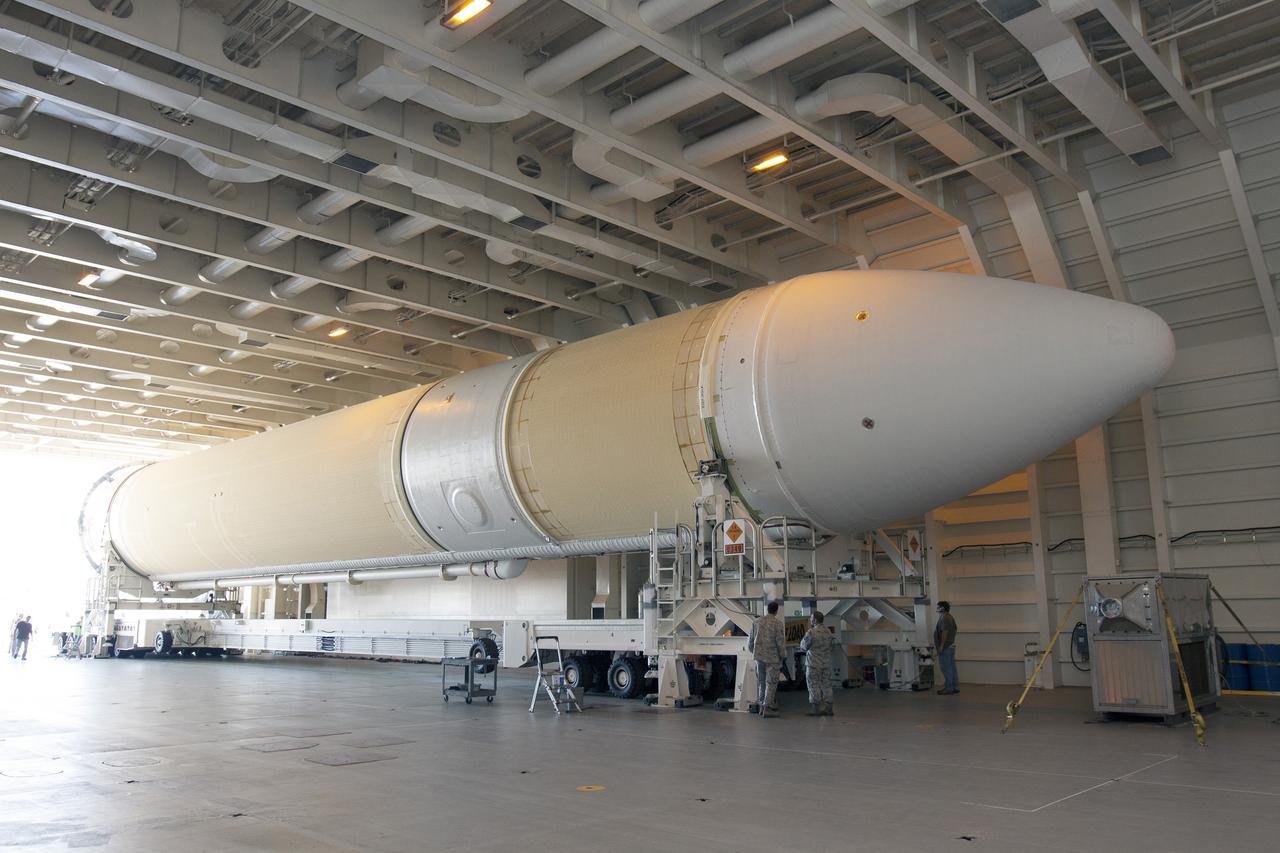
CAPE CANAVERAL, Fla. -- The port booster for the United Launch Alliance Delta IV Heavy for Exploration Flight Test-1, or EFT-1, is being offloaded from the barge at the U.S. Army Outpost wharf at Port Canaveral in Florida and will be transported to the Horizontal Integration Facility, or HIF, at Space Launch Complex 37 on Cape Canaveral Air Force Station. The upper stage and spacecraft adapter arrived with the booster and were transported to the HIF on May 6. At the HIF, all three booster stages will be processed and checked out before being moved to the nearby launch pad and hoisted into position. The spacecraft adapter will connect Orion to the ULA Delta IV, and also will connect Orion to NASA's new rocket, the Space Launch System, on its first mission in 2017. During the EFT-1 mission, Orion will travel farther into space than any human spacecraft has gone in more than 40 years. The data gathered during the flight will influence design decisions, validate existing computer models and innovative new approaches to space systems development, as well as reduce overall mission risks and costs for later Orion flights. Liftoff of Orion on EFT-1 is planned for fall 2014. Photo credit: NASA/Kim Shiflett
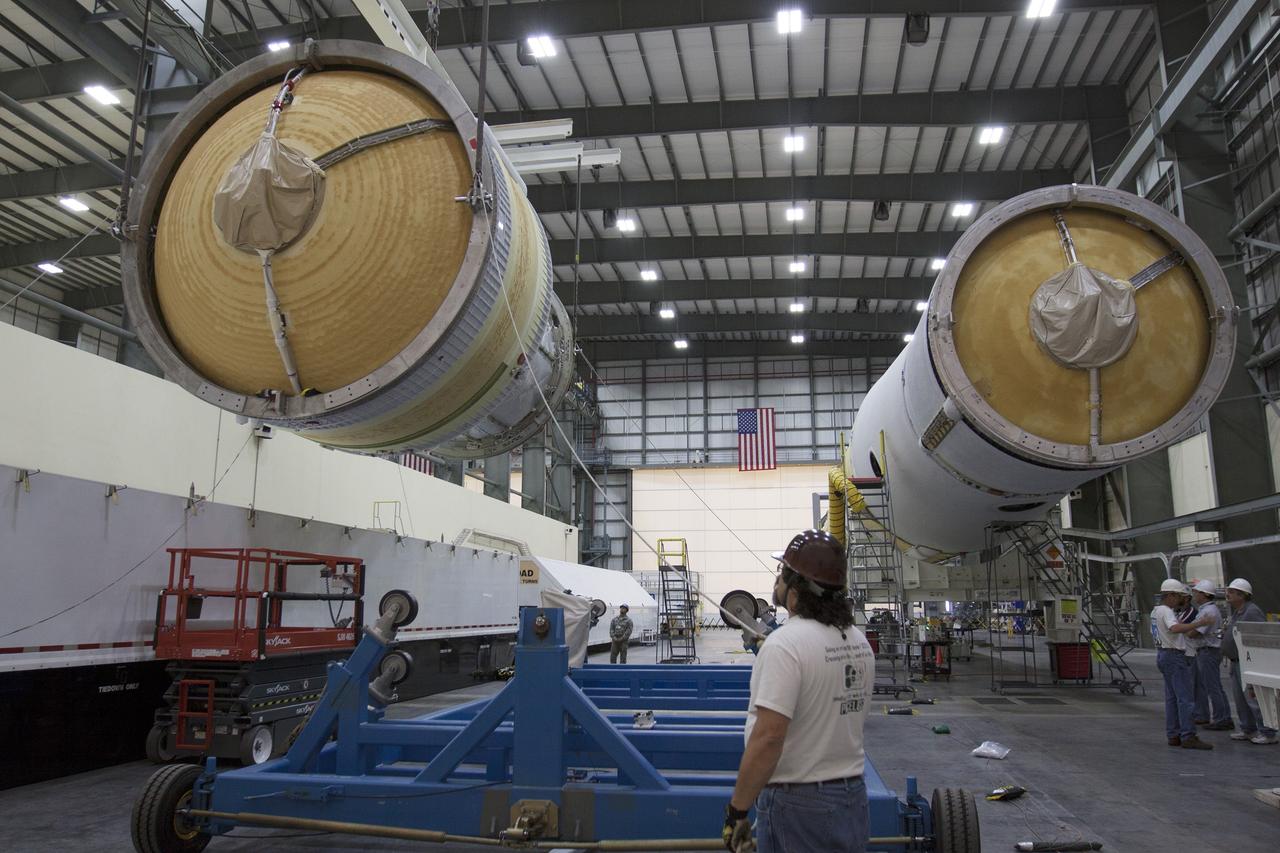
CAPE CANAVERAL, Fla. -- Inside the Horizontal Integration Facility, or HIF, at Space Launch Complex 37 on Cape Canaveral Air Force Station in Florida, the upper stage for the United Launch Alliance Delta IV Heavy for Exploration Flight Test-1, or EFT-1, has been removed from its transportation container and will be lowered onto a cradle. The upper stage, along with the port booster and spacecraft adapter arrived by barge at the U.S. Army Outpost wharf at Port Canaveral in Florida and were transported to the HIF. At the HIF, all three booster stages will be processed and checked out before being moved to the nearby launch pad and hoisted into position. The spacecraft adapter will connect Orion to the ULA Delta IV, and also will connect Orion to NASA's new rocket, the Space Launch System, on its first mission in 2017. During the EFT-1 mission, Orion will travel farther into space than any human spacecraft has gone in more than 40 years. The data gathered during the flight will influence design decisions, validate existing computer models and innovative new approaches to space systems development, as well as reduce overall mission risks and costs for later Orion flights. Liftoff of Orion on EFT-1 is planned for fall 2014. Photo credit: NASA/Kim Shiflett
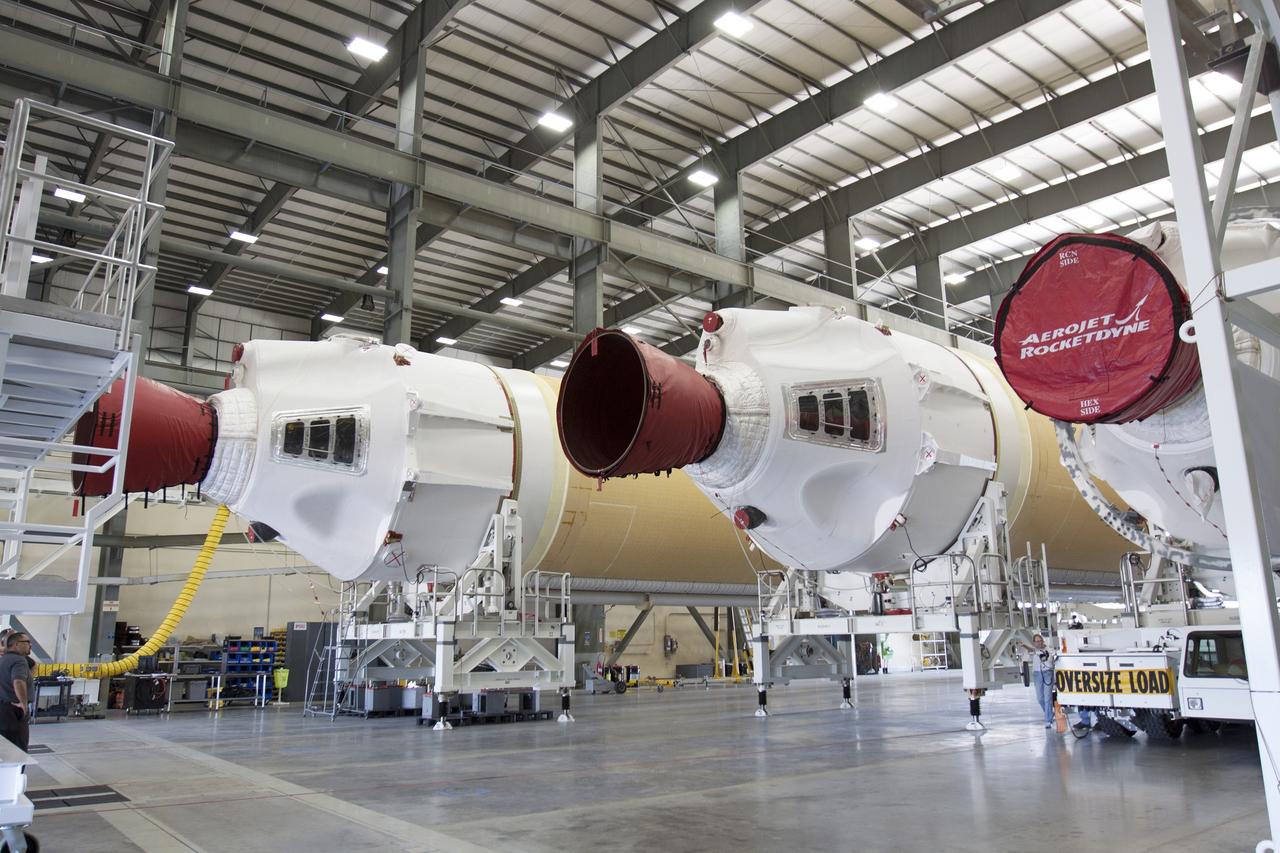
CAPE CANAVERAL, Fla. -- A transporter for oversize loads carries the port booster for the United Launch Alliance Delta IV Heavy for Exploration Flight Test-1, or EFT-1, into the Horizontal Integration Facility, or HIF, at Space Launch Complex 37 on Cape Canaveral Air Force Station in Florida. The port booster joins the other two boosters of the Delta IV Heavy already in the HIF. The upper stage and spacecraft adapter arrived with the booster on a barge at the U.S. Army Outpost wharf at Port Canaveral, and were transported to the HIF on May 6. At the HIF, all three booster stages will be processed and checked out before being moved to the nearby launch pad and hoisted into position. The spacecraft adapter will connect Orion to the ULA Delta IV, and also will connect Orion to NASA's new rocket, the Space Launch System, on its first mission in 2017. During the EFT-1 mission, Orion will travel farther into space than any human spacecraft has gone in more than 40 years. The data gathered during the flight will influence design decisions, validate existing computer models and innovative new approaches to space systems development, as well as reduce overall mission risks and costs for later Orion flights. Liftoff of Orion on EFT-1 is planned for fall 2014. Photo credit: NASA/Kim Shiflett
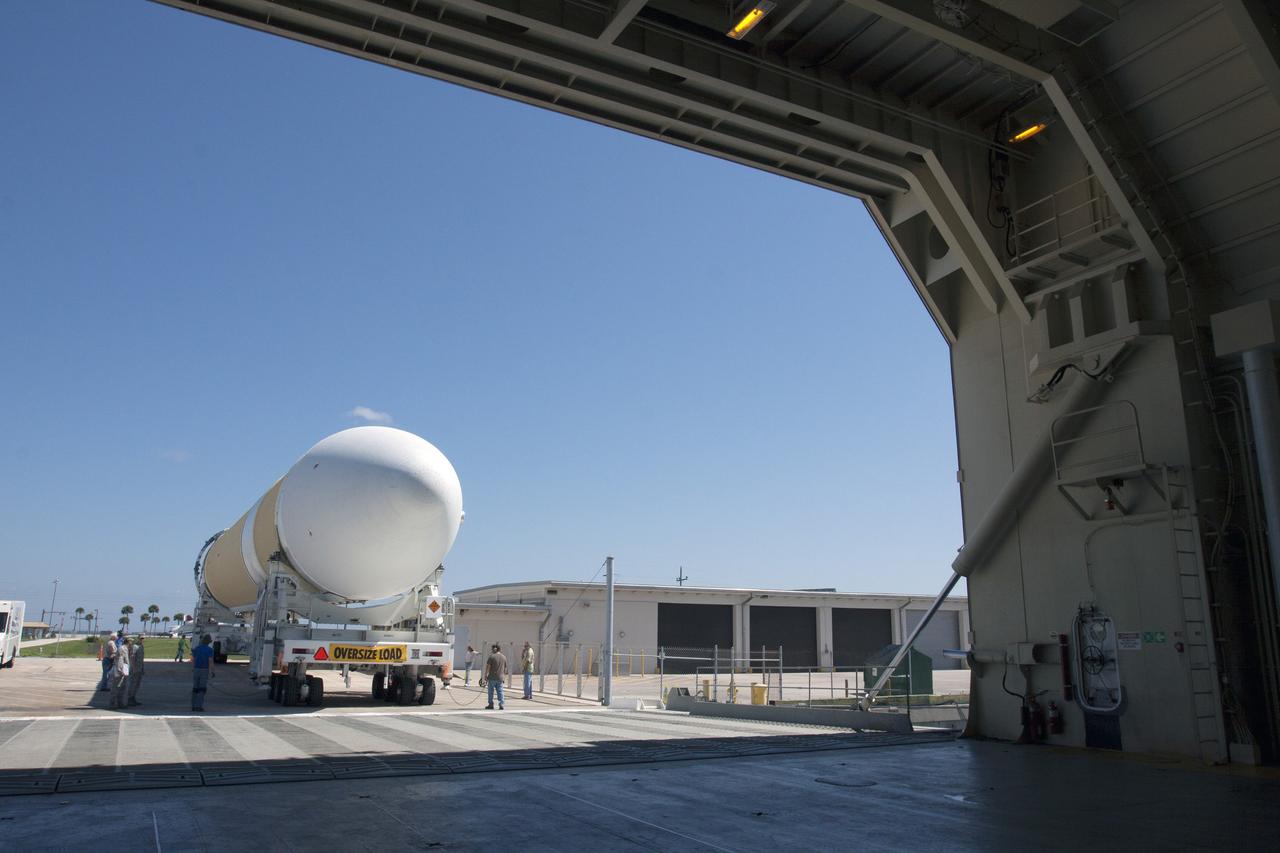
CAPE CANAVERAL, Fla. -- The port booster for the United Launch Alliance Delta IV Heavy for Exploration Flight Test-1, or EFT-1, has been offloaded from the barge at the U.S. Army Outpost wharf at Port Canaveral in Florida and will be transported to the Horizontal Integration Facility, or HIF, at Space Launch Complex 37 on Cape Canaveral Air Force Station. The upper stage and spacecraft adapter arrived with the booster and were transported to the HIF on May 6. At the HIF, all three booster stages will be processed and checked out before being moved to the nearby launch pad and hoisted into position. The spacecraft adapter will connect Orion to the ULA Delta IV, and also will connect Orion to NASA's new rocket, the Space Launch System, on its first mission in 2017. During the EFT-1 mission, Orion will travel farther into space than any human spacecraft has gone in more than 40 years. The data gathered during the flight will influence design decisions, validate existing computer models and innovative new approaches to space systems development, as well as reduce overall mission risks and costs for later Orion flights. Liftoff of Orion on EFT-1 is planned for fall 2014. Photo credit: NASA/Kim Shiflett
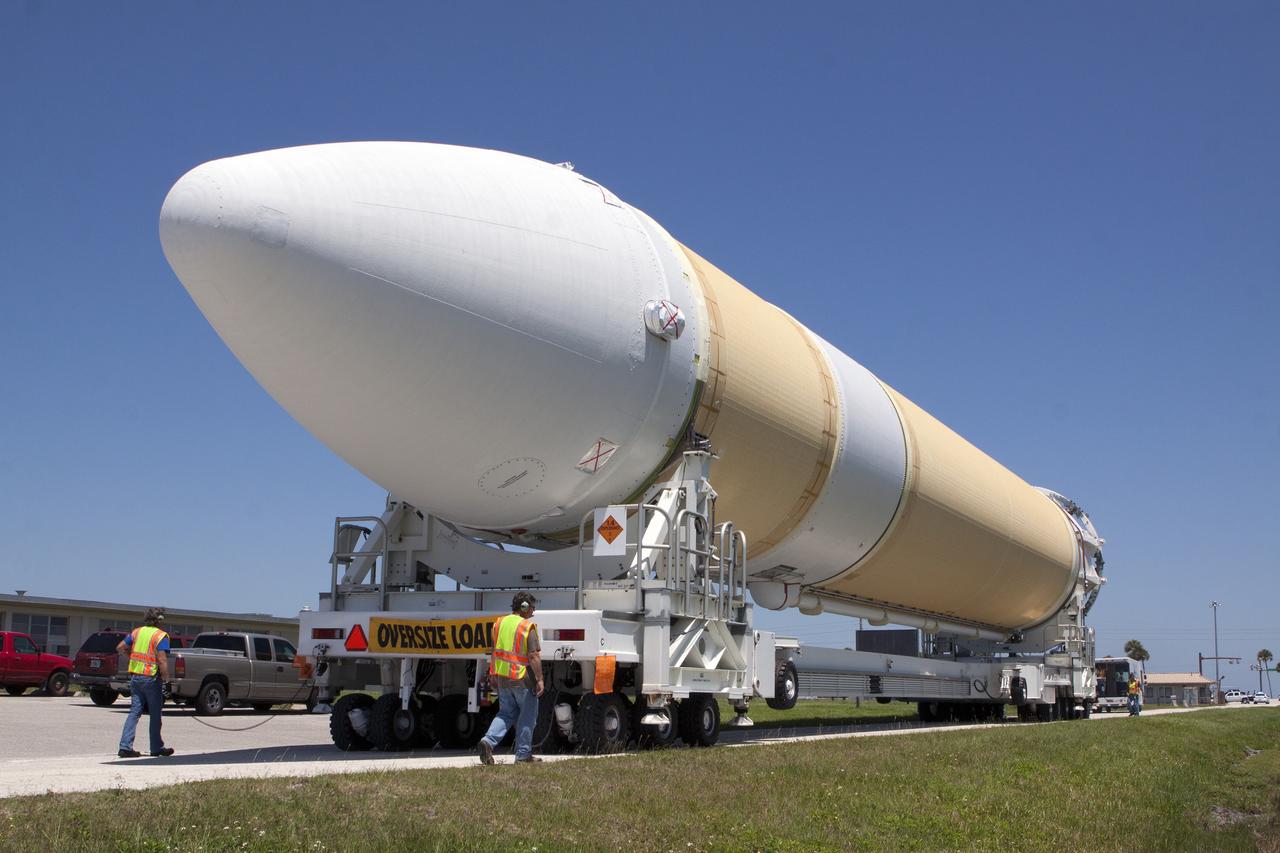
CAPE CANAVERAL, Fla. -- The port booster for the United Launch Alliance Delta IV Heavy for Exploration Flight Test-1, or EFT-1, has been offloaded from the barge at the U.S. Army Outpost wharf at Port Canaveral in Florida and is being transported to the Horizontal Integration Facility, or HIF, at Space Launch Complex 37 on Cape Canaveral Air Force Station. The upper stage and spacecraft adapter arrived with the booster and were transported to the HIF on May 6. At the HIF, all three booster stages will be processed and checked out before being moved to the nearby launch pad and hoisted into position. The spacecraft adapter will connect Orion to the ULA Delta IV, and also will connect Orion to NASA's new rocket, the Space Launch System, on its first mission in 2017. During the EFT-1 mission, Orion will travel farther into space than any human spacecraft has gone in more than 40 years. The data gathered during the flight will influence design decisions, validate existing computer models and innovative new approaches to space systems development, as well as reduce overall mission risks and costs for later Orion flights. Liftoff of Orion on EFT-1 is planned for fall 2014. Photo credit: NASA/Kim Shiflett
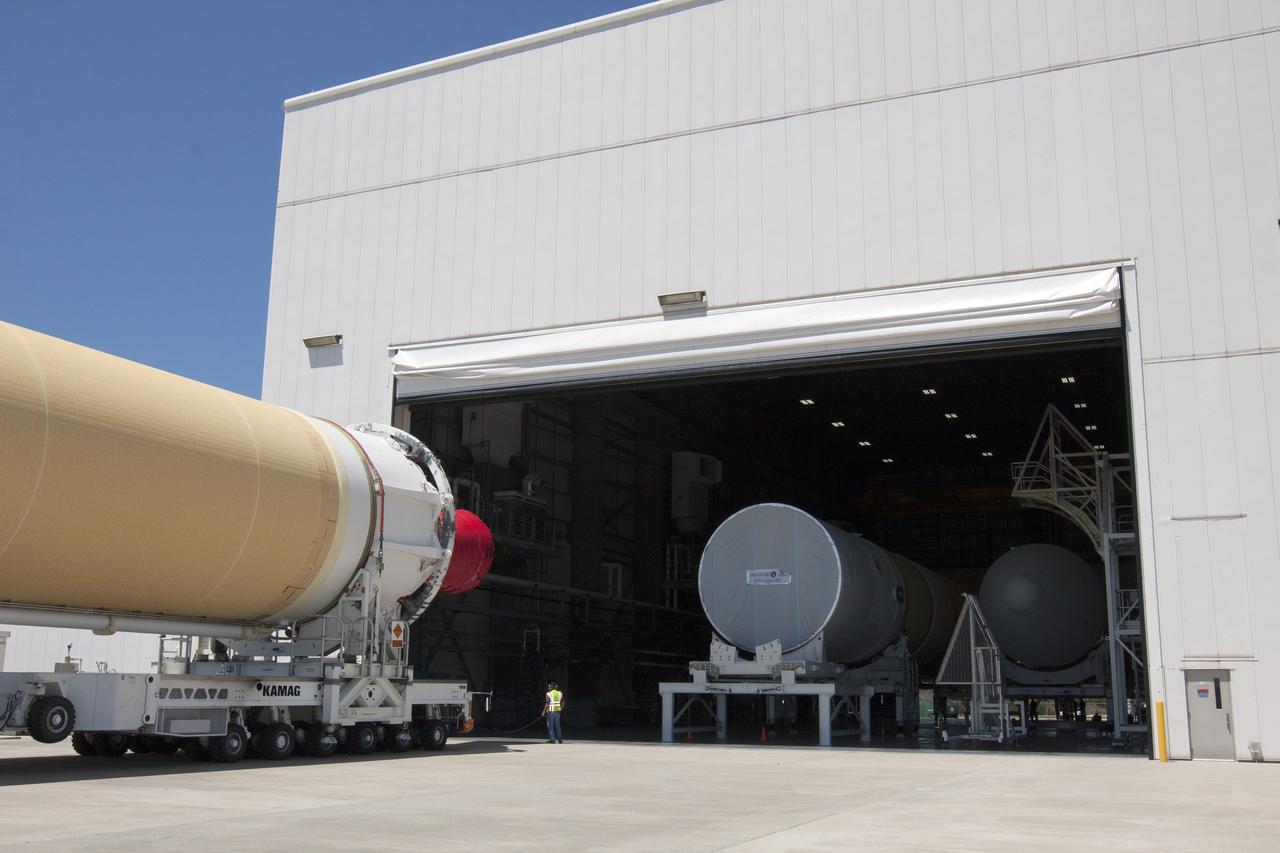
CAPE CANAVERAL, Fla. -- A transporter for oversize loads carries the port booster for the United Launch Alliance Delta IV Heavy for Exploration Flight Test-1, or EFT-1, to the Horizontal Integration Facility, or HIF, at Space Launch Complex 37 on Cape Canaveral Air Force Station in Florida. The upper stage and spacecraft adapter arrived with the booster on a barge at the U.S. Army Outpost wharf at Port Canaveral, and were transported to the HIF on May 6. At the HIF, all three booster stages will be processed and checked out before being moved to the nearby launch pad and hoisted into position. The spacecraft adapter will connect Orion to the ULA Delta IV, and also will connect Orion to NASA's new rocket, the Space Launch System, on its first mission in 2017. During the EFT-1 mission, Orion will travel farther into space than any human spacecraft has gone in more than 40 years. The data gathered during the flight will influence design decisions, validate existing computer models and innovative new approaches to space systems development, as well as reduce overall mission risks and costs for later Orion flights. Liftoff of Orion on EFT-1 is planned for fall 2014. Photo credit: NASA/Kim Shiflett
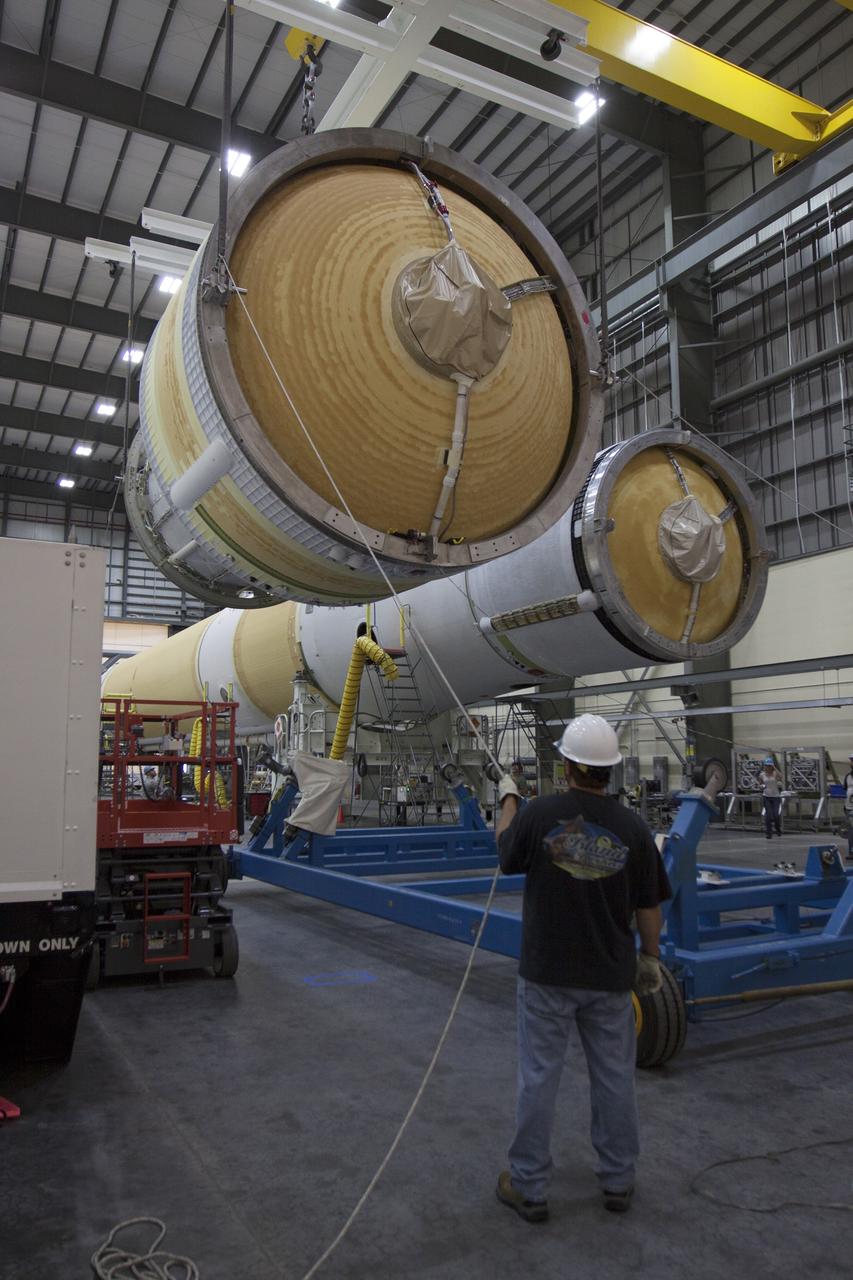
CAPE CANAVERAL, Fla. -- Inside the Horizontal Integration Facility, or HIF, at Space Launch Complex 37 on Cape Canaveral Air Force Station in Florida, the upper stage for the United Launch Alliance Delta IV Heavy for Exploration Flight Test-1, or EFT-1, has been removed from its transportation container and will be lowered onto a cradle. The upper stage, along with the port booster and spacecraft adapter arrived by barge at the U.S. Army Outpost wharf at Port Canaveral in Florida and were transported to the HIF. At the HIF, all three booster stages will be processed and checked out before being moved to the nearby launch pad and hoisted into position. The spacecraft adapter will connect Orion to the ULA Delta IV, and also will connect Orion to NASA's new rocket, the Space Launch System, on its first mission in 2017. During the EFT-1 mission, Orion will travel farther into space than any human spacecraft has gone in more than 40 years. The data gathered during the flight will influence design decisions, validate existing computer models and innovative new approaches to space systems development, as well as reduce overall mission risks and costs for later Orion flights. Liftoff of Orion on EFT-1 is planned for fall 2014. Photo credit: NASA/Kim Shiflett
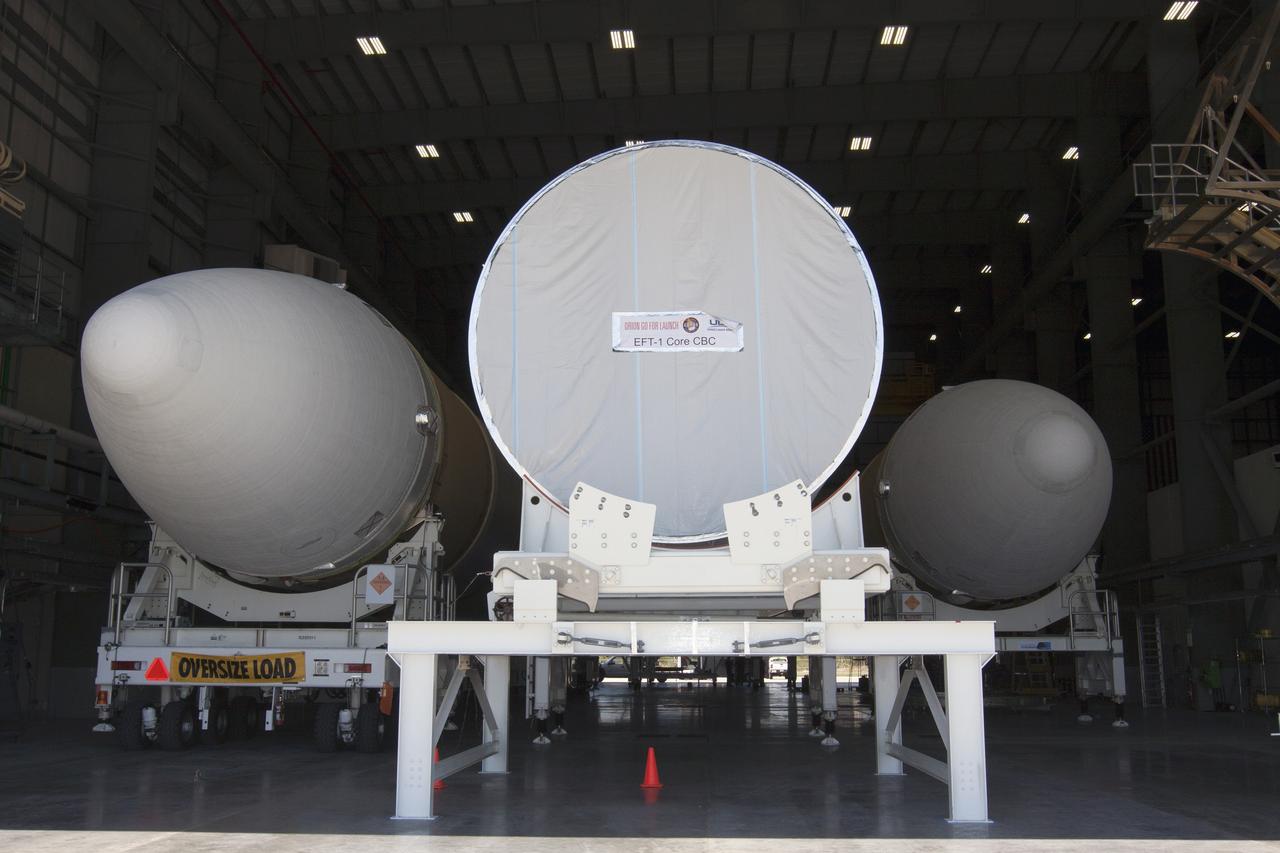
CAPE CANAVERAL, Fla. -- A transporter for oversize loads carries the port booster for the United Launch Alliance Delta IV Heavy for Exploration Flight Test-1, or EFT-1, into the Horizontal Integration Facility, or HIF, at Space Launch Complex 37 on Cape Canaveral Air Force Station in Florida. The port booster joins the other two boosters of the Delta IV Heavy already in the HIF. The upper stage and spacecraft adapter arrived with the booster on a barge at the U.S. Army Outpost wharf at Port Canaveral, and were transported to the HIF on May 6. At the HIF, all three booster stages will be processed and checked out before being moved to the nearby launch pad and hoisted into position. The spacecraft adapter will connect Orion to the ULA Delta IV, and also will connect Orion to NASA's new rocket, the Space Launch System, on its first mission in 2017. During the EFT-1 mission, Orion will travel farther into space than any human spacecraft has gone in more than 40 years. The data gathered during the flight will influence design decisions, validate existing computer models and innovative new approaches to space systems development, as well as reduce overall mission risks and costs for later Orion flights. Liftoff of Orion on EFT-1 is planned for fall 2014. Photo credit: NASA/Kim Shiflett
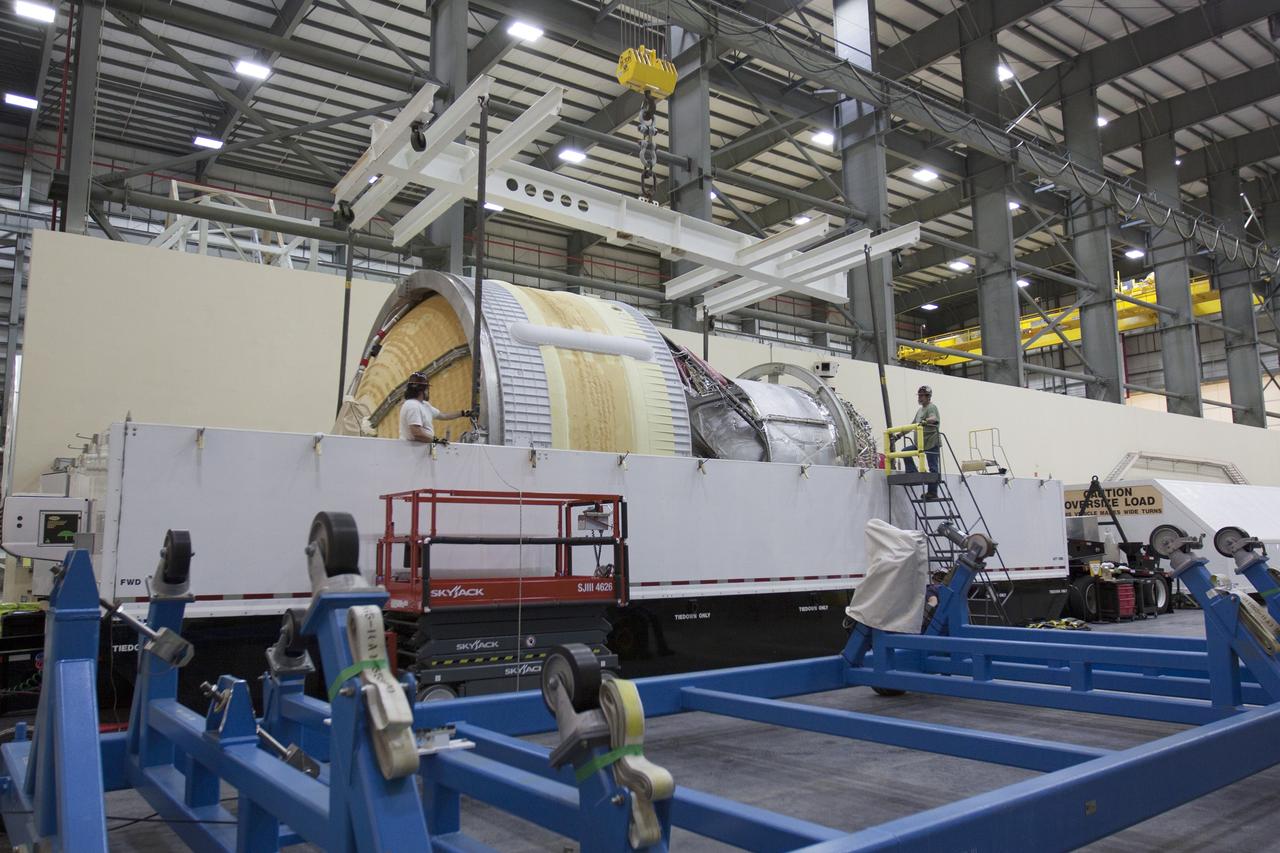
CAPE CANAVERAL, Fla. -- Inside the Horizontal Integration Facility, or HIF, at Space Launch Complex 37 on Cape Canaveral Air Force Station in Florida, the upper stage for the United Launch Alliance Delta IV Heavy for Exploration Flight Test-1, or EFT-1, is being prepared for removal from its transportation container. The upper stage, along with the port booster and spacecraft adapter arrived by barge at the U.S. Army Outpost wharf at Port Canaveral in Florida and were transported to the HIF. At the HIF, all three booster stages will be processed and checked out before being moved to the nearby launch pad and hoisted into position. The spacecraft adapter will connect Orion to the ULA Delta IV, and also will connect Orion to NASA's new rocket, the Space Launch System, on its first mission in 2017. During the EFT-1 mission, Orion will travel farther into space than any human spacecraft has gone in more than 40 years. The data gathered during the flight will influence design decisions, validate existing computer models and innovative new approaches to space systems development, as well as reduce overall mission risks and costs for later Orion flights. Liftoff of Orion on EFT-1 is planned for fall 2014. Photo credit: NASA/Kim Shiflett
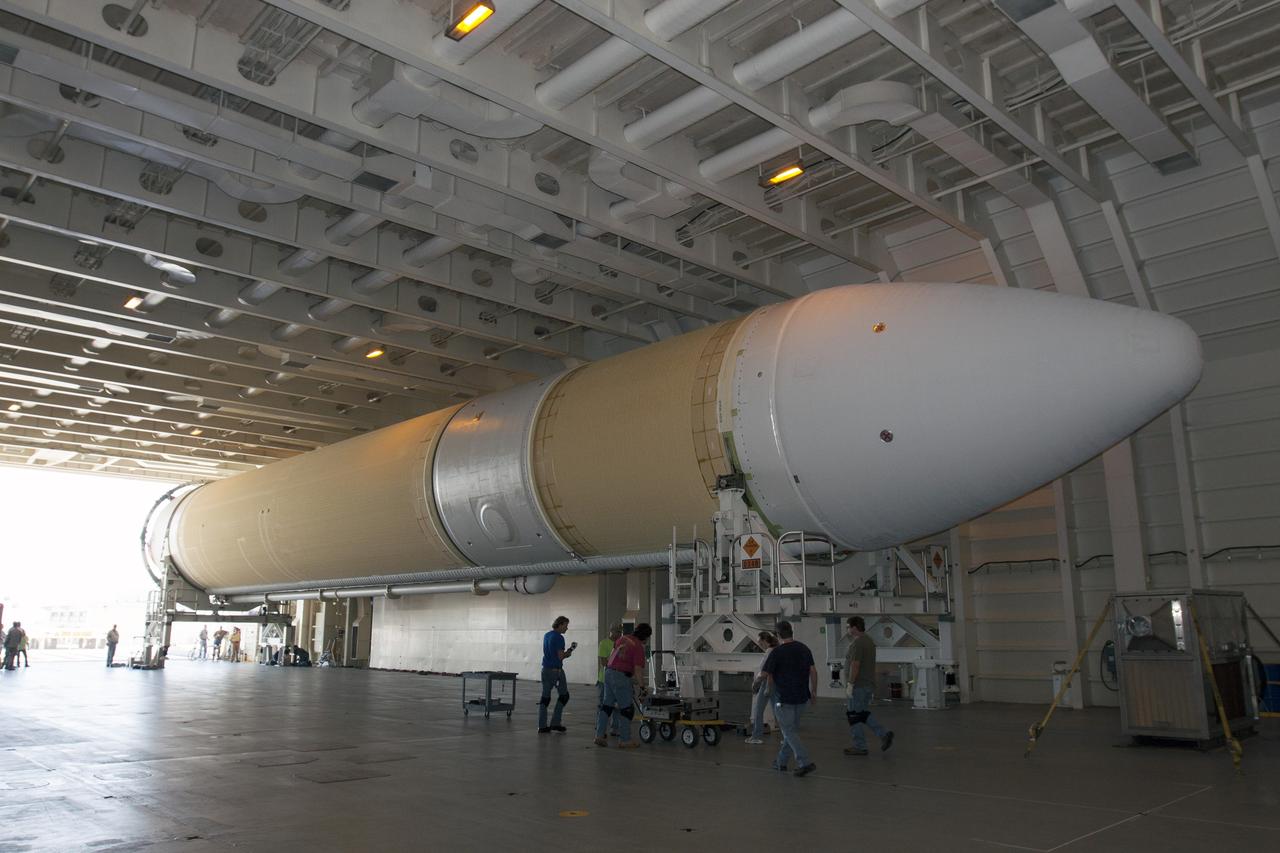
CAPE CANAVERAL, Fla. -- The port booster for the United Launch Alliance Delta IV Heavy for Exploration Flight Test-1, or EFT-1, is being offloaded from the barge at the U.S. Army Outpost wharf at Port Canaveral in Florida and will be transported to the Horizontal Integration Facility, or HIF, at Space Launch Complex 37 on Cape Canaveral Air Force Station. The upper stage and spacecraft adapter arrived with the booster and were transported to the HIF on May 6. At the HIF, all three booster stages will be processed and checked out before being moved to the nearby launch pad and hoisted into position. The spacecraft adapter will connect Orion to the ULA Delta IV, and also will connect Orion to NASA's new rocket, the Space Launch System, on its first mission in 2017. During the EFT-1 mission, Orion will travel farther into space than any human spacecraft has gone in more than 40 years. The data gathered during the flight will influence design decisions, validate existing computer models and innovative new approaches to space systems development, as well as reduce overall mission risks and costs for later Orion flights. Liftoff of Orion on EFT-1 is planned for fall 2014. Photo credit: NASA/Kim Shiflett
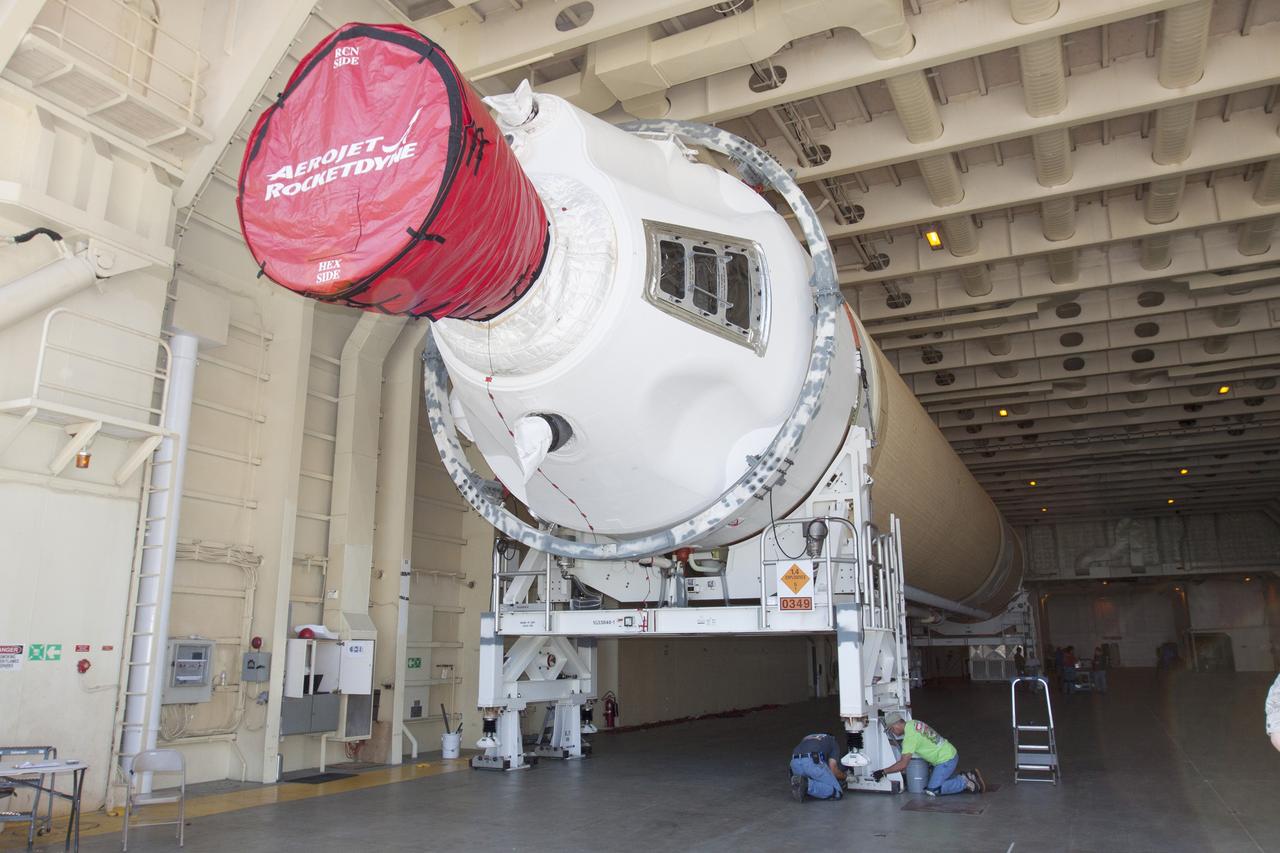
CAPE CANAVERAL, Fla. -- The port booster for the United Launch Alliance Delta IV Heavy for Exploration Flight Test-1, or EFT-1, is being offloaded from the barge at the U.S. Army Outpost wharf at Port Canaveral in Florida and will be transported to the Horizontal Integration Facility, or HIF, at Space Launch Complex 37 on Cape Canaveral Air Force Station. The upper stage and spacecraft adapter arrived with the booster and were transported to the HIF on May 6. At the HIF, all three booster stages will be processed and checked out before being moved to the nearby launch pad and hoisted into position. The spacecraft adapter will connect Orion to the ULA Delta IV, and also will connect Orion to NASA's new rocket, the Space Launch System, on its first mission in 2017. During the EFT-1 mission, Orion will travel farther into space than any human spacecraft has gone in more than 40 years. The data gathered during the flight will influence design decisions, validate existing computer models and innovative new approaches to space systems development, as well as reduce overall mission risks and costs for later Orion flights. Liftoff of Orion on EFT-1 is planned for fall 2014. Photo credit: NASA/Kim Shiflett
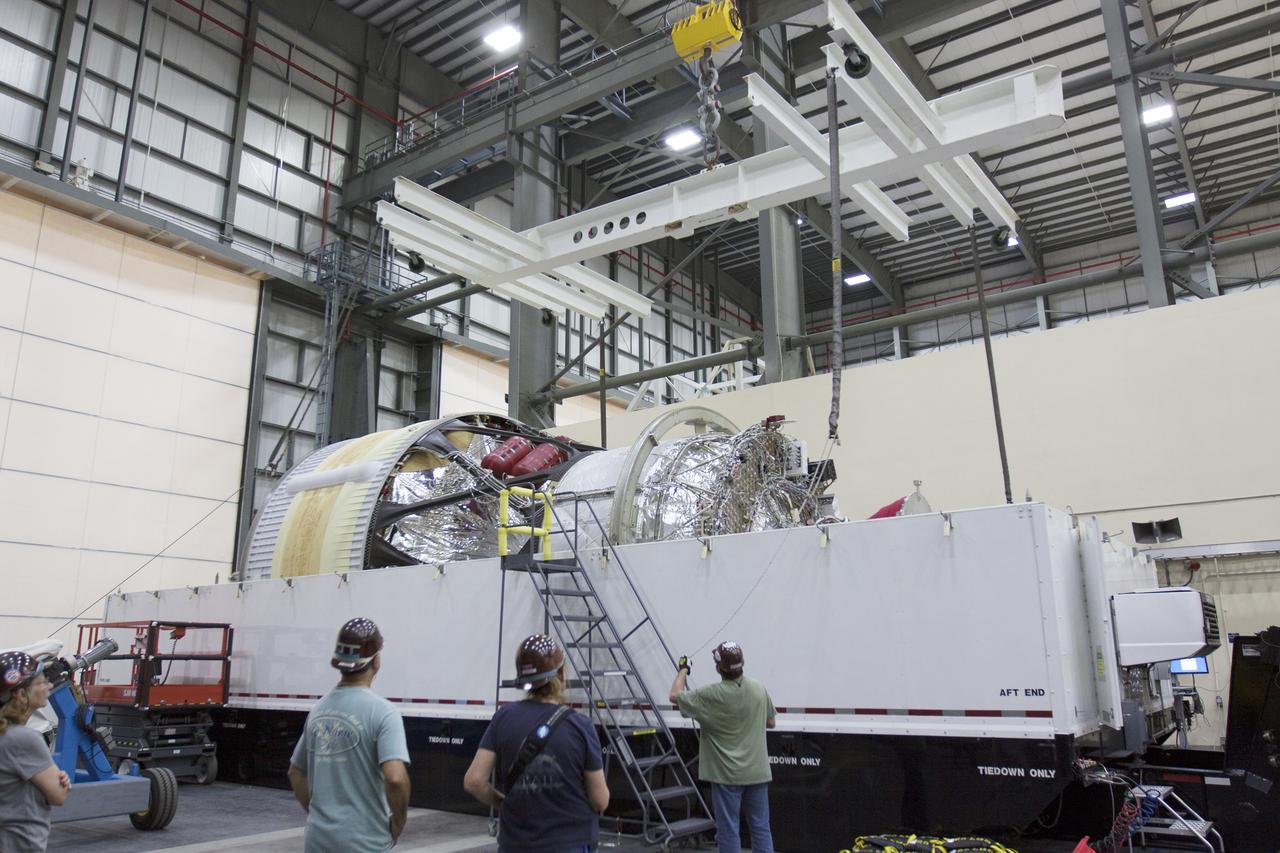
CAPE CANAVERAL, Fla. -- Inside the Horizontal Integration Facility, or HIF, at Space Launch Complex 37 on Cape Canaveral Air Force Station in Florida, the upper stage for the United Launch Alliance Delta IV Heavy for Exploration Flight Test-1, or EFT-1, is being prepared for removal from its transportation container. The upper stage, along with the port booster and spacecraft adapter arrived by barge at the U.S. Army Outpost wharf at Port Canaveral in Florida and were transported to the HIF. At the HIF, all three booster stages will be processed and checked out before being moved to the nearby launch pad and hoisted into position. The spacecraft adapter will connect Orion to the ULA Delta IV, and also will connect Orion to NASA's new rocket, the Space Launch System, on its first mission in 2017. During the EFT-1 mission, Orion will travel farther into space than any human spacecraft has gone in more than 40 years. The data gathered during the flight will influence design decisions, validate existing computer models and innovative new approaches to space systems development, as well as reduce overall mission risks and costs for later Orion flights. Liftoff of Orion on EFT-1 is planned for fall 2014. Photo credit: NASA/Kim Shiflett
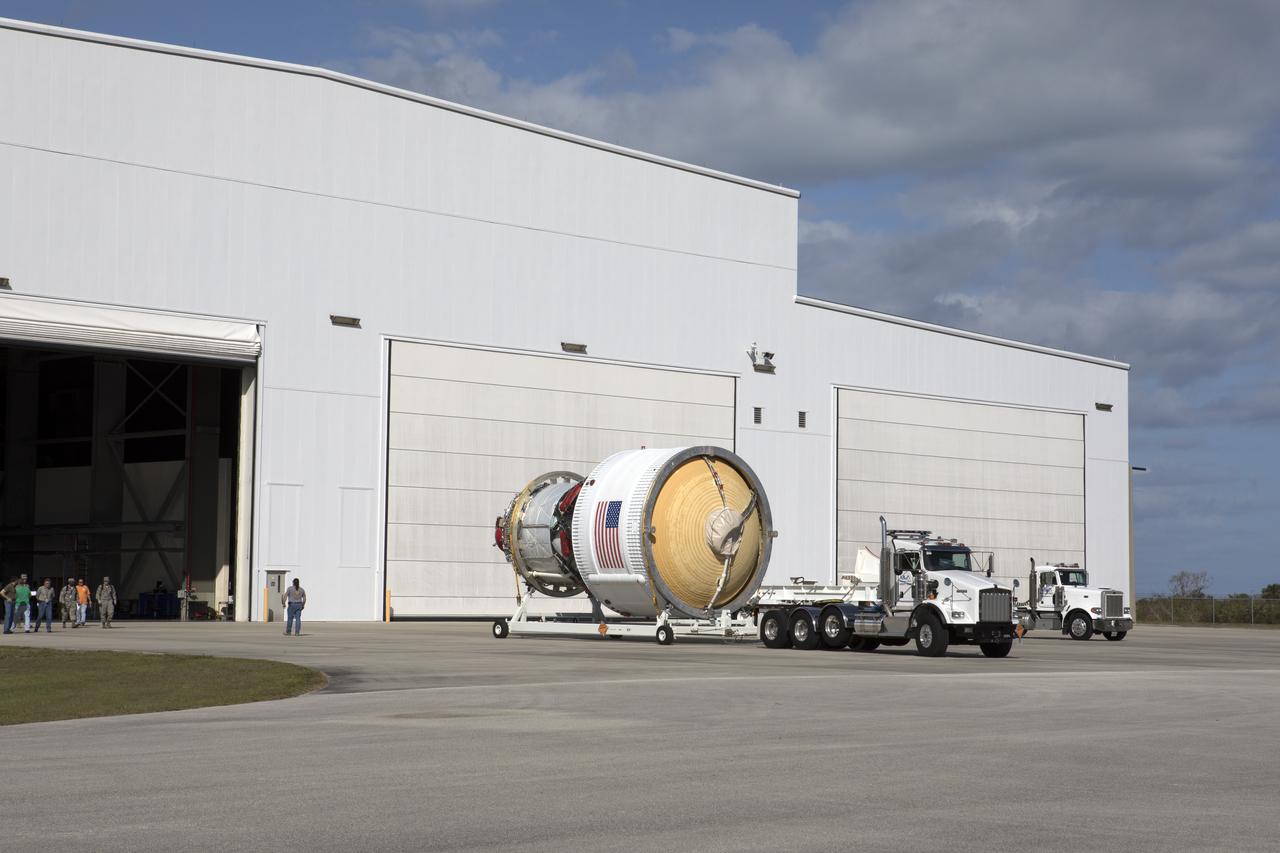
The Interim Cryogenic Propulsion Stage (ICPS) for NASA's Space Launch System (SLS) rocket has been moved on its transport stand by truck out of the United Launch Alliance (ULA) Horizontal Integration Facility near Space Launch Complex 37 at Cape Canaveral Air Force Station in Florida. The ICPS will be transported to the Delta Operations Center. The ICPS is the first integrated piece of flight hardware to arrive for the SLS. It is the in-space stage that is located toward the top of the rocket, between the Launch Vehicle Stage Adapter and the Orion Spacecraft Adapter. It will provide some of the in-space propulsion during Orion's first flight test atop the SLS on Exploration Mission-1.
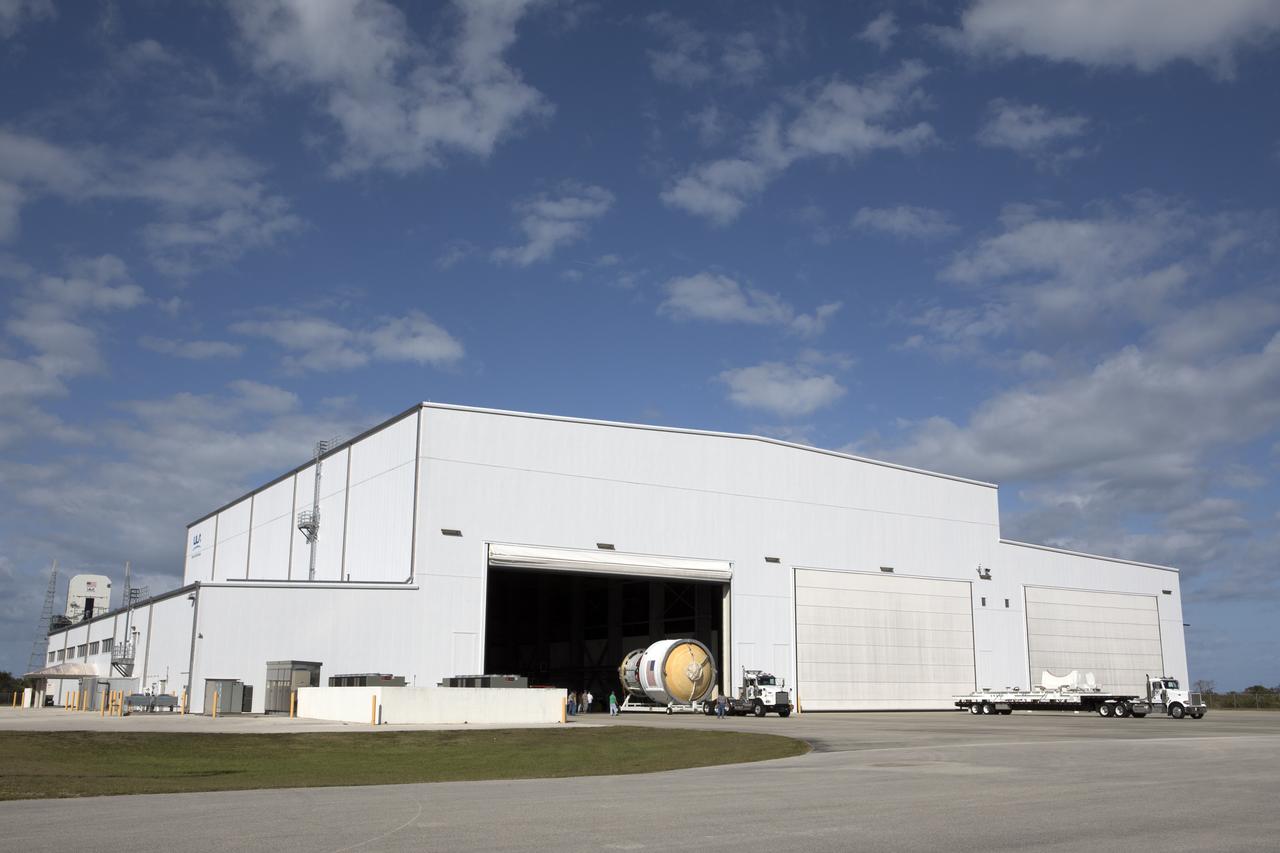
The Interim Cryogenic Propulsion Stage (ICPS) for NASA's Space Launch System (SLS) rocket is moved on its transport stand by truck out of the United Launch Alliance (ULA) Horizontal Integration Facility near Space Launch Complex 37 at Cape Canaveral Air Force Station in Florida. The ICPS will be transported to the Delta Operations Center. The ICPS is the first integrated piece of flight hardware to arrive for the SLS. It is the in-space stage that is located toward the top of the rocket, between the Launch Vehicle Stage Adapter and the Orion Spacecraft Adapter. It will provide some of the in-space propulsion during Orion's first flight test atop the SLS on Exploration Mission-1.
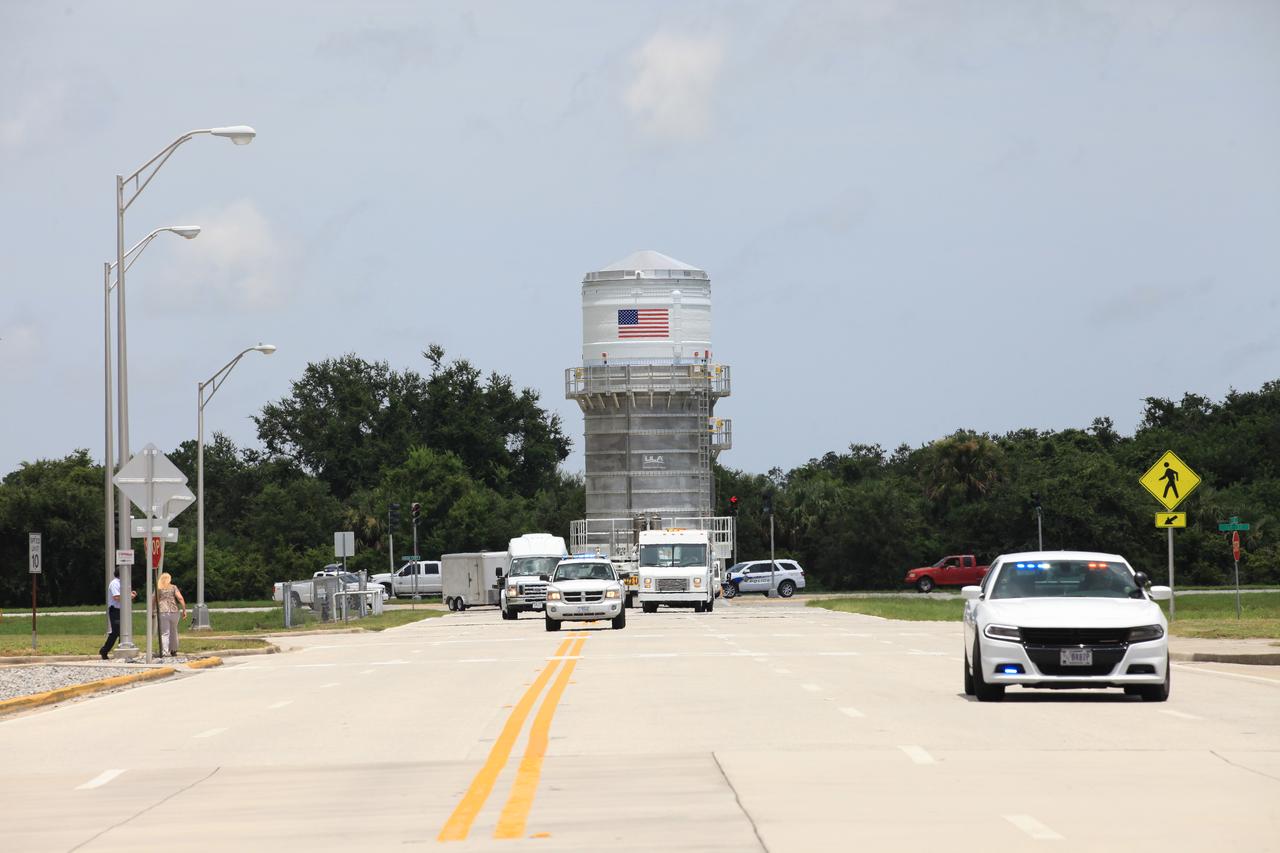
Packed inside its canister, the Interim Cryogenic Propulsion Stage (ICPS) for NASA's Space Launch System (SLS) rocket is being transported to the Space Station Processing Facility at NASA's Kennedy Space Center in Florida. The ICPS is the first integrated piece of flight hardware to arrive for the SLS. It is the in-space stage that is located toward the top of the rocket, between the Launch Vehicle Stage Adapter and the Orion Spacecraft Adapter. It will provide some of the in-space propulsion during Orion's first flight test atop the SLS on Exploration Mission-1.
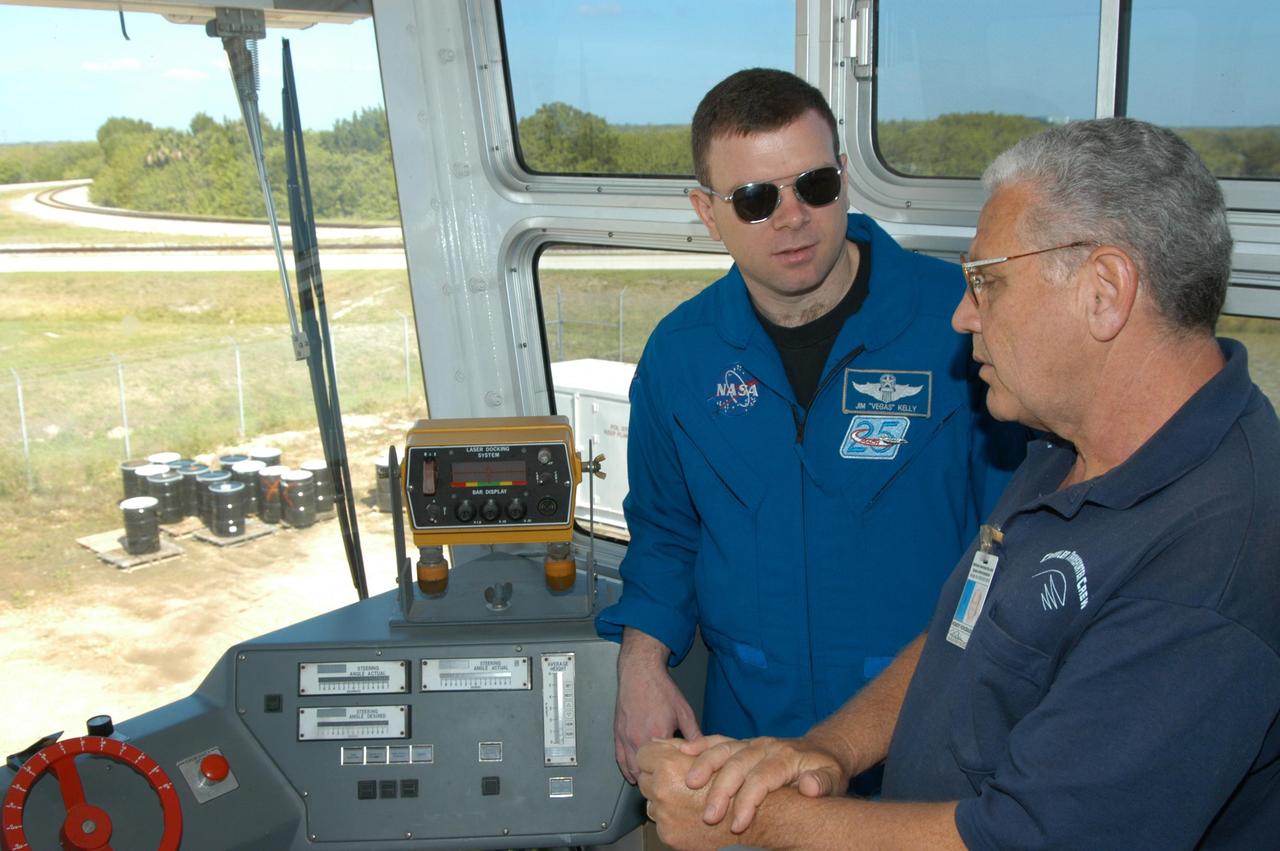
KENNEDY SPACE CENTER, FLA. -- STS-114 Pilot James Kelly (left) talks with NASA Systems Engineer Robert Rokobauer inside one of the cabs on a Crawler-Transporter. The crawlers had recent modifications to the cab and muffler system. The STS-114 mission is Logistics Flight 1, which is scheduled to deliver supplies and equipment plus the external stowage platform to the International Space Station.
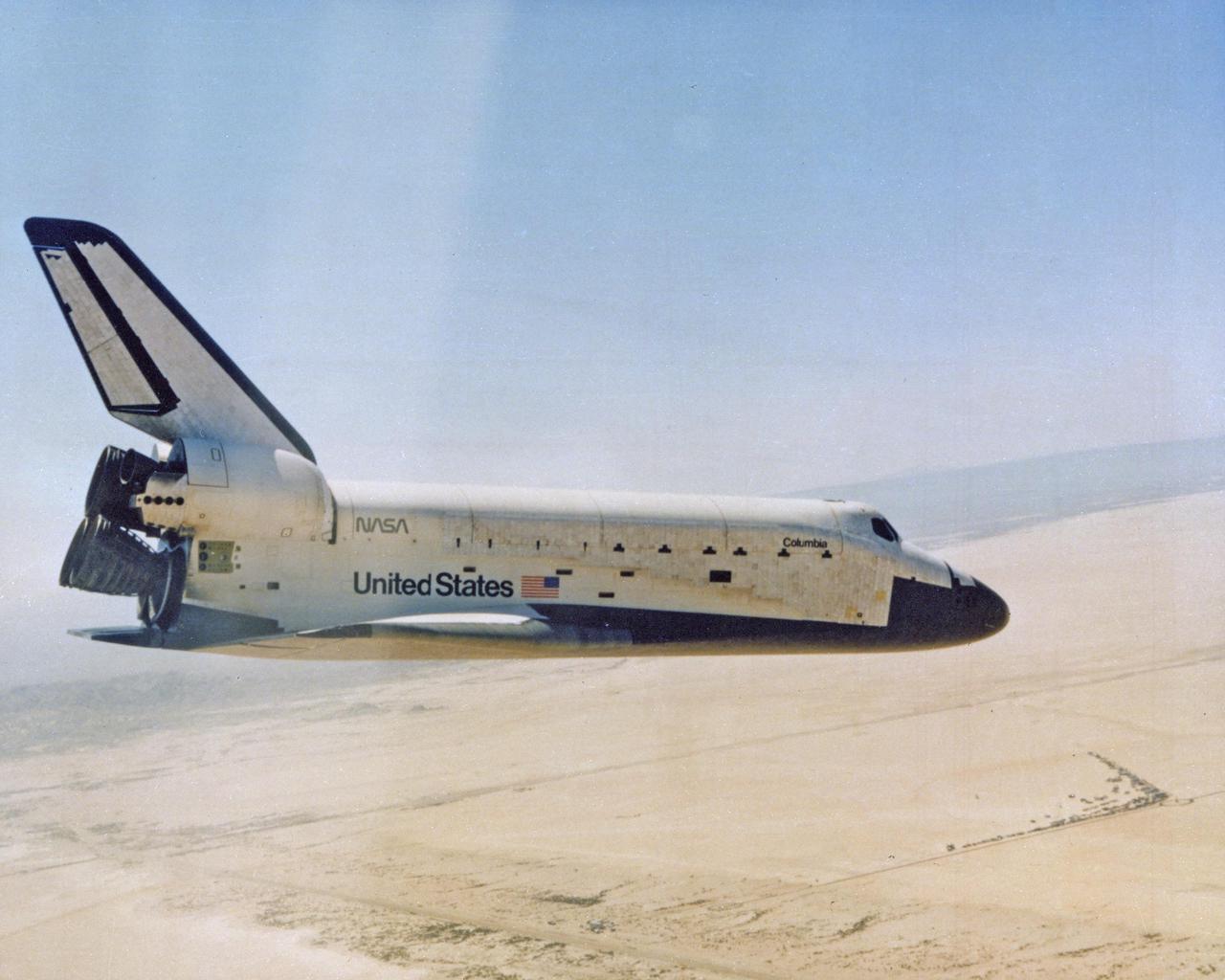
DRYDEN FLIGHT RESEARCH CENTER, CALIF. - Columbia returns to Earth. Completing the first full test of the Space Transportation System (STS-1), the orbiter Columbia is seen here on its final approach prior to landing on Rogers dry lake, Runway 23, at NASA's Dryden Flight Research Center, Edwards, California. For this first flight the Columbia was flown by astronauts John Young, commander, and Robert Crippen, pilot.
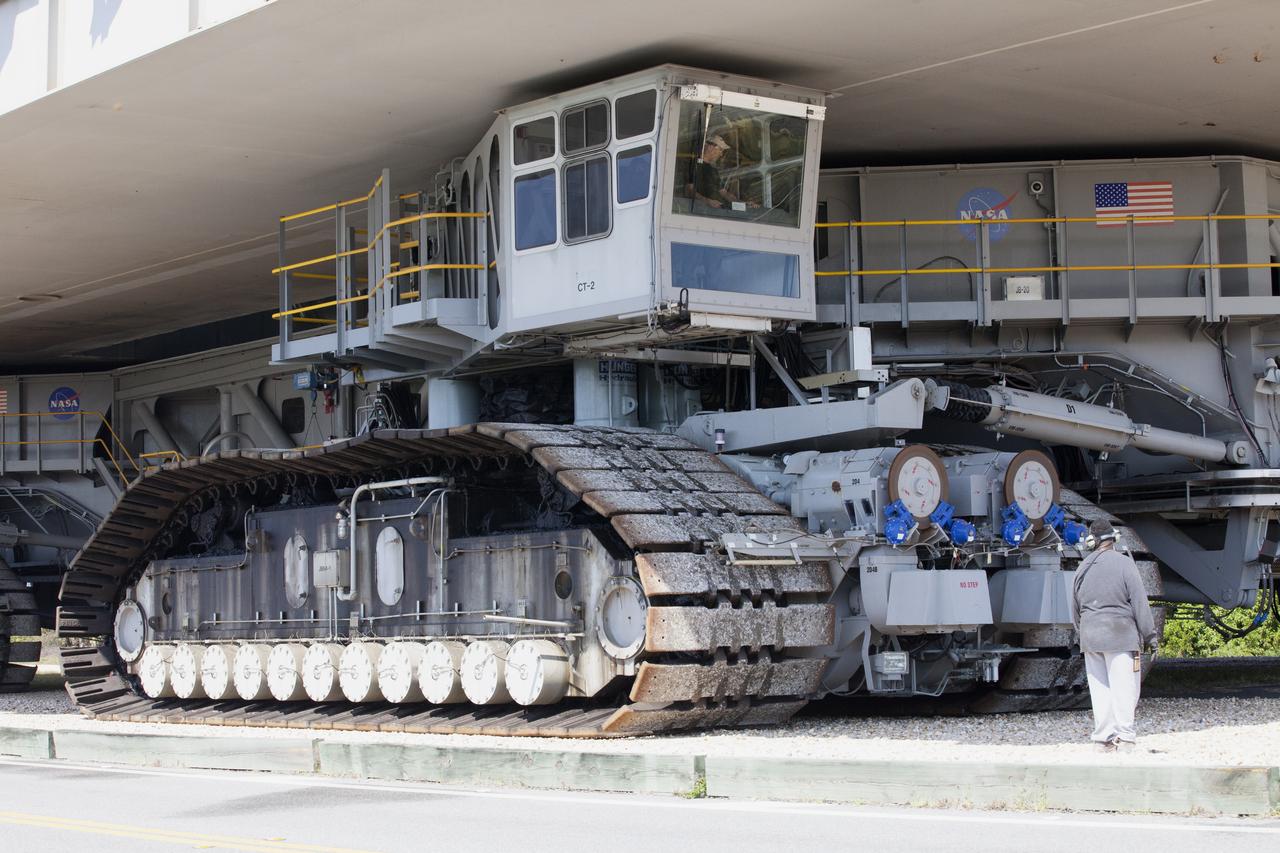
NASA's upgraded crawler-transporter 2 (CT-2), carrying mobile launcher platform 1, moves slowly along the crawlerway at the agency's Kennedy Space Center in Florida. The crawler's upgrades and modifications will be monitored and tested under loaded conditions during its travel to the crawlerway Pad A/B split and back to the crawler yard to confirm it is ready to support the load of the mobile launcher carrying the Space Launch System with Orion atop for the first test flight, Exploration Mission 1. The Ground Systems Development and Operations Program at Kennedy is managing upgrades to the crawler.
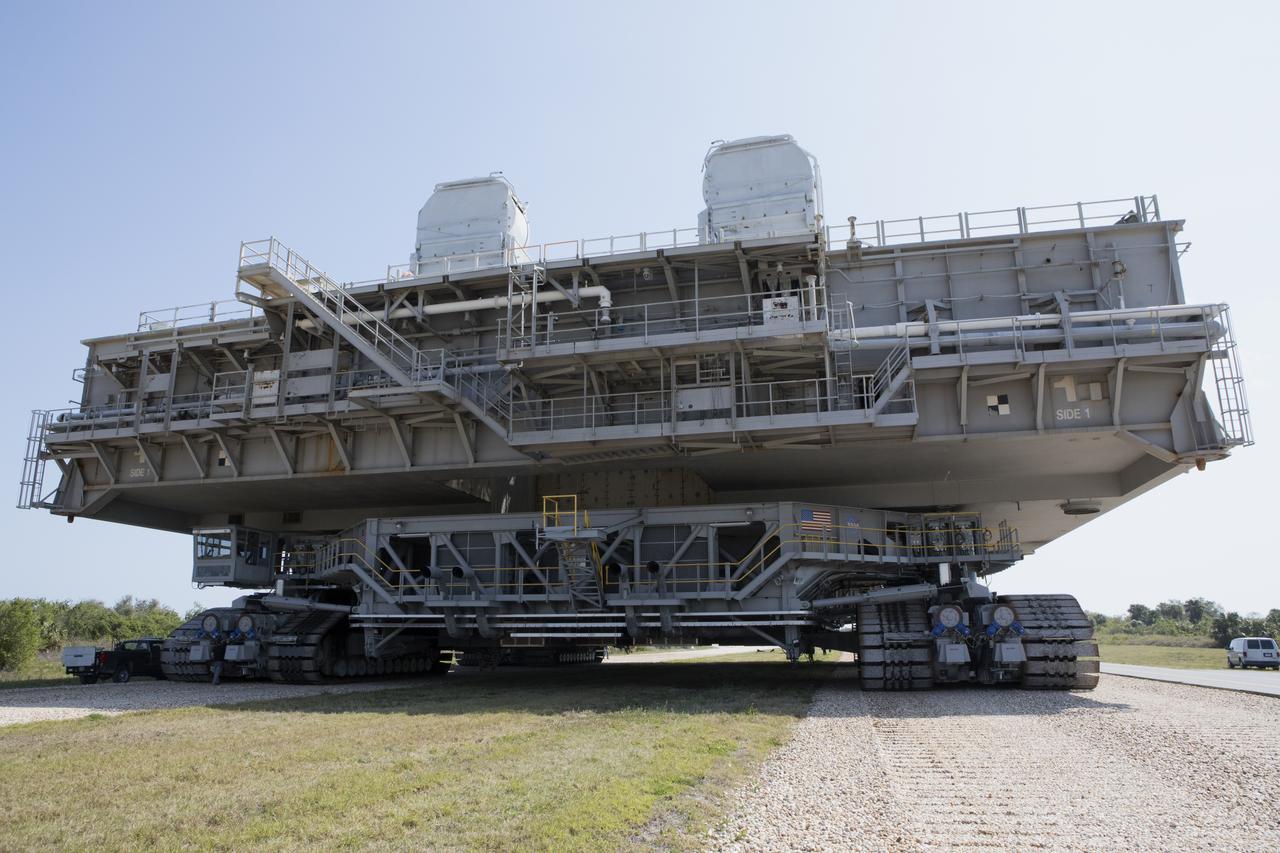
NASA's upgraded crawler-transporter 2 (CT-2), carrying mobile launcher platform 1, moves slowly along the crawlerway at the agency's Kennedy Space Center in Florida. The crawler's upgrades and modifications will be monitored and tested under loaded conditions during its travel to the crawlerway Pad A/B split and back to the crawler yard to confirm it is ready to support the load of the mobile launcher carrying the Space Launch System with Orion atop for the first test flight, Exploration Mission 1. The Ground Systems Development and Operations Program at Kennedy is managing upgrades to the crawler.
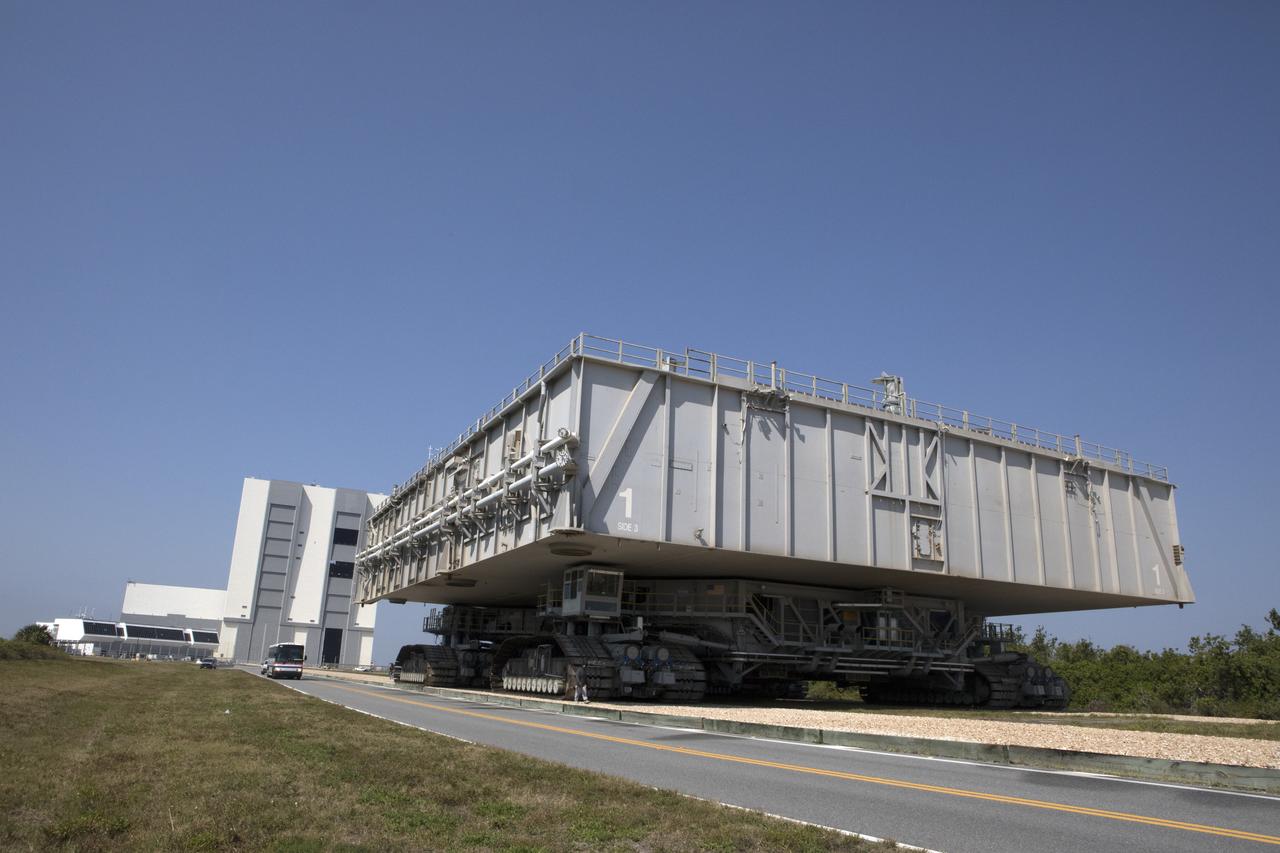
NASA's upgraded crawler-transporter 2 (CT-2), carrying mobile launcher platform 1, moves slowly along the crawlerway toward the Vehicle Assembly Building at the agency's Kennedy Space Center in Florida. The crawler's upgrades and modifications were monitored and tested during a loaded test to the crawlerway Pad A/B split. CT-2 will return to the crawler yard. The crawler is being tested to confirm it is ready to support the load of the mobile launcher carrying the Space Launch System with Orion atop for the first test flight, Exploration Mission 1. The Ground Systems Development and Operations Program at Kennedy is managing upgrades to the crawler.
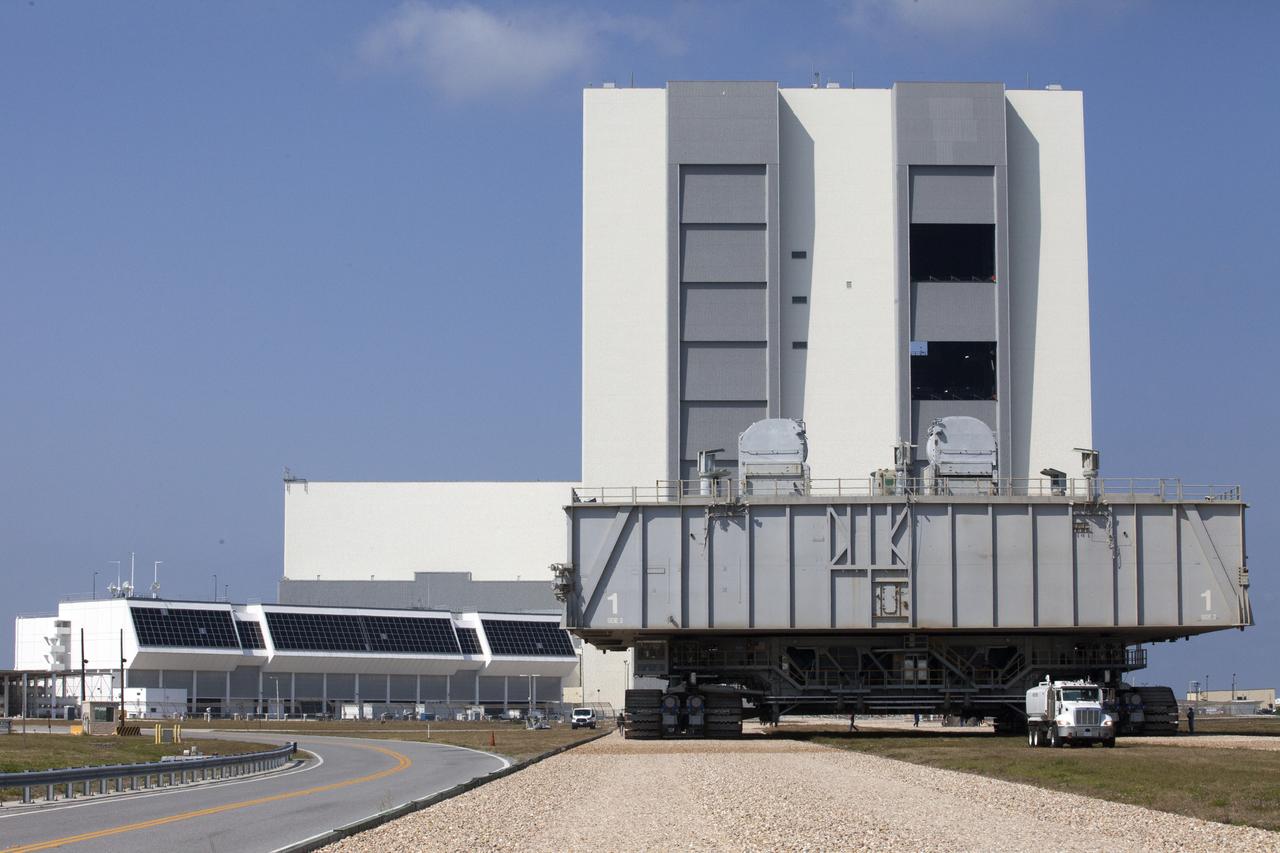
NASA’s upgraded crawler-transporter 2 (CT-2) travels slowly along the crawlerway carrying mobile launcher platform 1 at the agency’s Kennedy Space Center in Florida. The crawler's upgrades and modifications were being monitored and tested under loaded conditions during its travel to the Pad A/B split and back to the crawler yard to confirm it is ready to support the load of the mobile launcher carrying the Space Launch System with Orion atop for the first test flight, Exploration Mission 1. A truck sprays water in front of the crawler to control dust as the large vehicle moves along. The Ground Systems Development and Operations Program at Kennedy is managing upgrades to the crawler.
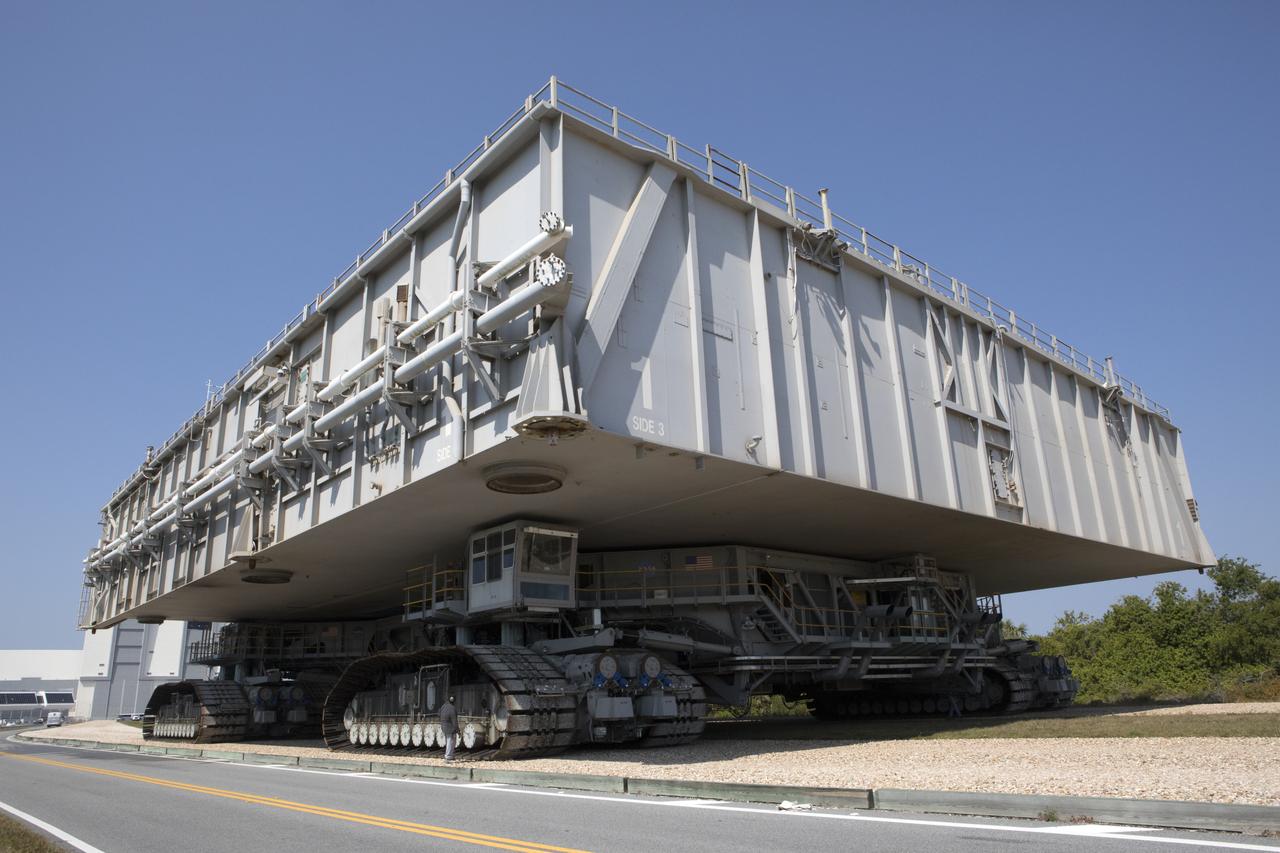
NASA's upgraded crawler-transporter 2 (CT-2), carrying mobile launcher platform 1, moves slowly along the crawlerway toward the Vehicle Assembly Building at the agency's Kennedy Space Center in Florida. The crawler's upgrades and modifications were monitored and tested during a loaded test to the crawlerway Pad A/B split. CT-2 will return to the crawler yard. The crawler is being tested to confirm it is ready to support the load of the mobile launcher carrying the Space Launch System with Orion atop for the first test flight, Exploration Mission 1. The Ground Systems Development and Operations Program at Kennedy is managing upgrades to the crawler.
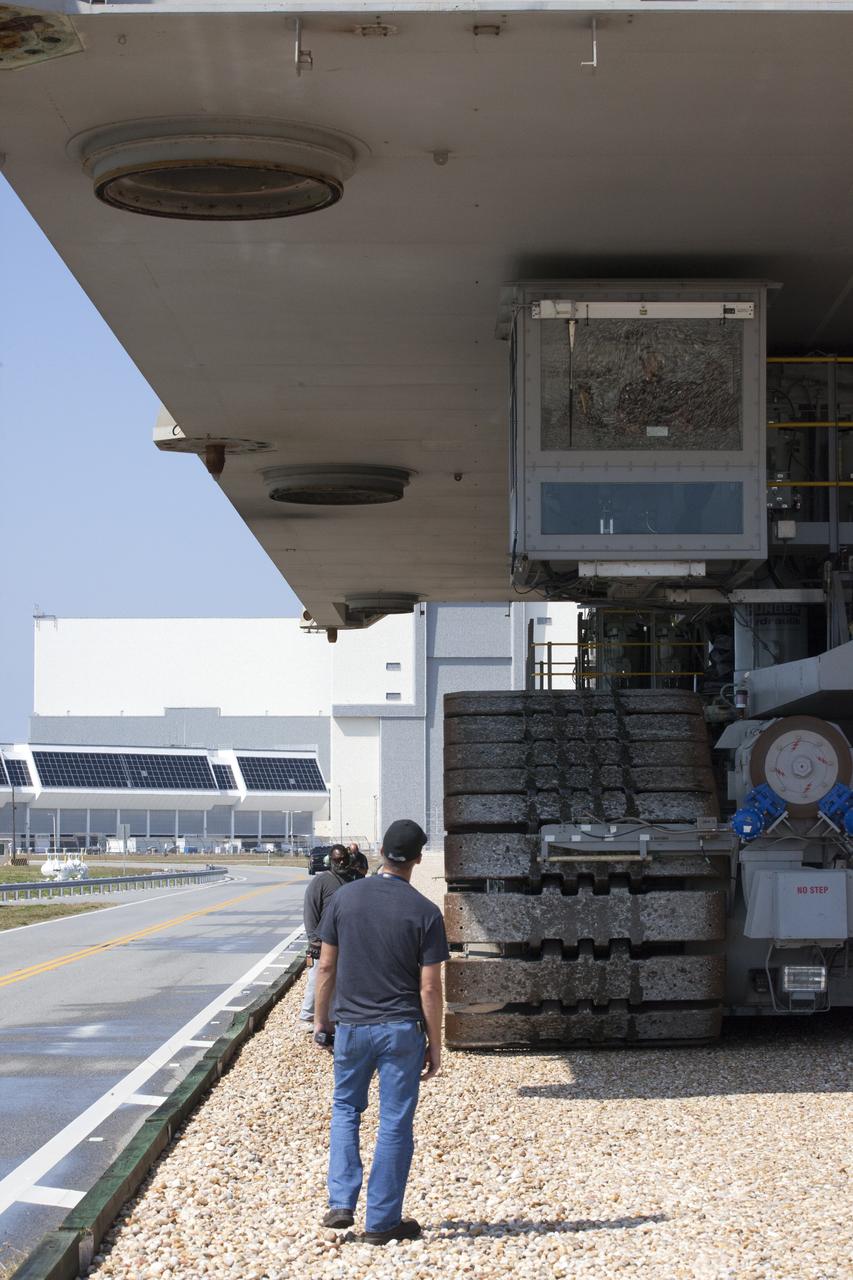
Ground support technicians walk alongside NASA's upgraded crawler-transporter 2 (CT-2), carrying mobile launcher platform 1, as it slowly travels on the crawlerway at the agency's Kennedy Space Center in Florida. The crawler's upgrades and modifications will be monitored and tested under loaded conditions during its travel to the crawlerway Pad A/B split and back to the crawler yard to confirm it is ready to support the load of the mobile launcher carrying the Space Launch System with Orion atop for the first test flight, Exploration Mission 1. The Ground Systems Development and Operations Program at Kennedy is managing upgrades to the crawler.

NASA's upgraded crawler-transporter 2 (CT-2) picks up mobile launcher platform 1 (MLP1) at the MLP park site near the Vehicle Assembly at the agency's Kennedy Space Center in Florida. The crawler's upgrades and modifications will be monitored and tested under loaded conditions during its travel to the crawlerway Pad A/B split and back to the crawler yard to confirm it is ready to support the load of the mobile launcher carrying the Space Launch System with Orion atop for the first test flight, Exploration Mission 1. The Ground Systems Development and Operations Program at Kennedy is managing upgrades to the crawler.
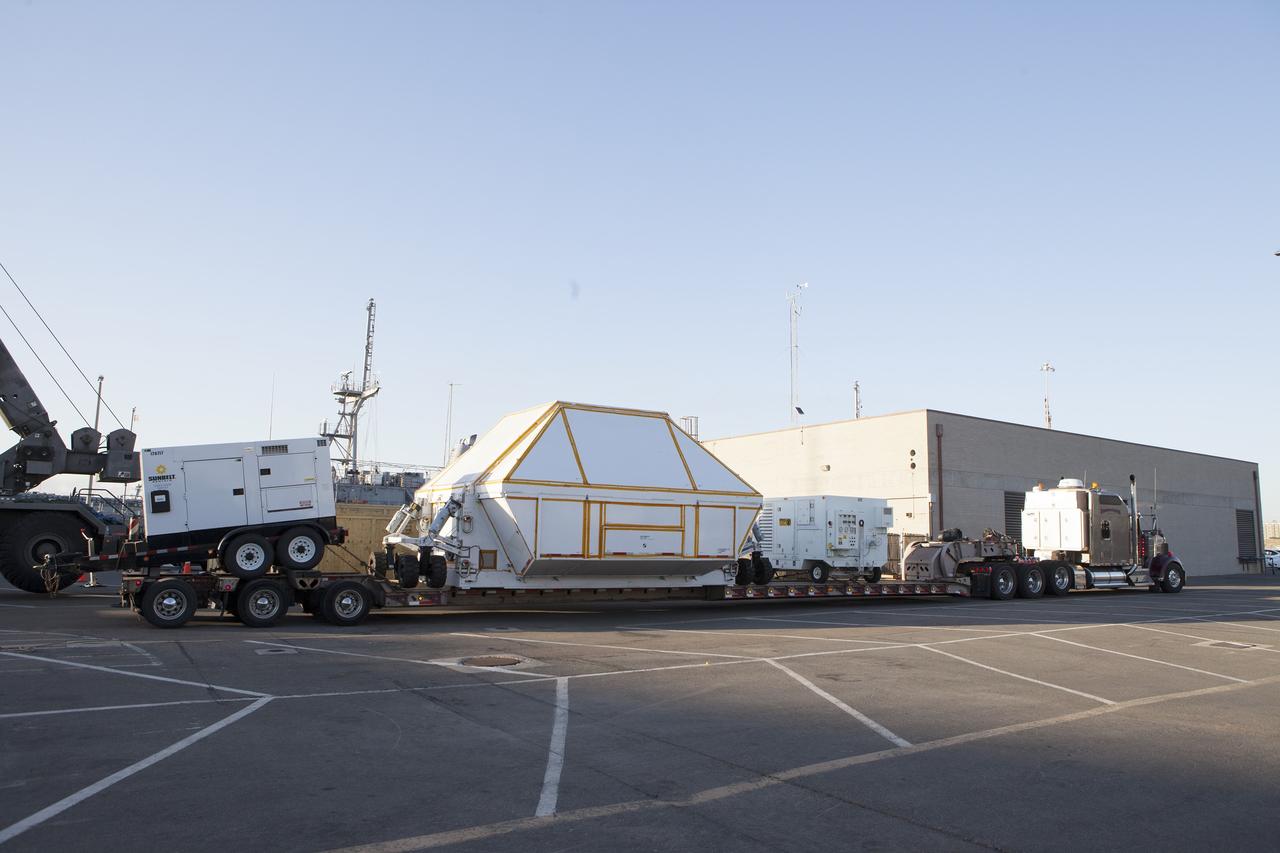
SAN DIEGO, Calif. – At the Mole Pier at Naval Base San Diego in California, the crew module transportation fixture has been secured on a flatbed truck, simulating readiness for Orion's cross-country trip. The Ground Systems Development and Operations Program, Lockheed Martin and the U.S. Navy are evaluating the hardware and processes for preparing the Orion crew module for Exploration Flight Test-1, or EFT-1, for overland transport from the naval base to NASA's Kennedy Space Center in Florida. Orion is the exploration spacecraft designed to carry astronauts to destinations not yet explored by humans, including an asteroid and Mars. It will have emergency abort capability, sustain the crew during space travel and provide safe re-entry from deep space return velocities. The first unpiloted test flight of the Orion is scheduled to launch later this year atop a Delta IV rocket from Cape Canaveral Air Force Station in Florida to an altitude of 3,600 miles above the Earth's surface. The two-orbit, four-hour flight test will help engineers evaluate the systems critical to crew safety including the heat shield, parachute system and launch abort system. For more information, visit http://www.nasa.gov/orion. Photo credit: NASA/Kim Shiflett

SAN DIEGO, Calif. – Workers prepare the lid for the crew module transportation fixture for the Orion boilerplate test vehicle at the Mole Pier at Naval Base San Diego in California. The Ground Systems Development and Operations Program, Lockheed Martin and the U.S. Navy are evaluating the hardware and processes for preparing the Orion crew module for Exploration Flight Test-1, or EFT-1, for overland transport from the naval base to NASA's Kennedy Space Center in Florida. Orion is the exploration spacecraft designed to carry astronauts to destinations not yet explored by humans, including an asteroid and Mars. It will have emergency abort capability, sustain the crew during space travel and provide safe re-entry from deep space return velocities. The first unpiloted test flight of the Orion is scheduled to launch later this year atop a Delta IV rocket from Cape Canaveral Air Force Station in Florida to an altitude of 3,600 miles above the Earth's surface. The two-orbit, four-hour flight test will help engineers evaluate the systems critical to crew safety including the heat shield, parachute system and launch abort system. For more information, visit http://www.nasa.gov/orion. Photo credit: NASA/Kim Shiflett

SAN DIEGO, Calif. – Workers simulate moving the Orion boilerplate test vehicle in place to be lifted into the crew module transportation fixture at the Mole Pier at Naval Base San Diego in California to a warehouse at the naval base. The test vehicle is attached to the crew module recovery cradle. The Ground Systems Development and Operations Program, Lockheed Martin and the U.S. Navy are evaluating the hardware and processes for preparing the Orion crew module for Exploration Flight Test-1, or EFT-1, for overland transport from the naval base to NASA's Kennedy Space Center in Florida. Orion is the exploration spacecraft designed to carry astronauts to destinations not yet explored by humans, including an asteroid and Mars. It will have emergency abort capability, sustain the crew during space travel and provide safe re-entry from deep space return velocities. The first unpiloted test flight of the Orion is scheduled to launch later this year atop a Delta IV rocket from Cape Canaveral Air Force Station in Florida to an altitude of 3,600 miles above the Earth's surface. The two-orbit, four-hour flight test will help engineers evaluate the systems critical to crew safety including the heat shield, parachute system and launch abort system. For more information, visit http://www.nasa.gov/orion. Photo credit: NASA/Kim Shiflett
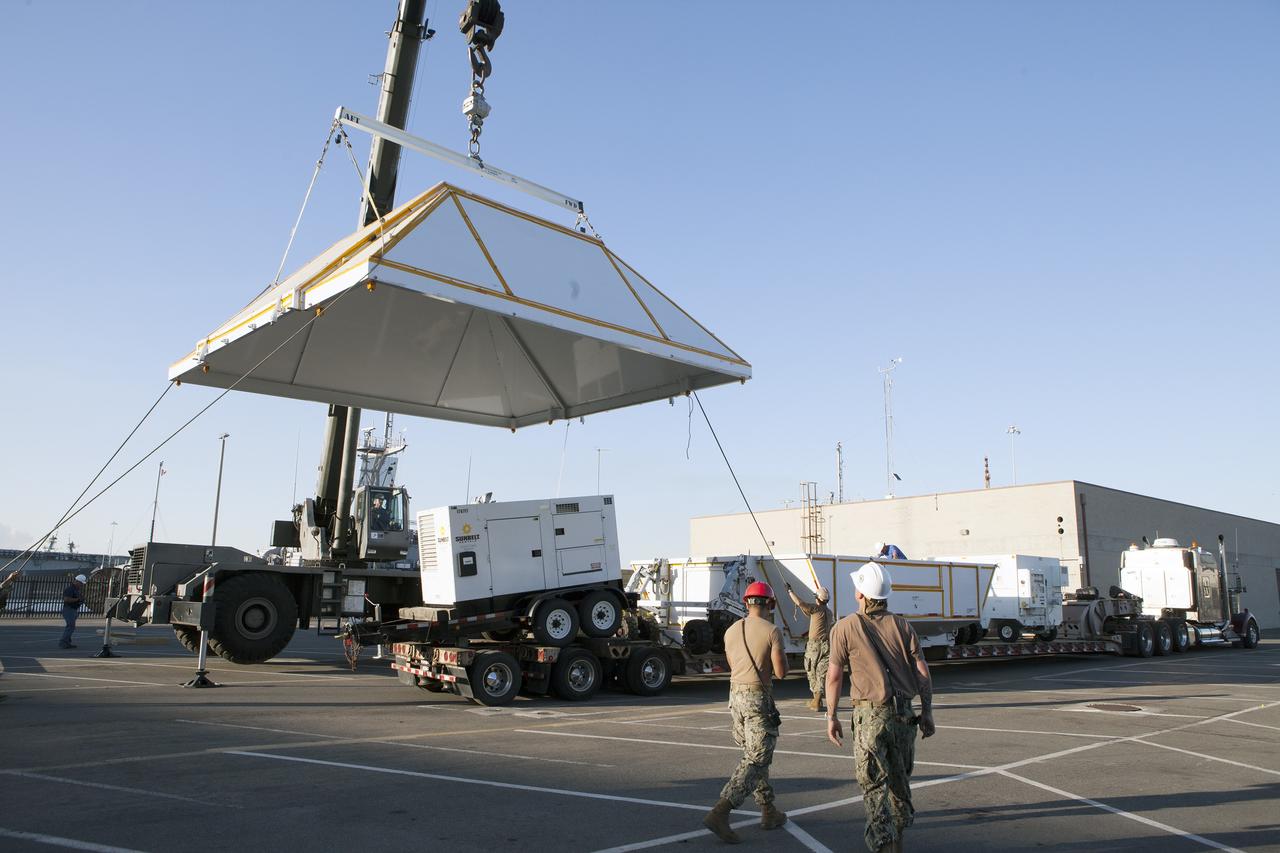
SAN DIEGO, Calif. – Workers prepare the lid for the crew module transportation fixture for the Orion boilerplate test vehicle at the Mole Pier at Naval Base San Diego in California. The Ground Systems Development and Operations Program, Lockheed Martin and the U.S. Navy are evaluating the hardware and processes for preparing the Orion crew module for Exploration Flight Test-1, or EFT-1, for overland transport from the naval base to NASA's Kennedy Space Center in Florida. Orion is the exploration spacecraft designed to carry astronauts to destinations not yet explored by humans, including an asteroid and Mars. It will have emergency abort capability, sustain the crew during space travel and provide safe re-entry from deep space return velocities. The first unpiloted test flight of the Orion is scheduled to launch later this year atop a Delta IV rocket from Cape Canaveral Air Force Station in Florida to an altitude of 3,600 miles above the Earth's surface. The two-orbit, four-hour flight test will help engineers evaluate the systems critical to crew safety including the heat shield, parachute system and launch abort system. For more information, visit http://www.nasa.gov/orion. Photo credit: NASA/Kim Shiflett
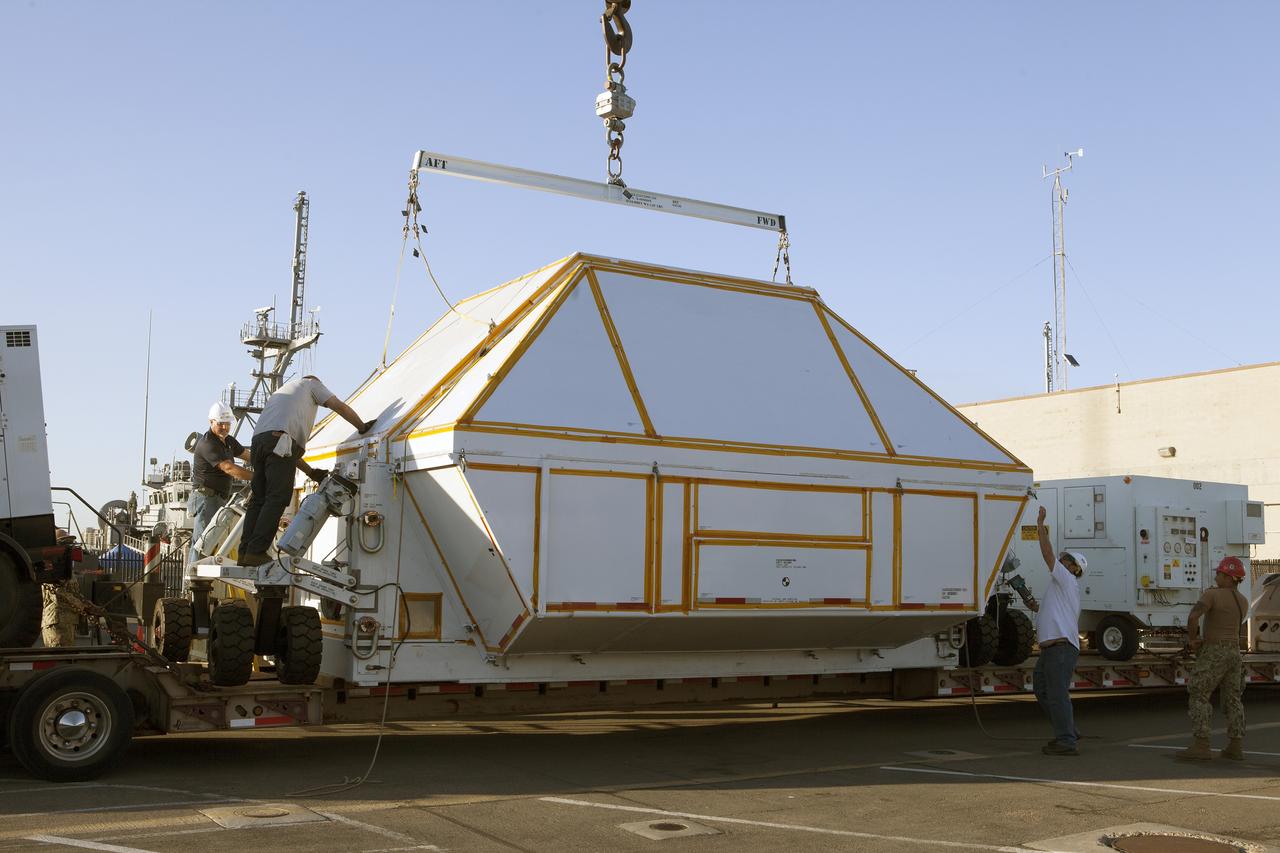
SAN DIEGO, Calif. – Workers simulate securing the crew module transportation fixture around the Orion boilerplate test vehicle at the Mole Pier at Naval Base San Diego in California. The Ground Systems Development and Operations Program, Lockheed Martin and the U.S. Navy are evaluating the hardware and processes for preparing the Orion crew module for Exploration Flight Test-1, or EFT-1, for overland transport from the naval base to NASA's Kennedy Space Center in Florida. Orion is the exploration spacecraft designed to carry astronauts to destinations not yet explored by humans, including an asteroid and Mars. It will have emergency abort capability, sustain the crew during space travel and provide safe re-entry from deep space return velocities. The first unpiloted test flight of the Orion is scheduled to launch later this year atop a Delta IV rocket from Cape Canaveral Air Force Station in Florida to an altitude of 3,600 miles above the Earth's surface. The two-orbit, four-hour flight test will help engineers evaluate the systems critical to crew safety including the heat shield, parachute system and launch abort system. For more information, visit http://www.nasa.gov/orion. Photo credit: NASA/Kim Shiflett
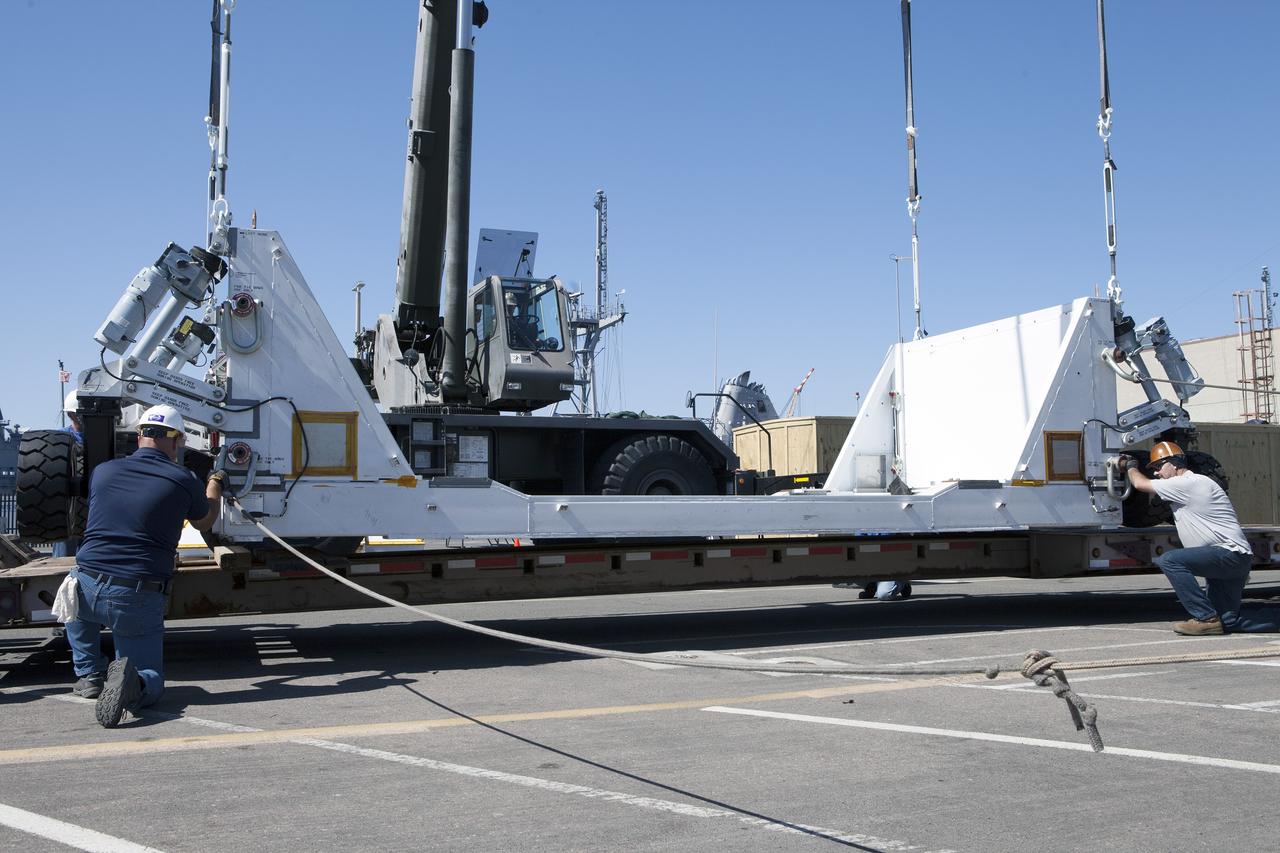
SAN DIEGO, Calif. – Workers prepare the base of the crew module transportation fixture for the Orion boilerplate test vehicle at the Mole Pier at Naval Base San Diego in California. The test vehicle will be moved from the pier to a warehouse hangar at the naval base. The Ground Systems Development and Operations Program, Lockheed Martin and the U.S. Navy are evaluating the hardware and processes for preparing the Orion crew module for Exploration Flight Test-1, or EFT-1, for overland transport from the naval base to NASA's Kennedy Space Center in Florida. Orion is the exploration spacecraft designed to carry astronauts to destinations not yet explored by humans, including an asteroid and Mars. It will have emergency abort capability, sustain the crew during space travel and provide safe re-entry from deep space return velocities. The first unpiloted test flight of the Orion is scheduled to launch later this year atop a Delta IV rocket from Cape Canaveral Air Force Station in Florida to an altitude of 3,600 miles above the Earth's surface. The two-orbit, four-hour flight test will help engineers evaluate the systems critical to crew safety including the heat shield, parachute system and launch abort system. For more information, visit http://www.nasa.gov/orion. Photo credit: NASA/Kim Shiflett
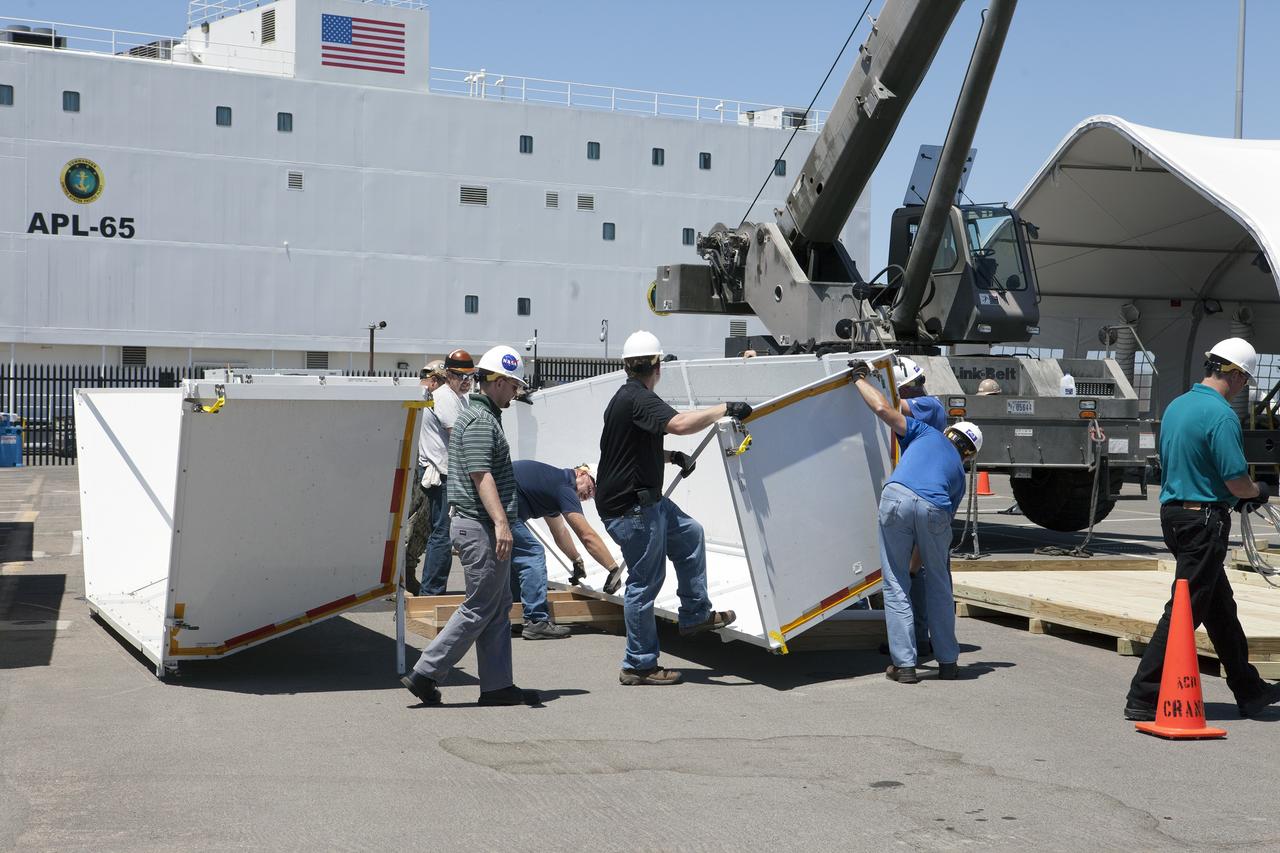
SAN DIEGO, Calif. – Workers prepare to assemble the crew module transportation fixture for the Orion boilerplate test vehicle at the Mole Pier at Naval Base San Diego in California. The test vehicle will be moved from the pier to a warehouse at the naval base. The Ground Systems Development and Operations Program, Lockheed Martin and the U.S. Navy are evaluating the hardware and processes for preparing the Orion crew module for Exploration Flight Test-1, or EFT-1, for overland transport from the naval base to NASA's Kennedy Space Center in Florida. Orion is the exploration spacecraft designed to carry astronauts to destinations not yet explored by humans, including an asteroid and Mars. It will have emergency abort capability, sustain the crew during space travel and provide safe re-entry from deep space return velocities. The first unpiloted test flight of the Orion is scheduled to launch later this year atop a Delta IV rocket from Cape Canaveral Air Force Station in Florida to an altitude of 3,600 miles above the Earth's surface. The two-orbit, four-hour flight test will help engineers evaluate the systems critical to crew safety including the heat shield, parachute system and launch abort system. For more information, visit http://www.nasa.gov/orion. Photo credit: NASA/Kim Shiflett
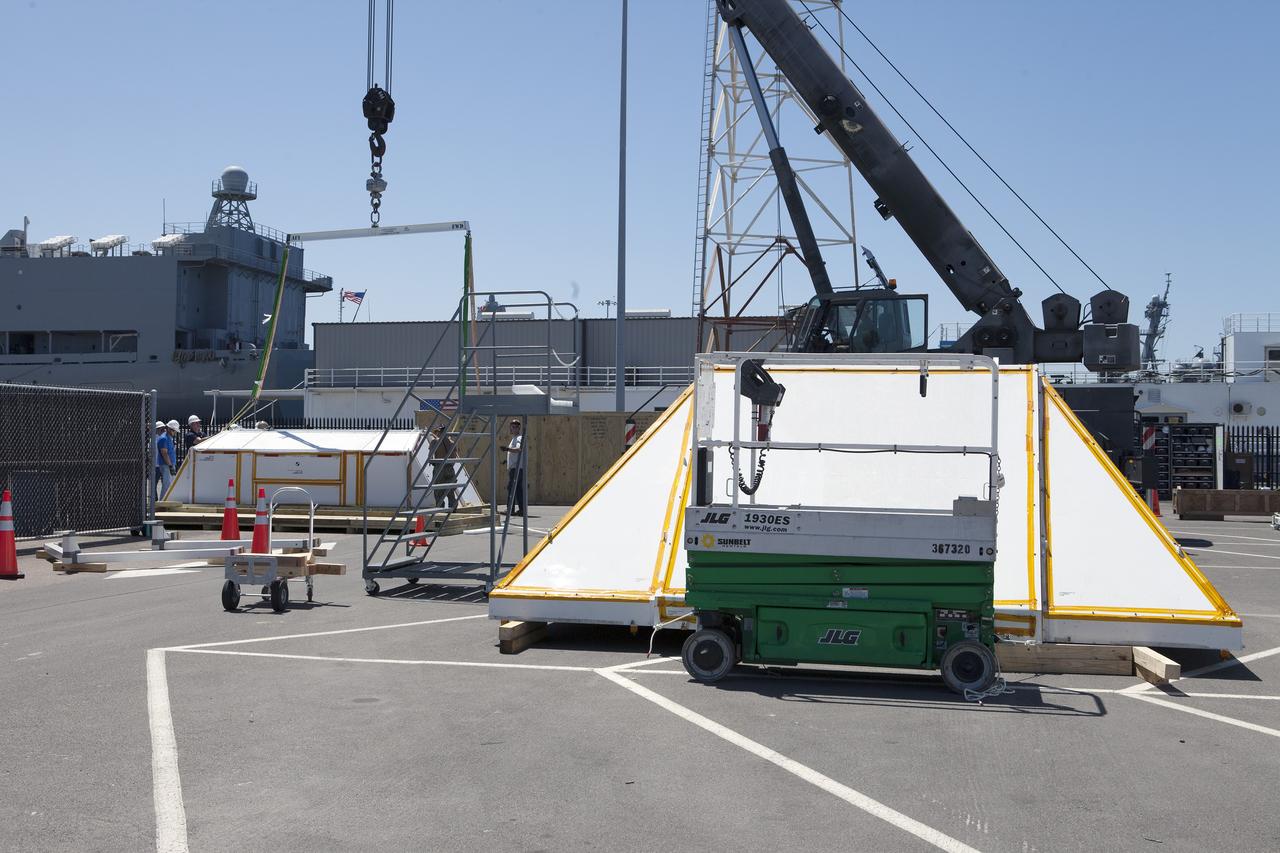
SAN DIEGO, Calif. – Workers prepare the crew module transportation fixture for the Orion boilerplate test vehicle at the Mole Pier at the Naval Base San Diego in California. The test vehicle will be moved from the pier to a warehouse at the naval base. The Ground Systems Development and Operations Program, Lockheed Martin and the U.S. Navy are evaluating the hardware and processes for preparing the Orion crew module for Exploration Flight Test-1, or EFT-1, for overland transport from the naval base to NASA's Kennedy Space Center in Florida. Orion is the exploration spacecraft designed to carry astronauts to destinations not yet explored by humans, including an asteroid and Mars. It will have emergency abort capability, sustain the crew during space travel and provide safe re-entry from deep space return velocities. The first unpiloted test flight of the Orion is scheduled to launch later this year atop a Delta IV rocket from Cape Canaveral Air Force Station in Florida to an altitude of 3,600 miles above the Earth's surface. The two-orbit, four-hour flight test will help engineers evaluate the systems critical to crew safety including the heat shield, parachute system and launch abort system. For more information, visit http://www.nasa.gov/orion. Photo credit: NASA/Kim Shiflett
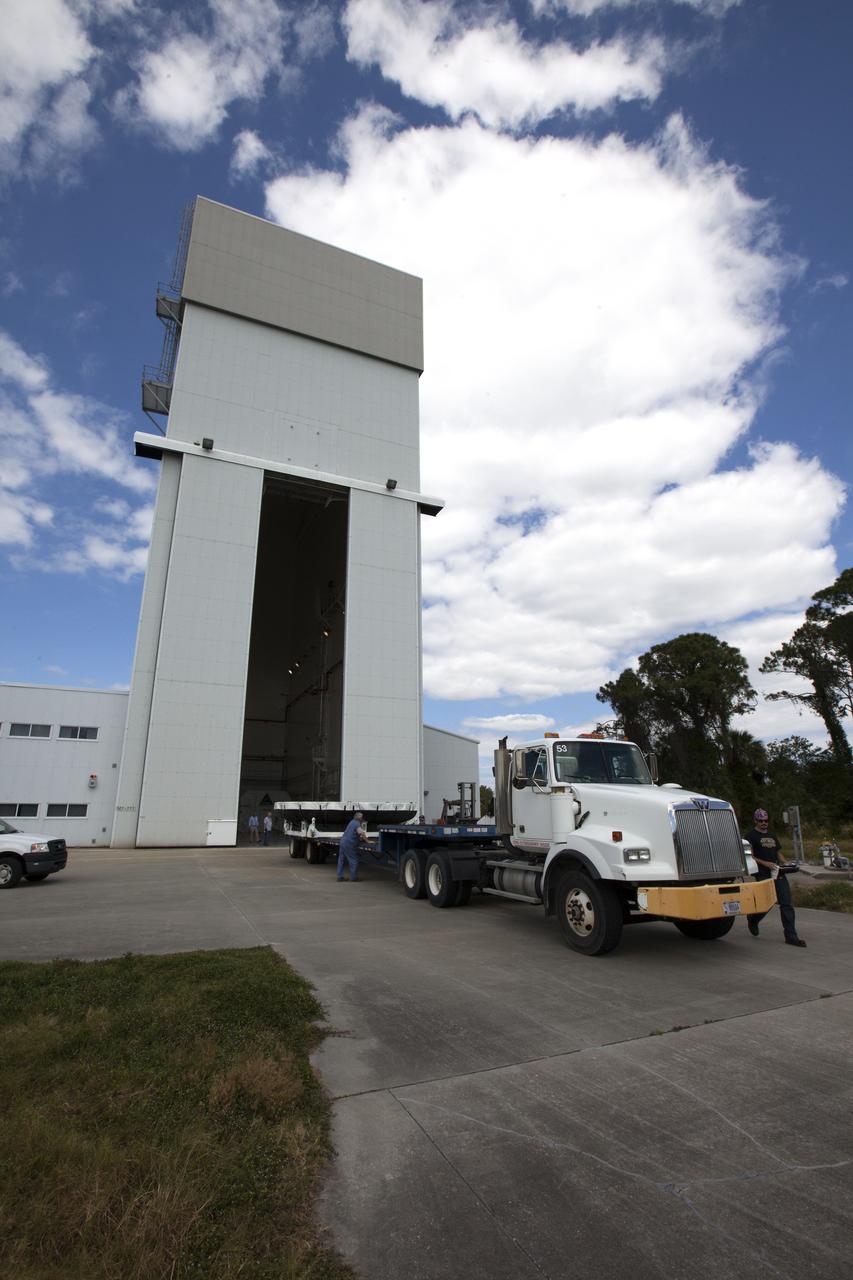
The Orion heat shield from Exploration Flight Test-1, secured on a transporter, departs the Launch Abort System Facility at NASA's Kennedy Space Center in Florida, for its move to the Vehicle Assembly Building (VAB). The heat shield is being transferred from the Orion Program to the Ground Systems Development and Operations Program, Landing and Recovery Operations. In the VAB, the heat shield will be integrated with the Orion ground test article and used for future underway recovery testing.
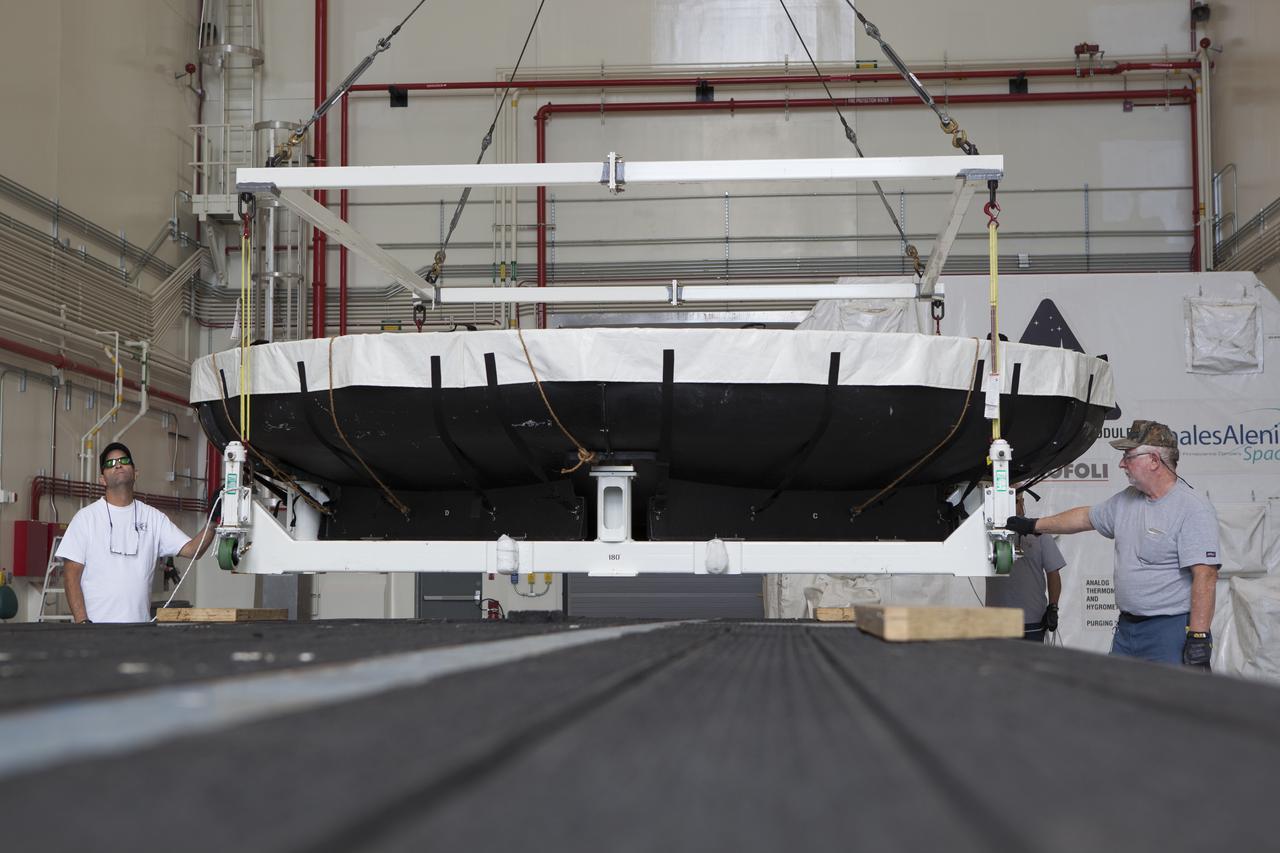
Inside the Launch Abort System Facility at NASA's Kennedy Space Center in Florida, the Orion heat shield from Exploration Flight Test-1 is being loaded onto a transporter for its move to the Vehicle Assembly Building (VAB). The heat shield is being transferred from the Orion Program to the Ground Systems Development and Operations Program, Landing and Recovery Operations. In the VAB, the heat shield will be integrated with the Orion ground test article and used for future underway recovery testing.
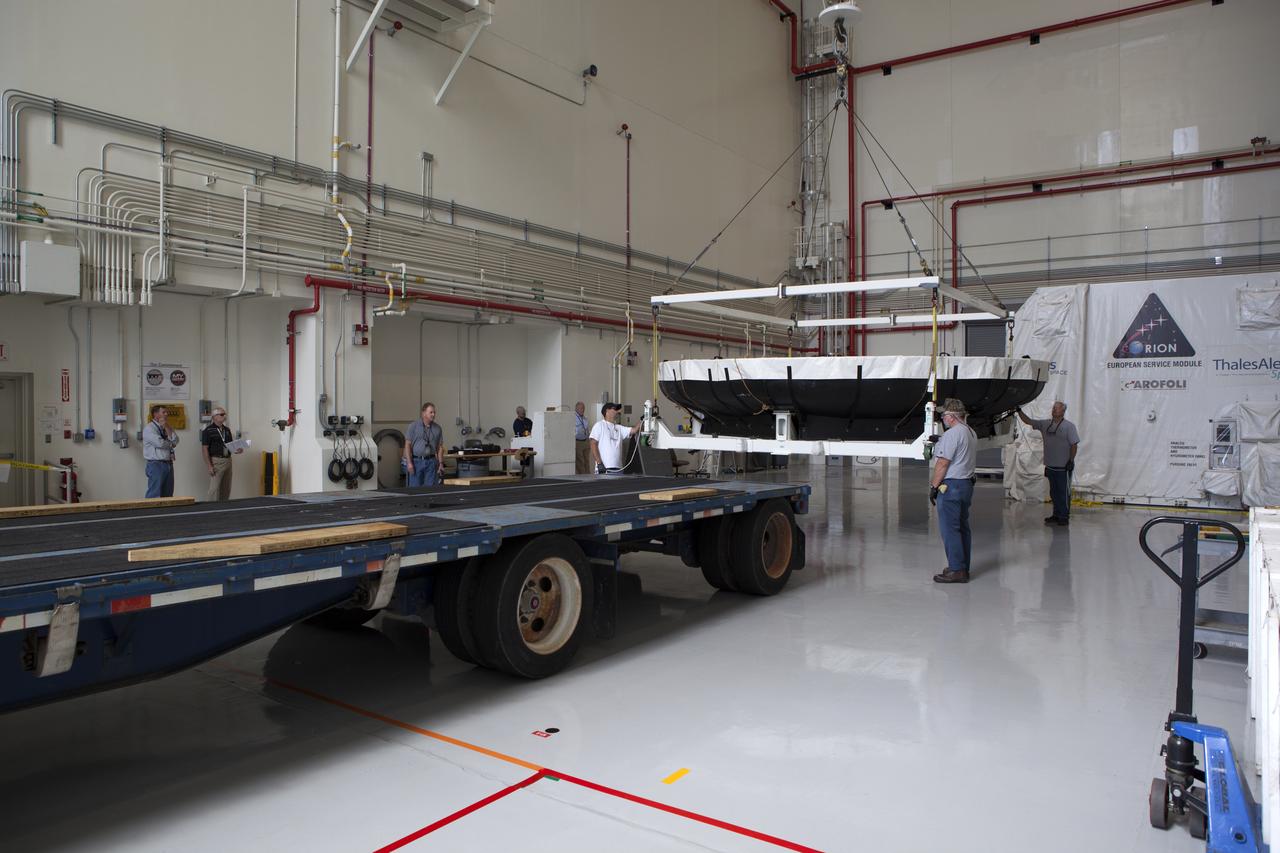
Inside the Launch Abort System Facility at NASA's Kennedy Space Center in Florida, the Orion heat shield from Exploration Flight Test-1 is being loaded onto a transporter for its move to the Vehicle Assembly Building (VAB). The heat shield is being transferred from the Orion Program to the Ground Systems Development and Operations Program, Landing and Recovery Operations. In the VAB, the heat shield will be integrated with the Orion ground test article and used for future underway recovery testing.
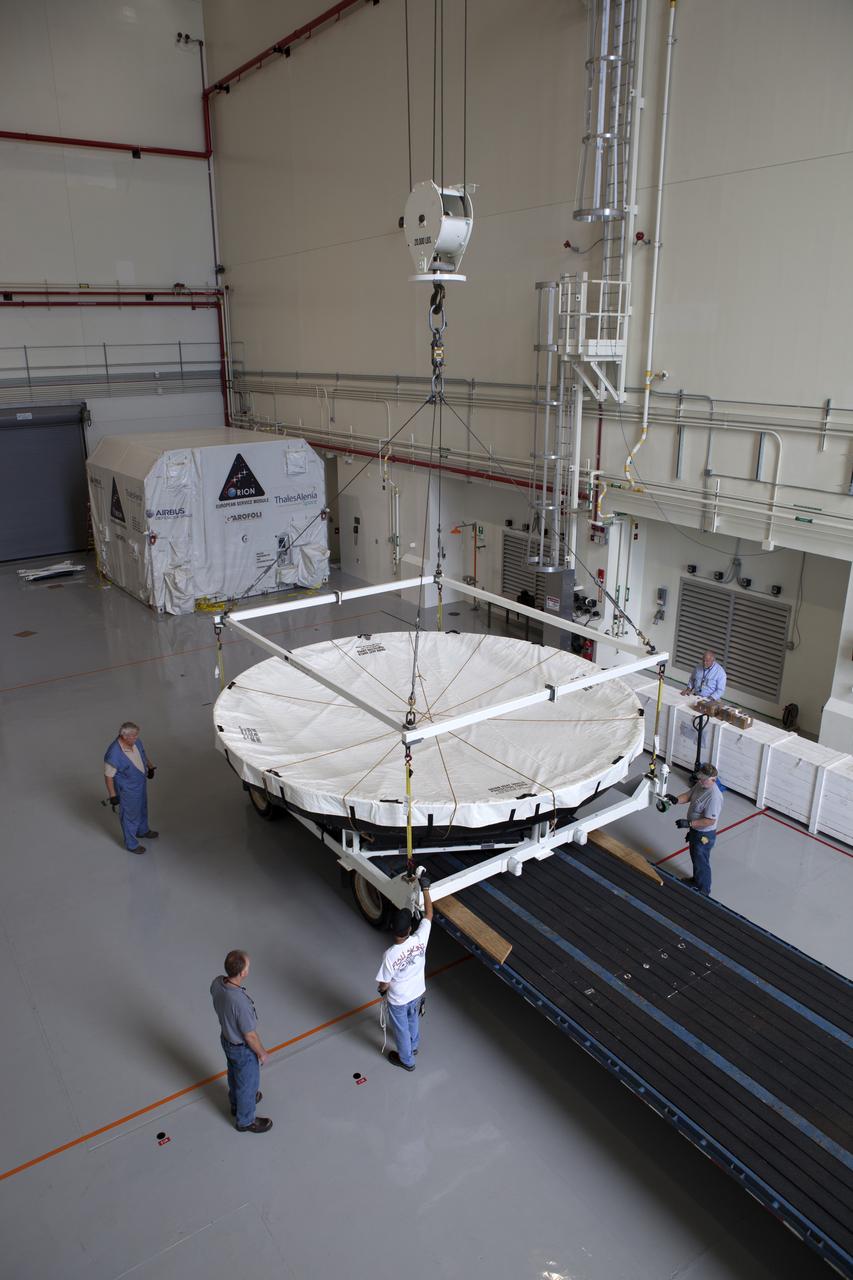
Inside the Launch Abort System Facility at NASA's Kennedy Space Center in Florida, a crane lowers the Orion heat shield from Exploration Flight Test-1 onto a transporter for its move to the Vehicle Assembly Building (VAB). The heat shield is being transferred from the Orion Program to the Ground Systems Development and Operations Program, Landing and Recovery Operations. In the VAB, the heat shield will be integrated with the Orion ground test article and used for future underway recovery testing.
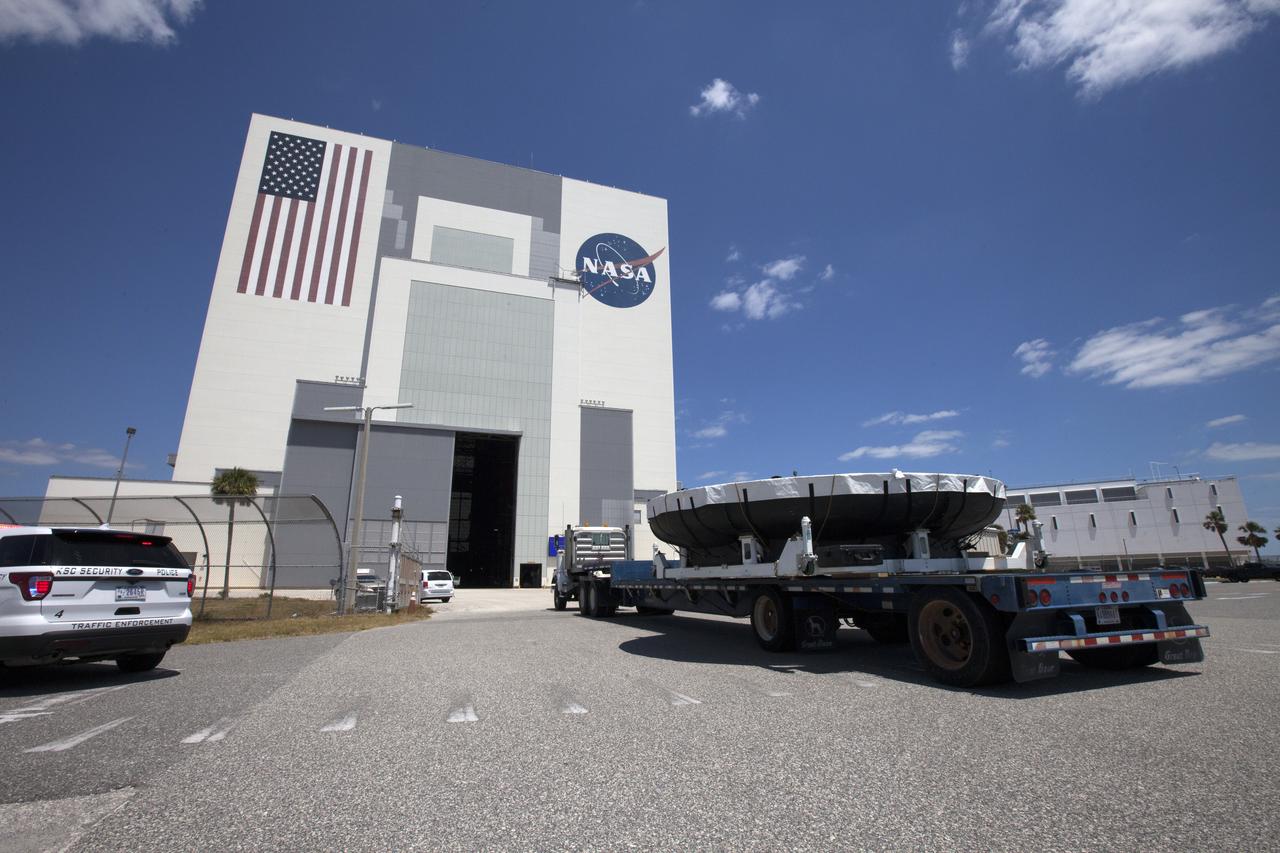
The Orion heat shield from Exploration Flight Test-1, secured on a transporter, arrives at the Vehicle Assembly Building (VAB) at NASA's Kennedy Space Center in Florida. The heat shield was moved from the Launch Abort System Facility. The heat shield is being transferred from the Orion Program to the Ground Systems Development and Operations Program, Landing and Recovery Operations. In the VAB, the heat shield will be integrated with the Orion ground test article and used for future underway recovery testing.
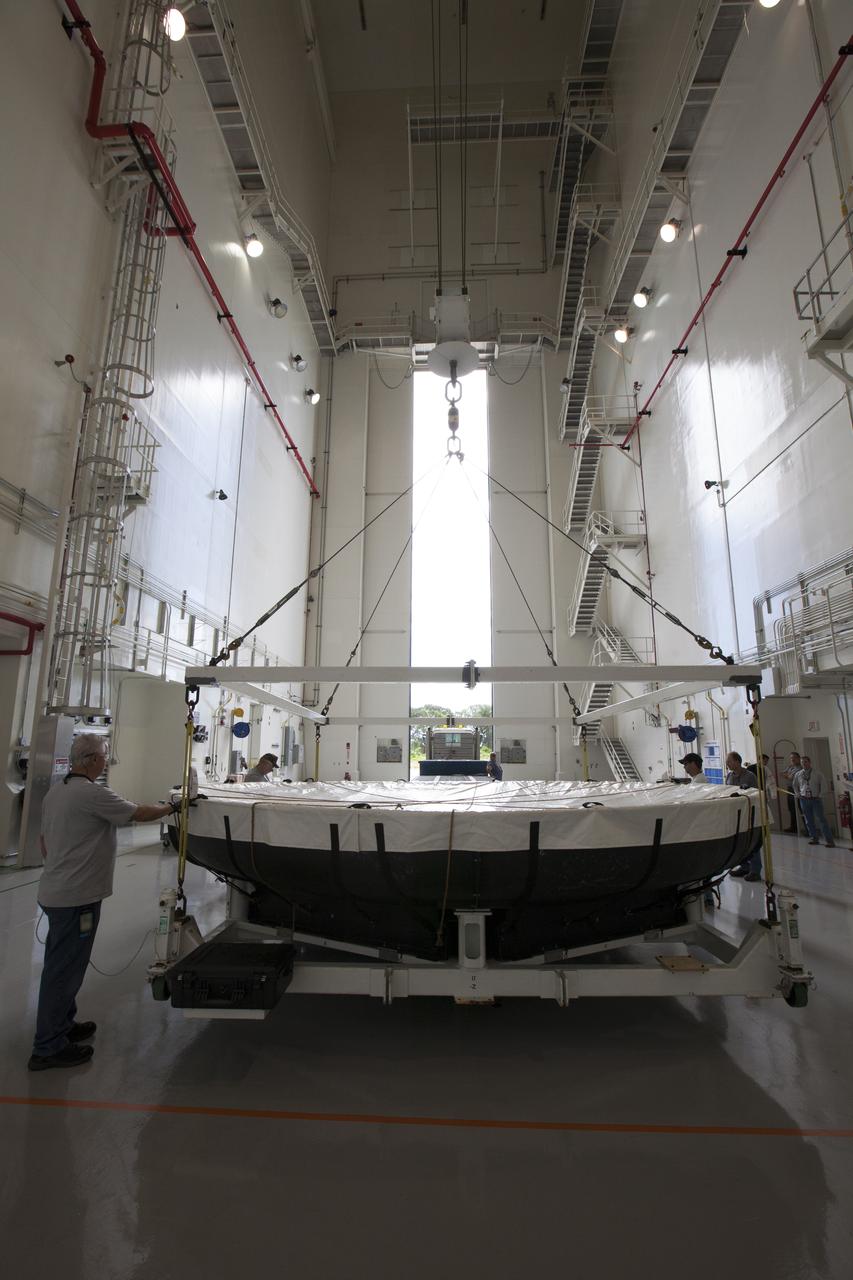
Inside the Launch Abort System Facility at NASA's Kennedy Space Center in Florida, the Orion heat shield from Exploration Flight Test-1 is secured on a transporter and ready for its move to the Vehicle Assembly Building (VAB). The heat shield is being transferred from the Orion Program to the Ground Systems Development and Operations Program, Landing and Recovery Operations. In the VAB, the heat shield will be integrated with the Orion ground test article and used for future underway recovery testing.

The shipping container carrying the Orion heat shield for Exploration Mission 1 (EM-1) is offloaded from NASA’s Super Guppy aircraft at the Shuttle Landing Facility, managed and operated by Space Florida, at the agency’s Kennedy Space Center in Florida. The heat shield will be transported to the Neil Armstrong Operations and Checkout Building high bay for processing. The heat shield arrived from Lockheed Martin’s manufacturing facility near Denver. The Orion spacecraft will launch atop NASA’s Space Launch System rocket on EM-1, an uncrewed test flight, in 2018.
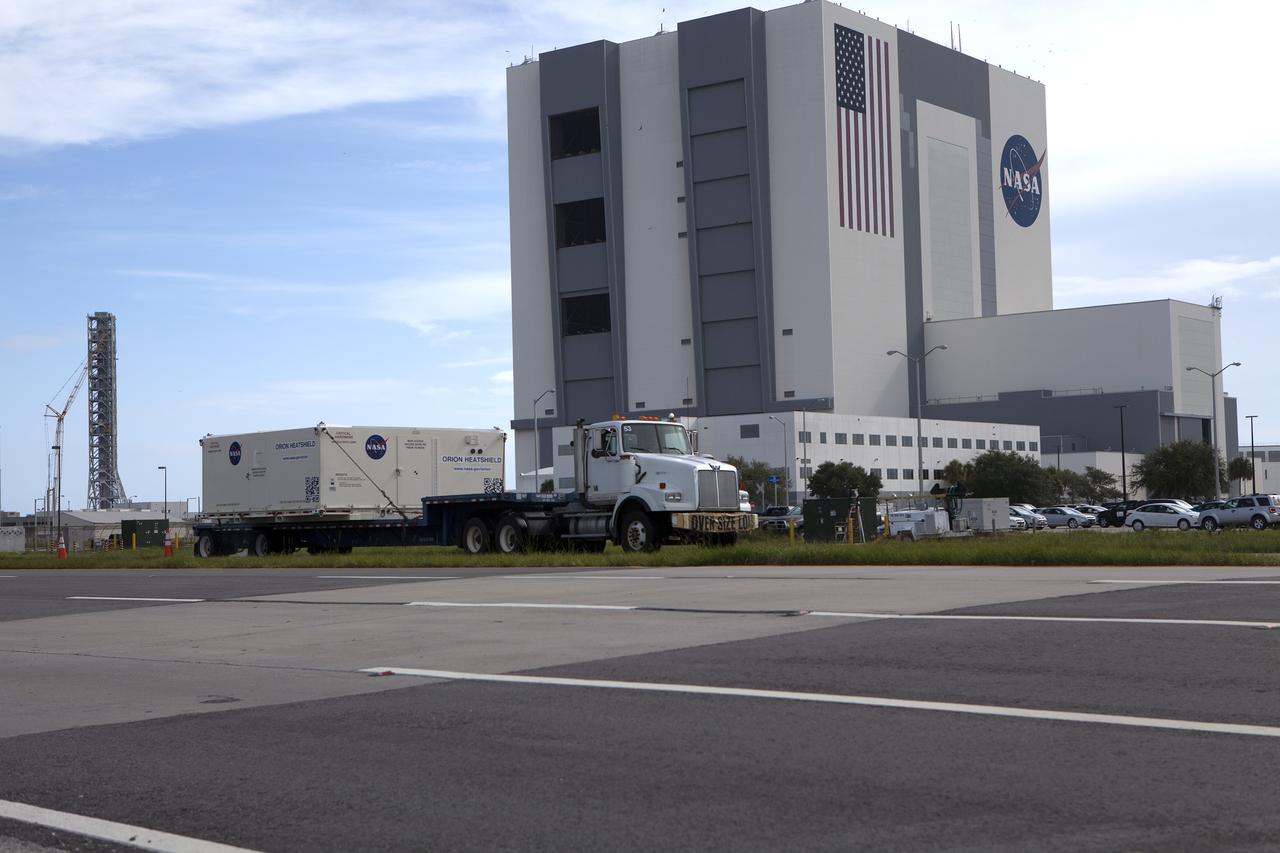
A flatbed truck with the shipping container carrying the Orion heat shield for Exploration Mission 1 (EM-1) passes by the Vehicle Assembly at NASA’s Kennedy Space Center in Florida. The heat shield arrived aboard the agency’s Super Guppy aircraft at the Shuttle Landing Facility, managed and operated by Space Florida, from Lockheed Martin’s manufacturing facility near Denver. The heat shield is being transported to the Neil Armstrong Operations and Checkout Building high bay for processing. The Orion spacecraft will launch atop NASA’s Space Launch System rocket on EM-1, an uncrewed test flight, in 2018.
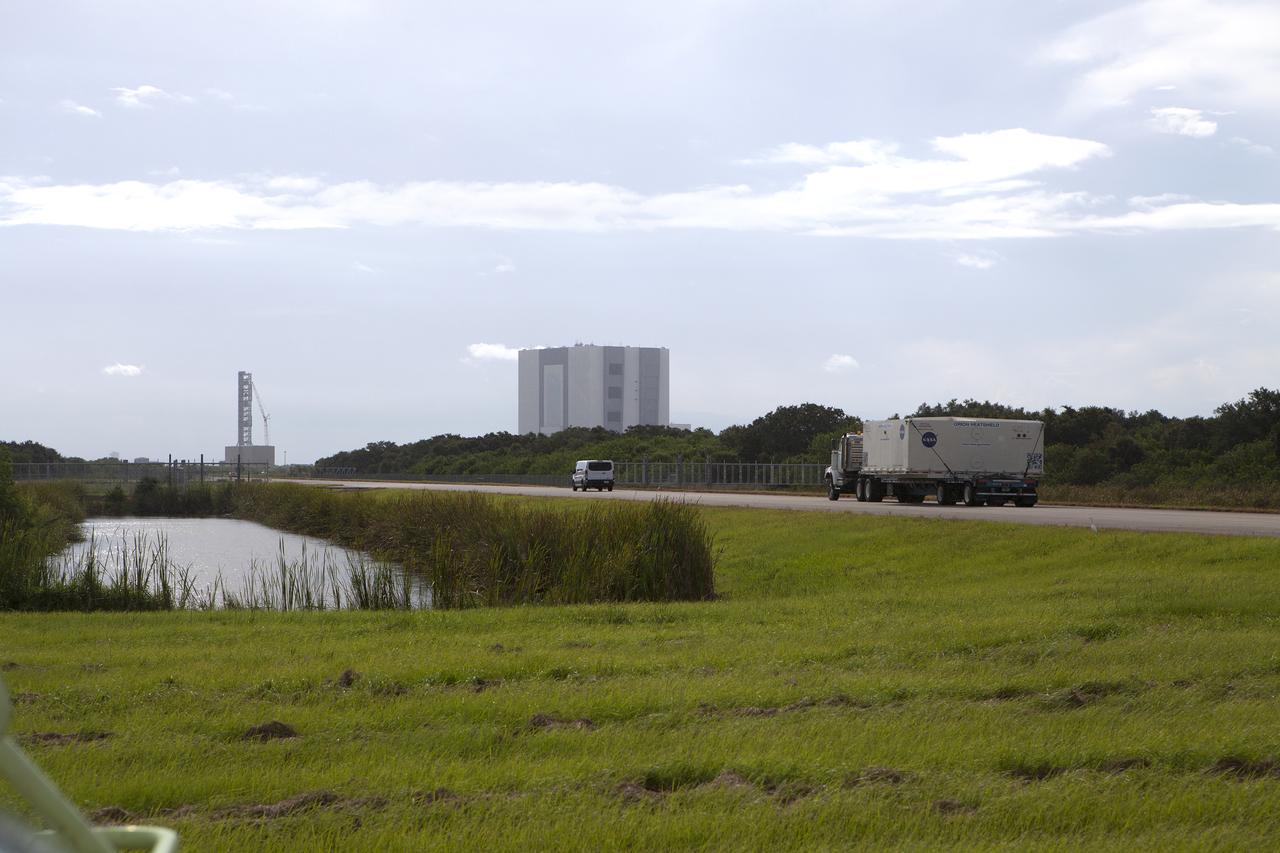
The shipping container carrying the Orion heat shield for Exploration Mission 1 (EM-1) is transported by truck from the Shuttle Landing Facility at NASA’s Kennedy Space Center in Florida along the road to the Neil Armstrong Operations and Checkout Building high bay for processing. The heat shield arrived aboard the agency’s Super Guppy aircraft, managed and operated by Space Florida, from Lockheed Martin’s manufacturing facility near Denver. The Orion spacecraft will launch atop NASA’s Space Launch System rocket on EM-1, an uncrewed test flight, in 2018.
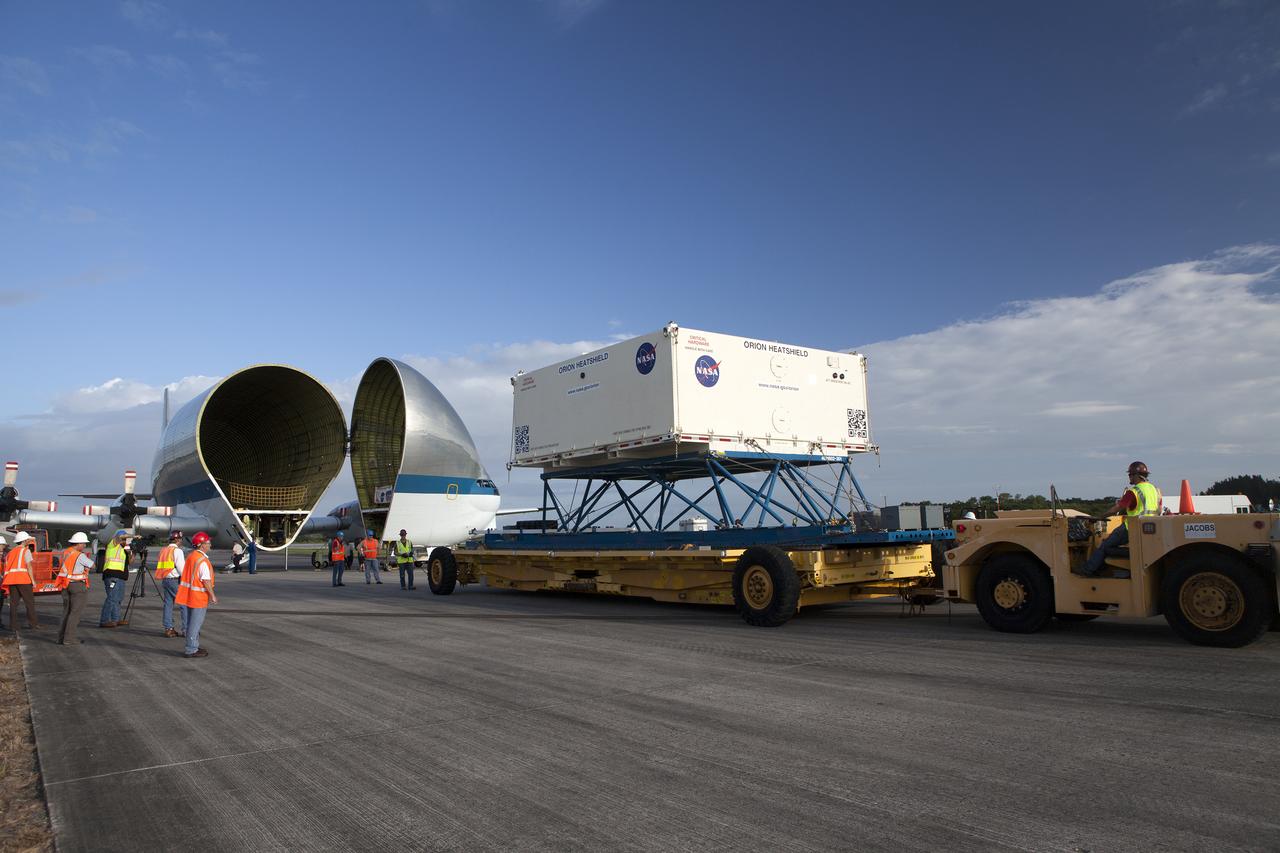
The shipping container carrying the Orion heat shield for Exploration Mission 1 (EM-1) was offloaded from NASA’s Super Guppy aircraft at the Shuttle Landing Facility, managed and operated by Space Florida, at the agency’s Kennedy Space Center in Florida. The heat shield will be transported to the Neil Armstrong Operations and Checkout Building high bay for processing. The heat shield arrived from Lockheed Martin’s manufacturing facility near Denver. The Orion spacecraft will launch atop NASA’s Space Launch System rocket on EM-1, an uncrewed test flight, in 2018.
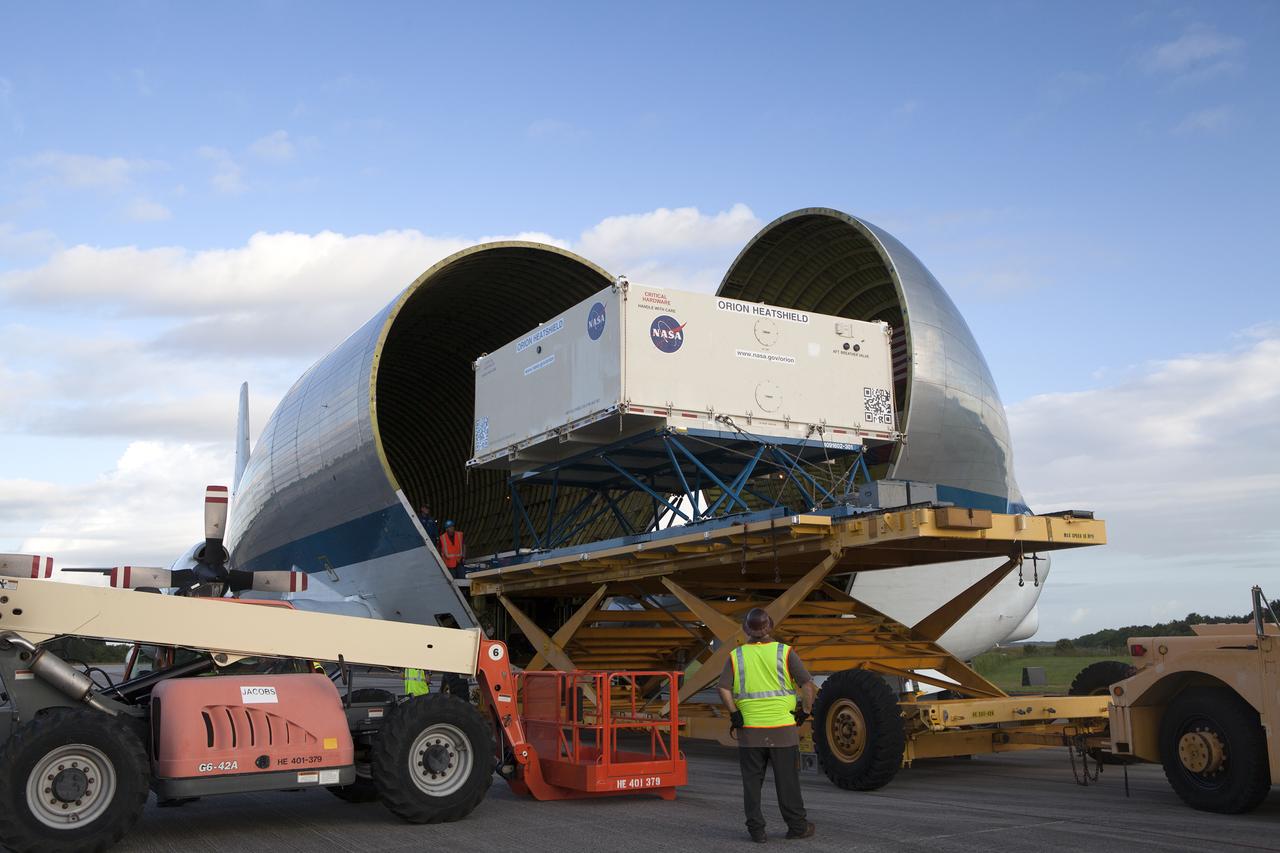
The shipping container carrying the Orion heat shield for Exploration Mission 1 (EM-1) is offloaded from NASA’s Super Guppy aircraft at the Shuttle Landing Facility, managed and operated by Space Florida, at the agency’s Kennedy Space Center in Florida. The heat shield will be transported to the Neil Armstrong Operations and Checkout Building high bay for processing. The heat shield arrived from Lockheed Martin’s manufacturing facility near Denver. The Orion spacecraft will launch atop NASA’s Space Launch System rocket on EM-1, an uncrewed test flight, in 2018.

A view from inside the cargo bay of NASA’s Super Guppy aircraft reveals that the shipping container with the Orion heat shield for Exploration Mission 1 (EM-1) was offloaded at the Shuttle Landing Facility, managed and operated by Space Florida, at the agency’s Kennedy Space Center in Florida. The heat shield will be transported to the Neil Armstrong Operations and Checkout Building high bay for processing. The heat shield arrived from Lockheed Martin’s manufacturing facility near Denver. The Orion spacecraft will launch atop NASA’s Space Launch System rocket on EM-1, an uncrewed test flight, in 2018.
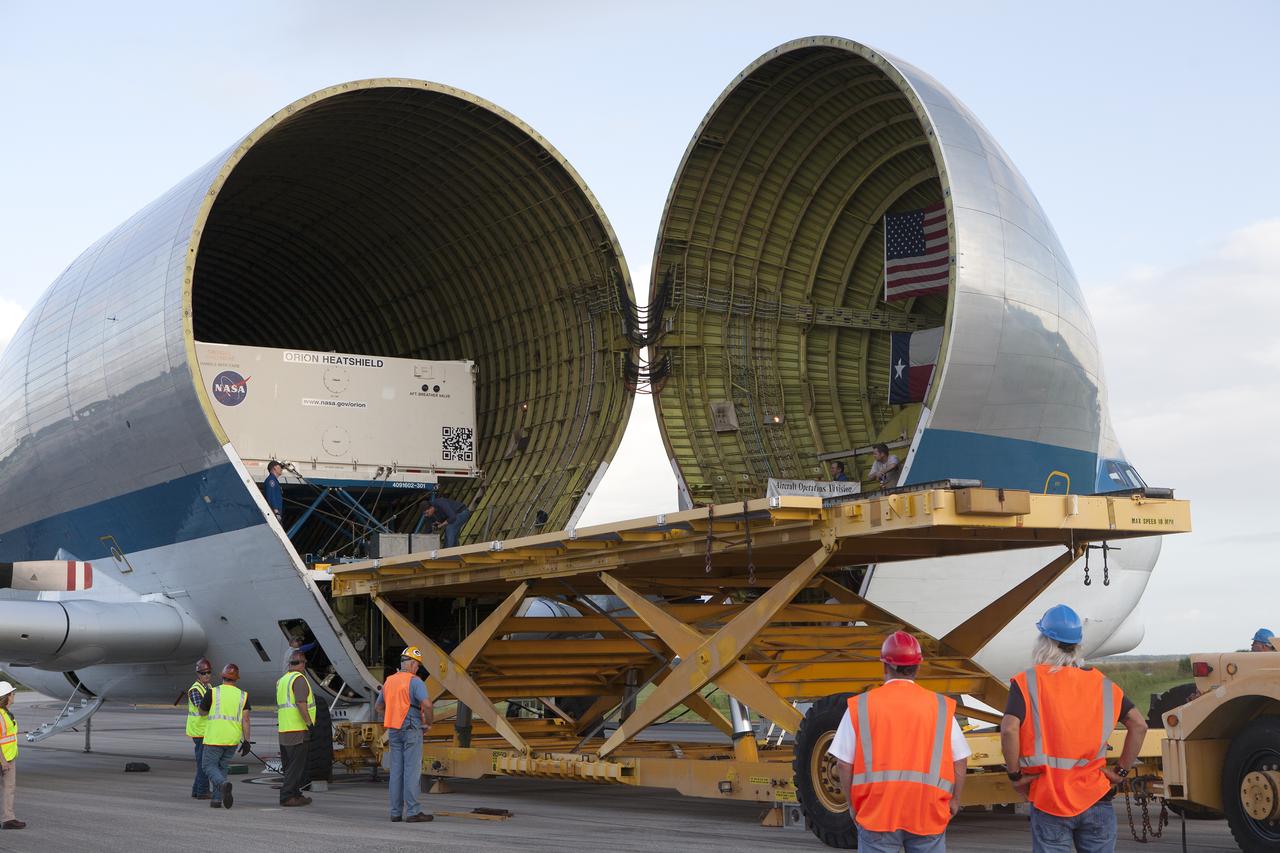
Technicians with Jacobs on the Test and Operations Support Contract have positioned a platform close to NASA’s Super Guppy aircraft at the Shuttle Landing Facility, managed and operated by Space Florida, at the agency’s Kennedy Space Center in Florida, for offloading of the shipping container carrying the Orion heat shield for Exploration Mission 1 (EM-1). The heat shield will be offloaded and transported to the Neil Armstrong Operations and Checkout Building high bay for processing. The heat shield arrived from Lockheed Martin’s manufacturing facility near Denver. The Orion spacecraft will launch atop NASA’s Space Launch System rocket on EM-1, an uncrewed test flight, in 2018.
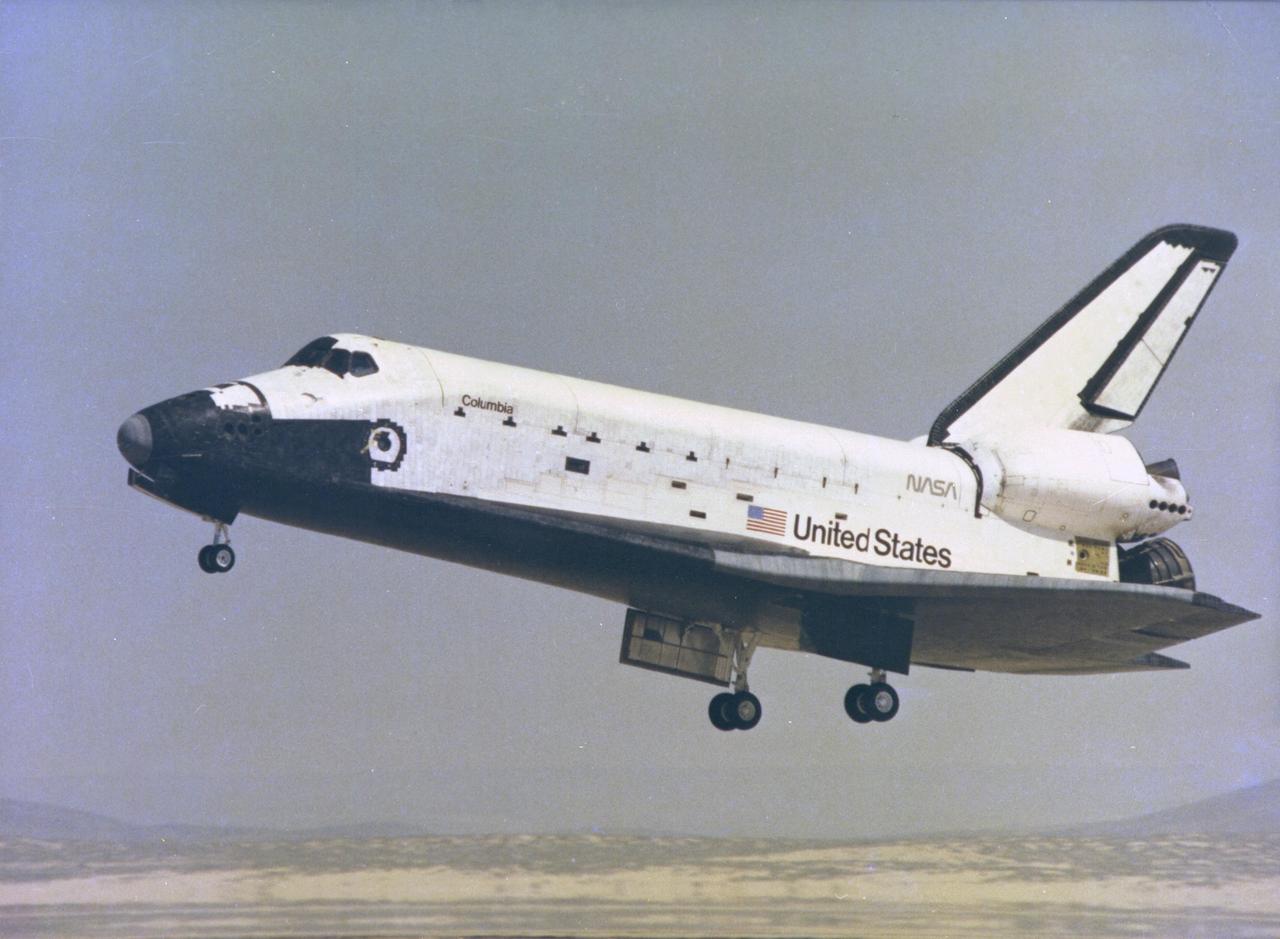
DRYDEN FLIGHT RESEARCH CENTER, CALIF. - Orbiter Columbia "flares out" for a landing at Rogers dry lake Runway 23, successfully completing the historic first flight for the Space Shuttle. Astronauts John Young, Commander, and Robert Crippen, Pilot, crewed the spacecraft for the first full test of the Space Transportation System. STS-1, known as a shuttle systems test flight, seeks to demonstrate safe launch into orbit and safe return of the orbiter and crew and verify the combined performance of the entire shuttle vehicle -- orbiter, solid rocket boosters and external tank.
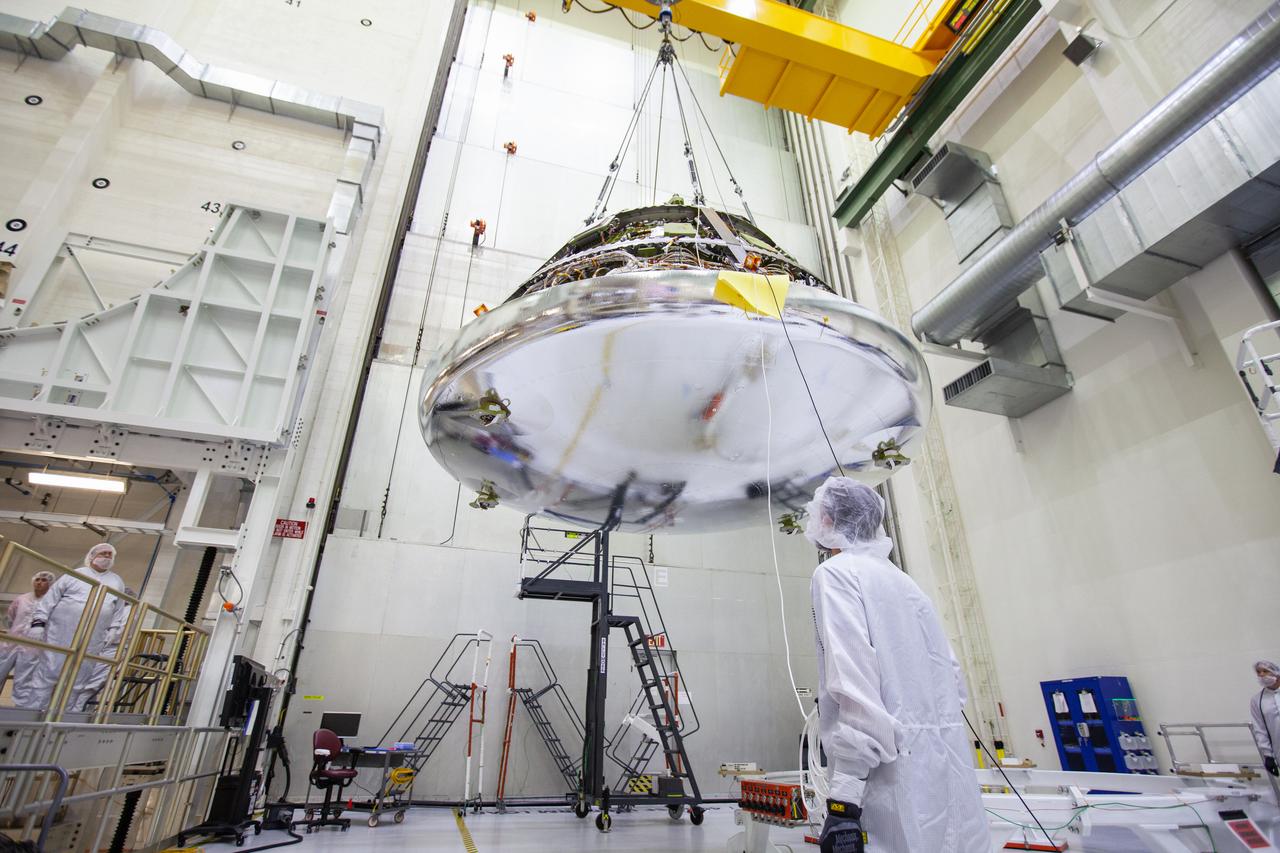
The Orion crew module for Artemis 1 is lifted by crane on July 16, 2019, in the high bay inside the Neil Armstrong Operations and Checkout Building high bay at NASA’s Kennedy Space Center in Florida. The crew module is being moved to the final assembly and test cell and work will begin to secure it atop the service module. The Orion spacecraft is being prepared for its uncrewed test flight atop NASA’s Space Launch System (SLS) rocket. Artemis 1 is the first test flight of the SLS and Orion spacecraft as an integrated system. Orion will travel thousands of miles beyond the Moon during a mission that will test its systems in space. The spacecraft will return to Earth and splashdown in the Pacific Ocean where it will be retrieved and transported back to Kennedy.
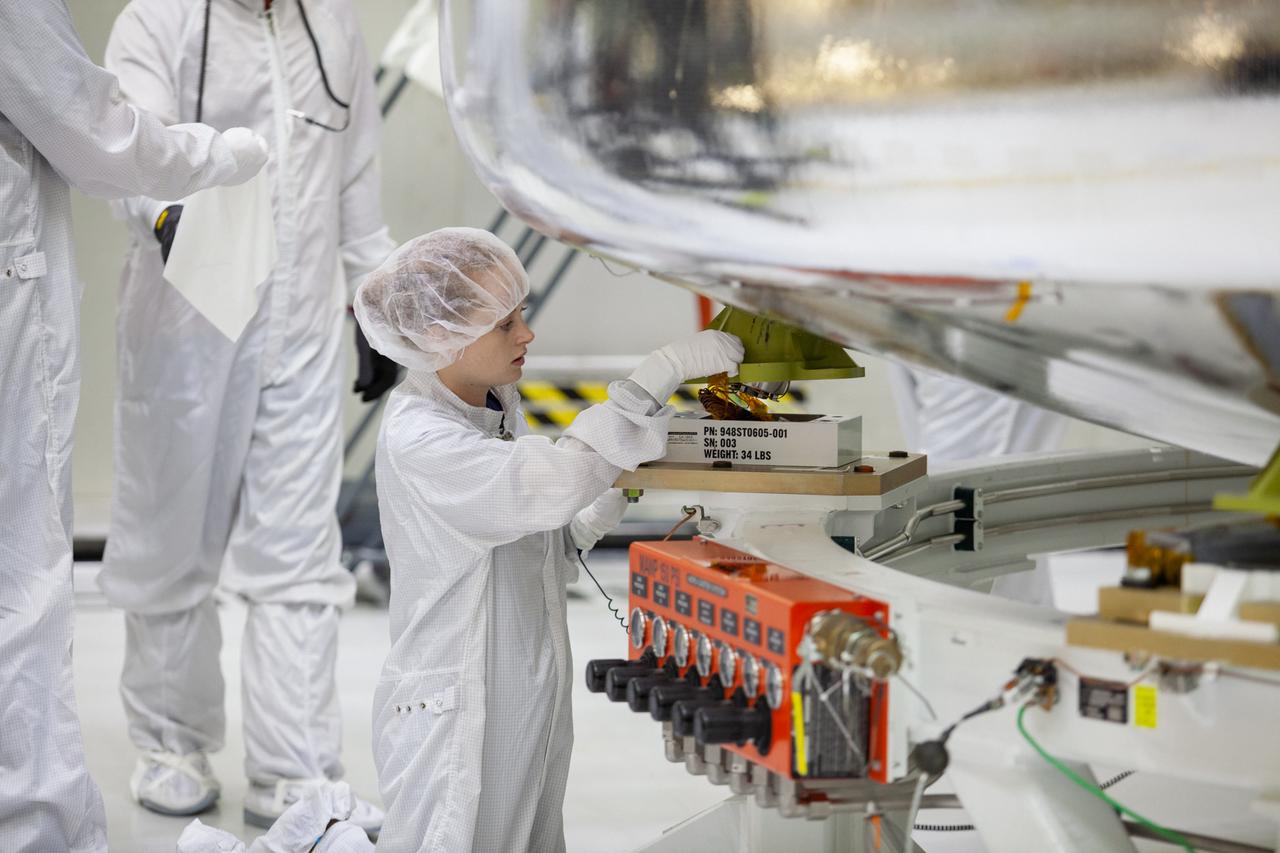
A Lockheed Martin employee works to secure the Orion crew module for the Artemis 1 mission onto a stand inside the Neil Armstrong Operations and Checkout Building high bay at NASA’s Kennedy Space Center in Florida on July 16, 2019. Work will begin to secure the crew module atop its service module in the final assembly and test cell. The Orion spacecraft is being prepared for its uncrewed test flight atop NASA’s Space Launch System (SLS) rocket. Artemis 1 is the first test flight of the SLS and Orion spacecraft as an integrated system. Orion will travel thousands of miles beyond the Moon during a mission that will test its systems in space and during re-entry. The spacecraft will return to Earth and splashdown in the Pacific Ocean where it will be retrieved and transported back to Kennedy.
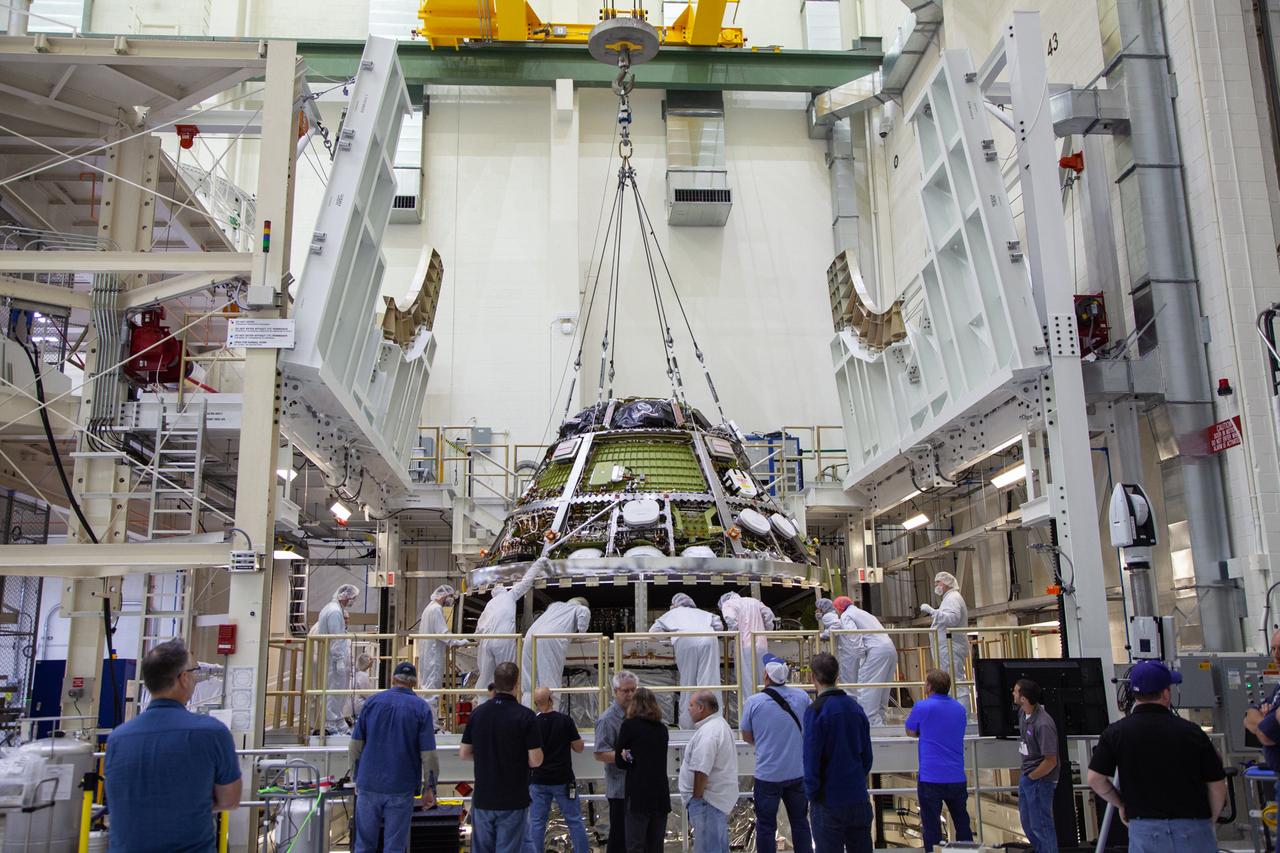
The Orion crew module for Artemis 1 is lowered by crane atop its service module on July 16, 2019, in the high bay inside the Neil Armstrong Operations and Checkout Building high bay at NASA’s Kennedy Space Center in Florida. Technicians begin the work to secure the crew module onto the service module in the final assembly and test cell. The Orion spacecraft is being prepared for its uncrewed test flight atop NASA’s Space Launch System (SLS) rocket. Artemis 1 is the first test flight of the SLS and Orion spacecraft as an integrated system. Orion will travel thousands of miles beyond the Moon during a mission that will test its systems in space and during re-entry. The spacecraft will return to Earth and splashdown in the Pacific Ocean where it will be retrieved and transported back to Kennedy.
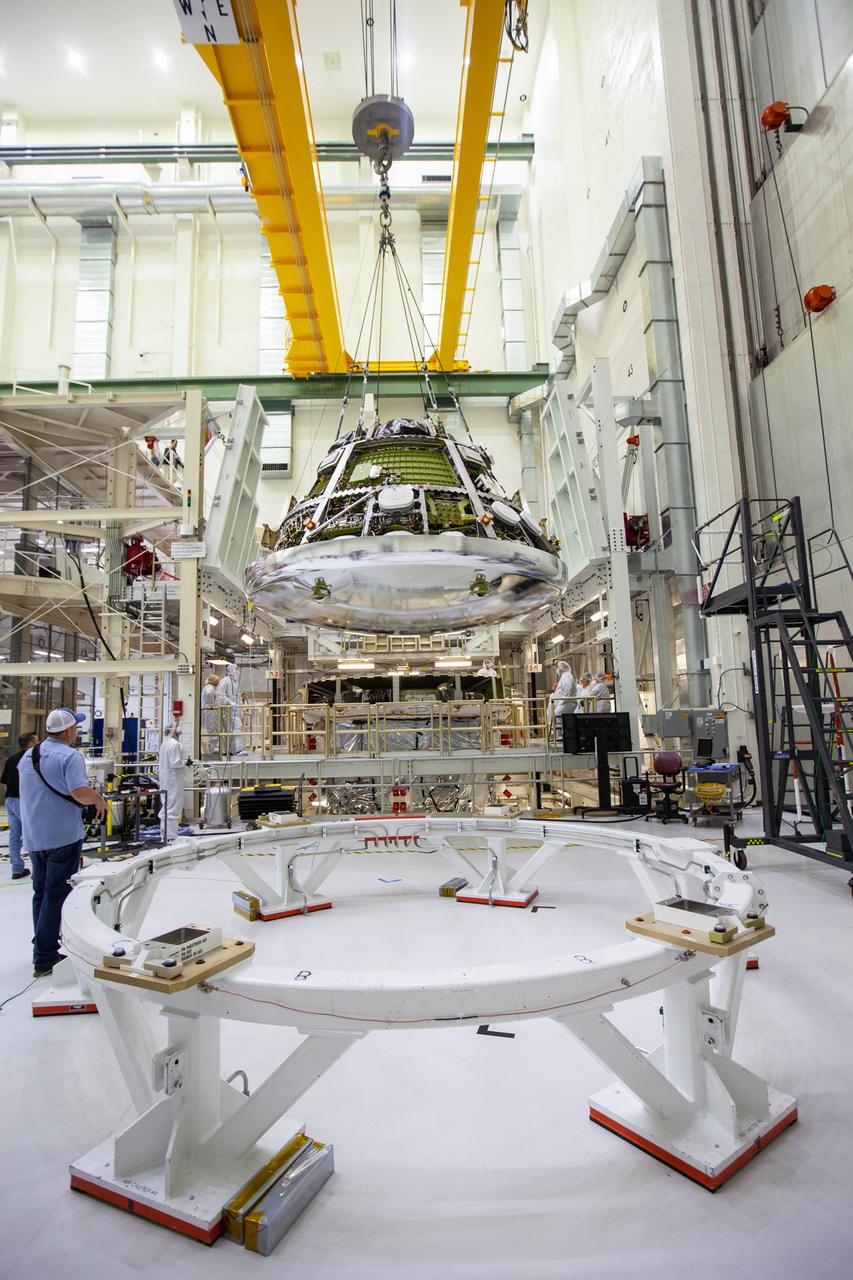
The Orion crew module for Artemis 1 is lifted by crane on July 16, 2019, in the high bay inside the Neil Armstrong Operations and Checkout Building high bay at NASA’s Kennedy Space Center in Florida. The crew module is being moved to the final assembly and test cell and work will begin to secure it atop the service module. The Orion spacecraft is being prepared for its uncrewed test flight atop NASA’s Space Launch System (SLS) rocket. Artemis 1 is the first test flight of the SLS and Orion spacecraft as an integrated system. Orion will travel thousands of miles beyond the Moon during a mission that will test its systems in space. The spacecraft will return to Earth and splashdown in the Pacific Ocean where it will be retrieved and transported back to Kennedy.
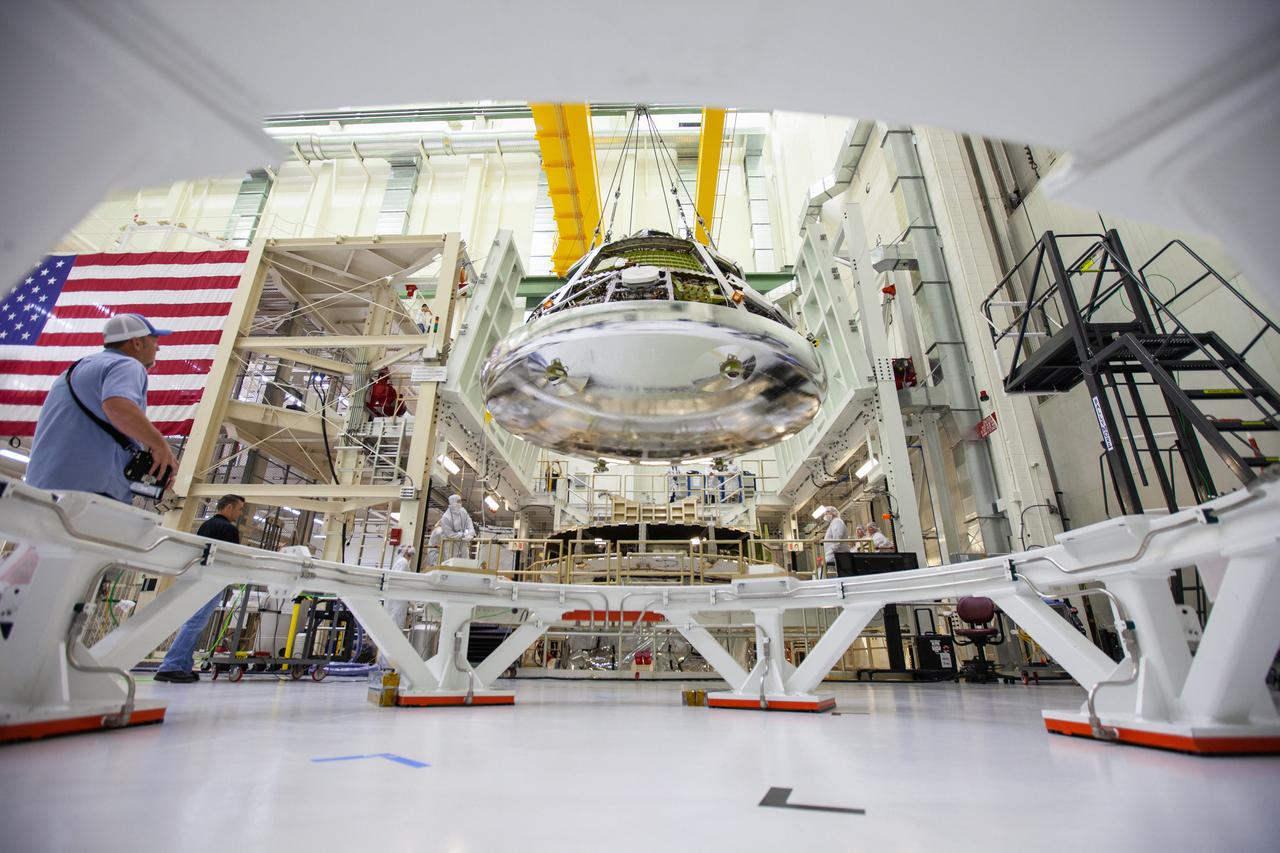
The Orion crew module for Artemis 1 is lifted by crane on July 16, 2019, in the high bay inside the Neil Armstrong Operations and Checkout Building high bay at NASA’s Kennedy Space Center in Florida. The crew module will be moved to the final assembly and test cell and work will begin to secure it atop the service module. The Orion spacecraft is being prepared for its uncrewed test flight atop NASA’s Space Launch System (SLS) rocket. Artemis 1 is the first test flight of the SLS and Orion spacecraft as an integrated system. Orion will travel thousands of miles beyond the Moon during a mission that will test its systems in space. The spacecraft will return to Earth and splashdown in the Pacific Ocean where it will be retrieved and transported back to Kennedy.
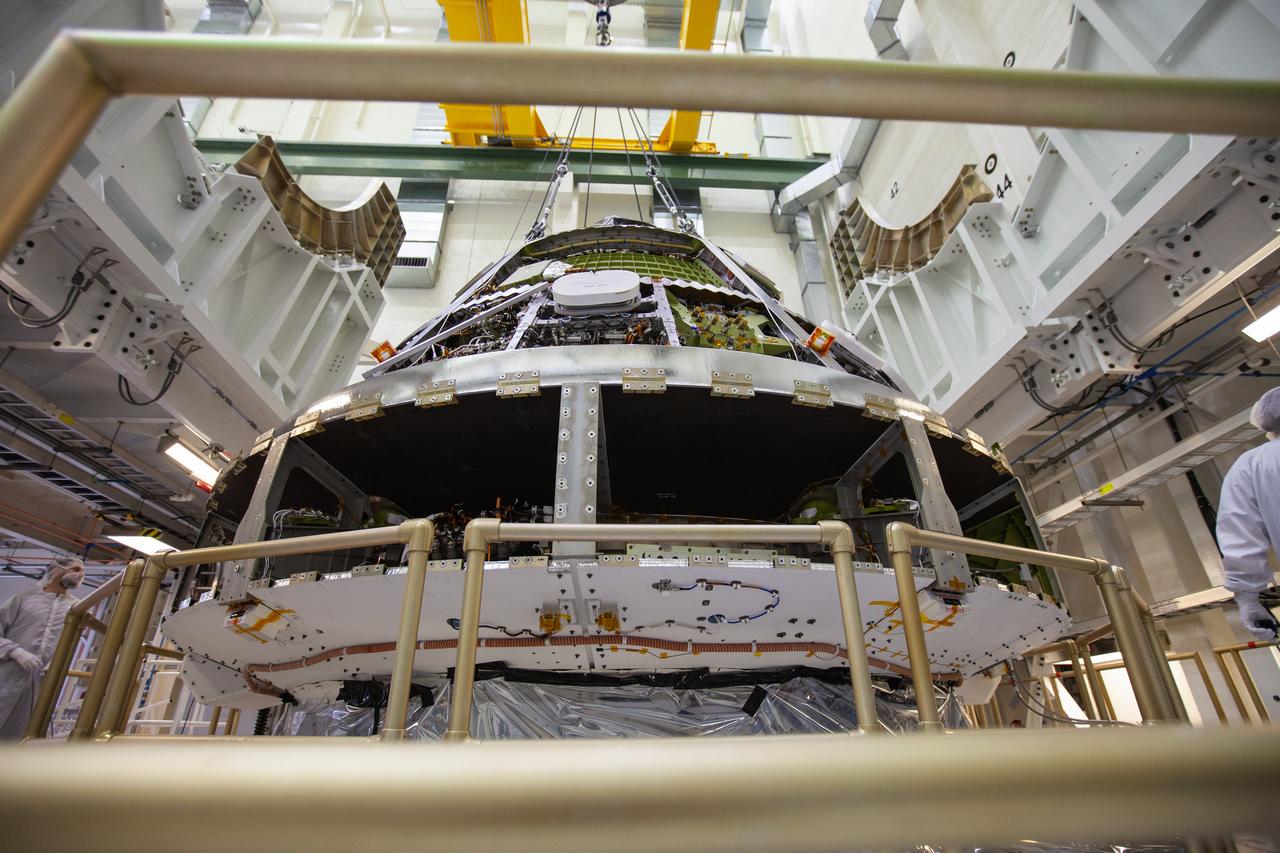
The Orion crew module for Artemis 1 is lifted by crane on July 16, 2019, in the high bay inside the Neil Armstrong Operations and Checkout Building high bay at NASA’s Kennedy Space Center in Florida. The crew module will be moved to the final assembly and test cell and work will begin to secure it atop the service module. The Orion spacecraft is being prepared for its uncrewed test flight atop NASA’s Space Launch System (SLS) rocket. Artemis 1 is the first test flight of the SLS and Orion spacecraft as an integrated system. Orion will travel thousands of miles beyond the Moon during a mission that will test its systems in space. The spacecraft will return to Earth and splashdown in the Pacific Ocean where it will be retrieved and transported back to Kennedy.
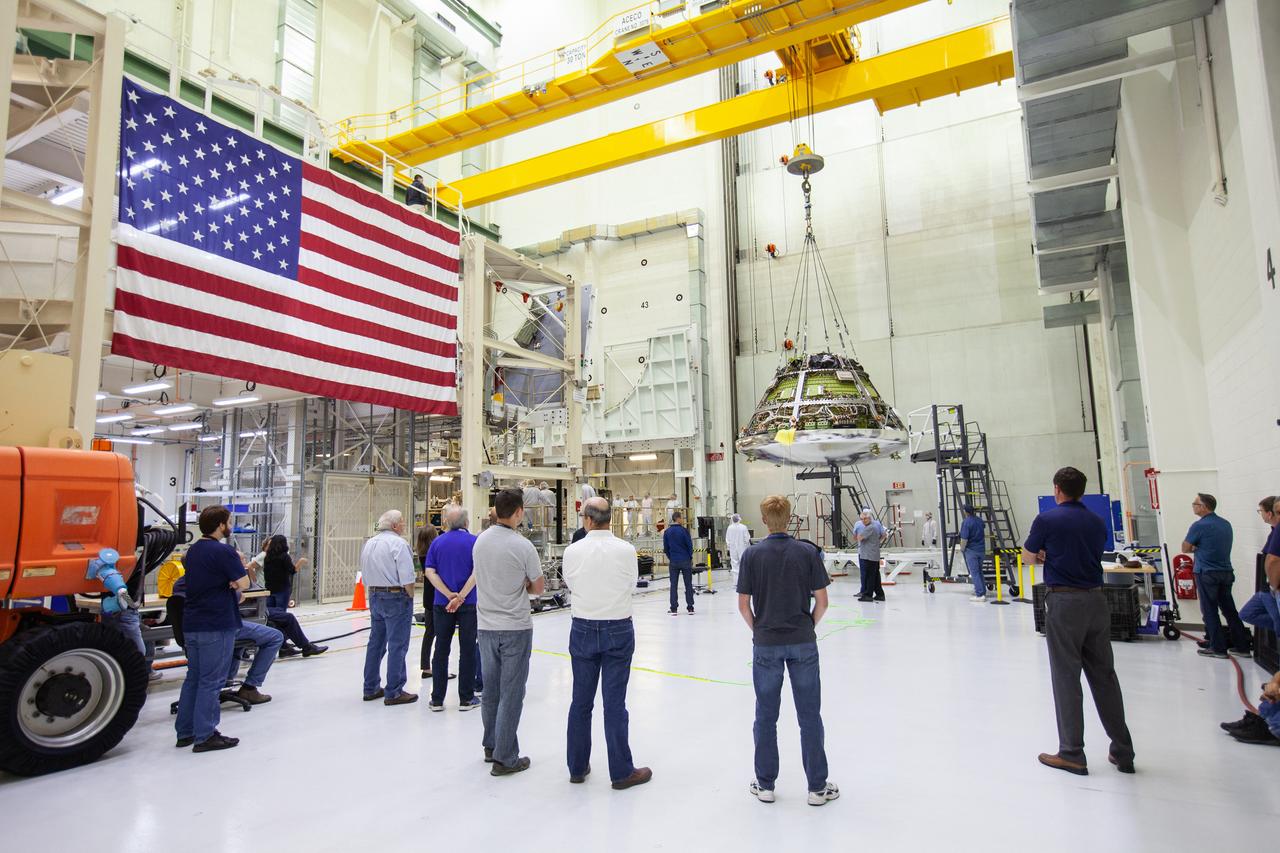
Engineers and technicians monitor the progress as the Orion crew module for Artemis 1 is moved by crane on July 16, 2019, in the high bay inside the Neil Armstrong Operations and Checkout Building high bay at NASA’s Kennedy Space Center in Florida. The crew module is being moved to the final assembly and test cell and work will begin to secure it atop the service module. The Orion spacecraft is being prepared for its uncrewed test flight atop NASA’s Space Launch System (SLS) rocket. Artemis 1 is the first test flight of the SLS and Orion spacecraft as an integrated system. Orion will travel thousands of miles beyond the Moon during a mission that will test its systems in space. The spacecraft will return to Earth and splashdown in the Pacific Ocean where it will be retrieved and transported back to Kennedy.
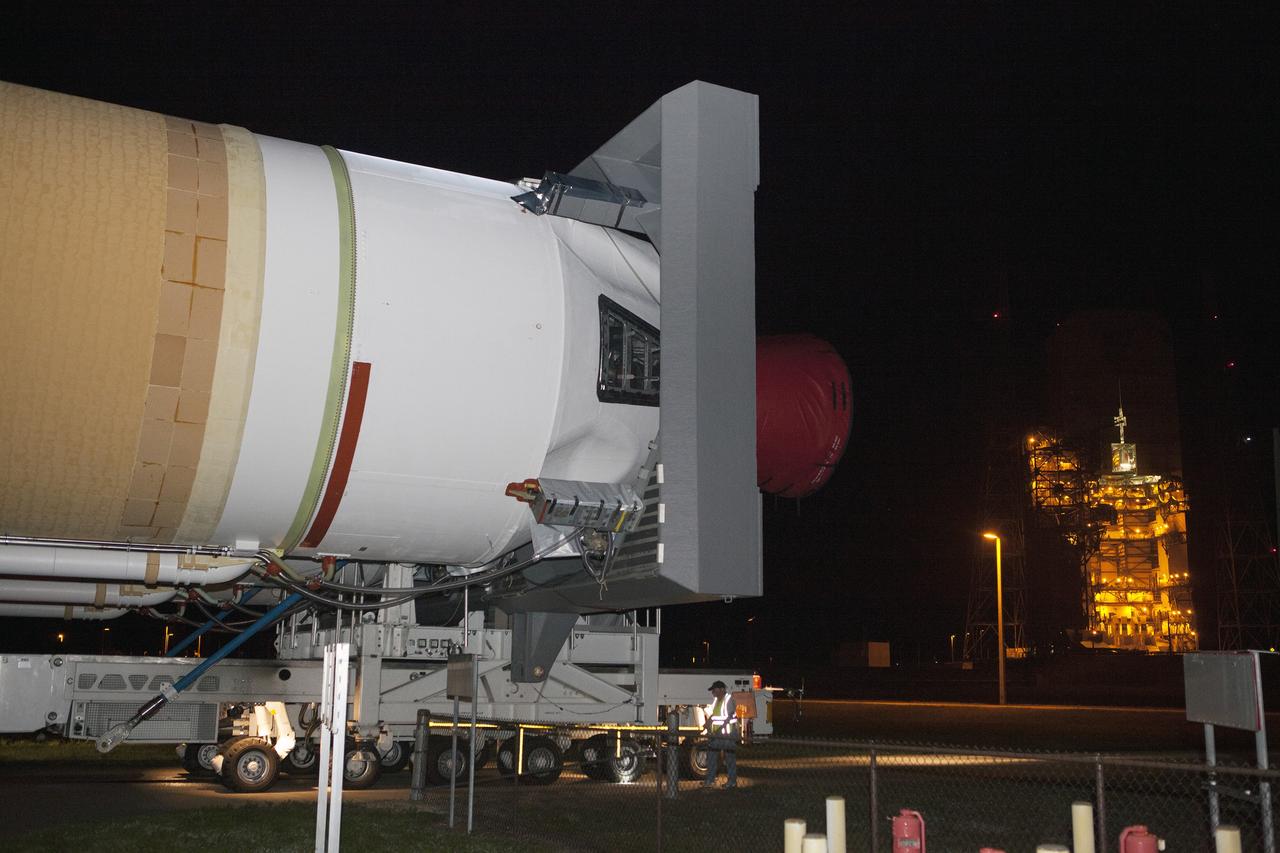
CAPE CANAVERAL, Fla. – The United Launch Alliance, or ULA, Delta IV Heavy rocket for Exploration Flight Test-1 continues its trek to the pad at Space Launch Complex 37 at Cape Canaveral Air Force Station in Florida. ULA technicians help guide the transporter to the pad. The rocket is secured on the Elevated Platform Transporter. The Delta IV Heavy will launch Orion on its first flight test. During its first flight test, Orion will travel farther into space than any human spacecraft has gone in more than 40 years. The data gathered during the flight will influence design decisions, validate existing computer models and innovative new approaches to space systems development, as well as reduce overall mission risks and costs for later Orion flights. Liftoff of Orion on the first flight test is planned for December 2014. Photo credit: NASA/Dimitri Gerondidakis
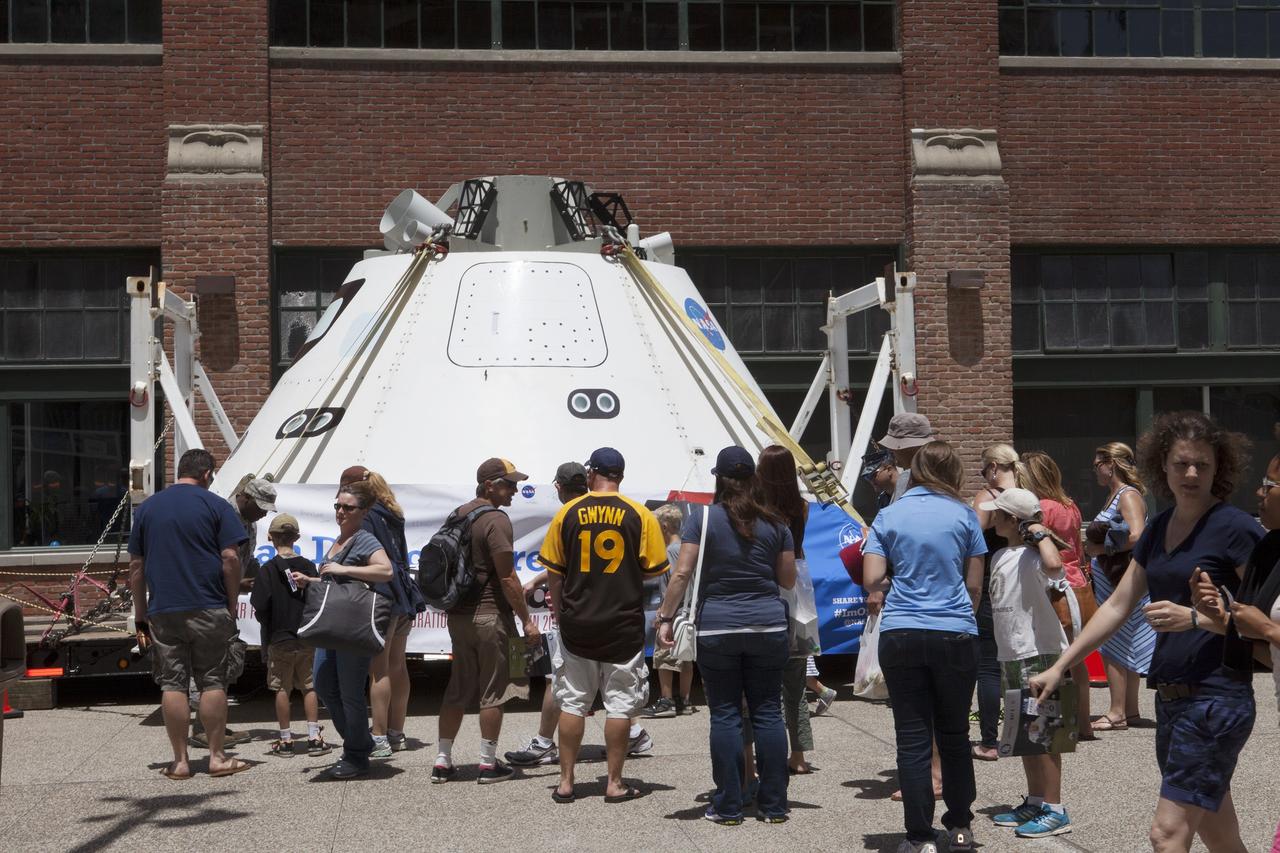
CAPE CANAVERAL, Fla. – Fans check out NASA's Orion boilerplate test vehicle on display at Petco Park in San Diego, California, before the start of a San Diego Padres' baseball game. The boilerplate test vehicle is being prepared for an Exploration Flight Test-1, or EFT-1, pre-transportation test. The Ground Systems Development and Operations Program will run the test at the U.S. Naval Base San Diego to simulate retrieval and transportation procedures for Orion after it splashes down in the ocean and is retrieved for return to land and ground transportation back to Kennedy Space Center in Florida. Orion is the exploration spacecraft designed to carry astronauts to destinations not yet explored by humans, including an asteroid and Mars. It will have emergency abort capability, sustain the crew during space travel and provide safe re-entry from deep space return velocities. The first unpiloted test flight of the Orion is scheduled to launch later this year atop a Delta IV rocket and in 2017 on NASA’s Space Launch System rocket. For more information, visit http://www.nasa.gov/orion. Photo credit: NASA/Kim Shiflett
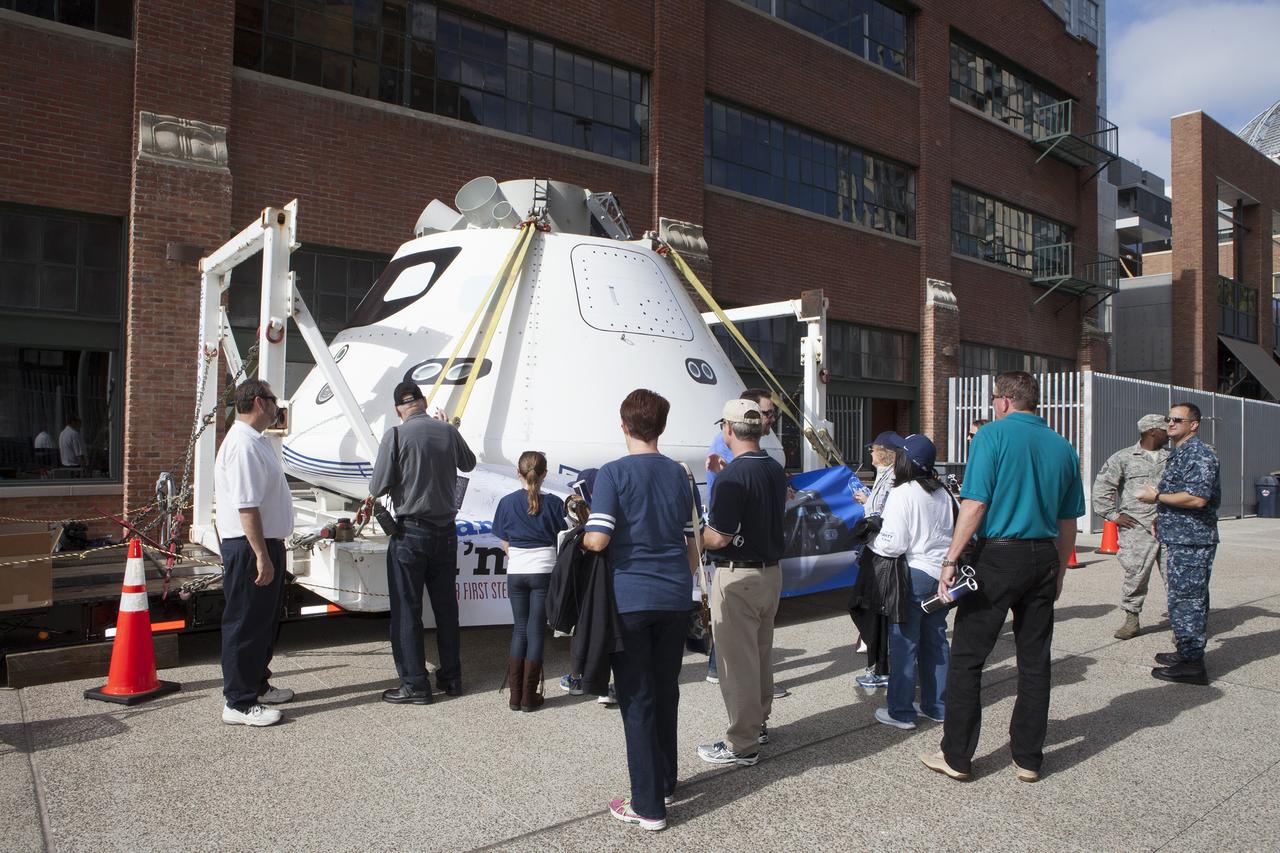
CAPE CANAVERAL, Fla. – The Orion boilerplate test vehicle is on display at Petco Park in San Diego, California, before the San Diego Padres' baseball game. The boilerplate test vehicle is being prepared for an Exploration Flight Test-1, or EFT-1, pre-transportation test. The Ground Systems Development and Operations Program will run the test at the U.S. Naval Base San Diego to simulate retrieval and transportation procedures for Orion after it splashes down in the ocean and is retrieved for return to land and ground transportation back to Kennedy Space Center in Florida. Orion is the exploration spacecraft designed to carry astronauts to destinations not yet explored by humans, including an asteroid and Mars. It will have emergency abort capability, sustain the crew during space travel and provide safe re-entry from deep space return velocities. The first unpiloted test flight of the Orion is scheduled to launch later this year atop a Delta IV rocket and in 2017 on NASA’s Space Launch System rocket. For more information, visit http://www.nasa.gov/orion. Photo credit: NASA/Kim Shiflett