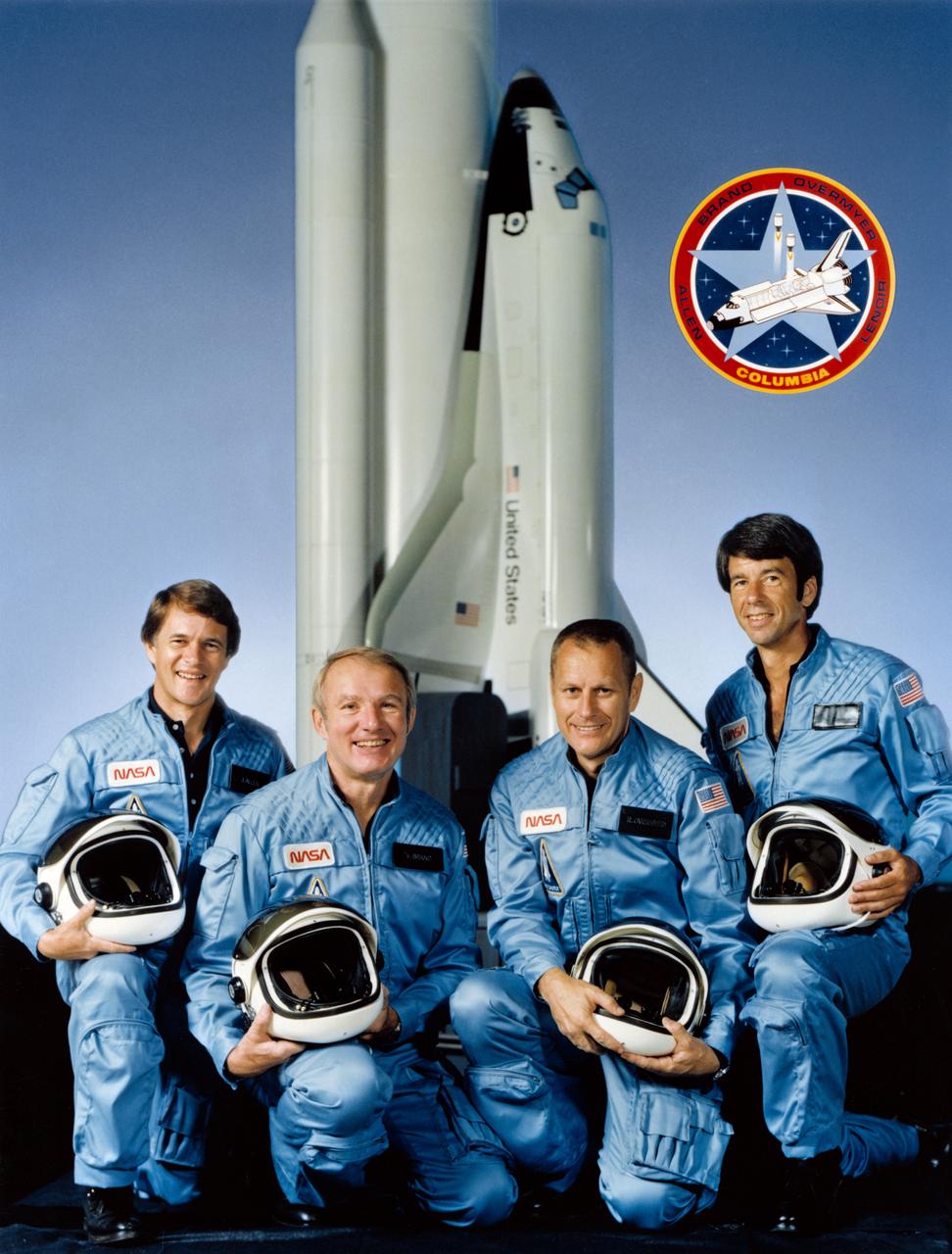
S82-36286 (15 Aug. 1982) --- These four men will be aboard the space shuttle Columbia for NASA's first operational Space Transportation System (STS) mission. They are astronauts Vance D. Brand (second left), STS-5 commander; Robert F. Overmyer (second right), pilot; and Joseph P. Allen (left) and William B. Lenoir, both mission specialists. They pose with a space shuttle model and the official insignia for STS-5. Their flight is scheduled for November of this year. Photo credit: NASA
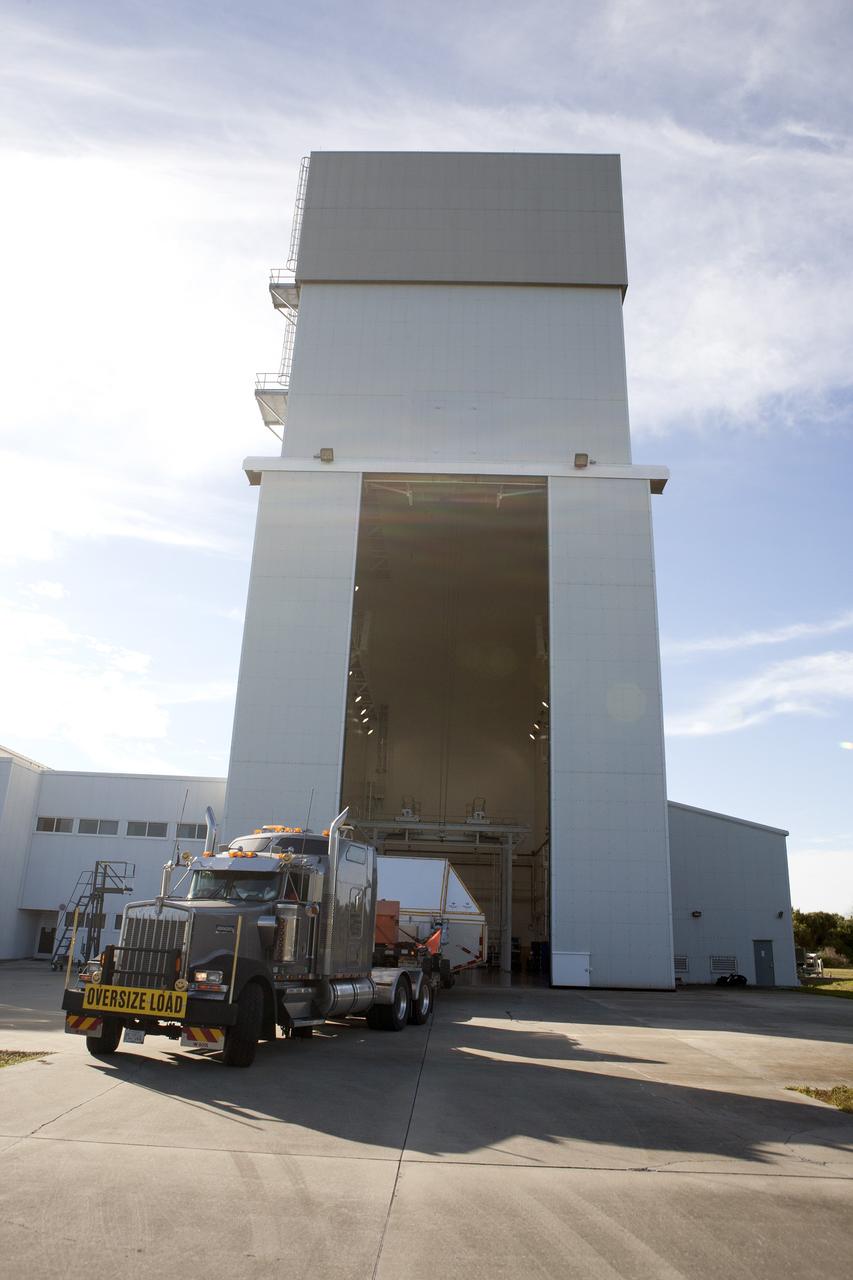
CAPE CANAVERAL, Fla. -- NASA's Orion spacecraft arrives at the Launch Abort System Facility at Kennedy Space Center in Florida. The spacecraft was transported 2,700 miles overland from Naval Base San Diego in California, on a flatbed truck secured in its crew module transportation fixture for the trip. During its first flight test, Orion completed a two-orbit, four-and-a-half hour mission Dec. 5 to test systems critical to crew safety, including the launch abort system, the heat shield and the parachute system. The Ground Systems Development and Operations Program led the recovery, offload and transportation efforts. For more information, visit www.nasa.gov/orion. Photo credit: NASA/Kim Shiflett
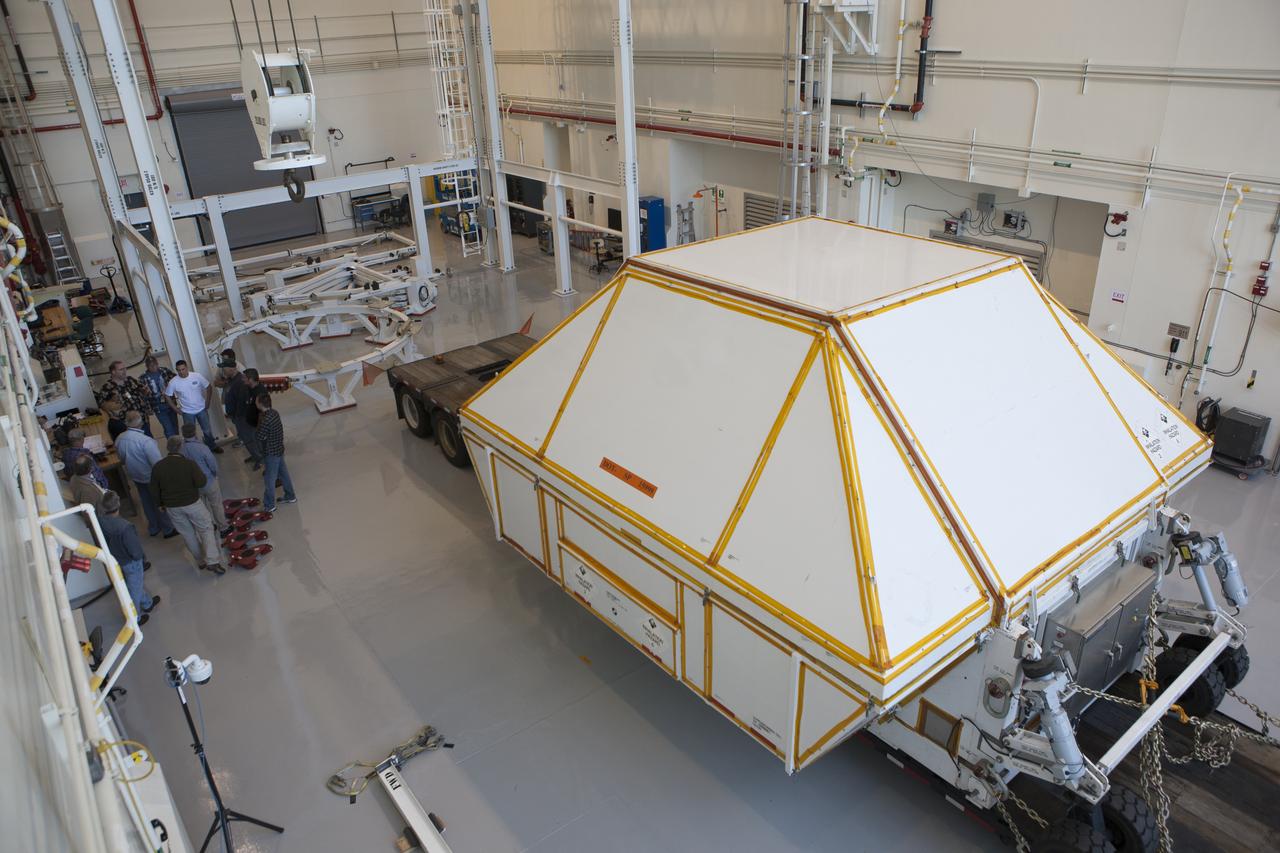
NASA's Orion spacecraft arrives inside the Launch Abort System Facility at Kennedy Space Center in Florida. The spacecraft was transported 2,700 miles overland from Naval Base San Diego in California, on a flatbed truck secured in its crew module transportation fixture for the trip. During its first flight test, Orion completed a two-orbit, four-and-a-half hour mission Dec. 5 to test systems critical to crew safety, including the launch abort system, the heat shield and the parachute system. The Ground Systems Development and Operations Program led the recovery, offload and transportation efforts.
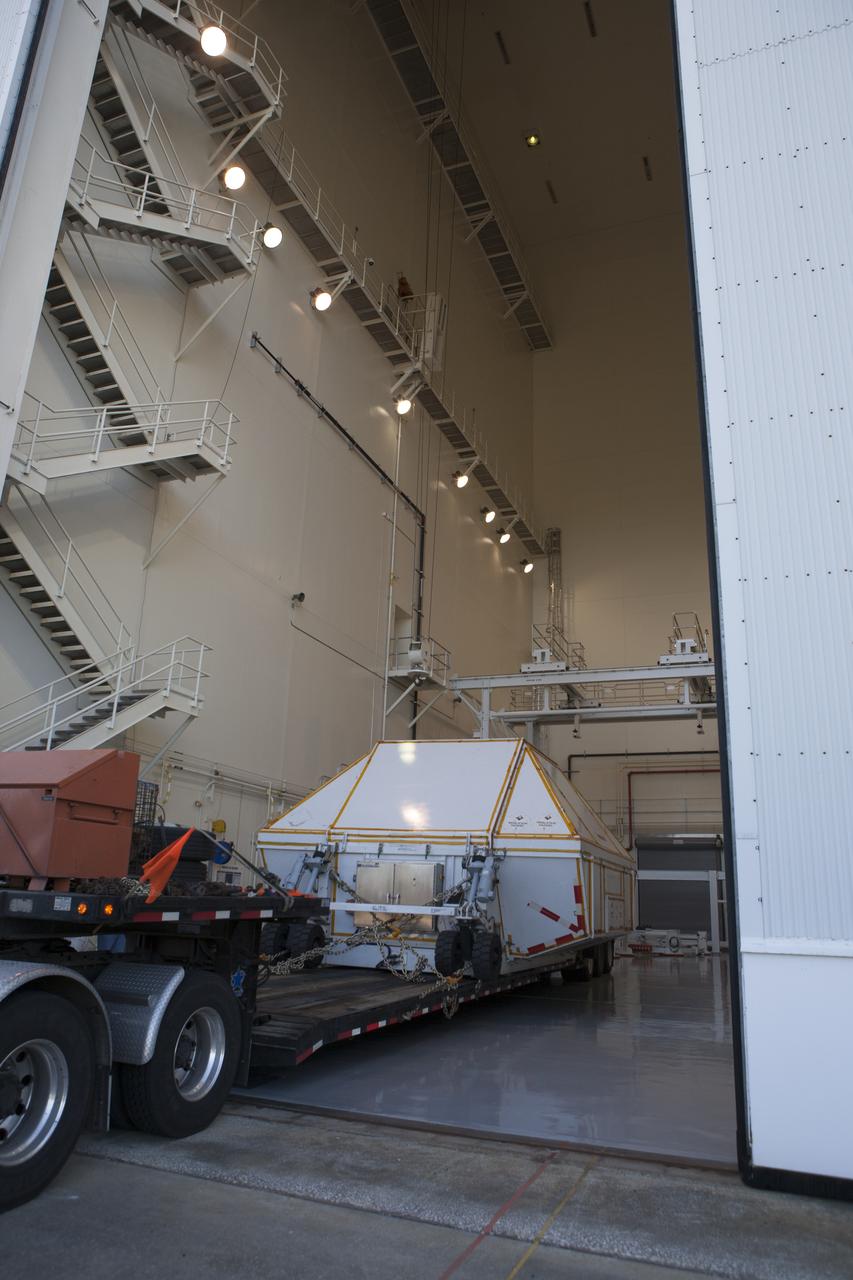
NASA's Orion spacecraft arrives at the Launch Abort System Facility at Kennedy Space Center in Florida. The spacecraft was transported 2,700 miles overland from Naval Base San Diego in California, on a flatbed truck secured in its crew module transportation fixture for the trip. During its first flight test, Orion completed a two-orbit, four-and-a-half hour mission Dec. 5 to test systems critical to crew safety, including the launch abort system, the heat shield and the parachute system. The Ground Systems Development and Operations Program led the recovery, offload and transportation efforts.
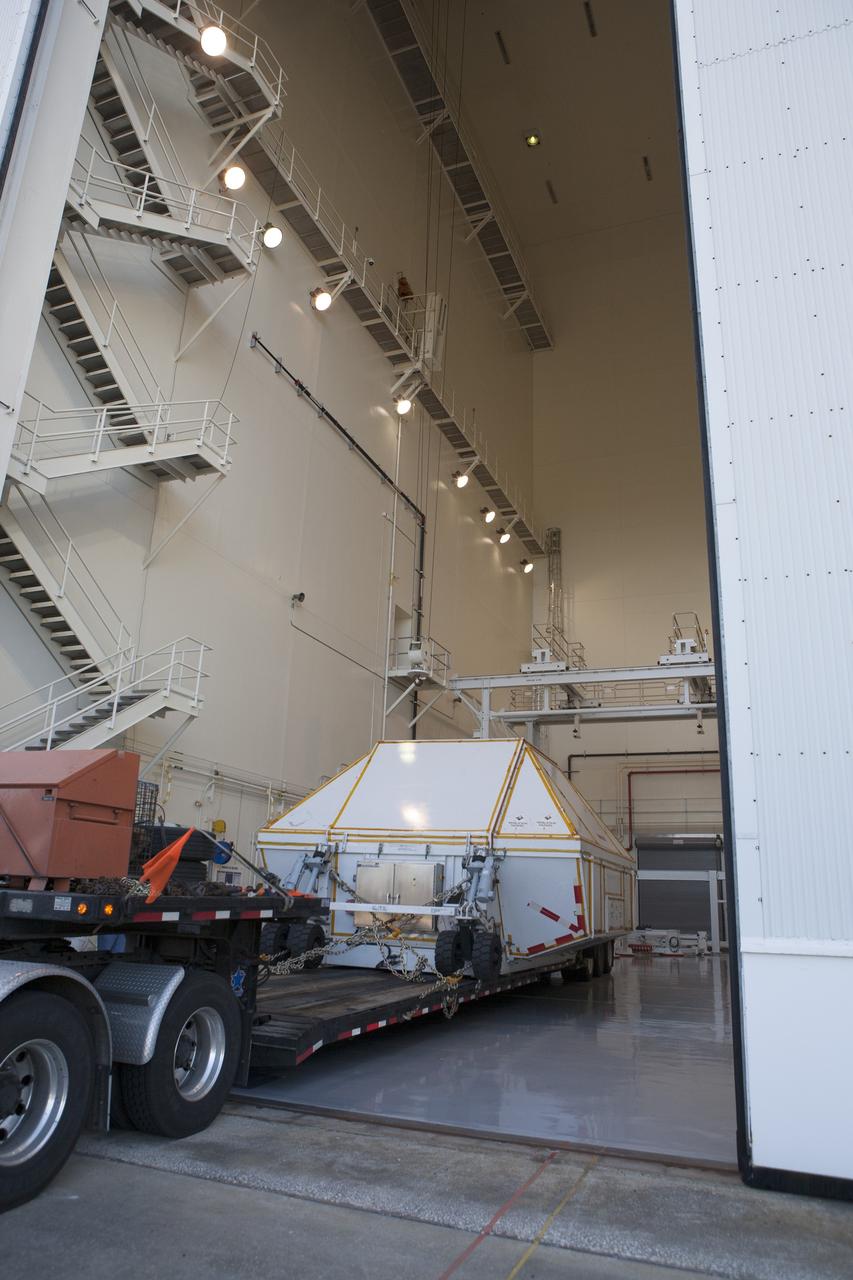
CAPE CANAVERAL, Fla. -- NASA's Orion spacecraft arrives at the Launch Abort System Facility at Kennedy Space Center in Florida. The spacecraft was transported 2,700 miles overland from Naval Base San Diego in California, on a flatbed truck secured in its crew module transportation fixture for the trip. During its first flight test, Orion completed a two-orbit, four-and-a-half hour mission Dec. 5 to test systems critical to crew safety, including the launch abort system, the heat shield and the parachute system. The Ground Systems Development and Operations Program led the recovery, offload and transportation efforts. For more information, visit www.nasa.gov/orion. Photo credit: NASA/Kim Shiflett
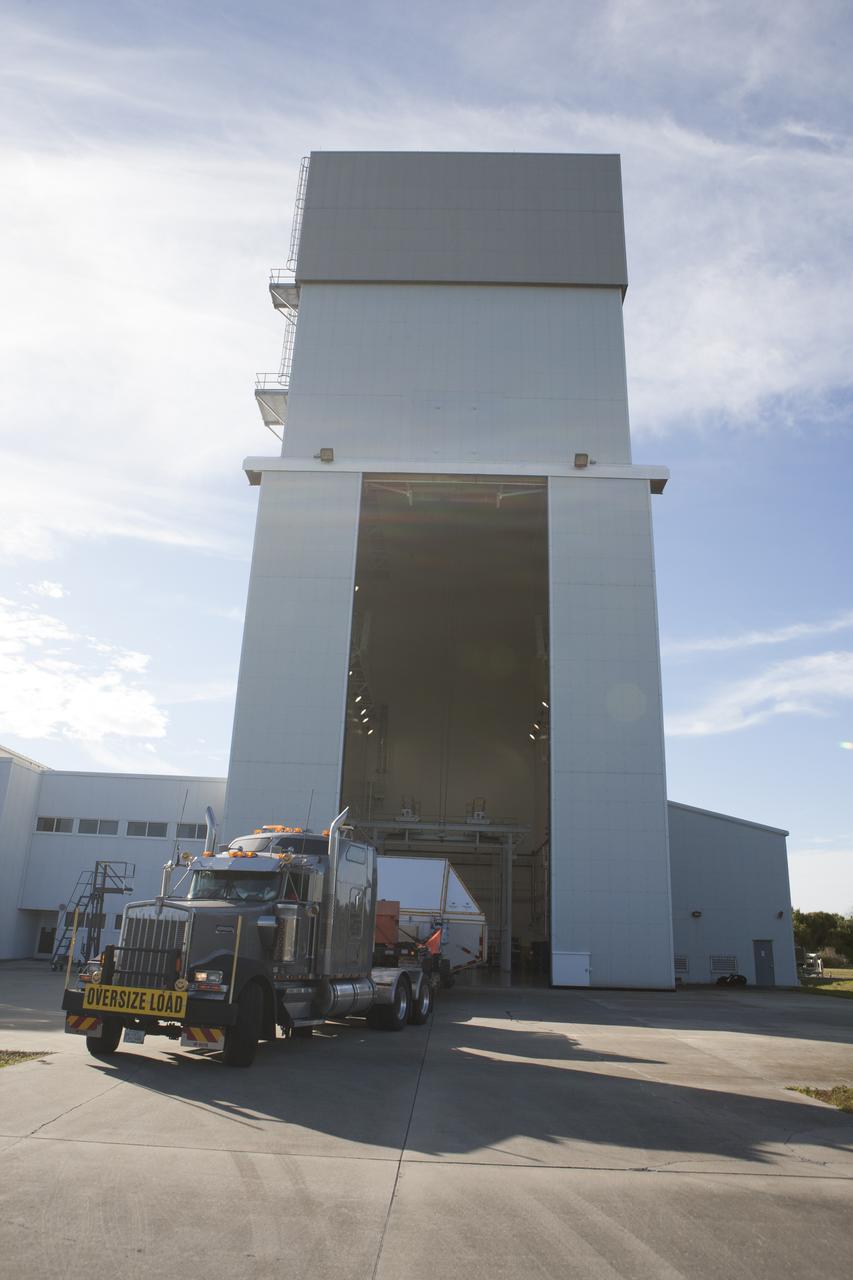
NASA's Orion spacecraft arrives at the Launch Abort System Facility at Kennedy Space Center in Florida. The spacecraft was transported 2,700 miles overland from Naval Base San Diego in California, on a flatbed truck secured in its crew module transportation fixture for the trip. During its first flight test, Orion completed a two-orbit, four-and-a-half hour mission Dec. 5 to test systems critical to crew safety, including the launch abort system, the heat shield and the parachute system. The Ground Systems Development and Operations Program led the recovery, offload and transportation efforts.
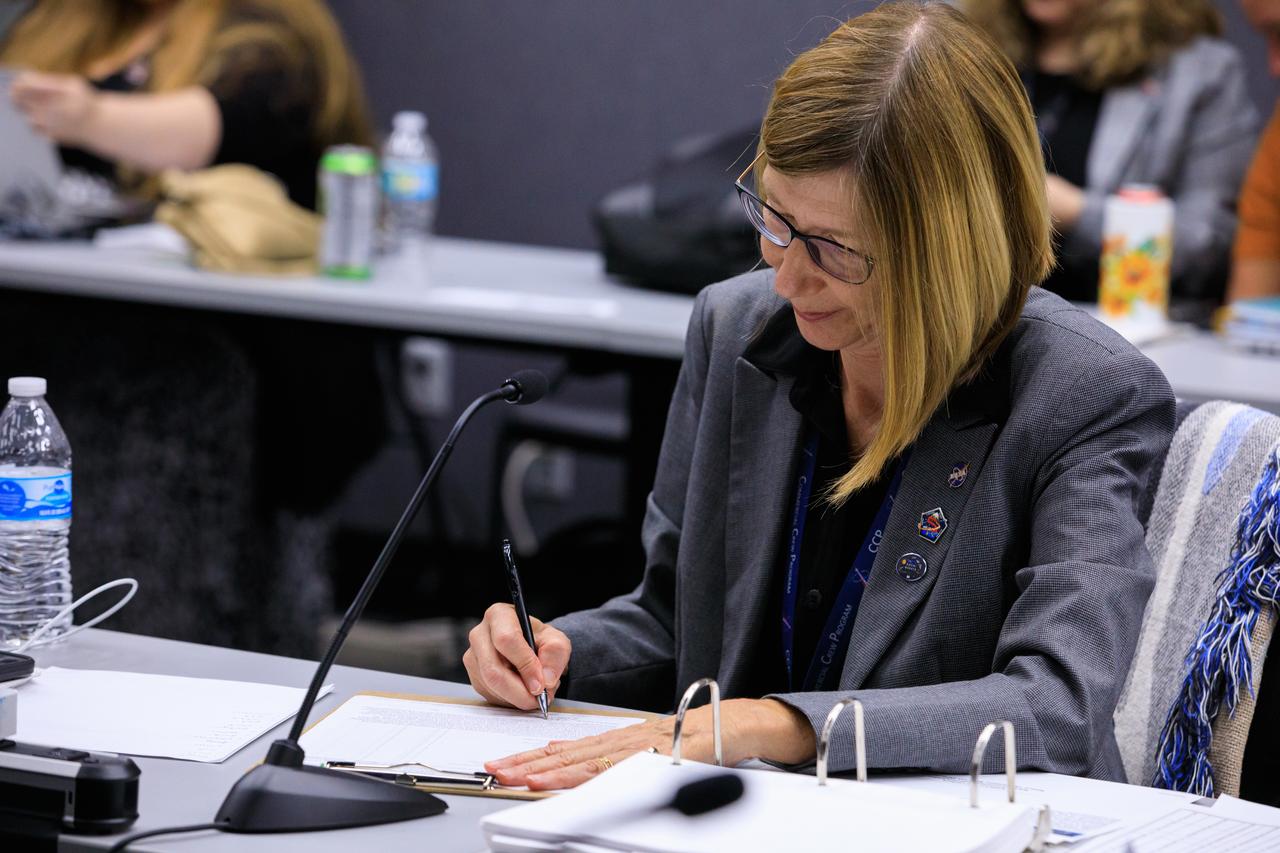
Kathryn Lueders, associate administrator for NASA’s Space Operations Mission Directorate, participates in a Flight Readiness Review for the agency’s Crew-5 mission at Kennedy Space Center in Florida on Sept. 26, 2022. NASA and SpaceX managers held the review to confirm the SpaceX Falcon 9 rocket and Crew Dragon spacecraft are ready for launch. Crew-5 is scheduled to launch to the International Space Station from Kennedy’s Launch Complex 39A as part of the agency’s Commercial Crew Program. This will be the fifth crew rotation mission of SpaceX’s human transportation system and its sixth flight with astronauts, including the Demo-2 test flight, to the space station.
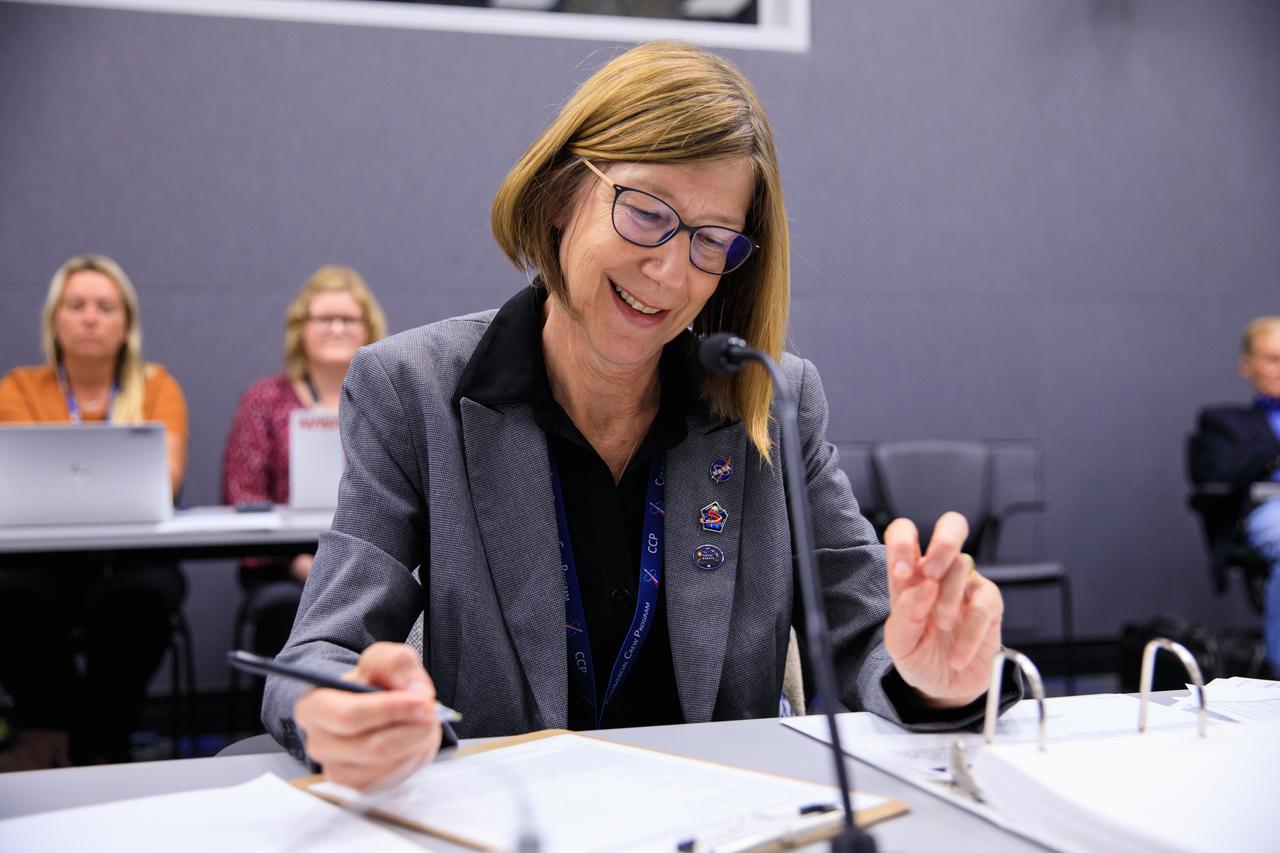
Kathryn Lueders, associate administrator for NASA’s Space Operations Mission Directorate, participates in a Flight Readiness Review for the agency’s Crew-5 mission at Kennedy Space Center in Florida on Sept. 26, 2022. NASA and SpaceX managers held the review to confirm the SpaceX Falcon 9 rocket and Crew Dragon spacecraft are ready for launch. Crew-5 is scheduled to launch to the International Space Station from Kennedy’s Launch Complex 39A as part of the agency’s Commercial Crew Program. This will be the fifth crew rotation mission of SpaceX’s human transportation system and its sixth flight with astronauts, including the Demo-2 test flight, to the space station.
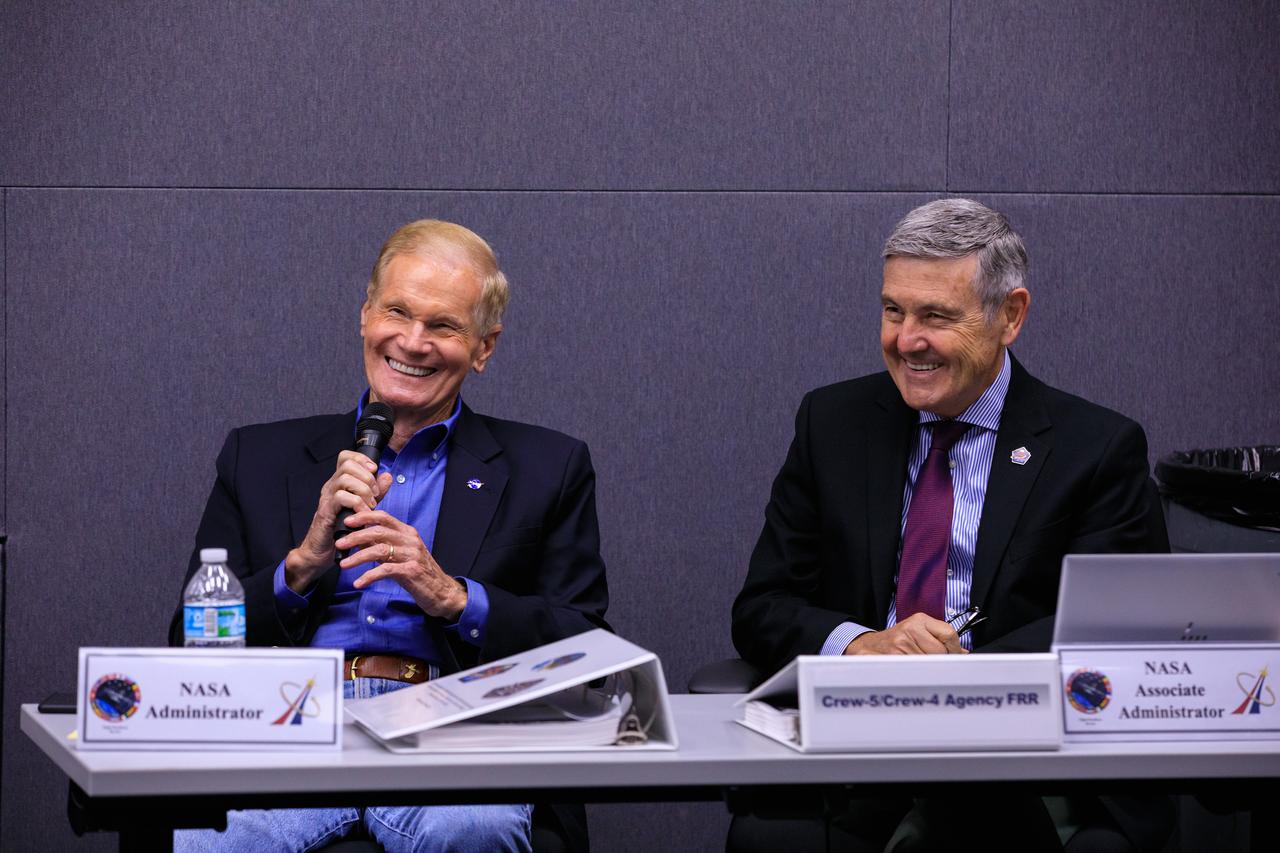
NASA Administrator Bill Nelson, left, and Associate Administrator Bob Cabana participate in a Flight Readiness Review for the agency’s Crew-5 mission at Kennedy Space Center in Florida on Sept. 26, 2022. NASA and SpaceX managers held the review to confirm the SpaceX Falcon 9 rocket and Crew Dragon spacecraft are ready for launch. Crew-5 is scheduled to launch to the International Space Station from Kennedy’s Launch Complex 39A as part of the agency’s Commercial Crew Program. This will be the fifth crew rotation mission of SpaceX’s human transportation system and its sixth flight with astronauts, including the Demo-2 test flight, to the space station.
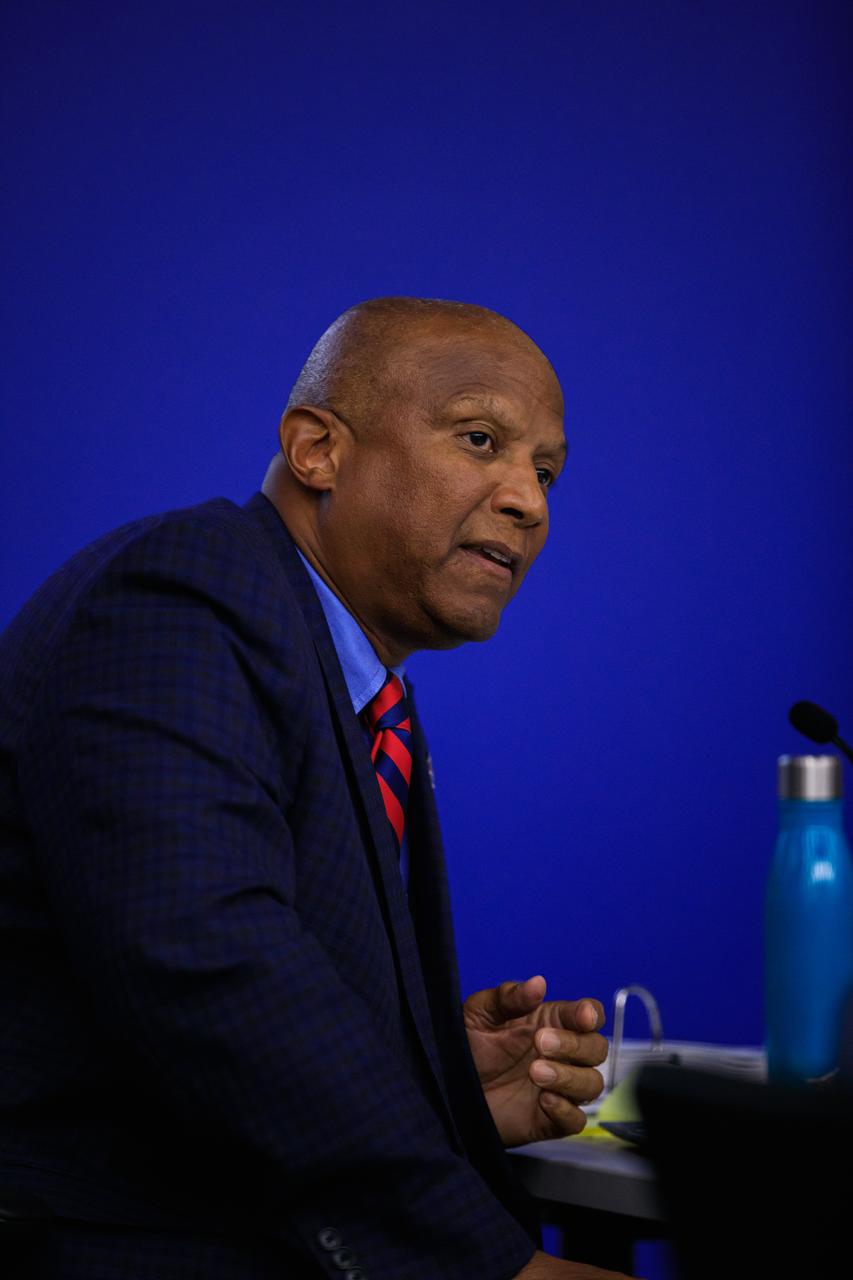
Kennedy Space Center Deputy Director Kelvin Manning participates in a Flight Readiness Review for NASA’s Crew-5 mission at the Florida spaceport on Sept. 26, 2022. NASA and SpaceX managers held the review to confirm the SpaceX Falcon 9 rocket and Crew Dragon spacecraft are ready for launch. Crew-5 is scheduled to launch to the International Space Station from Kennedy’s Launch Complex 39A as part of the agency’s Commercial Crew Program. This will be the fifth crew rotation mission of SpaceX’s human transportation system and its sixth flight with astronauts, including the Demo-2 test flight, to the space station.
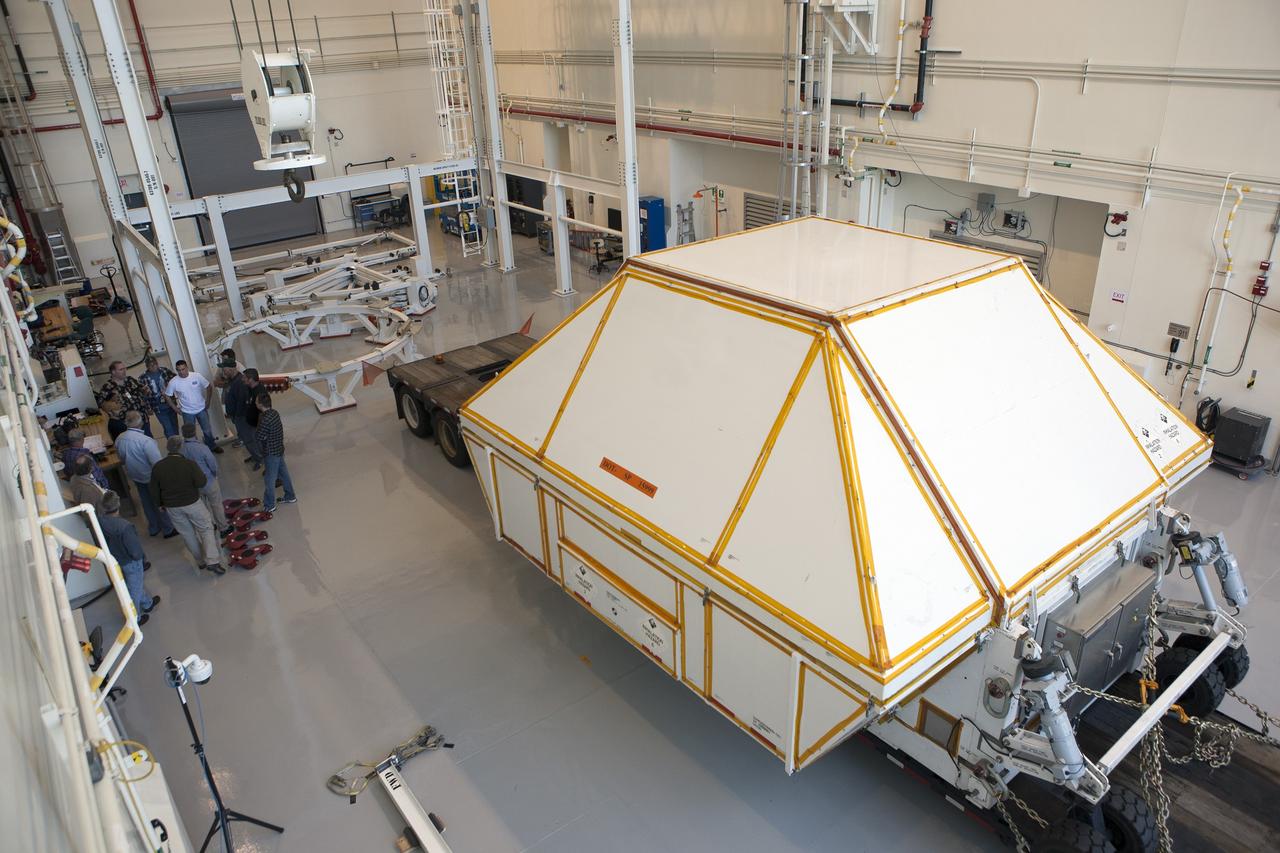
CAPE CANAVERAL, Fla. -- NASA's Orion spacecraft arrives inside the Launch Abort System Facility at Kennedy Space Center in Florida. The spacecraft was transported 2,700 miles overland from Naval Base San Diego in California, on a flatbed truck secured in its crew module transportation fixture for the trip. During its first flight test, Orion completed a two-orbit, four-and-a-half hour mission Dec. 5 to test systems critical to crew safety, including the launch abort system, the heat shield and the parachute system. The Ground Systems Development and Operations Program led the recovery, offload and transportation efforts. For more information, visit www.nasa.gov/orion. Photo credit: NASA/Kim Shiflett
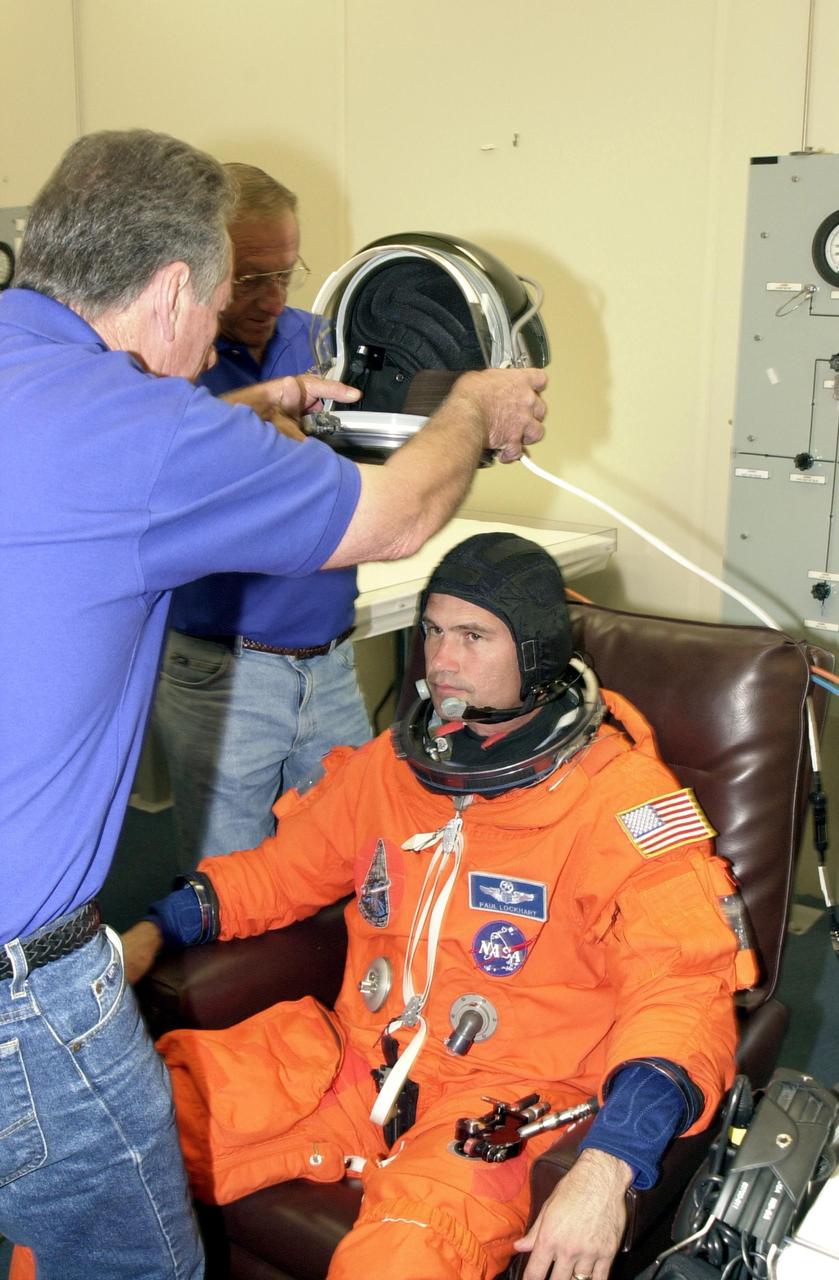
KENNEDY SPACE CENTER, FLA. - STS-111 Pilot Paul Lockhart waits for his helmet during suitup for the scheduled liftoff of Space Shuttle Endeavour at 7:44 p.m. EDT. This is Lockhart's first Shuttle flight. STS-111 is the second Utilization Flight to the International Space Station, carrying the Multi-Purpose Logistics Module Leonardo, the Mobile Base System (MBS), and a replacement wrist/roll joint for the Canadarm 2. The MBS will be installed on the Mobile Transporter to complete the Canadian Mobile Servicing System, or MSS. In addition, Expedition 5 is traveling on mission STS-111 to the International Space Station to replace the current resident crew, Expedition 4, who will return to Earth with the STS-111 crew
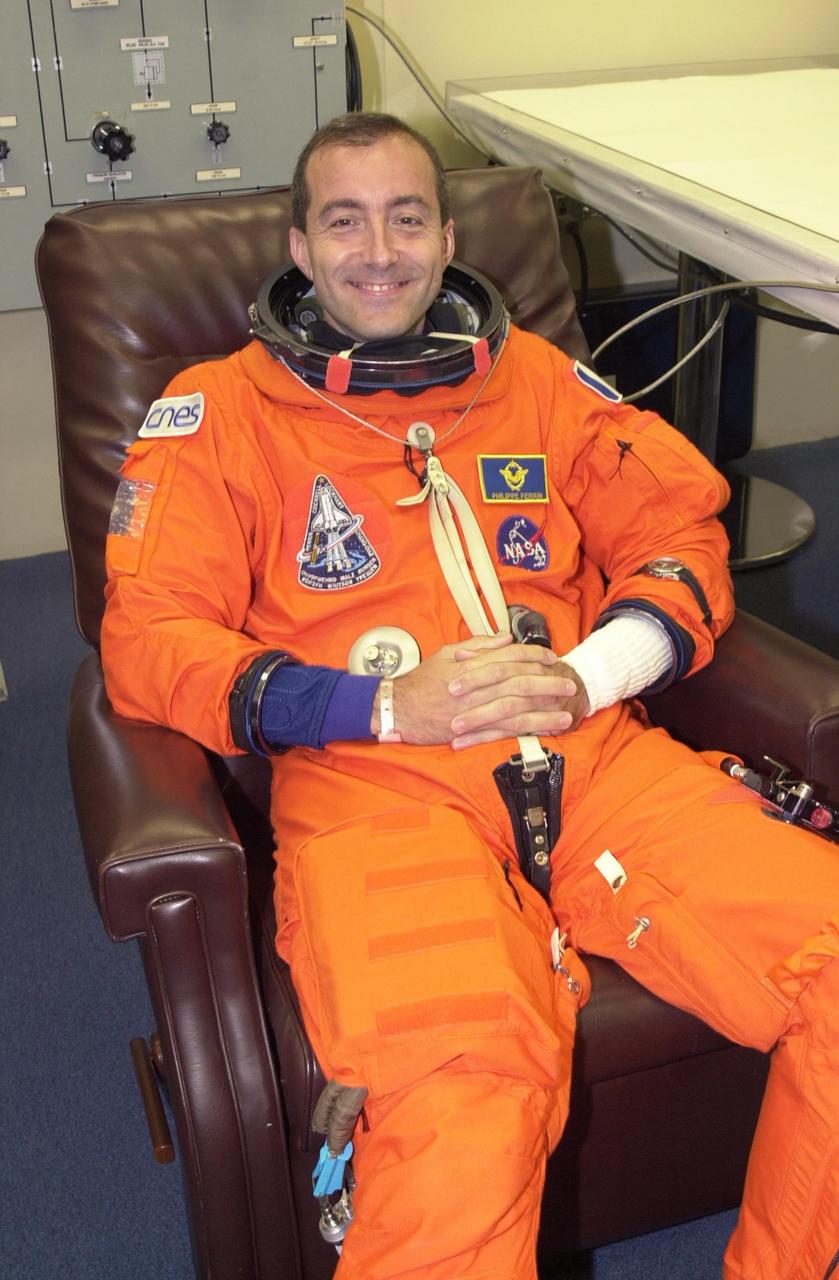
KENNEDY SPACE CENTER, FLA. - STS-111 Mission Specialist Philippe Perrin (CNES) smiles during suitup for the scheduled liftoff of Space Shuttle Endeavour at 7:44 p.m. EDT. This is Perrin's first Shuttle flight. STS-111 is the second Utilization Flight to the International Space Station, carrying the Multi-Purpose Logistics Module Leonardo, the Mobile Base System (MBS), and a replacement wrist/roll joint for the Canadarm 2. The MBS will be installed on the Mobile Transporter to complete the Canadian Mobile Servicing System, or MSS. In addition, Expedition 5 is traveling on mission STS-111 to the International Space Station to replace the current resident crew, Expedition 4, who will return to Earth with the STS-111 crew
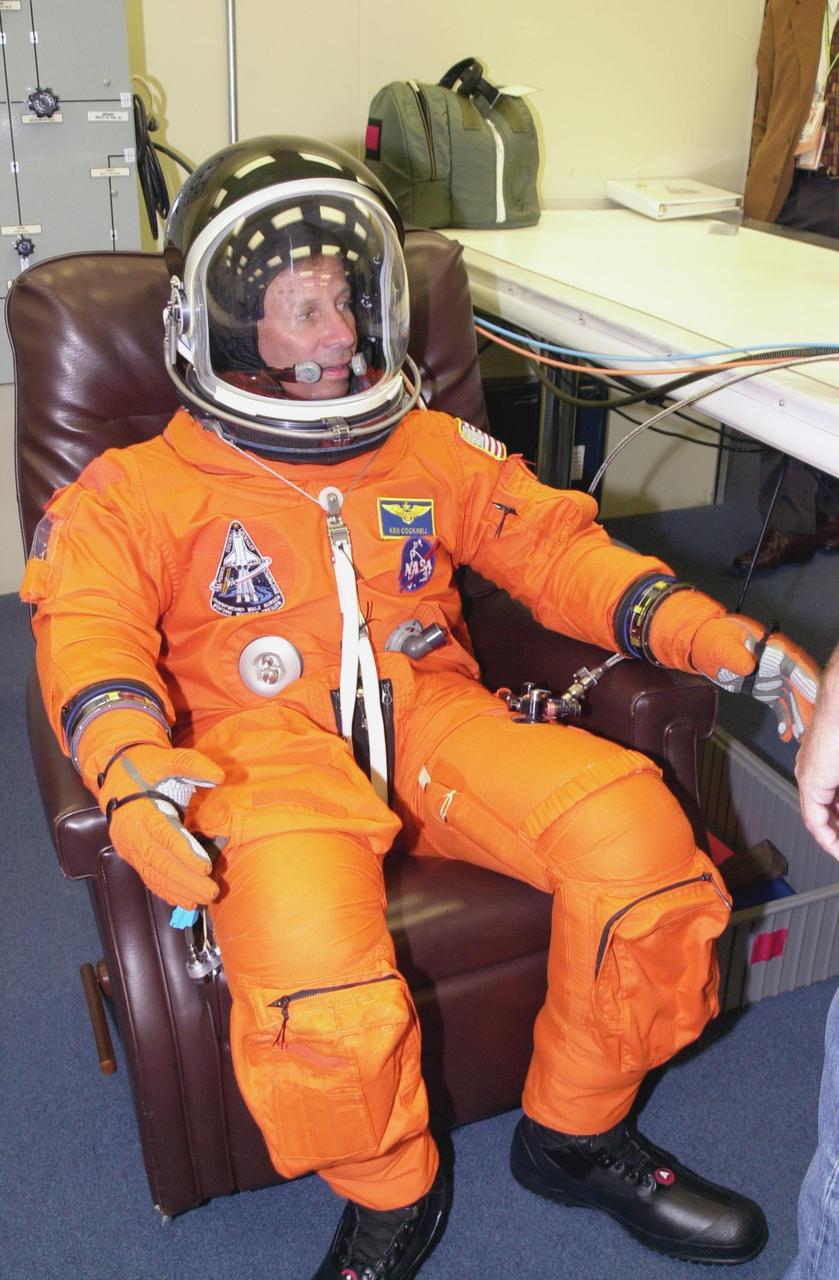
KENNEDY SPACE CENTER, FLA. - STS-111 Commander Kenneth Cockrell suits up for the scheduled liftoff of Space Shuttle Endeavour at 7:44 p.m. EDT. This is Cockrell's fifth Shuttle flight. STS-111 is the second Utilization Flight to the International Space Station, carrying the Multi-Purpose Logistics Module Leonardo, the Mobile Base System (MBS), and a replacement wrist/roll joint for the Canadarm 2. The MBS will be installed on the Mobile Transporter to complete the Canadian Mobile Servicing System, or MSS. In addition, Expedition 5 is traveling on mission STS-111 to the International Space Station to replace the current resident crew, Expedition 4, who will return to Earth with the STS-111 crew
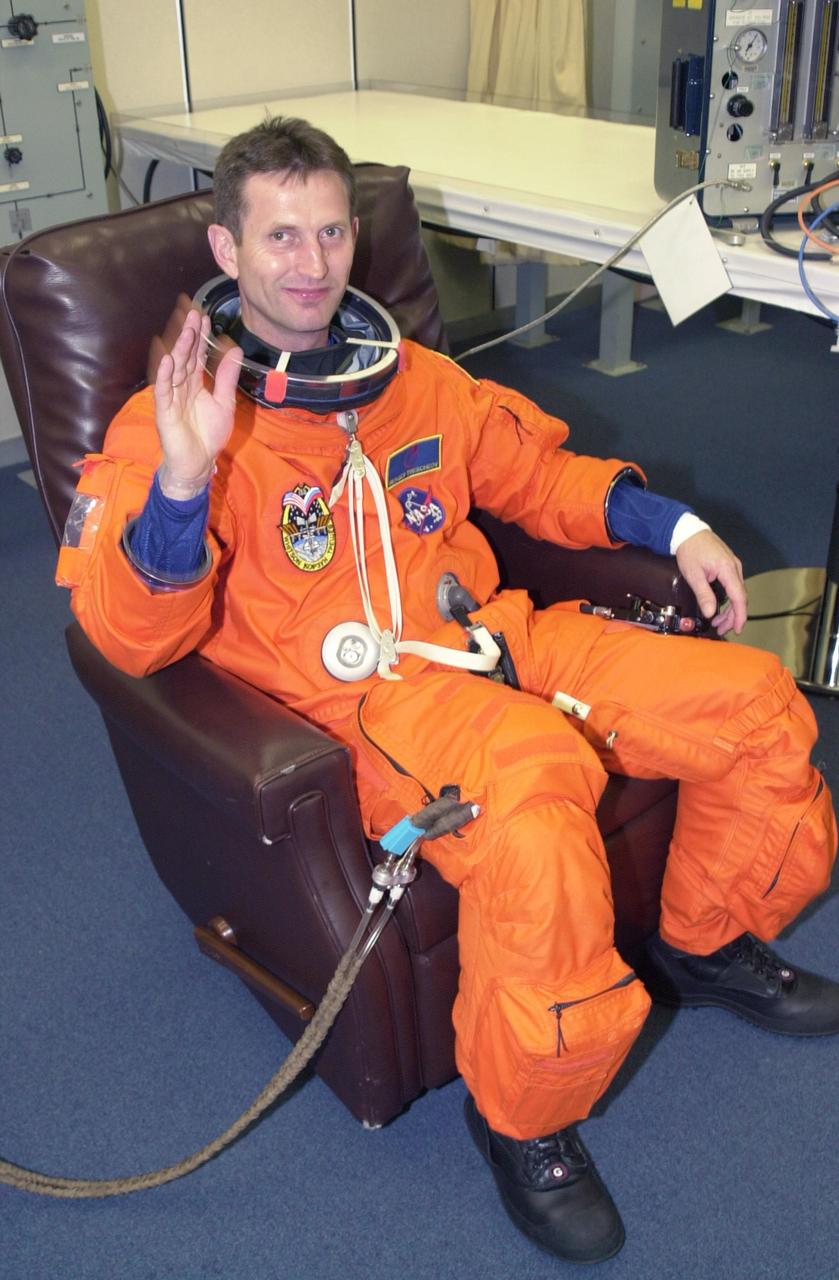
KENNEDY SPACE CENTER, FLA. -- Expedition 5 cosmonaut Sergei Treschev (RSA) waves as he dons his launch and entry suit for the scheduled liftoff of Space Shuttle Endeavour at 7:44 p.m. EDT. This is Treschev's first Shuttle flight. Expedition 5 is traveling on mission STS-111 to the International Space Station to replace the current resident crew, Expedition 4. STS-111 is the second Utilization Flight to the International Space Station, carrying the Multi-Purpose Logistics Module Leonardo, the Mobile Base System (MBS), and a replacement wrist/roll joint for the Canadarm 2. The MBS will be installed on the Mobile Transporter to complete the Canadian Mobile Servicing System, or MSS. Expedition 4 crew members will return to Earth with the STS-111 crew on Endeavour.
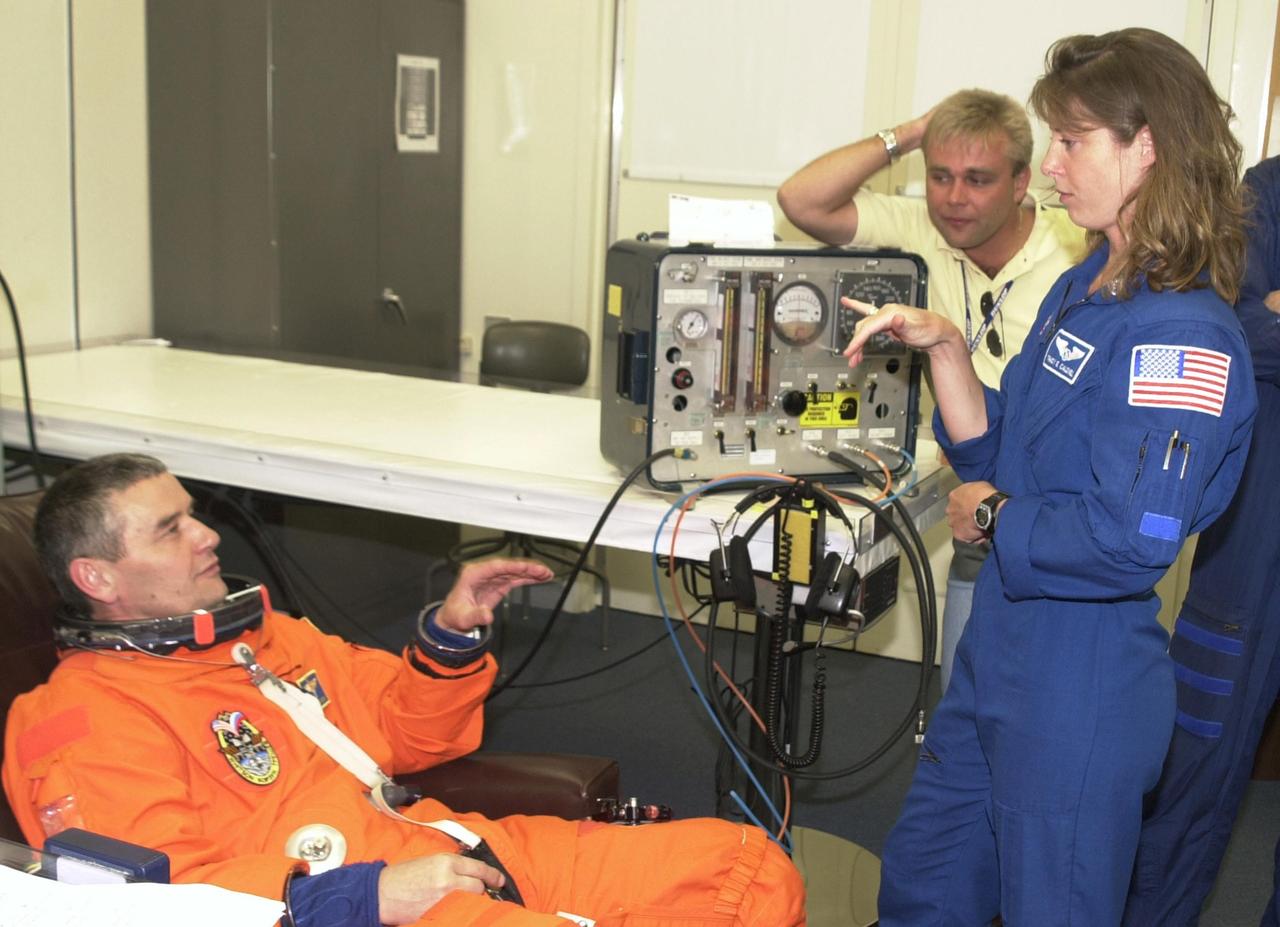
KENNEDY SPACE CENTER, FLA. -- Expedition 5 Commander Valeri Korzun (RSA), left, talks with astronaut Tracy Caldwell during suitup for the scheduled liftoff of Space Shuttle Endeavour at 7:44 p.m. EDT. This is Korzun's 2nd Shuttle flight. STS-111 is the second Utilization Flight to the International Space Station, carrying the Multi-Purpose Logistics Module Leonardo, the Mobile Base System (MBS), and a replacement wrist/roll joint for the Canadarm 2. The MBS will be installed on the Mobile Transporter to complete the Canadian Mobile Servicing System, or MSS. In addition, Expedition 5 is traveling on mission STS-111 to the International Space Station to replace the current resident crew, Expedition 4, who will return to Earth with the STS-111 crew
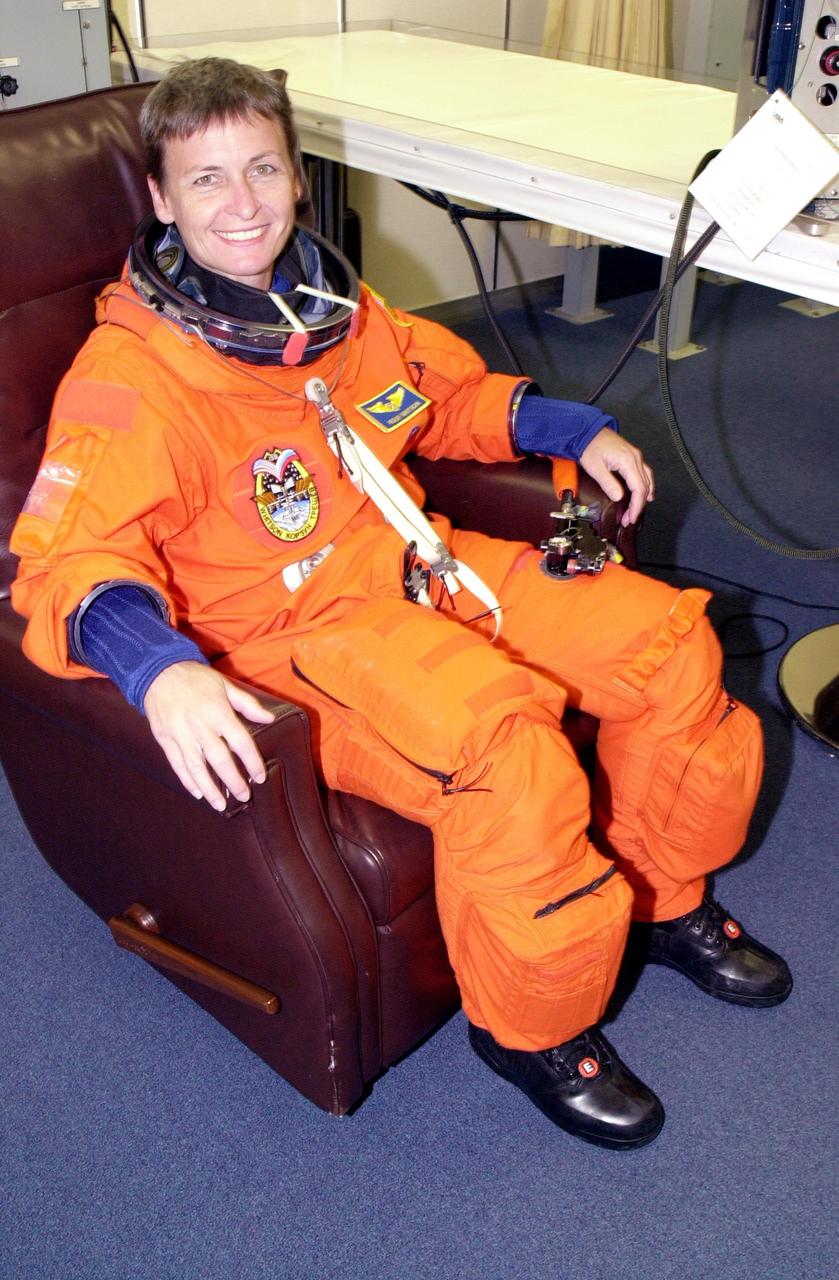
KENNEDY SPACE CENTER, FLA. - Expedition 5 astronaut Peggy Whitson smiles as she dons her launch and entry suit for the scheduled liftoff of Space Shuttle Endeavour at 7:44 p.m. EDT. This is her first Shuttle flight. Expedition 5 is traveling on mission STS-111 to the International Space Station to replace the current resident crew, Expedition 4. STS-111 is the second Utilization Flight to the International Space Station, carrying the Multi-Purpose Logistics Module Leonardo, the Mobile Base System (MBS), and a replacement wrist/roll joint for the Canadarm 2. The MBS will be installed on the Mobile Transporter to complete the Canadian Mobile Servicing System, or MSS. Expedition 4 crew members will return to Earth with the STS-111 crew on Endeavour.
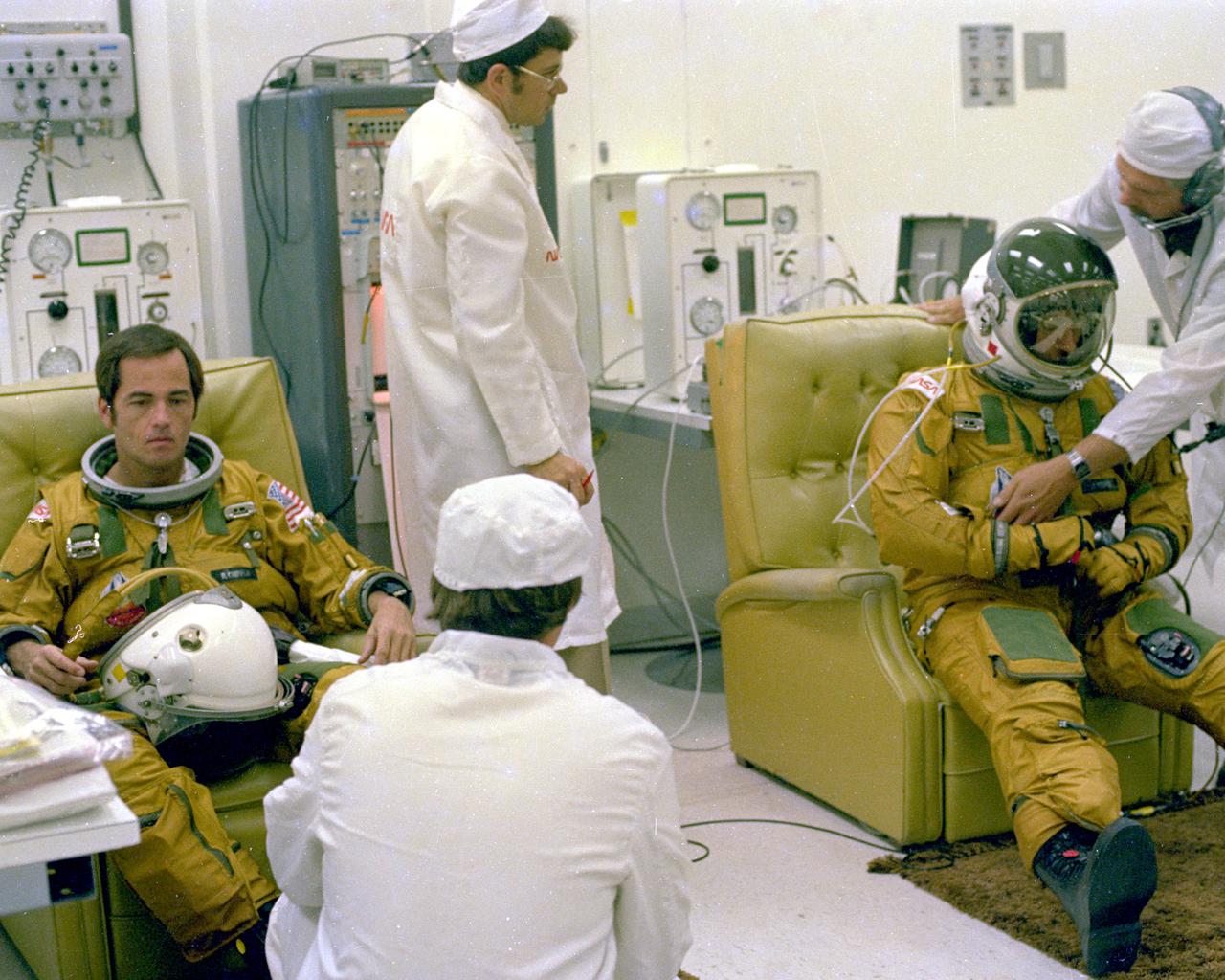
KENNEDY SPACE CENTER, FLA. - Pilot Robert Crippen watches intently as a technician adjusts the lens of his space suit, while Crew Commander John Young's suit is connected to life support system lines, during simulated countdown and launch. The two astronauts, prime crewmen for the maiden flight of the Space Shuttle scheduled no sooner than the week of April 5, are pictured in the suiting room of the Operations and Checkout Building at KSC prior to boarding their transport van for the trip to Launch Pad 39A.

KENNEDY SPACE CENTER, FLA. -- James C. Harrington, second from left, director of the Spacelab program for NASA, discusses the program during a European Space Agency briefing held when the orbital laboratory was dedicated on Feb. 5, 1982. With Harrington, seated from left, are Hugh Harris, head of the Public Information Branch, NASA Office of Public Affairs; Michel Bignier, director of Space Transportation Systems, ESA; and Michael Sander, director, Spacelab Flight Division, NASA.
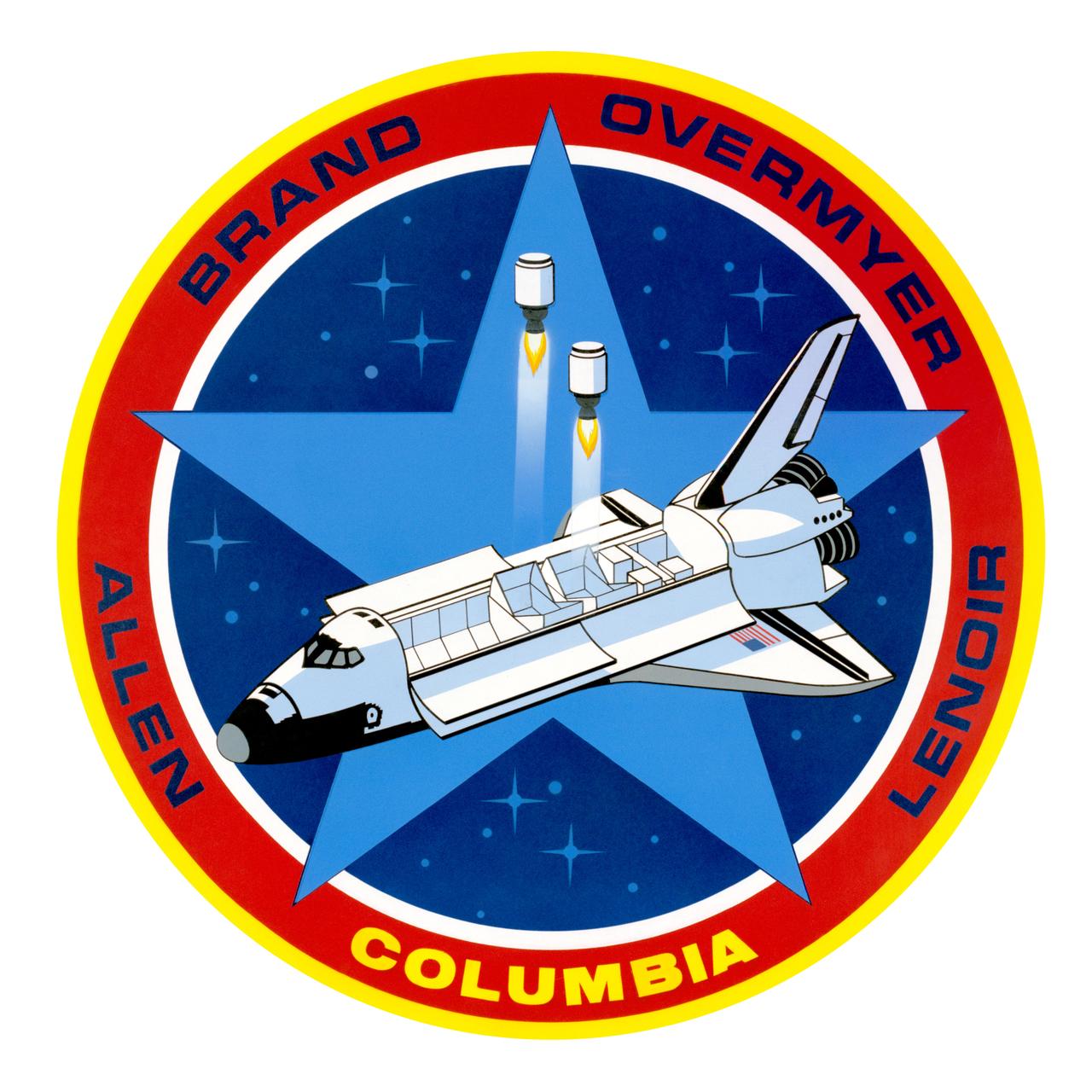
S82-35627 (20 Aug. 1982) --- This is the official crew patch for the fifth (note five points of the star) NASA Space Transportation System (STS-5) flight, scheduled for November of this year. The STS-5 flight following four successful test flights. It will call for the Columbia to be manned by four astronauts ? a space agency first. Crew members for the flights are Vance D. Brand, commander; Robert F. Overmyer, pilot; and William B. Lenoir and Joseph P. Allen, mission specialists. The NASA insignia design for space shuttle flights is reserved for use by the astronauts and for other official use as the NASA Administrator may authorize. Public availability has been approved only in the forms of illustrations by the various news media. When and if there is any change in this policy, which is not anticipated, the change will be publicly announced. Photo credit: NASA
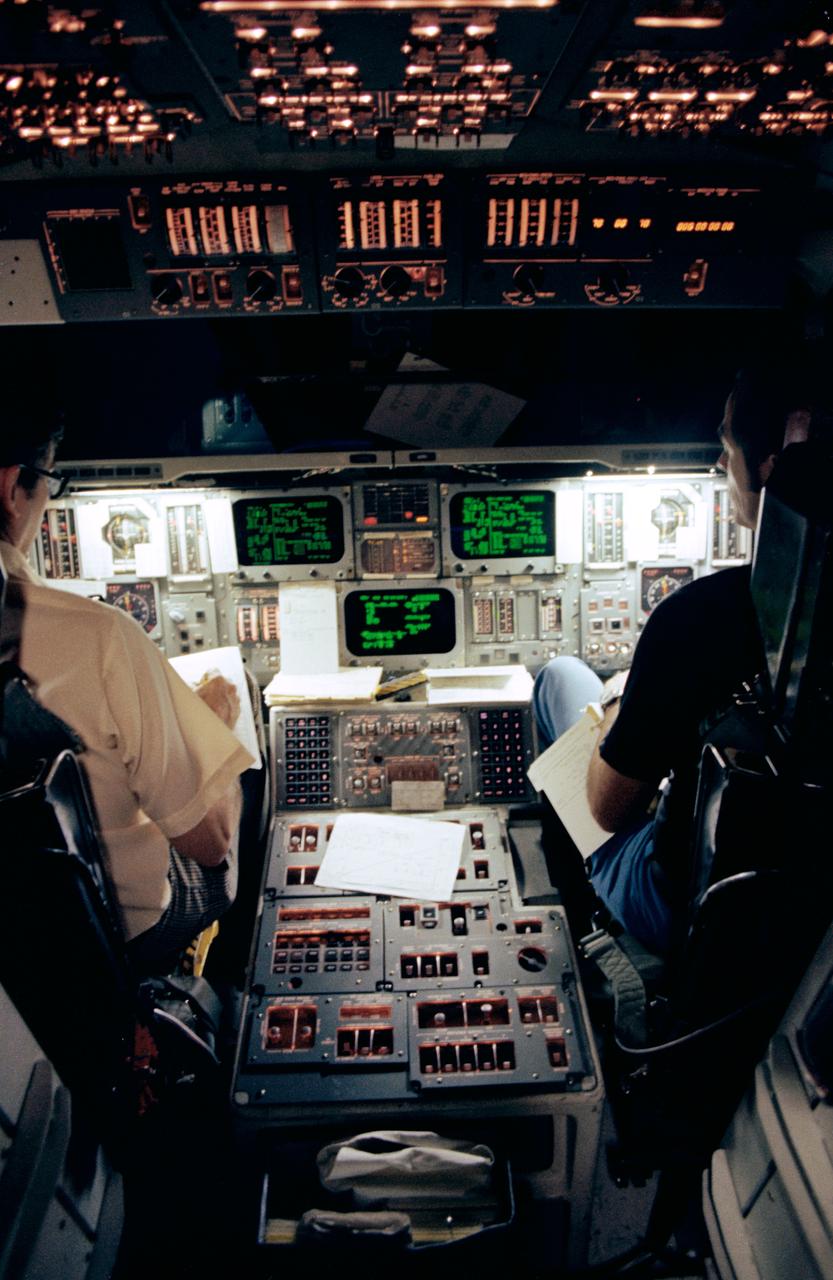
S79-31075 (5 April 1979) --- Astronauts John W. Young, left, and Robert L. Crippen, crewmen for the first space transportation system (STS-1) mission, go over a check off list during simulations in the Johnson Space Center?s shuttle mission simulator in the mission simulation and training facility. Young will be crew commander and Crippen, pilot, for the mission-shuttle?s initial orbital flight test (OFT). Photo credit: NASA
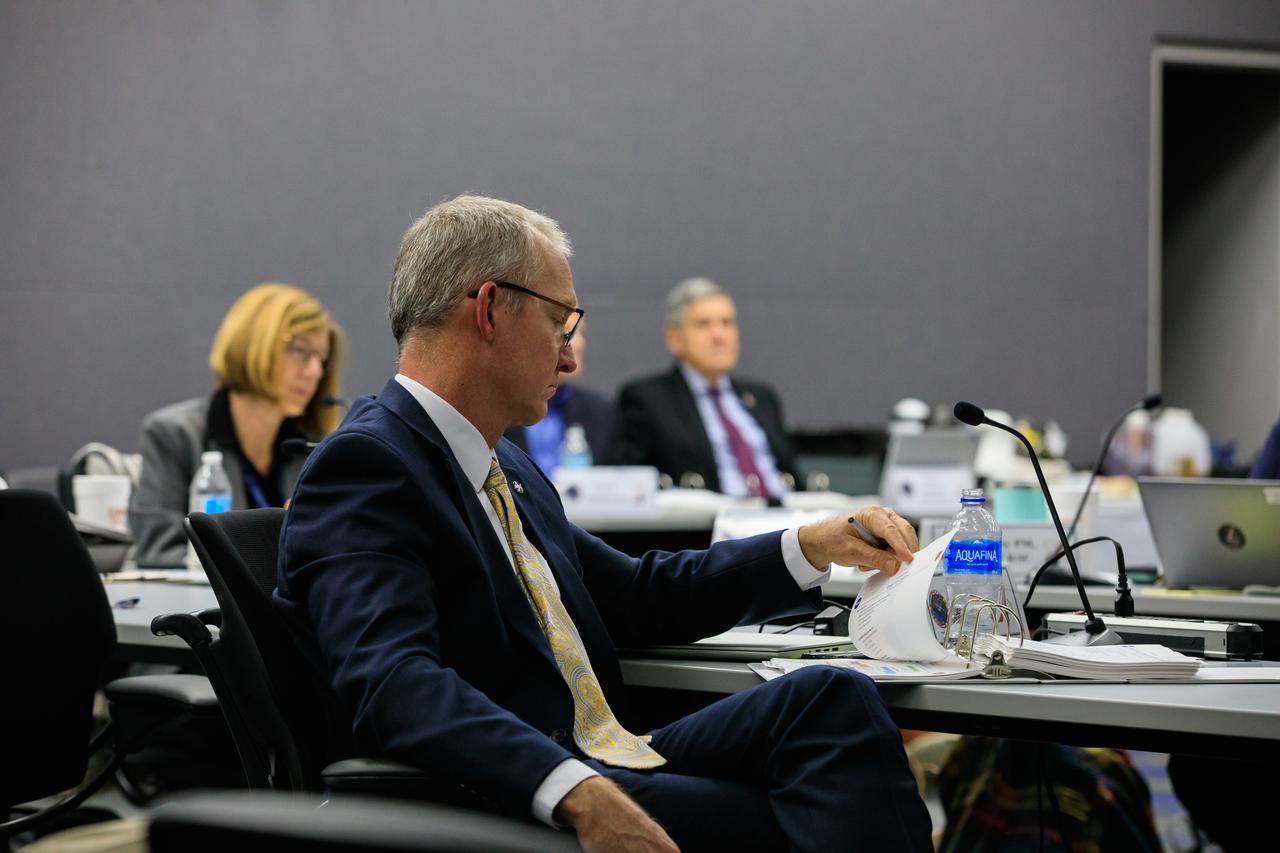
W. Russ DeLoach, chief of Safety and Mission Assurance at NASA, participates in a Flight Readiness Review for the agency’s Crew-5 mission at Kennedy Space Center in Florida on Sept. 26, 2022, to confirm the SpaceX Falcon 9 rocket and Crew Dragon spacecraft are ready for launch. In the background and to the left is Kathryn Lueders, associate administrator for NASA’s Space Operations Mission Directorate, and to the right is NASA Associate Administrator Bob Cabana. Crew-5 is scheduled to launch to the International Space Station from Kennedy’s Launch Complex 39A as part of the agency’s Commercial Crew Program. This will be the fifth crew rotation mission of SpaceX’s human transportation system and its sixth flight with astronauts, including the Demo-2 test flight, to the space station.
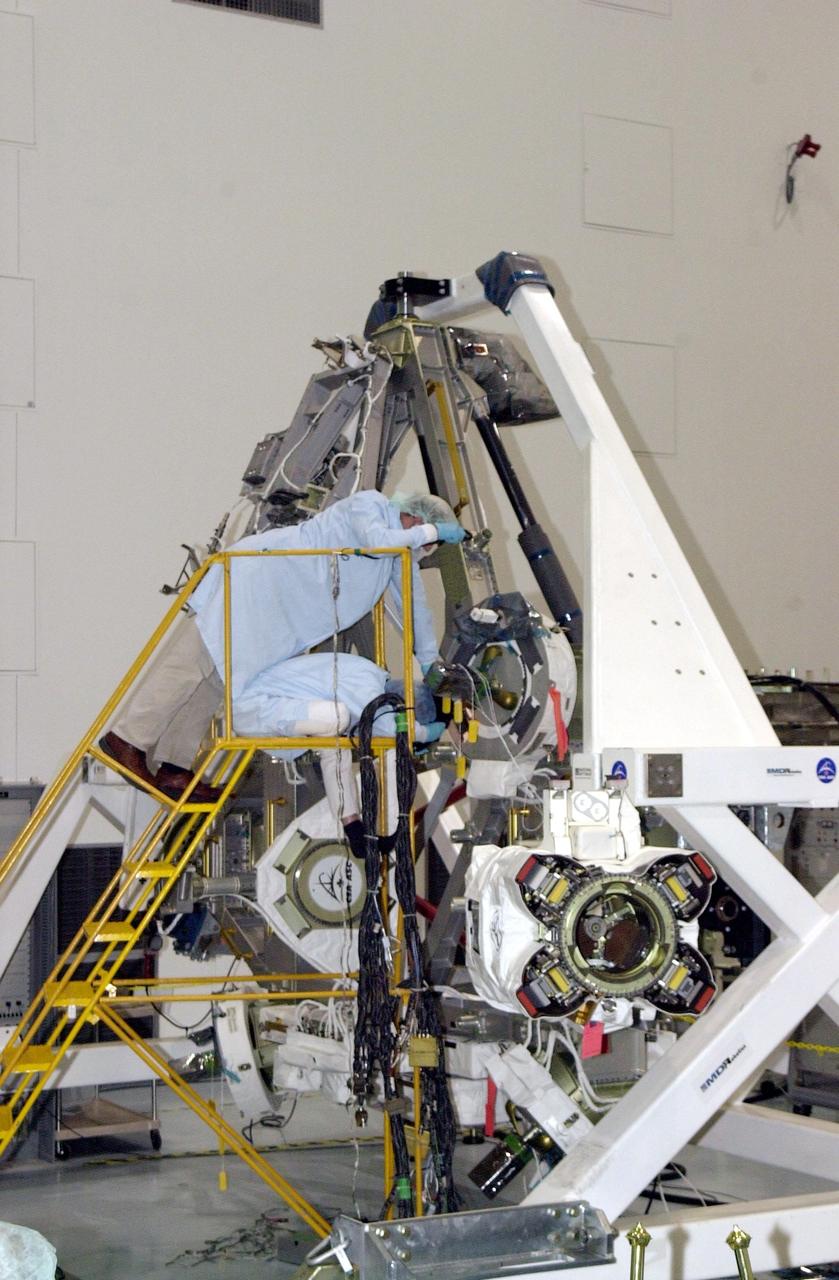
KENNEDY SPACE CENTER, FLA. -- Workers in the Space Station Processing Facility check out components of over the Mobile Base System (MBS), part of the payload on mission STS-111 to the International Space Station. The MBS will be installed on the Mobile Transporter to complete the Canadian Mobile Servicing System, or MSS. The mechanical arm will then have the capability to "inchworm" from the U.S. Lab Destiny to the MSS and travel along the truss to work sites. STS-111 is the second utilization flight (UF-2) to the Space Station and will also carry the Expedition 5 crew to replace Expedition 4. Launch is scheduled for May 2, 2002

KENNEDY SPACE CENTER, FLA. -- In the Space Station Processing Facility, overhead cranes begin lifting the Mobile Base System before moving it to the weight and center of gravity stand. Part of the payload on mission STS-111 to the International Space Station, the MBS will be installed on the Mobile Transporter to complete the Canadian Mobile Servicing System, or MSS. The mechanical arm will then have the capability to 'inchworm' from the U.S. Lab Destiny to the MSS and travel along the truss to work sites. STS-111 is the second utilization flight (UF-2) to the Space Station and will also carry the Expedition 5 crew to replace Expedition 4. Launch is scheduled for May 31, 2002
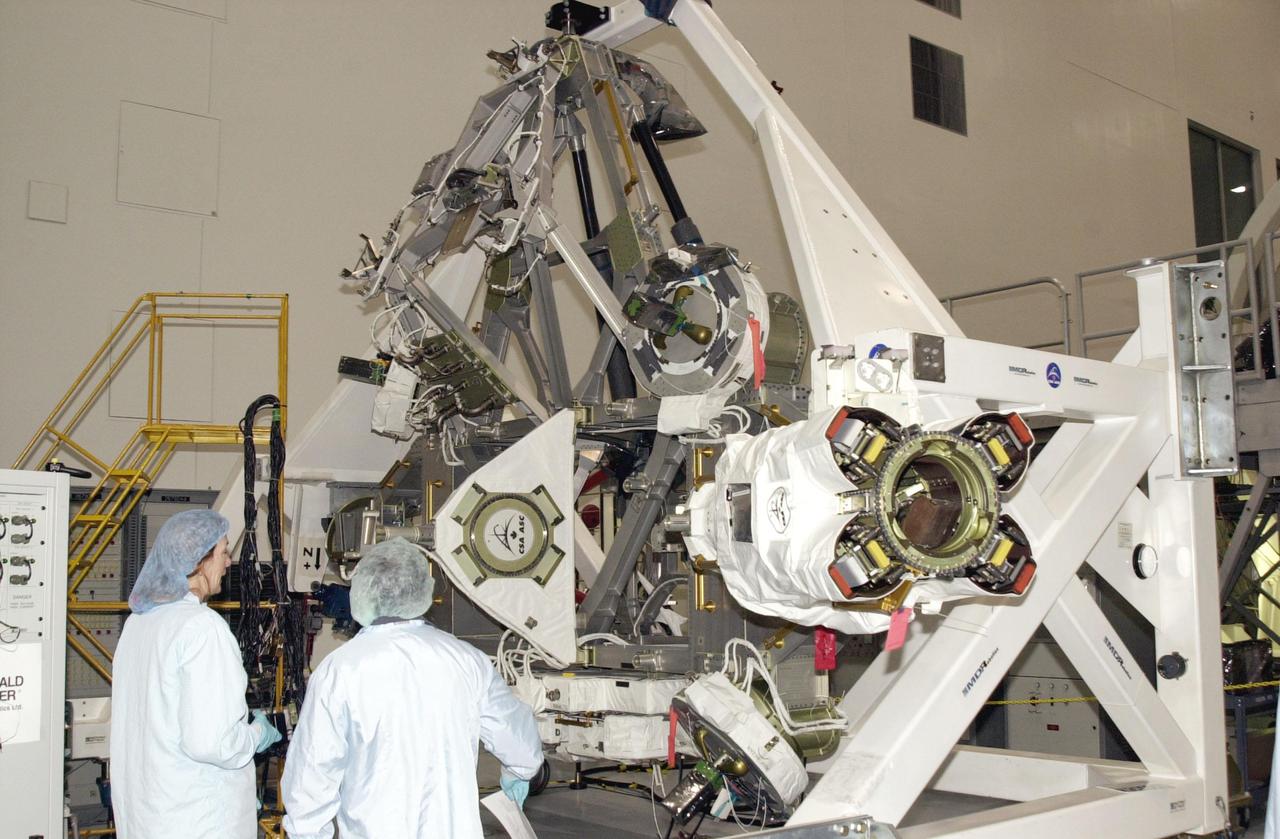
KENNEDY SPACE CENTER, FLA. -- Workers in the Space Station Processing Facility look over the Mobile Base System (MBS), part of the payload on mission STS-111 to the International Space Station. The MBS will be installed on the Mobile Transporter to complete the Canadian Mobile Servicing System, or MSS. The mechanical arm will then have the capability to 'inchworm' from the U.S. Lab Destiny to the MSS and travel along the truss to work sites. STS-111 is the second utilization flight (UF-2) to the Space Station and will also carry the Expedition 5 crew to replace Expedition 4. Launch is scheduled for May 2, 2002

KENNEDY SPACE CENTER, FLA. -- In the Space Station Processing Facility, overhead cranes lower the Mobile Base System onto the weight and center of gravity stand. Part of the payload on mission STS-111 to the International Space Station, the MBS will be installed on the Mobile Transporter to complete the Canadian Mobile Servicing System, or MSS. The mechanical arm will then have the capability to "inchworm" from the U.S. Lab Destiny to the MSS and travel along the truss to work sites. STS-111 is the second utilization flight (UF-2) to the Space Station and will also carry the Expedition 5 crew to replace Expedition 4. Launch is scheduled for May 31, 2002
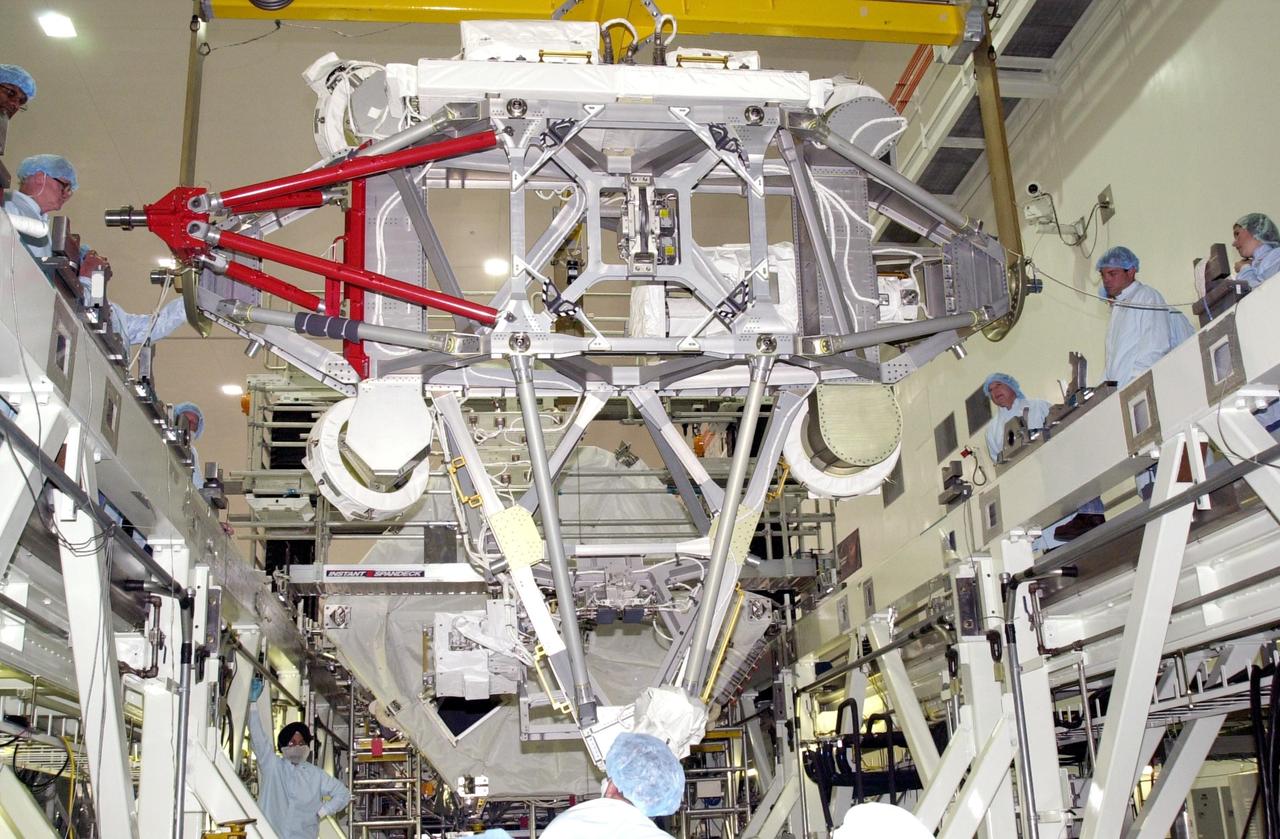
KENNEDY SPACE CENTER, FLA. -- In the Space Station Processing Facility, overhead cranes lower the Mobile Base System onto the weight and center of gravity stand. Part of the payload on mission STS-111 to the International Space Station, the MBS will be installed on the Mobile Transporter to complete the Canadian Mobile Servicing System, or MSS. The mechanical arm will then have the capability to "inchworm" from the U.S. Lab Destiny to the MSS and travel along the truss to work sites. STS-111 is the second utilization flight (UF-2) to the Space Station and will also carry the Expedition 5 crew to replace Expedition 4. Launch is scheduled for May 31, 2002
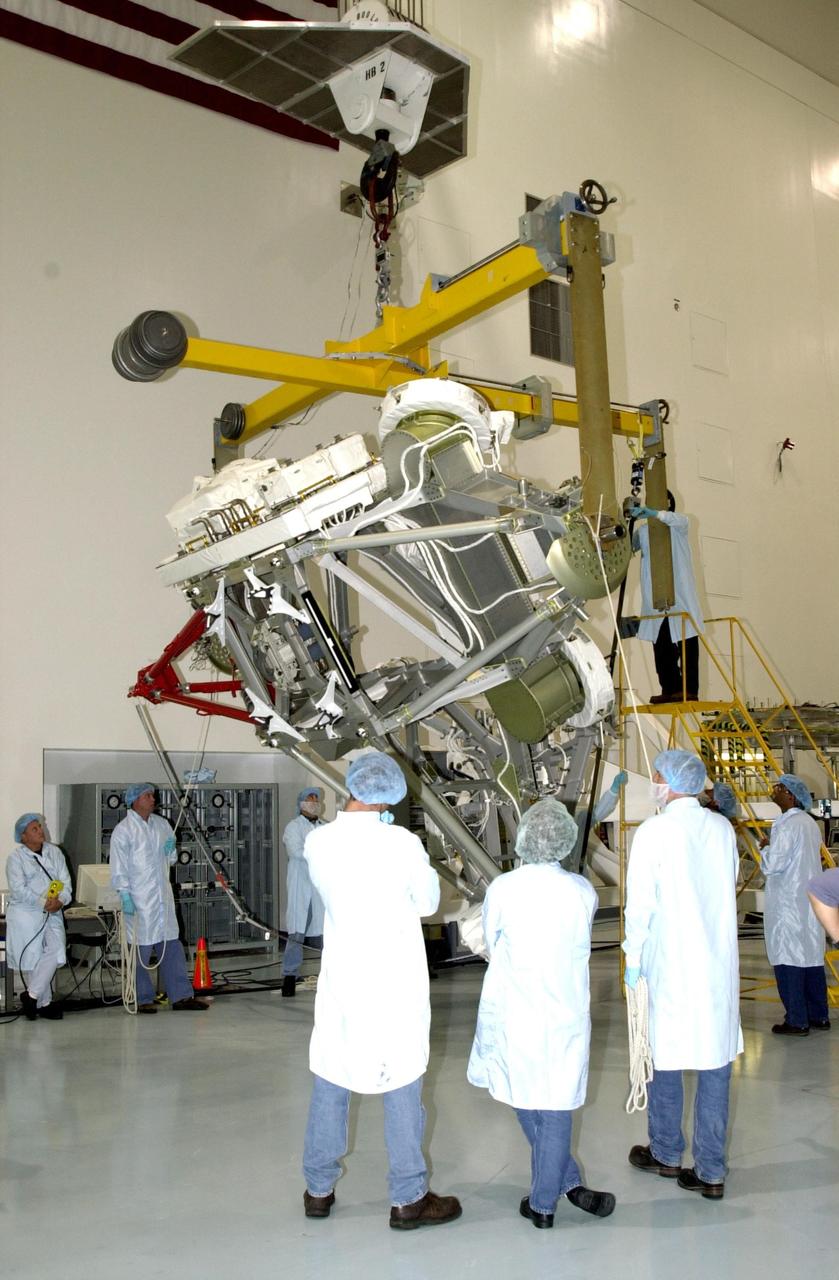
KENNEDY SPACE CENTER, FLA. -- In the Space Station Processing Facility, workers keep watch while overhead cranes lift the Mobile Base System before moving it to the weight and center of gravity stand. Part of the payload on mission STS-111 to the International Space Station, the MBS will be installed on the Mobile Transporter to complete the Canadian Mobile Servicing System, or MSS. The mechanical arm will then have the capability to "inchworm" from the U.S. Lab Destiny to the MSS and travel along the truss to work sites. STS-111 is the second utilization flight (UF-2) to the Space Station and will also carry the Expedition 5 crew to replace Expedition 4. Launch is scheduled for May 31, 2002
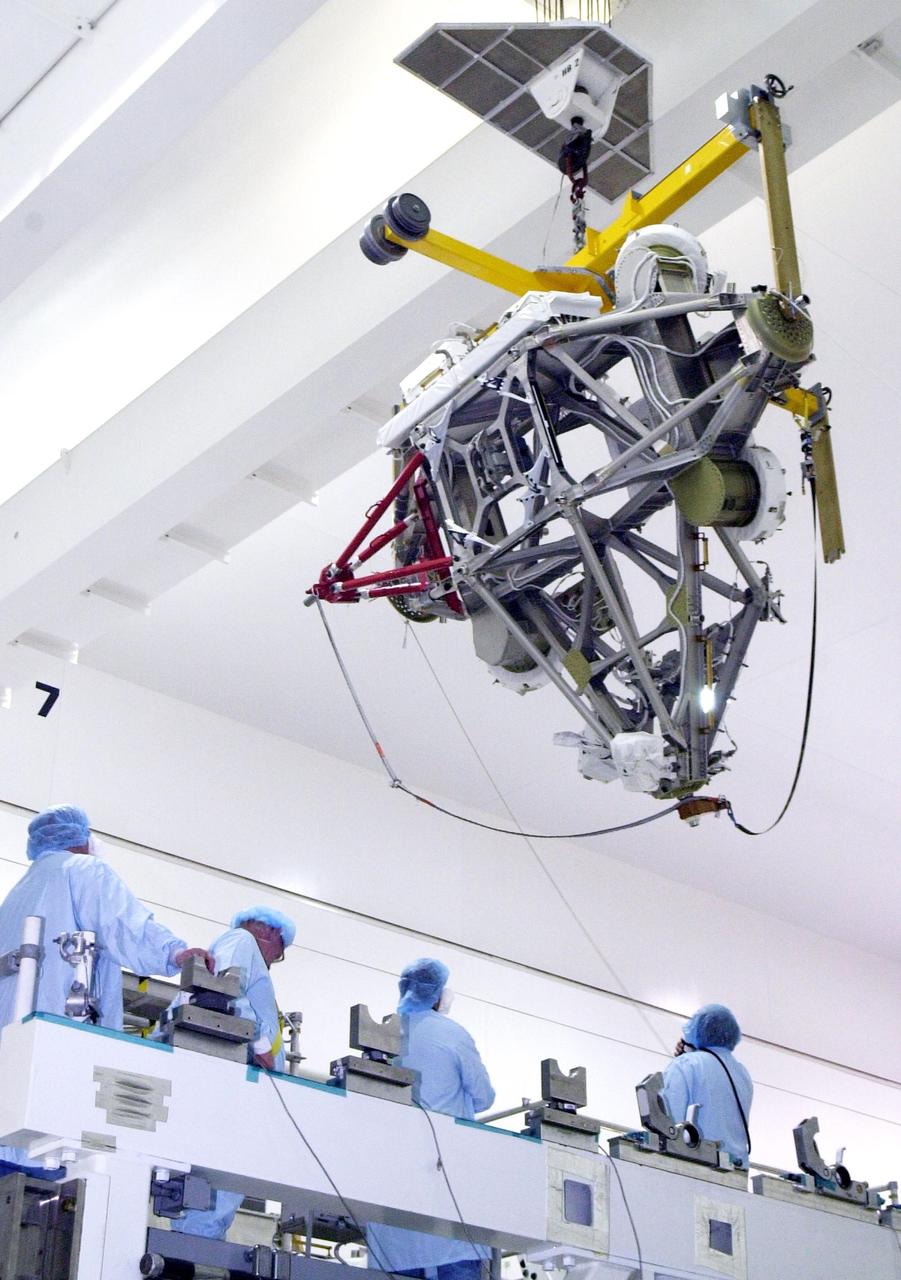
KENNEDY SPACE CENTER, FLA. -- In the Space Station Processing Facility, workers watch while overhead cranes move the Mobile Base System to the weight and center of gravity stand. Part of the payload on mission STS-111 to the International Space Station, the MBS will be installed on the Mobile Transporter to complete the Canadian Mobile Servicing System, or MSS. The mechanical arm will then have the capability to "inchworm" from the U.S. Lab Destiny to the MSS and travel along the truss to work sites. STS-111 is the second utilization flight (UF-2) to the Space Station and will also carry the Expedition 5 crew to replace Expedition 4. Launch is scheduled for May 31, 2002
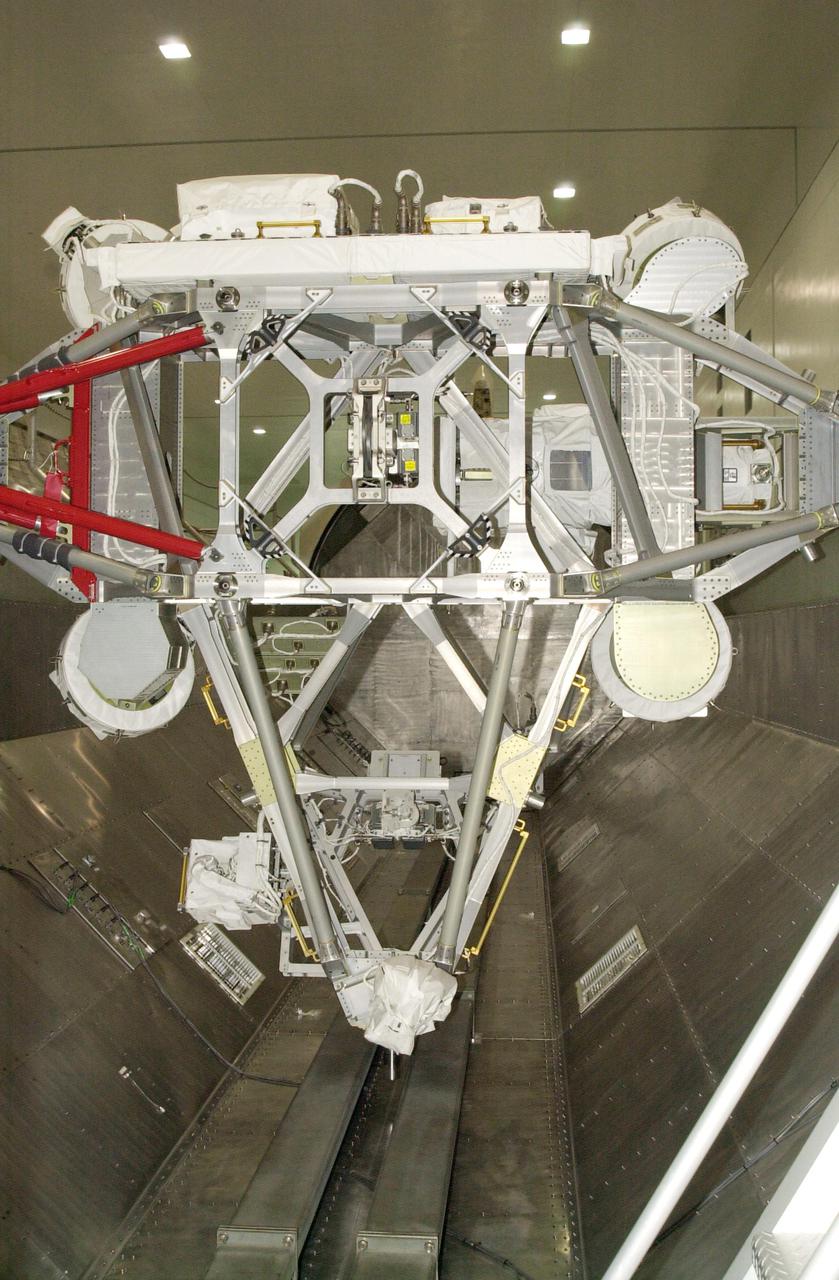
KENNEDY SPACE CENTER, FLA. - In the Space Station Processing Facility, the payload carrier with the Mobile Base System is lowered into the payload canister. On mission STS-111 to the International Space Station, the MBS will be installed on the Mobile Transporter to complete the Canadian Mobile Servicing System, or MSS. The mechanical arm will then have the capability to 'inchworm' from the U.S. Lab Destiny to the MSS and travel along the truss to work sites. STS-111 is the second utilization flight (UF-2) to the Space Station and will also carry the Expedition 5 crew to replace Expedition 4. Launch is scheduled for May 30, 2002
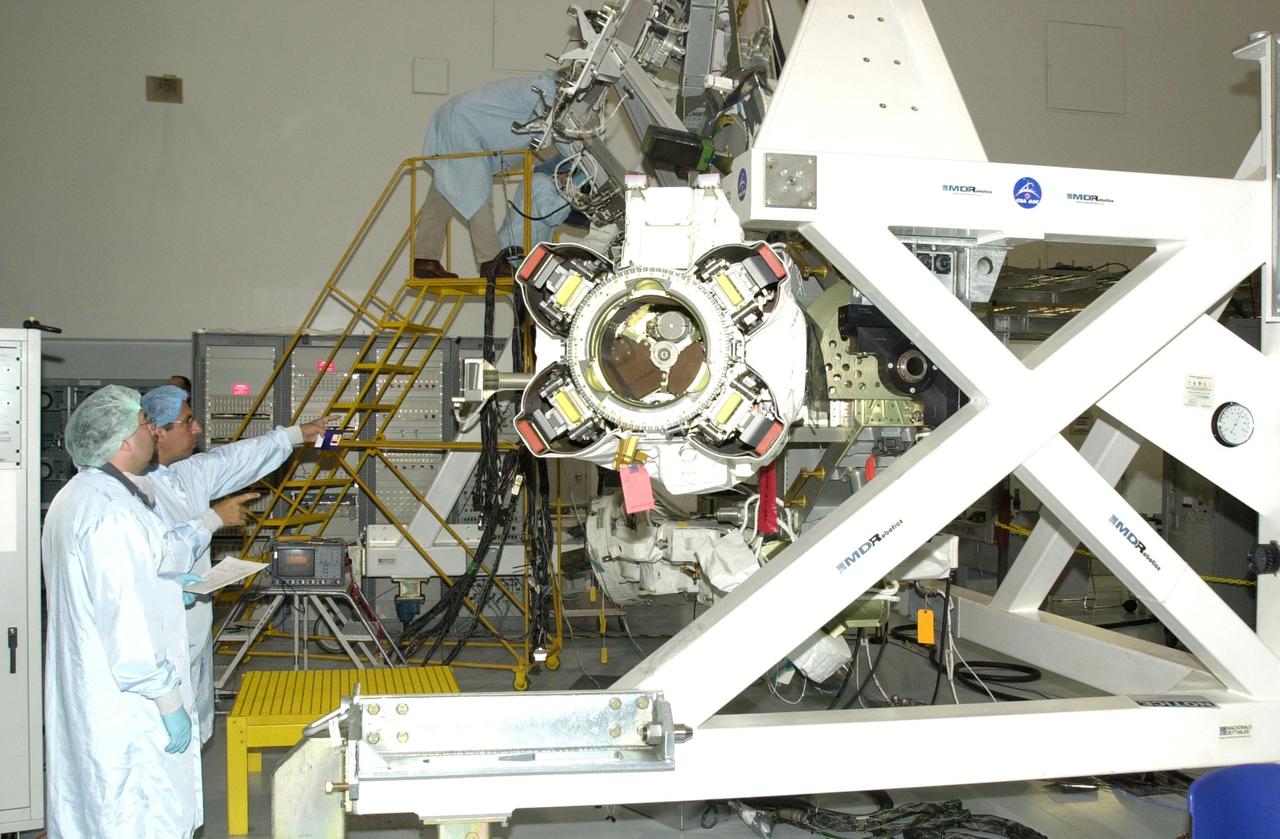
KENNEDY SPACE CENTER, FLA. -- Workers in the Space Station Processing Facility look over the Mobile Base System (MBS), part of the payload on mission STS-111 to the International Space Station. The MBS will be installed on the Mobile Transporter to complete the Canadian Mobile Servicing System, or MSS. The mechanical arm will then have the capability to "inchworm" from the U.S. Lab Destiny to the MSS and travel along the truss to work sites. STS-111 is the second utilization flight (UF-2) to the Space Station and will also carry the Expedition 5 crew to replace Expedition 4. Launch is scheduled for May 2, 2002
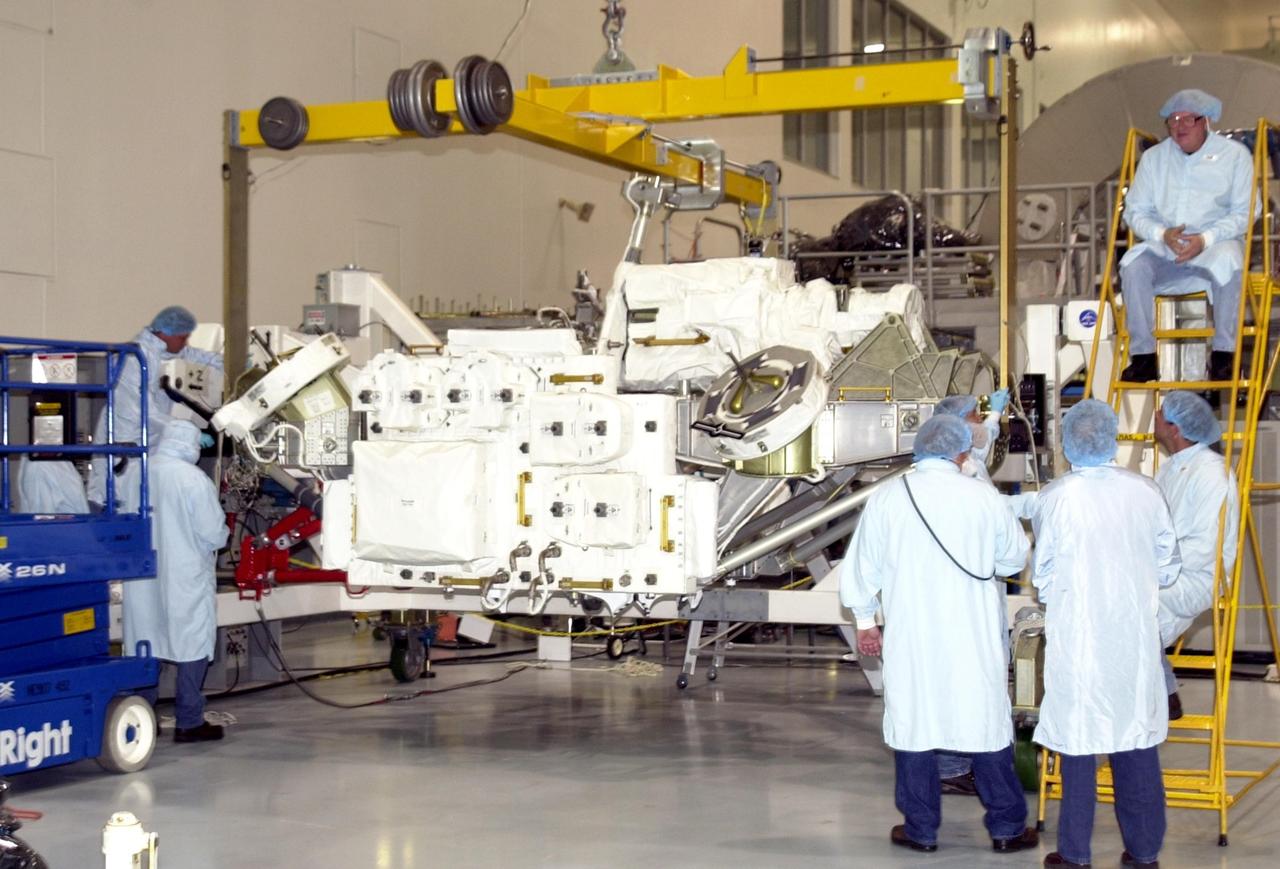
KENNEDY SPACE CENTER, FLA. -- The Mobile Base System is prepared for lifting to move to the weight and center of gravity stand in the Space Station Processing Facility. Part of the payload on mission STS-111 to the International Space Station, the MBS will be installed on the Mobile Transporter to complete the Canadian Mobile Servicing System, or MSS. The mechanical arm will then have the capability to "inchworm" from the U.S. Lab Destiny to the MSS and travel along the truss to work sites. STS-111 is the second utilization flight (UF-2) to the Space Station and will also carry the Expedition 5 crew to replace Expedition 4. Launch is scheduled for May 31, 2002
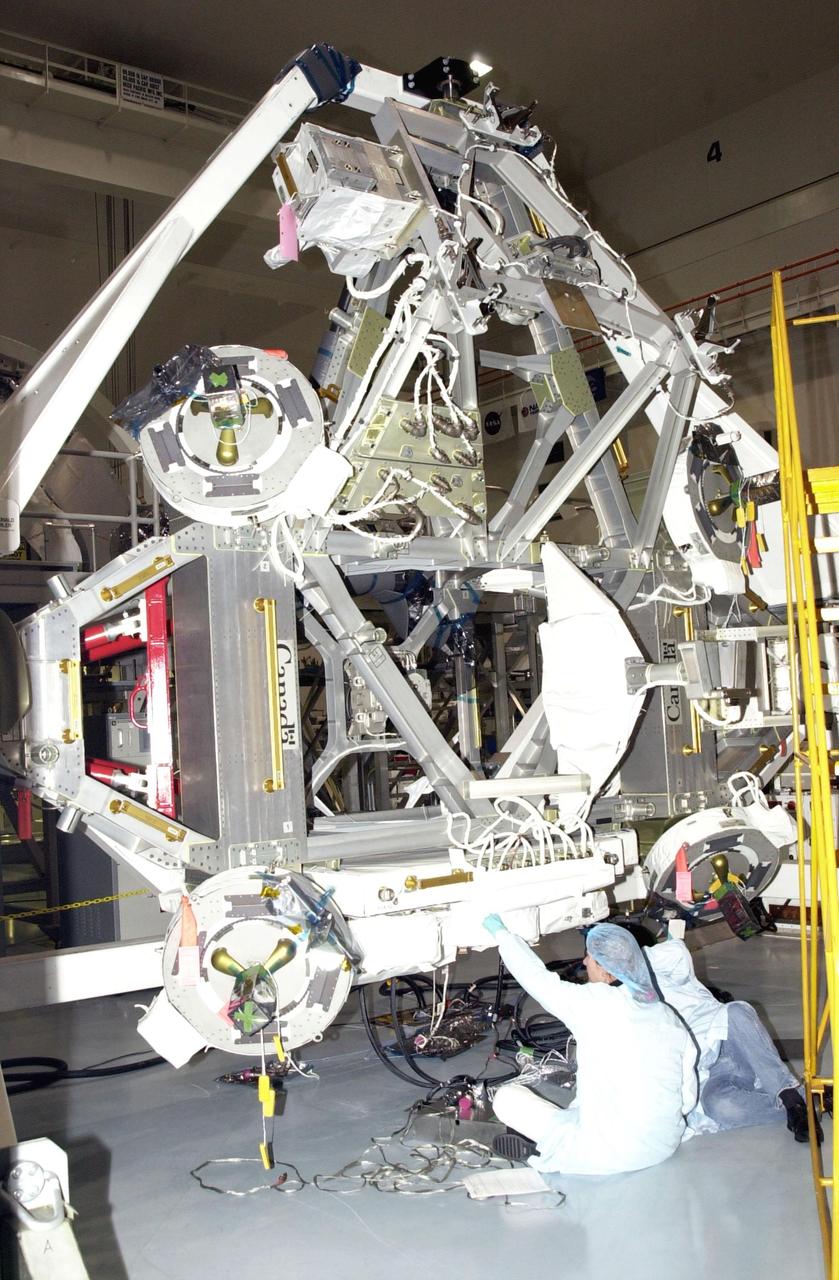
KENNEDY SPACE CENTER, FLA. -- Workers in the Space Station Processing Facility check out components of over the Mobile Base System (MBS), part of the payload on mission STS-111 to the International Space Station. The MBS will be installed on the Mobile Transporter to complete the Canadian Mobile Servicing System, or MSS. The mechanical arm will then have the capability to "inchworm" from the U.S. Lab Destiny to the MSS and travel along the truss to work sites. STS-111 is the second utilization flight (UF-2) to the Space Station and will also carry the Expedition 5 crew to replace Expedition 4. Launch is scheduled for May 2, 2002
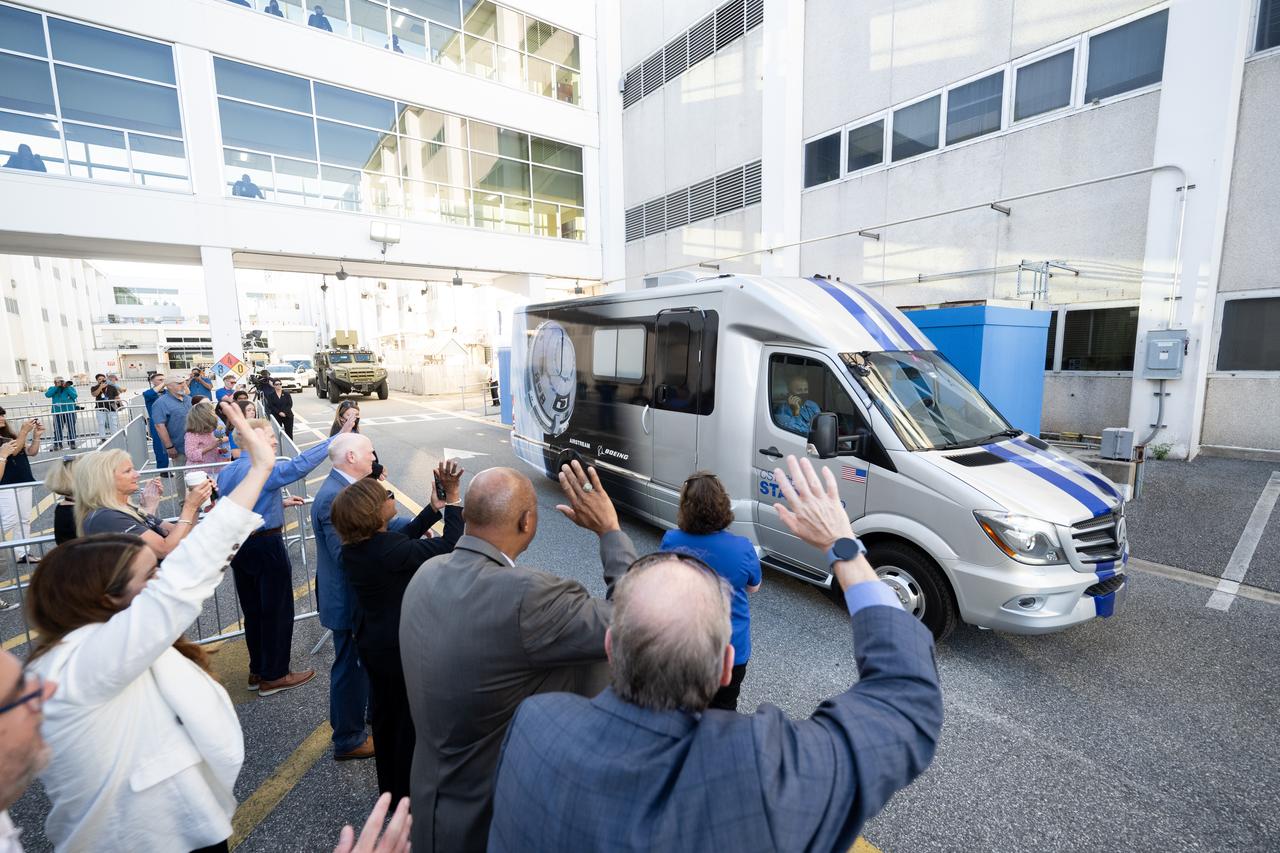
NASA, ULA, and Boeing leadership wave as the crew transport vehicle with NASA astronauts Suni Williams and Butch Wilmore departs the Neil A. Armstrong Operations and Checkout Building for Launch Complex 41 on Cape Canaveral Space Force Station to board the Boeing CST-100 Starliner spacecraft for the Crew Flight Test launch, Wednesday, June 5, 2024, at NASA’s Kennedy Space Center in Florida. NASA’s Boeing Crew Flight Test is the first launch with astronauts of the Boeing CFT-100 spacecraft and United Launch Alliance Atlas V rocket to the International Space Station as part of the agency’s Commercial Crew Program. The flight test, targeted for launch at 10:52 a.m. EDT, serves as an end-to-end demonstration of Boeing’s crew transportation system and will carry NASA astronauts Butch Wilmore and Suni Williams to and from the orbiting laboratory. Photo Credit: (NASA/Joel Kowsky)
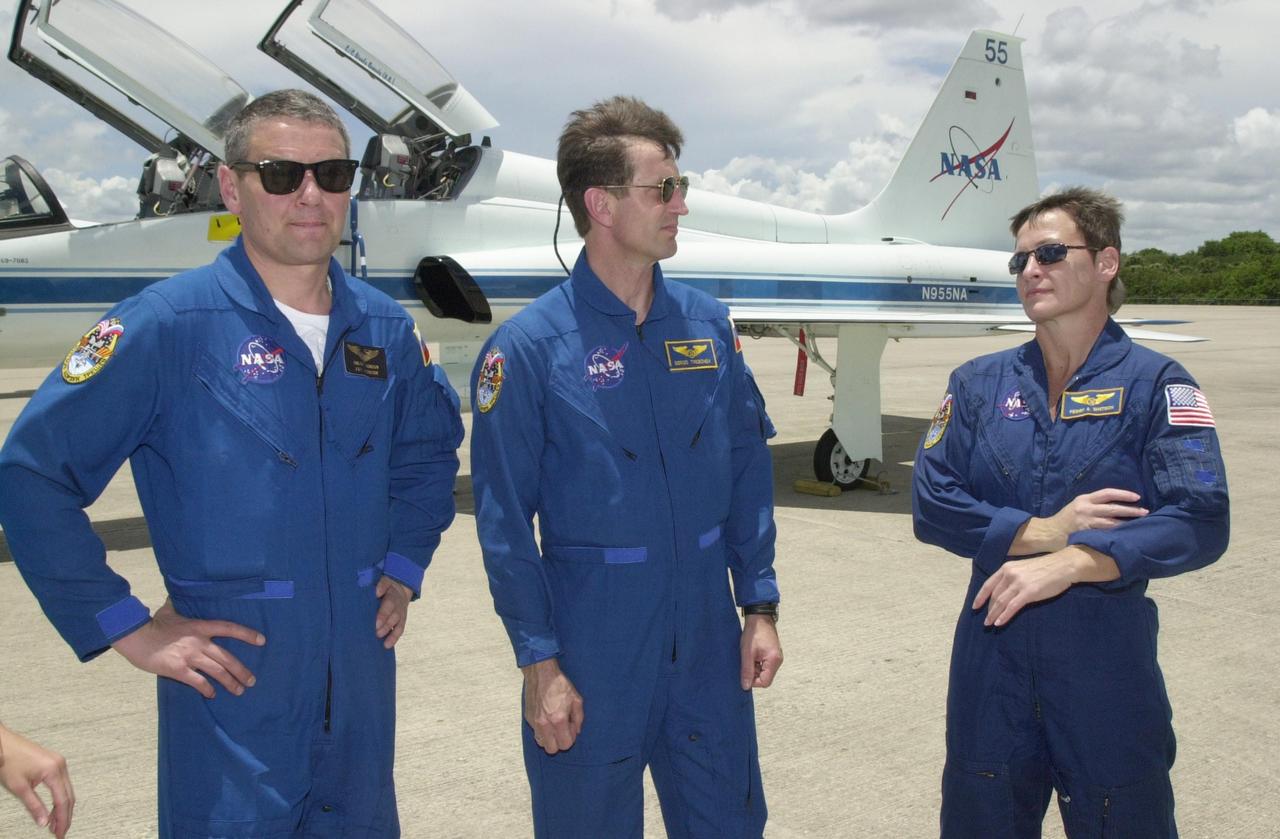
KENNEDY SPACE CENTER, FLA. -- Expedition 5 crew members Commander Valeri Korzun, cosmonaut Sergei Treschev and astronaut Peggy Whitson get together after landing at the Shuttle Landing Facility to prepare for launch on mission STS-111. Korzun and Treschev are with the Russian Space Agency. Expedition 5 will travel to the Station on Space Shuttle Endeavour as the replacement crew for Expedition 4, who will return to Earth aboard the orbiter. Mission STS-111, known as Utilization Flight 2, is carrying supplies and equipment to the International Space Station. The payload includes the Multi-Purpose Logistics Module Leonardo, the Mobile Base System, which will be installed on the Mobile Transporter to complete the Canadian Mobile Servicing System, or MSS, and a replacement wrist/roll joint for Canadarm 2. The mechanical arm will then have the capability to "inchworm" from the U.S. Lab Destiny to the MSS and travel along the truss to work sites. Launch is scheduled for May 30, 2002
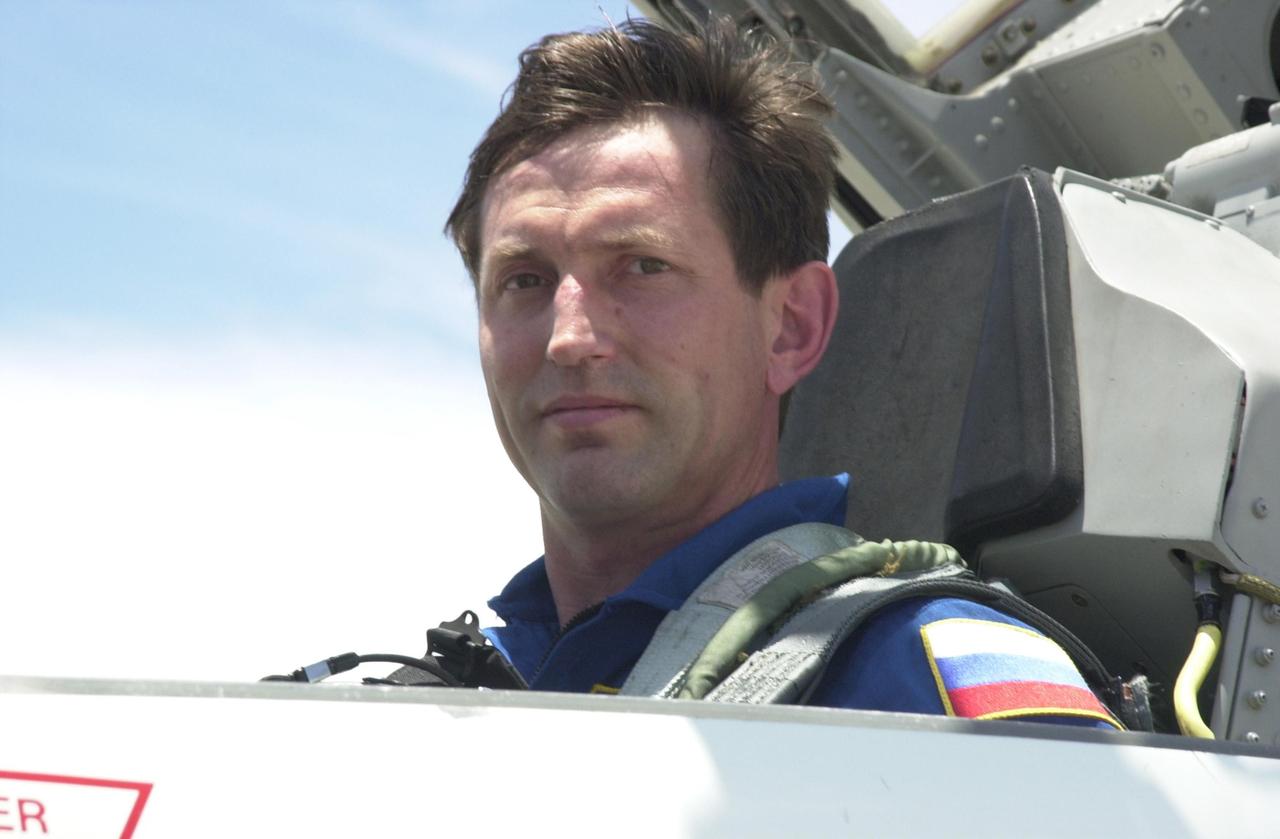
KENNEDY SPACE CENTER, FLA. -- Expedition 5 cosmonaut Sergei Treschev arrives at KSC aboard a T-38 jet aircraft to prepare for launch on mission STS-111. Treschev is with the Russian Space Agency. Expedition 5 will travel to the Station on Space Shuttle Endeavour as the replacement crew for Expedition 4, who will return to Earth aboard the orbiter. Mission STS-111, known as Utilization Flight 2, is carrying supplies and equipment to the International Space Station. The payload includes the Multi-Purpose Logistics Module Leonardo, the Mobile Base System, which will be installed on the Mobile Transporter to complete the Canadian Mobile Servicing System, or MSS, and a replacement wrist/roll joint for Canadarm 2. The mechanical arm will then have the capability to "inchworm" from the U.S. Lab Destiny to the MSS and travel along the truss to work sites. Launch is scheduled for May 30, 2002
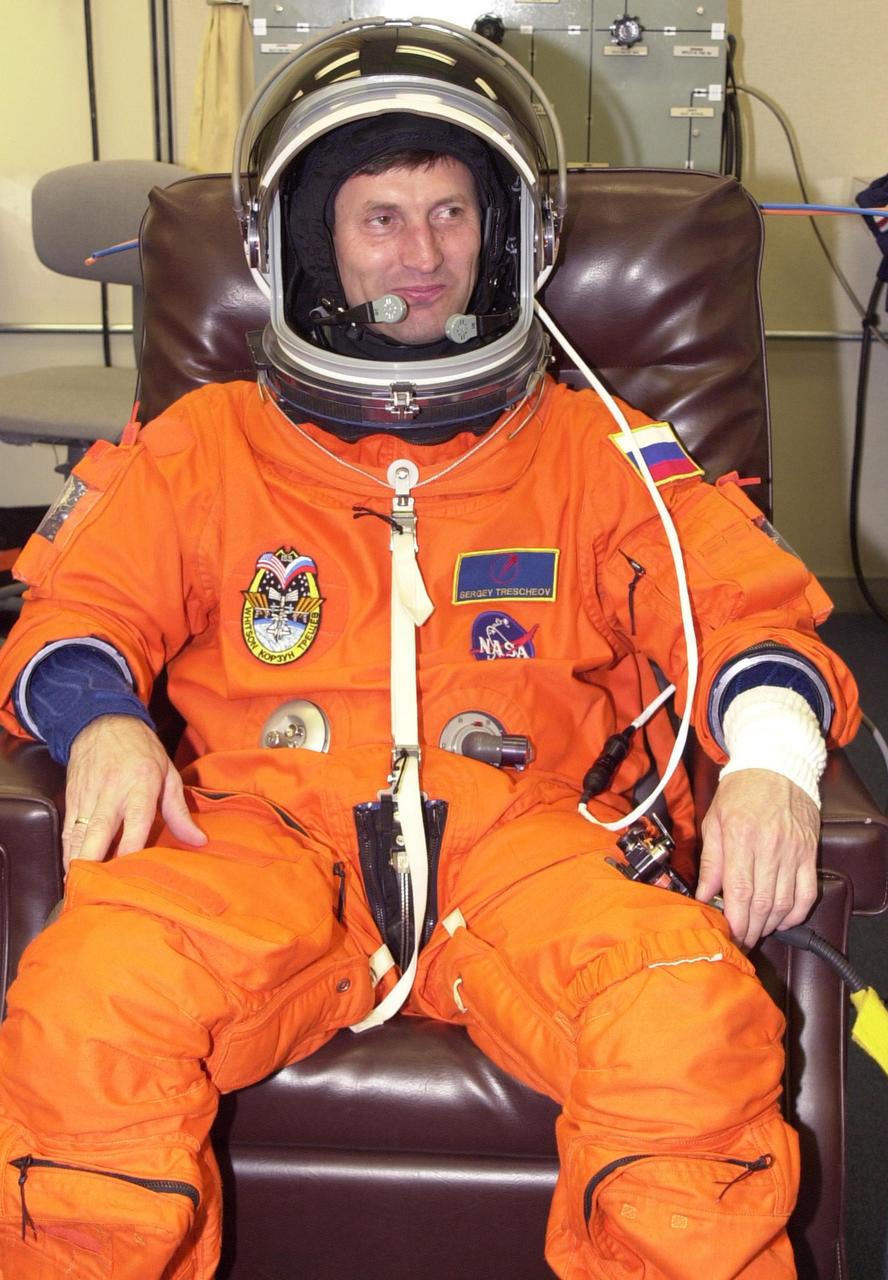
KENNEDY SPACE CENTER, FLA. -- Expedition 5 cosmonaut Sergei Treschev undergoes suit check as part of pre-launch activities. Treschev is with the Russian Space Agency. Part of Mission STS-111, Expedition 5 will travel to the International Space Station on Space Shuttle Endeavour as the replacement crew for Expedition 4, who will return to Earth aboard the orbiter. The mission, known as Utilization Flight 2, is carrying supplies and equipment to the Station. The payload includes the Multi-Purpose Logistics Module Leonardo, the Mobile Base System, which will be installed on the Mobile Transporter to complete the Canadian Mobile Servicing System, or MSS, and a replacement wrist/roll joint for Canadarm 2. The mechanical arm will then have the capability to "inchworm" from the U.S. Lab Destiny to the MSS and travel along the truss to work sites. Launch is scheduled for May 30, 2002
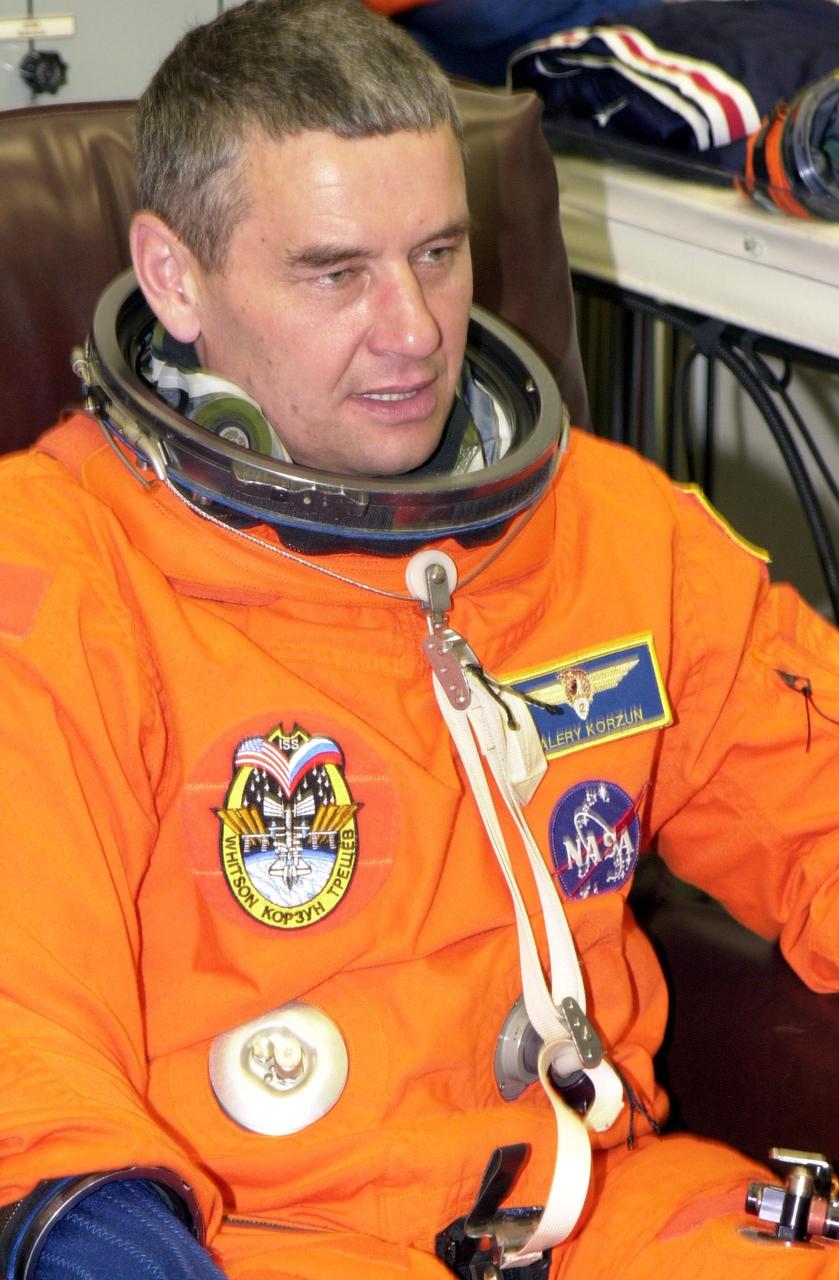
KENNEDY SPACE CENTER, FLA. -- Expedition 5 Commander Valeri Korzun undergoes suit check as part of pre-launch activities. Korzun is with the Russian Space Agency. Part of Mission STS-111, Expedition 5 will travel to the International Space Station on Space Shuttle Endeavour as the replacement crew for Expedition 4, who will return to Earth aboard the orbiter. The mission, known as Utilization Flight 2, is carrying supplies and equipment to the Station. The payload includes the Multi-Purpose Logistics Module Leonardo, the Mobile Base System, which will be installed on the Mobile Transporter to complete the Canadian Mobile Servicing System, or MSS, and a replacement wrist/roll joint for Canadarm 2. The mechanical arm will then have the capability to "inchworm" from the U.S. Lab Destiny to the MSS and travel along the truss to work sites. Launch is scheduled for May 30, 2002
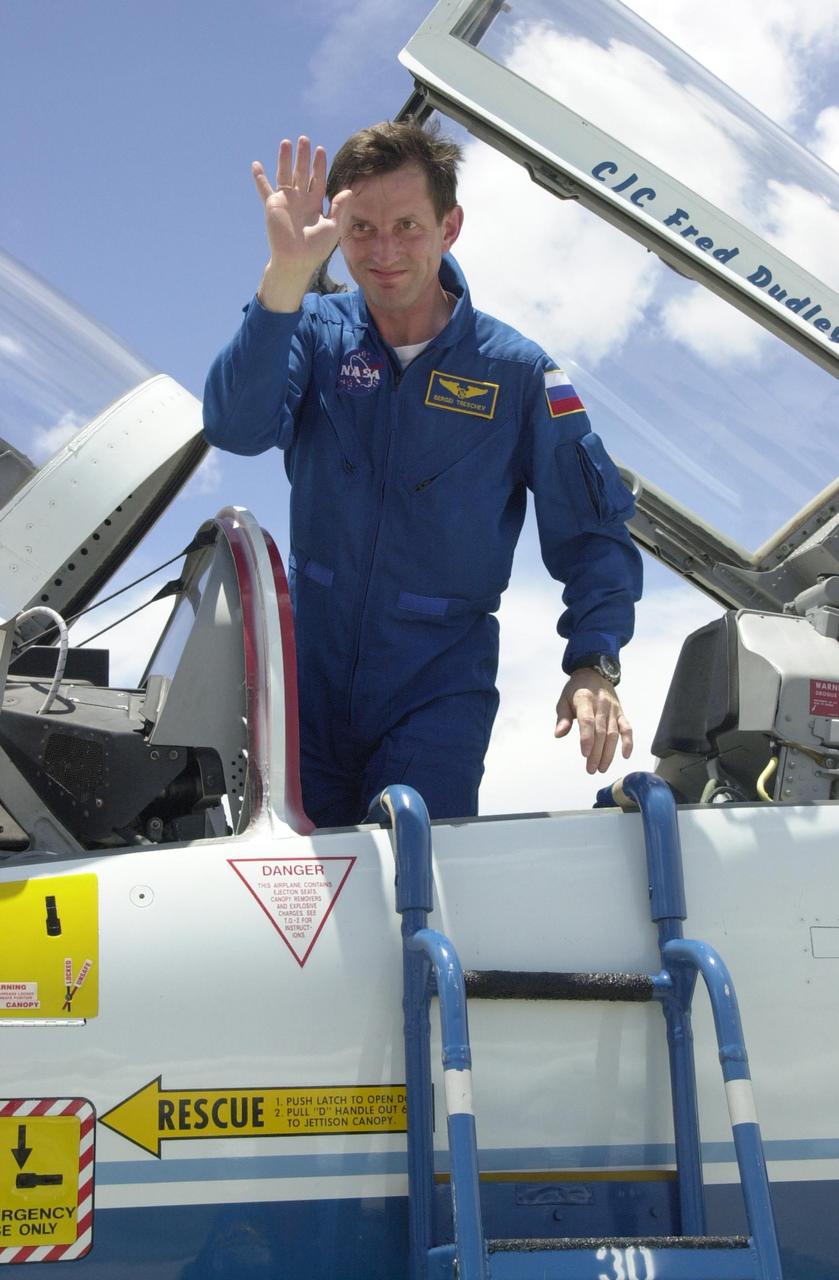
KENNEDY SPACE CENTER, FLA. -- Expedition 5 cosmonaut Sergei Treschev, who is with the Russian Space Agency, waves from the T-38 jet aircraft before disembarking to prepare for launch on mission STS-111. Expedition 5 will travel to the Station on Space Shuttle Endeavour as the replacement crew for Expedition 4, who will return to Earth aboard the orbiter. Mission STS-111, known as Utilization Flight 2, is carrying supplies and equipment to the International Space Station. The payload includes the Multi-Purpose Logistics Module Leonardo, the Mobile Base System, which will be installed on the Mobile Transporter to complete the Canadian Mobile Servicing System, or MSS, and a replacement wrist/roll joint for Canadarm 2. The mechanical arm will then have the capability to "inchworm" from the U.S. Lab Destiny to the MSS and travel along the truss to work sites. Launch is scheduled for May 30, 2002
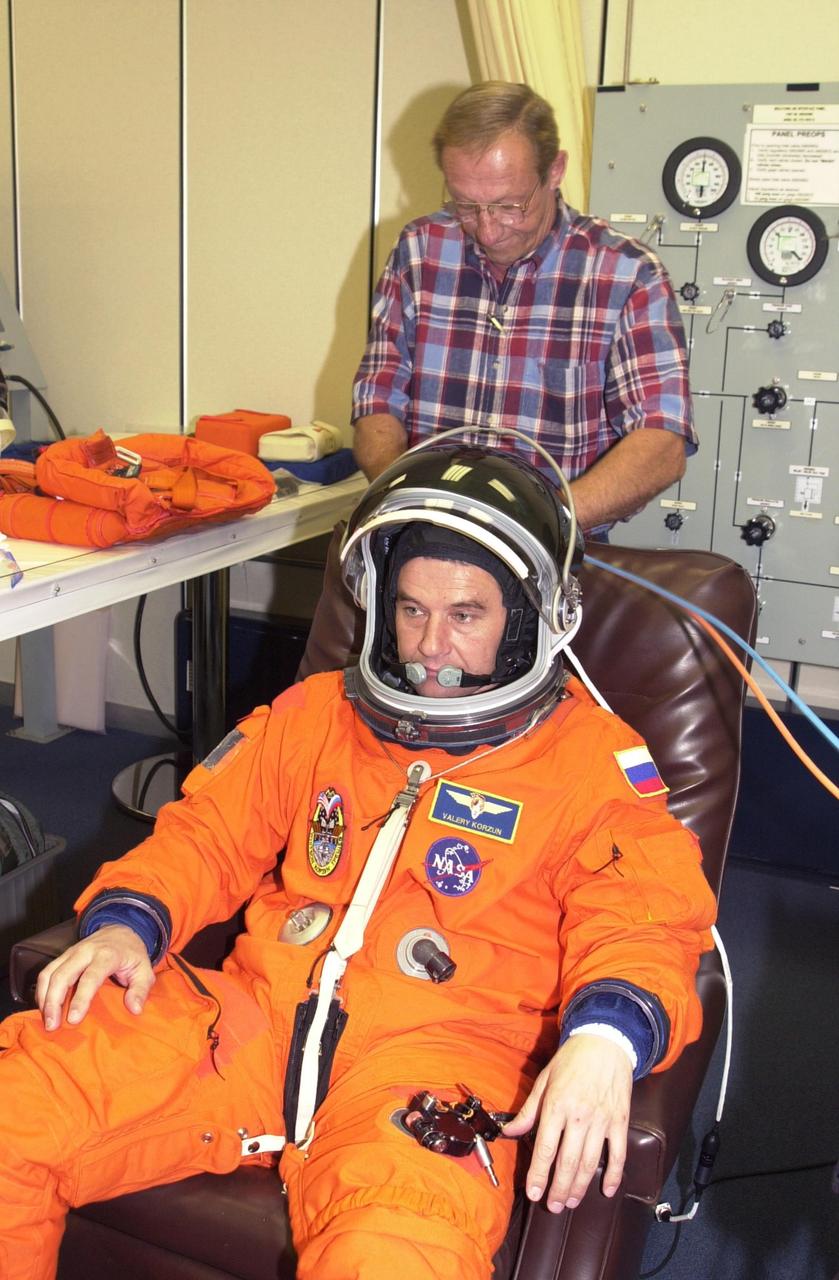
KENNEDY SPACE CENTER, FLA. - During suit check, part of pre-launch activities, Expedition 5 Commander Valeri Korzun gets help with his helmet. Korzun is with the Russian Space Agency. Part of Mission STS-111, Expedition 5 will travel to the International Space Station on Space Shuttle Endeavour as the replacement crew for Expedition 4, who will return to Earth aboard the orbiter. The mission, known as Utilization Flight 2, is carrying supplies and equipment to the Station. The payload includes the Multi-Purpose Logistics Module Leonardo, the Mobile Base System, which will be installed on the Mobile Transporter to complete the Canadian Mobile Servicing System, or MSS, and a replacement wrist/roll joint for Canadarm 2. The mechanical arm will then have the capability to "inchworm" from the U.S. Lab Destiny to the MSS and travel along the truss to work sites. Launch is scheduled for May 30, 2002
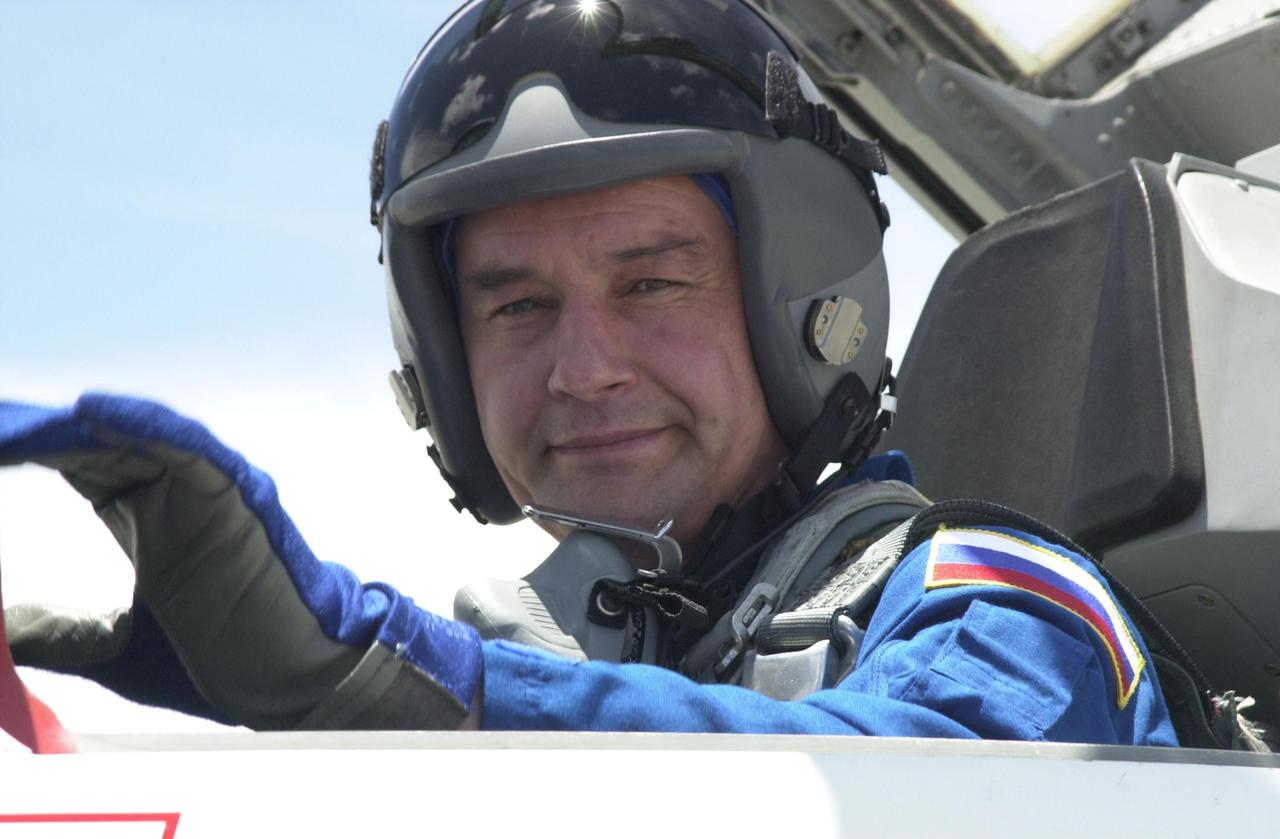
KENNEDY SPACE CENTER, FLA. -- Expedition 5 cosmonaut Valeri Korzun, who is commander on the crew, arrives at KSC aboard a T-38 jet aircraft to prepare for launch on mission STS-111. Korzun is with the Russian Space Agency. Expedition 5 will travel to the Station on Space Shuttle Endeavour as the replacement crew for Expedition 4, who will return to Earth aboard the orbiter. Mission STS-111, known as Utilization Flight 2, is carrying supplies and equipment to the International Space Station. The payload includes the Multi-Purpose Logistics Module Leonardo, the Mobile Base System, which will be installed on the Mobile Transporter to complete the Canadian Mobile Servicing System, or MSS, and a replacement wrist/roll joint for Canadarm 2. The mechanical arm will then have the capability to "inchworm" from the U.S. Lab Destiny to the MSS and travel along the truss to work sites. Launch is scheduled for May 30, 2002
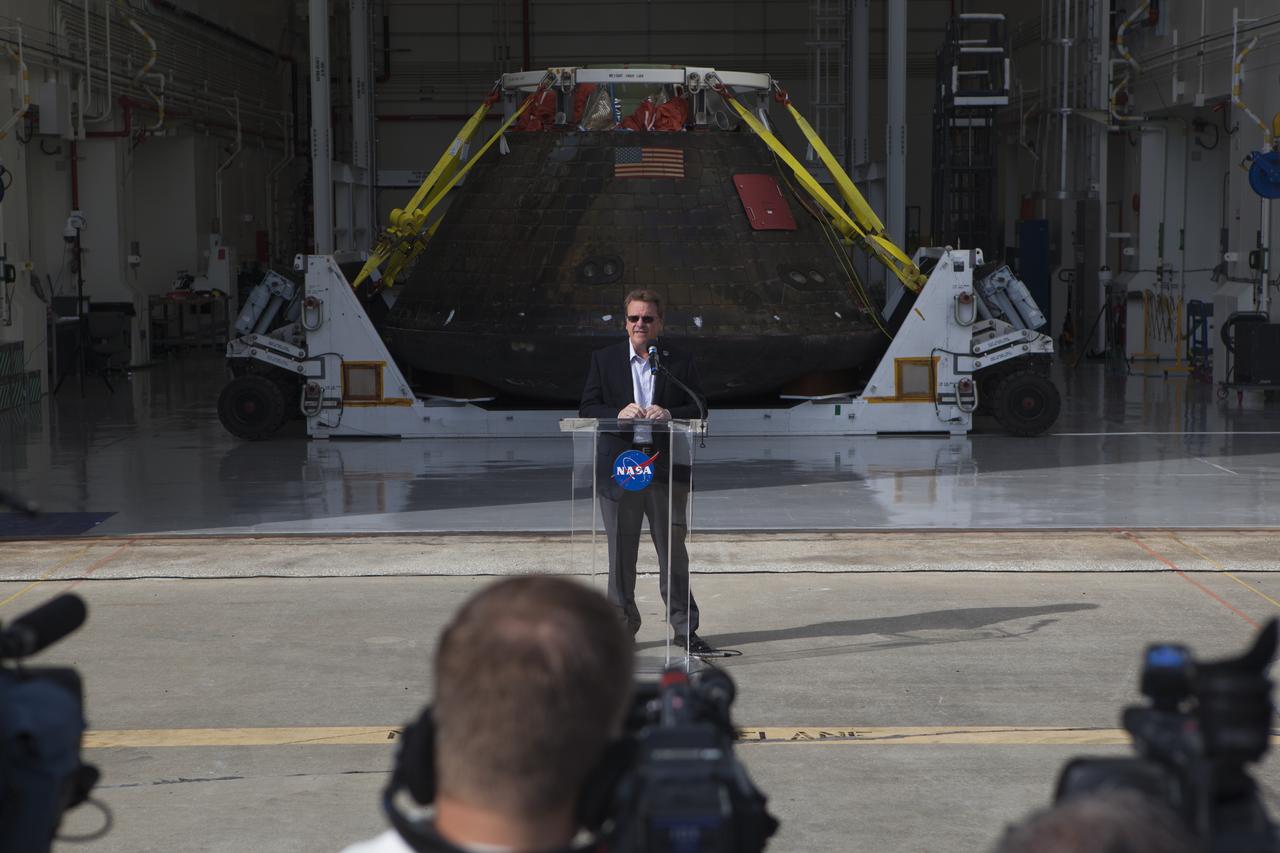
Lockheed Martin Manager Jules Schneider speaks to members of the media during a viewing of NASA's Orion spacecraft at the Launch Abort System Facility at NASA's Kennedy Space Center in Florida. The spacecraft's cross-country return, a 2,700 mile road trip from Naval Base San Diego to Kennedy, sets the stage for in-depth analysis of data obtained during Orion's trip to space. It will provide engineers detailed information on how the spacecraft fared during its two-orbit, 4.5-hour flight test, completed on Dec. 5. The Ground Systems Development and Operations Program led the recovery, offload and transportation efforts.
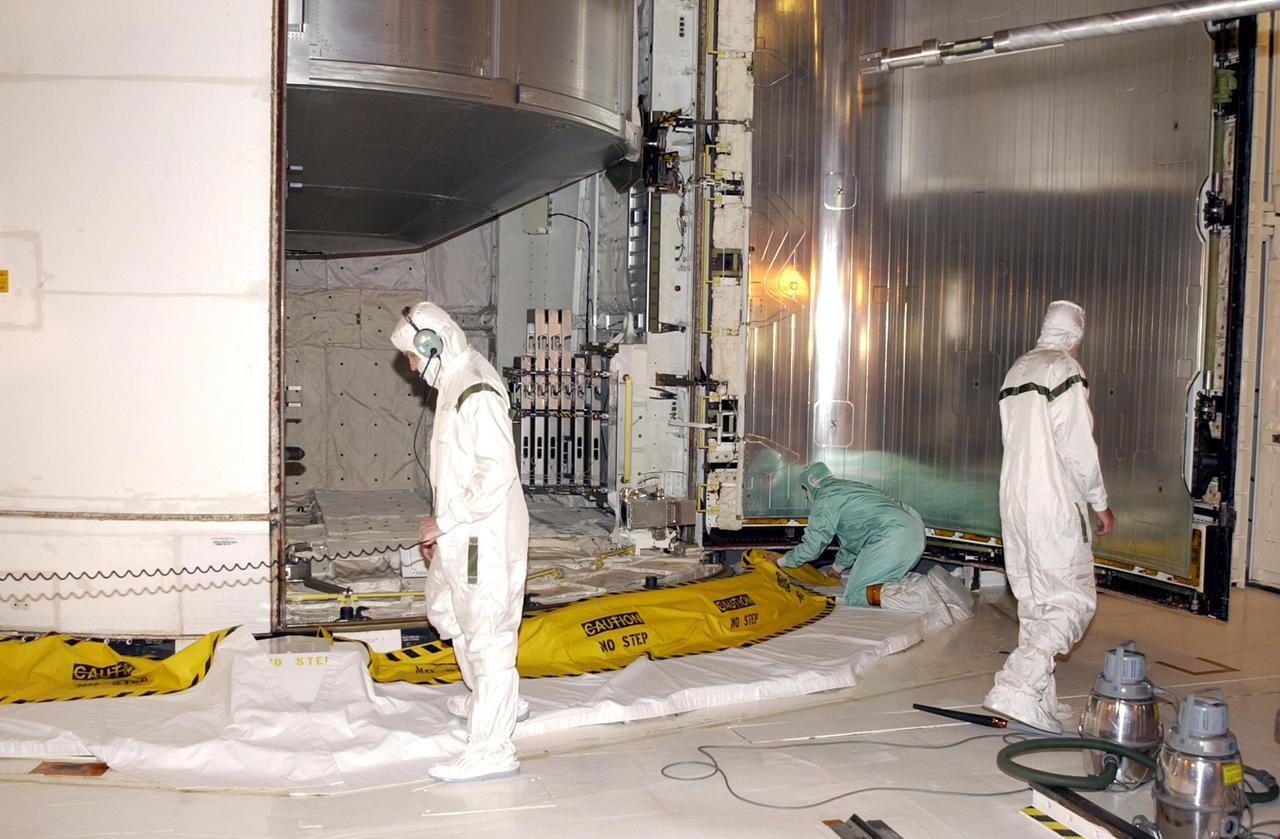
KENNEDY SPACE CENTER, FLA. -- With the Multi-Purpose Logistics Module Leonardo installed in Endeavour, one of the payload bay doors (left) has been closed. The Shuttle is poised for launch on mission STS-111, Utilization Flight 2, carrying supplies and equipment to the International Space Station. The payload includes the Multi-Purpose Logistics Module Leonardo, the Mobile Base System, which will be installed on the Mobile Transporter to complete the Canadian Mobile Servicing System, and a replacement wrist/roll joint for Canadarm 2. Also part of the mission, Expedition 5 will travel to the Station as the replacement crew for Expedition 4, who will return to Earth aboard the orbiter. Launch is scheduled for May 30, 2002
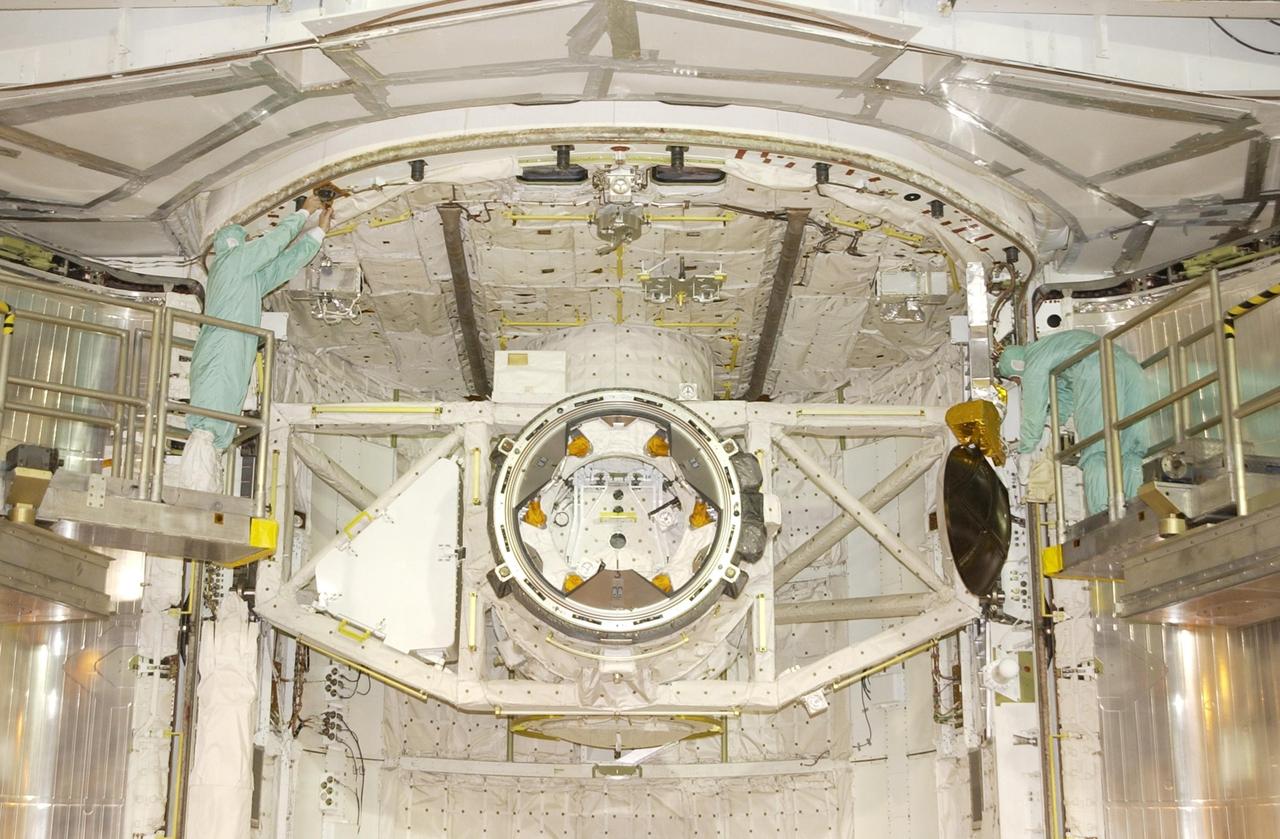
KENNEDY SPACE CENTER, FLA. -- Workers at Launch Pad 39A check the fittings on the payload bay of Endeavour before the bay doors close. The view is looking down into the payload bay. The Shuttle is poised for launch on mission STS-111, Utilization Flight 2, carrying supplies and equipment to the International Space Station. The payload includes the Multi-Purpose Logistics Module Leonardo, the Mobile Base System, which will be installed on the Mobile Transporter to complete the Canadian Mobile Servicing System, and a replacement wrist/roll joint for Canadarm 2. Also part of the mission, Expedition 5 will travel to the Station as the replacement crew for Expedition 4, who will return to Earth aboard the orbiter. Launch is scheduled for May 30, 2002
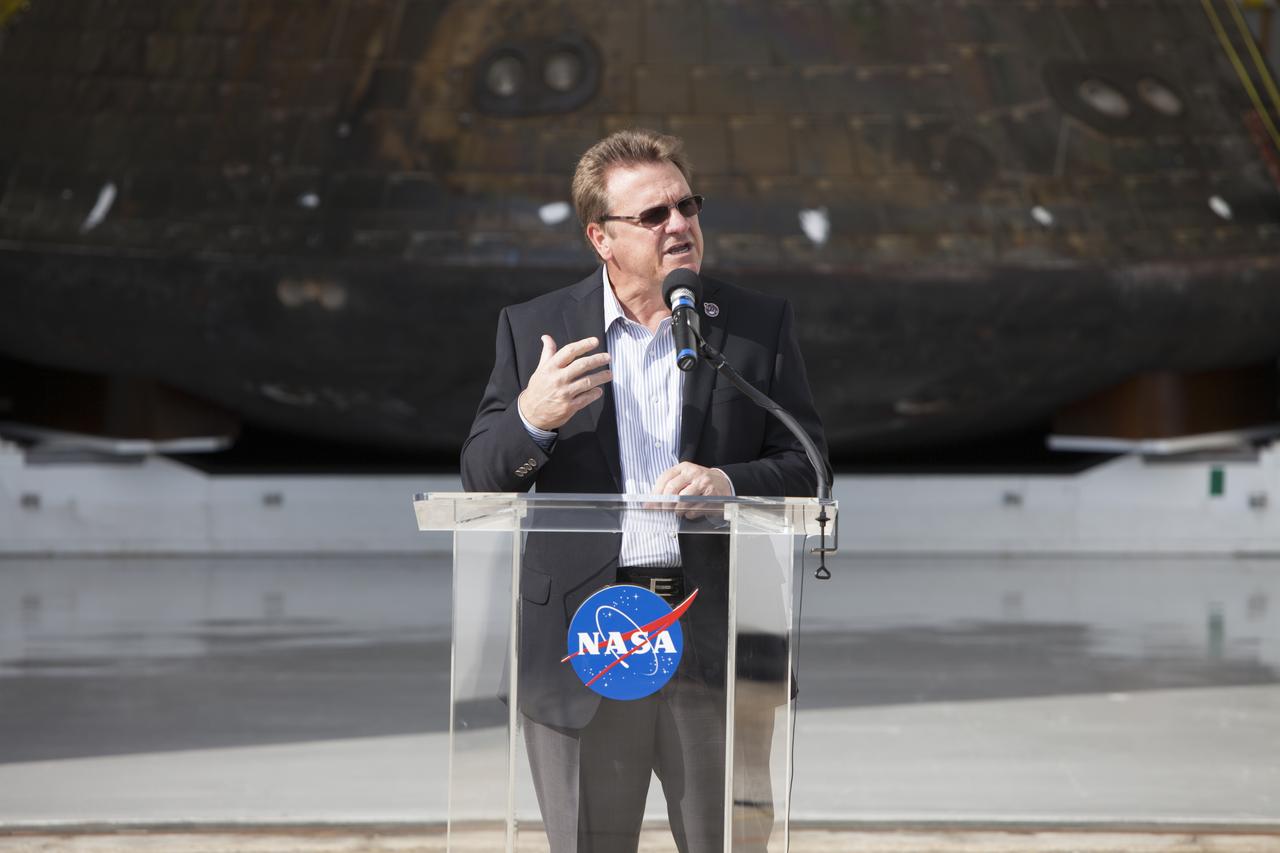
Lockheed Martin Manager Jules Schneider speaks to members of the media during a viewing of NASA's Orion spacecraft at the Launch Abort System Facility at NASA's Kennedy Space Center in Florida. The spacecraft's cross-country return, a 2,700 mile road trip from Naval Base San Diego to Kennedy, sets the stage for in-depth analysis of data obtained during Orion's trip to space. It will provide engineers with detailed information on how the spacecraft fared during its two-orbit, 4.5-hour flight test, completed on Dec. 5. The Ground Systems Development and Operations Program led the recovery, offload and transportation efforts.
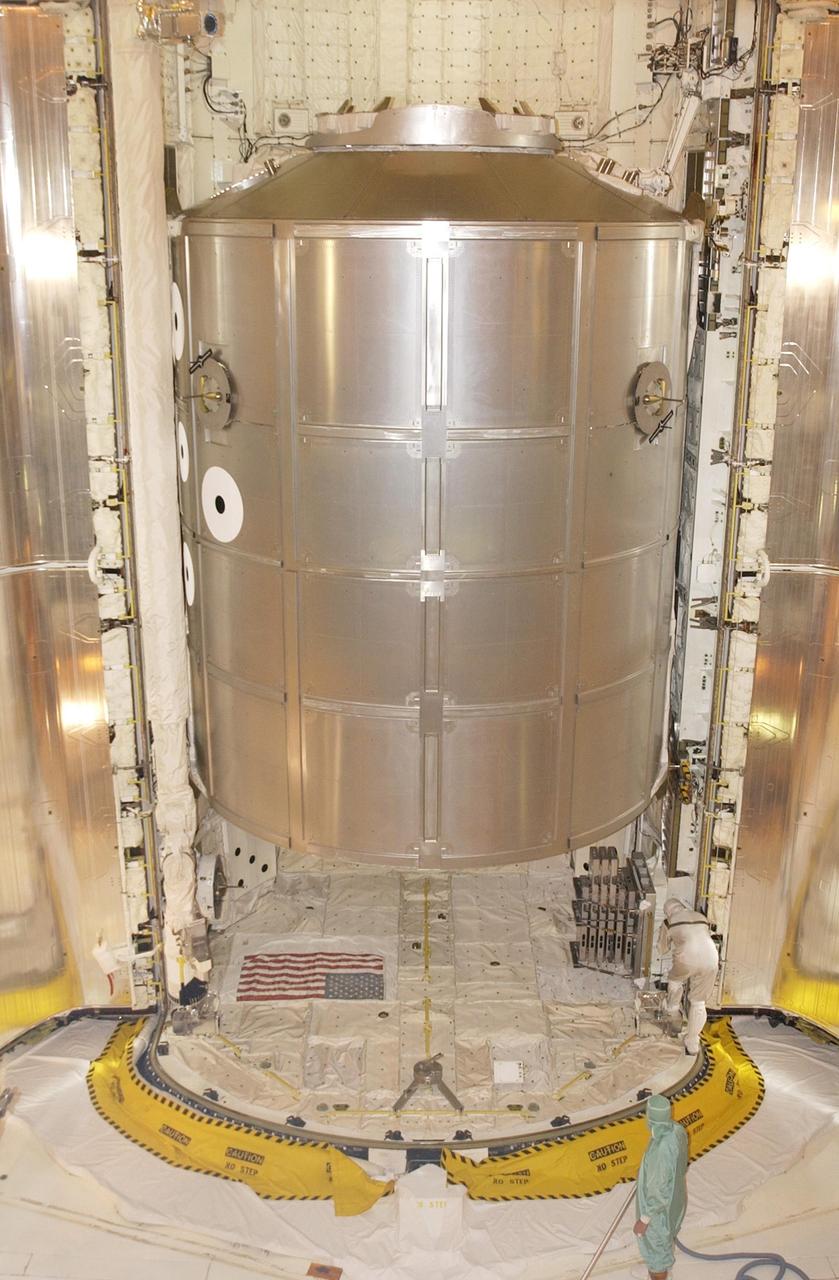
KENNEDY SPACE CENTER, FLA. - At Launch Pad 39A, Multi-Purpose Logistics Module Leonardo is ready for installation into Endeavour's payload bay for mission STS-111. The mission, known as Utilization Flight 2, is carrying supplies and equipment to the International Space Station. The payload includes the Multi-Purpose Logistics Module Leonardo, the Mobile Base System, which will be installed on the Mobile Transporter to complete the Canadian Mobile Servicing System, and a replacement wrist/roll joint for Canadarm 2. Also part of the mission, Expedition 5 will travel to the Station as the replacement crew for Expedition 4, who will return to Earth aboard the orbiter. Launch is scheduled for May 30, 2002
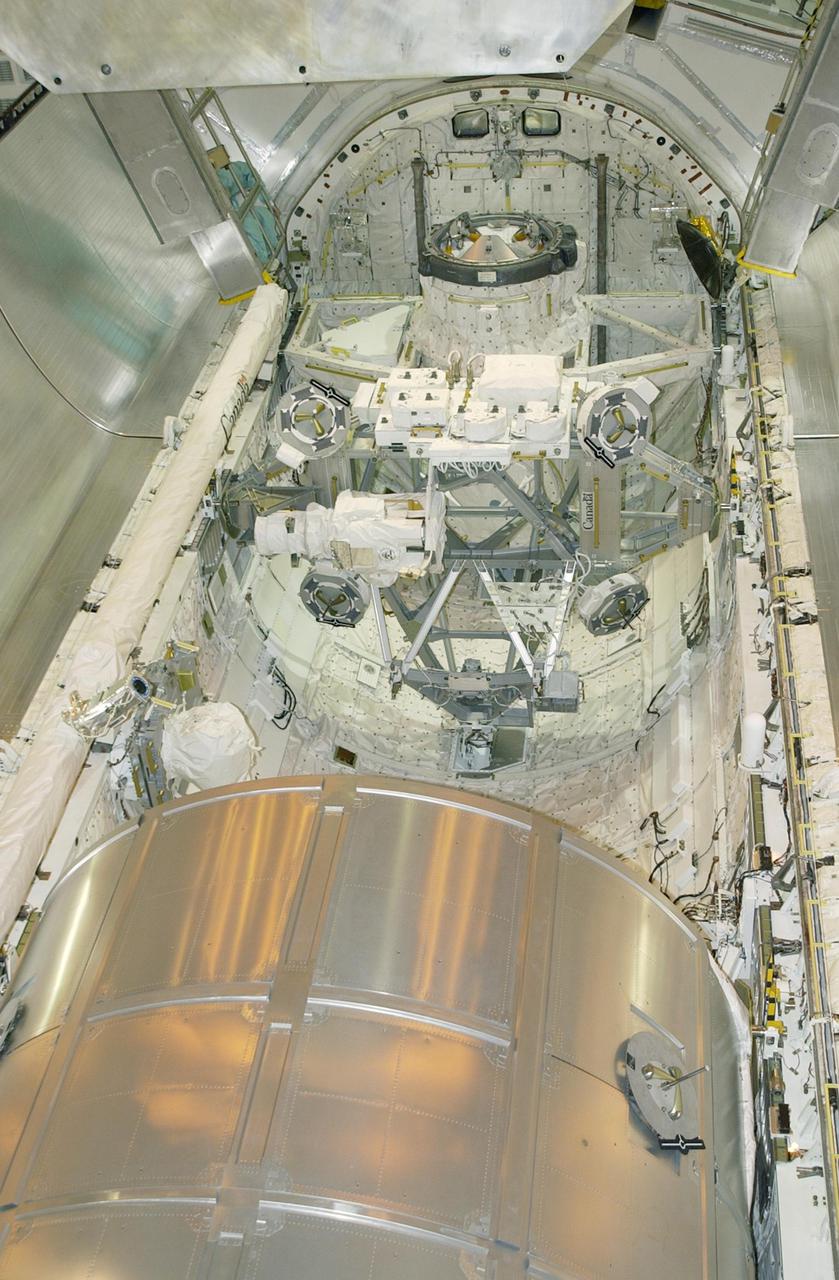
KENNEDY SPACE CENTER, FLA. -- The Multi-Purpose Logistics Module Leonardo (bottom of photo) is being installed in Endeavour's payload bay for mission STS-111. The mission, known as Utilization Flight 2, is carrying supplies and equipment to the International Space Station. The payload includes the Multi-Purpose Logistics Module Leonardo, the Mobile Base System, which will be installed on the Mobile Transporter to complete the Canadian Mobile Servicing System, and a replacement wrist_roll joint for Canadarm 2. Also part of the mission, Expedition 5 will travel to the Station as the replacement crew for Expedition 4, who will return to Earth aboard the orbiter. Launch is scheduled for May 30, 2002
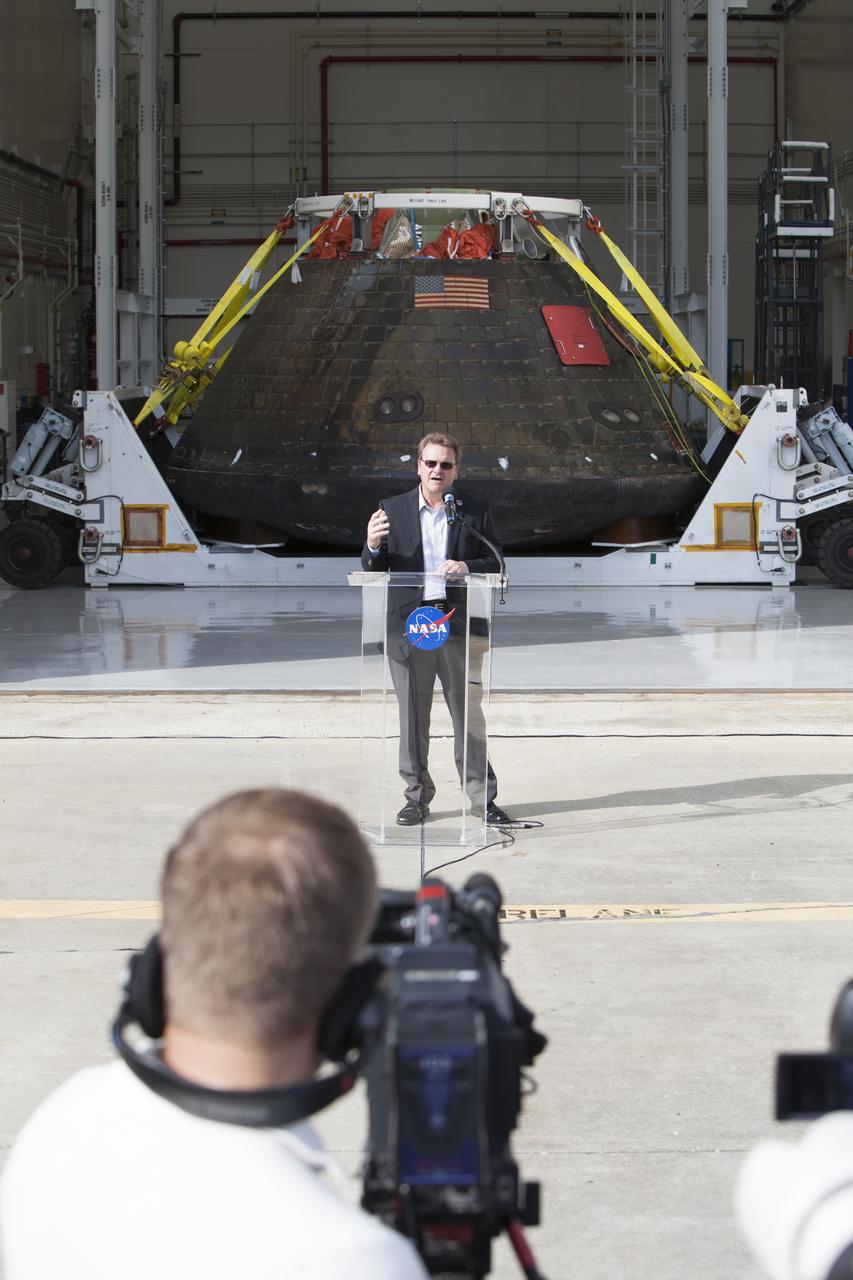
Lockheed Martin Manager Jules Schneider speaks to members of the media during a viewing of NASA's Orion spacecraft at the Launch Abort System Facility at NASA's Kennedy Space Center in Florida. The spacecraft's cross-country return, a 2,700 mile road trip from Naval Base San Diego to Kennedy, sets the stage for in-depth analysis of data obtained during Orion's trip to space. It will provide engineers with detailed information on how the spacecraft fared during its two-orbit, 4.5-hour flight test, completed on Dec. 5. The Ground Systems Development and Operations Program led the recovery, offload and transportation efforts.
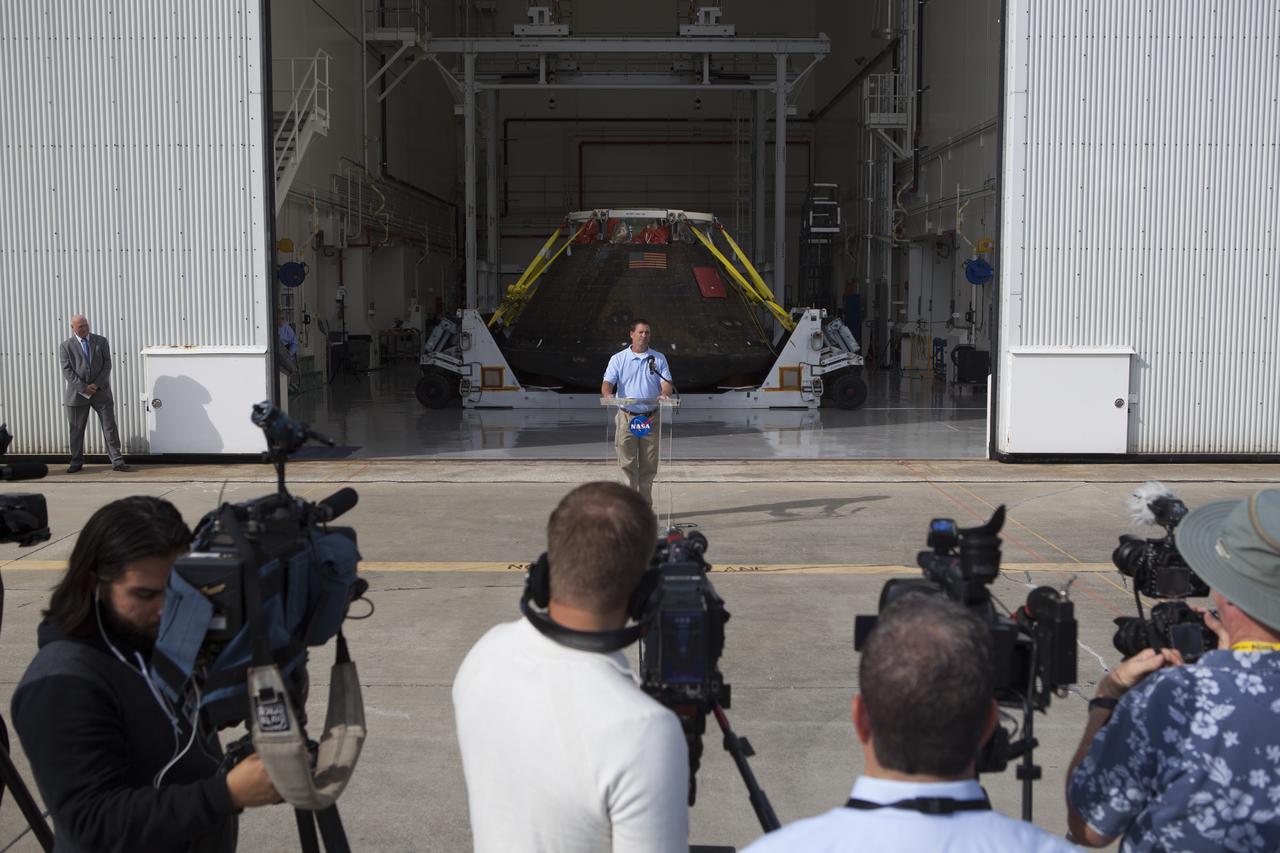
NASA's Orion spacecraft is viewed by members of the media at the Launch Abort System Facility at NASA's Kennedy Space Center in Florida. Lou Garcia, with the Ground Systems Development and Operations Program, or GSDO, speaks to the media during the viewing opportunity. The spacecraft's cross-country return, a 2,700 mile road trip from Naval Base San Diego to Kennedy, sets the stage for in-depth analysis of data obtained during Orion's trip to space. It will provide engineers with detailed information on how the spacecraft fared during its two-orbit, 4.5-hour flight test, completed on Dec. 5. GSDO led the recovery, offload and transportation efforts.
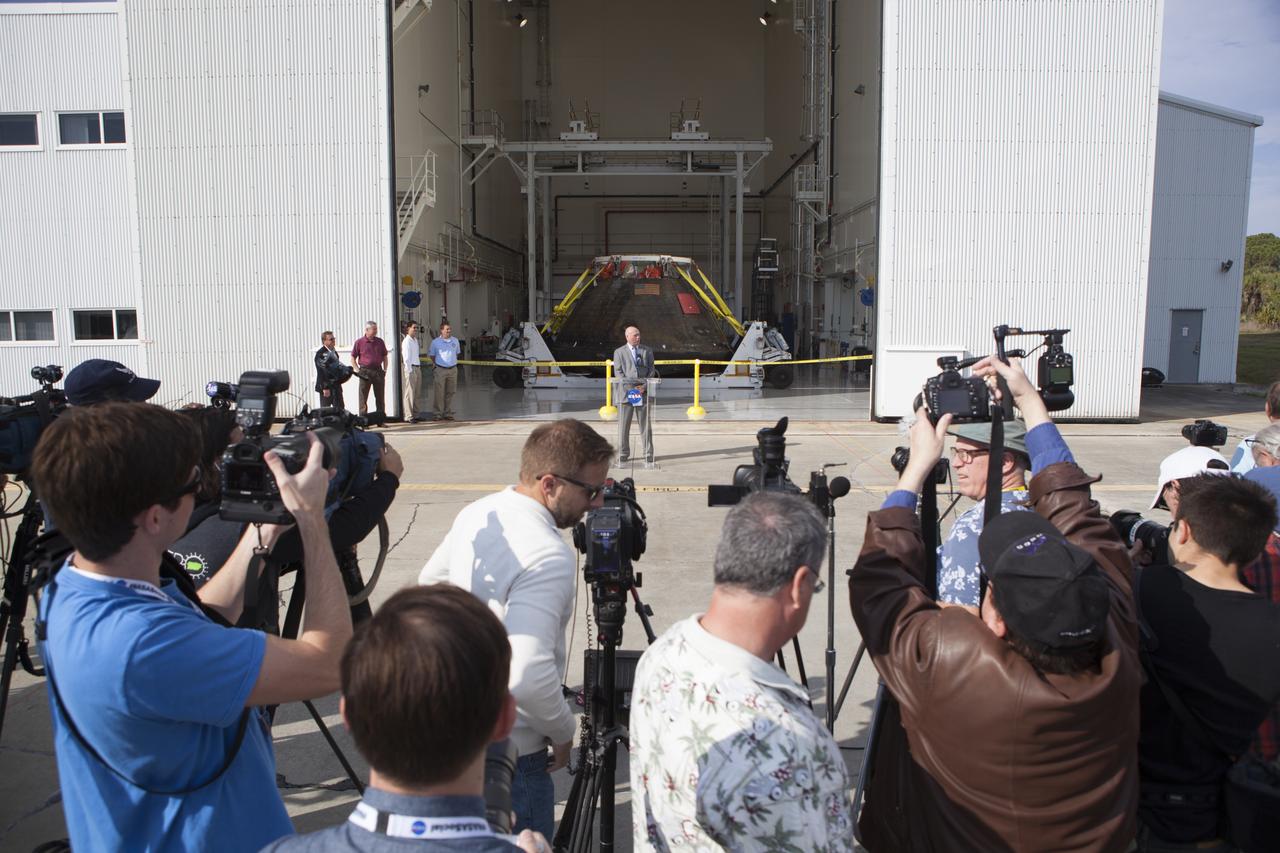
NASA's Orion spacecraft is viewed by members of the media at the Launch Abort System Facility at NASA's Kennedy Space Center in Florida. Kennedy's News Chief Mike Curie speaks to the media during the viewing opportunity. The spacecraft's cross-country return, a 2,700 mile road trip from Naval Base San Diego to Kennedy, sets the stage for in-depth analysis of data obtained during Orion's trip to space. It will provide engineers with detailed information on how the spacecraft fared during its two-orbit, 4.5-hour flight test, completed on Dec. 5. The Ground Systems Development and Operations Program led the recovery, offload and transportation efforts.
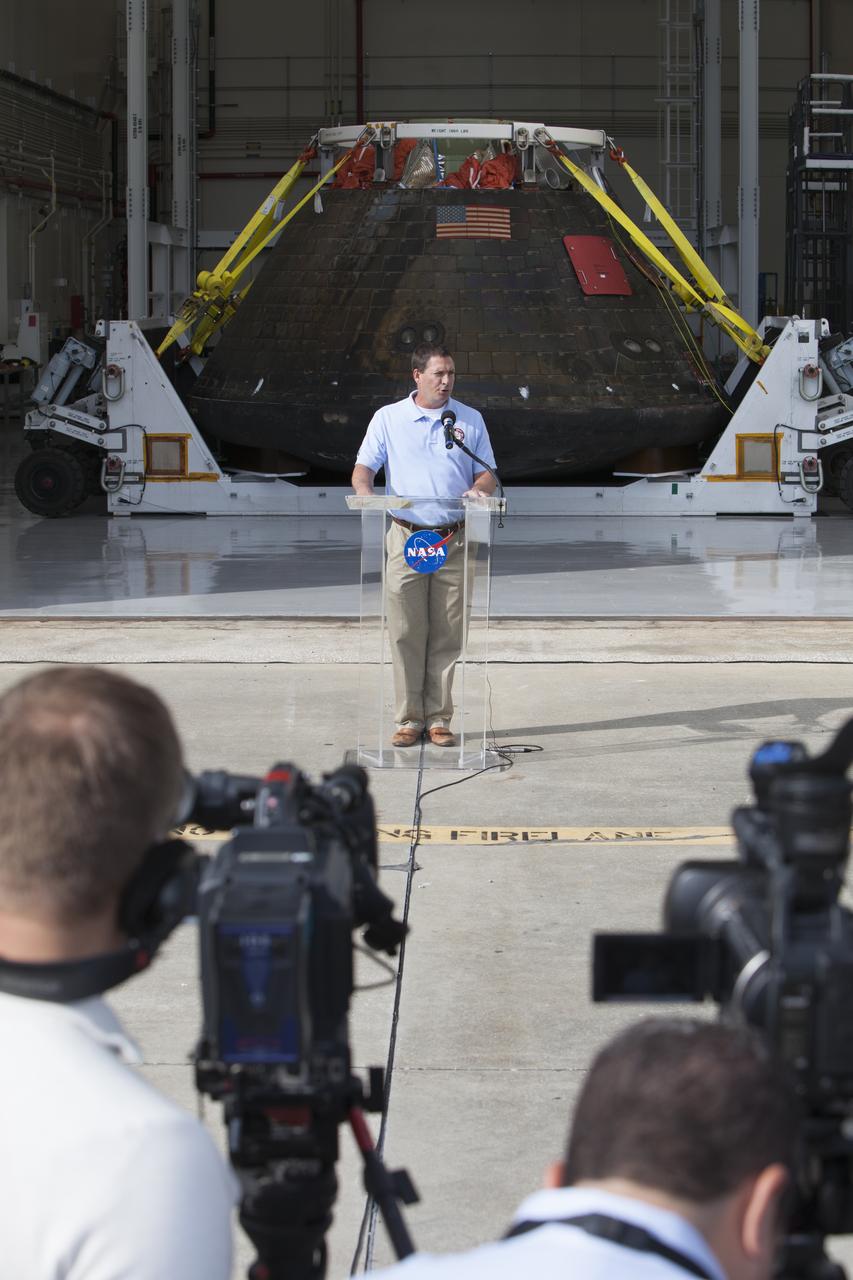
NASA's Orion spacecraft is viewed by members of the media at the Launch Abort System Facility at NASA's Kennedy Space Center in Florida. Lou Garcia, with the Ground Systems Development and Operations Program, or GSDO, speaks to the media during the viewing opportunity. The spacecraft's cross-country return, a 2,700 mile road trip from Naval Base San Diego to Kennedy, sets the stage for in-depth analysis of data obtained during Orion's trip to space. It will provide engineers with detailed information on how the spacecraft fared during its two-orbit, 4.5-hour flight test, completed on Dec. 5. GSDO led the recovery, offload and transportation efforts.

NASA's Orion spacecraft is viewed by members of the media at the Launch Abort System Facility at NASA's Kennedy Space Center in Florida. Lou Garcia, with the Ground Systems Development and Operations Program, or GSDO, speaks to the media during the viewing opportunity. The spacecraft's cross-country return, a 2,700 mile road trip from Naval Base San Diego to Kennedy, sets the stage for in-depth analysis of data obtained during Orion's trip to space. It will provide engineers with detailed information on how the spacecraft fared during its two-orbit, 4.5-hour flight test, completed on Dec. 5. GSDO led the recovery, offload and transportation efforts.
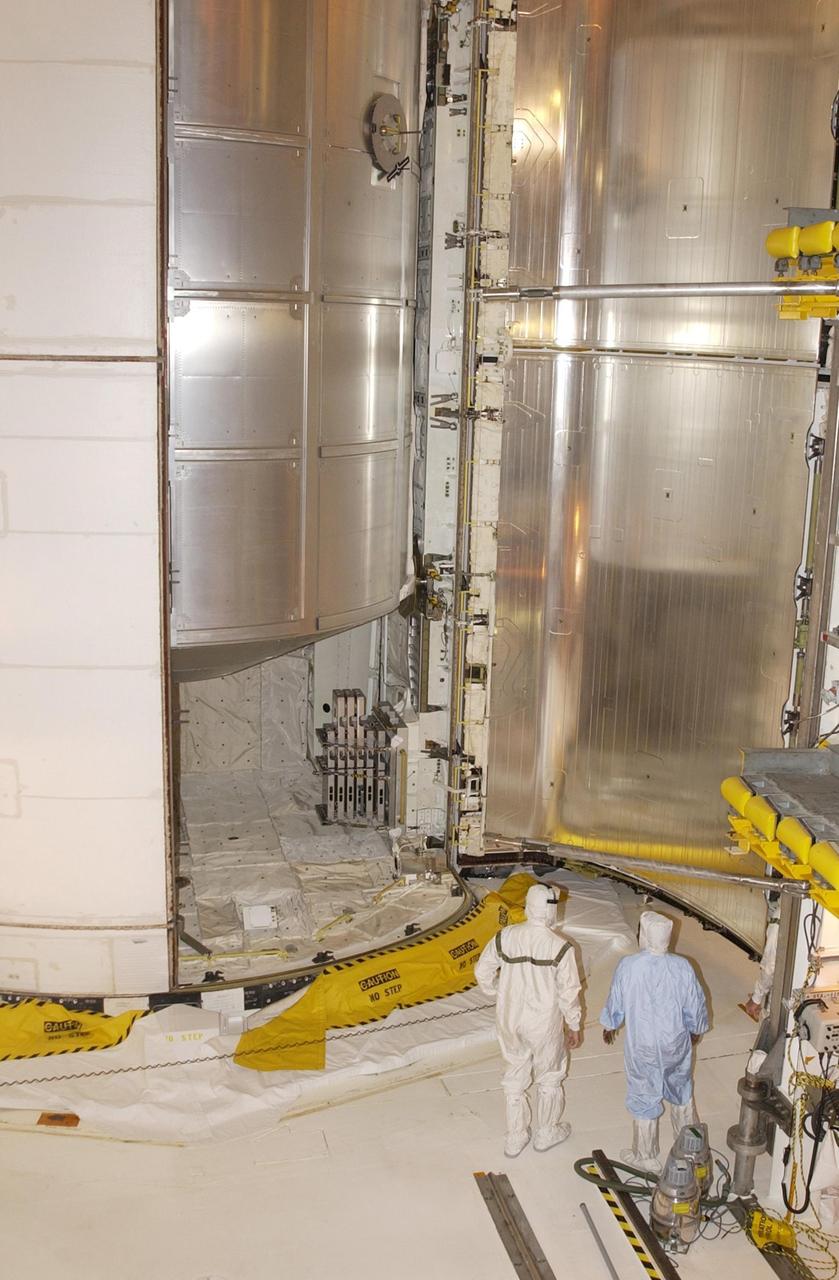
KENNEDY SPACE CENTER, FLA. -- The remaining payload bay door begins to close. Visible is the Multi-Purpose Logistics Module Leonardo, last to be installed in Endeavour. The Shuttle is poised for launch on mission STS-111, Utilization Flight 2, carrying supplies and equipment to the International Space Station. The payload includes the Multi-Purpose Logistics Module Leonardo, the Mobile Base System, which will be installed on the Mobile Transporter to complete the Canadian Mobile Servicing System, and a replacement wrist/roll joint for Canadarm 2. Also part of the mission, Expedition 5 will travel to the Station as the replacement crew for Expedition 4, who will return to Earth aboard the orbiter. Launch is scheduled for May 30, 2002.
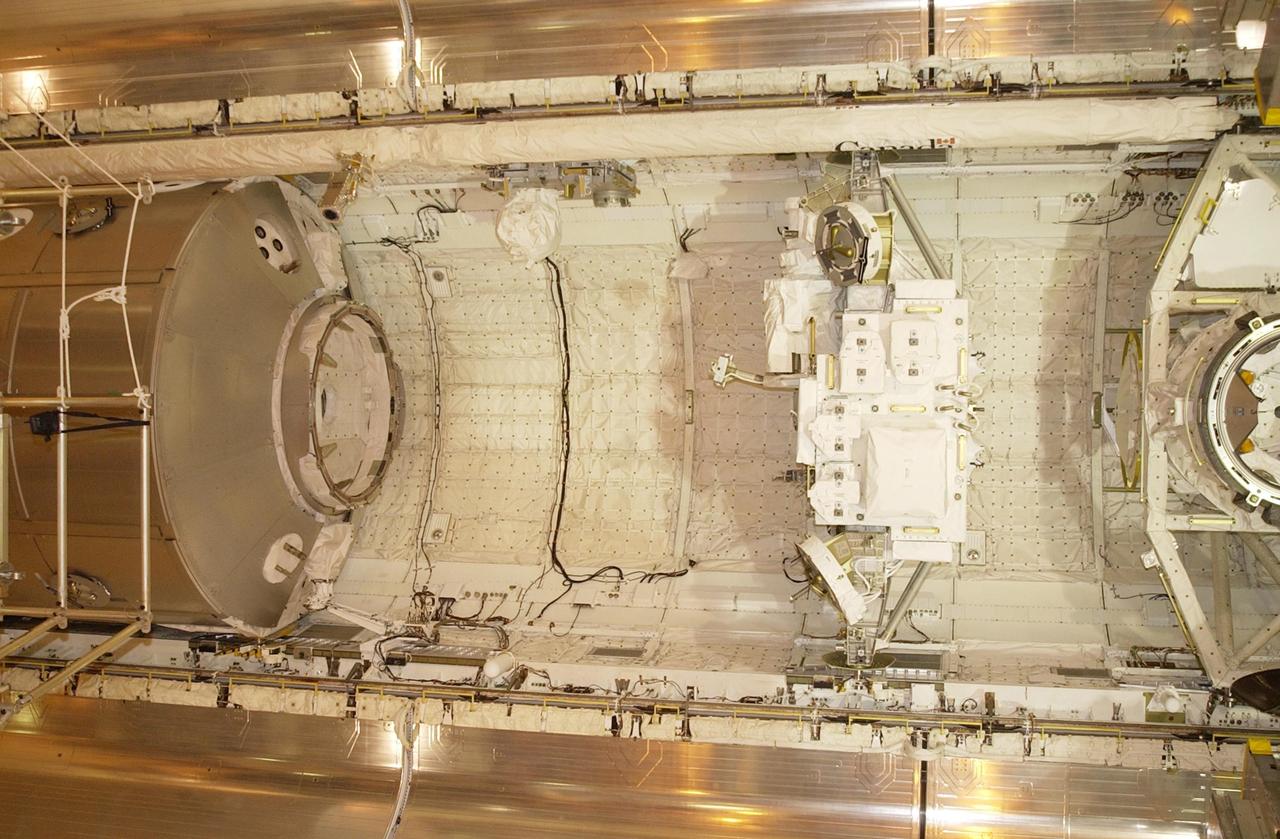
KENNEDY SPACE CENTER, FLA. - With the SPACEHAB and Hitchhiker payloads already installed, Endeavour's payload bay is ready for installation of the Multi-Purpose Logistics Module Leonardo for mission STS-111. The mission, known as Utilization Flight 2, is carrying supplies and equipment to the International Space Station. The payload includes the Multi-Purpose Logistics Module Leonardo, the Mobile Base System, which will be installed on the Mobile Transporter to complete the Canadian Mobile Servicing System, and a replacement wrist/roll joint for Canadarm 2. Also part of the mission, Expedition 5 will travel to the Station as the replacement crew for Expedition 4, who will return to Earth aboard the orbiter. Launch is scheduled for May 30, 2002
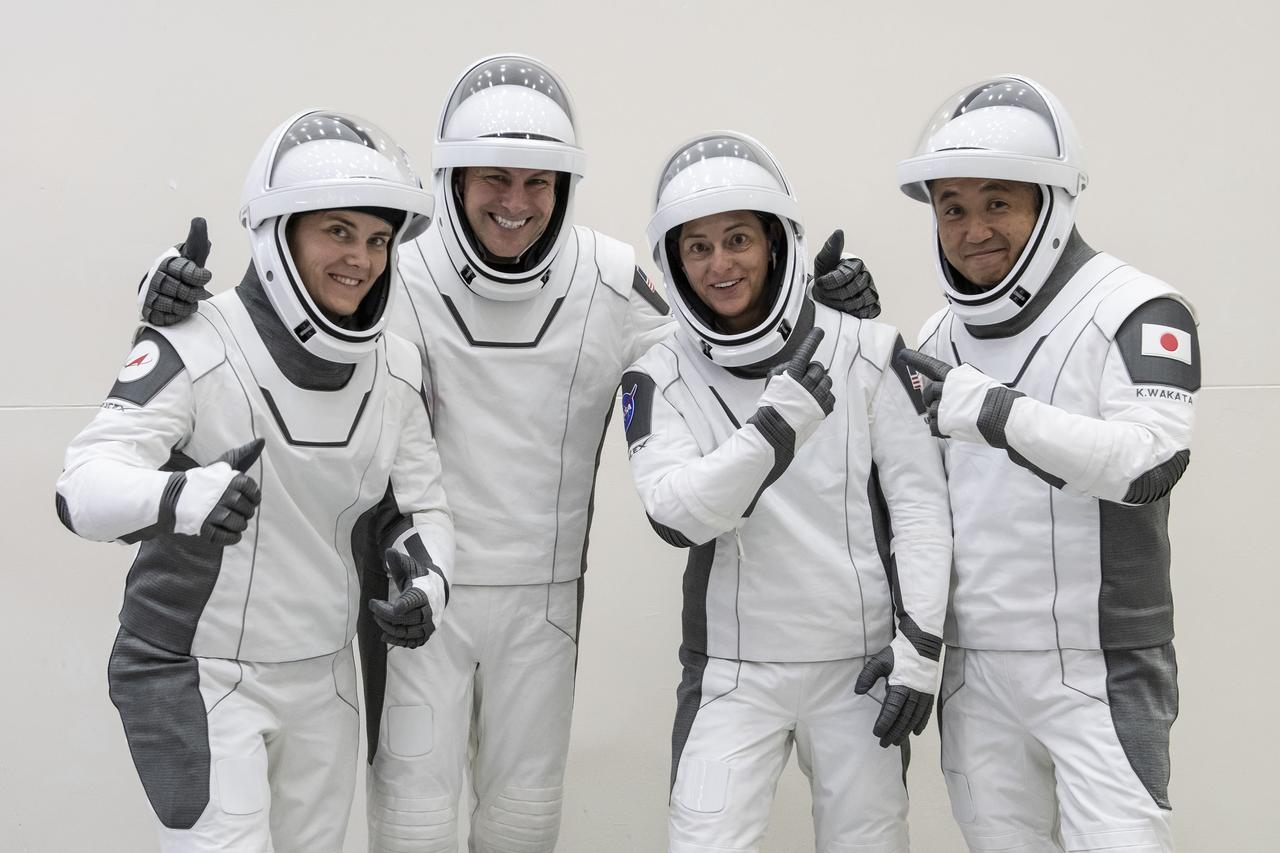
SpaceX Crew-5 astronauts give a thumbs up during a crew equipment interface test (CEIT) at SpaceX headquarters in Hawthorne, California, on Aug. 13, 2022. From left are Anna Kikina, mission specialist; Josh Cassada, pilot; Nicole Mann, spacecraft commander; and Koichi Wakata, mission specialist with JAXA (Japan Aerospace Exploration Agency). During the CEIT, the astronauts practiced launch and docking in a high-fidelity simulator of SpaceX’s Dragon capsule. Each astronaut suited up and practiced getting into position inside the capsule. NASA’s SpaceX Crew-5 will be the fifth crew rotation mission of the company’s human space transportation system and its sixth flight with astronauts to the International Space Station for the agency’s Commercial Crew Program. Crew-5 will launch on the Falcon 9 rocket from Launch Complex 39A at NASA’s Kennedy Space Center in Florida no earlier than Sept. 29, 2022.
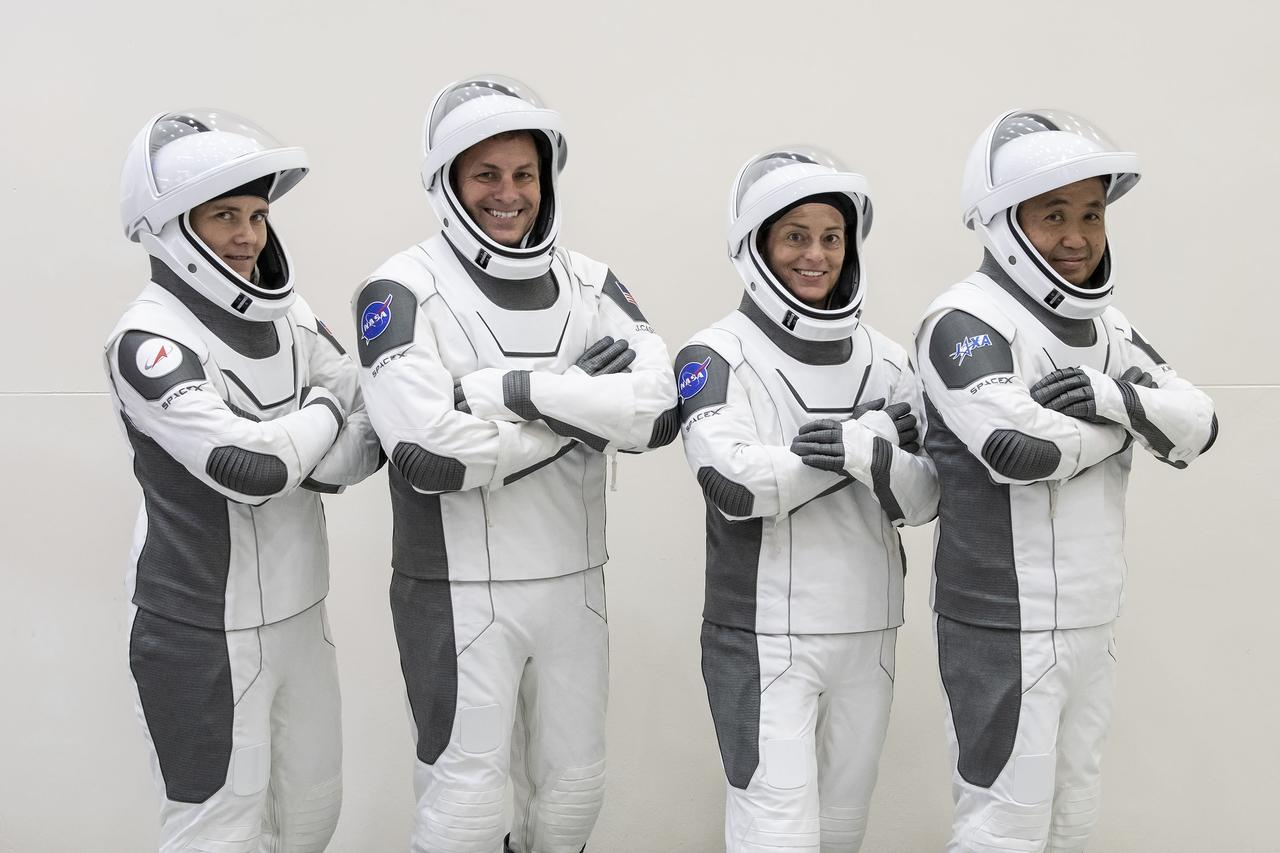
SpaceX Crew-5 astronauts take a break during a crew equipment interface test (CEIT) at SpaceX headquarters in Hawthorne, California, on Aug. 13, 2022. From left are Anna Kikina, mission specialist; Josh Cassada, pilot; Nicole Mann, spacecraft commander; and Koichi Wakata, mission specialist with JAXA (Japan Aerospace Exploration Agency). During the CEIT, the astronauts practiced launch and docking in a high-fidelity simulator of SpaceX’s Dragon capsule. Each astronaut suited up and practiced getting into position inside the capsule. NASA’s SpaceX Crew-5 will be the fifth crew rotation mission of the company’s human space transportation system and its sixth flight with astronauts to the International Space Station for the agency’s Commercial Crew Program. Crew-5 will launch on the Falcon 9 rocket from Launch Complex 39A at NASA’s Kennedy Space Center in Florida no earlier than Sept. 29, 2022.

SpaceX Crew-5 astronauts are suited up and ready to participate in a crew equipment interface test (CEIT) at SpaceX headquarters in Hawthorne, California, on Aug. 13, 2022. From left are Anna Kikina, mission specialist; Josh Cassada, pilot; Nicole Mann, spacecraft commander; and Koichi Wakata, mission specialist with JAXA (Japan Aerospace Exploration Agency). During the CEIT, the astronauts will practice launch and docking in a high-fidelity simulator of SpaceX’s Dragon capsule. They also will practice getting into position inside the capsule. NASA’s SpaceX Crew-5 will be the fifth crew rotation mission of the company’s human space transportation system and its sixth flight with astronauts to the International Space Station for the agency’s Commercial Crew Program. Crew-5 will launch on the Falcon 9 rocket from Launch Complex 39A at NASA’s Kennedy Space Center in Florida no earlier than Sept. 29, 2022.
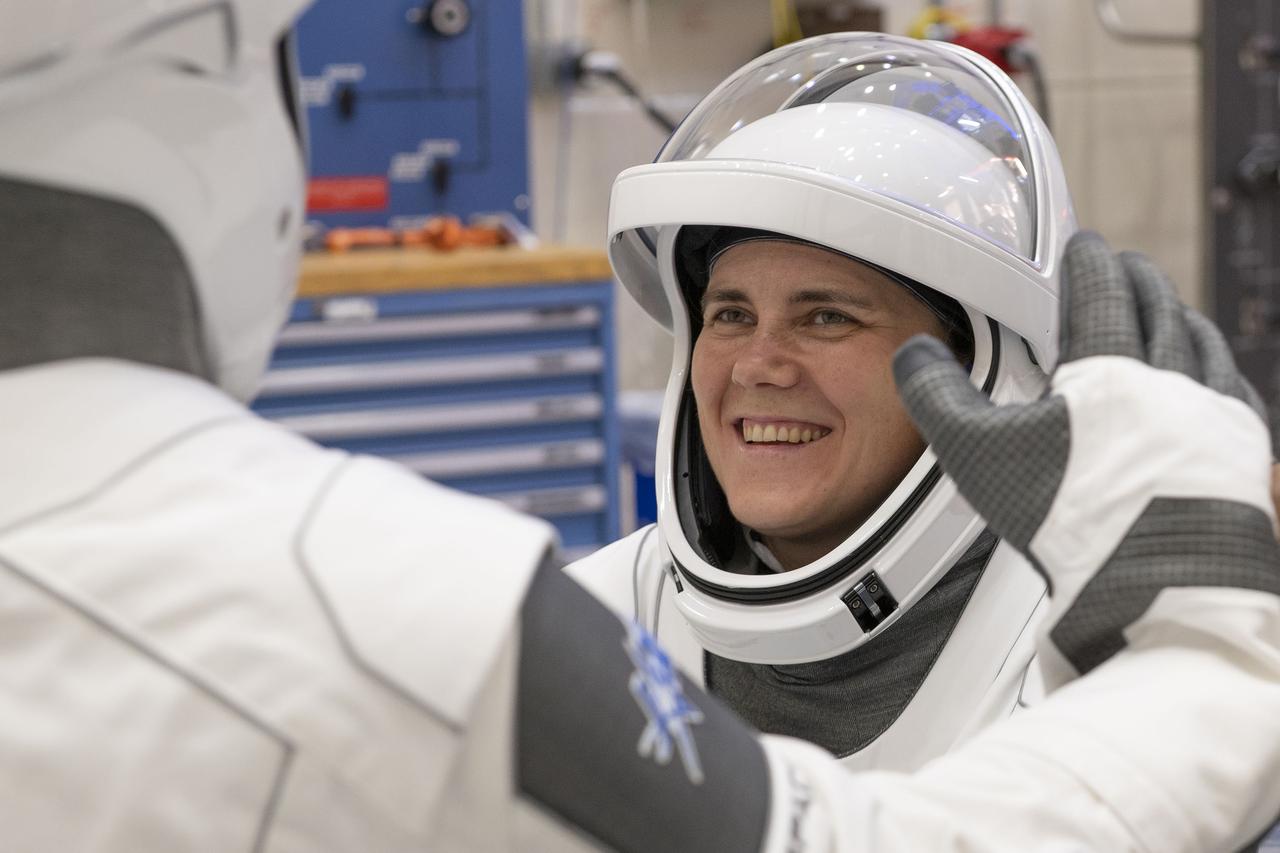
SpaceX Crew-5 astronaut Anna Kikina, mission specialist, gets suited up to participate in a crew equipment interface test (CEIT) at SpaceX headquarters in Hawthorne, California, on Aug. 13, 2022. During the CEIT, the astronauts will practice launch and docking in a high-fidelity simulator of SpaceX’s Dragon capsule. They also will practice getting into position inside the capsule. NASA’s SpaceX Crew-5 will be the fifth crew rotation mission of the company’s human space transportation system and its sixth flight with astronauts to the International Space Station for the agency’s Commercial Crew Program. Crew-5 will launch on the Falcon 9 rocket from Launch Complex 39A at NASA’s Kennedy Space Center in Florida no earlier than Sept. 29, 2022.
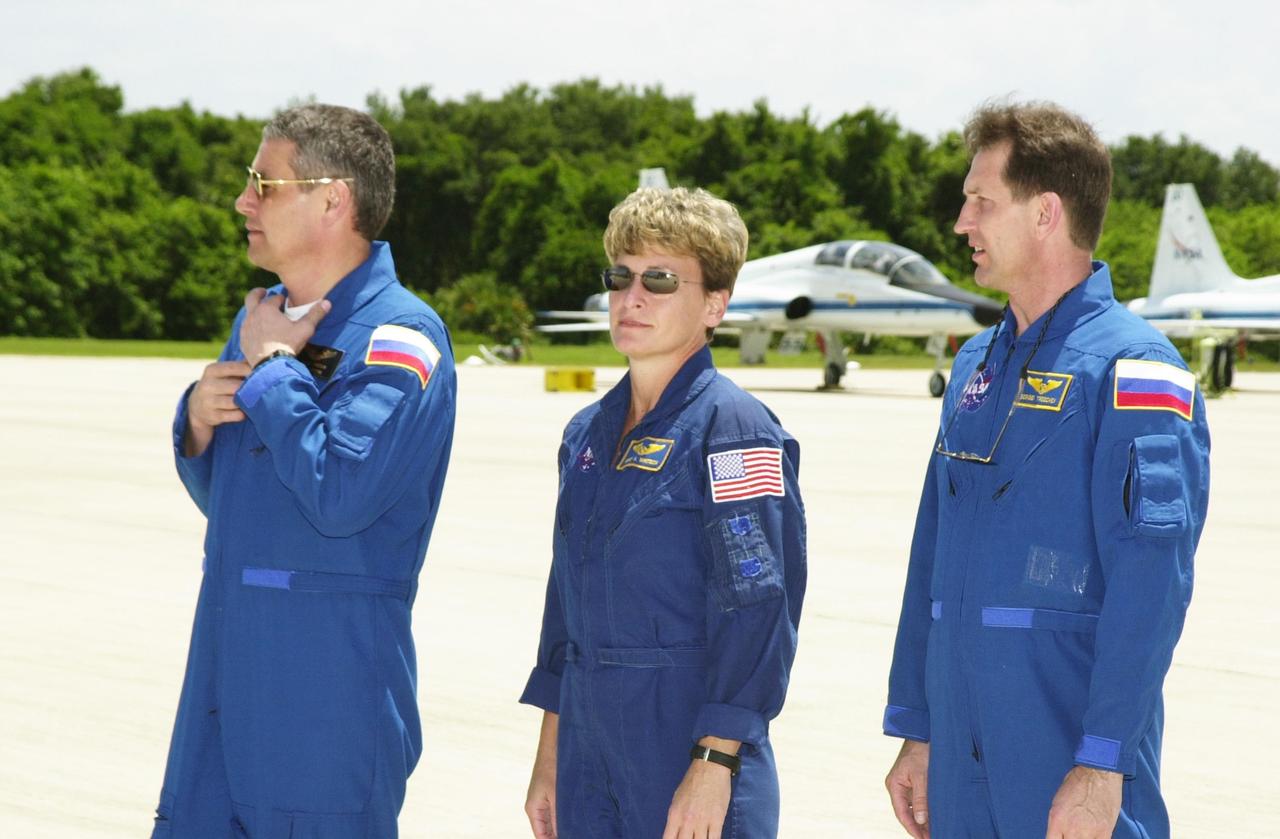
KENNEDY SPACE CENTER, FLA. - The Expedition 5 crew gets ready to depart KSC after several days of Terminal Countdown Demonstration Test activities. TCDT includes emergency egress training and a simulated launch countdown. Expedition 5 will travel to the International Space Station on mission STS-111 as the replacement crew for Expedition 4, who will return to Earth aboard the orbiter. Mission STS-111 is known as Utilization Flight 2, carrying supplies and equipment in the Multi-Purpose Logistics Module Leonardo to the International Space Station. The payload also includes the Mobile Base System, which will be installed on the Mobile Transporter to complete the Canadian Mobile Servicing System, or MSS, and a replacement wrist/roll joint for Canadarm 2. The mechanical arm will then have the capability to "inchworm" from the U.S. Lab Destiny to the MSS and travel along the truss to work sites. Launch is scheduled for May 30, 2002
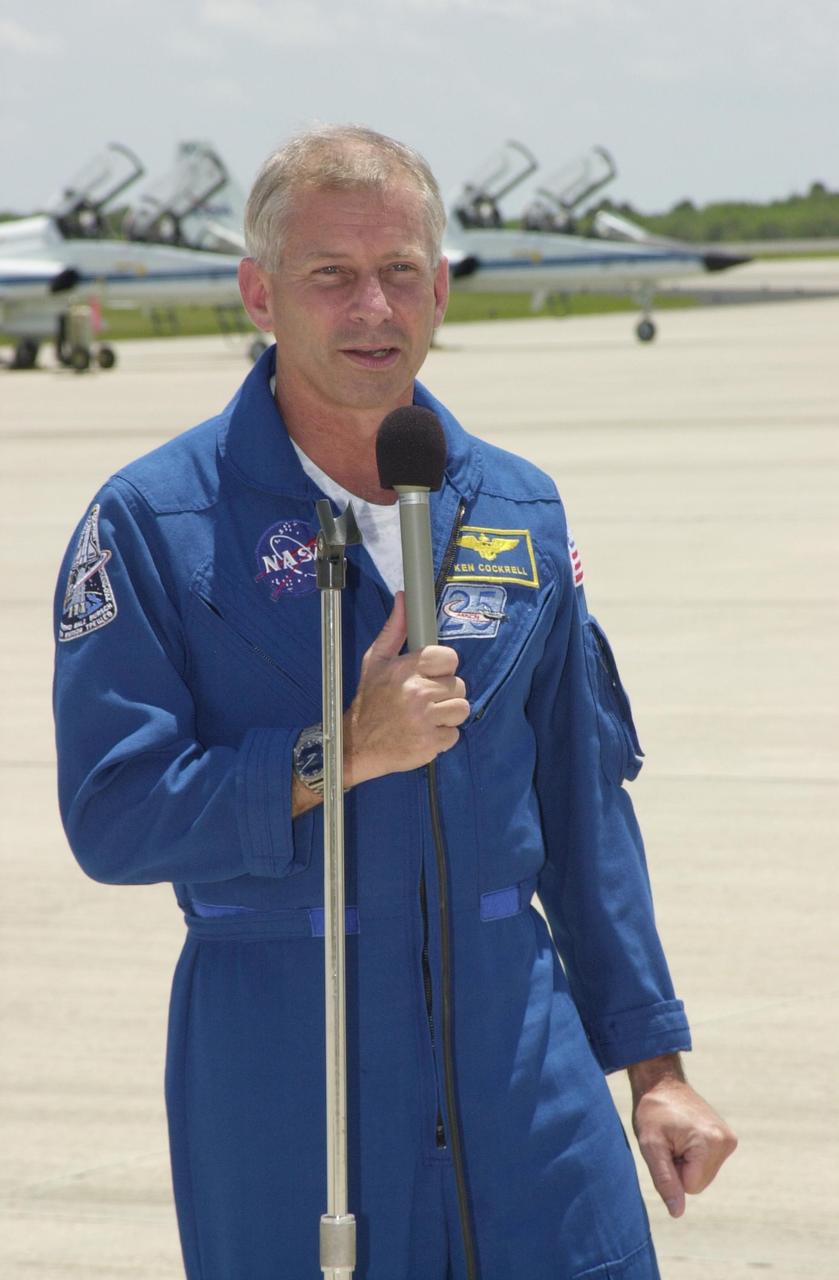
KENNEDY SPACE CENTER, FLA. - STS-111 Commander Kenneth Cockrell speaks to the media before leaving KSC along with his crew and Expedition 5. They have been taking part in Terminal Countdown Demonstration Test activities that include emergency egress training and a simulated launch countdown. Mission STS-111 is known as Utilization Flight 2, carrying supplies and equipment in the Multi-Purpose Logistics Module Leonardo to the International Space Station. The payload also includes the Mobile Base System, which will be installed on the Mobile Transporter to complete the Canadian Mobile Servicing System, or MSS, and a replacement wrist/roll joint for Canadarm 2. The mechanical arm will then have the capability to "inchworm" from the U.S. Lab Destiny to the MSS and travel along the truss to work sites. Expedition 5 will travel to the International Space Station on mission STS-111 as the replacement crew for Expedition 4, who will return to Earth aboard the orbiter. Launch is scheduled for May 30, 2002
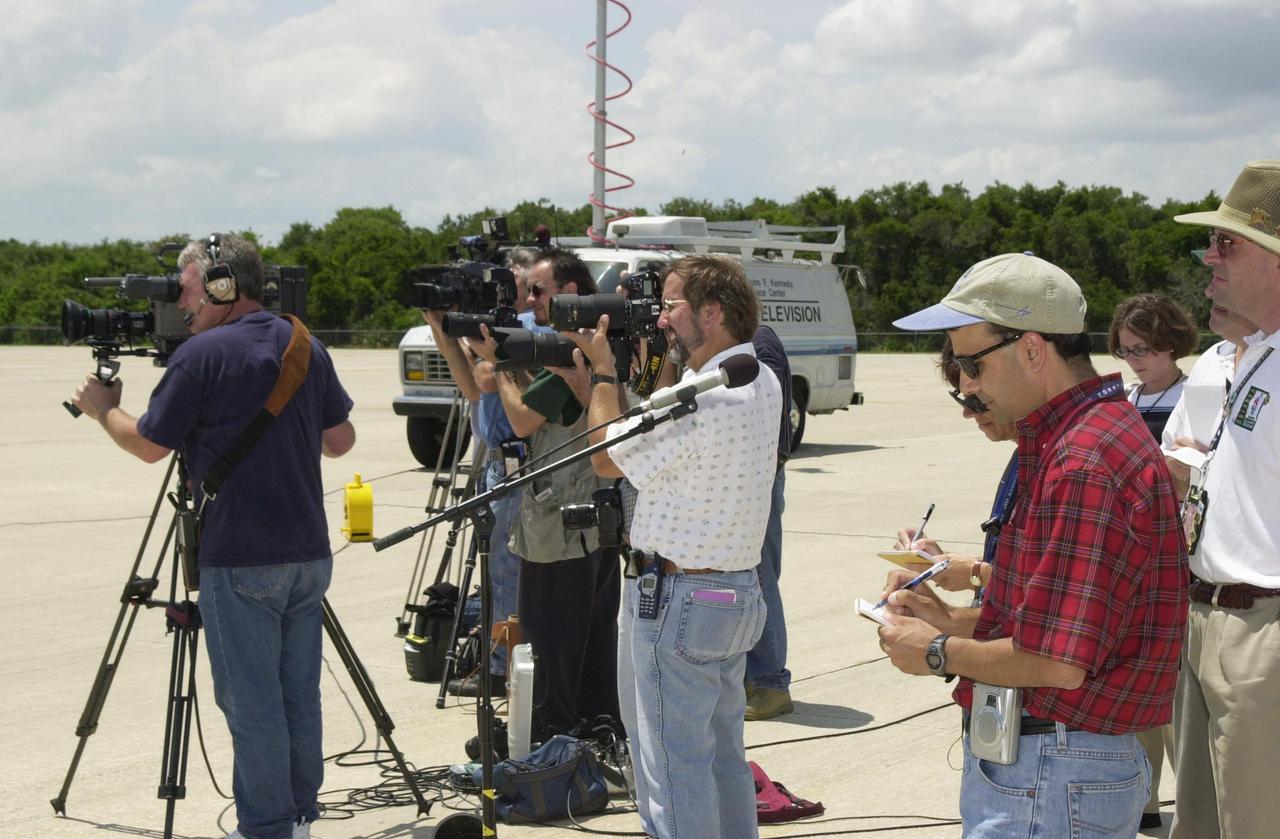
KENNEDY SPACE CENTER, FLA. -- The media photograph and document the words of the departing STS-111 and Expedition 5 crews, who have just completed Terminal Countdown Demonstration Test activities that include emergency egress training and a simulated launch countdown. Expedition 5 will travel to the International Space Station on mission STS-111 as the replacement crew for Expedition 4, who will return to Earth aboard the orbiter. Mission STS-111 is known as Utilization Flight 2, carrying supplies and equipment in the Multi-Purpose Logistics Module Leonardo to the International Space Station. The payload also includes the Mobile Base System, which will be installed on the Mobile Transporter to complete the Canadian Mobile Servicing System, or MSS, and a replacement wrist_roll joint for Canadarm 2. The mechanical arm will then have the capability to 'inchworm' from the U.S. Lab Destiny to the MSS and travel along the truss to work sites. Launch is scheduled for May 30, 2002
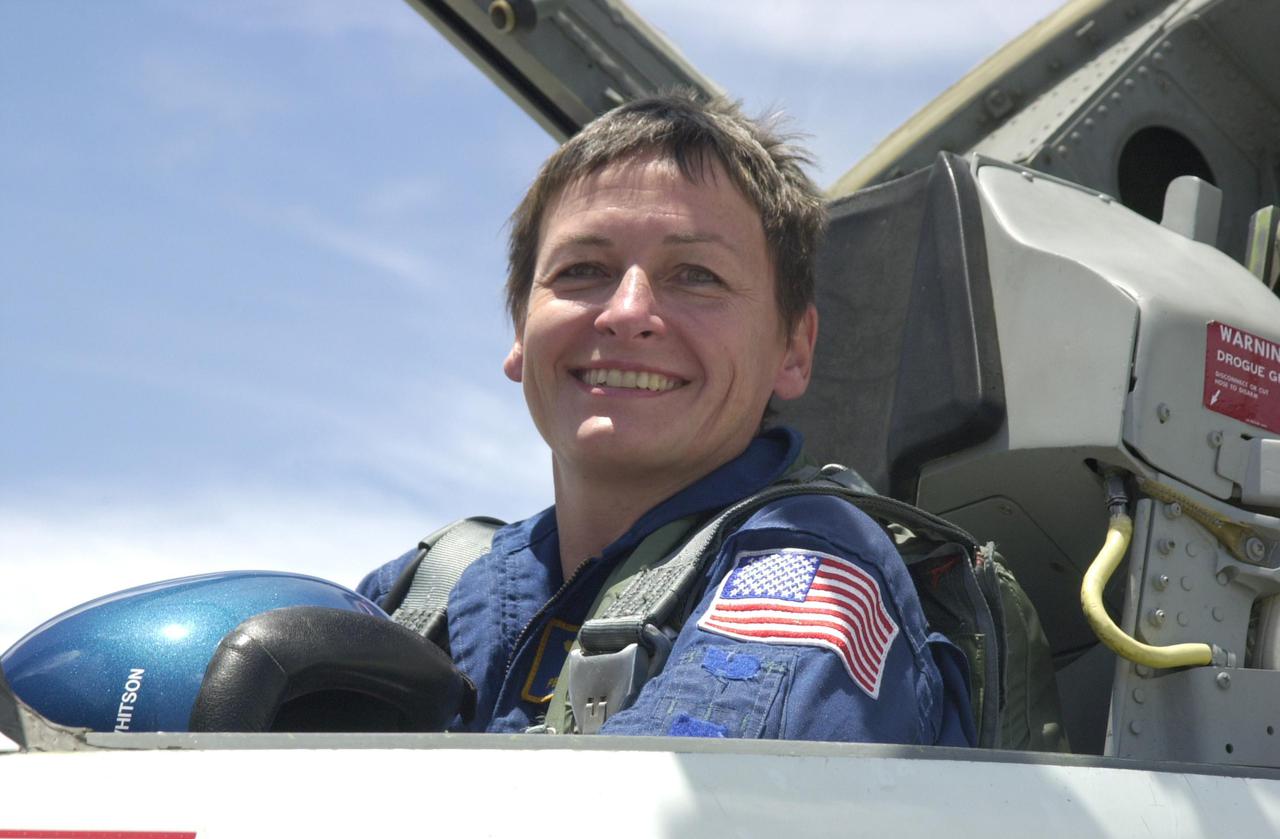
KENNEDY SPACE CENTER, FLA. -- Expedition 5 astronaut Peggy Whitson arrives at KSC aboard a T-38 jet aircraft to prepare for launch on mission STS-111. Expedition 5 will travel to the Station on Space Shuttle Endeavour as the replacement crew for Expedition 4, who will return to Earth aboard the orbiter. Mission STS-111, known as Utilization Flight 2, is carrying supplies and equipment to the International Space Station. The payload includes the Multi-Purpose Logistics Module Leonardo, the Mobile Base System, which will be installed on the Mobile Transporter to complete the Canadian Mobile Servicing System, or MSS, and a replacement wrist_roll joint for Canadarm 2. The mechanical arm will then have the capability to 'inchworm' from the U.S. Lab Destiny to the MSS and travel along the truss to work sites. Launch is scheduled for May 30, 2002
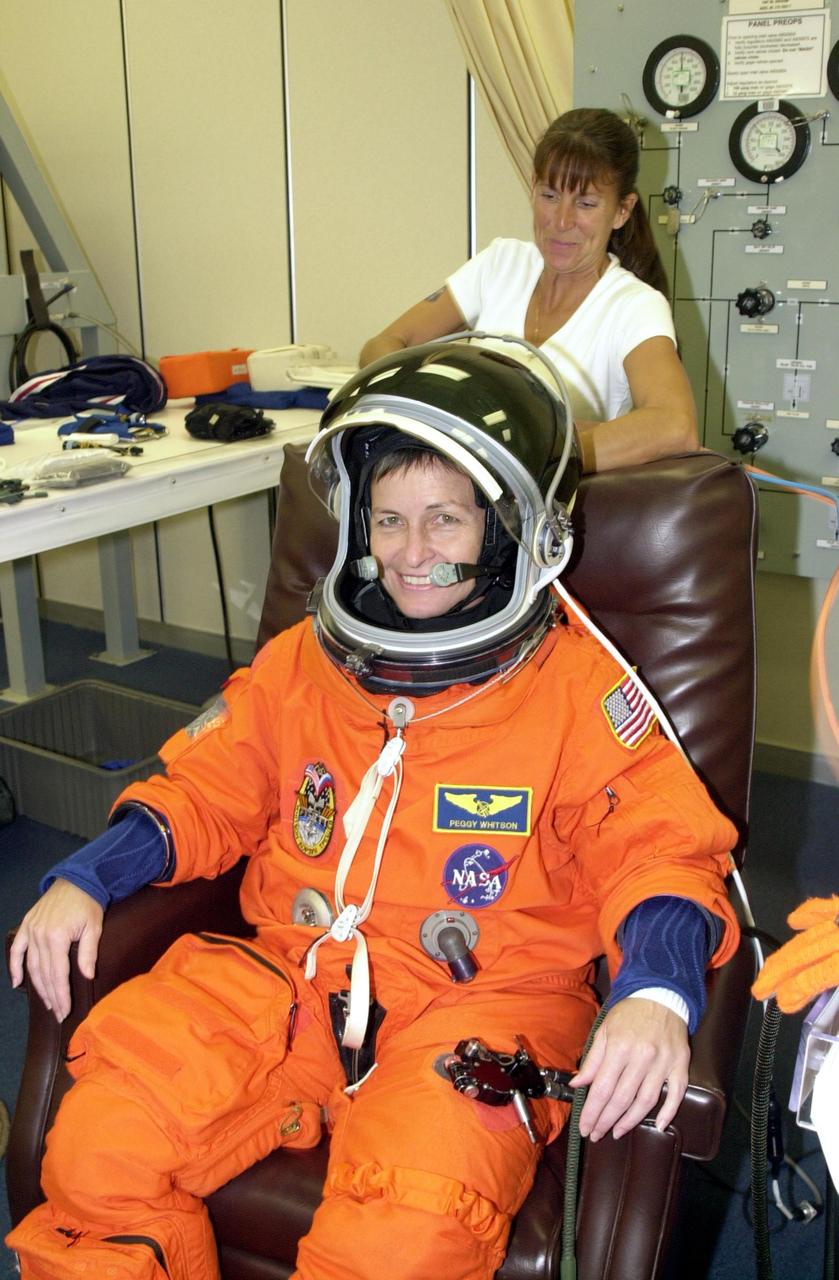
KENNEDY SPACE CENTER, FLA. -- Expedition 5 astronaut Peggy Whitson undergoes suit check as part of pre-launch activities. Part of Mission STS-111, Expedition 5 will travel to the International Space Station on Space Shuttle Endeavour as the replacement crew for Expedition 4, who will return to Earth aboard the orbiter. Known as Utilization Flight 2, Endeavour is carrying supplies and equipment to the Station. The payload includes the Multi-Purpose Logistics Module Leonardo, the Mobile Base System, which will be installed on the Mobile Transporter to complete the Canadian Mobile Servicing System, or MSS, and a replacement wrist/roll joint for Canadarm 2. The mechanical arm will then have the capability to "inchworm" from the U.S. Lab Destiny to the MSS and travel along the truss to work sites. Launch is scheduled for May 30, 2002
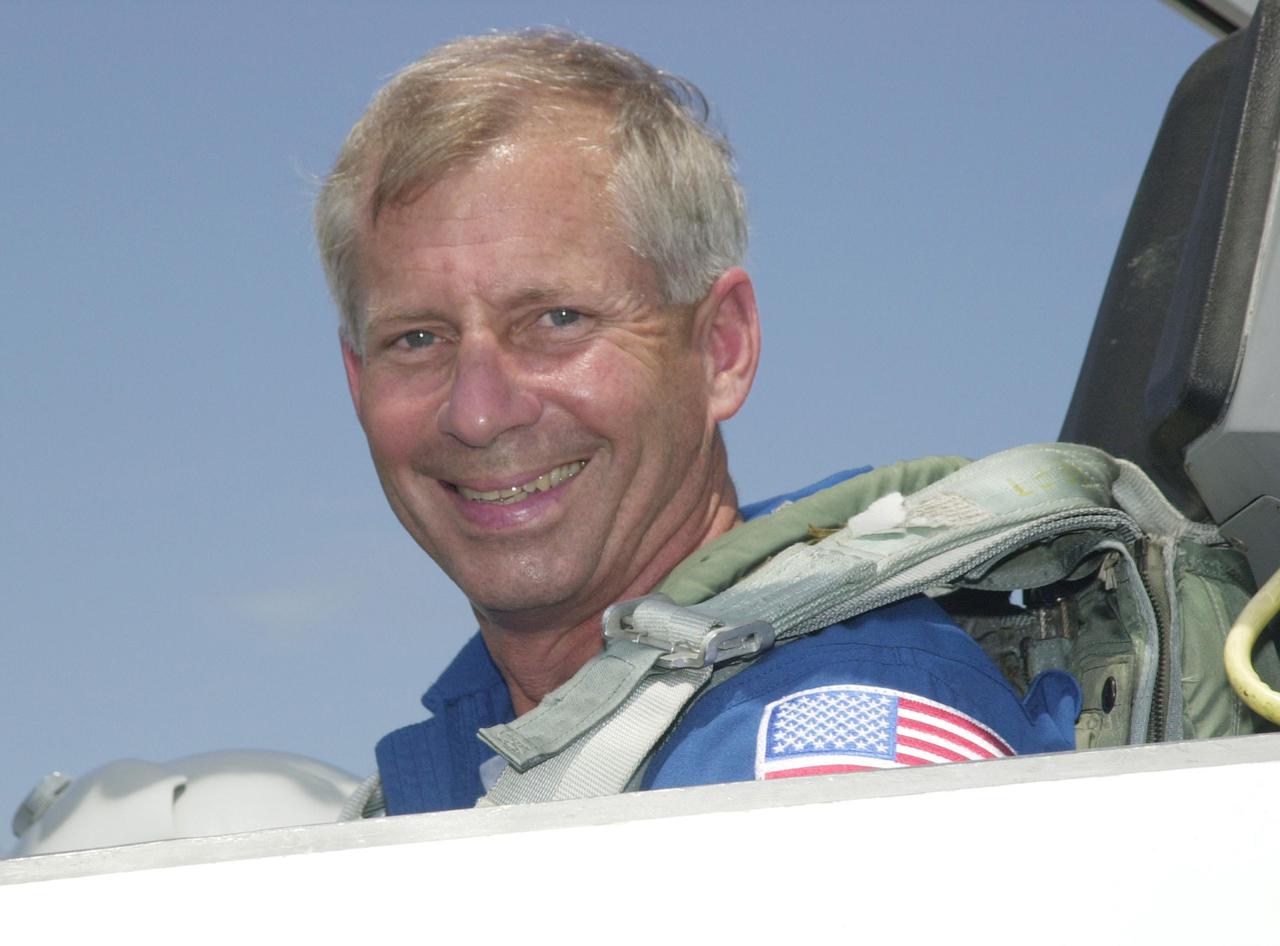
KENNEDY SPACE CENTER, FLA. -- STS-111 Commander Kenneth Cockrell sits in the T-38 jet aircraft for his return to Houston. The STS-111 and Expedition 5 crews have completed Terminal Countdown Demonstration Test activities that include emergency egress training and a simulated launch countdown. Expedition 5 will travel to the International Space Station on mission STS-111 as the replacement crew for Expedition 4, who will return to Earth aboard the orbiter. Mission STS-111 is known as Utilization Flight 2, carrying supplies and equipment in the Multi-Purpose Logistics Module Leonardo to the International Space Station. The payload also includes the Mobile Base System, which will be installed on the Mobile Transporter to complete the Canadian Mobile Servicing System, or MSS, and a replacement wrist_roll joint for Canadarm 2. The mechanical arm will then have the capability to 'inchworm' from the U.S. Lab Destiny to the MSS and travel along the truss to work sites. Launch is scheduled for May 30, 2002
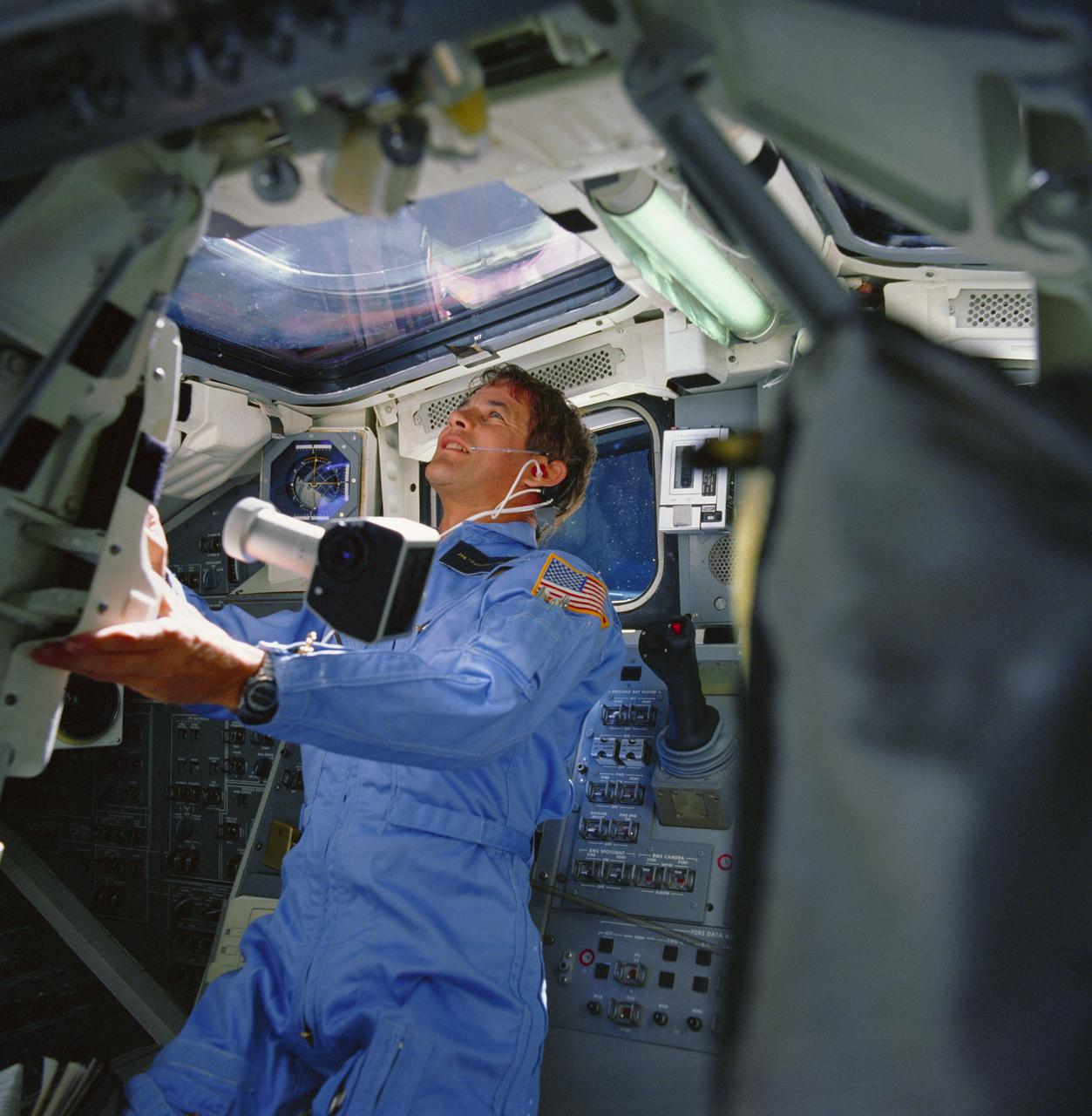
S82-39790 (11-15 Nov. 1982) --- Astronaut Joseph P. Allen IV, STS-5 mission specialist, lets a spot-meter float freely for a moment during a period devoted to out-the-window photographs of Earth from orbiting space shuttle Columbia. Dr. Allen is on the flight deck of the reusable space vehicle and positioned behind the pilot?s station. Also onboard for NASA?s first operational Space Transportation System (STS) flight are astronauts Vance D. Brand, commander; Robert F. Overmyer, pilot; and William B. Lenoir, mission specialist. Photo credit: NASA
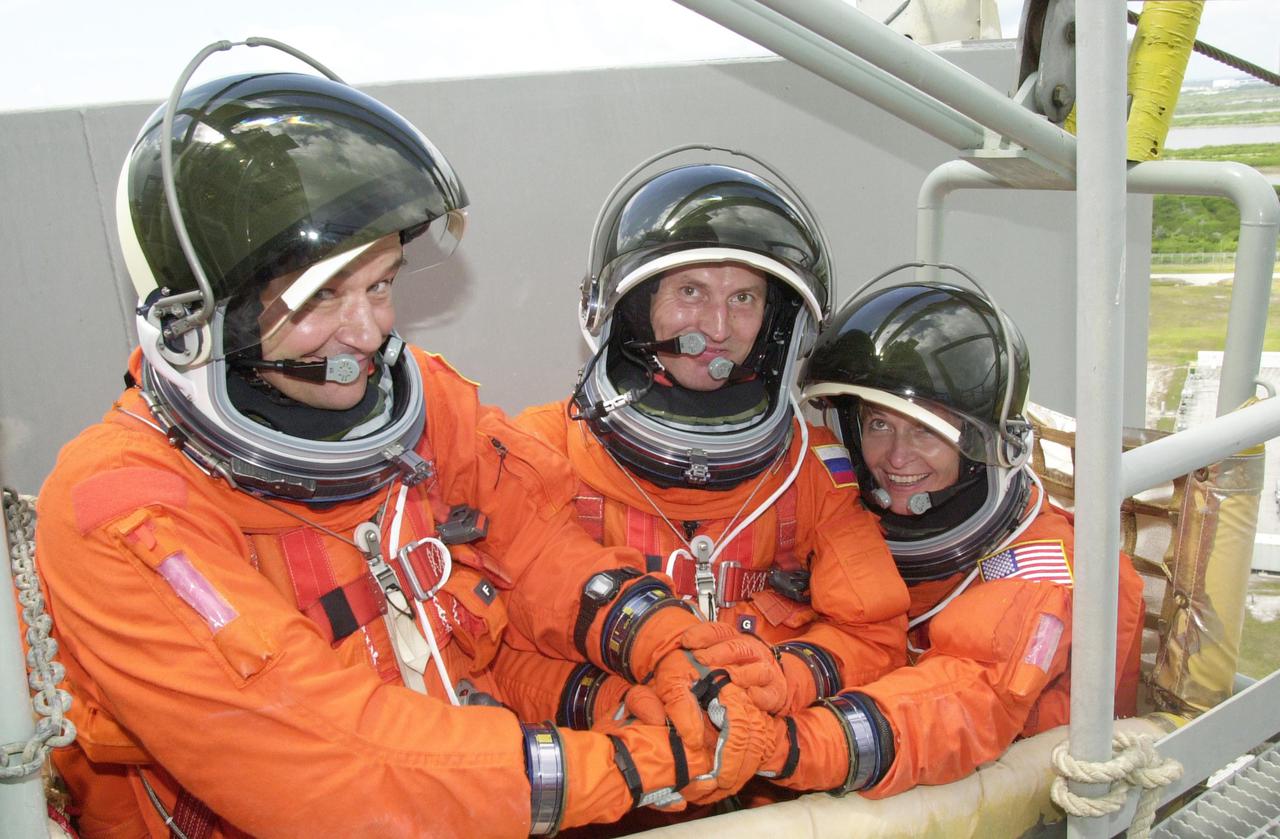
KENNEDY SPACE CENTER, FLA. - The Expedition 5 crew - Commander Valeri Korzun (left), Sergei Treschev (center) and Peggy Whitson (right) - are in the slidewire basket and ready to exit the Fixed Service Structure on Launch Pad 39A. They and the STS-111 crew are taking part in Terminal Countdown Demonstration Test activities, which include emergency egress training and a simulated launch countdown. Mission STS-111 is Utilization Flight 2, carrying equipment and supplies in the Multi-Purpose Logistics Module Leonardo to the International Space Station, plus the Mobile Base System (MBA) and an Orbital Replacement Unit. The MBS will be installed on the Mobile Transporter to complete the Canadian Mobile Servicing System, or MSS, enabling Canadarm 2 to 'inchworm' from the U.S. Lab Destiny to the MSS and travel along the truss to work sites. The Expedition 5 crew is traveling on Endeavour to replace the Expedition 4 crew on the Station. Launch of Endeavour is scheduled for May 30, 2002

KENNEDY SPACE CENTER, FLA. - On Launch Pad 39A, the Expedition 5 crew practices making a hasty exit from the 195-foot level to the slidewire baskets in the event of an emergency. They and the STS-111 crew are taking part in Terminal Countdown Demonstration Test activities, which include emergency egress training and a simulated launch countdown. Mission STS-111 is Utilization Flight 2, carrying equipment and supplies in the Multi-Purpose Logistics Module Leonardo to the International Space Station, plus the Mobile Base System (MBA) and an Orbital Replacement Unit. The MBS will be installed on the Mobile Transporter to complete the Canadian Mobile Servicing System, or MSS, enabling Canadarm 2 to "inchworm" from the U.S. Lab Destiny to the MSS and travel along the truss to work sites. The Expedition 5 crew is traveling on Endeavour to replace the Expedition 4 crew on the Station. Launch of Endeavour is scheduled for May 30, 2002
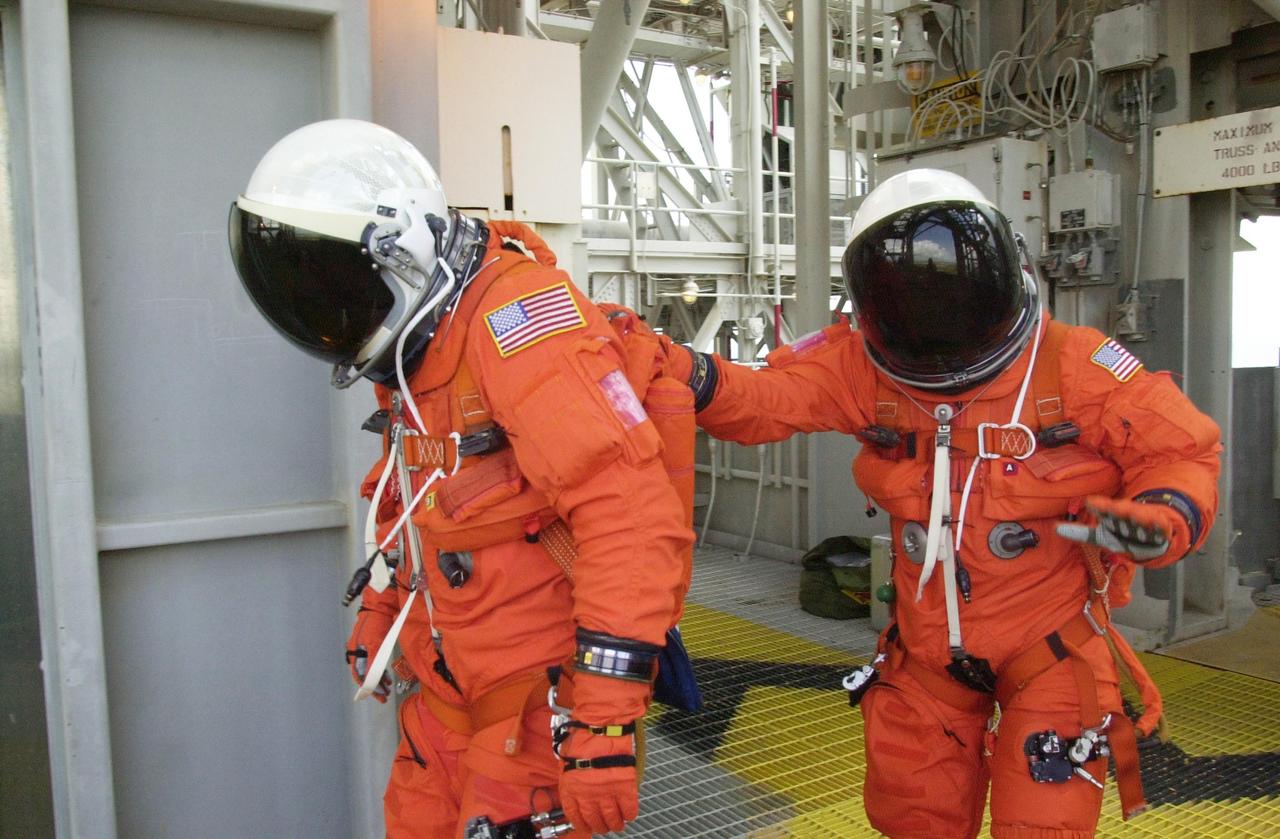
KENNEDY SPACE CENTER, FLA. -- STS-111 Commander Kenneth Cockrell (left) and Pilot Paul Lockhart practice making a hasty exit from the 195-foot level to the slidewire baskets in the event of an emergency. They and the rest of the STS-111 crew and the Expedition 5 crew are taking part in Terminal Countdown Demonstration Test activities, which include emergency egress training and a simulated launch countdown. Mission STS-111 is Utilization Flight 2, carrying equipment and supplies in the Multi-Purpose Logistics Module Leonardo to the International Space Station, plus the Mobile Base System (MBA) and an Orbital Replacement Unit. The MBS will be installed on the Mobile Transporter to complete the Canadian Mobile Servicing System, or MSS, enabling Canadarm 2 to "inchworm" from the U.S. Lab Destiny to the MSS and travel along the truss to work sites. The Expedition 5 crew is traveling on Endeavour to replace the Expedition 4 crew on the Station. Launch of Endeavour is scheduled for May 30, 2002
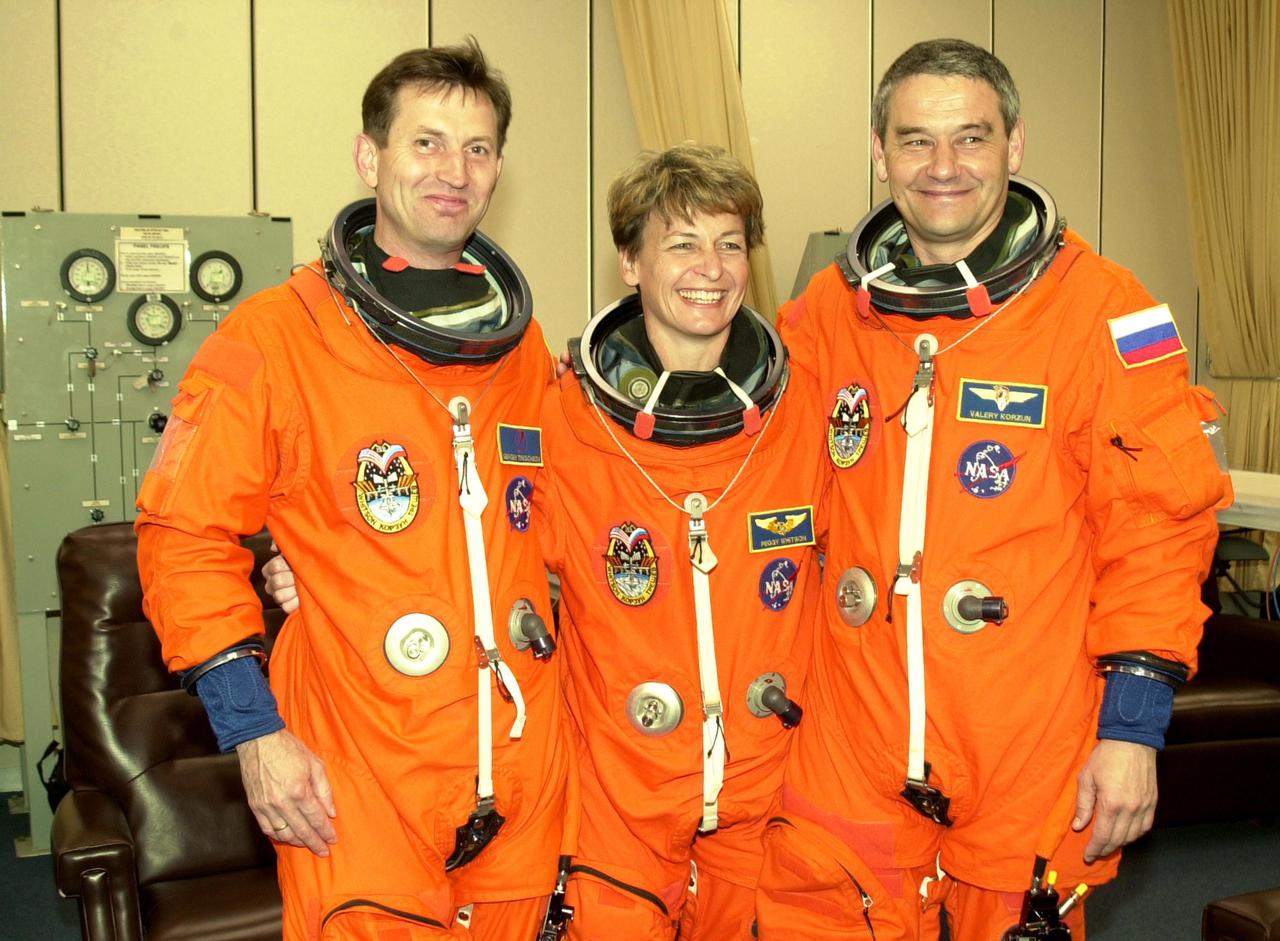
KENNEDY SPACE CENTER, FLA. - The Expedition 5 crew pauses during suitup before going to the pad for a simulated launch countdown, part of Terminal Countdown Demonstration Test activities. From left are cosmonaut Sergei Treschev, astronaut Peggy Whitson and Commander Valeri Korzun. . Expedition 5 will travel to the International Space Station on mission STS-111 as the replacement crew for Expedition 4, who will return to Earth aboard Endeavour. Mission STS-111 is known as Utilization Flight 2, carrying supplies and equipment in the Multi-Purpose Logistics Module Leonardo to the Station. The payload also includes the Mobile Base System, which will be installed on the Mobile Transporter to complete the Canadian Mobile Servicing System, or MSS, and a replacement wrist_roll joint for Canadarm 2. The mechanical arm will then have the capability to 'inchworm' from the U.S. Lab Destiny to the MSS and travel along the truss to work sites. Launch is scheduled for May 30, 2002
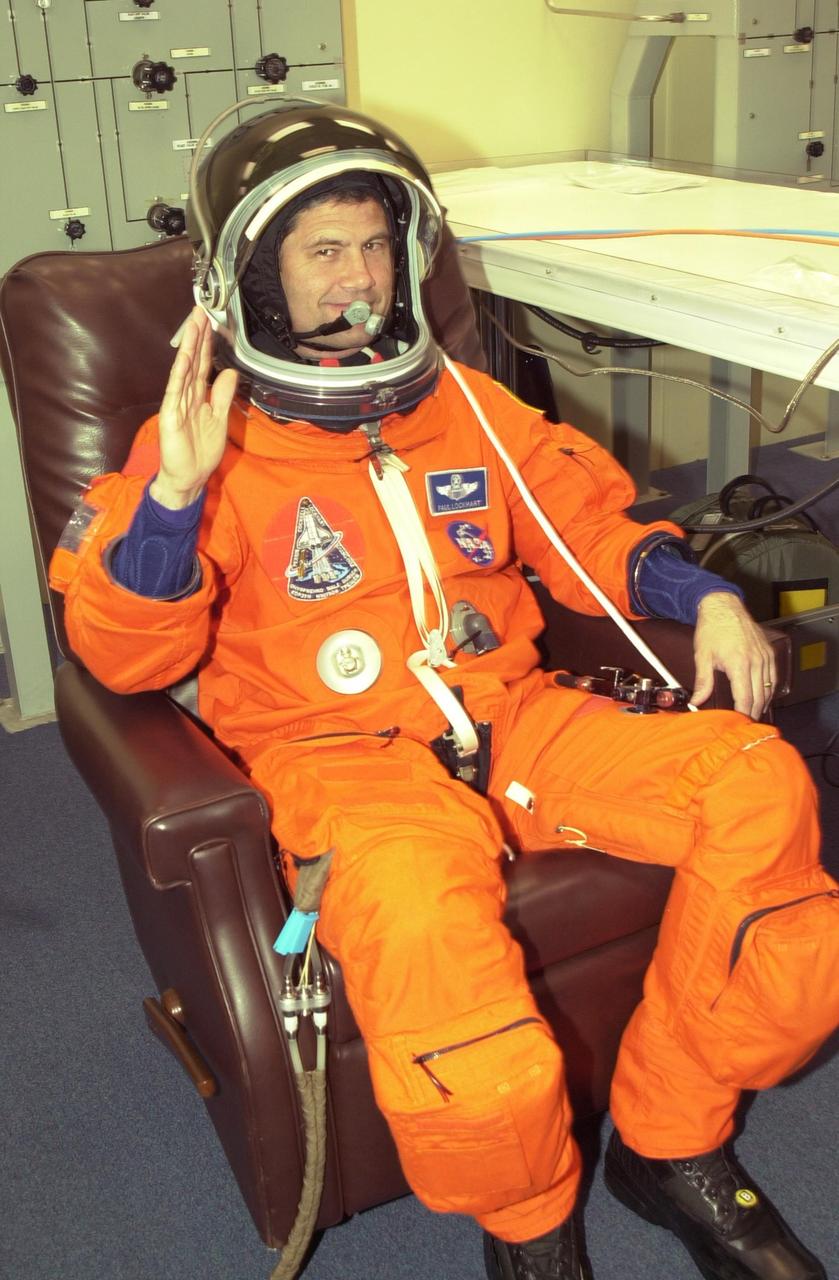
KENNEDY SPACE CENTER, FLA. -- STS-111 Paul Lockhart waves after getting into his launch and entry suit. The mission crew, plus the Expedition 5 crew, are taking part in Terminal Countdown Demonstration Test activities, which includes a simulated launch countdown. Mission STS-111 is known as Utilization Flight 2, carrying supplies and equipment in the Multi-Purpose Logistics Module Leonardo to the International Space Station. The payload also includes the Mobile Base System, which will be installed on the Mobile Transporter to complete the Canadian Mobile Servicing System, or MSS, and a replacement wrist/roll joint for Canadarm 2. The mechanical arm will then have the capability to "inchworm" from the U.S. Lab Destiny to the MSS and travel along the truss to work sites. Expedition 5 will travel to the Station on Endeavour as the replacement crew for Expedition 4, who will return to Earth aboard the orbiter. Launch is scheduled for May 30, 2002
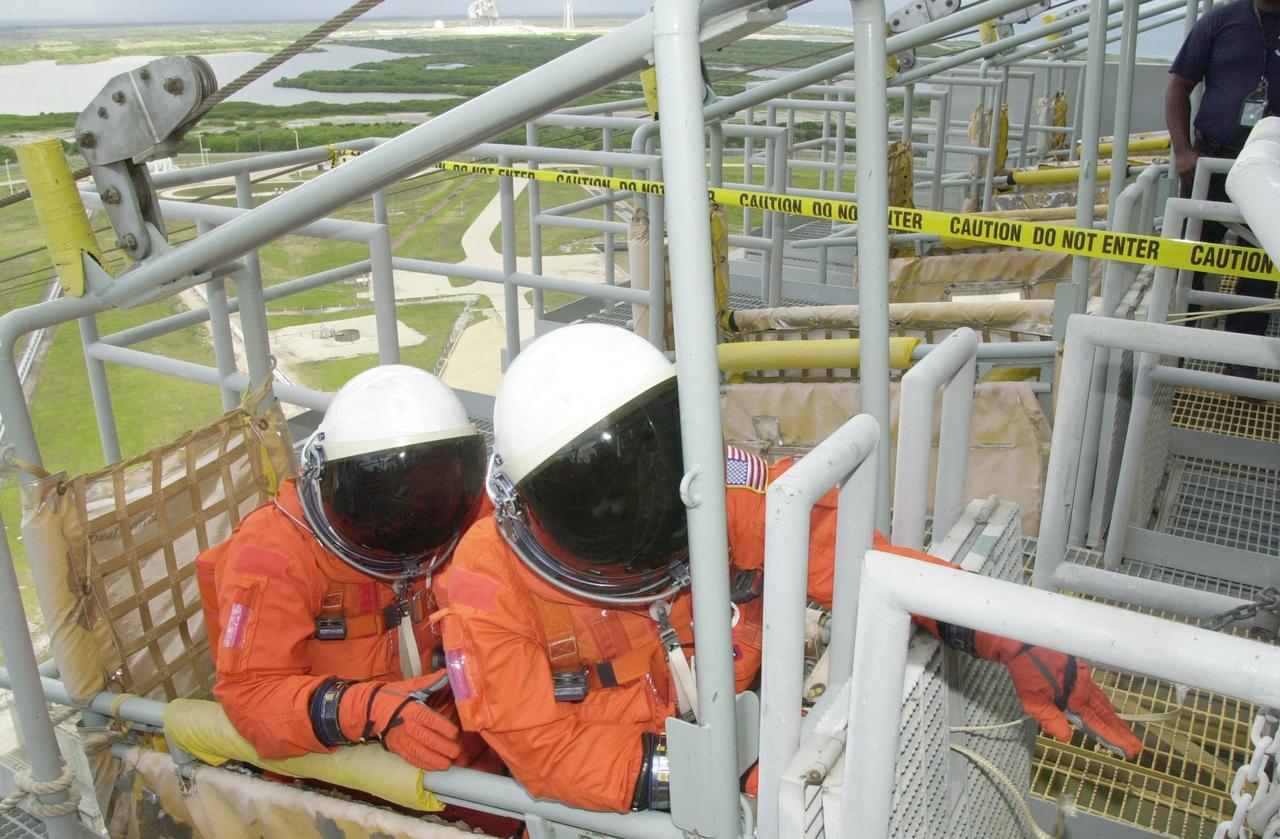
KENNEDY SPACE CENTER, FLA. - STS-111 Commander Kenneth Cockrell (left) settles in the seat of the slidewire basket while Pilot Paul Lockhart (right) gets ready to pull the release lever. They and the rest of the STS-111 crew and the Expedition 5 crew are taking part in Terminal Countdown Demonstration Test activities, which include emergency egress training and a simulated launch countdown. Mission STS-111 is Utilization Flight 2, carrying equipment and supplies in the Multi-Purpose Logistics Module Leonardo to the International Space Station, plus the Mobile Base System (MBA) and an Orbital Replacement Unit. The MBS will be installed on the Mobile Transporter to complete the Canadian Mobile Servicing System, or MSS, enabling Canadarm 2 to "inchworm" from the U.S. Lab Destiny to the MSS and travel along the truss to work sites. The Expedition 5 crew is traveling on Endeavour to replace the Expedition 4 crew on the Station. Launch of Endeavour is scheduled for May 30, 2002
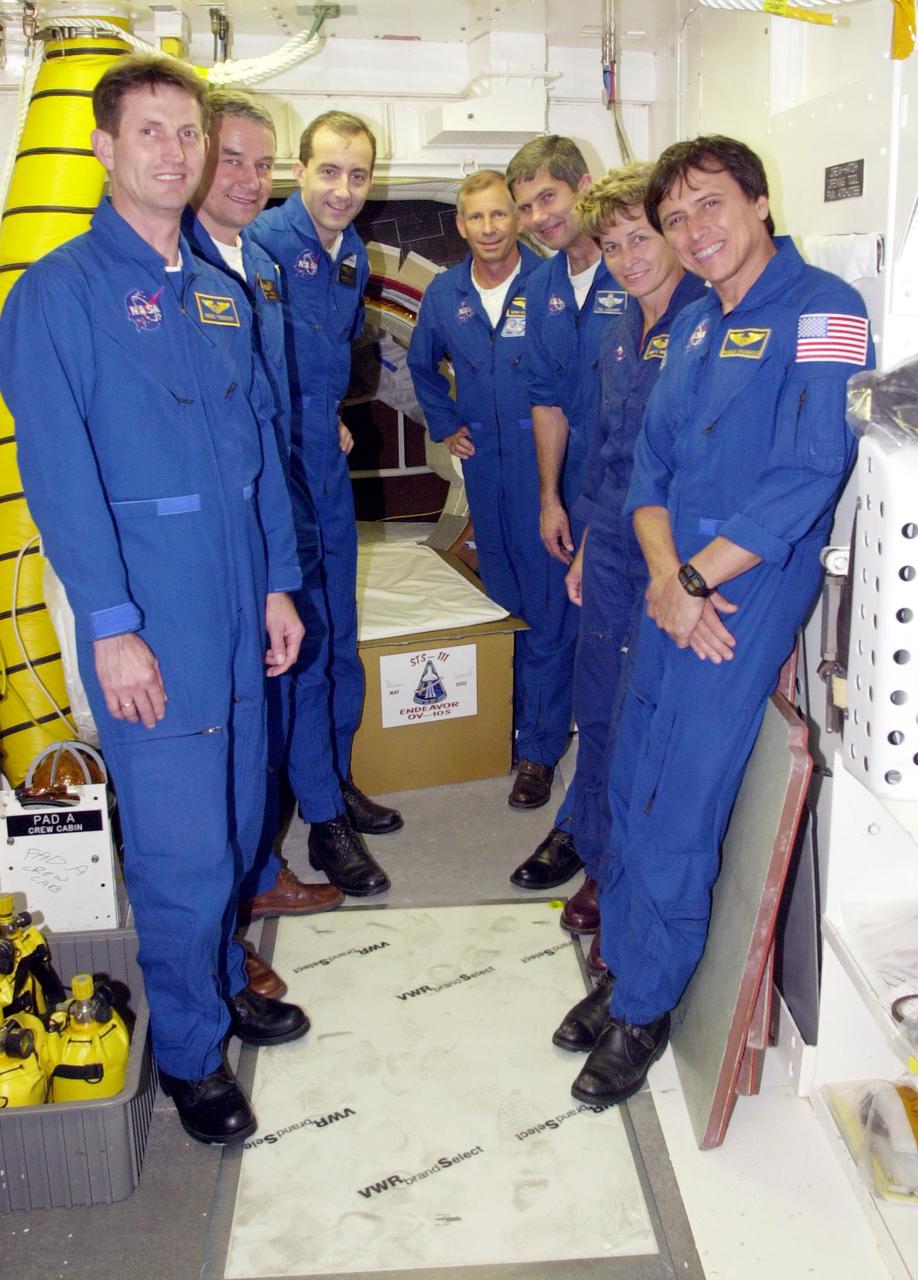
KENNEDY SPACE CENTER, FLA. -- In the White Room, Launch Pad 39A, the STS-111 and Expedition 5 crews pose in front of the entry into Space Shuttle Endeavour. From left are Expedition 5 crew member Sergei Treschev and Commander Valeri Korzun, with the Russian Space Agency; STS-111 Mission Specialist Philippe Perrin, with the French Space Agency; Commander Kenneth Cockrell and Pilot Paul Lockhart; Expedition 5 crew member Peggy Whitson; and Mission Specialist Franklin Chang-Diaz. The crews are taking part in Terminal Countdown Demonstration Test activities at the pad, which include emergency egress training and a simulated launch countdown. The mission is Utilization Flight 2, carrying supplies and equipment to the International Space Station, the Mobile Base System, which will be installed on the Mobile Transporter to complete the Canadian Mobile Servicing System, or MSS, and a replacement wrist_roll joint for Canadarm 2. The mechanical arm will then have the capability to 'inchworm' from the U.S. Lab Destiny to the MSS and travel along the truss to work sites. Expedition 5 will travel to the Station on Endeavour as the replacement crew for Expedition 4, who will return to Earth aboard the orbiter. Launch is scheduled for May 30, 2002
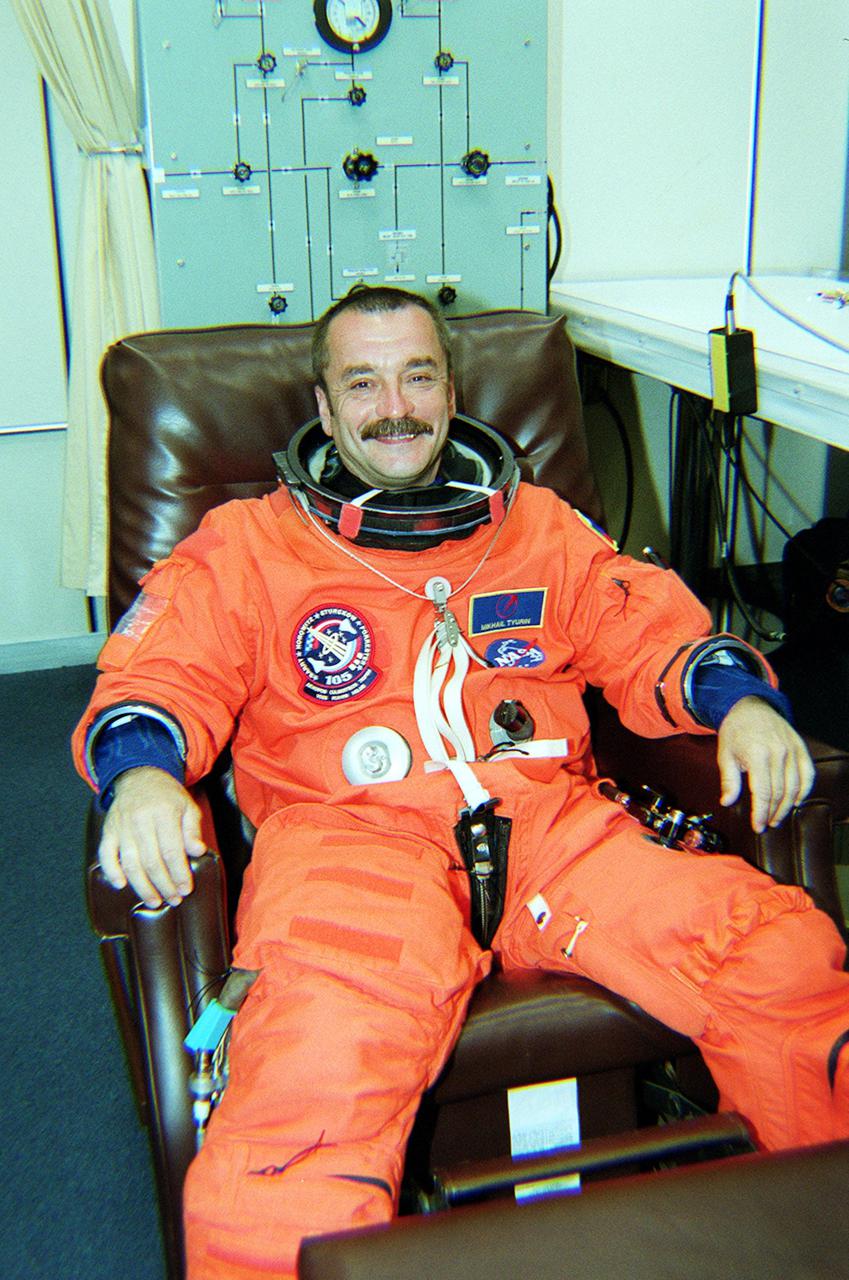
KENNEDY SPACE CENTER, Fla. -- Expedition Three cosmonaut Mikhail Tyurin suits up for launch on mission STS-105. The mission will be Tyurin’s first space flight. On the mission, Discovery will be transporting the Expedition Three crew and several scientific experiments and payloads to the International Space Station, including the Early Ammonia Servicer (EAS) tank. The EAS, which will support the thermal control subsystems until a permanent system is activated, will be attached to the Station during two spacewalks. The three-member Expedition Two crew will be returning to Earth aboard Discovery after a five-month stay on the Station. Launch is scheduled for 5:38 p.m. EDT Aug. 9
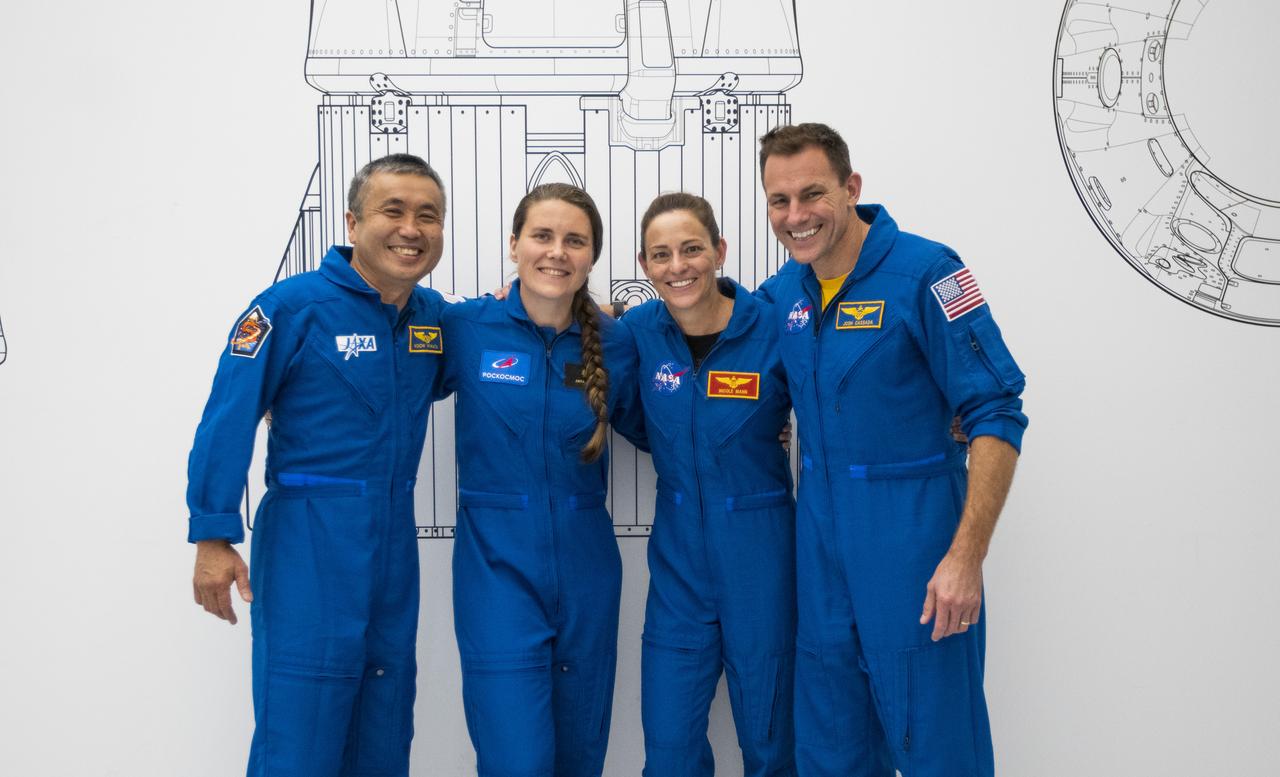
From left, Koichi Wakata, of JAXA (Japan Aerospace Exploration Agency), Roscosmos cosmonaut Anna Kikina, and NASA astronauts Nicole Mann and Josh Cassada will fly aboard NASA’s SpaceX Crew-5 mission. The crew will lift off aboard SpaceX’s Crew Dragon spacecraft – atop the company’s Falcon 9 rocket – from NASA Kennedy Space Center’s Launch Complex 39A in Florida. This marks the fifth crew rotation mission of the company’s human space transportation system, and its sixth flight with astronauts, to the space station for the agency’s Commercial Crew Program.
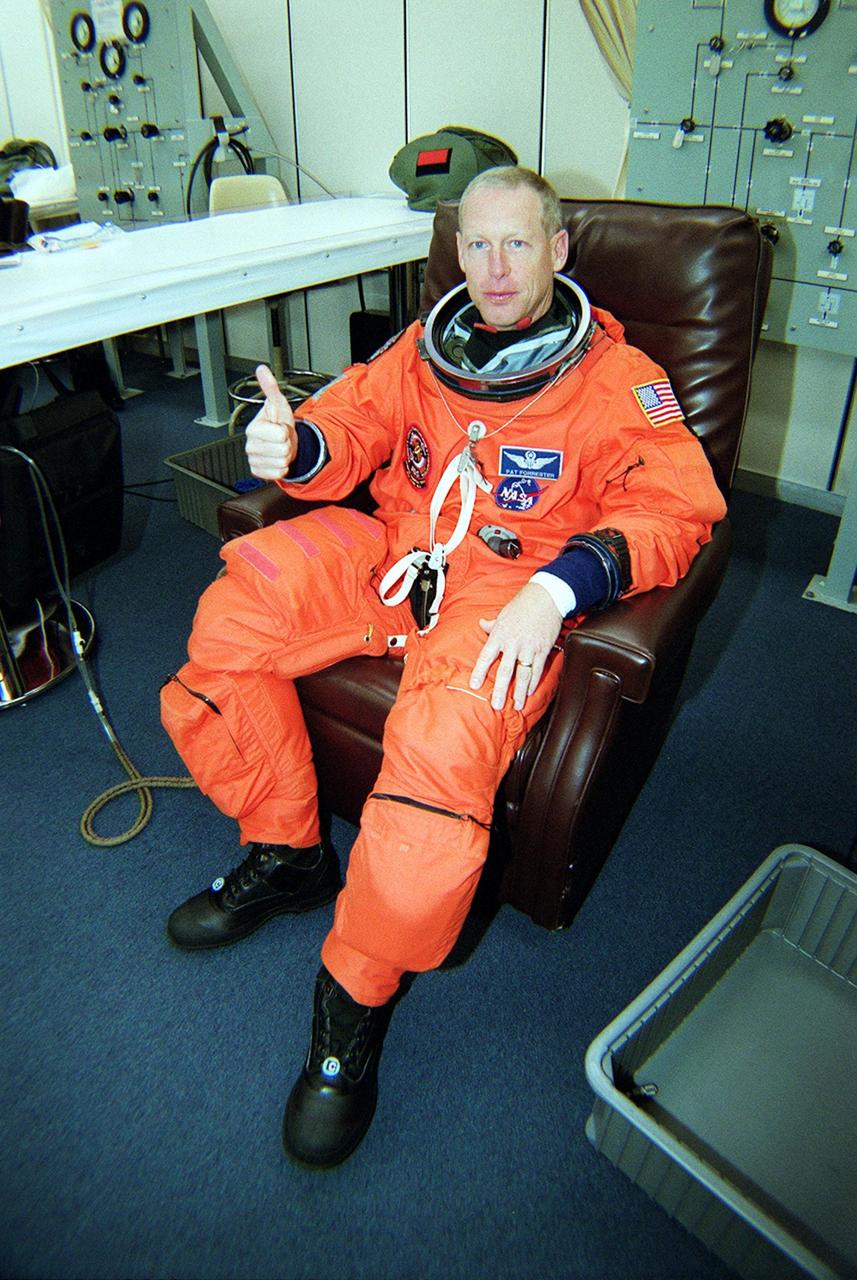
KENNEDY SPACE CENTER, Fla. -- STS-105 Mission Specialist Patrick Forrester suits up for launch on mission STS-105. The mission is Forrester’s first space flight. On the mission, Discovery will be transporting the Expedition Three crew and several scientific experiments and payloads to the International Space Station, including the Early Ammonia Servicer (EAS) tank. The EAS, which will support the thermal control subsystems until a permanent system is activated, will be attached to the Station during two spacewalks. The three-member Expedition Two crew will be returning to Earth aboard Discovery after a five-month stay on the Station. Launch is scheduled for 5:38 p.m. EDT Aug. 9
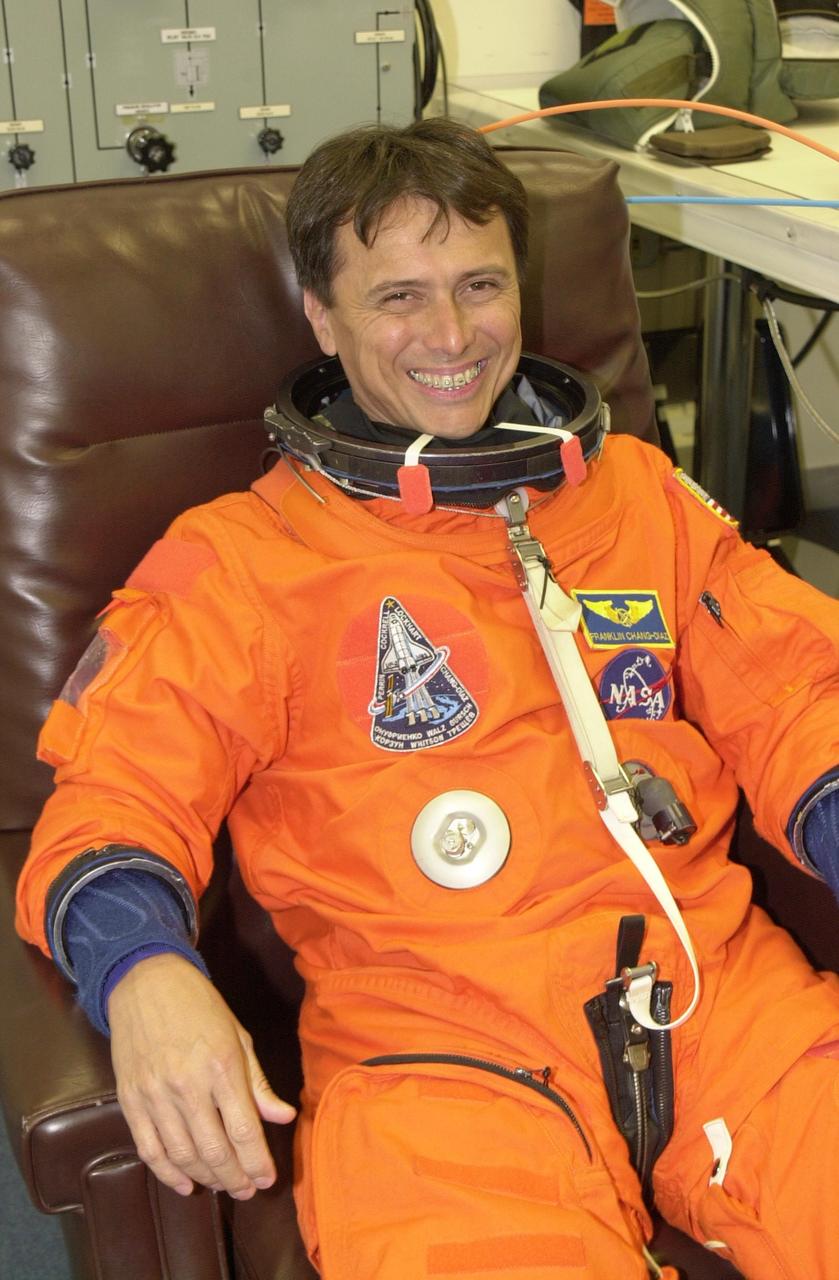
KENNEDY SPACE CENTER, FLA. -- STS-111 Mission Specialist Franklin Chang-Diaz suits up for launch, scheduled at 7:44 p.m. EDT, May 30, 2002. This is his seventh Shuttle flight, only the second astronaut to achieve that number. STS-111 is the second Utilization Flight to the International Space Station, carrying the Multi-Purpose Logistics Module Leonardo, the Mobile Base System (MBS), and a replacement wrist/roll joint for the Canadarm 2. Also onboard Space Shuttle Endeavour is the Expedition 5 crew who will replace Expedition 4 on board the Station. The MBS will be installed on the Mobile Transporter to complete the Canadian Mobile Servicing System, or MSS. The mechanical arm will then have the capability to "inchworm" from the U.S. Lab Destiny to the MSS and travel along the truss to work sites. Expedition 4 crew members will return to Earth with the STS-111 crew on Endeavour
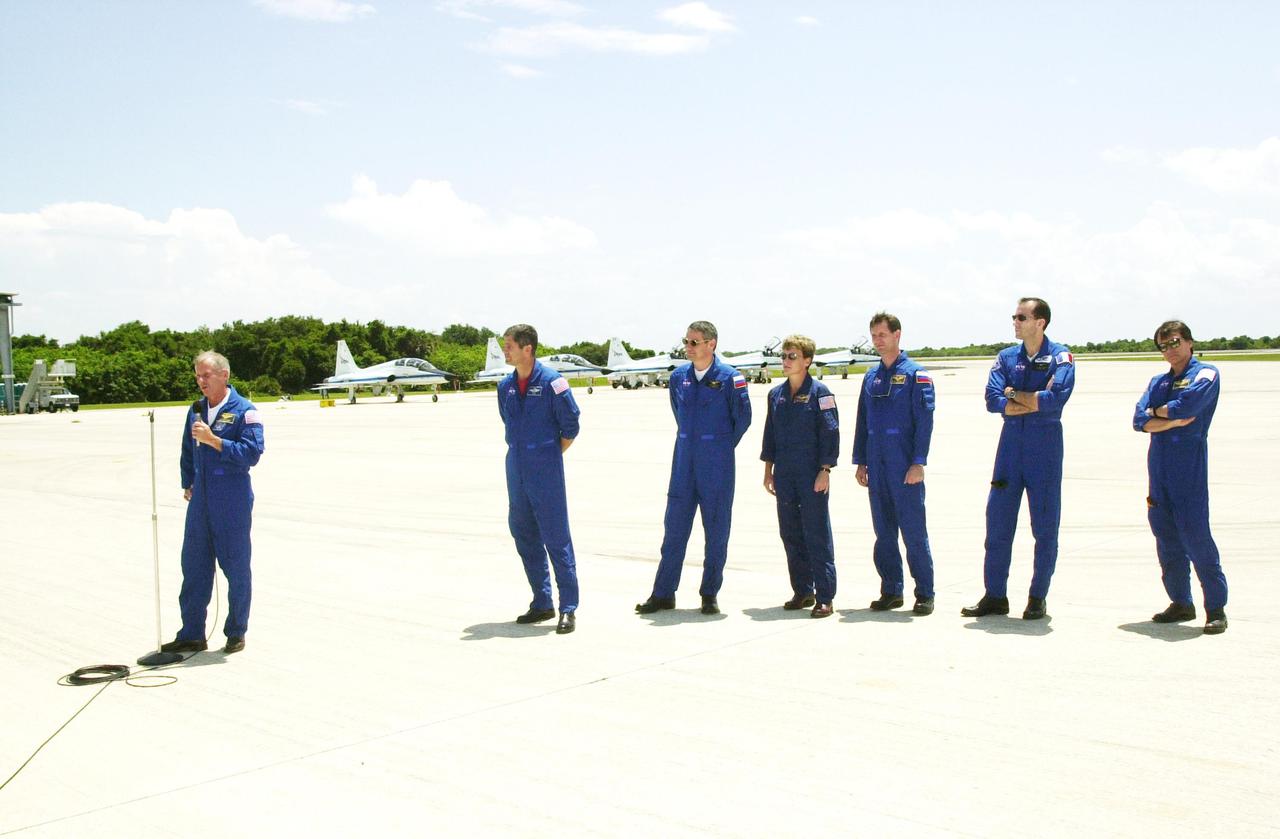
KENNEDY SPACE CENTER, FLA. -- Before leaving KSC, the STS-111 crew and Expedition 5 crew stop to talk to media at the Shuttle Landing Facility. At the microphone is Commander Kenneth Cockrell. Behind him, left to right, are Pilot Paul Lockhart; Expedition 5's Commander Valeri Korzun, astronaut Peggy Whitson and cosmonaut Sergei Treschev; Mission Specialists Philippe Perrin and Franklin Chang-Diaz. Perrin is with the French Space Agency; Korzun and Treschev are with the Russian Space Agency. The crews have been taking part in Terminal Countdown Demonstration Test activities that include emergency egress training and a simulated launch countdown. Expedition 5 will travel to the International Space Station on mission STS-111 as the replacement crew for Expedition 4, who will return to Earth aboard the orbiter. Mission STS-111 is known as Utilization Flight 2, carrying supplies and equipment in the Multi-Purpose Logistics Module Leonardo to the International Space Station. The payload also includes the Mobile Base System, which will be installed on the Mobile Transporter to complete the Canadian Mobile Servicing System, or MSS, and a replacement wrist_roll joint for Canadarm 2. The mechanical arm will then have the capability to 'inchworm' from the U.S. Lab Destiny to the MSS and travel along the truss to work sites. Launch is scheduled for May 30, 2002
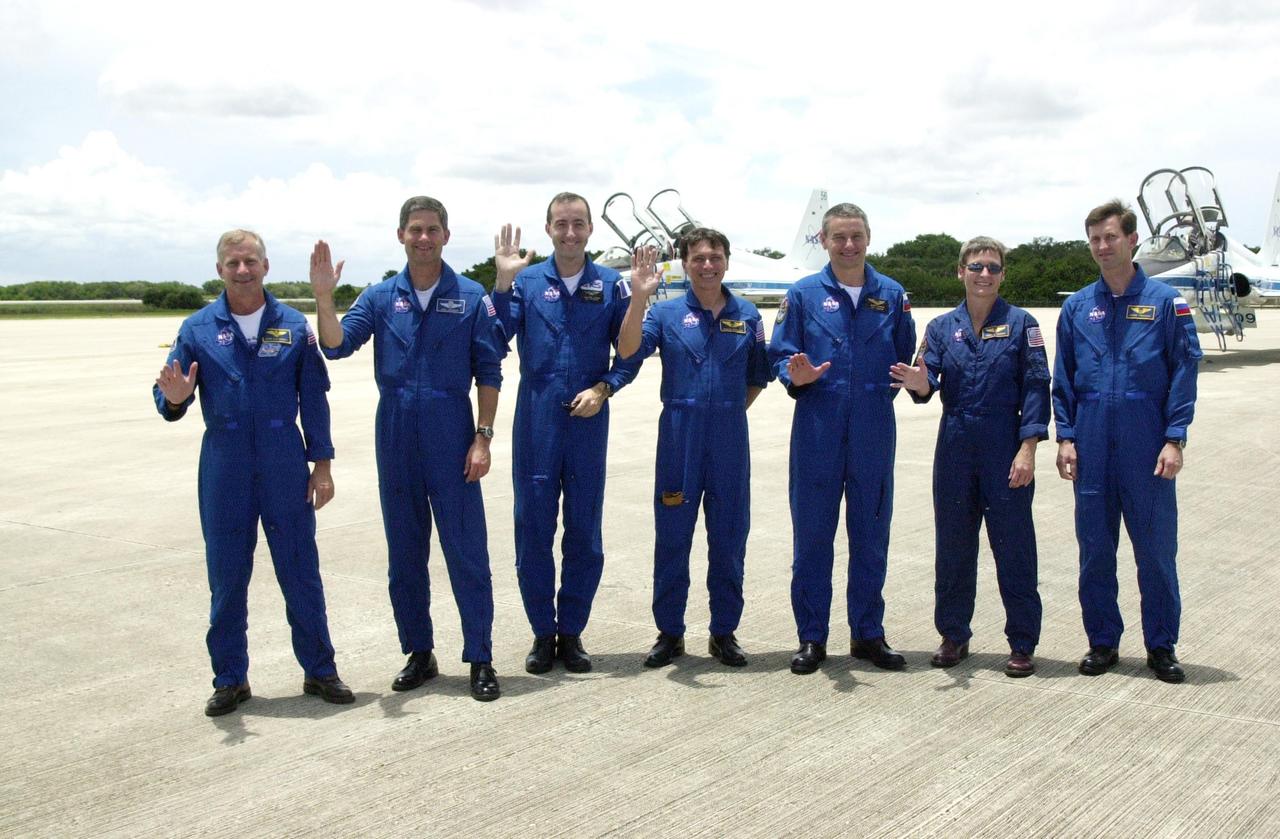
KENNEDY SPACE CENTER, FLA. -- After their arrival at the Shuttle Landing Facility, the STS-111 and Expedition 5 crews wave to spectators. From left are Mission Commander Kenneth Cockrell, Pilot Paul Lockhart and Mission Specialists Philippe Perrin and Franklin Chang-Diaz; Expedition 5 Commander Valeri Korzun, astronaut Peggy Whitson and cosmonaut Sergei Treschev. Perrin is with the French Space Agency; Korzun and Treschev are with the Russian Space Agency. The crews have arrived to prepare for launch. Expedition 5 is traveling to the International Space Station on Space Shuttle Endeavour as the replacement crew for Expedition 4, who will return to Earth aboard the orbiter. Known as Utilization Flight 2, STS-111 is carrying supplies and equipment to the Station. The payload includes the Multi-Purpose Logistics Module Leonardo, the Mobile Base System, which will be installed on the Mobile Transporter to complete the Canadian Mobile Servicing System, or MSS, and a replacement wrist/roll joint for Canadarm 2. The mechanical arm will then have the capability to "inchworm" from the U.S. Lab Destiny to the MSS and travel along the truss to work sites. Launch is scheduled for May 30, 2002
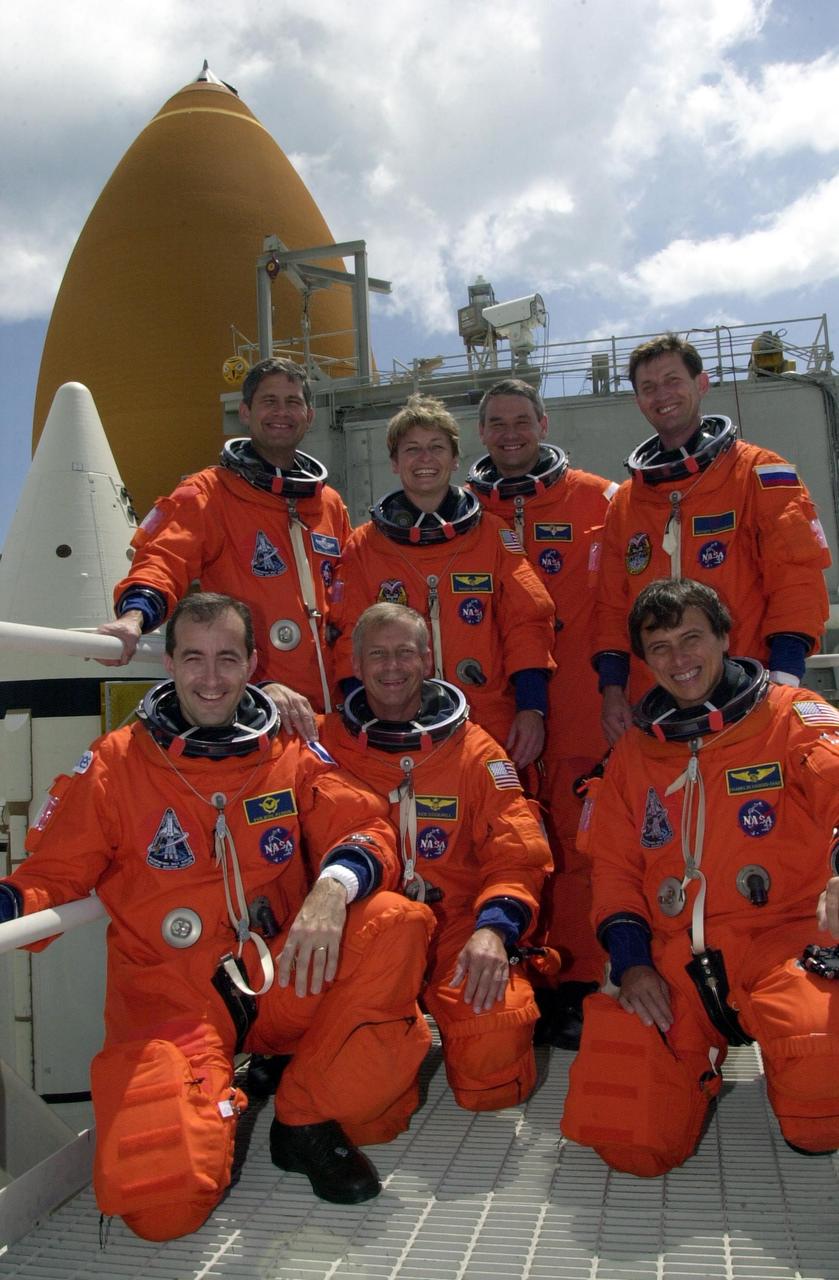
KENNEDY SPACE CENTER, FLA. -- During Terminal Countdown Demonstration Test activities at Launch Pad 39A, the Expedition 5 and STS-111 crews pose on the 295-foot level. Standing, left to right, are Pilot Paul Lockhart, and the Expedition 5 crew Peggy Whitson, Commander Valeri Korzun and Sergei Treschev. Kneeling in front are Mission Specialist Philippe Perrin, Commander Kenneth Cockrell and Mission Specialist Franklin Chang-Diaz. Korzun and Treschev are with the Russian Space Agency, and Perrin is with the French Space Agency. Seen behind the crews are the top of the orange external tank and one of the white solid rocket boosters. The TCDT includes emergency egress training at the pad and a simulated launch countdown. Mission STS-111 is known as Utilization Flight 2, carrying supplies and equipment in the Multi-Purpose Logistics Module Leonardo to the International Space Station. The payload also includes the Mobile Base System, which will be installed on the Mobile Transporter to complete the Canadian Mobile Servicing System, or MSS, and a replacement wrist/roll joint for Canadarm 2. The mechanical arm will then have the capability to "inchworm" from the U.S. Lab Destiny to the MSS and travel along the truss to work sites. Expedition 5 will travel to the Station on Endeavour as the replacement crew for Expedition 4, who will return to Earth aboard the orbiter. Launch is scheduled for May 30, 2002
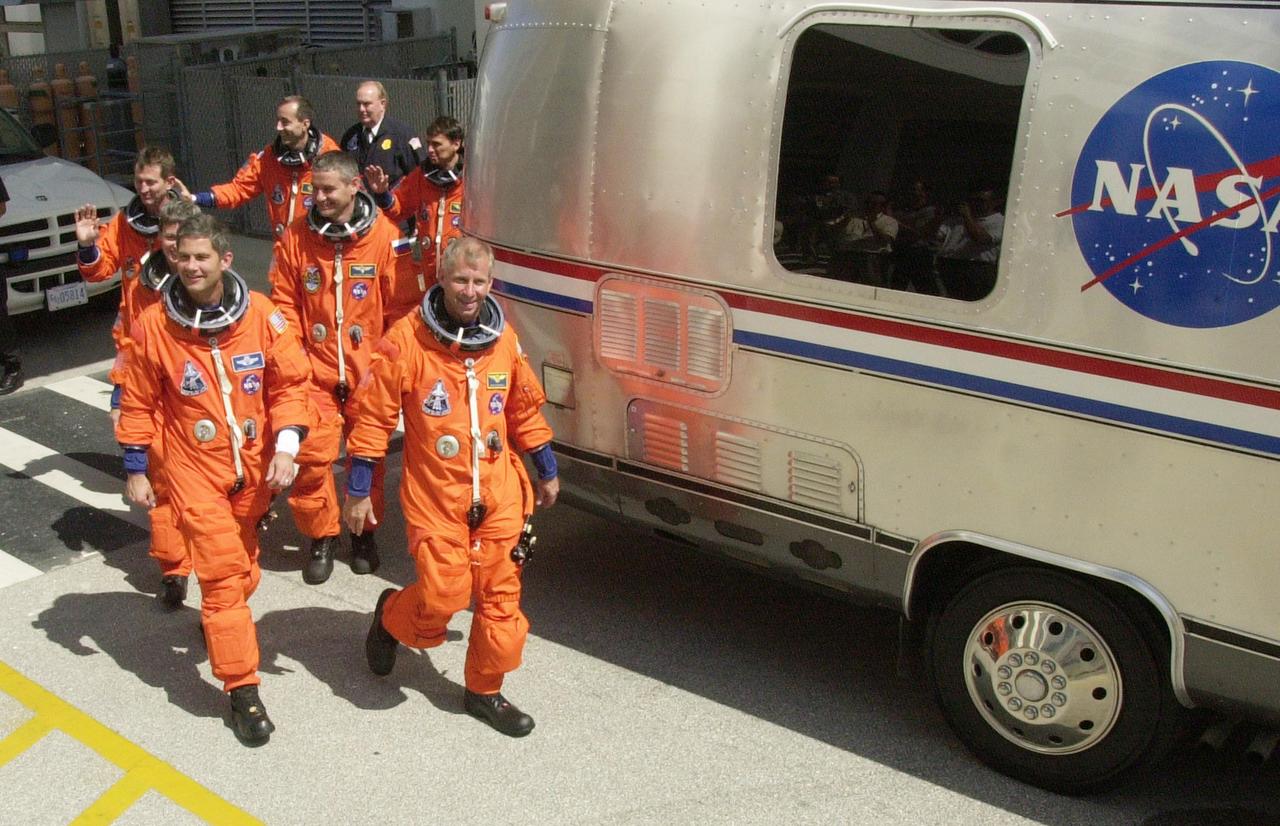
KENNEDY SPACE CENTER, FLA. -- The STS-111 and Expedition 5 crews look toward spectators as they head for the waiting Astrovan that that will take them to Launch Pad 39A and Space Shuttle Endeavour. From front to back are Pilot Paul Lockhart and Commander Kenneth Cockrell; astronaut Peggy Whitson; Expedition 5 cosmonaut Sergei Treschev (RSA) and Commander Valeri Korzun (RSA); and Mission Specialists Philippe Perrin (CNES) and Franklin Chang-Diaz. STS-111 is the second Utilization Flight to the International Space Station, carrying the Multi-Purpose Logistics Module Leonardo, the Mobile Base System (MBS), and a replacement wrist/roll joint for the Canadarm 2. Also onboard Space Shuttle Endeavour is the Expedition 5 crew who will replace Expedition 4 on board the Station. The MBS will be installed on the Mobile Transporter to complete the Canadian Mobile Servicing System, or MSS. The mechanical arm will then have the capability to "inchworm" from the U.S. Lab Destiny to the MSS and travel along the truss to work sites. Expedition 4 crew members will return to Earth with the STS-111 crew on Endeavour.
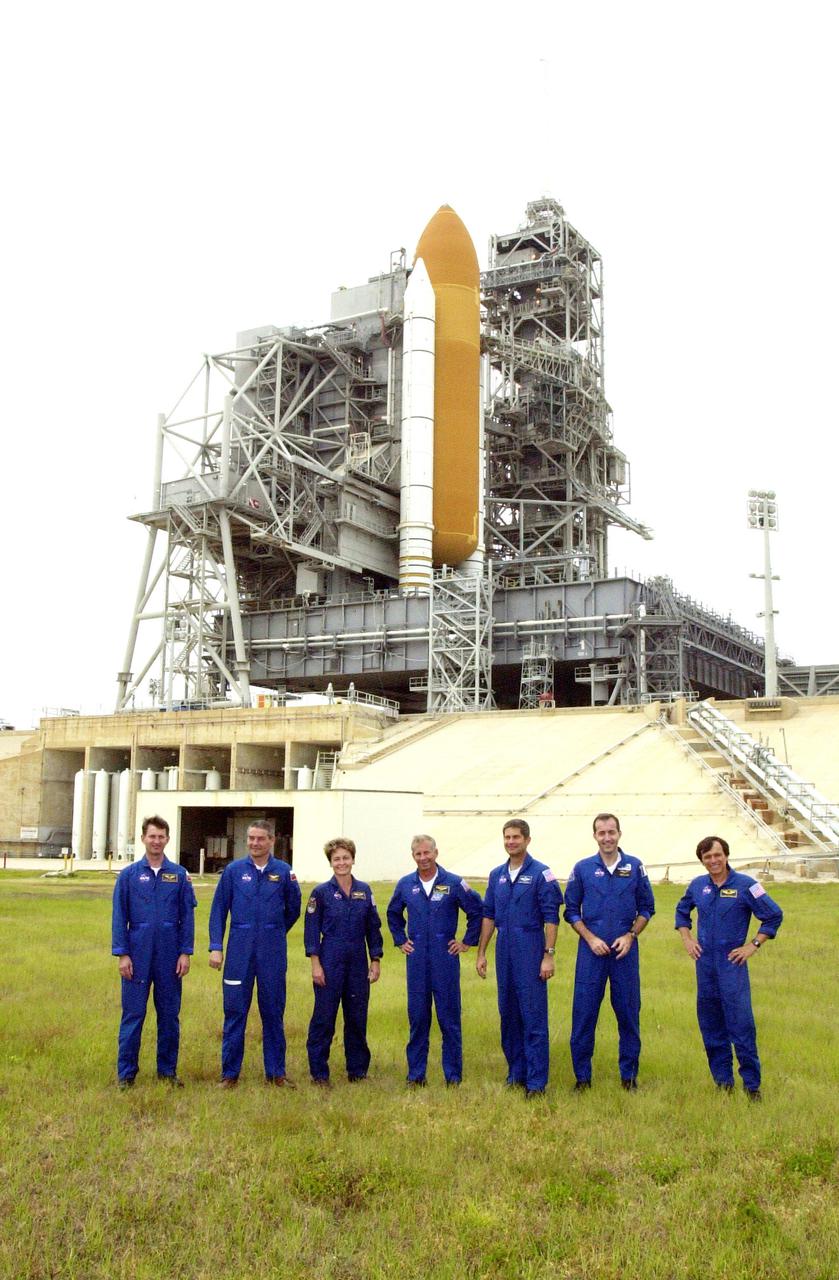
KENNEDY SPACE CENTER, FLA. -- During a break in Terminal Countdown Demonstration Test activities, the STS-111 and Expedition 5 crews gather on Launch Pad 39A for a photo. Standing, left to right, are Expedition 5 crew members Sergei Treschev, Commander Valeri Korzun and Peggy Whitson; STS-111 Commander Kenneth Cockrell, Pilot Paul Lockhart, Mission Specialists Philippe Perrin and Franklin Chang-Diaz. Perrin is with the CNES, the French Space Agency. Expedition 5 will travel to the International Space Station on the mission as the replacement crew for Expedition 4, who will return to Earth aboard the orbiter Endeavour. The crews are taking part in Terminal Countdown Demonstration Test activities at the pad, which include emergency egress training and a simulated launch countdown. The mission is Utilization Flight 2, carrying supplies and equipment to the International Space Station, the Mobile Base System, which will be installed on the Mobile Transporter to complete the Canadian Mobile Servicing System, or MSS, and a replacement wrist_roll joint for Canadarm 2. The mechanical arm will then have the capability to 'inchworm' from the U.S. Lab Destiny to the MSS and travel along the truss to work sites. Launch is scheduled for May 30, 2002
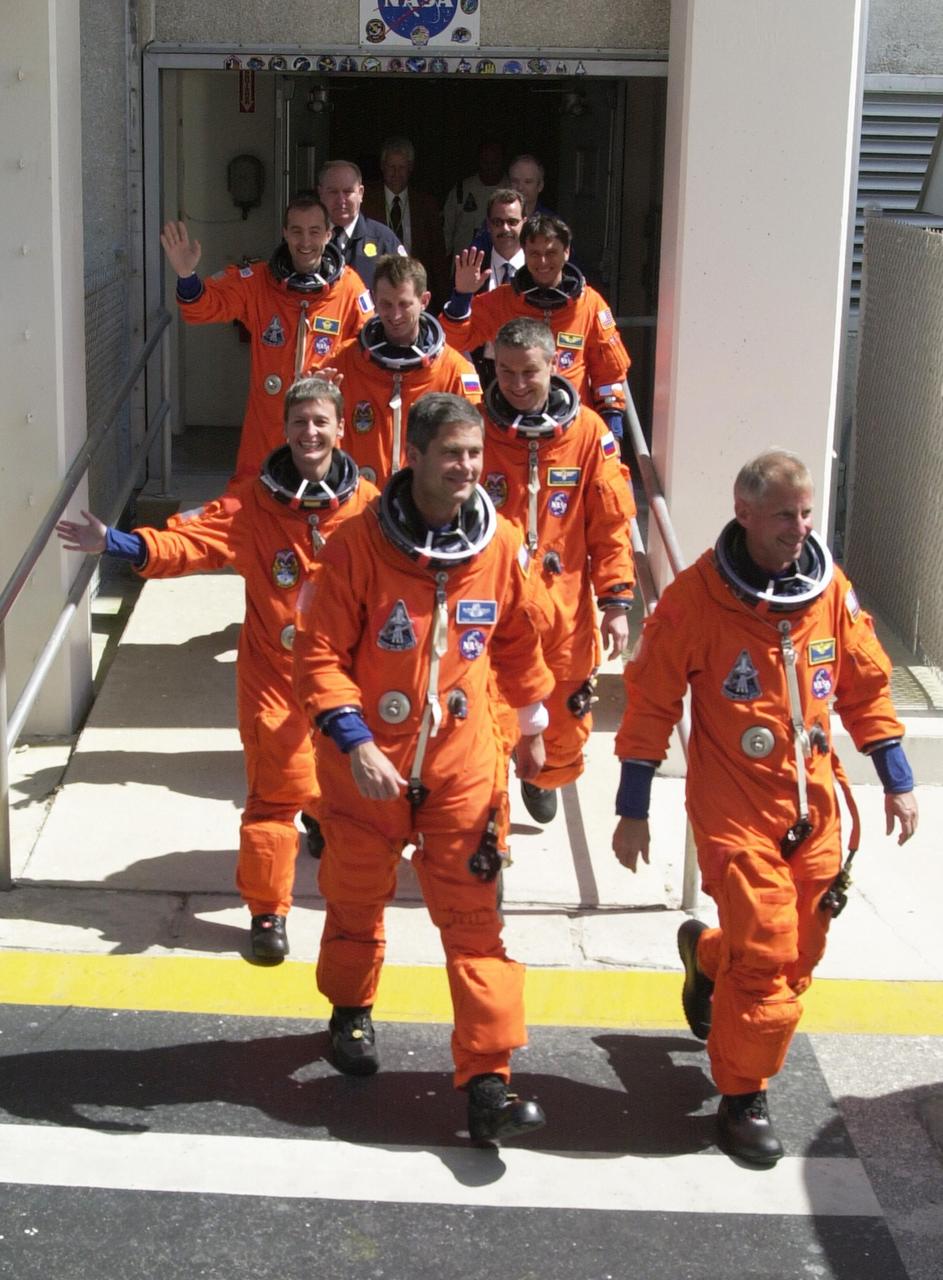
KENNEDY SPACE CENTER, FLA. - The STS-111 and Expedition 5 crews eagerly stride from the Operations and Checkout Building toward the waiting Astrovan that will take them to Launch Pad 39A and Space Shuttle Endeavour. From front to back are Pilot Paul Lockhart and Commander Kenneth Cockrell; astronaut Peggy Whitson and Expedition 5 Commander Valeri Korzun (RSA); cosmonaut Sergei Treschev (RSA); and Mission Specialists Philippe Perrin (CNES) and Franklin Chang-Diaz. STS-111 is the second Utilization Flight to the International Space Station, carrying the Multi-Purpose Logistics Module Leonardo, the Mobile Base System (MBS), and a replacement wrist/roll joint for the Canadarm 2. Also onboard Space Shuttle Endeavour is the Expedition 5 crew who will replace Expedition 4 on board the Station. The MBS will be installed on the Mobile Transporter to complete the Canadian Mobile Servicing System, or MSS. The mechanical arm will then have the capability to "inchworm" from the U.S. Lab Destiny to the MSS and travel along the truss to work sites. Expedition 4 crew members will return to Earth with the STS-111 crew on Endeavour.

Two solid rocket boosters that will power NASA’s Space Launch System (SLS) for Artemis missions to the Moon are being transported from a Northrop Grumman manufacturing facility in Promontory, Utah, to the agency’s Kennedy Space Center in Florida by railcar. Departing on June 5, 2020, the boosters – each comprised of five motor segments – are scheduled to arrive at Kennedy’s Rotation, Processing and Surge Facility, where teams with NASA’s Exploration Ground Systems will process the segments before moving them to the Vehicle Assembly Building for stacking on the mobile launcher. Under the Artemis program, NASA will land the first woman and the next man on the Moon by 2024. The first in a series of increasingly complex missions, Artemis I will test the Orion spacecraft and SLS as an integrated system ahead of crewed flights to the Moon.
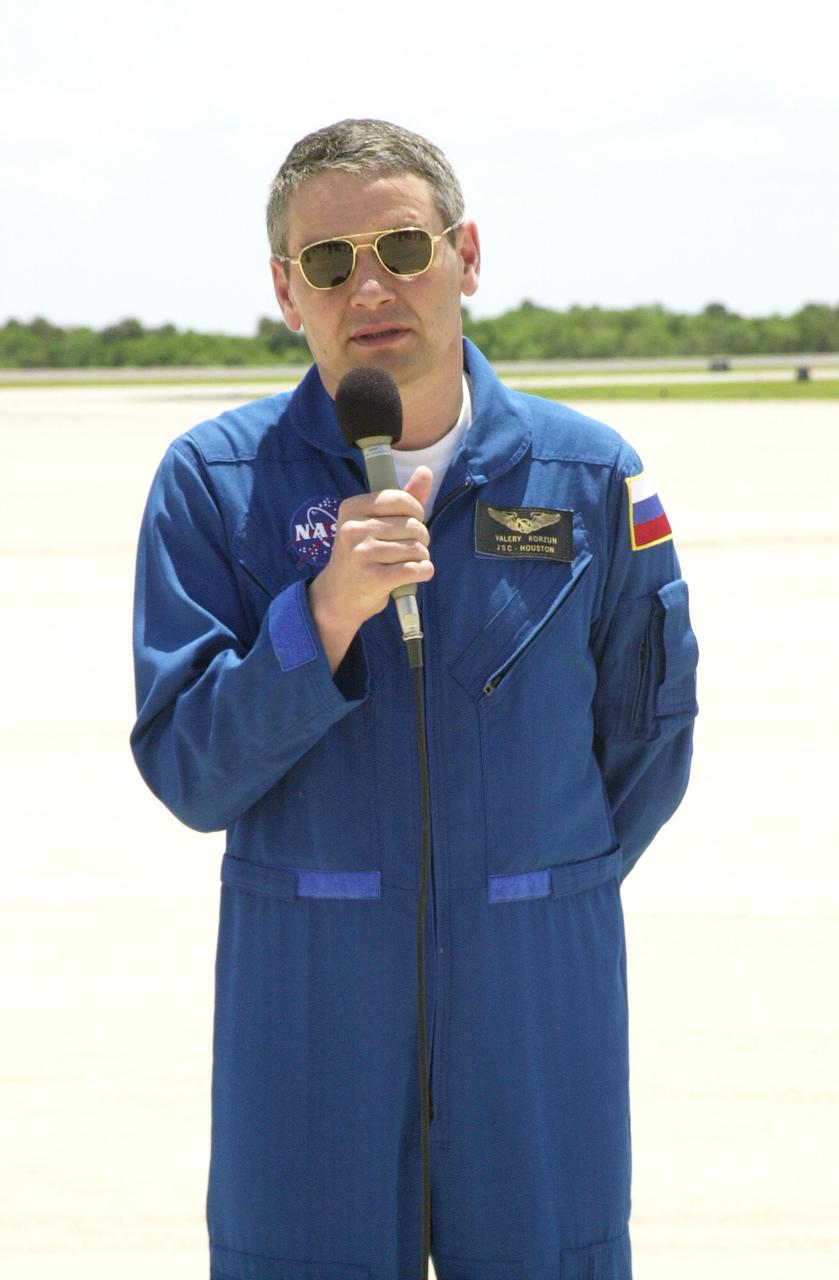
KENNEDY SPACE CENTER, FLA. -- Expedition 5 Commander Valeri Korzun (with microphone) speaks to the media before leaving KSC. The Expedition 5 and STS-111 crews have been taking part in Terminal Countdown Demonstration Test activities that include emergency egress training and a simulated launch countdown. Expedition 5 will travel to the International Space Station on mission STS-111 as the replacement crew for Expedition 4, who will return to Earth aboard the orbiter. Mission STS-111 is known as Utilization Flight 2, carrying supplies and equipment in the Multi-Purpose Logistics Module Leonardo to the International Space Station. The payload also includes the Mobile Base System, which will be installed on the Mobile Transporter to complete the Canadian Mobile Servicing System, or MSS, and a replacement wrist/roll joint for Canadarm 2. The mechanical arm will then have the capability to "inchworm" from the U.S. Lab Destiny to the MSS and travel along the truss to work sites. Launch is scheduled for May 30, 2002
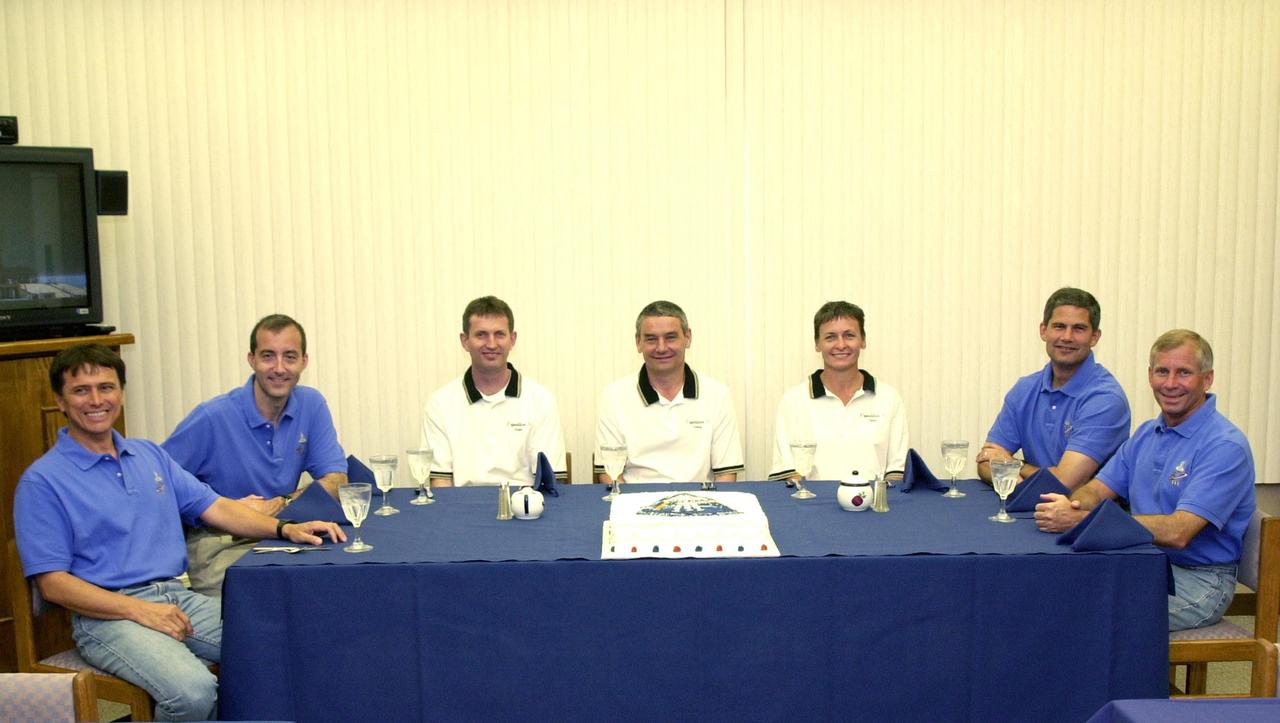
KENNEDY SPACE CENTER, FLA. -- The STS-111 and Expedition 5 crews relax at the traditional crew meal before getting ready for launch. Seated left to right are Mission Specialists Franklin Chang-Diaz and Philippe Perrin (CNES); cosmonauts Sergei Treschev (RSA) and Valeri Korzun (RSA) and astronaut Peggy Whitson, the Expedition 5 crew; Pilot Paul Lockhart and Commander Kenneth Cockrell. In front of them is the traditional cake. STS-111 is the second Utilization Flight to the International Space Station, carrying the Multi-Purpose Logistics Module Leonardo, the Mobile Base System (MBS), and a replacement wrist/roll joint for the Canadarm 2. Also onboard Space Shuttle Endeavour is the Expedition 5 crew who will replace Expedition 4 on board the Station. The MBS will be installed on the Mobile Transporter to complete the Canadian Mobile Servicing System, or MSS. The mechanical arm will then have the capability to "inchworm" from the U.S. Lab Destiny to the MSS and travel along the truss to work sites. Expedition 4 crew members will return to Earth with the STS-111 crew on Endeavour. Launch is scheduled at 7:44 p.m. EDT, May 30, 2002
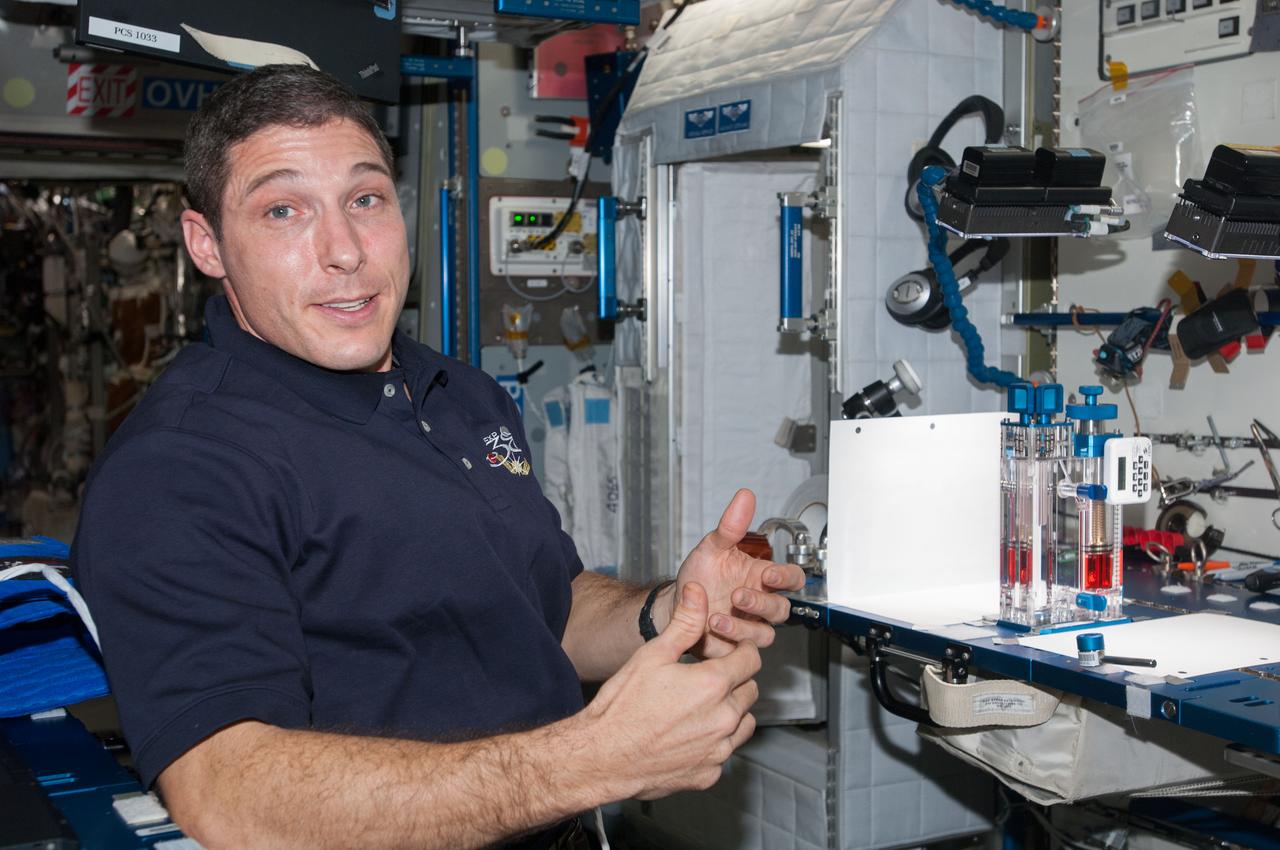
View of Flight Engineer (FE) Mike Hopkins initiating a CFE-2 (Capillary Flow Experiment - 2) Interior Corner Flow - 5 (ICF-5) test run. Liquids behave differently in space than they do on Earth, so containers that can process, hold or transport them must be designed carefully to work in microgravity. The Capillary Flow Experiment-2 furthers research on wetting, which is a liquid's ability to spread across a surface, and its impact over large length scales in strange container shapes in microgravity environments. This work will improve our capabilities to quickly and accurately predict how related processes occur, and allow us to design better systems to process liquids aboard spacecraft (i.e., liquid fuel tanks, thermals fluids, and water processing for life support). Image was released by astronaut on Twitter.
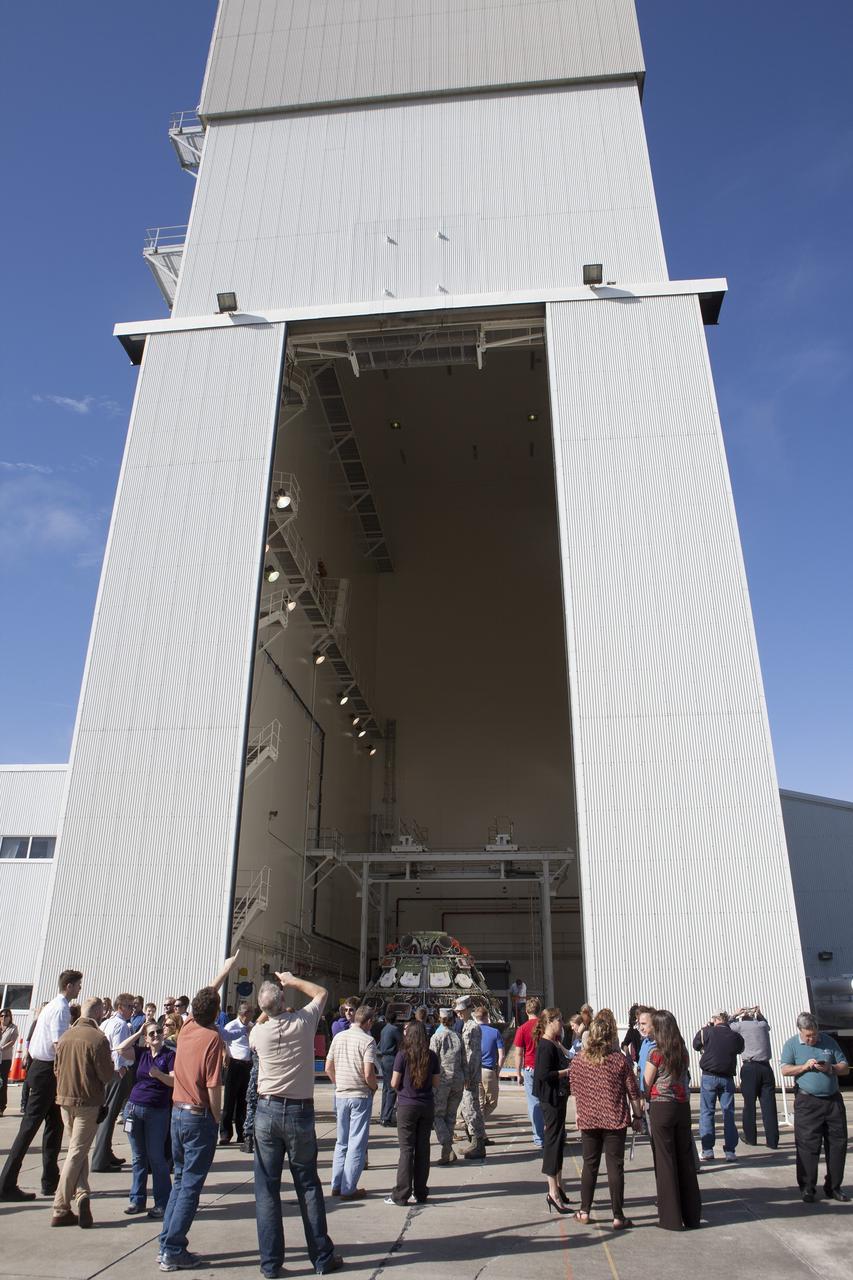
CAPE CANAVERAL, Fla. -- Workers take photographs of NASA's Orion spacecraft during a viewing at the Launch Abort System Facility at NASA's Kennedy Space Center in Florida. Orion's back shell panels have been removed. The spacecraft completed the first flight test in December, was retrieved from the Pacific Ocean, and transported 2,700 miles overland to Kennedy from Naval Base San Diego in California. Analysis of data obtained during its two-orbit, four-and-a-half hour mission Dec. 5 will provide engineers detailed information on how the spacecraft fared. Orion will be transported to the Payload Hazardous Servicing Facility for deservicing. For more information, visit www.nasa.gov/orion. Photo credit: NASA/Kim Shiflett
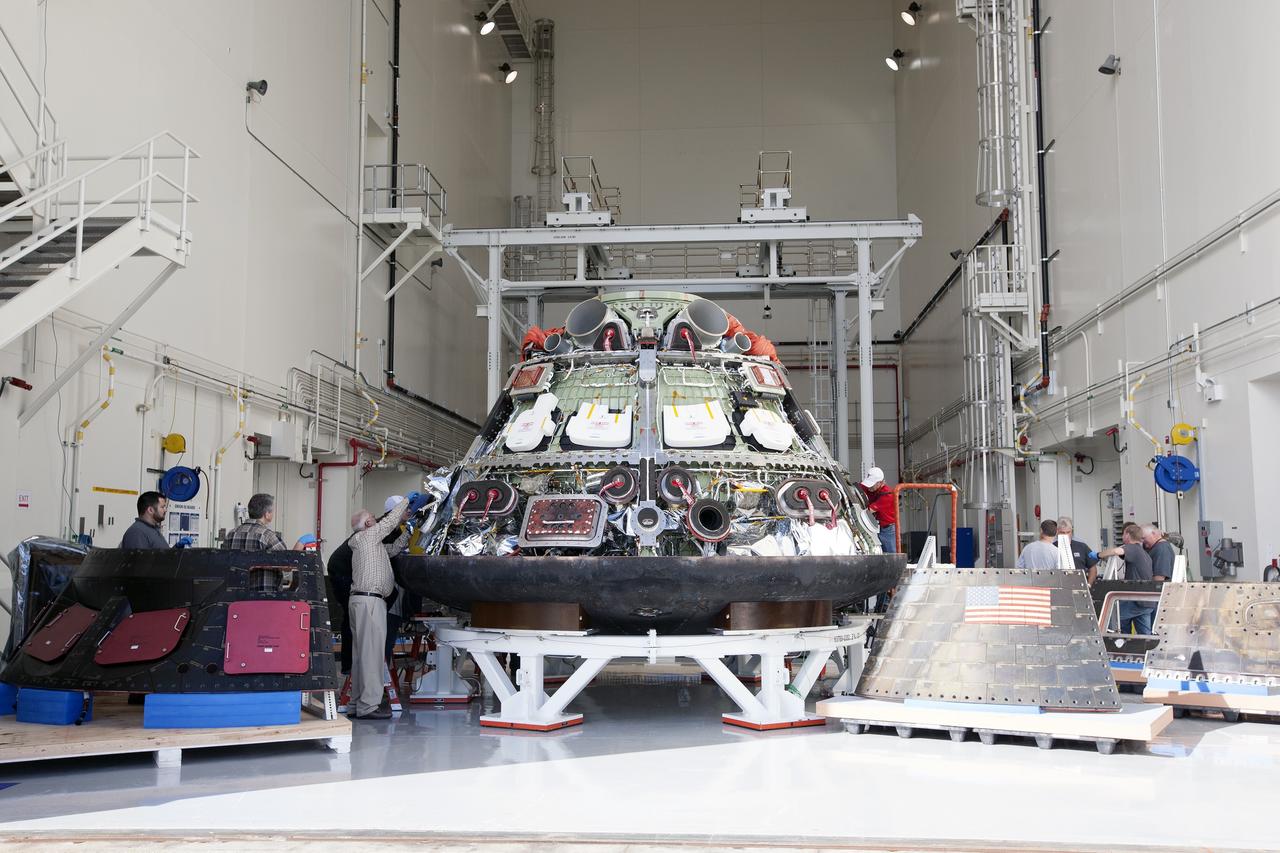
CAPE CANAVERAL, Fla. -- NASA's Orion spacecraft is positioned inside the Launch Abort System Facility at NASA's Kennedy Space Center in Florida in preparation for a viewing by Kennedy workers. Orion's back shell panels have been removed. The spacecraft completed the first flight test in December, was retrieved from the Pacific Ocean, and transported 2,700 miles overland to Kennedy from Naval Base San Diego in California. Analysis of data obtained during its two-orbit, four-and-a-half hour mission Dec. 5 will provide engineers detailed information on how the spacecraft fared. Orion will be transported to the Payload Hazardous Servicing Facility for deservicing. For more information, visit www.nasa.gov/orion. Photo credit: NASA/Kim Shiflett
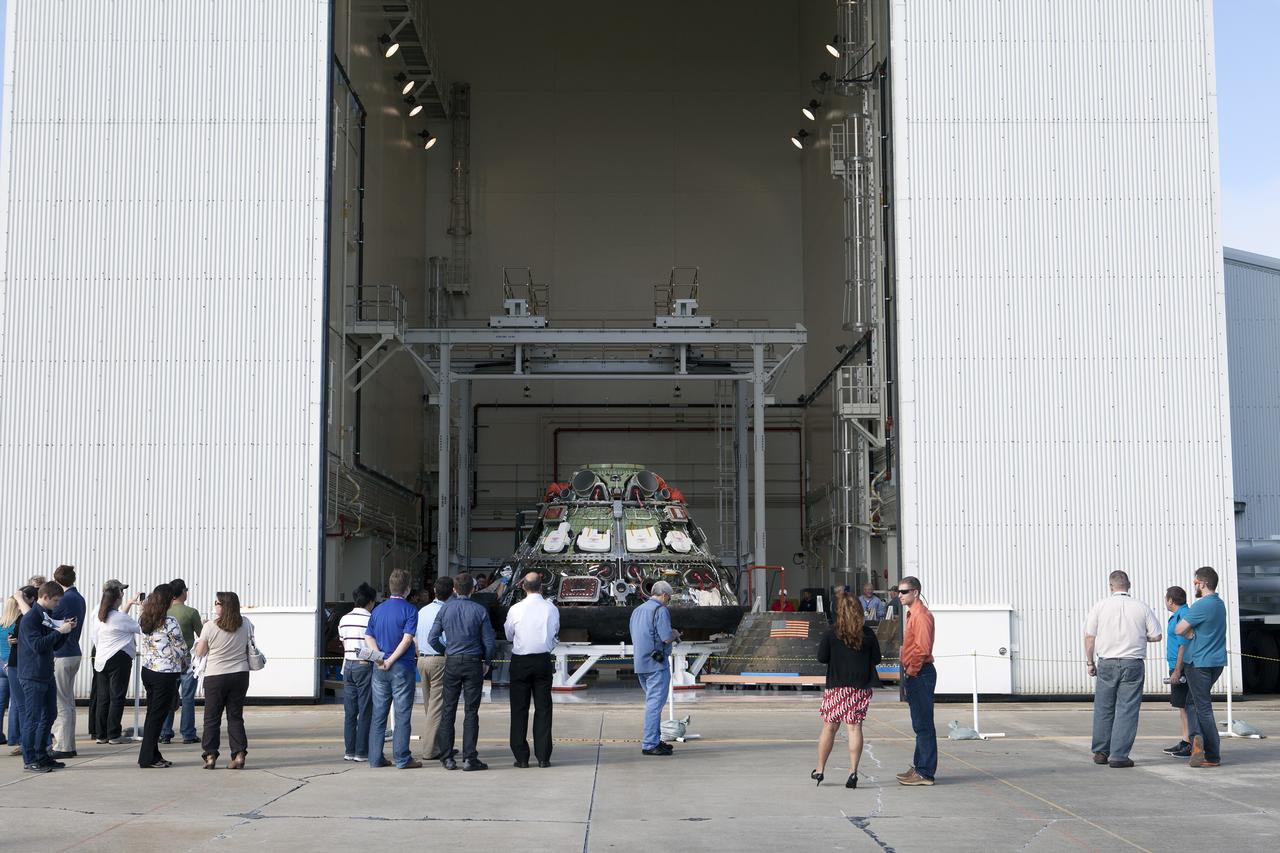
CAPE CANAVERAL, Fla. -- Workers take photographs of NASA's Orion spacecraft during a viewing at the Launch Abort System Facility at NASA's Kennedy Space Center in Florida. Orion's back shell panels have been removed. The spacecraft completed the first flight test in December, was retrieved from the Pacific Ocean, and transported 2,700 miles overland to Kennedy from Naval Base San Diego in California. Analysis of data obtained during its two-orbit, four-and-a-half hour mission Dec. 5 will provide engineers detailed information on how the spacecraft fared. Orion will be transported to the Payload Hazardous Servicing Facility for deservicing. For more information, visit www.nasa.gov/orion. Photo credit: NASA/Kim Shiflett
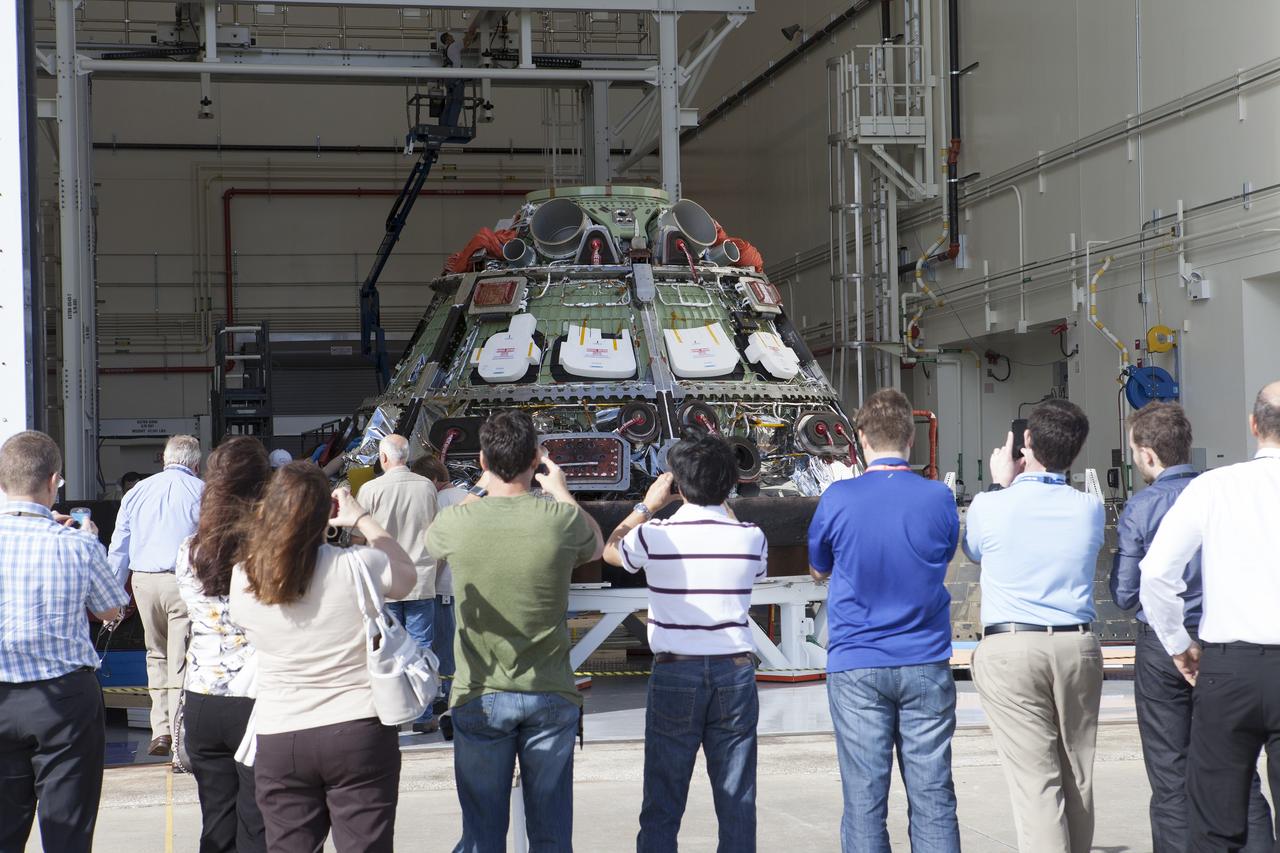
CAPE CANAVERAL, Fla. -- Workers take photographs of NASA's Orion spacecraft during a viewing at the Launch Abort System Facility at NASA's Kennedy Space Center in Florida. Orion's back shell panels have been removed. The spacecraft completed the first flight test in December, was retrieved from the Pacific Ocean, and transported 2,700 miles overland to Kennedy from Naval Base San Diego in California. Analysis of data obtained during its two-orbit, four-and-a-half hour mission Dec. 5 will provide engineers detailed information on how the spacecraft fared. Orion will be transported to the Payload Hazardous Servicing Facility for deservicing. For more information, visit www.nasa.gov/orion. Photo credit: NASA/Kim Shiflett
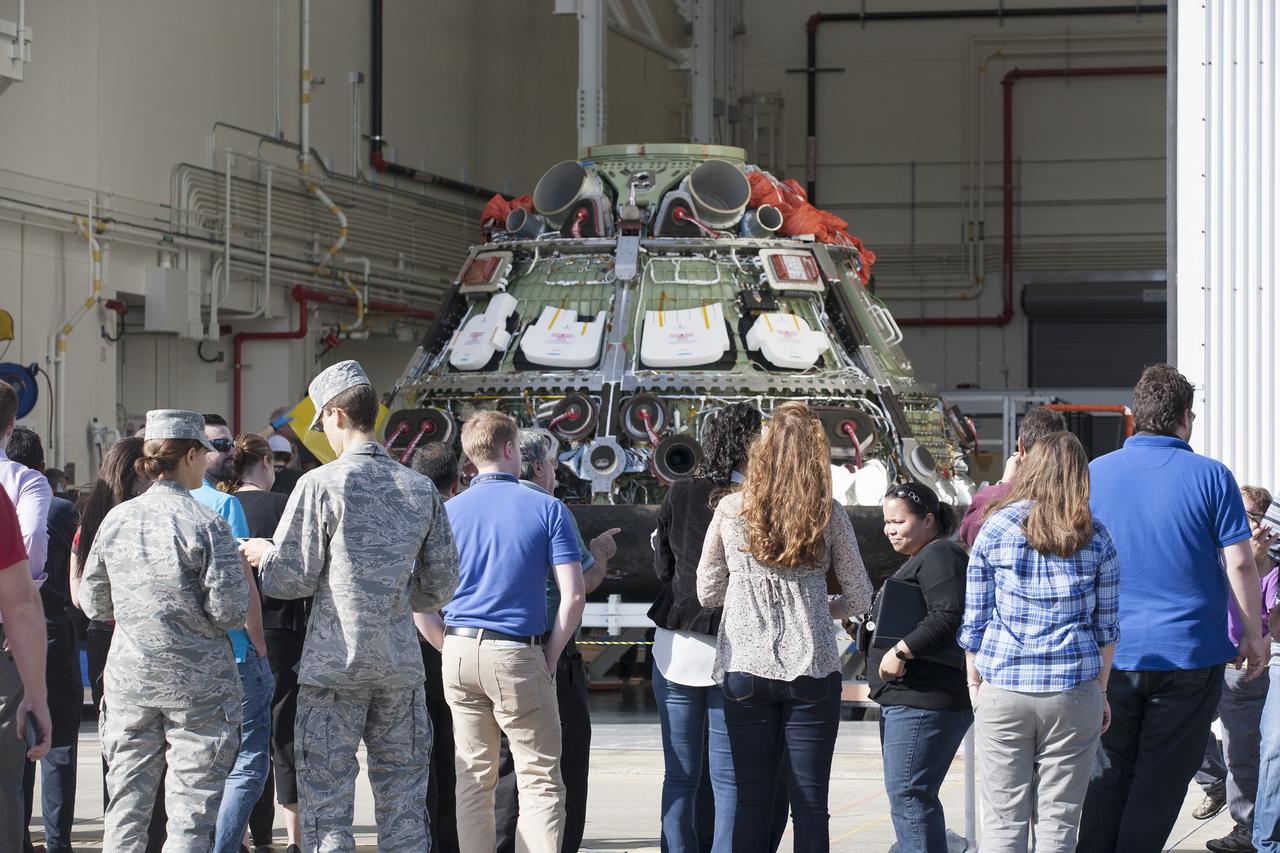
CAPE CANAVERAL, Fla. -- Workers take photographs of NASA's Orion spacecraft during a viewing at the Launch Abort System Facility at NASA's Kennedy Space Center in Florida. Orion's back shell panels have been removed. The spacecraft completed the first flight test in December, was retrieved from the Pacific Ocean, and transported 2,700 miles overland to Kennedy from Naval Base San Diego in California. Analysis of data obtained during its two-orbit, four-and-a-half hour mission Dec. 5 will provide engineers detailed information on how the spacecraft fared. Orion will be transported to the Payload Hazardous Servicing Facility for deservicing. For more information, visit www.nasa.gov/orion. Photo credit: NASA/Kim Shiflett
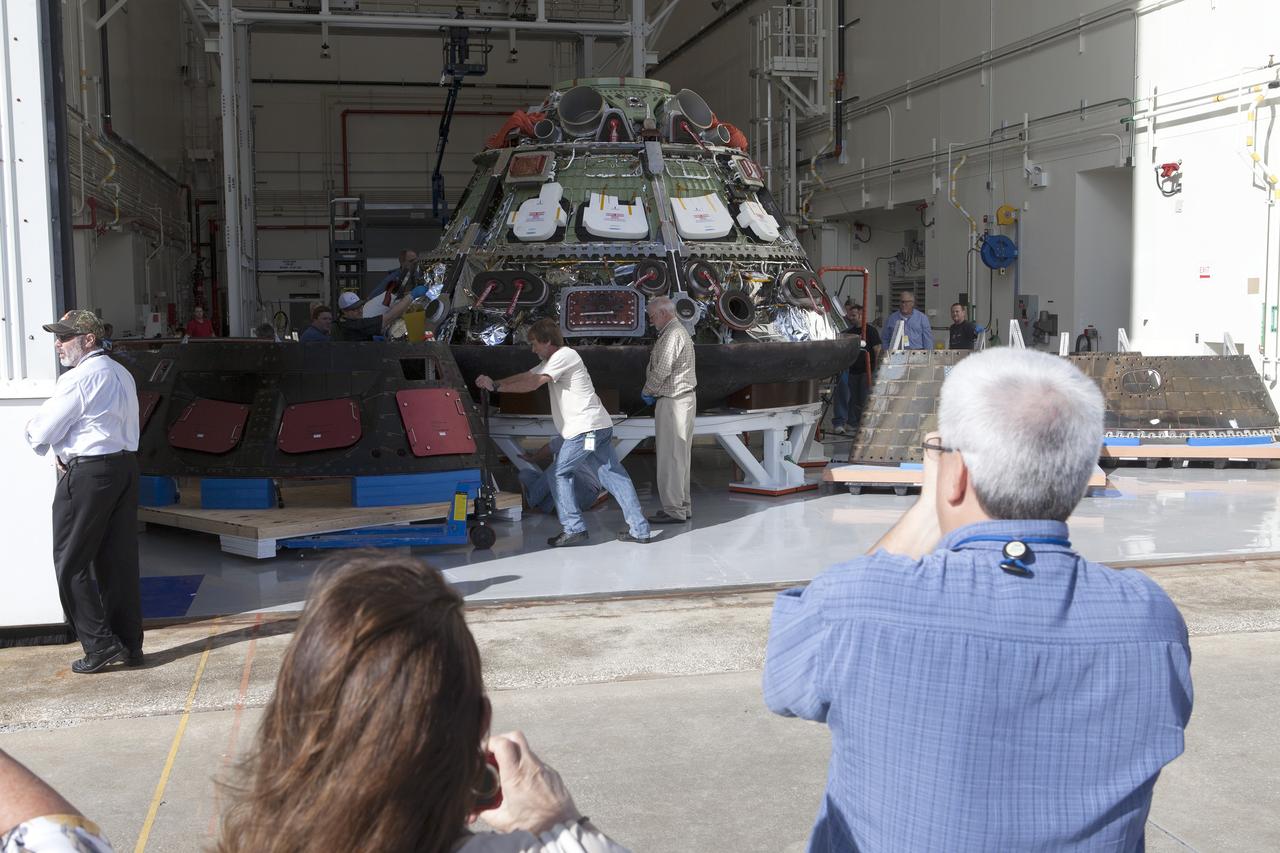
CAPE CANAVERAL, Fla. -- Workers take photographs of NASA's Orion spacecraft during a viewing at the Launch Abort System Facility at NASA's Kennedy Space Center in Florida. Orion's back shell panels have been removed. The spacecraft completed the first flight test in December, was retrieved from the Pacific Ocean, and transported 2,700 miles overland to Kennedy from Naval Base San Diego in California. Analysis of data obtained during its two-orbit, four-and-a-half hour mission Dec. 5 will provide engineers detailed information on how the spacecraft fared. Orion will be transported to the Payload Hazardous Servicing Facility for deservicing. For more information, visit www.nasa.gov/orion. Photo credit: NASA/Kim Shiflett
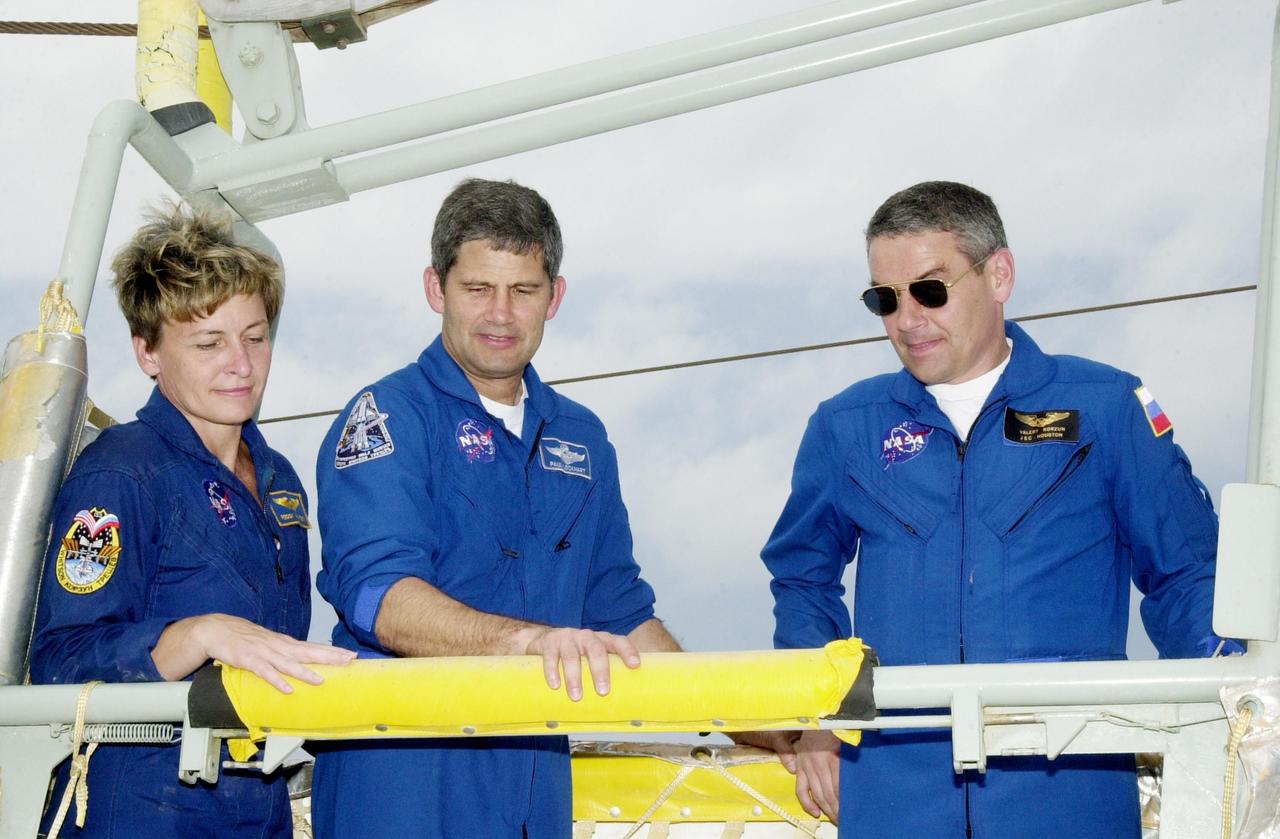
KENNEDY SPACE CENTER, FLA. -- During emergency egress training at the pad, Expedition 5 member Peggy Whitson, STS-111 Pilot Paul Lockhart and Expedition 5 Commander Valeri Korzun look over the slidewire basket area. The training for the two crews is part of Terminal Countdown Demonstration Test activities, which also include a simulated launch countdown. Mission STS-111 is known as Utilization Flight 2, carrying supplies and equipment in the Multi-Purpose Logistics Module Leonardo to the International Space Station. The payload also includes the Mobile Base System, which will be installed on the Mobile Transporter to complete the Canadian Mobile Servicing System, or MSS, and a replacement wrist/roll joint for Canadarm 2. The mechanical arm will then have the capability to "inchworm" from the U.S. Lab Destiny to the MSS and travel along the truss to work sites. Expedition 5 will travel to the Station on Endeavour as the replacement crew for Expedition 4, who will return to Earth aboard the orbiter. Launch is scheduled for May 30, 2002
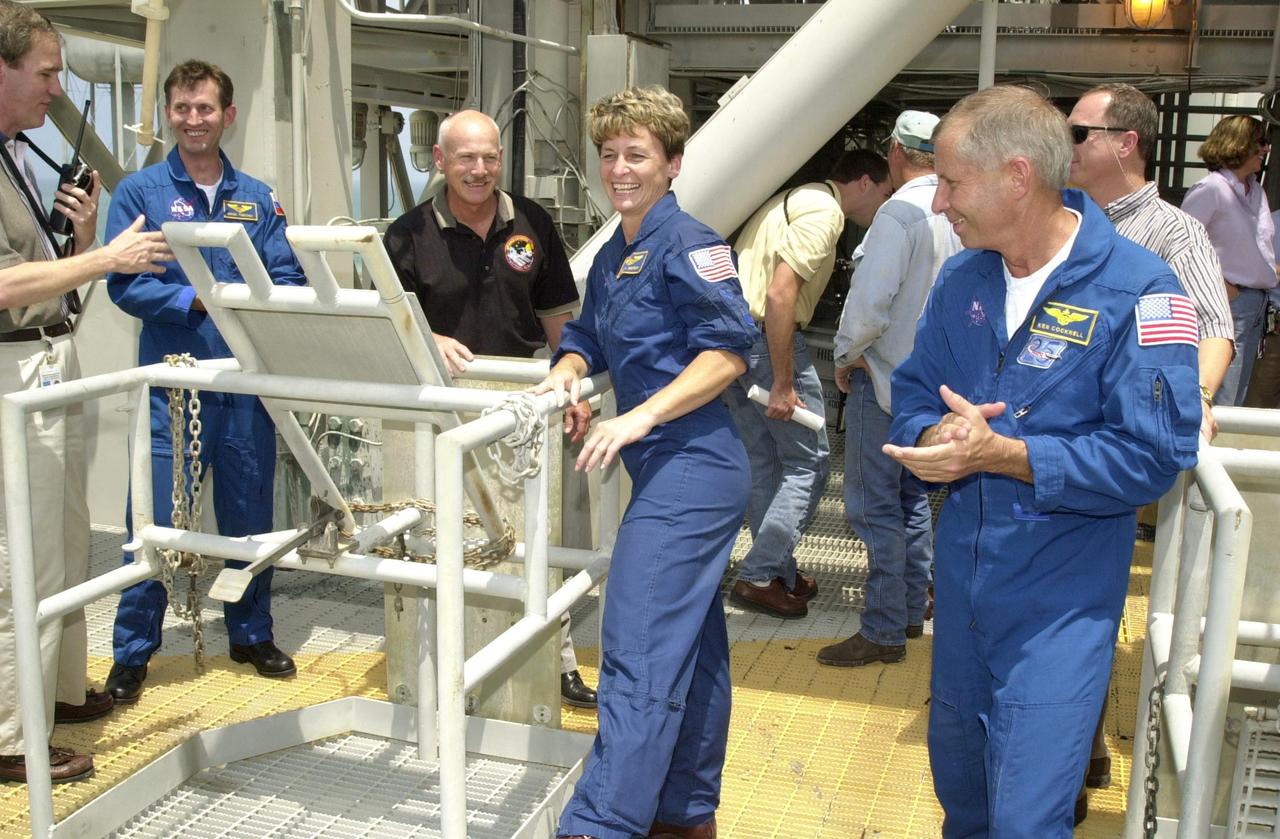
KENNEDY SPACE CENTER, FLA. - Members of the STS-111 and Expedition 5 crews take part in emergency egress training on Launch Pad 39A. From Expedition 5 are, left, in the blue suit, Sergei Treschev and, center, Peggy Whitson. At right is Mission Commander Kenneth Cockrell. The training is part of Terminal Countdown Demonstration Test activities for the two crews. The TCDT also includes a simulated launch countdown. Mission STS-111 is known as Utilization Flight 2, carrying supplies and equipment in the Multi-Purpose Logistics Module Leonardo to the International Space Station. The payload also includes the Mobile Base System, which will be installed on the Mobile Transporter to complete the Canadian Mobile Servicing System, or MSS, and a replacement wrist/roll joint for Canadarm 2. The mechanical arm will then have the capability to "inchworm" from the U.S. Lab Destiny to the MSS and travel along the truss to work sites. Expedition 5 will travel to the Station on Endeavour as the replacement crew for Expedition 4, who will return to Earth aboard the orbiter. Launch is scheduled for May 30, 2002
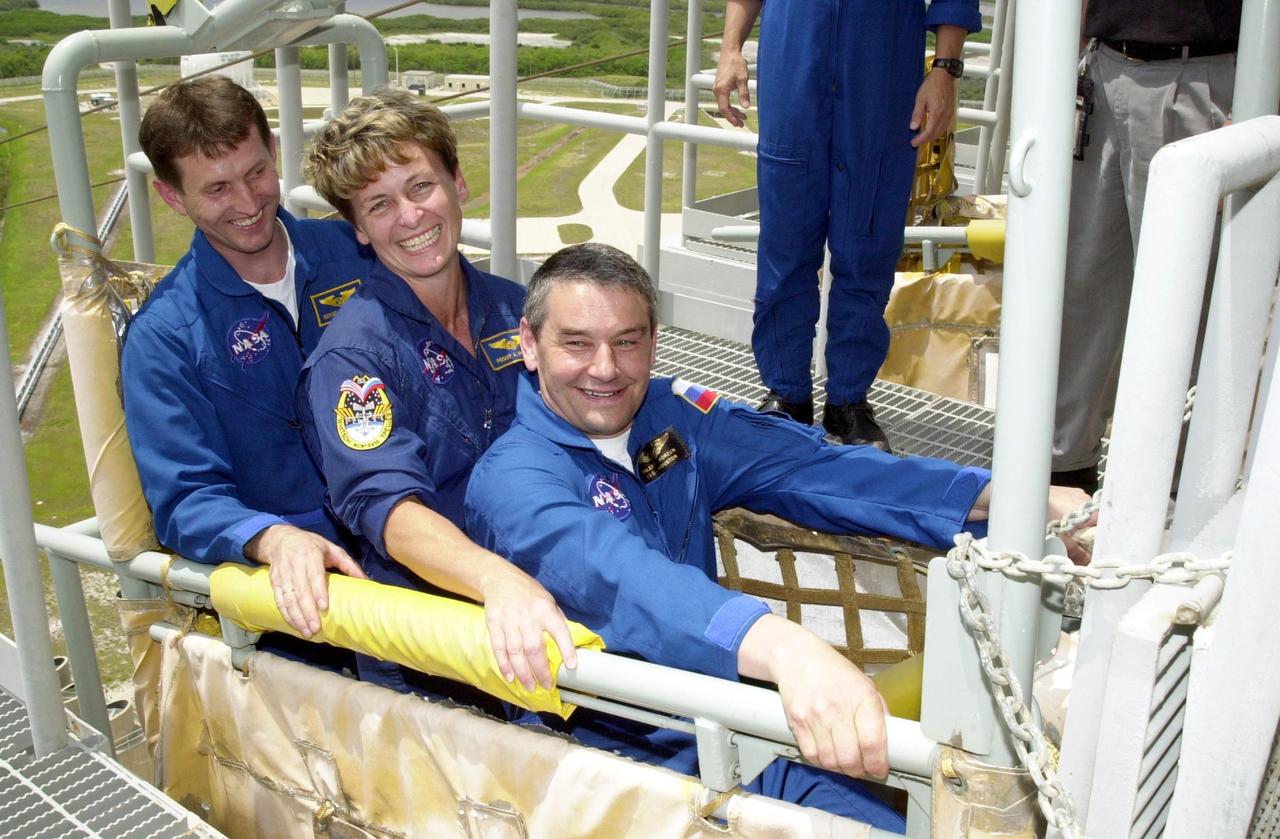
KENNEDY SPACE CENTER, FLA. -- Expedition 5 crew members test the slidewire basket on Launch Pad 39A as part of emergency egress training at the pad. From left are Sergei Treschev, Peggy Whitson and Commander Valeri Korzun. The training is part of Terminal Countdown Demonstration Test activities for Expedition 5 and the STS-111 crew. The TCDT also includes a simulated launch countdown. Mission STS-111 is known as Utilization Flight 2, carrying supplies and equipment in the Multi-Purpose Logistics Module Leonardo to the International Space Station. The payload also includes the Mobile Base System, which will be installed on the Mobile Transporter to complete the Canadian Mobile Servicing System, or MSS, and a replacement wrist/roll joint for Canadarm 2. The mechanical arm will then have the capability to "inchworm" from the U.S. Lab Destiny to the MSS and travel along the truss to work sites. Expedition 5 will travel to the Station on Endeavour as the replacement crew for Expedition 4, who will return to Earth aboard the orbiter. Launch is scheduled for May 30, 2002
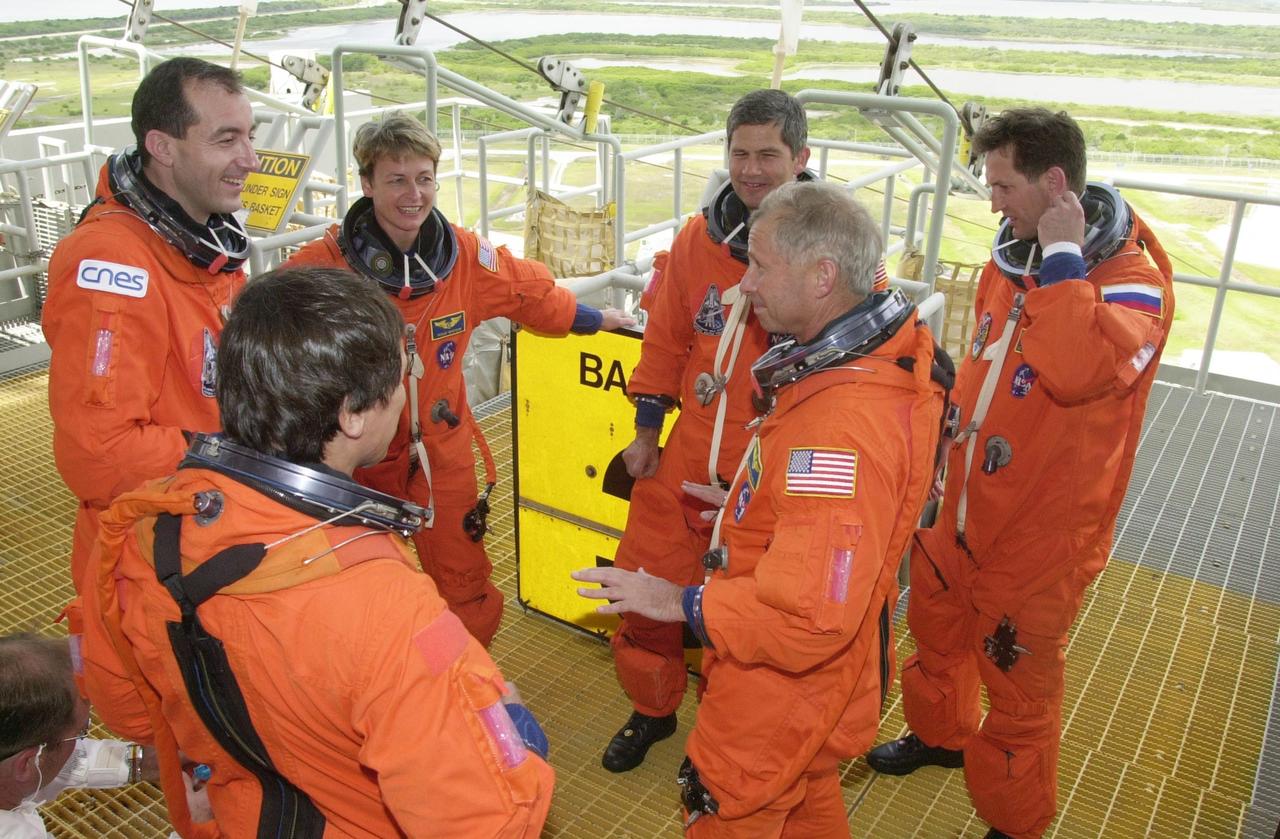
KENNEDY SPACE CENTER, FLA. -- At the 195-foot level of the Fixed Service Structure, the STS-111 and Expedition 5 crews relax after practicing emergency exit from the pad. Clockwise from left are Mission Specialists Franklin Chang-Diaz (back to camera) and Philippe Perrin, Expedition 5 members Peggy Whitson, Valeri Korzun and Sergei Treschev, and Commander Kenneth Cockrell. Pilot Paul Lockhart is not shown. The two crews are taking part in Terminal Countdown Demonstration Test activities, which include emergency egress training and a simulated launch countdown. Mission STS-111 is Utilization Flight 2, carrying equipment and supplies in the Multi-Purpose Logistics Module Leonardo to the International Space Station, plus the Mobile Base System (MBA) and an Orbital Replacement Unit. The MBS will be installed on the Mobile Transporter to complete the Canadian Mobile Servicing System, or MSS, enabling Canadarm 2 to "inchworm" from the U.S. Lab Destiny to the MSS and travel along the truss to work sites. The Expedition 5 crew is traveling on Endeavour to replace the Expedition 4 crew on the Station. Launch of Endeavour is scheduled for May 30, 2002
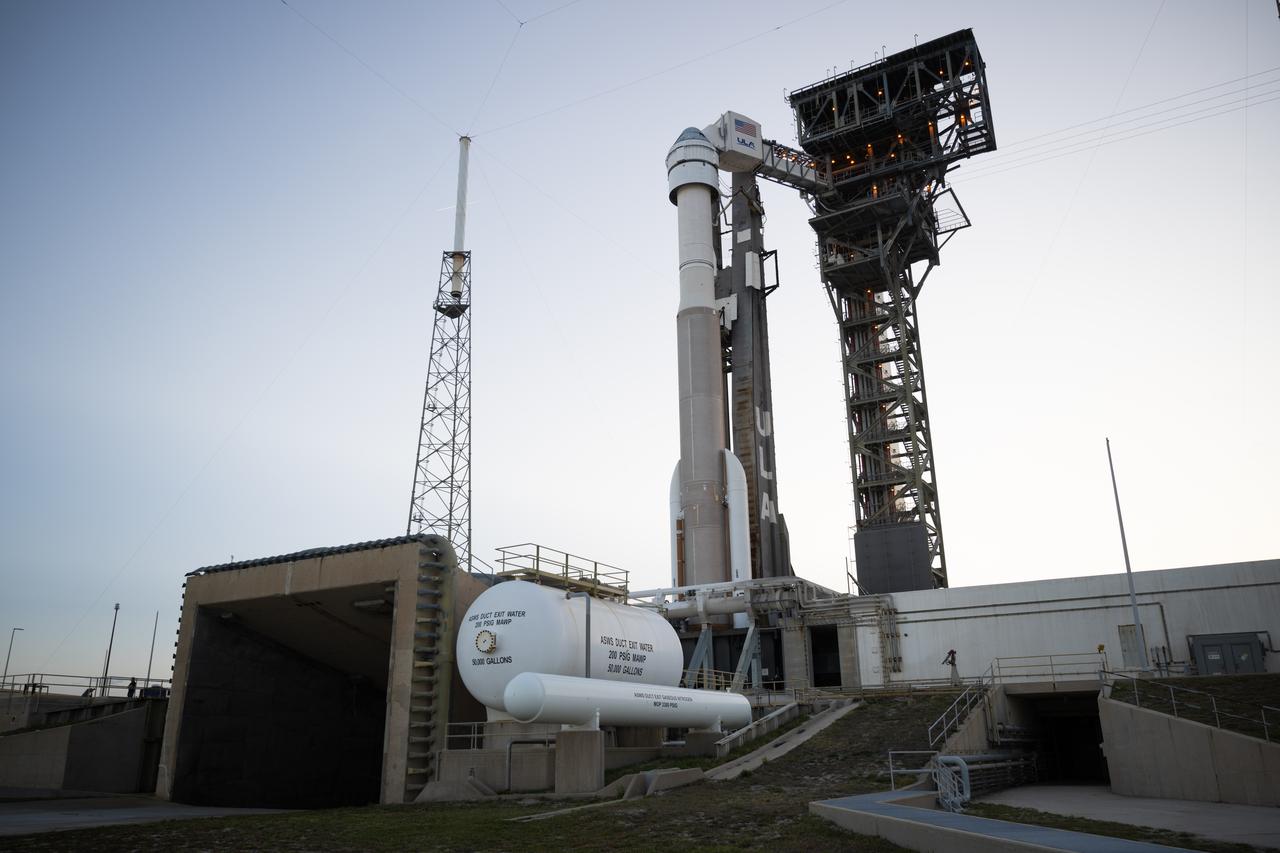
A United Launch Alliance Atlas V rocket with Boeing’s CST-100 Starliner spacecraft aboard is seen on the launch pad at Space Launch Complex 41 ahead of the NASA’s Boeing Crew Flight Test, Sunday, May 5, 2024 at Cape Canaveral Space Force Station in Florida. NASA’s Boeing Crew Flight Test is the first launch with astronauts of the Boeing CFT-100 spacecraft and United Launch Alliance Atlas V rocket to the International Space Station as part of the agency’s Commercial Crew Program. The flight test, targeted for launch at 10:34 p.m. EDT on Monday, May 6, serves as an end-to-end demonstration of Boeing’s crew transportation system and will carry NASA astronauts Butch Wilmore and Suni Williams to and from the orbiting laboratory. Photo Credit: (NASA/Joel Kowsky)
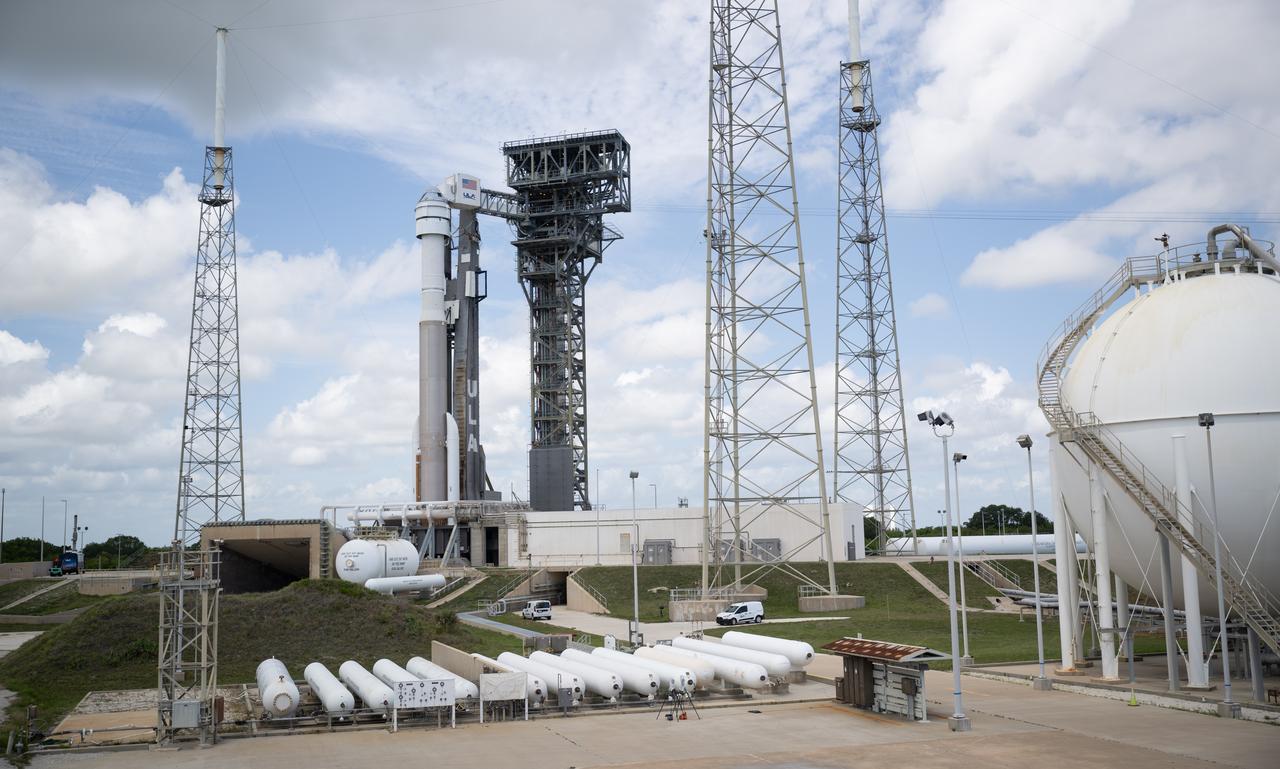
A United Launch Alliance Atlas V rocket with Boeing’s CST-100 Starliner spacecraft aboard is seen on the launch pad at Space Launch Complex 41 ahead of the NASA’s Boeing Crew Flight Test, Tuesday, June 4, 2024 at Cape Canaveral Space Force Station in Florida. NASA’s Boeing Crew Flight Test is the first launch with astronauts of the Boeing CFT-100 spacecraft and United Launch Alliance Atlas V rocket to the International Space Station as part of the agency’s Commercial Crew Program. The flight test, targeted for launch at 10:52 a.m. EDT on Wednesday, June 5, serves as an end-to-end demonstration of Boeing’s crew transportation system and will carry NASA astronauts Butch Wilmore and Suni Williams to and from the orbiting laboratory. Photo Credit: (NASA/Joel Kowsky)
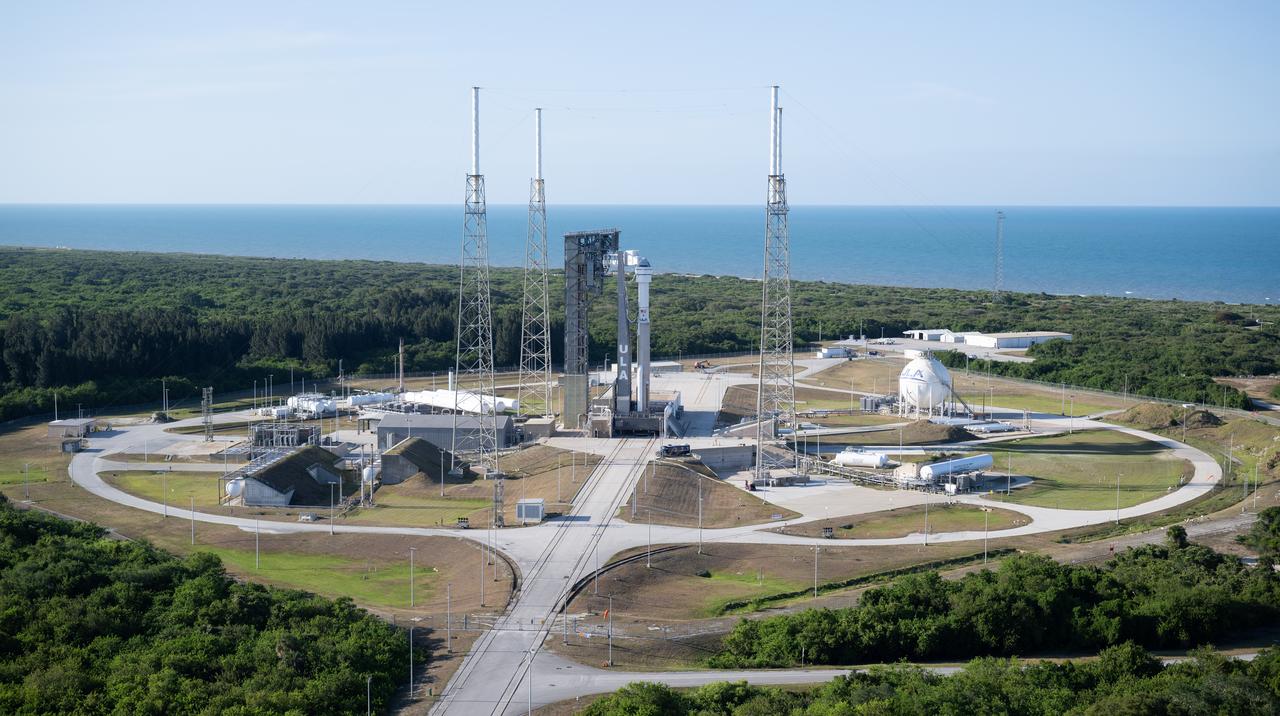
A United Launch Alliance Atlas V rocket with Boeing’s CST-100 Starliner spacecraft aboard is seen on the launch pad at Space Launch Complex 41 ahead of the NASA’s Boeing Crew Flight Test, Sunday, May 5, 2024 at Cape Canaveral Space Force Station in Florida. NASA’s Boeing Crew Flight Test is the first launch with astronauts of the Boeing CFT-100 spacecraft and United Launch Alliance Atlas V rocket to the International Space Station as part of the agency’s Commercial Crew Program. The flight test, targeted for launch at 10:34 p.m. EDT on Monday, May 6, serves as an end-to-end demonstration of Boeing’s crew transportation system and will carry NASA astronauts Butch Wilmore and Suni Williams to and from the orbiting laboratory. Photo Credit: (NASA/Joel Kowsky)
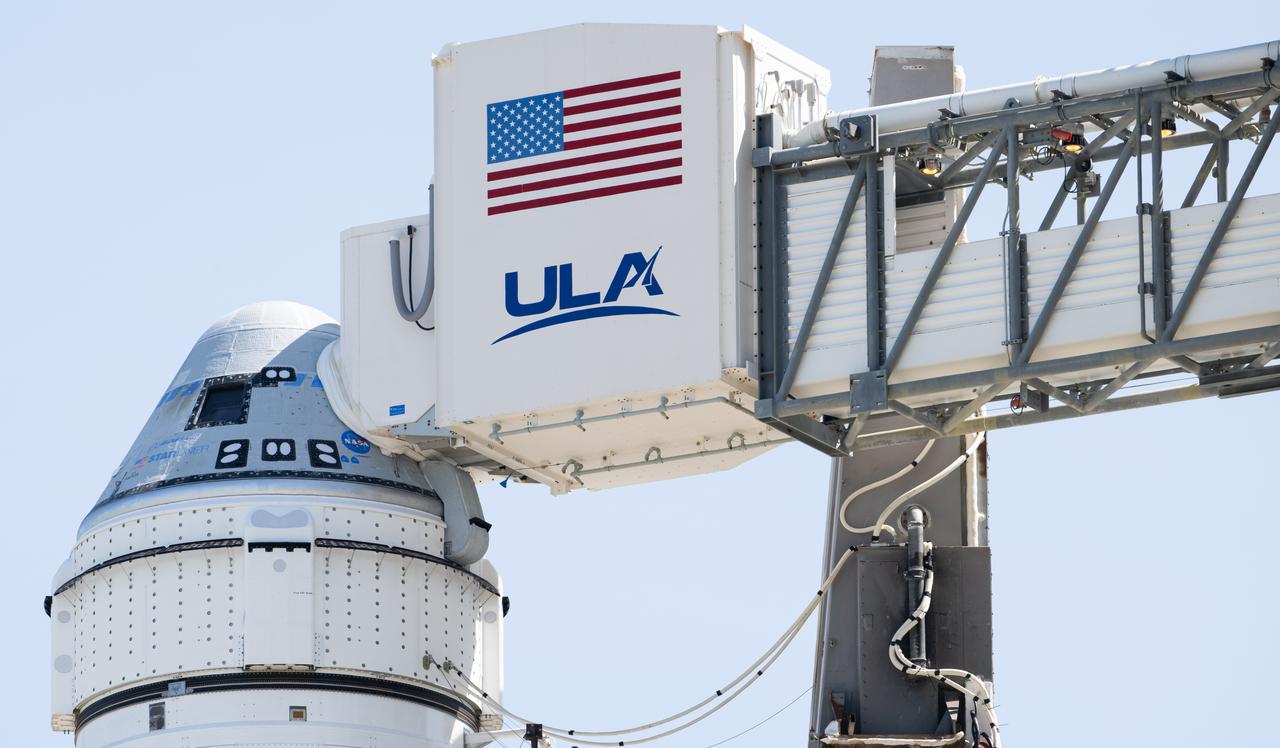
A Boeing CST-100 Starliner spacecraft is seen aboard a United Launch Alliance Atlas V rocket on the launch pad at Space Launch Complex 41 ahead of the NASA’s Boeing Crew Flight Test, Monday, June 3, 2024 at Cape Canaveral Space Force Station in Florida. NASA’s Boeing Crew Flight Test is the first launch with astronauts of the Boeing CFT-100 spacecraft and United Launch Alliance Atlas V rocket to the International Space Station as part of the agency’s Commercial Crew Program. The flight test, targeted for launch at 10:52 a.m. EDT on Wednesday, June 5, serves as an end-to-end demonstration of Boeing’s crew transportation system and will carry NASA astronauts Butch Wilmore and Suni Williams to and from the orbiting laboratory. Photo Credit: (NASA/Joel Kowsky)