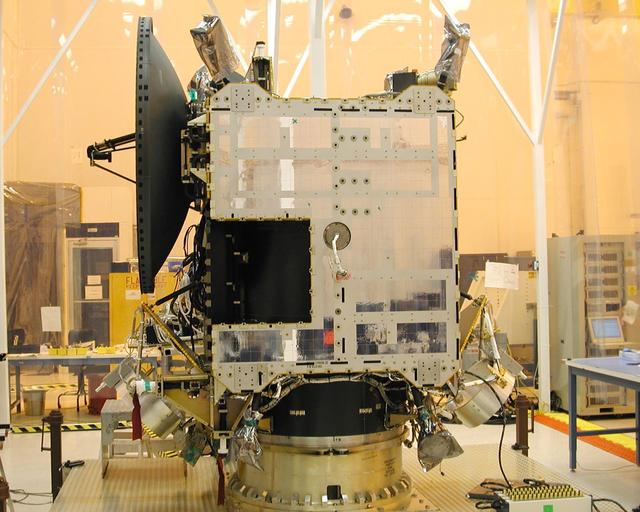
NASA Dawn spacecraft after installation of high gain antenna.
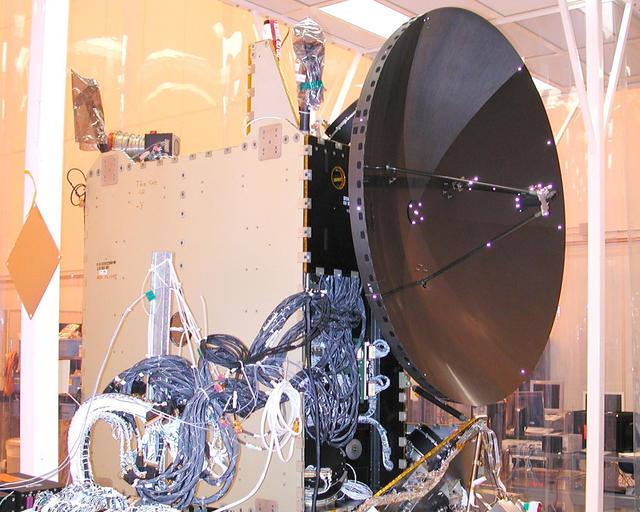
NASA Dawn spacecraft after installation of high gain antenna.
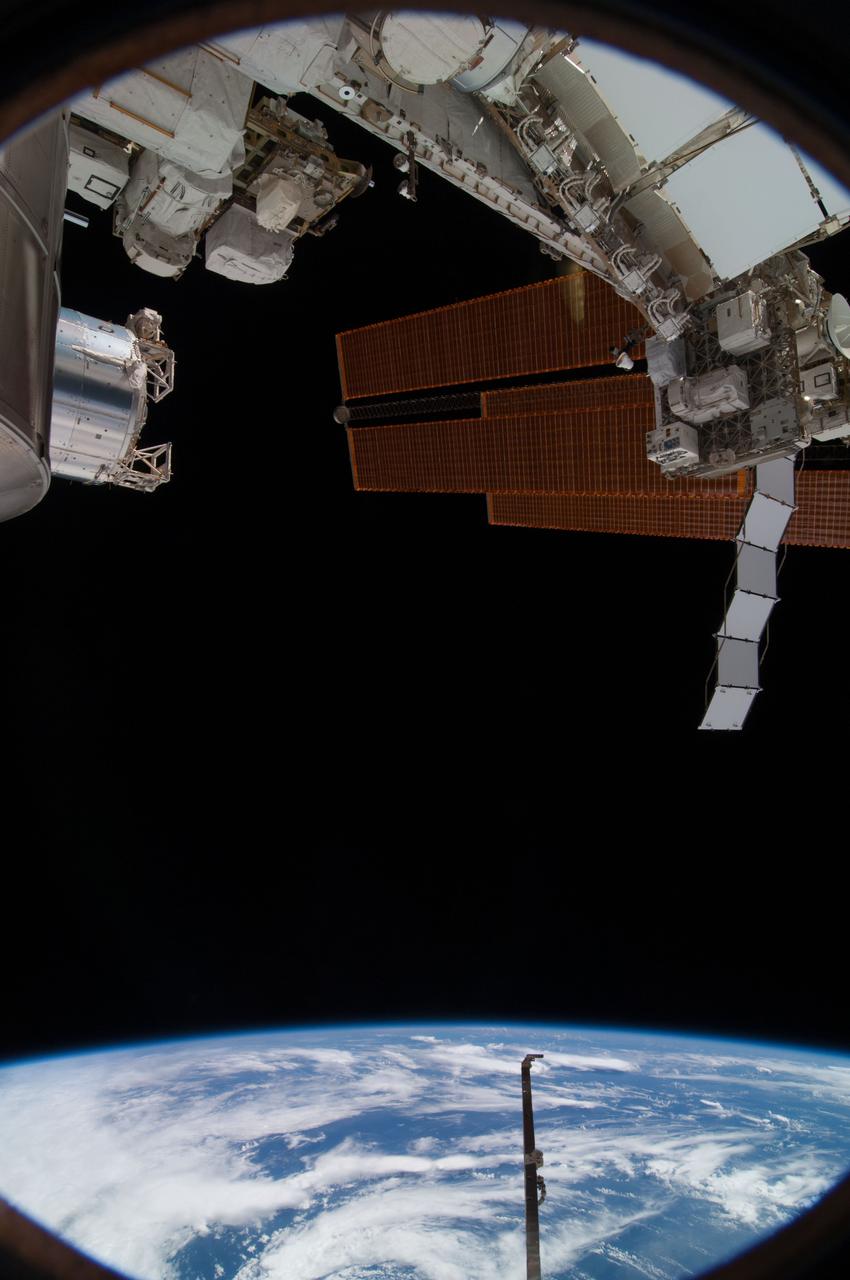
View of antenna and solar arrays (with an Earth limb in the background) taken from a window in the Russian Soyuz spacecraft currently docked to the International Space Station. Photo taken by an Expedition 36 crewmember. Per Twitter message: View out the window to the right of my seat in Soyuz while docked to ISS.
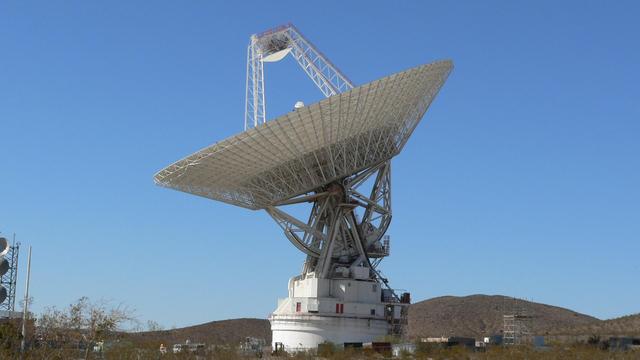
The giant, 70-meter-wide antenna at NASA Deep Space Network complex in Goldstone, Calif., tracks a spacecraft on Nov. 17, 2009. This antenna, officially known as Deep Space Station 14, is also nicknamed the Mars antenna.

Inside the Astrotech Space Operations Facility in Titusville, Florida, the high gain antenna for NASA’s Lucy spacecraft is lifted by crane on Aug. 6, 2021. The antenna will be installed on Lucy. Lucy is scheduled to launch no earlier than Saturday, Oct. 16, on a United Launch Alliance Atlas V 401 rocket from Launch Pad 41 at Cape Canaveral Space Force Station. NASA’s Launch Services Program based at Kennedy Space Center is managing the launch. Over its 12-year primary mission, Lucy will explore a record-breaking number of asteroids, flying by one asteroid in the solar system’s main belt and seven Trojan asteroids. Additionally, Lucy’s path will circle back to Earth three times for gravity assists, making it the first spacecraft ever to return to the vicinity of Earth from the outer solar system.
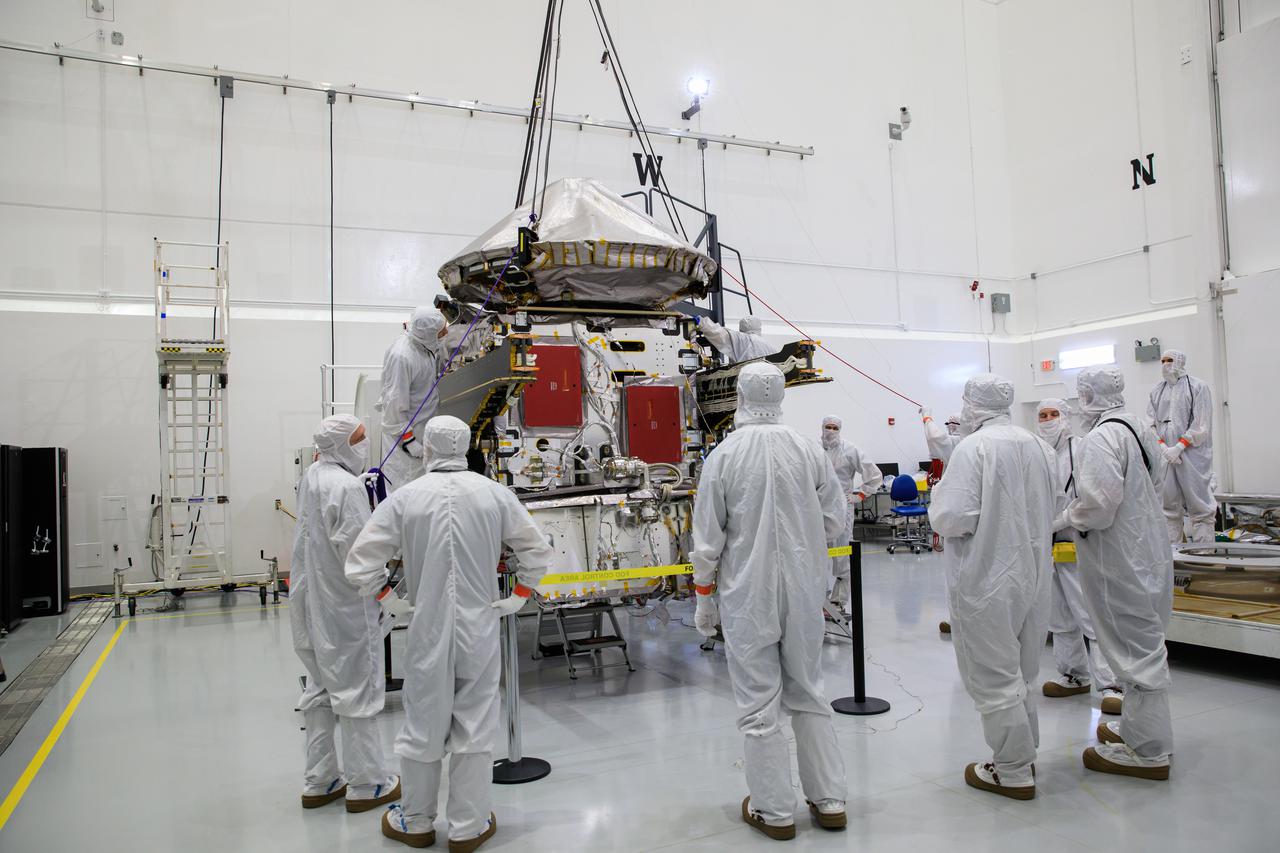
Workers assist as a crane lowers the high gain antenna for installation on NASA’s Lucy spacecraft inside the Astrotech Space Operations Facility in Titusville, Florida, on Aug. 6, 2021. Lucy is scheduled to launch no earlier than Saturday, Oct. 16, on a United Launch Alliance Atlas V 401 rocket from Launch Pad 41 at Cape Canaveral Space Force Station. NASA’s Launch Services Program based at Kennedy Space Center is managing the launch. Over its 12-year primary mission, Lucy will explore a record-breaking number of asteroids, flying by one asteroid in the solar system’s main belt and seven Trojan asteroids. Additionally, Lucy’s path will circle back to Earth three times for gravity assists, making it the first spacecraft ever to return to the vicinity of Earth from the outer solar system.
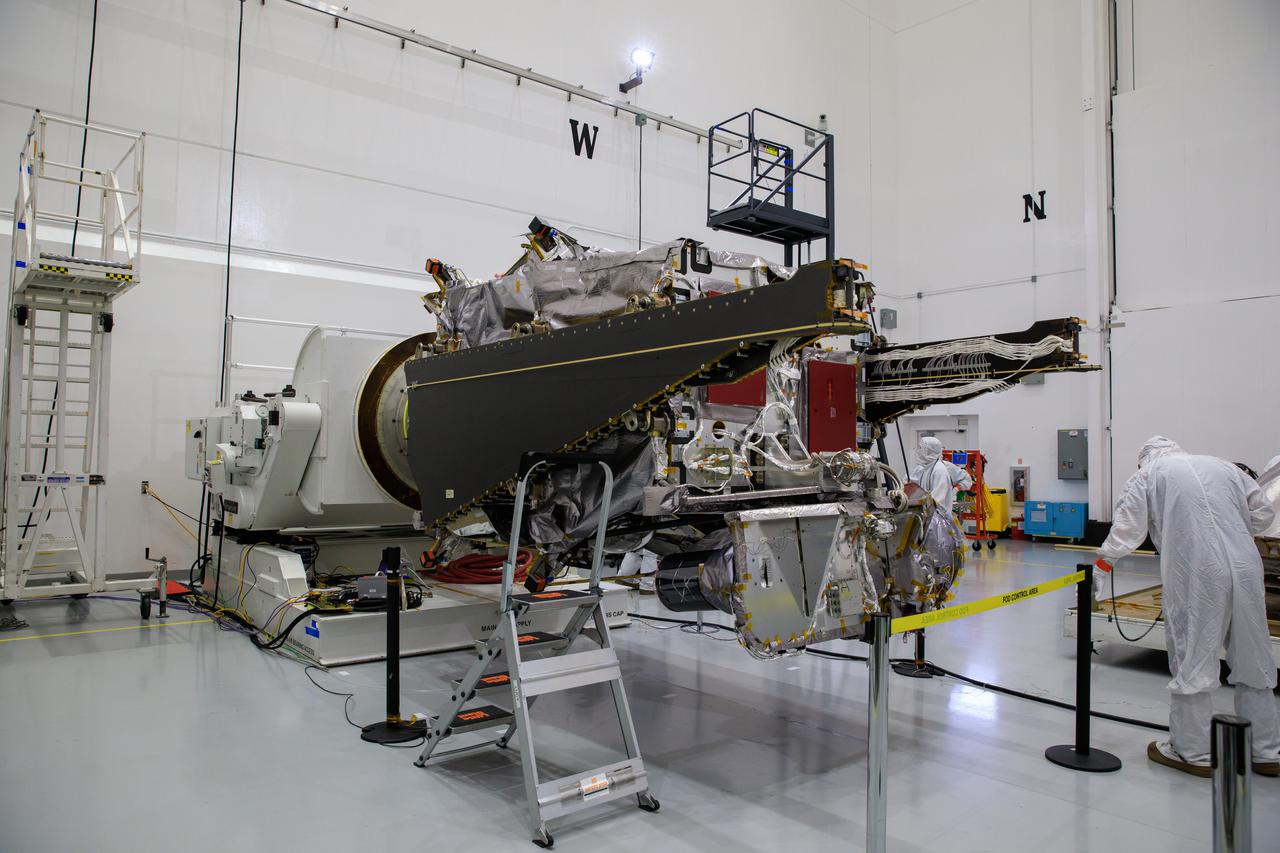
Workers inside the Astrotech Space Operations Facility in Titusville, Florida, prepare NASA’s Lucy spacecraft for installation of the high gain antenna on Aug. 6, 2021. Lucy is scheduled to launch no earlier than Saturday, Oct. 16, on a United Launch Alliance Atlas V 401 rocket from Launch Pad 41 at Cape Canaveral Space Force Station. NASA’s Launch Services Program based at Kennedy Space Center is managing the launch. Over its 12-year primary mission, Lucy will explore a record-breaking number of asteroids, flying by one asteroid in the solar system’s main belt and seven Trojan asteroids. Additionally, Lucy’s path will circle back to Earth three times for gravity assists, making it the first spacecraft ever to return to the vicinity of Earth from the outer solar system.
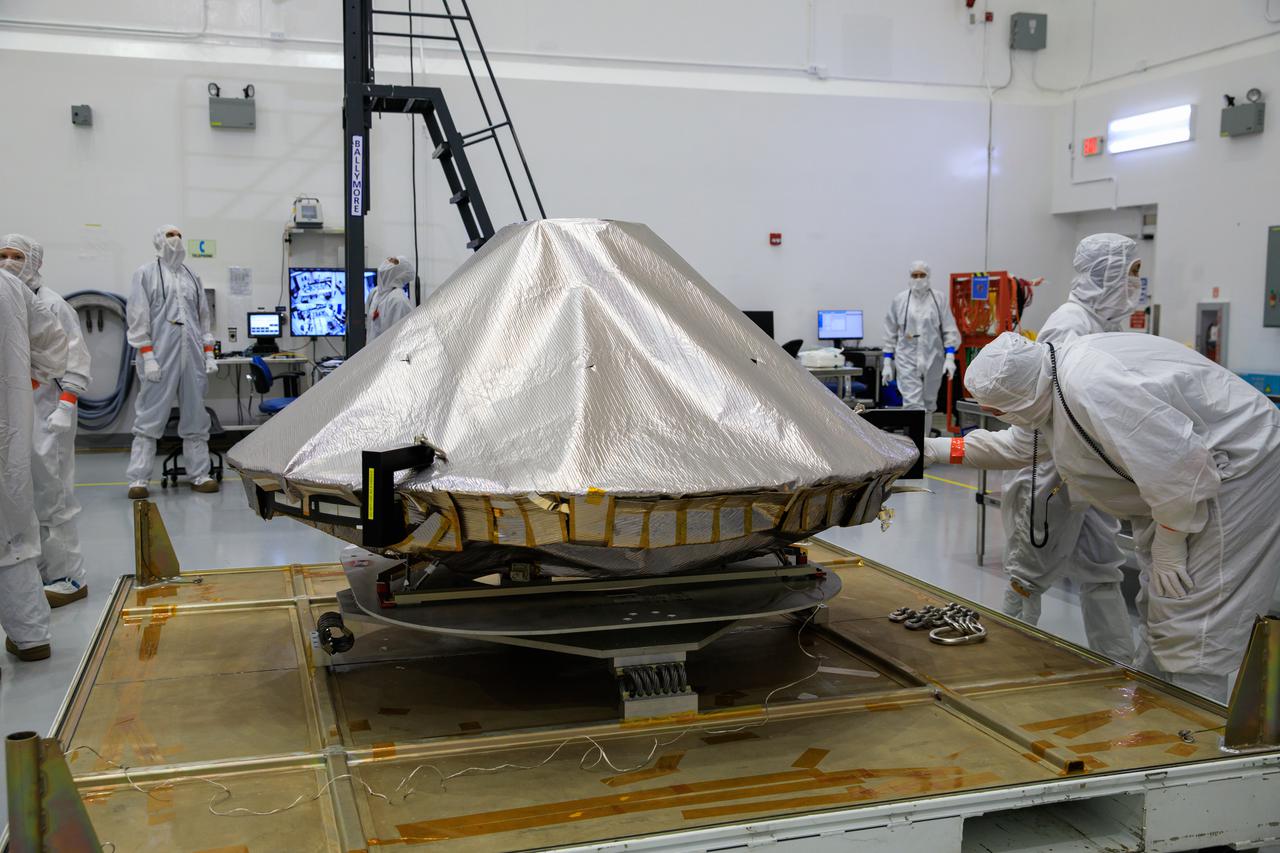
Workers inside the Astrotech Space Operations Facility in Titusville, Florida, prepare the high gain antenna for installation on NASA’s Lucy spacecraft on Aug. 6, 2021. Lucy is scheduled to launch no earlier than Saturday, Oct. 16, on a United Launch Alliance Atlas V 401 rocket from Launch Pad 41 at Cape Canaveral Space Force Station. NASA’s Launch Services Program based at Kennedy Space Center is managing the launch. Over its 12-year primary mission, Lucy will explore a record-breaking number of asteroids, flying by one asteroid in the solar system’s main belt and seven Trojan asteroids. Additionally, Lucy’s path will circle back to Earth three times for gravity assists, making it the first spacecraft ever to return to the vicinity of Earth from the outer solar system.
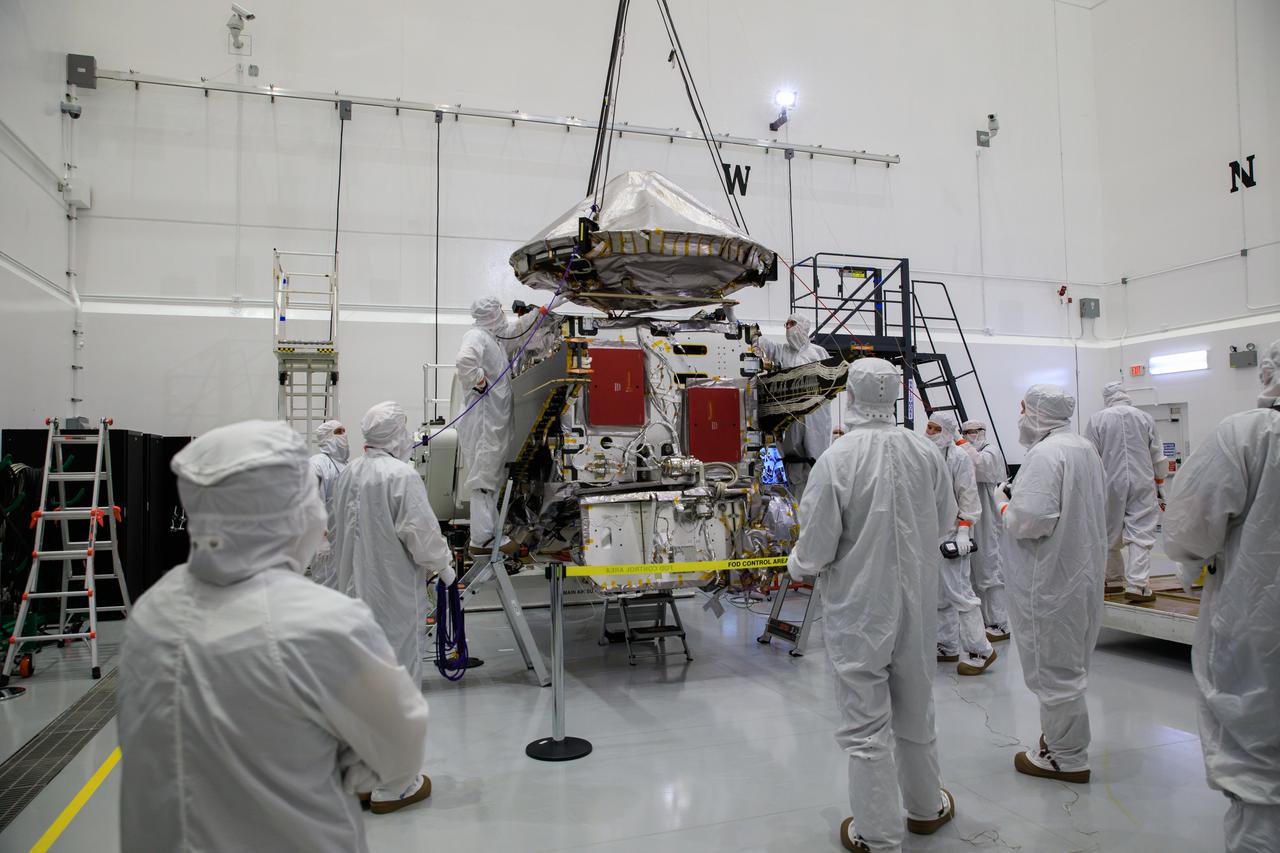
Workers assist as a crane lowers the high gain antenna for installation on NASA’s Lucy spacecraft inside the Astrotech Space Operations Facility in Titusville, Florida, on Aug. 6, 2021. Lucy is scheduled to launch no earlier than Saturday, Oct. 16, on a United Launch Alliance Atlas V 401 rocket from Launch Pad 41 at Cape Canaveral Space Force Station. NASA’s Launch Services Program based at Kennedy Space Center is managing the launch. Over its 12-year primary mission, Lucy will explore a record-breaking number of asteroids, flying by one asteroid in the solar system’s main belt and seven Trojan asteroids. Additionally, Lucy’s path will circle back to Earth three times for gravity assists, making it the first spacecraft ever to return to the vicinity of Earth from the outer solar system.
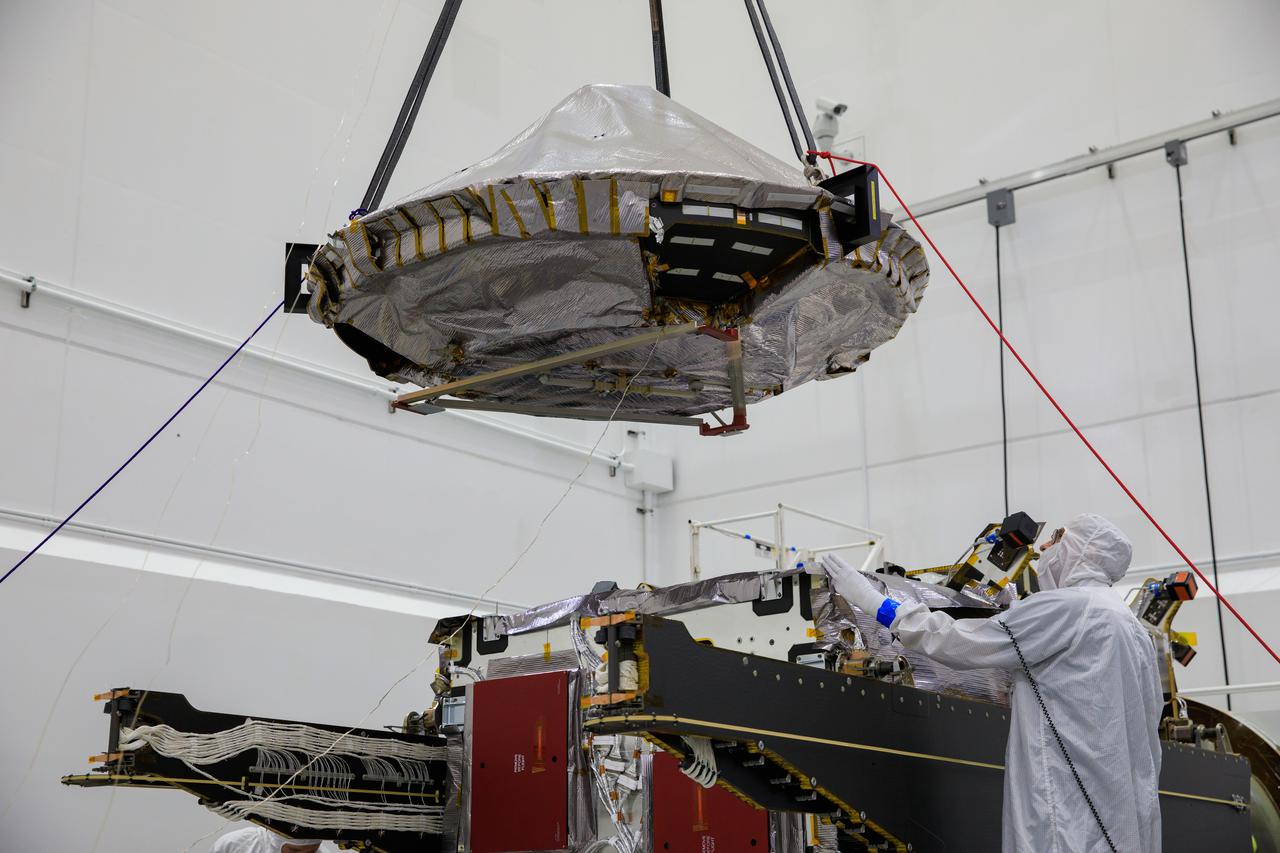
Workers assist as a crane lowers the high gain antenna for installation on NASA’s Lucy spacecraft inside the Astrotech Space Operations Facility in Titusville, Florida, on Aug. 6, 2021. Lucy is scheduled to launch no earlier than Saturday, Oct. 16, on a United Launch Alliance Atlas V 401 rocket from Launch Pad 41 at Cape Canaveral Space Force Station. NASA’s Launch Services Program based at Kennedy Space Center is managing the launch. Over its 12-year primary mission, Lucy will explore a record-breaking number of asteroids, flying by one asteroid in the solar system’s main belt and seven Trojan asteroids. Additionally, Lucy’s path will circle back to Earth three times for gravity assists, making it the first spacecraft ever to return to the vicinity of Earth from the outer solar system.
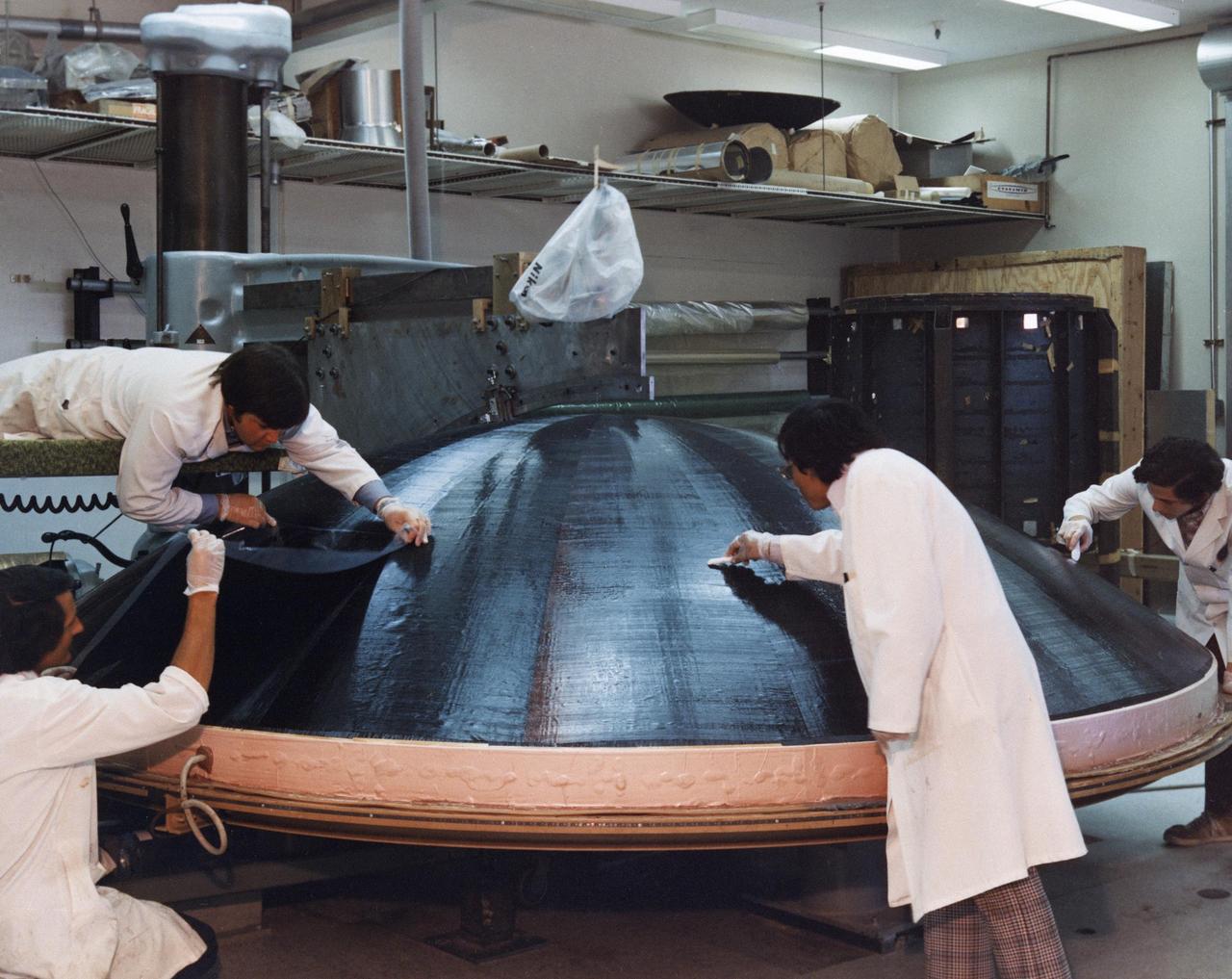
Engineers are engaged in the construction of a high gain antenna for one of the Voyager spacecraft in This archival photo taken on October 29, 1975. https://photojournal.jpl.nasa.gov/catalog/PIA21479
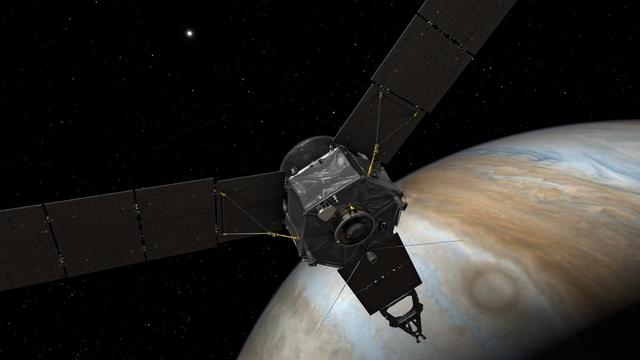
This illustration depicts NASA's Juno spacecraft at Jupiter, with its solar arrays and main antenna pointed toward the distant sun and Earth. http://photojournal.jpl.nasa.gov/catalog/PIA20703
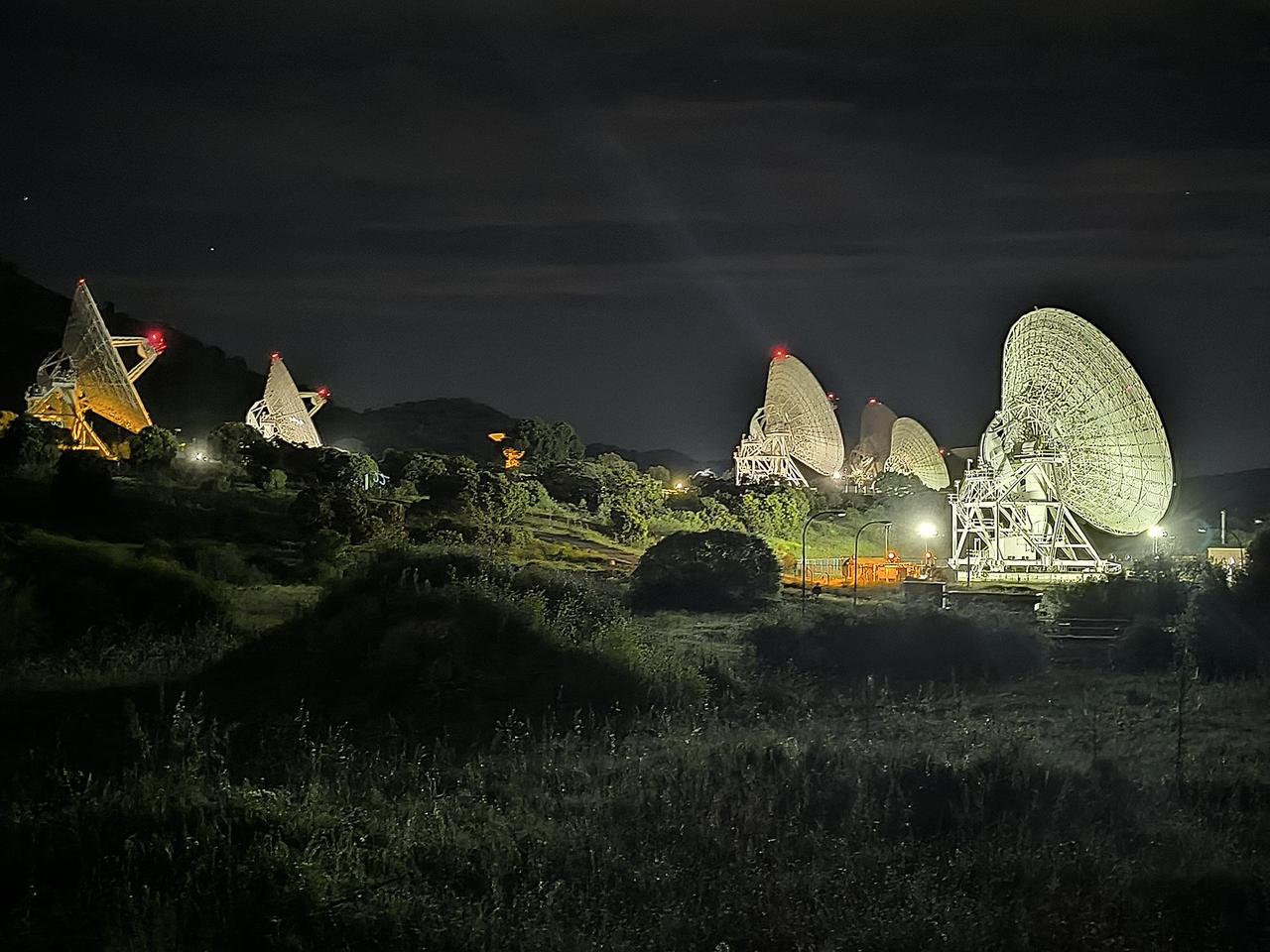
In a historic first, all six radio frequency antennas at the Madrid Deep Space Communication Complex – part of NASA's Deep Space Network (DSN) – carried out a test to receive data from the agency's Voyager 1 spacecraft at the same time on April 20, 2024. Known as "arraying," combining the receiving power of several antennas allows the DSN to collect the very faint signals from faraway spacecraft. A five-antenna array is currently needed to downlink science data from the spacecraft's Plasma Wave System (PWS) instrument. As Voyager gets further way, six antennas will be needed. The Voyager team is currently working to fix an issue on the spacecraft that has prevented it from sending back science data since November. Though the antennas located at the DSN's three complexes – Goldstone in California, Canberra in Australia, and Madrid – have been arrayed before, this is the first instance of six antennas being arrayed at once. Madrid is the only deep space communication complex currently with six operational antennas (the other two complexes have four apiece). Each complex consists of one 70-meter (230-foot) antenna and several 34-meter (112-foot) antennas. Voyager 1 is over 15 billion miles (24 billion kilometers) away, so its signal on Earth is far fainter than any other spacecraft with which the DSN communicates. It currently takes Voyager 1's signal over 22 ½ hours to travel from the spacecraft to Earth. To better receive Voyager 1's radio communications, a large antenna – or an array of multiple smaller antennas – can be used. Voyager 1 and its twin, Voyager 2, are the only spacecraft ever to fly in interstellar space (the space between stars). https://photojournal.jpl.nasa.gov/catalog/PIA26147
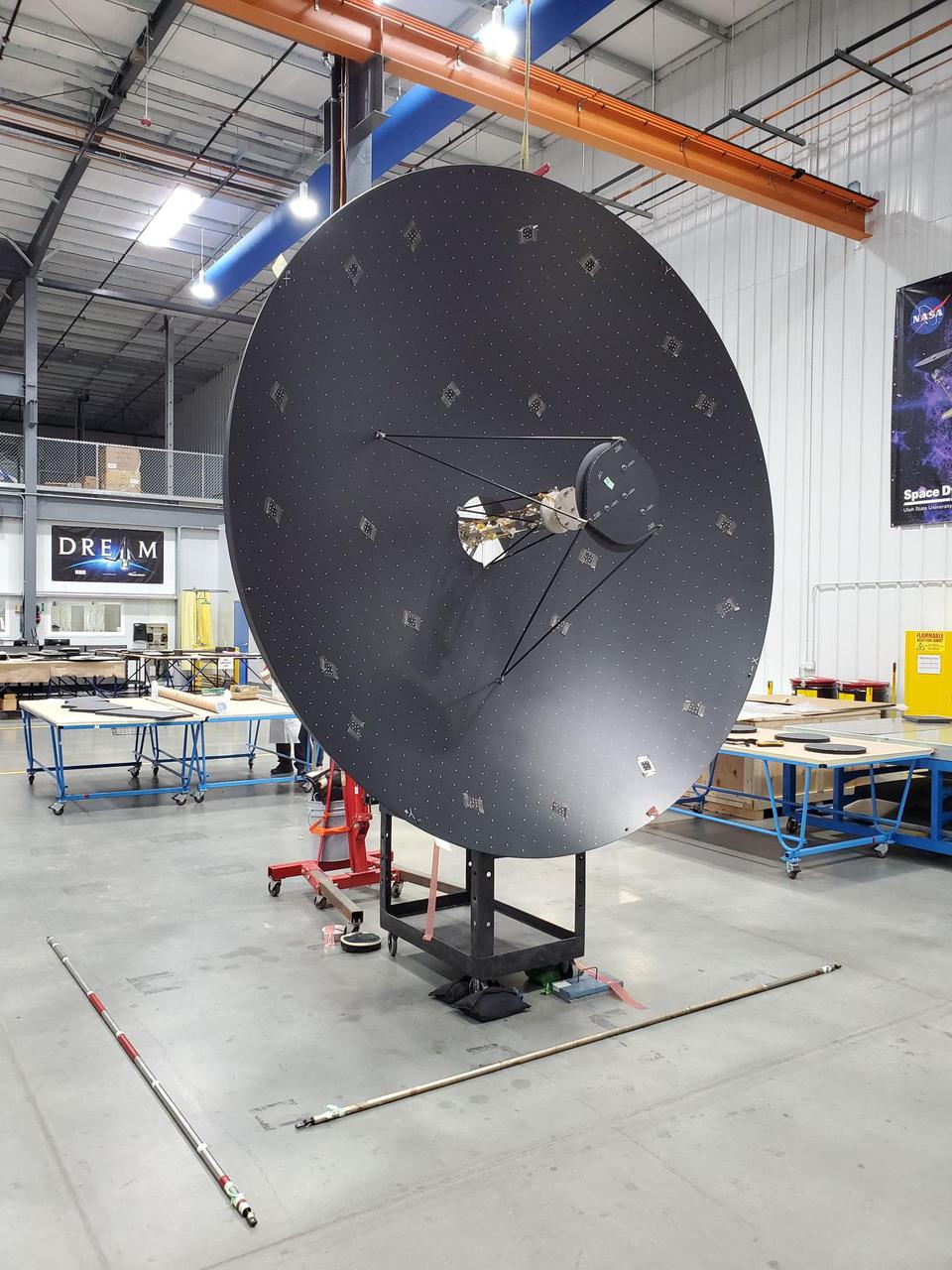
The massive high-gain antenna for NASA's Europa Clipper mission is complete. The antenna is nearly 10 feet (3 meters) wide and will be integrated along with other telecommunications hardware into the spacecraft's propulsion module. The antenna will download science data and allow ground controllers to send and receive commands and data between Earth and the spacecraft in Jupiter orbit – more than a million times farther from Earth than the International Space Station's orbits. It was designed by the Johns Hopkins Applied Physics Laboratory (APL) in Laurel, Maryland, and aerospace vendor Applied Aerospace Structures Corporation (AASC) in Stockton, California. With an internal global ocean under a thick layer of ice, Jupiter's moon Europa may have the potential to harbor existing life. Europa Clipper will swoop around Jupiter in an elliptical orbit, dipping close to the moon on each flyby to collect data. Understanding Europa's habitability will help scientists better understand how life developed on Earth and the potential for finding life beyond our planet. Europa Clipper is set to launch in 2024. https://photojournal.jpl.nasa.gov/catalog/PIA24899
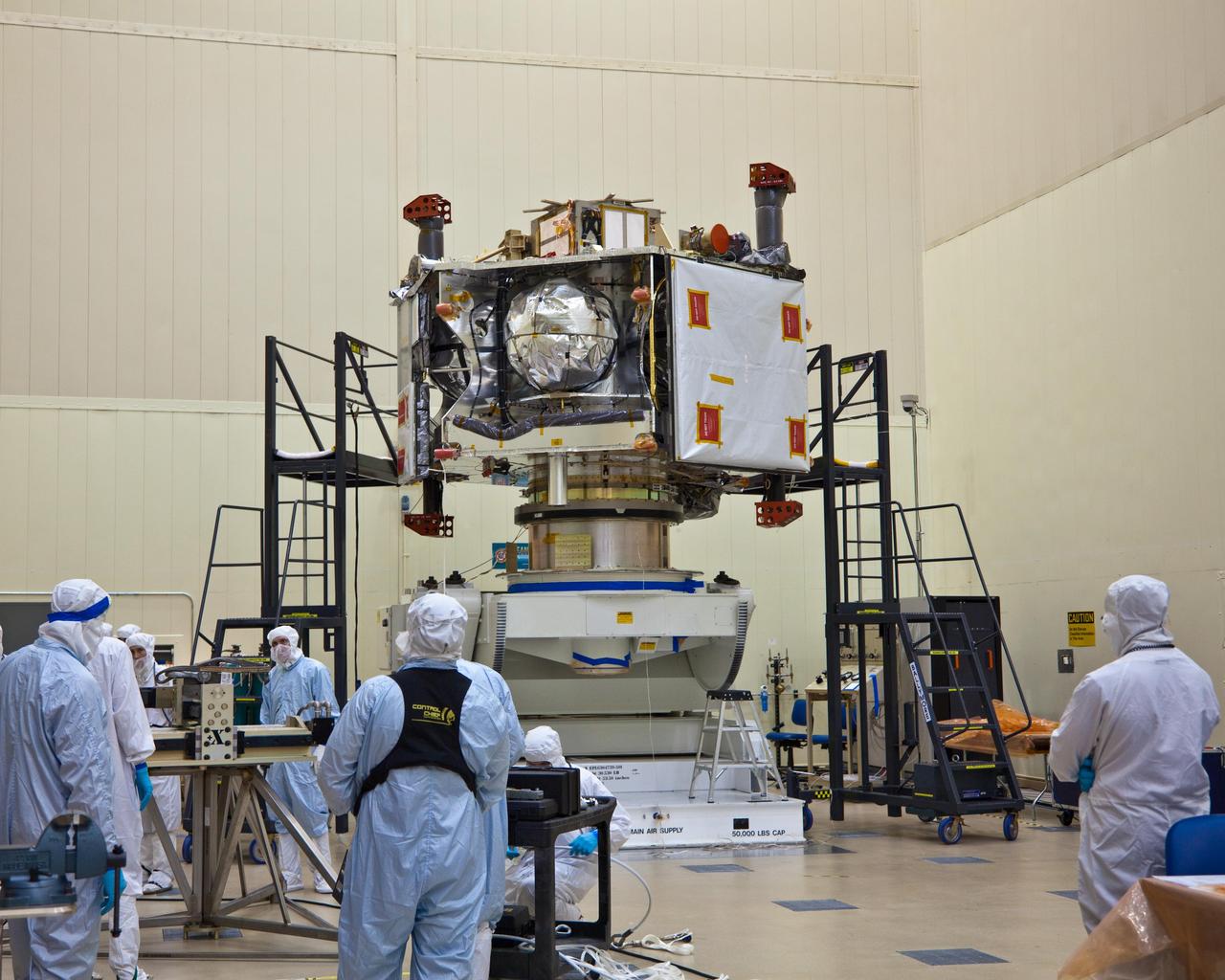
NASA Juno spacecraft rests atop its rotation fixture awaiting transfer to a shipping crate prior to environmental testing; the large white square on the spacecraft right is largest of six microwave radiometer antennas, masked by protective covering.
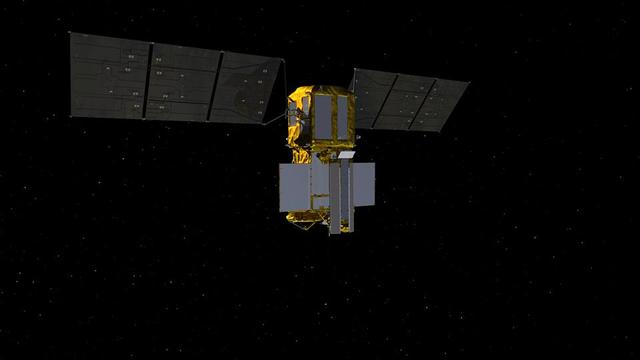
This video animation shows antennas for the Ka-band Radar Interferometer (KaRIn) instrument deploying on the Surface Water and Ocean Topography (SWOT) satellite. KaRIn is the scientific heart of the spacecraft, which launched into Earth orbit on Friday, Dec. 16, 2022, from Vandenberg Space Force Base in central California. SWOT will measure the height of water on over 90% of Earth's surface, providing a high-definition survey of our planet's water for the first time. But before it can do that, engineers need to deploy the satellite's solar panel arrays, which power the spacecraft, and unfold the large mast and antenna panels for the KaRIn instrument. The mast and antenna deployment is a four-day process. Thirty-three feet (10 meters) apart, at either end of the mast, the two antennas are designed to capture precise measurements of the height of water in Earth's freshwater bodies and the ocean. KaRIn will see eddies, currents, and other ocean features less than 13 miles (20 kilometers) across, and it will collect data on lakes and reservoirs larger than 15 acres (62,500 square meters) and rivers wider than 330 feet (100 meters) across. KaRIn will do this by bouncing radar pulses off the surface of the water and receiving the return signals with both of those antennas, collecting data along a swath on the surface that's 30 miles (50 kilometers) wide on either side of the satellite. The data SWOT provides will help researchers and decision-makers address some of the most pressing climate questions of our time and help communities prepare for a warming world. Animation available at https://photojournal.jpl.nasa.gov/catalog/PIA25596
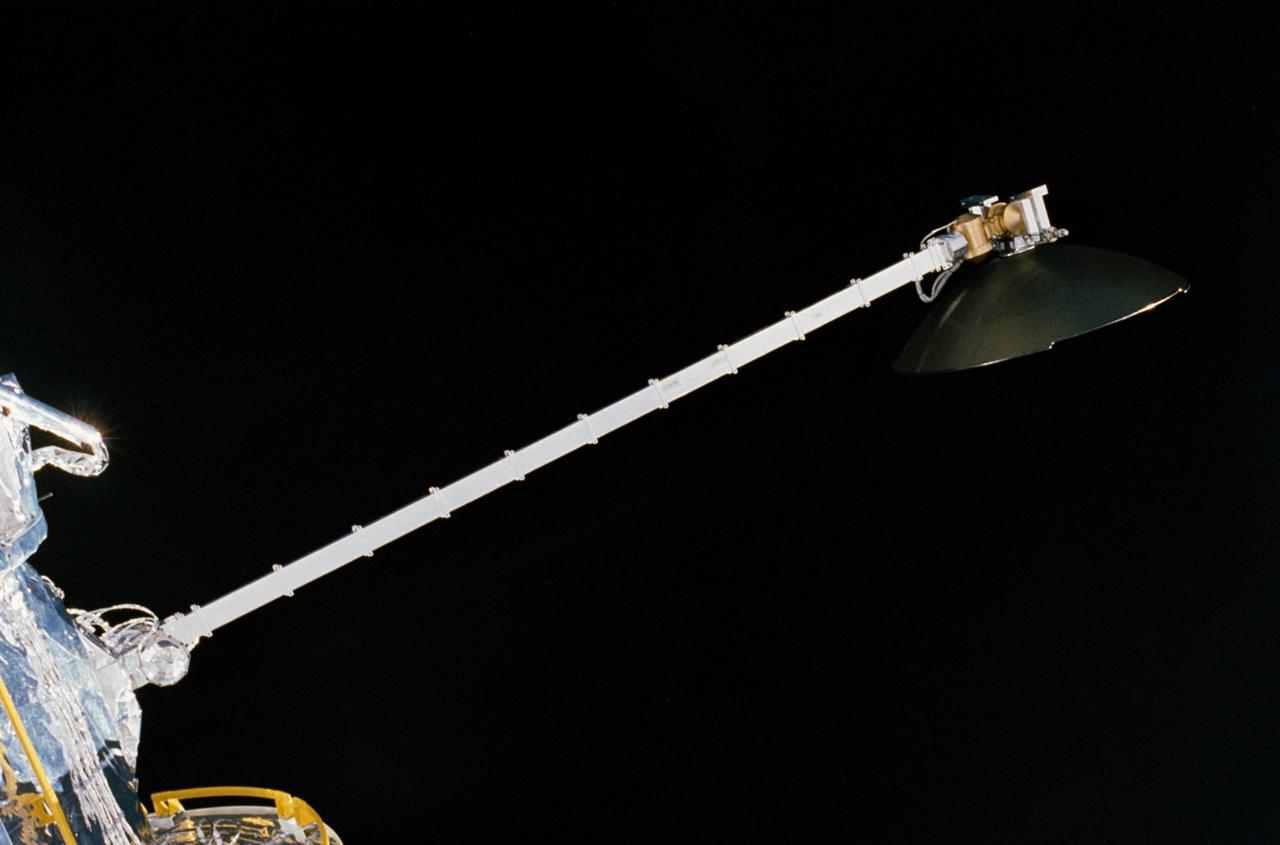
Held in appendage deploy position, the Hubble Space Telescope's (HST's) high gain antenna (HGA) has been released from its stowed position along the Support System Module (SSM) forward shell. The STS-31 crew aboard Discovery, Orbiter Vehicle (OV) oversees the automatic HGA deployment prior to releasing HST. HST HGA is backdropped against the blackness of space.
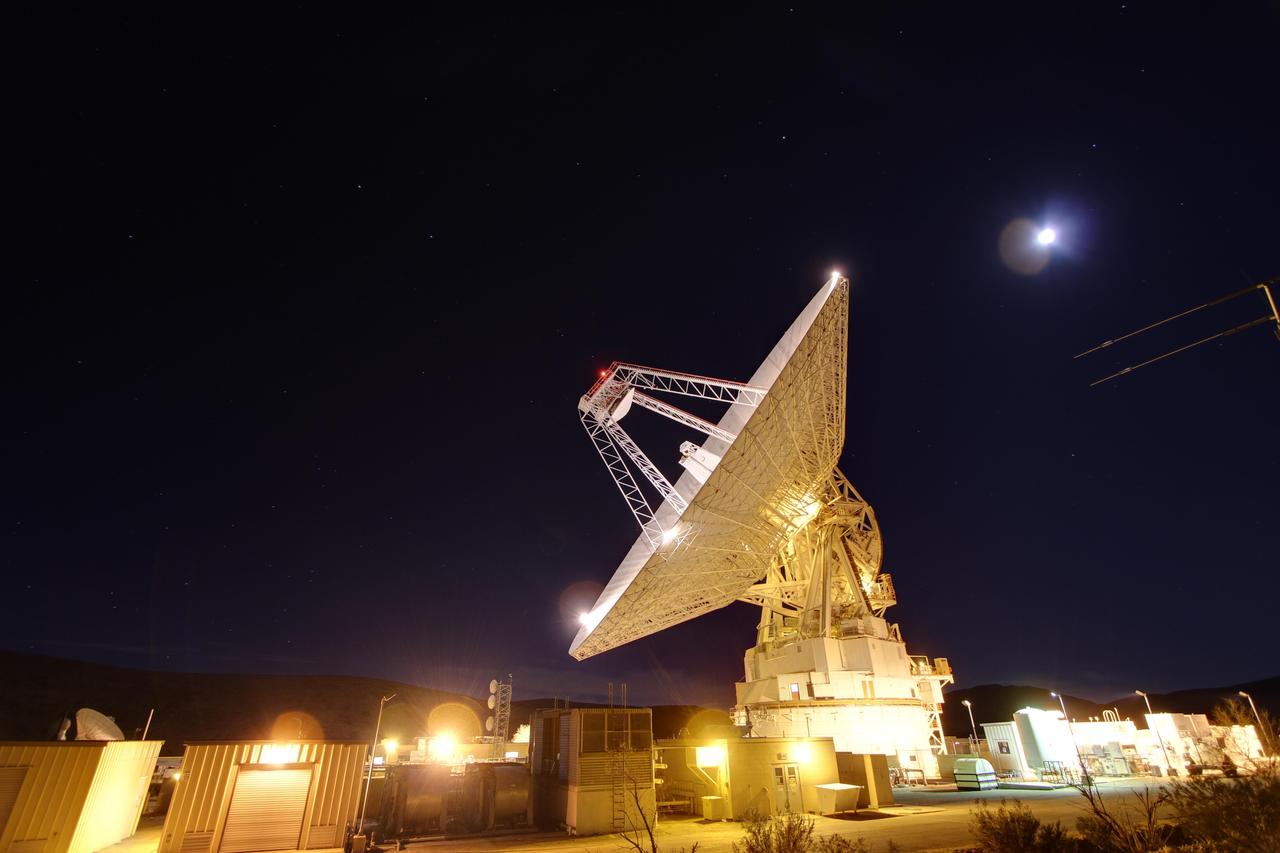
Late night in the desert: Goldstone 230-foot 70-meter antenna tracks spacecraft day and night. This photograph was taken on Jan. 11, 2012. The Goldstone Deep Space Communications Complex is located in the Mojave Desert in California, USA.
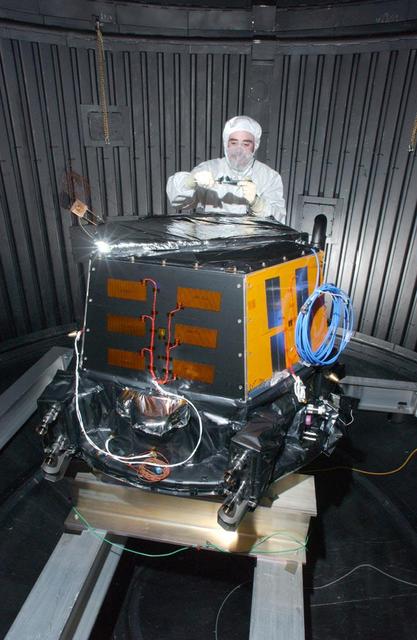
This image shows NASA Deep Impact spacecraft being built at Ball Aerospace & Technologies Corporation, Boulder, Colo. On July 2, 2005. The impactor S-band antenna is the rectangle-shaped object seen on the top of the impactor.
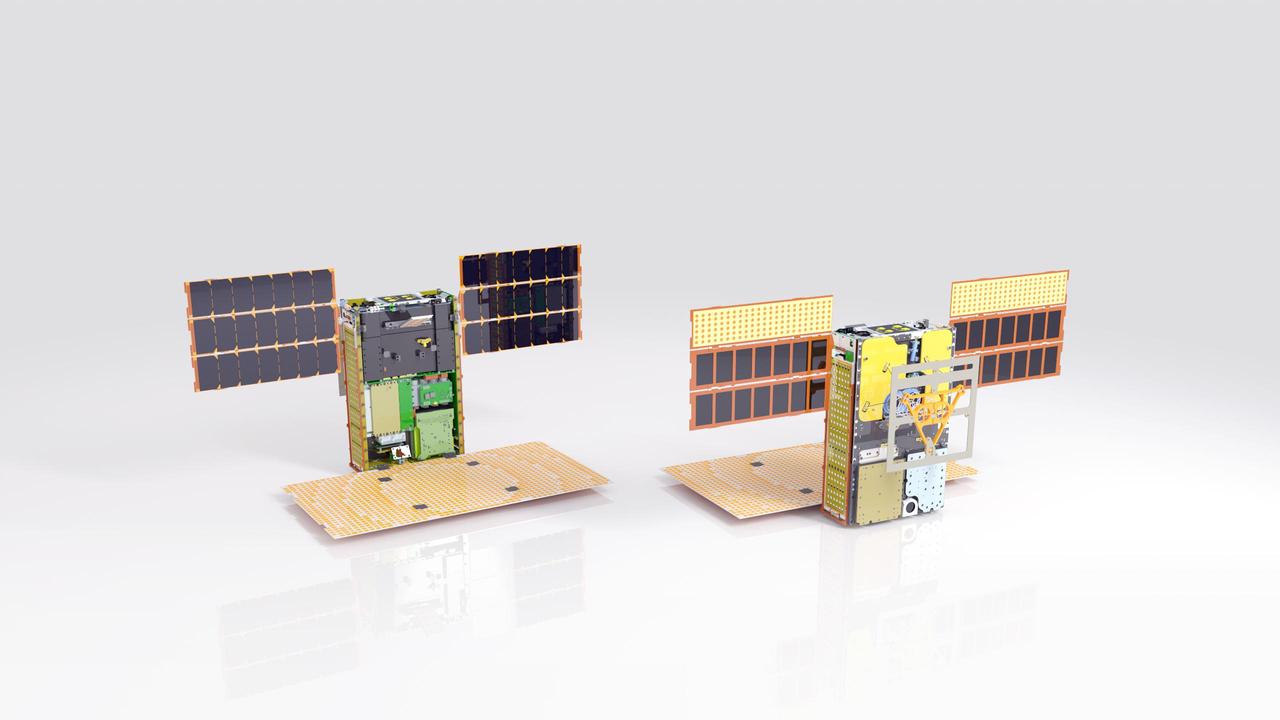
Illustration of one of the twin MarCO spacecraft with some key components labeled. Front cover is left out to show some internal components. Antennas and solar arrays are in deployed configuration. https://photojournal.jpl.nasa.gov/catalog/PIA22548
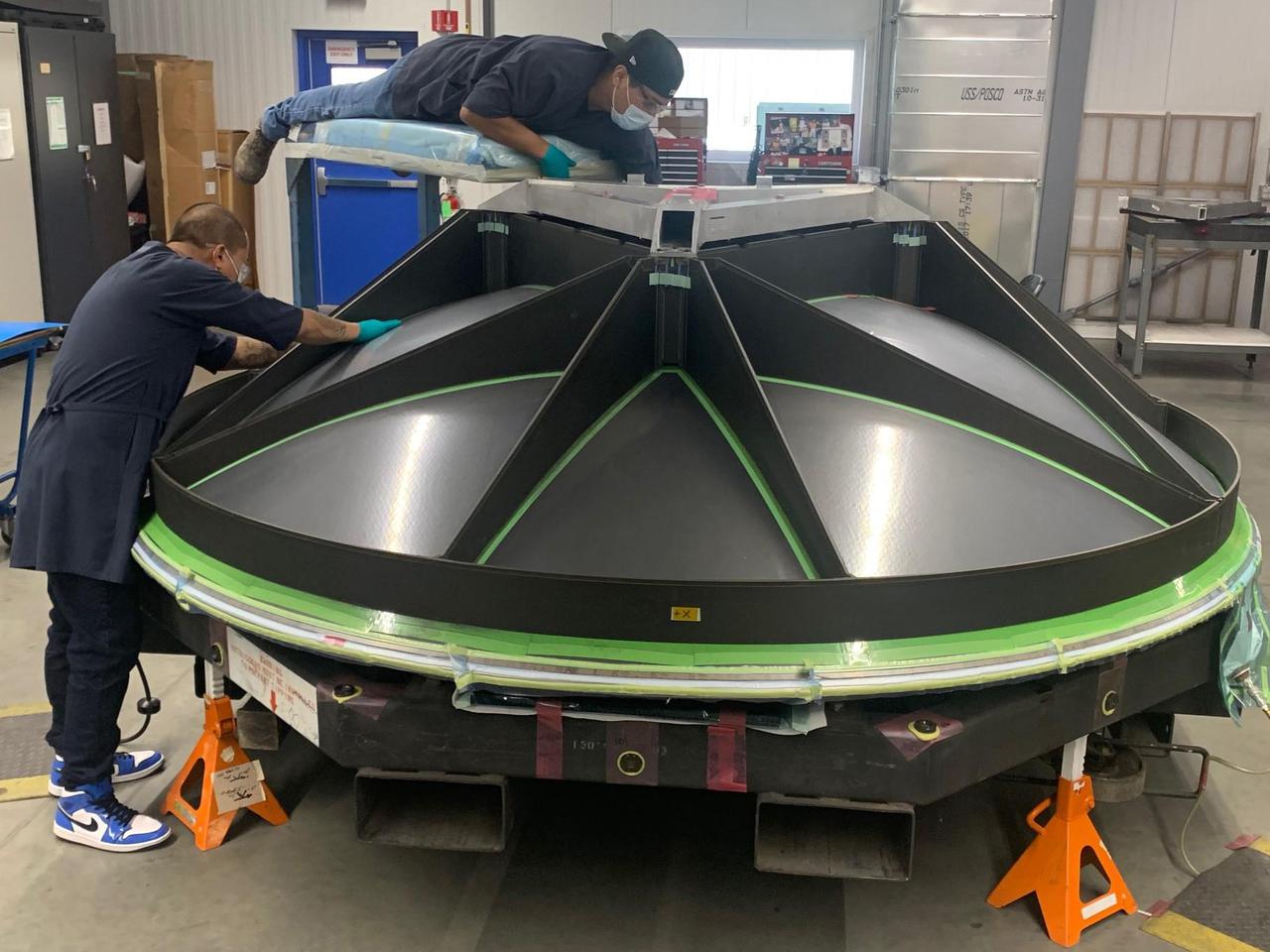
The build of a high-gain antenna, a nearly 10-foot-wide (3-meter-wide) dish, is underway for NASA's Europa Clipper spacecraft. The dish antenna, seen here face down, is being fabricated at aerospace vendor Applied Aerospace Structures Corporation (AASC) in Stockton, California. The antenna was designed by the Johns Hopkins Applied Physics Laboratory (APL) in Laurel, Maryland, and AASC, where it will be integrated along with other telecommunications hardware, into the propulsion module. The antenna downloads science data and allows ground controllers to send and receive commands and data between Earth and the spacecraft in Jupiter orbit – more than a million times farther from Earth than the International Space Station orbits. With an internal global ocean under a thick layer of ice, Jupiter's moon Europa may have the potential to harbor existing life. Europa Clipper will swoop around Jupiter on an elliptical path, dipping close to the moon on each flyby. Understanding Europa's habitability will help scientists better understand how life developed on Earth and the potential for finding life beyond our planet. Europa Clipper is set to launch in 2024. https://photojournal.jpl.nasa.gov/catalog/PIA24785
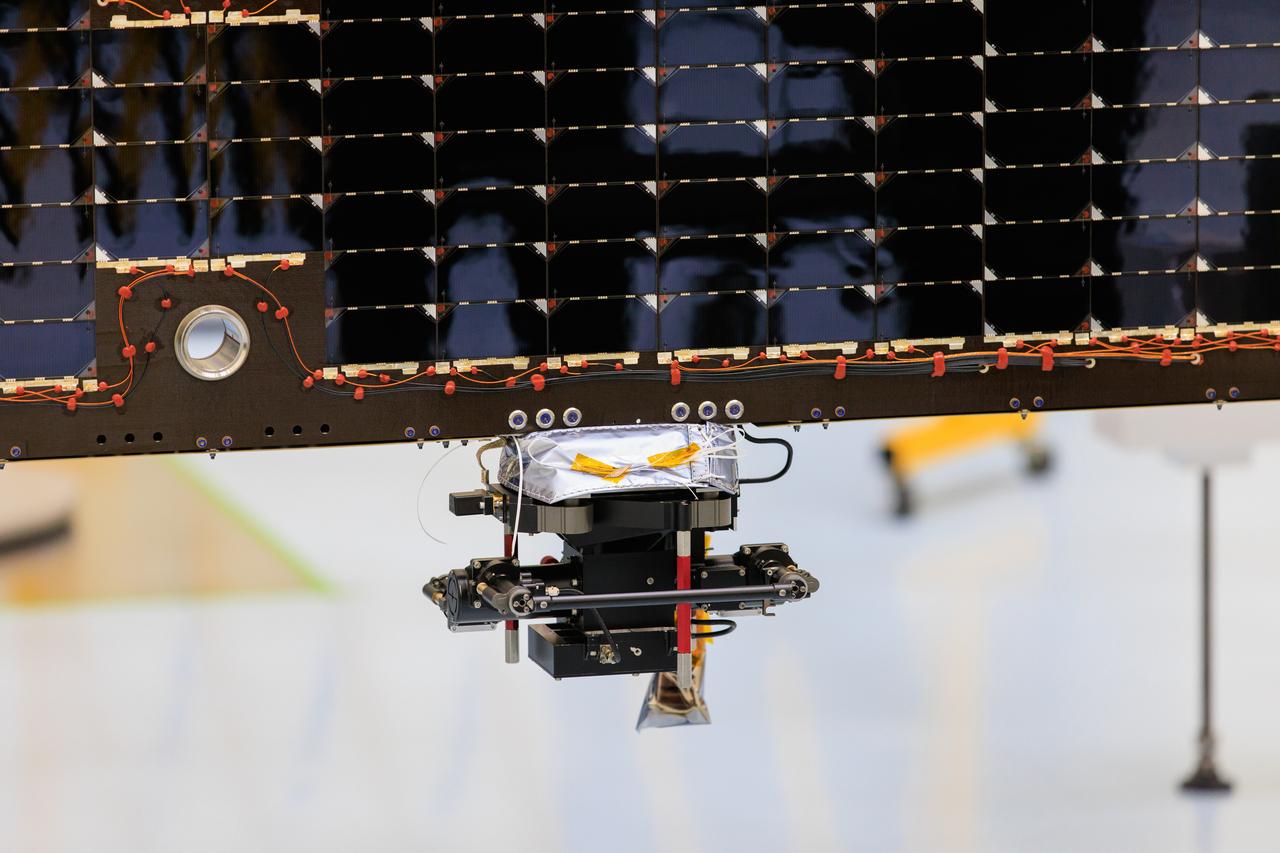
An antenna for the REASON, (Radar for Europa Assessment and Sounding: Ocean to Near-surface) instrument attaches to a solar array for NASA’s Europa Clipper spacecraft inside the Payload Hazardous Servicing Facility at the agency’s Kennedy Space Center in Florida on Wednesday, March 20, 2024. The Europa Clipper spacecraft will study Jupiter’s icy moon Europa, and the REASON instrument will use the antennas to send both both High Frequency (HF) and Very High Frequency (VHF) radio waves to penetrate up to 18 miles (30 kilometers) deep and search the ocean, measure ice thickness, and study the topography, composition, and roughness of Europa’s surface. The Europa Clipper spacecraft will ship to Florida later this year from NASA’s Jet Propulsion Lab in Southern California in preparation for launch aboard a SpaceX Falcon Heavy rocket from Kennedy’s Launch Complex 39A, targeting October.
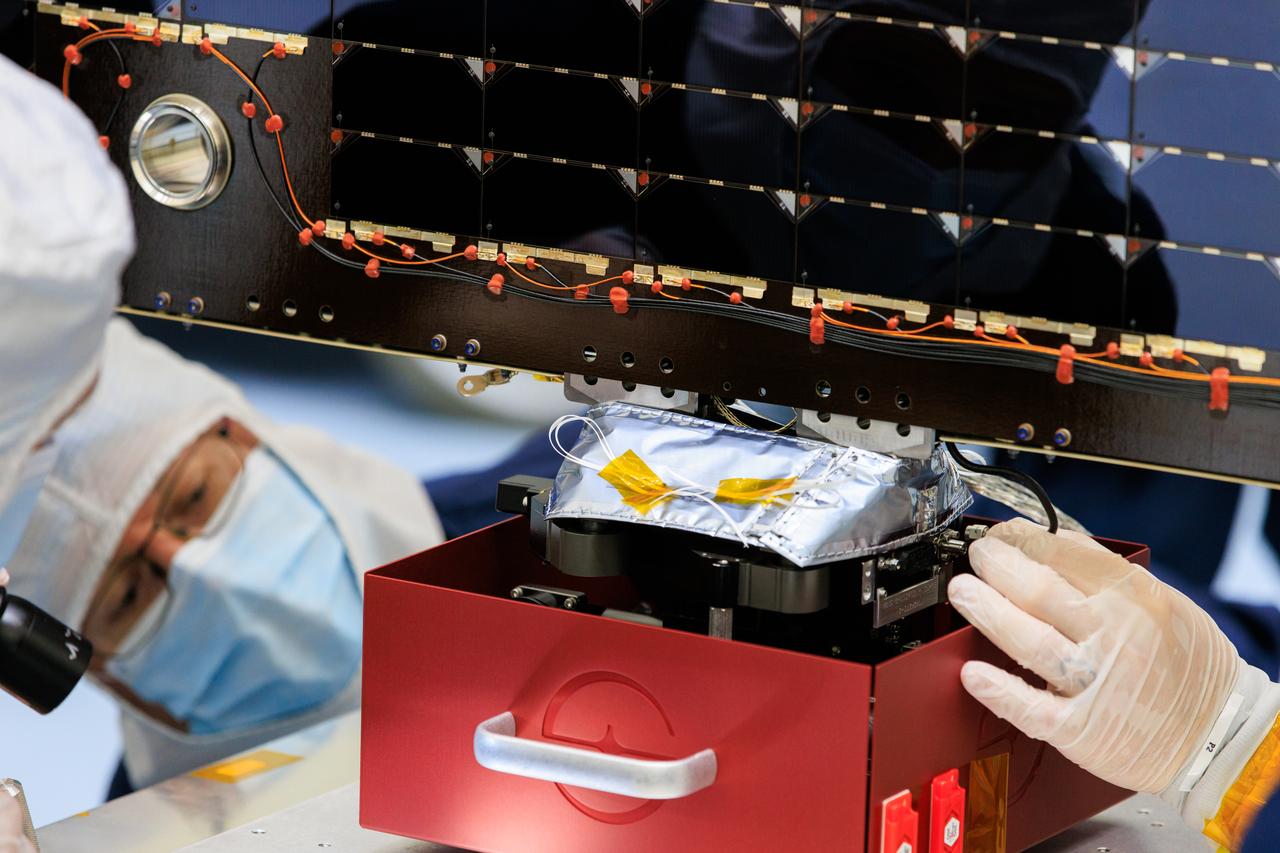
Technicians inside the Payload Hazardous Servicing Facility at NASA’s Kennedy Space Center in Florida install and test one of several antennas on a solar array Wednesday, March 20, 2024, for the agency’s Europa Clipper spacecraft which will study Jupiter’s icy moon, Europa, to determine if the planet can support life. REASON, (Radar for Europa Assessment and Sounding: Ocean to Near-surface) instrument will use the antennas to send both very high frequency radio waves and high frequency to penetrate up to 18 miles (30 kilometers) deep to search the ocean, measure ice thickness, and study the topography, composition, and roughness of Europa’s surface. The Europa Clipper spacecraft will ship to Florida later this year from NASA’s Jet Propulsion Lab in Southern California in preparation for launch aboard a SpaceX Falcon Heavy rocket from Kennedy’s Launch Complex 39A targeting October 2024.
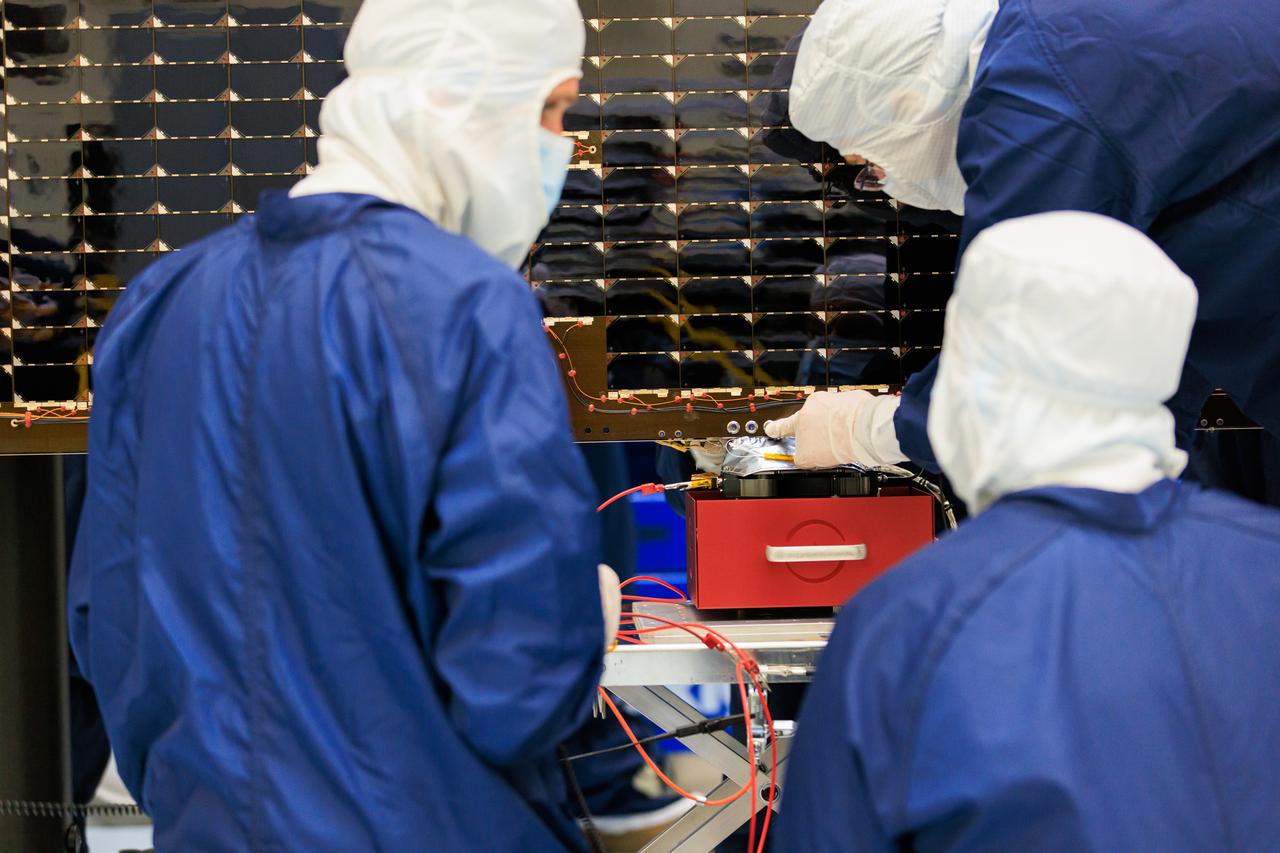
Technicians inside the Payload Hazardous Servicing Facility at NASA’s Kennedy Space Center in Florida install and test one of several antennas on a solar array Wednesday, March 20, 2024, for the agency’s Europa Clipper spacecraft which will study Jupiter’s icy moon Europa to determine if the planet has conditions that could support life. REASON, (Radar for Europa Assessment and Sounding: Ocean to Near-surface) instrument will use the antennas to send both High Frequency (HF) and Very High Frequency (VHF) radio waves to penetrate up to 18 miles (30 kilometers) deep and search the ocean, measure ice thickness, and study the topography, composition, and roughness of Europa’s surface. The Europa Clipper spacecraft will ship to Florida later this year from NASA’s Jet Propulsion Lab in Southern California in preparation for launch aboard a SpaceX Falcon Heavy rocket from Kennedy’s Launch Complex 39A targeting October 2024.
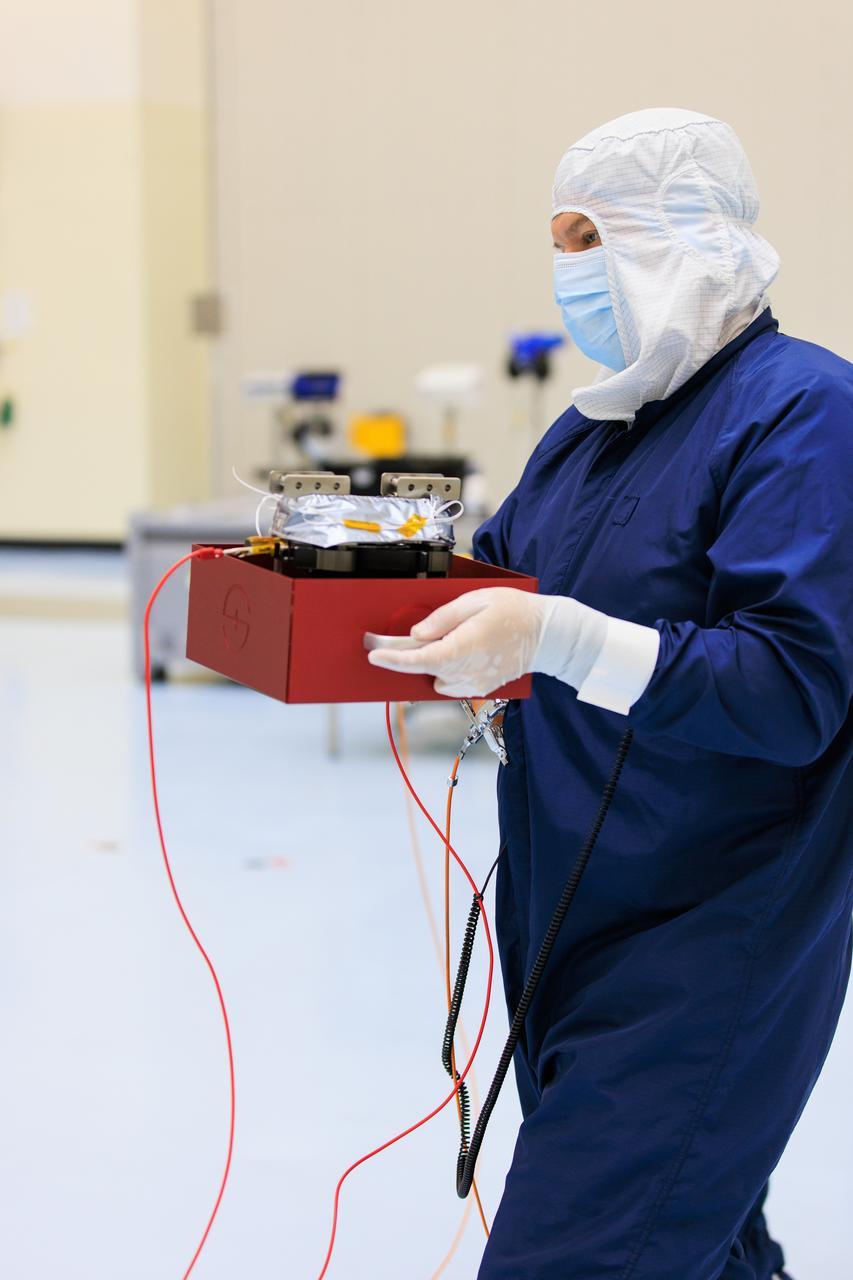
On Wednesday, March 20, 2024, a technician inside the Payload Hazardous Servicing Facility at NASA’s Kennedy Space Center in Florida carries an antenna that will attach to a solar array for the agency’s Europa Clipper spacecraft, which will study Jupiter’s icy moon Europa to determine if the planet has conditions that could support life. The REASON, (Radar for Europa Assessment and Sounding: Ocean to Near-surface) instrument will use the antennas to send both High Frequency (HF) and Very High Frequency (VHF) radio waves to penetrate up to 18 miles (30 kilometers) deep and search the ocean, measure ice thickness, and study the topography, composition, and roughness of Europa’s surface. The Europa Clipper spacecraft will ship to Florida later this year from NASA’s Jet Propulsion Lab in Southern California in preparation for launch aboard a SpaceX Falcon Heavy rocket from Kennedy’s Launch Complex 39A targeting October 2024.
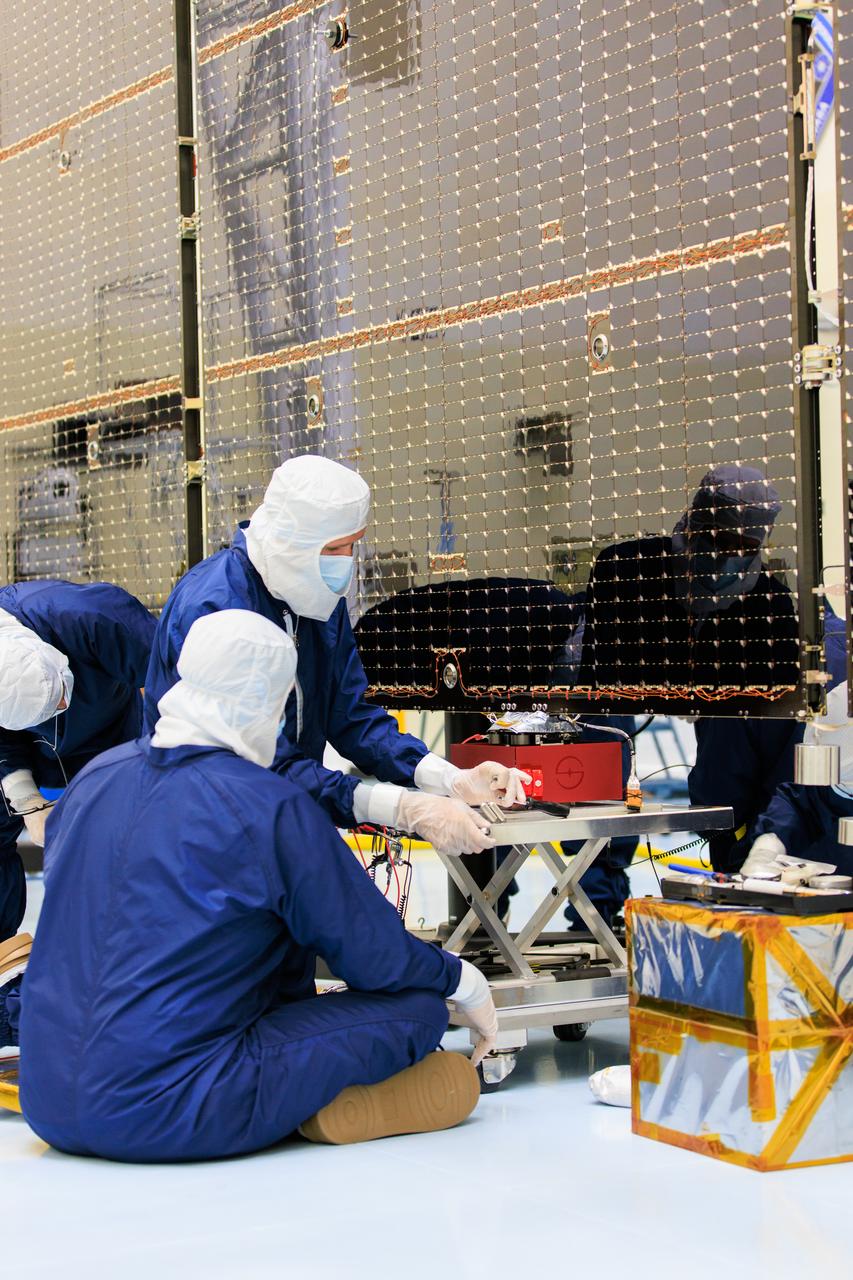
Technicians inside the Payload Hazardous Servicing Facility at NASA’s Kennedy Space Center in Florida install and test one of several antennas on a solar array Wednesday, March 20, 2024, for the agency’s Europa Clipper spacecraft which will study Jupiter’s icy moon Europa to determine if the planet has conditions that could support life. REASON, (Radar for Europa Assessment and Sounding: Ocean to Near-surface) instrument will use the antennas to send both High Frequency (HF) and Very High Frequency (VHF) radio waves to penetrate up to 18 miles (30 kilometers) deep and search the ocean, measure ice thickness, and study the topography, composition, and roughness of Europa’s surface. The Europa Clipper spacecraft will ship to Florida later this year from NASA’s Jet Propulsion Lab in Southern California in preparation for launch aboard a SpaceX Falcon Heavy rocket from Kennedy’s Launch Complex 39A targeting October 2024.
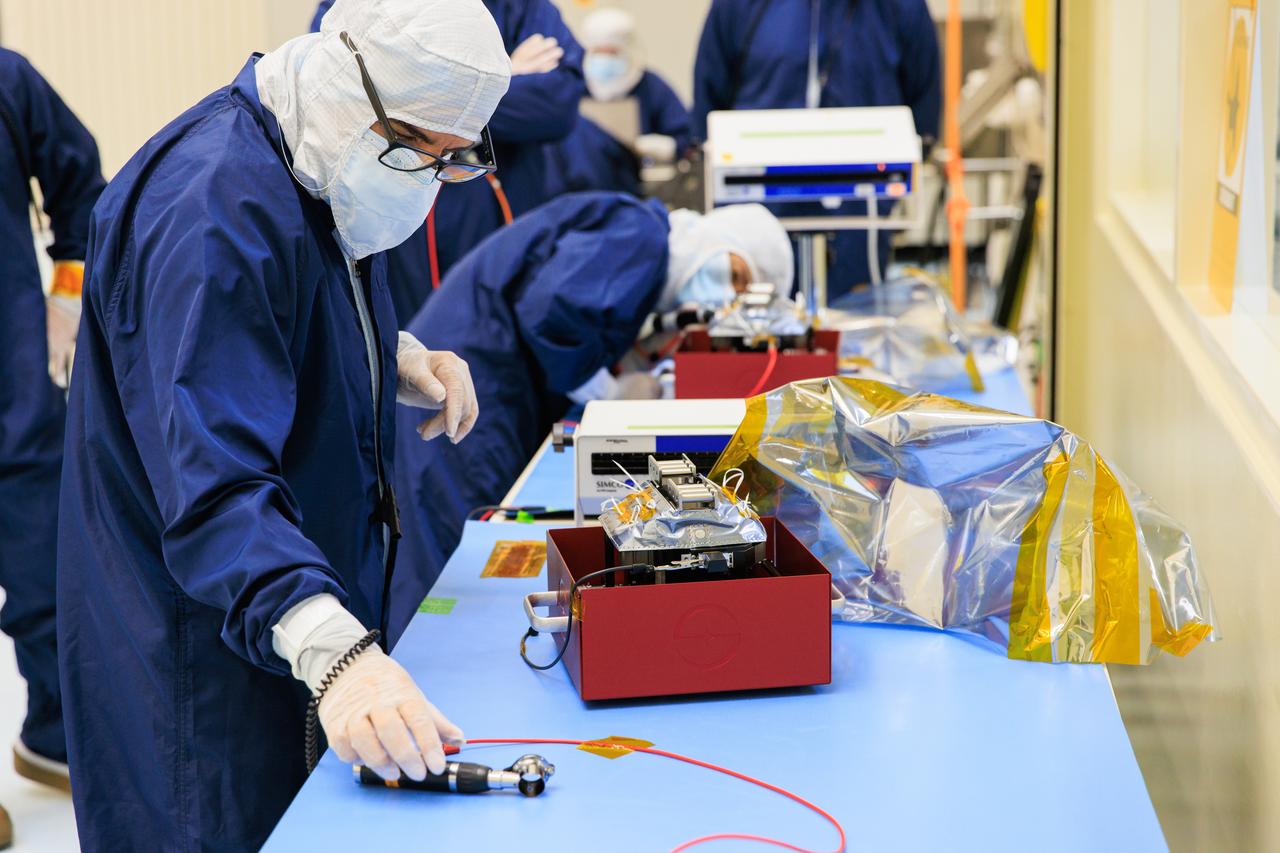
Technicians inside the Payload Hazardous Servicing Facility at NASA’s Kennedy Space Center in Florida test antennas on Wednesday, March 20, 2024, shortly before installing them on a solar array for the agency’s Europa Clipper spacecraft, which will study Jupiter’s icy moon Europa to determine if the planet has conditions that could support life. The REASON, (Radar for Europa Assessment and Sounding: Ocean to Near-surface) instrument will use the antennas to send both High Frequency (HF) and Very High Frequency (VHF) to penetrate up to 18 miles (30 kilometers) deep and search the ocean, measure ice thickness, and study the topography, composition, and roughness of Europa’s surface. The Europa Clipper spacecraft will ship to Florida later this year from NASA’s Jet Propulsion Lab in Southern California in preparation for launch aboard a SpaceX Falcon Heavy rocket from Kennedy’s Launch Complex 39A targeting October 2024.
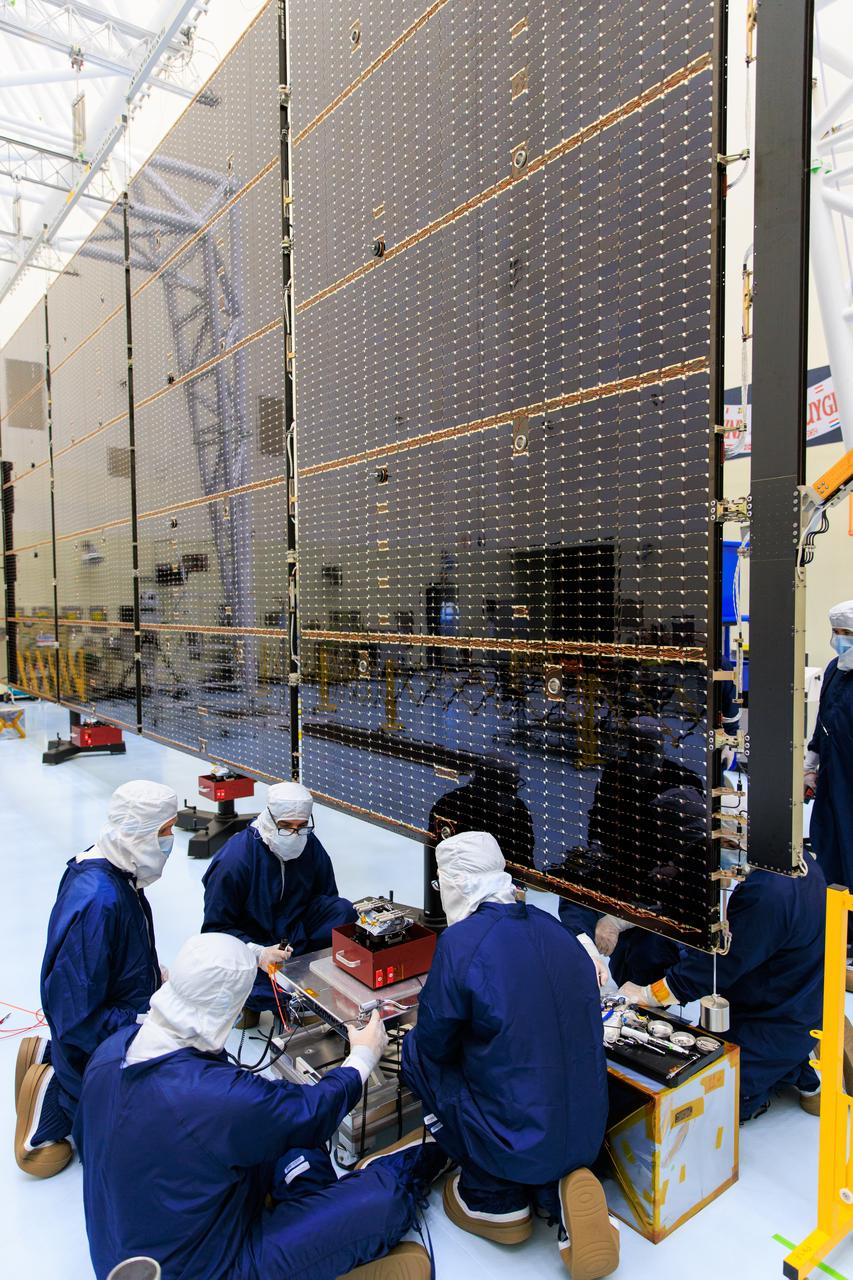
Technicians inside the Payload Hazardous Servicing Facility at NASA’s Kennedy Space Center in Florida install and test one of several antennas on a solar array Wednesday, March 20, 2024, for the agency’s Europa Clipper spacecraft which will study Jupiter’s icy moon Europa to determine if the planet has conditions that could support life. REASON, (Radar for Europa Assessment and Sounding: Ocean to Near-surface) instrument will use the antennas to send both High Frequency (HF) and Very High Frequency (VHF) radio waves to penetrate up to 18 miles (30 kilometers) deep and search the ocean, measure ice thickness, and study the topography, composition, and roughness of Europa’s surface. The Europa Clipper spacecraft will ship to Florida later this year from NASA’s Jet Propulsion Lab in Southern California in preparation for launch aboard a SpaceX Falcon Heavy rocket from Kennedy’s Launch Complex 39A targeting October 2024.
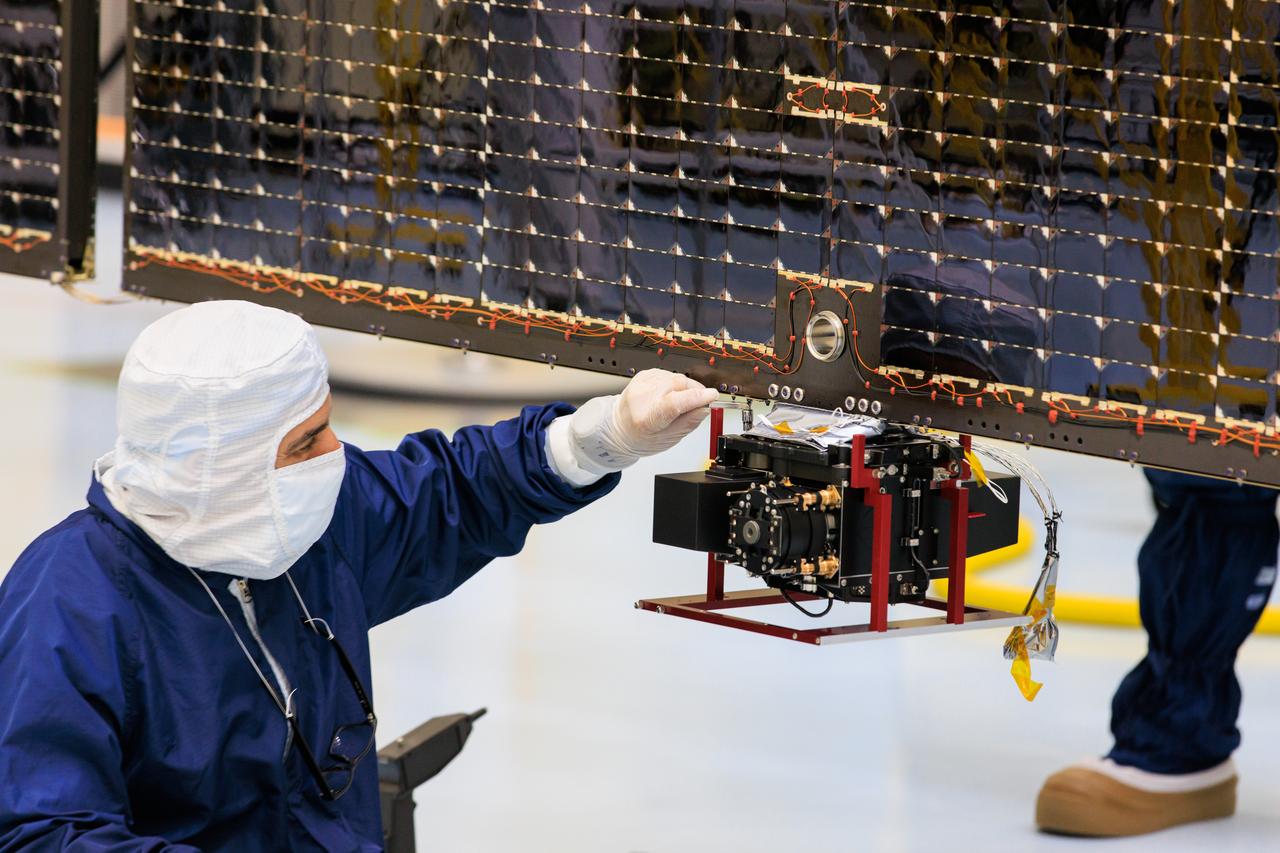
Technicians inside the Payload Hazardous Servicing Facility at NASA’s Kennedy Space Center in Florida install and test antennas on a solar array on Wednesday, March 20, 2024, for the agency’s Europa Clipper spacecraft which will study Jupiter’s icy moon Europa to determine if the planet has conditions that could support life. The REASON, (Radar for Europa Assessment and Sounding: Ocean to Near-surface) instrument will use the antennas to send both High Frequency (HF) and Very High Frequency (VHF) radio waves to penetrate up to 18 miles (30 kilometers) deep and search the ocean, measure ice thickness, and study the topography, composition, and roughness of Europa’s surface. The Europa Clipper spacecraft will ship to Florida later this year from NASA’s Jet Propulsion Lab in Southern California in preparation for launch aboard a SpaceX Falcon Heavy rocket from Kennedy’s Launch Complex 39A targeting October.

Technicians inside the Payload Hazardous Servicing Facility at NASA’s Kennedy Space Center in Florida install and test one of several antennas on a solar array Wednesday, March 20, 2024, for the agency’s Europa Clipper spacecraft which will study Jupiter’s icy moon Europa to determine if the planet has conditions that could support life. REASON, (Radar for Europa Assessment and Sounding: Ocean to Near-surface) instrument will use the antennas to send both High Frequency (HF) and Very High Frequency (VHF) radio waves to penetrate up to 18 miles (30 kilometers) deep and search the ocean, measure ice thickness, and study the topography, composition, and roughness of Europa’s surface. The Europa Clipper spacecraft will ship to Florida later this year from NASA’s Jet Propulsion Lab in Southern California in preparation for launch aboard a SpaceX Falcon Heavy rocket from Kennedy’s Launch Complex 39A targeting October 2024.
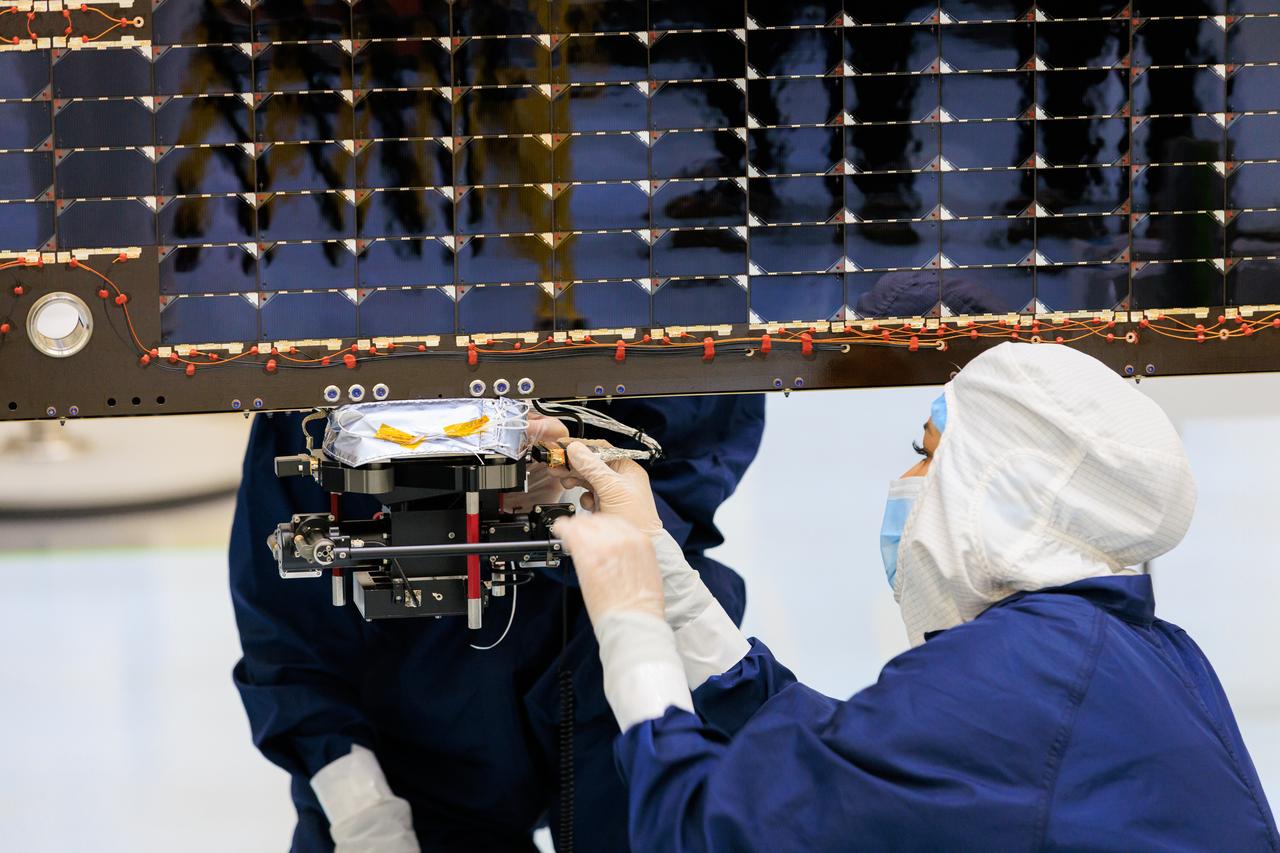
Technicians inside the Payload Hazardous Servicing Facility at NASA’s Kennedy Space Center in Florida install and test antennas on a solar array on Wednesday, March 20, 2024, for the agency’s Europa Clipper spacecraft which will study Jupiter’s icy moon Europa to determine if the planet has conditions that could support life. The REASON, (Radar for Europa Assessment and Sounding: Ocean to Near-surface) instrument will use the antennas to send both both High Frequency (HF) and Very High Frequency (VHF) radio waves to penetrate up to 18 miles (30 kilometers) deep and search the ocean, measure ice thickness, and study the topography, composition, and roughness of Europa’s surface. The Europa Clipper spacecraft will ship to Florida later this year from NASA’s Jet Propulsion Lab in Southern California in preparation for launch aboard a SpaceX Falcon Heavy rocket from Kennedy’s Launch Complex 39A targeting October.
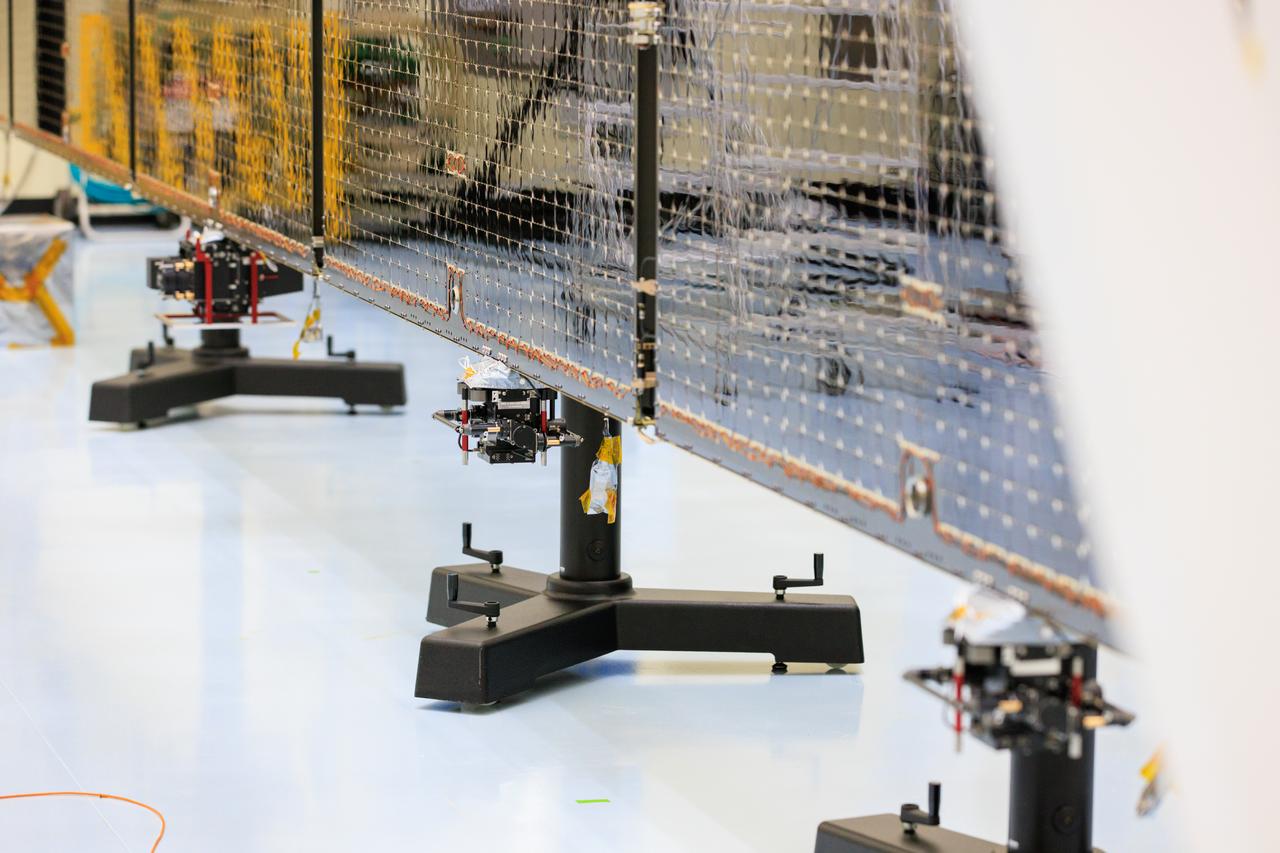
Technicians inside the Payload Hazardous Servicing Facility at NASA’s Kennedy Space Center in Florida install and test antennas on a solar array on Wednesday, March 20, 2024, for the agency’s Europa Clipper spacecraft which will study Jupiter’s icy moon Europa to determine if the planet has conditions that could support life. The REASON, (Radar for Europa Assessment and Sounding: Ocean to Near-surface) instrument will use the antennas to send both High Frequency (HF) and Very High Frequency (VHF) radio waves to penetrate up to 18 miles (30 kilometers) deep and search the ocean, measure ice thickness, and study the topography, composition, and roughness of Europa’s surface. The Europa Clipper spacecraft will ship to Florida later this year from NASA’s Jet Propulsion Lab in Southern California in preparation for launch aboard a SpaceX Falcon Heavy rocket from Kennedy’s Launch Complex 39A targeting October.
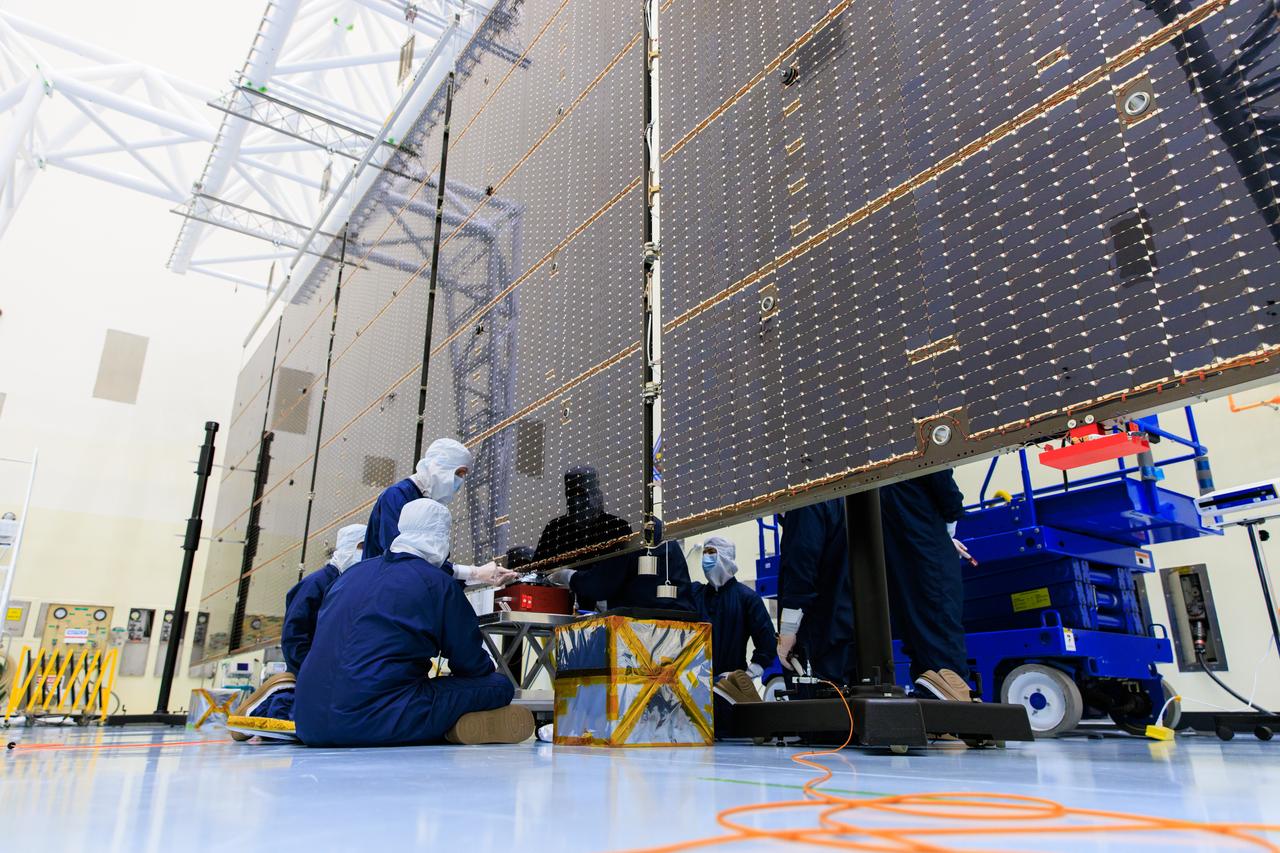
Technicians inside the Payload Hazardous Servicing Facility at NASA’s Kennedy Space Center in Florida install and test one of several antennas on a solar array Wednesday, March 20, 2024, for the agency’s Europa Clipper spacecraft which will study Jupiter’s icy moon Europa to determine if the planet has conditions that could support life. REASON, (Radar for Europa Assessment and Sounding: Ocean to Near-surface) instrument will use the antennas to send both High Frequency (HF) and Very High Frequency (VHF) radio waves to penetrate up to 18 miles (30 kilometers) deep and search the ocean, measure ice thickness, and study the topography, composition, and roughness of Europa’s surface. The Europa Clipper spacecraft will ship to Florida later this year from NASA’s Jet Propulsion Lab in Southern California in preparation for launch aboard a SpaceX Falcon Heavy rocket from Kennedy’s Launch Complex 39A targeting October 2024.
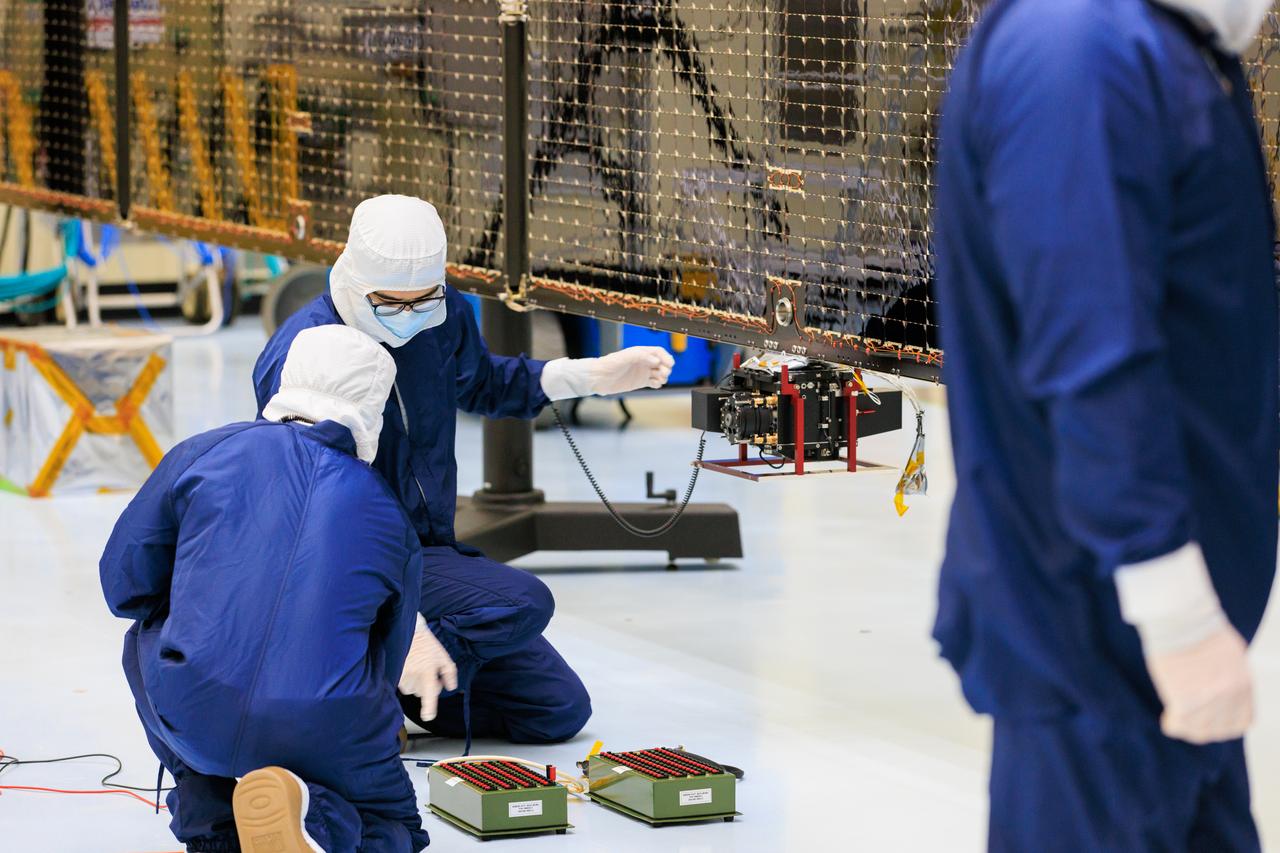
Technicians inside the Payload Hazardous Servicing Facility at NASA’s Kennedy Space Center in Florida install and test antennas on a solar array on Wednesday, March 20, 2024, for the agency’s Europa Clipper spacecraft which will study Jupiter’s icy moon Europa to determine if the planet has conditions that could support life. The REASON, (Radar for Europa Assessment and Sounding: Ocean to Near-surface) instrument will use the antennas to send both High Frequency (HF) and Very High Frequency (VHF) radio waves to penetrate up to 18 miles (30 kilometers) deep and search the ocean, measure ice thickness, and study the topography, composition, and roughness of Europa’s surface. The Europa Clipper spacecraft will ship to Florida later this year from NASA’s Jet Propulsion Lab in Southern California in preparation for launch aboard a SpaceX Falcon Heavy rocket from Kennedy’s Launch Complex 39A targeting October.

A full-scale prototype of the high-gain antenna on NASA's Europa Clipper spacecraft is undergoing testing in the Experimental Test Range at NASA's Langley Research Center in Hampton, Virginia. The Europa Clipper is expected to launch on a mission to conduct detailed reconnaissance of Jupiter's moon Europa in the 2020s. https://photojournal.jpl.nasa.gov/catalog/PIA22773

DSS43 is a 70-meter-wide (230-feet-wide) radio antenna at the Deep Space Network's Canberra facility in Australia. It is the only antenna that can send commands to the Voyager 2 spacecraft. https://photojournal.jpl.nasa.gov/catalog/PIA23682
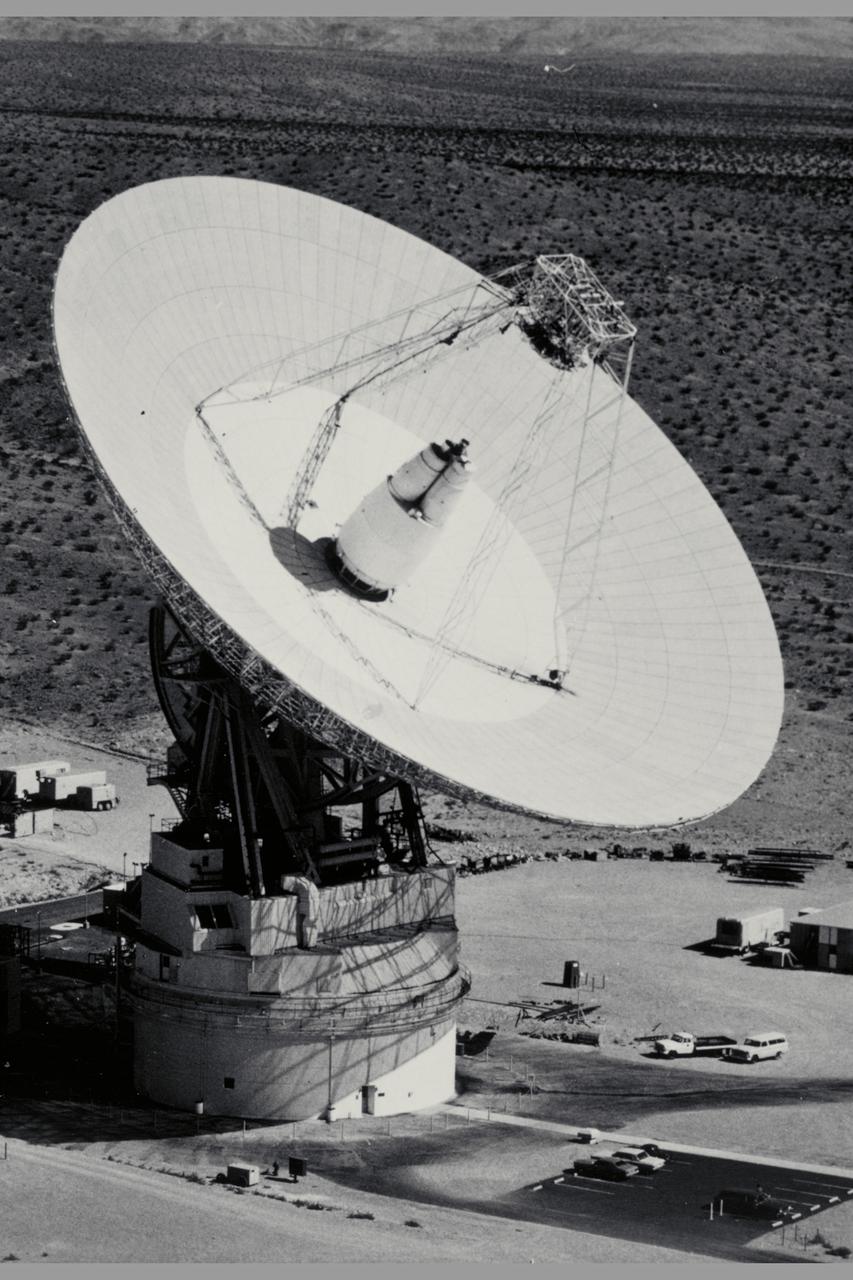
210' Dish Antenna at Goldstone Ca - used in tracking Pioneer spacecraft

STS031-76-026 (25 April 1990) --- Most of the giant Hubble Space Telescope (HST) can be seen as it is suspended in space by Discovery's Remote Manipulator System (RMS) following the deployment of part of its solar panels and antennae. The photo was taken with a handheld Hasselblad camera. This was among the first photos NASA released on April 30, 1990, from the five-day STS 31 mission.
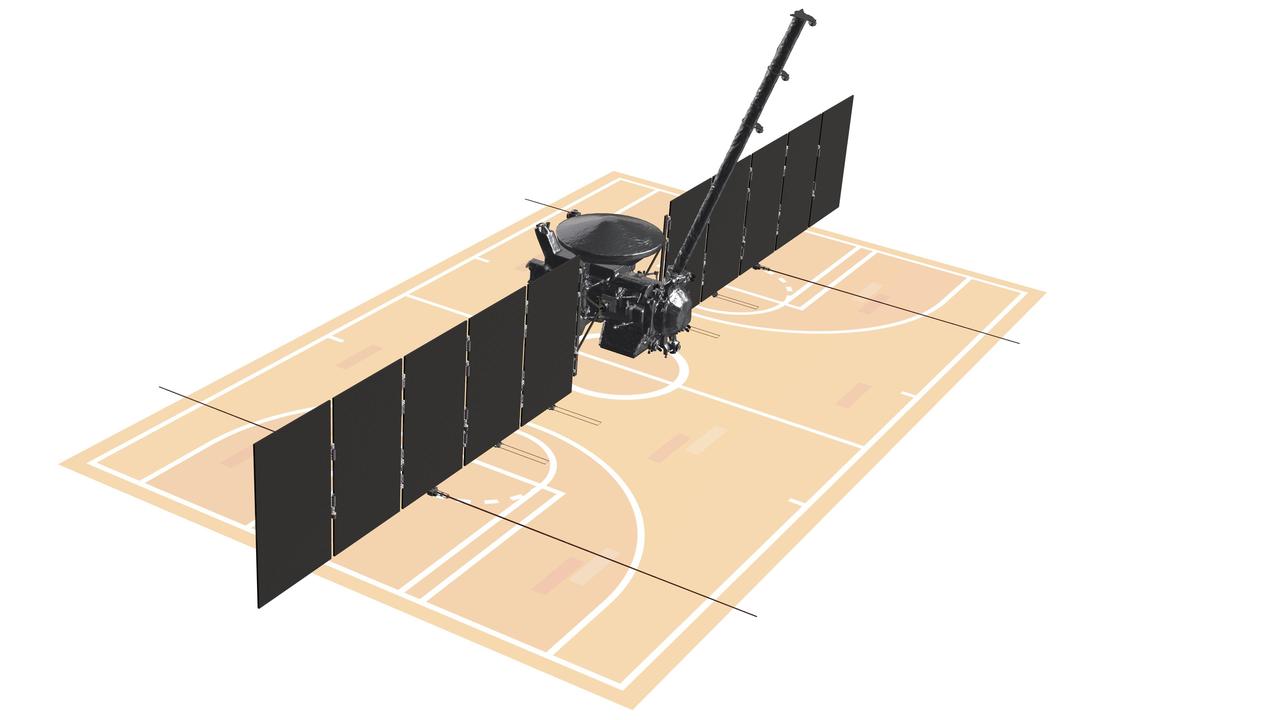
With its solar arrays and antennas fully extended, the Europa Clipper spacecraft stretches out larger than a basketball court: approximately 100 feet (30.5 meters) long and 58 feet (17.6 meters) wide. Depicted in this artist's concept against an illustration of a basketball court, Europa Clipper is the largest spacecraft NASA has ever built for a planetary mission. Europa Clipper is bound for the Jupiter system, where it will study the gas giant's icy moon Europa. Europa Clipper's three main science objectives are to determine the thickness of the moon's icy shell and its interactions with the ocean below, to investigate its composition, and to characterize its geology. The mission's detailed exploration of Europa will help scientists better understand the astrobiological potential for habitable worlds beyond our planet. https://photojournal.jpl.nasa.gov/catalog/PIA26433
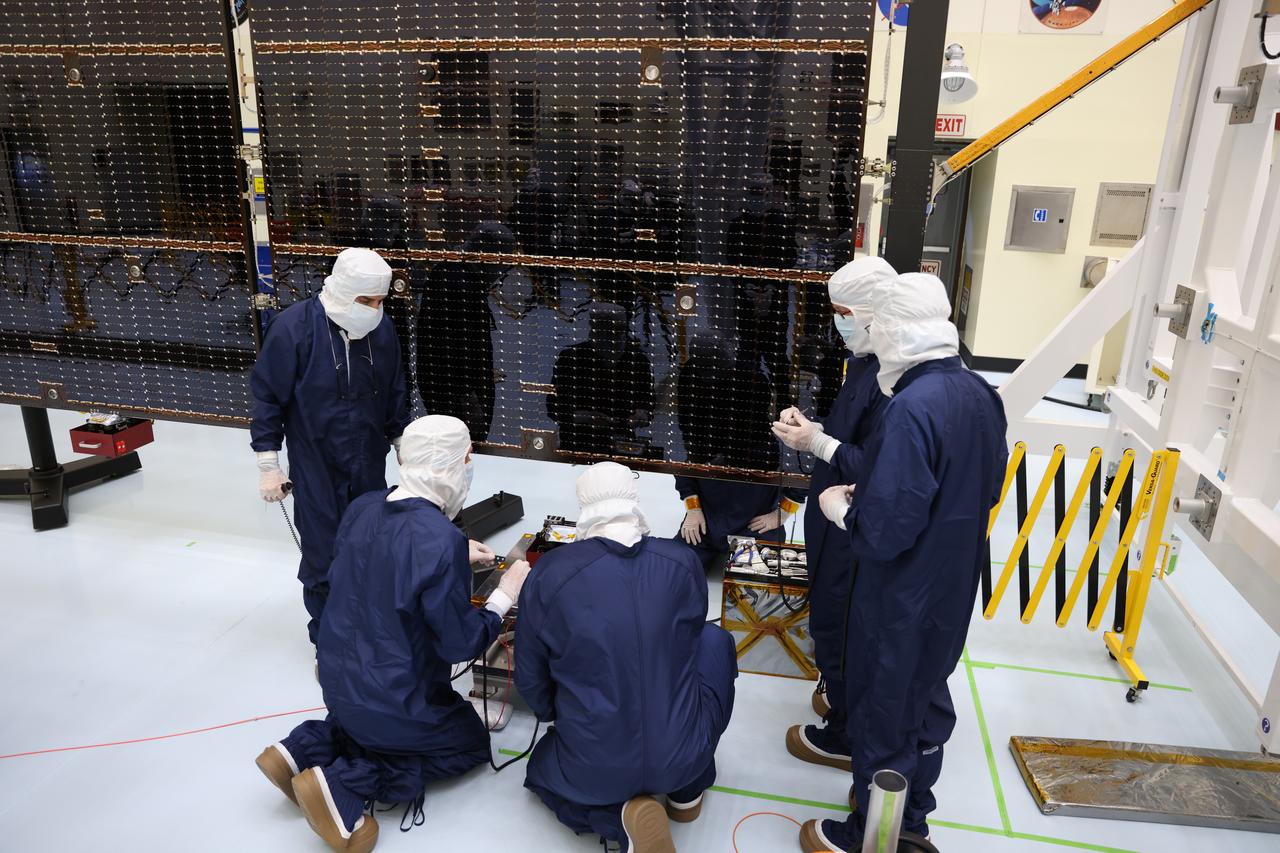
On March 20, technicians working inside the Payload Hazardous Servicing Facility at the agency’s Kennedy Space Center in Florida installed and began to test antennas on a solar array for NASA’s Europa Clipper spacecraft. The spacecraft will ship to Florida later this year from NASA’s Jet Propulsion Lab in Southern California in preparation for launch aboard a SpaceX Falcon Heavy rocket from Kennedy’s Launch Complex 39A. Europa Clipper is the largest spacecraft NASA has ever developed for a planetary mission, and it will seek to determine whether there are places below the surface of Jupiter’s icy moon, Europa, that could support life.
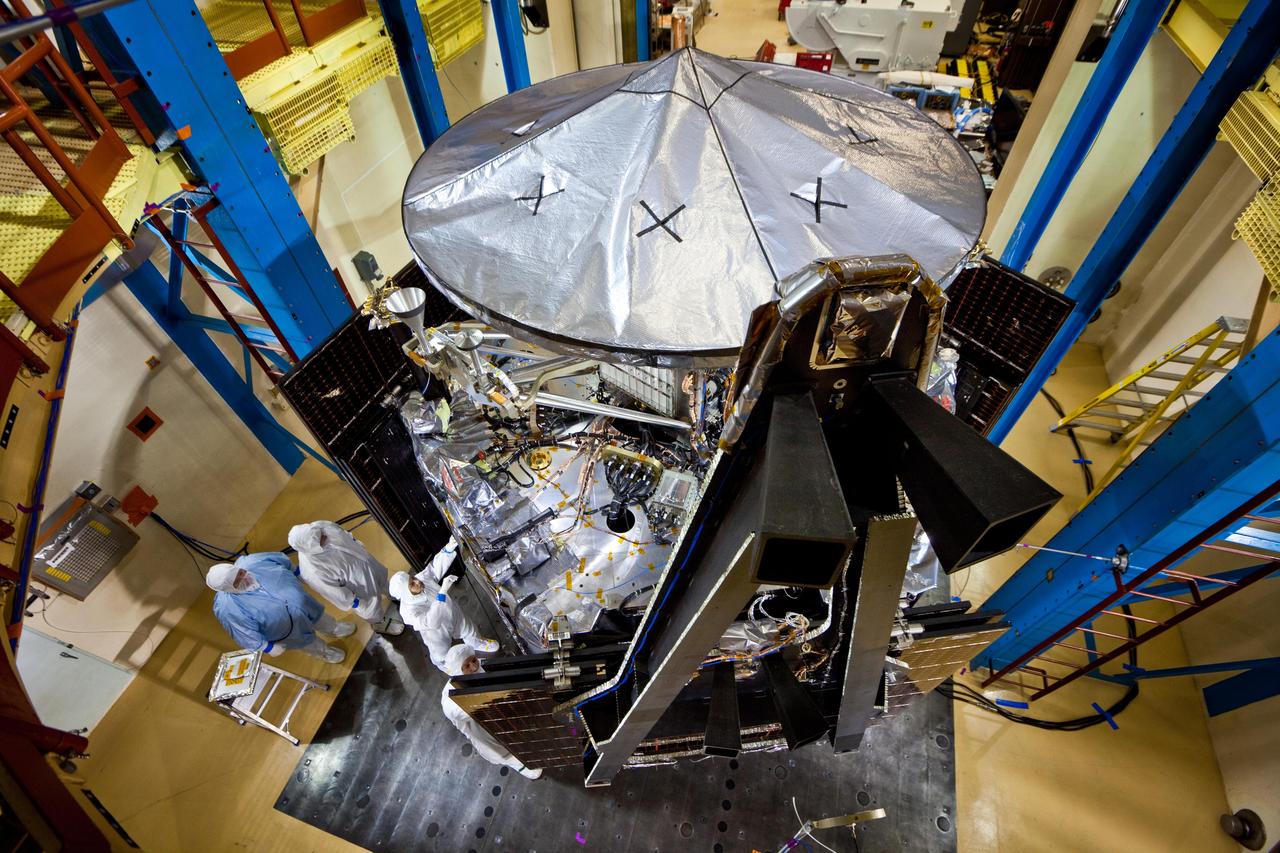
This image shows NASA Juno spacecraft undergoing environmental testing at Lockheed Martin Space Systems on Jan. 26, 2011. All 3 solar array wings are installed and stowed, and the large high-gain antenna is in place on the top of the avionics vault.
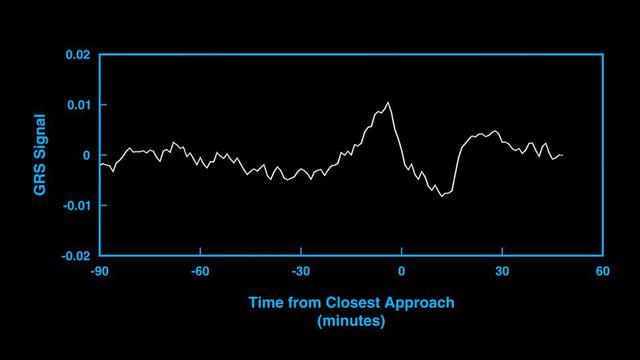
This animation and audio represent the subtle gravitational signal acquired by an antenna of NASA's Deep Space Network as the agency's Juno spacecraft performed a close flyby of Jupiter's Great Red Spot in July 2019. The changes in the signal frequency represent the changes in the local gravity as the spacecraft flew low overhead. Juno flew twice over the Great Red Spot in 2019, with the goal of picking up the subtle gravitational signal of the vortex. The concentration of mass caused by the powerful winds surrounding the Great Red Spot minutely change the spacecraft's velocity, inducing a Doppler shift on the radio signals relayed back to Earth. Movie available at https://photojournal.jpl.nasa.gov/catalog/PIA24963
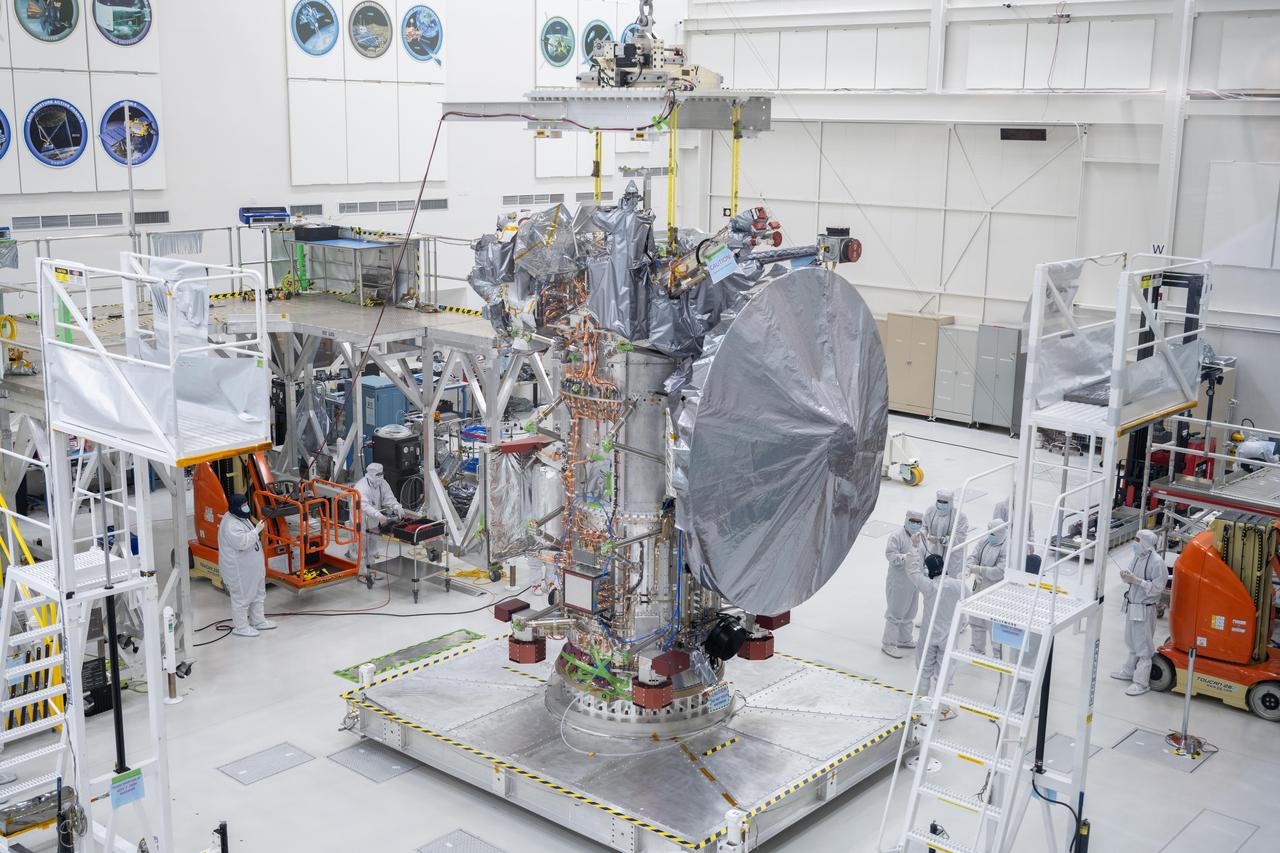
NASA's Europa Clipper spacecraft boasts its new 10-foot (3-meter) high-gain antenna, after its Aug. 14, 2023, installation in High Bay 1 of the Spacecraft Assembly Facility at the agency's Jet Propulsion Laboratory in Southern California. The orbiter is being assembled in preparation for launch to Jupiter's moon Europa in October 2024. The precision-engineered dish was attached to the spacecraft in carefully choreographed stages over the course of several hours. Europa Clipper will need the huge antenna to transmit data hundreds of millions of miles back to Earth. Scientists believe the icy moon Europa harbors a vast internal ocean that may have conditions suitable for supporting life. The spacecraft will fly by the moon about 50 times while its science instruments gather data on the moon's atmosphere, surface, and interior – information that will help scientists learn more about the ocean, the ice crust, and potential plumes that may be venting subsurface water into space. https://photojournal.jpl.nasa.gov/catalog/PIA25958
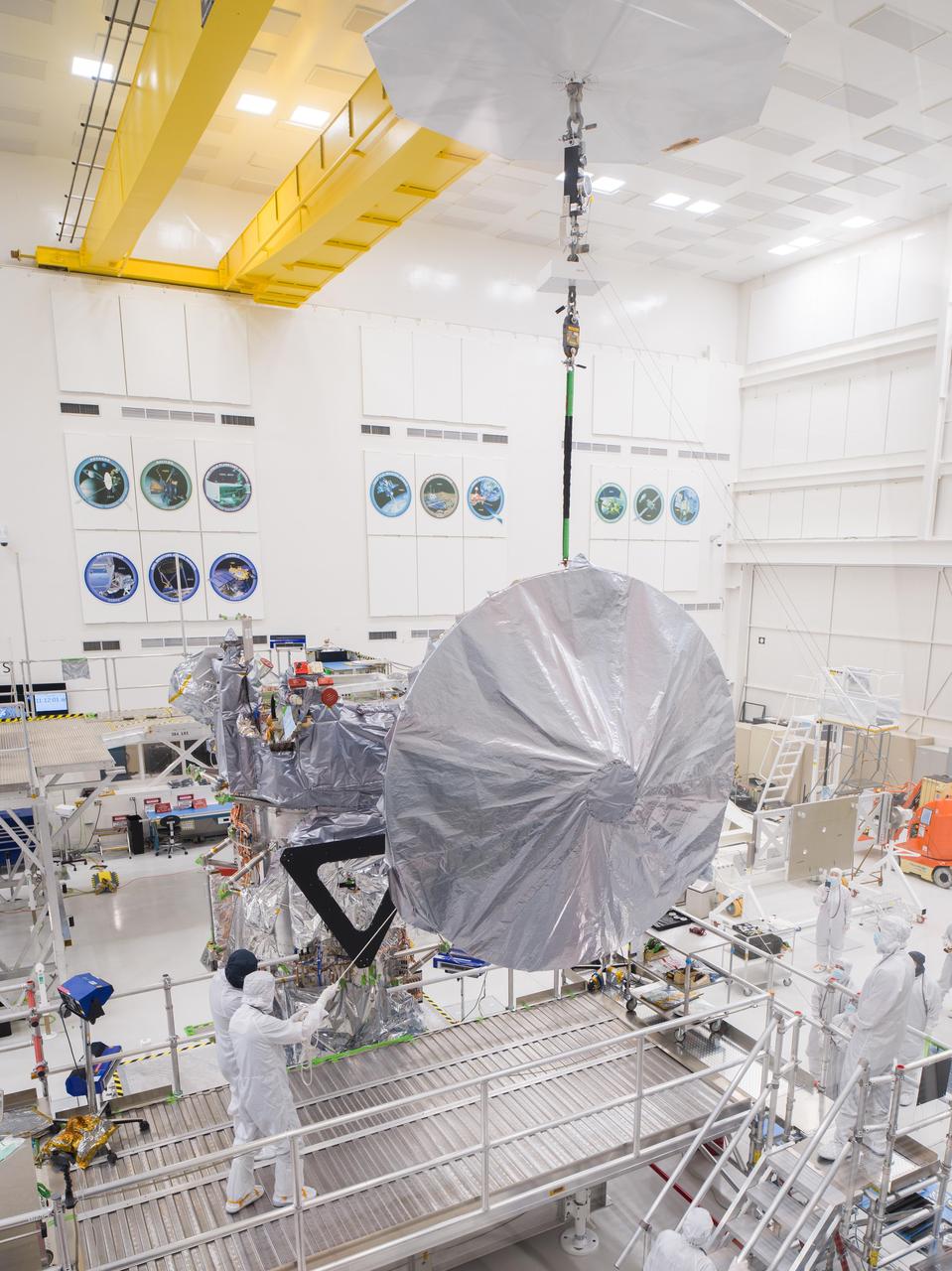
Engineers and technicians use a crane to lift a 10-foot (3-meter) high-gain antenna as they prepare to install it on NASA's Europa Clipper spacecraft on Aug. 14, 2023. The orbiter is being assembled in the clean room of High Bay 1 at the agency's Jet Propulsion Laboratory in Southern California in preparation for its launch to Jupiter's moon Europa in October 2024. The precision-engineered dish was attached to the spacecraft in carefully choreographed stages over the course of several hours. Europa Clipper will need the huge antenna to transmit data hundreds of millions of miles back to Earth. Scientists believe the icy moon Europa harbors a vast internal ocean that may have conditions suitable for supporting life. The spacecraft will fly by the moon about 50 times while its science instruments gather data on the moon's atmosphere, surface, and interior – information that will help scientists learn more about the ocean, the ice crust, and potential plumes that may be venting subsurface water into space. https://photojournal.jpl.nasa.gov/catalog/PIA25956
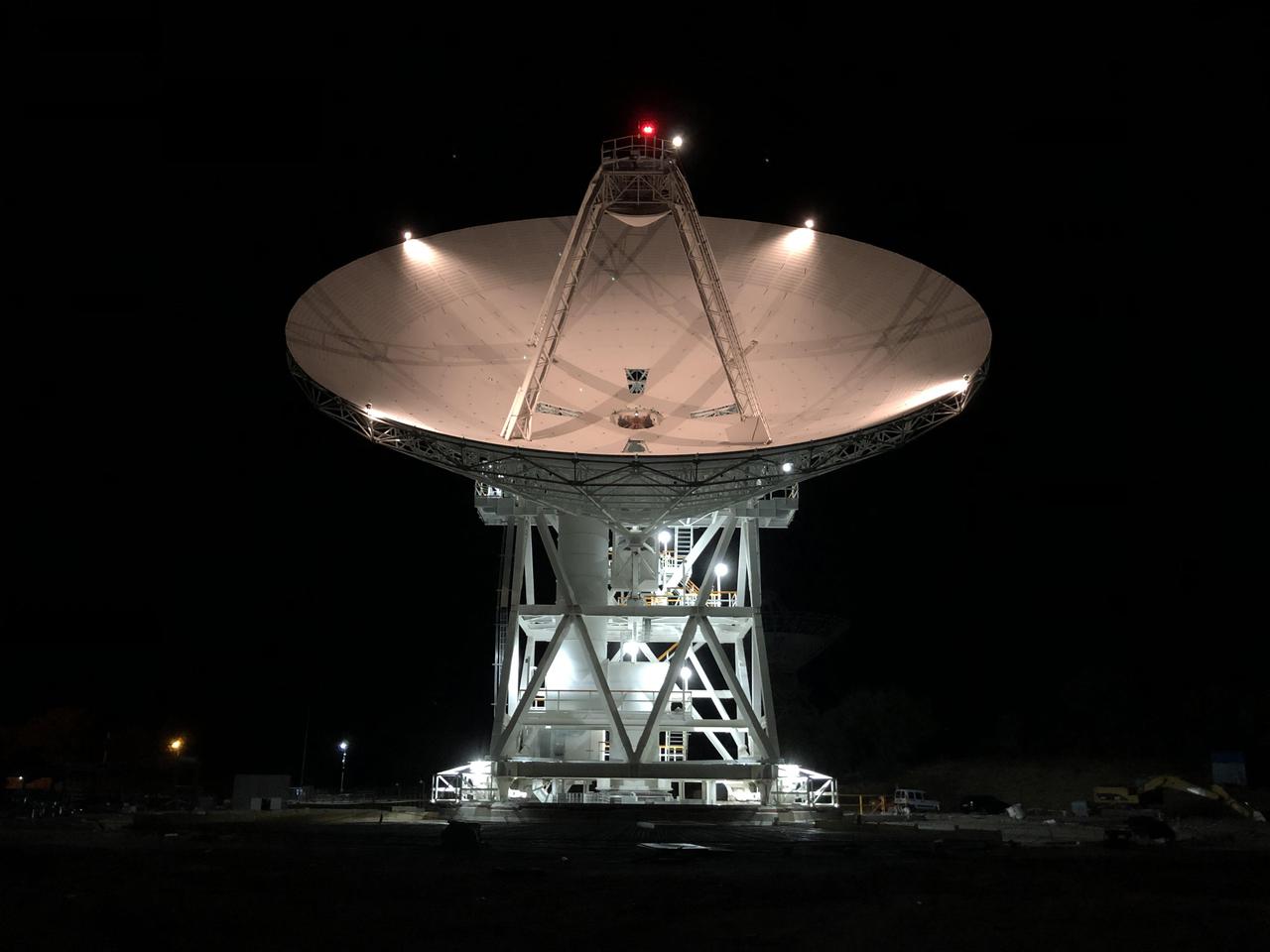
Deep Space Station 56, or DSS-56, is a powerful 34-meter-wide (112-foot-wide) antenna that was added to the Deep Space Network's Madrid Deep Space Communications Complex in Spain in early 2021 after beginning construction in 2017. Deep Space Network (DSN) radio antennas communicate with spacecraft throughout the solar system. Previous antennas have been limited in the frequency bands they can receive and transmit, often being restricted to communicating only with specific spacecraft. DSS-56 is the first to use the DSN's full range of communication frequencies. This means DSS-56 is an "all-in-one" antenna that can communicate with all the missions that the DSN supports and can be used as a backup for any of the Madrid complex's other antennas. With the addition of DSS-56 and other 34-meter antennas to all three DSN complexes, the network is preparing to play a critical role in ensuring communication and navigation support for upcoming Moon and Mars missions and the crewed Artemis missions. https://photojournal.jpl.nasa.gov/catalog/PIA24163
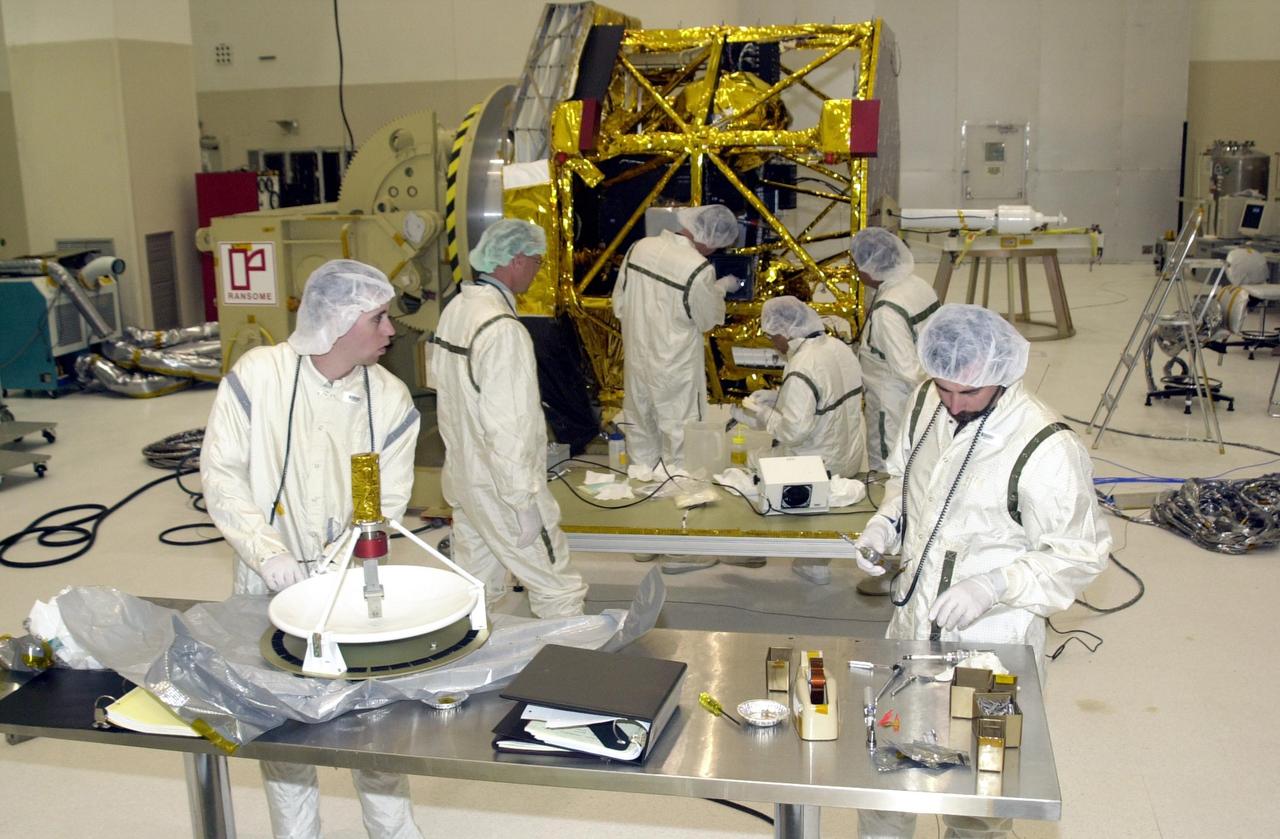
KENNEDY SPACE CENTER, FLA. -- Workers prepare the high gain antenna (foreground, on table) for installation on the Comet Nucleus Tour (CONTOUR) spacecraft in the Spacecraft Assembly and Encapsulation Facility 2 (SAEF-2). This second antenna will be installed near the larger antenna already attached. CONTOUR, scheduled for launch July 1, 2002, from LC 17A at Cape Canaveral Air Force Station, will provide the first detailed look into the heart of a comet -- the nucleus. The spacecraft will fly as close as 60 miles (100 kilometers) to at least two comets, Encke and Schwassmann-Wachmann 3. It will take the sharpest pictures yet of the nucleus while analyzing the gas and dust that surround these rocky, icy building blocks of the solar system. The Applied Physics Laboratory of Johns Hopkins University, Baltimore, Md., built CONTOUR and will also be in control of the spacecraft after launch
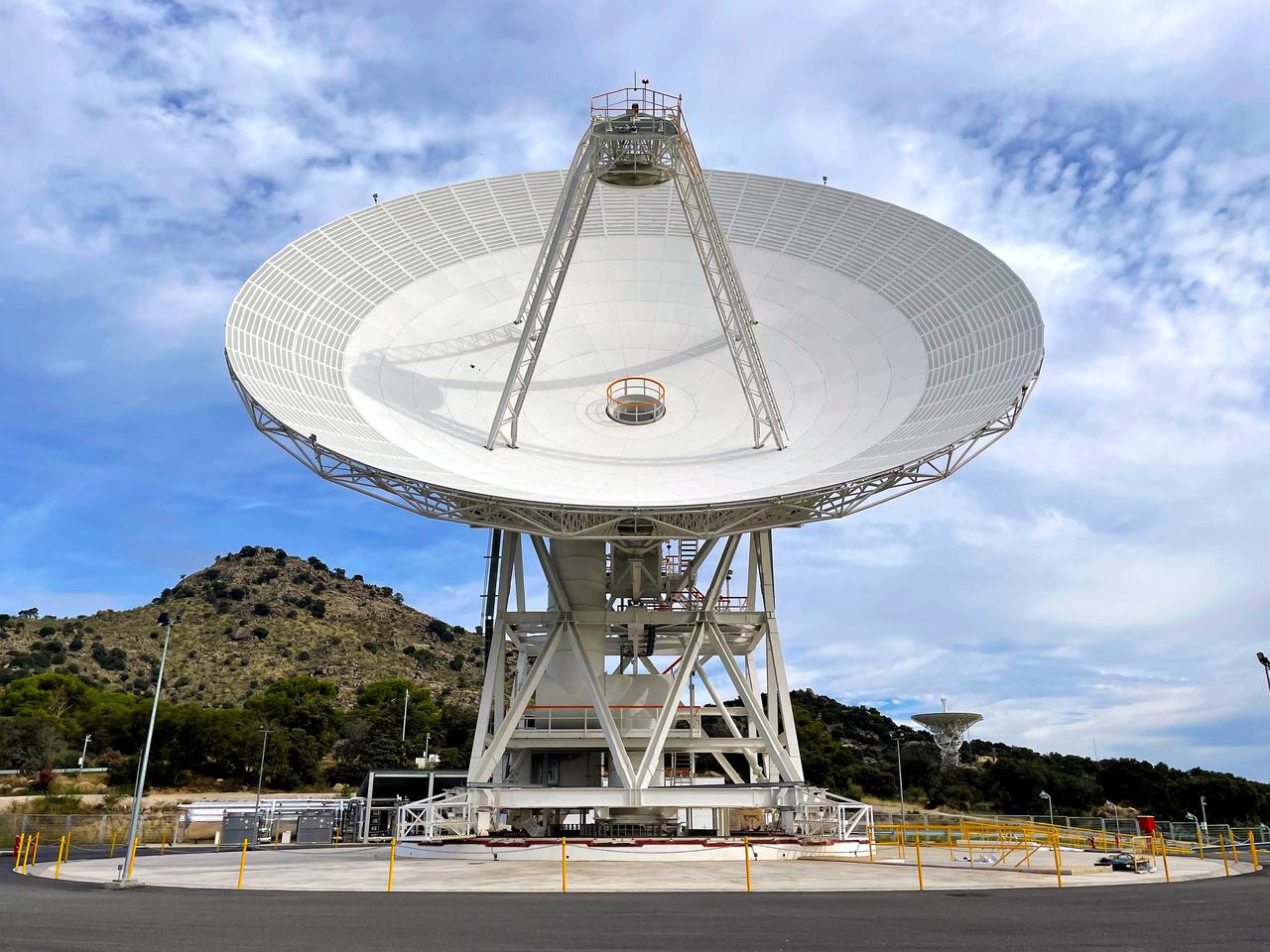
Deep Space Station 53, or DSS-53, is a new 34-meter (111-foot) beam waveguide antenna that went online in February 2022 at NASA's Deep Space Network's ground station in Madrid. DSS-53 is the fourth of six antennas being added to expand the DSN's capacity and meet the needs of a growing number of spacecraft. When the project is complete, each of the network's three ground stations around the globe will have four beam waveguide antennas. The Madrid Deep Space Communications Complex is the first to have completed its build-out as part of project. Construction on DSS-53 began in 2016. https://photojournal.jpl.nasa.gov/catalog/PIA25136
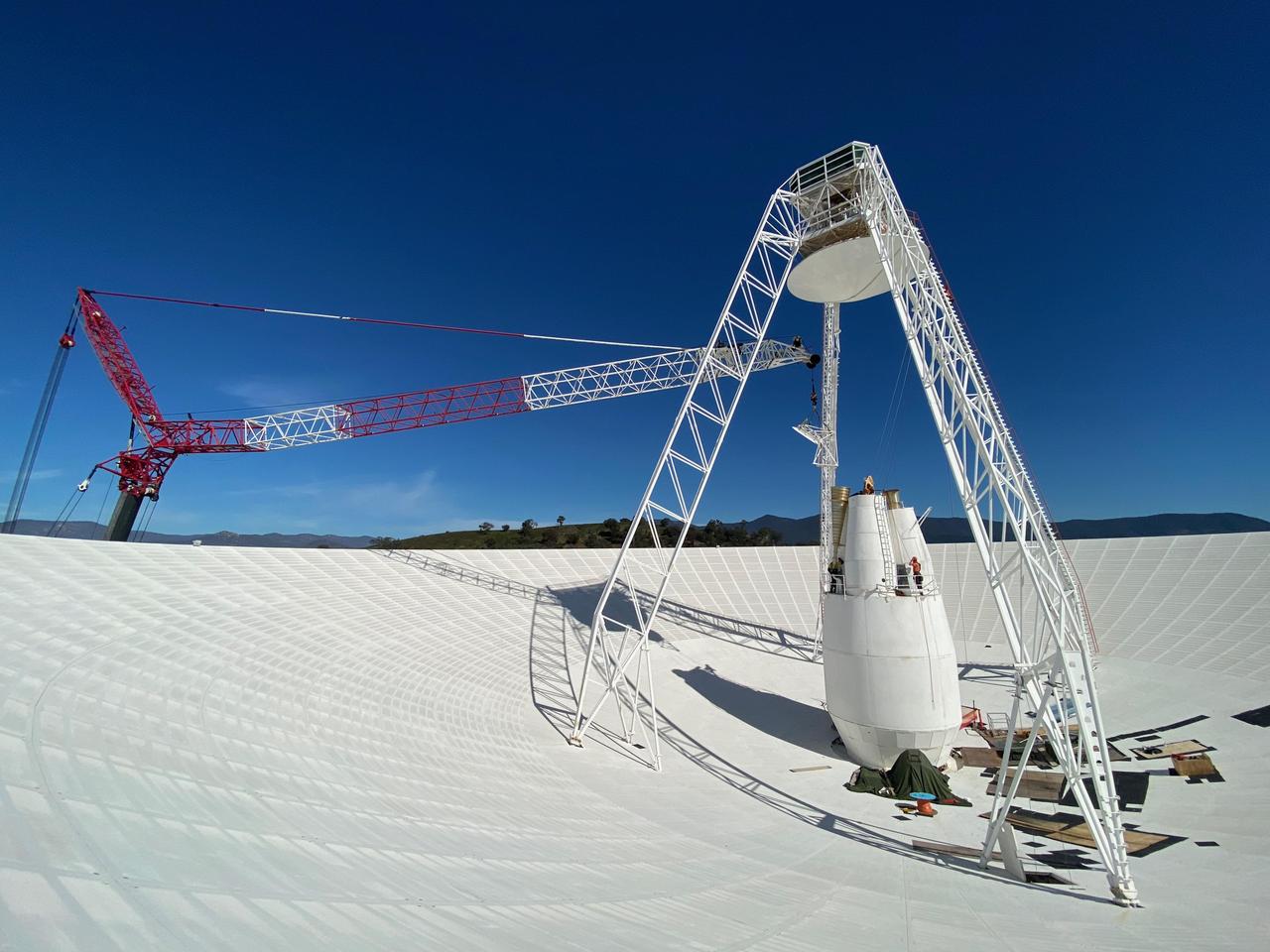
The antenna of the Deep Space Network's Deep Space Station 43 (DSS-43) in Canberra, Australia, spans 70 meters (230 foot) and stands 73 meters (239 foot), dwarfing workers as they perform upgrades on the central cone that contains sensitive transmitters and receivers. A giant crane assisted with the replacement of parts that had been operating on the antenna for over 40 years. One of several antennas located at the Canberra Deep Space Network station, DSS-43 is the largest and responsible for transmitting commands to NASA's Voyager 2 spacecraft. Since early March 2020, DSS-43 has been offline for the upgrades, which are expected to continue until January 2021. https://photojournal.jpl.nasa.gov/catalog/PIA23795
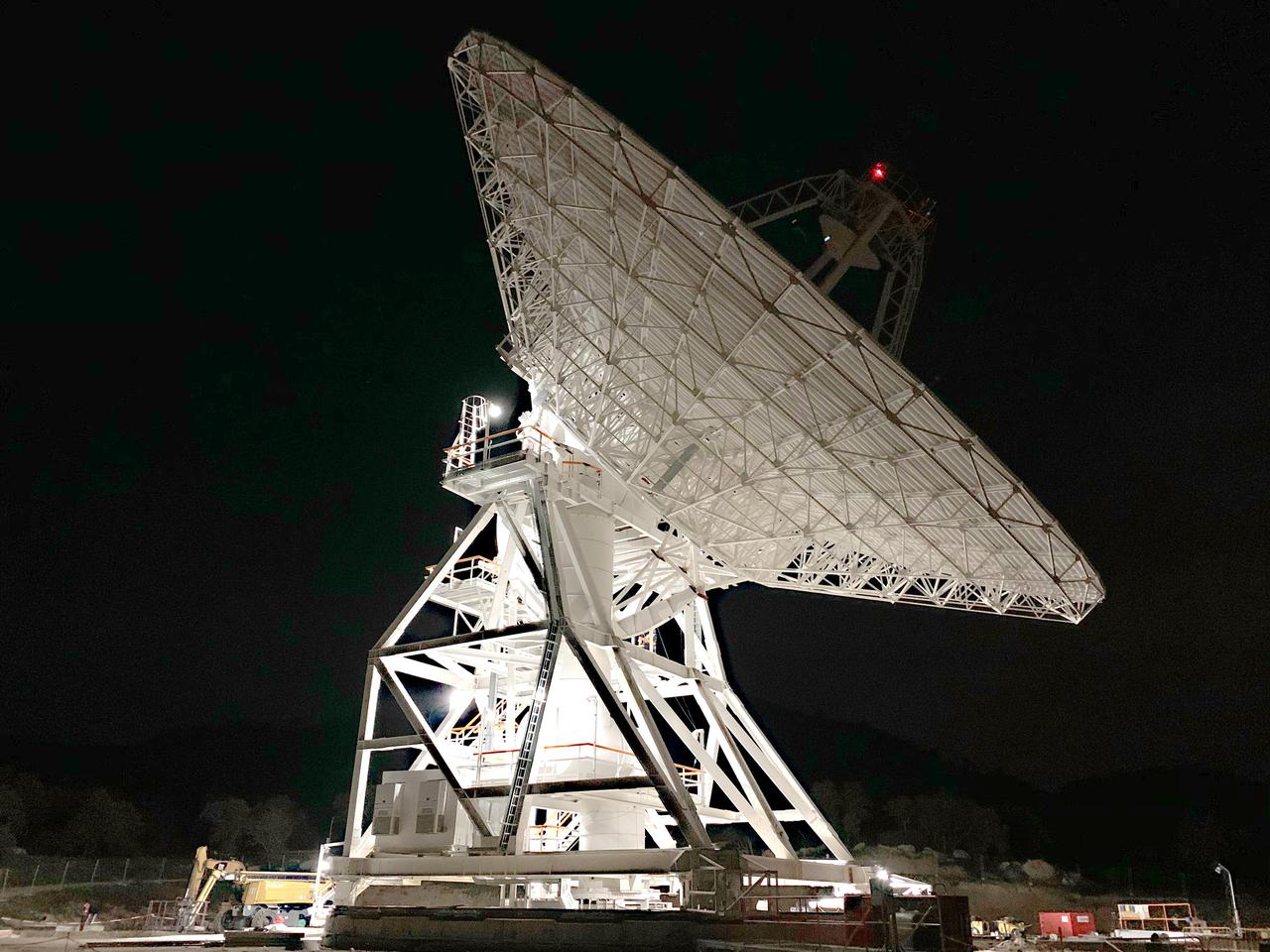
Deep Space Station 53, or DSS-53, is a new 34-meter (111-foot) beam waveguide antenna that went online in February 2022 at the Madrid ground station of NASA's Deep Space Network (DSN). DSS-53 is the fourth of six antennas being added to expand the DSN's capacity and meet the needs of a growing number of spacecraft. When the project is complete, each of the network's three ground stations around the globe will have four beam waveguide antennas. The Madrid Deep Space Communications Complex is the first to have completed its build-out as part of project. Construction on DSS-53 began in 2016. https://photojournal.jpl.nasa.gov/catalog/PIA25137
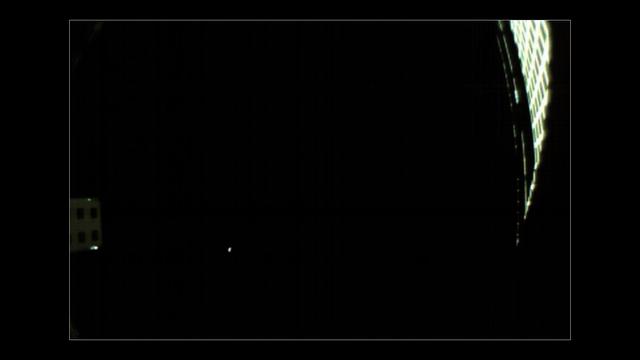
NASA's twin MarCO spacecraft are scheduled to make a flyby of Mars on Nov. 26. On Nov. 24, a wide-angle camera on MarCO-B took this picture of the Red Planet, which appears as a small, grey dot in the lower left quadrant of the image. On the right side of the image is the spacecraft's high-gain antenna. On the left side is the high-gain antenna feed, as well as part of the spacecraft's thermal blanket. MarCO-B was approximately 310,000 miles (500,000 km) away from Mars at the time. Mars is actually only about 3 pixels wide in this image, but because of blurring it appears larger. An annotated version of this image notes the location of Mars, the high-gain antenna, high-gain antenna feed and thermal blanket. Each about the size of a briefcase, the MarCO spacecraft are CubeSats, or small satellites built from standardized units that are 4 inches (10 cm) square. (Each MarCO satellite consists of six CubeSat units.) The MarCOs are the first CubeSats to reach deep space, and were the first CubeSats to photograph Mars. https://photojournal.jpl.nasa.gov/catalog/PIA22830
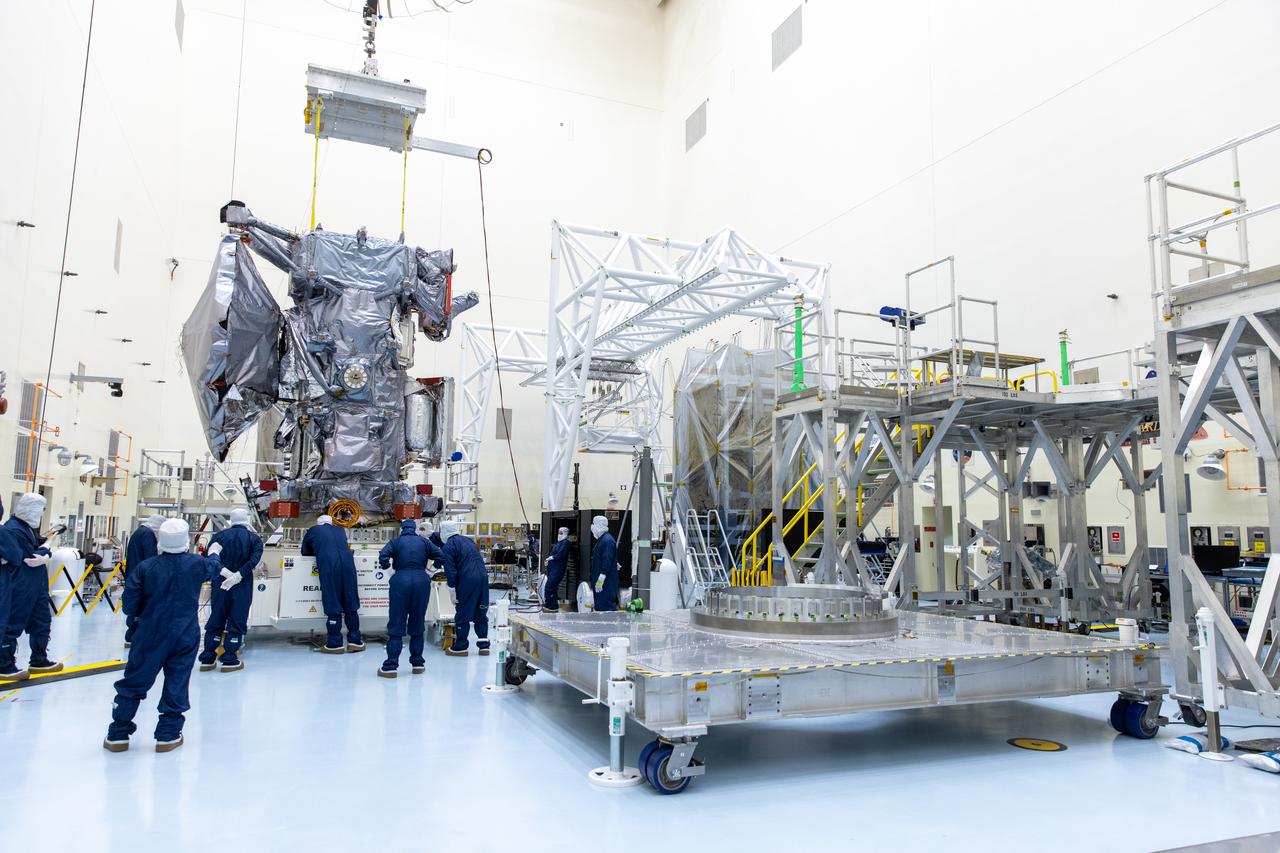
Technicians prepare to install the nearly 10 feet (3 meters) wide dish-shaped high-gain antenna to NASA’s Europa Clipper, a spacecraft to study Jupiter’s icy moon, at the agency’s Payload Hazardous Servicing Facility at Kennedy Space Center in Florida on Tuesday, June 18, 2024. The spacecraft will perform a series of flybys of the Jupiter moon Europa to gather data on its atmosphere, icy crust, and the ocean underneath, and the high-gain antenna will send the research data to scientists on Earth to determine if the moon can support habitable condition. The Europa Clipper spacecraft is scheduled to launch atop a SpaceX Falcon Heavy rocket from Kennedy’s Launch Complex 39A no earlier than October 2024.
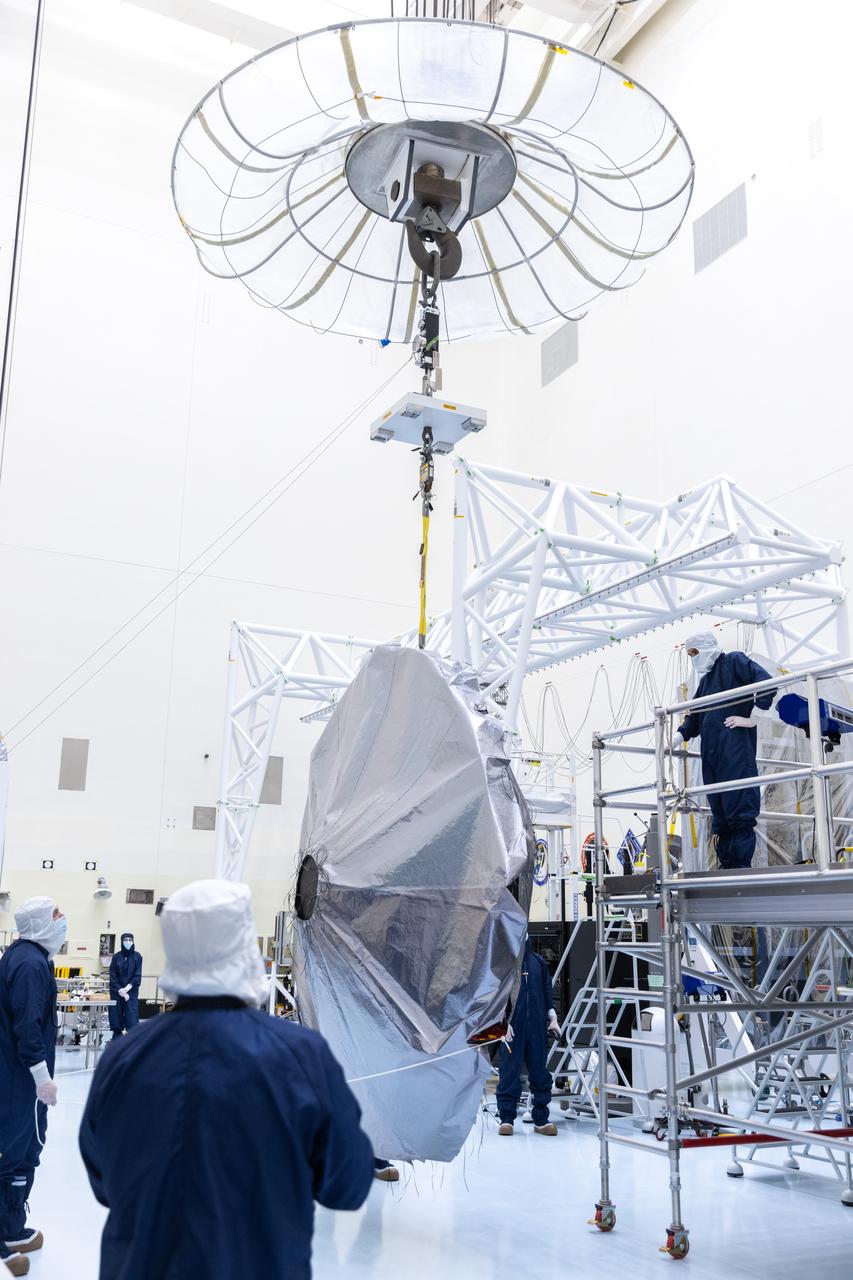
Technicians prepare to install the nearly 10 feet (3 meters) wide dish-shaped high-gain antenna to NASA’s Europa Clipper, a spacecraft to study Jupiter’s icy moon, at the agency’s Payload Hazardous Servicing Facility at Kennedy Space Center in Florida on Monday, June 17, 2024. The spacecraft will perform a series of flybys of the Jupiter moon Europa to gather data on its atmosphere, icy crust, and the ocean underneath, and the high-gain antenna will send the research data to scientists on Earth to determine if the moon can support habitable condition. The Europa Clipper spacecraft is scheduled to launch atop a SpaceX Falcon Heavy rocket from Kennedy’s Launch Complex 39A no earlier than October 2024.
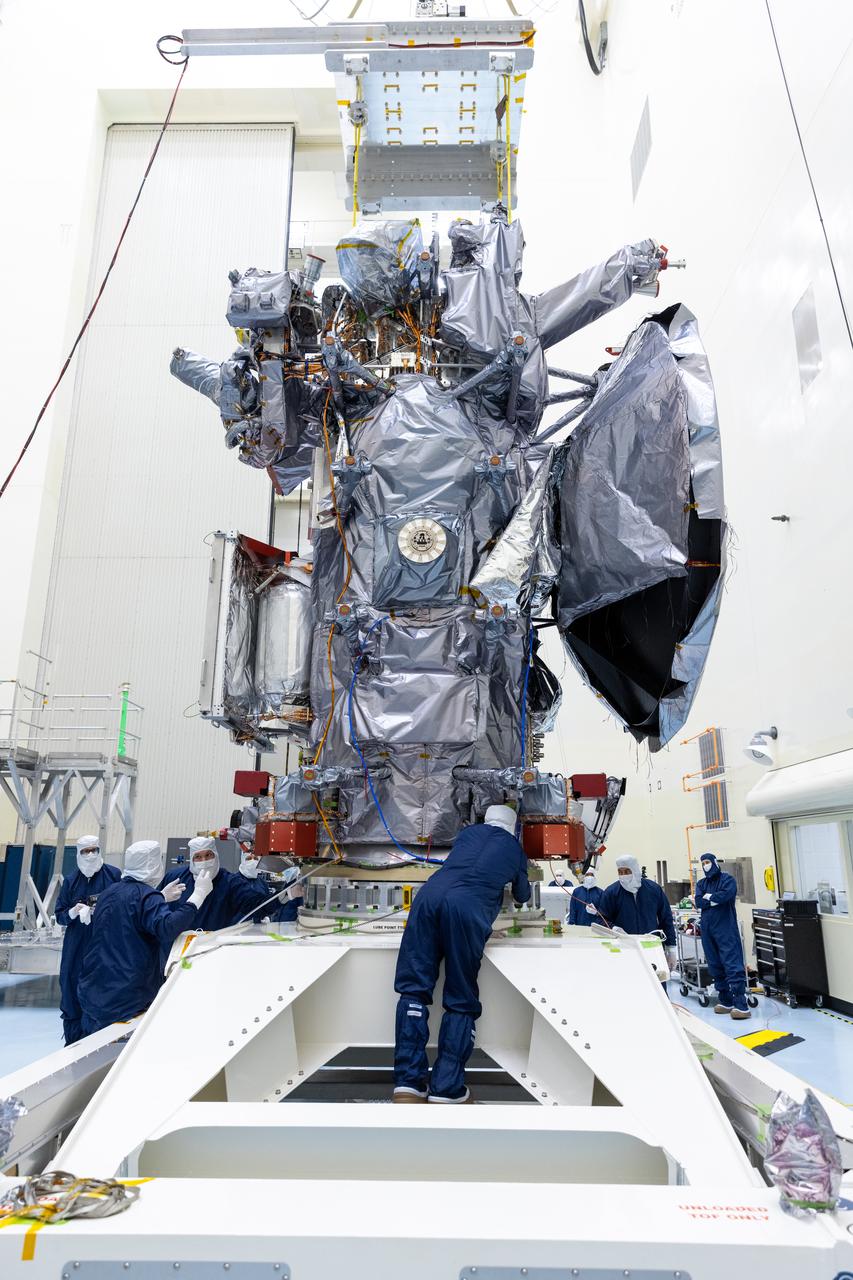
Technicians prepare to install the nearly 10 feet (3 meters) wide dish-shaped high-gain antenna to NASA’s Europa Clipper, a spacecraft to study Jupiter’s icy moon, at the agency’s Payload Hazardous Servicing Facility at Kennedy Space Center in Florida on Tuesday, June 18, 2024. The spacecraft will perform a series of flybys of the Jupiter moon Europa to gather data on its atmosphere, icy crust, and the ocean underneath, and the high-gain antenna will send the research data to scientists on Earth to determine if the moon can support habitable condition. The Europa Clipper spacecraft is scheduled to launch atop a SpaceX Falcon Heavy rocket from Kennedy’s Launch Complex 39A no earlier than October 2024.
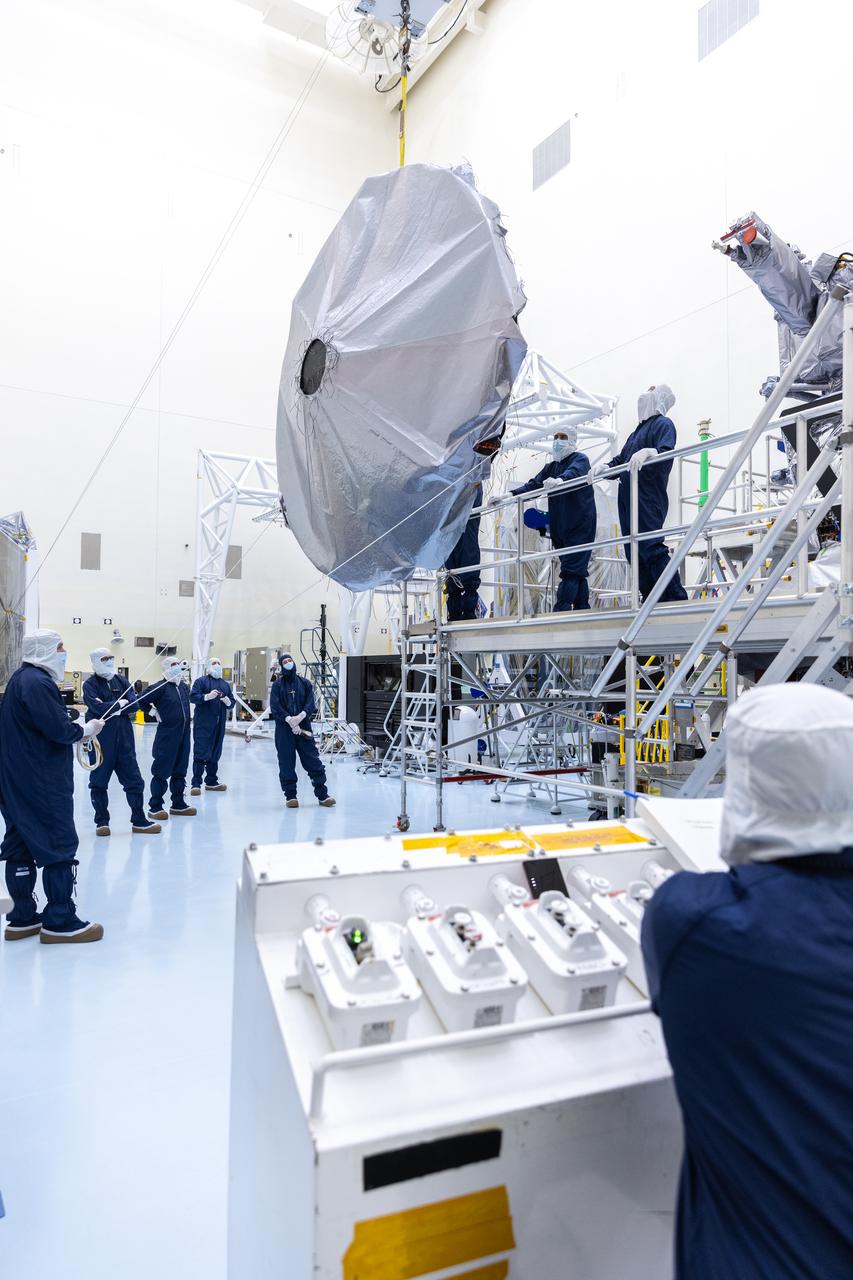
Technicians prepare to install the nearly 10 feet (3 meters) wide dish-shaped high-gain antenna to NASA’s Europa Clipper, a spacecraft to study Jupiter’s icy moon, at the agency’s Payload Hazardous Servicing Facility at Kennedy Space Center in Florida on Monday, June 17, 2024. The spacecraft will perform a series of flybys of the Jupiter moon Europa to gather data on its atmosphere, icy crust, and the ocean underneath, and the high-gain antenna will send the research data to scientists on Earth to determine if the moon can support habitable condition. The Europa Clipper spacecraft is scheduled to launch atop a SpaceX Falcon Heavy rocket from Kennedy’s Launch Complex 39A no earlier than October 2024.
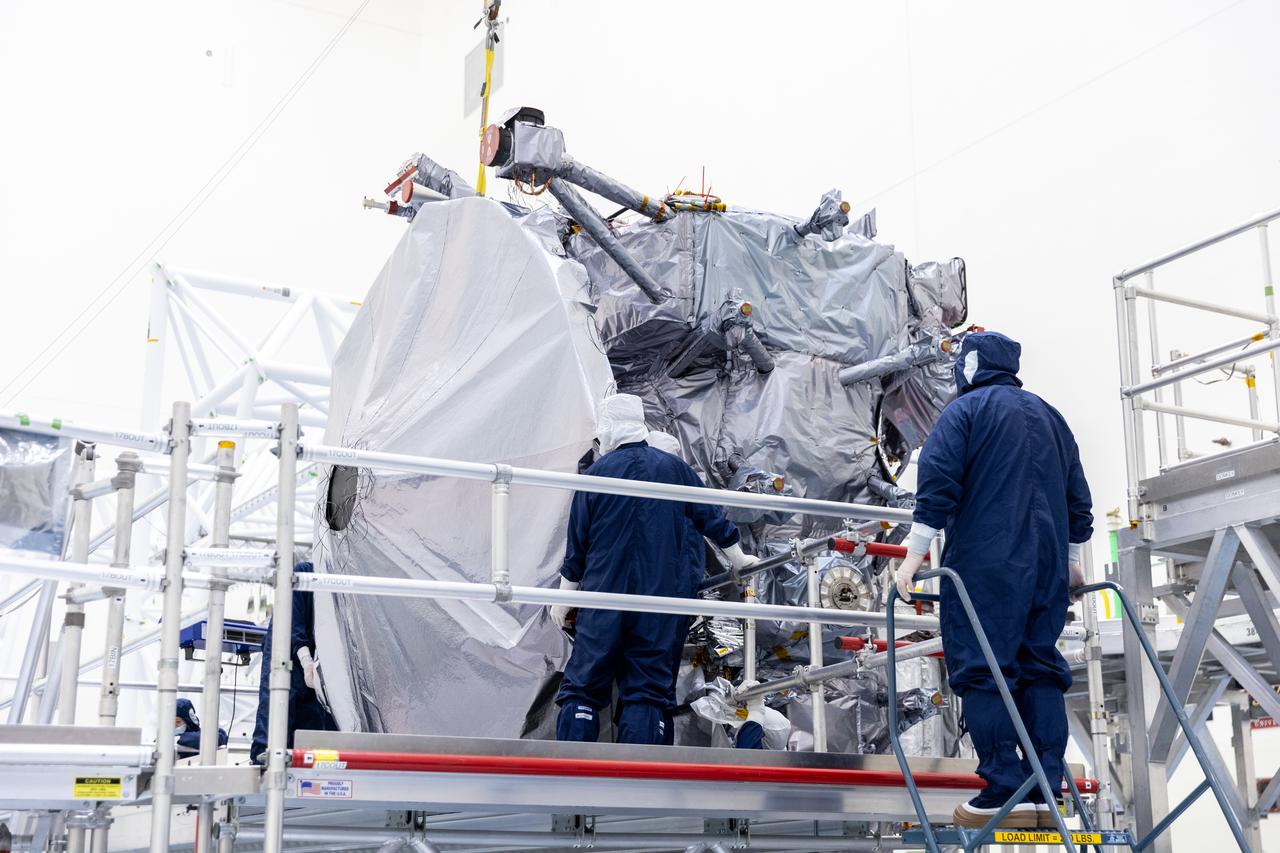
Technicians prepare to install the nearly 10 feet (3 meters) wide dish-shaped high-gain antenna to NASA’s Europa Clipper, a spacecraft to study Jupiter’s icy moon, at the agency’s Payload Hazardous Servicing Facility at Kennedy Space Center in Florida on Monday, June 17, 2024. The spacecraft will perform a series of flybys of the Jupiter moon Europa to gather data on its atmosphere, icy crust, and the ocean underneath, and the high-gain antenna will send the research data to scientists on Earth to determine if the moon can support habitable condition. The Europa Clipper spacecraft is scheduled to launch atop a SpaceX Falcon Heavy rocket from Kennedy’s Launch Complex 39A no earlier than October 2024.
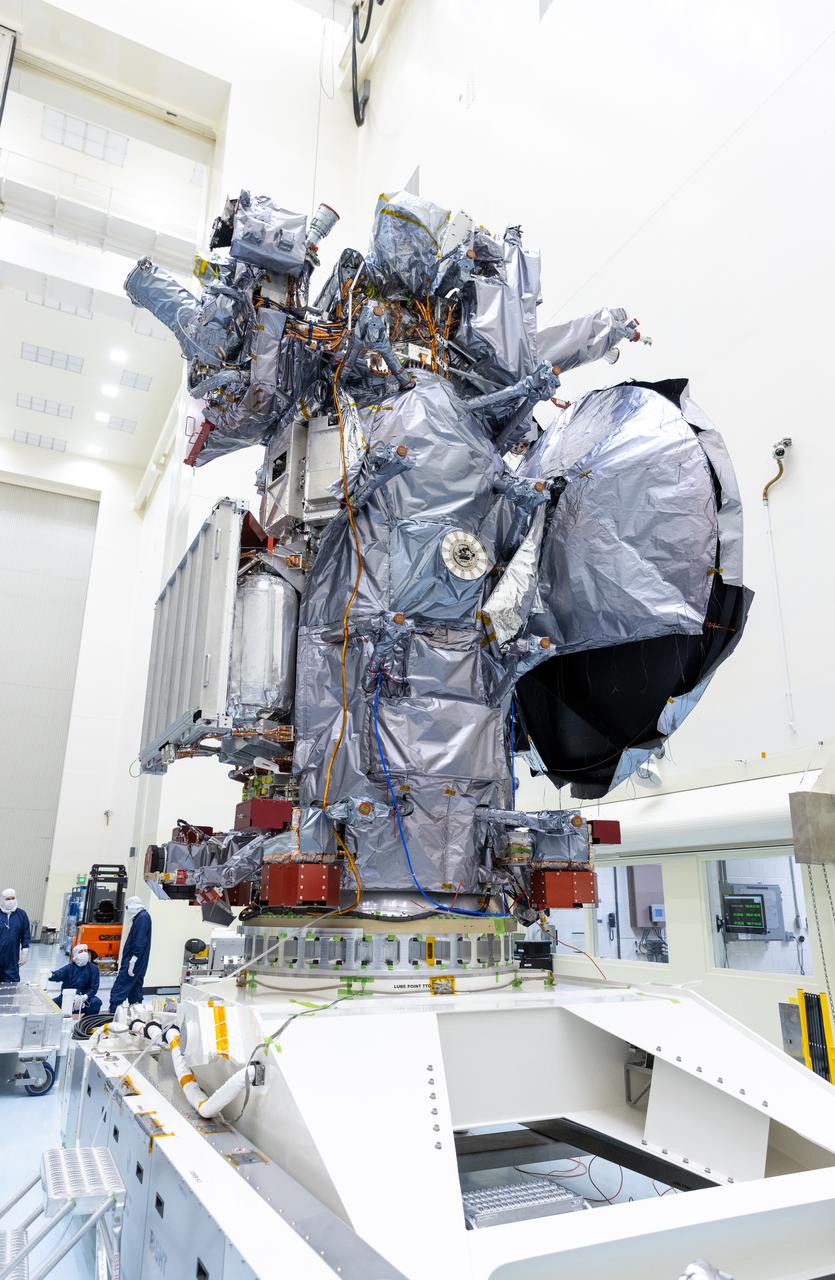
Technicians prepare to install the nearly 10 feet (3 meters) wide dish-shaped high-gain antenna to NASA’s Europa Clipper, a spacecraft to study Jupiter’s icy moon, at the agency’s Payload Hazardous Servicing Facility at Kennedy Space Center in Florida on Tuesday, June 18, 2024. The spacecraft will perform a series of flybys of the Jupiter moon Europa to gather data on its atmosphere, icy crust, and the ocean underneath, and the high-gain antenna will send the research data to scientists on Earth to determine if the moon can support habitable condition. The Europa Clipper spacecraft is scheduled to launch atop a SpaceX Falcon Heavy rocket from Kennedy’s Launch Complex 39A no earlier than October 2024.
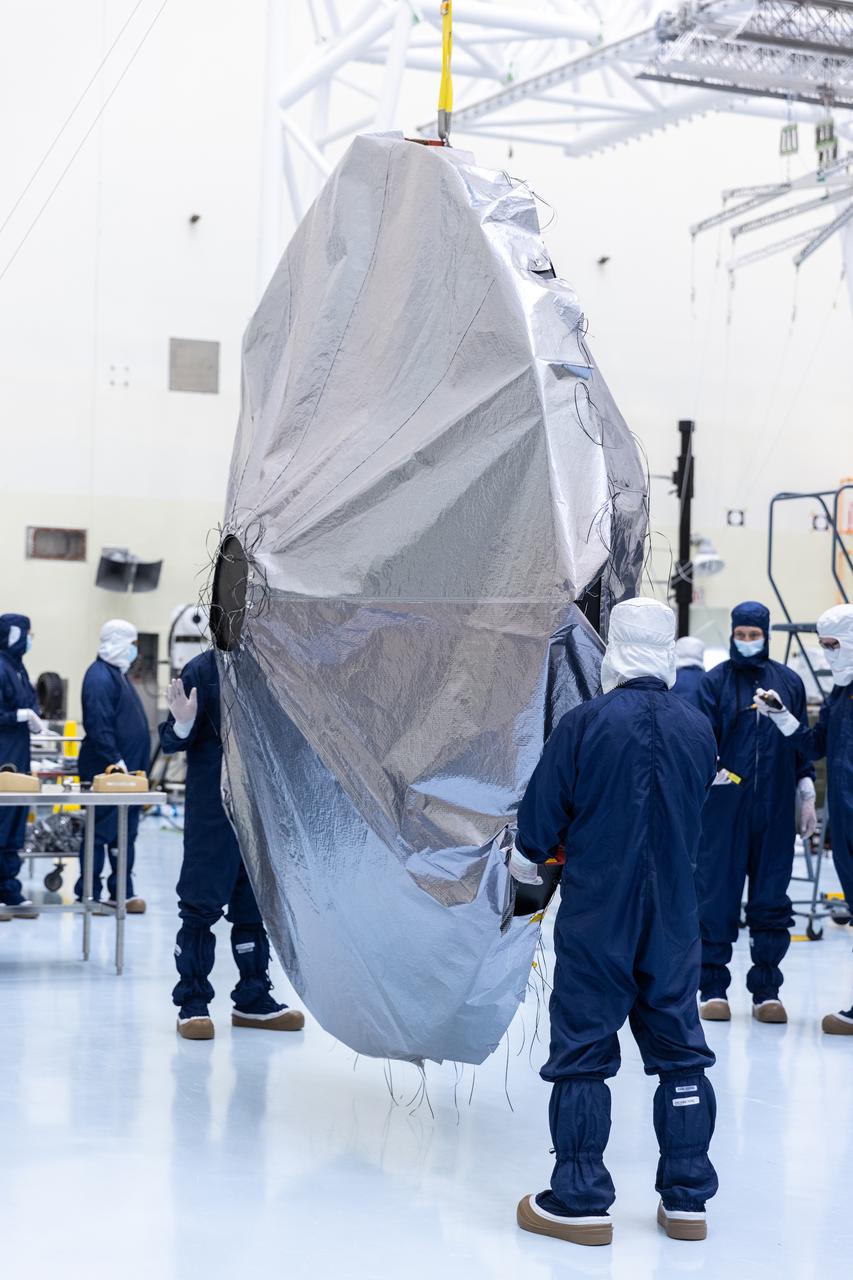
Technicians prepare to install the nearly 10 feet (3 meters) wide dish-shaped high-gain antenna to NASA’s Europa Clipper, a spacecraft to study Jupiter’s icy moon, at the agency’s Payload Hazardous Servicing Facility at Kennedy Space Center in Florida on Monday, June 17, 2024. The spacecraft will perform a series of flybys of the Jupiter moon Europa to gather data on its atmosphere, icy crust, and the ocean underneath, and the high-gain antenna will send the research data to scientists on Earth to determine if the moon can support habitable condition. The Europa Clipper spacecraft is scheduled to launch atop a SpaceX Falcon Heavy rocket from Kennedy’s Launch Complex 39A no earlier than October 2024.
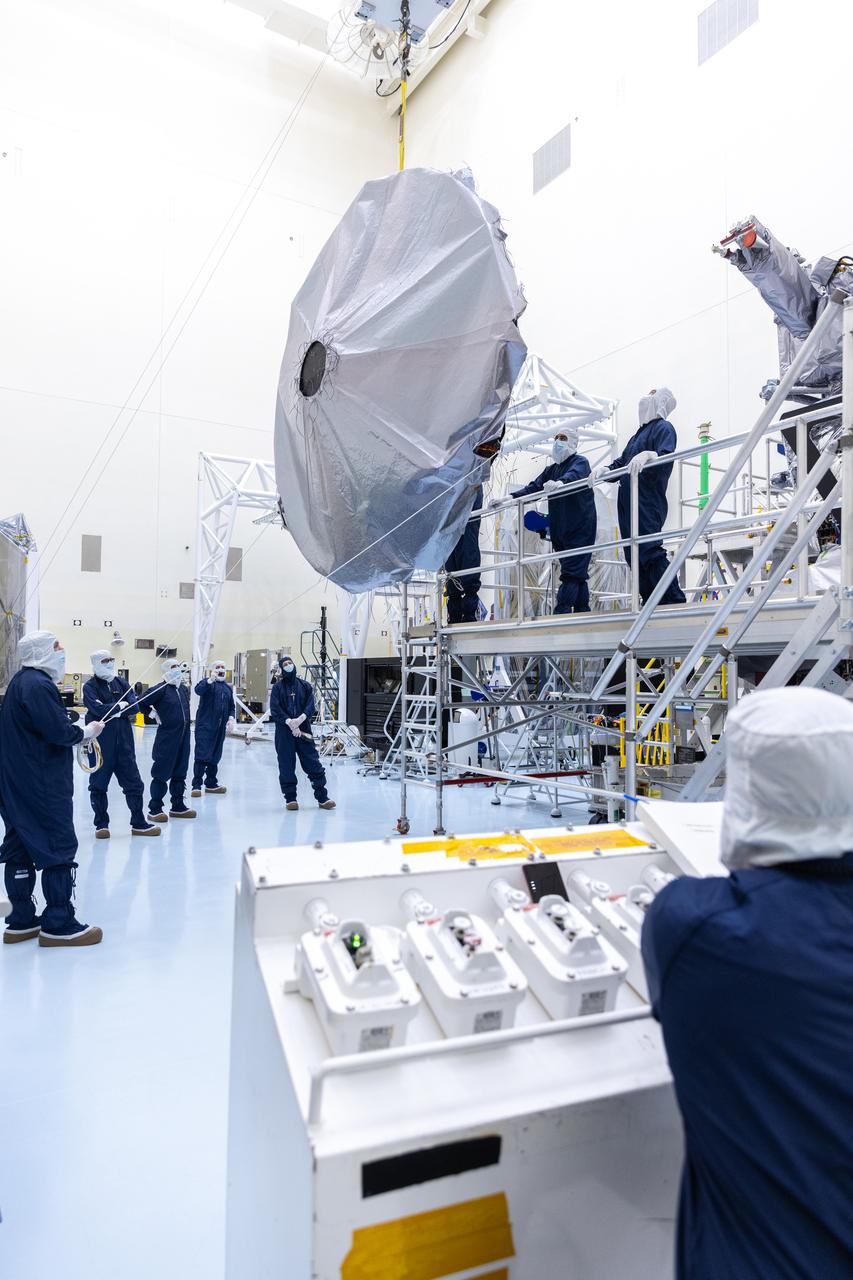
Technicians prepare to install the nearly 10 feet (3 meters) wide dish-shaped high-gain antenna to NASA’s Europa Clipper, a spacecraft to study Jupiter’s icy moon, at the agency’s Payload Hazardous Servicing Facility at Kennedy Space Center in Florida on Monday, June 17, 2024. The spacecraft will perform a series of flybys of the Jupiter moon Europa to gather data on its atmosphere, icy crust, and the ocean underneath, and the high-gain antenna will send the research data to scientists on Earth to determine if the moon can support habitable condition. The Europa Clipper spacecraft is scheduled to launch atop a SpaceX Falcon Heavy rocket from Kennedy’s Launch Complex 39A no earlier than October 2024.
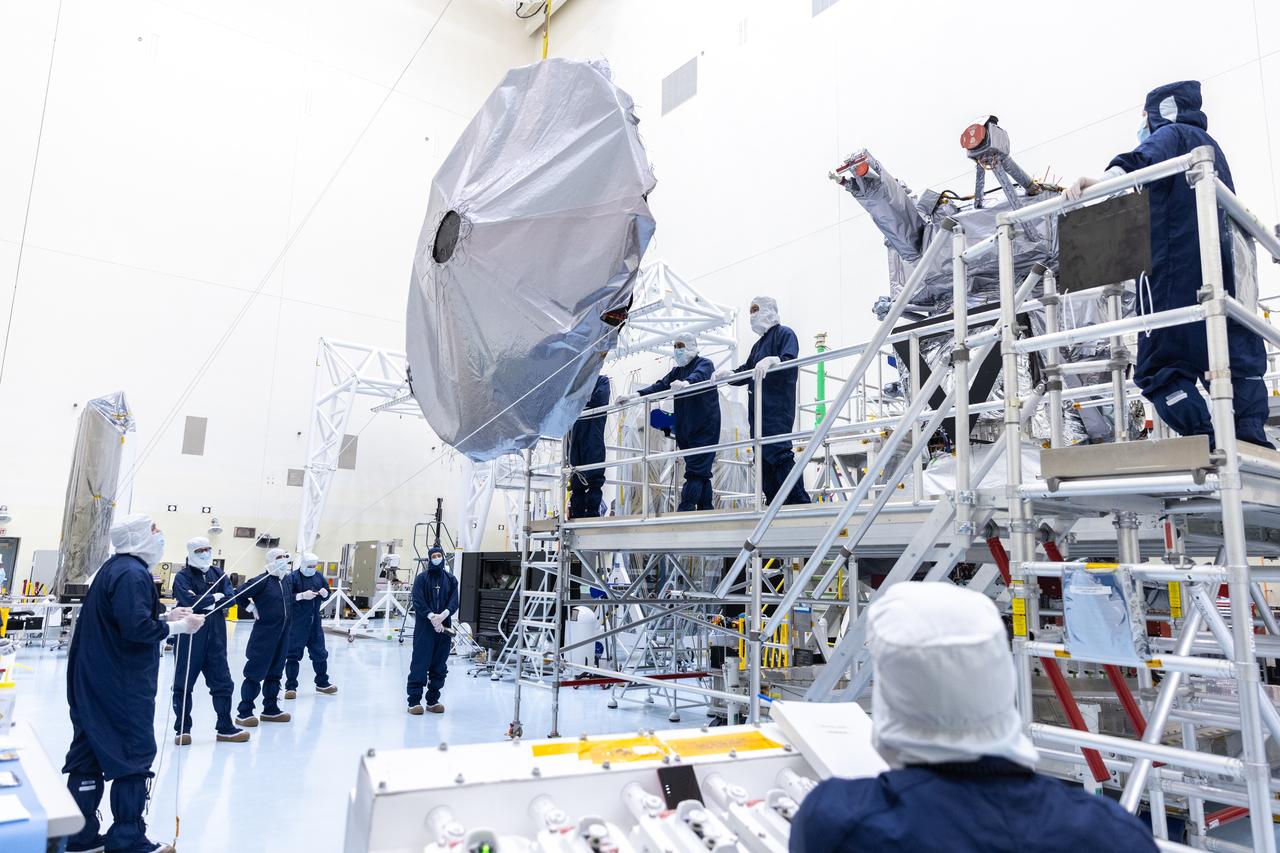
Technicians prepare to install the nearly 10 feet (3 meters) wide dish-shaped high-gain antenna to NASA’s Europa Clipper, a spacecraft to study Jupiter’s icy moon, at the agency’s Payload Hazardous Servicing Facility at Kennedy Space Center in Florida on Monday, June 17, 2024. The spacecraft will perform a series of flybys of the Jupiter moon Europa to gather data on its atmosphere, icy crust, and the ocean underneath, and the high-gain antenna will send the research data to scientists on Earth to determine if the moon can support habitable condition. The Europa Clipper spacecraft is scheduled to launch atop a SpaceX Falcon Heavy rocket from Kennedy’s Launch Complex 39A no earlier than October 2024.
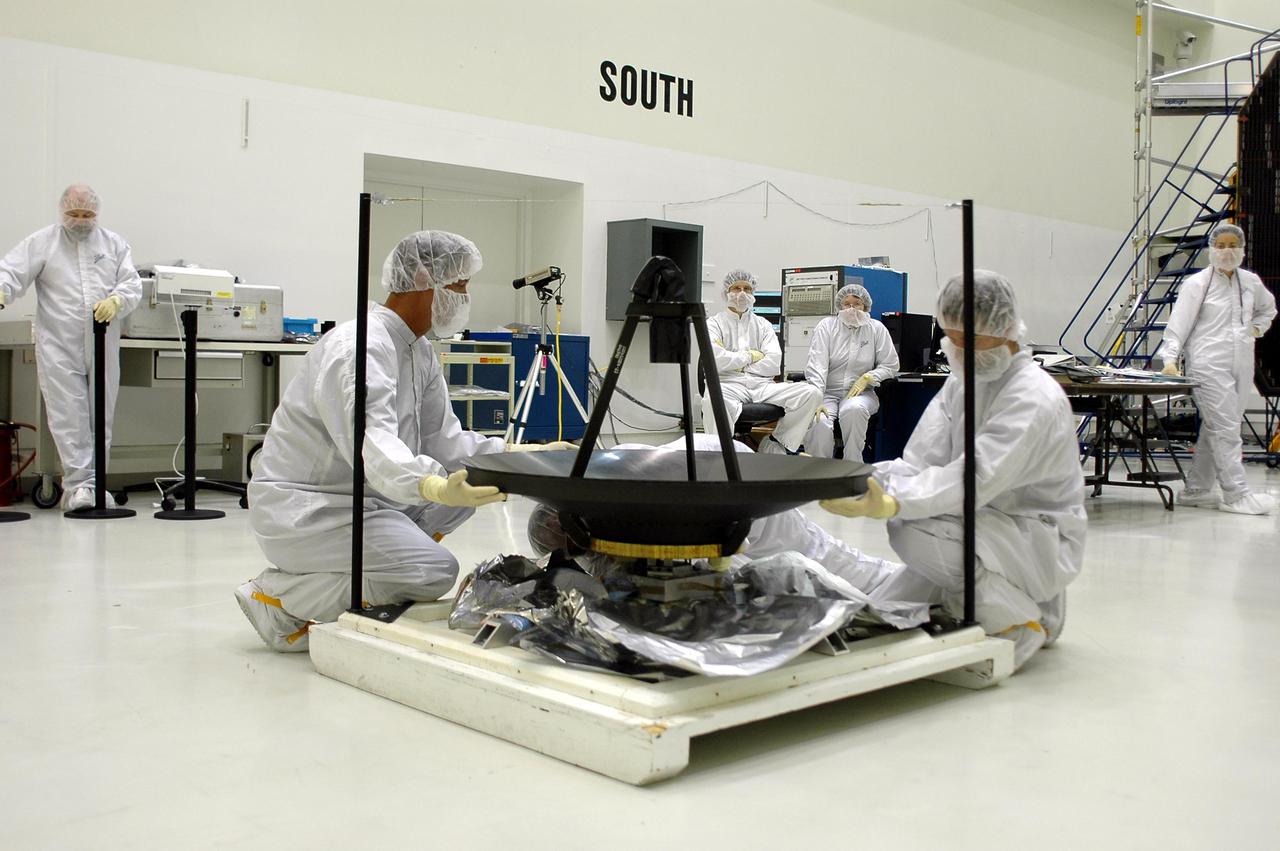
KENNEDY SPACE CENTER, FLA. - Ball Aerospace technicians at Astrotech in Titusville, Fla., begin lifting the high-gain communications antenna to attach it to an overhead crane. The antenna will be installed on the Deep Impact spacecraft. A NASA Discovery mission, Deep Impact will probe beneath the surface of Comet Tempel 1 on July 4, 2005, when the comet is 83 million miles from Earth, and reveal the secrets of its interior. During the encounter phase, the high-gain antenna transmits near-real-time images of the impact back to Earth. The spacecraft is scheduled to launch Jan. 8 aboard a Boeing Delta II rocket from Launch Complex 17-B at Cape Canaveral Air Force Station, Fla.
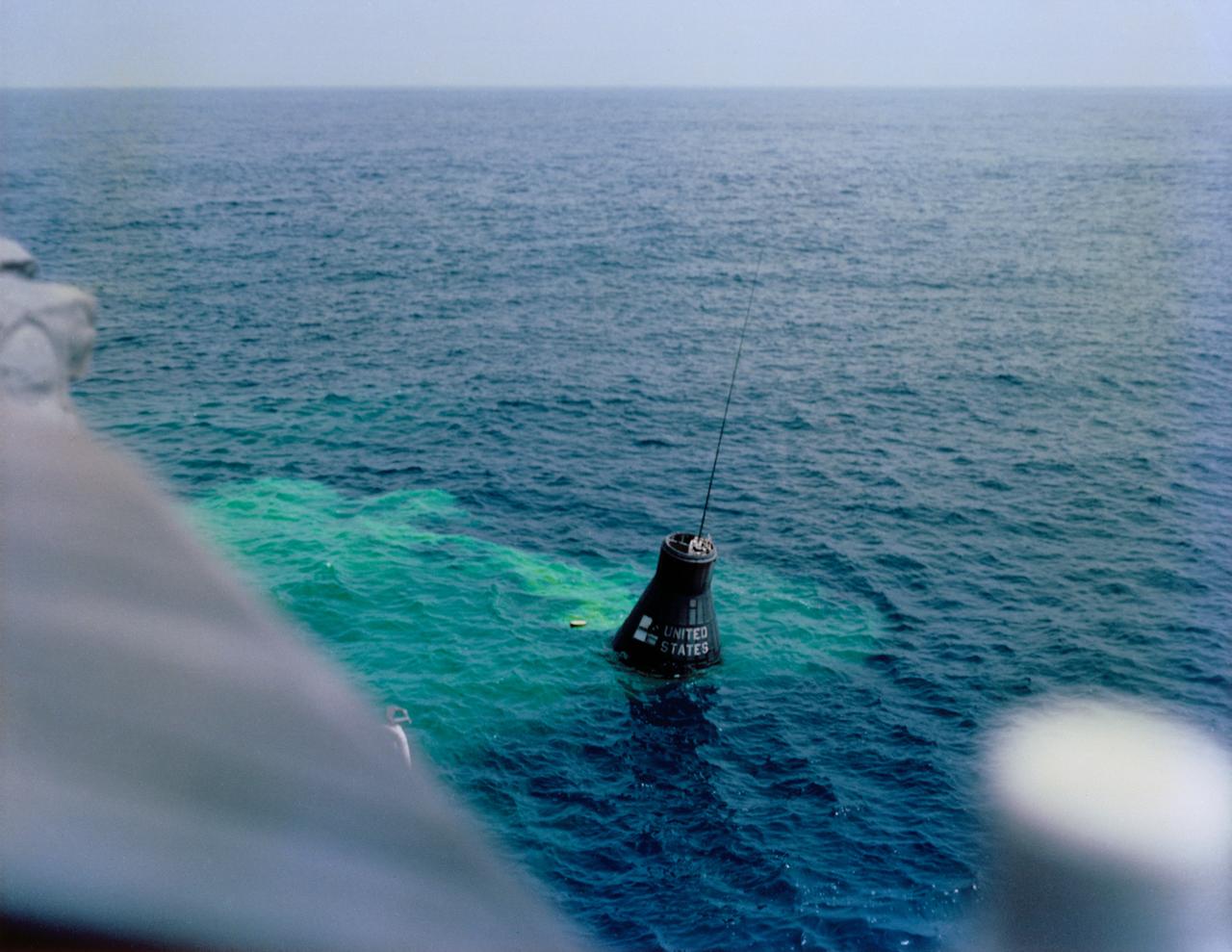
S61-03256 (13 Sept. 1961) --- Recovery of Mercury spacecraft at end of the Mercury-Atlas 4 (MA-4) mission. Notice the extended antenna on top of the capsule. Photo credit: NASA
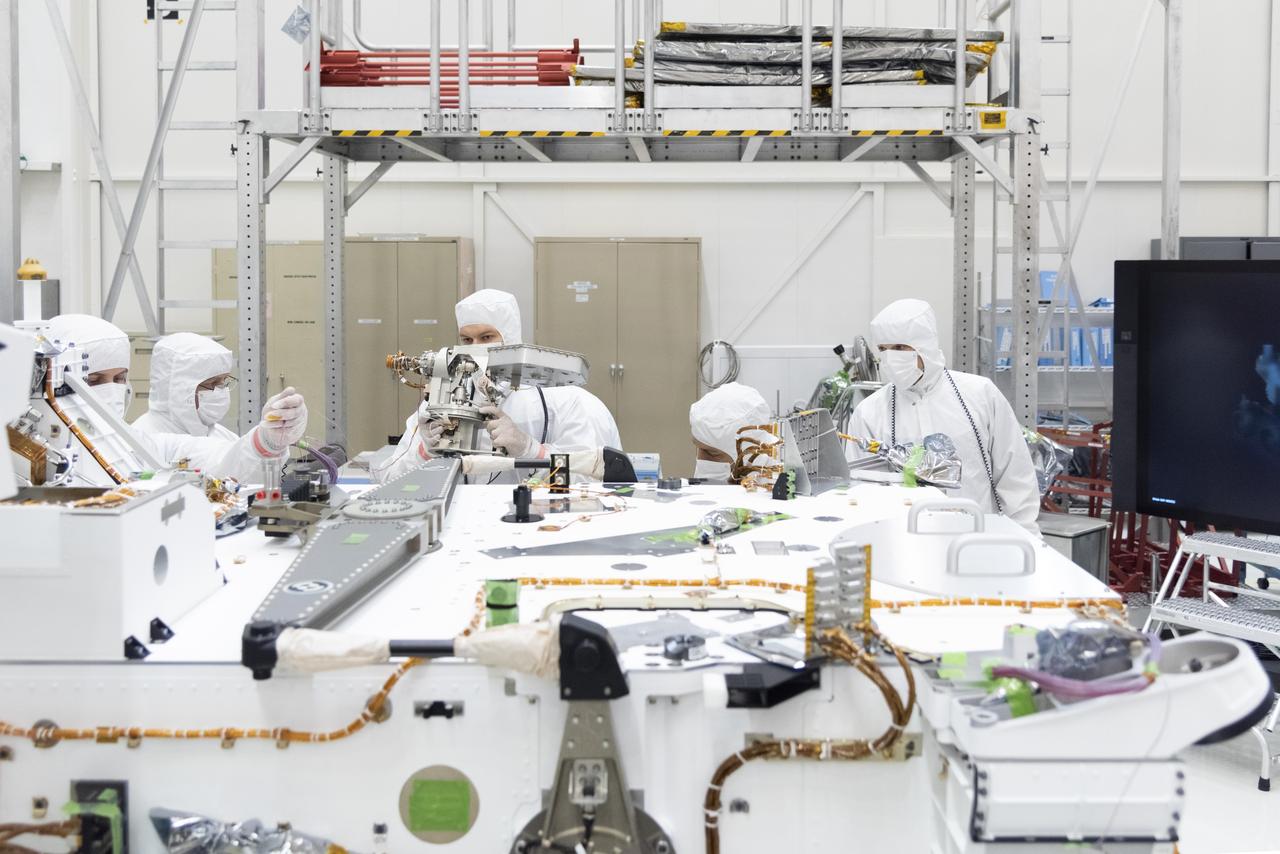
Mars 2020 engineers and technicians prepare the high-gain antenna for installation on the rover's equipment deck. The antenna is articulated so it can point itself directly at Earth to uplink or downlink data. The image was taken on April 19, 2019, in the Spacecraft Assembly Facility's High Bay 1 clean room at NASA's Jet Propulsion Laboratory, in Pasadena, California. https://photojournal.jpl.nasa.gov/catalog/PIA23193
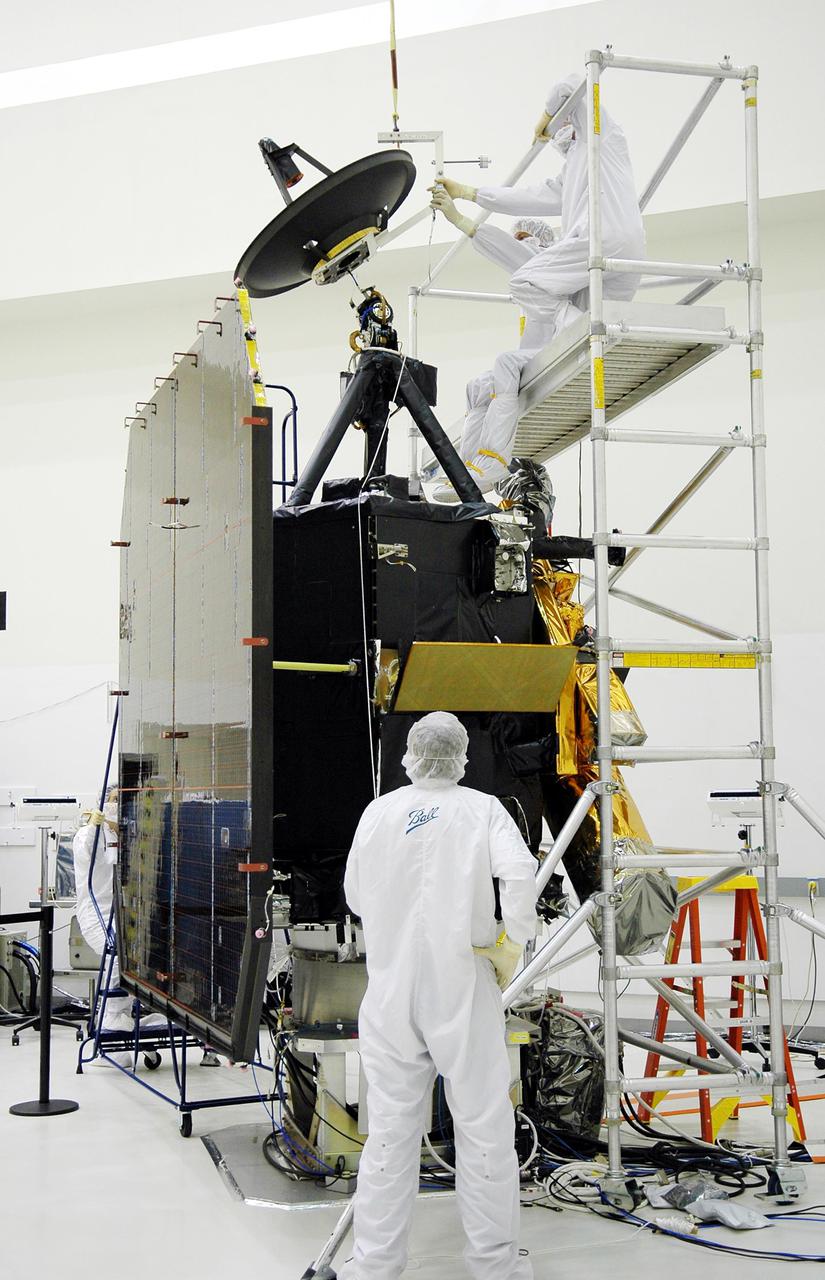
KENNEDY SPACE CENTER, FLA. - Ball Aerospace technicians at Astrotech in Titusville, Fla., guide the high-gain communications antenna toward the attach-point on the Deep Impact spacecraft. A NASA Discovery mission, Deep Impact will probe beneath the surface of Comet Tempel 1 on July 4, 2005, when the comet is 83 million miles from Earth, and reveal the secrets of its interior. During the encounter phase, the high-gain antenna transmits near-real-time images of the impact back to Earth. The spacecraft is scheduled to launch Jan. 8 aboard a Boeing Delta II rocket from Launch Complex 17-B at Cape Canaveral Air Force Station, Fla.
KENNEDY SPACE CENTER, FLA. - - Ball Aerospace technicians at Astrotech in Titusville, Fla., secure the high-gain communications antenna onto the Deep Impact spacecraft. A NASA Discovery mission, Deep Impact will probe beneath the surface of Comet Tempel 1 on July 4, 2005, when the comet is 83 million miles from Earth, and reveal the secrets of its interior. During the encounter phase, the high-gain antenna transmits near-real-time images of the impact back to Earth. The spacecraft is scheduled to launch Jan. 8 aboard a Boeing Delta II rocket from Launch Complex 17-B at Cape Canaveral Air Force Station, Fla.
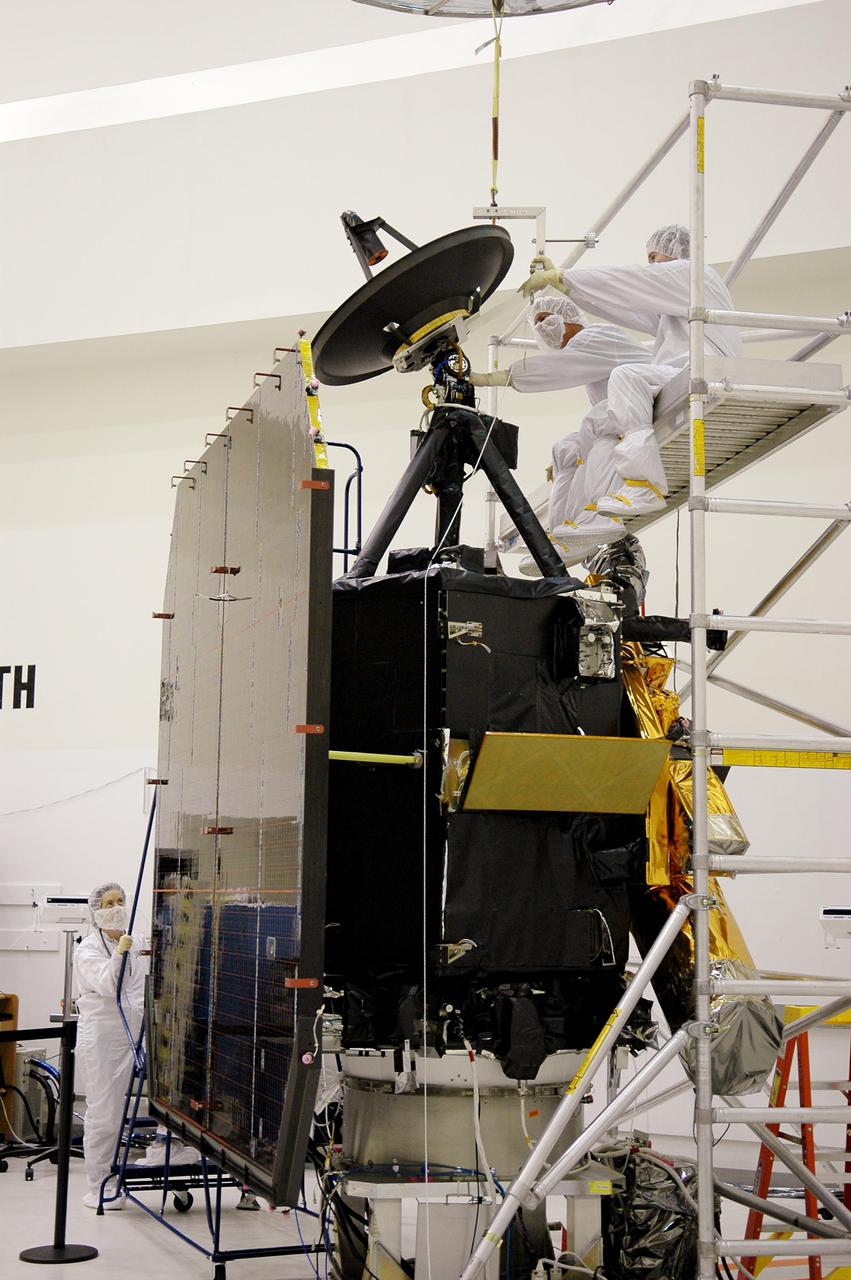
KENNEDY SPACE CENTER, FLA. - Ball Aerospace technicians at Astrotech in Titusville, Fla., attach the high-gain communications antenna onto the Deep Impact spacecraft. A NASA Discovery mission, Deep Impact will probe beneath the surface of Comet Tempel 1 on July 4, 2005, when the comet is 83 million miles from Earth, and reveal the secrets of its interior. During the encounter phase, the high-gain antenna transmits near-real-time images of the impact back to Earth. The spacecraft is scheduled to launch Jan. 8 aboard a Boeing Delta II rocket from Launch Complex 17-B at Cape Canaveral Air Force Station, Fla.
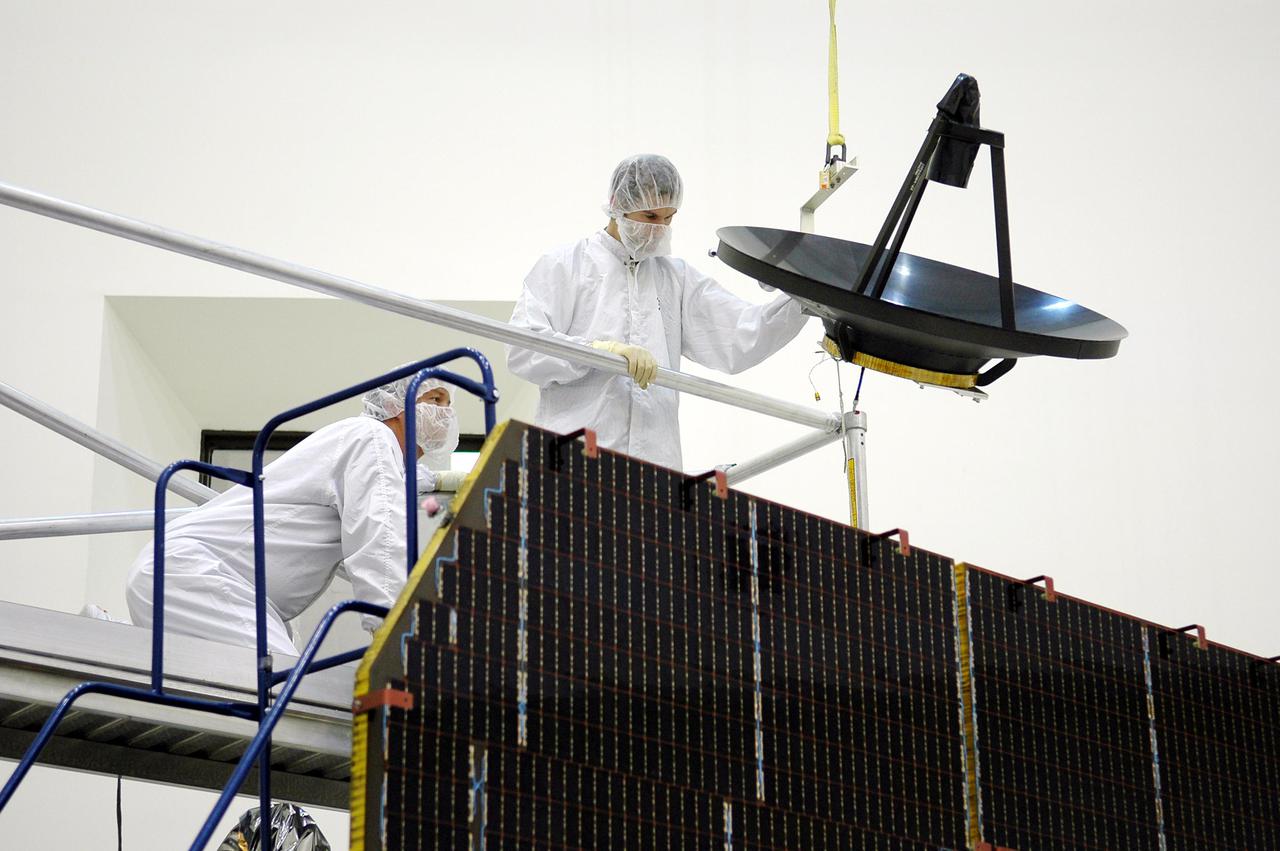
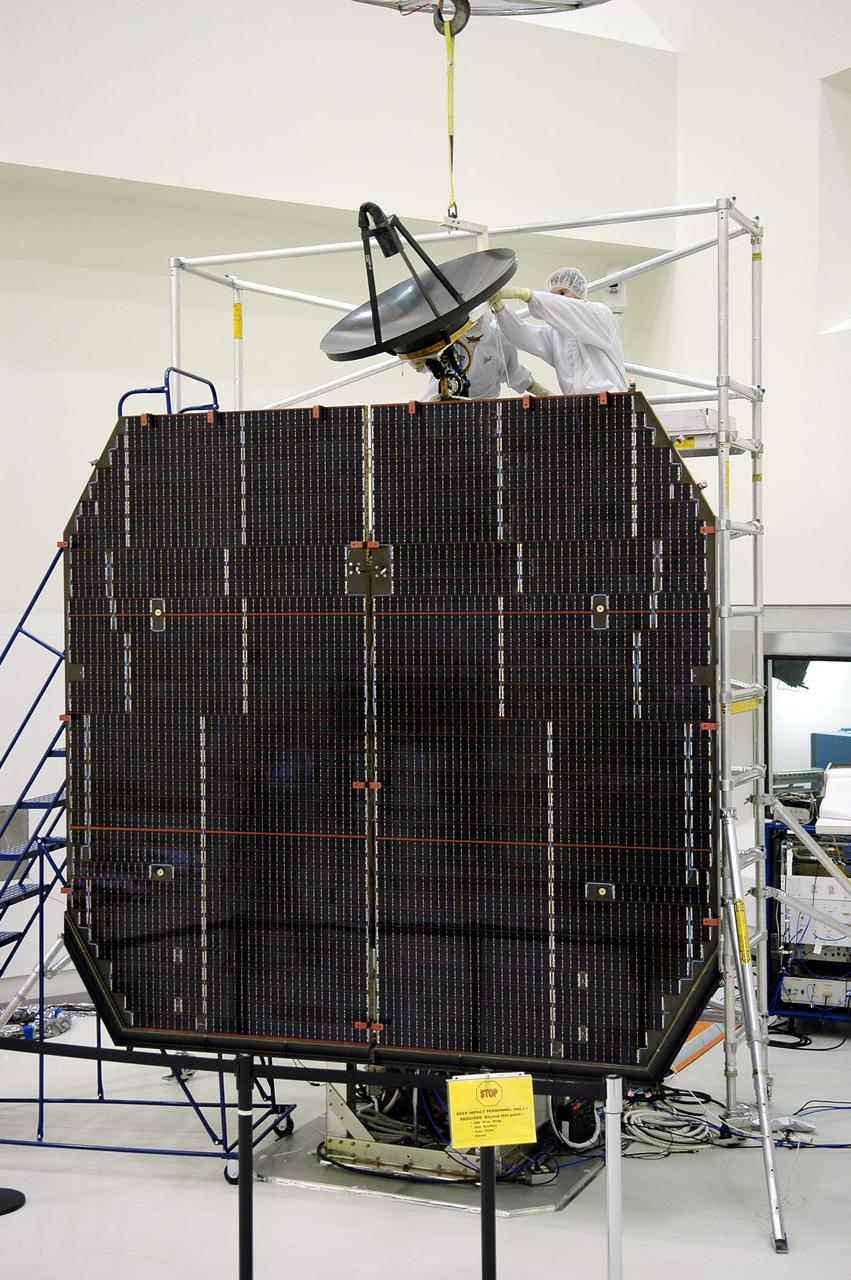
KENNEDY SPACE CENTER, FLA. - Ball Aerospace technicians at Astrotech in Titusville, Fla., watch as the high-gain communications antenna is lowered toward the Deep Impact spacecraft for installation. A NASA Discovery mission, Deep Impact will probe beneath the surface of Comet Tempel 1 on July 4, 2005, when the comet is 83 million miles from Earth, and reveal the secrets of its interior. During the encounter phase, the high-gain antenna transmits near-real-time images of the impact back to Earth. The spacecraft is scheduled to launch Jan. 8 aboard a Boeing Delta II rocket from Launch Complex 17-B at Cape Canaveral Air Force Station, Fla.
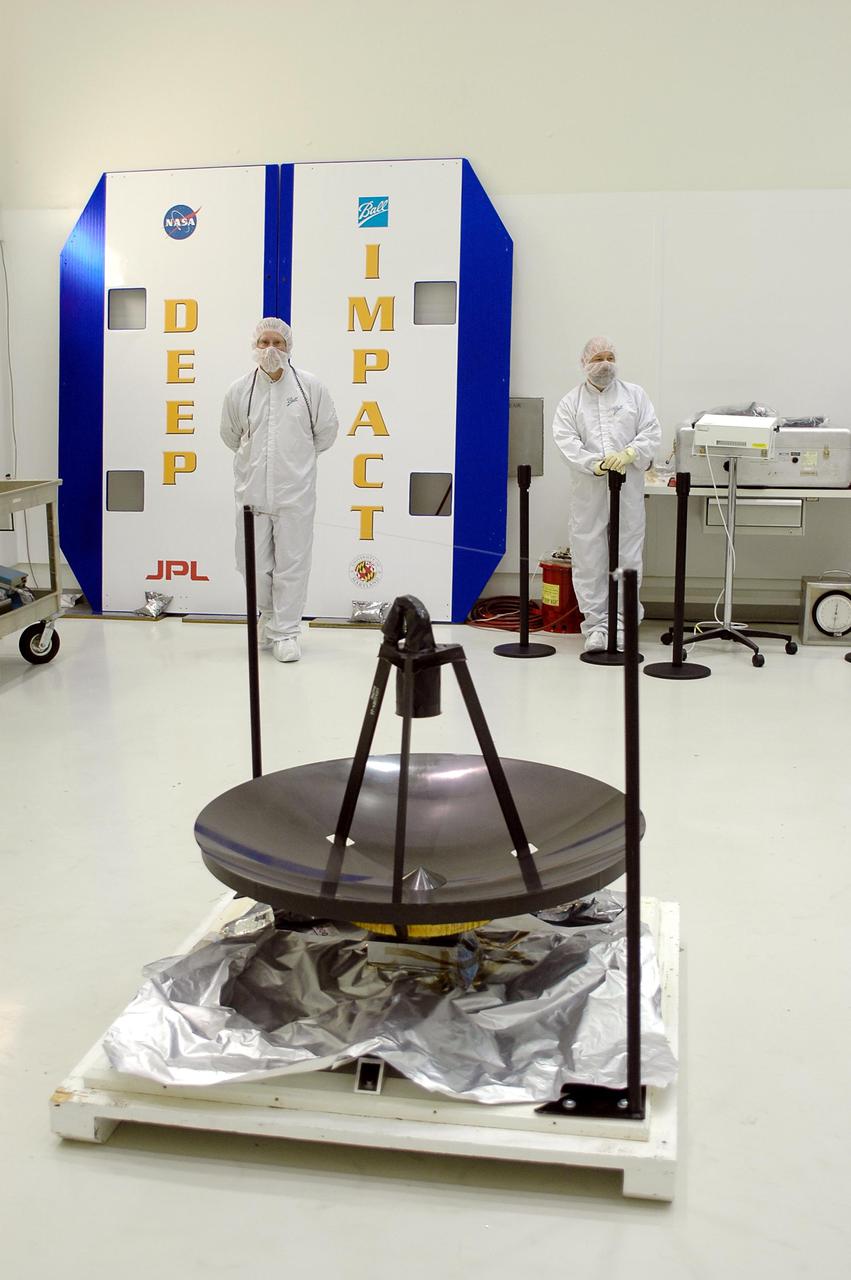
KENNEDY SPACE CENTER, FLA. - At Astrotech in Titusville, Fla., the high-gain communications antenna is ready for installation on the Deep Impact spacecraft (behind it). A NASA Discovery mission, Deep Impact will probe beneath the surface of Comet Tempel 1 on July 4, 2005, when the comet is 83 million miles from Earth, and reveal the secrets of its interior. During the encounter phase, the high-gain antenna transmits near-real-time images of the impact back to Earth. The spacecraft is scheduled to launch Jan. 8 aboard a Boeing Delta II rocket from Launch Complex 17-B at Cape Canaveral Air Force Station, Fla.
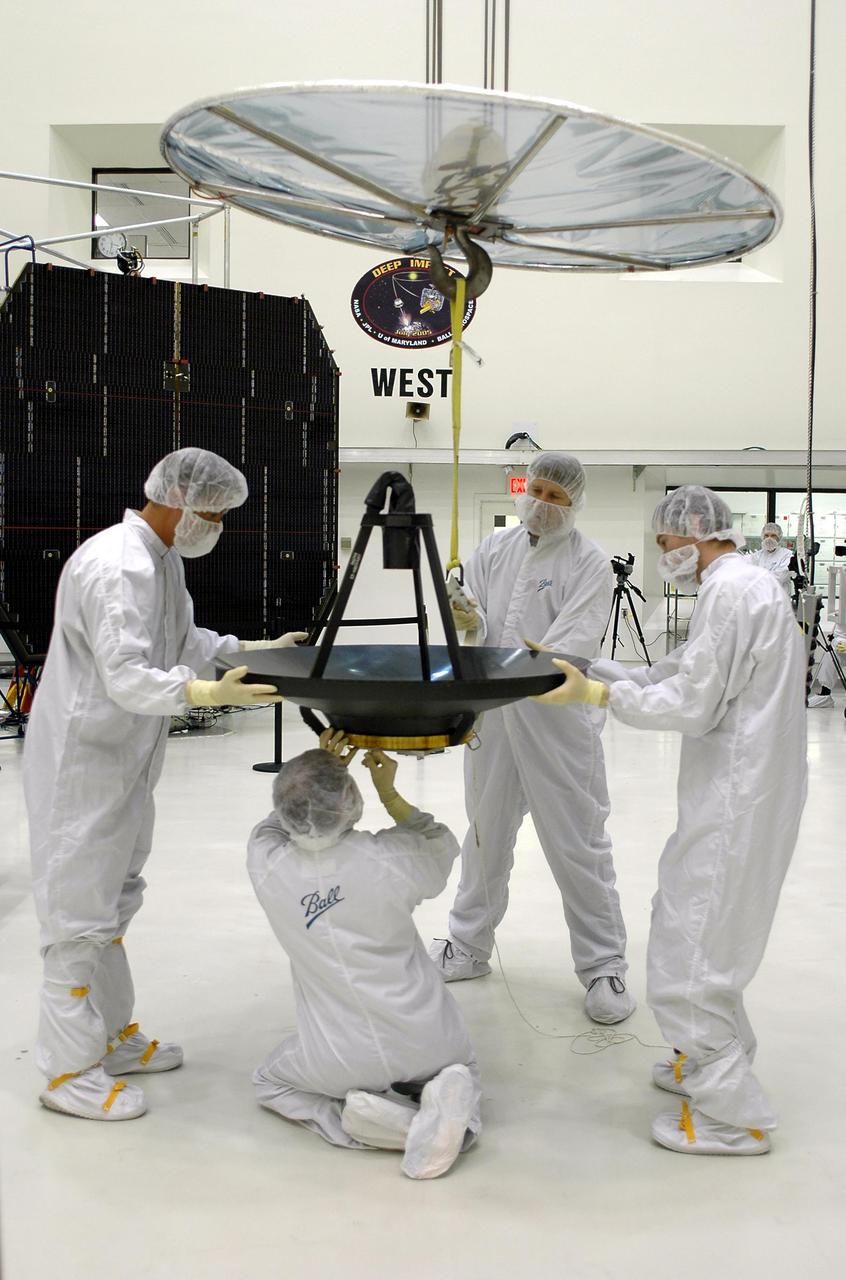
KENNEDY SPACE CENTER, FLA. - Ball Aerospace technicians at Astrotech in Titusville, Fla., attach on overhead crane to the high-gain communications antenna to be installed on the Deep Impact spacecraft. A NASA Discovery mission, Deep Impact will probe beneath the surface of Comet Tempel 1 on July 4, 2005, when the comet is 83 million miles from Earth, and reveal the secrets of its interior. During the encounter phase, the high-gain antenna transmits near-real-time images of the impact back to Earth. The spacecraft is scheduled to launch Jan. 8 aboard a Boeing Delta II rocket from Launch Complex 17-B at Cape Canaveral Air Force Station, Fla.
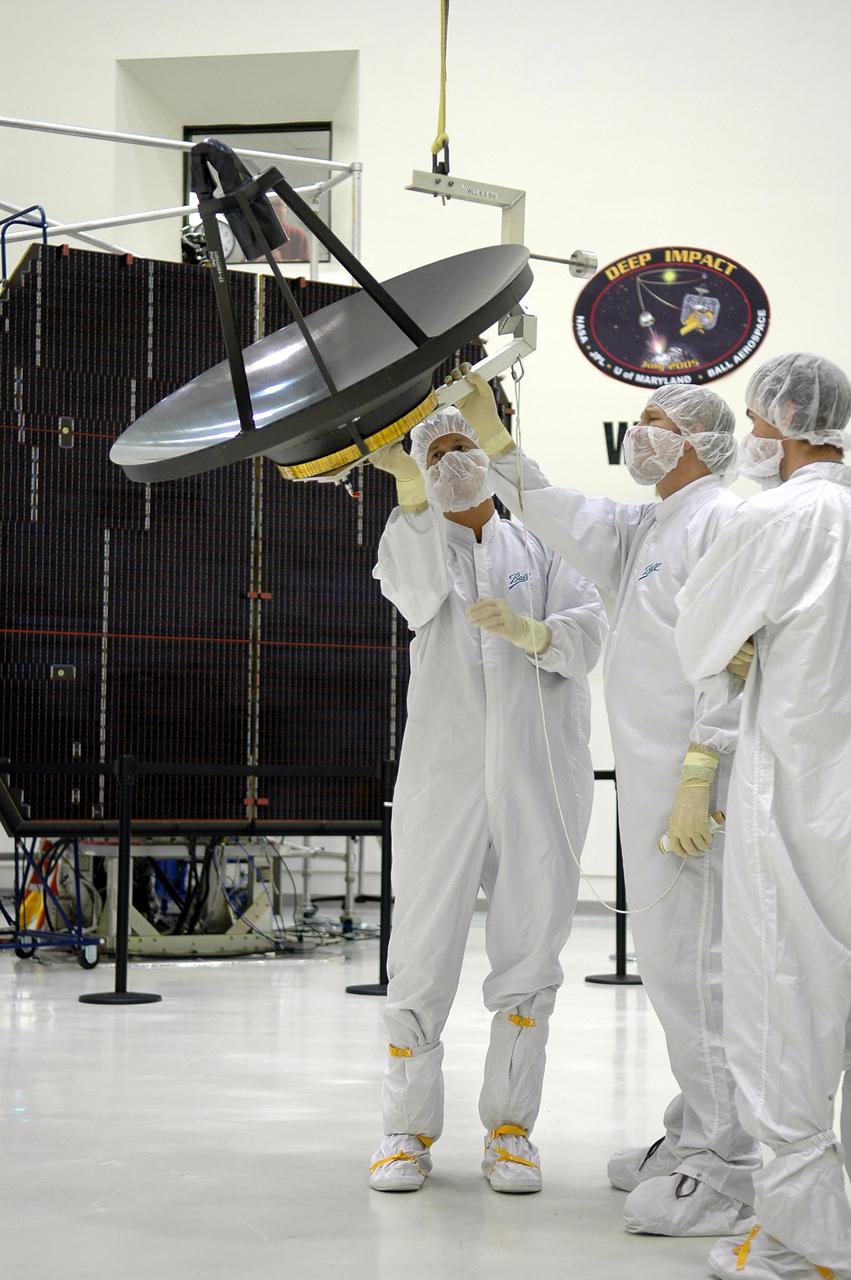
KENNEDY SPACE CENTER, FLA. - Ball Aerospace technicians at Astrotech in Titusville, Fla., make sure the crane is securely attached to the high-gain communications antenna to be installed on the Deep Impact spacecraft. A NASA Discovery mission, Deep Impact will probe beneath the surface of Comet Tempel 1 on July 4, 2005, when the comet is 83 million miles from Earth, and reveal the secrets of its interior. During the encounter phase, the high-gain antenna transmits near-real-time images of the impact back to Earth. The spacecraft is scheduled to launch Jan. 8 aboard a Boeing Delta II rocket from Launch Complex 17-B at Cape Canaveral Air Force Station, Fla.
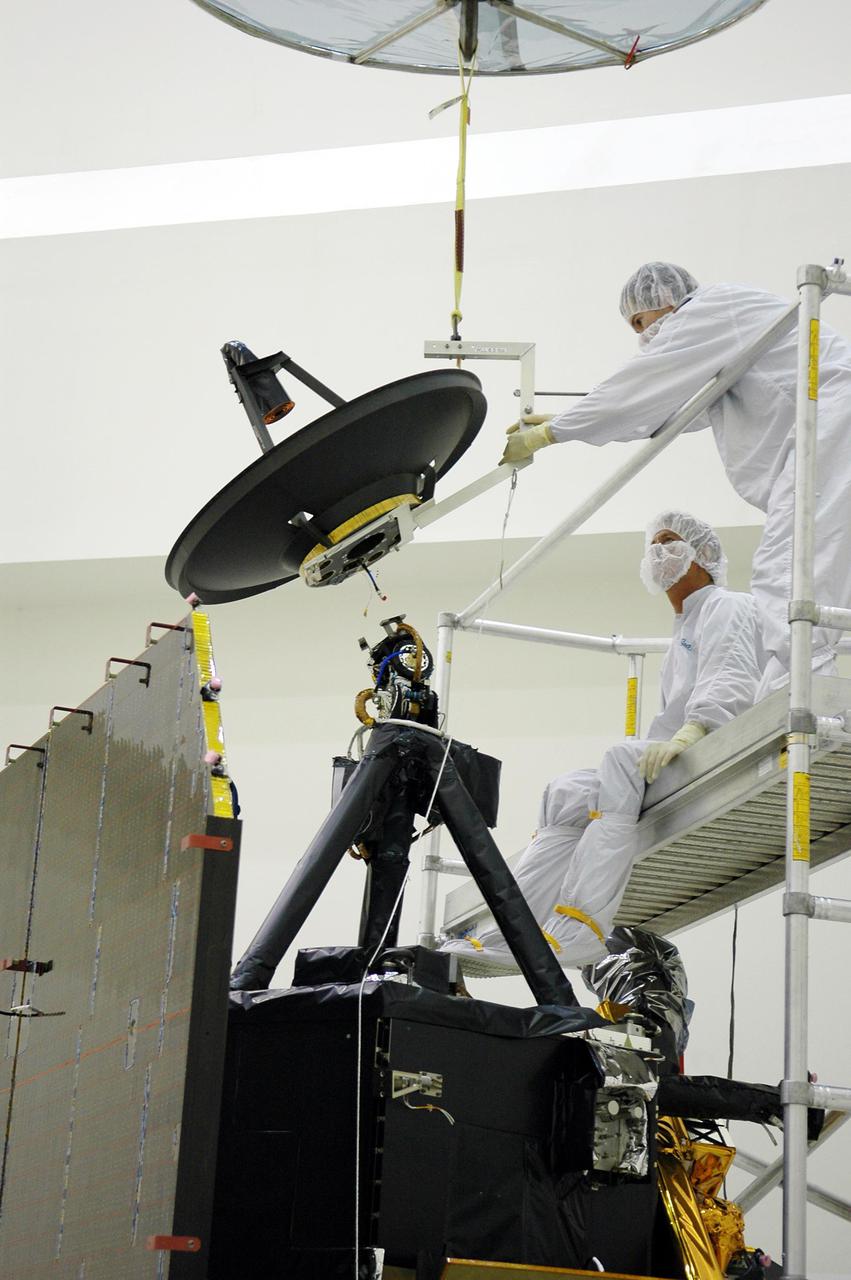
KENNEDY SPACE CENTER, FLA. - Ball Aerospace technicians at Astrotech in Titusville, Fla., guide the high-gain communications antenna toward the attach-point on the Deep Impact spacecraft. A NASA Discovery mission, Deep Impact will probe beneath the surface of Comet Tempel 1 on July 4, 2005, when the comet is 83 million miles from Earth, and reveal the secrets of its interior. During the encounter phase, the high-gain antenna transmits near-real-time images of the impact back to Earth. The spacecraft is scheduled to launch Jan. 8 aboard a Boeing Delta II rocket from Launch Complex 17-B at Cape Canaveral Air Force Station, Fla.
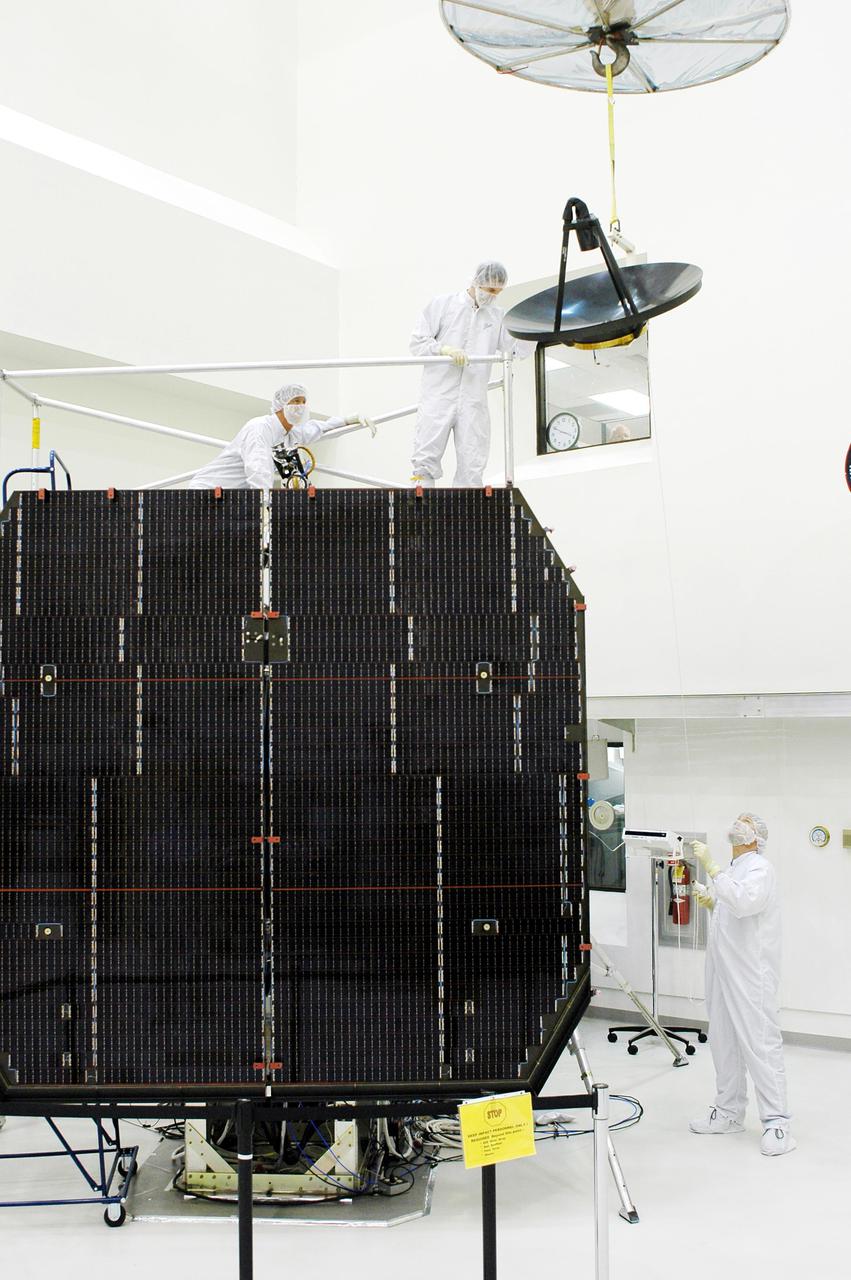
KENNEDY SPACE CENTER, FLA. - Ball Aerospace technicians at Astrotech in Titusville, Fla., watch as the high-gain communications antenna is moved toward the Deep Impact spacecraft for installation. A NASA Discovery mission, Deep Impact will probe beneath the surface of Comet Tempel 1 on July 4, 2005, when the comet is 83 million miles from Earth, and reveal the secrets of its interior. During the encounter phase, the high-gain antenna transmits near-real-time images of the impact back to Earth. The spacecraft is scheduled to launch Jan. 8 aboard a Boeing Delta II rocket from Launch Complex 17-B at Cape Canaveral Air Force Station, Fla.

Engineers at NASA's Jet Propulsion Laboratory in Southern California test an engineering model of a high-frequency (HF) radar antenna that makes up part of NASA's Europa Clipper radar instrument on Dec. 17, 2019. The antenna is a 59-foot-long (18-meter-long) narrow copper tube held straight by several cables and a cross bar on the tower at right. In space, the copper tube will stick out straight on its own, but in Earth's gravity, the antenna requires supports to keep it straight for testing. The mobile tower at left holds a model of the VHF (very high-frequency) antenna so that engineers could measure the amount of energy coupled from one antenna to the other. Europa Clipper's radar instrument is called Radar for Europa Assessment and Sounding: Ocean to Near-surface, or REASON. As the spacecraft orbits Jupiter and surveys its icy moon Europa, REASON will use HF and VHF radio signals to penetrate up to 18 miles (30 kilometers) into the icy shell that covers Europa. The radio waves will bounce off subsurface features and return to the spacecraft to create images of the ice layers' internal structure. REASON will help scientists look for the moon's suspected ocean, measure ice thickness, and better understand the icy shell's interior. The instrument will also study the elevation, properties, and roughness of Europa's surface, and will prowl Europa's upper atmosphere for signs of plume activity. The antennae were built for NASA by Heliospace Corporation in Berkeley, California, and the University of Texas at Austin is the lead institution for REASON. The testing was conducted at JPL's Mesa Antenna Measurement Facility, which sits on a high plateau. With an internal global ocean twice the size of Earth's oceans combined, Europa may have the potential to harbor life. The Europa Clipper orbiter will swoop around Jupiter on an elliptical path, dipping close to the moon on each flyby to collect data. Understanding Europa's habitability will help scientists better understand how life developed on Earth and the potential for finding life beyond our planet. Europa Clipper is aiming for a launch readiness date of 2024. https://photojournal.jpl.nasa.gov/catalog/PIA24323
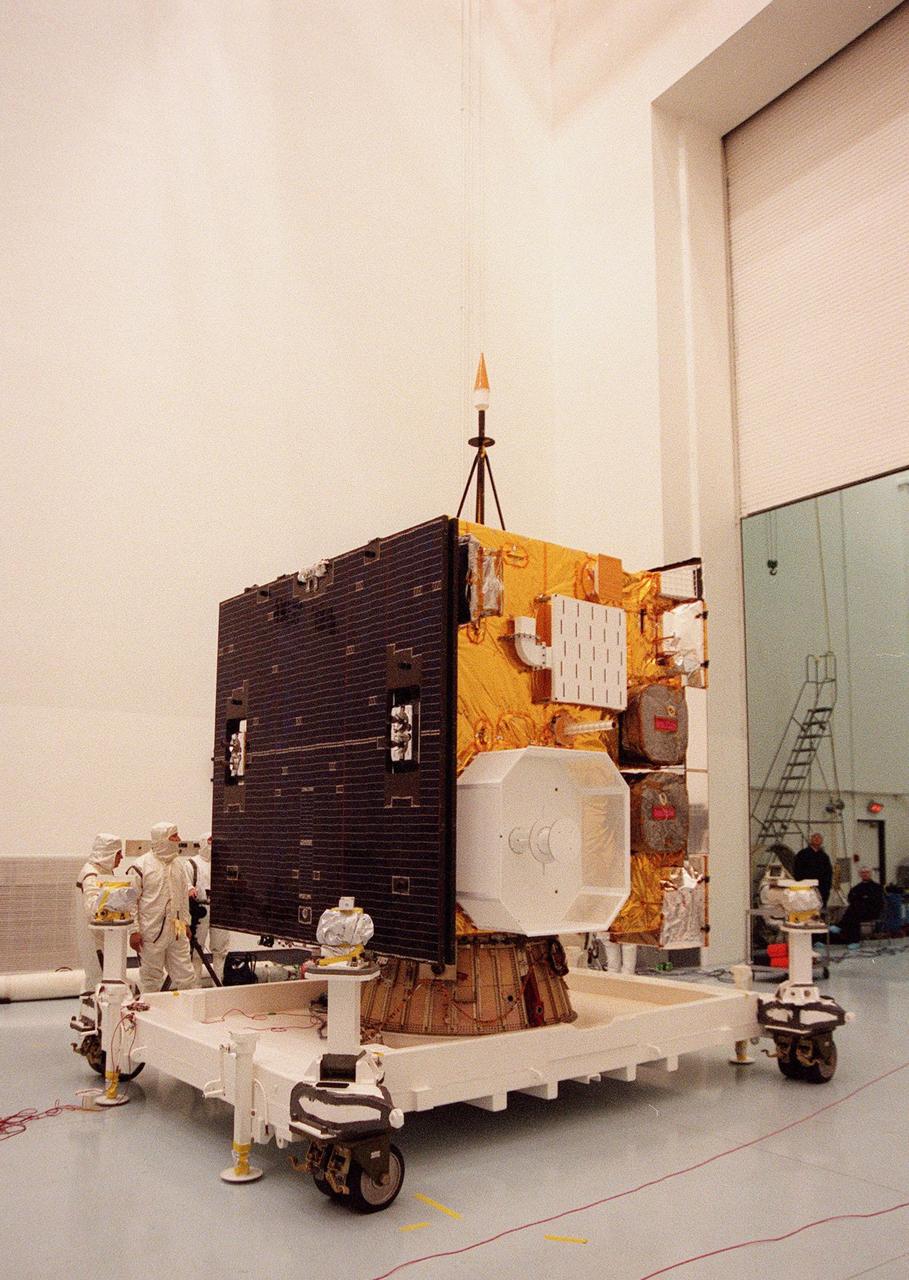
The GOES-L weather satellite sits on a workstand at Astrotech, Titusville, Fla., ready to be encapsulated for its transfer to Launch Pad 36A, Cape Canaveral Air Station. On the left side is the folded, two-panel solar array; on the adjoining side is a white box, which is the UHF antenna. Above the box is the S-band transmit antenna and receive antenna. Between them protrudes a search and rescue antenna. At right are the sounder (top) and imager (bottom). The mounted equipment on top of the unit is a telemetry and command antenna. The GOES is scheduled for launch aboard a Lockheed Martin Atlas II rocket later in May. The fourth of a new advanced series of geostationary weather satellites for the National Oceanic and Atmospheric Administration (NOAA), GOES-L is a three-axis inertially stabilized spacecraft that will provide pictures and perform atmospheric sounding at the same time. After it is launched, the satellite will undergo checkout and then provide backup capabilities for the existing, aging operational satellites. Once in orbit, the satellite will become GOES-11, joining GOES-8, GOES-9 and GOES-10 in space
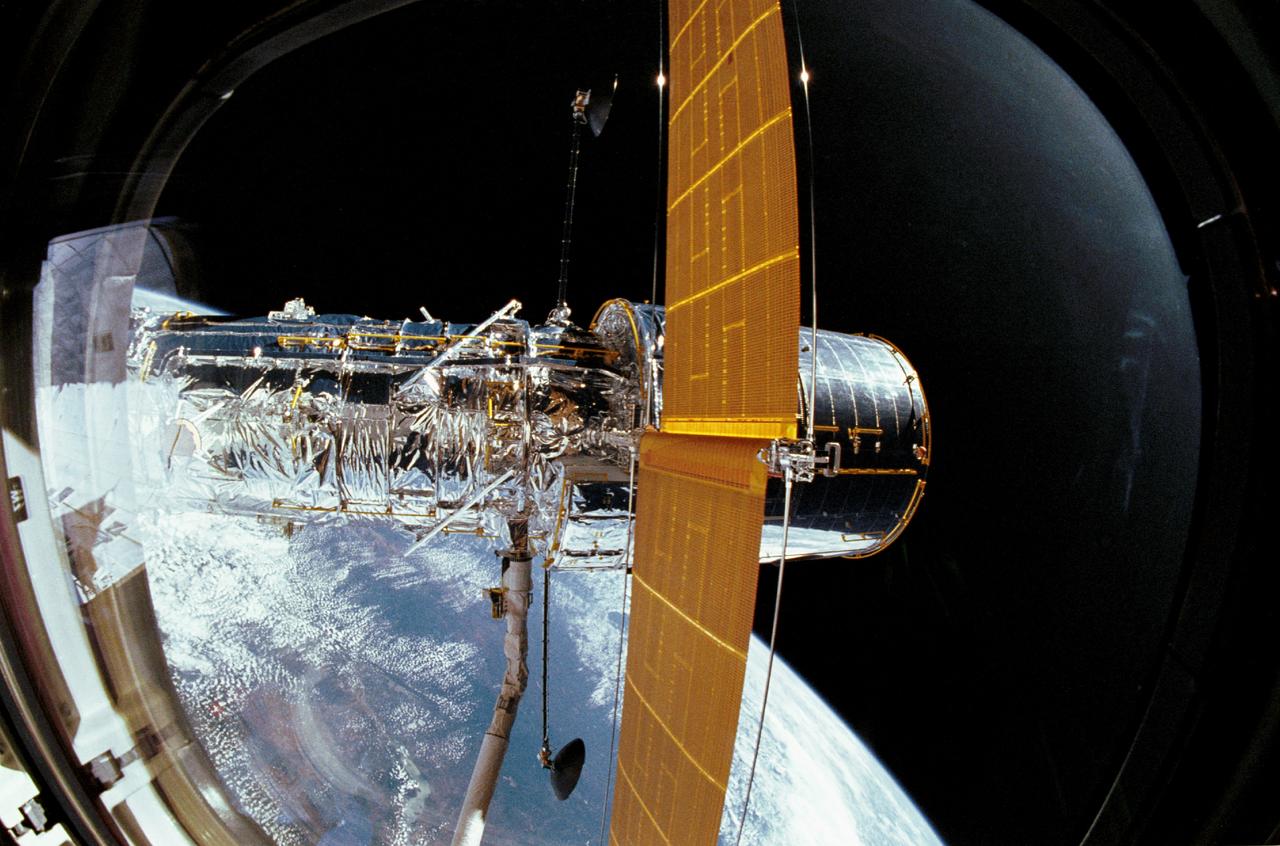
STS031-03-014 (25 April 1990) --- The Hubble Space Telescope (HST), still in the grasp of Discovery's Remote Manipulator System (RMS), is backdropped over Earth some 332 nautical miles below. In this scene, HST has deployed one of its solar array panels but is yet to have extended the second. This scene was captured with a 35mm camera aimed through an overhead window on aft the flight deck.
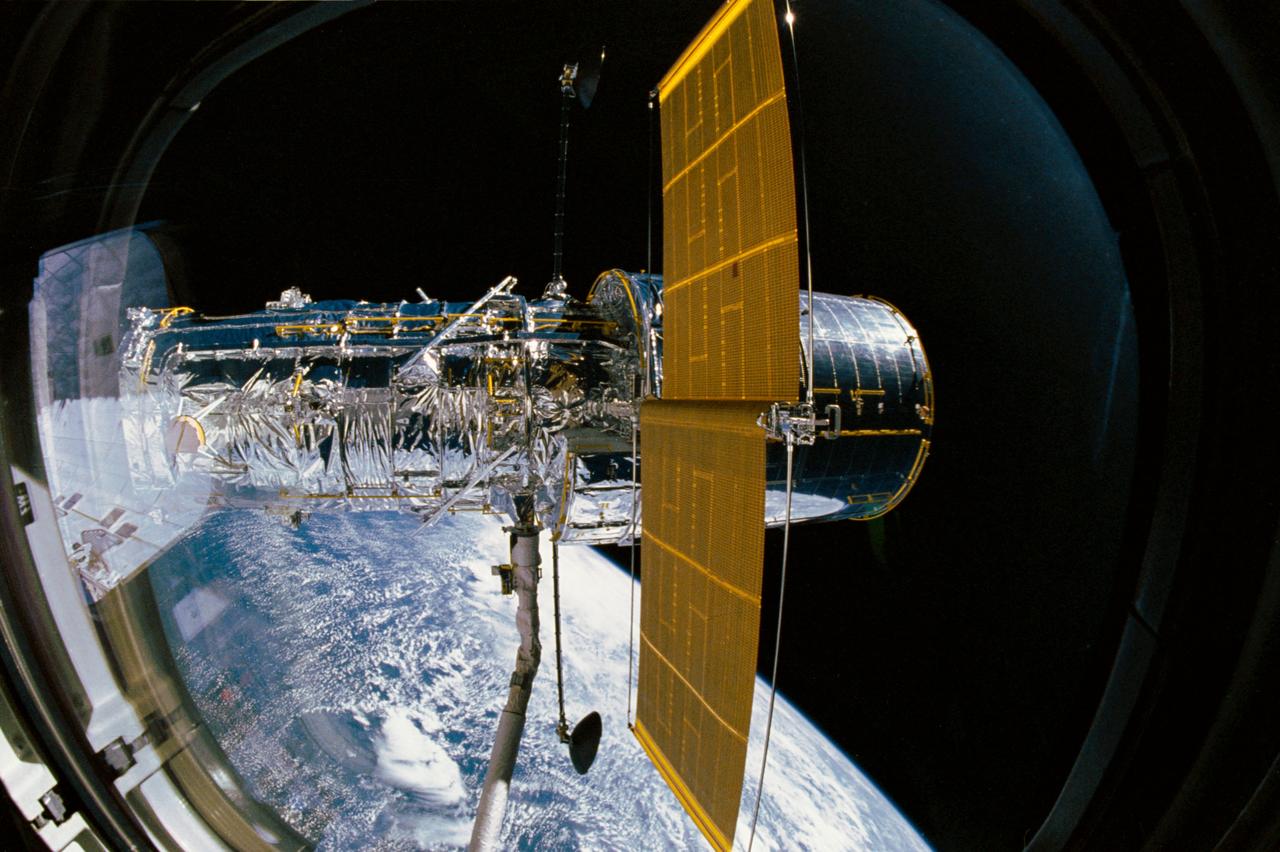
STS031-03-009 (25 April 1990) --- The Hubble Space Telescope (HST), still in the grasp of Discovery's remote manipulator system (RMS), is backdropped over Earth some 332 nautical miles below. In this scene, HST has deployed one of its solar array panels but is yet to have extended the second. This scene was captured with a 35mm camera aimed through an overhead window on the aft flight deck.
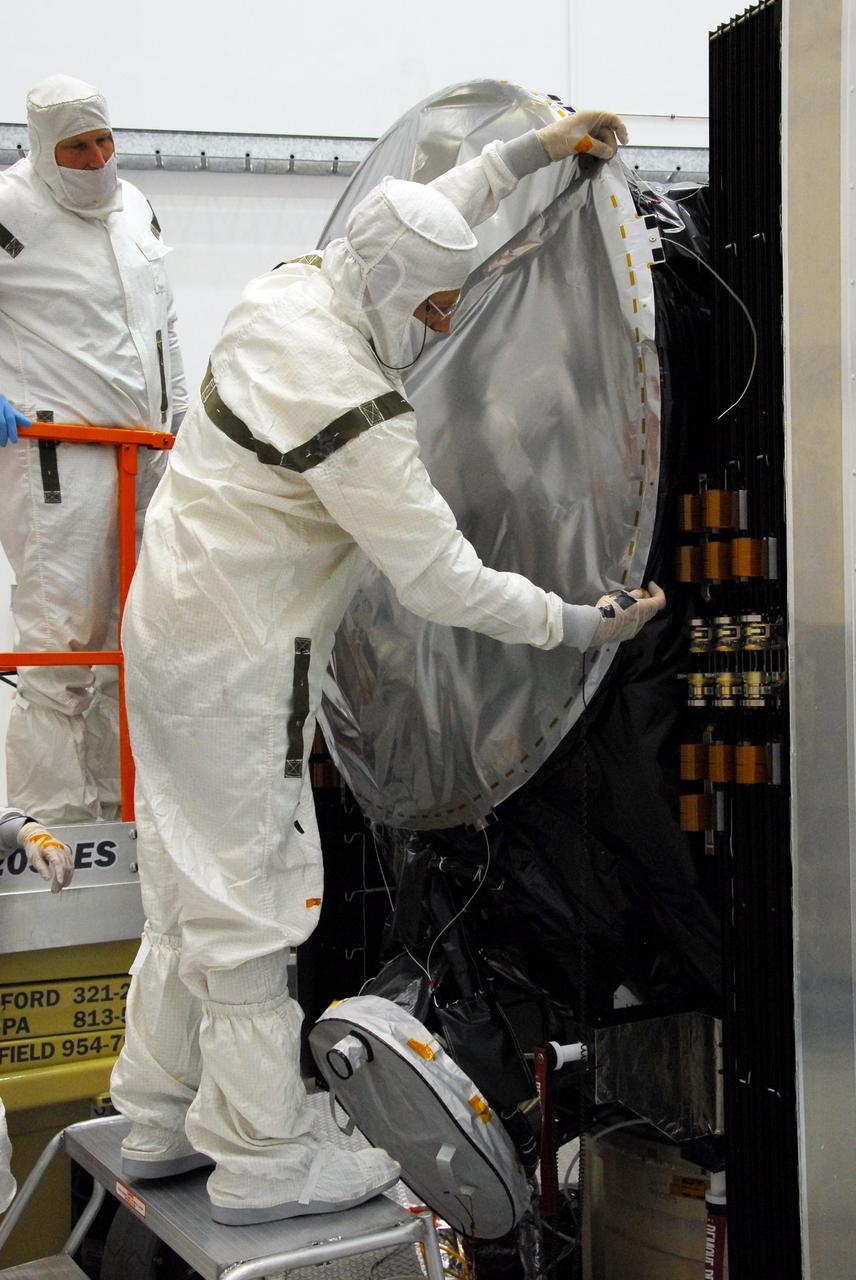
KENNEDY SPACE CENTER, FLA. -- At Astrotech, a technician secures one side of the sun shade over the high gain antenna on the Dawn spacecraft. Made of germanium kapton, the shade, which is RF transparent, is placed over the sensitive antenna to reflect and emit harmful solar radiation to prevent the antenna from being excessively heated. Dawn is scheduled to launch July 7 from Pad 17-B on Cape Canaveral Air Force Station. Dawn's goal is to characterize the conditions and processes of the solar system's earliest epoch by investigating in detail the largest protoplanets that have remained intact since their formations: asteroid Vesta and the dwarf planet Ceres. They reside in the extensive zone between Mars and Jupiter together with many other smaller bodies, called the asteroid belt. Photo credit: NASA/George Shelton
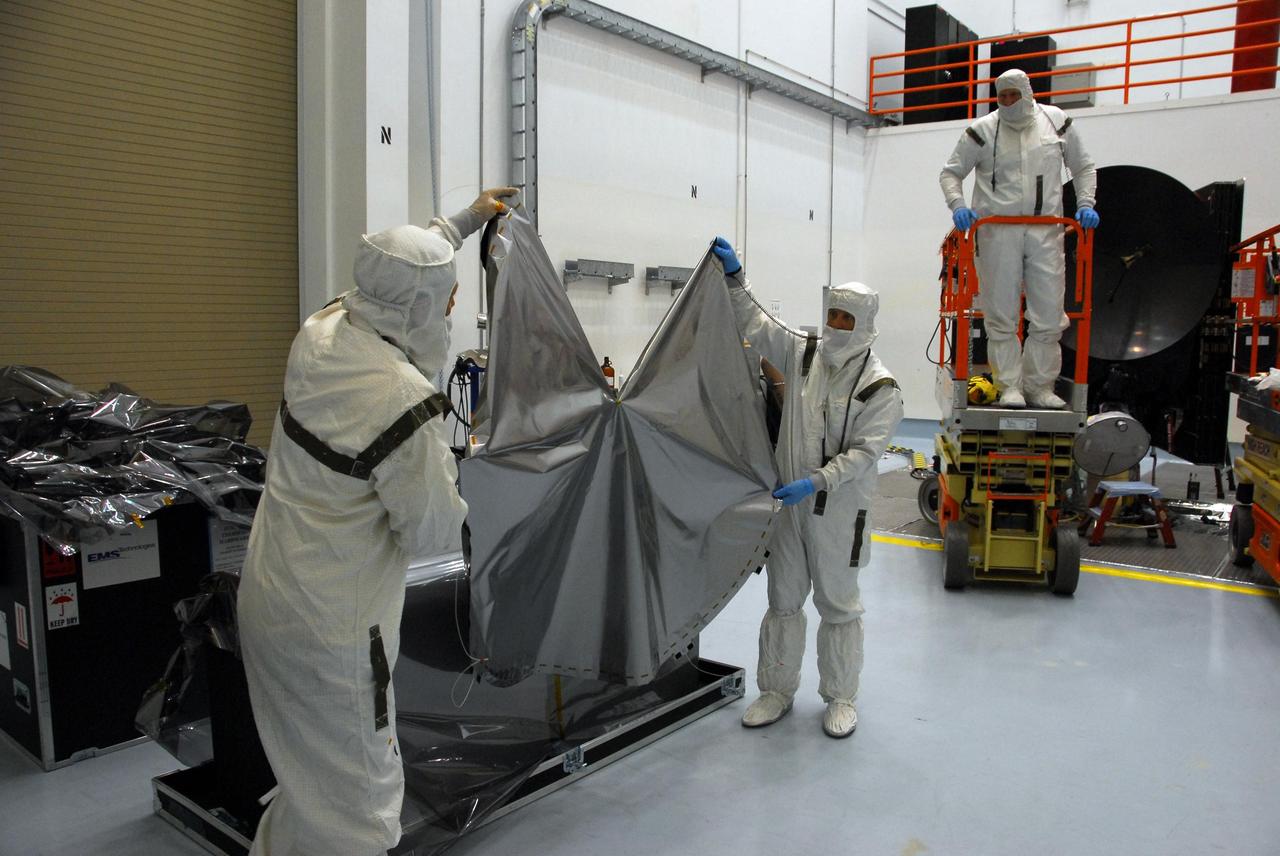
KENNEDY SPACE CENTER, FLA. -- At Astrotech, technicians lift the sun shade to be installed over the high gain antenna on the Dawn spacecraft. Made of germanium kapton, the shade, which is RF transparent, is placed over the sensitive antenna to reflect and emit harmful solar radiation to prevent the antenna from being excessively heated. Dawn is scheduled to launch July 7 from Pad 17-B on Cape Canaveral Air Force Station. Dawn's goal is to characterize the conditions and processes of the solar system's earliest epoch by investigating in detail the largest protoplanets that have remained intact since their formations: asteroid Vesta and the dwarf planet Ceres. They reside in the extensive zone between Mars and Jupiter together with many other smaller bodies, called the asteroid belt. Photo credit: NASA/George Shelton
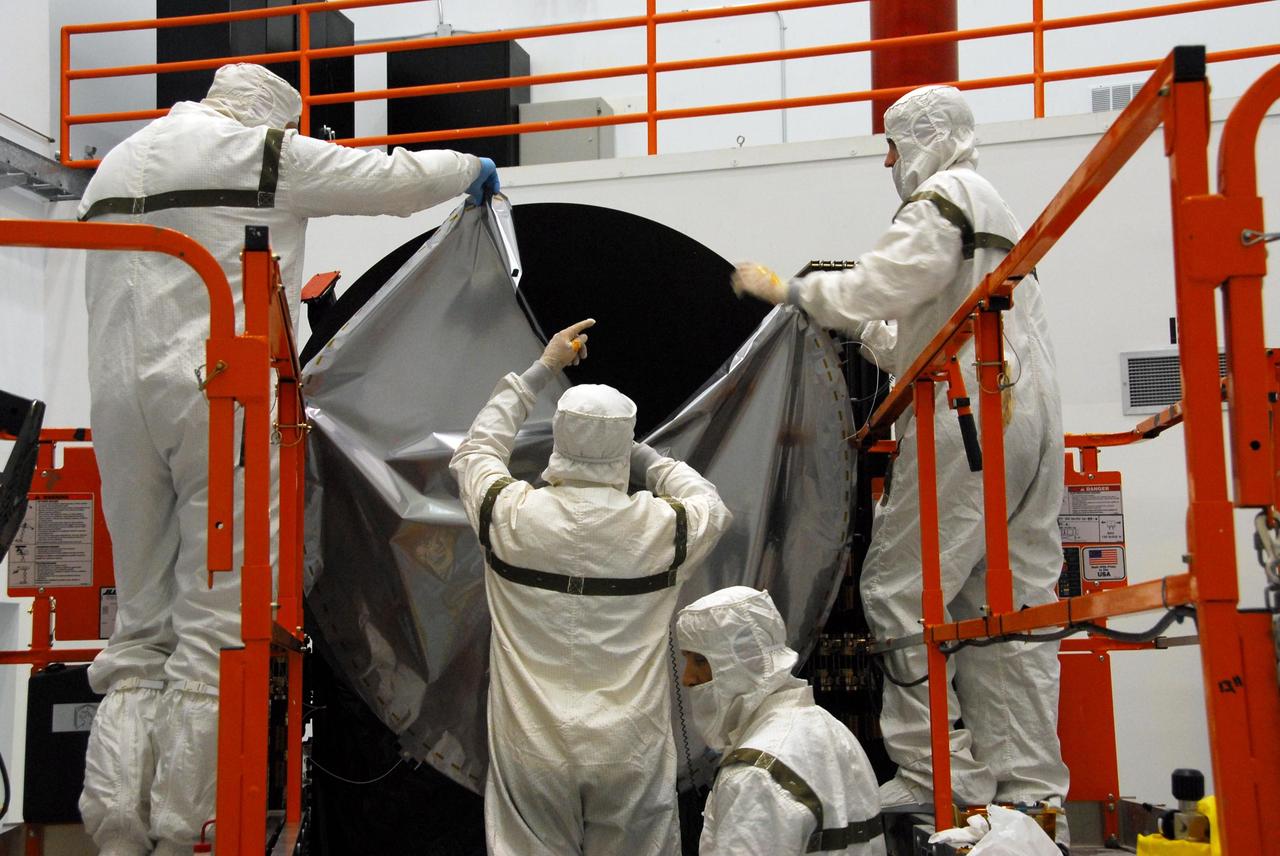
KENNEDY SPACE CENTER, FLA. -- At Astrotech, technicians begin placing the sun shade over the high gain antenna on the Dawn spacecraft. Made of germanium kapton, the shade, which is RF transparent, is placed over the sensitive antenna to reflect and emit harmful solar radiation to prevent the antenna from being excessively heated. Dawn is scheduled to launch July 7 from Pad 17-B on Cape Canaveral Air Force Station. Dawn's goal is to characterize the conditions and processes of the solar system's earliest epoch by investigating in detail the largest protoplanets that have remained intact since their formations: asteroid Vesta and the dwarf planet Ceres. They reside in the extensive zone between Mars and Jupiter together with many other smaller bodies, called the asteroid belt. Photo credit: NASA/George Shelton
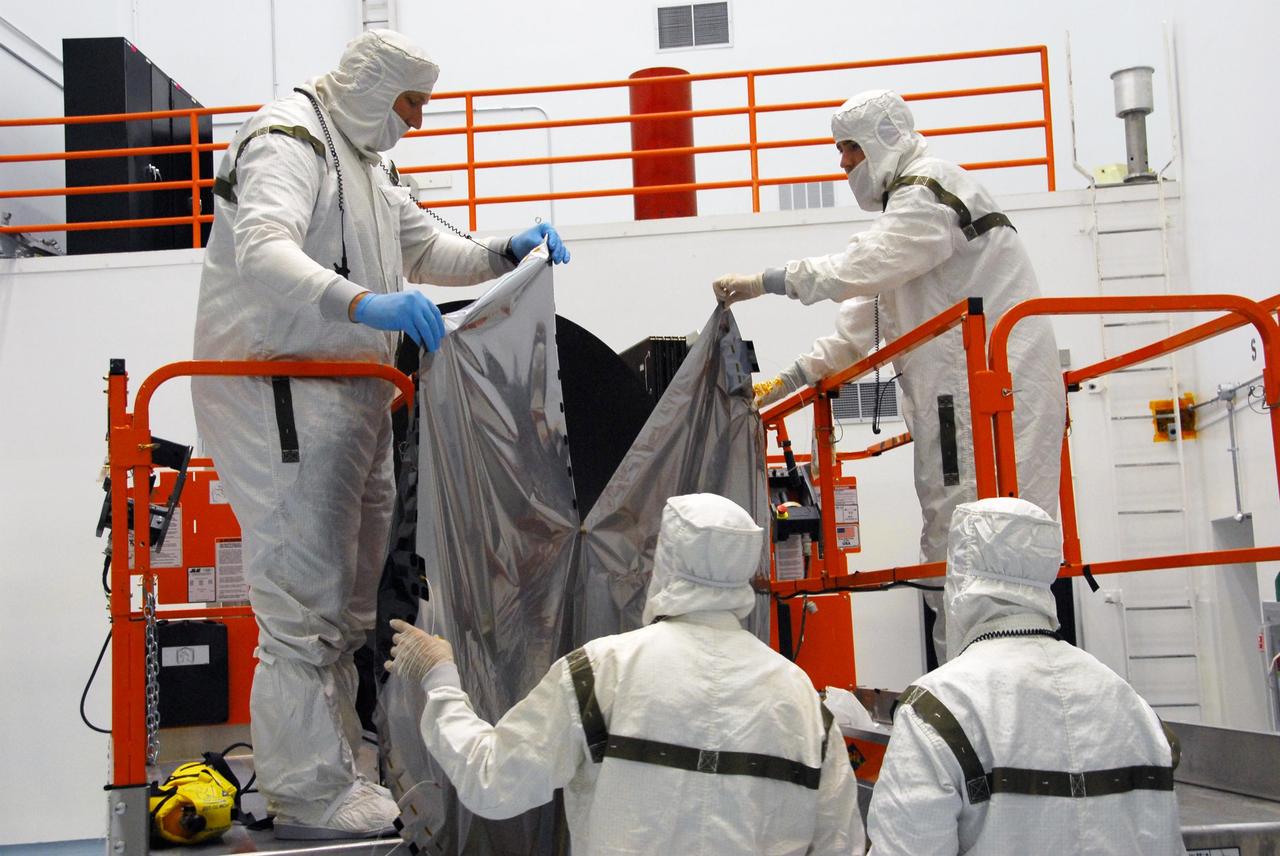
KENNEDY SPACE CENTER, FLA. -- At Astrotech, technicians lift the sun shade toward the Dawn spacecraft to install it on the high gain antenna. Made of germanium kapton, the shade, which is RF transparent, is placed over the sensitive antenna to reflect and emit harmful solar radiation to prevent the antenna from being excessively heated. Dawn is scheduled to launch July 7 from Pad 17-B on Cape Canaveral Air Force Station. Dawn's goal is to characterize the conditions and processes of the solar system's earliest epoch by investigating in detail the largest protoplanets that have remained intact since their formations: asteroid Vesta and the dwarf planet Ceres. They reside in the extensive zone between Mars and Jupiter together with many other smaller bodies, called the asteroid belt. Photo credit: NASA/George Shelton
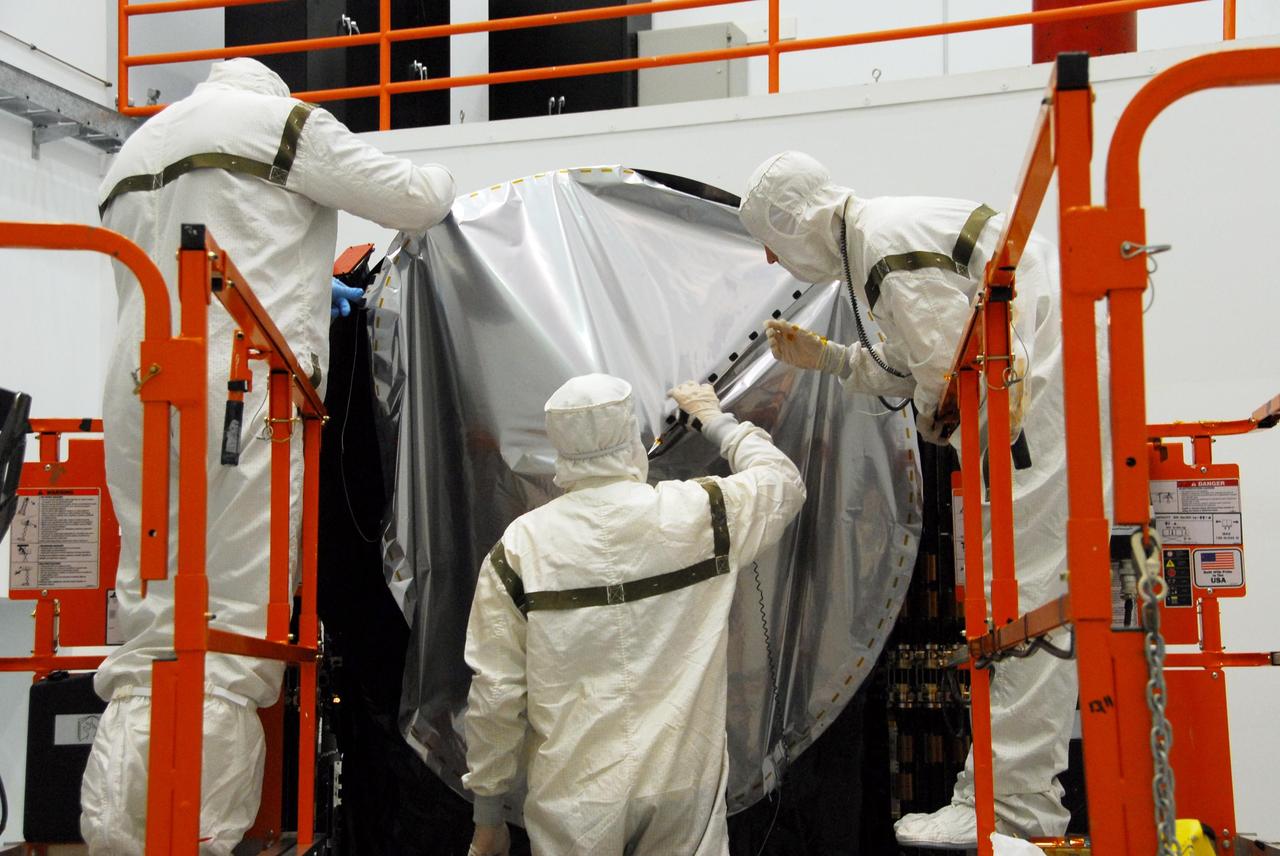
KENNEDY SPACE CENTER, FLA. -- At Astrotech, technicians begin securing the sun shade over the high gain antenna on the Dawn spacecraft. Made of germanium kapton, the shade, which is RF transparent, is placed over the sensitive antenna to reflect and emit harmful solar radiation to prevent the antenna from being excessively heated. Dawn is scheduled to launch July 7 from Pad 17-B on Cape Canaveral Air Force Station. Dawn's goal is to characterize the conditions and processes of the solar system's earliest epoch by investigating in detail the largest protoplanets that have remained intact since their formations: asteroid Vesta and the dwarf planet Ceres. They reside in the extensive zone between Mars and Jupiter together with many other smaller bodies, called the asteroid belt. Photo credit: NASA/George Shelton
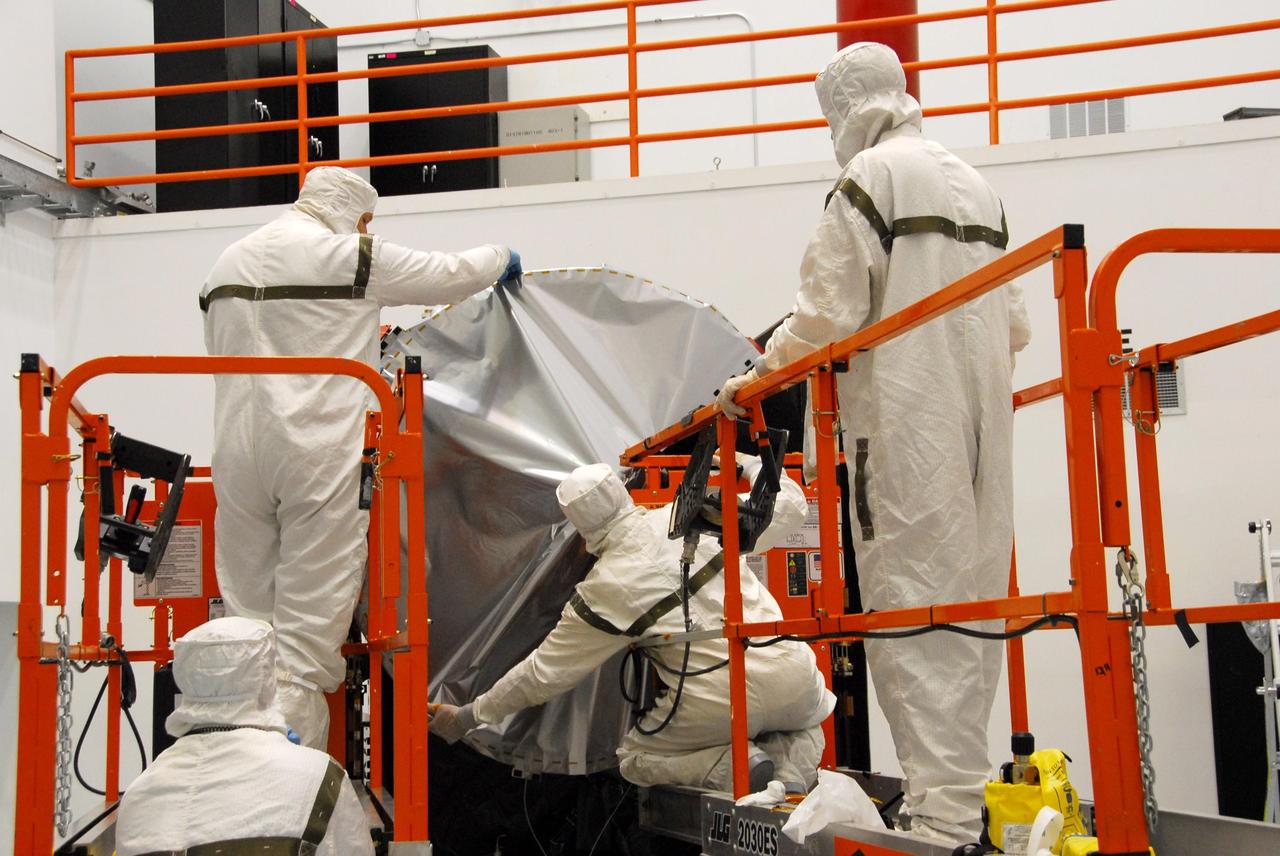
KENNEDY SPACE CENTER, FLA. -- At Astrotech, technicians are securing the sun shade over the high gain antenna on the Dawn spacecraft. Made of germanium kapton, the shade, which is RF transparent, is placed over the sensitive antenna to reflect and emit harmful solar radiation to prevent the antenna from being excessively heated. Dawn is scheduled to launch July 7 from Pad 17-B on Cape Canaveral Air Force Station. Dawn's goal is to characterize the conditions and processes of the solar system's earliest epoch by investigating in detail the largest protoplanets that have remained intact since their formations: asteroid Vesta and the dwarf planet Ceres. They reside in the extensive zone between Mars and Jupiter together with many other smaller bodies, called the asteroid belt. Photo credit: NASA/George Shelton

KENNEDY SPACE CENTER, FLA. -- At Astrotech, a technician secures one side of the sun shade over the high gain antenna on the Dawn spacecraft. Made of germanium kapton, the shade, which is RF transparent, is placed over the sensitive antenna to reflect and emit harmful solar radiation to prevent the antenna from being excessively heated. Dawn is scheduled to launch July 7 from Pad 17-B on Cape Canaveral Air Force Station. Dawn's goal is to characterize the conditions and processes of the solar system's earliest epoch by investigating in detail the largest protoplanets that have remained intact since their formations: asteroid Vesta and the dwarf planet Ceres. They reside in the extensive zone between Mars and Jupiter together with many other smaller bodies, called the asteroid belt. Photo credit: NASA/George Shelton
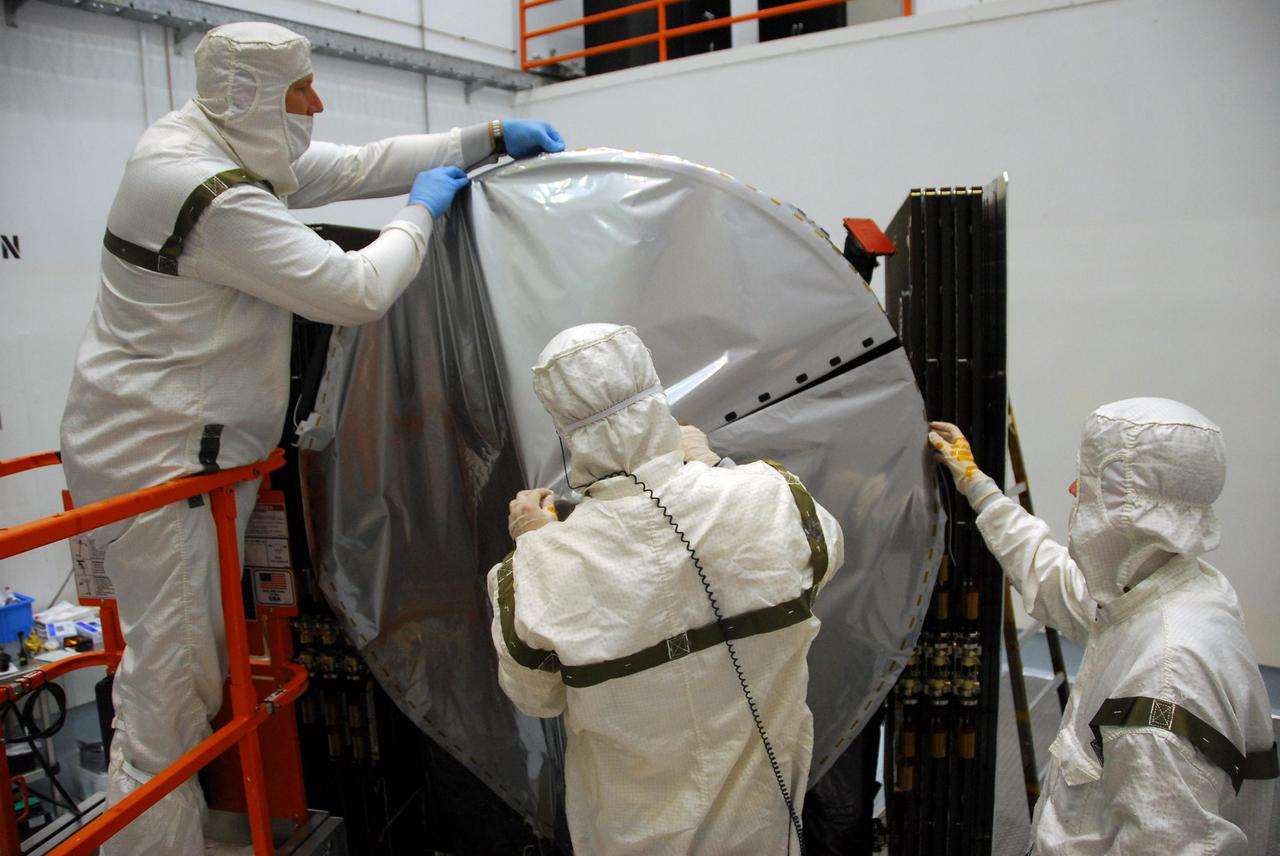
KENNEDY SPACE CENTER, FLA. -- At Astrotech, technicians secure all sides of the sun shade over the high gain antenna on the Dawn spacecraft. Made of germanium kapton, the shade, which is RF transparent, is placed over the sensitive antenna to reflect and emit harmful solar radiation to prevent the antenna from being excessively heated. Dawn is scheduled to launch July 7 from Pad 17-B on Cape Canaveral Air Force Station. Dawn's goal is to characterize the conditions and processes of the solar system's earliest epoch by investigating in detail the largest protoplanets that have remained intact since their formations: asteroid Vesta and the dwarf planet Ceres. They reside in the extensive zone between Mars and Jupiter together with many other smaller bodies, called the asteroid belt. Photo credit: NASA/George Shelton
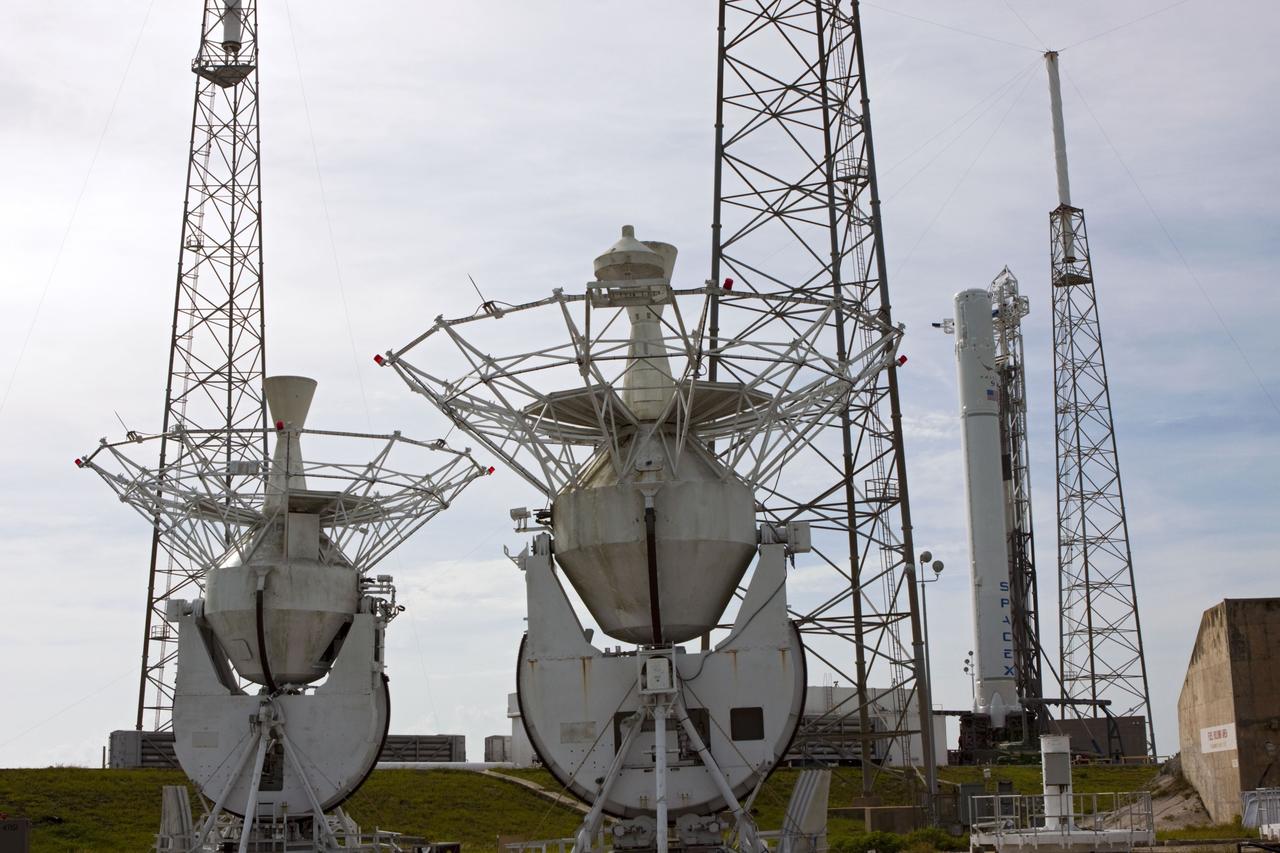
CAPE CANAVERAL, Fla. - Just prior to the wet dress rehearsal for the SpaceX Falcon 9 rocket, the frameworks of the former MILA tracking station S-band 9-meter tracking antennas are seen with the Falcon 9 rocket. These antennas were used by NASA during the Apollo and space shuttle programs. They are being re-purposed by SpaceX. The antennas will moved to another location, reassembled and refurbished for tracking during future SpaceX launches and missions. The SpaceX CRS contract with NASA provides for 12 cargo resupply missions to the station through 2015, the first of which is targeted to launch in October 2012.SpaceX became the first private company to berth a spacecraft with the space station in 2012 during its final demonstration flight under the Commercial Orbital Transportation Services, or COTS, program managed by NASA's Johnson Space Center in Houston. Photo credit: NASA/Jim Grossmann

KENNEDY SPACE CENTER, FLA. -- At At Astrotech, the Dawn spacecraft is on display with the recently installed sun shade over the high gain antenna. Made of germanium kapton, the shade, which is RF transparent, is placed over the sensitive antenna to reflect and emit harmful solar radiation to prevent the antenna from being excessively heated. Dawn is scheduled to launch July 7 from Pad 17-B on Cape Canaveral Air Force Station. Dawn's goal is to characterize the conditions and processes of the solar system's earliest epoch by investigating in detail the largest protoplanets that have remained intact since their formations: asteroid Vesta and the dwarf planet Ceres. They reside in the extensive zone between Mars and Jupiter together with many other smaller bodies, called the asteroid belt. Photo credit: NASA/George Shelton
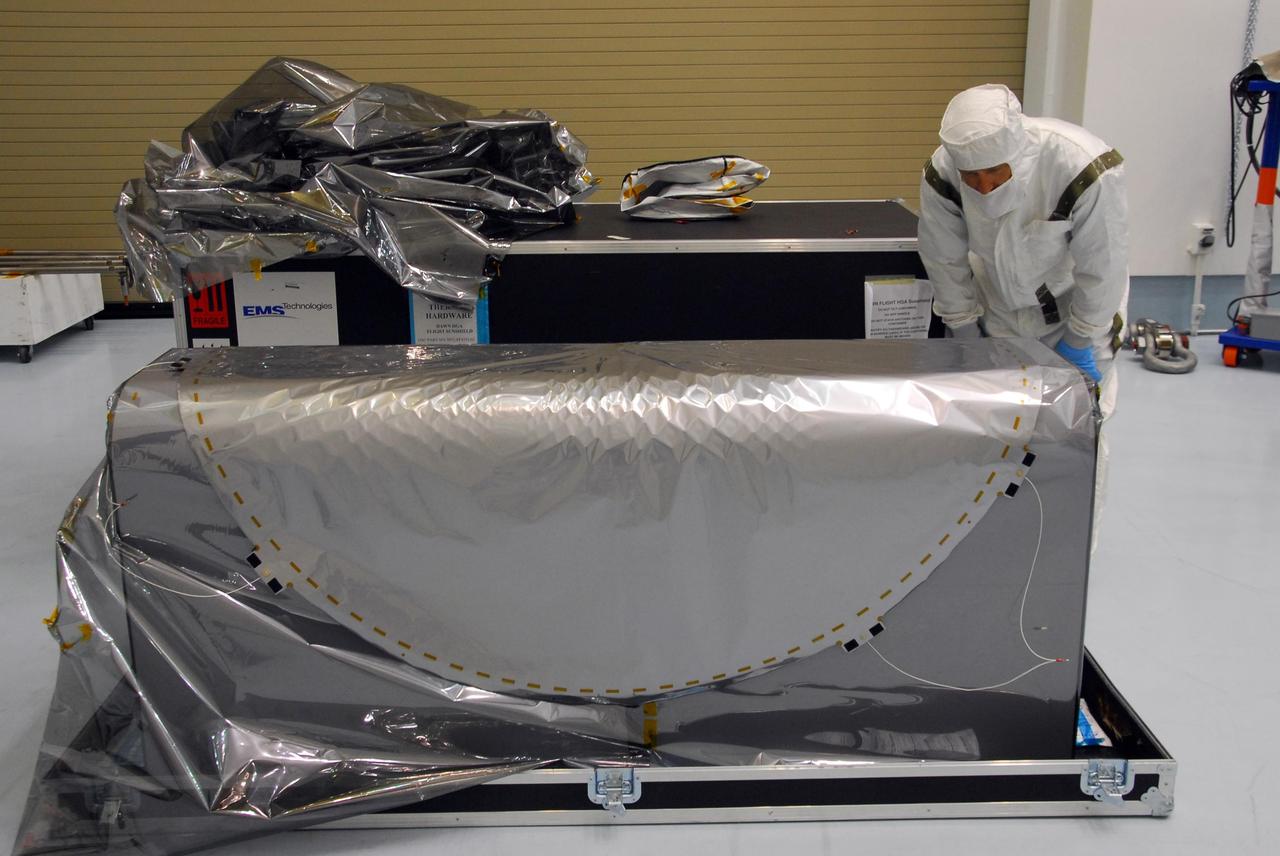
KENNEDY SPACE CENTER, FLA. -- At Astrotech, a technician looks at the sun shade (foreground) to be installed over the high gain antenna on the Dawn spacecraft. Made of germanium kapton, the shade, which is RF transparent, is placed over the sensitive antenna to reflect and emit harmful solar radiation to prevent the antenna from being excessively heated. Dawn is scheduled to launch July 7 from Pad 17-B on Cape Canaveral Air Force Station. Dawn's goal is to characterize the conditions and processes of the solar system's earliest epoch by investigating in detail the largest protoplanets that have remained intact since their formations: asteroid Vesta and the dwarf planet Ceres. They reside in the extensive zone between Mars and Jupiter together with many other smaller bodies, called the asteroid belt. Photo credit: NASA/George Shelton
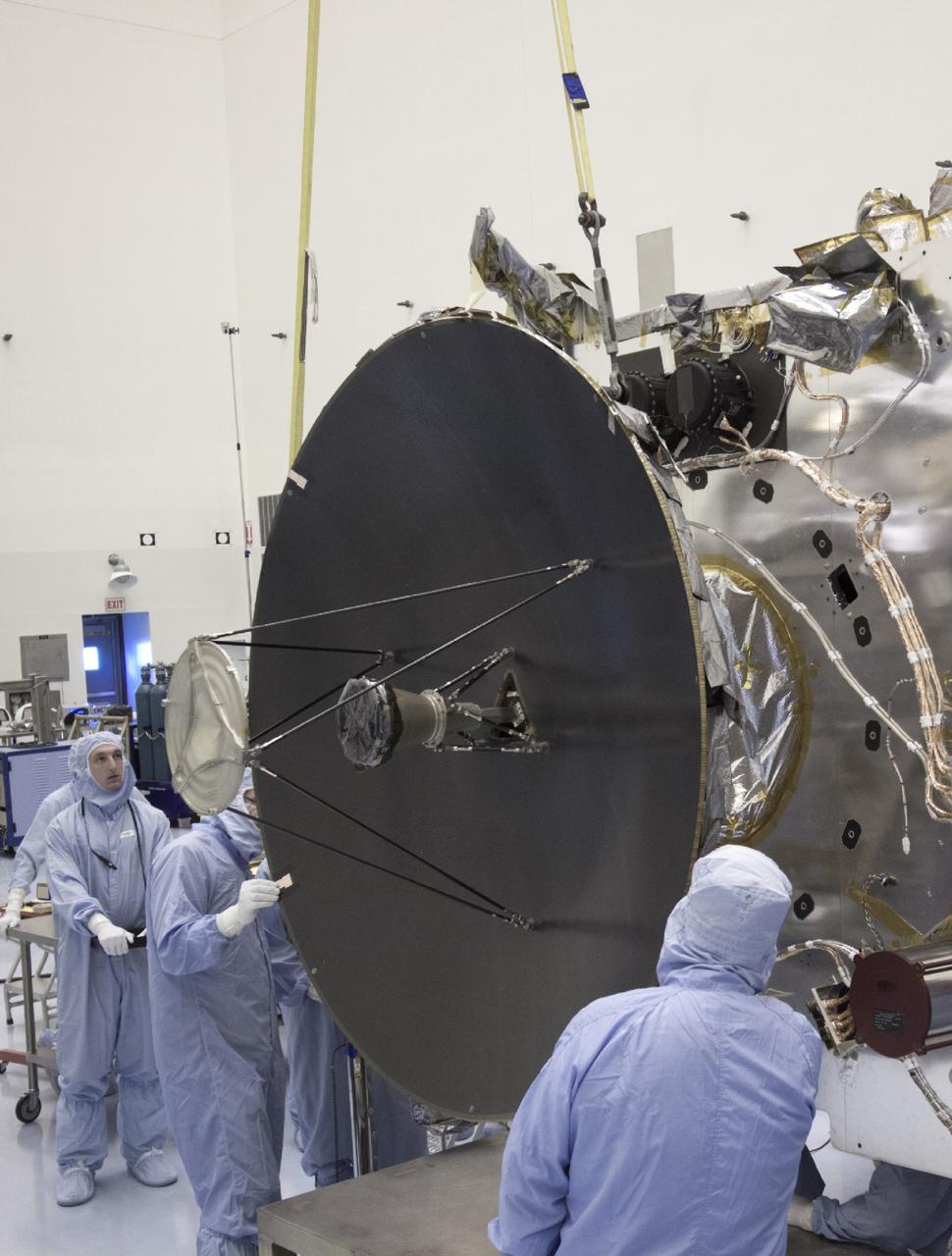
CAPE CANAVERAL, Fla. – At NASA’s Kennedy Space Center in Florida, technicians install the parabolic high gain antenna onto the Mars Atmosphere and Volatile Evolution, or MAVEN spacecraft, in the Payload Hazardous Servicing Facility. The antenna will communicate vast amounts of data to Earth during the mission. MAVEN is being prepared inside the facility for its scheduled November launch aboard a United Launch Alliance Atlas V rocket to Mars. Positioned in an orbit above the Red Planet, MAVEN will study the upper atmosphere of Mars in unprecedented detail. Photo credit: NASA/Jim Grossmann
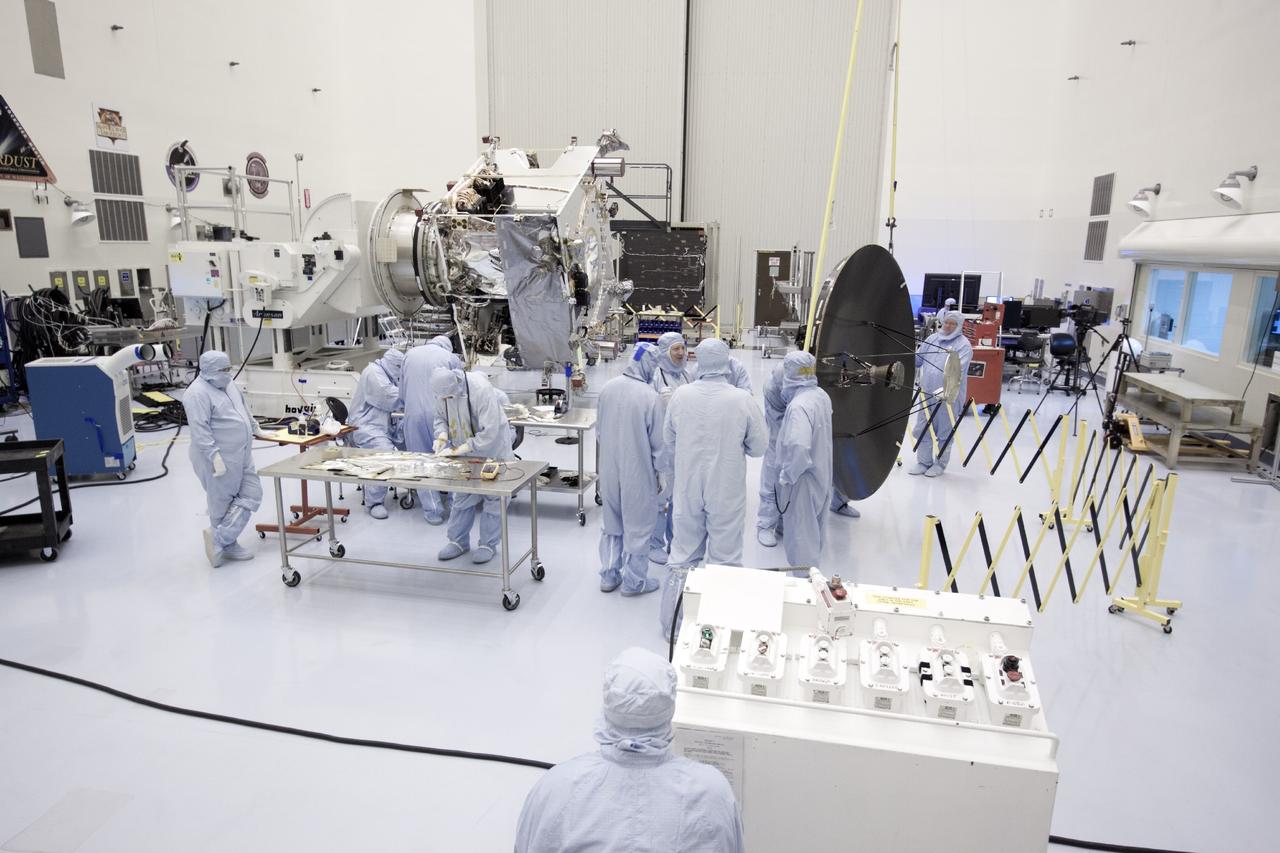
CAPE CANAVERAL, Fla. – Inside the Payload Hazardous Servicing Facility at NASA's Kennedy Space Center in Florida, preparations are under way to install the parabolic high gain antenna, right, onto the Mars Atmosphere and Volatile Evolution, or MAVEN spacecraft. The antenna will communicate vast amounts of data to Earth during the mission. MAVEN is being prepared inside the facility for its scheduled November launch aboard a United Launch Alliance Atlas V rocket to Mars. Positioned in an orbit above the Red Planet, MAVEN will study the upper atmosphere of Mars in unprecedented detail. Photo credit: NASA/Jim Grossmann
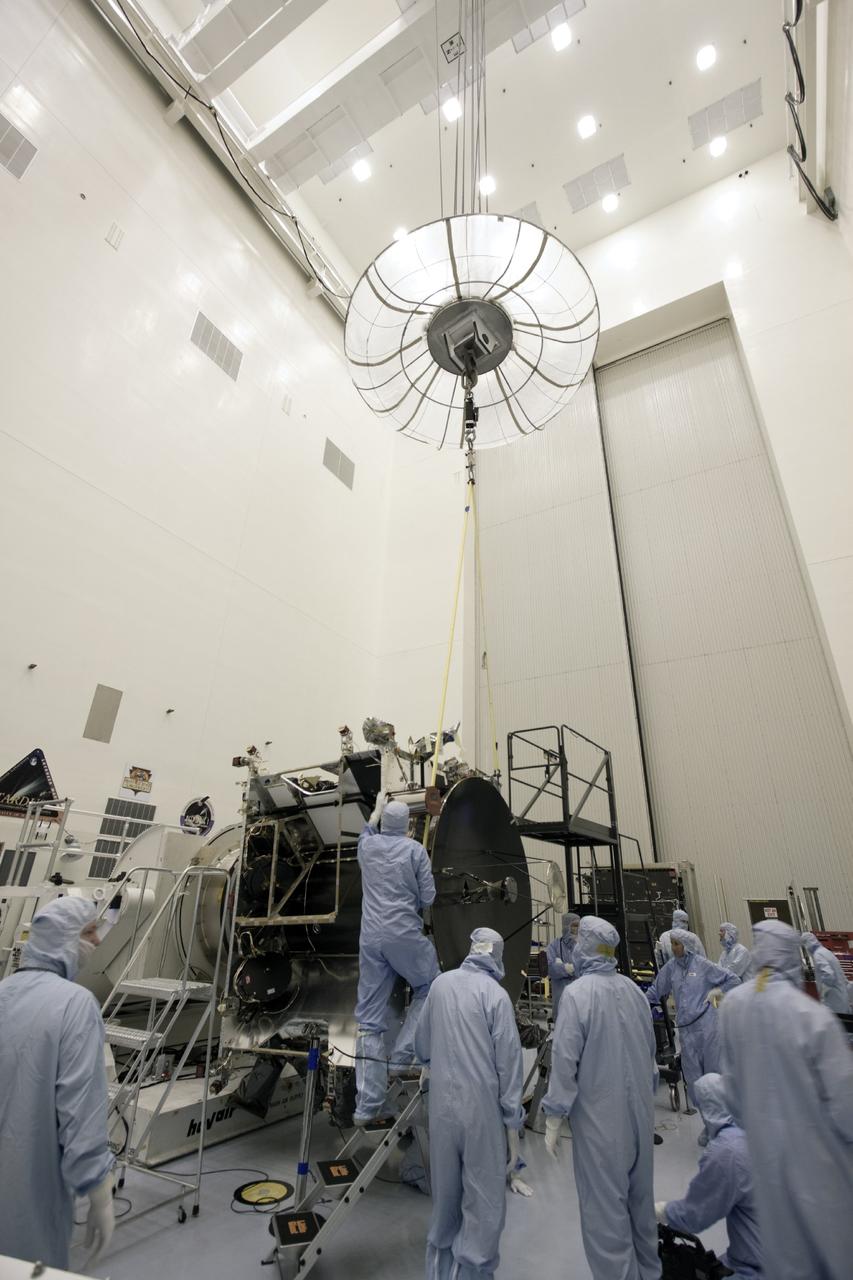
CAPE CANAVERAL, Fla. – Inside the Payload Hazardous Servicing Facility at NASA's Kennedy Space Center in Florida, technicians use an overhead crane to guide the parabolic high gain antenna into place prior to installation on the Mars Atmosphere and Volatile Evolution, or MAVEN spacecraft. The antenna will communicate vast amounts of data to Earth during the mission. MAVEN is being prepared inside the facility for its scheduled November launch aboard a United Launch Alliance Atlas V rocket to Mars. Positioned in an orbit above the Red Planet, MAVEN will study the upper atmosphere of Mars in unprecedented detail. Photo credit: NASA/Jim Grossmann
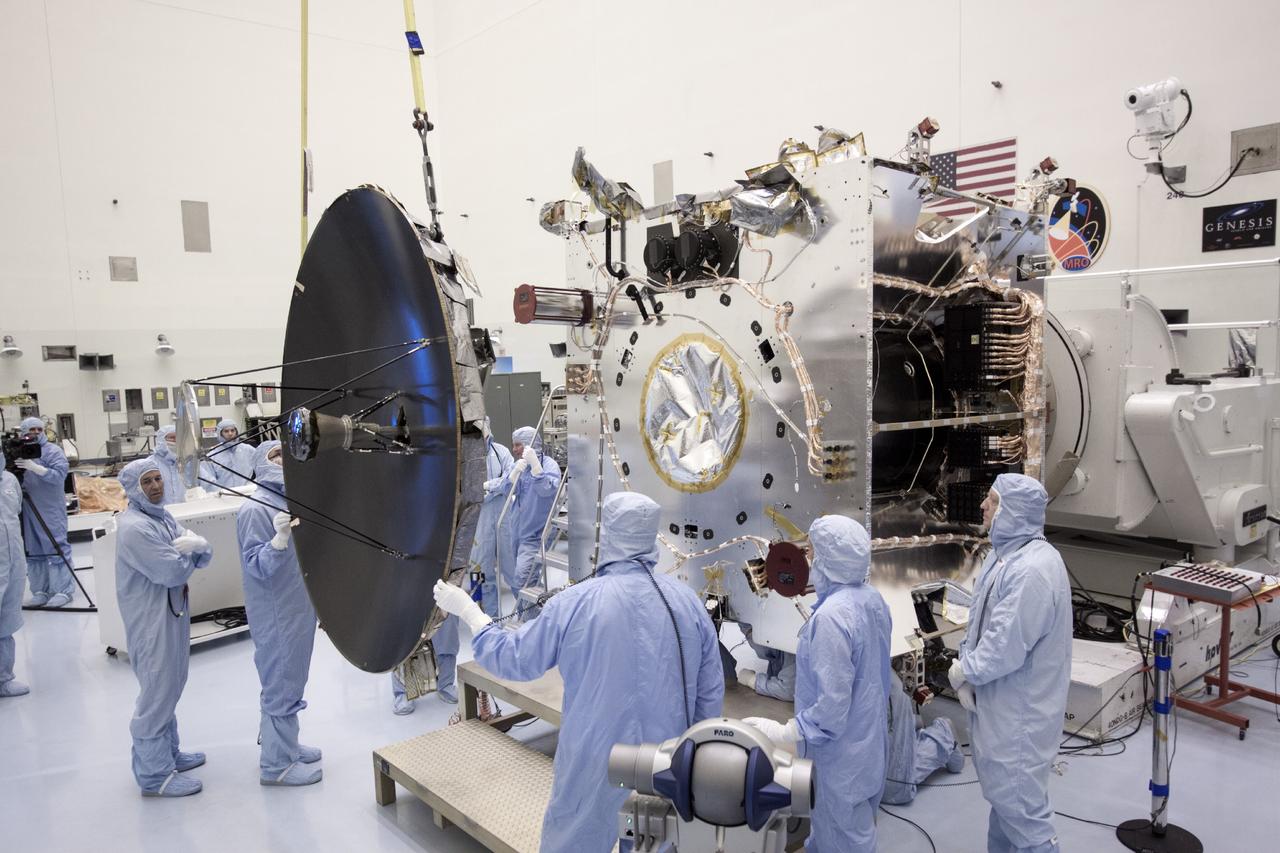
CAPE CANAVERAL, Fla. – At NASA’s Kennedy Space Center in Florida, technicians install the parabolic high gain antenna onto the Mars Atmosphere and Volatile Evolution, or MAVEN spacecraft, in the Payload Hazardous Servicing Facility. The antenna will communicate vast amounts of data to Earth during the mission. MAVEN is being prepared inside the facility for its scheduled November launch aboard a United Launch Alliance Atlas V rocket to Mars. Positioned in an orbit above the Red Planet, MAVEN will study the upper atmosphere of Mars in unprecedented detail. Photo credit: NASA/Jim Grossmann
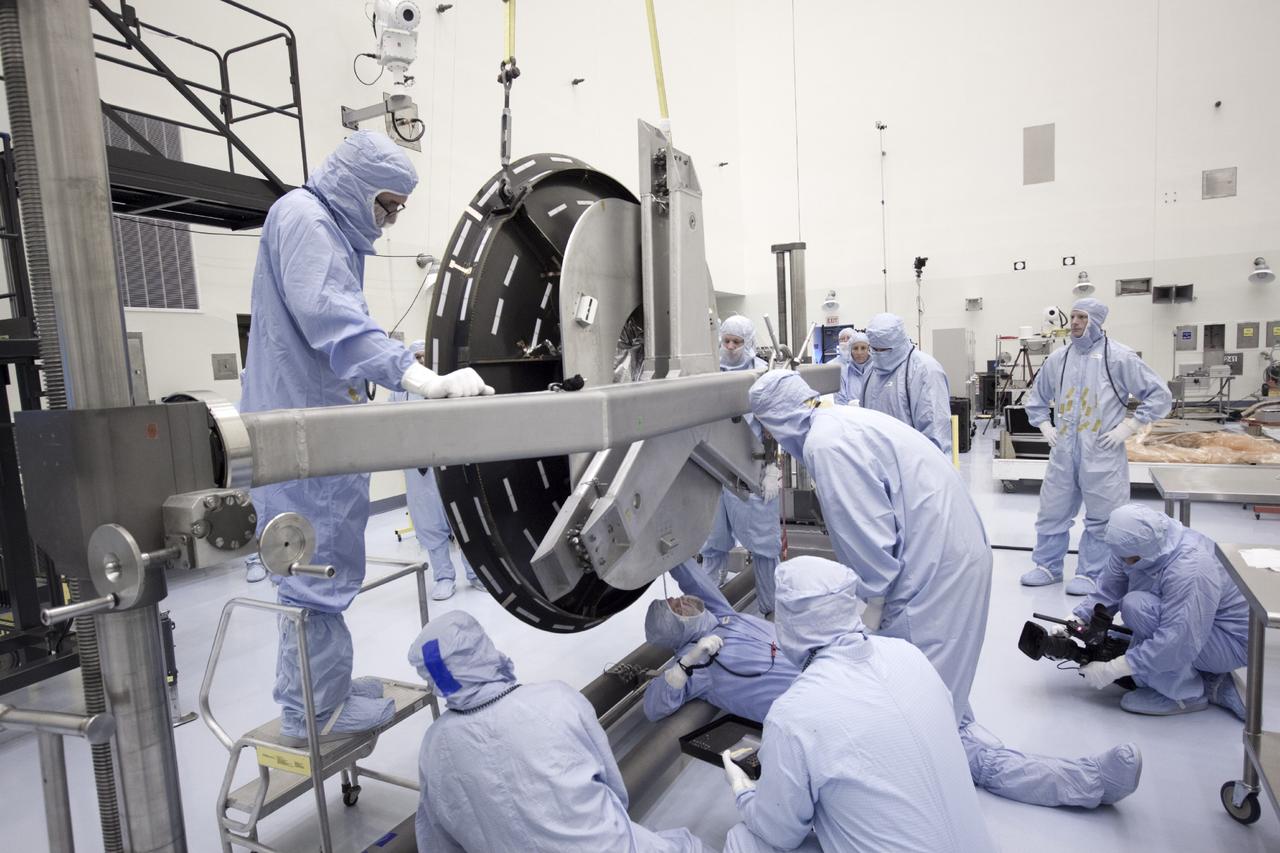
CAPE CANAVERAL, Fla. – Inside the Payload Hazardous Servicing Facility at NASA's Kennedy Space Center in Florida, technicians prepare to install the parabolic high gain antenna onto the Mars Atmosphere and Volatile Evolution, or MAVEN spacecraft. The antenna will communicate vast amounts of data to Earth during the mission. MAVEN is being prepared inside the facility for its scheduled November launch aboard a United Launch Alliance Atlas V rocket to Mars. Positioned in an orbit above the Red Planet, MAVEN will study the upper atmosphere of Mars in unprecedented detail. Photo credit: NASA/Jim Grossmann
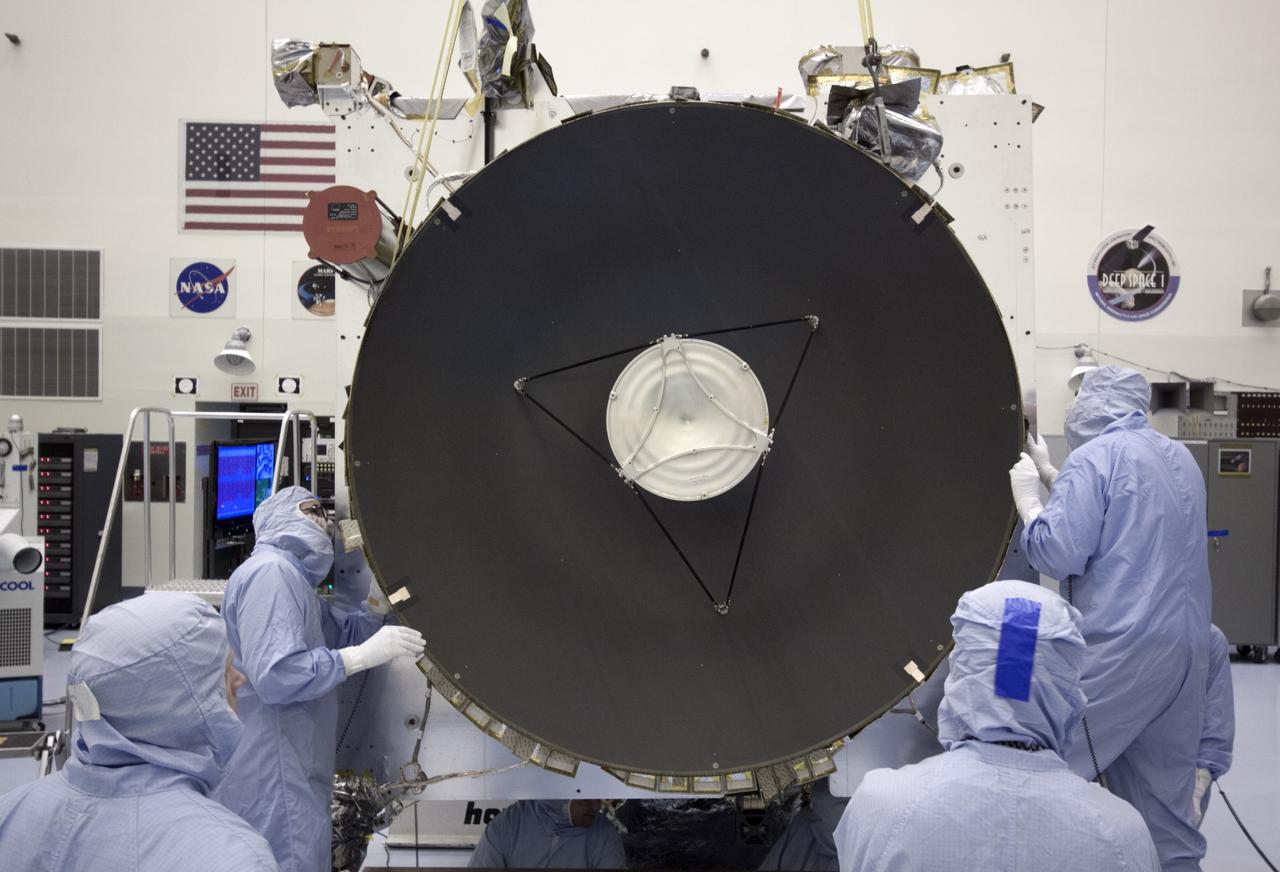
CAPE CANAVERAL, Fla. – Inside the Payload Hazardous Servicing Facility at NASA's Kennedy Space Center in Florida, the parabolic high gain antenna is installed on the Mars Atmosphere and Volatile Evolution, or MAVEN spacecraft. The antenna will communicate vast amounts of data to Earth during the mission. MAVEN is being prepared inside the facility for its scheduled November launch aboard a United Launch Alliance Atlas V rocket to Mars. Positioned in an orbit above the Red Planet, MAVEN will study the upper atmosphere of Mars in unprecedented detail. Photo credit: NASA/Jim Grossmann
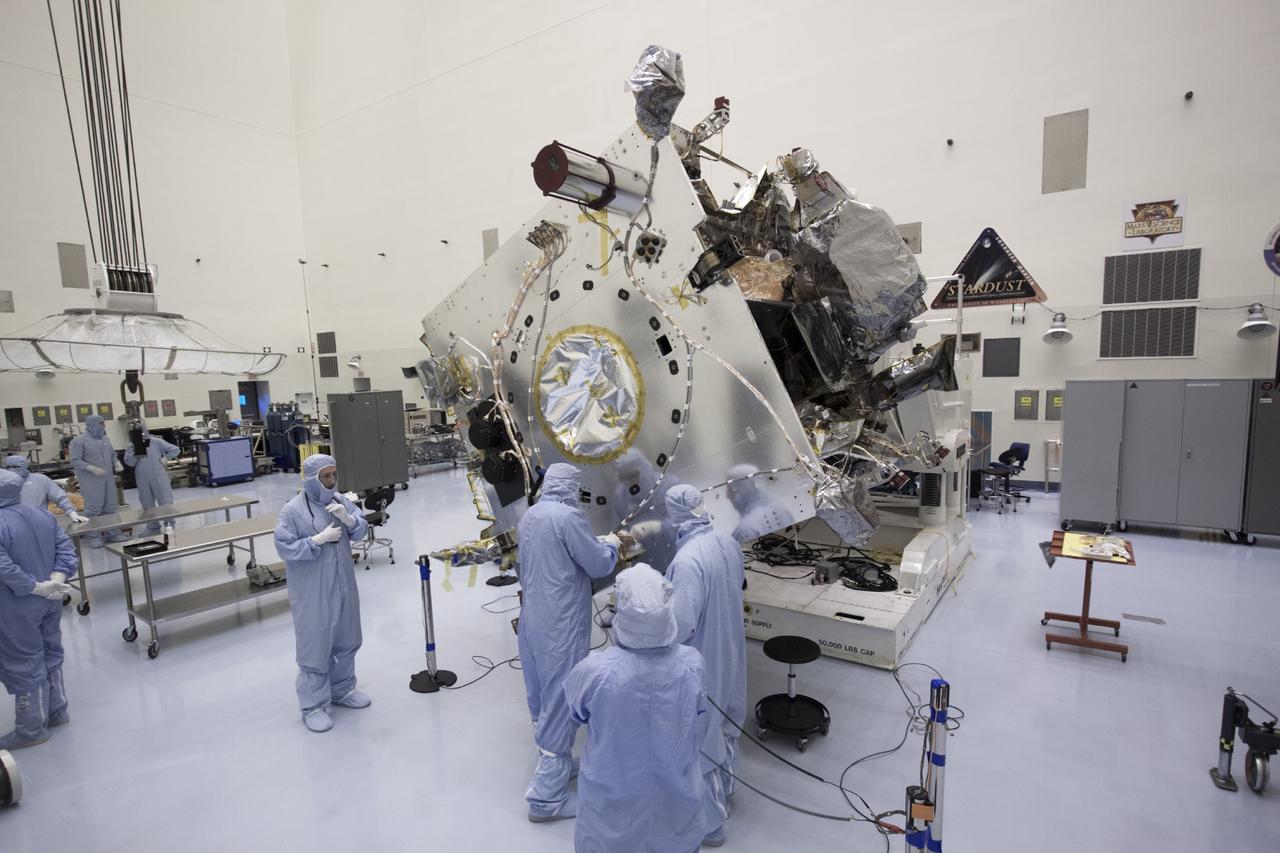
CAPE CANAVERAL, Fla. – Inside the Payload Hazardous Servicing Facility at NASA's Kennedy Space Center in Florida, technicians prepare the Mars Atmosphere and Volatile Evolution, or MAVEN spacecraft, to receive its parabolic high gain antenna. The antenna will communicate vast amounts of data to Earth during the mission. MAVEN is being prepared inside the facility for its scheduled November launch aboard a United Launch Alliance Atlas V rocket to Mars. Positioned in an orbit above the Red Planet, MAVEN will study the upper atmosphere of Mars in unprecedented detail. Photo credit: NASA/Jim Grossmann
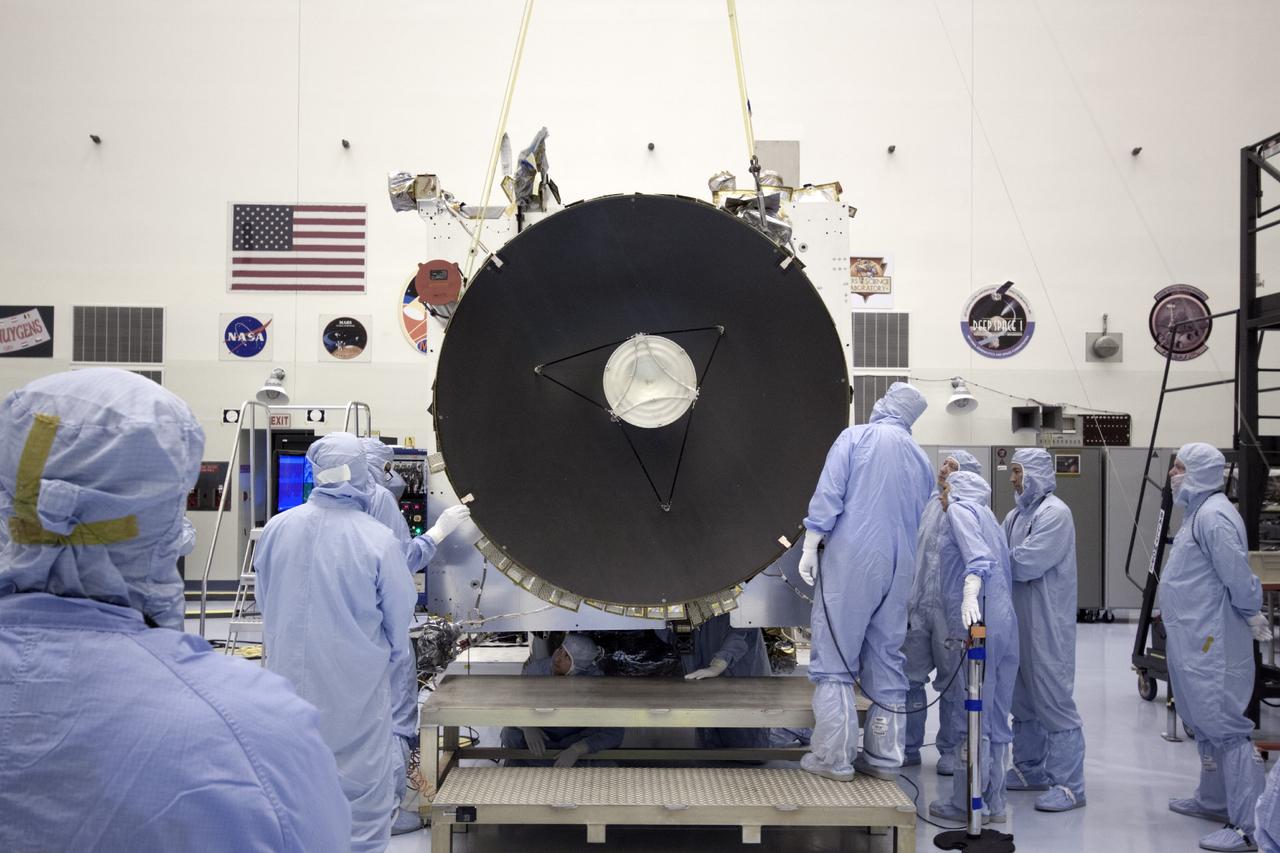
CAPE CANAVERAL, Fla. – At NASA's Kennedy Space Center in Florida, technicians position the parabolic high gain antenna for installation on the Mars Atmosphere and Volatile Evolution, or MAVEN spacecraft, in the Payload Hazardous Servicing Facility. The antenna will communicate vast amounts of data to Earth during the mission. MAVEN is being prepared inside the facility for its scheduled November launch aboard a United Launch Alliance Atlas V rocket to Mars. Positioned in an orbit above the Red Planet, MAVEN will study the upper atmosphere of Mars in unprecedented detail. Photo credit: NASA/Jim Grossmann
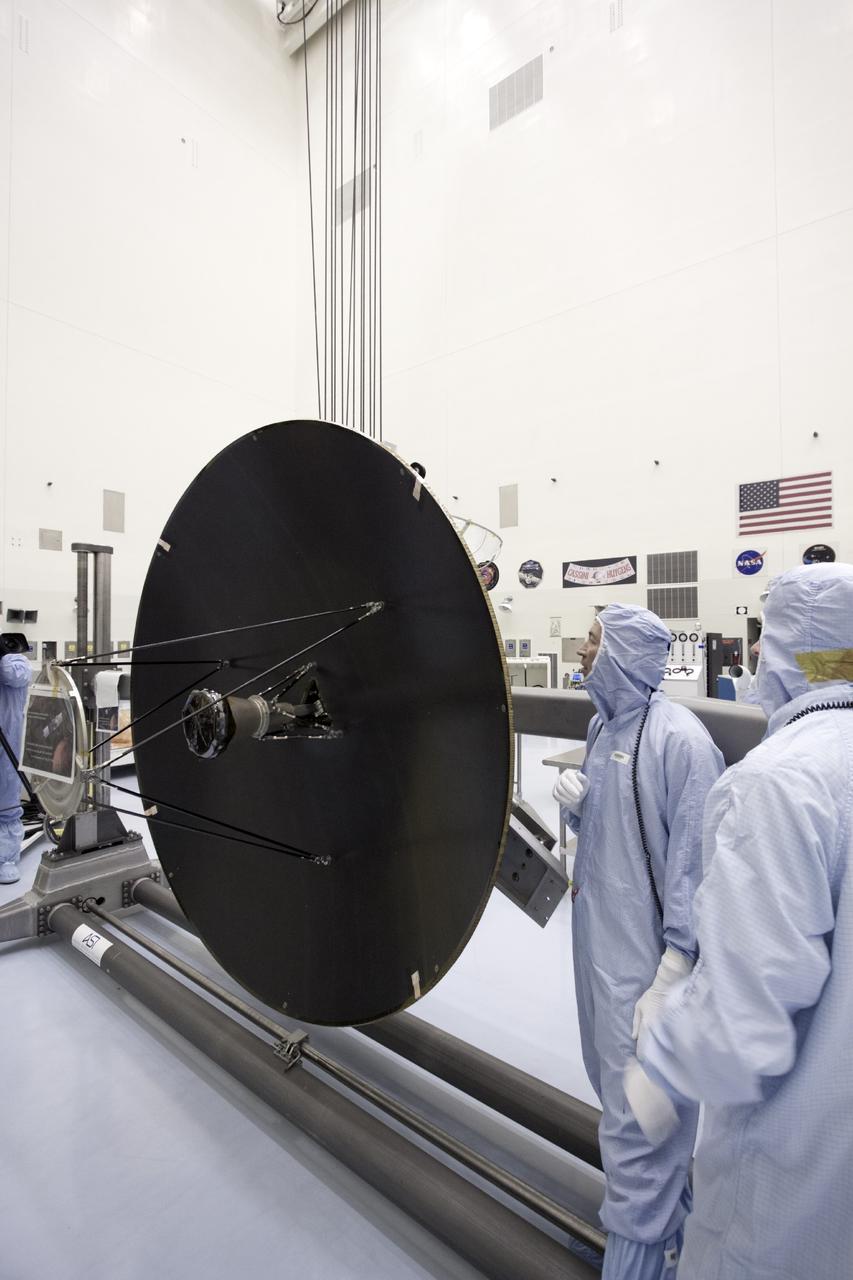
CAPE CANAVERAL, Fla. – Inside the Payload Hazardous Servicing Facility at NASA's Kennedy Space Center in Florida, technicians prepare the Mars Atmosphere and Volatile Evolution, or MAVEN spacecraft, for installation of the parabolic high gain antenna. The antenna will communicate vast amounts of data to Earth during the mission. MAVEN is being prepared inside the facility for its scheduled November launch aboard a United Launch Alliance Atlas V rocket to Mars. Positioned in an orbit above the Red Planet, MAVEN will study the upper atmosphere of Mars in unprecedented detail. Photo credit: NASA/Jim Grossmann
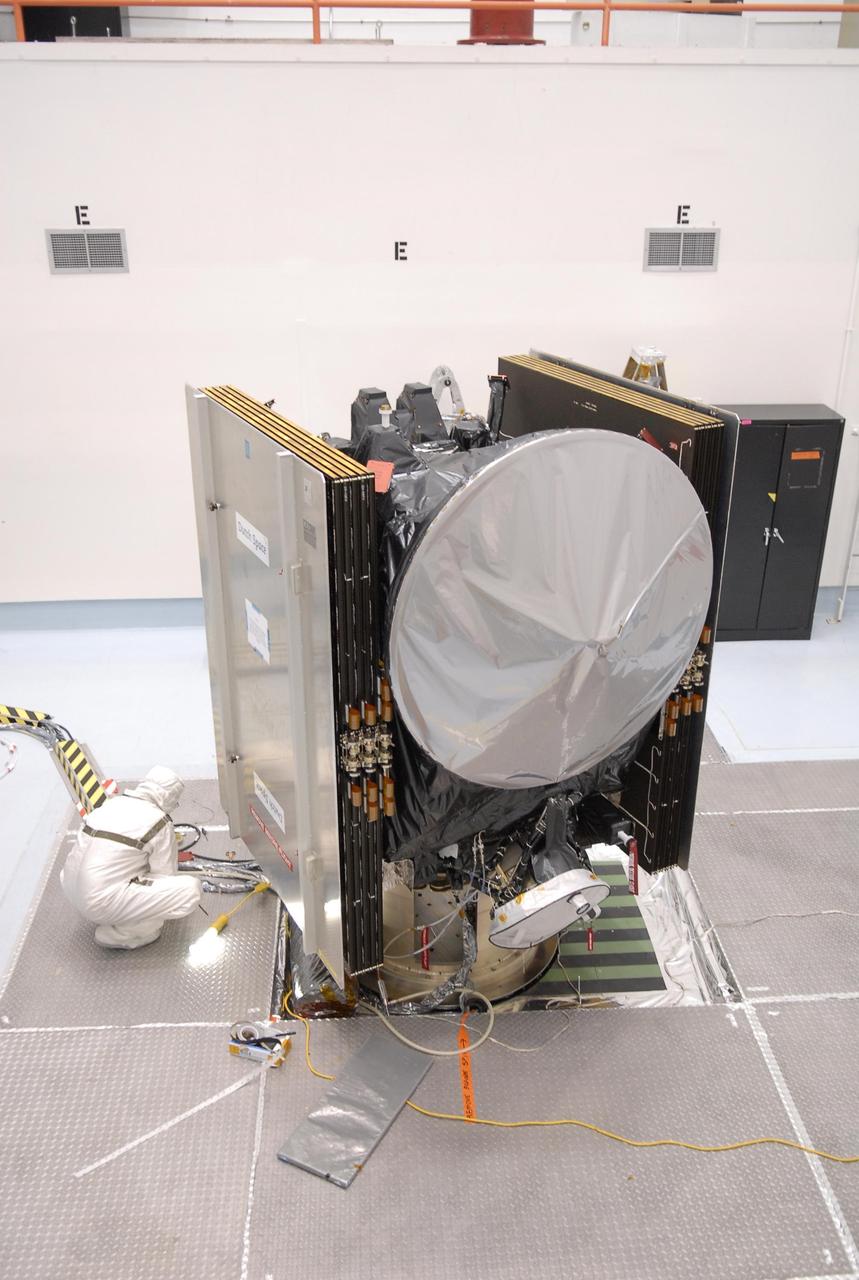
KENNEDY SPACE CENTER, FLA. -- At Astrotech, the Dawn spacecraft is on display for a media showing. On each side are the folded solar array panels. At the top is the high gain antenna, covered by a sun shade. At the bottom, also under cover, is one of the ion propulsion thrusters. Behind the antenna on the outside edge are the framing cameras. Dawn's goal is to characterize the conditions and processes of the solar system's earliest epoch by investigating in detail the largest protoplanets that have remained intact since their formations: asteroid Vesta and the dwarf planet Ceres. They reside in the extensive zone between Mars and Jupiter together with many other smaller bodies, called the asteroid belt. Photo credit: NASA/Kim Shiflett
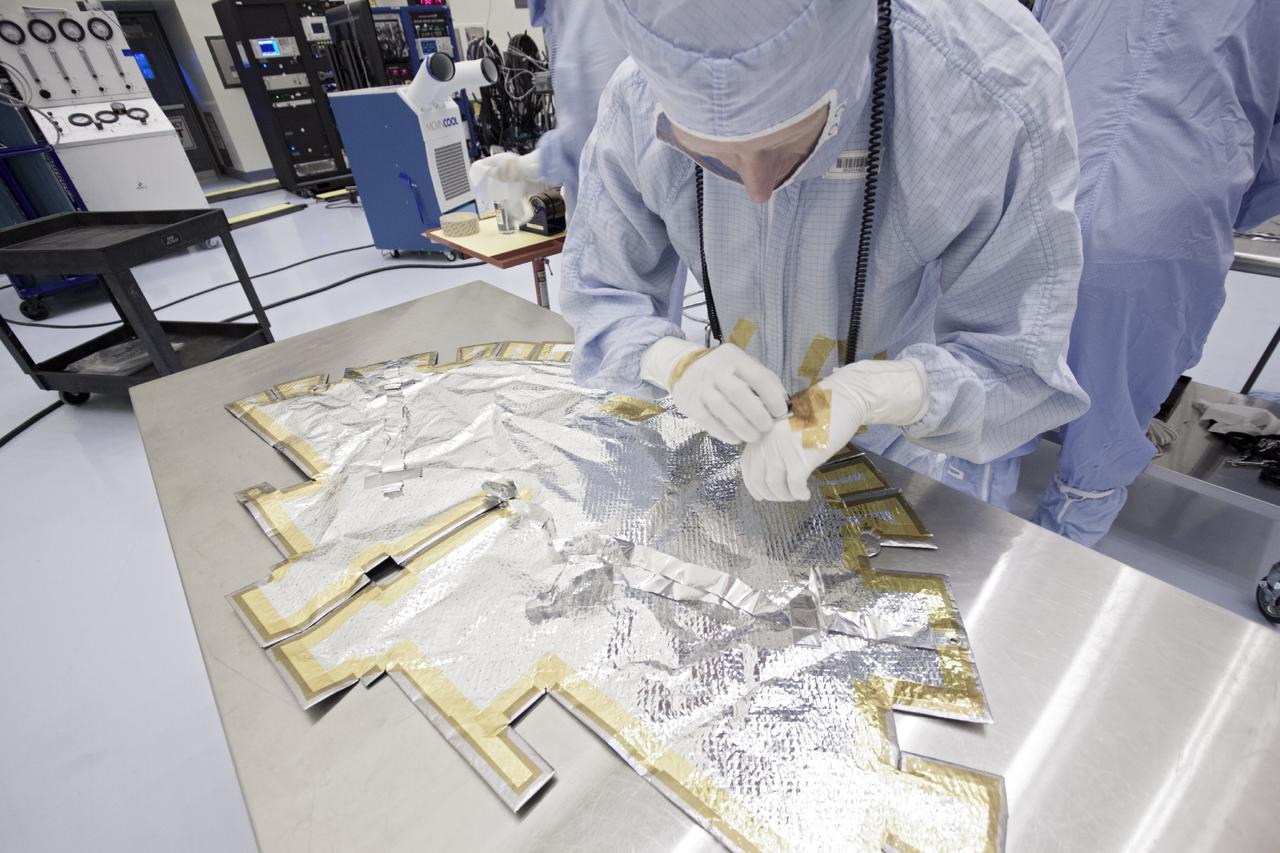
CAPE CANAVERAL, Fla. – Inside the Payload Hazardous Servicing Facility at NASA's Kennedy Space Center in Florida, technicians apply tape to the thermal blanket for the MAVEN spacecraft's parabolic high gain antenna. MAVEN stands for Mars Atmosphere and Volatile Evolution. The antenna will communicate vast amounts of data to Earth during the mission. MAVEN is being prepared inside the facility for its scheduled November launch aboard a United Launch Alliance Atlas V rocket to Mars. Positioned in an orbit above the Red Planet, MAVEN will study the upper atmosphere of Mars in unprecedented detail. Photo credit: NASA/Jim Grossmann
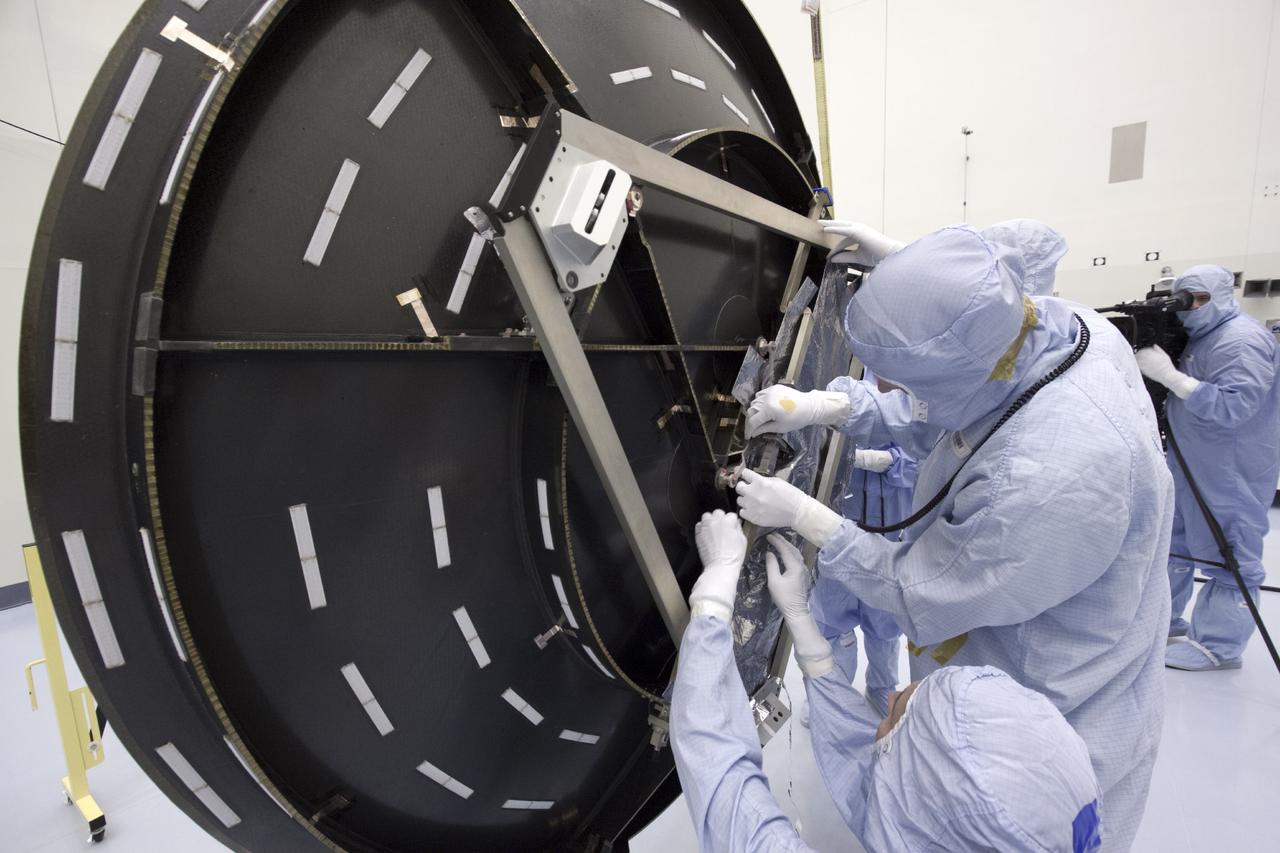
CAPE CANAVERAL, Fla. – Inside the Payload Hazardous Servicing Facility at NASA's Kennedy Space Center in Florida, technicians install a thermal blanket on the parabolic high gain antenna of the Mars Atmosphere and Volatile Evolution, or MAVEN spacecraft. The antenna will communicate vast amounts of data to Earth during the mission. MAVEN is being prepared inside the facility for its scheduled November launch aboard a United Launch Alliance Atlas V rocket to Mars. Positioned in an orbit above the Red Planet, MAVEN will study the upper atmosphere of Mars in unprecedented detail. Photo credit: NASA/Jim Grossmann
In a delicate operation, a 400-ton crane lifts the new X-band cone into the 70-meter (230-foot) Deep Space Network's Deep Space Station 43 (DSS-43) dish in Canberra, Australia. The new cone houses upgraded receiver and transmitter equipment for the 48-year-old antenna. One of several antennas located at the Canberra site, DSS-43 is the largest and responsible for transmitting commands to NASA's Voyager spacecraft. Since early March 2020, DSS43 has been offline for upgrades, which are expected to continue until January 2021. https://photojournal.jpl.nasa.gov/catalog/PIA23796
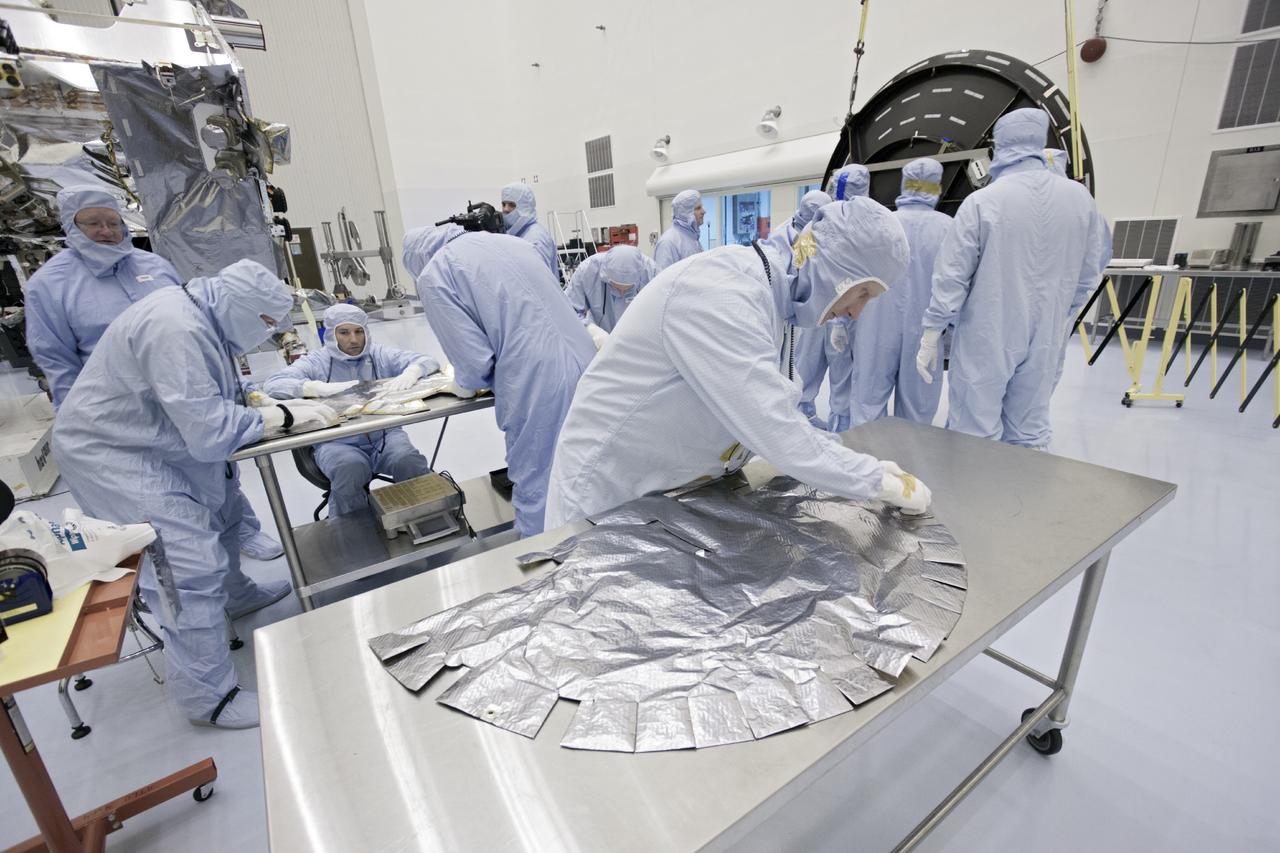
CAPE CANAVERAL, Fla. – Inside the Payload Hazardous Servicing Facility at NASA's Kennedy Space Center in Florida, technicians prepare a thermal blanket for installation on the MAVEN spacecraft's parabolic high gain antenna. MAVEN stands for Mars Atmosphere and Volatile Evolution. The antenna will communicate vast amounts of data to Earth during the mission. MAVEN is being prepared inside the facility for its scheduled November launch aboard a United Launch Alliance Atlas V rocket to Mars. Positioned in an orbit above the Red Planet, MAVEN will study the upper atmosphere of Mars in unprecedented detail. Photo credit: NASA/Jim Grossmann