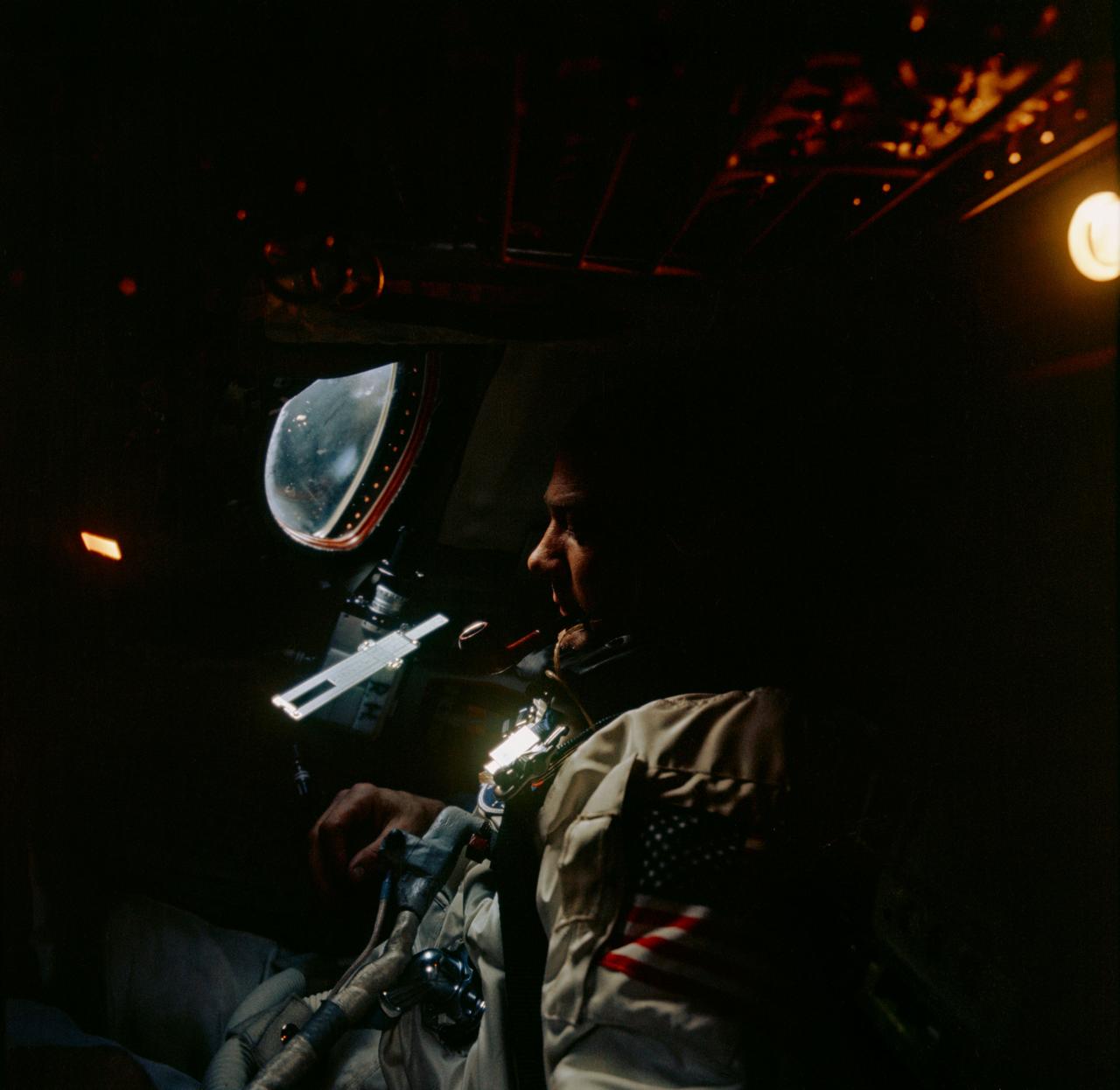
S66-62984 (13 Nov. 1966) --- Astronaut Edwin Aldrin Jr. photographed inside the Gemini-12 spacecraft cabin during the spaceflight. Photo credit: NASA
Astronaut Edwin Aldrin inside Gemini spacecraft cabin during flight
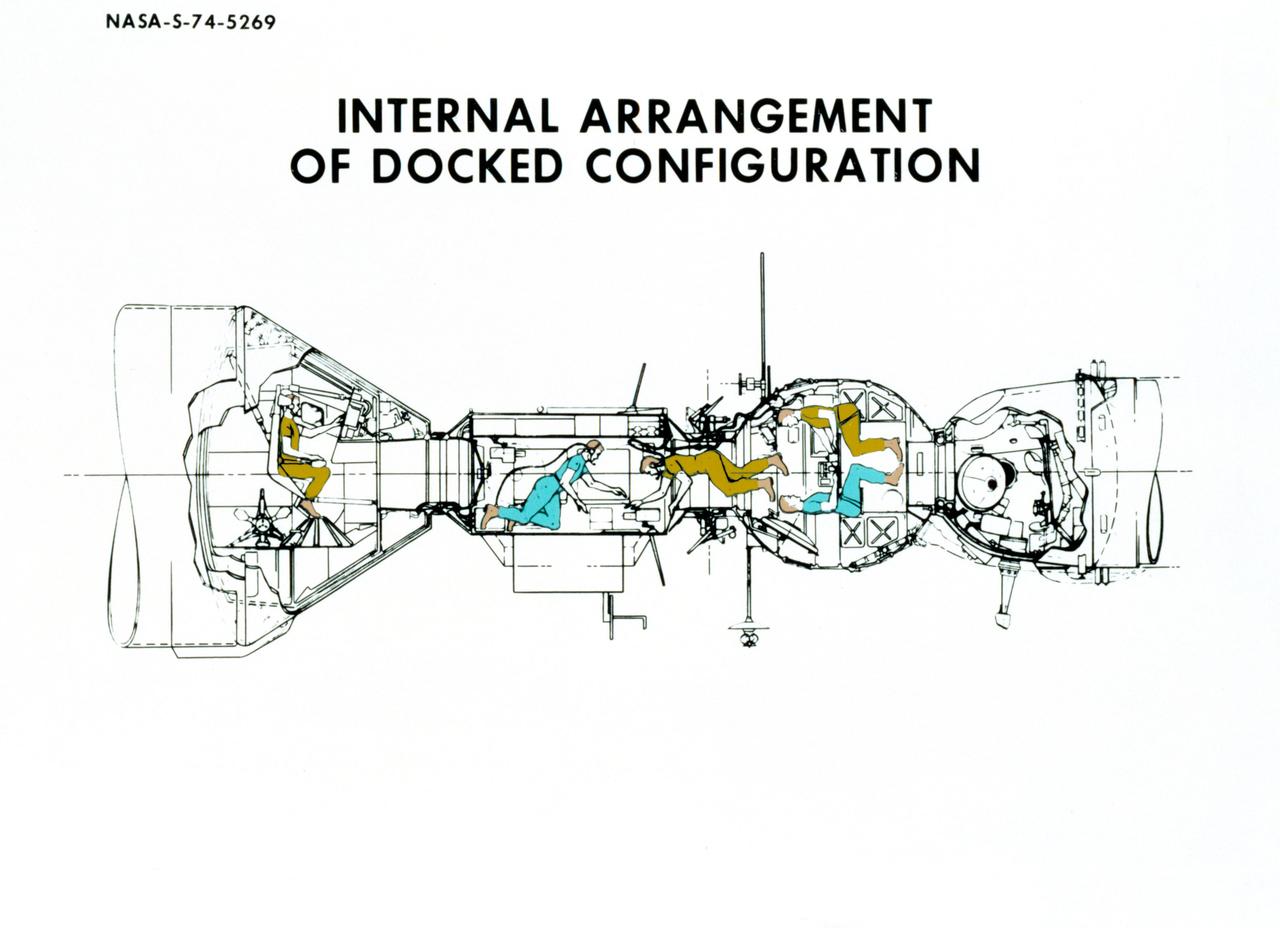
S74-05269 (December 1974) --- An artist?s drawing illustrating the internal arrangement of the Apollo and Soyuz spacecraft in Earth orbit in a docked configuration.  The three American Apollo crewmen and the two Soviet Soyuz crewmen will transfer to each other?s spacecraft during the July 1975 ASTP mission.  The four Apollo-Soyuz Test Project visible components are, left to right, the Apollo Command Module, the Docking Module, the Soyuz Orbital Module and the Soyuz Descent Vehicle.
Artist's drawing of internal arrangement of orbiting Apollo & Soyuz crafts
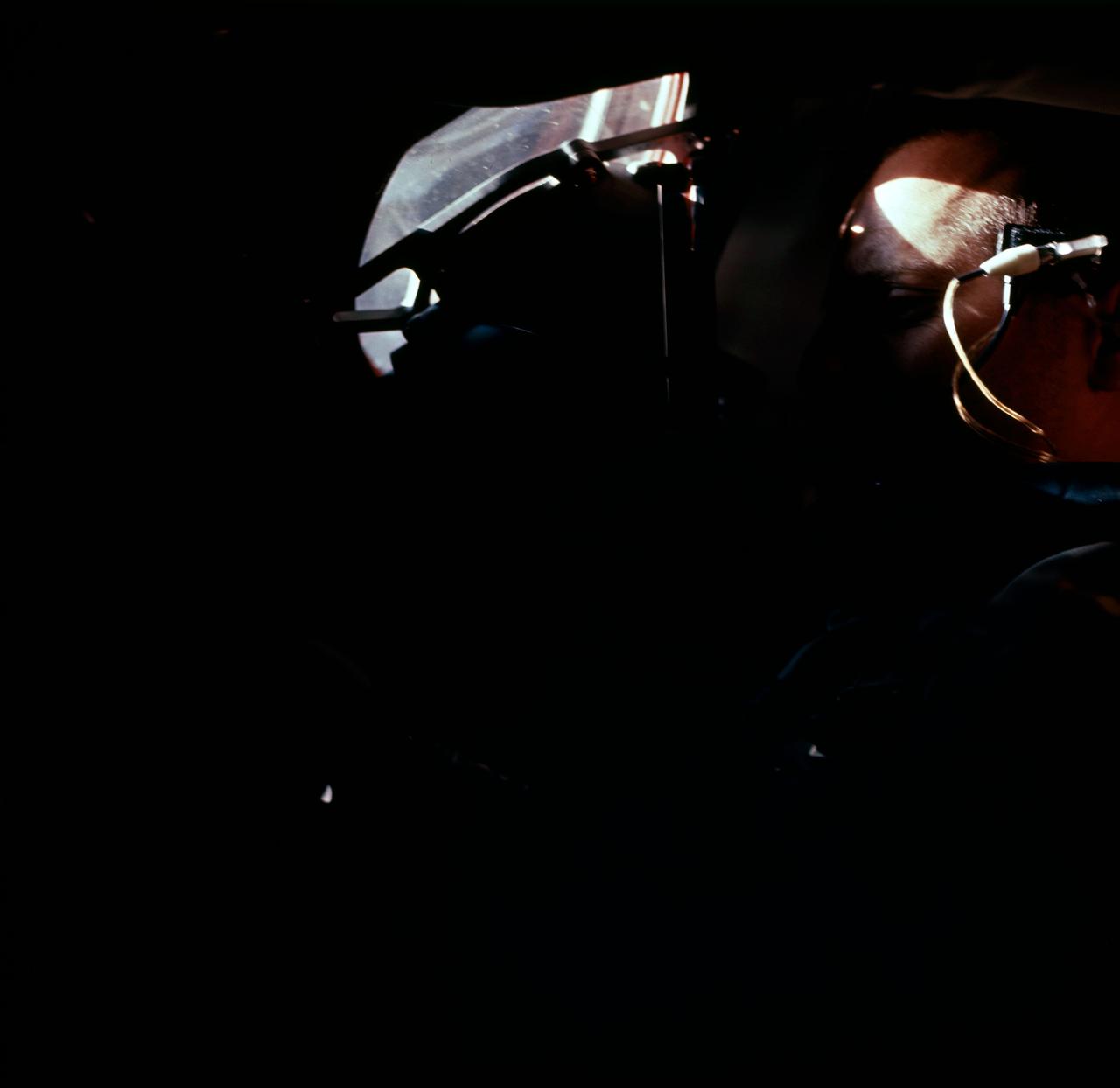
S65-45610 (21 Aug. 1965) --- Astronaut Charles Conrad Jr. as seen through the Gemini-5 spacecraft window before launch.
Astronaut Charles Conrad as seen through Gemini 5 spacecraft window
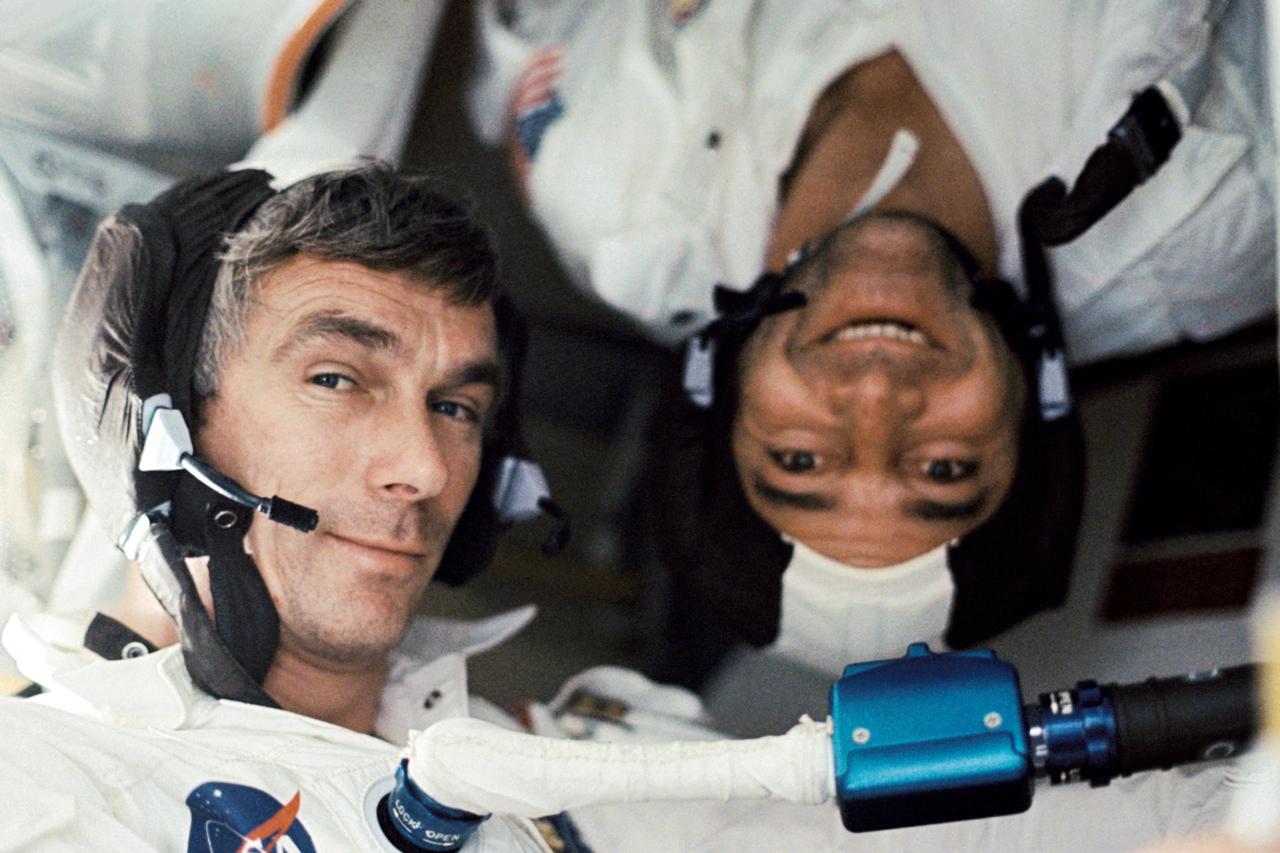
AS17-162-24053 (7-19 Dec. 1972) --- Scientist-astronaut Harrison H. "Jack" Schmitt, lunar module pilot, took this photograph of his two fellow crew men under zero-gravity conditions aboard the Apollo 17 spacecraft during the final lunar landing mission in NASA's Apollo program. That is astronaut Eugene A. Cernan, commander, who is seemingly "right side up." Astronaut Ronald E. Evans, command module pilot, appears to be "upside down." While astronauts Cernan and Schmitt descended in the Lunar Module (LM) "Challenger" to explore the Taurus-Littrow region of the moon, astronaut Evans remained with the Command and Service Modules (CSM) "America" in lunar orbit.
Astronauts Evans and Cernan aboard the Apollo 17 spacecraft
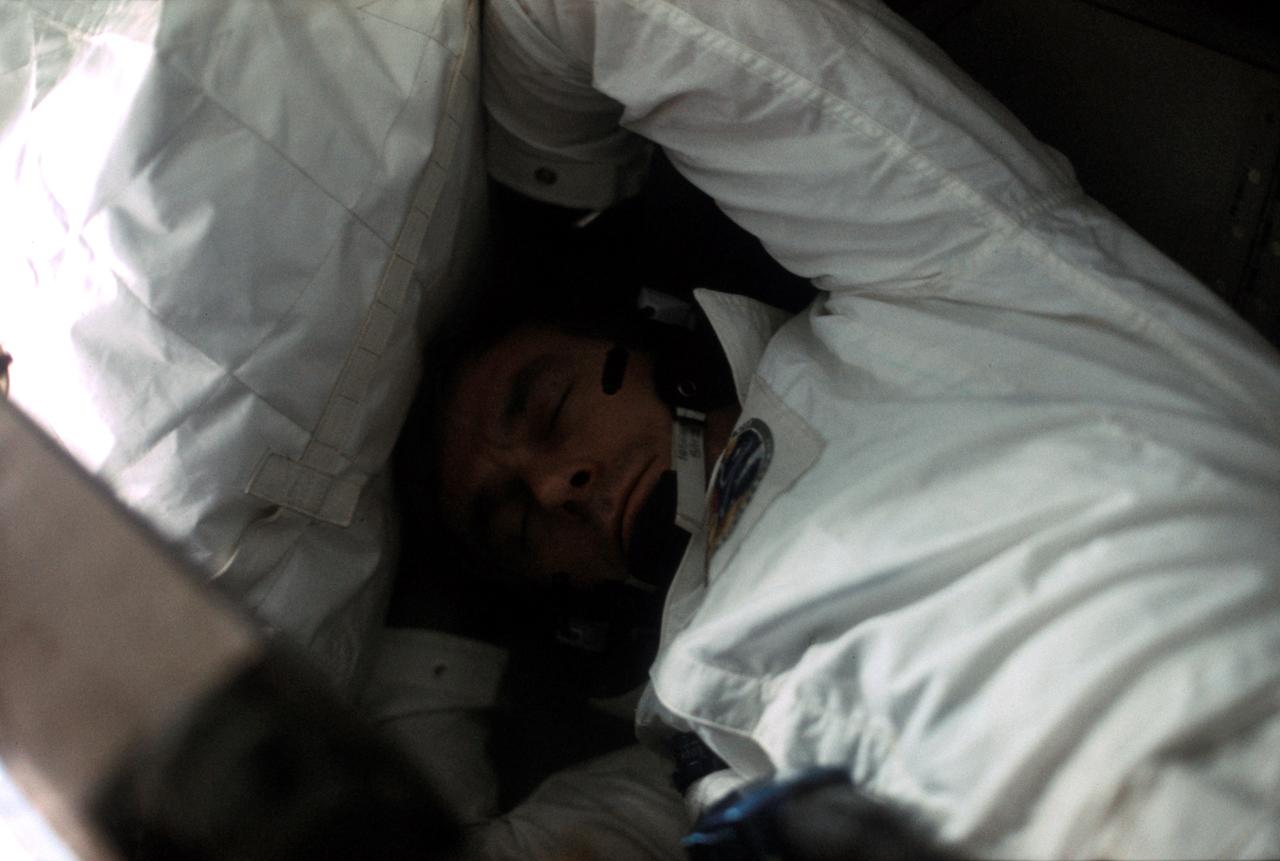
AS17-162-24049 (7-19 Dec. 1972) --- A fellow crewman took this picture of astronaut Eugene A. Cernan dozing aboard the Apollo 17 spacecraft during the final lunar landing mission in NASA's Apollo program. Also, aboard Apollo 17 were astronaut Ronald E. Evans, command module pilot, and scientist-astronaut Harrison H. "Jack" Schmitt, lunar module pilot. Cernan was the mission commander.
Astronaut Eugene Cernan sleeping aboard Apollo 17 spacecraft
Astronaut Russell Schweickart, Apollo 9 Lunar Module pilot, is photographed inside Lunar Module "Spider" during the Apollo 9 earth-orbital mission.
Astronaut Russell Schweickart photographed inside Lunar Module Apollo 9
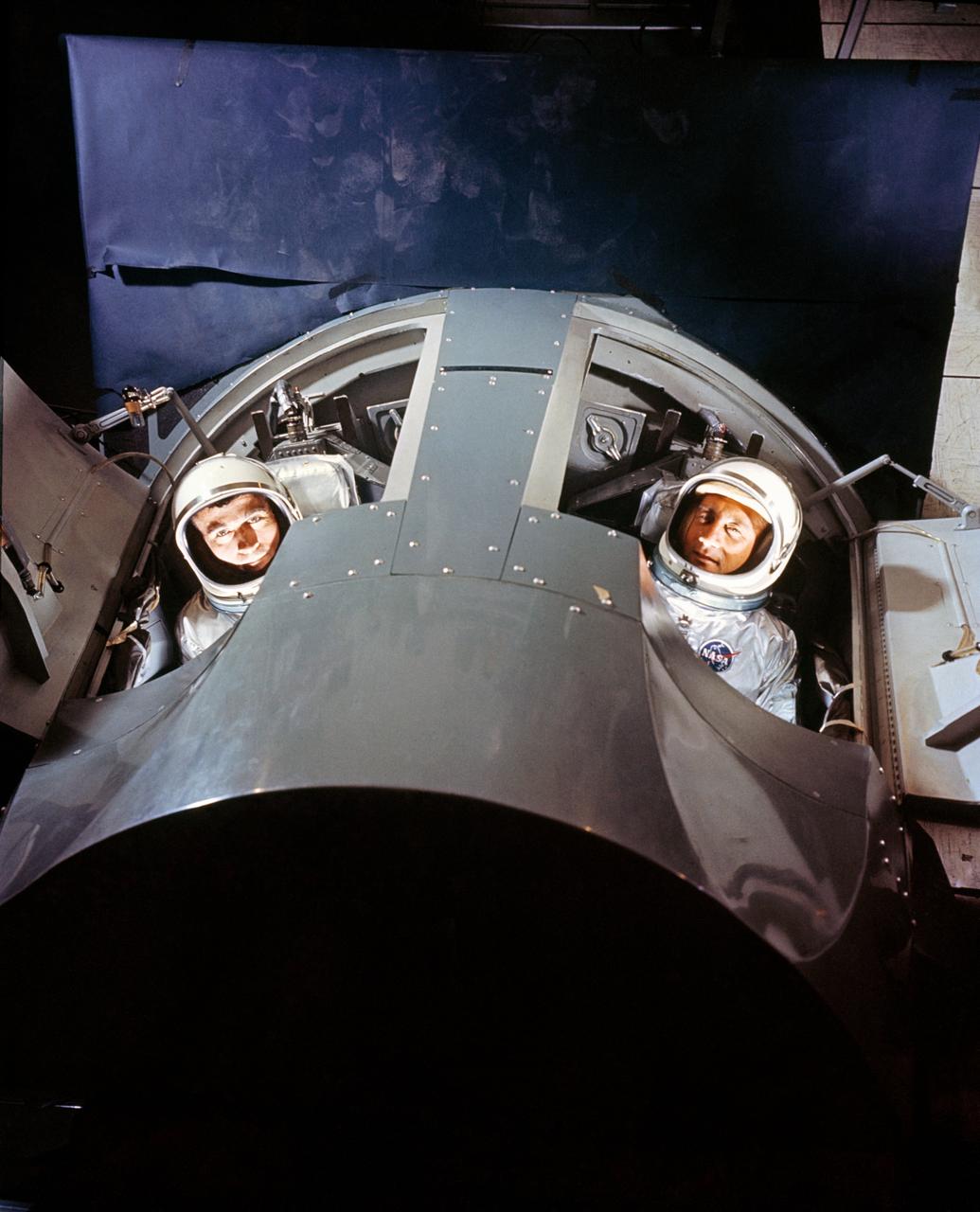
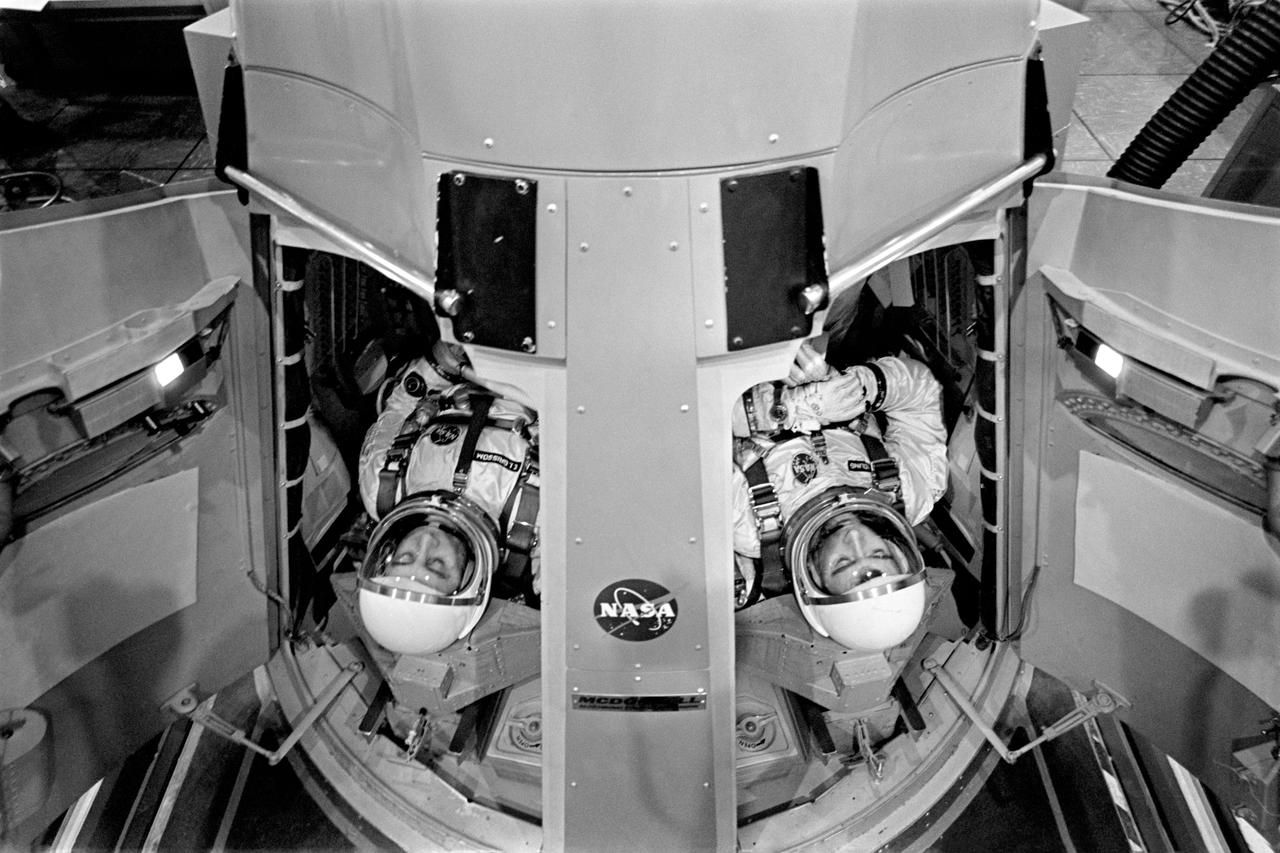
S64-25295 (March 1964) --- Astronauts Virgil I. (Gus) Grissom (right) and John W. Young, prime crew for the first manned Gemini mission (GT-3), are shown inside a Gemini mission simulator at McDonnell Aircraft Corp., St. Louis, MO. The simulator will provide Gemini astronauts and ground crews with realistic mission simulation during intensive training prior to actual launch.
Astronauts Grissom and Young in Gemini Mission Simulator
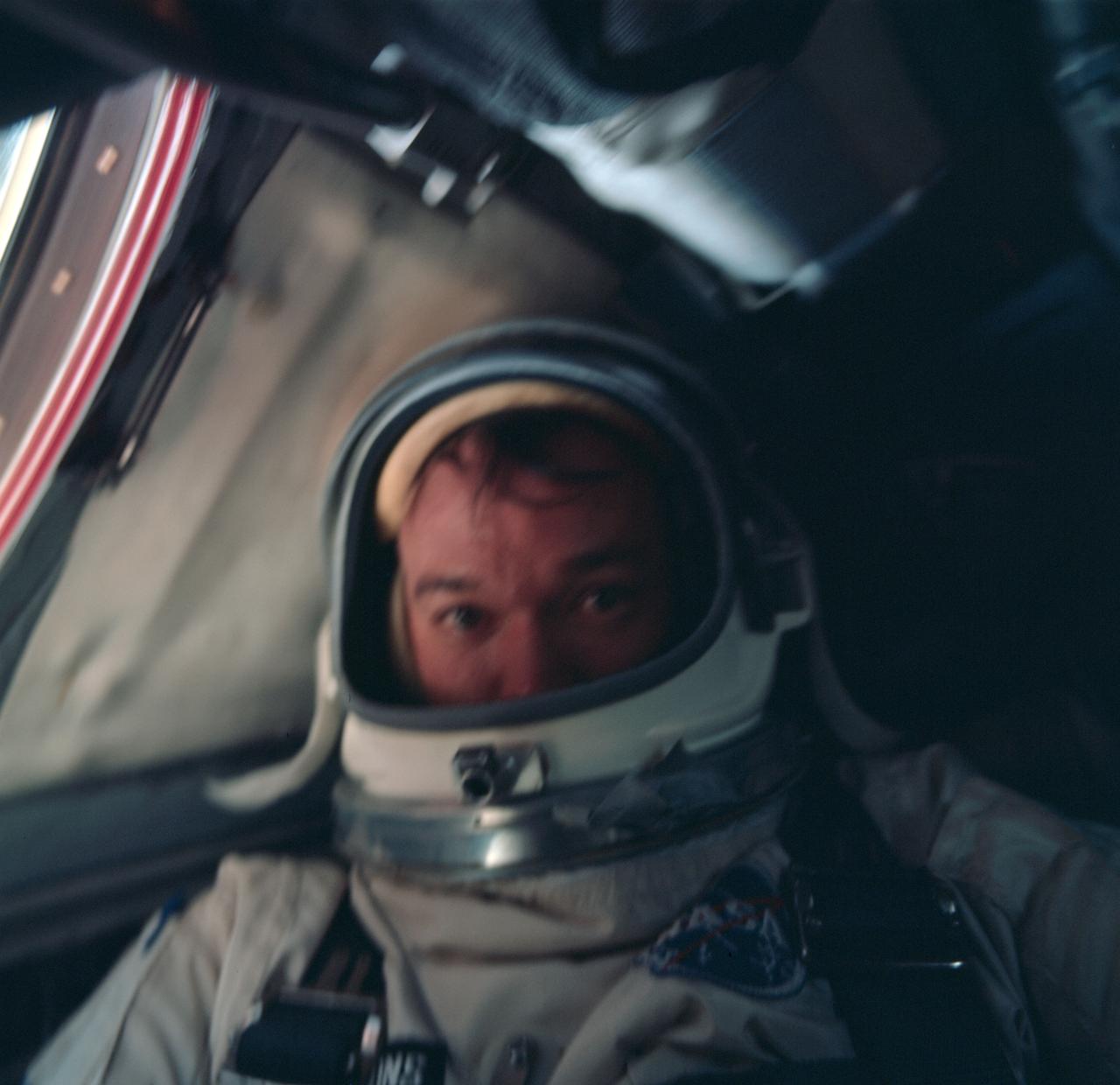
S66-46270 (18 July 1966) --- Astronaut Michael Collins is photographed inside the spacecraft during the Gemini-10 mission. Photo credit: NASA
Astronaut Michael Collins photographed inside spacecraft during mission
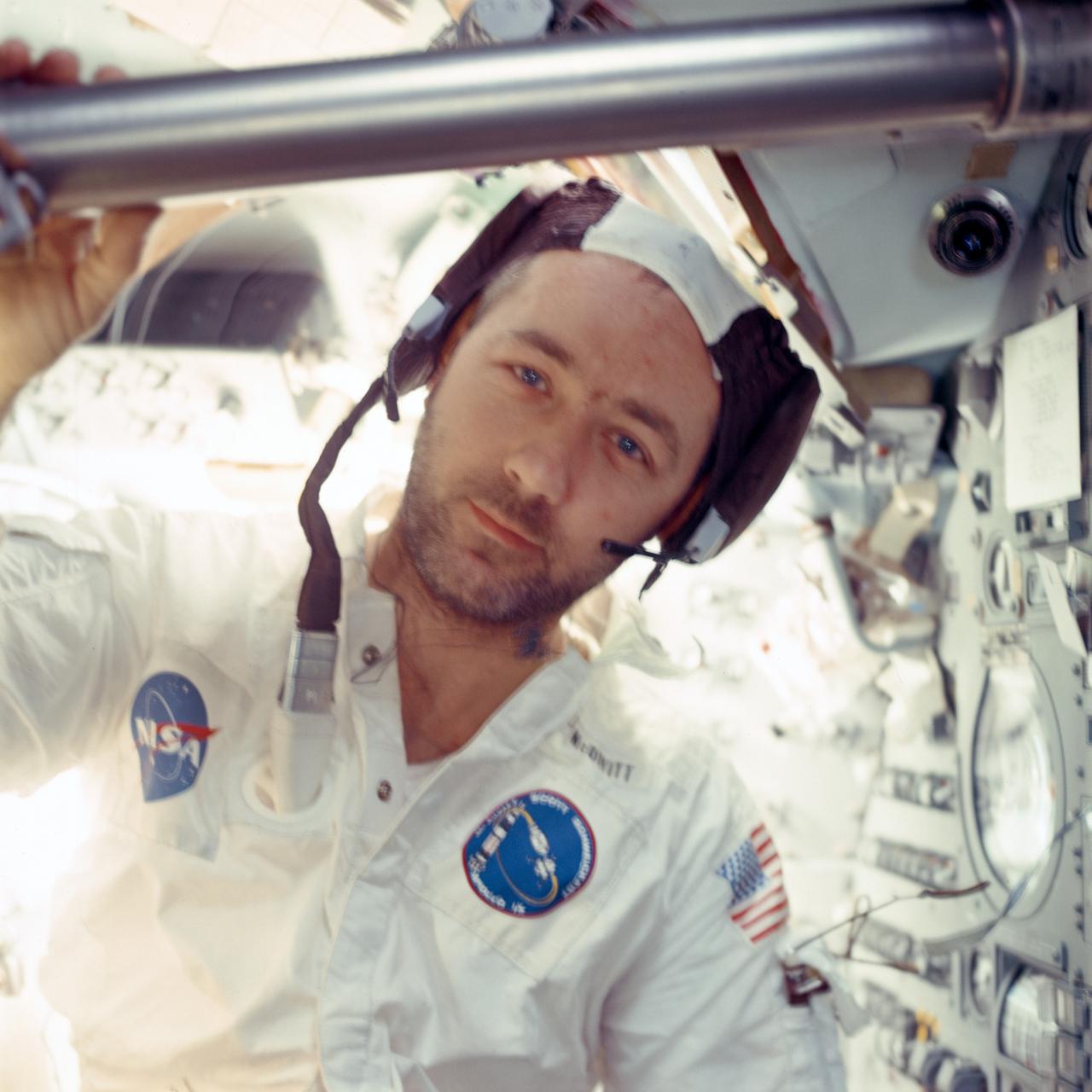
AS09-20-3154 (3-13 March 1969) --- This close-up view of astronaut James A. McDivitt shows several days' beard growth. The Apollo 9 mission commander was onboard the Lunar Module (LM) "Spider" in Earth orbit, near the end of the flight. He was joined on the mission by astronauts David R. Scott, command module pilot, and Russell L. Schweickart, lunar module pilot. Schweickart took this picture while Scott remained in the Command Module (CM) "Gumdrop." In Earth orbit, the three tested the transposition and docking systems of the lunar module and command module. On a scheduled lunar landing mission later this year, a team of three astronauts and ground controllers will use what this crew and its support staff have learned in handling the systems of the two spacecraft.
Astronaut James McDivitt photographed inside Command Module during Apollo 9
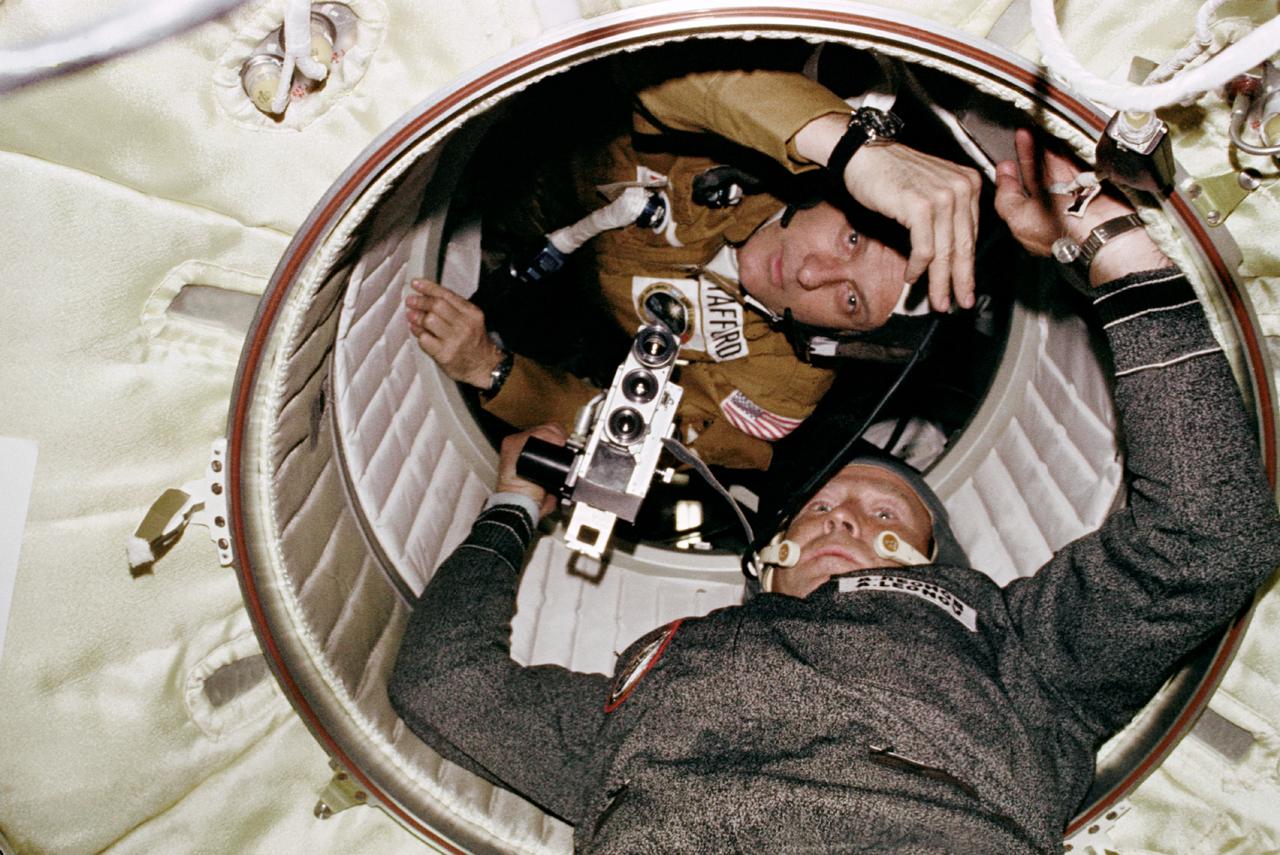
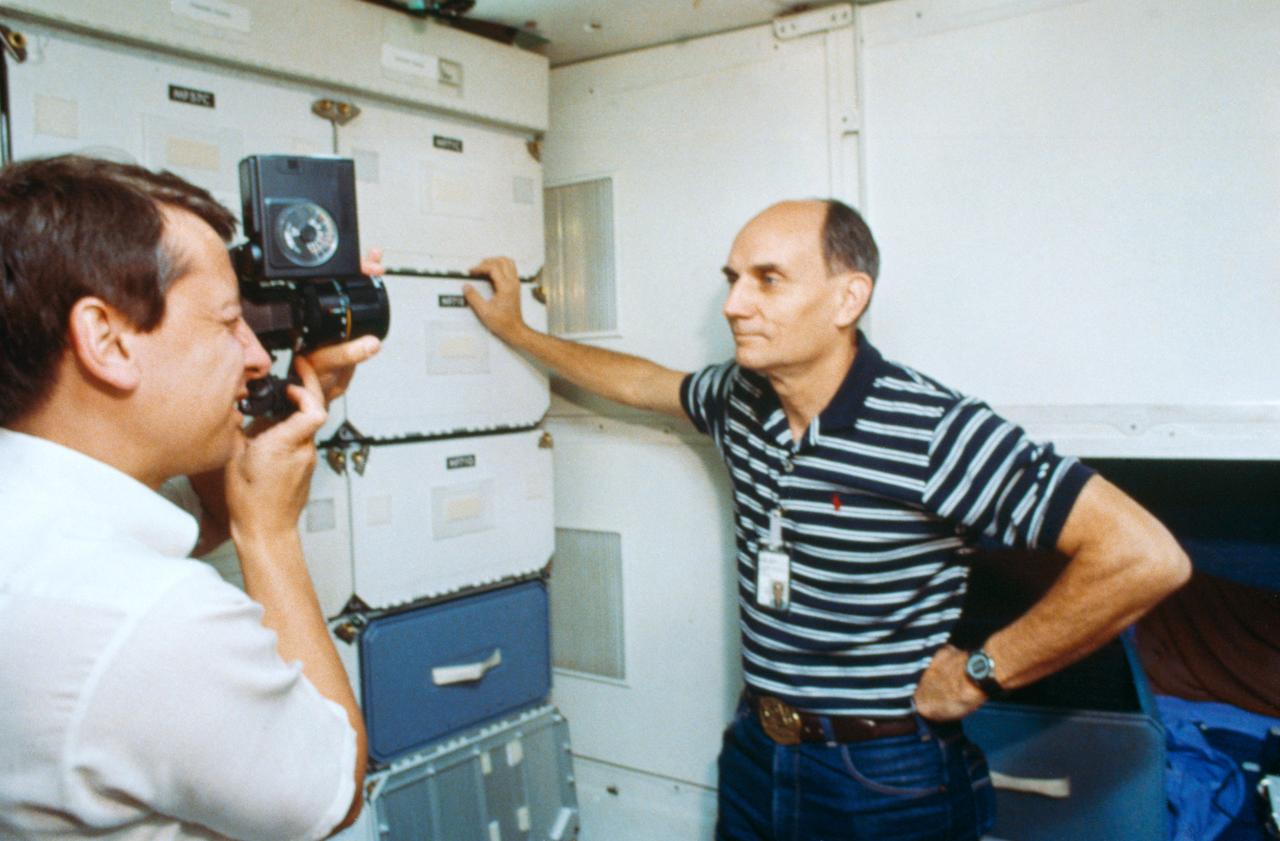
AST-03-191 (17-19 July 1975) --- Astronaut Thomas P. Stafford and cosmonaut Aleksei A. Leonov are seen at the hatchway leading from the Apollo Docking Module (DM) to the Soyuz Orbital Module (OM) during the joint U.S.-USSR Apollo Soyuz Test Project (ASTP) docking mission in Earth orbit. Cosmonaut Leonov is in the OM and astronaut Stafford is in the DM.  Leonov holds a camera. The Apollo crew consisted of astronauts Stafford, commander; Donald K. "Deke" Slayton, docking module pilot; Vance D. Brand, command module pilot.  The Soyuz 19 crew consisted of cosmonauts Leonov, command pilot; and Valeri N. Kubasov, flight engineer.
Cosmonaut Lenov and Astronaut Stafford during ASTP visit
AST-05-263 (17-18 July 1975) --- The Apollo-Soyuz Test Project (ASTP) Commemorative Plaque is assembled in the Soviet Soyuz Orbital Module during the joint U.S.-USSR Apollo-Soyuz Test Project docking mission in Earth orbit. The plaque is written both in English and Russian.
Apollo Soyuz Test Project Commemorative plaque in orbit
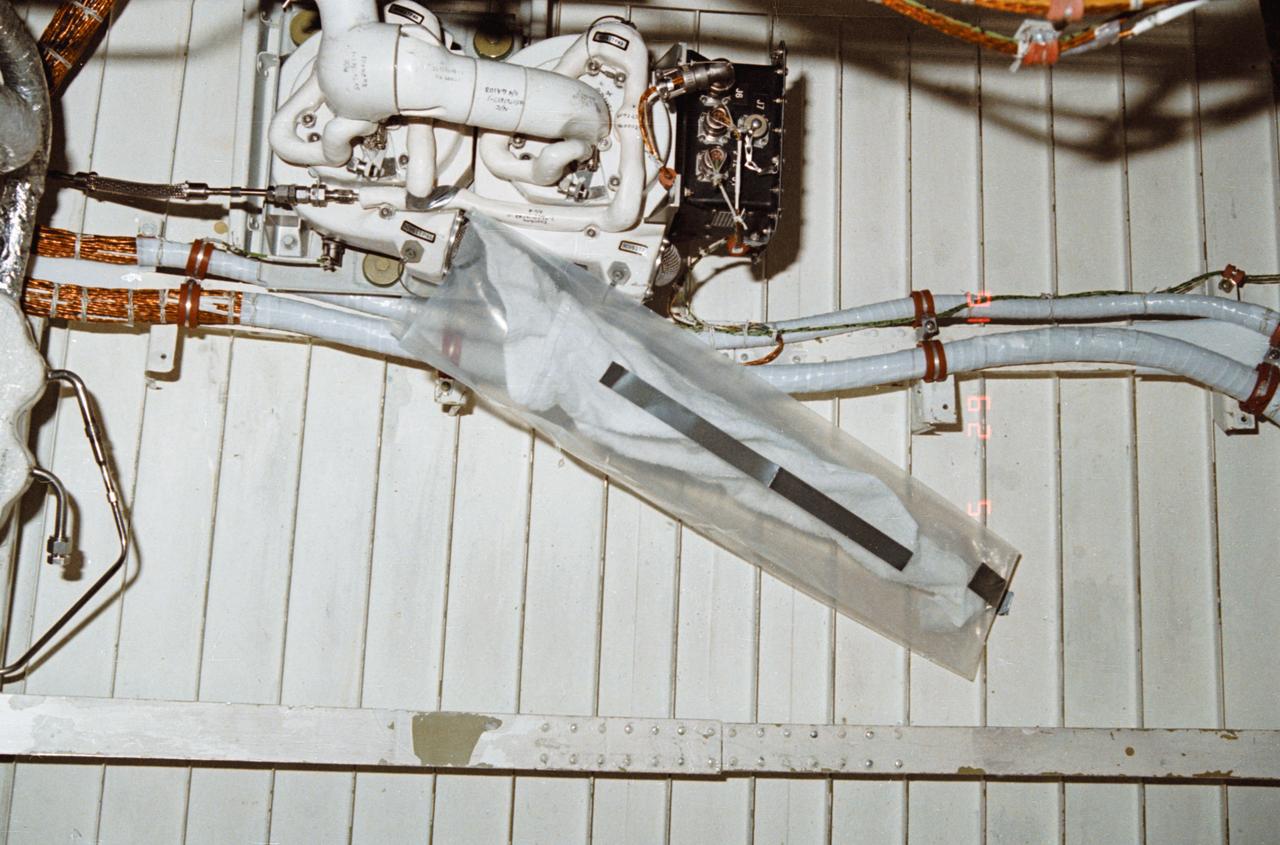
During STS-32, onboard Columbia, Orbiter Vehicle (OV) 102, a leakage problem at environmental control and life support system (ECLSS) air revitalization system (ARS) humidity separator A below the middeck is solved with a plastic bag and a towel. The towel inserted inside a plastic bag absorbed the water that had collected at the separator inlet.
STS-32 OV-102 air revitalization system (ARS) humidity separator problem
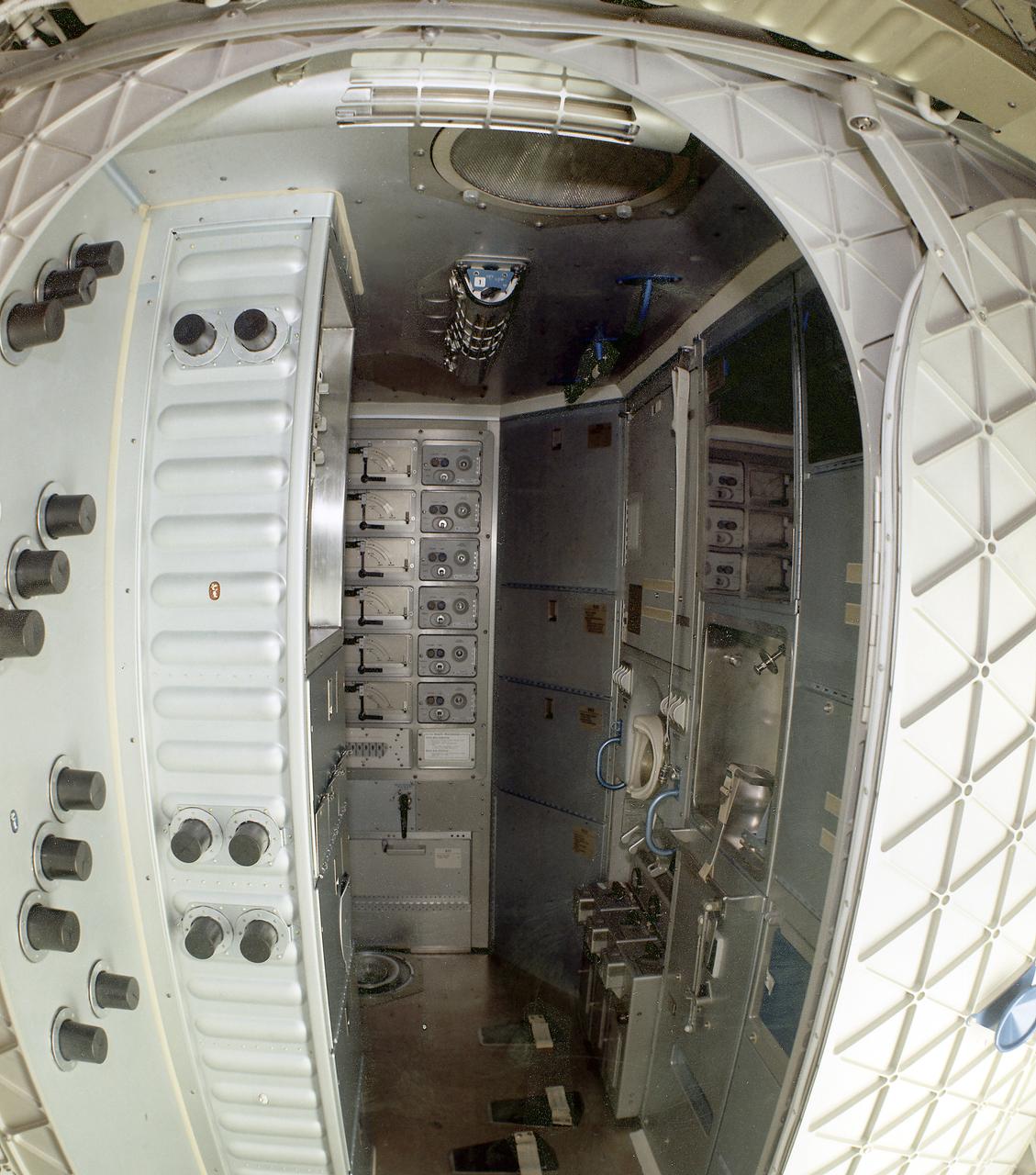
This image is a wide-angle view of the Orbital Workshop waste management compartment. The waste management facilities presented a unique challenge to spacecraft designers. In addition to collection of liquid and solid human wastes, there was a medical requirement to dry all solid human waste products and to return the residue to Earth for examination. Liquid human waste (urine) was frozen for return to Earth. Total quantities of each astronaut's liquid and solid wastes were precisely measured. Cabin air was drawn into the toilet, shown on the wall at right in this photograph, and over the waste products to generate a flow of the waste in the desired direction. The air was then filtered for odor control and antiseptic purposes prior to being discharged back into the cabin.
Skylab
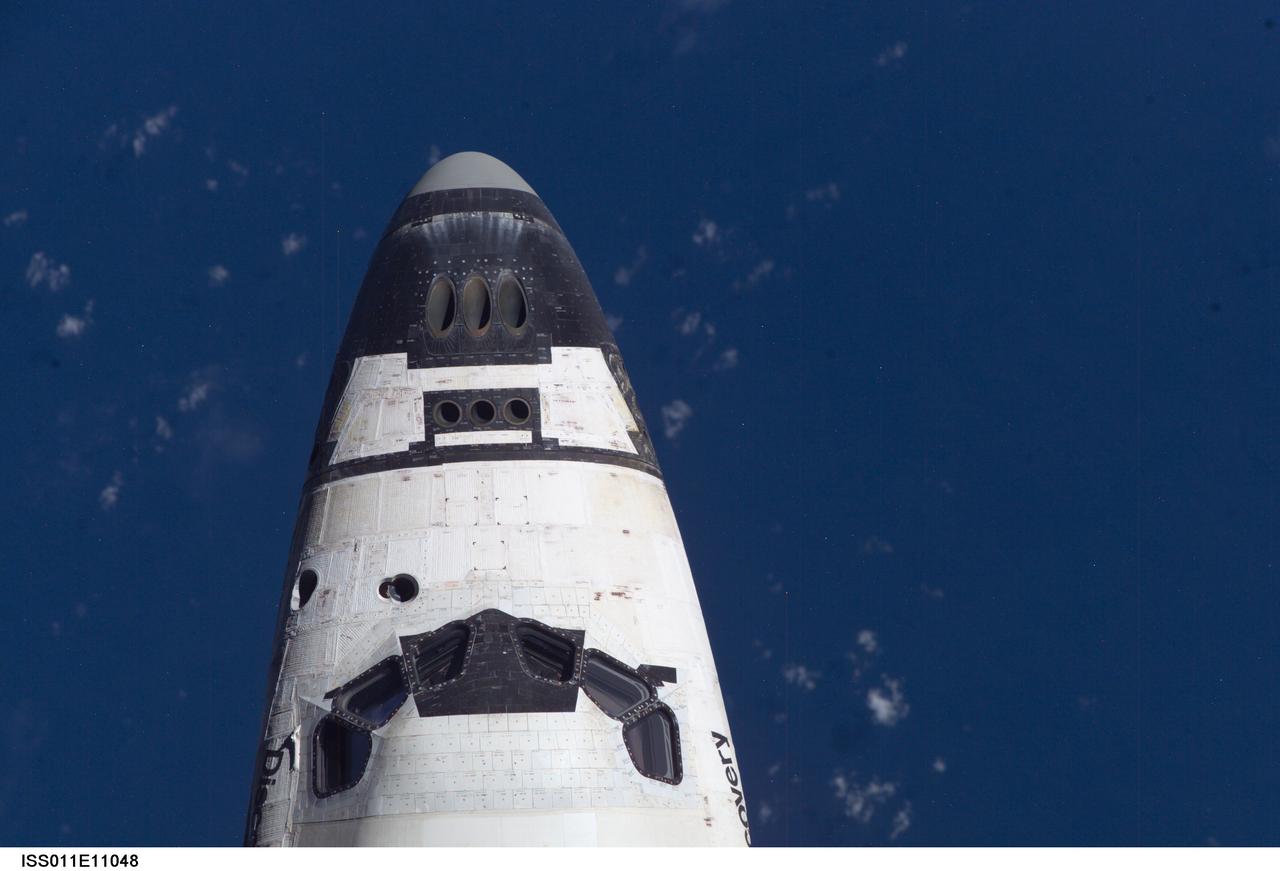
ISS011-E-11048 (28 July 2005) --- The crew cabin of the Space Shuttle Discovery was photographed by the crewmembers of the International Space Station as the two spacecraft approached each other for docking on July 28, 2005.  The Expedition 12 crewmembers onboard the orbital outpost took a battery of survey photographs of the Shuttle thermal protection system.
Mapping sequence performed during the STS-114 R-Bar Pitch Maneuver.
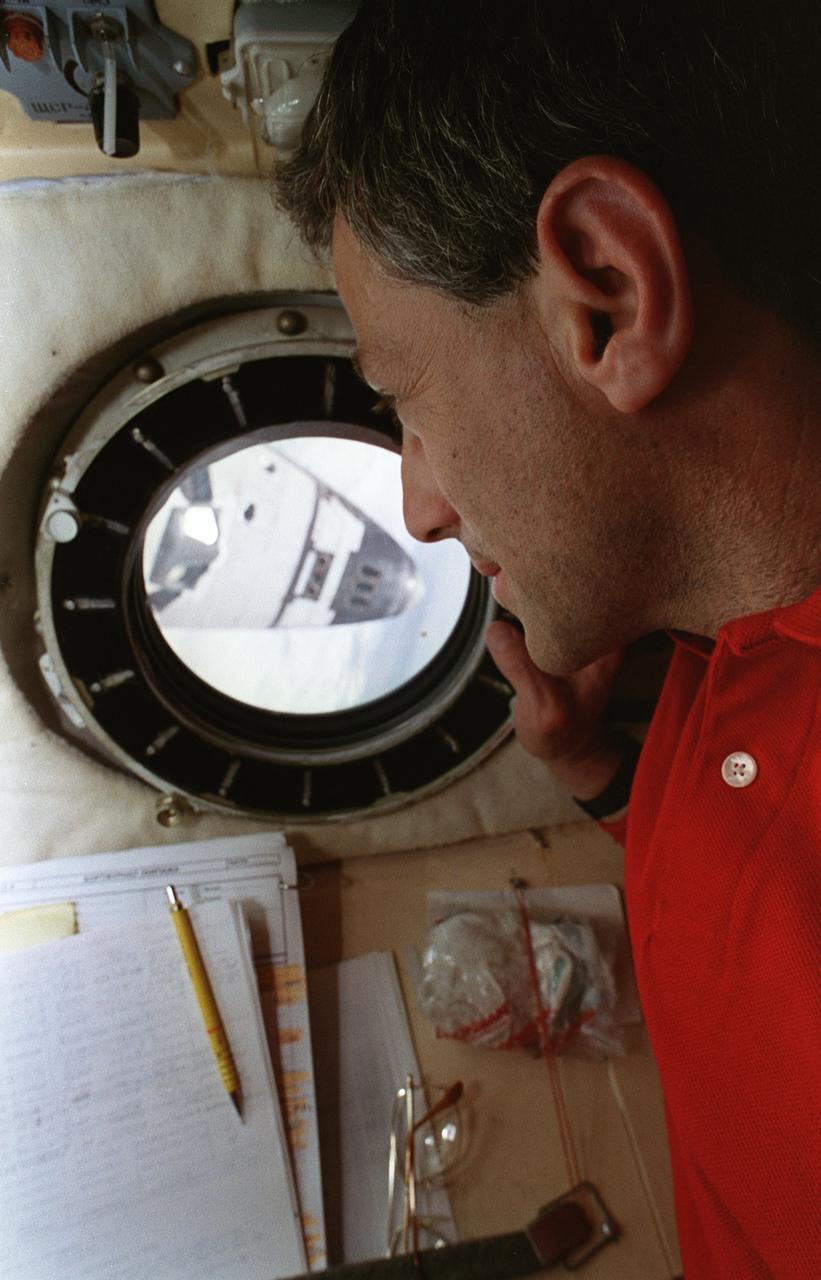
STS079-335-025 (16-26 Sept. 1996) --- Astronaut Jerome (Jay) Apt, in the flight engineer's cabin aboard Russia's Mir Space Station, appears nose to nose with the space shuttle Atlantis as he peers through a viewing port at the forward section of the Orbiter while the two spacecraft were docked in Earth-orbit.
STS-79 and Mir 22 crew aboard the Mir space station
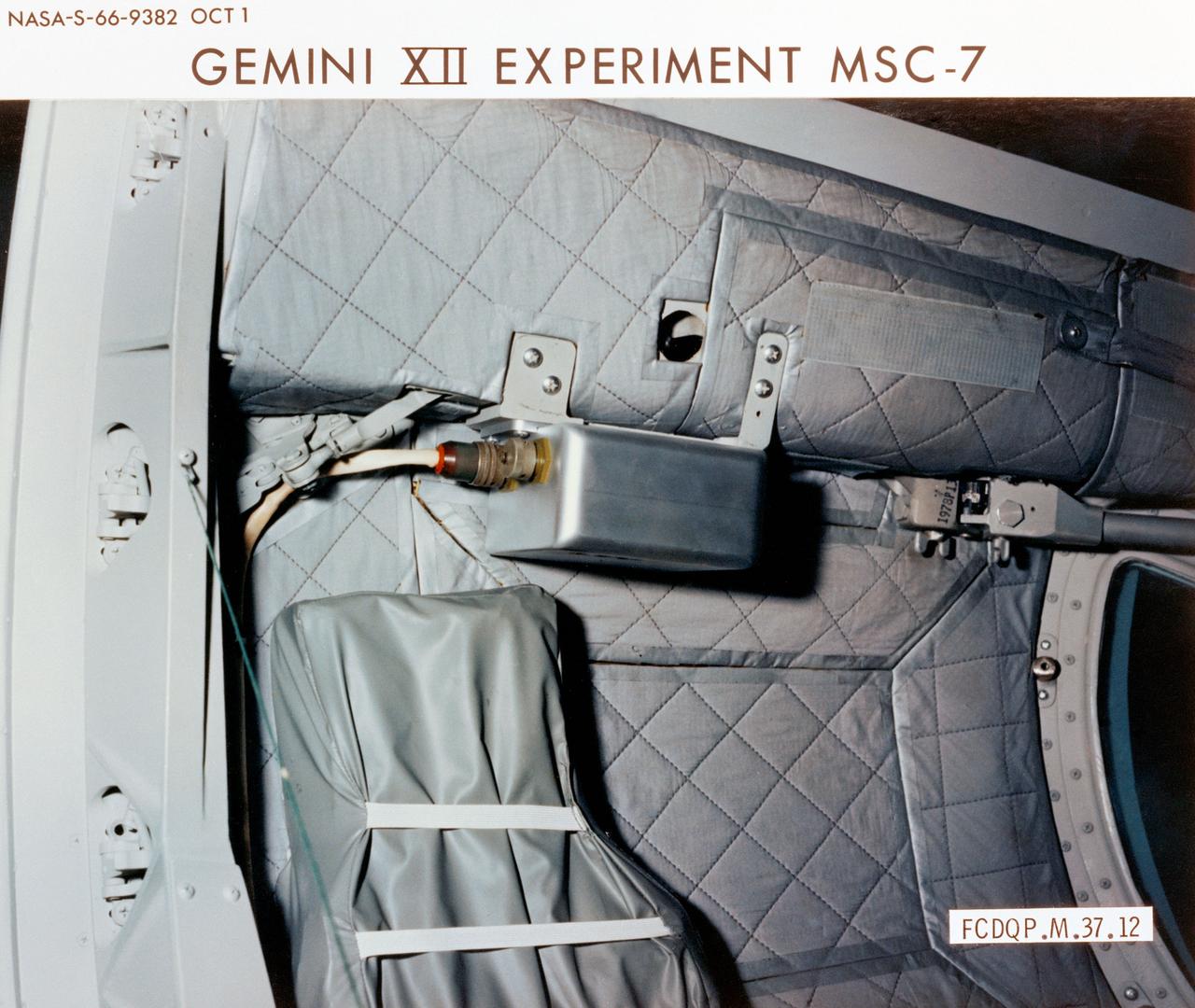
S66-09382 (1 Oct. 1966) --- Gemini-12 Experiment MSC-7 Bremsstrahlung Spectrometer-Spectrometer Analyzer processor installed in cabin. Objective of experiment is to determine the gamma and beta flux and energy spectra induced inside the spacecraft by exterior electrons. Photo credit: NASA
SPECTOMETER - BREMSSTRAHLUNG - GEMINI-TITAN (GT)-XII ANALYZER PROCESSOR EXPERIMENT MSC 7 (M409) - CAPE
S65-21864 (19 March 1965) --- Astronauts Virgil I. Grissom (left), command pilot; and John W. Young, pilot, prepare to run Gemini-Titan 3 simulations in the Gemini mission simulator at Cape Kennedy, Florida. The NASA GT-3 flight was scheduled for March 23, 1965.
Astronauts Grissom and Young prepare to preform flight simulations
AS13-59-8484 (April 1970) --- Astronaut James A. Lovell Jr., commander, is pictured at his position in the Lunar Module (LM).  The Apollo 13 crew of astronauts Lovell; John L. Swigert Jr., command module pilot; and Fred W. Haise Jr., lunar module pilot, relied on the LM as a "lifeboat".  The dependence on the LM was caused by an apparent explosion of oxygen tank number two in the Service Module (SM).  The LM was jettisoned just prior to Earth re-entry by the Command Module (CM).
Astronaut James Lovell at his position in the Lunar Module
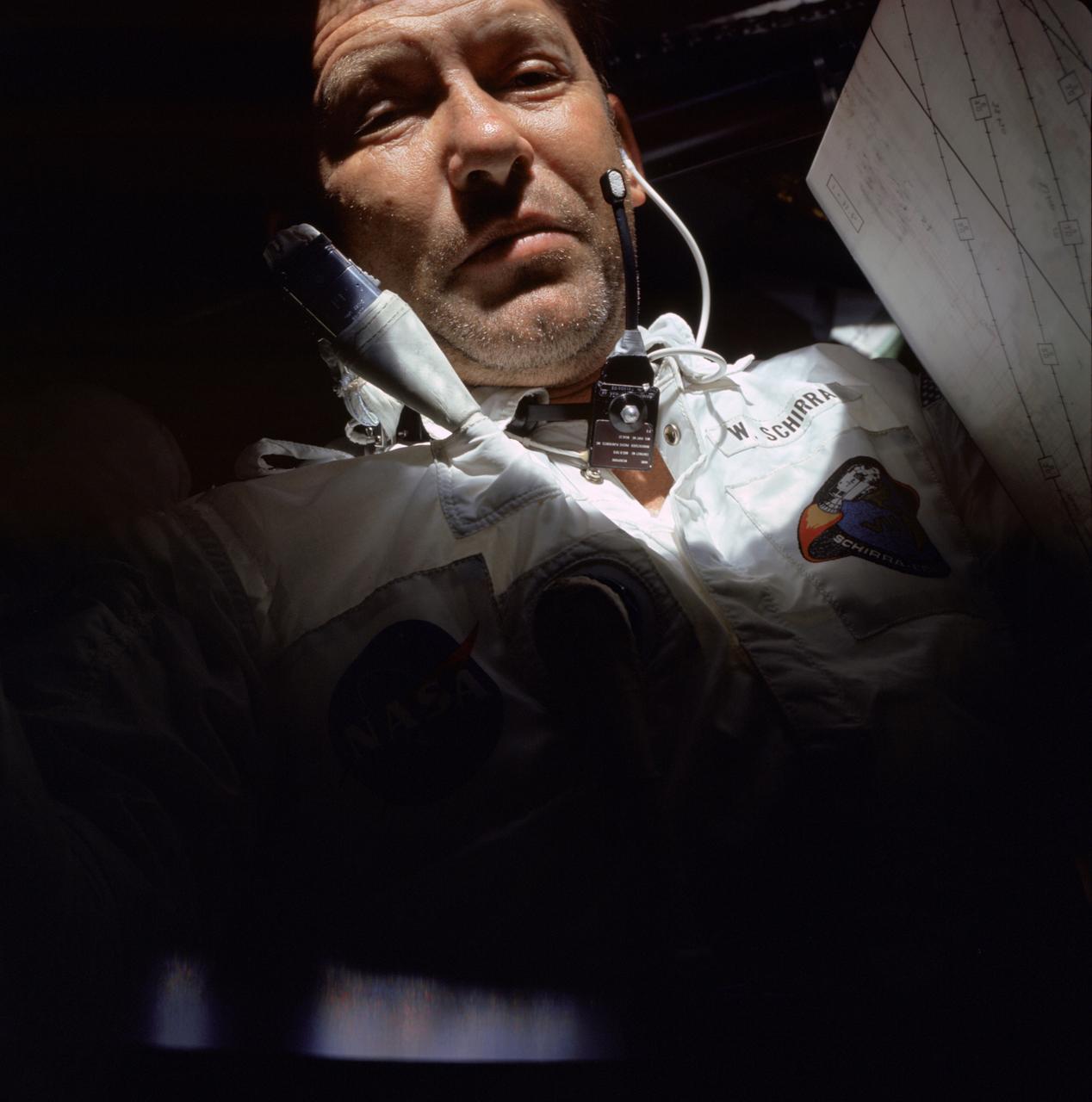
AS07-04-1582 (11-22 Oct. 1968) --- Astronaut Walter M. Schirra Jr., Apollo 7 commander, is photographed during the Apollo 7 mission.
Prime crew photographed during Apollo 7 mission
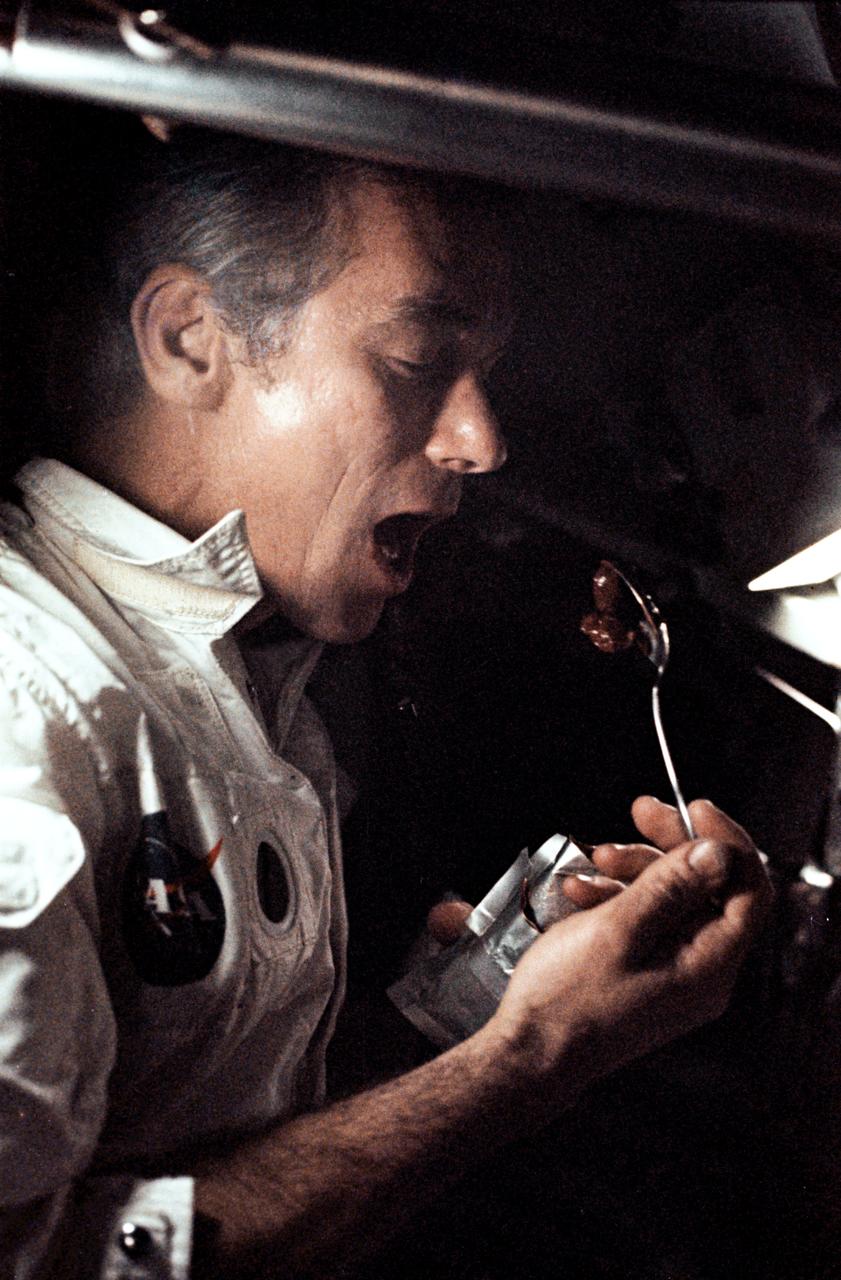
AS17-163-24129 (7-19 Dec. 1972) --- A fellow crewman took this photograph of astronaut Eugene A. Cernan eating a meal under weightlessness conditions of space during the final lunar landing mission in NASA's Apollo program. Also, aboard the Apollo 17 spacecraft were astronaut Ronald E. Evans, command module pilot, and scientist-astronaut Harrison H. "Jack" Schmitt, lunar module pilot. Cernan was the mission commander.
Astronaut Eugene Cernan eating a meal aboard Apollo 17 spacecraft
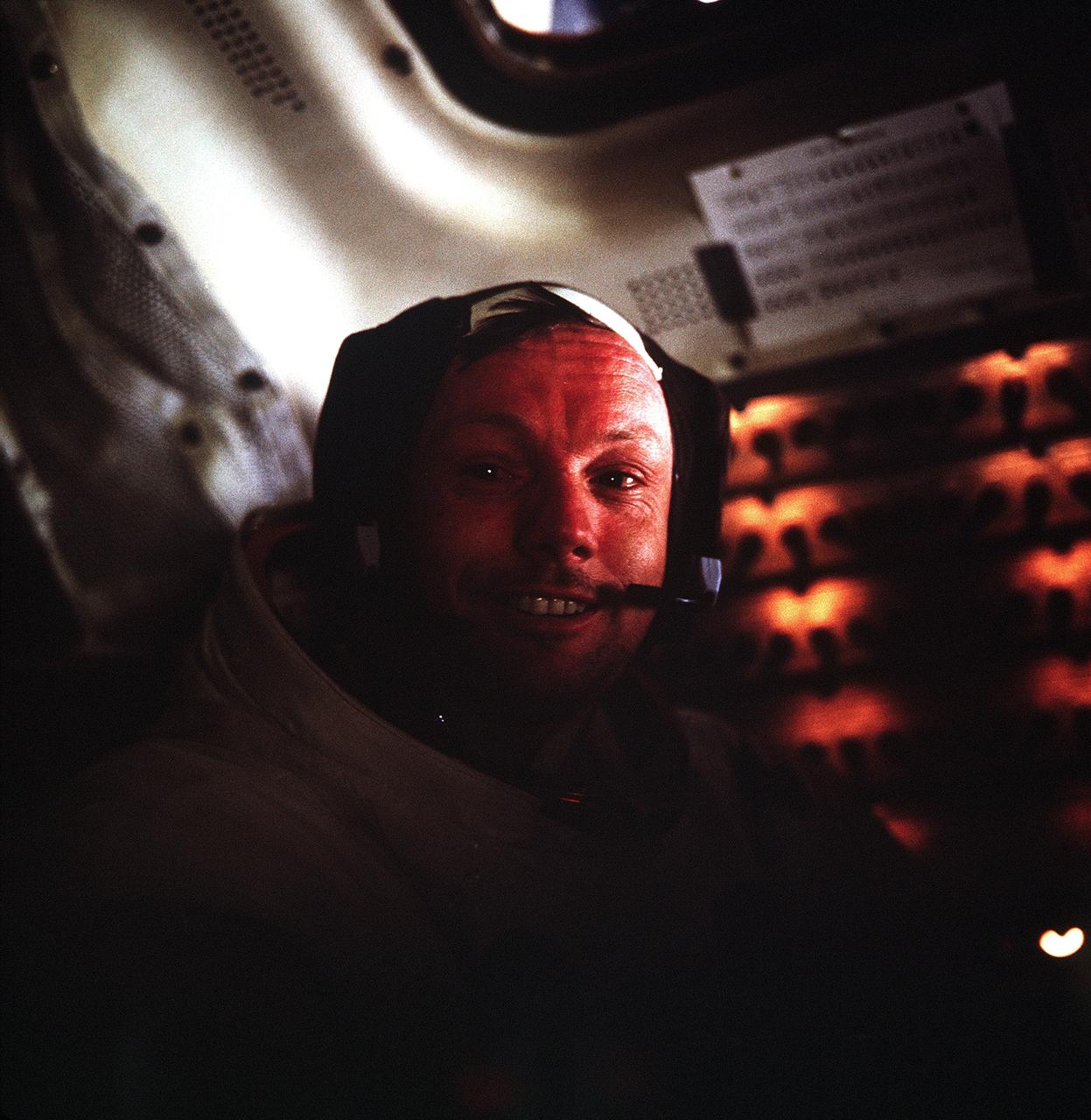
AS11-37-5528 (20 July 1969) --- This photograph of astronaut Neil A. Armstrong, Apollo 11 commander, was taken inside the Lunar Module (LM) while the LM rested on the lunar surface. Astronauts Armstrong and Edwin E. Aldrin Jr., lunar module pilot, had already completed their historic extravehicular activity (EVA) when this picture was made. Astronaut Michael Collins, command module pilot, remained with the Command and Service Modules (CSM) in lunar orbit while Armstrong and Aldrin explored the moon's surface.
View of Astronaut Neil Armstrong in Lunar Module
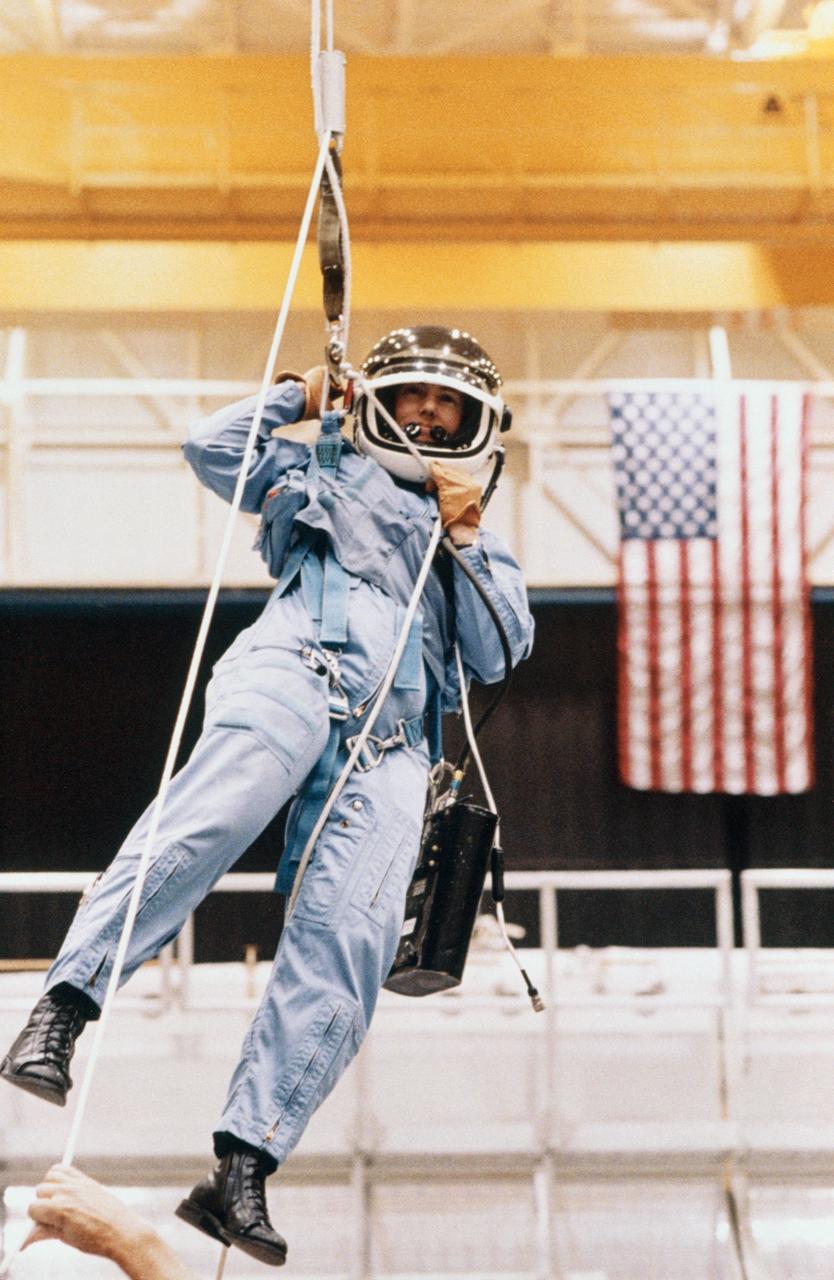
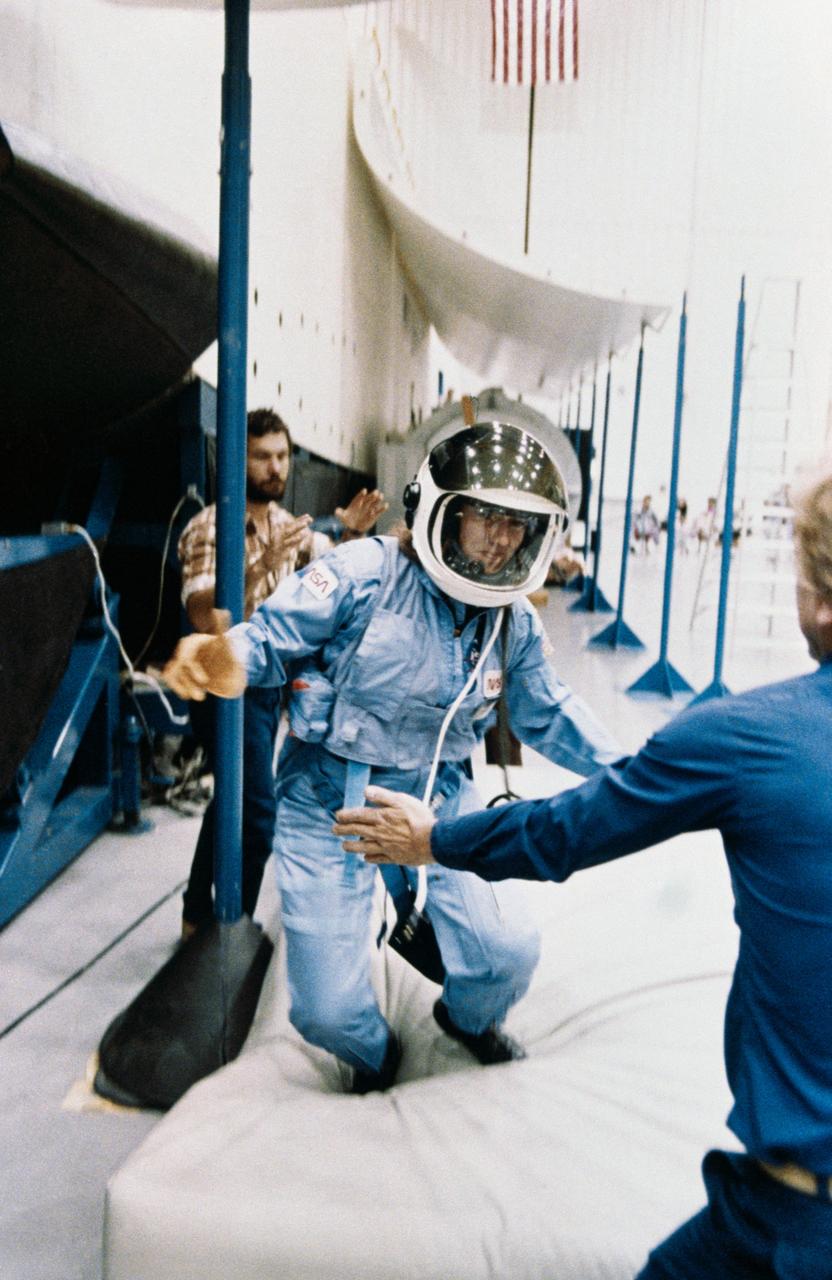
S86-25183 (for release January 1986) --- Sharon Christa McAuliffe, STS-51L payload specialist representing the Teacher-in-Space Project, descends from a mock-up of the space shuttle using a sky-genie device during an emergency training session in the Johnson Space Center?s (JSC) Shuttle Mock-up and Integration Laboratory. The photograph was taken by Keith Meyers of the New York Times.    EDITOR?S NOTE: The STS-51L crew members lost their lives in the space shuttle Challenger accident moments after launch on Jan. 28, 1986 from the Kennedy Space Center (KSC). Photo credit: NASA
Christa McAuliffe using Sky-genie during emergency egress training
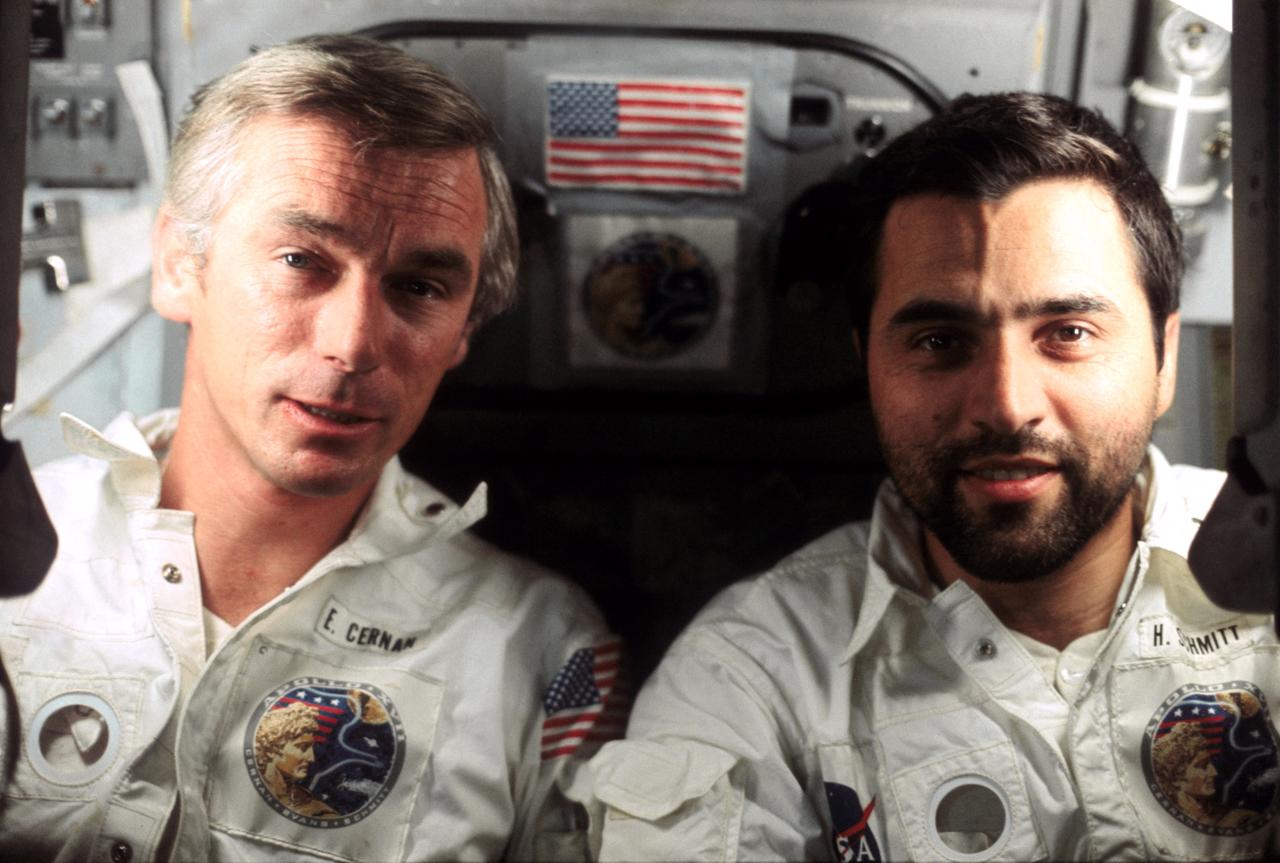
AS17-163-24148 (7-19 Dec. 1972) --- Astronaut Eugene A. Cernan (left) and scientist-astronaut Harrison H. "Jack" Schmitt are photographed by the third crew man aboard the Apollo 17 spacecraft during the final lunar landing mission in NASA's Apollo program. Astronaut Ronald E. Evans, command module pilot, took this picture. Cernan was the mission commander. Schmitt served as the lunar module pilot.
Candid photo of Astronauts Cernan and Schmitt aboard Apollo 17 spacecraft
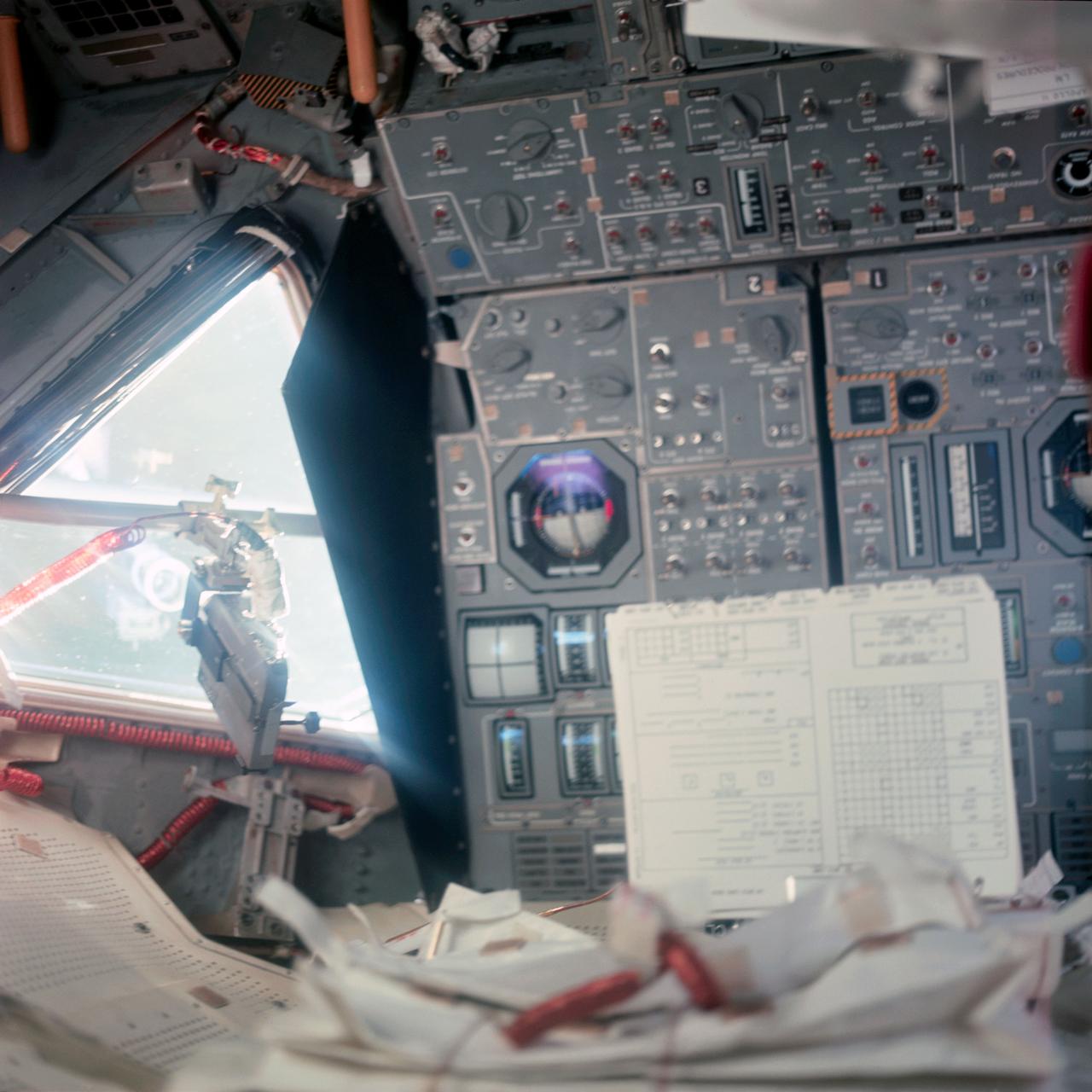
AS11-36-5389 (July 1969) --- An interior view of the Apollo 11 Lunar Module showing some of the displays and controls. Mounted in the Lunar Module window is a 16mm data acquisition camera which has a variable frame speed of 1, 6, 12 and 24 frames per second. Photo credit: NASA
Interior view of Apollo 11 Lunar Module showing displays and controls
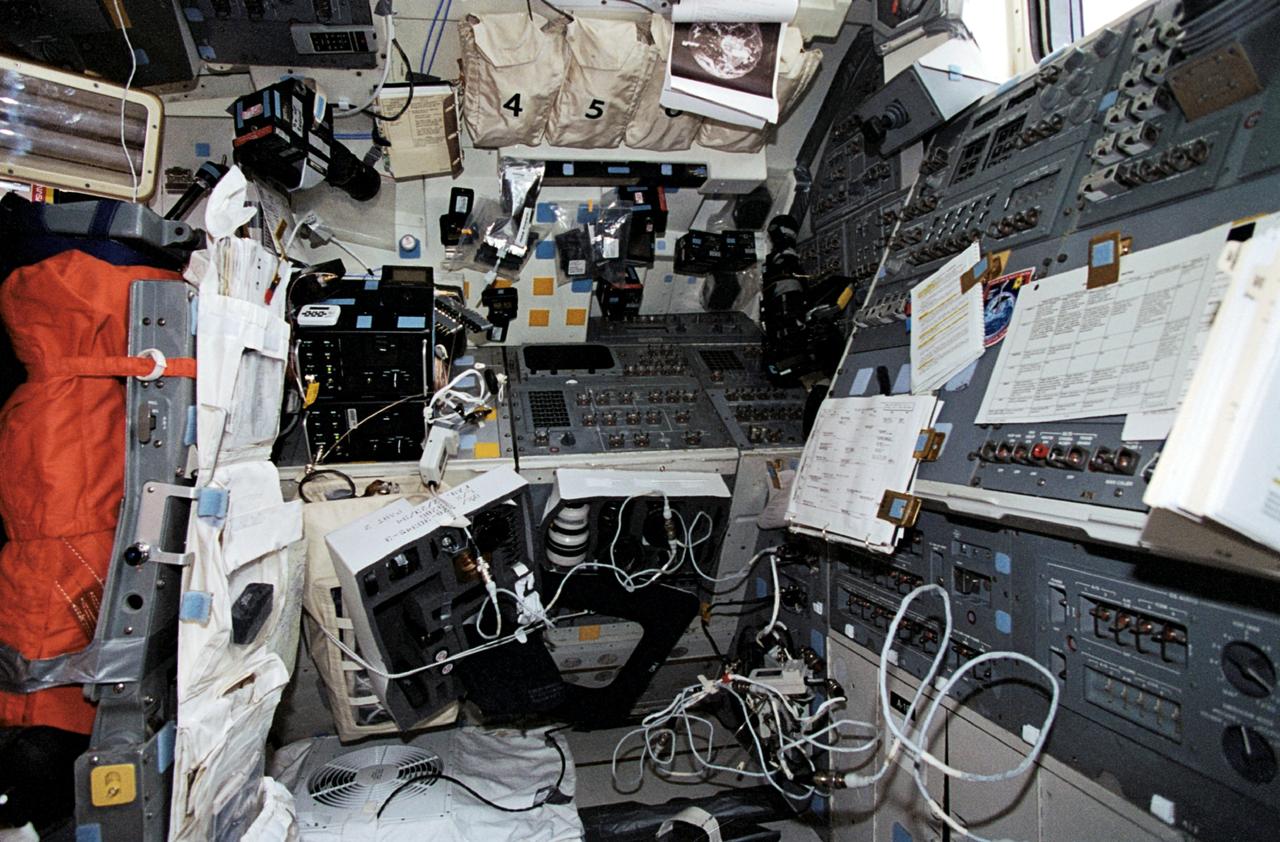
STS062-17-034 (4-18 March 1994) --- This scene, resembling a photographer's studio/laboratory, actually shows the aft flight deck of the Earth-orbiting Space Shuttle Columbia. A variety of cameras, lenses, visual aids and other gear are seen stowed around the flight deck. The five astronaut crew members devoted a large portion of their on-duty time at this workstation using some of this photographic equipment to record Earth imagery.
Aft flight deck of Columbia during STS-62
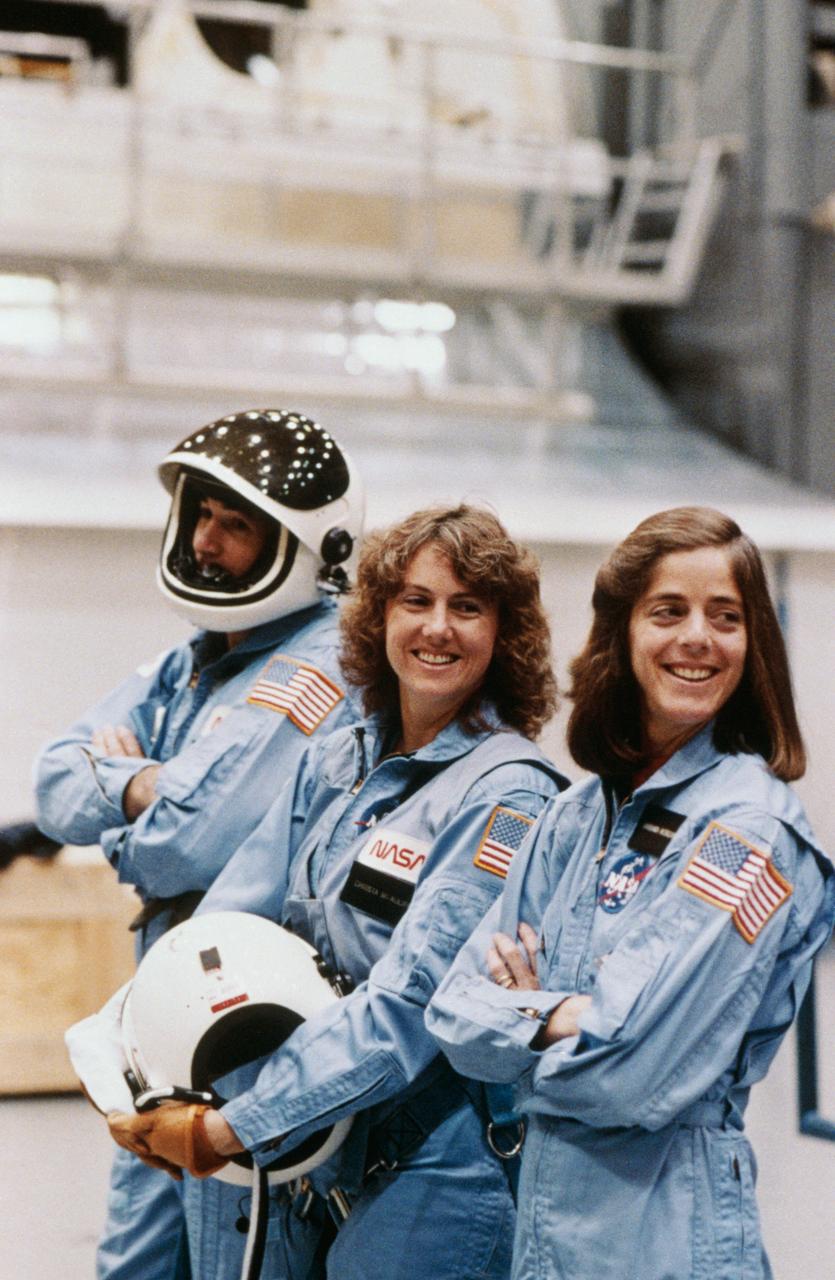
S86-25254 (January 1986) --- Payload specialists in training for STS-51L take a break in shuttle emergency egress training at the Johnson Space Center's (JSC) Shuttle Mock-up and Integration Laboratory. Left to right are Gregory Jarvis of Hughes, Sharon Christa McAuliffe and Barbara Morgan of the Teacher-in-Space Project. McAuliffe was selected as NASA's first citizen observer in the Space Shuttle Program and Morgan was named her backup. The photo was taken by Keith Meyers of the New York Times.    EDITOR?S NOTE: The STS-51L crew members lost their lives in the space shuttle Challenger accident moments after launch on Jan. 28, 1986 from the Kennedy Space Center (KSC). Photo credit: NASA
Payload specialists in training for STS 51-L in mockup & integration lab
AS07-04-1600 (20 Oct. 1968) --- Astronaut Donn F. Eisele, Apollo 7 command module pilot, smiles through a heavy growth of beard as he is photographed during a momentary pause on the ninth day of the Apollo 7 mission.
Astronaut Donn Eisele photographed during Apollo 7 mission
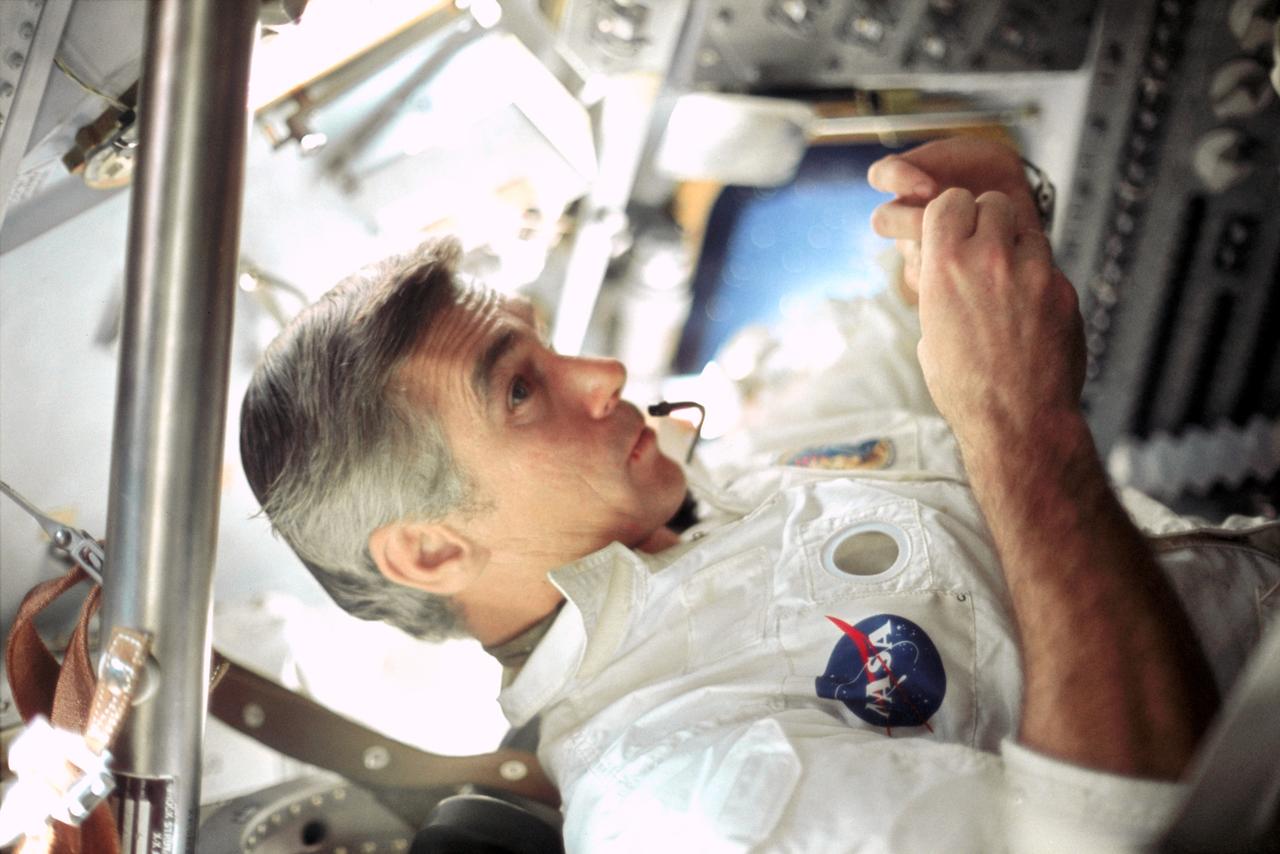
AS17-163-24122 (7-19 Dec. 1972) --- This candid photograph of astronaut Eugene A. Cernan was taken by a fellow crewman aboard the Apollo 17 spacecraft during the final lunar landing mission in NASA's Apollo program. Cernan was the mission commander. Also, aboard Apollo 17 were astronaut Ronald E. Evans, command module pilot, and scientist-astronaut Harrison H. "Jack" Schmitt, lunar module pilot.
Candid photo of Astronaut Eugene Cernan aboard Apollo 17 spacecraft
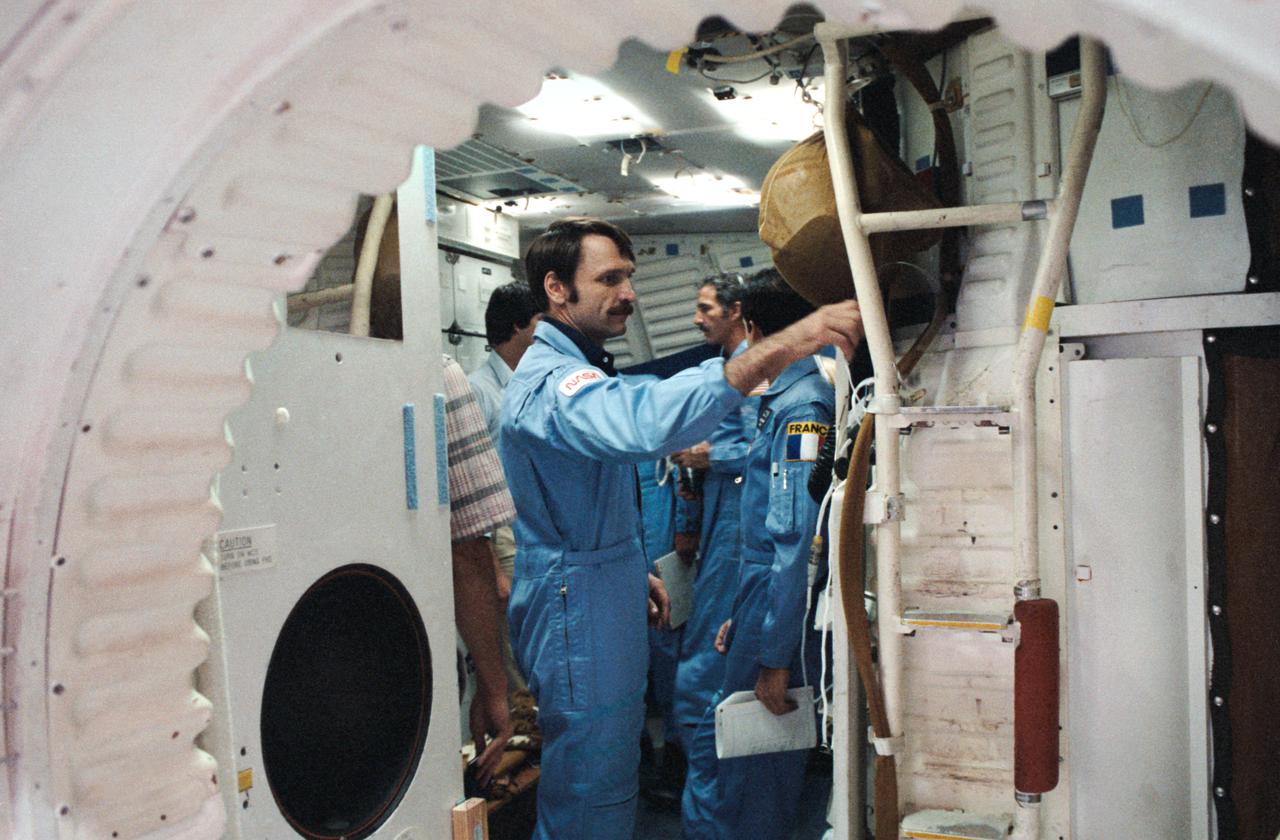
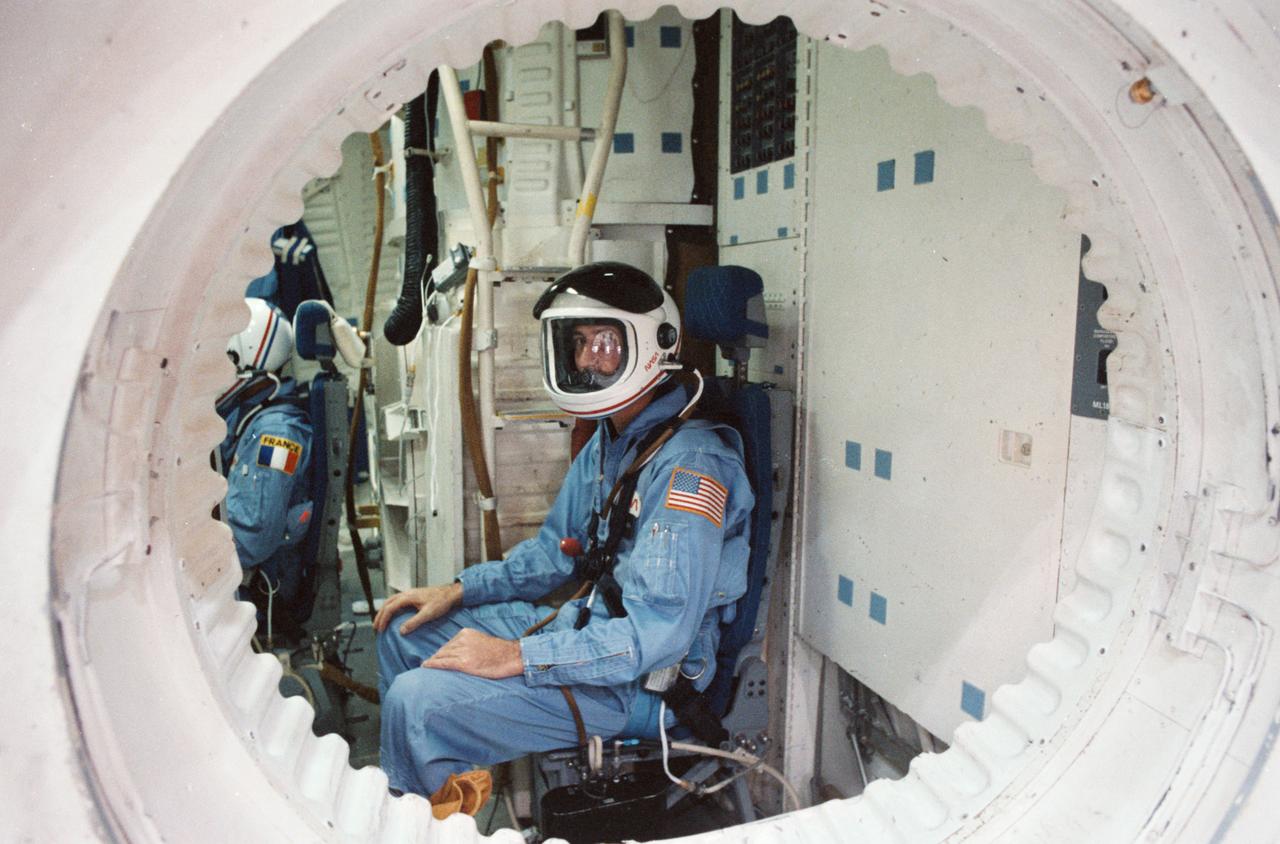
STS 51-E crew is briefed on the Shuttle full fuselage trainer. Astronauts Dave Griggs (foreground), Jean Loup Chretien (behind Griggs) and Jeff Hoffman are being shown the workings of the trainer by flight instructors.
STS 51-E crew is briefed on the Shuttle full fuselage trainer
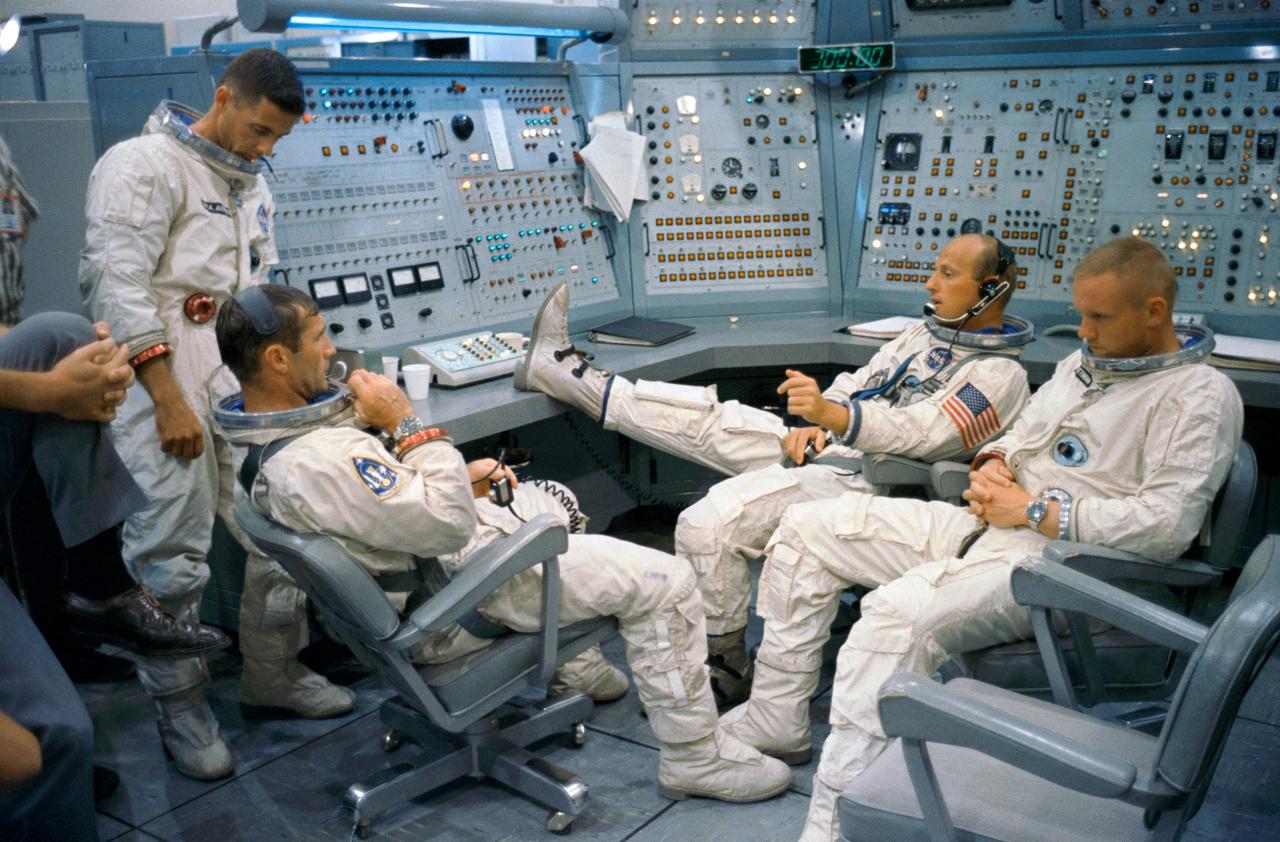
S66-50769 (8 Sept. 1966) --- Gemini-11 prime and backup crews are pictured at the Gemini Mission Simulator at Cape Kennedy, Florida. Left to right are astronauts William A. Anders, backup crew pilot; Richard F. Gordon Jr., prime crew pilot; Charles Conrad Jr. (foot on desk), prime crew command pilot; and Neil A. Armstrong, backup crew command pilot. Photo credit: NASA
Gemini 11 prime and back-up crews at Gemini Mission Simulator at Cape Kennedy
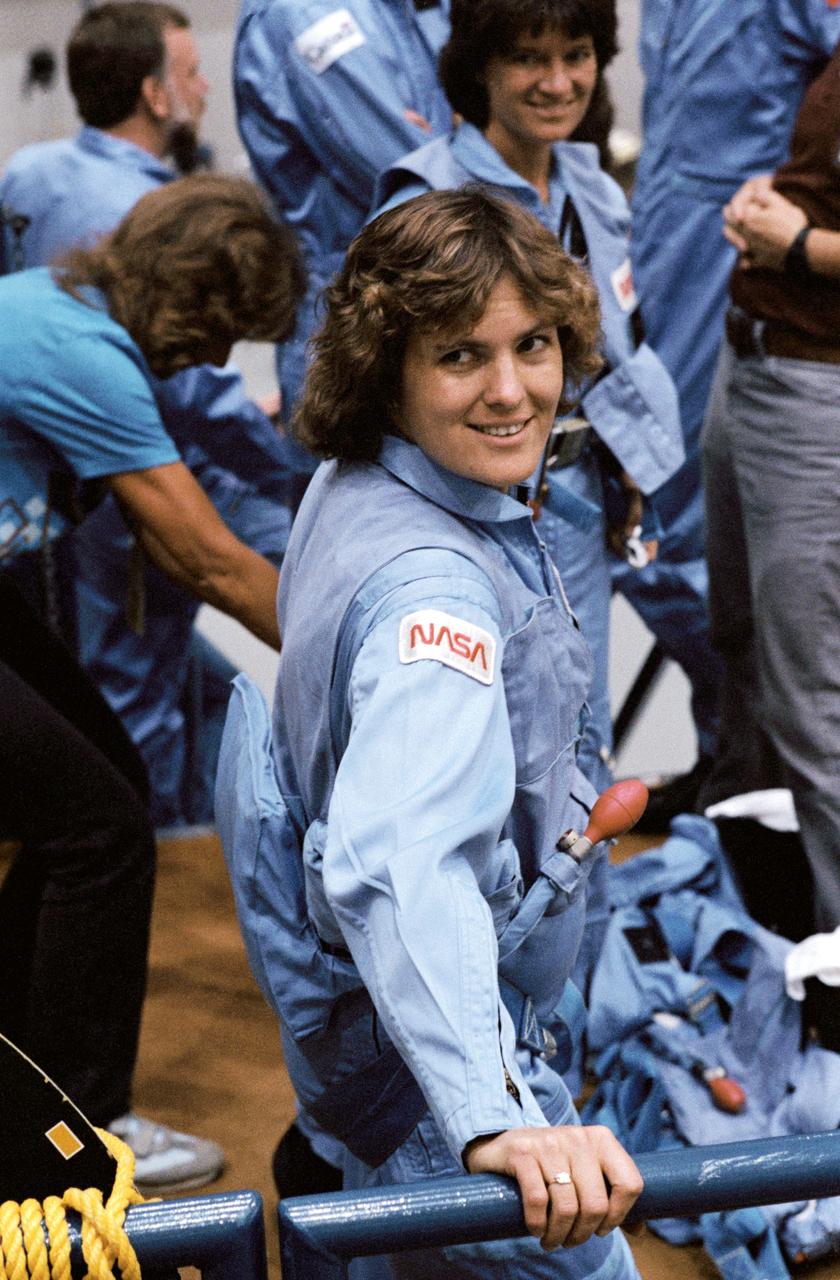
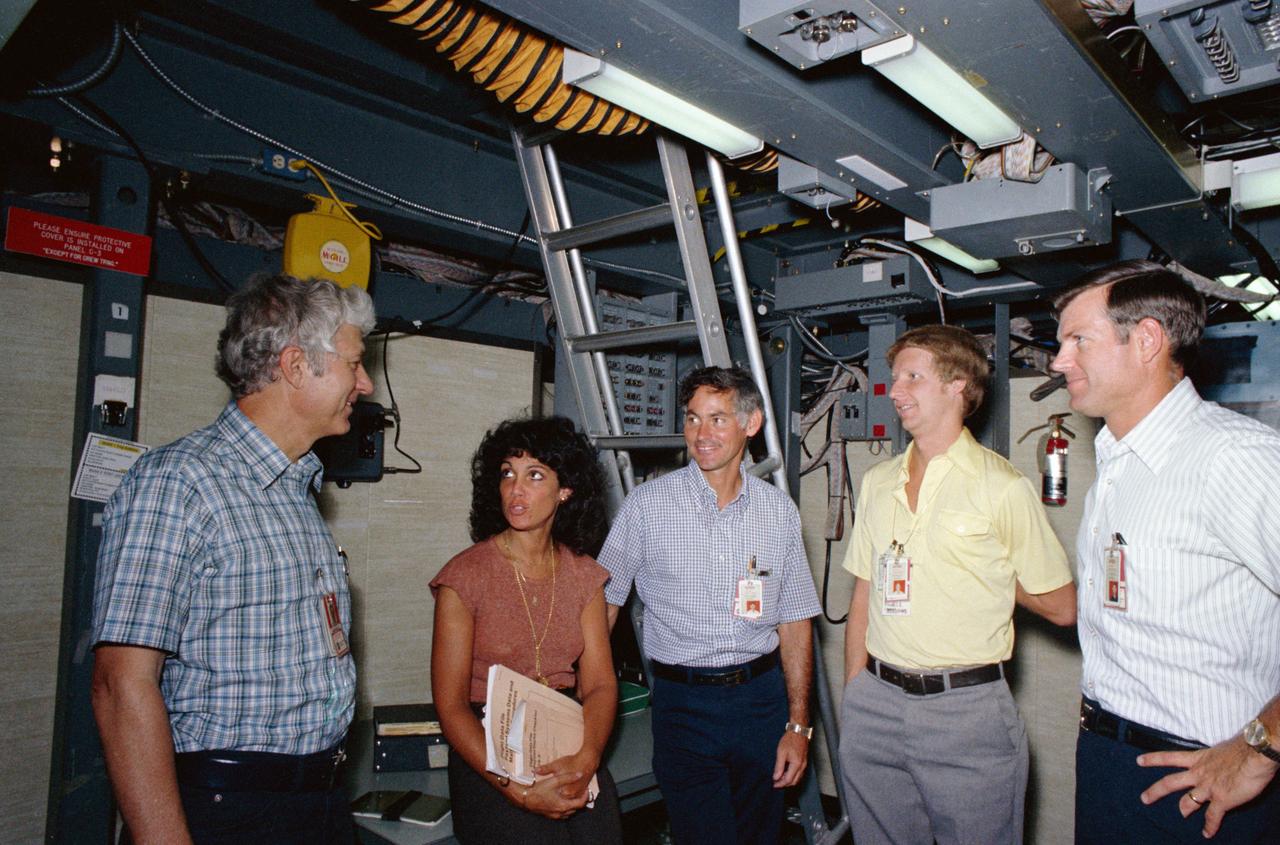
41D-3188 (2 September 1984) --- Astronaut Kathryn D. Sullivan, 41-G mission specialist, joins with other members of the seven-person crew prior to a training session in the Shuttle mockup and integration laboratory at the Johnson Space Center.  Dr. Sullivan will be the first American woman to perform an extravehicular activity (EVA) in space when she joins Astronaut David C. Leestma for some outside-the-Challenger duty on October 9. The mission is scheduled for an October 5, 1984 launch.
Astronaut Sullivan prepares to join crew in training
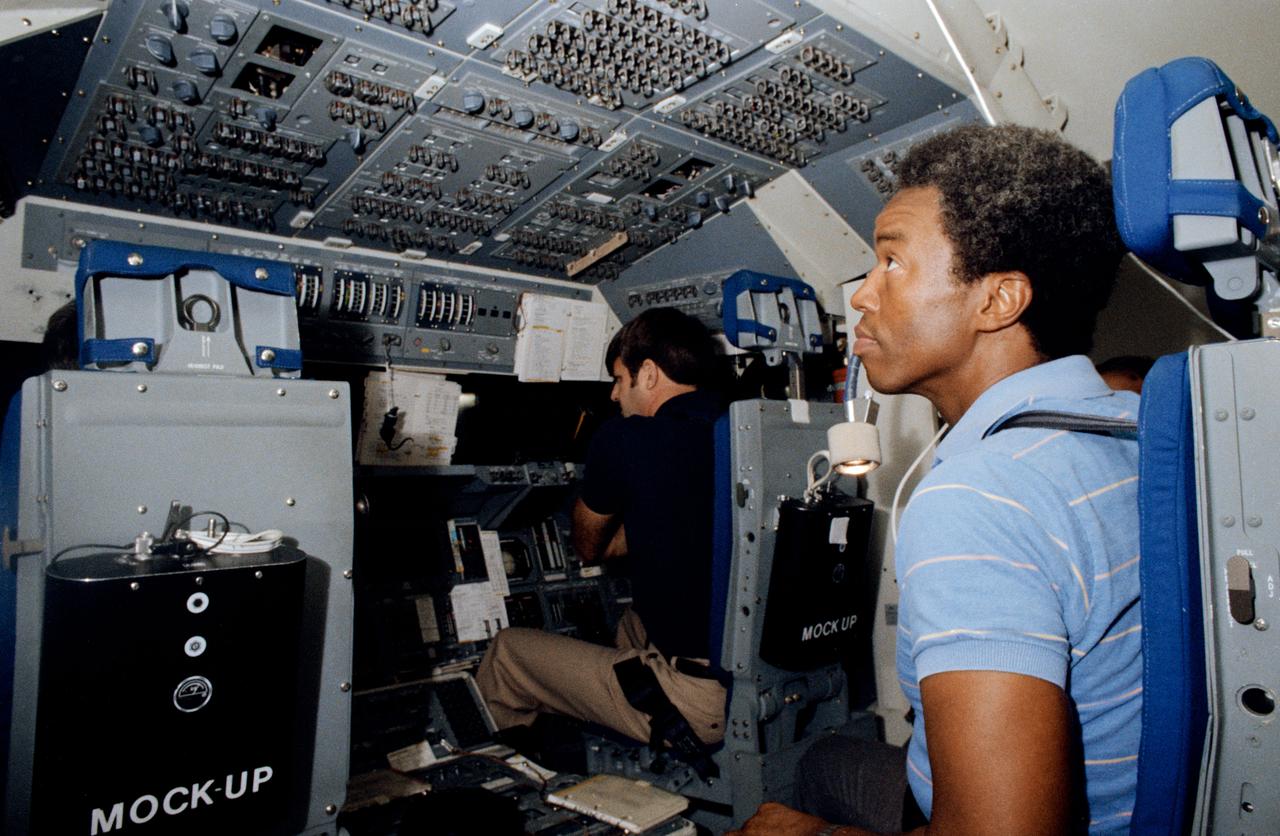
S83-33032 (23 May 1983) --- Astronauts Guion S. Bluford, right, and Daniel C. Brandenstein man their respective Challenger entry and ascent stations in the Shuttle Mission Simulator (SMS) at NASA's Johnson Space Center (JSC) during a training session for the STS-8 mission. Brandenstein is in the pilot's station, while Bluford, a mission specialist, occupies one of the two aft flight deck seats. Both are wearing civilian clothes for this training exercise. This motion based simulator represents the scene of a great deal of training and simulation activity, leading up to crew preparedness for Space Transportation System (STS) mission. Photo credt: NASA/Otis Imboden, National Geographic
STS-8 crewmembers during shuttle mission simulation training
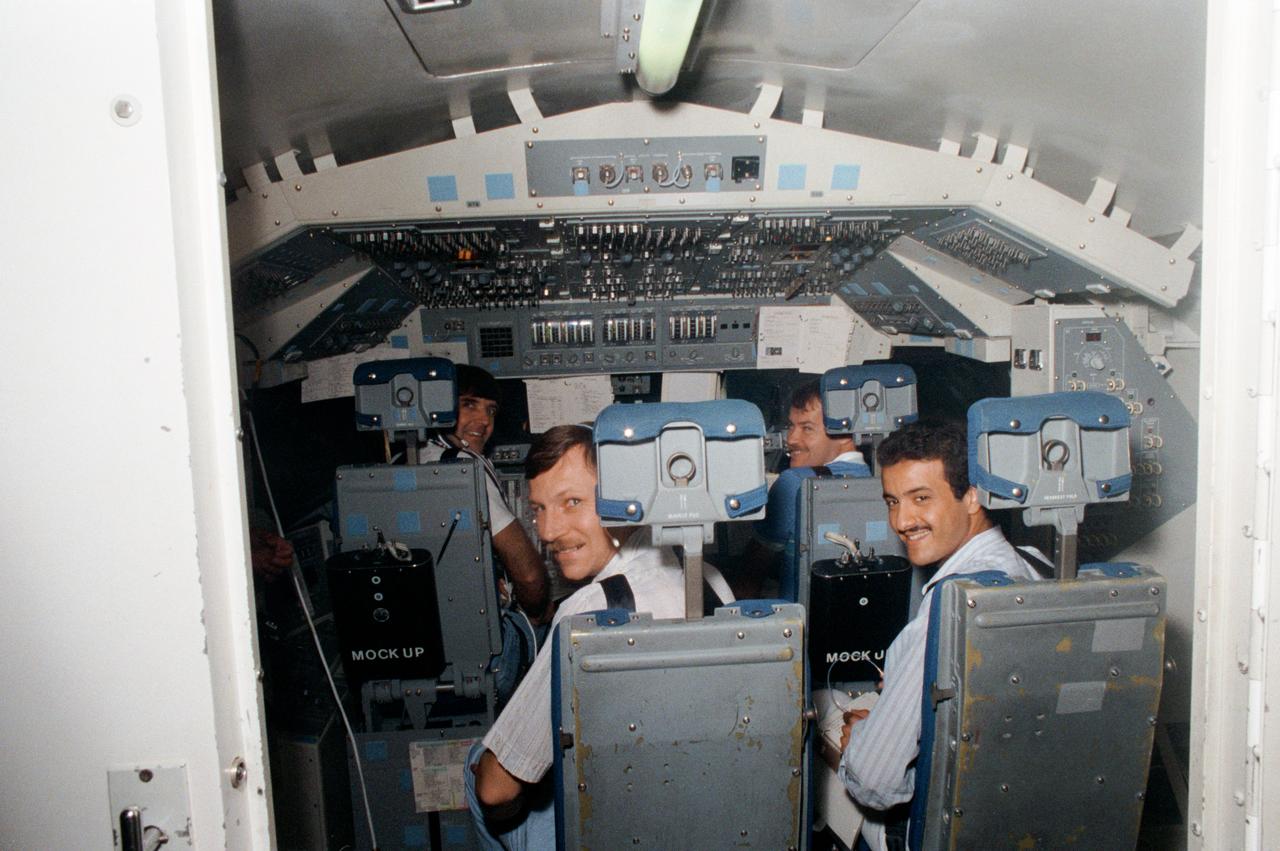
STS 51-E crew is briefed on the Shuttle full fuselage trainer. View of the crewmembers seated at stations inside the cabin was taken from the side hatch.
STS 51-E crew is briefed on the Shuttle full fuselage trainer
Sharon Christa McAuliffe, 51-L payload specialist representing the Teacher in Space project, jumps down onto a cushion during an emergency egress training session in JSC's mockup and integration laboratory. She had been descending from the mockup using a Sky-genie.
Christa McAuliffe using Sky-genie during emergency egress training
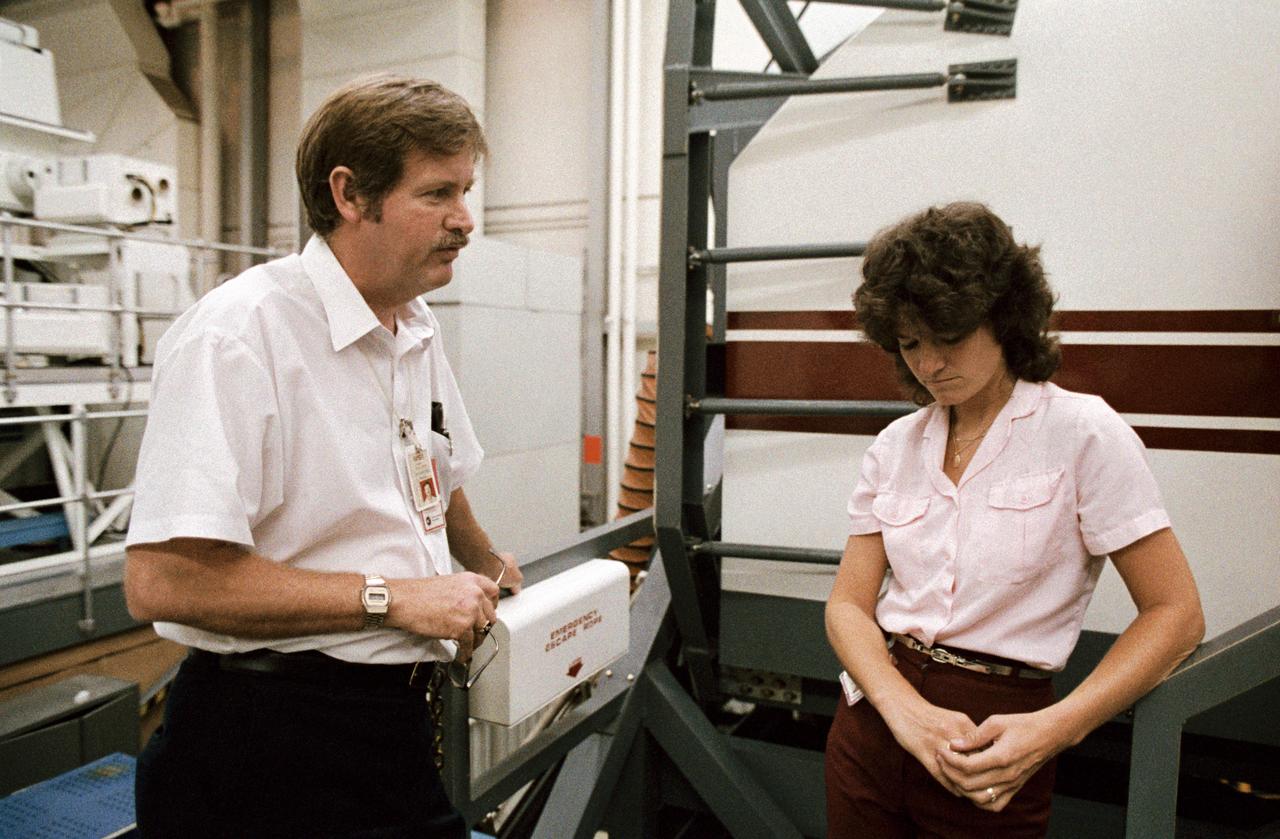
S83-32890 (23 May 1983) --- Astronaut Sally K. Ride, STS-7 mission specialist, stands near the Shuttle Mission Simulator (SMS) in Johnson Space Center's (JSC) Mission Simulation and Training Facility with suit specialist Alan M. Rochford after simulation of various phases of the upcoming STS-7 flight. Photo credit: NASA
Astronaut Sally K. Ride outside of shuttle mission simulator
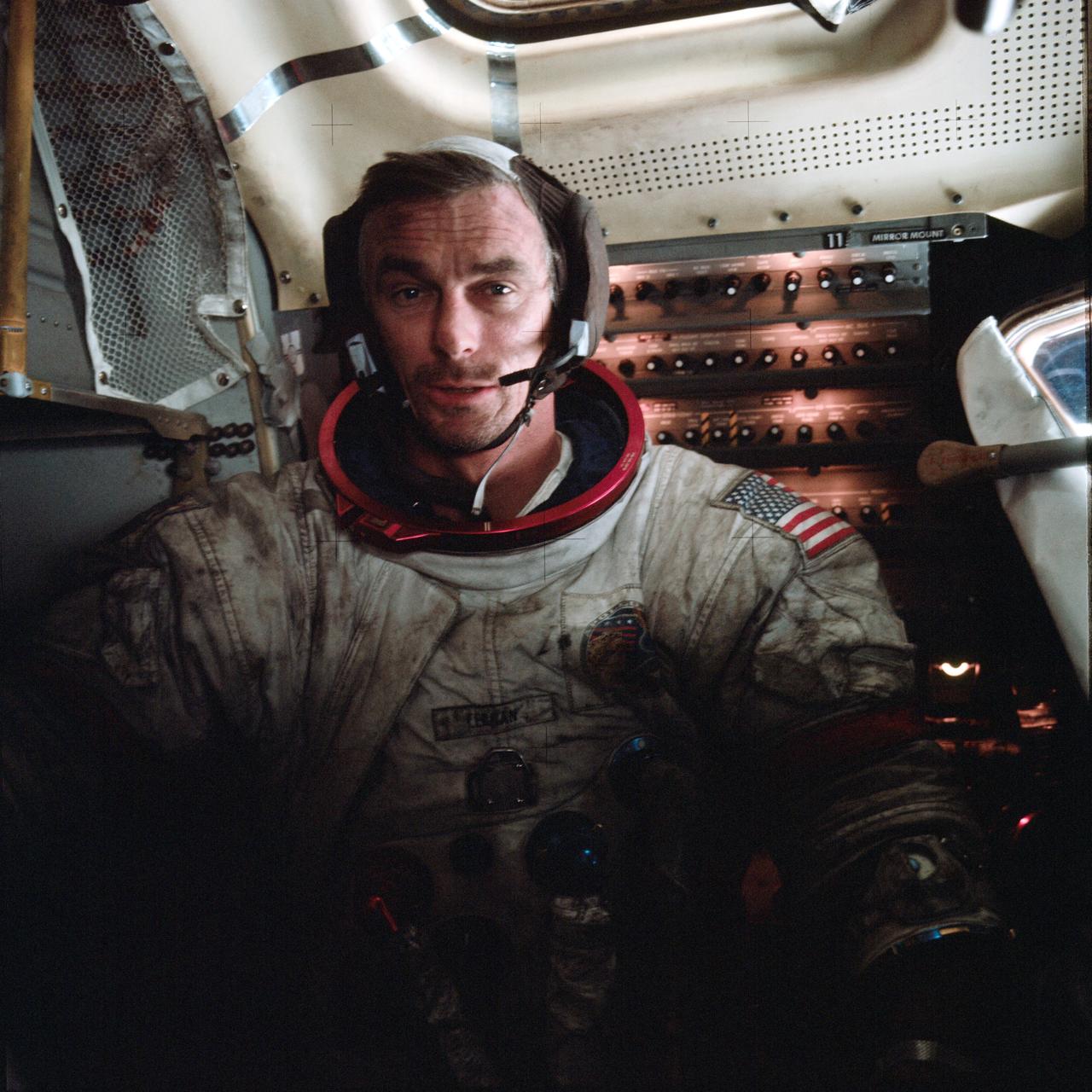
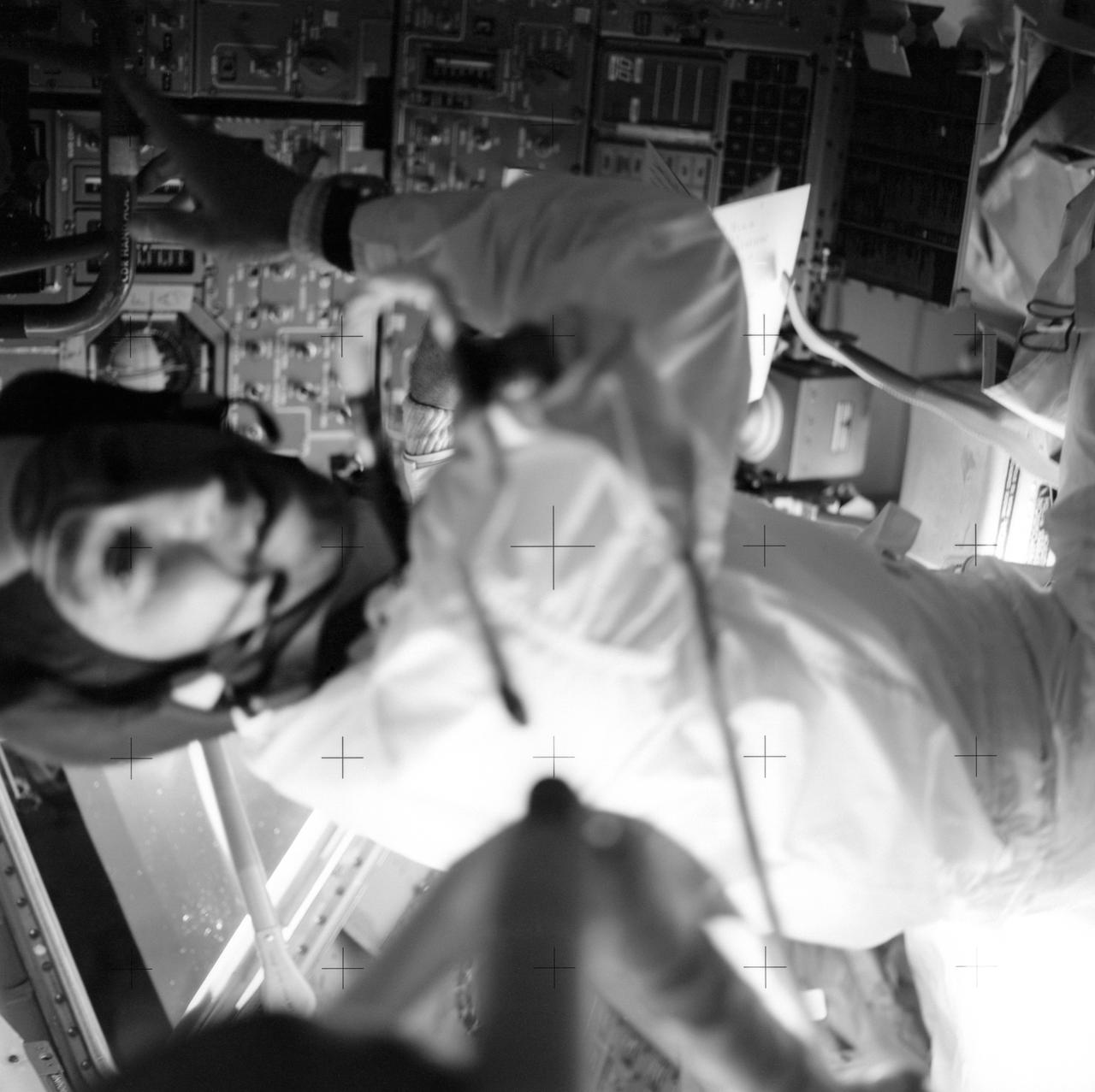
AS17-145-22224 (12 Dec. 1972) --- Astronaut Eugene A. Cernan, Apollo 17 commander, is photographed inside the lunar module on the lunar surface following the second extravehicular activity (EVA) of his mission. Note lunar dust on his suit. The photograph was taken by astronaut Harrison H. Schmitt, lunar module pilot, using a 70mm handheld Hasselblad camera and S0-368 film.
Astronaut Eugene Cernan inside the lunar module on lunar surface after EVA
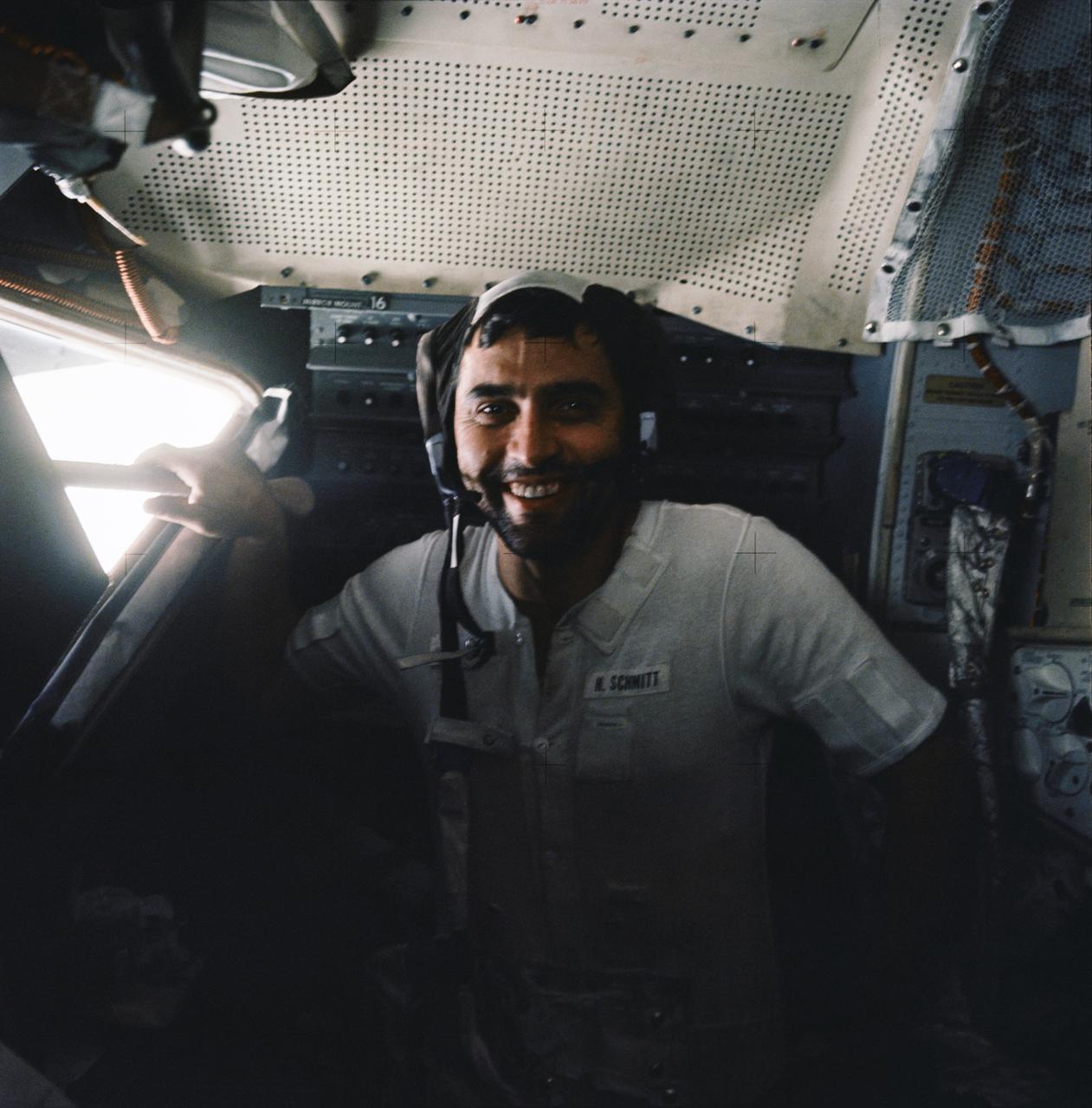
AS17-134-20530 (11 Dec. 1972) --- Astronaut Harrison H. Schmitt, lunar module pilot, displays several days of growth on his beard aboard the Lunar Module (LM) prior to its liftoff from the moon's surface. The photograph was taken by astronaut Eugene A. Cernan, mission commander. The two later re-joined astronaut Ronald E. Evans, who was orbiting the moon in the Apollo 17 Command and Service Modules (CSM).
Astronaut Harrison Schmitt inside the lunar module on lunar surface after EVA
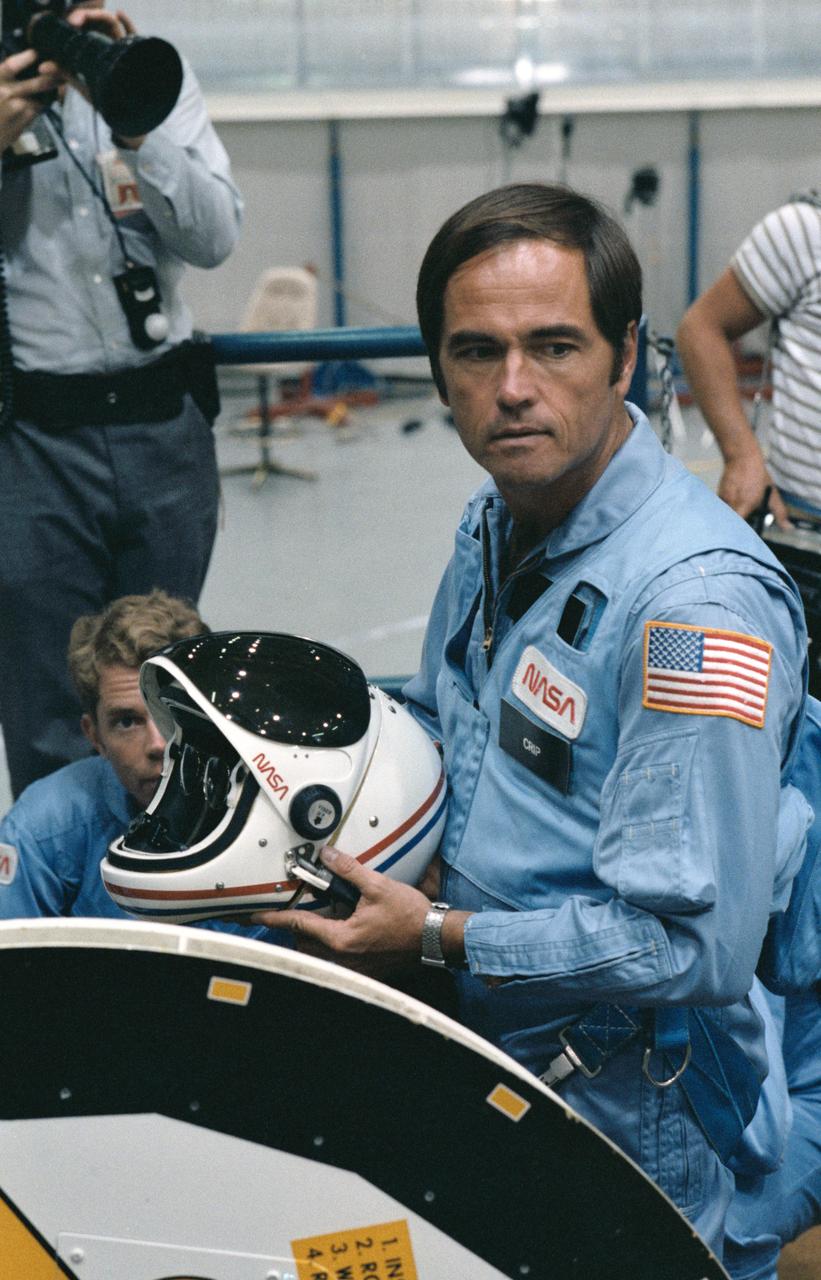
41D-3186 (4 Sept 1984) --- Astronaut Robert L. Crippen, 41-G crew commander, prepares to join his six fellow crewmembers for some training in the mockup and integration laboratory at the Johnson Space Center.  Astronaut David C. Leestma, 41-G mission specialist, left, will participate in a scheduled extravehicular activity (EVA) on the Challenger's next mission.  Today's training is for launch phase procedures.
Astronaut Crippen prepares to join crew in training
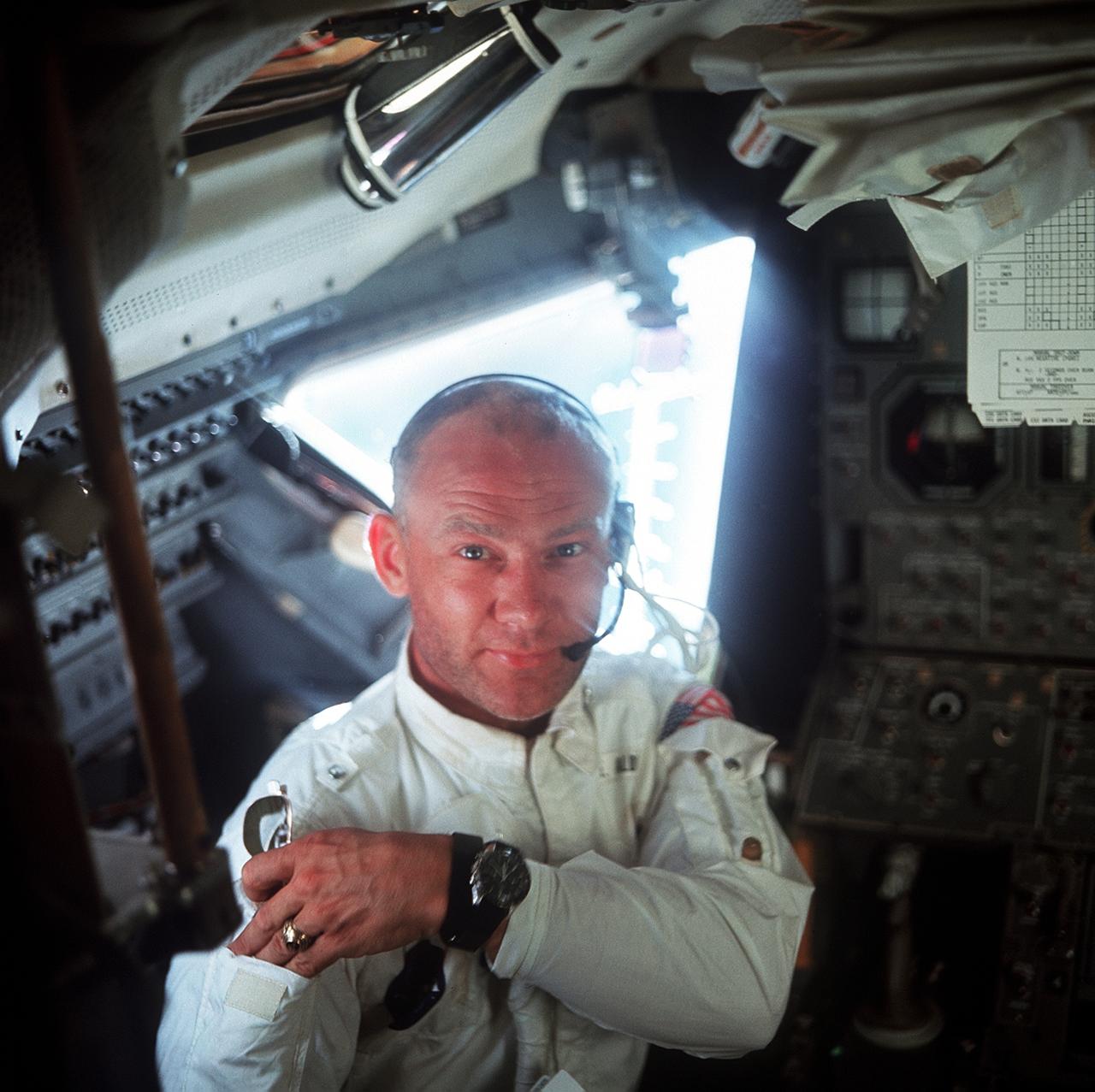
AS11-36-5390 (20 July 1969) --- This interior view of the Apollo 11 Lunar Module (LM) shows astronaut Edwin E. Aldrin Jr., lunar module pilot, during the lunar landing mission. This picture was taken by astronaut Neil A. Armstrong, commander. While astronauts Armstrong and Aldrin descended in the LM "Eagle" to explore the Sea of Tranquility region of the moon, astronaut Michael Collins, command module pilot, remained with the Command and Service Modules (CSM) "Columbia" in lunar orbit.
View of Astronaut Edwin Aldrin Jr. in Lunar Module
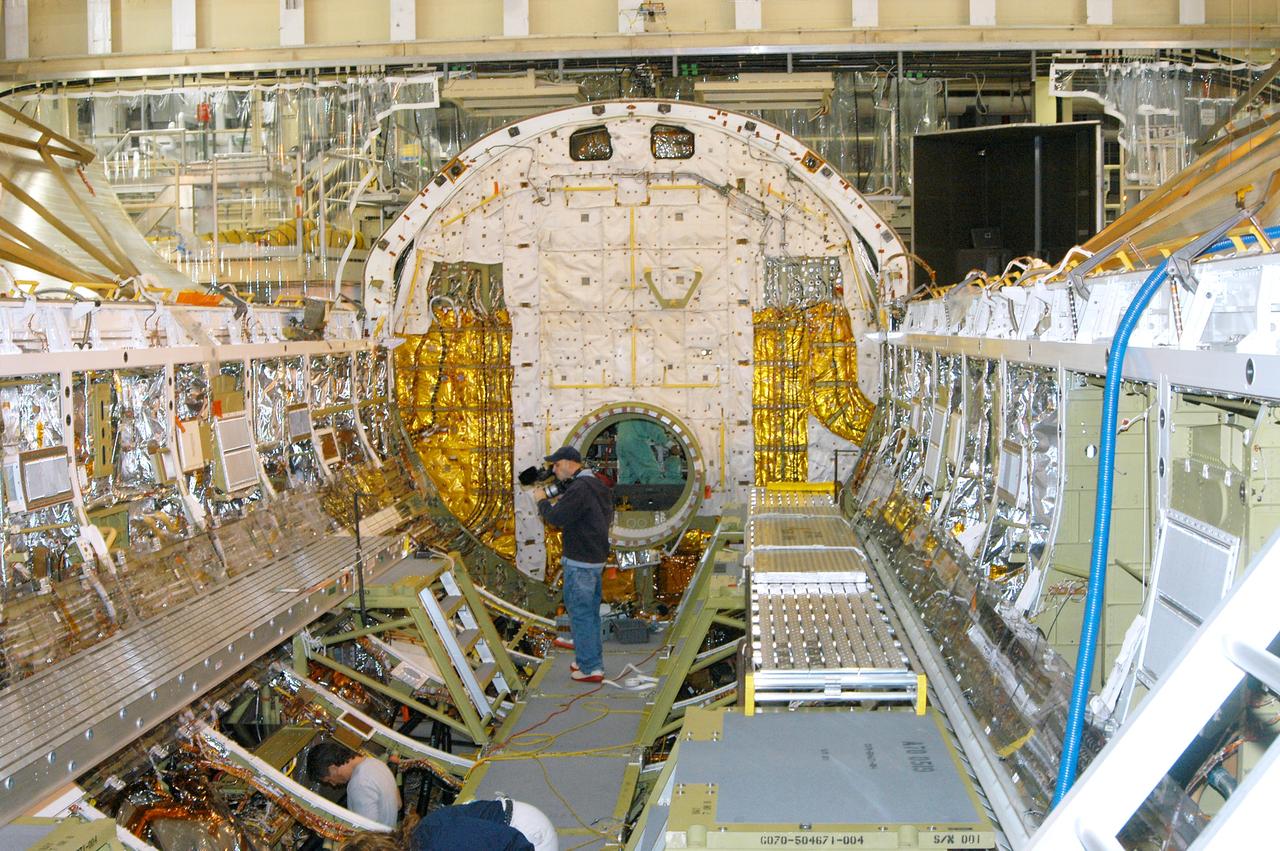
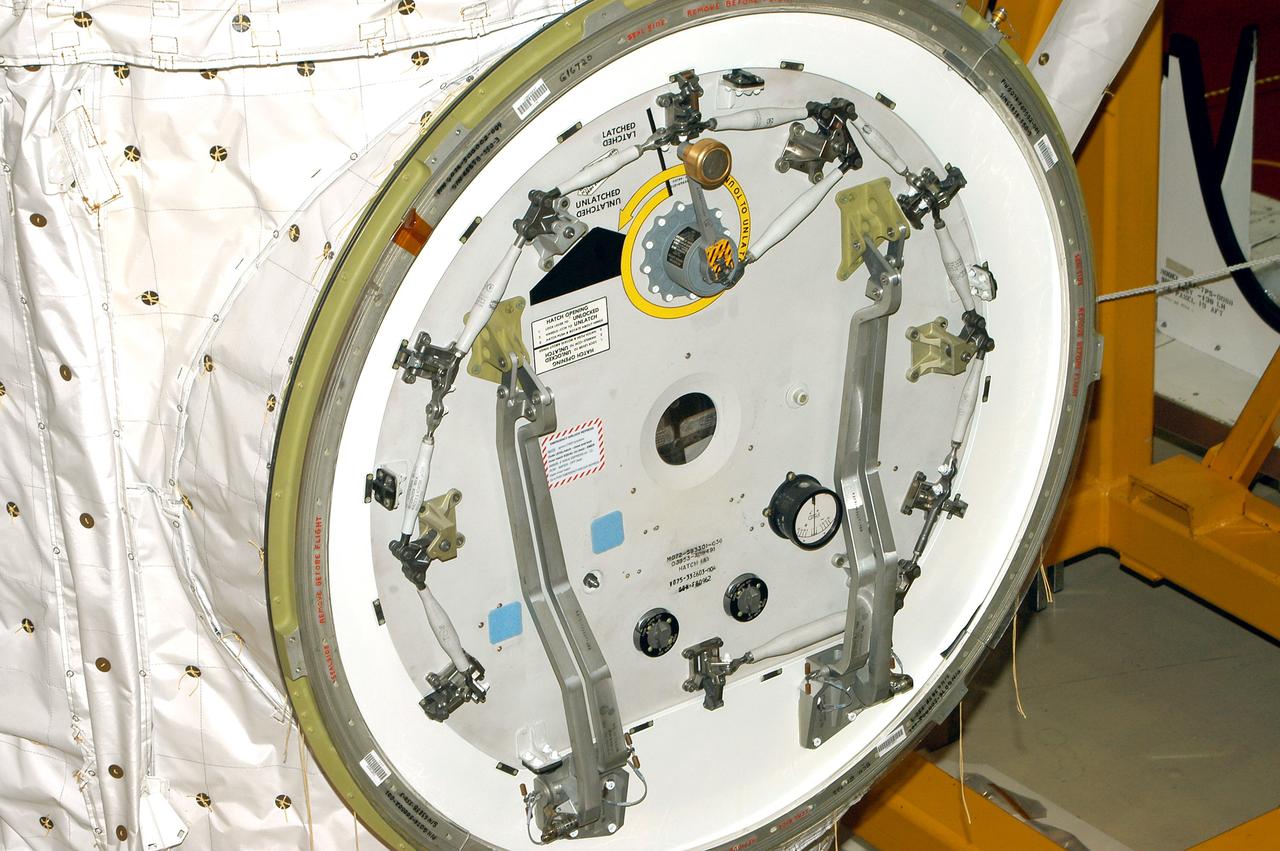
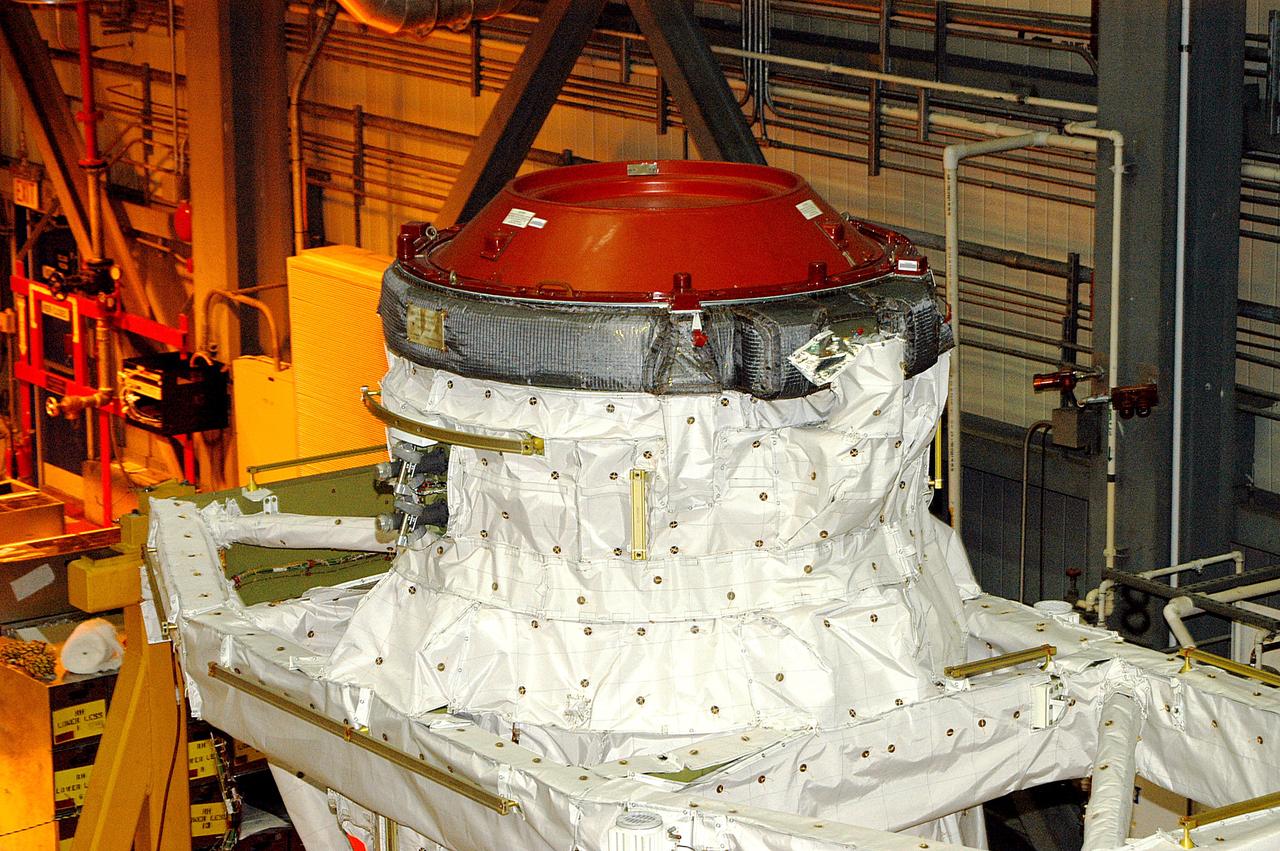
KENNEDY SPACE CENTER, FLA. -  Seen in the photo is one end of the airlock that is installed in the payload bay of orbiter Discovery.  The airlock is normally located inside the middeck of the spacecraft’s pressurized crew cabin. The airlock is sized to accommodate two fully suited flight crew members simultaneously. Support functions include airlock depressurization and repressurization, extravehicular activity equipment recharge, liquid-cooled garment water cooling, EVA equipment checkout, donning and communications. The outer hatch isolates the airlock from the unpressurized payload bay when closed and permits the EVA crew members to exit from the airlock to the payload bay when open.
KENNEDY SPACE CENTER, FLA. - Seen in the photo is one end of the airlock that is installed in the payload bay of orbiter Discovery. The airlock is normally located inside the middeck of the spacecraft’s pressurized crew cabin. The airlock is sized to accommodate two fully suited flight crew members simultaneously. Support functions include airlock depressurization and repressurization, extravehicular activity equipment recharge, liquid-cooled garment water cooling, EVA equipment checkout, donning and communications. The outer hatch isolates the airlock from the unpressurized payload bay when closed and permits the EVA crew members to exit from the airlock to the payload bay when open.
KENNEDY SPACE CENTER, FLA. -  In the Orbiter Processing Facility, a cameraman films part of Discovery’s payload bay for a special feature on the KSC Web.  In the background is the open hatch of the airlock, located inside the middeck of the spacecraft’s pressurized crew cabin. The airlock is sized to accommodate two fully suited flight crew members simultaneously. Support functions include airlock depressurization and repressurization, extravehicular activity equipment recharge, liquid-cooled garment water cooling, EVA equipment checkout, donning and communications. The outer hatch isolates the airlock from the unpressurized payload bay when closed and permits the EVA crew members to exit from the airlock to the payload bay when open.
KENNEDY SPACE CENTER, FLA. - In the Orbiter Processing Facility, a cameraman films part of Discovery’s payload bay for a special feature on the KSC Web. In the background is the open hatch of the airlock, located inside the middeck of the spacecraft’s pressurized crew cabin. The airlock is sized to accommodate two fully suited flight crew members simultaneously. Support functions include airlock depressurization and repressurization, extravehicular activity equipment recharge, liquid-cooled garment water cooling, EVA equipment checkout, donning and communications. The outer hatch isolates the airlock from the unpressurized payload bay when closed and permits the EVA crew members to exit from the airlock to the payload bay when open.
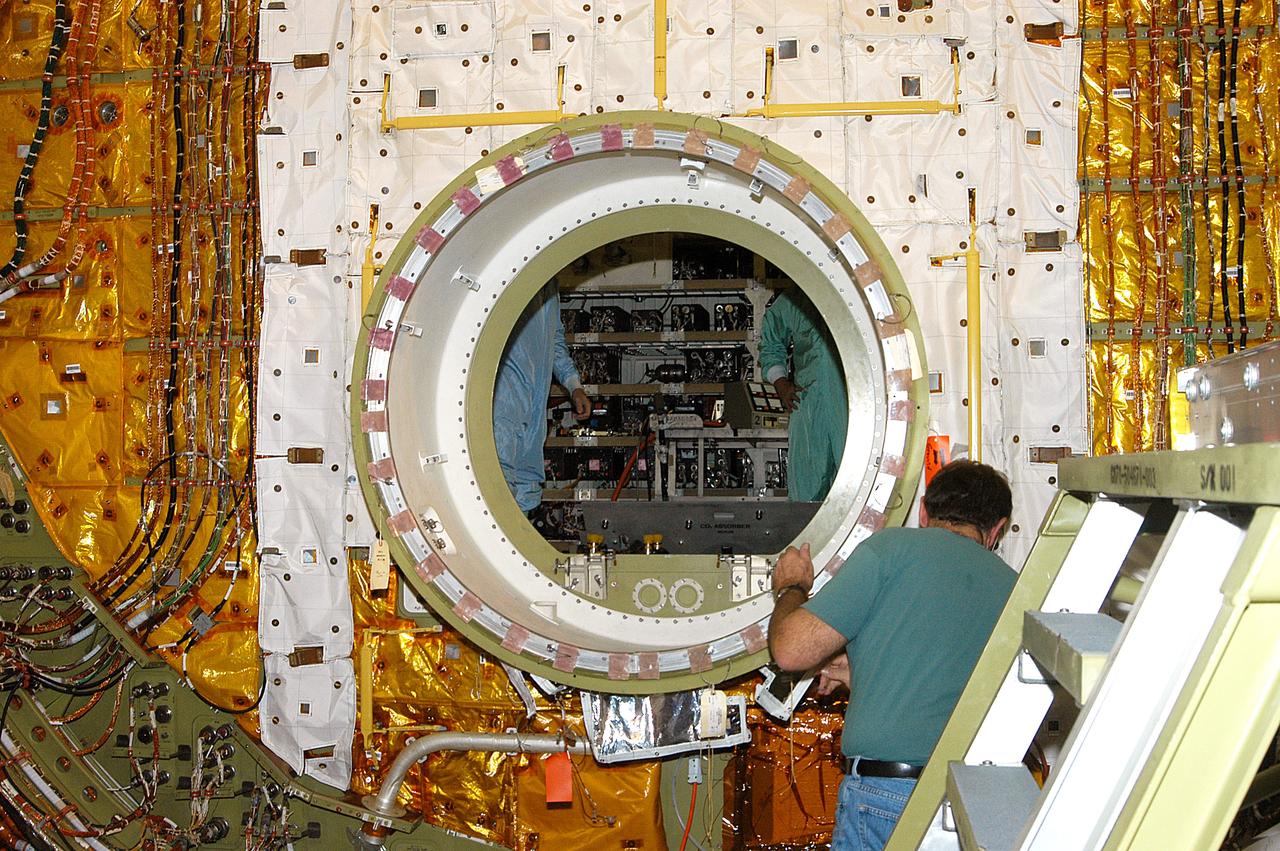
KENNEDY SPACE CENTER, FLA. -  A worker in the Orbiter Processing Facility checks the open hatch of the airlock in Discovery’s payload bay. The airlock is normally located inside the middeck of the spacecraft’s pressurized crew cabin. The airlock is sized to accommodate two fully suited flight crew members simultaneously. Support functions include airlock depressurization and repressurization, extravehicular activity equipment recharge, liquid-cooled garment water cooling, EVA equipment checkout, donning and communications. The outer hatch isolates the airlock from the unpressurized payload bay when closed and permits the EVA crew members to exit from the airlock to the payload bay when open.
KENNEDY SPACE CENTER, FLA. - A worker in the Orbiter Processing Facility checks the open hatch of the airlock in Discovery’s payload bay. The airlock is normally located inside the middeck of the spacecraft’s pressurized crew cabin. The airlock is sized to accommodate two fully suited flight crew members simultaneously. Support functions include airlock depressurization and repressurization, extravehicular activity equipment recharge, liquid-cooled garment water cooling, EVA equipment checkout, donning and communications. The outer hatch isolates the airlock from the unpressurized payload bay when closed and permits the EVA crew members to exit from the airlock to the payload bay when open.
KENNEDY SPACE CENTER, FLA. -  Seen in the photo is one end of the airlock that is installed in the payload bay of orbiter Discovery.  The airlock is normally located inside the middeck of the spacecraft’s pressurized crew cabin. The airlock is sized to accommodate two fully suited flight crew members simultaneously. Support functions include airlock depressurization and repressurization, extravehicular activity equipment recharge, liquid-cooled garment water cooling, EVA equipment checkout, donning and communications. The outer hatch isolates the airlock from the unpressurized payload bay when closed and permits the EVA crew members to exit from the airlock to the payload bay when open.
KENNEDY SPACE CENTER, FLA. - Seen in the photo is one end of the airlock that is installed in the payload bay of orbiter Discovery. The airlock is normally located inside the middeck of the spacecraft’s pressurized crew cabin. The airlock is sized to accommodate two fully suited flight crew members simultaneously. Support functions include airlock depressurization and repressurization, extravehicular activity equipment recharge, liquid-cooled garment water cooling, EVA equipment checkout, donning and communications. The outer hatch isolates the airlock from the unpressurized payload bay when closed and permits the EVA crew members to exit from the airlock to the payload bay when open.
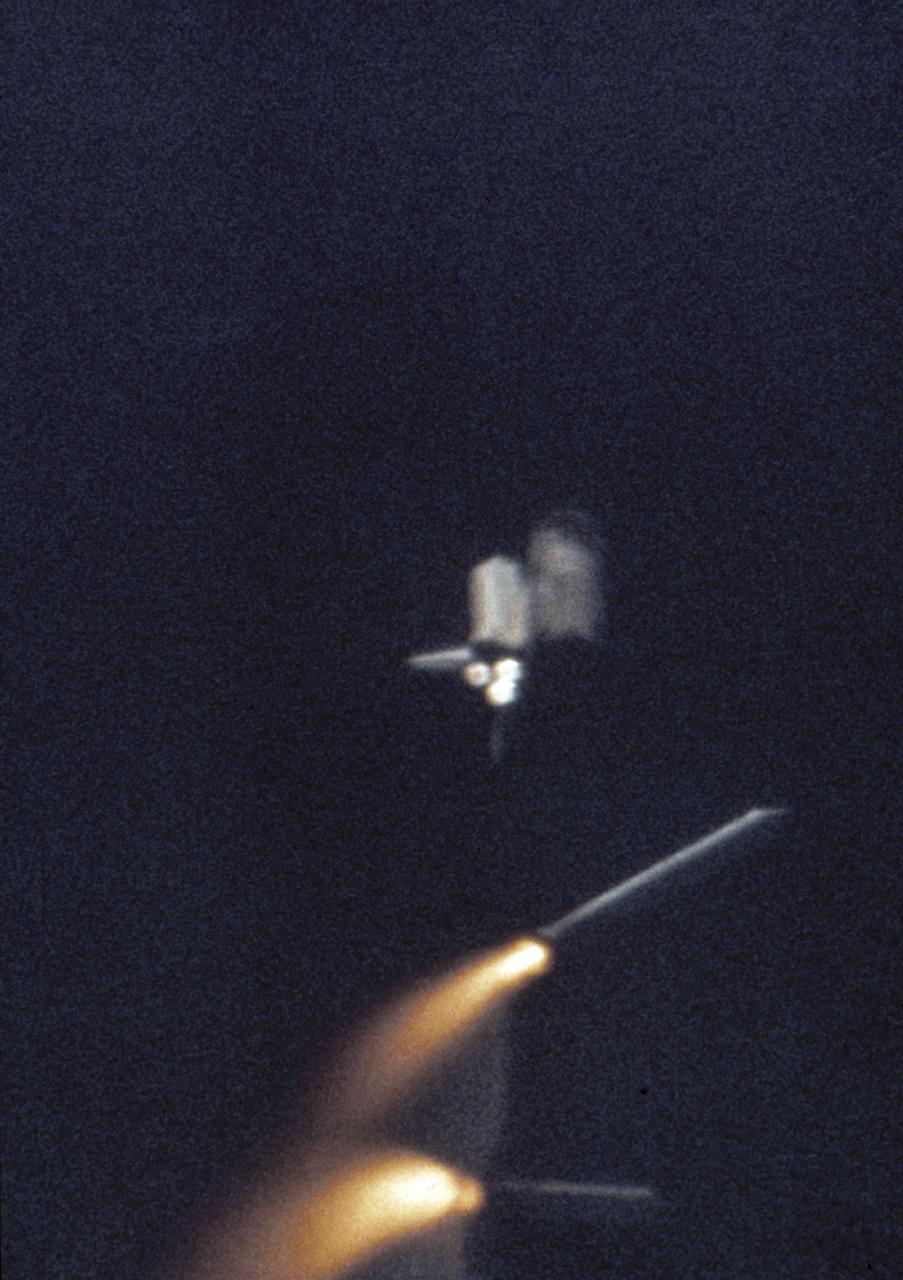
S81-33179 (12 April 1981) --- Though their STS-1 task has been performed, the two solid rocket boosters (SRB) still glow following their jettisoning from the space shuttle Columbia on its way to many firsts. Among the history recorded by the spacecraft is the marking of a mission in a reusable spacecraft. STS-1 is NASA's first manned mission since the Apollo-Soyuz Test Project in 1975. Inside the cabin of the climbing spacecraft are astronauts John W. Young and Robert L. Crippen. Photo credit: NASA
LAUNCH (IGOR) - STS-1
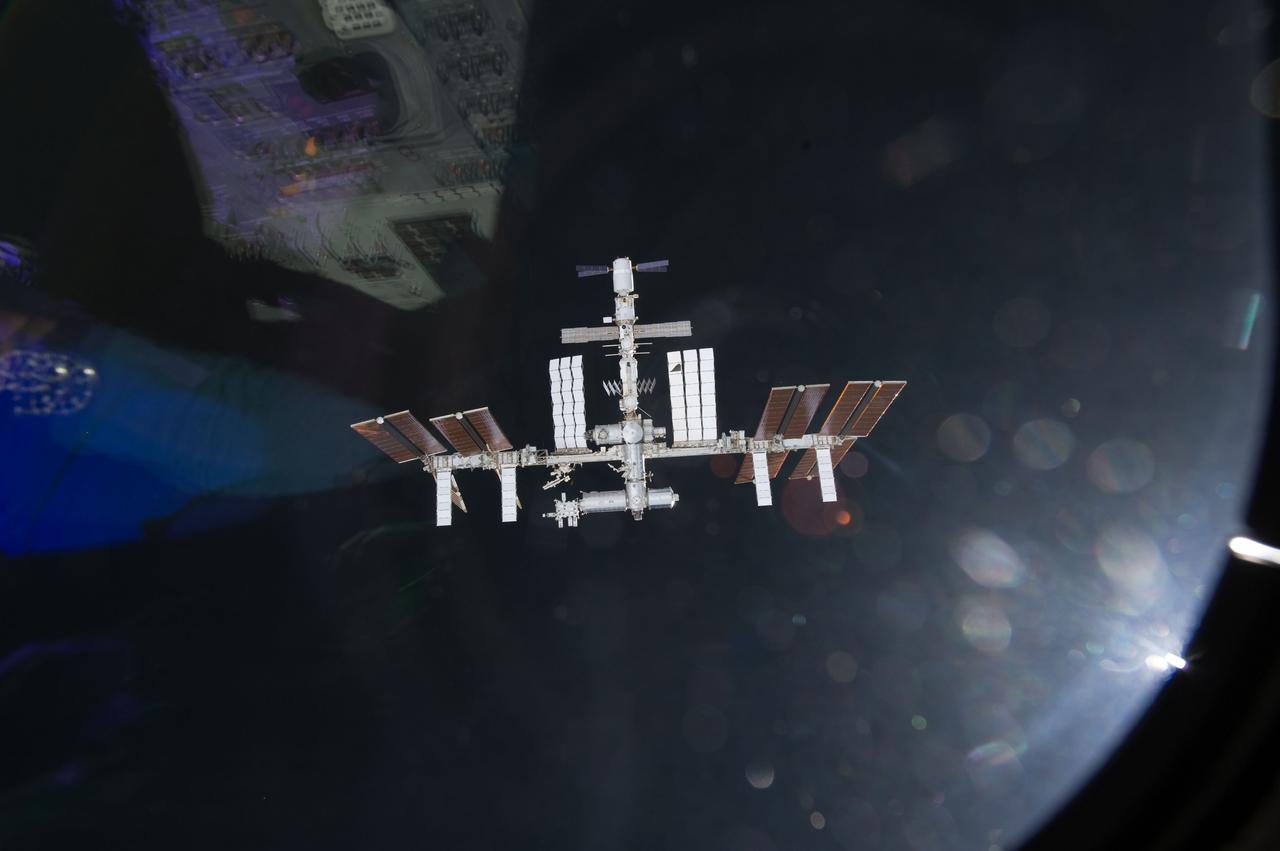
S134-E-006921 (18 May 2011) --- One of the crew members aboard the space shuttle Endeavour photographed this scene of the International Space Station (ISS) as the two spacecraft were preparing to link up in Earth orbit. The "extra" glares and reflections are inside Endeavour's crew cabin.  Not long after the picture was taken, the two spacecraft docked, and six astronauts aboard Endeavour were welcomed by six crew members on the ISS to join forces for continued work on the station. Photo credit: NASA
View of ISS taken from Endeavour on Approach
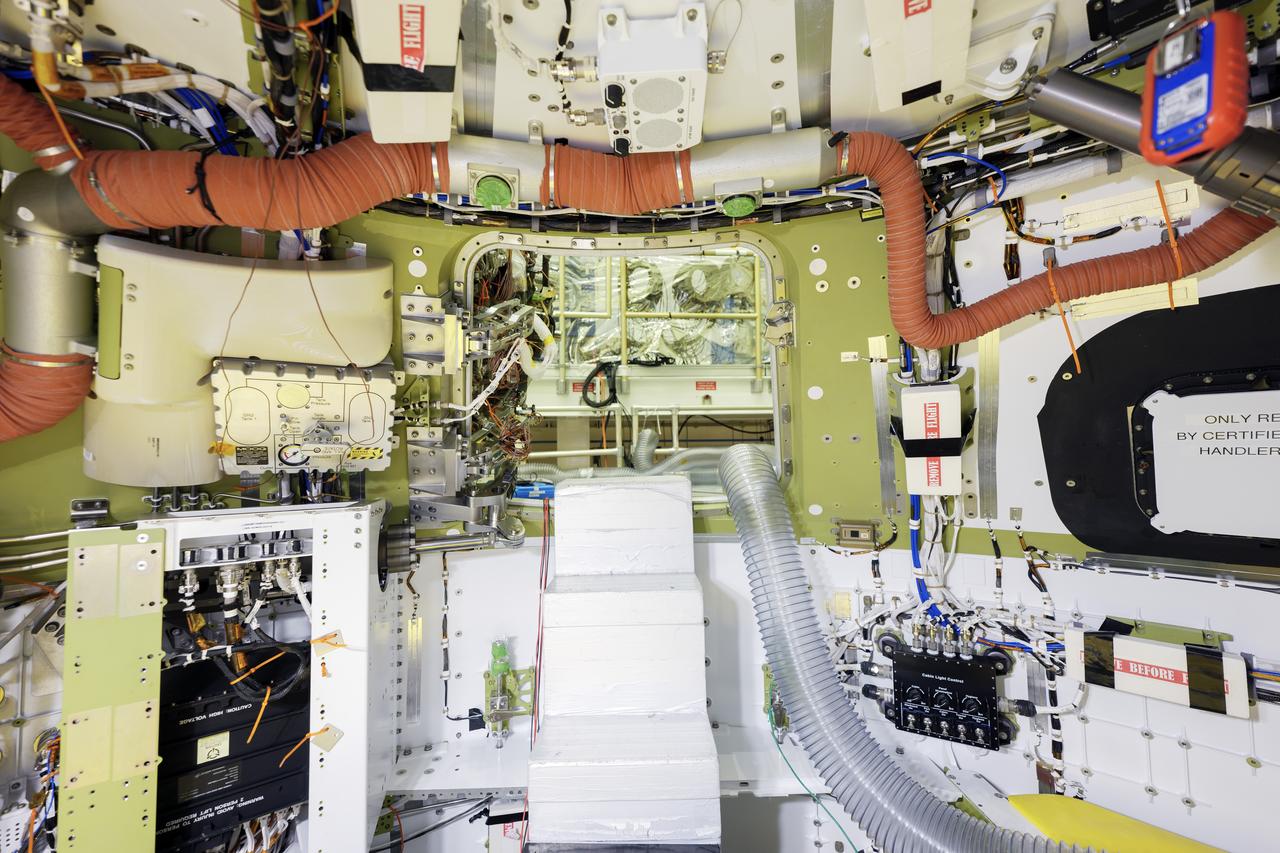
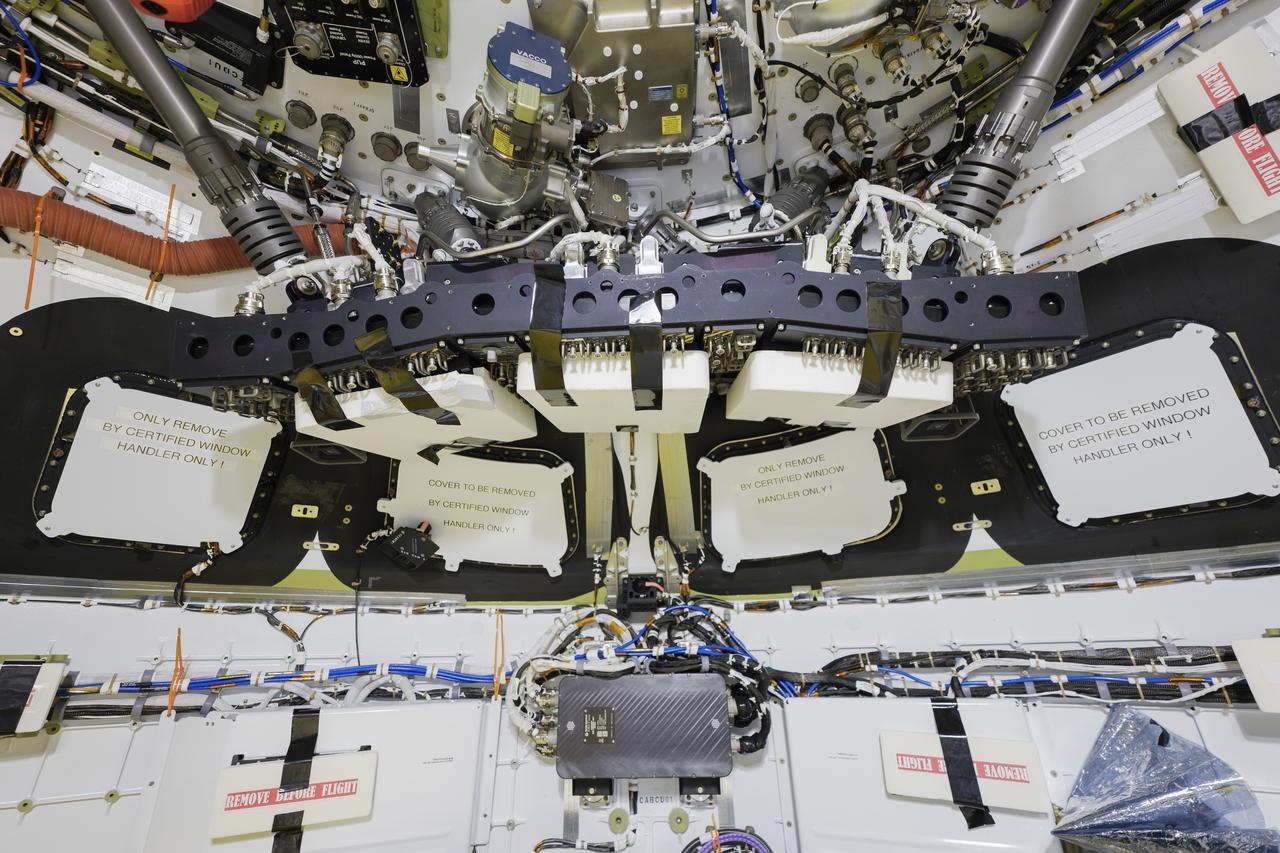
Teams inside the Operations and Checkout building at NASA’s Kennedy Space Center in Florida on Thursday, Feb. 1, 2024, work on the Orion spacecraft crew module  that will carry the Artemis II astronauts on their 10-day journey around the Moon.⁣  ⁣  Technicians are finalizing the crew cabin’s interior, and installing backshell panels and insulation on the spacecraft’s exterior that will protect Orion and the astronauts inside from the harsh environments they will encounter on their mission.⁣
Artemis II Orion Hardware
Teams inside the Operations and Checkout building at NASA’s Kennedy Space Center in Florida on Thursday, Feb. 1, 2024, work on the Orion spacecraft crew module  that will carry the Artemis II astronauts on their 10-day journey around the Moon.⁣  ⁣  Technicians are finalizing the crew cabin’s interior, and installing backshell panels and insulation on the spacecraft’s exterior that will protect Orion and the astronauts inside from the harsh environments they will encounter on their mission.⁣
Artemis II Orion Hardware
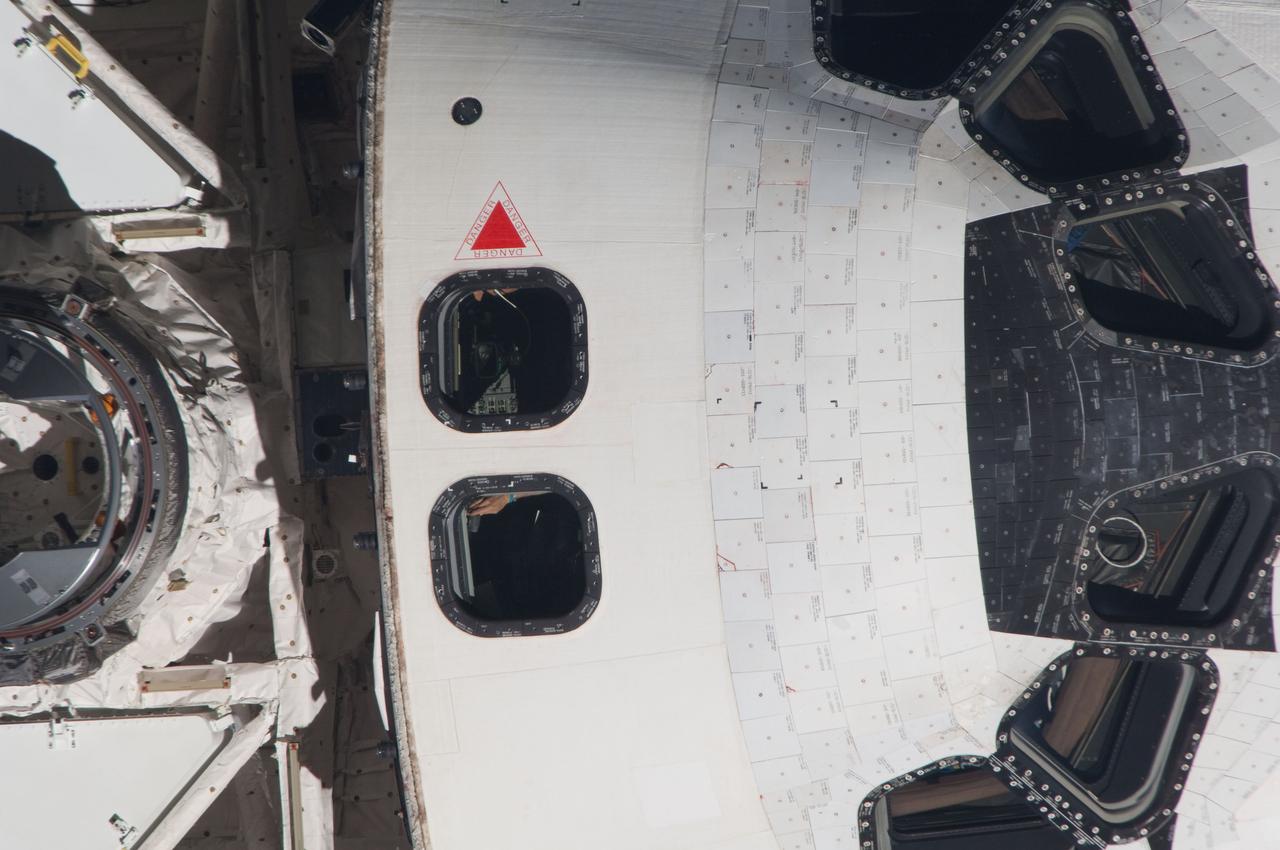
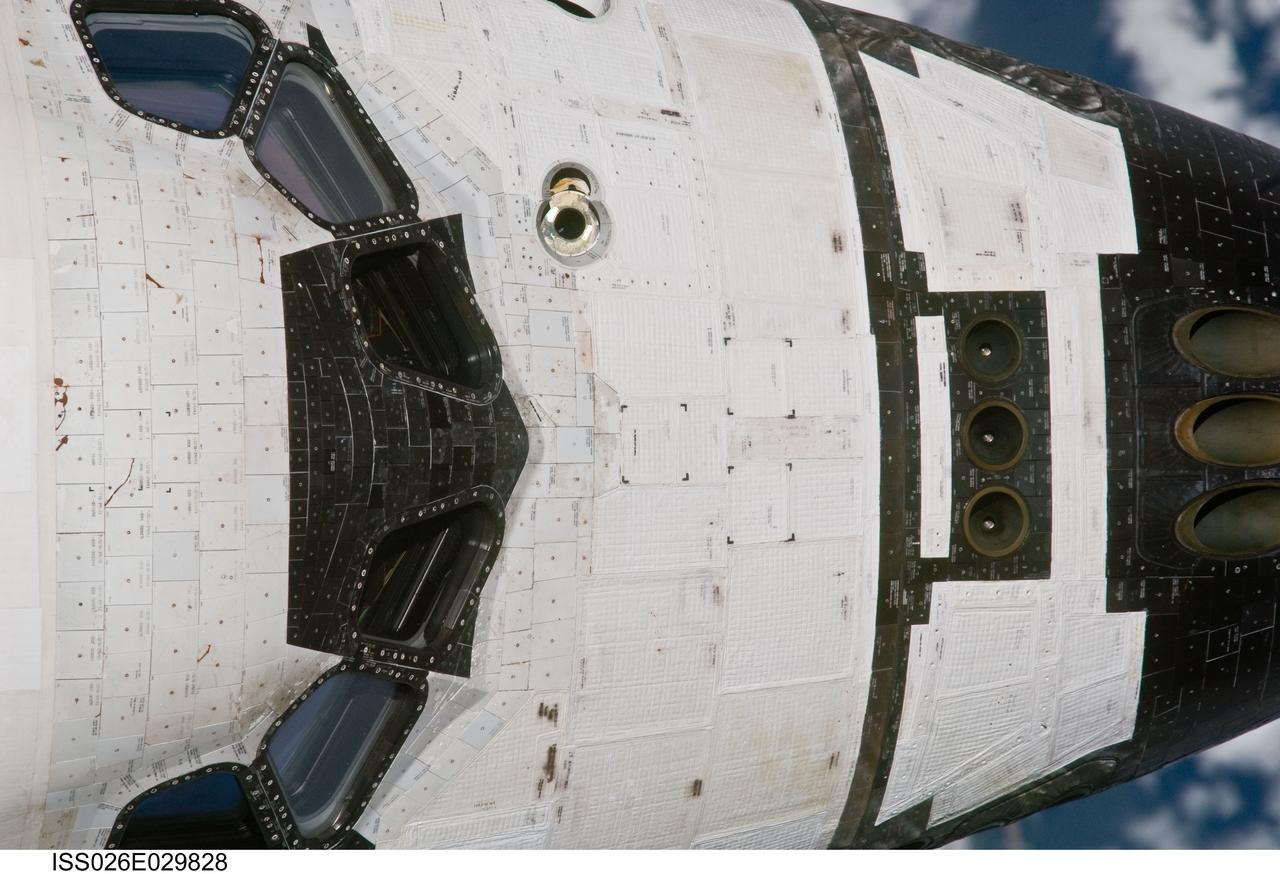
ISS026-E-029828 (26 Feb. 2011) --- This close-up view of the crew cabin of space shuttle Discovery was provided by an Expedition 26 crew member during a survey of the approaching STS-133 vehicle prior to docking with the International Space Station. As part of the survey and part of every mission's activities, Discovery performed a back-flip for the rendezvous pitch maneuver (RPM). The station crew member used a digital still camera with an 800mm focal length, as the two spacecraft were approximately 600 feet (180 meters) apart.
Mapping Sequence performed during the STS-133 R-Bar Pitch Maneuver
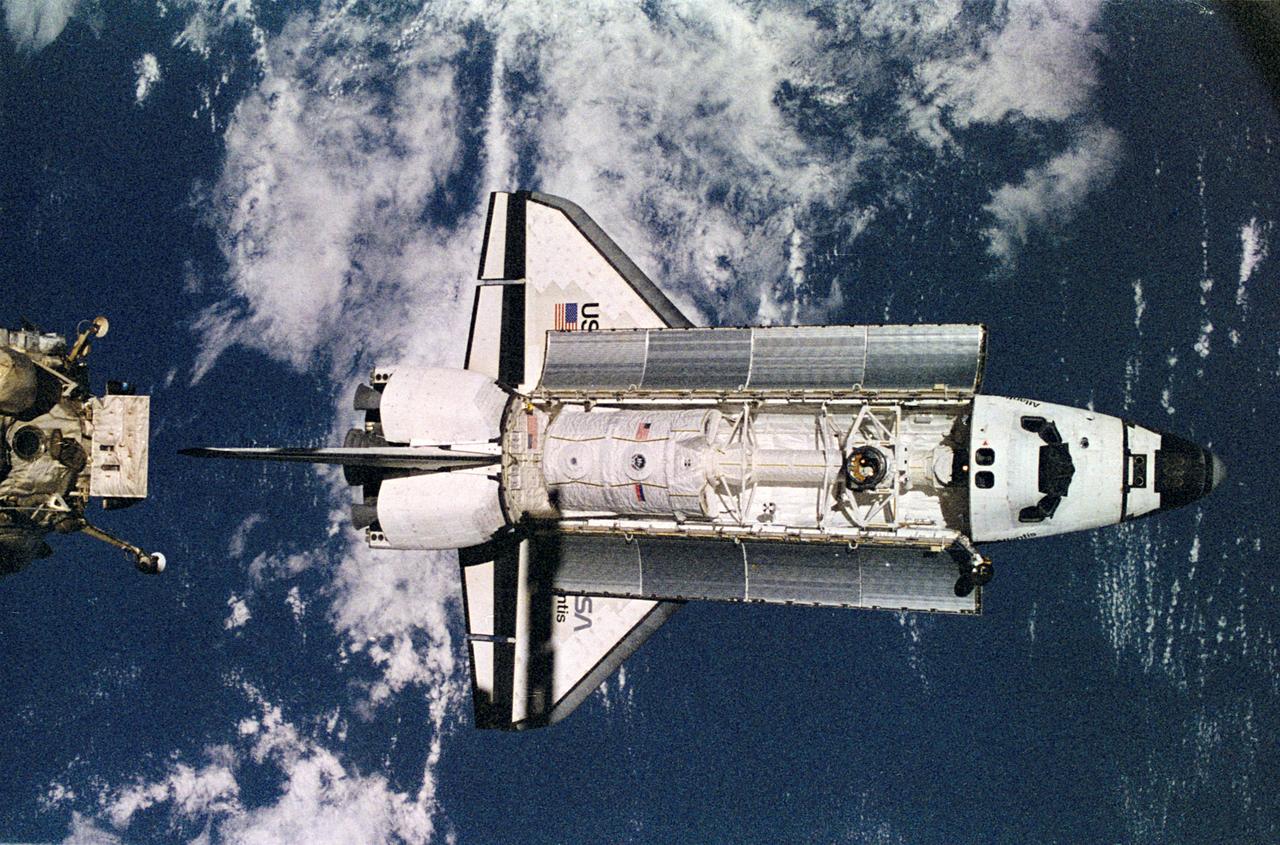
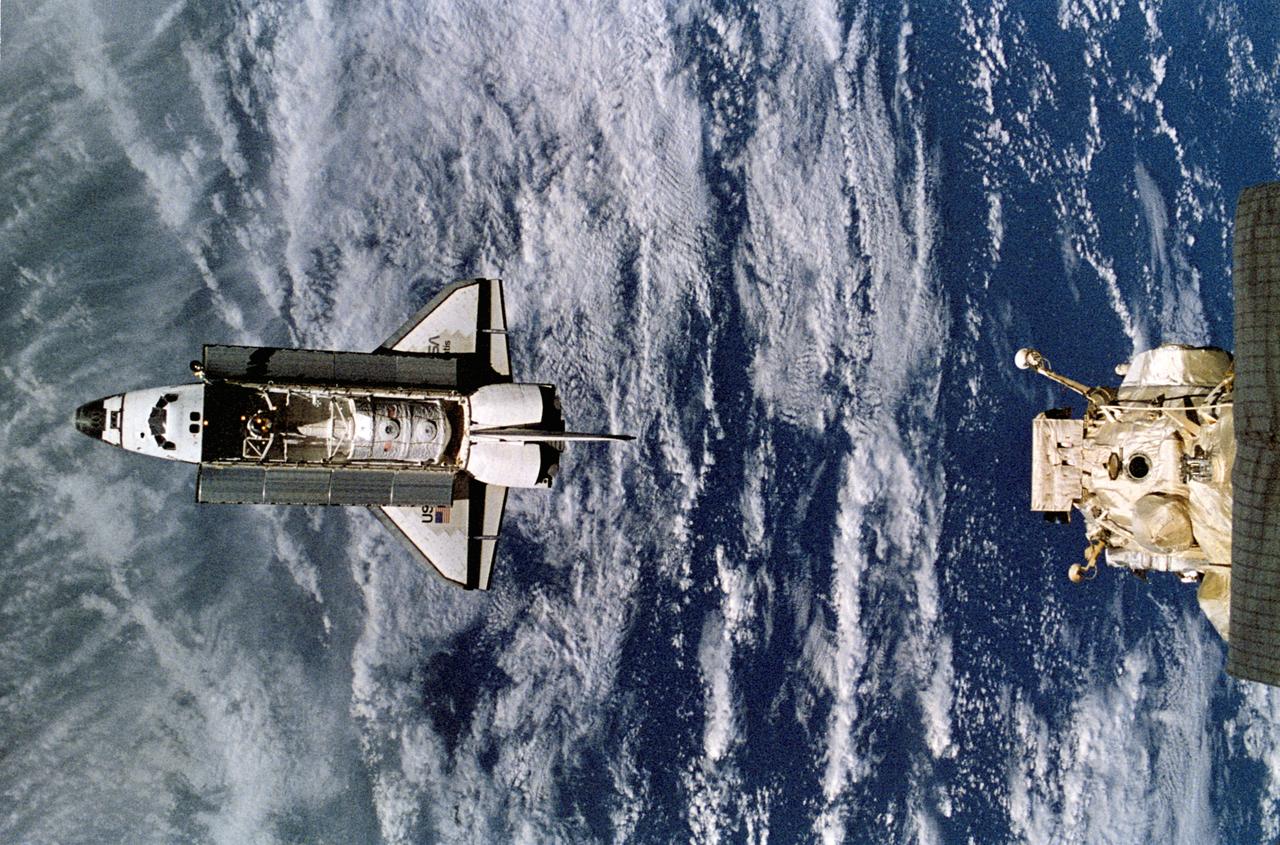
NM18-309-028 (28 June 1995) --- The Space Shuttle Atlantis approaches the docking node on the Kristall module of Russia's Mir Space Station.  The photograph was taken by one of the Mir-18 crew members aboard Mir prior to docking of the two spacecraft. The Spacelab science module and the tunnel connecting it to the crew cabin, as well as the added mechanism for interface with the Mir's docking system can be easily seen.
Space shuttle Atlantis preparing to dock with Mir space station
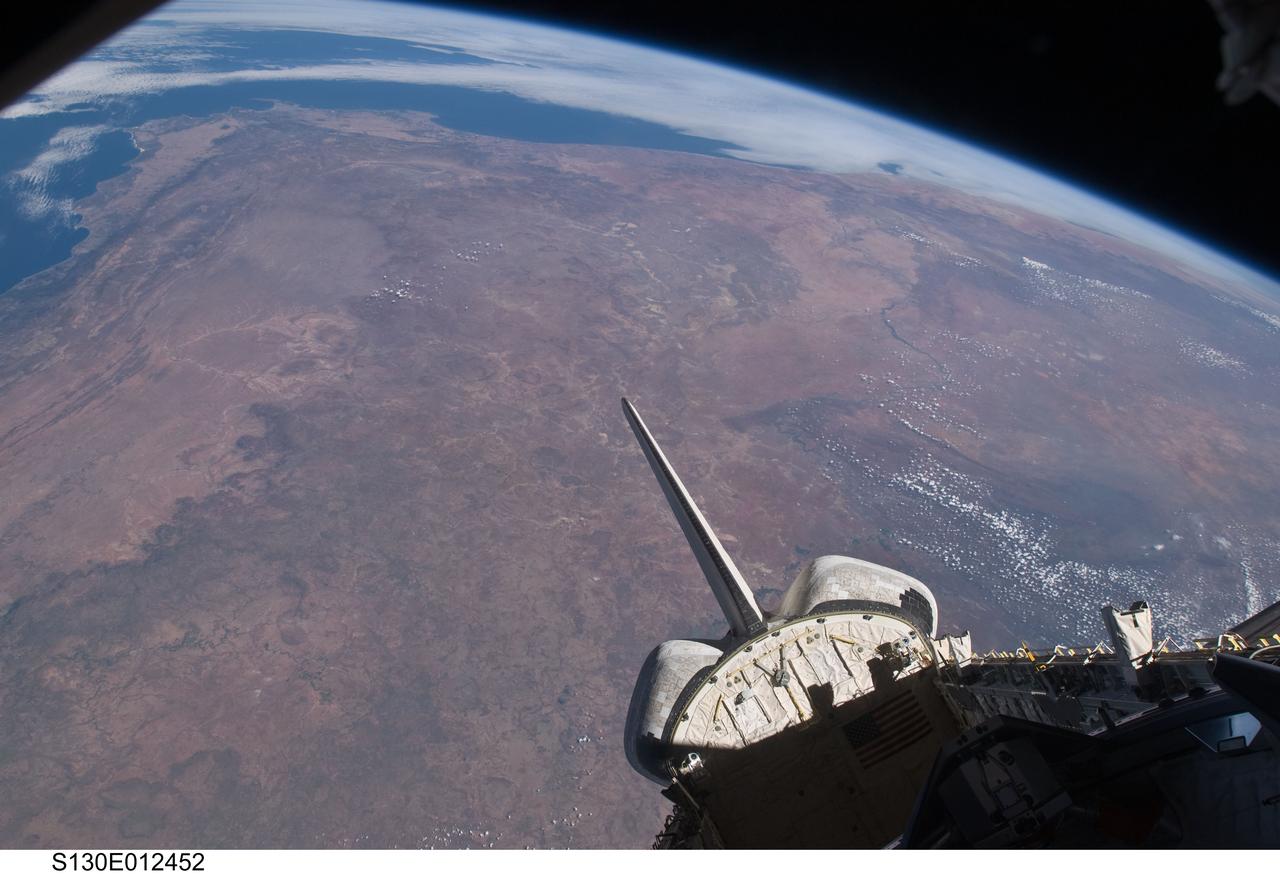
S130-E-012452 (20 Feb. 2010) --- The empty cargo bay and the aft portion of the Earth-orbiting space shuttle Endeavour are featured in this image photographed by an STS-130 crew member from inside the spacecraft?s crew cabin. The panoramic view sweeps across South Africa over the Great Karoo and Little Karoo arid regions, past the Western Cape area to the Cape of Good Hope and the Atlantic ocean.  The Orange River is seen flowing to the Atlantic away from the orbiter along the right hand side of the image.
Endeavour Payload Bay
NM18-309-026 (28 June 1995) --- The Space Shuttle Atlantis approaches the docking node on the Kristall module of Russia's Mir Space Station. The photograph was taken by one of the Mir-18 crew members aboard Mir prior to rendezvous and docking of the two spacecraft. The Spacelab Science Module and the tunnel connecting it to the crew cabin, as well as the added mechanism for interface with the Mir's docking system can be easily seen.
Space shuttle Atlantis preparing to dock with Mir space station
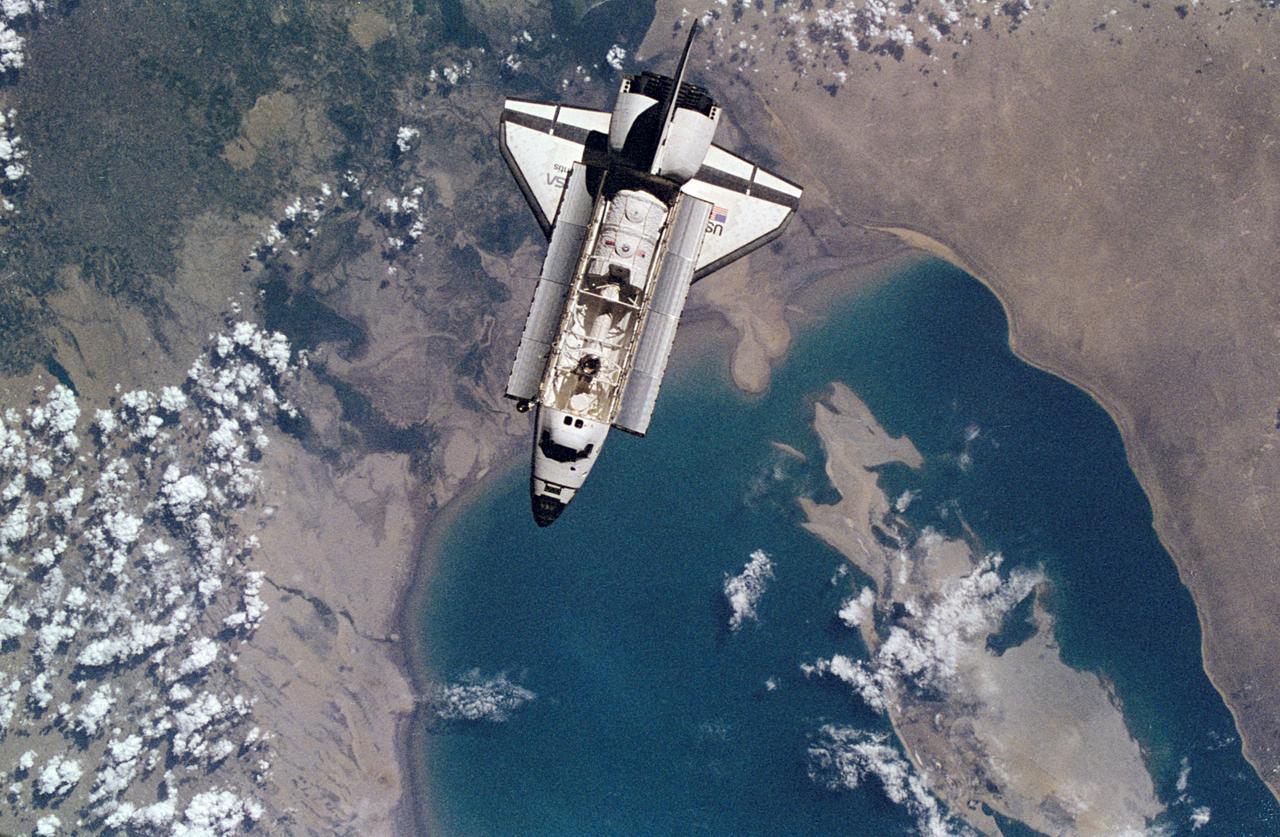
NM18-309-021 (28 June 1995) --- The Space Shuttle Atlantis orbits Earth at a point above Uzbekistan and the southern Aral Sea, as photographed by one of the Mir-18 crew members aboard Russia's Mir Space Station. The image was photographed prior to rendezvous and docking of the two spacecraft. The Spacelab Science Module and the tunnel connecting it to the crew cabin, as well as the added mechanism for interface with the Mir's docking system can be easily seen in the photo.
Space shuttle Atlantis preparing to dock with Mir space station
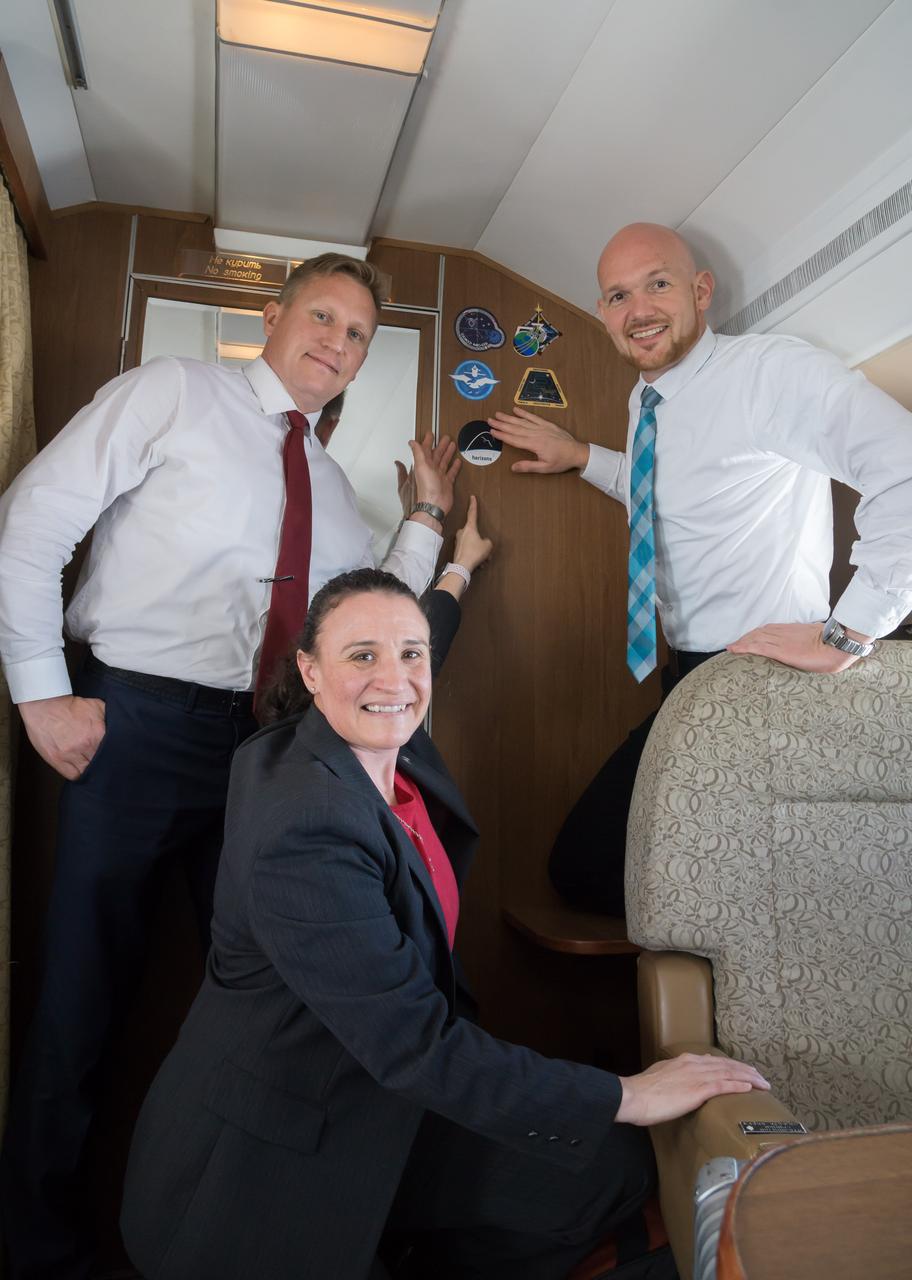
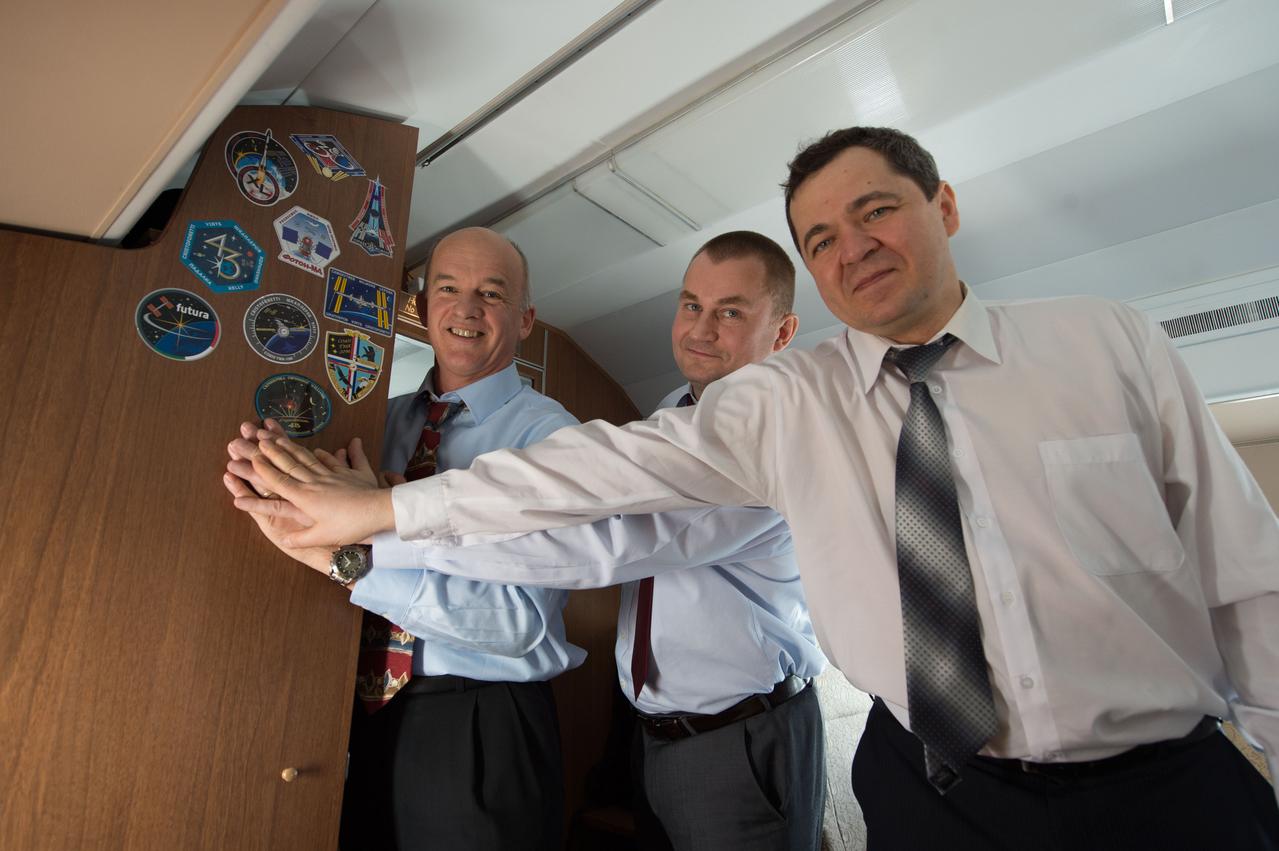
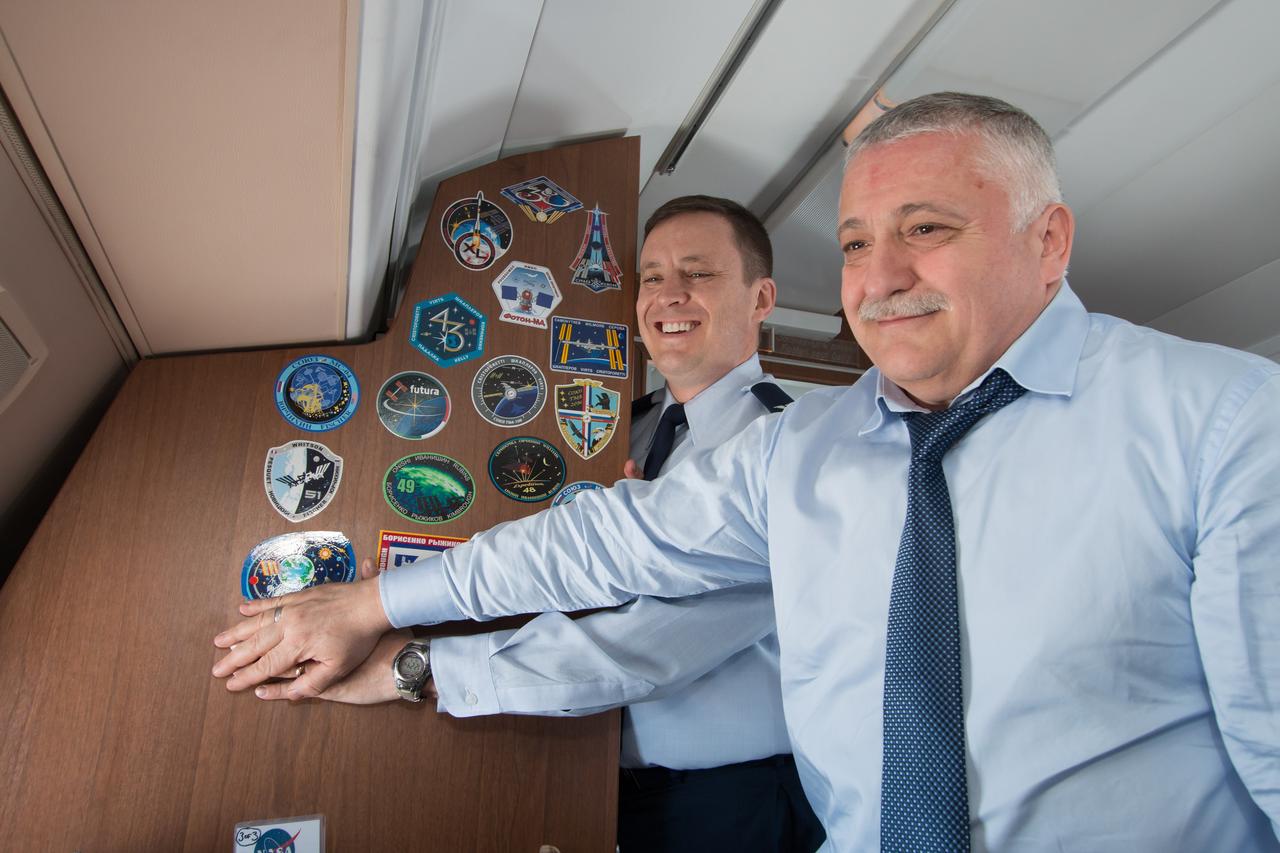
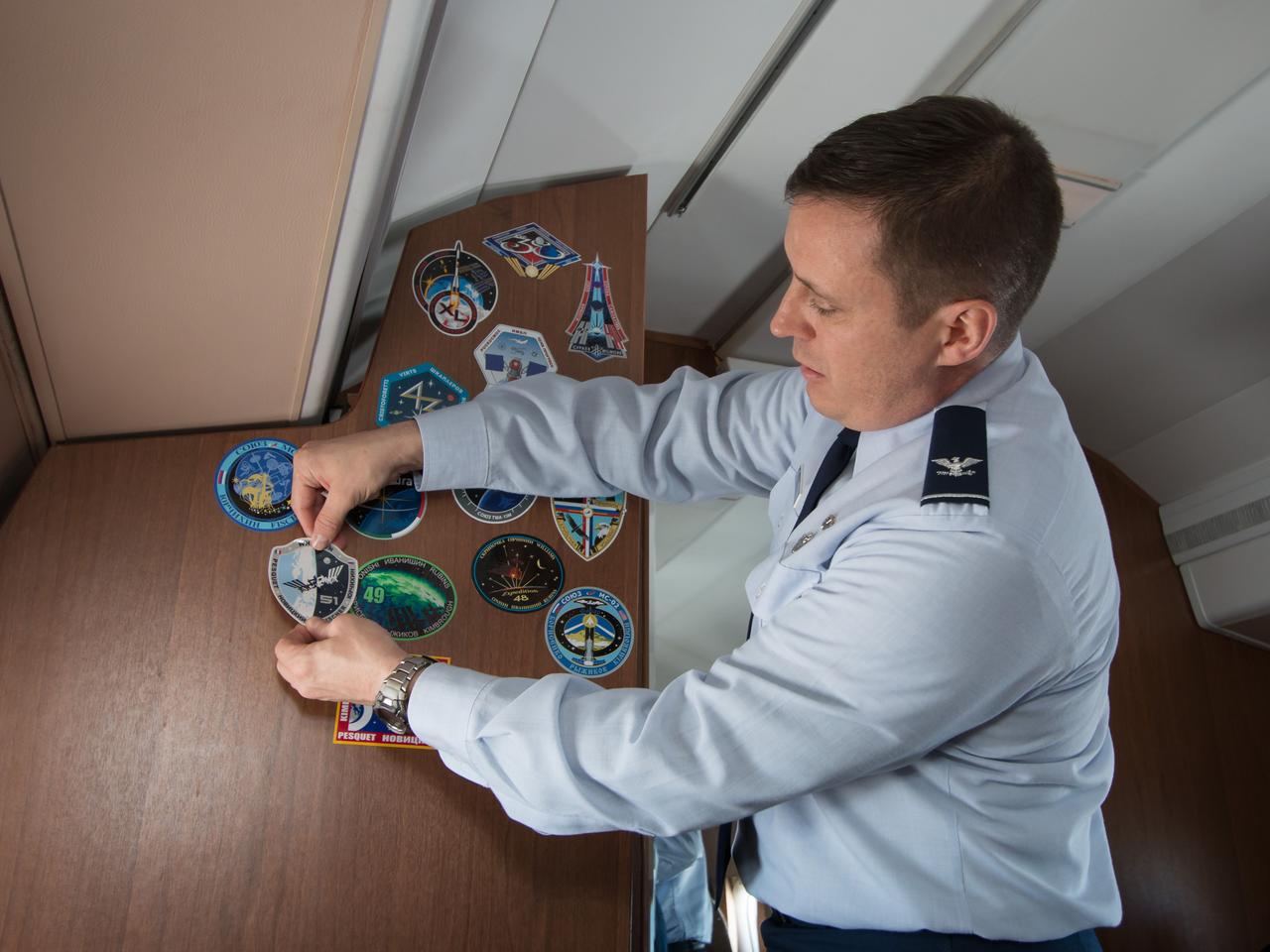
jsc2017e039896 (04/05/2017) --- Aboard a Gagarin Cosmonaut Training Center aircraft, Expedition 51 crewmembers Jack Fischer of NASA (left) and Fyodor Yurchikhin of the Russian Federal Space Agency (Roscosmos, right) display their Expedition crew patch on the wall of the cabin April 5 as they traveled to their launch site at the Baikonur Cosmodrome in Kazakhstan for final pre-launch training. Fischer and Yurchikhin will launch April 20 on the Soyuz MS-04 spacecraft for a four and a half month mission on the International Space Station. Photo: NASA/Victor Zelentsov
jsc2017e039896
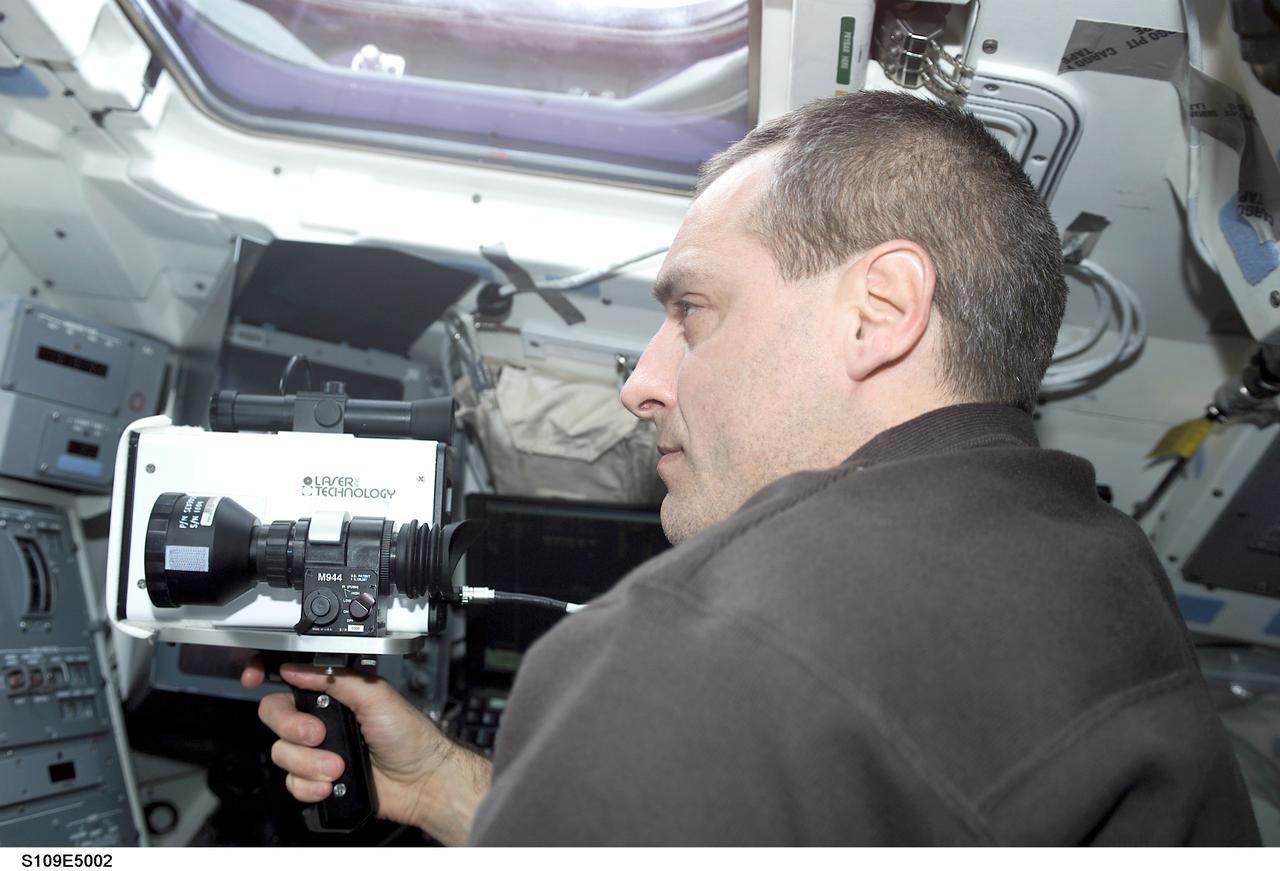
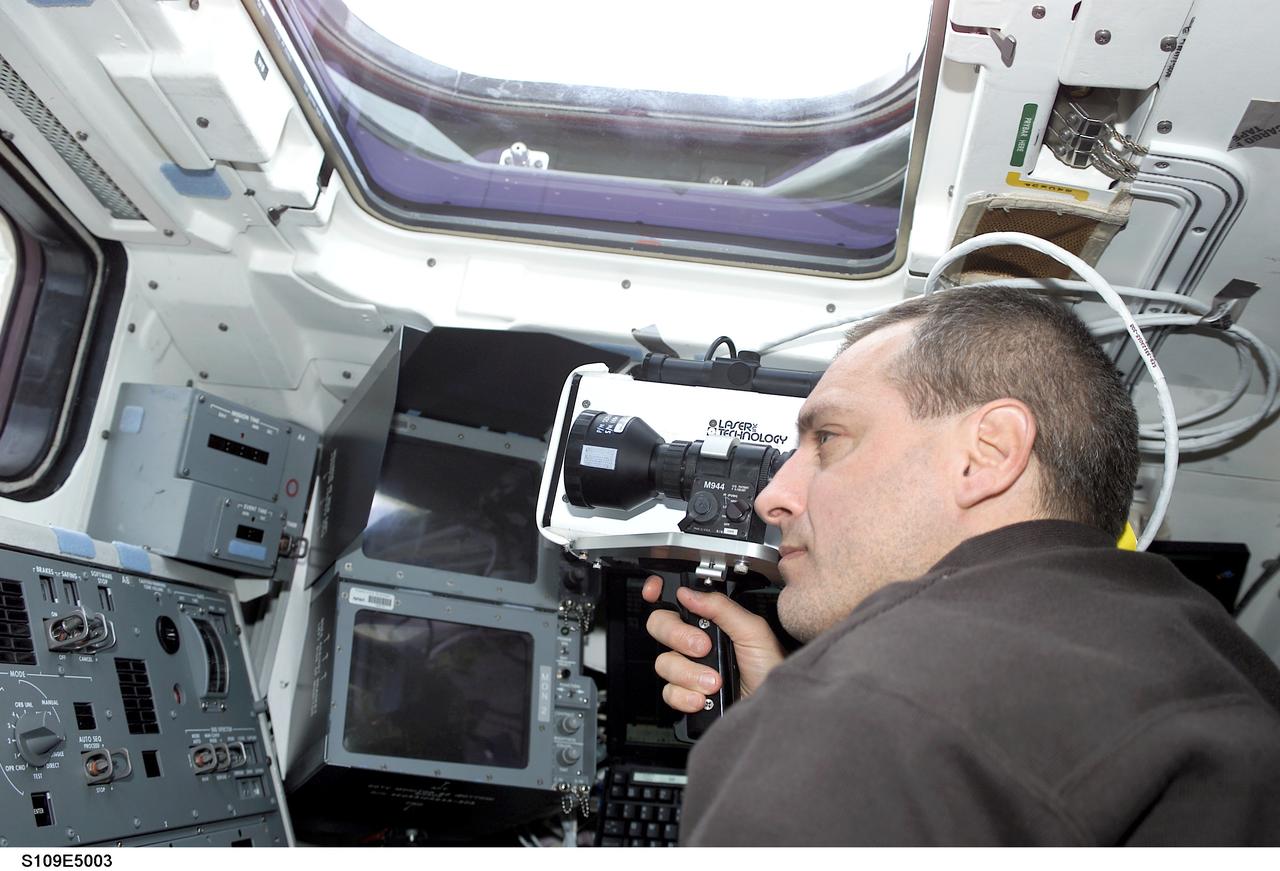
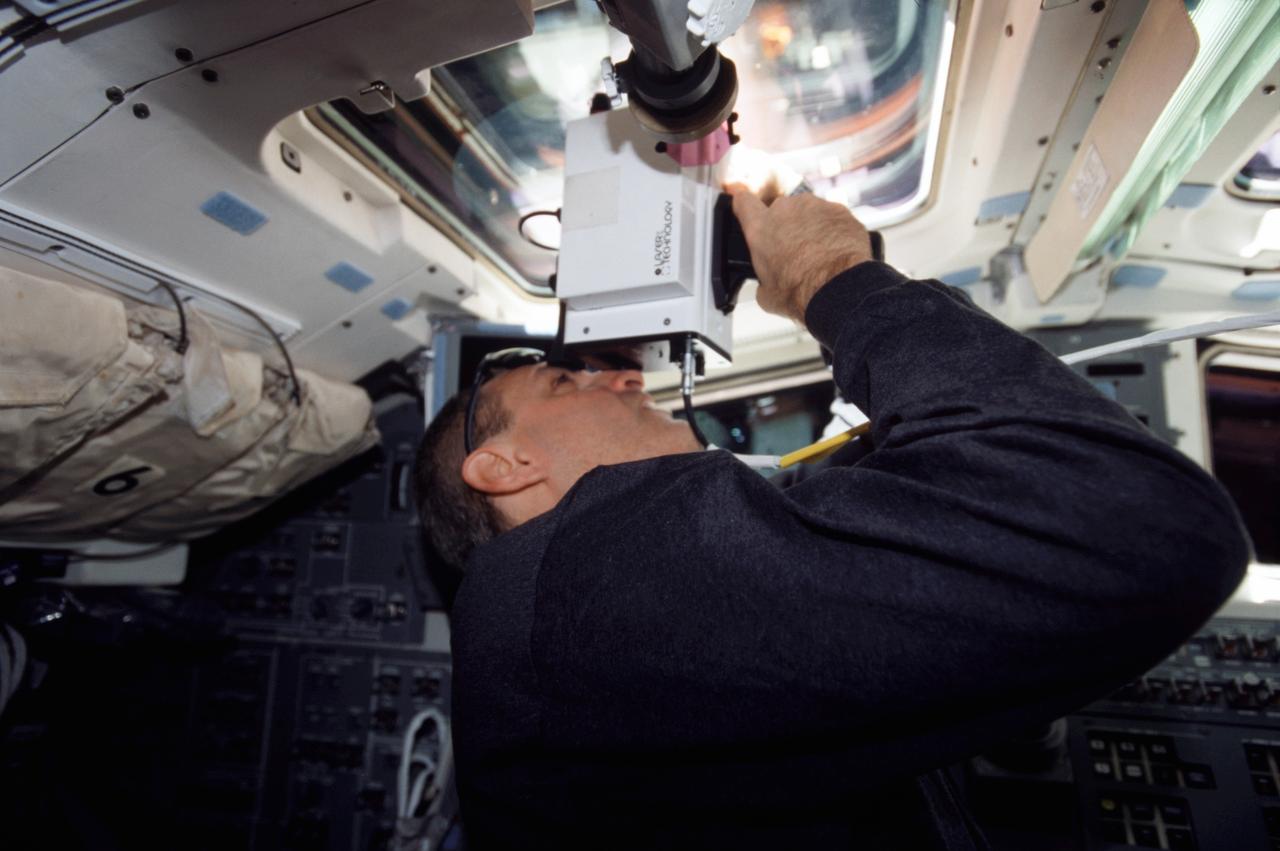
STS109-E-5002 (3 March 2002) --- Astronaut Richard M. Linnehan, mission specialist, uses a laser ranging device designed to measure the range between two spacecraft.  Linnehan positioned himself on the cabin's aft flight deck as the Space Shuttle Columbia approached  the Hubble Space Telescope.  A short time later, the STS-109 crew captured and latched down the giant telescope in the vehicle's cargo bay for several days of work on the Hubble.  The image was recorded with a digital still camera.
STS-109 MS Linnehan with laser range finder on aft flight deck
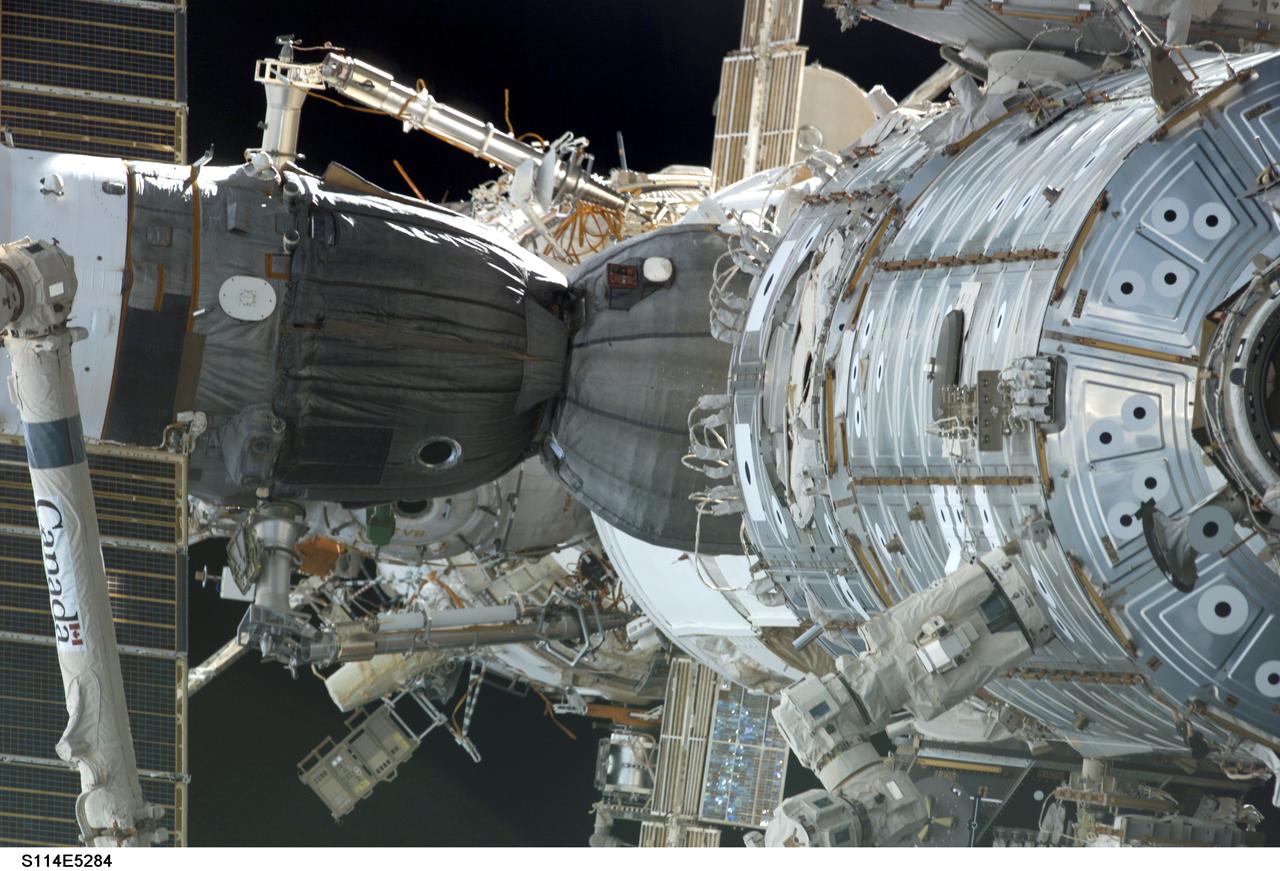
STS114-E-5284 (28 July 2005) --- One of the STS-114 crew members aimed a digital still camera through one of Discovery's aft cabin windows to capture this image of the U.S. Lab, Destiny, and a Soyuz vehicle docked to the International Space Station.  The station and Discovery had earlier joined together in space, as the joint activities of the STS-114 astronauts and the Expedition 11 crew members, still in separate spacecraft, work toward common goals.
Approach view of the Nadir side of the ISS
JSC2001-E-12122 (19 April 2001) --- Astronaut Scott D. Altman (foreground), STS-100 ascent spacecraft communicator (CAPCOM), stays on top of pre-launch activities at his console in the shuttle flight control room of Houston's Mission Control Center (MCC). Astronaut Mark L. Polansky stands beside Altman. Six astronauts and a cosmonaut, meanwhile, were strapped into their seats in the crew cabin of the Space Shuttle Endeavour several hundred miles away in Florida.
STS-100 MCC Launch Activities
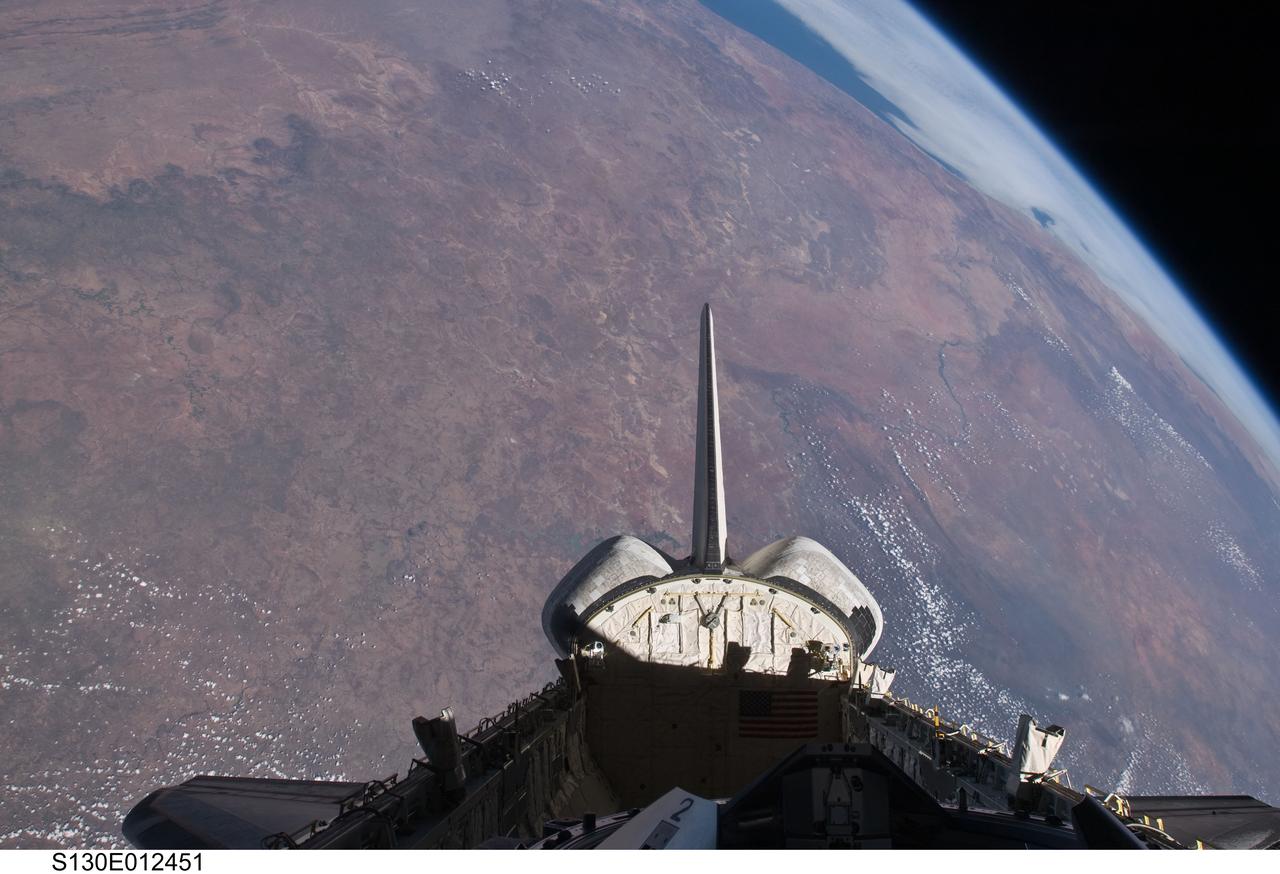
S130-E-012451 (20 Feb. 2010) --- The empty cargo bay and the aft portion of the Earth-orbiting space shuttle Endeavour are featured in this image photographed by an STS-130 crew member from inside the spacecraft?s crew cabin. The view is toward the west across southern Africa to the Atlantic ocean. The view follows along the Orange River, which also serves as the border between Namibia (to the right of the river) and South Africa (to the left of the river) nearer to the coast.
Endeavour Payload Bay
STS109-E-5003 (3 March 2002) --- Astronaut Richard M. Linnehan, mission specialist, uses a laser ranging device designed to measure the range between two spacecraft.  Linnehan positioned himself on the cabin's aft flight deck as the Space Shuttle Columbia approached  the Hubble Space Telescope.  A short time later, the STS-109 crew captured and latched down the giant telescope in the vehicle's cargo bay for several days of work on the Hubble.  The image was recorded with a digital still camera.
STS-109 MS Linnehan with laser range finder on aft flight deck
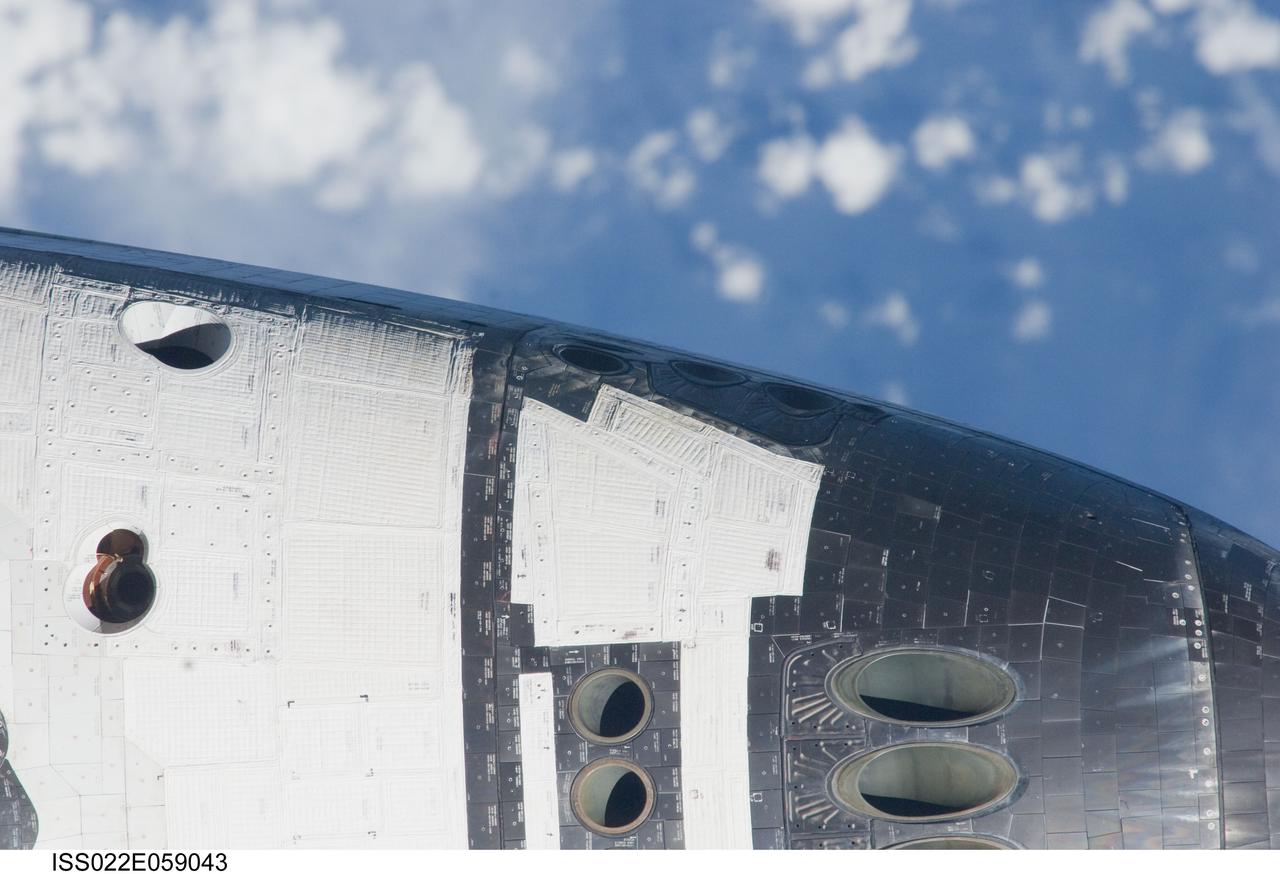
ISS022-E-059043 (9 Feb. 2010) --- This nadir image showing mostly the port side of space shuttle Endeavour's crew cabin was photographed with a digital camera?s 800mm lens by one of the Expedition 22 crew members aboard the International Space Station. The two spacecraft were in the midst of rendezvous operations, which included a back-flip by the shuttle.
Rendezvous Activities during Expedition 22
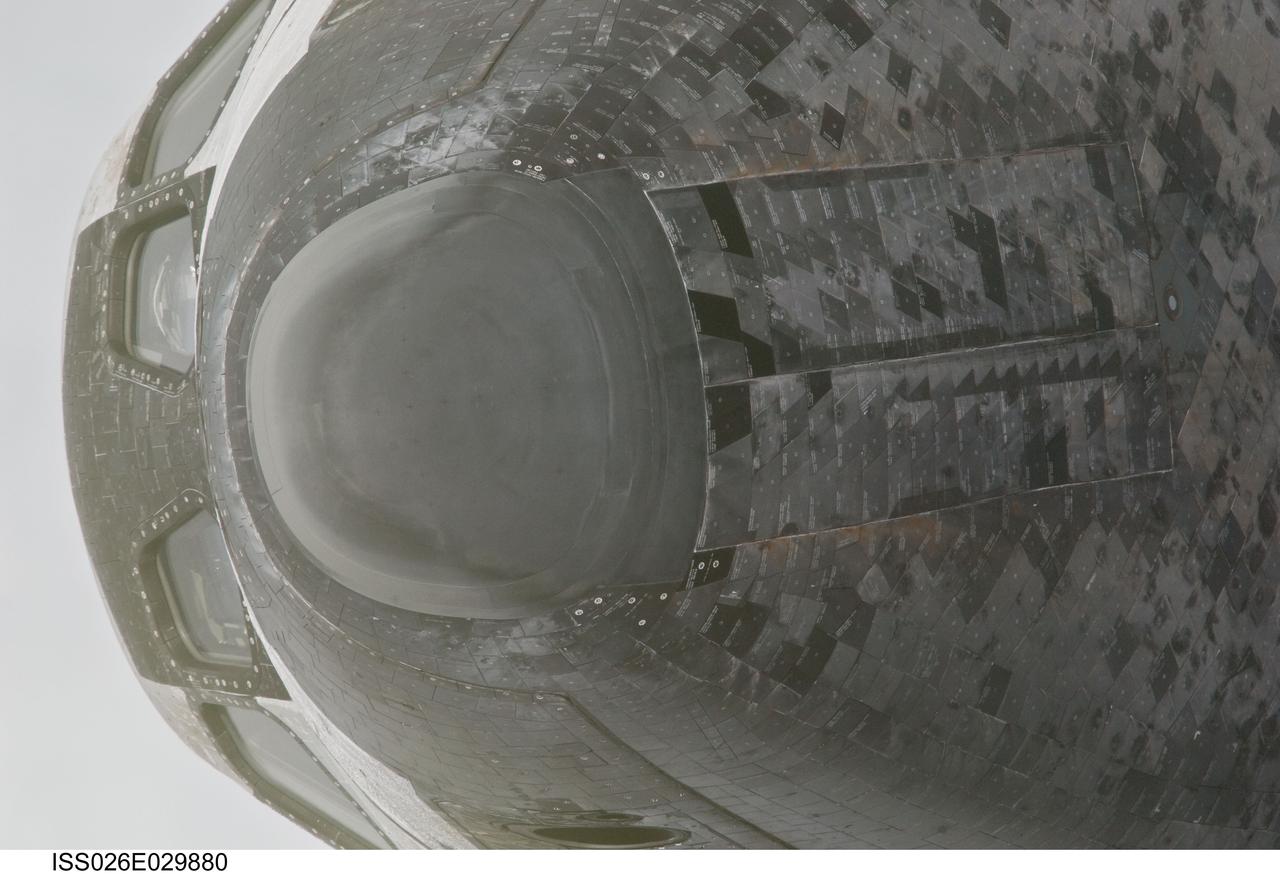
ISS026-E-029880 (26 Feb. 2011) --- This view of the nose, the forward underside and crew cabin of the space shuttle Discovery was provided by an Expedition 26 crew member during a survey of the approaching STS-133 vehicle prior to docking with the International Space Station. As part of the survey and part of every mission's activities, Discovery performed a back-flip for the rendezvous pitch maneuver (RPM). The station crew member used a digital still camera with an 800mm focal length, as the two spacecraft were approximately 600 feet (180 meters) apart.
Mapping Sequence performed during the STS-133 R-Bar Pitch Maneuver
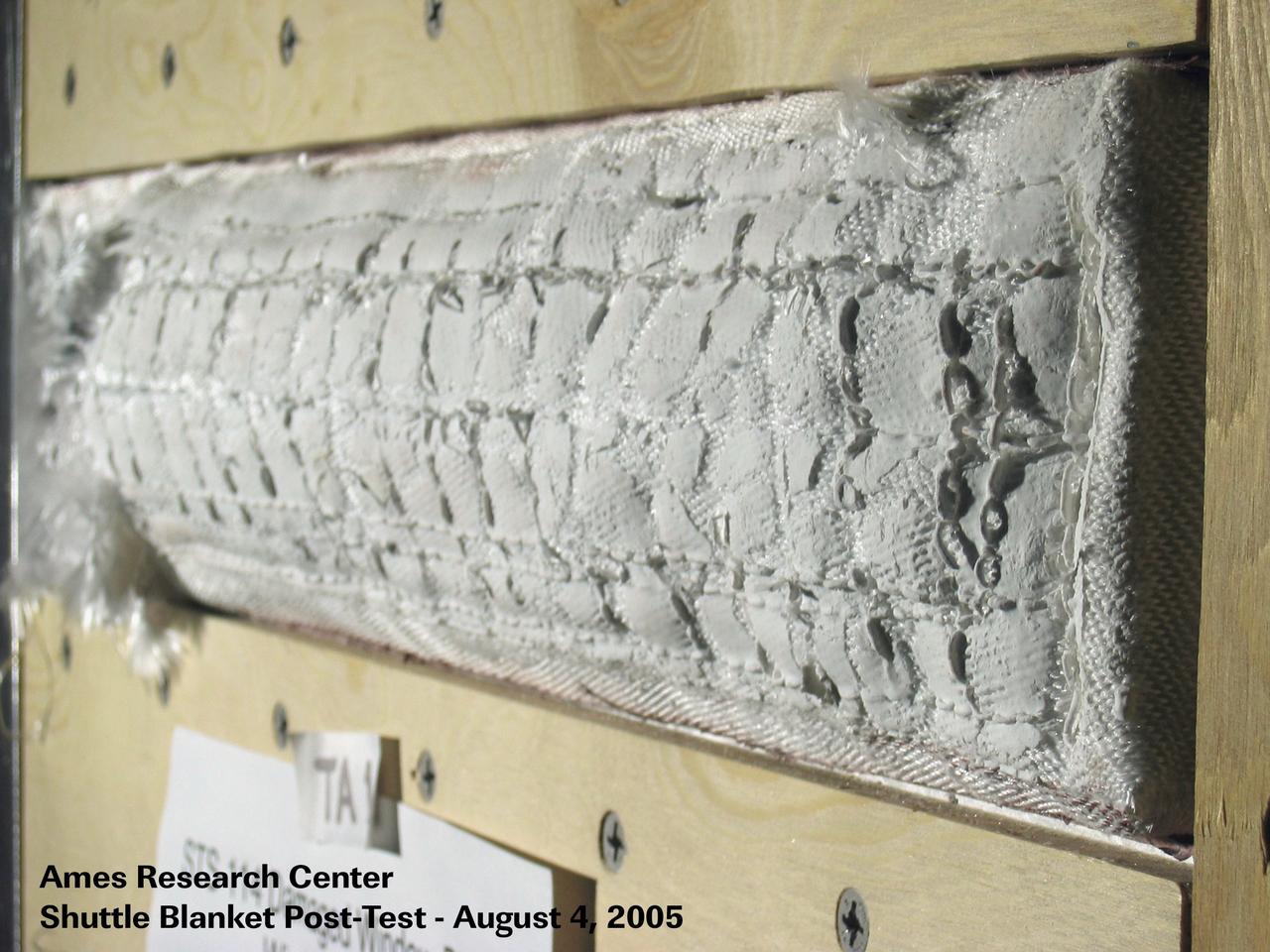
JSC2005-E-32511 (4 August 2005) --- One of four visual aids used by  Shuttle Deputy Program Manager Wayne Hale during an August 4 press conference that dealt with important tests in wind tunnels at NASA's Ames Research Center. Engineers simulated the conditions of the Space Shuttle Discovery for a disrupted thermal blanket near the commander's window on the forward cabin of the spacecraft. Eventually it was decided that no additonal spacewalk work needed to be performed to  fix the blanket.
STS-114 Flight Director Press Conference, PAO Support
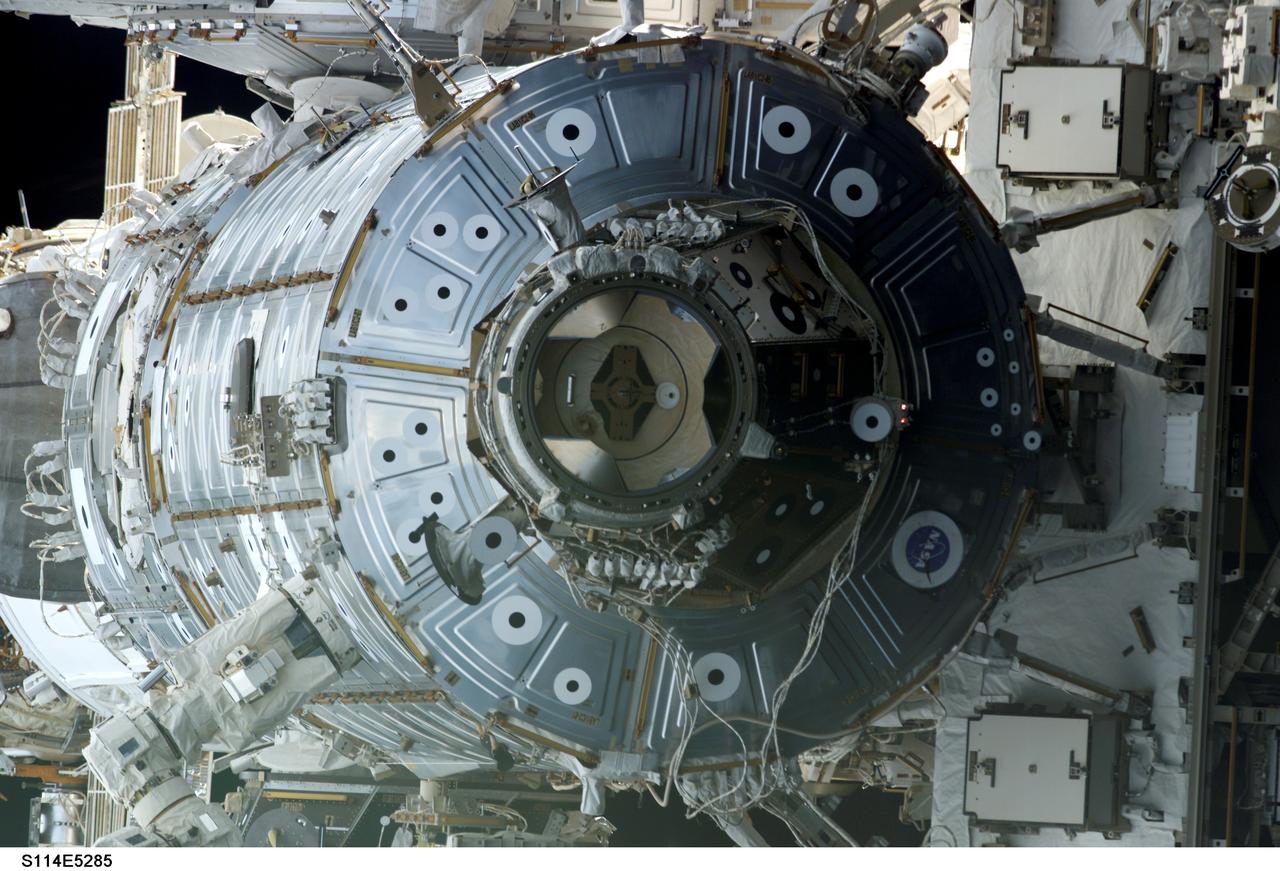
STS114-E-5285 (28 July 2005) --- One of the STS-114 crew members aimed a digital still camera through one of Discovery's aft cabin windows to capture this image of the U.S. Lab, Destiny.  The International Space Station and Discovery had earlier joined together in space, as the joint activities of the STS-114 astronauts and the Expedition 11 crew members, still in separate spacecraft,  work toward common goals.
PMA2 and U.S. Lab as seen during STS-114 rendezvous for docking
jsc2017e039895 (04/05/2017) --- Aboard a Gagarin Cosmonaut Training Center aircraft, Expedition 51 crewmember Jack Fischer of NASA affixes his Expedition crew patch to the wall of the cabin April 5 as he and crewmate Fyodor Yurchikhin of the Russian Federal Space Agency (Roscosmos) traveled to their launch site at the Baikonur Cosmodrome in Kazakhstan for final pre-launch training. Fischer and Yurchikhin will launch April 20 on the Soyuz MS-04 spacecraft for a four and a half month mission on the International Space Station. Photo: NASA/Victor Zelentsov
jsc2017e039895
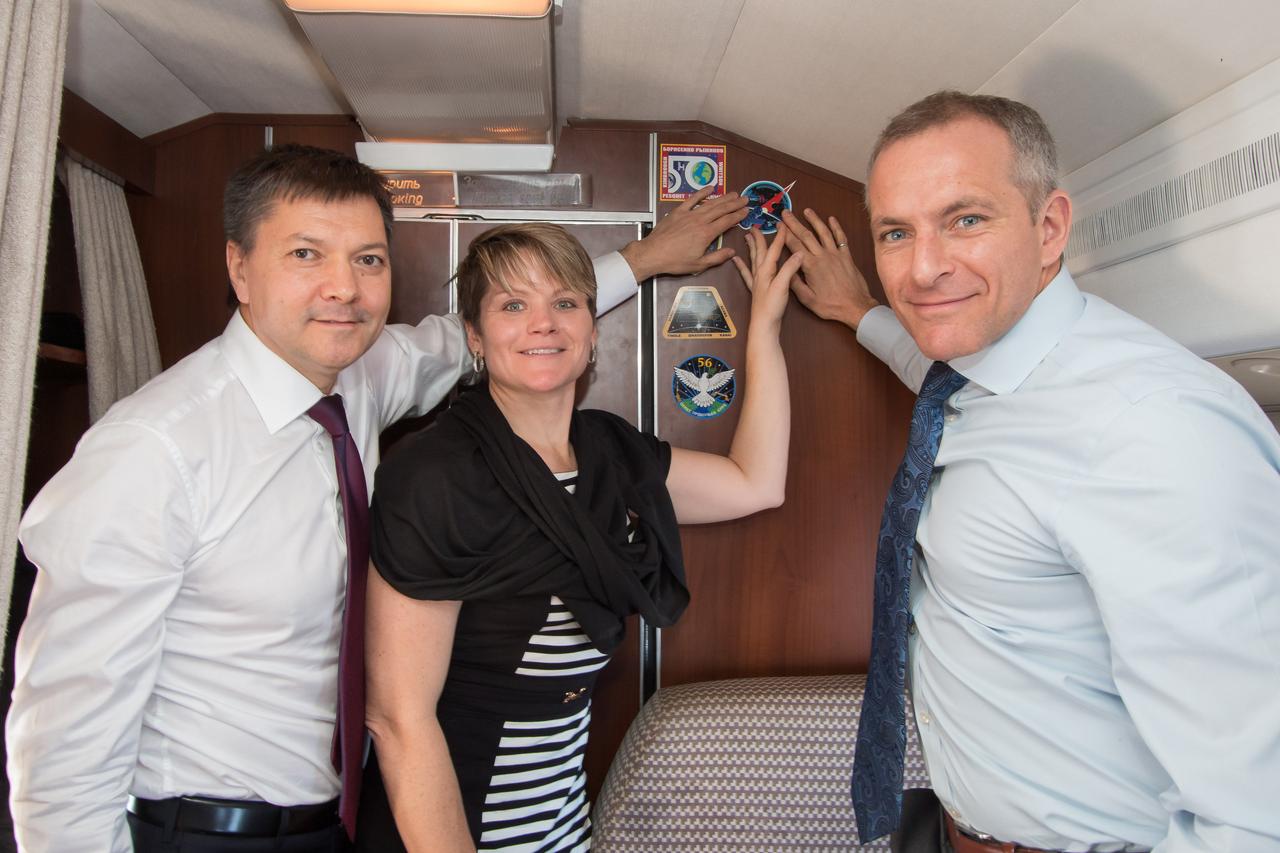
jsc2018e097261 - Aboard a Gagarin Cosmonaut Training Center aircraft, Expedition 58 crewmembers Oleg Kononenko of Roscosmos (left), Anne McClain of NASA (center) and David Saint-Jacques of the Canadian Space Agency (right) affix a Soyuz MS-11 sticker to the wall of the cabin Nov. 19 in a traditional ceremony as they flew to their launch site in Baikonur, Kazakhstan. They will launch Dec. 3 on the Soyuz MS-11 spacecraft from the Baikonur Cosmodrome in Kazakhstan for a six-and-a-half month mission on the International Space Station...NASA/Victor Zelentsov.
jsc2018e097261
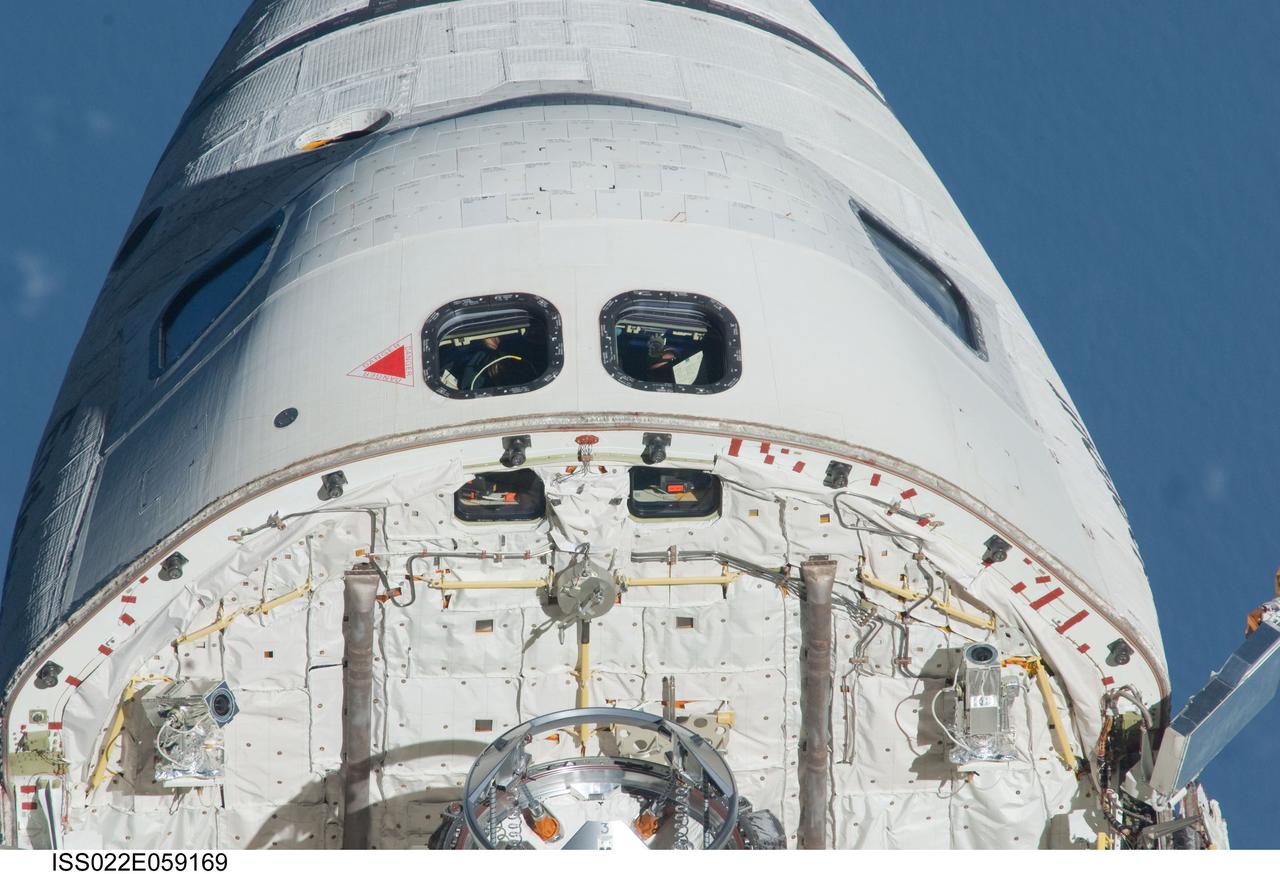
ISS022-E-059169 (9 Feb. 2010) --- This image, showing the top of space shuttle Endeavour's crew cabin, its firewall and part of the docking mechanism in the cargo bay, was photographed by one of the Expedition 22 crew members aboard the International Space Station. The two spacecraft were in the midst of rendezvous operations, which included a back-flip by the shuttle for the purposes of inspecting and photographing it from a number of angles.
Rendezvous Activities during Expedition 22
Aboard their Gagarin Cosmonaut Training Center aircraft, Expedition 47-48 crewmembers Jeff Williams of NASA (left) and Alexey Ovchinin (center) and Oleg Skripochka (right) of Roscosmos affix a sticker of their crew patch to the wall of the cabin as they flew from their training base to the Baikonur Cosmodrome in Kazakhstan March 3.  The trio will launch March 19, Kazakh time, in their Soyuz TMA-20M spacecraft for a six-month mission on the International Space Station.  Courtesy of Gagarin Cosmonaut Training Center
jsc2016e026334
Expedition 32 Flight Engineer Sunita Williams of NASA affixes a crew patch to the cabin of the plane that carried her, Soyuz Commander Yuri Malenchenko (left) and Flight Engineer Aki Hoshide of the Japan Aerospace Exploration Agency (not pictured) July 2, 2012 from their training base in Star City, Russia to the Baikonur Cosmodrome in Kazakhstan for final pre-launch training. The trio will be launched July 15 from Baikonur to the International Space Station in their Soyuz TMA-05M spacecraft for a four-month mission.  NASA/Victor Zelentsov
jsc2012e098305
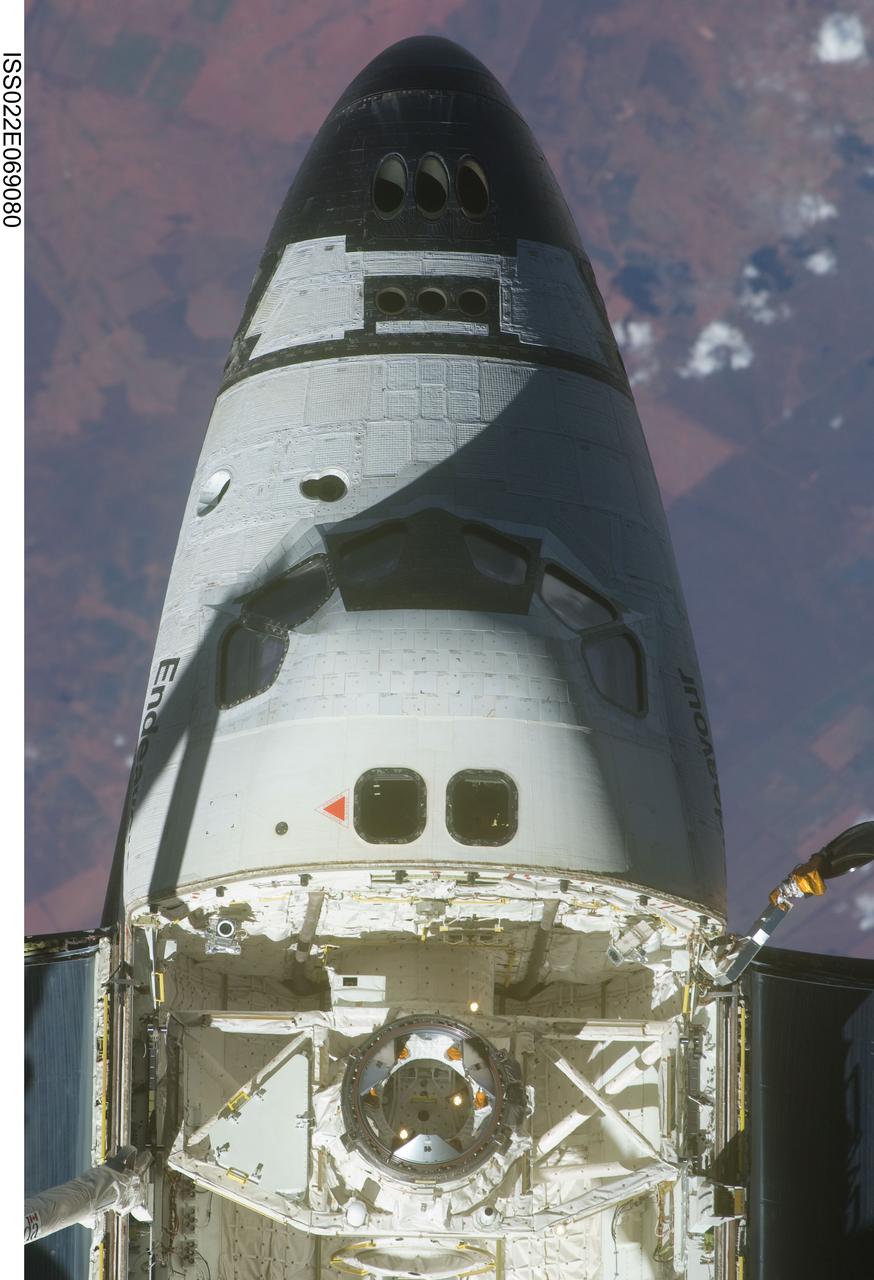
ISS022-E-069080 (19 Feb. 2010) --- This view of the crew cabin and forward payload bay of the space shuttle Endeavour was provided by an Expedition 22 crew member on the International Space Station soon after the shuttle and station began their post-undocking relative separation. Undocking of the two spacecraft occurred at 7:54 p.m. (EST) on Feb. 19, 2010.
Crew Module and FWD Fuselage on the STS-130 Space Shuttle Endeavour
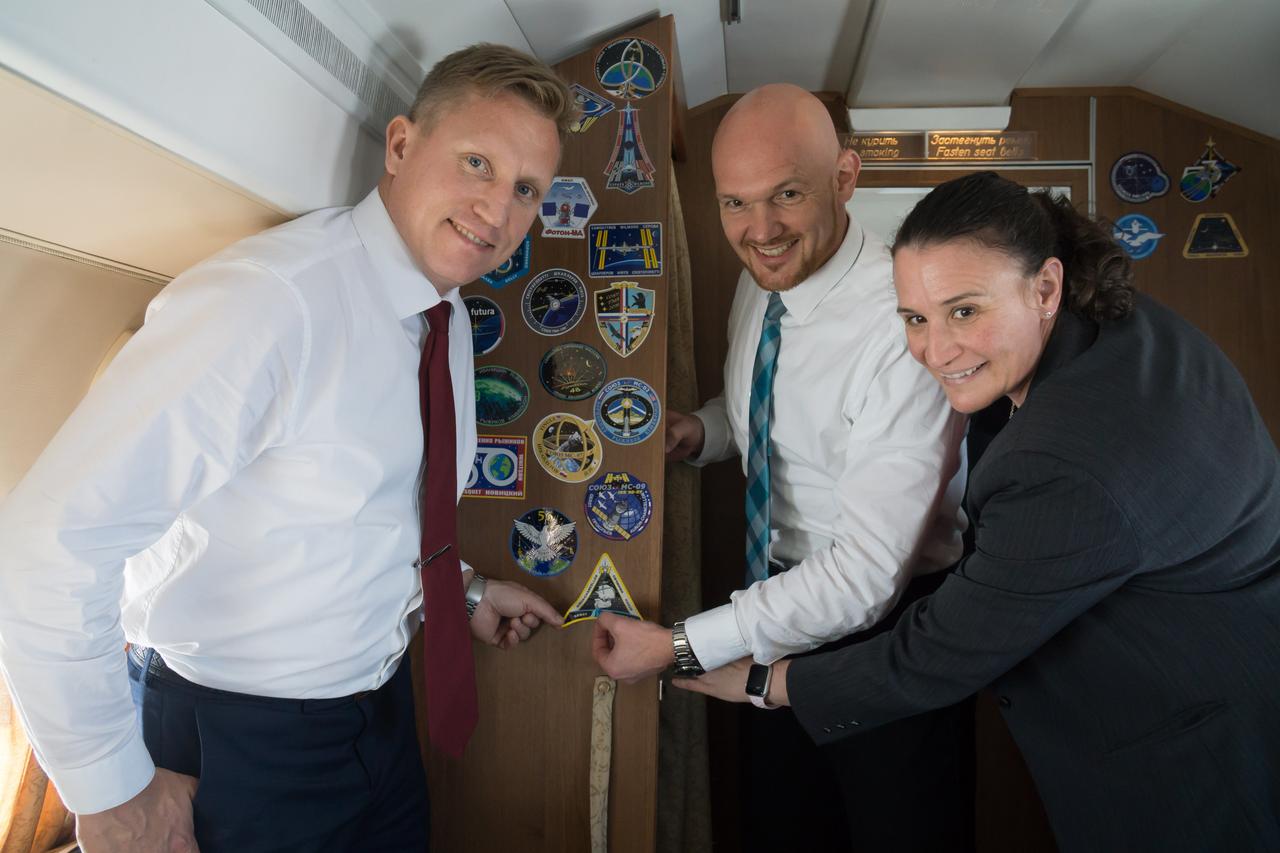
jsc2018e049985 - Aboard a Gagarin Cosmonaut Training Center aircraft, Expedition 56 crewmembers Sergey Prokopyev of Roscosmos (left), Serena Aunon-Chancellor of NASA (center) and Alexander Gerst of the European Space Agency (right) affix crew insignia decals to the cabin wall May 19 as they flew from their Russian training base to their launch site at the Baikonur Cosmodrome in Kazakhstan. They will launch June 6 on the Soyuz MS-09 spacecraft from the Baikonur Cosmodrome for a six-month mission on the International Space Station...NASA/Victor Zelentsov.
jsc2018e049985
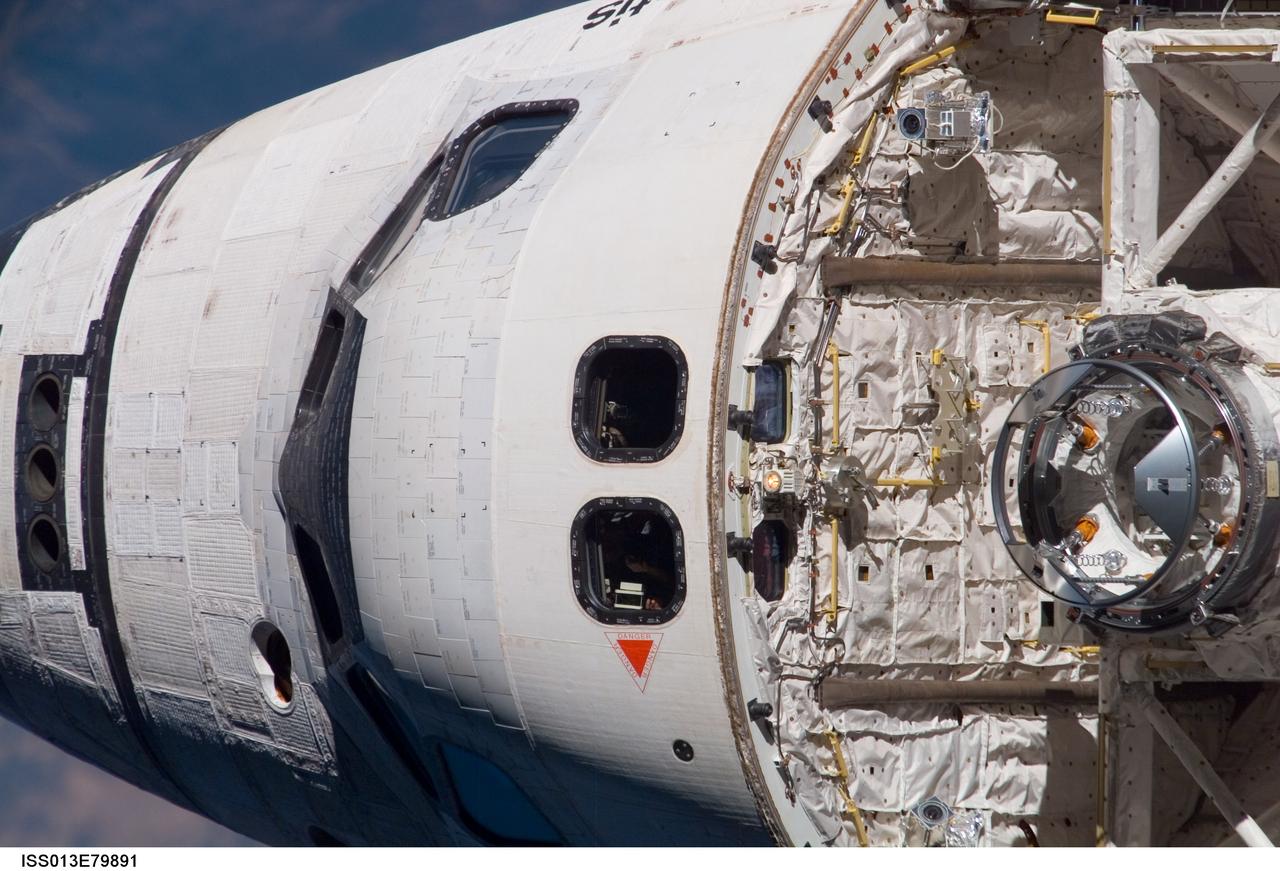
ISS013-E-79891 (11 Sept. 2006) --- This overhead image of the Space Shuttle Atlantis, recorded by a crewmember onboard the International Space Station, gives an excellent view of the top of the crew cabin and the orbiter docking system (ODS, right edge of frame). The ODS was instrumental a short while later in enabling the two spacecraft to link up for several days of joint activities for the respective crews, including the resumption of the construction of the space station.
Mapping sequence performed during the STS-115 R-Bar Pitch Maneuver
ISS027-E-032063 (18 May 2011) --- This close-up view of the crew cabin of space shuttle Endeavour was provided by an Expedition 27 crew member during a survey of the approaching STS-134 vehicle prior to docking with the International Space Station. As part of the survey and part of every mission's activities, Endeavour performed a back-flip for the rendezvous pitch maneuver (RPM). The station crew member used a digital still camera with an 800mm focal length, as the two spacecraft were approximately 600 feet (180 meters) apart.
Mapping Sequence performed during the STS-134 R-Bar Pitch Maneuver
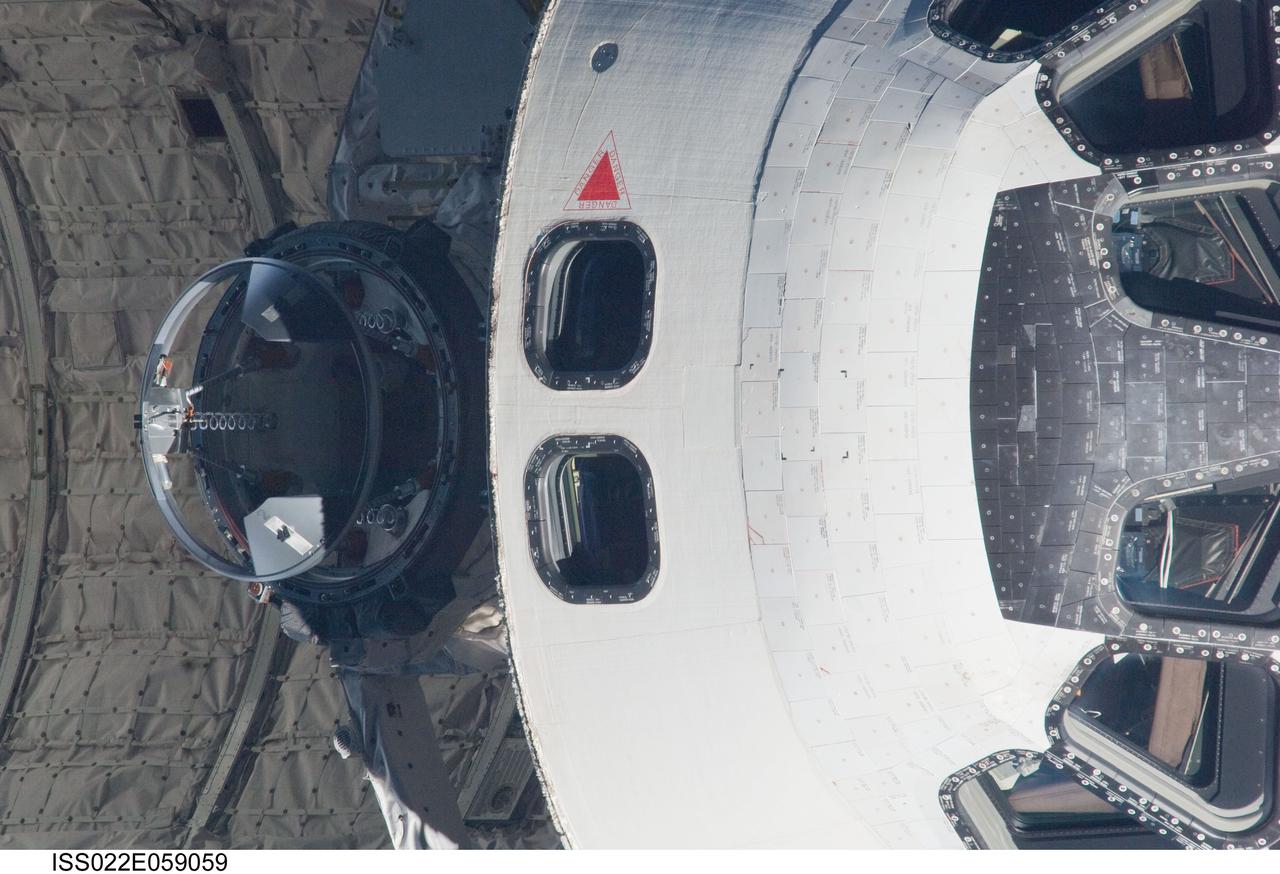
ISS022-E-059059 (9 Feb. 2010) --- This 800mm image showing the top of space shuttle Endeavour's crew cabin and the docking mechanism was photographed by one of the Expedition 22 crew members aboard the International Space Station. The two spacecraft were in the midst of rendezvous operations, which included a back-flip by the shuttle for the purposes of inspecting and photographing it from a number of angles.
Rendezvous Activities during Expedition 22
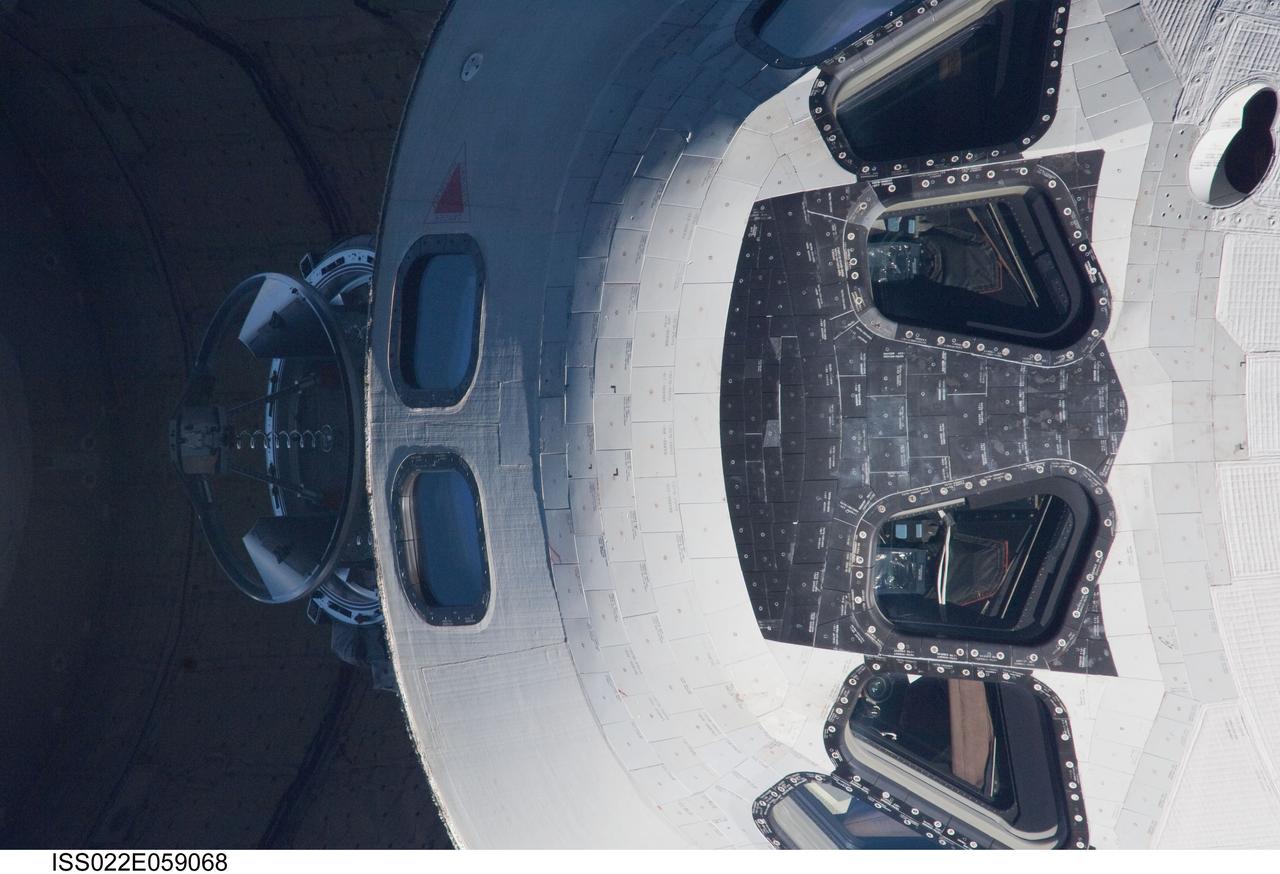
ISS022-E-059068 (9 Feb. 2010) --- This 800mm image showing a head-on view of space shuttle Endeavour's crew cabin, was photographed by one of the Expedition 22 crew members aboard the International Space Station. The two spacecraft were in the midst of rendezvous operations, which included a back-flip by the shuttle for the purposes of inspecting and photographing it from a number of angles.
Rendezvous Activities during Expedition 22
jsc2018e049984 - Aboard a Gagarin Cosmonaut Training Center aircraft, Expedition 56 crewmembers Sergey Prokopyev of Roscosmos (left), Alexander Gerst of the European Space Agency (center) and Serena Aunon-Chancellor of NASA (right) affix crew insignia decals to the cabin wall May 19 as they flew from their Russian training base to their launch site at the Baikonur Cosmodrome in Kazakhstan. They will launch June 6 on the Soyuz MS-09 spacecraft from the Baikonur Cosmodrome for a six-month mission on the International Space Station...NASA/Victor Zelentsov.
jsc2018e049984
STS109-346-011 (3 March 2002) --- Astronaut Richard M. Linnehan, STS-109 mission specialist, uses a laser ranging device designed to measure the range between two spacecraft. Linnehan positioned himself on the cabin's aft flight deck as the Space Shuttle Columbia approached the Hubble Space Telescope. A short time later, the STS-109 crew captured and latched down the giant telescope in the vehicle's cargo bay for several days of work on the Hubble.
STS-109 MS Linnehan on aft flight deck with laser rangefinder
JSC2001-E-21326 (12 July 2001) --- Astronaut Mark L. Polansky, STS-104 spacecraft communicator (CAPCOM) for weather issues, monitors pre-flight data at his console in the shuttle flight control room (WFCR) in Houston's Mission Control Center (MCC).  Several hundred miles away in Florida,  five astronauts were awaiting countdown in the crew cabin of the Space Shuttle Atlantis on the launch pad at the Kennedy Space Center (KSC).
Coverage of STS-104 Launch Coverage of Flight Controllers in MCC.
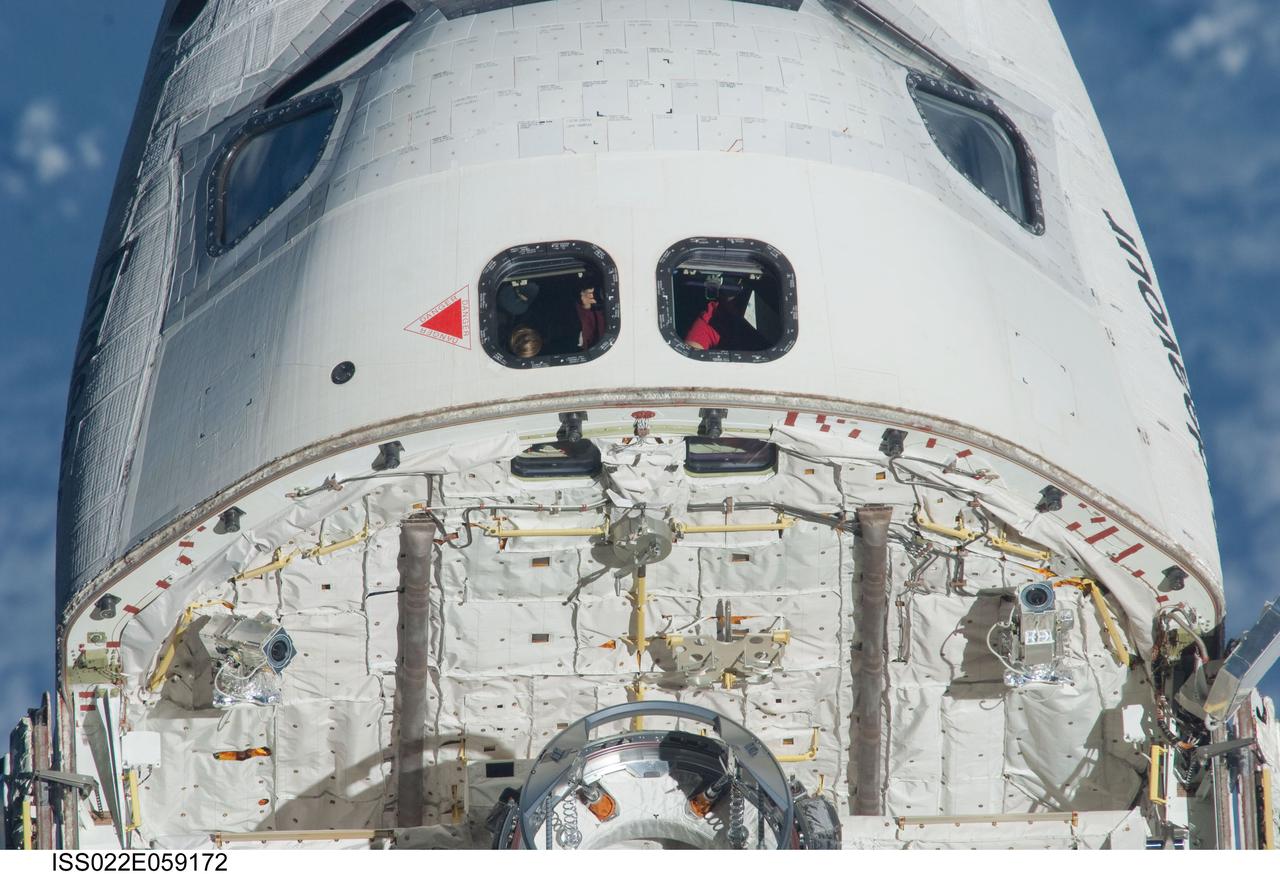
ISS022-E-059172 (9 Feb. 2010) --- This 800mm image, showing the top of space shuttle Endeavour's crew cabin, its firewall and part of the docking mechanism in the cargo bay, was photographed by one of the Expedition 22 crew members aboard the International Space Station. The two spacecraft were in the midst of rendezvous operations, which included a back-flip by the shuttle for the purposes of inspecting and photographing it from a number of angles.
Rendezvous Activities during Expedition 22
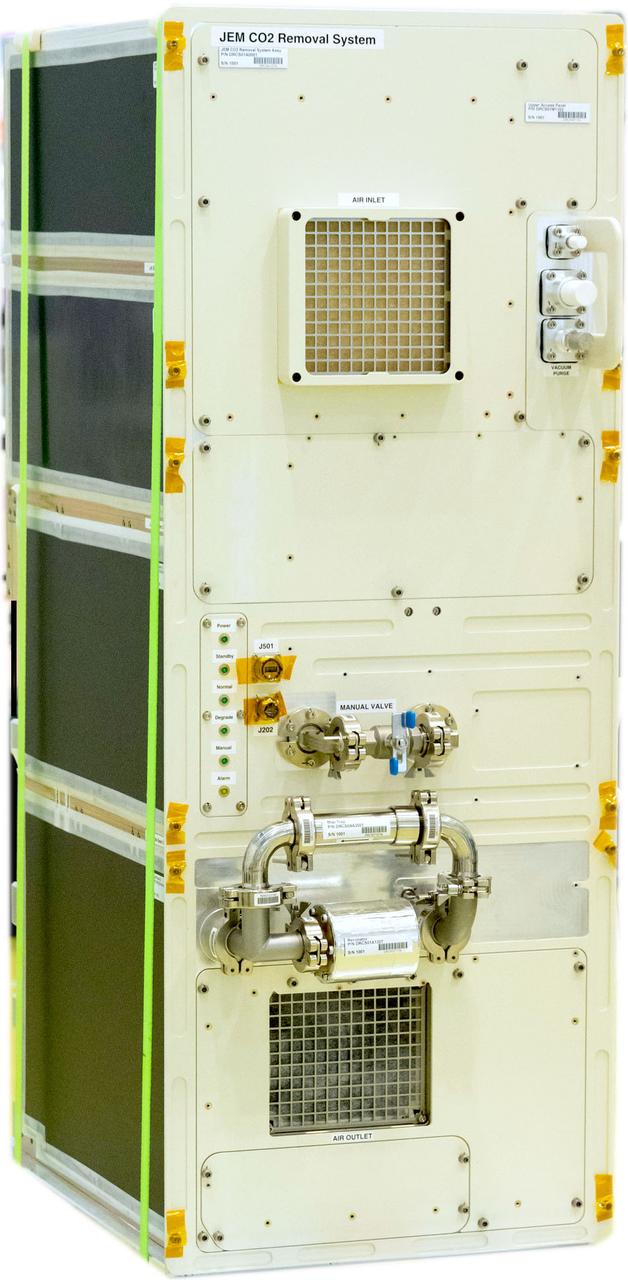
jsc2025e076916 (September 25, 2025) -- A close-up view of the JEM Demonstration of CO? Removal System (JEM DRCS) hardware. JEM DRCS will operate on the space station by filtering carbon dioxide out of the cabin air. The experiment will help guide future spacecraft life support systems and could also support technologies that reduce carbon dioxide emissions on Earth. Image courtesy of JAXA.
jsc2025e076916
S85-31933 (17 May 1985) --- Four members of the STS 51-G crew participate in a training exercise in the shuttle mission simulation and training facility at the Johnson Space Center. Steven R. Nagel, left foreground, is a mission specialist for the flight, while Sultan Salman Abdelazize Al-Saud (right foreground) is a payload specialist. In the background are astronauts Daniel C. Brandenstein (left) in the commander's station and John O. Creighton in the pilot's position. Photo credit: NASA/ Otis Imboden of National Geographic
STS 51-G crewmembers participate in training in crew compartment trainer
S70-45580 (July 1970) --- The members of the prime crew of the Apollo 14 lunar landing mission participate in Command Module (CM) simulation training at the Kennedy Space Center (KSC). Left to right are astronauts Edgar D. Mitchell, lunar module pilot; Stuart A. Roosa, command module pilot; and Alan B. Shepard Jr., commander.
View of Apollo 14 crewmen in Command Module simulation training
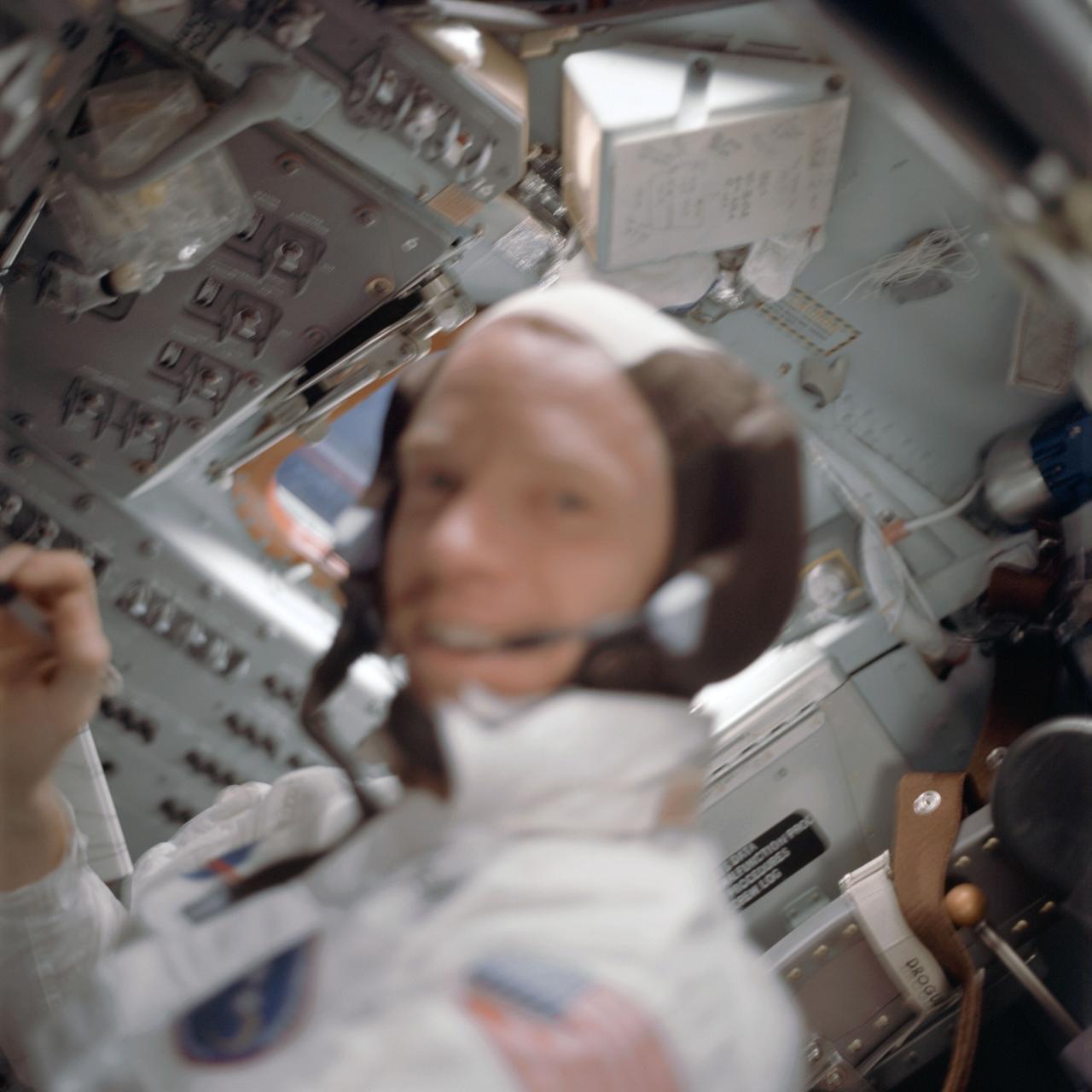
AS07-04-1586 (20 Oct. 1968) --- Astronaut Walter Cunningham, Apollo 7 lunar module pilot, writes with space pen as he is photographed performing flight tasks on the ninth day of the Apollo 7 mission. Note the 70mm Hasselblad camera film magazine just above Cunningham's right hand floating in the weightless (zero gravity) environment of the spacecraft.
Astronaut Walter Cunningham photographed performing flight tasks
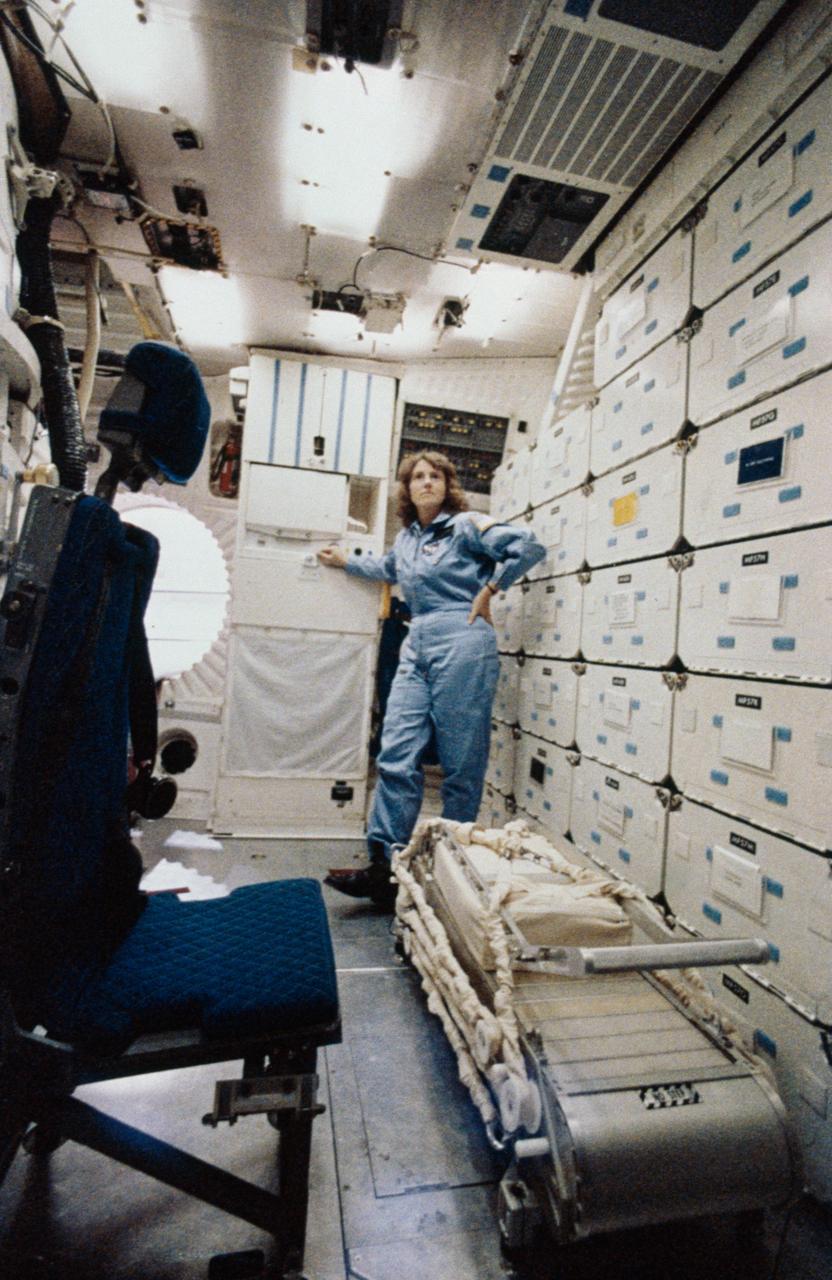
S86-25188 (December 1985) --- Sharon Christa McAuliffe, a school teacher Concord New Hampshire, surveys a ground training replica of the quarters she?ll be using in space when the space shuttle Challenger taxis two women and five men into space in January of 1986.  The STS-51L citizen observer/payload specialist is in training at the Johnson Space Center, representing the Teacher-in-Space Project. The photo was taken by Keith Meyers of the New York Times. Photo credit: NASA
Christa McAuliffe surveys middeck mockup
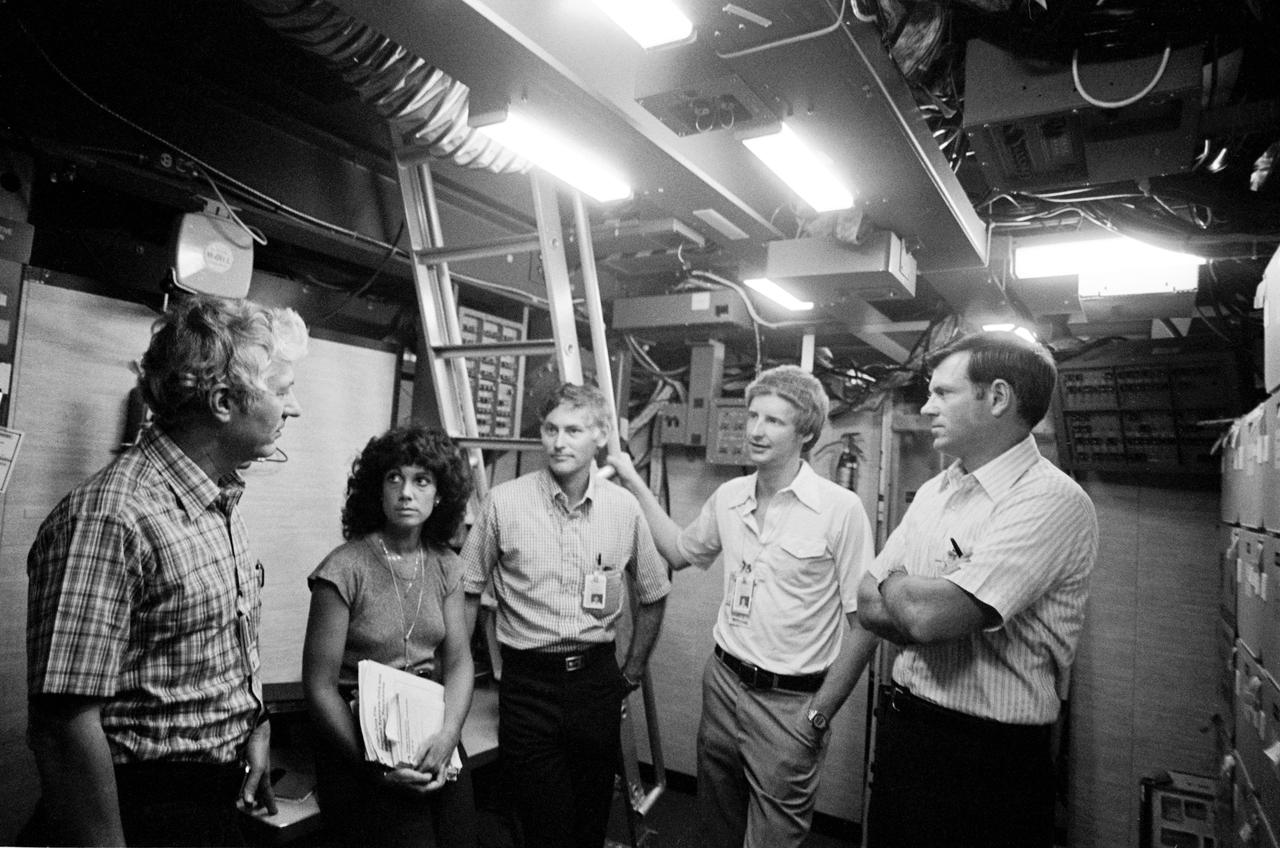
View of STS 41-D mission crew training in Shuttle Mission simulator. From left to right are Henry Hartsfield, Jr., commander; mission specialists Judith Resnik, Richard Mullane, and Steven Hawley; and Michael Coats, pilot. They appear to be standing in the middeck mockup, preparing for training.
STS 41-D mission crew training in Shuttle Mission simulator
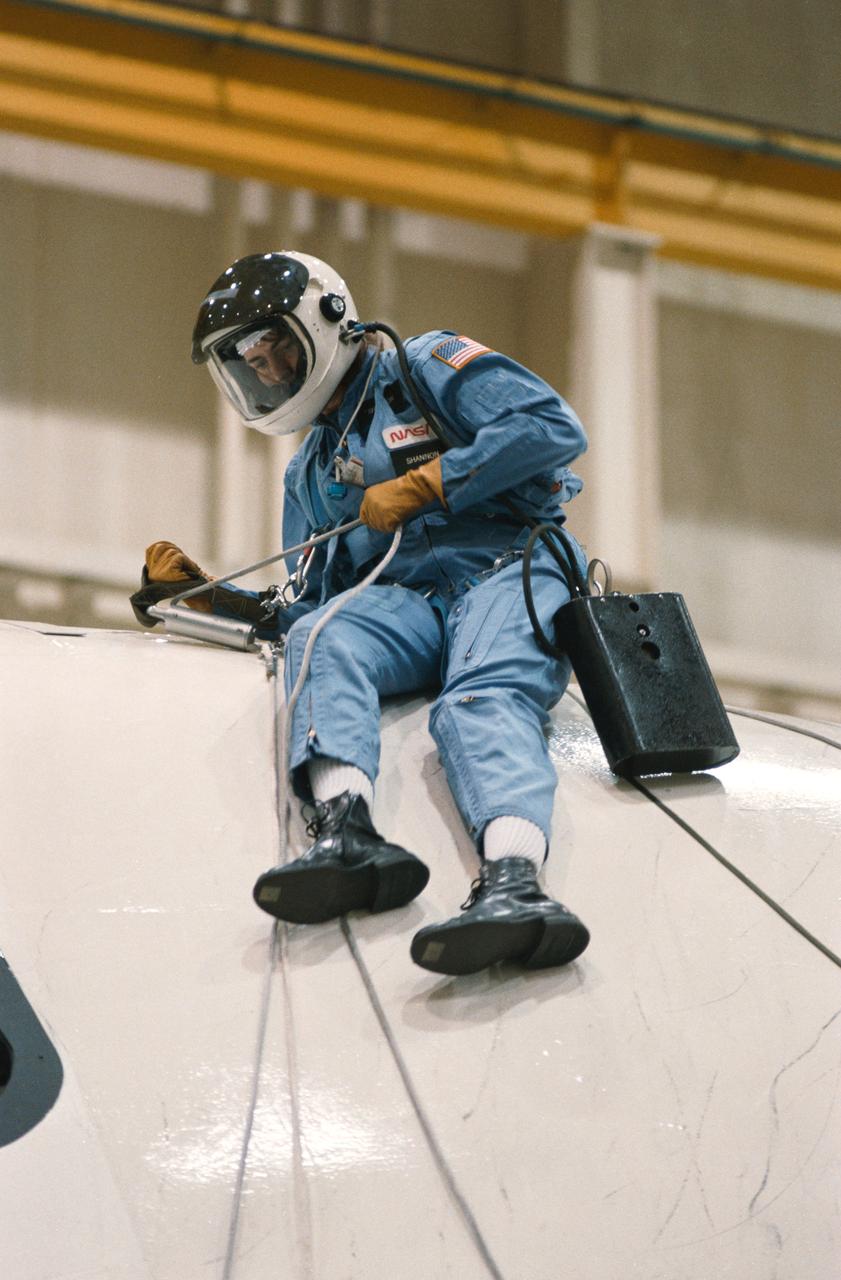
Mission Specialist Shannon W. Lucid, STS 51-G, descends from the top of the crew compartment trainer in bldg 9A, the mockup and integration laboratory, during emergency egress training.
Mission specialist Shannon W. Lucid descends from crew compartment trainer
S67-50590 (1867) --- Astronaut Frank Borman, assigned duty as commander of the Apollo 8 mission, participates in a training exercise in the Apollo Mission simulator in the Mission Simulation and training Facility, Building 5, at the Manned Spacecraft Center, Houston, Texas. Photo credit: NASA
Astronaut Frank Borman during training exercise in Apollo Mission simulator
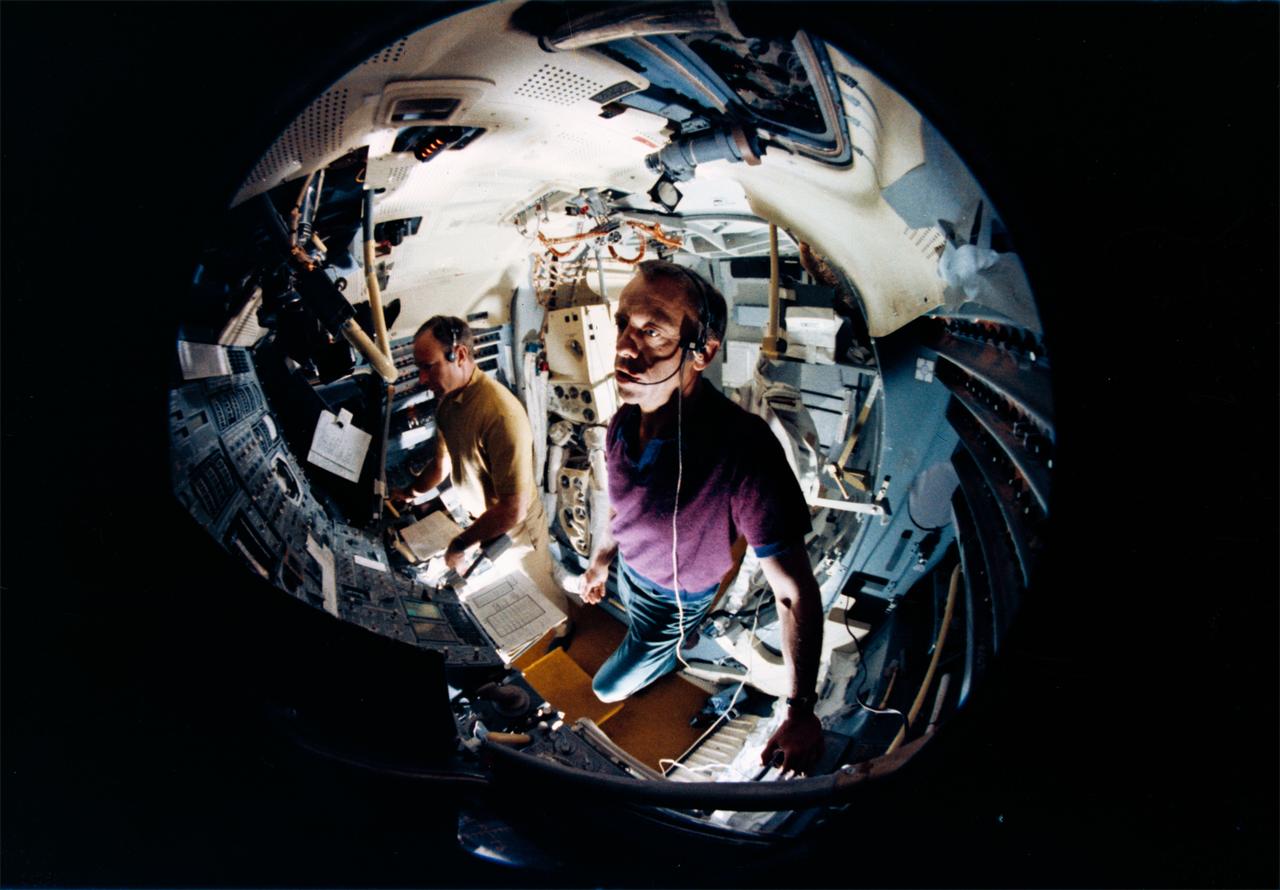
S70-45555 (July 1970) --- A fish-eye lens view showing astronauts Alan B. Shepard Jr. (foreground) and Edgar D. Mitchell in the Apollo lunar module mission simulator at the Kennedy Space Center during preflight training for the Apollo 14 lunar landing mission. Shepard is the Apollo 14 commander; and Mitchell is the lunar module pilot.
Fish-eye lens view Astronauts Shepard and Mitchell in Lunar Module Simulator
View of STS 41-D mission crew training in Shuttle Mission simulator. From left to right are Henry Hartsfield, Jr., commander; mission specialists Judith Resnik, Richard Mullane, and Steven Hawley; and Michael Coats, pilot. They appear to be standing in the middeck mockup, preparing for training.
STS 41-D mission crew training in Shuttle Mission simulator
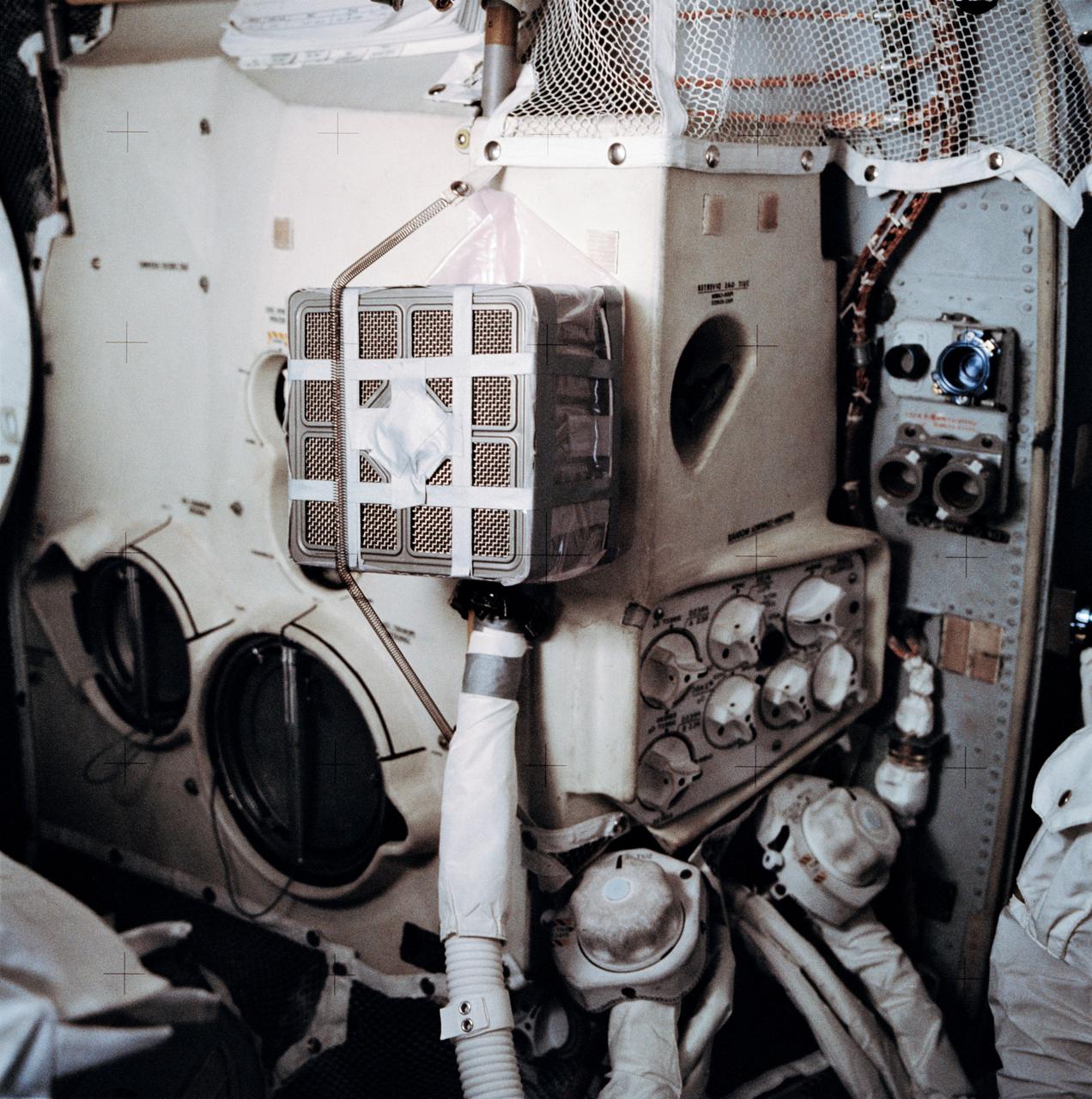
AS13-62-8929 (11-17 April 1970) --- Interior view of the Apollo 13 Lunar Module (LM) showing the "mail box," a jury-rigged arrangement which the Apollo 13 astronauts built to use the Command Module (CM) lithium hydroxide canisters to purge carbon dioxide from the LM.  Lithium hydroxide is used to scrub CO2 from the spacecraft's atmosphere.  Since there was a limited amount of lithium hydroxide in the LM, this arrangement was rigged up to utilize the canisters from the CM. The "mail box" was designed and tested on the ground at the Manned Spacecraft Center (MSC) before it was suggested to the problem-plagued Apollo 13 crew men.  Because of the explosion of one of the oxygen tanks in the Service Module (SM), the three crew men had to use the LM as a "lifeboat".
Interior view of "mail box" for purging carbon dioxide from Lunar Module
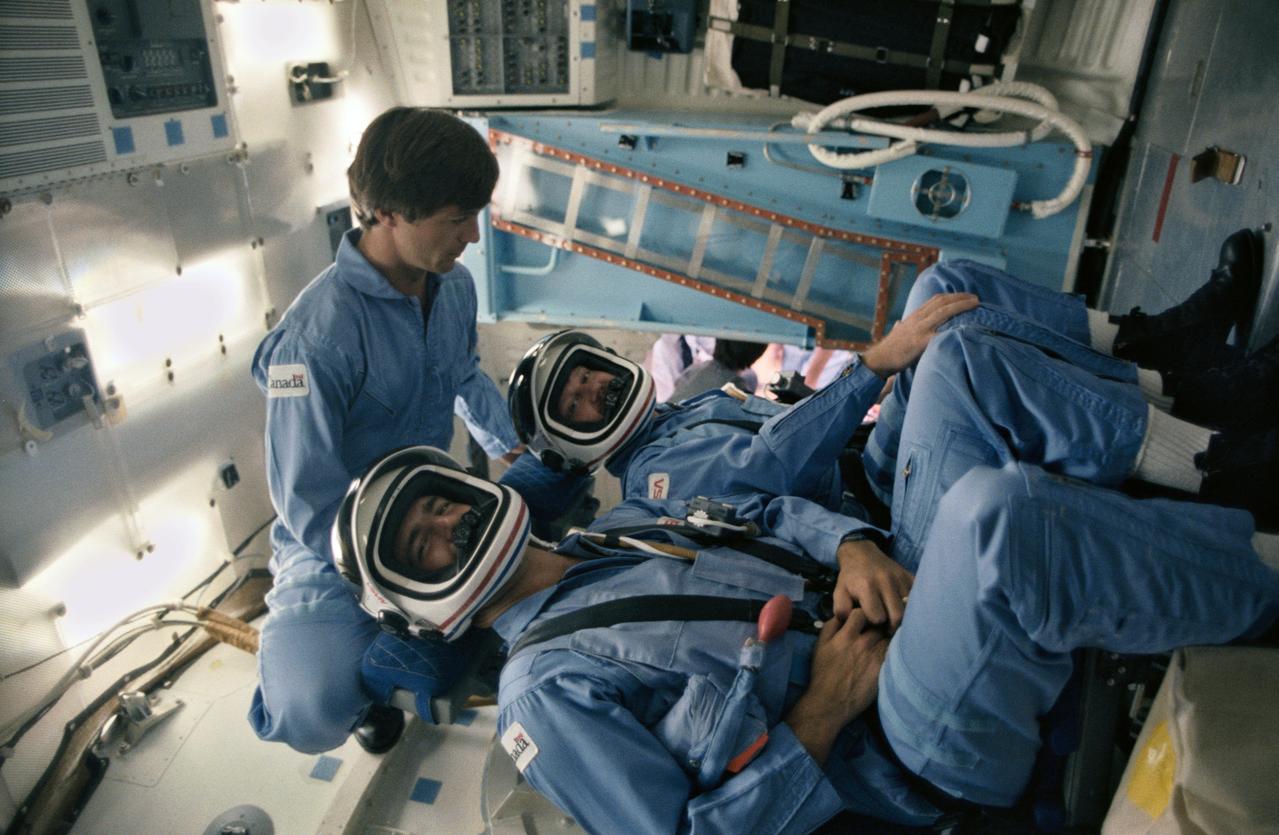
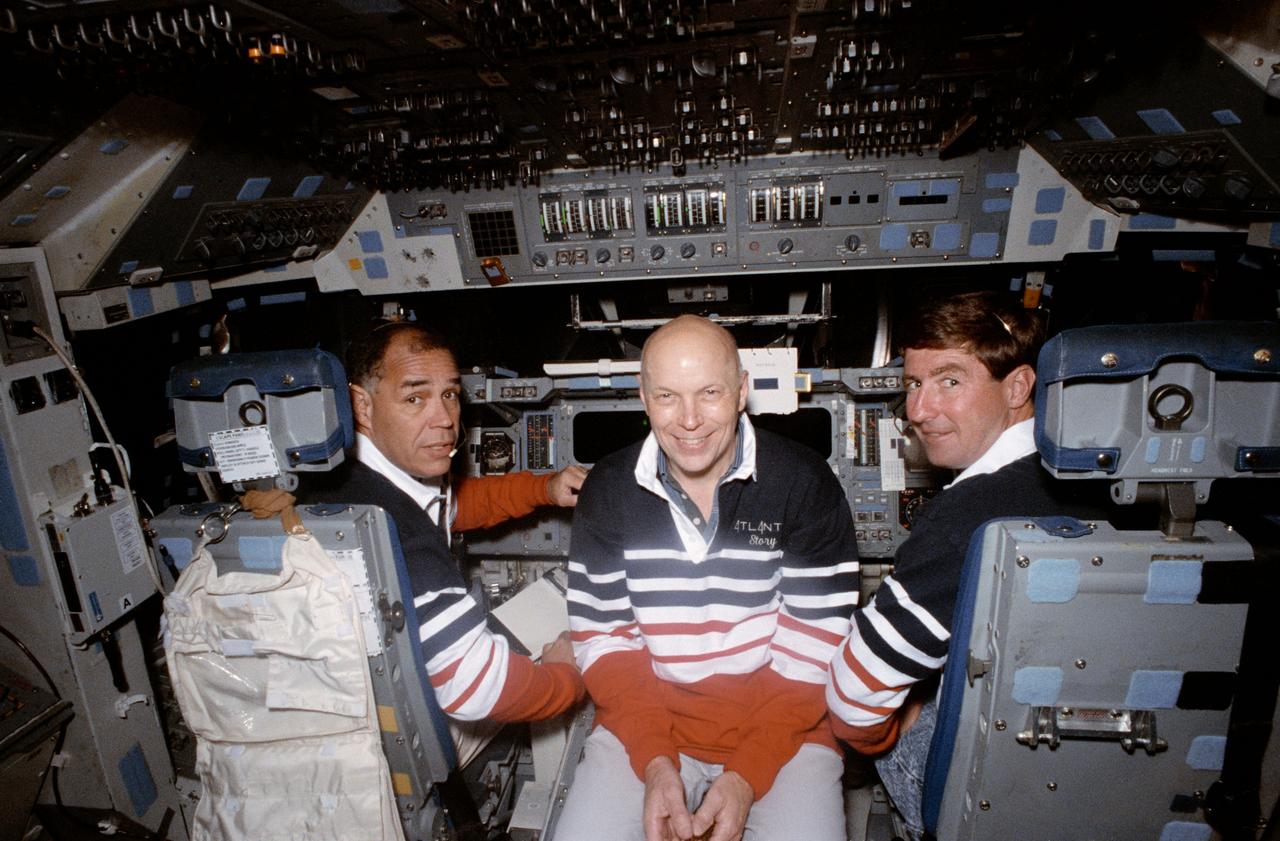
S91-35303 (22 April 1991) --- Astronauts Frederick D. Gregory (left) and Terrence T. Henricks (right), STS-44 commander and pilot, respectively, are joined near their launch and entry stations by F. Story Musgrave, mission specialist. The three pause while rehearsing some of the activities that will be performed during the scheduled ten-day November flight.  Musgrave will be in a rear cabin station during launch and entry phases of the flight deck of the fixed-base Shuttle Mission Simulator (SMS) in the Johnson Space Center's mission simulation and training facility.
STS-44 Atlantis, OV-104, crewmembers participate in FB-SMS training at JSC
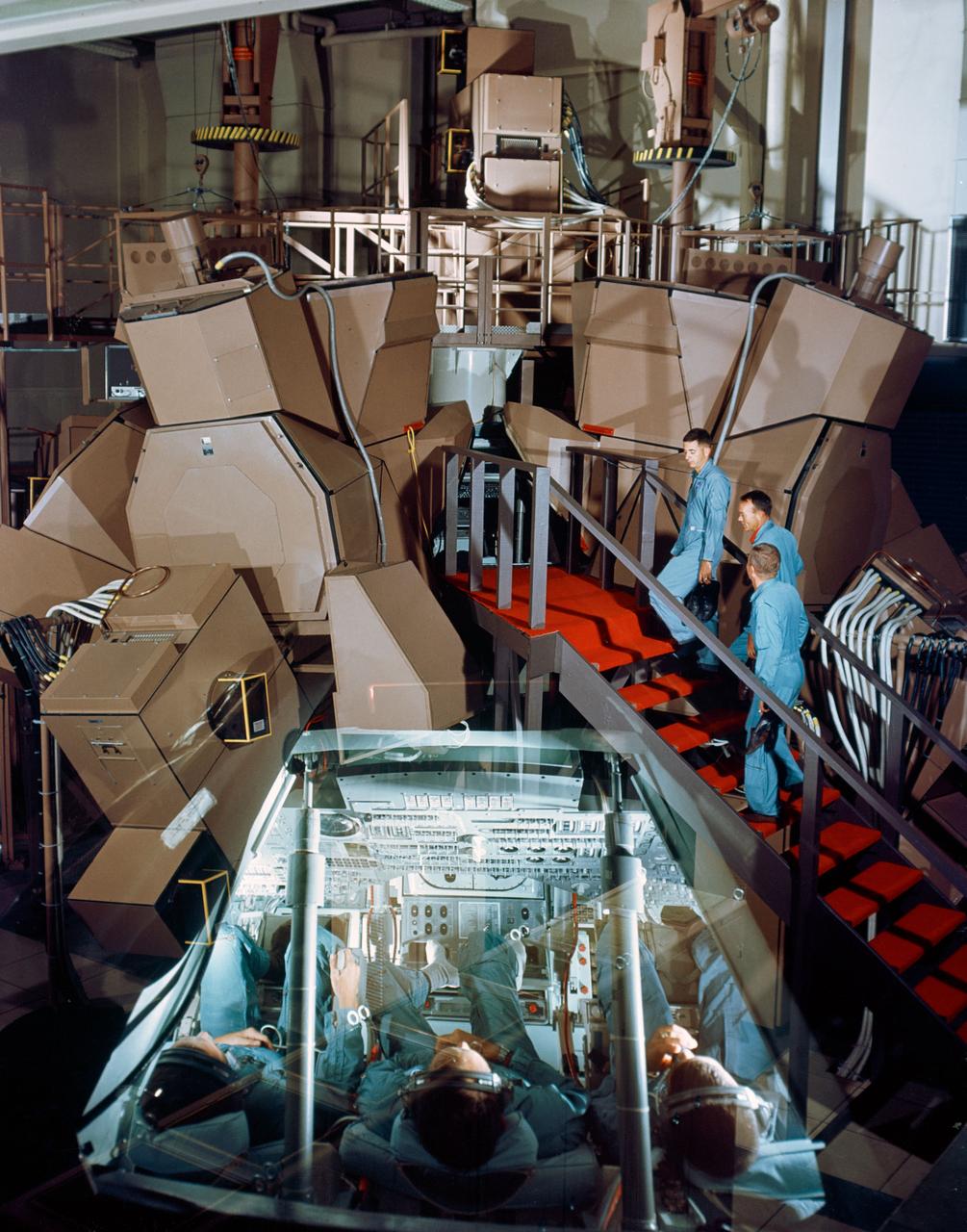
S67-50585 (1967) --- This is an intentional double exposure showing the Apollo Mission Simulator in the Mission Simulation and Training Facility, Building 5 at the Manned Spacecraft Center. In the exterior view astronauts William A. Anders, Michael Collins, and Frank Borman (reading from top of stairs) are about to enter the simulator. The interior view shows the three astronauts in the simulator. They are (left to right) Borman, Collins, and Anders. Photo credit: NASA
Dual exposure view of exterior and interior of Apollo Mission simulator
Two payload specialists for the STS 51-D mission get in some training time in the crew compartment trainerat JSC. Charles D. Walker, left, rehearses photography of U.S. Senator E.J. (Jake) Garn in the middeck section of the trainer.
Sen. Jake Garn and payload specialist Charles Waler in middeck simulation
41D-3138 (4 Sept 1984)--- Canada's backup payload specialist assists the two 41-G prime payload specialists during a training session in the Johnson Space Center's Shuttle mockup and integration laboratory.  Robert Thirsk (without helmet) represents the National Research Council (NRC) and is backup to Marc Garneau (nearest camera), also of the NRC.  Paul D. Scully-Power, seated in the other middeck seat for the launch phase, is a civilian oceanographer with the U.S. Navy.  The 41-G flight aboard the Challenger is NASA's first to utilize a crew of more than six persons.  This photograph was taken by Otis Imboden.
Payload specialists Marc Garneau and Paul Scully-Power in SMS
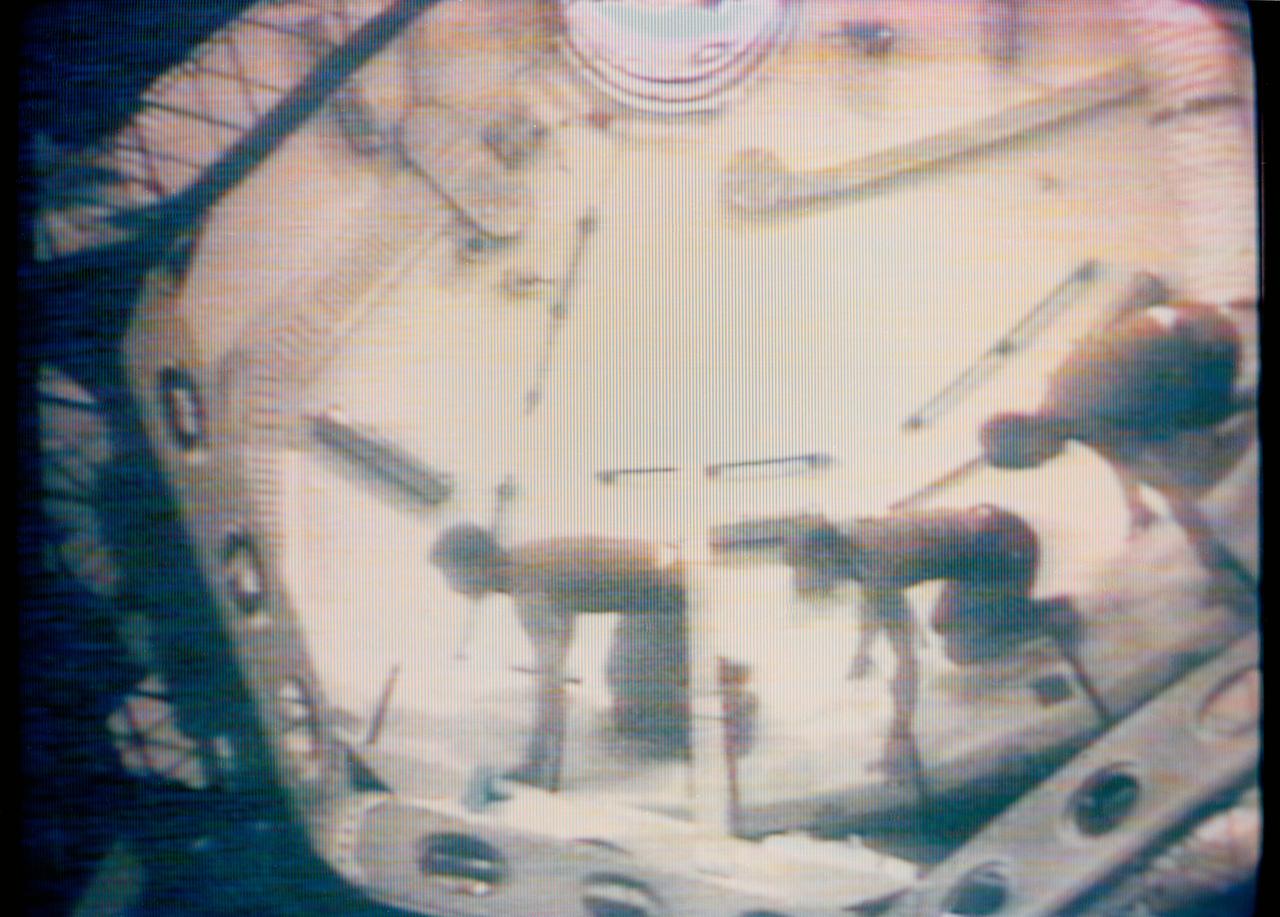
S73-27262 (1 June 1973) --- The three Skylab 2 crewmen give a demonstration on the effects of weightlessness in the Orbital Workshop of the Skylab 1 and 2 space station cluster in Earth orbit, as seen in this reproduction taken from a color television transmission made by a TV camera aboard the space station. Astronauts Charles Conrad Jr., Joseph P. Kerwin and Paul J. Weitz are crouched in a fast-start stance to race around the dome area of the OWS forward compartment. The astronauts had ease of motion and good maneuverability in the zero-gravity of space. Photo credit: NASA
Skylab 2 crewmen give demonstration on effects of weightlessness
STS-44 Mission Specialist (MS) James S. Voss works under the middeck subfloor of Atlantis, Orbiter Vehicle (OV) 104, to repair humidity separator leakage problems. Voss is surrounded by several water tanks and a maze of shuttle wiring and plumbing. Voss earned the nickname of "Bilge Man" because of his time spent on the lower deck tending to the leakage problem. This is the first photo released of a crewmember in this area of the shuttle.
STS-44 MS Voss "Bilge Man" under OV-104's middeck subfloor repairs separator
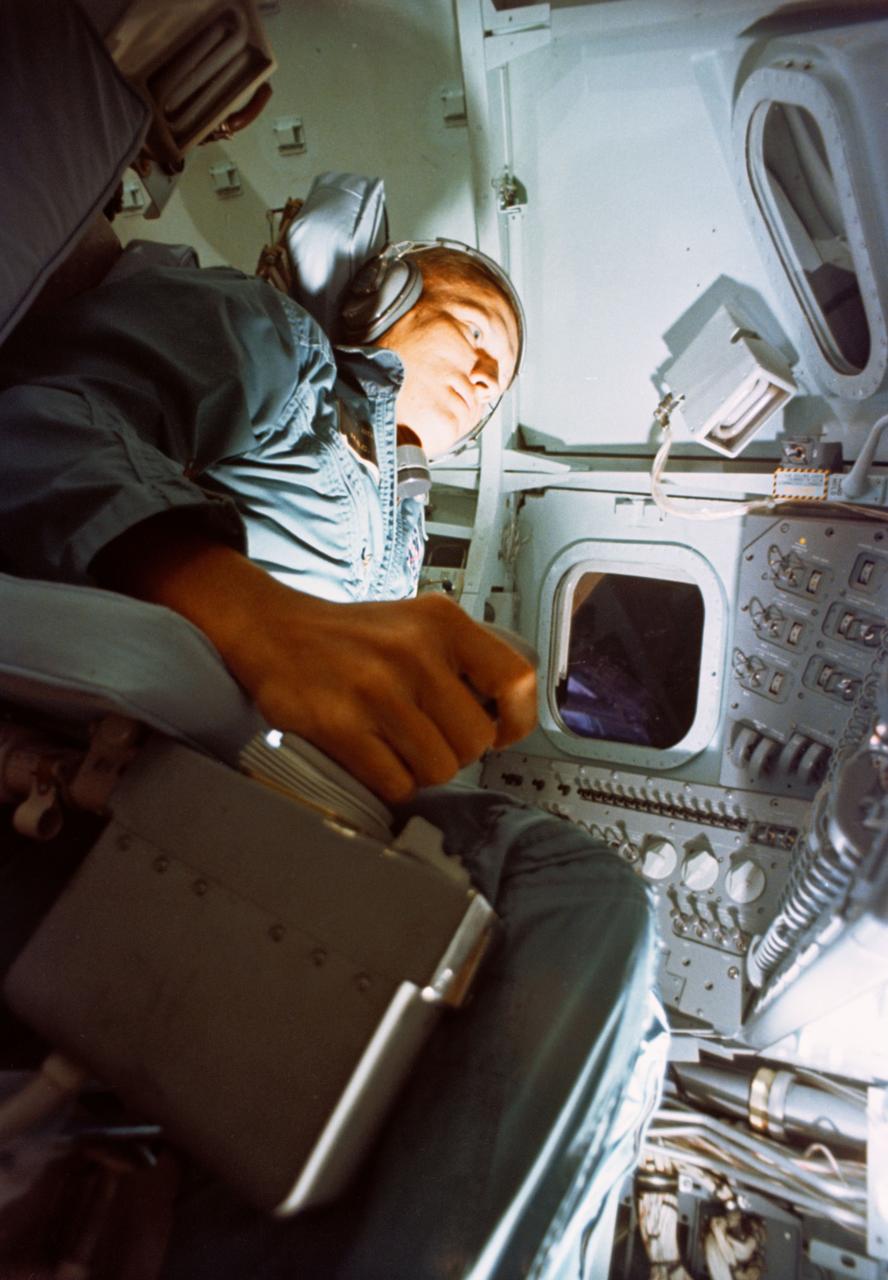
S68-15979 (15 Jan. 1968) --- Astronaut John W. Young, command module pilot, inside the Command Module Simulator in Building 5 during an Apollo Simulation. Out of view are astronaut Thomas P. Stafford (on the left), commander; and astronaut Eugene A. Cernan (on the right), lunar module pilot.
Astronaut John Young in Command Module Simulator during Apollo Simulation
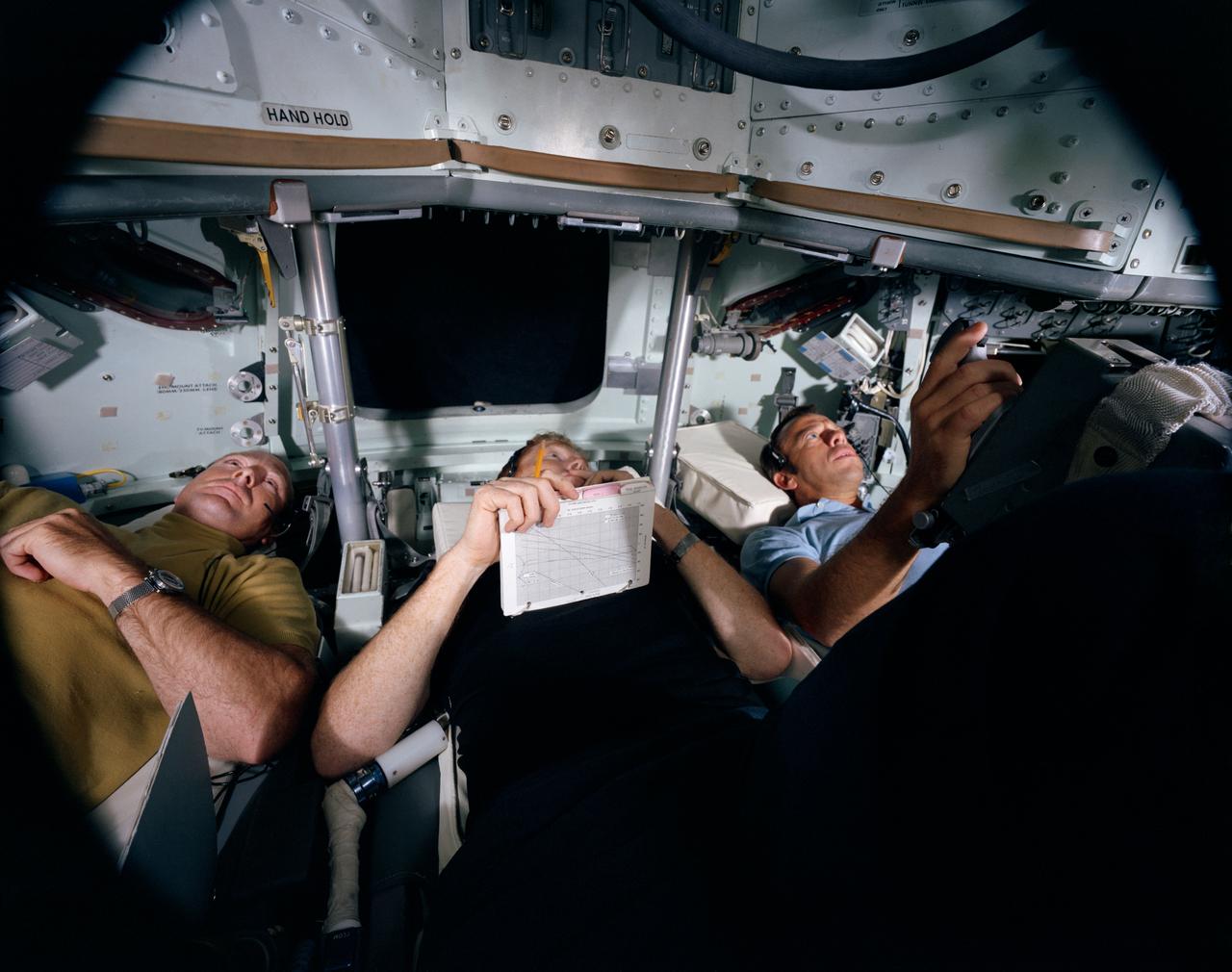
S68-15952 (15 Jan. 1968) --- Three astronauts inside the Command Module Simulator in Building 5 during an Apollo Simulation. Left to right, are astronauts Thomas P. Stafford, commander; John W. Young, command module pilot; and Eugene A. Cernan, lunar module pilot.
Three astronauts inside Command Module Simulator during Apollo Simulation
ISS023-E-044830 (17 May 2010) --- This image features space shuttle Atlantis's cabin and forward cargo bay while the STS-132 spacecraft was docked to the International Space Station during flight day four's extravehicular activity of astronauts Garrett Reisman and Steve Bowen (both out of frame).  Though three sessions of extravehicular activity (EVA) will involve only three astronauts (two on each occasion) who actually leave the shirt-sleeve environments of the two docked spacecraft, all twelve astronauts and cosmonauts on the two combined crews have roles in supporting the EVA work. Photo credit: NASA or National Aeronautics and Space Administration
View of the docked Atlantis during EVA 1
iss055e035971 (4/28/2018) --- Photo documentation of locations of where samples taken by the crew for the Divert Unwanted Space Trash (DUST) operations aboard the International Space Station (ISS). The DUST investigation collects and analyzes particulates in airborne debris from the ISS cabin. Unique aspects of the spacecraft environment, such as lack of gravity and no fresh air, influence the size, quantity, and components of airborne particulate matter, which in turn affects air quality aboard the station. The data also provides baseline information for future spacecraft particle detector design, and the debris can be used for realistic testing of possible particulate monitors for future long-duration missions.
DUST
iss055e035968 (4/28/2018) --- Photo documentation of locations of where samples taken by the crew for the Divert Unwanted Space Trash (DUST) operations aboard the International Space Station (ISS). The DUST investigation collects and analyzes particulates in airborne debris from the ISS cabin. Unique aspects of the spacecraft environment, such as lack of gravity and no fresh air, influence the size, quantity, and components of airborne particulate matter, which in turn affects air quality aboard the station. The data also provides baseline information for future spacecraft particle detector design, and the debris can be used for realistic testing of possible particulate monitors for future long-duration missions.
DUST
ISS023-E-044747 (17 May 2010) --- This image features the space shuttle Atlantis's cabin and forward cargo bay and part of the International Space Station while the two spacecraft remain docked, during STS-132's flight day four extravehicular activity of astronauts Garrett Reisman and Steve Bowen (both out of frame). Though three sessions of extravehicular activity (EVA) will involve only three astronauts (two on each occasion) who actually leave the shirt-sleeve environments of the two docked spacecraft, all twelve astronauts and cosmonauts on the two combined crews have roles in supporting the EVA work. Photo credit: NASA or National Aeronautics and Space Administration
View of the FWD ISS and docked Atlantis during EVA 1