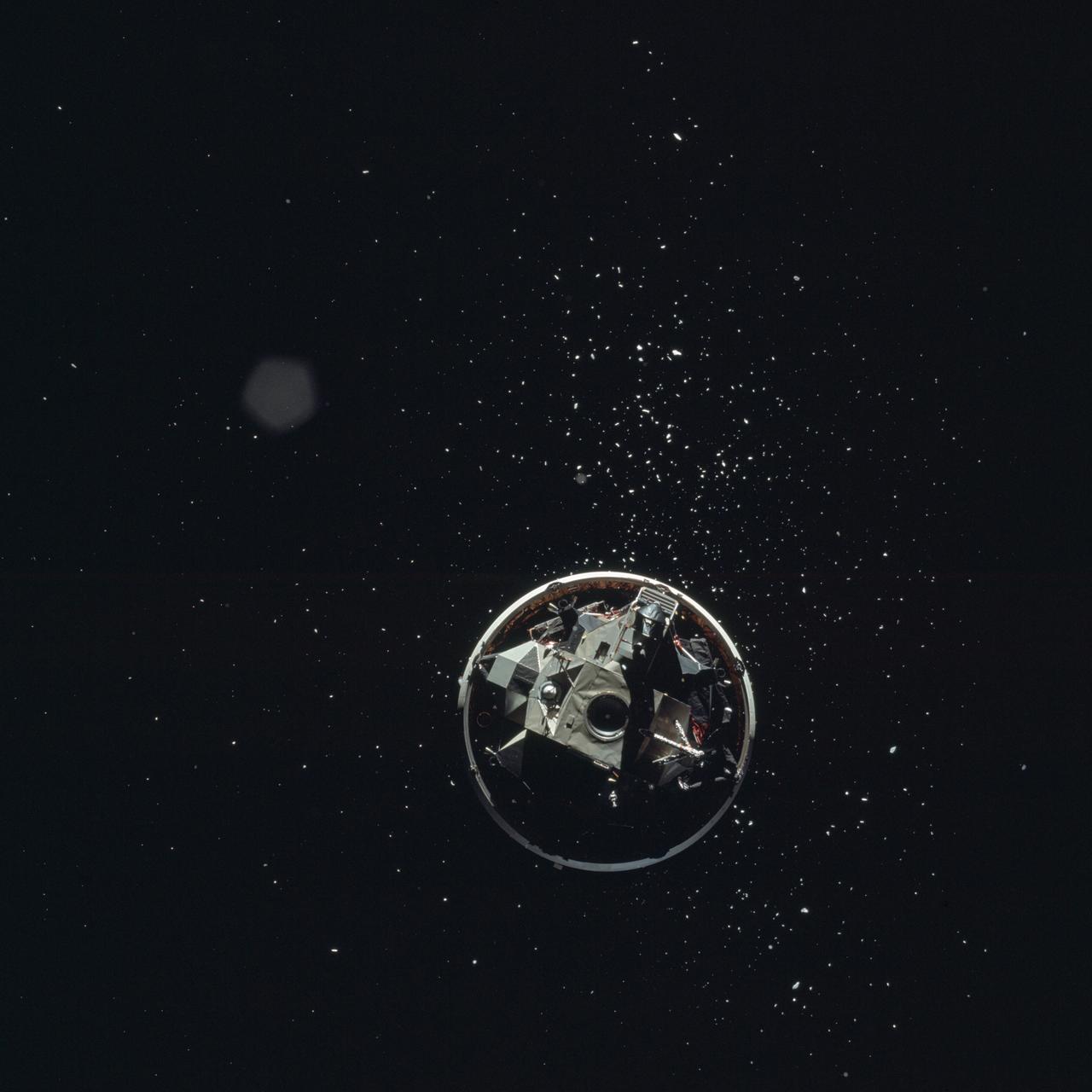
AS17-148-22688 (7-19 Dec. 1972) --- View of the Lunar Module from the Apollo 17 spacecraft after transposition/docking maneuvers. The white dots surrounding the Lunar Module are debris from the Saturn S-IVB stage separation.
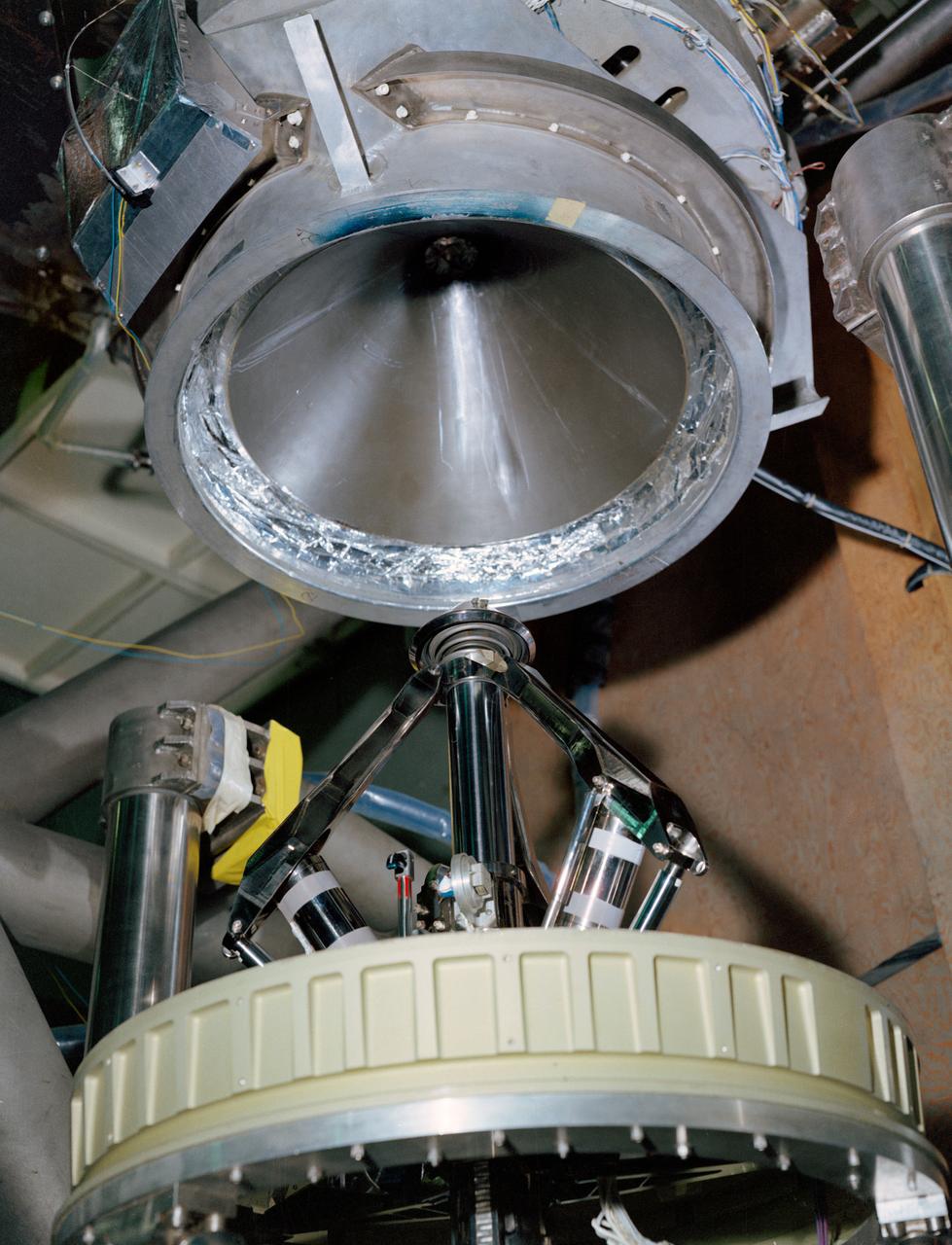
S68-50869 (1968) --- An engineering set up illustrating the docking system of the Apollo spacecraft. During docking maneuvers the docking probe on the Command Module engages the cone-shaped drogue of the Lunar Module. The primary docking structure is the tunnel through which the astronauts transfer from one module to the other. This tunnel is partly in the nose of the Command Module and partly in the top of the Lunar Module. Following CSM/LM docking the drogue and probe are removed to open the passageway between the modules.
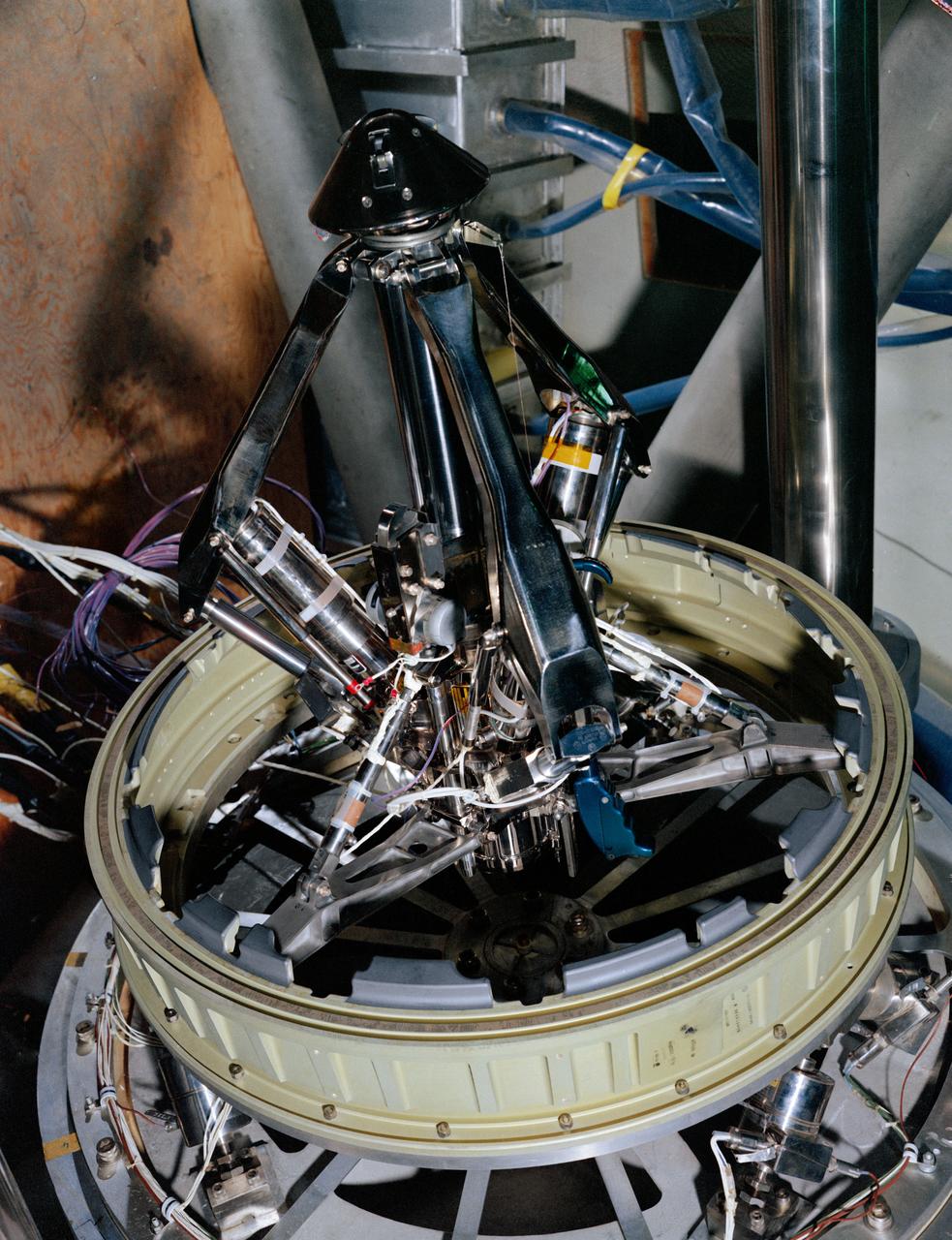
S68-50870 (1968) --- An engineering set up illustrating the probe portion of the docking system of the Apollo spacecraft. During docking maneuvers the docking probe on the Command Module (CM) engages the cone shaped drogue of the Lunar Module (LM). The primary docking structure is the tunnel through which the astronauts transfer from one module to the other. This tunnel is partly in the nose of the CM and partly in the top of the LM. Following CSM/LM docking the drogue and probe are removed to open the passageway between the modules.
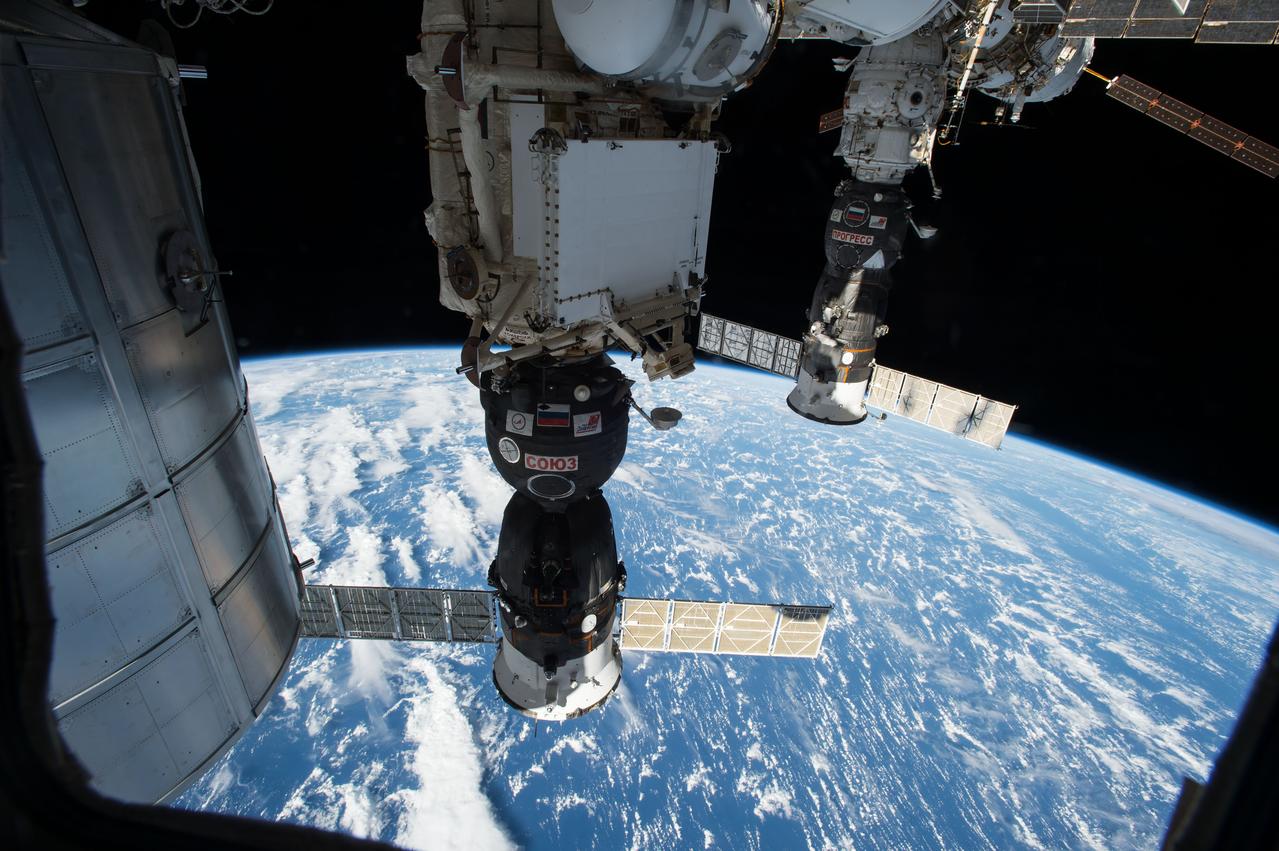
View of the Soyuz TMA-15M spacecraft docked to Rassvet Mini-Research Module 1 (MRM1) and the Progress 57P spacecraft docked to Pirs Docking Compartment (DC1). Portions of the Leonardo Permanent Multipurpose Module (PMM), aft ISS, and an Earth limb are in view. Image was released by astronaut on Twitter.
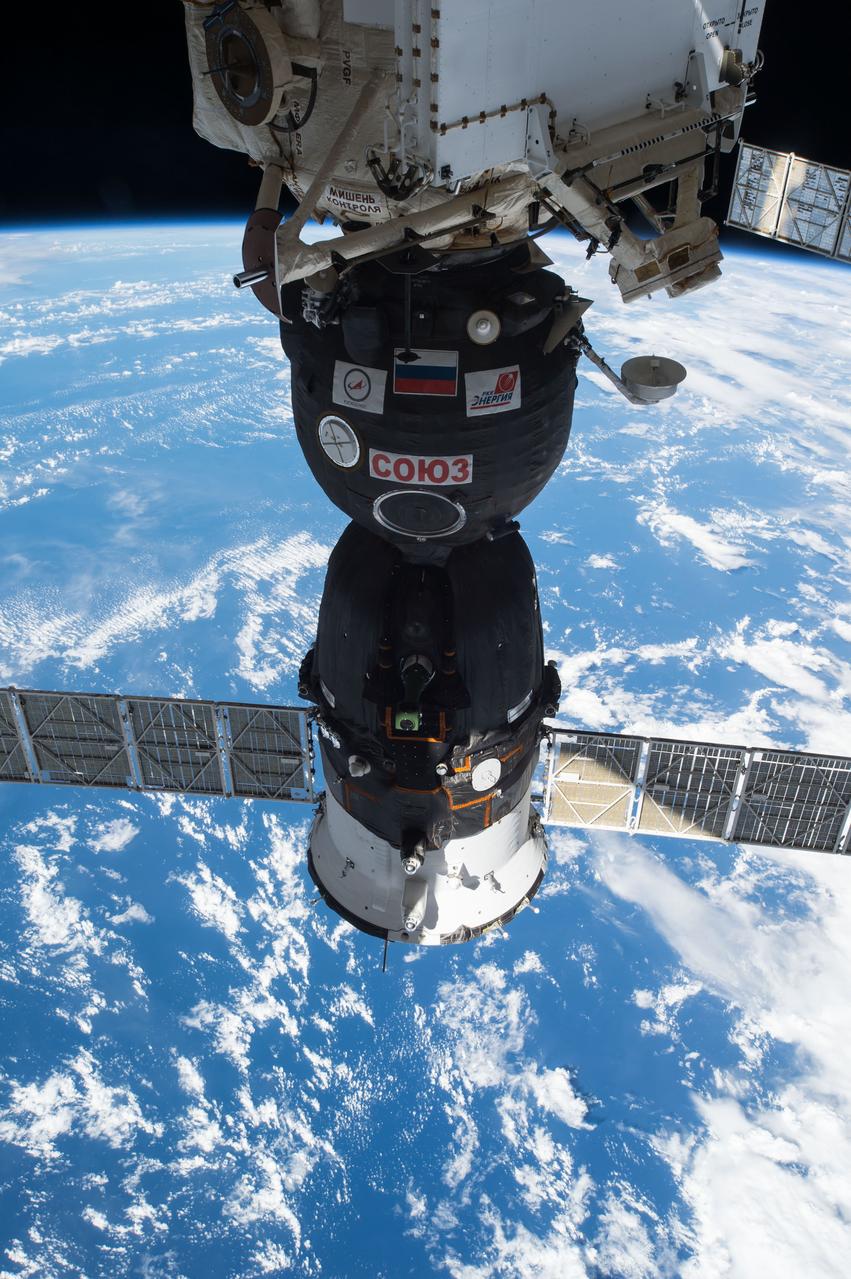
View of the Soyuz TMA-15M spacecraft docked to Rassvet Mini-Research Module 1 (MRM1) An Earth limb is in view.
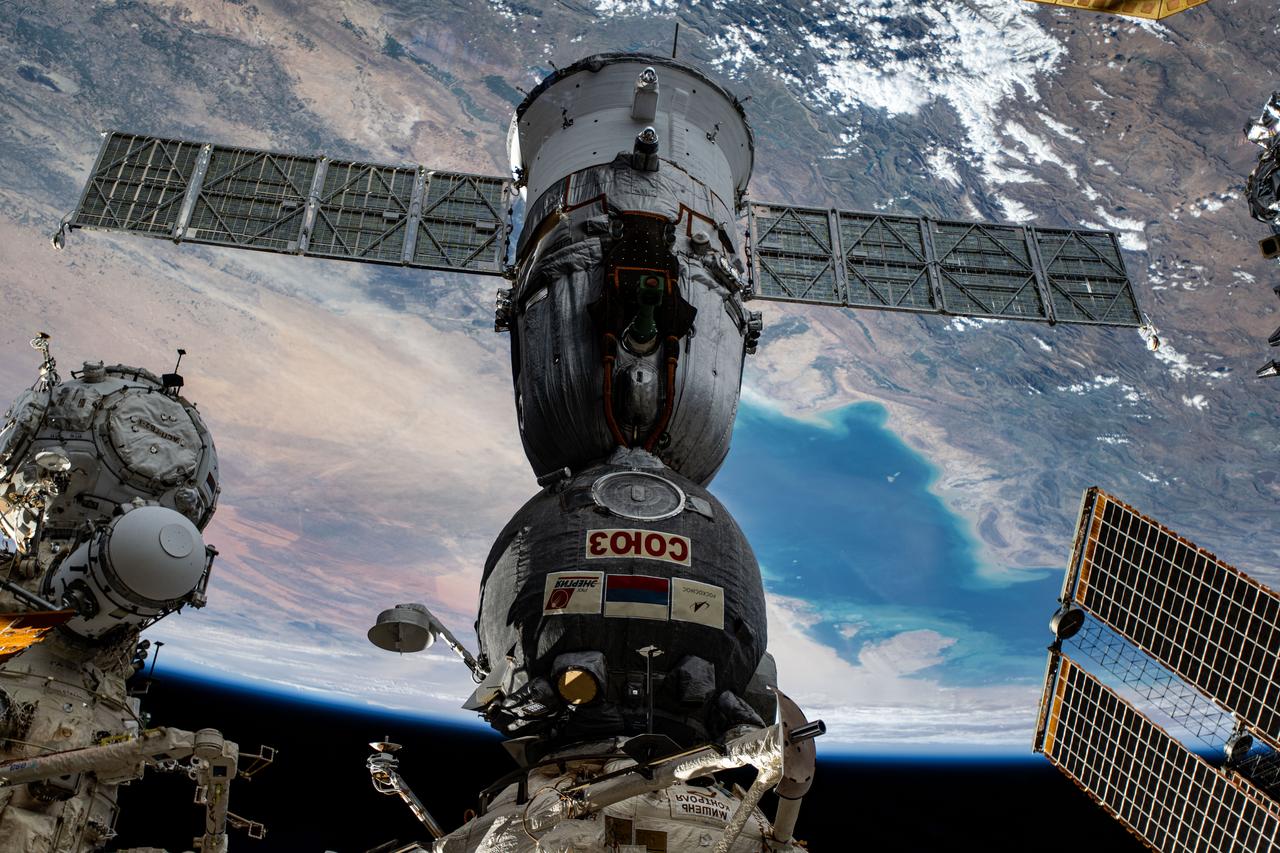
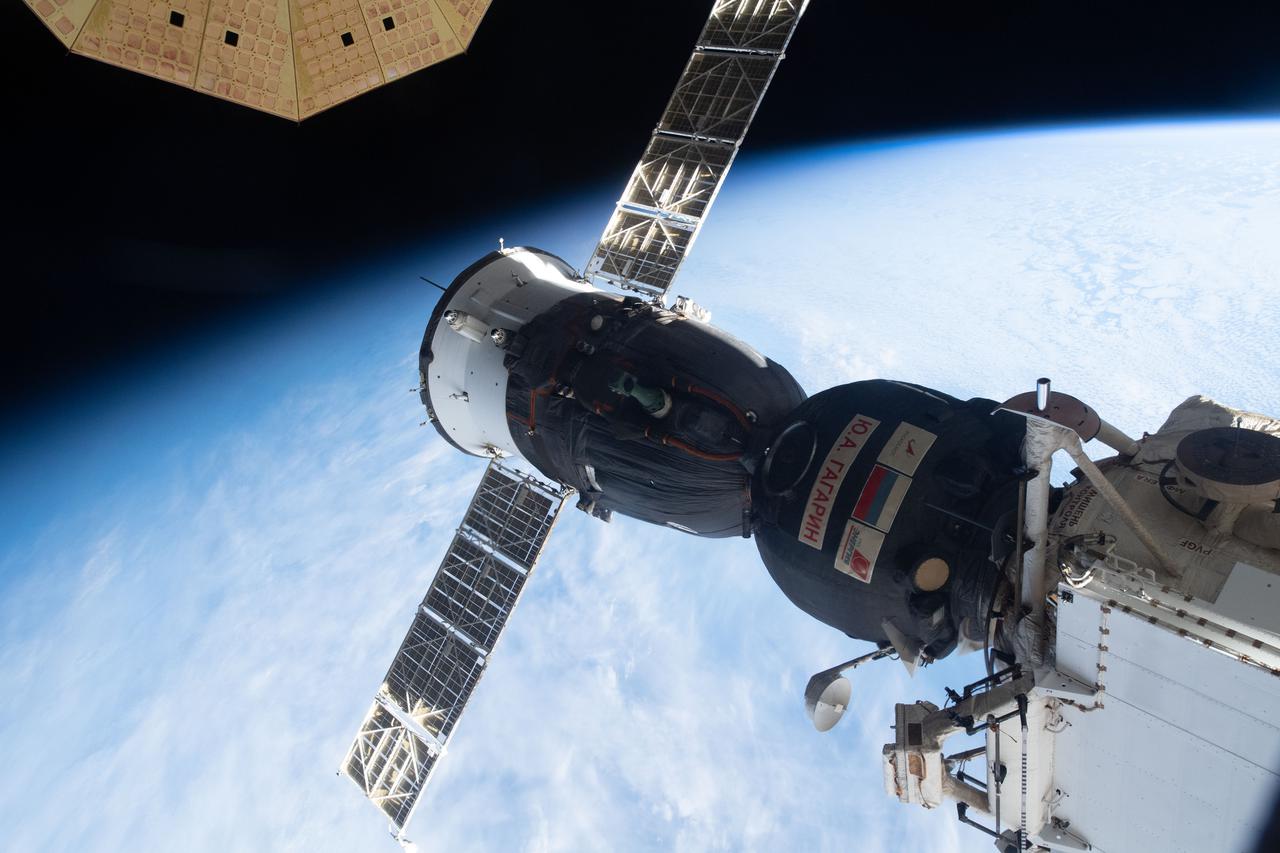
iss072e838101 (March 24, 2025) --- The Soyuz MS-26 spacecraft that launched NASA astronaut Don Pettit and Roscosmos cosmonauts Alexey Ovchinin and Ivan Vagner to the International Space Station is pictured docked to the Rassvet module. The orbiting lab was soaring 260 miles above Turkmenistan near the Caspian Sea.
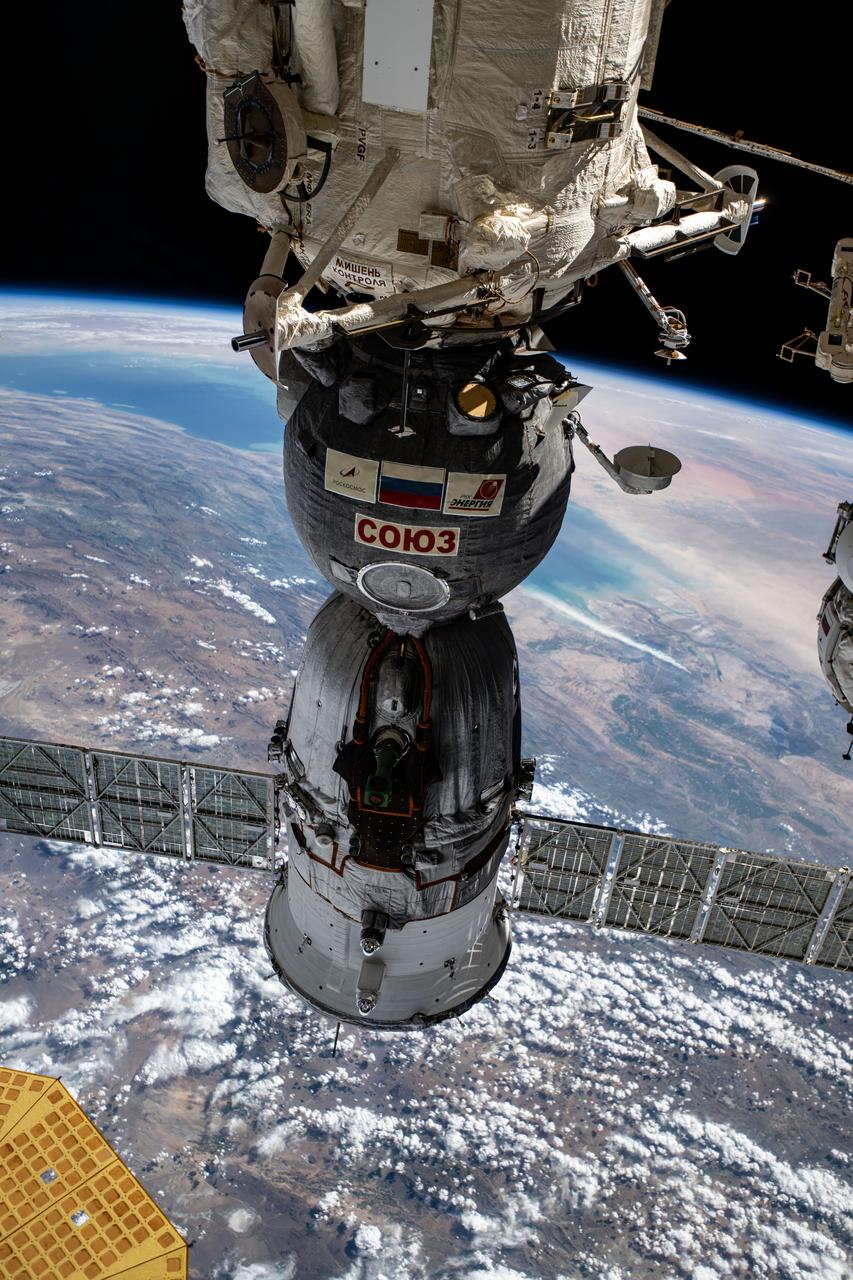
iss072e838106 (March 24, 2025) --- The Soyuz MS-26 spacecraft that launched NASA astronaut Don Pettit and Roscosmos cosmonauts Alexey Ovchinin and Ivan Vagner to the International Space Station is pictured docked to the Rassvet module. The orbiting lab was soaring 260 miles above Turkmenistan near the Caspian Sea.
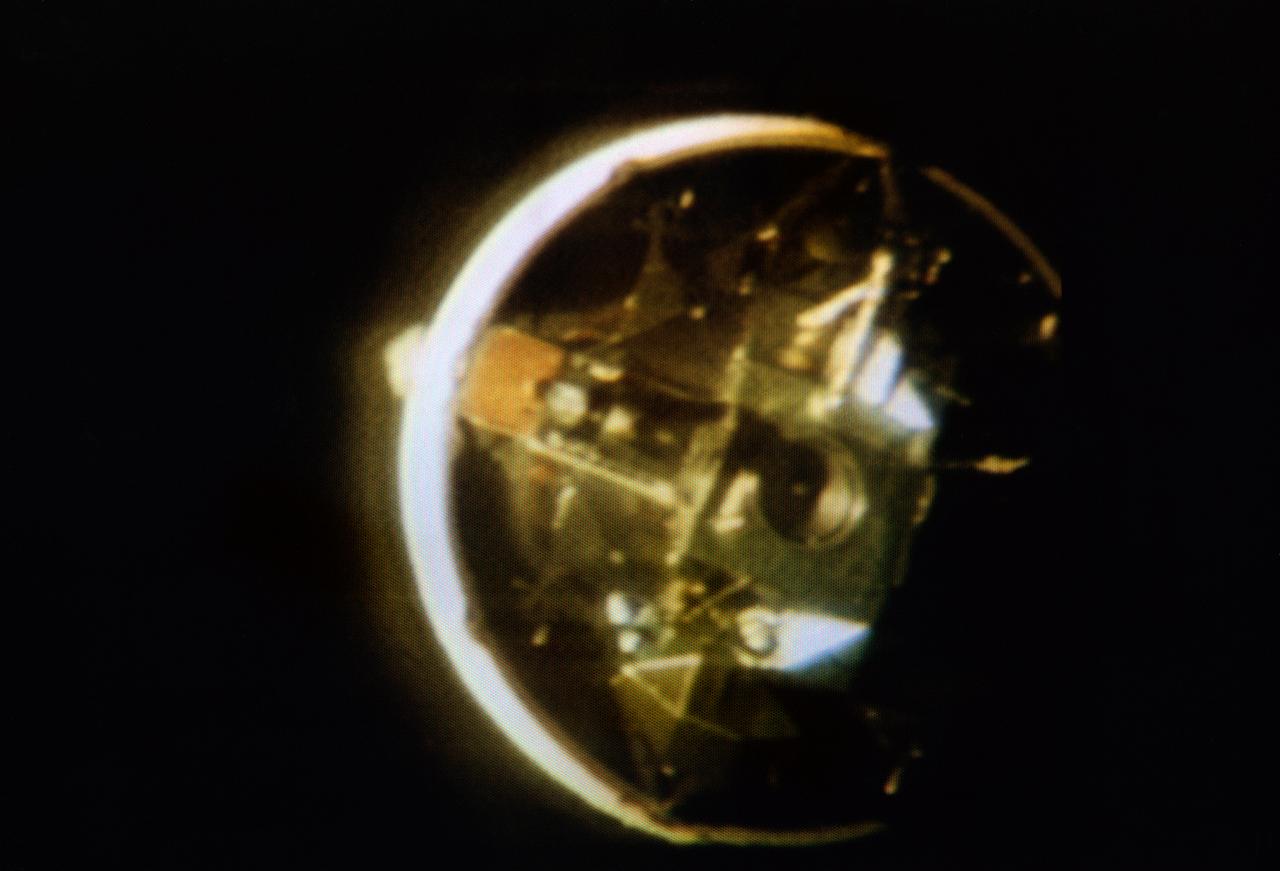
S69-33994 (18 May 1969) --- The Apollo 10 Lunar Module, still attached to the Saturn IVB stage, is seen in this color reproduction taken from the first television transmission made by the color television camera aboard the Apollo 10 spacecraft. This picture was made following CSM/LM-S-IVB separation, and prior to LM extraction from the S-IVB. The Command and Service Modules were making the docking approach to the LM/S-IVB. The circular object is the docking drogue assembly on the LM. Aboard the Command Module were astronauts Thomas P. Stafford, commander; John W. Young, command module pilot; and Eugene A. Cernan, lunar module pilot.
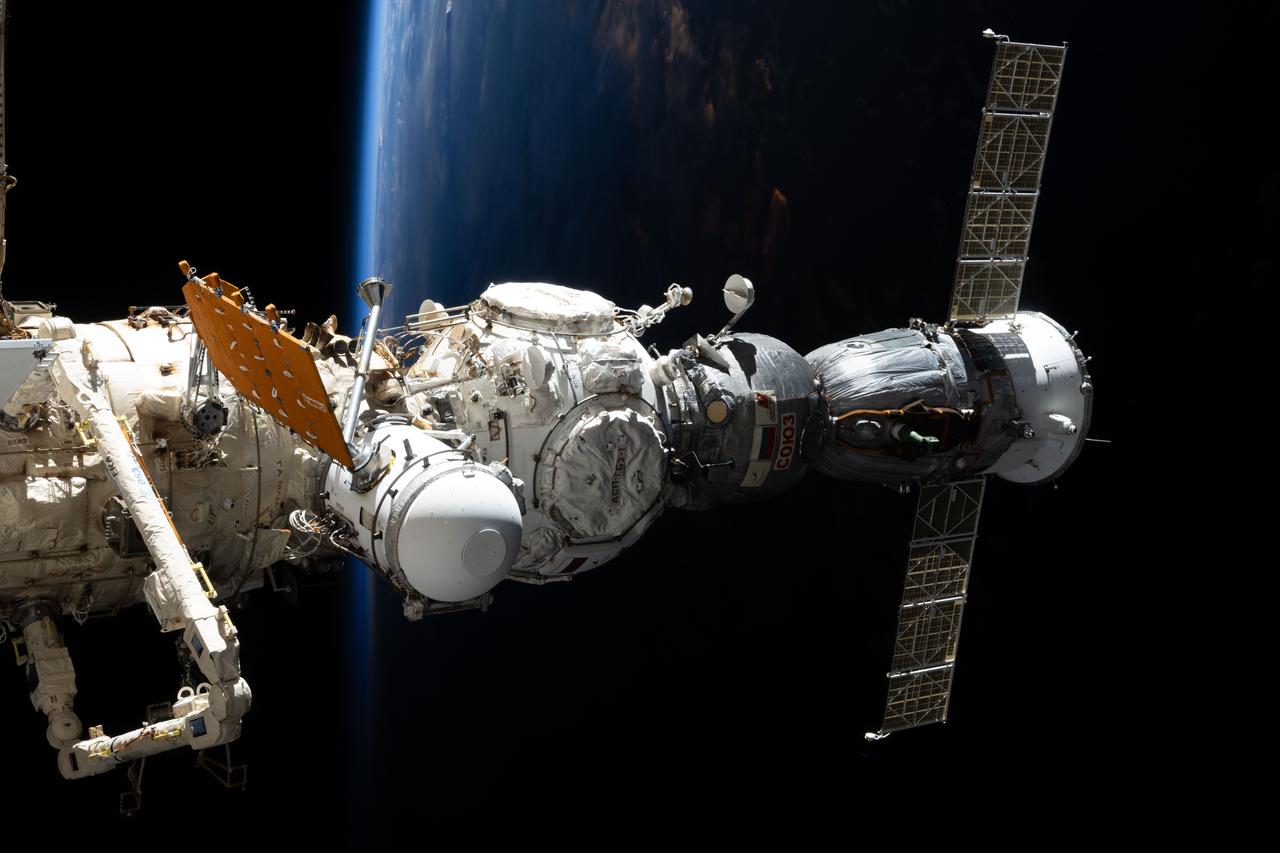
iss073e0775529 (Sept. 8, 2025) --- The Soyuz MS-27 spacecraft, which launched three Expedition 73 crew members to the International Space Station, is pictured docked to the Prichal module. Prichal is itself connected to the Nauka science module on the station’s Roscosmos segment. Below, the Pacific Ocean fades from view as an orbital sunset descends 258 miles beneath the orbiting complex.

iss073e0775543 (Sept. 8, 2025) --- The Soyuz MS-27 spacecraft, which launched three Expedition 73 crew members to the International Space Station, is pictured docked to the Prichal module. Prichal is itself connected to the Nauka science module on the station’s Roscosmos segment. Below, the Pacific Ocean fades from view as an orbital sunset descends 258 miles beneath the orbiting complex.
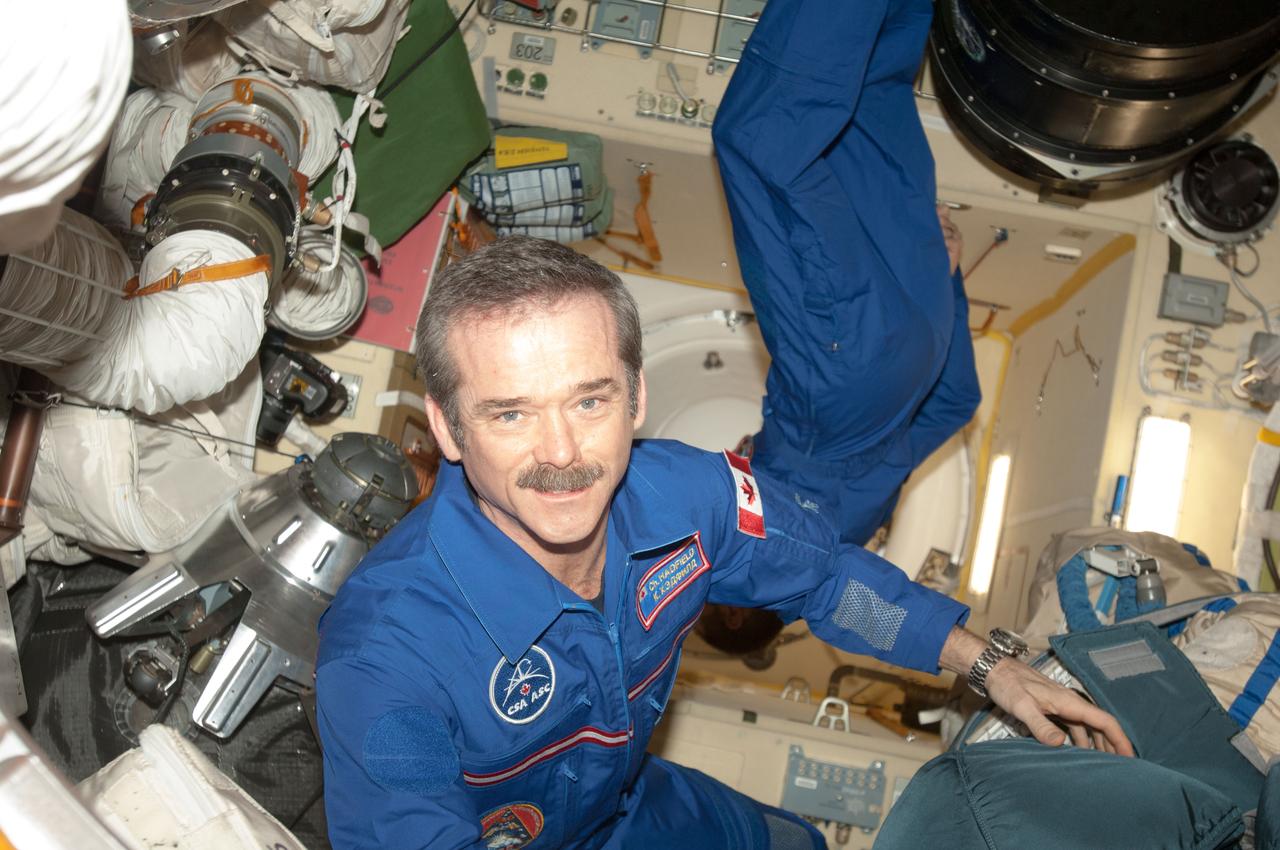
Expedition 35 commander Chris Hadfield and flight engineer Tom Marshburn (partially obscured) are photographed in the Poisk Mini-Research Module 2 (MRM2) during preparations for hatch opening with the docked Soyuz TMA-08M/34S spacecraft. Hadfield is a Canadian Space Agency (CSA) astronaut.
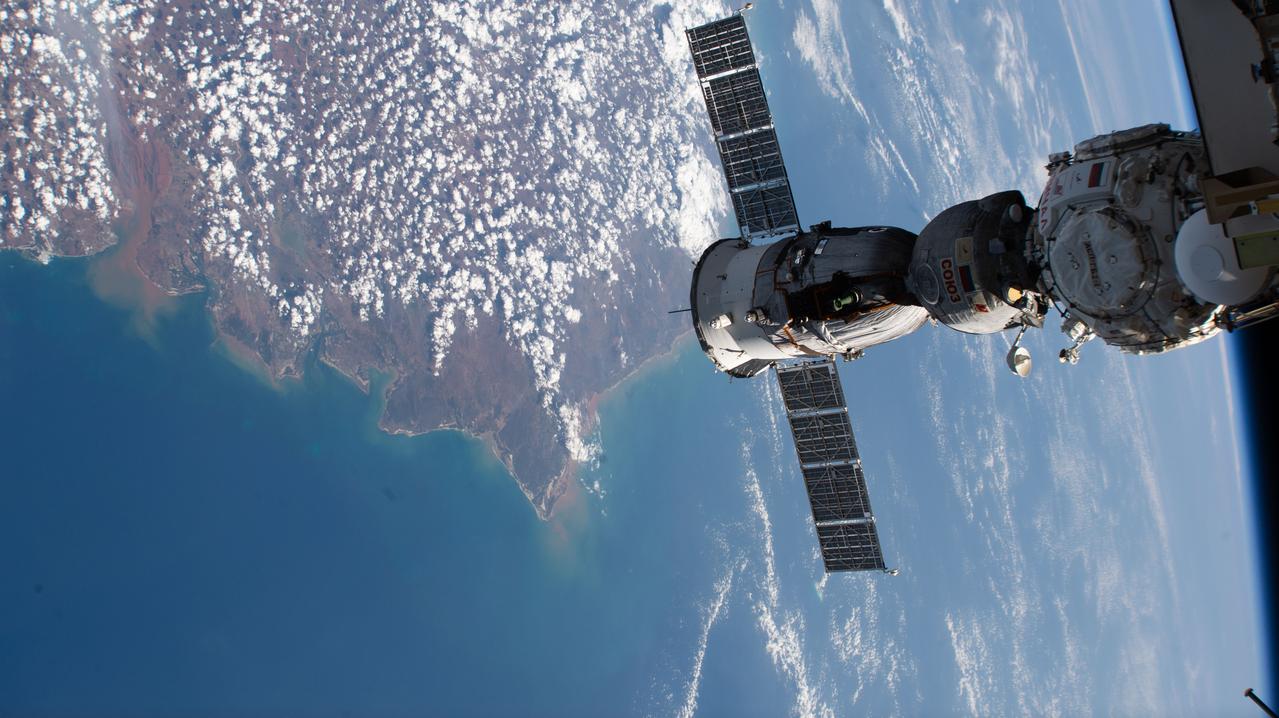
iss073e0659744 (Sept. 14, 2025) --- The Soyuz MS-27 spacecraft is pictured docked to the International Space Station's Prichal module as the orbital outpost soared 259 miles above the northern coast of Madagascar.
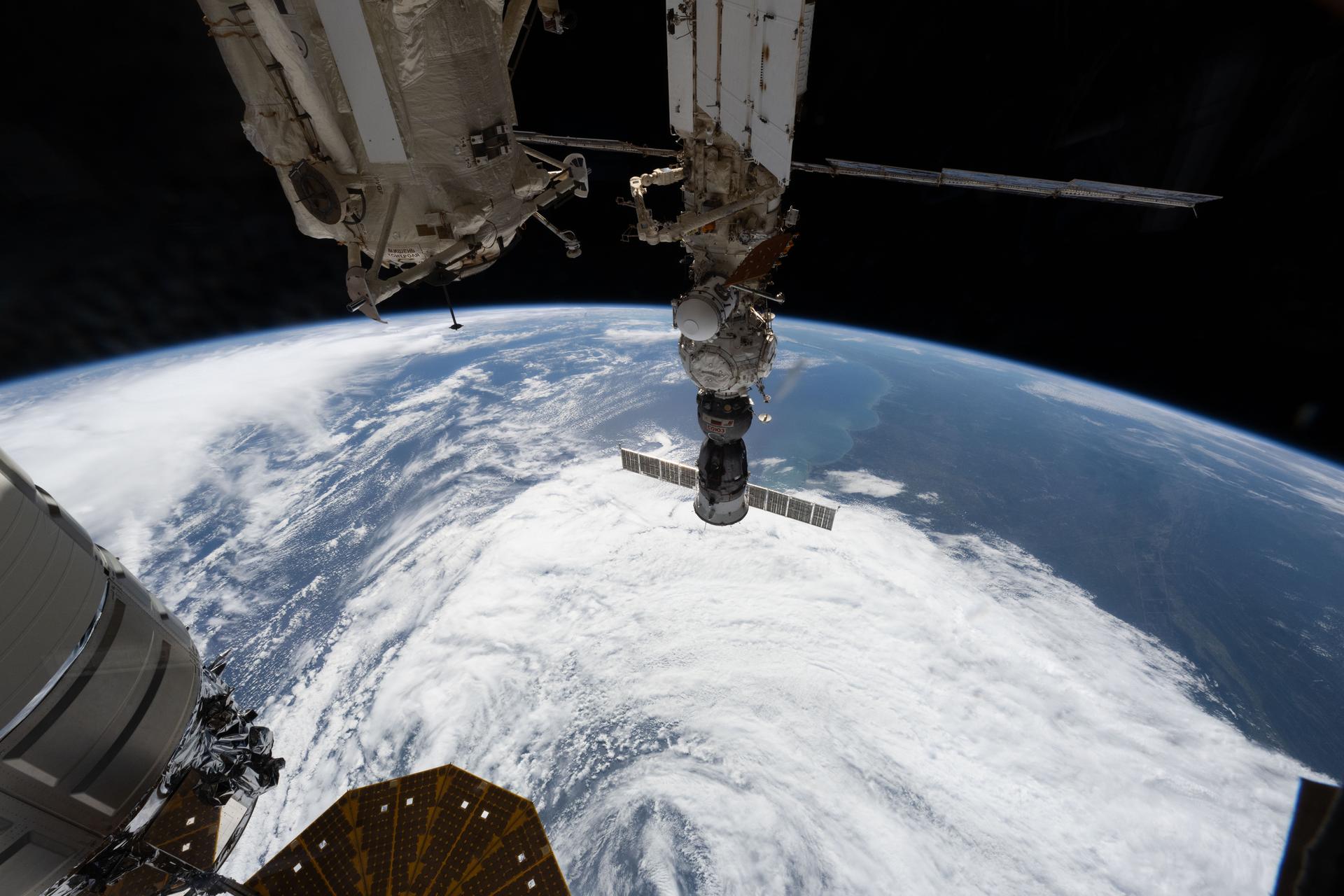
iss075e0153938 (Sept. 28, 20267) --- At center, the Soyuz MS-29 crew spacecraft is pictured docked to the Prichal module as the International Space Station orbited 263 miles above a cloudy southern Europe. Credit: ESA/Sophie Adenot
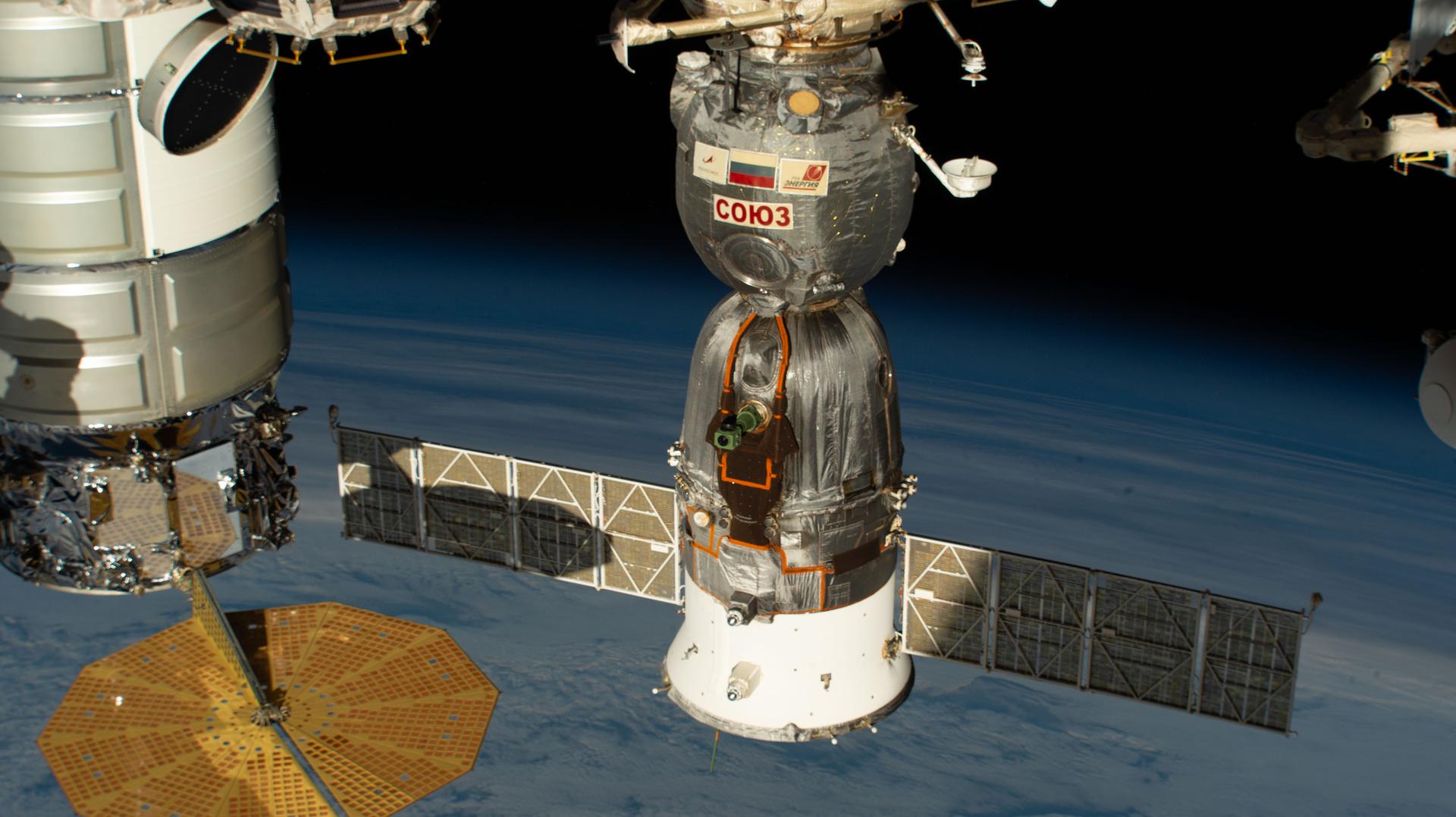
iss074e0812341 (July 13, 2026) --- The Soyuz MS‑28 crew spacecraft, which launched and docked to the International Space Station on Nov. 25, 2025, is pictured docked to the Rassvet module. The Soyuz MS‑28 will return NASA astronaut Chris Williams and Roscosmos cosmonauts Sergey Kud‑Sverchkov and Sergei Mikaev to Earth at the end of July, completing an eight‑month space research mission. Credit: NASA
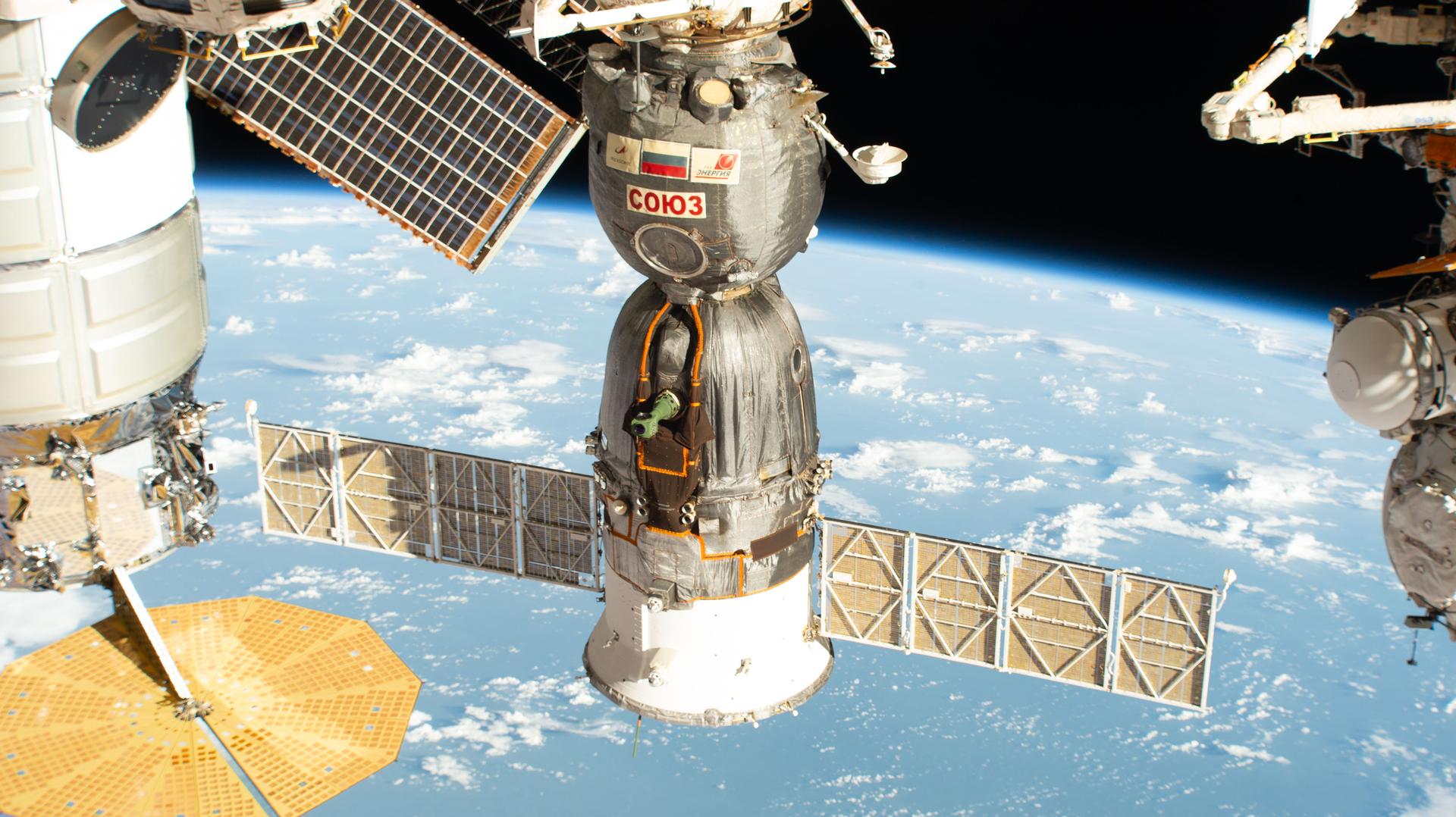
iss074e0812301 (July 13, 2026) --- The Soyuz MS‑28 crew spacecraft, which launched and docked to the International Space Station on Nov. 25, 2025, is pictured docked to the Rassvet module. The Soyuz MS‑28 will return NASA astronaut Chris Williams and Roscosmos cosmonauts Sergey Kud‑Sverchkov and Sergei Mikaev to Earth at the end of July, completing an eight‑month space research mission. Credit: NASA

iss073e0248045 (May 29, 2025) --- The Soyuz MS-27 spacecraft is pictured docked to the International Space Station's Prichal module while soaring 263 miles above the Canadian province of Quebec. Prominently featured in the center of this photograph is the 214 million-year-old Manicouagan crater.

iss074e0409125 (March 24, 2026) -- The Progress 94 cargo spacecraft is pictured docked to the International Space Station's Poisk module. Credit: NASA
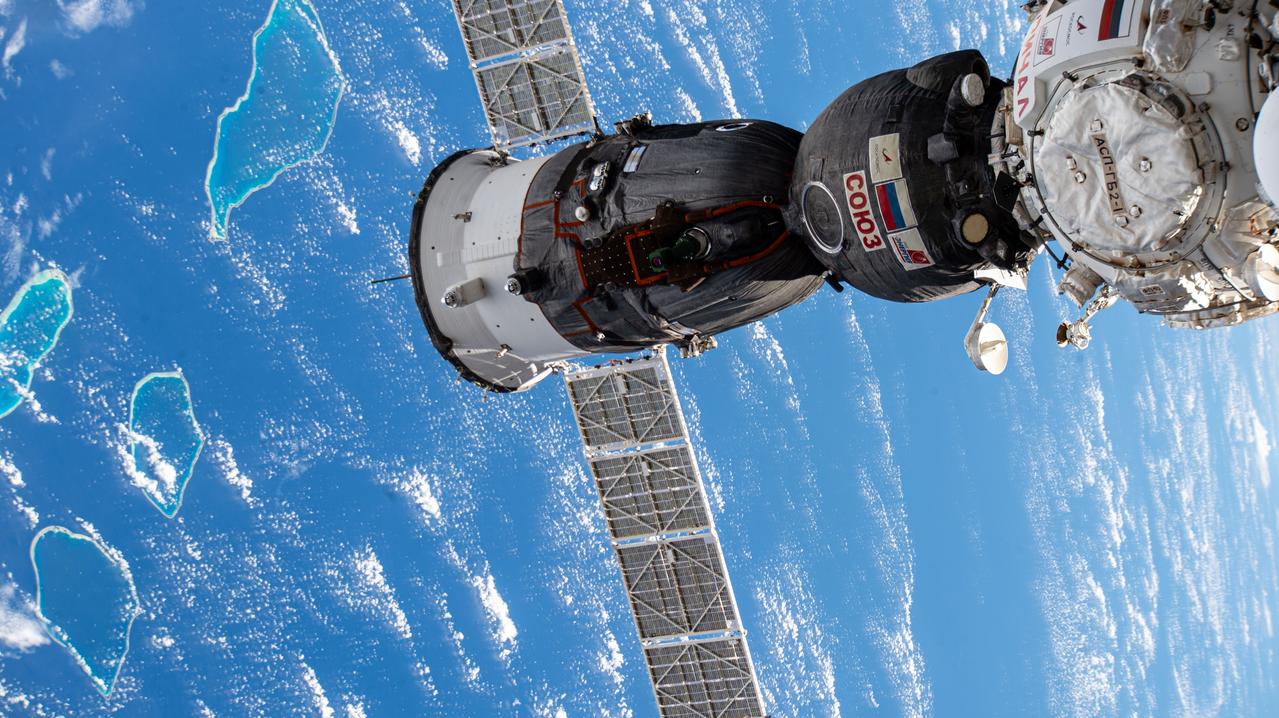
iss073e0002705 (April 26, 2025) --- The Soyuz MS-27 spacecraft is pictured docked to the Prichal module as the International Space Station orbited 264 miles above French Polynesia, France's oveseas collectivity of over 100 islands in the Pacific Ocean. The Soyuz launched NASA astronaut Jonny Kim and Roscosmos cosmonauts Sergey Ryzhikov and Alexey Zubritsky to the orbital outpost on April 8.
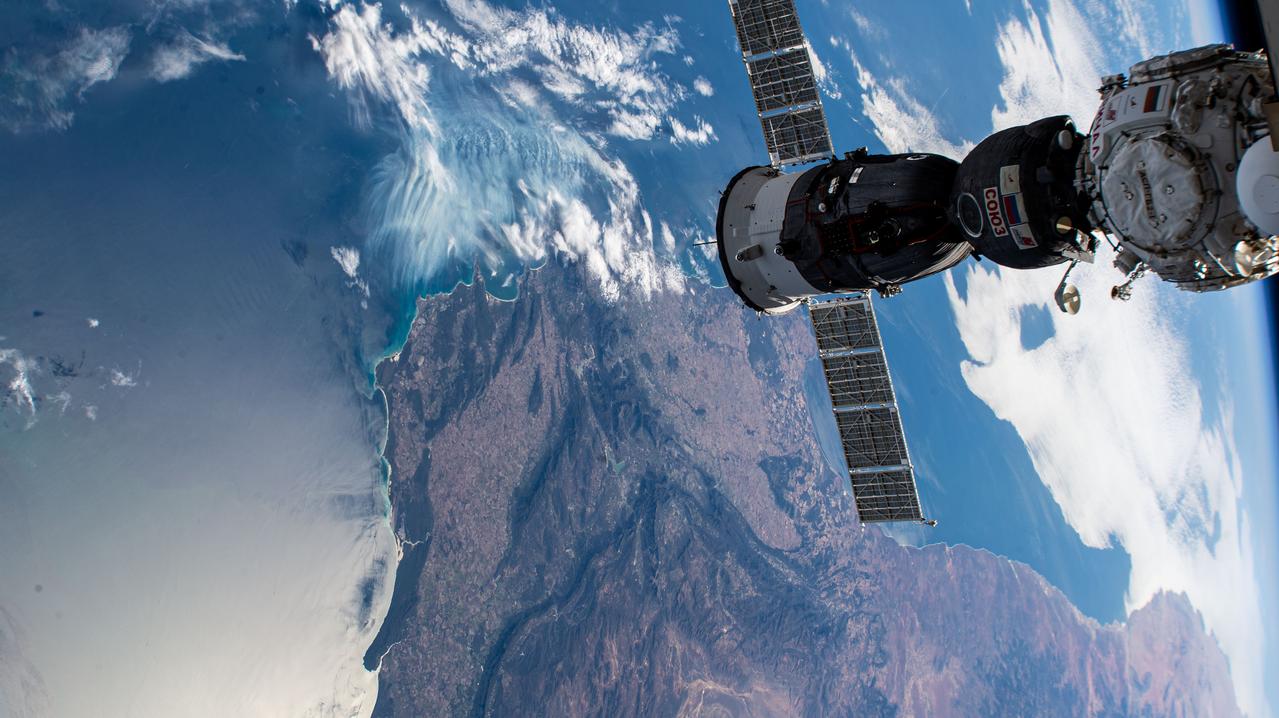
iss073e0002707 (April 27, 2025) --- The Soyuz MS-27 spacecraft is pictured docked to the Prichal module as the International Space Station orbited 269 miles above the Indian Ocean off the coast of South Africa. The Soyuz launched NASA astronaut Jonny Kim and Roscosmos cosmonauts Sergey Ryzhikov and Alexey Zubritsky to the orbital outpost on April 8.
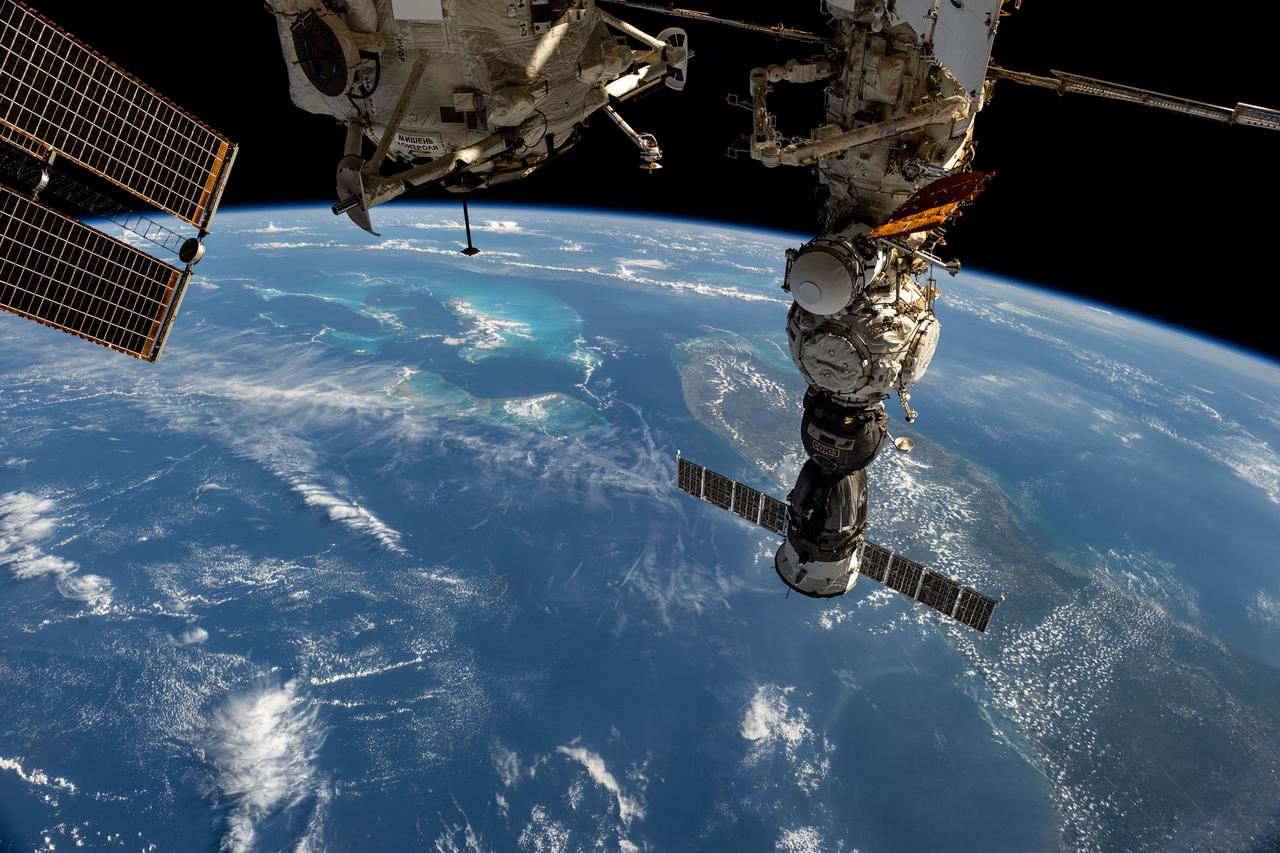
iss073e0134239 (May 20, 2025) --- The Soyuz MS-27 spacecraft that launched three Expedition 72-73 flight engineers to the International Space Station on April 8, 2025, is pictured docked to the Prichal module. 261 miles below the orbital outpost is the state of Florida and the island country of the Bahamas, also known as the Commonwealth of the Bahamas, in the Atlantic Ocean.
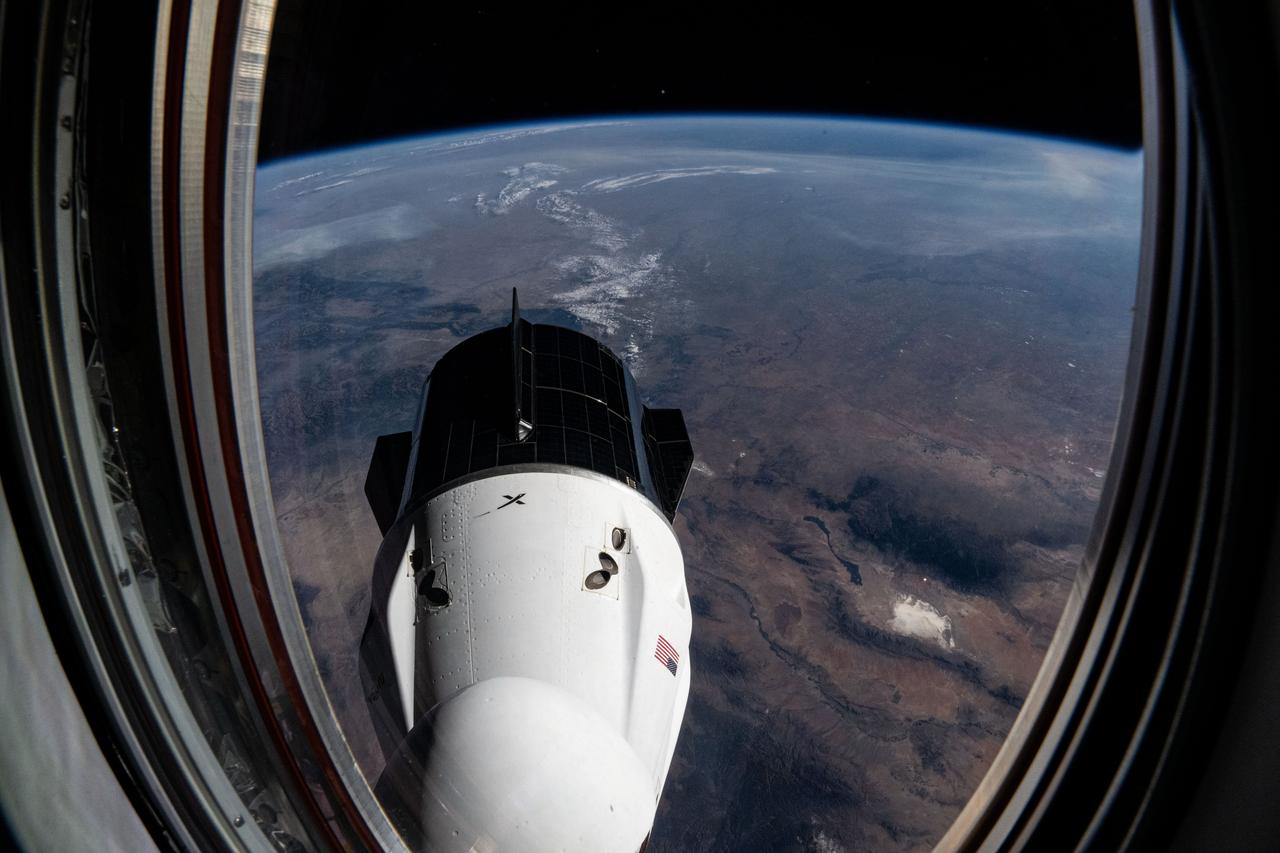
iss072e031300 (Oct. 7, 2024) -- The SpaceX Dragon Freedom spacecraft, docked to the forward-facing port of the International Space Station's Harmony module, was photographed as the orbiting lab soared 258 miles above the state of Colorado.
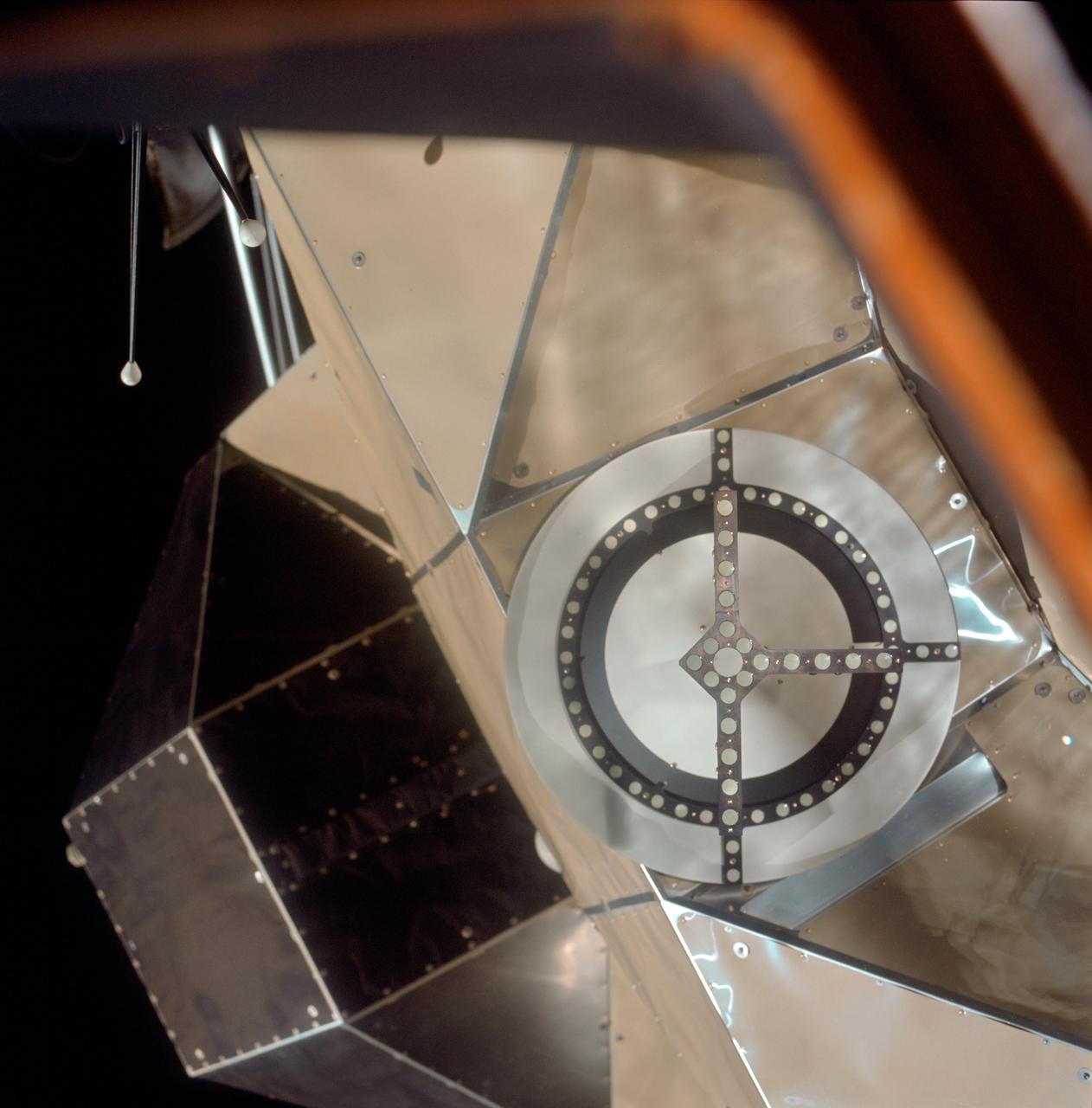
AS11-36-5365 (21 July 1969) --- A close-up view of the docking target on the Apollo 11 Lunar Module (LM) photographed from the Command Module during the LM/CSM docking in lunar orbit. Astronauts Neil A. Armstrong, commander, and Edwin E. Aldrin Jr., lunar module pilot, in the LM, were returning from the lunar surface. Astronaut Michael Collins, command module pilot, remained with the Command and Service Modules (CSM) in lunar orbit while Armstrong and Aldrin explored the moon.
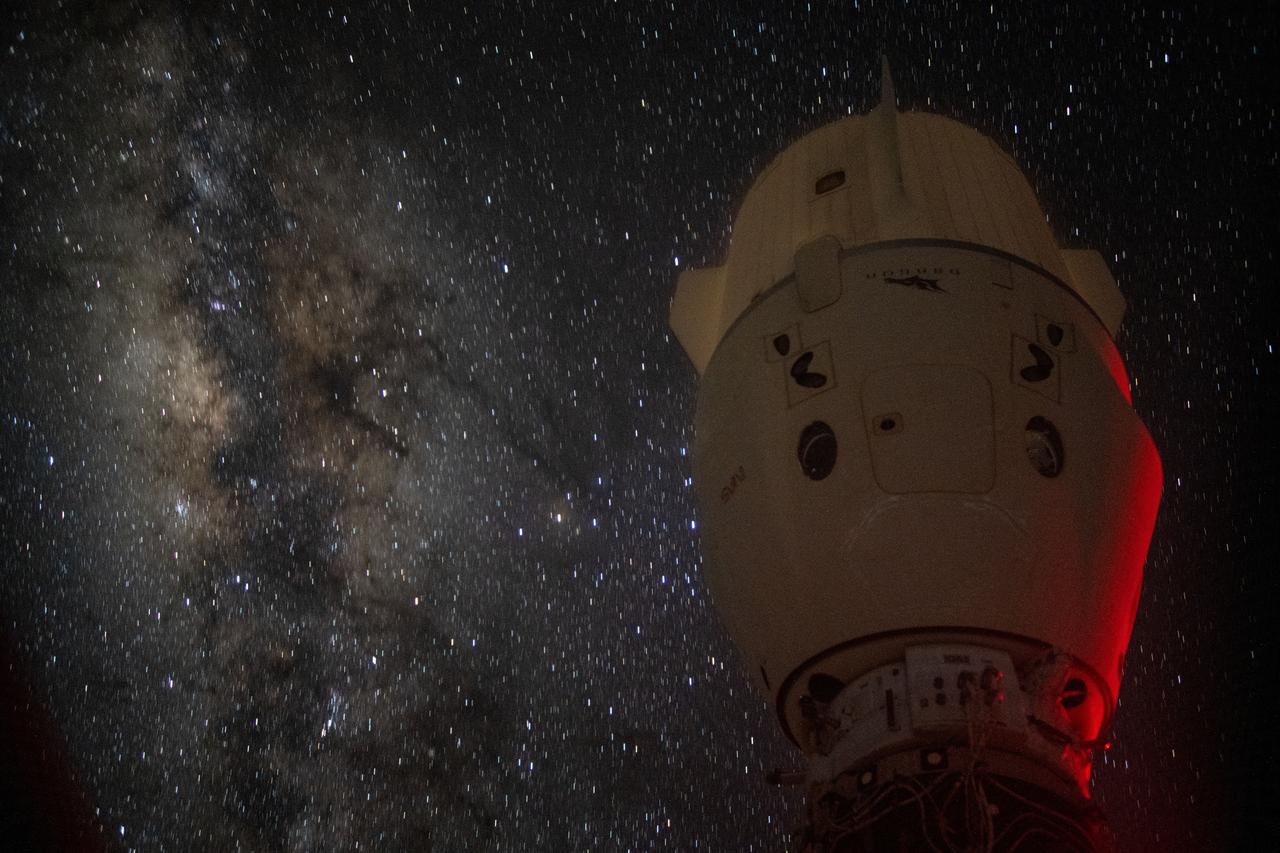
iss071e256593 (July 1, 2024) --- The Milky Way appears in the vastness of space behind the dimly lit SpaceX Dragon Endeavour spacecraft docked to the Harmony module's space-facing port on the International Space Station.
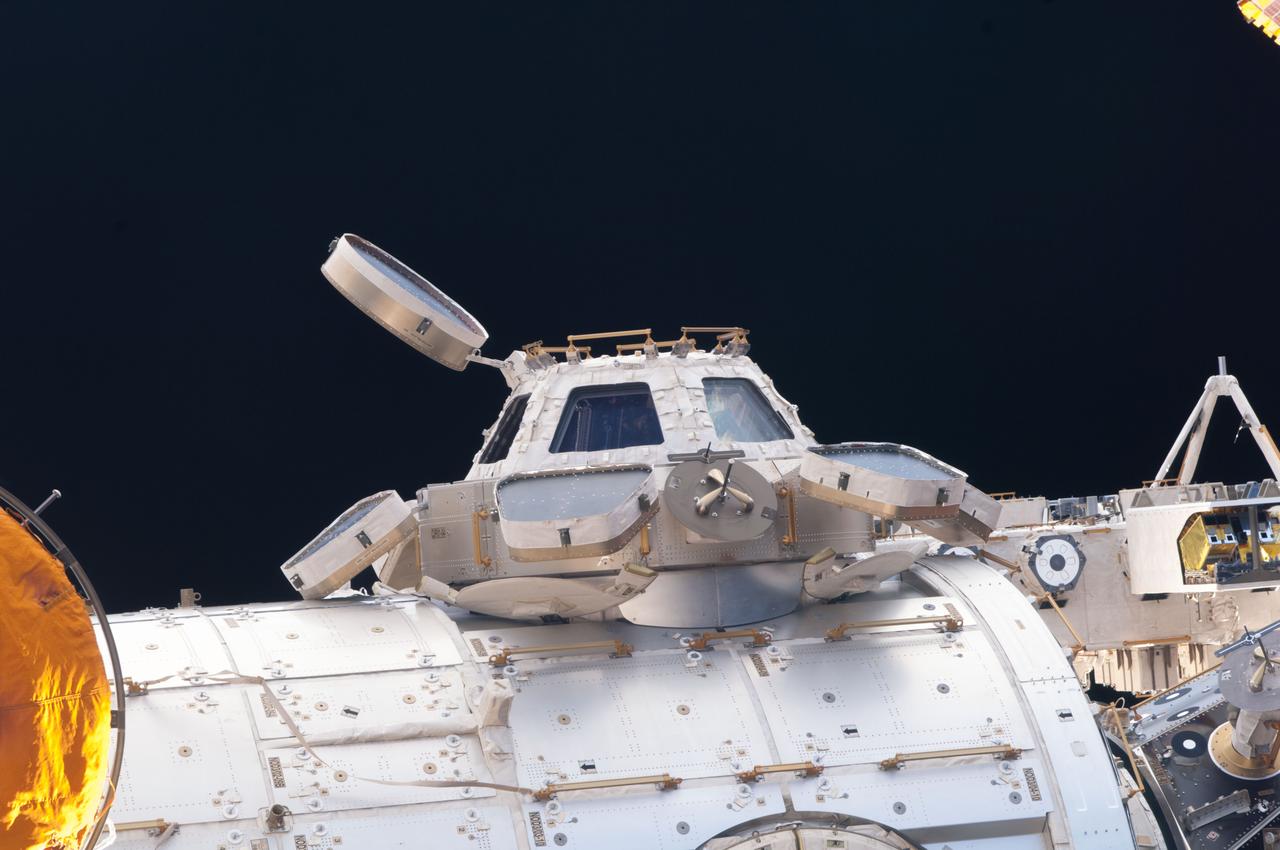
Survey view of portions of the Cupola Module, Tranquility Node 3, and Pressurized Mating Adapter 3 (PMA-3). Image was taken through a window in the Russian segment of the ISS during Expedition 35.
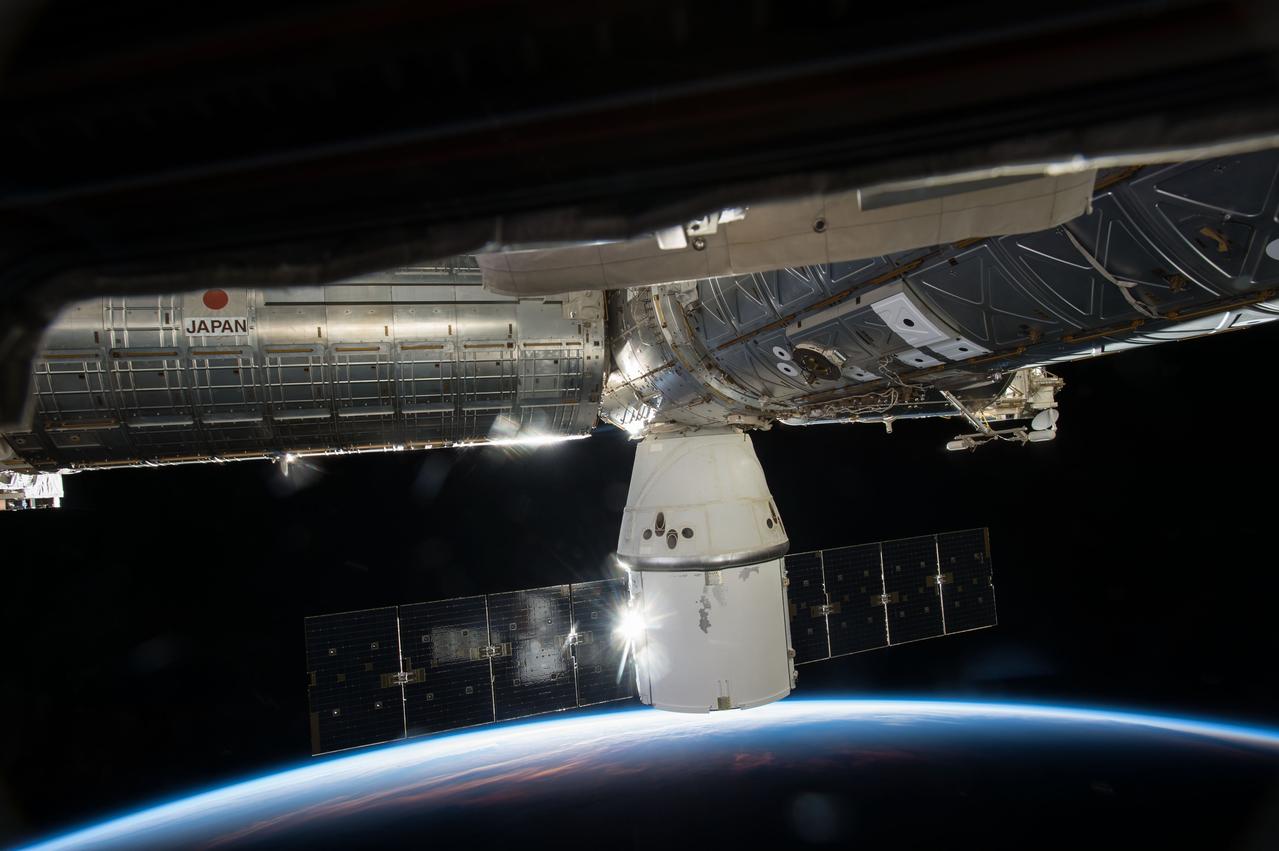
ISS043E190604 (05/13/2015) --- SpaceX’s Dragon cargo capsule is seen here docked to the Earth facing port of the Harmony module. SpaceX’s sixth commercial resupply flight to the International Space Station launched on April 14th and arrived three days later. It will depart with over 3,100 pounds of research samples and equipment and splashdown in the Pacific Ocean on May 21.
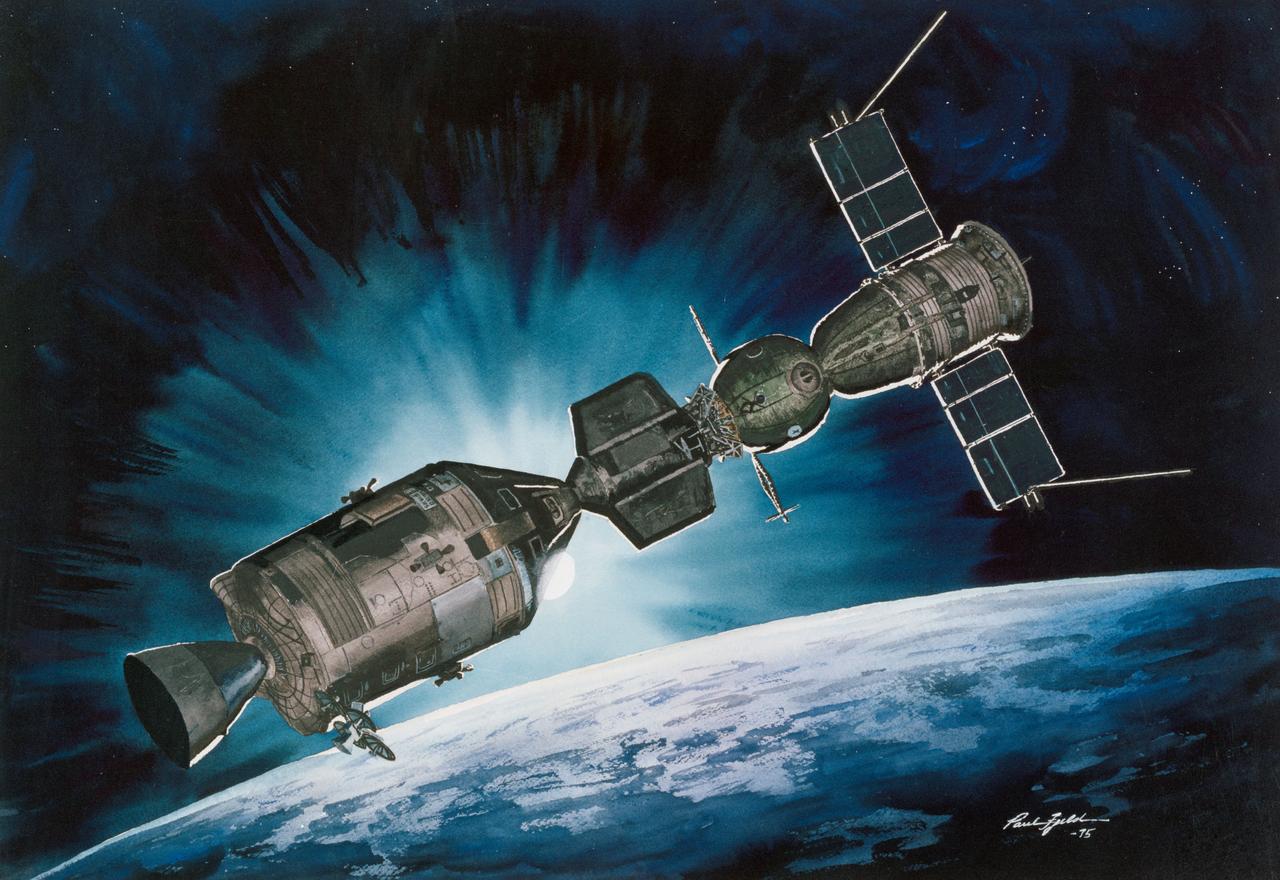
S75-28511 (July 1975) --- An artist?s concept depicting the American and Soviet spacecraft docked in Earth orbit during the July 1975 Apollo-Soyuz Test Project mission. The Apollo Command/Service Module is on the left, the Docking Module is in the center, and the Soyuz spacecraft is on the right. The first docking of spacecraft from two different nations was scheduled for July 17, 1975. The American and Soviet ASTP crewmen planned to visit each other?s spacecraft while Apollo and Soyuz are docked for a maximum period of two days. The docking system on the Docking Module and the docking system on the Soyuz Orbital Module are designed to interface with each other. The painting is by artist Paul Fjeld.
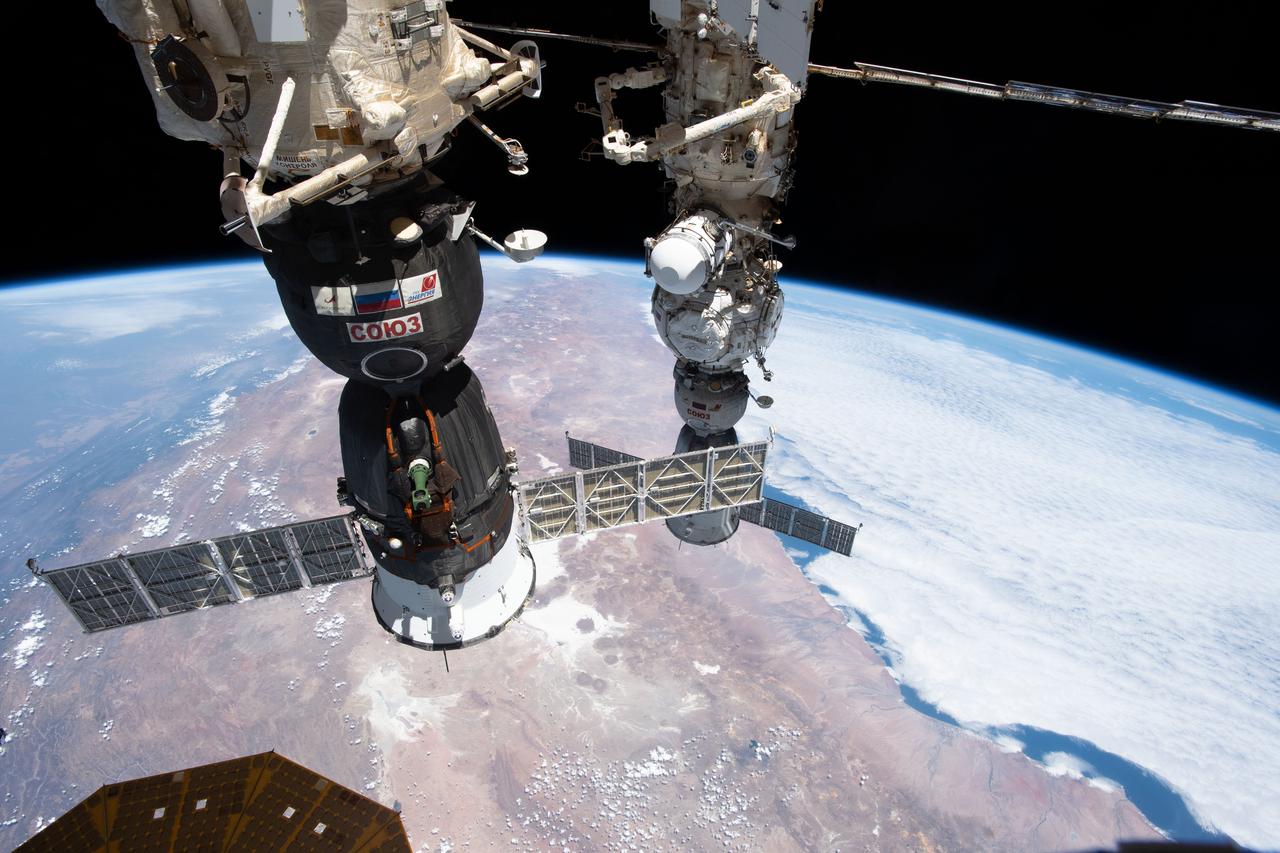
iss069e091770 (Sept. 23, 2023) --- Two Soyuz crew ships are pictured docked to the International Space Station as it orbited 262 miles above La Paz, Bolivia, on the South American continent. In the foreground, is the Soyuz MS-24 spacecraft docked to the Rassvet module. In the background is the Soyuz MS-23 spacecraft docked to the Prichal docking module.

iss071e403651 (July 21, 2024) --- The 57.7-foot-long Canadarm2 robotic arm extends from the International Space Station's Harmony module as the orbital outpost soared 261 miles above the coast of Peru. Partially obscured in the top background, is the Boeing Starliner spacecraft docked to Harmony's forward port.
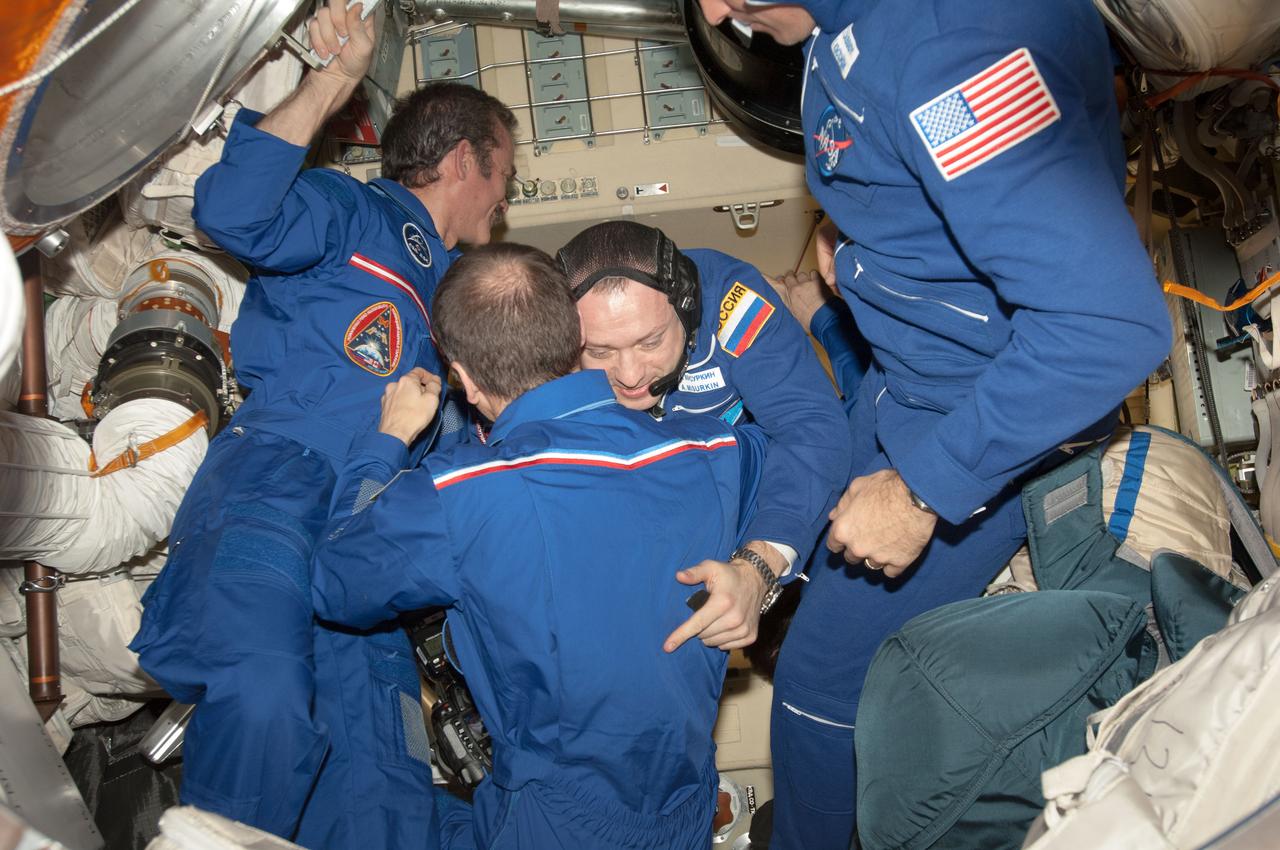
ISS035-E-010625 (29 March 2013) --- In this scene in the Poisk or Mini-Research Module 2 (MRM2), the two crew components for Expedition 35 begin to reunite in Earth orbit soon after the Soyuz TMA-08M docked with the International Space Station. Flight Engineers Tom Marshburn of NASA (back to camera) and Alexander Misurkin of Russia hug in center frame, while Expedition 35 Commander Chris Hadfield looks toward the hatch anticipating the final ingress, that of Soyuz Commander Pavel Vinogradov. NASA astronaut Chris Cassidy, newly arrived flight engineer, is partially out of frame in right foreground.
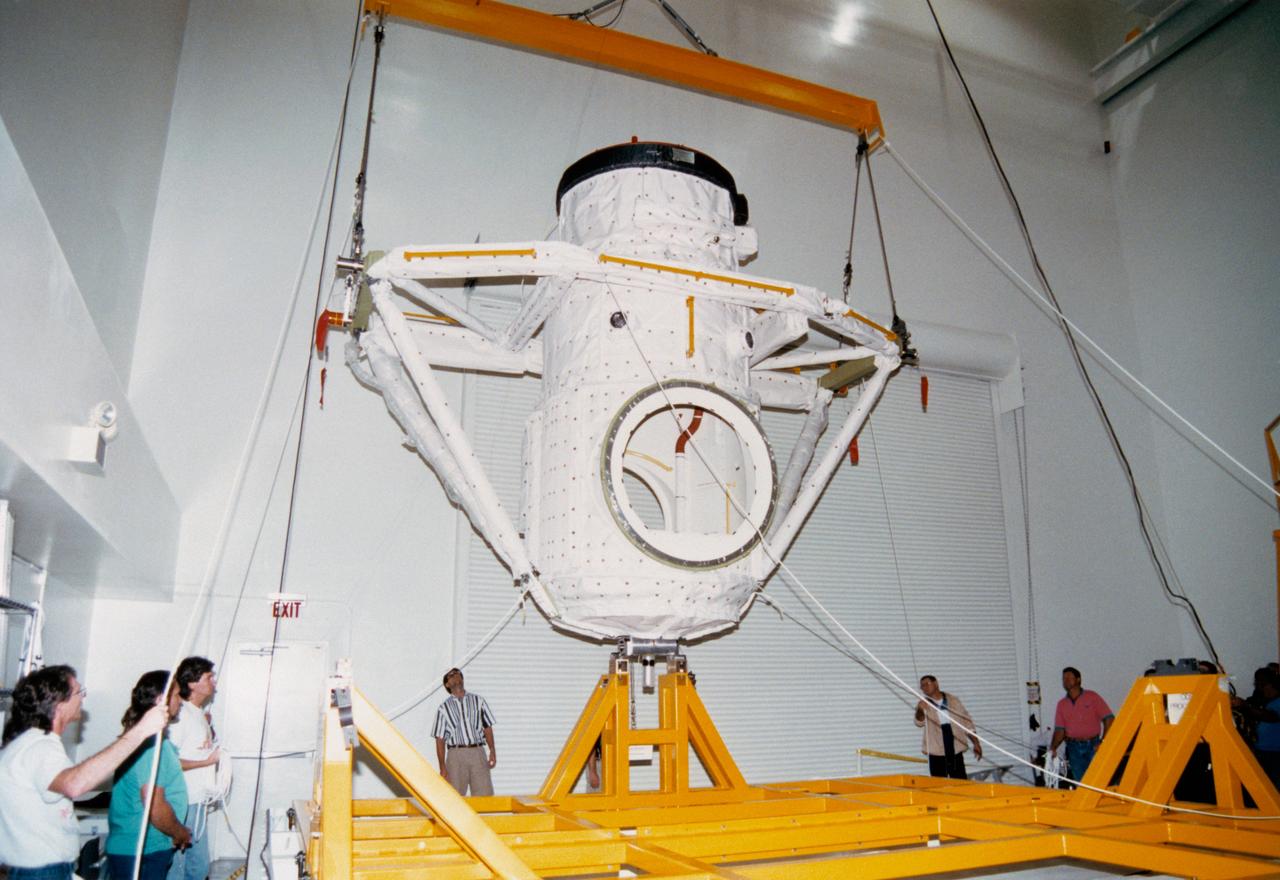
S94-47810 (2 Dec. 1994) --- Lockheed Space Operations Company workers in the Extended Duration Orbiter (EDO) Facility, located inside the Vehicle Assembly Building (VAB), carefully hoist the Orbiter Docking System (ODS) from its shipping container into a test stand. The ODS was shipped in a horizontal position to the Kennedy Space Center (KSC) from contractor Rockwell Aerospace's Downey plant. Once the ODS is upright, work can continue to prepare the hardware for the first docking of the United States Space Shuttle and Russian Space Station MIR in 1995. The ODS contains both United States-made and Russian-made hardware. The black band is Russian-made thermal insulation protecting part of the docking mechanism, also Russian-made, called the Androgynous Peripheral Docking System (APDS). A red protective cap covers the APDS itself. Other elements of the ODS, most of it protected by white United States-made thermal insulation, were developed by Rockwell, which also integrated and checked out the assembled Russian-United States system.
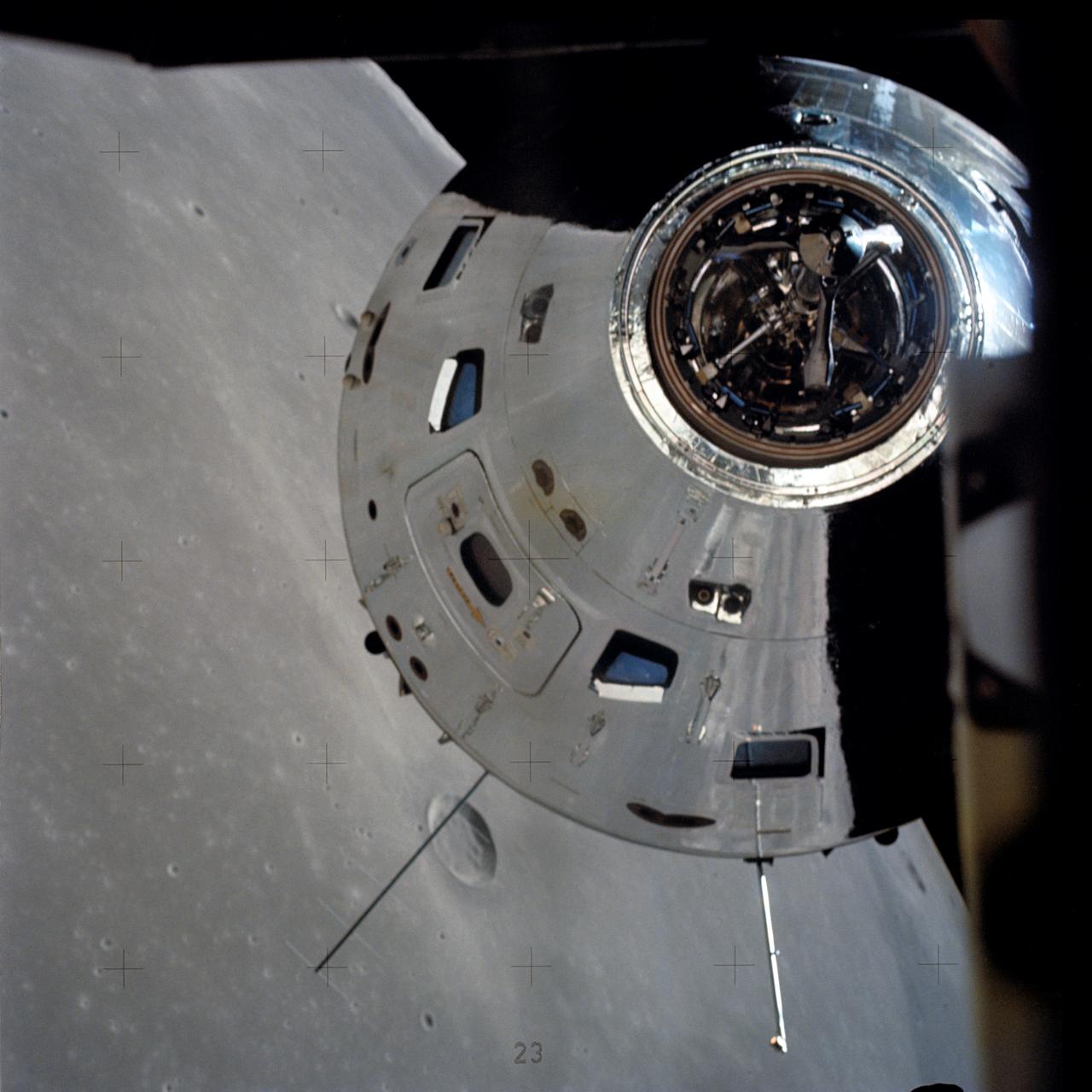
AS17-145-22273 (7-19 Dec. 1972) --- In this view, taken from the Lunar Module (LM), the Command and Service Module (CSM) are seen preparing to rendezvous with the LM. Note the reflection of the lunar surface on the CSM. The CSM, is piloted by Ronald E. Evans; while astronauts Eugene A. Cernan, commander; and Harrison W. Schmitt, lunar module pilot, are onboard the LM, following their extravehicular activities (EVA) on the moon's surface. While astronauts Cernan and Schmitt descended in the LM "Challenger" to explore the Taurus-Littrow region of the moon, astronaut Evans remained with the CSM "America" in lunar orbit.
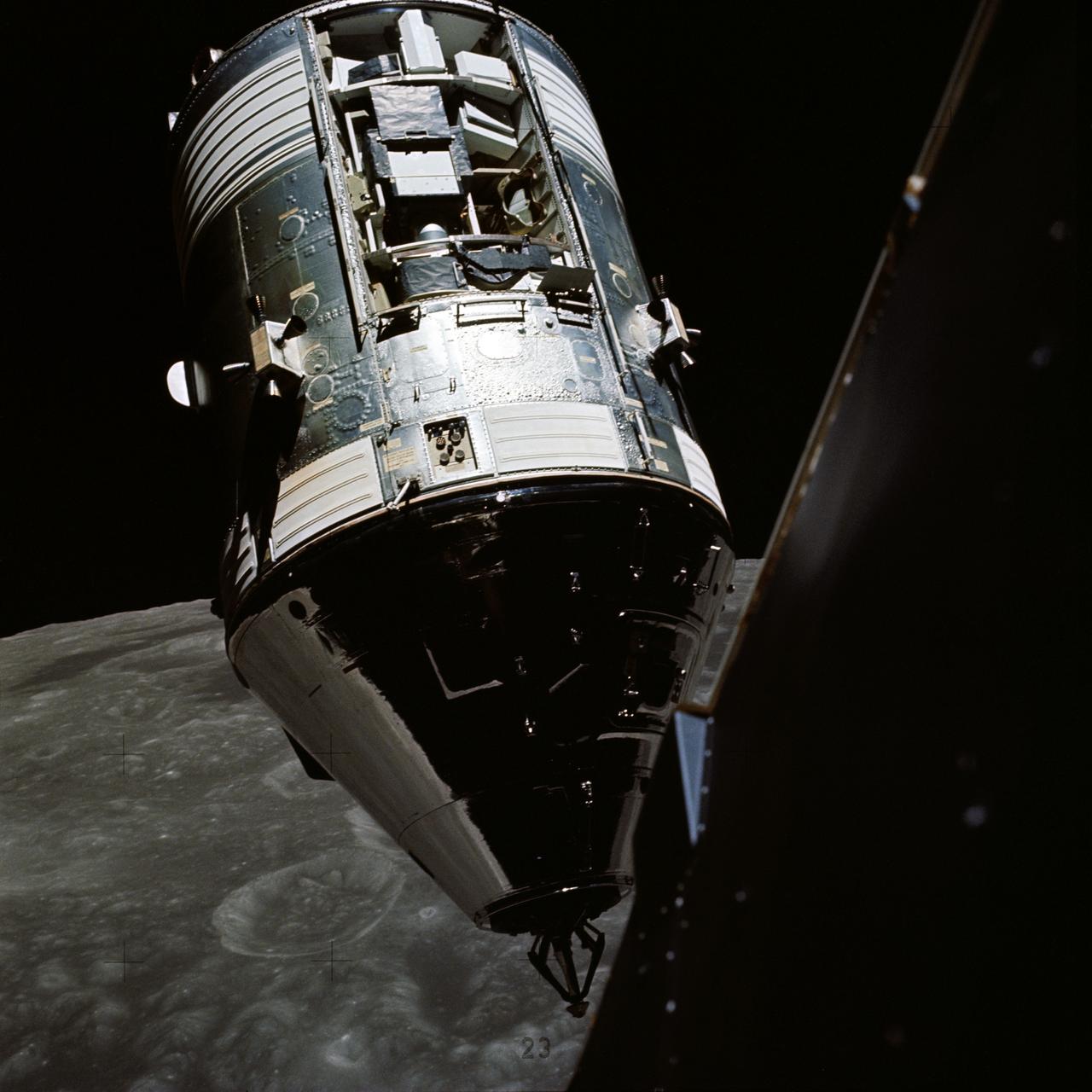
AS17-145-22254 (14 Dec. 1972) --- An excellent view of the Apollo 17 Command and Service Modules (CSM) photographed from the Lunar Module (LM) "Challenger" during rendezvous and docking maneuvers in lunar orbit. The LM ascent stage, with astronauts Eugene A. Cernan and Harrison H. Schmitt aboard, had just returned from the Taurus-Littrow landing site on the lunar surface. Astronaut Ronald E. Evans remained with the CSM in lunar orbit. Note the exposed Scientific Instrument Module (SIM) Bay in Sector 1 of the Service Module (SM). Three experiments are carried in the SIM bay: S-209 lunar sounder, S-171 infrared scanning spectrometer, and the S-169 far-ultraviolet spectrometer. Also mounted in the SIM bay are the panoramic camera, mapping camera and laser altimeter used in service module photographic tasks. A portion of the LM is on the right.
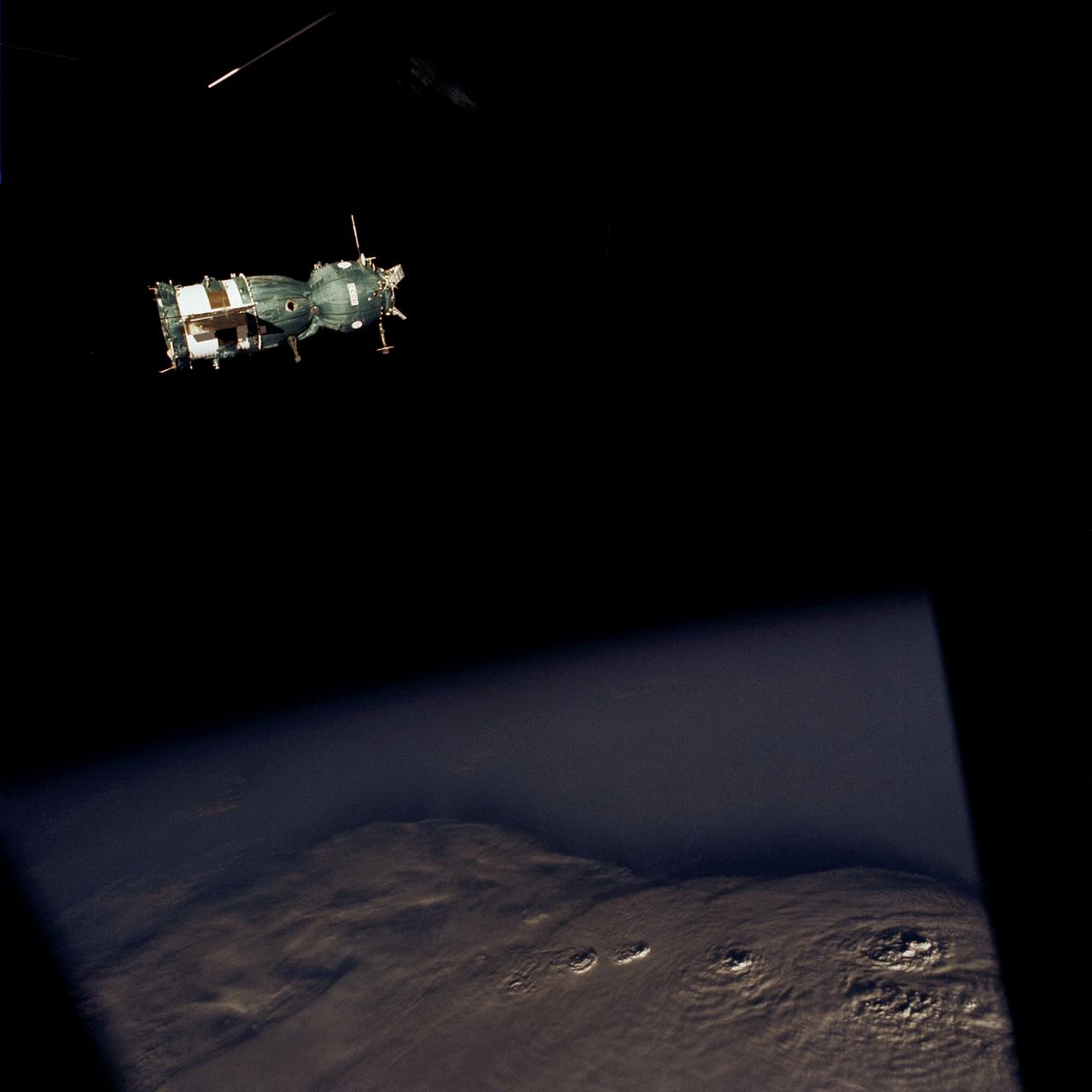
AST-02-096 (18 July 1975) --- This scene photograph from a rendezvous window of the American Apollo spacecraft in Earth orbit shows the Soviet Soyuz spacecraft contrasted against a black-sky background with a heavily cloud-covered Earth below. The three major components of the Soyuz are the spherical-shaped Orbital Module, the bell-shaped Descent Vehicle, the cylindrical-shaped Instrument Assembly Module. The docking system on the Orbital Module was specially designed to interface with the docking system on the Apollo's Docking Module. The ASTP astronauts and cosmonauts visited each other's spacecraft while the Soyuz and Apollo were docked in Earth orbit for two days.
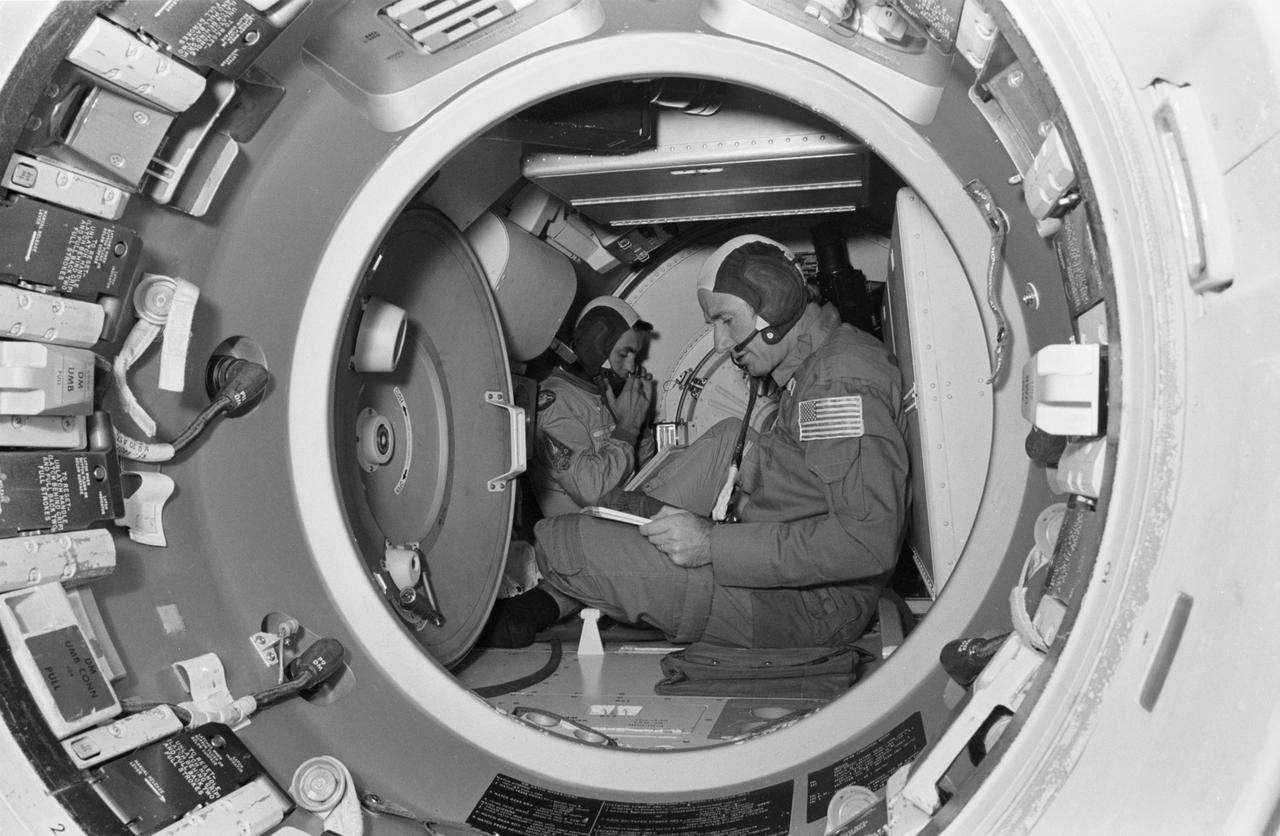
S74-28972 (20 Sept. 1974) --- Astronaut Vance D. Brand (foreground) and cosmonaut Aleksandr S. Ivanchenko are seated in the Docking Module trainer in Building 35 during Apollo-Soyuz Test Project simulation training at the Johnson Space Center. Brand is the command module pilot of the American ASTP prime crew. Ivanchenko is the engineer on the Soviet ASTP fourth crew (backup). During the exercise the American ASTP crew and the Soviet ASTP crew simulated docking the Apollo and Soyuz in Earth orbit and transferring to each other?s spacecraft. The Docking Module is designed to link the Apollo and Soyuz spacecraft. The ASTP crewmen are training in both the U.S. and USSR for the joint mission scheduled for the summer of 1975. This view is looking from inside the Command Module into the Docking Module. The hatchway loading into the Soyuz spacecraft orbital module mock-up is in the background.

AS09-20-3064 (6 March 1969) --- Excellent view of the docked Apollo 9 Command and Service Modules (CSM) and Lunar Module (LM), with Earth in the background, during astronaut David R. Scott's stand-up extravehicular activity (EVA), on the fourth day of the Apollo 9 Earth-orbital mission. Scott, command module pilot, is standing in the open hatch of the Command Module (CM). Astronaut Russell L. Schweickart, lunar module pilot, took this photograph of Scott from the porch of the LM. Inside the LM was astronaut James A. McDivitt, Apollo 9 commander.
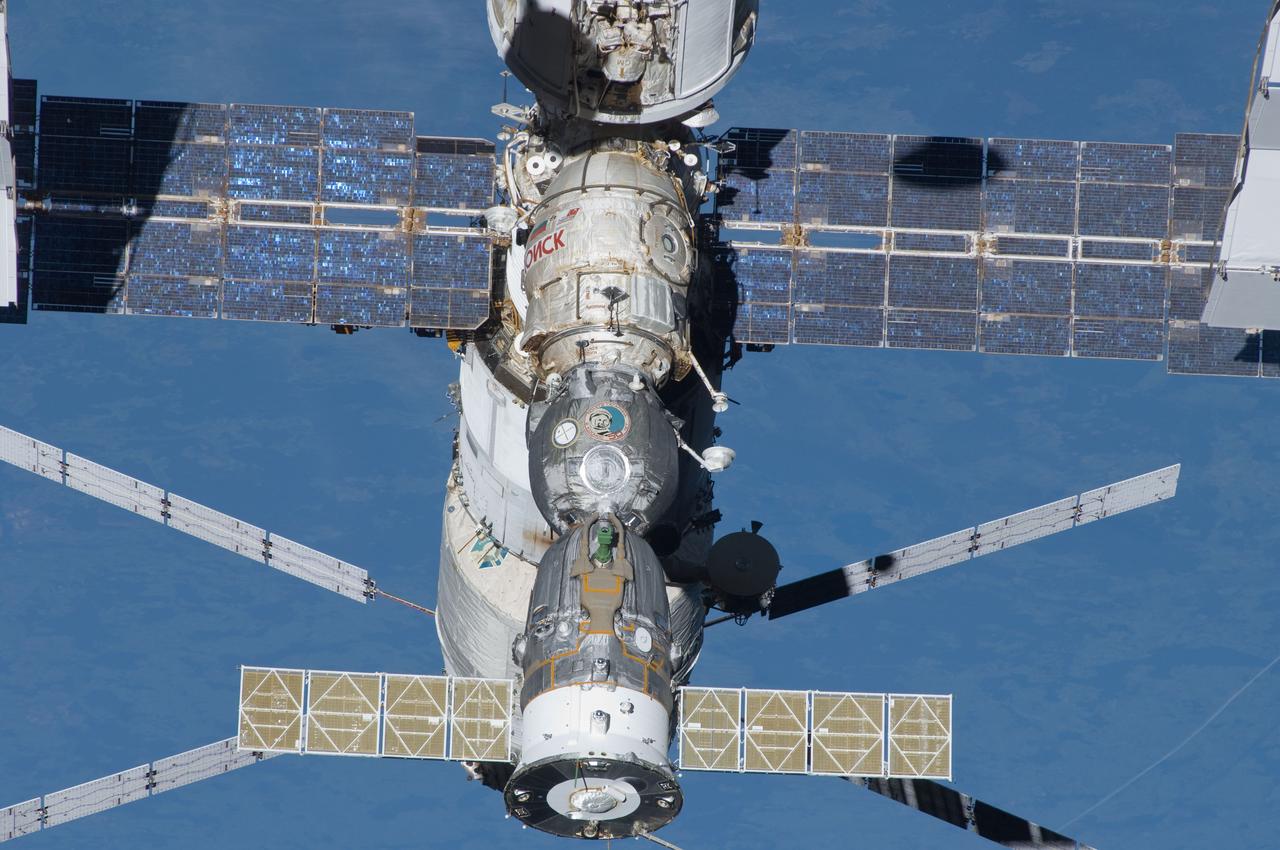
s134e010596 (May 30, 2011) --- A portion of the International Space Station's Russian segment is pictured with docked spacecraft including Europe's Automated Transfer Vehicle (ATV) and the Soyuz TMA-2 crew vehicle. The ATV is docked to the aft section of the Zvezda service module. The Soyuz is docked to the Poisk Mini-Research Module-2 which itself is attached to the forward section of Zvezda. At top center is a rear portion of the station's first module, the Zarya cargo module, which was placed into orbit Nov. 20, 1998.
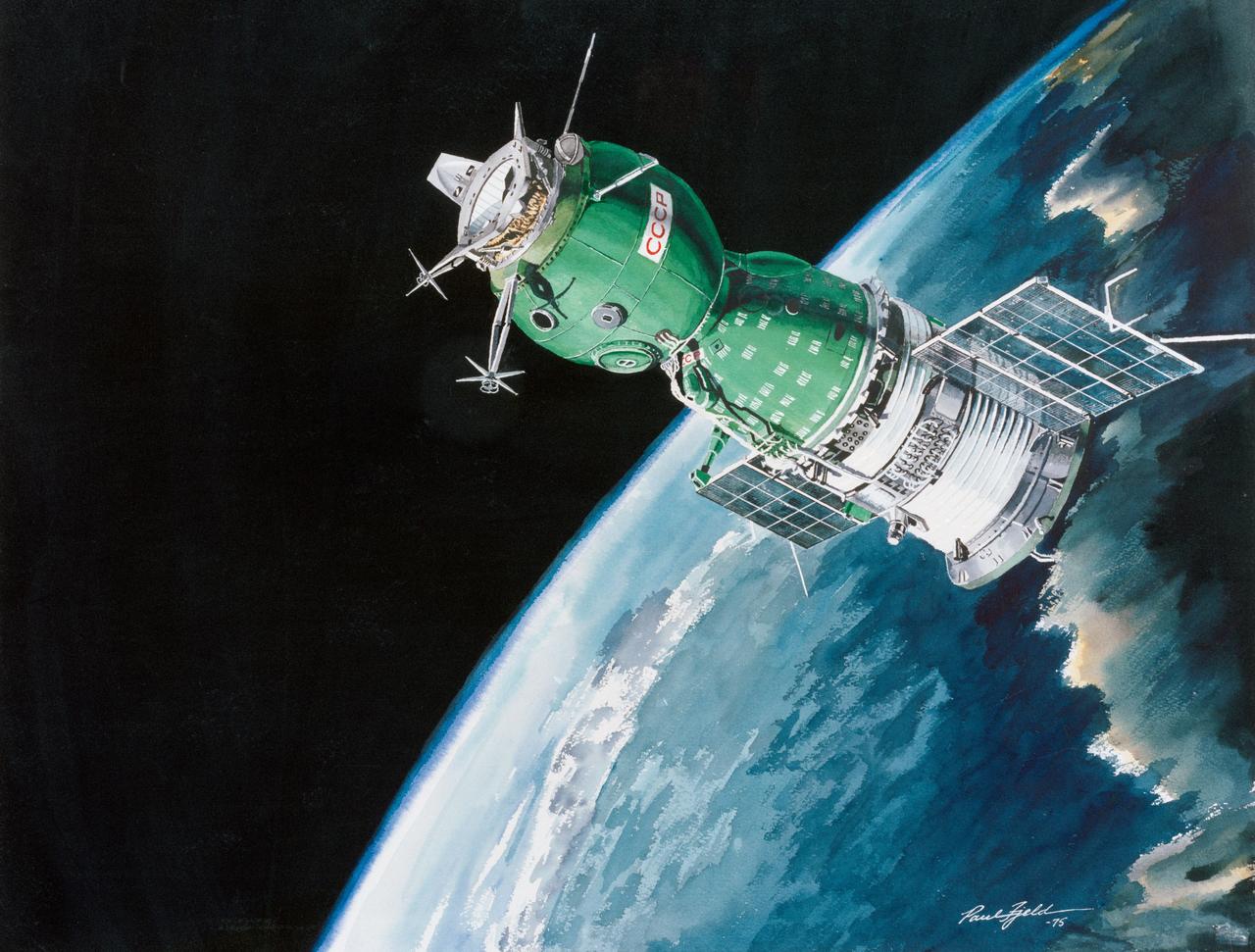
S75-28510 (July 1975) --- An artist?s concept depicting the Soviet ASTP Soyuz spacecraft in Earth orbit. The three major components of the Soyuz are the spherical-shaped Orbital Module on which the letters CCCP (USSR) are printed, the bell-shaped Descent Vehicle in the center, and the cylindrical-shaped Instrument Assembly Module from which two solar panels protrude. The docking system on the Orbital Module was specially designed to interface with the docking system on the Apollo?s Docking Module. The painting is by artist Paul Fjeld.
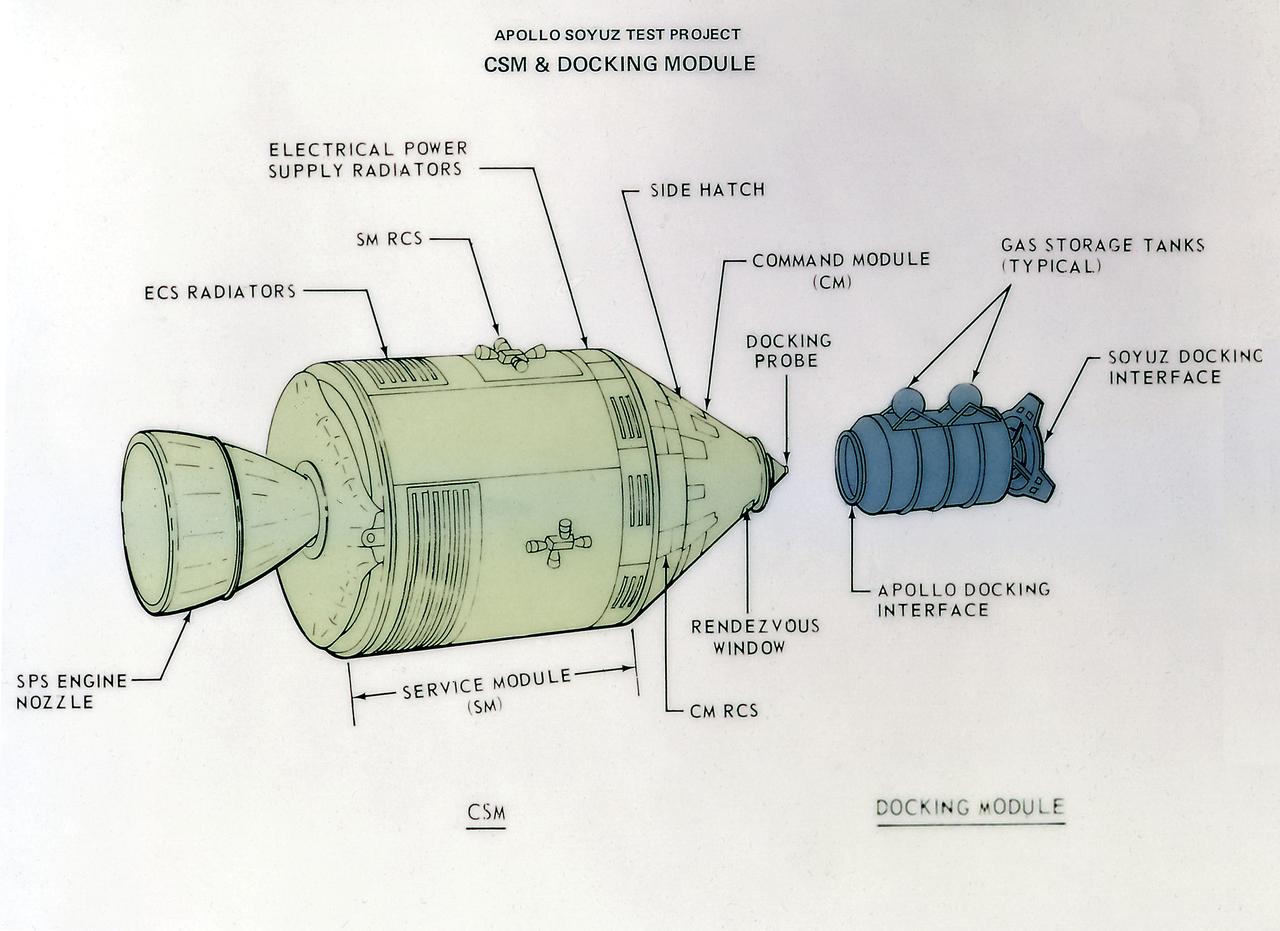
This illustration depicts a configuration of the Command Service Module (CSM) and Docking Module (DM) for the Apollo-Soyuz Test Project (ASTP). The ASTP was the first international docking of the U.S.'s Apollo spacecraft and the U.S.S.R.'s Soyuz spacecraft in space. A joint engineering team from the two countries met to develop a docking system that permitted the two spacecraft to link in space and allowed the two crews to travel from one spacecraft to the other. This system entailed developing a large habitable Docking Module (DM) to be carried on the Apollo spacecraft to facilitate the joining of two dissimilar spacecraft. The Marshall Space Flight Center was responsible for development and sustaining engineering of the Saturn IB launch vehicle during the mission. The ASTP marked the last use of the Saturn Launch Vehicle.
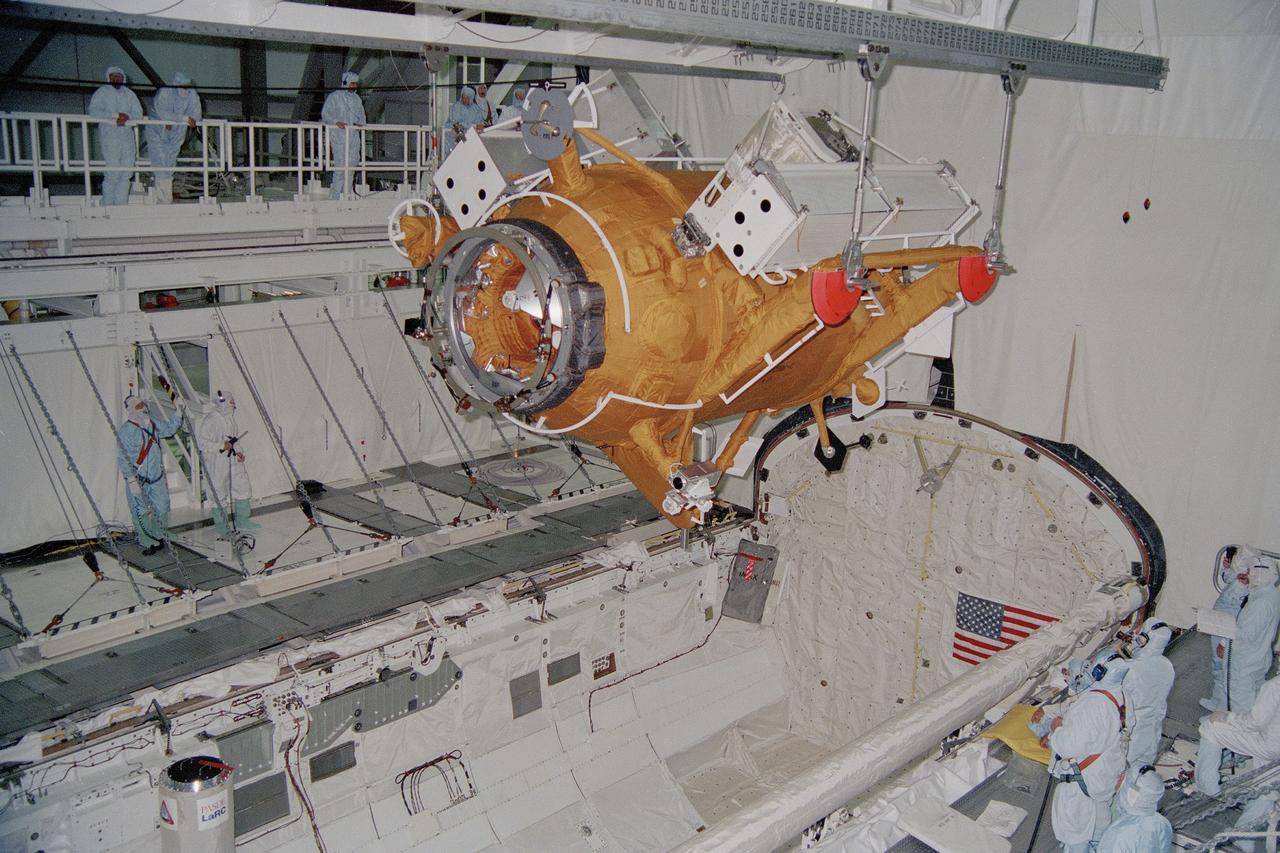
CAPE CANAVERAL, Fla. -- At NASA's Kennedy Space Center in Florida, the Russian-built Docking Module is lowered for installation into the payload bay of the space shuttle Atlantis while it is in bay 2 of the Orbiter Processing Facility. The module will fly as a primary payload on the second Space Shuttle/Mir space station docking mission, STS-74. During the mission, the module will first be attached with the orbiter's robot arm to the Orbiter Docking System in the payload bay of the orbiter Atlantis and then be docked with the Mir. When Atlantis undocks from the Mir, it will leave the new docking module permanently attached to the space station for use during future shuttle Mir docking missions. The new module will simplify future Shuttle linkups with Mir by improving orbiter clearances when it serves as a bridge between the two spacecraft. The white structures attached to the module's sides are solar panels that will be attached to the Mir after the conclusion of the STS-74 mission. Photo Credit: NASA
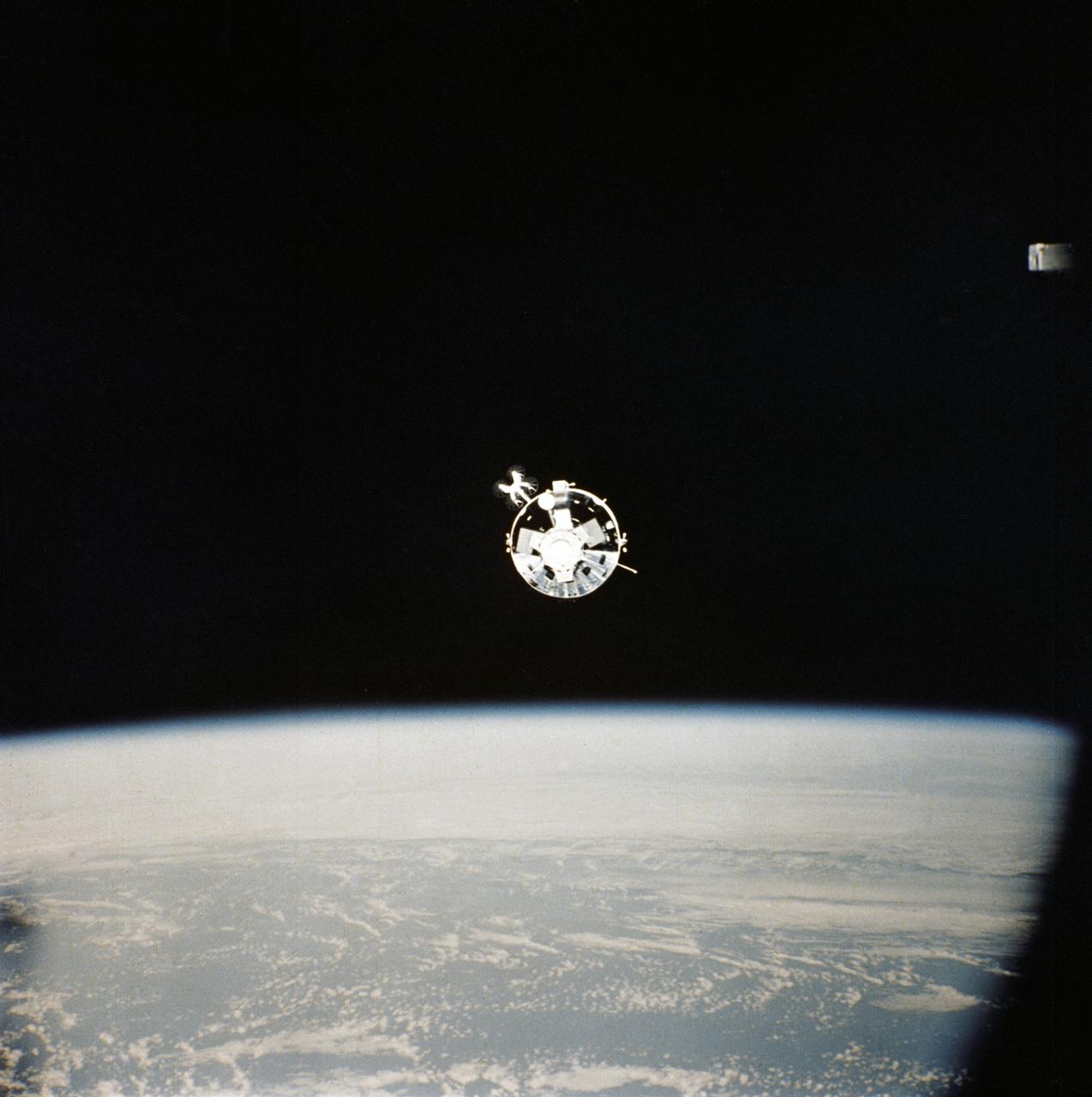
AST-32-2675 (17-19 July 1975) --- The American Apollo spacecraft as seen in Earth orbit from the Soviet Soyuz spacecraft during the joint U.S.-USSR Apollo-Soyuz Test Project mission. The Command/Service Module and Docking Module are contrasted against a black-sky background. This is a "head on" view of the Apollo. The horizon of Earth is below. This picture was furnished by the USSR in an exchange of photography taken during the ASTP flight. The American and Soviet spacecraft were joined together in space for approximately 47 hours on July 17-18-19, 1975. Note the docking mechanism on the Docking Module. PHOTO COURTESY: USSR ACADEMY OF SCIENCES
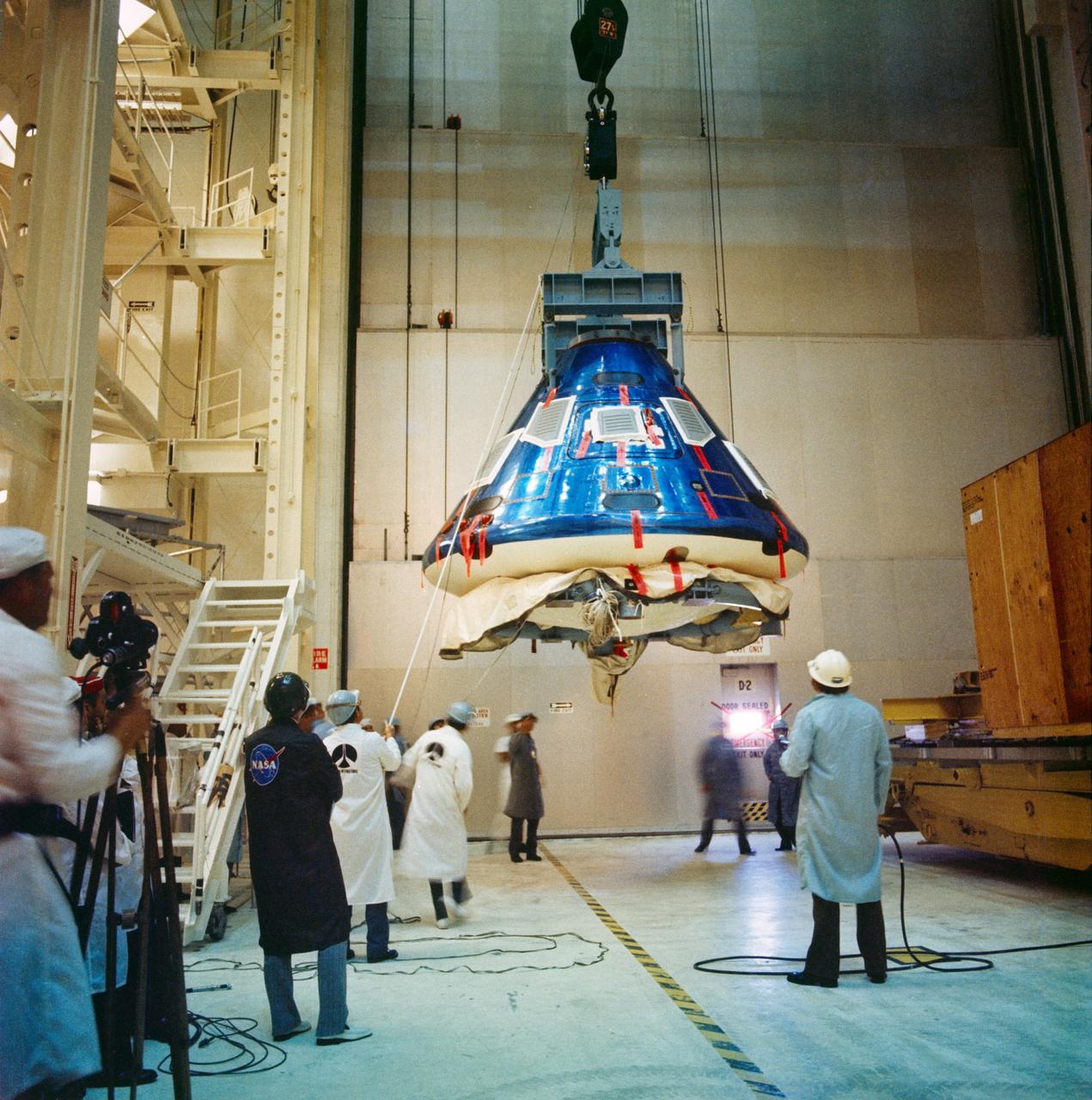
S74-32049 (8 Sept. 1974) --- The Apollo Command Module for the Apollo-Soyuz Test Project mission goes through receiving, inspection and checkout procedures in the Manned Spacecraft Operations Building at the Kennedy Space Center. The spacecraft had just arrived by air from the Rockwell International plant at Downey, California. The Apollo spacecraft (Command Module, Service Module and Docking Module), with astronauts Thomas P. Stafford, Vance D. Brand and Donald K. Slayton aboard, will dock in Earth orbit with a Soviet Soyuz spacecraft during the joint U.S.-USSR ASTP flight scheduled for July 1975. The Soviet and American crews will visit one another?s spacecraft.
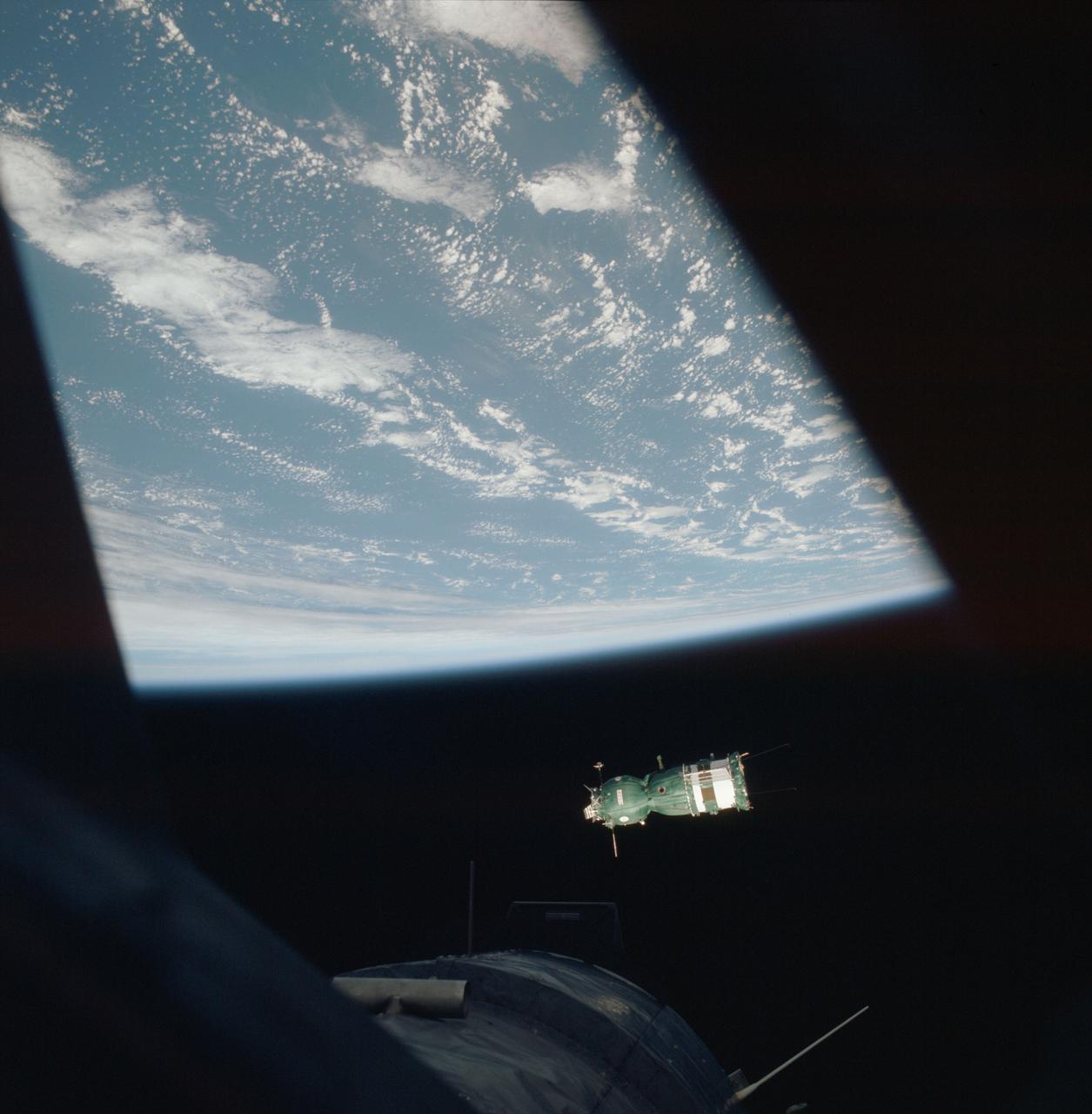
AST-02-093 (18 July 1975) --- This scene photographed with a hand-held 70mm camera from a rendezvous window of the American Apollo spacecraft in Earth orbit shows the Soviet Soyuz spacecraft contrasted against a black-sky background with Earth's horizon below. The three major components of the Soyuz are the spherical-shaped Orbital Module (OM), the bell-shaped Descent Vehicle (DV) and the cylindrical-shaped instrument Assembly Module (AM). The docking system on the Orbital Module was specially designed to interface with the docking system on the Apollo's Docking Module (DM). The DM is visible very faintly at the bottom of the picture. The ASTP astronauts and cosmonauts visited each other's spacecraft while the Soyuz and Apollo were docked in Earth orbit for two days.
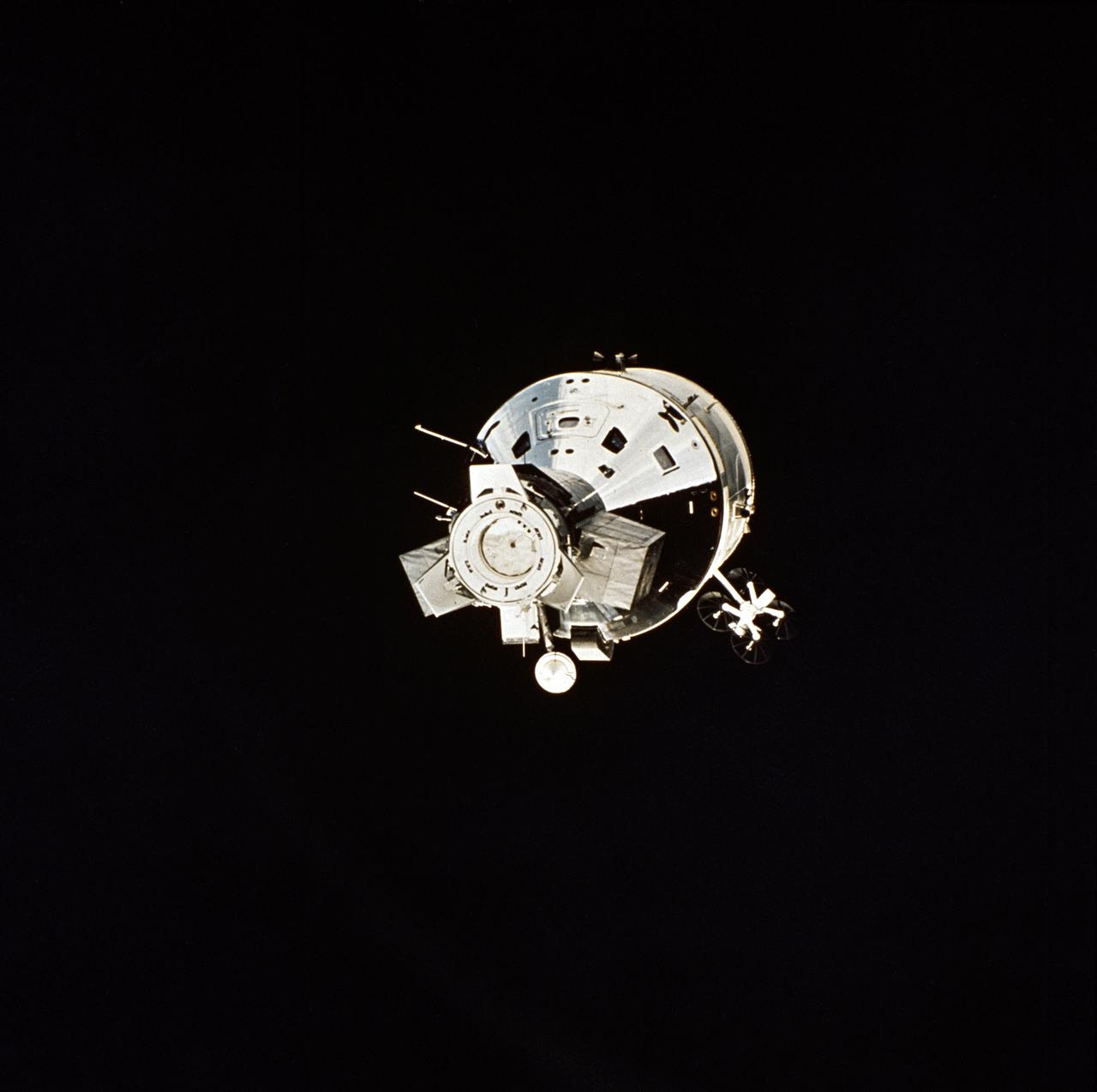
AST-32-2691 (17-19 July 1975) --- The American Apollo spacecraft as seen in Earth orbit from the Soviet Soyuz spacecraft during the joint U.S.-USSR Apollo-Soyuz Test Project mission. The Command/Service Module and Docking Module are contrasted against a black-sky background. This is a near "head on" view of the Apollo. This picture was furnished by the USSR in an exchange of photography taken during the ASTP flight. Note the docking mechanism and docking target on the Docking Module. The four dish-like reflectors of the unified S-band high-gain antenna protrude from the side of the Service Module. The American and Soviet spacecraft were joined together in space for approximately 47 hours on July 17-18-19, 1975. PHOTO COURTESY: USSR ACADEMY OF SCIENCES
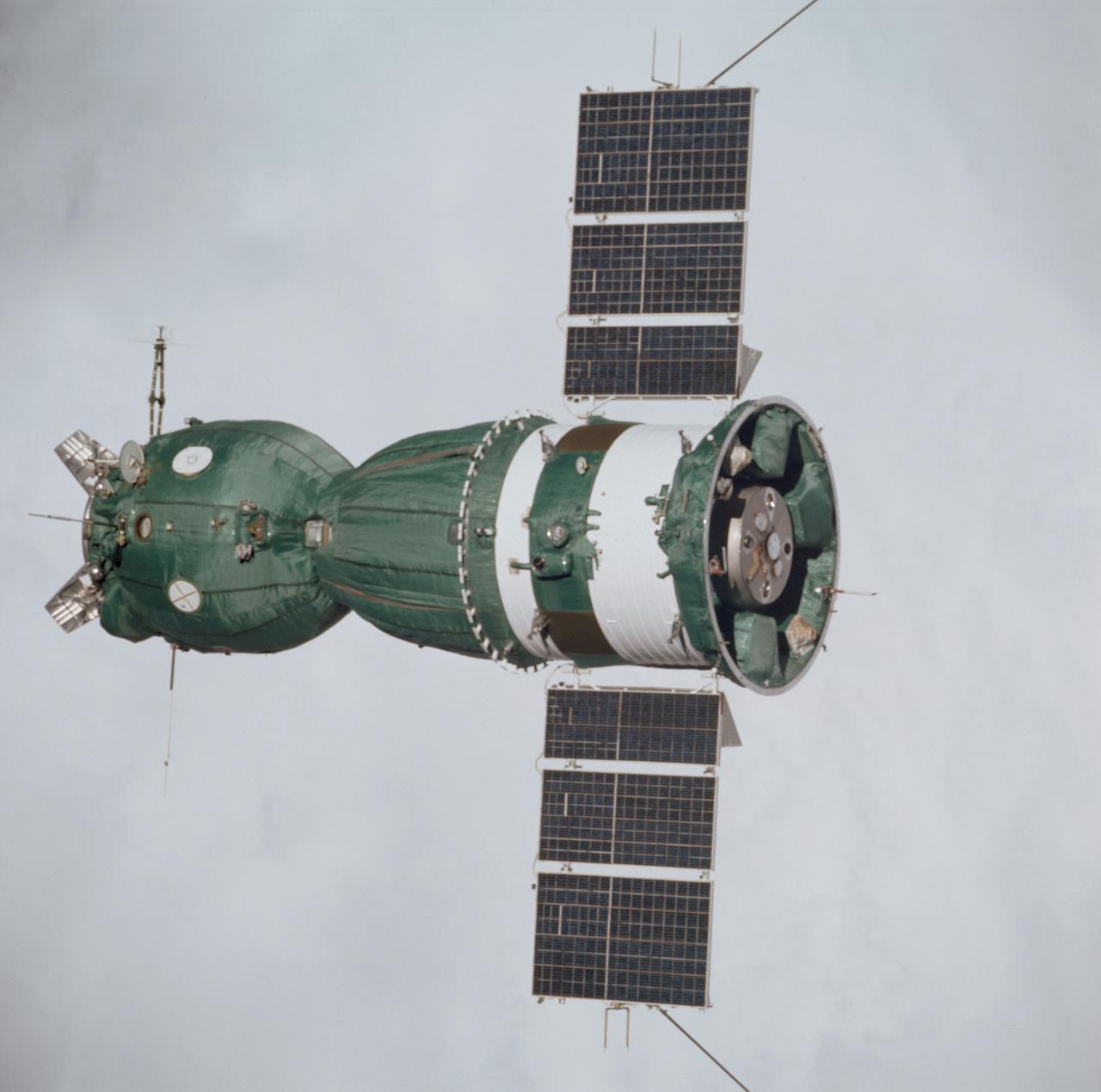
AST-01-056 (18 July 1975) --- An excellent view of the Soviet Soyuz spacecraft in Earth orbit, photographed from the American Apollo spacecraft during the joint U.S.-USSR Apollo-Soyuz Test Project (ASTP) docking mission in Earth orbit. The Soyuz is contrasted against a white-cloud background in this overhead view. The three major components of the Soyuz are the spherical-shaped Orbital Module, the bell-shaped Descent Vehicle and the cylindrical-shaped instrument Assembly Module from which two solar panels protrude. The docking system on the Orbital Module was specially designed to interface with the docking system on the Apollo's Docking Module. The ASTP astronauts and cosmonauts visited each other's spacecraft while the Soyuz and Apollo were docked in Earth orbit for two days. The Apollo crew consisted of astronauts Stafford, commander; Donald K. "Deke" Slayton, docking module pilot; and Vance D. Brand, command module pilot. The Soyuz 19 crew consisted of cosmonauts Leonov, command pilot; and Valeri N. Kubasov, flight engineer.
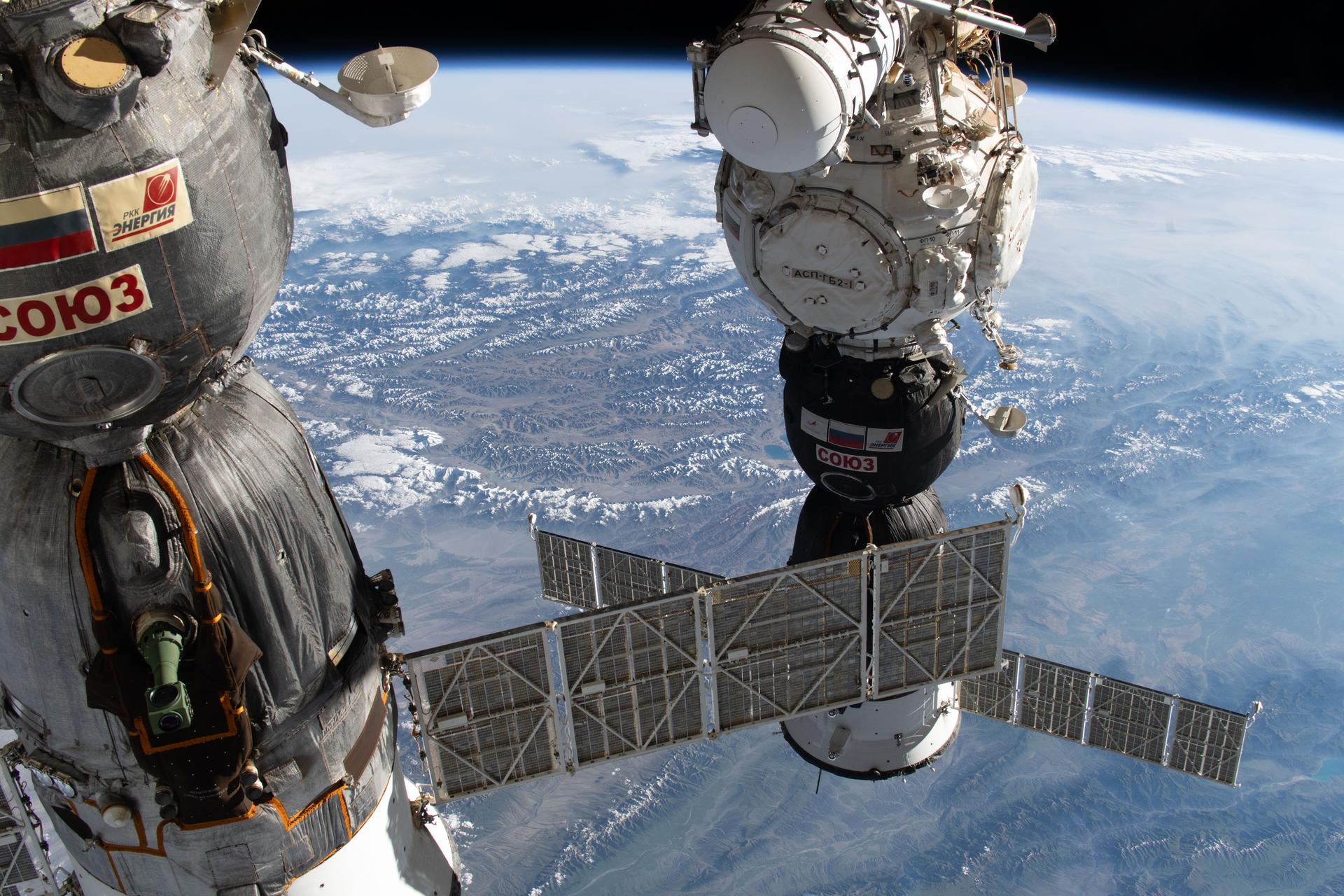
iss074e0825704 (July 17, 2026) --- Two Soyuz crew spacecraft, the MS-28 docked to the Rassvet module (foreground) and the MS-29 docked to the Prichal module (background), are pictured attached to the International Space Station as it orbited 265 miles above eastern Kazakhstan. Credit: NASA/Jessica Meir
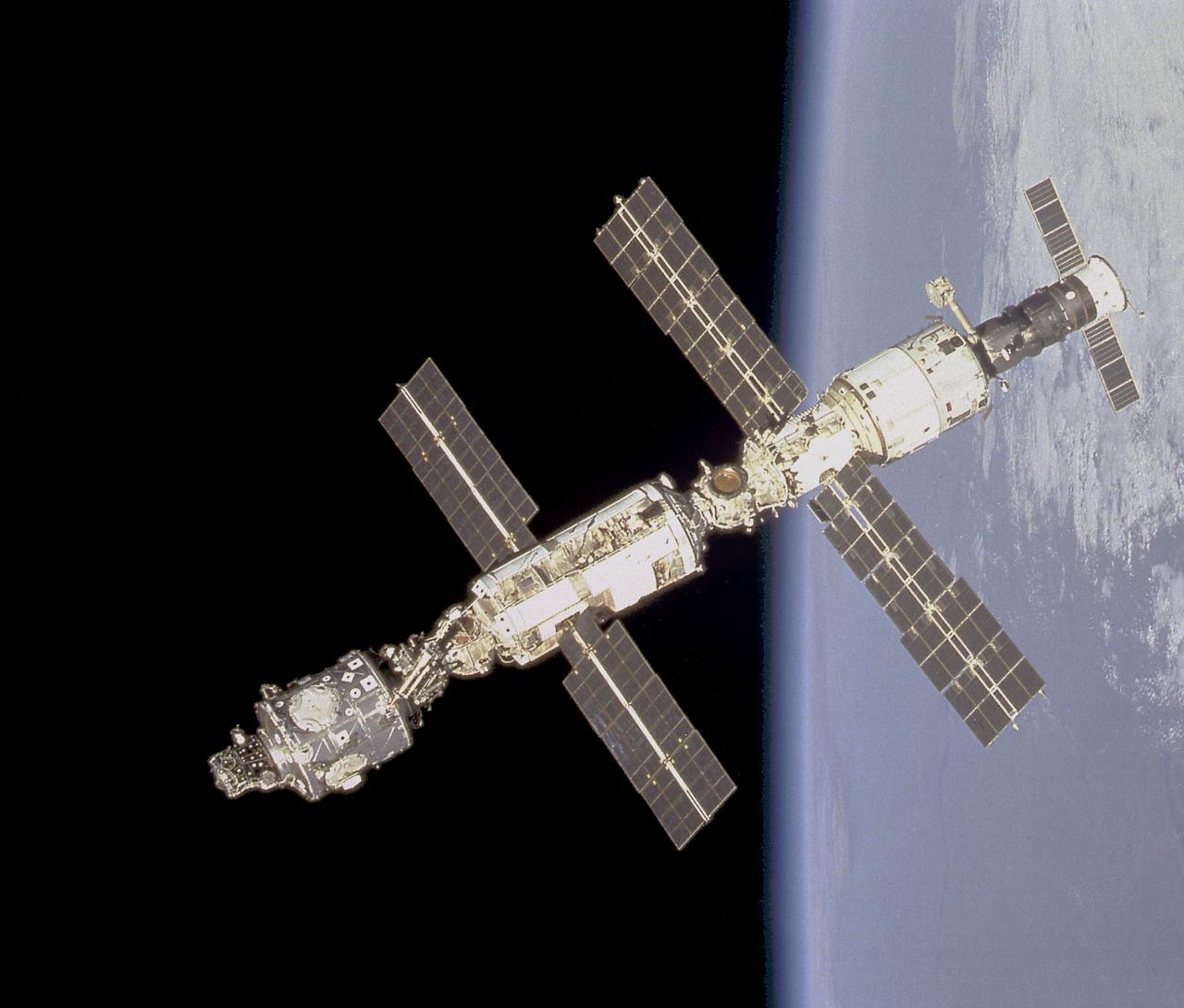
This image of the International Space Station in orbit was taken from the Space Shuttle Endeavour prior to docking. Most of the Station's components are clearly visible in this photograph. They are the Node 1 or Unity Module docked with the Functional Cargo Block or Zarya (top) that is linked to the Zvezda Service Module. The Soyuz spacecraft is at the bottom.
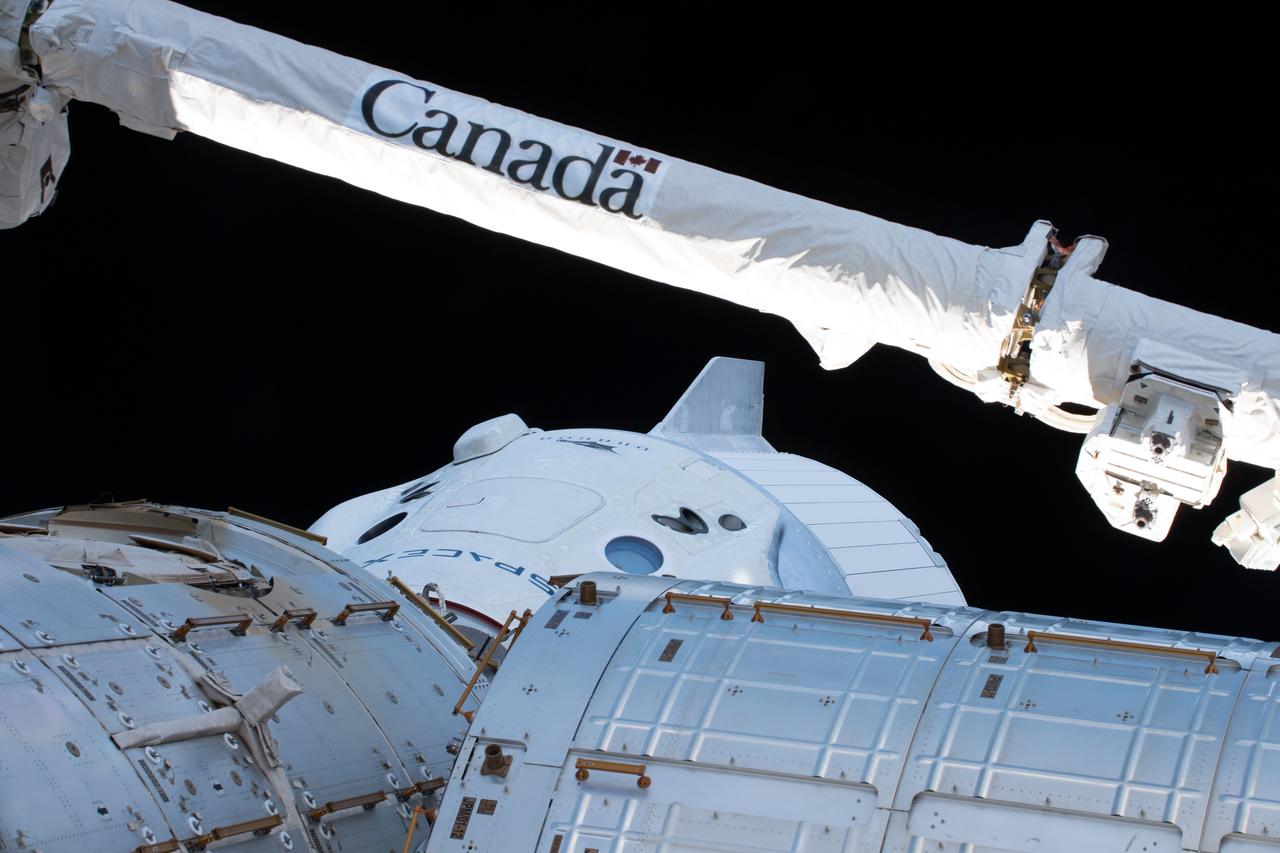
iss058e027796 (March 4, 2019) --- The uncrewed SpaceX Crew Dragon spacecraft is the first Commercial Crew vehicle to visit the International Space Station. Here it is pictured docked to the international docking adapter attached to the forward end of the Harmony module. In the foreground are portions of Harmony, the Kibo laboratory module, and the Canadarm2 robotic arm.
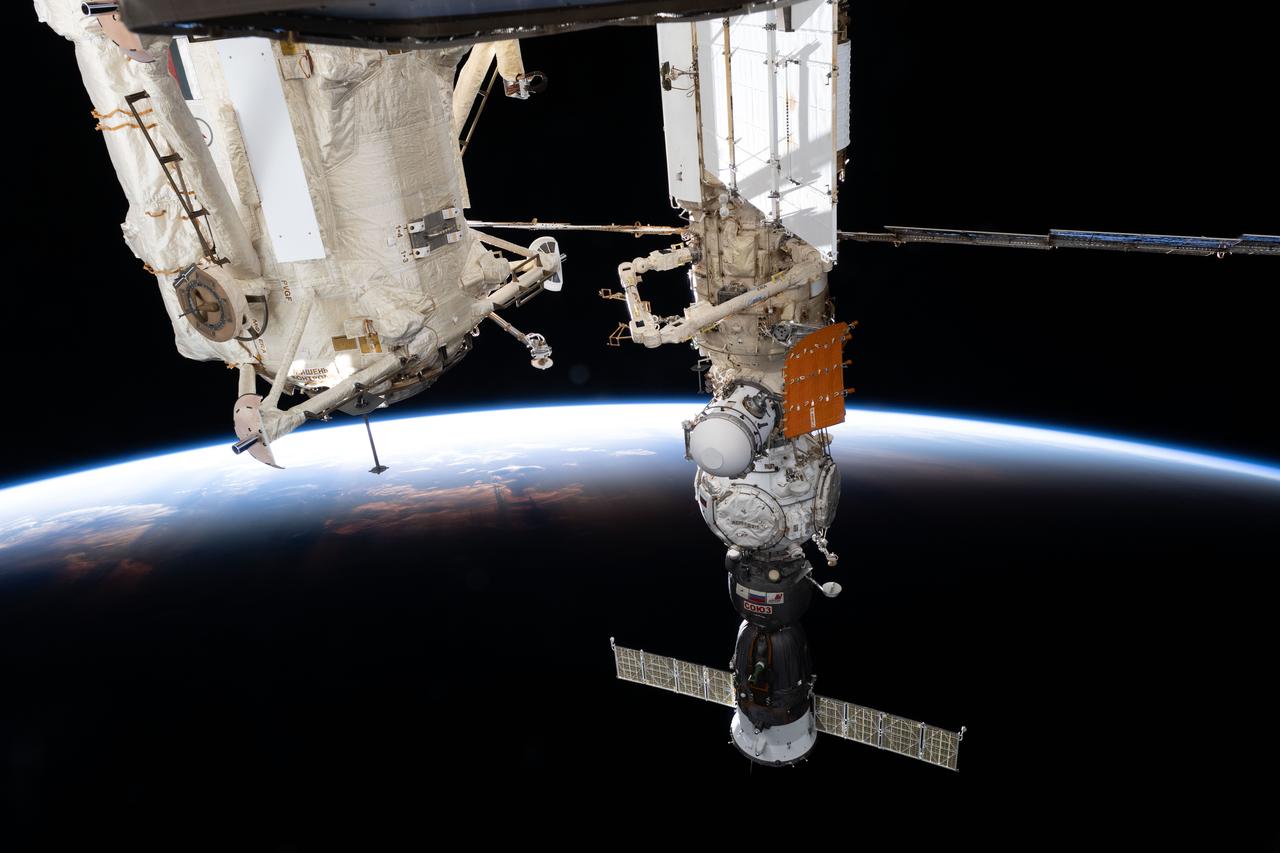
iss071e000013 (April 7, 2024) --- The Soyuz MS-25 spacecraft is pictured docked to the Prichal docking module as the International Space Station soared into an orbital sunset 260 miles above the Indian Ocean off the coast on Indonesia.
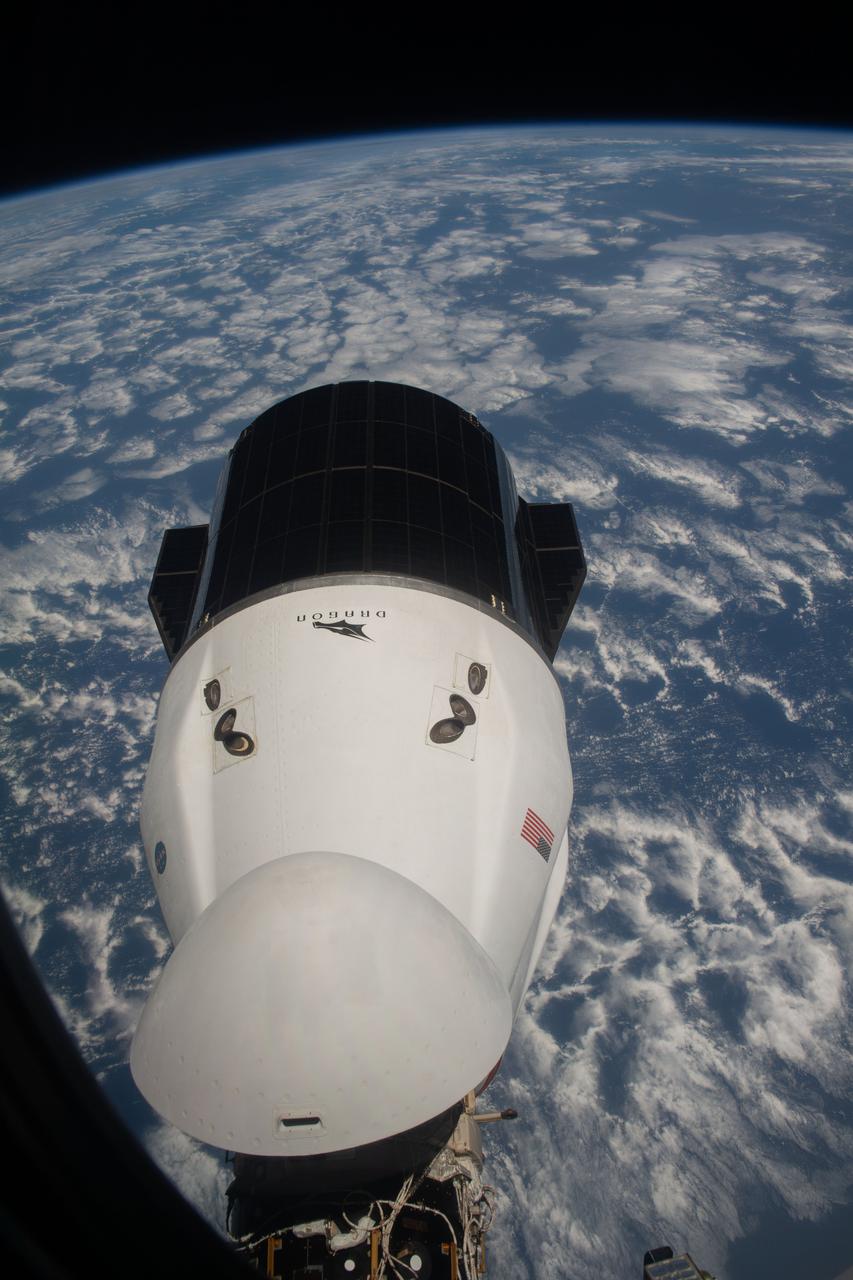
iss065e423588 (Sept. 26, 2021) --- The SpaceX Cargo Dragon resupply ship is pictured from a window on the SpaceX Crew Dragon spacecraft. Both spaceships are docked to international docking adapters on the International Space Station's Harmony module.
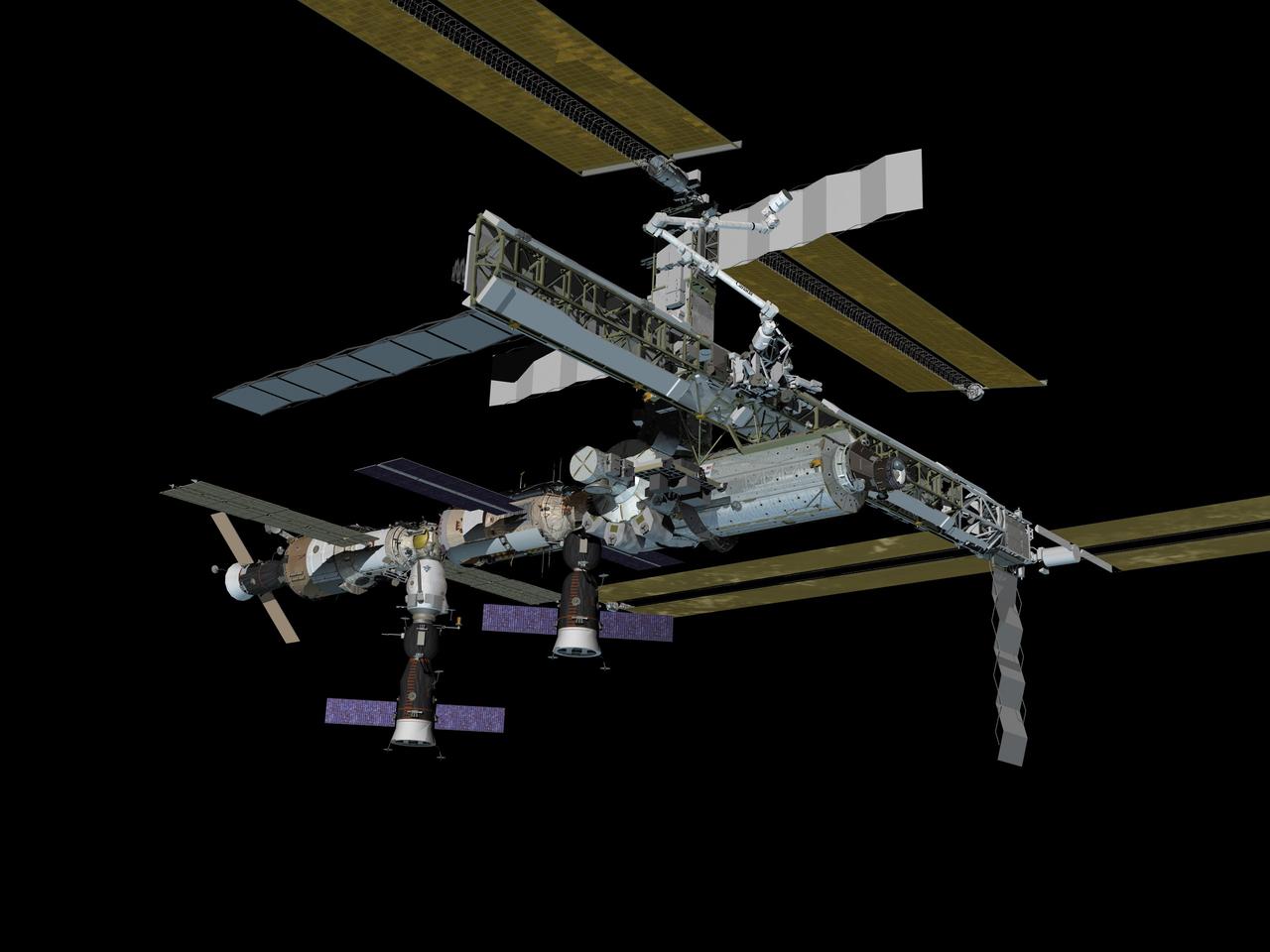
JSC2006-E-40785 (September 2006) --- Computer-generated artist's rendering of the International Space Station following scheduled activities of Sept. 20, 2006. This angle shows the starboard side view of the orbiting complex. Soyuz 13 (TMA-9) spacecraft, transporting the Expedition 14 crew, docks to the Zvezda Service Module aft port. Progress 22 resupply vehicle remains docked to the Pirs Docking Compartment and Soyuz 12 (TMA-8) is docked to the Zarya Module nadir port.
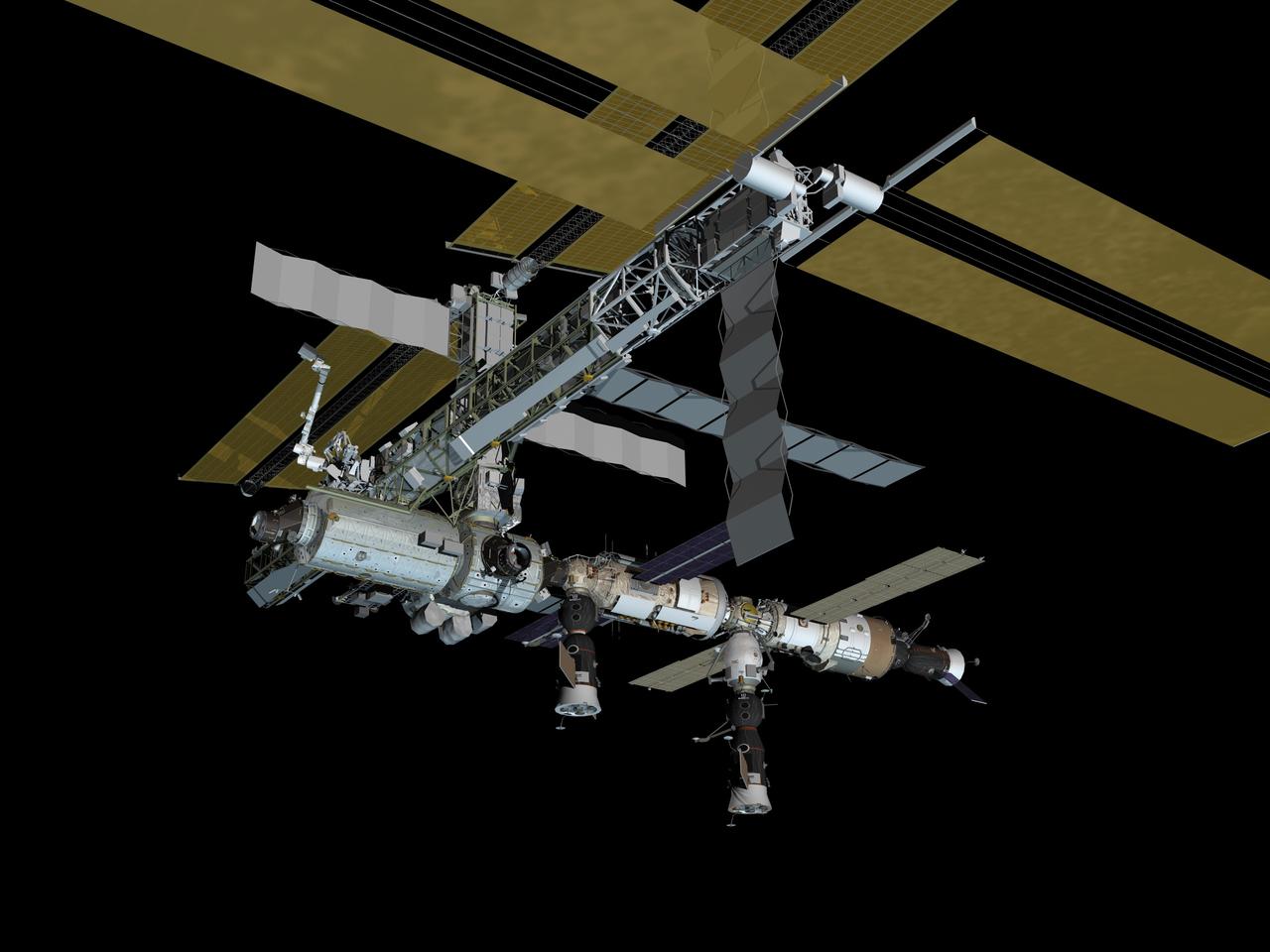
JSC2006-E-40784 (September 2006) --- Computer-generated artist's rendering of the International Space Station following scheduled activities of Sept. 20, 2006. This angle shows the port side view of the orbiting complex. Soyuz 13 (TMA-9) spacecraft, transporting the Expedition 14 crew, docks to the Zvezda Service Module aft port. Progress 22 resupply vehicle remains docked to the Pirs Docking Compartment and Soyuz 12 (TMA-8) is docked to the Zarya Module nadir port.
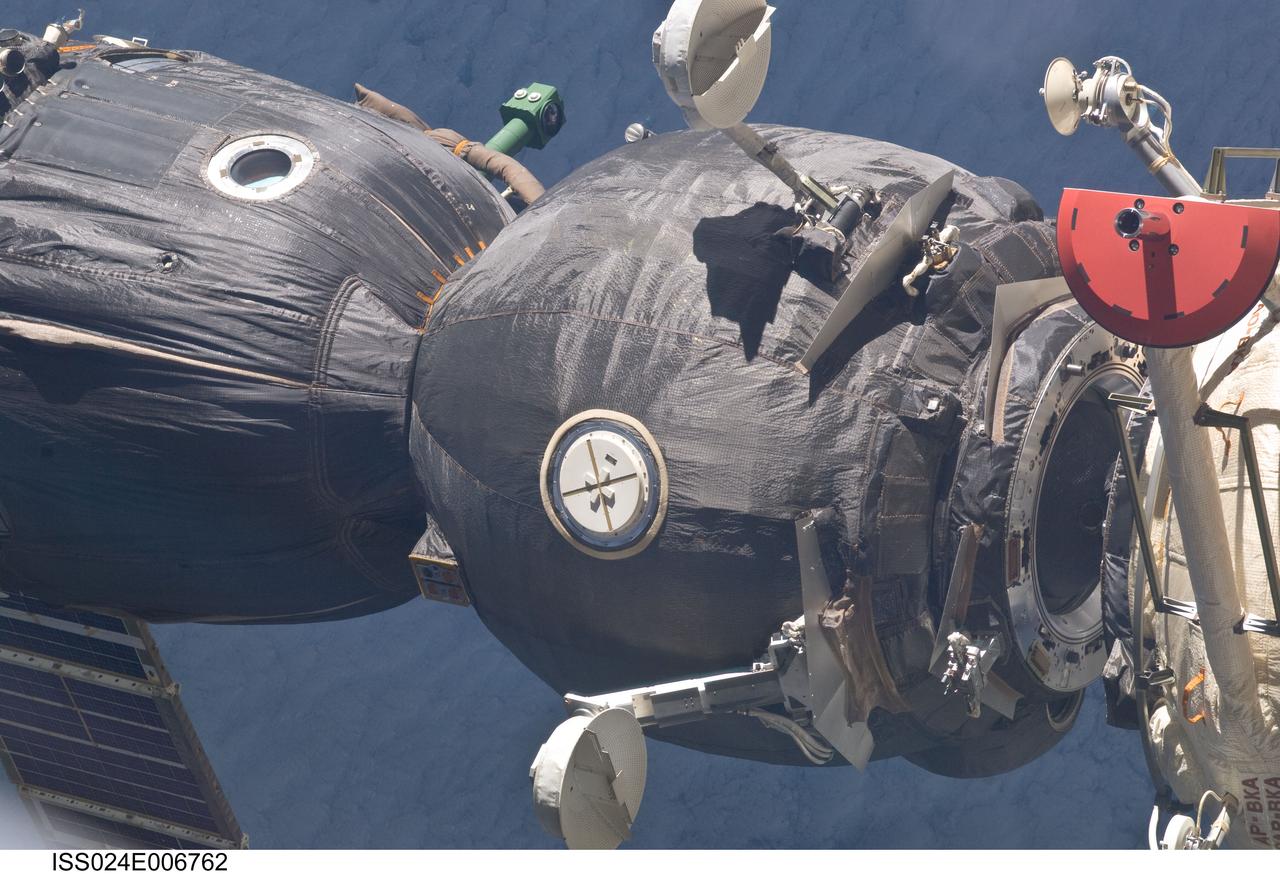
ISS024-E-006762 (28 June 2010) --- The Soyuz TMA-19 spacecraft docks to the Rassvet Mini-Research Module 1 (MRM1) of the International Space Station. Russian cosmonaut Fyodor Yurchikhin; along with NASA astronauts Doug Wheelock and Shannon Walker, all Expedition 24 flight engineers, undocked their Soyuz spacecraft from Zvezda Service Module's aft port at 3:13 pm. (EDT) on June 28, 2010, and docked it to its new location on the recently installed Rassvet module 25 minutes later.
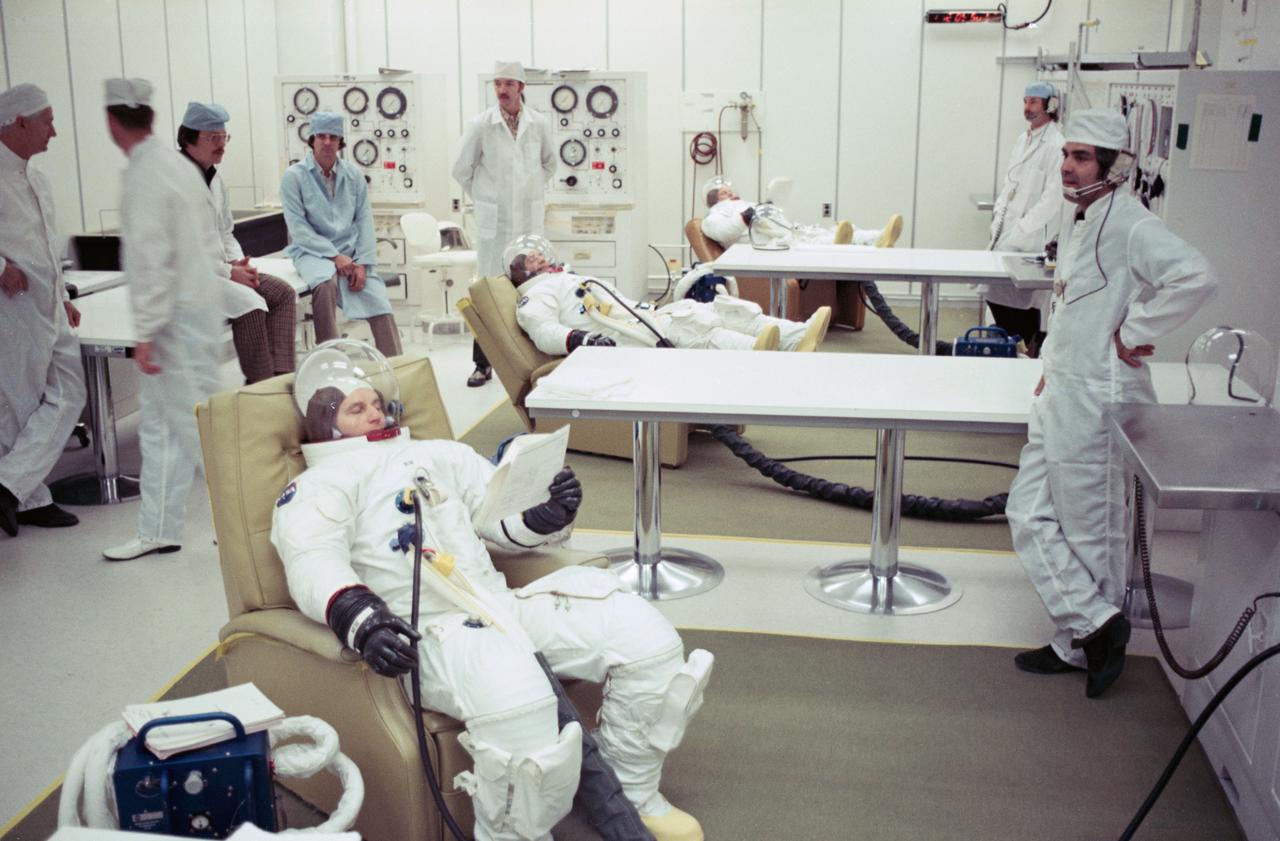
S75-21063 (January 1975) --- The three members of the American ASTP backup crew are suited up for the testing of the Apollo spacecraft at the Kennedy Space Center. They are (from foreground) astronauts Alan L. Bean, commander; Ronald E. Evans, command module pilot; and Jack R. Lousma, docking module pilot. Later, they entered the Apollo Command Module in an altitude chamber for tests of spacecraft systems. The testing was in preparation for the joint U.S.?USSR Apollo-Soyuz Test Project docking mission in Earth orbit scheduled for July 1975.
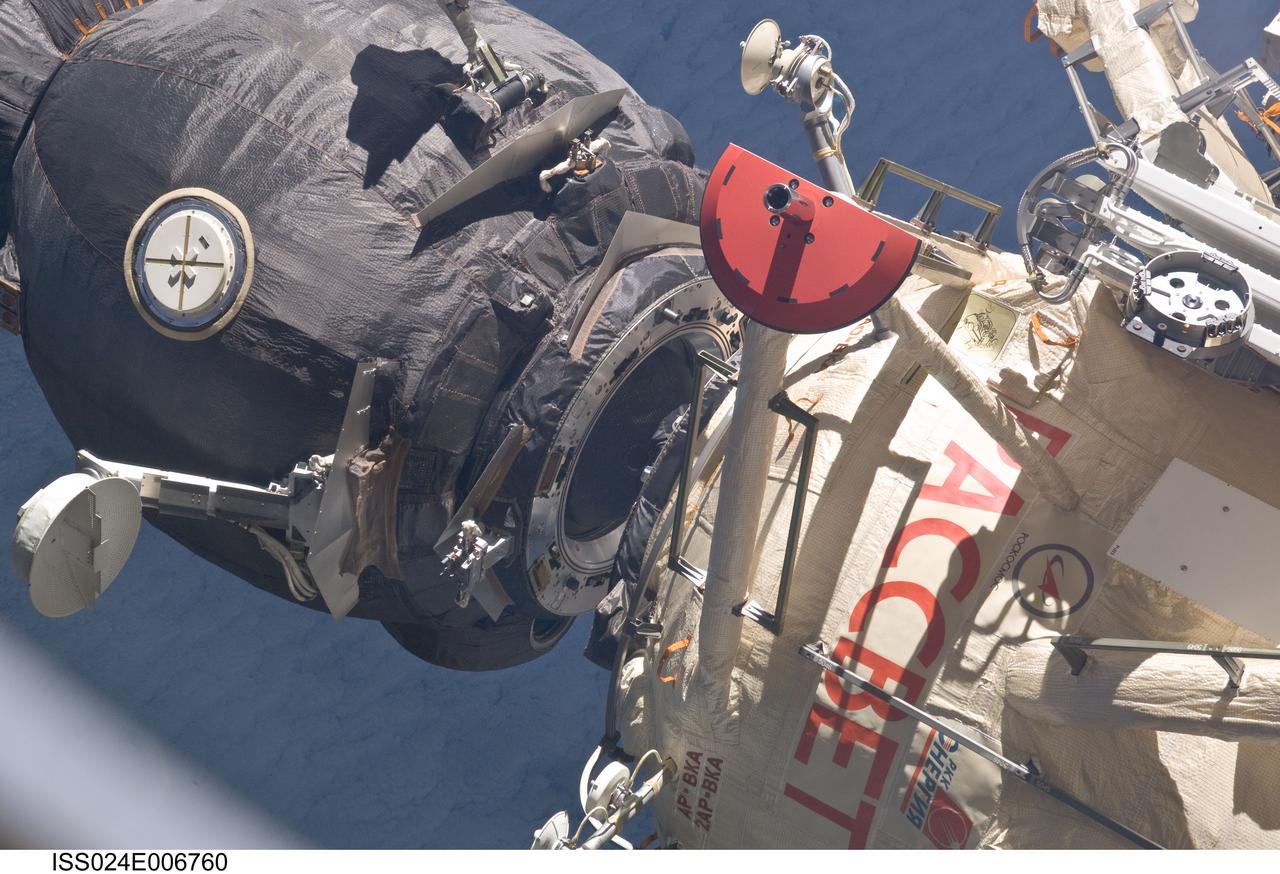
ISS024-E-006760 (28 June 2010) --- The Soyuz TMA-19 spacecraft docks to the Rassvet Mini-Research Module 1 (MRM1) of the International Space Station. Russian cosmonaut Fyodor Yurchikhin; along with NASA astronauts Doug Wheelock and Shannon Walker, all Expedition 24 flight engineers, undocked their Soyuz spacecraft from Zvezda Service Module's aft port at 3:13 pm. (EDT) on June 28, 2010, and docked it to its new location on the recently installed Rassvet module 25 minutes later.
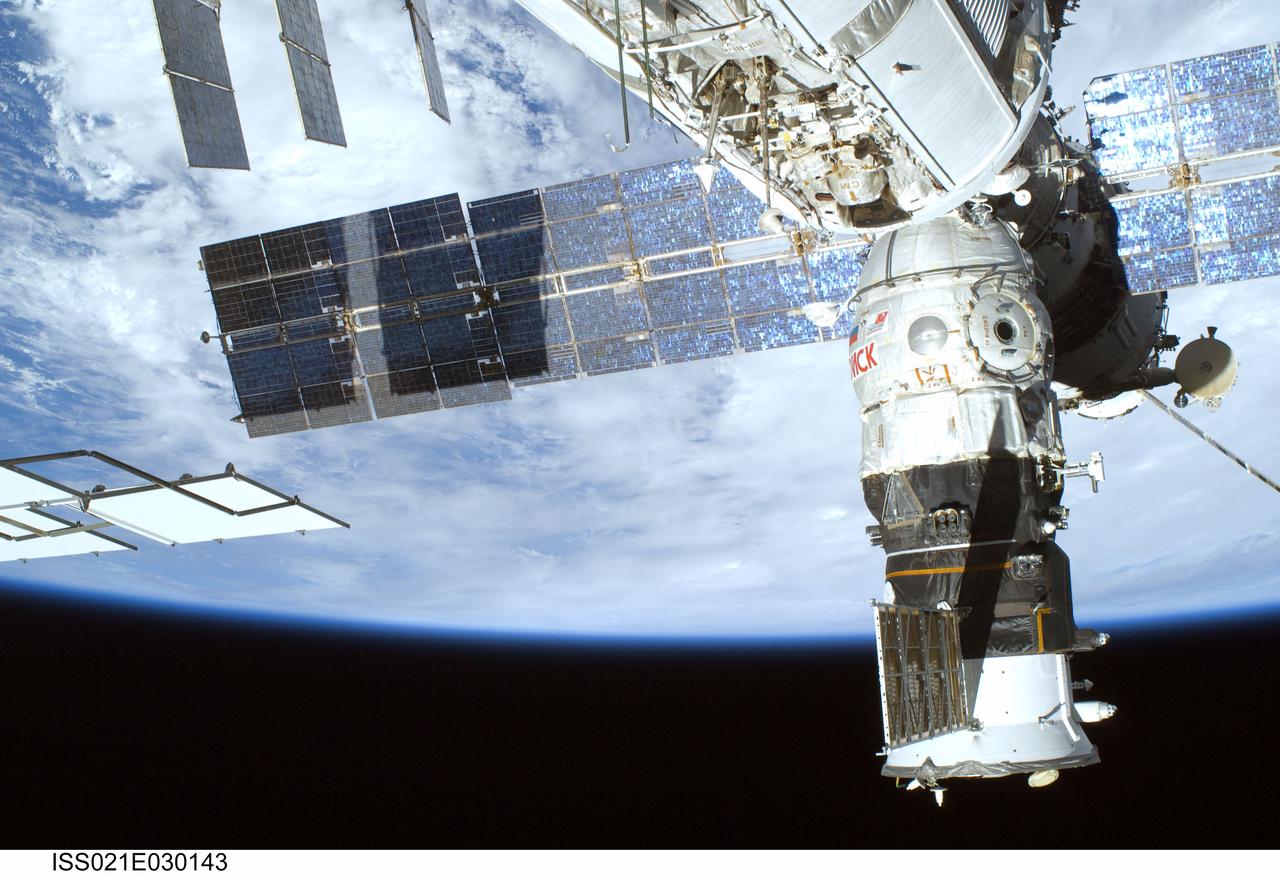
iss021e030143 (Nov. 19, 2009) --- The newly-arrived Poisk Mini-Research Module-2 is seen docked to the space-facing port of the forward section of the Zvezda service module. Attached to the rear of Poisk is the last stage of a Russian spacecraft that automatically guided and docked the module to the International Space Station. The Russian spacecraft would later undock from Poisk and deorbit for a fiery but safe destruction in Earth's atmosphere over the Pacific Ocean.
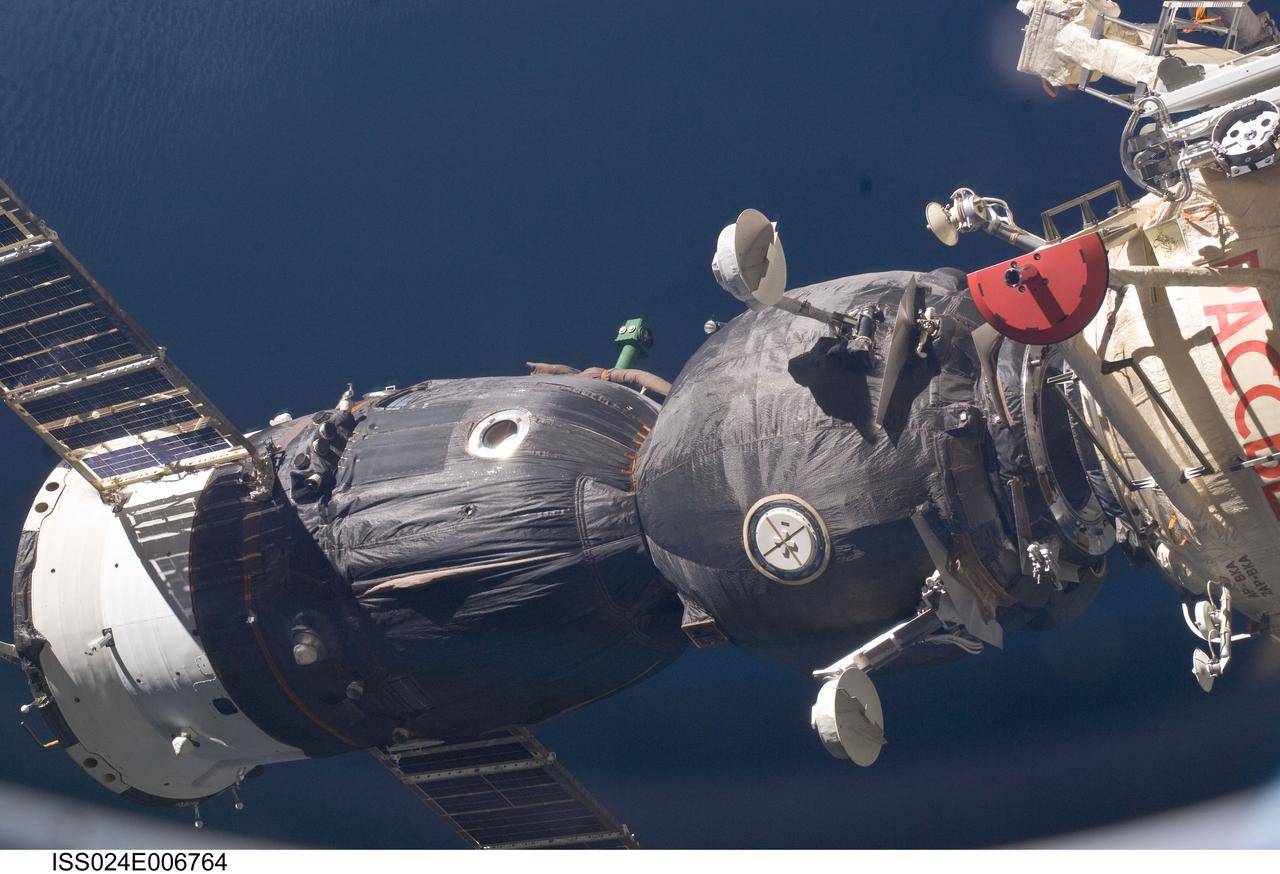
ISS024-E-006764 (28 June 2010) --- The Soyuz TMA-19 spacecraft docks to the Rassvet Mini-Research Module 1 (MRM1) of the International Space Station. Russian cosmonaut Fyodor Yurchikhin; along with NASA astronauts Doug Wheelock and Shannon Walker, all Expedition 24 flight engineers, undocked their Soyuz spacecraft from Zvezda Service Module's aft port at 3:13 pm. (EDT) on June 28, 2010, and docked it to its new location on the recently installed Rassvet module 25 minutes later.
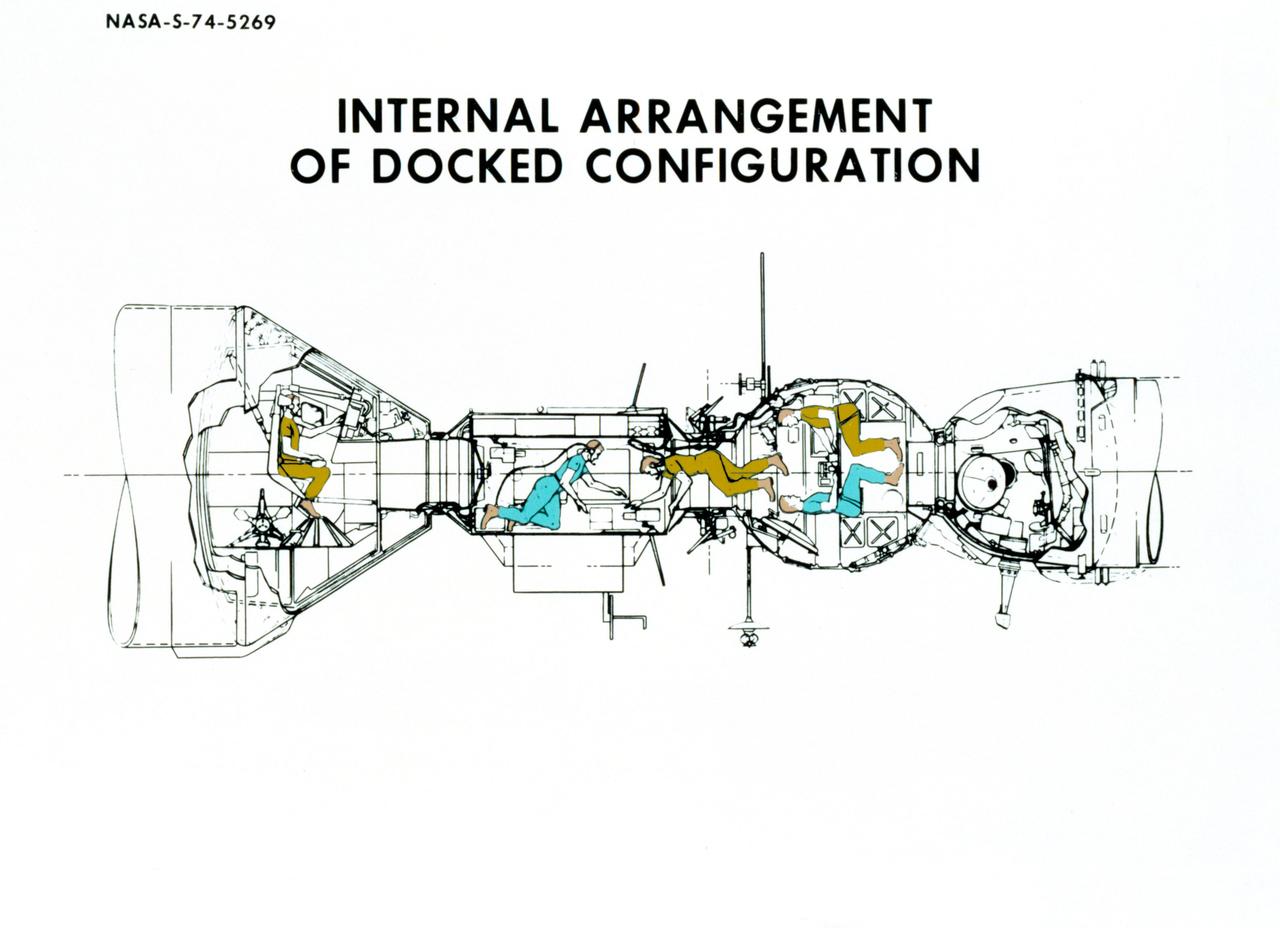
S74-05269 (December 1974) --- An artist?s drawing illustrating the internal arrangement of the Apollo and Soyuz spacecraft in Earth orbit in a docked configuration. The three American Apollo crewmen and the two Soviet Soyuz crewmen will transfer to each other?s spacecraft during the July 1975 ASTP mission. The four Apollo-Soyuz Test Project visible components are, left to right, the Apollo Command Module, the Docking Module, the Soyuz Orbital Module and the Soyuz Descent Vehicle.
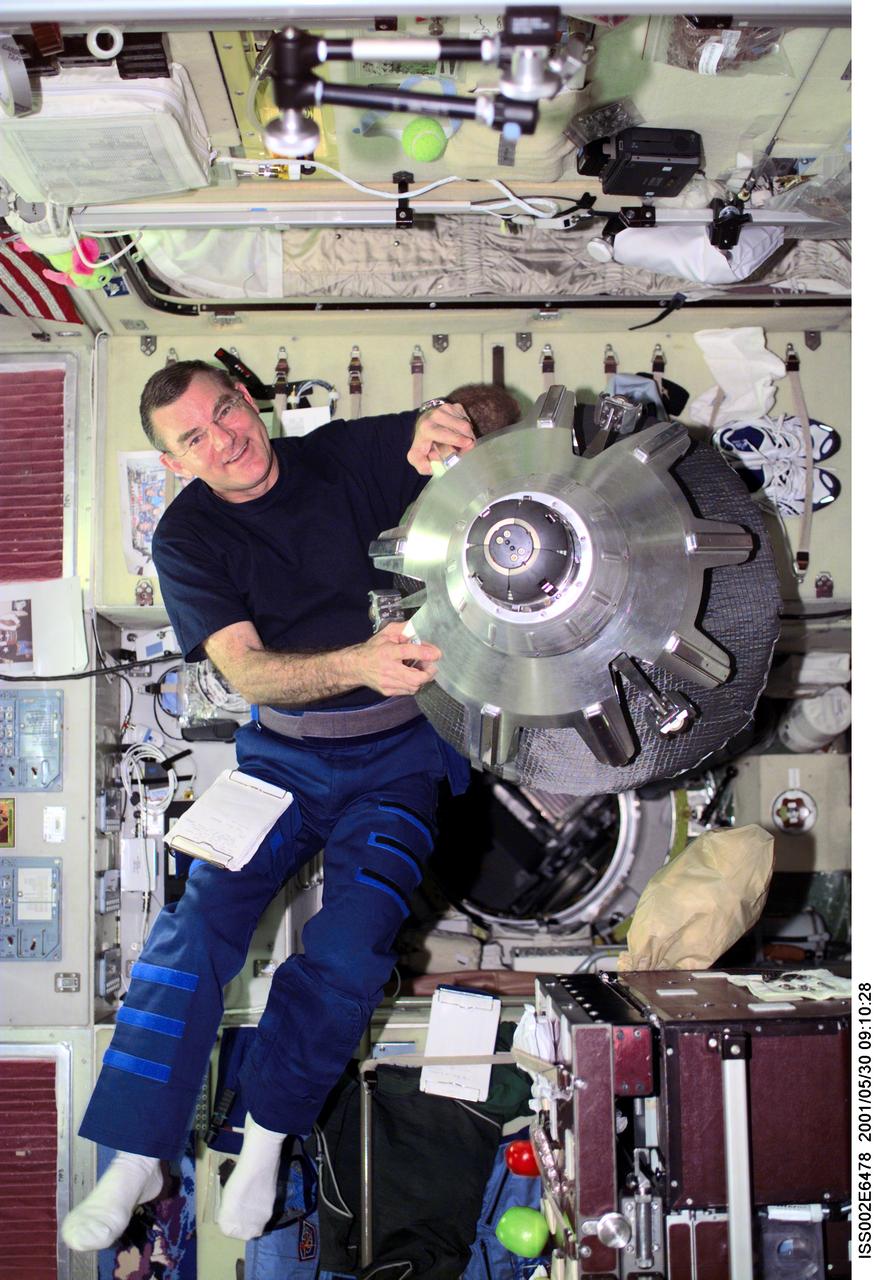
ISS002-E-6478 (30 May 2001) --- James S. Voss, Expedition Two flight engineer, handles a spacecraft docking probe in the Service Module. The docking probe assists with the docking of the Soyuz and Progress vehicles to the International Space Station. The image was taken with a digital still camera.
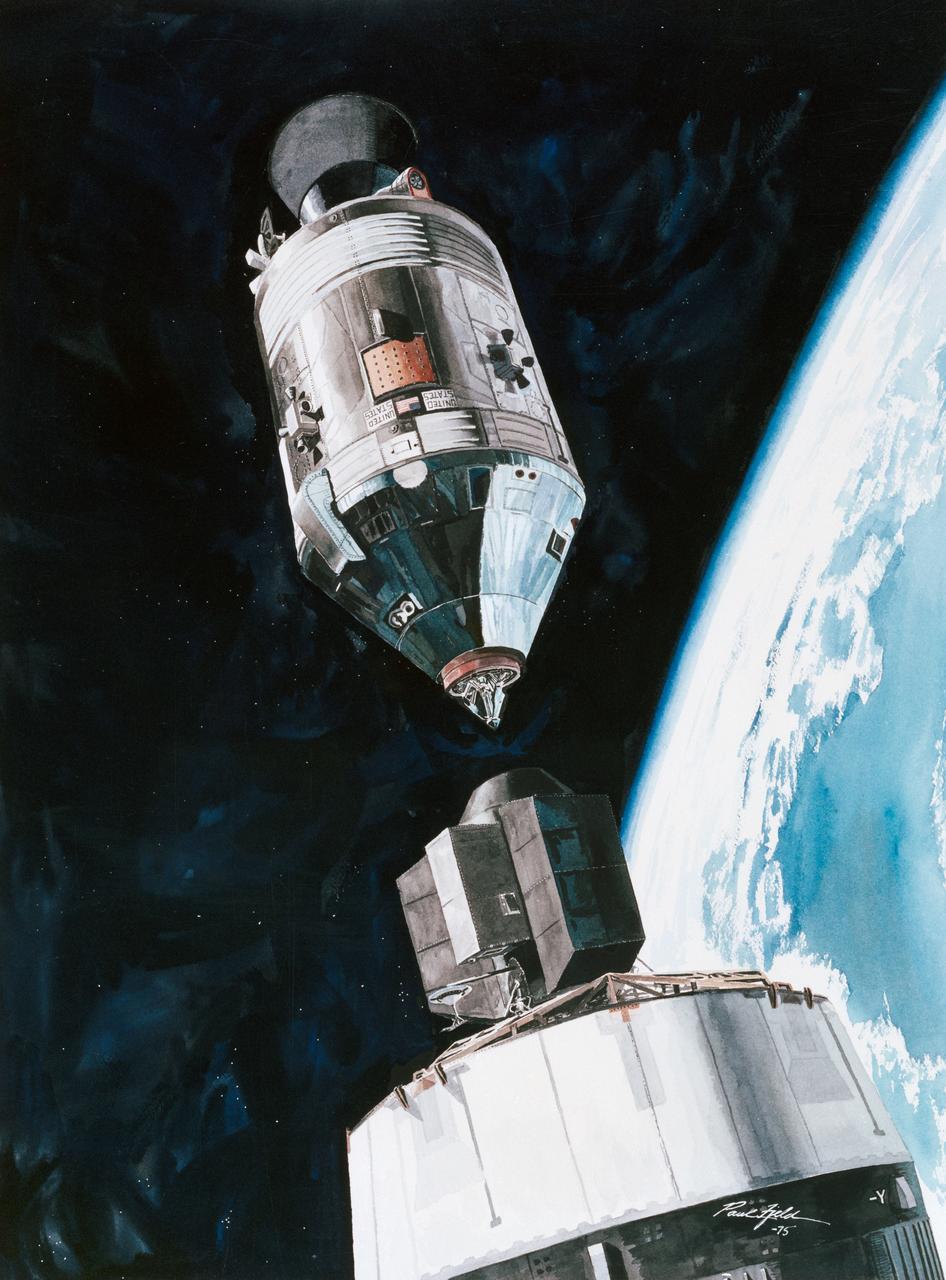
S75-28512 (July 1975) --- An artist?s concept depicting a scene in Earth orbit during the Apollo transposition and docking maneuvers of the Apollo-Soyuz Test Project mission. The Command/Service Module is moving into position to dock with the Docking Module. Following the docking the DM will be extracted from the expended Saturn IVB stage. The Docking Module is designed to link the American Apollo spacecraft with the Soviet Soyuz spacecraft. This scene will take place some one hour and twenty-three minutes after the Apollo-Saturn 1B liftoff from the Kennedy Space Center on July 15, 1975. The Soyuz launch at 7:20 a.m. (CDT) from the Baikonur, Kazakhstan launch pad will precede the Apollo liftoff by seven and one-half hours. The artwork is by Paul Fjeld.
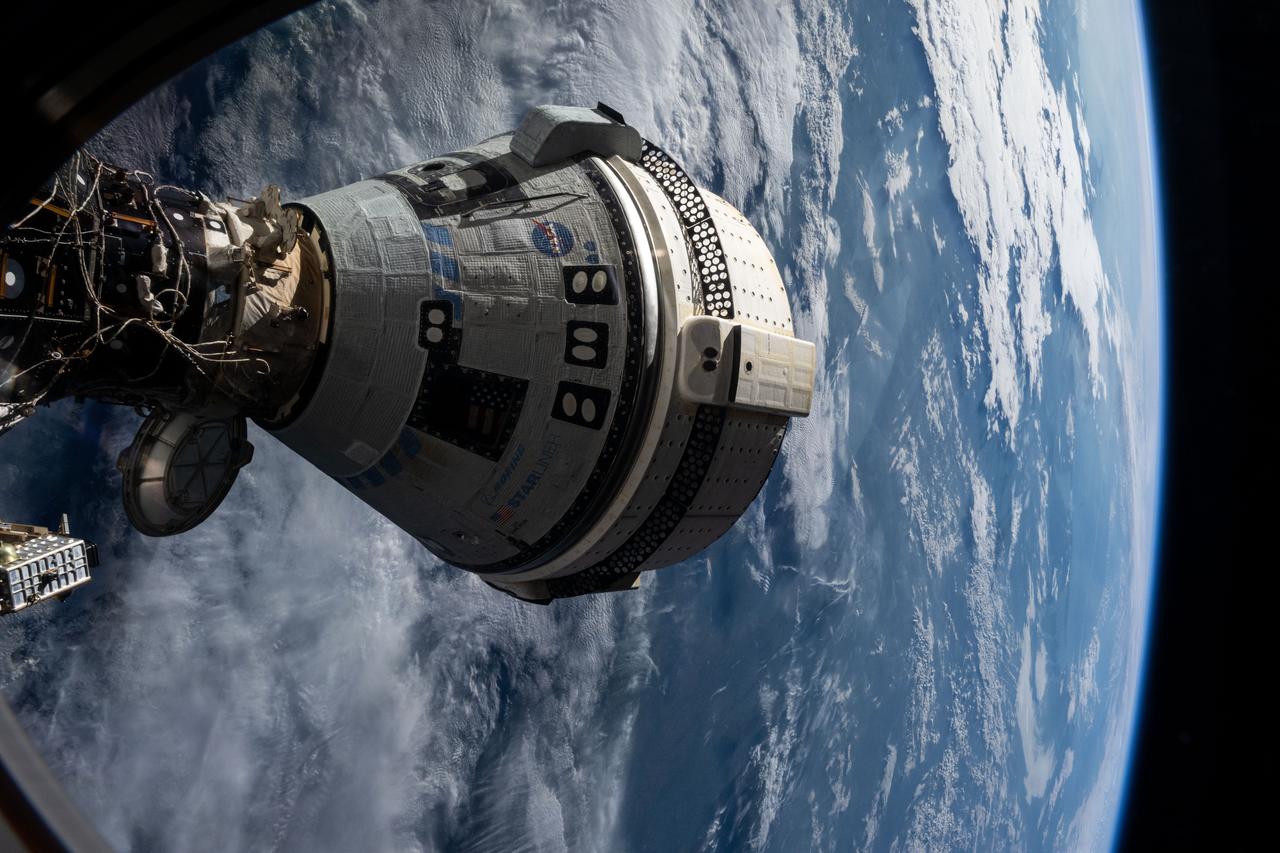
iss071e265103 (July 3, 2024) --- Boeing's Starliner spacecraft that launched NASA's Crew Flight Test astronauts Butch Wilmore and Suni Williams to the International Space Station is pictured docked to the Harmony module's forward port. This view is from a window on the SpaceX Dragon Endeavour spacecraft docked to the port adjacent to the Starliner.
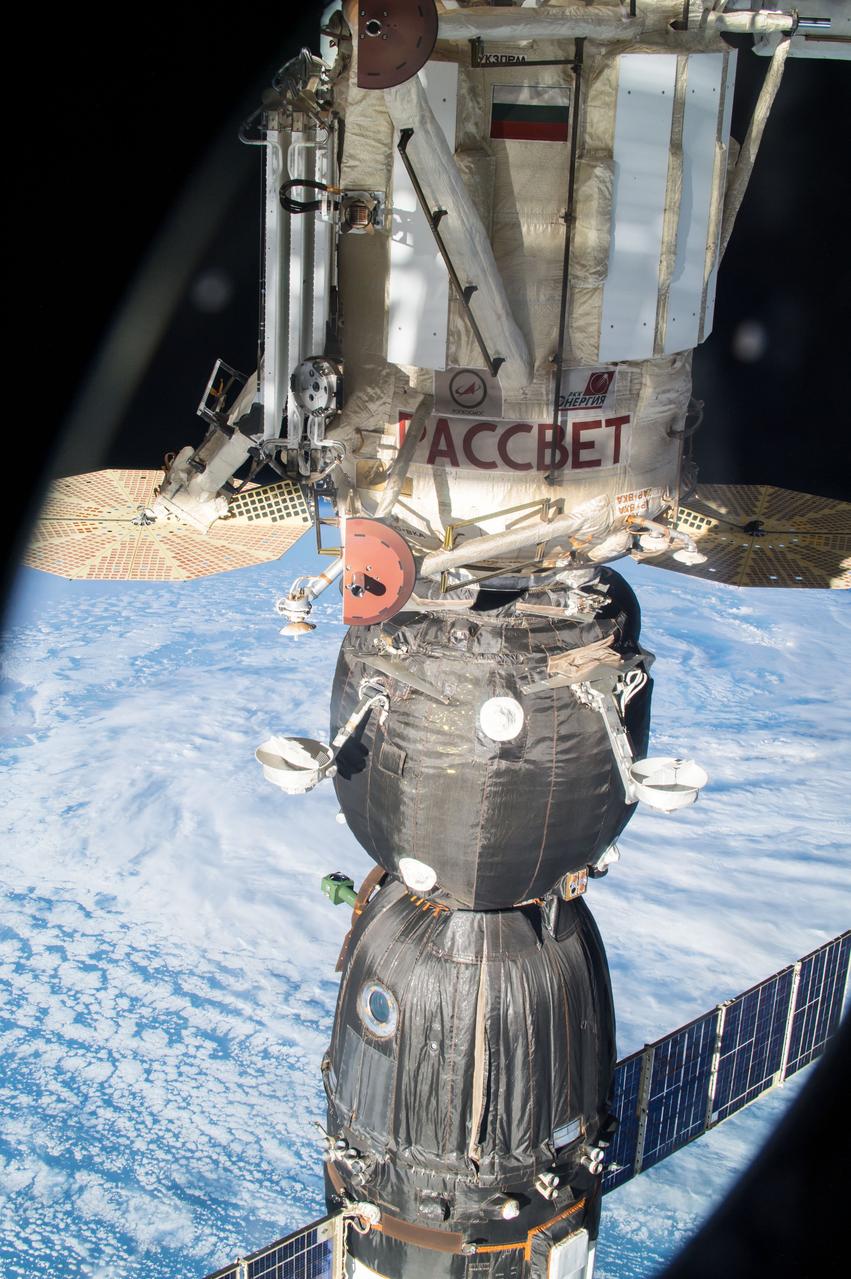
iss053e210873 (Nov. 16, 2017) --- The Soyuz MS-05 crew spacecraft is pictured docked to the Rassvet Mini-Research Module-1. Pictured behind the Soyuz spacecraft and its docking port are the dual cymbal-like UltraFlex solar arrays that power the Orbital ATK Cygnus resupply ship.
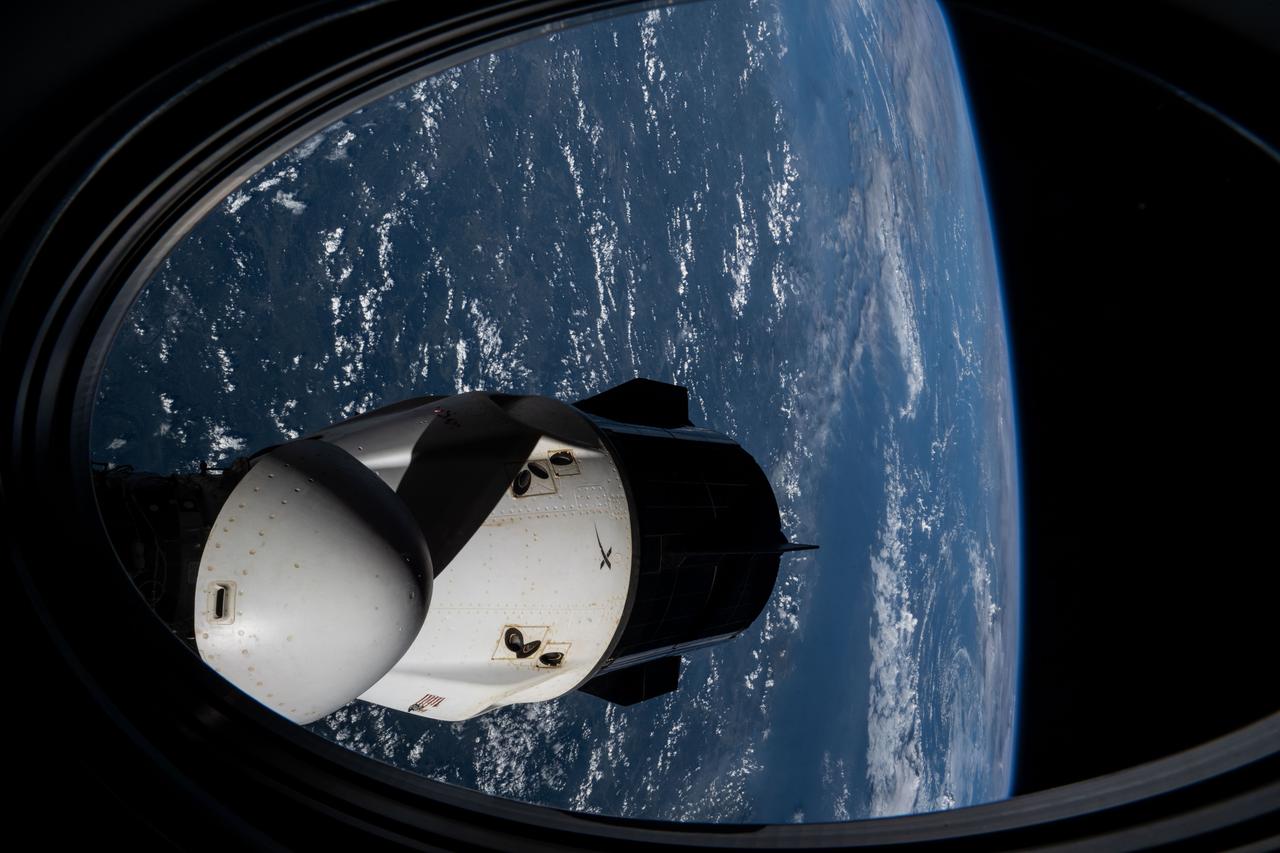
iss073e0427628 (Aug. 8, 2025) --- From one Dragon to another: A view of the SpaceX Dragon crew spacecraft docked to the forward port of the International Space Station's Harmony module, captured from a window aboard another Dragon spacecraft docked to Harmony’s space-facing port.
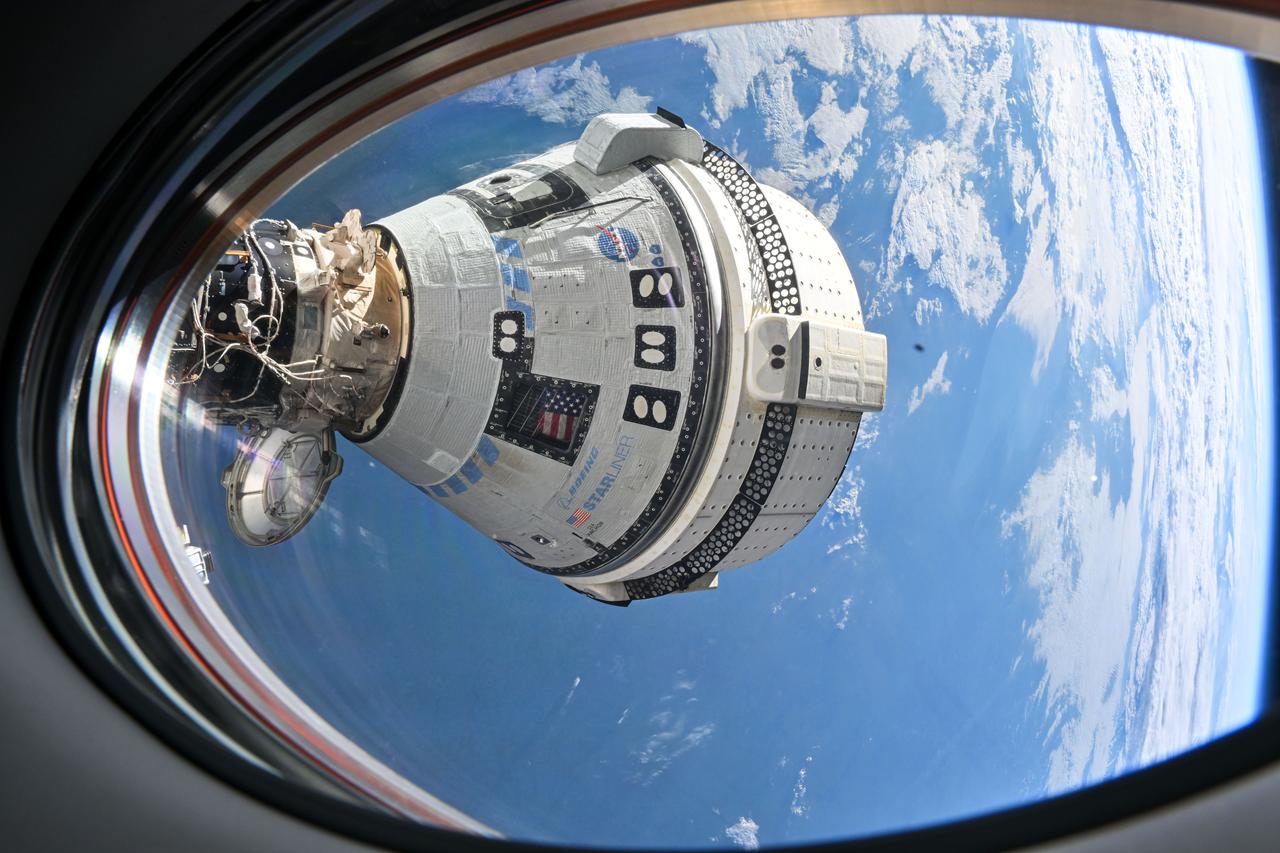
iss071e265073_stk (July 3, 2024) --- Boeing's Starliner spacecraft that launched NASA's Crew Flight Test astronauts Butch Wilmore and Suni Williams to the International Space Station is pictured docked to the Harmony module's forward port. This view is from a window on the SpaceX Dragon Endeavour spacecraft docked to the port adjacent to the Starliner.
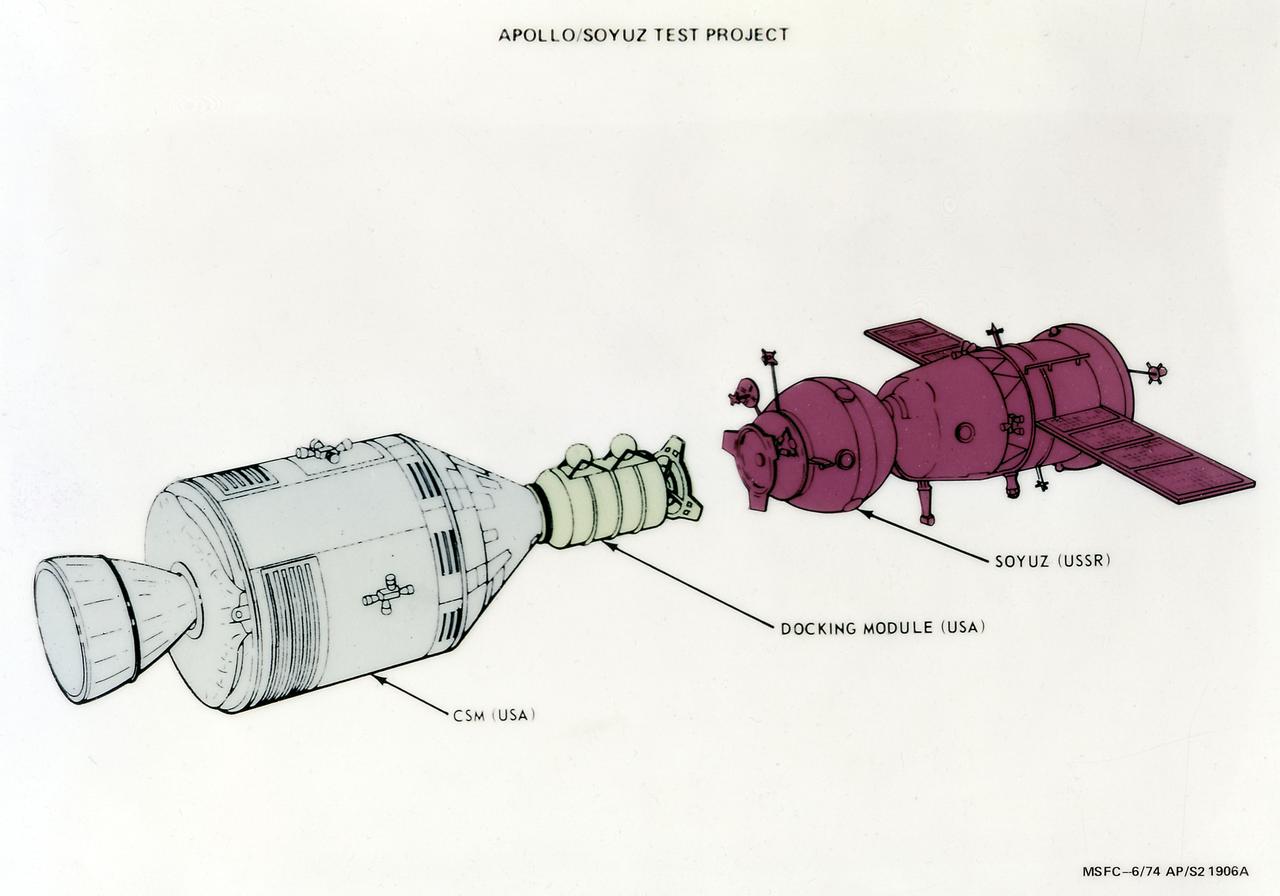
This illustration shows the docking configuration of the Apollo-Soyuz Test Project (ASTP). The ASTP was the first international docking of the U.S.'s Apollo spacecraft and the U.S.S.R.'s Soyuz spacecraft in space. A joint engineering team from the two countries met to develop a docking system that permitted the two spacecraft to link in space and allowed the two crews to travel from one spacecraft to the other. This system entailed developing a large habitable Docking Module (DM) to be carried on the Apollo spacecraft to facilitate the joining of two dissimilar spacecraft. The Marshall Space Flight Center was responsible for development and sustaining engineering of the Saturn IB launch vehicle during the mission. The ASTP marked the last use of the Saturn Launch Vehicle.
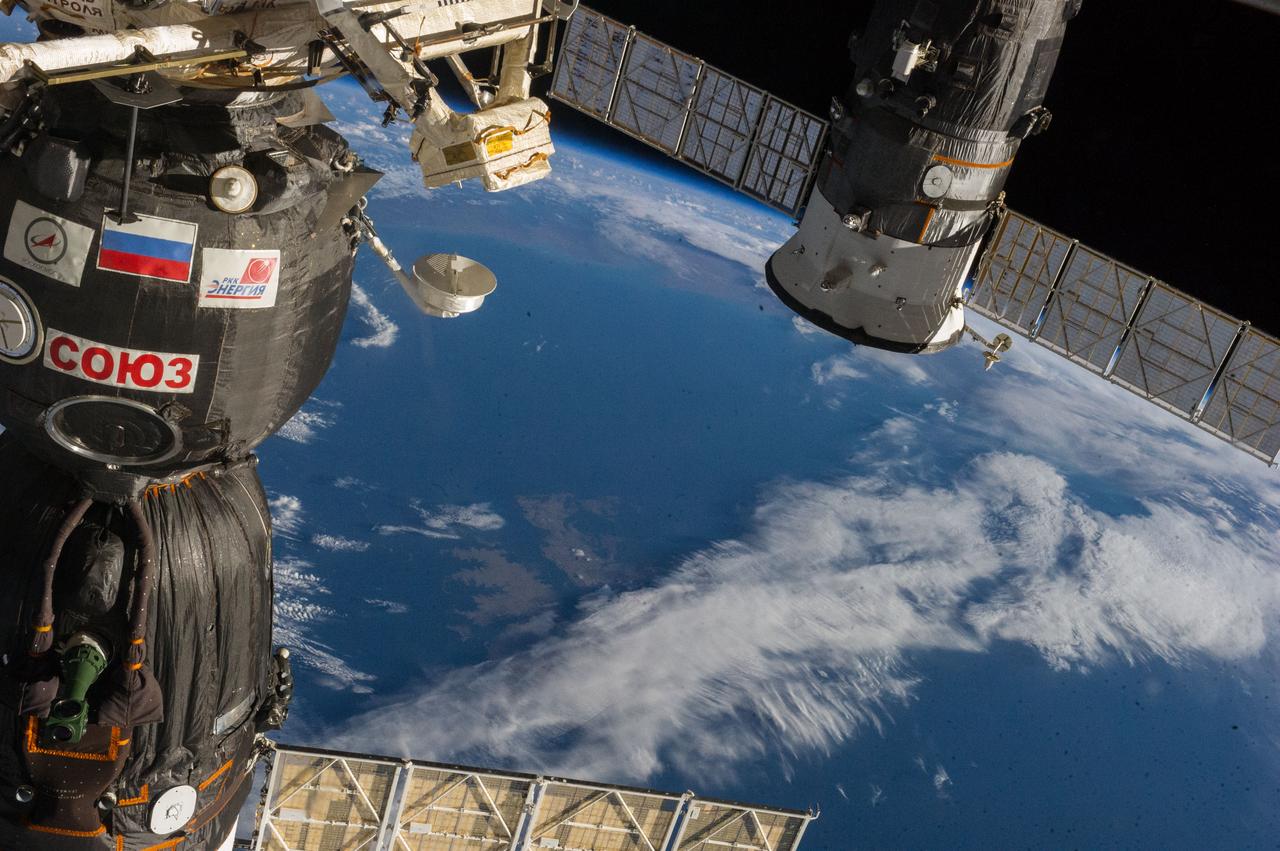
ISS040-E-006230 (30 May 2014) --- Two Russian spacecraft docked to the International Space Station are featured in this image photographed by an Expedition 40 crew member from inside the International Space Station?s Cupola. The Soyuz 39 (TMA-13M) spacecraft, docked to the Rassvet Mini-Research Module 1 (MRM1), is visible in the foreground. The Progress 55 resupply vehicle, docked to the Pirs Docking Compartment, is visible in the background. A blue and white part of Earth and the blackness of space provide the backdrop for the scene.
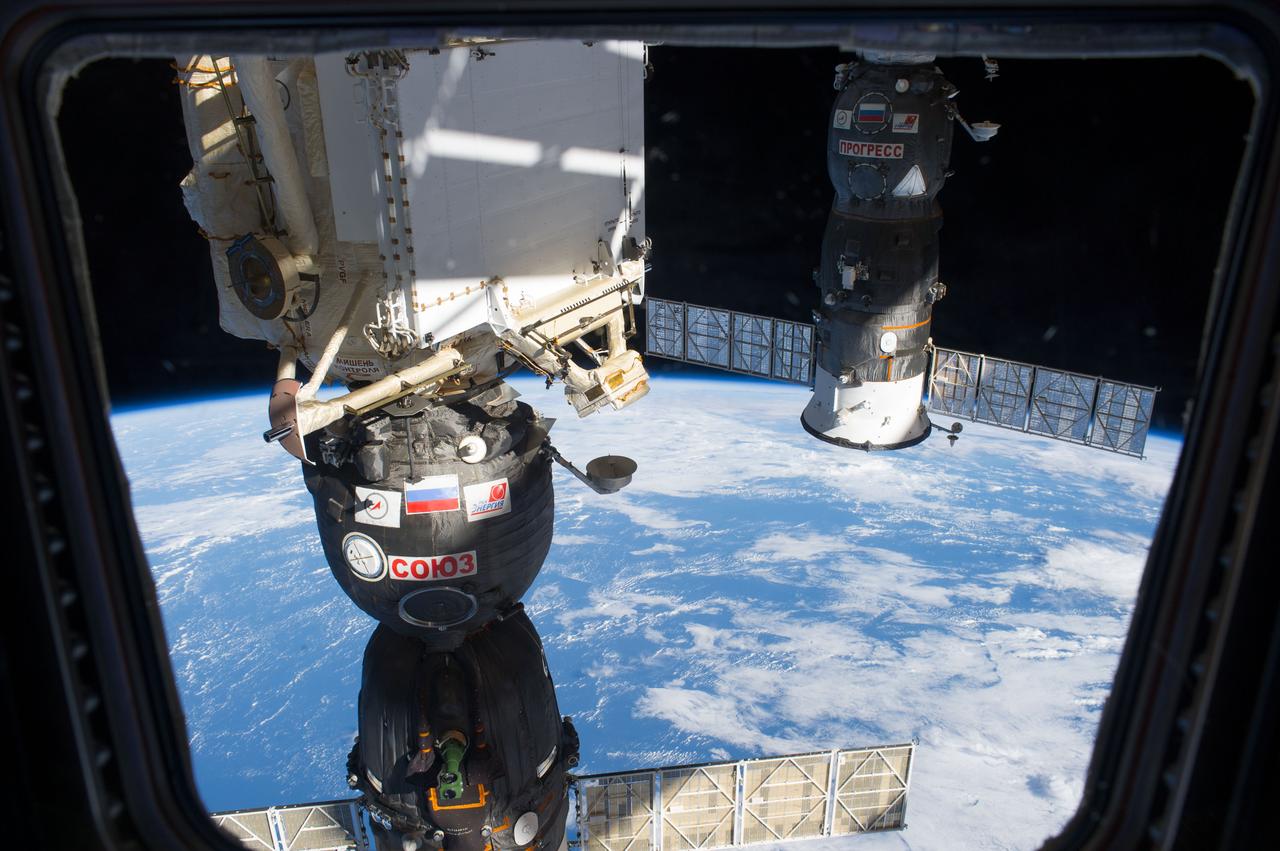
ISS040-E-005999 (29 May 2014) --- Two Russian spacecraft docked to the International Space Station are featured in this image photographed by an Expedition 40 crew member in the International Space Station’s Cupola. The Soyuz 39 (TMA-13M) spacecraft, docked to the Rassvet Mini-Research Module 1 (MRM1), is visible in the foreground. The Progress 55 resupply vehicle, docked to the Pirs Docking Compartment, is visible in the background. A blue and white part of Earth and the blackness of space provide the backdrop for the scene.
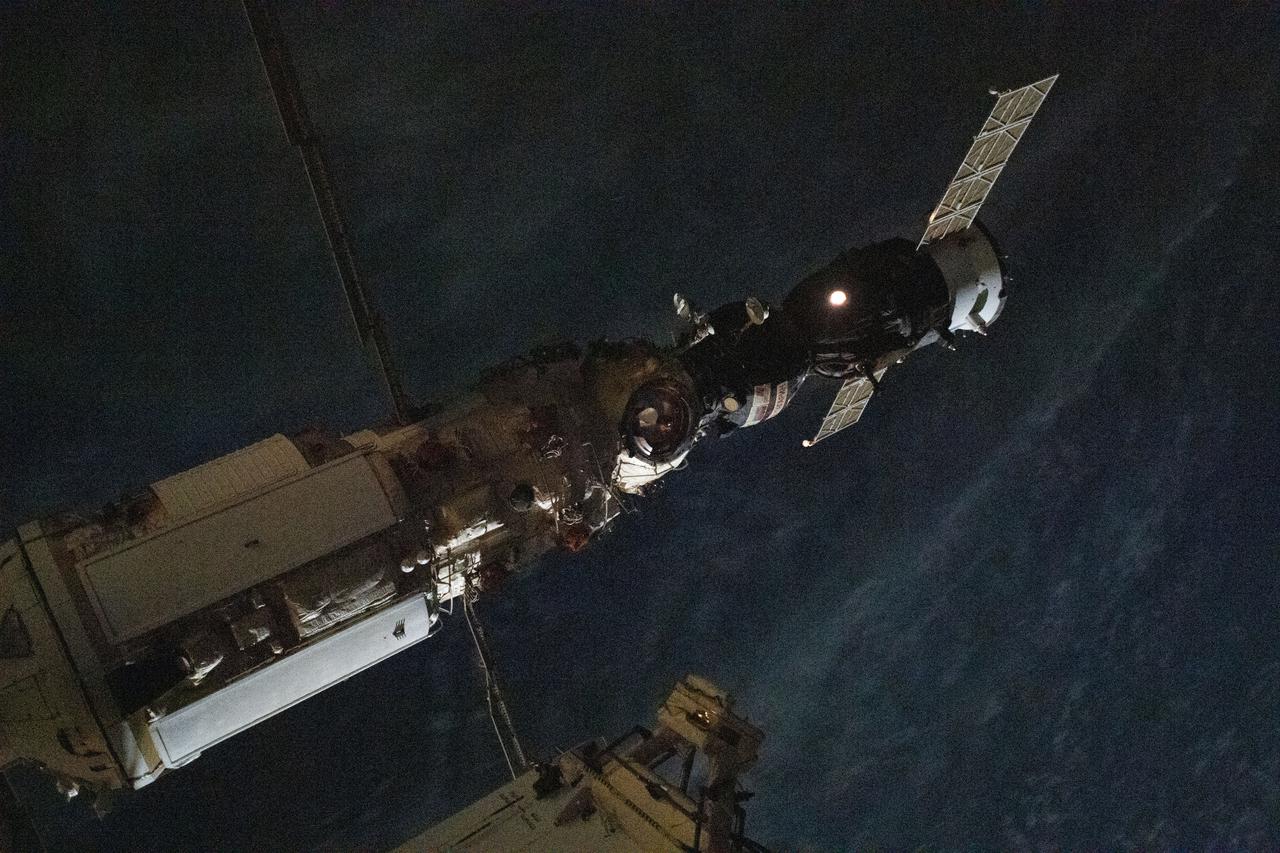
iss065e431591 (Sept. 28, 2021) --- The Soyuz MS-18 spacecraft carrying three Expedition 65 crewmates is pictured docked to the Nauka multipurpose laboratory module moments after completing its relocation maneuver from the Rassvet module.
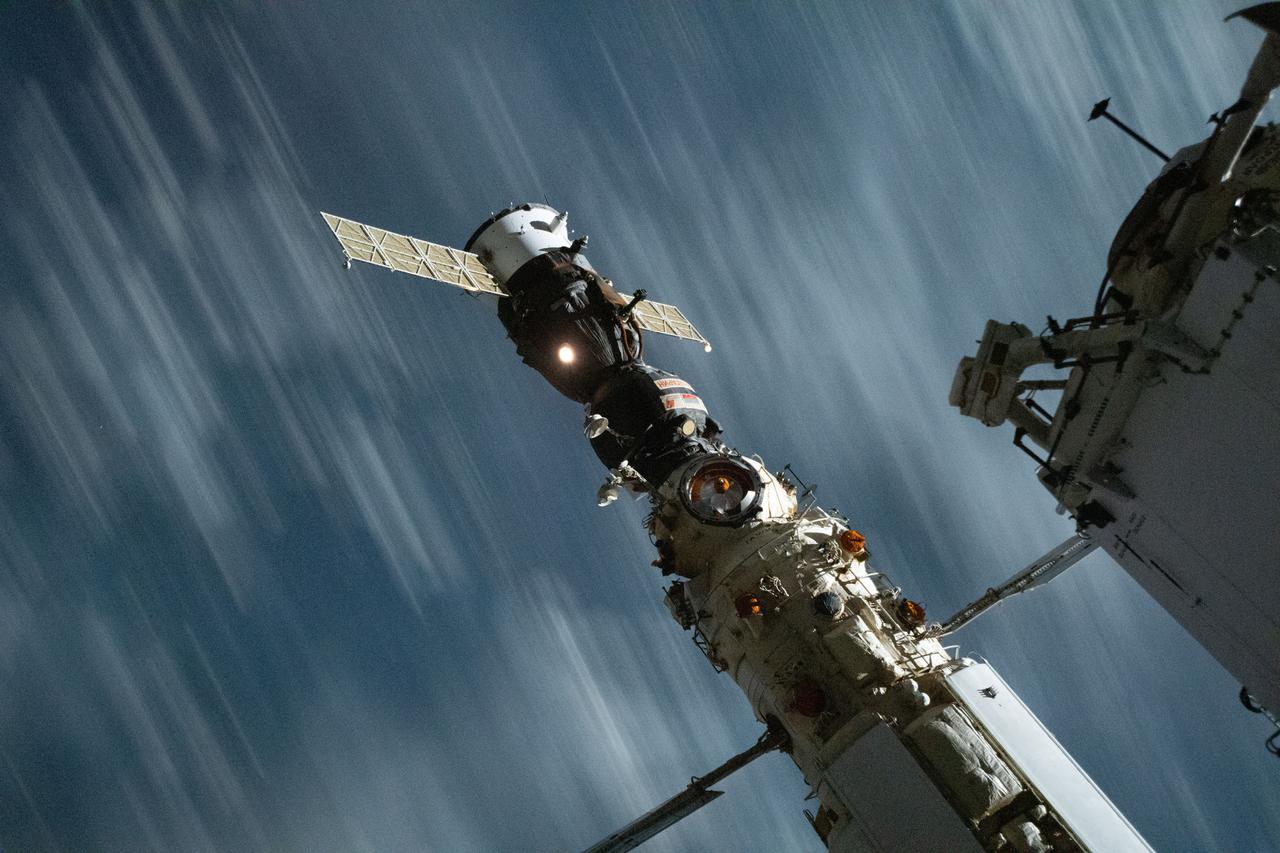
iss065e431610 (Sept. 28, 2021) --- The Soyuz MS-18 spacecraft carrying three Expedition 65 crewmates is pictured docked to the Nauka multipurpose laboratory module moments after completing its relocation maneuver from the Rassvet module.
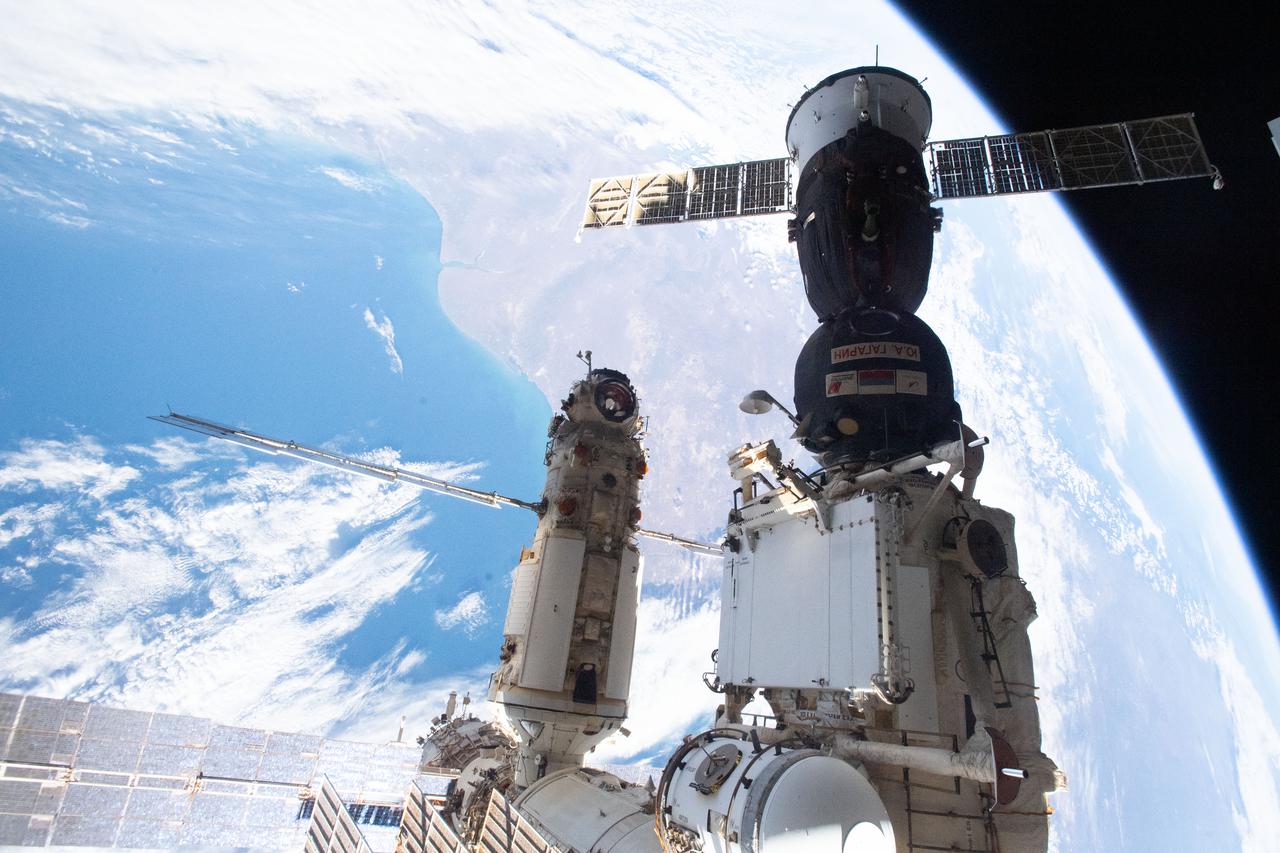
iss065e431311 (Sept. 28, 2021) --- The Soyuz MS-18 spacecraft carrying three Expedition 65 crewmates is pictured docked to the Rassvet module moments before beginning its relocation maneuver to the Nauka multipurpose laboratory module.
iss065e431289 (Sept. 28, 2021) --- The Soyuz MS-18 spacecraft carrying three Expedition 65 crewmates is pictured docked to the Rassvet module moments before beginning its relocation maneuver to the Nauka multipurpose laboratory module.
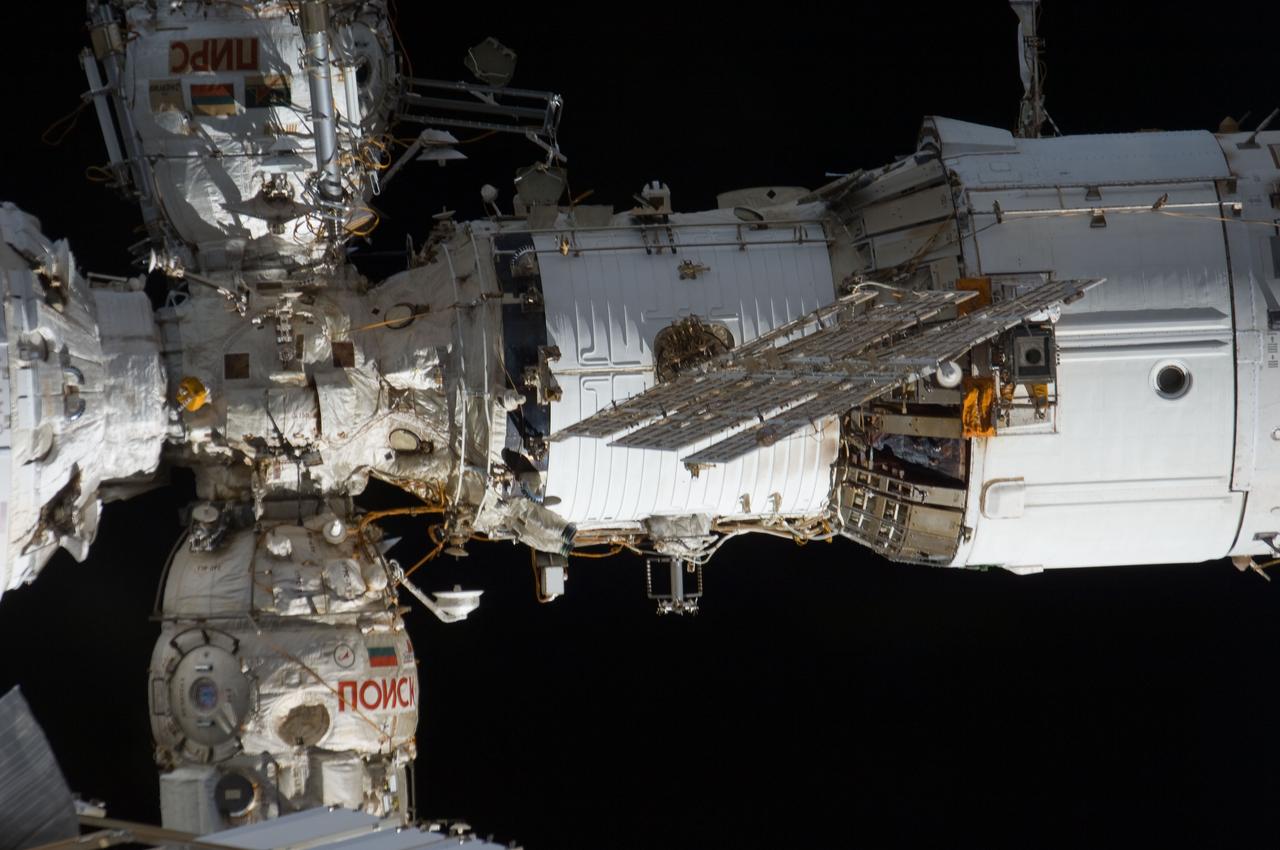
s135e011242 (July 19, 2011) --- The International Space Station's Zvezda service module is pictured with two Russian modules attached to its forward section. Both modules host docked Russian spacecraft including the Progress resupply ships and the Soyuz crew ships. At top left is the Pirs Docking Compartment where Russian spacewalks are staged. At bottom left is the Poisk Mini-Research Module-2 where Russian science experiments are conducted.
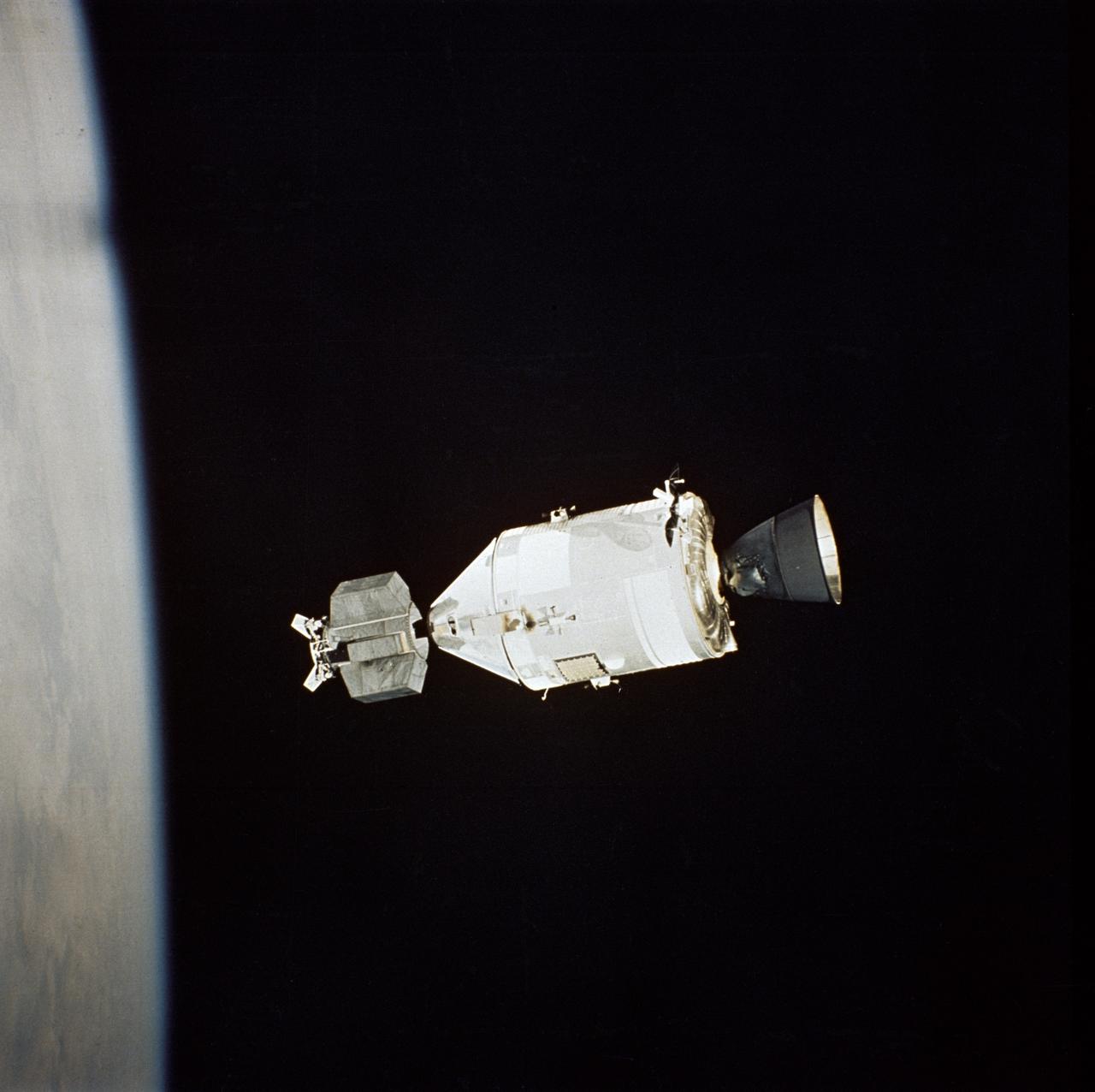
AST-32-2695 (17-19 July 1975) --- The American Apollo spacecraft as seen in Earth orbit from the Soviet Soyuz spacecraft during the joint U.S.-USSR Apollo-Soyuz Test Project mission. The Command/Service Module and Docking Module are contrasted against a black-sky background. The horizon of Earth is below. This picture was furnished by the USSR in an exchange of photography taken during the ASTP flight. The bell-shaped engine nozzle of the service propulsion system protrudes from the rear of the Service Module. Note the docking mechanism on the Docking Module. The American and Soviet spacecraft were joined together in space for approximately 47 hours on July 17-18-19, 1975. PHOTO COURTESY: USSR ACADEMY OF SCIENCES
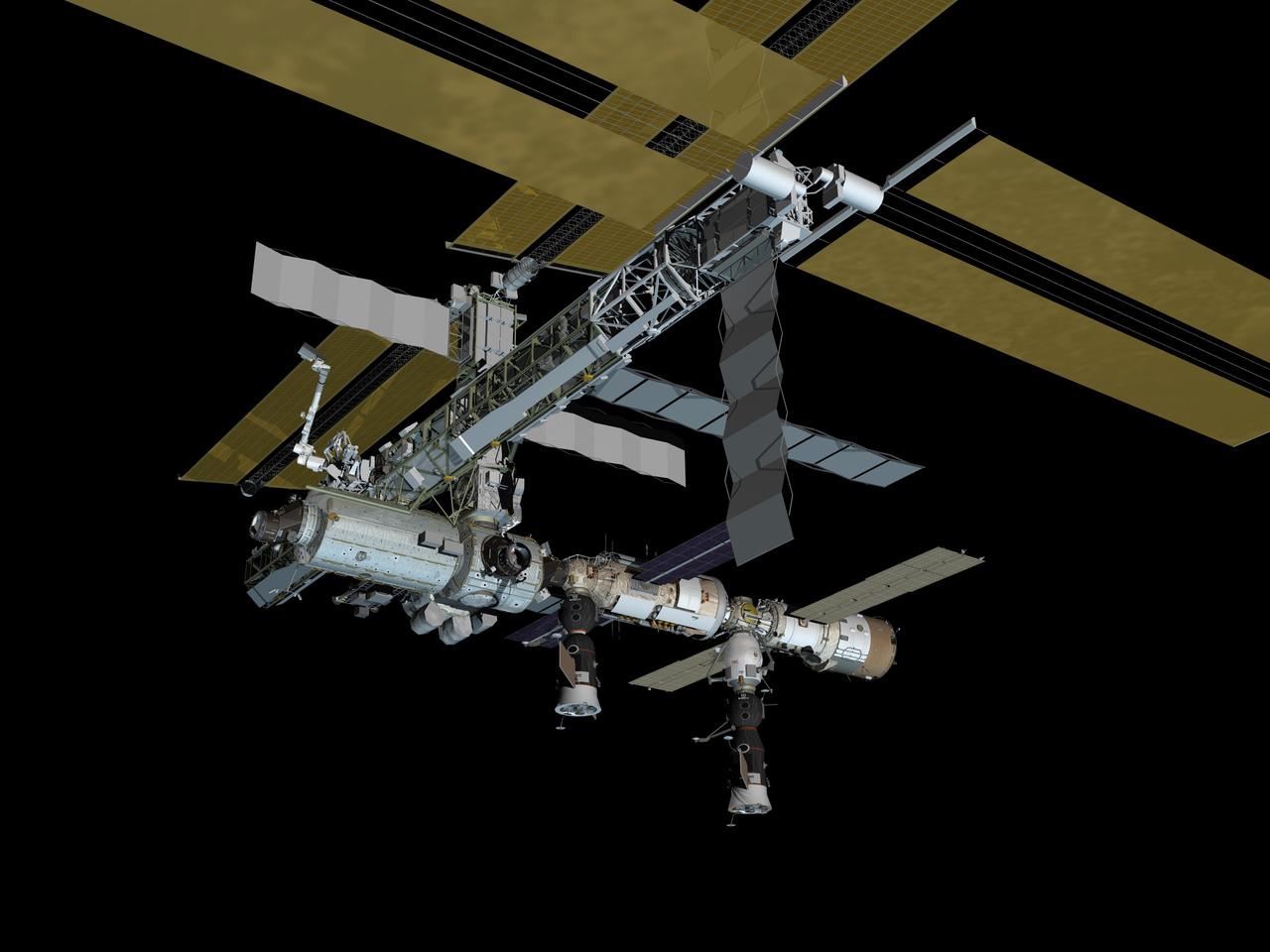
JSC2006-E-40782 (September 2006) --- Computer-generated artist's rendering of the International Space Station following scheduled activities of Sept. 18, 2006. This angle shows the port side view of the orbiting complex. Progress 21 resupply vehicle undocks from the Zvezda Service Module, making way for the Soyuz 13 (TMA-9) spacecraft, carrying the Expedition 14 crew. Progress 22 resupply vehicle remains docked to the Pirs Docking Compartment and Soyuz 12 (TMA-8) is docked to the Zarya Module nadir port.
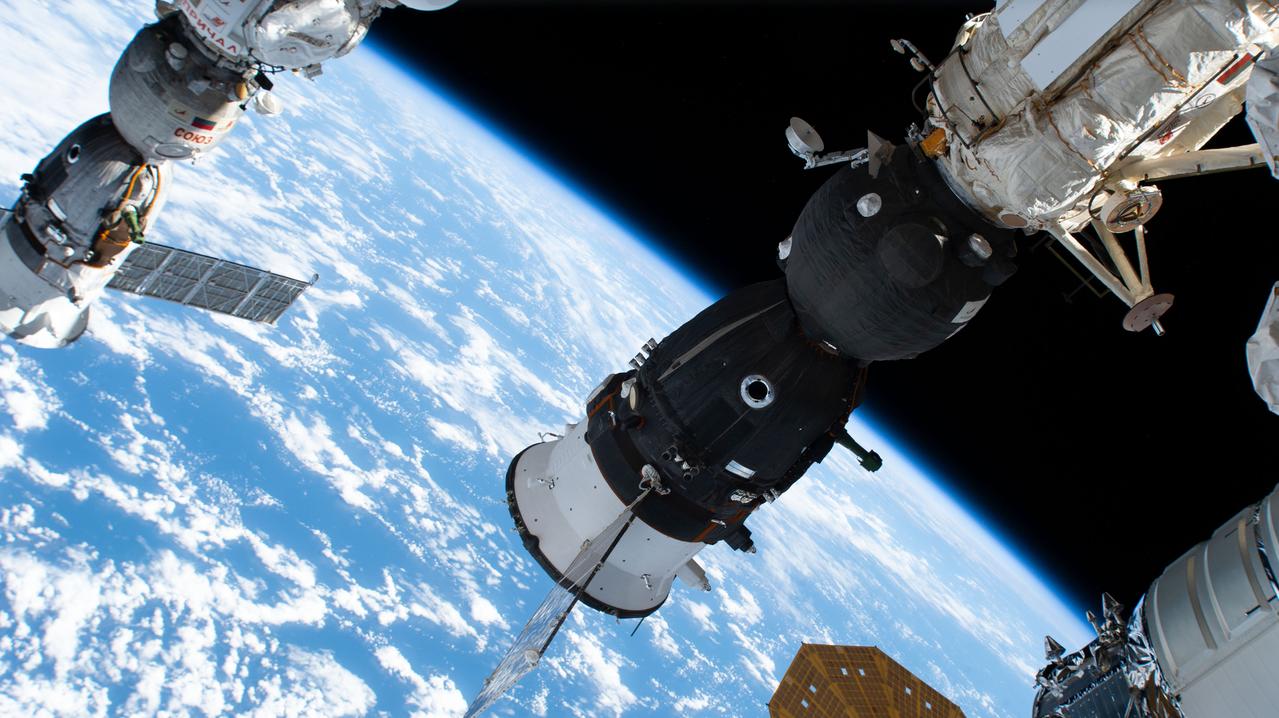
iss069e089047 (Sept. 18, 2023) --- The Soyuz MS-24 spacecraft that carried NASA astronaut Loral O'Hara and Roscosmos cosmonauts Oleg Kononenko and Nikolai Chub to the International Space Station is pictured docked to the Rassvet module. At far left, is the Soyuz MS-23 crew ship, docked to the Prichal docking module, that will return NASA astronaut Frank Rubio and Roscosmos cosmonauts Sergey Prokopyev and Dmitri Petelin back to Earth on Sept. 27.
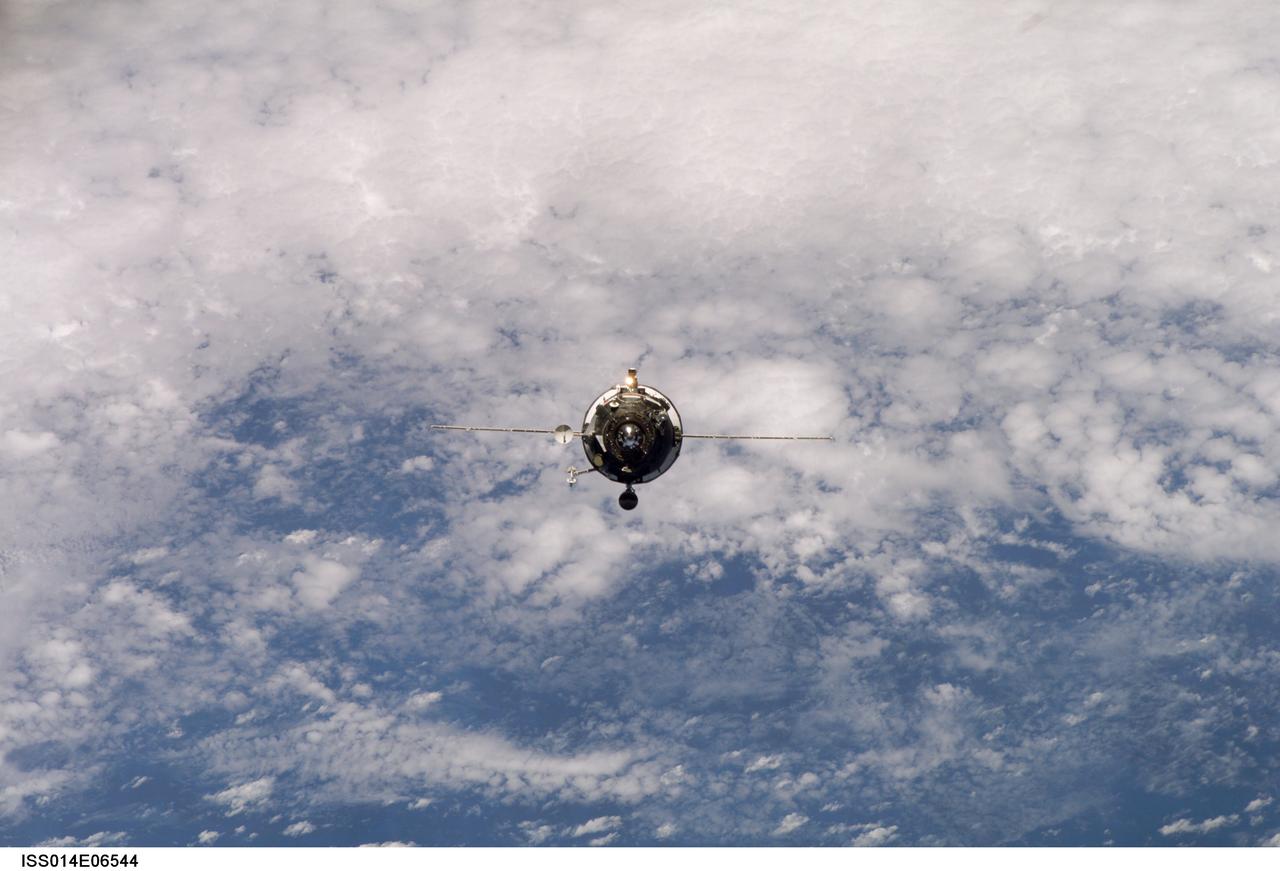
ISS014-E-06544 (26 Oct. 2006) --- Backdropped by a blue and white Earth, an unpiloted Progress supply vehicle approaches the International Space Station. Progress docked to the aft port of the Zvezda Service Module at 9:29 a.m. (CDT) on Oct. 26. The spacecraft used the automated Kurs system to dock at the aft port of the Zvezda service module. Expedition 14 flight engineer Mikhail Tyurin stood by at the manual Toru docking system controls, but the automated system functioned as designed and manual intervention was not needed.
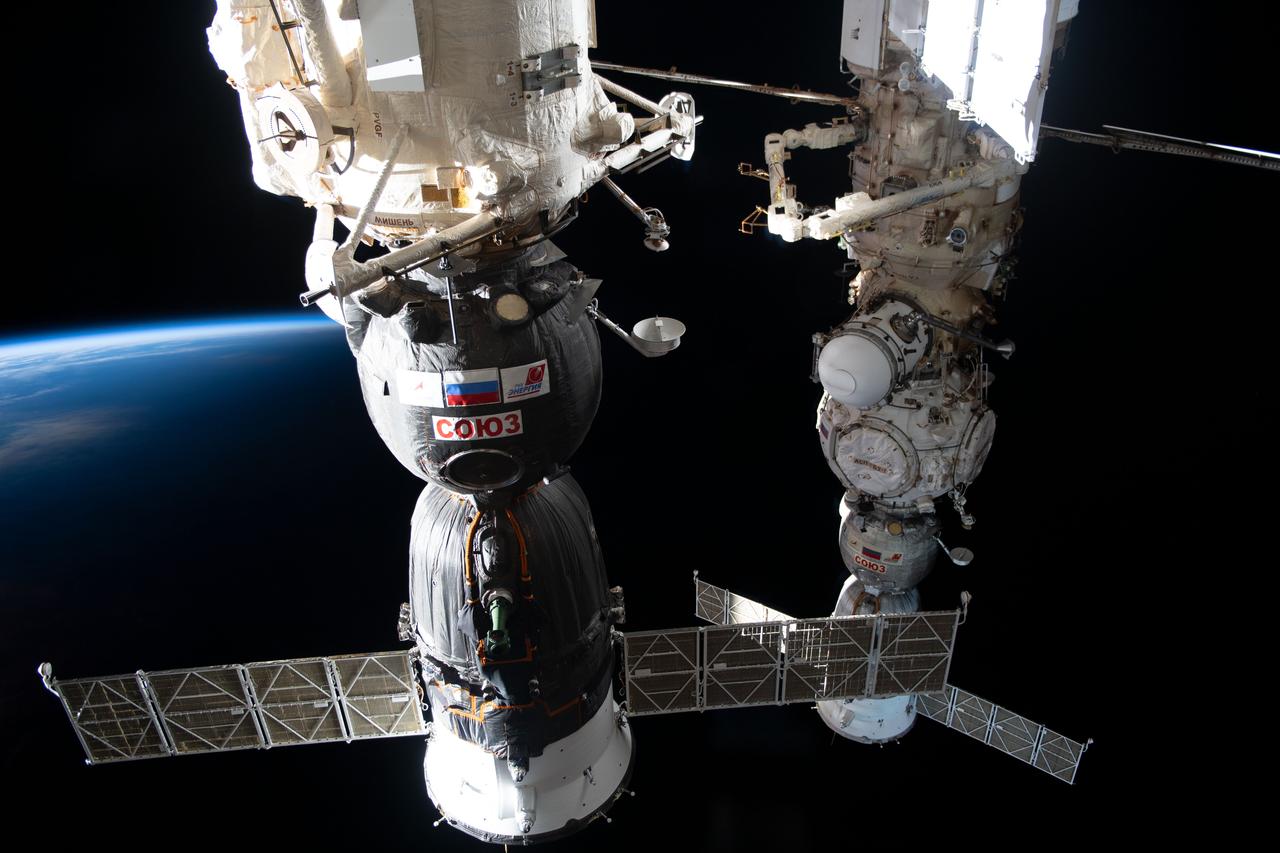
iss069e088557 (Sept. 15, 2023) --- The Soyuz MS-24 spacecraft (foreground) that carried NASA astronaut Loral O'Hara and Roscosmos cosmonauts Oleg Kononenko and Nikolai Chub to the International Space Station is pictured docked to the Rassvet module. In the rear, is the Soyuz MS-23 crew ship, docked to the Prichal docking module, that will return NASA astronaut Frank Rubio and Roscosmos cosmonauts Sergey Prokopyev and Dmitri Petelin back to Earth on Sept. 27.
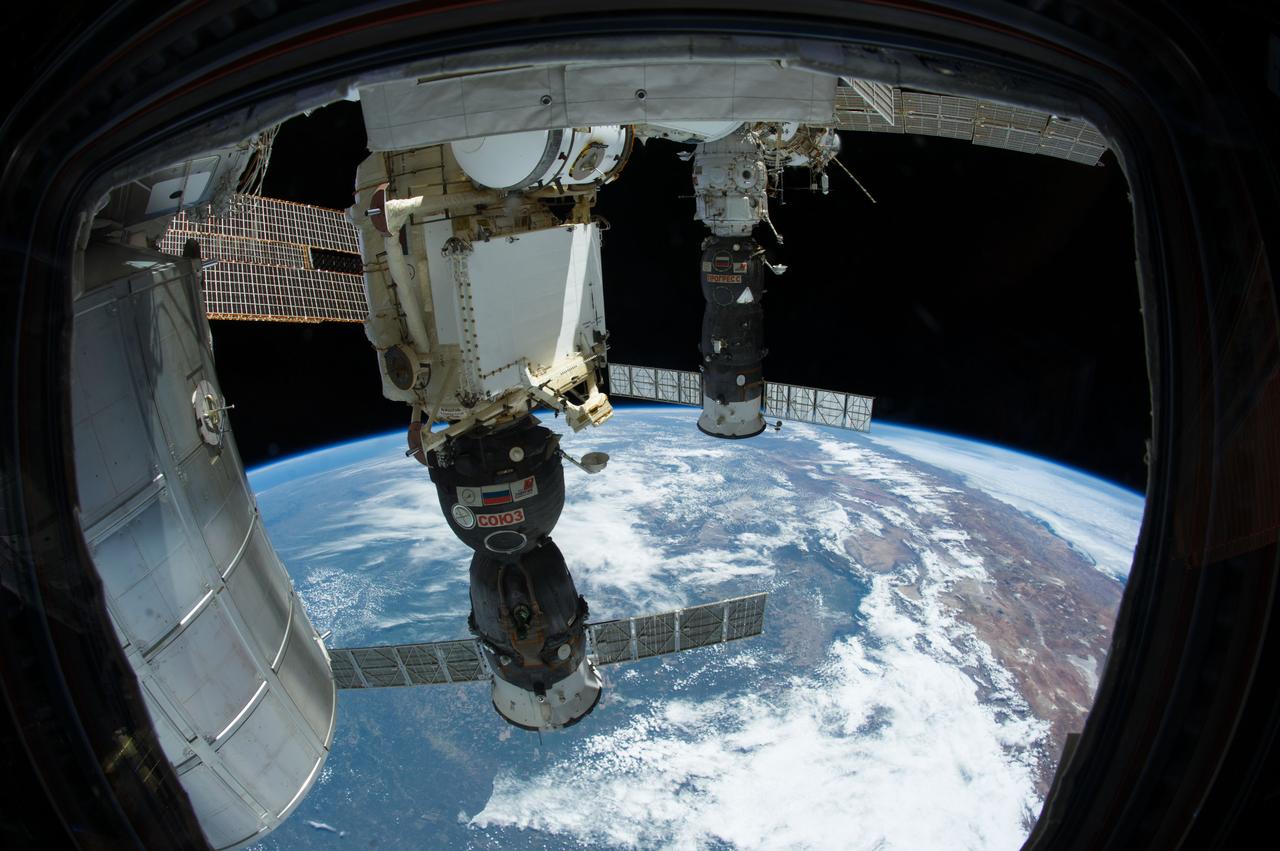
ISS038-E-015274 (12 Dec. 2013) --- The Permanent Multipurpose Module (PMM), the Soyuz 37 (TMA-11M) spacecraft (center) docked to the Rassvet Mini-Research Module 1 (MRM1) and the Progress 52 resupply vehicle (background) docked to the Pirs Docking Compartment are featured in this image photographed by an Expedition 38 crew member from a window in the Cupola of the International Space Station. A blue and white part of Earth provides the backdrop for the scene.
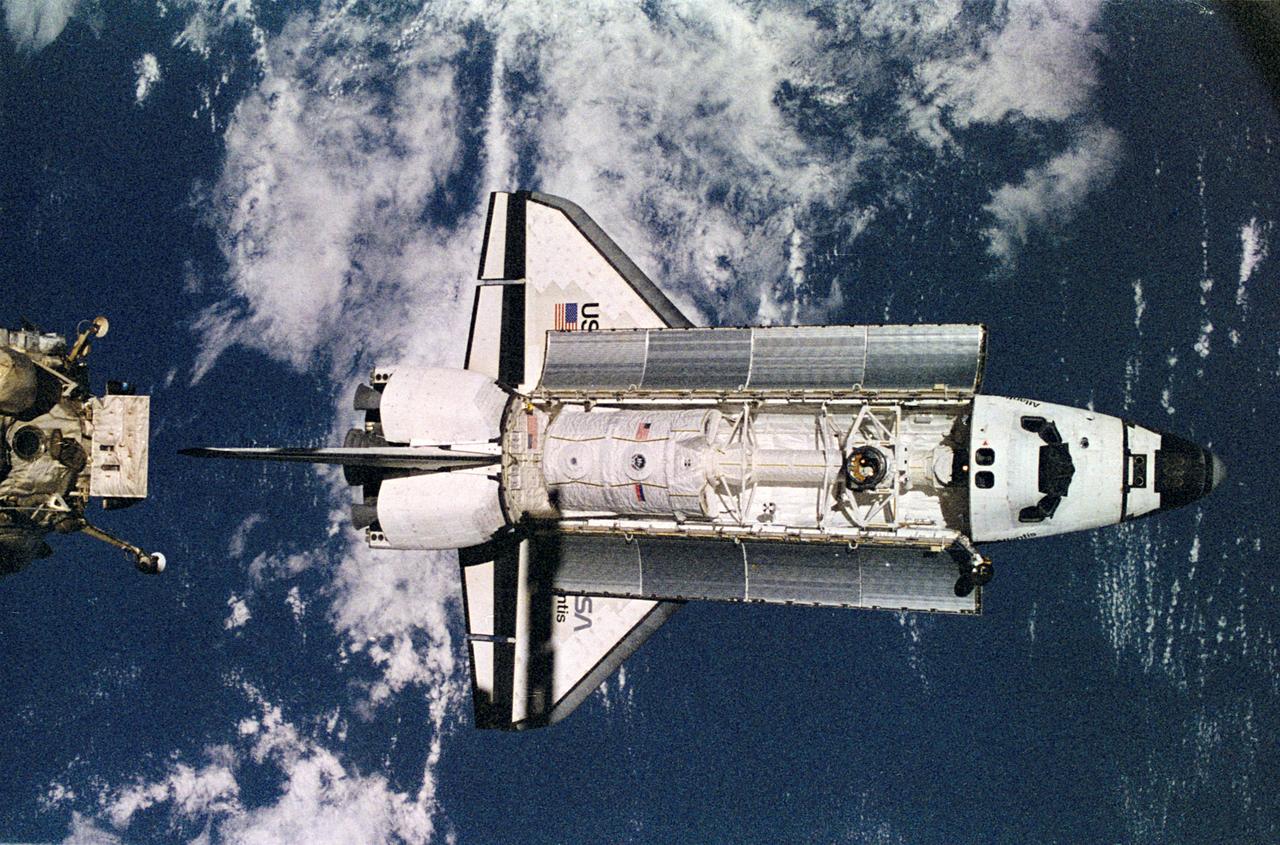
NM18-309-028 (28 June 1995) --- The Space Shuttle Atlantis approaches the docking node on the Kristall module of Russia's Mir Space Station. The photograph was taken by one of the Mir-18 crew members aboard Mir prior to docking of the two spacecraft. The Spacelab science module and the tunnel connecting it to the crew cabin, as well as the added mechanism for interface with the Mir's docking system can be easily seen.
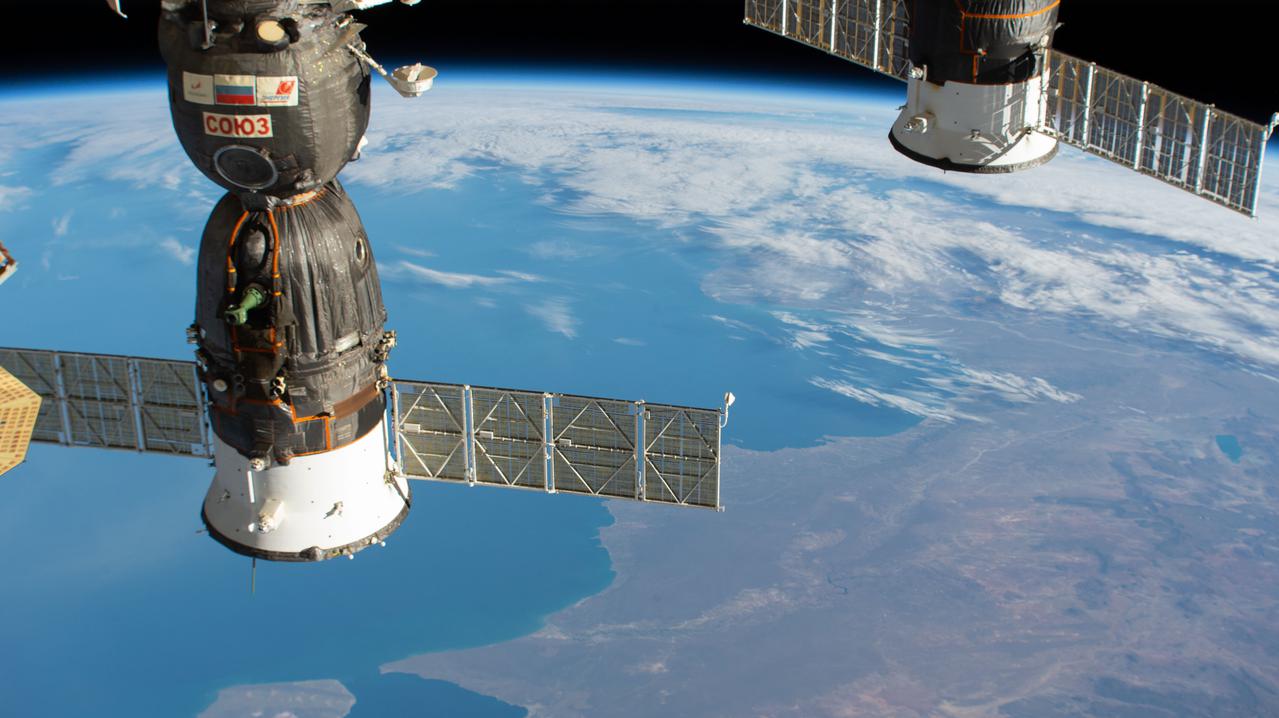
iss064e042043 (March 12, 2021) --- Two Russian spacecraft are seen docked to the International Space Station as it orbited 269 miles above southern Argentina. At left, is the Soyuz MS-17 crew ship that will soon undock from the Rassvet module and relocate to the Poisk module making room for three new crew members due to launch April 9 aboard the Soyuz MS-18 crew ship. At right, is the aft end of the Progress 77 cargo craft docked to the Pirs docking compartment.
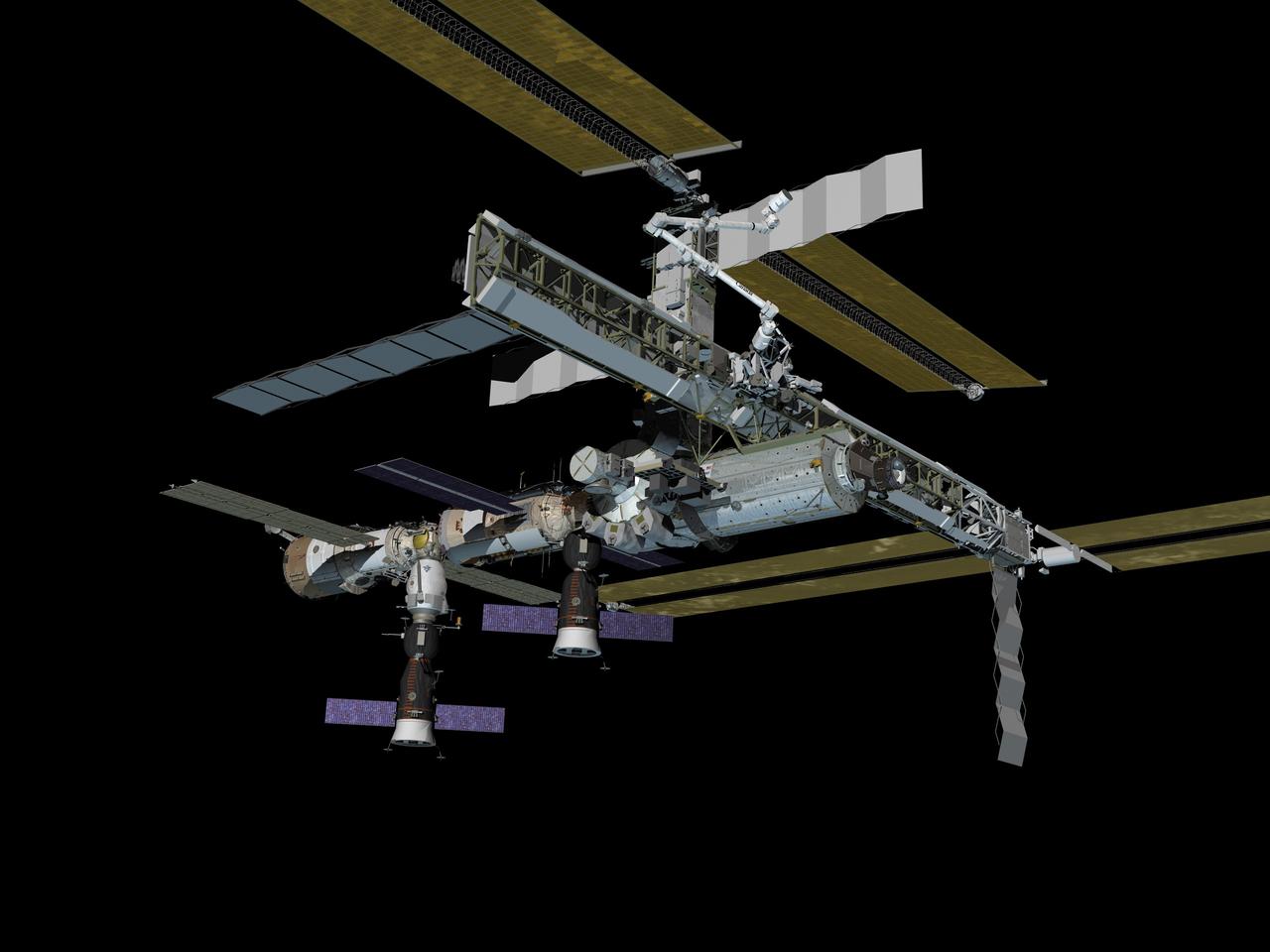
JSC2006-E-40783 (September 2006) --- Computer-generated artist's rendering of the International Space Station following scheduled activities of Sept. 18, 2006. This angle shows the starboard side view of the orbiting complex. Progress 21 resupply vehicle undocks from the Zvezda Service Module, making way for the Soyuz 13 (TMA-9) spacecraft carrying the Expedition 14 crew. Progress 22 resupply vehicle remains docked to the Pirs Docking Compartment and Soyuz 12 (TMA-8) is docked to the Zarya Module nadir port.
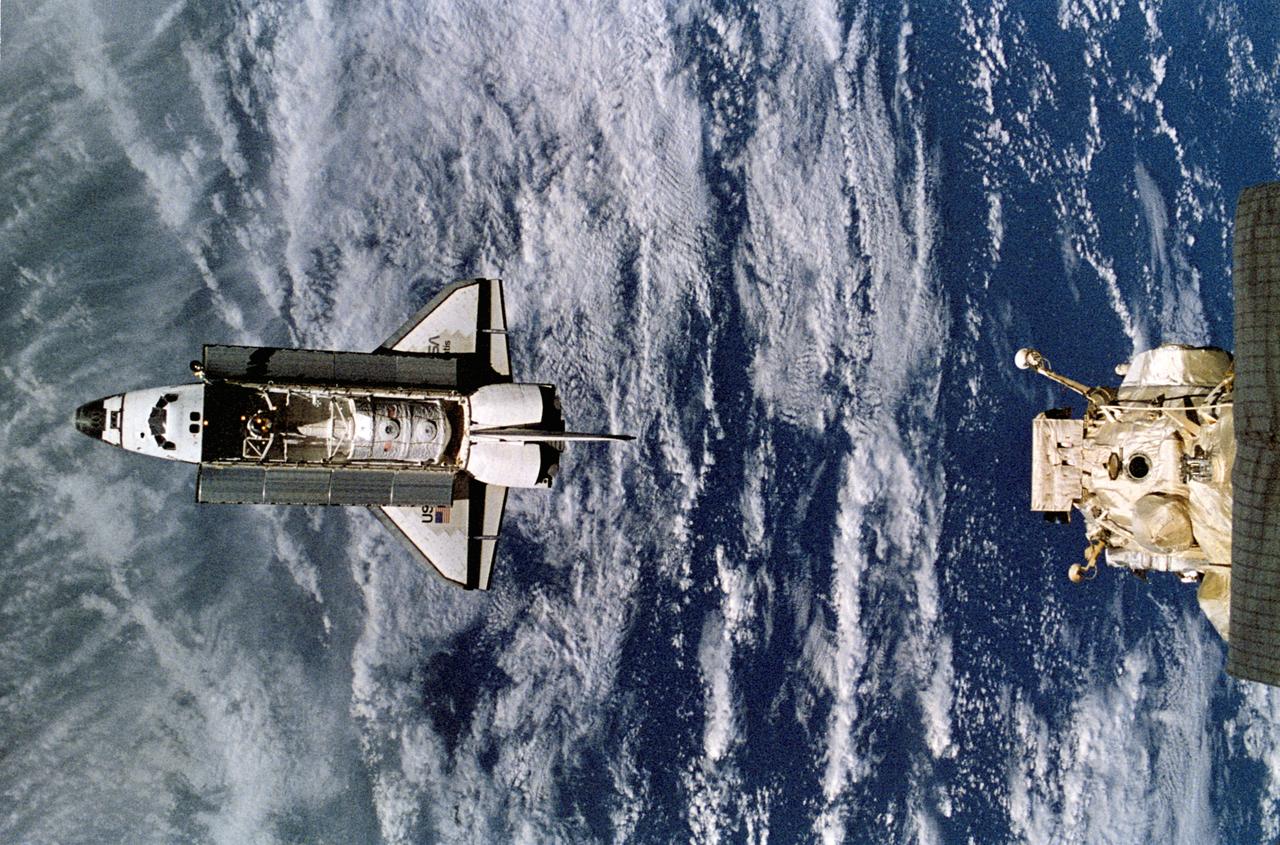
NM18-309-026 (28 June 1995) --- The Space Shuttle Atlantis approaches the docking node on the Kristall module of Russia's Mir Space Station. The photograph was taken by one of the Mir-18 crew members aboard Mir prior to rendezvous and docking of the two spacecraft. The Spacelab Science Module and the tunnel connecting it to the crew cabin, as well as the added mechanism for interface with the Mir's docking system can be easily seen.
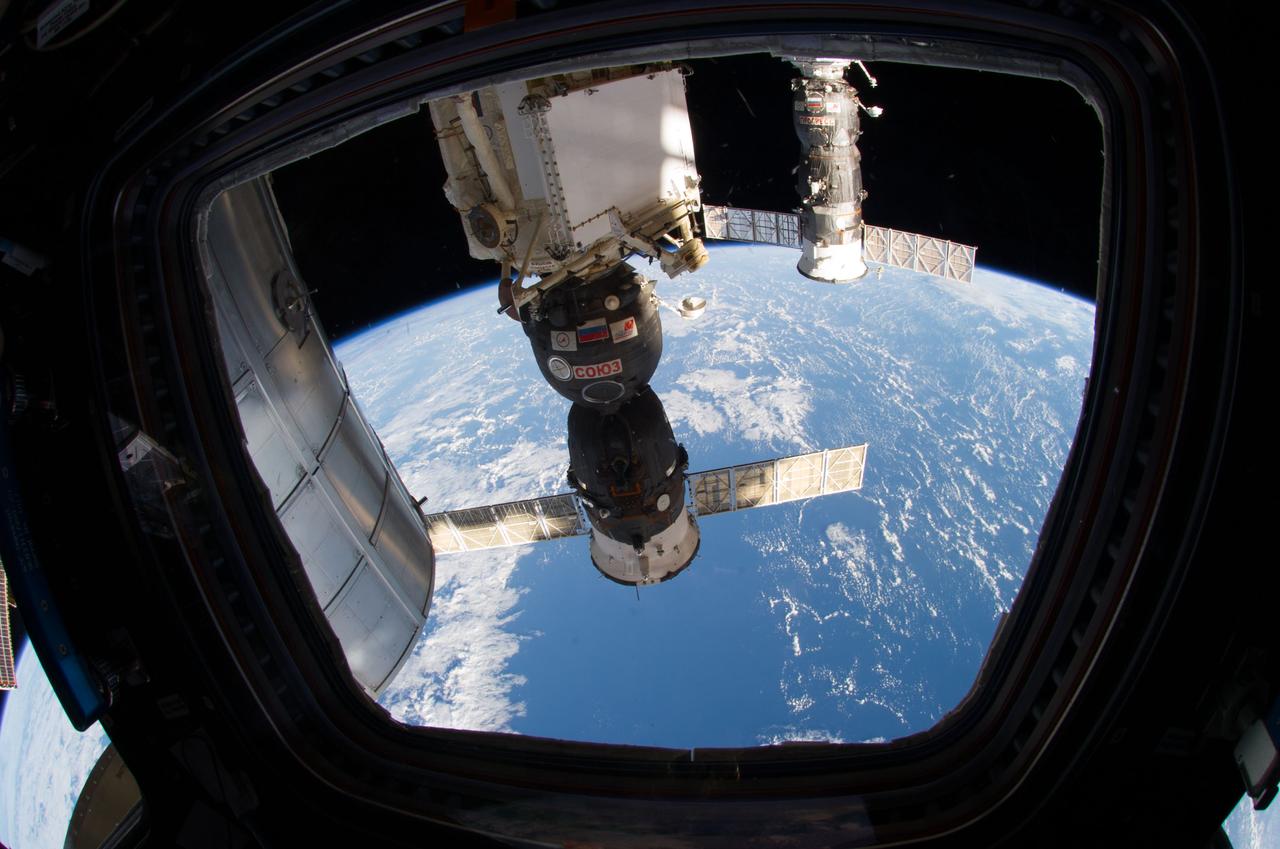
ISS040-E-006183 (1 June 2014) --- The Permanent Multipurpose Module (PMM), the Soyuz 39 (TMA-13M) spacecraft (center) docked to the Rassvet Mini-Research Module 1 (MRM1) and the Progress 55 resupply vehicle (background) docked to the Pirs Docking Compartment are featured in this image photographed by an Expedition 40 crew member from a window in the Cupola of the International Space Station. A blue and white part of Earth provides the backdrop for the scene.

iss069e090251 (Sept. 18, 2023) --- The Soyuz MS-24 spacecraft (foreground) that carried NASA astronaut Loral O'Hara and Roscosmos cosmonauts Oleg Kononenko and Nikolai Chub to the International Space Station is pictured docked to the Rassvet module. In the rear, is the Soyuz MS-23 crew ship, docked to the Prichal docking module, that will return NASA astronaut Frank Rubio and Roscosmos cosmonauts Sergey Prokopyev and Dmitri Petelin back to Earth on Sept. 27. 258 miles below the station is the Sahara desert in the African nation of Algeria.
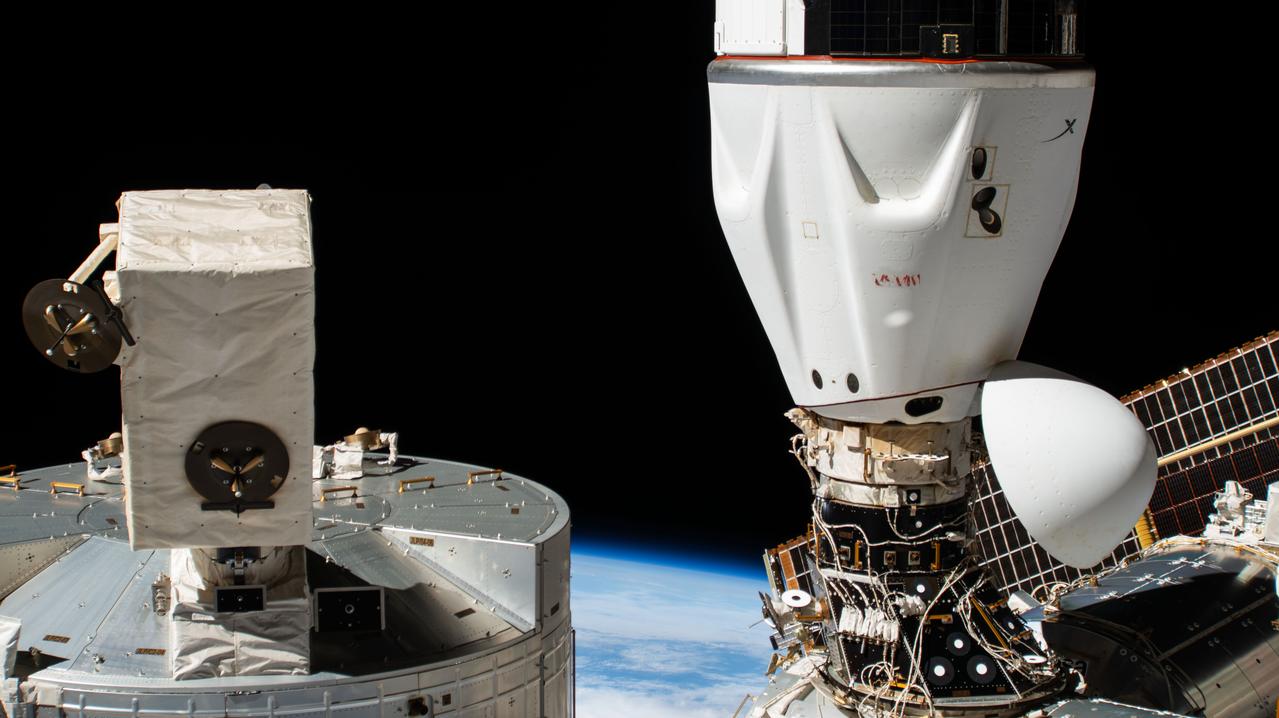
iss071e047974 (May 2, 2024) --- The SpaceX Dragon Endeavour spacecraft is pictured docked to the International Space Station's space-facing port on the Harmony module.
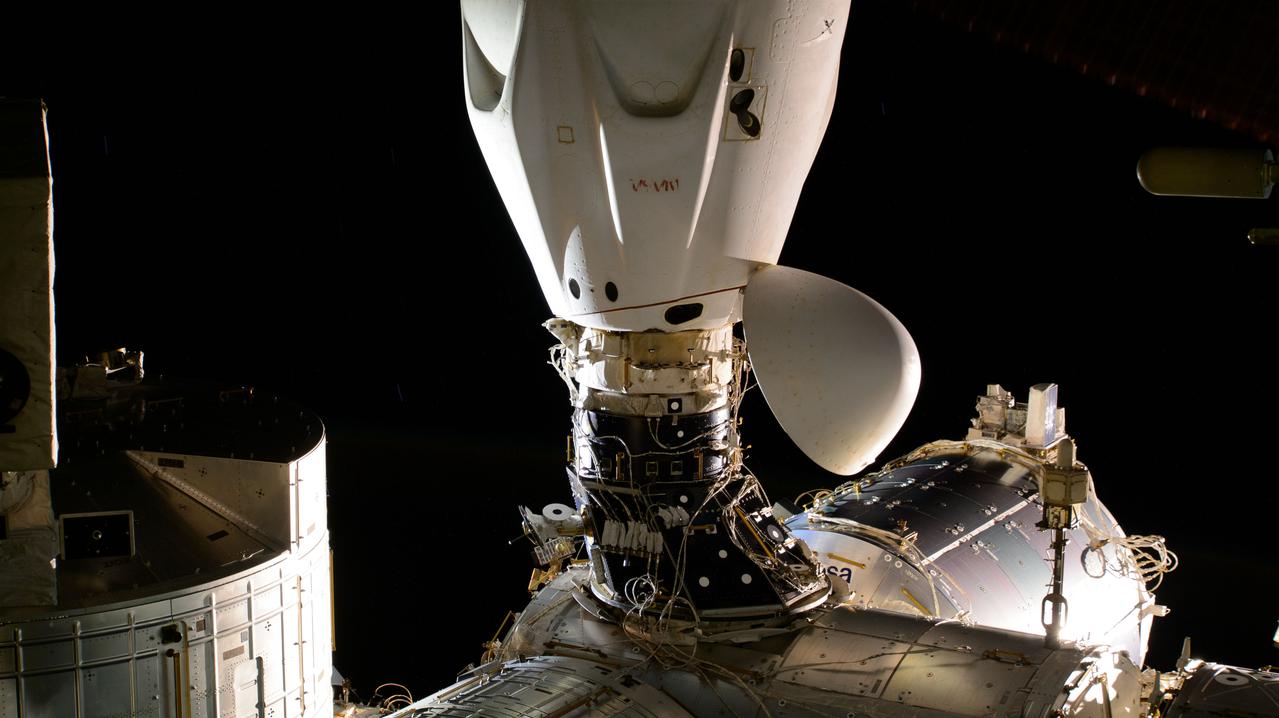
iss071e186365 (June 14, 2024) --- The SpaceX Dragon Endeavour spacecraft is pictured docked to the space-facing port on the International Space Station's Harmony module.
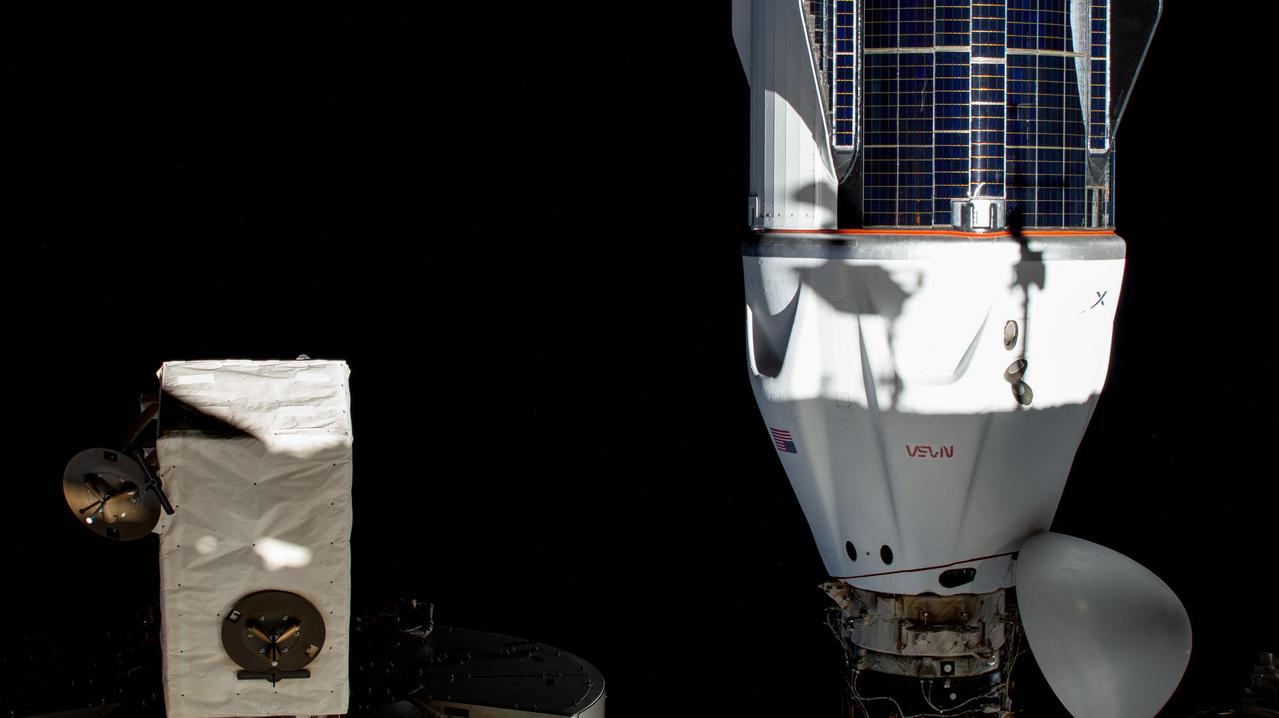
iss072e144451 (Nov. 4, 2024) --- The SpaceX Dragon Freedom spacecraft is pictured docked to the space-facing port on the International Space Station's Harmony module.
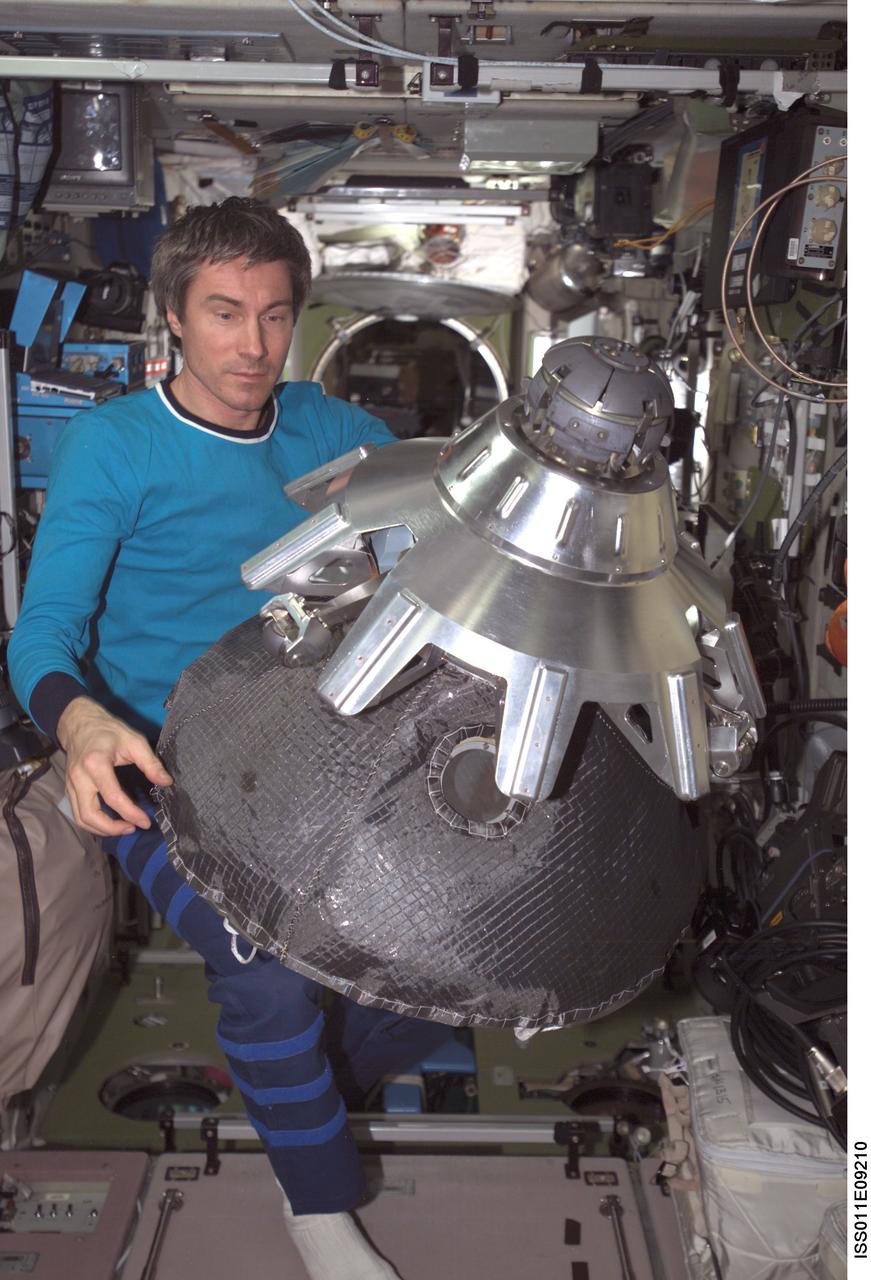
ISS011-E-09210 (19 June 2005) --- Cosmonaut Sergei K. Krikalev, Expedition 11 commander representing Russia's Federal Space Agency, holds the dismantled probe-and-cone docking mechanism from the Progress 18 spacecraft in the Zvezda Service Module of the International Space Station (ISS). The Progress docked to the aft port of the Service Module at 7:42 p.m. (CDT) as the two spacecraft flew approximately 225 statute miles, above a point near Beijing, China.
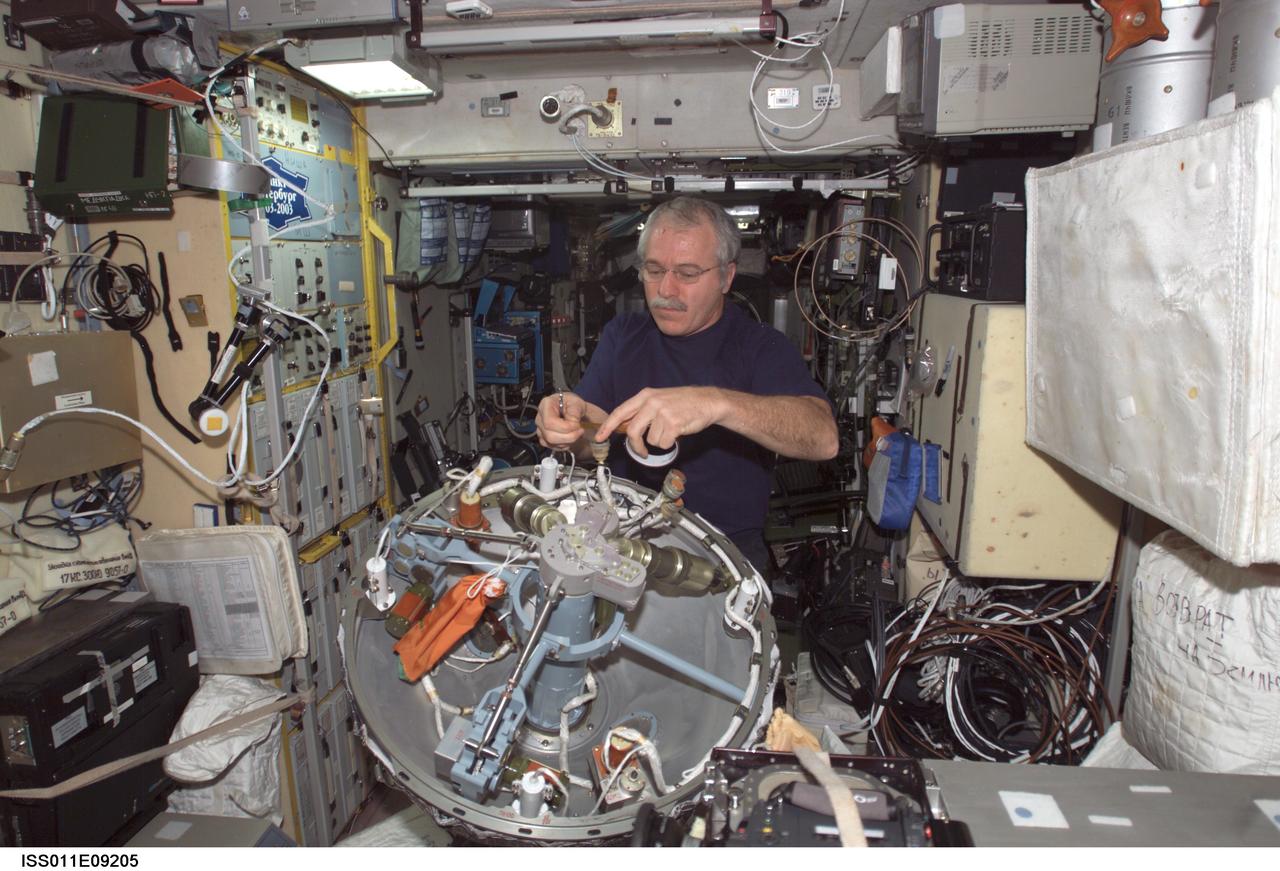
ISS011-E-09205 (19 June 2005) --- Astronaut John L. Phillips, Expedition 11 NASA ISS science officer and flight engineer, works on the dismantled probe-and-cone docking mechanism from the Progress 18 spacecraft in the Zvezda Service Module of the International Space Station (ISS). The Progress docked to the aft port of the Service Module at 7:42 p.m. (CDT) as the two spacecraft flew approximately 225 statute miles, above a point near Beijing, China.
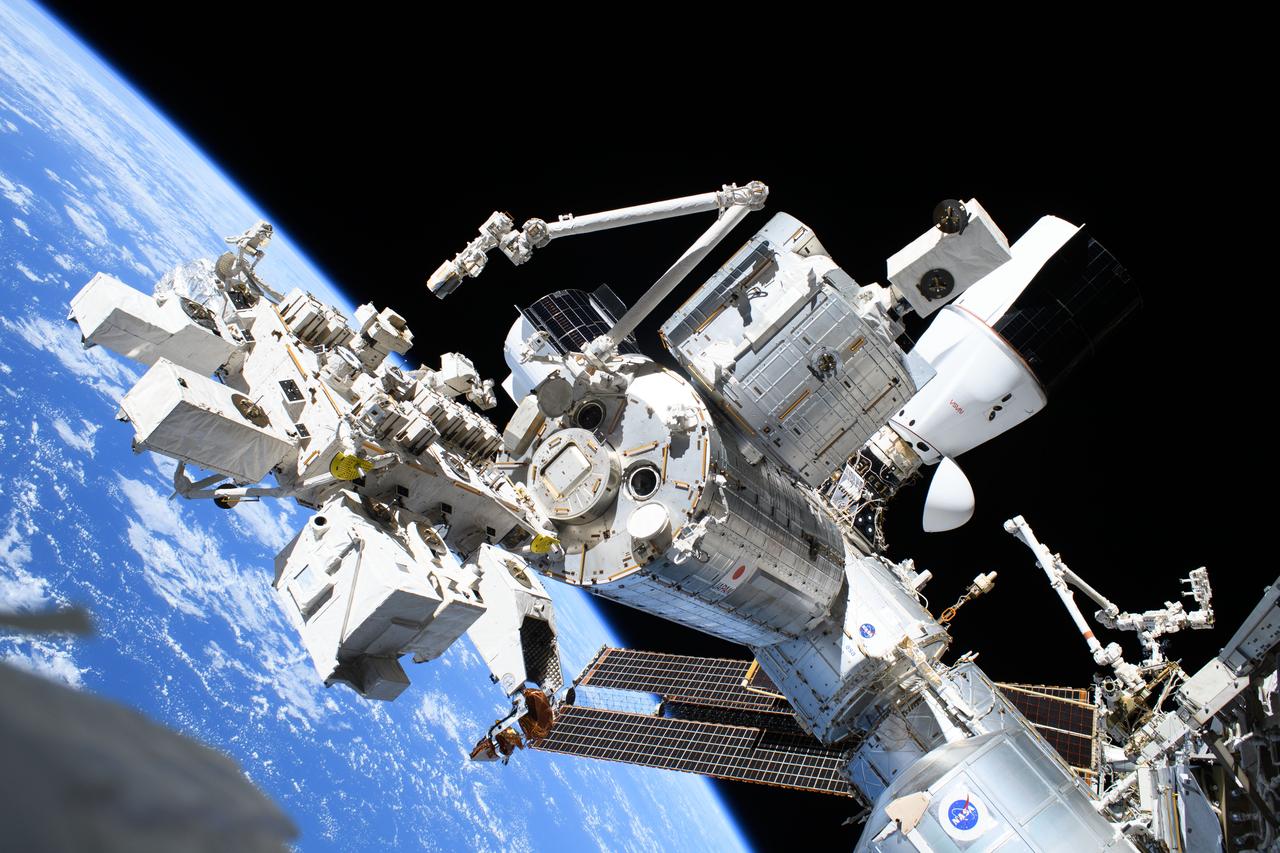
iss073e0008524 (May 1, 2025) --- This photograph from NASA spacewalker Nichole Ayers looks to the forward portion of the International Space Station and highlights the Kibo laboratory module with the Japanese robotic arm, the SpaceX Dragon cargo spacecraft docked to the Harmony module's space-facing port, and the partially obscured SpaceX Dragon crew spacecraft docked to Harmony's forward port. The International Space Station was orbiting 260 miles above the Pacific Ocean east of the Hawaiian island chain.
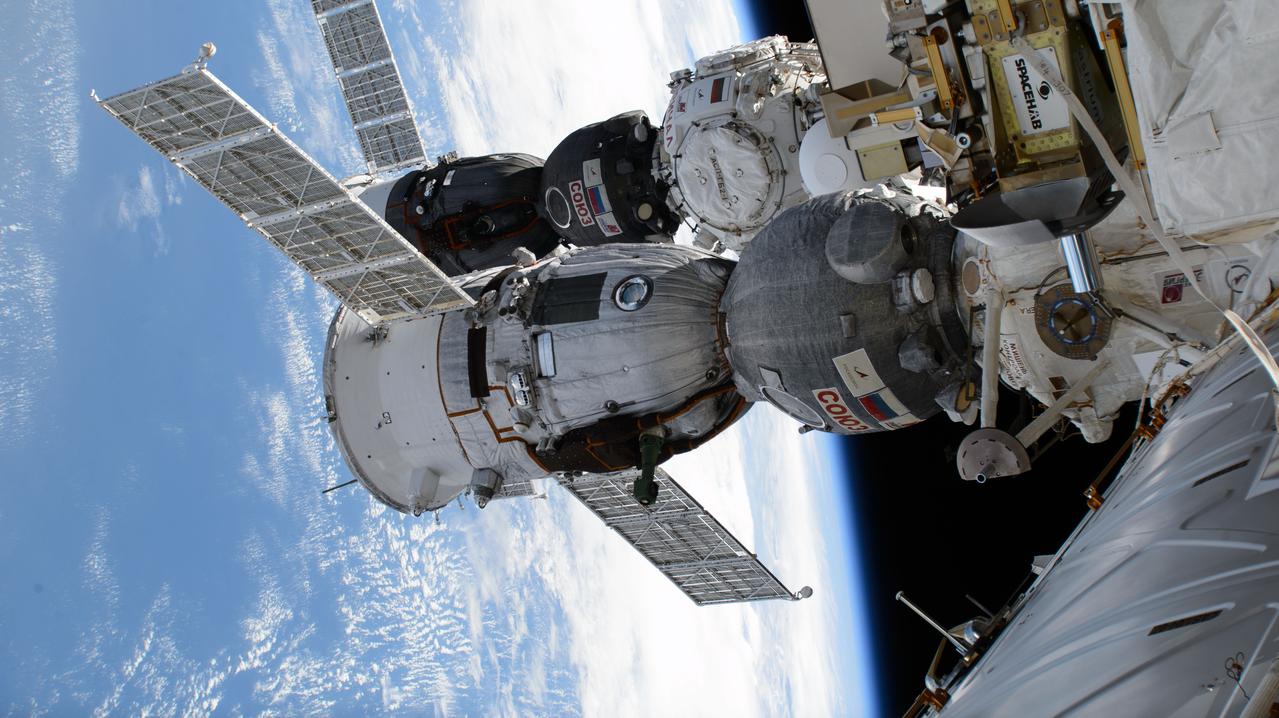
iss072e1021804 (April 19, 2025) --- The Soyuz crew ships that each brought three crew members to the International Space Station are pictured docked to the orbital outpost. In the foreground, is the Soyuz MS-26 spacecraft docked to the Rassvet module moments before it undocked and returned to Earth with NASA astronaut Pettit and Roscosmos cosmonauts Alexey Ovchinin and Ivan Vagner after 220 days in space. In the rear, is the Soyuz MS-27 spacecraft docked to the Prichal module after it launched on April 8, 2025, with NASA astronaut Jonny Kim and Roscosmos cosmonauts Sergey Ryzhikov and Alexey Zubritsky beginning an eight-month space research mission.
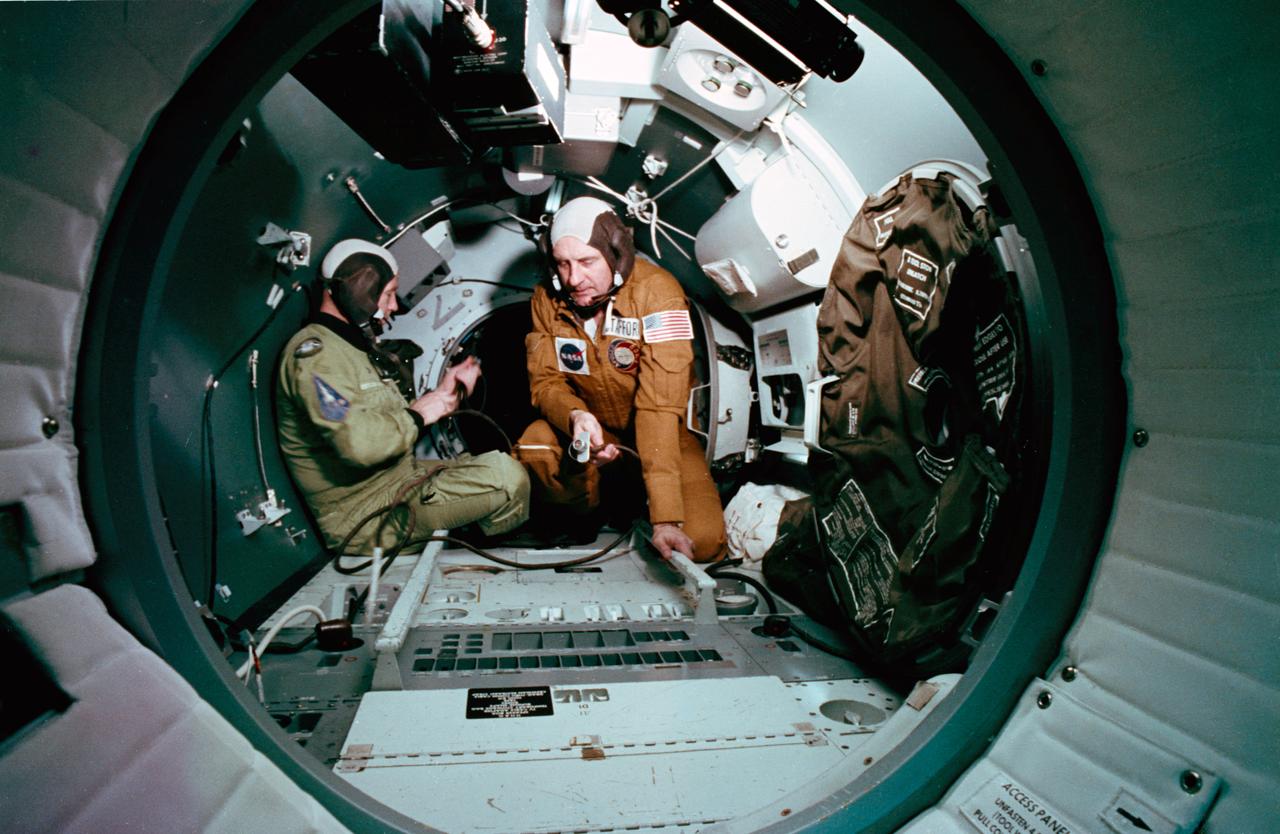
S75-22785 (25 Feb. 1975) --- An interior view of the Docking Module trainer, in Building 35, during Apollo-Soyuz Test Project (ASTP) joint crew training at NASA's Johnson Space Center (JSC). Astronaut Thomas P. Stafford, commander of the American ASTP prime crew, is on the right. The other crewman is cosmonaut Aleksky A. Leonov, commander of the Soviet ASTP prime crew. The training session simulated activities on the second day in Earth orbit. The American and Soviet crews will visit each other's spacecraft during the July 1975 docking mission in Earth orbit. The Docking Module is designed to link the Apollo and Soyuz spacecraft.

iss071e297541 (July 6, 2024) --- Boeing's Starliner spacecraft is pictured docked to the International Space Station's forward port on the Harmony module. NASA astronaut Mike Barratt photographed Starliner from a window on the SpaceX Dragon Endeavour spacecraft.
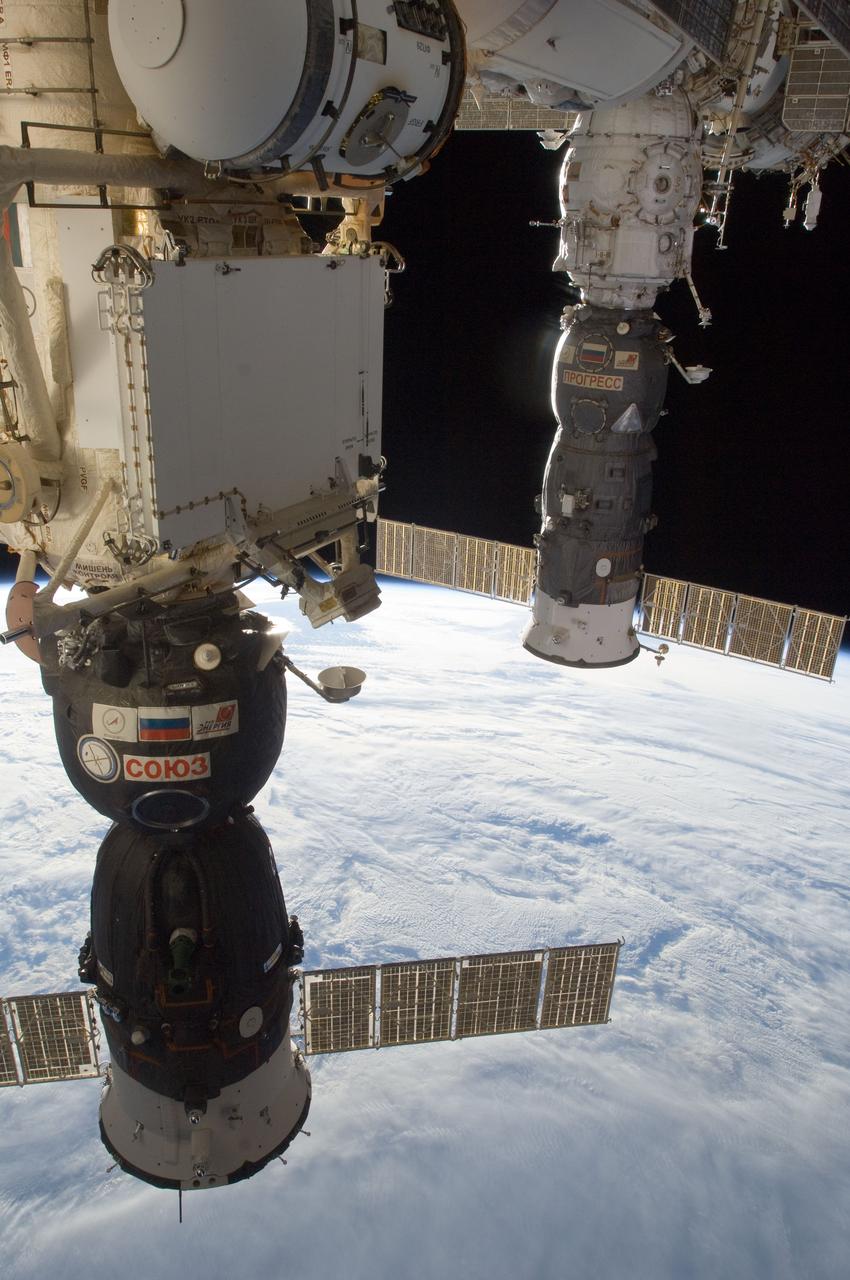
View of Soyuz Spacecraft connected to the Mini Research Module 1 MRM1), and Progress Spacecraft connected to the Pirs Docking Compartment 1 (DC1). Photo was taken during Expedition 34.
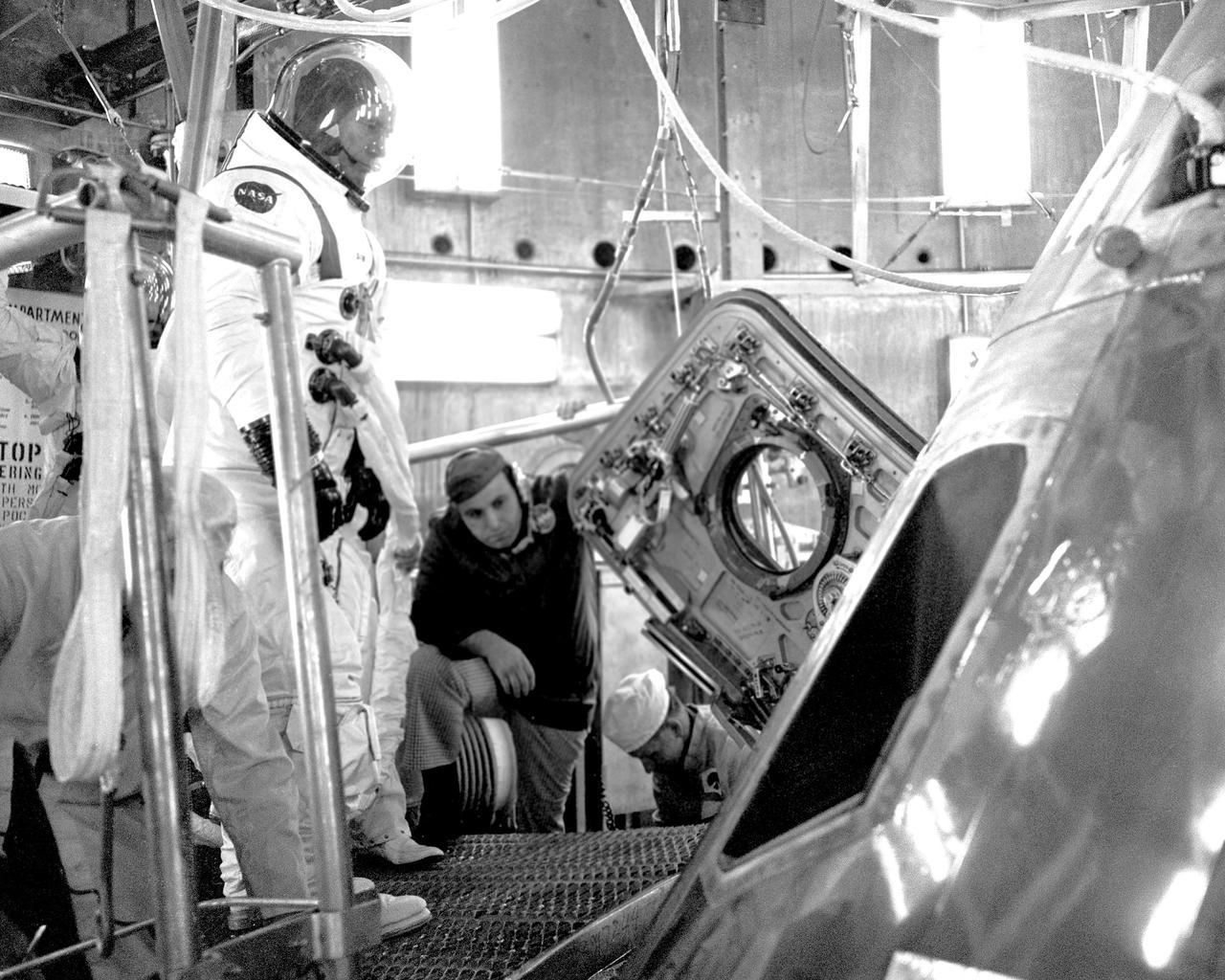
CAPE CANAVERAL, Fla. – The docking module and Apollo spacecraft for this summer's joint manned mission with the Soviet were mated in the Manned Spacecraft Operations Building today. The docking module will provide a mechanical and electrical link between the Apollo and Soyuz spacecraft while they are docked and also serve as an airlock. On hand to participate in the operation were two members of the Apollo prime crew, Astronauts Donald K. Slayton and Vance D. Brand. Launch of the Saturn 1B/Apollo from Complex 39 is scheduled for July 15. The first international crewed spaceflight was a joint U.S.-U.S.S.R. rendezvous and docking mission. The Apollo-Soyuz Test Project, or ASTP, took its name from the spacecraft employed: the American Apollo and the Soviet Soyuz. The three-man Apollo crew lifted off from Kennedy Space Center aboard a Saturn IB rocket on July 15, 1975, to link up with the Soyuz that had launched a few hours earlier. A cylindrical docking module served as an airlock between the two spacecraft for transfer of the crew members. Photo credit: NASA
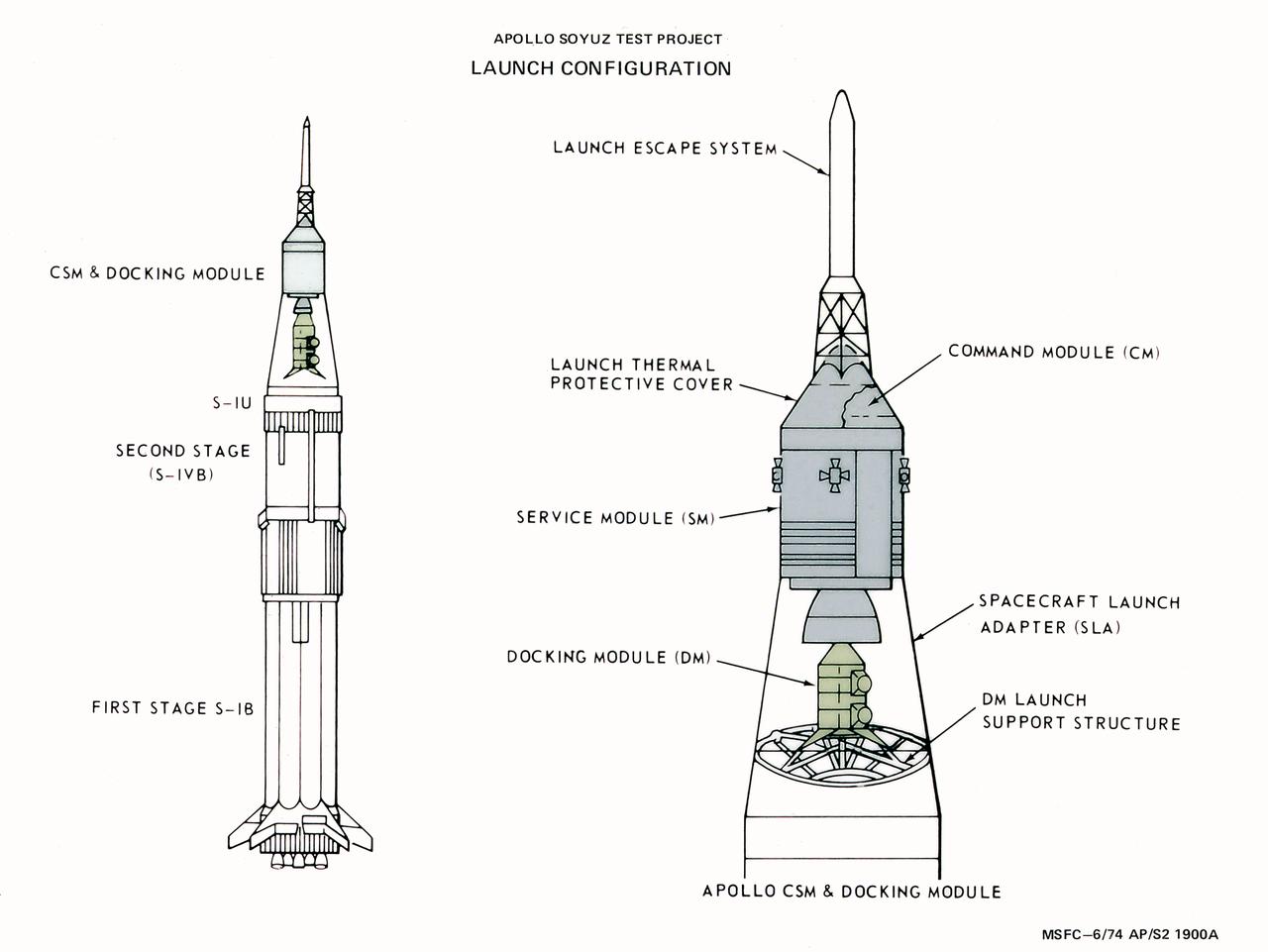
This illustration depicts the launch configuration of the Apollo spacecraft for the Apollo-Soyuz Test Project (ASTP). The ASTP was the first international docking of the U.S.'s Apollo spacecraft and the U.S.S.R.'s Soyuz spacecraft in space. A joint engineering team from the two countries met to develop a docking system that permitted the two spacecraft to link in space and allowed the two crews to travel from one spacecraft to the other. This system entailed developing a large habitable Docking Module (DM) to be carried on the Apollo spacecraft to facilitate the joining of two dissimilar spacecraft. The Marshall Space Flight Center was responsible for development and sustaining engineering of the Saturn IB launch vehicle during the mission.
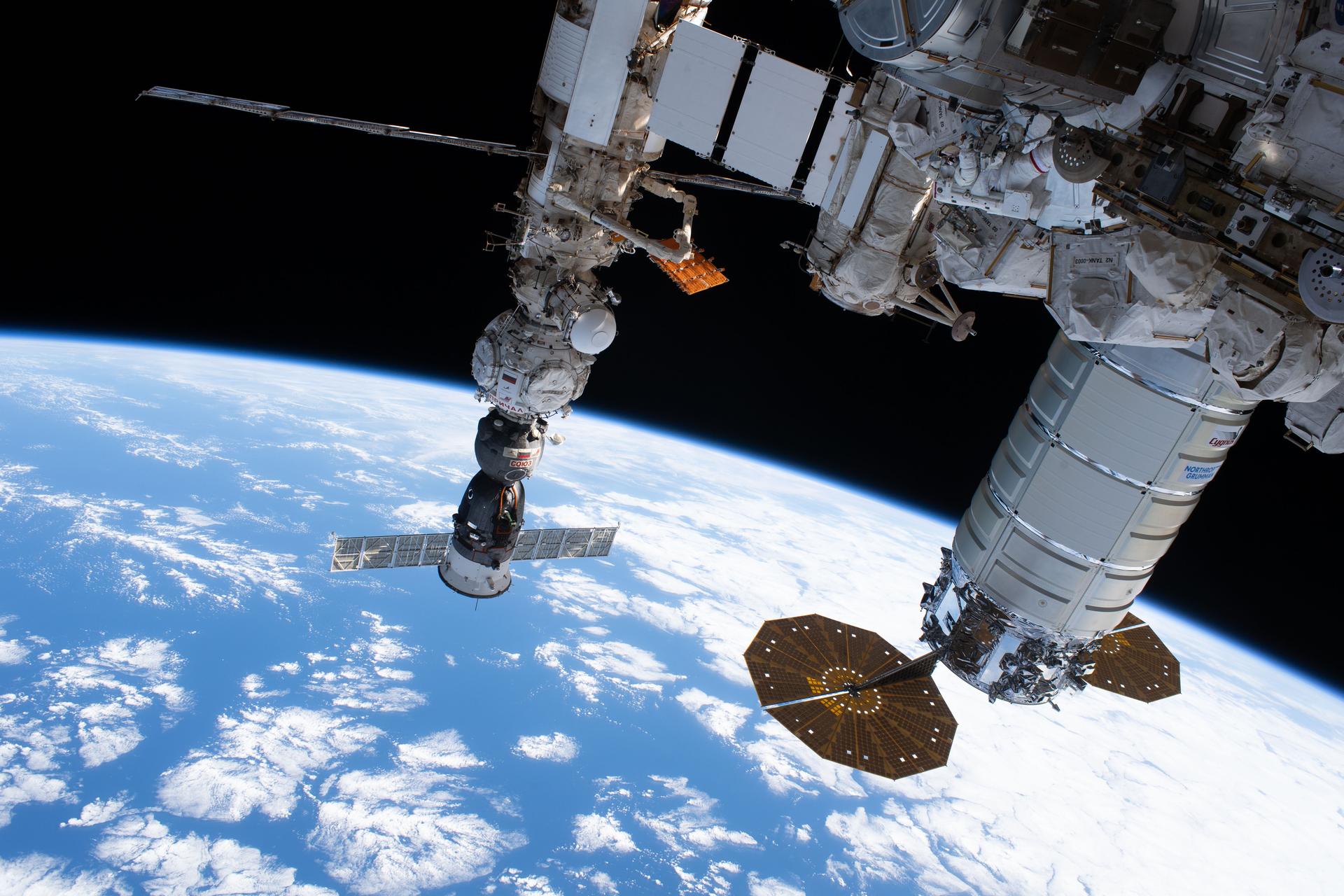
iss075e0086076 (Sept. 1, 2026) --- From left, the Soyuz MS‑29 crew spacecraft, docked to the Prichal module, and Northrop Grumman’s Cygnus XL cargo spacecraft, berthed to the Unity module, are pictured as the International Space Station orbited 261 miles above the Pacific Ocean west of Peru. Credit: NASA/Jessica Meir

iss070e024780 (Nov. 14, 2023) --- The Soyuz MS-24 spacecraft (foreground) that carried NASA astronaut Loral O'Hara and Roscosmos cosmonauts Oleg Kononenko and Nikolai Chub to the International Space Station is pictured docked to the Rassvet module. In the rear, is the Prichal docking module, attached to the Nauka science module, with its experiment airlock door opened to the external microgravity environment.
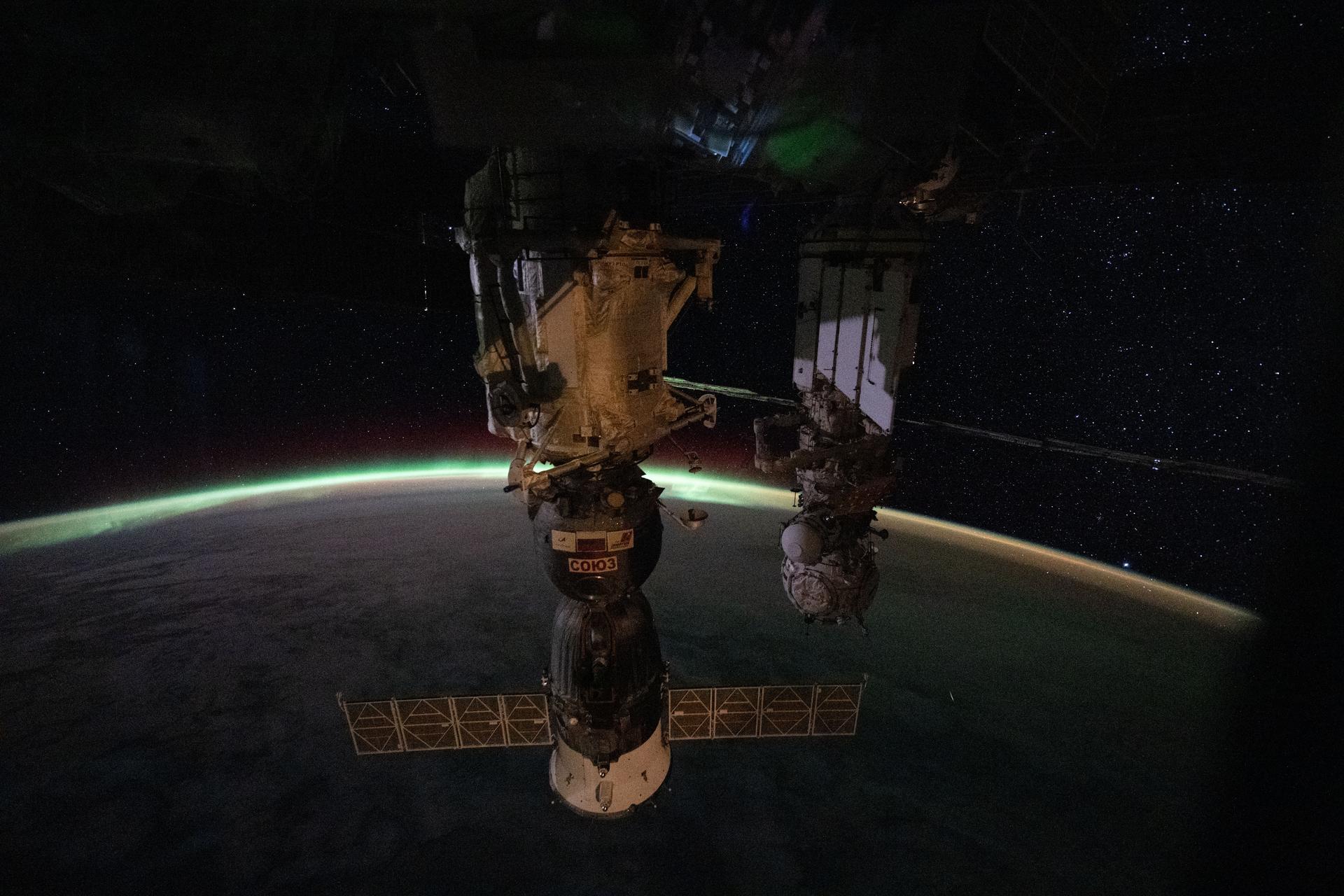
iss074e0504006 (April 12, 2026) --- The aurora australis arcs above Earth’s horizon and fades into the airglow as the International Space Station orbited 265 miles above the Indian Ocean east of Perth, Australia, at approximately 2:03 a.m. local time. In the foreground, the Soyuz MS-28 crew spacecraft is shown docked to the Rassvet module. In the background, the Pirs docking module is attached to the Nauka science module. Credit: NASA/Chris Williams
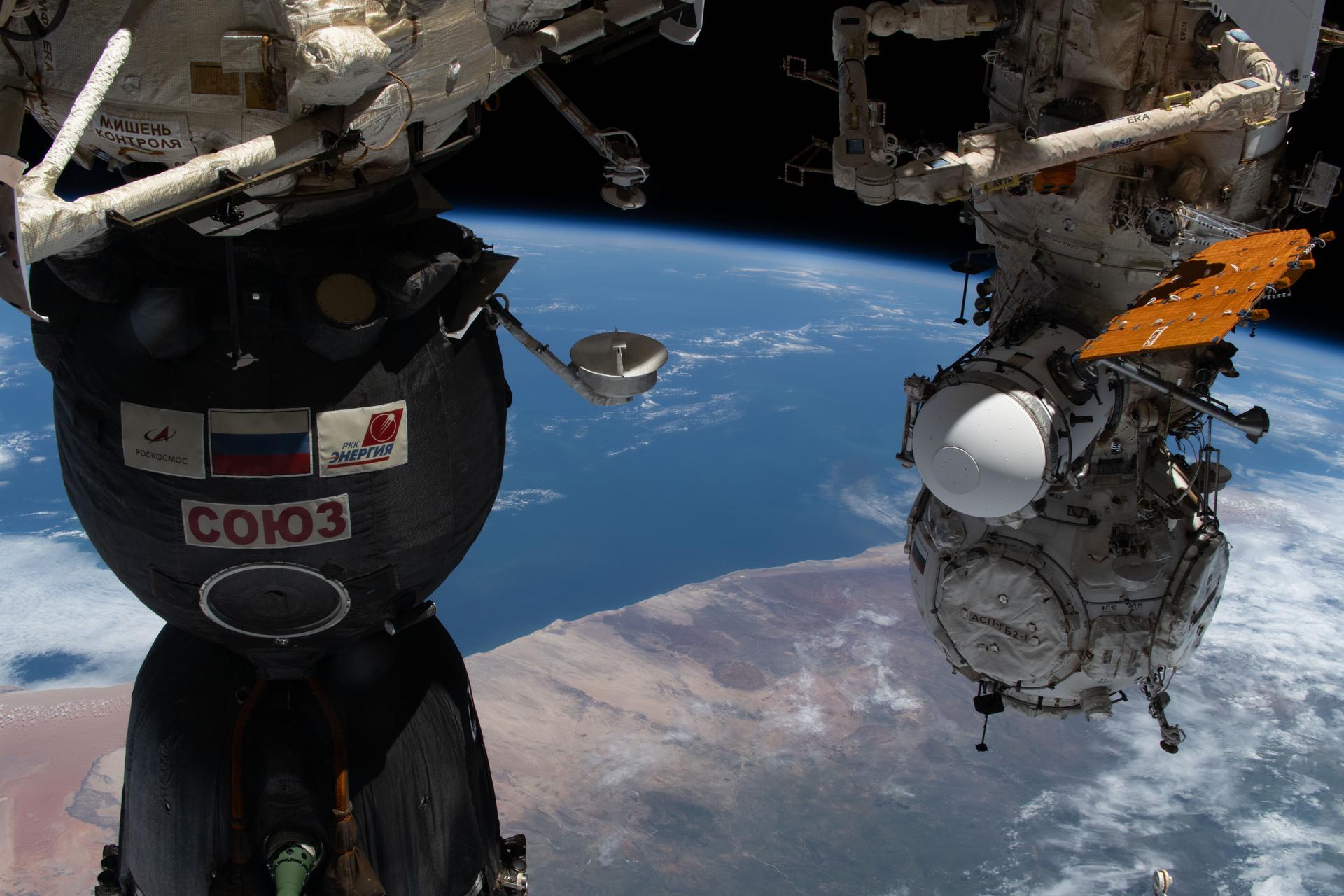
iss074e0325203 (Feb. 24, 2026) --- Namibia's Brandberg Massif, near the center of the photograph, appears as a nearly perfect circular formation just inland from the Atlantic coast, and easy to mistake for a meteorite impact crater when seen from space. At left, is the Soyuz MS-28 crew spacecraft docked to the Rassvet module. At right, the Prichal docking module is attached to the Nauka science module. The International Space Station was orbiting 266 miles above southern Africa at the time of this photograph. Credit: NASA/Jessica Meir
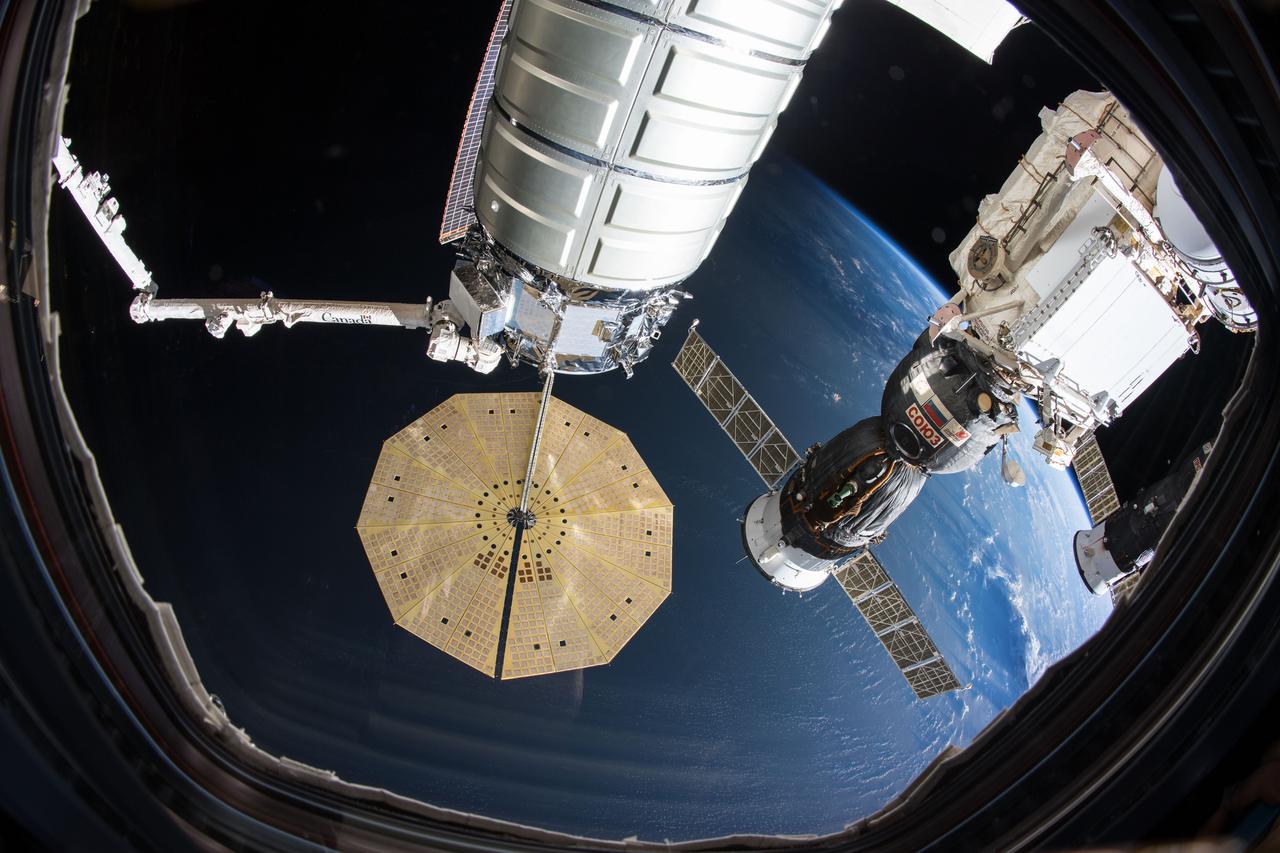
iss057e105773 (Nov. 22, 2018) --- Three spacecraft are pictured attached to the International Space Station as the orbital complex orbited 250 miles above the Bay of Bengal. At center is the Northrop Grumman Cygnus cargo craft from the United States attached to the Unity module and still in the grip of the Canadarm2 robotic arm. To the right of Cygnus is the Russian Soyuz MS-09 crew ship from Roscosmos docked to the Rassvet module. At far right is the Russian Progress 70 cargo craft docked to the Poisk module.