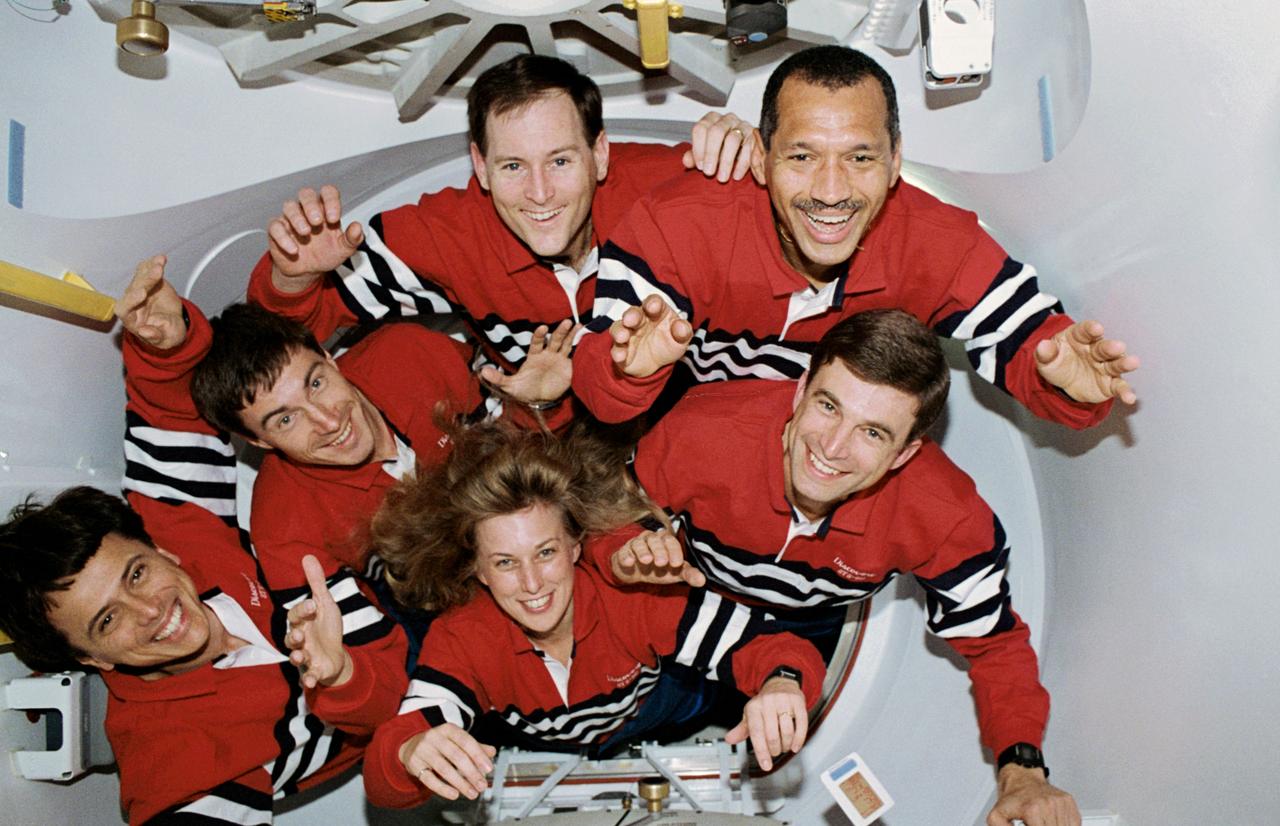
STS060-31-028 (3-11 Feb. 1994) --- Five NASA astronauts and a Russian cosmonaut squeeze through the tunnel which connects the shirt-sleeve environments of the space shuttle Discovery and the SPACEHAB module. SPACEHAB is located in the spacecraft’s payload bay. Charles F. Bolden Jr., mission commander, is at upper right. Others, clockwise from the commander, are Ronald M. Sega and N. Jan Davis, both mission specialists; Franklin R. Chang-Diaz, payload commander; cosmonaut Sergei K. Krikalev, mission specialist; and Kenneth S. Reightler Jr., pilot. The six spent eight days in Earth orbit. Photo credit: NASA
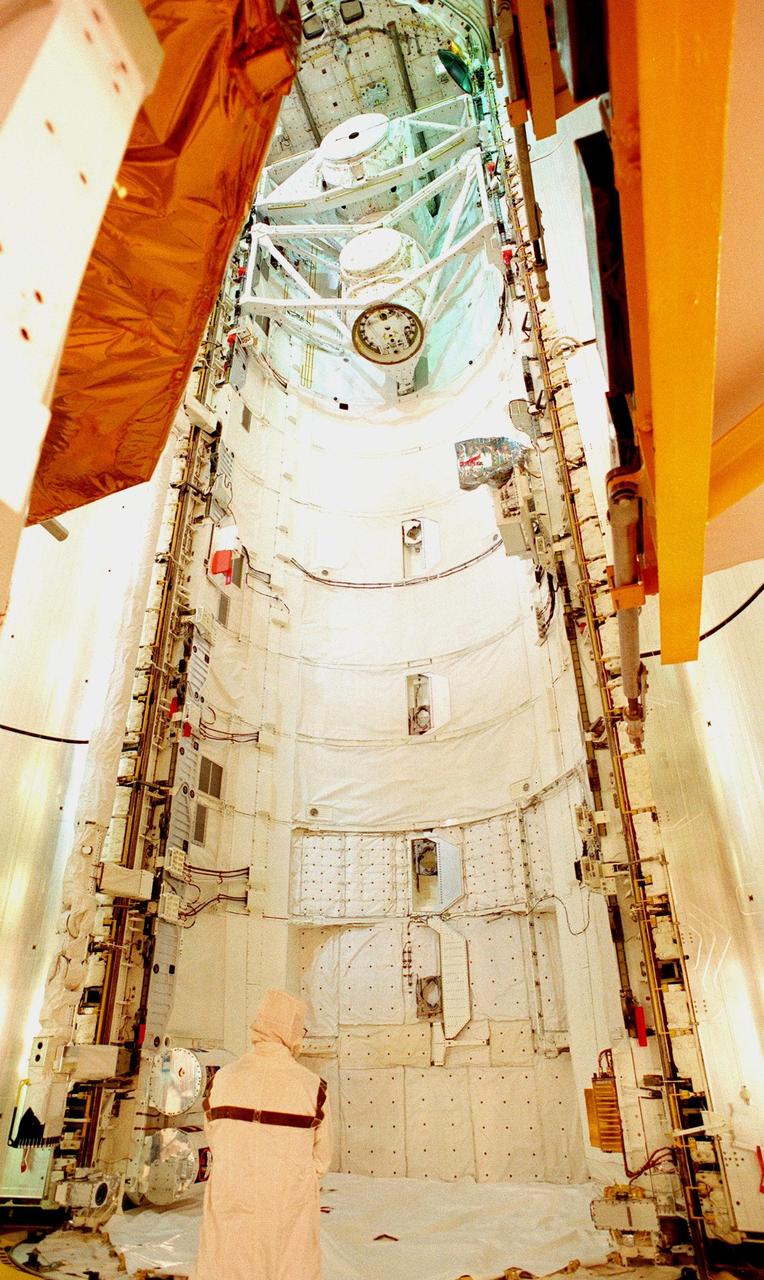
The open doors of the payload bay on Space Shuttle Discovery await the transfer of four of the payloads on mission STS-95: the SPACEHAB single module, Spartan, the Hubble Space Telescope Orbiting Systems Test Platform (HOST), and the International Extreme Ultraviolet Hitchhiker (IEH-3). At the top of bay are the airlock (used for depressurization and repressurization during extravehicular activity and transfer to Mir) and the tunnel adapter (enables the flight crew members to transfer from the pressurized middeck crew compartment to Spacelab's pressurized shirt-sleeve environment). SPACEHAB involves experiments on space flight and the aging process. Spartan is a solar physics spacecraft designed to perform remote sensing of the hot outer layers of the sun's atmosphere or corona. HOST carries four experiments to validate components planned for installation during the third Hubble Space Telescope servicing mission and to evaluate new technologies in an Earth-orbiting environment. IEH-3 comprises several experiments that will study the Jovian planetary system, hot stars, planetary and reflection nebulae, other stellar objects and their environments through remote observation of EUV/FUV emissions; study spacecraft interactions, Shuttle glow, thruster firings, and contamination; and measure the solar constant and identify variations in the value during a solar cycle. Discovery is scheduled to launch on Oct. 29, 1998
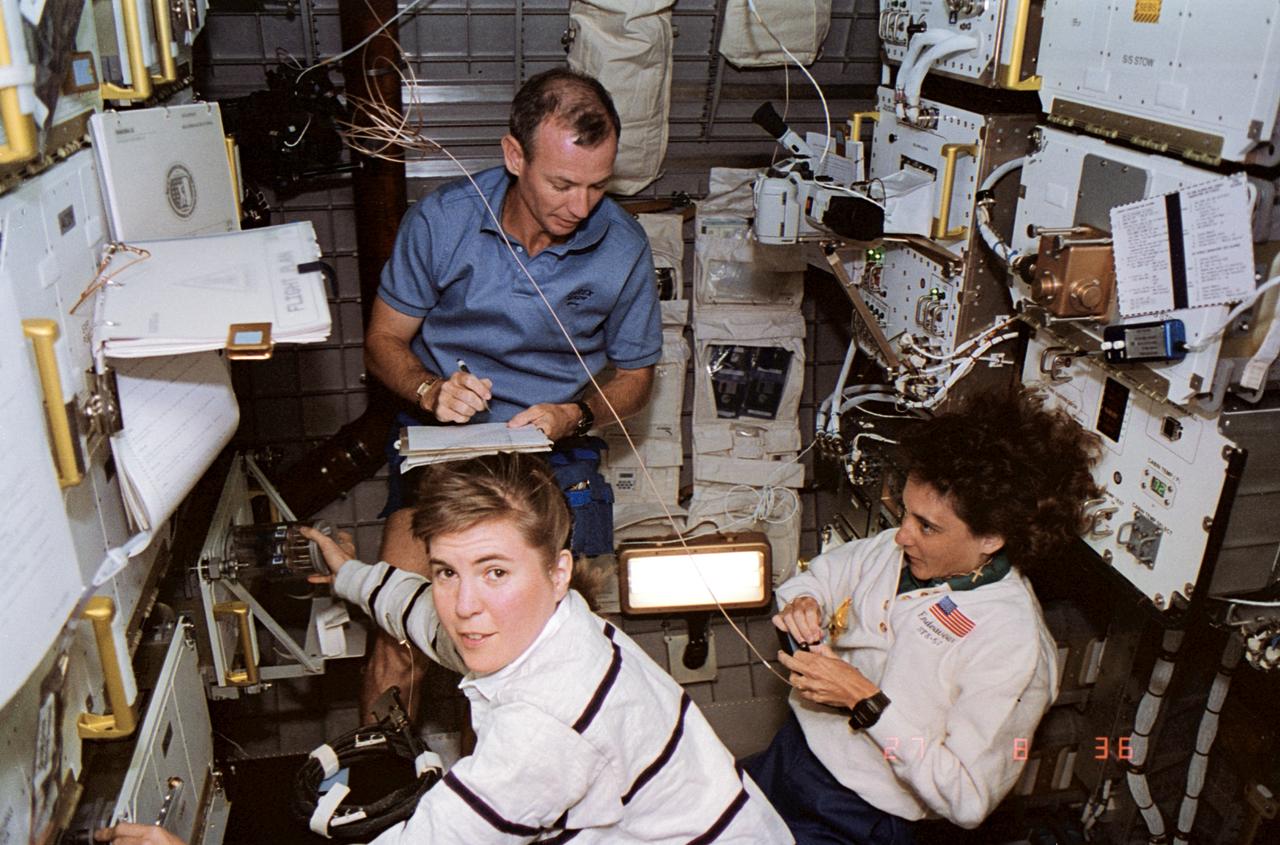
STS057-39-001 (27 June 1993) --- This high angle shot inside the SPACEHAB module, onboard the Space Shuttle Endeavour, typifies the pace of activity conducted there during the ten-day STS-57 mission. Astronaut Janice E. Voss (foreground), mission specialist, works with biomaterials products, while astronauts Brian Duffy, pilot, and Nancy J. Sherlock, mission specialist, participate in other tasks.
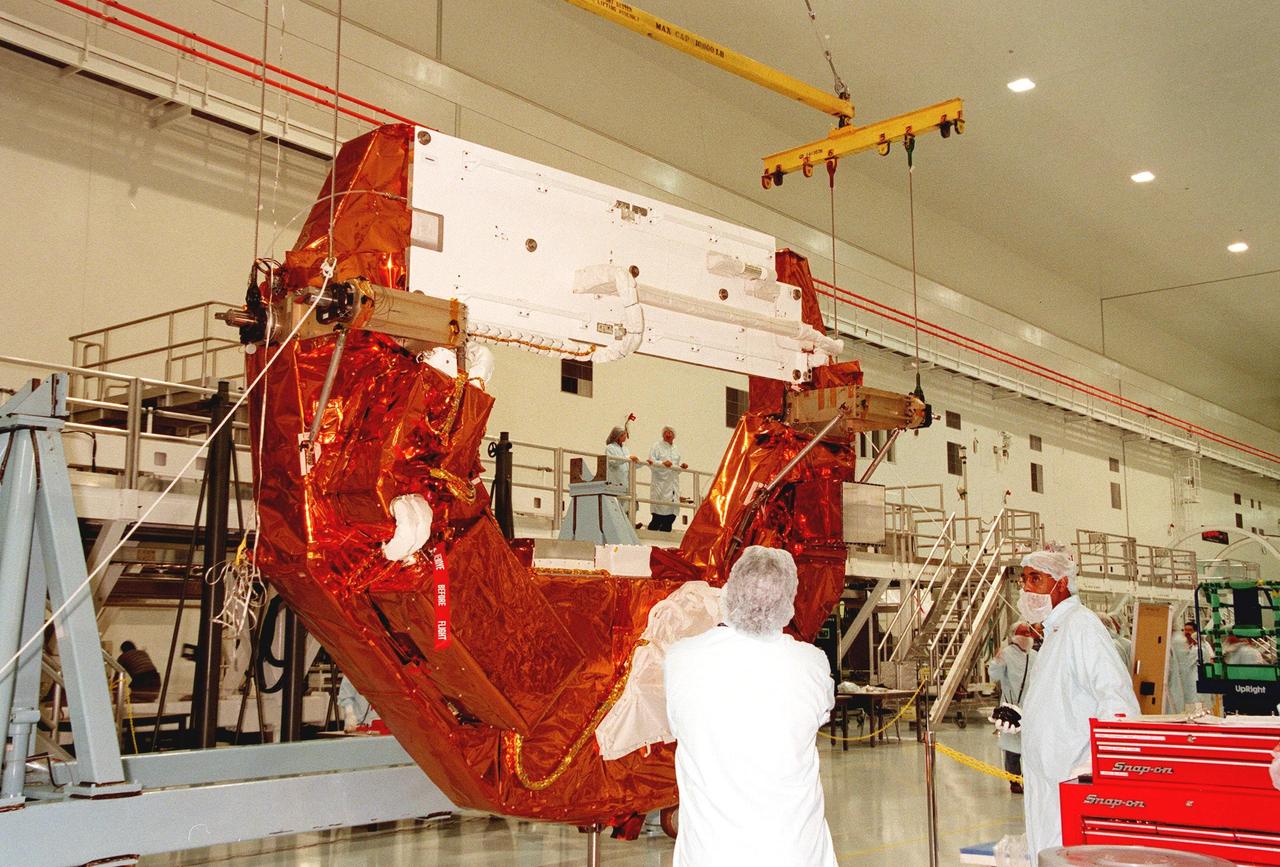
The Hubble Space Telescope Orbiting Systems Test (HOST)is being raised to a workstand by technicians in the Space Shuttle Processing Facility. One of the payloads on the STS-95 mission, the HOST platform is carrying four experiments to validate components planned for installation during the third Hubble Space Telescope servicing mission and to evaluate new technologies in an earth orbiting environment. The STS-95 mission is scheduled to launch Oct. 29. It will carry three other payloads: the Spartan solar-observing deployable spacecraft, the International Extreme Ultraviolet Hitchhiker, and the SPACEHAB single module with experiments on space flight and the aging process
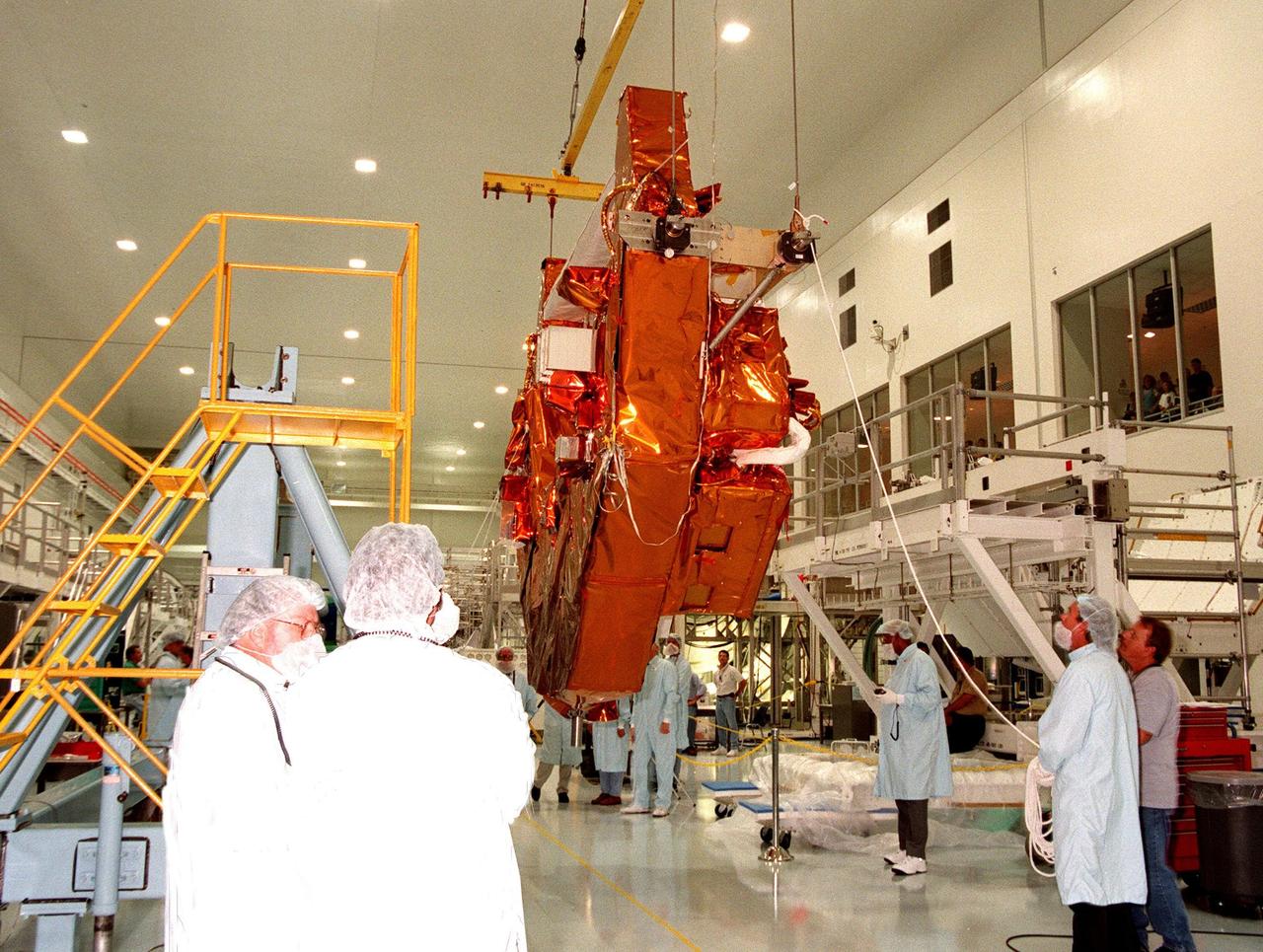
Workers watch as the Hubble Space Telescope Orbiting Systems Test (HOST)is moved inside the Space Shuttle Processing Facility. The HOST platform, one of the payloads on the STS-95 mission, is carrying four experiments to validate components planned for installation during the third Hubble Space Telescope servicing mission and to evaluate new technologies in an earth orbiting environment. The STS-95 mission is scheduled to launch Oct. 29. It will carry three other payloads: the Spartan solar-observing deployable spacecraft, the International Extreme Ultraviolet Hitchhiker, and the SPACEHAB single module with experiments on space flight and the aging process
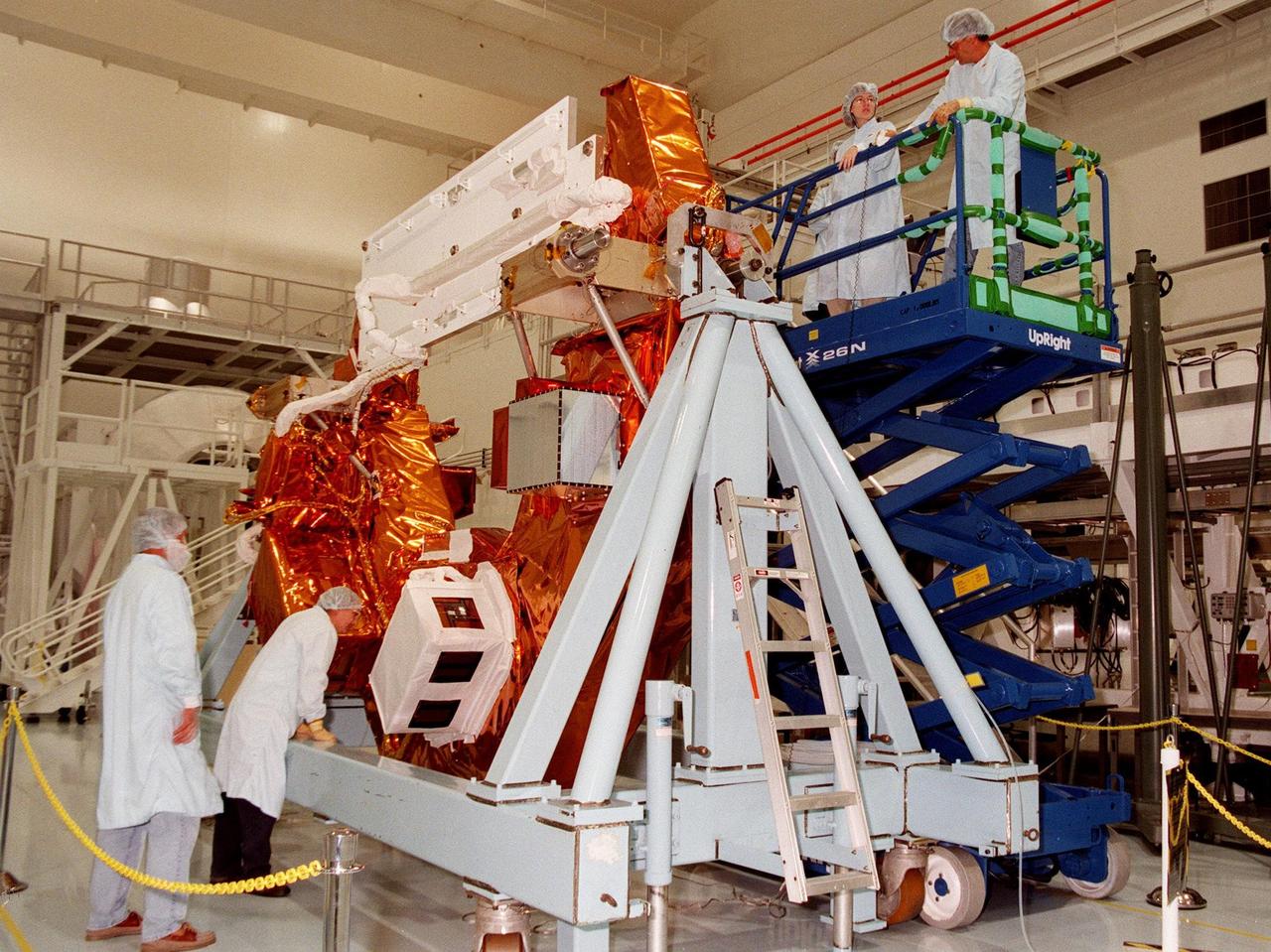
KENNEDY SPACE CENTER, FLA. -- The Hubble Space Telescope Orbiting Systems Test (HOST) is checked out by technicians in the Space Shuttle Processing Facility. One of the payloads on the STS-95 mission, the HOST platform is carrying four experiments to validate components planned for installation during the third Hubble Space Telescope servicing mission and to evaluate new technologies in an earth orbiting environment. The STS-95 mission is scheduled to launch Oct. 29. It will carry three other payloads: the Spartan solar-observing deployable spacecraft, the International Extreme Ultraviolet Hitchhiker, and the SPACEHAB single module with experiments on space flight and the aging process
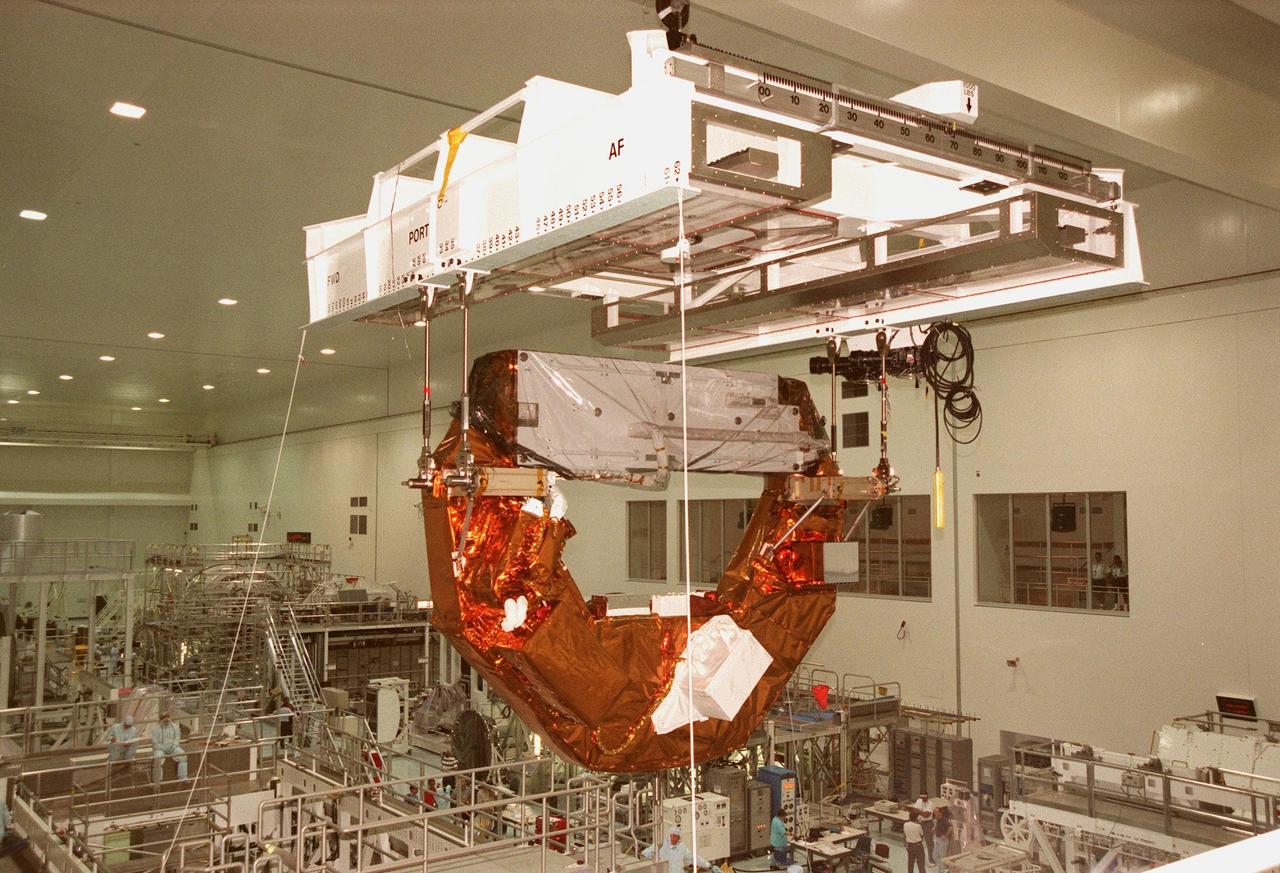
KENNEDY SPACE CENTER, FLA. -- The Hubble Space Telescope Orbiting Systems Test (HOST) is suspended above its work stand in the Space Station Processing Facility before moving it to its payload canister. The HOST platform is carrying four experiments to validate components planned for installation during the third Hubble Space Telescope servicing mission and to evaluate new technologies in an Earth-orbiting environment. The STS-95 mission is scheduled to launch Oct. 29. It will carry other payloads such as the Spartan solar-observing deployable spacecraft, the International Extreme Ultraviolet Hitchhiker (IEH-3), and the SPACEHAB single module with experiments on space flight and the aging process
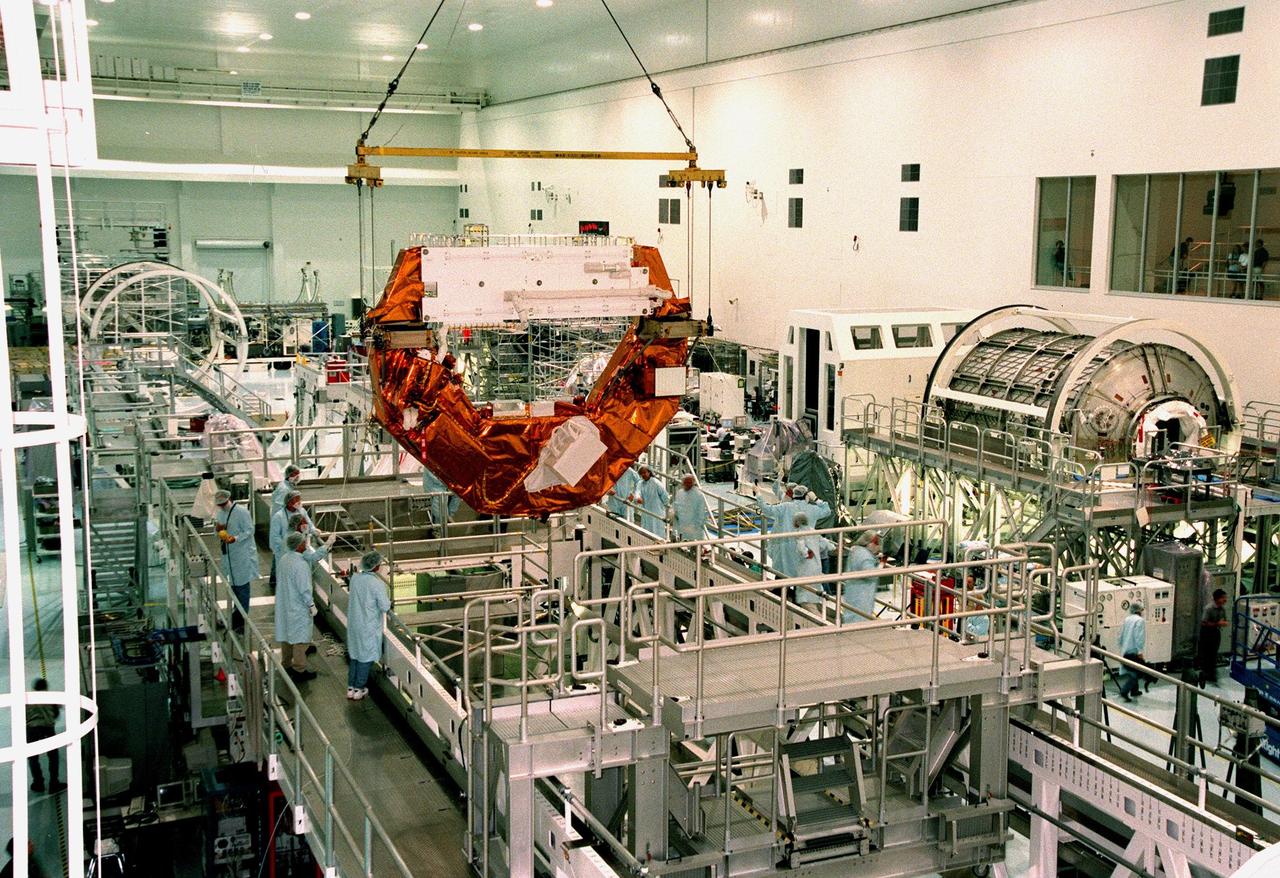
Workers watch as the Hubble Space Telescope Orbiting Systems Test (HOST)is lowered onto a workstand in the Space Shuttle Processing Facility. To the right can be seen the Rack Insertion Device and Leonardo, a Multi-Purpose Logistics Module. The HOST platform, one of the payloads on the STS-95 mission, is carrying four experiments to validate components planned for installation during the third Hubble Space Telescope servicing mission and to evaluate new technologies in an earth orbiting environment. The STS-95 mission is scheduled to launch Oct. 29. It will carry three other payloads: the Spartan solar-observing deployable spacecraft, the International Extreme Ultraviolet Hitchhiker, and the SPACEHAB single module with experiments on space flight and the aging process
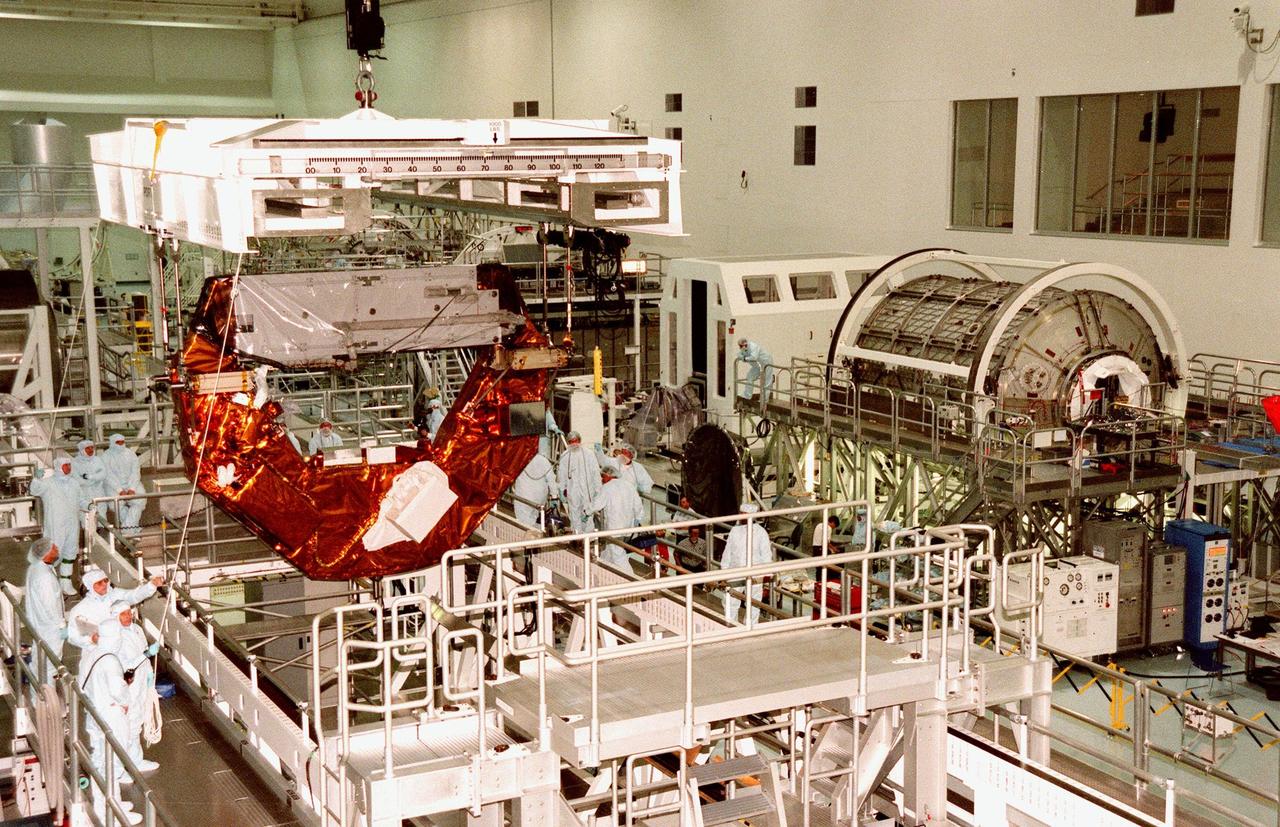
KENNEDY SPACE CENTER, FLA. -- The Hubble Space Telescope Orbiting Systems Test Platform (HOST) is lifted off its work stand in the Space Station Processing Facility before moving it to its payload canister. One of the payloads on the STS-95 mission, the HOST platform is carrying four experiments to validate components planned for installation during the third Hubble Space Telescope servicing mission and to evaluate new technologies in an Earth-orbiting environment. The STS-95 mission is scheduled to launch Oct. 29. It will carry other payloads such as the Spartan solar-observing deployable spacecraft, the International Extreme Ultraviolet Hitchhiker (IEH-3), and the SPACEHAB single module with experiments on space flight and the aging process
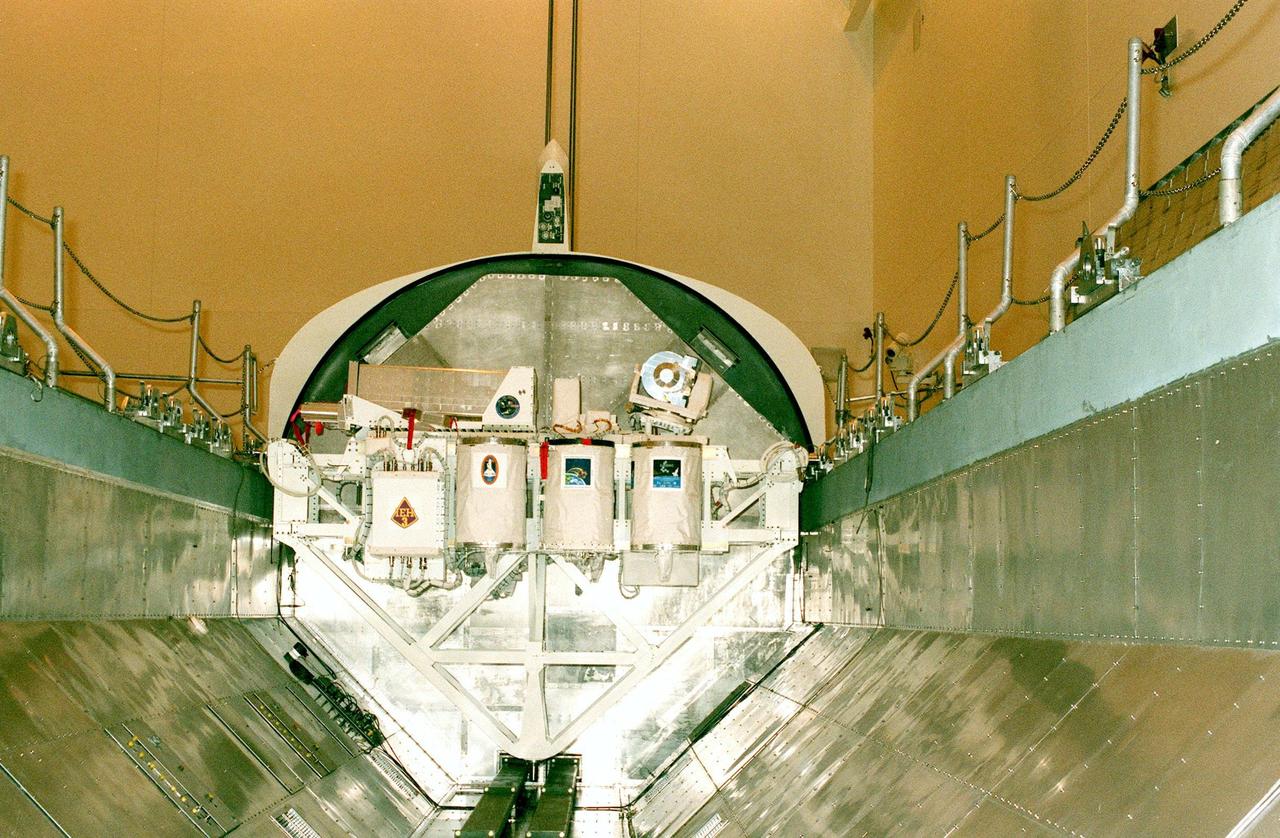
KENNEDY SPACE CENTER, FLA. -- The International Extreme Ultraviolet Hitchhiker (IEH-3), one of the payloads for the STS-95 mission, is moved to a payload canister in the Multi-Payload Processing Facility. The mission is scheduled for liftoff on Space Shuttle Discovery on Oct. 29. IEH-3 comprises several experiments that will study the Jovian planetary system, hot stars, planetary and reflection nebulae, other stellar objects and their environments through remote observation of EUV/FUV emissions; study spacecraft interactions, Shuttle glow, thruster firings, and contamination; and measure the solar constant and identify variations in the value during a solar cycle. Other research payloads include the Hubble Space Telescope Orbital Systems Test Platform, the Spartan solar-observing deployable spacecraft, and the SPACEHAB single module with experiments on space flight and the aging process
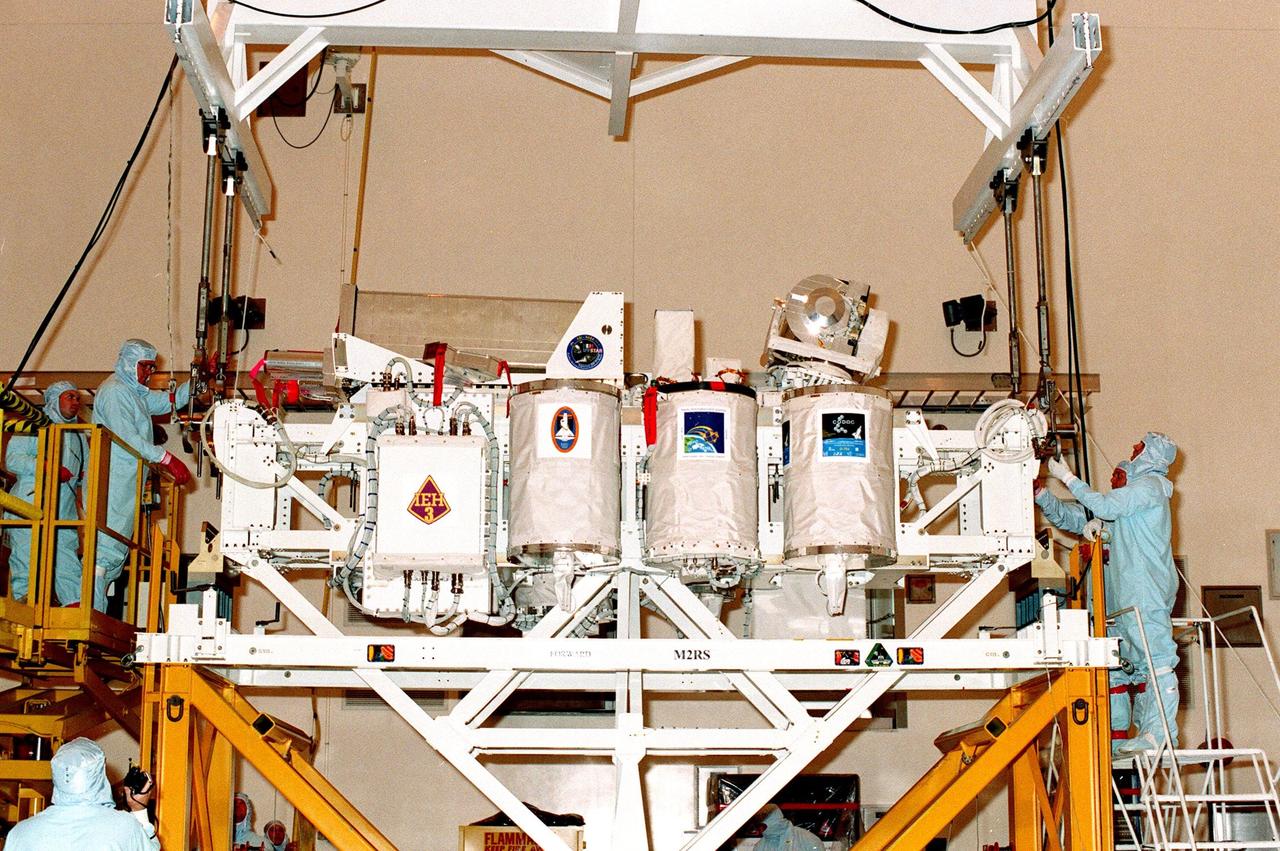
KENNEDY SPACE CENTER, FLA. -- The International Extreme Ultraviolet Hitchhiker (IEH-3), one of the payloads for the STS-95 mission, is prepared for its move to a payload canister in the Multi-Payload Processing Facility. The mission is scheduled for liftoff on Space Shuttle Discovery on Oct. 29. IEH-3 comprises several experiments that will study the Jovian planetary system, hot stars, planetary and reflection nebulae, other stellar objects and their environments through remote observation of EUV/FUV emissions; study spacecraft interactions, Shuttle glow, thruster firings, and contamination; and measure the solar constant and identify variations in the value during a solar cycle. Other research payloads include the Hubble Space Telescope Orbital Systems Test Platform, the Spartan solar-observing deployable spacecraft, and the SPACEHAB single module with experiments on space flight and the aging process
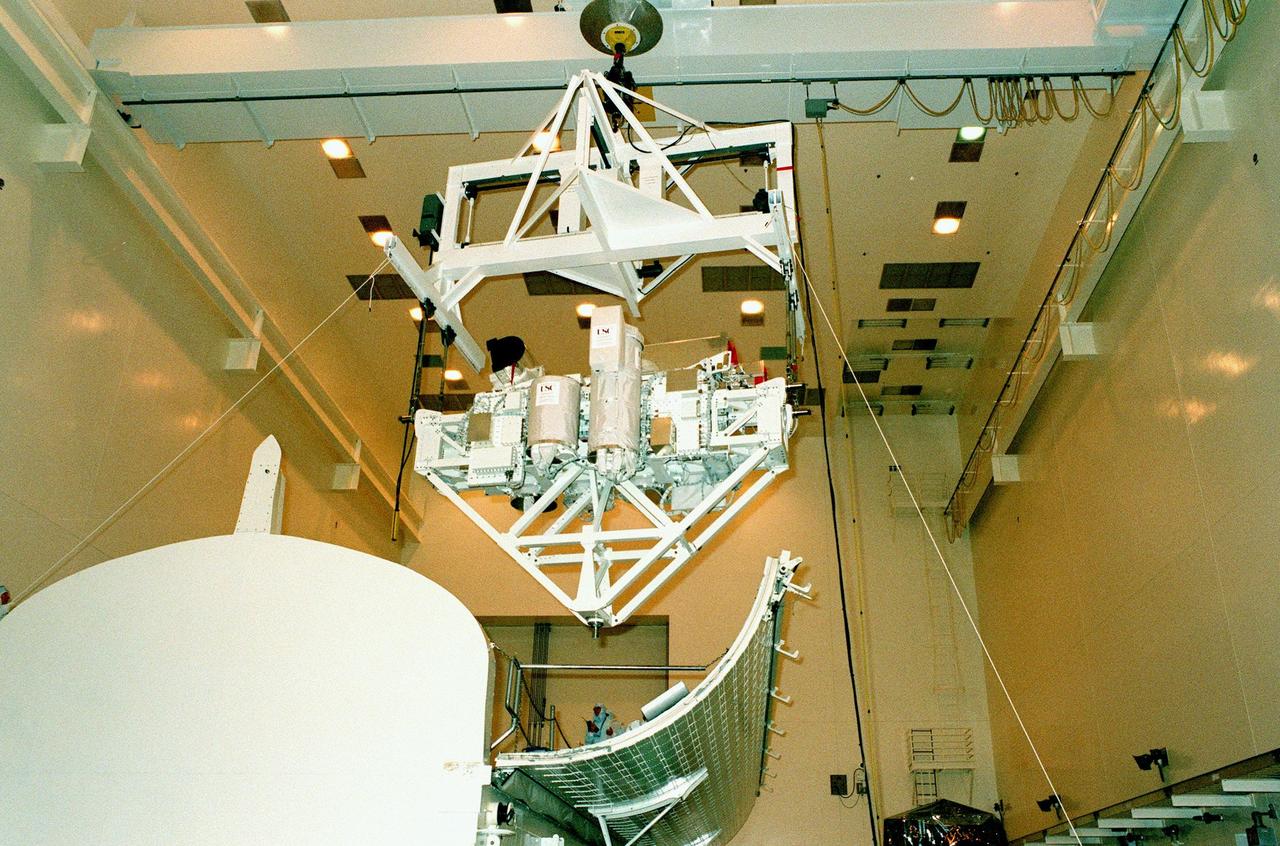
KENNEDY SPACE CENTER, FLA. -- The International Extreme Ultraviolet Hitchhiker (IEH-3), one of the payloads for the STS-95 mission, is suspended above its payload canister in the Multi-Payload Processing Facility. The mission is scheduled for liftoff on Space Shuttle Discovery on Oct. 29. IEH-3 comprises several experiments that will study the Jovian planetary system, hot stars, planetary and reflection nebulae, other stellar objects and their environments through remote observation of EUV/FUV emissions; study spacecraft interactions, Shuttle glow, thruster firings, and contamination; and measure the solar constant and identify variations in the value during a solar cycle. Other research payloads include the Hubble Space Telescope Orbital Systems Test Platform, the Spartan solar-observing deployable spacecraft, and the SPACEHAB single module with experiments on space flight and the aging process
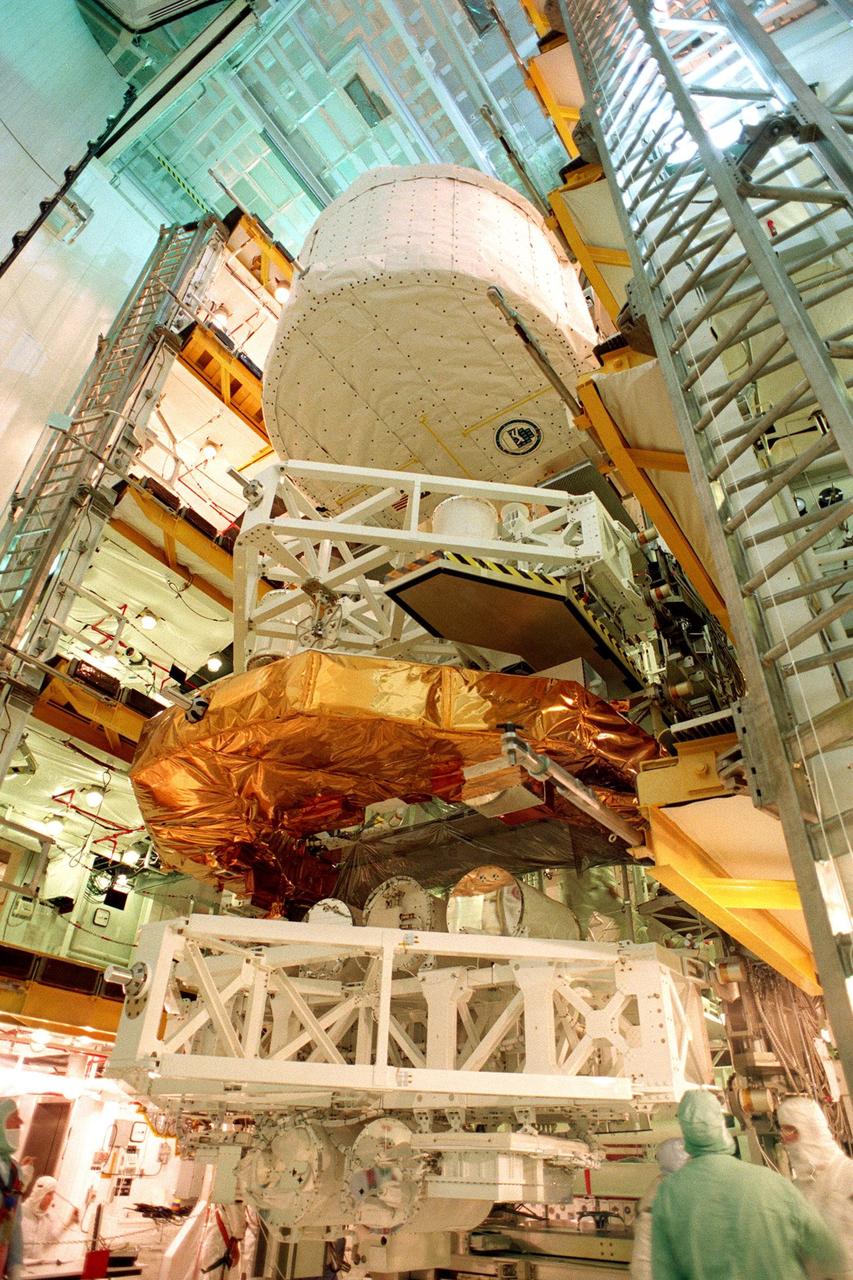
KENNEDY SPACE CENTER, FLA. -- Inside the Payload Changeout Room (PCR) in the Rotating Service Structure (RSS) at Launch Pad 39-B, technicians in clean suits move the payloads for mission STS-95 to the payload bay of Space Shuttle Discovery. At the top of the RSS is the Spacehab module; below it are the Spartan solar-observing deployable spacecraft, the Hubble Space Telescope Orbiting Systems Test Platform (HOST), and the International Extreme Ultraviolet Hitchhiker (IEH-3). The PCR is an environmentally controlled facility with seals around the mating surface that fit against the orbiter or payload canister and permit the payload bay or canister doors to be opened and cargo removed without exposing it to outside air and contaminants. Payloads are installed vertically in the orbiter using the extendable payload ground handling mechanism. Fixed and extendable work platforms provide work access in the PCR. The SPACEHAB single module involves experiments on space flight and the aging process. Spartan is a solar physics spacecraft designed to perform remote sensing of the hot outer layers of the sun's atmosphere or corona. HOST carries four experiments to validate components planned for installation during the third Hubble Space Telescope servicing mission and to evaluate new technologies in an Earth-orbiting environment. IEH-3 comprises several experiments that will study the Jovian planetary system, hot stars, planetary and reflection nebulae, other stellar objects and their environments through remote observation of EUV/FUV emissions; study spacecraft interactions, Shuttle glow, thruster firings, and contamination; and measure the solar constant and identify variations in the value during a solar cycle. Mission STS-95 is scheduled to launch Oct. 29, 1998
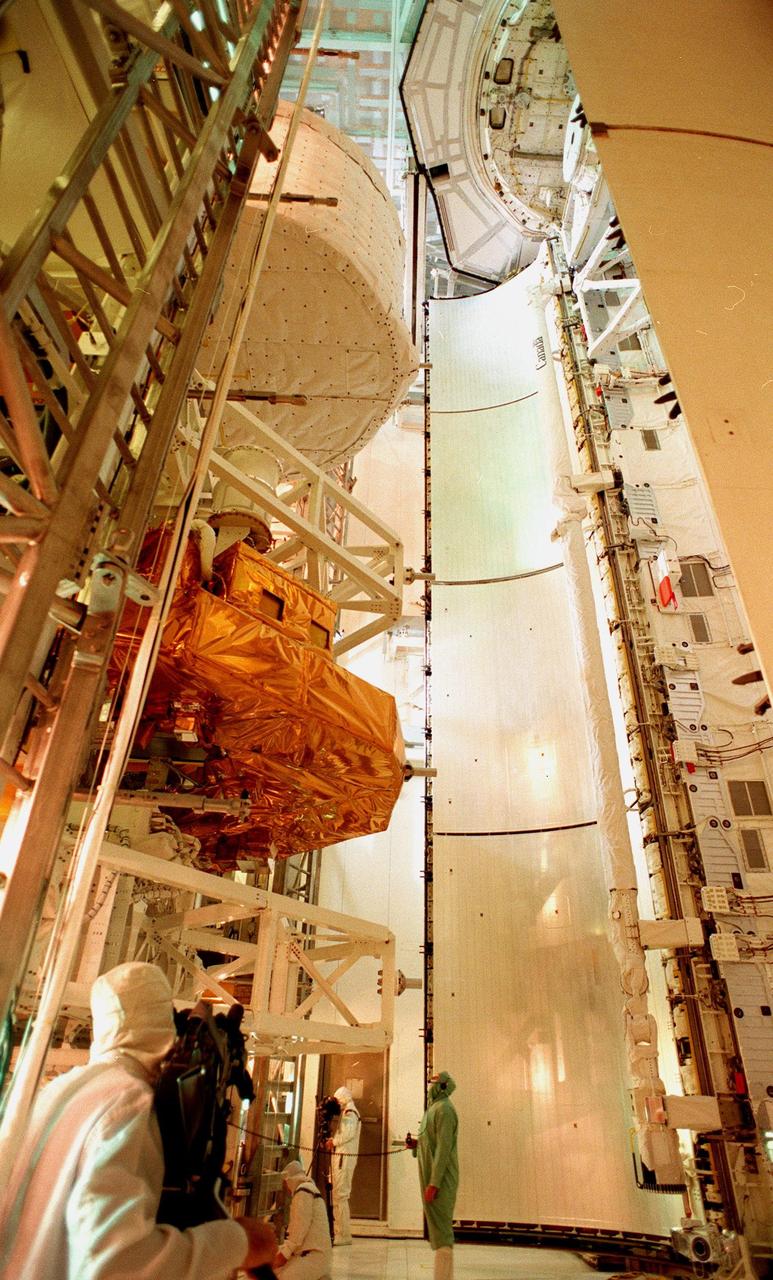
KENNEDY SPACE CENTER, FLA. -- Inside the Payload Changeout Room (PCR) in the Rotating Service Structure (RSS) at Launch Pad 39-B, technicians in clean suits and tethers prepare to move the payloads for mission STS-95 through the open doors of the payload bay (right) of Space Shuttle Discovery. At the top of the RSS is the Spacehab module; below it are the Spartan solar-observing deployable spacecraft, the Hubble Space Telescope Orbiting Systems Test Platform (HOST), and International Extreme Ultraviolet Hitchhiker (IEH-3). The PCR is an environmentally controlled facility with seals around the mating surface that fit against the orbiter or payload canister and permit the payload bay or canister doors to be opened and cargo removed without exposing it to outside air and contaminants. Payloads are installed vertically in the orbiter using the extendable payload ground handling mechanism. Fixed and extendable work platforms provide work access in the PCR. The SPACEHAB single module involves experiments on space flight and the aging process. Spartan is a solar physics spacecraft designed to perform remote sensing of the hot outer layers of the sun's atmosphere or corona. HOST carries four experiments to validate components planned for installation during the third Hubble Space Telescope servicing mission and to evaluate new technologies in an Earth-orbiting environment. IEH-3 comprises several experiments that will study the Jovian planetary system, hot stars, planetary and reflection nebulae, other stellar objects and their environments through remote observation of EUV/FUV emissions; study spacecraft interactions, Shuttle glow, thruster firings, and contamination; and measure the solar constant and identify variations in the value during a solar cycle. Mission STS-95 is scheduled to launch Oct. 29, 1998
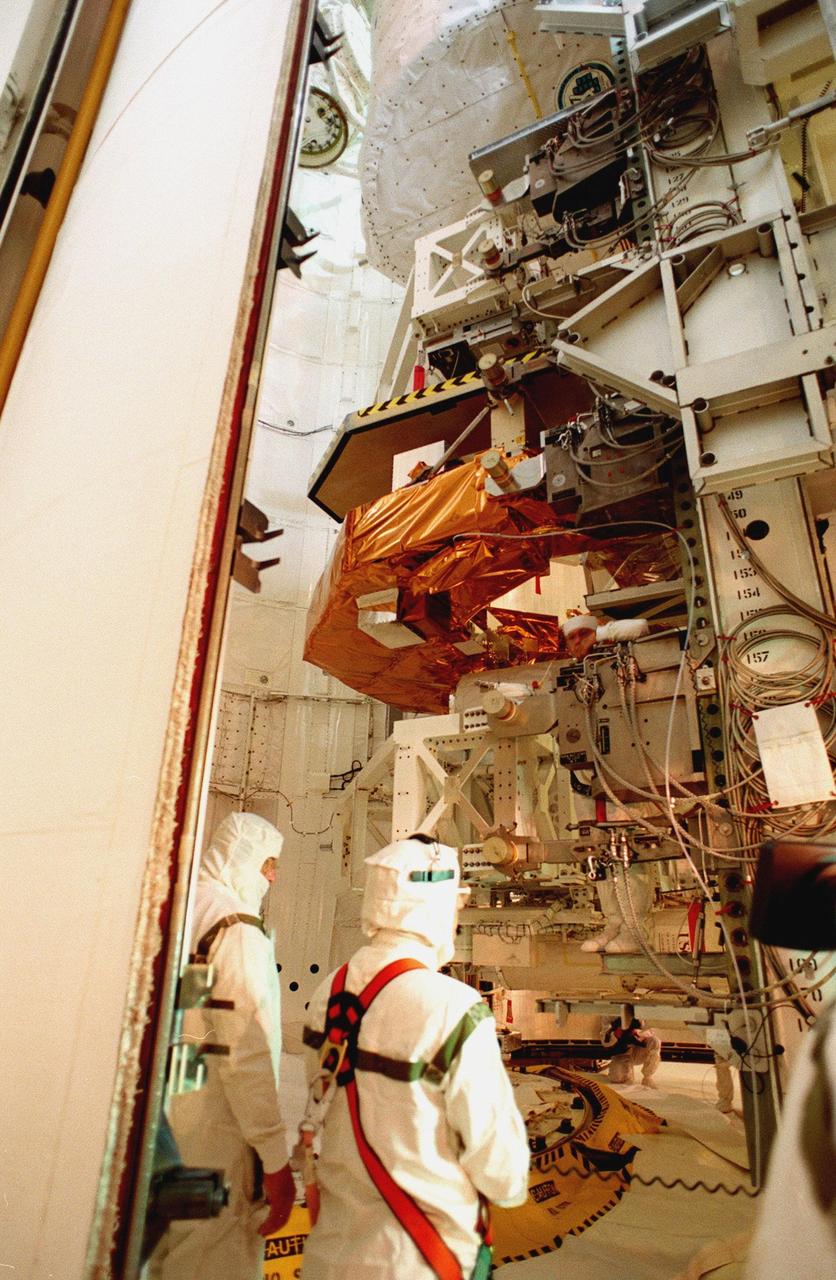
KENNEDY SPACE CENTER,FLA. -- Inside the Payload Changeout Room (PCR) in the Rotating Service Structure (RSS) at Launch Pad 39-B, technicians in clean suits and tethers prepare to move the payloads for mission STS-95 through the open doors of the payload bay (left) of Space Shuttle Discovery. At the top of the RSS is the Spacehab module; below it are the Spartan solar-observing deployable spacecraft, the Hubble Space Telescope Orbiting Systems Test Platform (HOST), and the International Extreme Ultraviolet Hitchhiker (IEH-3). The PCR is an environmentally controlled facility with seals around the mating surface that fit against the orbiter or payload canister and permit the payload bay or canister doors to be opened and cargo removed without exposing it to outside air and contaminants. Payloads are installed vertically in the orbiter using the extendable payload ground handling mechanism. Fixed and extendable work platforms provide work access in the PCR. The SPACEHAB single module involves experiments on space flight and the aging process. Spartan is a solar physics spacecraft designed to perform remote sensing of the hot outer layers of the sun's atmosphere or corona. HOST carries four experiments to validate components planned for installation during the third Hubble Space Telescope servicing mission and to evaluate new technologies in an Earth-orbiting environment. IEH-3 comprises several experiments that will study the Jovian planetary system, hot stars, planetary and reflection nebulae, other stellar objects and their environments through remote observation of EUV/FUV emissions; study spacecraft interactions, Shuttle glow, thruster firings, and contamination; and measure the solar constant and identify variations in the value during a solar cycle. Mission STS-95 is scheduled to launch Oct. 29, 1998
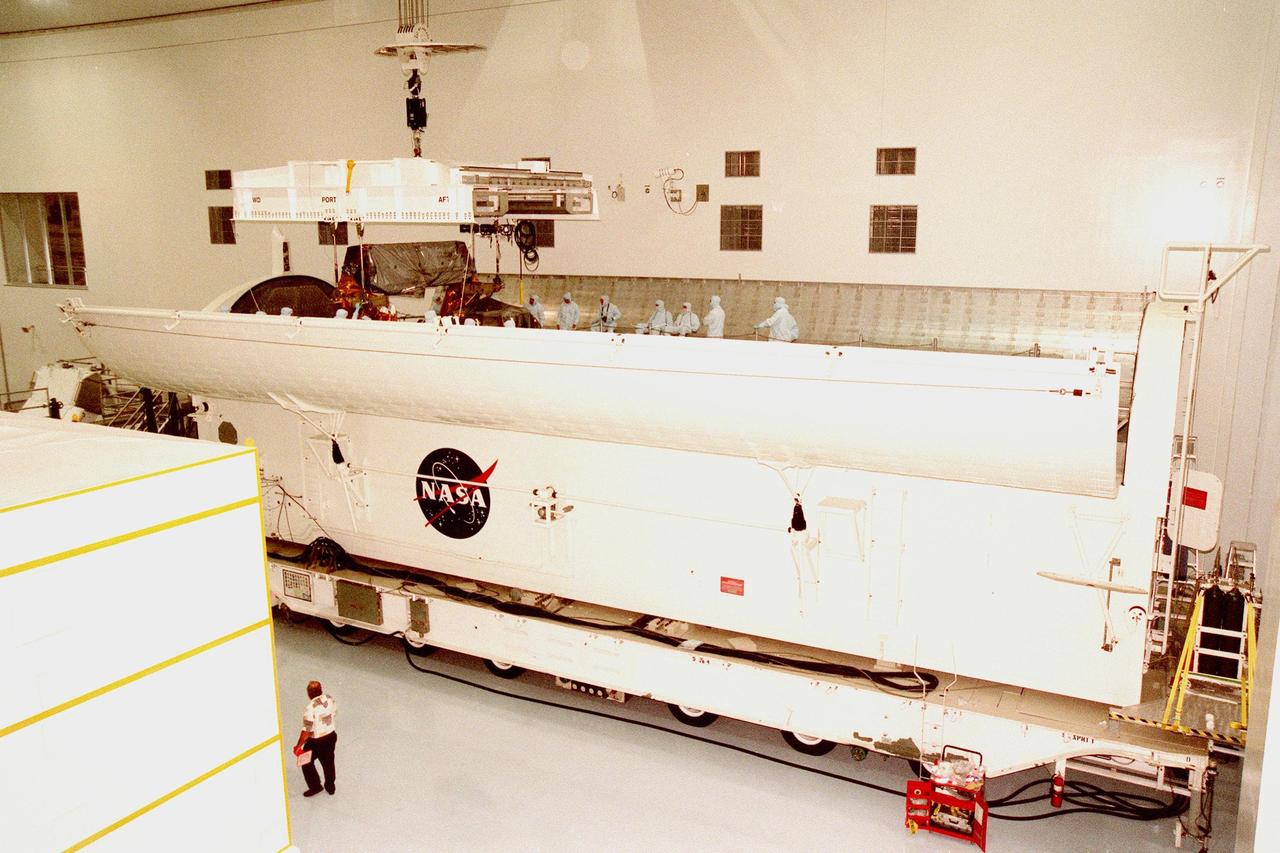
KENNEDY SPACE CENTER, FLA. -- The Hubble Space Telescope Orbiting Systems Test (HOST), one of the payloads on the STS-95 mission, is placed inside its payload canister in the Space Station Processing Facility. The canister is 65 feet long, 18 feet wide and 18 feet, 7 inches high. The HOST platform is carrying four experiments to validate components planned for installation during the third Hubble Space Telescope servicing mission and to evaluate new technologies in an Earth-orbiting environment. The STS-95 mission is scheduled to launch Oct. 29. It will carry other payloads such as the Spartan solar-observing deployable spacecraft, the International Extreme Ultraviolet Hitchhiker (IEH-3), and the SPACEHAB single module with experiments on space flight and the aging process
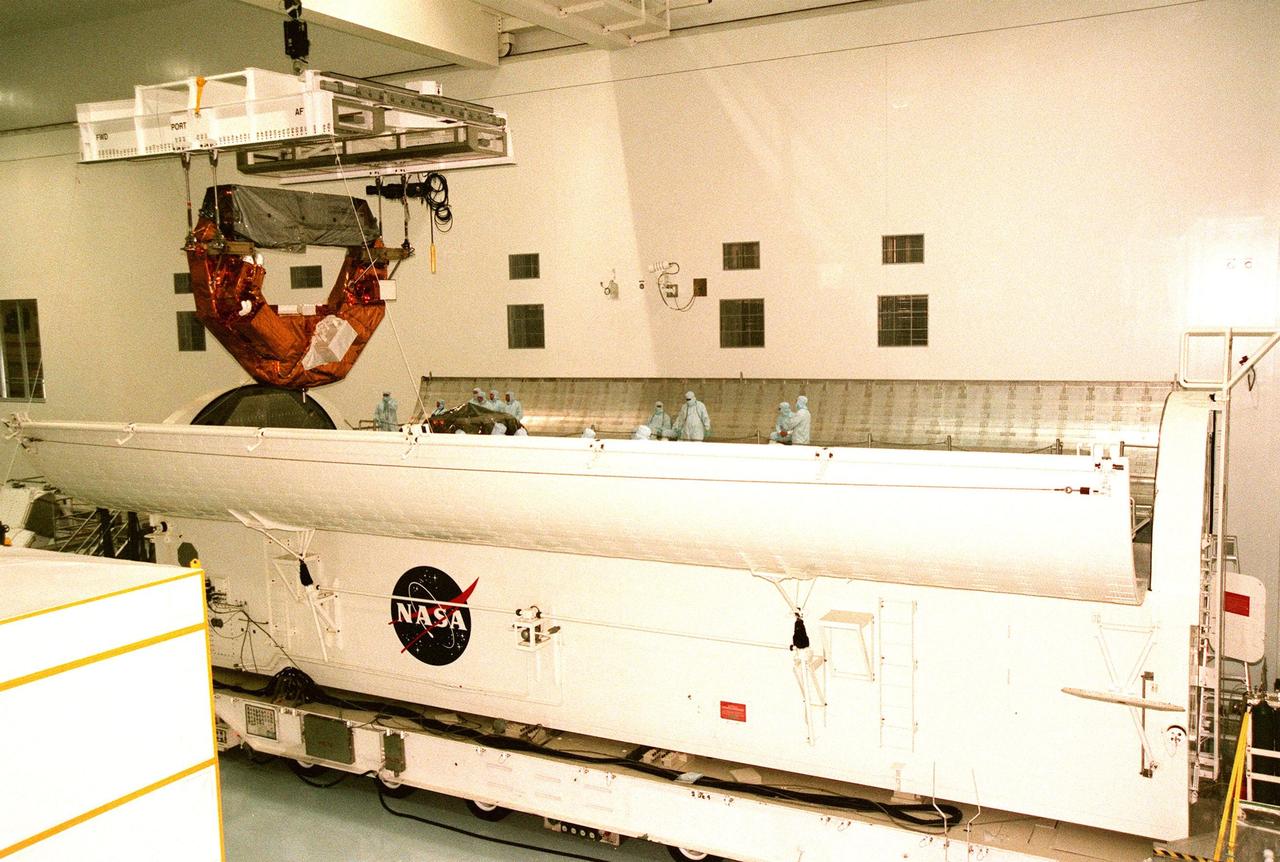
KENNEDY SPACE CENTER, FLA. -- The Hubble Space Telescope Orbiting Systems Test (HOST), one of the payloads on the STS-95 mission, is suspended above its payload canister in the Space Station Processing Facility. The canister is 65 feet long, 18 feet wide and 18 feet, 7 inches high. The HOST platform is carrying four experiments to validate components planned for installation during the third Hubble Space Telescope servicing mission and to evaluate new technologies in an Earth-orbiting environment. The STS-95 mission is scheduled to launch Oct. 29. It will carry other payloads such as the Spartan solar-observing deployable spacecraft, the International Extreme Ultraviolet Hitchhiker (IEH-3), and the SPACEHAB single module with experiments on space flight and the aging process