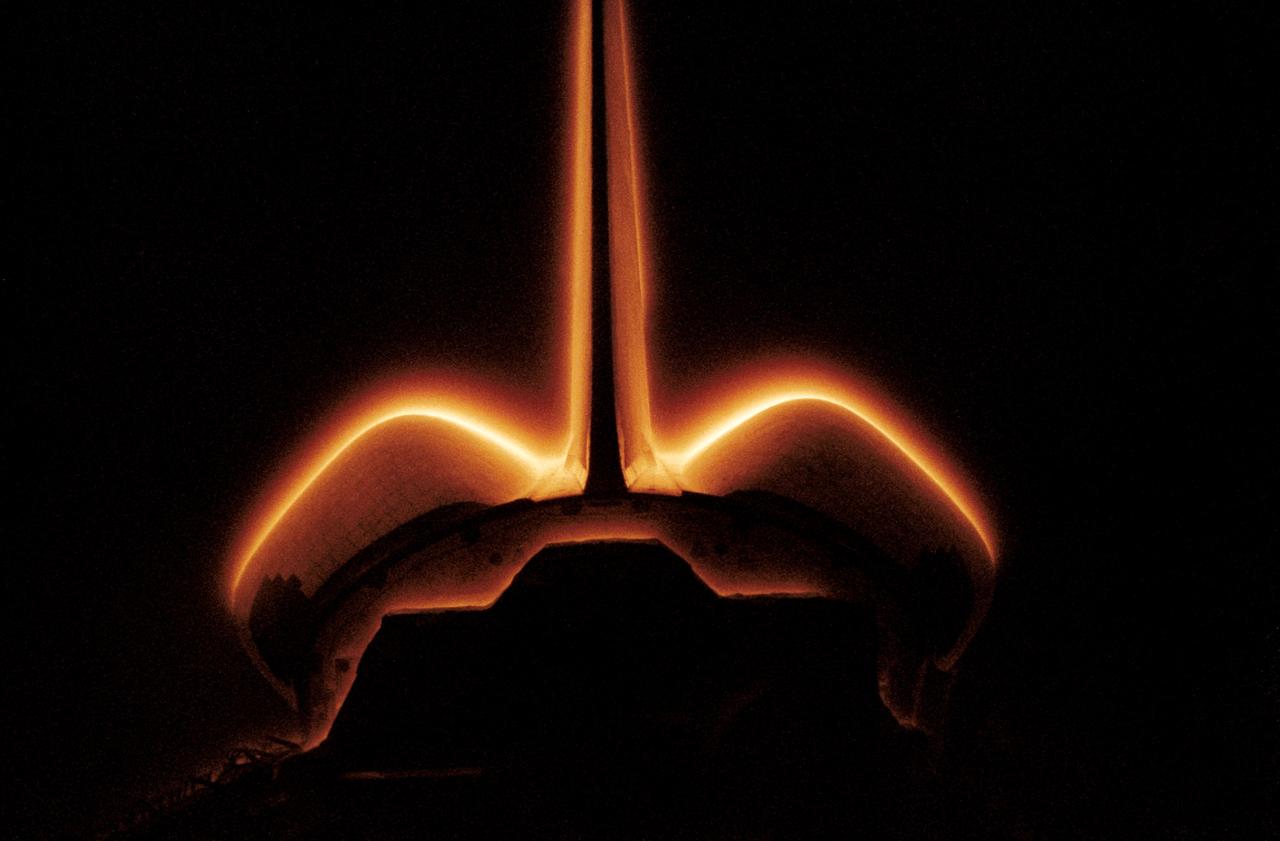
STS062-42-026 (4-18 March 1994) --- This 35mm frame, photographed as the Space Shuttle Columbia was orbiting Earth during a "night" pass, documents the glow phenomenon surrounding the vertical stabilizer and the Orbital Maneuvering System (OMS) pods of the spacecraft.
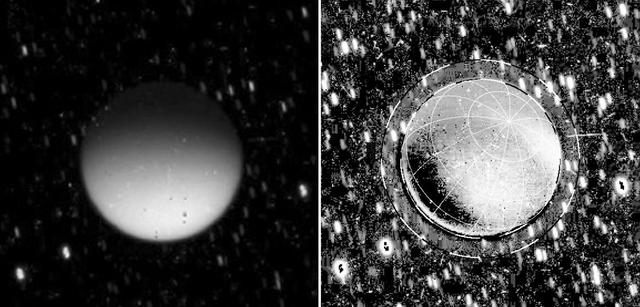
This set of images from NASA Cassini spacecraft shows Saturn moon Titan glowing in the dark. Titan was behind Saturn at the time, in eclipse from the sun.
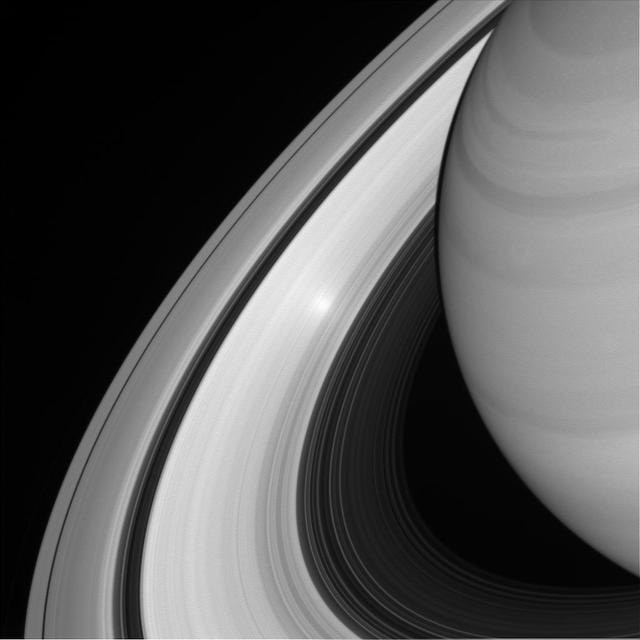
An ethereal, glowing spot appears on Saturn's B ring in this view from NASA's Cassini spacecraft. There is nothing particular about that place in the rings that produces the glowing effect -- instead, it is an example of an "opposition surge" making that area on the rings appear extra bright. An opposition surge occurs when the Sun is directly behind the observer looking toward the rings. The particular geometry of this observation makes the point in the rings appear much, much brighter than would otherwise be expected. This view looks toward the sunlit side of the rings from about 28 degrees above the ring plane. The image was taken in visible light with the Cassini wide-angle camera on June 26, 2016. The view was acquired at a distance of approximately 940,000 miles (1.5 million kilometers) from the rings and at a Sun-ring-spacecraft, or phase, angle of 0 degrees. Image scale on the rings at center is 56 miles (90 kilometers) per pixel. http://photojournal.jpl.nasa.gov/catalog/PIA20496
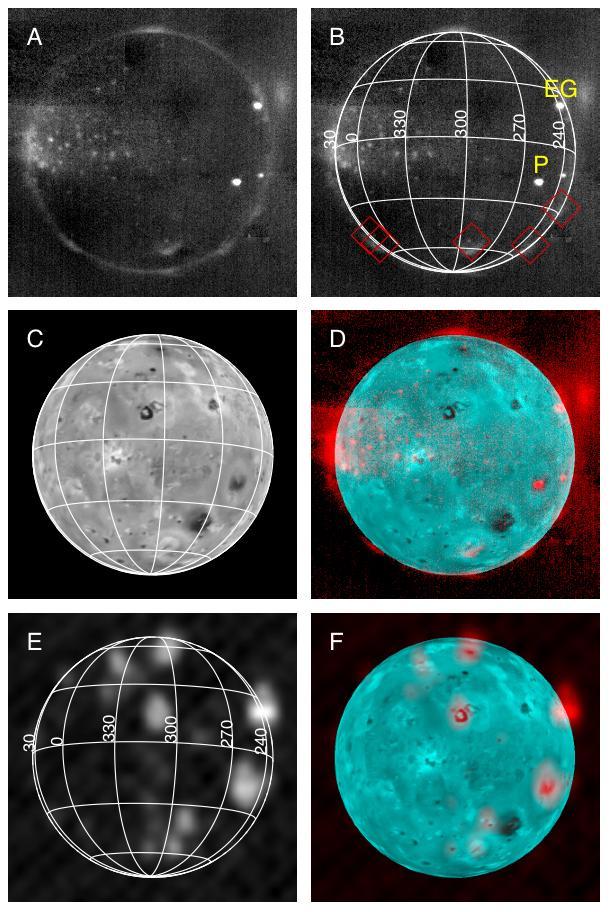
New Horizons took this montage of images of Jupiter volcanic moon Io, glowing in the dark of Jupiter shadow, as the Pluto-bound spacecraft sped through the Jupiter system on Feb. 27, 2007.
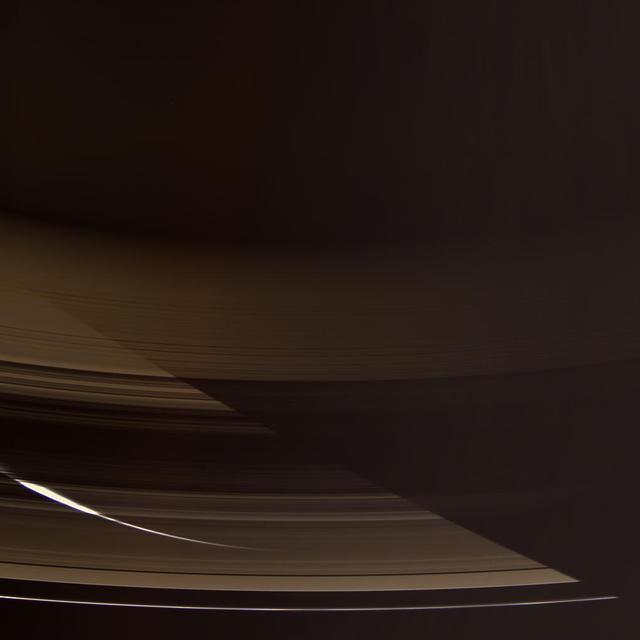
The Cassini spacecraft gazes down through the dark side of Saturn rings toward the softly glowing planet. The night side southern hemisphere is lit by sunlight reflecting off the opposite side of the rings
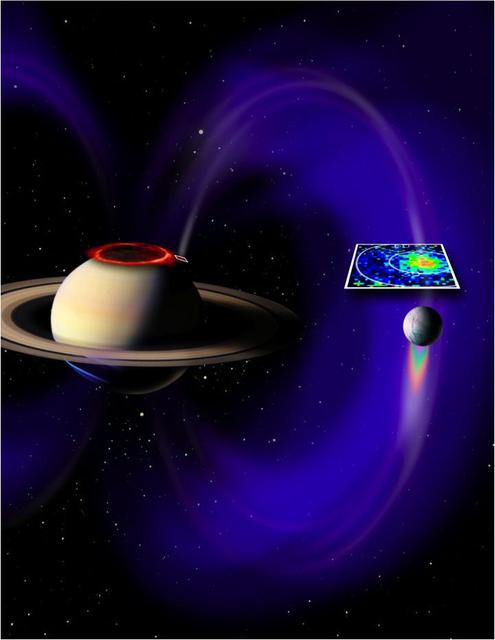
This artist concept based on data from NASA Cassini spacecraft, shows a glowing patch of ultraviolet light near Saturn north pole that occurs at the footprint of the magnetic connection between Saturn and its moon Enceladus.
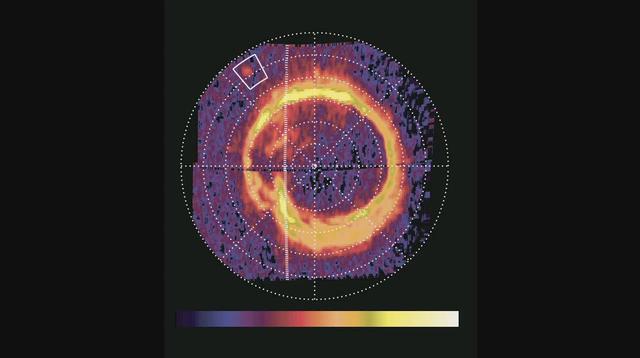
NASA Cassini spacecraft has spotted a glowing patch of ultraviolet light near Saturn north pole that marks the presence of an electrical circuit that connects Saturn with its moon Enceladus. Movie available at the Photojournal.
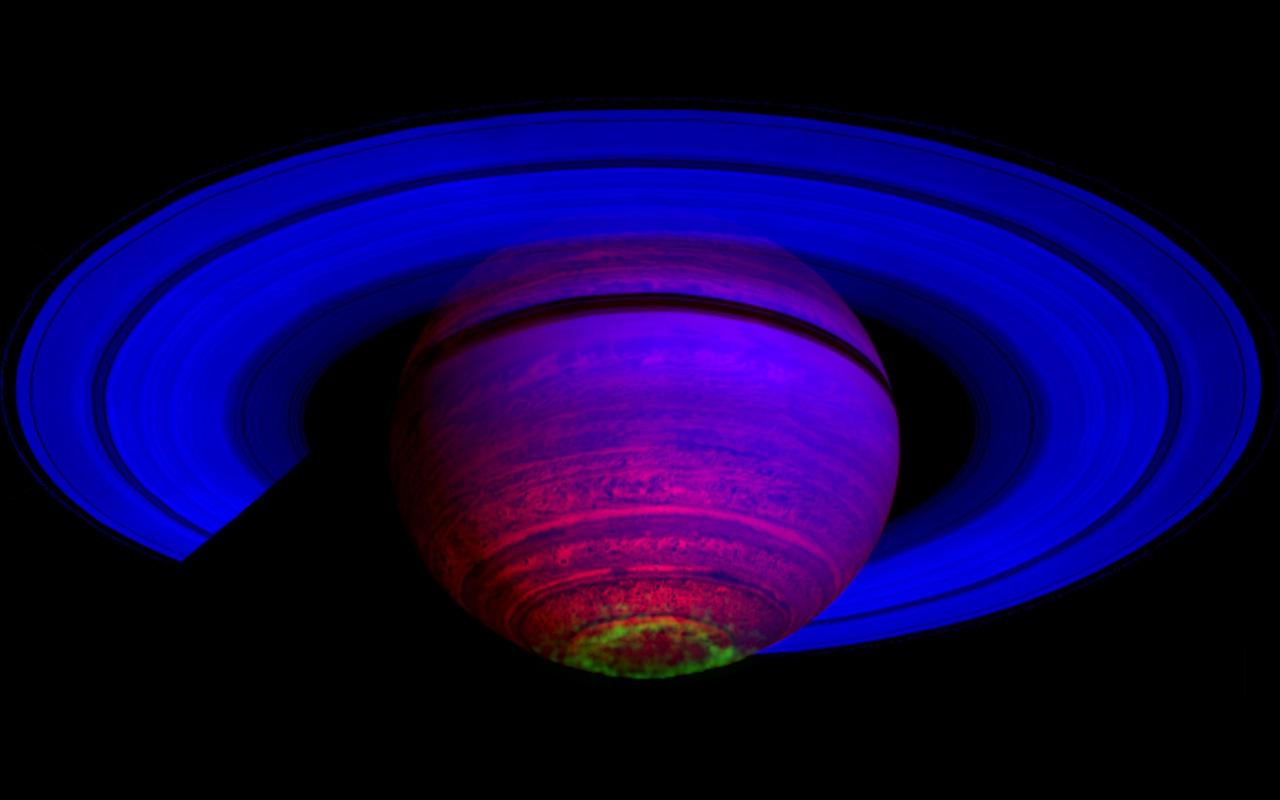
This false-color composite image, constructed from data obtained by NASA Cassini spacecraft, shows the glow of auroras streaking out about 1,000 kilometers 600 miles from the cloud tops of Saturn south polar region.
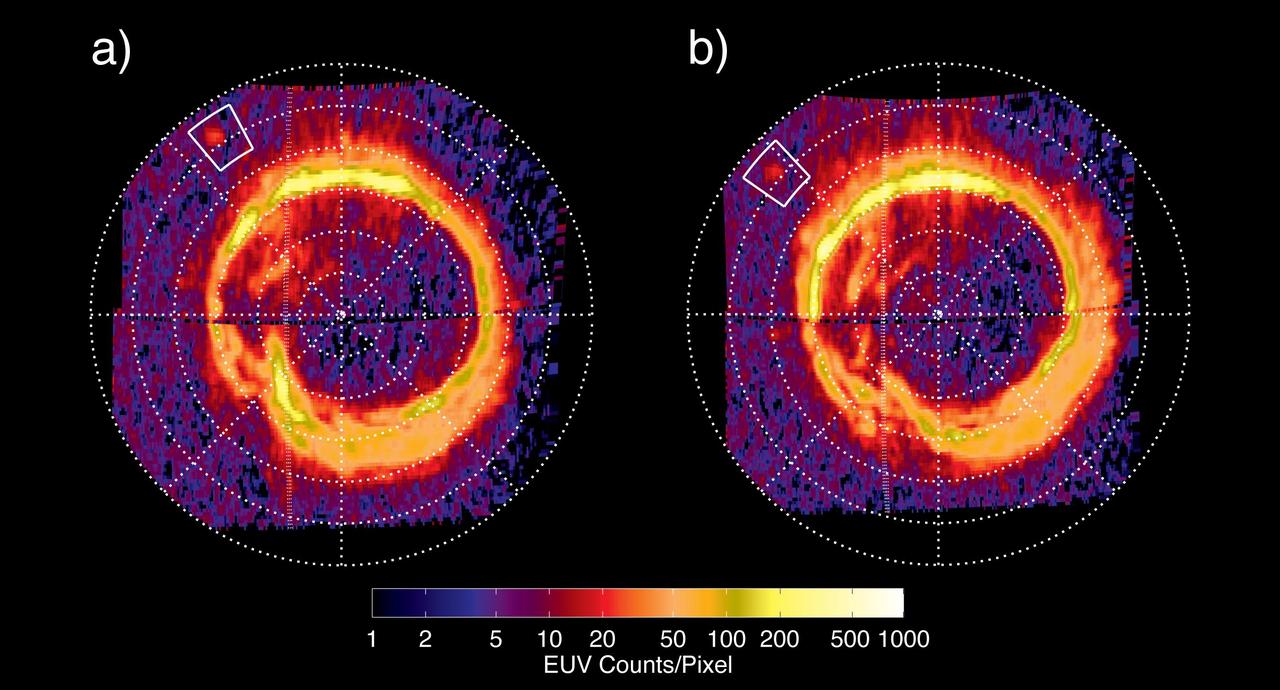
NASA Cassini spacecraft has spotted a glowing patch of ultraviolet light near Saturn north pole that marks the presence of an electrical circuit that connects Saturn with its moon Enceladus.
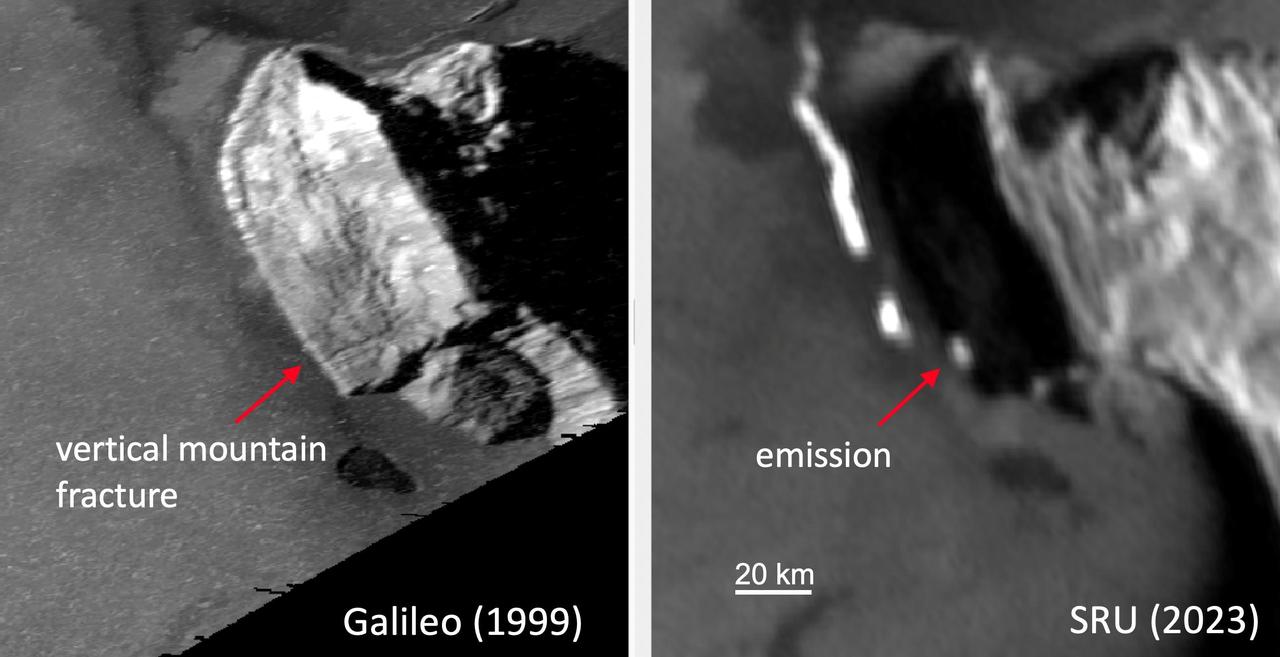
While imaging Io's night side under illumination from Jupiter-shine on Dec. 30, 2023, the Stellar Reference Unit (SRU) on NASA's Juno spacecraft observed an unprecedented glow from active lava at the base of a mountain on Io (red arrow, right panel). The thermal emission signature was located at the base of the western flank of South Zal Mons. Sunlit imagery of the region by captured by NASA's Galileo mission circa 1999 (at left) shows a vertical mountain fracture running from the top of the mountain to the location of the SRU-observed "glow" (red arrow, left panel). One hypothesis is that an extension of the mountain fracture created a fissure vent that allows lava to escape to the surface at this location. https://photojournal.jpl.nasa.gov/catalog/PIA26522
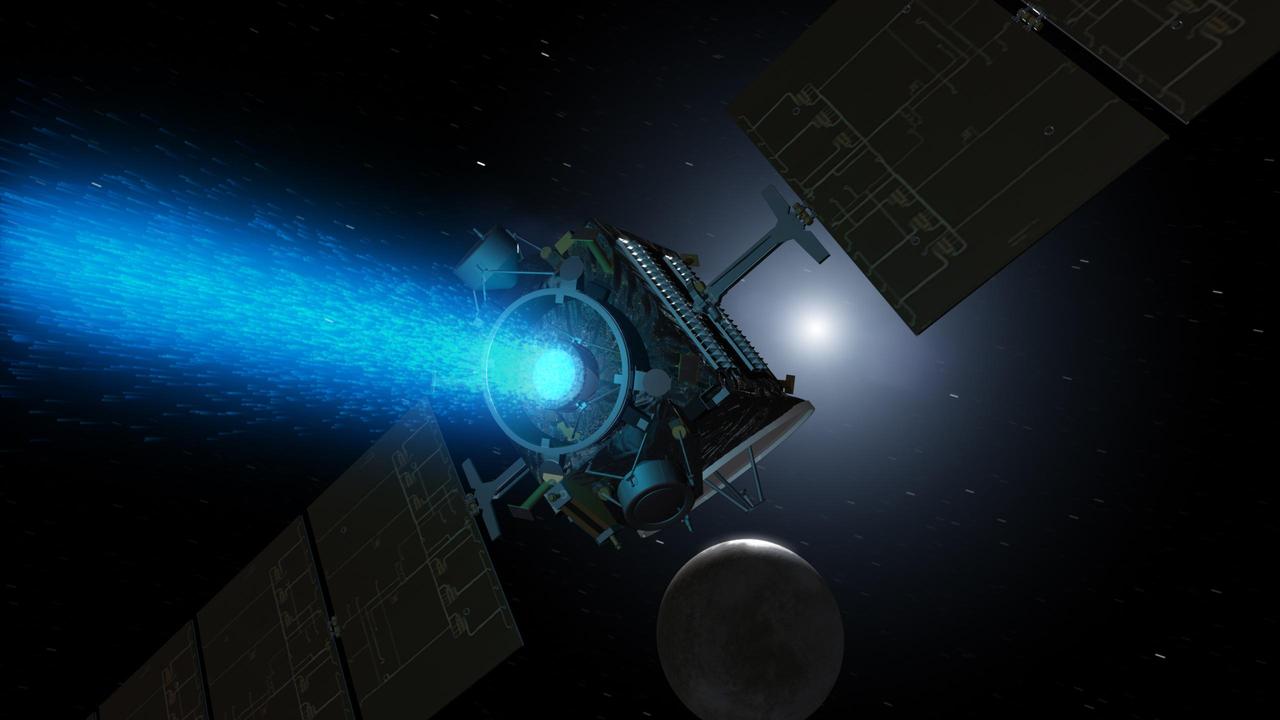
This artist concept shows NASA Dawn spacecraft arriving at the dwarf planet Ceres. Dawn travels through space using a technology called ion propulsion, with ions glowing with blue light are accelerated out of an engine, giving the spacecraft thrust.
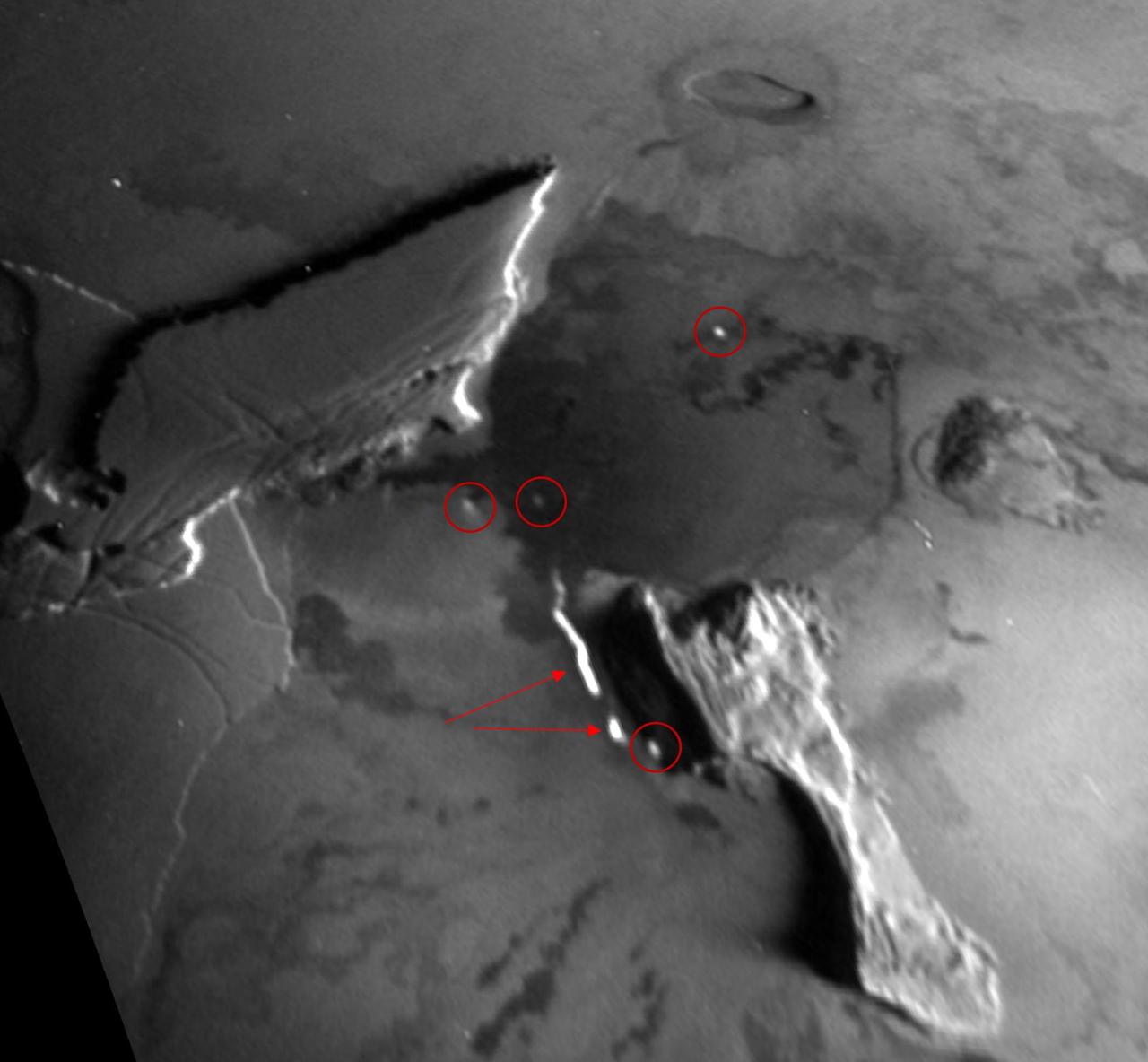
Red circles and arrows point to glowing thermal emission from active lava breakouts observed by the Stellar Reference Unit (SRU) on NASA's Juno spacecraft on Dec. 30, 2023, in the Zal Montes-Patera complex on Io. https://photojournal.jpl.nasa.gov/catalog/PIA26521
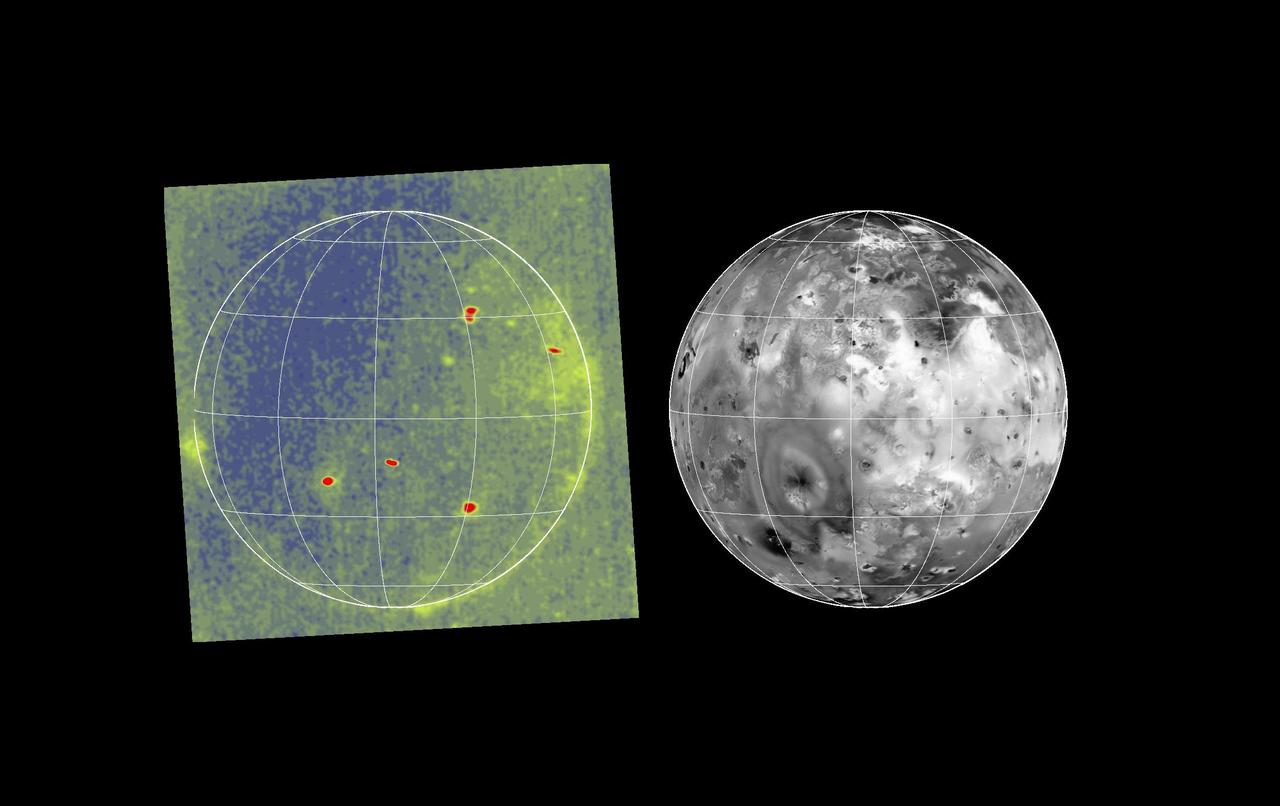
Volcanic hot spots and auroral emissions glow on the darkside of Jupiter moon Io in the image at left. The image was taken by the camera onboard NASA Galileo spacecraft on 29 June, 1996 UT while Io was in Jupiter shadow. http://photojournal.jpl.nasa.gov/catalog/PIA00274
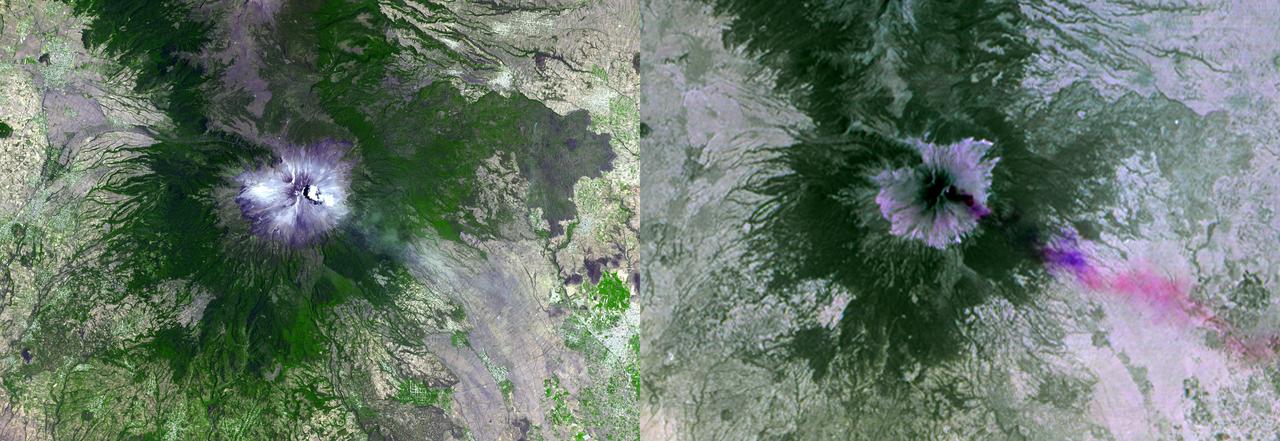
NASA Terra spacecraft shows Mexico active Popocatepetl volcano, located about 40 miles southeast of Mexico City, spewing water vapor, gas, ashes and glowing rocks since its most recent eruption period began in April 2012.
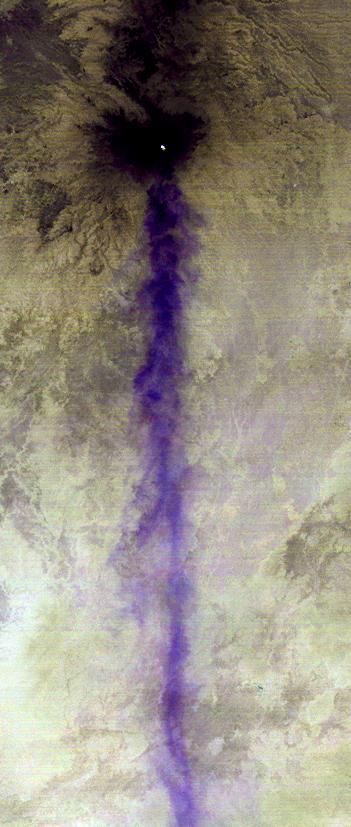
NASA Terra spacecraft shows Popocatepetl, the nearly 18.000-foot-high volcano about 40 miles southeast of Mexico City, continuing to spew water vapor, gas, ashes and glowing rocks from its latest eruption, which started in mid-April 2012.
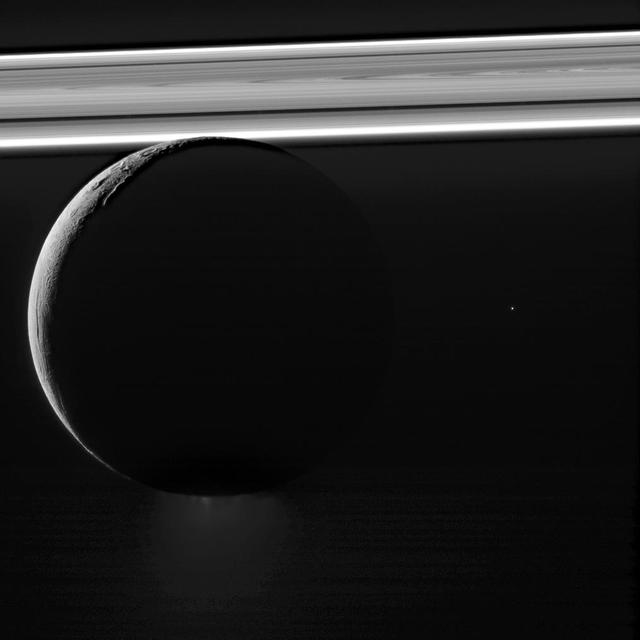
Saturn's moon Enceladus drifts before the rings, which glow brightly in the sunlight. Beneath its icy exterior shell, Enceladus hides a global ocean of liquid water. Just visible at the moon's south pole (at bottom here) is the plume of water ice particles and other material that constantly spews from that ocean via fractures in the ice. The bright speck to the right of Enceladus is a distant star. This image was taken in visible light with the Cassini spacecraft narrow-angle camera on Nov. 6, 2011, at a distance of approximately 90,000 miles (145,000 kilometers) from Enceladus. The Cassini spacecraft ended its mission on Sept. 15, 2017. https://photojournal.jpl.nasa.gov/catalog/PIA21900
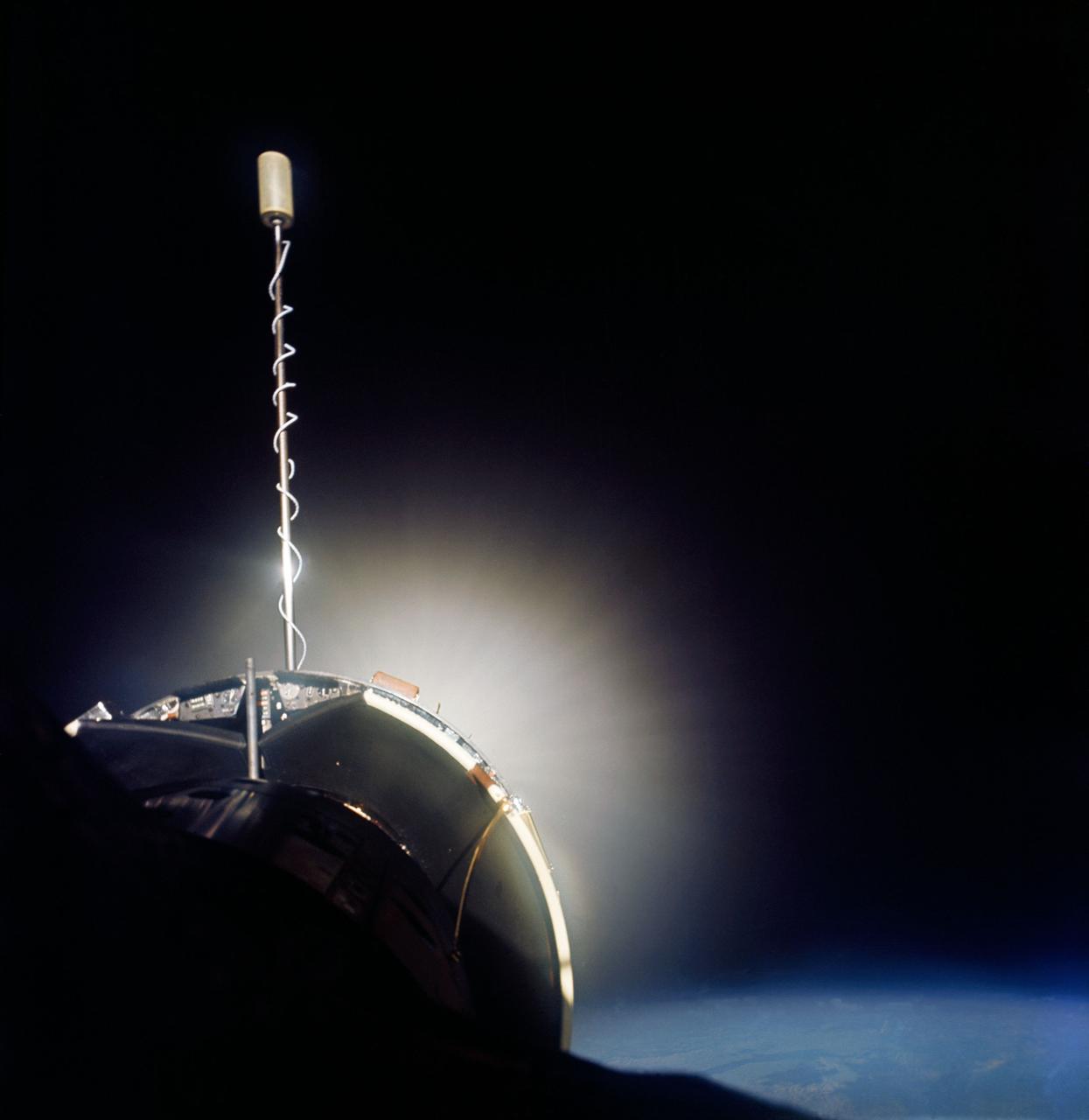
S66-46249 (18-21 July 1966) --- Agena Target Docking Vehicle docked to Gemini-10 spacecraft. Excellent view of Agena display panel. Glow from Agena's primary propulsion system. Photo credit: NASA
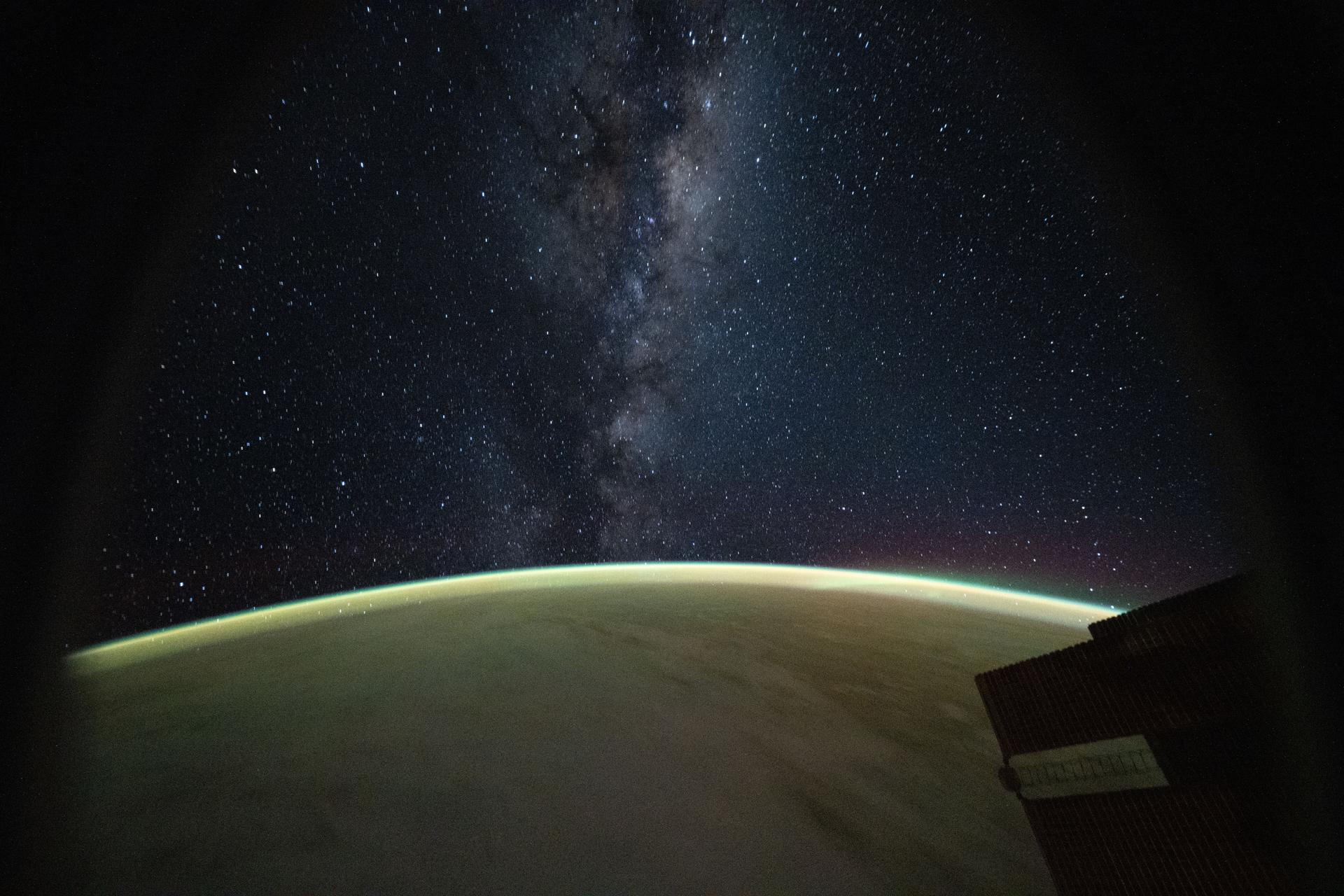
iss074e0521637 (April 13, 2026) --- This celestial image captured from a window on a SpaceX Dragon spacecraft docked to the International Space Station highlights the Milky Way rising above Earth's atmospheric glow. Credit: NASA/Chris Williams
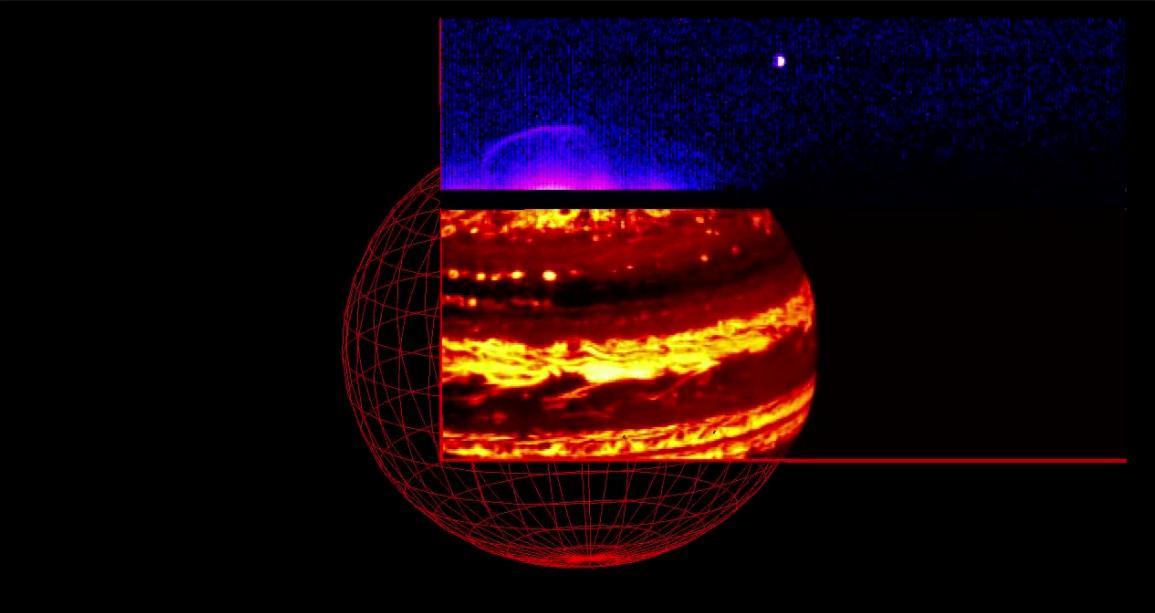
As NASA's Juno spacecraft approached Jupiter on Aug. 27, 2016, the Jovian Infrared Auroral Mapper (JIRAM) instrument captured the planet's glow in infrared light. The video is composed of 580 images collected over a period of about nine hours while Jupiter completed nearly a full rotation on its axis. The video shows the two parts composing the JIRAM imager: the lower one, in a red color scale, is used for mapping the planet's thermal emission at wavelengths around 4.8 microns; the upper one, in a blue color scale, is used to map the auroras at wavelengths around 3.45 microns. In this case the exposure time of the imager was optimized to observe the planet's thermal emission. However, it is possible to see a faint aurora and Jupiter's moon Io approaching the planet. The Great Red Spot is also visible just south of the planet's equator. A movie is available at http://photojournal.jpl.nasa.gov/catalog/PIA21036

Enceladus' intriguing south-polar jets are viewed from afar, backlit by sunlight while the moon itself glows softly in reflected Saturn-shine. Observations of the jets taken from various viewing geometries provide different insights into these remarkable features. Cassini has gathered a wealth of information in the hopes of unraveling the mysteries of the subsurface ocean that lurks beneath the moon's icy crust. This view looks toward the Saturn-facing hemisphere of Enceladus (313 miles or 504 kilometers across). North is up. The image was taken in visible light with the Cassini spacecraft narrow-angle camera on April 13, 2017. The view was acquired at a distance of approximately 502,000 miles (808,000 kilometers) from Enceladus and at a sun-Enceladus-spacecraft, or phase, angle of 176 degrees. Image scale is 3 miles (5 kilometers) per pixel. https://photojournal.jpl.nasa.gov/catalog/PIA21338
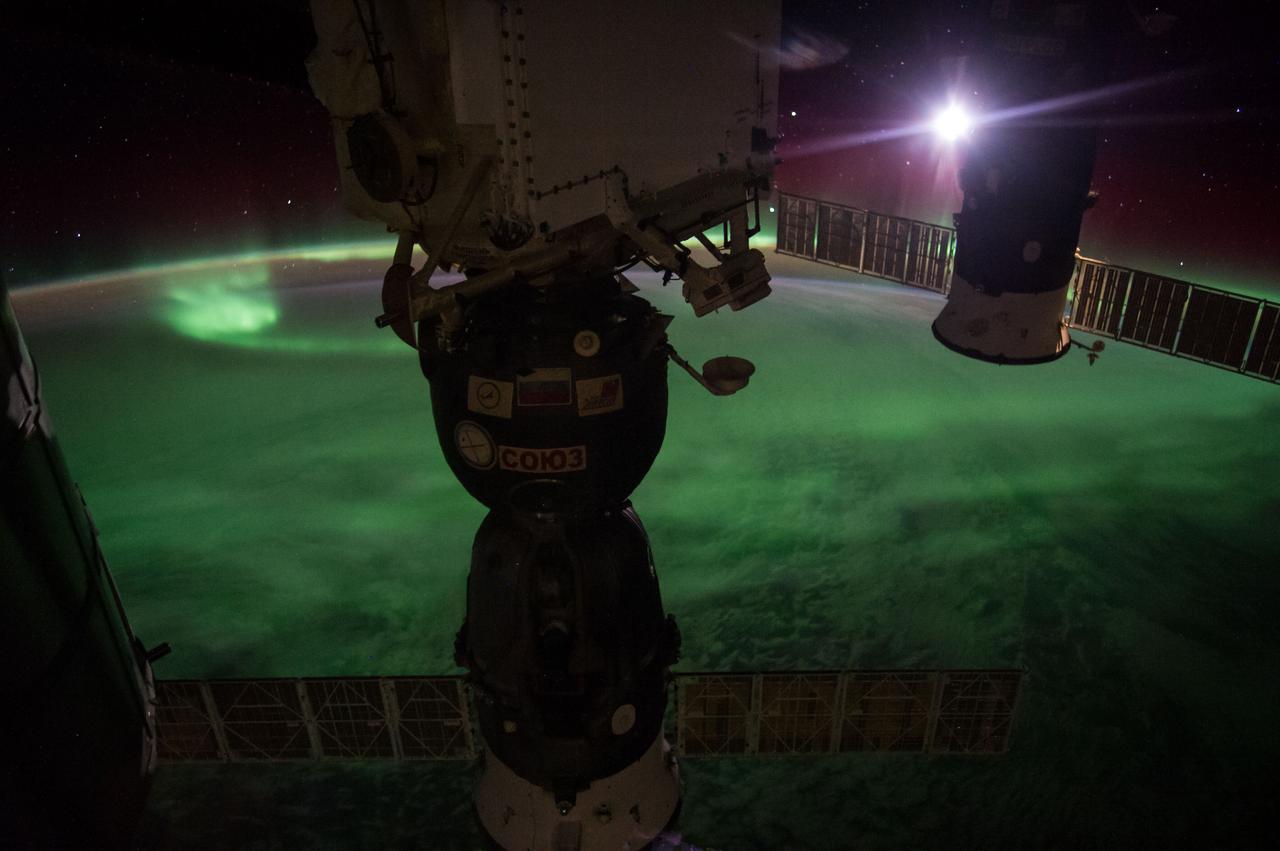
Earth Observation taken during a night pass by the Expedition 40 crew aboard the International Space Station (ISS). Folder lists this as: New Zealand Aurora night pass. Docked Soyuz and Progress spacecraft are visible. On crewmember's Flickr page - The Moon, about to dive into a glowing ocean of green᥿9.
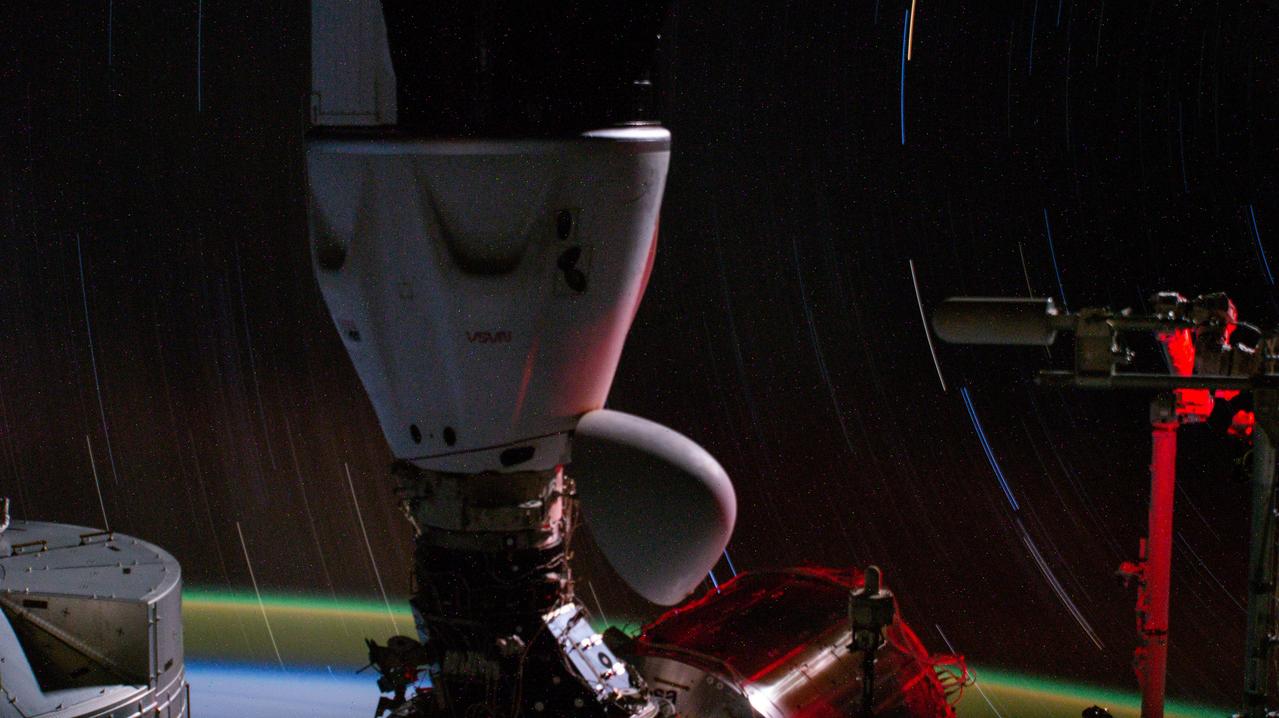
iss070e103599 (Feb. 29, 2024) --- The SpaceX Dragon "Endurance" spacecraft is pictured docked to the Harmony module's space-facing port as the International Space Station orbited 263 miles above the north Atlantic Ocean. Other highlights in this long-duration photograph include circular star trails and the atmospheric glow above Earth's horizon.
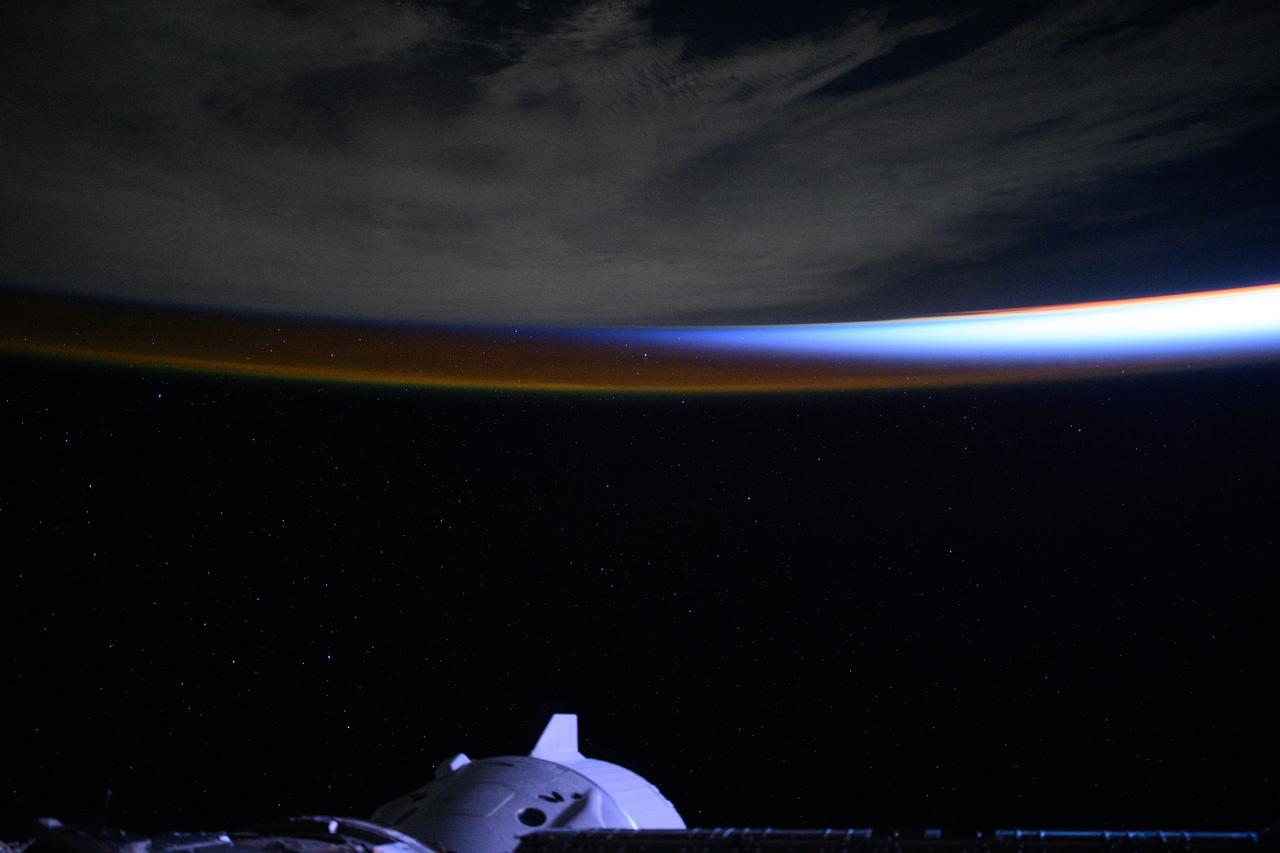
iss073e0203873 (May 19, 2025) --- An orbital sunrise breaks above a cloudy Atlantic Ocean and intersects with Earth's atmospheric glow in this photograph from the International Space Station as it orbited 268 miles overhead. At bottom, is the SpaceX Dragon crew spacecraft docked to the orbital outpost's forward port on the Harmony module.
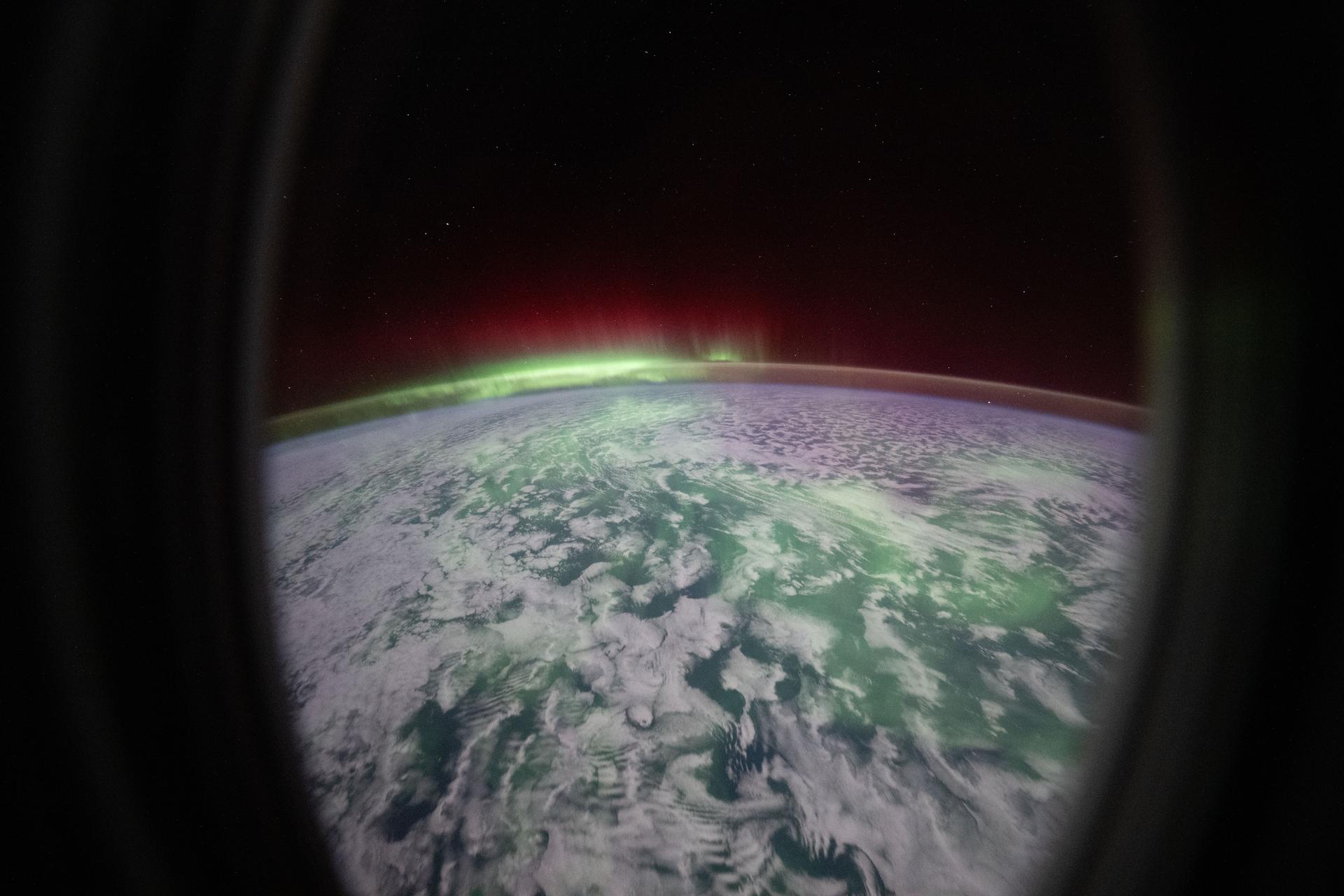
iss074e0436787 (April 3, 2026) --- This view from a window aboard the SpaceX Dragon spacecraft shows the aurora australis glowing above Earth’s atmosphere as the International Space Station soared 270 miles over the Indian Ocean, just southwest of the French Southern and Antarctic Lands. Credit: NASA/Chris Williams
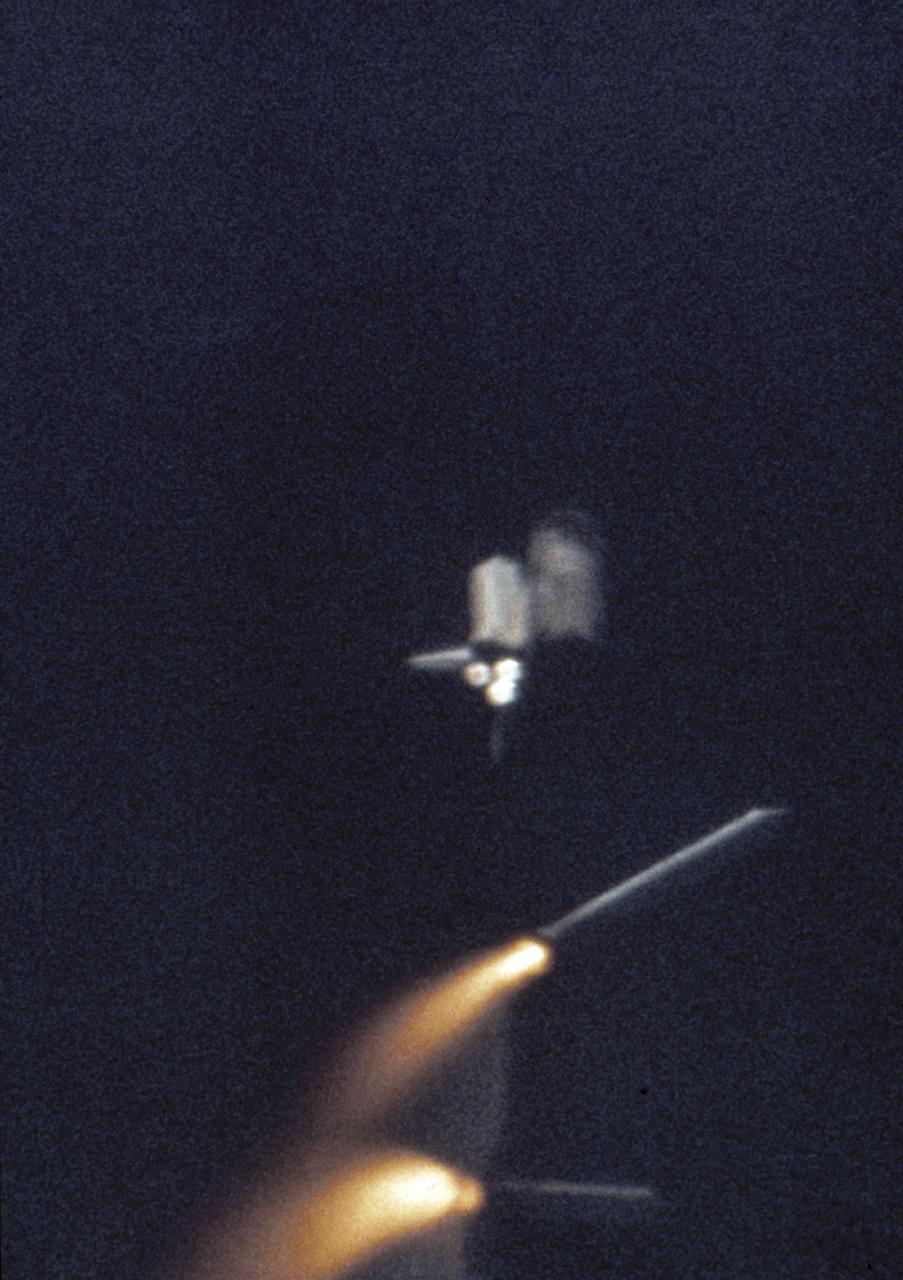
S81-33179 (12 April 1981) --- Though their STS-1 task has been performed, the two solid rocket boosters (SRB) still glow following their jettisoning from the space shuttle Columbia on its way to many firsts. Among the history recorded by the spacecraft is the marking of a mission in a reusable spacecraft. STS-1 is NASA's first manned mission since the Apollo-Soyuz Test Project in 1975. Inside the cabin of the climbing spacecraft are astronauts John W. Young and Robert L. Crippen. Photo credit: NASA
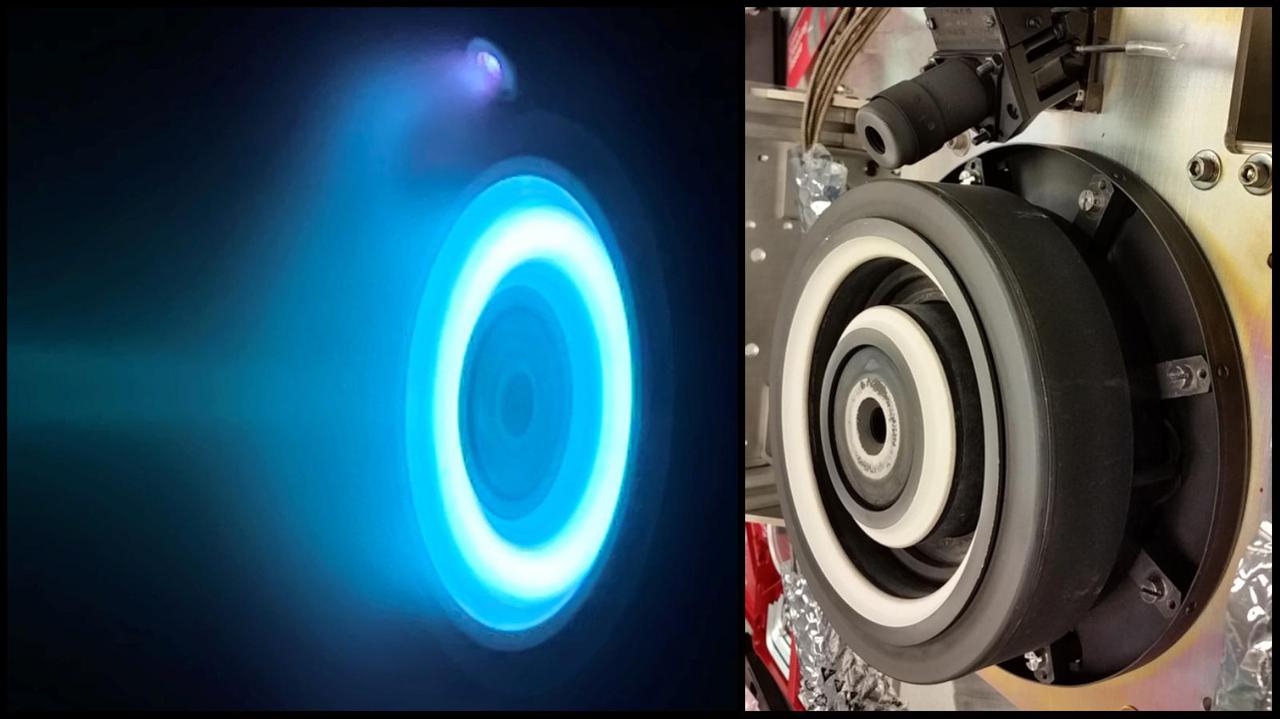
The photo on the left captures an operating electric Hall thruster identical to those that will propel NASA's Psyche spacecraft, which is set to launch in August 2022 and travel to the main asteroid belt between Mars and Jupiter. The xenon plasma emits a blue glow as the thruster operates. The photo on the right shows a similar non-operating Hall thruster. The photo on the left was taken at NASA's Jet Propulsion Laboratory in Southern California; the photo on the right was taken at NASA's Glenn Research Center. Psyche's Hall thrusters will be the first to be used beyond lunar orbit, demonstrating that they could play a role in supporting future missions to deep space. The spacecraft is set to launch in August 2022 and will travel to its target, a metal-rich asteroid also named Psyche, under the power of solar electric propulsion. This super-efficient mode of propulsion uses solar arrays to capture sunlight that is converted into electricity to power the spacecraft's thrusters. The thrusters work by turning xenon gas, a neutral gas used in car headlights and plasma TVs, into xenon ions. As the xenon ions are accelerated out of the thruster, they create the thrust that will propel the spacecraft. https://photojournal.jpl.nasa.gov/catalog/PIA24030
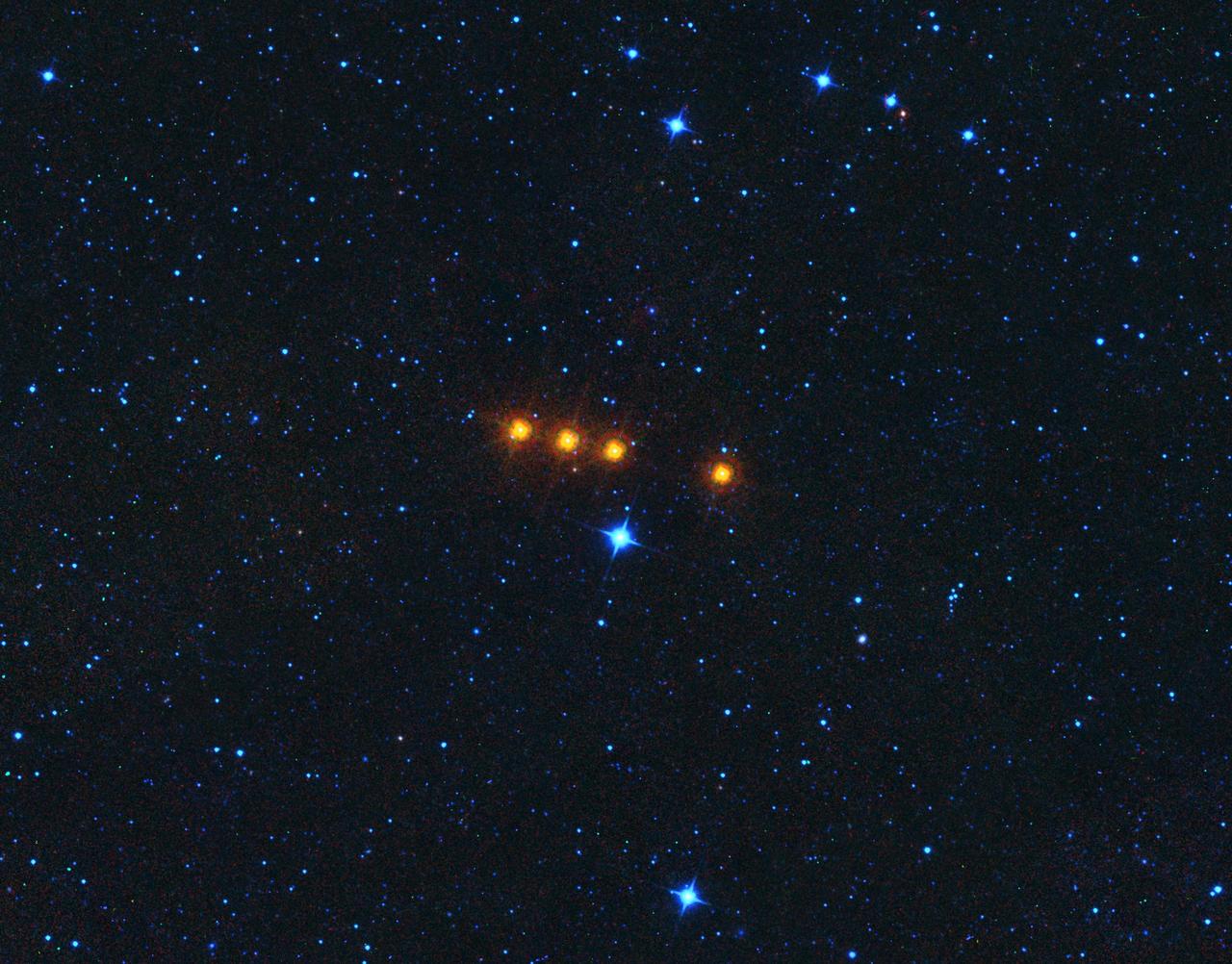
The asteroid Euphrosyne glides across a field of background stars in this time-lapse view from NASA's WISE spacecraft. WISE obtained the images used to create this view over a period of about a day around May 17, 2010, during which it observed the asteroid four times. Because WISE (renamed NEOWISE in 2013) is an infrared telescope, it senses heat from asteroids. Euphrosyne is quite dark in visible light, but glows brightly at infrared wavelengths. This view is a composite of images taken at four different infrared wavelengths: 3.4 microns (color-coded blue), 4.6 microns (cyan), 12 microns (green) and 22 microns (red). The moving asteroid appears as a string of red dots because it is much cooler than the distant background stars. Stars have temperatures in the thousands of degrees, but the asteroid is cooler than room temperature. Thus the stars are represented by shorter wavelength (hotter) blue colors in this view, while the asteroid is shown in longer wavelength (cooler) reddish colors. The WISE spacecraft was put into hibernation in 2011 upon completing its goal of surveying the entire sky in infrared light. WISE cataloged three quarters of a billion objects, including asteroids, stars and galaxies. In August 2013, NASA decided to reinstate the spacecraft on a mission to find and characterize more asteroids. http://photojournal.jpl.nasa.gov/catalog/PIA19645
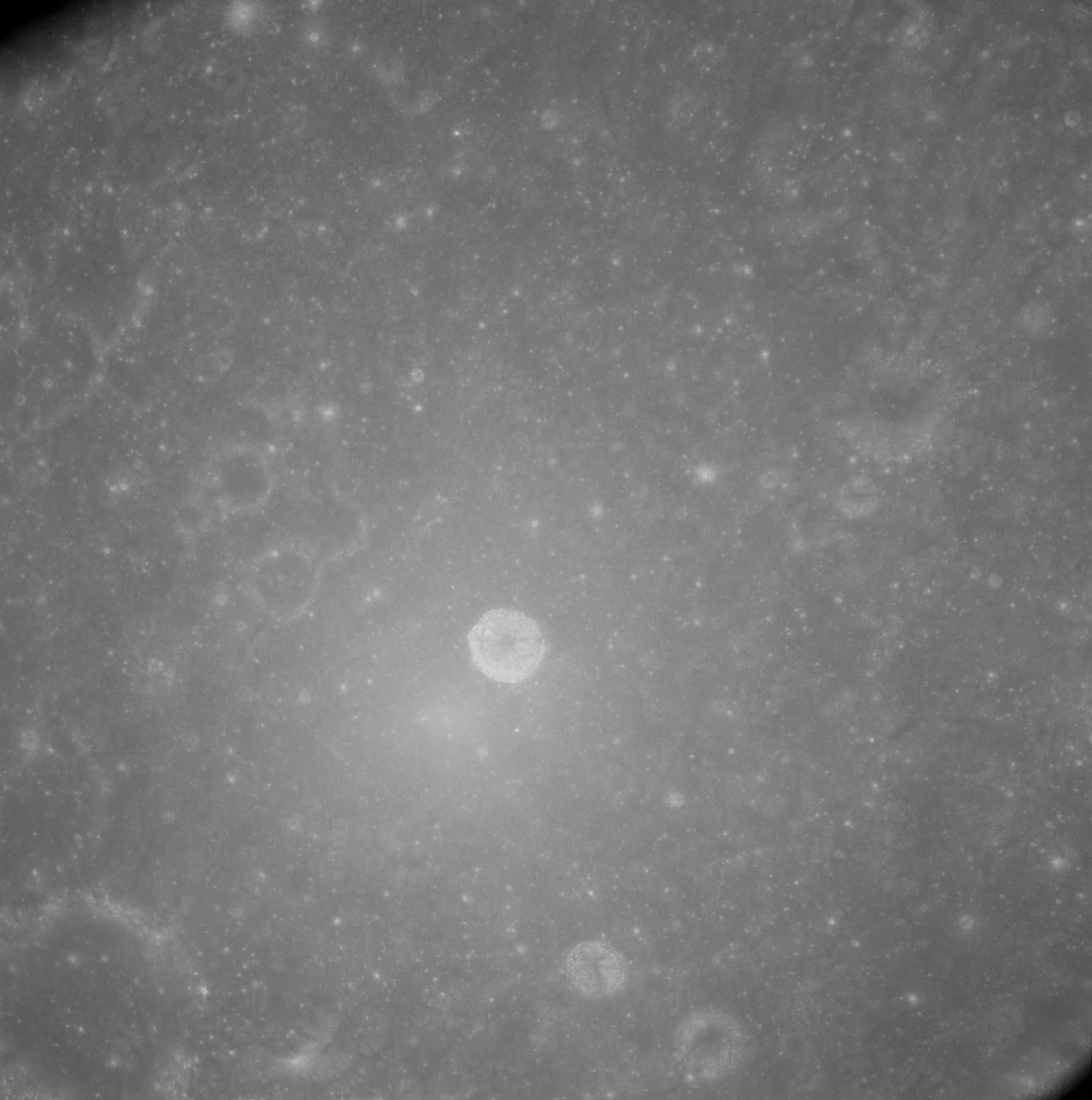
AS08-12-2148 (21-27 Dec. 1968) --- View of the lunar surface as photographed from the Apollo 8 spacecraft. Zero-phase bright spot. With near-vertical sun illumination, topographical detail is washed out and differences in surface brightness are accentuated. The numerous small bright-halo craters become conspicuous. A few larger craters have extremely bright inner walls that are commonly streaked by darker material. The bright glow near the conspicuous bright-walled crater is a halo that surrounds the position of the spacecraft shadow.
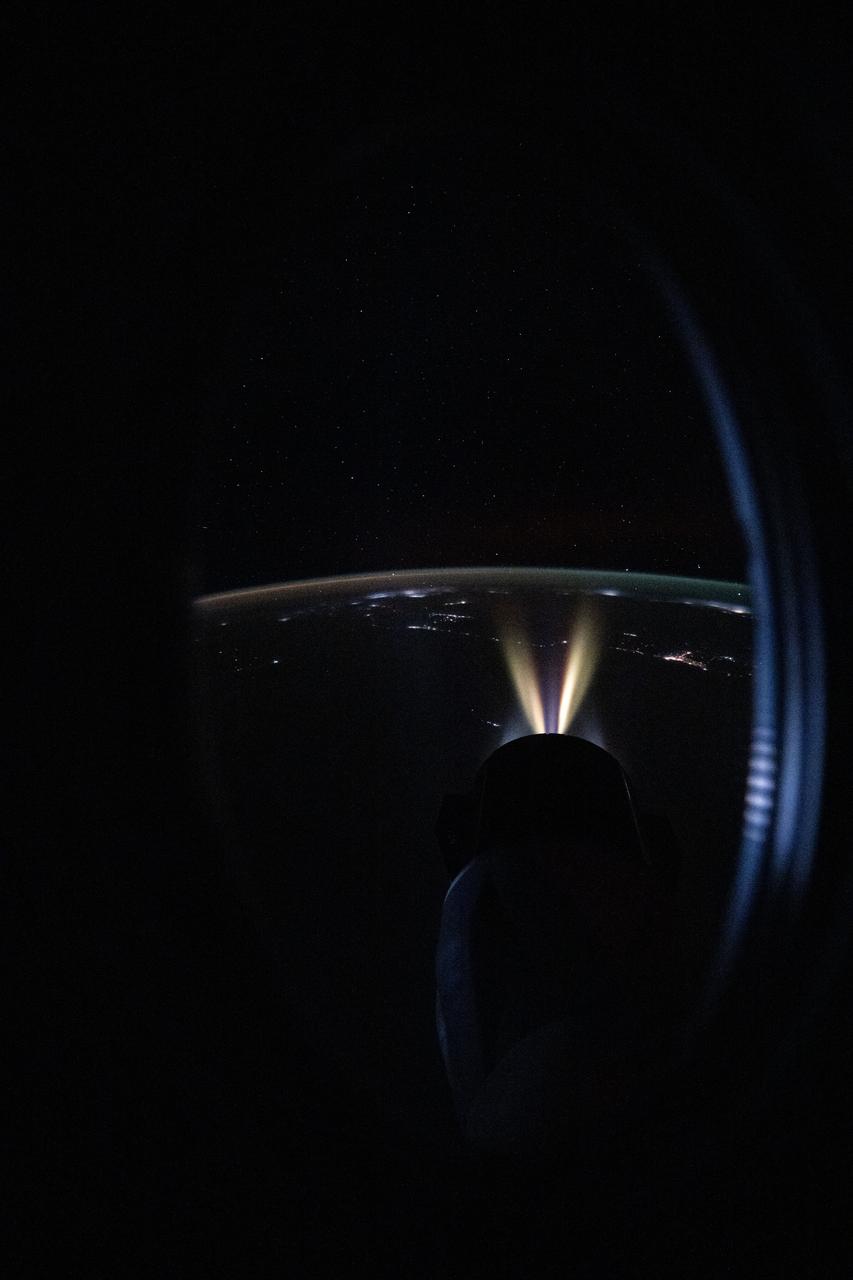
iss073e0814070 (Sept. 26, 2025) --- This nighttime image was captured from a window aboard the SpaceX Dragon crew spacecraft, docked to the space-facing port of the International Space Station’s Harmony module, while orbiting 259 miles above the Indian Ocean. In the foreground, the Draco thrusters of the SpaceX Dragon cargo spacecraft, docked to Harmony’s forward port, are seen firing during a demonstration of its ability to reboost the station’s orbit. In the background, an atmospheric glow blankets Earth's horizon with the city lights on Africa's east coast dotting the dark landscape.

This image from NASA MESSENGER spacecraft is stitched together from thousands of observations made over the past 4 years by the MASCS/UVVS instrument, which measures sunlight scattered off of Mercury tenuous atmosphere. Scattered sunlight gives the sodium a bright orange glow. This scattering process also gives sodium atoms a push - this "radiation pressure" is strong enough, during parts of Mercury's year, to strip the atmosphere and give Mercury a long glowing tail. Someone standing on Mercury's nightside at the right time of year would see a faint orange similar to a city sky illuminated by sodium lamps! Instrument: Mercury Atmospheric and Surface Composition Spectrometer (MASCS)/Ultraviolet and Visible Spectrometer (UVVS) http://photojournal.jpl.nasa.gov/catalog/PIA19418
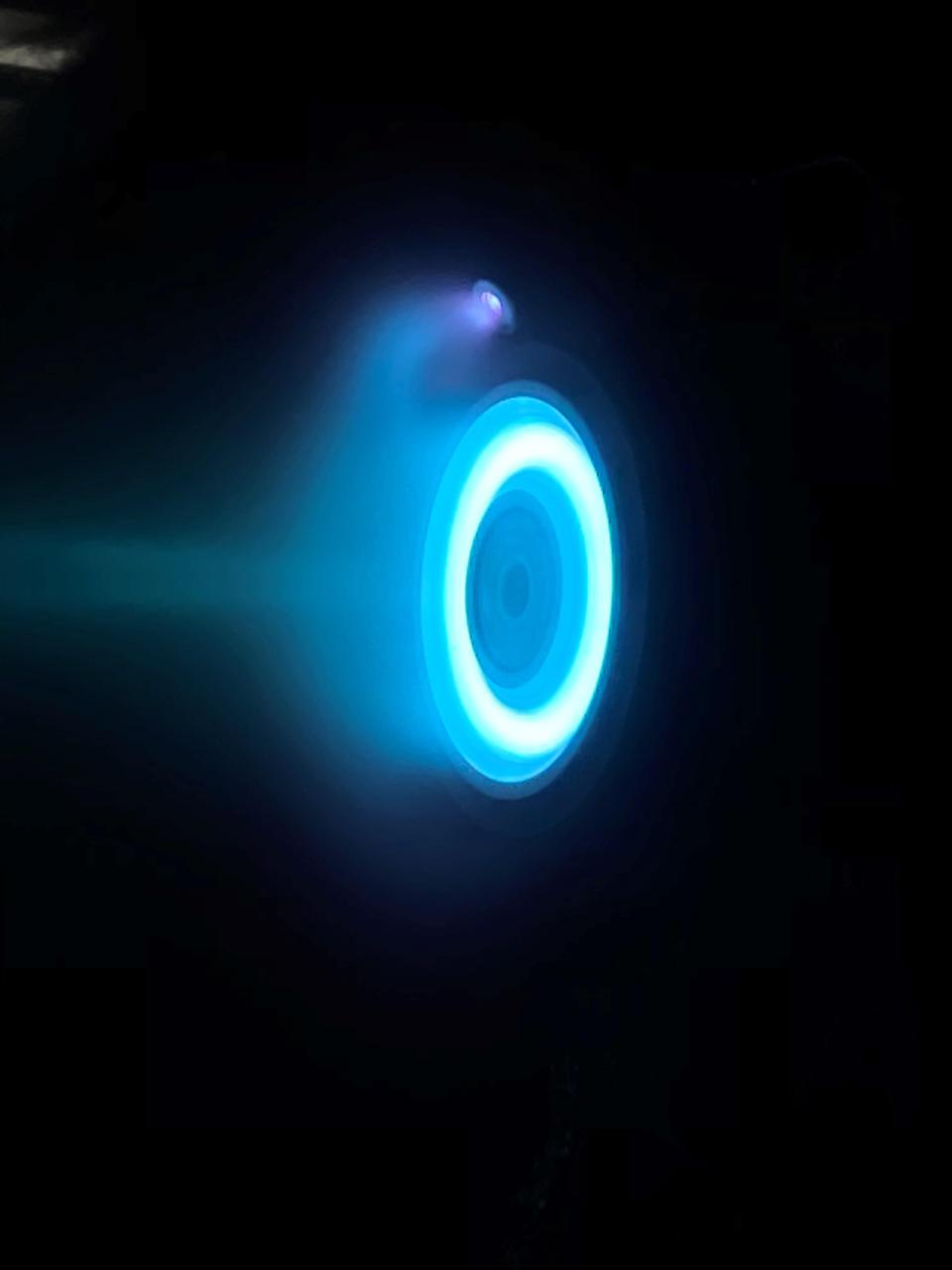
NASA's Psyche spacecraft, set to launch in August 2022, will travel to its target in the main asteroid belt between Mars and Jupiter under the power of super-efficient electric propulsion. This photo captures an operating electric Hall thruster identical to those that will be used to propel the Psyche spacecraft. This photo was taken at NASA's Jet Propulsion Laboratory in Southern California on May 20, 2020 with an iPhone, through the thick window of a vacuum chamber used to simulate the environment of deep space. The thruster works by turning xenon gas, a neutral gas used in car headlights and plasma TVs, into xenon ions. As the xenon ions are accelerated out of the thruster, they create the thrust that will propel the spacecraft. The xenon plasma emits a blue glow, seen here, as it operates. An observer in space traveling behind Psyche would see the blue glow of plasma trailing behind the spacecraft. Solar arrays will provide the electricity that powers the thrusters. Hall thrusters will be used for the first time beyond lunar orbit, demonstrating that they could play a role in supporting future missions to deep space. https://photojournal.jpl.nasa.gov/catalog/PIA23879
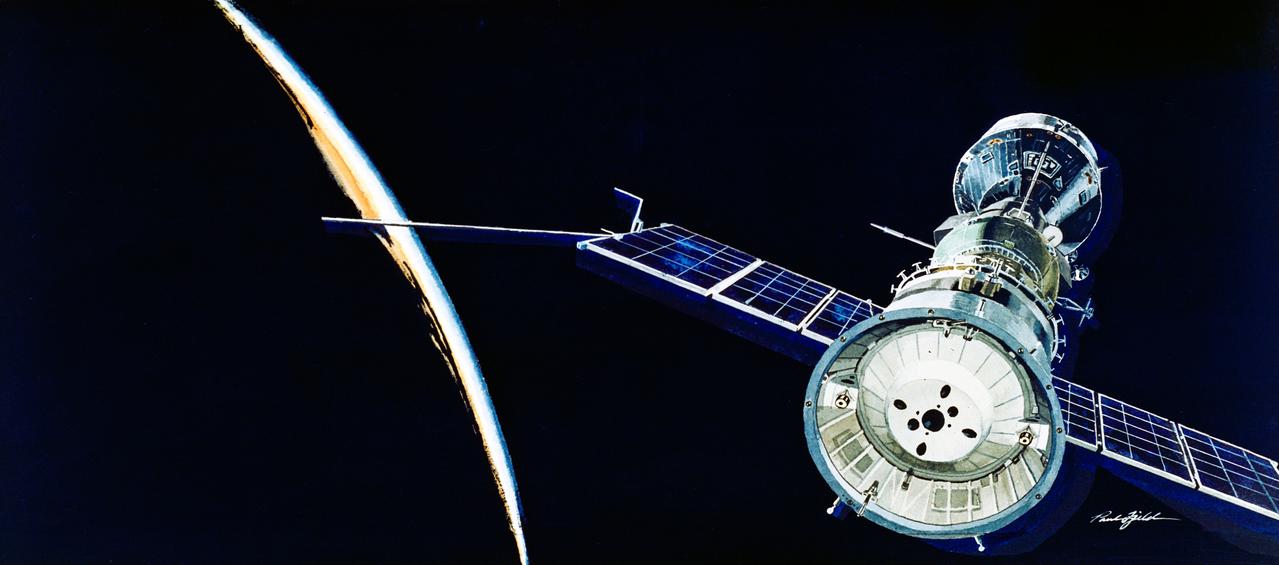
S75-27287 (May 1975) --- An artist?s concept depicting an American Apollo spacecraft docked with a Soviet Soyuz spacecraft in Earth orbit. This view is looking toward the aft end of Soyuz, with the Apollo in the background. Two solar panels protrude out from the instrument assembly module of the Soyuz. The glow on Earth?s horizon is seen on the left. During the joint U.S.-USSR Apollo-Soyuz Test Project mission, scheduled for July 1975, the American and Soviet crews will visit one another?s spacecraft while the Soyuz and Apollo are docked for a maximum period of two days. This artwork is by Paul Fjeld.

This dramatic view of the Pluto system is as NASA's New Horizons spacecraft saw it in July 2015. The animation, made with real images taken by New Horizons, begins with Pluto flying in for its close-up on July 14; we then pass behind Pluto and see the atmosphere glow in sunlight before the sun passes behind Pluto's largest moon, Charon. The movie ends with New Horizons' departure, looking back on each body as thin crescents. http://photojournal.jpl.nasa.gov/catalog/PIA19873

iss073e0203588 (May 19, 2025) --- Lightning (upper left) illuminates the clouds and an atmospheric glow blankets Earth's horizon in this photograph from the International Space Station as it orbited 264 miles above the Atlantic Ocean off the coast of southern Brazil. At bottom, is the SpaceX Dragon crew spacecraft docked to the orbital outpost's forward port on the Harmony module.
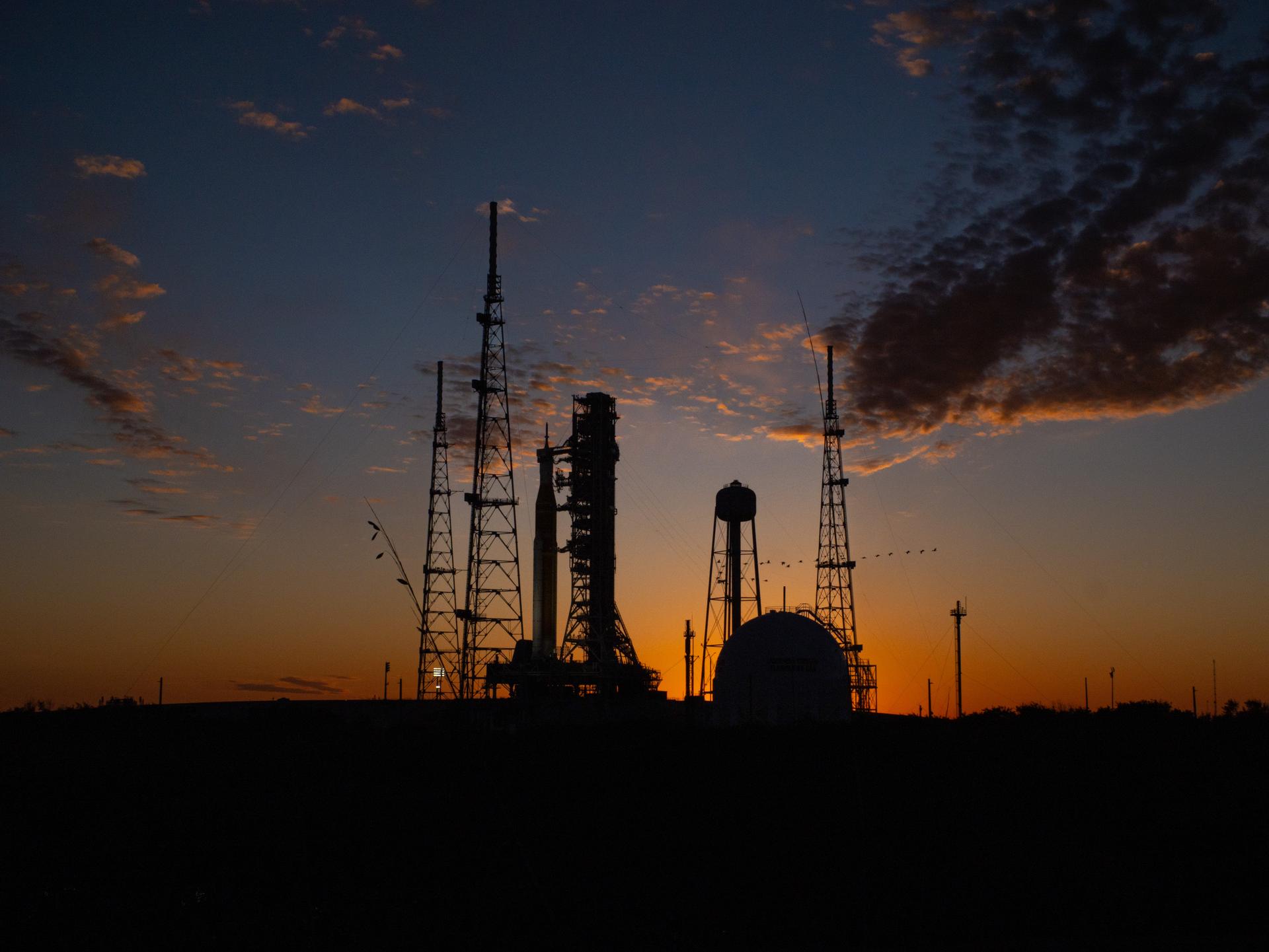
The sun sets behind NASA’s Space Launch System (SLS) rocket and Orion spacecraft as they stand fully assembled atop the mobile launcher at Launch Pad 39B at NASA’s Kennedy Space Center in Florida. The sky glows with warm shades of orange and pink, silhouetting the towering rocket and its solid rocket boosters against the fading light. Photographed on January 31, 2026, the scene captures teams preparing for a wet dress rehearsal for the Artemis II mission, rehearsing launch countdown timelines and procedures as day turns to night.
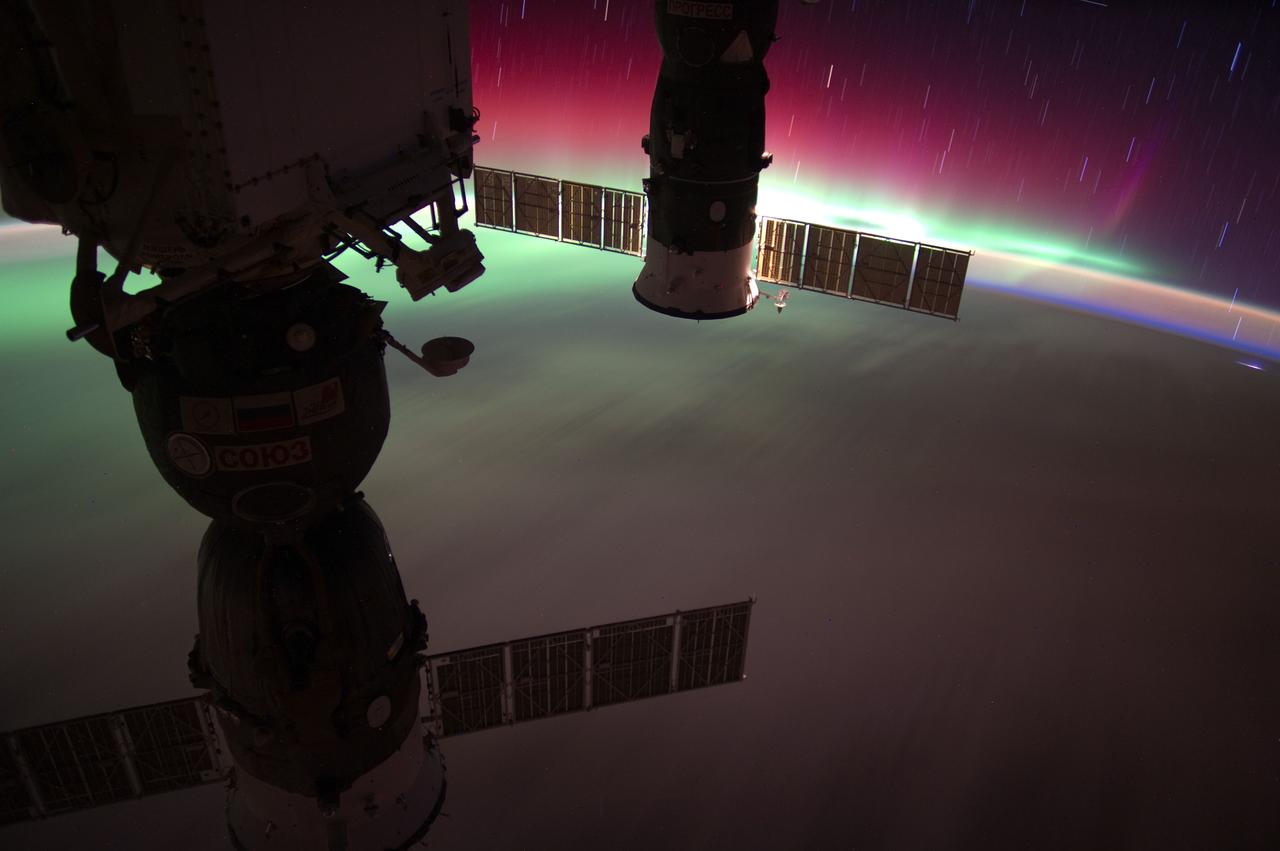
ISS031-E-066037 (22 May 2012) --– Aurora Australis, accompanied by star streaks and air glow, is pictured in this view recorded by one of the Expedition 31 crew members when the orbital outpost was above a point on Earth located at approximately 49.5 degrees south latitude and 173.9 east longitude or about 290 miles southeast of southern New Zealand. Two Russian spacecraft, docked to the station, are seen in the foreground.
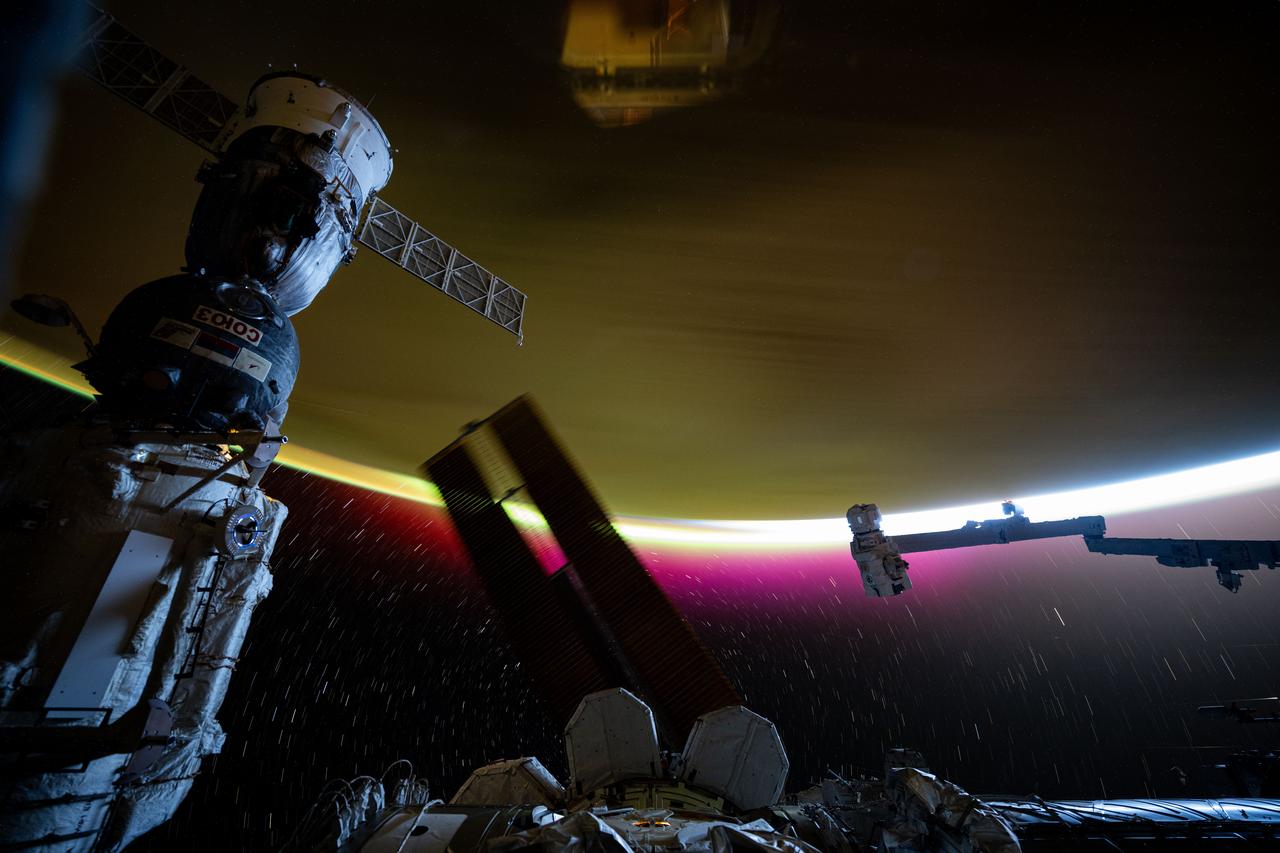
iss072e941128 (April 2, 2025) --- This long duration photograph, taken from the International Space Station as it orbited 271 miles above the South Georgia and the South Sandwich Islands in the southern Atlantic Ocean, highlights star trails and Earth's atmospheric glow moments before the orbital outpost soared into a sunrise. In the foreground (from left), are the Soyuz MS-26 spacecraft docked to the Rassvet module, a set of the station's main solar arrays, and the Canadarm2 robotic arm.
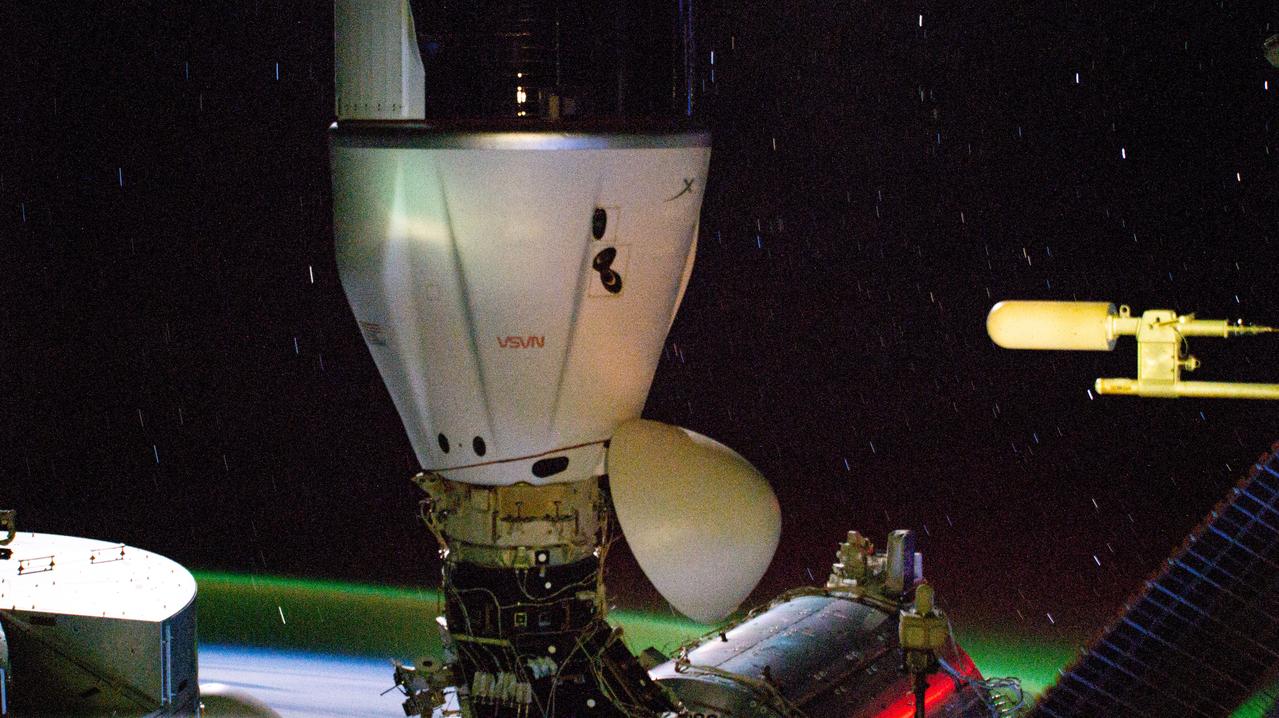
iss071e045750 (April 26, 2024) --- The SpaceX Dragon cargo spacecraft is pictured docked to the Harmony module's space-facing port on the International Space Station. In the background, slight star trails and an atmospheric glow above Earth's horizon are pictured in this long-duration photograph as the orbital outpost soared 267 miles above the Indian Ocean south of Africa.
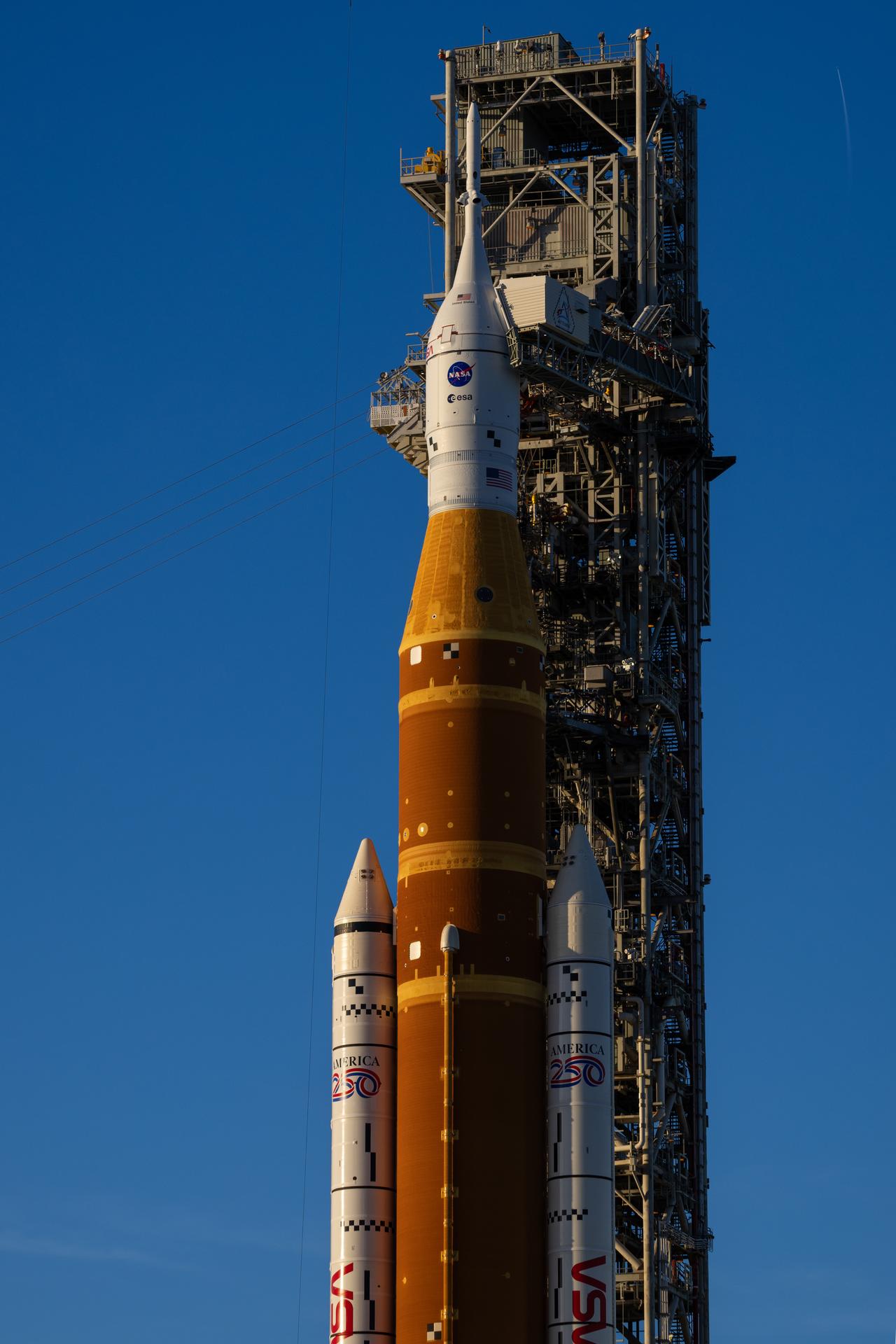
The sun sets on NASA’s Space Launch System (SLS) rocket and Orion spacecraft as they stand fully assembled atop the mobile launcher at Launch Pad 39B at NASA’s Kennedy Space Center in Florida. The sky glows with warm shades of orange and pink, silhouetting the towering rocket and its solid rocket boosters against the fading light. Photographed on January 31, 2026, the scene captures teams preparing for a wet dress rehearsal for the Artemis II mission, rehearsing launch countdown timelines and procedures as day turns to night.
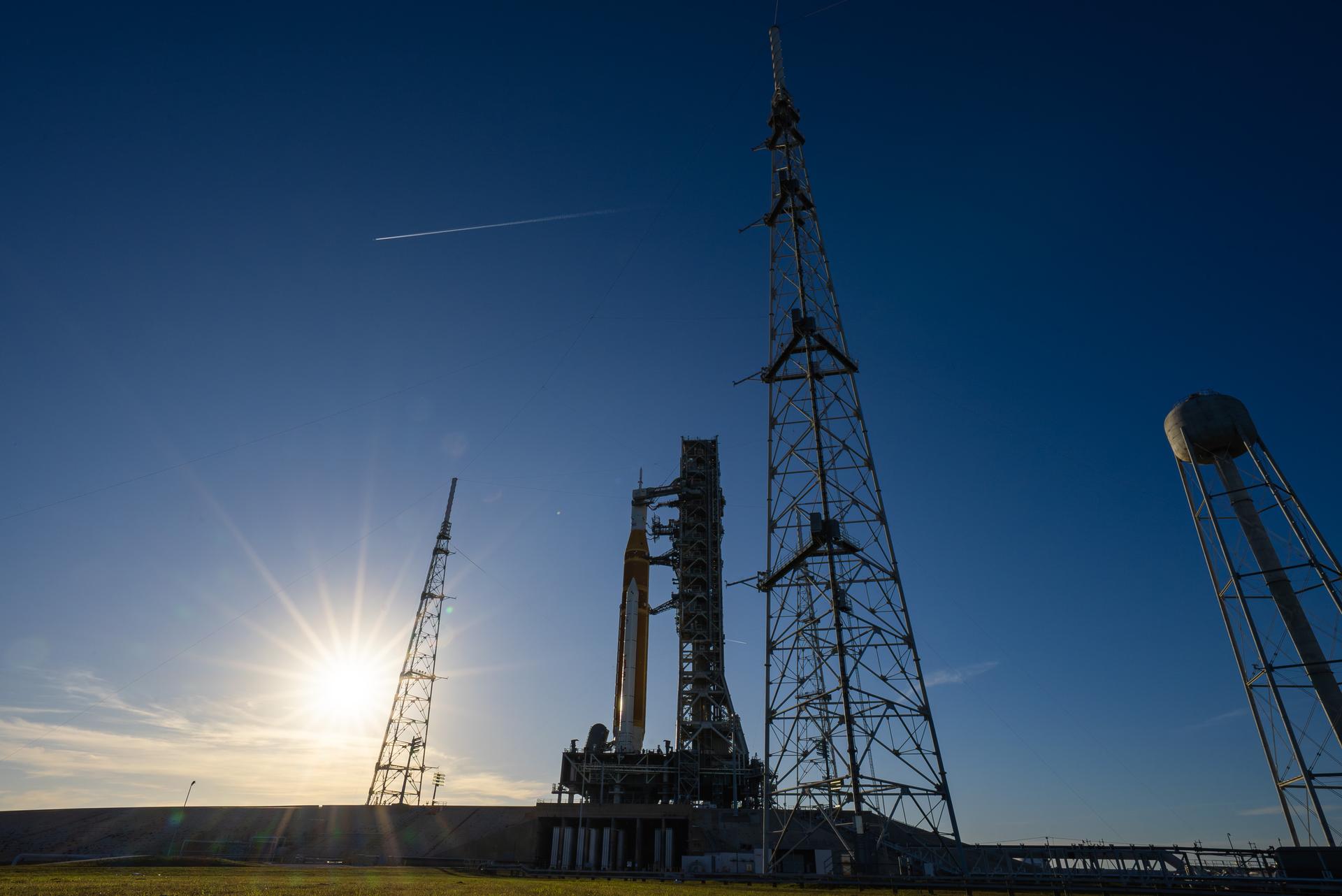
The sun sets on NASA’s Space Launch System (SLS) rocket and Orion spacecraft as they stand fully assembled atop the mobile launcher at Launch Pad 39B at NASA’s Kennedy Space Center in Florida. The sky glows with warm shades of orange and pink, silhouetting the towering rocket and its solid rocket boosters against the fading light. Photographed on January 31, 2026, the scene captures teams preparing for a wet dress rehearsal for the Artemis II mission, rehearsing launch countdown timelines and procedures as day turns to night.
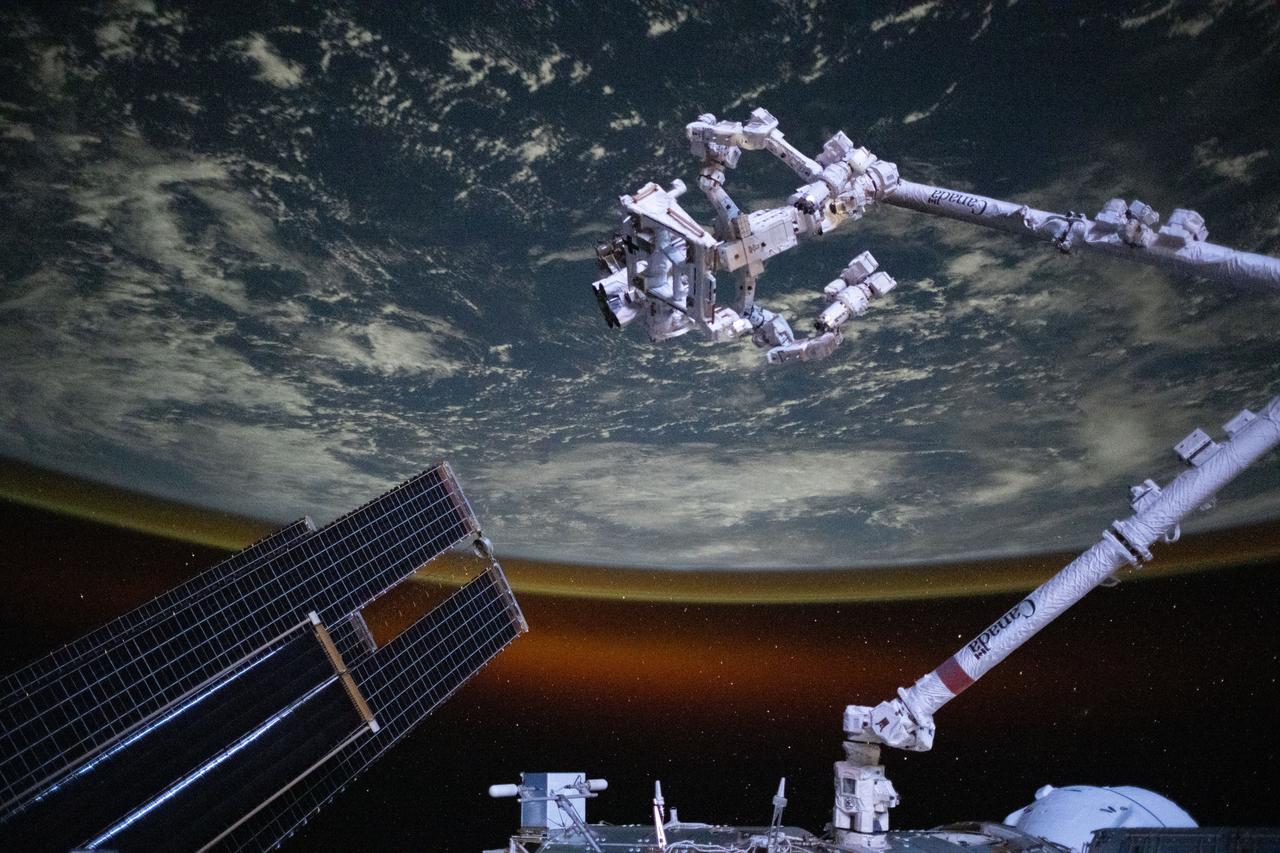
iss073e0695491 (Sept. 1, 2025) --- The Canadarm2 robotic arm with Dextre, its fine-tuned robotic hand attached, is pictured extending from the International Space Station as it orbited 258 miles above the Indian Ocean southwest of the Indonesian island of Sumatra. The Earth's horizon is highlighted by the atmospheric glow with a set of the orbital outpost's main solar arrays and a partially obscured SpaceX Dragon cargo spacecraft in the foreground.
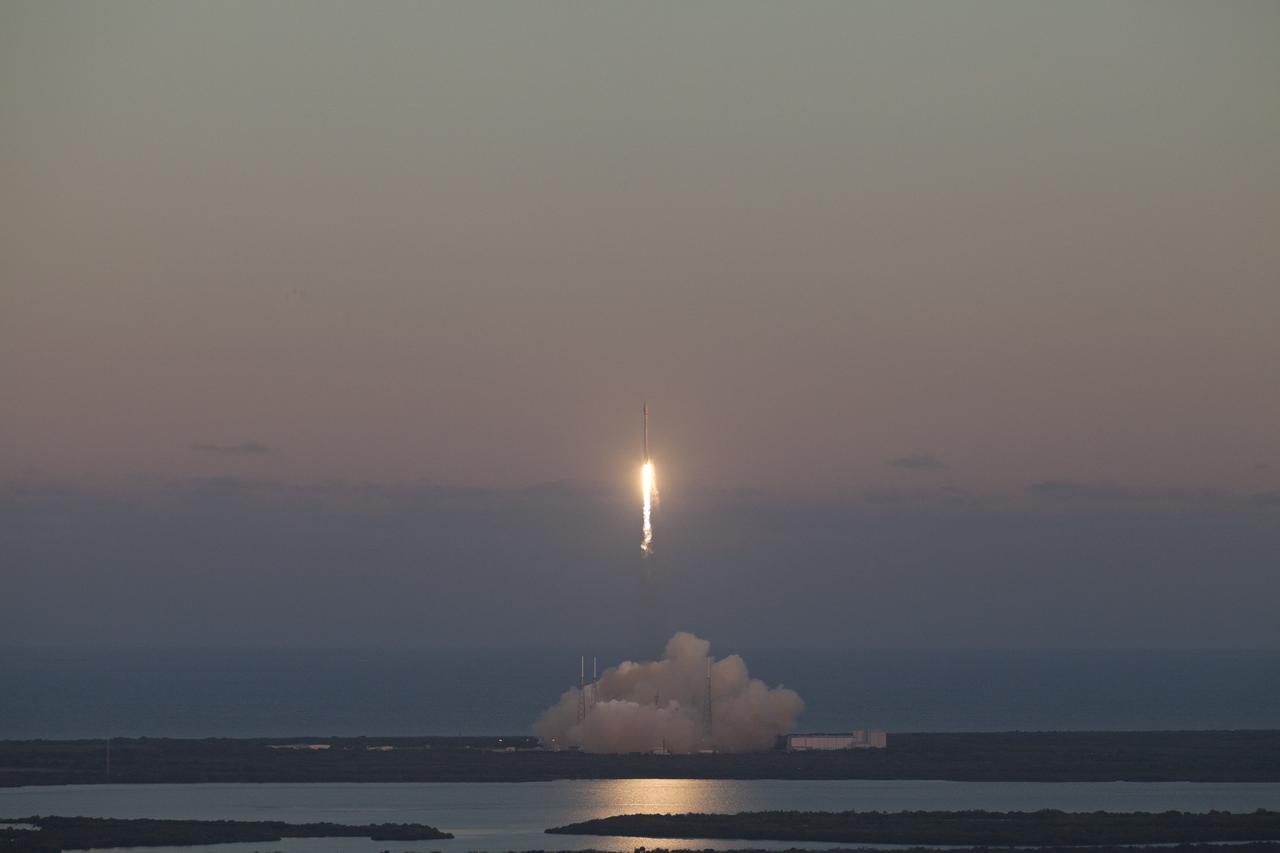
Lit by the glow of sunset, the SpaceX Falcon 9 rocket climbs away from Space Launch Complex 40 at Florida’s Cape Canaveral Air Force Station. On board is NOAA’s Deep Space Climate Observatory spacecraft, or DSCOVR. Liftoff occurred at 6:03 p.m. EST. DSCOVR is a partnership between NOAA, NASA and the U.S. Air Force, and will maintain the nation's real-time solar wind monitoring capabilities. To learn more about DSCOVR, visit http://www.nesdis.noaa.gov/DSCOVR. Photo credit: NASA/Kim Shiflett
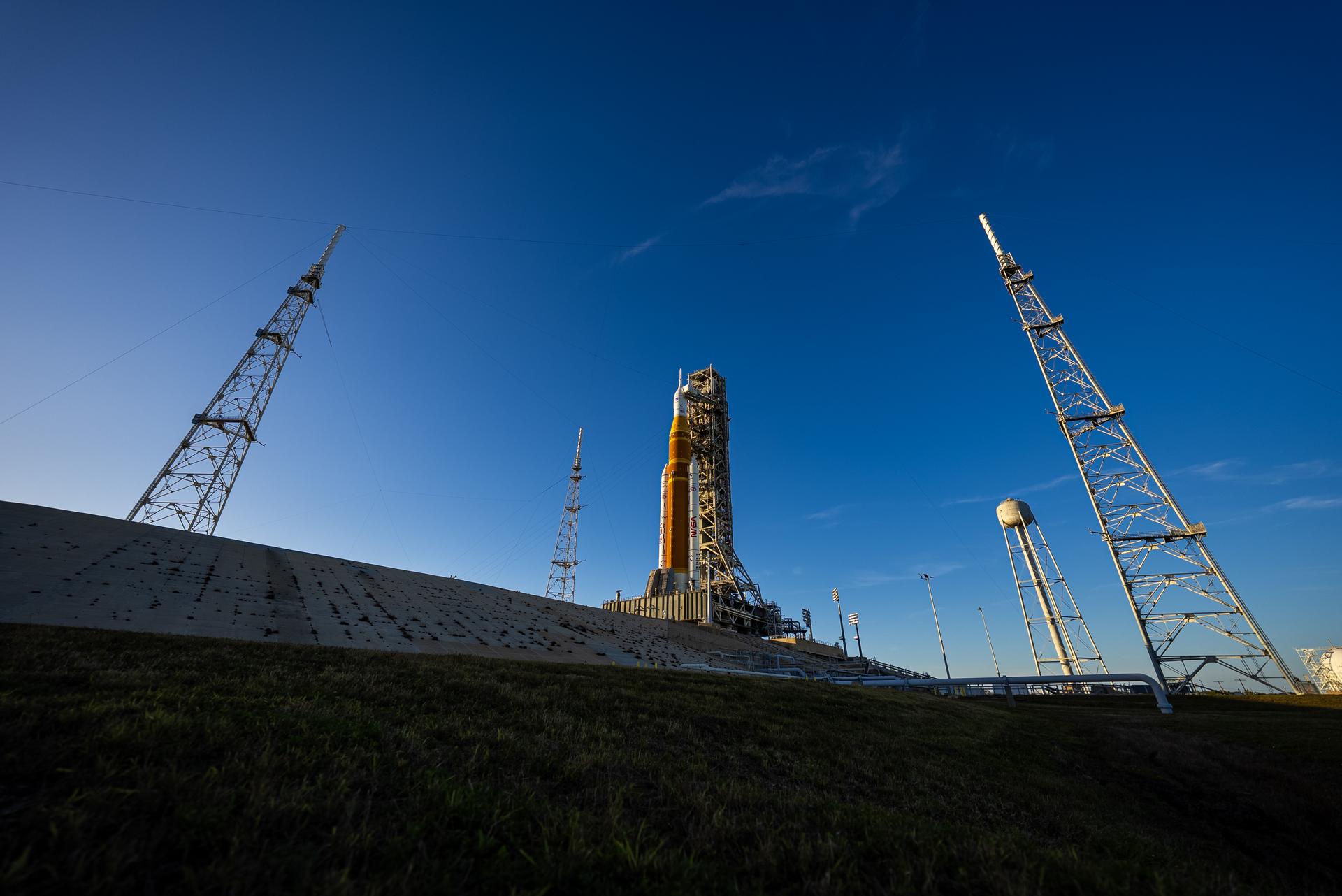
The sun sets on NASA’s Space Launch System (SLS) rocket and Orion spacecraft as they stand fully assembled atop the mobile launcher at Launch Pad 39B at NASA’s Kennedy Space Center in Florida. The sky glows with warm shades of orange and pink, silhouetting the towering rocket and its solid rocket boosters against the fading light. Photographed on January 31, 2026, the scene captures teams preparing for a wet dress rehearsal for the Artemis II mission, rehearsing launch countdown timelines and procedures as day turns to night.
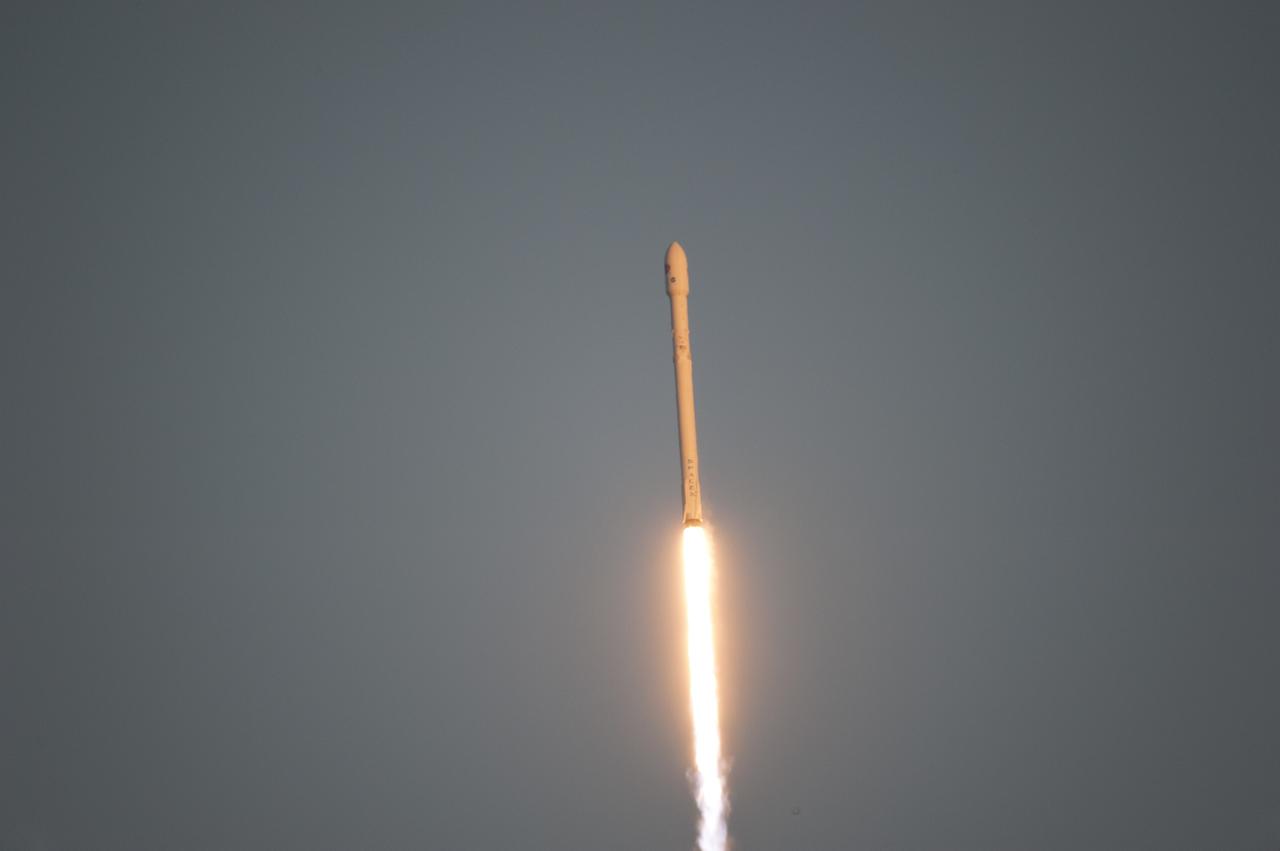
The glow of sunset illuminates the SpaceX Falcon 9 rocket as it soars away from Space Launch Complex 40 at Cape Canaveral Air Force Station in Florida carrying NOAA’s Deep Space Climate Observatory spacecraft, or DSCOVR. Liftoff occurred at 6:03 p.m. EST. DSCOVR is a partnership between NOAA, NASA and the U.S. Air Force, and will maintain the nation's real-time solar wind monitoring capabilities. To learn more about DSCOVR, visit http://www.nesdis.noaa.gov/DSCOVR. Photo credit: NASA/Kim Shiflett
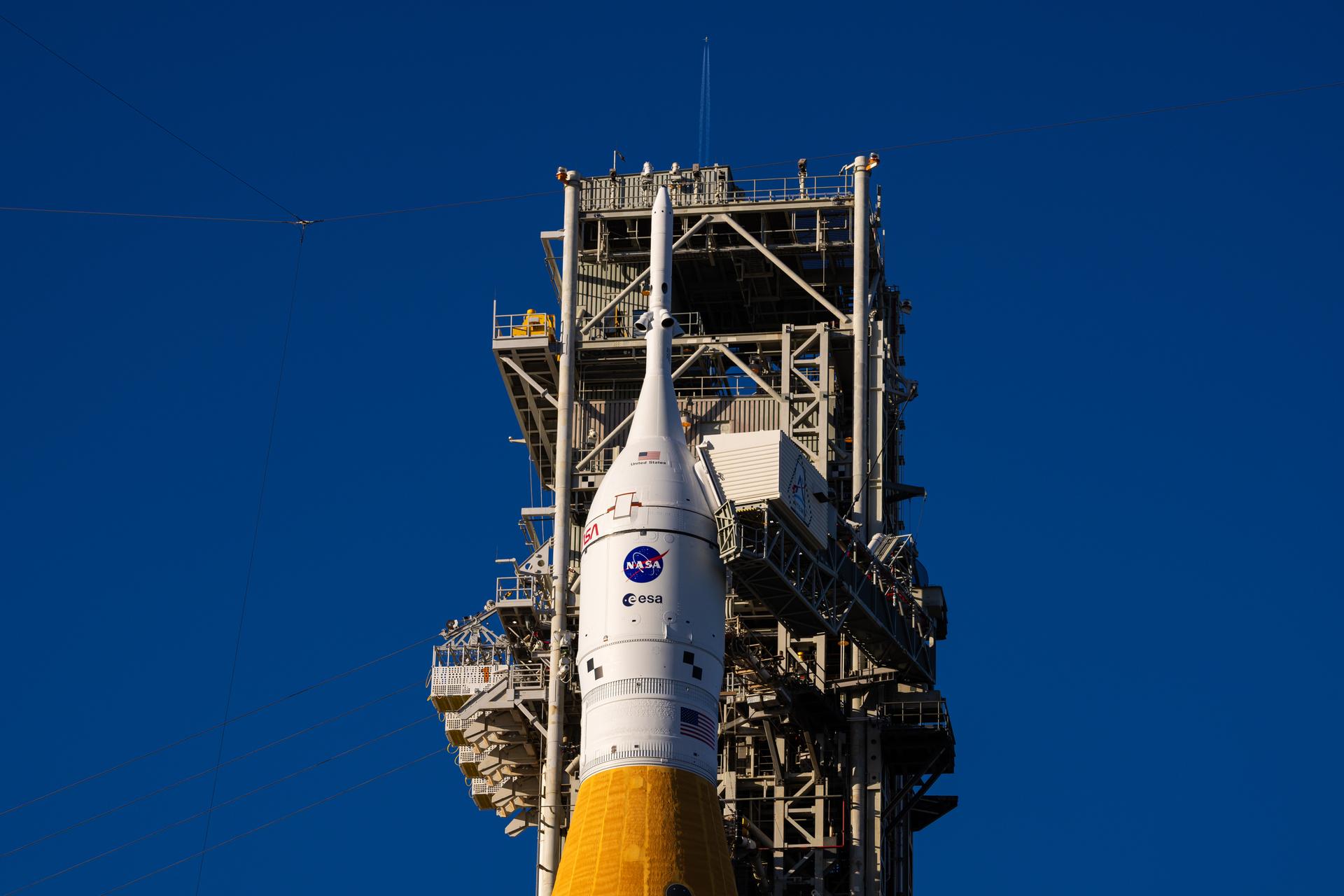
The sun sets on NASA’s Space Launch System (SLS) rocket and Orion spacecraft as they stand fully assembled atop the mobile launcher at Launch Pad 39B at NASA’s Kennedy Space Center in Florida. The sky glows with warm shades of orange and pink, silhouetting the towering rocket and its solid rocket boosters against the fading light. Photographed on January 31, 2026, the scene captures teams preparing for a wet dress rehearsal for the Artemis II mission, rehearsing launch countdown timelines and procedures as day turns to night.
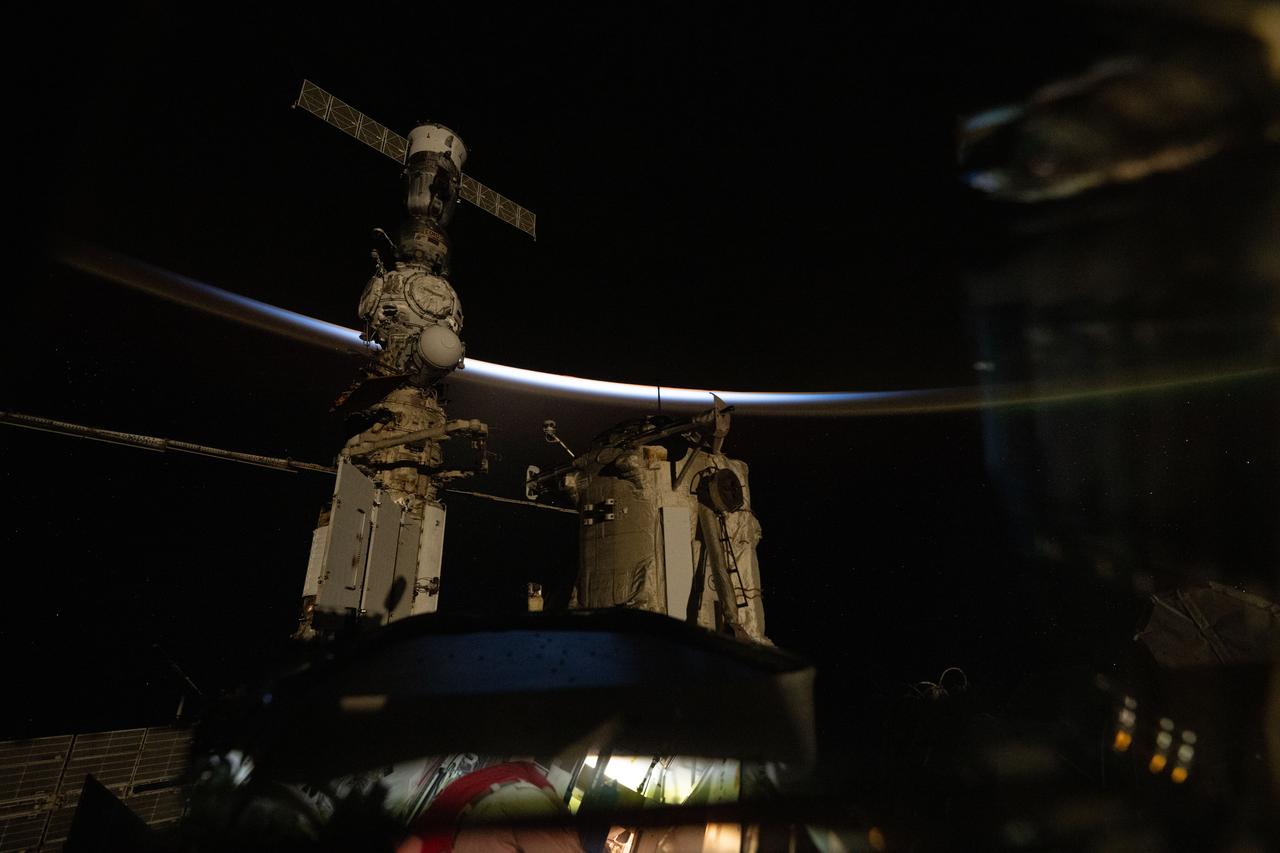
iss073e0690720 (Aug. 12, 2025) --- The last rays of an orbital sunset outline Earth's horizon revealing faint orange and blue hues and an atmospheric glow in this photograph from the International Space Station as it orbited 268 miles above the Indian Ocean. In the foreground, is the orbital outpost's Roscosmos segment including the Rassvet module, the Nauka science module, and the Prichal module with the docked Soyuz MS-27 spacecraft.
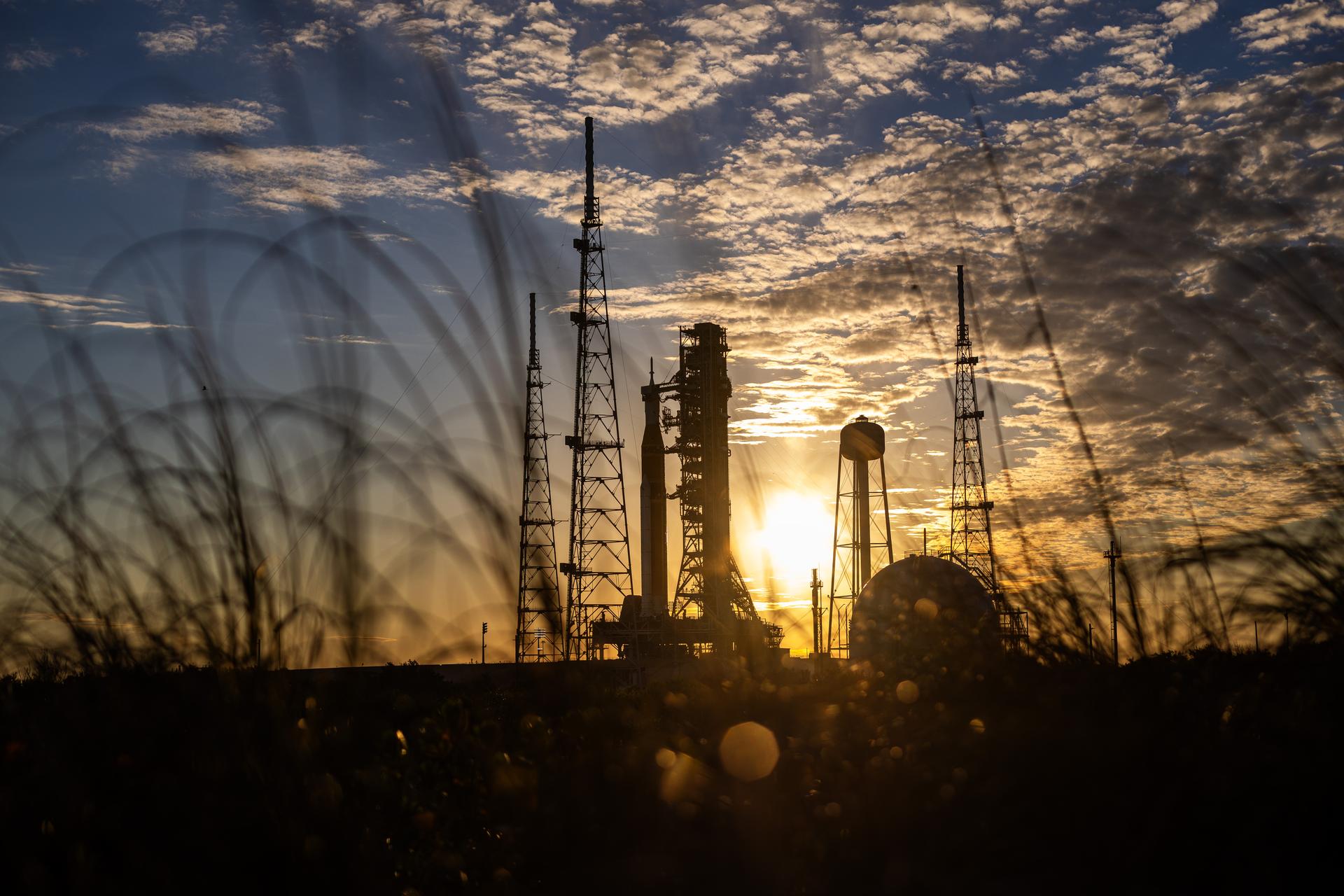
The sun sets behind NASA’s Space Launch System (SLS) rocket and Orion spacecraft as they stand fully assembled atop the mobile launcher at Launch Pad 39B at NASA’s Kennedy Space Center in Florida. The sky glows with warm shades of orange and pink, silhouetting the towering rocket and its solid rocket boosters against the fading light. Photographed on January 31, 2026, the scene captures teams preparing for a wet dress rehearsal for the Artemis II mission, rehearsing launch countdown timelines and procedures as day turns to night.
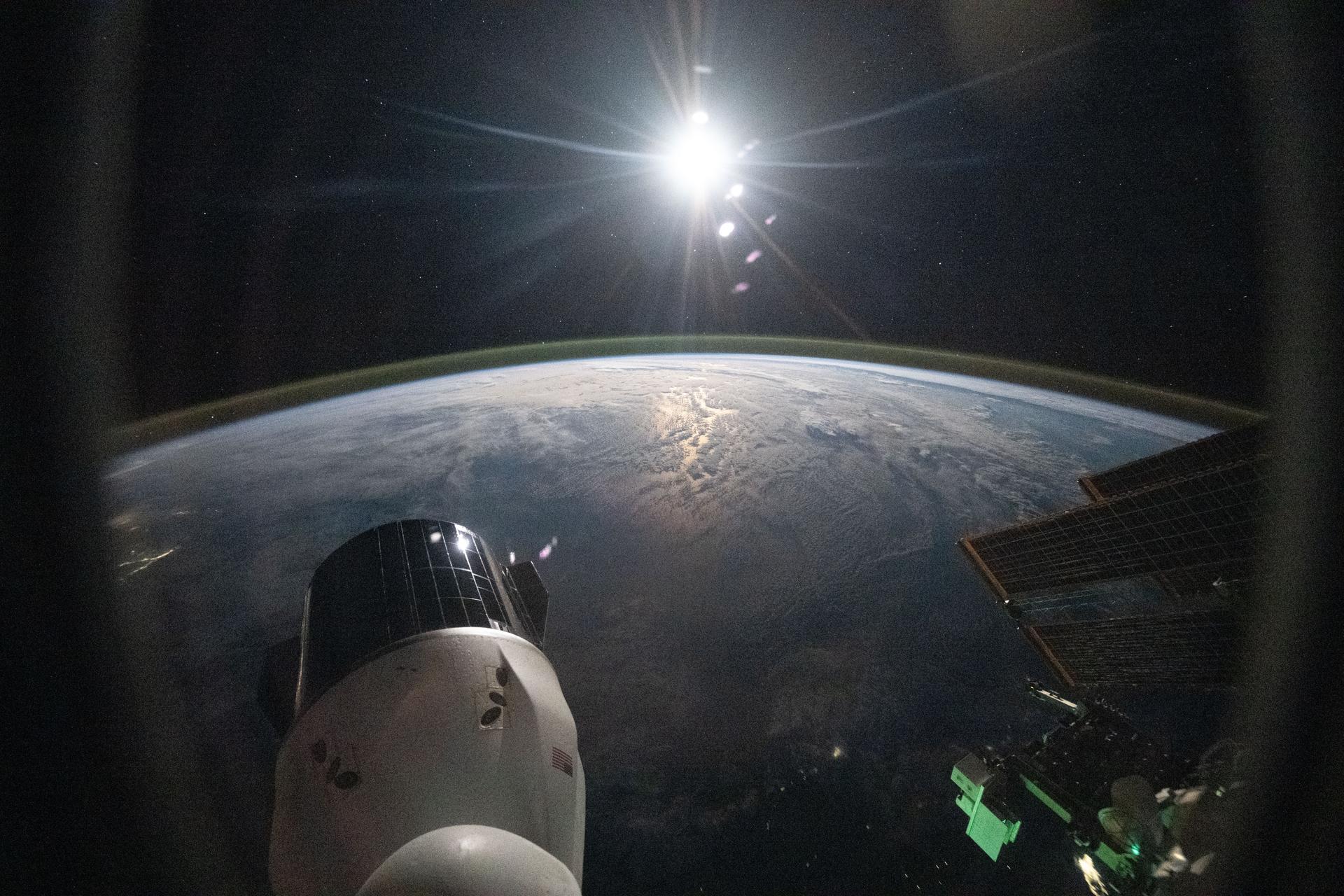
iss074e0222272 (Jan. 6, 2026) --- The sun begins setting above Earth's atmospheric glow blanketing a cloudy Atlantic Ocean. The International Space Station was orbiting 260 miles above the Earth off the coast of Florida when this photograph was taken. In the foreground, are a SpaceX Dragon spacecraft (lower left) and a set of the orbital outpost's solar arrays (right). Credit: JAXA/Kimiya Yui
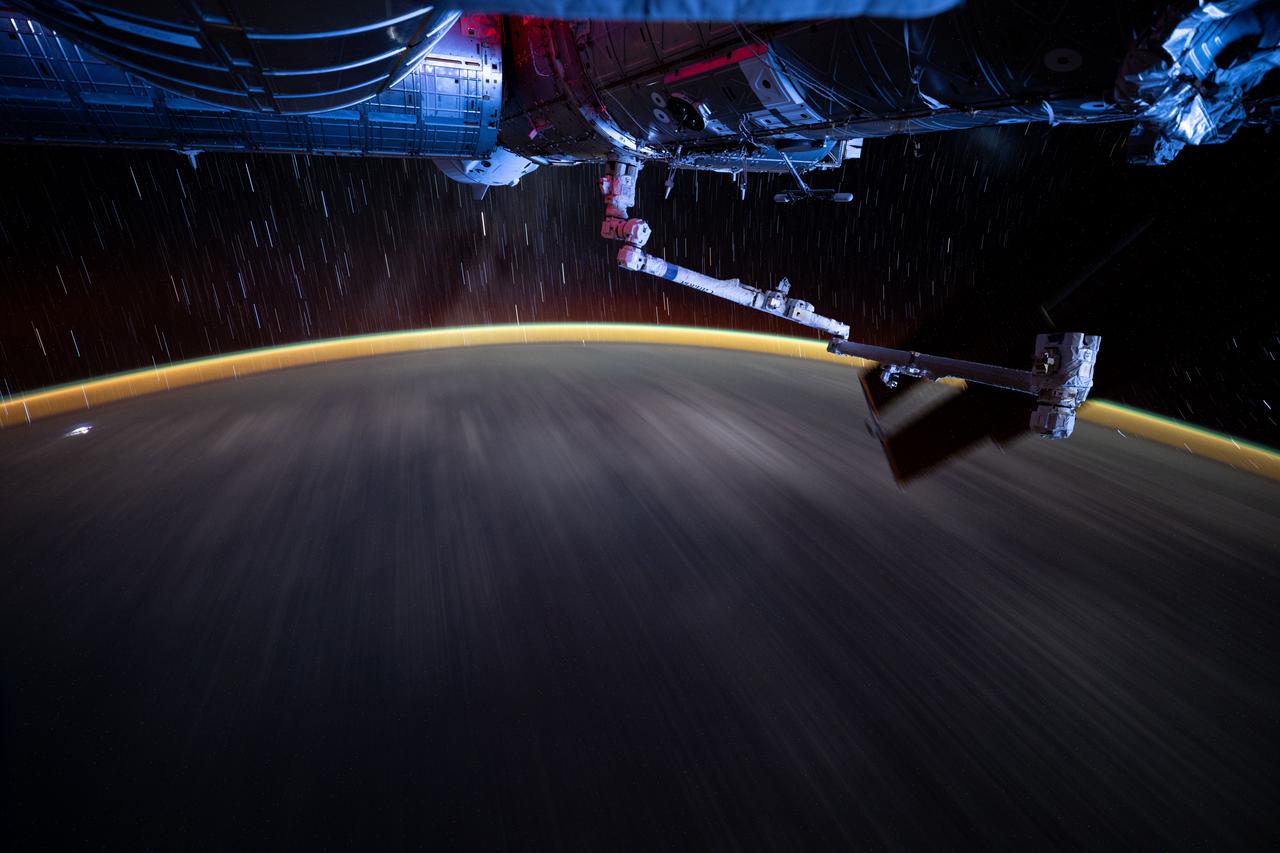
iss072e940398 (April 2, 2025) --- This long duration photograph reveals Earth's atmopsheric glow underneath star trails as the International Space Station orbited 258 miles above the Pacific Ocean southeast of Hawaii at approximately 8:16 p.m. local time. In the foreground (from left), is the Kibo laboratory module, the partially obscured SpaceX Dragon crew spacecraft docked to the Harmony module, the Canadarm2 robotic arm, and the Destiny laboratory module.
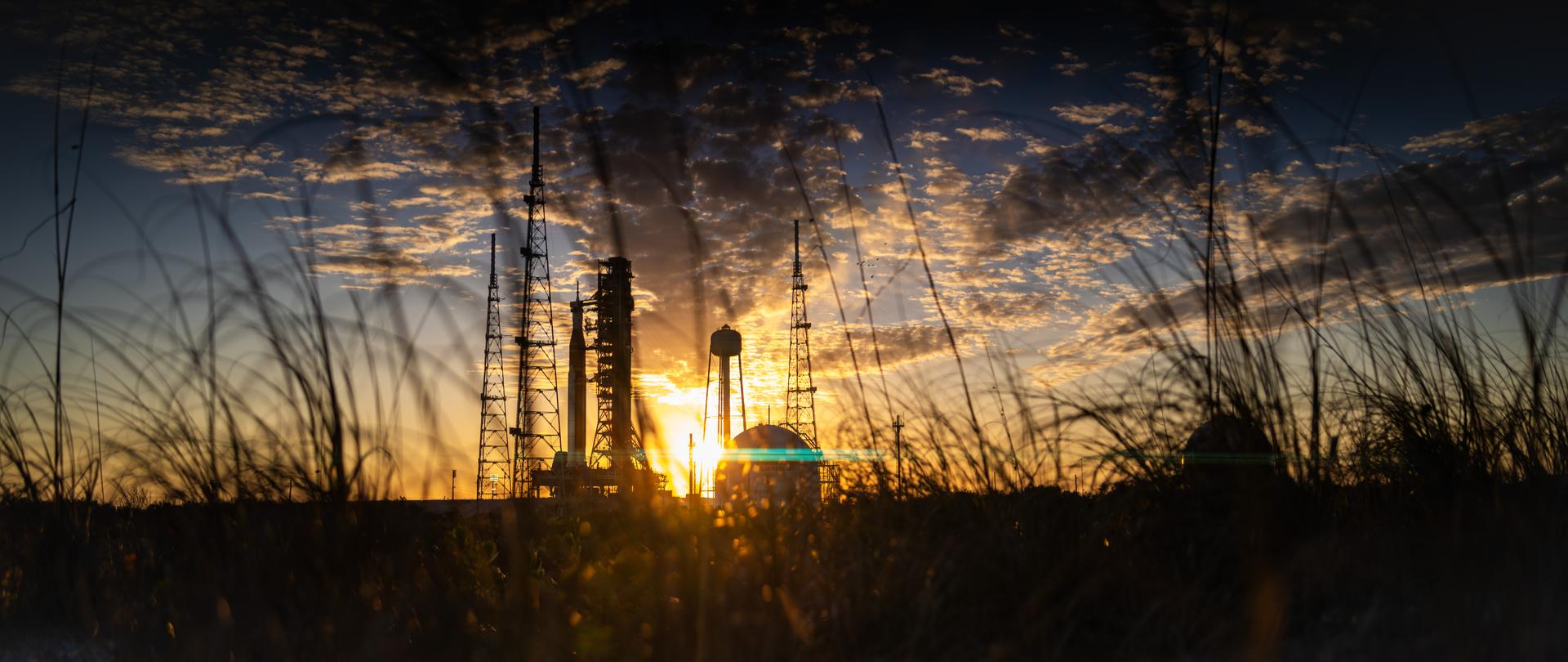
The sun sets behind NASA’s Space Launch System (SLS) rocket and Orion spacecraft as they stand fully assembled atop the mobile launcher at Launch Pad 39B at NASA’s Kennedy Space Center in Florida. The sky glows with warm shades of orange and pink, silhouetting the towering rocket and its solid rocket boosters against the fading light. Photographed on January 31, 2026, the scene captures teams preparing for a wet dress rehearsal for the Artemis II mission, rehearsing launch countdown timelines and procedures as day turns to night.
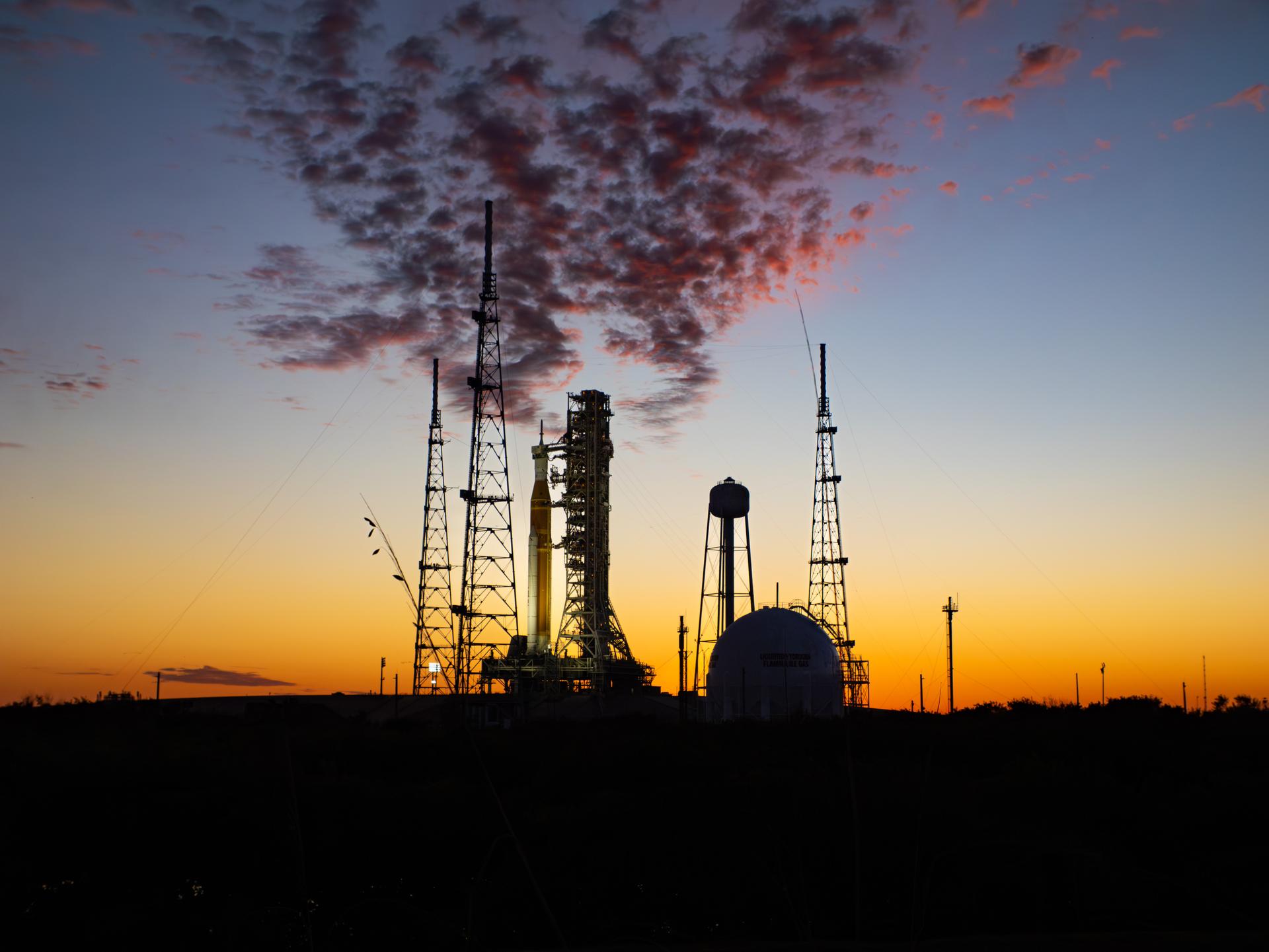
The sun sets behind NASA’s Space Launch System (SLS) rocket and Orion spacecraft as they stand fully assembled atop the mobile launcher at Launch Pad 39B at NASA’s Kennedy Space Center in Florida. The sky glows with warm shades of orange and pink, silhouetting the towering rocket and its solid rocket boosters against the fading light. Photographed on January 31, 2026, the scene captures teams preparing for a wet dress rehearsal for the Artemis II mission, rehearsing launch countdown timelines and procedures as day turns to night.
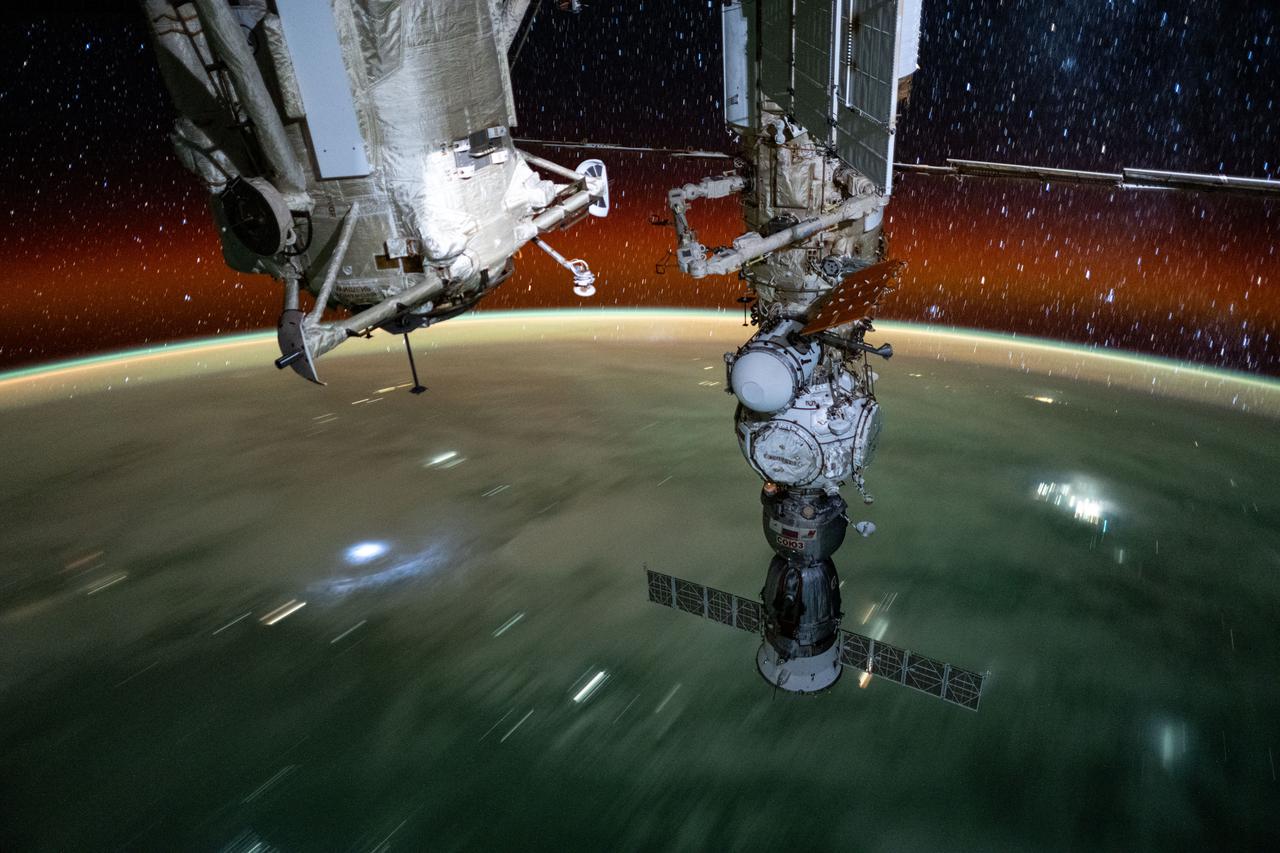
iss071e256931 (July 1, 2024) --- The long duration photograph from the International Space Station highlights the Rassvet module (left) and the Soyuz MS-25 spacecraft (right) docked to the Prichal module which is itself attached to the Nauka science module. 255 miles below the orbital outpost is a cloudy Pacific Ocean blanketing islands northeast of Indonesia's province of Papua. Above Earth's horzon is the planet's atmospheric glow and star trails glittering in the vastness of space.
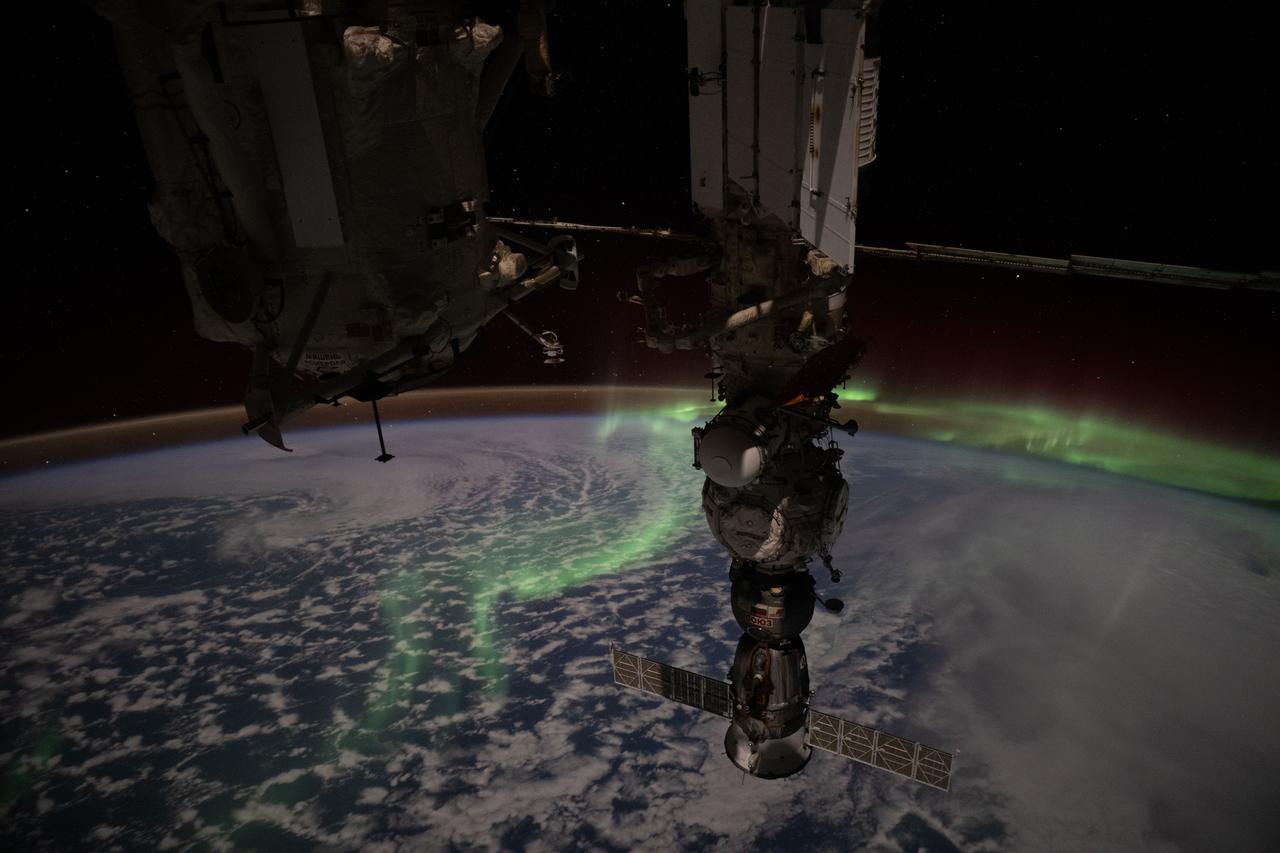
iss073e0608751 (June 13, 2025) --- The aurora australis streams above the Earth and into the atmospheric glow in this photograph taken from the International Space Station as it orbited 269 miles above the Indian Ocean midway between Australia and Antarctica at approximately 2:51 a.m. local time. Portions of the orbital outpost's Roscosmos segment are visible in the foreground, including (from left) the Rassvet module and the Soyuz MS-27 crew spacecraft docked to the Prichal module which is itself attached to the Nauka science module.
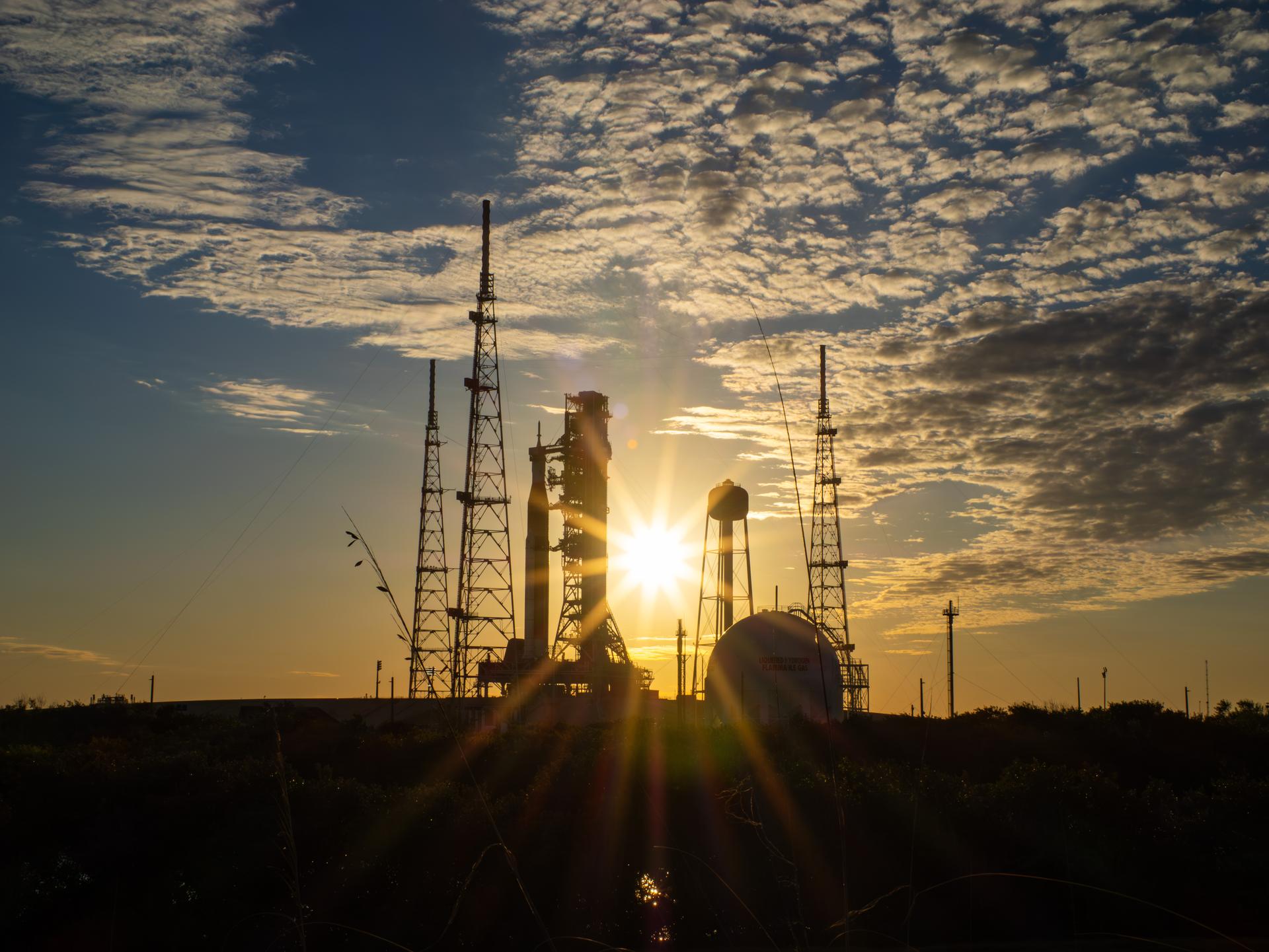
The sun sets behind NASA’s Space Launch System (SLS) rocket and Orion spacecraft as they stand fully assembled atop the mobile launcher at Launch Pad 39B at NASA’s Kennedy Space Center in Florida. The sky glows with warm shades of orange and pink, silhouetting the towering rocket and its solid rocket boosters against the fading light. Photographed on January 31, 2026, the scene captures teams preparing for a wet dress rehearsal for the Artemis II mission, rehearsing launch countdown timelines and procedures as day turns to night.

The sunrise casts a warm glow around the Artemis I Space Launch System (SLS) and Orion spacecraft at Launch Pad 39B at NASA’s Kennedy Space Center in Florida on March 21, 2022. The SLS and Orion atop the mobile launcher were transported to the pad on crawler-transporter 2 for a prelaunch test called a wet dress rehearsal. Artemis I will be the first integrated test of the SLS and Orion spacecraft. In later missions, NASA will land the first woman and the first person of color on the surface of the Moon, paving the way for a long-term lunar presence and serving as a steppingstone on the way to Mars.
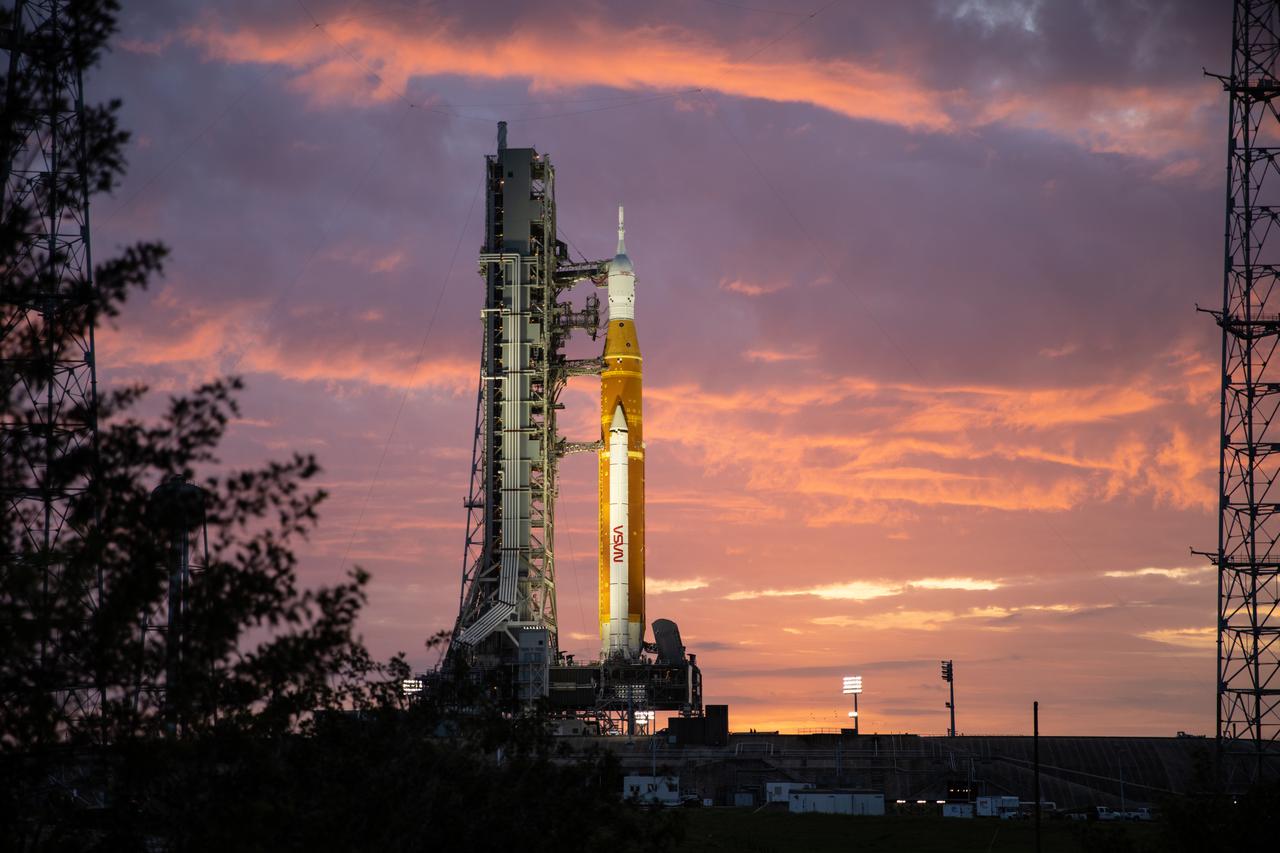
The sunrise casts a golden glow on the Artemis I Space Launch System (SLS) and Orion spacecraft at Launch Pad 39B at NASA’s Kennedy Space Center in Florida on March 23, 2022. The SLS and Orion atop the mobile launcher were transported to the pad on crawler-transporter 2 for a prelaunch test called a wet dress rehearsal. Artemis I will be the first integrated test of the SLS and Orion spacecraft. In later missions, NASA will land the first woman and the first person of color on the surface of the Moon, paving the way for a long-term lunar presence and serving as a steppingstone on the way to Mars.
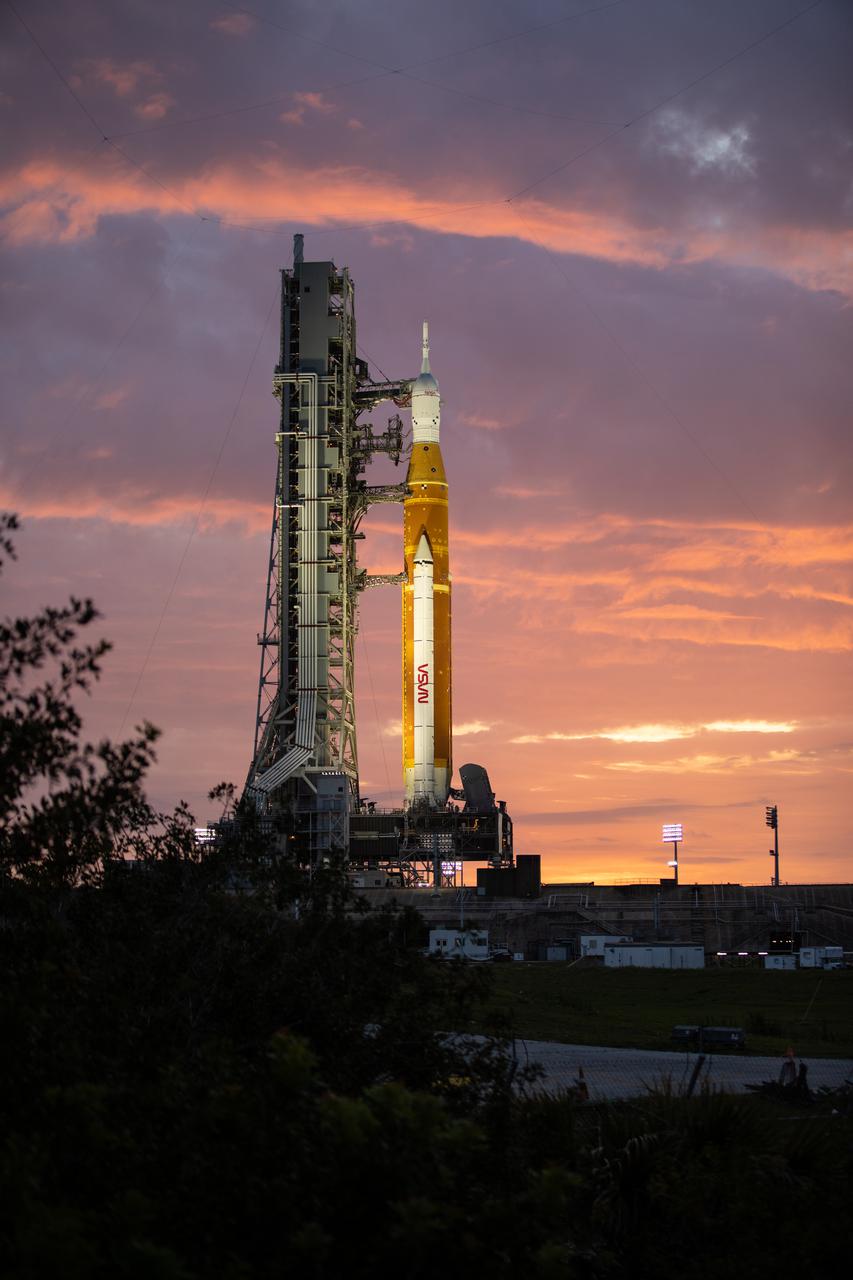
The sunrise casts a golden glow on the Artemis I Space Launch System (SLS) and Orion spacecraft at Launch Pad 39B at NASA’s Kennedy Space Center in Florida on March 23, 2022. The SLS and Orion atop the mobile launcher were transported to the pad on crawler-transporter 2 for a prelaunch test called a wet dress rehearsal. Artemis I will be the first integrated test of the SLS and Orion spacecraft. In later missions, NASA will land the first woman and the first person of color on the surface of the Moon, paving the way for a long-term lunar presence and serving as a steppingstone on the way to Mars.
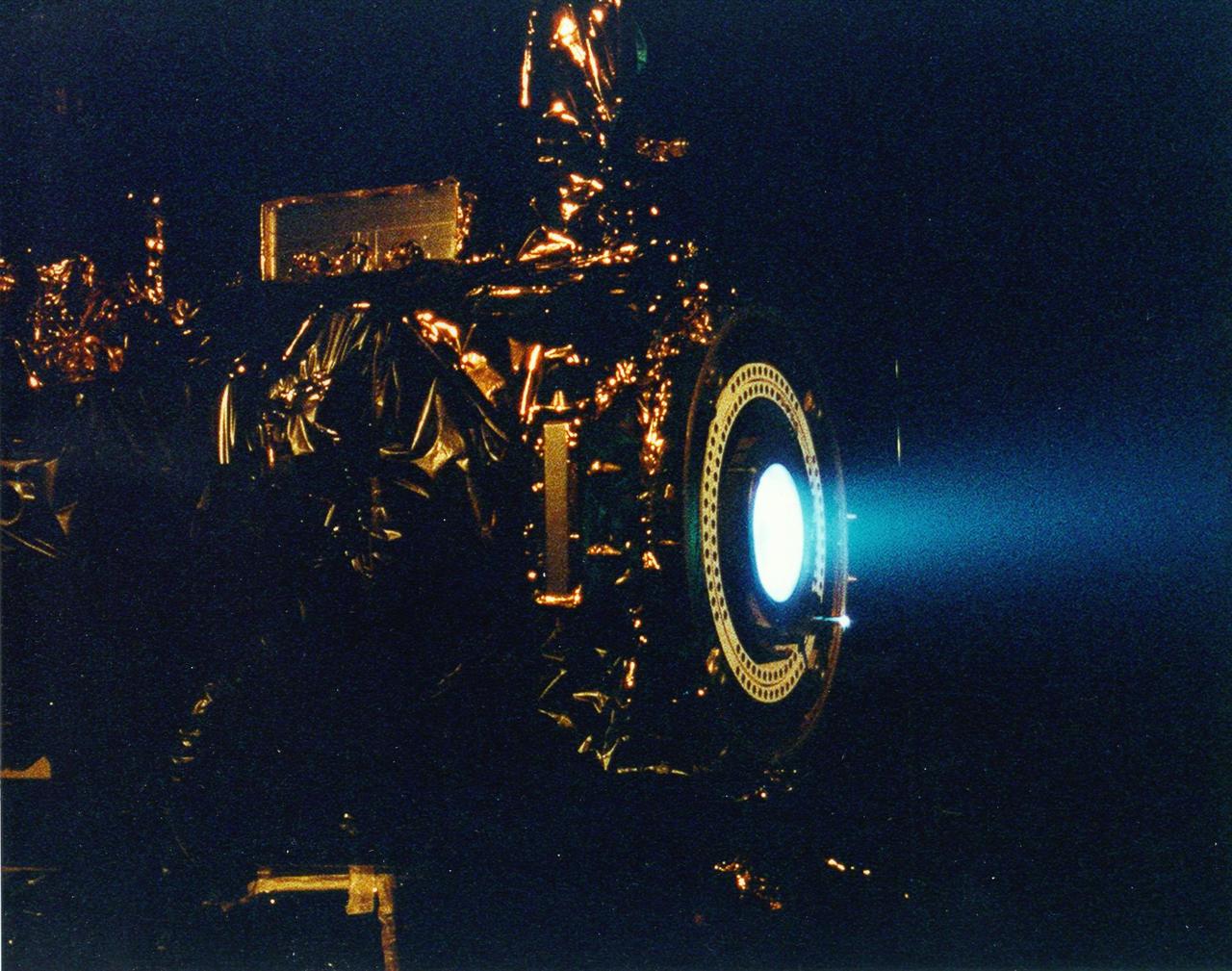
This image of a xenon ion engine, photographed through a port of the vacuum chamber where it was being tested at NASA's Jet Propulsion Laboratory, shows the faint blue glow of charged atoms being emitted from the engine. The ion propulsion engine is the first non-chemical propulsion to be used as the primary means of propelling a spacecraft. Though the thrust of the ion propulsion is about the same as the downward pressure of a single sheet of paper, by the end of the mission, the ion engine will have changed the spacecraft speed by about 13,700 kilometers/hour (8500 miles/hour). Even then, it will have expended only about 64 kg of its 81.5 kg supply of xenon propellant. http://photojournal.jpl.nasa.gov/catalog/PIA04247

Dawn casts a pink glow as the Boeing Delta II rocket stands ready for launch after tower rollback. It is carrying the 2001 Mars Odyssey spacecraft that will begin its 7-month journey to Mars. Liftoff is scheduled for 11:02 a.m. EDT. The spacecraft, built by Lockheed Martin Space Systems for the Jet Propulsion Laboratory, will orbit Mars, mapping the surface looking for geological features that could indicate the presence of water, now or in the past. Science gathered by three science instruments on board will be key to future missions to Mars, including orbital reconnaissance, lander and human missions
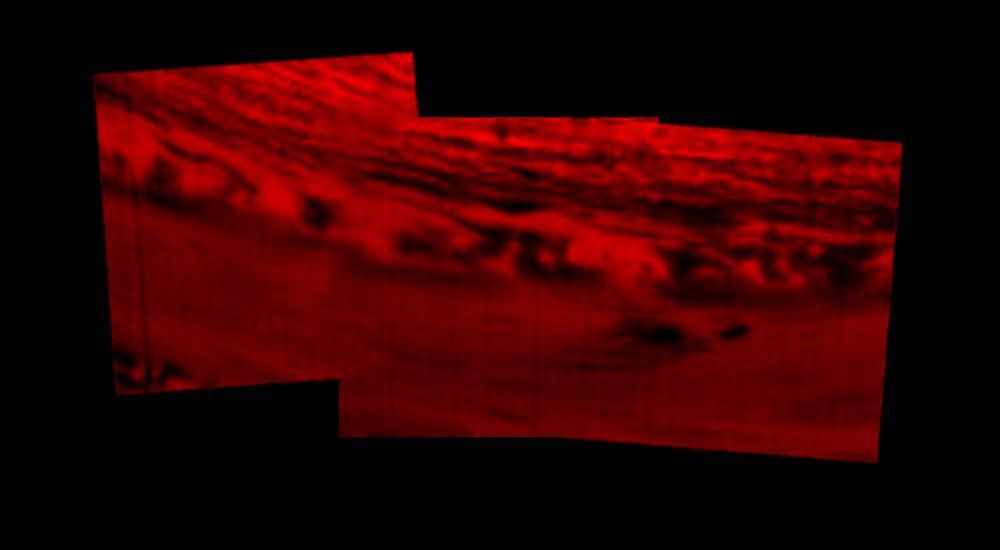
This montage of images, made from data obtained by Cassini's visual and infrared mapping spectrometer, shows the location on Saturn where the NASA spacecraft entered Saturn's atmosphere on Sept. 15, 2017. This view shows Saturn in the thermal infrared, at a wavelength of 5 microns. Here, the instrument is sensing heat coming from Saturn's interior, in red. Clouds in the atmosphere are silhouetted against that inner glow. This location -- the site of Cassini's atmospheric entry -- was at this time on the night side of the planet, but would rotate into daylight by the time Cassini made its final dive into Saturn's upper atmosphere, ending its remarkable 13-year exploration of Saturn. Both an annotated version and an animation are available at https://photojournal.jpl.nasa.gov/catalog/PIA21896
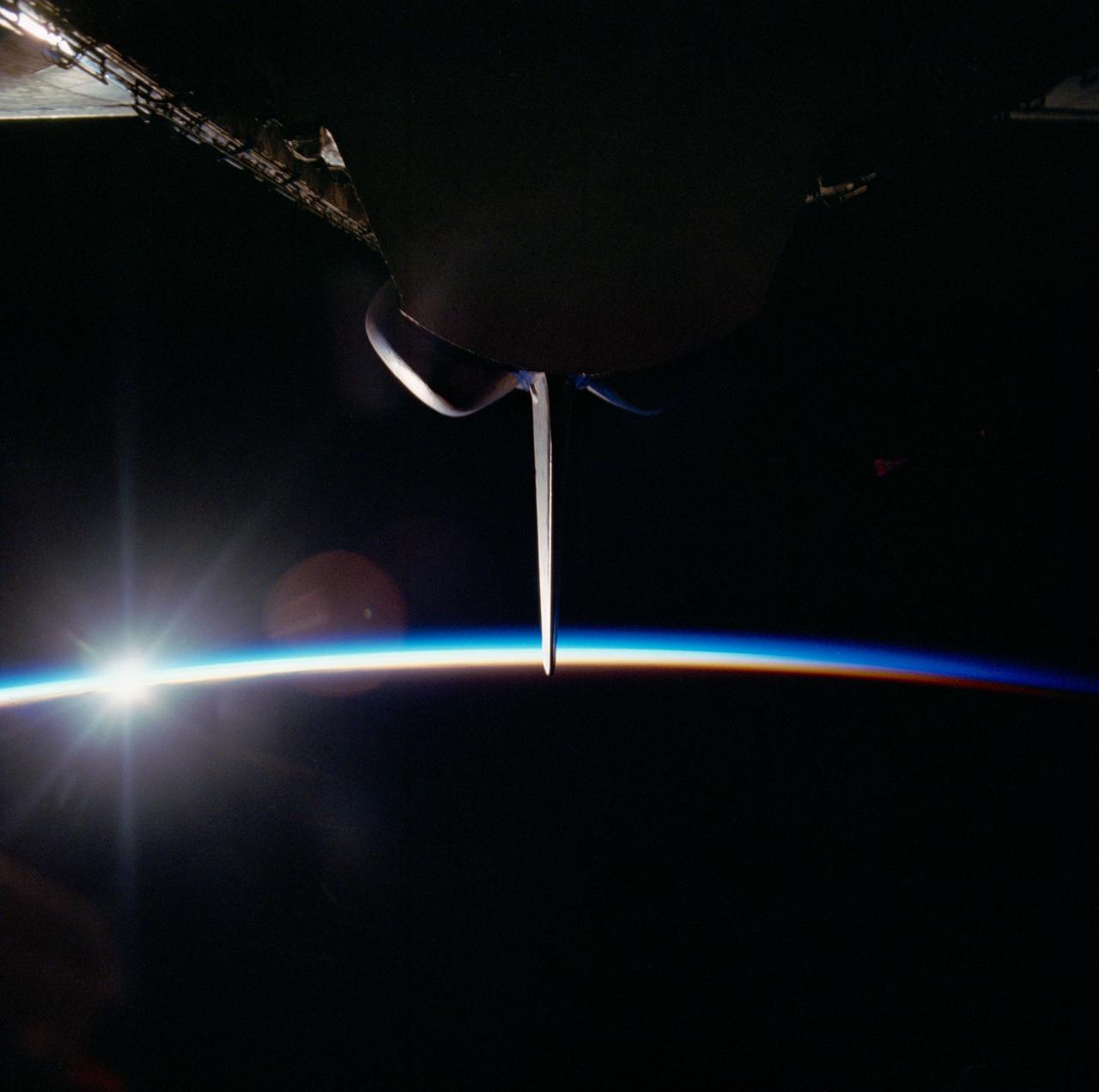
S82-39796 (11-16 Nov. 1982) --- A ?night? scene of the STS-5 space shuttle Columbia in orbit over Earth?s glowing horizon was captured by an astronaut crew member aiming a 70mm handheld camera through the aft windows of the flight deck. The aft section of the cargo bay contains two closed protective shields for satellites which were deployed on the flight. The nearest ?cradle? or shield houses the Satellite Business System?s (SBS-3) spacecraft and is visible in this frame while the Telesta Canada ANIK C-3 shield is out of view. The vertical stabilizer, illuminated by the sun, is flanked by two orbital maneuvering system (OMS) pods. Photo credit: NASA
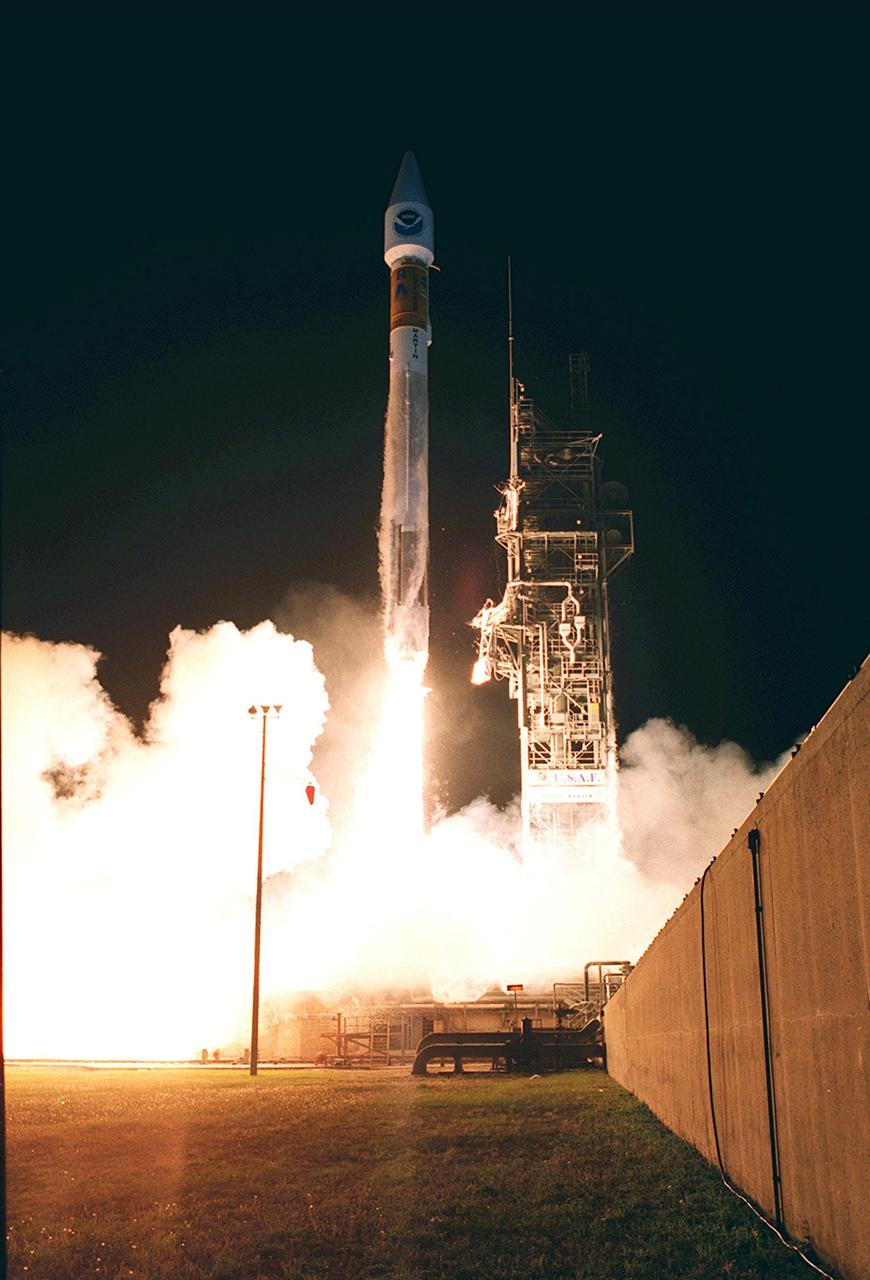
The Atlas II/Centaur rocket carrying the NASA/NOAA weather satellite GOES-L casts a luminescent glow as it starts to clear the tower at Pad A, Complex 36, Cape Canaveral Air Force Station. Liftoff occurred at 3:07 a.m. EDT. The primary objective of the GOES-L is to provide a full capability satellite in an on-orbit storage condition, in order to assure NOAA continuity in services from a two-satellite constellation. Launch services are being provided by the 45th Space Wing. Once in orbit, the spacecraft is to be designated GOES-11 and will complete its 90-day checkout in time for availability during the 2000 hurricane season
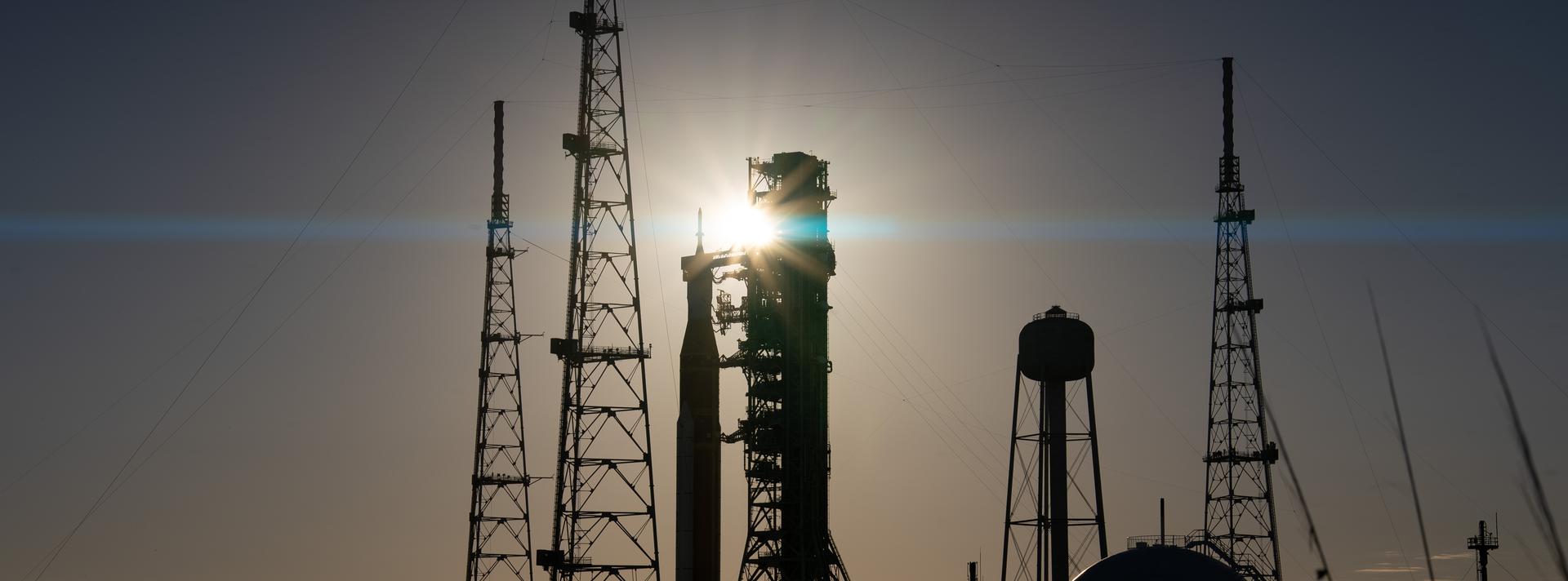
508 DESCRIPTION: The sun sets behind NASA’s Space Launch System (SLS) rocket and Orion spacecraft as they stand fully assembled atop the mobile launcher at Launch Pad 39B at NASA’s Kennedy Space Center in Florida. The sky glows with warm shades of orange and pink, silhouetting the towering rocket and its solid rocket boosters against the fading light. Photographed on January 31, 2026, the scene captures teams preparing for a wet dress rehearsal for the Artemis II mission, rehearsing launch countdown timelines and procedures as day turns to night.
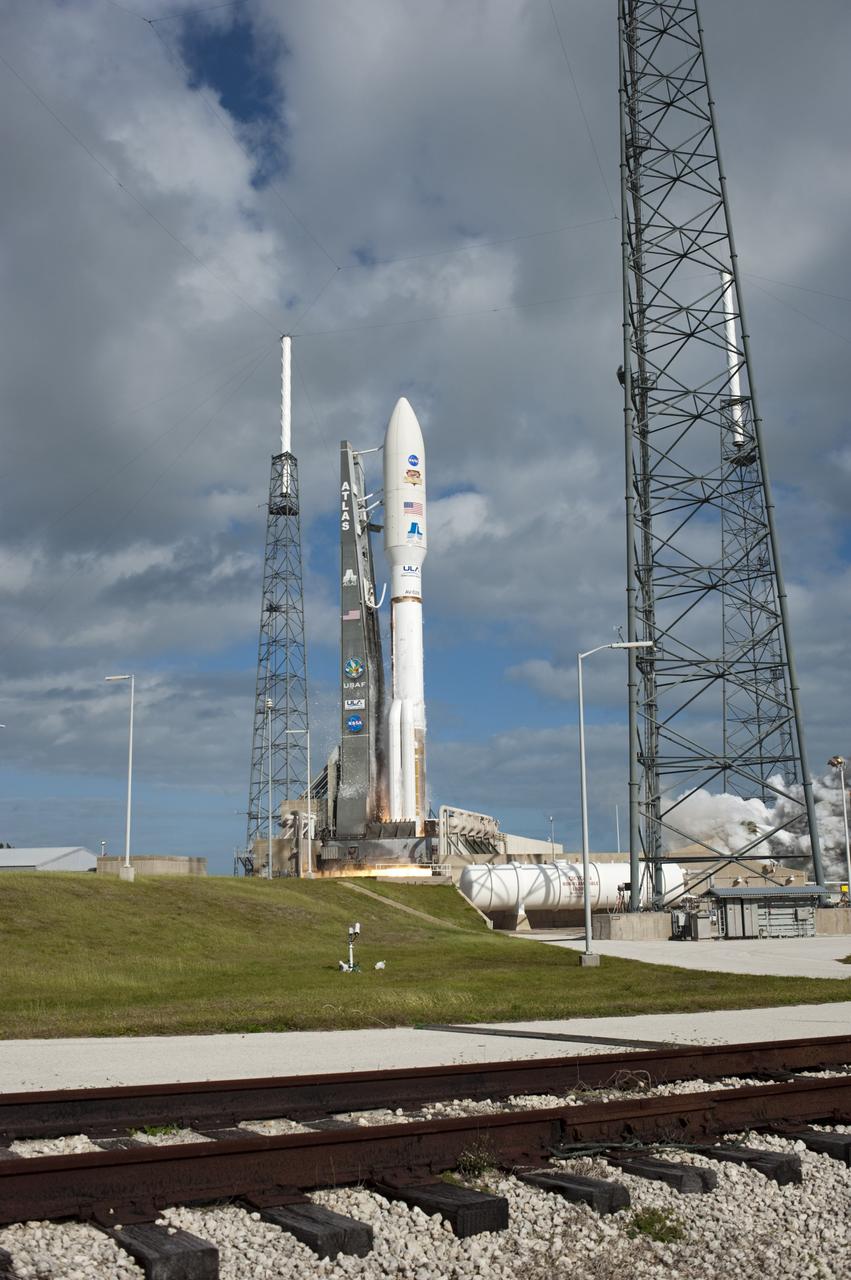
CAPE CANAVERAL, Fla. -- At ignition, a glow of flame is barely visible beneath the United Launch Alliance Atlas V rocket as it launches with NASA's Mars Science Laboratory (MSL) spacecraft. MSL lifted off from Space Launch Complex-41 at Cape Canaveral Air Force Station in Florida at 10:02 a.m. EST Nov. 26. MSL's components include a car-sized rover, Curiosity, which has 10 science instruments designed to search for signs of life, including methane, and help determine if the gas is from a biological or geological source. For more information, visit http://www.nasa.gov/msl. Photo credit: NASA/Tony Gray and Rick Wetherington
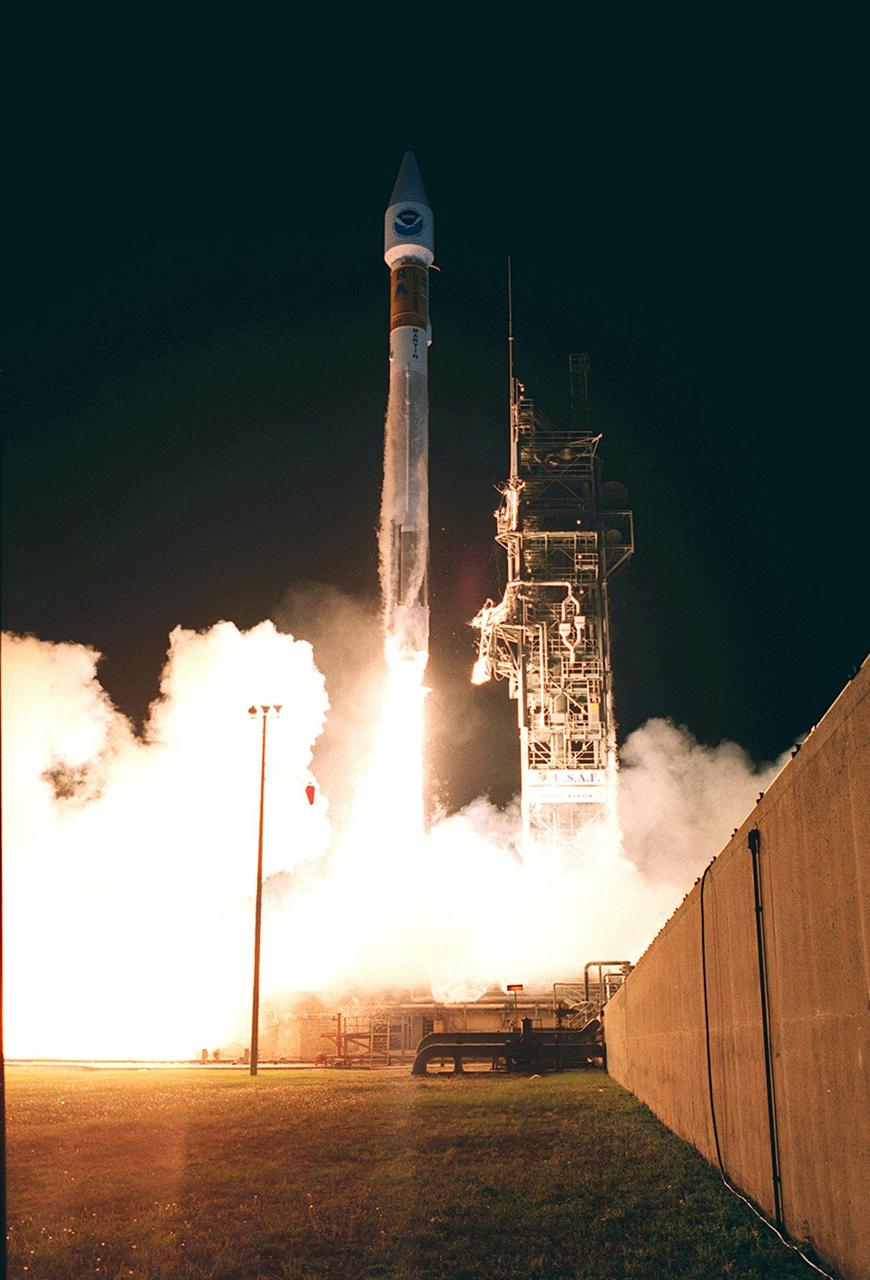
The Atlas II/Centaur rocket carrying the NASA/NOAA weather satellite GOES-L casts a luminescent glow as it starts to clear the tower at Pad A, Complex 36, Cape Canaveral Air Force Station. Liftoff occurred at 3:07 a.m. EDT. The primary objective of the GOES-L is to provide a full capability satellite in an on-orbit storage condition, in order to assure NOAA continuity in services from a two-satellite constellation. Launch services are being provided by the 45th Space Wing. Once in orbit, the spacecraft is to be designated GOES-11 and will complete its 90-day checkout in time for availability during the 2000 hurricane season
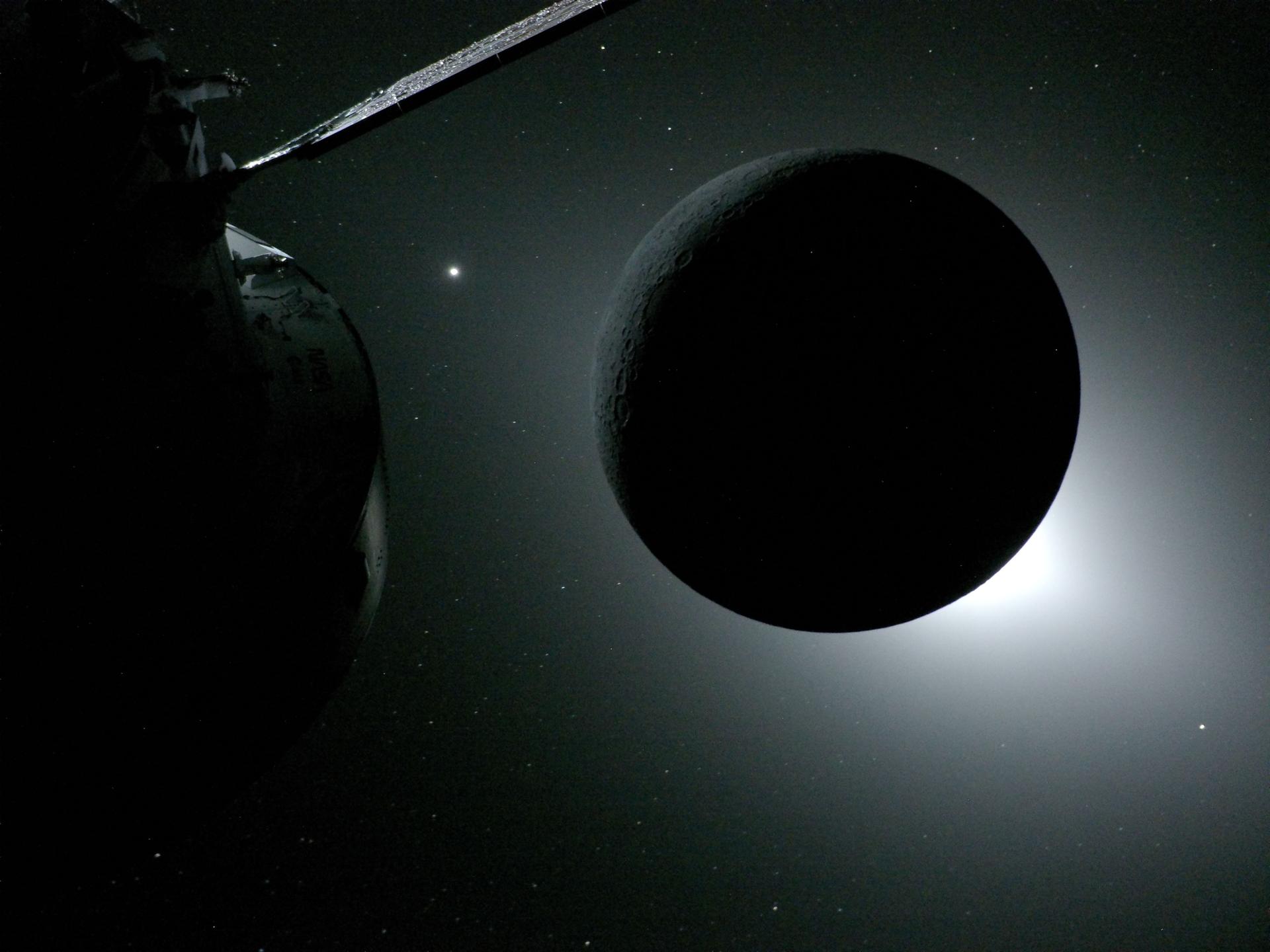
art002e016318 (April 6, 2026) - The solar eclipse captured from a camera mounted on one of the Orion spacecraft’s solar array wings during the Artemis II crew’s flyby of the Moon’s far side. The science community is investigating whether the glow around the Moon is from zodiacal light -- interstellar dust that’s reflecting sunlight -- the solar corona, or a combination of the two. Unlike minutes-long eclipses as viewed from Earth, the Artemis II crew saw the Sun hide behind the Moon for nearly an hour. In this image, Venus can be spotted on the left, and Saturn on the right of the Moon. Credit: NASA
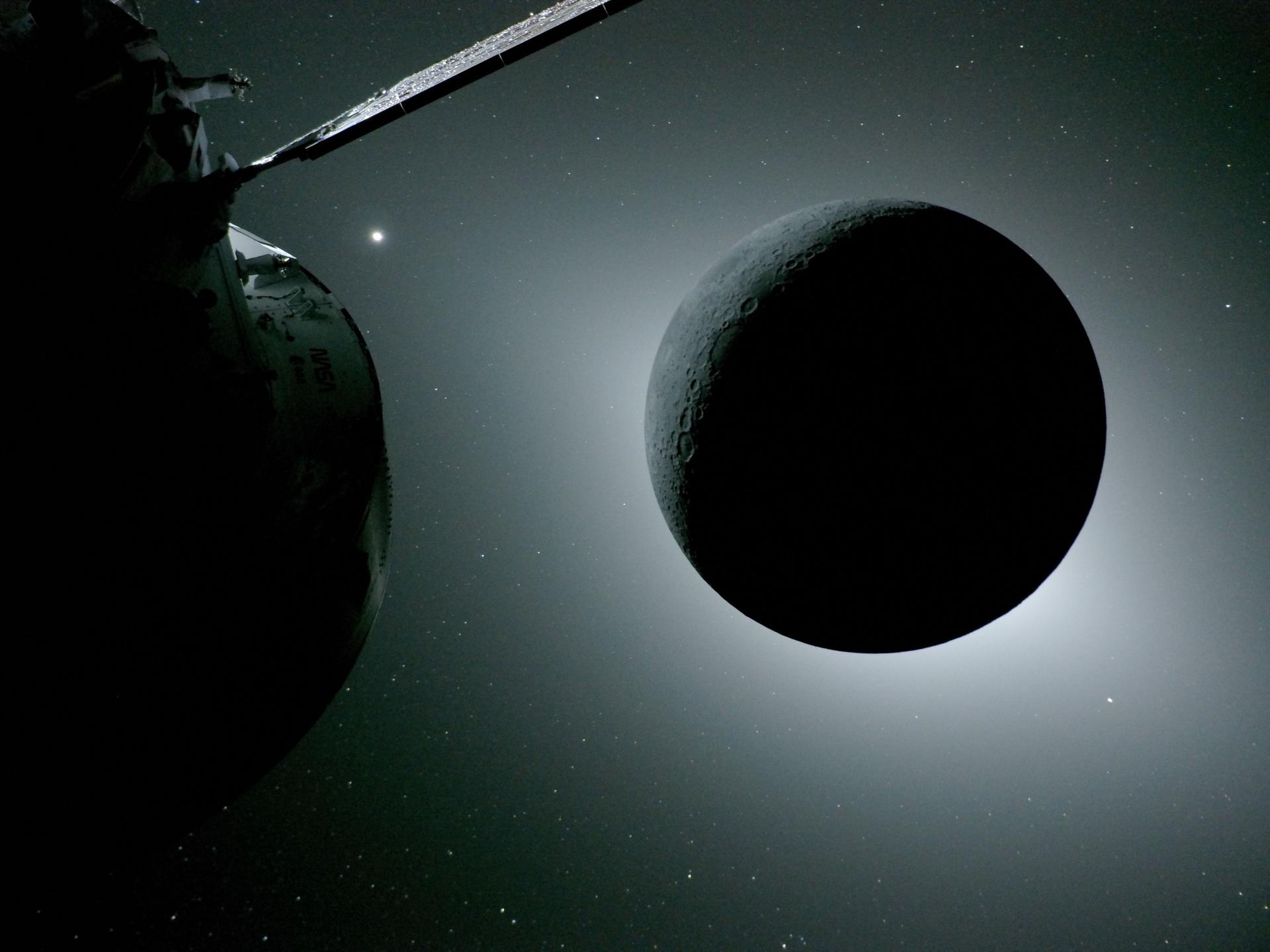
art002e016324 (April 6, 2026) - The solar eclipse captured from a camera mounted on one of the Orion spacecraft’s solar array wings during the Artemis II crew’s flyby of the Moon’s far side. The science community is investigating whether the glow around the Moon is from zodiacal light -- interstellar dust that’s reflecting sunlight -- the solar corona, or a combination of the two. Unlike minutes-long eclipses as viewed from Earth, the Artemis II crew saw the Sun hide behind the Moon for nearly an hour. In this image, Venus can be spotted on the left, and Saturn on the right of the Moon. Credit: NASA
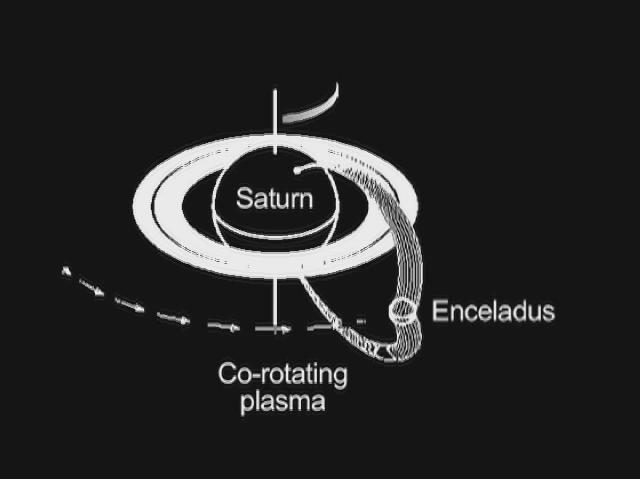
This graphic shows how Saturn and its moon Enceladus are electrically linked. Magnetic field lines, invisible to the human eye but detectable by the fields and particles instruments on NASA's Cassini spacecraft, arc from Saturn's north polar region to south polar region. Enceladus resides in the arc of a set of the field lines and feeds charged particles into the Saturn atmosphere. As Enceladus orbits around Saturn, the "footprint" of its connection to Saturn's north polar region, visible in ultraviolet light, also rotates. A doughnut of plasma, or hot ionized gas, revolves around Saturn at the same pace as the planet turns. The interaction of this plasma cloud with Enceladus shoots electrons along the magnetic field lines into the polar region of Saturn. The rain of electrons into Saturn's atmosphere creates an ultraviolet glow in an aurora-like phenomenon. Cassini's radio and plasma wave science instrument has detected a "hiss-like" radio noise generated by electrons moving along magnetic field lines from Enceladus to the glowing patch of ultraviolet light on Saturn. An animation is available at http://photojournal.jpl.nasa.gov/catalog/PIA13897
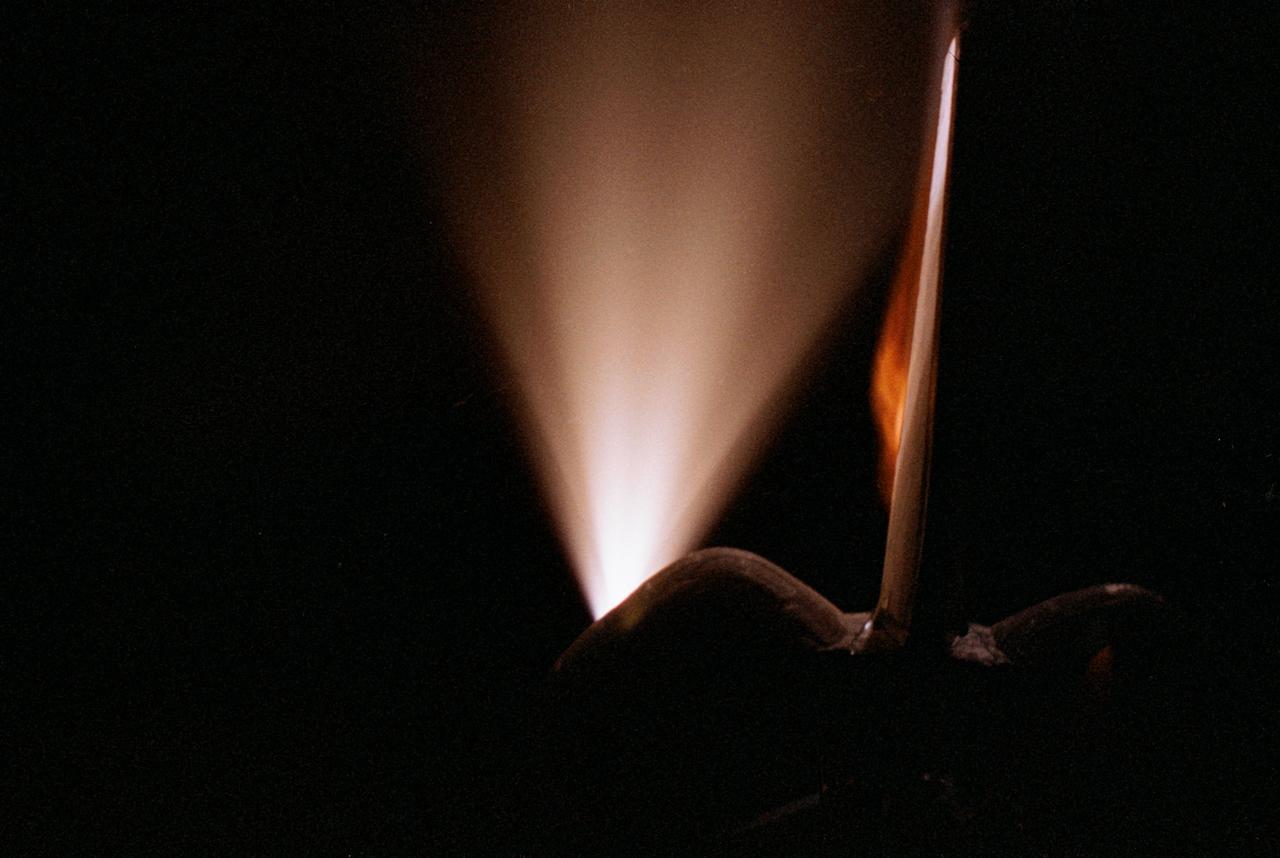
STS070-386-027 (13-22 JULY 1995) --- High-speed film provided this close-up view of the Space Shuttle Discovery’s aft, featuring the ignition of one of the primary thrusters. Note the impact of the firing on the starboard side of the vertical stabilizer. Crew members told a August 11, 1995, gathering of Johnson Space Center (JSC) employees that the Window Experiment (WINDEX) paid close attention to surface glow, jet plumes, water dumps, aurora and airglow. The data collection is part of an effort to avoid misinterpretation of measurements of Earth, the solar system and starts taken from satellites in low Earth-orbits and prevent damage to sensitive systems and solar arrays during rendezvous and docking. Such firings of the thrusters increase local densities of gases in the atmosphere dramatically and introduce non-natural elements that react with the atmosphere dramatically and spacecraft systems enveloped by the thruster plume. WINDEX recorded phenomena associated with thruster start-up and shut-down transients and observed the effect of the transients on Shuttle glow phenomenon.
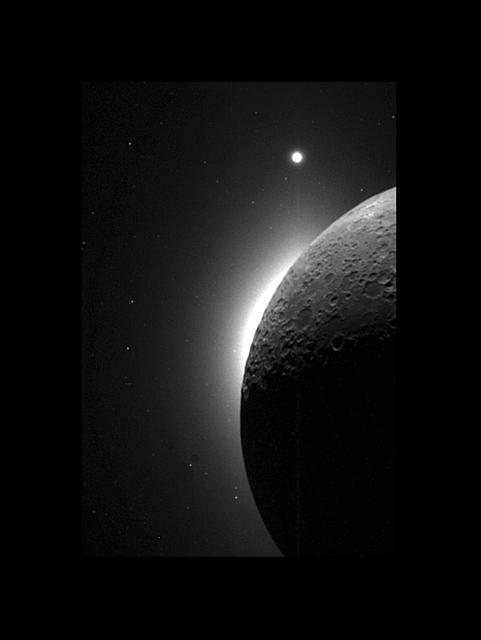
In 1994, during its flight, NASA's Clementine spacecraft returned images of the Moon. In addition to the geologic mapping cameras, the Clementine spacecraft also carried two Star Tracker cameras for navigation. These lightweight (0.3 kg) cameras kept the spacecraft on track by constantly observing the positions of stars, reminiscent of the age-old seafaring tradition of sextant/star navigation. These navigation cameras were also to take some spectacular wide angle images of the Moon. In this picture the Moon is seen illuminated solely by light reflected from the Earth--Earthshine! The bright glow on the lunar horizon is caused by light from the solar corona; the sun is just behind the lunar limb. Caught in this image is the planet Venus at the top of the frame. http://photojournal.jpl.nasa.gov/catalog/PIA00434

CAPE CANAVERAL, Fla. – The glow beside the Falcon 9 rocket at Space Launch Complex 40 on Cape Canaveral Air Force Station in Florida heralds the launch of the SpaceX CRS-4 mission to the International Space Station. Liftoff was at 1:52 a.m. EDT. The mission is the fourth of 12 SpaceX flights NASA contracted with the company to resupply the space station. It will be the fifth trip by a Dragon spacecraft to the orbiting laboratory. The spacecraft’s 2.5 tons of supplies, science experiments, and technology demonstrations include critical materials to support 255 science and research investigations that will occur during the station's Expeditions 41 and 42. To learn more about the mission, visit http://www.nasa.gov/mission_pages/station/structure/launch/index.html. Photo credit: NASA/Jim Grossmann
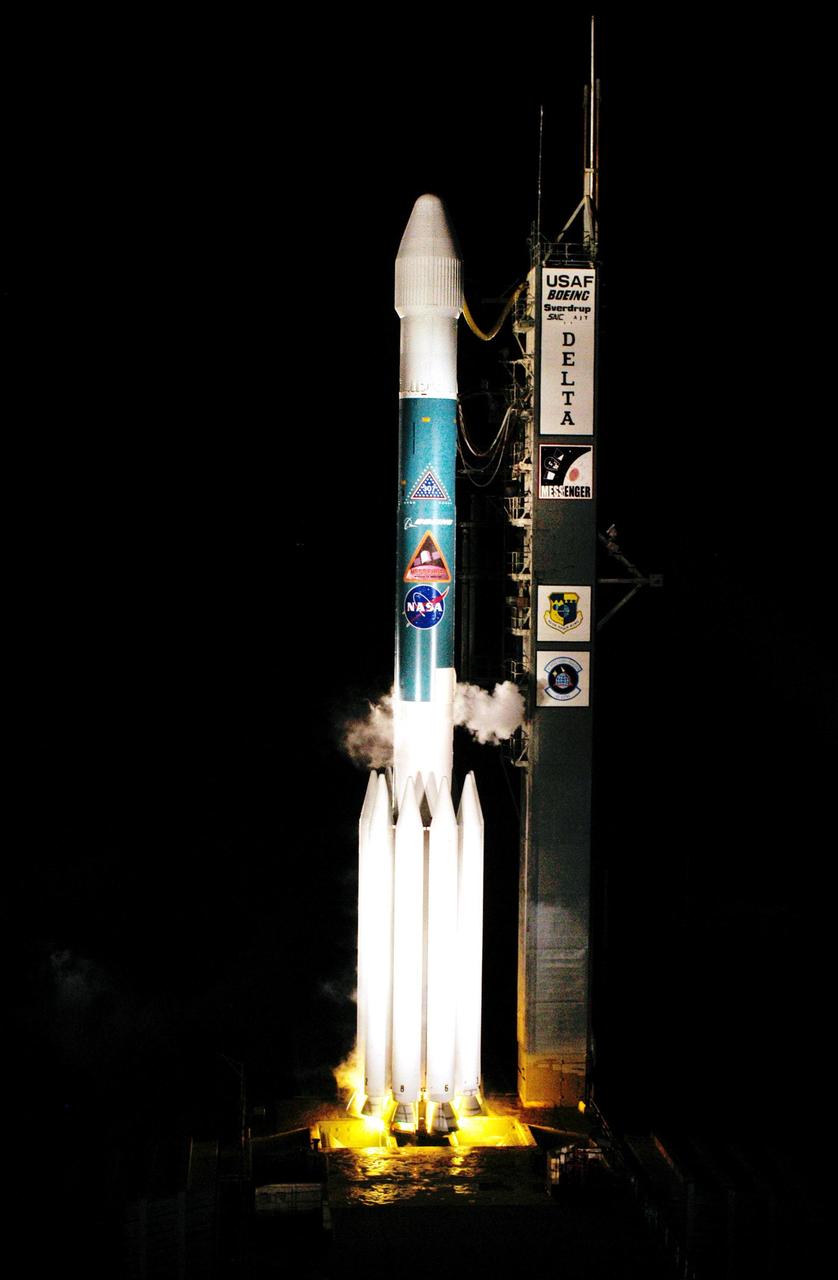
KENNEDY SPACE CENTER, FLA. - A glow appears beneath the Boeing Delta II rocket as it begins liftoff with its payload, the MESSENGER spacecraft, on top. Liftoff occurred on time at 2:15:56 a.m. EDT from Launch Pad 17-B, Cape Canaveral Air Force Station. MESSENGER (Mercury Surface, Space Environment, Geochemistry and Ranging) is on a seven-year, 4.9-billion-mile journey to the planet Mercury. The spacecraft will fly by Earth, Venus and Mercury several times, as well as circling the sun 15 times, to burn off energy before making its final approach to the inner planet on March 18, 2011. MESSENGER was built for NASA by the Johns Hopkins University Applied Physics Laboratory in Laurel, Md.
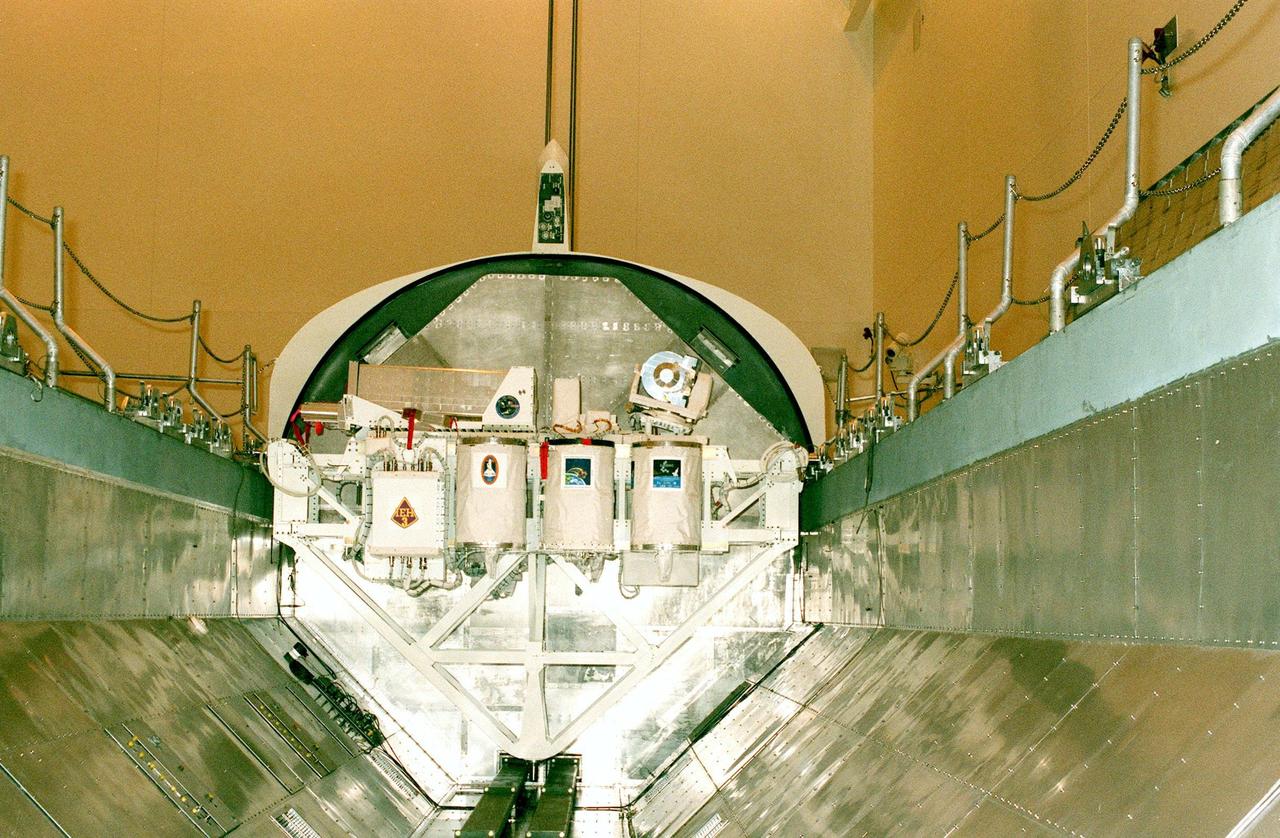
KENNEDY SPACE CENTER, FLA. -- The International Extreme Ultraviolet Hitchhiker (IEH-3), one of the payloads for the STS-95 mission, is moved to a payload canister in the Multi-Payload Processing Facility. The mission is scheduled for liftoff on Space Shuttle Discovery on Oct. 29. IEH-3 comprises several experiments that will study the Jovian planetary system, hot stars, planetary and reflection nebulae, other stellar objects and their environments through remote observation of EUV/FUV emissions; study spacecraft interactions, Shuttle glow, thruster firings, and contamination; and measure the solar constant and identify variations in the value during a solar cycle. Other research payloads include the Hubble Space Telescope Orbital Systems Test Platform, the Spartan solar-observing deployable spacecraft, and the SPACEHAB single module with experiments on space flight and the aging process
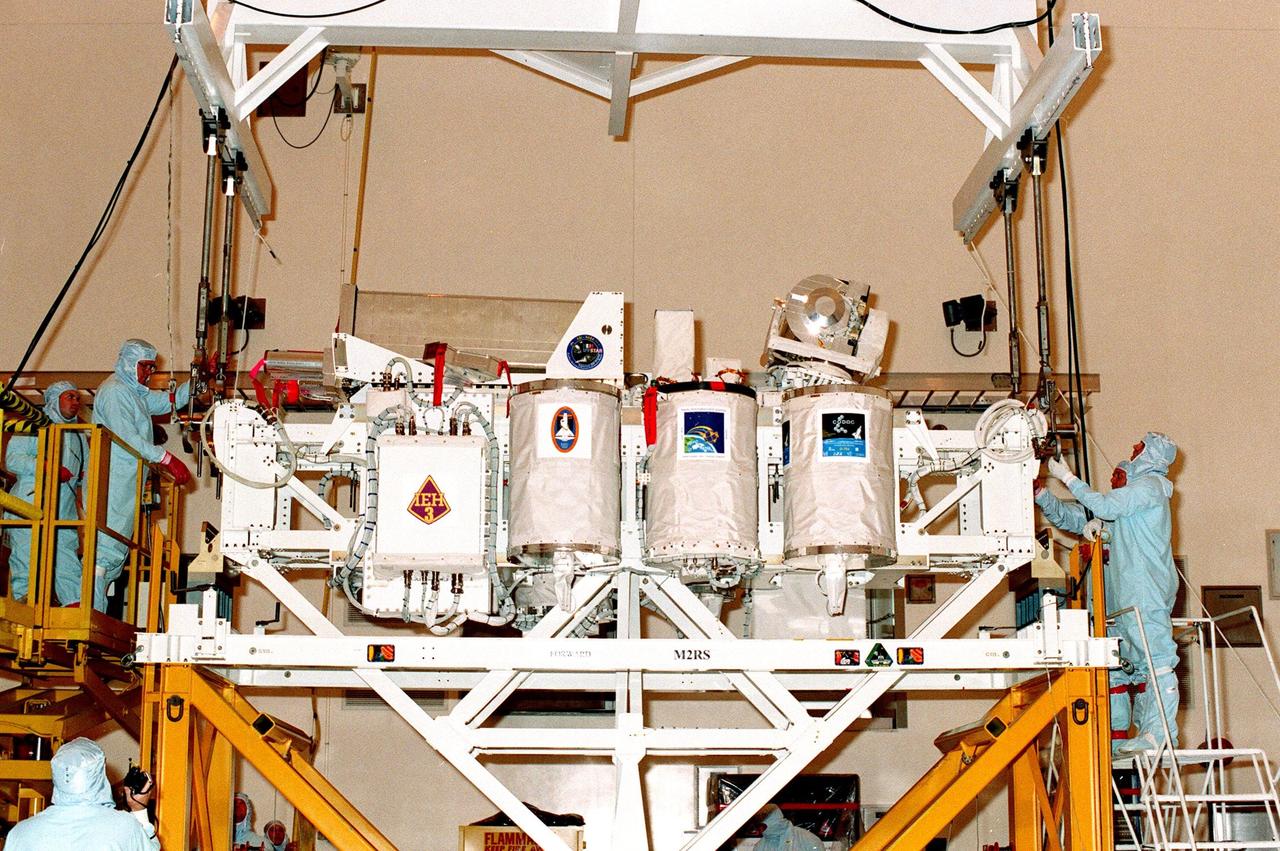
KENNEDY SPACE CENTER, FLA. -- The International Extreme Ultraviolet Hitchhiker (IEH-3), one of the payloads for the STS-95 mission, is prepared for its move to a payload canister in the Multi-Payload Processing Facility. The mission is scheduled for liftoff on Space Shuttle Discovery on Oct. 29. IEH-3 comprises several experiments that will study the Jovian planetary system, hot stars, planetary and reflection nebulae, other stellar objects and their environments through remote observation of EUV/FUV emissions; study spacecraft interactions, Shuttle glow, thruster firings, and contamination; and measure the solar constant and identify variations in the value during a solar cycle. Other research payloads include the Hubble Space Telescope Orbital Systems Test Platform, the Spartan solar-observing deployable spacecraft, and the SPACEHAB single module with experiments on space flight and the aging process
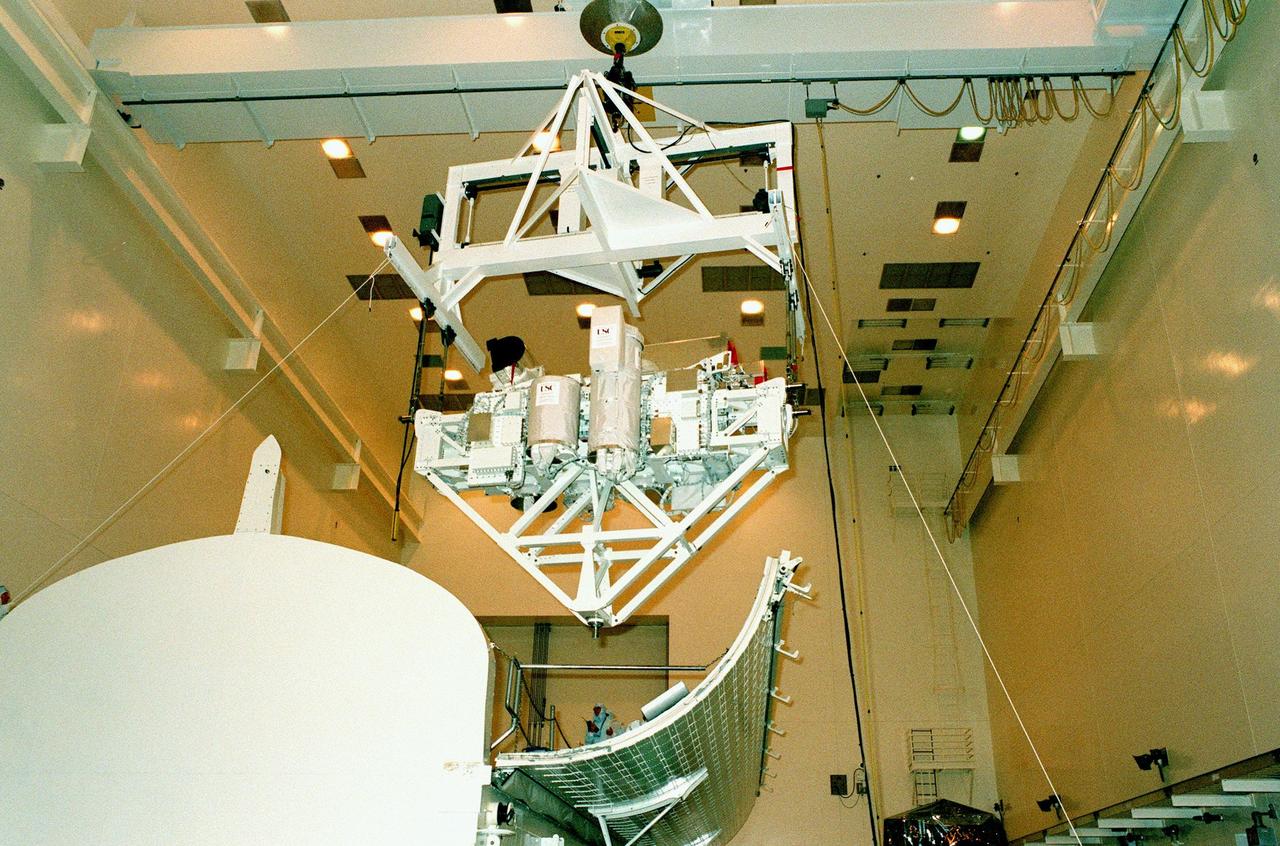
KENNEDY SPACE CENTER, FLA. -- The International Extreme Ultraviolet Hitchhiker (IEH-3), one of the payloads for the STS-95 mission, is suspended above its payload canister in the Multi-Payload Processing Facility. The mission is scheduled for liftoff on Space Shuttle Discovery on Oct. 29. IEH-3 comprises several experiments that will study the Jovian planetary system, hot stars, planetary and reflection nebulae, other stellar objects and their environments through remote observation of EUV/FUV emissions; study spacecraft interactions, Shuttle glow, thruster firings, and contamination; and measure the solar constant and identify variations in the value during a solar cycle. Other research payloads include the Hubble Space Telescope Orbital Systems Test Platform, the Spartan solar-observing deployable spacecraft, and the SPACEHAB single module with experiments on space flight and the aging process
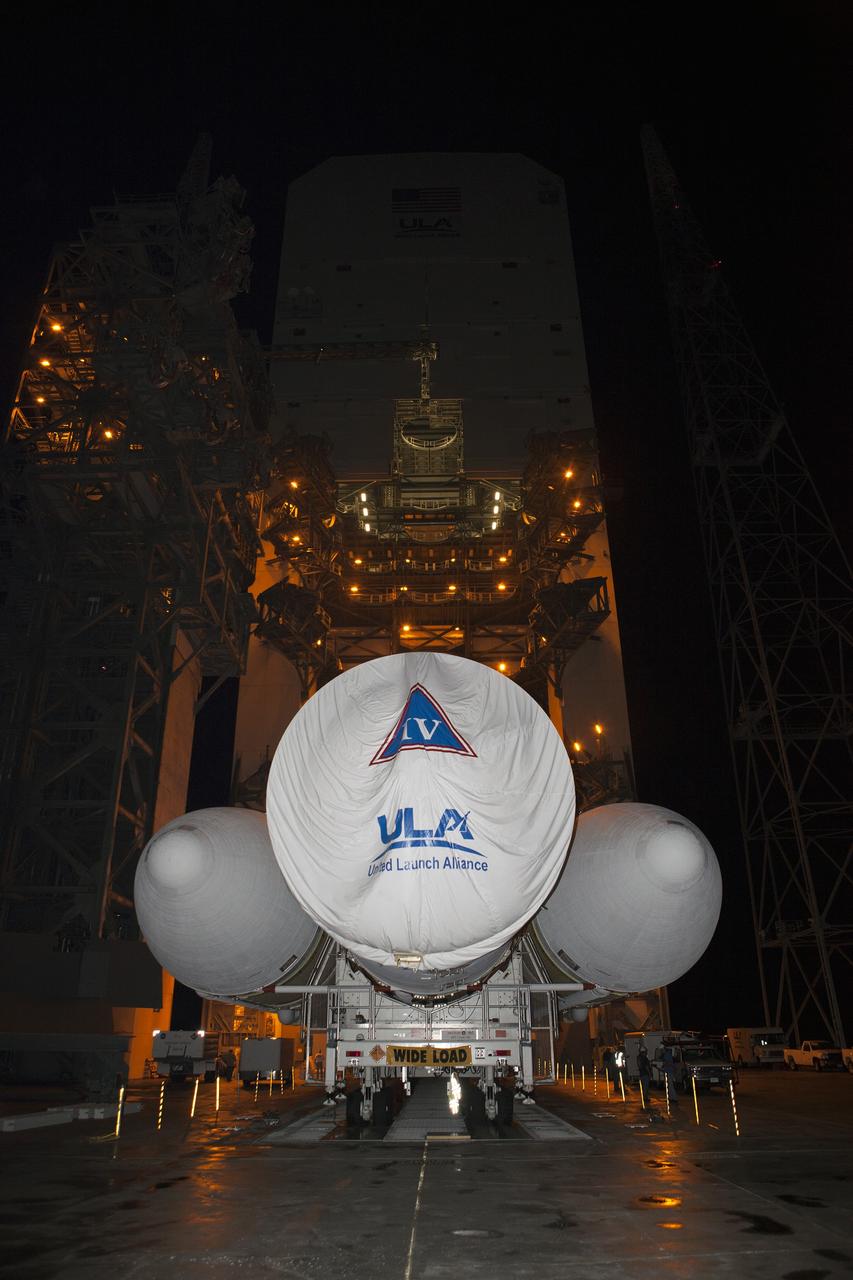
CAPE CANAVERAL, Fla. – Launch pad lights give off a golden glow at Space Launch Complex 37 at Cape Canaveral Air Force Station in Florida, as the United Launch Alliance Delta IV Heavy rocket for Exploration Flight Test-1 arrives. The rocket is secured on the Elevated Platform Transporter. The Delta IV Heavy will launch Orion on its first flight test. During its first flight test, Orion will travel farther into space than any human spacecraft has gone in more than 40 years. The data gathered during the flight will influence design decisions, validate existing computer models and innovative new approaches to space systems development, as well as reduce overall mission risks and costs for later Orion flights. Liftoff of Orion on the first flight test is planned for December 2014. Photo credit: NASA/Dimitri Gerondidakis
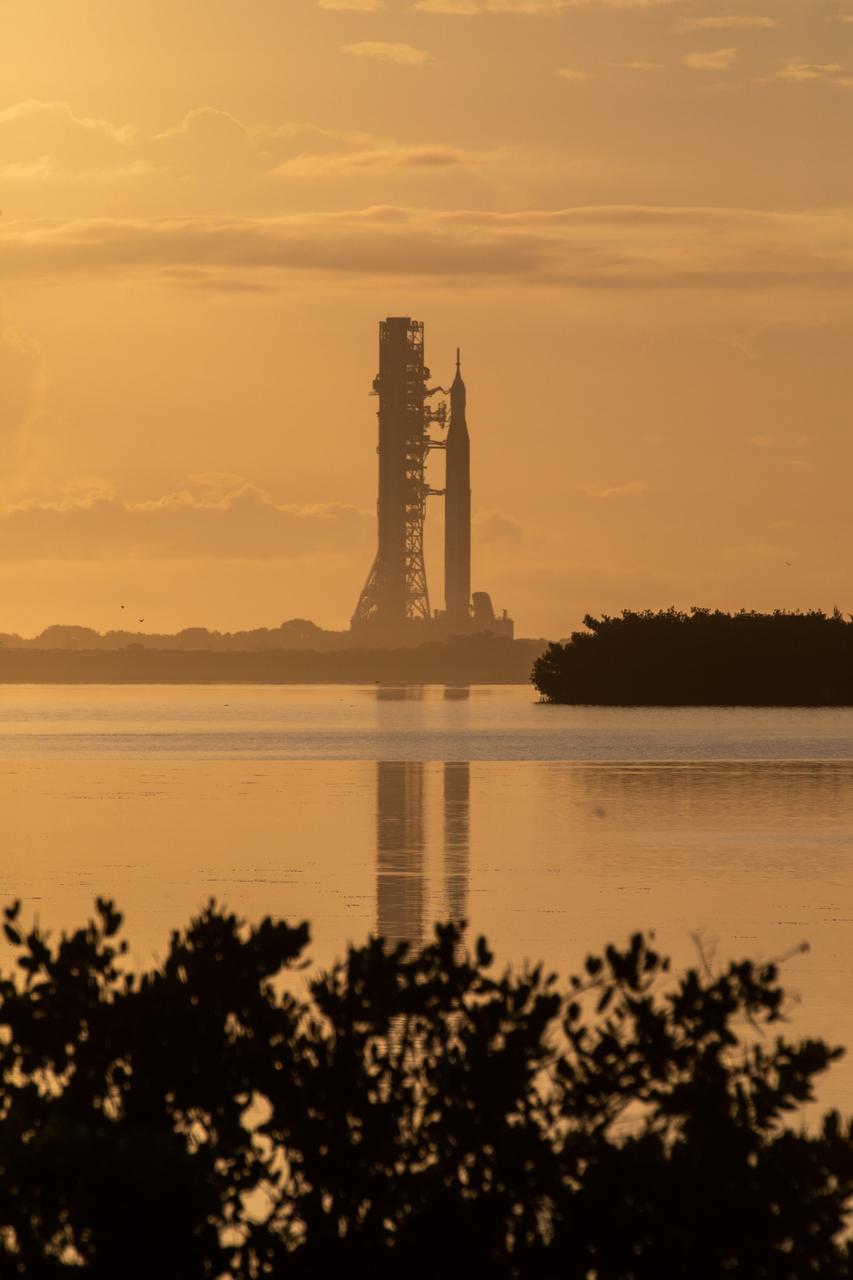
A sunrise at NASA’s Kennedy Space Center in Florida casts an orange glow around the agency’s Artemis I Moon rocket as it travels to Launch Complex 39B on June 6, 2022. The rocket rolled out of the Vehicle Assembly Building in the early morning hours to travel the 4.2 miles to the launch pad for NASA’s next wet dress rehearsal attempt ahead of the Artemis I launch. The first in an increasingly complex series of missions, Artemis I will test the Space Launch System rocket and Orion spacecraft as an integrated system prior to crewed flights to the Moon. Through Artemis, NASA will land the first woman and first person of color on the lunar surface, paving the way for a long-term lunar presence and using the Moon as a steppingstone before venturing to Mars.
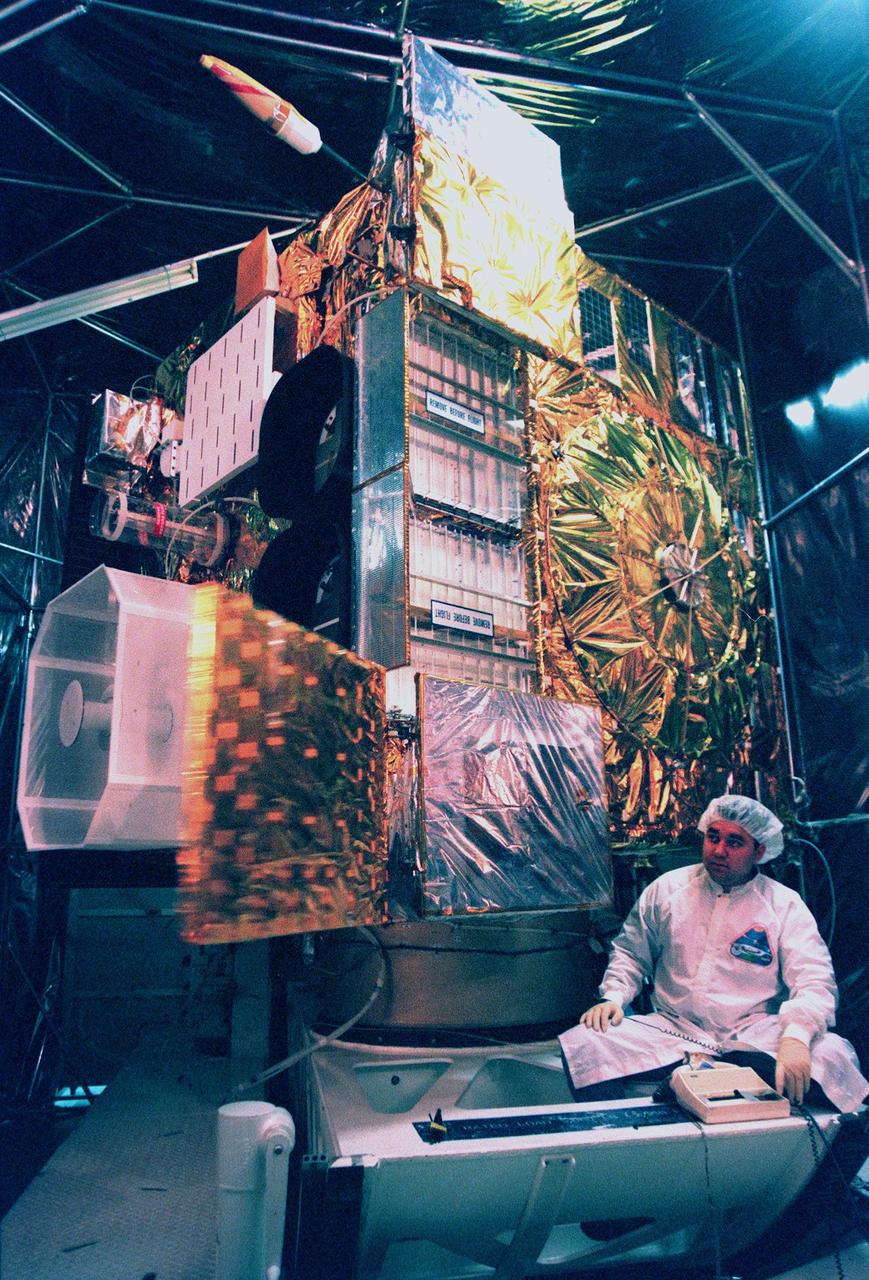
With the light casting a rosy glow in a specially built clean room at Astrotech, Titusville, Fla., Loral technician Roberto Caballero tests the deployment of the sounder instrument's cooler cover door on the <a href="http://www-pao.ksc.nasa.gov/kscpao/captions/subjects/goes-l.htm">GOES-L</a> weather satellite. The sounder, one of two meteorological instruments on the satellite, measures temperature and moisture in a vertical column of air from the satellite to Earth. Its findings will help forecast weather. GOES-L, which is to be launched from Cape Canaveral Air Station aboard an Atlas II rocket in late March, is the fourth of a new advanced series of geostationary weather satellites for the National Oceanic and Atmospheric Administration. It is a three-axis inertially stabilized spacecraft that will provide pictures as well as perform the atmospheric sounding. Once launched, the satellite, to be designated GOES-11, will undergo checkout and provide backup capabilities for the existing, aging GOES East weather satellite

Comet C/2018 Y1 Iwamoto as imaged in multiple exposures of infrared light by the NEOWISE space telescope. The infrared images were taken on Feb. 25, 2019, when the comet was about 56 million miles, or 90 million kilometers, from Earth. C/2018 Y1 Iwamoto is a long-period comet originally from the Oort Cloud and coming in near the Sun for the first time in over 1,000 years. Appearing as a string of red dots, this comet can be seen in a series of exposures captured by the spacecraft. Infrared light detected by the 3.4-micron channel is mapped to blue and green, while light from the 4.6-micron channel is mapped to red. In this image, stars show up as blue because they are hotter, whereas the cooler dust around the comet - with a temperature near the freezing point of water - glows red. Movie available at https://photojournal.jpl.nasa.gov/catalog/PIA23165
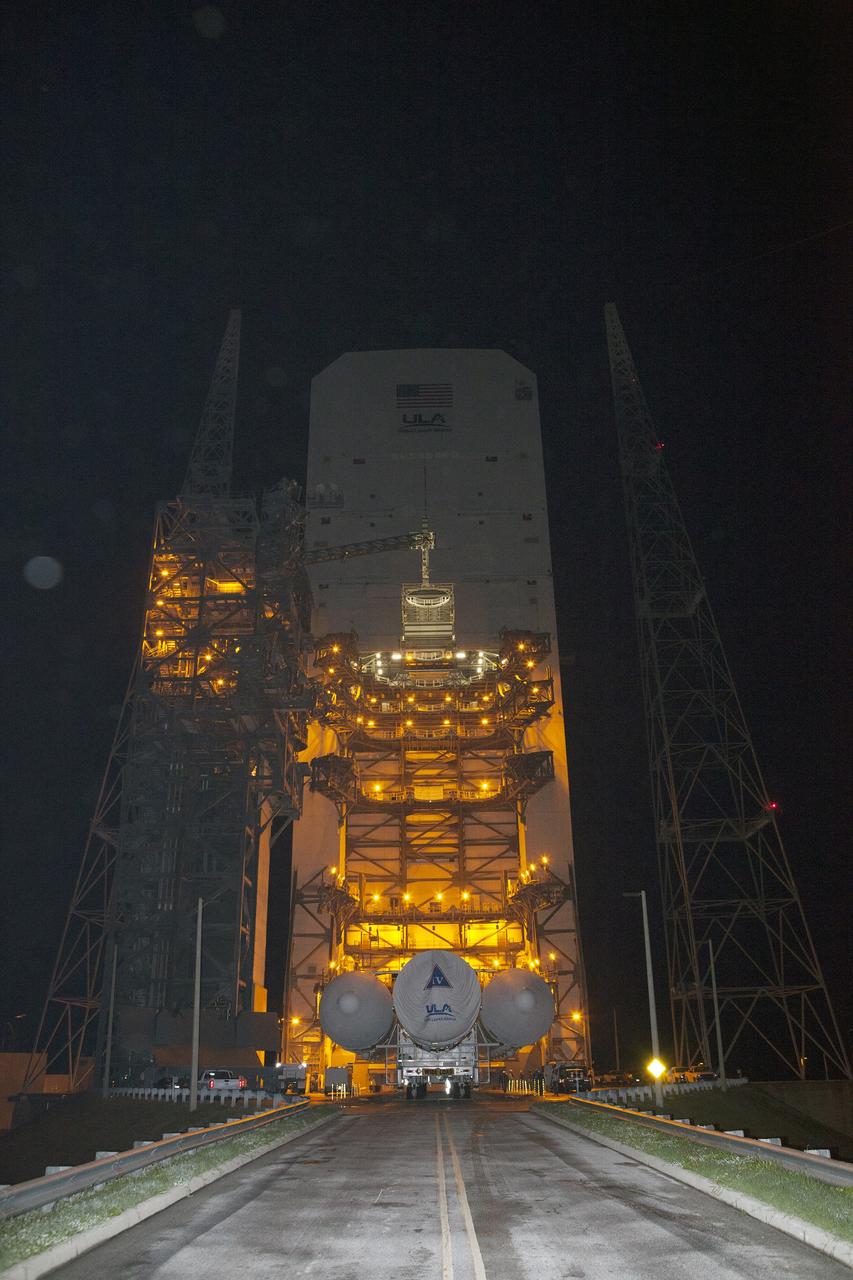
CAPE CANAVERAL, Fla. – Launch pad lights give off a golden glow at Space Launch Complex 37 at Cape Canaveral Air Force Station in Florida, as the United Launch Alliance Delta IV Heavy rocket for Exploration Flight Test-1 arrives. The rocket is secured on the Elevated Platform Transporter. The Delta IV Heavy will launch Orion on its first flight test. During its first flight test, Orion will travel farther into space than any human spacecraft has gone in more than 40 years. The data gathered during the flight will influence design decisions, validate existing computer models and innovative new approaches to space systems development, as well as reduce overall mission risks and costs for later Orion flights. Liftoff of Orion on the first flight test is planned for December 2014. Photo credit: NASA/Dimitri Gerondidakis
![This graphic shows a new radiation zone surrounding Jupiter, located just above the atmosphere near the equator, that has been discovered by NASA's Juno mission. The new radiation zone is depicted here as a glowing blue area around the planet's middle. This radiation zone includes energetic hydrogen, oxygen and sulfur ions moving at close to the speed of light (referred to as "relativistic" speeds). It resides inside Jupiter's previously known radiation belts. The zone was identified by the mission's Jupiter Energetic Particle Detector Instrument (JEDI), enabled by Juno's unique close approach to the planet during the spacecraft's science flybys (2,100 miles or 3,400 kilometers from the cloud tops). Juno scientists believe the particles creating this region of intense radiation are derived from energetic neutral atoms -- that is, fast-moving atoms without an electric charge -- coming from the tenuous gas around Jupiter's moons Io and Europa. The neutral atoms then become ions -- atoms with an electric charge -- as their electrons are stripped away by interaction with the planet's upper atmosphere. (This discovery is discussed further in an issue of the journal Geophysical Research Letters [Kollmann et al. (2017), Geophys. Res. Lett., 44, 5259-5268].) Juno also has detected signatures of a population of high-energy, heavy ions in the inner edges of Jupiter's relativistic electron radiation belt. This radiation belt was previously understood to contain mostly electrons moving at near light speed. The signatures of the heavy ions are observed at high latitude locations within the electron belt -- a region not previously explored by spacecraft. The origin and exact species of these heavy ions is not yet understood. Juno's Stellar Reference Unit (SRU-1) star camera detects the signatures of this population as extremely high noise in images collected as part of the mission's radiation monitoring investigation. The locations where the heavy ions were detected are indicated on the graphic by two bright, glowing spots along Juno's flight path past the planet, which is shown as a white line. The invisible lines of Jupiter's magnetic field are also portrayed here for context as faint, bluish lines. https://photojournal.jpl.nasa.gov/catalog/PIA22179](https://images-assets.nasa.gov/image/PIA22179/PIA22179~small.jpg)
This graphic shows a new radiation zone surrounding Jupiter, located just above the atmosphere near the equator, that has been discovered by NASA's Juno mission. The new radiation zone is depicted here as a glowing blue area around the planet's middle. This radiation zone includes energetic hydrogen, oxygen and sulfur ions moving at close to the speed of light (referred to as "relativistic" speeds). It resides inside Jupiter's previously known radiation belts. The zone was identified by the mission's Jupiter Energetic Particle Detector Instrument (JEDI), enabled by Juno's unique close approach to the planet during the spacecraft's science flybys (2,100 miles or 3,400 kilometers from the cloud tops). Juno scientists believe the particles creating this region of intense radiation are derived from energetic neutral atoms -- that is, fast-moving atoms without an electric charge -- coming from the tenuous gas around Jupiter's moons Io and Europa. The neutral atoms then become ions -- atoms with an electric charge -- as their electrons are stripped away by interaction with the planet's upper atmosphere. (This discovery is discussed further in an issue of the journal Geophysical Research Letters [Kollmann et al. (2017), Geophys. Res. Lett., 44, 5259-5268].) Juno also has detected signatures of a population of high-energy, heavy ions in the inner edges of Jupiter's relativistic electron radiation belt. This radiation belt was previously understood to contain mostly electrons moving at near light speed. The signatures of the heavy ions are observed at high latitude locations within the electron belt -- a region not previously explored by spacecraft. The origin and exact species of these heavy ions is not yet understood. Juno's Stellar Reference Unit (SRU-1) star camera detects the signatures of this population as extremely high noise in images collected as part of the mission's radiation monitoring investigation. The locations where the heavy ions were detected are indicated on the graphic by two bright, glowing spots along Juno's flight path past the planet, which is shown as a white line. The invisible lines of Jupiter's magnetic field are also portrayed here for context as faint, bluish lines. https://photojournal.jpl.nasa.gov/catalog/PIA22179

Image release September 2, 2010 ABOUT THIS IMAGE: This image shows the entire region around supernova 1987A. The most prominent feature in the image is a ring with dozens of bright spots. A shock wave of material unleashed by the stellar blast is slamming into regions along the ring's inner regions, heating them up, and causing them to glow. The ring, about a light-year across, was probably shed by the star about 20,000 years before it exploded. An international team of astronomers using the Hubble Space Telescope reports a significant brightening of the emissions from Supernova 1987A. The results, which appear in this week's Science magazine, are consistent with theoretical predictions about how supernovae interact with their immediate galactic environment. The team observed the supernova remnant in optical, ultraviolet, and near-infrared light. They studied the interaction between the ejecta from the stellar explosion and a glowing 6-trillion-mile-diameter ring of gas encircling the supernova remnant. The gas ring was probably shed some 20,000 years before the supernova exploded. Shock waves resulting from the impact of the ejecta onto the ring have brightened 30 to 40 pearl-like "hot spots" in the ring. These blobs likely will grow and merge together in the coming years to form a continuous, glowing circle. "We are seeing the effect a supernova can have in the surrounding galaxy, including how the energy deposited by these stellar explosions changes the dynamics and chemistry of the environment," said University of Colorado at Boulder Research Associate Kevin France of the Center for Astrophysics and Space Astronomy. "We can use these new data to understand how supernova processes regulate the evolution of galaxies." Discovered in 1987, Supernova 1987A is the closest exploding star to Earth to be detected since 1604 and it resides in the nearby Large Magellanic Cloud, a dwarf galaxy adjacent to our own Milky Way Galaxy. Credit: NASA, ESA, K. France (University of Colorado, Boulder), and P. Challis and R. Kirshner (Harvard-Smithsonian Center for Astrophysics) <b><a href="http://www.nasa.gov/centers/goddard/home/index.html" rel="nofollow">NASA Goddard Space Flight Center</a></b> is home to the nation's largest organization of combined scientists, engineers and technologists that build spacecraft, instruments and new technology to study the Earth, the sun, our solar system, and the universe. <b>Follow us on <a href="http://twitter.com/NASA_GoddardPix" rel="nofollow">Twitter</a></b> <b>Join us on <a href="http://www.facebook.com/pages/Greenbelt-MD/NASA-Goddard/395013845897?ref=tsd" rel="nofollow">Facebook</a></b>
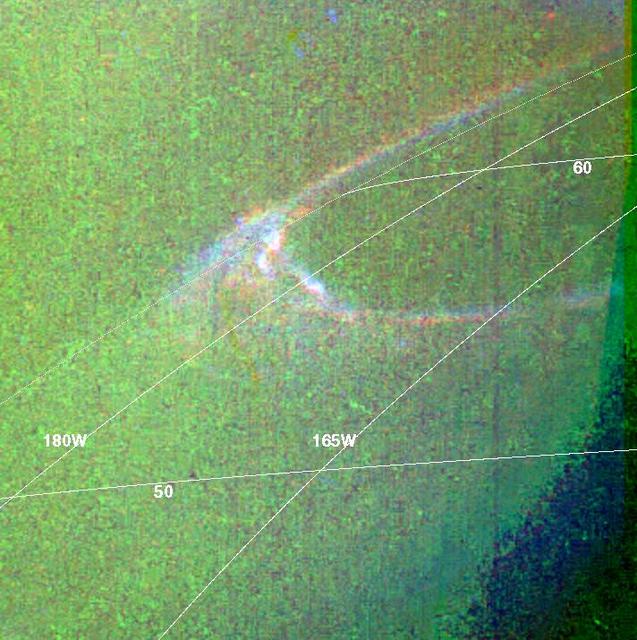
Data from NASA's Galileo spacecraft were used to produce this false-color composite of Jupiter's northern aurora on the night side of the planet. The height of the aurora, the thickness of the auroral arc, and the small-scale structure are revealed for the first time. Images in Galileo's red, green, and clear filters are displayed in red, green, and blue respectively. The smallest resolved features are tens of kilometers in size, which is a ten-fold improvement over Hubble Space Telescope images and a hundred-fold improvement over ground-based images. The glow is caused by electrically charged particles impinging on the atmosphere from above. The particles travel along Jupiter's magnetic field lines, which are nearly vertical at this latitude. The auroral arc marks the boundary between the "closed" field lines that are attached to the planet at both ends and the "open" field lines that extend out into interplanetary space. At the boundary the particles have been accelerated over the greatest distances, and the glow is especially intense. The latitude-longitude lines refer to altitudes where the pressure is 1 bar. The image shows that the auroral emissions originate about 500 kilometers (about 310 miles) above this surface. The colored background is light scattered from Jupiter's bright crescent, which is out of view to the right. North is at the top. The images are centered at 57 degrees north and 184 degrees west and were taken on April 2, 1997 at a range of 1.7 million kilometers (1.05 million miles) by Galileo's Solid State Imaging (SSI) system. http://photojournal.jpl.nasa.gov/catalog/PIA00603
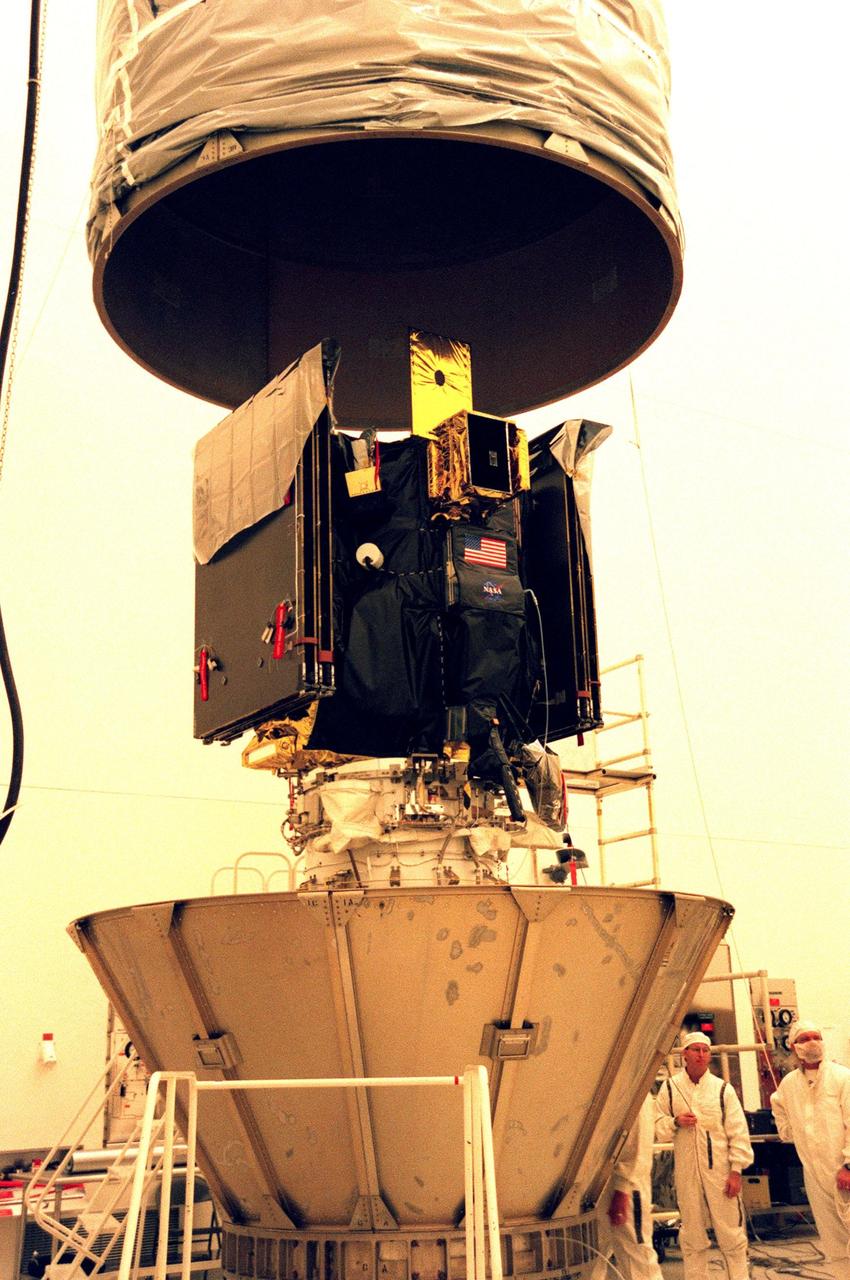
KENNEDY SPACE CENTER, FLA. -- In the Defense Satellite Communications Systems Processing Facility (DPF), Cape Canaveral Air Station (CCAS), the lower part of Deep Space 1 is enclosed with the conical section leaves of the payload transportation container prior to its move to Launch Pad 17A. The spacecraft is targeted for launch Oct. 25 aboard a Boeing Delta 7326 rocket. The first flight in NASA's New Millennium Program, Deep Space 1 is designed to validate 12 new technologies for scientific space missions of the next century, including the engine. Propelled by the gas xenon, the engine is being flight-tested for future deep space and Earth-orbiting missions. Deceptively powerful, the ion drive emits only an eerie blue glow as ionized atoms of xenon are pushed out of the engine. While slow to pick up speed, over the long haul it can deliver 10 times as much thrust per pound of fuel as liquid or solid fuel rockets. Other onboard experiments include software that tracks celestial bodies so the spacecraft can make its own navigation decisions without the intervention of ground controllers. Deep Space 1 will complete most of its mission objectives within the first two months, but will also do a flyby of a near-Earth asteroid, 1992 KD, in July 1999
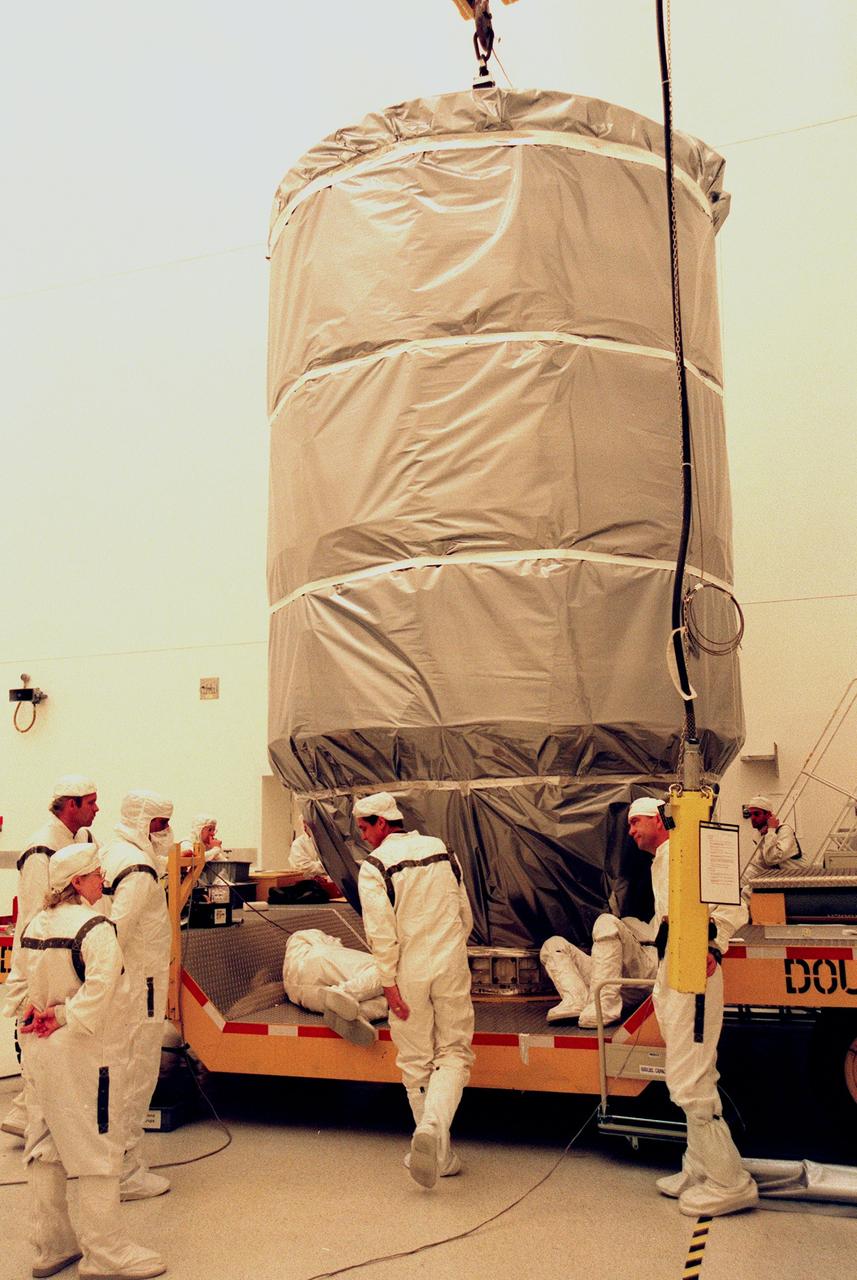
KENNEDY SPACE CENTER, FLA. - Wrapped in an antistatic blanket for protection, Deep Space 1 is moved out of the Defense Satellite Communications System Processing Facility (DPF) at Cape Canaveral Air Station (CCAS) for its trip to Launch Pad 17A. The spacecraft will be launched aboard Boeing's Delta 7326 rocket in October. The first flight in NASA's New Millennium Program, Deep Space 1 is designed to validate 12 new technologies for scientific space missions of the next century, including an ion propulsion engine. Propelled by the gas xenon, the engine is being flight tested for future deep space and Earth-orbiting missions. Deceptively powerful, the ion drive emits only an eerie blue glow as ionized atoms of xenon are pushed out of the engine. While slow to pick up speed, over the long haul it can deliver 10 times as much thrust per pound of fuel as liquid or solid fuel rockets. Other onboard experiments include softwre that tracks celestial bodies so the spacecraft can make its own navigation decisions without the intervention of ground controllers. Deep Space 1 will complete most of its mission objectives within the firs two months, but will also make a flyby of a near-Earth asteroid, 1992 KD, in July 1999.

KENNEDY SPACE CENTER, FLA. -- Just before sunrise, on Launch Pad 17A at Cape Canaveral Air Station, Deep Space 1 is hoisted up the mobile service tower for installation on a Boeing Delta 7326 rocket . The spacecraft is targeted for launch on Oct. 25. Deep Space 1 is the first flight in NASA's New Millennium Program, and is designed to validate 12 new technologies for scientific space missions of the next century, including the engine. Propelled by the gas xenon, the engine is being flight-tested for future deep space and Earth-orbiting missions. Deceptively powerful, the ion drive emits only an eerie blue glow as ionized atoms of xenon are pushed out of the engine. While slow to pick up speed, over the long haul it can deliver 10 times as much thrust per pound of fuel as liquid or solid fuel rockets. Other onboard experiments include software that tracks celestial bodies so the spacecraft can make its own navigation decisions without the intervention of ground controllers. Deep Space 1 will complete most of its mission objectives within the first two months, but will also do a flyby of a near-Earth asteroid, 1992 KD, in July 1999
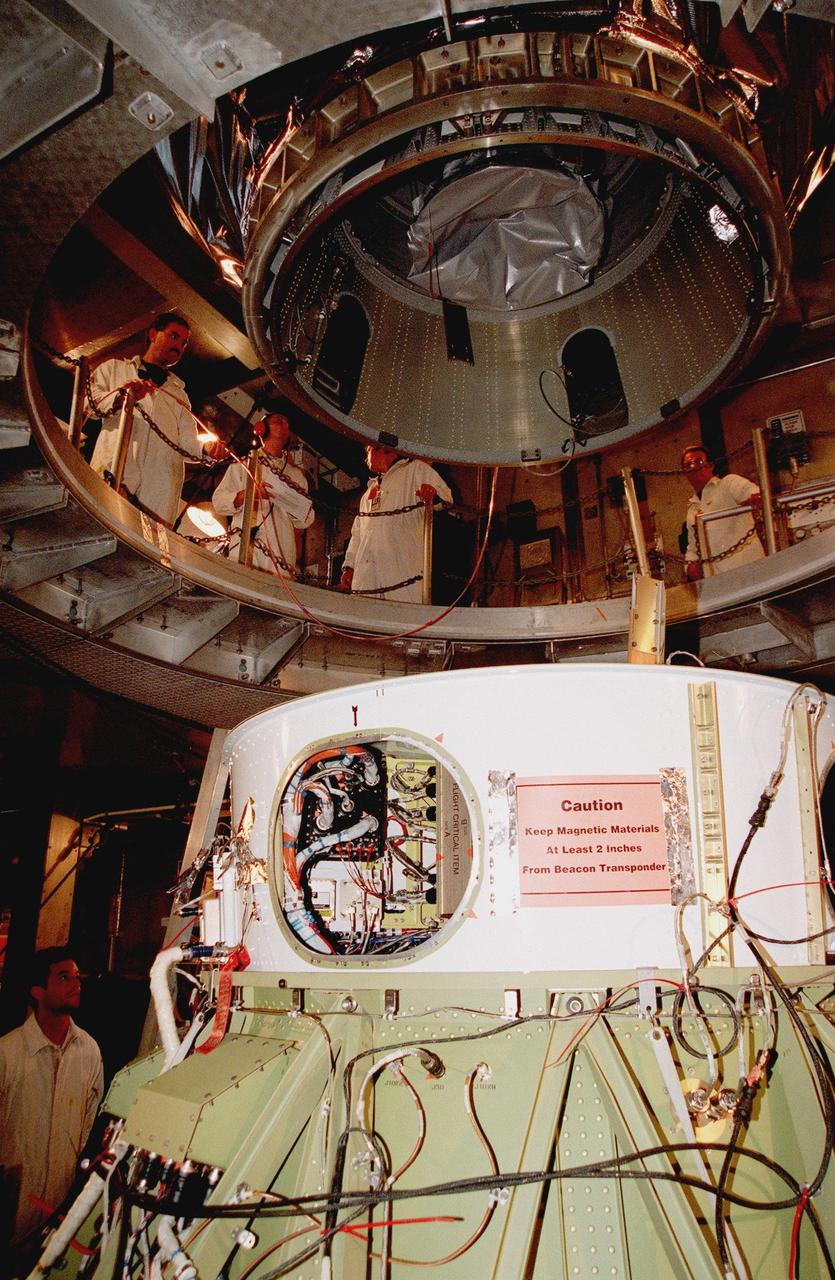
KENNEDY SPACE CENTER, FLA. -- On Launch Pad 17A at Cape Canaveral Air Station, Deep Space 1 is lowered toward the second stage of a Boeing Delta 7326 rocket. The adapter on the spacecraft can be seen surrounding the booster motor. Targeted for launch on Oct. 25, Deep Space 1 is the first flight in NASA's New Millennium Program, and is designed to validate 12 new technologies for scientific space missions of the next century, including the engine. Propelled by the gas xenon, the engine is being flight-tested for future deep space and Earth-orbiting missions. Deceptively powerful, the ion drive emits only an eerie blue glow as ionized atoms of xenon are pushed out of the engine. While slow to pick up speed, over the long haul it can deliver 10 times as much thrust per pound of fuel as liquid or solid fuel rockets. Other onboard experiments include software that tracks celestial bodies so the spacecraft can make its own navigation decisions without the intervention of ground controllers. Deep Space 1 will complete most of its mission objectives within the first two months, but will also do a flyby of a near-Earth asteroid, 1992 KD, in July 1999
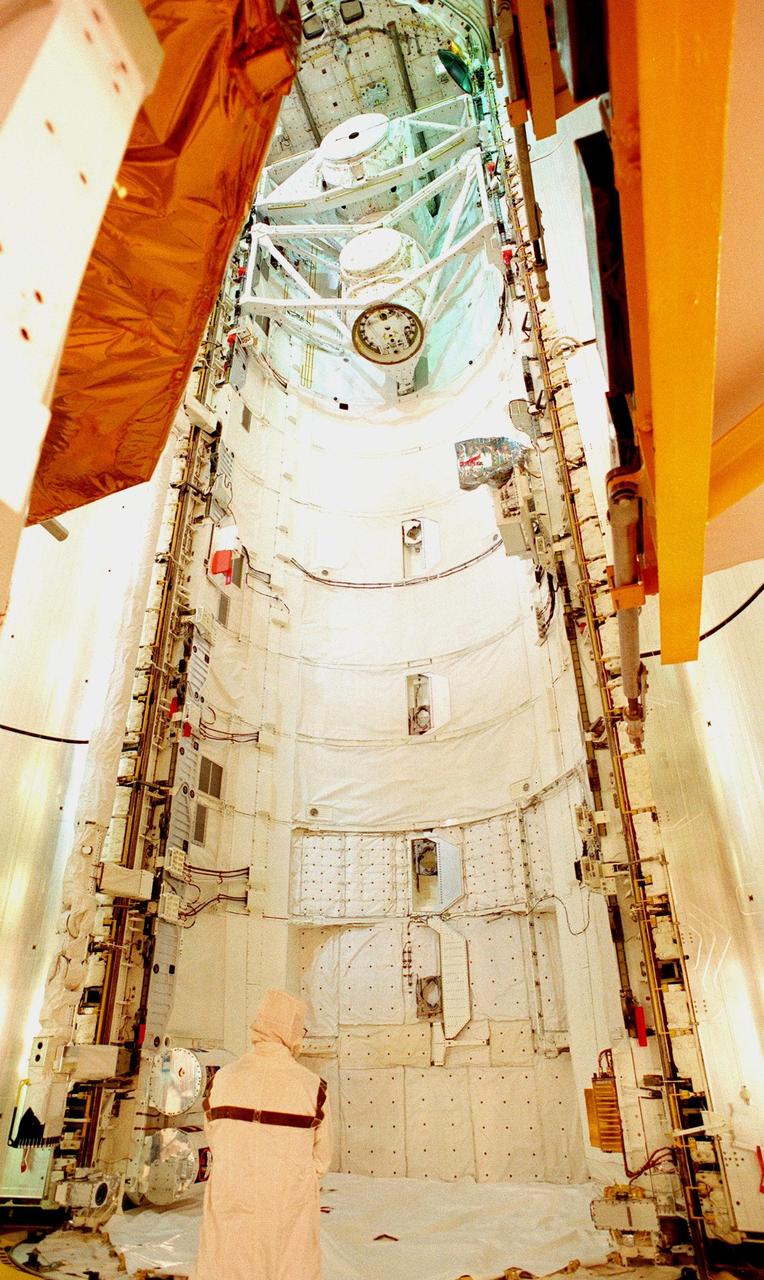
The open doors of the payload bay on Space Shuttle Discovery await the transfer of four of the payloads on mission STS-95: the SPACEHAB single module, Spartan, the Hubble Space Telescope Orbiting Systems Test Platform (HOST), and the International Extreme Ultraviolet Hitchhiker (IEH-3). At the top of bay are the airlock (used for depressurization and repressurization during extravehicular activity and transfer to Mir) and the tunnel adapter (enables the flight crew members to transfer from the pressurized middeck crew compartment to Spacelab's pressurized shirt-sleeve environment). SPACEHAB involves experiments on space flight and the aging process. Spartan is a solar physics spacecraft designed to perform remote sensing of the hot outer layers of the sun's atmosphere or corona. HOST carries four experiments to validate components planned for installation during the third Hubble Space Telescope servicing mission and to evaluate new technologies in an Earth-orbiting environment. IEH-3 comprises several experiments that will study the Jovian planetary system, hot stars, planetary and reflection nebulae, other stellar objects and their environments through remote observation of EUV/FUV emissions; study spacecraft interactions, Shuttle glow, thruster firings, and contamination; and measure the solar constant and identify variations in the value during a solar cycle. Discovery is scheduled to launch on Oct. 29, 1998
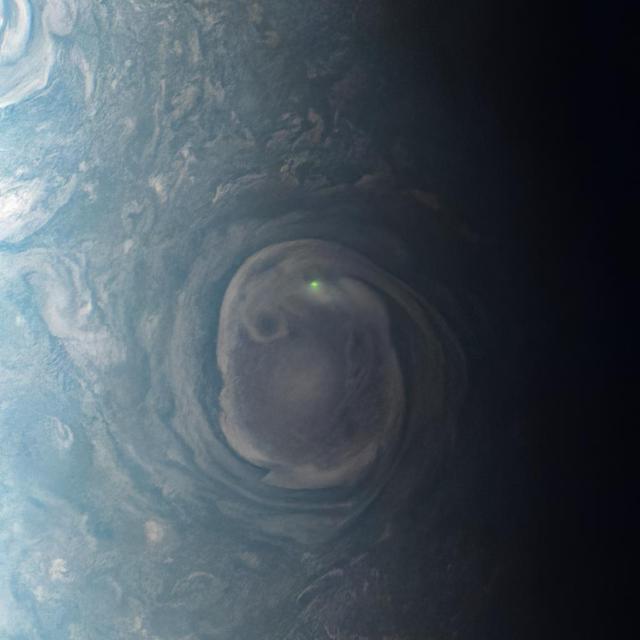
In this view of a vortex near Jupiter's north pole, NASA's Juno mission observed the glow from a bolt of lightning. On Earth, lightning bolts originate from water clouds, and happen most frequently near the equator, while on Jupiter lightning likely also occurs in clouds containing an ammonia-water solution, and can be seen most often near the poles. In the coming months, Juno's orbits will repeatedly take it close to Jupiter as the spacecraft passes over the giant planet's night side, which will provide even more opportunities for Juno's suite of science instruments to catch lightning in the act. Juno captured this view as Juno completed its 31st close flyby of Jupiter on Dec. 30, 2020. In 2022, Citizen scientist Kevin M. Gill processed the image from raw data from the JunoCam instrument aboard the spacecraft. At the time the raw image was taken, Juno was about 19,900 miles (32,000 kilometers) above Jupiter's cloud tops, at a latitude of about 78 degrees as it approached the planet. https://photojournal.jpl.nasa.gov/catalog/PIA25020
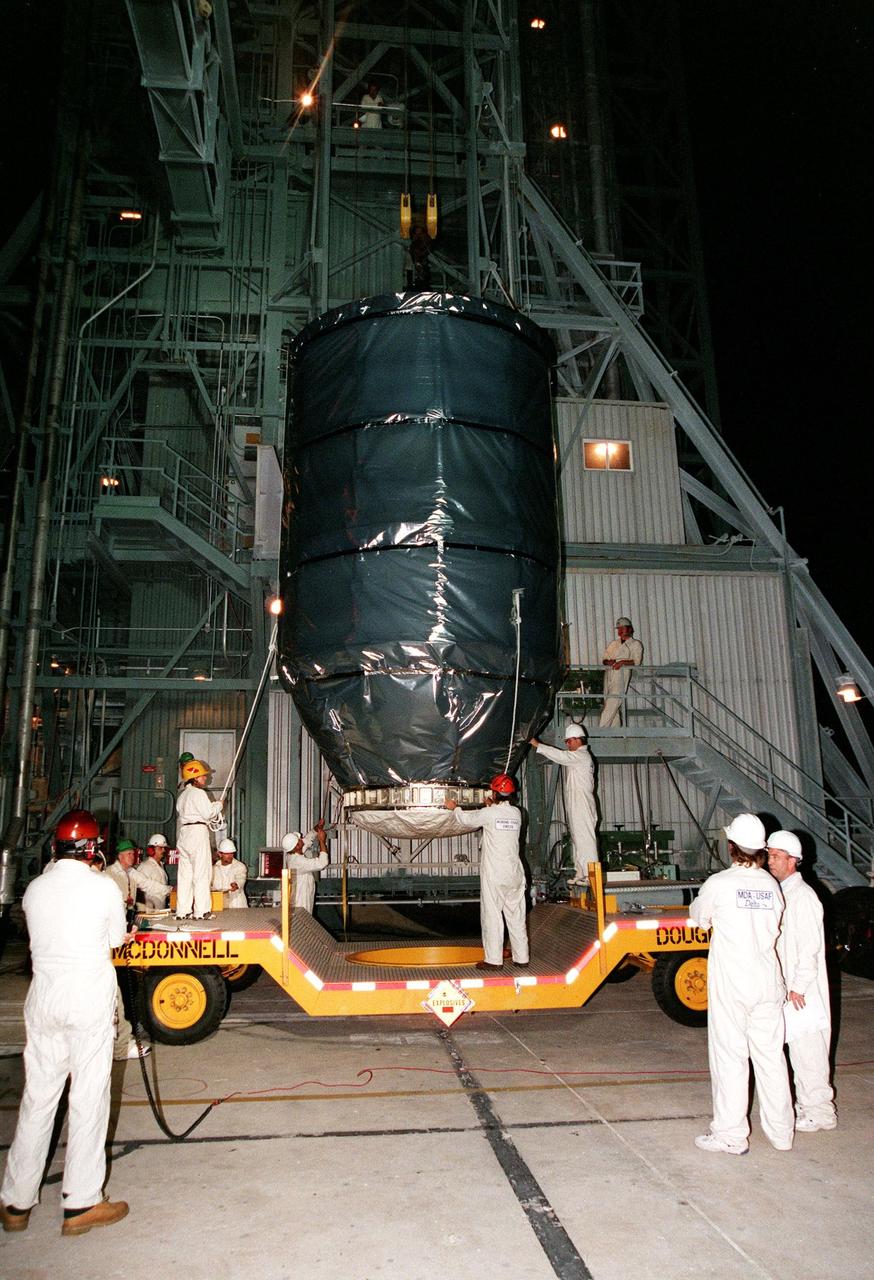
KENNEDY SPACE CENTER, FLA. -- Wrapped in an anti-static blanket for protection, Deep Space 1 is lifted out of the transporter that carried it to Launch Pad 17A at Cape Canaveral Air Station. The spacecraft will be launched aboard a Boeing Delta 7326 rocket on Oct. 25. Deep Space 1 is the first flight in NASA's New Millennium Program, and is designed to validate 12 new technologies for scientific space missions of the next century, including the engine. Propelled by the gas xenon, the engine is being flight-tested for future deep space and Earth-orbiting missions. Deceptively powerful, the ion drive emits only an eerie blue glow as ionized atoms of xenon are pushed out of the engine. While slow to pick up speed, over the long haul it can deliver 10 times as much thrust per pound of fuel as liquid or solid fuel rockets. Other onboard experiments include software that tracks celestial bodies so the spacecraft can make its own navigation decisions without the intervention of ground controllers. Deep Space 1 will complete most of its mission objectives within the first two months, but will also do a flyby of a near-Earth asteroid, 1992 KD, in July 1999
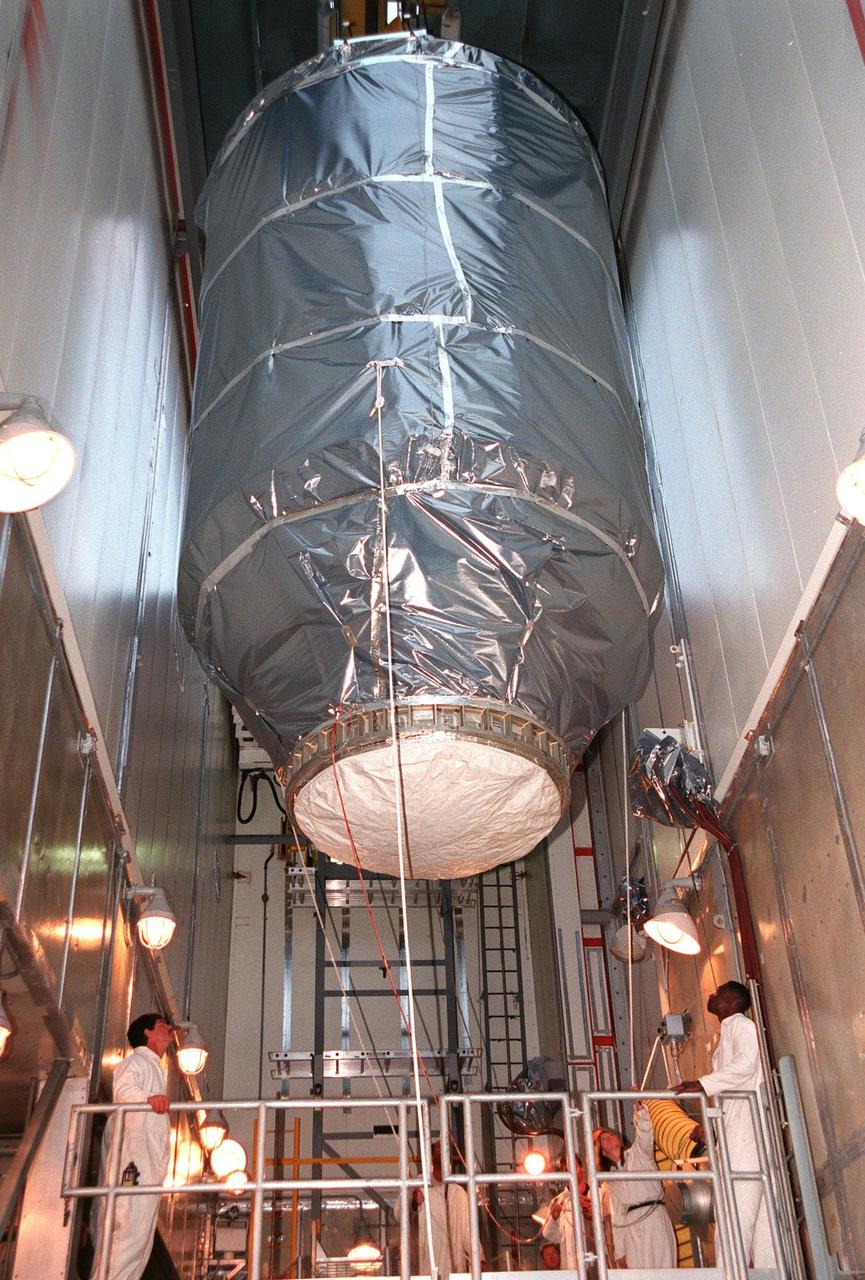
KENNEDY SPACE CENTER, FLA. -- On Launch Pad 17A at Cape Canaveral Air Station, Deep Space 1 is lowered in the white room for installation on a Boeing Delta 7326 rocket . The spacecraft is targeted for launch on Oct. 25. Deep Space 1 is the first flight in NASA's New Millennium Program, and is designed to validate 12 new technologies for scientific space missions of the next century, including the engine. Propelled by the gas xenon, the engine is being flight-tested for future deep space and Earth-orbiting missions. Deceptively powerful, the ion drive emits only an eerie blue glow as ionized atoms of xenon are pushed out of the engine. While slow to pick up speed, over the long haul it can deliver 10 times as much thrust per pound of fuel as liquid or solid fuel rockets. Other onboard experiments include software that tracks celestial bodies so the spacecraft can make its own navigation decisions without the intervention of ground controllers. Deep Space 1 will complete most of its mission objectives within the first two months, but will also do a flyby of a near-Earth asteroid, 1992 KD, in July 1999
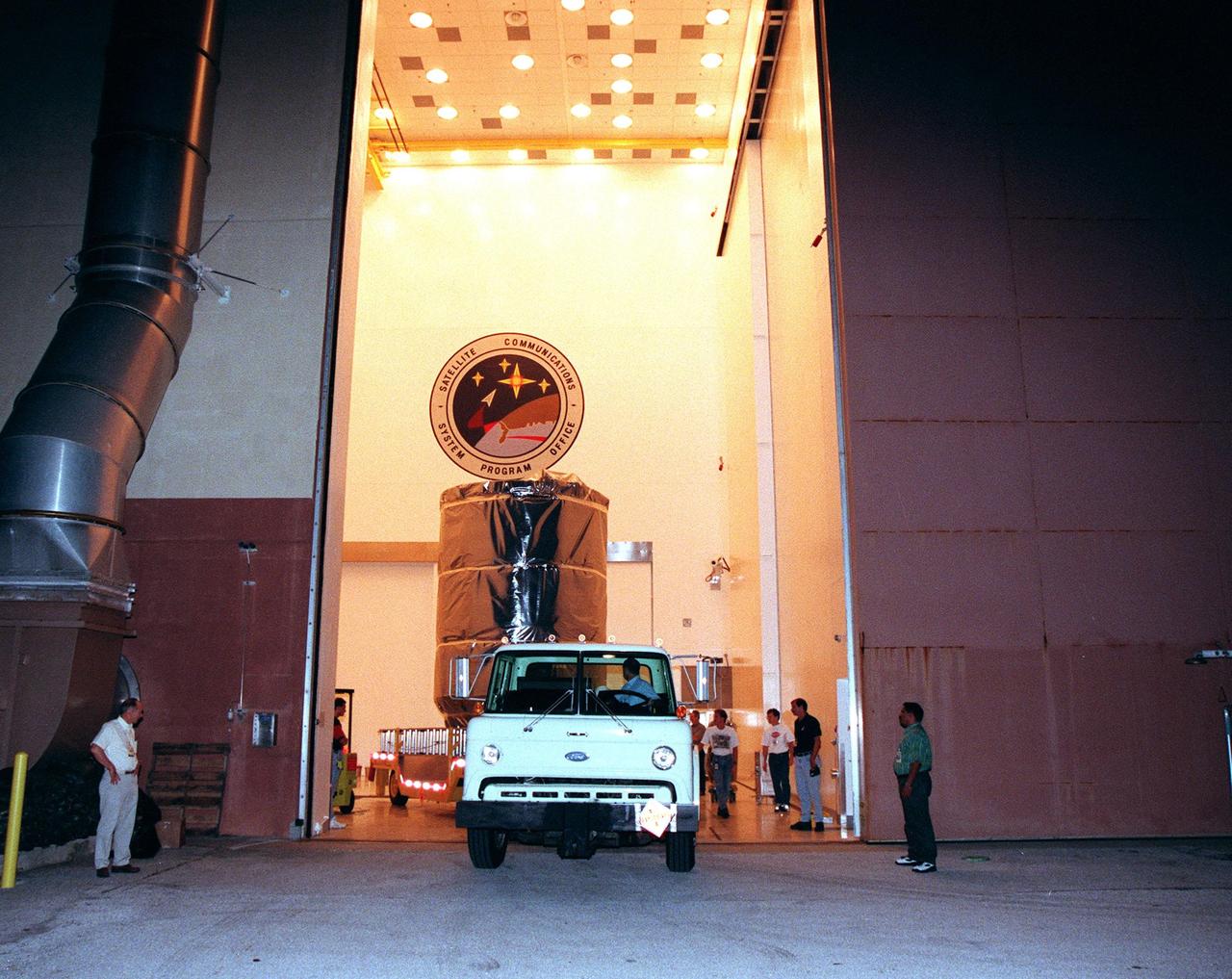
KENNEDY SPACE CENTER, FLA. -- Wrapped in an anti-static blanket for protection, Deep Space 1 is moved out of the Defense Satellite Communications Systems Processing Facility (DPF) at Cape Canaveral Air Station (CCAS) for its trip to Launch Pad 17A. The spacecraft will be launched aboard a Boeing Delta 7326 rocket on Oct. 25. Deep Space 1 is the first flight in NASA's New Millennium Program, and is designed to validate 12 new technologies for scientific space missions of the next century, including the engine. Propelled by the gas xenon, the engine is being flight-tested for future deep space and Earth-orbiting missions. Deceptively powerful, the ion drive emits only an eerie blue glow as ionized atoms of xenon are pushed out of the engine. While slow to pick up speed, over the long haul it can deliver 10 times as much thrust per pound of fuel as liquid or solid fuel rockets. Other onboard experiments include software that tracks celestial bodies so the spacecraft can make its own navigation decisions without the intervention of ground controllers. Deep Space 1 will complete most of its mission objectives within the first two months, but will also do a flyby of a near-Earth asteroid, 1992 KD, in July 1999
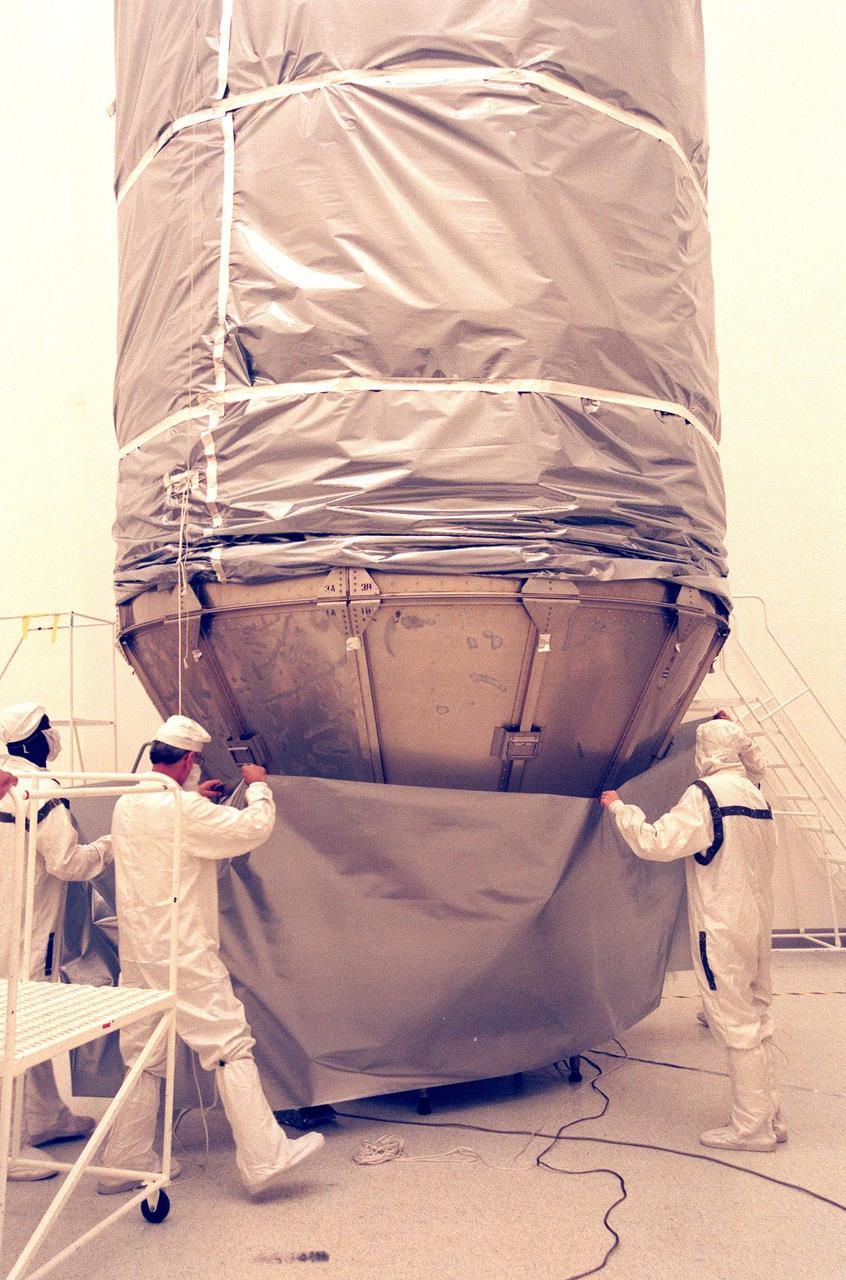
KENNEDY SPACE CENTER, FLA. -- In the Defense Satellite Communications Systems Processing Facility (DPF), Cape Canaveral Air Station (CCAS), workers place an anti-static blanket over the lower portion of Deep Space 1, to protect the spacecraft during transport to the launch pad. The first flight in NASA's New Millennium Program, Deep Space 1 is designed to validate 12 new technologies for scientific space missions of the next century, including the engine. Propelled by the gas xenon, the engine is being flight-tested for future deep space and Earth-orbiting missions. Deceptively powerful, the ion drive emits only an eerie blue glow as ionized atoms of xenon are pushed out of the engine. While slow to pick up speed, over the long haul it can deliver 10 times as much thrust per pound of fuel as liquid or solid fuel rockets. Other onboard experiments include software that tracks celestial bodies so the spacecraft can make its own navigation decisions without the intervention of ground controllers. Deep Space 1 will complete most of its mission objectives within the first two months, but will also do a flyby of a near-Earth asteroid, 1992 KD, in July 1999. Deep Space 1 will be launched aboard a Boeing Delta 7326 rocket from Launch Pad 17A, CCAS
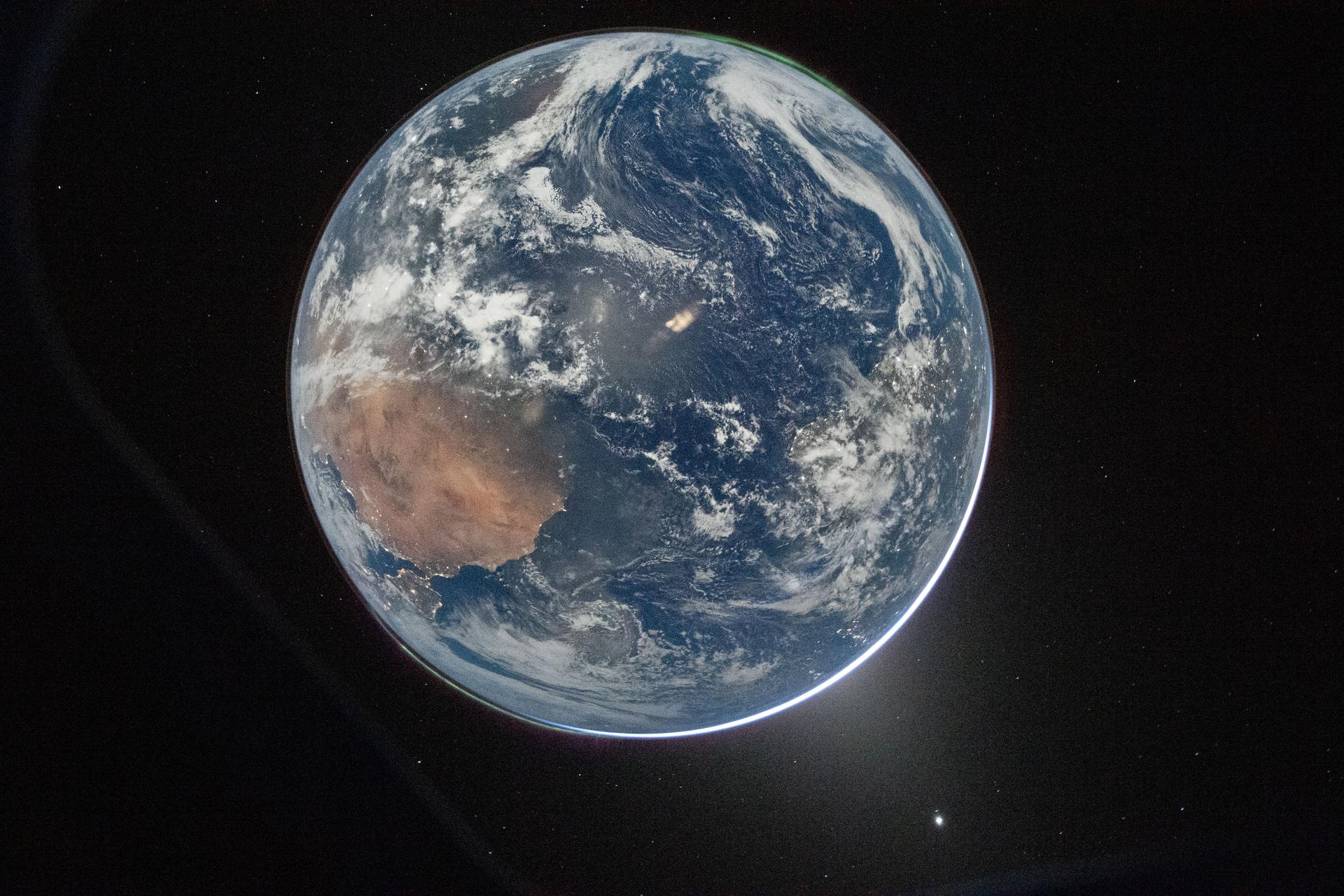
art002e000192 (April 3, 2026) - This nighttime picture of Earth was taken on April 2, 2026, by an Artemis II crew member aiming a camera through a window of the Orion spacecraft. The image was captured after Orion completed its translunar injection burn, the critical maneuver that sent the spacecraft on its path toward the Moon and back. The visible hemisphere appears awash in sunlight, but it is actually lit by moonlight — sunlight reflected from the lunar surface. Along the upper left (south) and lower right (north) edges of Earth’s disk, green auroras glow against the dark sky, showing charged particles from the Sun interacting with gases in Earth’s atmosphere. Africa is visible on the left, while a translucent cone of light capped by a bright Venus extends into space from Earth’s lower right edge. This zodiacal light is caused by sunlight reflecting off interplanetary dust. A thin white crescent along the lower right edge of Earth marks the planet’s daytime atmosphere illuminated by the Sun, which lies on the opposite side of Earth from Orion’s perspective. City lights are also visible, especially along coastlines. Credits: NASA
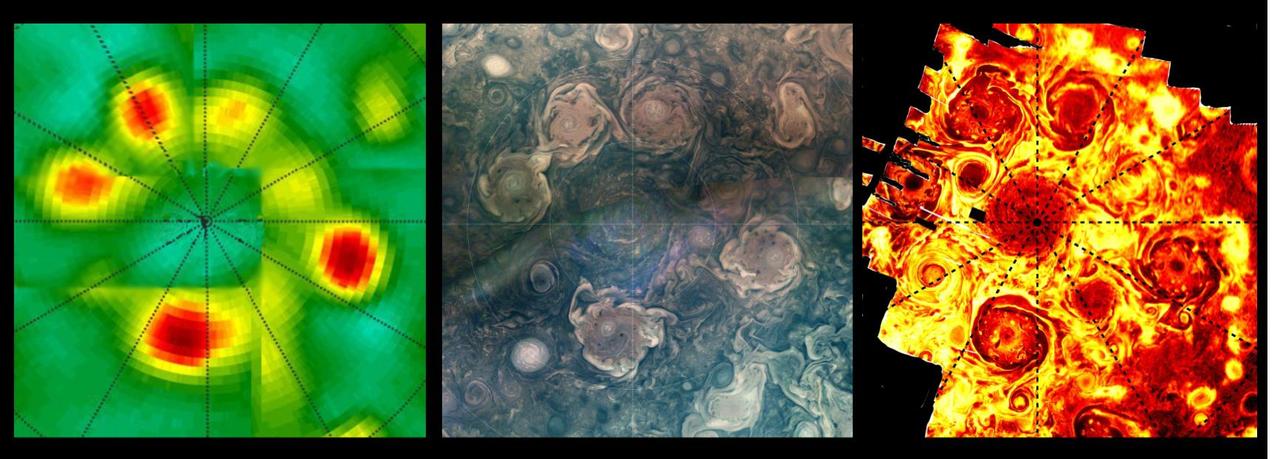
This composite shows views of Jupiter's northern polar cyclones in three different wavelengths of light – microwave, visible, and ultraviolet – as captured by NASA's Juno mission. These differing perspectives allowed Juno scientists to deduce that all Jovian polar cyclones are not created equal. The infrared image, on the far right, was derived from data collected by the spacecraft's Jovian Infrared Auroral Mapper (JIRAM) instrument. The composite image at center was collected by the JunoCam visible-light imager. Though taken with separate instruments that record different wavelengths of light, both images depict Jupiter's northern polar storms as well defined and of similar size. The data on the left, collected by Juno's Microwave Radiometer (MWR), shows the polar storms in another light. MWR enables Juno to see deep into Jupiter by recording the planet's microwave emissions. In the MWR graphic, the polar storms at the 4 and 6 o'clock positions have bright microwave signatures, indicating they extend well beneath the cloud tops, at least 62 miles (100 kilometers) below. The size of those two storms is comparable to what's found in the visible light and infrared light images, but the other storms, as seen through MWR, have a notably reduced emissions intensity. Another disparity in the MWR graphic versus visible light and infrared can be seen in how the central cyclone is depicted by the data. In the infrared and visible light images, the central cyclone is evident; with MWR data, it all but disappears. This disparity indicates that the central cyclone's subsurface structure must be very different from the surrounding storms. JIRAM "sees" in infrared light not visible to the human eye. It captures the infrared glow from the heat of Jupiter's upper atmosphere, probing the top of the weather layer, and gaps in the clouds allow glimpses as deep as 30 to 45 miles (50 to 70 kilometers) below Jupiter's cloud tops. JunoCam's visible light images catch reflected sunlight, with a view that is very similar to what a human eye would see if a person could ride along with Juno. JunoCam's raw images are available for the public to peruse and process into image products at https://missionjuno.swri.edu/junocam/processing. Like JIRAM, the MWR instrument records the glow of Jupiter's atmosphere, but the brightness results from the temperature at depths below anything achievable with previous spacecraft or Earth-based observations. The MWR's six radio channels peer progressively deeper below the visible cloud tops, with a range from the top of the clouds (for the highest frequency channel) to 200 miles (320 kilometers) or more below (for the lowest frequency channel). https://photojournal.jpl.nasa.gov/catalog/PIA26295
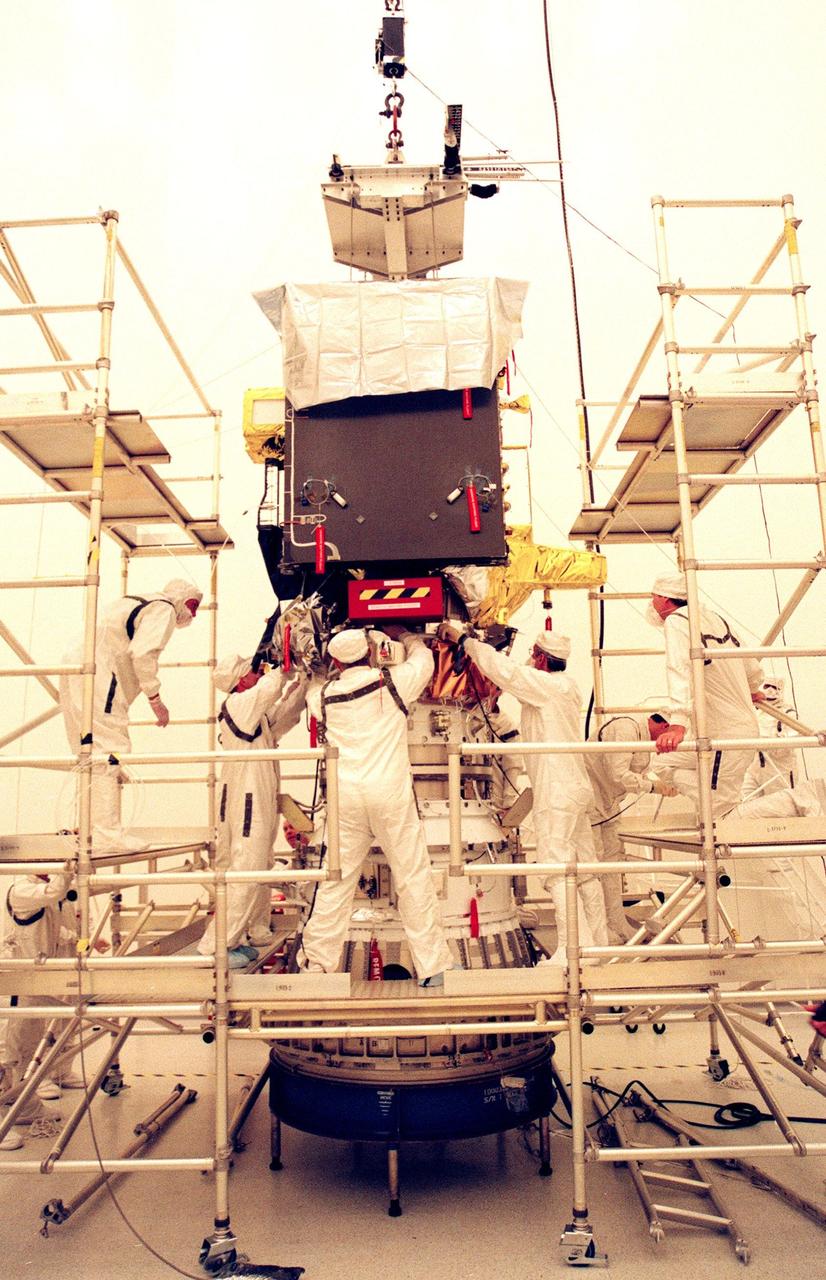
KENNEDY SPACE CENTER, FLA. -- Workers at the Defense Satellite Communications System Processing Facility (DPF), Cape Canaveral Air Station (CCAS), make adjustments while installing the ion propulsion engine on Deep Space 1. The first flight in NASA's New Millennium Program, Deep Space 1 is designed to validate 12 new technologies for scientific space missions of the next century, including the engine. Propelled by the gas xenon, the engine is being flight-tested for future deep space and Earth-orbiting missions. Deceptively powerful, the ion drive emits only an eerie blue glow as ionized atoms of xenon are pushed out of the engine. While slow to pick up speed, over the long haul it can deliver 10 times as much thrust per pound of fuel as liquid or solid fuel rockets. Other onboard experiments include software that tracks celestial bodies so the spacecraft can make its own navigation decisions without the intervention of ground controllers. Deep Space 1 will complete most of its mission objectives within the first two months, but will also do a flyby of a near-Earth asteroid, 1992 KD, in July 1999. Deep Space 1 will be launched aboard a Boeing Delta 7326 rocket from Launch Pad 17A, CCAS, in October
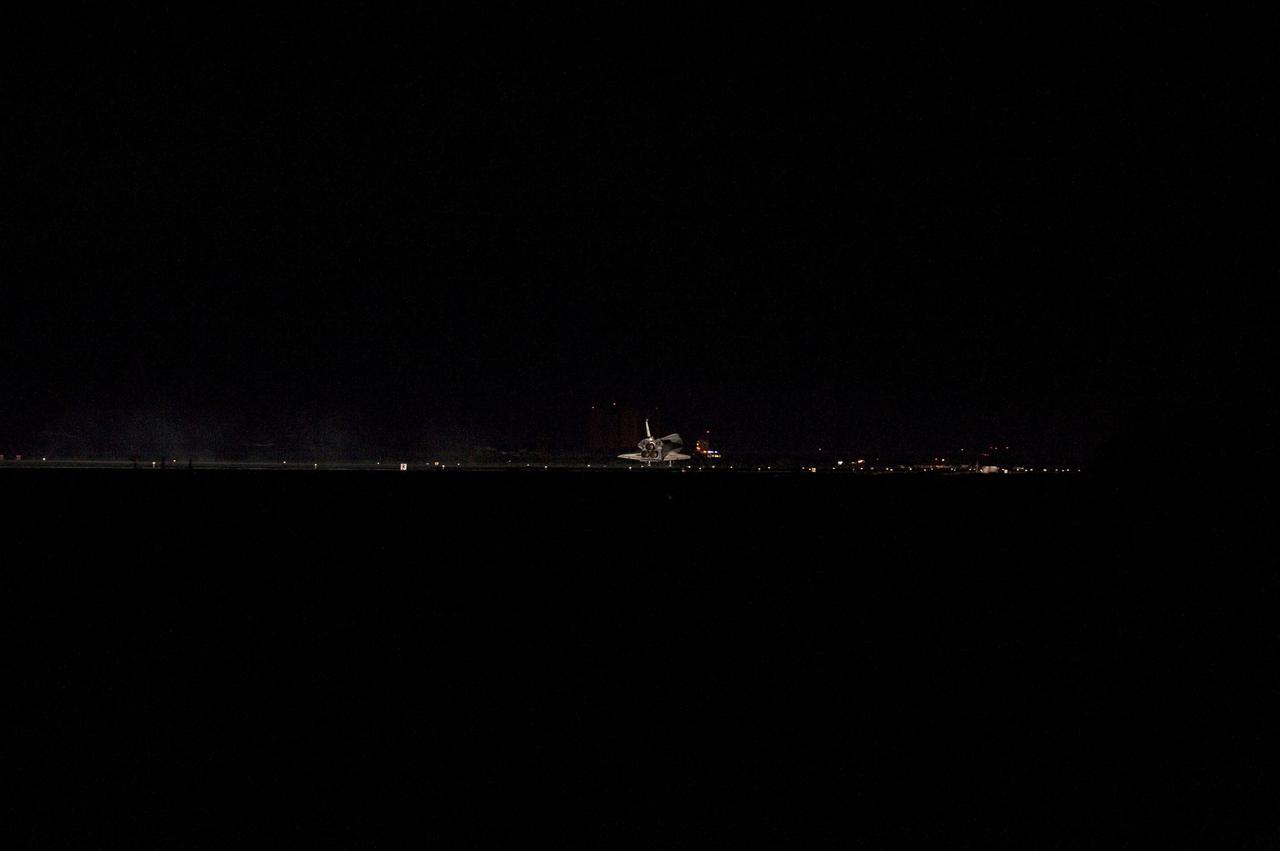
CAPE CANAVERAL, Fla. -- Space shuttle Atlantis' three main engines glow a red hue in the spacecraft's tail end as it touches down on the Shuttle Landing Facility's Runway 15 at NASA's Kennedy Space Center in Florida for the final time. Securing the space shuttle fleet's place in history, Atlantis marked the 26th nighttime landing of NASA's Space Shuttle Program and the 78th landing at Kennedy. Main gear touchdown was at 5:57:00 a.m. EDT, followed by nose gear touchdown at 5:57:20 a.m., and wheelstop at 5:57:54 a.m. On board are STS-135 Commander Chris Ferguson, Pilot Doug Hurley, and Mission Specialists Sandra Magnus and Rex Walheim. On the 37th shuttle mission to the International Space Station, STS-135 delivered more than 9,400 pounds of spare parts, equipment and supplies in the Raffaello multi-purpose logistics module that will sustain station operations for the next year. STS-135 was the 33rd and final flight for Atlantis, which has spent 307 days in space, orbited Earth 4,848 times and traveled 125,935,769 miles. For more information visit, www.nasa.gov/mission_pages/shuttle/shuttlemissions/sts135/index.html. Photo credit: NASA/Sandra Joseph
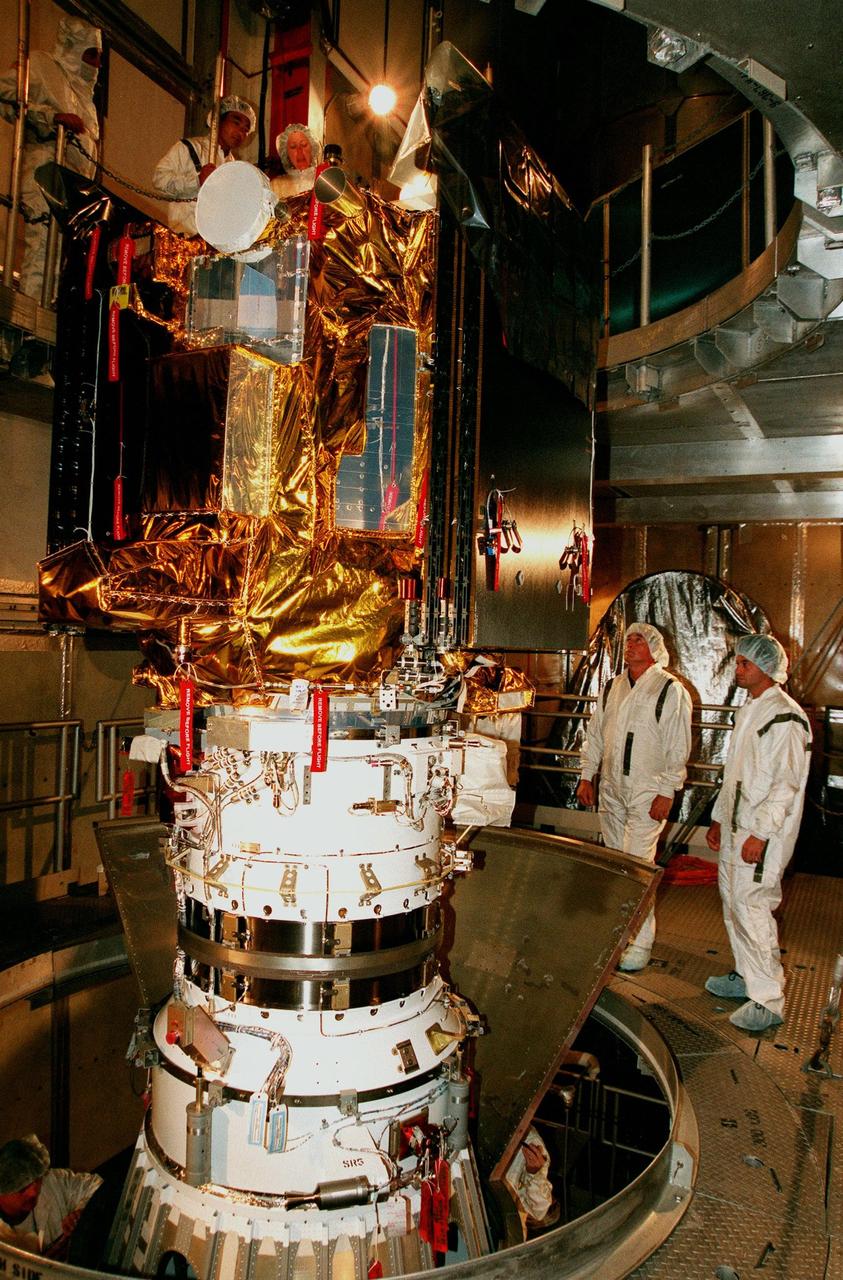
KENNEDY SPACE CENTER, FLA. -- On Launch Pad 17A at Cape Canaveral Air Station, Deep Space 1 is uncovered after installation on a Boeing Delta 7326 rocket. Targeted for launch on Oct. 25, Deep Space 1 is the first flight in NASA's New Millennium Program, and is designed to validate 12 new technologies for scientific space missions of the next century, including the engine. Propelled by the gas xenon, the engine is being flight-tested for future deep space and Earth-orbiting missions. Deceptively powerful, the ion drive emits only an eerie blue glow as ionized atoms of xenon are pushed out of the engine. While slow to pick up speed, over the long haul it can deliver 10 times as much thrust per pound of fuel as liquid or solid fuel rockets. Other onboard experiments include software that tracks celestial bodies so the spacecraft can make its own navigation decisions without the intervention of ground controllers. Deep Space 1 will complete most of its mission objectives within the first two months, but will also do a flyby of a near-Earth asteroid, 1992 KD, in July 1999
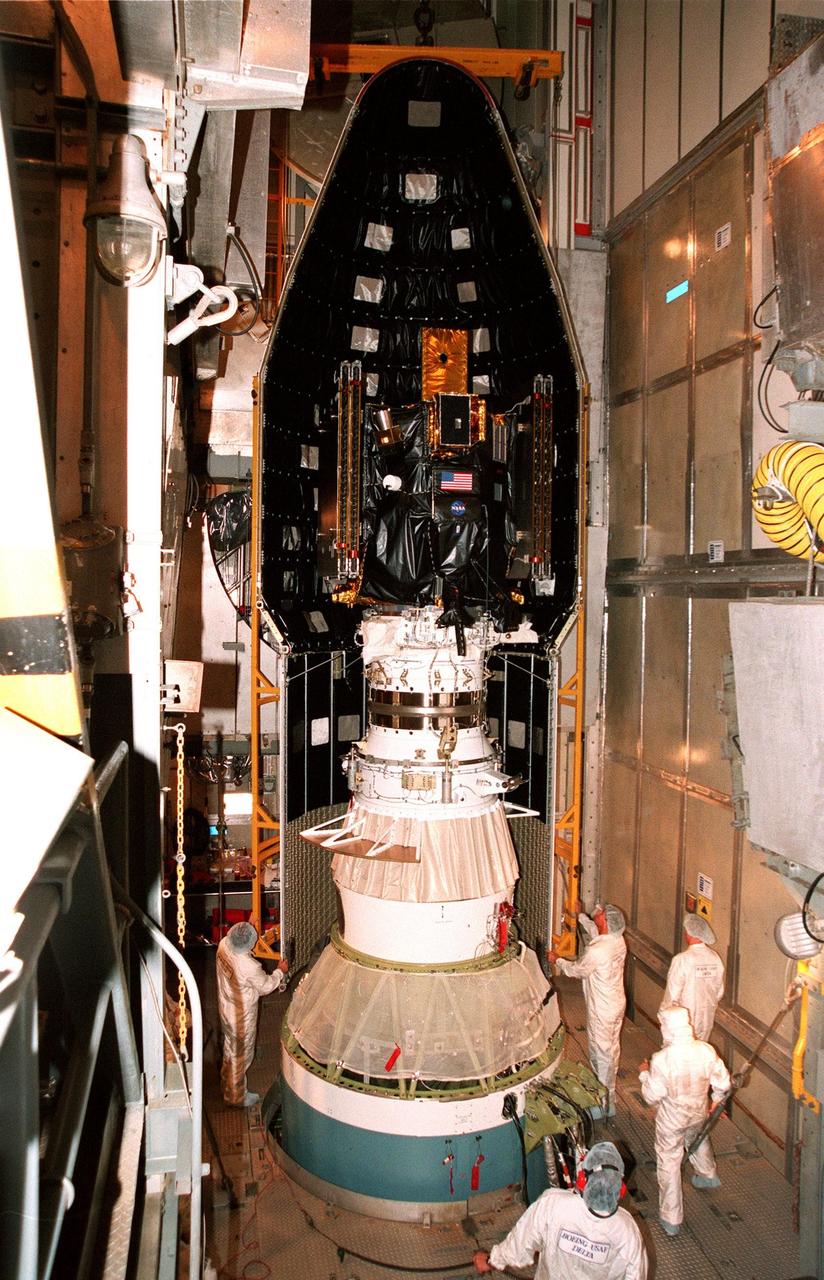
KENNEDY SPACE CENTER, FLA. -- On Launch Pad 17A at Cape Canaveral Air Station, workers maneuver part of the fairing (viewed from the inside) to encapsulate Deep Space 1. Targeted for launch aboard a Boeing Delta 7326 rocket on Oct. 25, Deep Space 1 is the first flight in NASA's New Millennium Program, and is designed to validate 12 new technologies for scientific space missions of the next century, including the engine. Propelled by the gas xenon, the engine is being flight-tested for future deep space and Earth-orbiting missions. Deceptively powerful, the ion drive emits only an eerie blue glow as ionized atoms of xenon are pushed out of the engine. While slow to pick up speed, over the long haul it can deliver 10 times as much thrust per pound of fuel as liquid or solid fuel rockets. Other onboard experiments include software that tracks celestial bodies so the spacecraft can make its own navigation decisions without the intervention of ground controllers. Deep Space 1 will complete most of its mission objectives within the first two months, but will also do a flyby of a near-Earth asteroid, 1992 KD, in July 1999
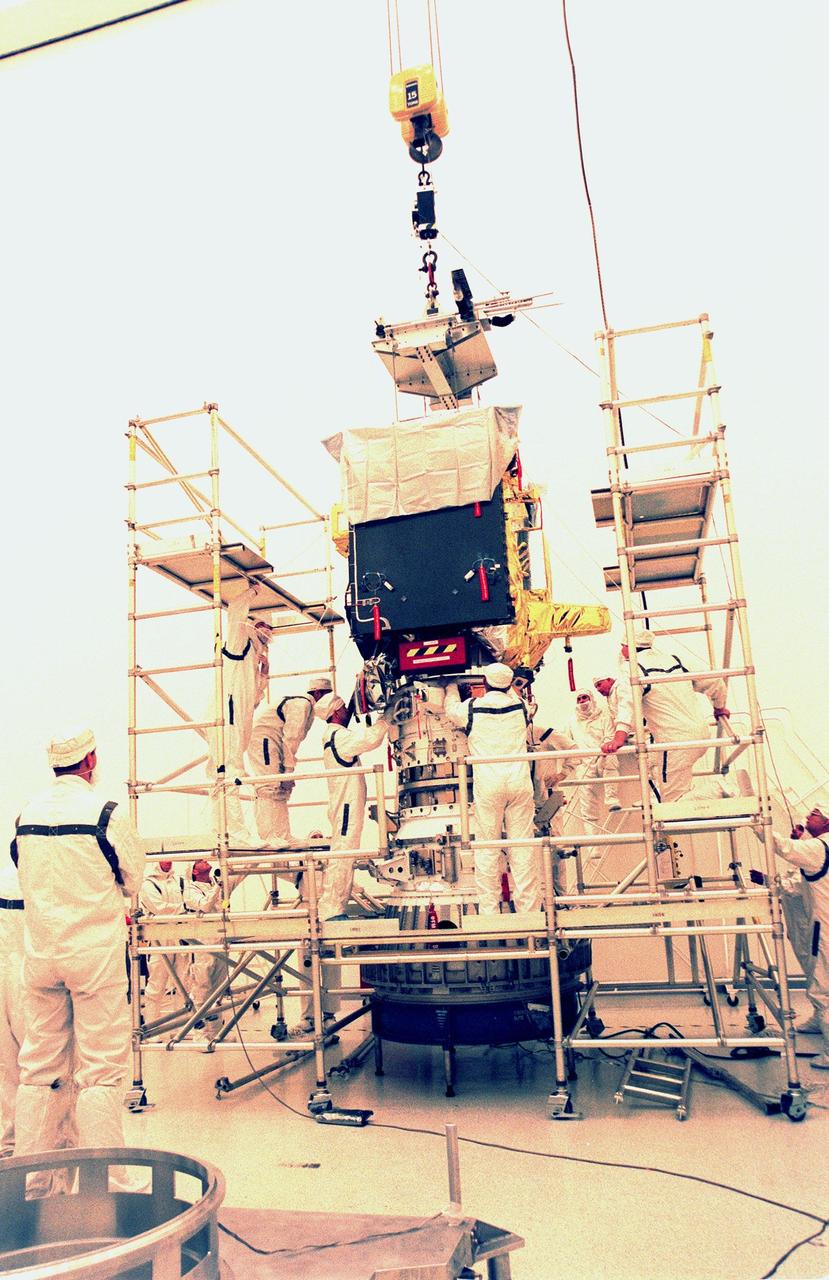
KENNEDY SPACE CENTER, FLA. -- Workers in the Defense Satellite Communications Systems Processing Facility (DPF) at Cape Canaveral Air Station (CCAS) make adjustments while installing the ion propulsion engine on Deep Space 1. The first flight in NASA's New Millennium Program, Deep Space 1 is designed to validate 12 new technologies for scientific space missions of the next century, including the engine. Propelled by the gas xenon, the engine is being flight-tested for future deep space and Earth-orbiting missions. Deceptively powerful, the ion drive emits only an eerie blue glow as ionized atoms of xenon are pushed out of the engine. While slow to pick up speed, over the long haul it can deliver 10 times as much thrust per pound of fuel as liquid or solid fuel rockets. Other onboard experiments include software that tracks celestial bodies so the spacecraft can make its own navigation decisions without the intervention of ground controllers. Deep Space 1 will complete most of its mission objectives within the first two months, but will also do a flyby of a near-Earth asteroid, 1992 KD, in July 1999. Deep Space 1 will be launched Oct. 25 aboard a Boeing Delta 7326 rocket from Launch Pad 17A, CCAS