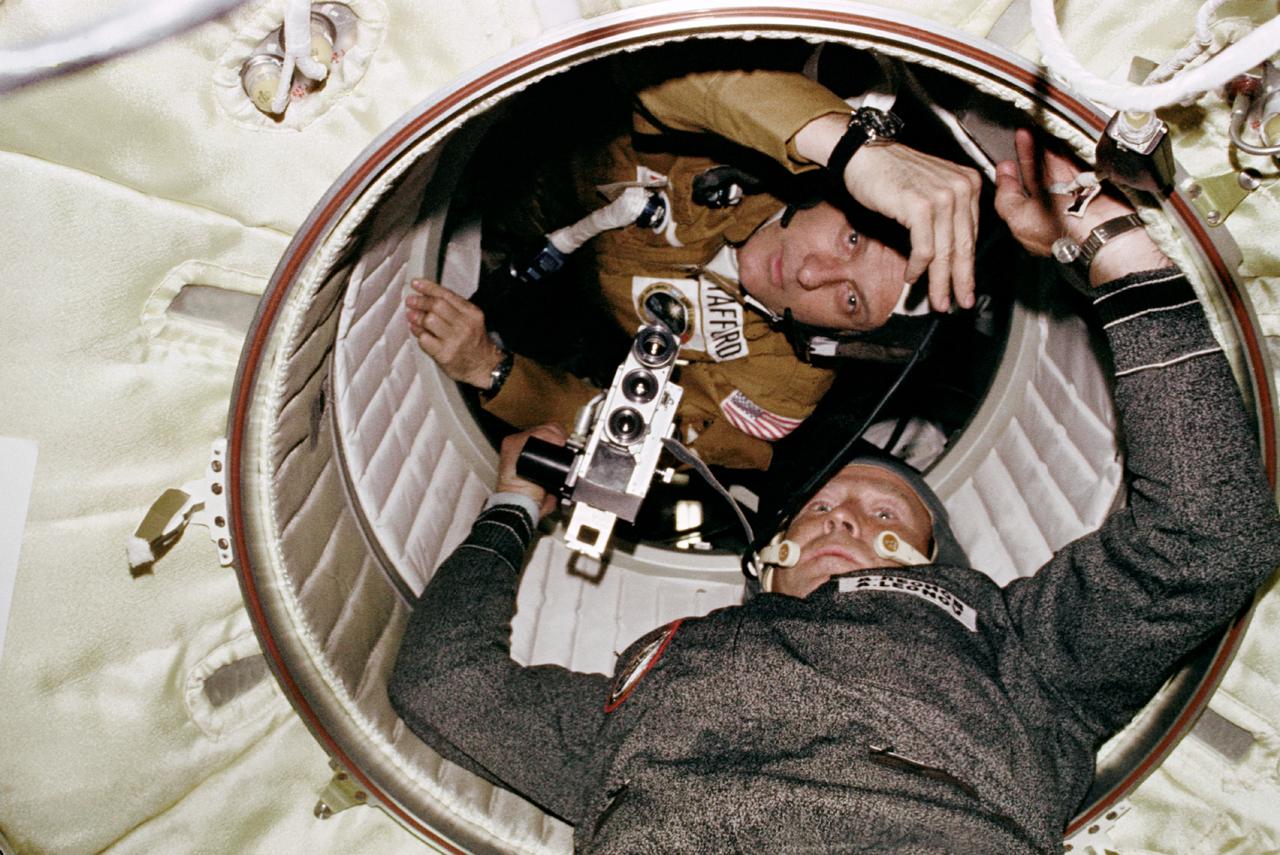
AST-03-191 (17-19 July 1975) --- Astronaut Thomas P. Stafford and cosmonaut Aleksei A. Leonov are seen at the hatchway leading from the Apollo Docking Module (DM) to the Soyuz Orbital Module (OM) during the joint U.S.-USSR Apollo Soyuz Test Project (ASTP) docking mission in Earth orbit. Cosmonaut Leonov is in the OM and astronaut Stafford is in the DM. Leonov holds a camera. The Apollo crew consisted of astronauts Stafford, commander; Donald K. "Deke" Slayton, docking module pilot; Vance D. Brand, command module pilot. The Soyuz 19 crew consisted of cosmonauts Leonov, command pilot; and Valeri N. Kubasov, flight engineer.

AST-05-263 (17-18 July 1975) --- The Apollo-Soyuz Test Project (ASTP) Commemorative Plaque is assembled in the Soviet Soyuz Orbital Module during the joint U.S.-USSR Apollo-Soyuz Test Project docking mission in Earth orbit. The plaque is written both in English and Russian.
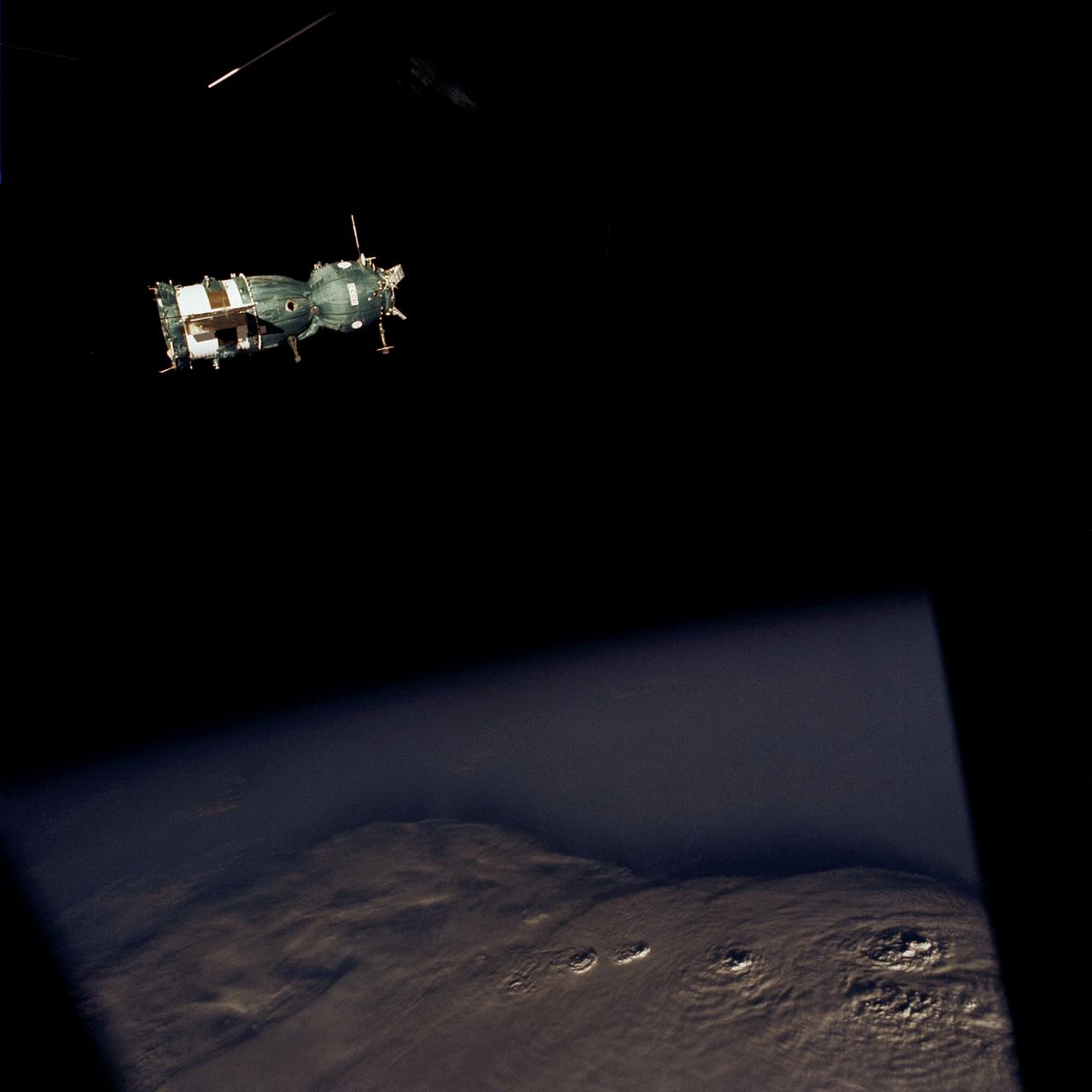
AST-02-096 (18 July 1975) --- This scene photograph from a rendezvous window of the American Apollo spacecraft in Earth orbit shows the Soviet Soyuz spacecraft contrasted against a black-sky background with a heavily cloud-covered Earth below. The three major components of the Soyuz are the spherical-shaped Orbital Module, the bell-shaped Descent Vehicle, the cylindrical-shaped Instrument Assembly Module. The docking system on the Orbital Module was specially designed to interface with the docking system on the Apollo's Docking Module. The ASTP astronauts and cosmonauts visited each other's spacecraft while the Soyuz and Apollo were docked in Earth orbit for two days.
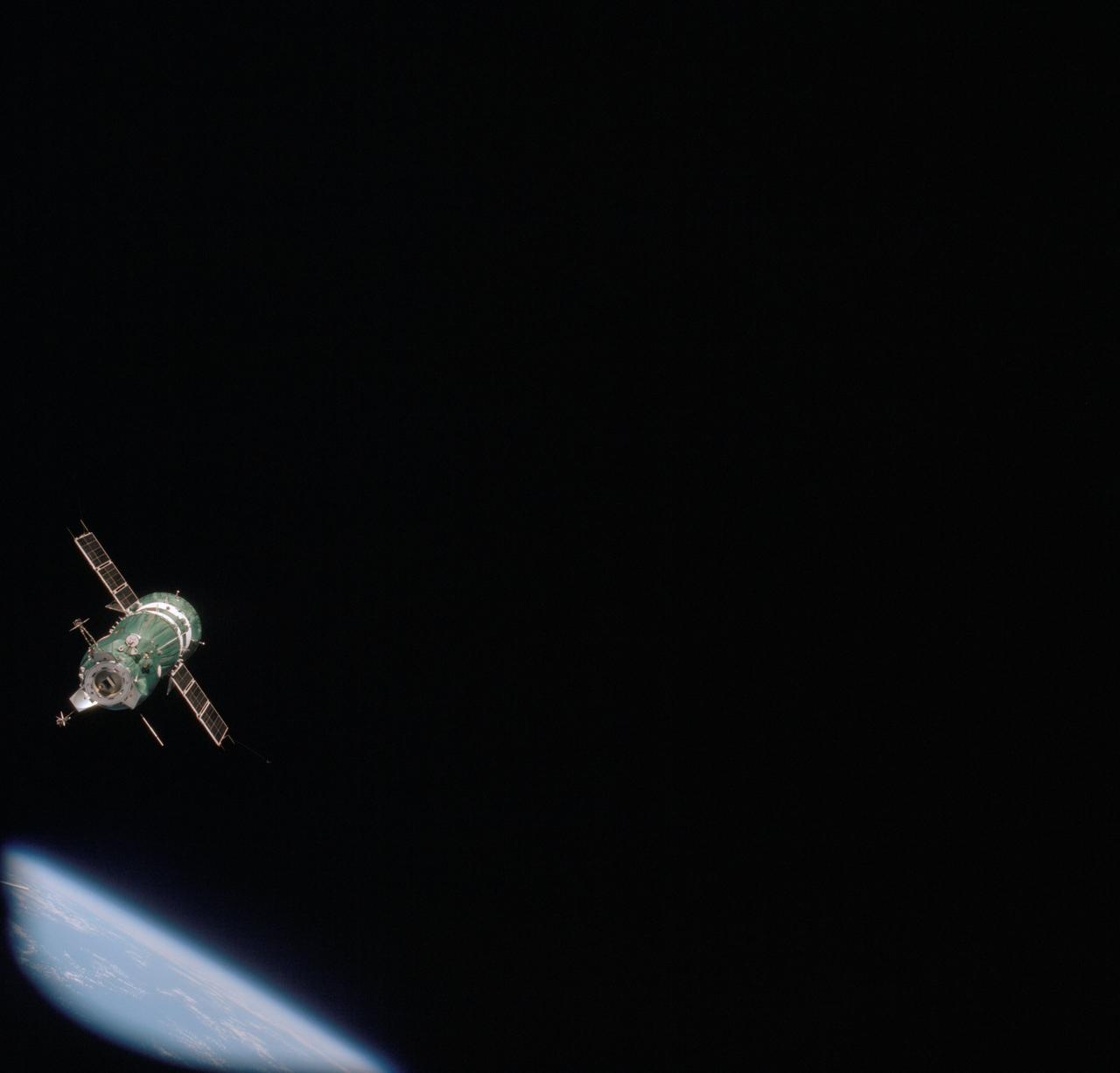
AST-09-572 (17-18 July 1975) --- The Soviet Soyuz 19 spacecraft is photographed from the American Apollo spacecraft during the joint U.S.-USSR Apollo-Soyuz Test Project (ASTP) docking mission in Earth orbit. Earth is visible in the lower left corner. This picture was taken with a 70mm camera. The Apollo crew consisted of astronauts Thomas P. Stafford, commander; Donald K. "Deke" Slayton, docking module pilot; and Vance D. Brand, command module pilot. The Soyuz 19 crew consisted of cosmonauts Aleksei A. Leonov, command pilot; and Valeri N. Kubasov, flight engineer.
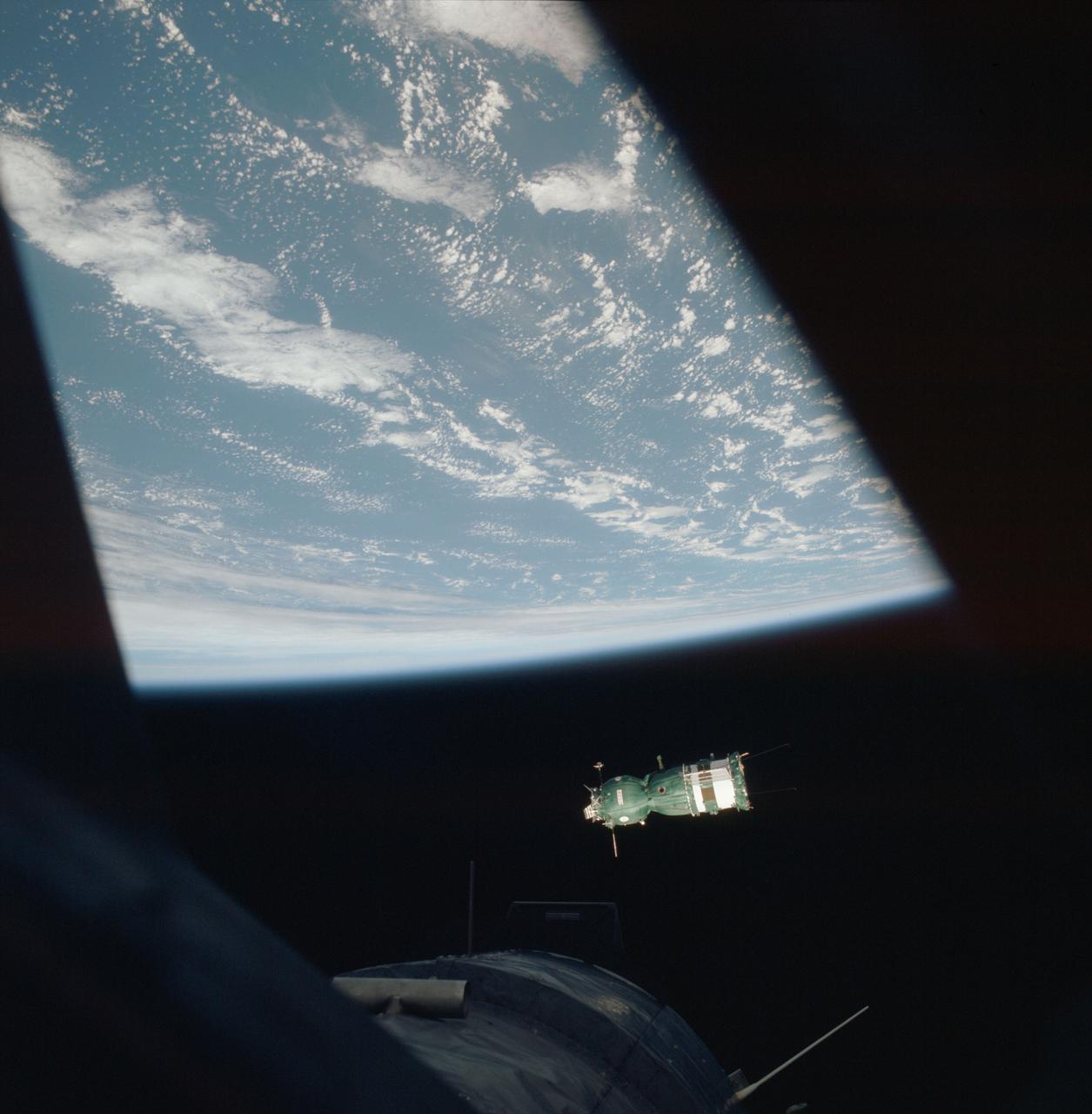
AST-02-093 (18 July 1975) --- This scene photographed with a hand-held 70mm camera from a rendezvous window of the American Apollo spacecraft in Earth orbit shows the Soviet Soyuz spacecraft contrasted against a black-sky background with Earth's horizon below. The three major components of the Soyuz are the spherical-shaped Orbital Module (OM), the bell-shaped Descent Vehicle (DV) and the cylindrical-shaped instrument Assembly Module (AM). The docking system on the Orbital Module was specially designed to interface with the docking system on the Apollo's Docking Module (DM). The DM is visible very faintly at the bottom of the picture. The ASTP astronauts and cosmonauts visited each other's spacecraft while the Soyuz and Apollo were docked in Earth orbit for two days.

VIERA, Fla. – Tiffany Lindsley, with Education and External Relations at NASA’s Kennedy Space Center in Florida, hands out information on some of the contributions the space agency has made to sports, transportation and everyday life to a baseball fan attending Space Day at the Space Coast Stadium. Bob Cabana, director of Kennedy, was on hand to throw the first pitch of a spring training game between Major League Baseball's Washington Nationals and the Houston Astros. A full-scale test version of NASA's new Orion Multi-Purpose Crew Vehicle was on display outside the stadium for the occasion to show the public the spacecraft under development that will take astronauts farther into space than ever before. For more information, visit http://www.nasa.gov/kennedy. Photo credit: NASA/Kim Shiflett
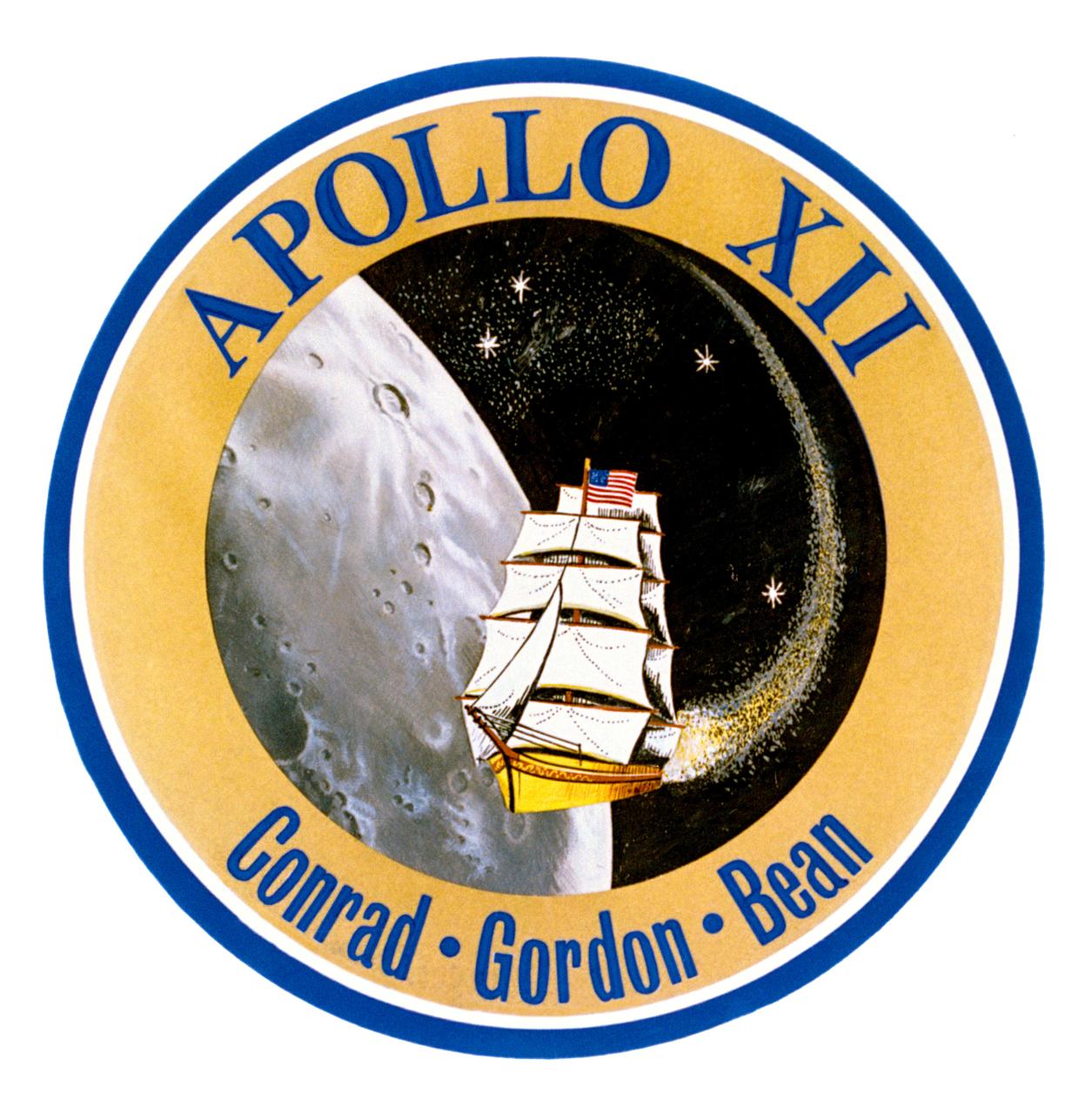
S69-52336 (September 1969) --- This is the official crew insignia for Apollo 12, the United States? second lunar landing mission. Crew members are astronauts Charles Conrad Jr., commander; Richard F. Gordon Jr., command module pilot; and Alan L. Bean, lunar module pilot. The clipper ship signifies that the crew is all Navy and symbolically relates the era of the clipper ship to the era of space flight. As the clipper ship brought foreign shores closer to the United States and marked the increased utilization of the seas by this nation, spacecraft have opened the way to the other planets and Apollo 12 marks the increased utilization of space-based on knowledge gained in earlier missions. The portion of the moon shown is representative of the Ocean of Storms area in which Apollo 12 will land. The NASA insignia design for Apollo flights is reserved for use by the astronauts and for other official use as the NASA Administrator may authorize. Public availability has been approved only in the form of illustrations by the various news media. When and if there is any change in this policy, which we do not anticipate, it will be publicly announced.