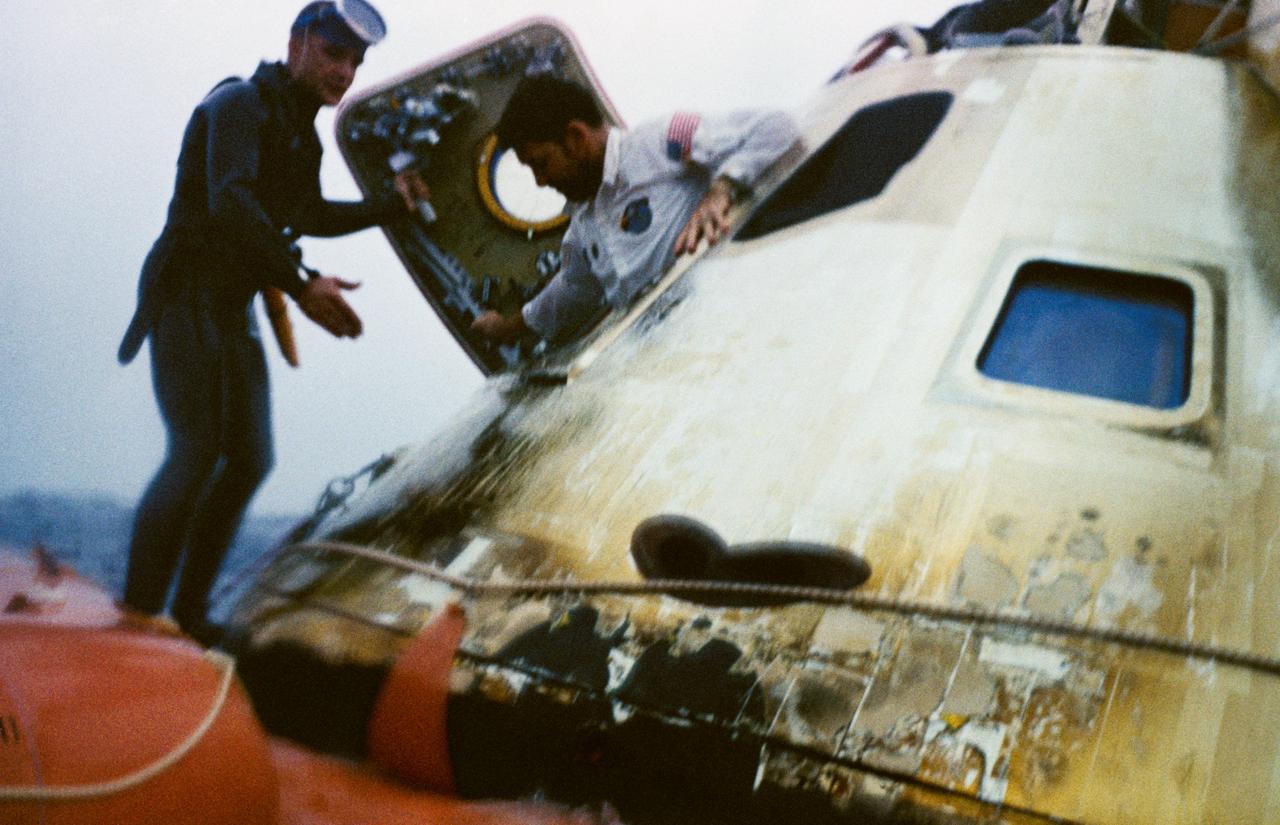
Astronaut Walter M. Schirra, Jr., Apollo 7 commander, egresses the spacecraft during recovery operations in the Atlantic. He is assisted by a member of the U.S. Navy frogman team. The Apollo 7 spacecraft splashed down at 7:11 a.m., October 22, 1968, approximately 200 nautical miles south-southwest of Bermuda.

S68-26989 (4 April 1968) --- The Apollo 6 Spacecraft 020 Command Module is hoisted aboard the USS Okinawa.
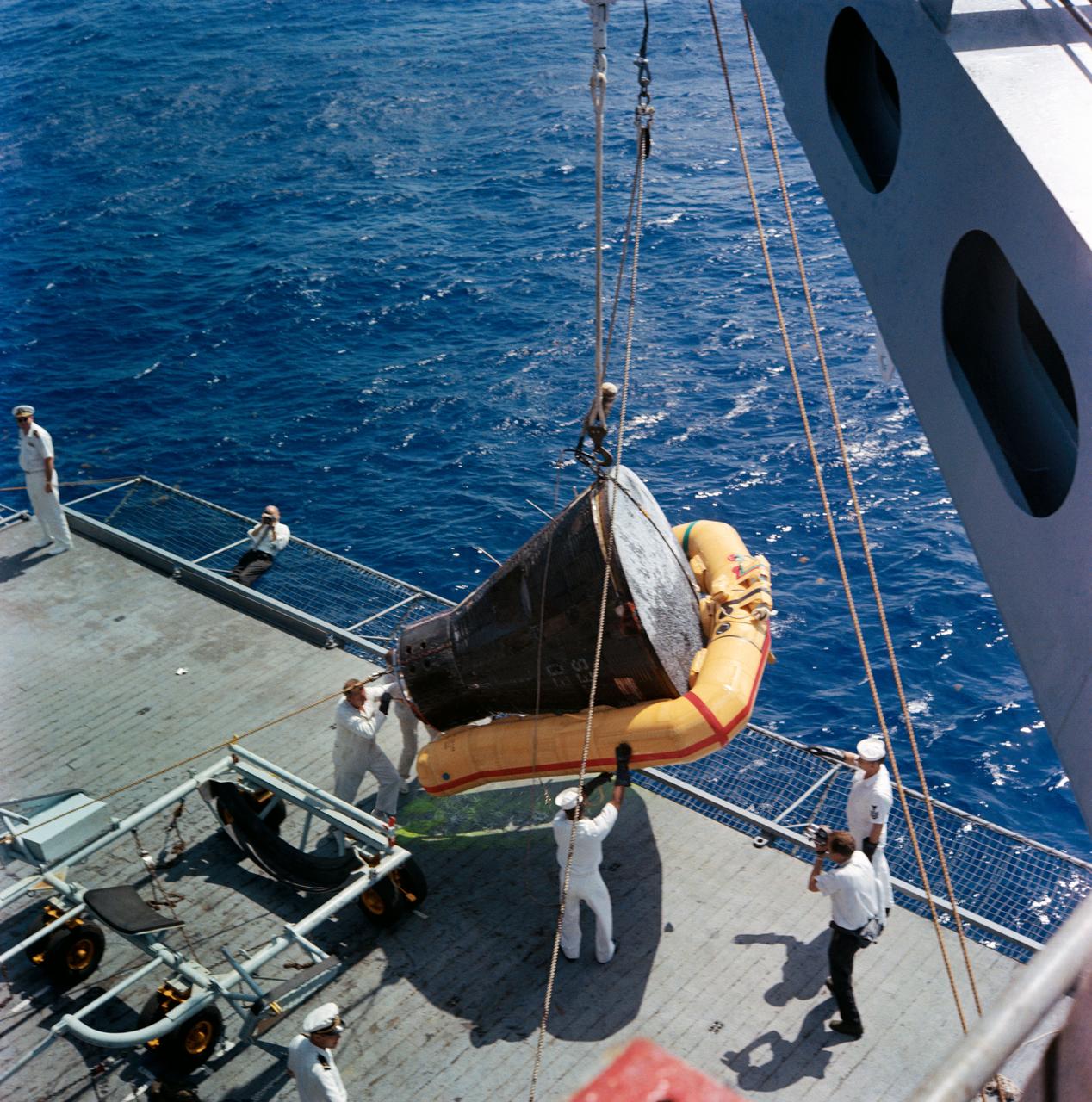
S65-32962 (7 June 1965) --- The Gemini-4 (GT-4) spacecraft is hoisted aboard the recovery ship USS Wasp during recovery operations following the successful four-day mission.
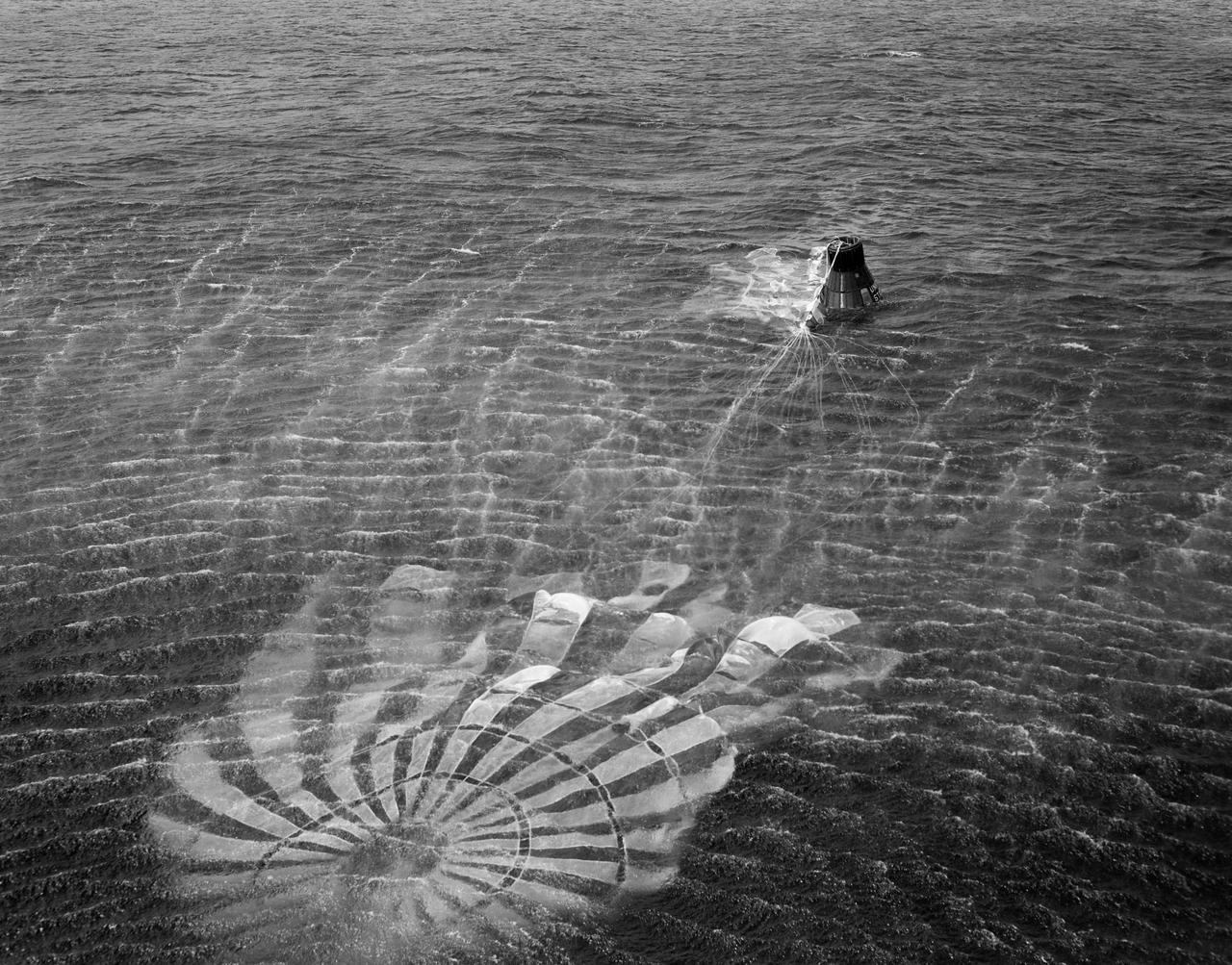
S61-01398 (18 March 1961) --- View of the recovery of the Little Joe-5A spacecraft which lifted off on March 18, 1961 from Wallops Island. The photo was taken from the recovery helicopter and shows the craft's parachute still attached and floating in the water next to the capsule. Little Joe-5A was a suborbital flight to test the Mercury capsule. The escape rocket motor fired prematurely and prior to capsule release. Photo credit: NASA
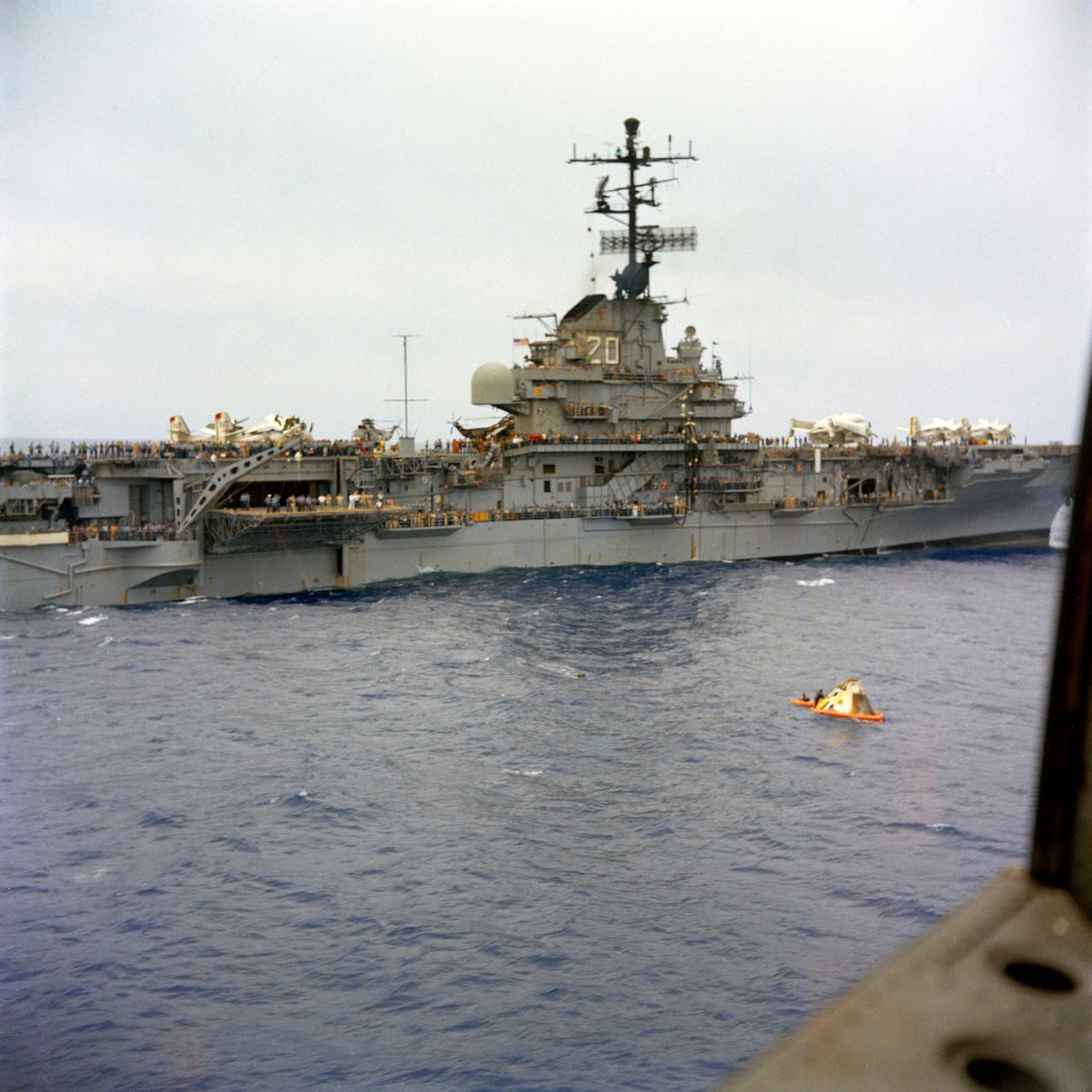
U.S.S. Bennington comes alongside the floating Apollo spacecraft 017 Command Module during recovery operations in the mid-Pacific Ocean. The Command Module splashed down at 3:37 p.m., November 9, 1967, 934 nautical miles northwest of Honolulu, Hawaii.
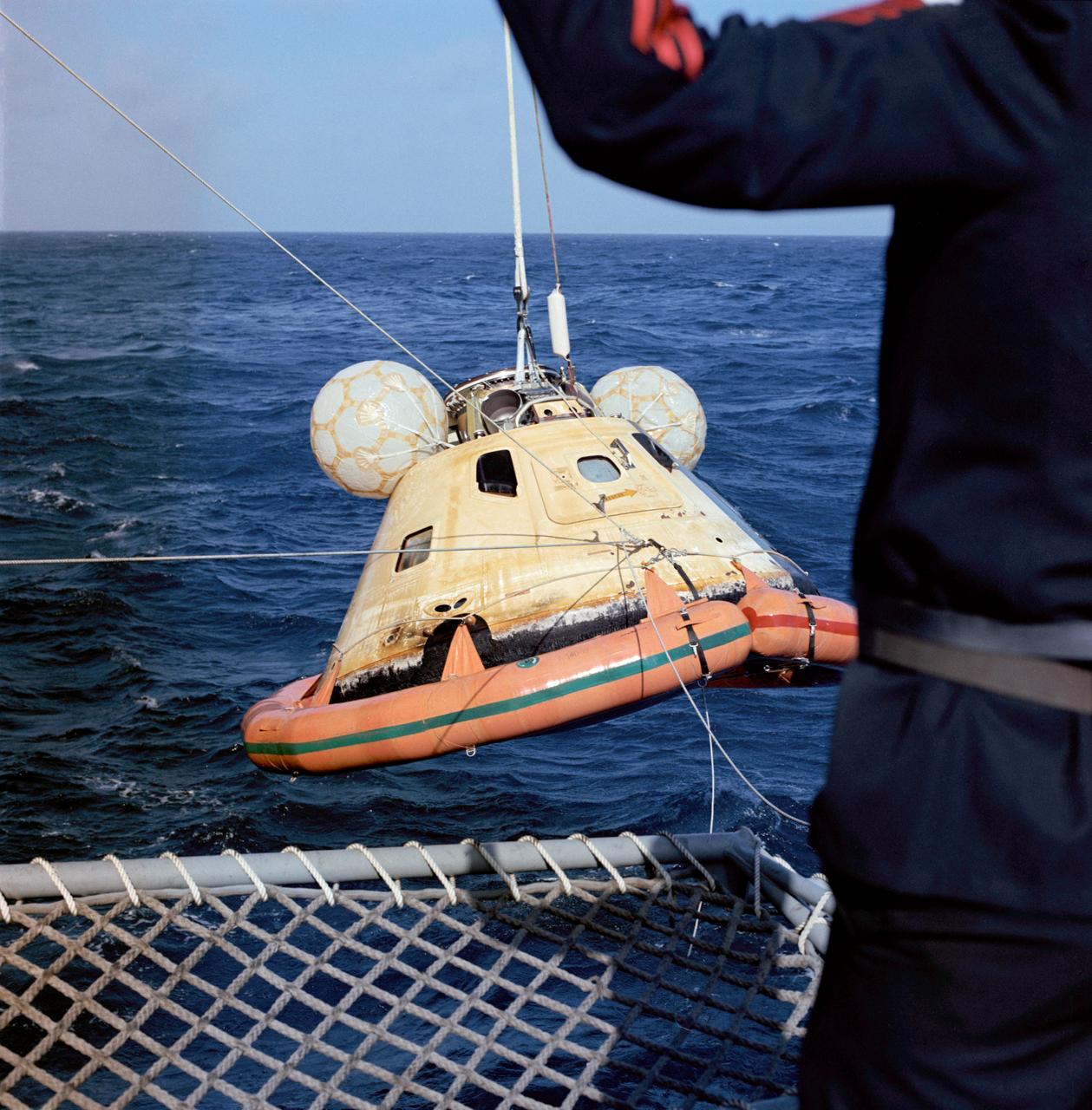
S73-36423 (25 Sept. 1973) --- The Skylab 3 Command Module, with astronauts Alan L. Bean, Owen K. Garriott and Jack R. Lousma still inside, is hoisted aboard the prime recovery ship, USS New Orleans, during recovery operations in the Pacific Ocean. The three crewmen had just completed a successful 59-day visit to the Skylab space station in Earth orbit. The Command Module splashed down in the Pacific about 230 miles southwest of San Diego, California. Earlier in the recovery operations a team of U.S. Navy swimmers attached the flotation collar to the spacecraft to improve its buoyancy. Photo credit: NASA

S67-49447 (9 Nov. 1967) --- Close-up view of the charred heat shield of the Apollo Spacecraft 017 Command Module aboard the USS Bennington. The damage was caused by the extreme heat of reentry. The carrier Bennington was the prime recovery ship for the Apollo 4 (Spacecraft 017/Saturn 501) unmanned, Earth-orbital space mission. Splashdown occurred at 3:37 p.m. (EST), Nov. 9, 1967, 934 nautical miles northwest of Honolulu, Hawaii.
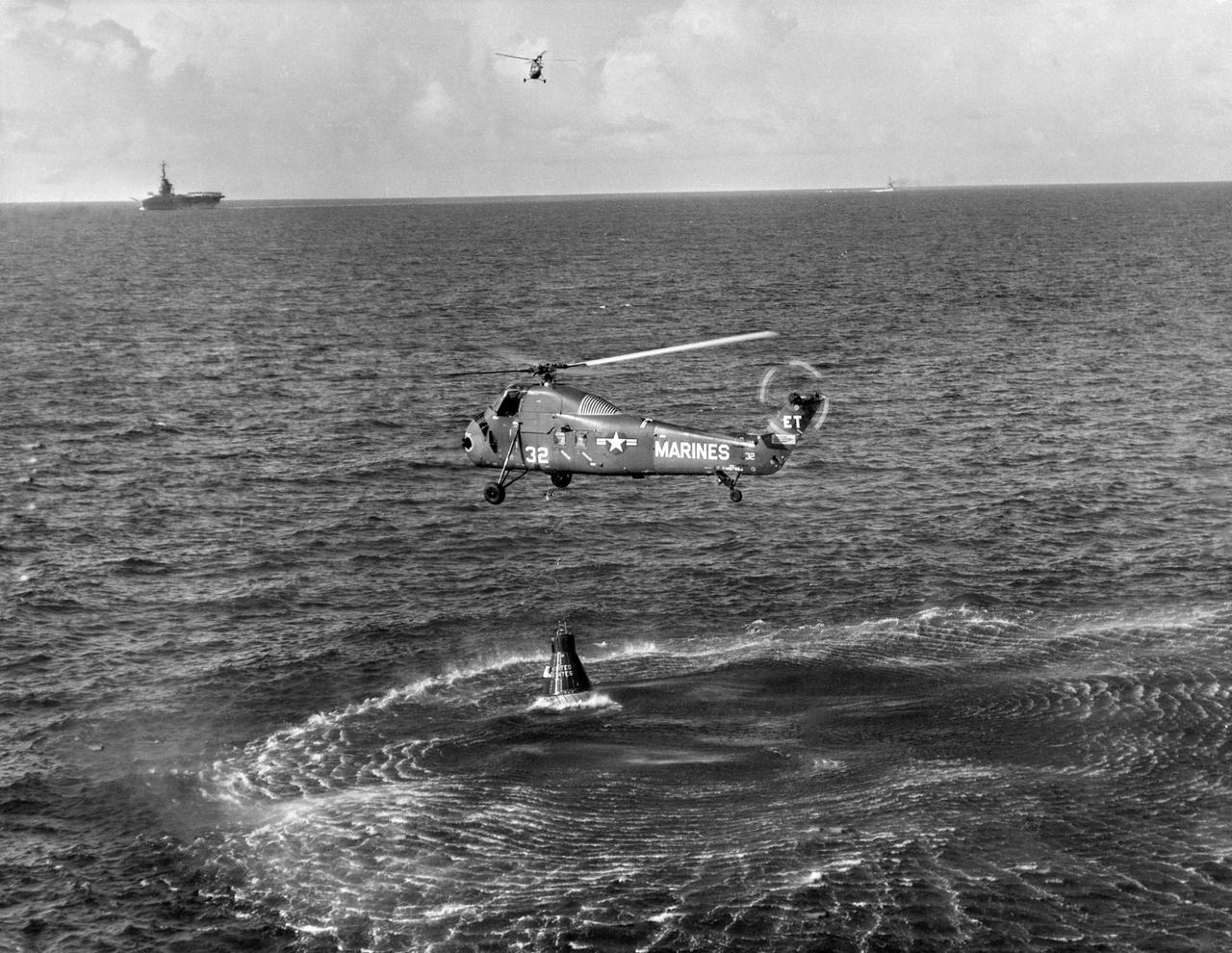
S61-02821 (21 July 1961) --- Attempted recovery of Mercury spacecraft at end of the Mercury-Redstone 4 (MR-4) mission. View shows the Marine helicopter dropping a recovery line to the capsule. In the upper left corner of the view, the recovery ship and another helicopter can be seen. Photo credit: NASA
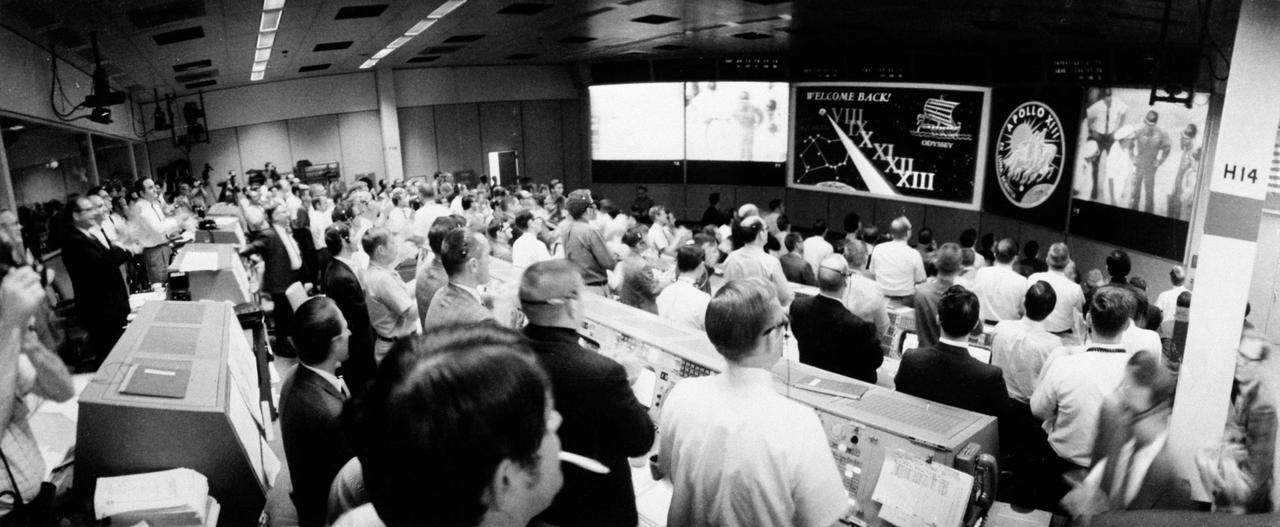
S70-35472 (17 April 1970) --- Overall view of the crowded Mission Operations Control Room (MOCR) in the Mission Control Center (MCC) at the Manned Spacecraft Center (MSC) during post-recovery ceremonies aboard the USS Iwo Jima, prime recovery ship for the Apollo 13 mission. The Apollo 13 spacecraft, with astronauts James A. Lovell Jr., commander; John L. Swigert Jr., command module pilot; and Fred W. Haise Jr., lunar module pilot, aboard, splashed down in the South Pacific at 12:07:44 p.m. (CST), April 17, 1970. The smooth splashdown and recovery operations brought an end to a perilous spaceflight for the crewmembers, and a tiring one for ground crew in MCC.
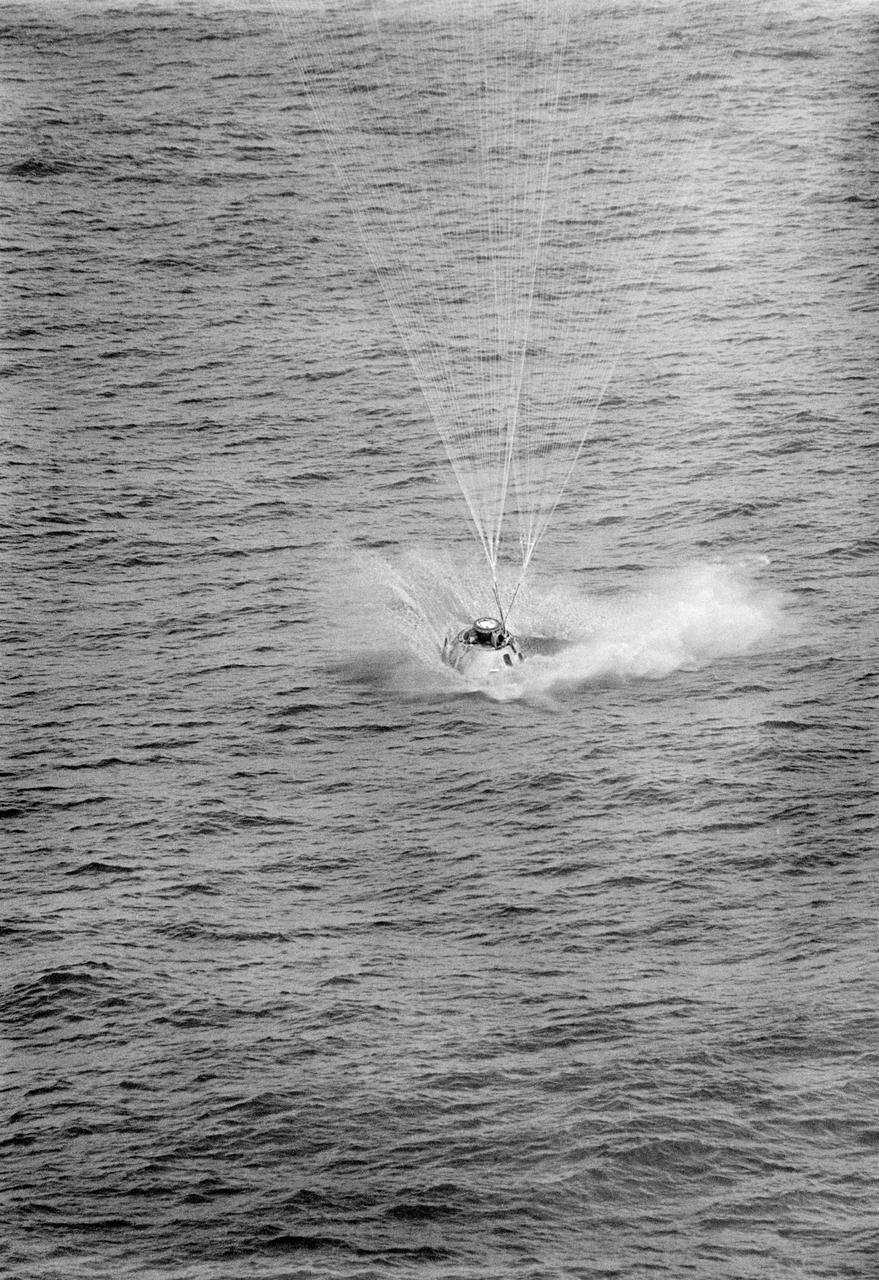
S69-27466 (13 March 1969) --- The Apollo 9 spacecraft, with astronauts James A. McDivitt, David R. Scott, and Russell L. Schweickart aboard, touches down in the Atlantic recovery area to conclude a successful 10-day Earth-orbital space mission. Splashdown occurred at 12:00:53 p.m. (EST), March 13, 1969, only 4.5 nautical miles from the prime recovery ship, USS Guadalcanal.
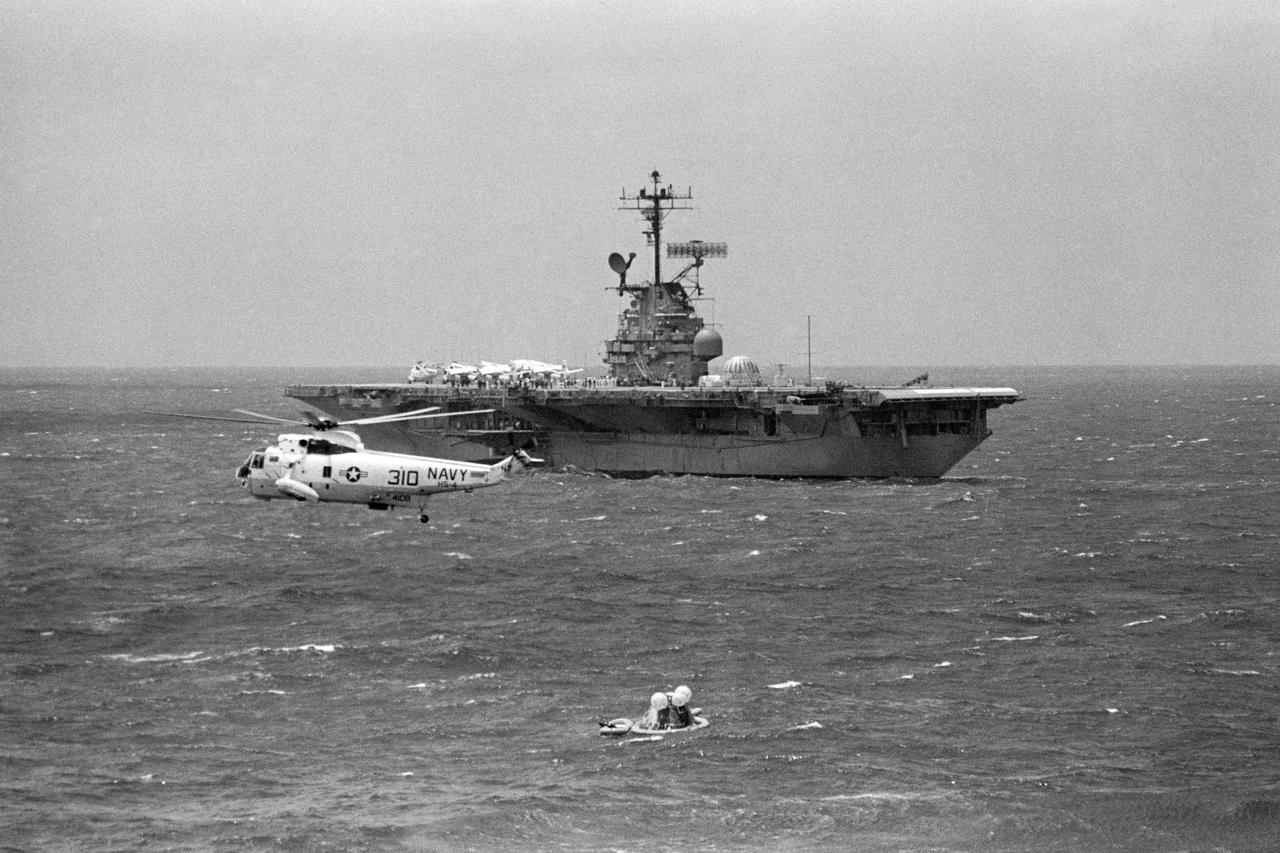
U.S.S. Hornet, prime recovery vessel for the Apollo 12 lunar landing mission, moves toward the Apollo 12 Command Module to retrieve the spacecraft. A helicopter from the recovery ship, which took part in the recovery operations, hovers over the scene of the splashdown.
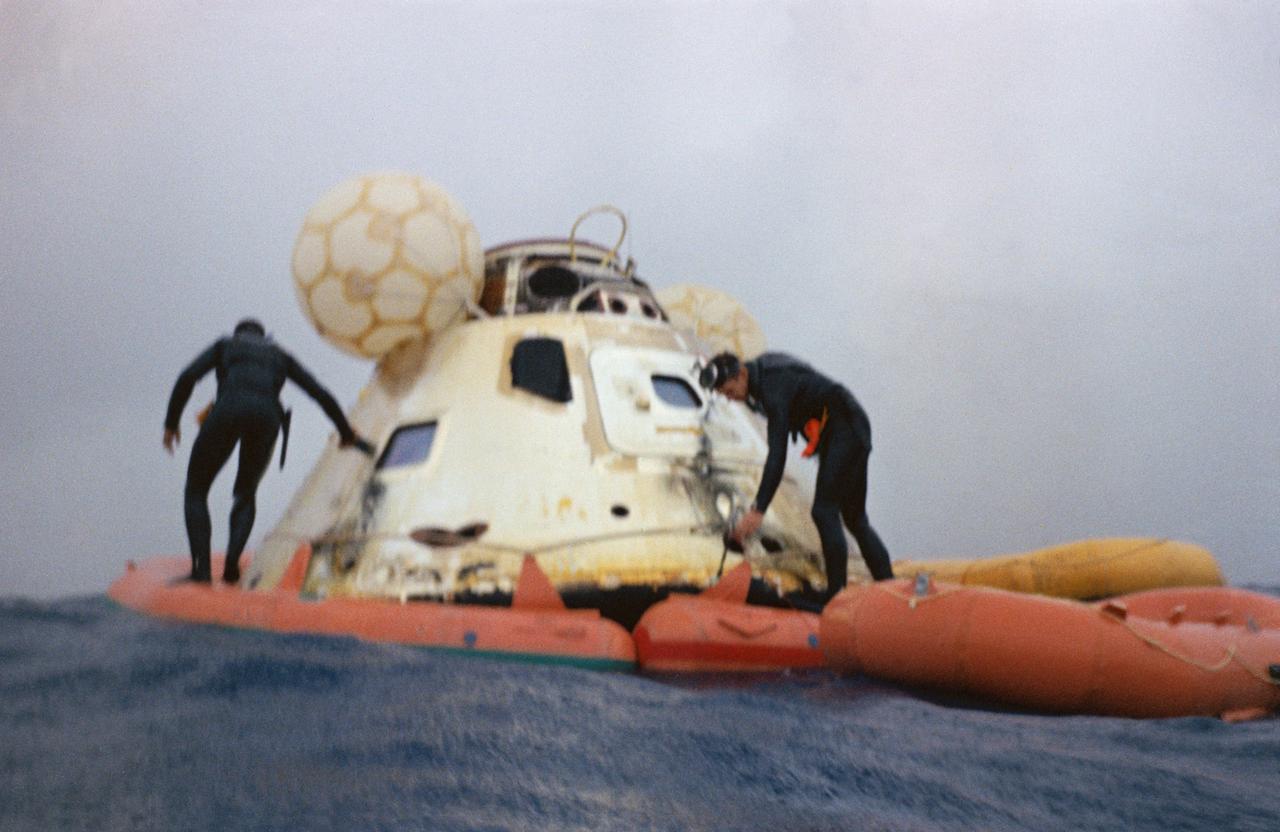
U.S. Navy frogmen attach a flotation collar to the Apollo 7 command module during recovery operations in the Atlantic. The Apollo 7 spacecraft splashed down at 7:11 a.m., October 22, 1968, approximately 200 nautical miles south-southwest of Bermuda.
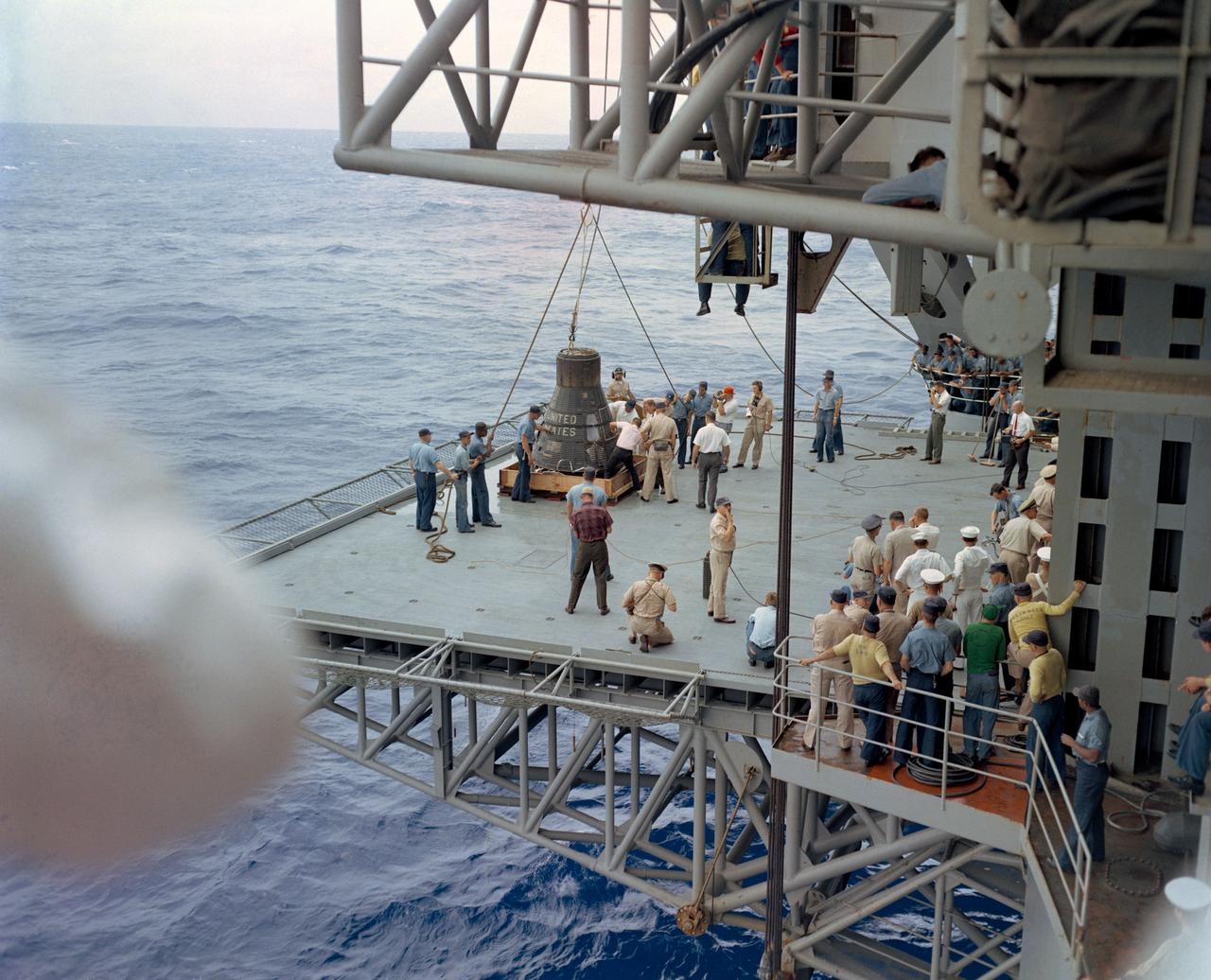
S63-07701 (16 May 1963) --- Recovery Force personnel bring the Mercury-Atlas 9 (MA-9) spacecraft aboard the prime recovery vessel following its successful flight into space. Pilot inside the spacecraft is astronaut L. Gordon Cooper Jr. Photo credit: NASA
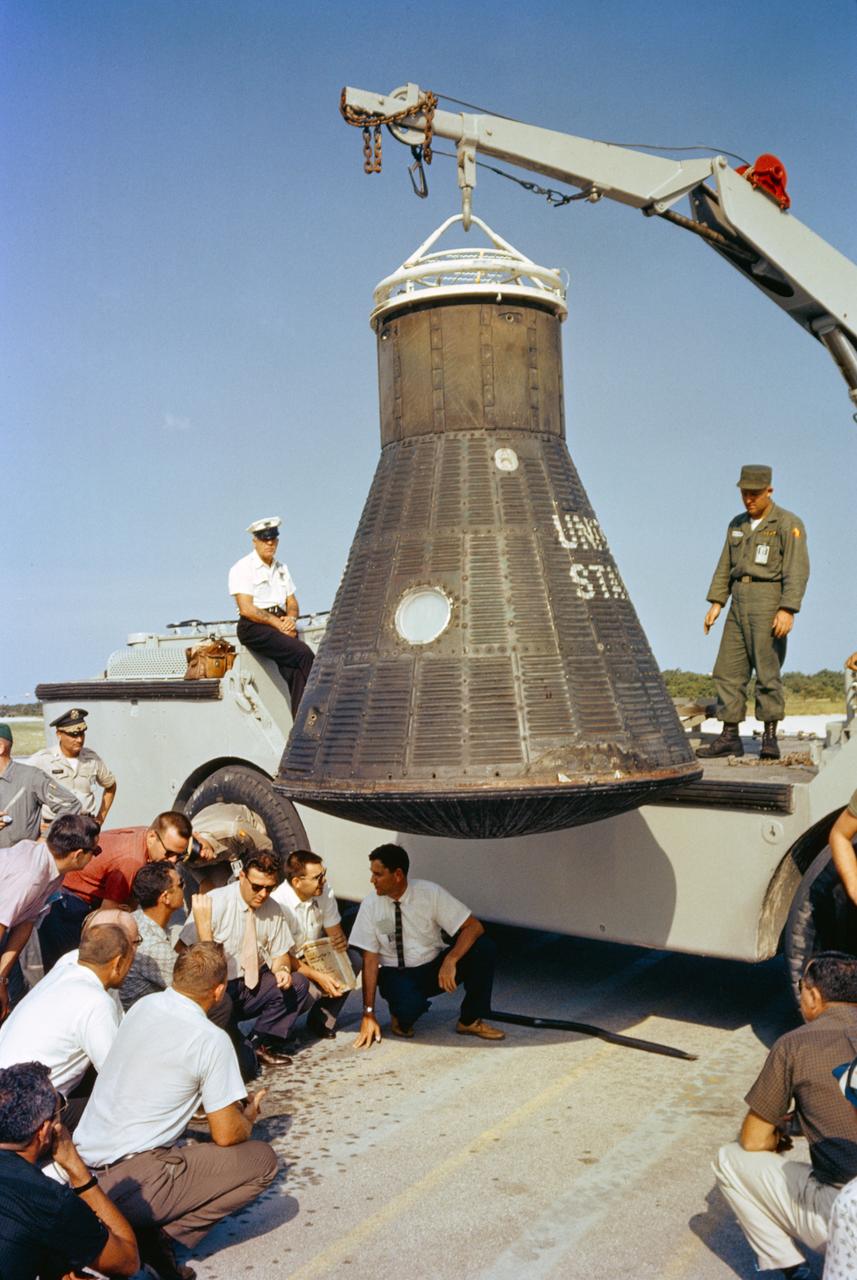
S64-14861 (1962) --- Department of Defense (DOD) recovery personnel and spacecraft technicians from NASA and McDonnell Aircraft Corp., inspect astronaut John Glenn's Mercury spacecraft, Friendship 7, following its return to Cape Canaveral after recovery in the Atlantic Ocean. Photo credit: NASA
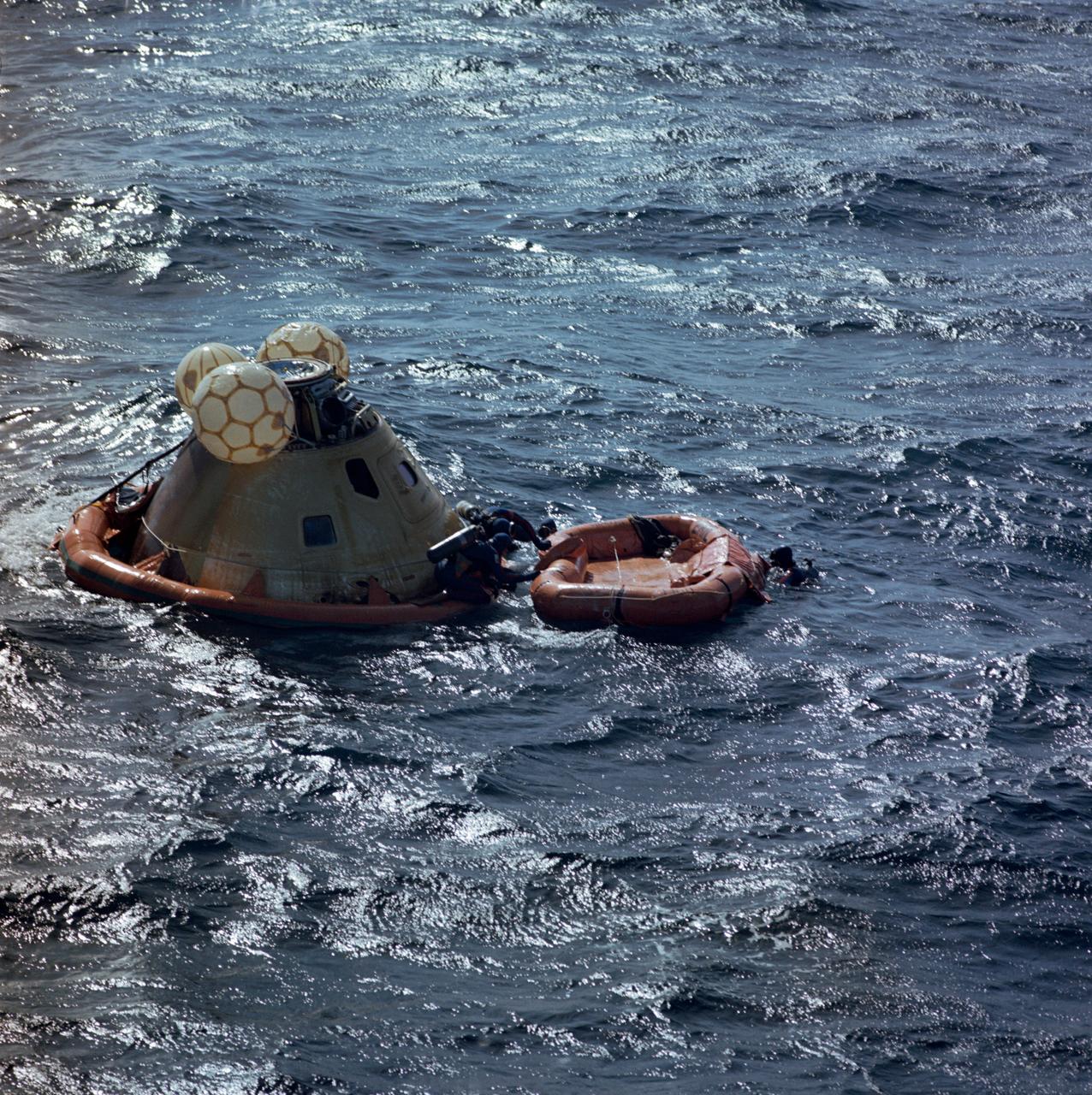
S73-36401 (25 Sept. 1973) --- A team of U.S. Navy swimmers assists with the recovery of the Skylab 3 Command Module following its splashdown in the Pacific Ocean about 230 miles southwest of San Diego, California. The swimmers had just attached a flotation collar to the spacecraft to improve its buoyancy. Aboard the Command Module were astronauts Alan L. Bean, Owen K. Garriott and Jack R. Lousma, who had just completed a successful 59-day visit to the Skylab space station in Earth orbit. Minutes later the Command Module with the three crewmen still inside was hoisted aboard the prime recovery ship, the USS New Orleans. Photo credit: NASA
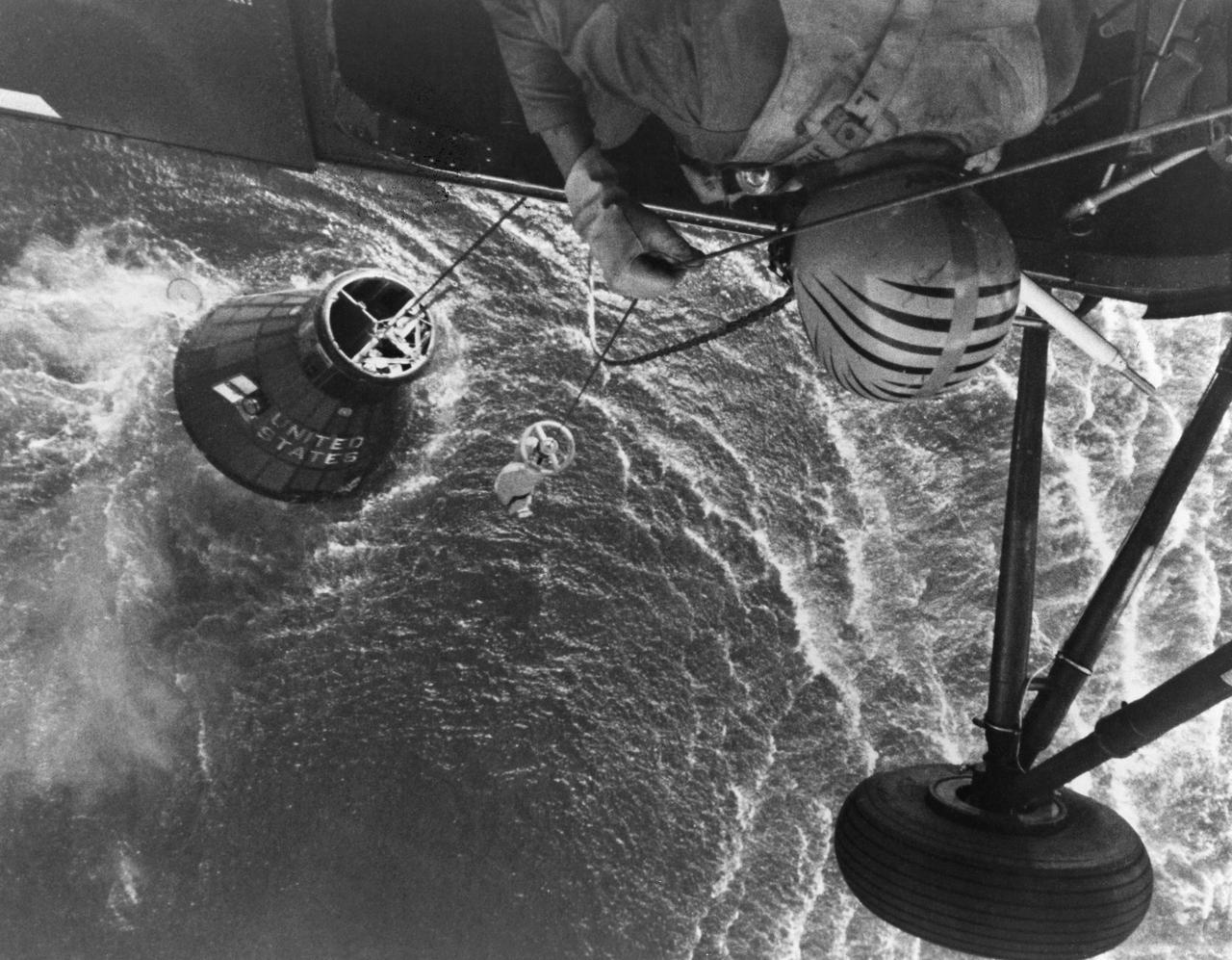
S61-02824 (21 July 1961) --- A U.S. Marine Corps helicopter attempts an unsuccessful recovery of the Mercury-Redstone 4 "Liberty Bell 7" spacecraft. The spacecraft hatch opened prematurely, and astronaut Virgil I. Grissom, pilot, escaped into the water. The helicopter hooked onto the spacecraft but could not retrieve it. Grissom was recovered by another helicopter and flown to the recovery ship, USS Randolph. The Mercury spacecraft sank to the bottom of the ocean. Photo credit: NASA
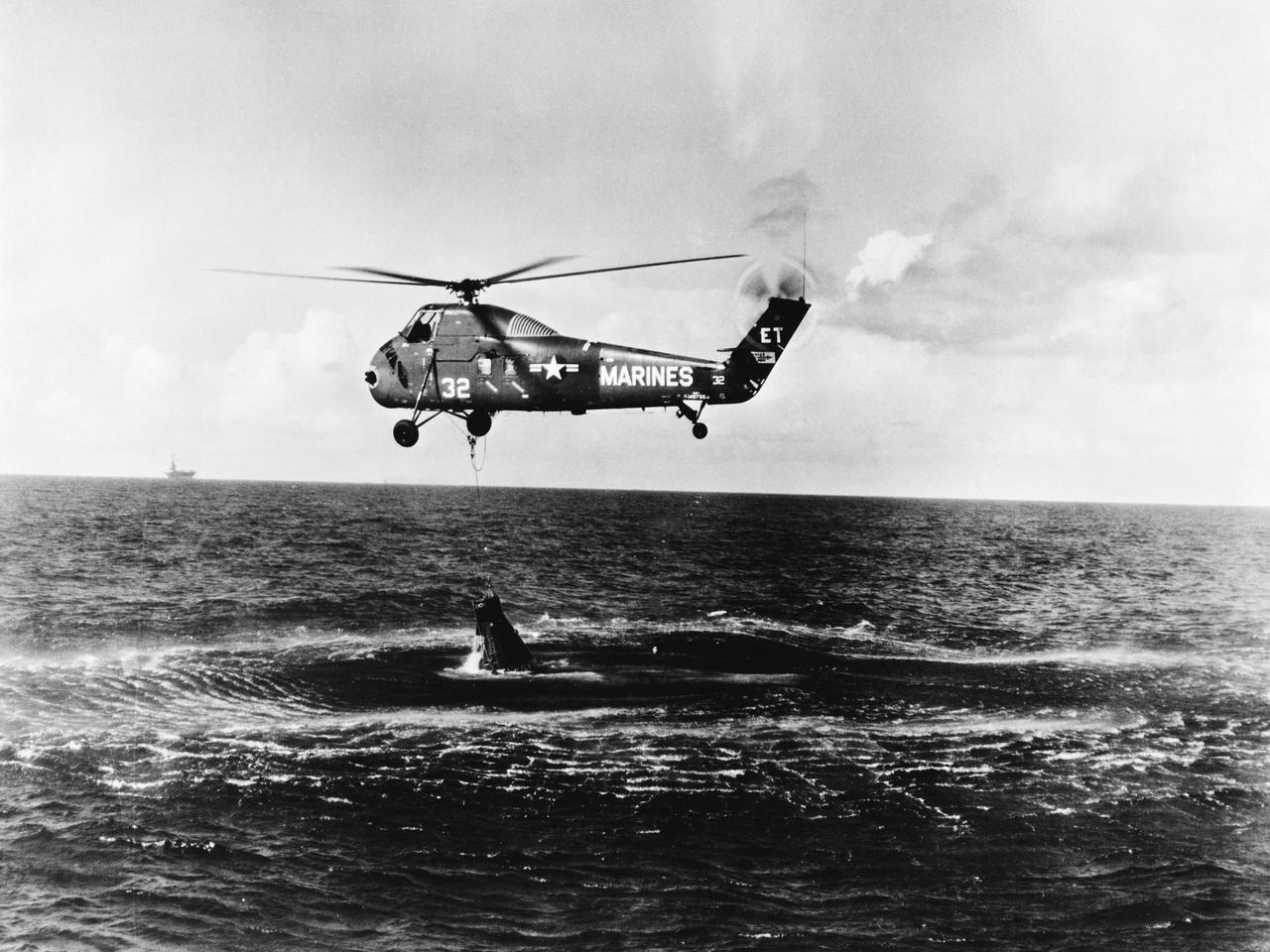
S61-02826 (21 July 1961) --- A U.S. Marine Corps helicopter attempts an unsuccessful recovery of the Mercury-Redstone 4 "Liberty Bell 7" spacecraft. The spacecraft hatch opened prematurely, and astronaut Virgil I. Grissom, pilot, escaped into the water. The helicopter hooked onto the spacecraft but could not retrieve it. Grissom was recovered by another helicopter and flown to the recovery ship, USS Randolph. The Mercury spacecraft sank to the bottom of the ocean. Photo credit: NASA
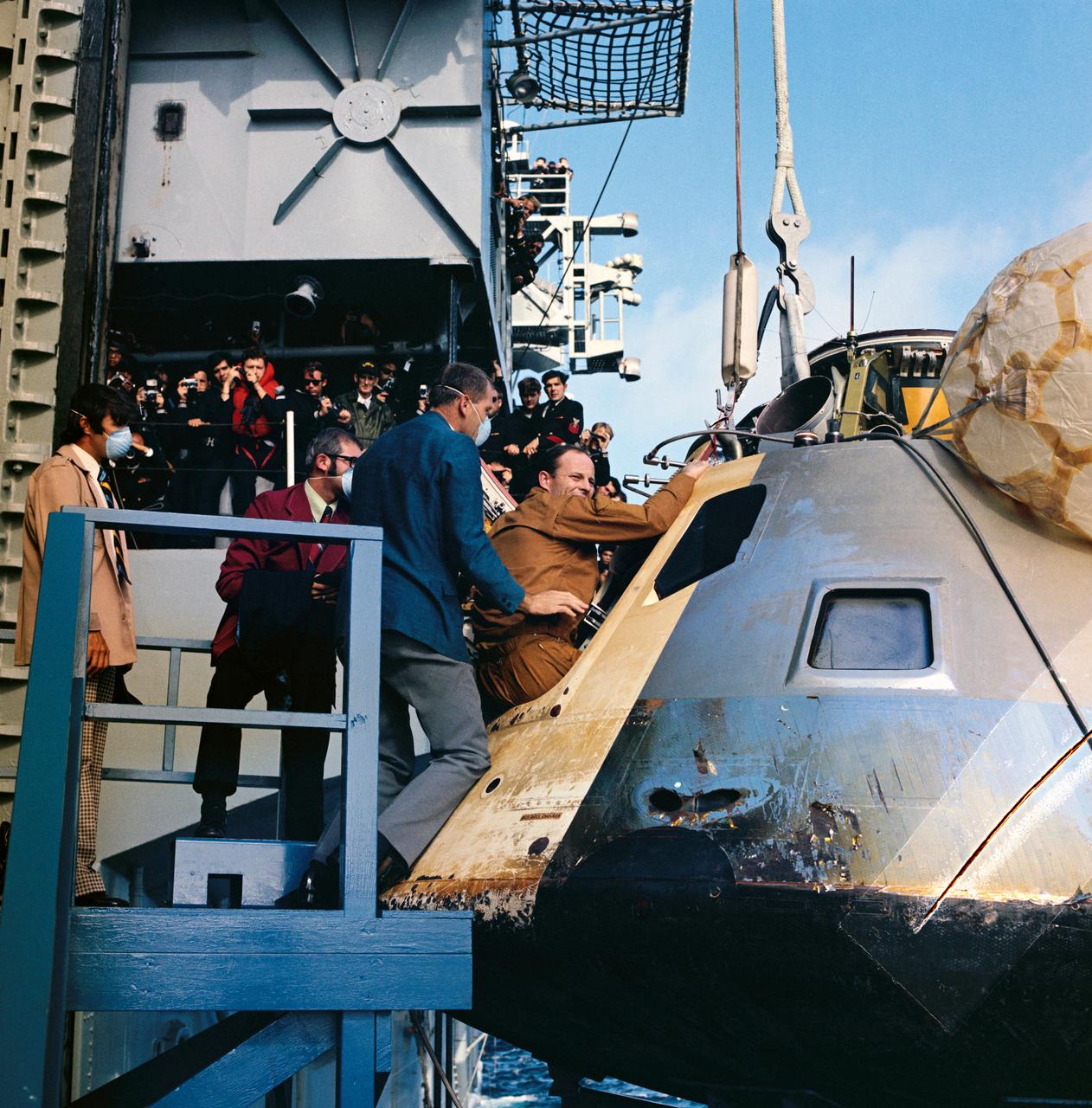
S73-36435 (25 Sept. 1973) --- Astronaut Jack R. Lousma, Skylab 3 pilot, egresses the Skylab 3 Command Module aboard the prime recovery ship, USS New Orleans, during recovery operations in the Pacific Ocean. Astronauts Lousma; Alan L. Bean, commander; and Owen L. Garriott, science pilot, had just completed a successful 59-day visit to the Skylab space station in Earth orbit. The Skylab 3 spacecraft splashed down in the Pacific about 230 miles southwest of San Diego, California. Photo credit: NASA
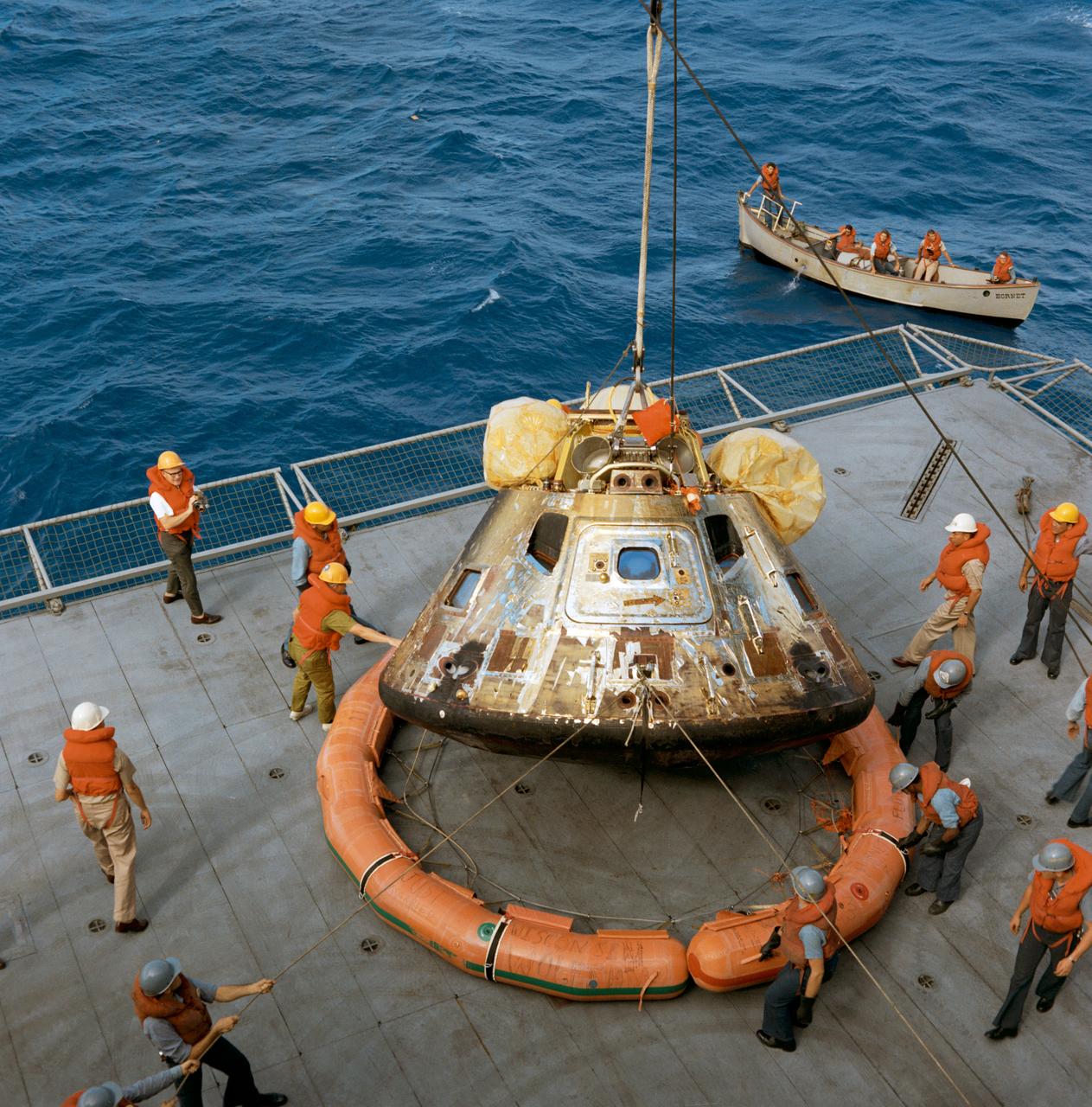
The Apollo 11 spacecraft Command Module is photographed being lowered to the deck of the U.S.S. Hornet, prime recovery ship for the historic lunar landing mission. Note the flotation ring attached by Navy divers has been removed from the capsule.

S67-49423 (9 Nov. 1967) --- The Apollo Spacecraft 017 Command Module, with flotation collar still attached, is hoisted aboard the USS Bennington, prime recovery ship for the Apollo 4 (Spacecraft 017/Saturn 501) unmanned, Earth-orbital space mission. The Command Module splashed down at 3:37 p.m. (EST), Nov. 9, 1967, 934 nautical miles northwest of Honolulu, Hawaii, in the mid-Pacific Ocean. Note charred heat shield caused by extreme heat of reentry.

S65-46630 (29 Aug. 1965) --- The Gemini-5 spacecraft is brought aboard the recovery ship, USS Lake Champlain after a successful landing at the end of its mission.

S61-02921 (21 July 1961) --- Attempted recovery of Mercury spacecraft at end of the Mercury-Redstone 4 (MR-4) mission. View shows the top of the capsule before it sinks beneath the waves. Photo credit: NASA
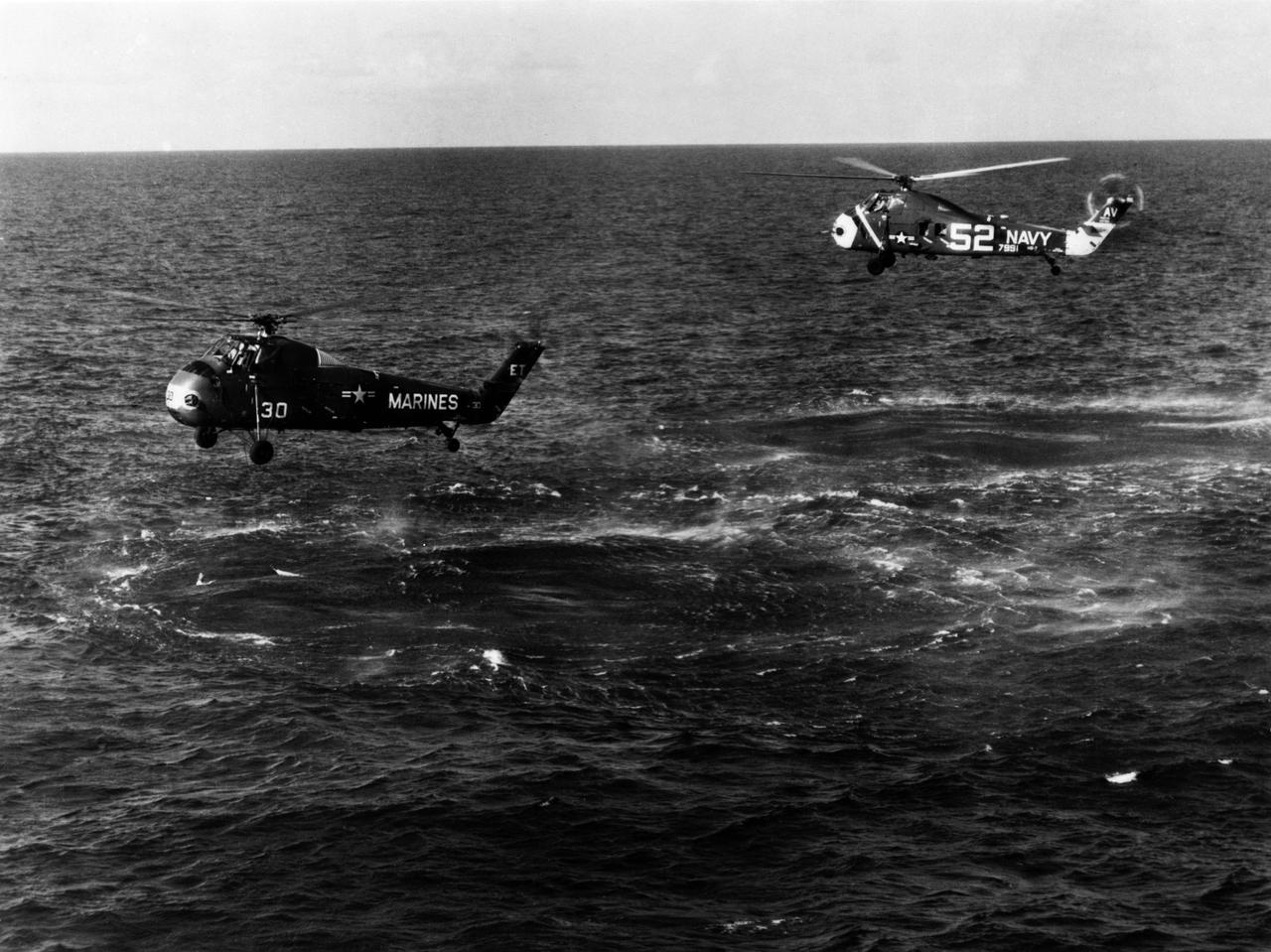
S61-02820 (21 July 1961) --- Attempted recovery of Mercury spacecraft at end of the Mercury-Redstone 4 (MR-4) mission. View shows the Marine helicopter pulled almost to the waters surface by the weight of the capsule, which filled with water. It eventually had to abandon its recovery attempts. Behind the Marine helicopter, a Navy helicopter prepares to assist. Photo credit: NASA
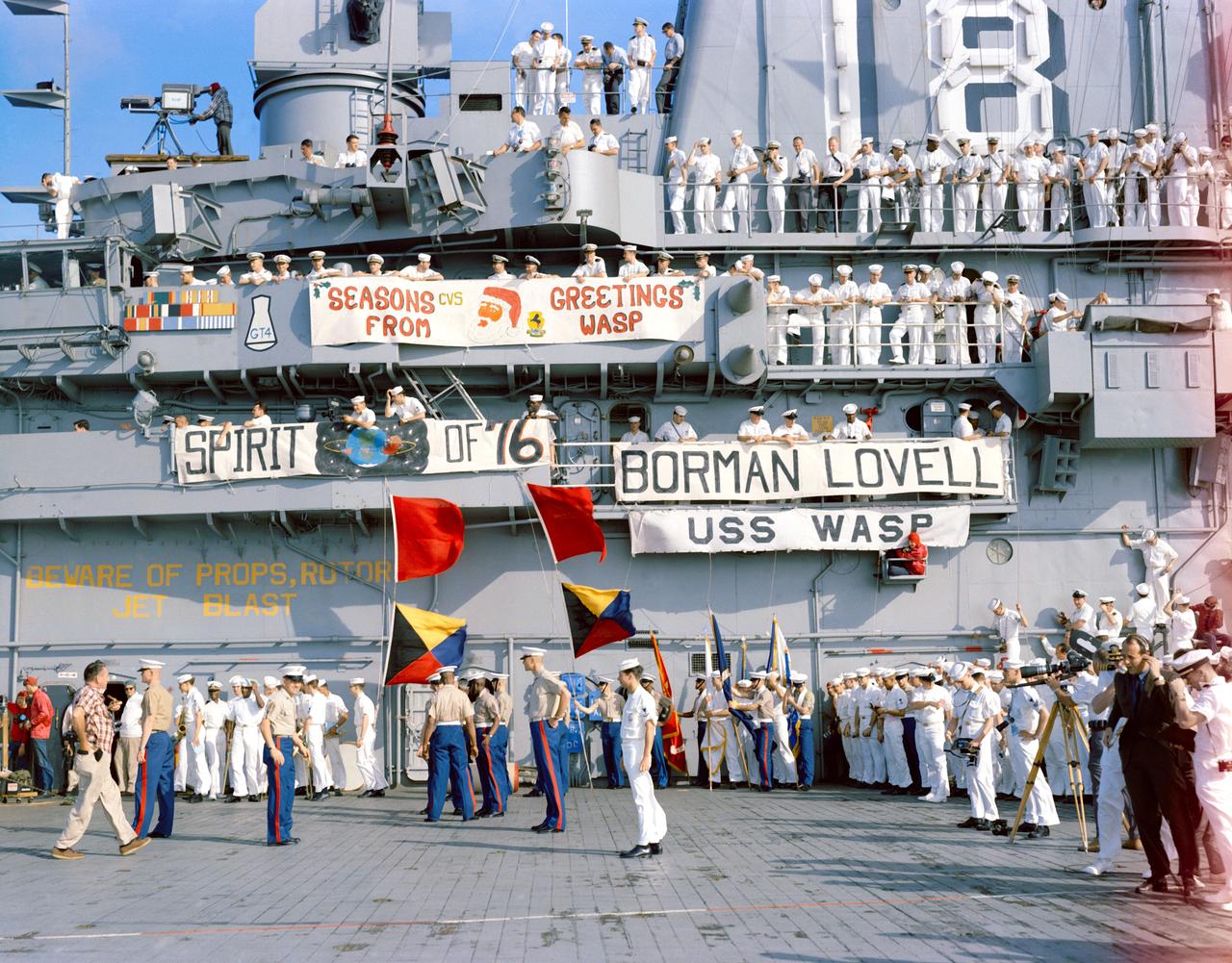
S65-63644 (18 Dec. 1965) --- Crewmen of the aircraft carrier USS Wasp gather on deck to watch the recovery of the National Aeronautics and Space Administration's Gemini-7 spacecraft and astronauts. Gemini-7, with astronauts Frank Borman, command pilot, and James A. Lovell Jr., pilot, splashed down in the western Atlantic at 9:05 a.m. (EST), Dec. 18, 1965, to conclude a record-breaking 14-day mission in space. Photo credit: NASA
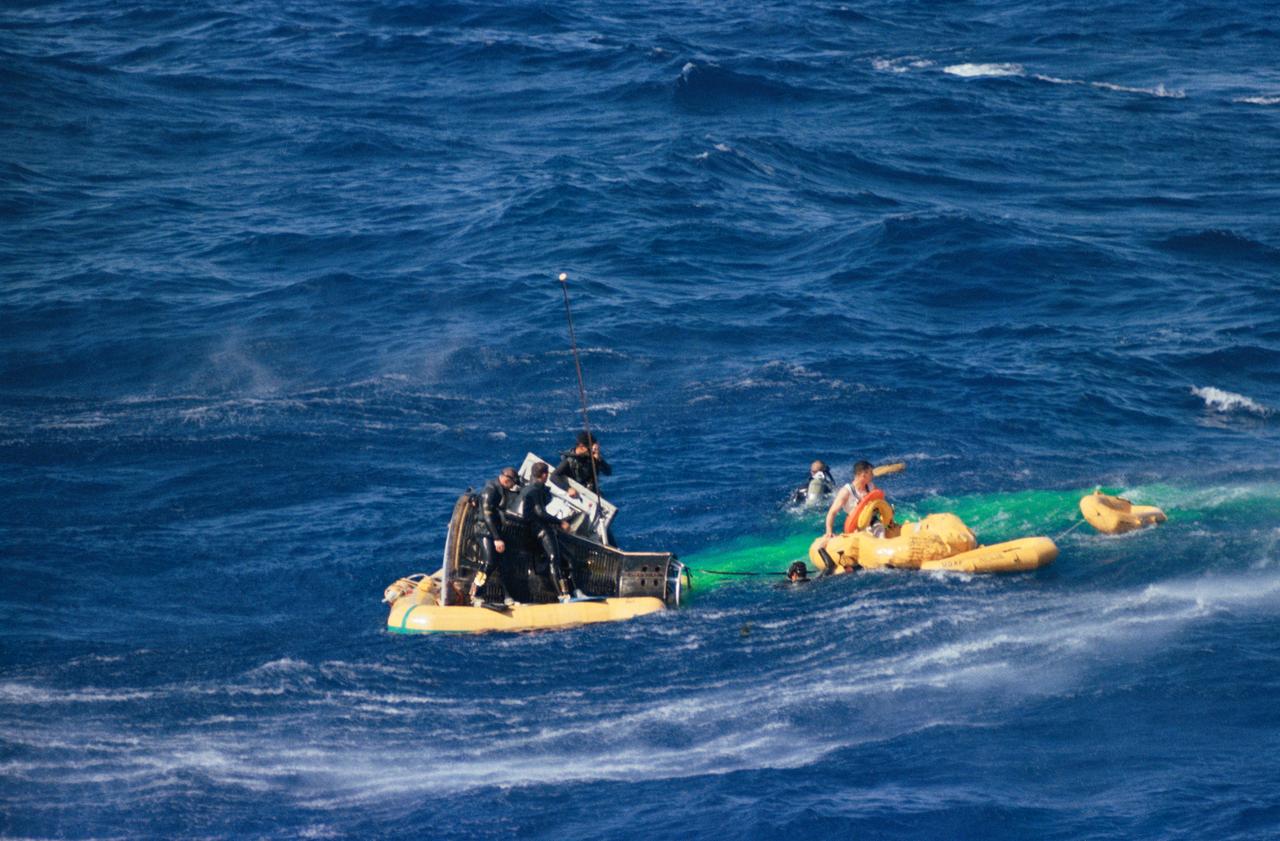
S65-22893 (23 March 1965) --- Astronaut John W. Young, the pilot of the Gemini-Titan III (GT-3) flight, waits in a life raft to be picked up by a helicopter during recovery operations following the successful three-orbit mission. Young and astronaut Virgil I. Grissom, command pilot, were flown by helicopter to the nearby recovery vessel, the USS Intrepid. The recovery ship later came alongside and retrieved the GT-3 spacecraft. United States Navy swimmers assisted in the GT-3 recovery operations.
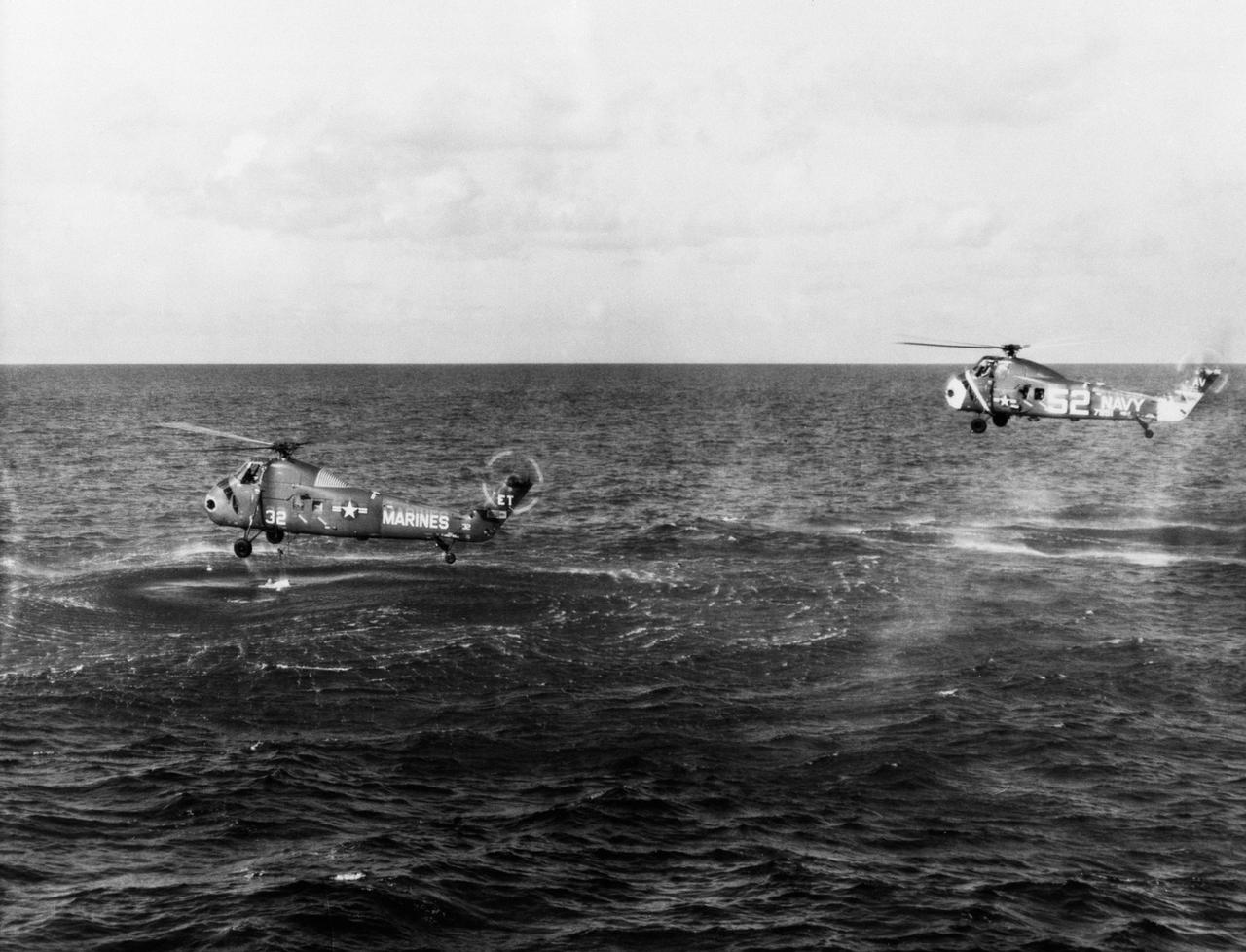
S61-02817 (21 July 1961) --- Attempted recovery of Mercury spacecraft at end of the Mercury-Redstone 4 (MR-4) mission. View shows the Marine helicopter pulled almost to the waters surface by the weight of the capsule, which filled with water. Behind the Marine helicopter, a Navy helicopter prepares to assist. Photo credit: NASA
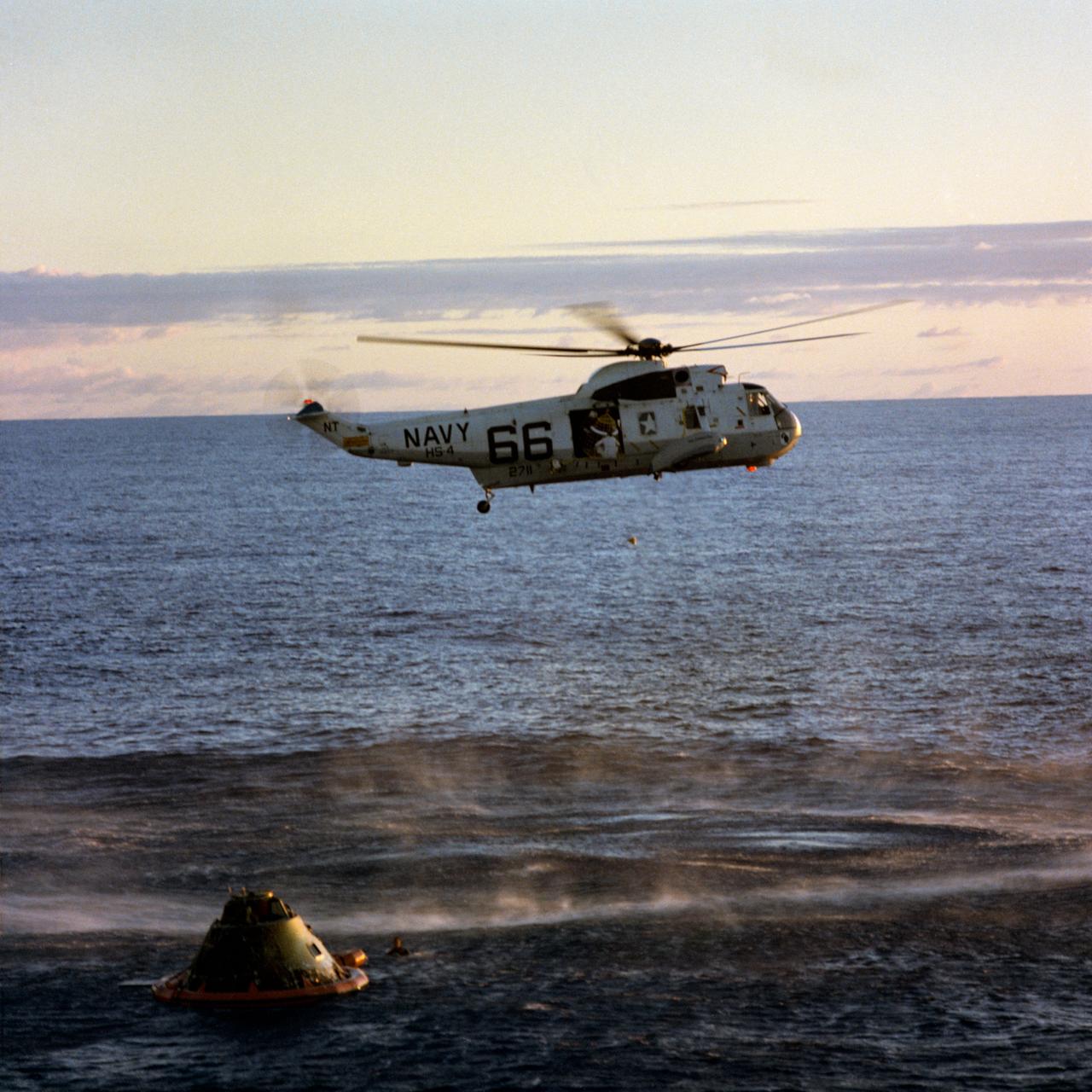
S69-20621 (26 May 1969) --- A member of the Apollo 10 crew is hoisted into a helicopter from the prime recovery ship, USS Princeton, during recovery operations in the South Pacific. Astronauts Thomas P. Stafford, commander; John W. Young, command module pilot; and Eugene A. Cernan, lunar module pilot, were picked up and flown to the deck of the USS Princeton where a red-carpet welcome awaited them. The spacecraft was later retrieved from the water and put aboard the recovery ship. The Apollo 10 splashdown occurred at 11:53 a.m. (CDT), May 26, 1969, about 400 miles east of American Samoa, and about four miles from the recovery ship, to conclude a successful eight-day lunar orbit mission. U.S. Navy underwater demolition team swimmers assisted in the recovery operations.
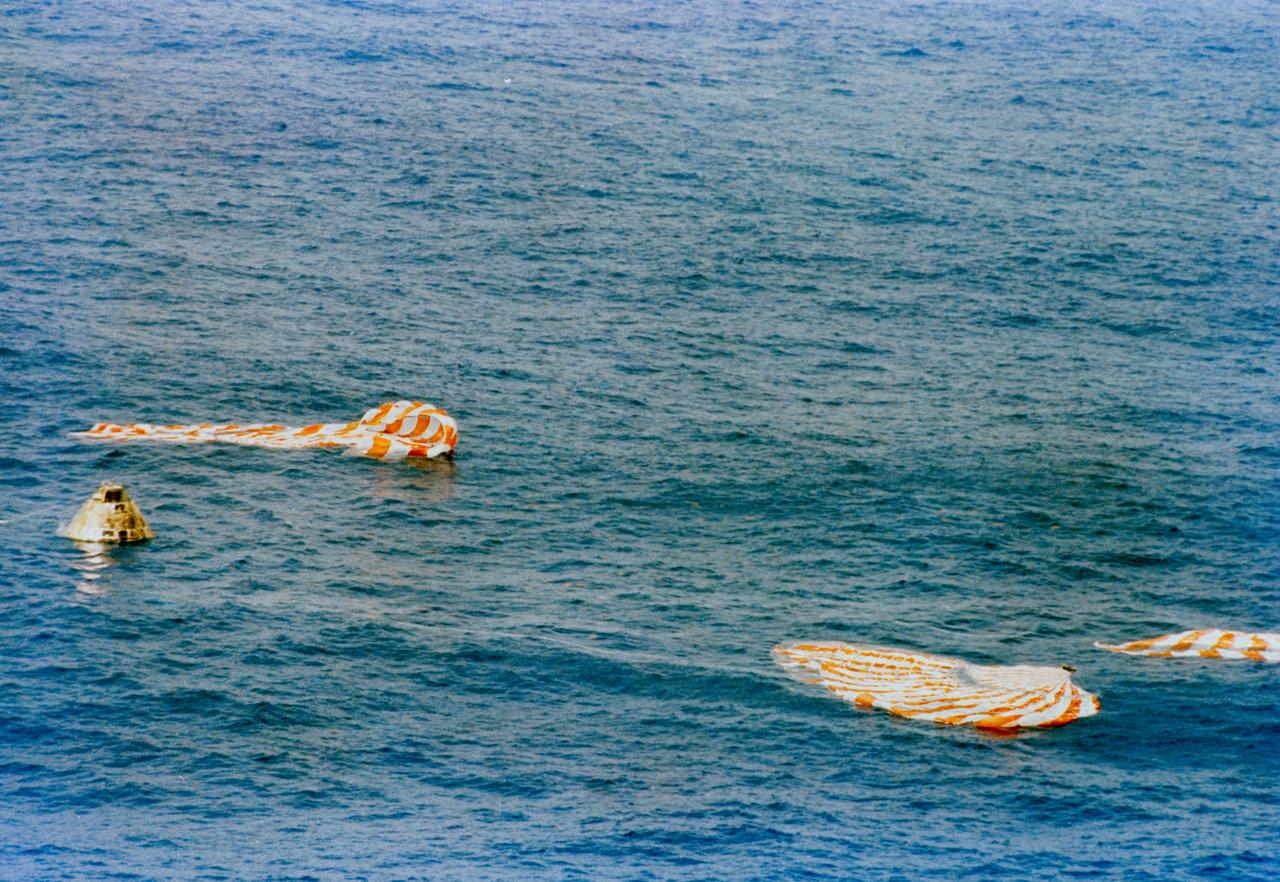
S69-27925 (13 March 1969) --- The Apollo 9 spacecraft, with astronauts James A. McDivitt, David R. Scott, and Russell L. Schweickart aboard, floats in the Atlantic immediately after splashdown. Moments later the three crewmen were picked up by a helicopter and flown to the deck of the USS Guadalcanal, prime recovery ship for the Apollo 9 10-day Earth-orbital space mission. Splashdown occurred at 12:00:53 p.m. (EST), March 13, 1969, only 4.5 nautical miles from the USS Guadalcanal. Just after this picture was taken U.S. Navy underwater demolition team swimmers were dropped into the water to assist in the recovery operations, including attaching a flotation collar to the spacecraft.
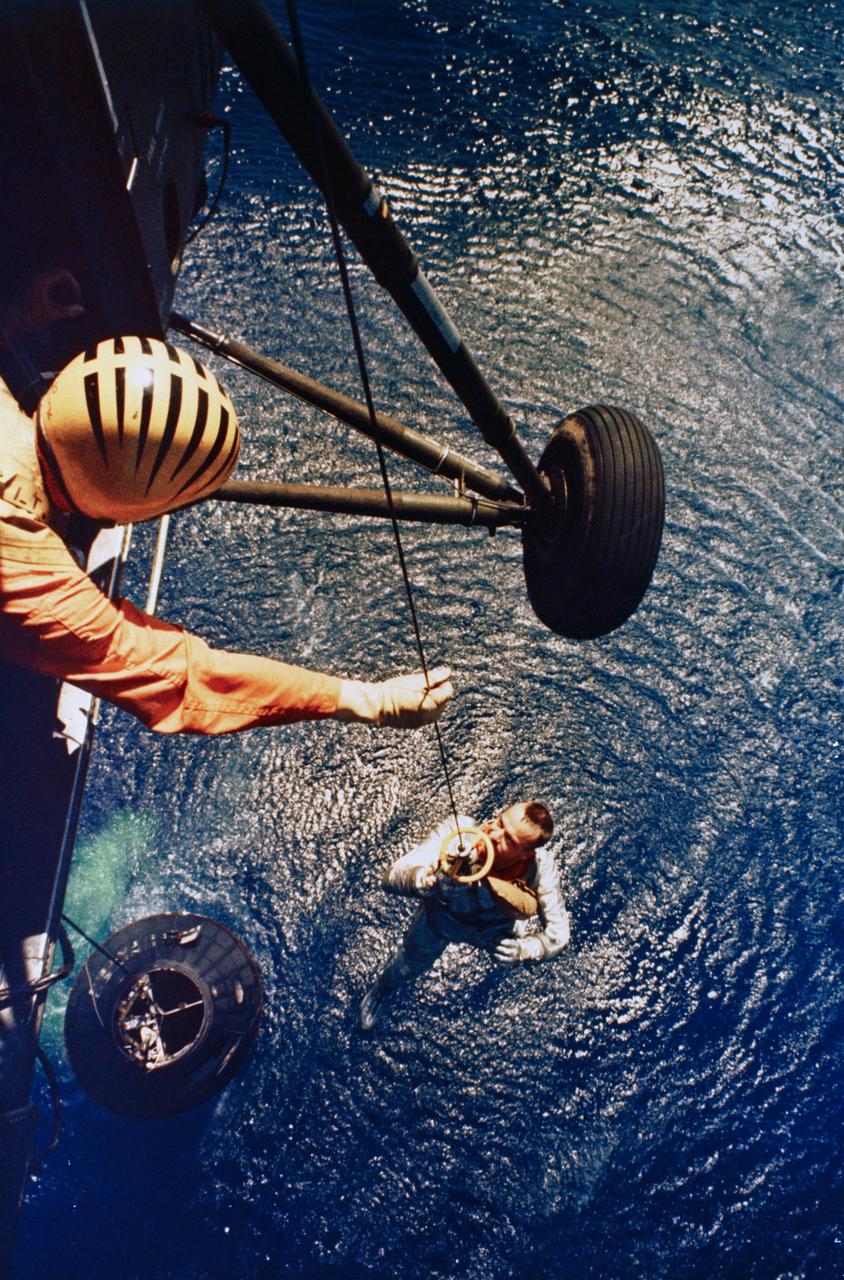
S88-31376 (5 May 1961) --- Astronaut Alan B. Shepard Jr., pilot of the Mercury-Redstone 3 (MR-3) suborbital spaceflight, is retrieved by a helicopter from the USS Lake Champlain during recovery operations in the western Atlantic Ocean. Shepard and the Mercury spacecraft designated the ?Freedom 7? (floating in water below) were flown to the deck of the recovery ship within 11 minutes of splashdown. MR-3 was the United States? first manned space mission. The spacecraft attained a maximum speed of 5,180 miles per hour, reached an altitude of 116 1/2 statute miles, and landed 302 statute miles downrange from Cape Canaveral, Florida. The suborbital mission lasted 15 minutes and 22 seconds. Photo credit: NASA or National Aeronautics and Space Administration
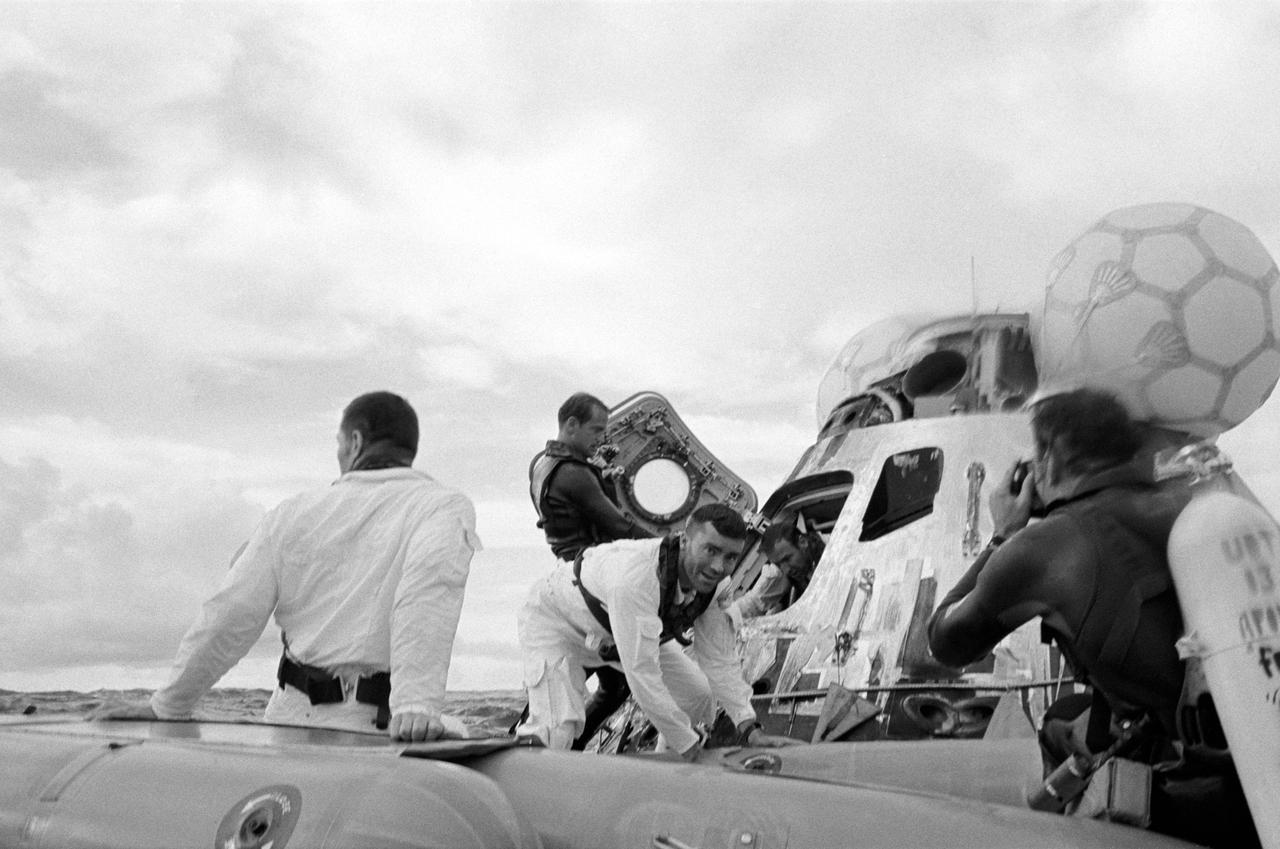
S70-35610 (17 April 1970) --- A water level view of the Apollo 13 recovery operations in the South Pacific Ocean. The three astronauts as seen egressing their spacecraft. John L. Swigert Jr. (back to camera), command module pilot, is already in the life raft. Fred W. Haise Jr., lunar module pilot, facing camera, is stepping into the life raft. James A. Lovell Jr., commander, is leaving the spacecraft in the background. A United States Navy underwater demolition team assists with the recovery operations. The three crewmembers were picked up by helicopter and flown to the prime recovery ship, USS Iwo Jima. The Apollo 13 Command Module (CM) splashed down at 12:07:44 p.m. (CST), April 17, 1970, to conclude safely a perilous space flight. Though the Apollo lunar landing mission was canceled, a disastrous loss of three astronauts was averted.
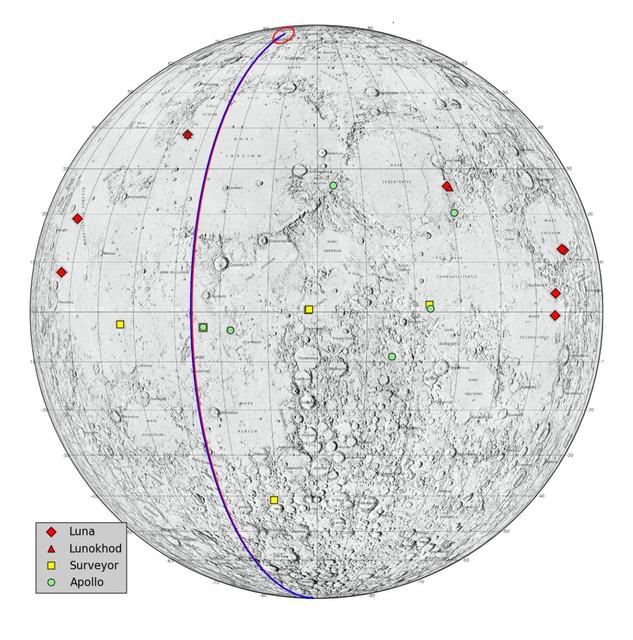
This graphic highlights locations on the moon NASA considers lunar heritage sites and the path NASA Gravity Recovery and Interior Laboratory spacecraft will take on their final flight.
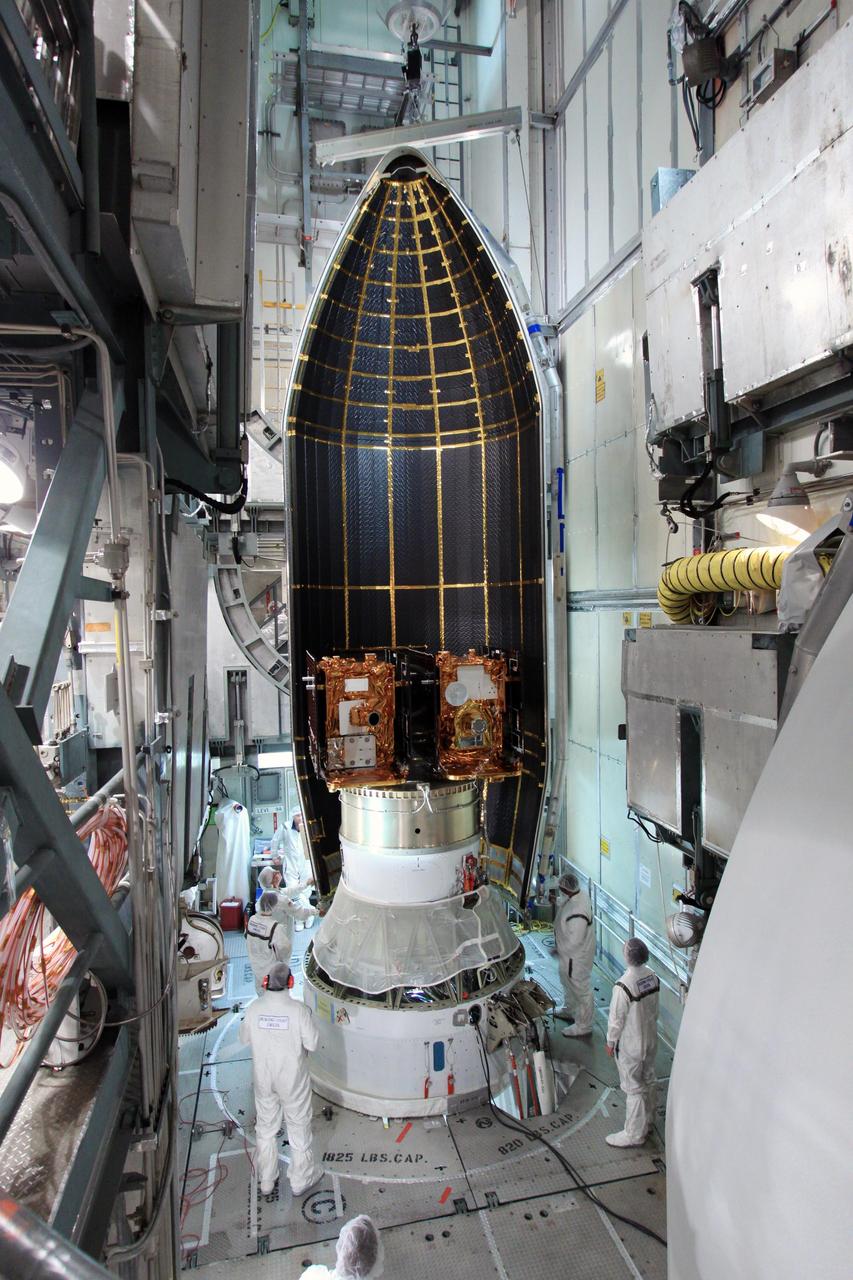
Spacecraft technicians monitor the movement of a section of the clamshell-shaped Delta payload fairing as it encloses NASA twin Gravity Recovery and Interior Laboratory spacecraft at Cape Canaveral Air Force Station in Florida on Aug. 23, 2011.
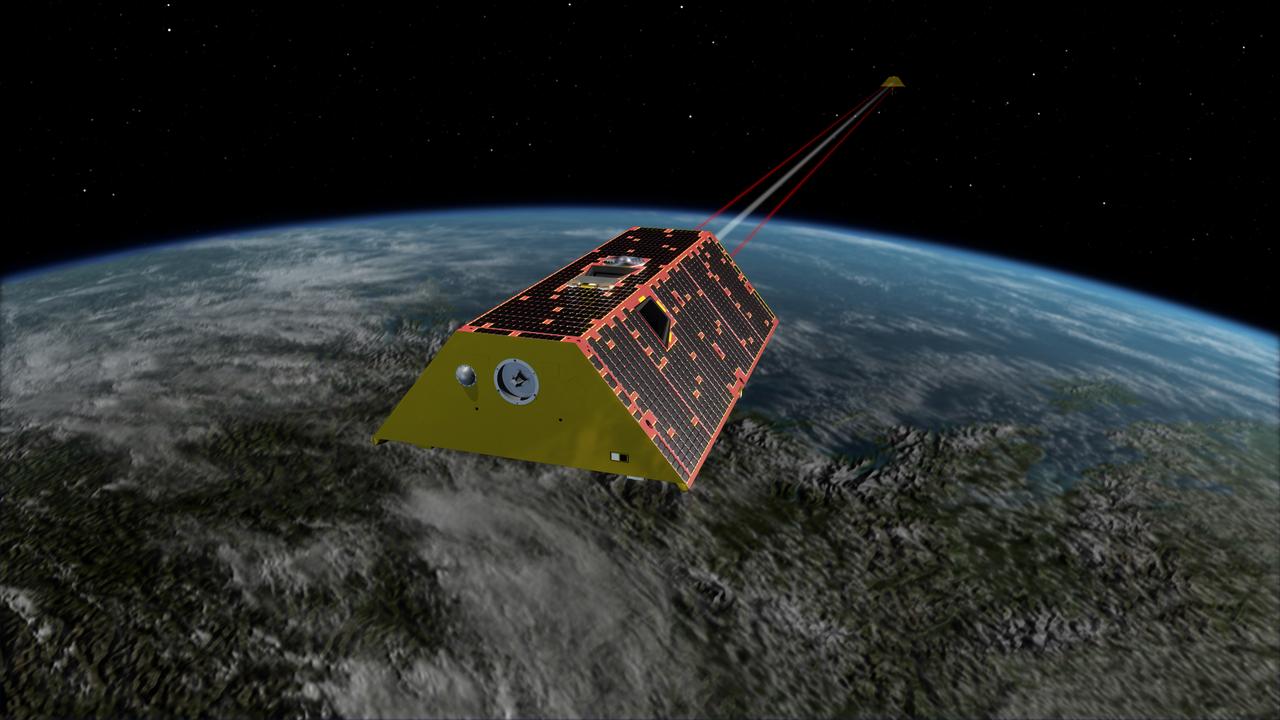
Artist's rendering of the twin spacecraft of the Gravity Recovery and Climate Experiment Follow-On (GRACE-FO) mission, scheduled to launch in May, 2018. GRACE-FO will track the evolution of Earth's water cycle by monitoring changes in the distribution of mass on Earth. https://photojournal.jpl.nasa.gov/catalog/PIA22431
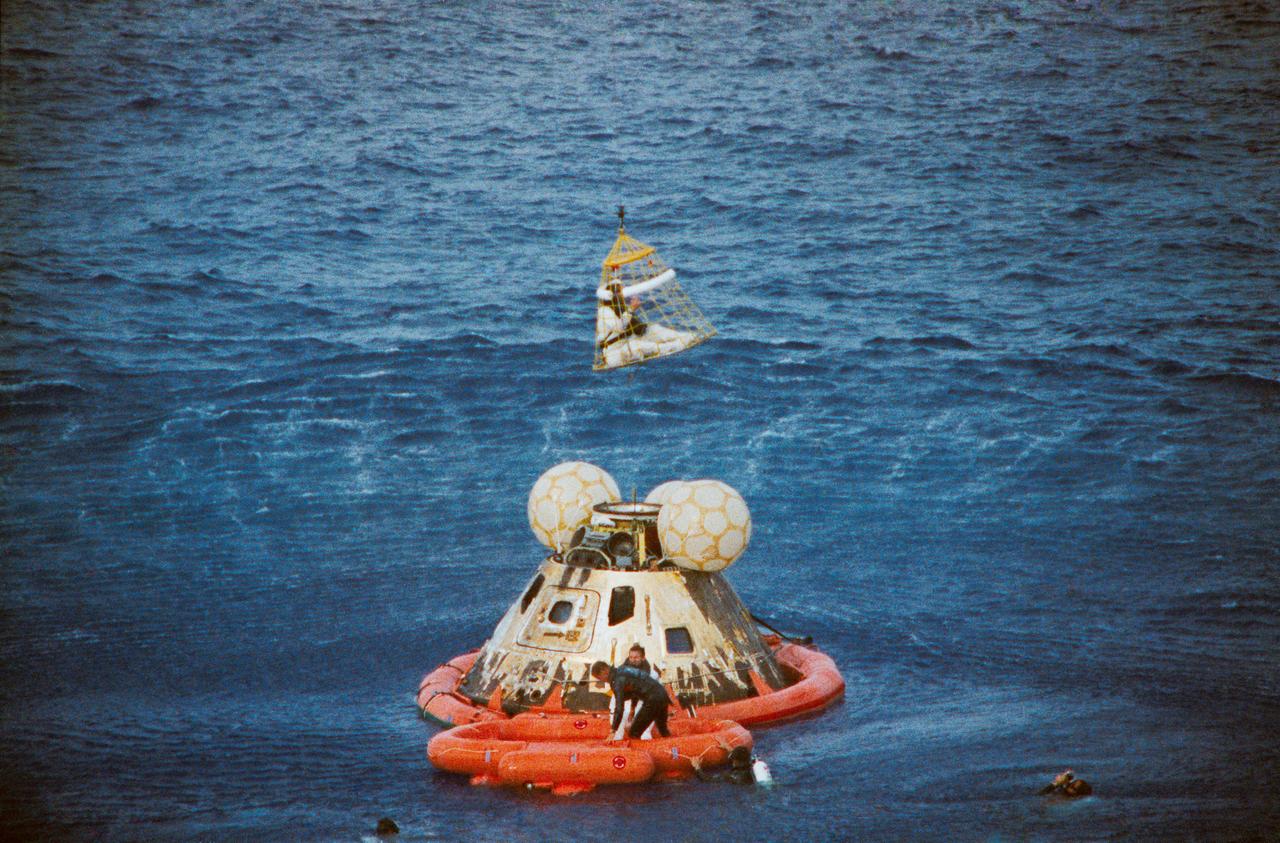
S70-35651 (17 April 1970) --- Astronaut John L. Swigert Jr., command module pilot, is lifted aboard a helicopter in a "Billy Pugh" net while astronaut James A. Lovell Jr., commander, awaits his turn. Astronaut Fred W. Haise Jr., lunar module pilot, is already aboard the helicopter. In the life raft with Lovell, and in the water are several U.S. Navy underwater demolition team swimmers, who assisted in the recovery operations. The crew was taken to the USS Iwo Jima, prime recovery ship, several minutes after the Apollo 13 spacecraft splashed down at 12:07:44 p.m. (CST), April 17, 1970.
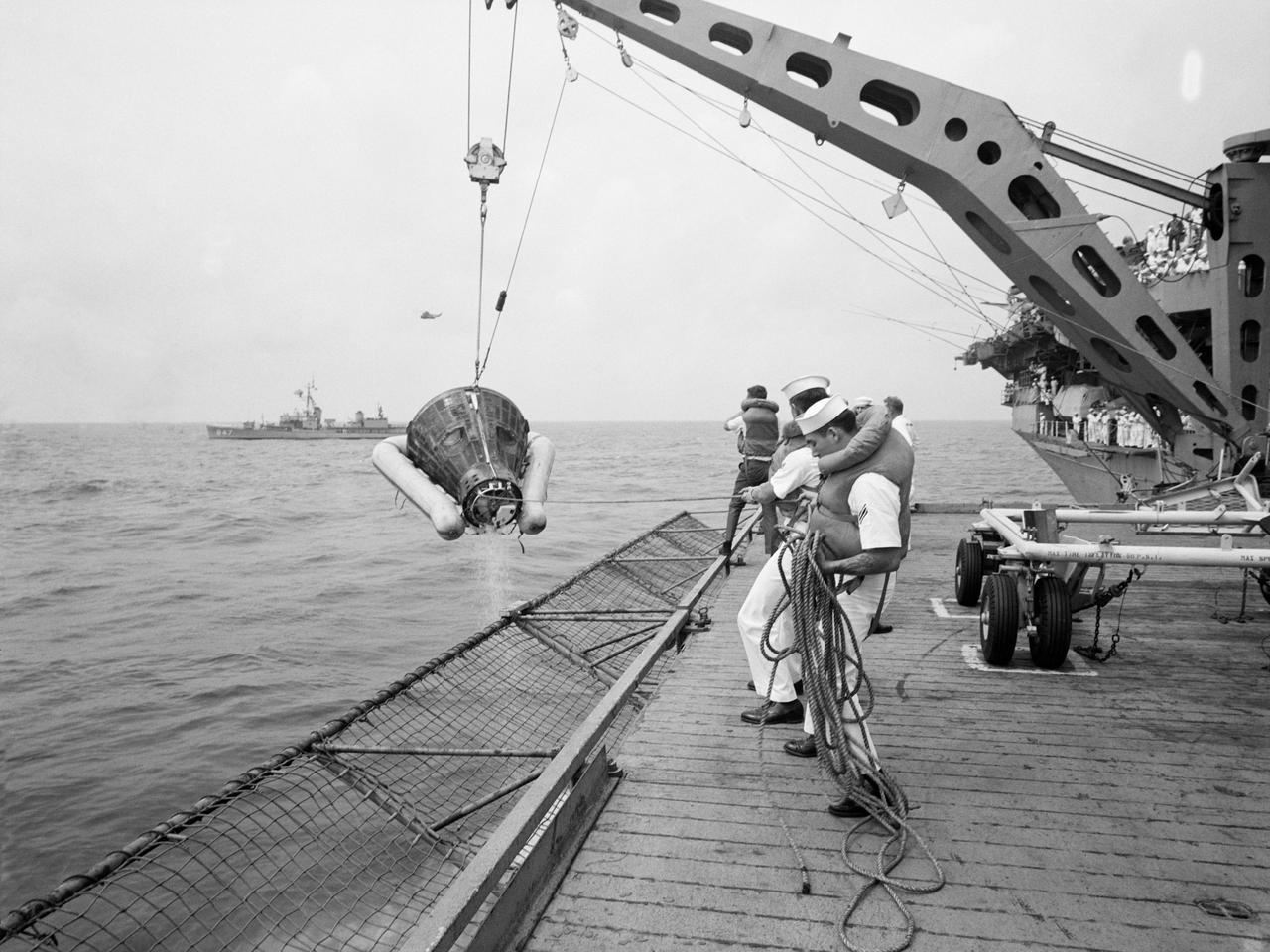
S66-34101 (6 June 1966) --- The Gemini-9 spacecraft, with astronauts Thomas P. Stafford and Eugene A. Cernan still inside, is hoisted aboard the aircraft carrier USS Wasp. Gemini-9 splashed down only 3.5 miles from the big recovery ship at 9 a.m. (EST), June 6, 1966, 345 miles east of Cape Kennedy, to conclude a 72-hour, 21-minute mission in space. Photo credit: NASA

These side-by-side, 3-D comparisons depict the unnamed lunar mountain targeted by the NASA Gravity Recovery and Interior Laboratory GRAIL mission for controlled impact of the Ebb and Flow spacecraft.
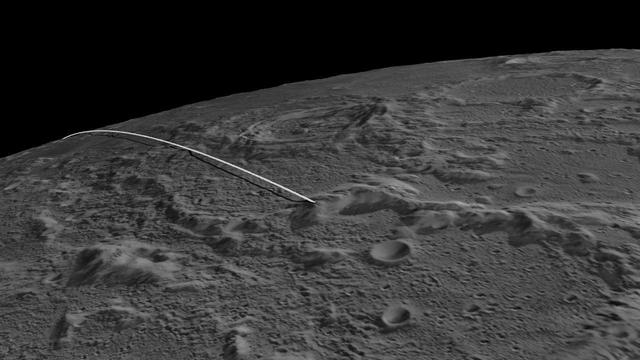
This image shows the final flight path for NASA twin Gravity Recovery and Interior Laboratory GRAIL mission spacecraft, which will impact the moon on Dec. 17, 2012, around 2:28 p.m. PST.
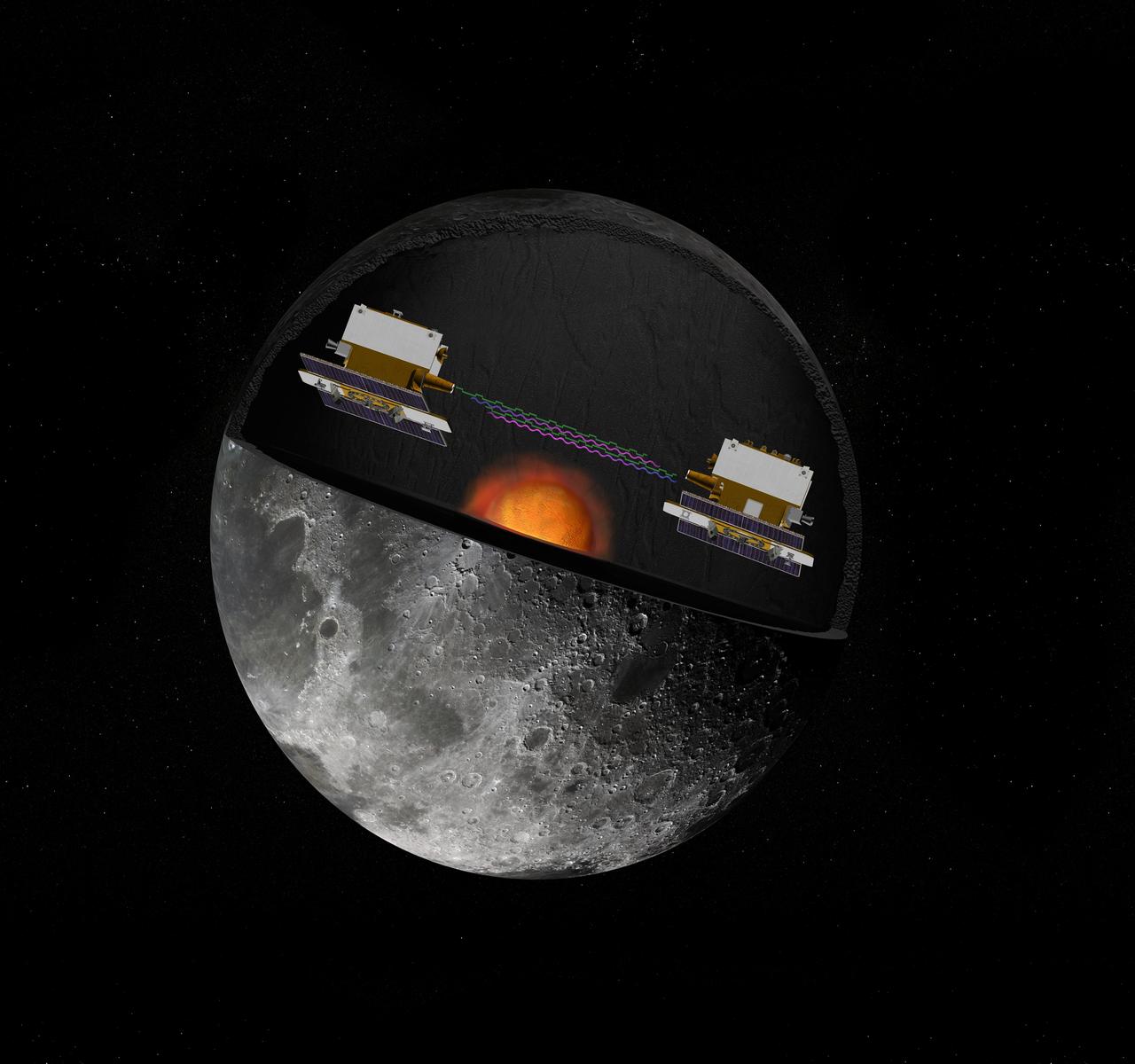
The Gravity Recovery and Interior Laboratory GRAIL mission utilizes the technique of twin spacecraft flying in formation with a known altitude above the lunar surface and known separation distance to investigate the gravity field of the moon.
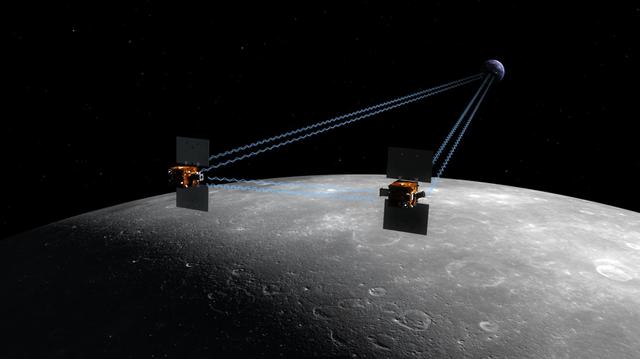
The Gravity Recovery and Interior Laboratory, or GRAIL, mission will fly twin spacecraft in tandem orbits around the moon to measure its gravity field in unprecedented detail. GRAIL is a part of NASA Discovery Program.
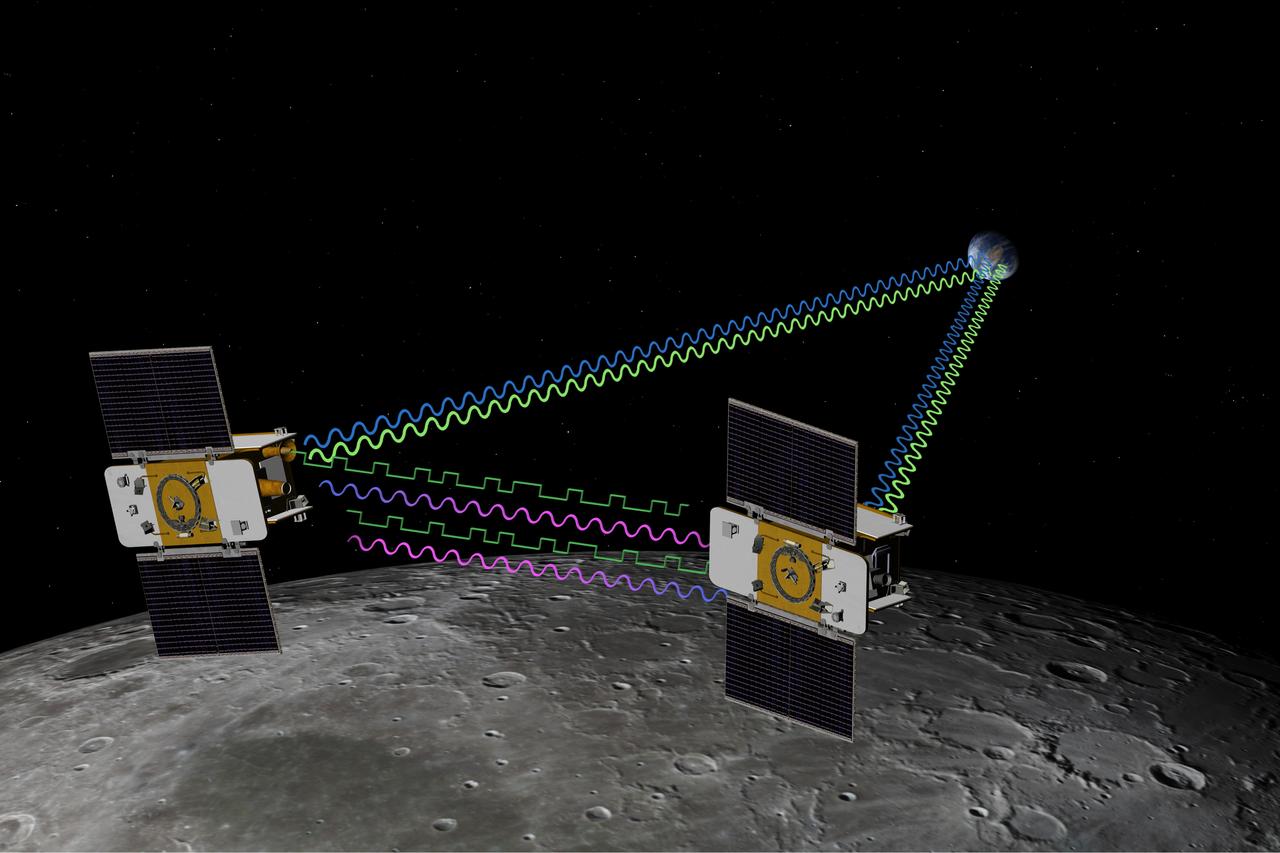
The Gravity Recovery and Interior Laboratory GRAIL mission utilizes the technique of twin spacecraft flying in formation with a known altitude above the lunar surface and known separation distance to investigate the gravity field of the moon.
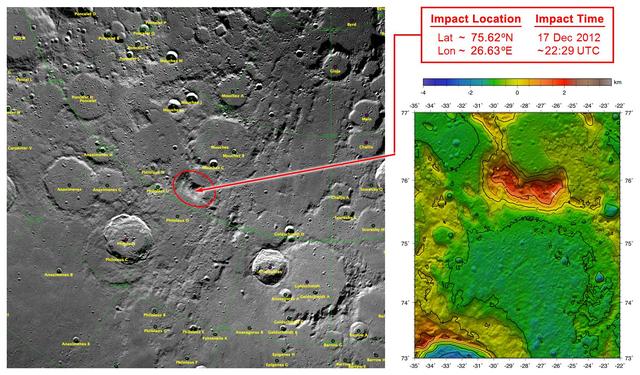
These maps of Earth moon highlight the region where the twin spacecraft of NASA Gravity Recovery and Interior Laboratory GRAIL mission will impact on Dec. 17, marking the end of its successful endeavor to map the moon gravity.
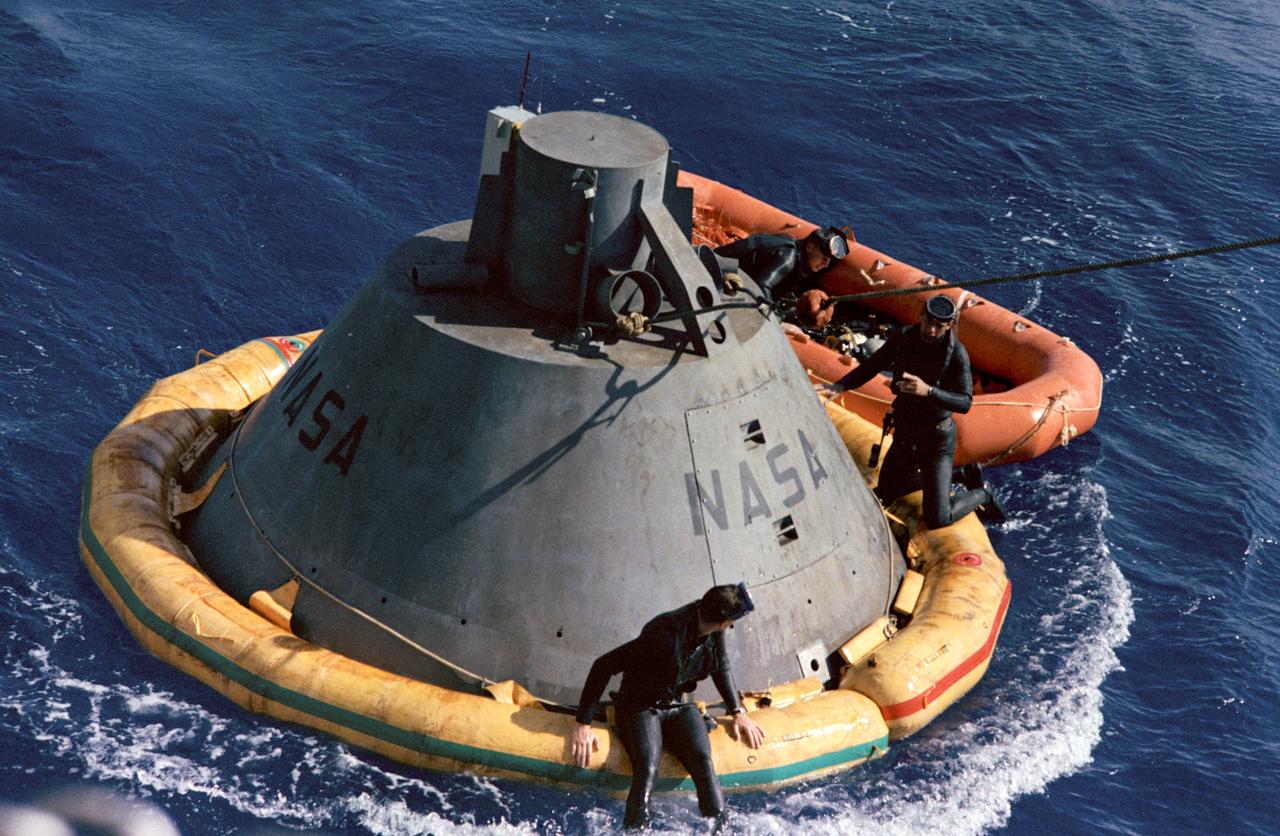
Apollo command module boilerplate floats in the Atlantic Ocean during a practice recovery exercise. Frogmen in a liferaft and on the flotation collar secure the command module boilerplate for hoisting onto a nearby recovery ship. The exercise was conducted in preparation for the forthcoming Apollo-Saturn 201 (AS-201) mission.
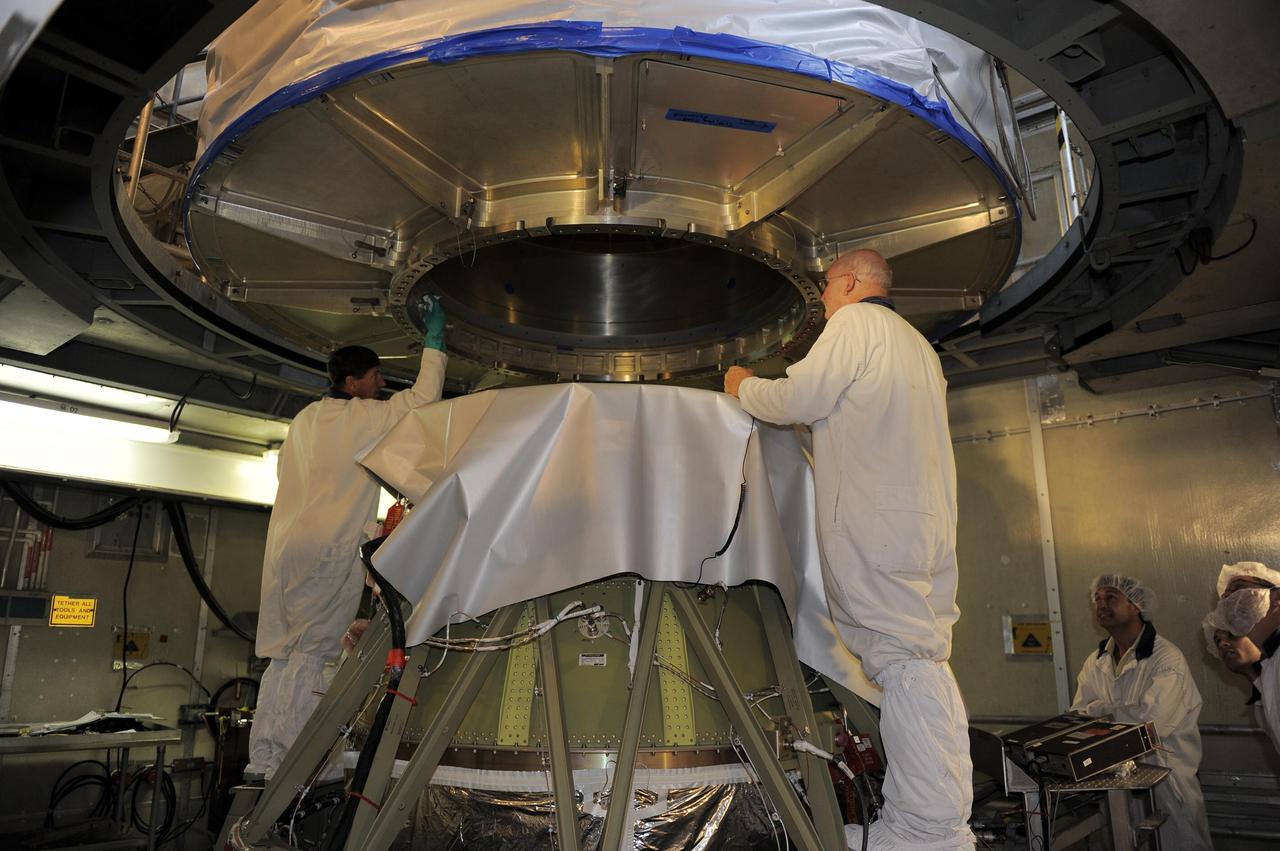
NASA twin Gravity Recovery and Interior Laboratory GRAIL spacecraft are lowered onto the second stage of their Delta II launch vehicle. At top is the spacecraft adapter ring which holds the two lunar probes in their side-by-side launch configuration.
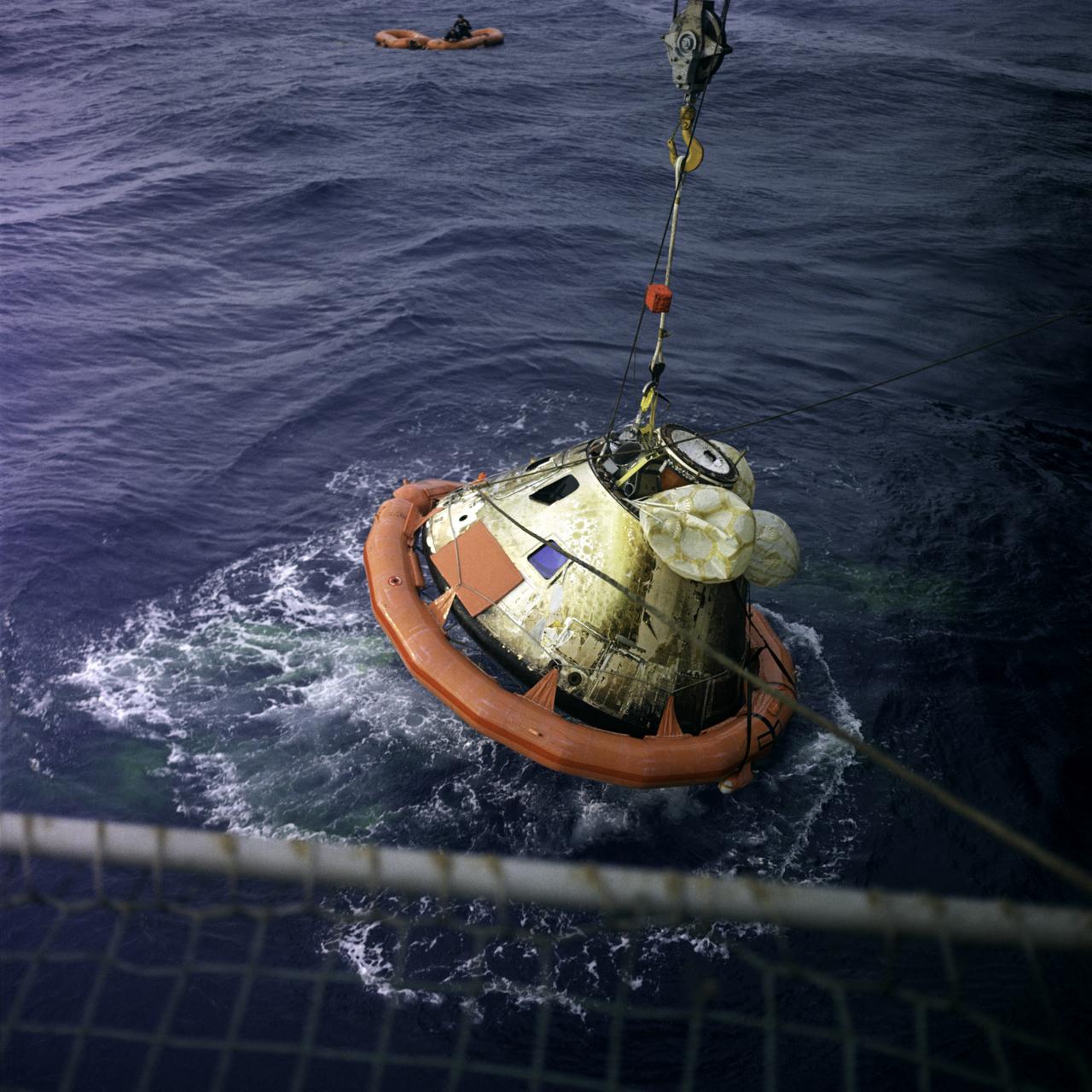
RECOVERY - APOLLO 8 Recovery and inspection of the Apollo 8 Command Module (CM)-103 spacecraft.
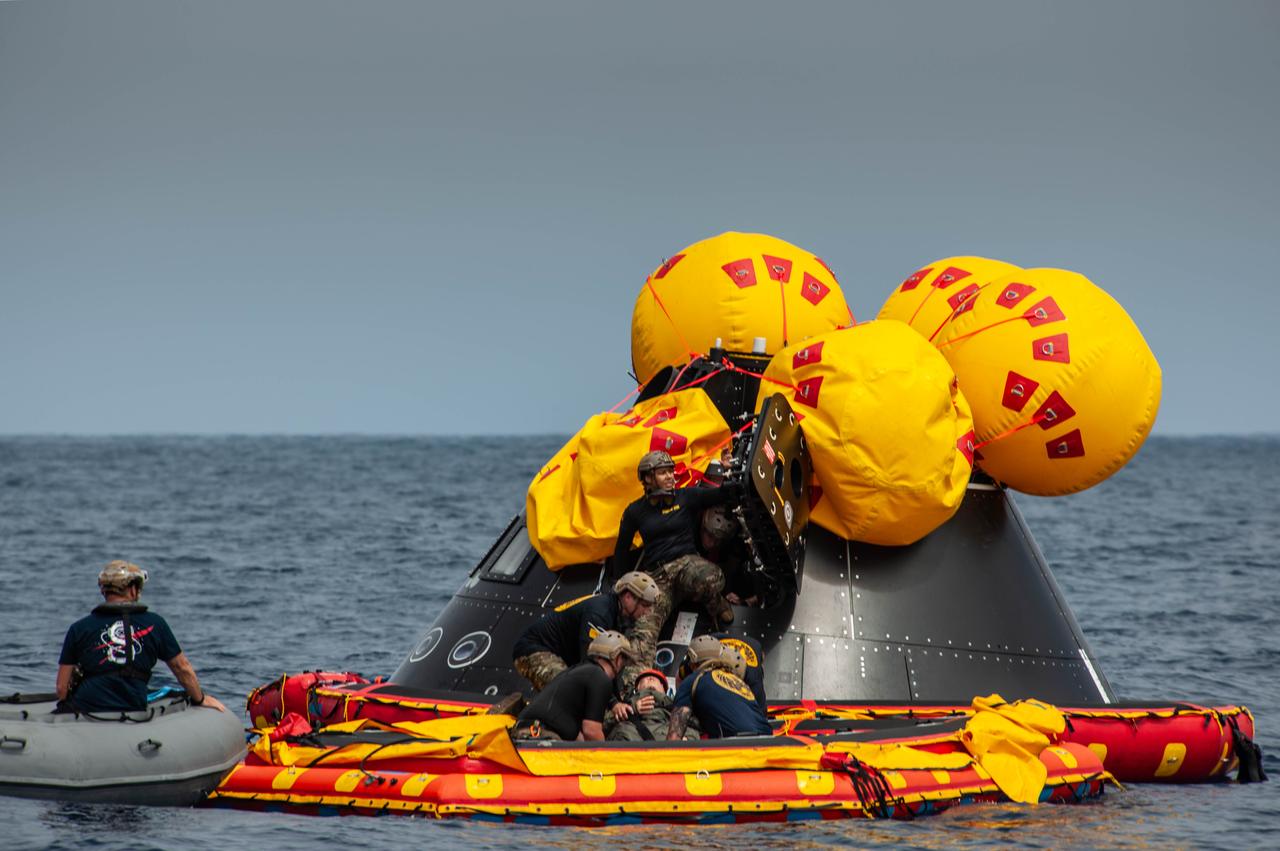
Navy divers from Explosive Ordnance Disposal (EOD) Expeditionary Support Unit 1 practice contingency recovery procedures with a manikin and the Orion Crew Module Test Article (CMTA) in the Pacific Ocean as part of NASA’s Underway Recovery Test 10 (URT-10). The divers are trained in open water and small boat procedures and will be the team to help Artemis astronauts exit the Orion spacecraft and make it safely to the recovery ship after splashdown in addition to preparing the spacecraft to be transported back inside the recovery ship.
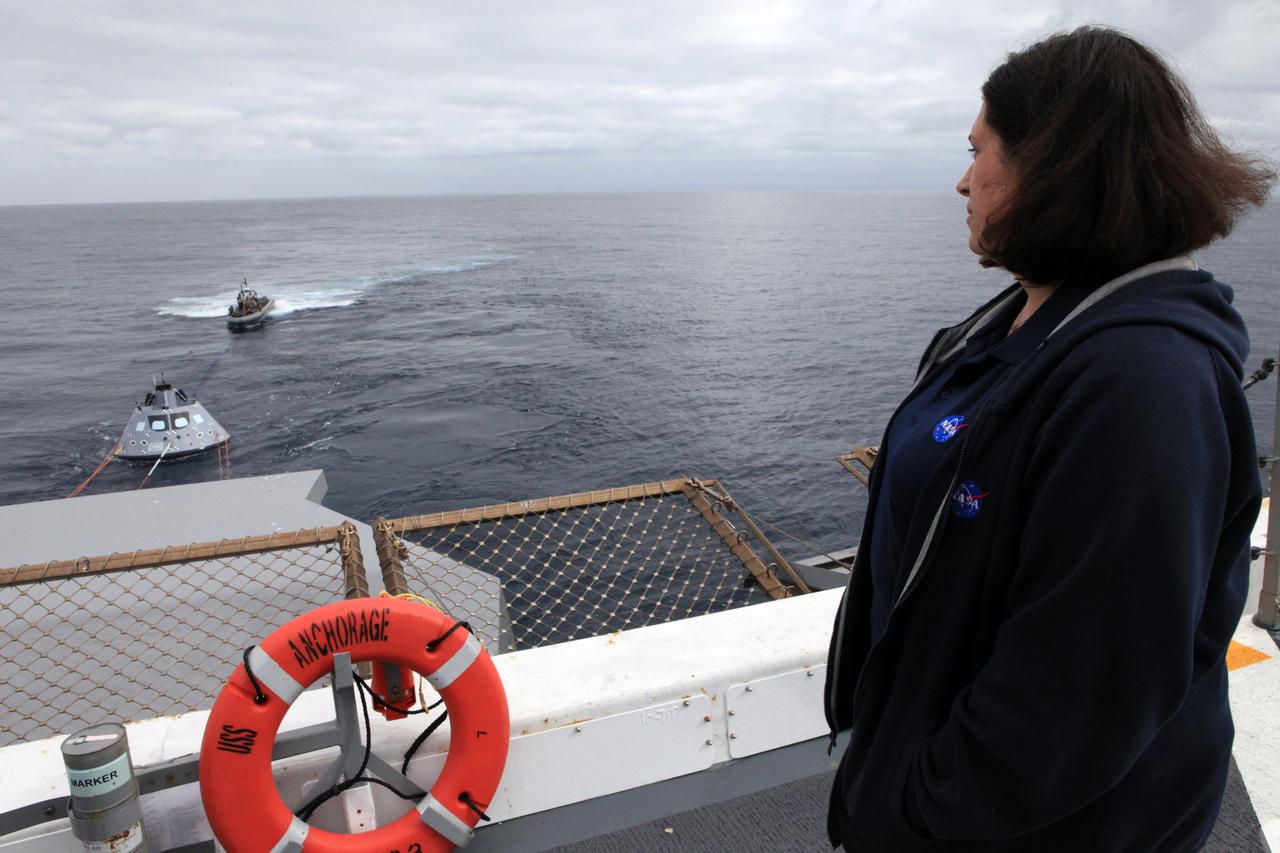
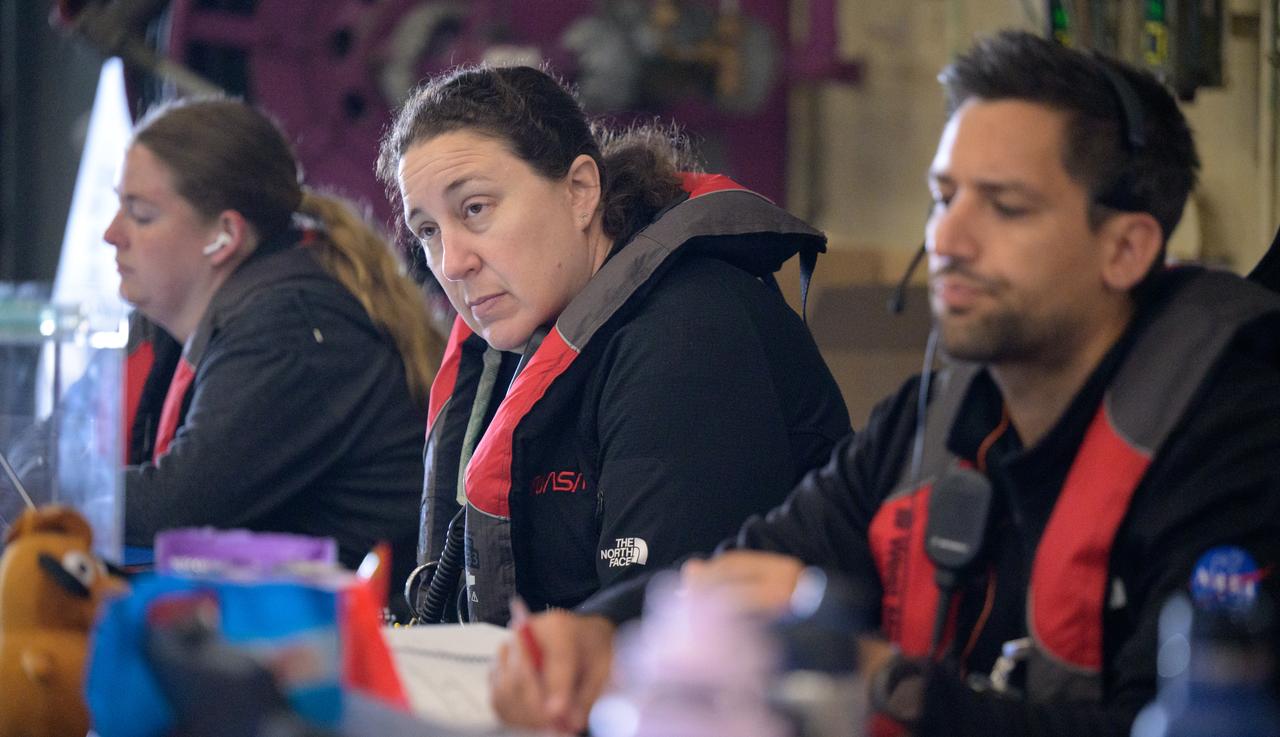
NASA Recovery Director Melissa Jones watches part of Underway Recovery Test 6, from the flight deck of the USS Anchorage. During this portion, the Orion test article is intentionally subjected to an increased sea state as the NASA Recovery Team works hard to keep control of the spacecraft. The testing with Kennedy Space Center's NASA Recovery Team and the U.S. Navy will provide important data that is being used to improve recovery procedures and hardware ahead of Orion's next flight, Exploration Mission-1, when it splashes down in the Pacific Ocean.

Members of NASA’s Landing and Recovery team, along with partners from the Department of Defense, practice Artemis recovery procedures as part of Underway Recovery Test 10 (URT-10) off the coast of San Diego on Aug. 1, 2023. The event involved the use of the Crew Module Test Article (CMTA), a full-scale mockup of NASA’s Orion spacecraft. URT-10 is the 10th in a series of Artemis recovery tests, but marked the first time NASA and its partners from the Department of Defense put their Artemis II recovery procedures to the test.
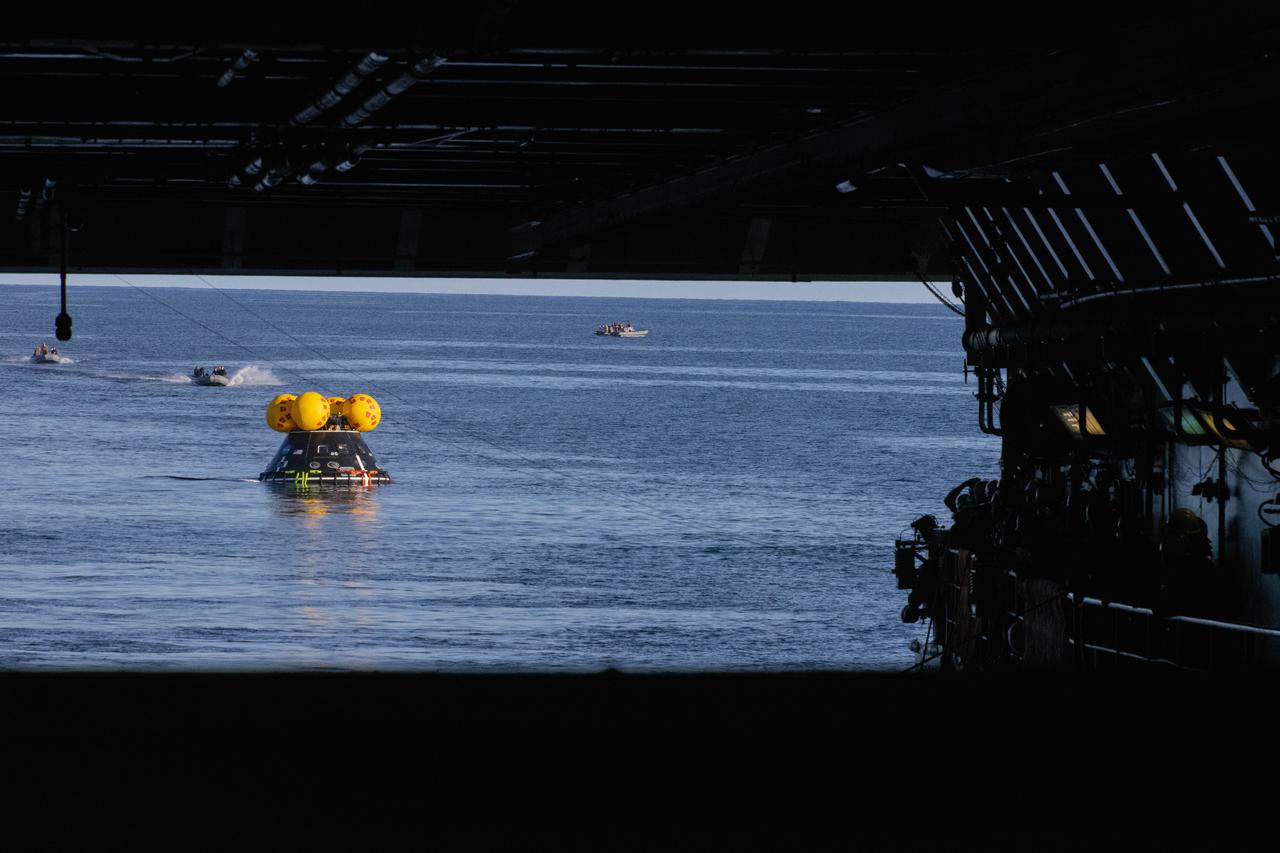
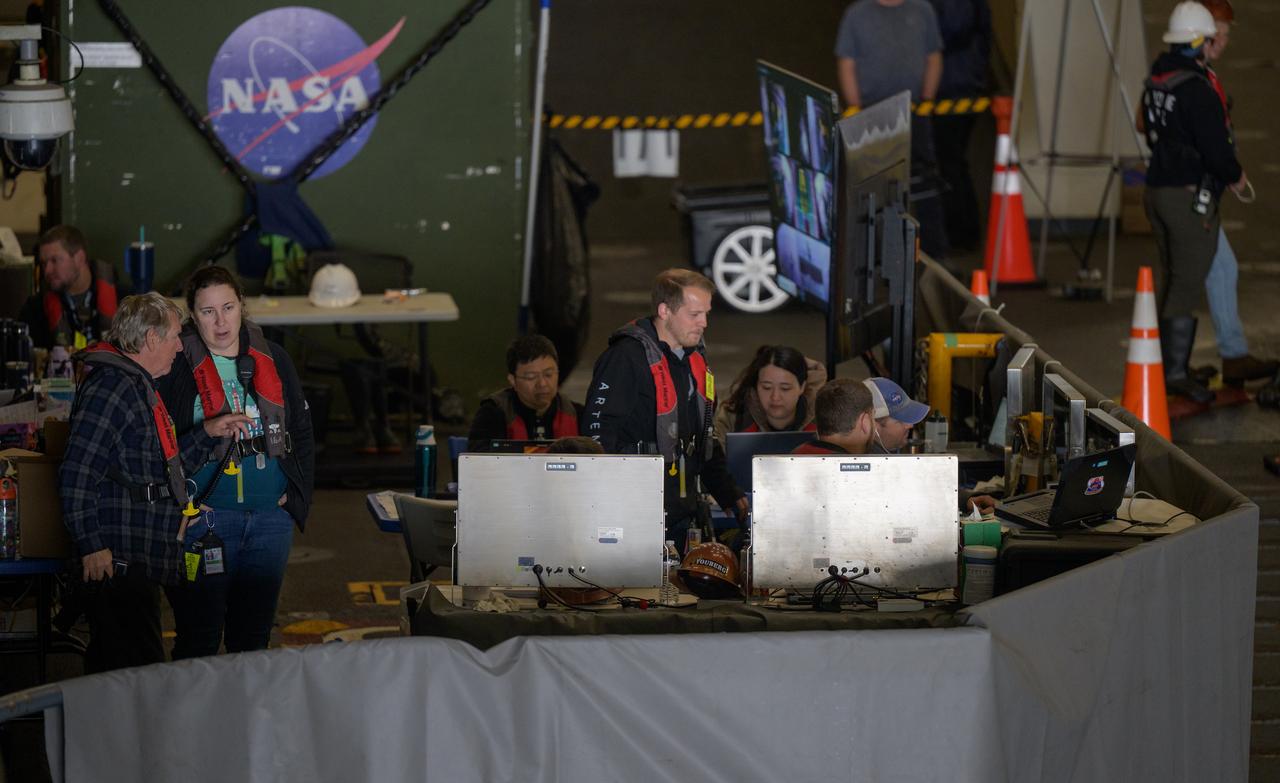
NASA’s Exploration Ground System’s Landing and Recovery team, partners from the Department of Defense, and U.S. Navy personnel aboard the USS San Diego practice recovery procedures using a mockup of the Orion spacecraft, during Underway Recovery Test 11 (URT-11) off the coast of San Diego, California on Tuesday, Feb. 27, 2024. URT-11 is the eleventh in a series of Artemis recovery tests, and the first time NASA and its partners put their Artemis II recovery procedures to the test with the astronauts.

Members of NASA’s Landing and Recovery team, along with partners from the Department of Defense, practice Artemis recovery procedures as part of Underway Recovery Test 10 (URT-10) off the coast of San Diego on July 31, 2023. The event involved the use of the Crew Module Test Article (CMTA), a full-scale mockup of NASA’s Orion spacecraft. URT-10 is the 10th in a series of Artemis recovery tests, but marked the first time NASA and its partners from the Department of Defense put their Artemis II recovery procedures to the test.

Members of NASA’s Landing and Recovery team, along with partners from the Department of Defense, practice Artemis recovery procedures as part of Underway Recovery Test 10 (URT-10) off the coast of San Diego on July 31, 2023. The event involved the use of the Crew Module Test Article (CMTA), a full-scale mockup of NASA’s Orion spacecraft. URT-10 is the 10th in a series of Artemis recovery tests, but marked the first time NASA and its partners from the Department of Defense put their Artemis II recovery procedures to the test.

Members of NASA’s Landing and Recovery team, along with partners from the Department of Defense, practice Artemis recovery procedures as part of Underway Recovery Test 10 (URT-10) off the coast of San Diego on Aug. 1, 2023. The event involved the use of the Crew Module Test Article (CMTA), a full-scale mockup of NASA’s Orion spacecraft. URT-10 is the 10th in a series of Artemis recovery tests, but marked the first time NASA and its partners from the Department of Defense put their Artemis II recovery procedures to the test.

Members of NASA’s Landing and Recovery team, along with partners from the Department of Defense, practice Artemis recovery procedures as part of Underway Recovery Test 10 (URT-10) off the coast of San Diego on Aug. 1, 2023. The event involved the use of the Crew Module Test Article (CMTA), a full-scale mockup of NASA’s Orion spacecraft. URT-10 is the 10th in a series of Artemis recovery tests, but marked the first time NASA and its partners from the Department of Defense put their Artemis II recovery procedures to the test.

Members of NASA’s Landing and Recovery team, along with partners from the Department of Defense, practice Artemis recovery procedures as part of Underway Recovery Test 10 (URT-10) off the coast of San Diego on July 31, 2023. The event involved the use of the Crew Module Test Article (CMTA), a full-scale mockup of NASA’s Orion spacecraft. URT-10 is the 10th in a series of Artemis recovery tests, but marked the first time NASA and its partners from the Department of Defense put their Artemis II recovery procedures to the test.

Members of NASA’s Landing and Recovery team, along with partners from the Department of Defense, practice Artemis recovery procedures as part of Underway Recovery Test 10 (URT-10) off the coast of San Diego on Aug. 1, 2023. The event involved the use of the Crew Module Test Article (CMTA), a full-scale mockup of NASA’s Orion spacecraft. URT-10 is the 10th in a series of Artemis recovery tests, but marked the first time NASA and its partners from the Department of Defense put their Artemis II recovery procedures to the test.
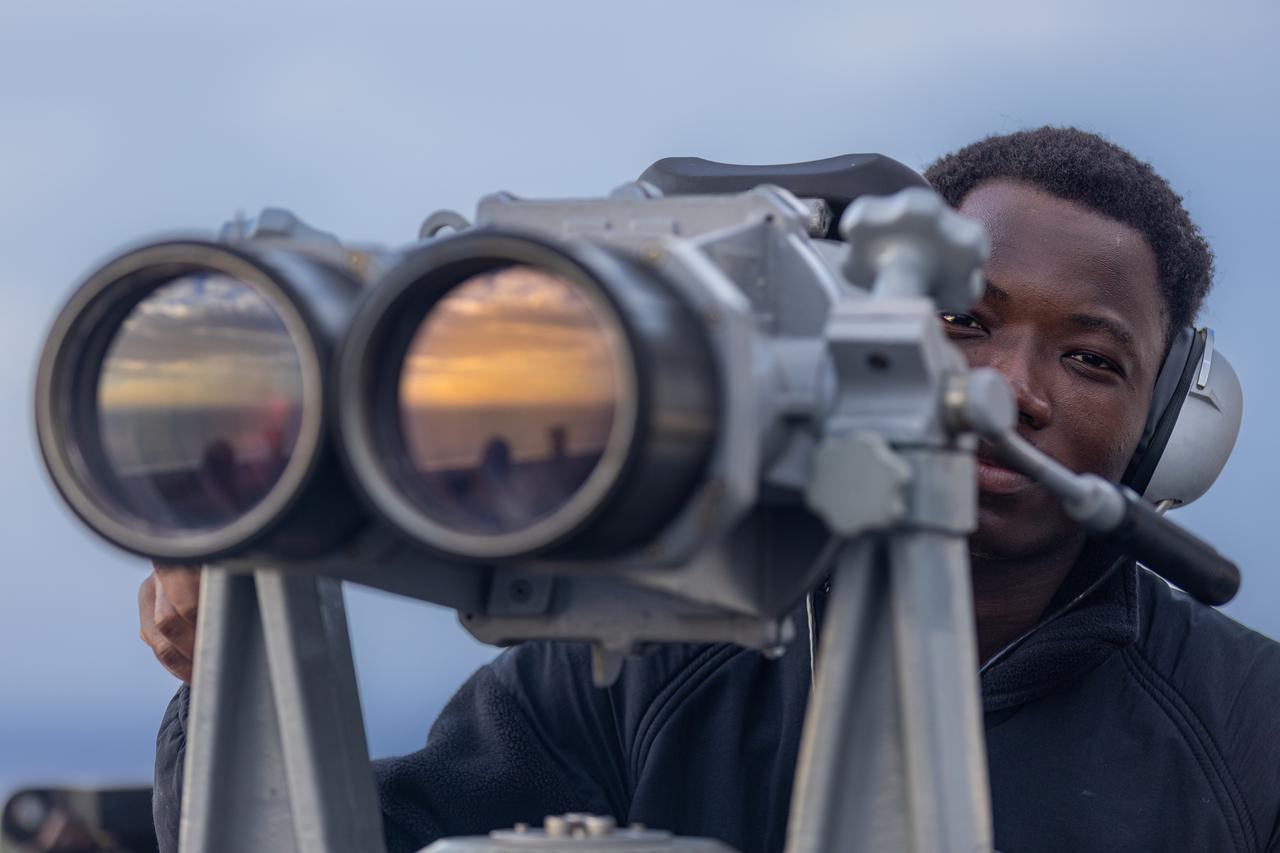
Members of NASA’s Landing and Recovery team, along with partners from the Department of Defense, practice Artemis recovery procedures as part of Underway Recovery Test 10 (URT-10) off the coast of San Diego on July 31, 2023. The event involved the use of the Crew Module Test Article (CMTA), a full-scale mockup of NASA’s Orion spacecraft. URT-10 is the 10th in a series of Artemis recovery tests, but marked the first time NASA and its partners from the Department of Defense put their Artemis II recovery procedures to the test.
Members of NASA’s Landing and Recovery team, along with partners from the Department of Defense, practice Artemis recovery procedures as part of Underway Recovery Test 10 (URT-10) off the coast of San Diego on July 31, 2023. The event involved the use of the Crew Module Test Article (CMTA), a full-scale mockup of NASA’s Orion spacecraft. URT-10 is the 10th in a series of Artemis recovery tests, but marked the first time NASA and its partners from the Department of Defense put their Artemis II recovery procedures to the test.

Members of NASA’s Landing and Recovery team, along with partners from the Department of Defense, practice Artemis recovery procedures as part of Underway Recovery Test 10 (URT-10) off the coast of San Diego on Aug. 1, 2023. The event involved the use of the Crew Module Test Article (CMTA), a full-scale mockup of NASA’s Orion spacecraft. URT-10 is the 10th in a series of Artemis recovery tests, but marked the first time NASA and its partners from the Department of Defense put their Artemis II recovery procedures to the test.
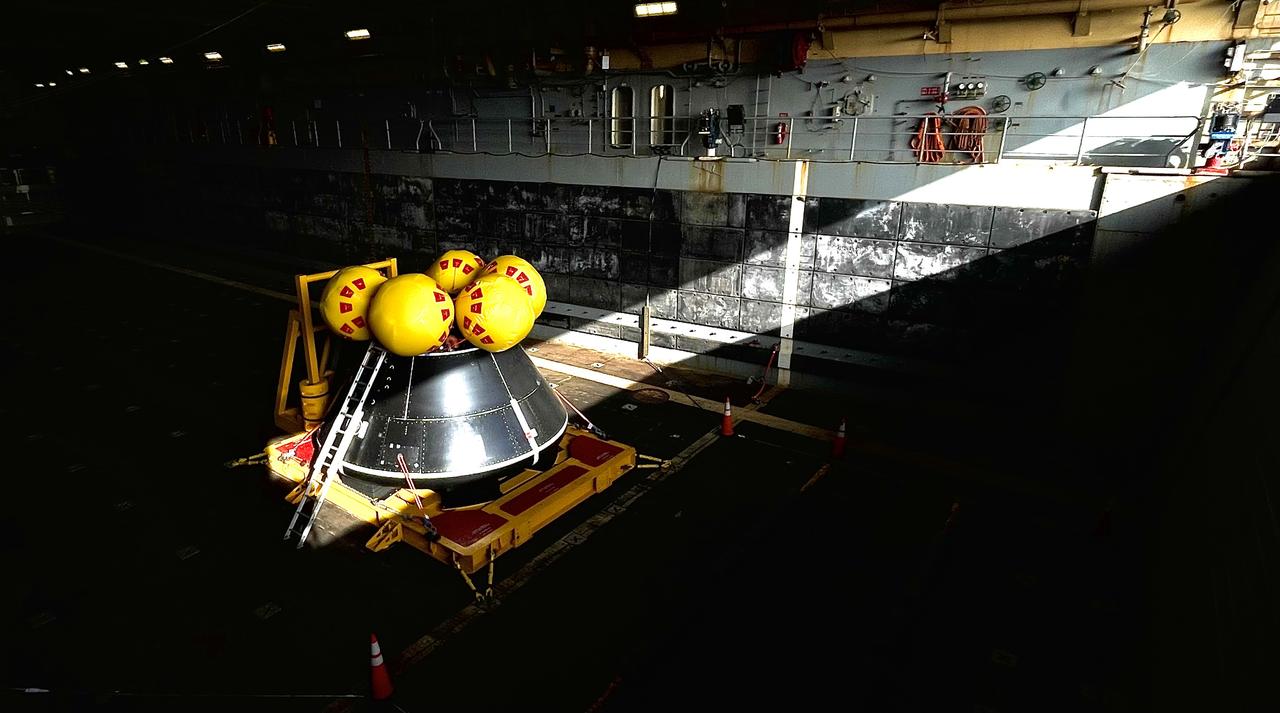
While onboard the USS John P. Murtha, NASA and the Department of Defense practice Artemis II recovery operations with the Crew Module Test Article (CMTA) in July of 2023. The CMTA is a full-scale mockup of the Orion spacecraft and is used to verify the recovery team is ready to support crew recovery after missions to the Moon.
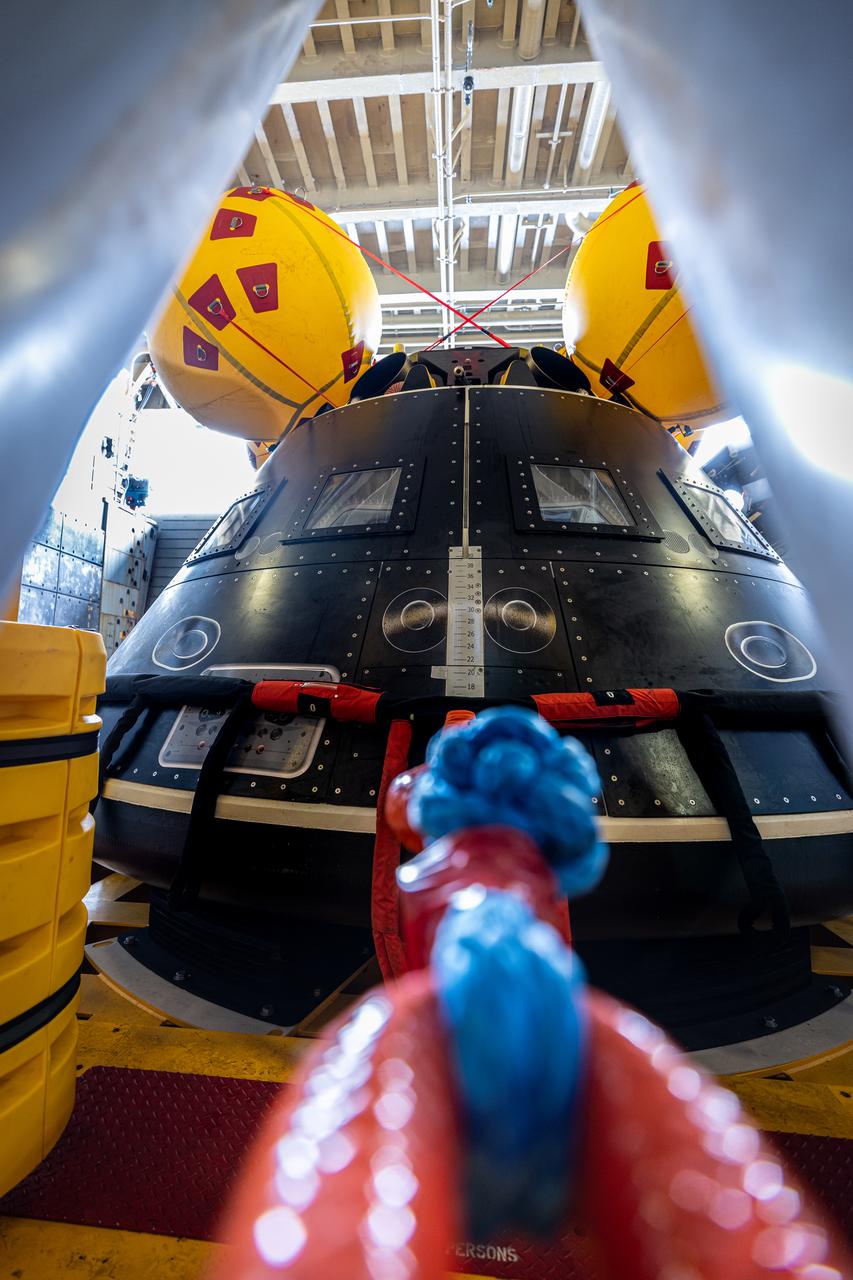
While onboard the USS John P. Murtha, NASA and the Department of Defense practice Artemis II recovery operations with the Crew Module Test Article (CMTA) in July of 2023. The CMTA is a full-scale mockup of the Orion spacecraft and is used to verify the recovery team is ready to support crew recovery after missions to the Moon.
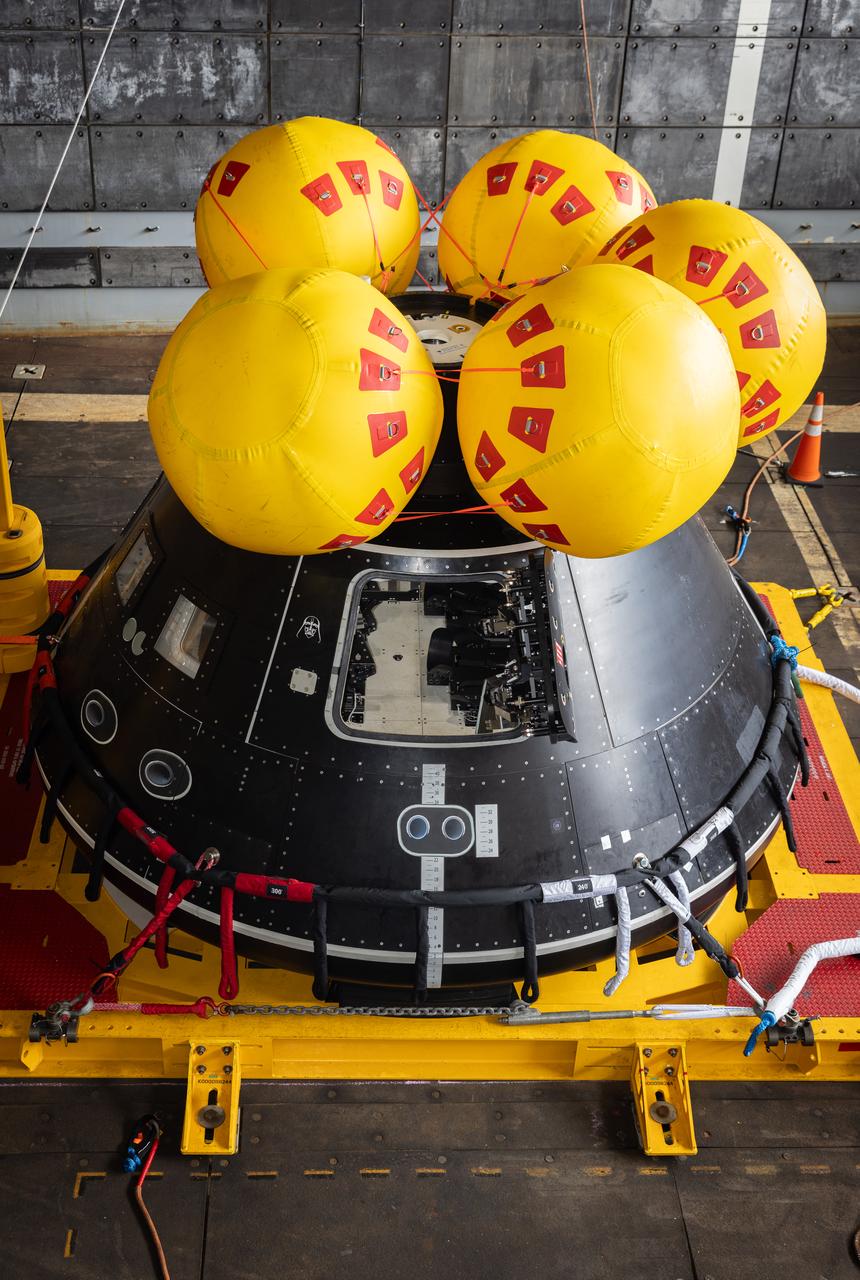
While onboard the USS John P. Murtha, NASA and the Department of Defense practice Artemis II recovery operations with the Crew Module Test Article (CMTA) in July of 2023. The CMTA is a full-scale mockup of the Orion spacecraft and is used to verify the recovery team is ready to support crew recovery after missions to the Moon.
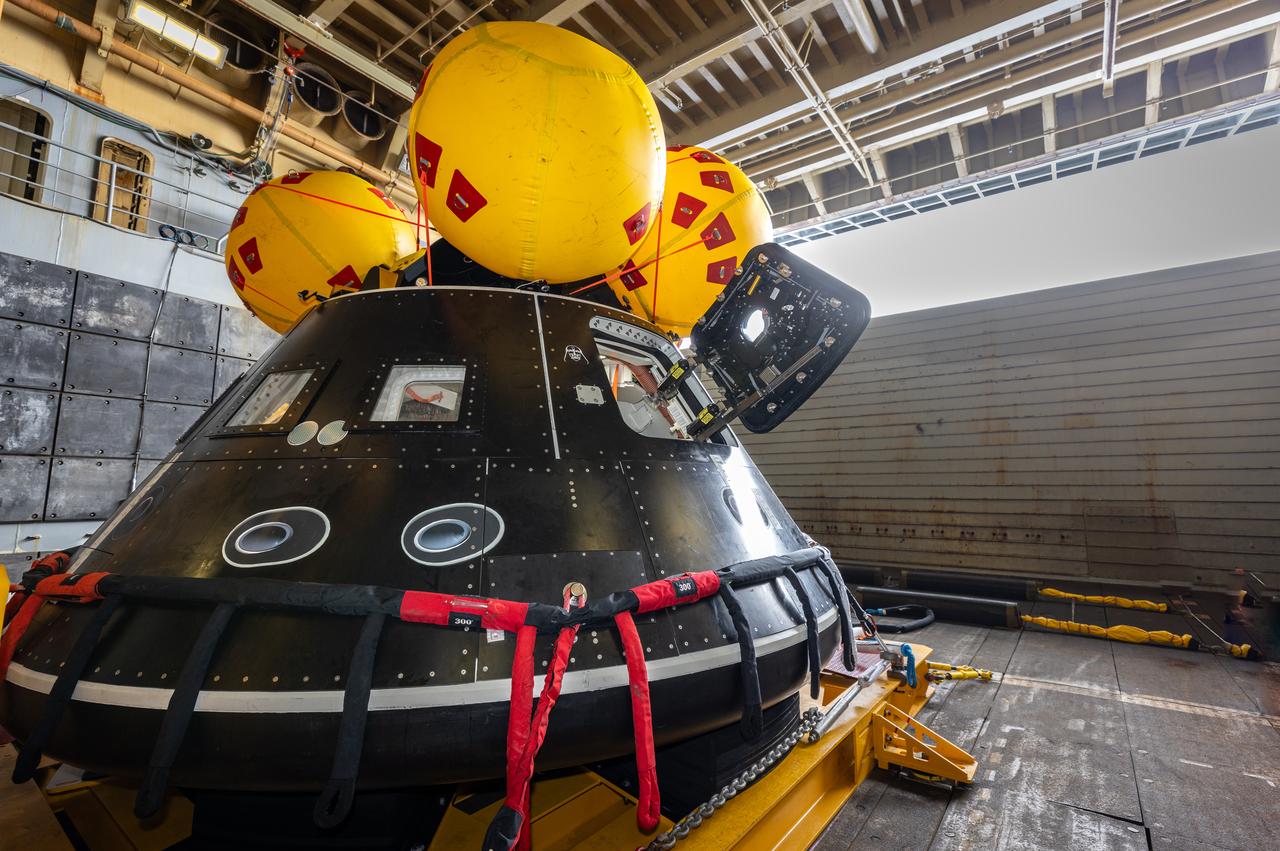
While onboard the USS John P. Murtha, NASA and the Department of Defense practice Artemis II recovery operations with the Crew Module Test Article (CMTA) in July of 2023. The CMTA is a full-scale mockup of the Orion spacecraft and is used to verify the recovery team is ready to support crew recovery after missions to the Moon.
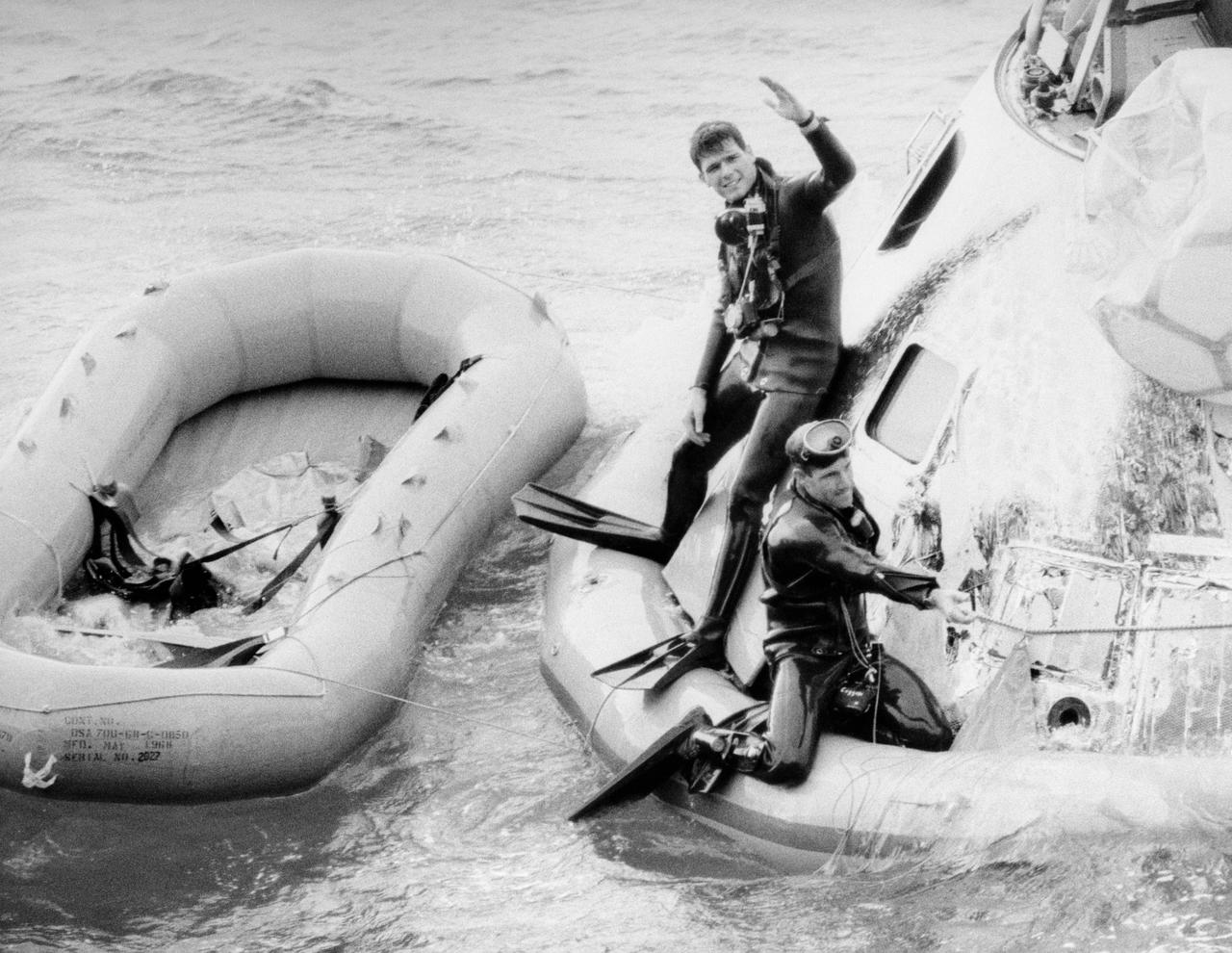
S69-15732 (27 Dec. 1968) --- A U.S. Navy frogman team participates in the Apollo 8 recovery operations. The Apollo crew, astronauts Frank Borman, James A. Lovell Jr., and William A. Anders, were recovered by helicopter and flown to the deck of the USS Yorktown, prime recovery ship for the historic Apollo 8 lunar orbit mission. Apollo 8 splashed down at 10:51 a.m. (EST), Dec. 27, 1968, about 1,000 miles south-southwest of Hawaii.

RECOVERY - APOLLO 8 - USS YORKTOWN Recovery activities of the Apollo 8 Crew and Command Module (CM)-103 Spacecraft inspection onboard the USS Yorktown. USS YORKTOWN
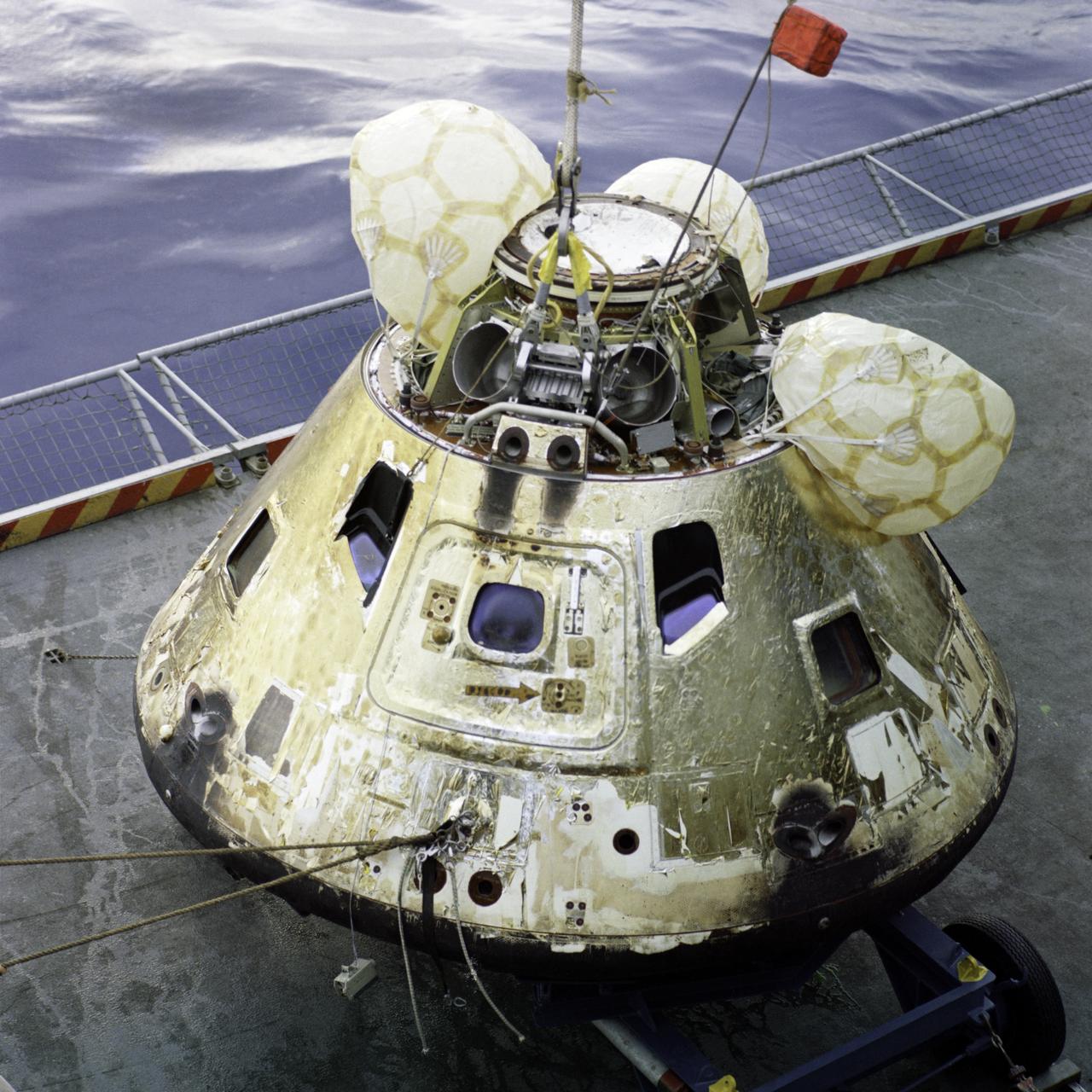
RECOVERY - APOLLO 8 - USS YORKTOWN Recovery activities of the Apollo 8 Crew and Command Module (CM)-103 Spacecraft inspection onboard the USS Yorktown. USS YORKTOWN
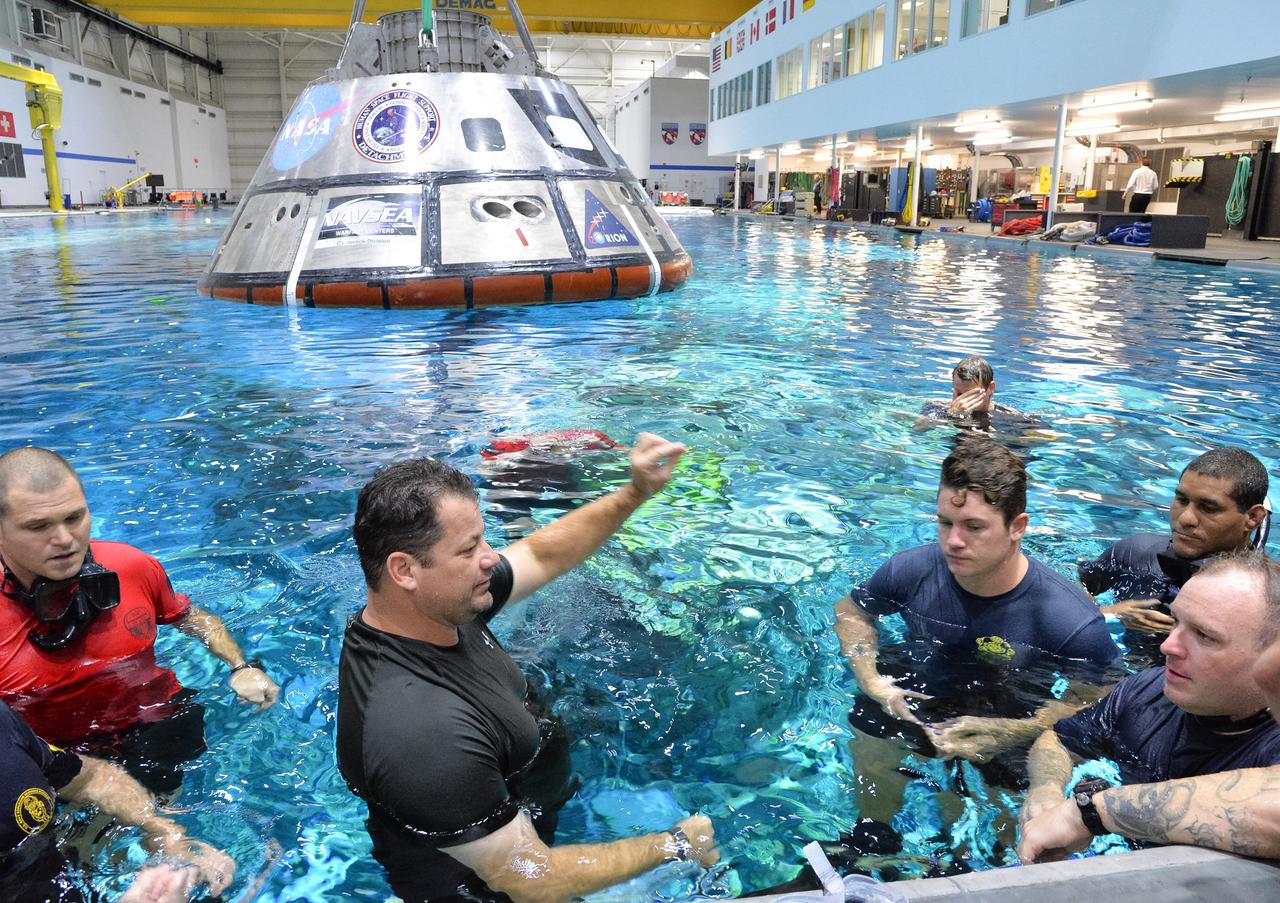
Tim Goddard, center, NASA Open Water Recovery Operations director, reviews recovery procedures with U.S. Navy divers, Air Force pararescuemen and Coast Guard rescue swimmers during training in the Neutral Buoyancy Laboratory at NASA’s Johnson Space Center in Houston. The group is practicing Orion underway recovery techniques using a test version of the Orion spacecraft. Training will help the team prepare for Underway Recovery Test 5 for Exploration Mission 1 aboard the USS San Diego in the Pacific Ocean off the coast of California in October. The Ground Systems Development and Operations Program, along with the U.S. Navy and Lockheed Martin, are preparing the recovery team, hardware and operations to support EM-1 recovery.
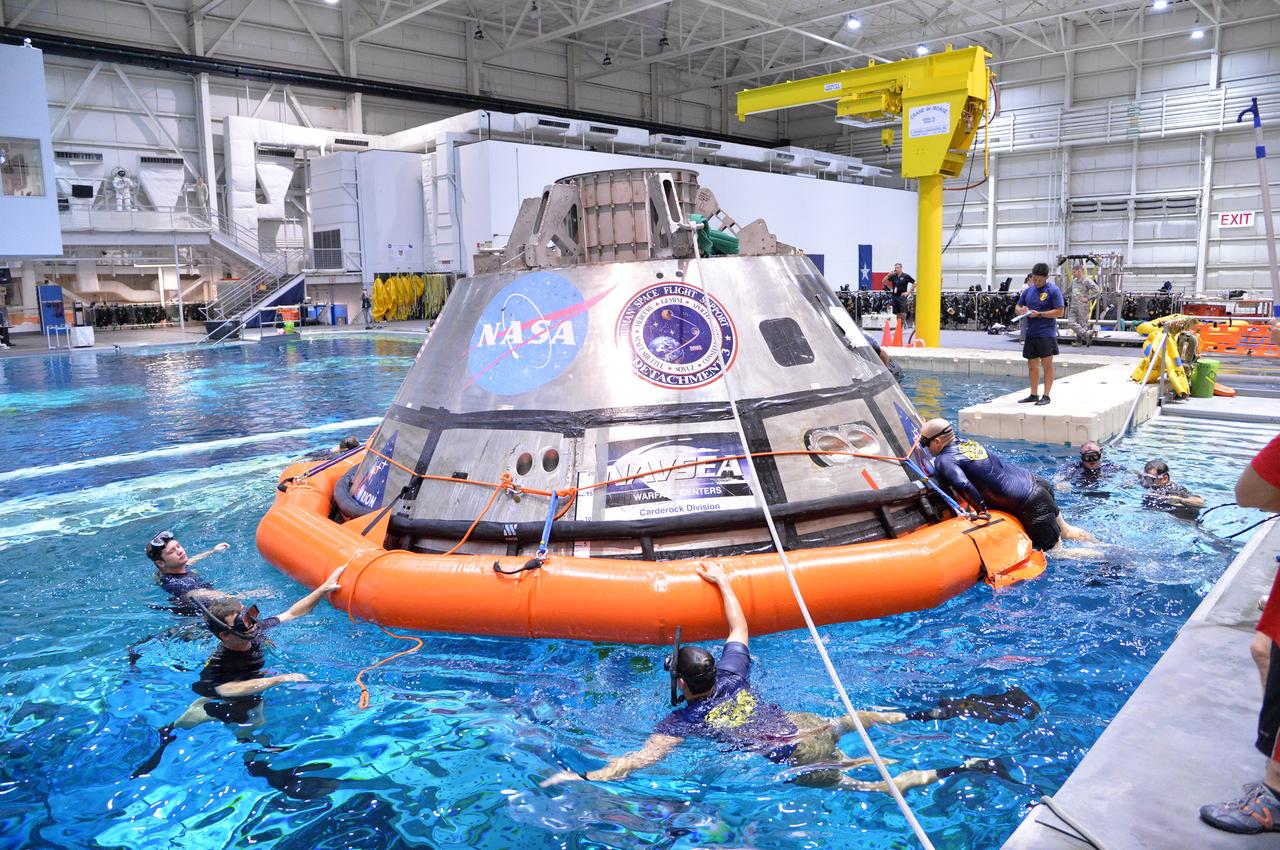
U.S. Navy divers, Air Force pararescuemen and Coast Guard rescue swimmers practice Orion recovery techniques at the Neutral Buoyancy Laboratory (NBL) at the agency’s Johnson Space Center in Houston. The recovery team is practicing underway recovery techniques using a test version of the Orion spacecraft. Training will help the team prepare for Underway Recovery Test 5 for Exploration Mission 1 aboard the USS San Diego in the Pacific Ocean off the coast of California in October. The Ground Systems Development and Operations Program, along with the U.S. Navy and Lockheed Martin, are preparing the recovery team, hardware and operations to support EM-1 recovery.
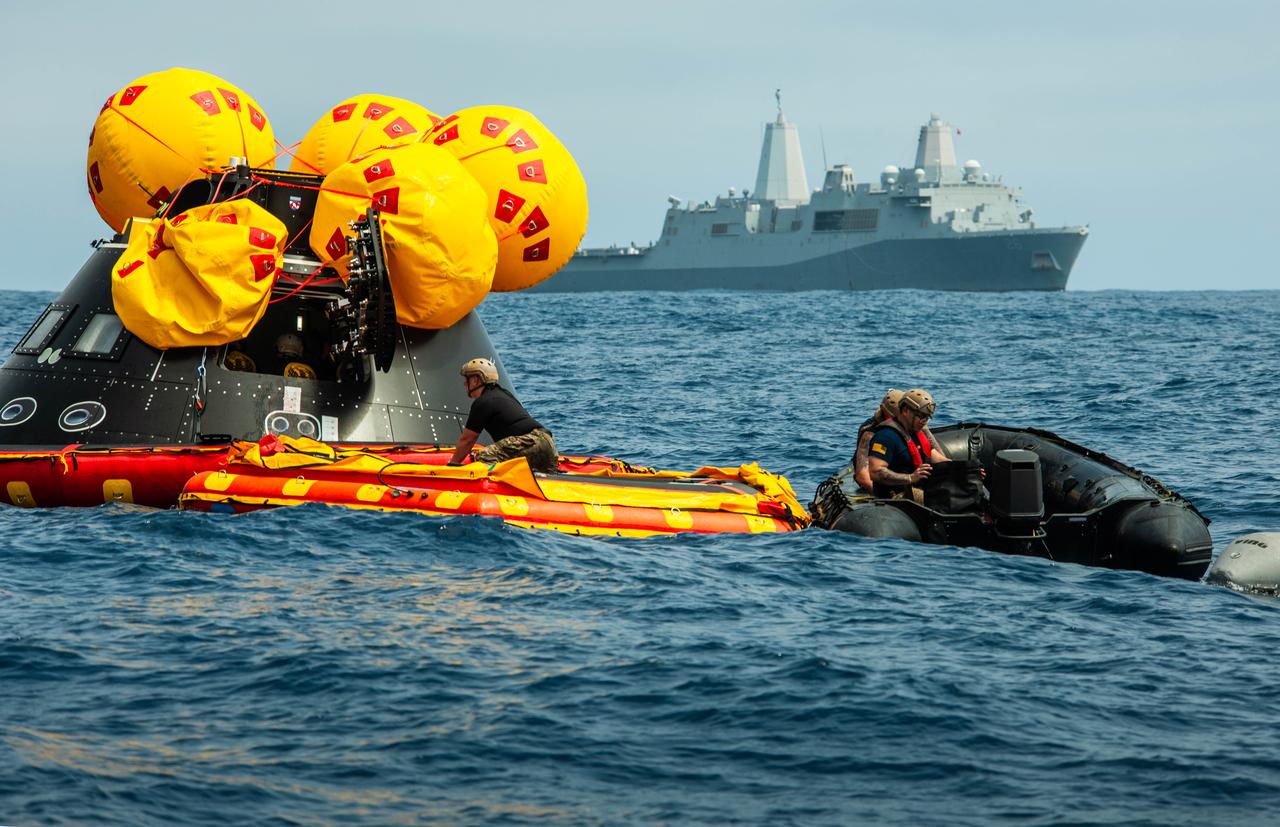
Navy divers from Explosive Ordnance Disposal (EOD) Expeditionary Support Unit 1 work to secure the Orion Crew Module Test Article (CMTA) in the Pacific Ocean as part of NASA’s Underway Recovery Test 10 (URT-10). The divers are trained in open water and small boat procedures and will be the team to help Artemis astronauts exit the Orion spacecraft and make it safely to the recovery ship after splashdown in addition to preparing the spacecraft to be transported back inside the recovery ship.
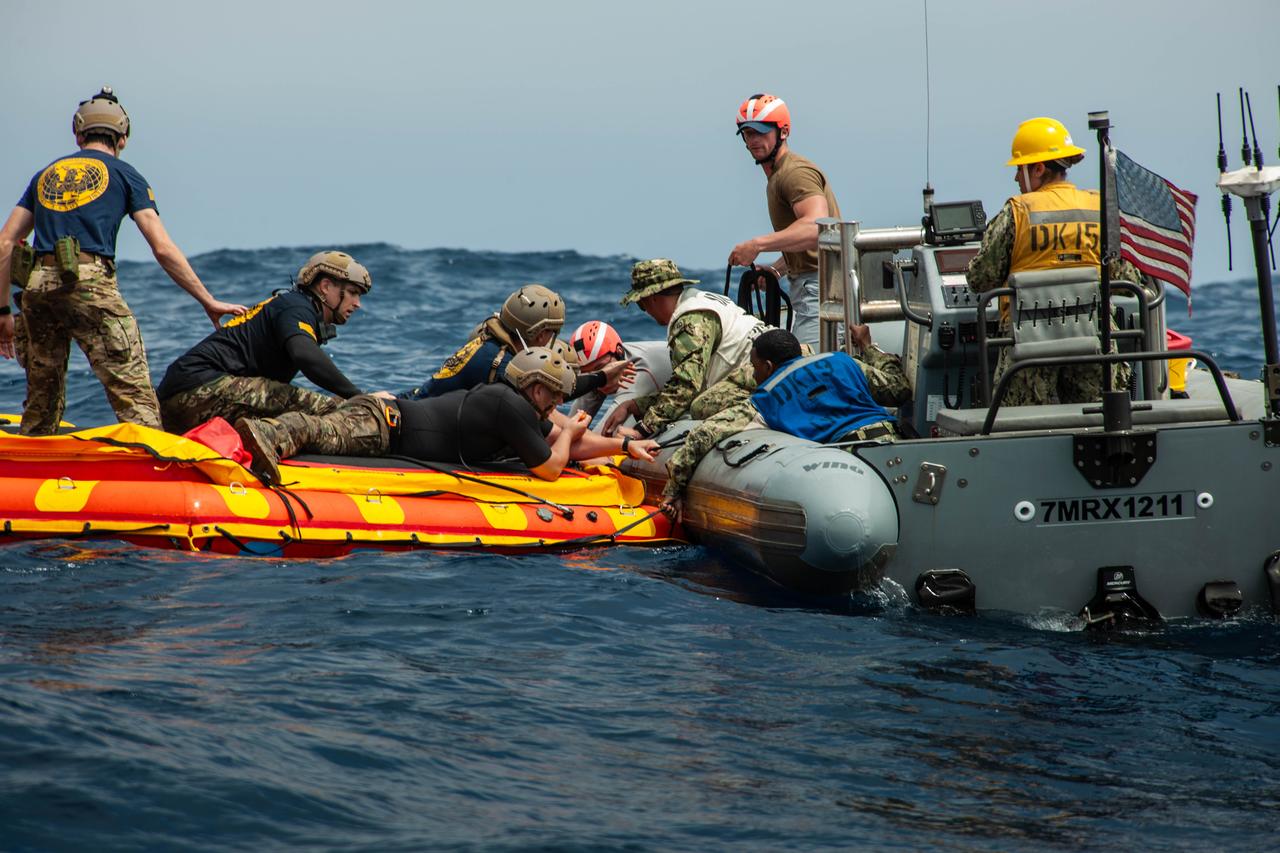
Navy divers from Explosive Ordnance Disposal (EOD) Expeditionary Support Unit 1 work to secure the Orion Crew Module Test Article (CMTA) in the Pacific Ocean as part of NASA’s Underway Recovery Test 10 (URT-10). The divers are trained in open water and small boat procedures and will be the team to help Artemis astronauts exit the Orion spacecraft and make it safely to the recovery ship after splashdown in addition to preparing the spacecraft to be transported back inside the recovery ship.
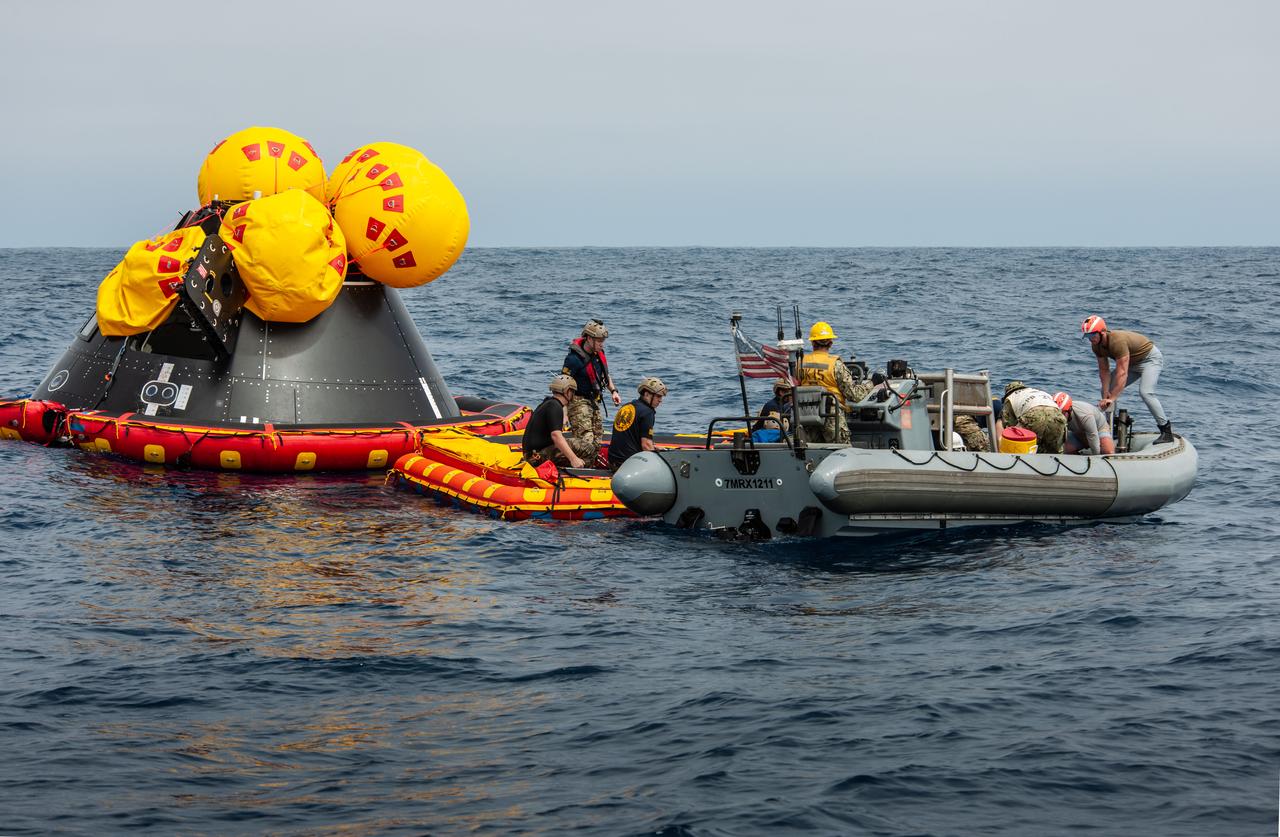
Navy divers from Explosive Ordnance Disposal (EOD) Expeditionary Support Unit 1 work to secure the Orion Crew Module Test Article (CMTA) in the Pacific Ocean as part of NASA’s Underway Recovery Test 10 (URT-10). The divers are trained in open water and small boat procedures and will be the team to help Artemis astronauts exit the Orion spacecraft and make it safely to the recovery ship after splashdown in addition to preparing the spacecraft to be transported back inside the recovery ship.
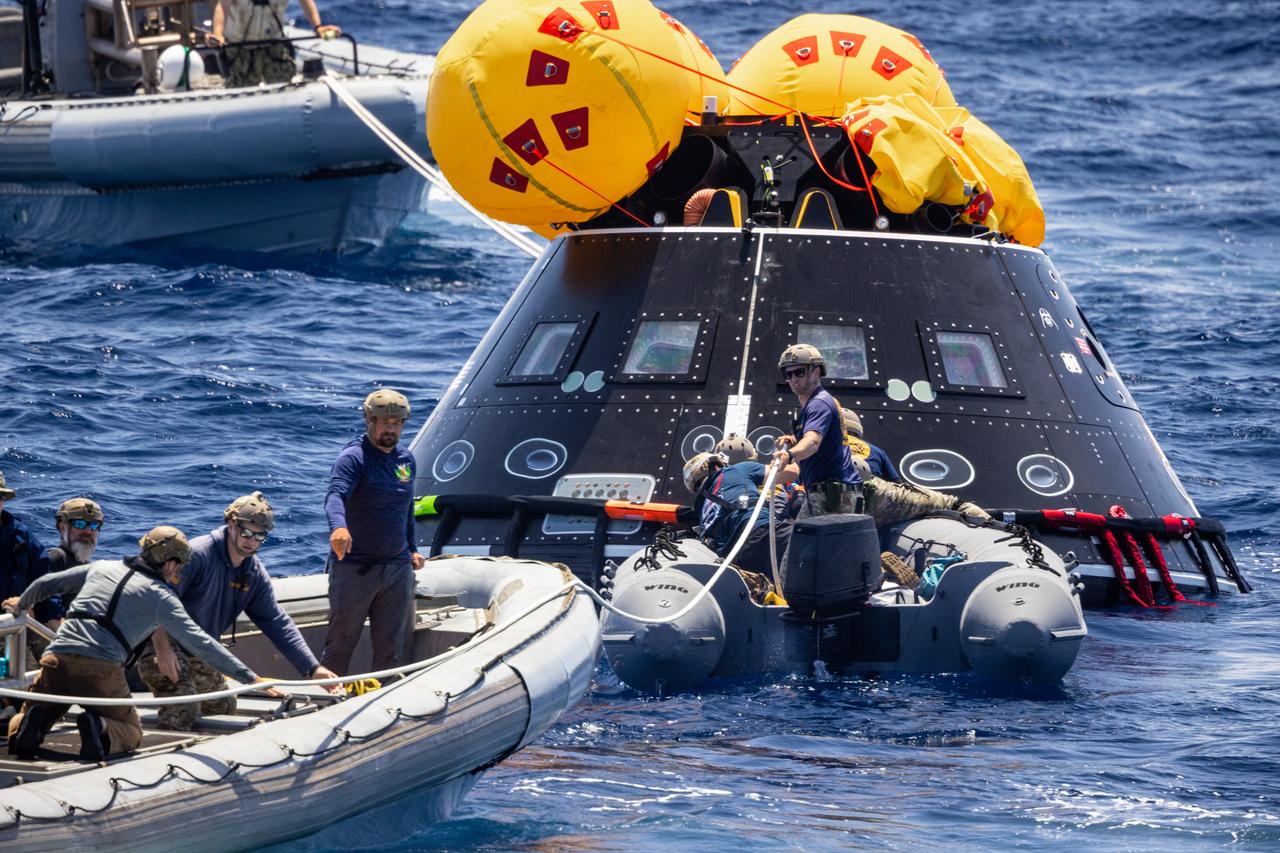
Navy divers from Explosive Ordnance Disposal (EOD) Expeditionary Support Unit 1 work to secure the Orion Crew Module Test Article (CMTA) in the Pacific Ocean as part of NASA’s Underway Recovery Test 10 (URT-10). The divers are trained in open water and small boat procedures and will be the team to help Artemis astronauts exit the Orion spacecraft and make it safely to the recovery ship after splashdown in addition to preparing the spacecraft to be transported back inside the recovery ship.
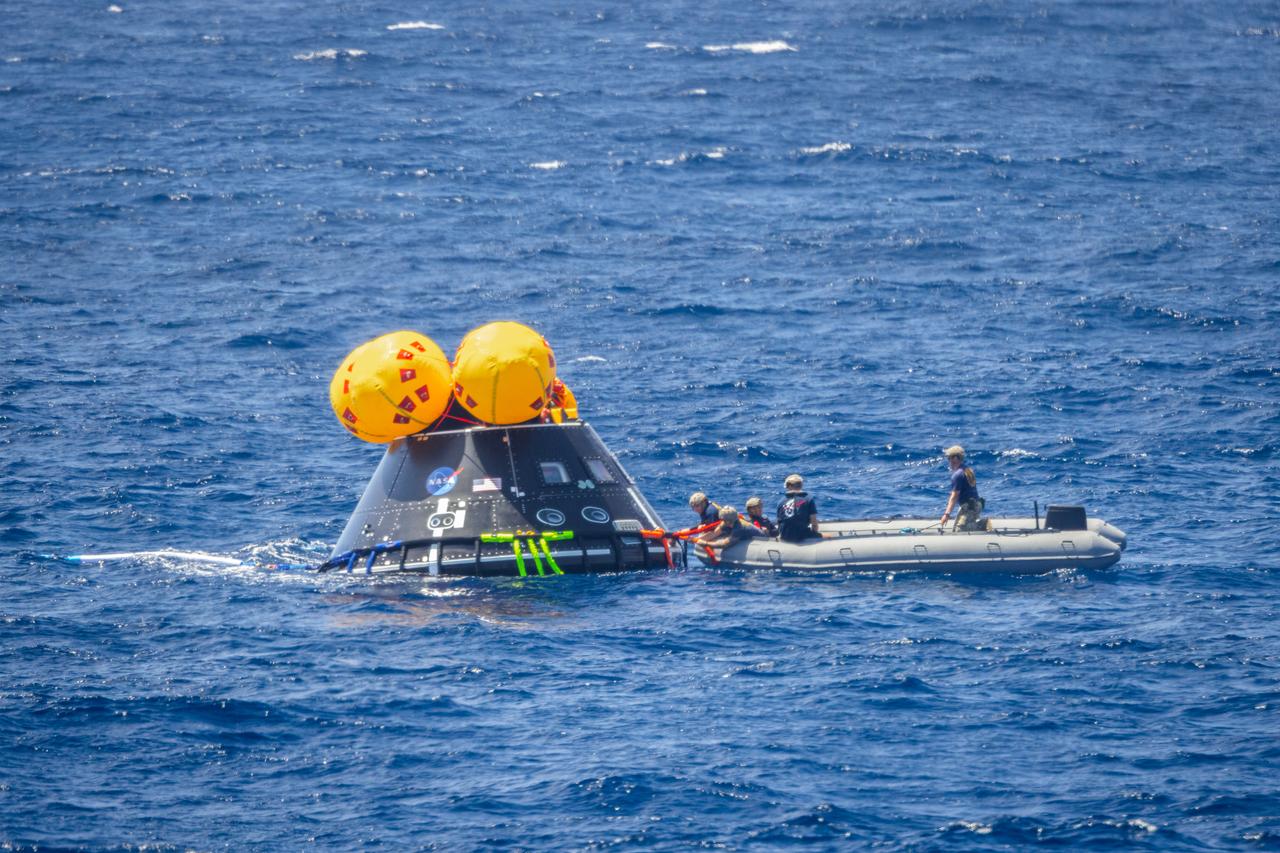
Navy divers from Explosive Ordnance Disposal (EOD) Expeditionary Support Unit 1 work to secure the Orion Crew Module Test Article (CMTA) in the Pacific Ocean as part of NASA’s Underway Recovery Test 10 (URT-10). The divers are trained in open water and small boat procedures and will be the team to help Artemis astronauts exit the Orion spacecraft and make it safely to the recovery ship after splashdown in addition to preparing the spacecraft to be transported back inside the recovery ship.
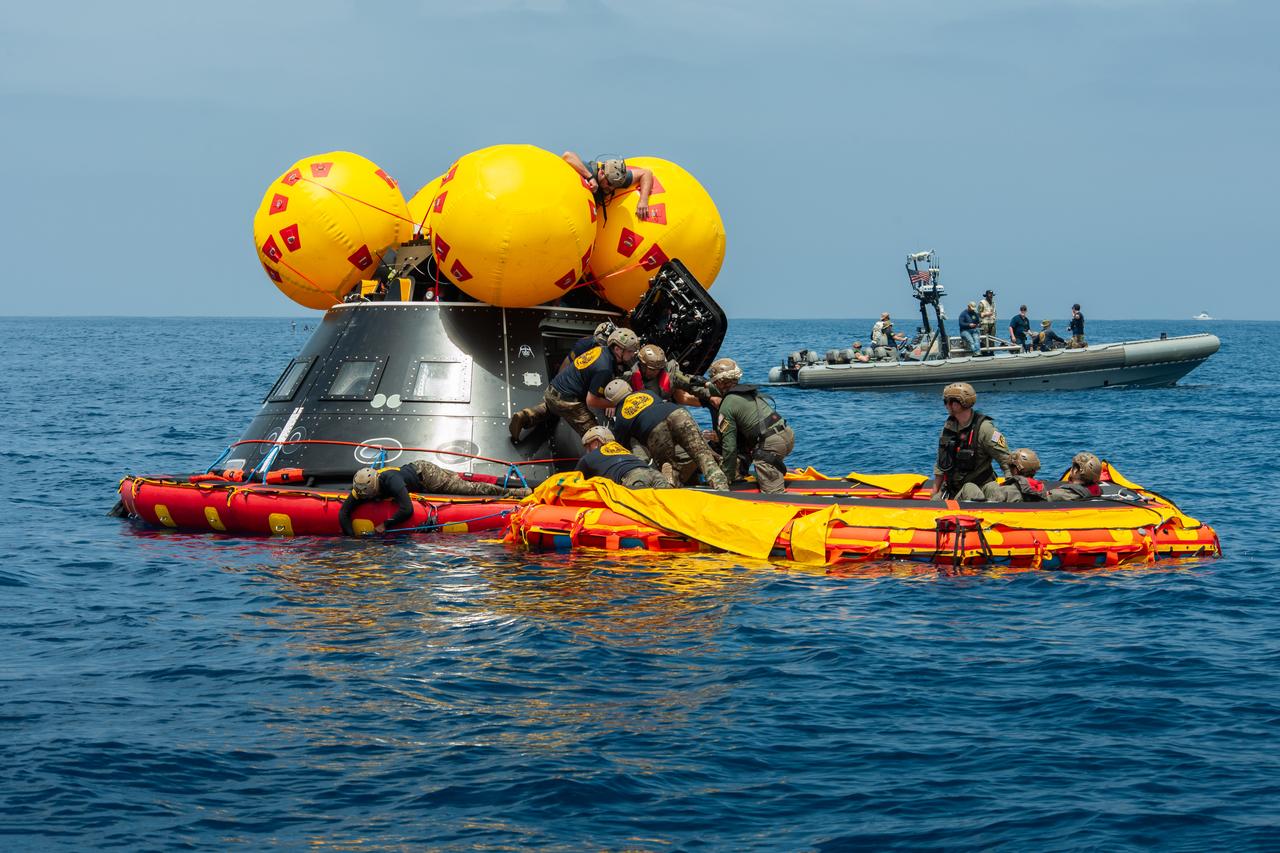
NASA, Navy, and Air Force personnel practice Artemis recovery procedures in the Pacific Ocean as part of Underway Recovery Test 10 (URT-10) off the coast of San Diego. In this photo, Navy divers are seen entering the Orion Crew Module Test Article (CMTA) and assisting a simulated crew member exiting the spacecraft to practice recovering astronauts out of the spacecraft and onto an inflatable “front porch” where the crew will be picked up with helicopters and lifted up via helicopter back to the recovery vessel.
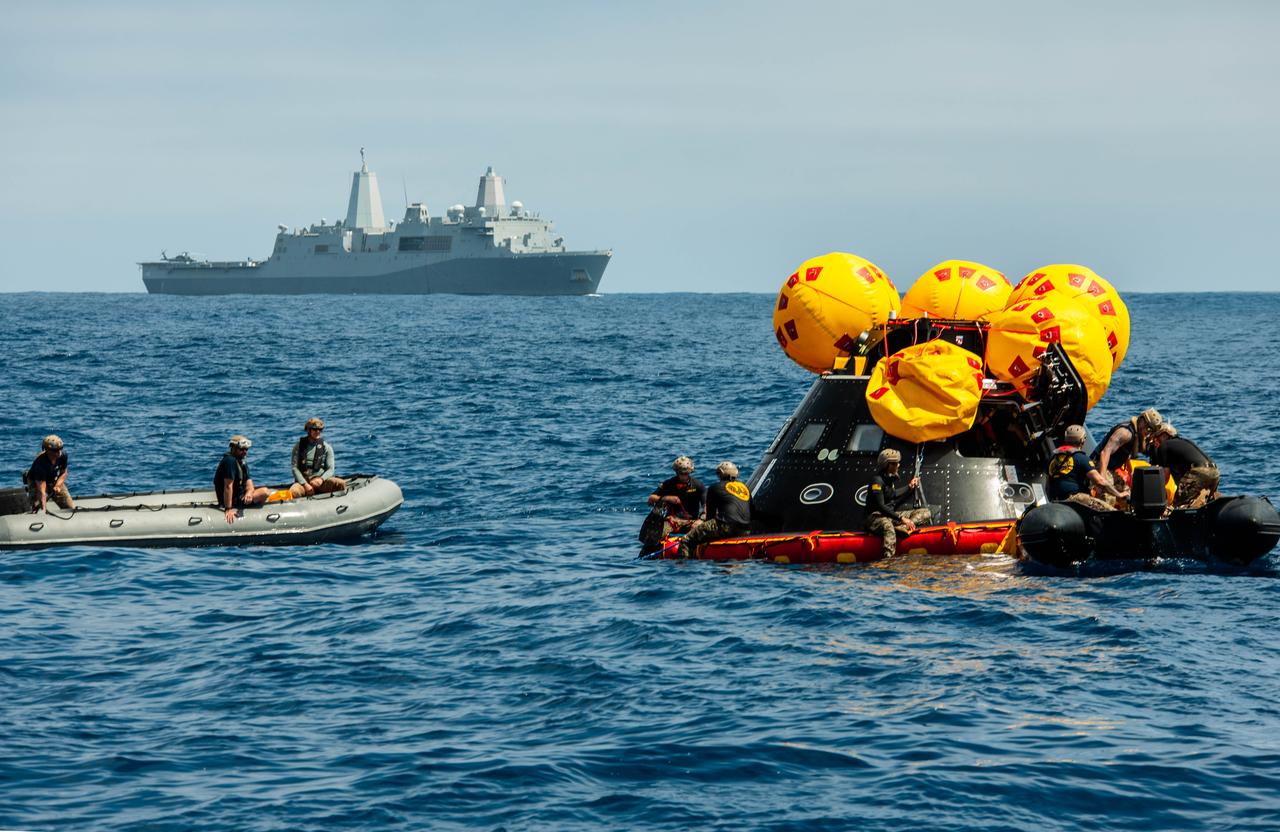
Navy divers from Explosive Ordnance Disposal (EOD) Expeditionary Support Unit 1 work to secure the Orion Crew Module Test Article (CMTA) in the Pacific Ocean as part of NASA’s Underway Recovery Test 10 (URT-10). The divers are trained in open water and small boat procedures and will be the team to help Artemis astronauts exit the Orion spacecraft and make it safely to the recovery ship after splashdown in addition to preparing the spacecraft to be transported back inside the recovery ship.
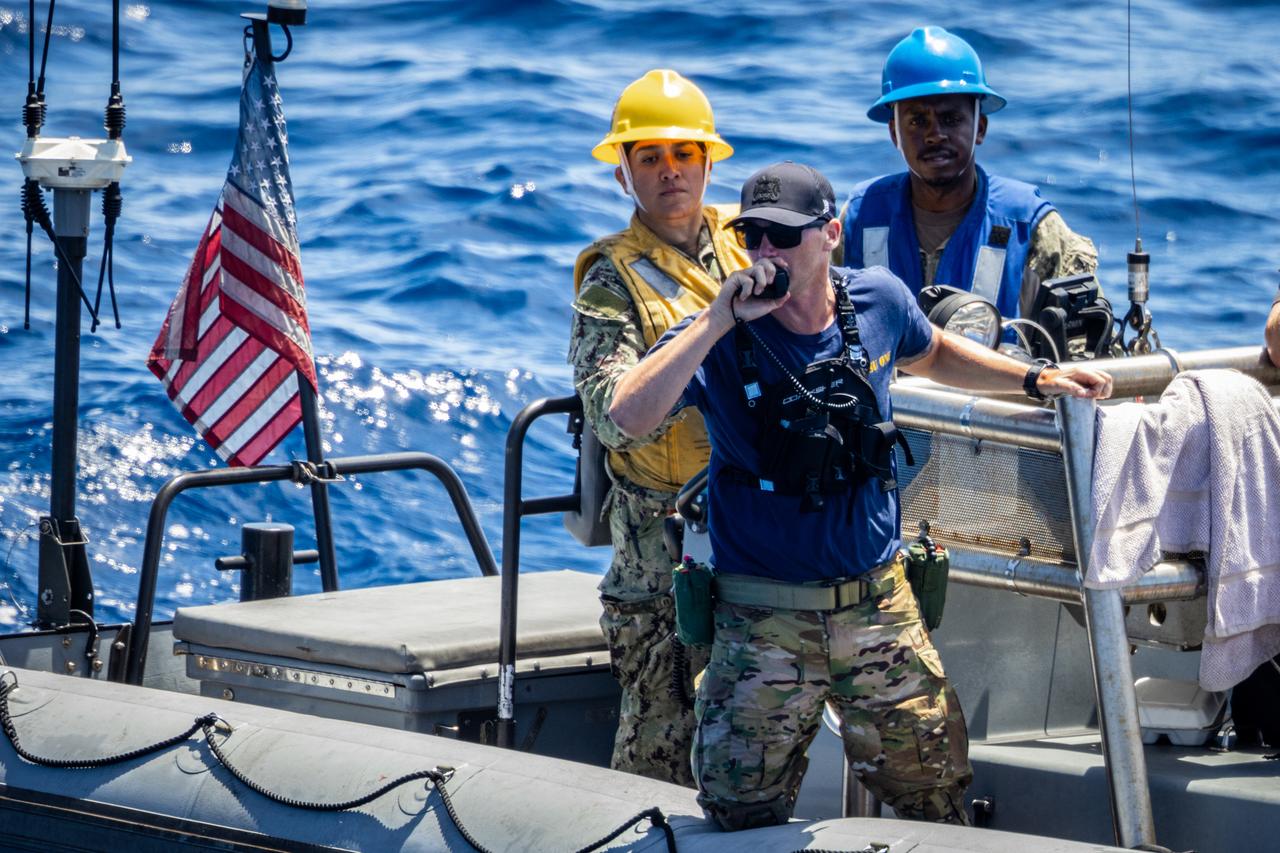
Navy divers from Explosive Ordnance Disposal (EOD) Expeditionary Support Unit 1 work to secure the Orion Crew Module Test Article (CMTA) in the Pacific Ocean as part of NASA’s Underway Recovery Test 10 (URT-10). The divers are trained in open water and small boat procedures and will be the team to help Artemis astronauts exit the Orion spacecraft and make it safely to the recovery ship after splashdown in addition to preparing the spacecraft to be transported back inside the recovery ship.
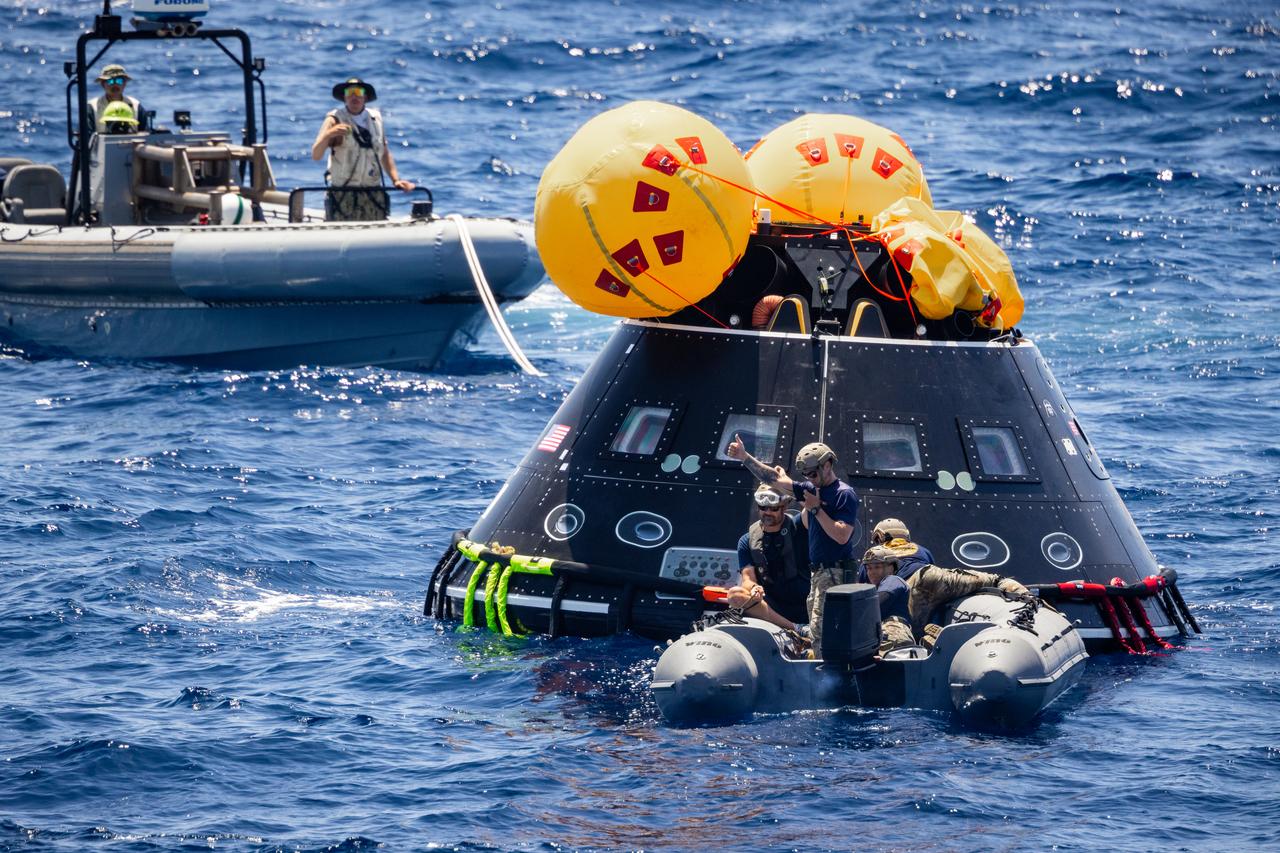
Navy divers from Explosive Ordnance Disposal (EOD) Expeditionary Support Unit 1 work to secure the Orion Crew Module Test Article (CMTA) in the Pacific Ocean as part of NASA’s Underway Recovery Test 10 (URT-10). The divers are trained in open water and small boat procedures and will be the team to help Artemis astronauts exit the Orion spacecraft and make it safely to the recovery ship after splashdown in addition to preparing the spacecraft to be transported back inside the recovery ship.
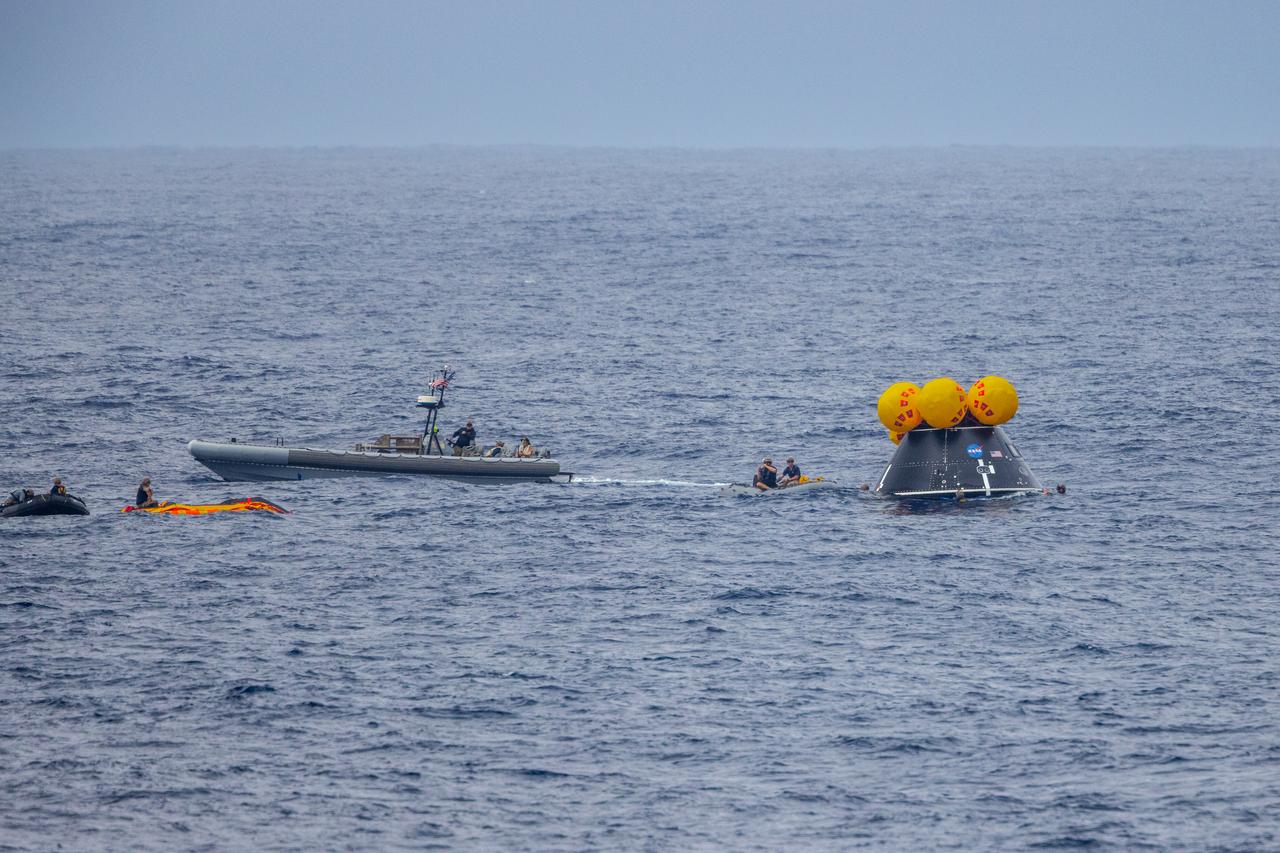
Navy divers from Explosive Ordnance Disposal (EOD) Expeditionary Support Unit 1 work to secure the Orion Crew Module Test Article (CMTA) in the Pacific Ocean as part of NASA’s Underway Recovery Test 10 (URT-10). The divers are trained in open water and small boat procedures and will be the team to help Artemis astronauts exit the Orion spacecraft and make it safely to the recovery ship after splashdown in addition to preparing the spacecraft to be transported back inside the recovery ship.
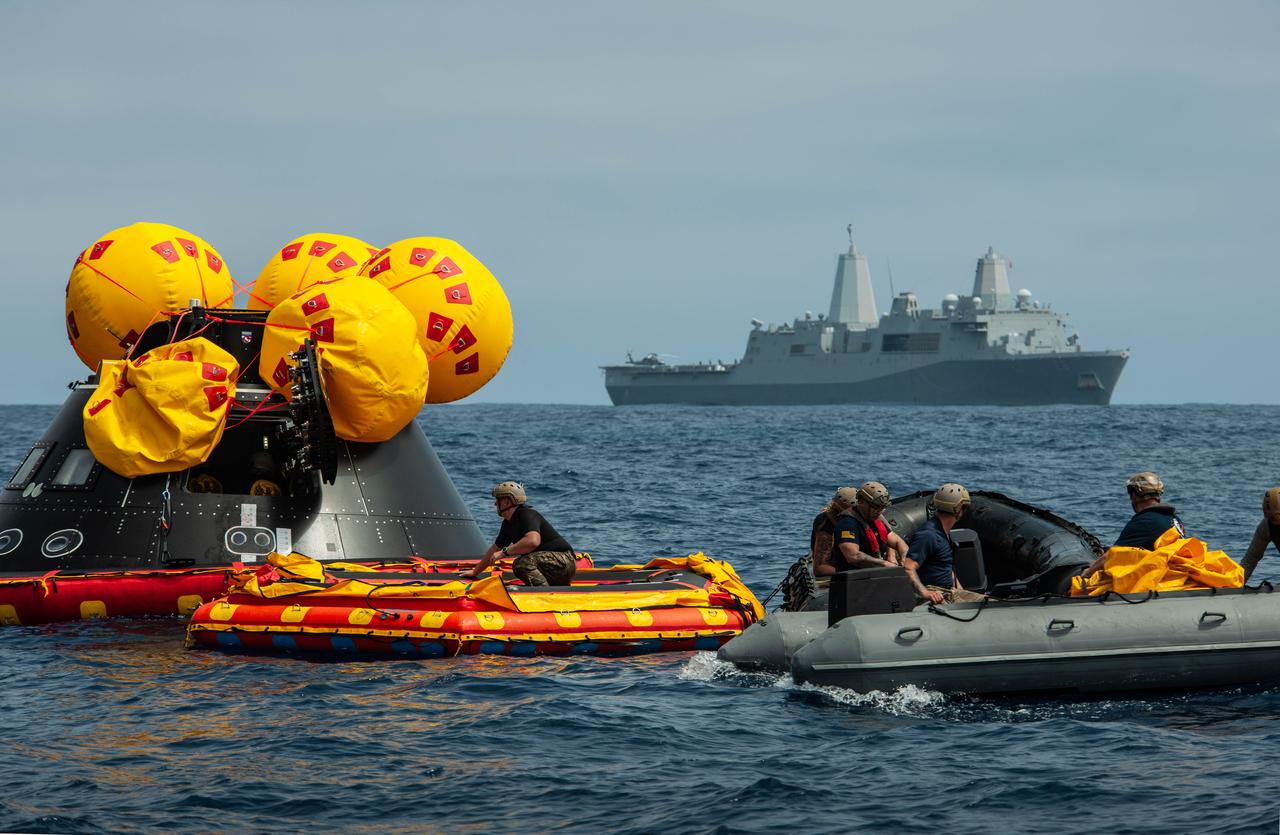
Navy divers from Explosive Ordnance Disposal (EOD) Expeditionary Support Unit 1 work to secure the Orion Crew Module Test Article (CMTA) in the Pacific Ocean as part of NASA’s Underway Recovery Test 10 (URT-10). The divers are trained in open water and small boat procedures and will be the team to help Artemis astronauts exit the Orion spacecraft and make it safely to the recovery ship after splashdown in addition to preparing the spacecraft to be transported back inside the recovery ship.
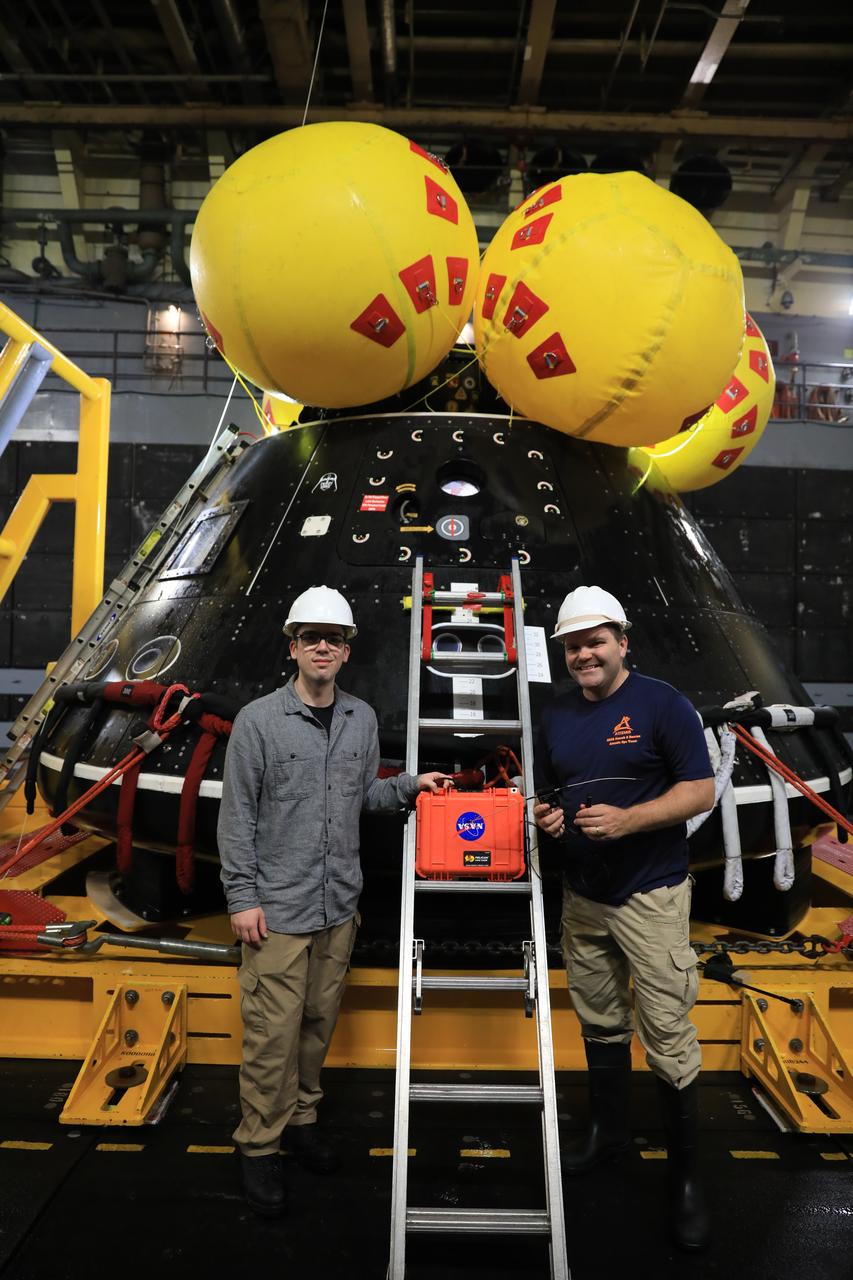
Members of NASA’s Exploration Ground System’s Landing and Recovery team aboard the USS San Diego pose in front of a mockup of the Orion spacecraft during Underway Recovery Test 11 (URT-11) off the coast of San Diego, California on Sunday, Feb. 25, 2024. URT-11 is the eleventh in a series of Artemis recovery tests, and the first time NASA and its partners put their Artemis II recovery procedures to the test with the astronauts.
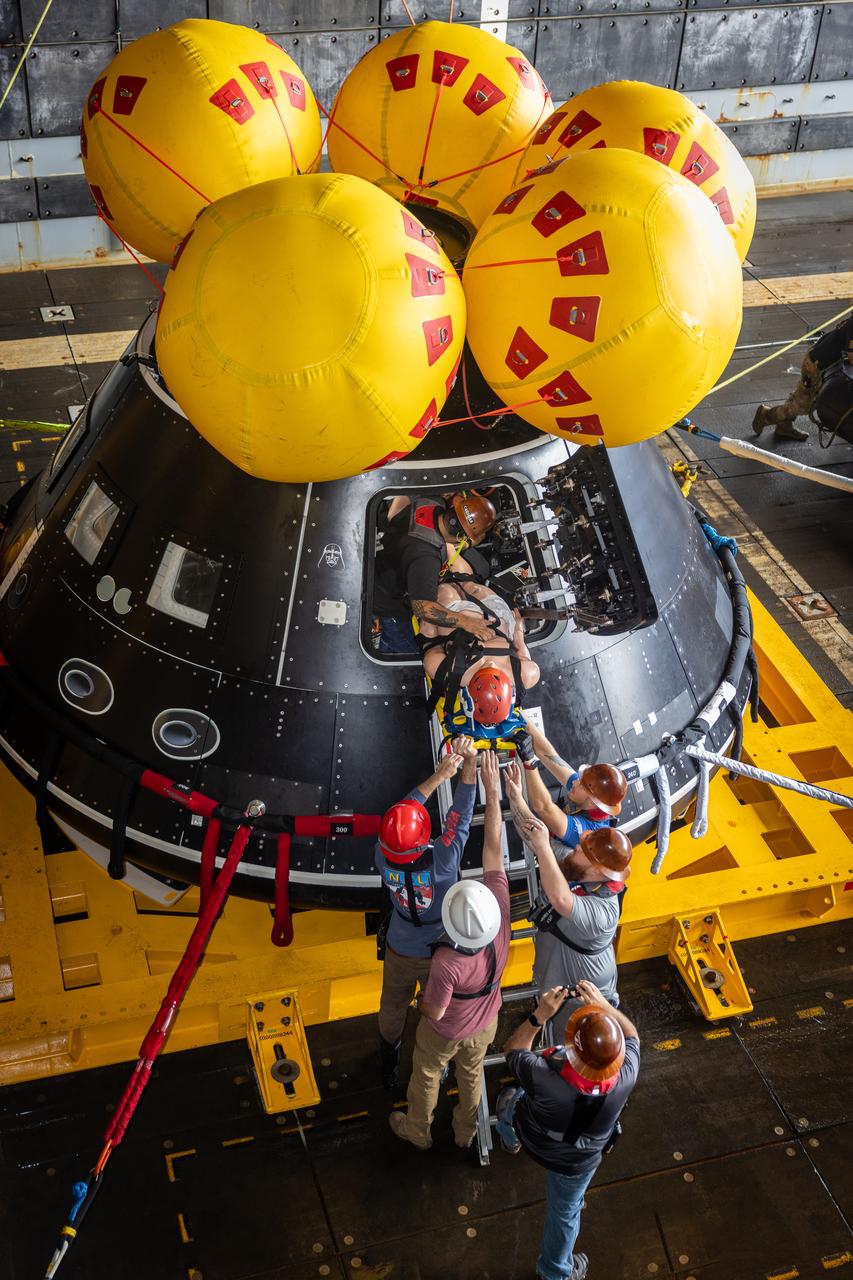
Members of NASA’s Landing and Recovery team load a mannequin into the Crew Module Test Article (CMTA) during Underway Recovery Test 10 in the Pacific Ocean. The CMTA is a is a full-scale mockup of the Orion spacecraft and is used by NASA and its Department of Defense partners to practice recovery procedures for crewed Artemis missions. The team uses the mannequin to practice recovering astronauts out of the capsule and safely getting them to the recovery vessel nearby.
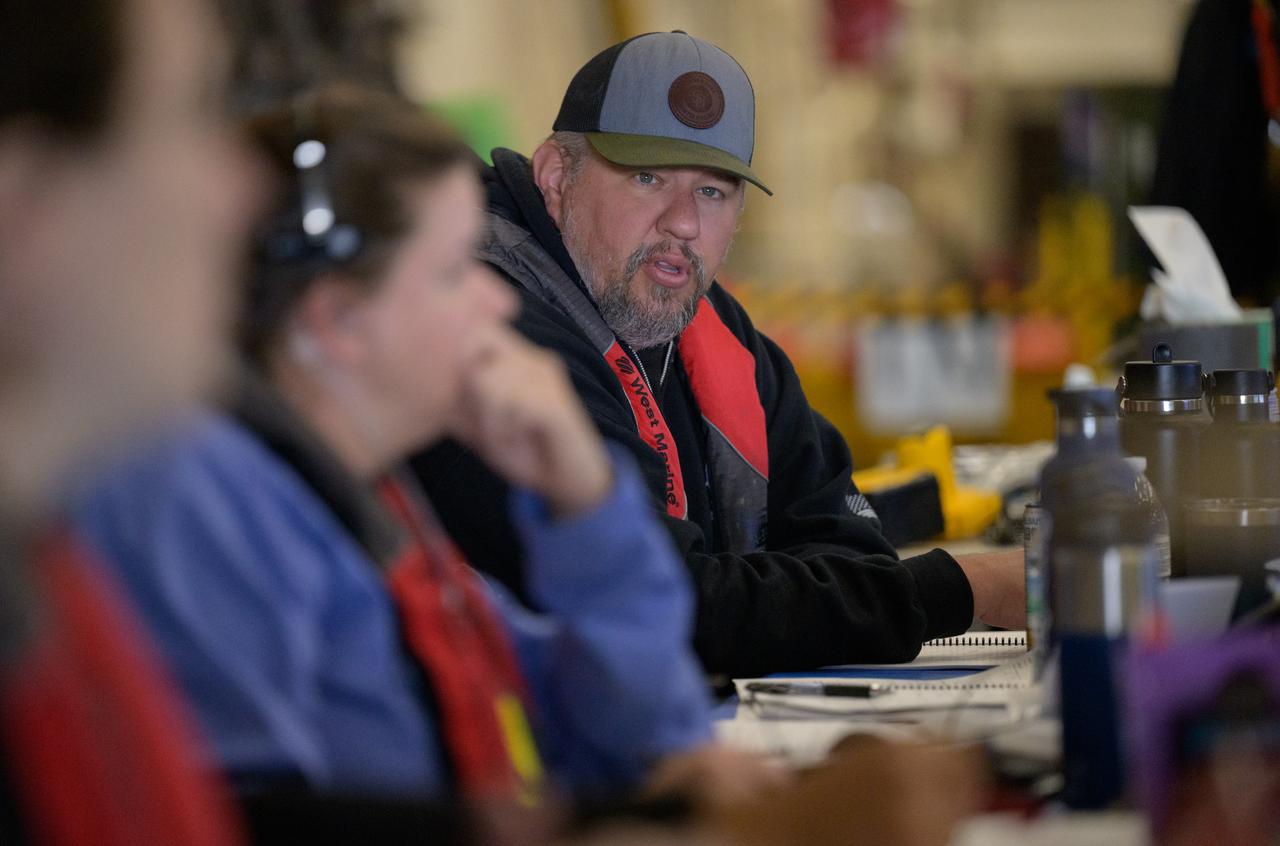
Members of NASA’s Landing and Recovery team are seen as they recover the Crew Module Test Article (CMTA), a full scale mockup of the Orion spacecraft, as teams practice Artemis recovery operations during Underway Recovery Test-12 onboard USS Somerset off the coast of California, Saturday, March 29, 2025. During the test, NASA and Department of Defense teams are practicing to ensure recovery procedures are validated as NASA plans to send Artemis II around the Moon and splashdown in the Pacific Ocean. Photo Credit: (NASA/Bill Ingalls)
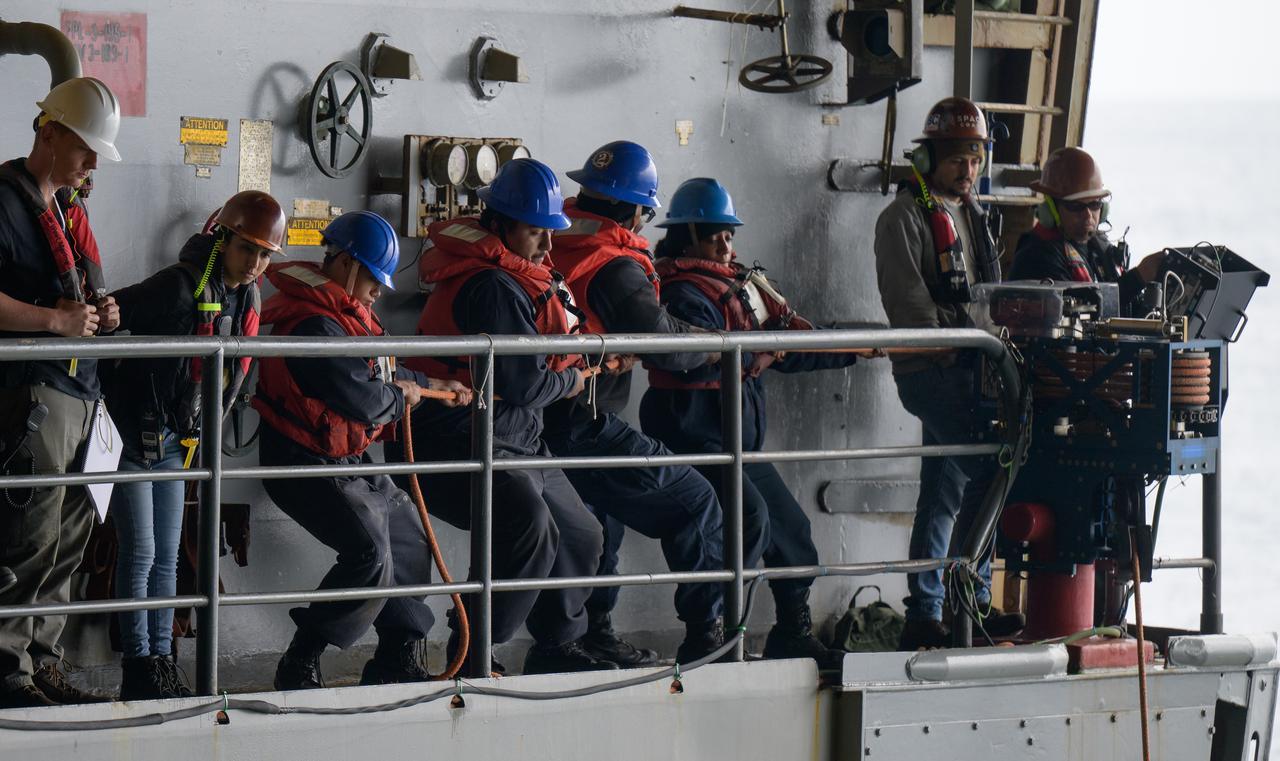
Sailors from USS Somerset assist in the recovery of the Crew Module Test Article (CMTA), a full scale mockup of the Orion spacecraft, as teams practice Artemis recovery operations during Underway Recovery Test-12 onboard USS Somerset off the coast of California, Saturday, March 29, 2025. During the test, NASA and Department of Defense teams are practicing to ensure recovery procedures are validated as NASA plans to send Artemis II around the Moon and splashdown in the Pacific Ocean. Photo Credit: (NASA/Bill Ingalls)

A member of NASA’s Exploration Ground System’s Landing and Recovery team takes a photo of a mockup of the Orion spacecraft during Underway Recovery Test 11 (URT-11) off the coast of San Diego, California on Monday, Feb. 26, 2024. URT-11 is the eleventh in a series of Artemis recovery tests, and the first time NASA and its partners put their Artemis II recovery procedures to the test with the astronauts.
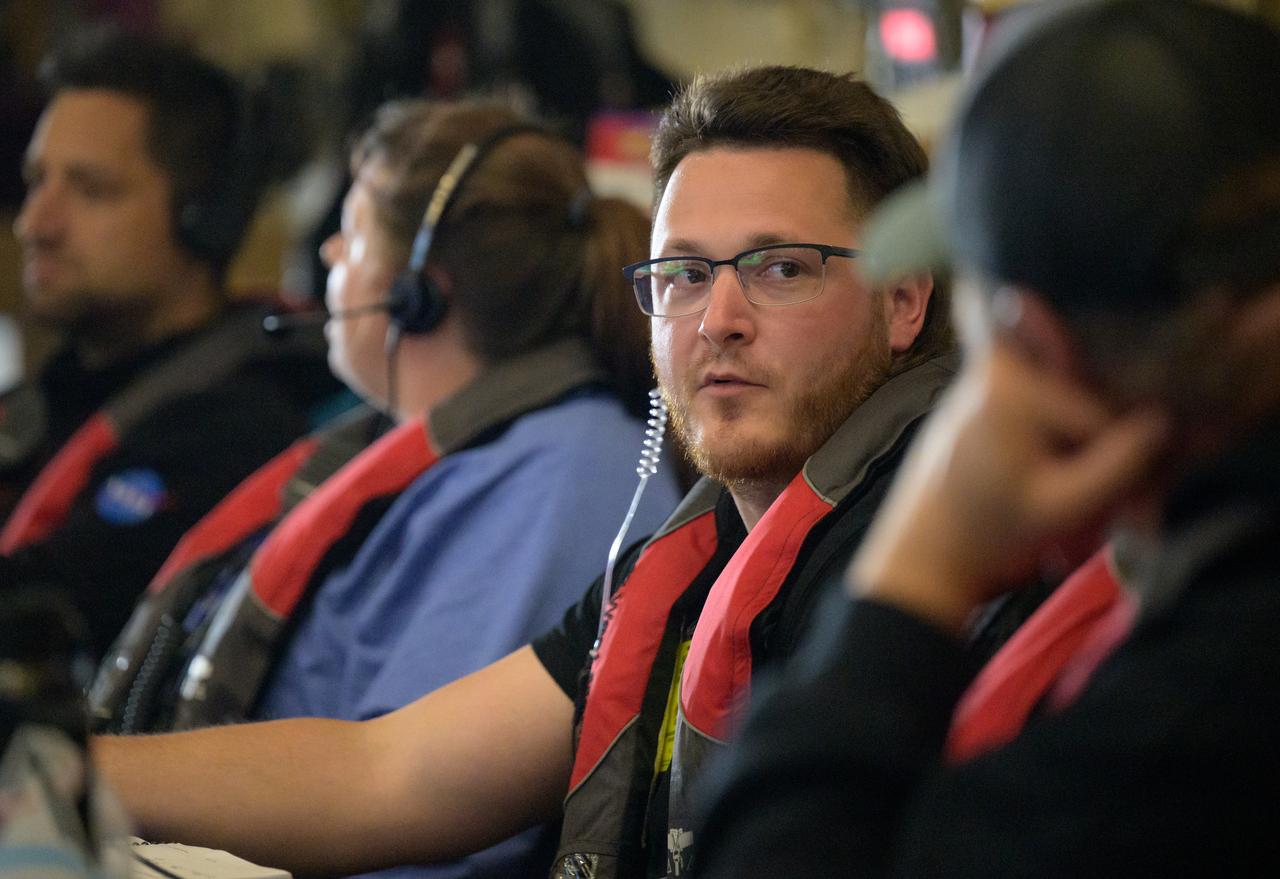
Members of NASA’s Landing and Recovery team are seen as they recover the Crew Module Test Article (CMTA), a full scale mockup of the Orion spacecraft, as teams practice Artemis recovery operations during Underway Recovery Test-12 onboard USS Somerset off the coast of California, Saturday, March 29, 2025. During the test, NASA and Department of Defense teams are practicing to ensure recovery procedures are validated as NASA plans to send Artemis II around the Moon and splashdown in the Pacific Ocean. Photo Credit: (NASA/Bill Ingalls)
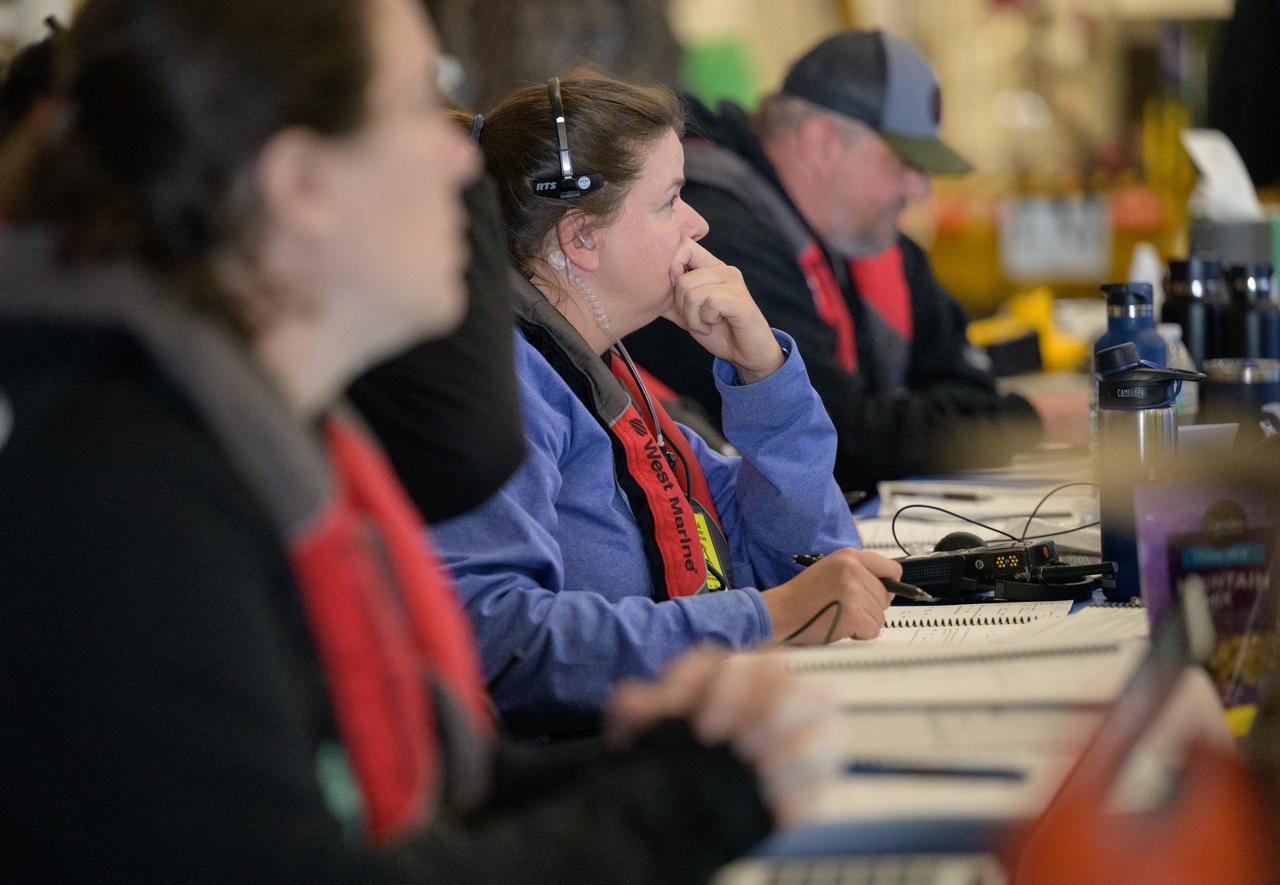
Members of NASA’s Landing and Recovery team are seen as they recover the Crew Module Test Article (CMTA), a full scale mockup of the Orion spacecraft, as teams practice Artemis recovery operations during Underway Recovery Test-12 onboard USS Somerset off the coast of California, Saturday, March 29, 2025. During the test, NASA and Department of Defense teams are practicing to ensure recovery procedures are validated as NASA plans to send Artemis II around the Moon and splashdown in the Pacific Ocean. Photo Credit: (NASA/Bill Ingalls)
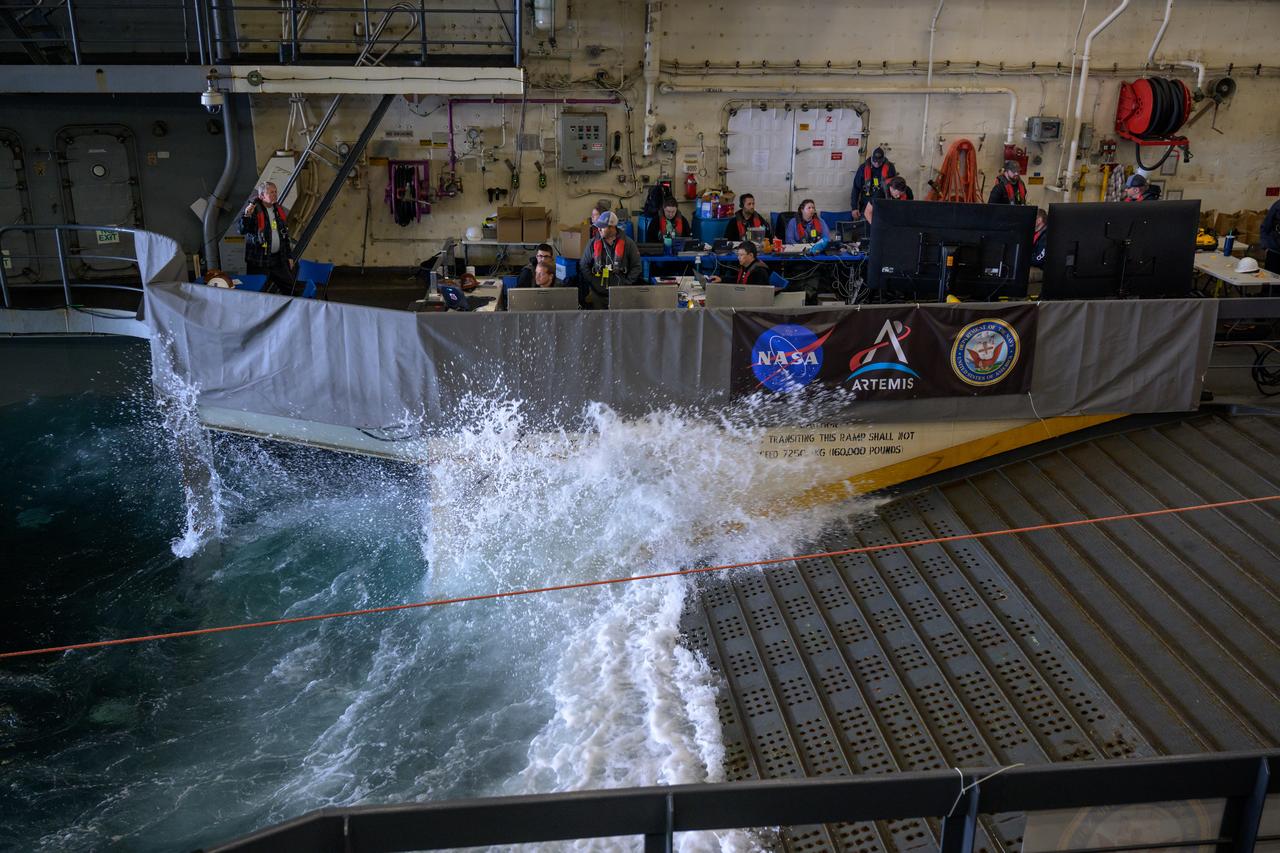
Members of NASA’s Landing and Recovery team are seen as they recover the Crew Module Test Article (CMTA), a full scale mockup of the Orion spacecraft, as teams practice Artemis recovery operations during Underway Recovery Test-12 onboard USS Somerset off the coast of California, Saturday, March 29, 2025. During the test, NASA and Department of Defense teams are practicing to ensure recovery procedures are validated as NASA plans to send Artemis II around the Moon and splashdown in the Pacific Ocean. Photo Credit: (NASA/Bill Ingalls)
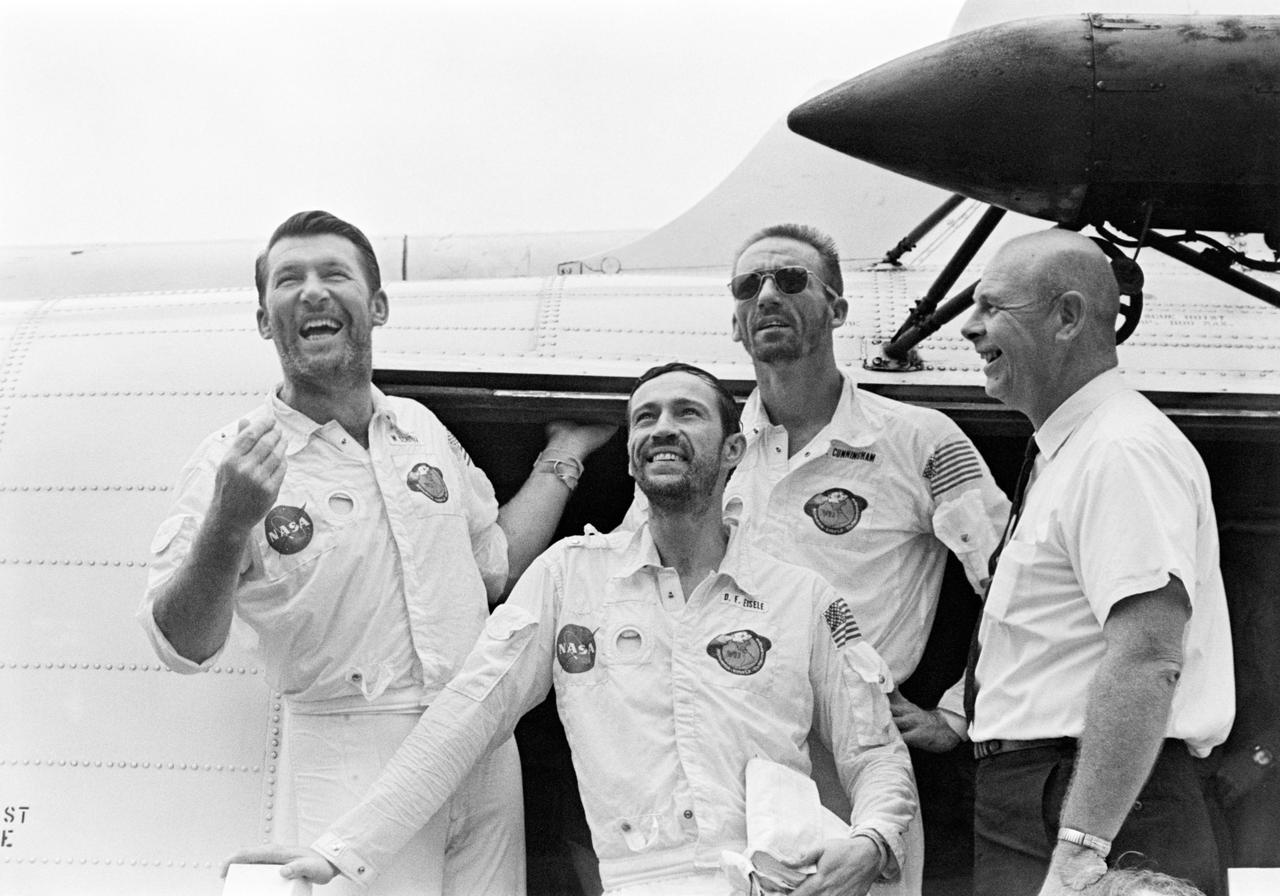
S68-52542 (22 Oct. 1968) --- The Apollo 7 crew arrives aboard the USS Essex, the prime recovery ship for the mission. Left to right, are astronauts Walter M. Schirra Jr., commander; Donn F. Eisele, command module pilot; Walter Cunningham, lunar module pilot; and Dr. Donald E. Stullken, NASA Recovery Team Leader from the Manned Spacecraft Center's (MSC) Landing and Recovery Division. The crew is pausing in the doorway of the recovery helicopter.
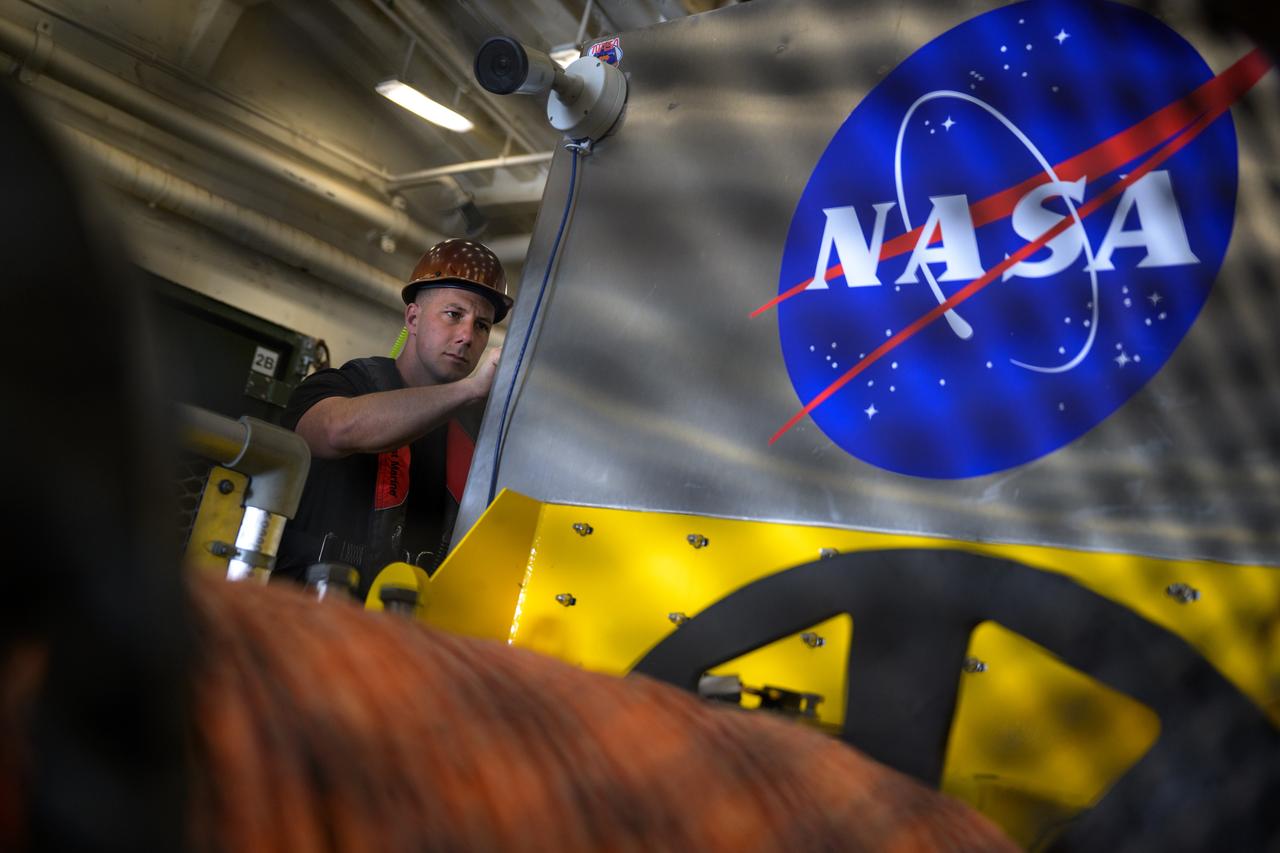
Members of NASA’s Landing and Recovery team are seen as they recover the Crew Module Test Article (CMTA), a full scale mockup of the Orion spacecraft, as teams practice Artemis recovery operations during Underway Recovery Test-12 onboard USS Somerset off the coast of California, Saturday, March 29, 2025. During the test, NASA and Department of Defense teams are practicing to ensure recovery procedures are validated as NASA plans to send Artemis II around the Moon and splashdown in the Pacific Ocean. Photo Credit: (NASA/Bill Ingalls)
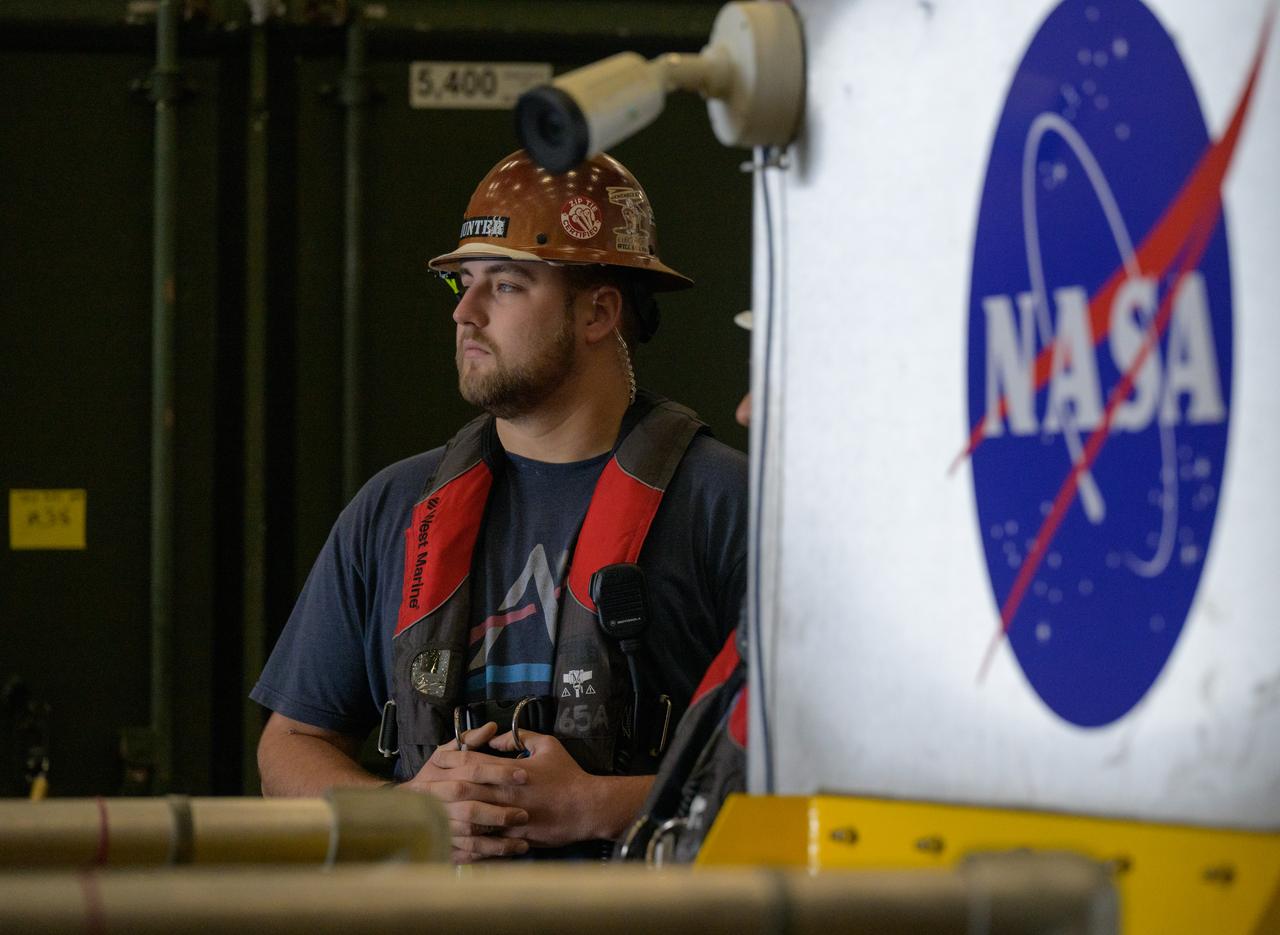
Members of NASA’s Landing and Recovery team are seen as they recover the Crew Module Test Article (CMTA), a full scale mockup of the Orion spacecraft, as teams practice Artemis recovery operations during Underway Recovery Test-12 onboard USS Somerset off the coast of California, Saturday, March 29, 2025. During the test, NASA and Department of Defense teams are practicing to ensure recovery procedures are validated as NASA plans to send Artemis II around the Moon and splashdown in the Pacific Ocean. Photo Credit: (NASA/Bill Ingalls)
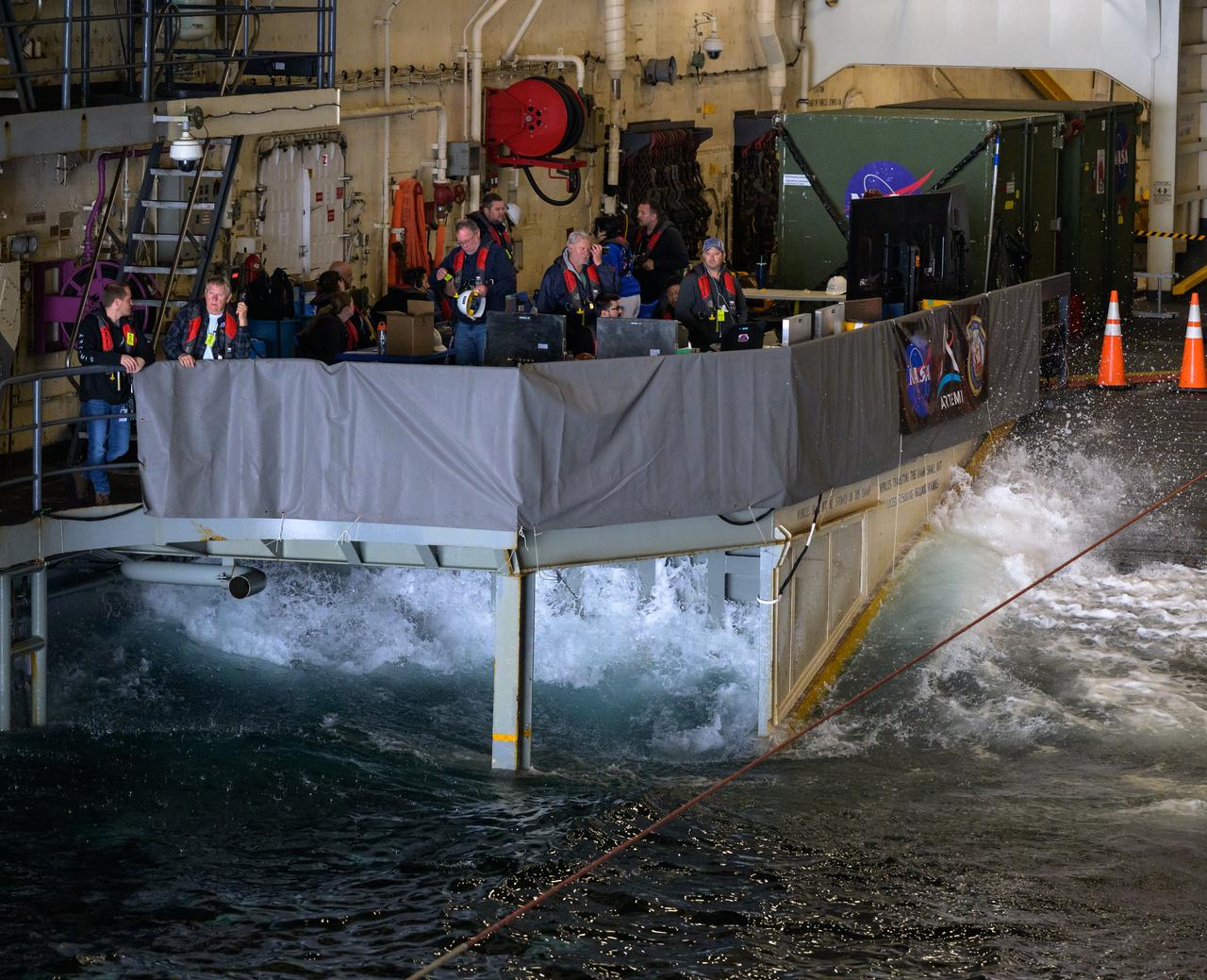
Members of NASA’s Landing and Recovery team are seen as they recover the Crew Module Test Article (CMTA), a full scale mockup of the Orion spacecraft, as teams practice Artemis recovery operations during Underway Recovery Test-12 onboard USS Somerset off the coast of California, Saturday, March 29, 2025. During the test, NASA and Department of Defense teams are practicing to ensure recovery procedures are validated as NASA plans to send Artemis II around the Moon and splashdown in the Pacific Ocean. Photo Credit: (NASA/Bill Ingalls)
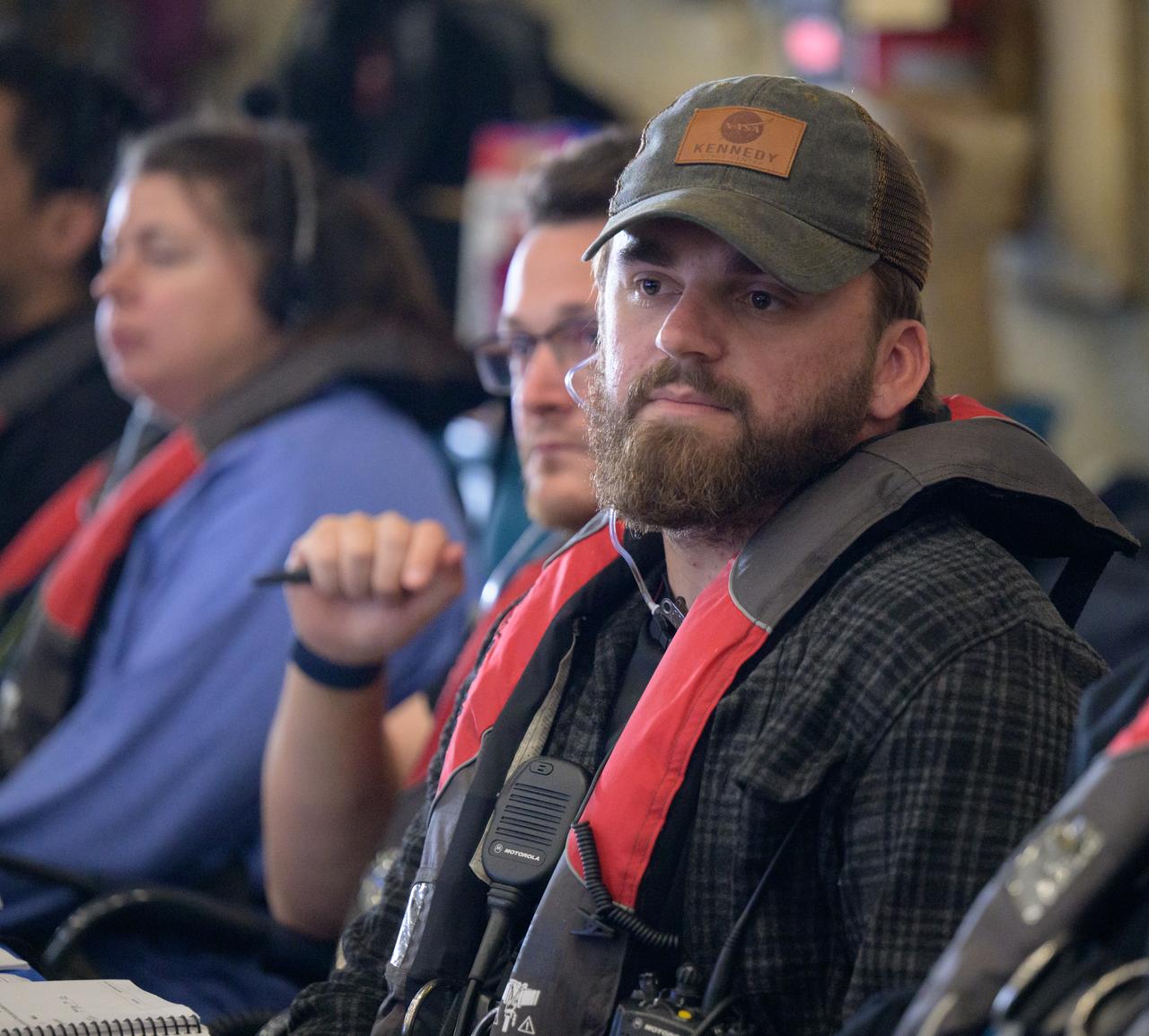
Members of NASA’s Landing and Recovery team are seen as they recover the Crew Module Test Article (CMTA), a full scale mockup of the Orion spacecraft, as teams practice Artemis recovery operations during Underway Recovery Test-12 onboard USS Somerset off the coast of California, Saturday, March 29, 2025. During the test, NASA and Department of Defense teams are practicing to ensure recovery procedures are validated as NASA plans to send Artemis II around the Moon and splashdown in the Pacific Ocean. Photo Credit: (NASA/Bill Ingalls)
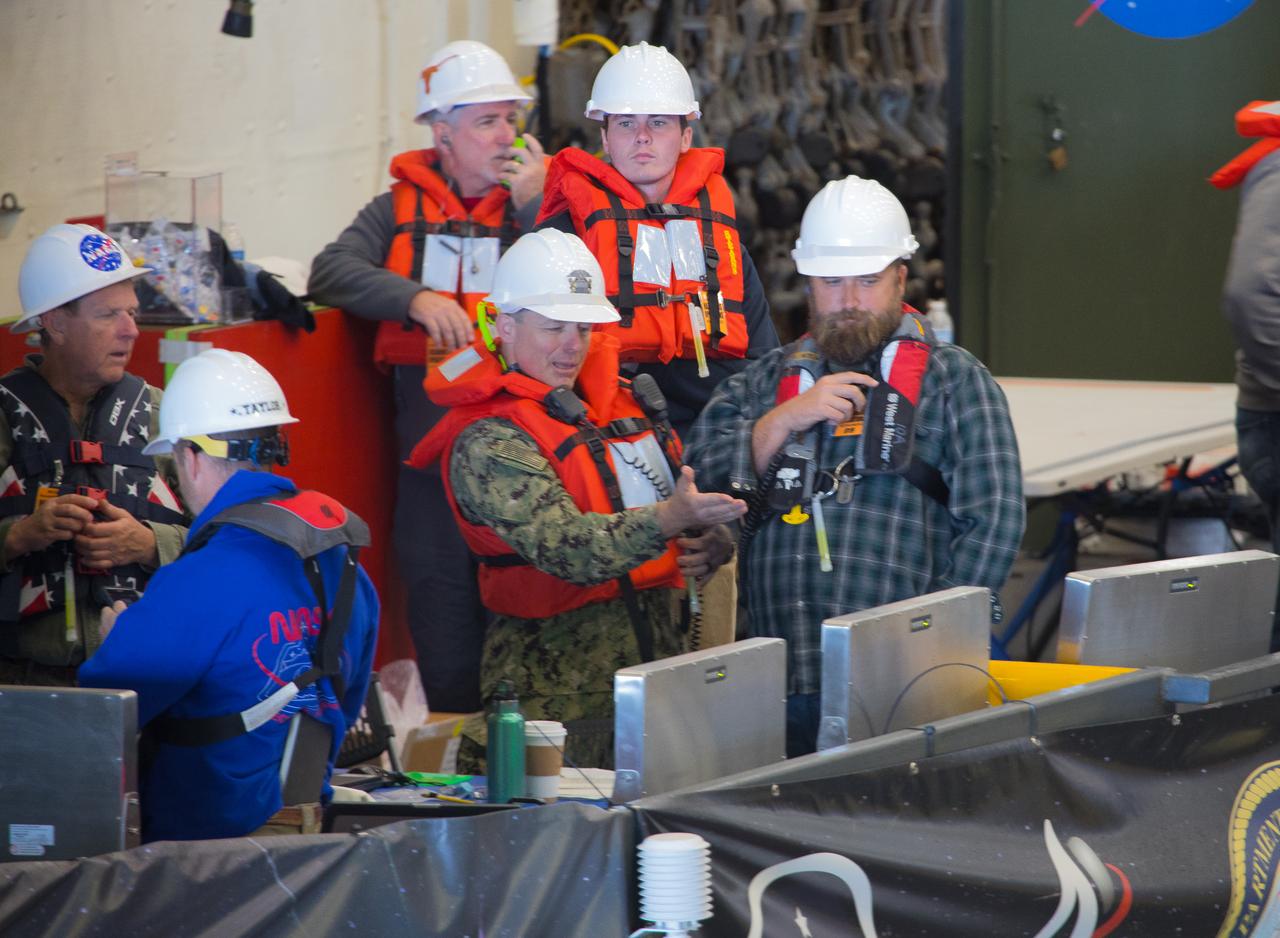
Members of NASA’s Landing and Recovery Team review wave data during Underway Recovery Test-8 off the coast of California. By tracking wave direction and length, the team will ensure a smoother recovery of the Orion spacecraft into the well deck of a Navy ship. During the test, the team practiced to ensure recovery procedure timelines are validated as NASA plans to send Artemis I around the Moon and splashdown in the Pacific Ocean.
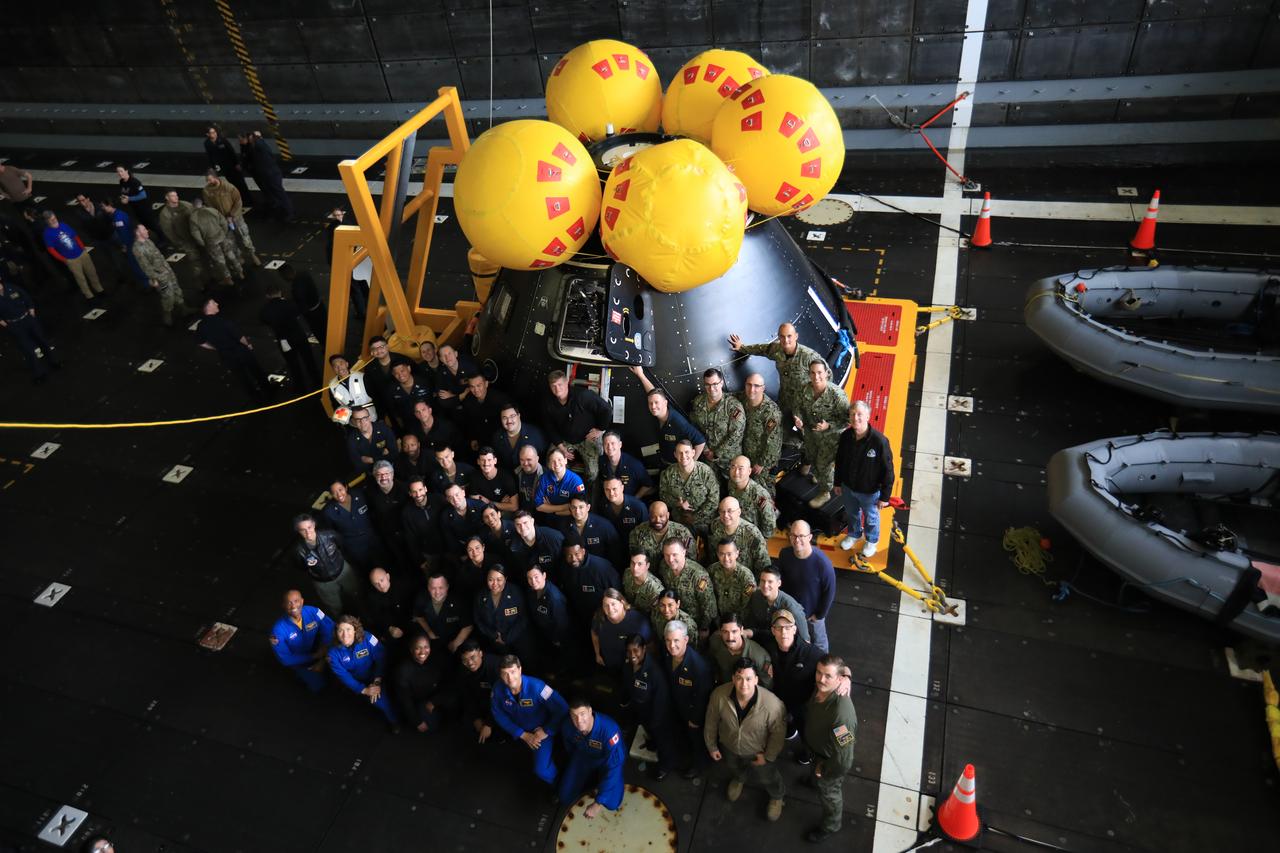
NASA Artemis II astronauts, members of NASA’s Exploration Ground System’s Landing and Recovery team, U.S. Navy personnel, and others aboard the USS San Diego pose in front of a mockup of the Orion spacecraft during Underway Recovery Test 11 (URT-11) off the coast of San Diego, California on Monday, Feb. 26, 2024. URT-11 is the eleventh in a series of Artemis recovery tests, and the first time NASA and its partners put their Artemis II recovery procedures to the test with the astronauts.
Members of NASA’s Landing and Recovery team are seen as they recover the Crew Module Test Article (CMTA), a full scale mockup of the Orion spacecraft, as teams practice Artemis recovery operations during Underway Recovery Test-12 onboard USS Somerset off the coast of California, Saturday, March 29, 2025. During the test, NASA and Department of Defense teams are practicing to ensure recovery procedures are validated as NASA plans to send Artemis II around the Moon and splashdown in the Pacific Ocean. Photo Credit: (NASA/Bill Ingalls)
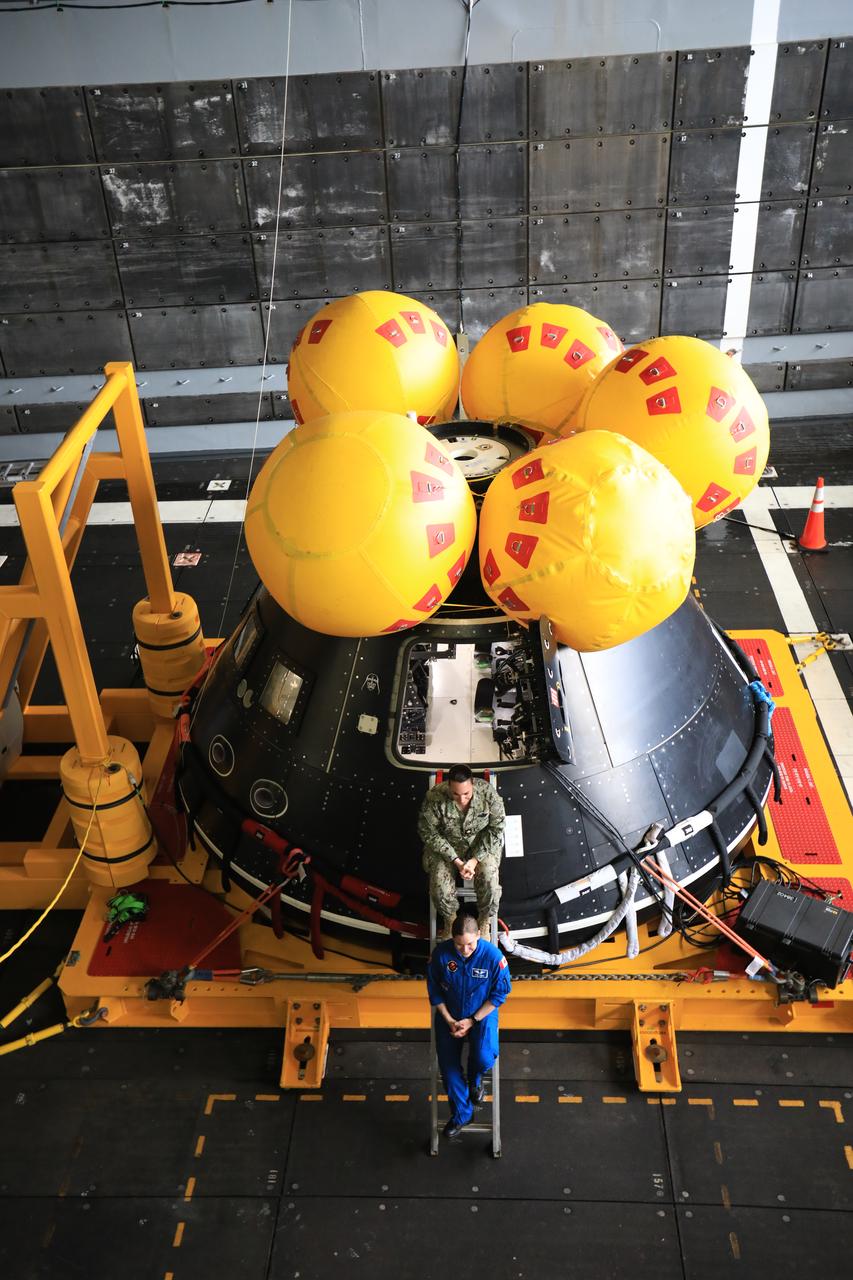
Members of NASA’s Exploration Ground System’s Landing and Recovery team aboard the USS San Diego pose in front of a mockup of the Orion spacecraft during Underway Recovery Test 11 (URT-11) off the coast of San Diego, California on Monday, Feb. 26, 2024. URT-11 is the eleventh in a series of Artemis recovery tests, and the first time NASA and its partners put their Artemis II recovery procedures to the test with the astronauts.
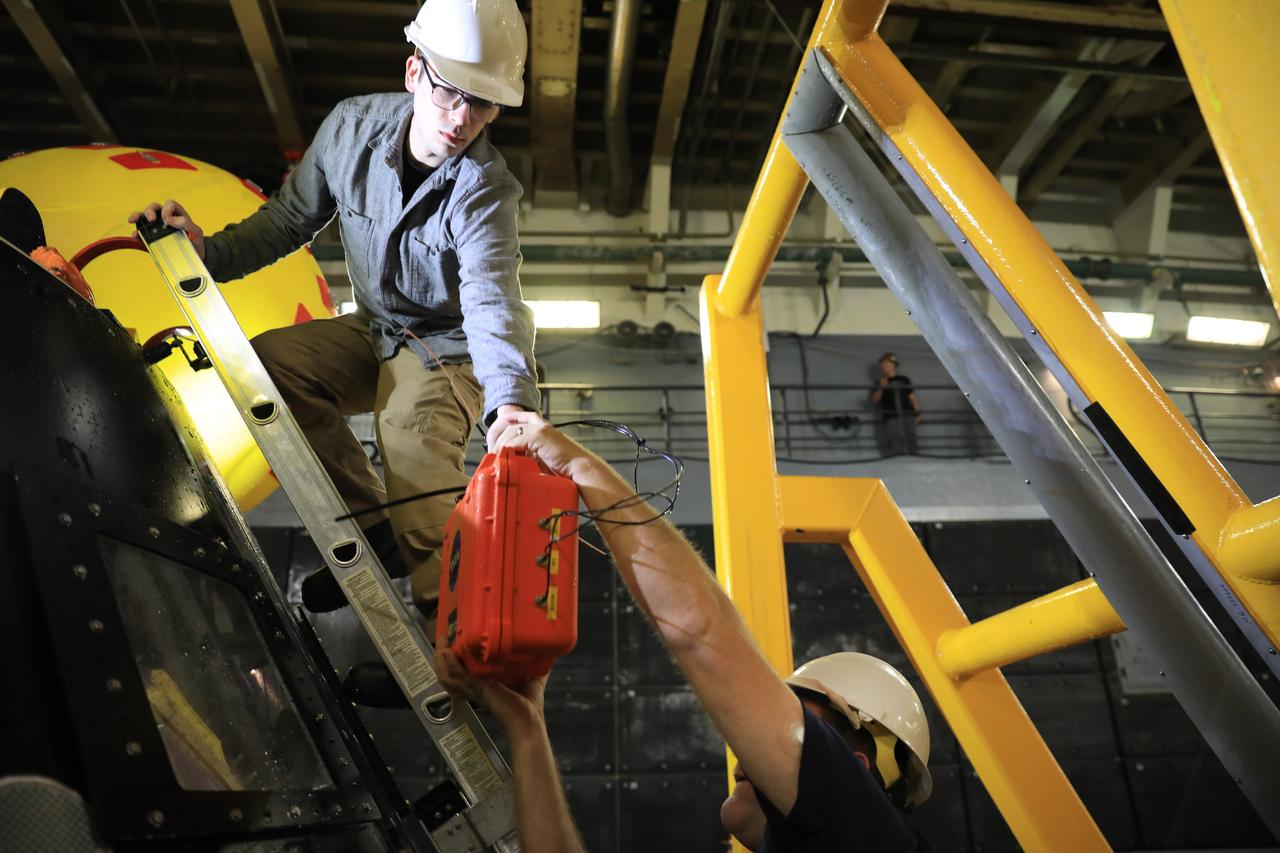
Members of NASA’s Landing and Recovery team are seen as they recover the Crew Module Test Article (CMTA), a full scale mockup of the Orion spacecraft, as teams practice Artemis recovery operations during Underway Recovery Test-12 onboard USS Somerset off the coast of California, Saturday, March 29, 2025. During the test, NASA and Department of Defense teams are practicing to ensure recovery procedures are validated as NASA plans to send Artemis II around the Moon and splashdown in the Pacific Ocean. Photo Credit: (NASA/Bill Ingalls)
Members of NASA’s Exploration Ground System’s Landing and Recovery team aboard the USS San Diego pose in front of a mockup of the Orion spacecraft during Underway Recovery Test 11 (URT-11) off the coast of San Diego, California on Sunday, Feb. 25, 2024. URT-11 is the eleventh in a series of Artemis recovery tests, and the first time NASA and its partners put their Artemis II recovery procedures to the test with the astronauts.
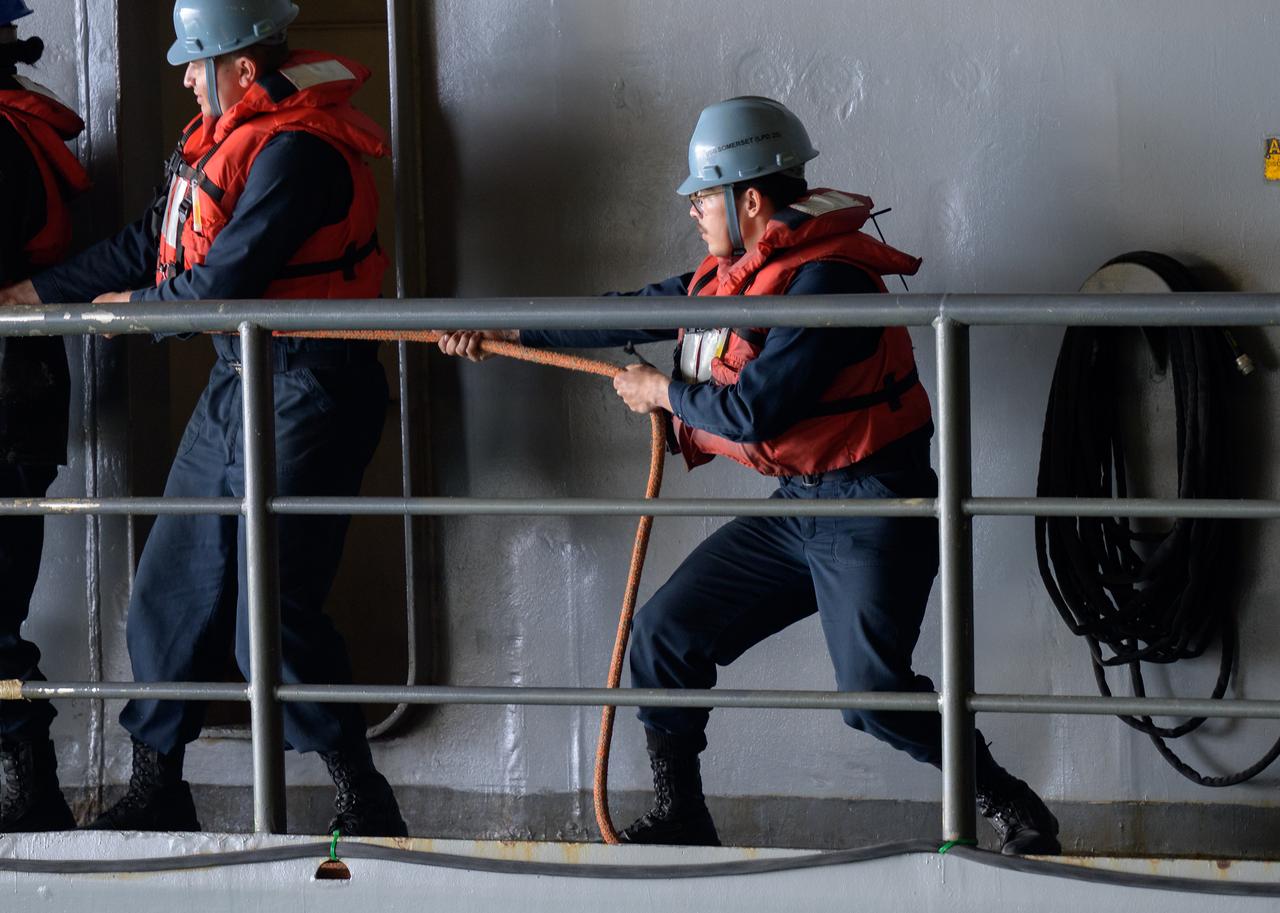
Sailors from USS Somerset assist in the recovery of the Crew Module Test Article (CMTA), a full scale mockup of the Orion spacecraft, as teams practice Artemis recovery operations during Underway Recovery Test-12 onboard USS Somerset off the coast of California, Saturday, March 29, 2025. During the test, NASA and Department of Defense teams are practicing to ensure recovery procedures are validated as NASA plans to send Artemis II around the Moon and splashdown in the Pacific Ocean. Photo Credit: (NASA/Bill Ingalls)
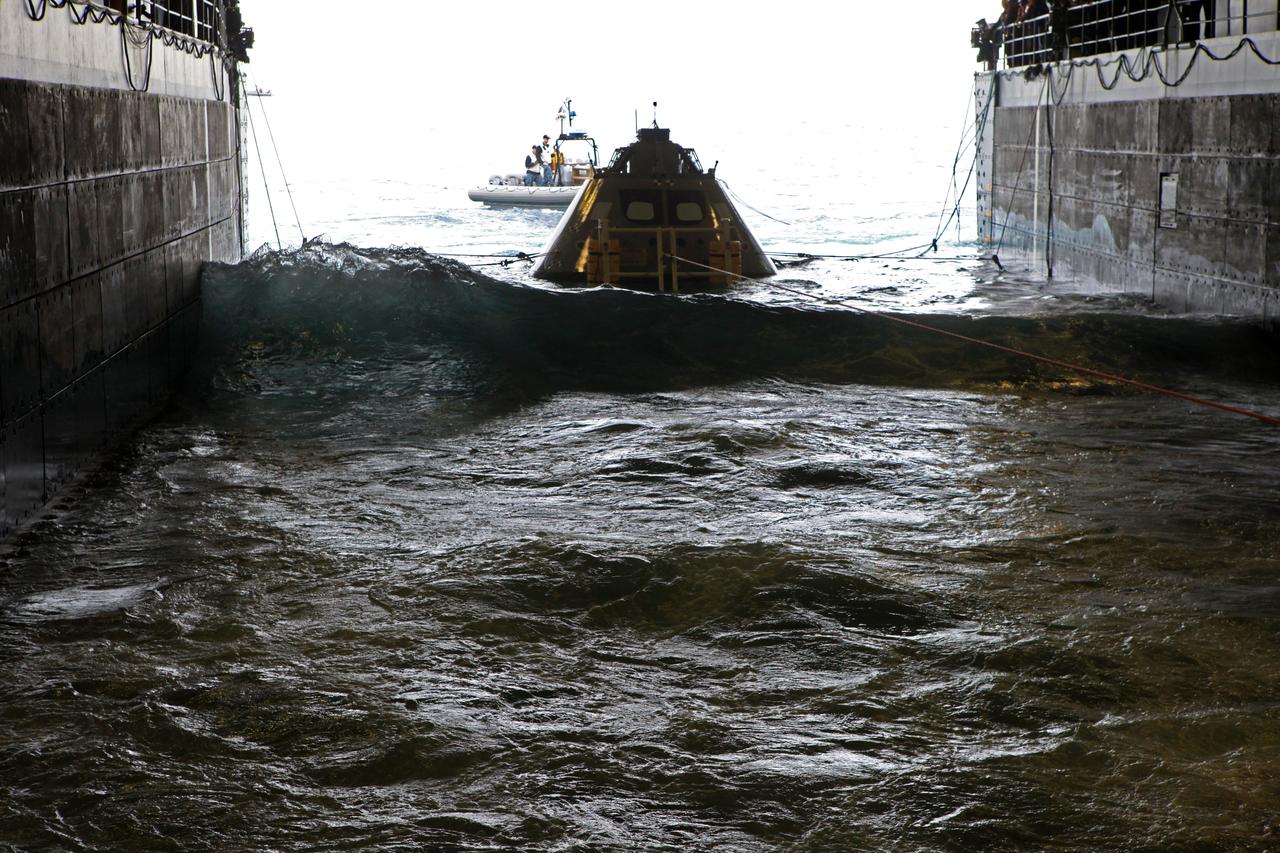
As part of Underway Recovery Test 6, the Orion test article is intentionally subjected to an increased sea state as the NASA Recovery Team works hard to keep control of the spacecraft. The testing with Kennedy Space Center's NASA Recovery Team and the U.S. Navy will provide important data that is being used to improve recovery procedures and hardware ahead of Orion's next flight, Exploration Mission-1, when it splashes down in the Pacific Ocean.
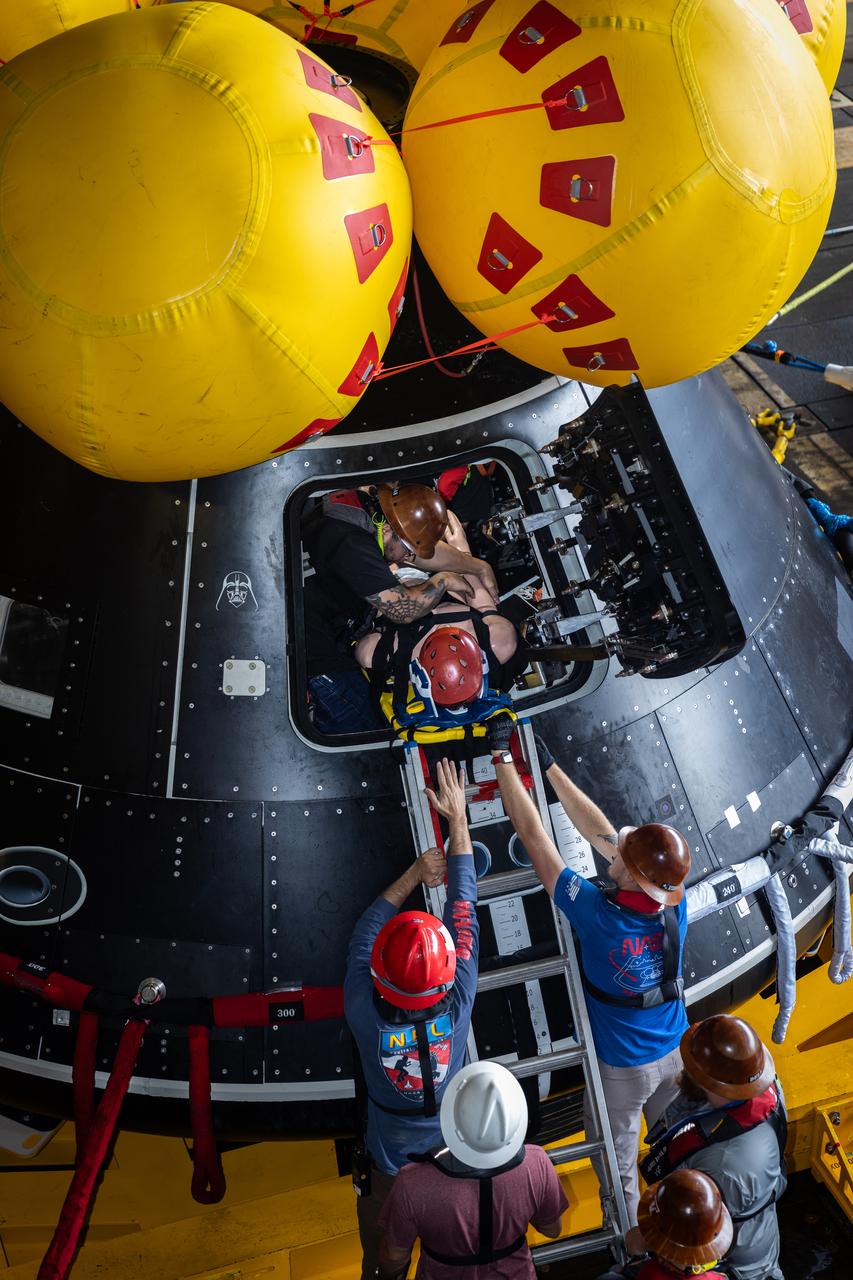
Members of NASA’s Landing and Recovery team load a mannequin into the Crew Module Test Article (CMTA) during Underway Recovery Test 10 in the Pacific Ocean. The CMTA is a is a full-scale mockup of the Orion spacecraft and is used by NASA and its Department of Defense partners to practice recovery procedures for crewed Artemis missions. The team uses the mannequin to practice recovering astronauts out of the capsule and safely getting them to the recovery vessel nearby.
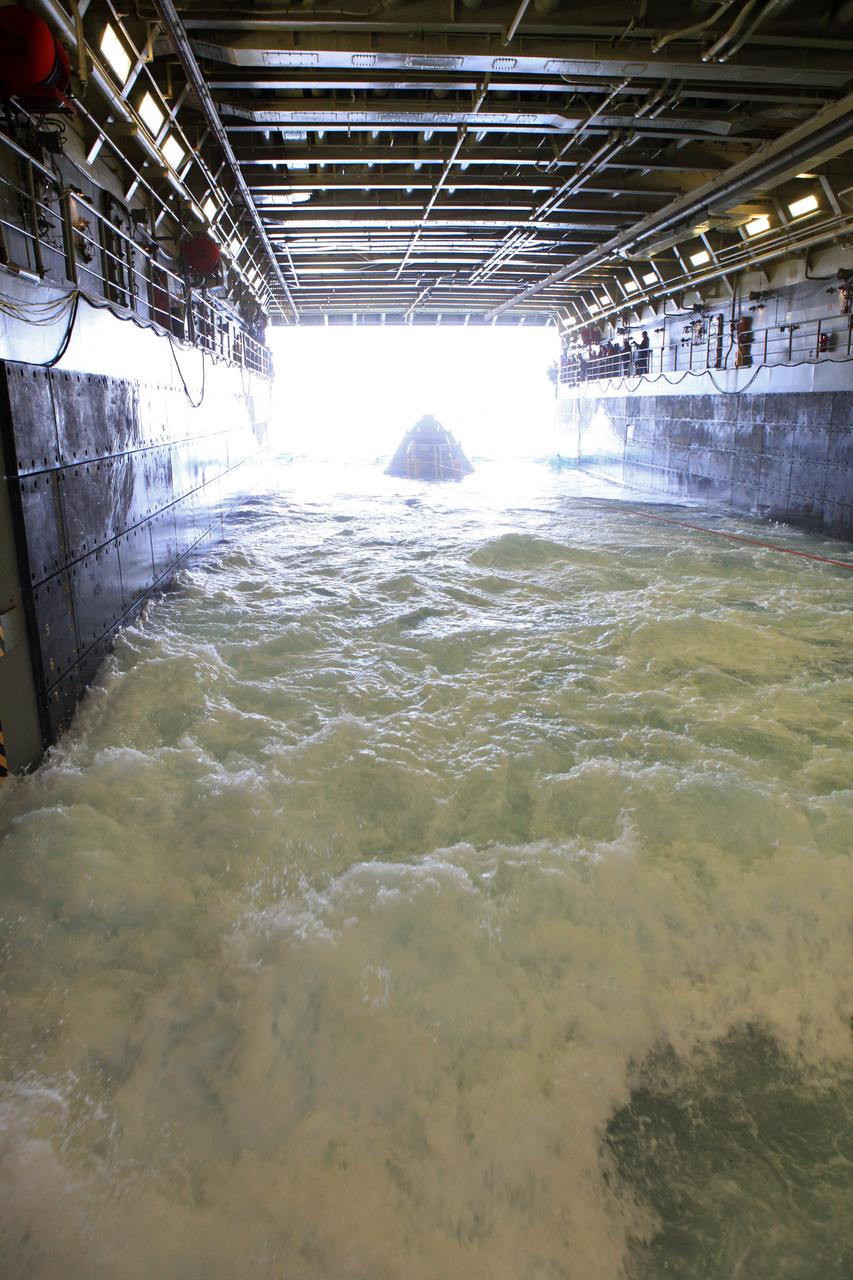
As part of Underway Recovery Test 6, the Orion test article is intentionally subjected to an increased sea state as the NASA Recovery Team works hard to keep control of the spacecraft. The testing with Kennedy Space Center's NASA Recovery Team and the U.S. Navy will provide important data that is being used to improve recovery procedures and hardware ahead of Orion's next flight, Exploration Mission-1, when it splashes down in the Pacific Ocean.