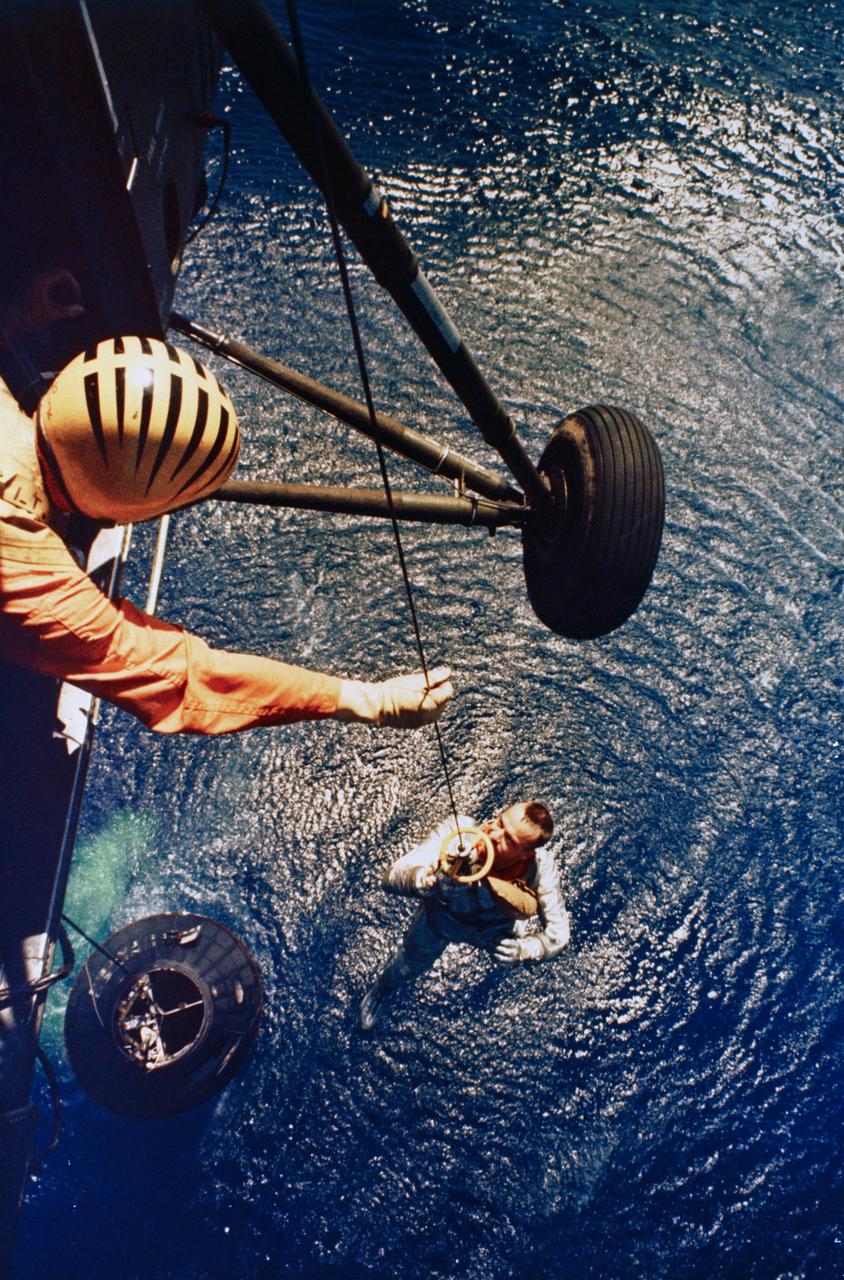
S88-31376 (5 May 1961) --- Astronaut Alan B. Shepard Jr., pilot of the Mercury-Redstone 3 (MR-3) suborbital spaceflight, is retrieved by a helicopter from the USS Lake Champlain during recovery operations in the western Atlantic Ocean. Shepard and the Mercury spacecraft designated the ?Freedom 7? (floating in water below) were flown to the deck of the recovery ship within 11 minutes of splashdown. MR-3 was the United States? first manned space mission. The spacecraft attained a maximum speed of 5,180 miles per hour, reached an altitude of 116 1/2 statute miles, and landed 302 statute miles downrange from Cape Canaveral, Florida. The suborbital mission lasted 15 minutes and 22 seconds. Photo credit: NASA or National Aeronautics and Space Administration
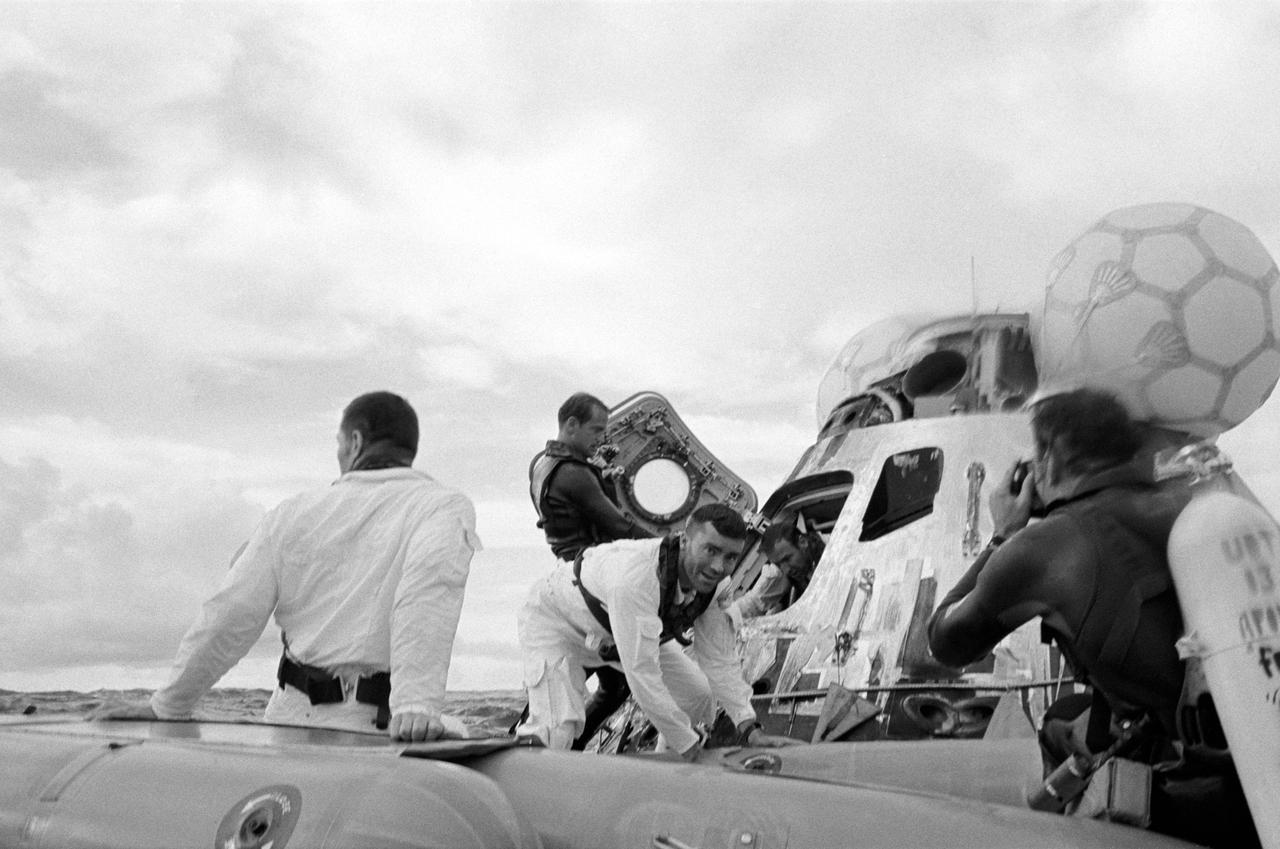
S70-35610 (17 April 1970) --- A water level view of the Apollo 13 recovery operations in the South Pacific Ocean. The three astronauts as seen egressing their spacecraft. John L. Swigert Jr. (back to camera), command module pilot, is already in the life raft. Fred W. Haise Jr., lunar module pilot, facing camera, is stepping into the life raft. James A. Lovell Jr., commander, is leaving the spacecraft in the background. A United States Navy underwater demolition team assists with the recovery operations. The three crewmembers were picked up by helicopter and flown to the prime recovery ship, USS Iwo Jima. The Apollo 13 Command Module (CM) splashed down at 12:07:44 p.m. (CST), April 17, 1970, to conclude safely a perilous space flight. Though the Apollo lunar landing mission was canceled, a disastrous loss of three astronauts was averted.
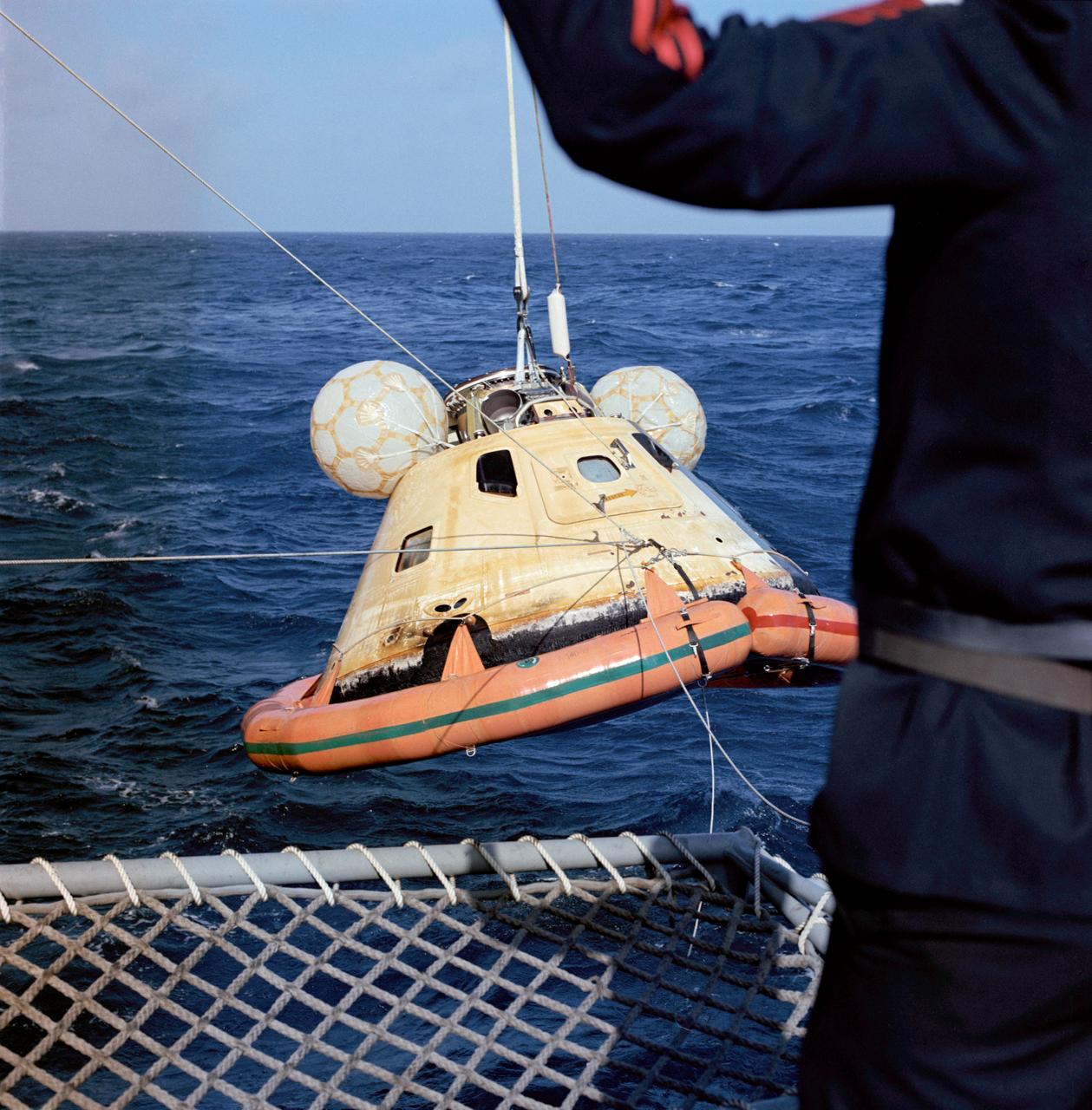
S73-36423 (25 Sept. 1973) --- The Skylab 3 Command Module, with astronauts Alan L. Bean, Owen K. Garriott and Jack R. Lousma still inside, is hoisted aboard the prime recovery ship, USS New Orleans, during recovery operations in the Pacific Ocean. The three crewmen had just completed a successful 59-day visit to the Skylab space station in Earth orbit. The Command Module splashed down in the Pacific about 230 miles southwest of San Diego, California. Earlier in the recovery operations a team of U.S. Navy swimmers attached the flotation collar to the spacecraft to improve its buoyancy. Photo credit: NASA
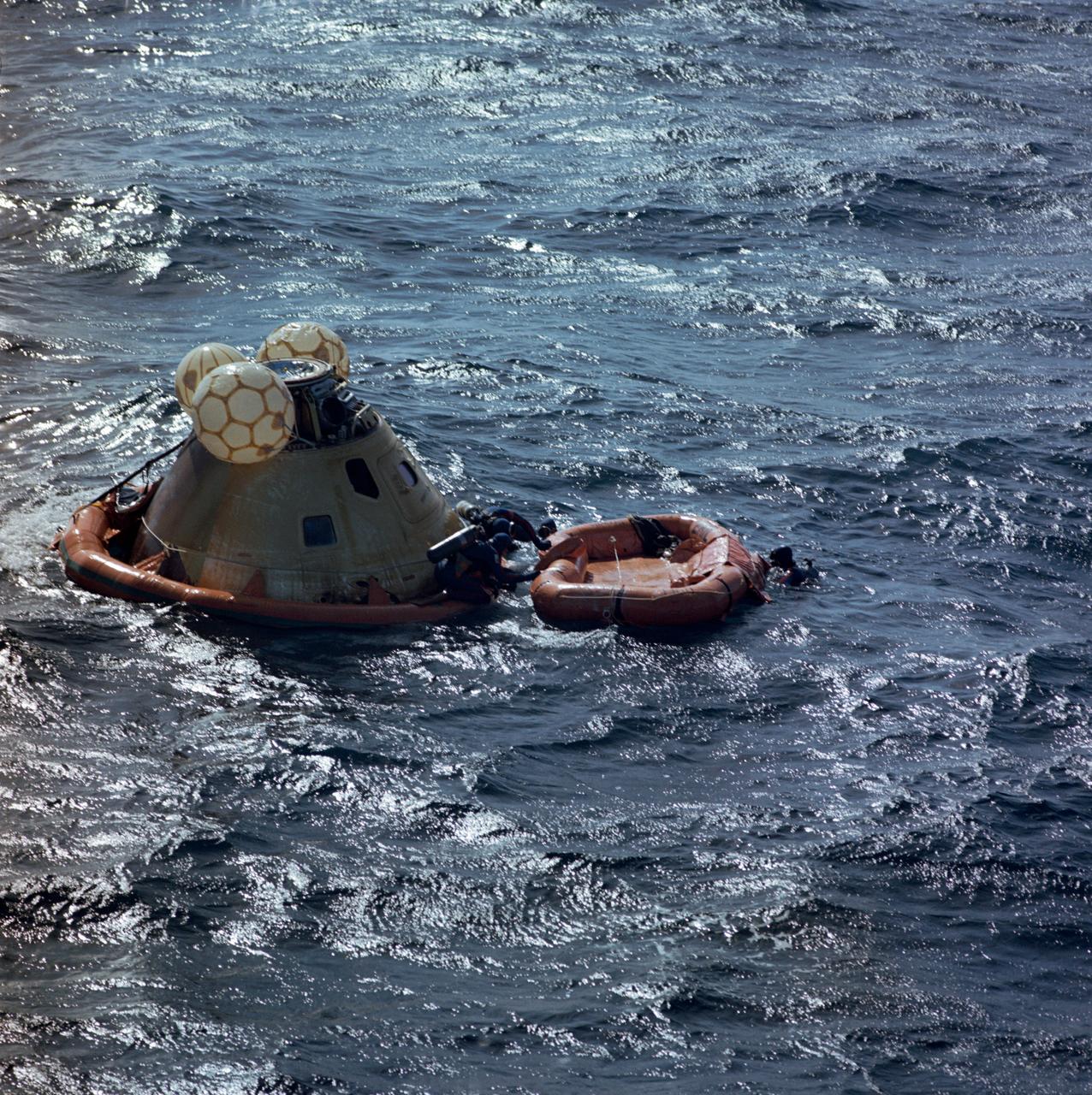
S73-36401 (25 Sept. 1973) --- A team of U.S. Navy swimmers assists with the recovery of the Skylab 3 Command Module following its splashdown in the Pacific Ocean about 230 miles southwest of San Diego, California. The swimmers had just attached a flotation collar to the spacecraft to improve its buoyancy. Aboard the Command Module were astronauts Alan L. Bean, Owen K. Garriott and Jack R. Lousma, who had just completed a successful 59-day visit to the Skylab space station in Earth orbit. Minutes later the Command Module with the three crewmen still inside was hoisted aboard the prime recovery ship, the USS New Orleans. Photo credit: NASA
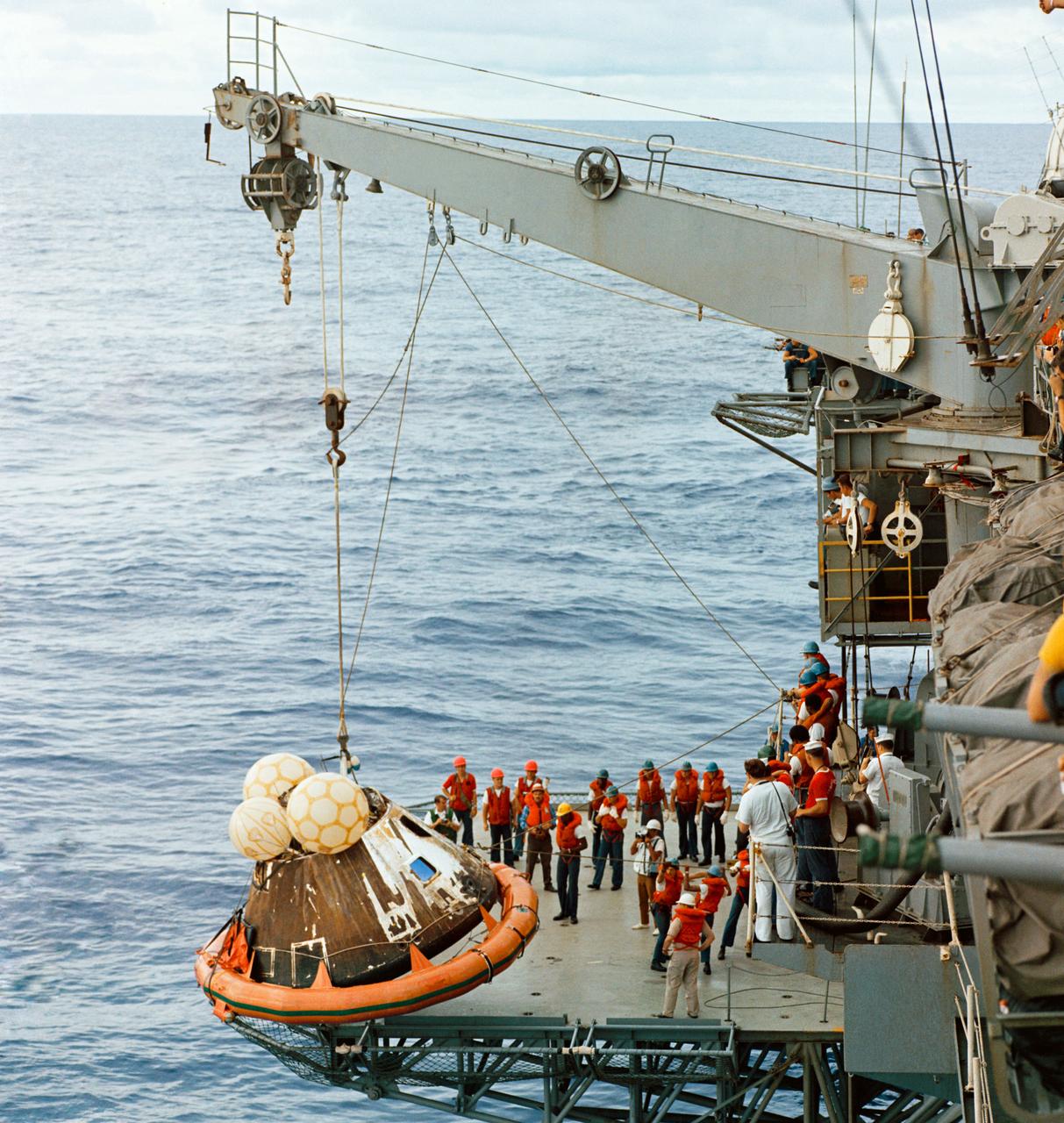
S70-15530 (17 April 1970) --- Crew men aboard the USS Iwo Jima, prime recovery ship for the Apollo 13 mission, hoist the Command Module (CM) aboard ship. The Apollo 13 crew men, astronauts James A. Lovell Jr., John L. Swigert Jr. and Fred W. Haise Jr., were already aboard the Iwo Jima when this photograph was taken. The CM, with the three tired crew men aboard, splashed down at 12:07:44 p.m. (CST), April 17, 1970, only about four miles from the recovery vessel in the South Pacific Ocean.
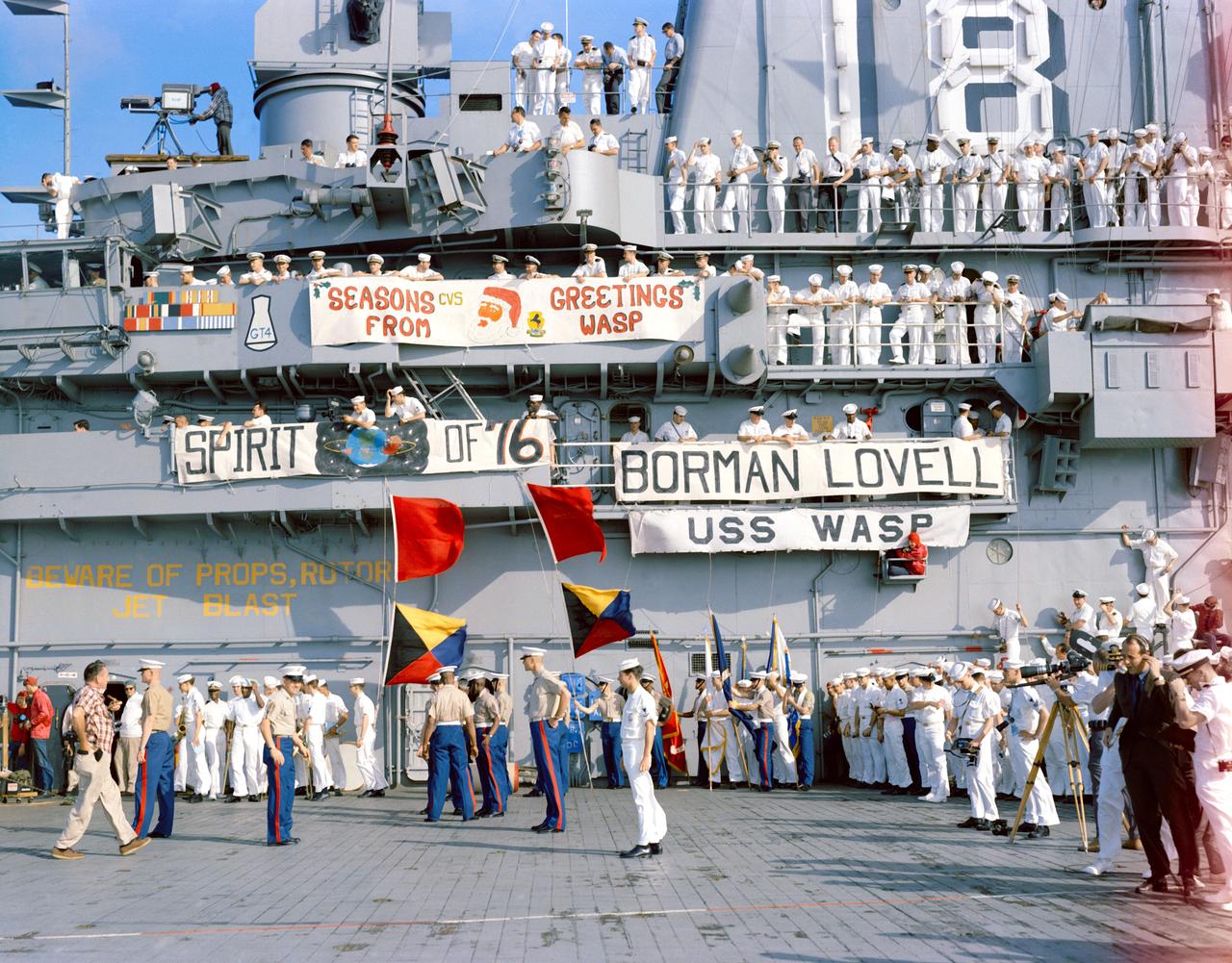
S65-63644 (18 Dec. 1965) --- Crewmen of the aircraft carrier USS Wasp gather on deck to watch the recovery of the National Aeronautics and Space Administration's Gemini-7 spacecraft and astronauts. Gemini-7, with astronauts Frank Borman, command pilot, and James A. Lovell Jr., pilot, splashed down in the western Atlantic at 9:05 a.m. (EST), Dec. 18, 1965, to conclude a record-breaking 14-day mission in space. Photo credit: NASA
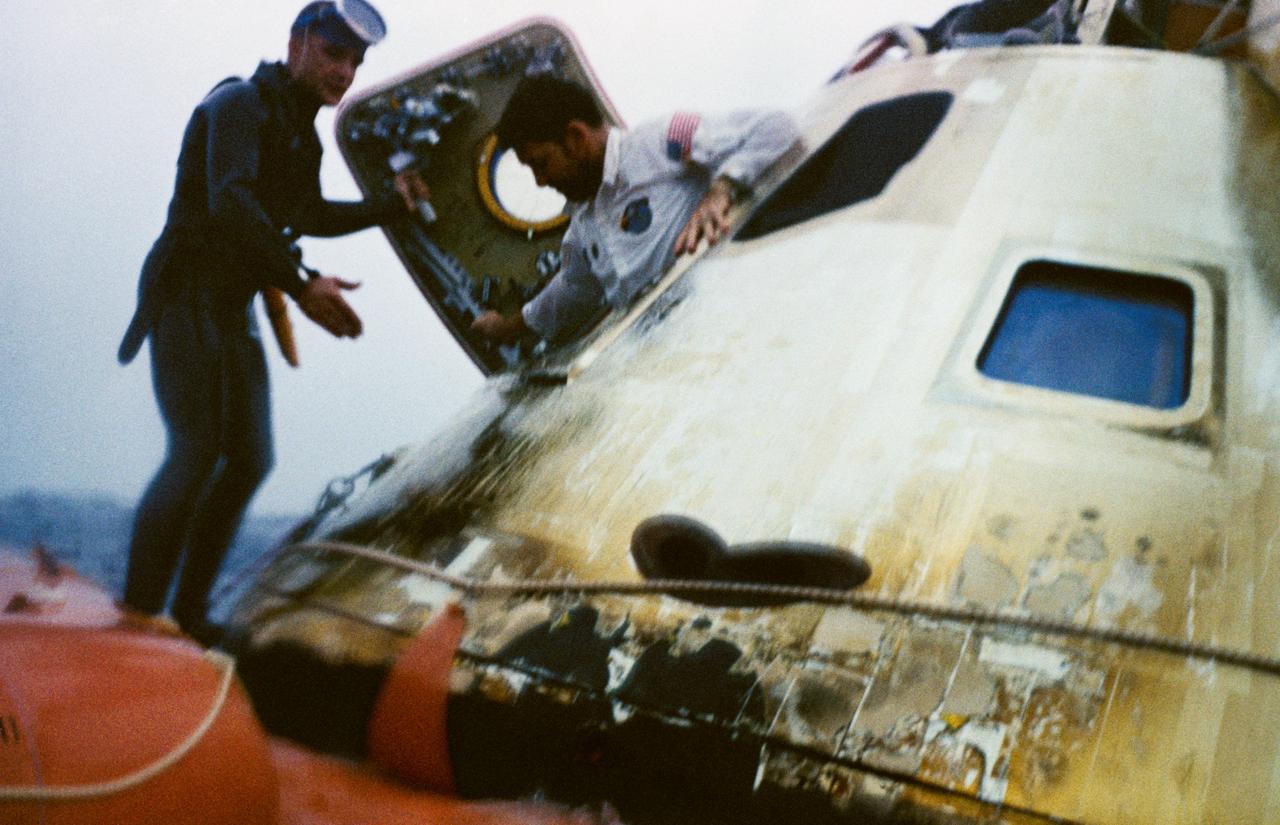
Astronaut Walter M. Schirra, Jr., Apollo 7 commander, egresses the spacecraft during recovery operations in the Atlantic. He is assisted by a member of the U.S. Navy frogman team. The Apollo 7 spacecraft splashed down at 7:11 a.m., October 22, 1968, approximately 200 nautical miles south-southwest of Bermuda.
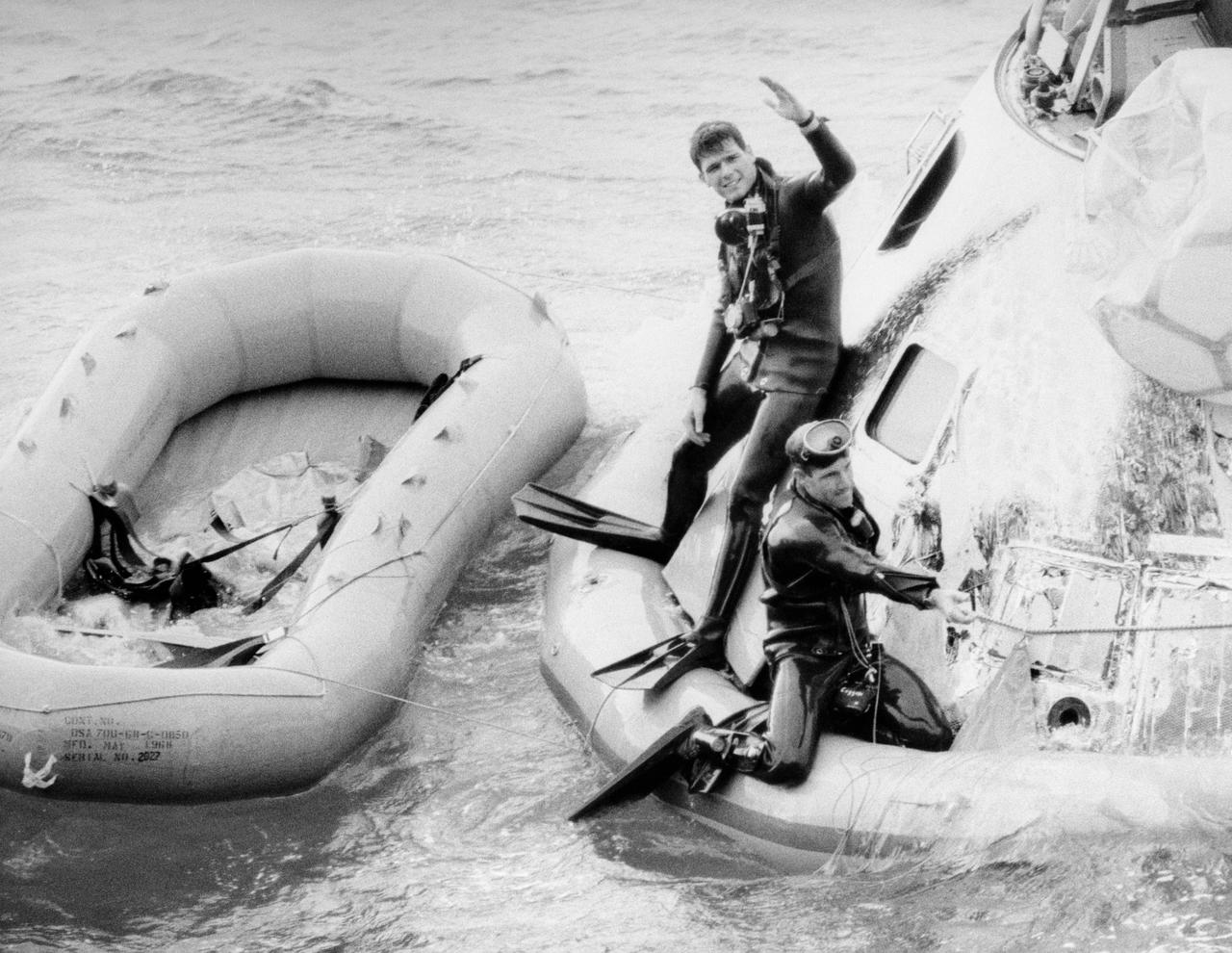
S69-15732 (27 Dec. 1968) --- A U.S. Navy frogman team participates in the Apollo 8 recovery operations. The Apollo crew, astronauts Frank Borman, James A. Lovell Jr., and William A. Anders, were recovered by helicopter and flown to the deck of the USS Yorktown, prime recovery ship for the historic Apollo 8 lunar orbit mission. Apollo 8 splashed down at 10:51 a.m. (EST), Dec. 27, 1968, about 1,000 miles south-southwest of Hawaii.
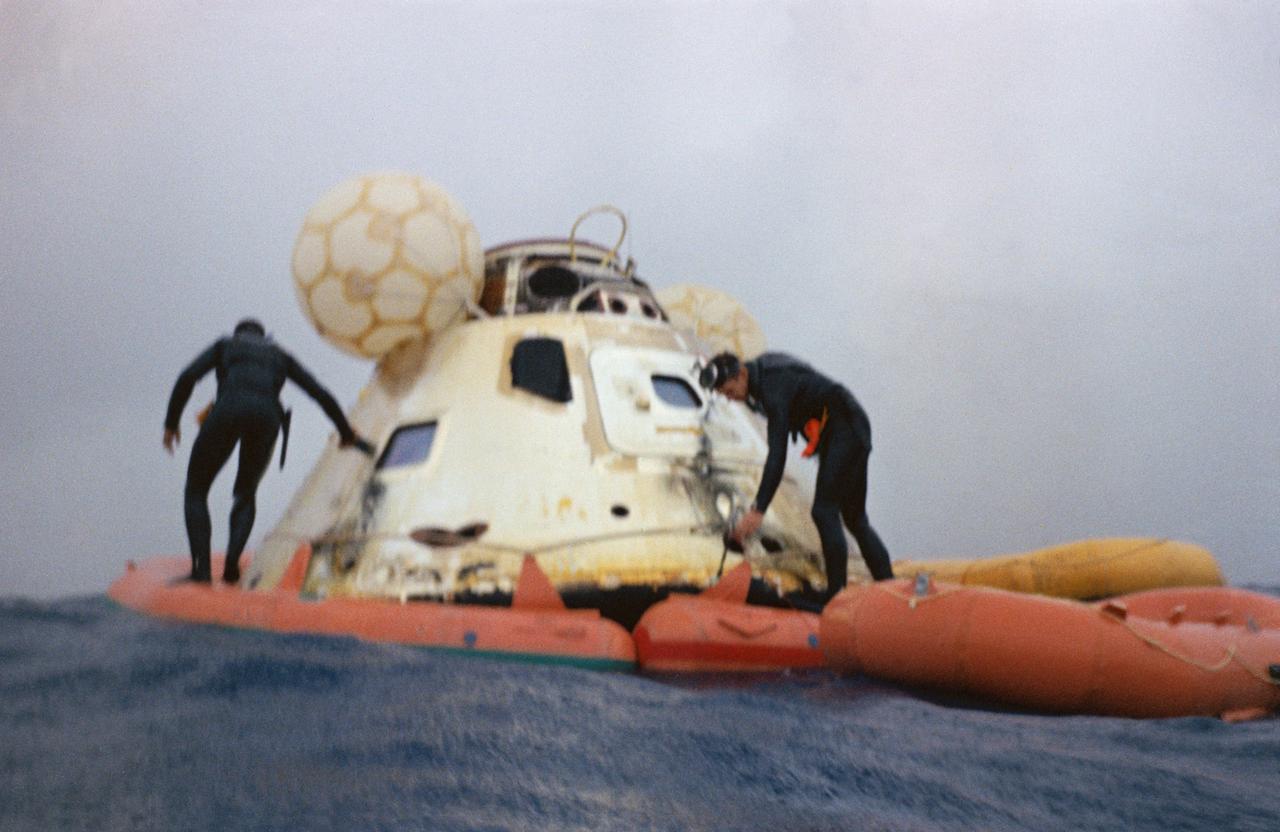
U.S. Navy frogmen attach a flotation collar to the Apollo 7 command module during recovery operations in the Atlantic. The Apollo 7 spacecraft splashed down at 7:11 a.m., October 22, 1968, approximately 200 nautical miles south-southwest of Bermuda.
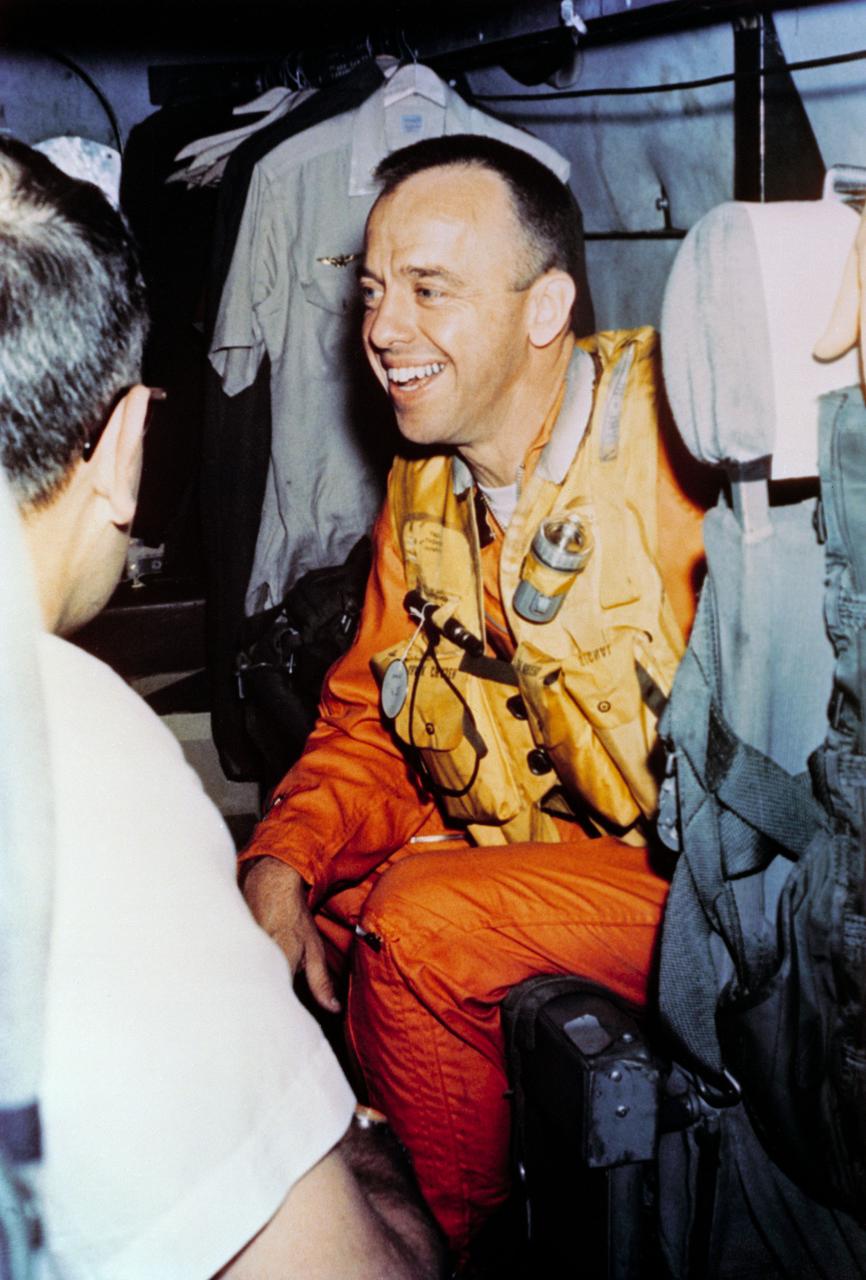
S88-31383 (5 May 1961) --- Astronaut Alan B. Shepard Jr., Mercury-Redstone 3 (MR-3) pilot, jokes with doctors while in-flight between the U.S. Navy Carrier Champlain and the Grand Bahama Islands. Shepard is the first American in space with the successful completion of the 15-minute suborbital mission. Photo credit: NASA or National Aeronautics and Space Administration
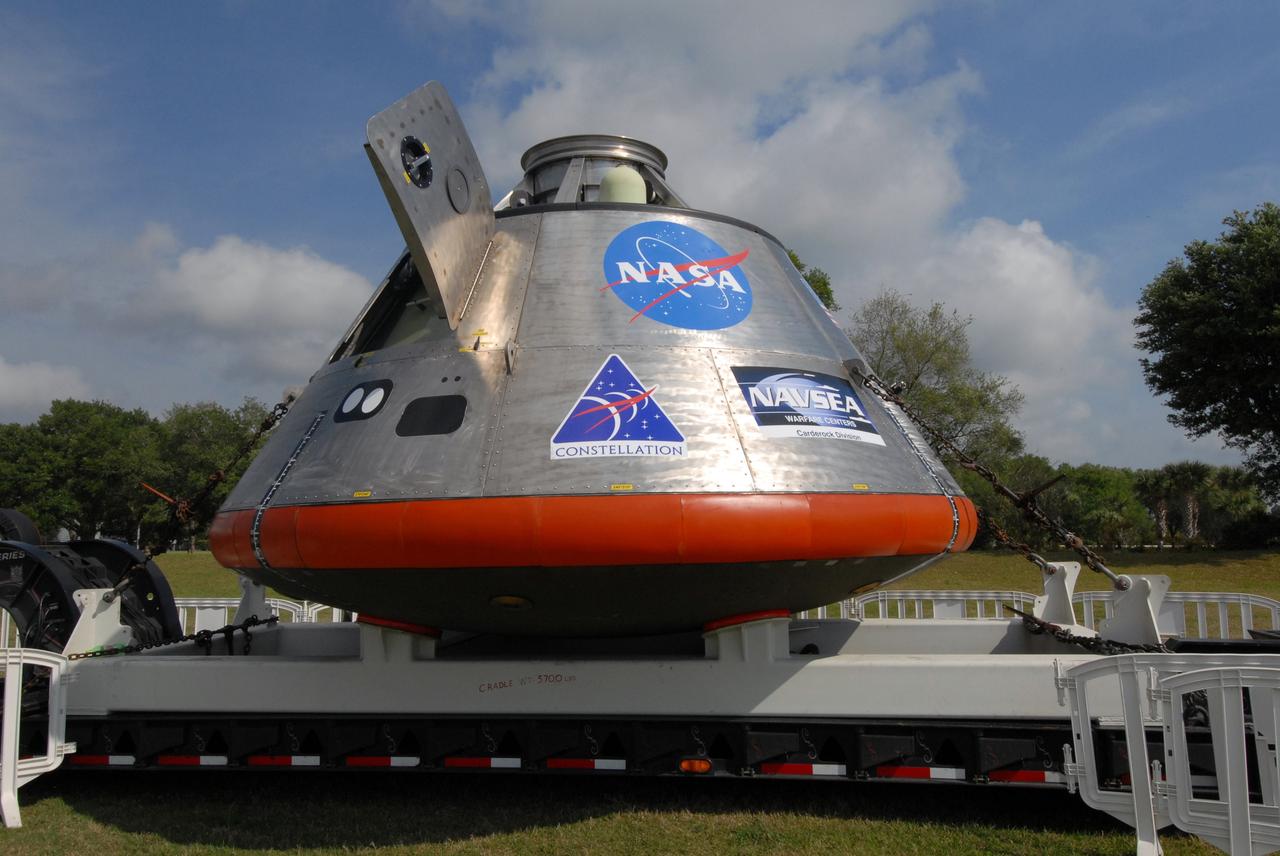
CAPE CANAVERAL, Fla. – On display at the Kennedy Space Center Visitor Complex in Florida is the Orion crew exploration vehicle mockup, which will be moved onto the center before heading offshore to be tested in open water. The spacecraft mock-up traveled from the Naval Surface Warfare Center's Carderock Division in Bethesda, Md. The goal of the open water testing, dubbed the Post-landing Orion Recovery Test, or PORT, is to determine what kind of motion astronauts can expect after landing, as well as outside conditions for recovery teams. Part of the Constellation Program, Orion is targeted to begin carrying humans to the International Space Station in 2015 and to the moon by 2020. Photo credit: NASA/Jack Pfaller
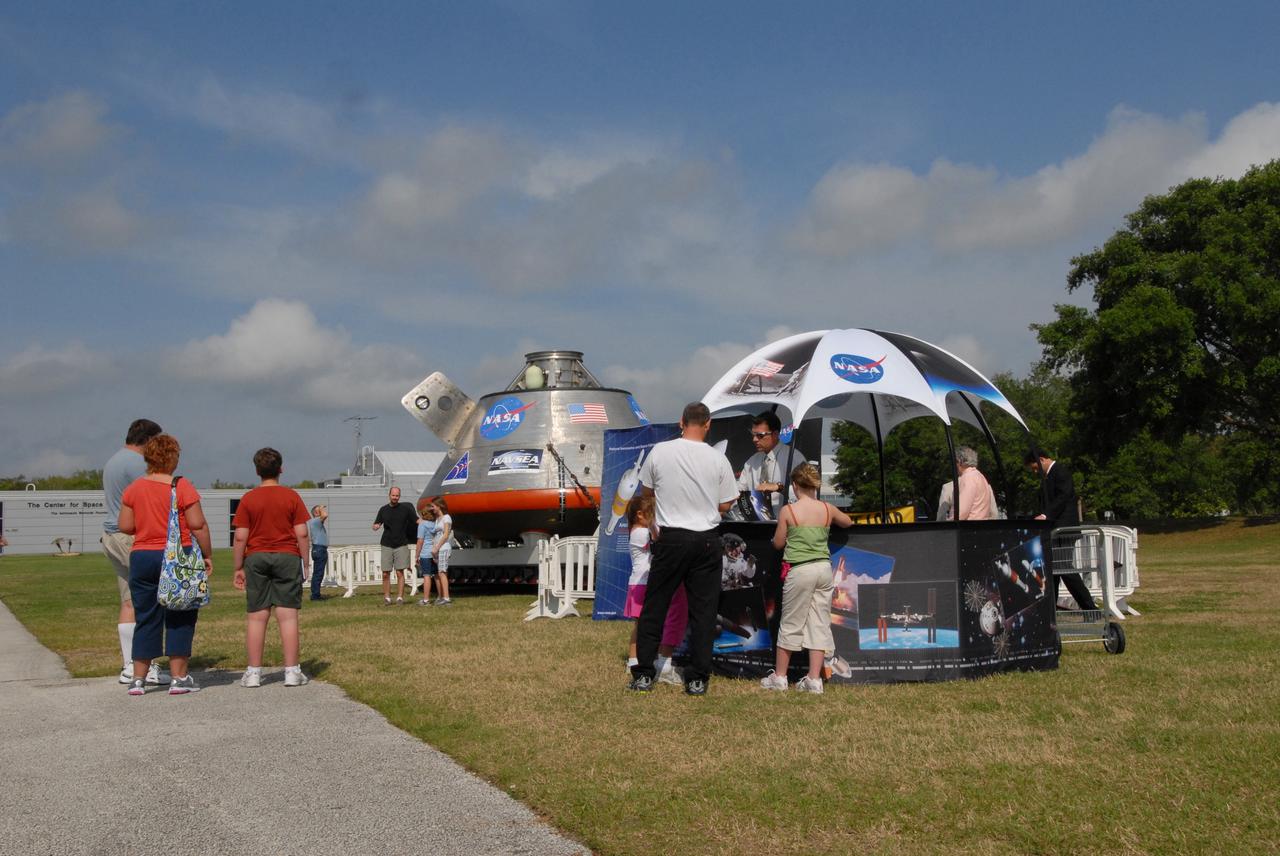
CAPE CANAVERAL, Fla. – Visitors to the Visitor Complex at NASA's Kennedy Space Center in Florida get a look at the Orion crew exploration vehicle mockup, which is on display before heading offshore to be tested in open water. The spacecraft mock-up traveled from the Naval Surface Warfare Center's Carderock Division in Bethesda, Md. The goal of the open water testing, dubbed the Post-landing Orion Recovery Test, or PORT, is to determine what kind of motion astronauts can expect after landing, as well as outside conditions for recovery teams. Part of the Constellation Program, Orion is targeted to begin carrying humans to the International Space Station in 2015 and to the moon by 2020. Photo credit: NASA/Jack Pfaller
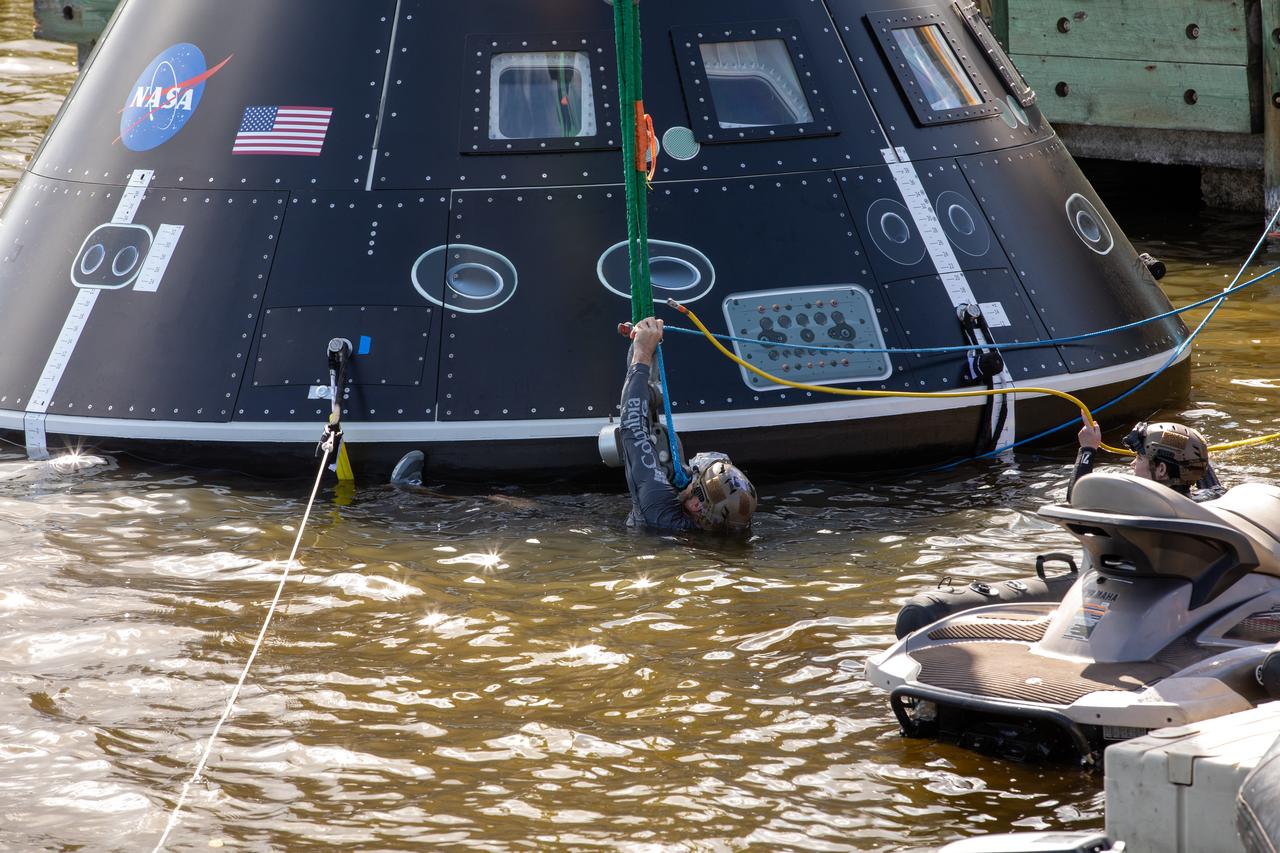
Landing and recovery team members secure the Crew Module Test Article (CMTA) in the water at the turn basin in the Launch Complex 39 area at NASA’s Kennedy Space Center in Florida on Jan. 30, 2023. The CMTA is being used to practice recovery after splashdown of the Orion spacecraft to prepare for the Artemis II crewed mission. Exploration Ground Systems leads recovery efforts.
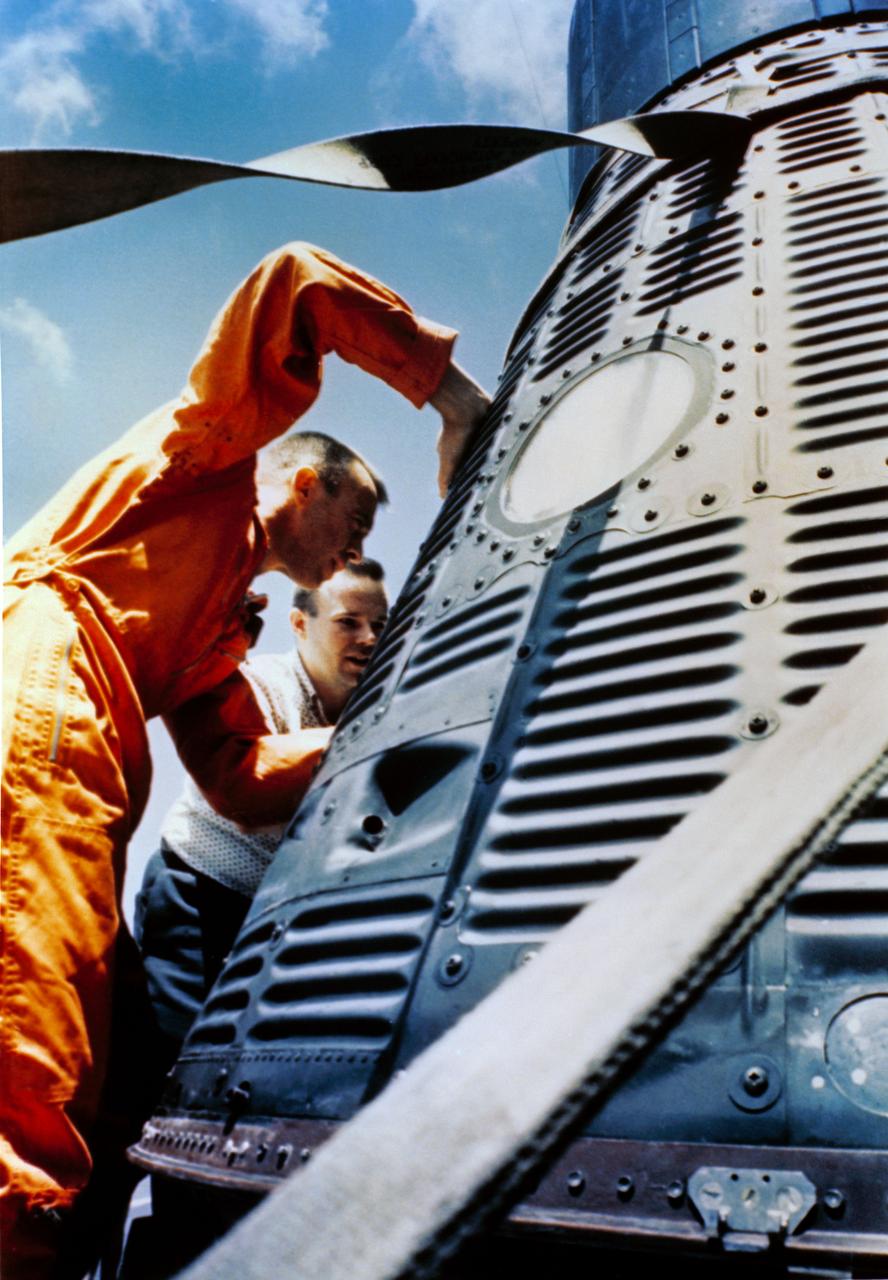
S88-31384 (5 May 1961) --- Astronaut Alan B. Shepard Jr., Mercury-Redstone 3 (MR-3) pilot, is pictured near his Freedom 7 capsule during a postflight inspection aboard the U.S. Navy Carrier Champlain after the recovery of his Mercury vehicle. Earlier Shepard had completed the historical 15-minute suborbital Mercury-Redstone 3 mission, marking the U.S. inaugural manned space mission. (NASA Hq. No. 61-MR3-107 or MR3-44) Photo credit: NASA or National Aeronautics and Space Administration
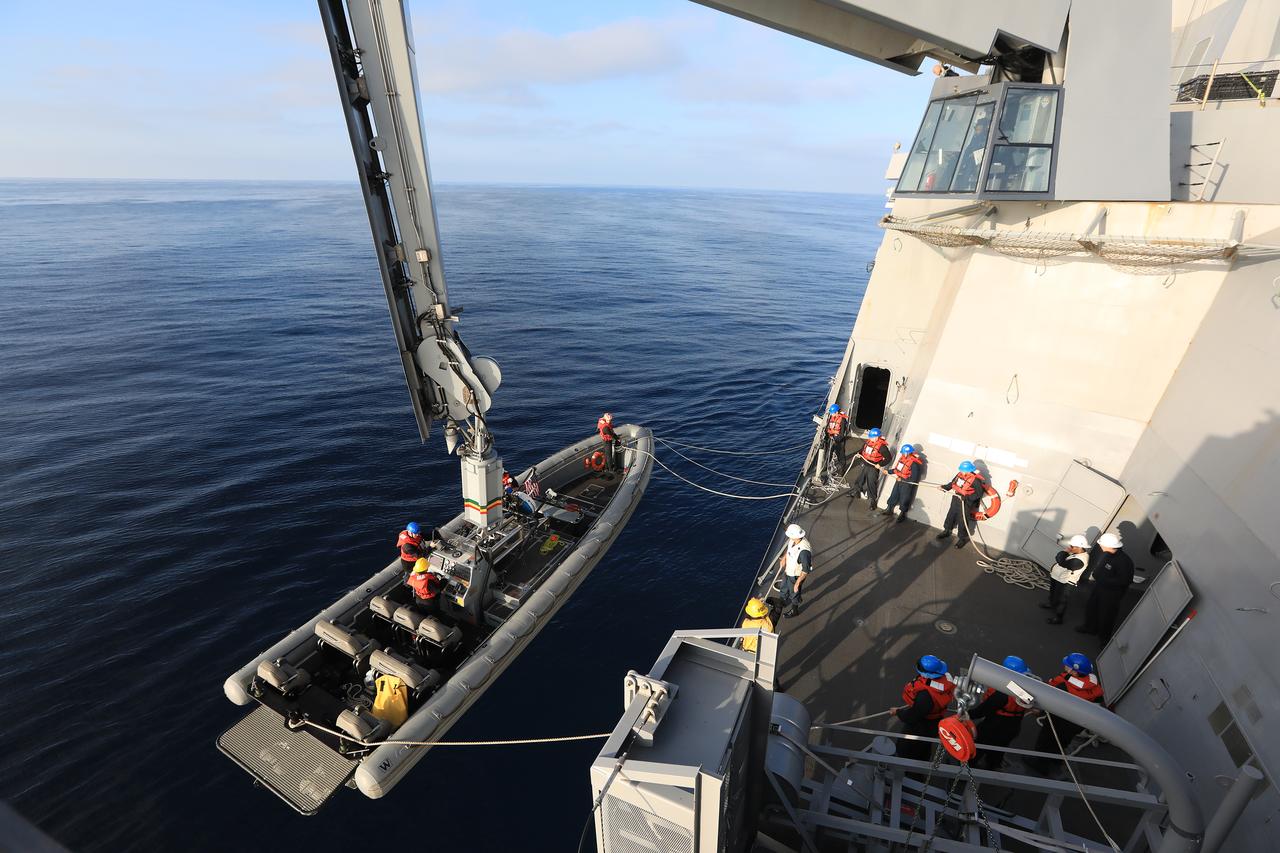
Small boats used by U.S. Navy divers are lowered into the water in preparation for the dive teams to race out to a test version of the Orion capsule during Underway Recovery Test-7 (URT-7), on Oct. 31, 2018, aboard the USS John P. Murtha in the Pacific Ocean. The Exploration Ground Systems (EGS) Landing and Recovery team and the U.S. Navy are using the mock Orion, several rigid hull inflatable boats and support equipment to verify and validate processes, procedures, hardware and personnel during recovery of Orion in open waters. URT-7 is one in a series of tests to verify and validate procedures and hardware that will be used to recover the Orion spacecraft after it splashes down in the Pacific Ocean following deep space exploration missions. Orion will have emergency abort capability, sustain the crew during space travel and provide safe re-entry from deep space return velocities.
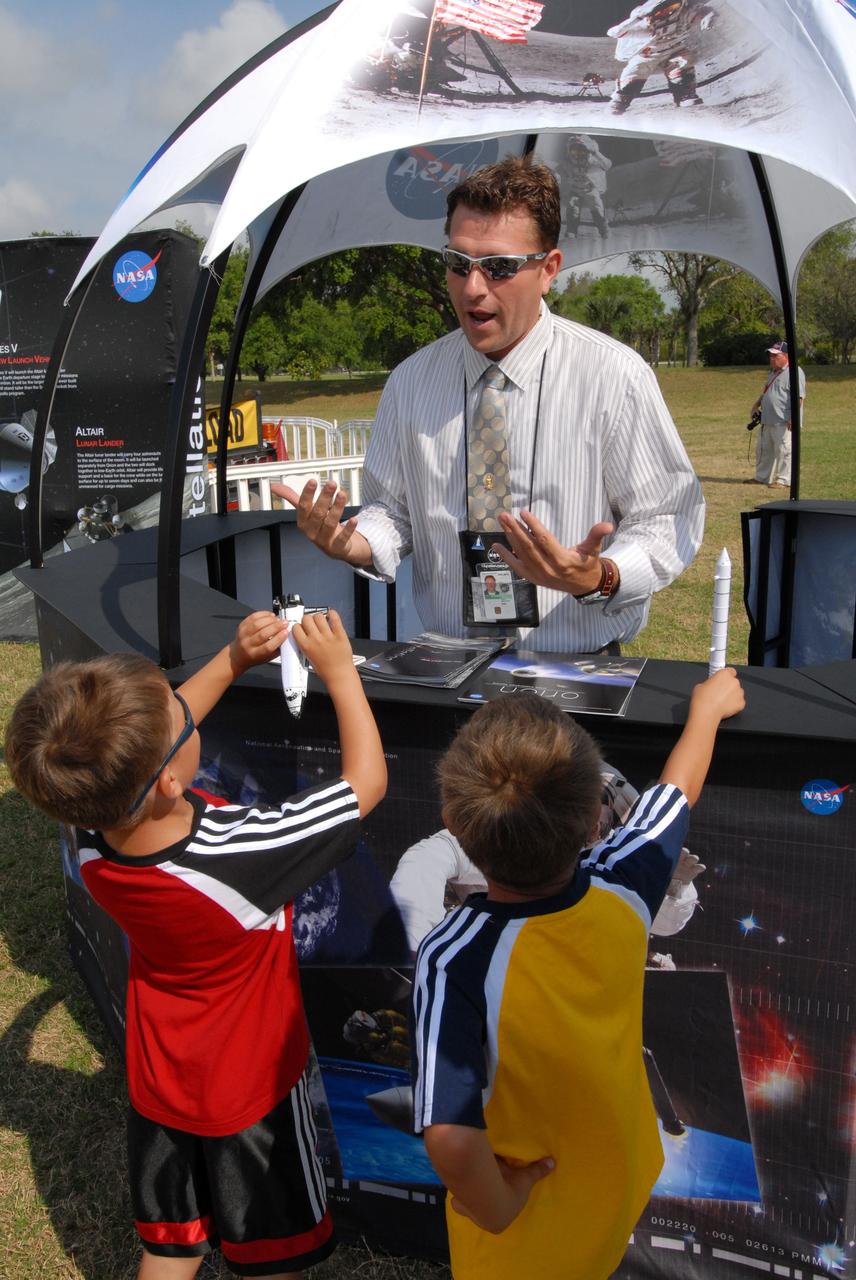
CAPE CANAVERAL, Fla. – A NASA official talks to visitors at the Kennedy Space Center Visitor Complex in Florida about the Orion crew exploration vehicle mockup and the Constellation Program. The Orion mockup is on display before heading offshore to be tested in open water. The spacecraft mock-up traveled from the Naval Surface Warfare Center's Carderock Division in Bethesda, Md. The goal of the open water testing, dubbed the Post-landing Orion Recovery Test, or PORT, is to determine what kind of motion astronauts can expect after landing, as well as outside conditions for recovery teams. Part of the Constellation Program, Orion is targeted to begin carrying humans to the International Space Station in 2015 and to the moon by 2020. Photo credit: NASA/Jack Pfaller
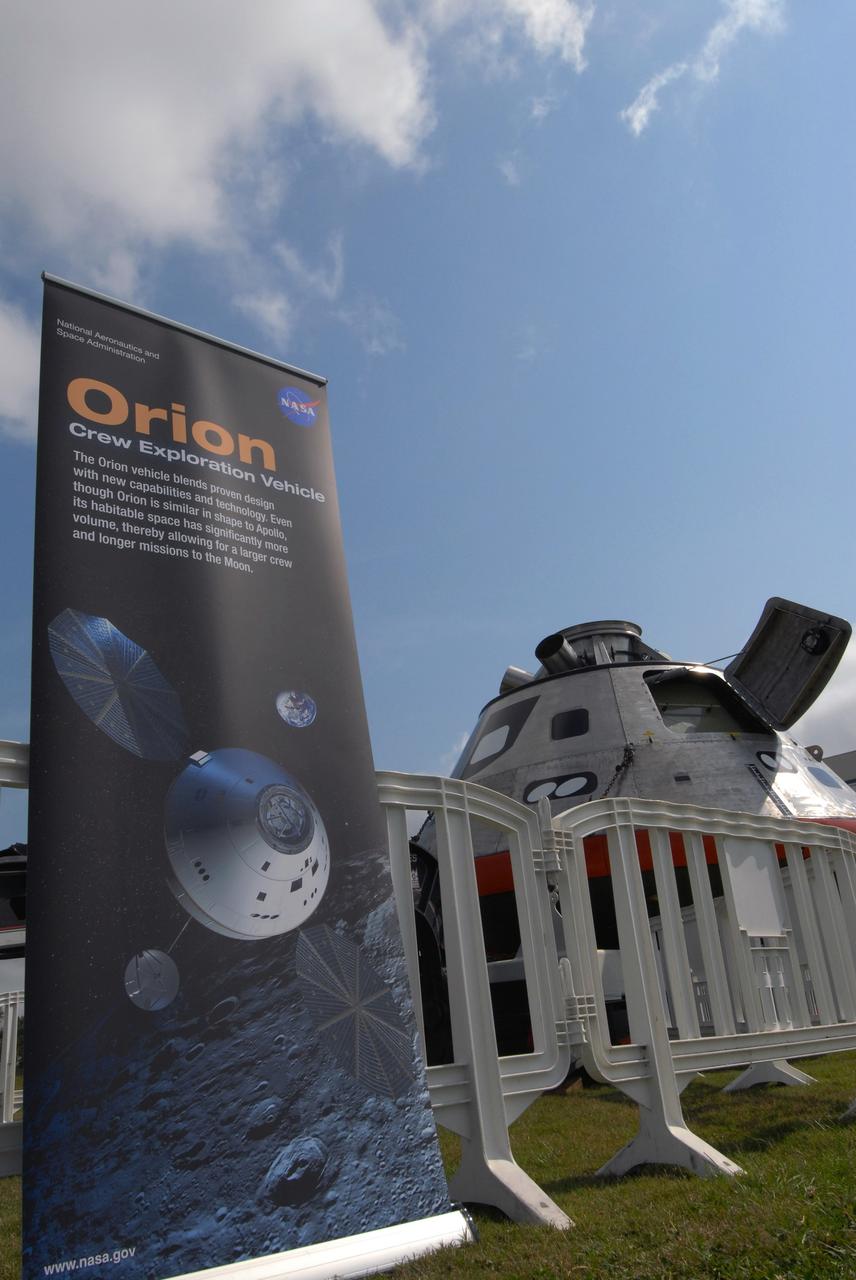
CAPE CANAVERAL, Fla. – On display at the Kennedy Space Center Visitor Complex in Florida is the Orion crew exploration vehicle mockup (right) and an exhibit about the Constellation Program. The Orion mockup is on display before heading offshore to be tested in open water. The spacecraft mock-up traveled from the Naval Surface Warfare Center's Carderock Division in Bethesda, Md. The goal of the open water testing, dubbed the Post-landing Orion Recovery Test, or PORT, is to determine what kind of motion astronauts can expect after landing, as well as outside conditions for recovery teams. Part of the Constellation Program, Orion is targeted to begin carrying humans to the International Space Station in 2015 and to the moon by 2020. Photo credit: NASA/Jack Pfaller
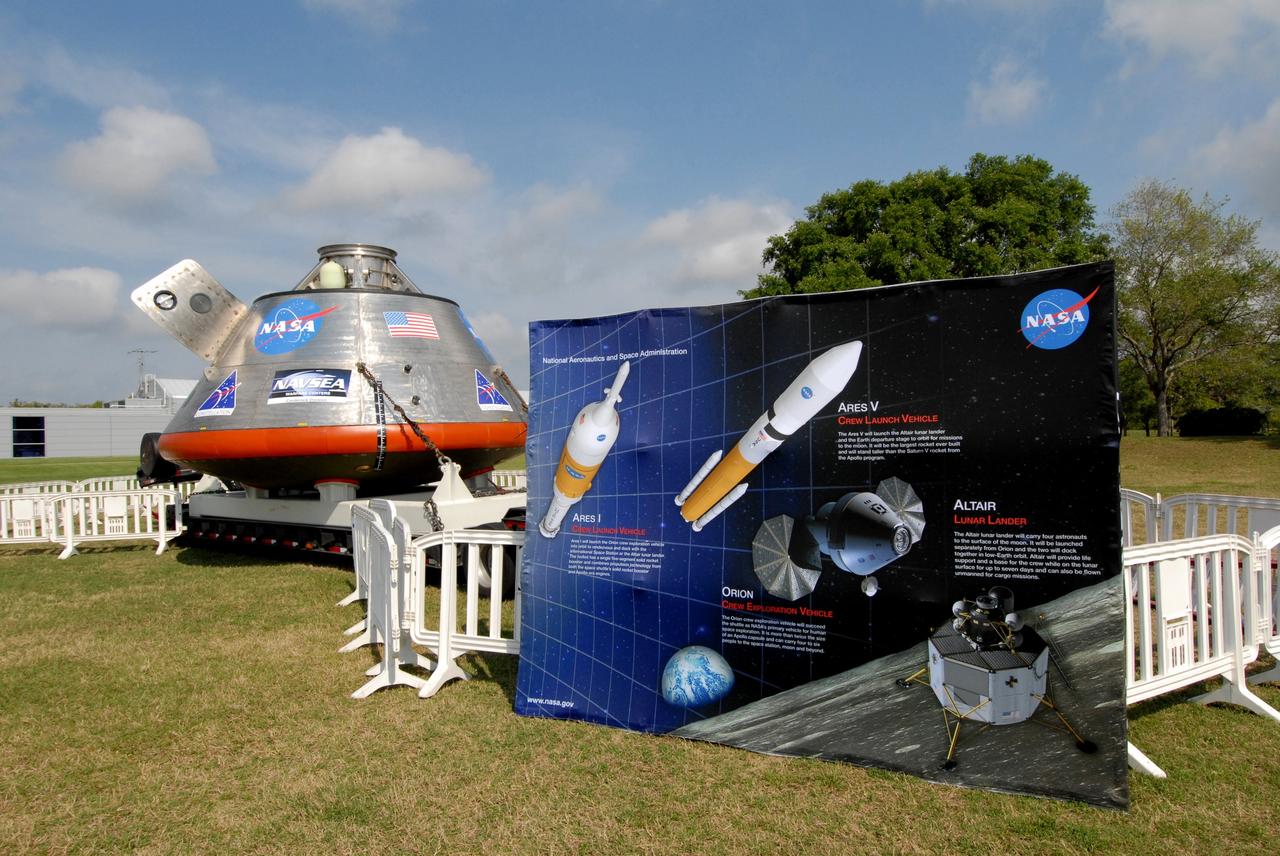
CAPE CANAVERAL, Fla. – On display at the Kennedy Space Center Visitor Complex in Florida is the Orion crew exploration vehicle mockup (left) and an exhibit about the Constellation Program. The Orion mockup is on display before heading offshore to be tested in open water. The spacecraft mock-up traveled from the Naval Surface Warfare Center's Carderock Division in Bethesda, Md. The goal of the open water testing, dubbed the Post-landing Orion Recovery Test, or PORT, is to determine what kind of motion astronauts can expect after landing, as well as outside conditions for recovery teams. Part of the Constellation Program, Orion is targeted to begin carrying humans to the International Space Station in 2015 and to the moon by 2020. Photo credit: NASA/Jack Pfaller
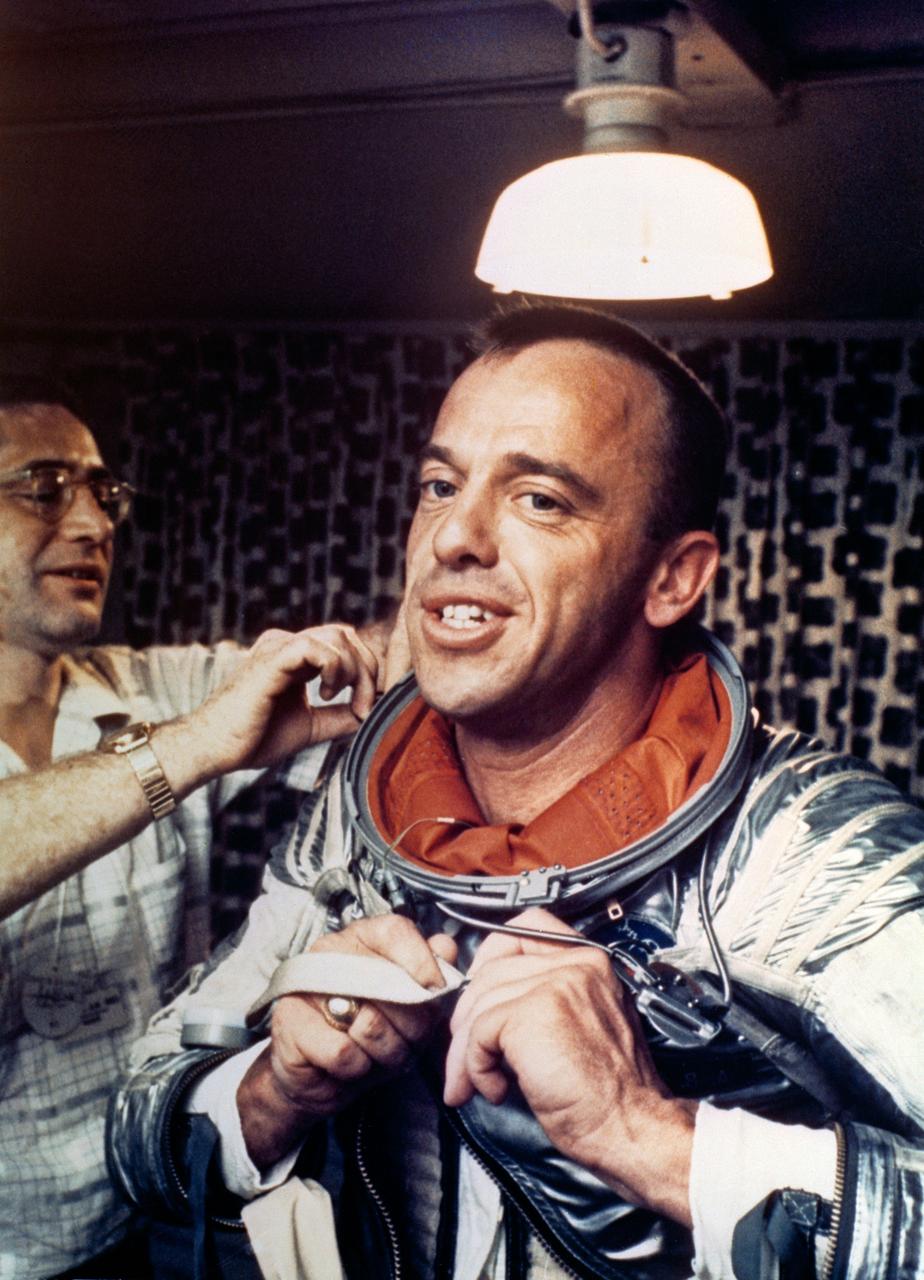
S88-31382 (5 May 1961) --- Astronaut Alan B. Shepard receives assistance in removing his spacesuit while on the U.S. Champlain after the recovery of his Mercury capsule. Photo credit: NASA or National Aeronautics and Space Administration
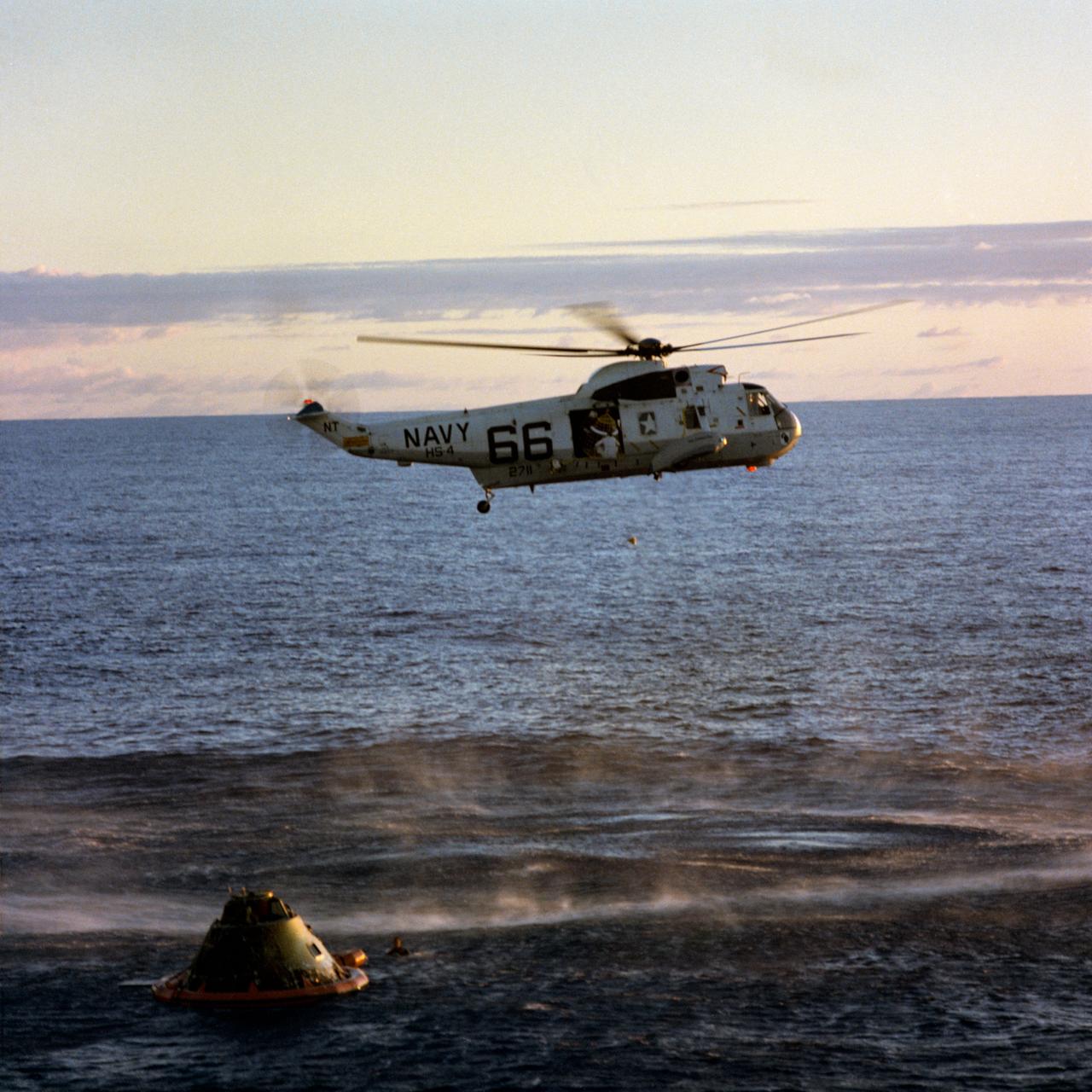
S69-20621 (26 May 1969) --- A member of the Apollo 10 crew is hoisted into a helicopter from the prime recovery ship, USS Princeton, during recovery operations in the South Pacific. Astronauts Thomas P. Stafford, commander; John W. Young, command module pilot; and Eugene A. Cernan, lunar module pilot, were picked up and flown to the deck of the USS Princeton where a red-carpet welcome awaited them. The spacecraft was later retrieved from the water and put aboard the recovery ship. The Apollo 10 splashdown occurred at 11:53 a.m. (CDT), May 26, 1969, about 400 miles east of American Samoa, and about four miles from the recovery ship, to conclude a successful eight-day lunar orbit mission. U.S. Navy underwater demolition team swimmers assisted in the recovery operations.
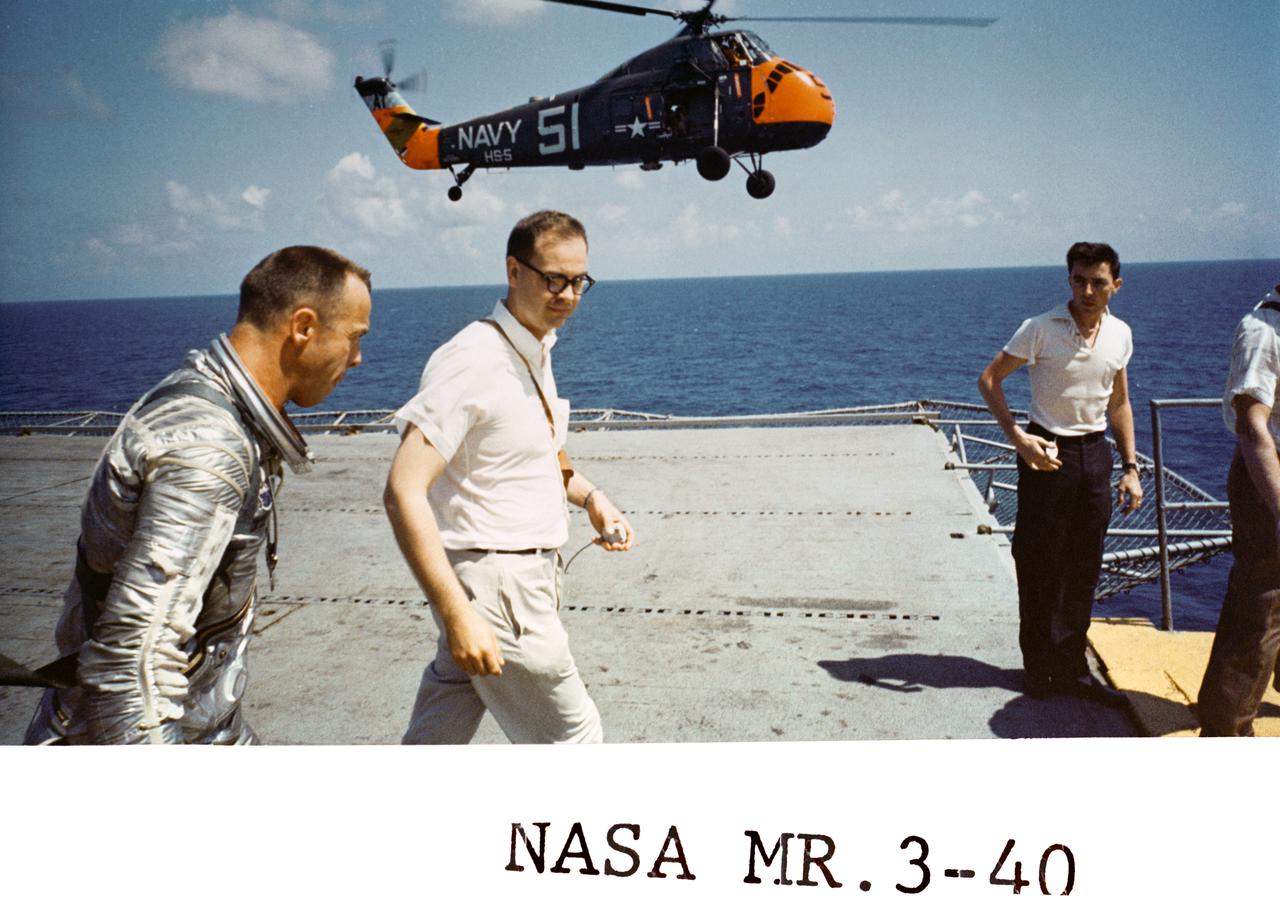
S88-31380 (5 May 1961) --- Astronaut Alan B. Shepard Jr., strides across the deck of the U.S. Navy Carrier Champlain following an inspection of his Freedom 7 capsule. Shepard had just completed the first manned U.S. space mission, a 15-minute suborbital flight. (NASA Hq. Photo No., MR3-40) Photo credit: NASA or National Aeronautics and Space Administration
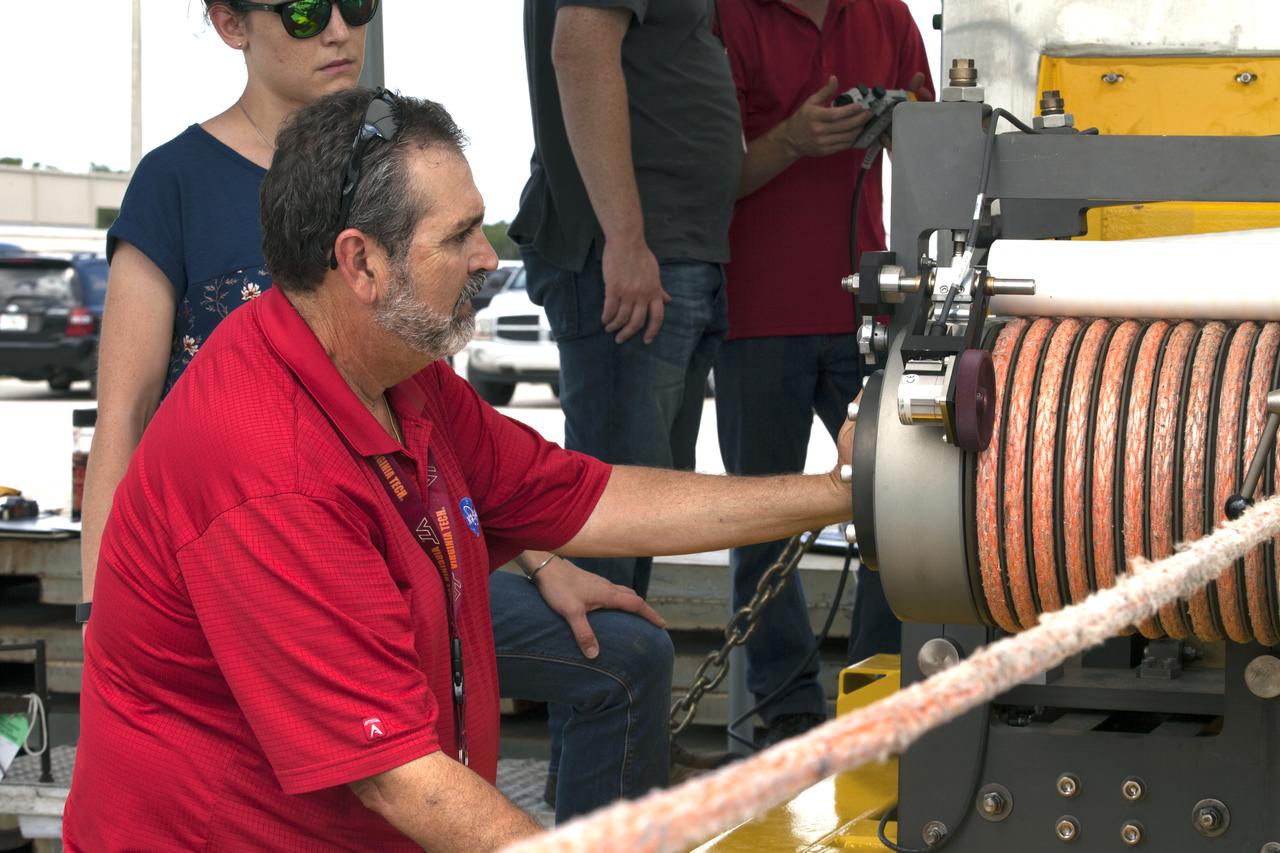
Orion Landing and Recovery team members with Jacobs practice using a winch to prepare for Underway Recovery Test 7 (URT-7) on Sept. 5, 2018, in the heavy equipment yard at NASA's Kennedy Space Center in Florida. In front is Pete Ruett. Behind him is Amy Hein. Both are handling and access engineers. During URT-7, the recovery team, including Exploration Ground Systems and the U.S. Navy, will practice recovering a test version of the Orion crew module in the Pacific Ocean, off the coast of California, and guiding it into the well deck of a ship. Over several days, the team will demonstrate and evaluate new recovery processes, procedures, hardware and personnel in open waters. Orion is the exploration spacecraft designed to carry astronauts to deep space destinations, including the Moon and on to Mars. Orion will have emergency abort capability, sustain the crew during space travel and provide safe re-entry from deep space return velocities.
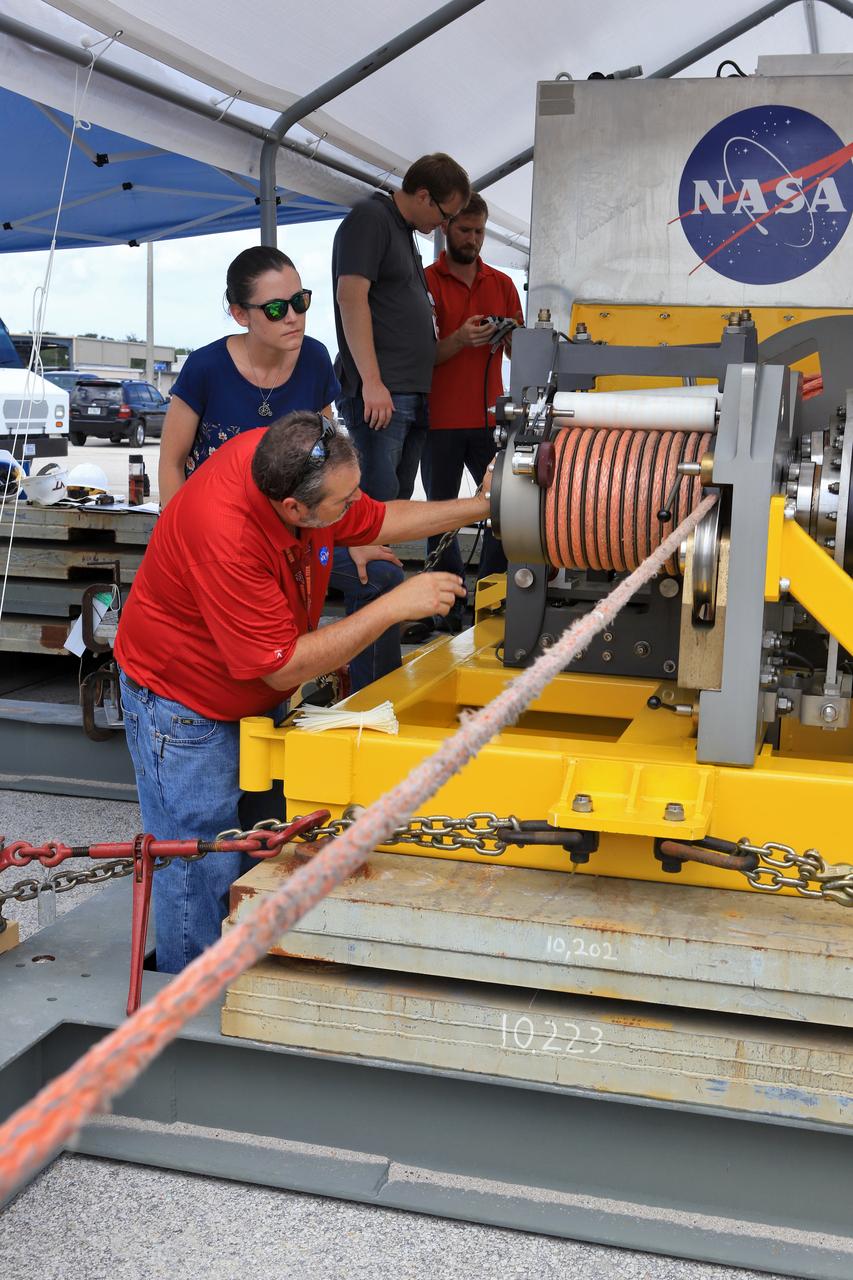
Orion Landing and Recovery team members with Jacobs, practice using a winch to prepare for Underway Recovery Test 7 (URT-7) on Sept. 5, 2018, in the heavy equipment yard at NASA's Kennedy Space Center in Florida. From left, are handling and access engineers Pete Ruett, Amy Hein, Peter Thorn and Eric Hernandez. During URT-7, the recovery team, including Exploration Ground Systems and the U.S. Navy, will practice recovering a test version of the Orion crew module in the Pacific Ocean, off the coast of California, and guiding it into the well deck of a ship. Over several days, the team will demonstrate and evaluate new recovery processes, procedures, hardware and personnel in open waters. Orion is the exploration spacecraft designed to carry astronauts to deep space destinations, including the Moon and on to Mars. Orion will have emergency abort capability, sustain the crew during space travel and provide safe re-entry from deep space return velocities.
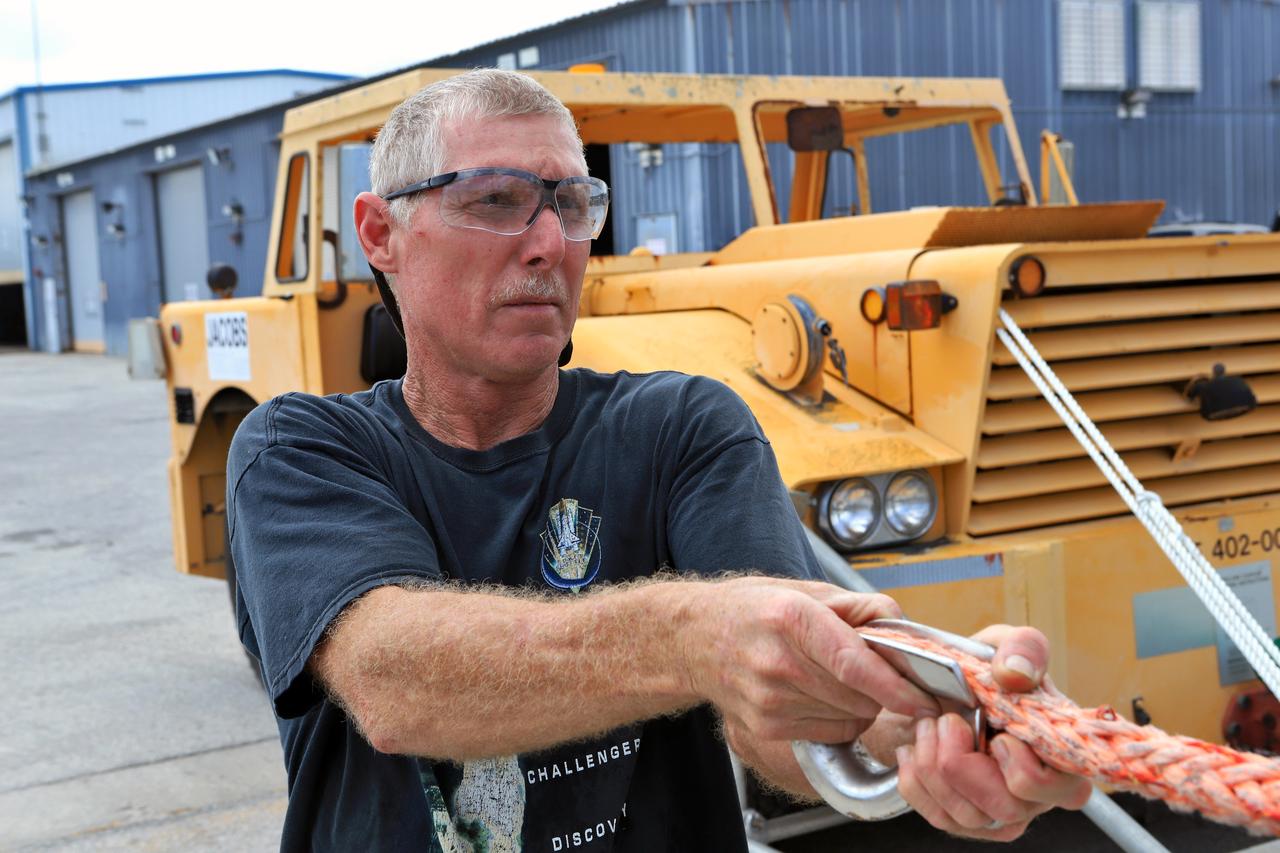
Orion Landing and Recovery team member John Stirling, with Jacobs, practices using a winch to prepare for Underway Recovery Test 7 ( URT-7) on Sept. 5, 2018, in the heavy equipment yard at NASA's Kennedy Space Center in Florida. During URT-7, the recovery team, including Exploration Ground Systems and the U.S. Navy, will practice recovering a test version of the Orion crew module in the Pacific Ocean, off the coast of California, and guiding it into the well deck of a ship. Over several days, the team will demonstrate and evaluate new recovery processes, procedures, hardware and personnel in open waters. Orion is the exploration spacecraft designed to carry astronauts to deep space destinations, including the Moon and on to Mars. Orion will have emergency abort capability, sustain the crew during space travel and provide safe re-entry from deep space return velocities.
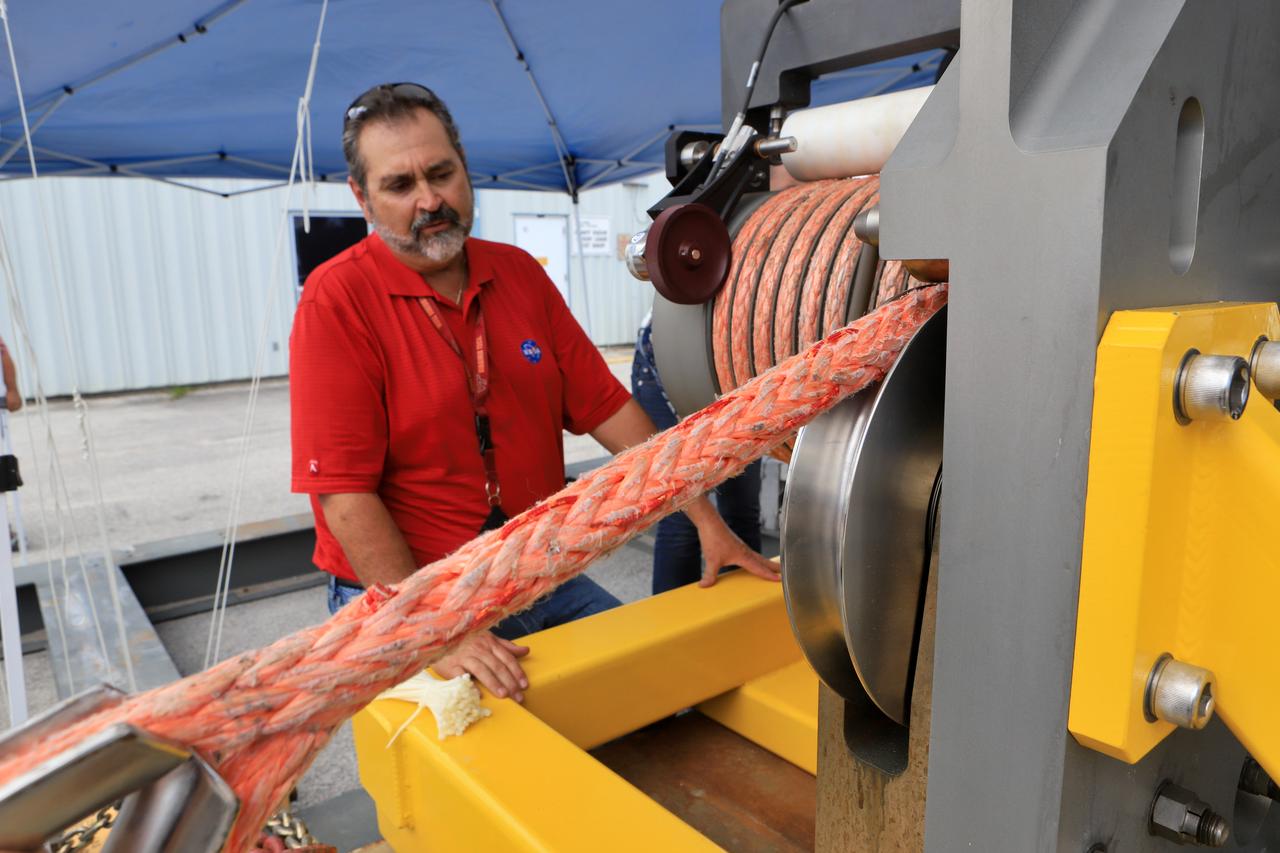
Orion Landing and Recovery team member Pete Ruett, with Jacobs, practices using a winch to prepare for Underway Recovery Test 7 (URT-7) on Sept. 5, 2018, in the heavy equipment yard at NASA's Kennedy Space Center in Florida. Ruett is a handling and access engineer. During URT-7, the recovery team, including Exploration Ground Systems and the U.S. Navy, will practice recovering a test version of the Orion crew module in the Pacific Ocean, off the coast of California, and guiding it into the well deck of a ship. Over several days, the team will demonstrate and evaluate new recovery processes, procedures, hardware and personnel in open waters. Orion is the exploration spacecraft designed to carry astronauts to deep space destinations, including the Moon and on to Mars. Orion will have emergency abort capability, sustain the crew during space travel and provide safe re-entry from deep space return velocities.
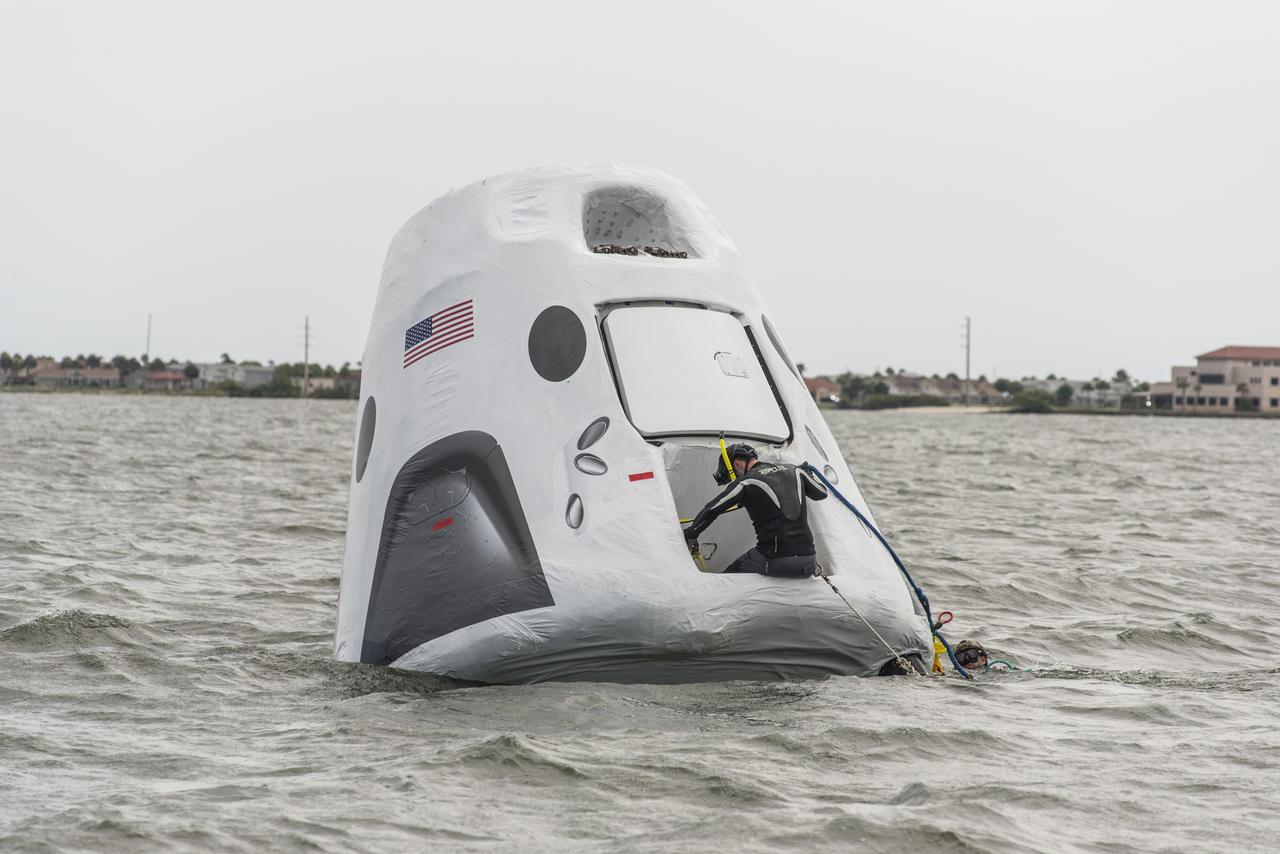
Personnel from NASA, SpaceX and the U.S. Air Force have begun practicing recovery operations for the SpaceX Crew Dragon. Using a full-size model of the spacecraft that will take astronauts to the International Space Station, Air Force parajumpers practice helping astronauts out of the SpaceX Crew Dragon following a mission. In certain unusual recovery situations, SpaceX may need to work with Air Force for parajumpers to recover astronauts from the capsule following a water landing. The recovery trainer was recently lowered into the Indian River Lagoon near NASA’s Kennedy Space Center allowing Air Force pararescue and others to refine recovery procedures. SpaceX is developing the Crew Dragon in partnership with NASA’s Commercial Crew Program to carry astronauts to and from the International Space Station.
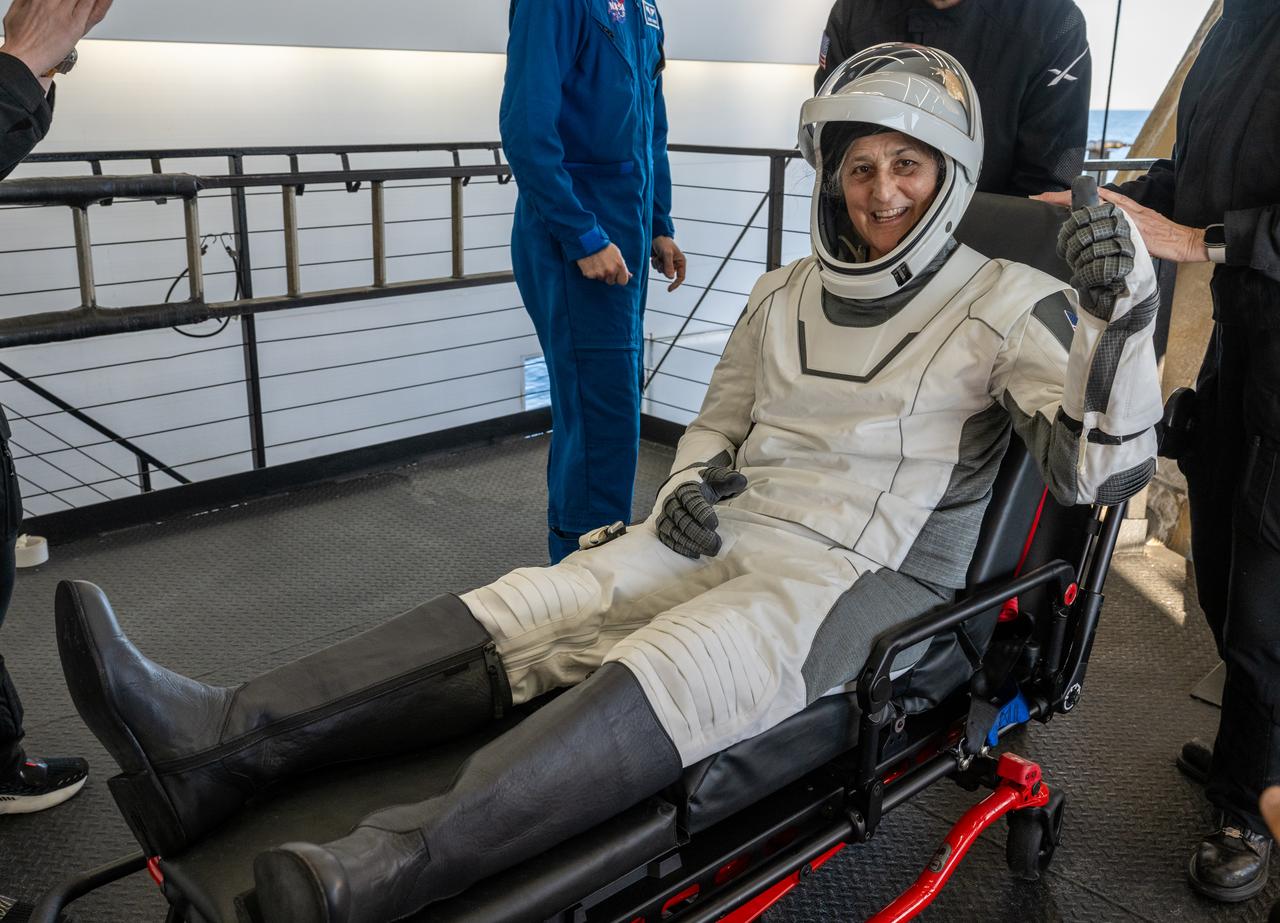
NASA astronaut Suni Williams is helped out of a SpaceX Dragon spacecraft onboard the SpaceX recovery ship MEGAN after she, NASA astronaut Nick Hague, and Butch Wilmore, and Roscosmos cosmonaut Aleksandr Gorbunov landed in the water off the coast of Tallahassee, Florida, Tuesday, March 18, 2025. Hague, Gorbunov, Williams, and Wilmore are returning from a long-duration science expedition aboard the International Space Station. Photo Credit: (NASA/Keegan Barber)
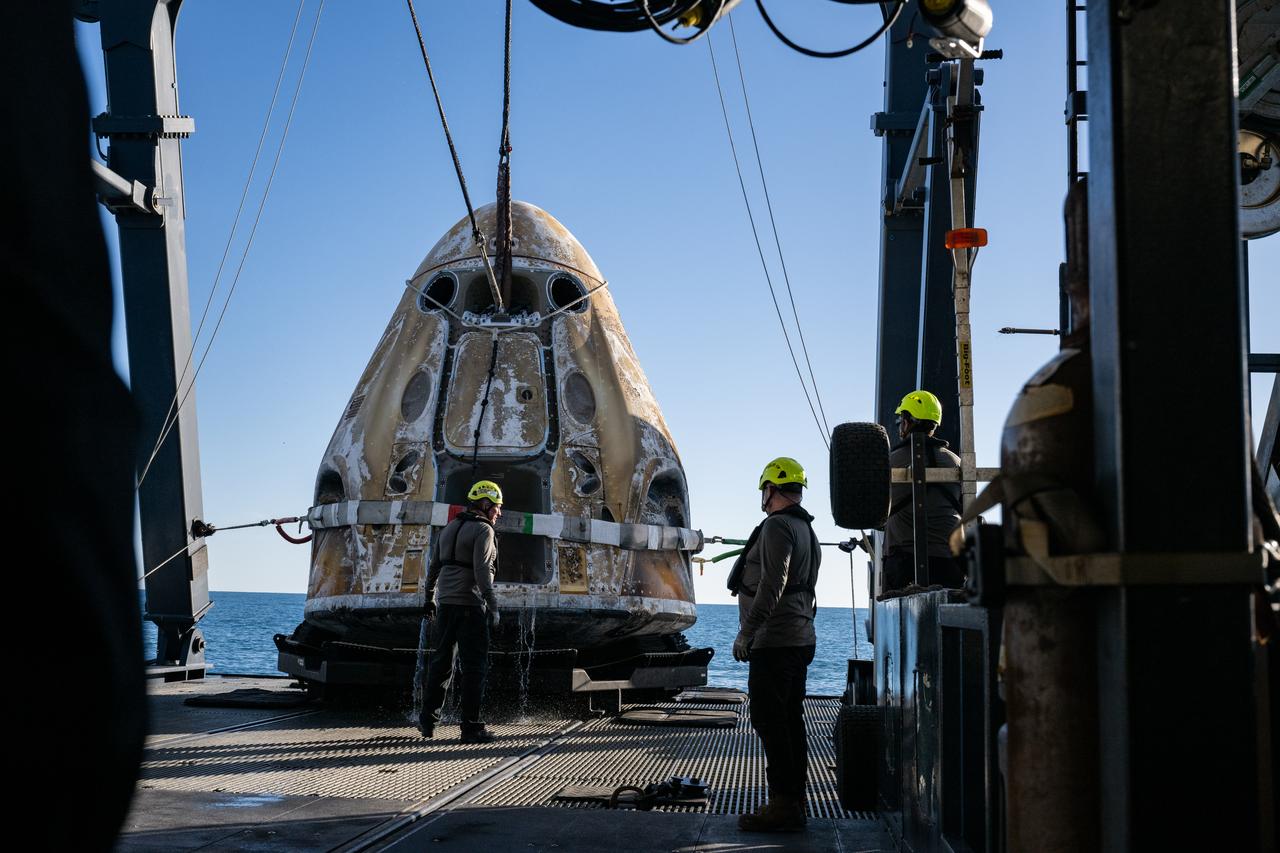
Support teams onboard the SpaceX recovery ship MEGAN work around a SpaceX Dragon spacecraft shortly after it landed with NASA astronauts Nick Hague, Suni Williams, Butch Wilmore, and Roscosmos cosmonaut Aleksandr Gorbunov aboard in the water off the coast of Tallahassee, Florida, Tuesday, March 18, 2025. Hague, Gorbunov, Williams, and Wilmore are returning from a long-duration science expedition aboard the International Space Station. Photo Credit: (NASA/Keegan Barber)
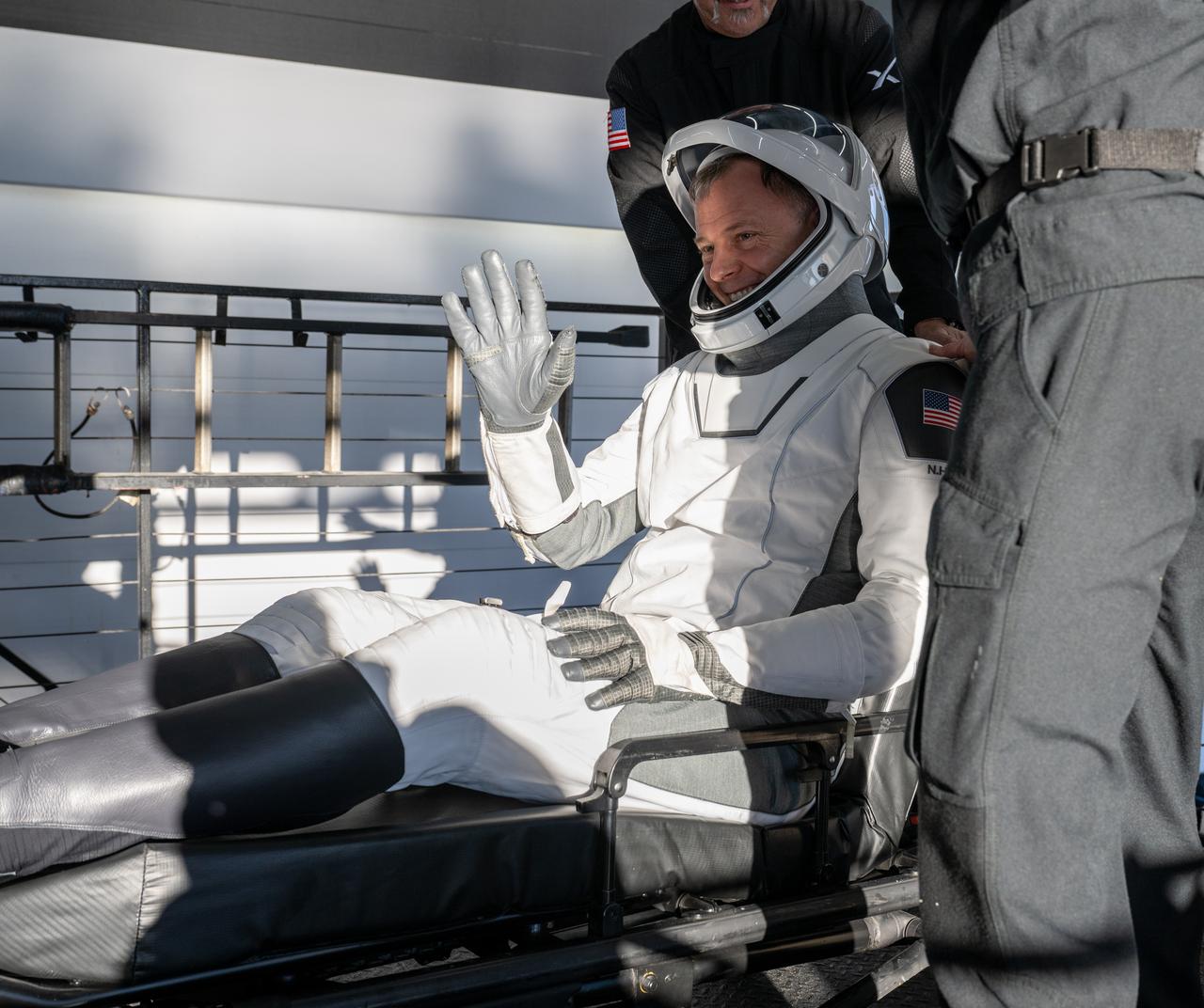
NASA astronaut Nick Hague is helped out of a SpaceX Dragon spacecraft onboard the SpaceX recovery ship MEGAN after he, NASA astronauts Suni Williams, Butch Wilmore, and Roscosmos cosmonaut Aleksandr Gorbunov landed in the water off the coast of Tallahassee, Florida, Tuesday, March 18, 2025. Hague, Gorbunov, Williams, and Wilmore are returning from a long-duration science expedition aboard the International Space Station. Photo Credit: (NASA/Keegan Barber)
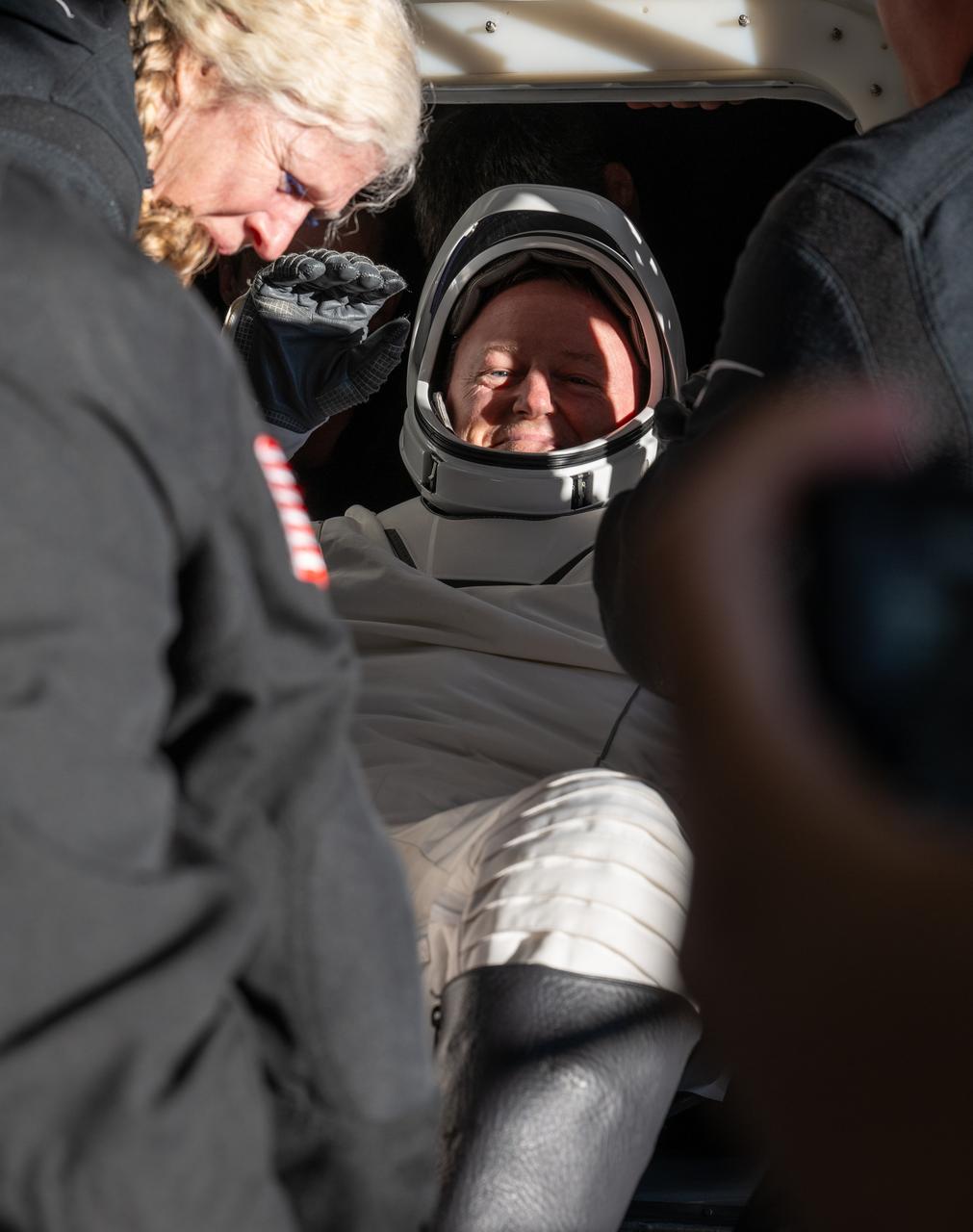
NASA astronaut Butch Wilmore is helped out of a SpaceX Dragon spacecraft onboard the SpaceX recovery ship MEGAN after he, NASA astronauts Nick Hague, Suni Williams, and Roscosmos cosmonaut Aleksandr Gorbunov landed in the water off the coast of Tallahassee, Florida, Tuesday, March 18, 2025. Hague, Gorbunov, Williams, and Wilmore are returning from a long-duration science expedition aboard the International Space Station. Photo Credit: (NASA/Keegan Barber)
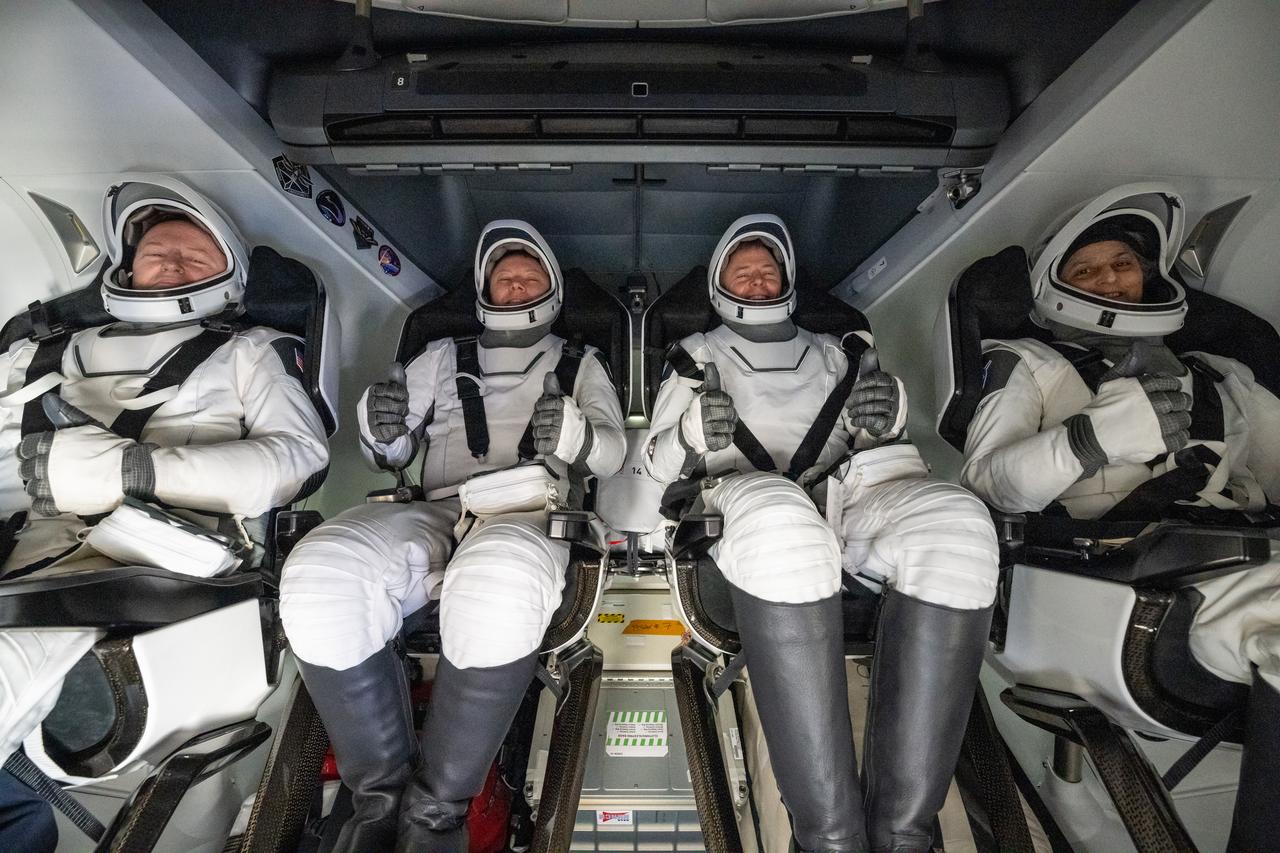
NASA astronaut Butch Wilmore, left, Roscosmos cosmonaut Aleksandr Gorbunov, second from left, and NASA astronauts Nick Hague, second from right, and Suni Williams, right are seen inside a SpaceX Dragon spacecraft onboard the SpaceX recovery ship MEGAN shortly after having landed in the water off the coast of Tallahassee, Florida, Tuesday, March 18, 2025. Hague, Gorbunov, Williams, and Wilmore are returning from a long-duration science expedition aboard the International Space Station. Photo Credit: (NASA/Keegan Barber)
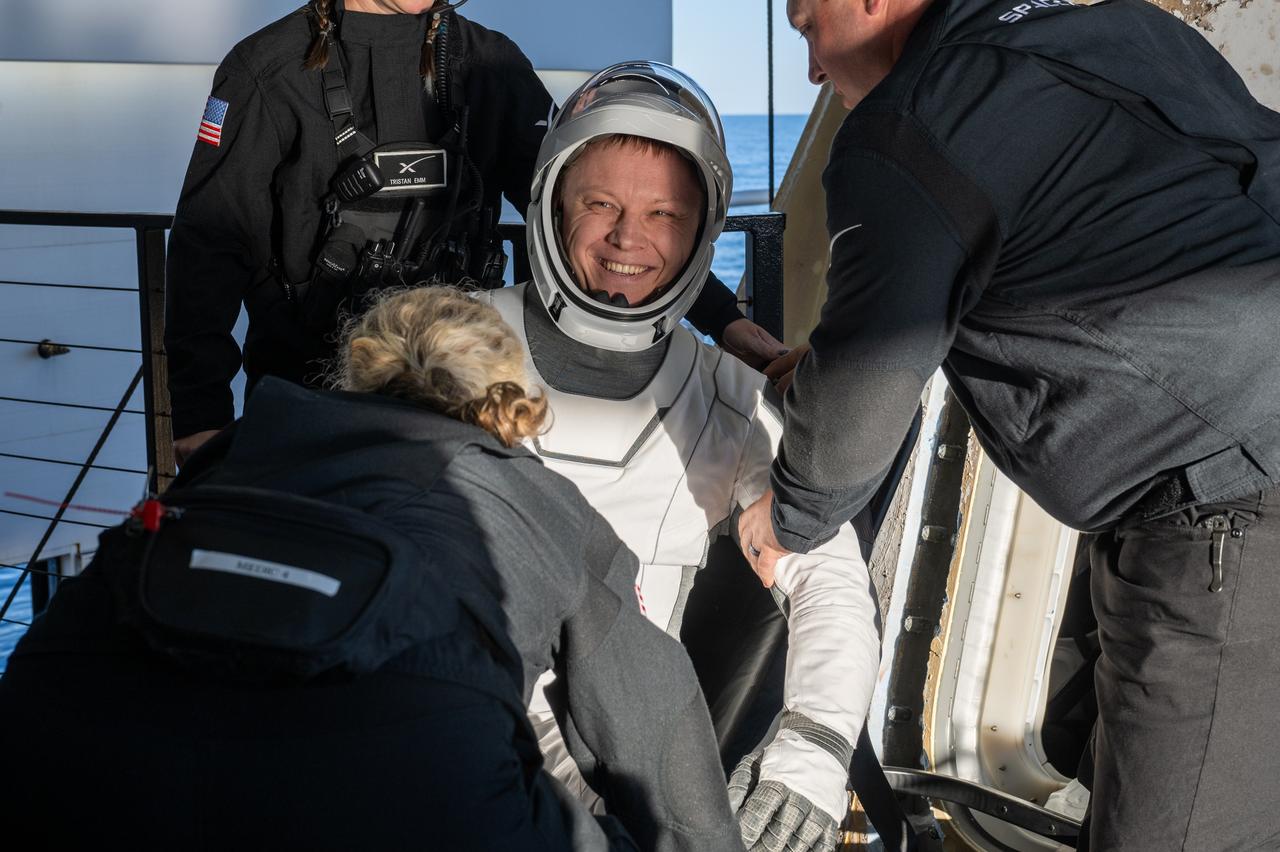
Roscosmos cosmonaut Aleksandr Gorbunov is helped out of a SpaceX Dragon spacecraft onboard the SpaceX recovery ship MEGAN after he, NASA astronauts Nick Hague, Suni Williams, and Butch Wilmore, landed in the water off the coast of Tallahassee, Florida, Tuesday, March 18, 2025. Hague, Gorbunov, Williams, and Wilmore are returning from a long-duration science expedition aboard the International Space Station. Photo Credit: (NASA/Keegan Barber)
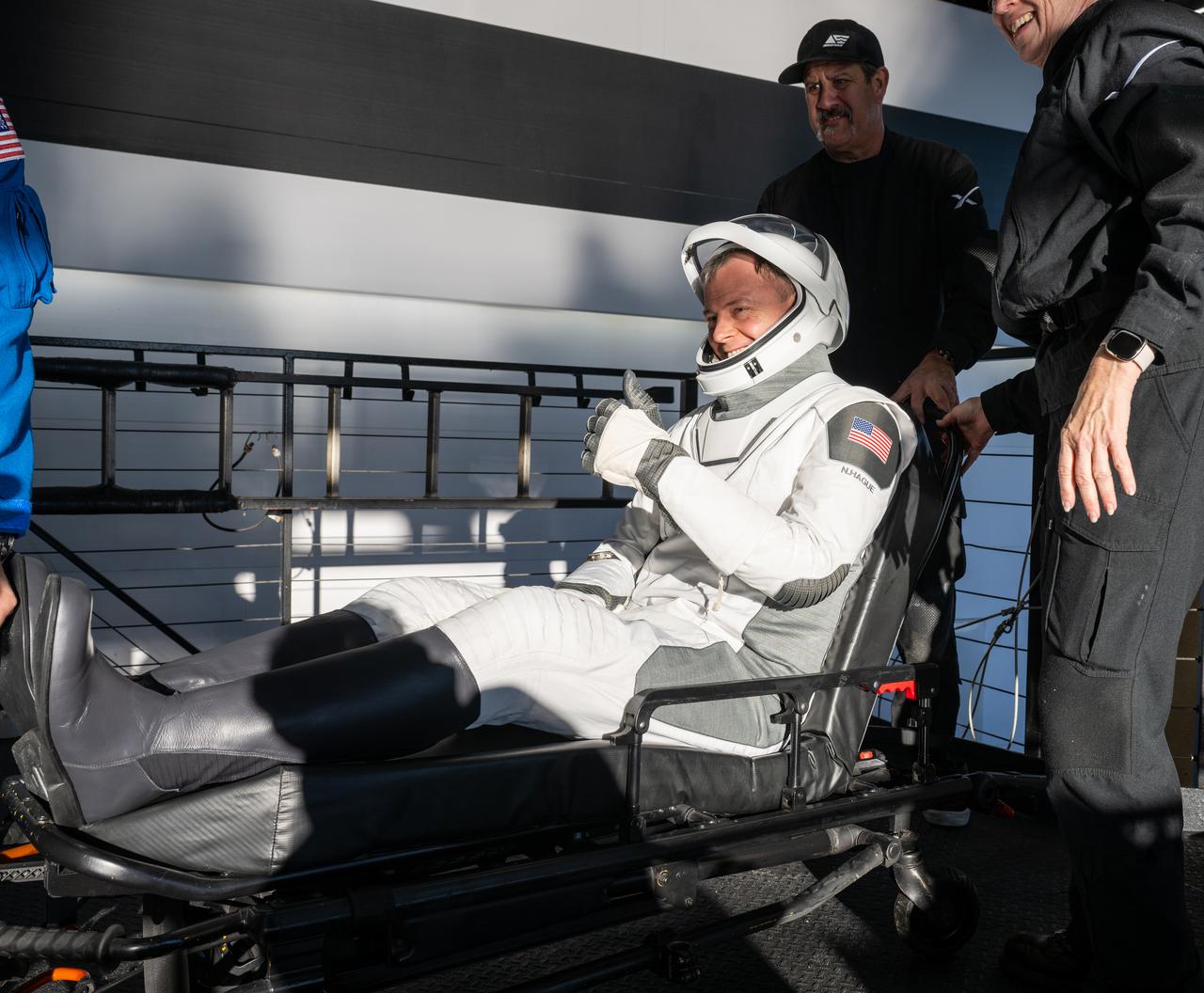
NASA astronaut Nick Hague is helped out of a SpaceX Dragon spacecraft onboard the SpaceX recovery ship MEGAN after he, NASA astronauts Suni Williams, Butch Wilmore, and Roscosmos cosmonaut Aleksandr Gorbunov landed in the water off the coast of Tallahassee, Florida, Tuesday, March 18, 2025. Hague, Gorbunov, Williams, and Wilmore are returning from a long-duration science expedition aboard the International Space Station. Photo Credit: (NASA/Keegan Barber)
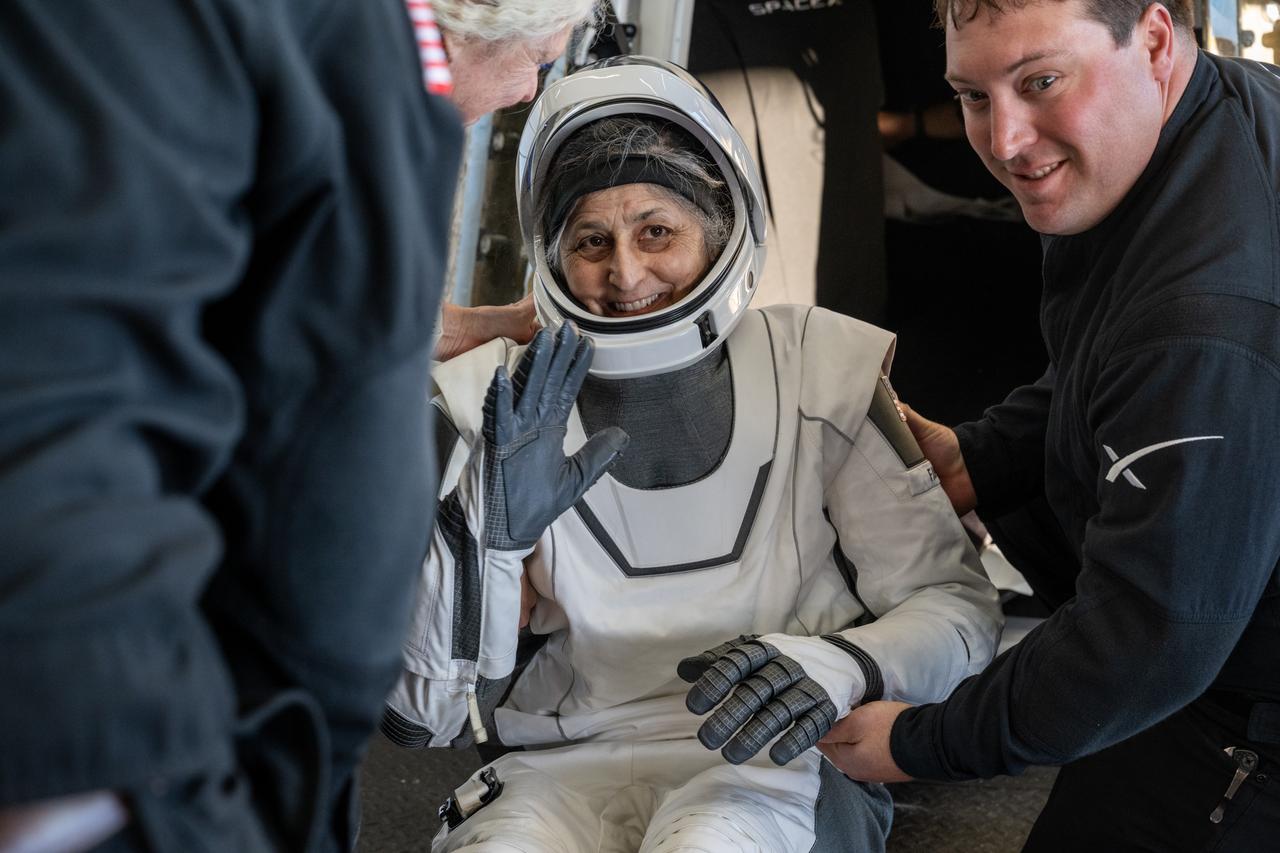
NASA astronaut Suni Williams is helped out of a SpaceX Dragon spacecraft onboard the SpaceX recovery ship MEGAN after she, NASA astronaut Nick Hague, and Butch Wilmore, and Roscosmos cosmonaut Aleksandr Gorbunov landed in the water off the coast of Tallahassee, Florida, Tuesday, March 18, 2025. Hague, Gorbunov, Williams, and Wilmore are returning from a long-duration science expedition aboard the International Space Station. Photo Credit: (NASA/Keegan Barber)
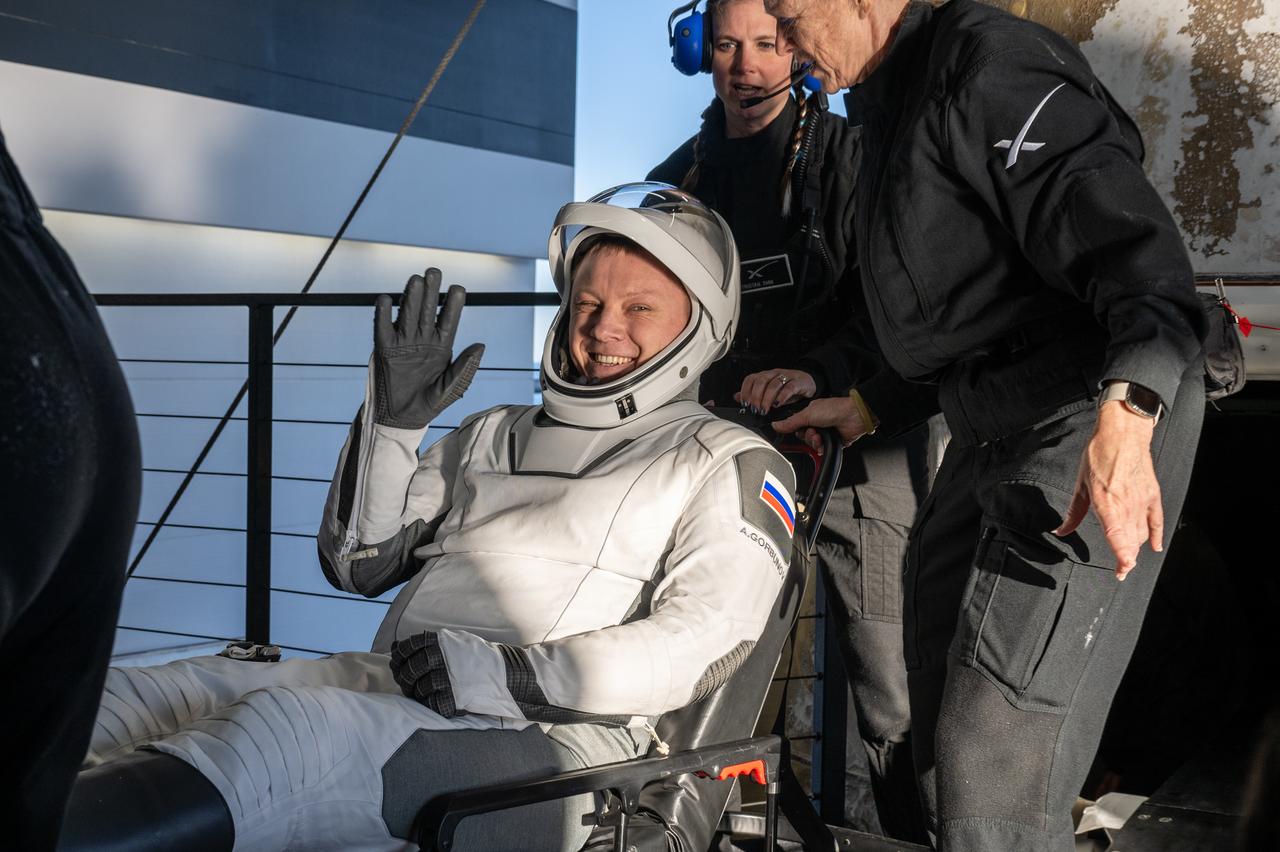
Roscosmos cosmonaut Aleksandr Gorbunov is helped out of a SpaceX Dragon spacecraft onboard the SpaceX recovery ship MEGAN after he, NASA astronauts Nick Hague, Suni Williams, and Butch Wilmore, landed in the water off the coast of Tallahassee, Florida, Tuesday, March 18, 2025. Hague, Gorbunov, Williams, and Wilmore are returning from a long-duration science expedition aboard the International Space Station. Photo Credit: (NASA/Keegan Barber)
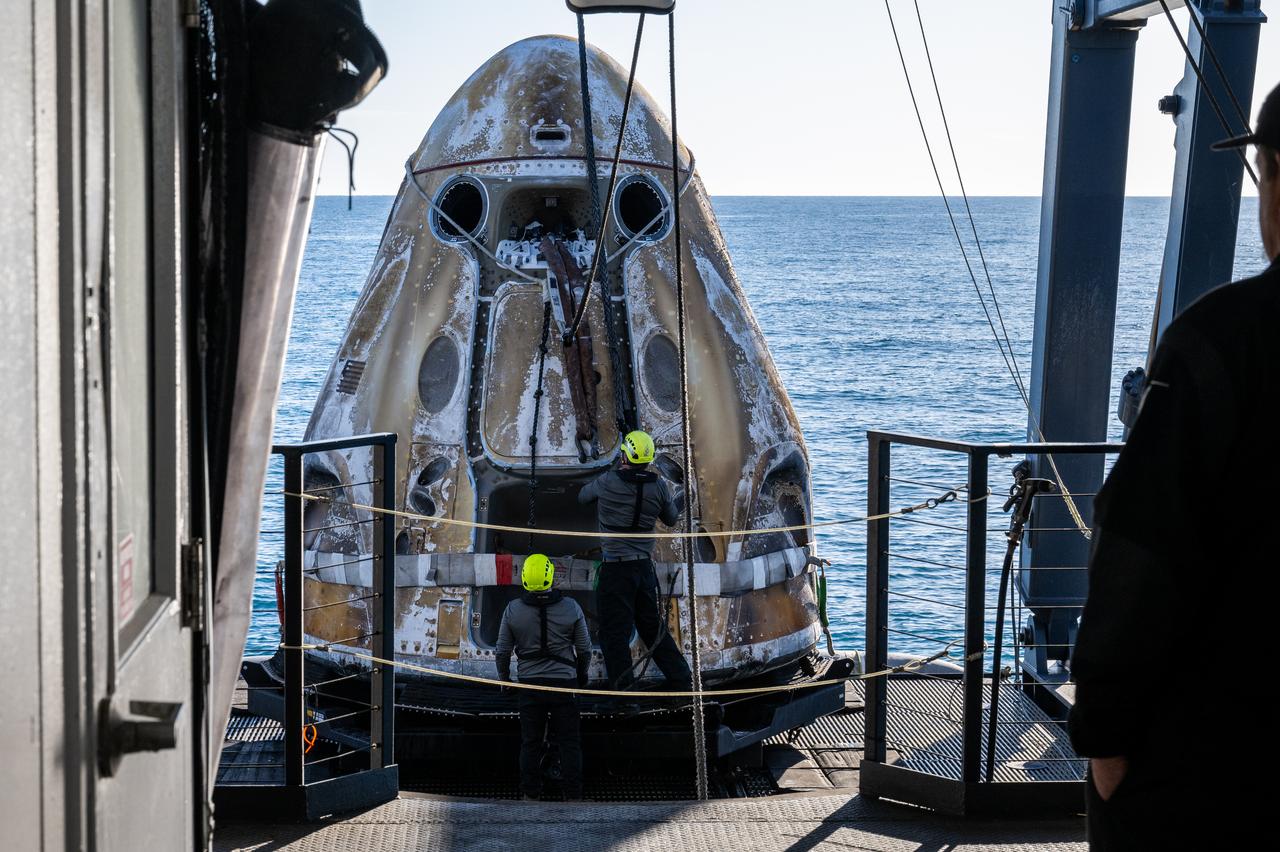
Support teams onboard the SpaceX recovery ship MEGAN work around a SpaceX Dragon spacecraft shortly after it landed with NASA astronauts Nick Hague, Suni Williams, Butch Wilmore, and Roscosmos cosmonaut Aleksandr Gorbunov aboard in the water off the coast of Tallahassee, Florida, Tuesday, March 18, 2025. Hague, Gorbunov, Williams, and Wilmore are returning from a long-duration science expedition aboard the International Space Station. Photo Credit: (NASA/Keegan Barber)
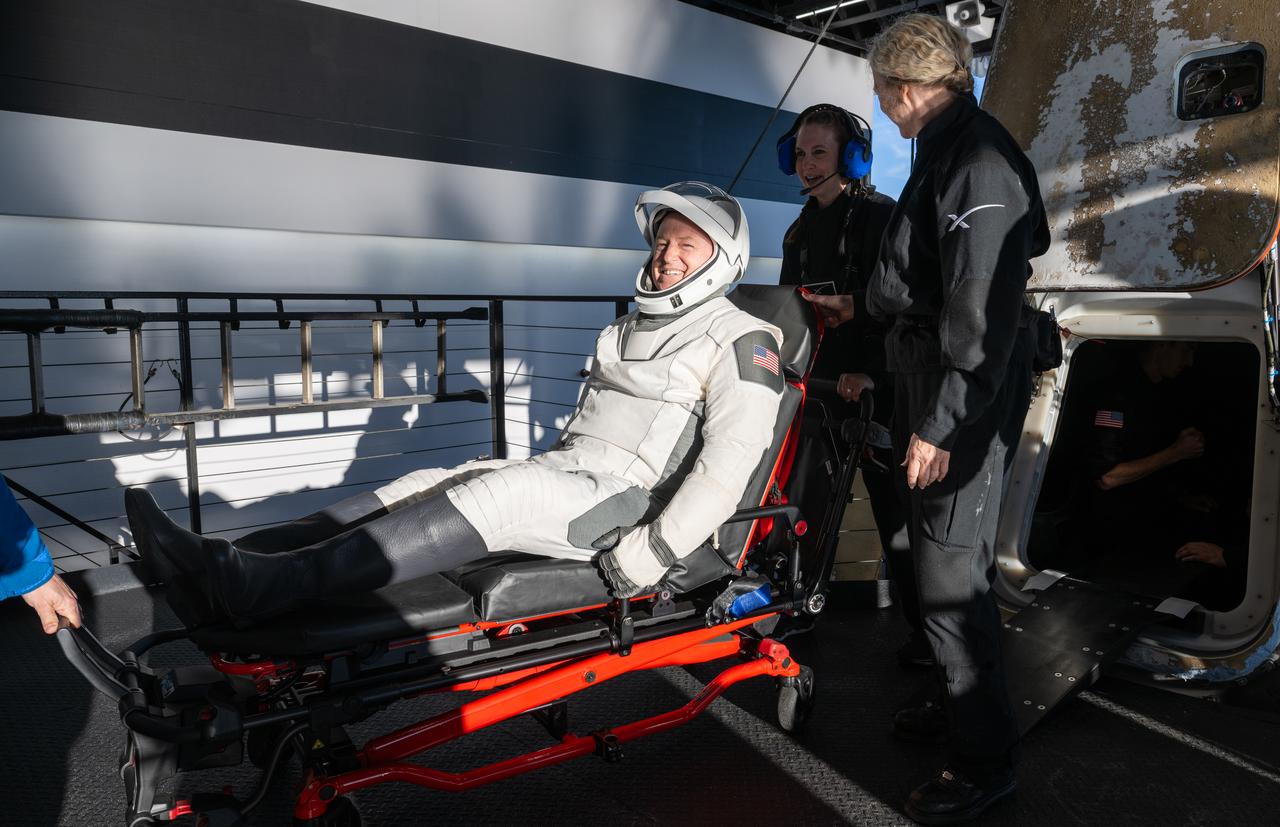
NASA astronaut Butch Wilmore is helped out of a SpaceX Dragon spacecraft onboard the SpaceX recovery ship MEGAN after he, NASA astronauts Nick Hague, Suni Williams, and Roscosmos cosmonaut Aleksandr Gorbunov landed in the water off the coast of Tallahassee, Florida, Tuesday, March 18, 2025. Hague, Gorbunov, Williams, and Wilmore are returning from a long-duration science expedition aboard the International Space Station. Photo Credit: (NASA/Keegan Barber)
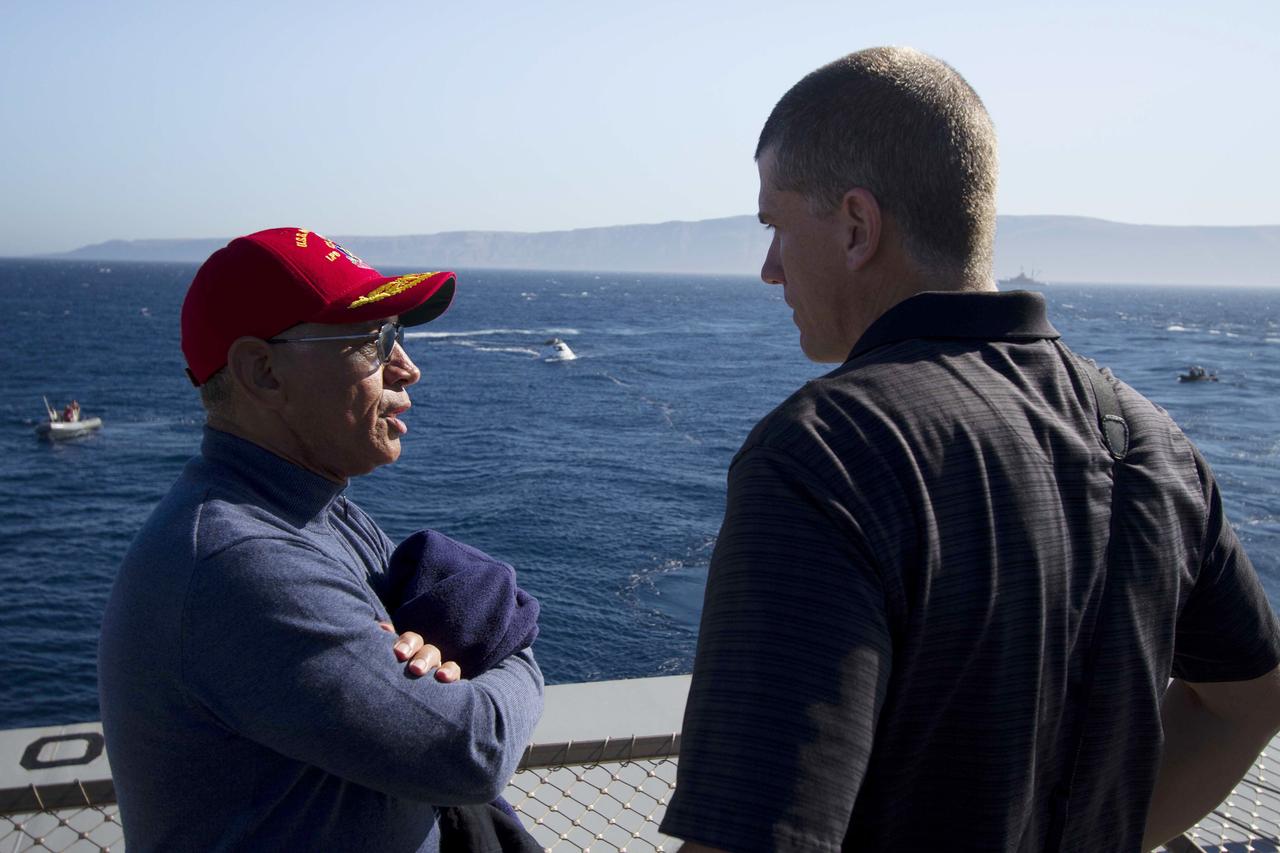
SAN DIEGO, Calif. – NASA Administrator Charlie Bolden, at left, talks to Jeremy Graeber, NASA Recovery director for Exploration Flight Test-1 Landing and Recovery Operations, on the deck of the USS Anchorage during Orion Underway Recovery Test 3. The Orion boilerplate test vehicle is in the Pacific Ocean with U.S. Navy divers nearby in Zodiac boats and rigid hull inflatable boats during recovery operations. NASA, Lockheed Martin and U.S. Navy personnel are conducting the test to prepare for recovery of the Orion crew module on its return from a deep space mission. The test will allow the teams to demonstrate and evaluate the recovery processes, procedures, hardware and personnel in open waters. The Ground Systems Development and Operations Program is conducting the underway recovery tests. Orion is the exploration spacecraft designed to carry astronauts to destinations not yet explored by humans, including an asteroid and Mars. It will have emergency abort capability, sustain the crew during space travel and provide safe re-entry from deep space return velocities. The first unpiloted test flight of Orion is scheduled to launch in 2014 atop a United Launch Alliance Delta IV Heavy rocket and in 2018 on NASA’s Space Launch System rocket. For more information, visit http://www.nasa.gov/orion. Photo credit: NASA/Cory Huston
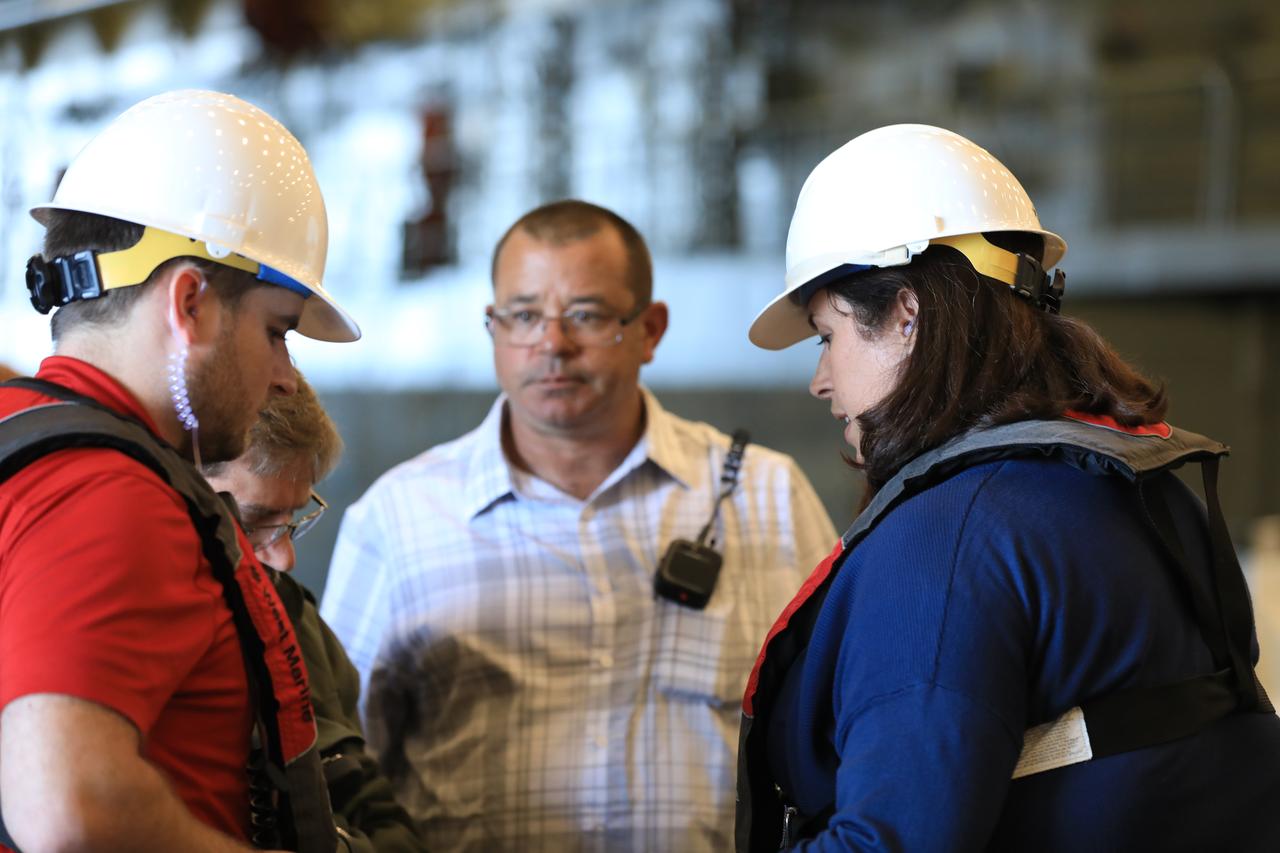
Inside a U.S. Navy ship, Exploration Ground Systems (EGS) Landing and Recovery Director Melissa Jones, at right, briefs her team on Oct. 30, 2018, before they begin Underway Recovery Test-7 (URT-7). EGS and the U.S. Navy will use a test version of the Orion crew module, several rigid hull inflatable boats and support equipment to verify and validate processes, procedures, hardware and personnel during recovery of Orion in open waters. URT-7 is one in a series of tests to verify and validate procedures and hardware that will be used to recover the Orion spacecraft after it splashes down in the Pacific Ocean following deep space exploration missions. Orion will have emergency abort capability, sustain the crew during space travel and provide safe re-entry from deep space return velocities.

Melissa Jones, Landing and Recovery director with NASA's Ground Systems Development and Operations Program (GSDO) speaks to the recovery team during wrap up of Underway Recovery Test 5 aboard the USS San Diego. GSDO and the U.S. Navy practiced recovery techniques using the well deck of the ship and a test version of the Orion crew module in the Pacific Ocean off the coast of California to prepare for recovery of Orion on its return from deep space missions. The testing allowed the team to demonstrate and evaluate recovery processes, procedures, hardware and personnel in open waters. Orion is the exploration spacecraft designed to carry astronauts to destinations not yet explored by humans, including an asteroid and NASA's Journey to Mars. It will have emergency abort capability, sustain the crew during space travel and provide safe re-entry from deep space return velocities. Orion is scheduled to launch on NASA's Space Launch System in late 2018. For more information, visit http://www.nasa.gov/orion.
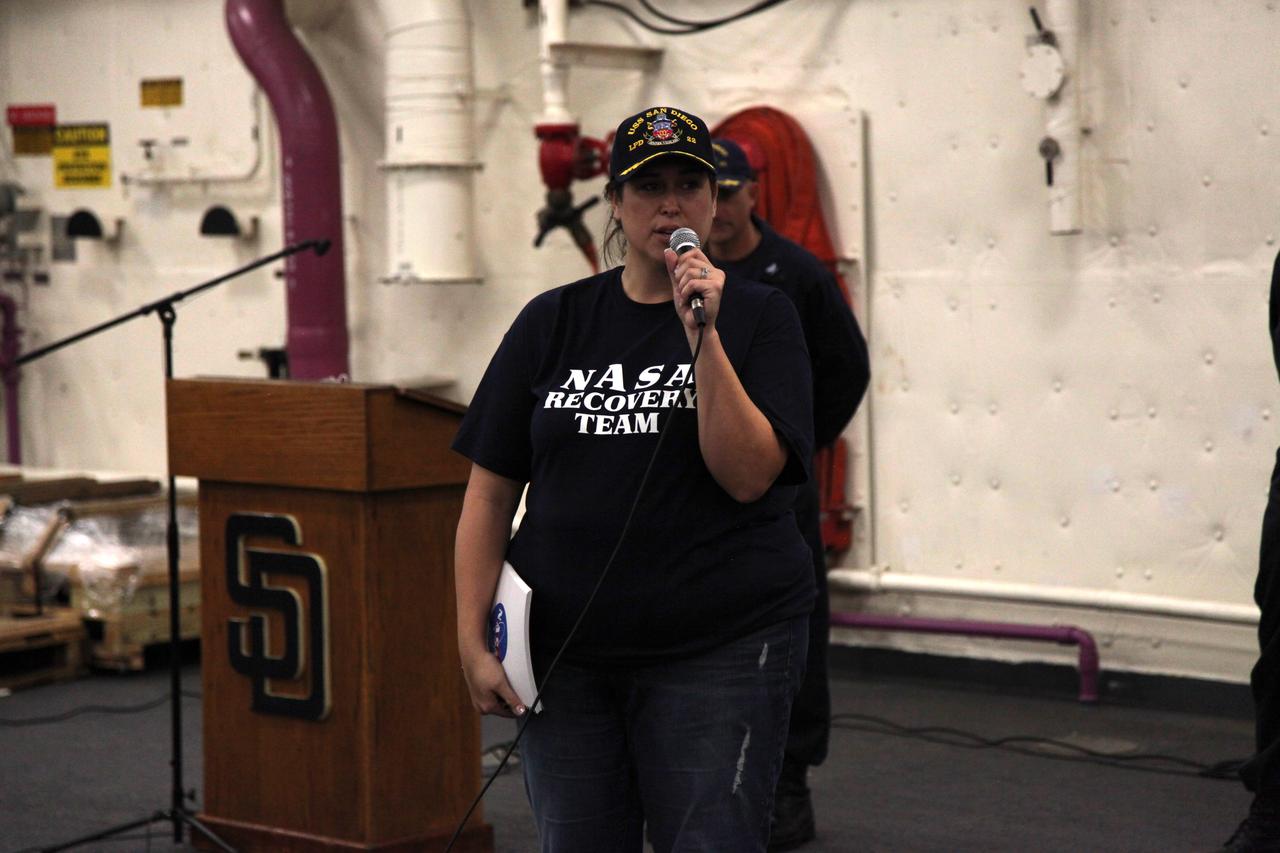
Melissa Jones, Landing and Recovery director with NASA's Ground Systems Development and Operations Program (GSDO) speaks to the recovery team during wrap up of Underway Recovery Test 5 aboard the USS San Diego. GSDO and the U.S. Navy practiced recovery techniques using the well deck of the ship and a test version of the Orion crew module in the Pacific Ocean off the coast of California to prepare for recovery of Orion on its return from deep space missions. The testing allowed the team to demonstrate and evaluate recovery processes, procedures, hardware and personnel in open waters. Orion is the exploration spacecraft designed to carry astronauts to destinations not yet explored by humans, including an asteroid and NASA's Journey to Mars. It will have emergency abort capability, sustain the crew during space travel and provide safe re-entry from deep space return velocities. Orion is scheduled to launch on NASA's Space Launch System in late 2018. For more information, visit http://www.nasa.gov/orion.

Melissa Jones, far right, Landing and Recovery director with the Ground Systems Development and Operations Program (GSDO), and other members of the recovery team speak to members of the media about Orion Underway Recovery Test 5. The USS San Diego is docked at Naval Base San Diego in California and the test version of the Orion crew module, secured on its handling fixture, was offloaded from the well deck of the ship. NASA's GSDO Program and the U.S. Navy completed a series of tests using the ship's well deck, the test module, various watercraft and equipment to prepare for recovery of Orion on its return from deep space missions. The testing allowed the team to demonstrate and evaluate recovery processes, procedures, hardware and personnel in open waters. Orion is the exploration spacecraft designed to carry astronauts to destinations not yet explored by humans, including an asteroid and NASA's Journey to Mars. It will have emergency abort capability, sustain the crew during space travel and provide safe re-entry from deep space return velocities. Orion is scheduled to launch on NASA's Space Launch System in late 2018. For more information, visit http://www.nasa.gov/orion.
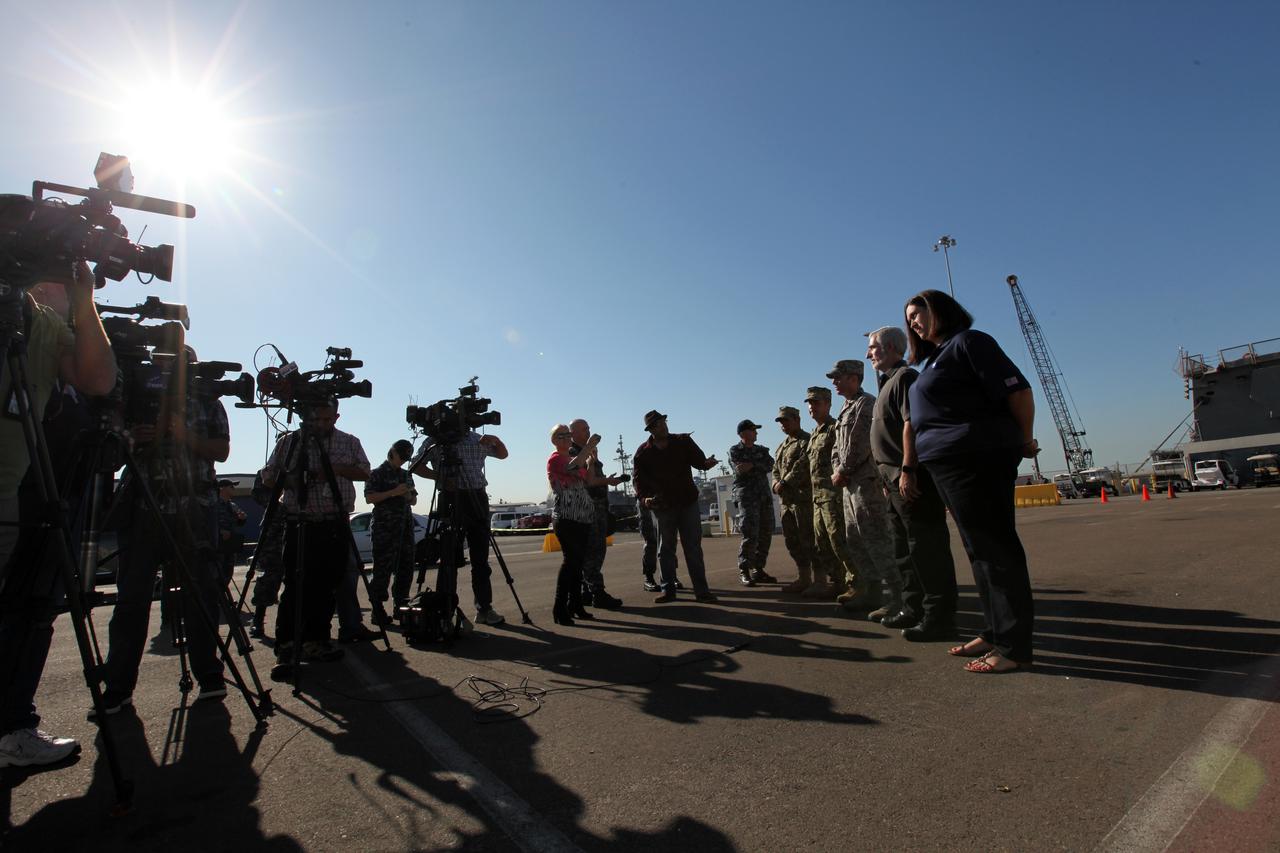
Melissa Jones, far right, Landing and Recovery director with the Ground Systems Development and Operations Program (GSDO), and other members of the recovery team speak to members of the media about Orion Underway Recovery Test 5. The USS San Diego is docked at Naval Base San Diego in California and the test version of the Orion crew module, secured on its handling fixture, was offloaded from the well deck of the ship. NASA's GSDO Program and the U.S. Navy completed a series of tests using the ship's well deck, the test module, various watercraft and equipment to prepare for recovery of Orion on its return from deep space missions. The testing allowed the team to demonstrate and evaluate recovery processes, procedures, hardware and personnel in open waters. Orion is the exploration spacecraft designed to carry astronauts to destinations not yet explored by humans, including an asteroid and NASA's Journey to Mars. It will have emergency abort capability, sustain the crew during space travel and provide safe re-entry from deep space return velocities. Orion is scheduled to launch on NASA's Space Launch System in late 2018. For more information, visit http://www.nasa.gov/orion.
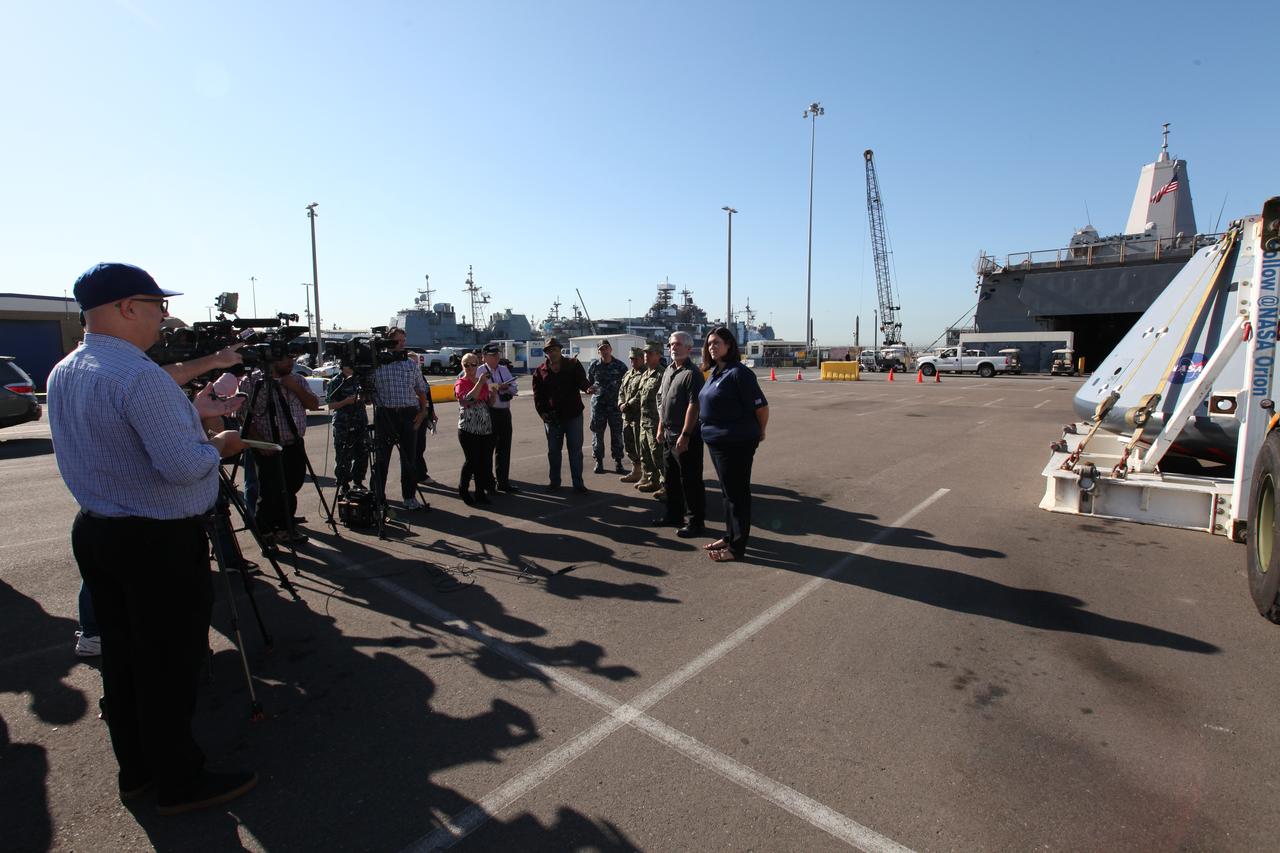
Melissa Jones, far right, Landing and Recovery director with the Ground Systems Development and Operations Program (GSDO), and other members of the recovery team speak to members of the media about Orion Underway Recovery Test 5. The USS San Diego is docked at Naval Base San Diego in California and the test version of the Orion crew module, secured on its handling fixture, was offloaded from the well deck of the ship. NASA's GSDO Program and the U.S. Navy completed a series of tests using the ship's well deck, the test module, various watercraft and equipment to prepare for recovery of Orion on its return from deep space missions. The testing allowed the team to demonstrate and evaluate recovery processes, procedures, hardware and personnel in open waters. Orion is the exploration spacecraft designed to carry astronauts to destinations not yet explored by humans, including an asteroid and NASA's Journey to Mars. It will have emergency abort capability, sustain the crew during space travel and provide safe re-entry from deep space return velocities. Orion is scheduled to launch on NASA's Space Launch System in late 2018. For more information, visit http://www.nasa.gov/orion.
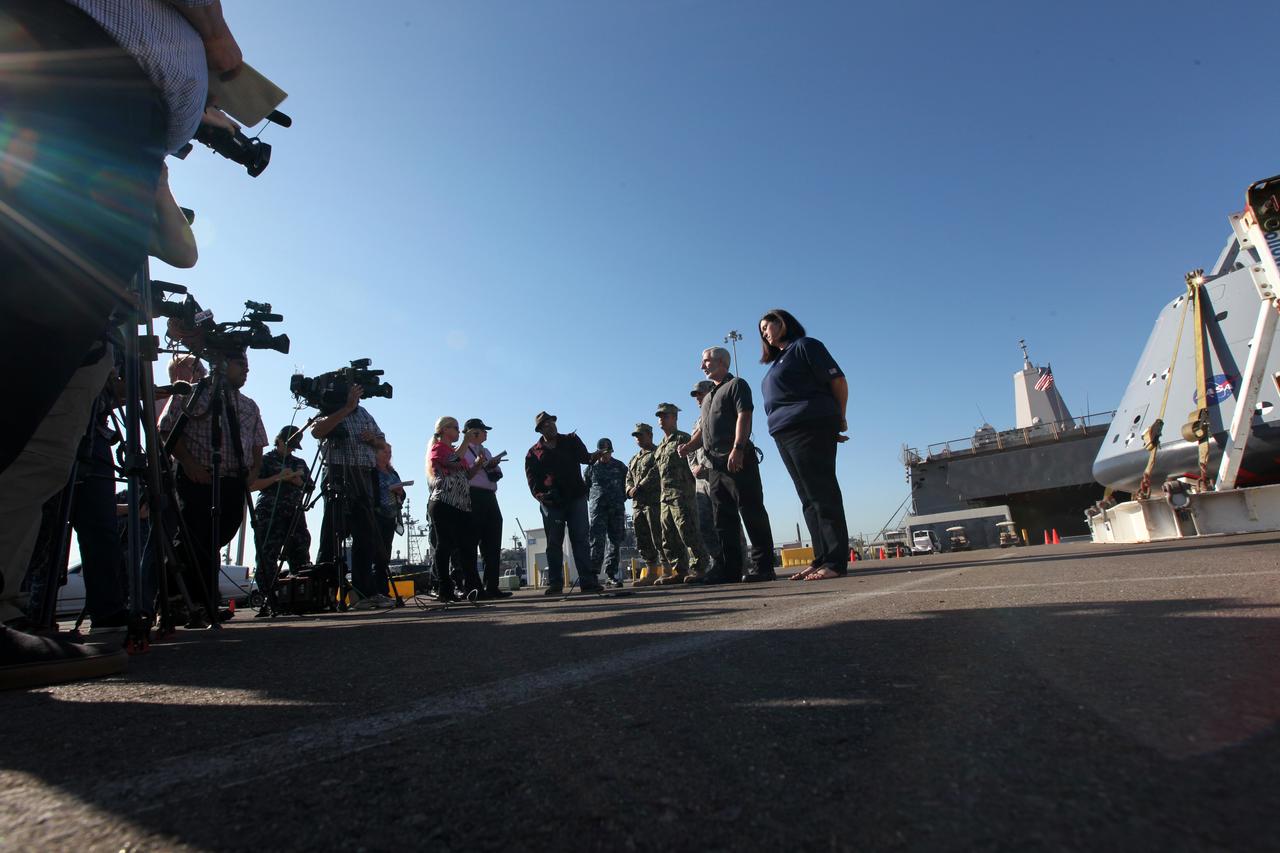
Melissa Jones, far right, Landing and Recovery director with the Ground Systems Development and Operations Program (GSDO), and other members of the recovery team speak to members of the media about Orion Underway Recovery Test 5. The USS San Diego is docked at Naval Base San Diego in California and the test version of the Orion crew module, secured on its handling fixture, was offloaded from the well deck of the ship. NASA's GSDO Program and the U.S. Navy completed a series of tests using the ship's well deck, the test module, various watercraft and equipment to prepare for recovery of Orion on its return from deep space missions. The testing allowed the team to demonstrate and evaluate recovery processes, procedures, hardware and personnel in open waters. Orion is the exploration spacecraft designed to carry astronauts to destinations not yet explored by humans, including an asteroid and NASA's Journey to Mars. It will have emergency abort capability, sustain the crew during space travel and provide safe re-entry from deep space return velocities. Orion is scheduled to launch on NASA's Space Launch System in late 2018. For more information, visit http://www.nasa.gov/orion.
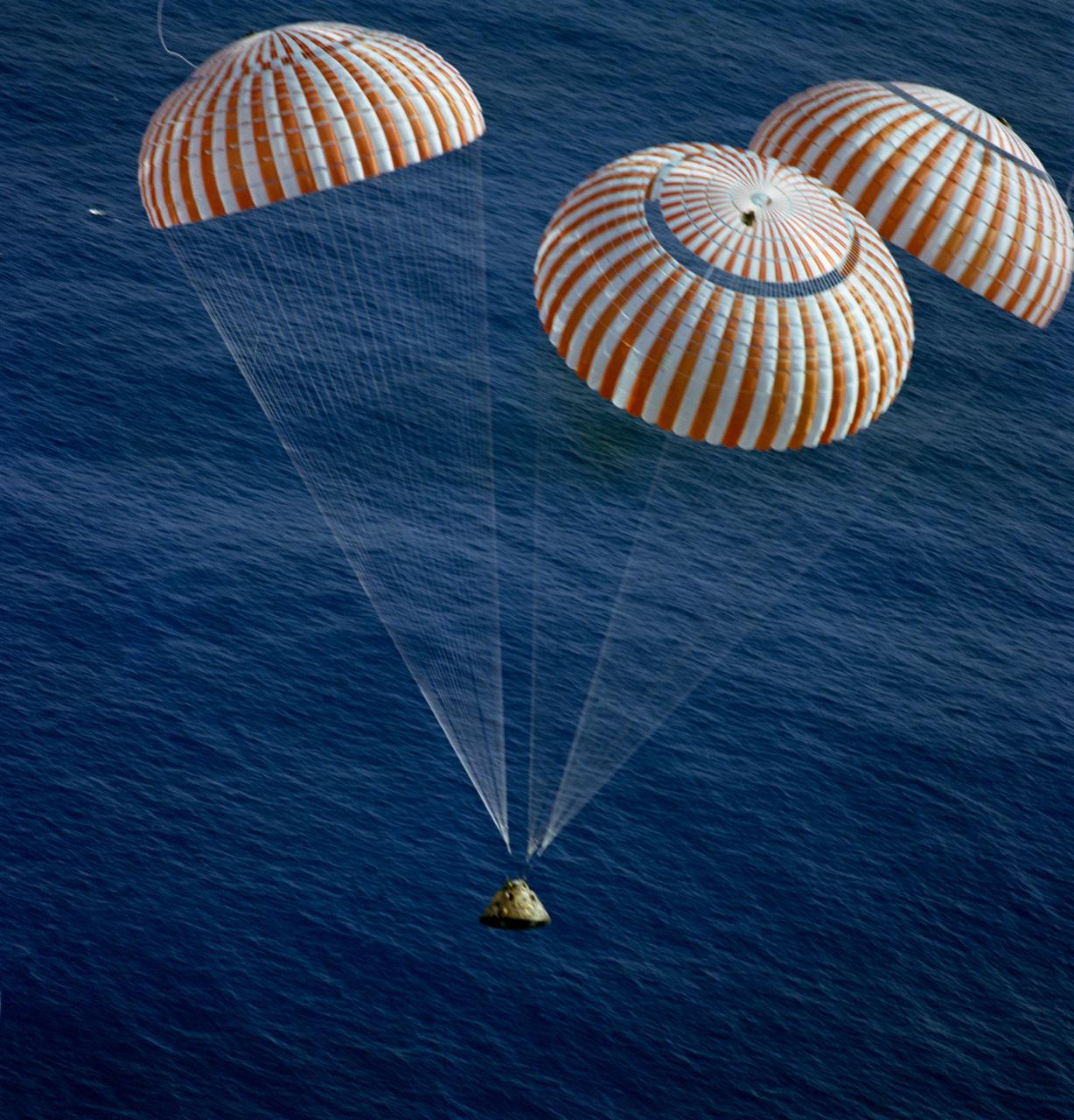
S72-55834 (19 Dec. 1972) --- The Apollo 17 Command Module (CM), with astronauts Eugene A. Cernan, Ronald E. Evans and Harrison H. Schmitt aboard, nears splashdown in the South Pacific Ocean to successfully concludes the final lunar landing mission in NASA's Apollo program. This overhead view was taken from a recovery aircraft seconds before the spacecraft hit the water. The splashdown occurred at 304:31:59 ground elapsed time, 1:24:59 p.m. (CST) Dec. 19, 1972, at coordinates of 166 degrees 8 minutes west longitude and 27 degrees 53 minutes south latitude, about 350 nautical miles southeast of the Samoan Islands. The splashdown was only .8 miles from the target point. Later, the three crewmen were picked up by a helicopter from the prime recovery ship, USS Ticonderoga.
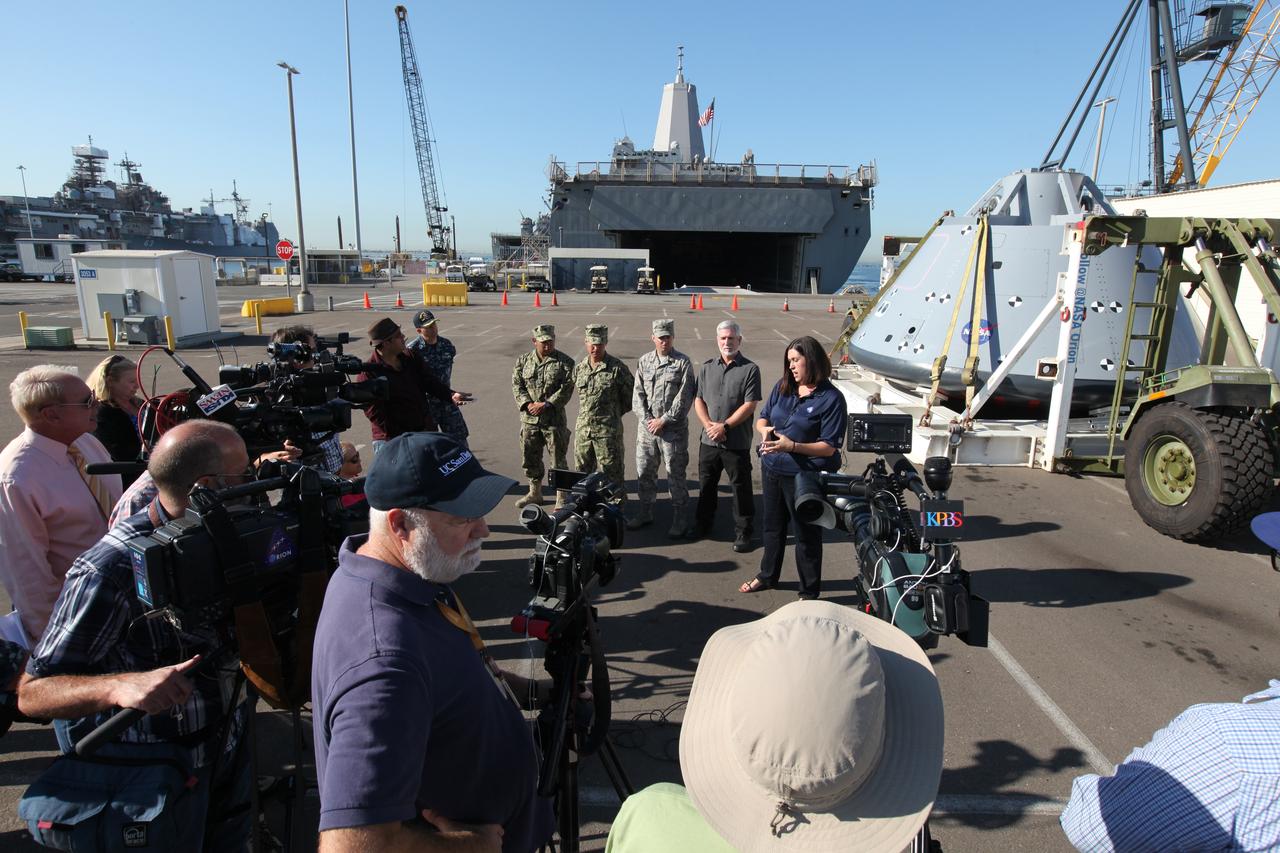
Melissa Jones, far right, Landing and Recovery director with the Ground Systems Development and Operations Program (GSDO), speaks to members of the media about Orion Underway Recovery Test 5. The USS San Diego is docked at Naval Base San Diego in California and the test version of the Orion crew module, secured on its handling fixture, was offloaded from the well deck of the ship. NASA's GSDO Program and the U.S. Navy completed a series of tests using the ship's well deck, the test module, various watercraft and equipment to prepare for recovery of Orion on its return from deep space missions. The testing allowed the team to demonstrate and evaluate recovery processes, procedures, hardware and personnel in open waters. Orion is the exploration spacecraft designed to carry astronauts to destinations not yet explored by humans, including an asteroid and NASA's Journey to Mars. It will have emergency abort capability, sustain the crew during space travel and provide safe re-entry from deep space return velocities. Orion is scheduled to launch on NASA's Space Launch System in late 2018. For more information, visit http://www.nasa.gov/orion.
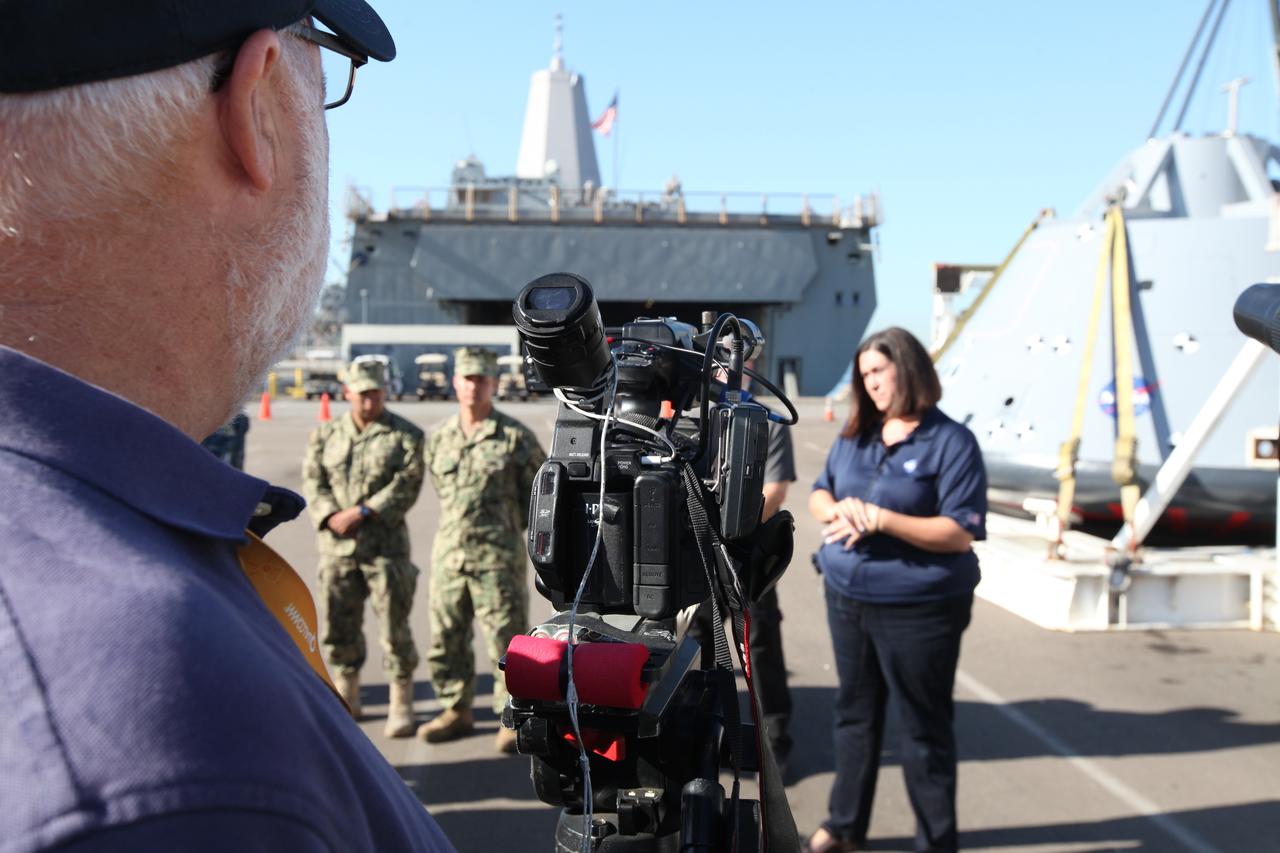
Melissa Jones, Landing and Recovery director with the Ground Systems Development and Operations Program (GSDO), speaks to members of the media about Orion Underway Recovery Test 5. The USS San Diego is docked at Naval Base San Diego in California and the test version of the Orion crew module, secured on its handling fixture, was offloaded from the well deck of the ship. NASA's GSDO Program and the U.S. Navy completed a series of tests using the ship's well deck, the test module, various watercraft and equipment to prepare for recovery of Orion on its return from deep space missions. The testing allowed the team to demonstrate and evaluate recovery processes, procedures, hardware and personnel in open waters. Orion is the exploration spacecraft designed to carry astronauts to destinations not yet explored by humans, including an asteroid and NASA's Journey to Mars. It will have emergency abort capability, sustain the crew during space travel and provide safe re-entry from deep space return velocities. Orion is scheduled to launch on NASA's Space Launch System in late 2018. For more information, visit http://www.nasa.gov/orion.
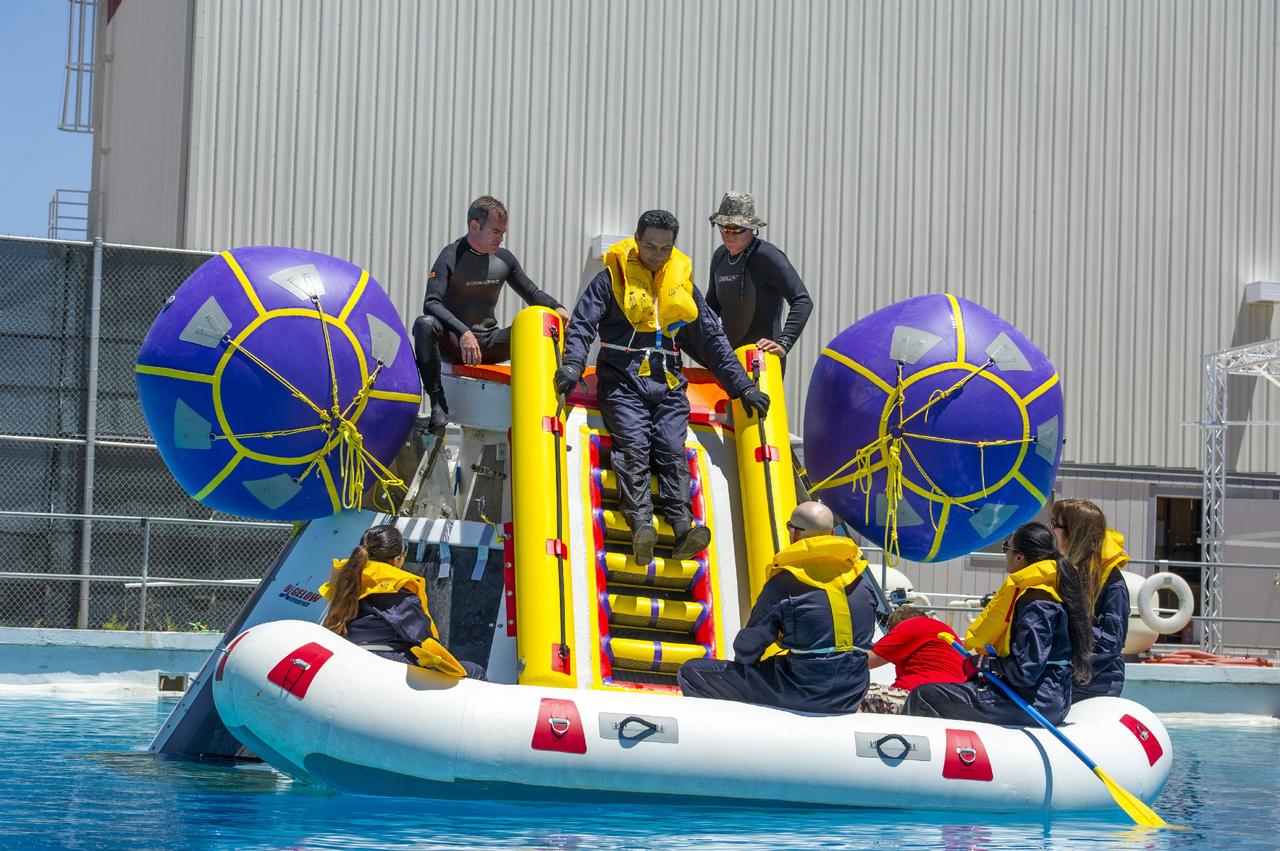
LAS VEGAS, Nev. – The Boeing Company performed simulated contingency water landing scenarios with a mock-up CST-100 spacecraft at Bigelow Aerospace's headquarters near Las Vegas. The CST-100 is designed for ground landings, but could splash down on the water, if necessary. During the water tests, Department of Defense search-and-recovery personnel practiced pulling five Boeing engineers out of the capsule and to safety. The tests are part of the company’s ongoing work supporting its funded Space Act Agreement with NASA’s Commercial Crew Program, or CCP, during the Commercial Crew Integrated Capability, or CCiCap, initiative. CCP is intended to lead to the availability of commercial human spaceflight services for government and commercial customers to low-Earth orbit. Future development and certification initiatives eventually will lead to the availability of human spaceflight services for NASA to send its astronauts to the International Space Station, where critical research is taking place daily. For more information about CCP, go to http://www.nasa.gov/commercialcrew. Photo credit: Boeing
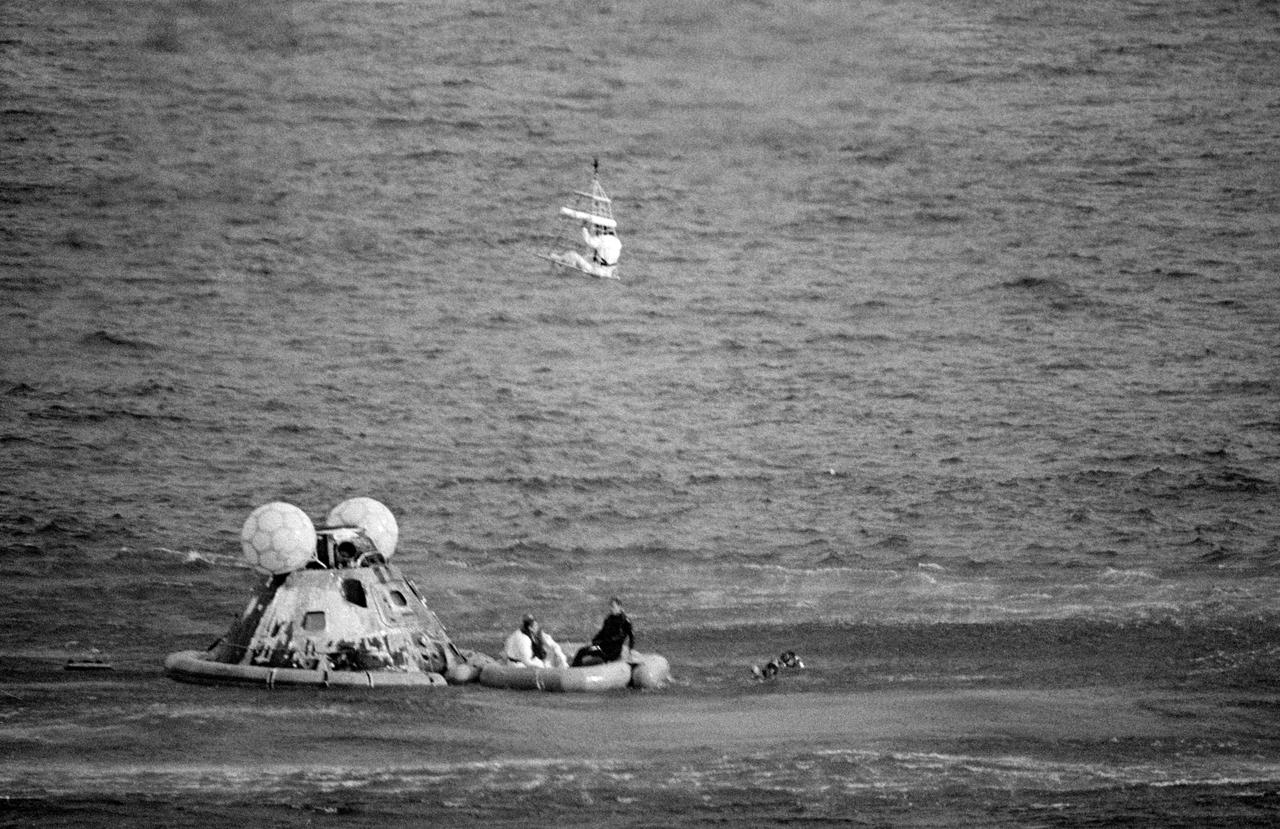
S70-35625 (17 April 1970) --- Astronaut Fred W. Haise Jr., lunar module pilot, is hoisted in a "Billy Pugh" net into a Navy helicopter, while United States Navy underwater demolition team swimmers assist in the recovery operations of the Apollo 13 crewmembers. Astronauts John L. Swigert Jr., command module pilot, and James A. Lovell Jr., commander, are waiting to get hoisted into the helicopter. The helicopter is taking the astronauts to the prime recovery ship, the USS Iwo Jima. Apollo 13 splashed down at 12:07:44 p.m. (CST), April 17, 1970.
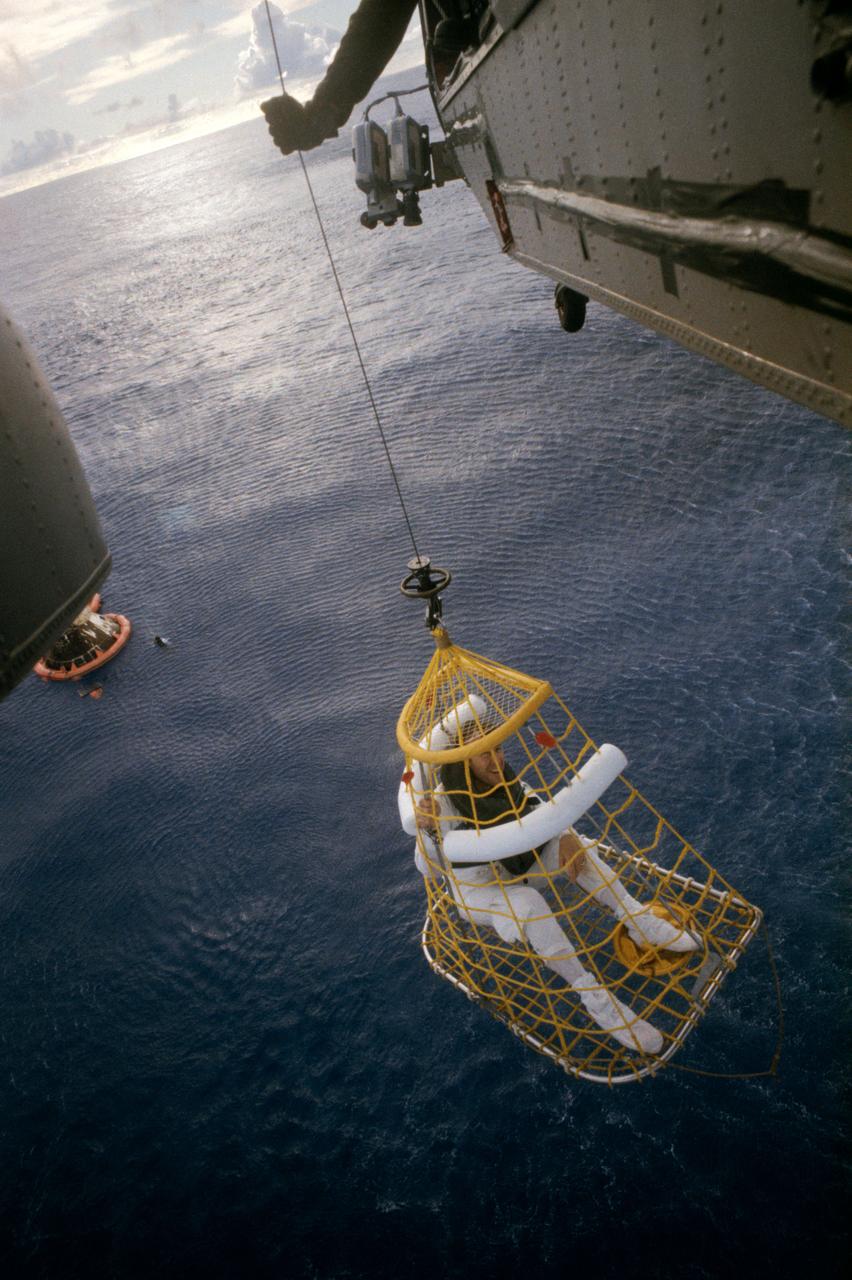
S70-35645 (17 April 1970) --- Astronaut James A. Lovell Jr., commander, is hoisted aboard a helicopter from the USS Iwo Jima, prime recovery vessel for the mission. Lovell was the last of the three Apollo 13 crewmembers to egress the Command Module (CM) and the last to be lifted aboard the helicopter. He was preceded by astronauts John L. Swigert Jr., command module pilot; and Fred W. Haise Jr., lunar module pilot. The CM and a U.S. Navy underwater demolition team swimmer can be seen in the ocean background. Apollo 13 splashed down at 12:07:44 p.m. (CST), April 17, 1970.
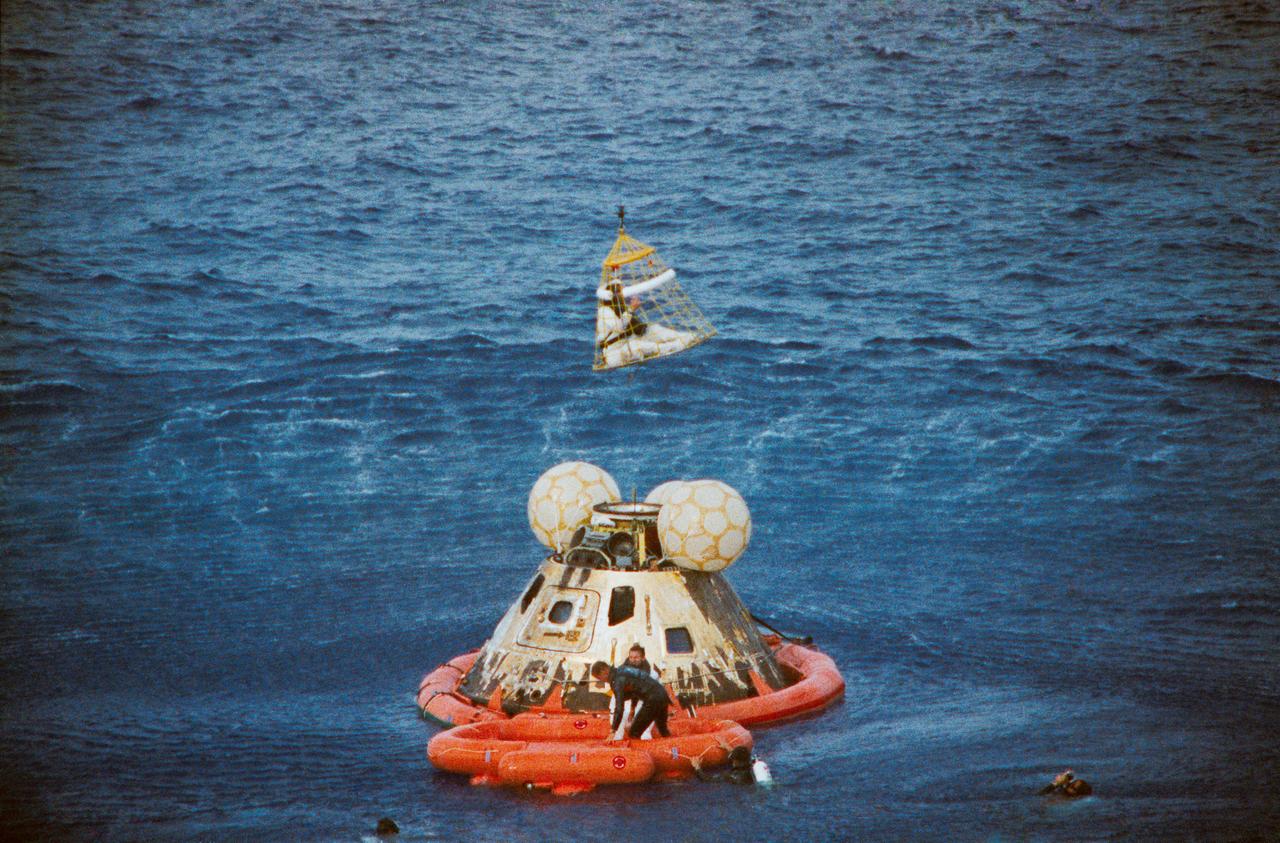
S70-35651 (17 April 1970) --- Astronaut John L. Swigert Jr., command module pilot, is lifted aboard a helicopter in a "Billy Pugh" net while astronaut James A. Lovell Jr., commander, awaits his turn. Astronaut Fred W. Haise Jr., lunar module pilot, is already aboard the helicopter. In the life raft with Lovell, and in the water are several U.S. Navy underwater demolition team swimmers, who assisted in the recovery operations. The crew was taken to the USS Iwo Jima, prime recovery ship, several minutes after the Apollo 13 spacecraft splashed down at 12:07:44 p.m. (CST), April 17, 1970.
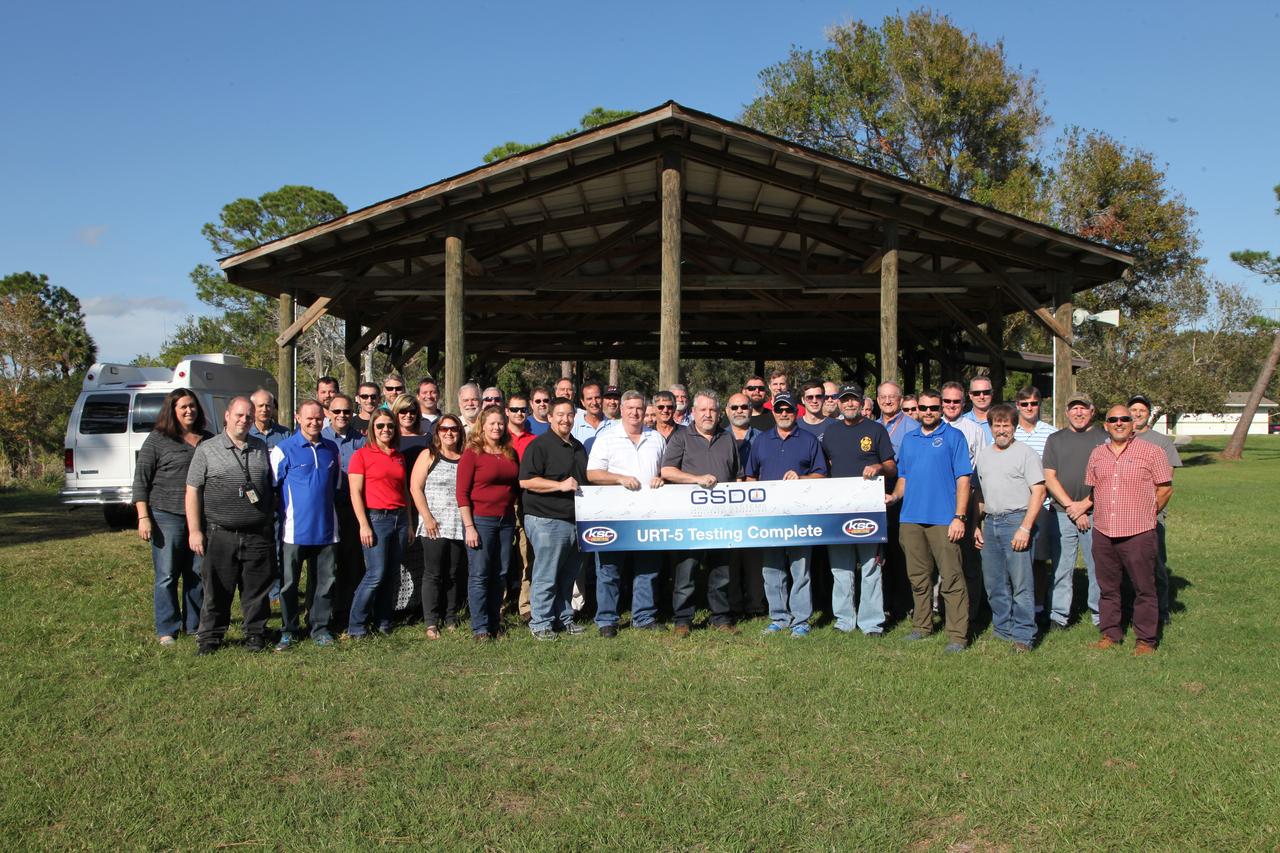
The Orion Underway Recovery Test 5 (URT-5) team celebrate a successful test during a gathering hosted by the Ground Systems Development and Operations Program and the Engineering Directorate at NASA's Kennedy Space Center in Florida. At far left is Melissa Jones, Orion Landing and Recovery director. During URT-5 in October, the team practiced recovering a test version of the Orion crew module in the Pacific Ocean, off the coast of California, and guiding it into the well deck of the USS San Diego. Over several days, the team demonstrated and evaluated new recovery processes, procedures, hardware and personnel in open waters. Orion is the exploration spacecraft designed to carry astronauts to destinations not yet explored by humans, including an asteroid and NASA's Journey to Mars. It will have emergency abort capability, sustain the crew during space travel and provide safe re-entry from deep space return velocities. Orion is scheduled to launch on NASA's Space Launch System in late 2018. For more information, visit http://www.nasa.gov/orion.
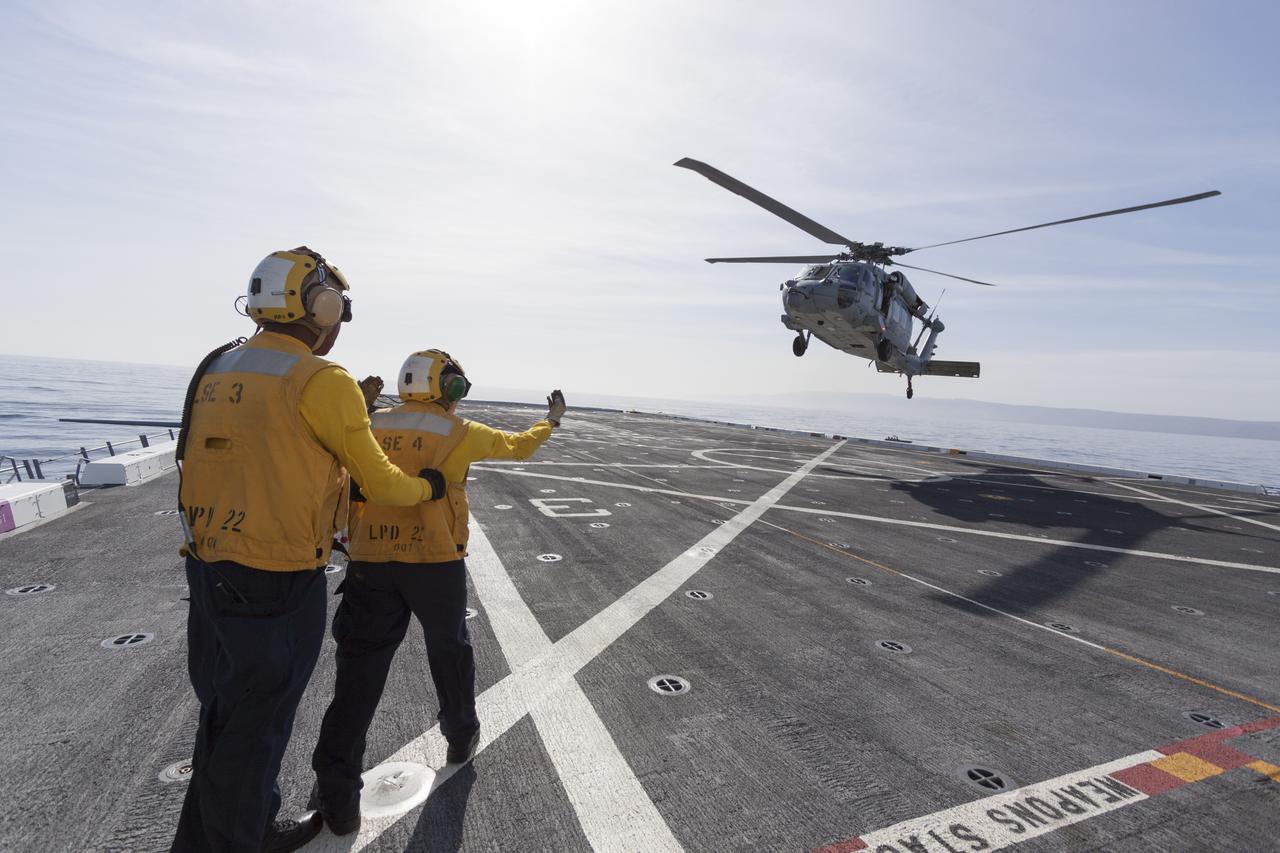
SAN DIEGO, Calif. – On the top deck of the USS San Diego, U.S. Navy personnel monitor a helicopter landing after an Orion underway recovery test. The Orion boilerplate test vehicle and other hardware were secured in the well deck of the USS San Diego at the U.S. Naval Base San Diego in California. Orion was transported about 100 miles offshore for an underway recovery test. NASA and the U.S. Navy conducted tests to prepare for recovery of the Orion crew module, forward bay cover and parachutes on its return from a deep space mission. The underway recovery test allowed the teams to demonstrate and evaluate the recovery processes, procedures, hardware and personnel in open waters. During the testing, the tether lines were unable to support the tension caused by crew module motion that was driven by wave turbulence in the well deck of the ship. NASA and the U.S. Navy are reviewing the testing data collected to evaluate the next steps. The Ground Systems Development and Operations Program conducted the underway recovery tests. Orion is the exploration spacecraft designed to carry astronauts to destinations not yet explored by humans, including an asteroid and Mars. It will have emergency abort capability, sustain the crew during space travel and provide safe re-entry from deep space return velocities. The first unpiloted test flight of the Orion is scheduled to launch in 2014 atop a Delta IV rocket and in 2017 on NASA’s Space Launch System rocket. For more information, visit http://www.nasa.gov/orion. Photo credit: NASA/Cory Huston
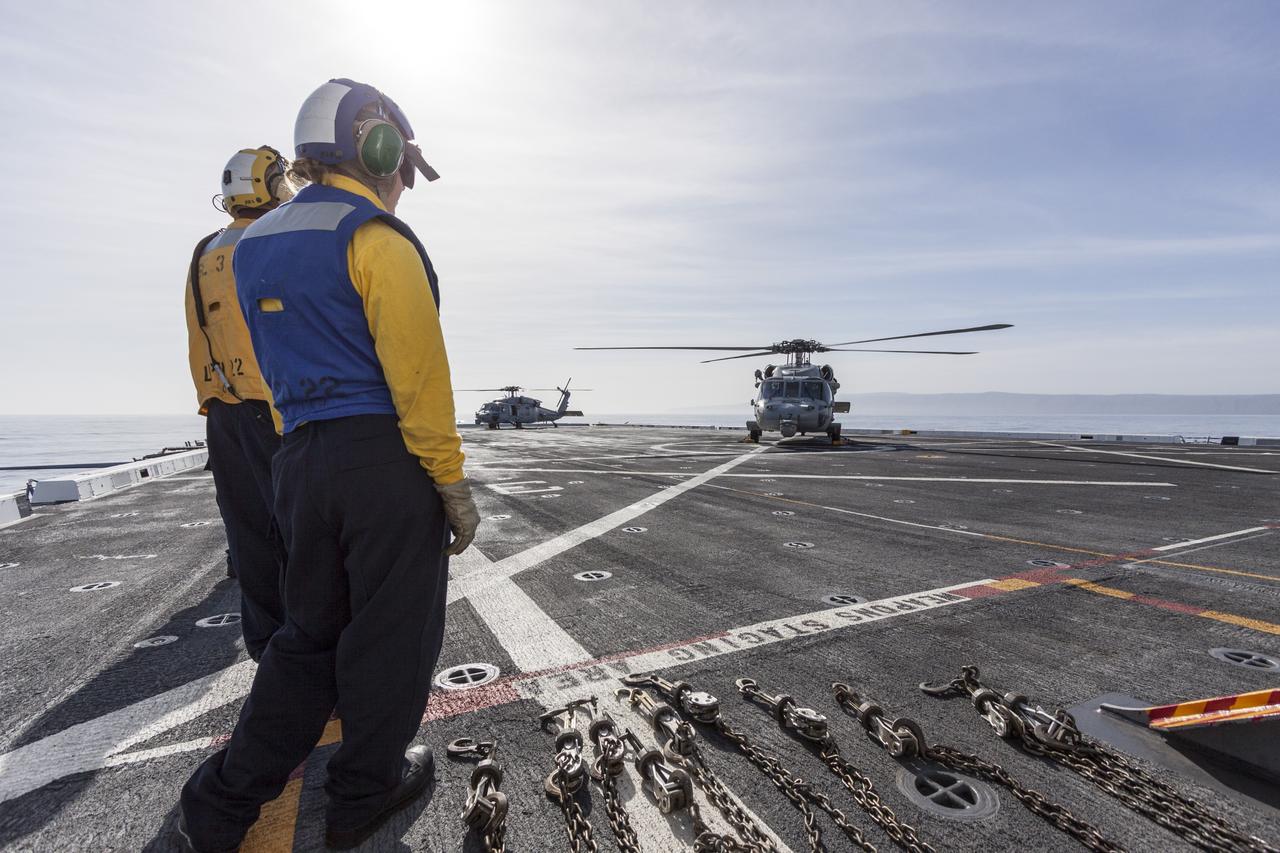
SAN DIEGO, Calif. – On the top deck of the USS San Diego, U.S. Navy personnel monitor a helicopter landing after an Orion underway recovery test. The Orion boilerplate test vehicle and other hardware were transported in the ship’s well deck about 100 miles offshore for an underway recovery test. NASA and the U.S. Navy conducted tests to prepare for recovery of the Orion crew module, forward bay cover and parachutes on its return from a deep space mission. The underway recovery test allowed the teams to demonstrate and evaluate the recovery processes, procedures, hardware and personnel in open waters. During the testing, the tether lines were unable to support the tension caused by crew module motion that was driven by wave turbulence in the well deck of the ship. NASA and the U.S. Navy are reviewing the testing data collected to evaluate the next steps. The Ground Systems Development and Operations Program conducted the underway recovery tests. Orion is the exploration spacecraft designed to carry astronauts to destinations not yet explored by humans, including an asteroid and Mars. It will have emergency abort capability, sustain the crew during space travel and provide safe re-entry from deep space return velocities. The first unpiloted test flight of the Orion is scheduled to launch in 2014 atop a Delta IV rocket and in 2017 on NASA’s Space Launch System rocket. For more information, visit http://www.nasa.gov/orion. Photo credit: NASA/Cory Huston
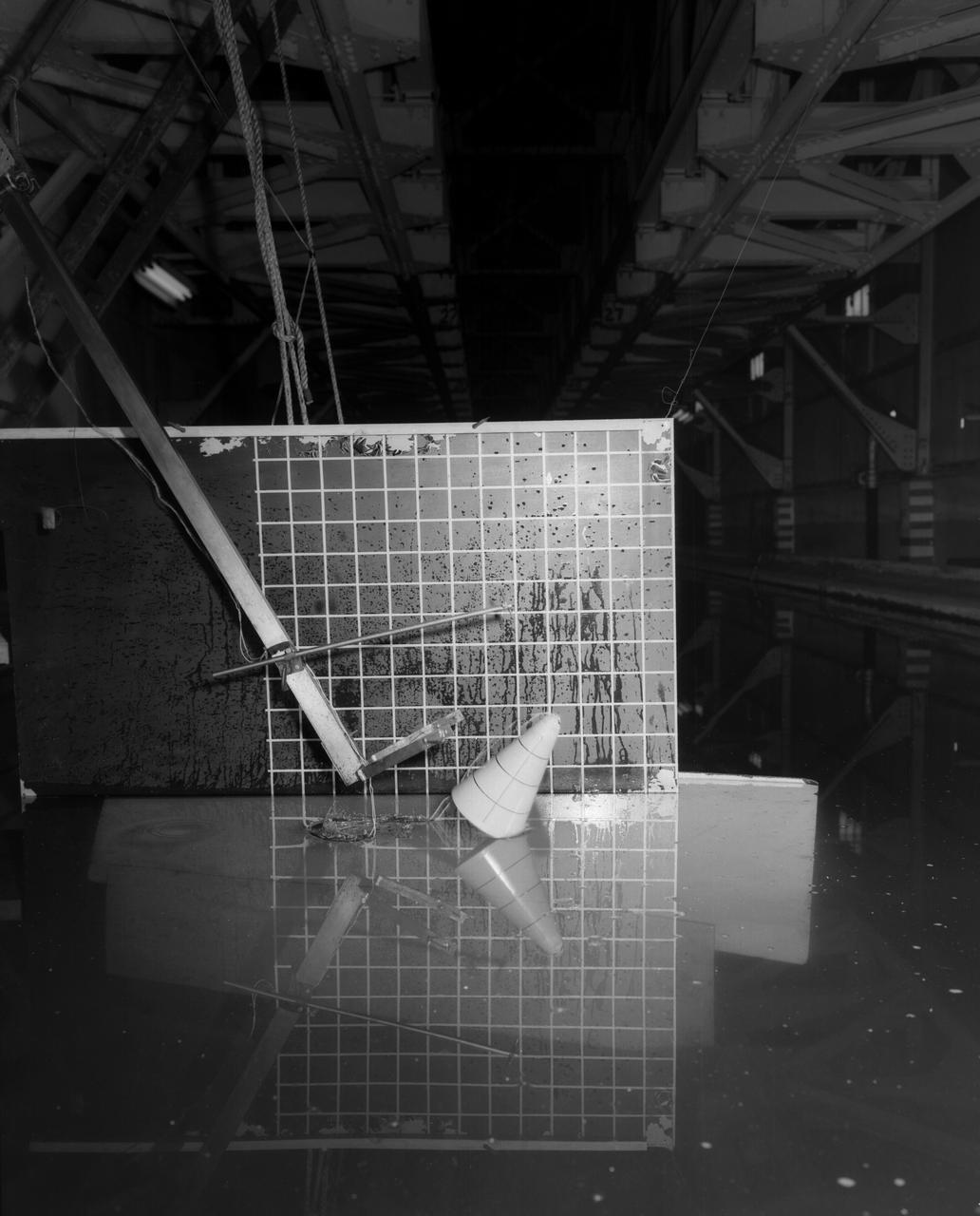
Testing of Mercury Capsule Shape A by the Hydrodynamics Division of Langley. Joseph Shortal wrote (vol. 3, p. 19): The Hydrodynamics Division provided assistance in determining landing loads. In this connection, after PARD engineers had unofficially approached that division to make some water impact tests with the boilerplate capsule, J.B. Parkinson, Hydrodynamics Chief visited Shortal to find out if the request had his support. Finding out that it did, Parkinson said, Its your capsule. If you want us to drop it in the water, we will do it. From Shortal (Vol. 3, p. 16): The basic design of the capsule was made by M.A. Faget and his coworkers at PARD during the winter of 1957-1958. It was natural, then, that extensive use was made of the facilities at Wallops during the development of the spacecraft. The tests at Wallops consisted of 26 full-size capsules, either launched from the ground by rocket power or dropped from airplanes at high altitude and 28 scaled models, either rocket boosted or released from balloons. Emphasis in the Wallops program was on dynamic stability and aerodynamic heating of the capsule, and effectiveness of the pilot-escape and parachute-recovery systems. The biggest part of the Wallops program was the series of full-size capsules, rocket launched with the Little Joe booster, developed especially for Mercury. -- Published in Joseph A. Shortal, History of Wallops Station: Origins and Activities Through 1949, (Wallops Island, VA: National Aeronautics and Space Administration, Wallops Station, nd), Comment Edition.