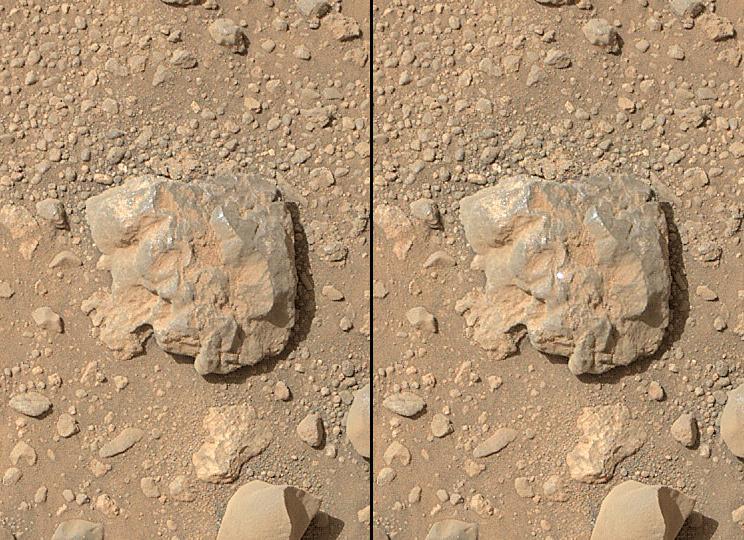
NASA Curiosity Mars rover used the Mars Hand Lens Imager MAHLI camera on its arm to catch the first images of sparks produced by the rover laser being shot at a rock on Mars. The left image is from before the laser zapped this rock, called Nova.

Lightning strikes have sparked more than a thousand fires in northern California. Cape Mendocino is at the center of the image and Mt. Shasta is near the upper right.
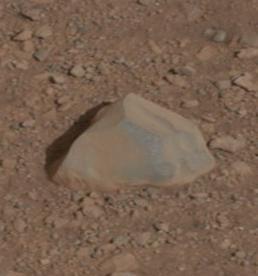
This close-up image shows the first target NASA Curiosity rover aims to zap with its Chemistry and Camera ChemCam instrument. The instrument will analyze that spark with a telescope and identify the chemical elements in the target.
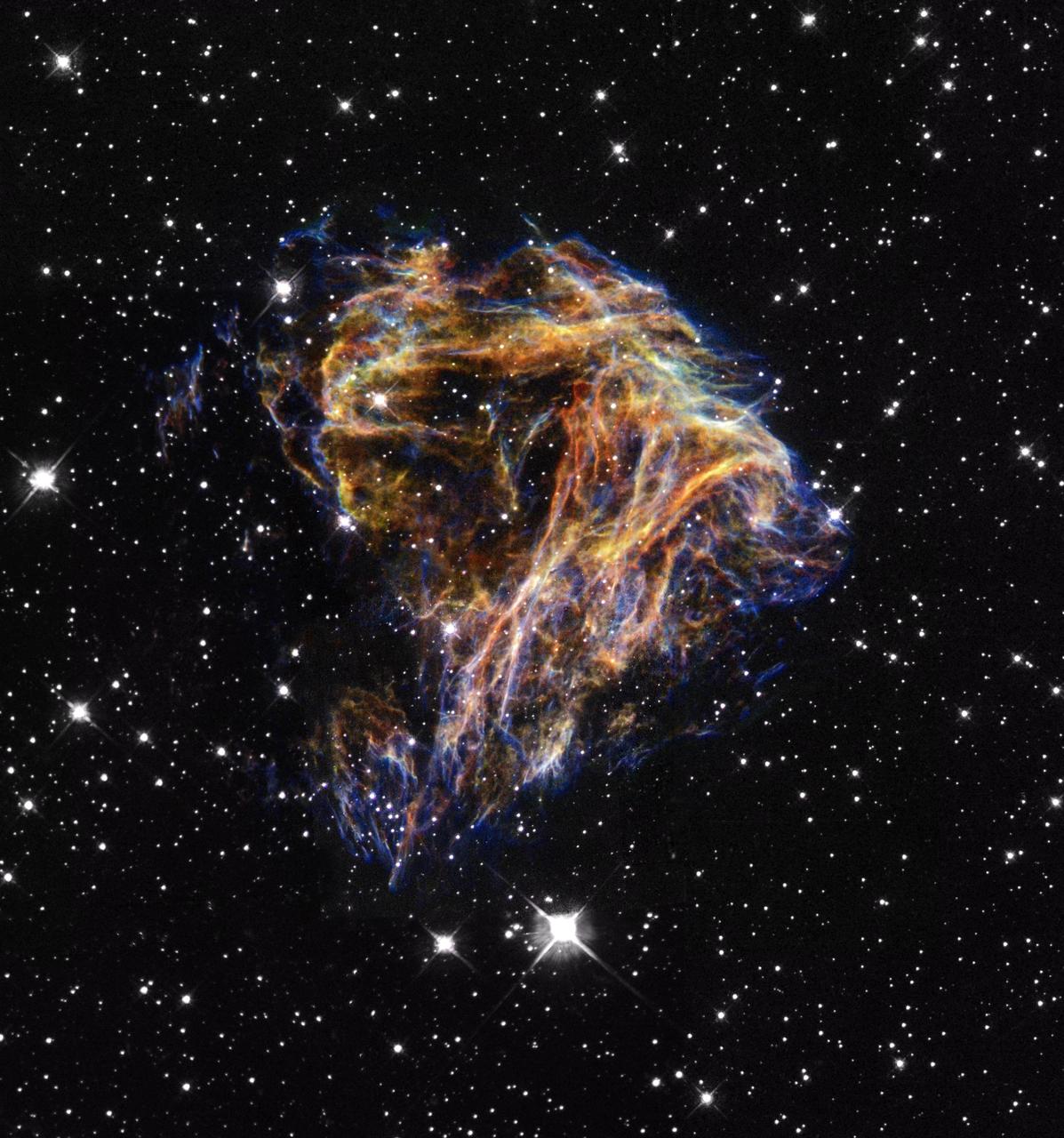
Resembling sparks from a fireworks display, this image taken by a JPL camera onboard NASA Hubble Space Telescope shows delicate filaments that are sheets of debris from a stellar explosion in the nearby Large Magellanic Cloud galaxy.
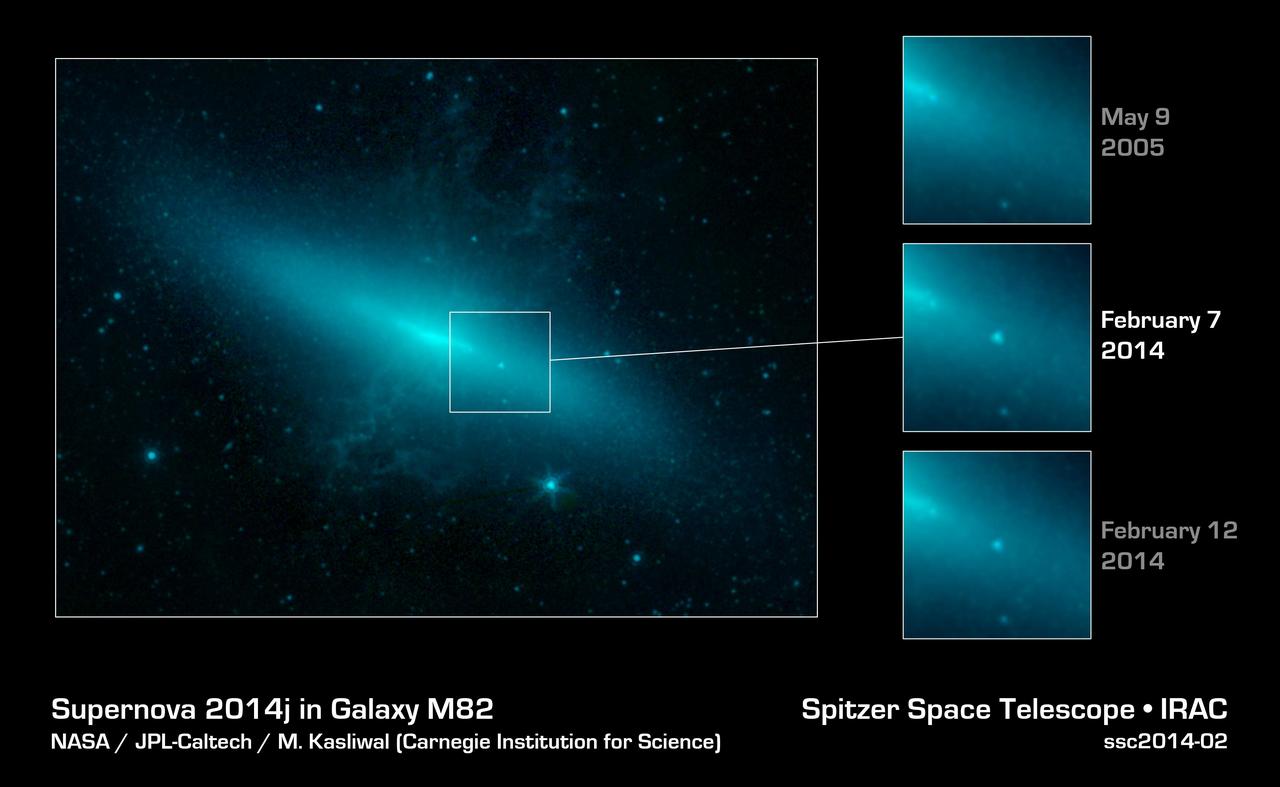
The closest supernova of its kind to be observed in the last few decades, M82 or the Cigar galaxy, has sparked a global observing campaign involving legions of instruments on the ground and in space, including NASA Spitzer Space Telescope.

jsc2026e034360 (April 28, 2026) --- Preflight 3D reconstruction of the spleen as part of SPARK, an investigation that studies how spleen changes in size and shape and how red blood cells break down in space. SPARK aims to better understand the biological mechanisms of space-related anemia to better protect crew health during long-duration space missions. Credit: Bone and Joint Research Laboratory.

jsc2026e034363 (April 28, 2026) --- The Spleen Activity in Space Anemia and Red Cells Kinetics (SPARK) logo. This investigation uses imaging techniques in space to study how the spleen changes and how red blood cells break down in space. SPARK aims to better understand the biological mechanisms of space-related anemia to find ways to better protect crew health during long-duration space missions. Credit: Katbdesign Studio.

ISS034-E-035548 (28 Jan. 2013) --- A nighttime view of the Reno, Nevada metropolitan area is featured in this image photographed by an Expedition 34 crew member on the International Space Station. Known as ?the biggest little city in the world?, the city of Reno is located in Truckee Meadows along the eastern foothills of the Sierra Nevada near the California border. It forms part of the Reno-Sparks metropolitan area?the largest such area in northern Nevada, and the second largest in the state after Las Vegas. Lake Tahoe, a major destination for skiing and other outdoor recreational activities, is located less than 50 kilometers to the southwest of the Reno-Sparks metro area. The relatively isolated nature of the metropolitan area within the surrounding terrain is highlighted in this nighttime image. The major industrial and commercial areas of both Reno and Sparks are brightly lit at center. The major street grid is visible as orange linear features adjacent to the industrial/commercial areas. Residential areas appear dark in contrast. The Reno-Tahoe International Airport (center) is visible as a dark, dagger-shaped region in the southeast quarter of the metropolitan area. At the time this photograph was taken, the moon was in a waning gibbous phase (98 percent of a full moon). Moonlight provided enough illumination of the ground surface such that the topography, accentuated by snow cover, surrounding the Reno-Sparks area is clearly visible (upper right, lower right) following color enhancement.

jsc2026e034364 (April 28, 2026) --- Regions of interest on the spleen are shown as part of the SPARK investigation which aims to will detect the effects of chronic space hemolysis on the spleen. Credit: Bone and Joint Research Laboratory.
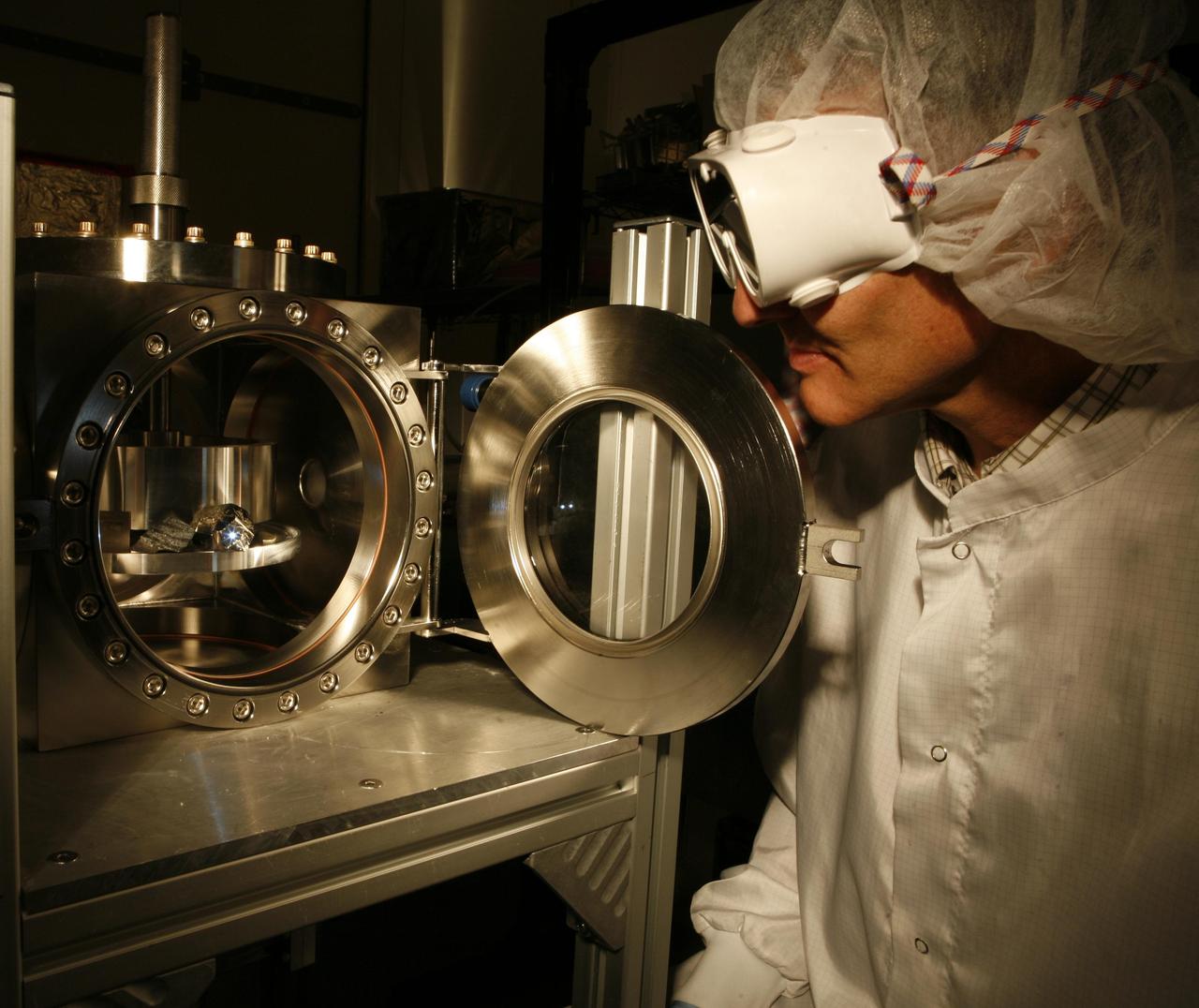
The ChemCam instrument for NASA Mars Science Laboratory mission uses a pulsed laser beam to vaporize a pinhead-size target, producing a flash of light from the ionized material plasma that can be analyzed to identify chemical elements in the target.

The ChemCam instrument for NASA Mars Science Laboratory mission uses a pulsed laser beam to vaporize a pinhead-size target, producing a flash of light from the ionized material plasma that can be analyzed to identify chemical elements in the target.
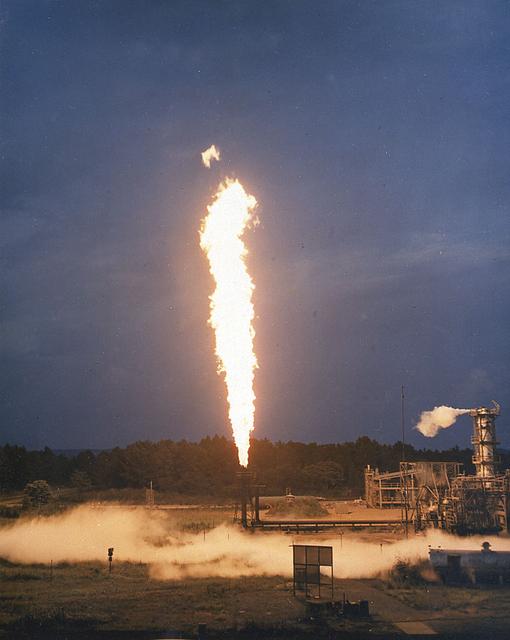
Marshall Space Flight Center's rocket development has always included component testing. Pictured here is a Cell 114-B burn stack. The C114-B is part of the gas generators used to test heat exchanges for the F-1 engine. On the initial firing of the C114-B the spark ignition would not light. The rocket propellant mixed with the liquid oxygen gelled creating a bomb. After several attempts at ignition, the spark ignited and blew up the stand. Subsequent testings were completed on newly constructed stands and no further mishaps were reported.

Sparked by a medium-sized (C-class) flare, a long, magnetic filament burst out from the Sun, producing one of the best shows that the Solar Dynamics Observatory (SDO) has seen (Aug. 31, 2012). Viewed in the 304 Angstrom wavelength of extreme ultraviolet light, the filament strand gets stretched outwards until it finally breaks and heads off to the left. Some of the particles from this eruption did hit Earth with a glancing blow on Sept. 3, generating some beautiful aurora. The video clip covers four hours of activity. http://photojournal.jpl.nasa.gov/catalog/PIA18167

NASA Officials, LEGO Group management, students, teachers and parents create their vision of the future in space with LEGO bricks and elements as part of a “Build the Future” activity inside a tent that was set up on the launch viewing area at NASA's Kennedy Space Center in Cape Canaveral, Fla. on Monday, Nov. 1, 2010. NASA and The LEGO Group signed a Space Act Agreement to spark children's interest in science, technology, engineering and math (STEM). Photo Credit: (NASA/Bill Ingalls)
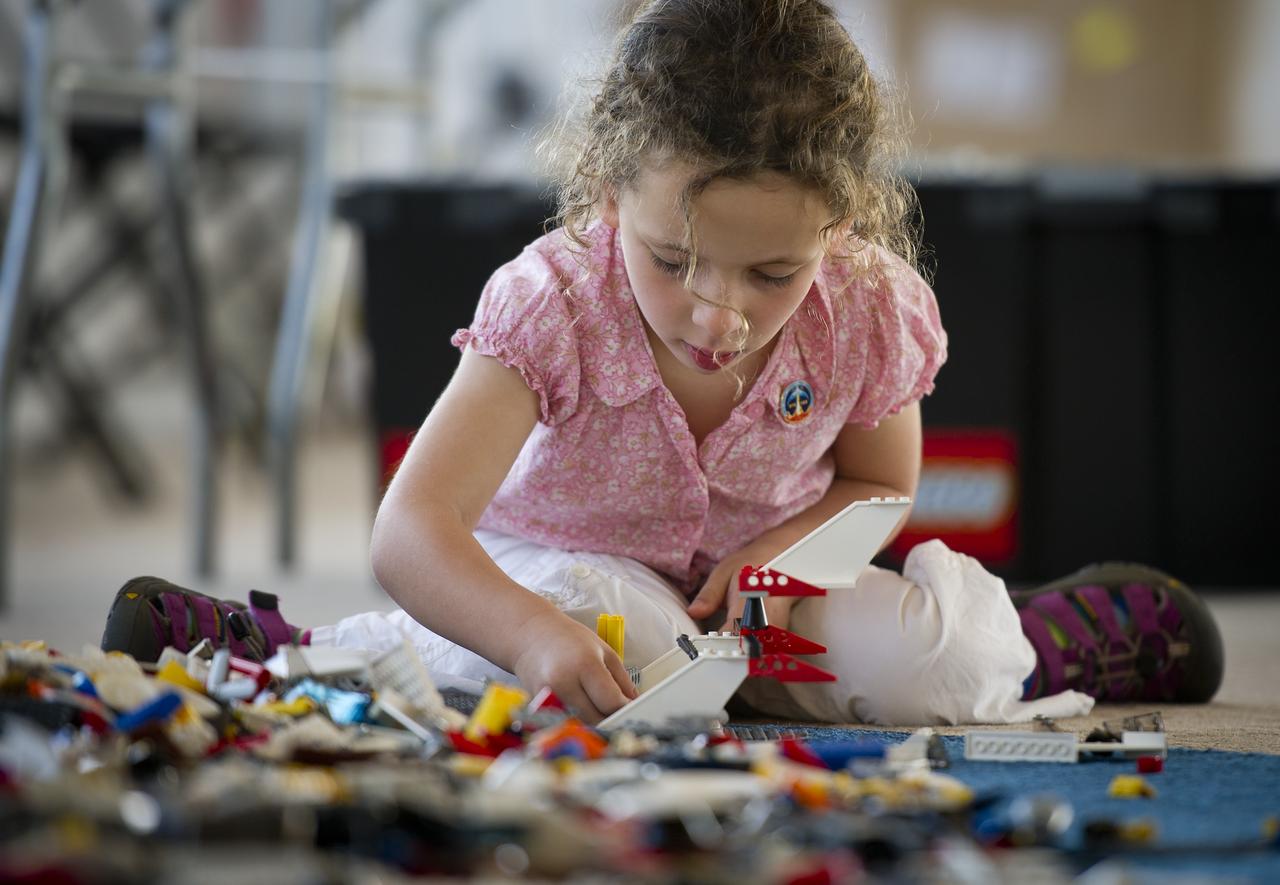
NASA Officials, LEGO Group management, students, teachers and parents create their vision of the future in space with LEGO bricks and elements as part of a “Build the Future” activity inside a tent that was set up on the launch viewing area at NASA's Kennedy Space Center in Cape Canaveral, Fla. on Monday, Nov. 1, 2010. NASA and The LEGO Group signed a Space Act Agreement to spark children's interest in science, technology, engineering and math (STEM). Photo Credit: (NASA/Bill Ingalls)

jsc2026e034362 (April 28, 2026) --- Bone marrow internal content from magnetic resonance imaging in a participant to a space analogue study. Red blood cells are produced in the bone marrow, and the SPARK investigation aims to detect changes in red blood cell production, bone marrow content, and the effects of chronic space hemolysis. Credit: Bone and Joint Research Laboratory.
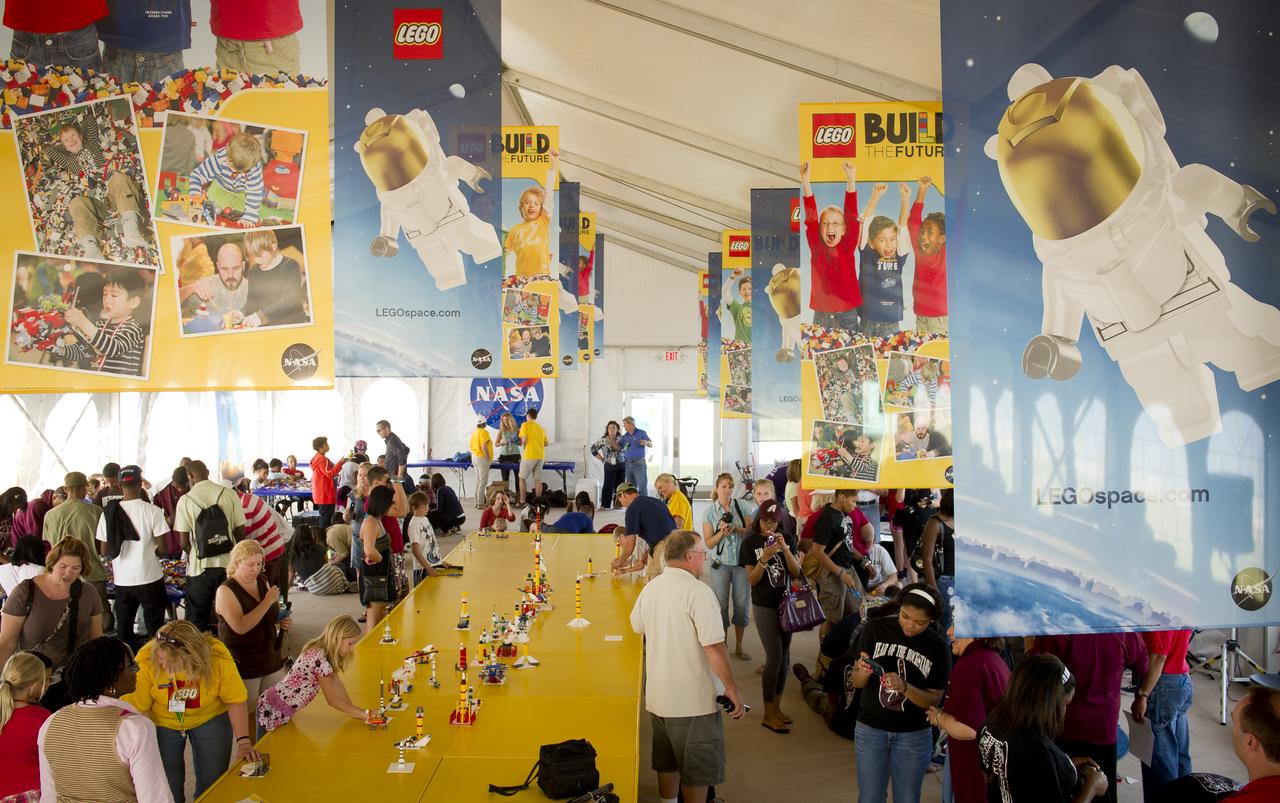
NASA Officials, LEGO Group management, students, teachers and parents create their vision of the future in space with LEGO bricks and elements as part of a “Build the Future” activity inside a tent that was set up on the launch viewing area at NASA's Kennedy Space Center in Cape Canaveral, Fla. on Monday, Nov. 1, 2010. NASA and The LEGO Group signed a Space Act Agreement to spark children's interest in science, technology, engineering and math (STEM). Photo Credit: (NASA/Bill Ingalls)
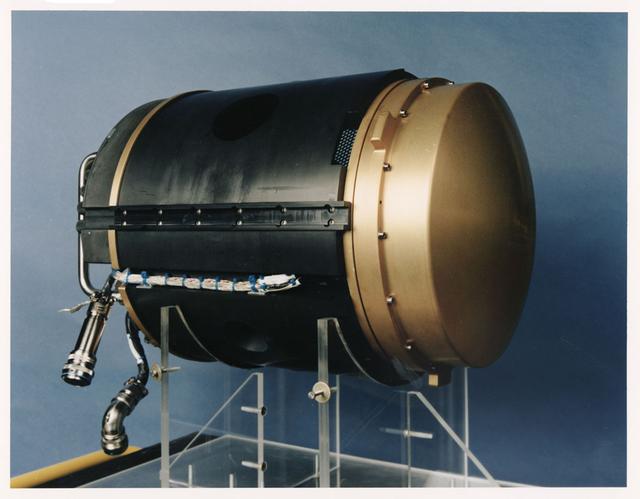
Structure Of Flame Balls At Low Lewis-numbers (SOFBALL) Experiment Mounting Structure (EMS) was used to conduct the SOFBALL experiment on Combustion Module-1. The EMS was inserted into the CM-1 combustion chamber. The chamber was filled with a lean fuel/oxidizer mixture and a spark igniter on the EMS ignited the gas. Very small, weak flames, in the shape of spheres, were formed and studied.
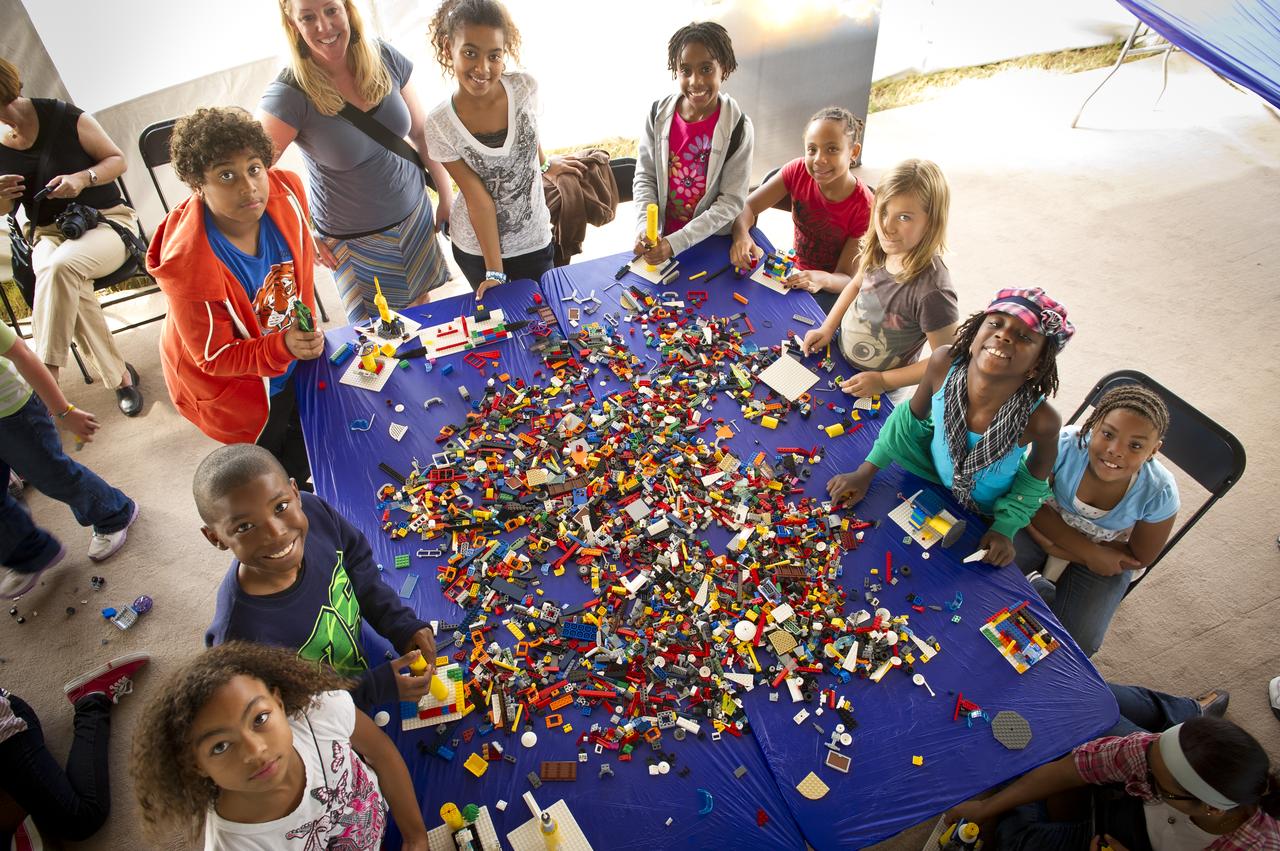
NASA Officials, LEGO Group management, students, teachers and parents create their vision of the future in space with LEGO bricks and elements as part of a “Build the Future” activity inside a tent that was set up on the launch viewing area at NASA's Kennedy Space Center in Cape Canaveral, Fla. on Monday, Nov. 1, 2010. NASA and The LEGO Group signed a Space Act Agreement to spark children's interest in science, technology, engineering and math (STEM). Photo Credit: (NASA/Bill Ingalls)
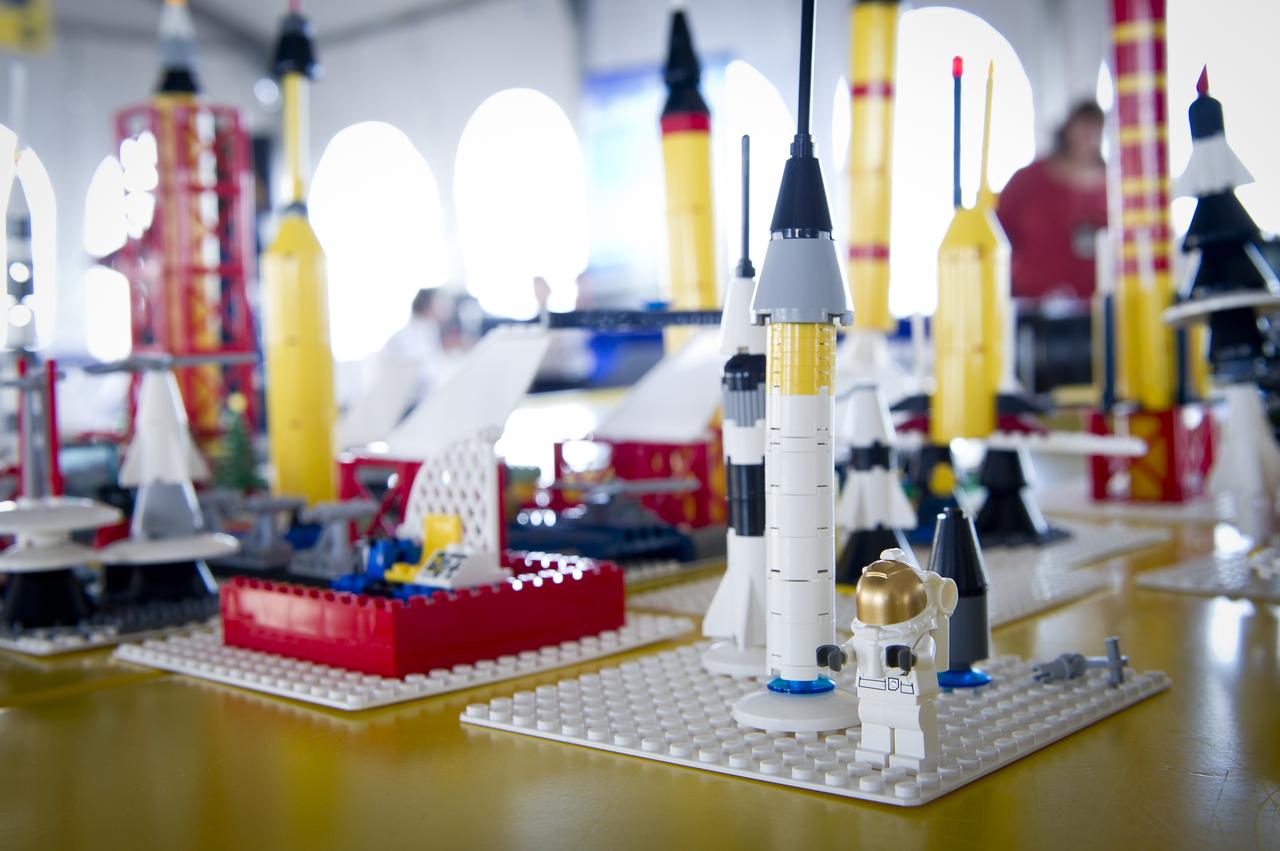
LEGOs are seen assembled by students as part of a “Build the Future” activity inside a tent that was set up on the launch viewing area at NASA's Kennedy Space Center in Cape Canaveral, Fla. on Wednesday, Nov. 3, 2010. NASA and The LEGO Group signed a Space Act Agreement to spark children's interest in science, technology, engineering and math (STEM). Photo Credit: (NASA/Bill Ingalls)
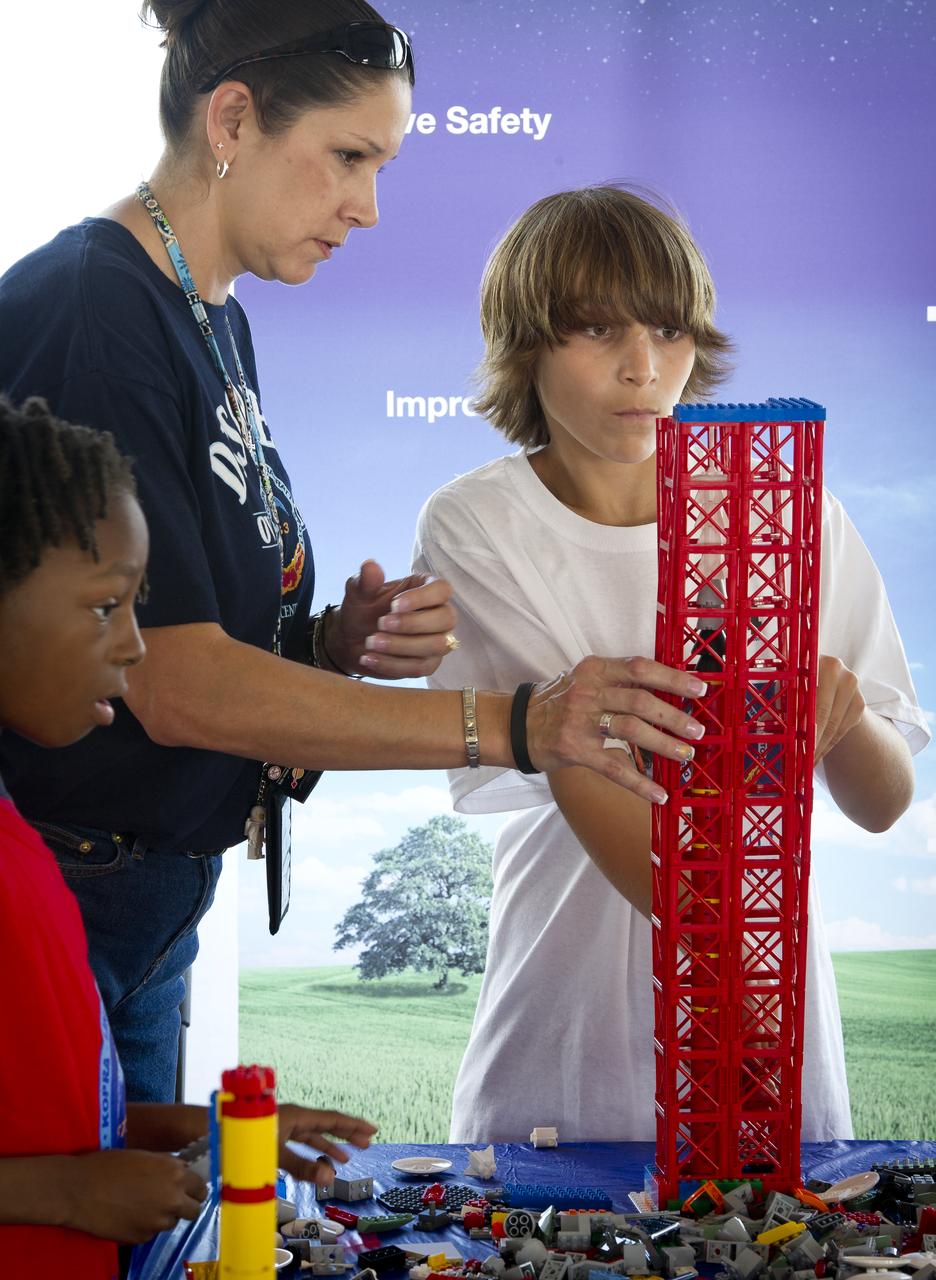
NASA Officials, LEGO Group management, students, teachers and parents create their vision of the future in space with LEGO bricks and elements as part of a “Build the Future” activity inside a tent that was set up on the launch viewing area at NASA's Kennedy Space Center in Cape Canaveral, Fla. on Wednesday, Nov. 3, 2010. NASA and The LEGO Group signed a Space Act Agreement to spark children's interest in science, technology, engineering and math (STEM). Photo Credit: (NASA/Bill Ingalls)
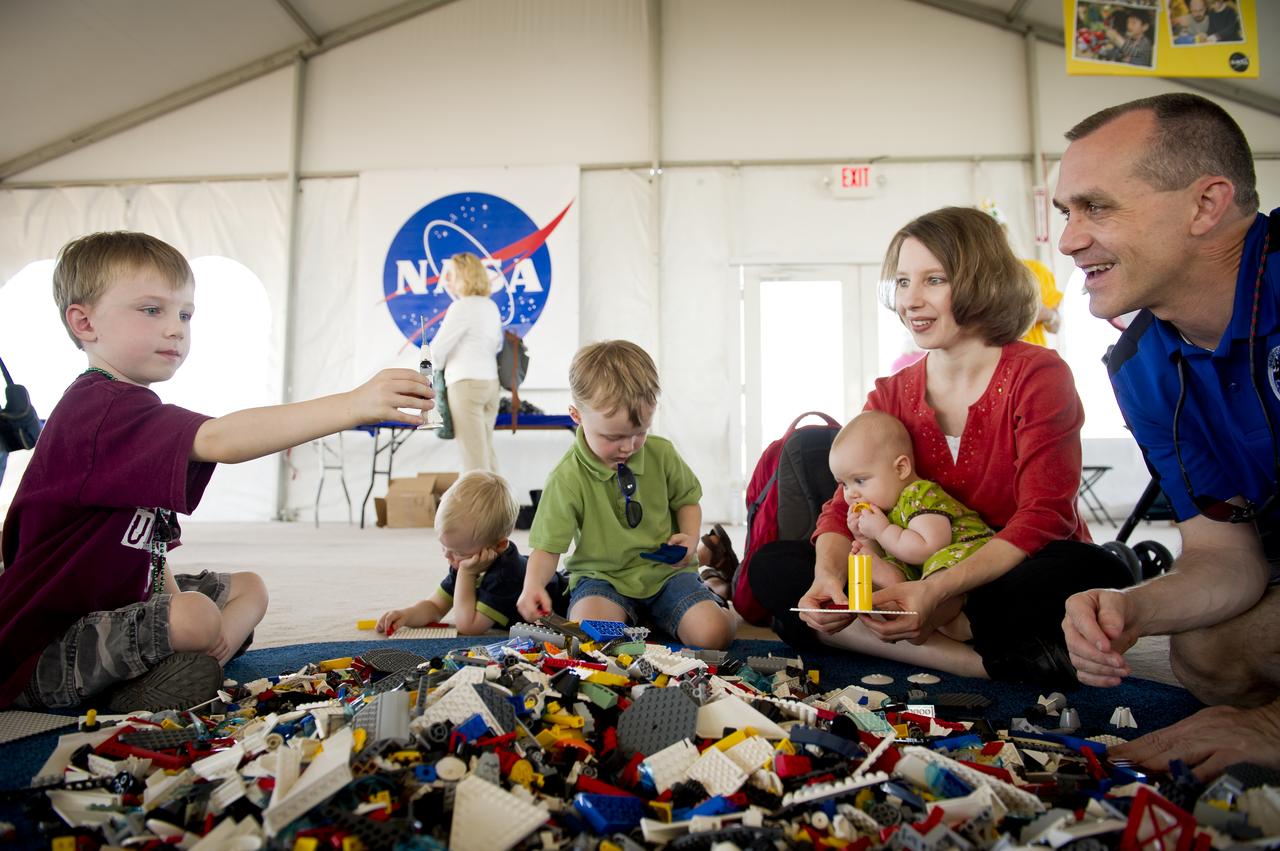
NASA Officials, LEGO Group management, students, teachers and parents create their vision of the future in space with LEGO bricks and elements as part of a “Build the Future” activity inside a tent that was set up on the launch viewing area at NASA's Kennedy Space Center in Cape Canaveral, Fla. on Monday, Nov. 1, 2010. NASA and The LEGO Group signed a Space Act Agreement to spark children's interest in science, technology, engineering and math (STEM). Photo Credit: (NASA/Bill Ingalls)
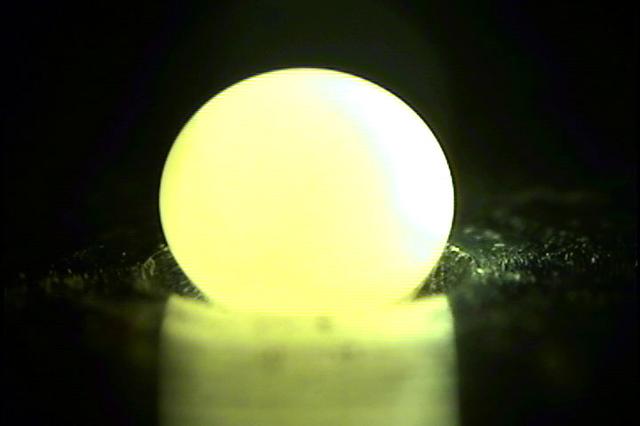
jsc2026e416049 (September 15, 2026) --- Preflight image of a new class of glass as it cools during a ground-based levitation experiment as part of ELF‑Unconventional Glass 2. This investigation examines how microgravity influences the structure and properties of these unconventional glasses. Investigation results could reveal new ways of making glass with unique properties and spark innovations for future technologies. Credit: Kyoto University/Atsunobo Masuno.

NASA Officials, LEGO Group management, students, teachers and parents create their vision of the future in space with LEGO bricks and elements as part of a “Build the Future” activity inside a tent that was set up on the launch viewing area at NASA's Kennedy Space Center in Cape Canaveral, Fla. on Monday, Nov. 1, 2010. NASA and The LEGO Group signed a Space Act Agreement to spark children's interest in science, technology, engineering and math (STEM). Photo Credit: (NASA/Bill Ingalls)
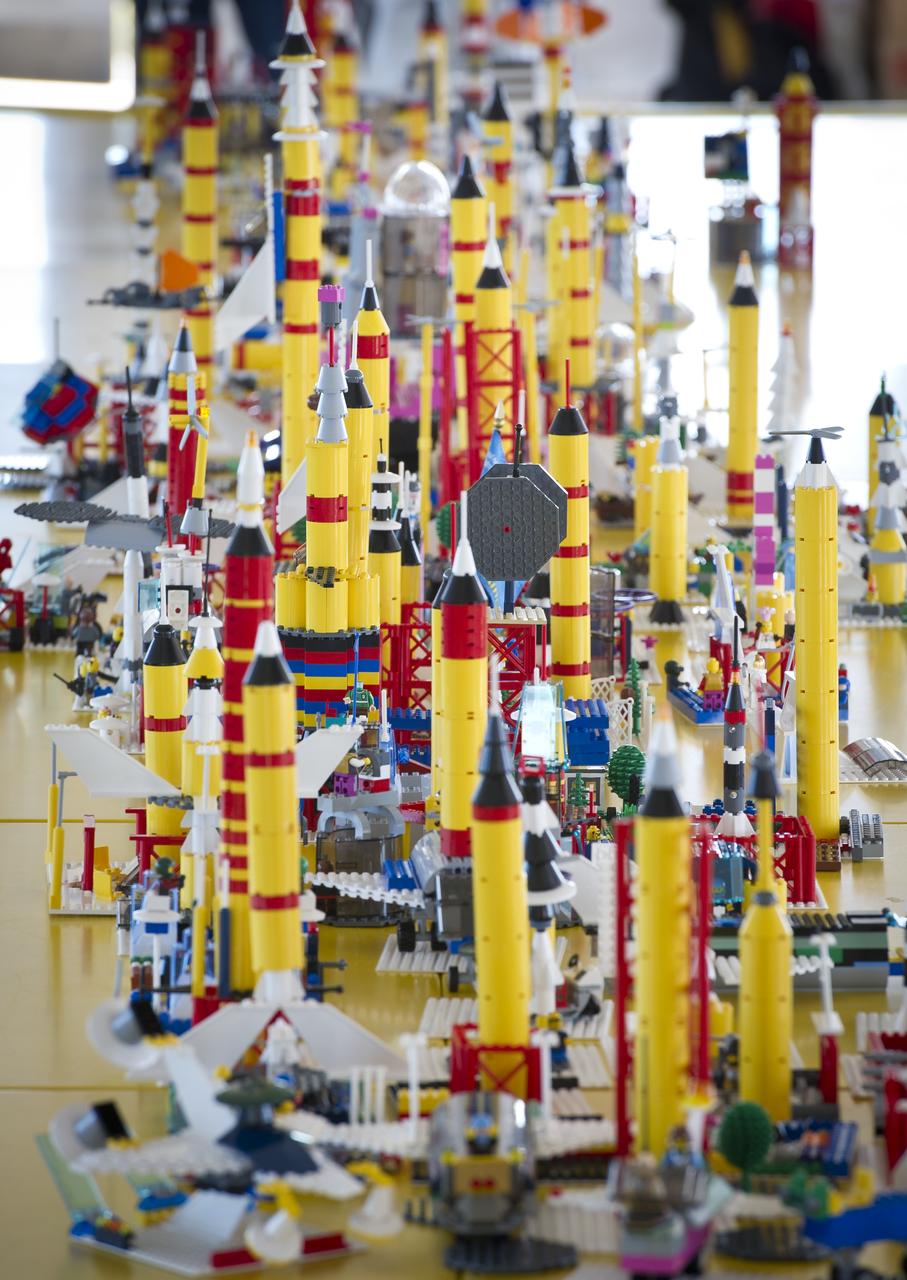
LEGOs are seen assembled by students as part of a “Build the Future” activity inside a tent that was set up on the launch viewing area at NASA's Kennedy Space Center in Cape Canaveral, Fla. on Wednesday, Nov. 3, 2010. NASA and The LEGO Group signed a Space Act Agreement to spark children's interest in science, technology, engineering and math (STEM). Photo Credit: (NASA/Bill Ingalls)
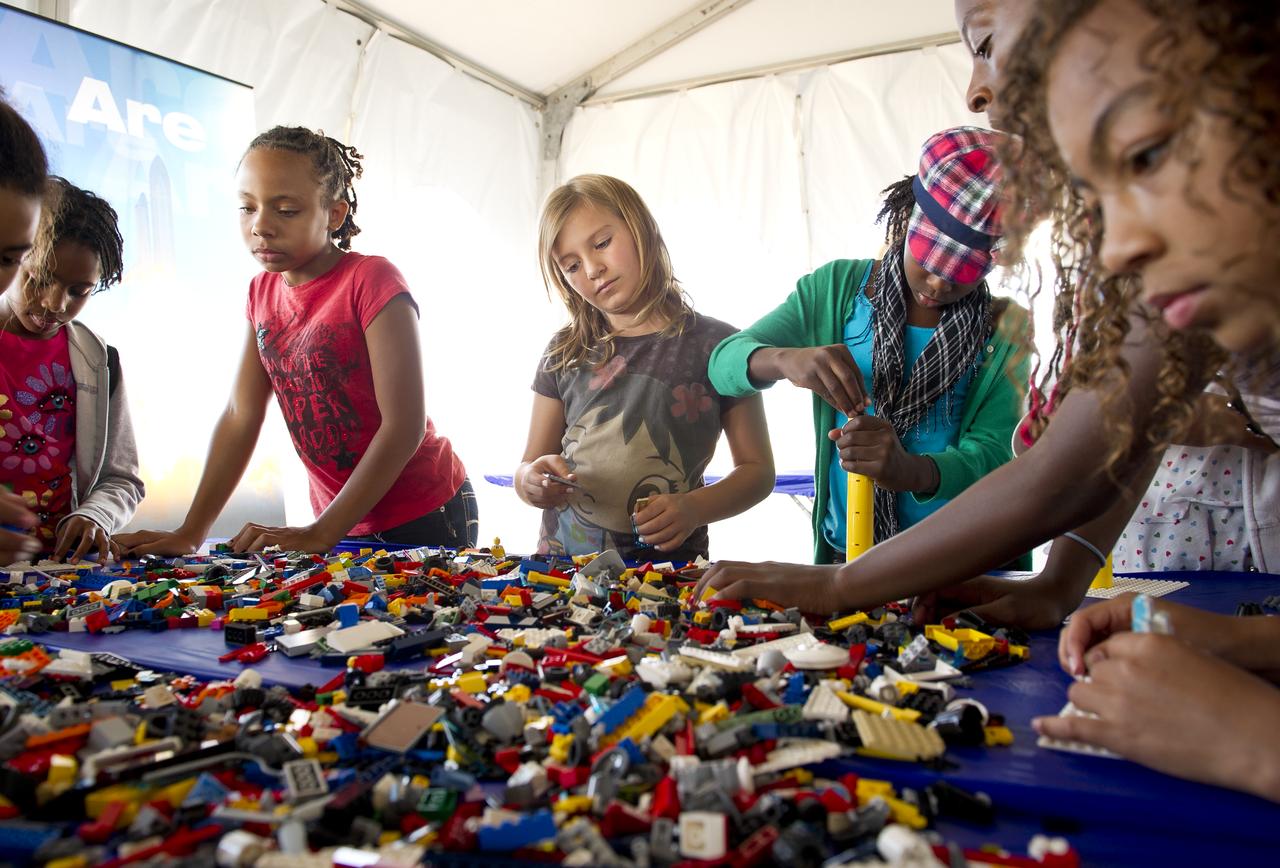
NASA Officials, LEGO Group management, students, teachers and parents create their vision of the future in space with LEGO bricks and elements as part of a “Build the Future” activity inside a tent that was set up on the launch viewing area at NASA's Kennedy Space Center in Cape Canaveral, Fla. on Monday, Nov. 1, 2010. NASA and The LEGO Group signed a Space Act Agreement to spark children's interest in science, technology, engineering and math (STEM). Photo Credit: (NASA/Bill Ingalls)
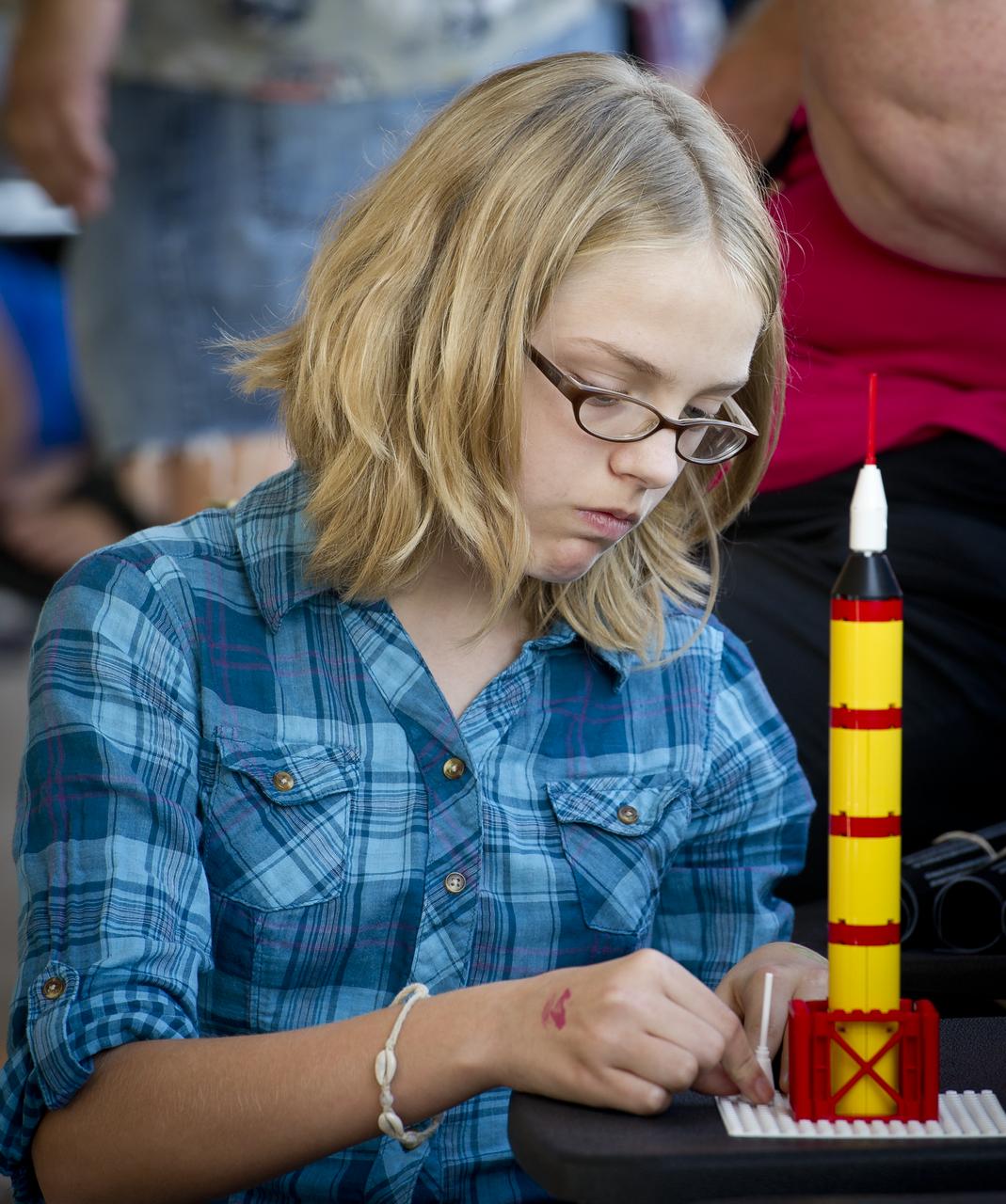
NASA Officials, LEGO Group management, students, teachers and parents create their vision of the future in space with LEGO bricks and elements as part of a “Build the Future” activity inside a tent that was set up on the launch viewing area at NASA's Kennedy Space Center in Cape Canaveral, Fla. on Monday, Nov. 1, 2010. NASA and The LEGO Group signed a Space Act Agreement to spark children's interest in science, technology, engineering and math (STEM). Photo Credit: (NASA/Bill Ingalls)
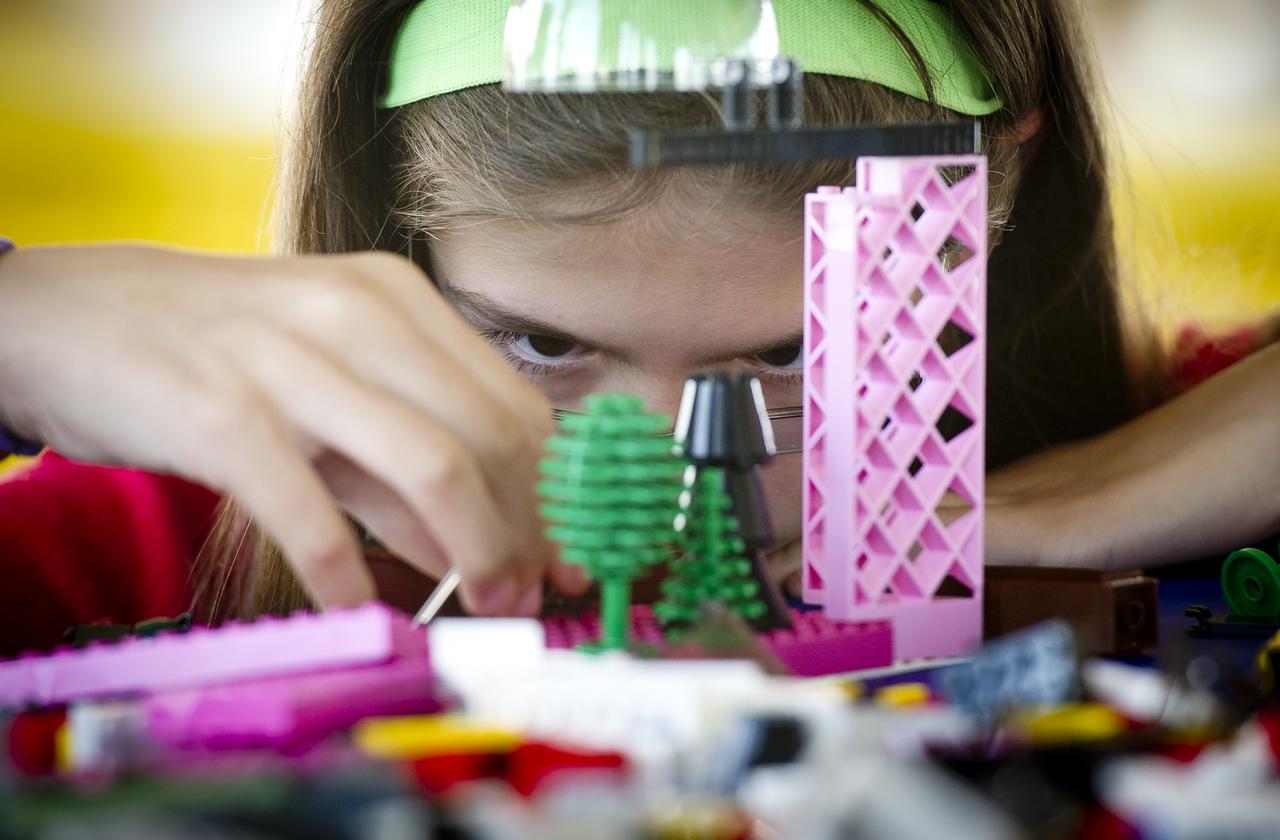
NASA Officials, LEGO Group management, students, teachers and parents create their vision of the future in space with LEGO bricks and elements as part of a “Build the Future” activity inside a tent that was set up on the launch viewing area at NASA's Kennedy Space Center in Cape Canaveral, Fla. on Monday, Nov. 1, 2010. NASA and The LEGO Group signed a Space Act Agreement to spark children's interest in science, technology, engineering and math (STEM). Photo Credit: (NASA/Bill Ingalls)
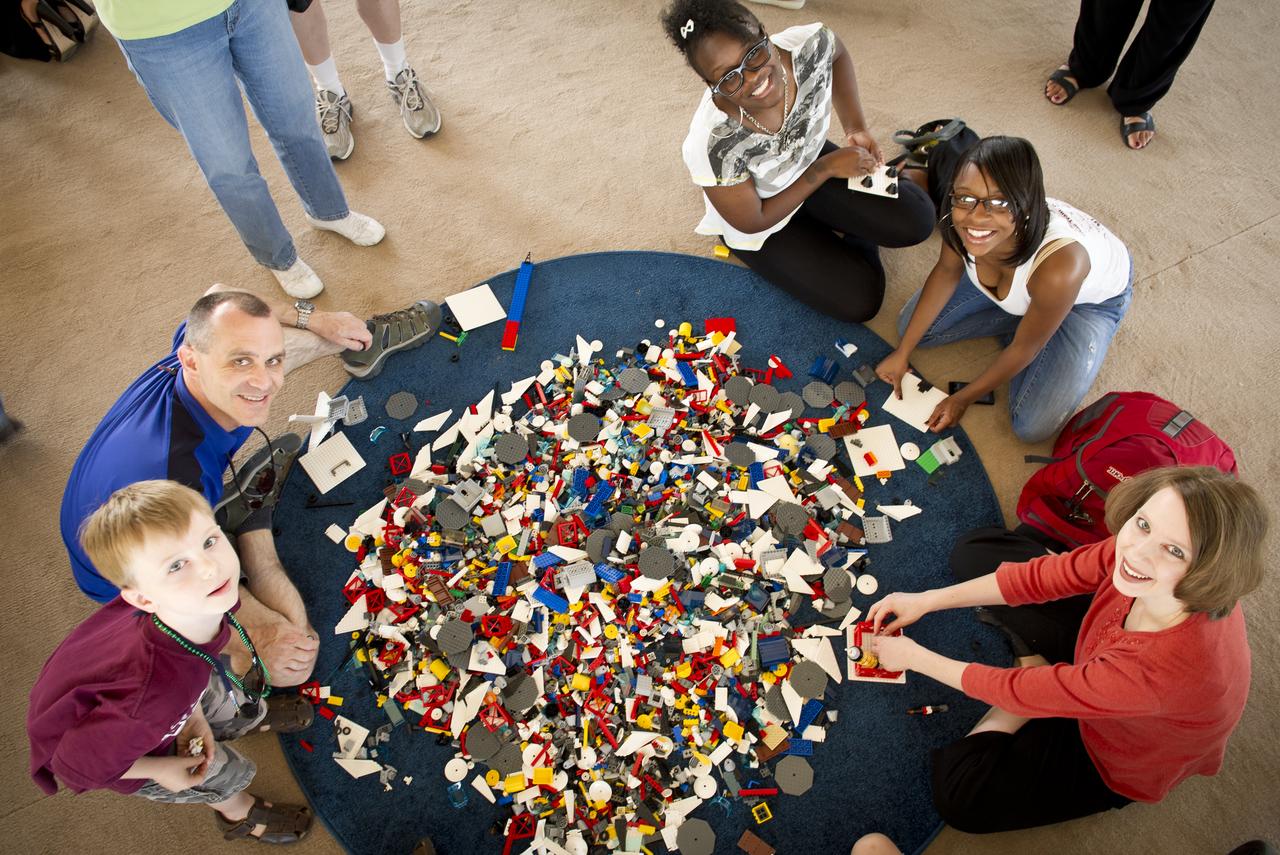
NASA Officials, LEGO Group management, students, teachers and parents create their vision of the future in space with LEGO bricks and elements as part of a “Build the Future” activity inside a tent that was set up on the launch viewing area at NASA's Kennedy Space Center in Cape Canaveral, Fla. on Monday, Nov. 1, 2010. NASA and The LEGO Group signed a Space Act Agreement to spark children's interest in science, technology, engineering and math (STEM). Photo Credit: (NASA/Bill Ingalls)
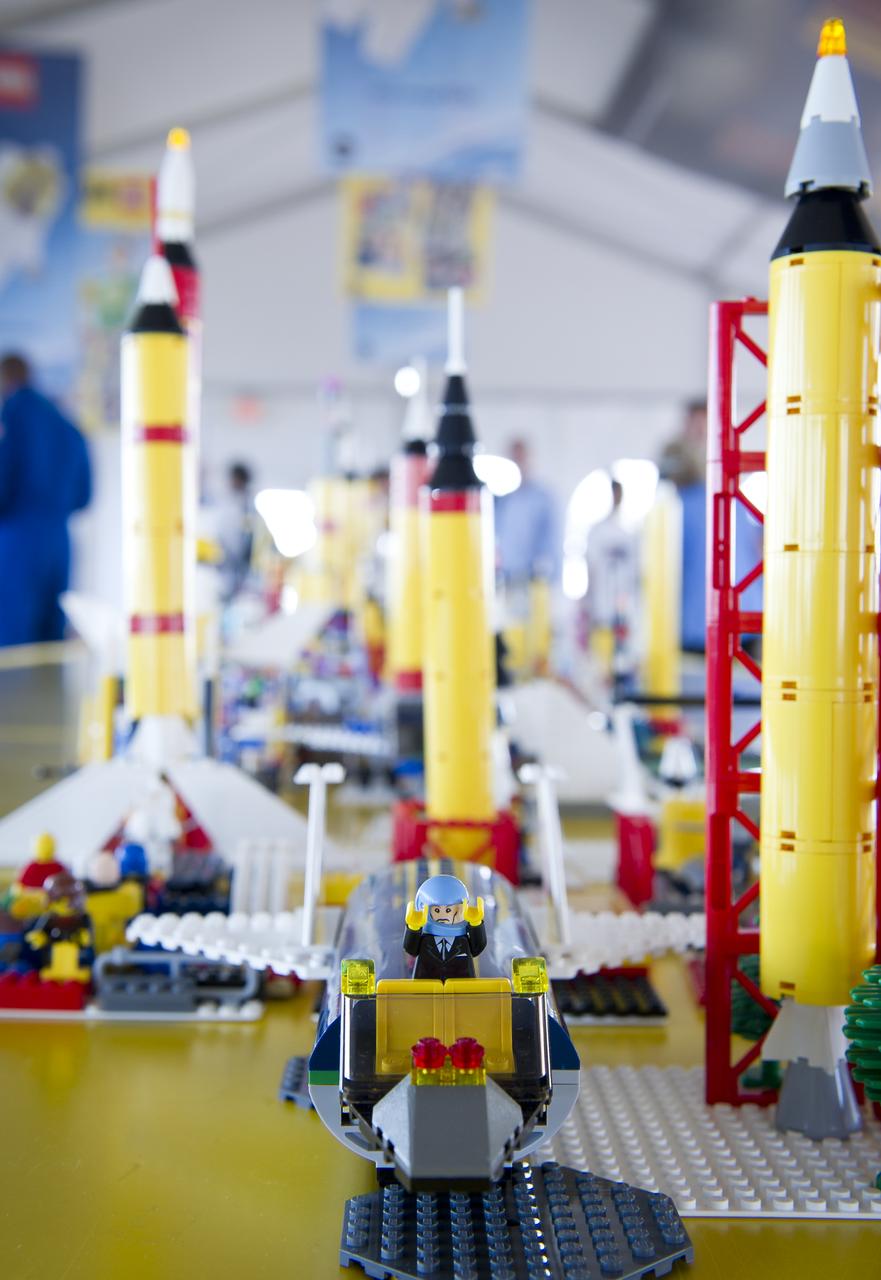
LEGOs are seen assembled by students as part of a “Build the Future” activity inside a tent that was set up on the launch viewing area at NASA's Kennedy Space Center in Cape Canaveral, Fla. on Wednesday, Nov. 3, 2010. NASA and The LEGO Group signed a Space Act Agreement to spark children's interest in science, technology, engineering and math (STEM). Photo Credit: (NASA/Bill Ingalls)

CAPE CANAVERAL, Fla. – A lightning strike sparks a brush fire near Headquarters Building in the Industrial Area of NASA’s Kennedy Space Center in Florida. The space center is nestled on the Merritt Island National Wildlife Refuge, which is managed by the U.S. Fish and Wildlife Service. Chenega Security & Support Solutions is responsible for Kennedy's Fire Rescue Department. For information on the refuge, visit http://www.fws.gov/merrittisland/Index.html. For more on Kennedy Space Center, visit http://www.nasa.gov/kennedy. Photo credit: NASA/Ben Smegelsky
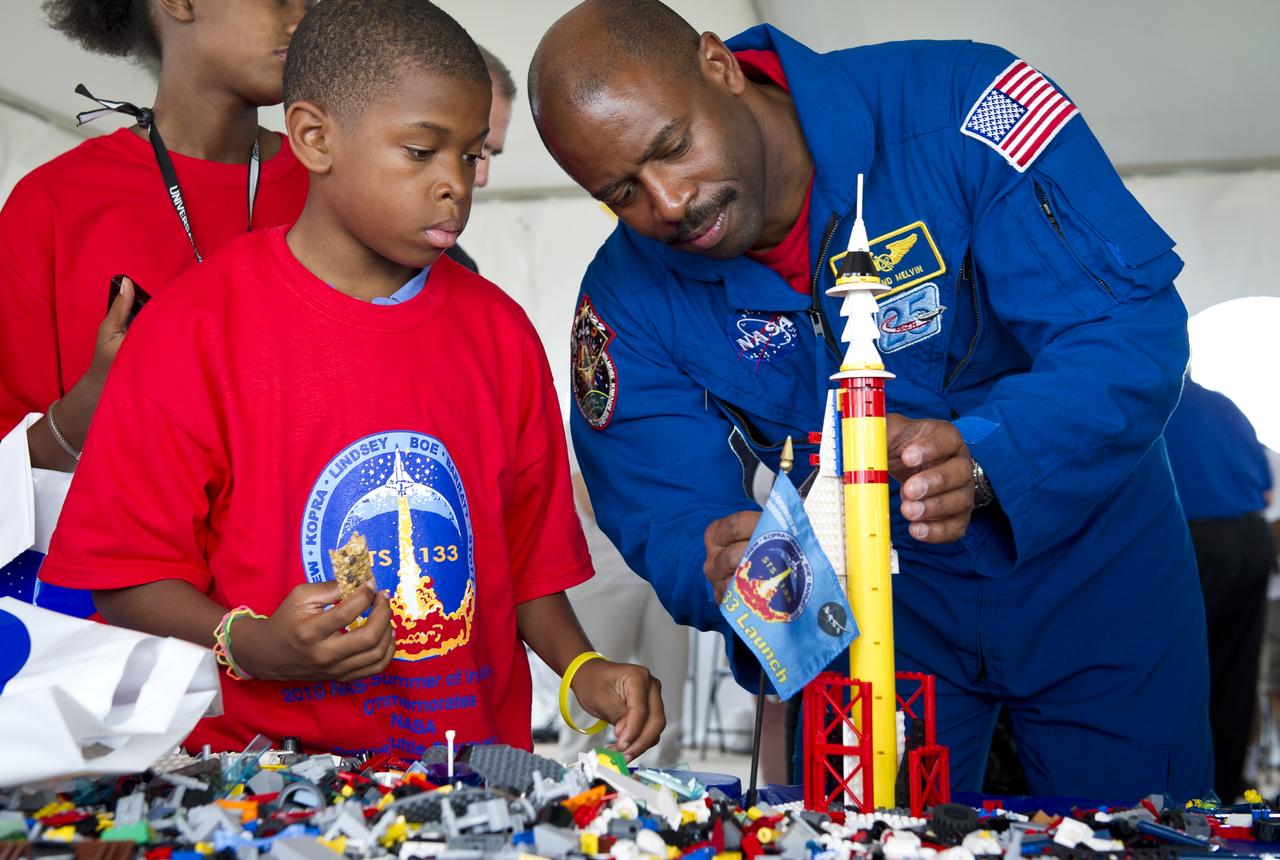
Associate Administrator for Education and Astronaut Leland Melvin talks with school children during the “Build the Future” activity where students created their vision of the future in space with LEGO bricks and elements inside a tent that was set up on the launch viewing area at NASA's Kennedy Space Center in Cape Canaveral, Fla. on Monday, Nov. 1, 2010. NASA and The LEGO Group signed a Space Act Agreement to spark children's interest in science, technology, engineering and math (STEM). Photo Credit: (NASA/Bill Ingalls)

NASA Officials, LEGO Group management, students, teachers and parents create their vision of the future in space with LEGO bricks and elements as part of a “Build the Future” activity inside a tent that was set up on the launch viewing area at NASA's Kennedy Space Center in Cape Canaveral, Fla. on Monday, Nov. 1, 2010. NASA and The LEGO Group signed a Space Act Agreement to spark children's interest in science, technology, engineering and math (STEM). Photo Credit: (NASA/Bill Ingalls)
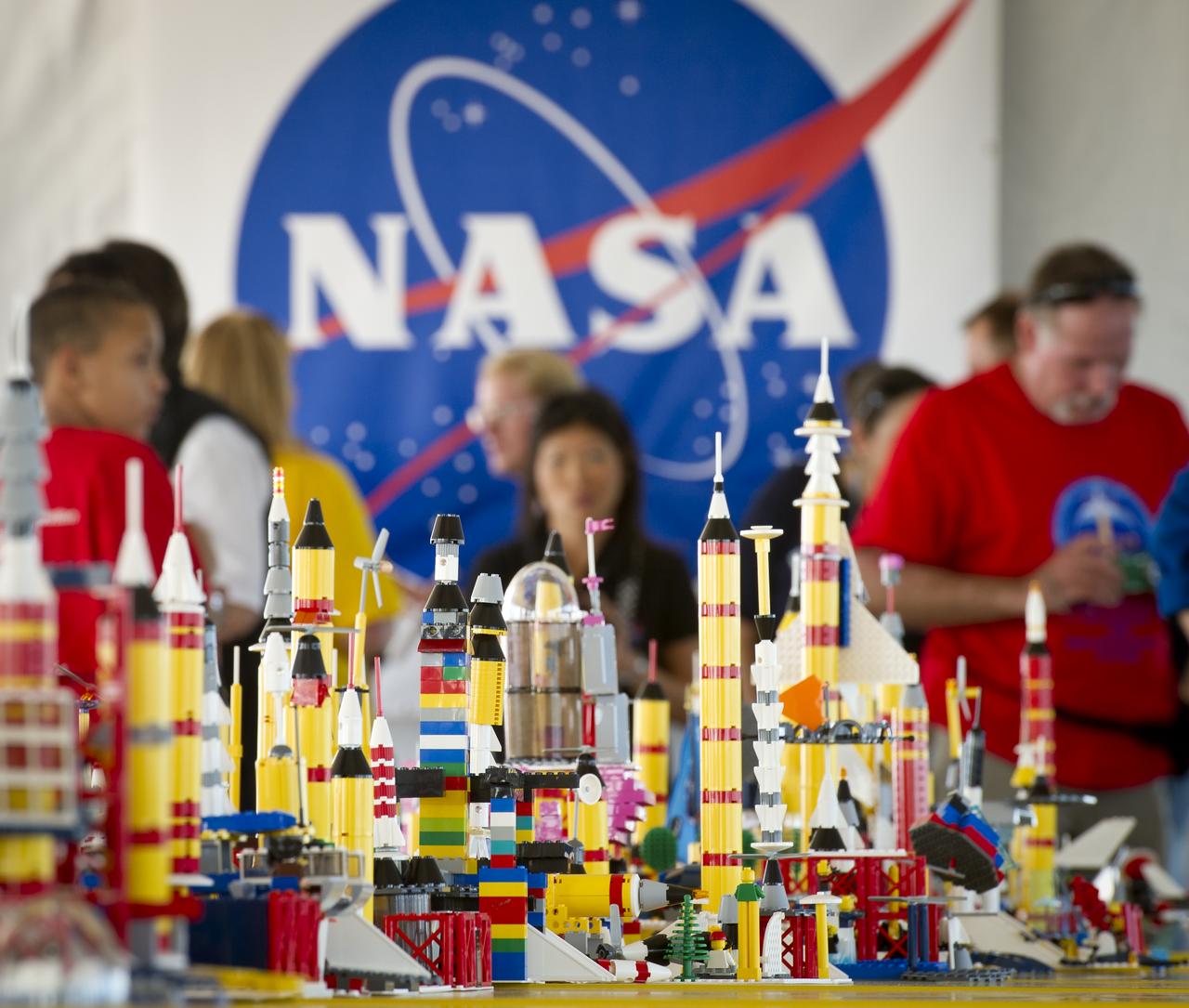
LEGOs are seen assembled by students as part of a “Build the Future” activity inside a tent that was set up on the launch viewing area at NASA's Kennedy Space Center in Cape Canaveral, Fla. on Wednesday, Nov. 3, 2010. NASA and The LEGO Group signed a Space Act Agreement to spark children's interest in science, technology, engineering and math (STEM). Photo Credit: (NASA/Bill Ingalls)
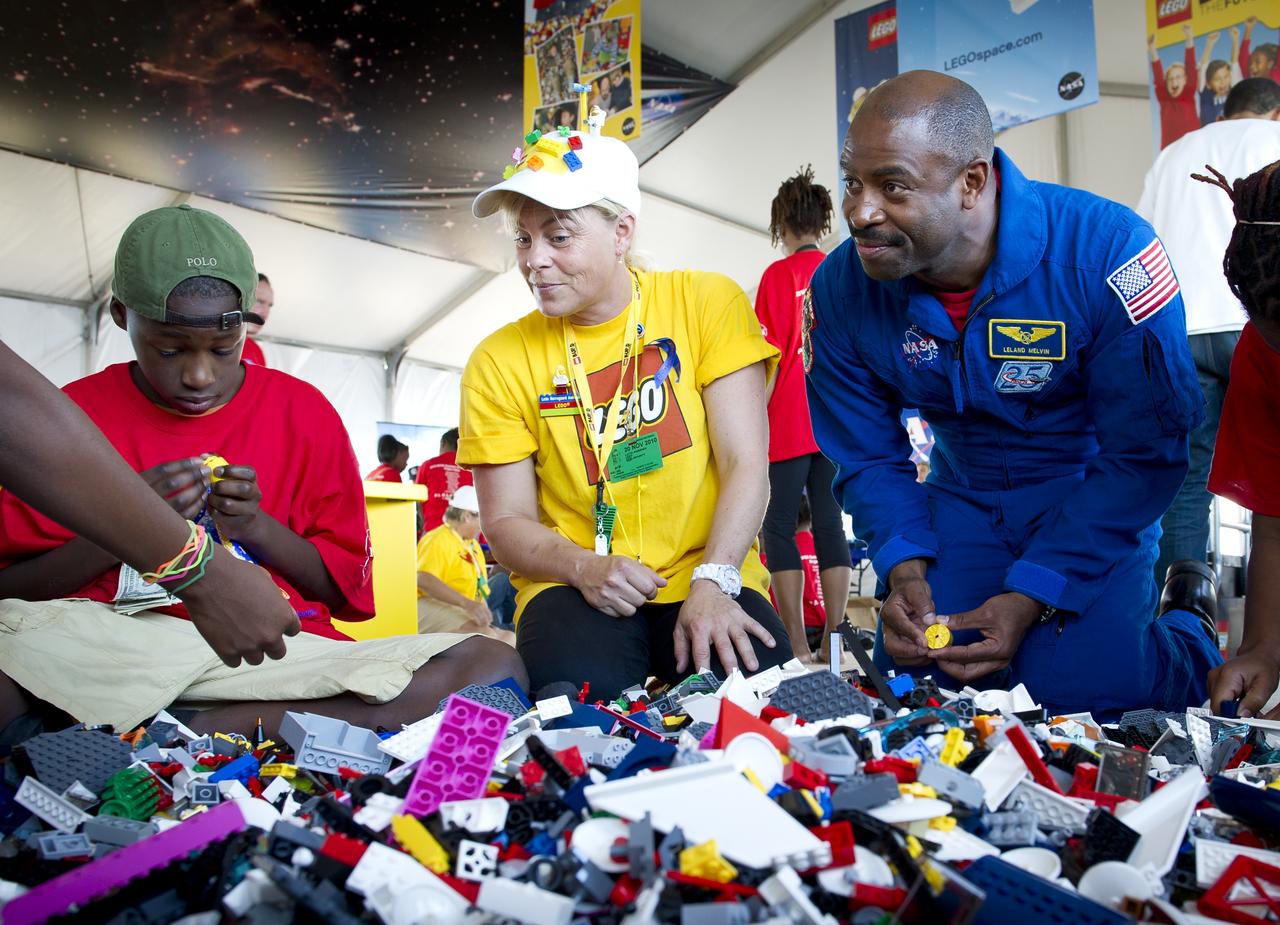
Associate Administrator for Education and Astronaut Leland Melvin talks with school children during the “Build the Future” activity where students created their vision of the future in space with LEGO bricks and elements inside a tent that was set up on the launch viewing area at NASA's Kennedy Space Center in Cape Canaveral, Fla. on Monday, Nov. 1, 2010. NASA and The LEGO Group signed a Space Act Agreement to spark children's interest in science, technology, engineering and math (STEM). Photo Credit: (NASA/Bill Ingalls)
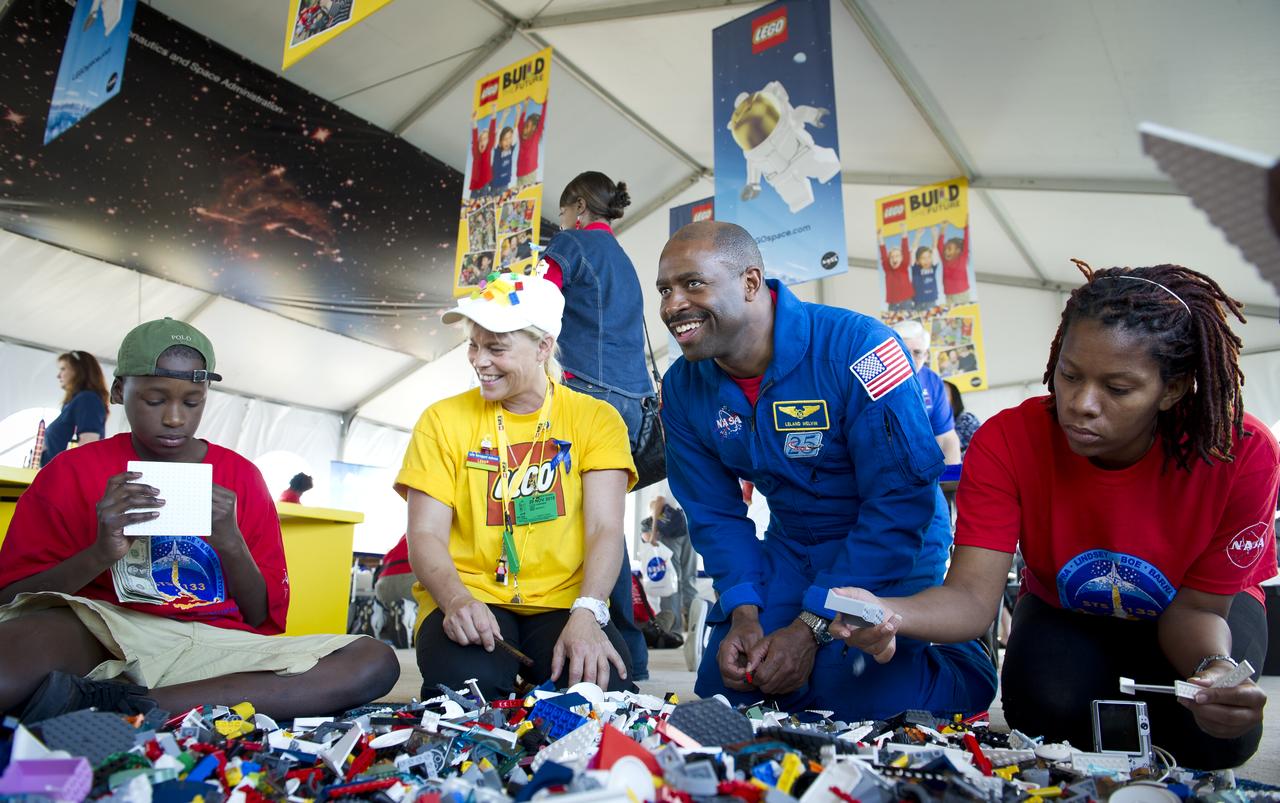
Associate Administrator for Education and Astronaut Leland Melvin, 3rd from left, talks with school children during the “Build the Future” activity where students created their vision of the future in space with LEGO bricks and elements inside a tent that was set up on the launch viewing area at NASA's Kennedy Space Center in Cape Canaveral, Fla. on Monday, Nov. 1, 2010. NASA and The LEGO Group signed a Space Act Agreement to spark children's interest in science, technology, engineering and math (STEM). Photo Credit: (NASA/Bill Ingalls)
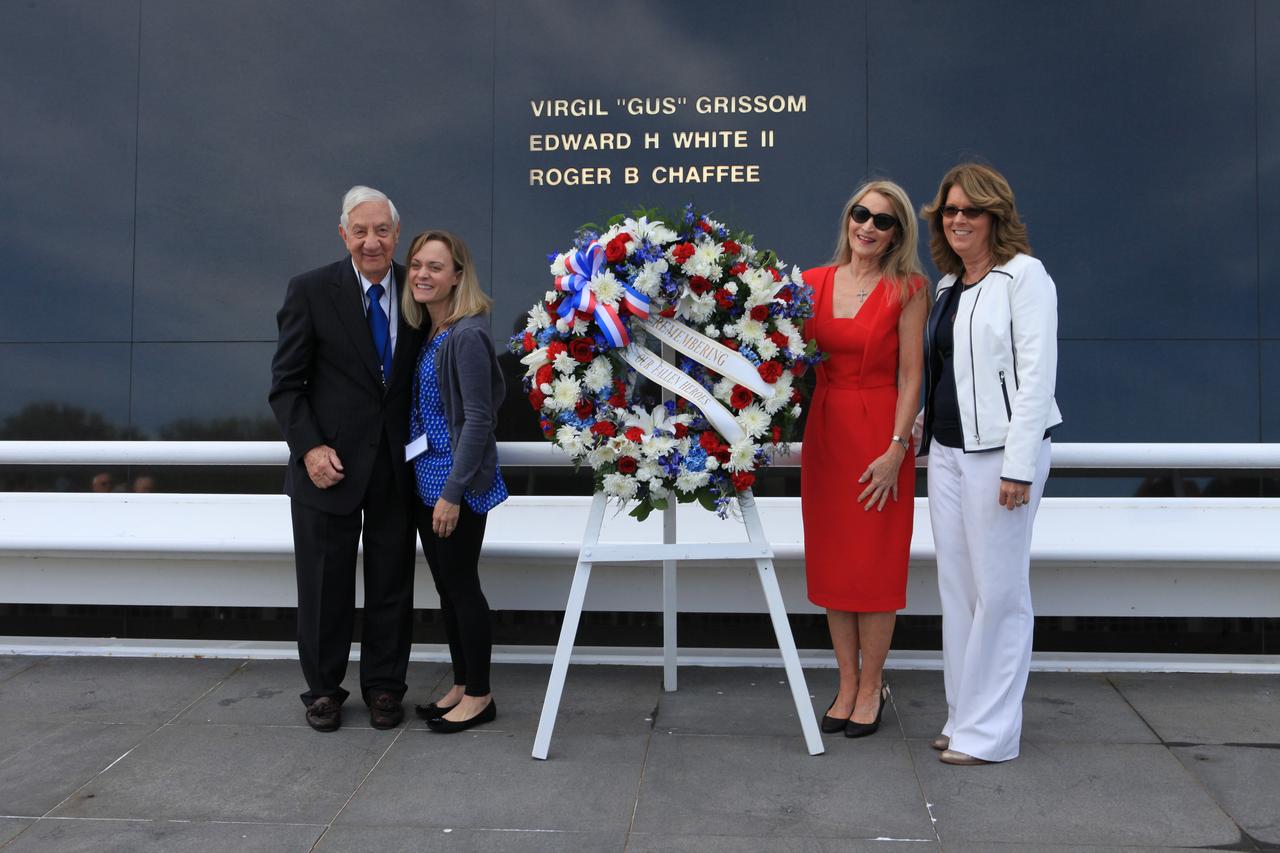
Family members of fallen Apollo 1 astronauts gather beside a wreath placed at the Space Mirror Memorial following Kennedy Space Center's Day of Remembrance ceremony at the Kennedy visitor complex. From left to right are Lowell Grissom, brother of astronaut Gus Grissom; Carly Sparks, granddaughter of Grissom; Bonnie White Baer, daughter of astronaut Ed White II; and Sheryl Chaffee, daughter of Roger Chaffee.
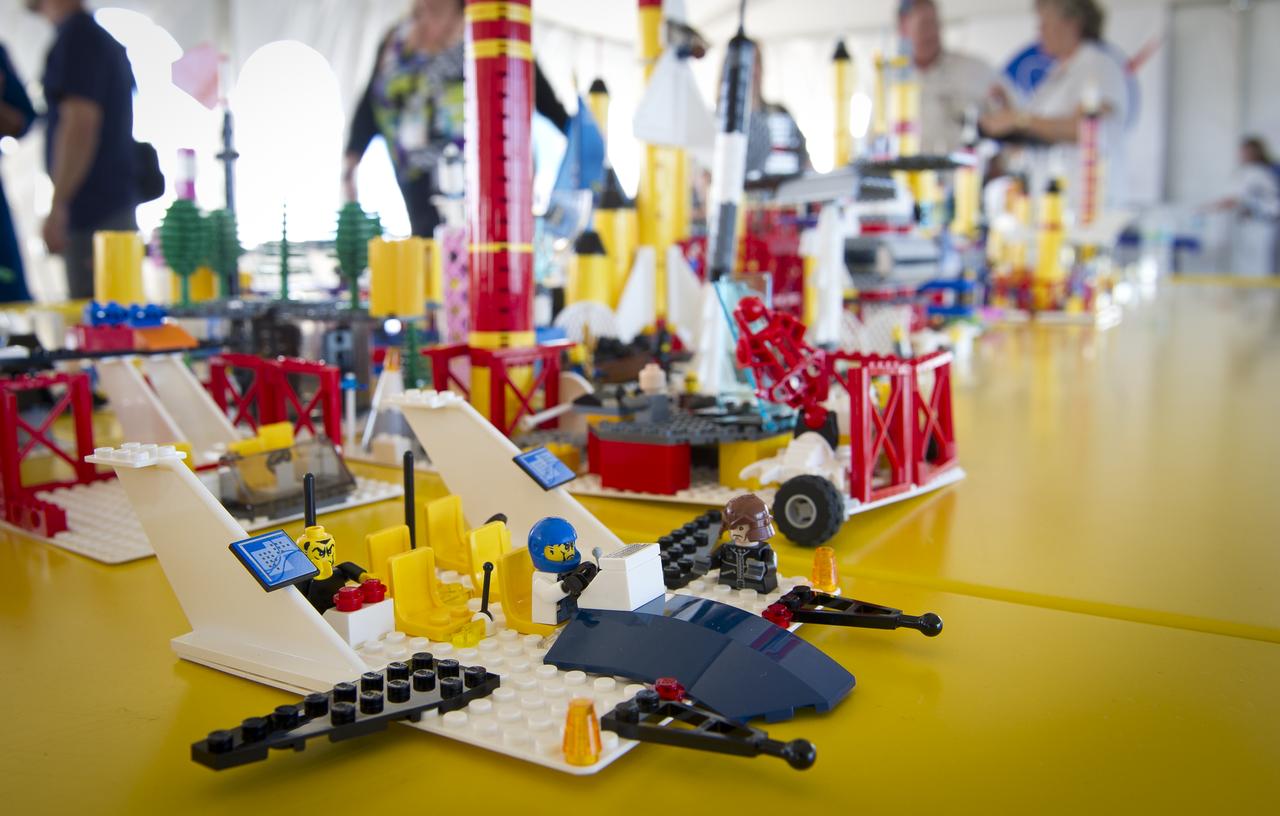
LEGOs are seen assembled by students as part of a “Build the Future” activity inside a tent that was set up on the launch viewing area at NASA's Kennedy Space Center in Cape Canaveral, Fla. on Wednesday, Nov. 3, 2010. NASA and The LEGO Group signed a Space Act Agreement to spark children's interest in science, technology, engineering and math (STEM). Photo Credit: (NASA/Bill Ingalls)
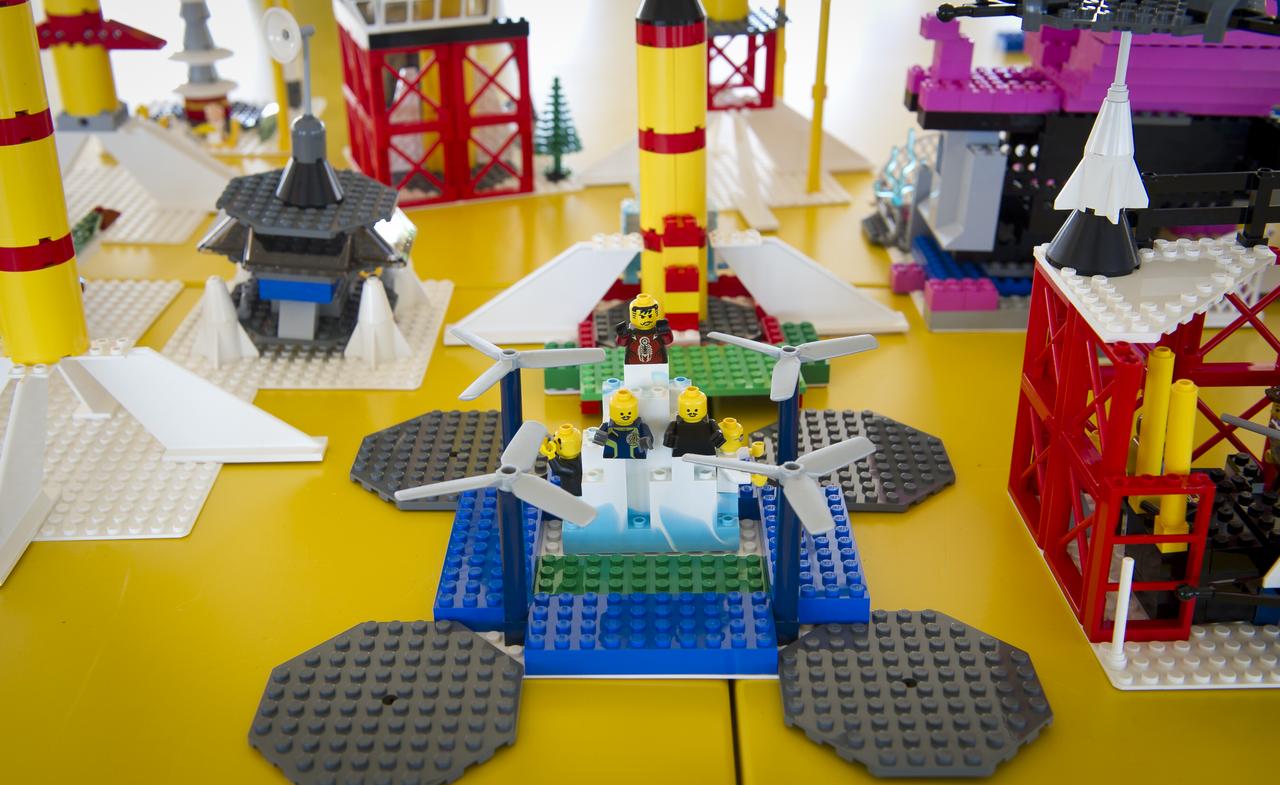
LEGOs are seen assembled by students as part of a “Build the Future” activity inside a tent that was set up on the launch viewing area at NASA's Kennedy Space Center in Cape Canaveral, Fla. on Wednesday, Nov. 3, 2010. NASA and The LEGO Group signed a Space Act Agreement to spark children's interest in science, technology, engineering and math (STEM). Photo Credit: (NASA/Bill Ingalls)
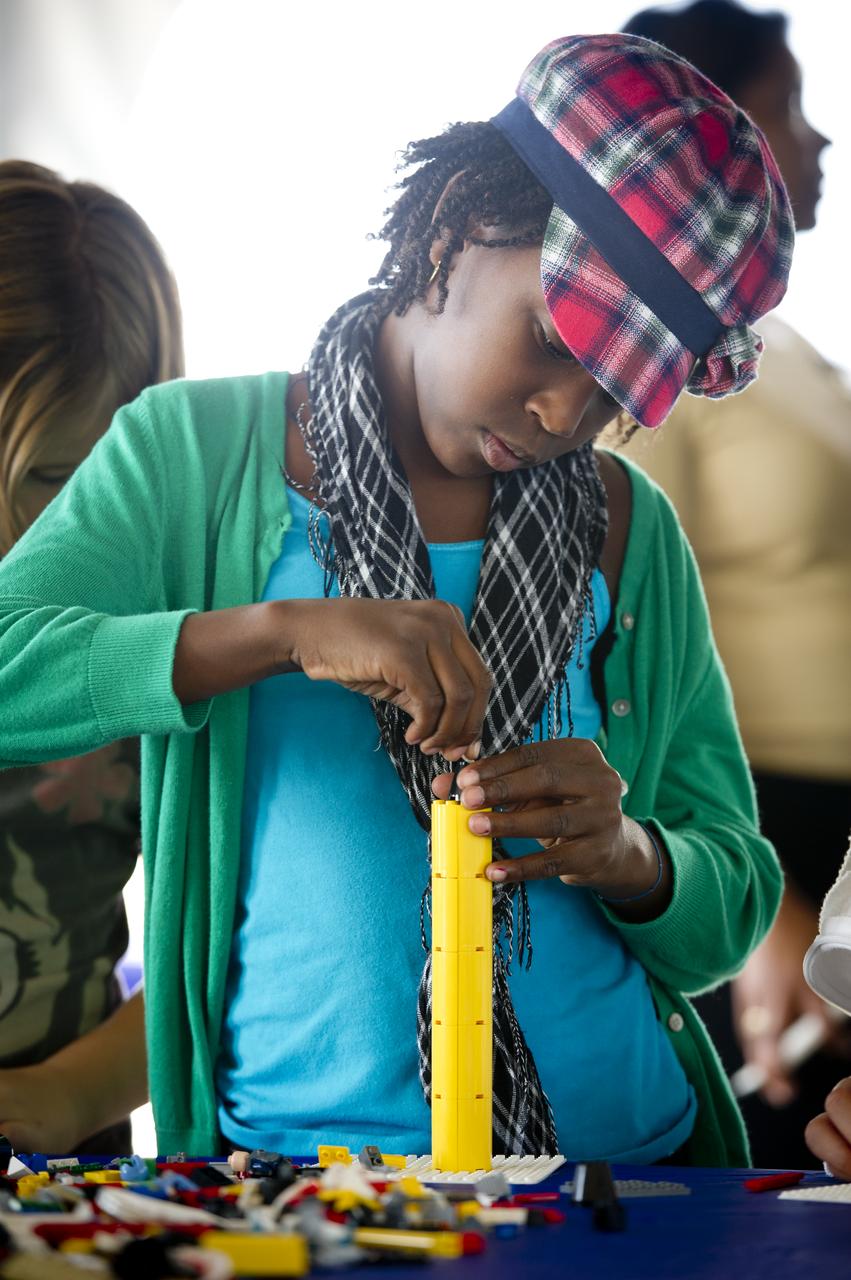
NASA Officials, LEGO Group management, students, teachers and parents create their vision of the future in space with LEGO bricks and elements as part of a “Build the Future” activity inside a tent that was set up on the launch viewing area at NASA's Kennedy Space Center in Cape Canaveral, Fla. on Monday, Nov. 1, 2010. NASA and The LEGO Group signed a Space Act Agreement to spark children's interest in science, technology, engineering and math (STEM). Photo Credit: (NASA/Bill Ingalls)
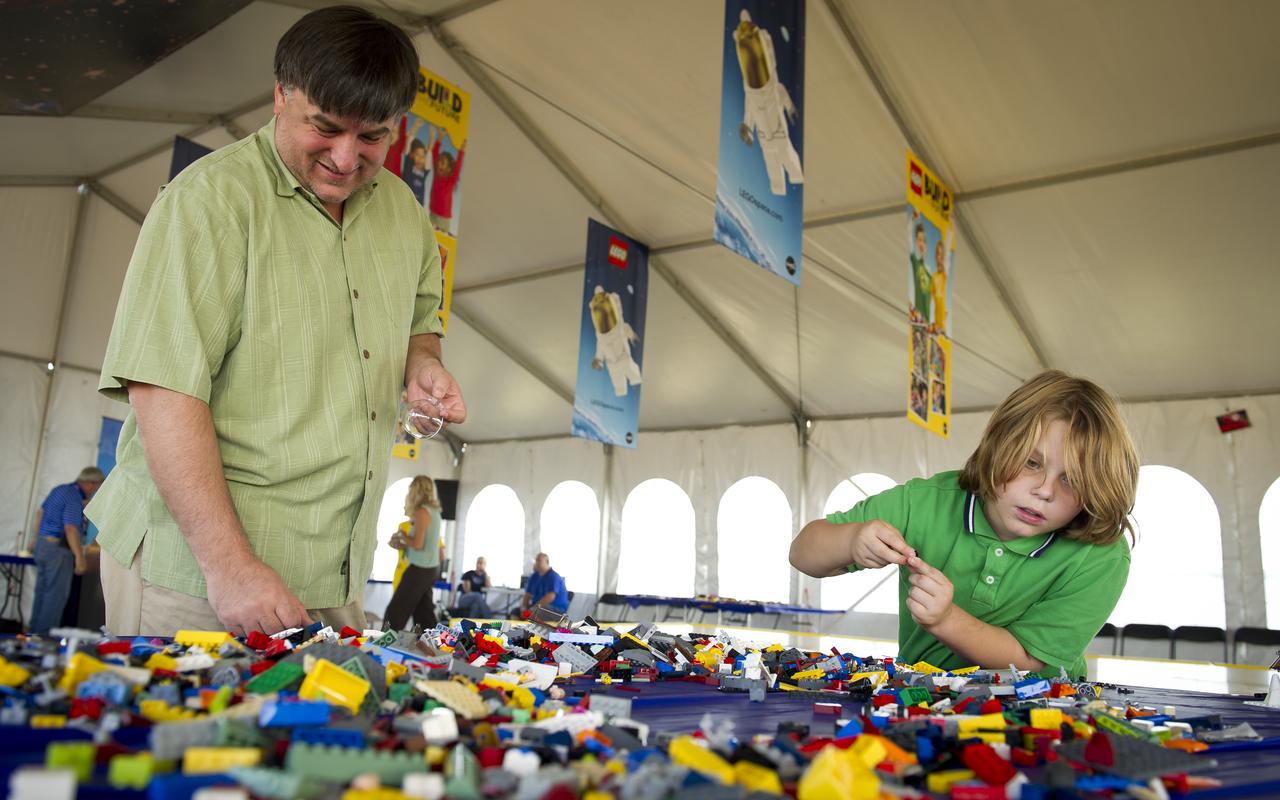
NASA Officials, LEGO Group management, students, teachers and parents create their vision of the future in space with LEGO bricks and elements as part of a “Build the Future” activity inside a tent that was set up on the launch viewing area at NASA's Kennedy Space Center in Cape Canaveral, Fla. on Monday, Nov. 1, 2010. NASA and The LEGO Group signed a Space Act Agreement to spark children's interest in science, technology, engineering and math (STEM). Photo Credit: (NASA/Bill Ingalls)
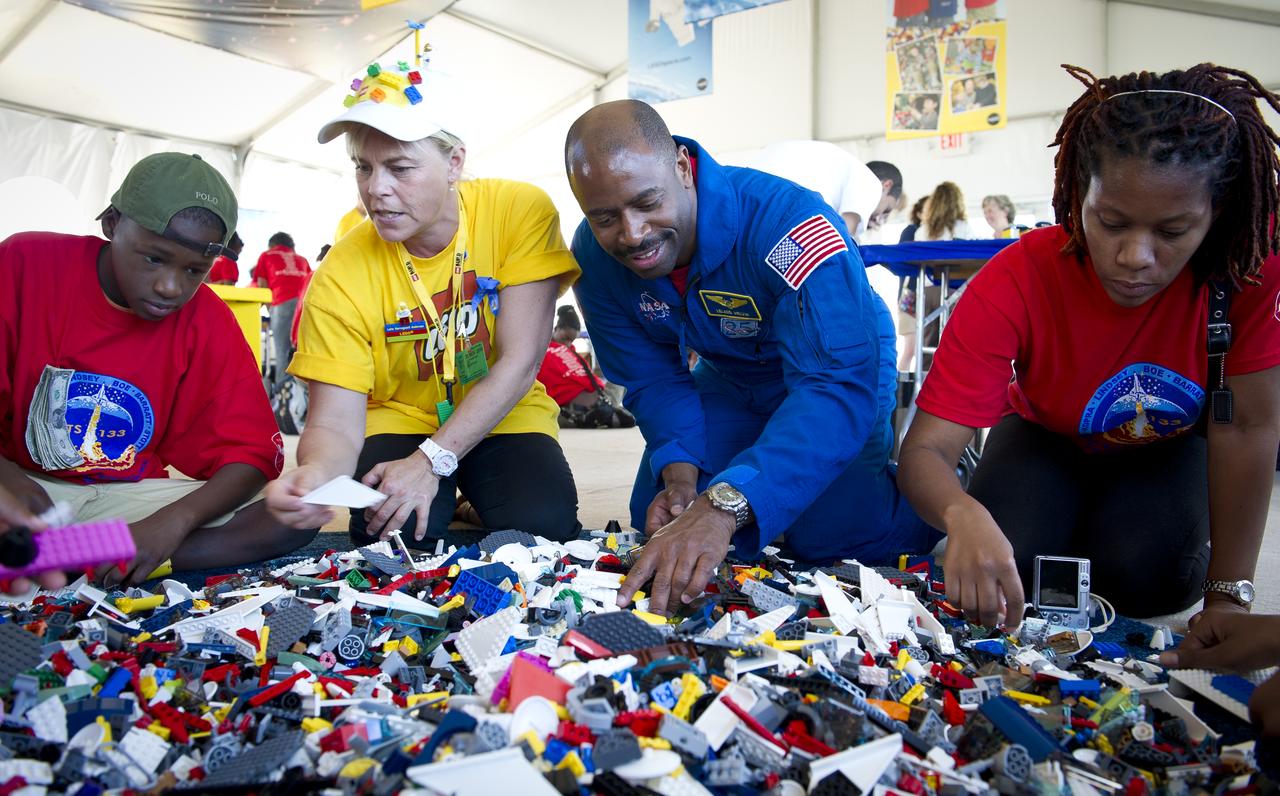
Associate Administrator for Education and Astronaut Leland Melvin, 3rd from left, talks with school children during the “Build the Future” activity where students created their vision of the future in space with LEGO bricks and elements inside a tent that was set up on the launch viewing area at NASA's Kennedy Space Center in Cape Canaveral, Fla. on Monday, Nov. 1, 2010. NASA and The LEGO Group signed a Space Act Agreement to spark children's interest in science, technology, engineering and math (STEM). Photo Credit: (NASA/Bill Ingalls)

jsc2026e034361 (April 28, 2026) --- Air sample kit and canisters are seen that collect ambient and alveolar samples for analysis of the carbon monoxide content as part of SPARK. This investigation aims to study how the spleen changes and how red blood cells break down in space to better understand the biological mechanisms of space-related anemia. Investigation findings may lead to ways to better protect crew health during long-duration space missions. Credit: Canadian Space Agency.
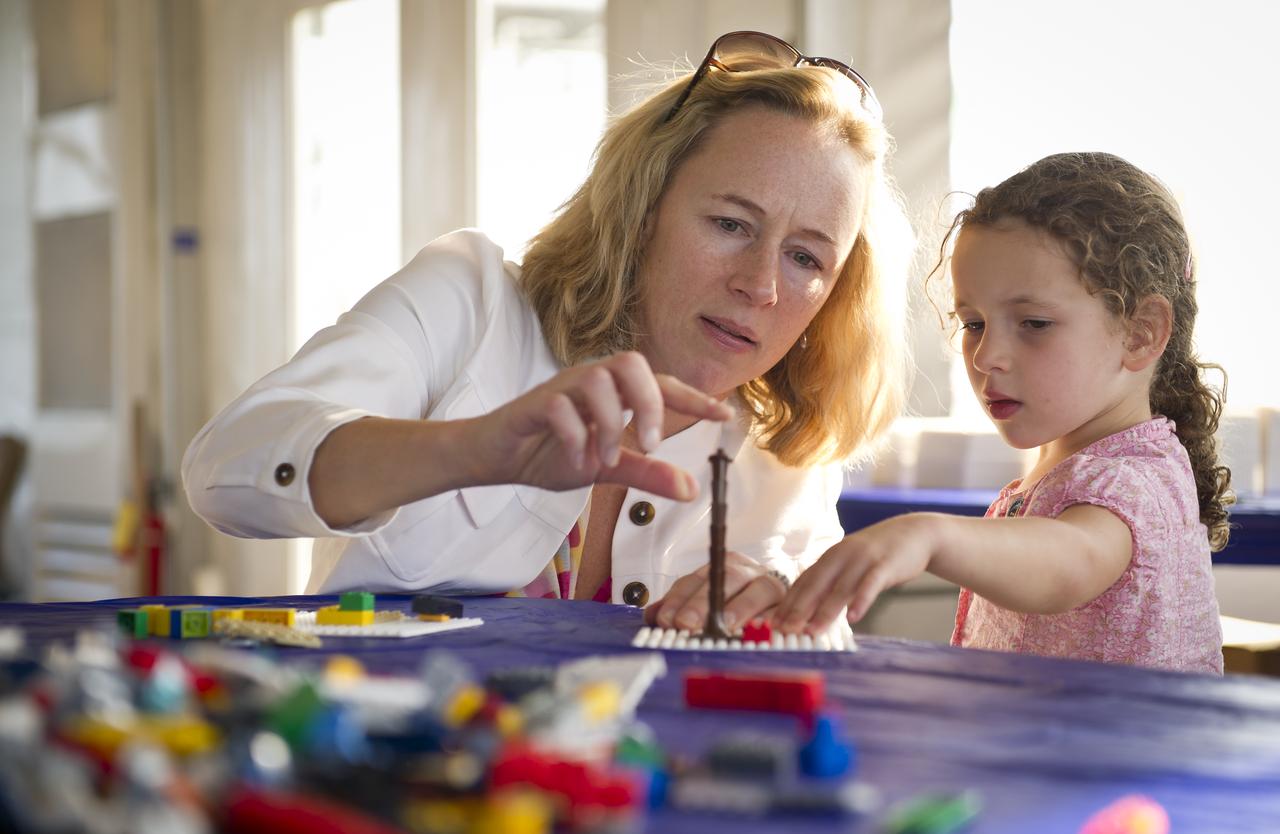
NASA Officials, LEGO Group management, students, teachers and parents create their vision of the future in space with LEGO bricks and elements as part of a “Build the Future” activity inside a tent that was set up on the launch viewing area at NASA's Kennedy Space Center in Cape Canaveral, Fla. on Monday, Nov. 1, 2010. NASA and The LEGO Group signed a Space Act Agreement to spark children's interest in science, technology, engineering and math (STEM). Photo Credit: (NASA/Bill Ingalls)
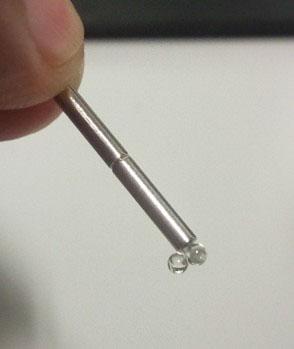
jsc2026e416051 (September 15, 2026) --- A preflight image of a new type of glass being attracted to a magnet, highlighting properties rarely seen in ordinary glass. The ELF‑Unconventional Glass 2 investigation examines how these unusual glasses form and behave in microgravity. Investigation results could reveal new ways of making glasses with unique properties and spark innovations for future technologies. Credit: Kyoto University/Atsunobo Masuno.
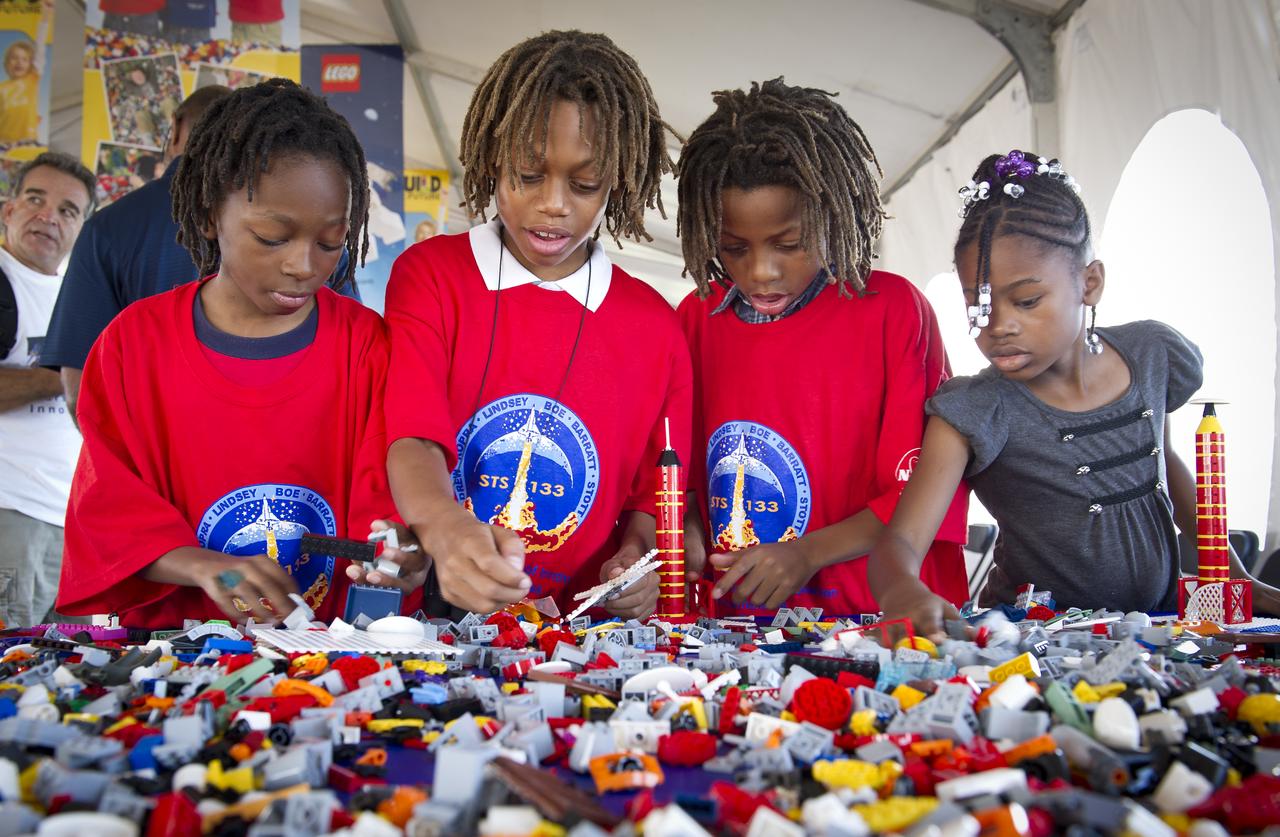
NASA Officials, LEGO Group management, students, teachers and parents create their vision of the future in space with LEGO bricks and elements as part of a “Build the Future” activity inside a tent that was set up on the launch viewing area at NASA's Kennedy Space Center in Cape Canaveral, Fla. on Wednesday, Nov. 3, 2010. NASA and The LEGO Group signed a Space Act Agreement to spark children's interest in science, technology, engineering and math (STEM). Photo Credit: (NASA/Bill Ingalls)
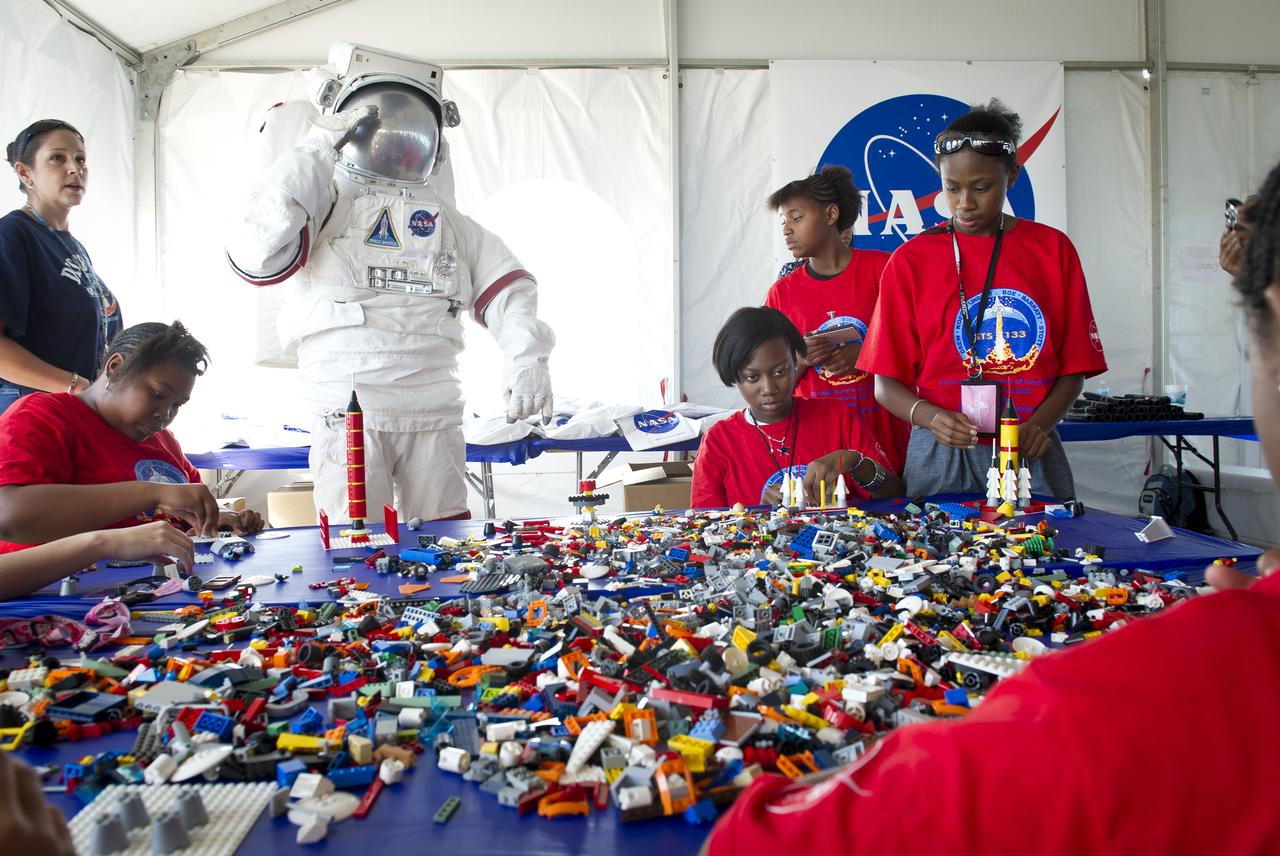
NASA Officials, LEGO Group management, students, teachers and parents create their vision of the future in space with LEGO bricks and elements as part of a “Build the Future” activity inside a tent that was set up on the launch viewing area at NASA's Kennedy Space Center in Cape Canaveral, Fla. on Wednesday, Nov. 3, 2010. NASA and The LEGO Group signed a Space Act Agreement to spark children's interest in science, technology, engineering and math (STEM). Photo Credit: (NASA/Bill Ingalls)
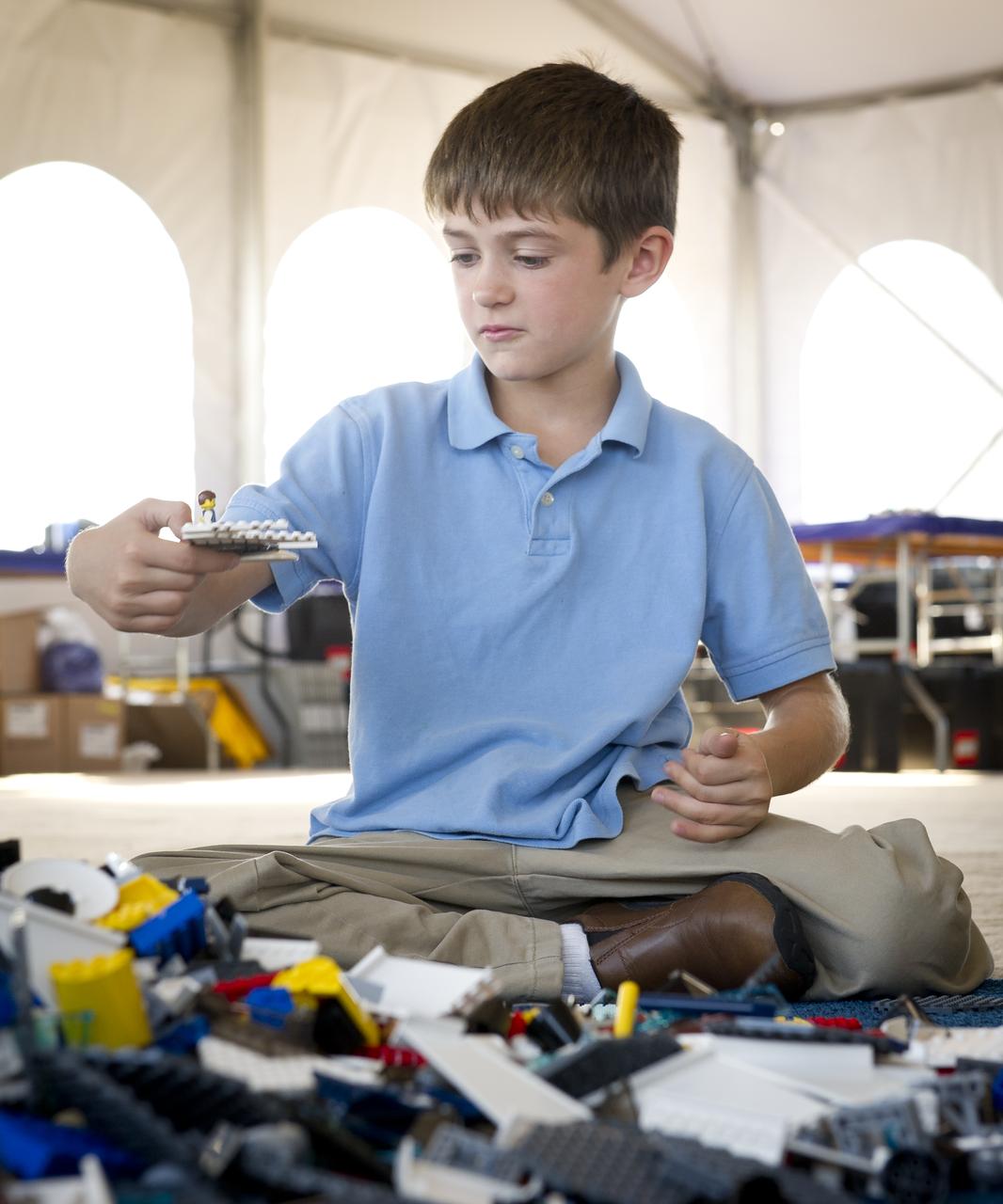
NASA Officials, LEGO Group management, students, teachers and parents create their vision of the future in space with LEGO bricks and elements as part of a “Build the Future” activity inside a tent that was set up on the launch viewing area at NASA's Kennedy Space Center in Cape Canaveral, Fla. on Monday, Nov. 1, 2010. NASA and The LEGO Group signed a Space Act Agreement to spark children's interest in science, technology, engineering and math (STEM). Photo Credit: (NASA/Bill Ingalls)
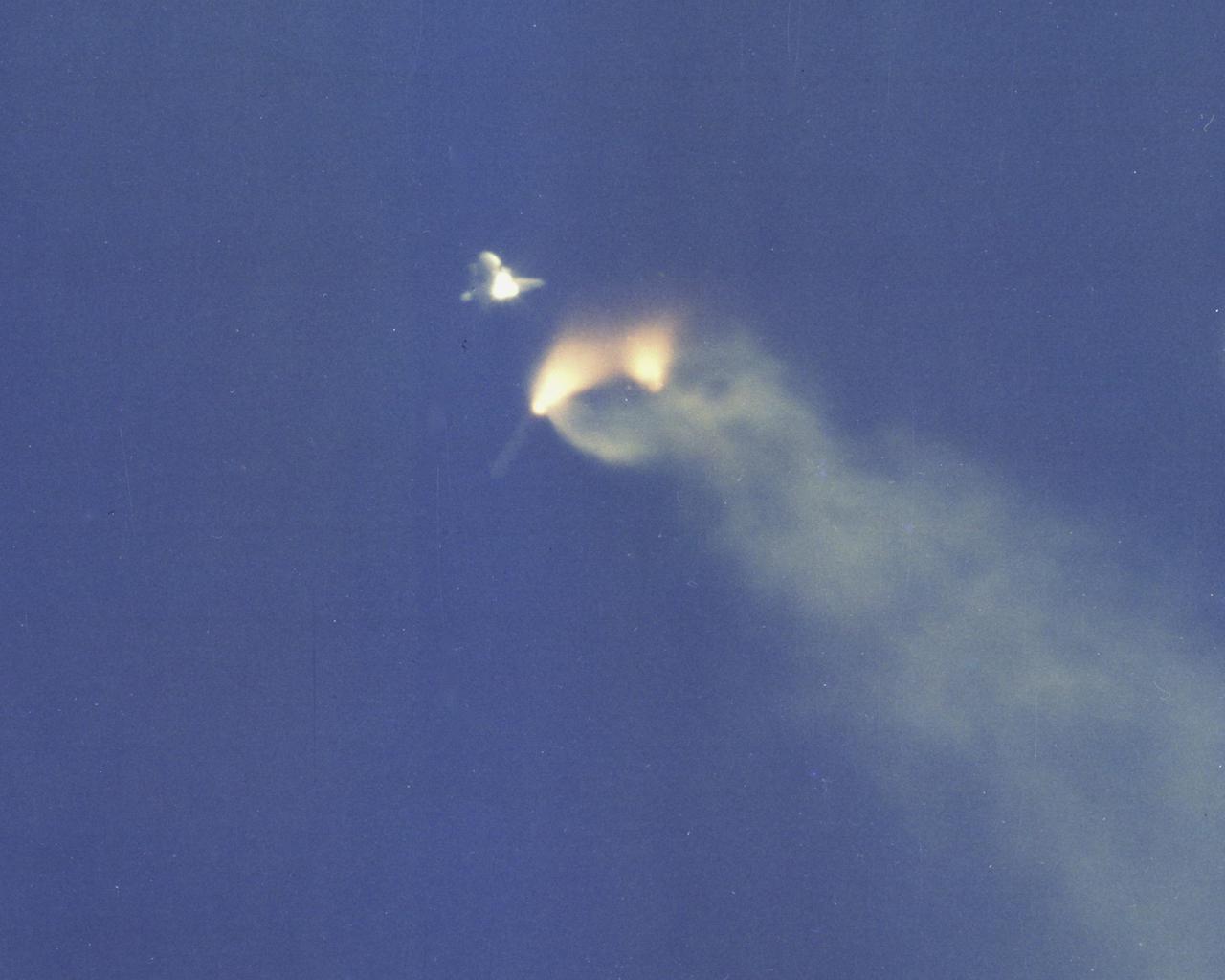
KENNEDY SPACE CENTER, FLA. - Separation of the Space Shuttle’s solid rocket boosters (SRB’s) occurs at two minutes, 11 seconds after launch from Pad A, Launch Complex 39. This sequence, showing initiation of separations, and falling away of the two booster casings, still spewing sparks from their white-hot linings, was taken by a 70mm radar-tracked Photosonic motion picture camera with a 360-inch focal lens, from Universal Camera Site 10, located on KSC approximately eight miles north of the launch pad. The three frames were taken from a 1,000 foot run of EF film exposed at a rate of 40 frames per second.
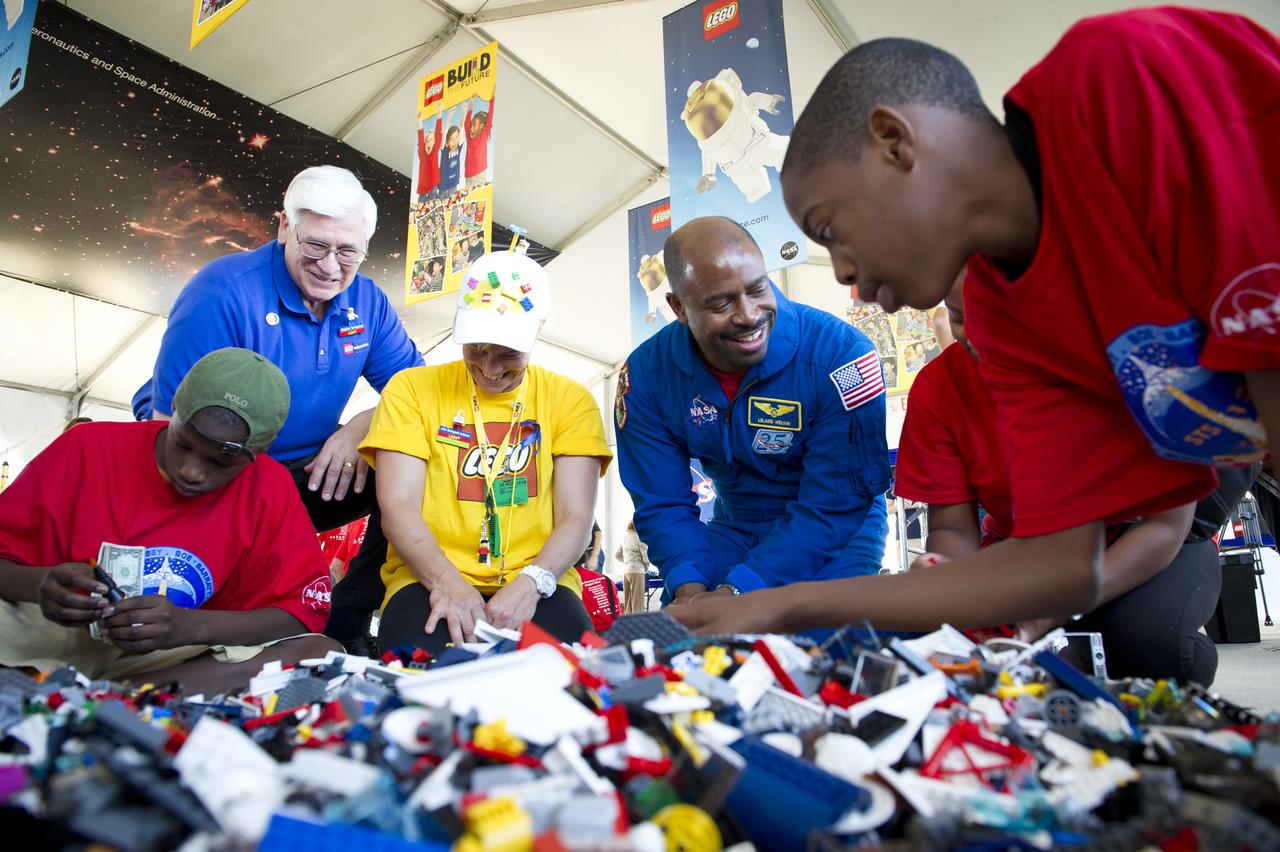
President of LEGO Education USA Stephan Turnipseed, back left, and Associate Administrator for Education and Astronaut Leland Melvin, 2nd from right, talk with a student during the “Build the Future” activity where students created their vision of the future in space with LEGO bricks and elements inside a tent that was set up on the launch viewing area at NASA's Kennedy Space Center in Cape Canaveral, Fla. on Monday, Nov. 1, 2010. NASA and The LEGO Group signed a Space Act Agreement to spark children's interest in science, technology, engineering and math (STEM). Photo Credit: (NASA/Bill Ingalls)
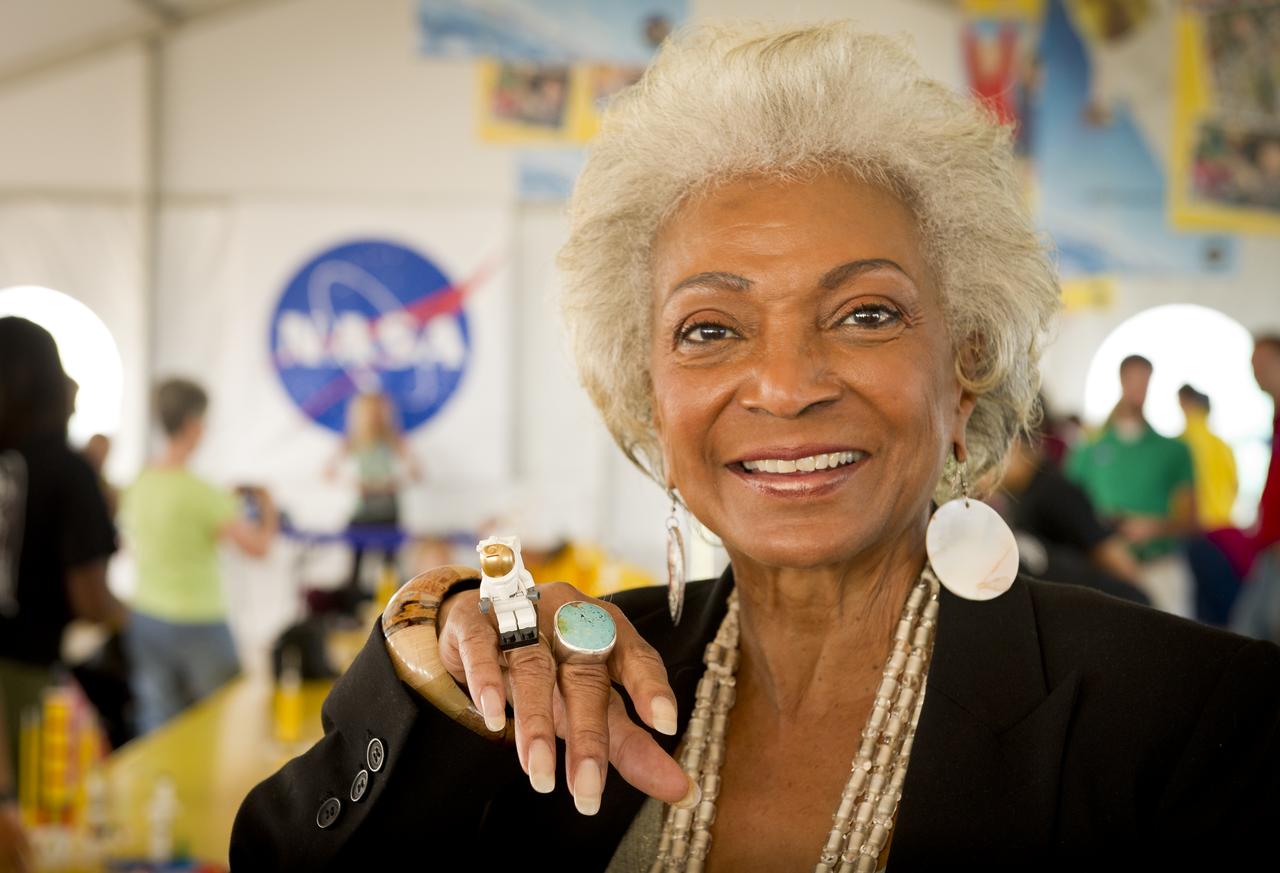
Actress Nichelle Nichols, known for her most famous role as communications officer Lieutenant Uhura aboard the USS Enterprise in the popular Star Trek television series, displays her Lego astronaut ring while visiting the “Build the Future” activity where students created their vision of the future in space with LEGO bricks and elements inside a tent that was set up on the launch viewing area at NASA's Kennedy Space Center in Cape Canaveral, Fla. on Monday, Nov. 1, 2010. NASA and The LEGO Group signed a Space Act Agreement to spark children's interest in science, technology, engineering and math (STEM). Photo Credit: (NASA/Bill Ingalls)
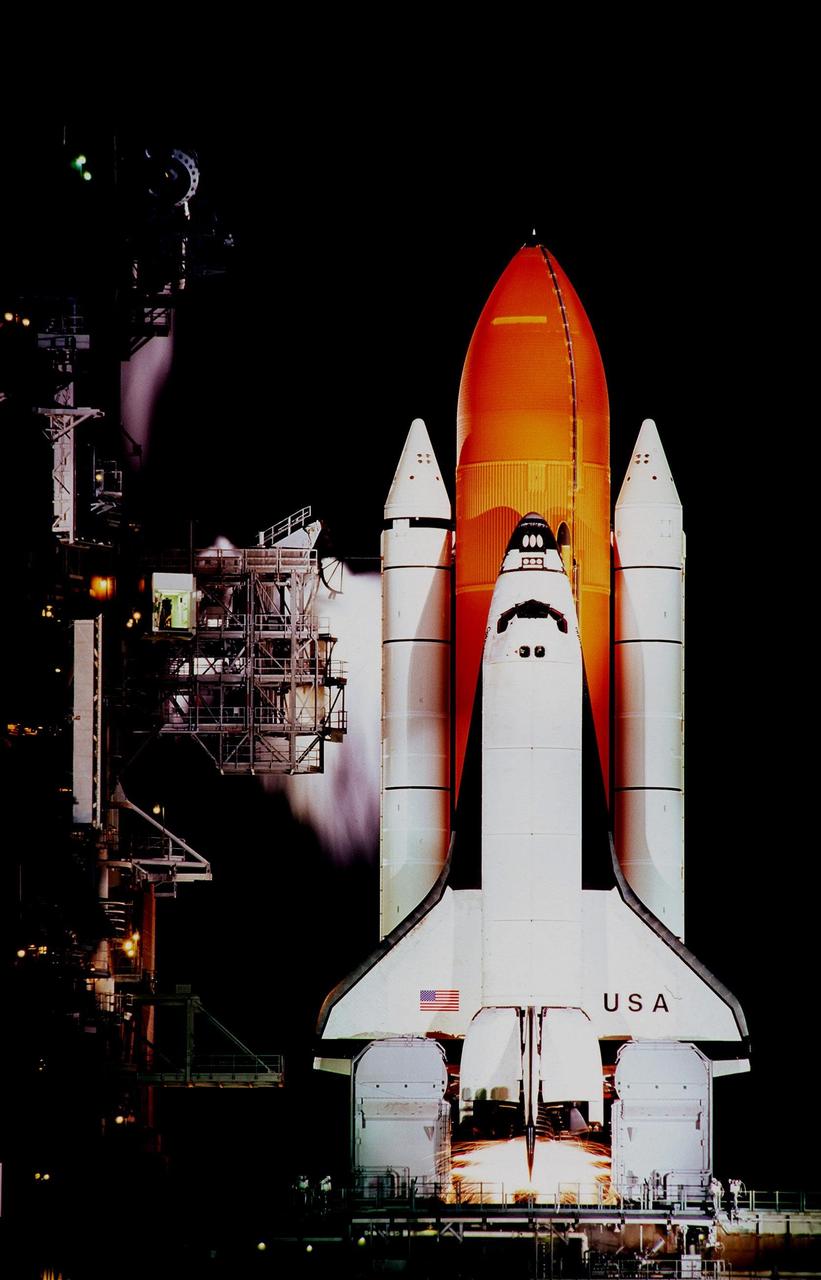
Moments before launch, sparks from the external ignitors are visible below the engines of Space Shuttle Columbia. The ignitors burn off a hydrogen concentration outside the orbiter near the main engines. A cloud effect behind the Shuttle's solid rocket booster and access arm to the left is created by spray from the water deluge system. The launch of STS-93 was scrubbed at the T-7 second mark in the countdown due to an indication of a high concentration of hydrogen in an aft engine compartment. The reading was proven to be a false alarm. The launch is rescheduled for July 22 at 12:28 a.m
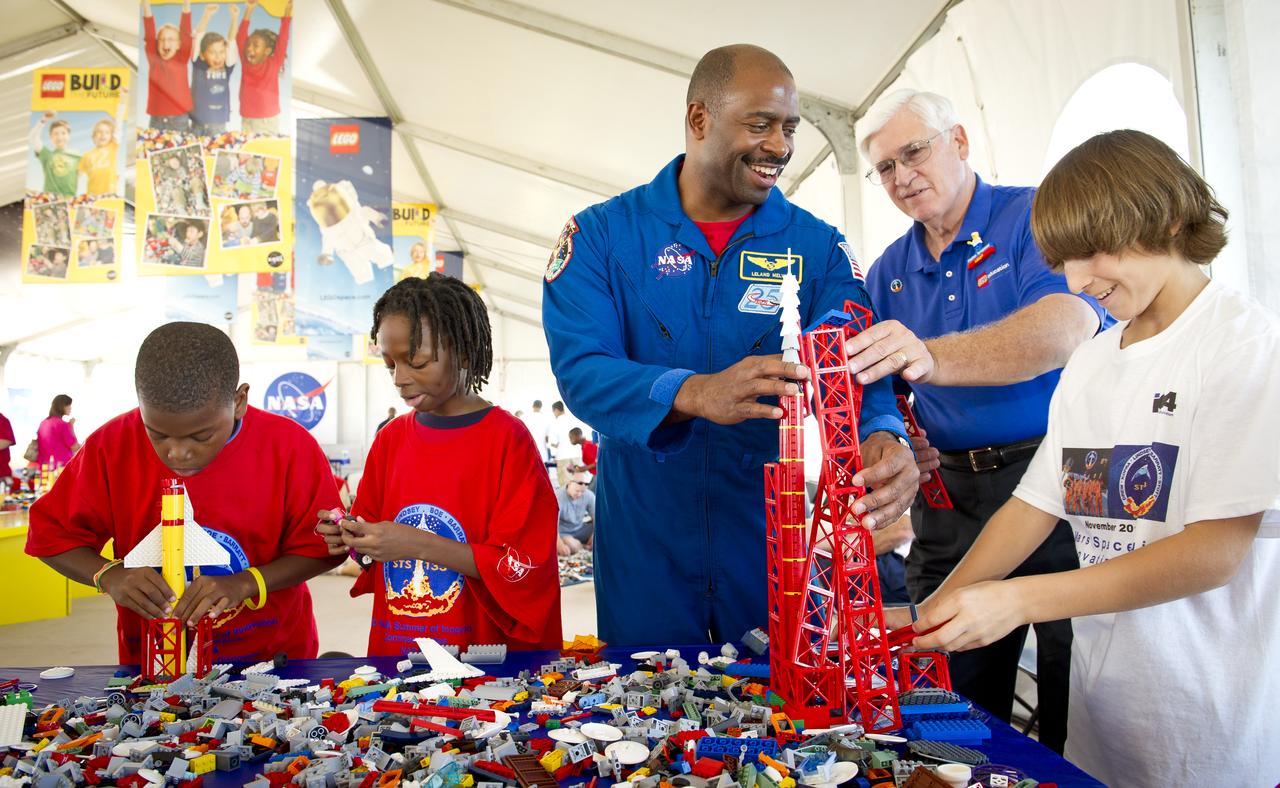
Associate Administrator for Education and Astronaut Leland Melvin, left, and President of LEGO Education USA Stephan Turnipseed, right, help students during the “Build the Future” activity where students created their vision of the future in space with LEGO bricks and elements inside a tent that was set up on the launch viewing area at NASA's Kennedy Space Center in Cape Canaveral, Fla. on Monday, Nov. 1, 2010. NASA and The LEGO Group signed a Space Act Agreement to spark children's interest in science, technology, engineering and math (STEM). Photo Credit: (NASA/Bill Ingalls)

CAPE CANAVERAL, Fla. -- At NASA's Kennedy Space Center, sparks fly beneath space shuttle Discovery as engines ignite for the liftoff on mission STS-124. Launch was on time at 5:02 p.m. EDT. Discovery is making its 35th flight. The STS-124 mission is the 26th in the assembly of the space station. It is the second of three flights launching components to complete the Japan Aerospace Exploration Agency's Kibo laboratory. The shuttle crew will install Kibo's large Japanese Pressurized Module and its remote manipulator system, or RMS. The 14-day flight includes three spacewalks. Photo courtesy of Scott Andrews
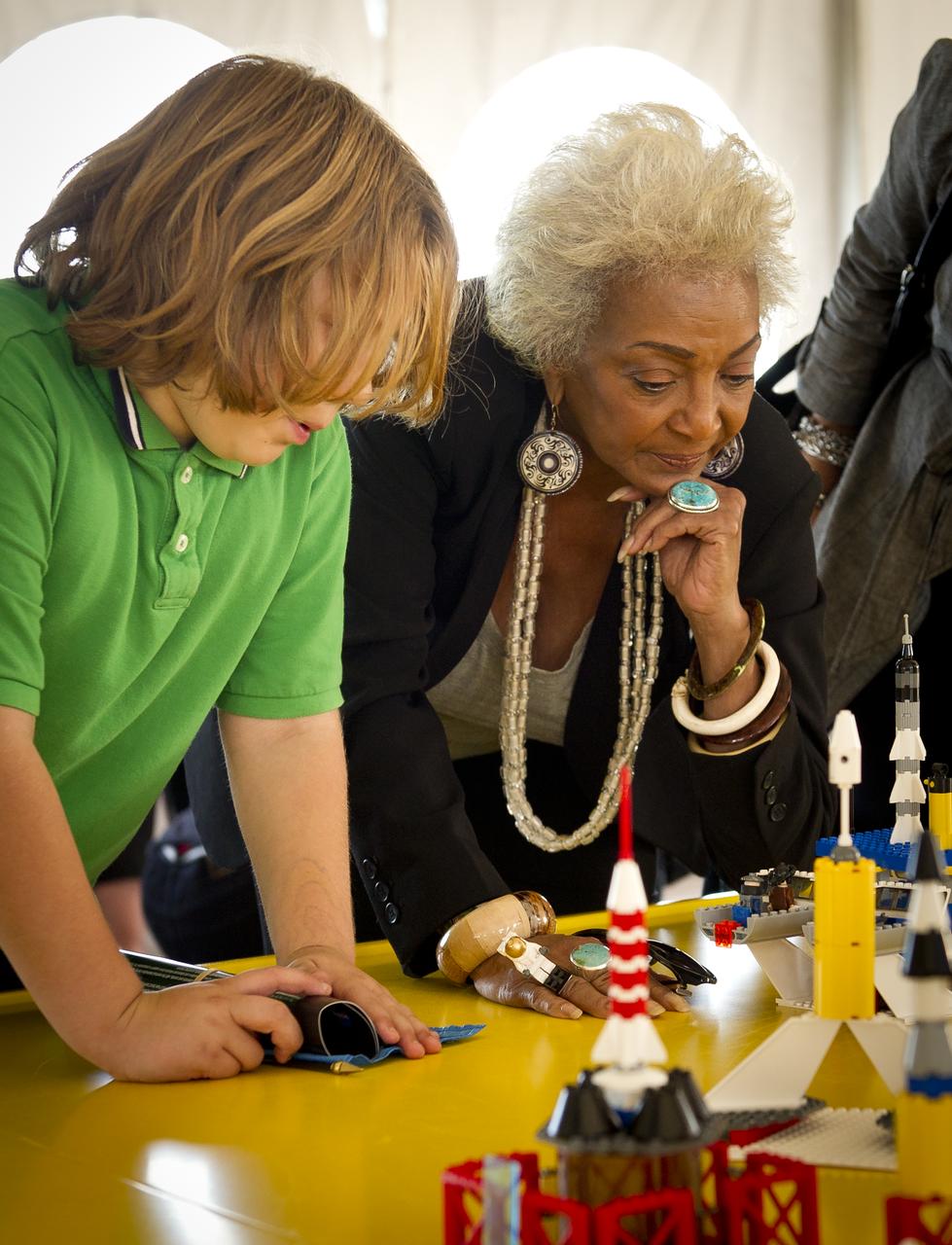
Actress Nichelle Nichols, known for her most famous role as communications officer Lieutenant Uhura aboard the USS Enterprise in the popular Star Trek television series, talks with school children during the “Build the Future” activity where students created their vision of the future in space with LEGO bricks and elements inside a tent that was set up on the launch viewing area at NASA's Kennedy Space Center in Cape Canaveral, Fla. on Monday, Nov. 1, 2010. NASA and The LEGO Group signed a Space Act Agreement to spark children's interest in science, technology, engineering and math (STEM). Photo Credit: (NASA/Bill Ingalls)
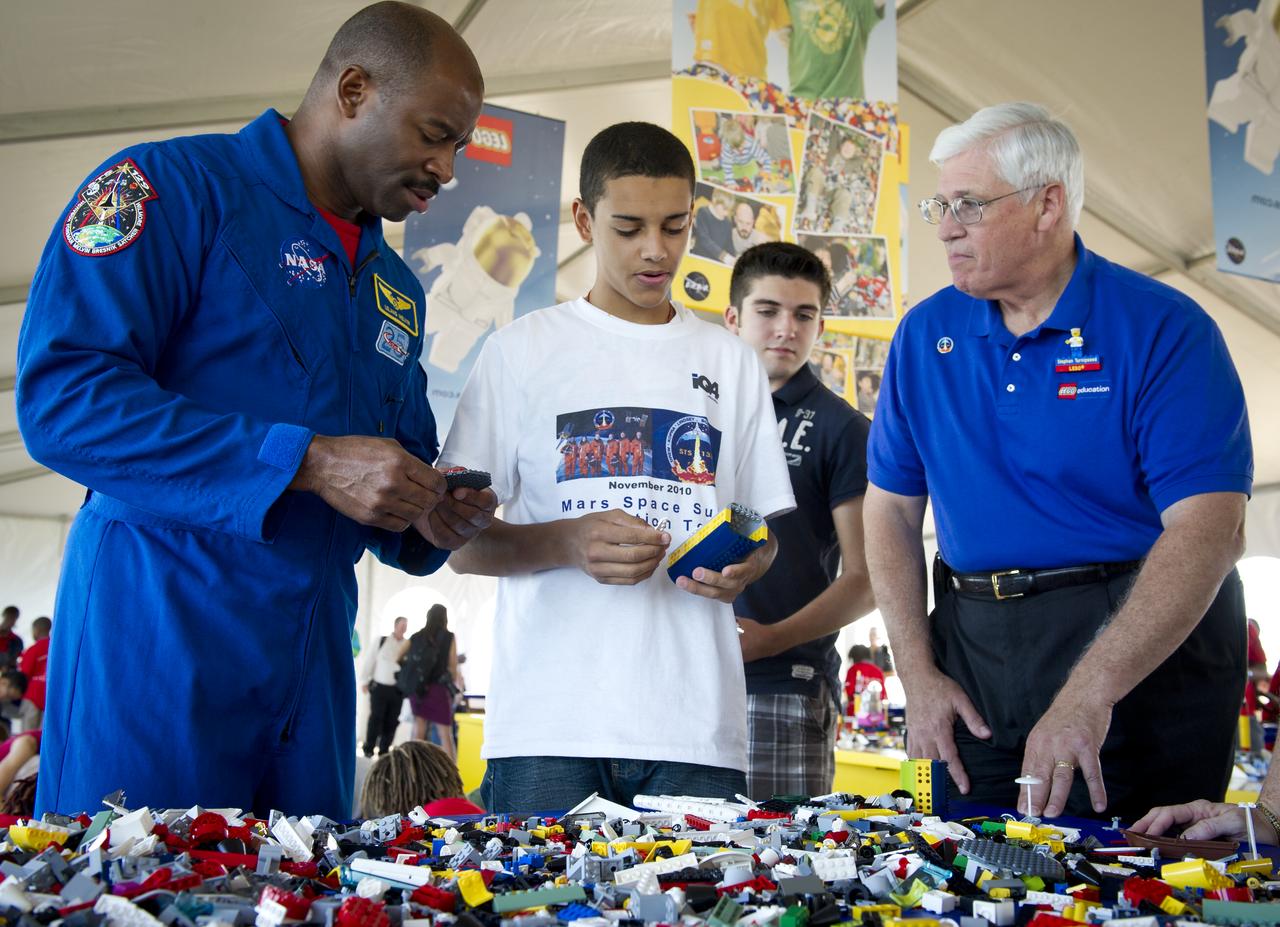
Associate Administrator for Education and Astronaut Leland Melvin, left, and President of LEGO Education USA Stephan Turnipseed, right, talk with a student during the “Build the Future” activity where students created their vision of the future in space with LEGO bricks and elements inside a tent that was set up on the launch viewing area at NASA's Kennedy Space Center in Cape Canaveral, Fla. on Monday, Nov. 1, 2010. NASA and The LEGO Group signed a Space Act Agreement to spark children's interest in science, technology, engineering and math (STEM). Photo Credit: (NASA/Bill Ingalls)
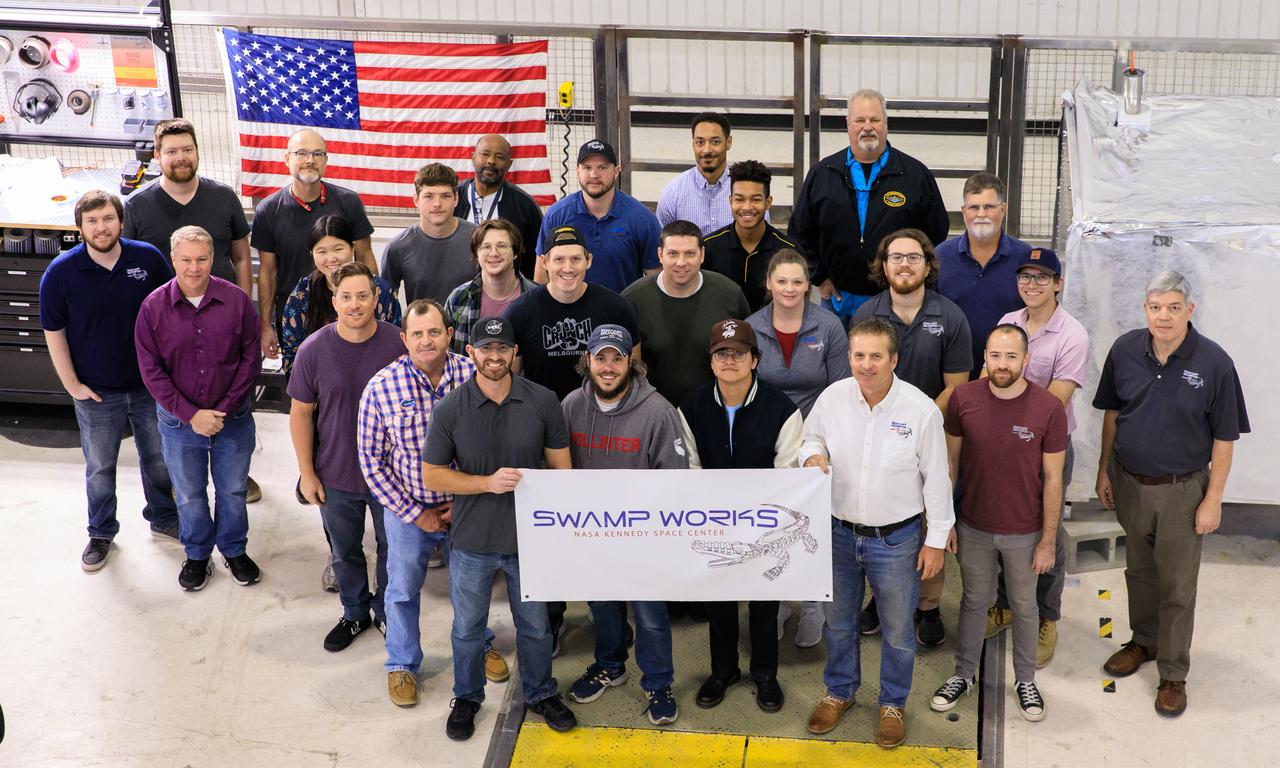
Groups from the Granular Mechanics and Regolith Operations (GMRO) laboratory and the Electrostatics and Surface Physics Laboratory (ESPL) gather for a photograph to celebrate the 10th anniversary of Swamp Works at NASA’s Kennedy Space Center in Florida on Feb. 13, 2023. Studies of the mechanics of materials in a launch pad environment are performed in the GMRO lab. The team also develops technologies for handling lunar and Martian regolith, including excavator technologies, pneumatic transport of soil, and magnetic handling of soil. The ESPL group performs scientific investigations to protect flight hardware and launch equipment from the phenomenon of electrostatic discharges, commonly known as sparks.
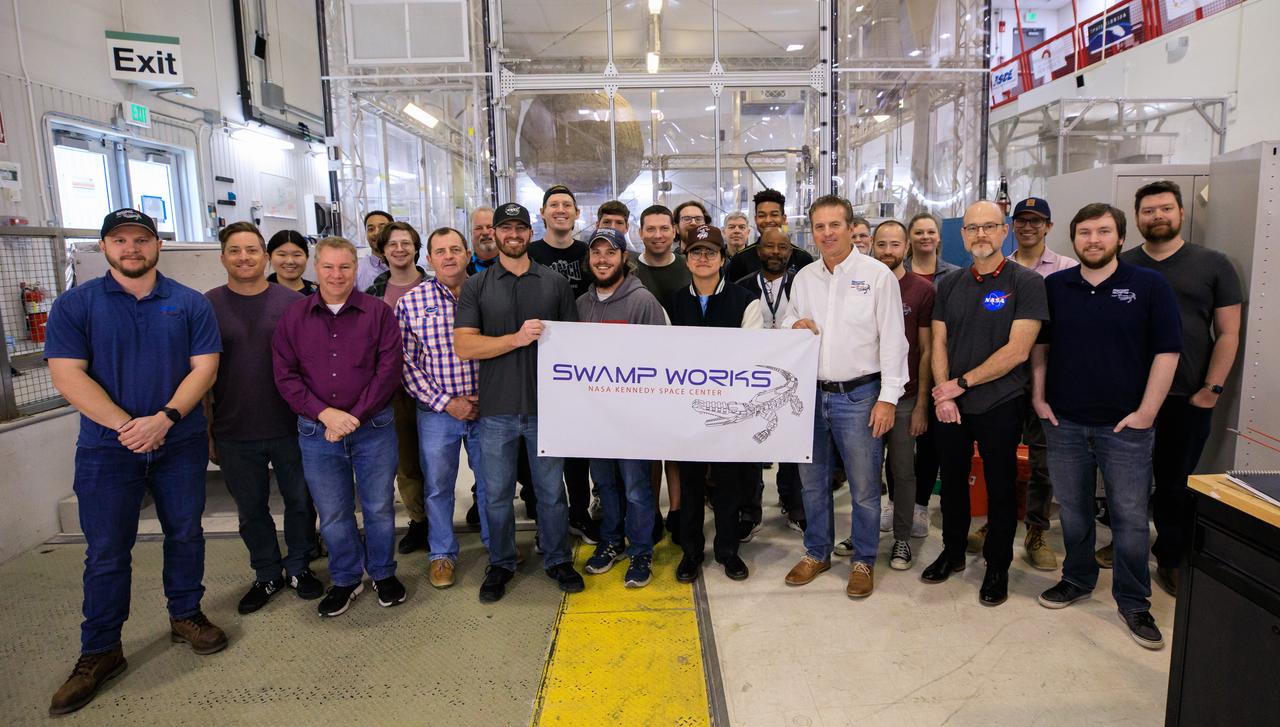
Groups from the Granular Mechanics and Regolith Operations (GMRO) laboratory and the Electrostatics and Surface Physics Laboratory (ESPL) gather for a photograph to celebrate the 10th anniversary of Swamp Works at NASA’s Kennedy Space Center in Florida on Feb. 13, 2023. Studies of the mechanics of materials in a launch pad environment are performed in the GMRO lab. The team also develops technologies for handling lunar and Martian regolith, including excavator technologies, pneumatic transport of soil, and magnetic handling of soil. The ESPL group performs scientific investigations to protect flight hardware and launch equipment from the phenomenon of electrostatic discharges, commonly known as sparks.

CAPE CANAVERAL, Fla. -- Space shuttle and rover models built of LEGO bricks are on display at NASA's Kennedy Space Center in Florida, marking a new partnership between the U.S. space agency and The LEGO Group. The three-year Space Act Agreement is meant to spark the interest of children in science, technology, engineering and mathematics (STEM) with the future release of four NASA-inspired products in the toy company's LEGO CITY line. To commemorate the beginning of the partnership, two small LEGO space shuttles will launch aboard space shuttle Discovery's STS-133 mission to the International Space Station. A 40- by 70-foot activity tent will be set up at Kennedy on Nov. 3 for children of all ages to build their vision of the future with LEGO bricks. LEGO sets also will fly to the space station aboard Endeavour's STS-134 mission, and will be put together on orbit to demonstrate the challenges faced while building things in microgravity. Photo credit: NASA/Jack Pfaller
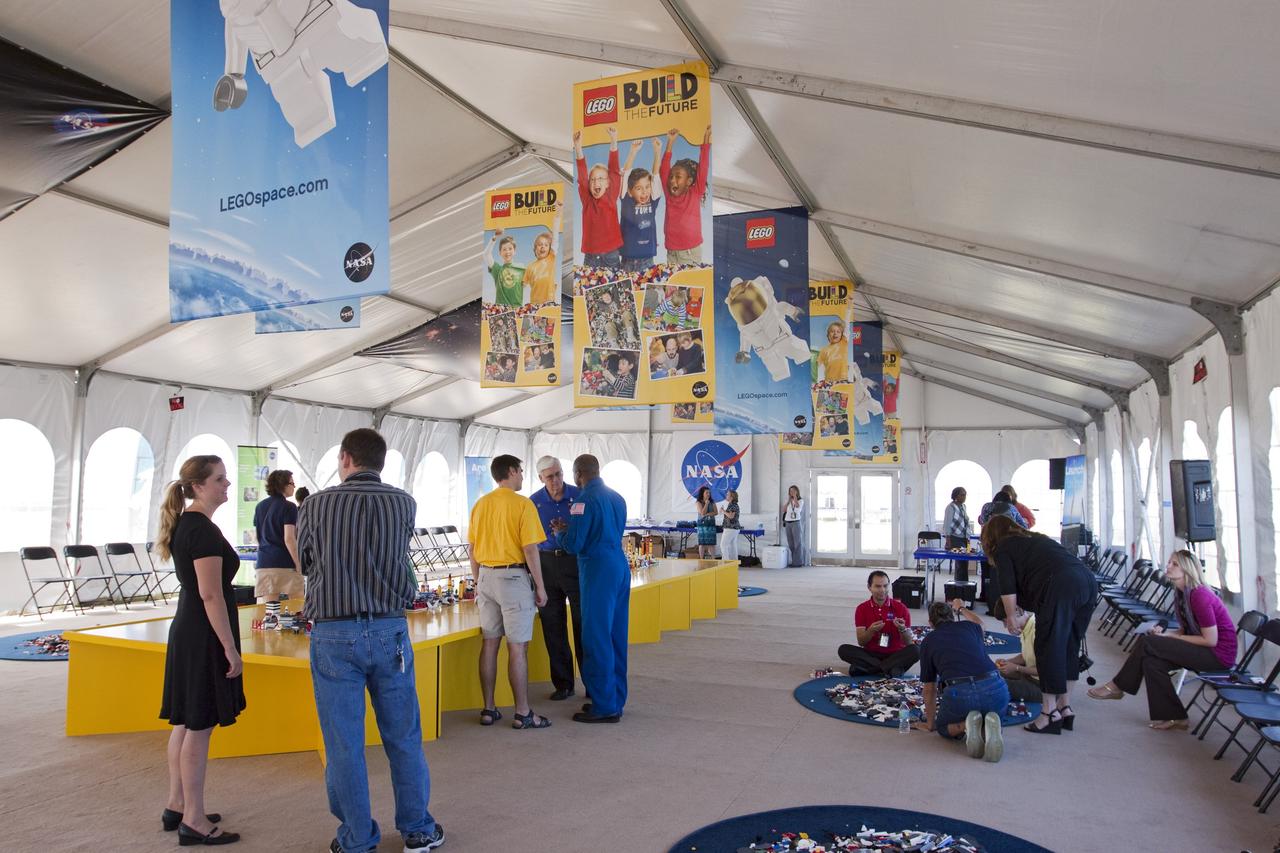
CAPE CANAVERAL, Fla. -- A 40- by 70-foot activity tent chock full of LEGO bricks is set up on the NASA Causeway at Kennedy Space Center in Florida. Inside, children of all ages will have the opportunity to build their vision of the future with LEGO bricks, marking the beginning of a three-year Space Act Agreement between NASA and The LEGO Group. The partnership is meant to spark the interest of children in science, technology, engineering and mathematics (STEM). To commemorate the partnership, two small LEGO space shuttles will launch aboard space shuttle Discovery's STS-133 mission to the International Space Station and the company will release four NASA-inspired products in its LEGO CITY line next year. LEGO sets also will fly to the space station aboard Endeavour's STS-134 mission, and will be put together on orbit to demonstrate the challenges faced while building things in microgravity. Photo credit: NASA/Jack Pfaller
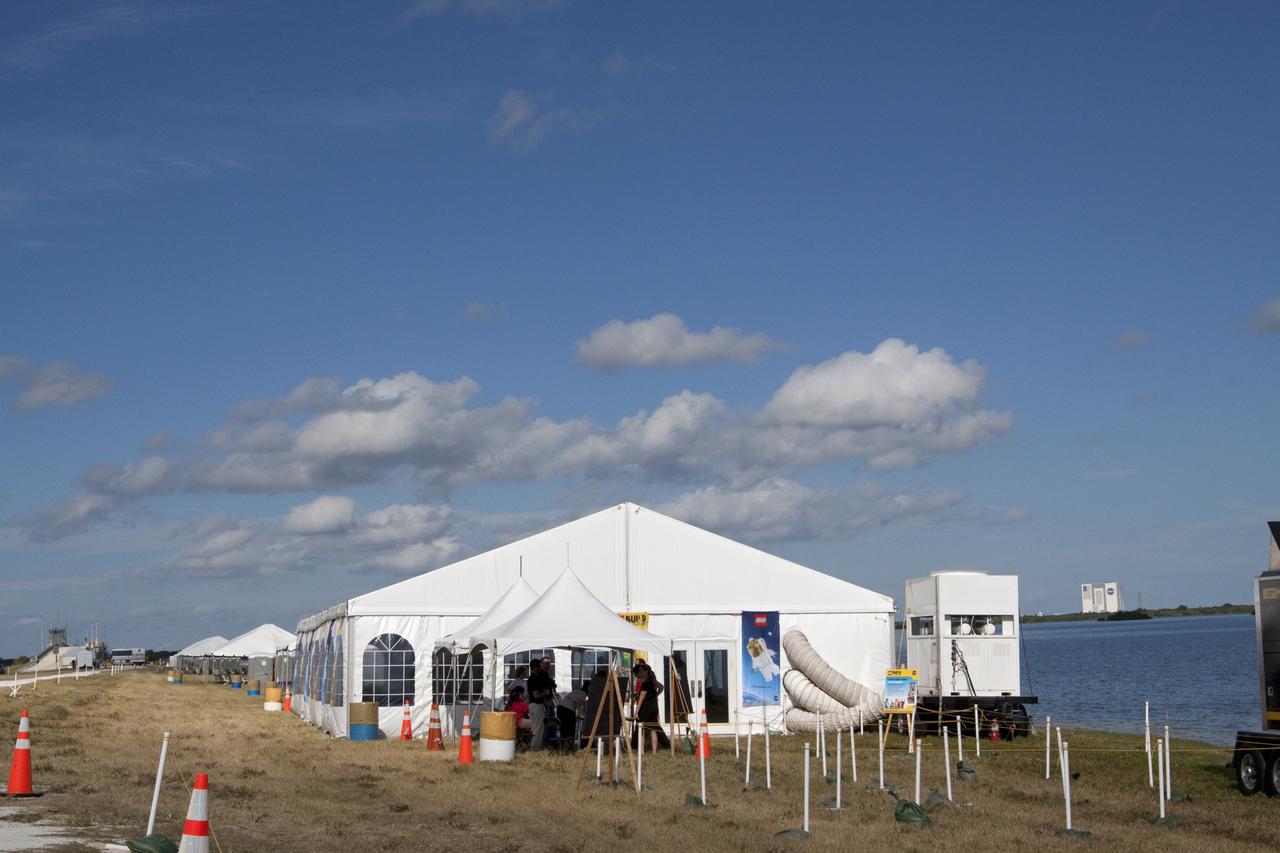
CAPE CANAVERAL, Fla. -- On the NASA Causeway at Kennedy Space Center in Florida, a 40- by 70-foot activity tent chock full of LEGO bricks is ready to welcome children of all ages. There, they will have the opportunity to build their vision of the future with LEGO bricks, marking the beginning of a three-year Space Act Agreement between NASA and The LEGO Group. The partnership is meant to spark the interest of children in science, technology, engineering and mathematics (STEM). To commemorate the partnership, two small LEGO space shuttles will launch aboard space shuttle Discovery's STS-133 mission to the International Space Station and the company will release four NASA-inspired products in its LEGO CITY line next year. LEGO sets also will fly to the space station aboard Endeavour's STS-134 mission, and will be put together on orbit to demonstrate the challenges faced while building things in microgravity. Photo credit: NASA/Jack Pfaller
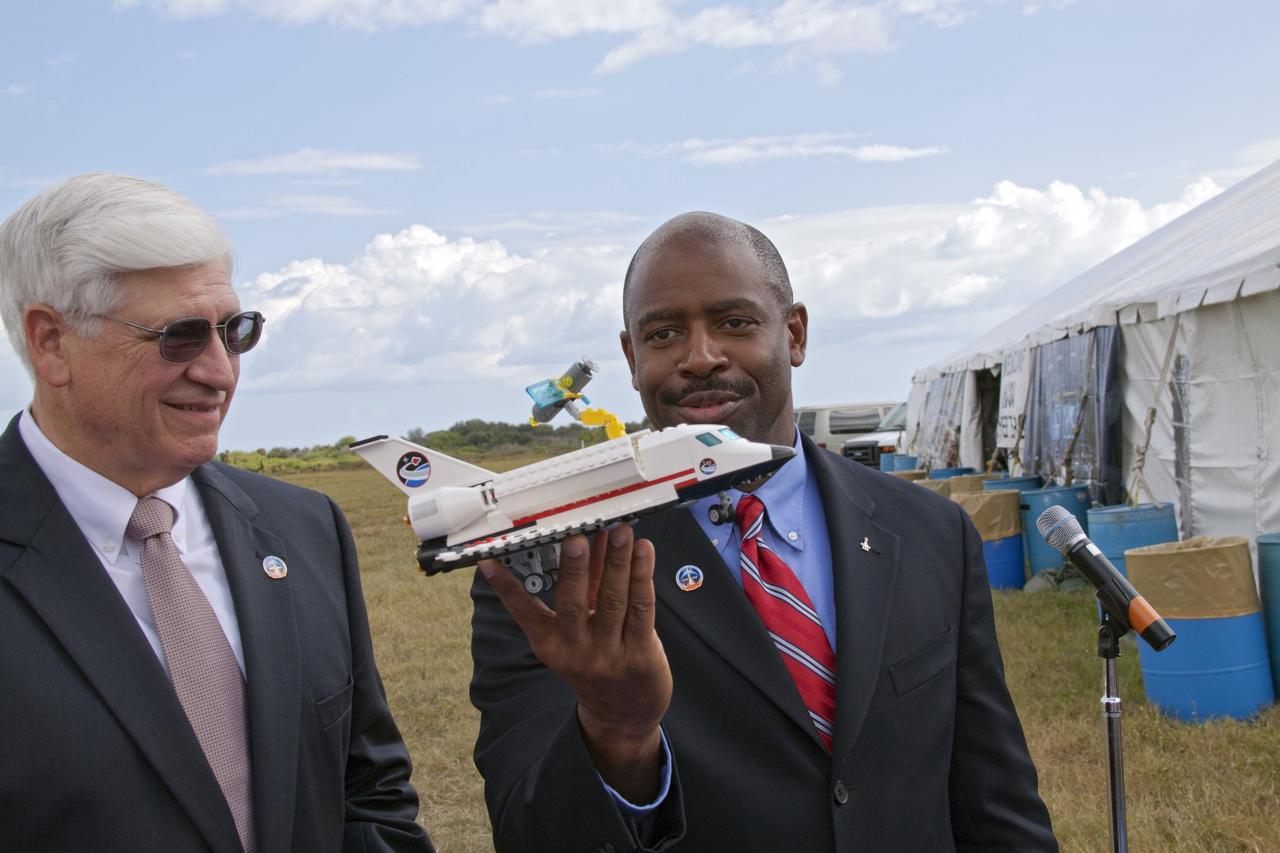
CAPE CANAVERAL, Fla. -- NASA and The LEGO Group announce a three-year Space Act Agreement meant to spark the interest of children in science, technology, engineering and mathematics (STEM) with the future release of four NASA-inspired products in the toy company's LEGO CITY line. From left, are Stephan Turnipseed, president of LEGO Education North America, and Leland Melvin, NASA's associate administrator for Education. To commemorate the beginning of the partnership, two small LEGO space shuttles will launch aboard space shuttle Discovery's STS-133 mission to the International Space Station. A 40- by 70-foot activity tent will be set up at Kennedy on Nov. 3 for children of all ages to build their vision of the future with LEGO bricks. LEGO sets also will fly to the space station aboard Endeavour's STS-134 mission, and will be put together on orbit to demonstrate the challenges faced while building things in microgravity. Photo credit: NASA/Jack Pfaller
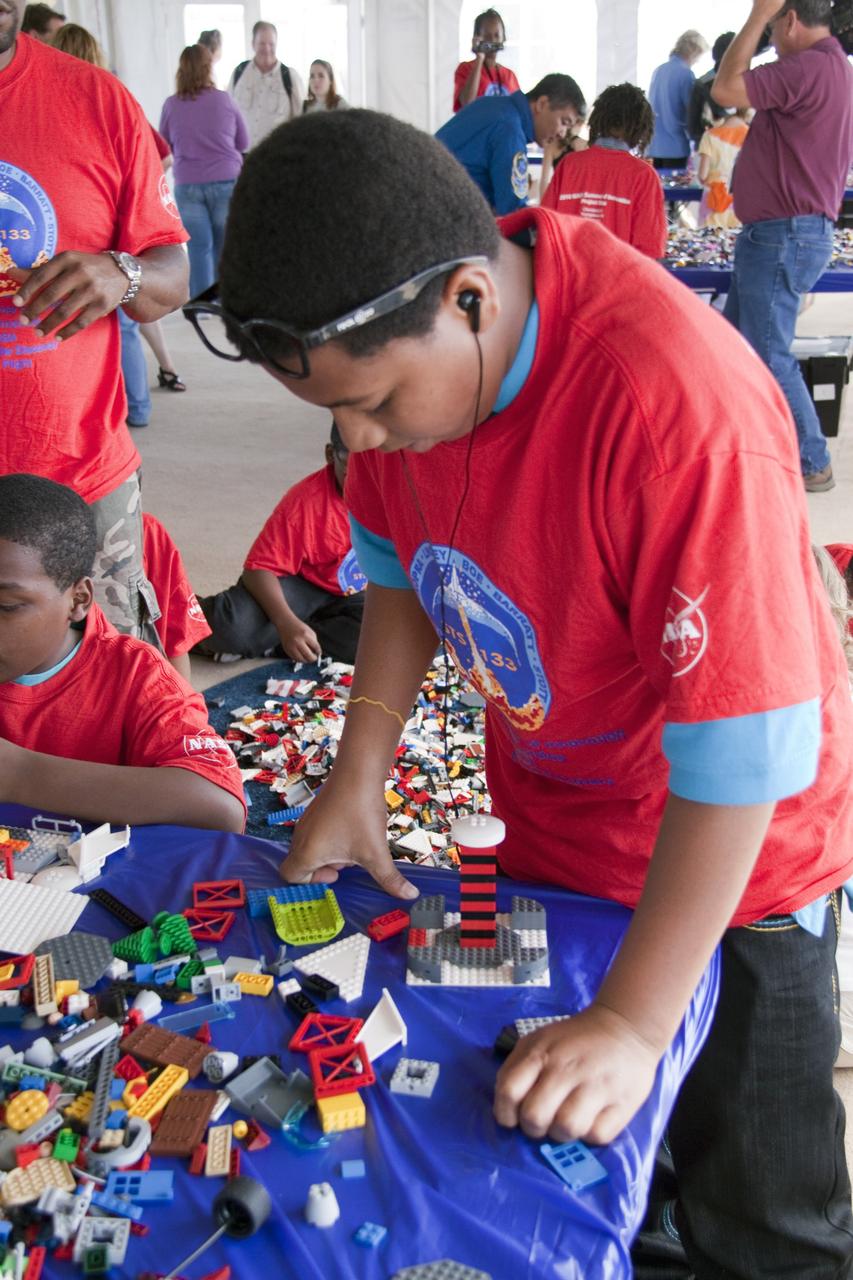
CAPE CANAVERAL, Fla. -- On the NASA Causeway at Kennedy Space Center in Florida, school children build LEGO space vehicles inside a 40- by 70-foot activity tent. There, children of all ages are building their vision of the future with LEGO bricks, marking the beginning of a three-year Space Act Agreement between NASA and The LEGO Group. The partnership is meant to spark the interest of children in science, technology, engineering and mathematics (STEM). To commemorate the partnership, two small LEGO space shuttles will launch aboard space shuttle Discovery's STS-133 mission to the International Space Station and the company will release four NASA-inspired products in its LEGO CITY line next year. LEGO sets also will fly to the space station aboard Endeavour's STS-134 mission, and will be put together on orbit to demonstrate the challenges faced while building things in microgravity. Photo credit: NASA/Jack Pfaller
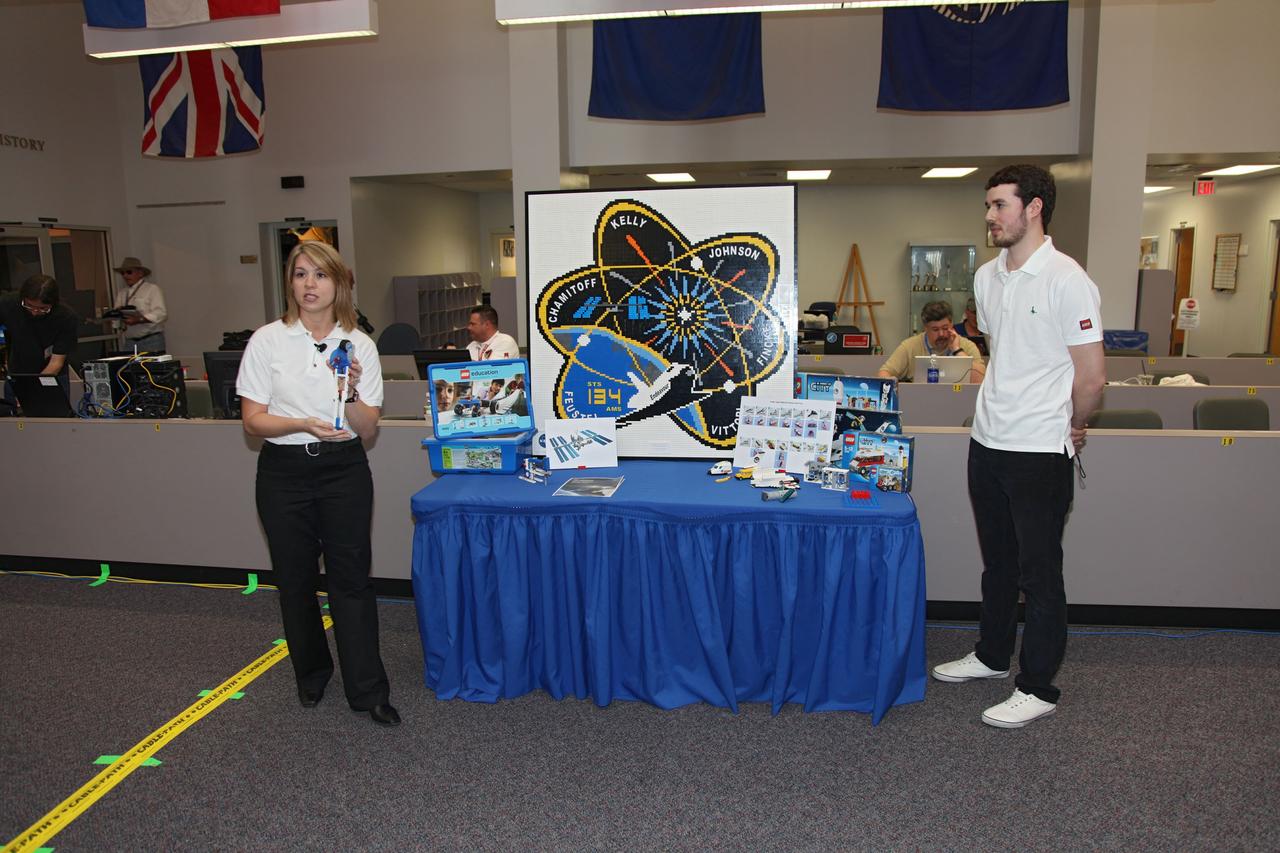
CAPE CANAVERAL, Fla. -- In the Press Site bull pen at NASA's Kennedy Space Center in Florida, NASA Education Specialist Teresa Sindelar and The LEGO Group's Daire McCabe talk about the LEGO sets going up to the International Space Station aboard space shuttle Endeavour's STS-134 mission. NASA and The LEGO Group will send 23 LEGO sets to the station and some of those sets include a space shuttle, an ISS model, a Global Positioning Satellite and NASA's Hubble Space Telescope. The sets will be used for NASA's Teaching From Space Project, which is part of a three-year Space Act Agreement with the toy maker to spark the interest of children in science, technology, engineering and mathematics (STEM). Liftoff is scheduled for April 29 at 3:47 p.m. EDT. This will be the final spaceflight for Endeavour. For more information visit, www.nasa.gov/mission_pages/shuttle/shuttlemissions/sts134/index.html. Photo credit: NASA/Frankie Martin
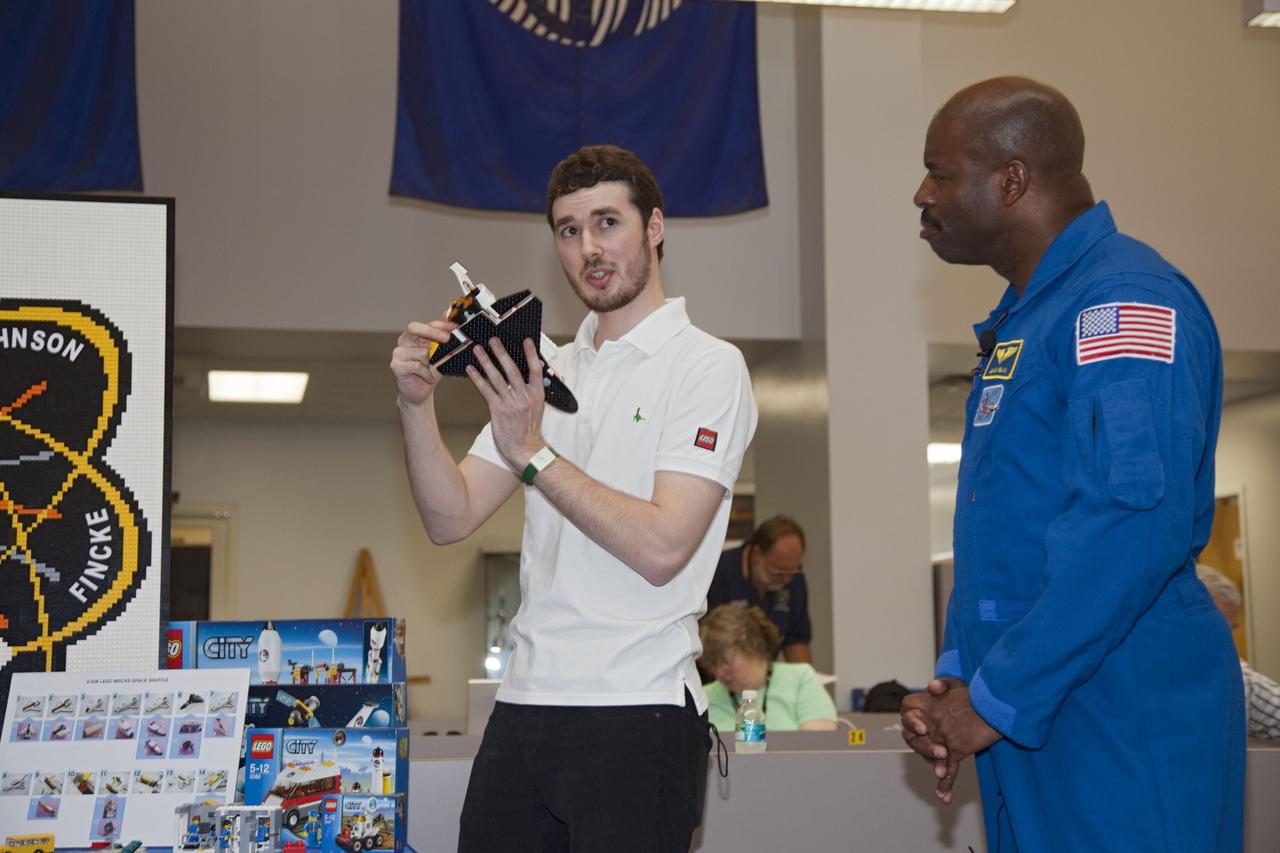
CAPE CANAVERAL, Fla. -- In the Press Site bull pen at NASA's Kennedy Space Center in Florida, The LEGO Group's Daire McCabe and NASA's Associate Administrator for Education Leland Melvin talk about the LEGO sets going up to the International Space Station aboard space shuttle Endeavour's STS-134 mission. NASA and The LEGO Group will send 23 LEGO sets to the station and some of those sets include a space shuttle, an ISS model, a Global Positioning Satellite and NASA's Hubble Space Telescope. The sets will be used for NASA's Teaching From Space Project, which is part of a three-year Space Act Agreement with the toy maker to spark the interest of children in science, technology, engineering and mathematics (STEM). Liftoff is scheduled for April 29 at 3:47 p.m. EDT. This will be the final spaceflight for Endeavour. For more information visit, www.nasa.gov/mission_pages/shuttle/shuttlemissions/sts134/index.html. Photo credit: NASA/Frankie Martin

A long-lasting coronal hole has again rotated around to face the Earth (Nov. 28-30, 2018). This persistent hole - the elongated dark region seen in the still image - first appeared in July and has been observed each rotation of the Sun since. Coronal holes are the source of high-speed solar wind; when this one faced Earth, it sparked outbursts of aurora some of which were observed in our northern tier states. Coronal holes are magnetically open regions on the Sun that can last from days to months, although this one has lasted longer than most. The time-lapse video, taken in a wavelength of extreme ultraviolet light, covers about two days of activity. Movies available at https://photojournal.jpl.nasa.gov/catalog/PIA18144
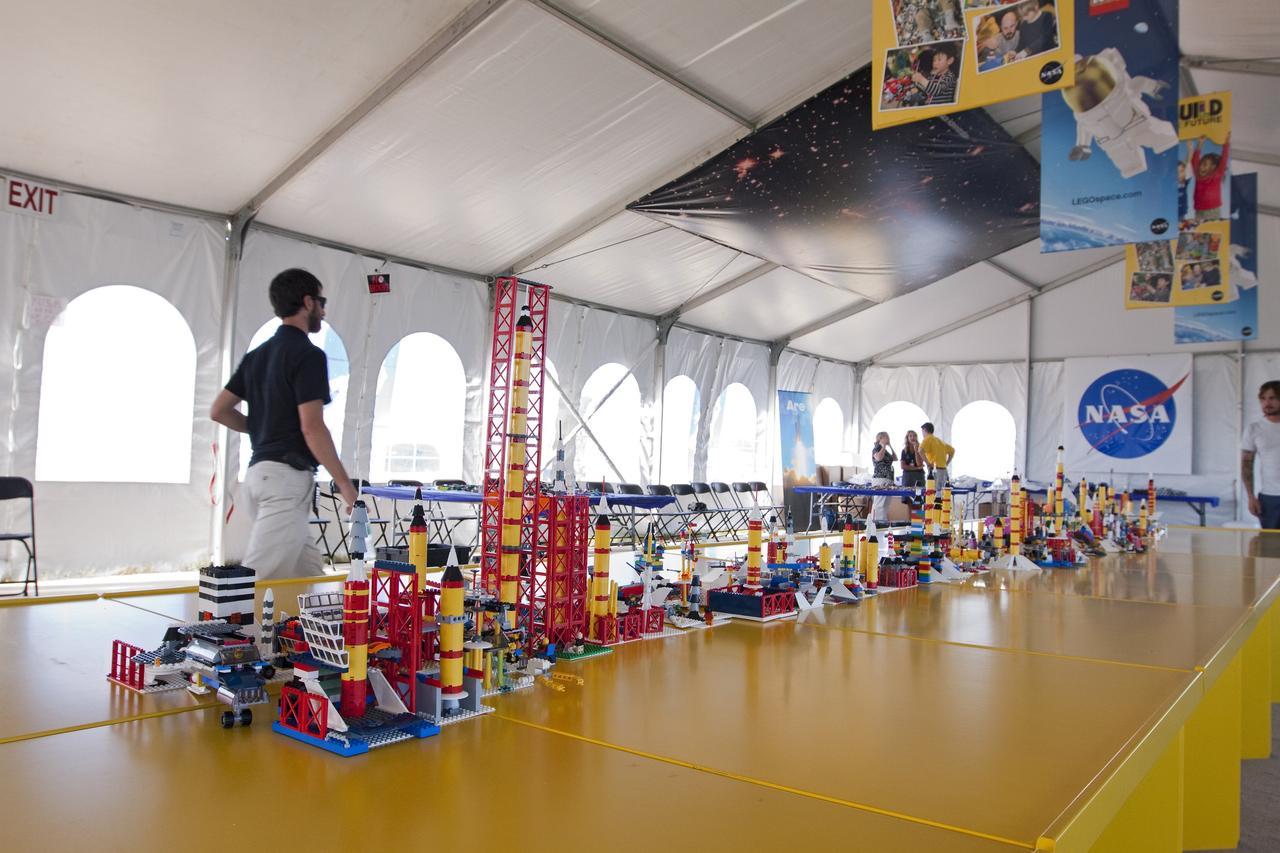
CAPE CANAVERAL, Fla. -- On the NASA Causeway at Kennedy Space Center in Florida, a 40- by 70-foot activity tent chock full of LEGO bricks is ready to welcome children of all ages. There, they will have the opportunity to build their vision of the future with LEGO bricks, marking the beginning of a three-year Space Act Agreement between NASA and The LEGO Group. The partnership is meant to spark the interest of children in science, technology, engineering and mathematics (STEM). To commemorate the partnership, two small LEGO space shuttles will launch aboard space shuttle Discovery's STS-133 mission to the International Space Station and the company will release four NASA-inspired products in its LEGO CITY line next year. LEGO sets also will fly to the space station aboard Endeavour's STS-134 mission, and will be put together on orbit to demonstrate the challenges faced while building things in microgravity. Photo credit: NASA/Jack Pfaller
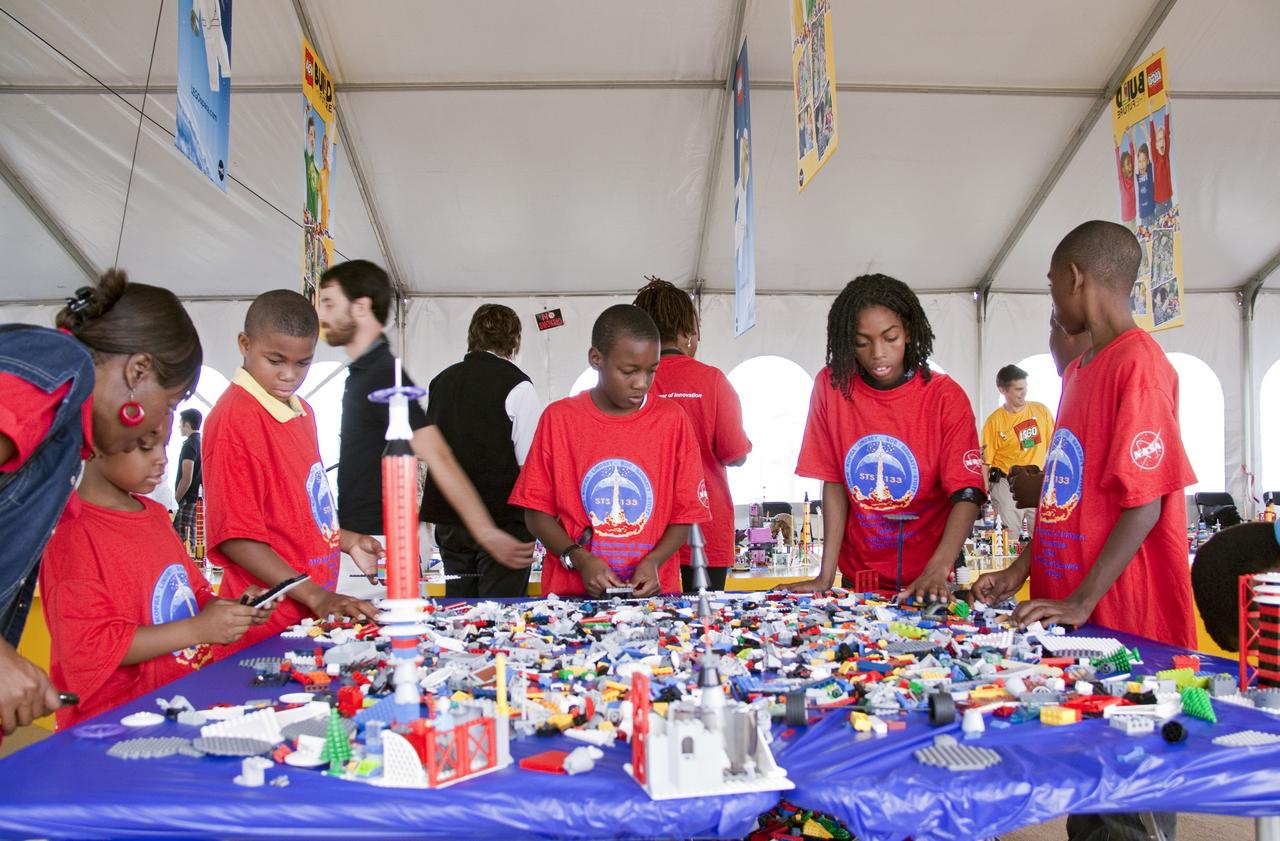
CAPE CANAVERAL, Fla. -- On the NASA Causeway at Kennedy Space Center in Florida, school children build LEGO space vehicles inside a 40- by 70-foot activity tent. There, children of all ages are building their vision of the future with LEGO bricks, marking the beginning of a three-year Space Act Agreement between NASA and The LEGO Group. The partnership is meant to spark the interest of children in science, technology, engineering and mathematics (STEM). To commemorate the partnership, two small LEGO space shuttles will launch aboard space shuttle Discovery's STS-133 mission to the International Space Station and the company will release four NASA-inspired products in its LEGO CITY line next year. LEGO sets also will fly to the space station aboard Endeavour's STS-134 mission, and will be put together on orbit to demonstrate the challenges faced while building things in microgravity. Photo credit: NASA/Jack Pfaller
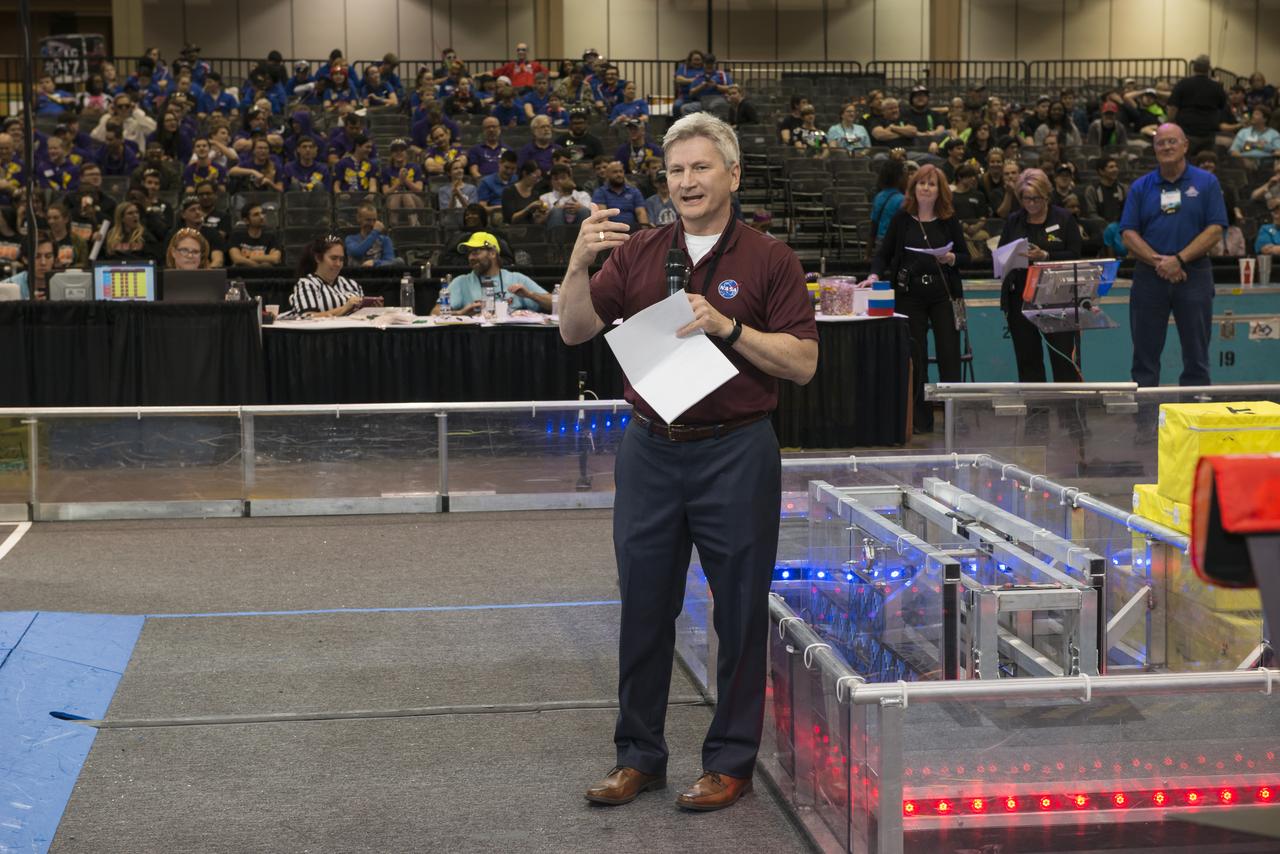
Johnny Stephenson, director of NASA Marshall Space Flight Center's Office of Strategic Analysis & Communications, addresses the crowd during the March 16 award ceremony following the first day of competition at the FIRST Robotics Rocket City Regional at the Von Braun Center in Huntsville. Ed Sparks, of the Morgan County Mech Tech team, received the award for Volunteer of the Year at the March 16 award ceremony. Mech Tech, comprised of students from five high schools in Morgan County, Alabama, also won the Industrial Design Award. The team was one of three regional finalists that will advance to the FIRST national championships April 18-21 in Houston. The other two regional finalists were Burning Magnetos of Fort Dorchester High School in North Charleston, South Carolina, and OGRE of Opelika High School in Opelika, Alabama. Mech Tech and Golden Hurricane from Columbia High School in Huntsville, were "house" teams sponsored by Marshall.
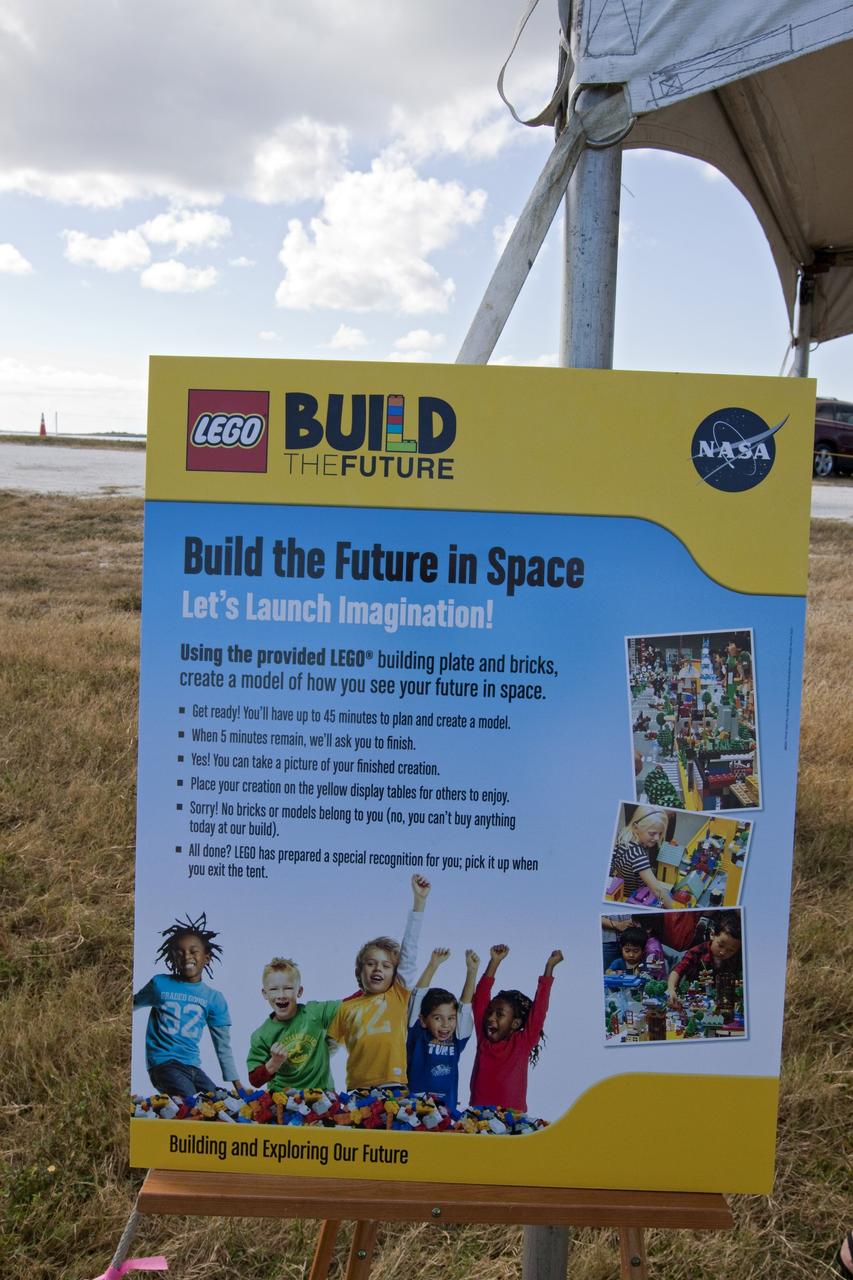
CAPE CANAVERAL, Fla. -- A sign welcomes children of all ages to a 40- by 70-foot activity tent chock full of LEGO bricks on the NASA Causeway at Kennedy Space Center in Florida. Inside the tent, they will have the opportunity to build their vision of the future with LEGO bricks, marking the beginning of a three-year Space Act Agreement between NASA and The LEGO Group. The partnership is meant to spark the interest of children in science, technology, engineering and mathematics (STEM). To commemorate the partnership, two small LEGO space shuttles will launch aboard space shuttle Discovery's STS-133 mission to the International Space Station and the company will release four NASA-inspired products in its LEGO CITY line next year. LEGO sets also will fly to the space station aboard Endeavour's STS-134 mission, and will be put together on orbit to demonstrate the challenges faced while building things in microgravity. Photo credit: NASA/Jack Pfaller
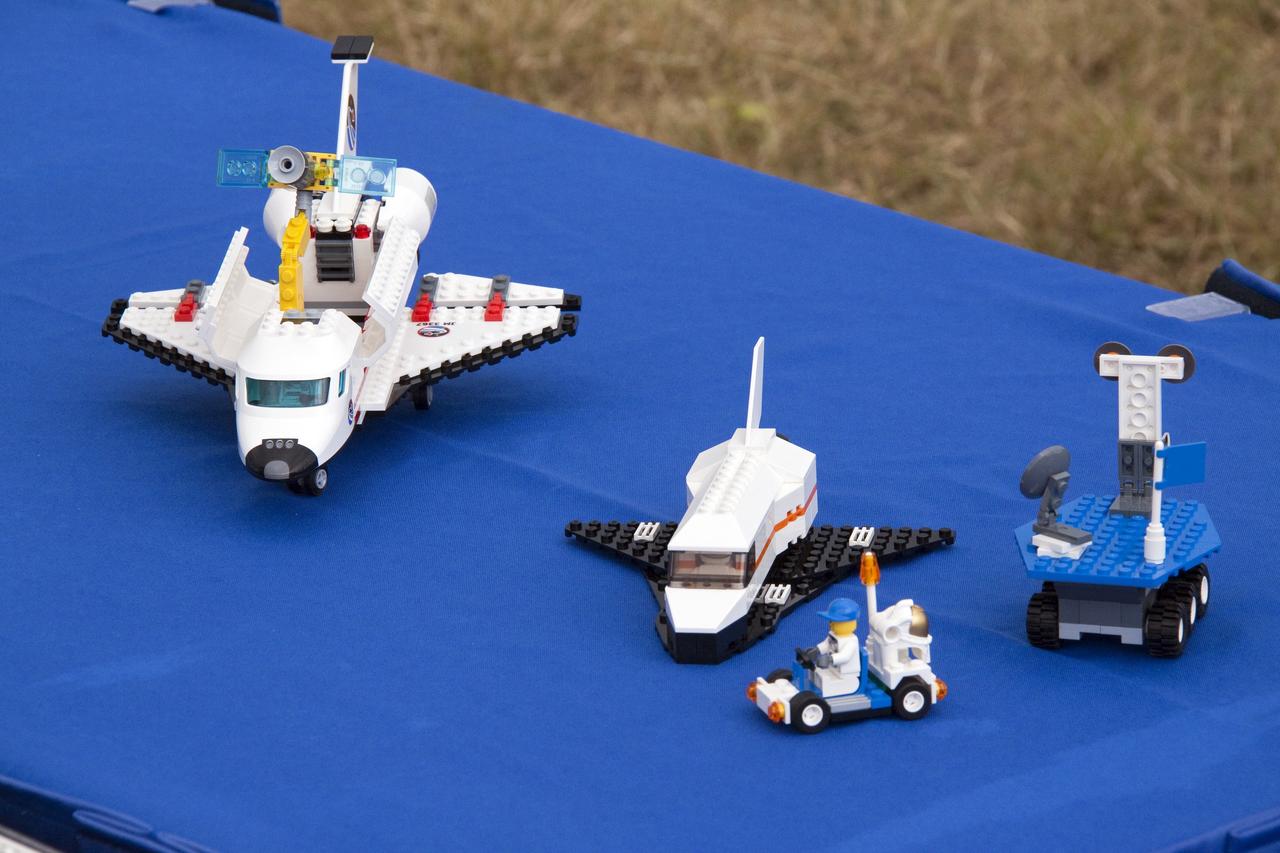
CAPE CANAVERAL, Fla. -- Space shuttle and rover models built of LEGO bricks are on display at NASA's Kennedy Space Center in Florida, marking a new partnership between the U.S. space agency and The LEGO Group. The three-year Space Act Agreement is meant to spark the interest of children in science, technology, engineering and mathematics (STEM) with the future release of four NASA-inspired products in the toy company's LEGO CITY line. To commemorate the beginning of the partnership, two small LEGO space shuttles will launch aboard space shuttle Discovery's STS-133 mission to the International Space Station. A 40- by 70-foot activity tent will be set up at Kennedy on Nov. 3 for children of all ages to build their vision of the future with LEGO bricks. LEGO sets also will fly to the space station aboard Endeavour's STS-134 mission, and will be put together on orbit to demonstrate the challenges faced while building things in microgravity. Photo credit: NASA/Jack Pfaller
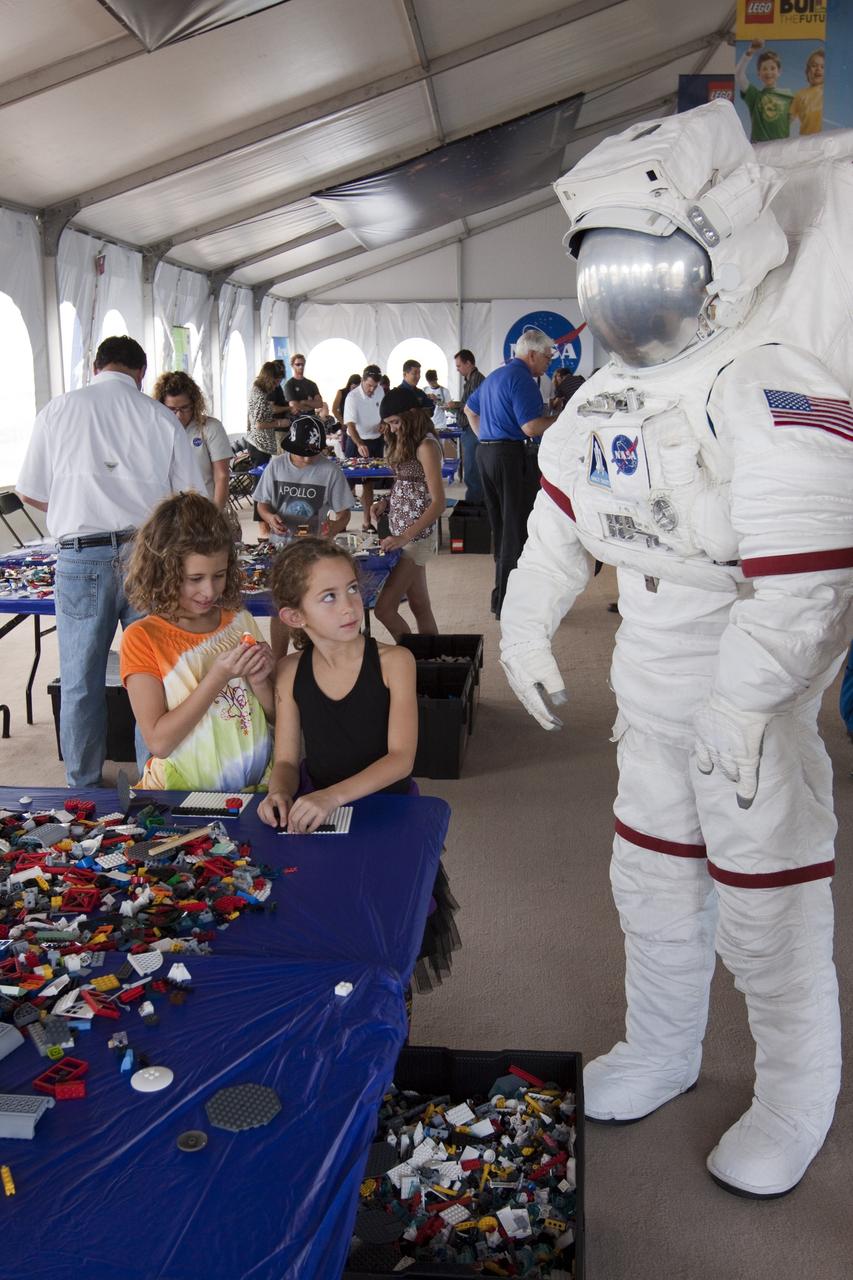
CAPE CANAVERAL, Fla. -- On the NASA Causeway at Kennedy Space Center in Florida, a 40- by 70-foot activity tent chock full of LEGO bricks hosts children, adults and a space person. There, they are building their vision of the future with LEGO bricks, marking the beginning of a three-year Space Act Agreement between NASA and The LEGO Group. The partnership is meant to spark the interest of children in science, technology, engineering and mathematics (STEM). To commemorate the partnership, two small LEGO space shuttles will launch aboard space shuttle Discovery's STS-133 mission to the International Space Station and the company will release four NASA-inspired products in its LEGO CITY line next year. LEGO sets also will fly to the space station aboard Endeavour's STS-134 mission, and will be put together on orbit to demonstrate the challenges faced while building things in microgravity. Photo credit: NASA/Jack Pfaller

CAPE CANAVERAL, Fla. -- On the NASA Causeway at Kennedy Space Center in Florida, a 40- by 70-foot activity tent chock full of LEGO bricks hosts children, adults and a space person. There, they are building their vision of the future with LEGO bricks, marking the beginning of a three-year Space Act Agreement between NASA and The LEGO Group. The partnership is meant to spark the interest of children in science, technology, engineering and mathematics (STEM). To commemorate the partnership, two small LEGO space shuttles will launch aboard space shuttle Discovery's STS-133 mission to the International Space Station and the company will release four NASA-inspired products in its LEGO CITY line next year. LEGO sets also will fly to the space station aboard Endeavour's STS-134 mission, and will be put together on orbit to demonstrate the challenges faced while building things in microgravity. Photo credit: NASA/Jack Pfaller
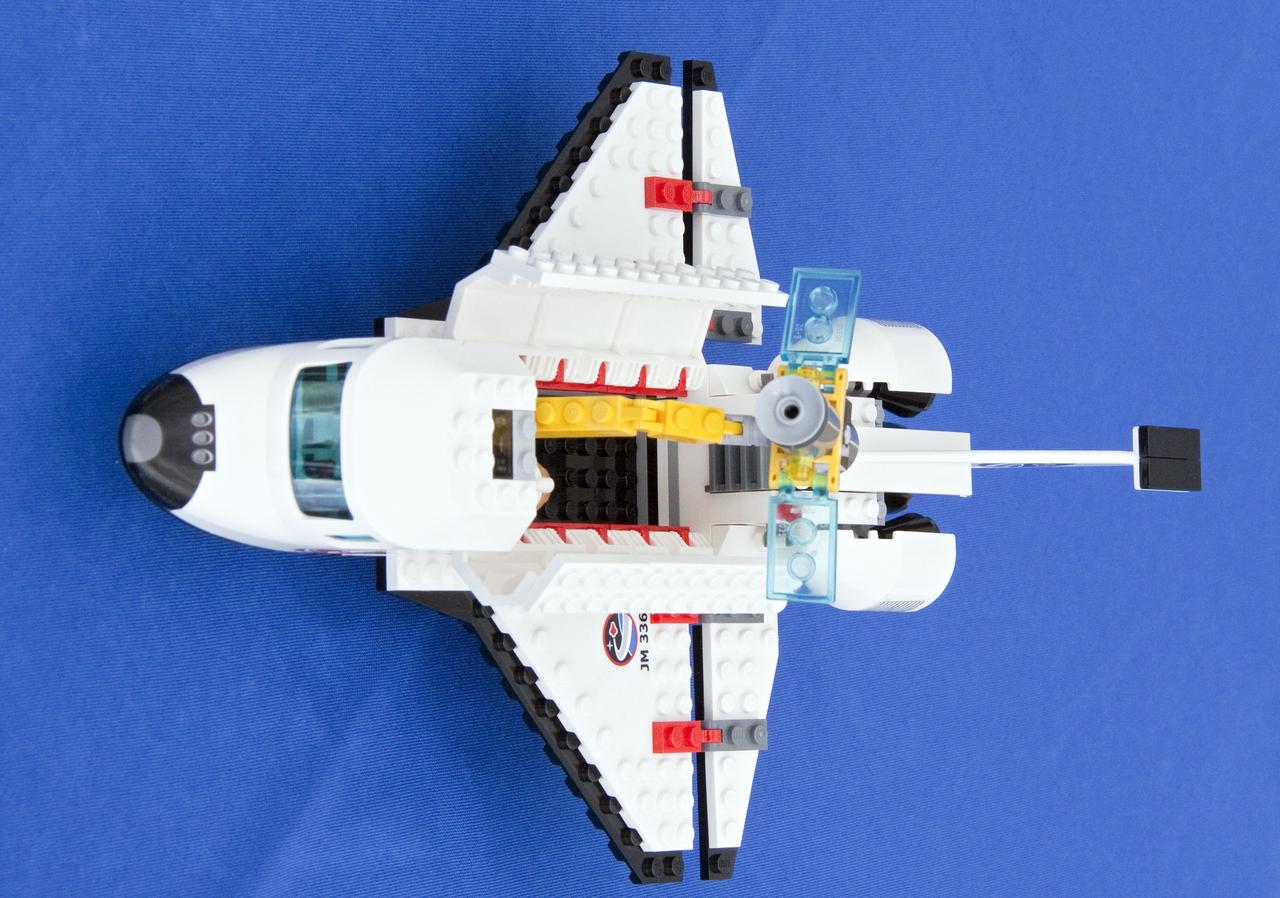
CAPE CANAVERAL, Fla. -- A space shuttle model built of LEGO bricks is on display at NASA's Kennedy Space Center in Florida, marking a new partnership between the U.S. space agency and The LEGO Group. The three-year Space Act Agreement is meant to spark the interest of children in science, technology, engineering and mathematics (STEM) with the future release of four NASA-inspired products in the toy company's LEGO CITY line. To commemorate the beginning of the partnership, two small LEGO space shuttles will launch aboard space shuttle Discovery's STS-133 mission to the International Space Station. A 40- by 70-foot activity tent will be set up at Kennedy on Nov. 3 for children of all ages to build their vision of the future with LEGO bricks. LEGO sets also will fly to the space station aboard Endeavour's STS-134 mission, and will be put together on orbit to demonstrate the challenges faced while building things in microgravity. Photo credit: NASA/Jack Pfaller
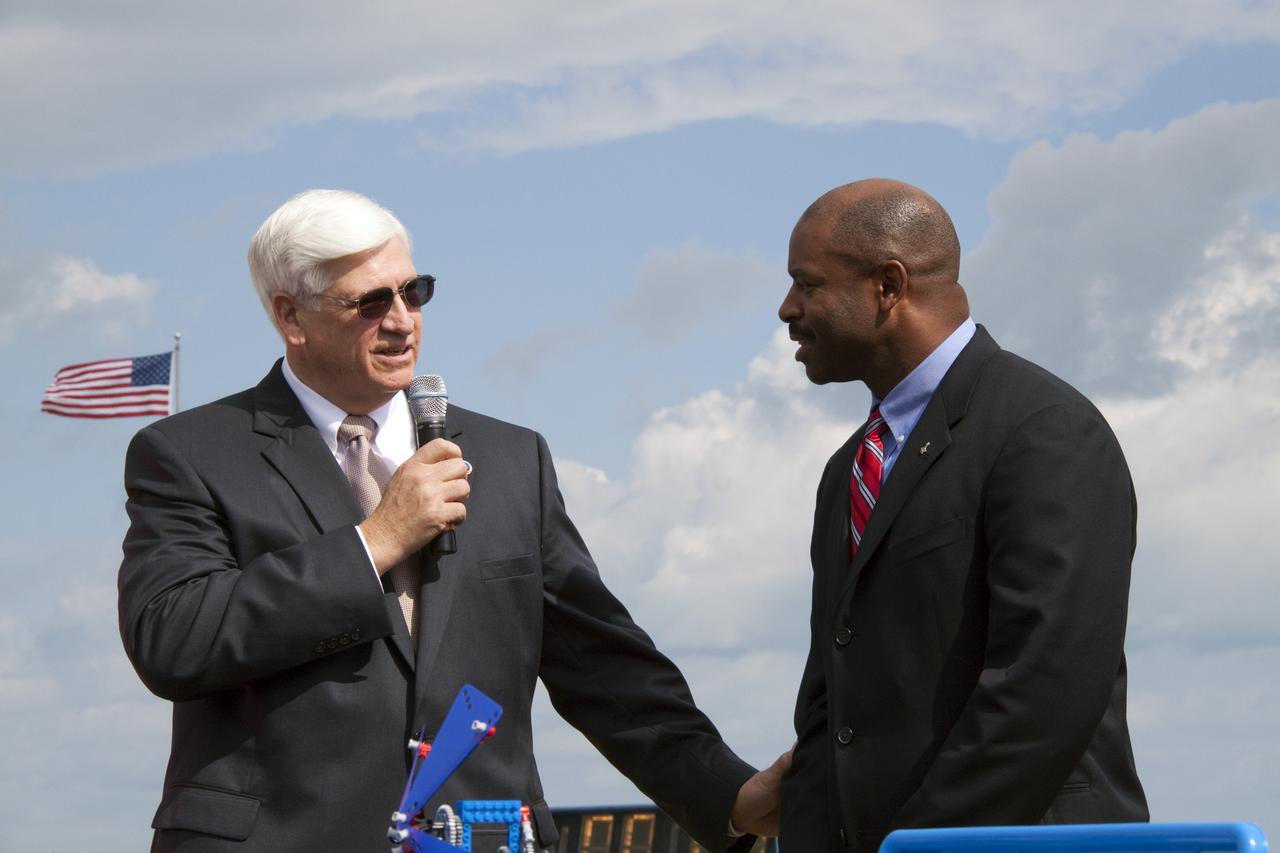
CAPE CANAVERAL, Fla. -- NASA and The LEGO Group announce a three-year Space Act Agreement meant to spark the interest of children in science, technology, engineering and mathematics (STEM) with the future release of four NASA-inspired products in the toy company's LEGO CITY line. From left, are Stephan Turnipseed, president of LEGO Education North America, and Leland Melvin, NASA's associate administrator for Education. To commemorate the beginning of the partnership, two small LEGO space shuttles will launch aboard space shuttle Discovery's STS-133 mission to the International Space Station. A 40- by 70-foot activity tent will be set up at Kennedy on Nov. 3 for children of all ages to build their vision of the future with LEGO bricks. LEGO sets also will fly to the space station aboard Endeavour's STS-134 mission, and will be put together on orbit to demonstrate the challenges faced while building things in microgravity. Photo credit: NASA/Jack Pfaller
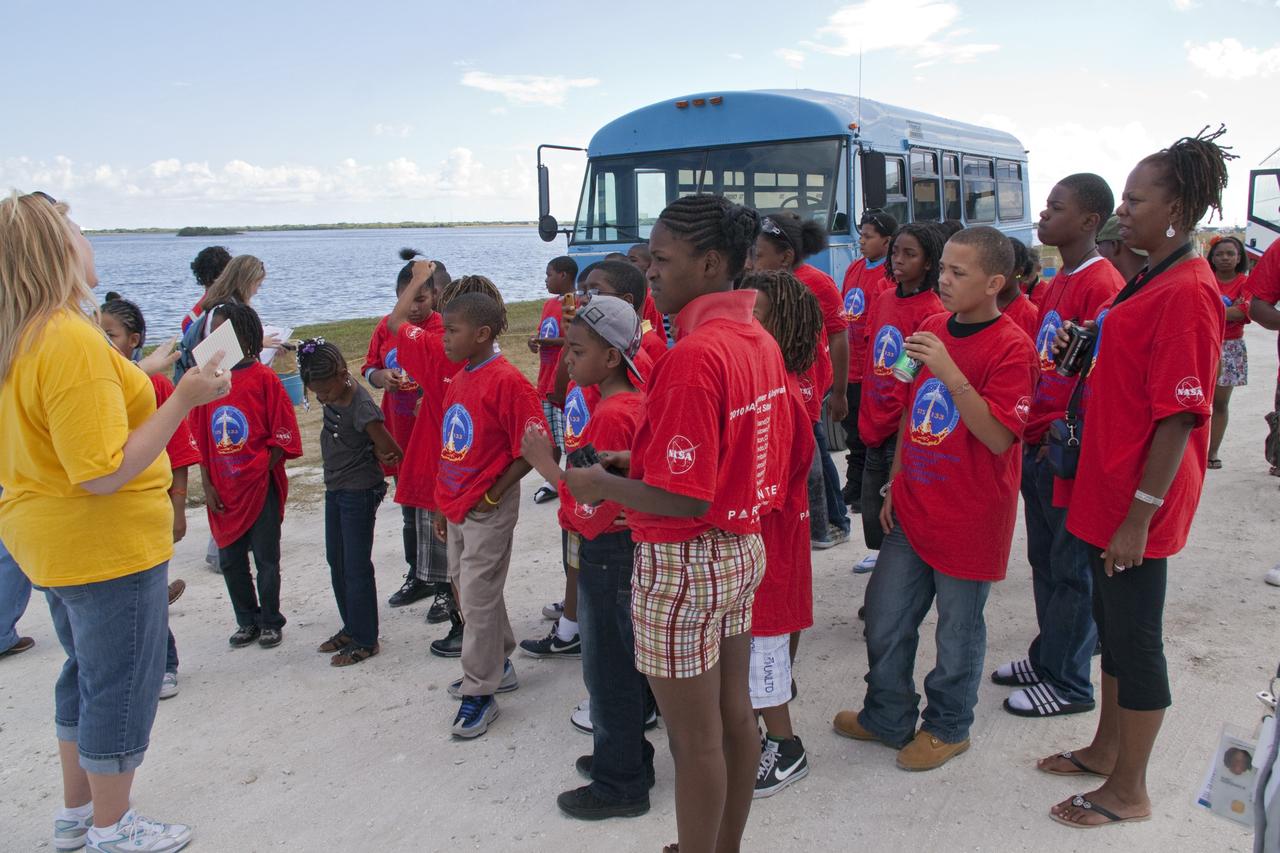
CAPE CANAVERAL, Fla. -- On the NASA Causeway at Kennedy Space Center in Florida, school children arrive at a 40- by 70-foot activity tent chock full of LEGO bricks. There, they will build their vision of the future with LEGO bricks, marking the beginning of a three-year Space Act Agreement between NASA and The LEGO Group. The partnership is meant to spark the interest of children in science, technology, engineering and mathematics (STEM). To commemorate the partnership, two small LEGO space shuttles will launch aboard space shuttle Discovery's STS-133 mission to the International Space Station and the company will release four NASA-inspired products in its LEGO CITY line next year. LEGO sets also will fly to the space station aboard Endeavour's STS-134 mission, and will be put together on orbit to demonstrate the challenges faced while building things in microgravity. Photo credit: NASA/Jack Pfaller
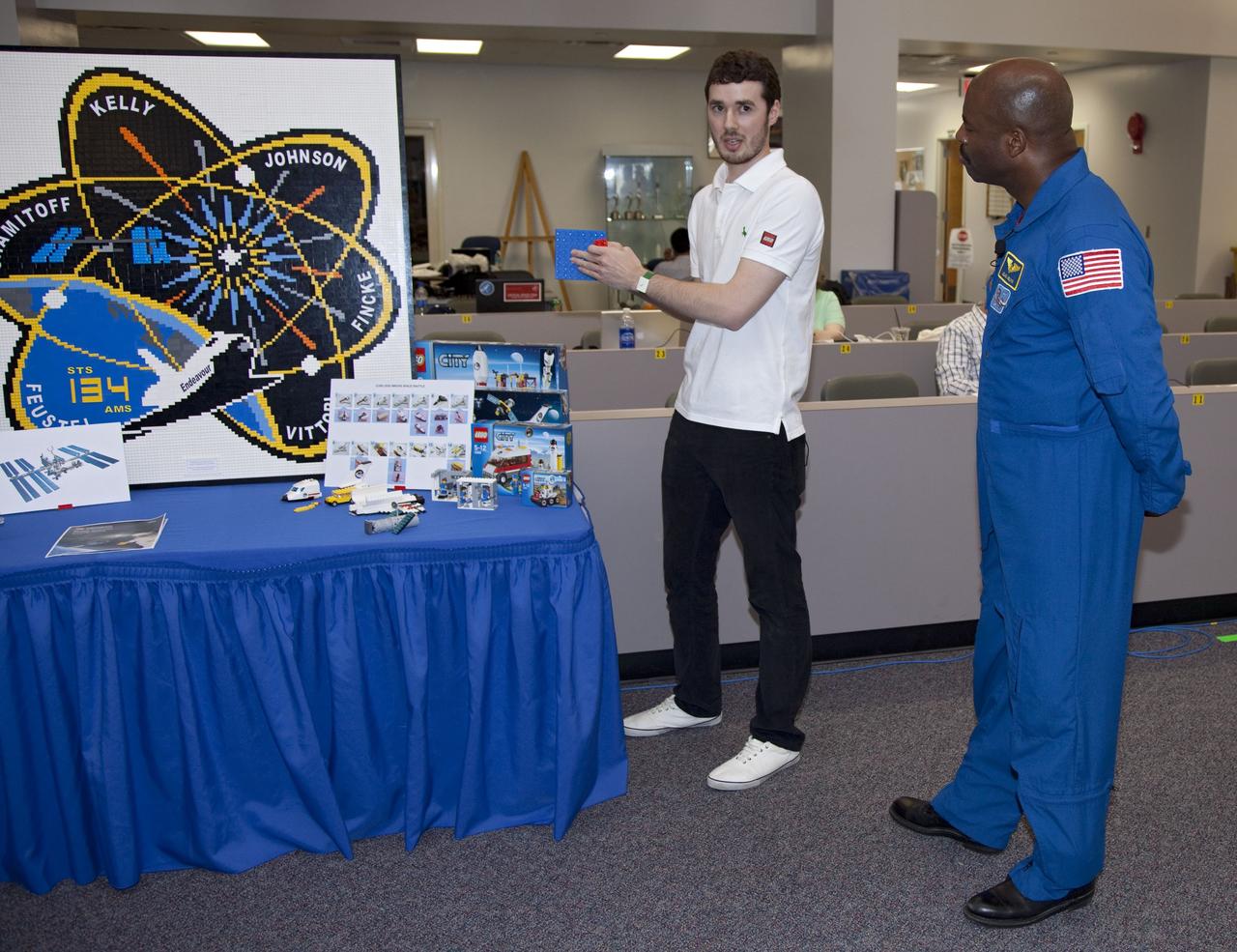
CAPE CANAVERAL, Fla. -- In the Press Site bull pen at NASA's Kennedy Space Center in Florida, The LEGO Group's Daire McCabe and NASA's Associate Administrator for Education Leland Melvin talk about the LEGO sets going up to the International Space Station aboard space shuttle Endeavour's STS-134 mission. NASA and The LEGO Group will send 23 LEGO sets to the station and some of those sets include a space shuttle, an ISS model, a Global Positioning Satellite and NASA's Hubble Space Telescope. The sets will be used for NASA's Teaching From Space Project, which is part of a three-year Space Act Agreement with the toy maker to spark the interest of children in science, technology, engineering and mathematics (STEM). Liftoff is scheduled for April 29 at 3:47 p.m. EDT. This will be the final spaceflight for Endeavour. For more information visit, www.nasa.gov/mission_pages/shuttle/shuttlemissions/sts134/index.html. Photo credit: NASA/Frankie Martin

CAPE CANAVERAL, Fla. -- A space shuttle model built of LEGO bricks is on display at NASA's Kennedy Space Center in Florida, marking a new partnership between the U.S. space agency and The LEGO Group. The three-year Space Act Agreement is meant to spark the interest of children in science, technology, engineering and mathematics (STEM) with the future release of four NASA-inspired products in the toy company's LEGO CITY line. To commemorate the beginning of the partnership, two small LEGO space shuttles will launch aboard space shuttle Discovery's STS-133 mission to the International Space Station. A 40- by 70-foot activity tent will be set up at Kennedy on Nov. 3 for children of all ages to build their vision of the future with LEGO bricks. LEGO sets also will fly to the space station aboard Endeavour's STS-134 mission, and will be put together on orbit to demonstrate the challenges faced while building things in microgravity. Photo credit: NASA/Jack Pfaller
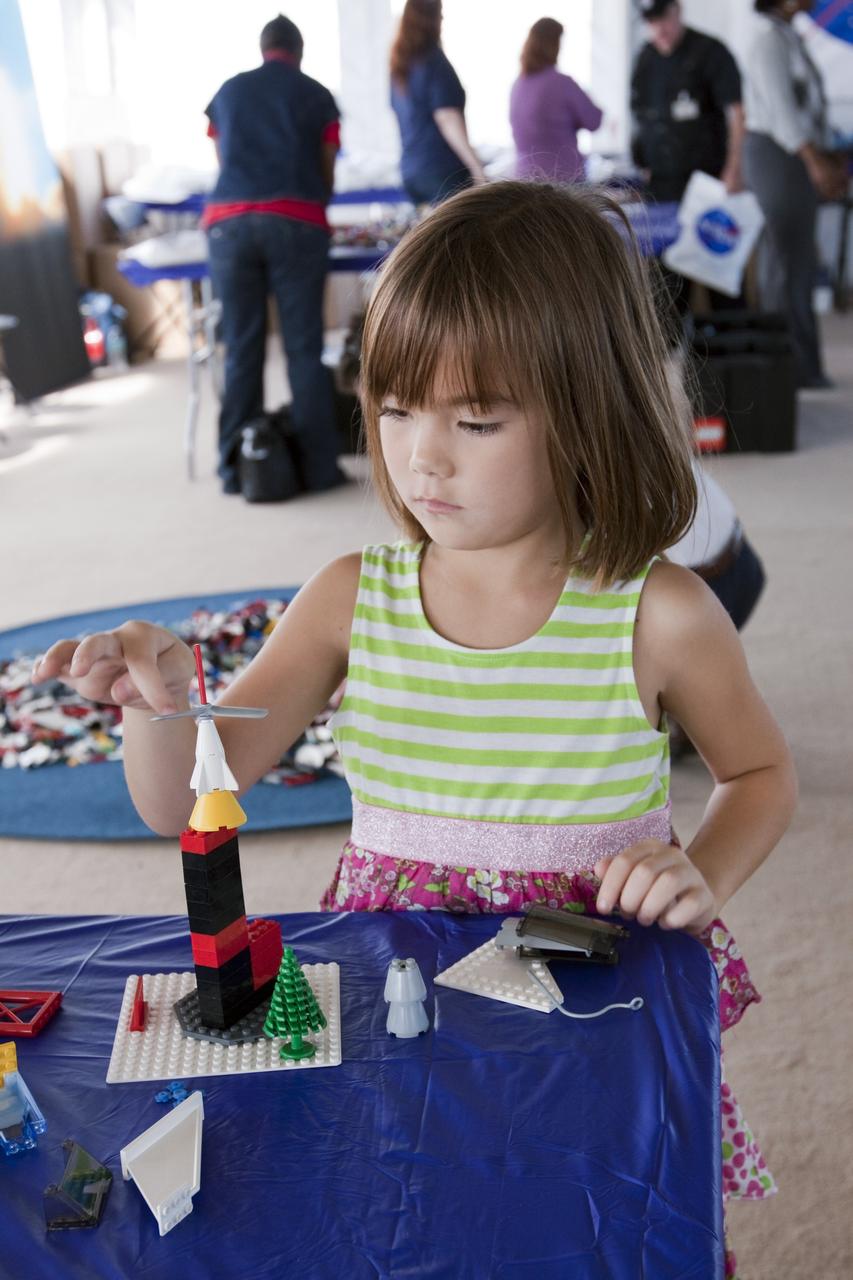
CAPE CANAVERAL, Fla. -- On the NASA Causeway at Kennedy Space Center in Florida, a 40- by 70-foot activity tent chock full of LEGO bricks hosts children and adults. There, they are building their vision of the future with LEGO bricks, marking the beginning of a three-year Space Act Agreement between NASA and The LEGO Group. The partnership is meant to spark the interest of children in science, technology, engineering and mathematics (STEM). To commemorate the partnership, two small LEGO space shuttles will launch aboard space shuttle Discovery's STS-133 mission to the International Space Station and the company will release four NASA-inspired products in its LEGO CITY line next year. LEGO sets also will fly to the space station aboard Endeavour's STS-134 mission, and will be put together on orbit to demonstrate the challenges faced while building things in microgravity. Photo credit: NASA/Jack Pfaller
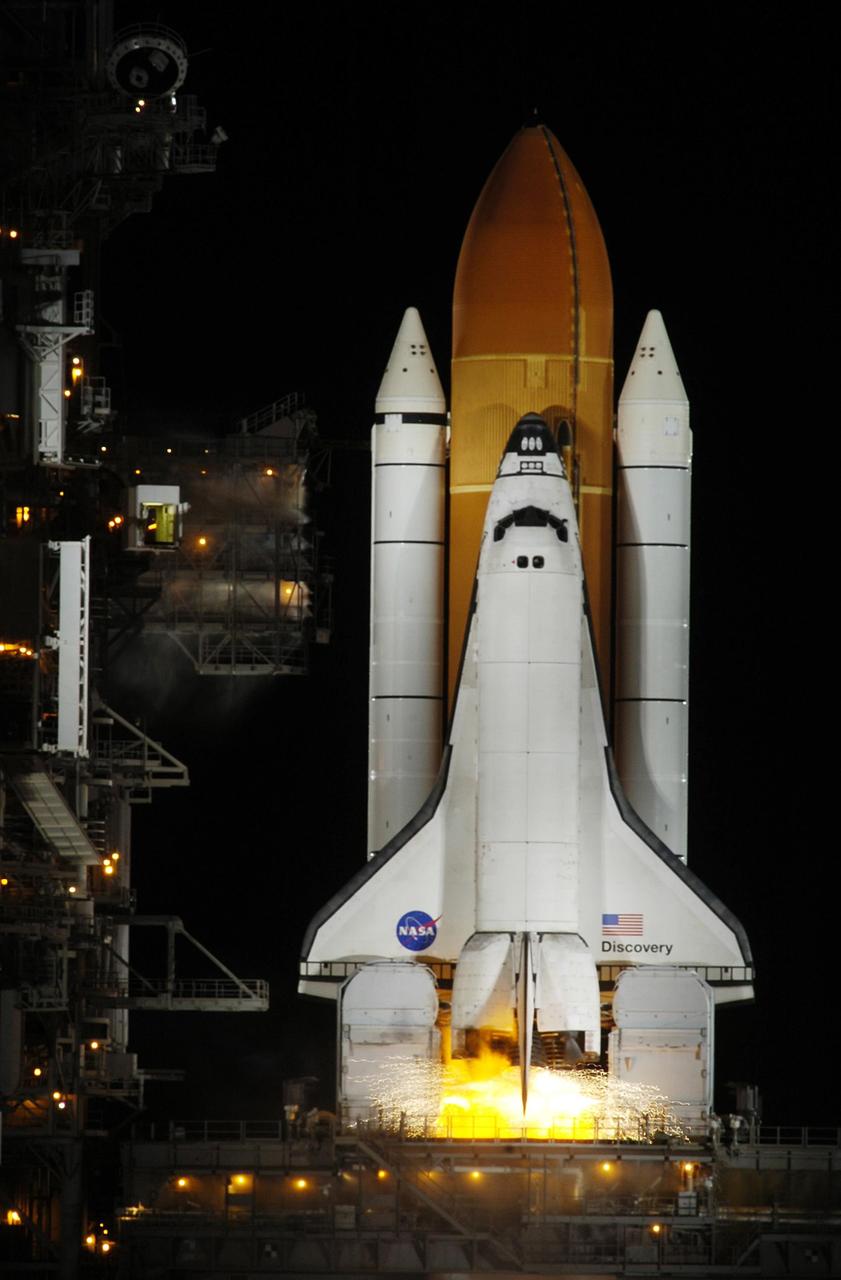
KENNEDY SPACE CENTER, FLA. -- Sparks appear just prior to Space Shuttle Discovery's main engines firing approximately T-7 seconds before liftoff. Once the engines are running normally, the solid rocket boosters are ignited and the shuttle lifts off. Discovery lifted off on mission STS-116 at 8:47 p.m. EST. This was the second launch attempt for mission STS-116. The first launch attempt on Dec. 7 was postponed due a low cloud ceiling over Kennedy Space Center. This is Discovery's 33rd mission and the first night launch since 2002. The 20th shuttle mission to the International Space Station, STS-116 carries another truss segment, P5. It will serve as a spacer, mated to the P4 truss that was attached in September. After installing the P5, the crew will reconfigure and redistribute the power generated by two pairs of U.S. solar arrays. Landing is expected Dec. 21 at KSC. Photo courtesy of Nikon/Scott Andrews
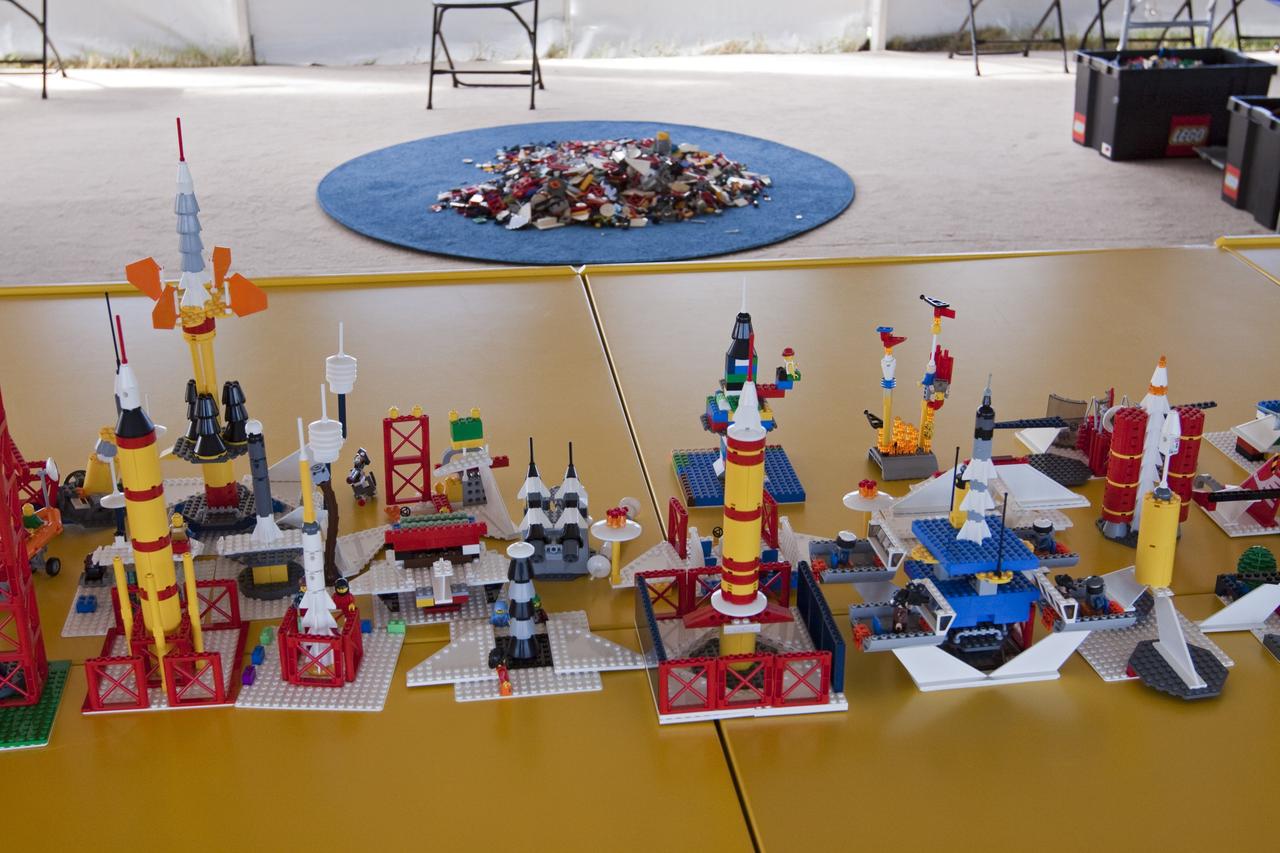
CAPE CANAVERAL, Fla. -- On the NASA Causeway at Kennedy Space Center in Florida, a 40- by 70-foot activity tent chock full of LEGO bricks is ready to welcome children of all ages. There, they will have the opportunity to build their vision of the future with LEGO bricks, marking the beginning of a three-year Space Act Agreement between NASA and The LEGO Group. The partnership is meant to spark the interest of children in science, technology, engineering and mathematics (STEM). To commemorate the partnership, two small LEGO space shuttles will launch aboard space shuttle Discovery's STS-133 mission to the International Space Station and the company will release four NASA-inspired products in its LEGO CITY line next year. LEGO sets also will fly to the space station aboard Endeavour's STS-134 mission, and will be put together on orbit to demonstrate the challenges faced while building things in microgravity. Photo credit: NASA/Jack Pfaller
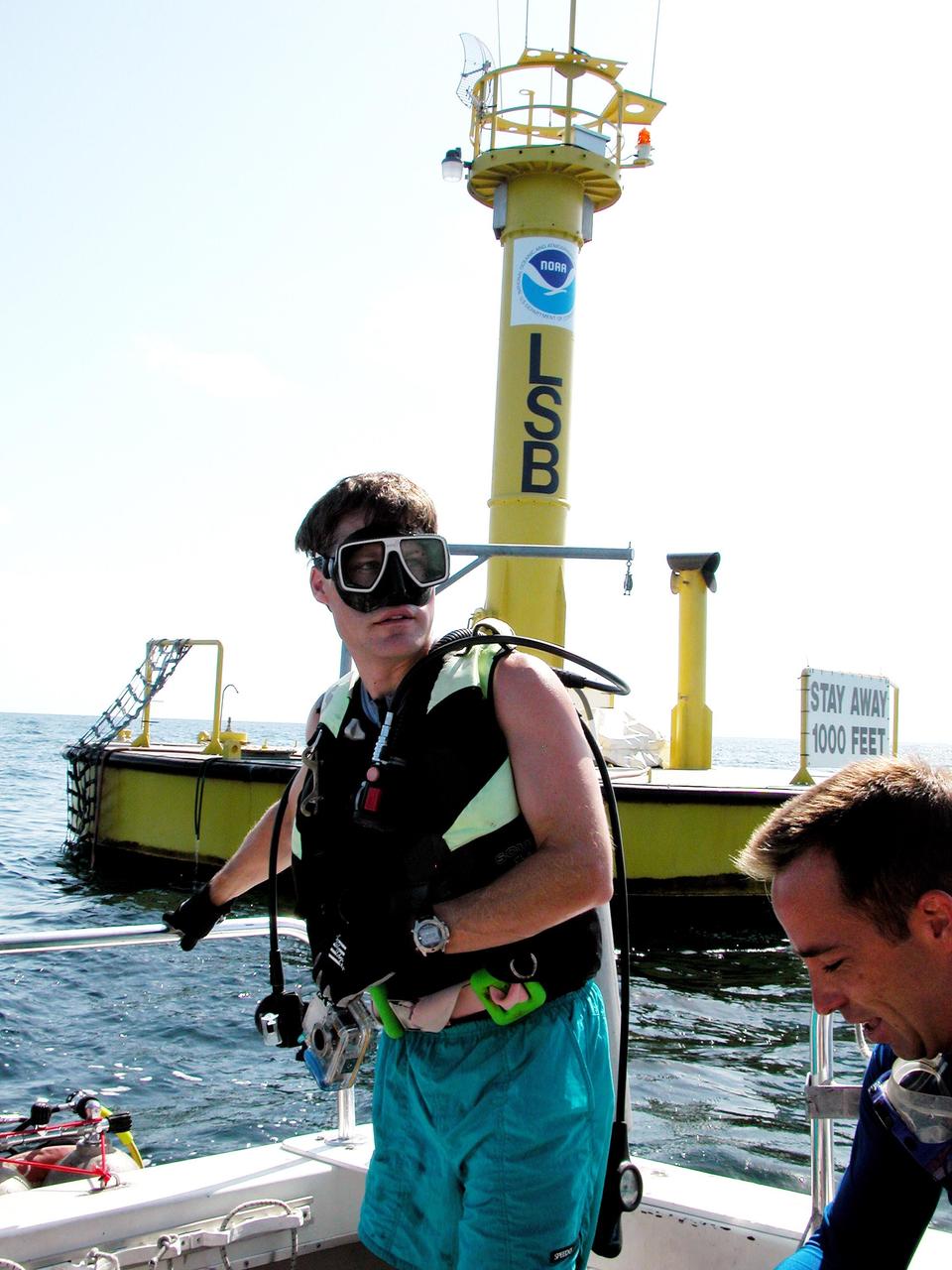
KENNEDY SPACE CENTER, FLA. - Onboard the dive boat at the Life Support Buoy offshore from Key Largo is Marc Reagan, mission lead for the NASA Extreme Environment Mission Operations 6 (NEEMO-6) mission. At right is Lt. Scott Sparks, a Navy medical officer. Reagan is also the underwater still photographer. The NEEMO-6 team comprises John Herrington, commander, Tara Ruttley, a biomedical engineer, and astronauts Nick Patrick and Doug Wheelock. The NEEMO-6 mission involves exposing an astronaut/scientist crew to a real mission experience in an extreme environment - the NOAA undersea station Aquarius - to prepare for future space flight. Spacewalk-like diving excursions and field-tests on a variety of biomedical equipment are designed to help astronauts living aboard the International Space Station. To prepare for their 10-day stay, the team had dive training twice a day at the Life Support Buoy, anchored above Aquarius.
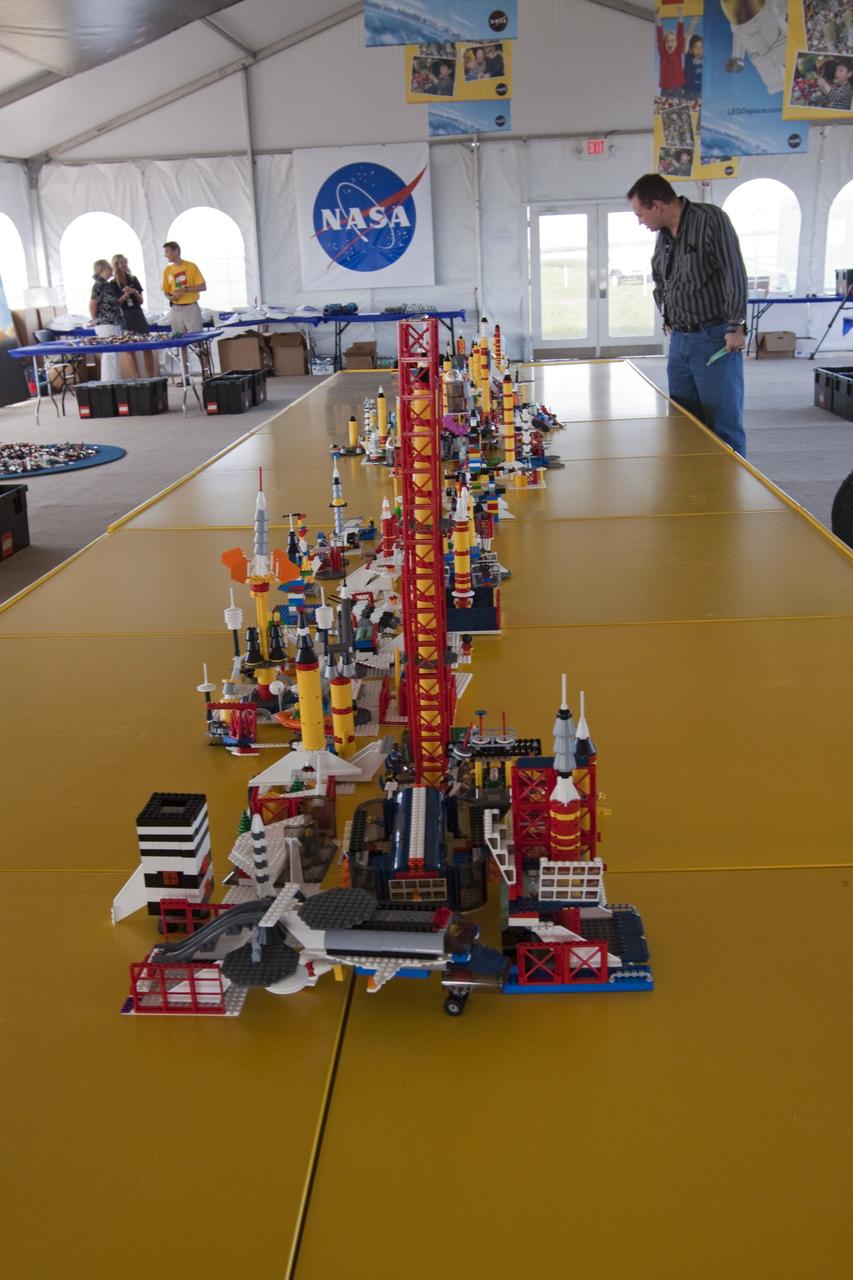
CAPE CANAVERAL, Fla. -- On the NASA Causeway at Kennedy Space Center in Florida, a 40- by 70-foot activity tent chock full of LEGO bricks is ready to welcome children of all ages. There, they will have the opportunity to build their vision of the future with LEGO bricks, marking the beginning of a three-year Space Act Agreement between NASA and The LEGO Group. The partnership is meant to spark the interest of children in science, technology, engineering and mathematics (STEM). To commemorate the partnership, two small LEGO space shuttles will launch aboard space shuttle Discovery's STS-133 mission to the International Space Station and the company will release four NASA-inspired products in its LEGO CITY line next year. LEGO sets also will fly to the space station aboard Endeavour's STS-134 mission, and will be put together on orbit to demonstrate the challenges faced while building things in microgravity. Photo credit: NASA/Jack Pfaller
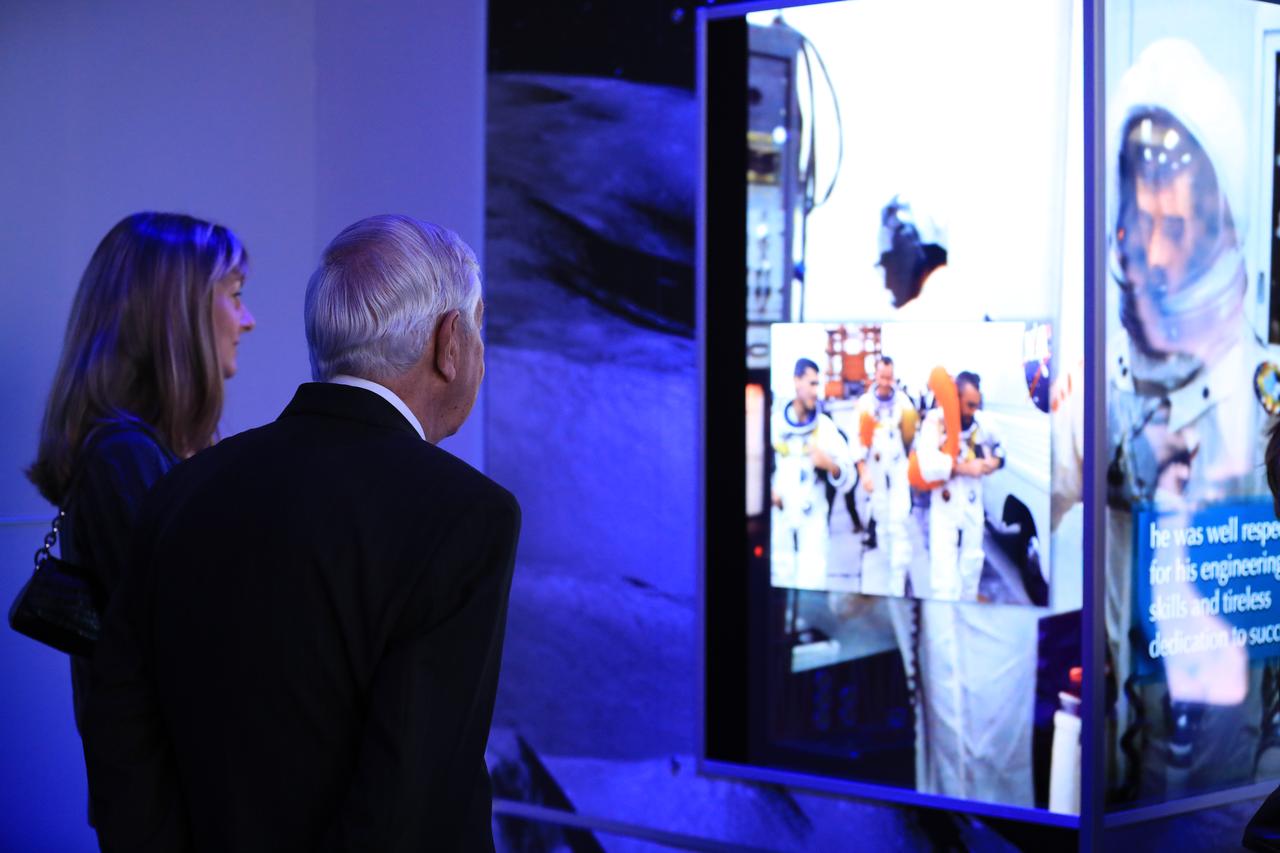
Lowell Grissom, brother of Gus Grissom, and Carly Sparks, granddaughter of Grissom, look at areas of the newly opened Apollo 1 tribute at the Apollo/Saturn V Center at NASA's Kennedy Space Center opened Jan. 27, 2017. Astronauts Gus Grissom, Ed White II and Chaffee perished in a fire at the launch pad on Jan. 27, 1967, during training for the mission. The tribute highlights the lives and careers of the astronauts. The tribute features numerous items recalling the lives of the three astronauts. The tribute also includes the three-part hatch to the spacecraft itself, the first time any part of the Apollo 1 spacecraft has been displayed publicly. A version of the hatch after it was redesigned is also showcased as an example of improvements NASA made throughout the agency and to the Apollo spacecraft that would later carry astronauts to the moon.
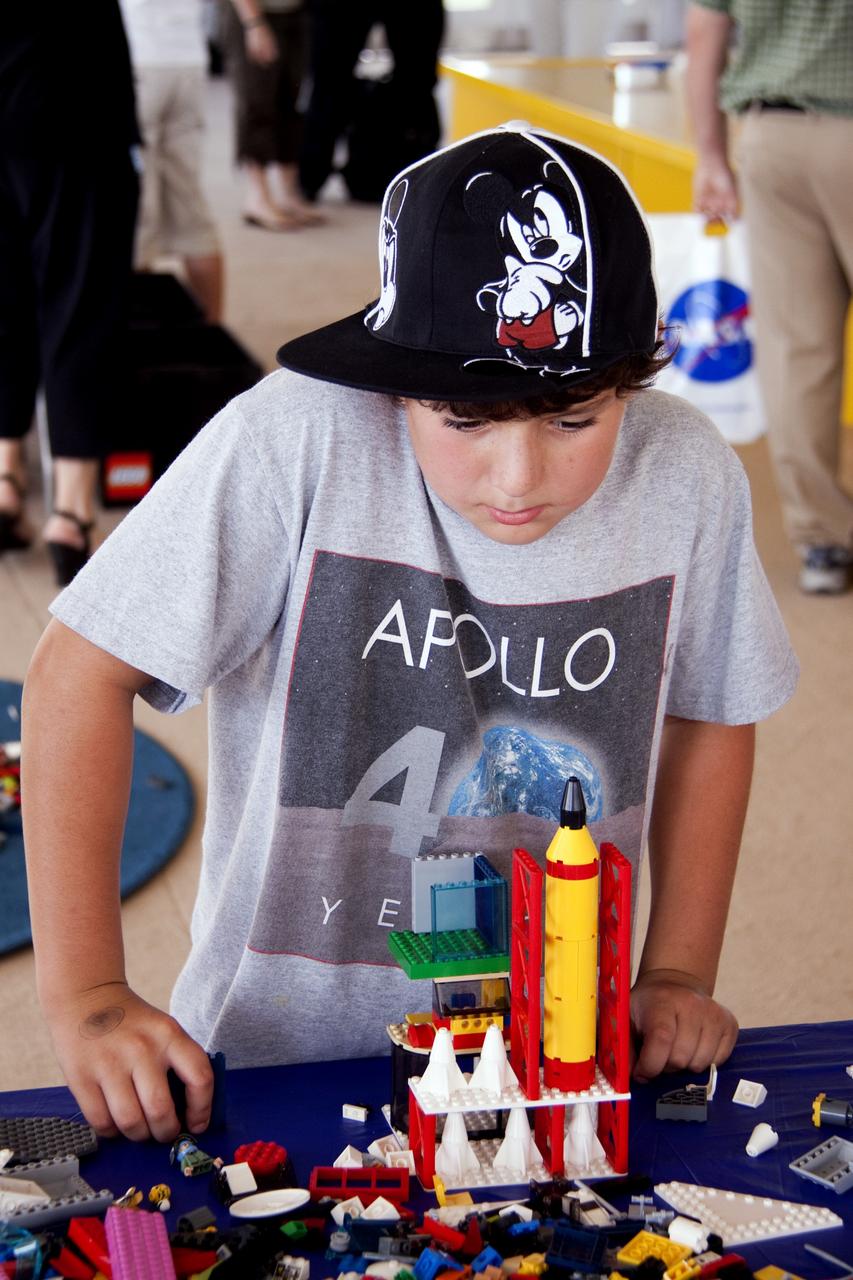
CAPE CANAVERAL, Fla. -- On the NASA Causeway at Kennedy Space Center in Florida, a 40- by 70-foot activity tent chock full of LEGO bricks hosts children and adults. There, they are building their vision of the future with LEGO bricks, marking the beginning of a three-year Space Act Agreement between NASA and The LEGO Group. The partnership is meant to spark the interest of children in science, technology, engineering and mathematics (STEM). To commemorate the partnership, two small LEGO space shuttles will launch aboard space shuttle Discovery's STS-133 mission to the International Space Station and the company will release four NASA-inspired products in its LEGO CITY line next year. LEGO sets also will fly to the space station aboard Endeavour's STS-134 mission, and will be put together on orbit to demonstrate the challenges faced while building things in microgravity. Photo credit: NASA/Jack Pfaller

CAPE CANAVERAL, Fla. -- On the NASA Causeway at Kennedy Space Center in Florida, a 40- by 70-foot activity tent chock full of LEGO bricks hosts children and adults. There, they are building their vision of the future with LEGO bricks, marking the beginning of a three-year Space Act Agreement between NASA and The LEGO Group. The partnership is meant to spark the interest of children in science, technology, engineering and mathematics (STEM). To commemorate the partnership, two small LEGO space shuttles will launch aboard space shuttle Discovery's STS-133 mission to the International Space Station and the company will release four NASA-inspired products in its LEGO CITY line next year. LEGO sets also will fly to the space station aboard Endeavour's STS-134 mission, and will be put together on orbit to demonstrate the challenges faced while building things in microgravity. Photo credit: NASA/Jack Pfaller
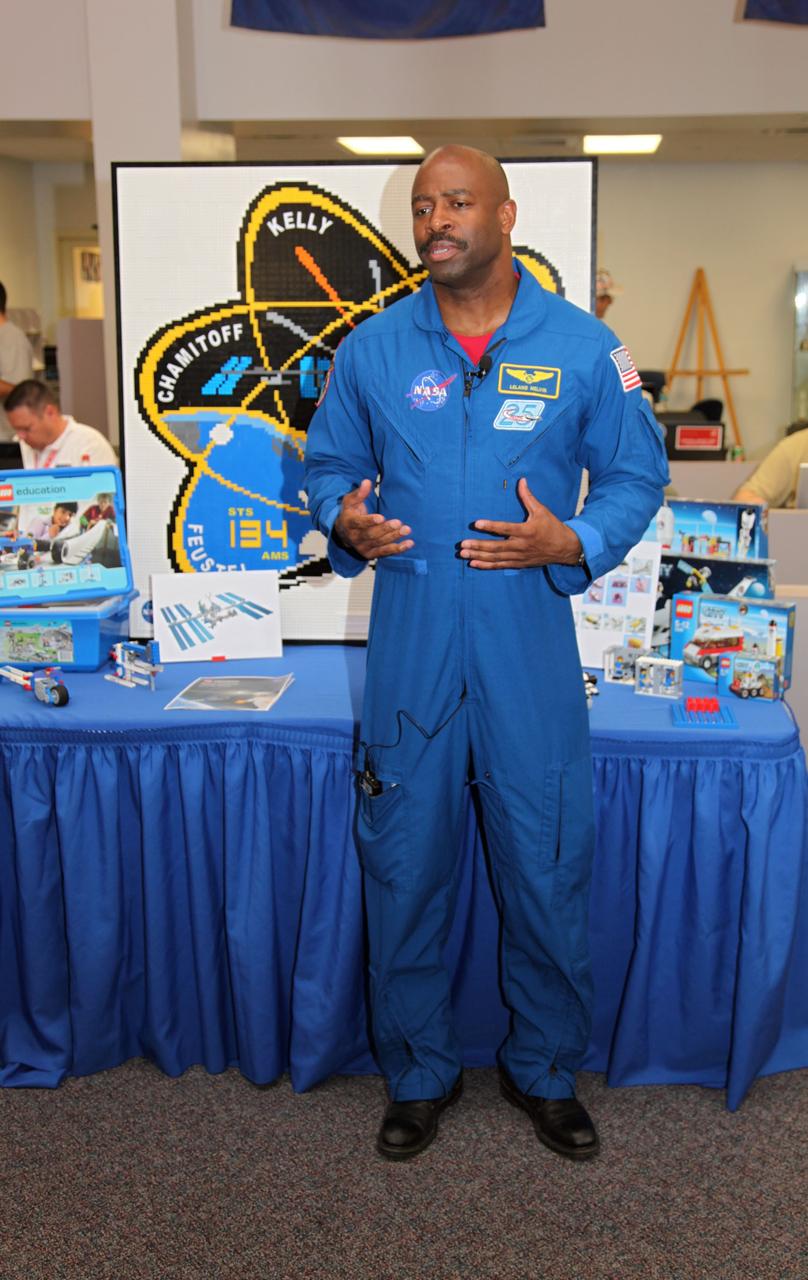
CAPE CANAVERAL, Fla. -- In the Press Site bull pen at NASA's Kennedy Space Center in Florida, NASA's Associate Administrator for Education Leland Melvin talks about the LEGO sets going up to the International Space Station (ISS) aboard space shuttle Endeavour's STS-134 mission. NASA and The LEGO Group will send 23 LEGO sets to the station and some of those sets include a space shuttle, an ISS model, a Global Positioning Satellite and NASA's Hubble Space Telescope. The sets will be used for NASA's Teaching From Space Project, which is part of a three-year Space Act Agreement with the toy maker to spark the interest of children in science, technology, engineering and mathematics (STEM). Liftoff is scheduled for April 29 at 3:47 p.m. EDT. This will be the final spaceflight for Endeavour. For more information visit, www.nasa.gov/mission_pages/shuttle/shuttlemissions/sts134/index.html. Photo credit: NASA/Frankie Martin
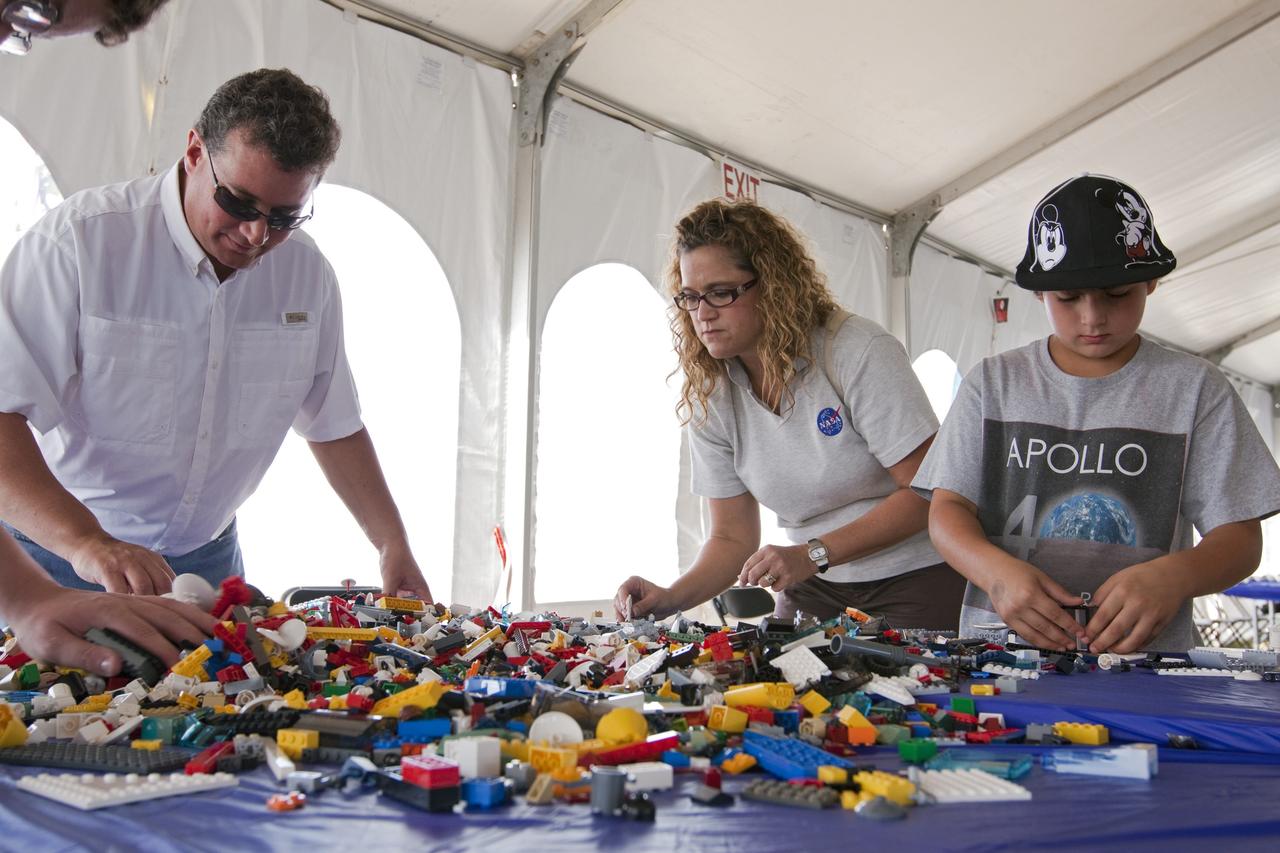
CAPE CANAVERAL, Fla. -- On the NASA Causeway at Kennedy Space Center in Florida, a 40- by 70-foot activity tent chock full of LEGO bricks hosts children and adults. There, they are building their vision of the future with LEGO bricks, marking the beginning of a three-year Space Act Agreement between NASA and The LEGO Group. The partnership is meant to spark the interest of children in science, technology, engineering and mathematics (STEM). To commemorate the partnership, two small LEGO space shuttles will launch aboard space shuttle Discovery's STS-133 mission to the International Space Station and the company will release four NASA-inspired products in its LEGO CITY line next year. LEGO sets also will fly to the space station aboard Endeavour's STS-134 mission, and will be put together on orbit to demonstrate the challenges faced while building things in microgravity. Photo credit: NASA/Jack Pfaller
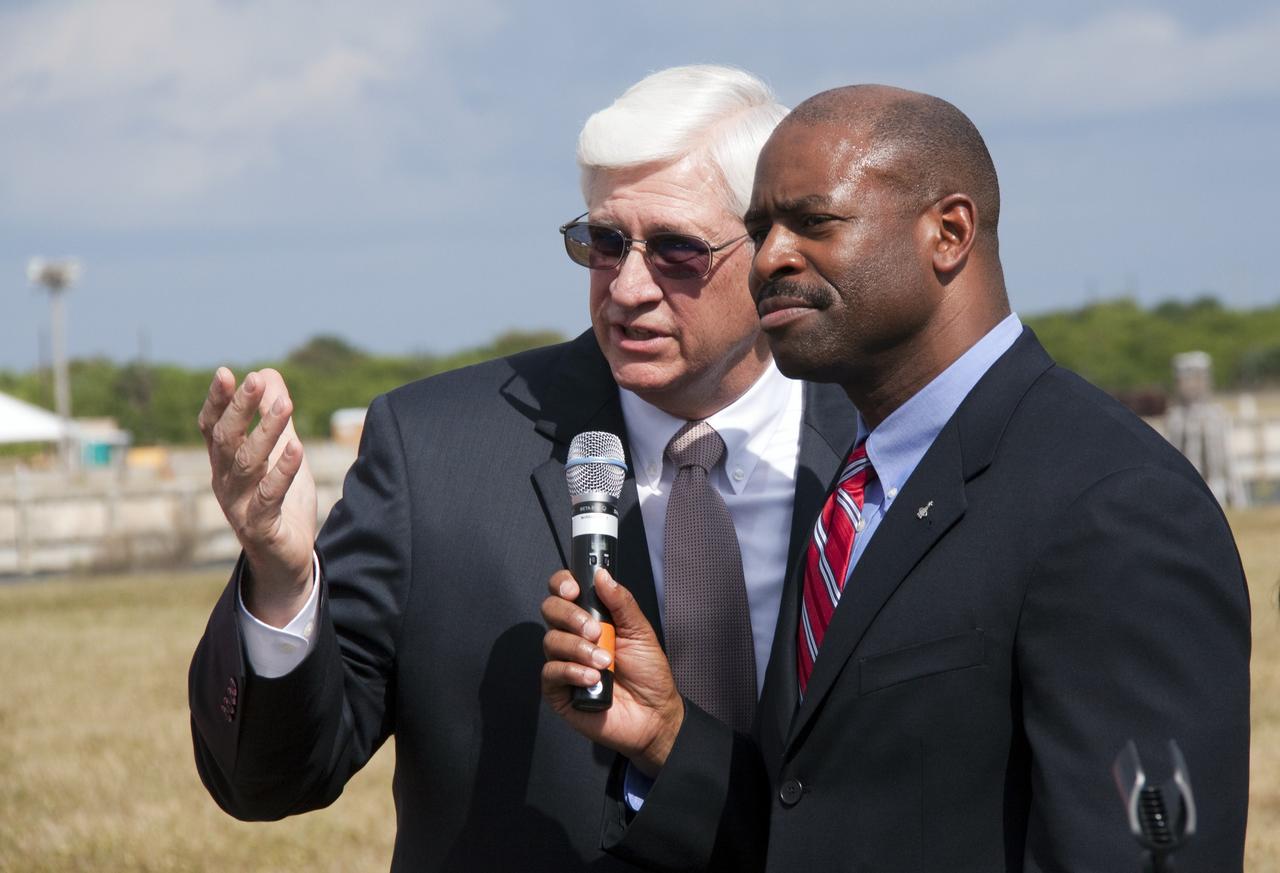
CAPE CANAVERAL, Fla. -- NASA and The LEGO Group announce a three-year Space Act Agreement meant to spark the interest of children in science, technology, engineering and mathematics (STEM) with the future release of four NASA-inspired products in the toy company's LEGO CITY line. From left, are Stephan Turnipseed, president of LEGO Education North America, and Leland Melvin, NASA's associate administrator for Education. To commemorate the beginning of the partnership, two small LEGO space shuttles will launch aboard space shuttle Discovery's STS-133 mission to the International Space Station. A 40- by 70-foot activity tent will be set up at Kennedy on Nov. 3 for children of all ages to build their vision of the future with LEGO bricks. LEGO sets also will fly to the space station aboard Endeavour's STS-134 mission, and will be put together on orbit to demonstrate the challenges faced while building things in microgravity. Photo credit: NASA/Jack Pfaller

NASA image release August 6, 2010 On August 1, 2010, almost the entire Earth-facing side of the sun erupted in a tumult of activity. This image from the Solar Dynamics Observatory of the news-making solar event on August 1 shows the C3-class solar flare (white area on upper left), a solar tsunami (wave-like structure, upper right), multiple filaments of magnetism lifting off the stellar surface, large-scale shaking of the solar corona, radio bursts, a coronal mass ejection and more. This multi-wavelength extreme ultraviolet snapshot from the Solar Dynamics Observatory shows the sun's northern hemisphere in mid-eruption. Different colors in the image represent different gas temperatures. Earth's magnetic field is still reverberating from the solar flare impact on August 3, 2010, which sparked aurorae as far south as Wisconsin and Iowa in the United States. Analysts believe a second solar flare is following behind the first flare and could re-energize the fading geomagnetic storm and spark a new round of Northern Lights. Credit: NASA/SDO/AIA <b><a href="http://www.nasa.gov/centers/goddard/home/index.html" rel="nofollow">NASA Goddard Space Flight Center</a></b> is home to the nation's largest organization of combined scientists, engineers and technologists that build spacecraft, instruments and new technology to study the Earth, the sun, our solar system, and the universe. <b>Follow us on <a href="http://twitter.com/NASA_GoddardPix" rel="nofollow">Twitter</a></b> <b>Join us on <a href="http://www.facebook.com/pages/Greenbelt-MD/NASA-Goddard/395013845897?ref=tsd" rel="nofollow">Facebook</a><b> </b></b>
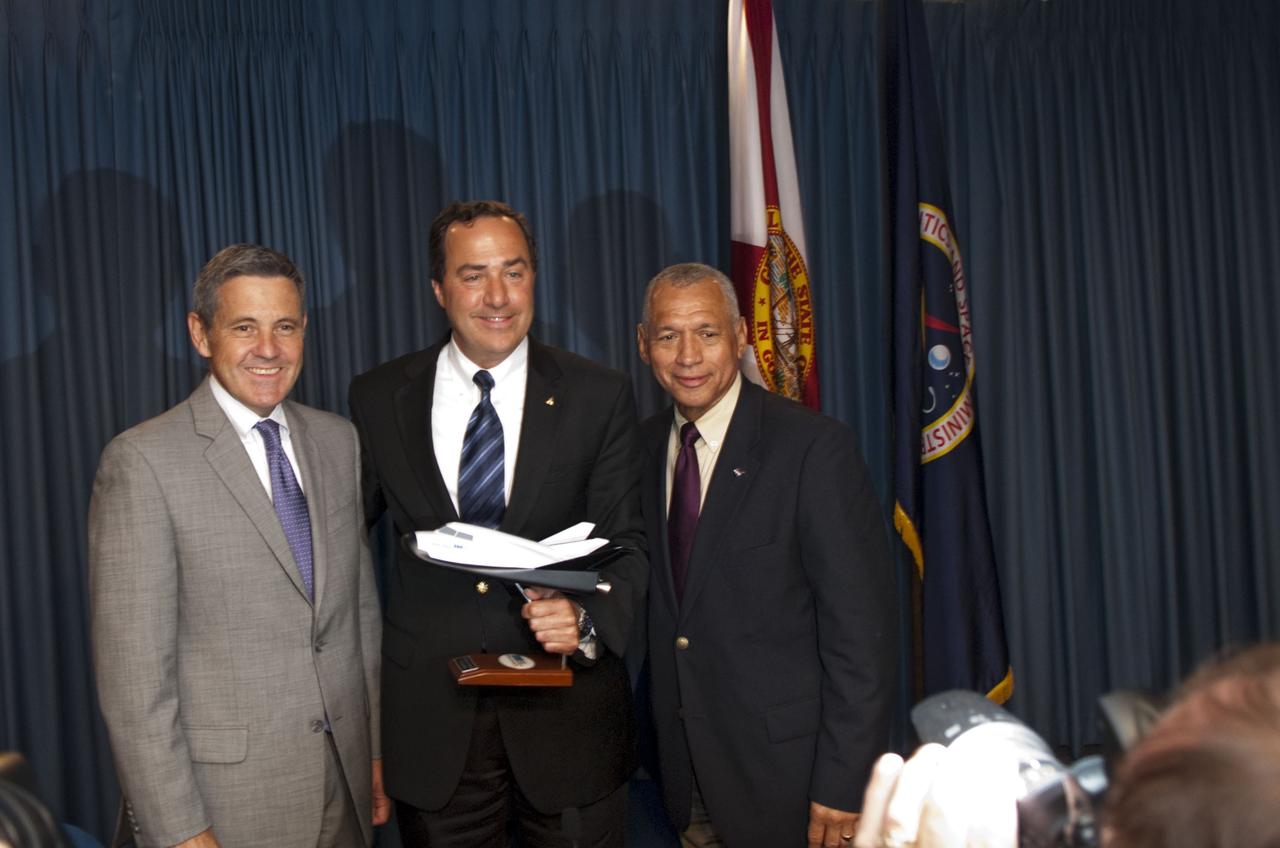
CAPE CANAVERAL, Fla. -- Kennedy Space Center Director Bob Cabana, left, Mark Sirangelo, head of Sierra Nevada Space Systems (SNSS) of Sparks, Nev., and NASA Administrator Charlie Bolden pose for a photo after signing a Space Act Agreement that will offer the company technical capabilities from Kennedy's uniquely skilled work force. Kennedy will help Sierra Nevada with the ground operations support of its lifting body reusable spacecraft called "Dream Chaser," which resembles a smaller version of the space shuttle orbiter. The spacecraft would carry as many as seven astronauts to the space station. Through the new agreement, Kennedy's work force will use its experience of processing the shuttle fleet for 30 years to help Sierra Nevada define and execute Dream Chaser's launch preparations and post-landing activities. In 2010 and 2011, Sierra Nevada was awarded grants as part of the initiative to stimulate the private sector in developing and demonstrating human spaceflight capabilities for NASA's Commercial Crew Program. The goal of the program, which is based in Florida at Kennedy, is to facilitate the development of a U.S. commercial crew space transportation capability by achieving safe, reliable and cost-effective access to and from the space station and future low Earth orbit destinations. Photo credit: NASA/Jim Grossmann
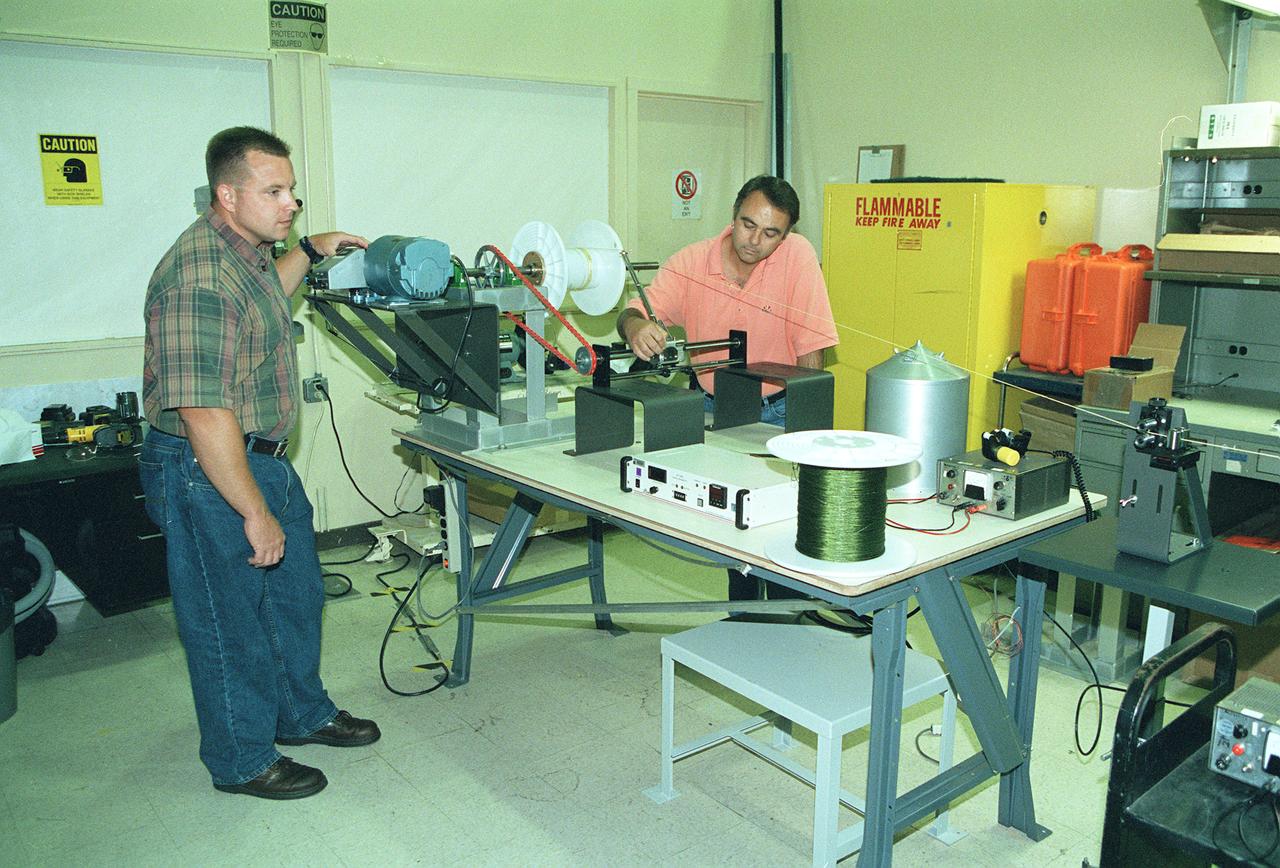
This photograph shows two Marshall Space Flight Center (MSFC) engineers, Mark Vaccaro (left) and Ken Welzyn, testing electrodynamic tethers in the MSFC Tether Winding and Spark Testing Facility. For 4 years, MSFC and industry partners have been developing the Propulsive Small Expendable Deployer System experiment, called ProSEDS. ProSEDS will test electrodynamic tether propulsion technology. Electrodynamic tethers are long, thin wires that collect electrical current when passing through a magnetic field. The tether works as a thruster as a magnetic field exerts a force on a current-carrying wire. Since electrodynamic tethers require no propellant, they could substantially reduce the weight of the spacecraft and provide a cost-effective method of reboosting spacecraft. The initial flight of ProSEDS is scheduled to fly aboard an Air Force Delta II rocket in the summer of 2002. In orbit, ProSEDS will deploy from a Delta II second stage. It will be a 3.1-mile (5 kilometer) long, ultrathin base-wire tether cornected with a 6.2-mile (10 kilometer) long non-conducting tether. This photograph shows Less Johnson, a scientist at MSFC, inspecting the nonconducting part of a tether as it exits a deployer similar to the one to be used in the ProSEDS experiment. The ProSEDS experiment is managed by the Space Transportation Directorate at MSFC.
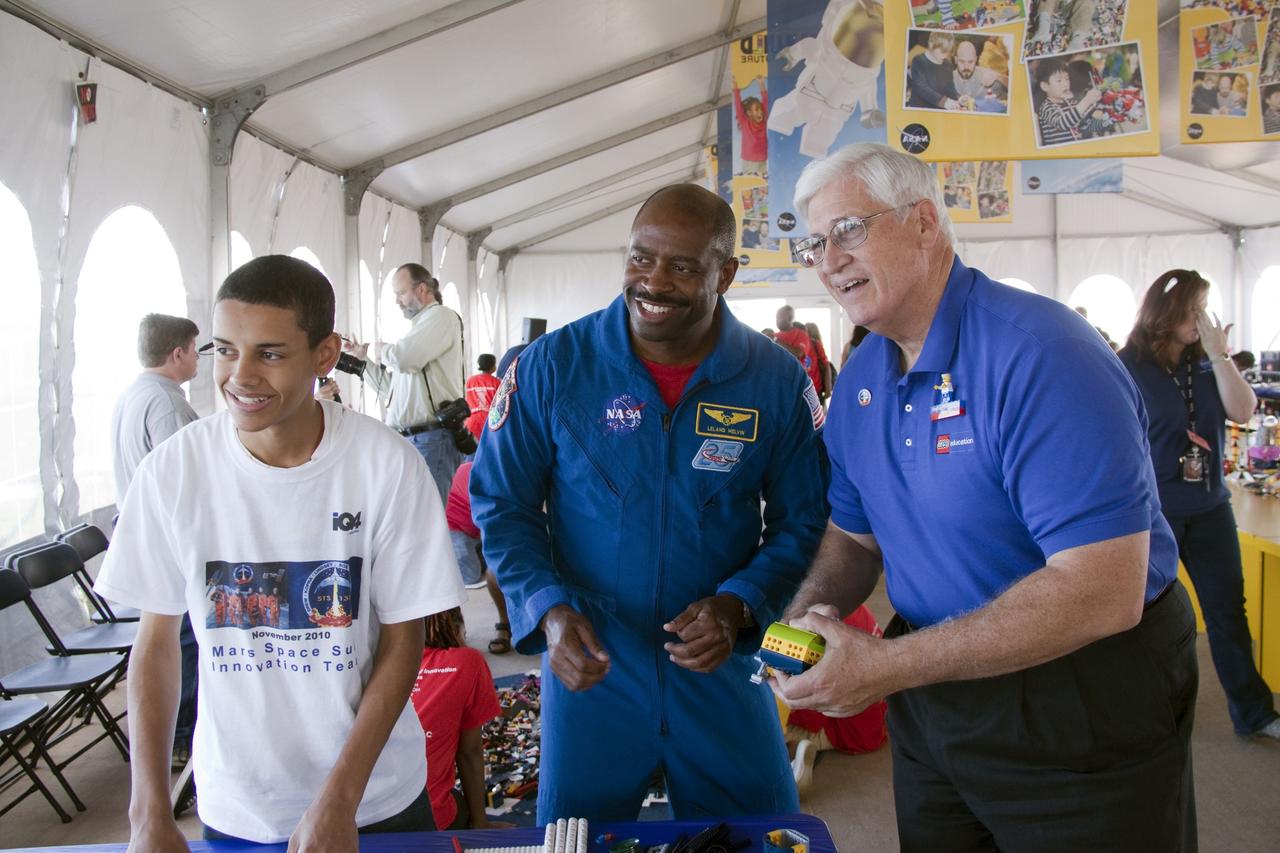
CAPE CANAVERAL, Fla. -- On the NASA Causeway at Kennedy Space Center in Florida, Leland Melvin, NASA's associate administrator for Education, center, and Stephan Turnipseed, president of LEGO Education North America, right, help a student build LEGO space vehicles inside a 40- by 70-foot activity tent. There, children of all ages are building their vision of the future with LEGO bricks, marking the beginning of a three-year Space Act Agreement meant to spark the interest of children in science, technology, engineering and mathematics (STEM). To commemorate the partnership, two small LEGO space shuttles will launch aboard space shuttle Discovery's STS-133 mission to the International Space Station and the company will release four NASA-inspired products in its LEGO CITY line next year. LEGO sets also will fly to the space station aboard Endeavour's STS-134 mission, and will be put together on orbit to demonstrate the challenges faced while building things in microgravity. Photo credit: NASA/Jack Pfaller
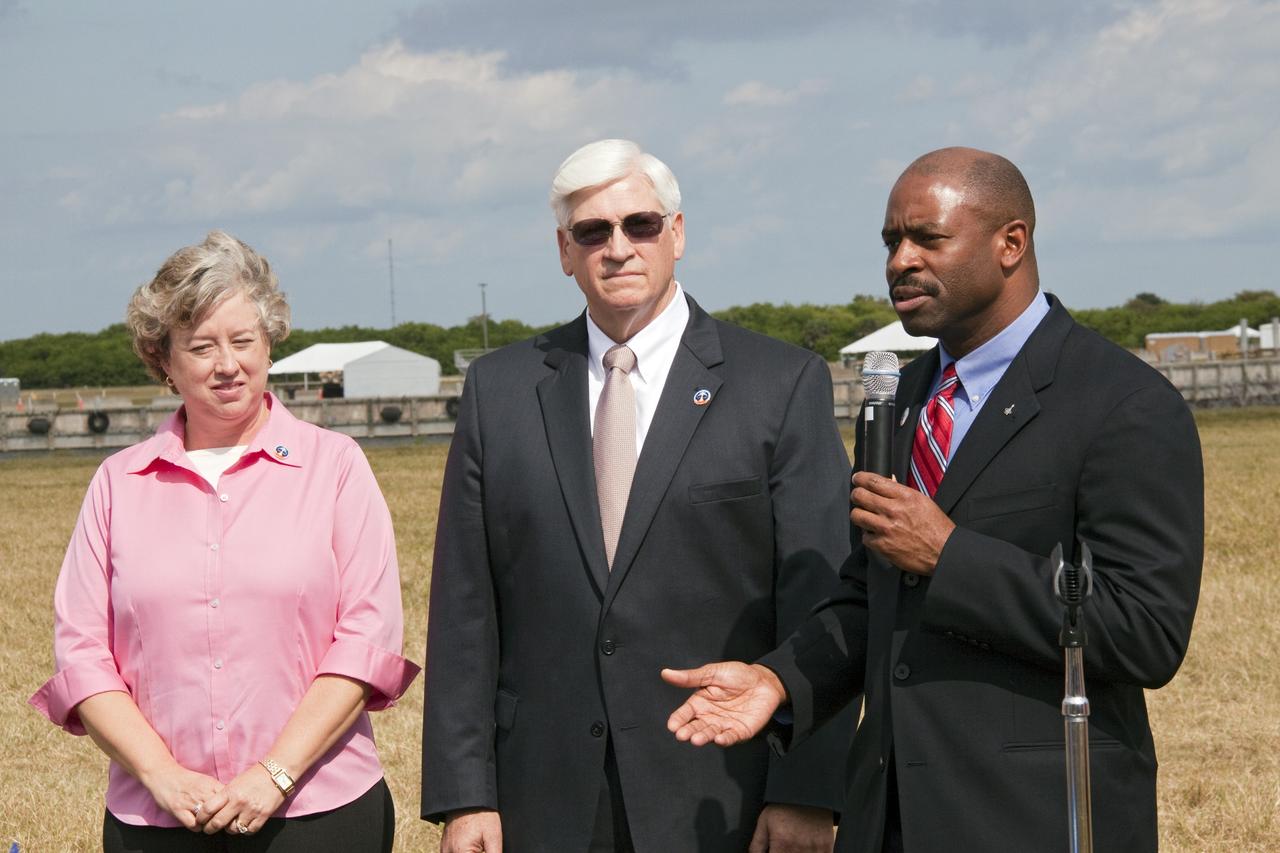
CAPE CANAVERAL, Fla. -- NASA and The LEGO Group announce a three-year Space Act Agreement meant to spark the interest of children in science, technology, engineering and mathematics (STEM) with the future release of four NASA-inspired products in the toy company's LEGO CITY line. From left, are Debbie Biggs, education specialist for International Space Station National Lab Education Projects, Stephan Turnipseed, president of LEGO Education North America, and Leland Melvin, NASA's associate administrator for Education. To commemorate the beginning of the partnership, two small LEGO space shuttles will launch aboard space shuttle Discovery's STS-133 mission to the International Space Station. A 40- by 70-foot activity tent will be set up at Kennedy on Nov. 3 for children of all ages to build their vision of the future with LEGO bricks. LEGO sets also will fly to the space station aboard Endeavour's STS-134 mission, and will be put together on orbit to demonstrate the challenges faced while building things in microgravity. Photo credit: NASA/Jack Pfaller
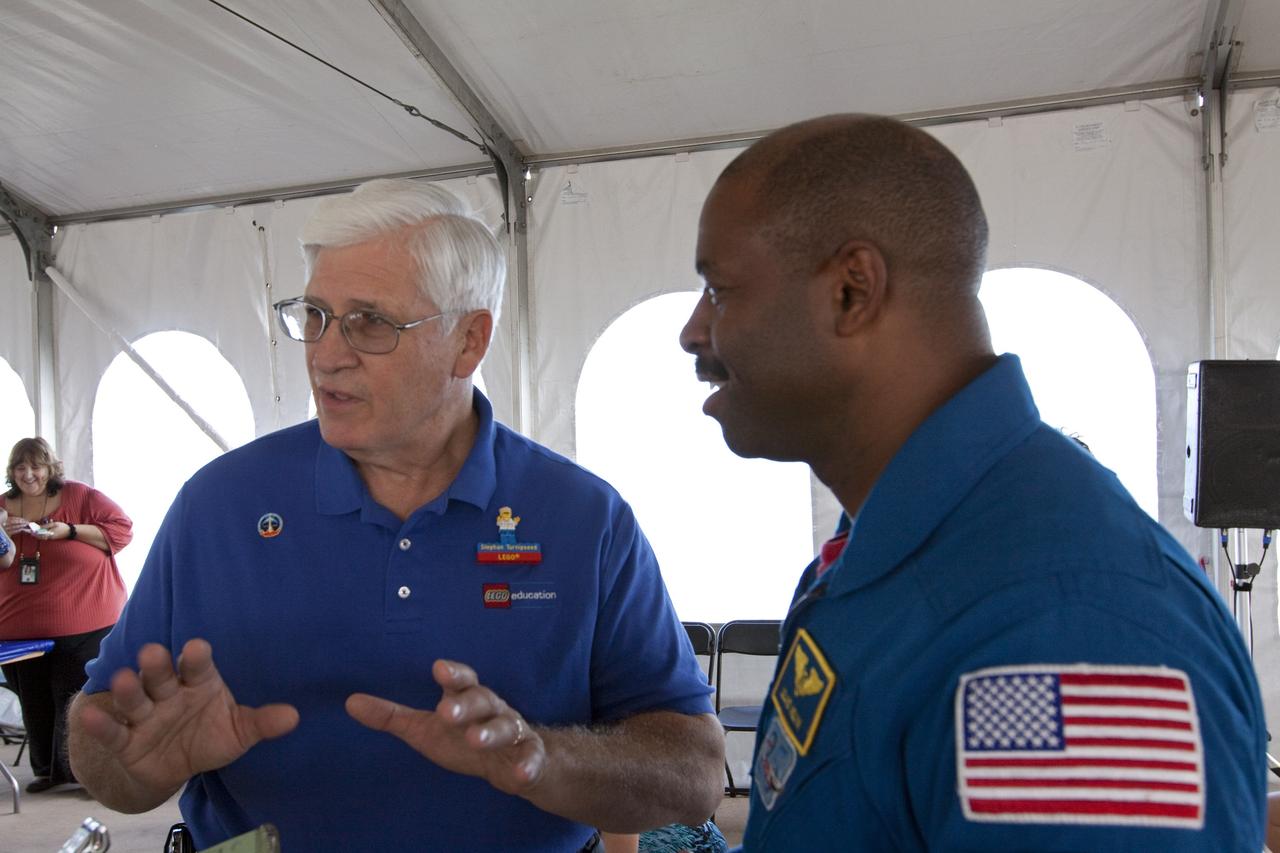
CAPE CANAVERAL, Fla. -- Stephan Turnipseed, president of LEGO Education North America, left, and Leland Melvin, NASA's associate administrator for Education, discuss the new partnership between the U.S. space agency and the toy company inside a 40- by 70-foot activity tent chock full of LEGO bricks on the NASA Causeway at Kennedy Space Center in Florida. There, children of all ages are building their vision of the future with LEGO bricks, marking the beginning of a three-year Space Act Agreement meant to spark the interest of children in science, technology, engineering and mathematics (STEM). To commemorate the partnership, two small LEGO space shuttles will launch aboard space shuttle Discovery's STS-133 mission to the International Space Station and the company will release four NASA-inspired products in its LEGO CITY line next year. LEGO sets also will fly to the space station aboard Endeavour's STS-134 mission, and will be put together on orbit to demonstrate the challenges faced while building things in microgravity. Photo credit: NASA/Jack Pfaller
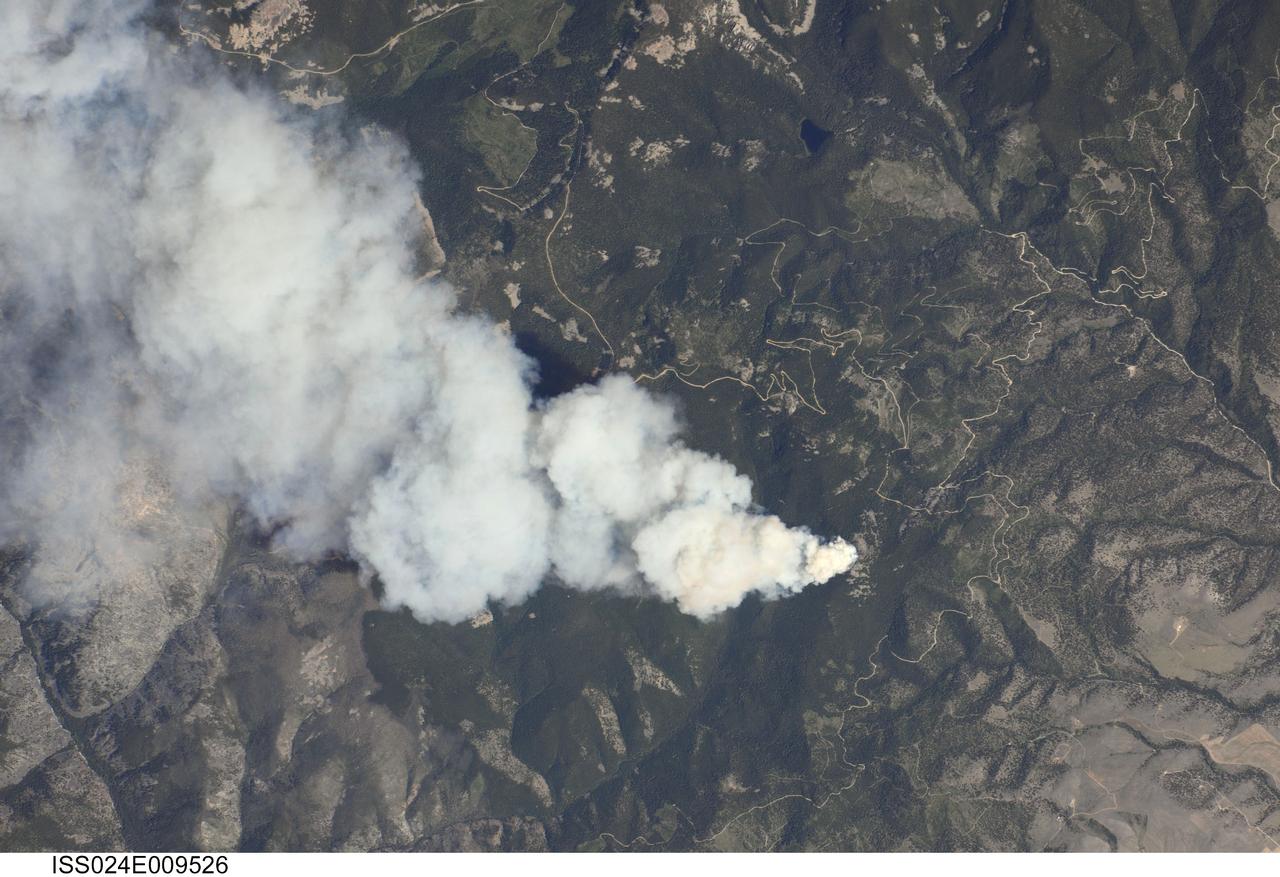
ISS024-E-009526 (25 July 2010) --- Dominic Point Fire in Montana is featured in this image photographed by an Expedition 24 crew member on the International Space Station. Lightning strikes in the forested mountains of the western United States, and human activities, can spark wild fires during the summer dry season. The Dominic Point Fire was first reported near 3:00 p.m. local time on July 25 2010. Approximately one hour later, the space station crew photographed the fire?s large smoke plume ? already extending at least eight kilometers to the east ? from orbit as they passed almost directly overhead. Forest Service fire crews, slurry bombers and helicopters were on the scene by that evening. The fire may have been started by a lightning strike, as there are no trails leading into the fire area located approximately 22 kilometers northeast of Hamilton, MT (according to local reports). As of July 26, 2010 the fire had burned approximately 283?405 hectares of the Bitterroot National Forest in western Montana. The fire is thought to have expanded quickly due to high temperatures, low humidity, and favorable winds with an abundance of deadfall ? dead trees and logs that provide readily combustible fuels ? in the area.
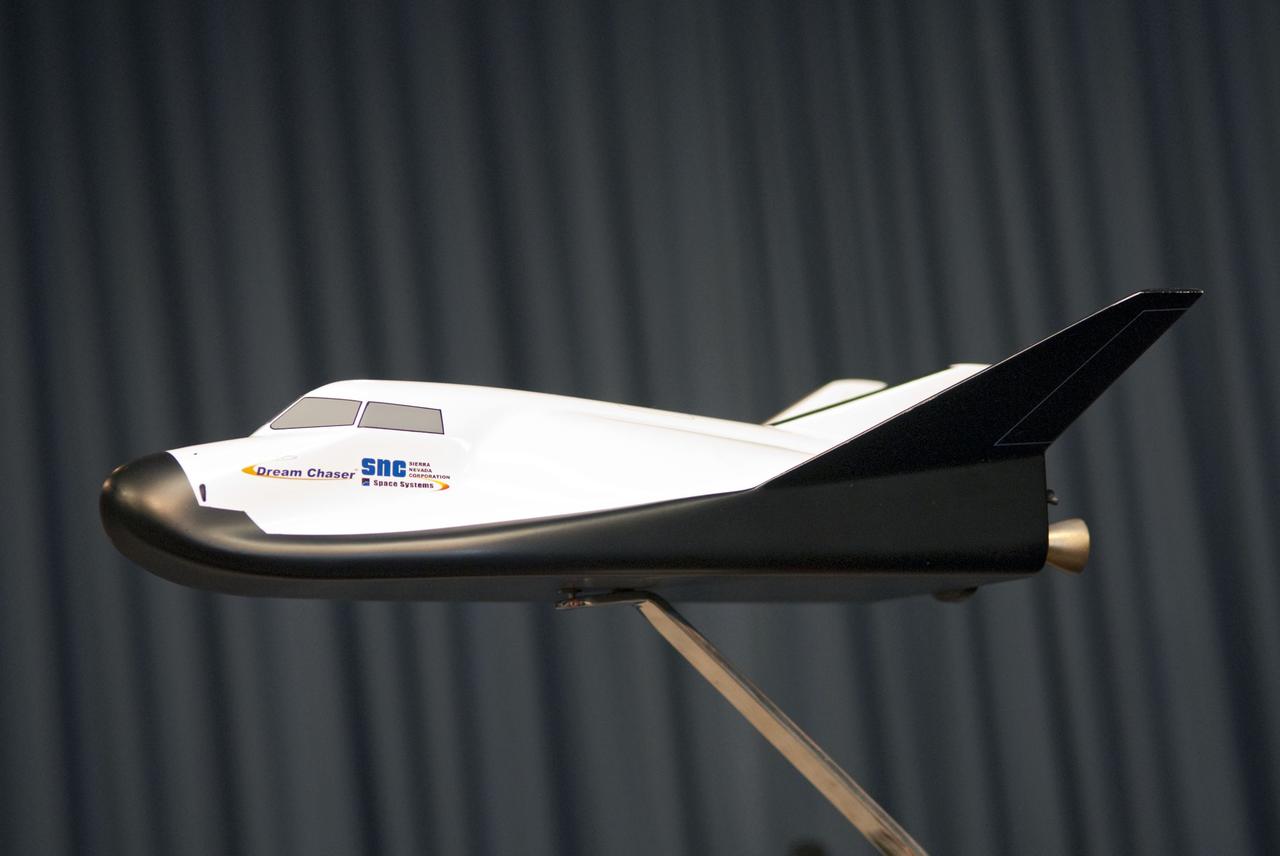
CAPE CANAVERAL, Fla. -- Sierra Nevada Space Systems (SNSS) of Sparks, Nev., and NASA signed a Space Act Agreement that will offer the company technical capabilities from Kennedy's uniquely skilled work force. Kennedy will help Sierra Nevada with the ground operations support of its lifting body reusable spacecraft called "Dream Chaser." The spacecraft, seen here as a display, resembles a smaller version of the space shuttle orbiter. The spacecraft would carry as many as seven astronauts to the space station. Through the new agreement, Kennedy's work force will use its experience of processing the shuttle fleet for 30 years to help Sierra Nevada define and execute Dream Chaser's launch preparations and post-landing activities. In 2010 and 2011, Sierra Nevada was awarded grants as part of the initiative to stimulate the private sector in developing and demonstrating human spaceflight capabilities for NASA's Commercial Crew Program. The goal of the program, which is based in Florida at Kennedy, is to facilitate the development of a U.S. commercial crew space transportation capability by achieving safe, reliable and cost-effective access to and from the space station and future low Earth orbit destinations. Photo credit: NASA/Jim Grossmann
![“I feel that my larger purpose at NASA, which I've felt since I came on as an intern, is to leave NASA a better place than I found it. I know there are so many people who are just like myself, who have had this big, huge dream of being at NASA from some sort of spark in their childhood. I have a privilege as a well-spoken, affable, femme, white woman and I’m compelled to use this privilege for good — to advocate for others. I feel like this dream should be achievable for anyone who has the merit to be here without wondering 'Are my needs going [to] be met?' Or, 'If I'm a part of a particular community, will I be faced with any sort of backlash because of the culture?' As an Agency, we're trying to do incredibly hard things moving forward. And going forward, I choose to use the privilege of being at HQ and being very close to leadership as a vessel for progress to help ensure we get closer to everybody having the right to achieve their dream here." NASA Management and Program Analyst Mallory Carbon, poses for a portrait, Wednesday, May 29, 2024, outside the NASA Headquarters Mary W. Jackson Building in Washington. Photo Credit: (NASA/Bill Ingalls)](https://images-assets.nasa.gov/image/NHQ202405290001/NHQ202405290001~medium.jpg)
“I feel that my larger purpose at NASA, which I've felt since I came on as an intern, is to leave NASA a better place than I found it. I know there are so many people who are just like myself, who have had this big, huge dream of being at NASA from some sort of spark in their childhood. I have a privilege as a well-spoken, affable, femme, white woman and I’m compelled to use this privilege for good — to advocate for others. I feel like this dream should be achievable for anyone who has the merit to be here without wondering 'Are my needs going [to] be met?' Or, 'If I'm a part of a particular community, will I be faced with any sort of backlash because of the culture?' As an Agency, we're trying to do incredibly hard things moving forward. And going forward, I choose to use the privilege of being at HQ and being very close to leadership as a vessel for progress to help ensure we get closer to everybody having the right to achieve their dream here." NASA Management and Program Analyst Mallory Carbon, poses for a portrait, Wednesday, May 29, 2024, outside the NASA Headquarters Mary W. Jackson Building in Washington. Photo Credit: (NASA/Bill Ingalls)
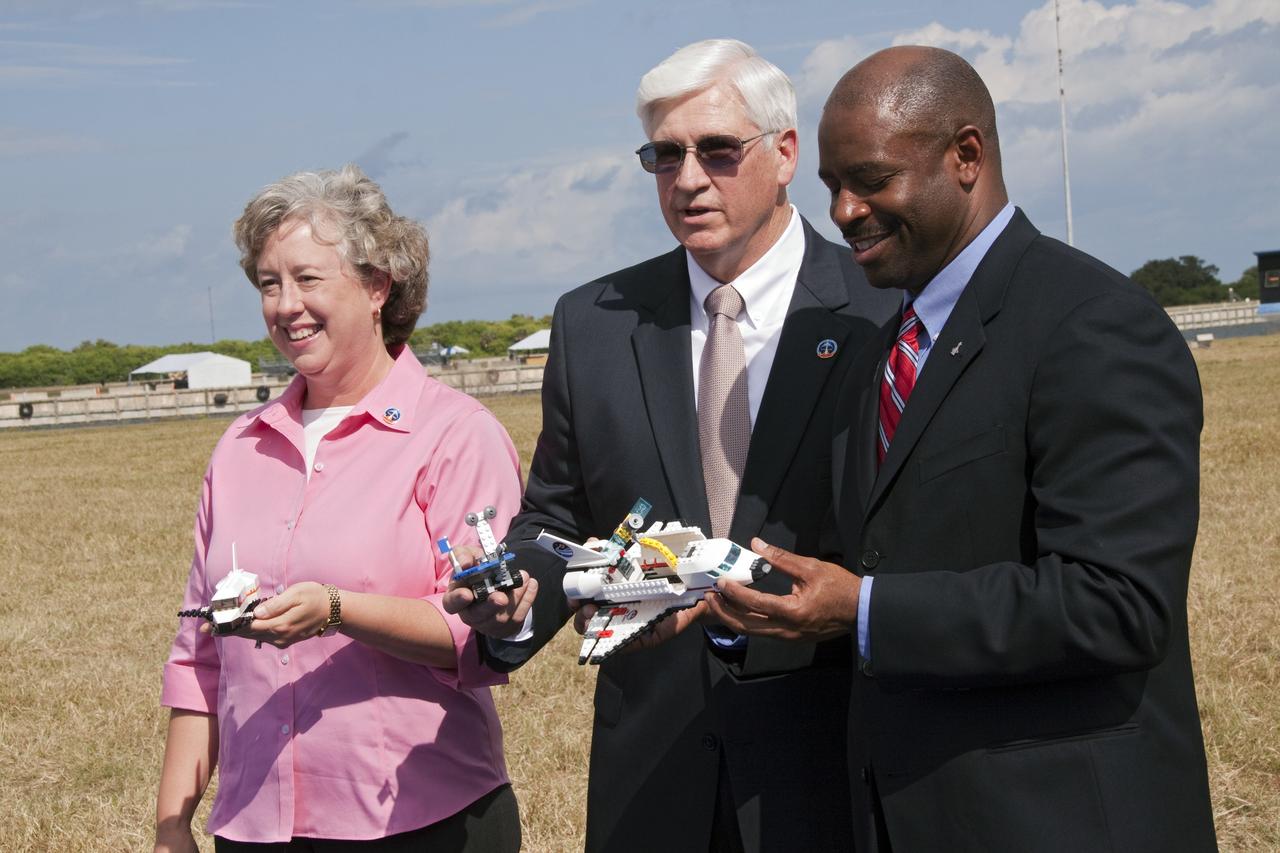
CAPE CANAVERAL, Fla. -- NASA and The LEGO Group announce a three-year Space Act Agreement meant to spark the interest of children in science, technology, engineering and mathematics (STEM) with the future release of four NASA-inspired products in the toy company's LEGO CITY line. From left, are Debbie Biggs, education specialist for International Space Station National Lab Education Projects, Stephan Turnipseed, president of LEGO Education North America, and Leland Melvin, NASA's associate administrator for Education. To commemorate the beginning of the partnership, two small LEGO space shuttles will launch aboard space shuttle Discovery's STS-133 mission to the International Space Station. A 40- by 70-foot activity tent will be set up at Kennedy on Nov. 3 for children of all ages to build their vision of the future with LEGO bricks. LEGO sets also will fly to the space station aboard Endeavour's STS-134 mission, and will be put together on orbit to demonstrate the challenges faced while building things in microgravity. Photo credit: NASA/Jack Pfaller
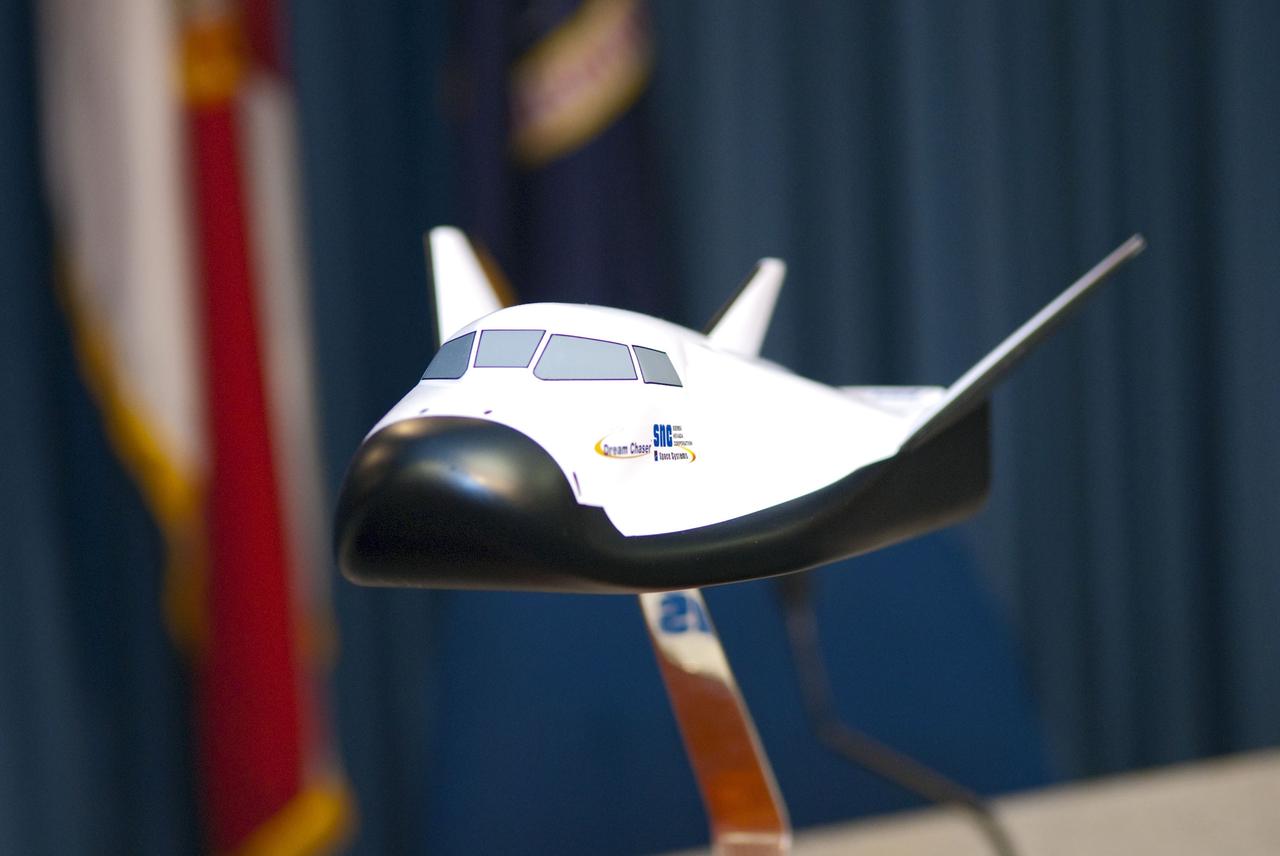
CAPE CANAVERAL, Fla. -- Sierra Nevada Space Systems (SNSS) of Sparks, Nev., and NASA signed a Space Act Agreement that will offer the company technical capabilities from Kennedy's uniquely skilled work force. Kennedy will help Sierra Nevada with the ground operations support of its lifting body reusable spacecraft called "Dream Chaser." The spacecraft, seen here as a display, resembles a smaller version of the space shuttle orbiter. The spacecraft would carry as many as seven astronauts to the space station. Through the new agreement, Kennedy's work force will use its experience of processing the shuttle fleet for 30 years to help Sierra Nevada define and execute Dream Chaser's launch preparations and post-landing activities. In 2010 and 2011, Sierra Nevada was awarded grants as part of the initiative to stimulate the private sector in developing and demonstrating human spaceflight capabilities for NASA's Commercial Crew Program. The goal of the program, which is based in Florida at Kennedy, is to facilitate the development of a U.S. commercial crew space transportation capability by achieving safe, reliable and cost-effective access to and from the space station and future low Earth orbit destinations. Photo credit: NASA/Jim Grossmann