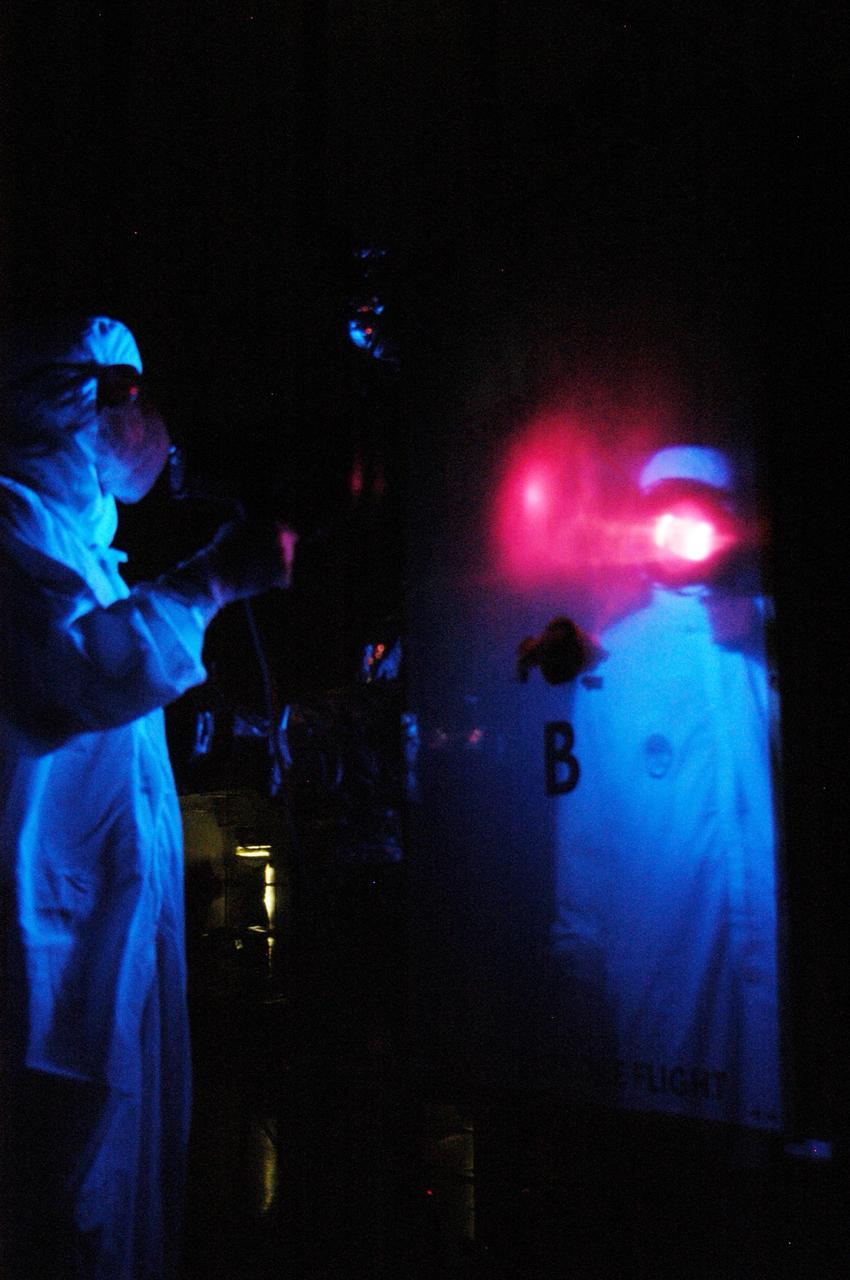
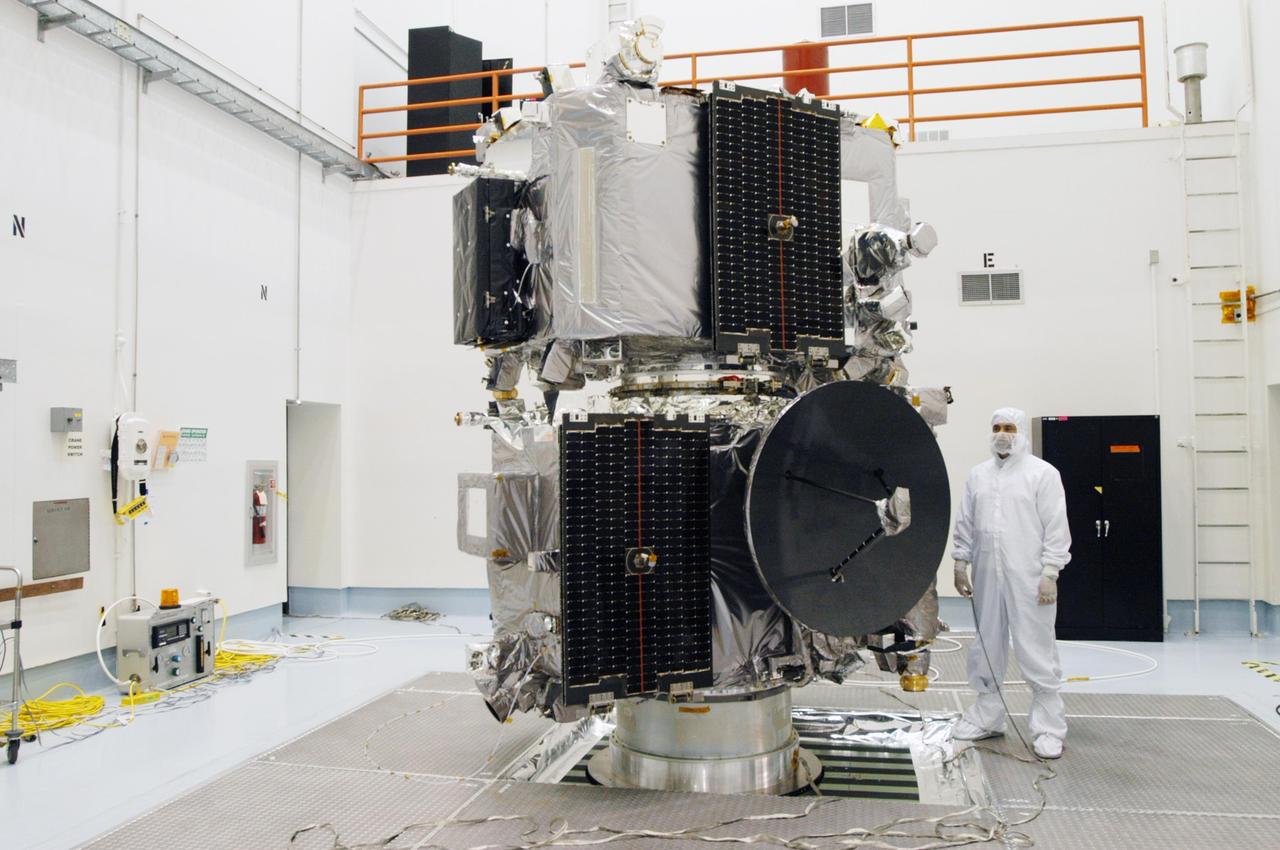
KENNEDY SPACE CENTER, FLA. - At Astrotech Space Operations in Titusville, Fla., technicians perform black-light inspection and cleaning of Observatory B, part of the STEREO spacecraft. The observatory will later be wrapped for transfer to the hazardous processing facility where it will be weighed and fueled. STEREO stands for Solar Terrestrial Relations Observatory. The STEREO mission is the first to take measurements of the sun and solar wind in 3-dimension. This new view will improve our understanding of space weather and its impact on the Earth. STEREO is expected to lift off aboard a Boeing Delta II rocket no earlier than Aug. 1. Photo credit: NASA/George Shelton
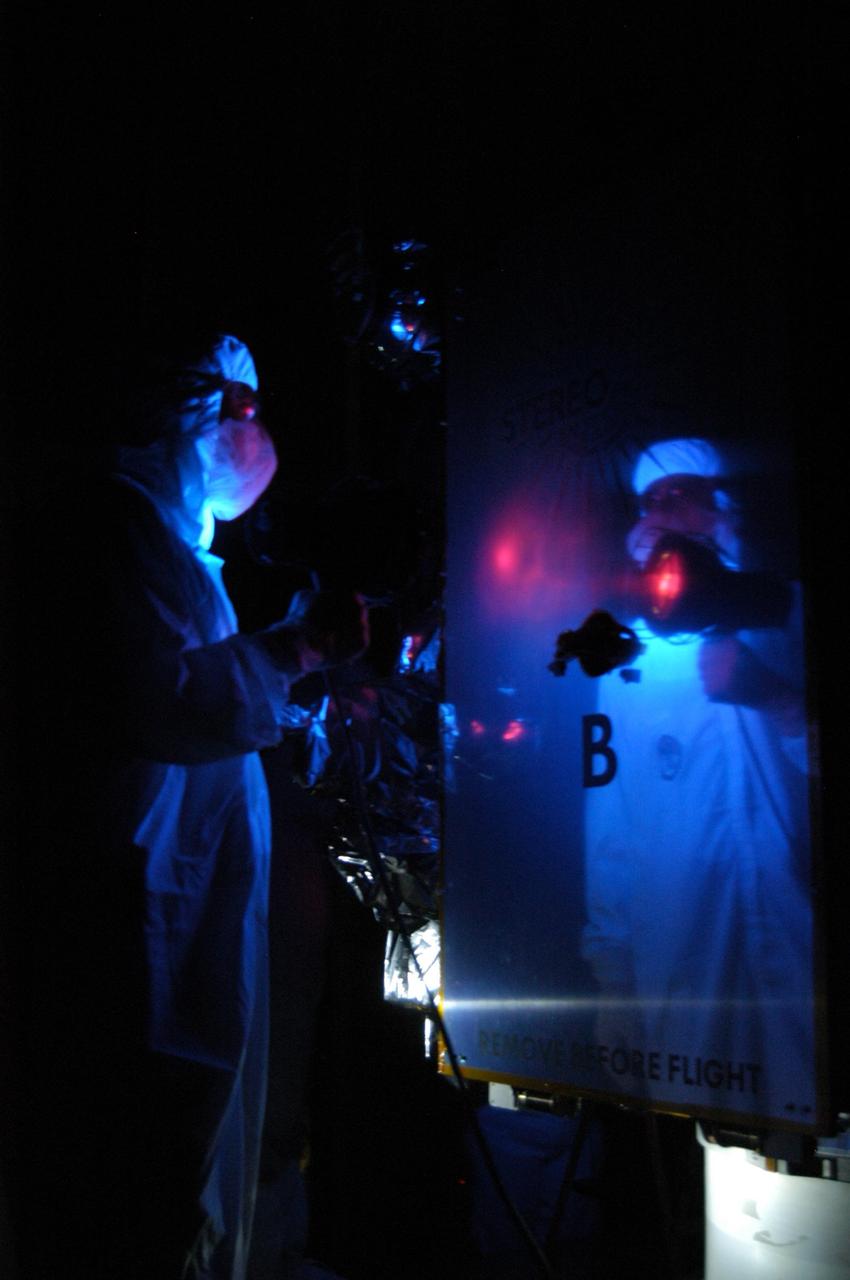
KENNEDY SPACE CENTER, FLA. - At Astrotech Space Operations in Titusville, Fla., technicians perform black-light inspection and cleaning of Observatory B, part of the STEREO spacecraft. The observatory will later be wrapped for transfer to the hazardous processing facility and fueling. STEREO stands for Solar Terrestrial Relations Observatory. The STEREO mission is the first to take measurements of the sun and solar wind in 3-dimension. This new view will improve our understanding of space weather and its impact on the Earth. STEREO is expected to lift off aboard a Boeing Delta II rocket no earlier than Aug. 1. Photo credit: NASA/George Shelton

KENNEDY SPACE CENTER, FLA. - At Astrotech Space Operations in Titusville, Fla., technicians are ready to wrap more plastic around STEREO's Observatory B before its transfer to the hazardous processing facility where it will be weighed and fueled. STEREO stands for Solar Terrestrial Relations Observatory. The STEREO mission is the first to take measurements of the sun and solar wind in 3-dimension. This new view will improve our understanding of space weather and its impact on the Earth. STEREO is expected to lift off aboard a Boeing Delta II rocket no earlier than Aug. 1. Photo credit: NASA/George Shelton
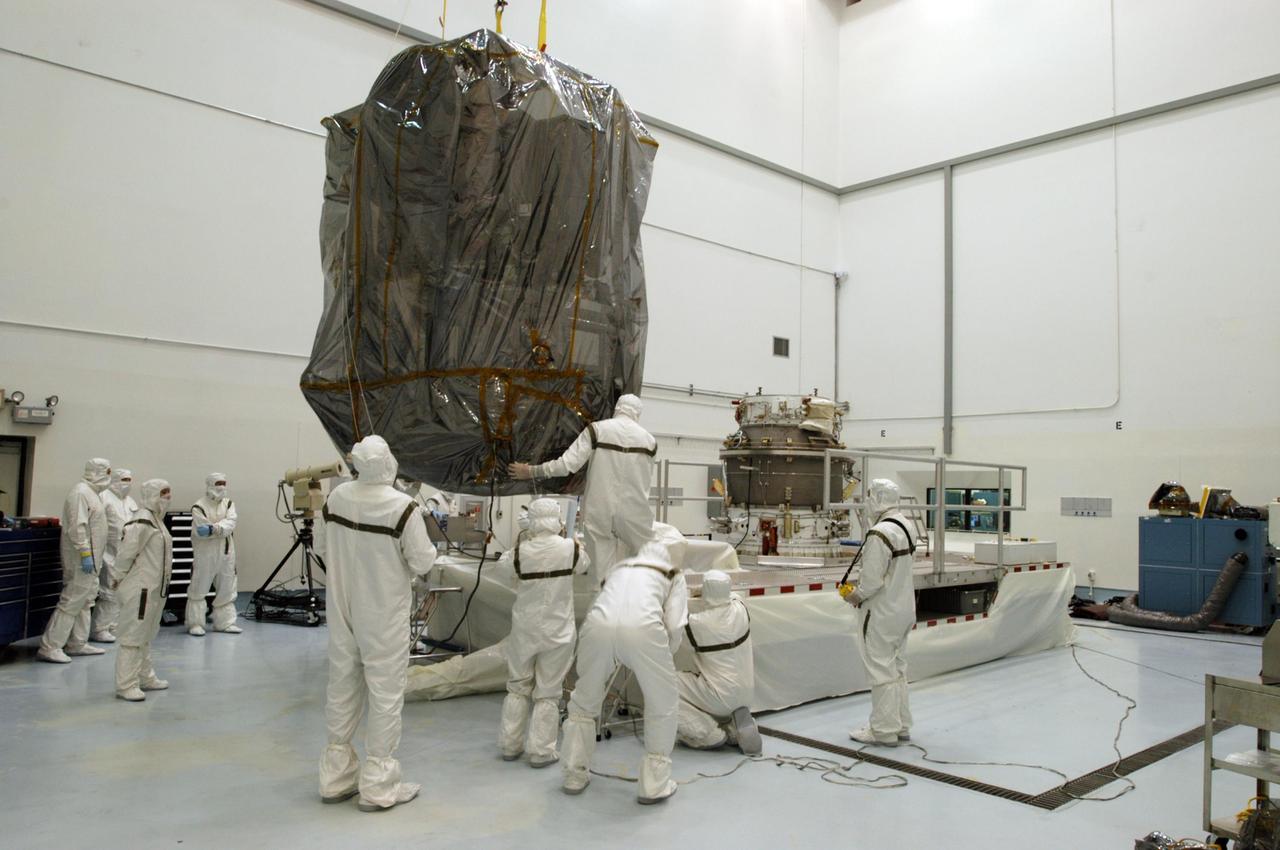
KENNEDY SPACE CENTER, FLA. - At Astrotech Space Operations in Titusville, Fla., workers guide the STEREO spacecraft toward the upper stage booster in the background. The spacecraft will be mated to the upper stage and then transported to Launch Pad 17-B at Cape Canaveral Air Force Station for integration with the Delta II already on the pad. STEREO stands for Solar Terrestrial Relations Observatory and comprises two spacecraft. The STEREO mission is the first to take measurements of the sun and solar wind in 3-dimension. This new view will improve our understanding of space weather and its impact on the Earth. STEREO is expected to lift off Aug. 31. Photo credit: NASA/George Shelton
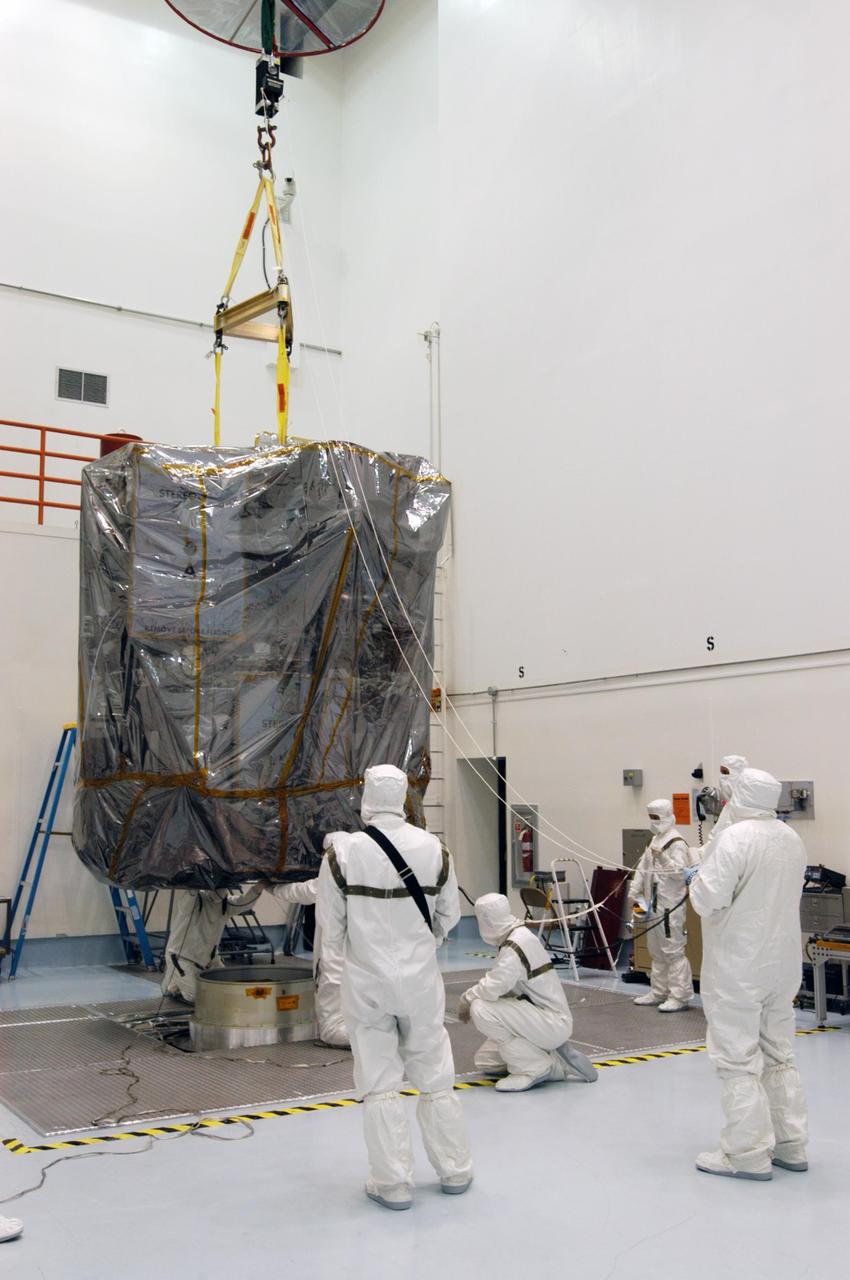
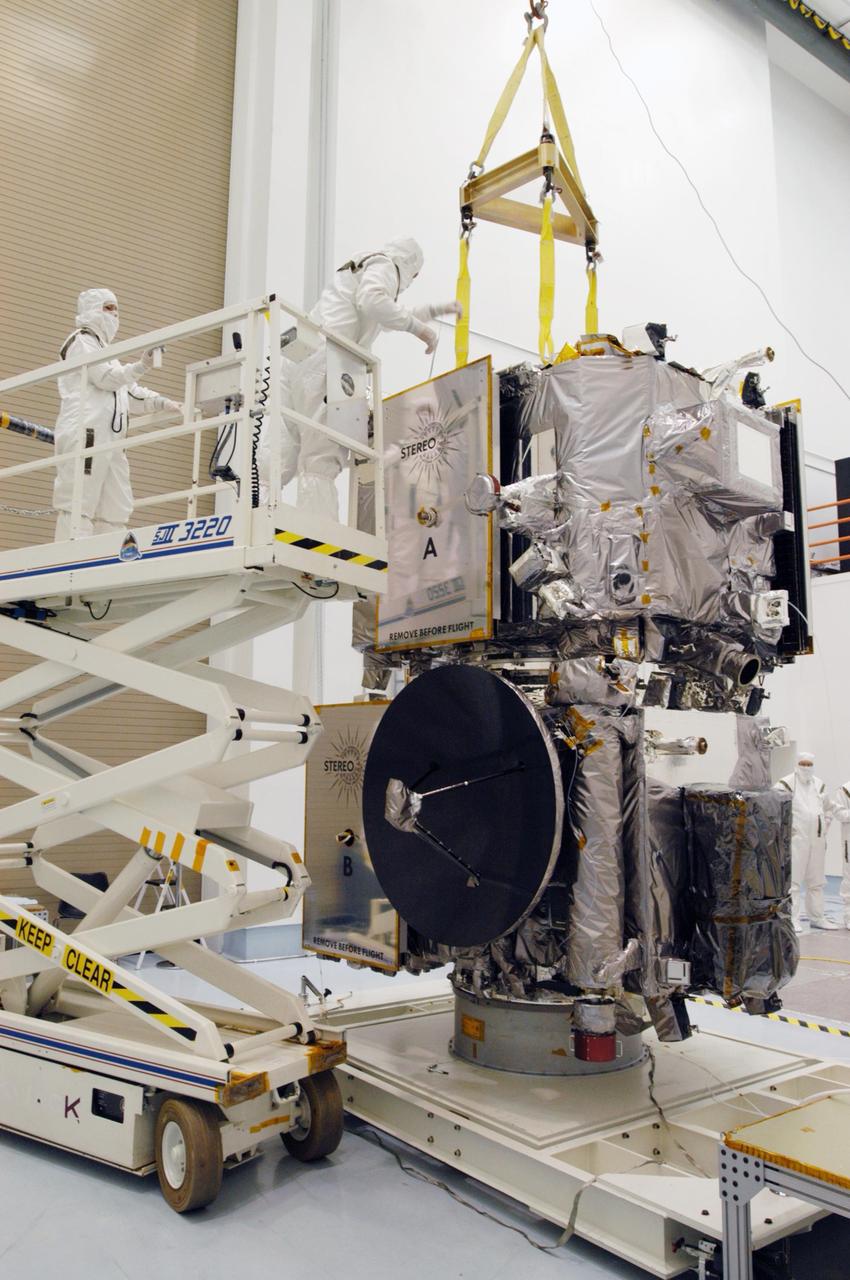
KENNEDY SPACE CENTER, FLA. - At Astrotech Space Operations in Titusville, Fla., workers guide the lifting of the STEREO payload to move it for mating to the upper stage booster. After the mating, all will be transported to Launch Pad 17-B at Cape Canaveral Air Force Station for integration with the Delta II already on the pad. STEREO stands for Solar Terrestrial Relations Observatory and comprises two spacecraft. The STEREO mission is the first to take measurements of the sun and solar wind in 3-dimension. This new view will improve our understanding of space weather and its impact on the Earth. STEREO is expected to lift off Aug. 31. Photo credit: NASA/George Shelton
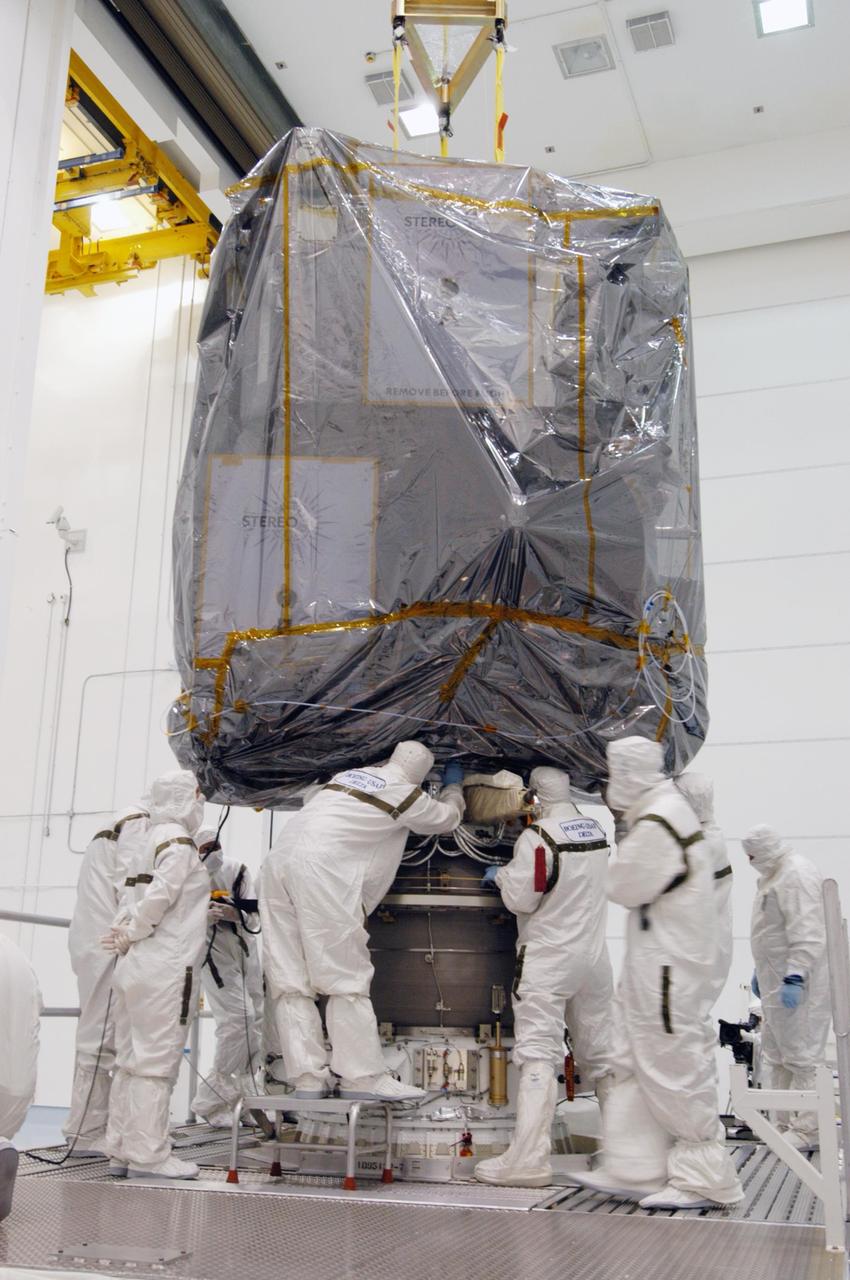
KENNEDY SPACE CENTER, FLA. - At Astrotech Space Operations in Titusville, Fla., workers begin mating the STEREO spacecraft onto the upper stage booster below. After the mating, they will be transported to Launch Pad 17-B at Cape Canaveral Air Force Station for integration with the Delta II already on the pad. STEREO stands for Solar Terrestrial Relations Observatory and comprises two spacecraft. The STEREO mission is the first to take measurements of the sun and solar wind in 3-dimension. This new view will improve our understanding of space weather and its impact on the Earth. STEREO is expected to lift off Aug. 31. Photo credit: NASA/George Shelton
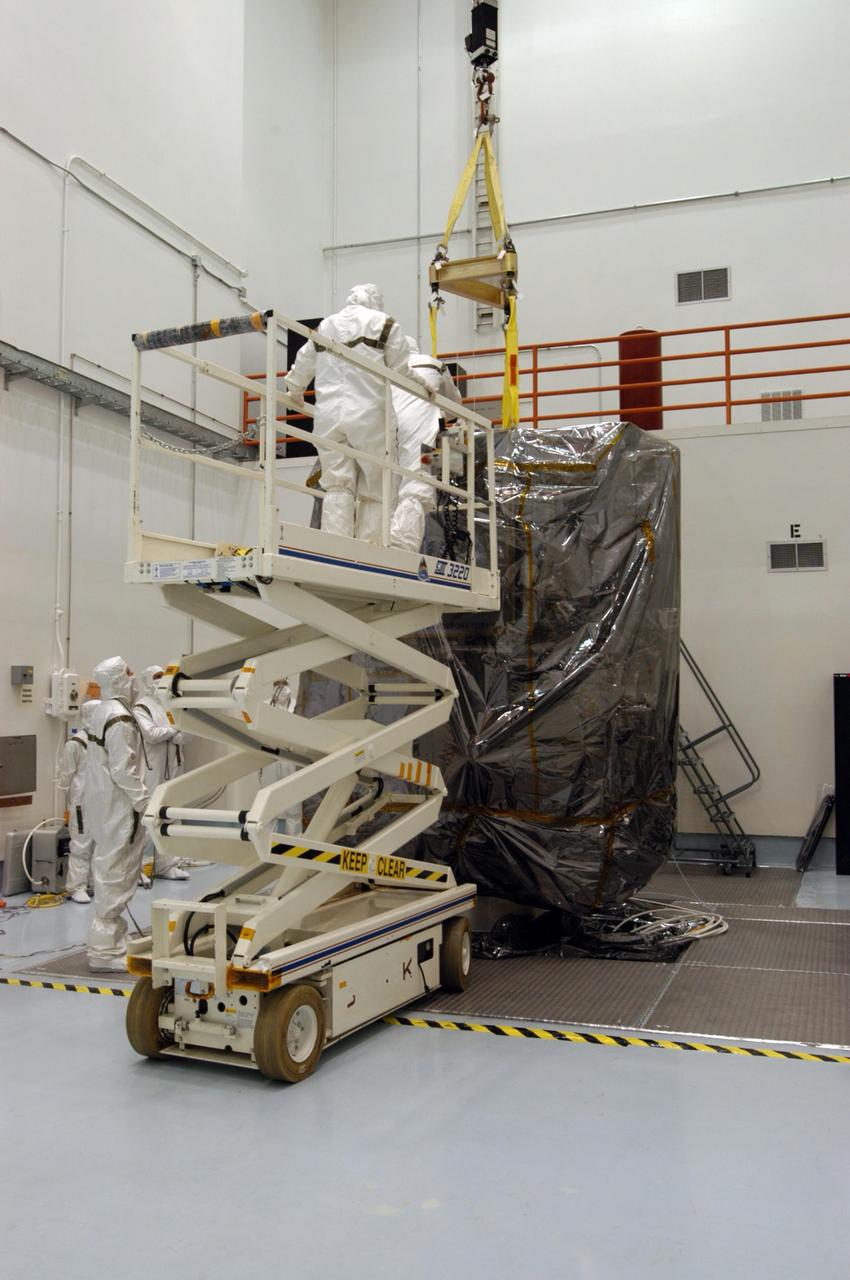
KENNEDY SPACE CENTER, FLA. - At Astrotech Space Operations in Titusville, Fla., the STEREO payload is ready for mating to the upper stage booster. Here, a crane is being attached to the spacecraft to lift it. After the mating, all will be transported to Launch Pad 17-B at Cape Canaveral Air Force Station for integration with the Delta II already on the pad. STEREO stands for Solar Terrestrial Relations Observatory and comprises two spacecraft. The STEREO mission is the first to take measurements of the sun and solar wind in 3-dimension. This new view will improve our understanding of space weather and its impact on the Earth. STEREO is expected to lift off Aug. 31. Photo credit: NASA/George Shelton
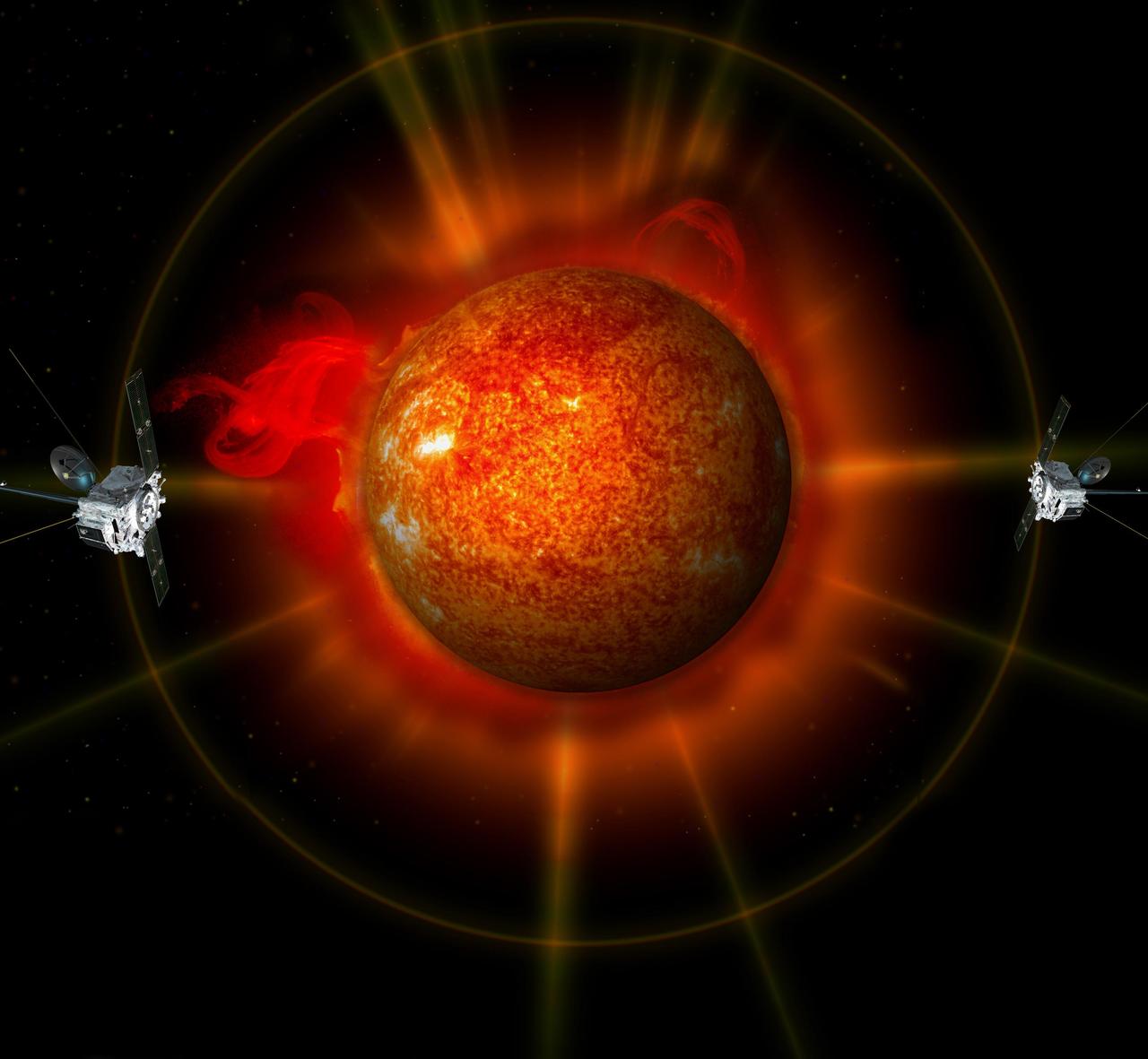
An artist's concept of STEREO surrounding the sun. Credit: NASA To read more about STEREO go to: <a href="http://www.nasa.gov/mission_pages/stereo/news/entire-sun.html" rel="nofollow">www.nasa.gov/mission_pages/stereo/news/entire-sun.html</a> <b><a href="http://www.nasa.gov/centers/goddard/home/index.html" rel="nofollow">NASA Goddard Space Flight Center</a></b> enables NASA’s mission through four scientific endeavors: Earth Science, Heliophysics, Solar System Exploration, and Astrophysics. Goddard plays a leading role in NASA’s accomplishments by contributing compelling scientific knowledge to advance the Agency’s mission. <b>Follow us on <a href="http://twitter.com/NASA_GoddardPix" rel="nofollow">Twitter</a></b> <b>Join us on <a href="http://www.facebook.com/pages/Greenbelt-MD/NASA-Goddard/395013845897?ref=tsd" rel="nofollow">Facebook</a></b>

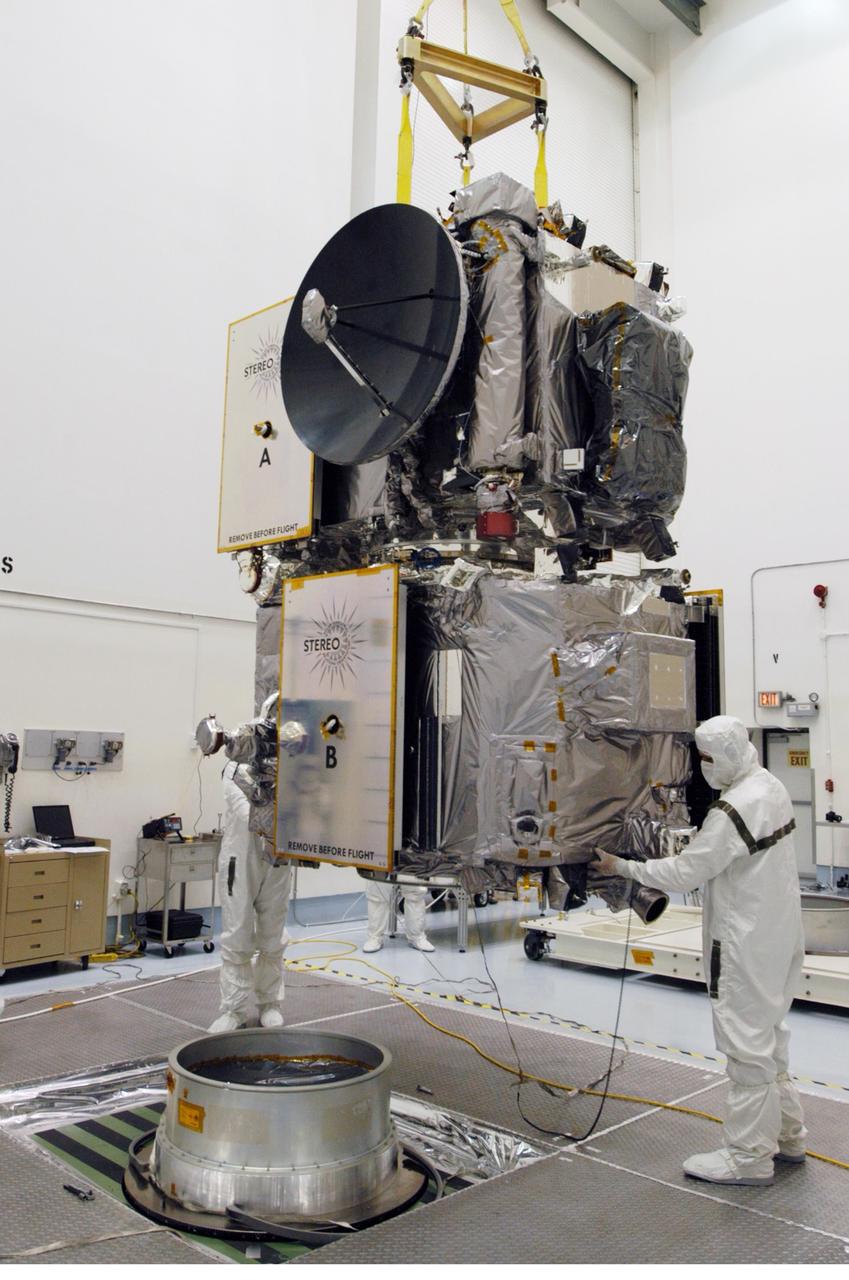
KENNEDY SPACE CENTER, FLA. - At Astrotech Space Operations in Titusville, Fla., technicians check the STEREO spacecraft "B" as it is lowered toward a stand on the floor. STEREO stands for Solar Terrestrial Relations Observatory. The STEREO mission is the first to take measurements of the sun and solar wind in 3-dimension. This new view will improve our understanding of space weather and its impact on the Earth. STEREO is expected to lift off aboard a Boeing Delta II rocket on July 22. Photo credit: NASA/George Shelton
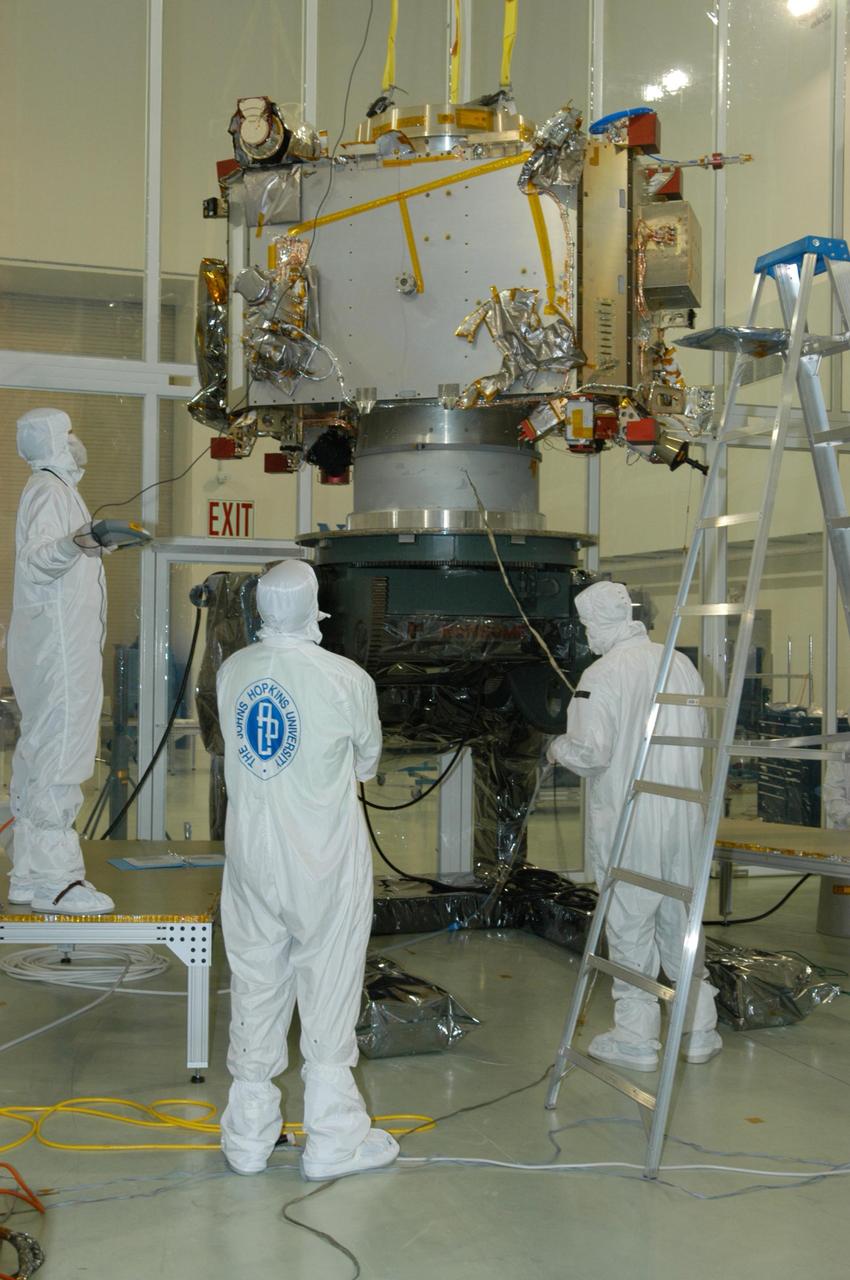
KENNEDY SPACE CENTER, FLA. - At Astrotech Space Operations in Titusville, Fla., the STEREO spacecraft "B" is being moved to a another stand nearby for testing. STEREO stands for Solar Terrestrial Relations Observatory. The STEREO mission is the first to take measurements of the sun and solar wind in 3-dimension. This new view will improve our understanding of space weather and its impact on the Earth. STEREO is expected to lift off aboard a Boeing Delta II rocket on July 22. Photo credit: NASA/George Shelton
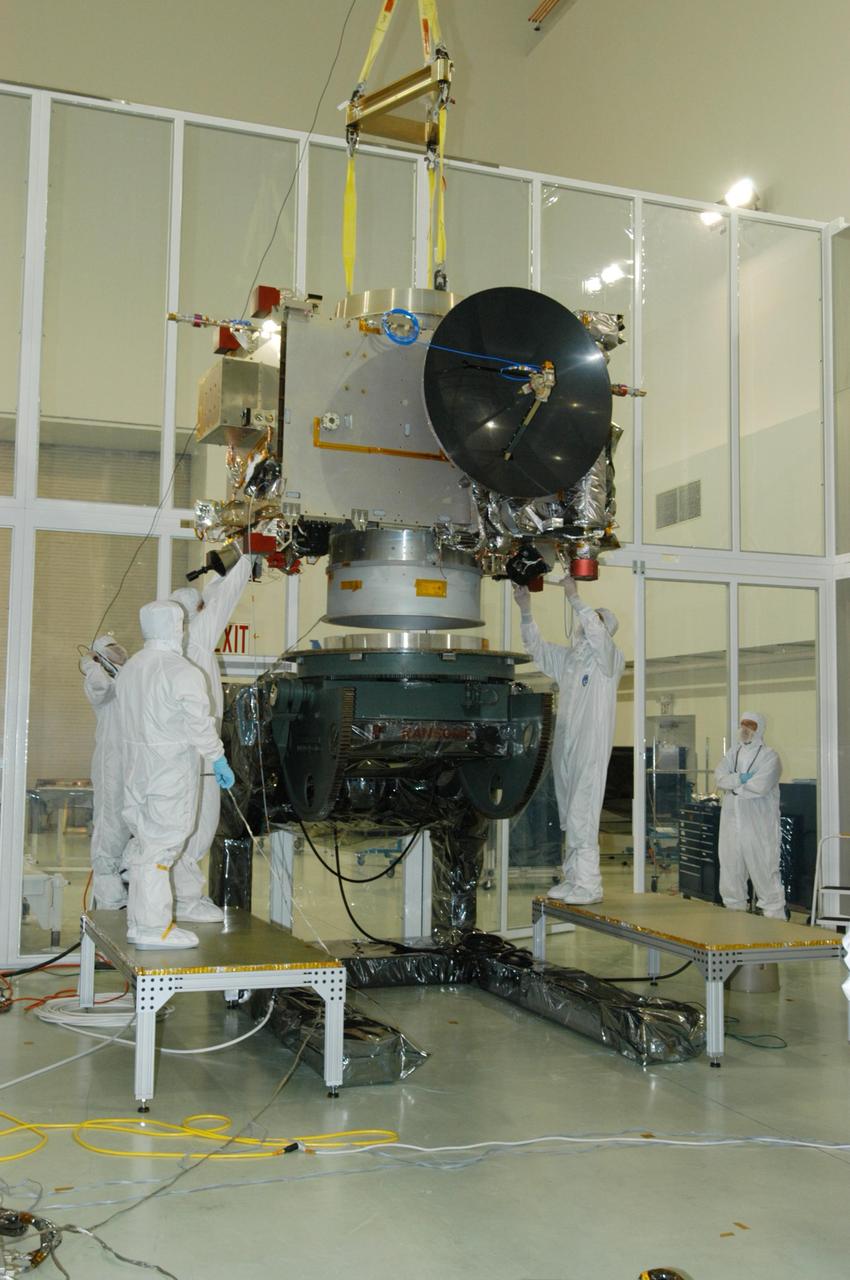
KENNEDY SPACE CENTER, FLA. - At Astrotech Space Operations in Titusville, Fla., technicians check the STEREO spacecraft "B" as it is lifted off a tilt table. STEREO stands for Solar Terrestrial Relations Observatory. The STEREO mission is the first to take measurements of the sun and solar wind in 3-dimension. This new view will improve our understanding of space weather and its impact on the Earth. STEREO is expected to lift off aboard a Boeing Delta II rocket on July 22. Photo credit: NASA/George Shelton
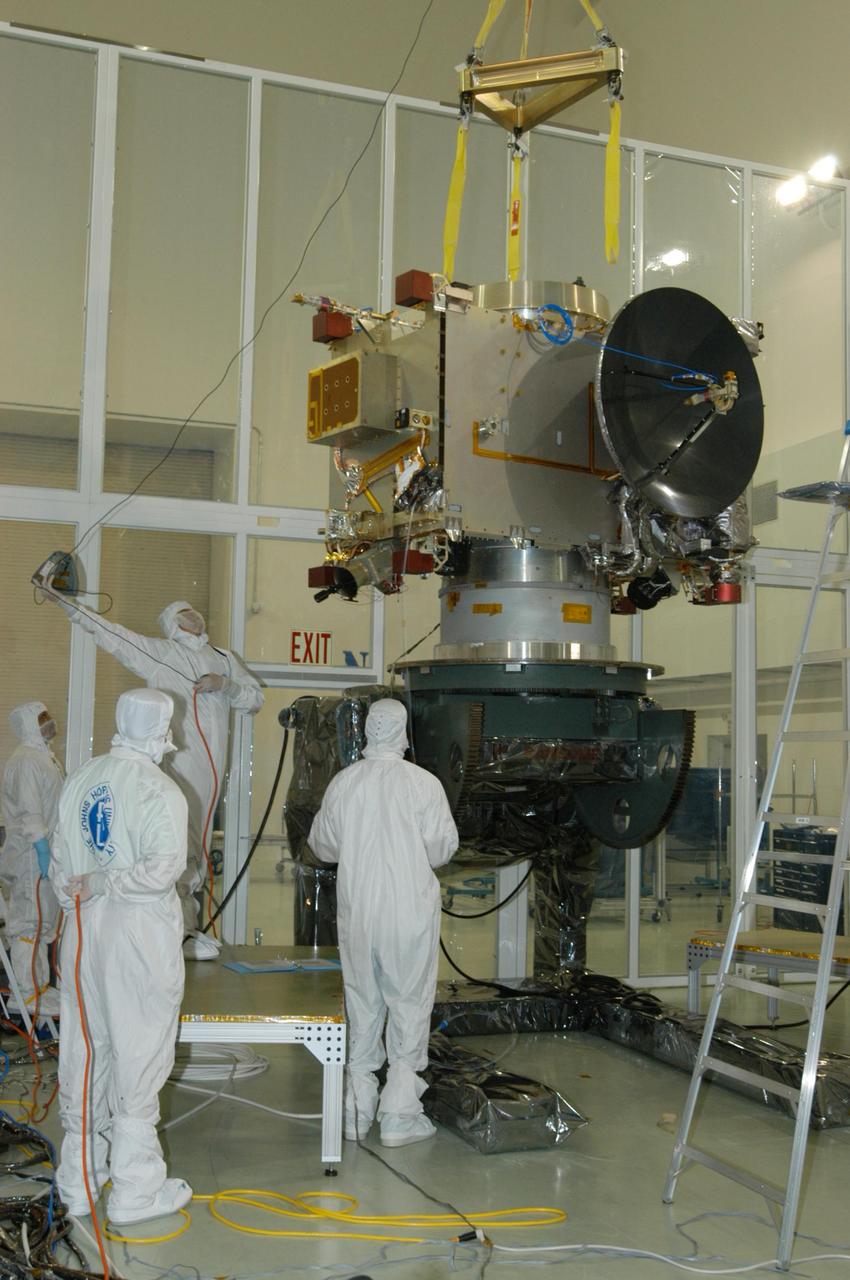
KENNEDY SPACE CENTER, FLA. - At Astrotech Space Operations in Titusville, Fla., a technician works a guideline to the overhead crane as the STEREO spacecraft "B" is being moved to a stand nearby for testing. STEREO stands for Solar Terrestrial Relations Observatory. The STEREO mission is the first to take measurements of the sun and solar wind in 3-dimension. This new view will improve our understanding of space weather and its impact on the Earth. STEREO is expected to lift off aboard a Boeing Delta II rocket on July 22. Photo credit: NASA/George Shelton
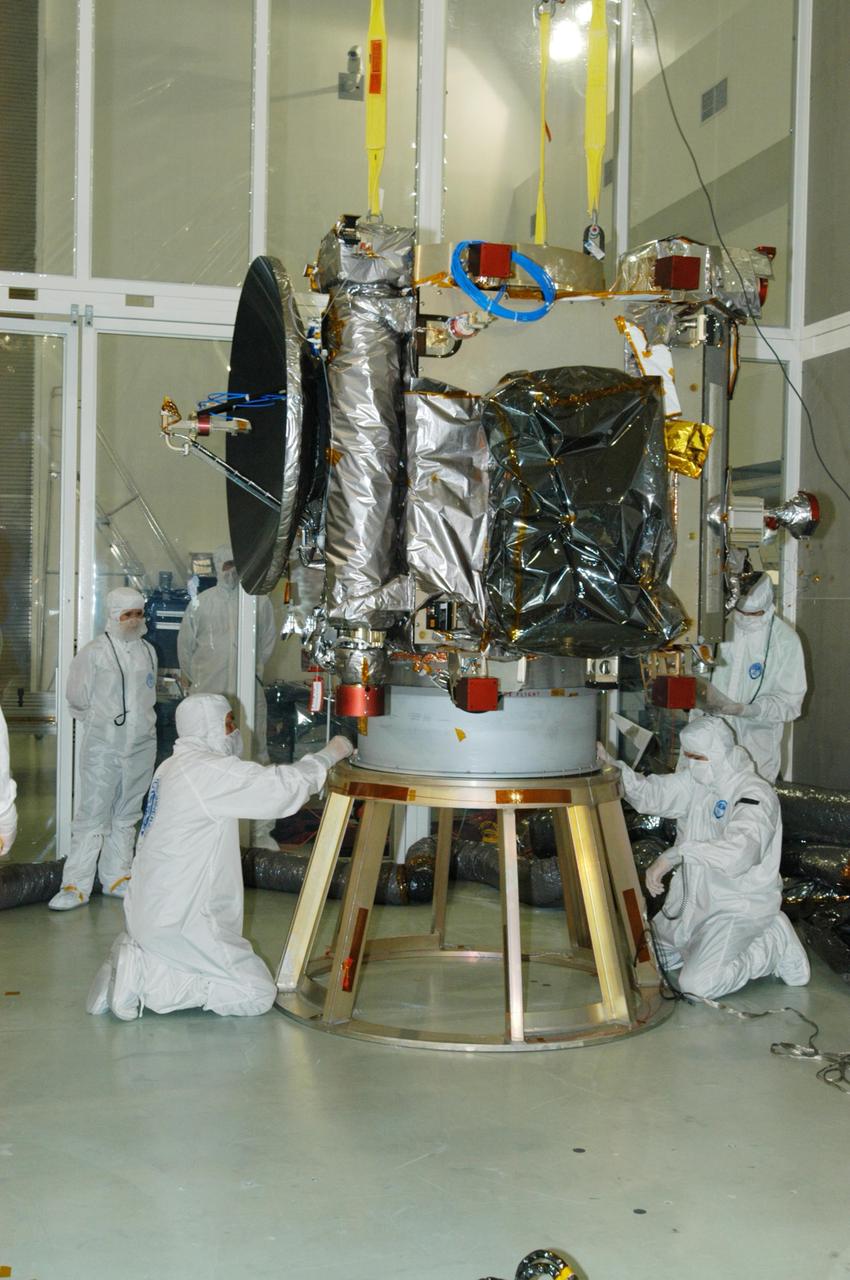
KENNEDY SPACE CENTER, FLA. - At Astrotech Space Operations in Titusville, Fla., technicians check the STEREO spacecraft "B" is secure on the stand. STEREO stands for Solar Terrestrial Relations Observatory. The STEREO mission is the first to take measurements of the sun and solar wind in 3-dimension. This new view will improve our understanding of space weather and its impact on the Earth. STEREO is expected to lift off aboard a Boeing Delta II rocket on July 22. Photo credit: NASA/George Shelton
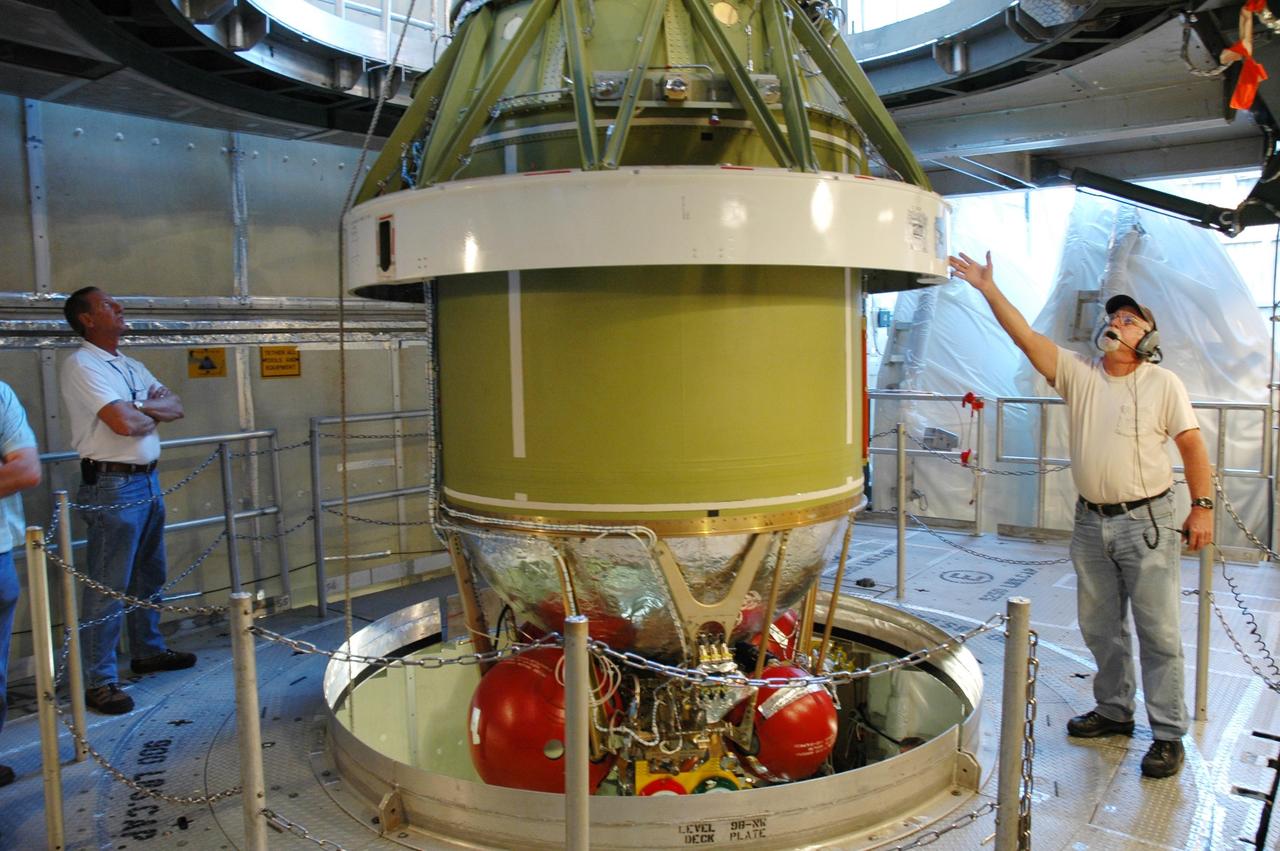
KENNEDY SPACE CENTER, FLA. - Inside the mobile service tower on Launch Pad 17-B, the second stage segment is lifted away from the Delta II rocket below. At the Boeing plant in Alabama, a leak was observed in the second-stage oxidizer tank for another Delta II that had been scheduled to launch in November; therefore, all identical tanks scheduled for launch in the near future are being checked. The second stage for the Delta II that will launch STEREO cannot be effectively tested while atop the first stage at Pad 17-B. STEREO stands for Solar Terrestrial Relations Observatory and comprises two spacecraft. The STEREO mission is the first to take measurements of the sun and solar wind in 3-dimension. This new view will improve our understanding of space weather and its impact on the Earth. STEREO is expected to lift off in late August 2006. Photo credit: NASA/Jim Grossmann
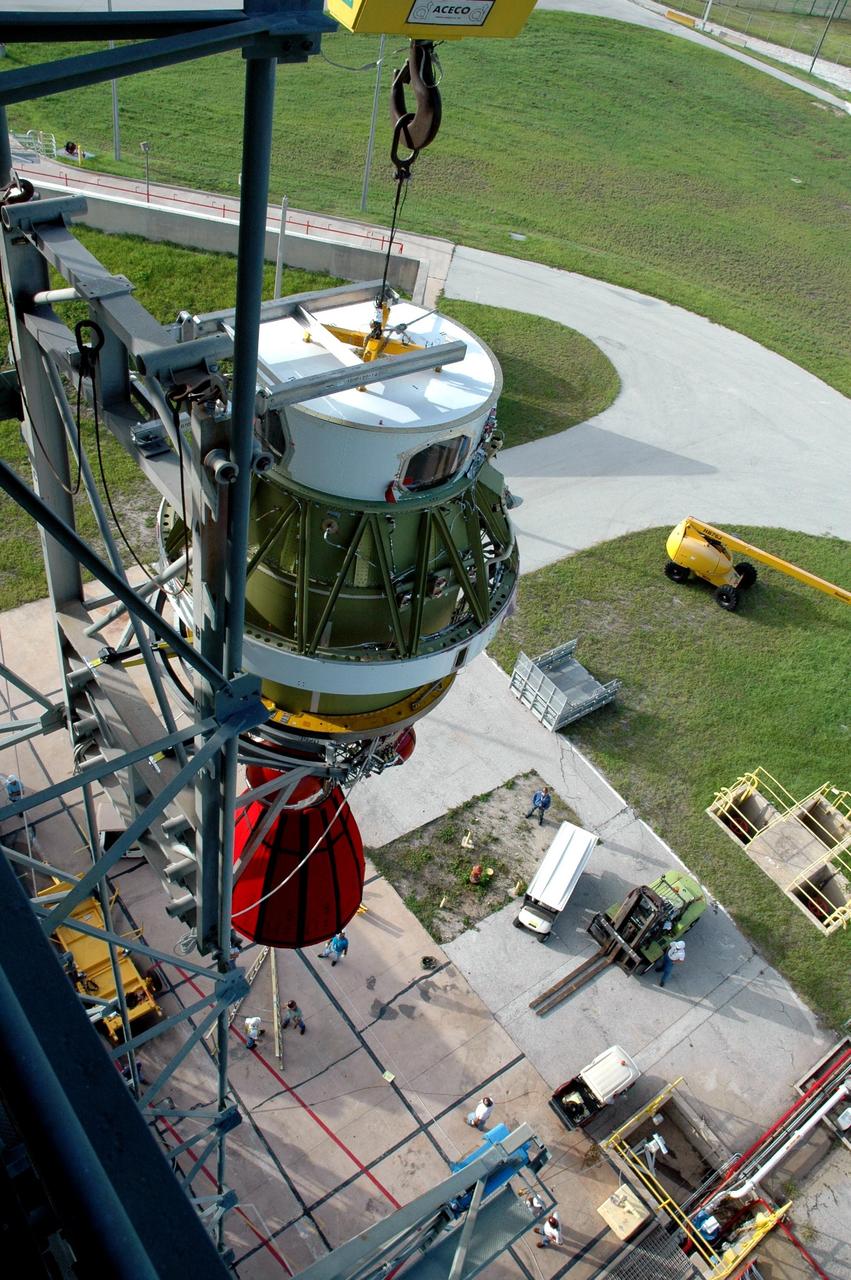
KENNEDY SPACE CENTER, FLA. - On Launch Pad 17-B at Cape Canaveral Air Force Station in Florida, the second stage segment of the Delta II rocket is lowered from the mobile service tower. At the Boeing plant in Alabama, a leak was observed in the second-stage oxidizer tank for another Delta II that had been scheduled to launch in November; therefore, all identical tanks scheduled for launch in the near future are being checked. The second stage for the Delta II that will launch STEREO cannot be effectively tested while atop the first stage at Pad 17-B. STEREO stands for Solar Terrestrial Relations Observatory and comprises two spacecraft. The STEREO mission is the first to take measurements of the sun and solar wind in 3-dimension. This new view will improve our understanding of space weather and its impact on the Earth. STEREO is expected to lift off in late August 2006. Photo credit: NASA/Jim Grossmann
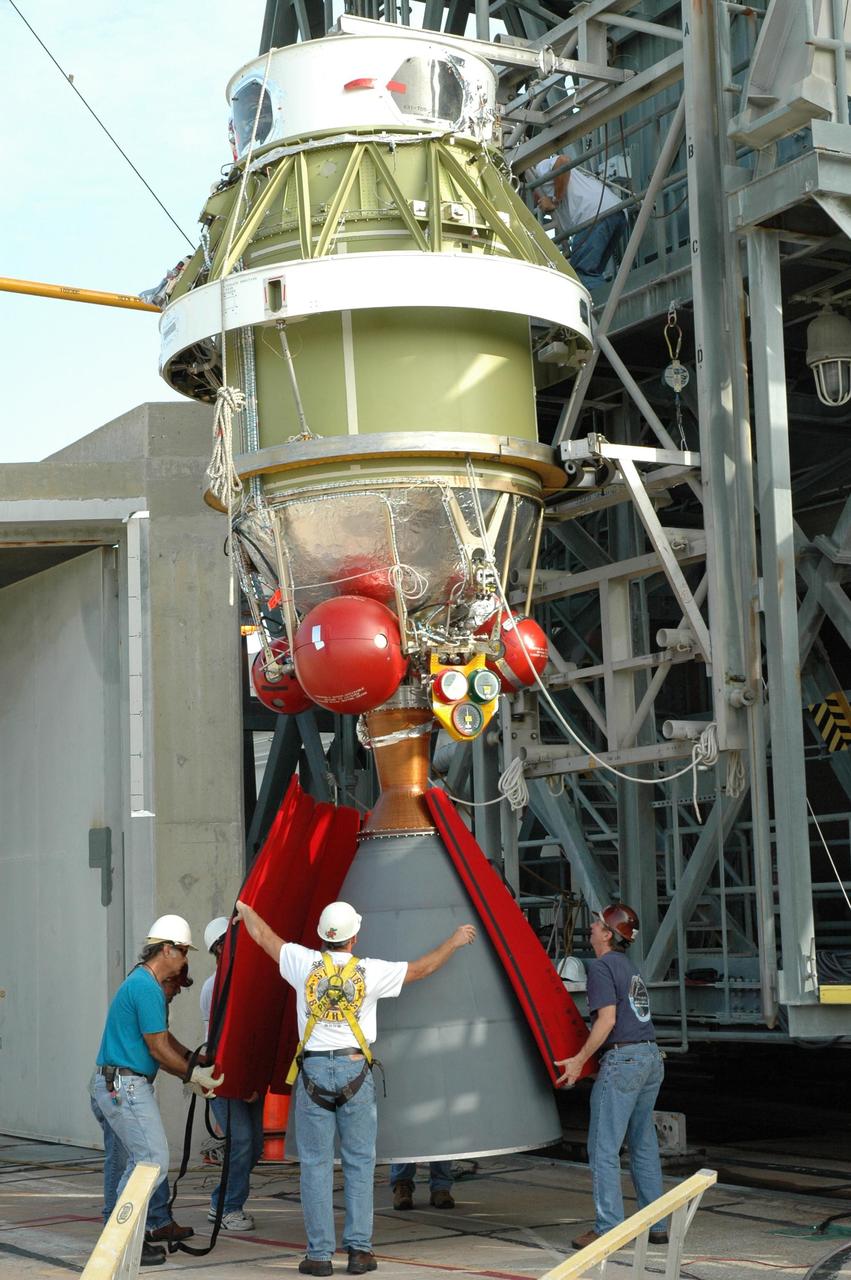
KENNEDY SPACE CENTER, FLA. - On Launch Pad 17-B at Cape Canaveral Air Force Station in Florida, workers remove the protective covers from the engine nozzle on the second stage segment removed from the Delta II rocket. At the Boeing plant in Alabama, a leak was observed in the second-stage oxidizer tank for another Delta II that had been scheduled to launch in November; therefore, all identical tanks scheduled for launch in the near future are being checked. The second stage for the Delta II that will launch STEREO cannot be effectively tested while atop the first stage at Pad 17-B. STEREO stands for Solar Terrestrial Relations Observatory and comprises two spacecraft. The STEREO mission is the first to take measurements of the sun and solar wind in 3-dimension. This new view will improve our understanding of space weather and its impact on the Earth. STEREO is expected to lift off in late August 2006. Photo credit: NASA/Jim Grossmann
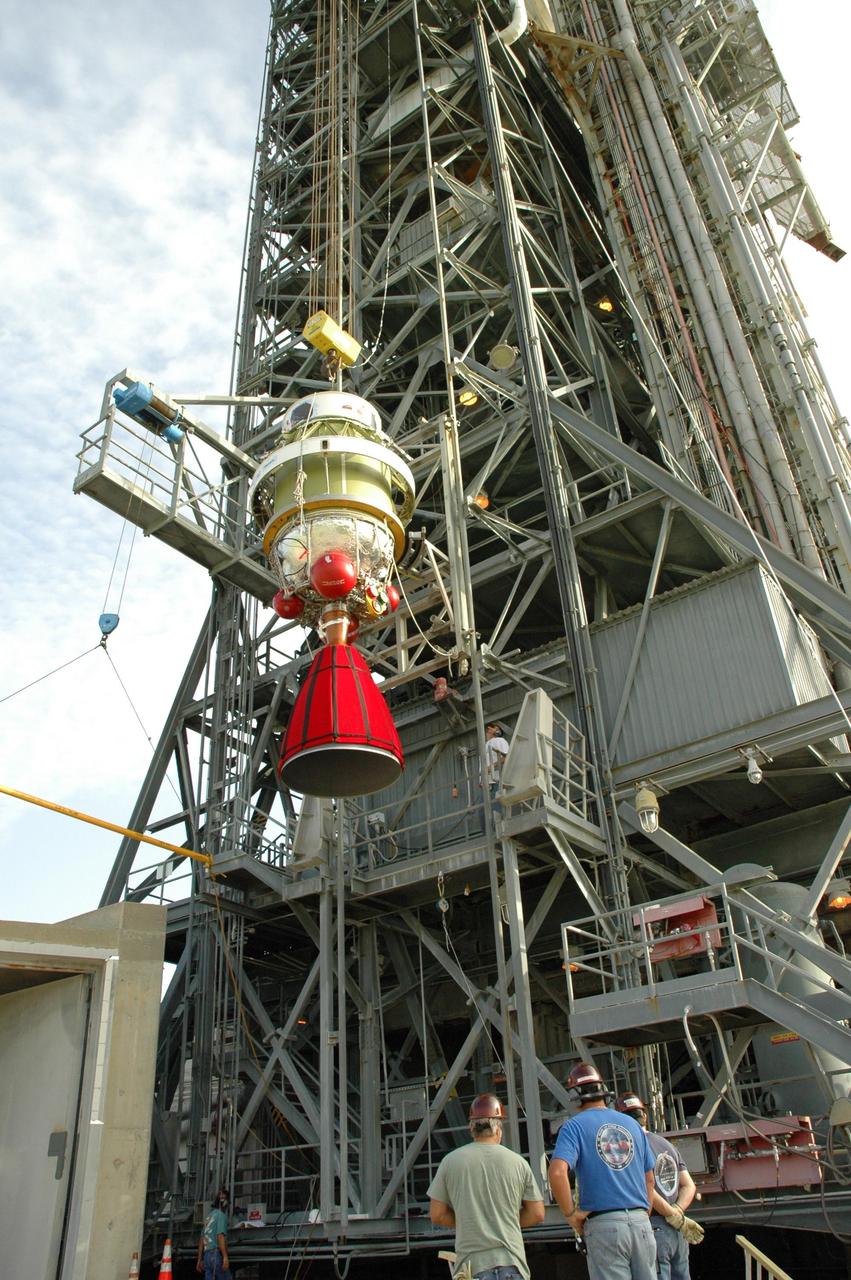
KENNEDY SPACE CENTER, FLA. - On Launch Pad 17-B at Cape Canaveral Air Force Station in Florida, the second stage segment of the Delta II rocket is lowered from the mobile service tower. At the Boeing plant in Alabama, a leak was observed in the second-stage oxidizer tank for another Delta II that had been scheduled to launch in November; therefore, all identical tanks scheduled for launch in the near future are being checked. The second stage for the Delta II that will launch STEREO cannot be effectively tested while atop the first stage at Pad 17-B. STEREO stands for Solar Terrestrial Relations Observatory and comprises two spacecraft. The STEREO mission is the first to take measurements of the sun and solar wind in 3-dimension. This new view will improve our understanding of space weather and its impact on the Earth. STEREO is expected to lift off in late August 2006. Photo credit: NASA/Jim Grossmann
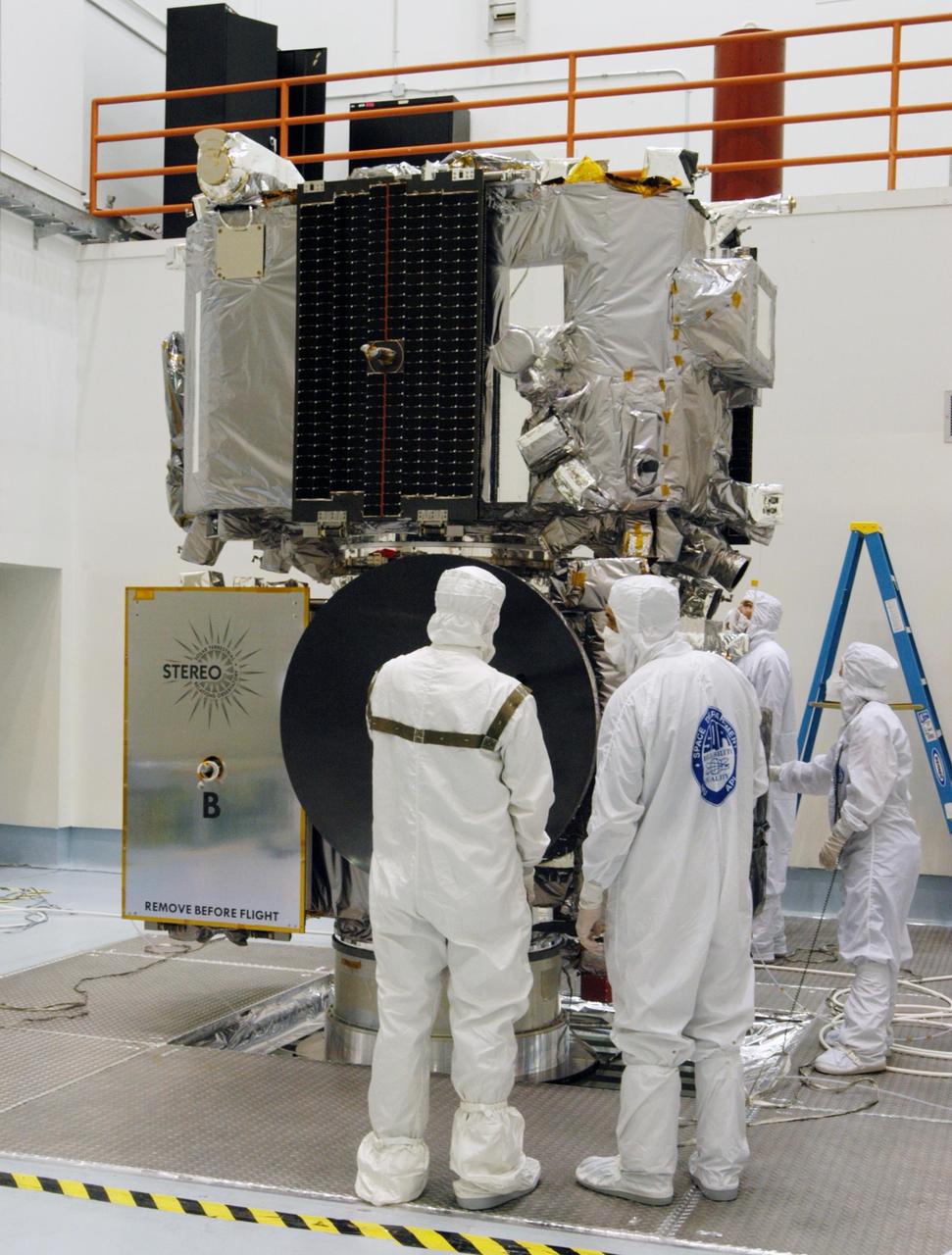
KENNEDY SPACE CENTER, FLA. - The STEREO observatories are the focus of attention at a media viewing held at Astrotech Space Operations in Titusville, Fla., on Aug. 11. The two observatories were mated for launch but will separate into different orbits for their mission. STEREO stands for Solar Terrestrial Relations Observatory. The STEREO mission is the first to take measurements of the sun and solar wind in 3-dimension. This new view will improve our understanding of space weather and its impact on the Earth. STEREO is expected to lift off on Aug. 31, from Launch Pad 17-B on Cape Canaveral Air Force Station in Florida. Photo credit: NASA/George Shelton.
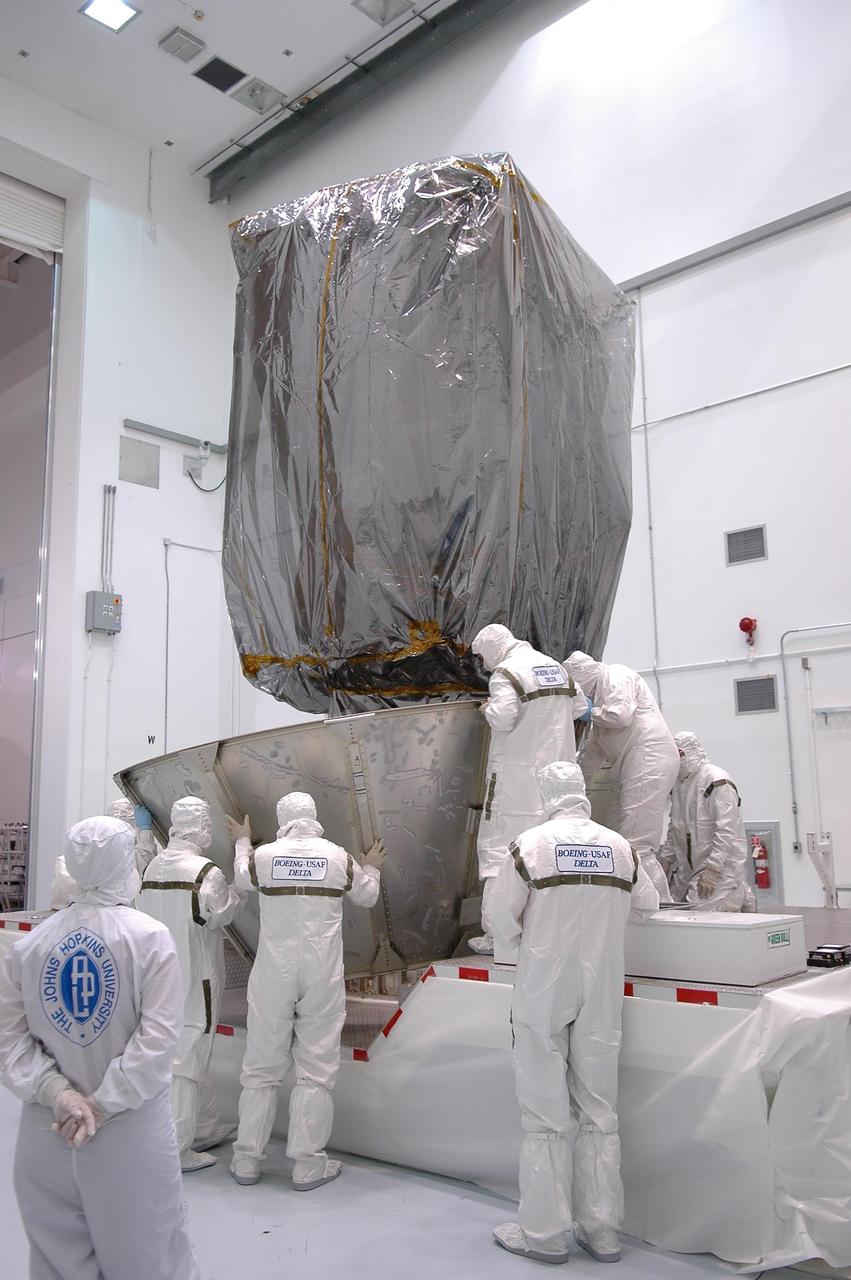
KENNEDY SPACE CENTER, FLA. - At Astrotech Space Operations in Titusville, Fla., workers begin to install the lower portion of the transportation canister around the upper stage booster attached to the STEREO spacecraft (above). The entire configuration will be encased for the move to Launch Pad 17-B at Cape Canaveral Air Force Station. STEREO stands for Solar Terrestrial Relations Observatory and comprises two spacecraft. The STEREO mission is the first to take measurements of the sun and solar wind in 3-dimension. This new view will improve our understanding of space weather and its impact on the Earth. STEREO is expected to lift off Aug. 31. Photo credit: NASA/Kim Shiflett

KENNEDY SPACE CENTER, FLA. - The STEREO observatories are the focus of attention at a media viewing held at Astrotech Space Operations in Titusville, Fla. The two observatories were mated for launch but will separate into different orbits for their mission. STEREO stands for Solar Terrestrial Relations Observatory. The STEREO mission is the first to take measurements of the sun and solar wind in 3-dimension. This new view will improve our understanding of space weather and its impact on the Earth. STEREO is expected to lift off on Aug. 31, from Launch Pad 17-B on Cape Canaveral Air Force Station in Florida. Photo credit: NASA/George Shelton.
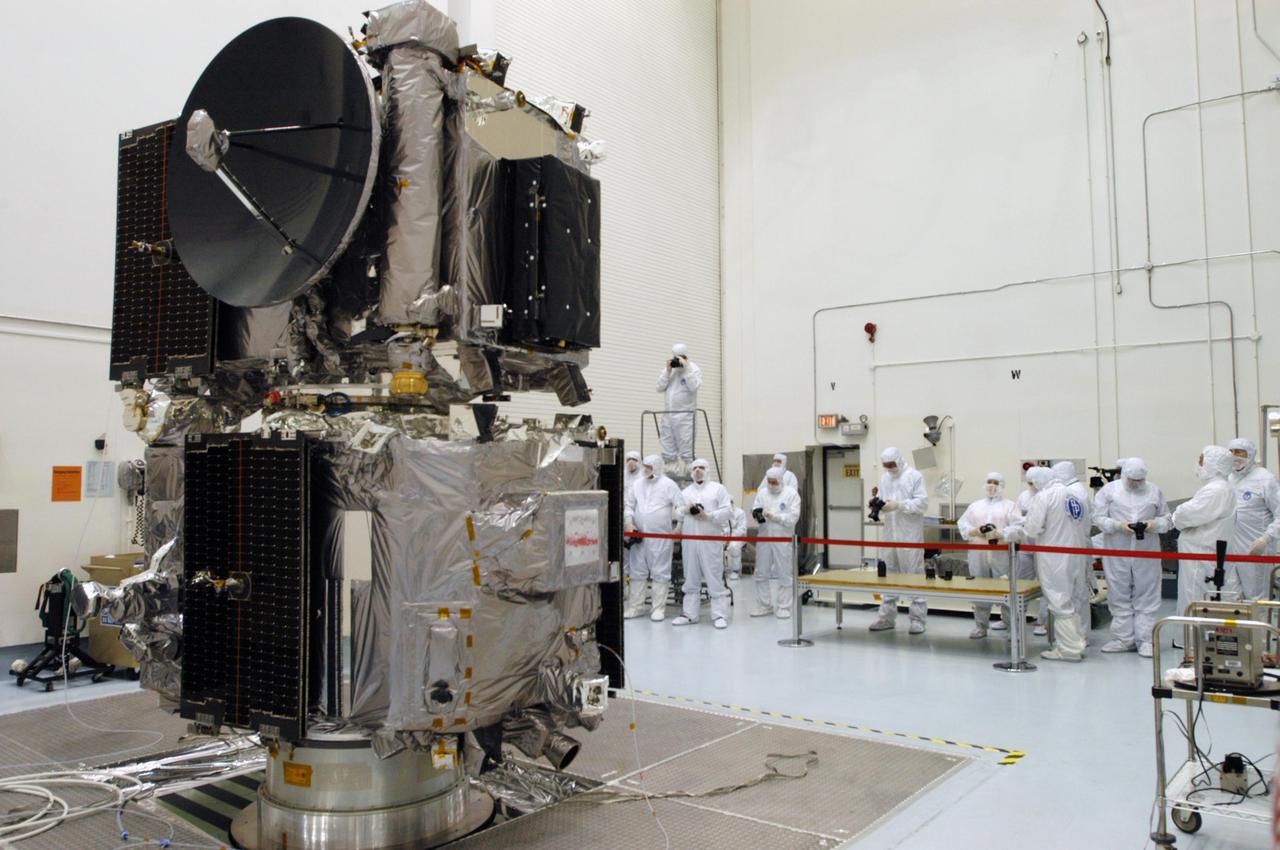
KENNEDY SPACE CENTER, FLA. - The STEREO observatories are the focus of attention at a media viewing held at Astrotech Space Operations in Titusville, Fla., on Aug. 11. The two observatories were mated for launch but will separate into different orbits for their mission. STEREO stands for Solar Terrestrial Relations Observatory. The STEREO mission is the first to take measurements of the sun and solar wind in 3-dimension. This new view will improve our understanding of space weather and its impact on the Earth. STEREO is expected to lift off on Aug. 31, from Launch Pad 17-B on Cape Canaveral Air Force Station in Florida. Photo credit: NASA/George Shelton.
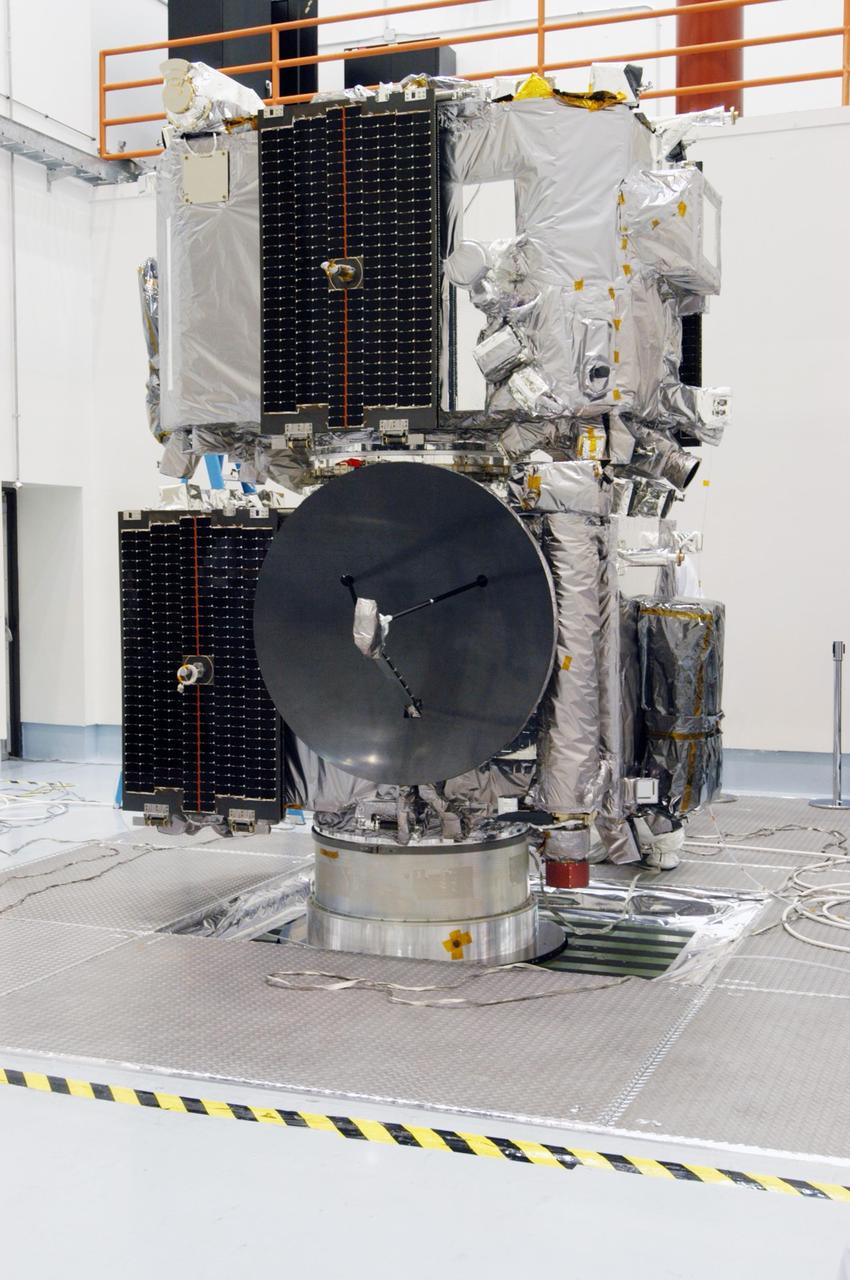
KENNEDY SPACE CENTER, FLA. - The STEREO observatories are the focus of attention at a media viewing held at Astrotech Space Operations in Titusville, Fla. The two observatories were mated for launch but will separate into different orbits for their mission. STEREO stands for Solar Terrestrial Relations Observatory. The STEREO mission is the first to take measurements of the sun and solar wind in 3-dimension. This new view will improve our understanding of space weather and its impact on the Earth. STEREO is expected to lift off on Aug. 31, from Launch Pad 17-B on Cape Canaveral Air Force Station in Florida. Photo credit: NASA/George Shelton.
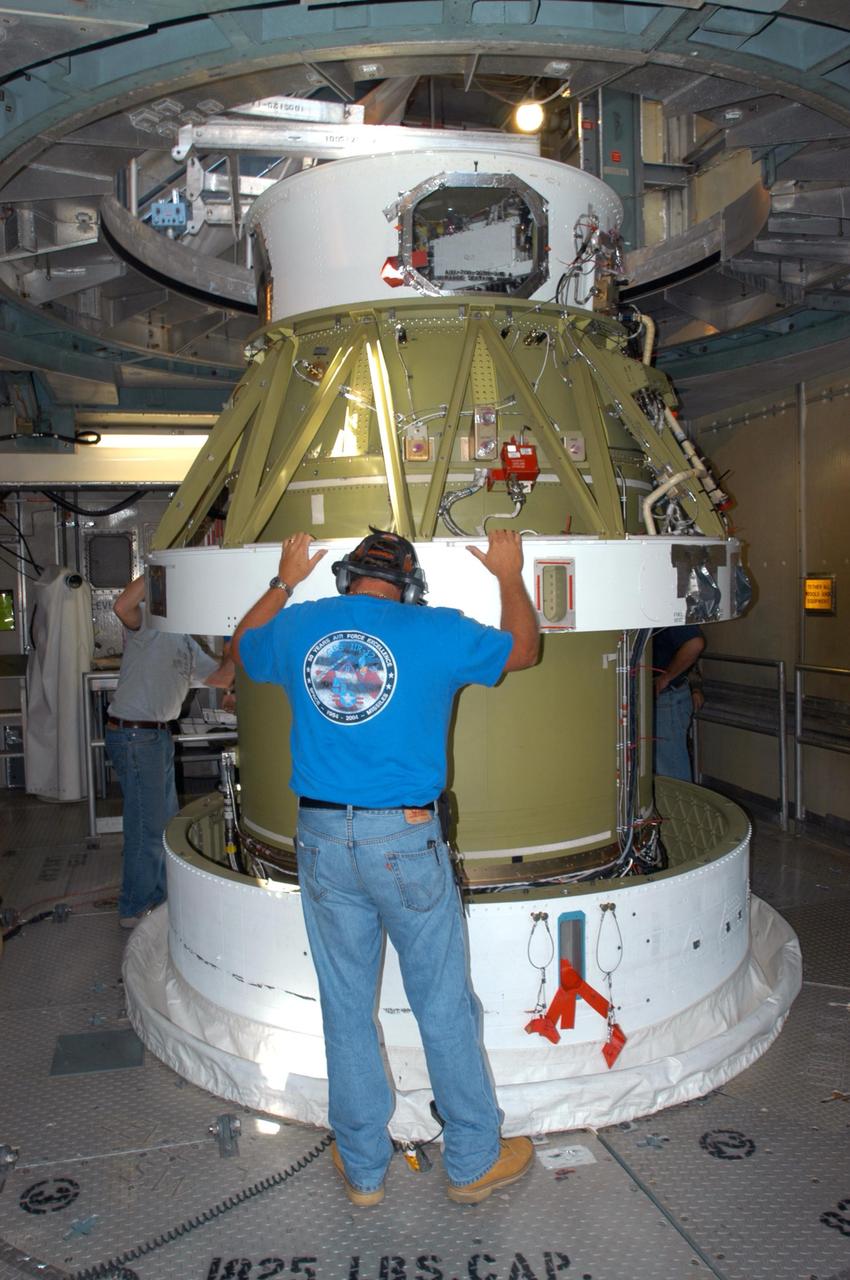
KENNEDY SPACE CENTER, FLA. - Inside the mobile service tower on Launch Pad 17-B on Cape Canaveral Air Force Station, workers help guide the Boeing Delta II second stage for the STEREO launch onto the first stage for mating. STEREO stands for Solar Terrestrial Relations Observatory and comprises two spacecraft. The STEREO mission is the first to take measurements of the sun and solar wind in 3-dimension. This new view will improve our understanding of space weather and its impact on the Earth. STEREO is expected to lift off in August 2006. Photo credit: NASA/George Shelton
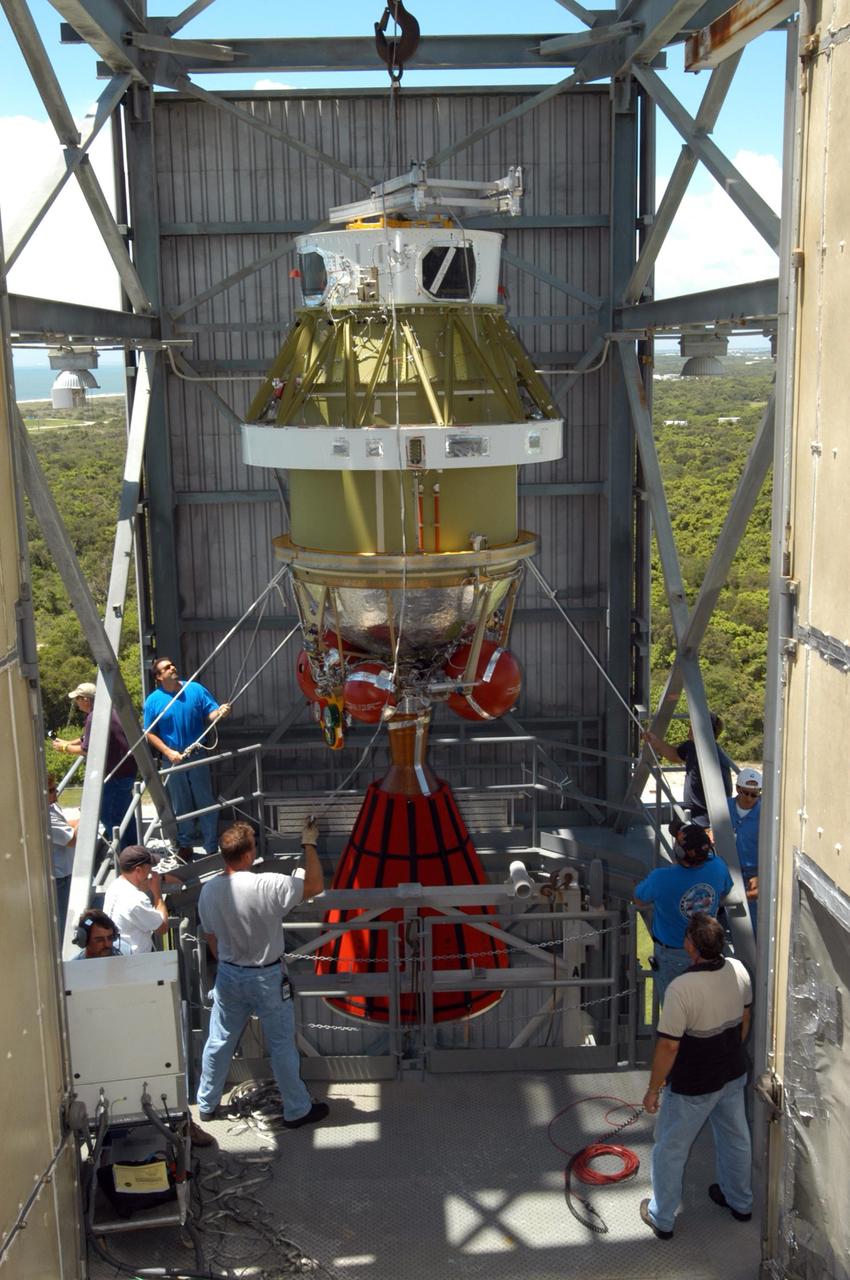
KENNEDY SPACE CENTER, FLA. - At Launch Pad 17-B on Cape Canaveral Air Force Station, the Boeing Delta II second stage for the STEREO launch is moved inside the mobile service tower. The second stage then will be lifted into the mobile service tower and mated with first stage already in place. STEREO stands for Solar Terrestrial Relations Observatory and comprises two spacecraft. The STEREO mission is the first to take measurements of the sun and solar wind in 3-dimension. This new view will improve our understanding of space weather and its impact on the Earth. STEREO is expected to lift off in August 2006. Photo credit: NASA/George Shelton
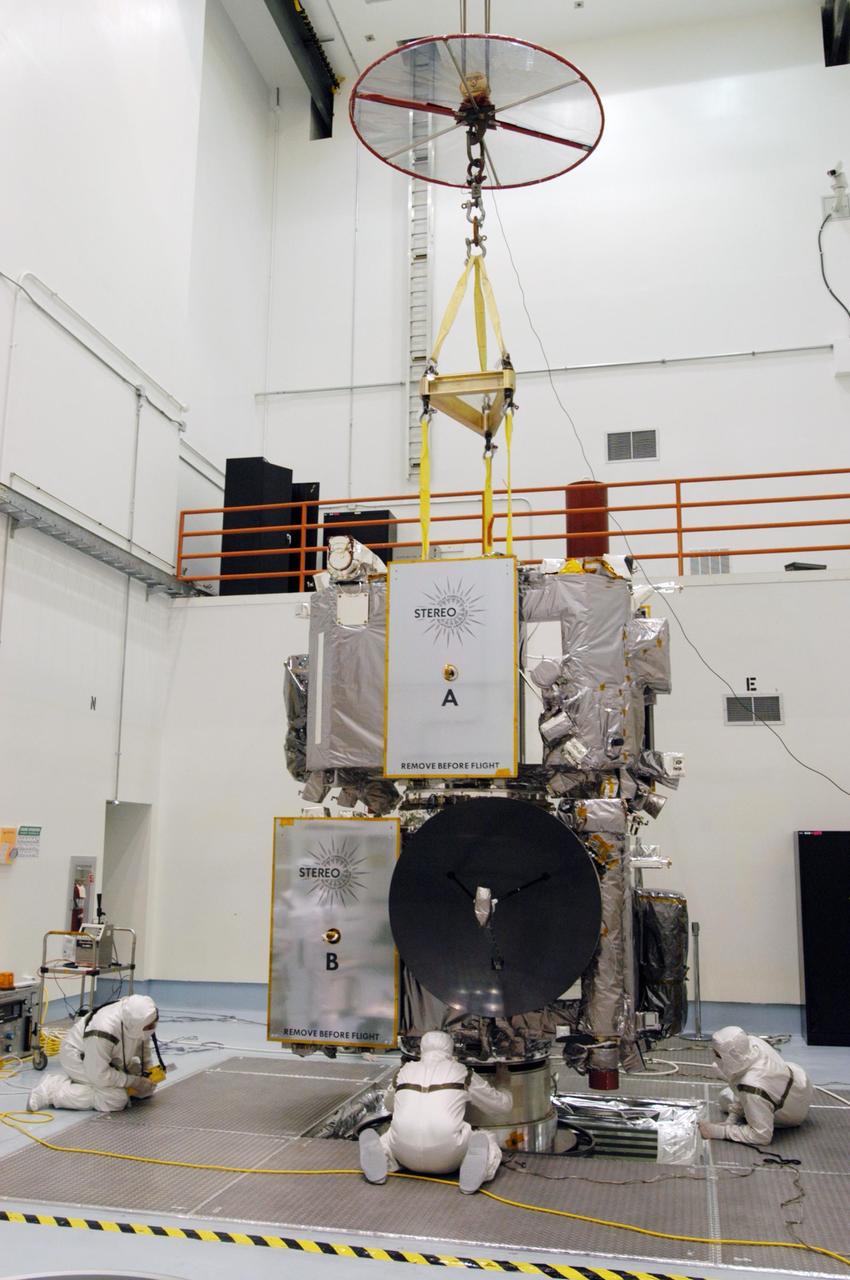
KENNEDY SPACE CENTER, FLA. - Technicians inside the Astrotech facility in Titusville, Florida, move the STEREO spacecraft to the spin table. The twin observatories will undergo a spin test to check balance and alignment in preparation for flight. STEREO stands for Solar Terrestrial Relations Observatory. The STEREO mission is the first to take measurements of the sun and solar wind in 3-dimension. This new view will improve our understanding of space weather and its impact on the Earth. STEREO is expected to lift off on Aug. 31, from Launch Pad 17-B on Cape Canaveral Air Force Station in Florida. Photo credit: NASA/George Shelton.
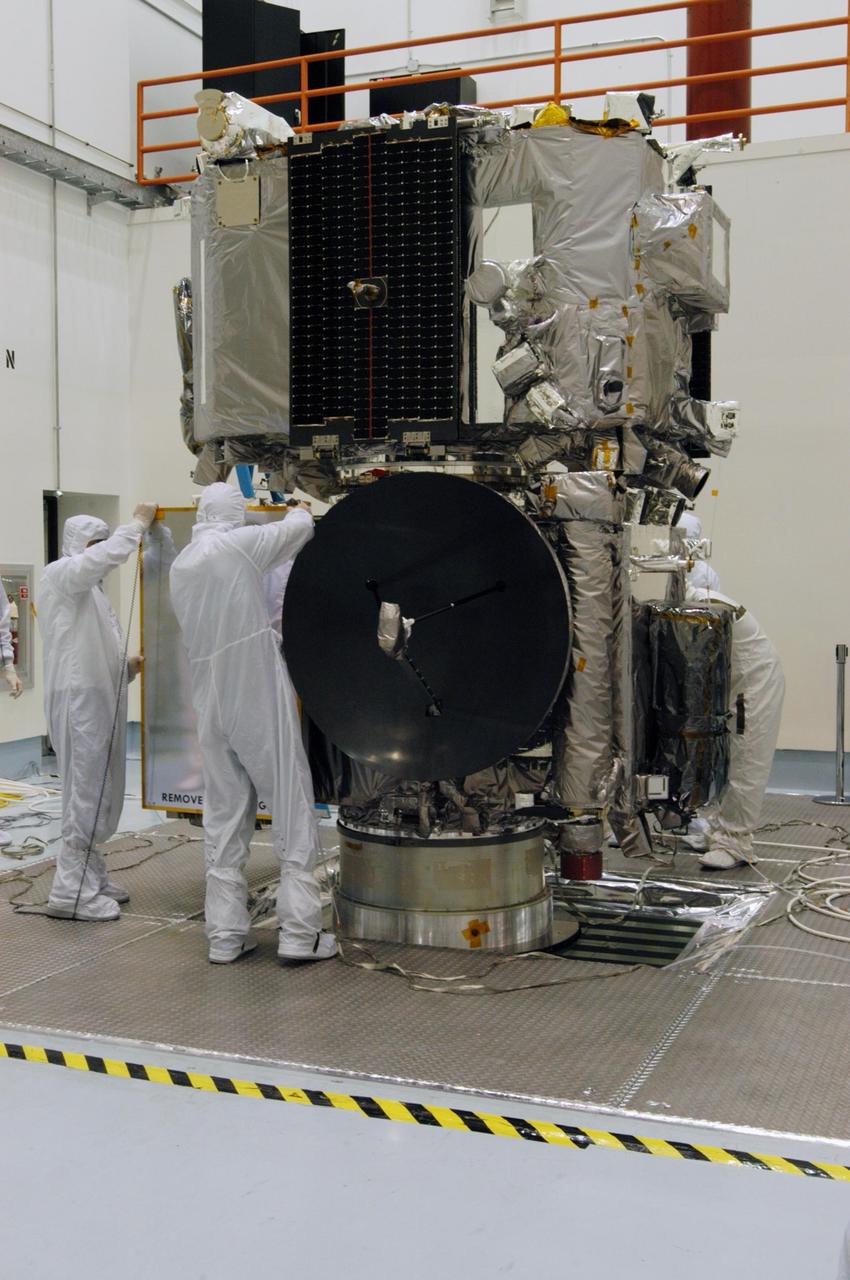
KENNEDY SPACE CENTER, FLA. - The STEREO observatories are the focus of attention at a media viewing held at Astrotech Space Operations in Titusville, Fla., on Aug. 11. The two observatories were mated for launch but will separate into different orbits for their mission. STEREO stands for Solar Terrestrial Relations Observatory. The STEREO mission is the first to take measurements of the sun and solar wind in 3-dimension. This new view will improve our understanding of space weather and its impact on the Earth. STEREO is expected to lift off on Aug. 31, from Launch Pad 17-B on Cape Canaveral Air Force Station in Florida. Photo credit: NASA/George Shelton.
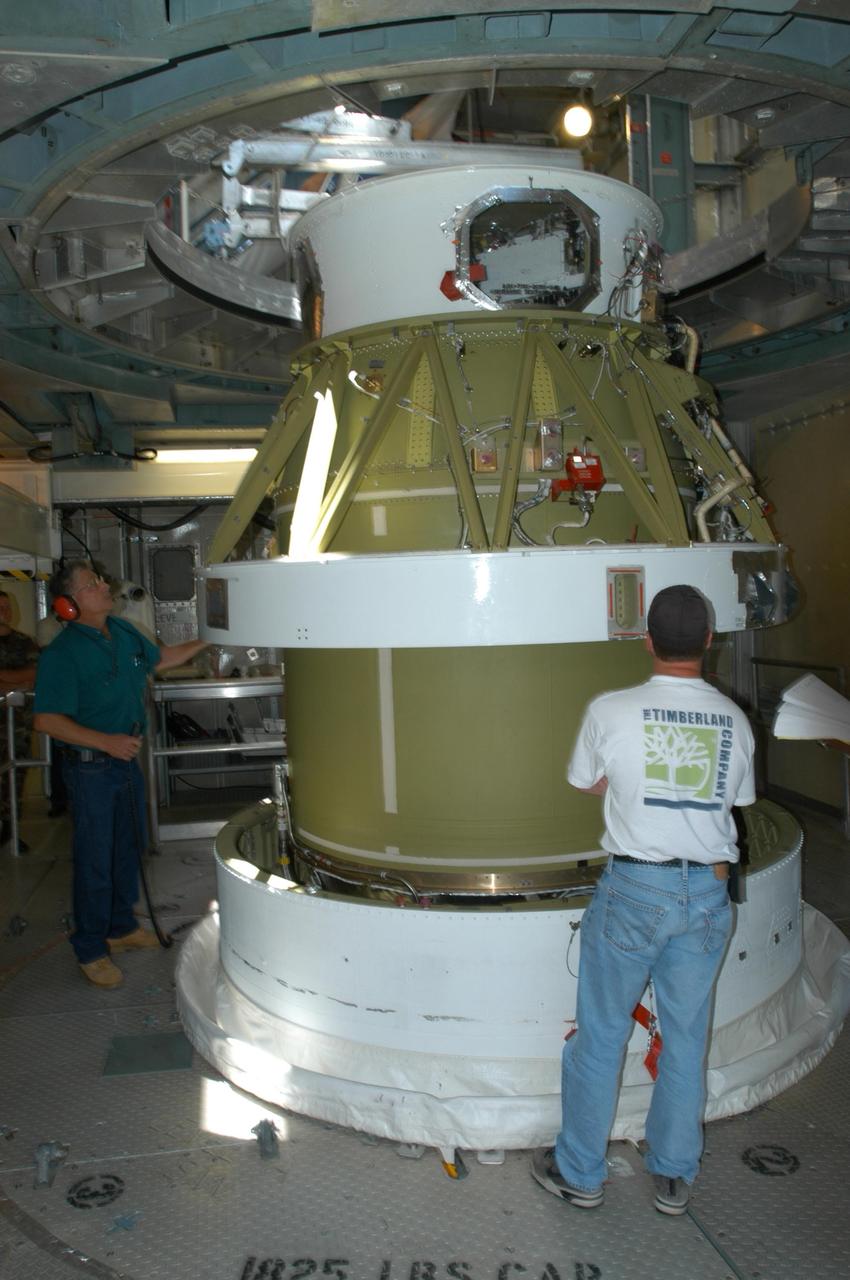
KENNEDY SPACE CENTER, FLA. - Inside the mobile service tower on Launch Pad 17-B on Cape Canaveral Air Force Station, workers stand by as the Boeing Delta II second stage for the STEREO launch is lowered onto the first stage for mating. STEREO stands for Solar Terrestrial Relations Observatory and comprises two spacecraft. The STEREO mission is the first to take measurements of the sun and solar wind in 3-dimension. This new view will improve our understanding of space weather and its impact on the Earth. STEREO is expected to lift off in August 2006. Photo credit: NASA/George Shelton
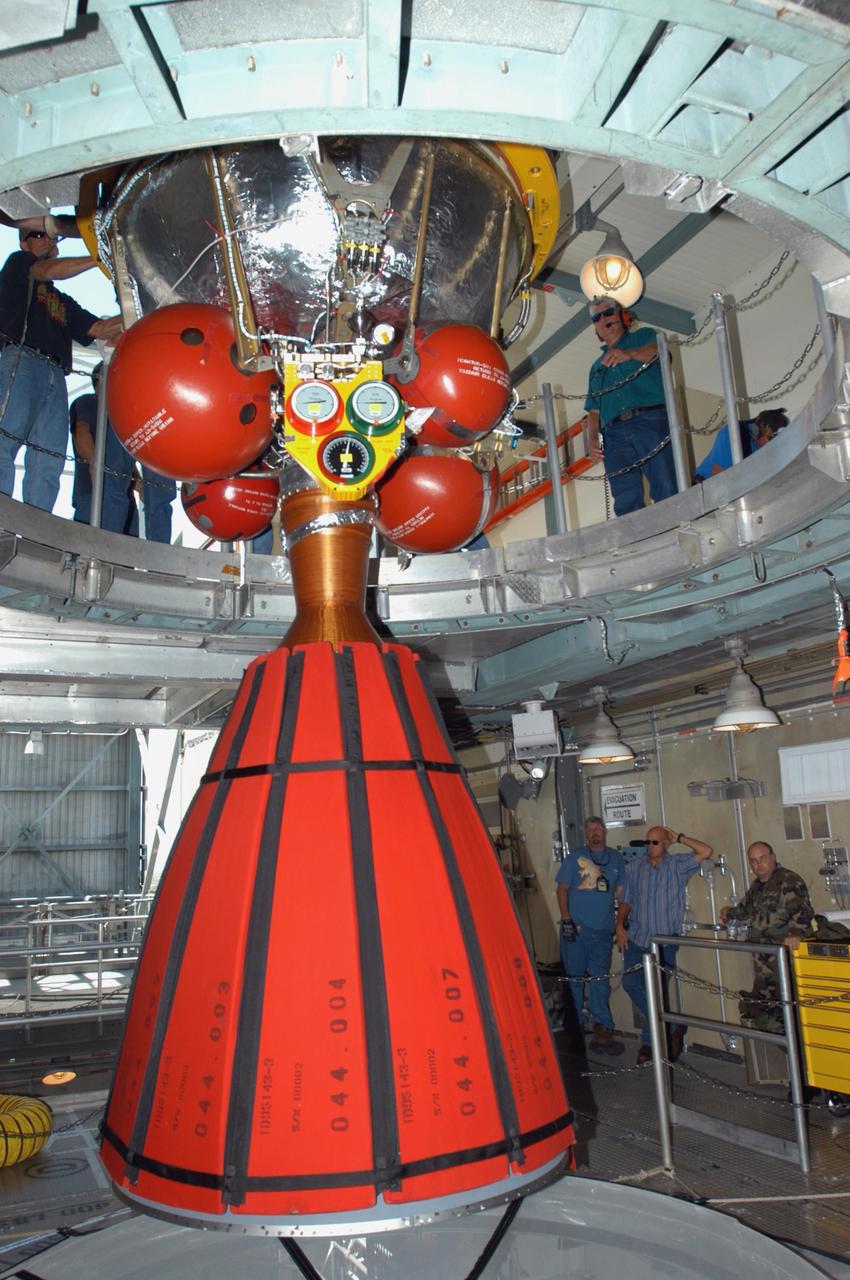
KENNEDY SPACE CENTER, FLA. - Inside the mobile service tower on Launch Pad 17-B on Cape Canaveral Air Force Station, the Boeing Delta II second stage for the STEREO launch is lowered toward the first stage. The two stages will be mated. STEREO stands for Solar Terrestrial Relations Observatory and comprises two spacecraft. The STEREO mission is the first to take measurements of the sun and solar wind in 3-dimension. This new view will improve our understanding of space weather and its impact on the Earth. STEREO is expected to lift off in August 2006. Photo credit: NASA/George Shelton
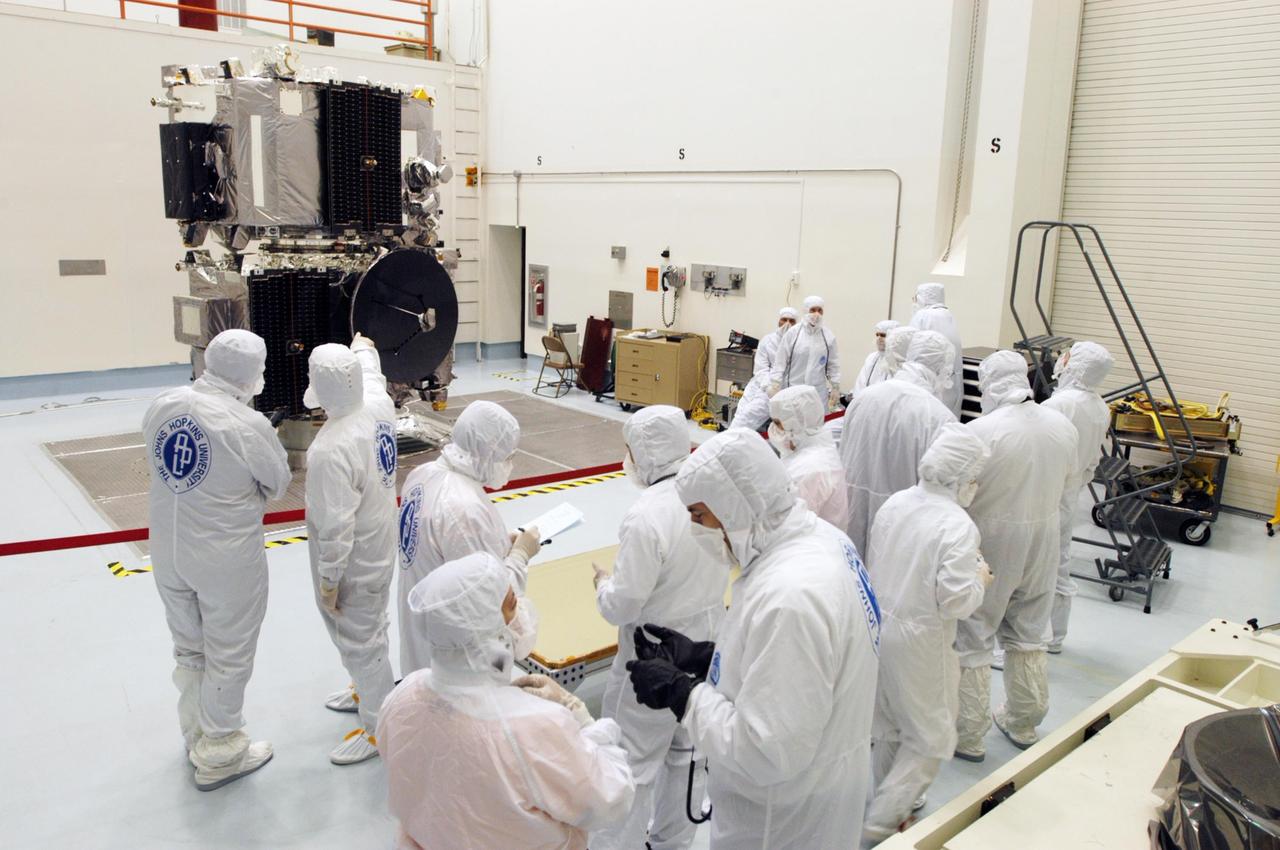
KENNEDY SPACE CENTER, FLA. - The STEREO observatories are the focus of attention at a media viewing held at Astrotech Space Operations in Titusville, Fla., on Aug. 11. The two observatories were mated for launch but will separate into different orbits for their mission. STEREO stands for Solar Terrestrial Relations Observatory. The STEREO mission is the first to take measurements of the sun and solar wind in 3-dimension. This new view will improve our understanding of space weather and its impact on the Earth. STEREO is expected to lift off on Aug. 31, from Launch Pad 17-B on Cape Canaveral Air Force Station in Florida. Photo credit: NASA/George Shelton.
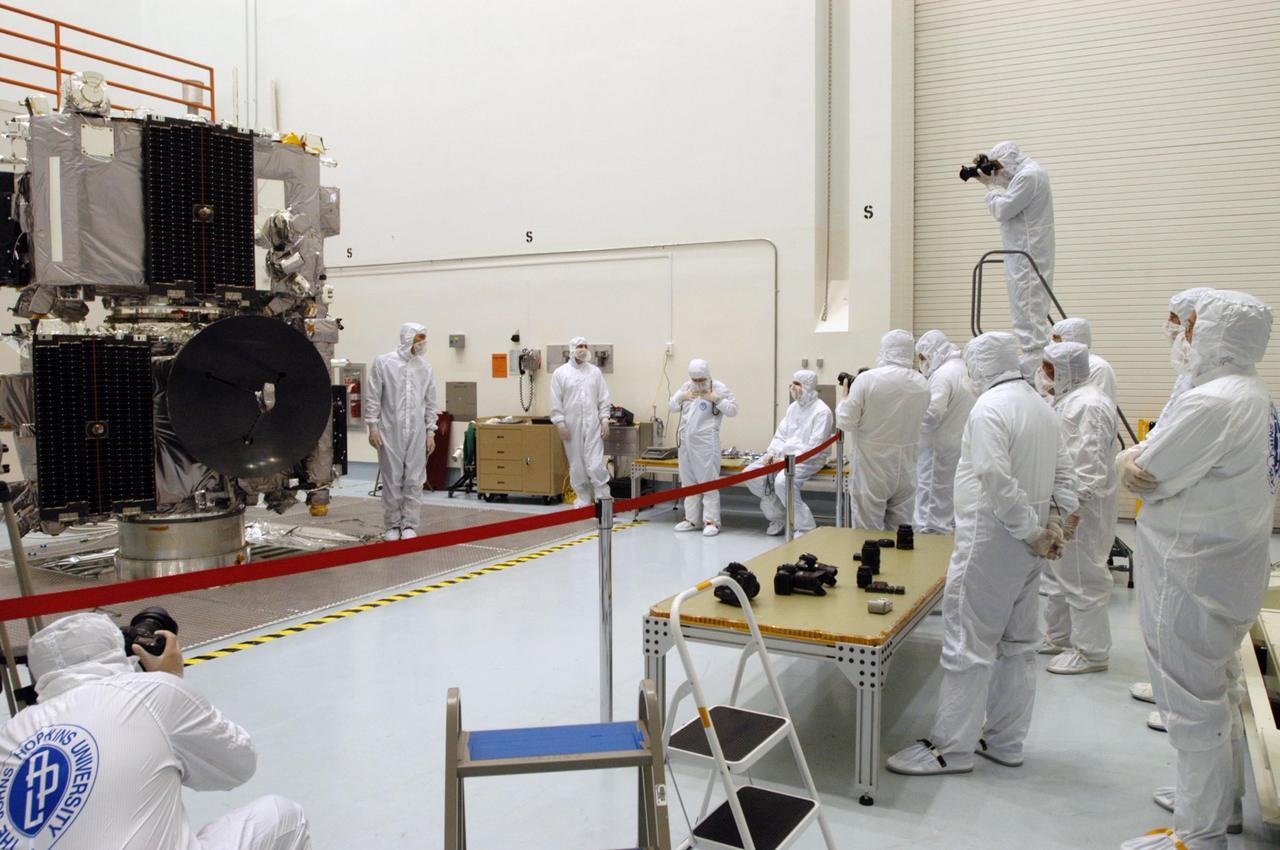
KENNEDY SPACE CENTER, FLA. - The STEREO observatories are the focus of attention at a media viewing held at Astrotech Space Operations in Titusville, Fla., on Aug. 11. The two observatories were mated for launch but will separate into different orbits for their mission. STEREO stands for Solar Terrestrial Relations Observatory. The STEREO mission is the first to take measurements of the sun and solar wind in 3-dimension. This new view will improve our understanding of space weather and its impact on the Earth. STEREO is expected to lift off on Aug. 31, from Launch Pad 17-B on Cape Canaveral Air Force Station in Florida. Photo credit: NASA/George Shelton.
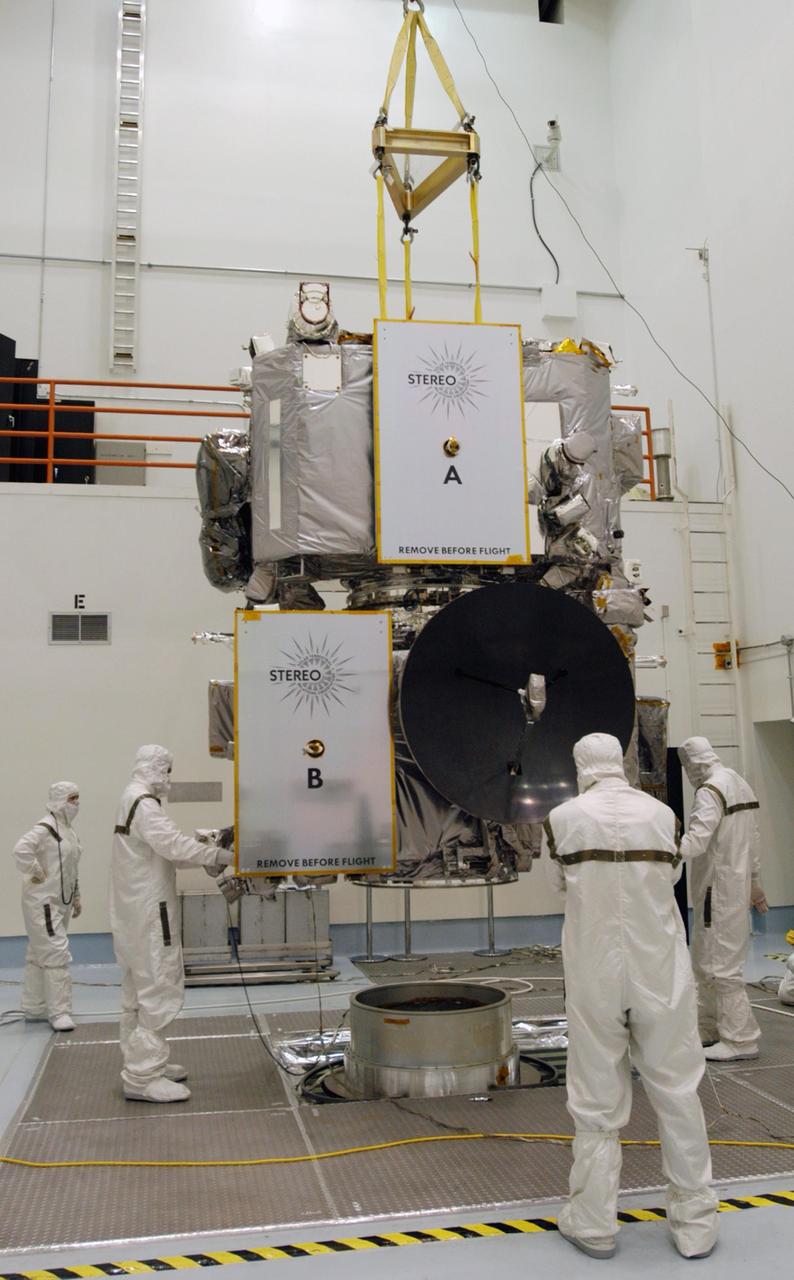
KENNEDY SPACE CENTER, FLA. - Technicians inside the Astrotech facility in Titusville, Florida, move the STEREO spacecraft to the spin table. The twin observatories will undergo a spin test to check balance and alignment in preparation for flight. STEREO stands for Solar Terrestrial Relations Observatory. The STEREO mission is the first to take measurements of the sun and solar wind in 3-dimension. This new view will improve our understanding of space weather and its impact on the Earth. STEREO is expected to lift off on Aug. 31, from Launch Pad 17-B on Cape Canaveral Air Force Station in Florida. Photo credit: NASA/George Shelton.
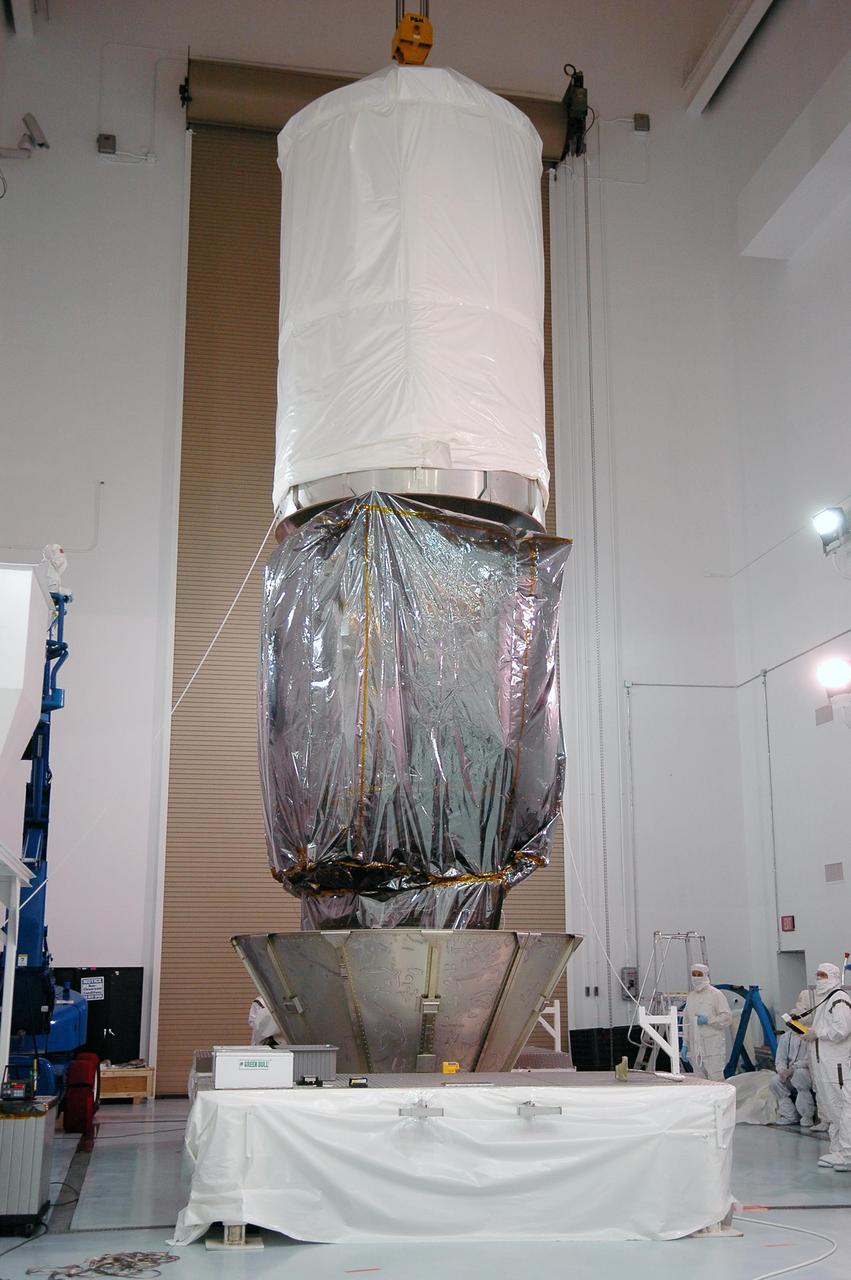
KENNEDY SPACE CENTER, FLA. - At Astrotech Space Operations in Titusville, Fla., the upper portion of the transportation canister is lowered over the STEREO spacecraft (in front). When the entire configuration is encased, it will be moved to Launch Pad 17-B at Cape Canaveral Air Force Station. STEREO stands for Solar Terrestrial Relations Observatory and comprises two spacecraft. The STEREO mission is the first to take measurements of the sun and solar wind in 3-dimension. This new view will improve our understanding of space weather and its impact on the Earth. STEREO is expected to lift off Aug. 31. Photo credit: NASA/Kim Shiflett
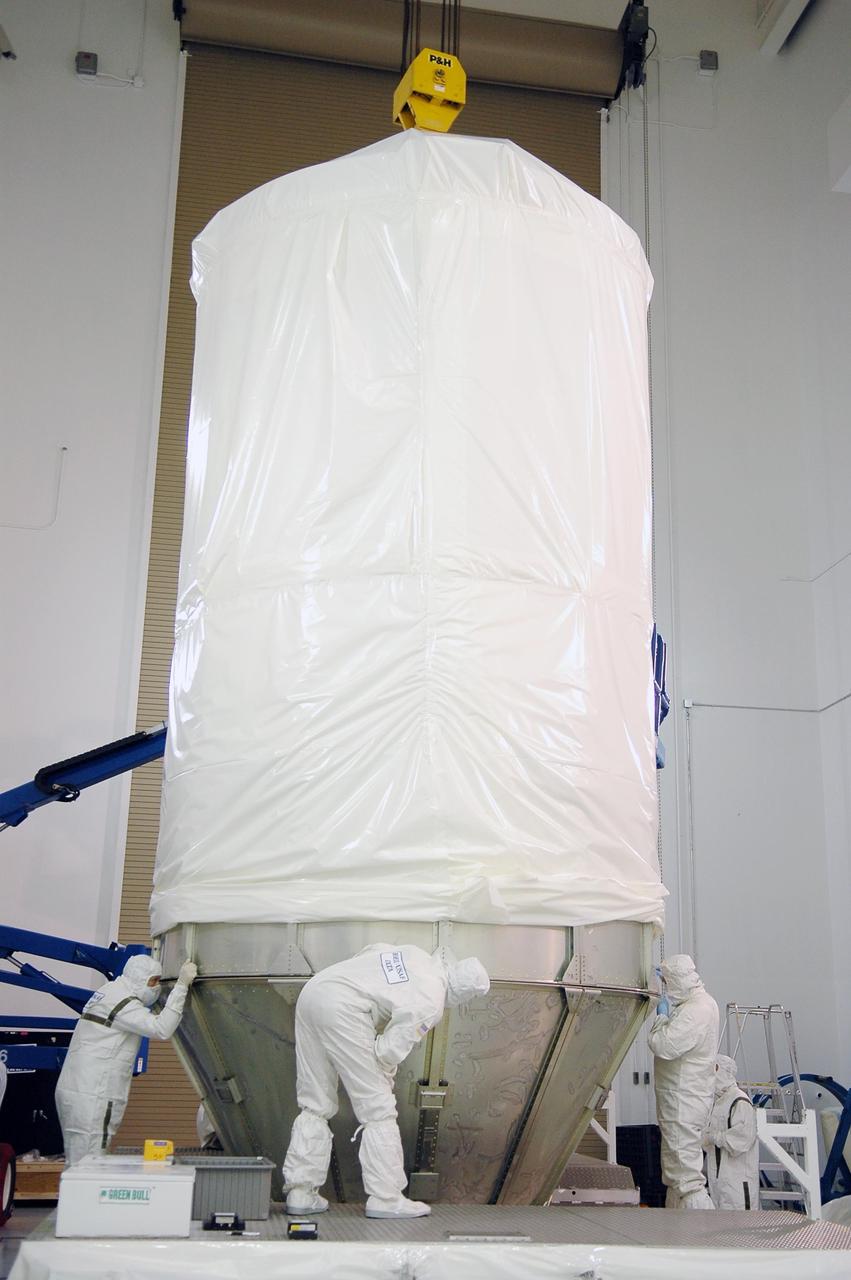
KENNEDY SPACE CENTER, FLA. - At Astrotech Space Operations in Titusville, Fla., workers check the fitting of the upper portion of the transportation canister onto the lower portion. The canister encases the STEREO spacecraft for its move to Launch Pad 17-B at Cape Canaveral Air Force Station. STEREO stands for Solar Terrestrial Relations Observatory and comprises two spacecraft. The STEREO mission is the first to take measurements of the sun and solar wind in 3-dimension. This new view will improve our understanding of space weather and its impact on the Earth. STEREO is expected to lift off Aug. 31. Photo credit: NASA/Kim Shiflett
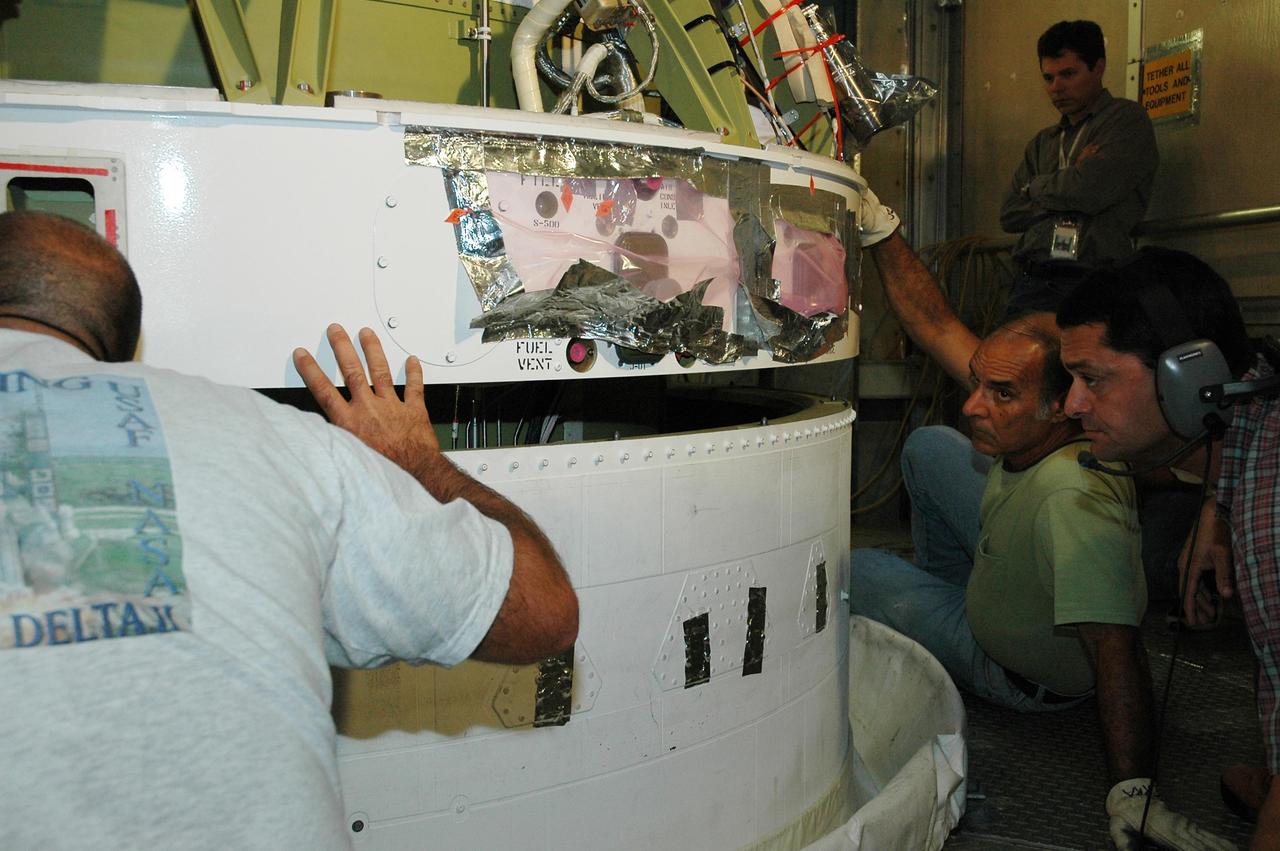
KENNEDY SPACE CENTER, FLA. - Inside the mobile service tower on Launch Pad 17-B at Cape Canaveral Air Force Station, the second stage of the Boeing Delta II launch vehicle for the STEREO spacecraft is being remated with the Delta first stage. STEREO stands for Solar Terrestrial Relations Observatory and comprises two spacecraft. The STEREO mission is the first to take measurements of the sun and solar wind in 3-dimension. This new view will improve our understanding of space weather and its impact on the Earth. STEREO is expected to lift off on Aug. 31. Photo credit: NASA/Dimitri Gerondidakis
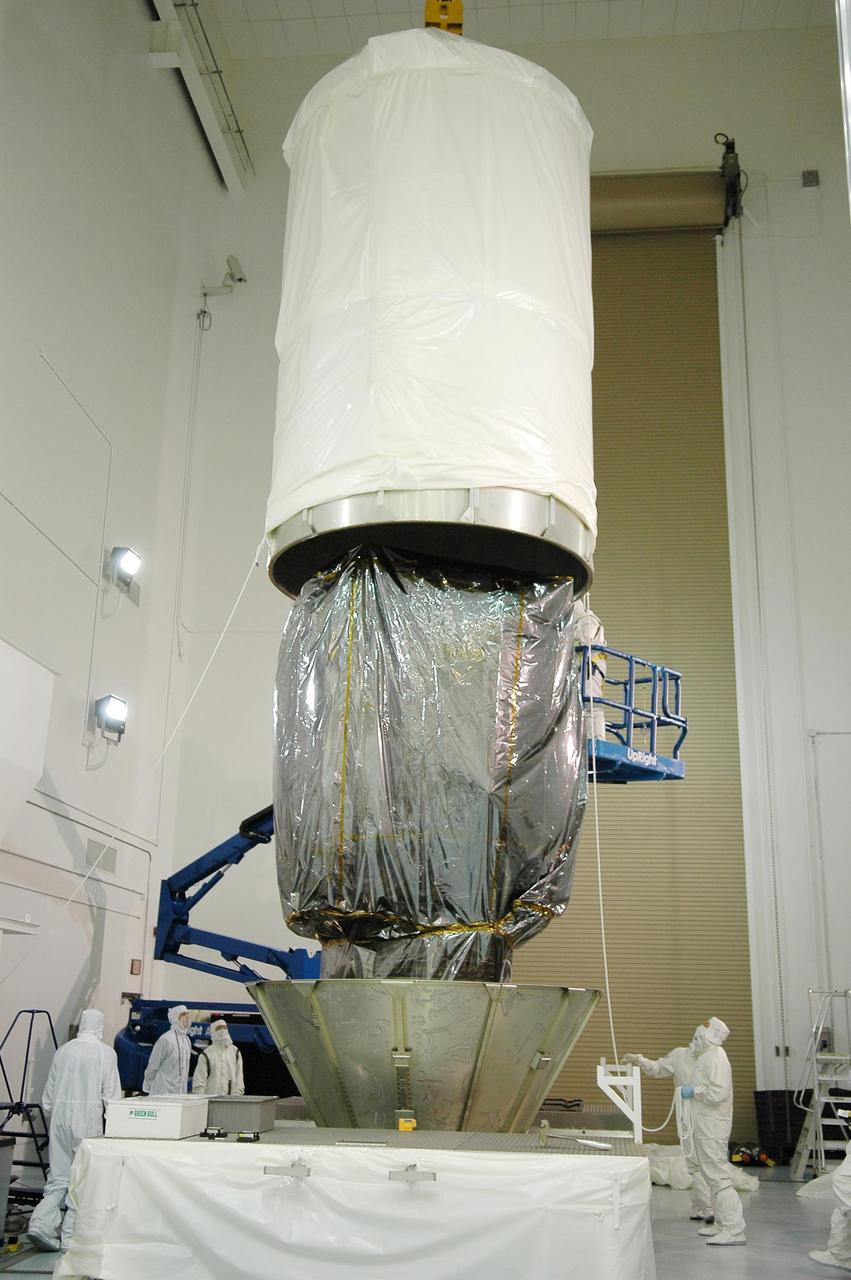
KENNEDY SPACE CENTER, FLA. - At Astrotech Space Operations in Titusville, Fla., the upper portion of the transportation canister is lowered over the STEREO spacecraft (in front). When the entire configuration is encased, it will be moved to Launch Pad 17-B at Cape Canaveral Air Force Station. STEREO stands for Solar Terrestrial Relations Observatory and comprises two spacecraft. The STEREO mission is the first to take measurements of the sun and solar wind in 3-dimension. This new view will improve our understanding of space weather and its impact on the Earth. STEREO is expected to lift off Aug. 31. Photo credit: NASA/Kim Shiflett
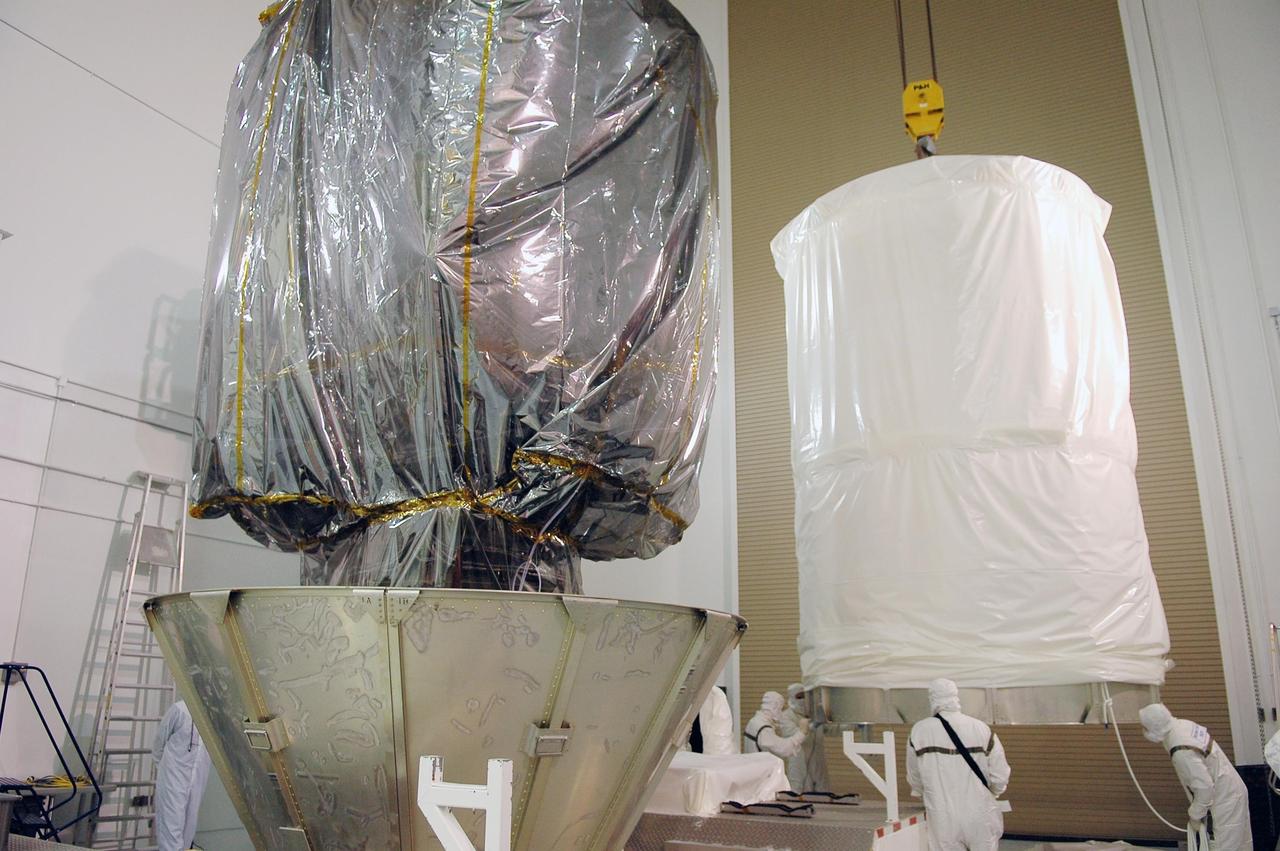
KENNEDY SPACE CENTER, FLA. - At Astrotech Space Operations in Titusville, Fla., workers maneuver the upper portion of the transportation canister that will be lowered over the STEREO spacecraft (in front). When the entire configuration is encased, it will be moved to Launch Pad 17-B at Cape Canaveral Air Force Station. STEREO stands for Solar Terrestrial Relations Observatory and comprises two spacecraft. The STEREO mission is the first to take measurements of the sun and solar wind in 3-dimension. This new view will improve our understanding of space weather and its impact on the Earth. STEREO is expected to lift off Aug. 31. Photo credit: NASA/Kim Shiflett
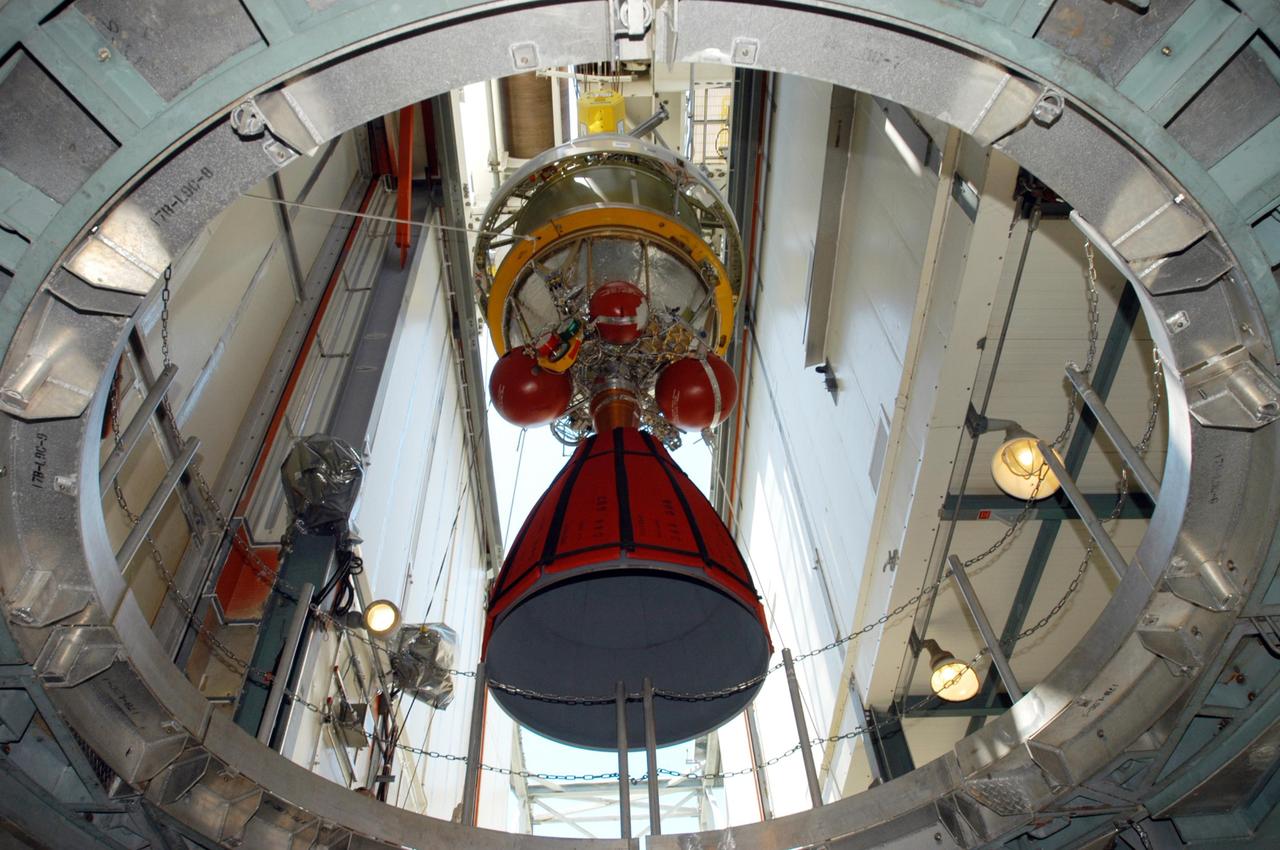
KENNEDY SPACE CENTER, FLA. - Inside the mobile service tower on Launch Pad 17-B on Cape Canaveral Air Force Station, the Boeing Delta II second stage for the STEREO launch is lowered toward the first stage. The two stages will be mated. STEREO stands for Solar Terrestrial Relations Observatory and comprises two spacecraft. The STEREO mission is the first to take measurements of the sun and solar wind in 3-dimension. This new view will improve our understanding of space weather and its impact on the Earth. STEREO is expected to lift off in August 2006. Photo credit: NASA/George Shelton
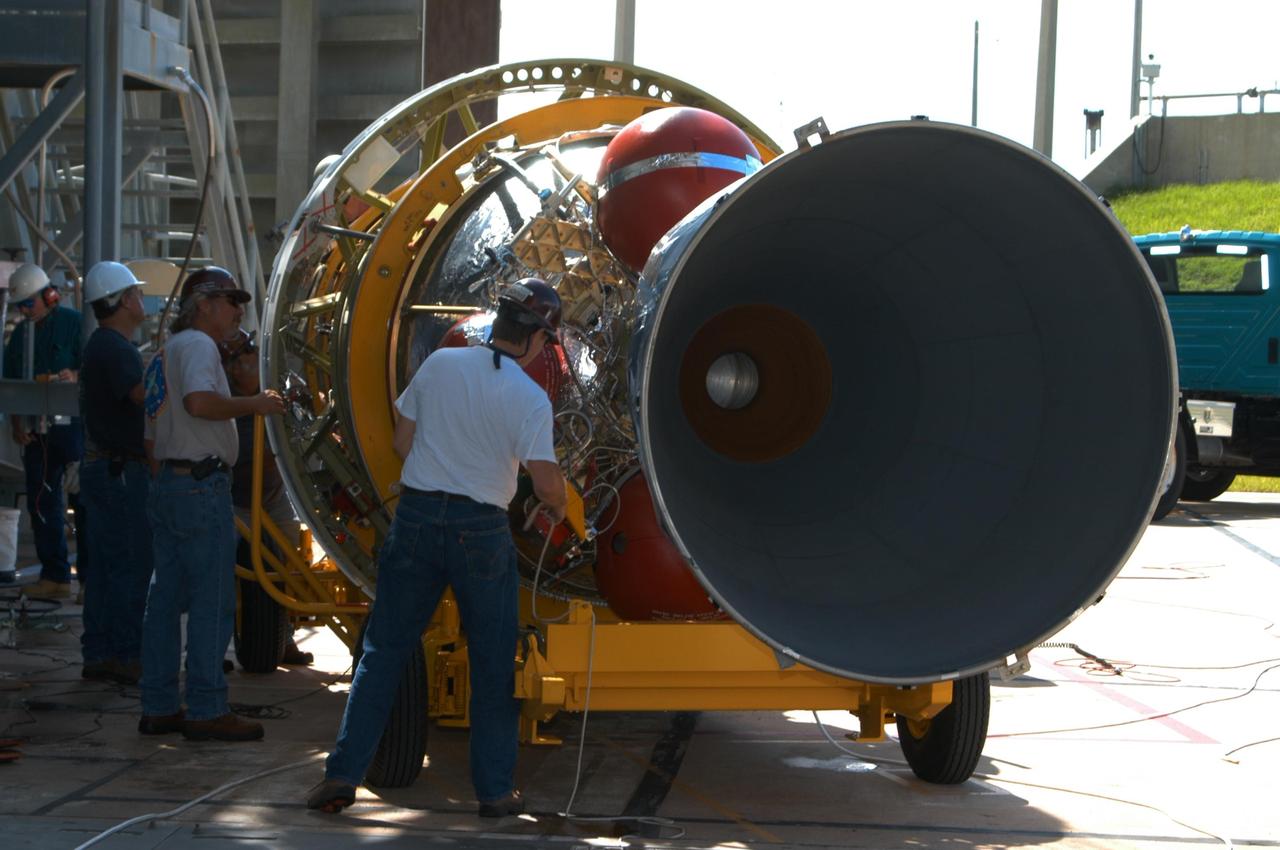
KENNEDY SPACE CENTER, FLA. - At Launch Pad 17-B on Cape Canaveral Air Force Station, workers prepare the Boeing Delta II second stage for the STEREO launch to be lifted off the transporter. The second stage then will be lifted into the mobile service tower and mated with first stage already in place. STEREO stands for Solar Terrestrial Relations Observatory and comprises two spacecraft. The STEREO mission is the first to take measurements of the sun and solar wind in 3-dimension. This new view will improve our understanding of space weather and its impact on the Earth. STEREO is expected to lift off in August 2006. Photo credit: NASA/George Shelton
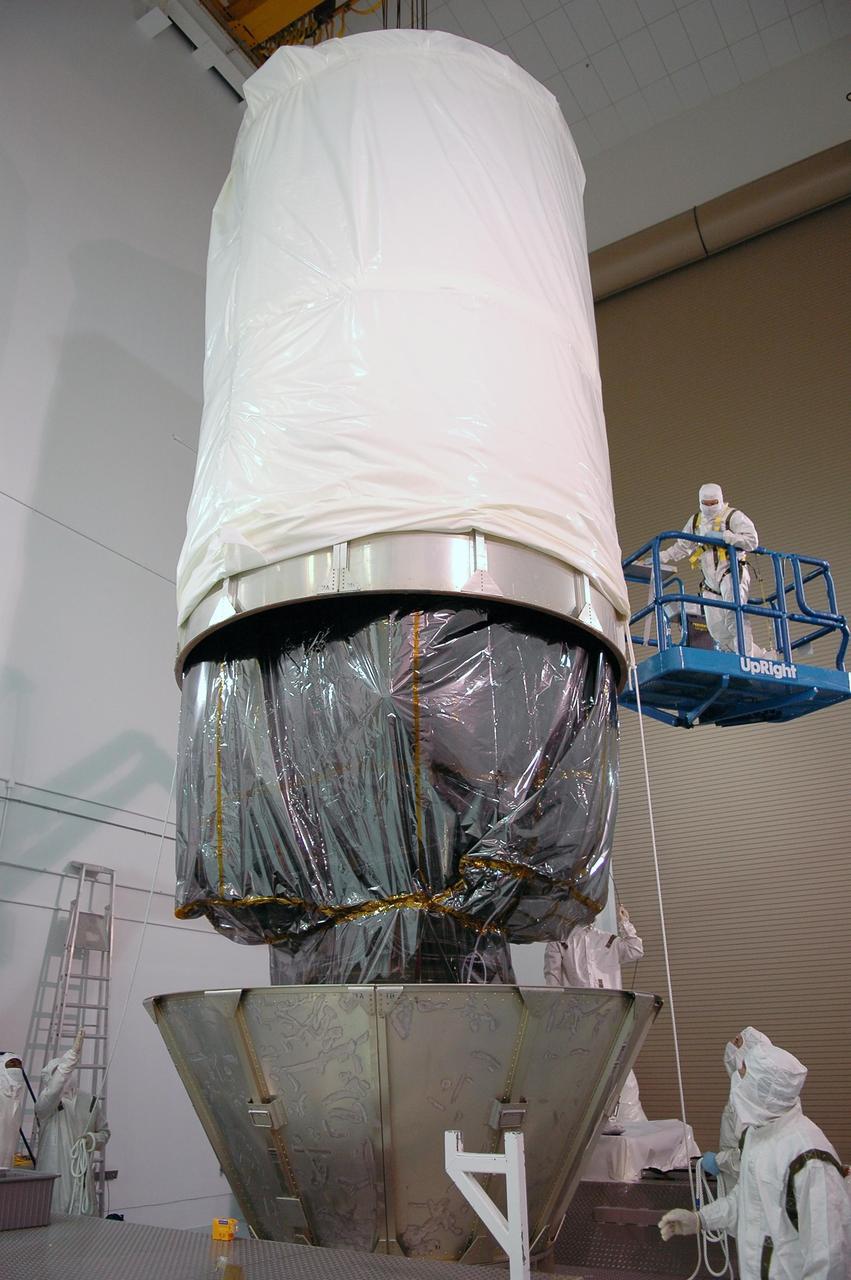
KENNEDY SPACE CENTER, FLA. - At Astrotech Space Operations in Titusville, Fla., workers check the progress of the upper portion of the transportation canister as it is lowered over the STEREO spacecraft. When the entire configuration is encased, it will be moved to Launch Pad 17-B at Cape Canaveral Air Force Station. STEREO stands for Solar Terrestrial Relations Observatory and comprises two spacecraft. The STEREO mission is the first to take measurements of the sun and solar wind in 3-dimension. This new view will improve our understanding of space weather and its impact on the Earth. STEREO is expected to lift off Aug. 31. Photo credit: NASA/Kim Shiflett
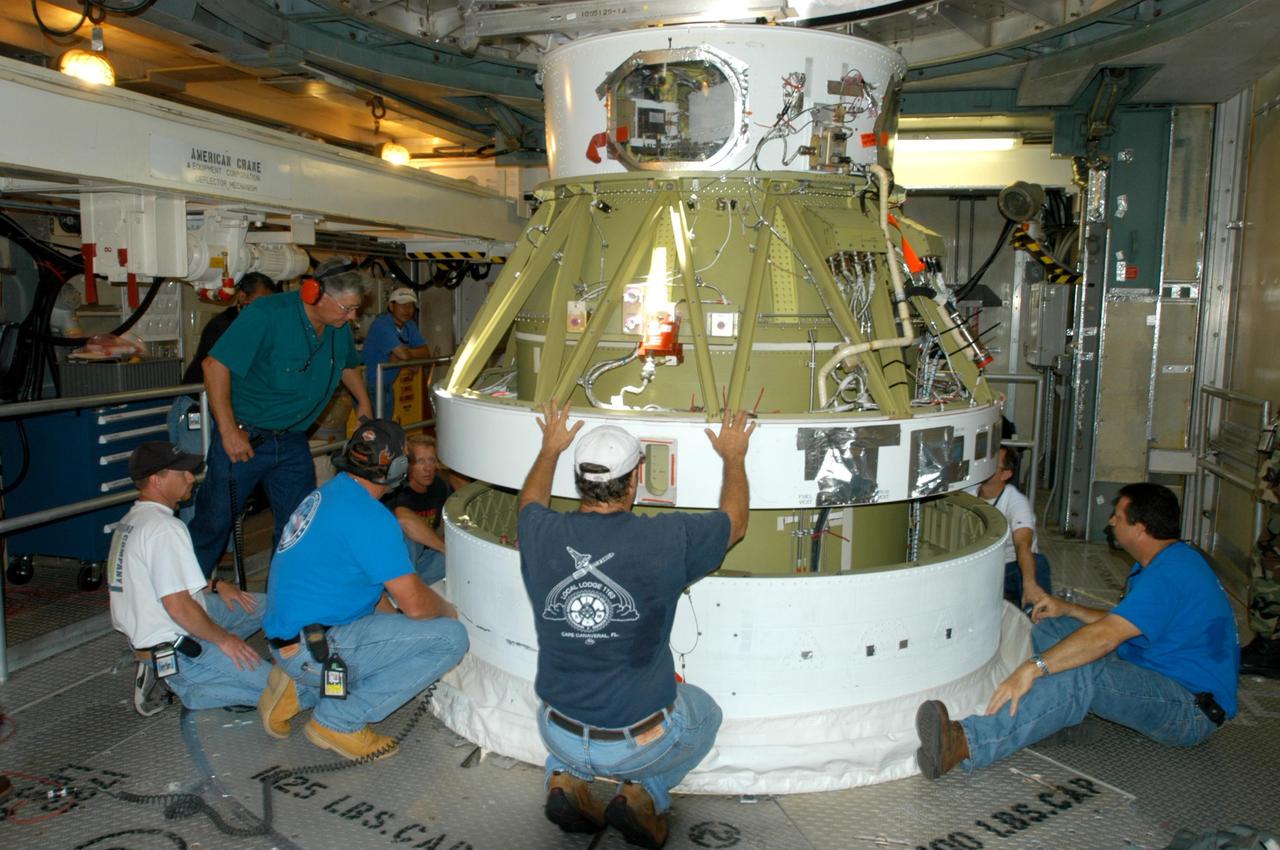
KENNEDY SPACE CENTER, FLA. - Inside the mobile service tower on Launch Pad 17-B on Cape Canaveral Air Force Station, workers help guide the Boeing Delta II second stage for the STEREO launch onto the first stage for mating. STEREO stands for Solar Terrestrial Relations Observatory and comprises two spacecraft. The STEREO mission is the first to take measurements of the sun and solar wind in 3-dimension. This new view will improve our understanding of space weather and its impact on the Earth. STEREO is expected to lift off in August 2006. Photo credit: NASA/George Shelton
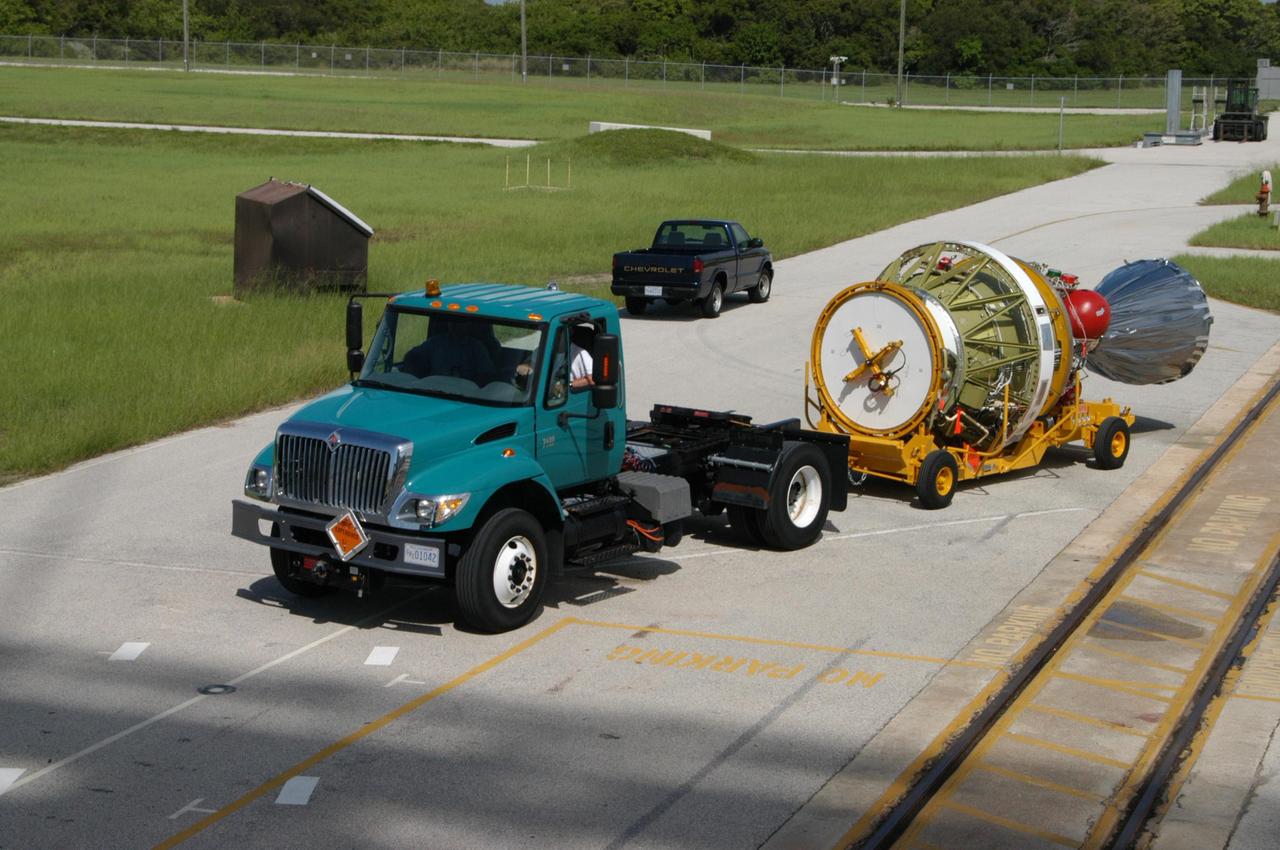
KENNEDY SPACE CENTER, FLA. - At Launch Pad 17-B on Cape Canaveral Air Force Station, the Boeing Delta II second stage for the STEREO launch arrives on a transporter. The second stage will be lifted into the mobile service tower and mated with the first stage already in place. STEREO stands for Solar Terrestrial Relations Observatory and comprises two spacecraft. The STEREO mission is the first to take measurements of the sun and solar wind in 3-dimension. This new view will improve our understanding of space weather and its impact on the Earth. STEREO is expected to lift off in August 2006. Photo credit: NASA/George Shelton
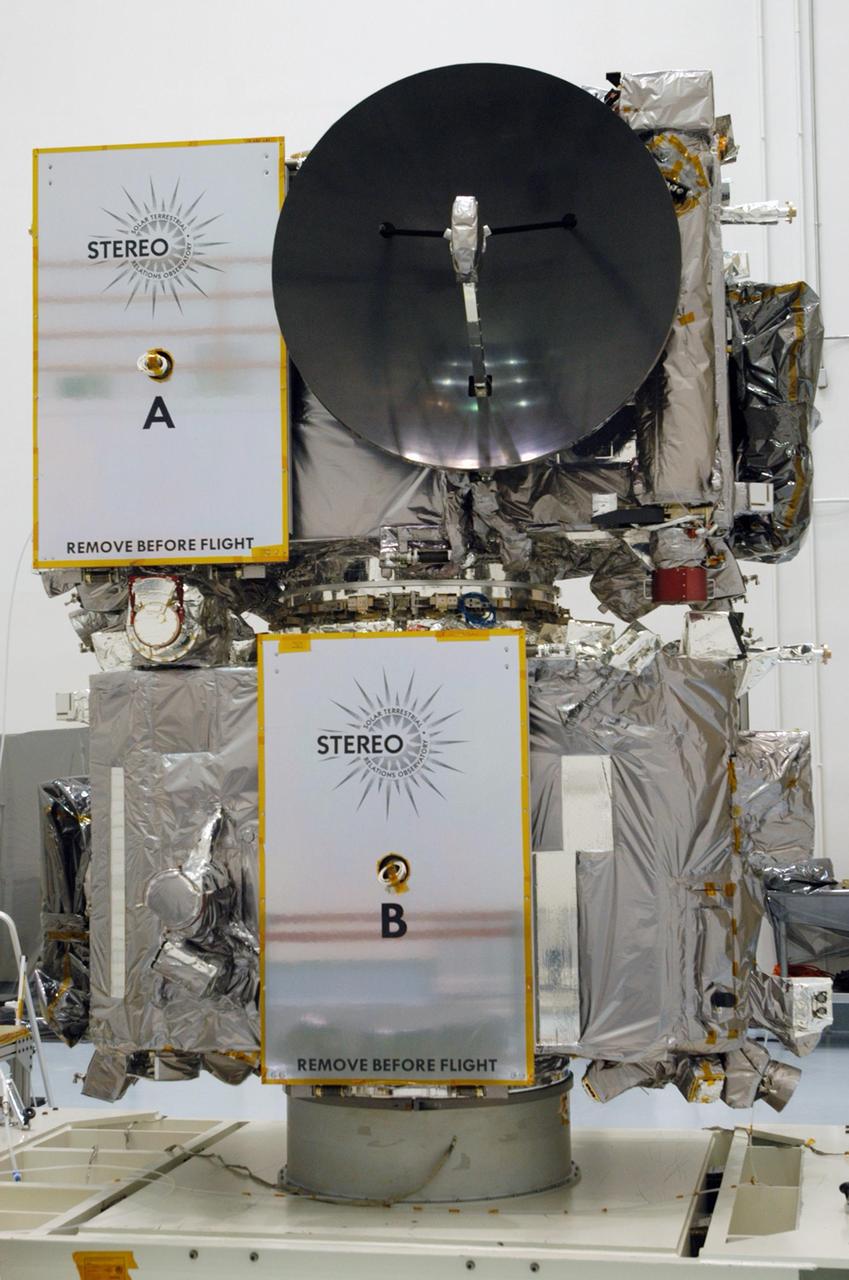
KENNEDY SPACE CENTER, FLA. - The STEREO spacecraft sits on a test stand inside the Astrotech facility in Titusville, Florida. The twin observatories will undergo a spin test to check balance and alignment in preparation for flight. STEREO stands for Solar Terrestrial Relations Observatory. The STEREO mission is the first to take measurements of the sun and solar wind in 3-dimension. This new view will improve our understanding of space weather and its impact on the Earth. STEREO is expected to lift off on Aug. 31, from Launch Pad 17-B on Cape Canaveral Air Force Station in Florida. Photo credit: NASA/George Shelton.
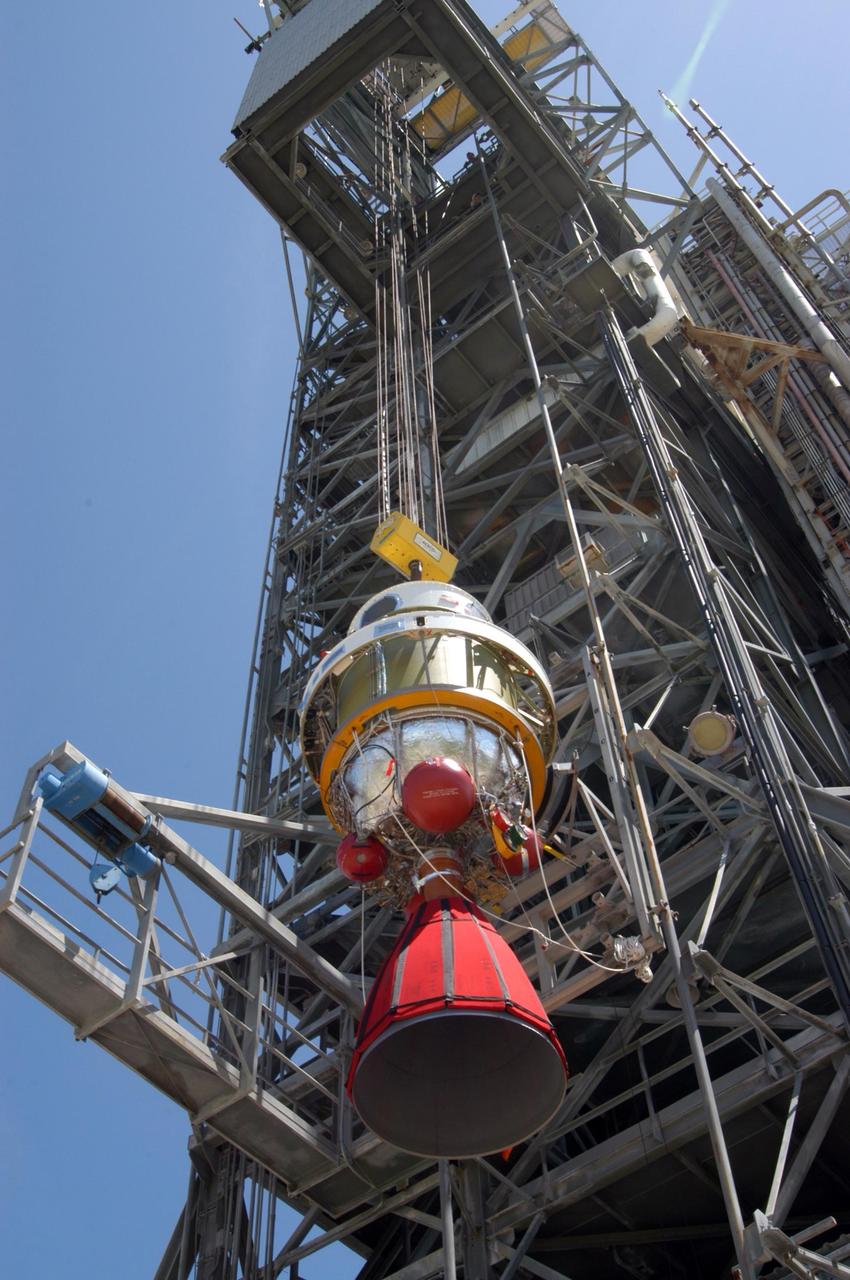
KENNEDY SPACE CENTER, FLA. - At Launch Pad 17-B on Cape Canaveral Air Force Station, the Boeing Delta II second stage for the STEREO launch is lifted alongside the mobile service tower. The second stage then will be lifted into the mobile service tower and mated with first stage already in place. STEREO stands for Solar Terrestrial Relations Observatory and comprises two spacecraft. The STEREO mission is the first to take measurements of the sun and solar wind in 3-dimension. This new view will improve our understanding of space weather and its impact on the Earth. STEREO is expected to lift off in August 2006. Photo credit: NASA/George Shelton
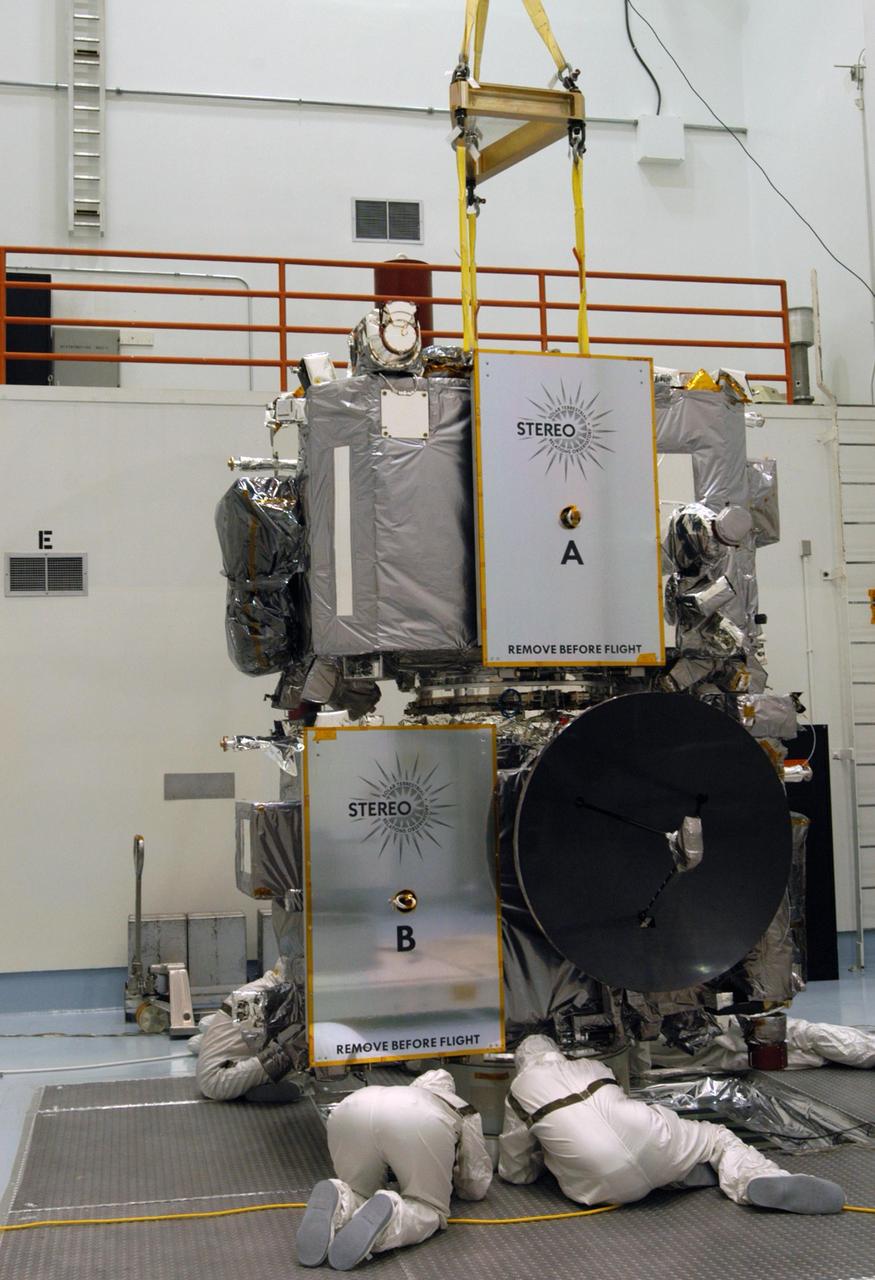
KENNEDY SPACE CENTER, FLA. - Technicians inside the Astrotech facility in Titusville, Florida, move the STEREO spacecraft to the spin table. The twin observatories will undergo a spin test to check balance and alignment in preparation for flight. STEREO stands for Solar Terrestrial Relations Observatory. The STEREO mission is the first to take measurements of the sun and solar wind in 3-dimension. This new view will improve our understanding of space weather and its impact on the Earth. STEREO is expected to lift off on Aug. 31, from Launch Pad 17-B on Cape Canaveral Air Force Station in Florida. Photo credit: NASA/George Shelton.

KENNEDY SPACE CENTER, FLA. - At Astrotech Space Operations in Titusville, Fla., a worker examines the STEREO spacecraft as the upper portion of the transportation canister is lowered over the top. When the entire configuration is encased, it will be moved to Launch Pad 17-B at Cape Canaveral Air Force Station. STEREO stands for Solar Terrestrial Relations Observatory and comprises two spacecraft. The STEREO mission is the first to take measurements of the sun and solar wind in 3-dimension. This new view will improve our understanding of space weather and its impact on the Earth. STEREO is expected to lift off Aug. 31. Photo credit: NASA/Kim Shiflett
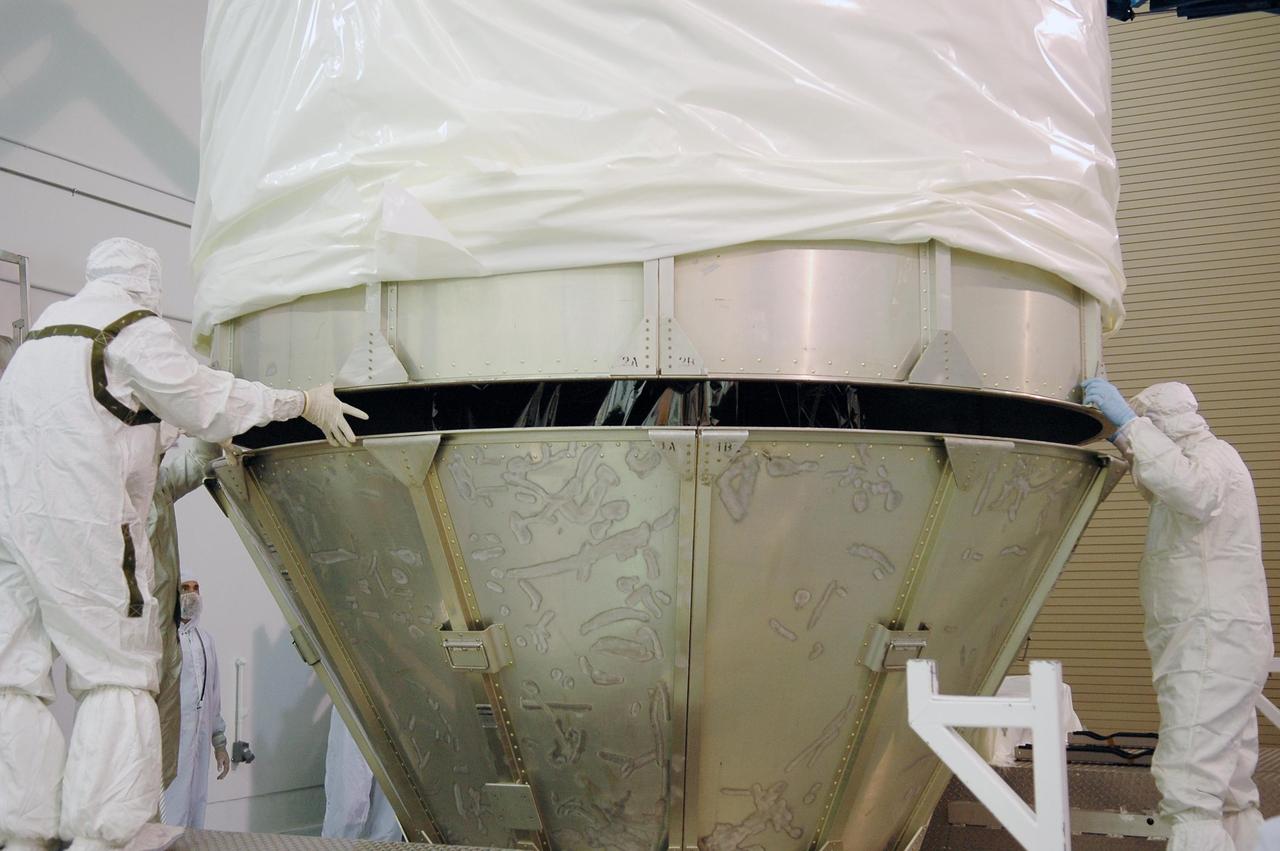
KENNEDY SPACE CENTER, FLA. - At Astrotech Space Operations in Titusville, Fla., workers help guide the upper portion of the transportation canister onto the lower portion. The canister encases the STEREO spacecraft for its move to Launch Pad 17-B at Cape Canaveral Air Force Station. STEREO stands for Solar Terrestrial Relations Observatory and comprises two spacecraft. The STEREO mission is the first to take measurements of the sun and solar wind in 3-dimension. This new view will improve our understanding of space weather and its impact on the Earth. STEREO is expected to lift off Aug. 31. Photo credit: NASA/Kim Shiflett
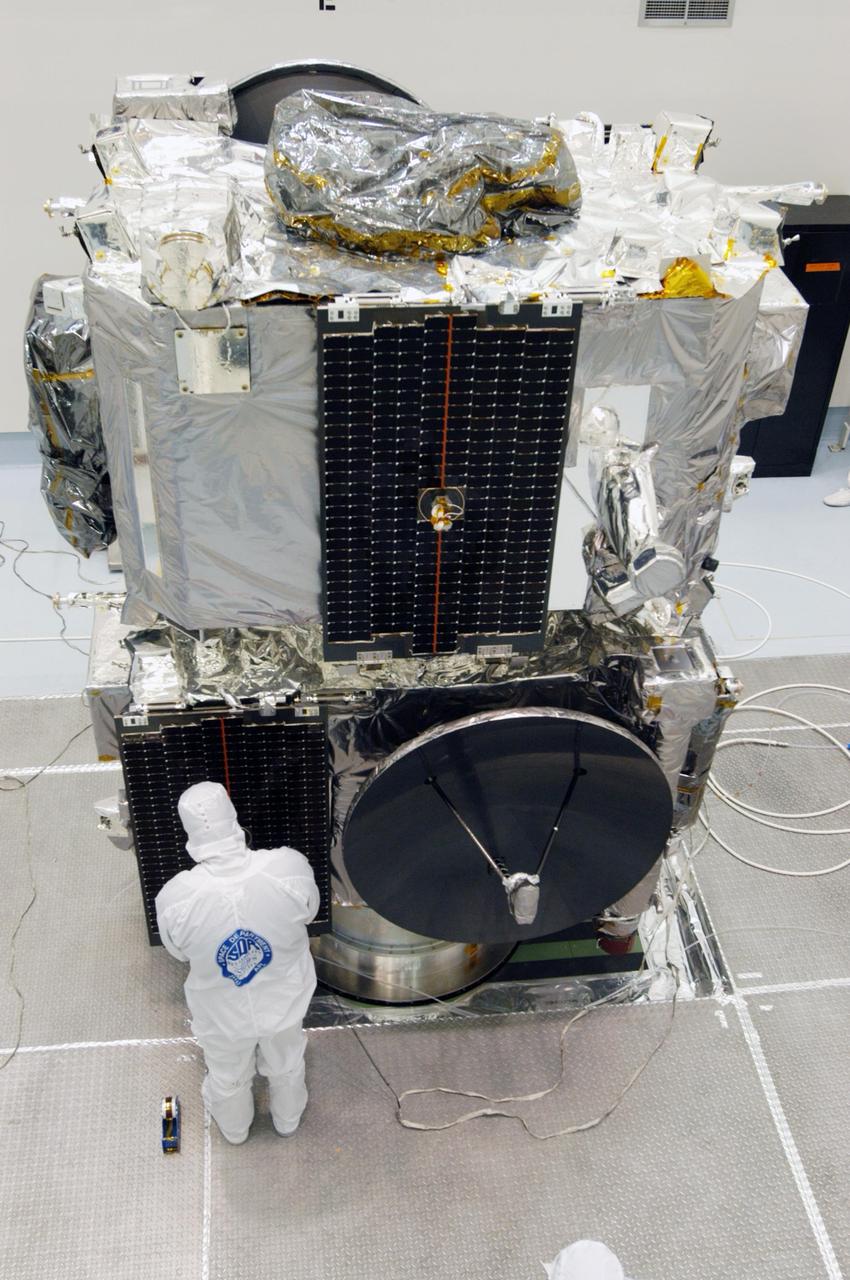
KENNEDY SPACE CENTER, FLA. - The STEREO observatories are the focus of attention at a media viewing held at Astrotech Space Operations in Titusville, Fla. The two observatories were mated for launch but will separate into different orbits for their mission. STEREO stands for Solar Terrestrial Relations Observatory. The STEREO mission is the first to take measurements of the sun and solar wind in 3-dimension. This new view will improve our understanding of space weather and its impact on the Earth. STEREO is expected to lift off on Aug. 31, from Launch Pad 17-B on Cape Canaveral Air Force Station in Florida. Photo credit: NASA/George Shelton.
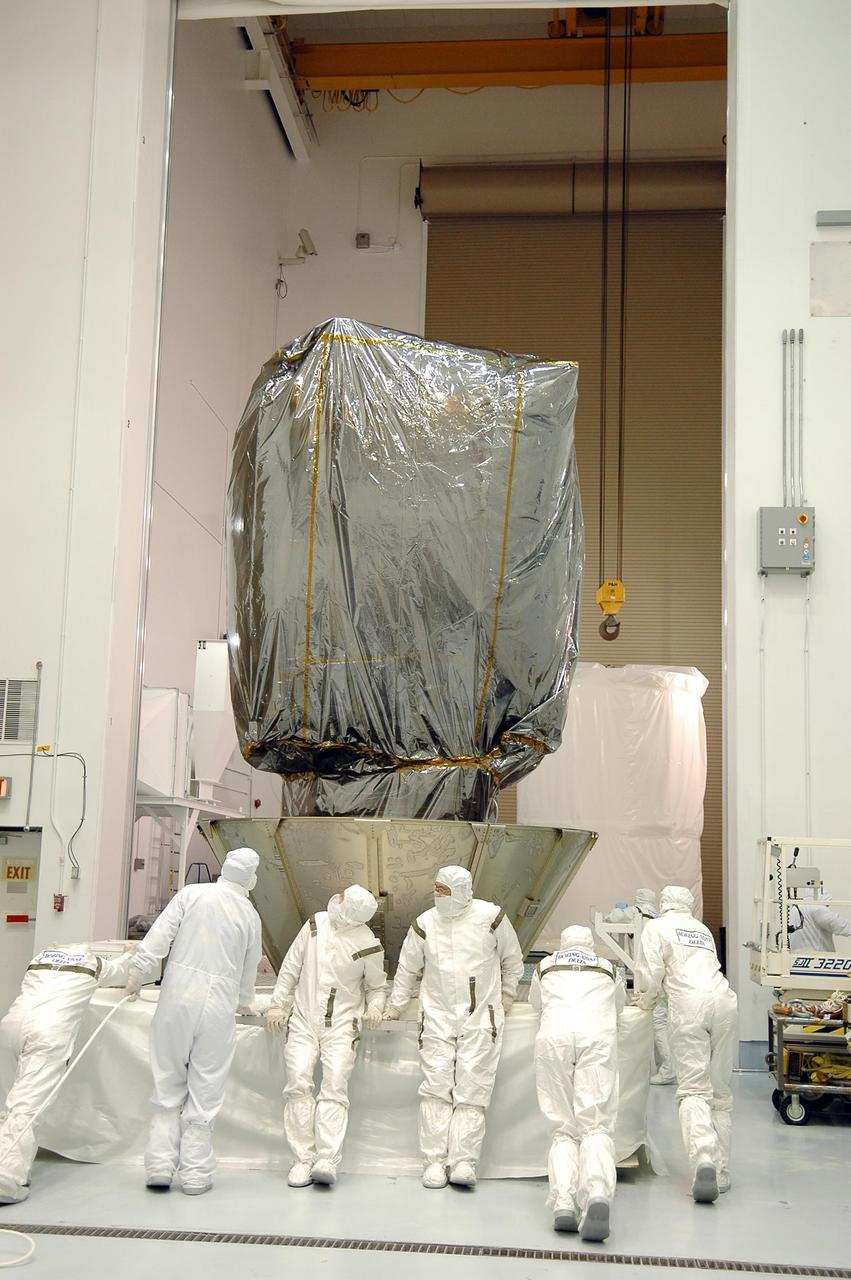
KENNEDY SPACE CENTER, FLA. - At Astrotech Space Operations in Titusville, Fla., workers move the stand holding the STEREO spacecraft and upper stage booster. The entire configuration will be encased for the move to Launch Pad 17-B at Cape Canaveral Air Force Station. STEREO stands for Solar Terrestrial Relations Observatory and comprises two spacecraft. The STEREO mission is the first to take measurements of the sun and solar wind in 3-dimension. This new view will improve our understanding of space weather and its impact on the Earth. STEREO is expected to lift off Aug. 31. Photo credit: NASA/Kim Shiflett
KENNEDY SPACE CENTER, FLA. - The STEREO observatories are the focus of attention at a media viewing held at Astrotech Space Operations in Titusville, Fla. The two observatories were mated for launch but will separate into different orbits for their mission. STEREO stands for Solar Terrestrial Relations Observatory. The STEREO mission is the first to take measurements of the sun and solar wind in 3-dimension. This new view will improve our understanding of space weather and its impact on the Earth. STEREO is expected to lift off on Aug. 31, from Launch Pad 17-B on Cape Canaveral Air Force Station in Florida. Photo credit: NASA/George Shelton.
KENNEDY SPACE CENTER, FLA. - Technicians inside the Astrotech facility in Titusville, Florida, prepare to move the STEREO spacecraft to the spin table. The twin observatories will undergo a spin test to check balance and alignment in preparation for flight. STEREO stands for Solar Terrestrial Relations Observatory. The STEREO mission is the first to take measurements of the sun and solar wind in 3-dimension. This new view will improve our understanding of space weather and its impact on the Earth. STEREO is expected to lift off on Aug. 31, from Launch Pad 17-B on Cape Canaveral Air Force Station in Florida. Photo credit: NASA/George Shelton.
KENNEDY SPACE CENTER, FLA. - Technicians inside the Astrotech facility in Titusville, Florida, move the STEREO spacecraft to the spin table. The twin observatories will undergo a spin test to check balance and alignment in preparation for flight. STEREO stands for Solar Terrestrial Relations Observatory. The STEREO mission is the first to take measurements of the sun and solar wind in 3-dimension. This new view will improve our understanding of space weather and its impact on the Earth. STEREO is expected to lift off on Aug. 31, from Launch Pad 17-B on Cape Canaveral Air Force Station in Florida. Photo credit: NASA/George Shelton.

KENNEDY SPACE CENTER, FLA. - At Astrotech Space Operations in Titusville, Fla., technicians check the STEREO spacecraft "B" as it moves away from a tilt table (at right). The spacecraft will be placed on another stand nearby. STEREO stands for Solar Terrestrial Relations Observatory. The STEREO mission is the first to take measurements of the sun and solar wind in 3-dimension. This new view will improve our understanding of space weather and its impact on the Earth. STEREO is expected to lift off aboard a Boeing Delta II rocket on July 22. Photo credit: NASA/George Shelton
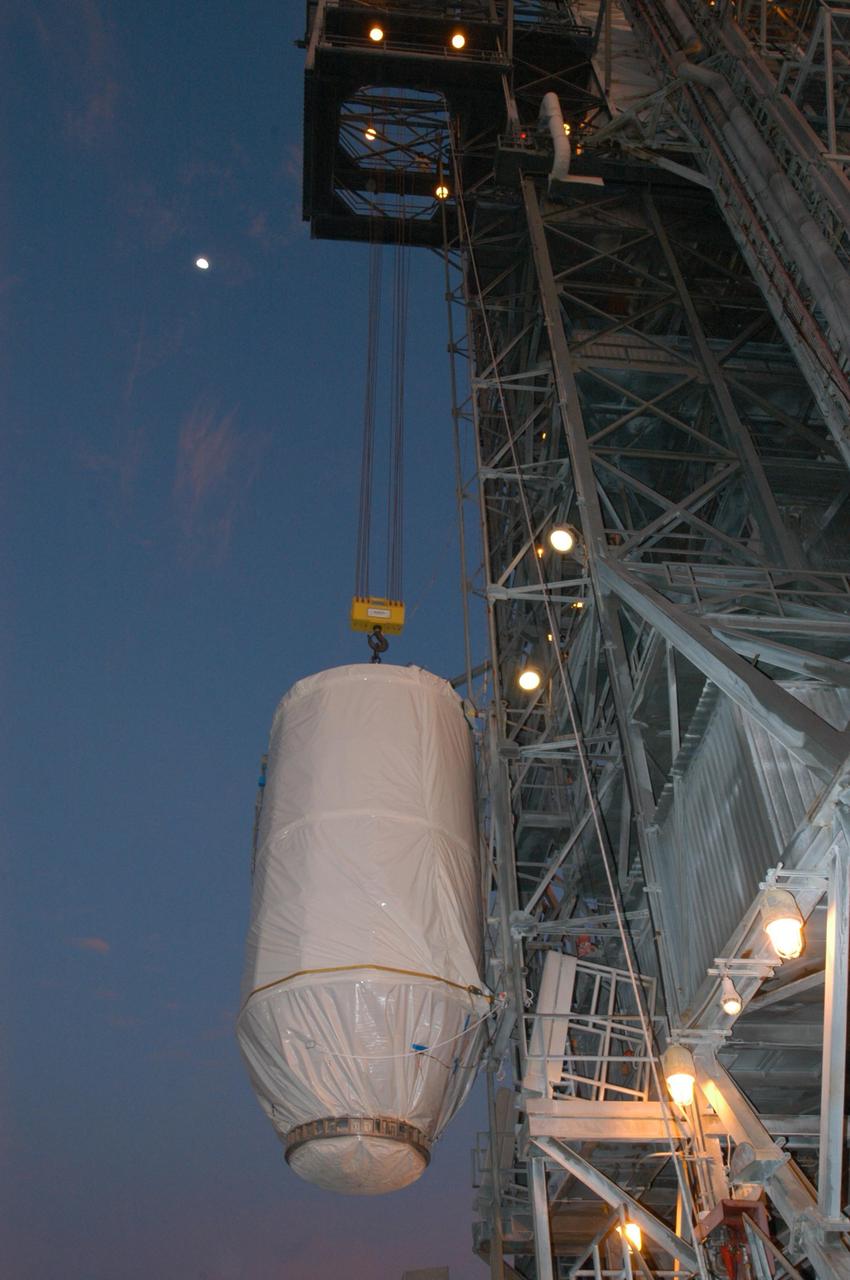
KENNEDY SPACE CENTER, FLA. - Against a pre-dawn sky on Launch Pad 17-B at Cape Canaveral Air Force Station, the STEREO spacecraft is lifted alongside the mobile service tower. In the tower, STEREO will be mated with its launch vehicle, a Boeing Delta II rocket. STEREO stands for Solar Terrestrial Relations Observatory and comprises two spacecraft. The STEREO mission is the first to take measurements of the sun and solar wind in 3-dimension. This new view will improve our understanding of space weather and its impact on the Earth. The STEREO mission is managed by Goddard Space Flight Center. The Applied Physics Laboratory designed and built the spacecraft. The laboratory will maintain command and control of the observatories throughout the mission, while NASA tracks and receives the data, determines the orbit of the satellites, and coordinates the science results. STEREO is expected to lift off Oct. 25. Photo credit: NASA/George Shelton
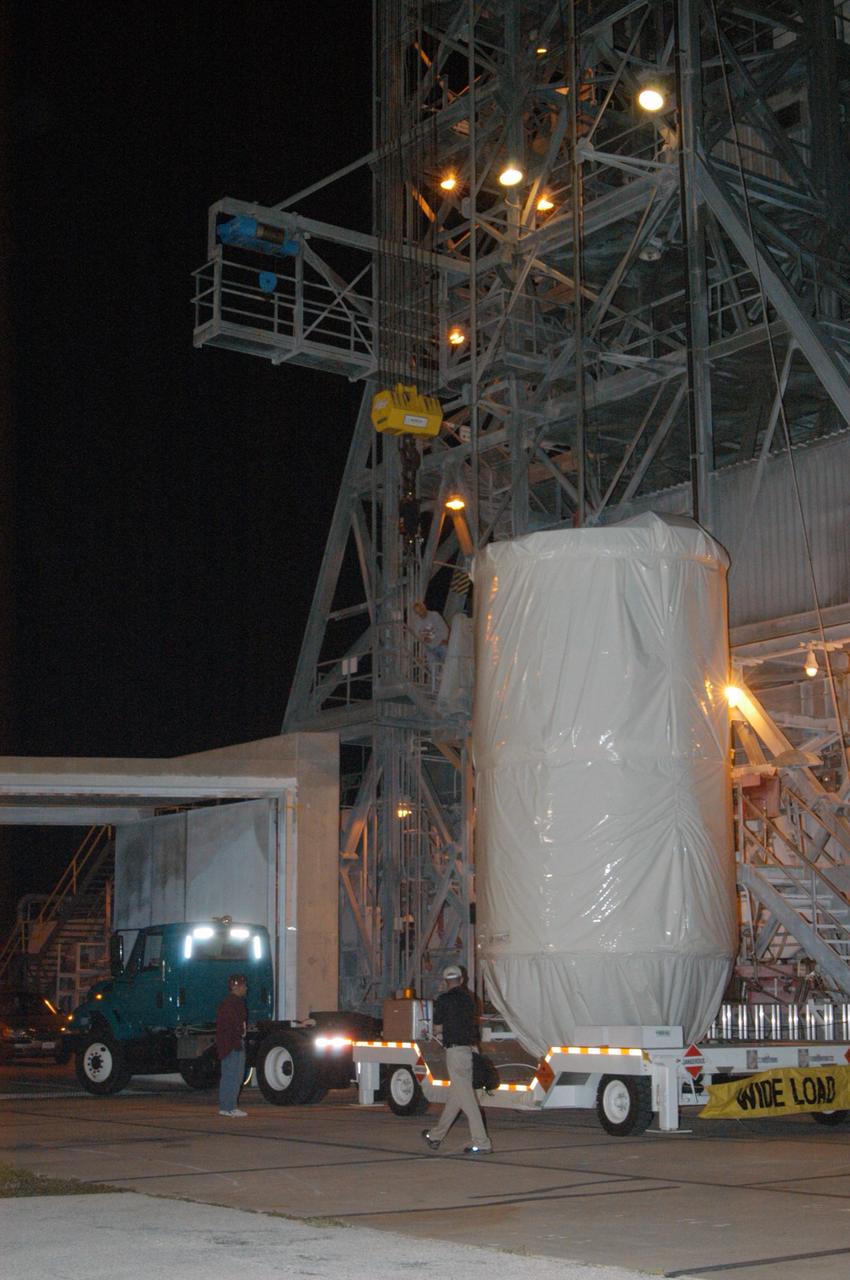
KENNEDY SPACE CENTER, FLA. - After arriving at Launch Pad 17-B on Cape Canaveral Air Force Station, the STEREO spacecraft waits for a crane to be fitted over it and be lifted into the mobile service tower. STEREO will be mated with its launch vehicle, a Boeing Delta II rocket. STEREO stands for Solar Terrestrial Relations Observatory and comprises two spacecraft. The STEREO mission is the first to take measurements of the sun and solar wind in 3-dimension. This new view will improve our understanding of space weather and its impact on the Earth. The STEREO mission is managed by Goddard Space Flight Center. The Applied Physics Laboratory designed and built the spacecraft. The laboratory will maintain command and control of the observatories throughout the mission, while NASA tracks and receives the data, determines the orbit of the satellites, and coordinates the science results. STEREO is expected to lift off Oct. 25. Photo credit: NASA/George Shelton
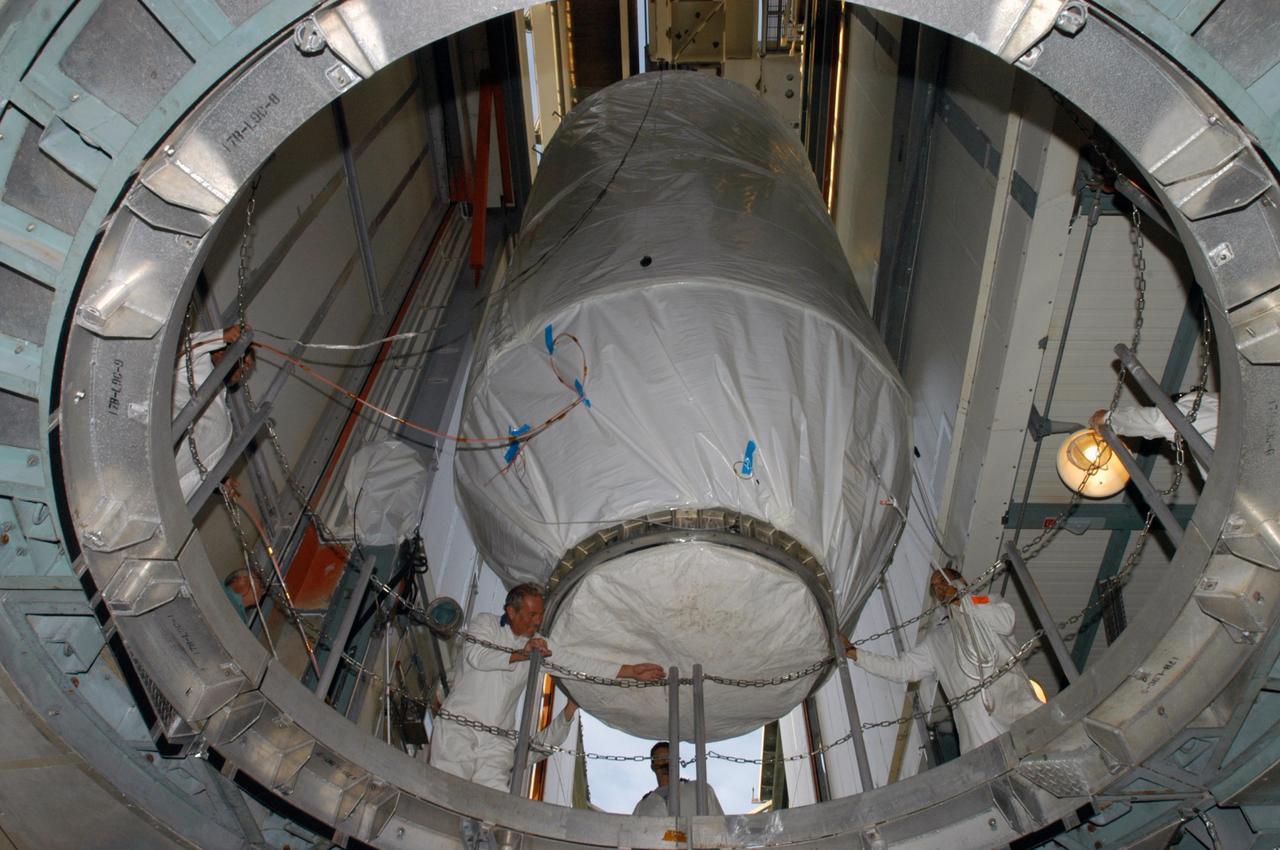
KENNEDY SPACE CENTER, FLA. - Inside the mobile service tower on Launch Pad 17-B at Cape Canaveral Air Force Station, workers check the clearance of the STEREO spacecraft as it is moved away from the opening. In the tower, STEREO will be mated with its launch vehicle, a Boeing Delta II rocket. STEREO stands for Solar Terrestrial Relations Observatory and comprises two spacecraft. The STEREO mission is the first to take measurements of the sun and solar wind in 3-dimension. This new view will improve our understanding of space weather and its impact on the Earth. The STEREO mission is managed by Goddard Space Flight Center. The Applied Physics Laboratory designed and built the spacecraft. The laboratory will maintain command and control of the observatories throughout the mission, while NASA tracks and receives the data, determines the orbit of the satellites, and coordinates the science results. STEREO is expected to lift off Oct. 25. Photo credit: NASA/George Shelton
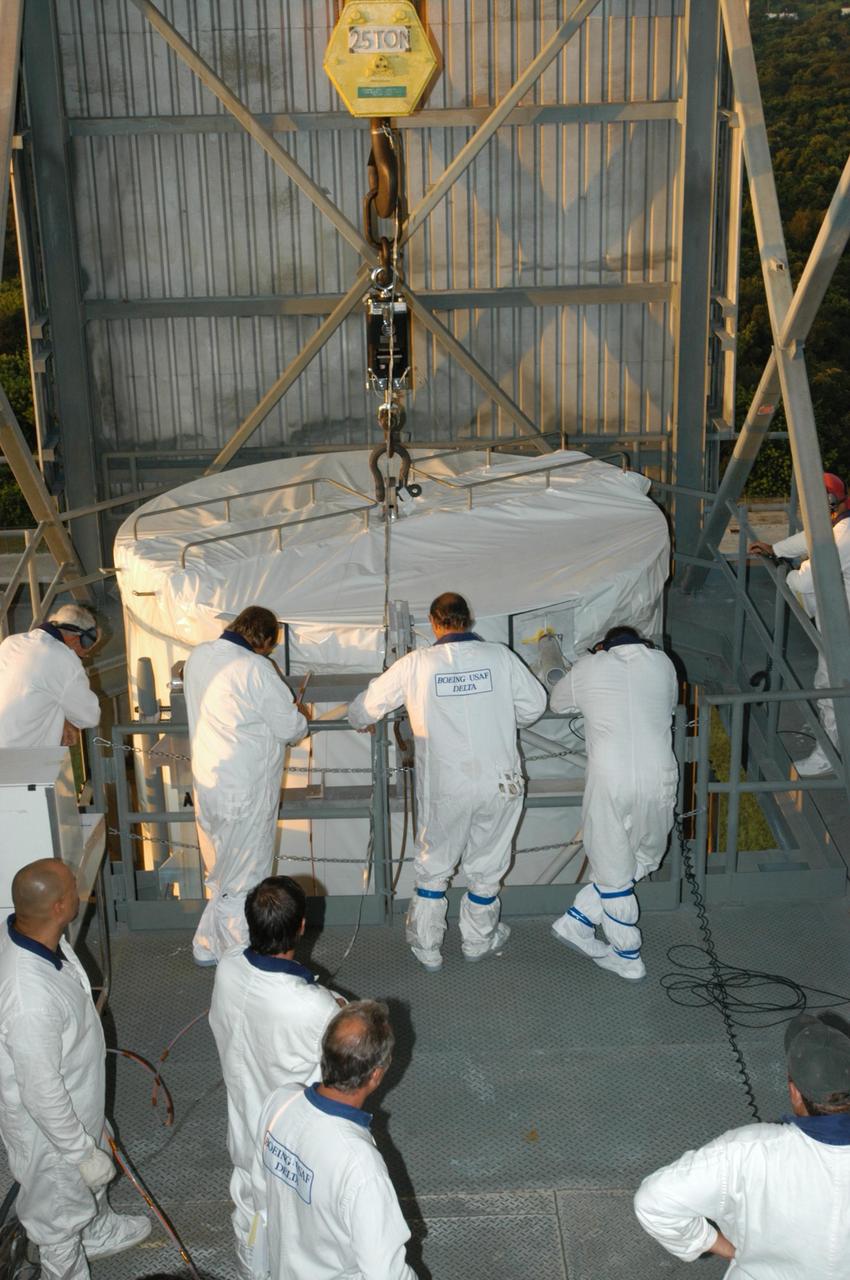
KENNEDY SPACE CENTER, FLA. - Viewed from inside the mobile service tower on Launch Pad 17-B at Cape Canaveral Air Force Station, workers watch the progress of the STEREO spacecraft being lifted. Once in the tower, STEREO will be mated with its launch vehicle, a Boeing Delta II rocket. STEREO stands for Solar Terrestrial Relations Observatory and comprises two spacecraft. The STEREO mission is the first to take measurements of the sun and solar wind in 3-dimension. This new view will improve our understanding of space weather and its impact on the Earth. The STEREO mission is managed by Goddard Space Flight Center. The Applied Physics Laboratory designed and built the spacecraft. The laboratory will maintain command and control of the observatories throughout the mission, while NASA tracks and receives the data, determines the orbit of the satellites, and coordinates the science results. STEREO is expected to lift off Oct. 25. Photo credit: NASA/George Shelton
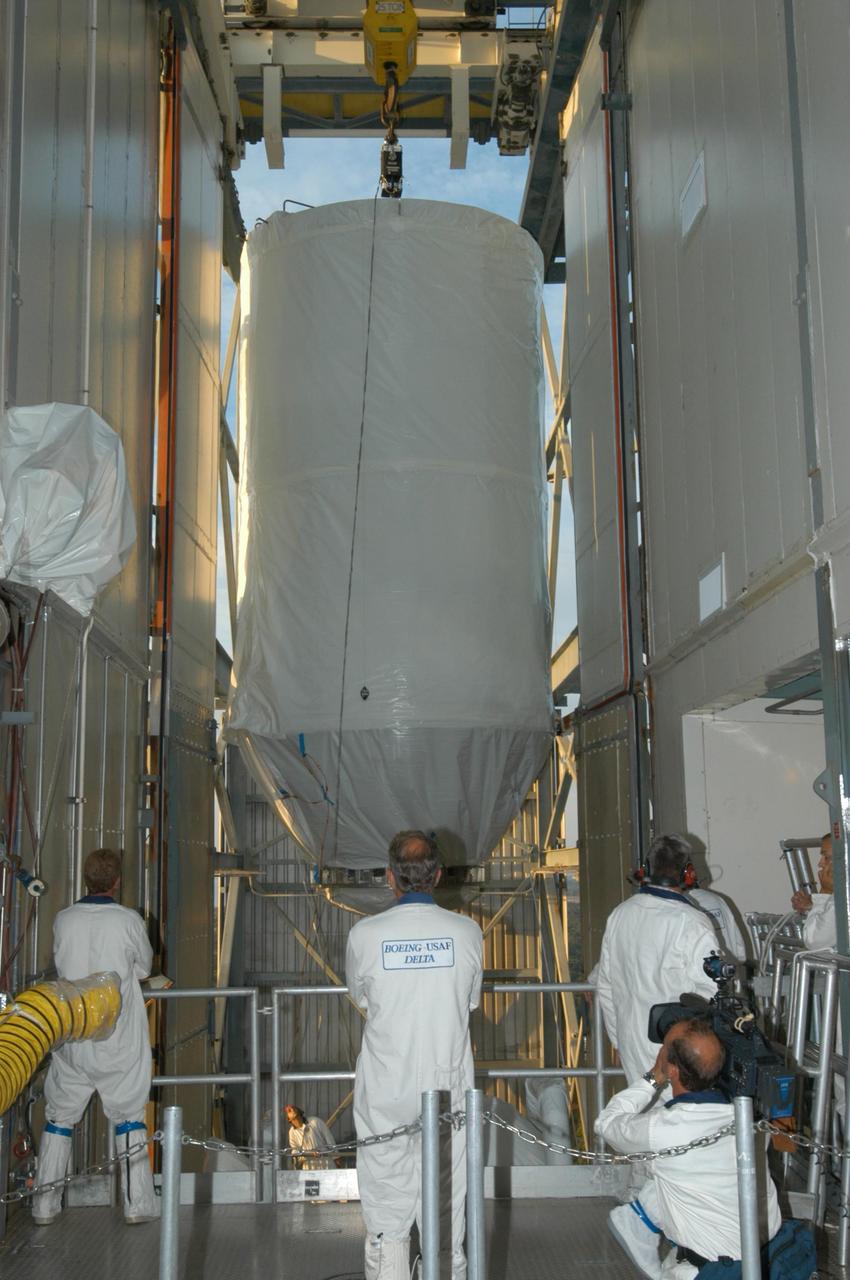
KENNEDY SPACE CENTER, FLA. - On Launch Pad 17-B at Cape Canaveral Air Force Station, workers observe the progress of the STEREO spacecraft as it glides inside the mobile service tower. After it is in the tower, STEREO will be mated with its launch vehicle, a Boeing Delta II rocket. STEREO stands for Solar Terrestrial Relations Observatory and comprises two spacecraft. The STEREO mission is the first to take measurements of the sun and solar wind in 3-dimension. This new view will improve our understanding of space weather and its impact on the Earth. The STEREO mission is managed by Goddard Space Flight Center. The Applied Physics Laboratory designed and built the spacecraft. The laboratory will maintain command and control of the observatories throughout the mission, while NASA tracks and receives the data, determines the orbit of the satellites, and coordinates the science results. STEREO is expected to lift off Oct. 25. Photo credit: NASA/George Shelton
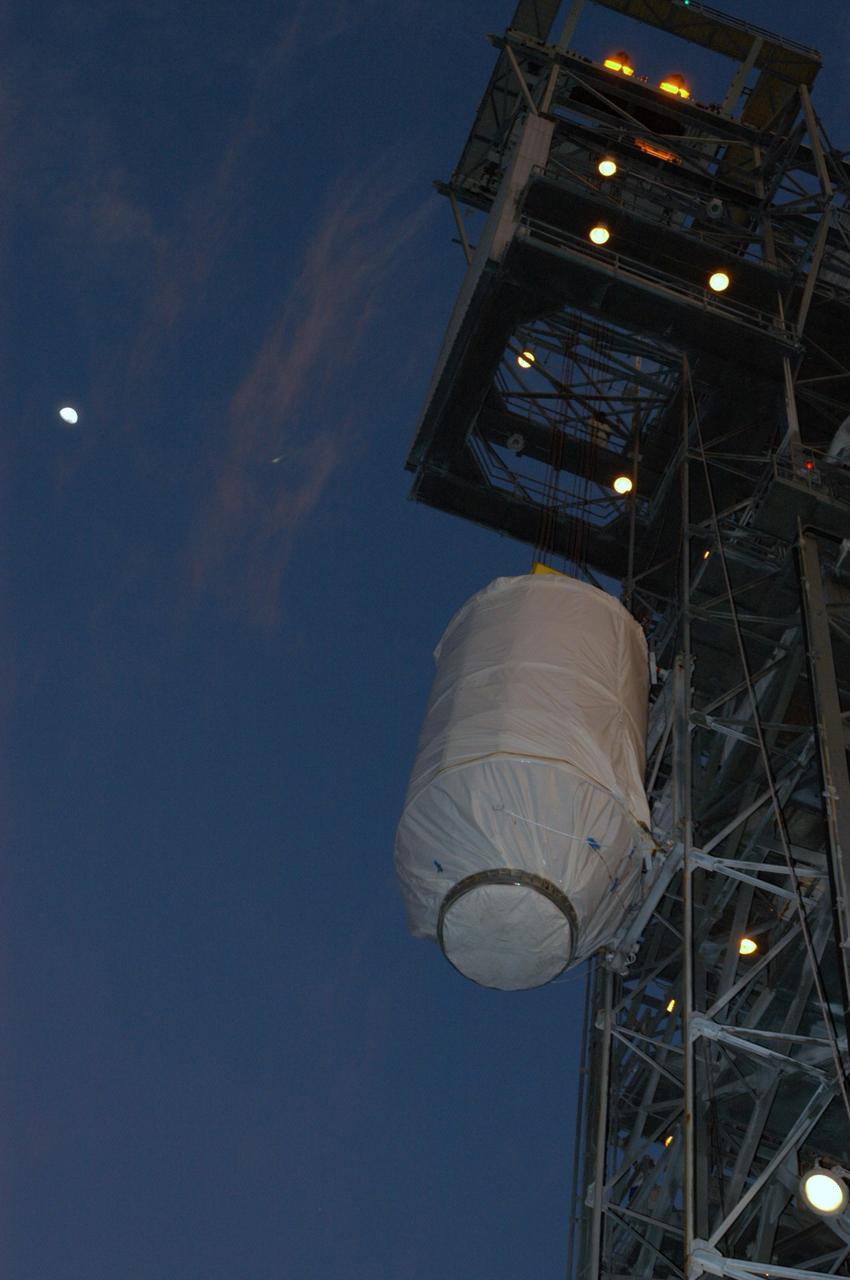
KENNEDY SPACE CENTER, FLA. - Against a pre-dawn sky on Launch Pad 17-B at Cape Canaveral Air Force Station, the STEREO spacecraft is lifted up toward the platform on the mobile service tower. In the tower, STEREO will be mated with its launch vehicle, a Boeing Delta II rocket. STEREO stands for Solar Terrestrial Relations Observatory and comprises two spacecraft. The STEREO mission is the first to take measurements of the sun and solar wind in 3-dimension. This new view will improve our understanding of space weather and its impact on the Earth. The STEREO mission is managed by Goddard Space Flight Center. The Applied Physics Laboratory designed and built the spacecraft. The laboratory will maintain command and control of the observatories throughout the mission, while NASA tracks and receives the data, determines the orbit of the satellites, and coordinates the science results. STEREO is expected to lift off Oct. 25. Photo credit: NASA/George Shelton
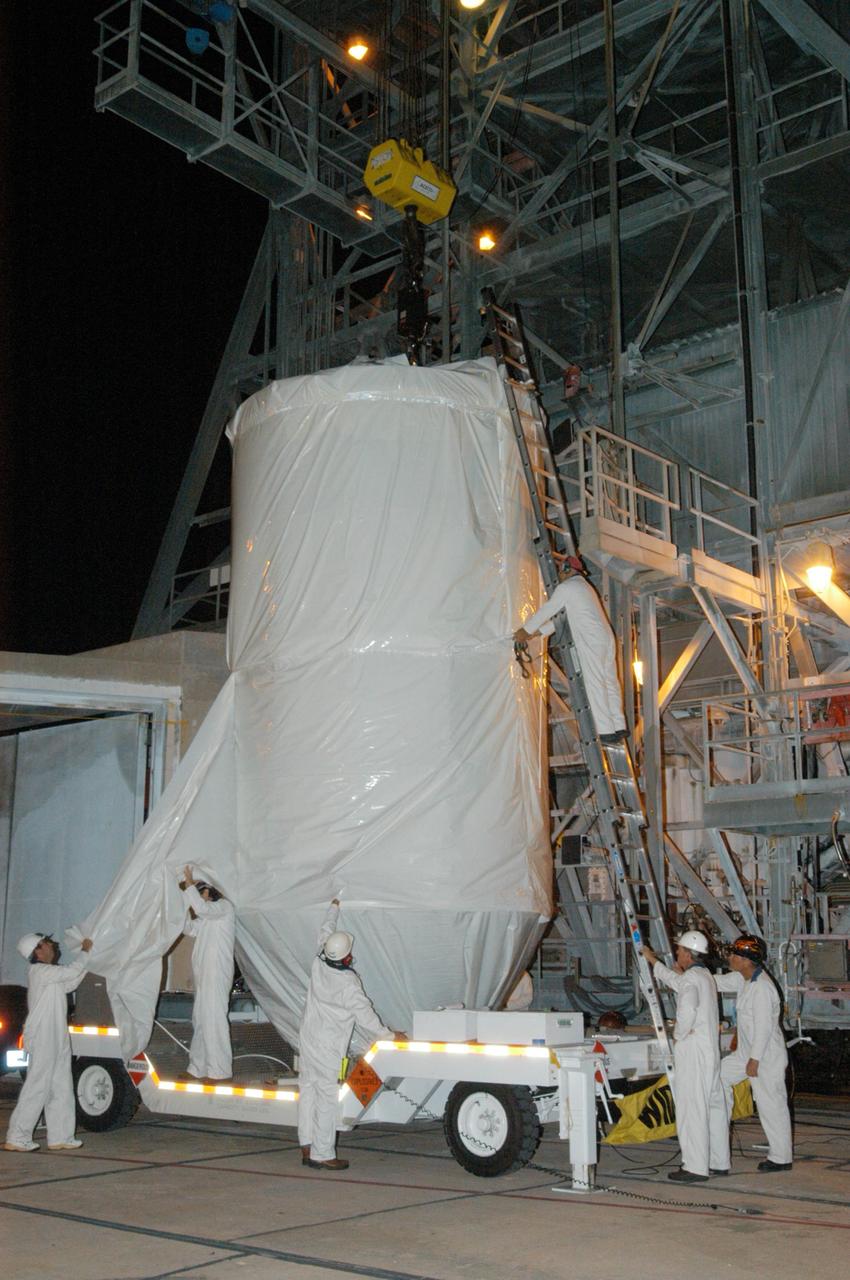
KENNEDY SPACE CENTER, FLA. - After arriving at Launch Pad 17-B on Cape Canaveral Air Force Station, the STEREO spacecraft is fitted with a crane to lift it into the mobile service tower. STEREO will be mated with its launch vehicle, a Boeing Delta II rocket. STEREO stands for Solar Terrestrial Relations Observatory and comprises two spacecraft. The STEREO mission is the first to take measurements of the sun and solar wind in 3-dimension. This new view will improve our understanding of space weather and its impact on the Earth. The STEREO mission is managed by Goddard Space Flight Center. The Applied Physics Laboratory designed and built the spacecraft. The laboratory will maintain command and control of the observatories throughout the mission, while NASA tracks and receives the data, determines the orbit of the satellites, and coordinates the science results. STEREO is expected to lift off Oct. 25. Photo credit: NASA/George Shelton
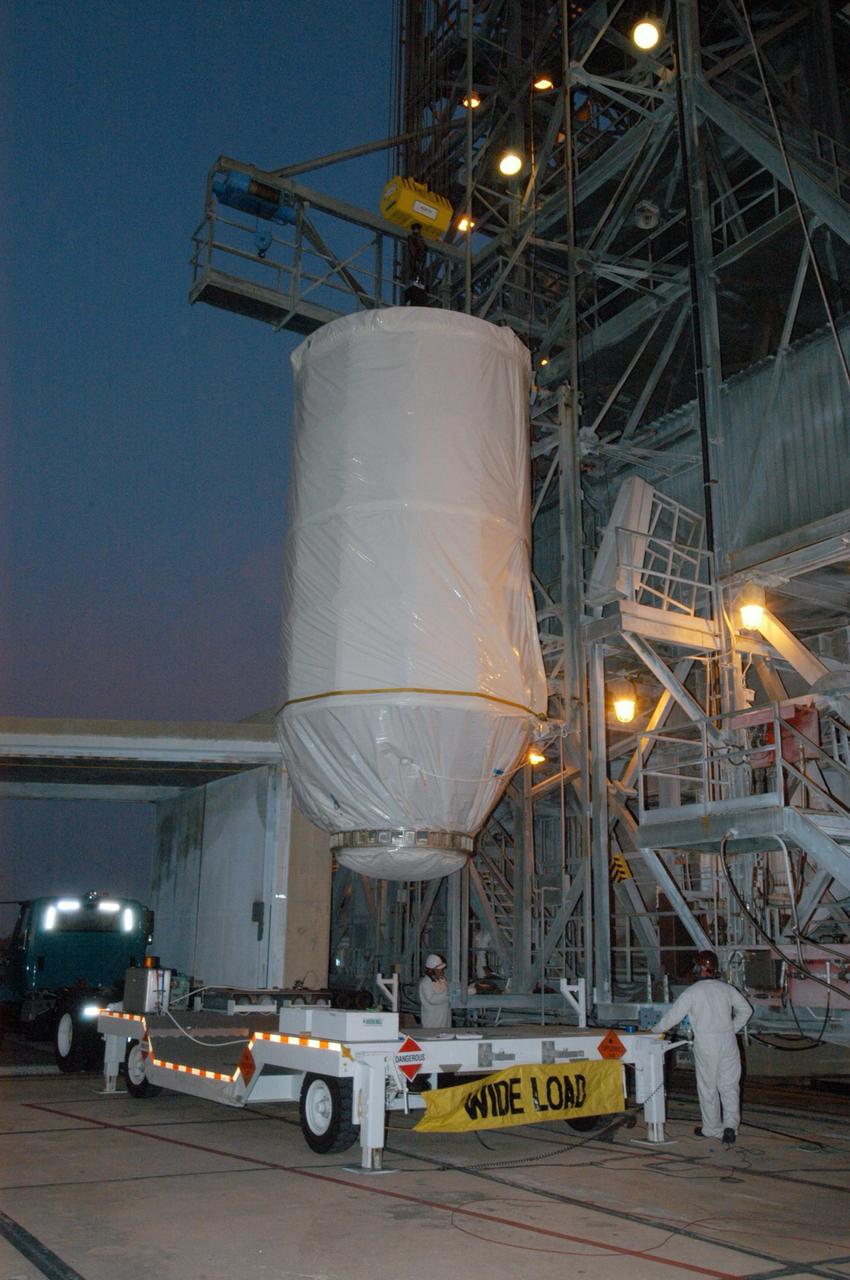
KENNEDY SPACE CENTER, FLA. - On Launch Pad 17-B at Cape Canaveral Air Force Station, the STEREO spacecraft is lifted off its transporter alongside the mobile service tower. In the tower, STEREO will be mated with its launch vehicle, a Boeing Delta II rocket. STEREO stands for Solar Terrestrial Relations Observatory and comprises two spacecraft. The STEREO mission is the first to take measurements of the sun and solar wind in 3-dimension. This new view will improve our understanding of space weather and its impact on the Earth. The STEREO mission is managed by Goddard Space Flight Center. The Applied Physics Laboratory designed and built the spacecraft. The laboratory will maintain command and control of the observatories throughout the mission, while NASA tracks and receives the data, determines the orbit of the satellites, and coordinates the science results. STEREO is expected to lift off Oct. 25. Photo credit: NASA/George Shelton
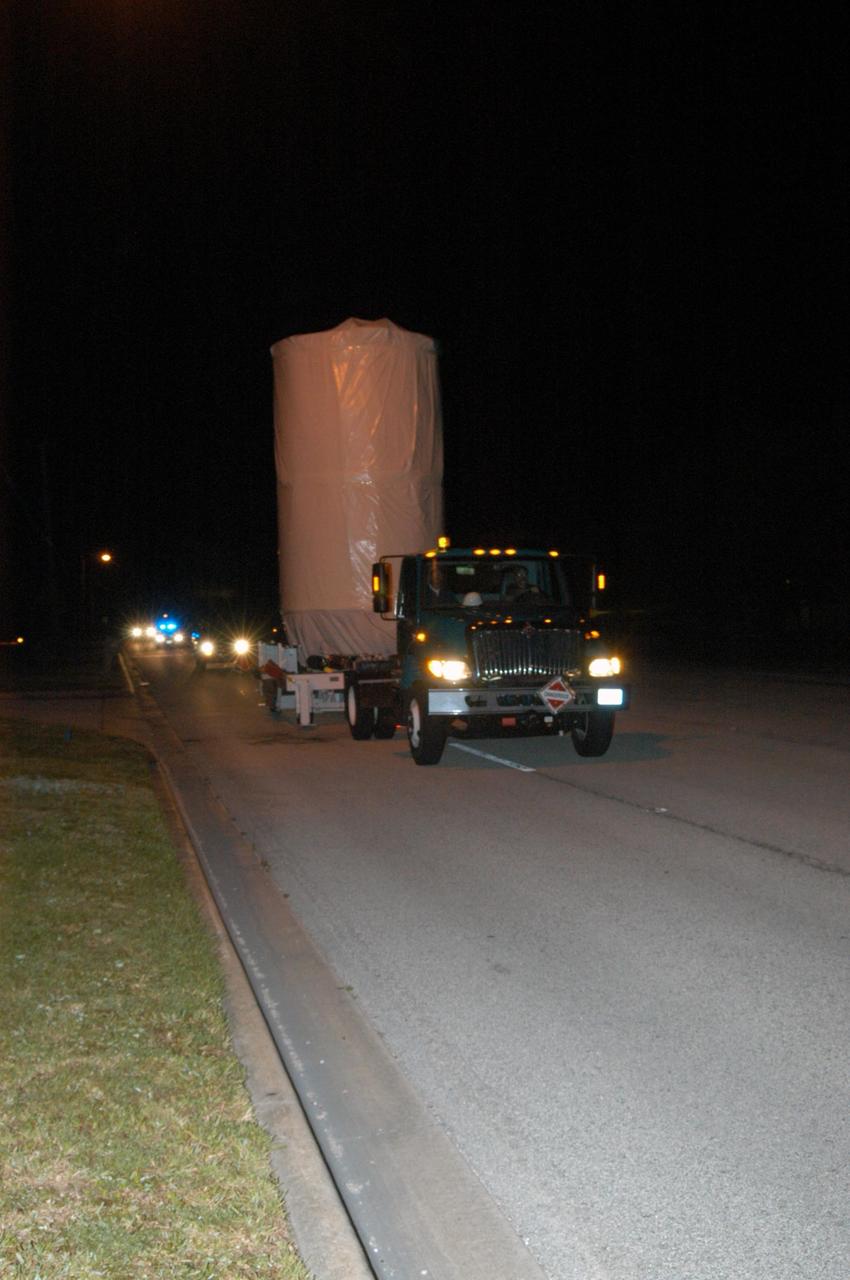
KENNEDY SPACE CENTER, FLA. - With a convoy of escorts, the STEREO spacecraft is transported to Launch Pad 17-B on Cape Canaveral Air Force Station. At the pad the spacecraft will be lifted into the mobile service tower. STEREO stands for Solar Terrestrial Relations Observatory and comprises two spacecraft. The STEREO mission is the first to take measurements of the sun and solar wind in 3-dimension. This new view will improve our understanding of space weather and its impact on the Earth. The STEREO mission is managed by Goddard Space Flight Center. The Applied Physics Laboratory designed and built the spacecraft. The laboratory will maintain command and control of the observatories throughout the mission, while NASA tracks and receives the data, determines the orbit of the satellites, and coordinates the science results. STEREO is expected to lift off Oct. 25. Photo credit: NASA/George Shelton
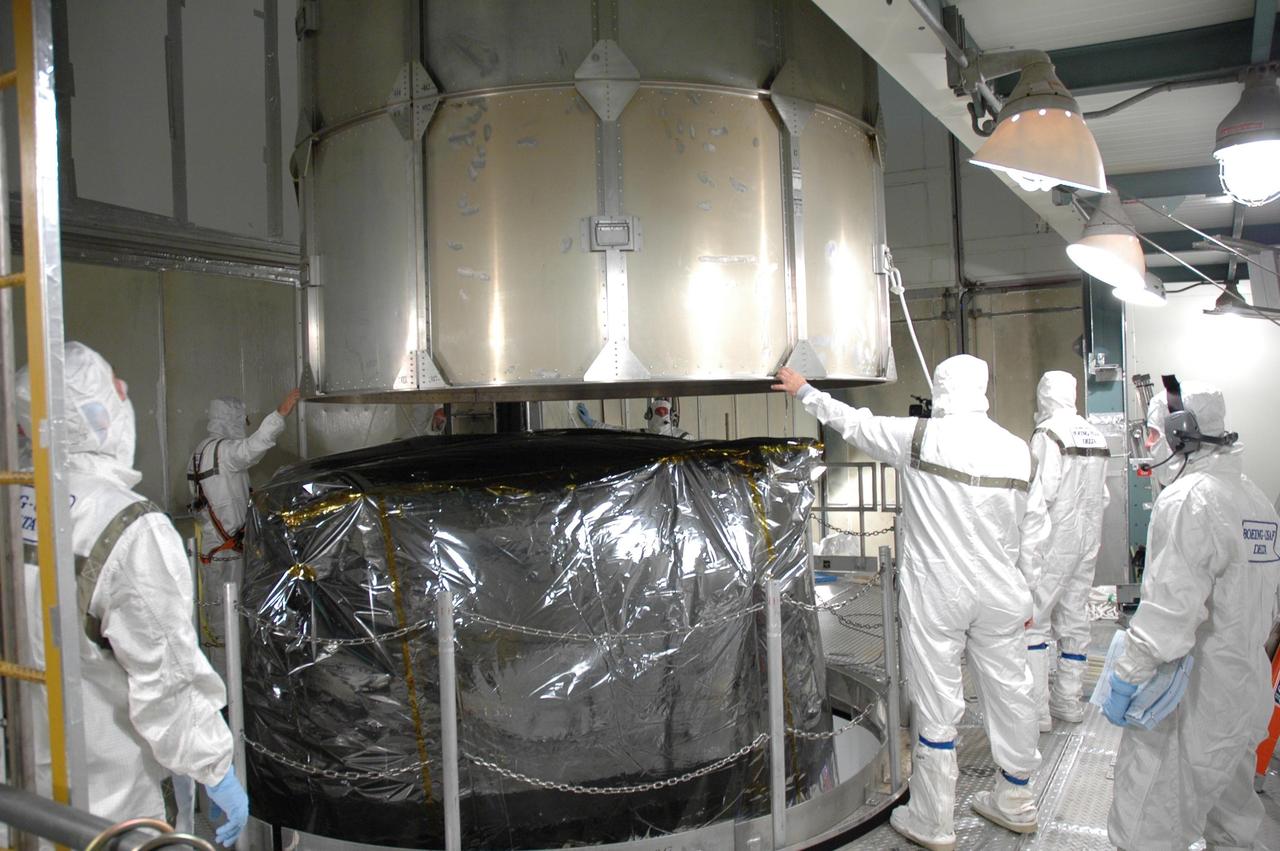
KENNEDY SPACE CENTER, FLA. - Inside the mobile service tower on Launch Pad 17-B at Cape Canaveral Air Force Station, workers help guide the upper segement of the transportation canister away from the STEREO spacecraft. STEREO is being prepared for launch, scheduled for Oct. 25. STEREO stands for Solar Terrestrial Relations Observatory and comprises two spacecraft that will launch in a piggyback mode, separating after reaching the appropriate orbit. The STEREO mission is the first to take measurements of the sun and solar wind in 3-dimension. This new view will improve our understanding of space weather and its impact on the Earth. The STEREO mission is managed by Goddard. The Applied Physics Laboratory designed and built the spacecraft. The laboratory will maintain command and control of the observatories throughout the mission, while NASA tracks and receives the data, determines the orbit of the satellites, and coordinates the science results. Photo credit: NASA/Jim Grossmann
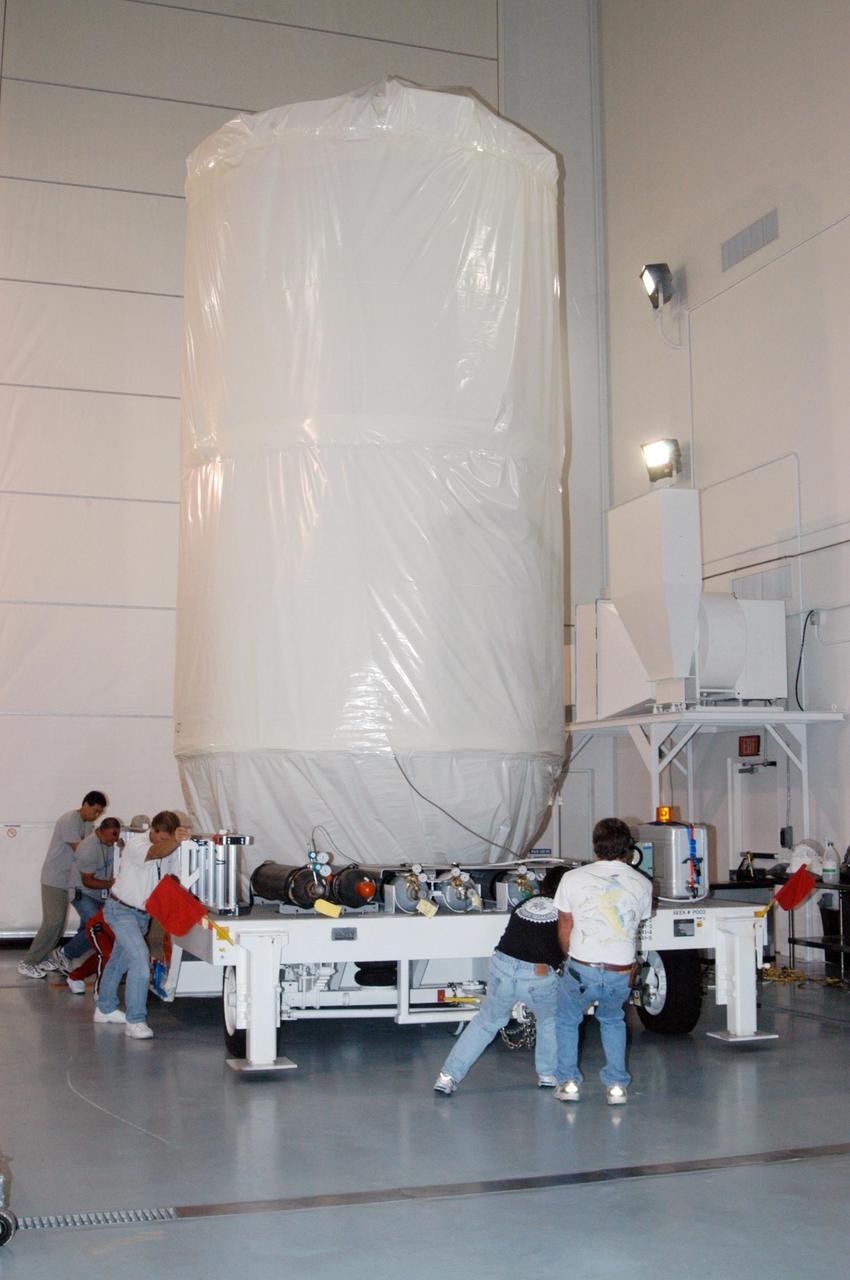
KENNEDY SPACE CENTER, FLA. - At Astrotech Space Operations in Titusville, Fla., the STEREO spacecraft is being moved out of the high bay. A truck will transport the spacecraft to Launch Pad 17-B on Cape Canaveral Air Force Station where it will be lifted into the mobile service tower. STEREO stands for Solar Terrestrial Relations Observatory and comprises two spacecraft. The STEREO mission is the first to take measurements of the sun and solar wind in 3-dimension. This new view will improve our understanding of space weather and its impact on the Earth. The STEREO mission is managed by Goddard. The Applied Physics Laboratory designed and built the spacecraft. The laboratory will maintain command and control of the observatories throughout the mission, while NASA tracks and receives the data, determines the orbit of the satellites, and coordinates the science results. STEREO is expected to lift off Oct. 25. Photo credit: NASA/George Shelton
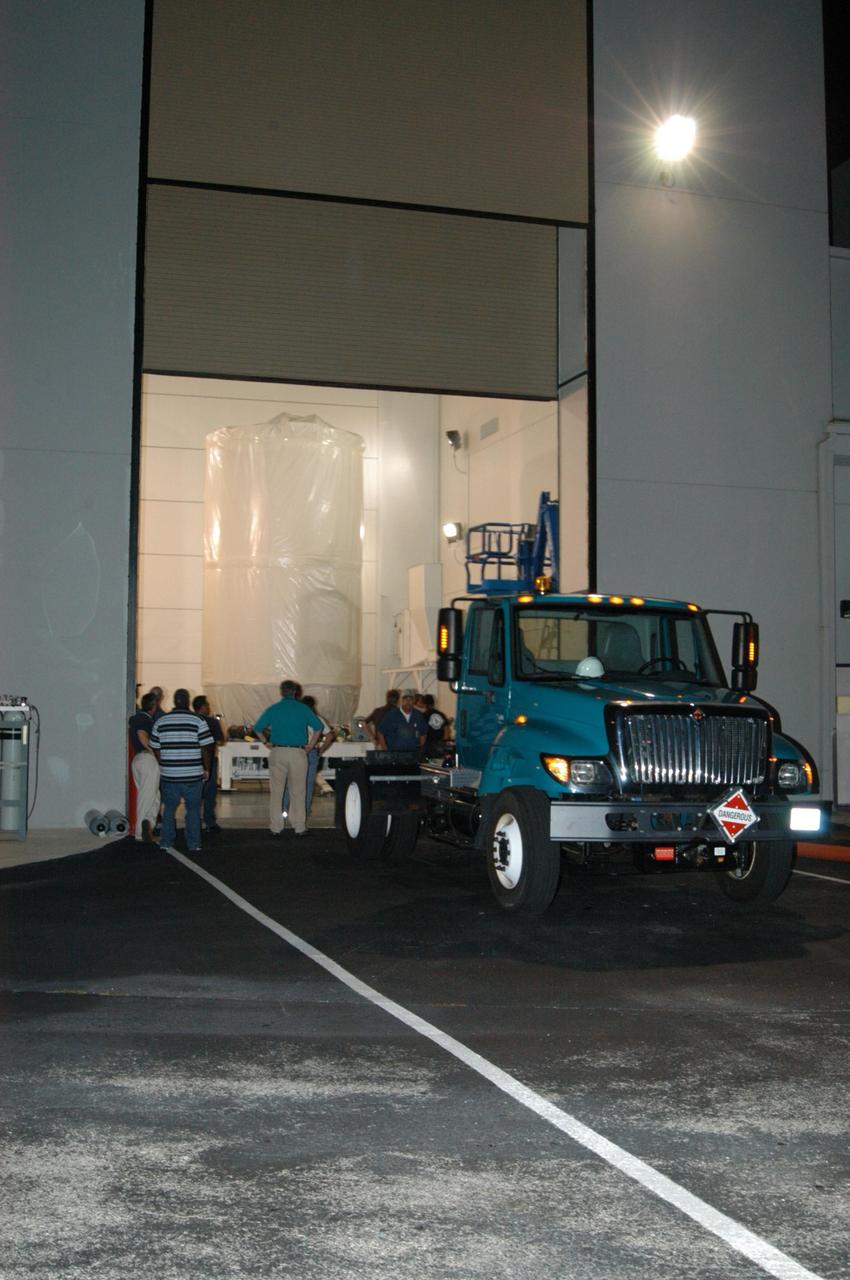
KENNEDY SPACE CENTER, FLA. - At Astrotech Space Operations in Titusville, Fla., the transporter carrying the STEREO spacecraft is secured to the truck that will transport it to Launch Pad 17-B on Cape Canaveral Air Force Station. At the pad, the spacecraft will be lifted into the mobile service tower. STEREO stands for Solar Terrestrial Relations Observatory and comprises two spacecraft. The STEREO mission is the first to take measurements of the sun and solar wind in 3-dimension. This new view will improve our understanding of space weather and its impact on the Earth. The STEREO mission is managed by Goddard Space Flight Center. The Applied Physics Laboratory designed and built the spacecraft. The laboratory will maintain command and control of the observatories throughout the mission, while NASA tracks and receives the data, determines the orbit of the satellites, and coordinates the science results. STEREO is expected to lift off Oct. 25. Photo credit: NASA/George Shelton
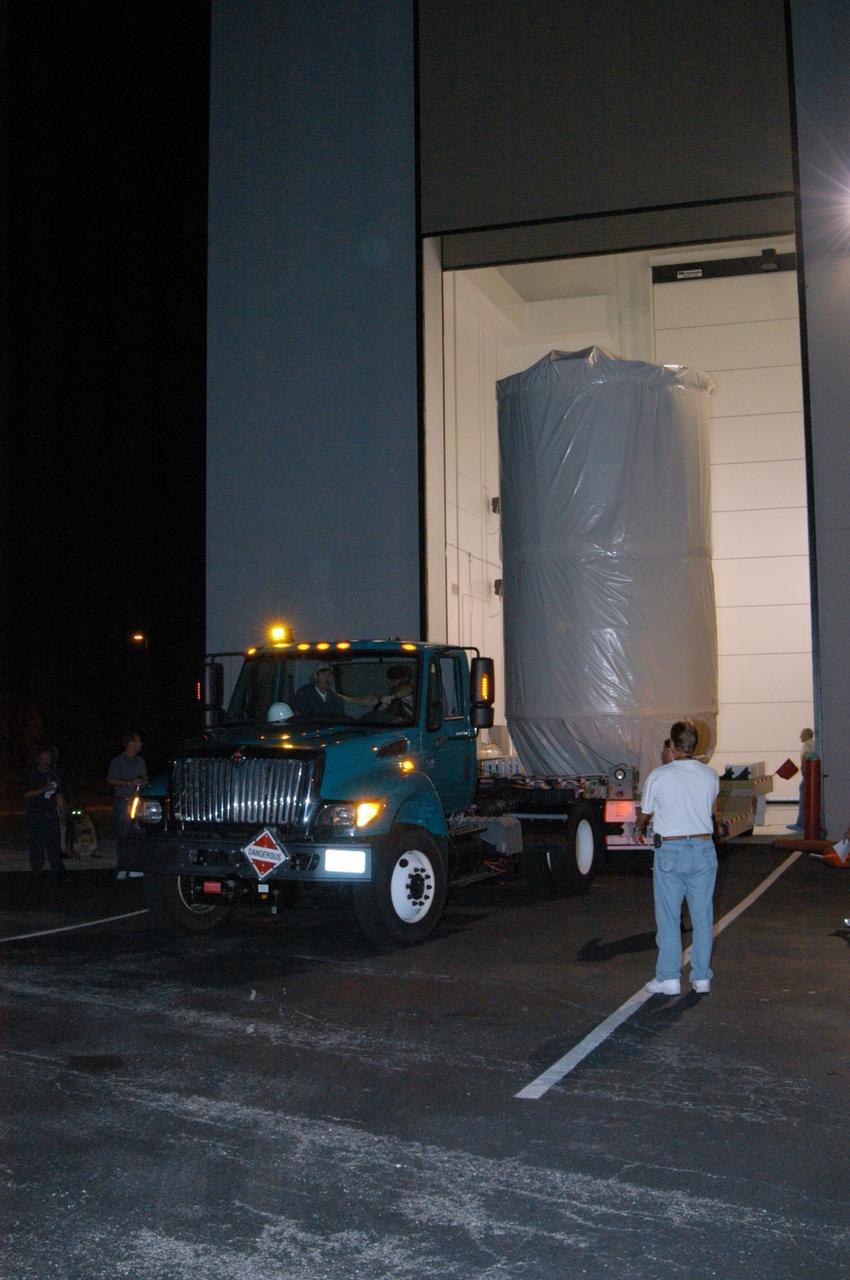
KENNEDY SPACE CENTER, FLA. - At Astrotech Space Operations in Titusville, Fla., the transporter carrying the STEREO spacecraft is attached to the truck for transportation to Launch Pad 17-B on Cape Canaveral Air Force Station. At the pad the spacecraft will be lifted into the mobile service tower. STEREO stands for Solar Terrestrial Relations Observatory and comprises two spacecraft. The STEREO mission is the first to take measurements of the sun and solar wind in 3-dimension. This new view will improve our understanding of space weather and its impact on the Earth. The STEREO mission is managed by Goddard Space Flight Center. The Applied Physics Laboratory designed and built the spacecraft. The laboratory will maintain command and control of the observatories throughout the mission, while NASA tracks and receives the data, determines the orbit of the satellites, and coordinates the science results. STEREO is expected to lift off Oct. 25. Photo credit: NASA/George Shelton
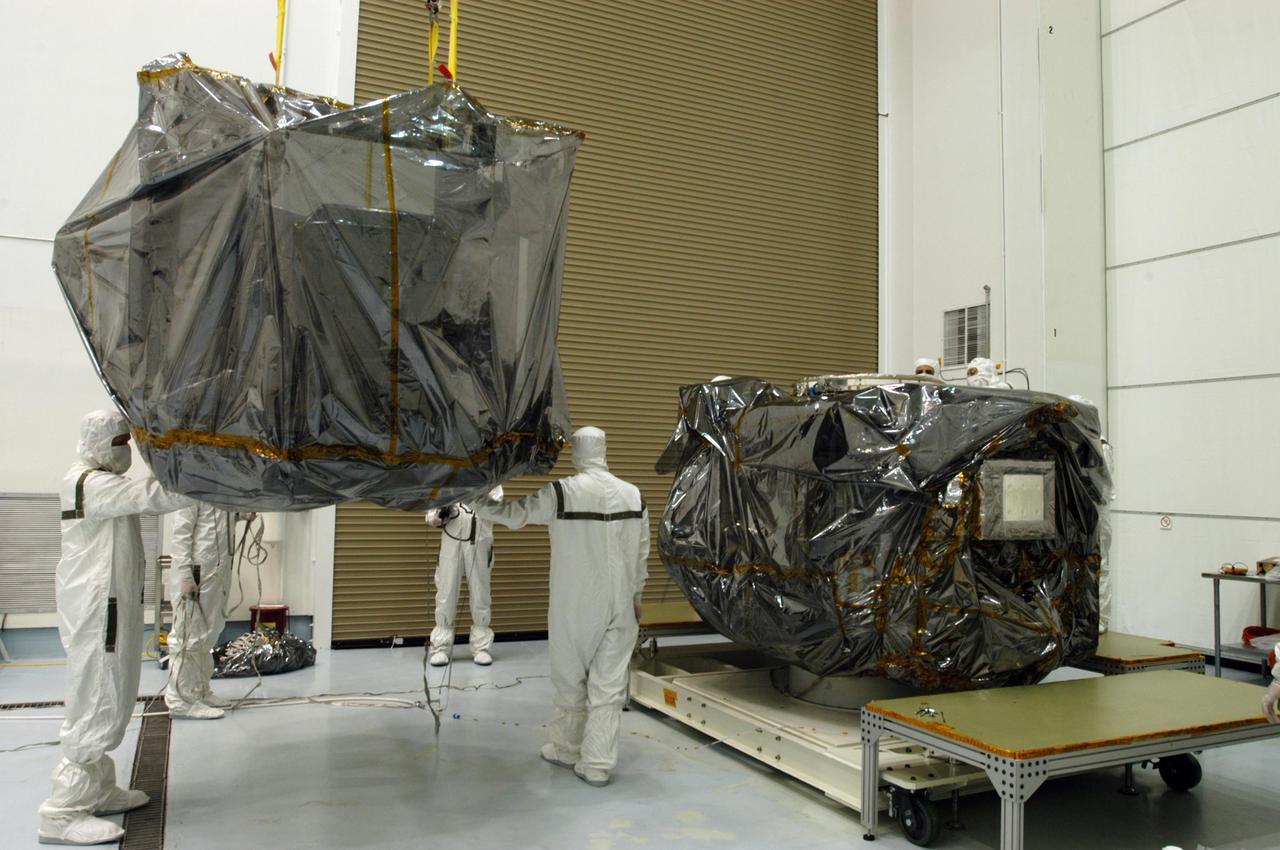
KENNEDY SPACE CENTER, FLA. - At Astrotech Space Operations in Titusville, Fla., one of the STEREO observatories is lifted and moved toward the other observatory, in the background. They will be mated for launch. STEREO, which stands for Solar Terrestrial Relations Observatory, is the first to take measurements of the sun and solar wind in 3-dimension. This new view will improve our understanding of space weather and its impact on the Earth. STEREO is expected to lift off aboard a Boeing Delta II rocket from Launch Pad 17-B at Cape Canaveral Air Force Station on Aug. 31. Photo credit: NASA/George Shelton
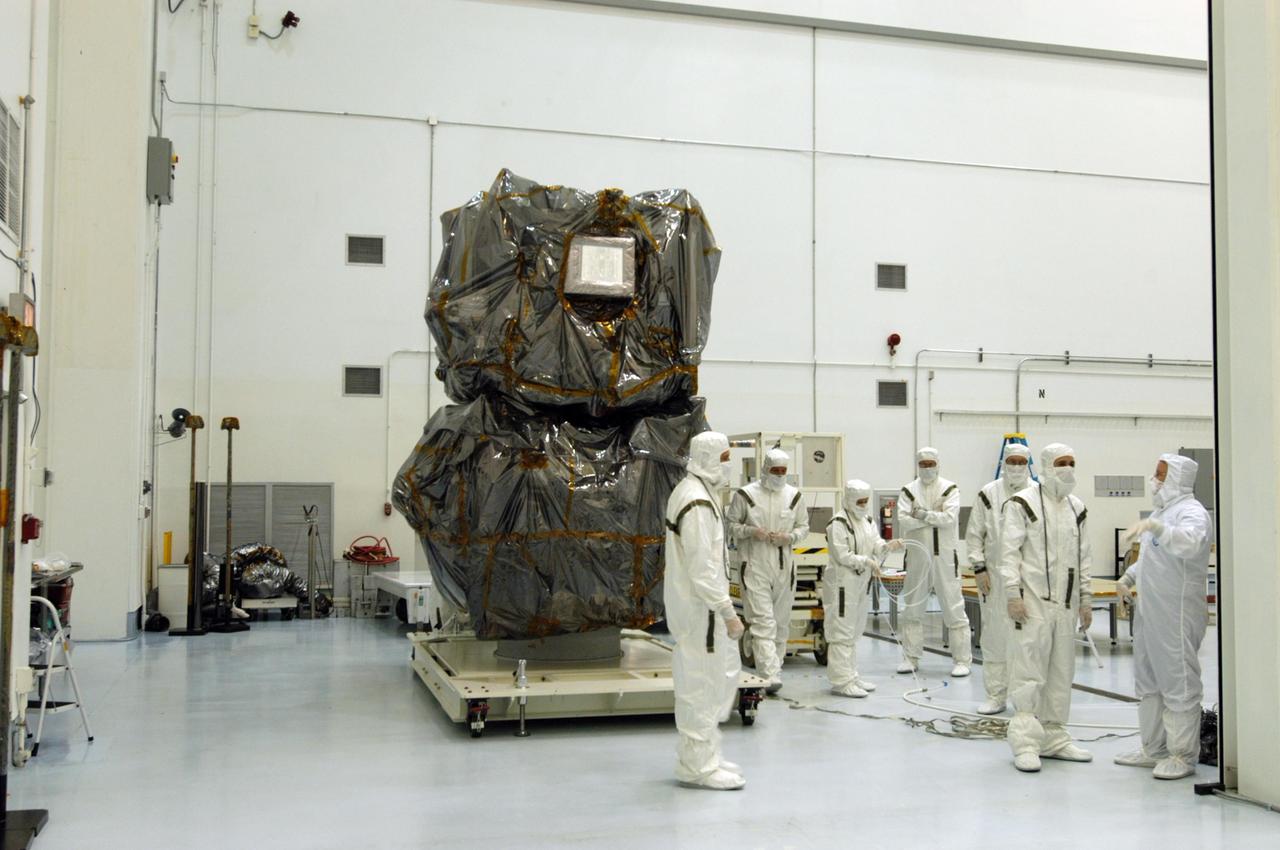
KENNEDY SPACE CENTER, FLA. - At Astrotech Space Operations in Titusville, Fla., workers have successfully mated the two STEREO observatories, which is the launch configuration. STEREO, which stands for Solar Terrestrial Relations Observatory, is the first to take measurements of the sun and solar wind in 3-dimension. This new view will improve our understanding of space weather and its impact on the Earth. STEREO is expected to lift off aboard a Boeing Delta II rocket from Launch Pad 17-B at Cape Canaveral Air Force Station on Aug. 31. Photo credit: NASA/George Shelton

KENNEDY SPACE CENTER, FLA. - At Astrotech Space Operations in Titusville, Fla., workers guide one of the STEREO observatories as it is lowered toward the other observatory. They will be mated for launch. STEREO, which stands for Solar Terrestrial Relations Observatory, is the first to take measurements of the sun and solar wind in 3-dimension. This new view will improve our understanding of space weather and its impact on the Earth. STEREO is expected to lift off aboard a Boeing Delta II rocket from Launch Pad 17-B at Cape Canaveral Air Force Station on Aug. 31. Photo credit: NASA/George Shelton
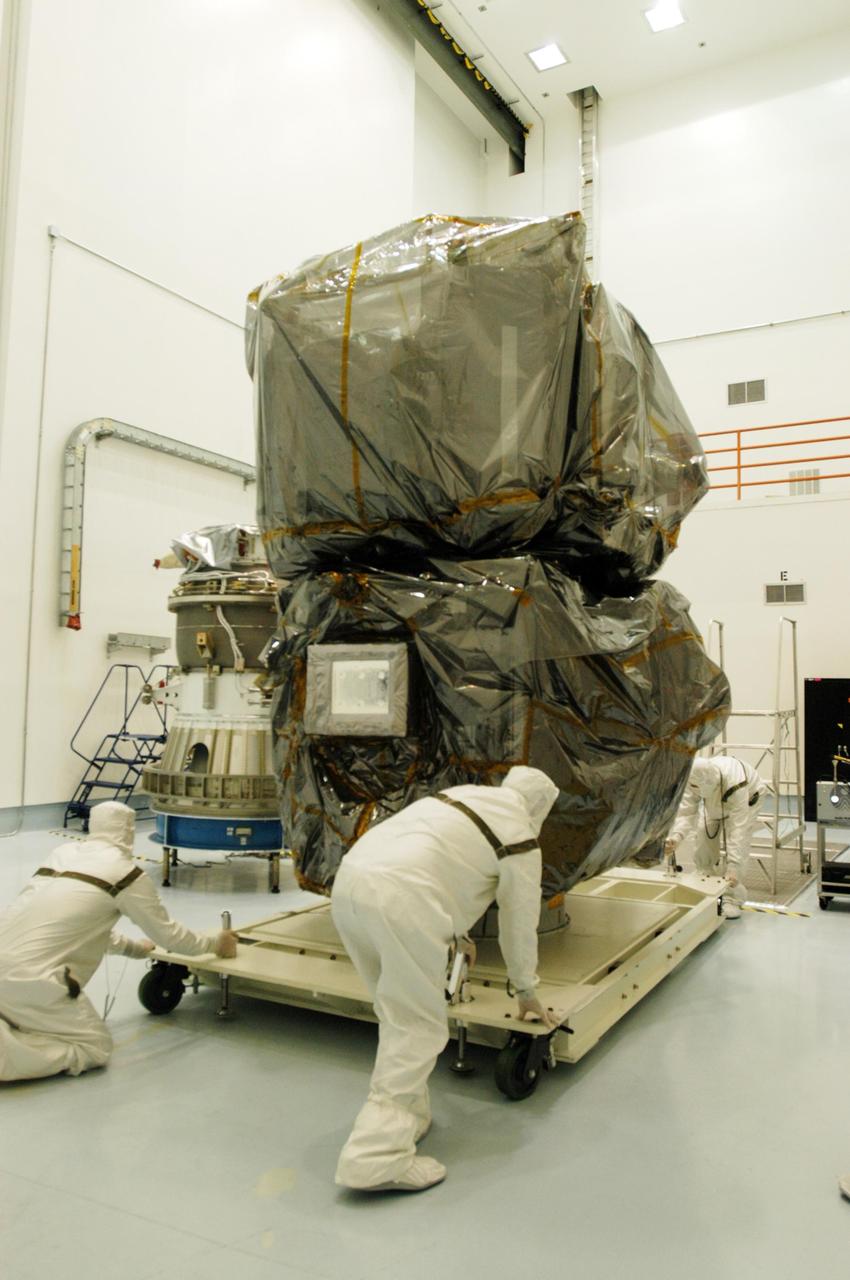
KENNEDY SPACE CENTER, FLA. - At Astrotech Space Operations in Titusville, Fla., workers move the mated STEREO observatories, which is the launch configuration. STEREO, which stands for Solar Terrestrial Relations Observatory, is the first to take measurements of the sun and solar wind in 3-dimension. This new view will improve our understanding of space weather and its impact on the Earth. STEREO is expected to lift off aboard a Boeing Delta II rocket from Launch Pad 17-B at Cape Canaveral Air Force Station on Aug. 31. Photo credit: NASA/George Shelton
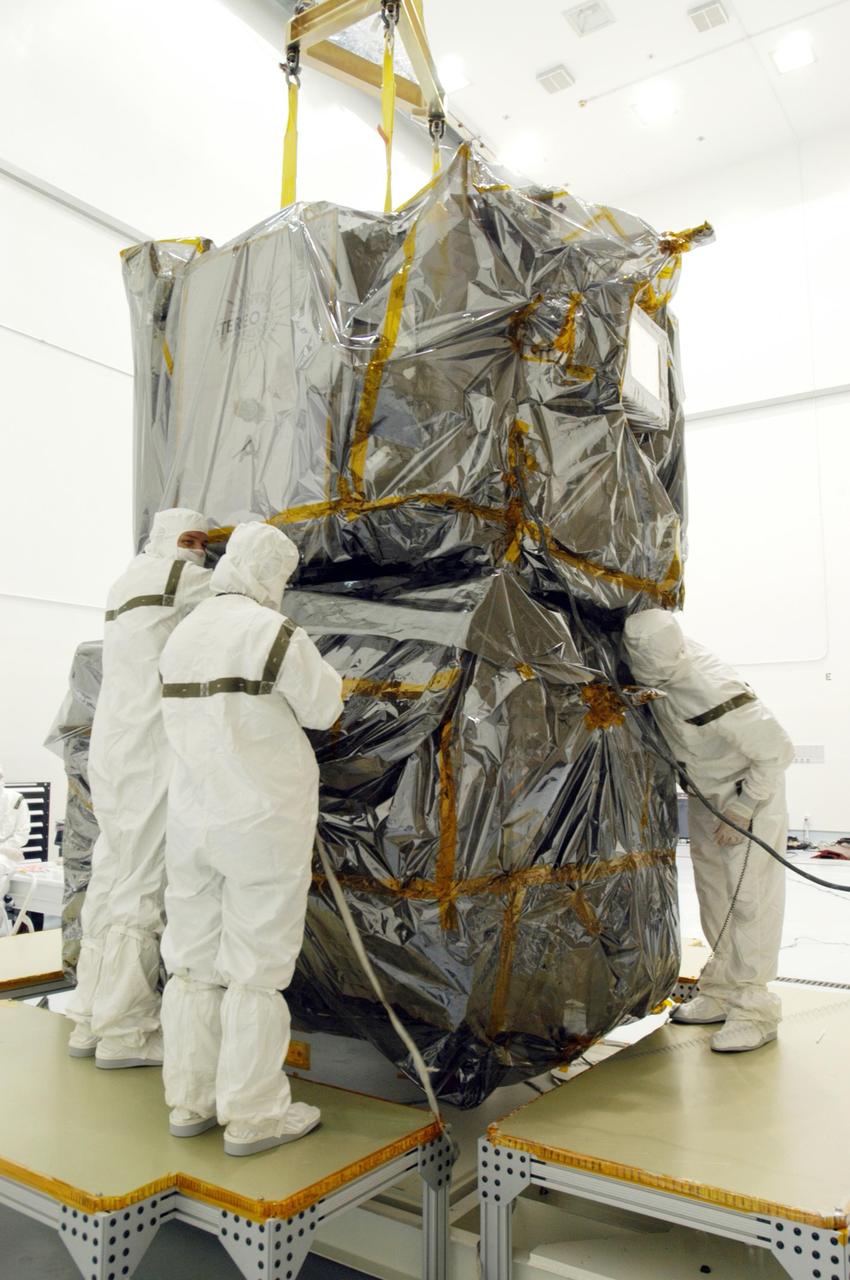
KENNEDY SPACE CENTER, FLA. - At Astrotech Space Operations in Titusville, Fla., workers check the mating of the two STEREO observatories, which is the launch configuration. STEREO, which stands for Solar Terrestrial Relations Observatory, is the first to take measurements of the sun and solar wind in 3-dimension. This new view will improve our understanding of space weather and its impact on the Earth. STEREO is expected to lift off aboard a Boeing Delta II rocket from Launch Pad 17-B at Cape Canaveral Air Force Station on Aug. 31. Photo credit: NASA/George Shelton

KENNEDY SPACE CENTER, FLA. - At Astrotech Space Operations in Titusville, Fla., workers prepare one of the STEREO observatories that will be lifted and moved. It will be mated to the other observatory, in the background, for launch. STEREO, which stands for Solar Terrestrial Relations Observatory, is the first to take measurements of the sun and solar wind in 3-dimension. This new view will improve our understanding of space weather and its impact on the Earth. STEREO is expected to lift off aboard a Boeing Delta II rocket from Launch Pad 17-B at Cape Canaveral Air Force Station on Aug. 31. Photo credit: NASA/George Shelton
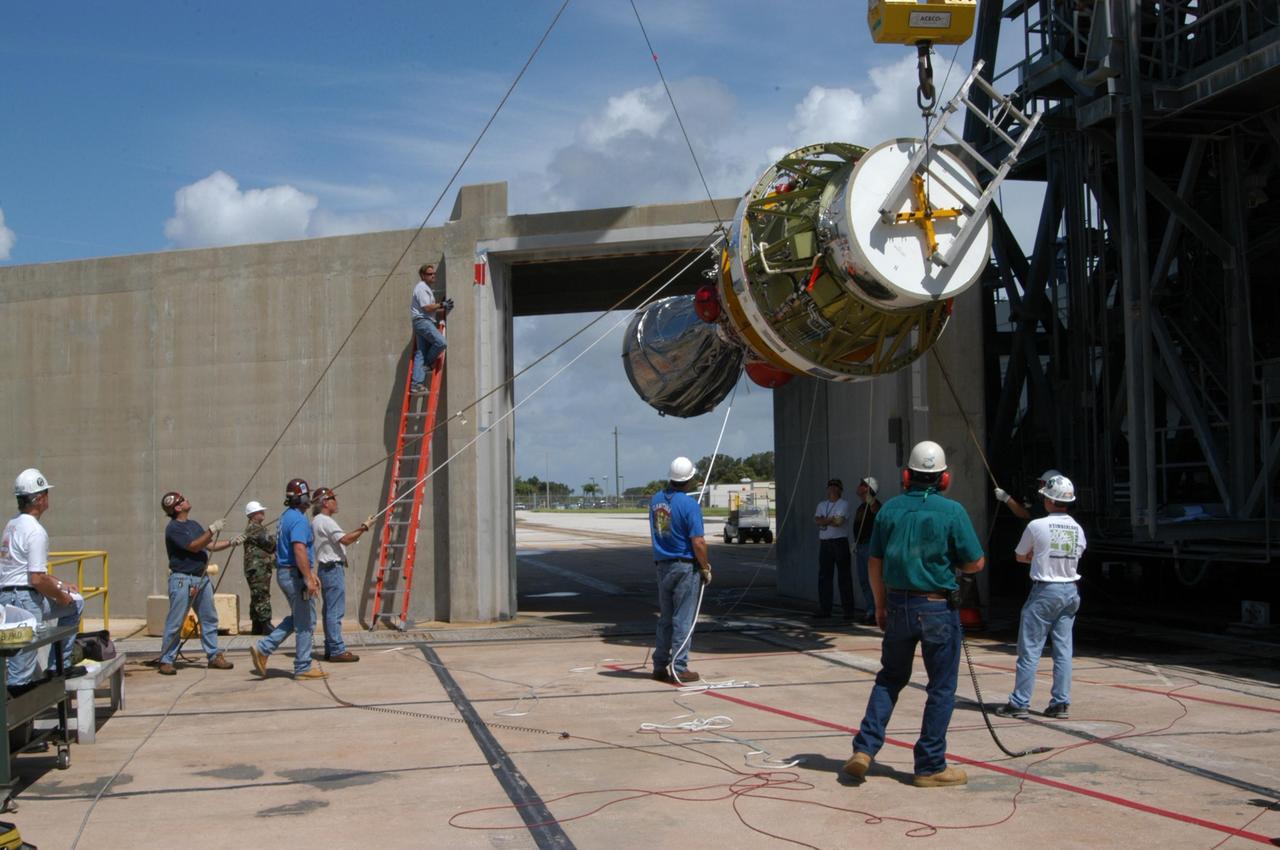
KENNEDY SPACE CENTER, FLA. - With guidelines attached, the second stage of the Boeing Delta II rocket is lifted by a crane toward the mobile service tower on Launch Pad 17-B on Cape Canaveral Air Force Station. The second stage then will be lifted into the mobile service tower and mated with first stage already in place. STEREO stands for Solar Terrestrial Relations Observatory and comprises two spacecraft. The STEREO mission is the first to take measurements of the sun and solar wind in 3-dimension. This new view will improve our understanding of space weather and its impact on the Earth. STEREO is expected to lift off in August 2006. Photo credit: NASA/George Shelton
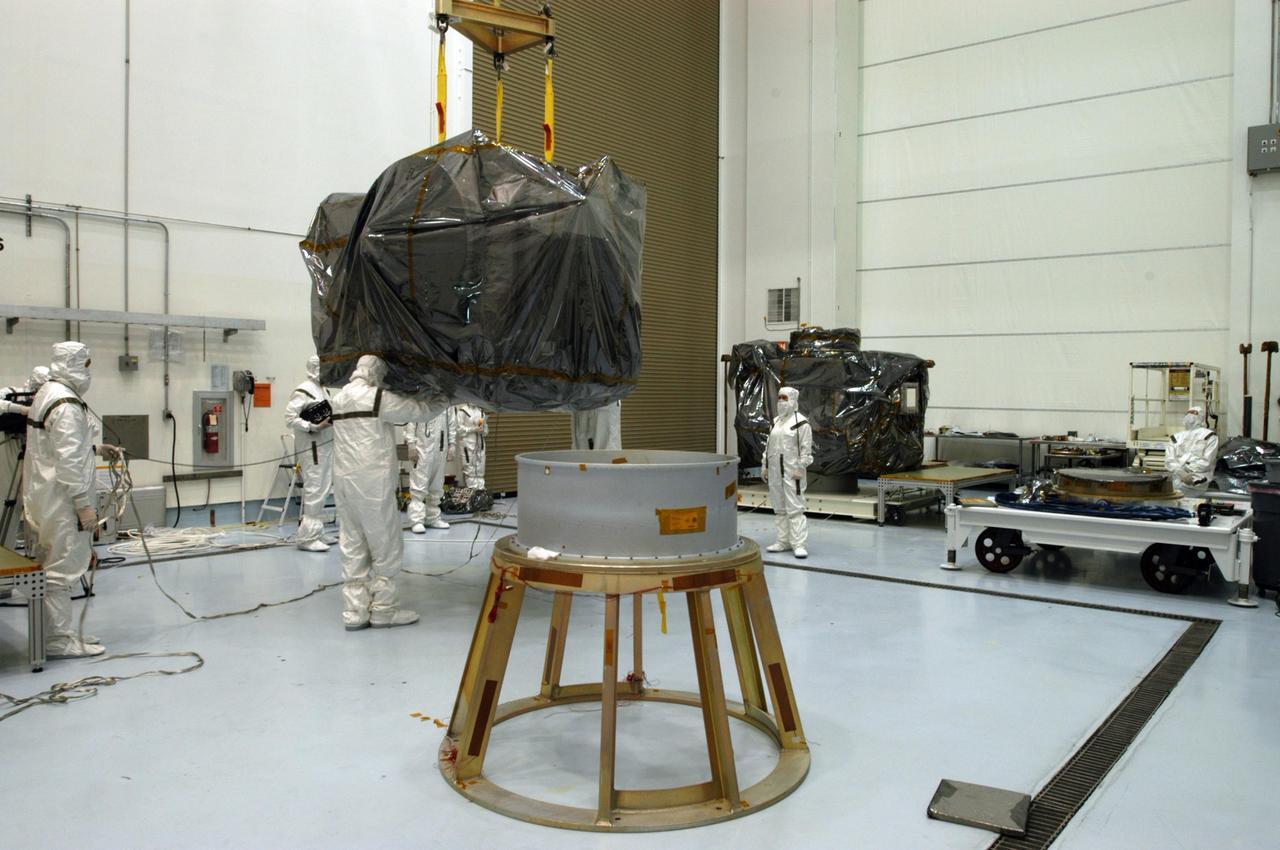
KENNEDY SPACE CENTER, FLA. - At Astrotech Space Operations in Titusville, Fla., one of the STEREO observatories is lifted and moved toward the other observatory, in the background. They will be mated for launch. STEREO, which stands for Solar Terrestrial Relations Observatory, is the first to take measurements of the sun and solar wind in 3-dimension. This new view will improve our understanding of space weather and its impact on the Earth. STEREO is expected to lift off aboard a Boeing Delta II rocket from Launch Pad 17-B at Cape Canaveral Air Force Station on Aug. 31. Photo credit: NASA/George Shelton
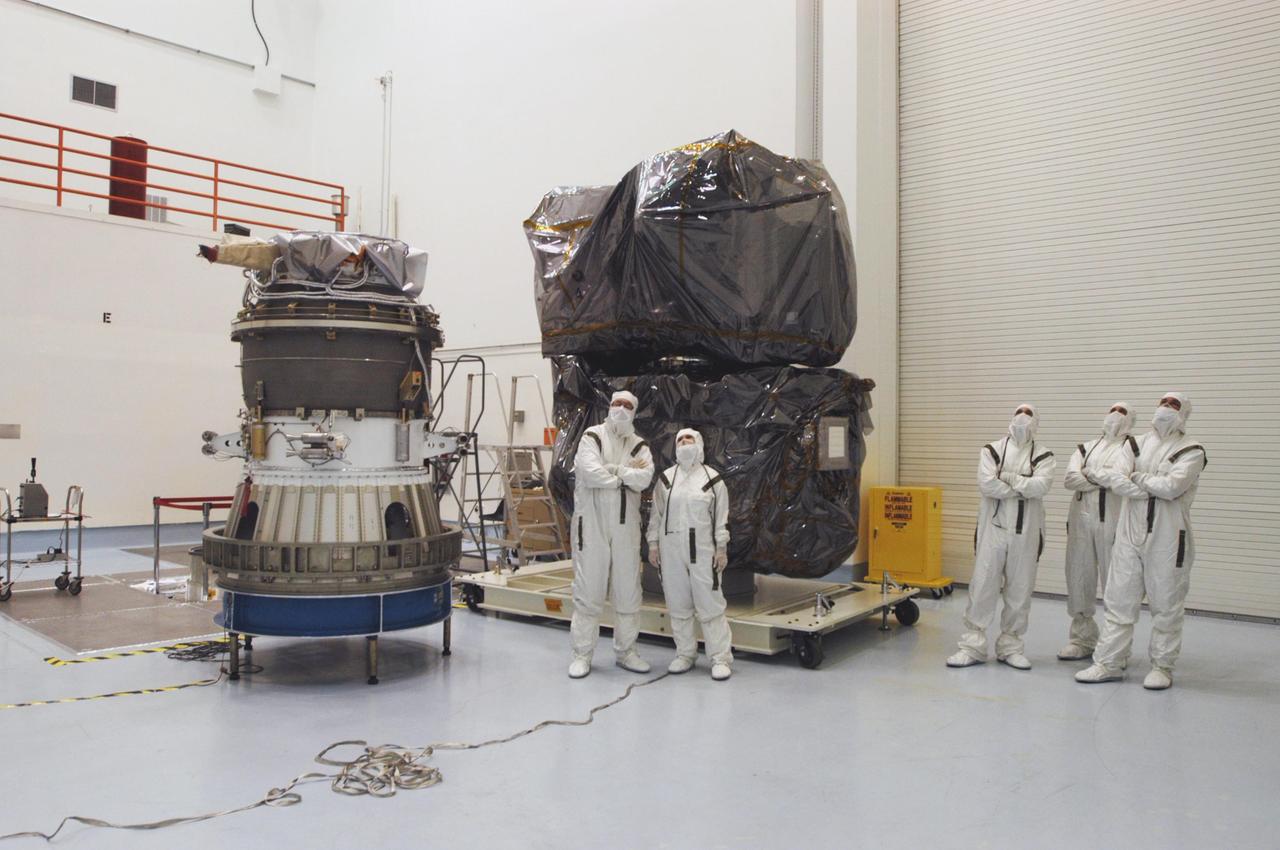
KENNEDY SPACE CENTER, FLA. - At Astrotech Space Operations in Titusville, Fla., workers look at the Delta third stage, or upper stage booster. In the background are the recently mated STEREO observatories, which is the launch configuration. STEREO, which stands for Solar Terrestrial Relations Observatory, is the first to take measurements of the sun and solar wind in 3-dimension. This new view will improve our understanding of space weather and its impact on the Earth. STEREO is expected to lift off aboard a Boeing Delta II rocket from Launch Pad 17-B at Cape Canaveral Air Force Station on Aug. 31. Photo credit: NASA/George Shelton
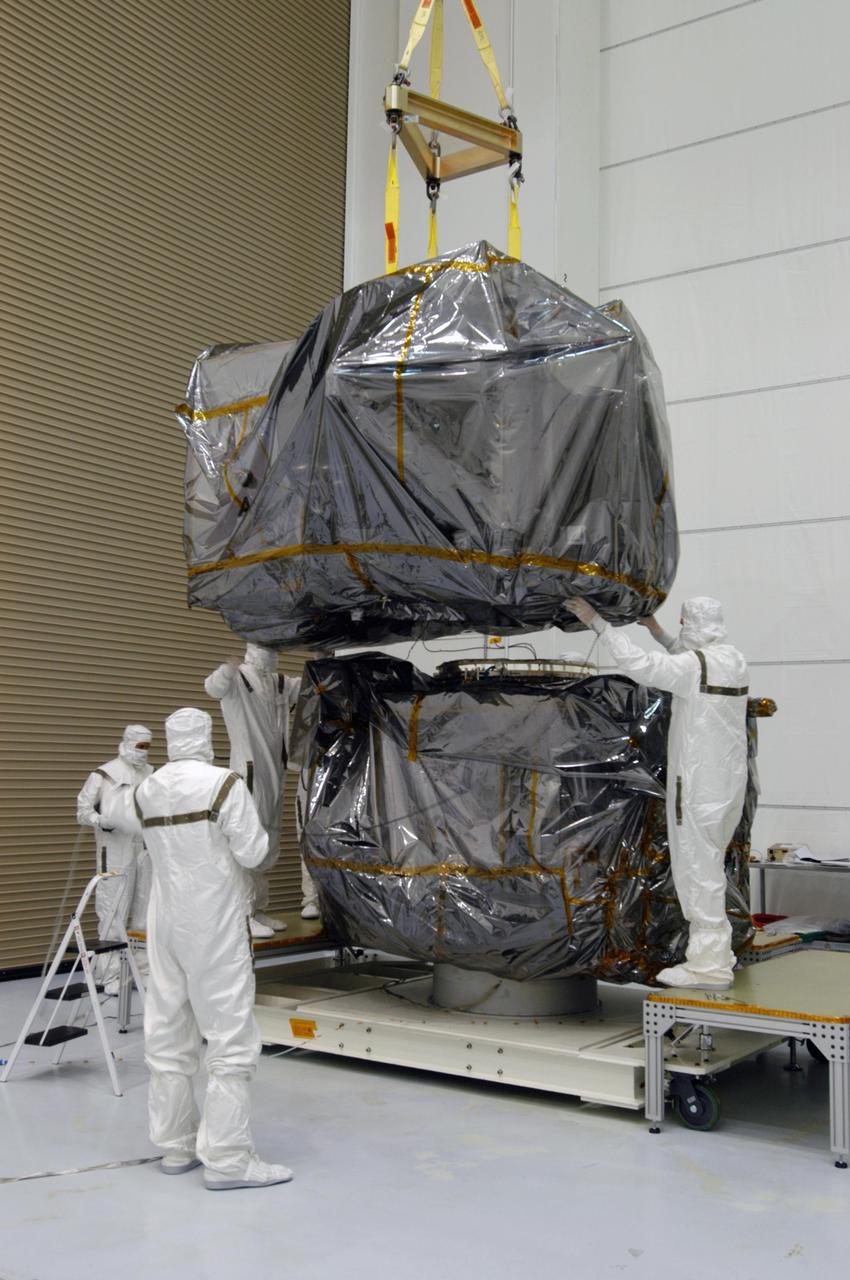
KENNEDY SPACE CENTER, FLA. - At Astrotech Space Operations in Titusville, Fla., workers guide one of the STEREO observatories as it is lowered toward the other observatory. They will be mated for launch. STEREO, which stands for Solar Terrestrial Relations Observatory, is the first to take measurements of the sun and solar wind in 3-dimension. This new view will improve our understanding of space weather and its impact on the Earth. STEREO is expected to lift off aboard a Boeing Delta II rocket from Launch Pad 17-B at Cape Canaveral Air Force Station on Aug. 31. Photo credit: NASA/George Shelton

KENNEDY SPACE CENTER, FLA. - At Astrotech Space Operations in Titusville, Fla., workers prepare one of the STEREO observatories that will be lifted and moved. It will be mated to the other observatory, in the background, for launch. STEREO, which stands for Solar Terrestrial Relations Observatory, is the first to take measurements of the sun and solar wind in 3-dimension. This new view will improve our understanding of space weather and its impact on the Earth. STEREO is expected to lift off aboard a Boeing Delta II rocket from Launch Pad 17-B at Cape Canaveral Air Force Station on Aug. 31. Photo credit: NASA/George Shelton
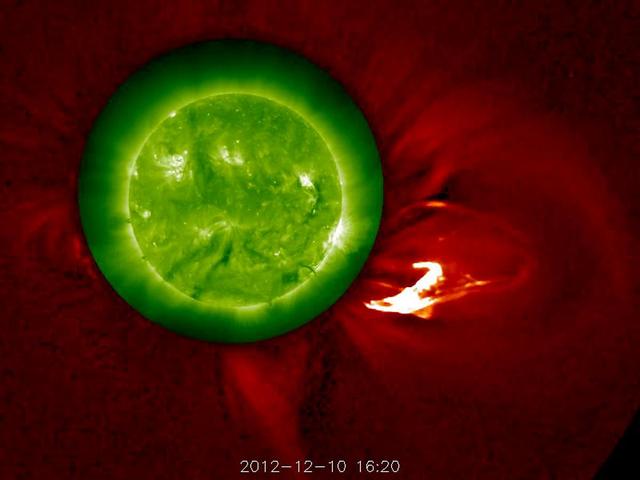
The Sun blows a robust prominence out into space (Dec. 10, 2102). The outer image, from the STEREO-A's COR1 coronagraph, has been changed from green to red to complement the green Sun image, taken in extreme UV light. The movie covers six hours of activity. Kind of Christmassy looking, isn't it? Some of the prominence falls back towards the sun, although the disturbance as a whole continues out into the solar system. Credit: NASA/GSFC/STEREO <b><a href="http://www.nasa.gov/audience/formedia/features/MP_Photo_Guidelines.html" rel="nofollow">NASA image use policy.</a></b> <b><a href="http://www.nasa.gov/centers/goddard/home/index.html" rel="nofollow">NASA Goddard Space Flight Center</a></b> enables NASA’s mission through four scientific endeavors: Earth Science, Heliophysics, Solar System Exploration, and Astrophysics. Goddard plays a leading role in NASA’s accomplishments by contributing compelling scientific knowledge to advance the Agency’s mission. <b>Follow us on <a href="http://twitter.com/NASA_GoddardPix" rel="nofollow">Twitter</a></b> <b>Like us on <a href="http://www.facebook.com/pages/Greenbelt-MD/NASA-Goddard/395013845897?ref=tsd" rel="nofollow">Facebook</a></b> <b>Find us on <a href="http://instagram.com/nasagoddard?vm=grid" rel="nofollow">Instagram</a></b>
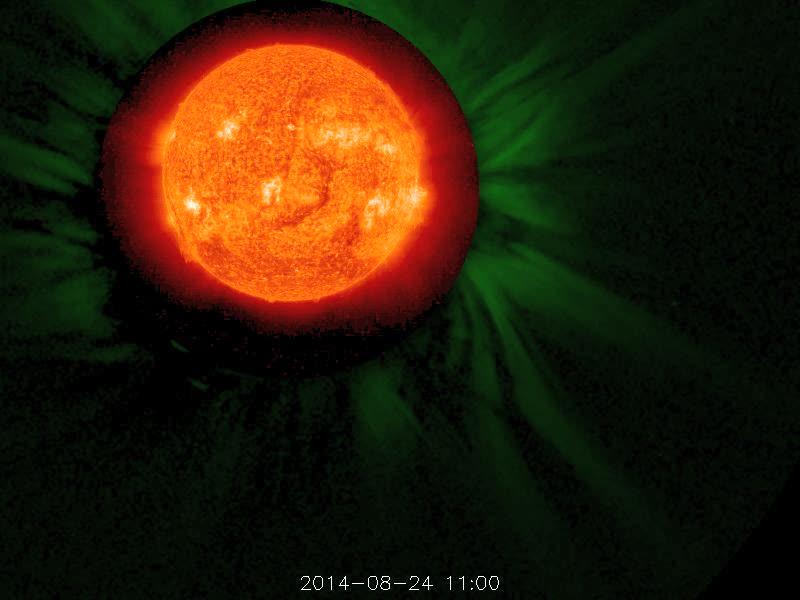
STEREO (Behind) captured this magnificent coronal mass ejection (associated with an M-class flare) that flung a long stream of plasma into space (Aug. 24, 2014). We have combined a view of the Sun in extreme UV light with a broader visible light view of the Sun's corona. It is interesting to note that a lot of the plasma, lacking sufficient kinetic energy to break free from the Sun's gravity, was pulled back into the Sun. Credit: NASA/STEREO <b><a href="http://www.nasa.gov/audience/formedia/features/MP_Photo_Guidelines.html" rel="nofollow">NASA image use policy.</a></b> <b><a href="http://www.nasa.gov/centers/goddard/home/index.html" rel="nofollow">NASA Goddard Space Flight Center</a></b> enables NASA’s mission through four scientific endeavors: Earth Science, Heliophysics, Solar System Exploration, and Astrophysics. Goddard plays a leading role in NASA’s accomplishments by contributing compelling scientific knowledge to advance the Agency’s mission. <b>Follow us on <a href="http://twitter.com/NASAGoddardPix" rel="nofollow">Twitter</a></b> <b>Like us on <a href="http://www.facebook.com/pages/Greenbelt-MD/NASA-Goddard/395013845897?ref=tsd" rel="nofollow">Facebook</a></b> <b>Find us on <a href="http://instagram.com/nasagoddard?vm=grid" rel="nofollow">Instagram</a></b>
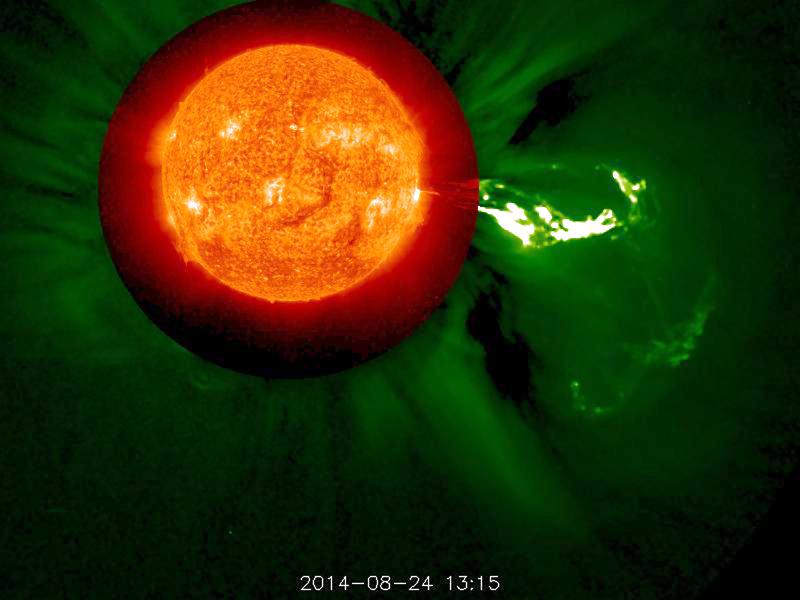
STEREO (Behind) captured this magnificent coronal mass ejection (associated with an M-class flare) that flung a long stream of plasma into space (Aug. 24, 2014). We have combined a view of the Sun in extreme UV light with a broader visible light view of the Sun's corona. It is interesting to note that a lot of the plasma, lacking sufficient kinetic energy to break free from the Sun's gravity, was pulled back into the Sun. Credit: NASA/STEREO <b><a href="http://www.nasa.gov/audience/formedia/features/MP_Photo_Guidelines.html" rel="nofollow">NASA image use policy.</a></b> <b><a href="http://www.nasa.gov/centers/goddard/home/index.html" rel="nofollow">NASA Goddard Space Flight Center</a></b> enables NASA’s mission through four scientific endeavors: Earth Science, Heliophysics, Solar System Exploration, and Astrophysics. Goddard plays a leading role in NASA’s accomplishments by contributing compelling scientific knowledge to advance the Agency’s mission. <b>Follow us on <a href="http://twitter.com/NASAGoddardPix" rel="nofollow">Twitter</a></b> <b>Like us on <a href="http://www.facebook.com/pages/Greenbelt-MD/NASA-Goddard/395013845897?ref=tsd" rel="nofollow">Facebook</a></b> <b>Find us on <a href="http://instagram.com/nasagoddard?vm=grid" rel="nofollow">Instagram</a></b>
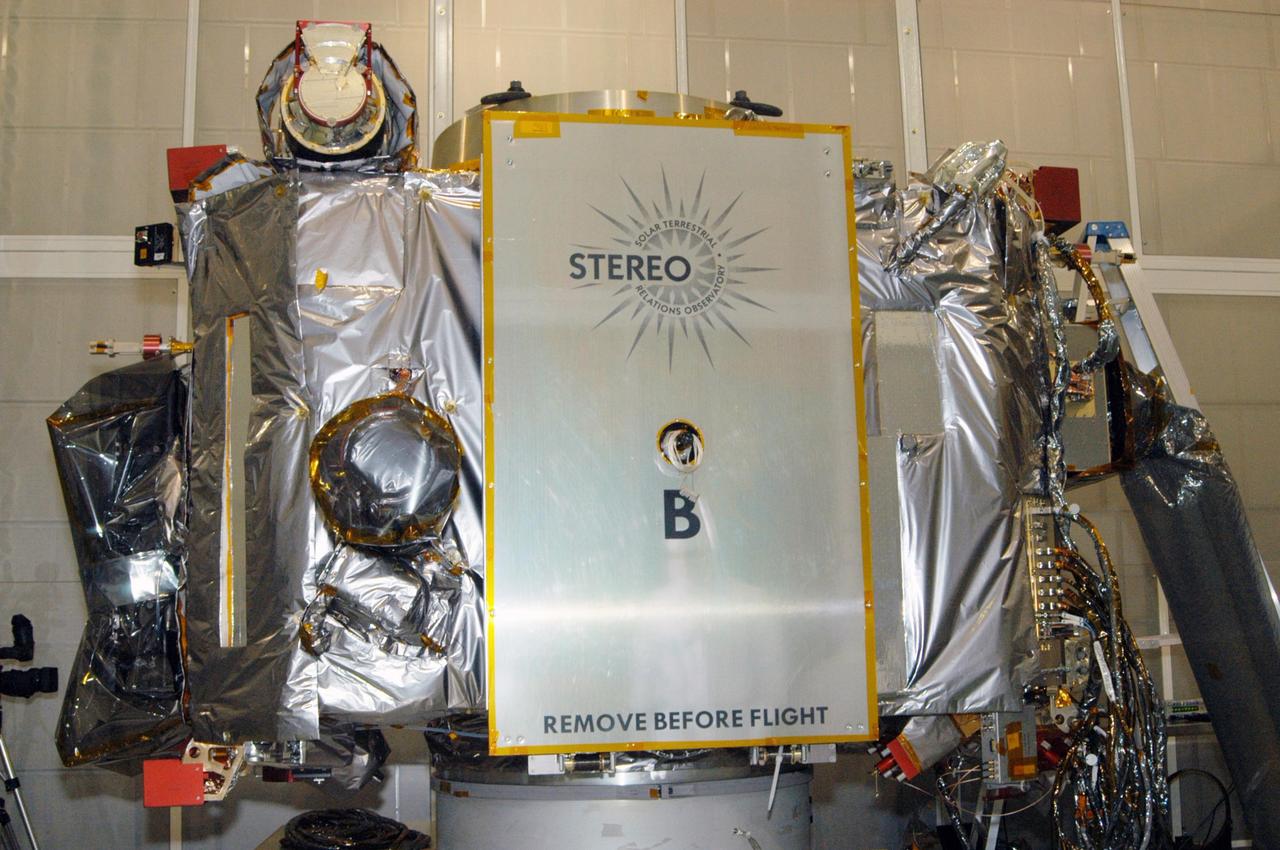
KENNEDY SPACE CENTER, FLA. - At Astrotech Space Operations in Titusville, Fla., the STEREO observatory "B" will undergo testing. STEREO, which stands for Solar Terrestrial Relations Observatory, consists of two spacecraft whose mission is to take measurements of the sun and solar wind in 3-D, for the first time. This new view will improve our understanding of space weather and its impact on the Earth. Preparations are under way for a liftoff aboard a Delta rocket no earlier than July 30. Photo credit: NASA/George Shelton
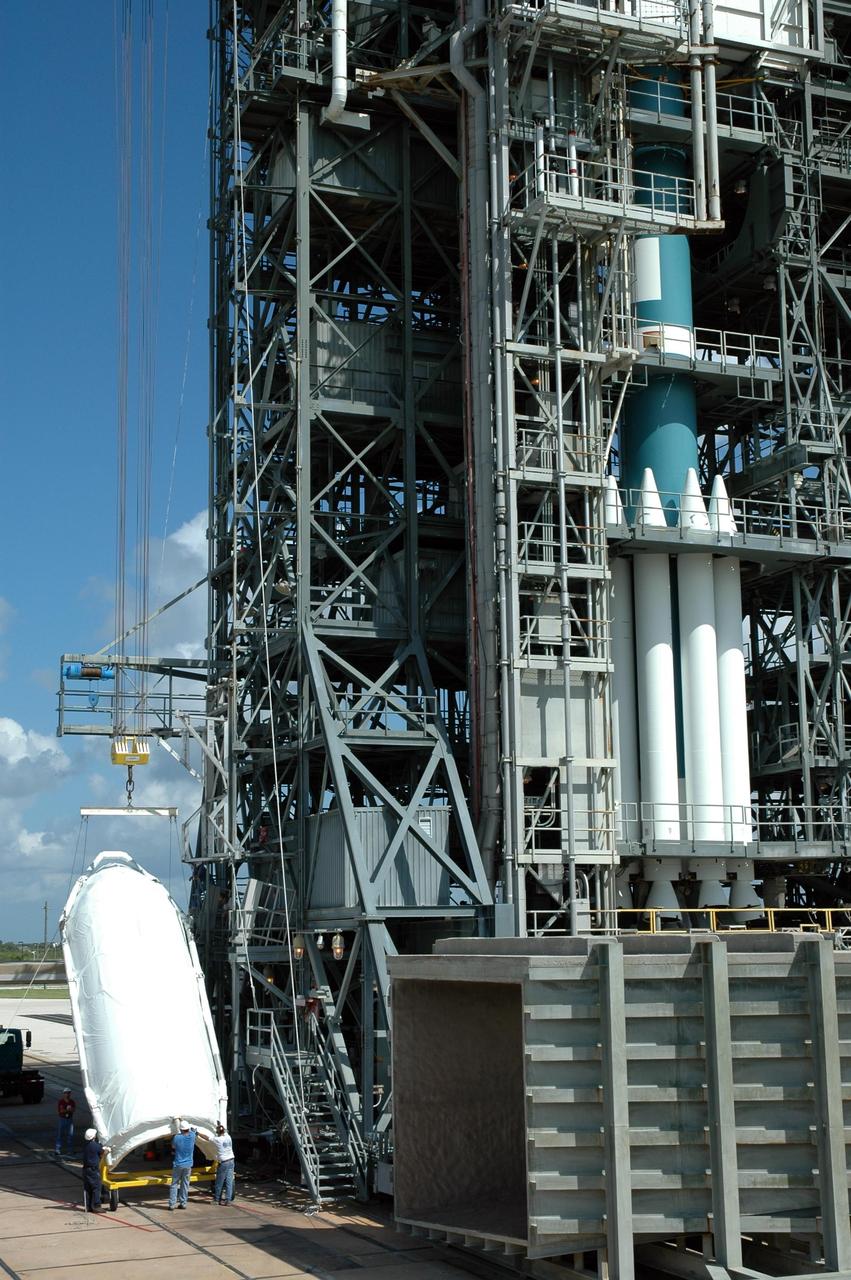
KENNEDY SPACE CENTER, FLA. - Shrouded with a protective cover, half of the payload fairing for the STEREO spacecraft is raised off its transporter on Launch Pad 17-B at Cape Canaveral Air Force Station in Florida. The payload fairing will be lifted into the clean room in the mobile service tower and later installed around the spacecraft for protection during launch. The fairing is a molded structure that fits flush with the outside surface of the Delta II upper stage booster and forms an aerodynamically smooth nose cone, protecting the spacecraft during launch and ascent. STEREO, which stands for Solar Terrestrial Relations Observatory, comprises two spacecraft. The STEREO mission is the first to take measurements of the sun and solar wind in 3-dimension. This new view will improve our understanding of space weather and its impact on the Earth. STEREO is expected to lift off aboard a Boeing Delta II rocket in August 2006. Photo credit: NASA/Jim Grossmann

KENNEDY SPACE CENTER, FLA. - Shrouded with a protective cover, half of the payload fairing for the STEREO spacecraft arrives on Launch Pad 17-B at Cape Canaveral Air Force Station in Florida. The payload fairing will be lifted into the clean room in the mobile service tower and later installed around the spacecraft for protection during launch. The fairing is a molded structure that fits flush with the outside surface of the Delta II upper stage booster and forms an aerodynamically smooth nose cone, protecting the spacecraft during launch and ascent. STEREO, which stands for Solar Terrestrial Relations Observatory, comprises two spacecraft. The STEREO mission is the first to take measurements of the sun and solar wind in 3-dimension. This new view will improve our understanding of space weather and its impact on the Earth. STEREO is expected to lift off aboard a Boeing Delta II rocket in August 2006. Photo credit: NASA/Jim Grossmann
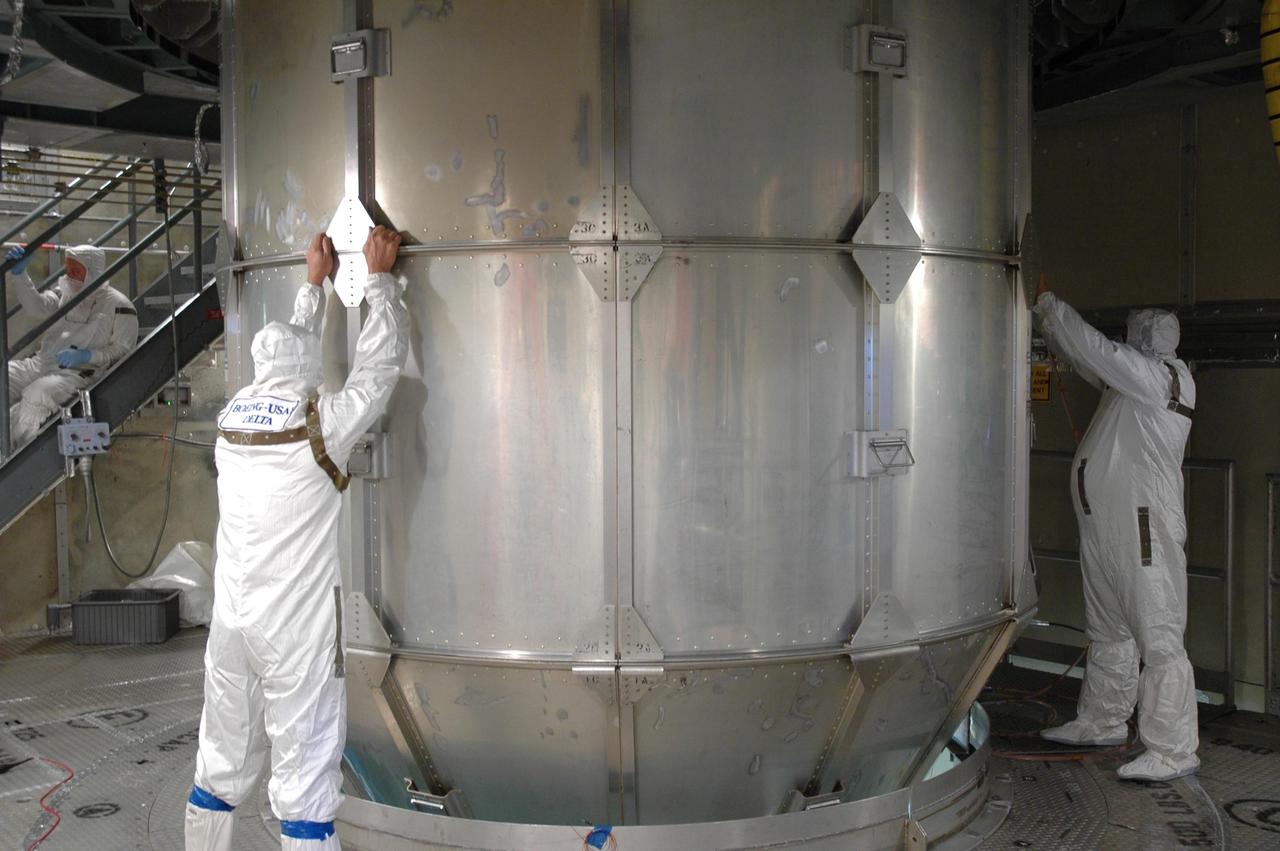
KENNEDY SPACE CENTER, FLA. - Inside the mobile service tower on Launch Pad 17-B at Cape Canaveral Air Force Station, workers unlatch the transportation canister segments that enclose the STEREO spacecraft. The spacecraft is being prepared for launch, scheduled for Oct. 25. STEREO stands for Solar Terrestrial Relations Observatory and comprises two spacecraft that will launch in a piggyback mode, separating after reaching the appropriate orbit. The STEREO mission is the first to take measurements of the sun and solar wind in 3-dimension. This new view will improve our understanding of space weather and its impact on the Earth. The STEREO mission is managed by Goddard. The Applied Physics Laboratory designed and built the spacecraft. The laboratory will maintain command and control of the observatories throughout the mission, while NASA tracks and receives the data, determines the orbit of the satellites, and coordinates the science results. Photo credit: NASA/Jim Grossmann
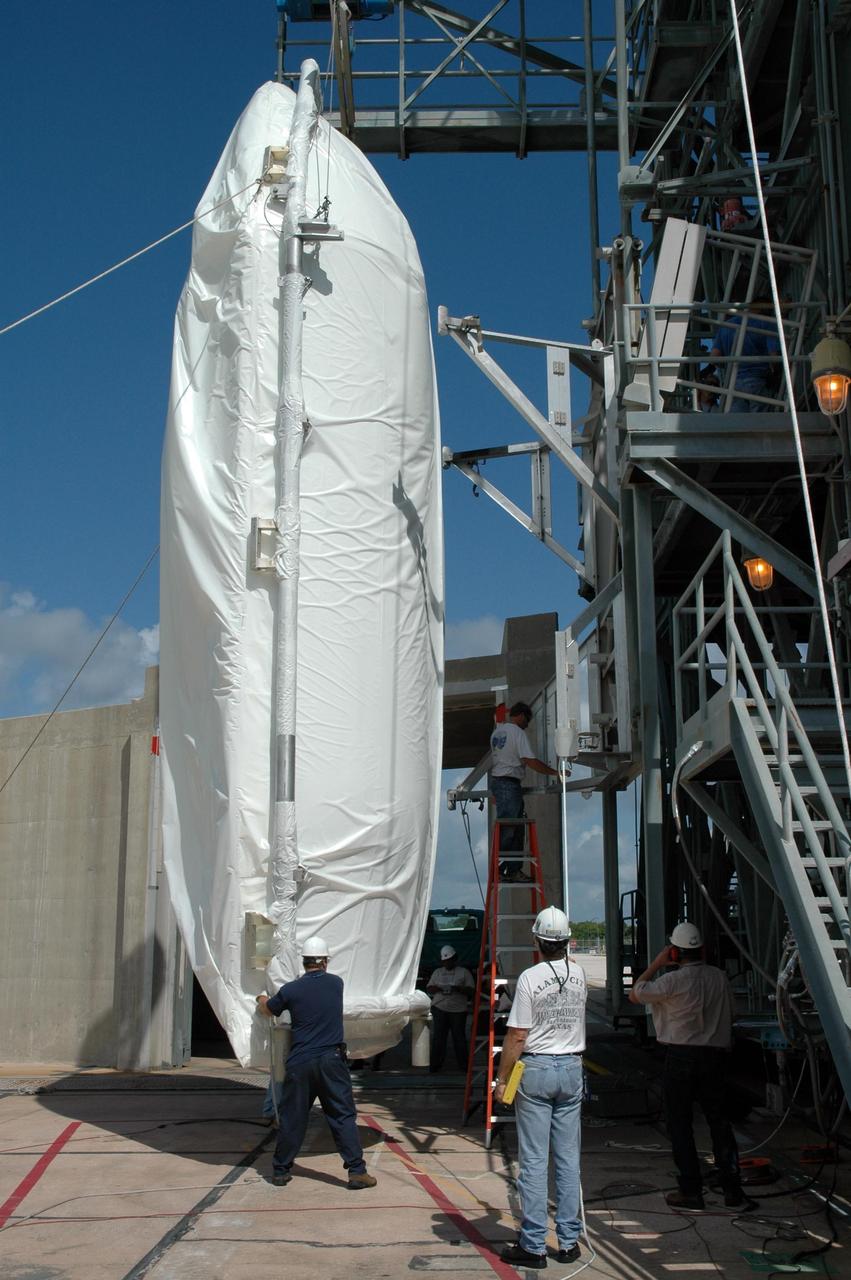
KENNEDY SPACE CENTER, FLA. - Shrouded with a protective cover, half of the payload fairing for the STEREO spacecraft has been raised to a vertical position in front of the mobile service tower on Launch Pad 17-B at Cape Canaveral Air Force Station in Florida. The fairing will be lifted into the clean room in the tower and later installed around the spacecraft for protection during launch. The fairing is a molded structure that fits flush with the outside surface of the Delta II upper stage booster and forms an aerodynamically smooth nose cone, protecting the spacecraft during launch and ascent. STEREO, which stands for Solar Terrestrial Relations Observatory, comprises two spacecraft. The STEREO mission is the first to take measurements of the sun and solar wind in 3-dimension. This new view will improve our understanding of space weather and its impact on the Earth. STEREO is expected to lift off aboard a Boeing Delta II rocket in August 2006. Photo credit: NASA/Jim Grossmann
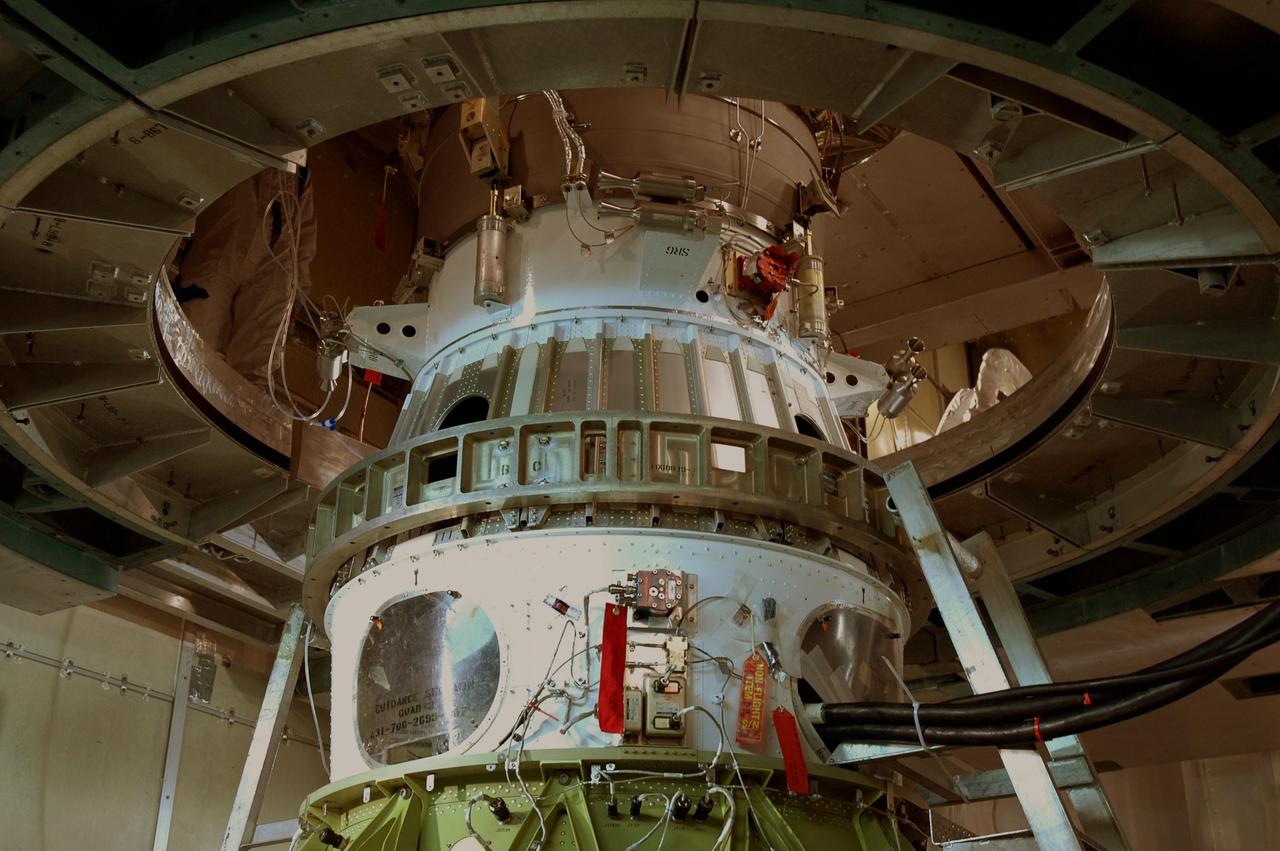
KENNEDY SPACE CENTER, FLA. - Inside the mobile service tower on Launch Pad 17-B at Cape Canaveral Air Force Station, the transportation canister and protective cover have been removed from the STEREO spacecraft in preparation for launch. The scheduled launch date is Oct. 25. STEREO stands for Solar Terrestrial Relations Observatory and comprises two spacecraft that will launch in a piggyback mode, separating after reaching the appropriate orbit. The STEREO mission is the first to take measurements of the sun and solar wind in 3-dimension. This new view will improve our understanding of space weather and its impact on the Earth. The STEREO mission is managed by Goddard. The Applied Physics Laboratory designed and built the spacecraft. The laboratory will maintain command and control of the observatories throughout the mission, while NASA tracks and receives the data, determines the orbit of the satellites, and coordinates the science results. Photo credit: NASA/Jim Grossmann

KENNEDY SPACE CENTER, FLA. - Inside the mobile service tower on Launch Pad 17-B at Cape Canaveral Air Force Station, workers observe the lifting of the upper segment of the transportation canister that encloses the STEREO spacecraft. The spacecraft is being prepared for launch, scheduled for Oct. 25. STEREO stands for Solar Terrestrial Relations Observatory and comprises two spacecraft that will launch in a piggyback mode, separating after reaching the appropriate orbit. The STEREO mission is the first to take measurements of the sun and solar wind in 3-dimension. This new view will improve our understanding of space weather and its impact on the Earth. The STEREO mission is managed by Goddard. The Applied Physics Laboratory designed and built the spacecraft. The laboratory will maintain command and control of the observatories throughout the mission, while NASA tracks and receives the data, determines the orbit of the satellites, and coordinates the science results. Photo credit: NASA/Jim Grossmann

KENNEDY SPACE CENTER, FLA. - Inside the mobile service tower on Launch Pad 17-B at Cape Canaveral Air Force Station, the transportation canister and protective cover have been removed from the STEREO spacecraft in preparation for launch. The scheduled launch date is Oct. 25. STEREO stands for Solar Terrestrial Relations Observatory and comprises two spacecraft that will launch in a piggyback mode, separating after reaching the appropriate orbit. The STEREO mission is the first to take measurements of the sun and solar wind in 3-dimension. This new view will improve our understanding of space weather and its impact on the Earth. The STEREO mission is managed by Goddard. The Applied Physics Laboratory designed and built the spacecraft. The laboratory will maintain command and control of the observatories throughout the mission, while NASA tracks and receives the data, determines the orbit of the satellites, and coordinates the science results. Photo credit: NASA/Jim Grossmann
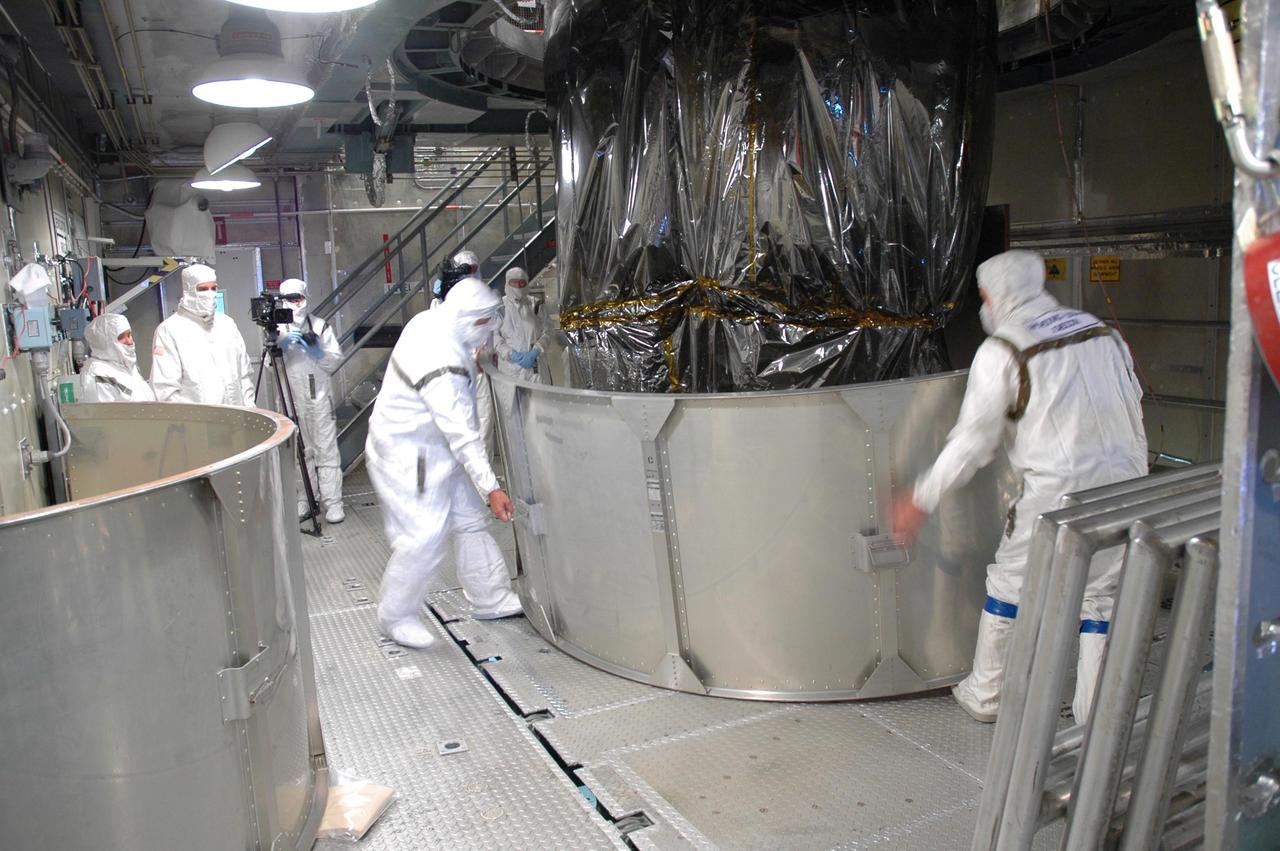
KENNEDY SPACE CENTER, FLA. - Inside the mobile service tower on Launch Pad 17-B at Cape Canaveral Air Force Station, workers begin removing the lower segment of the transportation canister that encloses the STEREO spacecraft. The spacecraft is being prepared for launch, scheduled for Oct. 25. STEREO stands for Solar Terrestrial Relations Observatory and comprises two spacecraft that will launch in a piggyback mode, separating after reaching the appropriate orbit. The STEREO mission is the first to take measurements of the sun and solar wind in 3-dimension. This new view will improve our understanding of space weather and its impact on the Earth. The STEREO mission is managed by Goddard. The Applied Physics Laboratory designed and built the spacecraft. The laboratory will maintain command and control of the observatories throughout the mission, while NASA tracks and receives the data, determines the orbit of the satellites, and coordinates the science results. Photo credit: NASA/Jim Grossmann
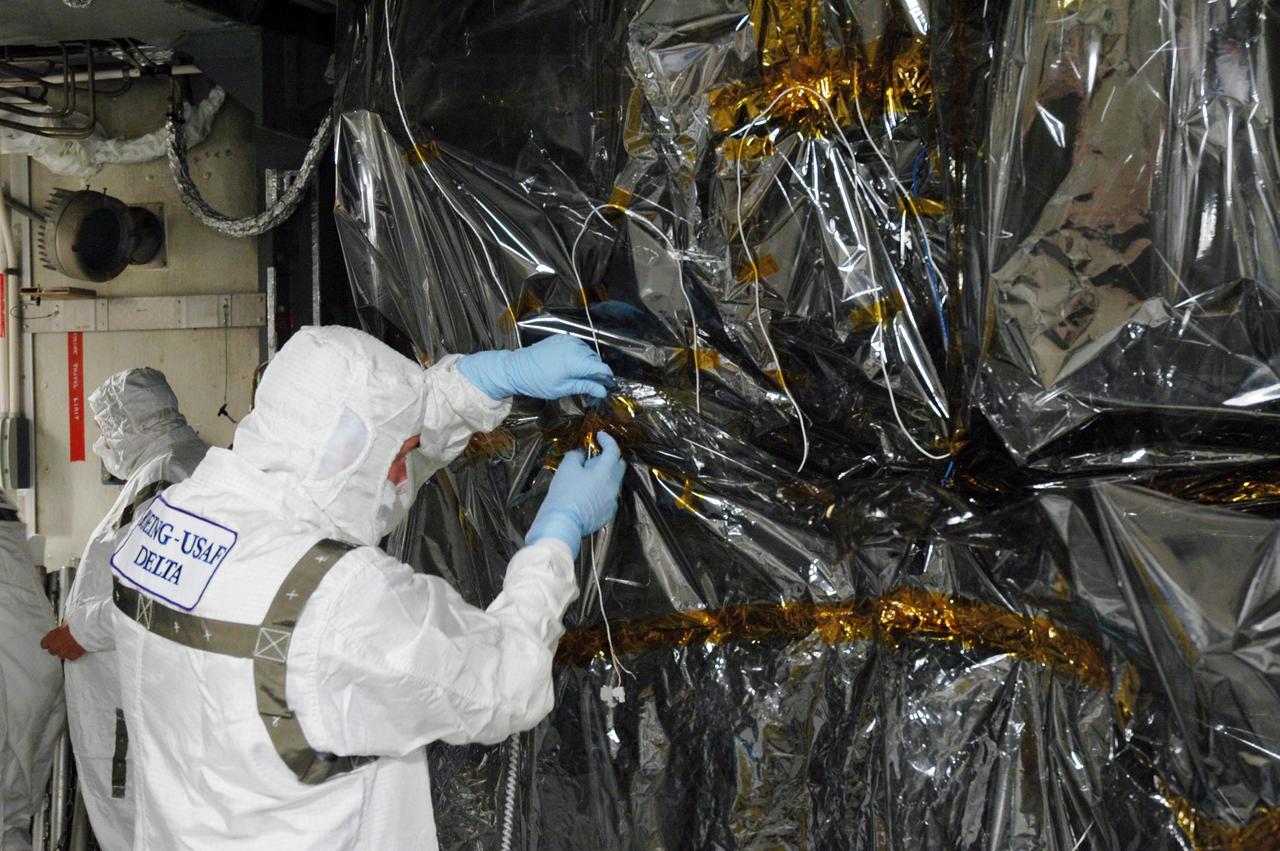
KENNEDY SPACE CENTER, FLA. - Inside the mobile service tower on Launch Pad 17-B at Cape Canaveral Air Force Station, workers begin removing the protective cover surrounding the STEREO spacecraft. The spacecraft is being prepared for launch, scheduled for Oct. 25. STEREO stands for Solar Terrestrial Relations Observatory and comprises two spacecraft that will launch in a piggyback mode, separating after reaching the appropriate orbit. The STEREO mission is the first to take measurements of the sun and solar wind in 3-dimension. This new view will improve our understanding of space weather and its impact on the Earth. The STEREO mission is managed by Goddard. The Applied Physics Laboratory designed and built the spacecraft. The laboratory will maintain command and control of the observatories throughout the mission, while NASA tracks and receives the data, determines the orbit of the satellites, and coordinates the science results. Photo credit: NASA/Jim Grossmann
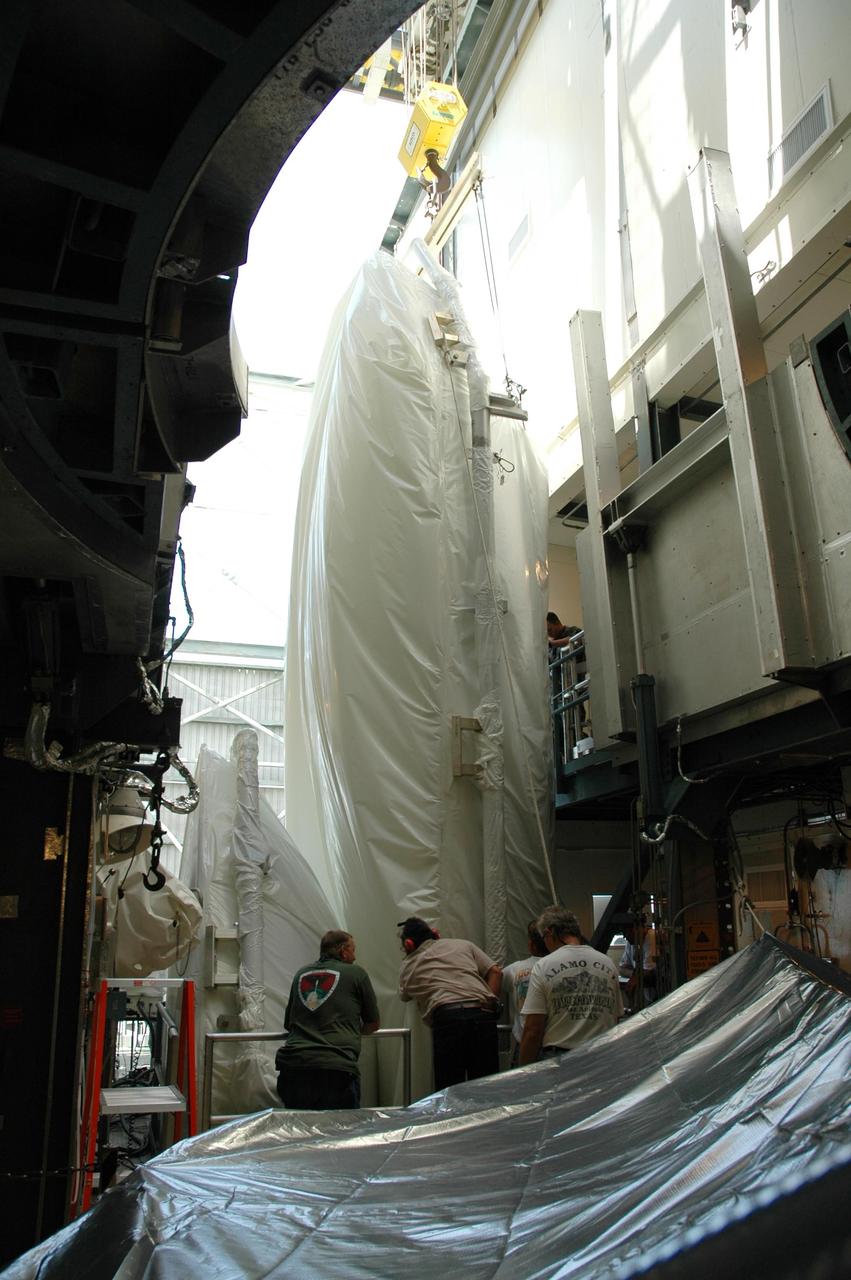
KENNEDY SPACE CENTER, FLA. - Inside the mobile service tower on Launch Pad 17-B at Cape Canaveral Air Force Station in Florida, the shrouded second half of the payload fairing (background) for the STEREO spacecraft is moved beside the first half. Both halves will later be installed around the spacecraft for protection during launch. The fairing is a molded structure that fits flush with the outside surface of the Delta II upper stage booster and forms an aerodynamically smooth nose cone, protecting the spacecraft during launch and ascent. STEREO, which stands for Solar Terrestrial Relations Observatory, comprises two spacecraft that will be launched as one. The STEREO mission is the first to take measurements of the sun and solar wind in 3-dimension. This new view will improve our understanding of space weather and its impact on the Earth. STEREO is expected to lift off aboard a Boeing Delta II rocket in August 2006. Photo credit: NASA/Jim Grossmann
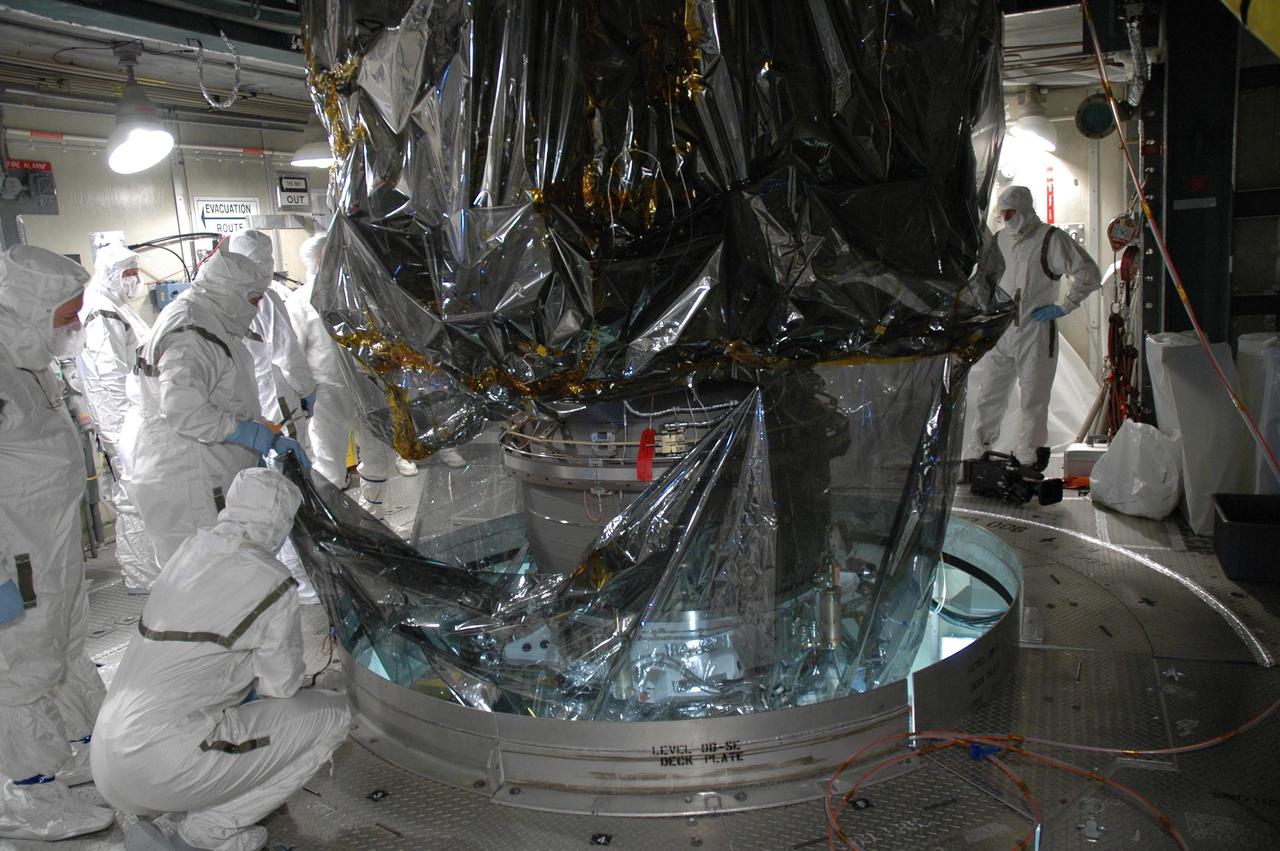
KENNEDY SPACE CENTER, FLA. - Inside the mobile service tower on Launch Pad 17-B at Cape Canaveral Air Force Station, workers begin removing the protective cover surrounding the STEREO spacecraft. The spacecraft is being prepared for launch, scheduled for Oct. 25. STEREO stands for Solar Terrestrial Relations Observatory and comprises two spacecraft that will launch in a piggyback mode, separating after reaching the appropriate orbit. The STEREO mission is the first to take measurements of the sun and solar wind in 3-dimension. This new view will improve our understanding of space weather and its impact on the Earth. The STEREO mission is managed by Goddard. The Applied Physics Laboratory designed and built the spacecraft. The laboratory will maintain command and control of the observatories throughout the mission, while NASA tracks and receives the data, determines the orbit of the satellites, and coordinates the science results. Photo credit: NASA/Jim Grossmann
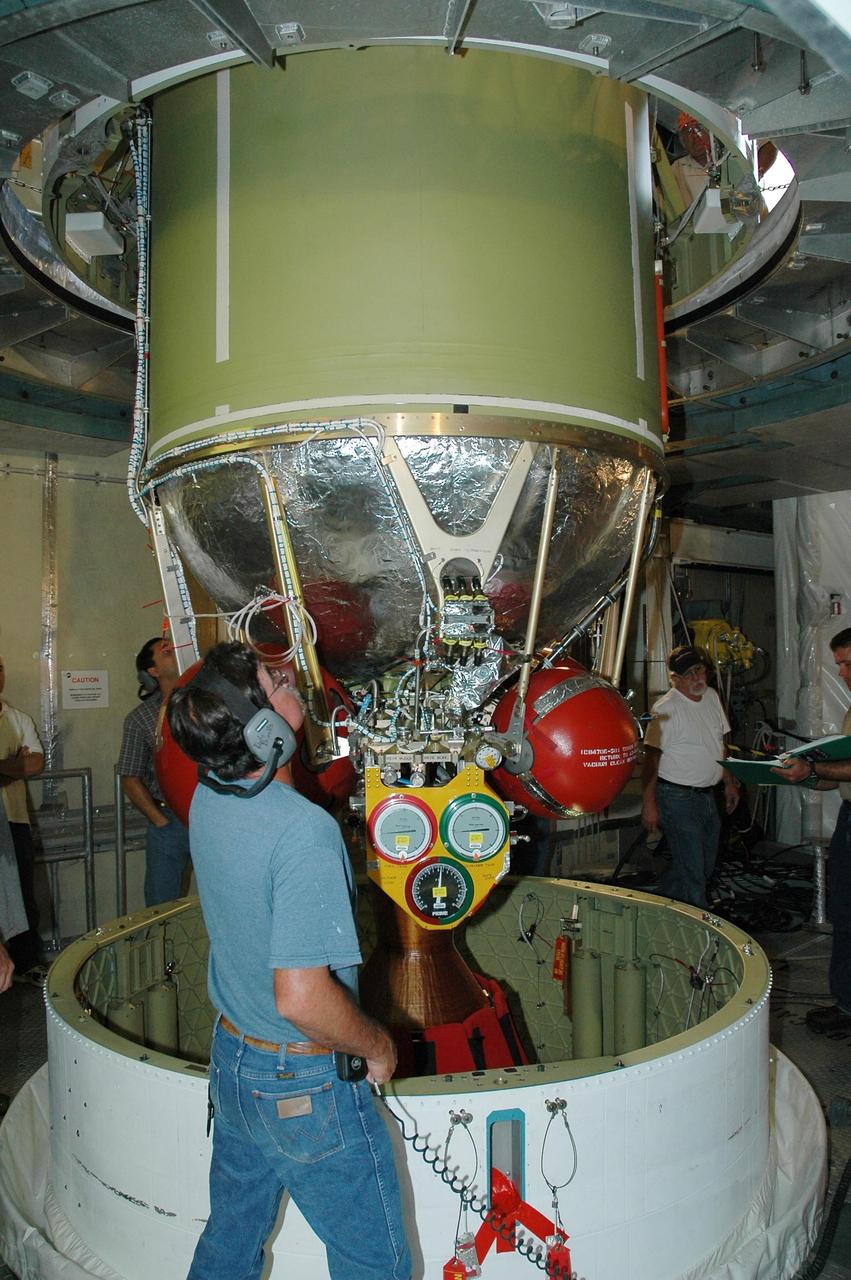
KENNEDY SPACE CENTER, FLA. - Inside the mobile service tower on Launch Pad 17-B at Cape Canaveral Air Force Station, the second stage of the Boeing Delta II launch vehicle for the STEREO spacecraft is lowered toward the Delta first stage below for remating. The second stage has been returned to the pad after being tested for leaks in the High-Pressure Test Facility; no leak was observed. STEREO stands for Solar Terrestrial Relations Observatory and comprises two spacecraft. The STEREO mission is the first to take measurements of the sun and solar wind in 3-dimension. This new view will improve our understanding of space weather and its impact on the Earth. STEREO is expected to lift off on Aug. 31. Photo credit: NASA/Dimitri Gerondidakis
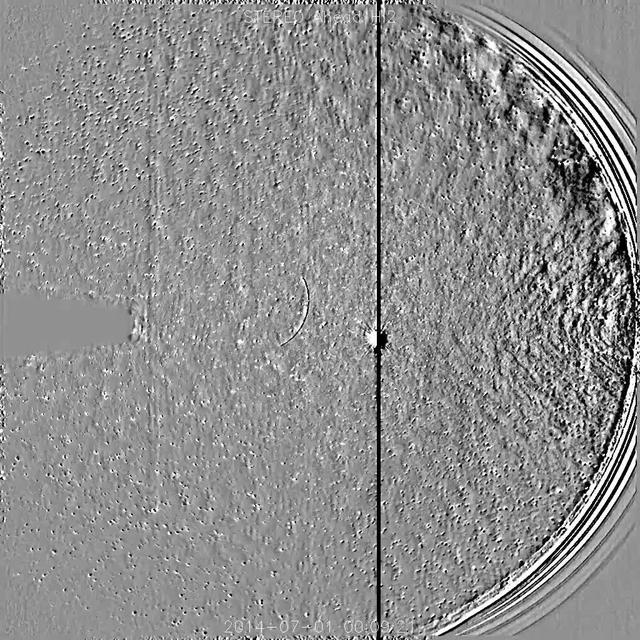
NASA's Solar TErrestrial Relations Observatory, STEREO has observed the recently discovered Comet Jacques as it passed by its nearest approach to the Sun (July 1-6, 2014). The wide field instrument on board STEREO (Ahead) showed the comet with its elongated tail being stretched and pummeled by the gusty solar wind streaming from the Sun. Also visible near the center of the image is the bright planet Venus. The Sun is just out of the field of view to the right. Comet Jacques is traveling through space at about 180,000 km per hour (110,000 mph). It may brighten enough to be seen with the naked eye. High res still here: <a href="https://www.flickr.com/photos/gsfc/14710024276/">www.flickr.com/photos/gsfc/14710024276/</a> Download original file: <a href="http://sohowww.nascom.nasa.gov/pickoftheweek/old/11jul2014/" rel="nofollow">sohowww.nascom.nasa.gov/pickoftheweek/old/11jul2014/</a> Credit: NASA/Goddard/STEREO <b><a href="http://www.nasa.gov/audience/formedia/features/MP_Photo_Guidelines.html" rel="nofollow">NASA image use policy.</a></b> <b><a href="http://www.nasa.gov/centers/goddard/home/index.html" rel="nofollow">NASA Goddard Space Flight Center</a></b> enables NASA’s mission through four scientific endeavors: Earth Science, Heliophysics, Solar System Exploration, and Astrophysics. Goddard plays a leading role in NASA’s accomplishments by contributing compelling scientific knowledge to advance the Agency’s mission. <b>Follow us on <a href="http://twitter.com/NASAGoddardPix" rel="nofollow">Twitter</a></b> <b>Like us on <a href="http://www.facebook.com/pages/Greenbelt-MD/NASA-Goddard/395013845897?ref=tsd" rel="nofollow">Facebook</a></b> <b>Find us on <a href="http://instagram.com/nasagoddard?vm=grid" rel="nofollow">Instagram</a></b>
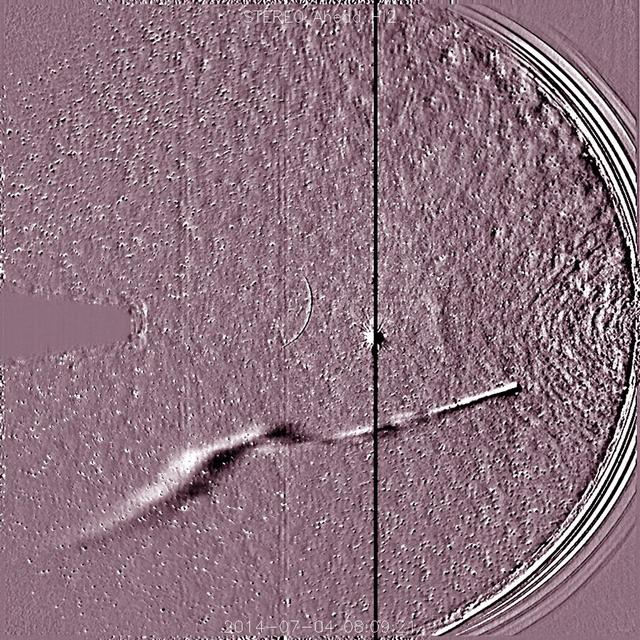
NASA's Solar TErrestrial RElations Observatory, STEREO has observed the recently discovered Comet Jacques as it passed by its nearest approach to the Sun (July 1-6, 2014). The wide field instrument on board STEREO (Ahead) showed the comet with its elongated tail being stretched and pummeled by the gusty solar wind streaming from the Sun. Also visible near the center of the image is the bright planet Venus. The Sun is just out of the field of view to the right. Comet Jacques is traveling through space at about 180,000 km per hour (110,000 mph). It may brighten enough to be seen with the naked eye. Video of this event here: <a href="https://www.flickr.com/photos/gsfc/14730658164/">www.flickr.com/photos/gsfc/14730658164/</a> Download original file: <a href="http://sohowww.nascom.nasa.gov/pickoftheweek/old/11jul2014/" rel="nofollow">sohowww.nascom.nasa.gov/pickoftheweek/old/11jul2014/</a> Credit: NASA/Goddard/STEREO <b><a href="http://www.nasa.gov/audience/formedia/features/MP_Photo_Guidelines.html" rel="nofollow">NASA image use policy.</a></b> <b><a href="http://www.nasa.gov/centers/goddard/home/index.html" rel="nofollow">NASA Goddard Space Flight Center</a></b> enables NASA’s mission through four scientific endeavors: Earth Science, Heliophysics, Solar System Exploration, and Astrophysics. Goddard plays a leading role in NASA’s accomplishments by contributing compelling scientific knowledge to advance the Agency’s mission. <b>Follow us on <a href="http://twitter.com/NASAGoddardPix" rel="nofollow">Twitter</a></b> <b>Like us on <a href="http://www.facebook.com/pages/Greenbelt-MD/NASA-Goddard/395013845897?ref=tsd" rel="nofollow">Facebook</a></b> <b>Find us on <a href="http://instagram.com/nasagoddard?vm=grid" rel="nofollow">Instagram</a></b>
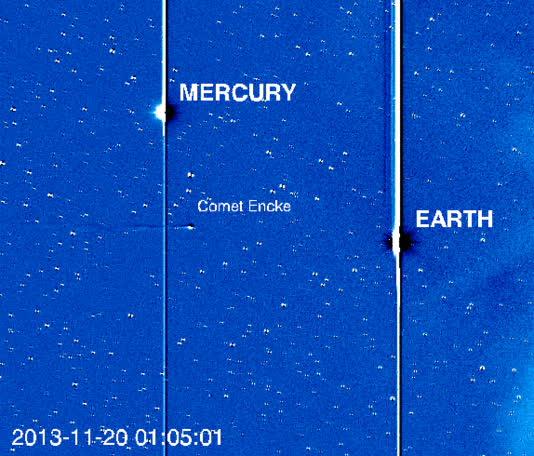
Comet ISON makes its appearance into the higher-resolution HI-1 camera on the STEREO-A spacecraft. The dark "clouds" coming from the right are density enhancements in the solar wind, causing all the ripples in comet Encke's tail. These kinds of solar wind interactions give us valuable information about solar wind conditions near the sun. Note: the STEREO-A spacecraft is currently located on the other side of the Sun, so it sees a totally different geometry to what we see from Earth. Credit: Karl Battams/NASA/STEREO/CIOC <b><a href="http://www.nasa.gov/audience/formedia/features/MP_Photo_Guidelines.html" rel="nofollow">NASA image use policy.</a></b> <b><a href="http://www.nasa.gov/centers/goddard/home/index.html" rel="nofollow">NASA Goddard Space Flight Center</a></b> enables NASA’s mission through four scientific endeavors: Earth Science, Heliophysics, Solar System Exploration, and Astrophysics. Goddard plays a leading role in NASA’s accomplishments by contributing compelling scientific knowledge to advance the Agency’s mission. <b>Follow us on <a href="http://twitter.com/NASA_GoddardPix" rel="nofollow">Twitter</a></b> <b>Like us on <a href="http://www.facebook.com/pages/Greenbelt-MD/NASA-Goddard/395013845897?ref=tsd" rel="nofollow">Facebook</a></b> <b>Find us on <a href="http://instagram.com/nasagoddard?vm=grid" rel="nofollow">Instagram</a></b>
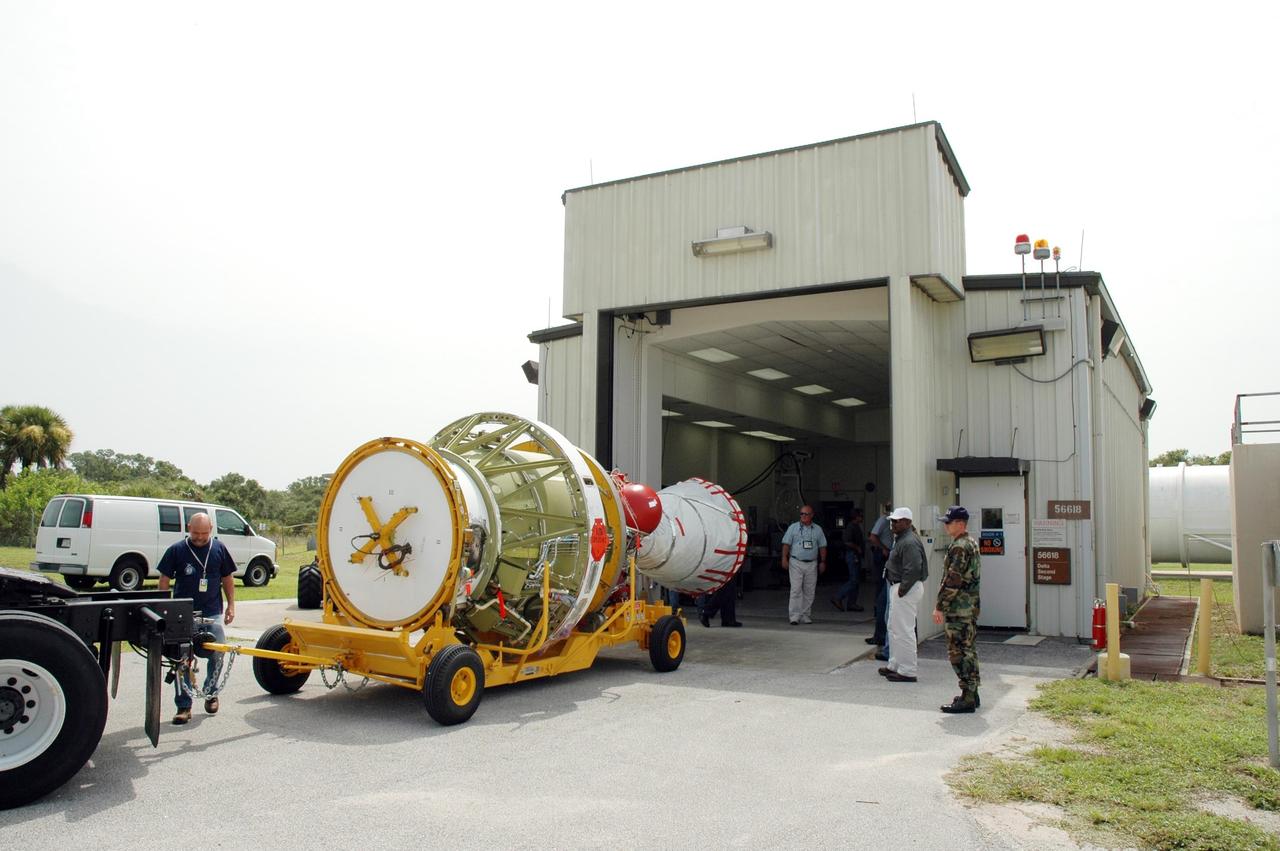
KENNEDY SPACE CENTER, FLA. - On Launch Pad 17-B at Cape Canaveral Air Force Station in Florida, the transporter carrying the second stage segment of a Delta II rocket arrives at the High-Pressure Test Facility for leak testing. The segment was destacked from the Delta II rocket in the mobile service tower. At the Boeing plant in Alabama, a leak was observed in the second-stage oxidizer tank for another Delta II that had been scheduled to launch in November; therefore, all identical tanks scheduled for launch in the near future are being checked. The second stage for the Delta II that will launch STEREO cannot be effectively tested while atop the first stage at Pad 17-B. STEREO stands for Solar Terrestrial Relations Observatory and comprises two spacecraft. The STEREO mission is the first to take measurements of the sun and solar wind in 3-dimension. This new view will improve our understanding of space weather and its impact on the Earth. STEREO is expected to lift off in late August 2006. Photo credit: NASA/Jim Grossmann
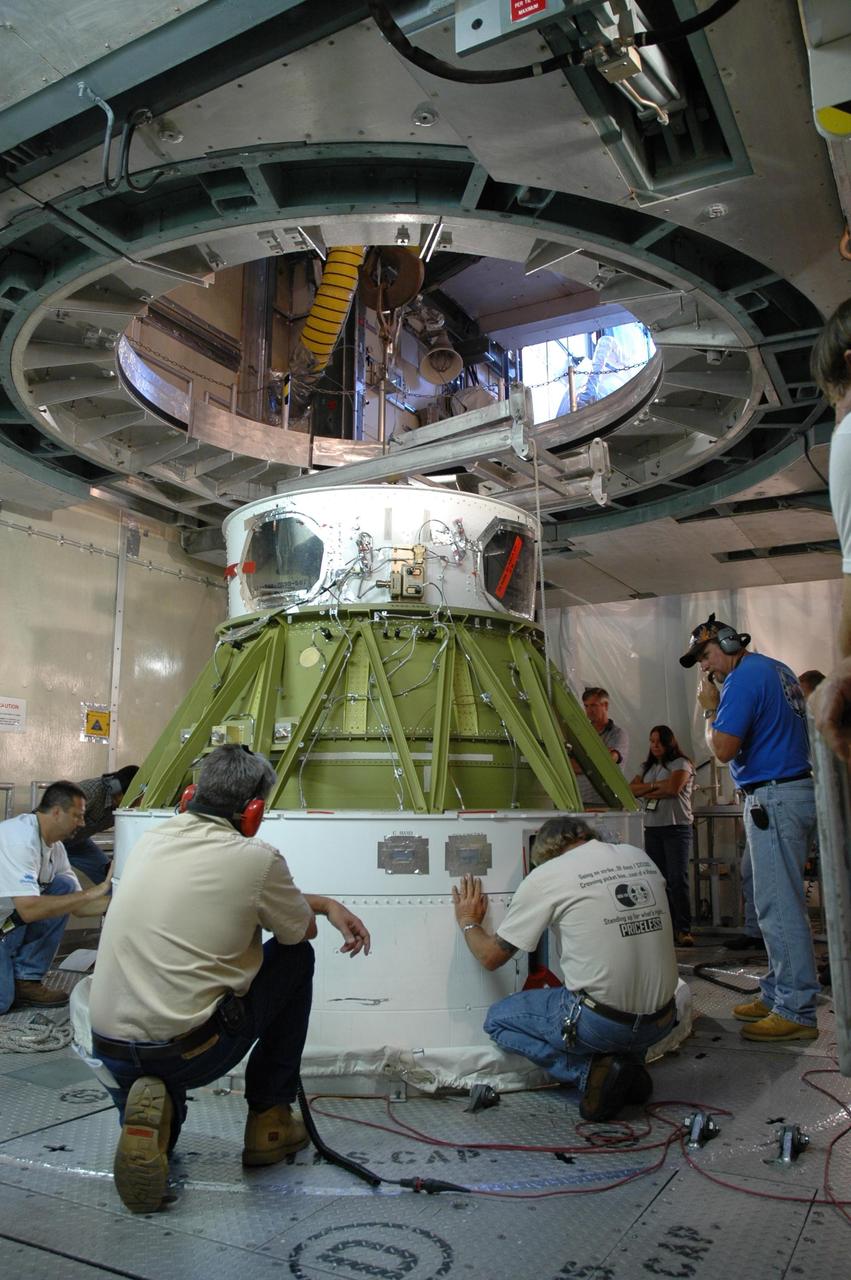
KENNEDY SPACE CENTER, FLA. - Inside the mobile service tower on Launch Pad 17-B at Cape Canaveral Air Force Station in Florida, workers get ready to destack the second stage segment from the Delta II rocket below. At the Boeing plant in Alabama, a leak was observed in the second-stage oxidizer tank for another Delta II that had been scheduled to launch in November; therefore, all identical tanks scheduled for launch in the near future are being checked. The second stage for the Delta II that will launch STEREO cannot be effectively tested while atop the first stage at Pad 17-B. STEREO stands for Solar Terrestrial Relations Observatory and comprises two spacecraft. The STEREO mission is the first to take measurements of the sun and solar wind in 3-dimension. This new view will improve our understanding of space weather and its impact on the Earth. STEREO is expected to lift off in late August 2006. Photo credit: NASA/Jim Grossmann
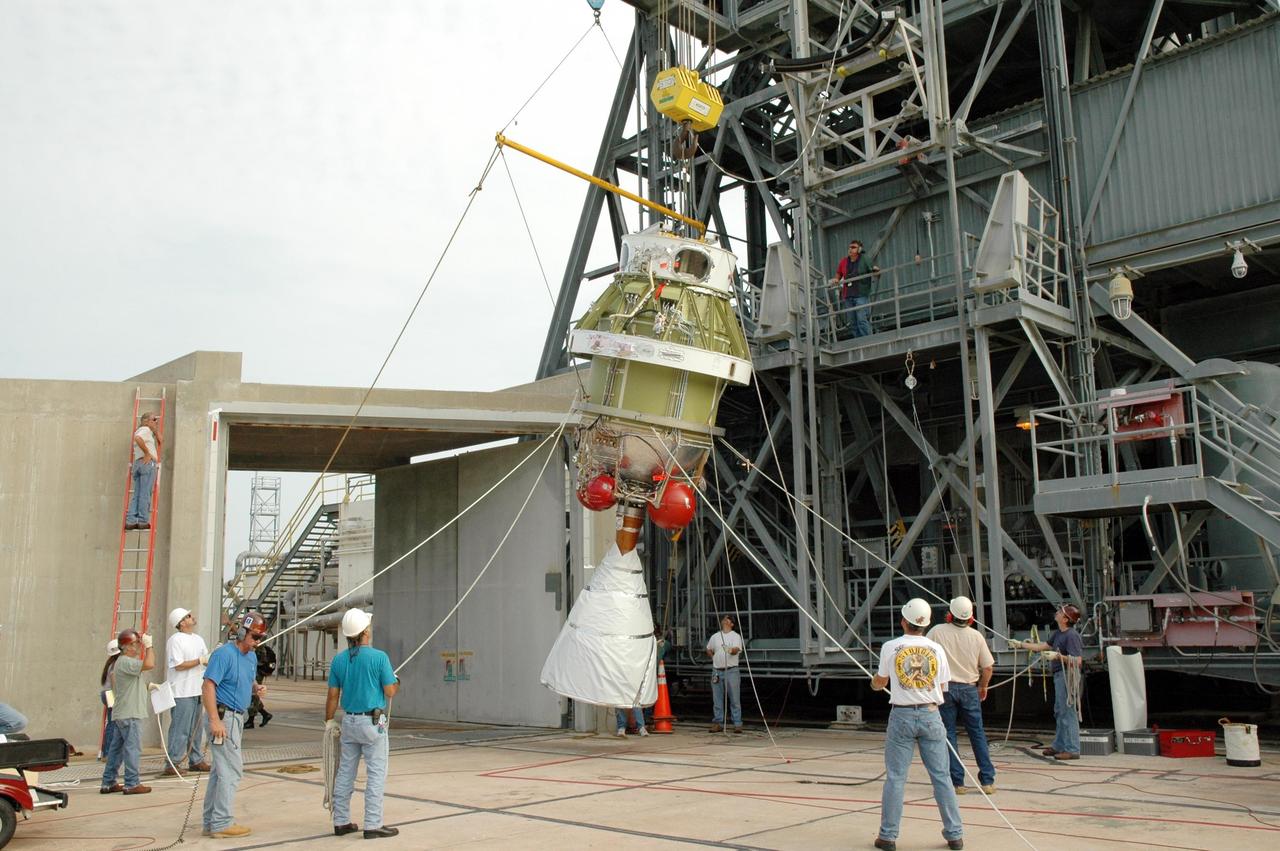
KENNEDY SPACE CENTER, FLA. - On Launch Pad 17-B at Cape Canaveral Air Force Station in Florida, workers maneuver the ropes tied to the second stage segment as it is being lowered to a horizontal position. It will be placed on a transporter and moved to the High-Pressure Test Facility for leak testing. The segment was destacked from the Delta II rocket in the mobile service tower. At the Boeing plant in Alabama, a leak was observed in the second-stage oxidizer tank for another Delta II that had been scheduled to launch in November; therefore, all identical tanks scheduled for launch in the near future are being checked. The second stage for the Delta II that will launch STEREO cannot be effectively tested while atop the first stage at Pad 17-B. STEREO stands for Solar Terrestrial Relations Observatory and comprises two spacecraft. The STEREO mission is the first to take measurements of the sun and solar wind in 3-dimension. This new view will improve our understanding of space weather and its impact on the Earth. STEREO is expected to lift off in late August 2006. Photo credit: NASA/Jim Grossmann
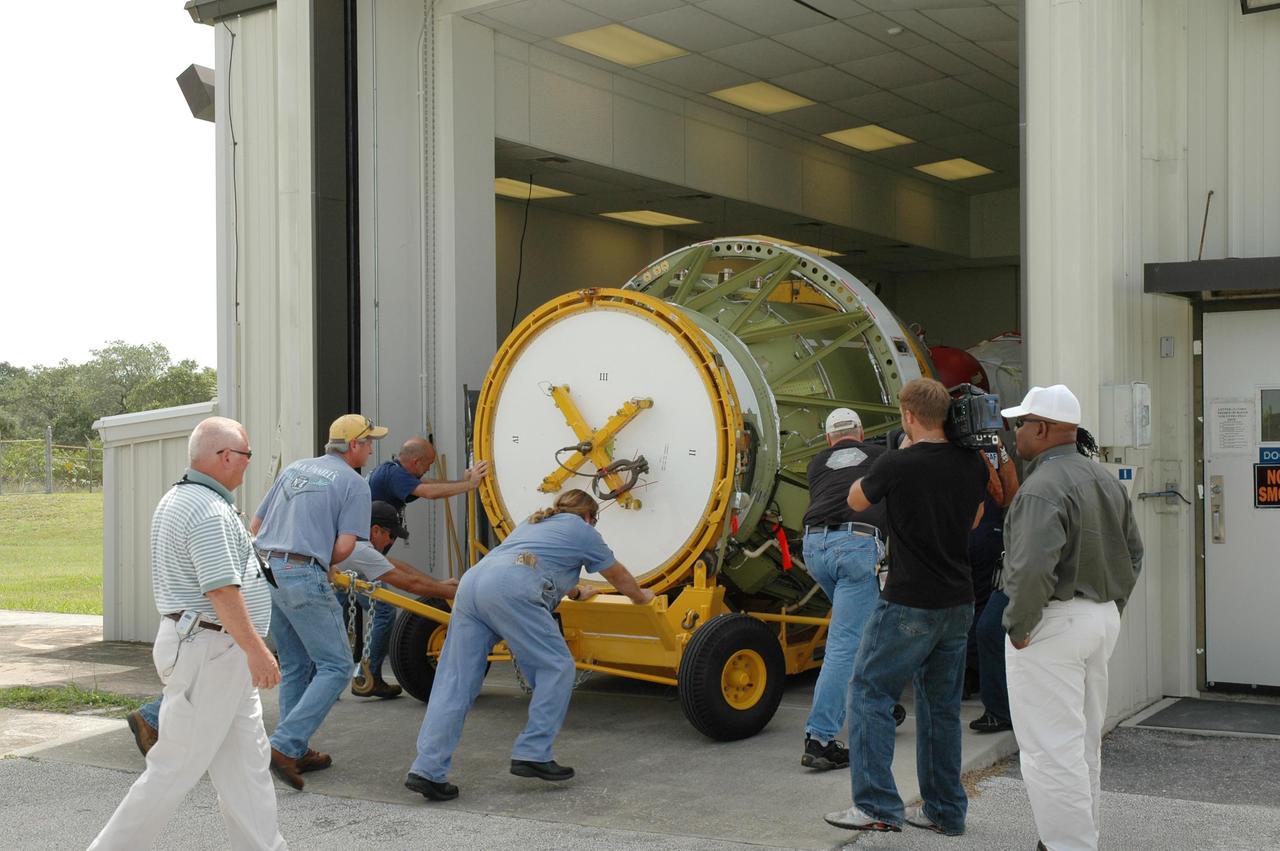
KENNEDY SPACE CENTER, FLA. - On Launch Pad 17-B at Cape Canaveral Air Force Station in Florida, workers maneuver the transporter carrying the second stage segment of a Delta II rocket into the High-Pressure Test Facility for leak testing. The segment was destacked from the Delta II rocket in the mobile service tower. At the Boeing plant in Alabama, a leak was observed in the second-stage oxidizer tank for another Delta II that had been scheduled to launch in November; therefore, all identical tanks scheduled for launch in the near future are being checked. The second stage for the Delta II that will launch STEREO cannot be effectively tested while atop the first stage at Pad 17-B. STEREO stands for Solar Terrestrial Relations Observatory and comprises two spacecraft. The STEREO mission is the first to take measurements of the sun and solar wind in 3-dimension. This new view will improve our understanding of space weather and its impact on the Earth. STEREO is expected to lift off in late August 2006. Photo credit: NASA/Jim Grossmann
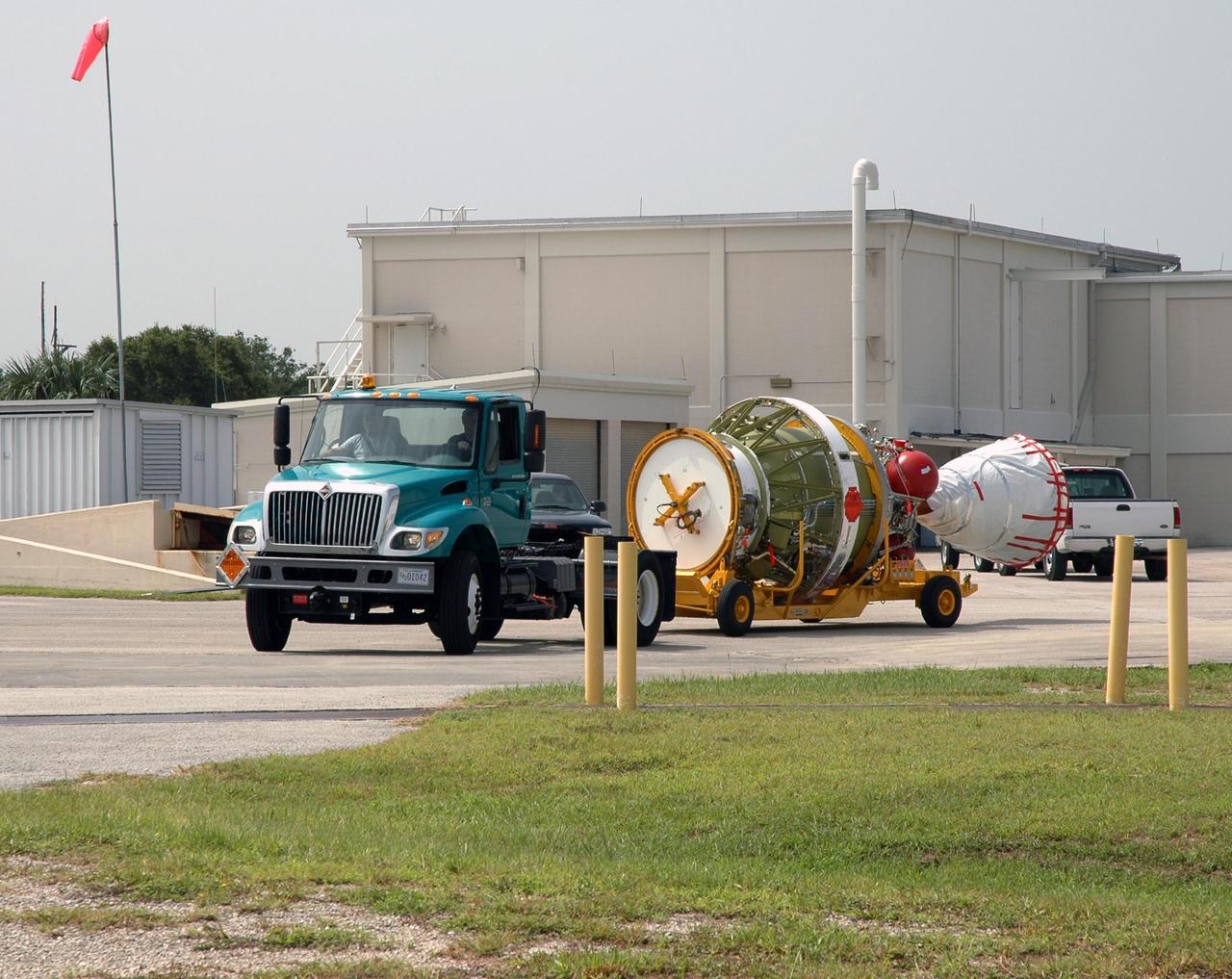
KENNEDY SPACE CENTER, FLA. - On Launch Pad 17-B at Cape Canaveral Air Force Station in Florida, the second stage segment of a Delta II rocket is being transported to the High-Pressure Test Facility for leak testing. The segment was destacked from the Delta II rocket in the mobile service tower. At the Boeing plant in Alabama, a leak was observed in the second-stage oxidizer tank for another Delta II that had been scheduled to launch in November; therefore, all identical tanks scheduled for launch in the near future are being checked. The second stage for the Delta II that will launch STEREO cannot be effectively tested while atop the first stage at Pad 17-B. STEREO stands for Solar Terrestrial Relations Observatory and comprises two spacecraft. The STEREO mission is the first to take measurements of the sun and solar wind in 3-dimension. This new view will improve our understanding of space weather and its impact on the Earth. STEREO is expected to lift off in late August 2006. Photo credit: NASA/Jim Grossmann