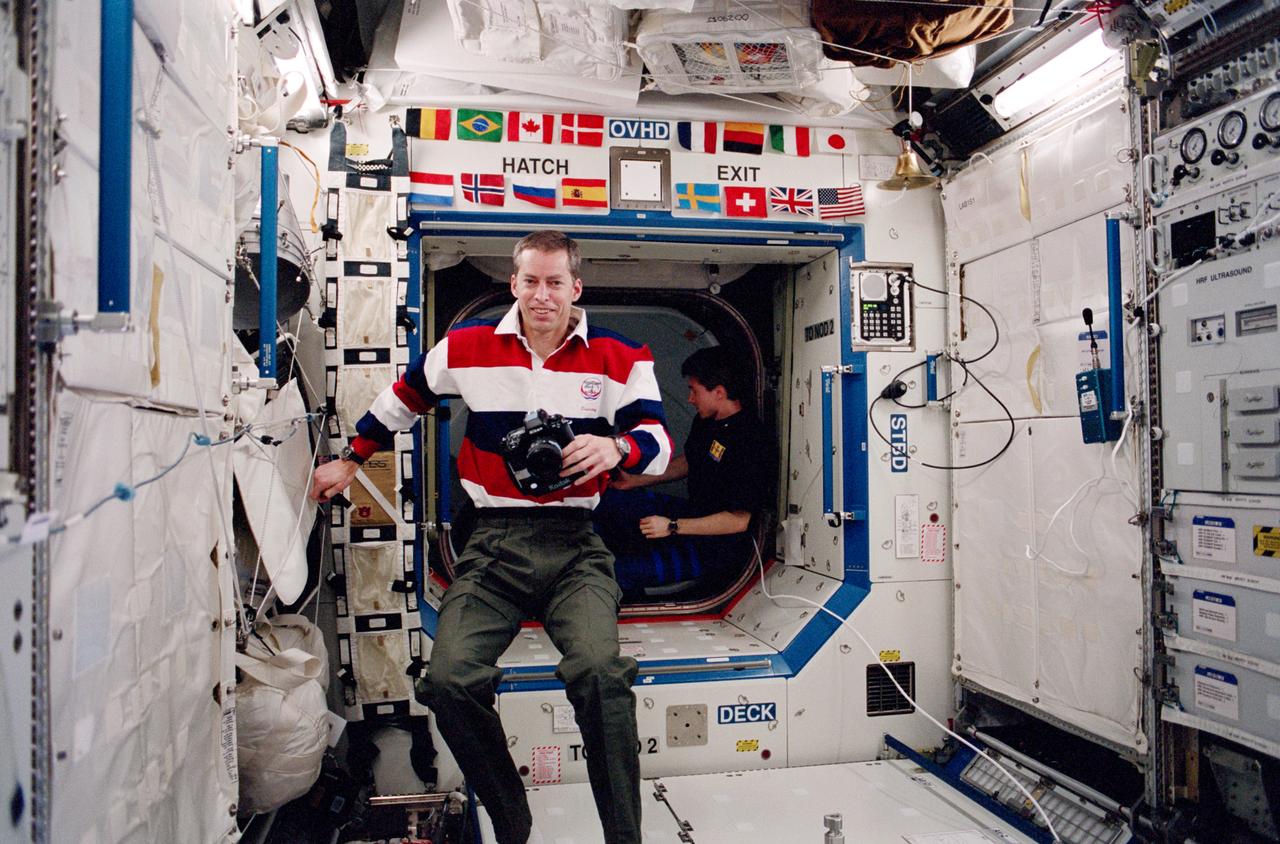
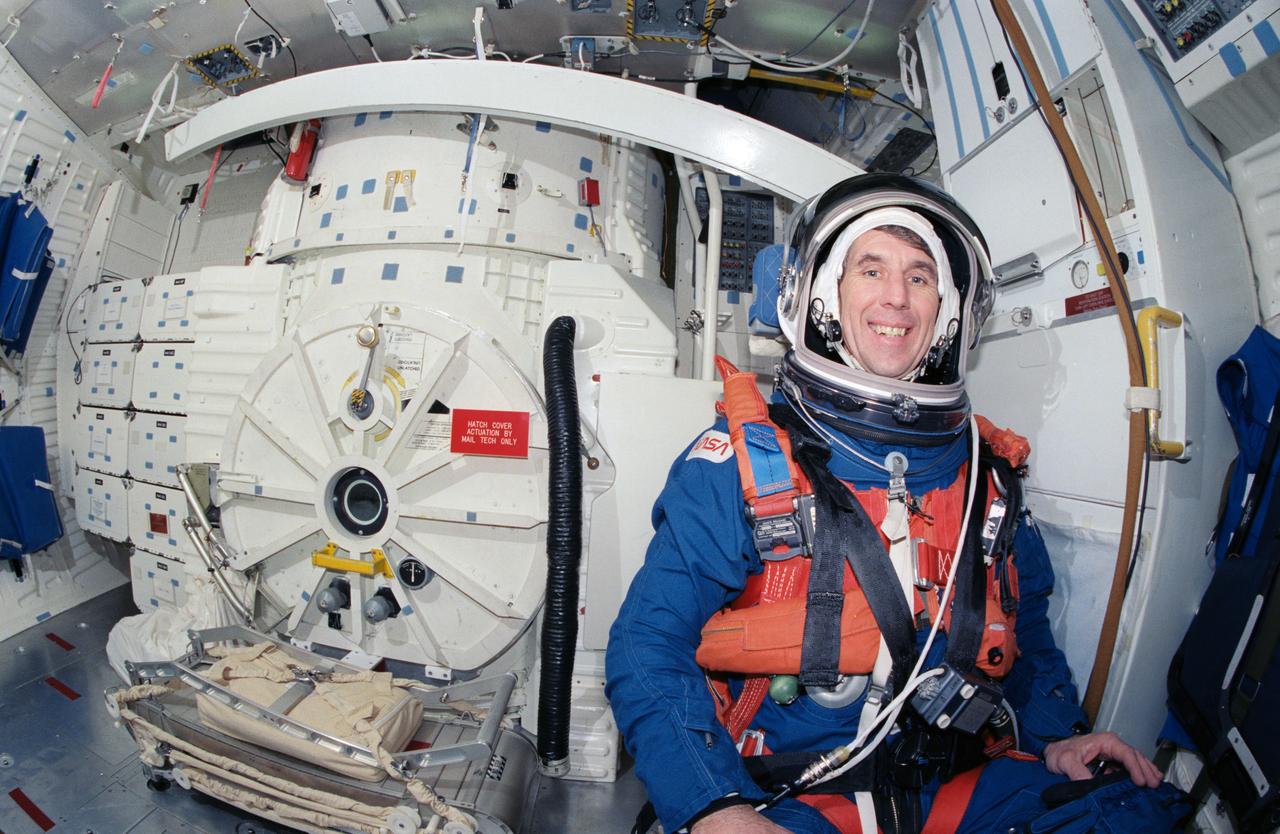
In this Space Shuttle STS-102 mission image, the Payload Equipment Restraint System H-Strap is shown at the left side of the U.S. Laboratory hatch and behind Astronaut James D. Weatherbee, mission specialist. PERS is an integrated modular system of components designed to assist the crew of the International Space Station (ISS) in restraining and carrying necessary payload equipment and tools in a microgravity environment. The Operations Development Group, Flight Projects Directorate at the Marshall Space Flight Center (MSFC), while providing operation support to the ISS Materials Science Research Facility (MSRF), recognized the need for an on-orbit restraint system to facilitate control of lose objects, payloads, and tools. The PERS is the offspring of that need and it helps the ISS crew manage tools and rack components that would otherwise float away in the near-zero gravity environment aboard the Space Station. The system combines Kevlar straps, mesh pockets, Velcro and a variety of cornecting devices into a portable, adjustable system. The system includes the Single Strap, the H-Strap, the Belly Pack, the Laptop Restraint Belt, and the Tool Page Case. The Single Strap and the H-Strap were flown on this mission. The PERS concept was developed by industrial design students at Auburn University and the MSFC Flight Projects Directorate.
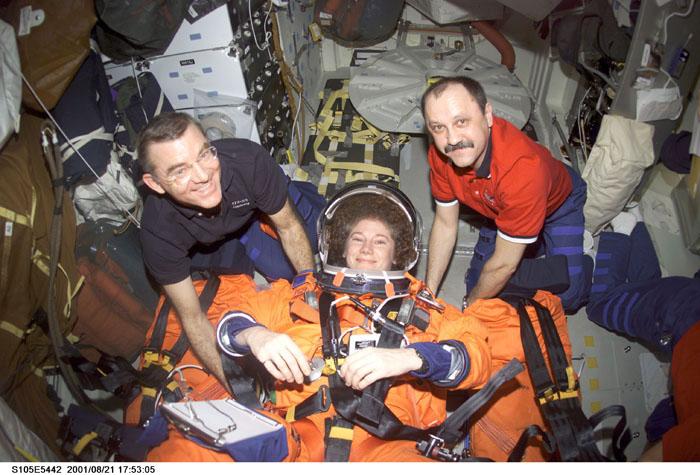
STS105-E-5442 (21 August 2001) --- As they near completion of their mission, the Expedition Two crew members prepare for the descent back to Earth. Astronaut James S. Voss (left), flight engineer, and cosmonaut Yury V. Usachev (right), mission commander, strap astronaut Susan J. Helms, flight engineer, into her seat on the mid deck of the Space Shuttle Discovery. Voss and Helms, representing NASA, and Usachev, representing Rosaviakosmos, are returning to Earth after completing their five-month assignment aboard the International Space Station (ISS). This image was recorded with a digital still camera.

Scientist-Astronaut Joseph P. Kerwin, Skylab 2 science pilot, is photographed strapped into the sleep restraint in the crew quarters of the Orbital Workshop of the Skylab 1 and 2 space station cluster in Earth orbit. Kerwin is wearing the special cap which contains biomedical instrumentation for the M133 Sleep Monitoring Experiment. The purpose of the M133 experiment is to evaluate quantity and quality of sleep during prolonged space flight by the analysis of electroencephalographic (EEG) and electrooculographic (EOG) activity.
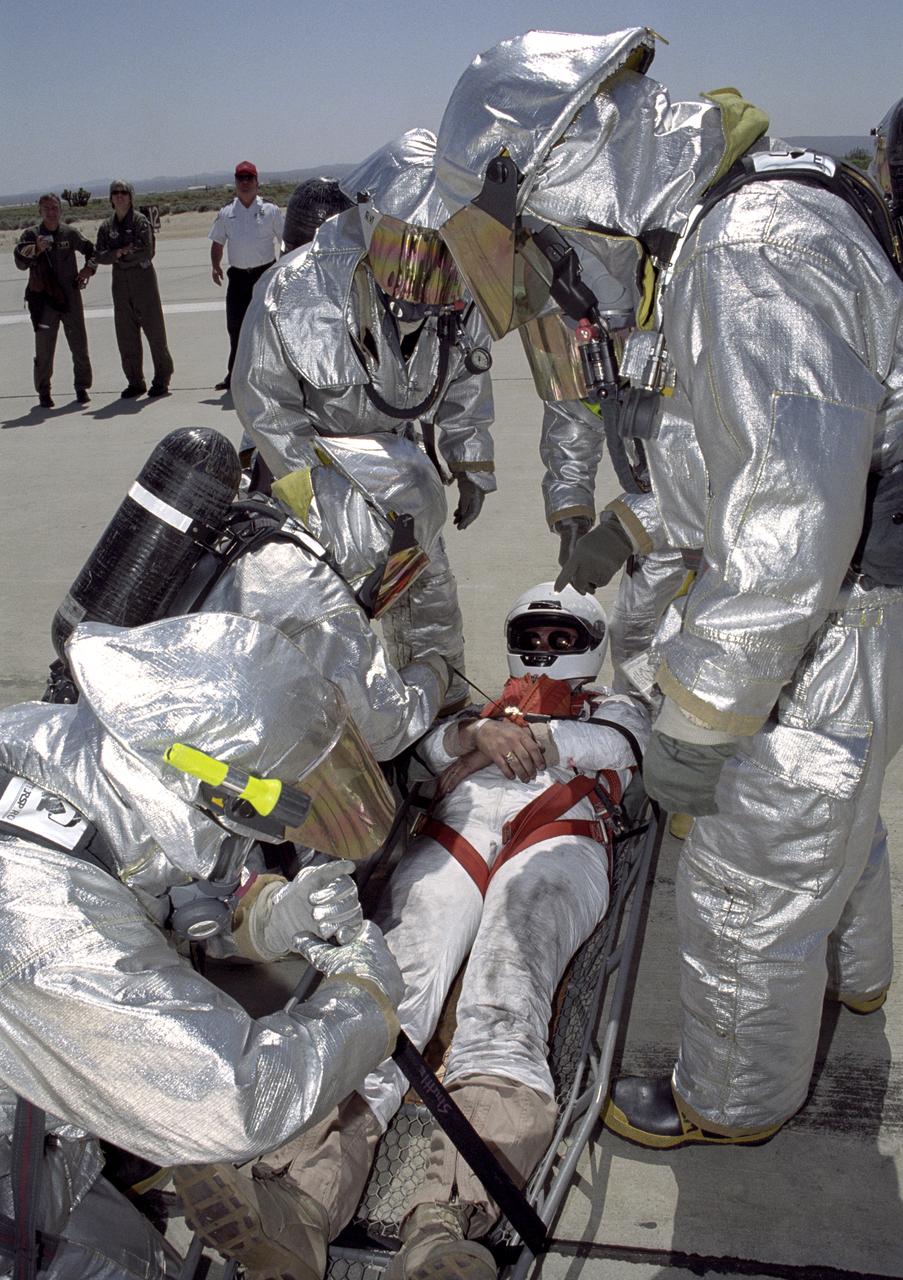
Clad in full thermal protection suits, Air Force fire-rescue crews strap a stand-in "astronaut" into a litter during a Space Shuttle rescue training exercise at Edwards AFB.
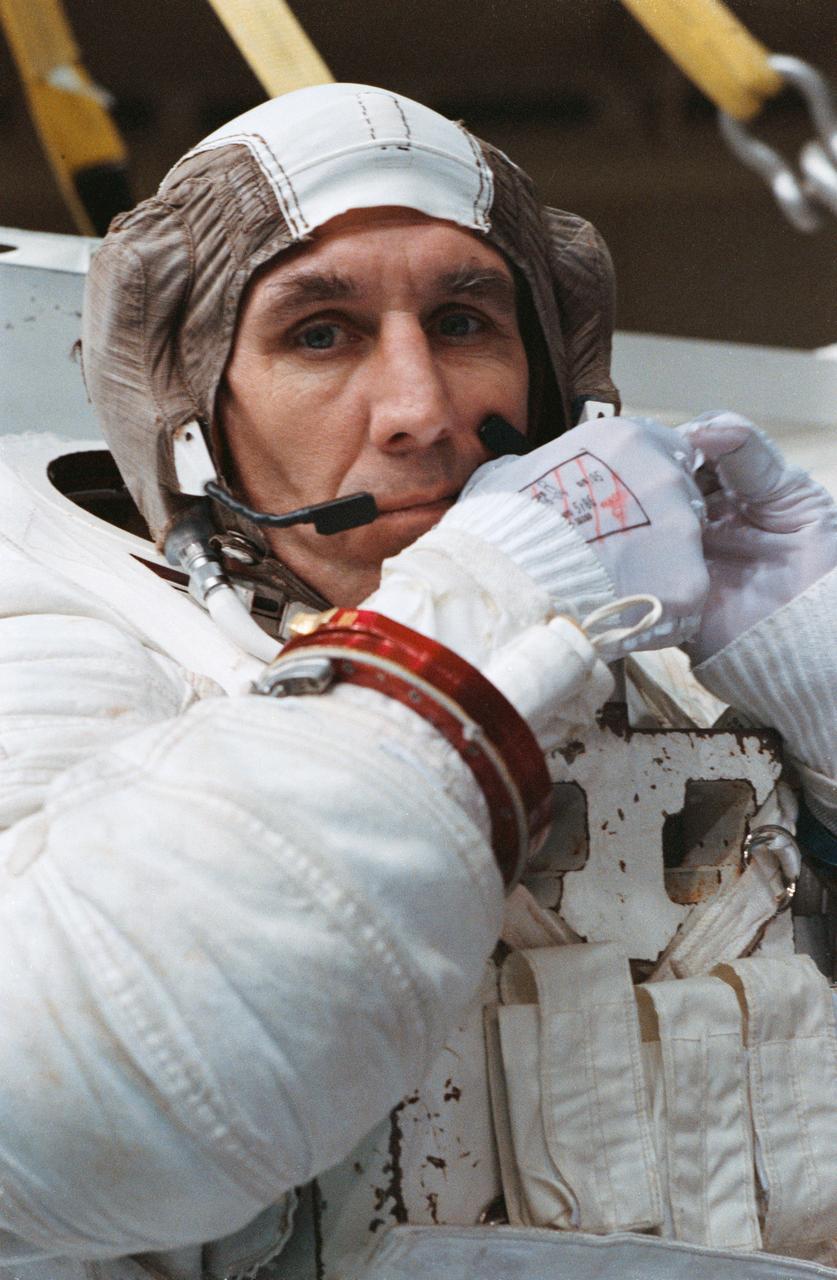
STS-38 Mission Specialist (MS) Robert C. Springer, wearing extravehicular mobility unit (EMU), fastens the strap on his communications carrier assembly (CCA) cap during suit donning in JSC's Weightless Environment Training Facility (WETF) Bldg 29. Positioned on the WETF platform at pool side, Springer is preparing for an underwater extravehicular activity (EVA) simulation. During the training exercise, Springer will rehearse contingency EVA procedures for the STS-38 mission aboard Atlantis, Orbiter Vehicle (OV) 104.
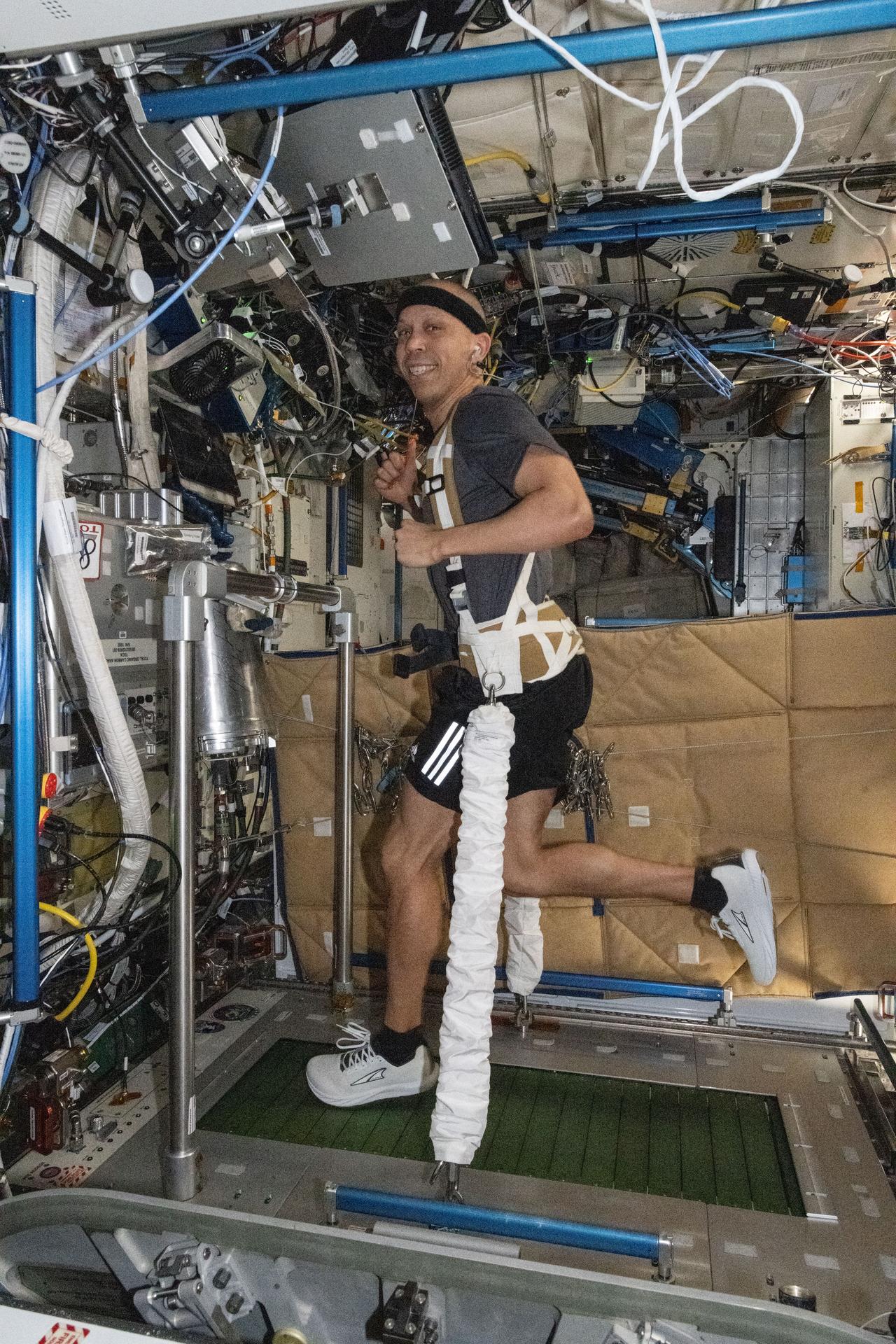
iss074e0792349 (June 7 ,2026) --- NASA astronaut and Expedition 74 flight engineer Chris Williams jogs while strapped to the treadmill inside the International Space Station's Tranquility module. The treadmill, formally known as COLBERT (Combined Operational Load-Bearing External Resistance Treadmill), is specifically designed to enable jogging and maintain cardiovascular health in microgravity. Williams is wearing a heart-rate monitor that uses Bluetooth to transmit his cardiac data to a computer tablet for analysis by doctors on Earth. Credit: NASA
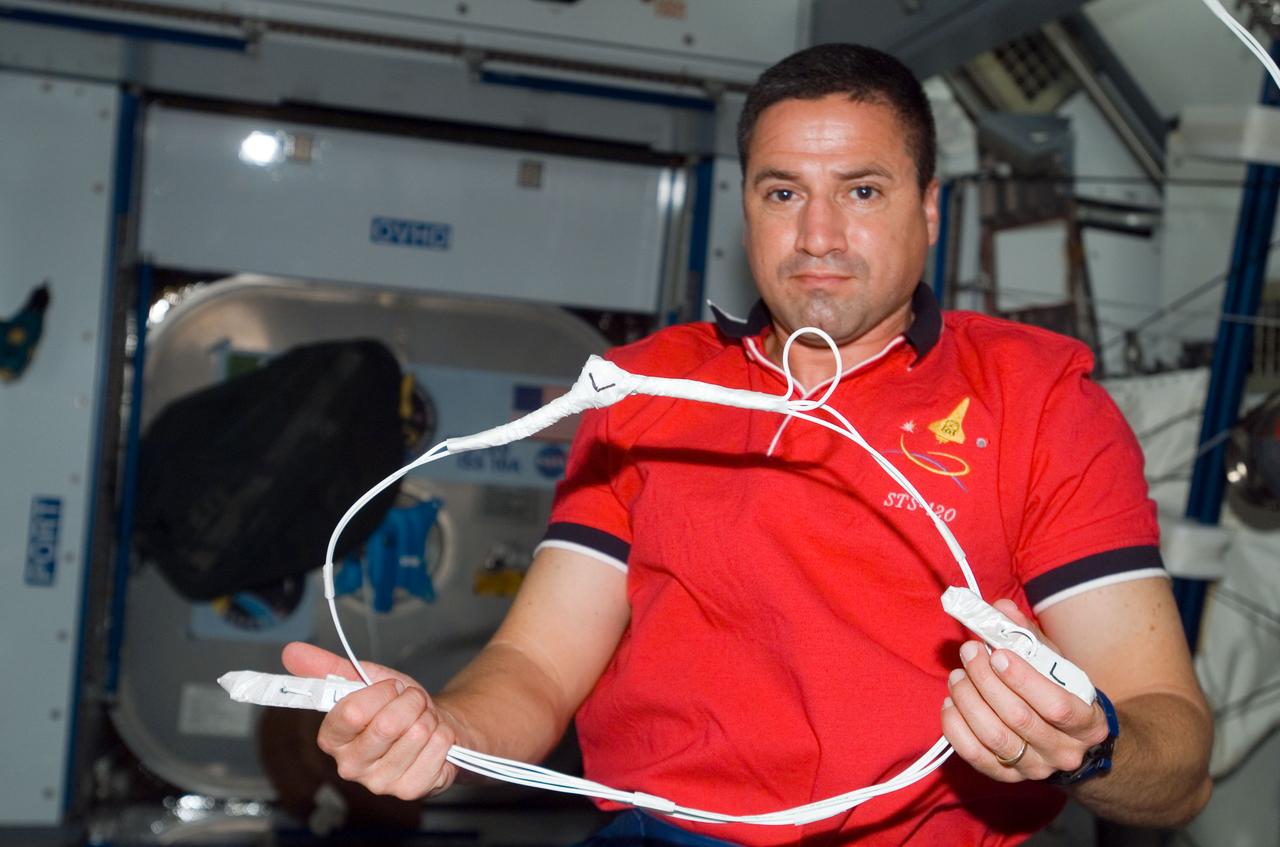
ISS016-E-008015 (1 Nov. 2007) --- Astronaut George Zamka, STS-120 pilot, holds a "cufflink" apparatus in the Harmony node of the International Space Station, which will be attached to the damaged solar arrays and take the structural load off of the broken hinge during the next spacewalk while Space Shuttle Discovery is docked with the station.
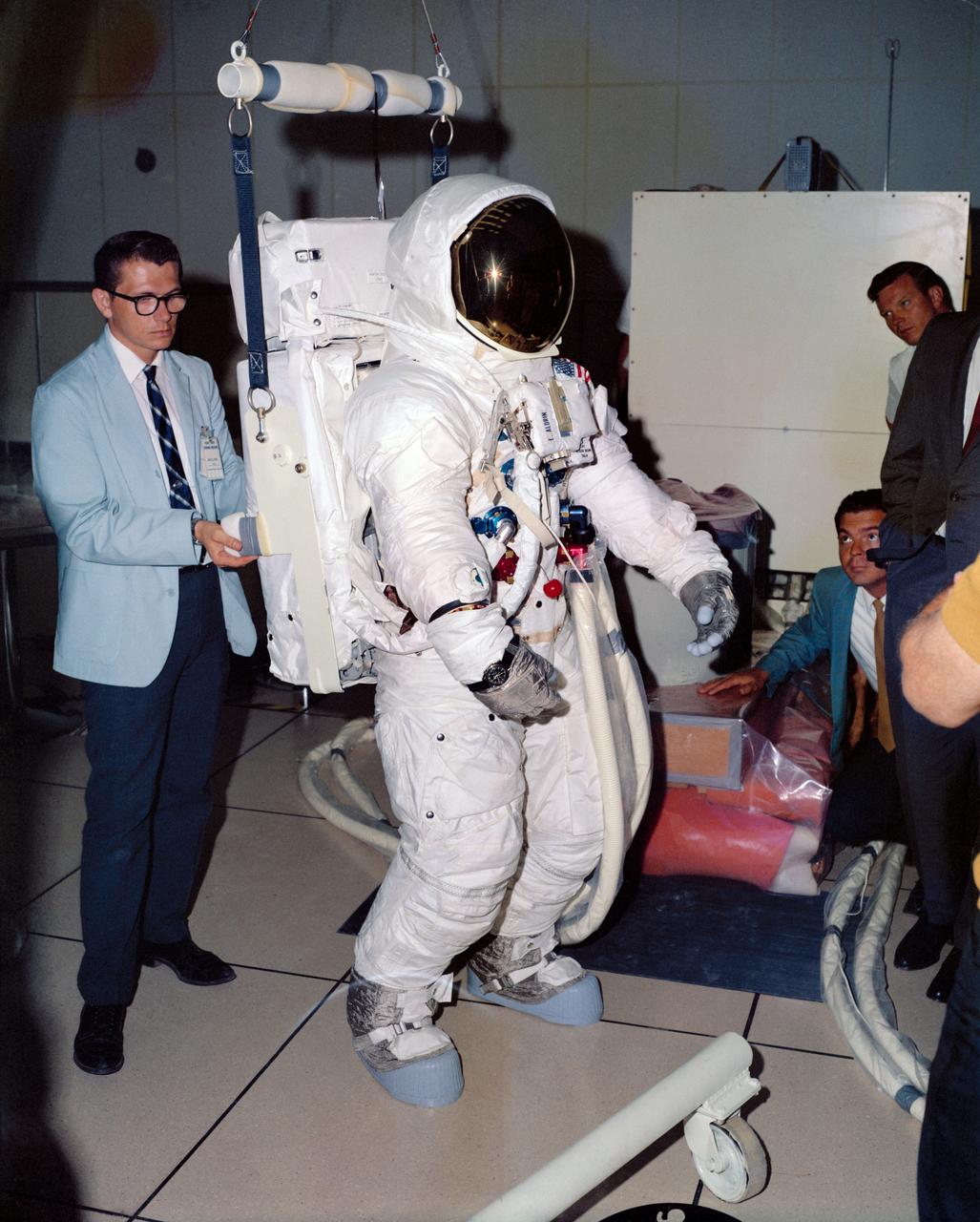
Astronaut Edwin E. Aldrin Jr., wearing an Extravehicular Mobility Unit (EMU), verifies fit of the Portable Life Support System (PLSS) strap length during lunar surface training at the Kennedy Space Center. Aldrin is the prime crew lunar module pilot of the Apollo 11 lunar landing mission. Aldrin's PLSS backpack is attached to a lunar weight simulator.
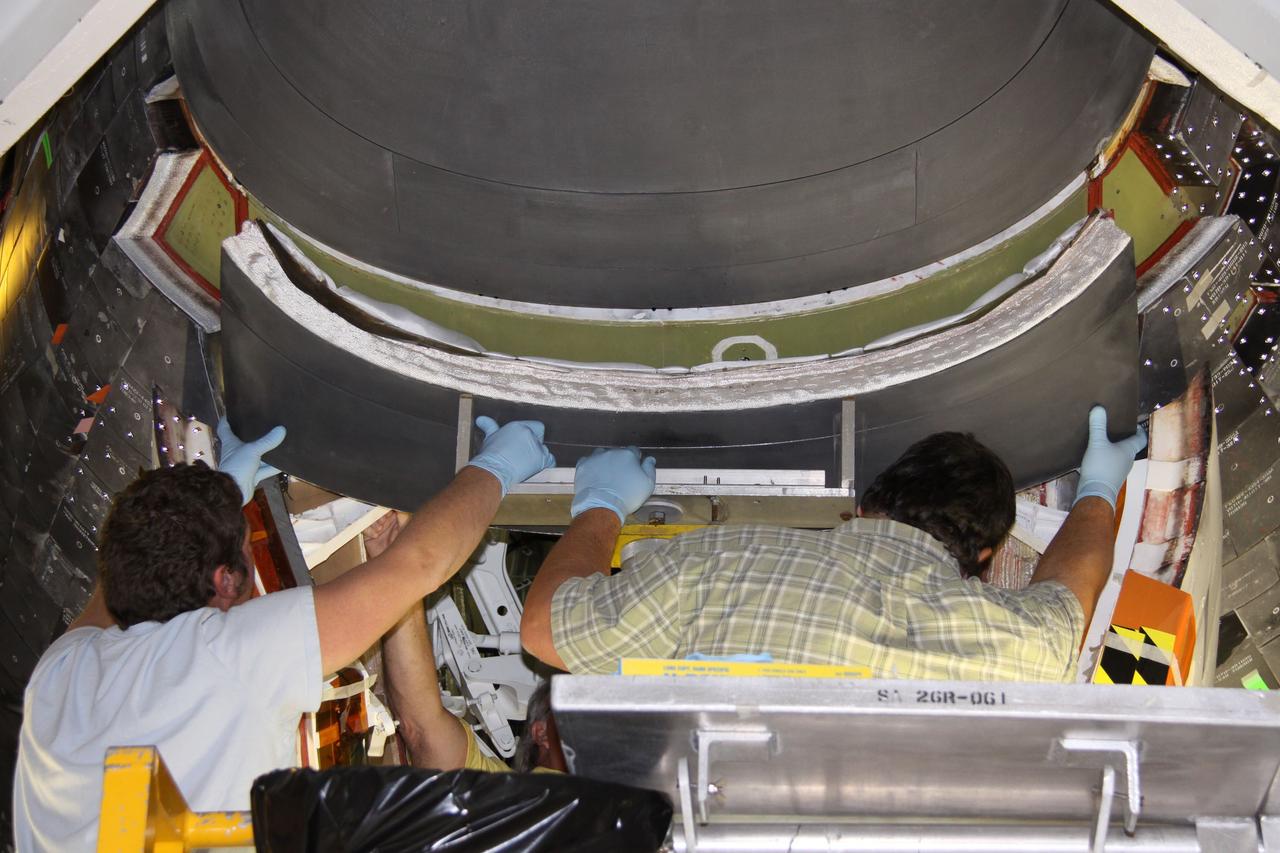
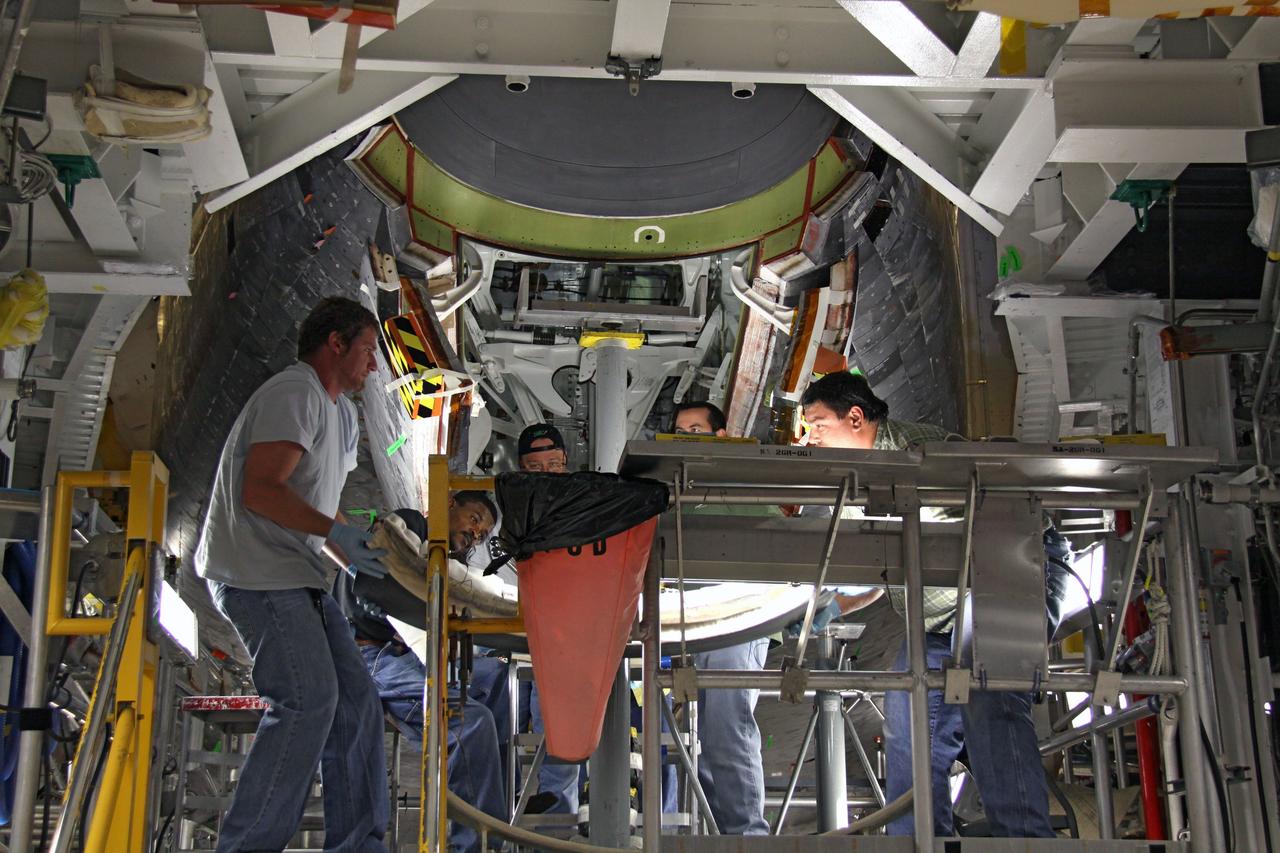
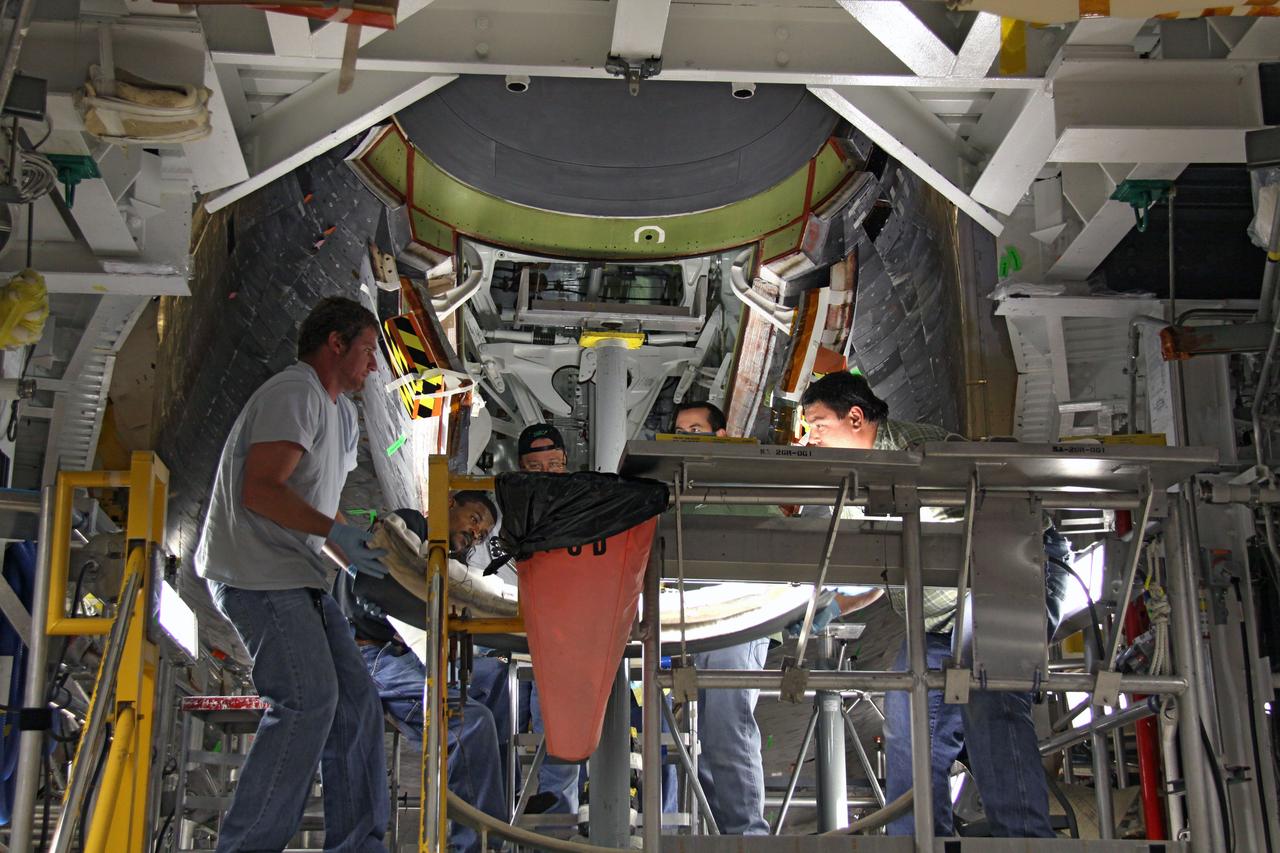
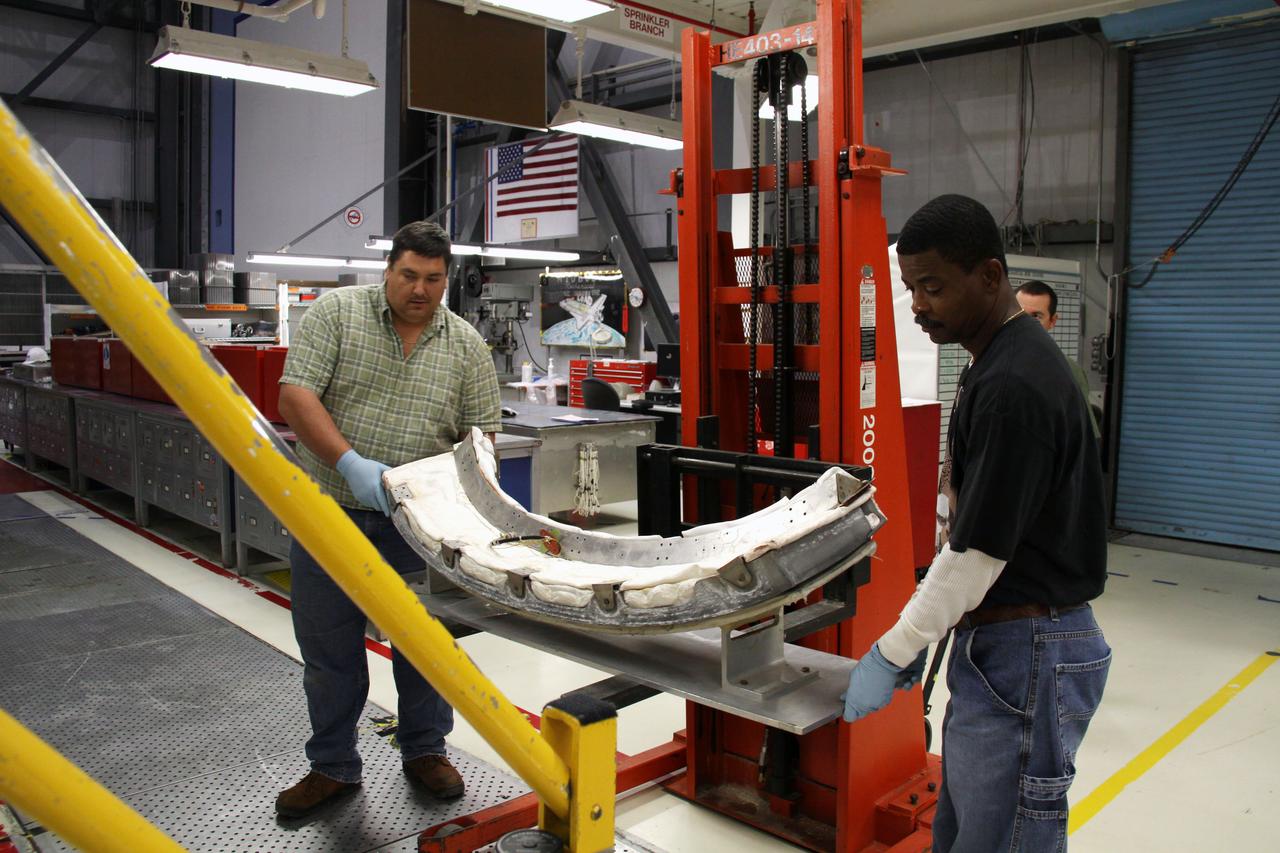
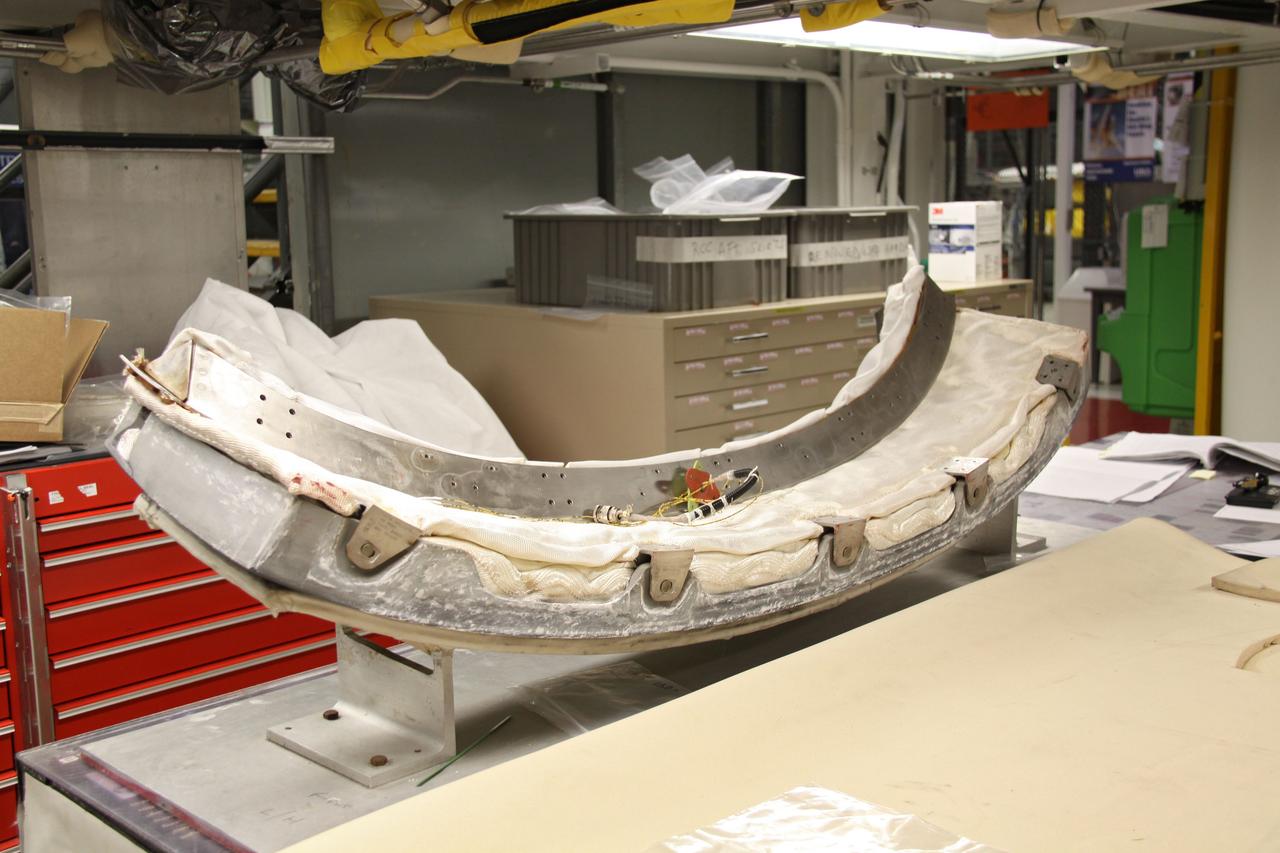
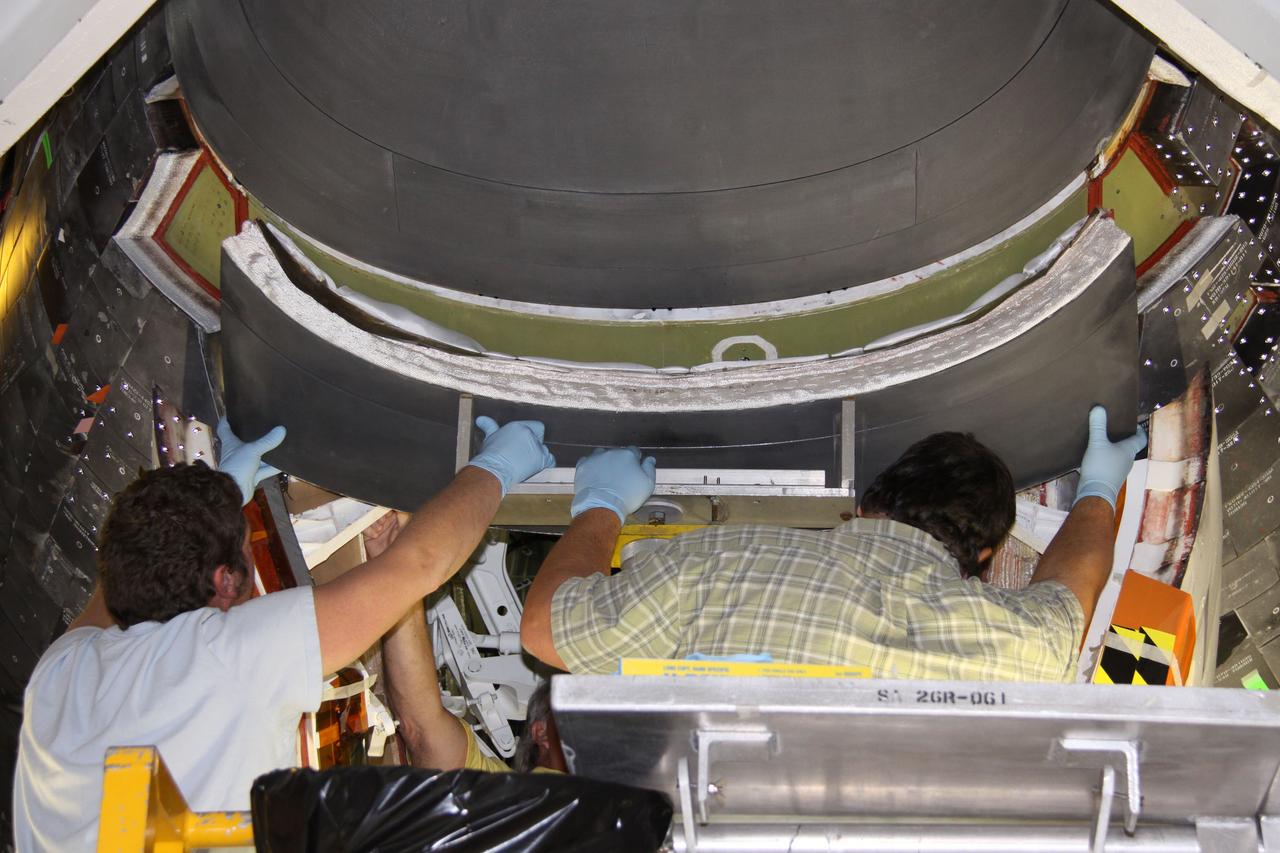
CAPE CANAVERAL, Fla. - In Orbiter Processing Facility 1 at NASA's Kennedy Space Center in Florida, United Space Alliance technicians determine the proper placement for the chin panel being installed on space shuttle Atlantis. The chin panel is a semicircular-shaped section of reinforced carbon-carbon that fits under the shuttle's nose cap and is part of its thermal protection system. Atlantis is next slated to deliver an Integrated Cargo Carrier and Russian-built Mini Research Module to the International Space Station on the STS-132 mission. The second in a series of new pressurized components for Russia, the module will be permanently attached to the Zarya module. Three spacewalks are planned to store spare components outside the station, including six spare batteries, a boom assembly for the Ku-band antenna and spares for the Canadian Dextre robotic arm extension. A radiator, airlock and European robotic arm for the Russian Multi-purpose Laboratory Module also are payloads on the flight. Launch is targeted for May 14, 2010. Photo credit: NASA/Ben Smegelsky
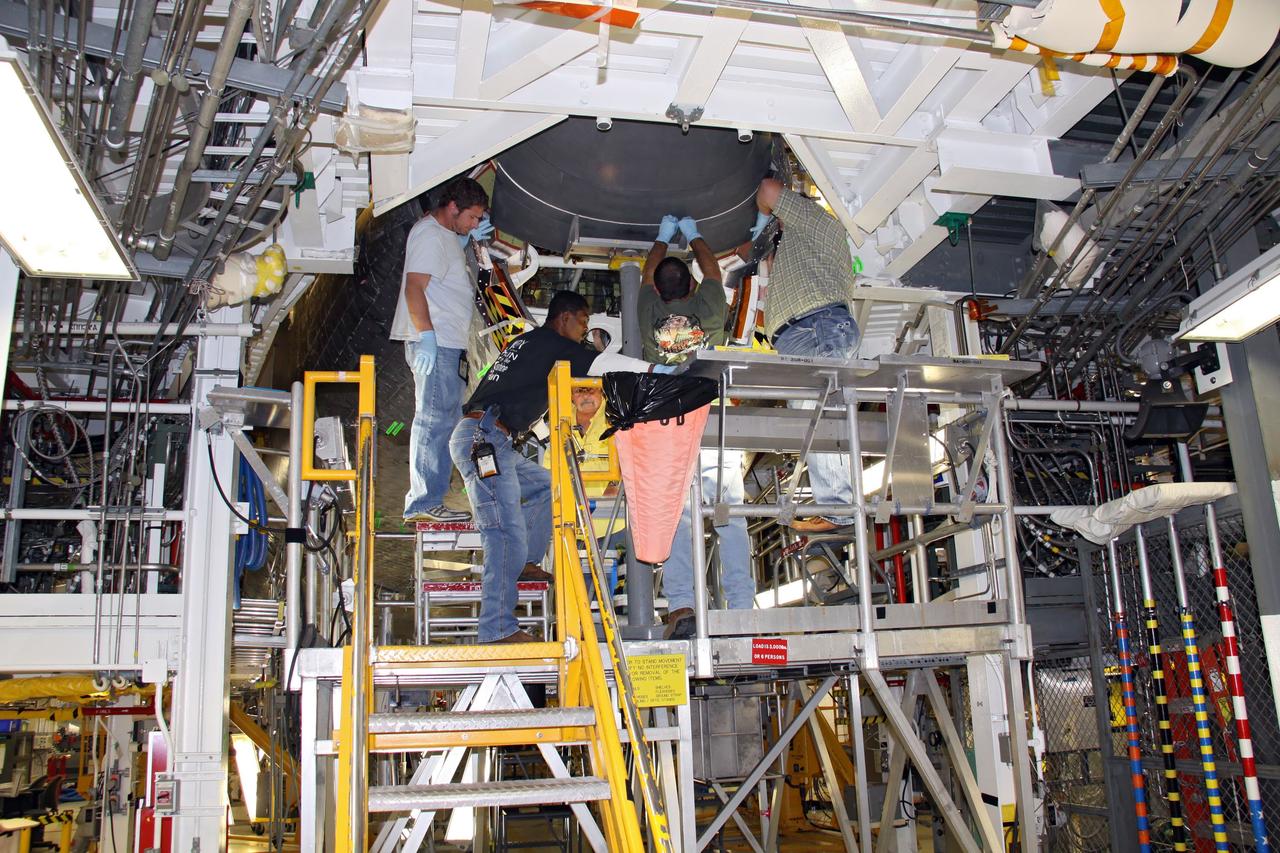
CAPE CANAVERAL, Fla. - In Orbiter Processing Facility 1 at NASA's Kennedy Space Center in Florida, a team of United Space Alliance technicians lifts the chin panel toward space shuttle Atlantis for installation. The chin panel is a semicircular-shaped section of reinforced carbon-carbon that fits under the shuttle's nose cap and is part of its thermal protection system. Atlantis is next slated to deliver an Integrated Cargo Carrier and Russian-built Mini Research Module to the International Space Station on the STS-132 mission. The second in a series of new pressurized components for Russia, the module will be permanently attached to the Zarya module. Three spacewalks are planned to store spare components outside the station, including six spare batteries, a boom assembly for the Ku-band antenna and spares for the Canadian Dextre robotic arm extension. A radiator, airlock and European robotic arm for the Russian Multi-purpose Laboratory Module also are payloads on the flight. Launch is targeted for May 14, 2010. Photo credit: NASA/Ben Smegelsky
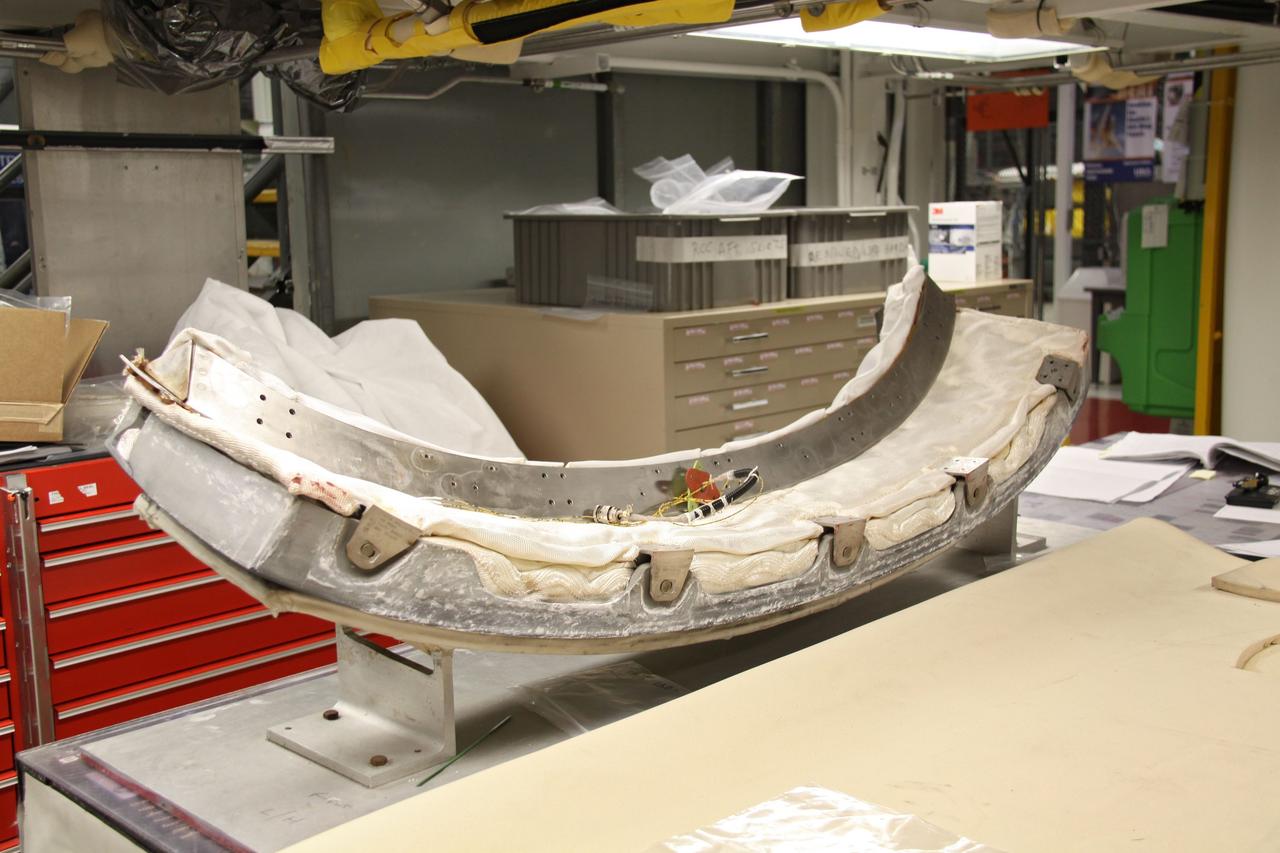
CAPE CANAVERAL, Fla. - In Orbiter Processing Facility 1 at NASA's Kennedy Space Center in Florida, preparations are under way to install the chin panel on space shuttle Atlantis. The chin panel is a semicircular-shaped section of reinforced carbon-carbon that fits under the shuttle's nose cap and is part of its thermal protection system. Atlantis is next slated to deliver an Integrated Cargo Carrier and Russian-built Mini Research Module to the International Space Station on the STS-132 mission. The second in a series of new pressurized components for Russia, the module will be permanently attached to the Zarya module. Three spacewalks are planned to store spare components outside the station, including six spare batteries, a boom assembly for the Ku-band antenna and spares for the Canadian Dextre robotic arm extension. A radiator, airlock and European robotic arm for the Russian Multi-purpose Laboratory Module also are payloads on the flight. Launch is targeted for May 14, 2010. Photo credit: NASA/Troy Cryder
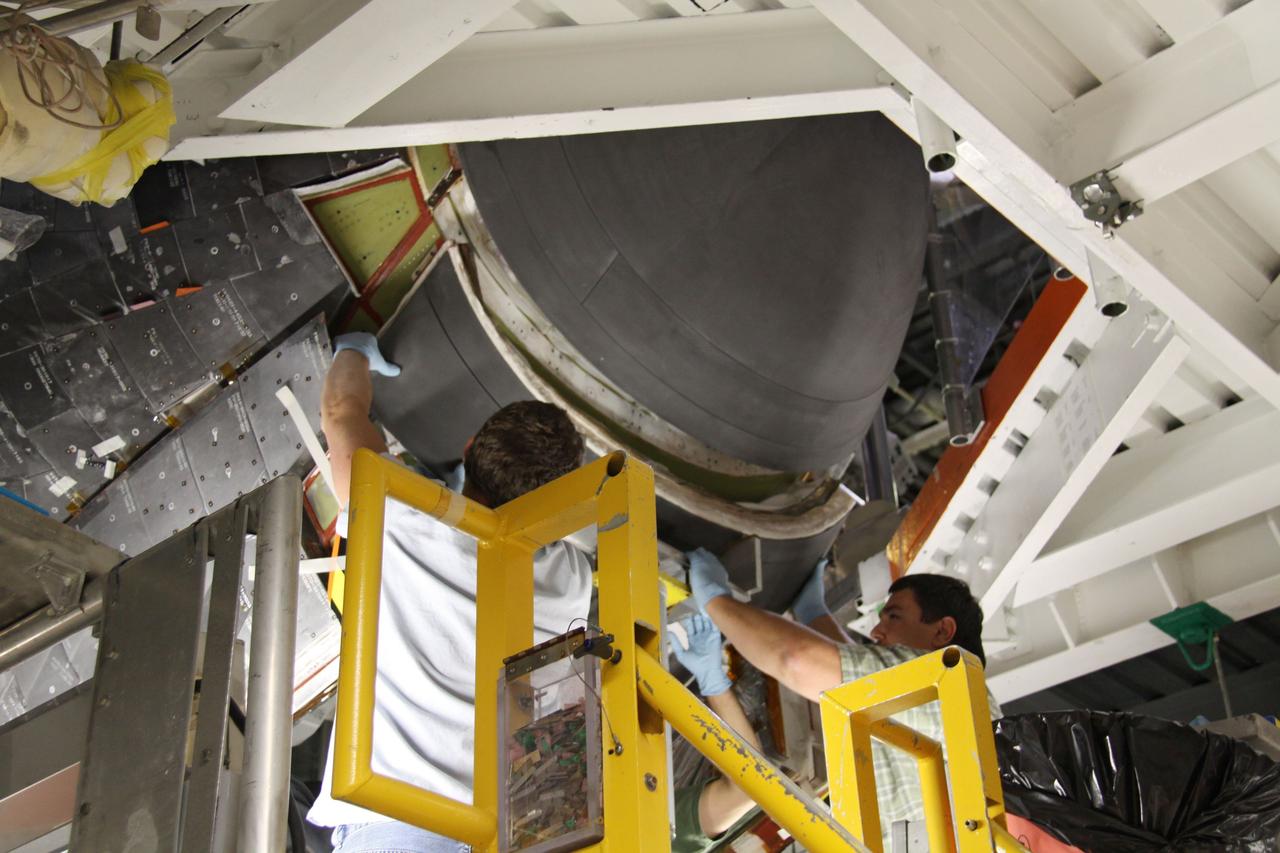
CAPE CANAVERAL, Fla. - In Orbiter Processing Facility 1 at NASA's Kennedy Space Center in Florida, a team of United Space Alliance technicians installs the chin panel on space shuttle Atlantis. The chin panel is a semicircular-shaped section of reinforced carbon-carbon that fits under the shuttle's nose cap and is part of its thermal protection system. Atlantis is next slated to deliver an Integrated Cargo Carrier and Russian-built Mini Research Module to the International Space Station on the STS-132 mission. The second in a series of new pressurized components for Russia, the module will be permanently attached to the Zarya module. Three spacewalks are planned to store spare components outside the station, including six spare batteries, a boom assembly for the Ku-band antenna and spares for the Canadian Dextre robotic arm extension. A radiator, airlock and European robotic arm for the Russian Multi-purpose Laboratory Module also are payloads on the flight. Launch is targeted for May 14, 2010. Photo credit: NASA/Ben Smegelsky
CAPE CANAVERAL, Fla. - In Orbiter Processing Facility 1 at NASA's Kennedy Space Center in Florida, United Space Alliance technicians position the chin panel on space shuttle Atlantis for installation. The chin panel is a semicircular-shaped section of reinforced carbon-carbon that fits under the shuttle's nose cap and is part of its thermal protection system. Atlantis is next slated to deliver an Integrated Cargo Carrier and Russian-built Mini Research Module to the International Space Station on the STS-132 mission. The second in a series of new pressurized components for Russia, the module will be permanently attached to the Zarya module. Three spacewalks are planned to store spare components outside the station, including six spare batteries, a boom assembly for the Ku-band antenna and spares for the Canadian Dextre robotic arm extension. A radiator, airlock and European robotic arm for the Russian Multi-purpose Laboratory Module also are payloads on the flight. Launch is targeted for May 14, 2010. Photo credit: NASA/Ben Smegelsky
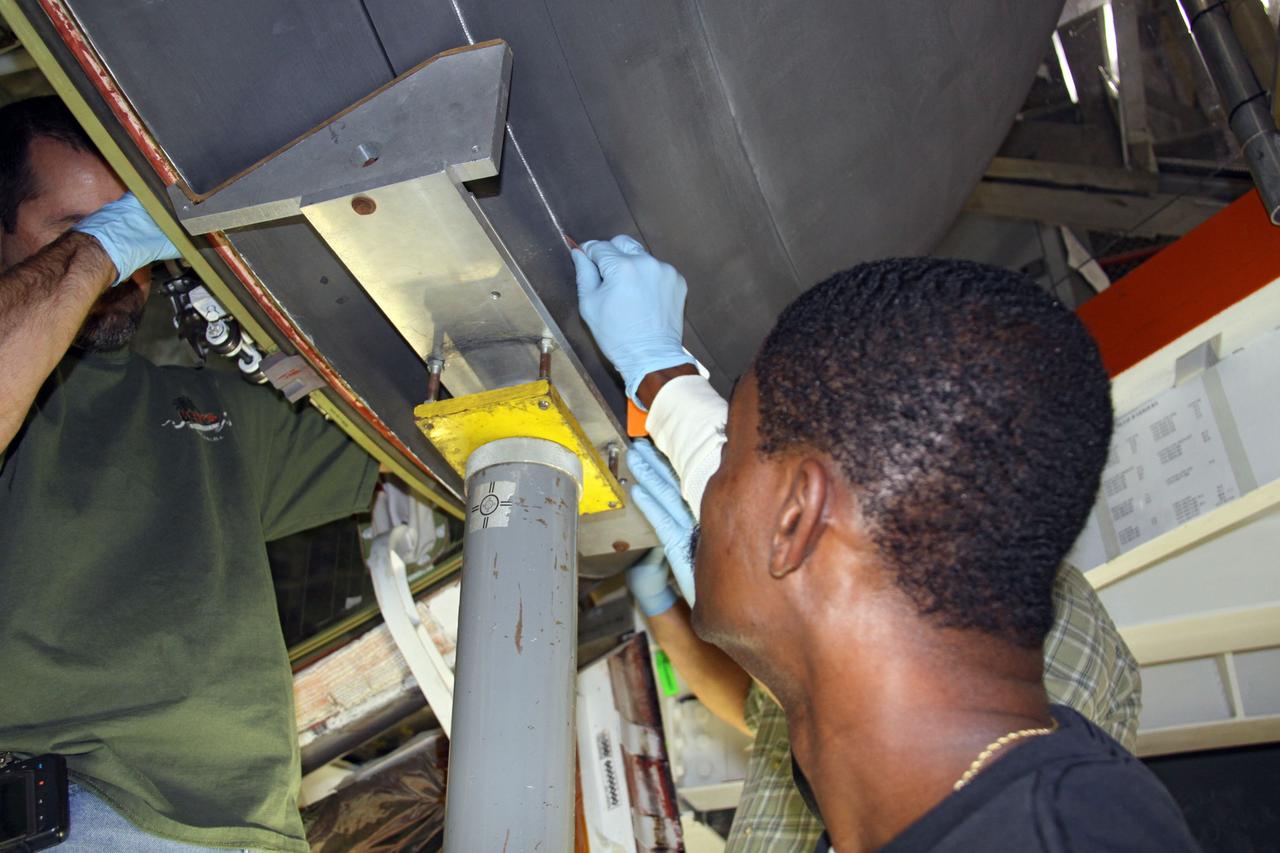
CAPE CANAVERAL, Fla. - In Orbiter Processing Facility 1 at NASA's Kennedy Space Center in Florida, United Space Alliance technicians complete the installation of the chin panel on space shuttle Atlantis. The chin panel is a semicircular-shaped section of reinforced carbon-carbon that fits under the shuttle's nose cap and is part of its thermal protection system. Atlantis is next slated to deliver an Integrated Cargo Carrier and Russian-built Mini Research Module to the International Space Station on the STS-132 mission. The second in a series of new pressurized components for Russia, the module will be permanently attached to the Zarya module. Three spacewalks are planned to store spare components outside the station, including six spare batteries, a boom assembly for the Ku-band antenna and spares for the Canadian Dextre robotic arm extension. A radiator, airlock and European robotic arm for the Russian Multi-purpose Laboratory Module also are payloads on the flight. Launch is targeted for May 14, 2010. Photo credit: NASA/Ben Smegelsky
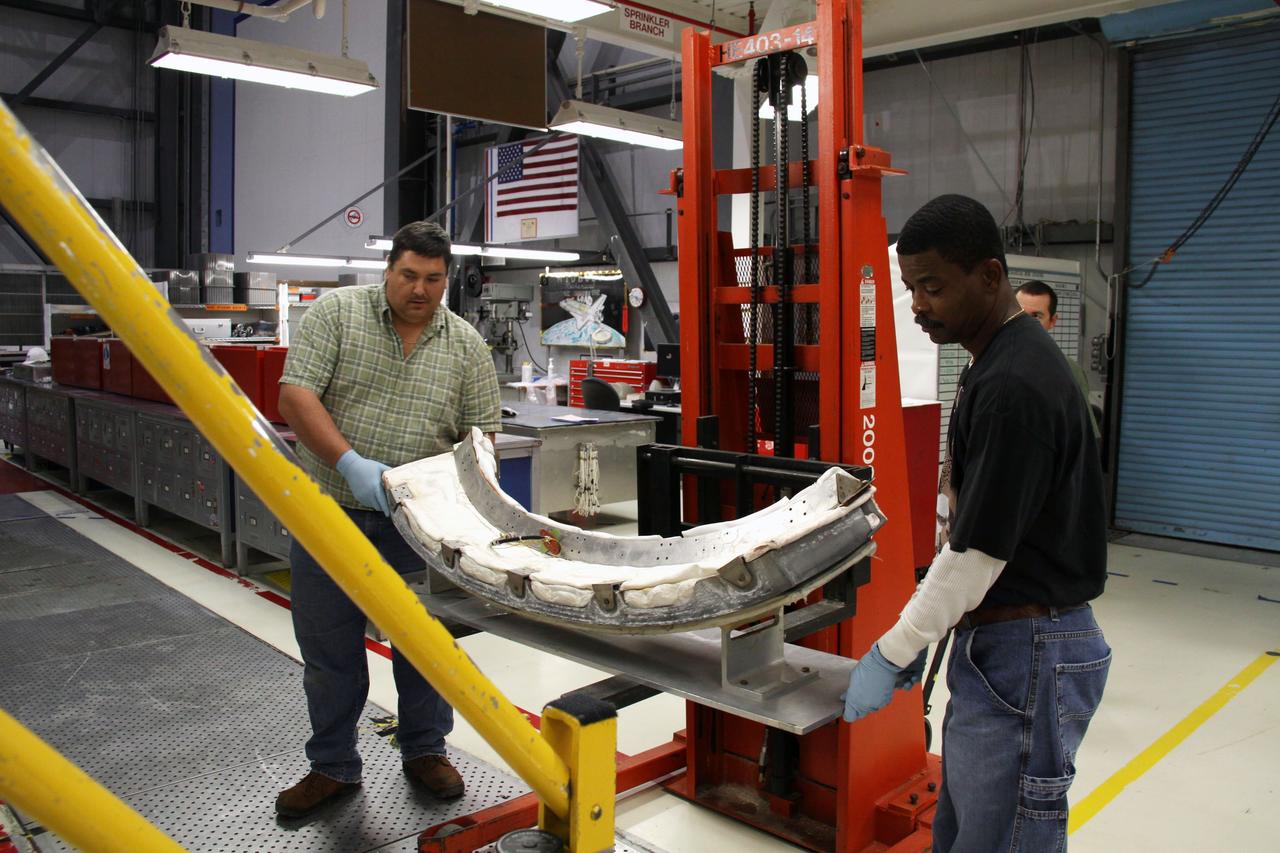
CAPE CANAVERAL, Fla. - In Orbiter Processing Facility 1 at NASA's Kennedy Space Center in Florida, United Space Alliance technicians prepare to install the chin panel on space shuttle Atlantis. The chin panel is a semicircular-shaped section of reinforced carbon-carbon that fits under the shuttle's nose cap and is part of its thermal protection system. Atlantis is next slated to deliver an Integrated Cargo Carrier and Russian-built Mini Research Module to the International Space Station on the STS-132 mission. The second in a series of new pressurized components for Russia, the module will be permanently attached to the Zarya module. Three spacewalks are planned to store spare components outside the station, including six spare batteries, a boom assembly for the Ku-band antenna and spares for the Canadian Dextre robotic arm extension. A radiator, airlock and European robotic arm for the Russian Multi-purpose Laboratory Module also are payloads on the flight. Launch is targeted for May 14, 2010. Photo credit: NASA/Ben Smegelsky
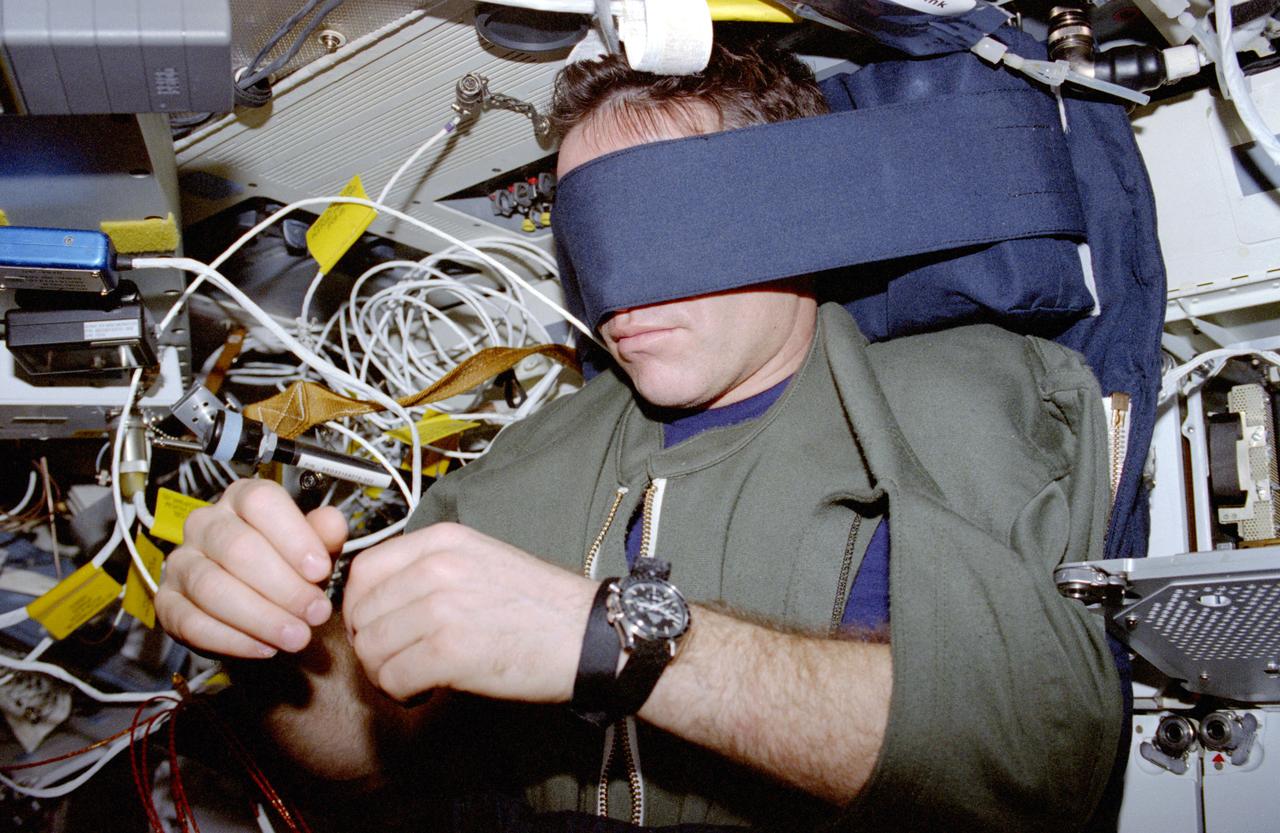
STS087-323-030 (19 November – 5 December 1997) --- Ukrainian payload specialist Leonid K. Kadenyuk blocks out the world and much more as he sleeps on the mid-deck of the Earth-orbiting Space Shuttle Columbia. Kadenyuk joined five NASA astronauts for 16 days aboard Columbia in support of the United States Microgravity Payload (USMP) mission.
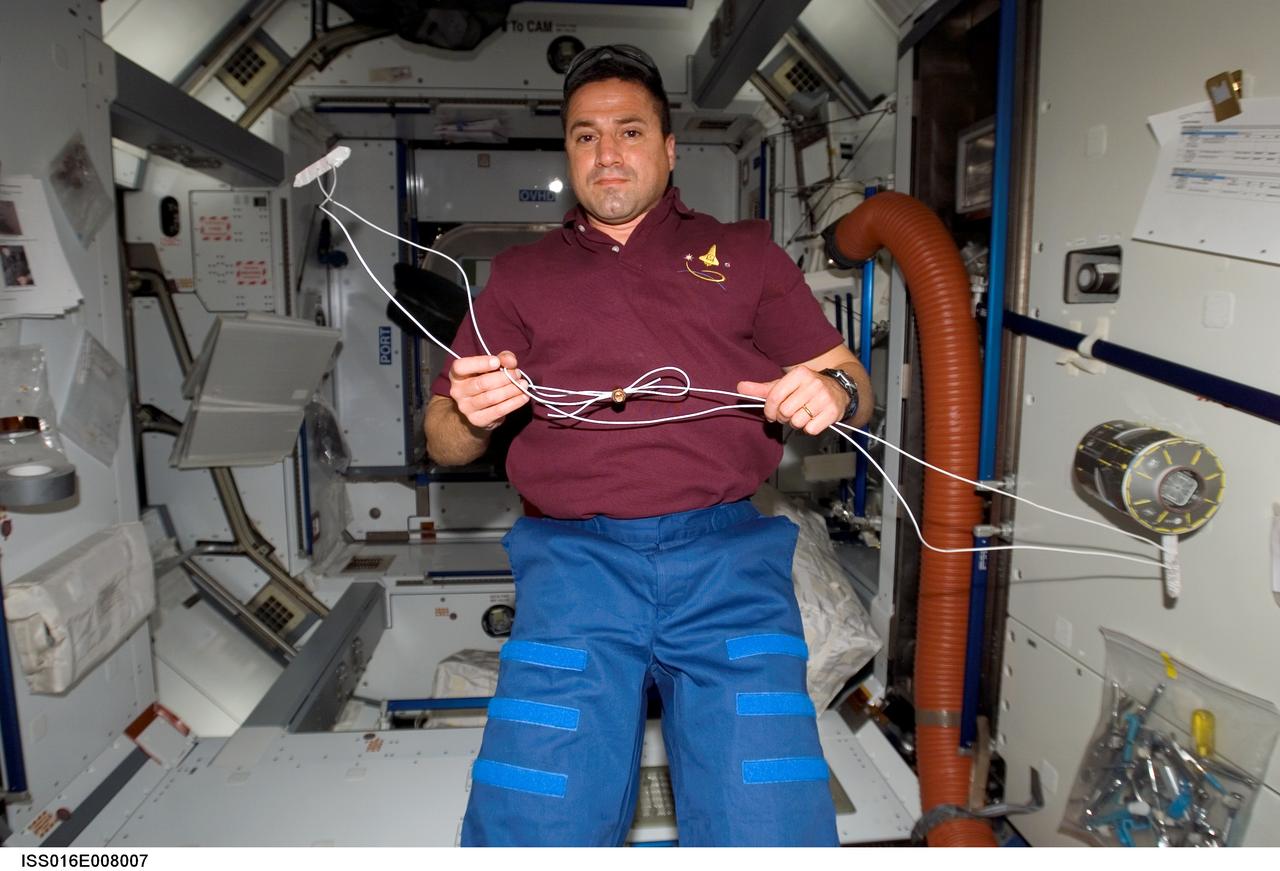
ISS016-E-008007 (1 Nov. 2007) --- Astronaut George Zamka, STS-120 pilot, holds a "cufflink" apparatus in the Harmony node of the International Space Station, which will be attached to the damaged solar arrays and take the structural load off of the broken hinge during the next spacewalk while Space Shuttle Discovery is docked with the station.
STS-132 ATLANTIS - CHIN STRAP INSTALLATION
STS-132 ATLANTIS - CHIN STRAP INSTALLATION
STS-132 ATLANTIS - CHIN STRAP INSTALLATION
STS-132 ATLANTIS - CHIN STRAP INSTALLATION

STS-132 ATLANTIS - CHIN STRAP INSTALLATION
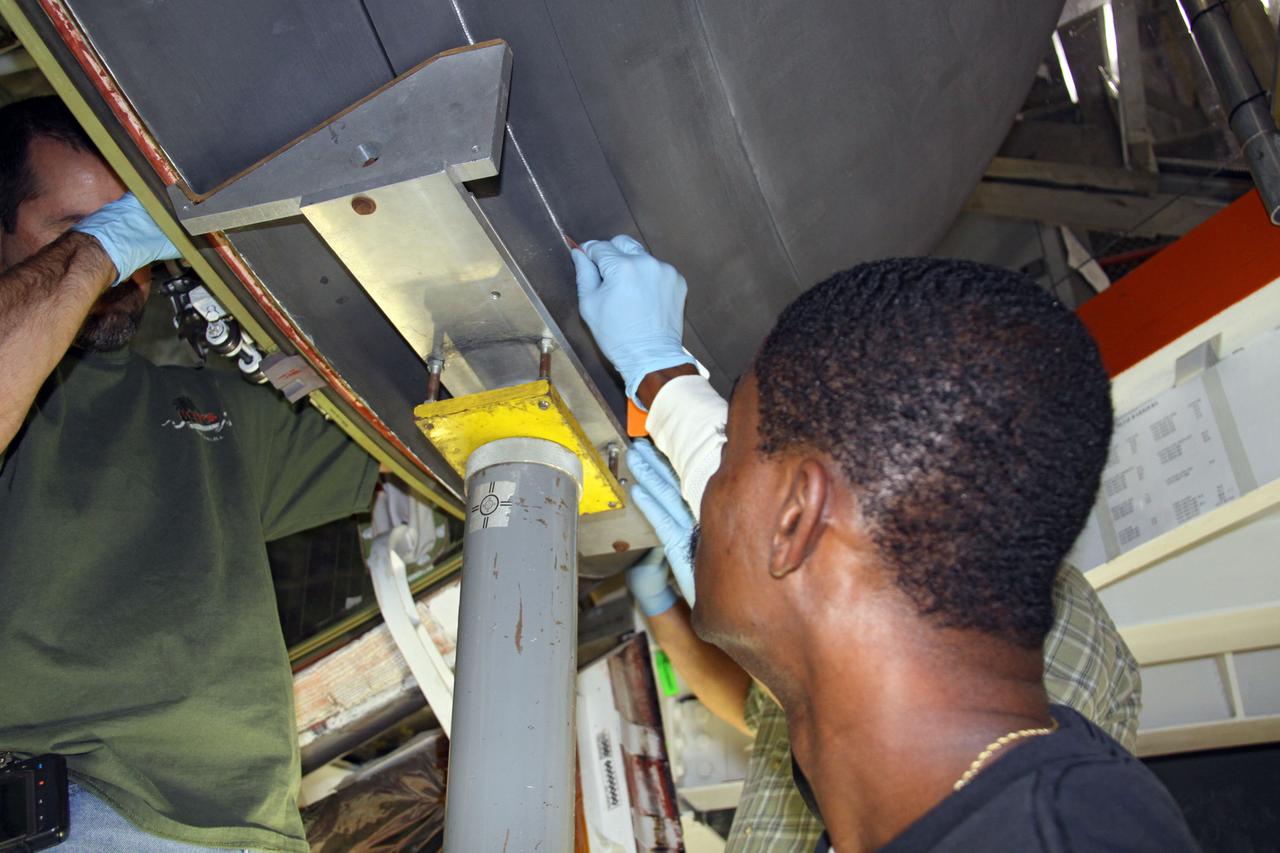
STS-132 ATLANTIS - CHIN STRAP INSTALLATION
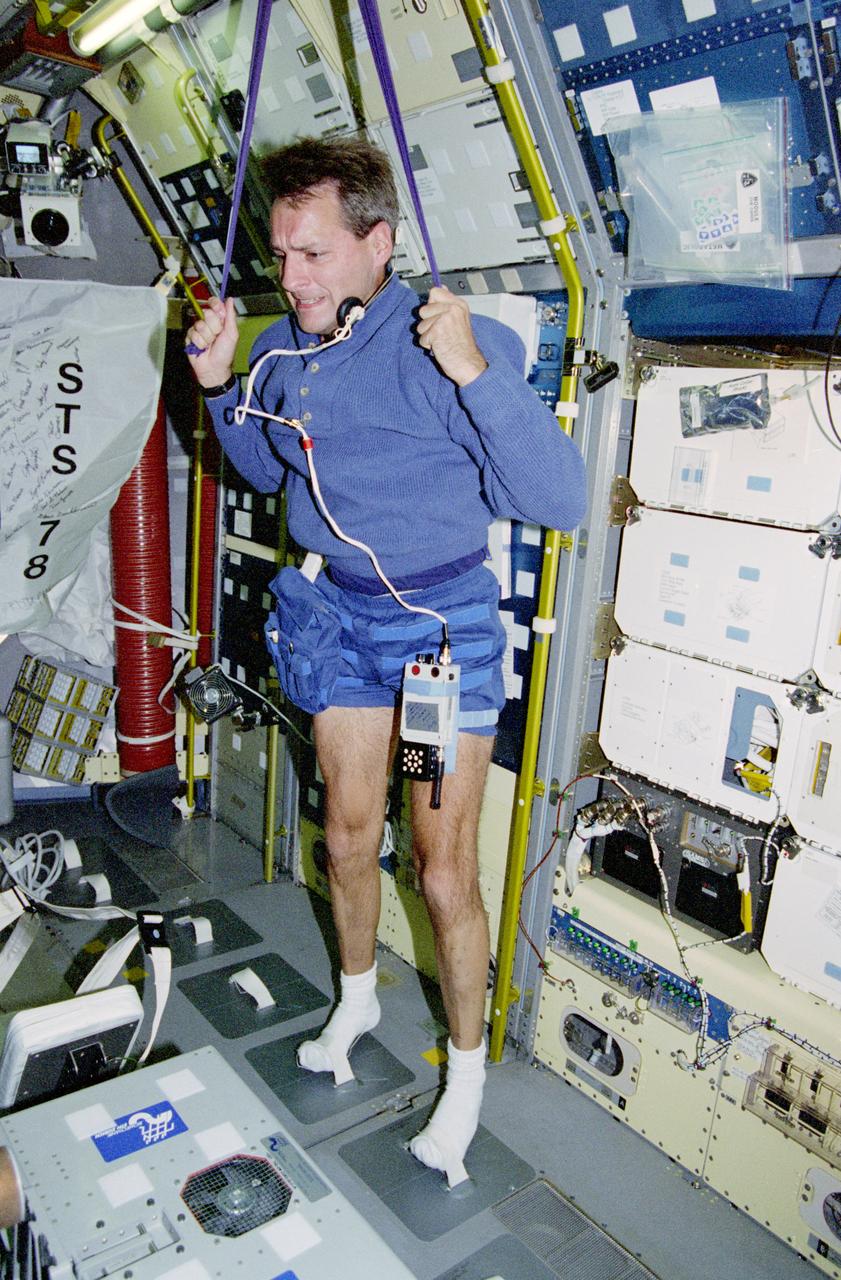
STS078-305-022 (20 June-7 July 1996) --- Astronaut Richard M. Linnehan, mission specialist, works out in the Life and Microgravity Spacelab (LMS-1) Science Module aboard the Earth-orbiting Space Shuttle Columbia. With an almost 17-day mission away from Earth?s gravity, crew members maintained an exercise regimen above and beyond their assigned LMS-1 duty assignments.
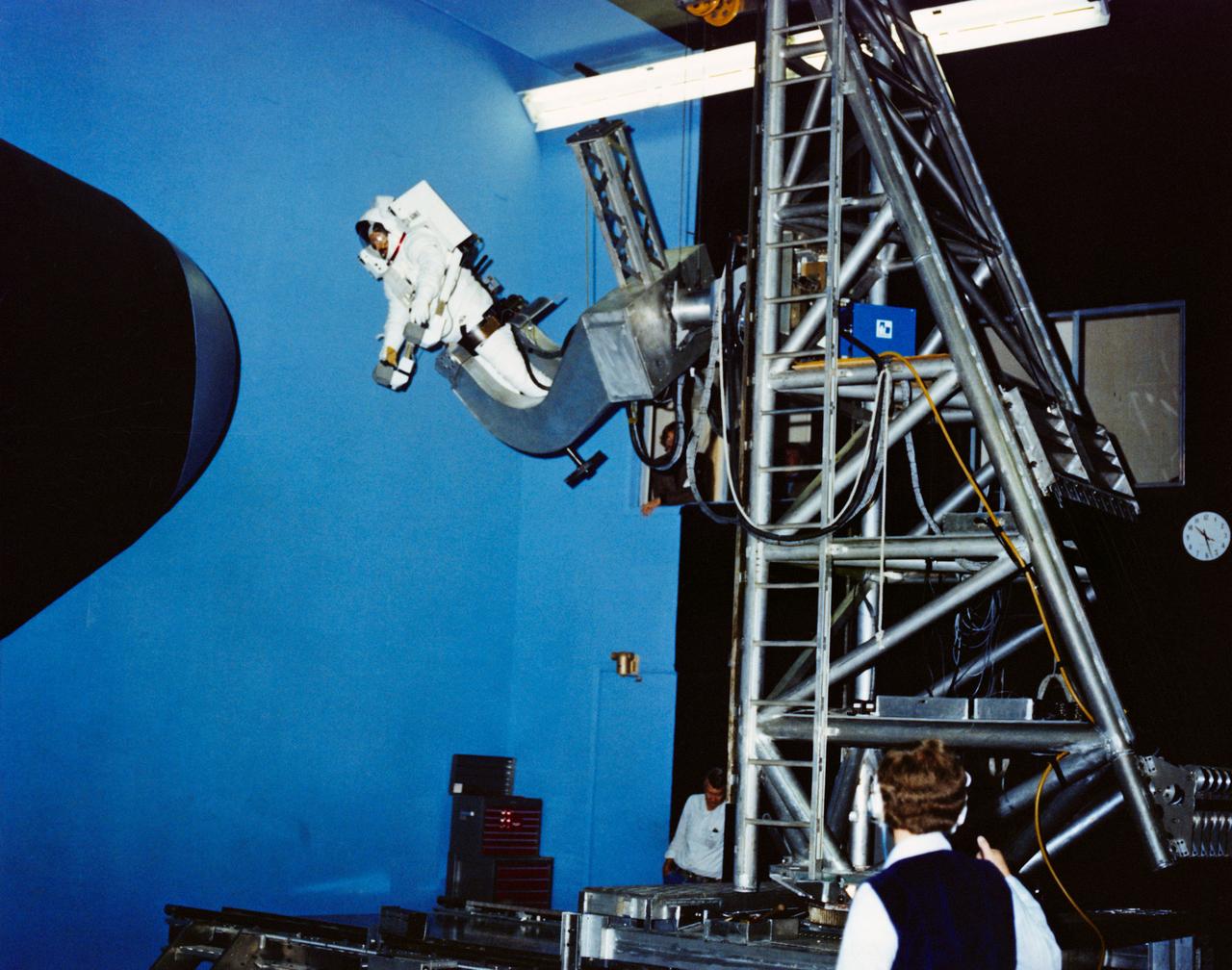
S80-36848 (24 July 1980) --- Photo of the Manned Maneuvering Unit (MMU) simulator at the Martin Marietta plant in Denver, Colorado. View of simulator with test subject strapped in to it.
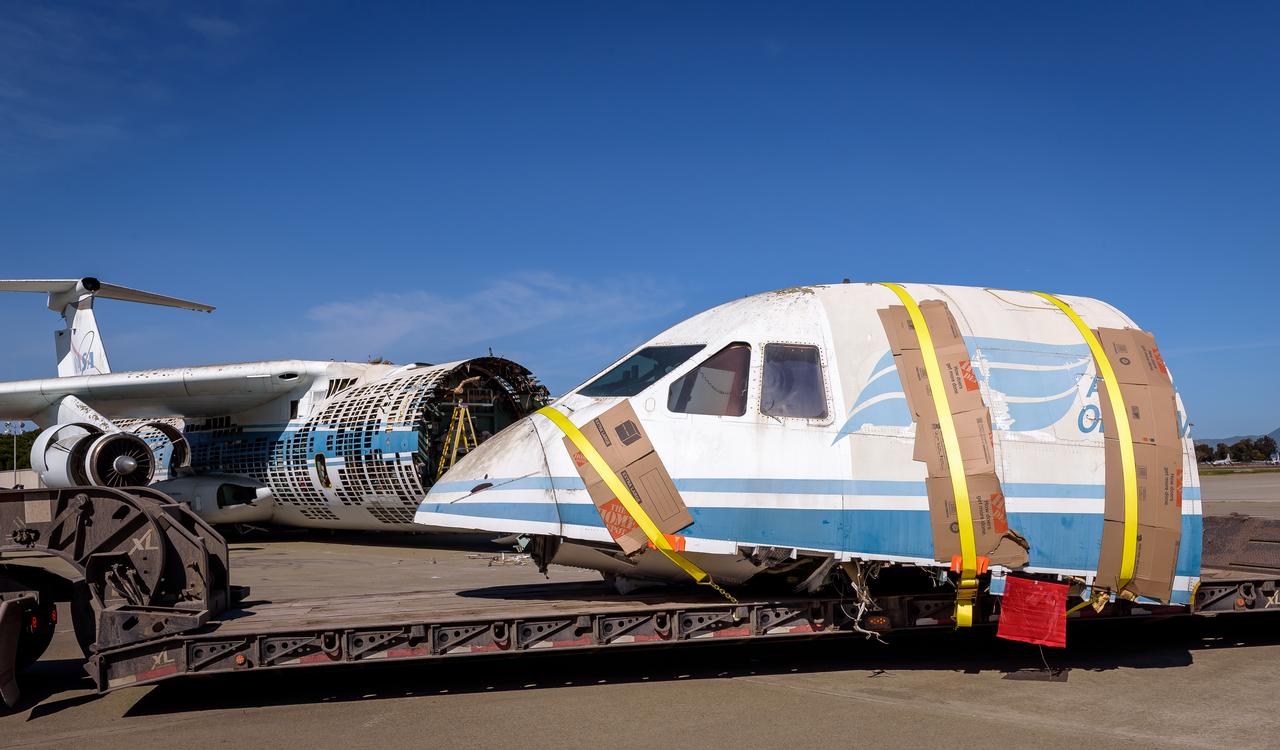
Yellow straps fasten the cockpit of the modified C-141 Kuiper Airborne Observatory, (KAO) (NASA-714), to the trailer that carries it off the N211 apron at Moffett Field, California.
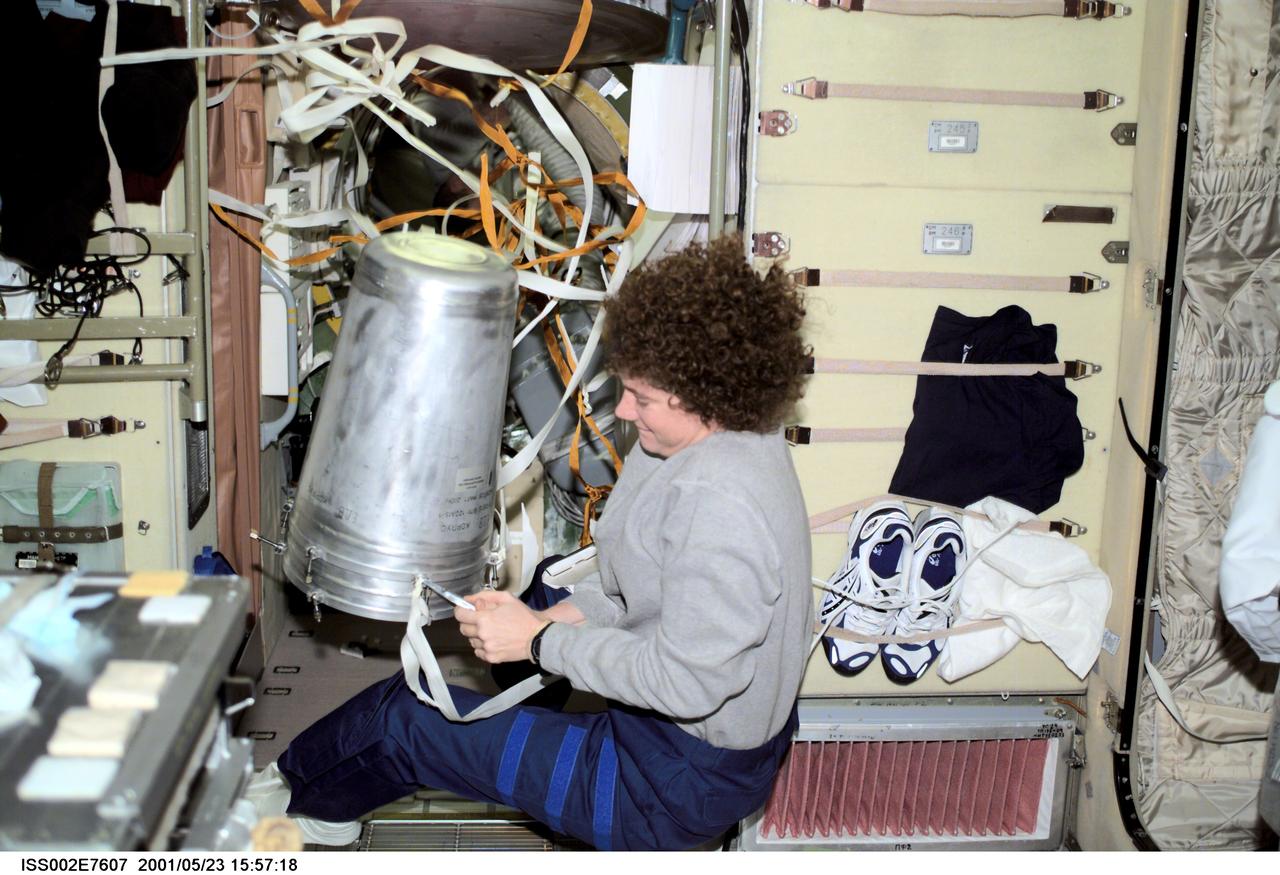
ISS002-E-7607 (23 May 2001) --- Susan J. Helms, Expedition Two flight engineer, works with a strap on a water container in the Zvezda Service Module. The image was taken with a digital still camera.
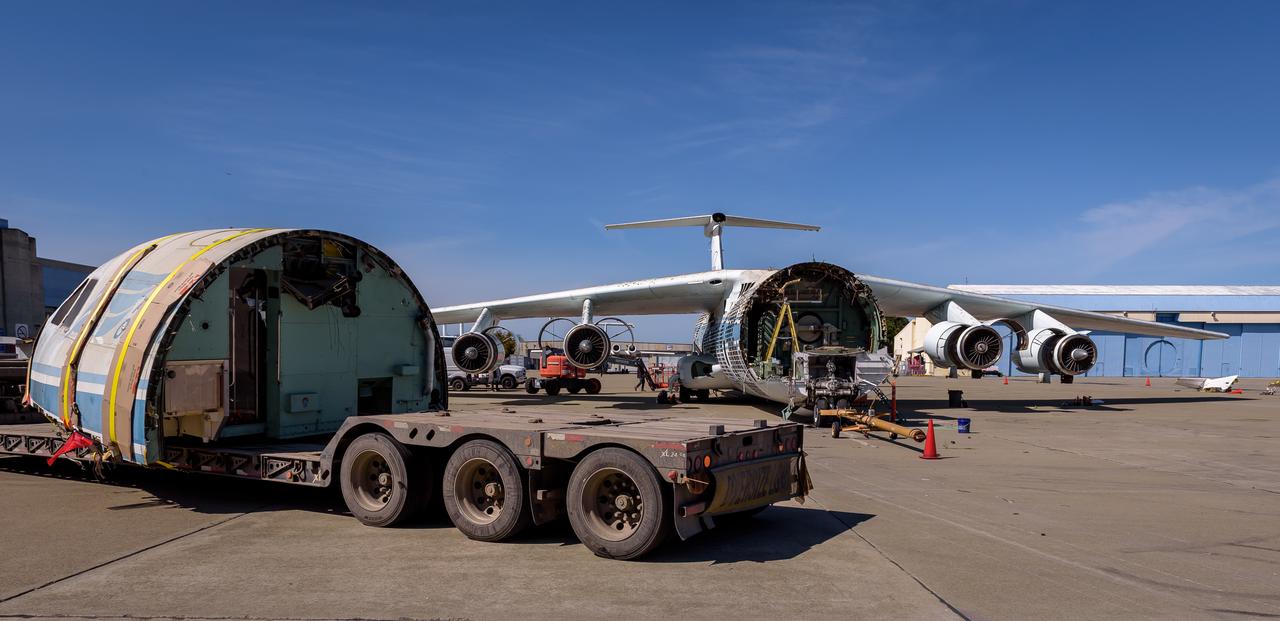
Yellow straps fasten the cockpit of the modified C-141 Kuiper Airborne Observatory, (KAO) (NASA-714), to the trailer that carries it off the N211 apron at Moffett Field, California.
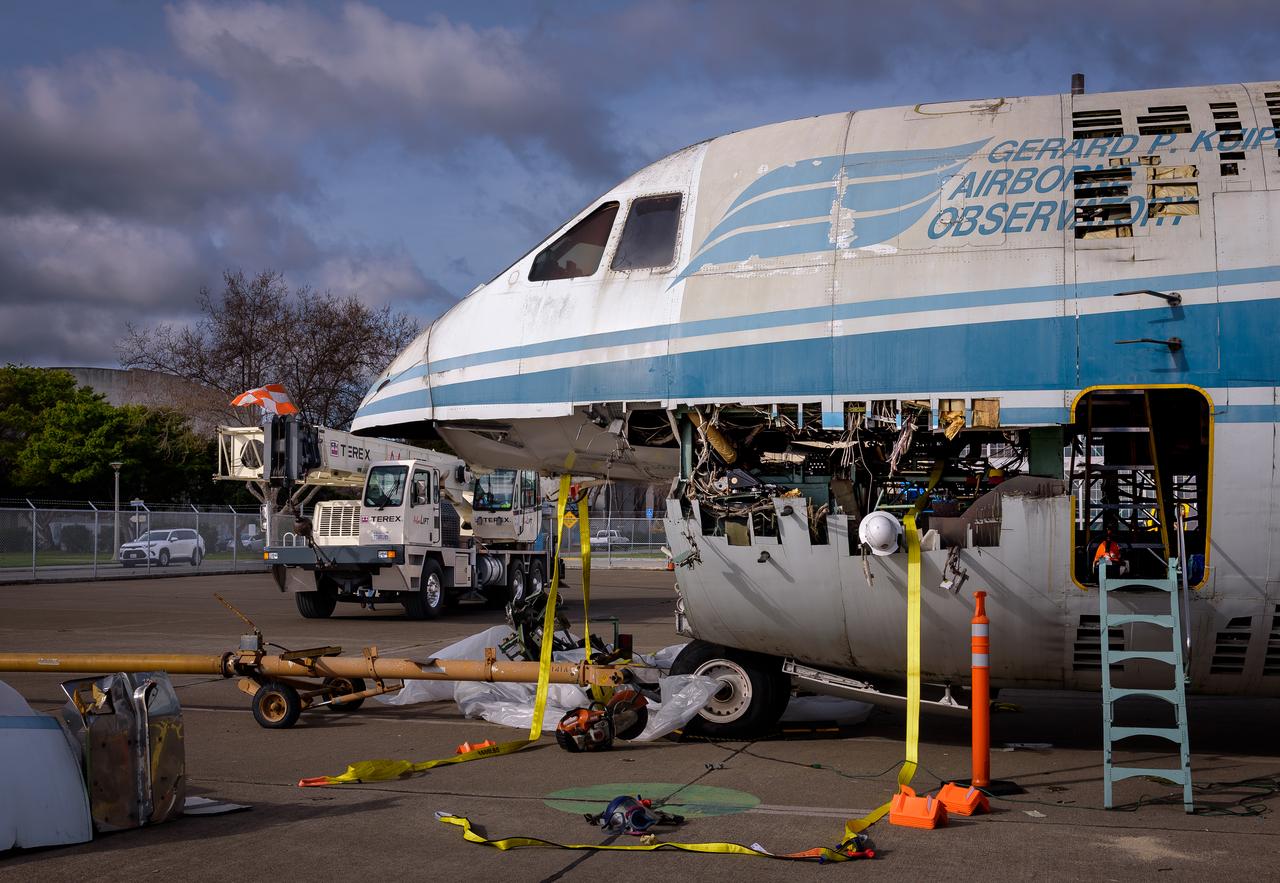
Yellow straps are threaded through the airframe of the modified C-141 Kuiper Airborne Observatory, (KAO) (NASA-714), before removing the cockpit on the N211 apron at Moffett Field, California.

jsc2023e031744 (5/24/2023) --- Preflight image of a Wearable for Space and Extreme Environments (SpaceWear Monitor) chest strap with SpaceWear unit mounted. Image courtesy of Danish Aerospace Company.
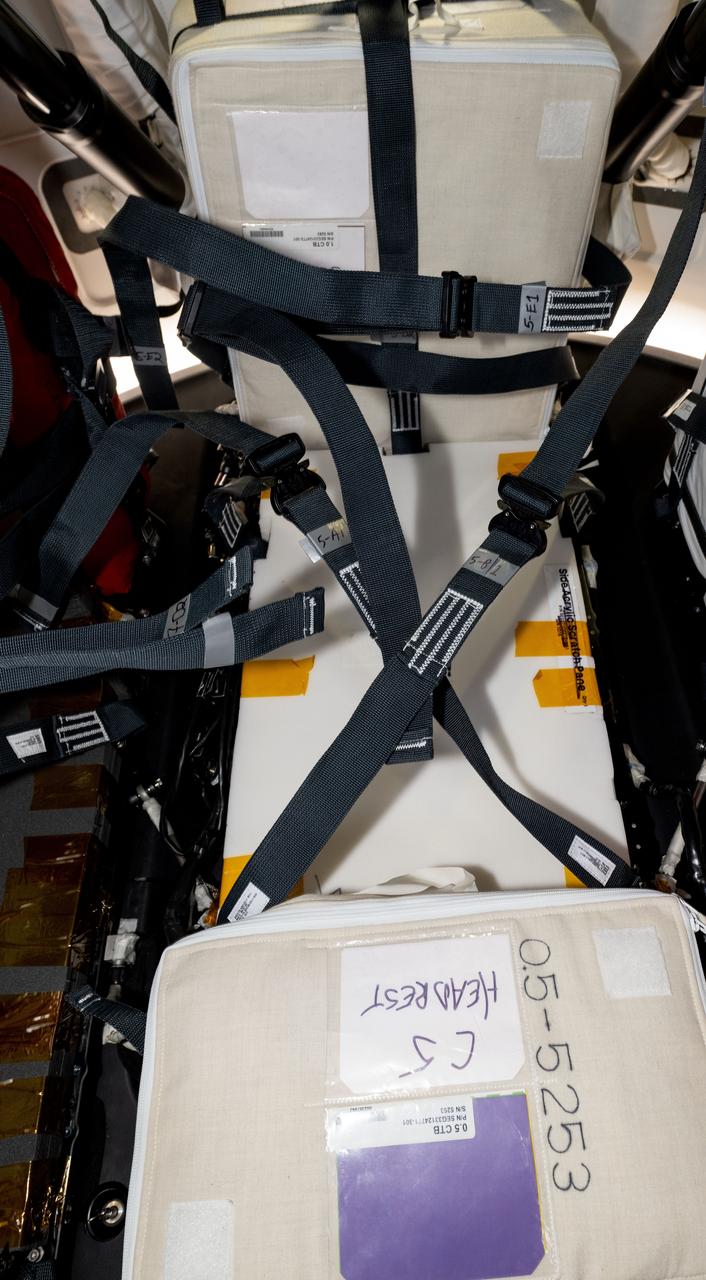
This image shows one of the temporary seat structures built and installed on the Crew-8 Dragon in cargo pallet locations C7 and C5 using foam, straps, and other station soft goods such as cushions.
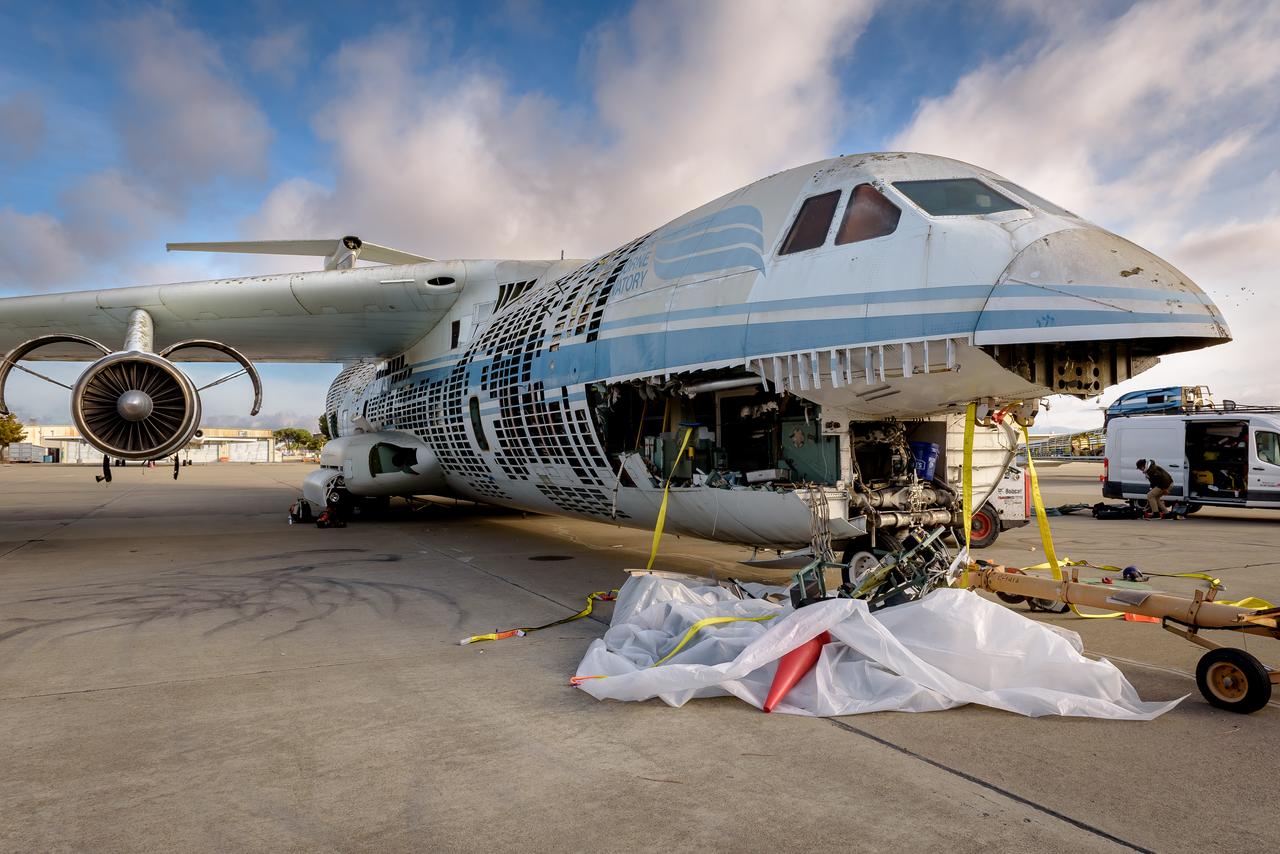
Yellow straps are threaded through the airframe of the modified C-141 Kuiper Airborne Observatory, (KAO) (NASA-714), before removing the cockpit on the N211 apron at Moffett Field, California.
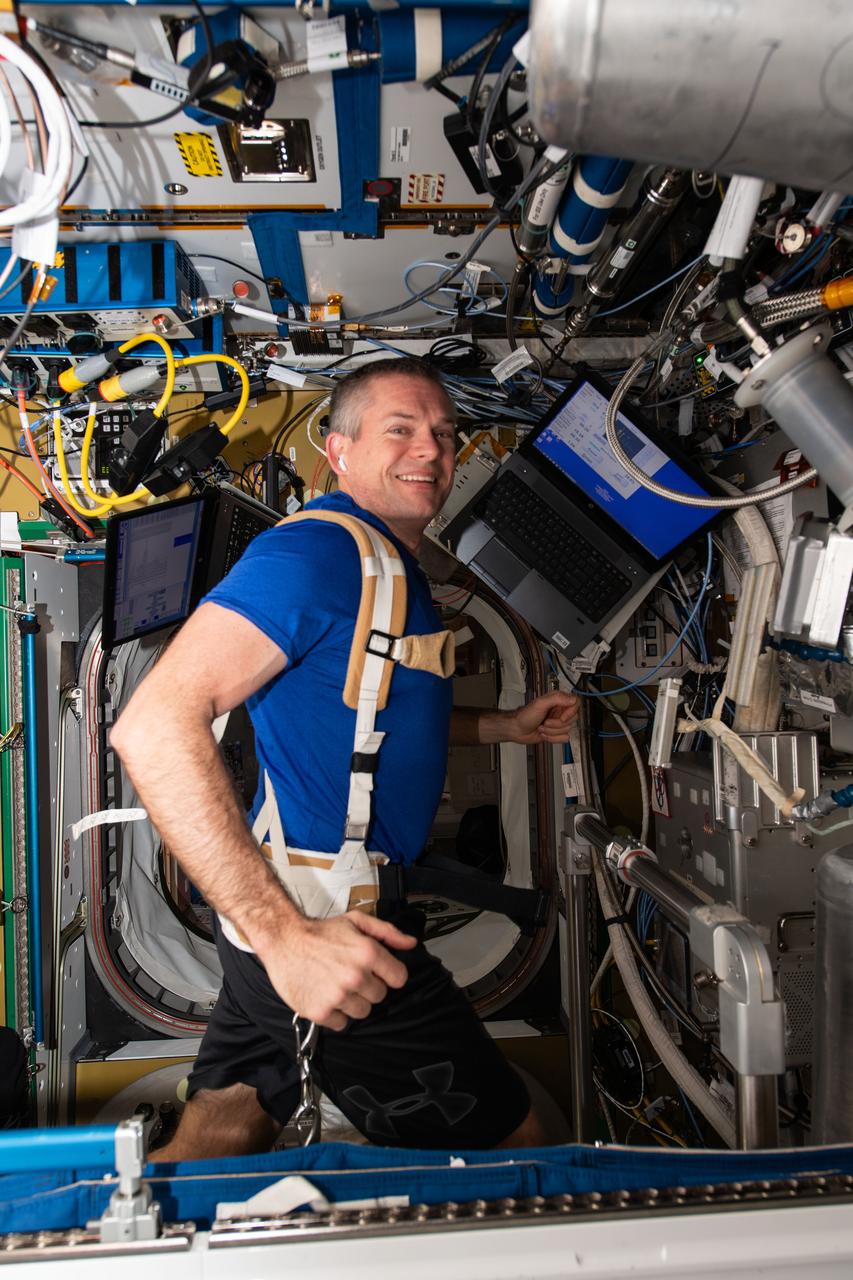
iss070e087271 (Feb. 5, 2024) --- ESA (European Space Agency) astronaut and Expedition 70 Commander Andreas Mogensen jogs while strapped to a treadmill inide the International Space Station's Tranquility module.

Yellow straps are threaded through the airframe of the modified C-141 Kuiper Airborne Observatory, (KAO) (NASA-714), before removing the cockpit on the N211 apron at Moffett Field, California.
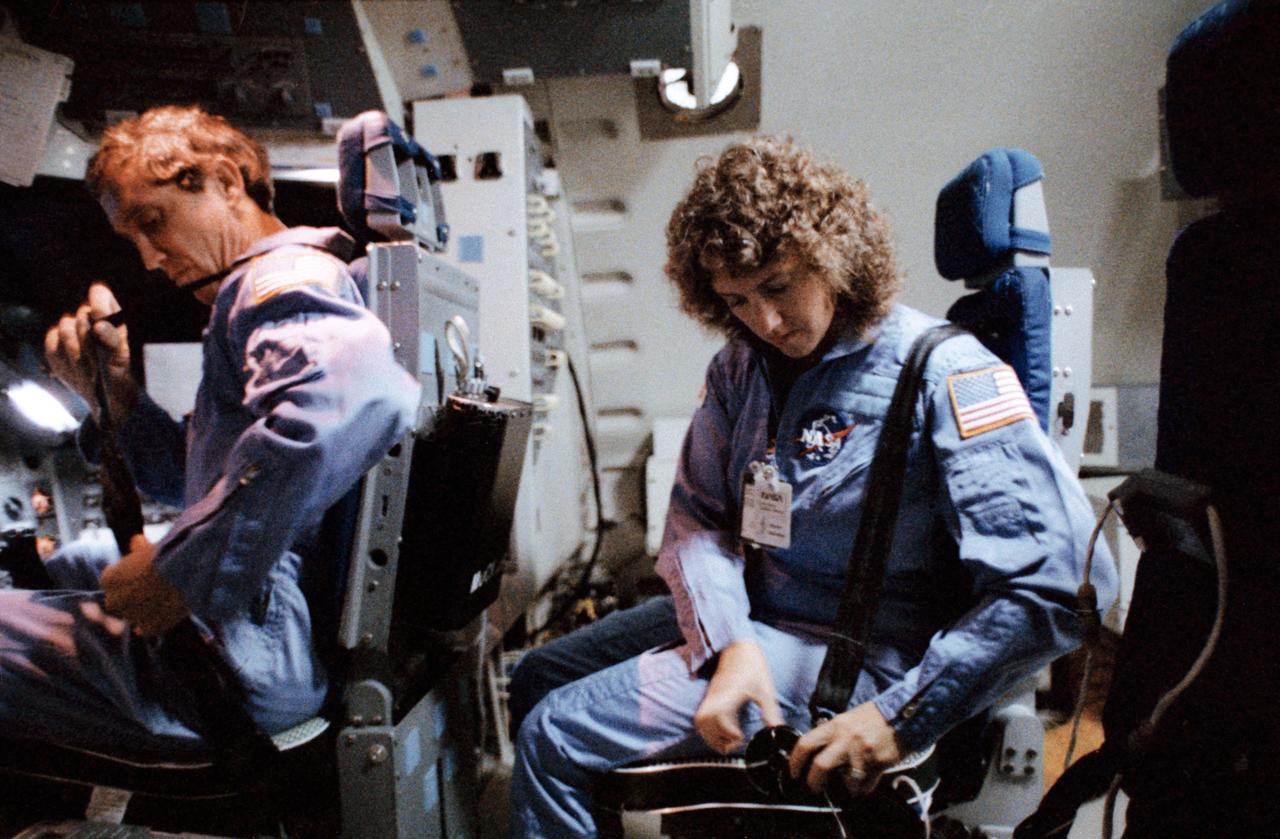
S85-44459 (19 Nov. 1985) --- Sharon Christa McAuliffe, seated behind 51-L pilot Michael J. Smith, prepares to strap herself into the mission specialists position in the Shuttle Mission Simulator (SMS) as part of her training for the 51-L mission. Photo credit: NASA
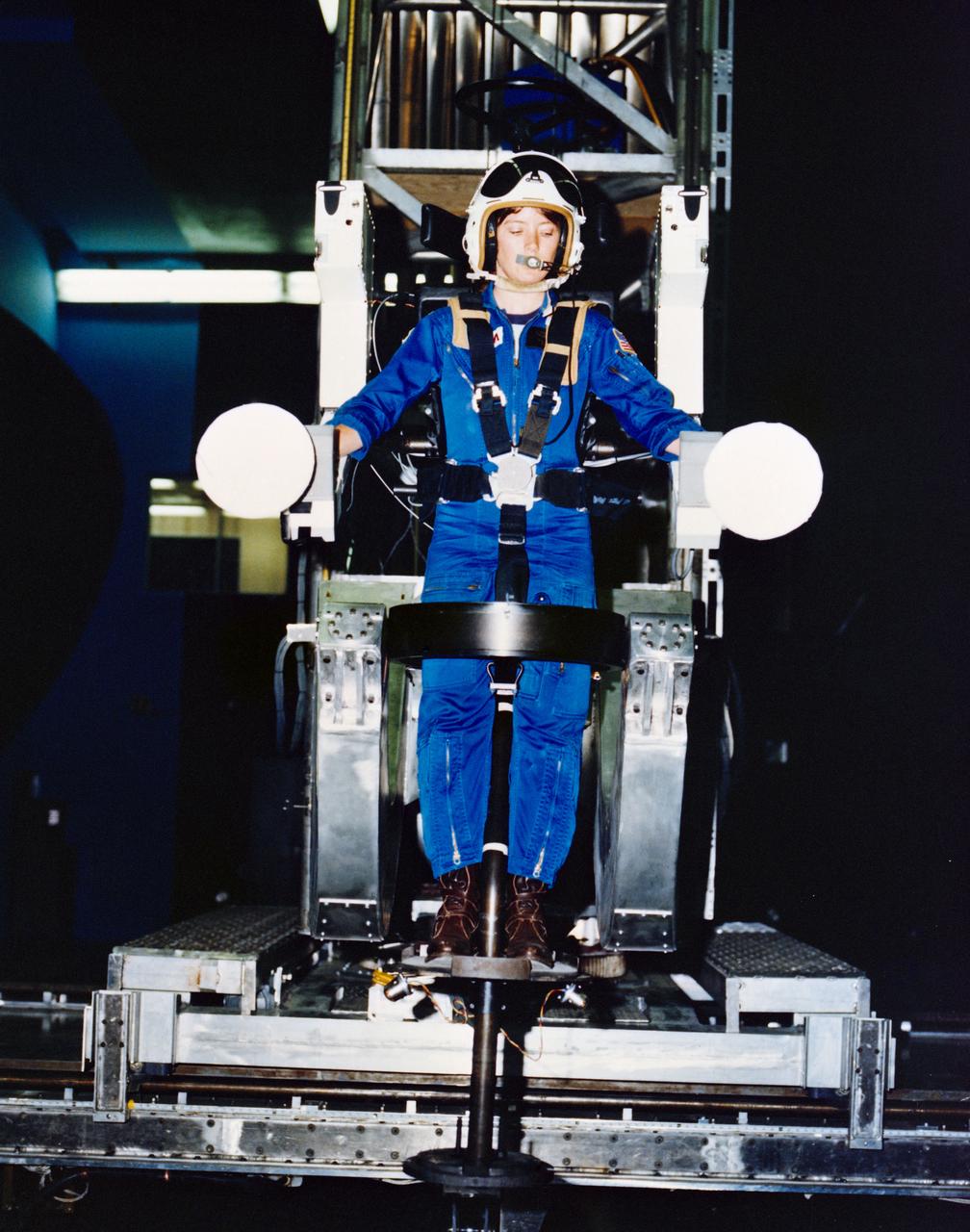
S80-36844 (24 July 1980) --- Manned Maneuvering Unit (MMU) development at the Martin Marietta plant in Denver, Colorado. View shows MMU prototype with astronaut AnnaL. Fisher serving as test subject strapped in to it. Photo credit: NASA
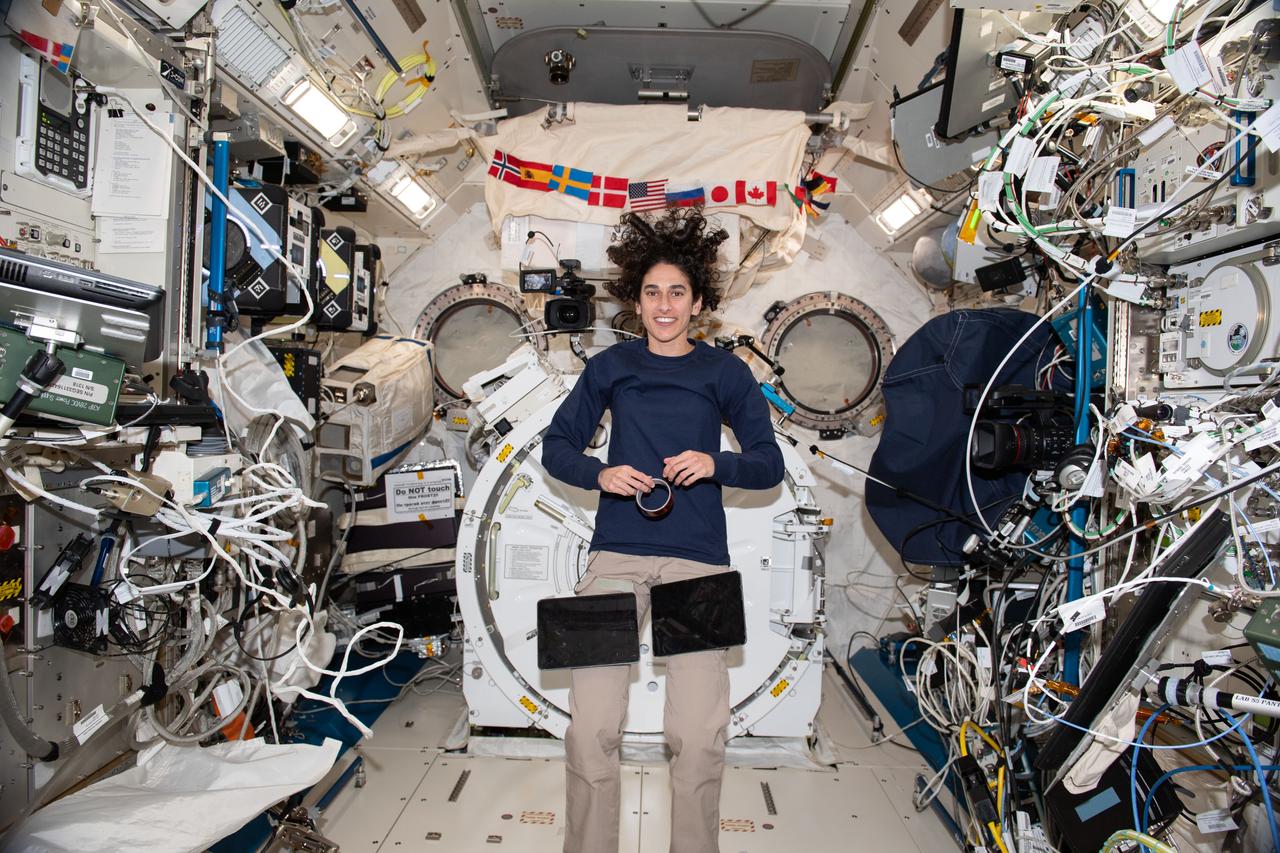
iss070e035105 (Nov. 30, 2023) --- NASA astronaut and Expedition 70 Flight Engineer Jasmin Moghbeli takes a break during operations and poses for a portrait inside the International Space Station's Kibo laboratory module. A pair of computer tablets are attached to velcro straps on Moghbeli's pants for ease of access when reviewing procedures and instructions.
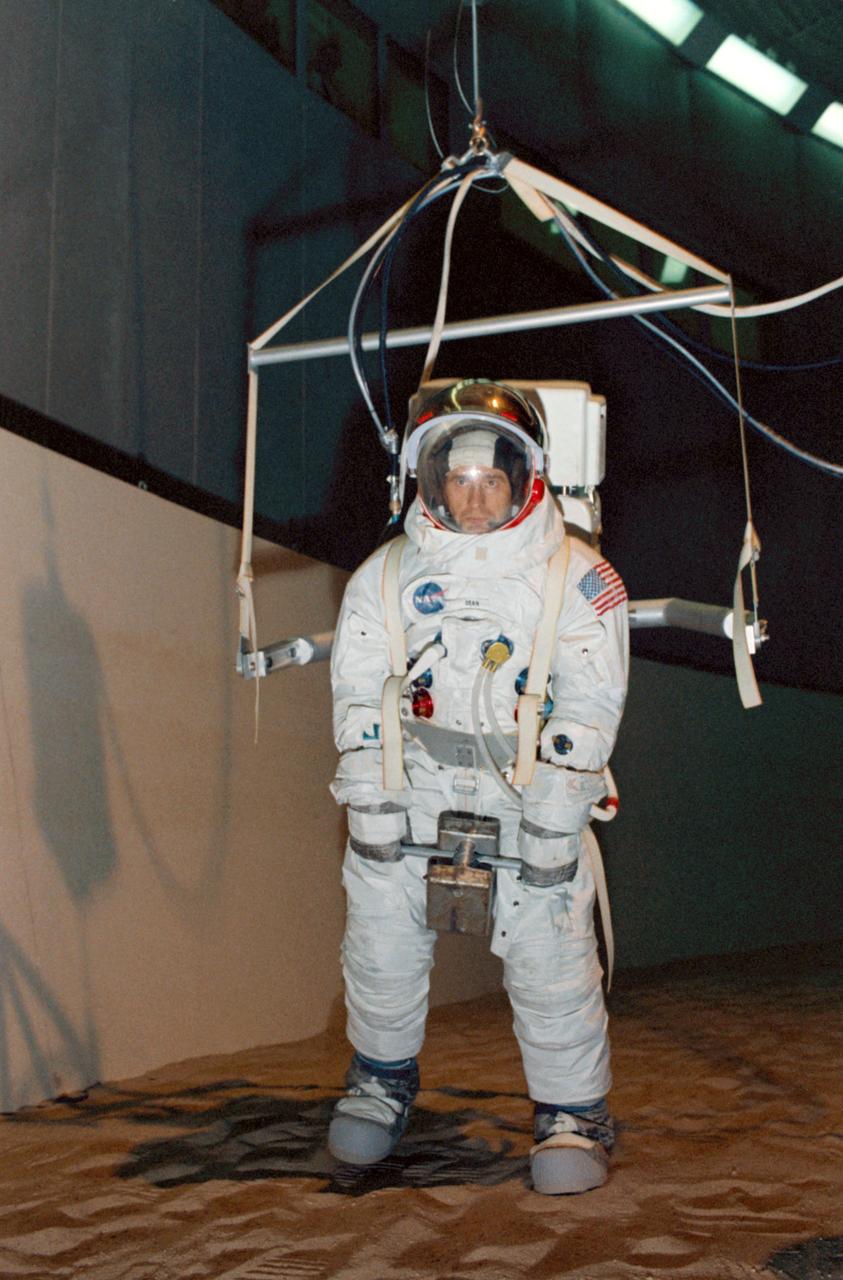
S69-56059 (24 Oct. 1969) --- Astronaut Alan L. Bean, lunar module pilot of the Apollo 12 lunar landing mission, participates in lunar surface simulation training in Building 29 at the Manned Spacecraft Center (MSC). Bean is strapped to a one-sixth gravity simulator.
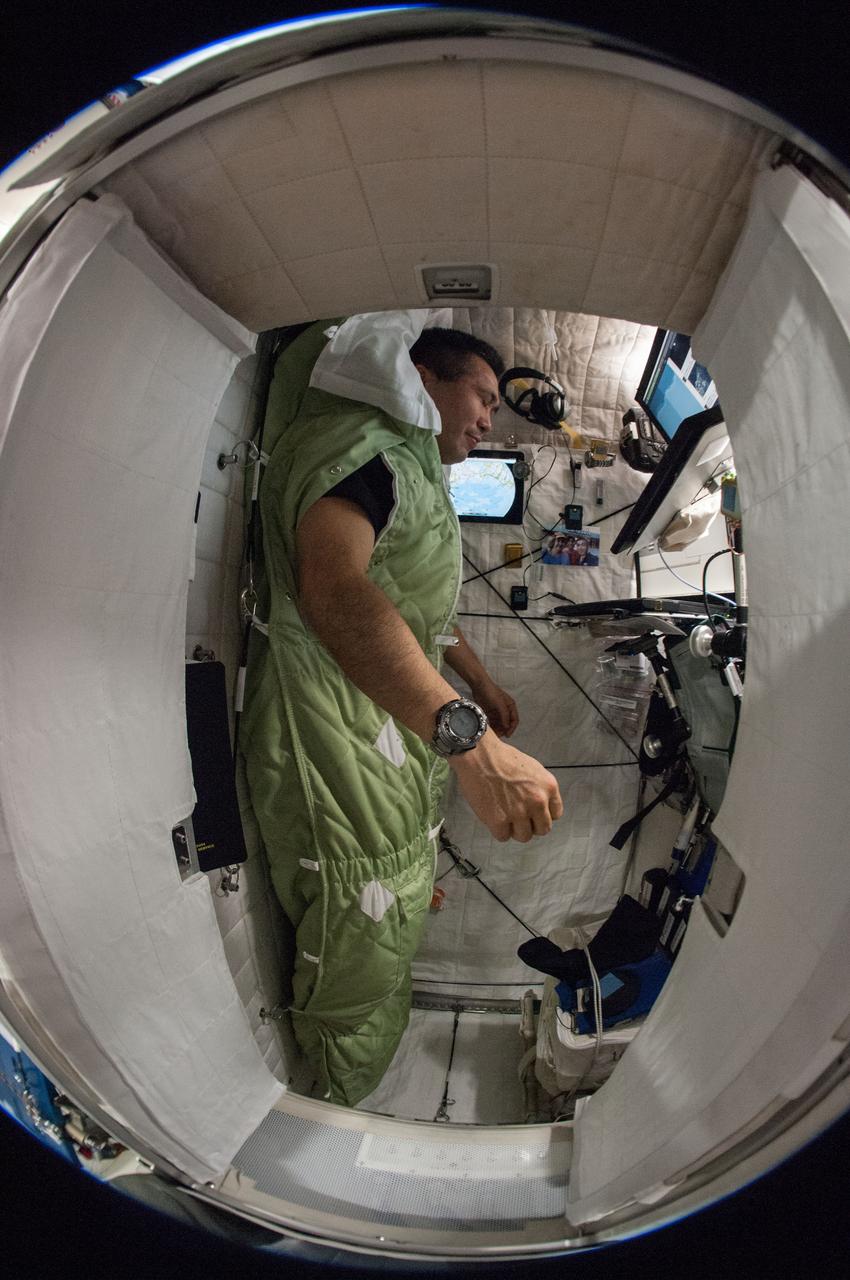
iss038e024951 (1/5/2014) --- Japan Aerospace Exploration Agency (JAXA) Koichi Wakata strapped into his sleeping bag in his sleep station located in the Node 2. Circadian Rhythms investigates the role of synchronized circadian rhythms, or the “biological clock,” and how it changes during long-duration spaceflight.
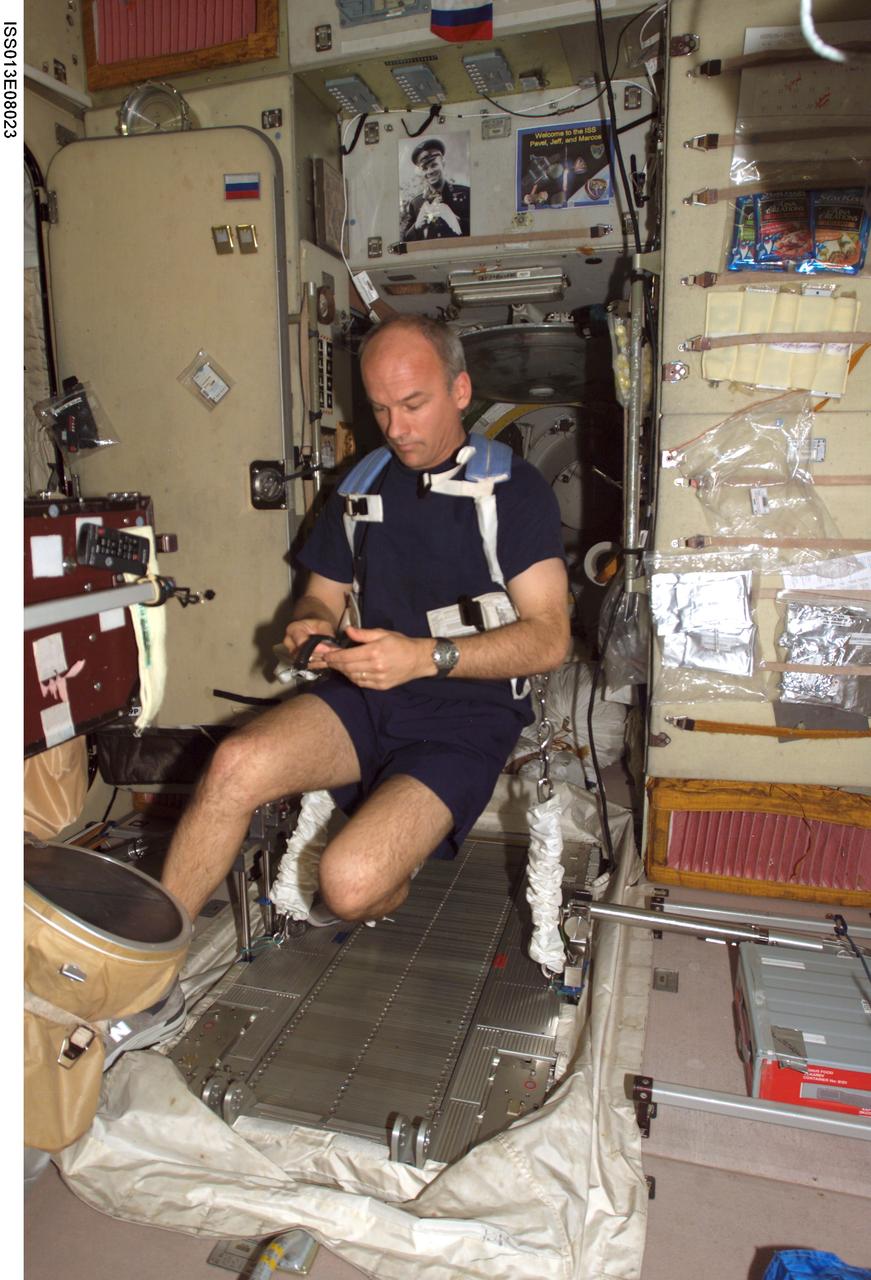
ISS013-E-08023 (18 April 2006) --- Astronaut Jeffrey N. Williams, Expedition 13 NASA space station science officer and flight engineer, prepares to exercise on the Treadmill Vibration Isolation System (TVIS) in the Zvezda Service Module of the International Space Station.

A metal strap became tangled over one of the folded solar array panels when Skylab lost its micro meteoroid shield during its launch. Cutters like the ones used to free the solar array were used to cut the ribbon opening to the public a new full-scale Skylab cluster exhibit at the Alabama Space and Rocket Center in Huntsville, Alabama. Wielding the cutters are (left to right): Alabama Senator James B. Allen; Marshall Space Flight Center director, Dr. William R. Lucas, Huntsville Mayor, Joe Davis; Madison County Commission Chairman, James Record (standing behind Mayor Davis); and chairman of the Alabama Space Science Exhibit Commission, Jack Giles. Astronauts Conrad and Kerwin used the same type of tool in Earth orbit to cut the aluminum strap which jammed the Skylab solar array.
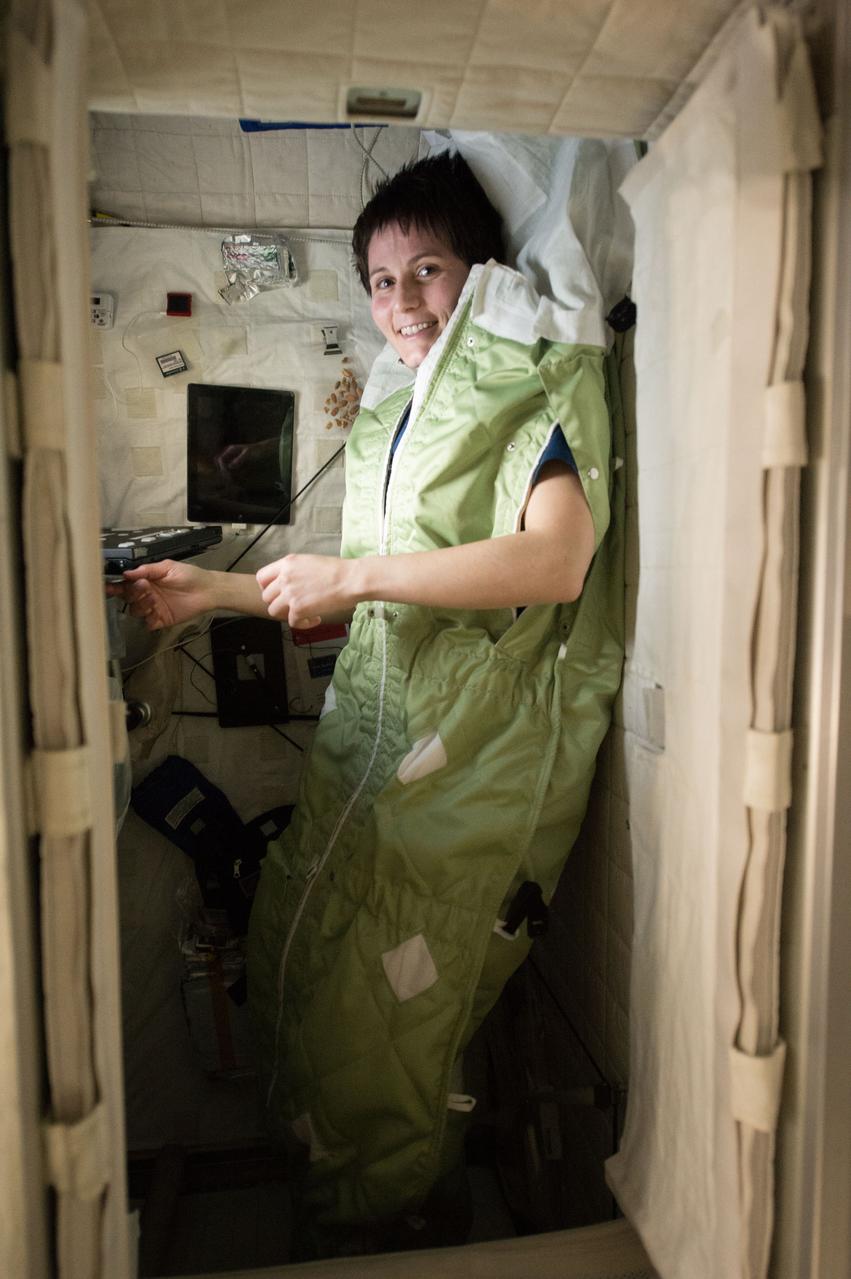
iss042e023422 (12/6/14) --- Expedition 42 Flight Engineer Samantha Cristoforetti of the European Space Agency (ESA) on 6 December 2014 is seen inside of a sleeping bag in her personal crew quarters on the International Space Station. Astronauts will strap the bag to the wall to prevent from free floating and potentially bumping into equipment while sleeping.
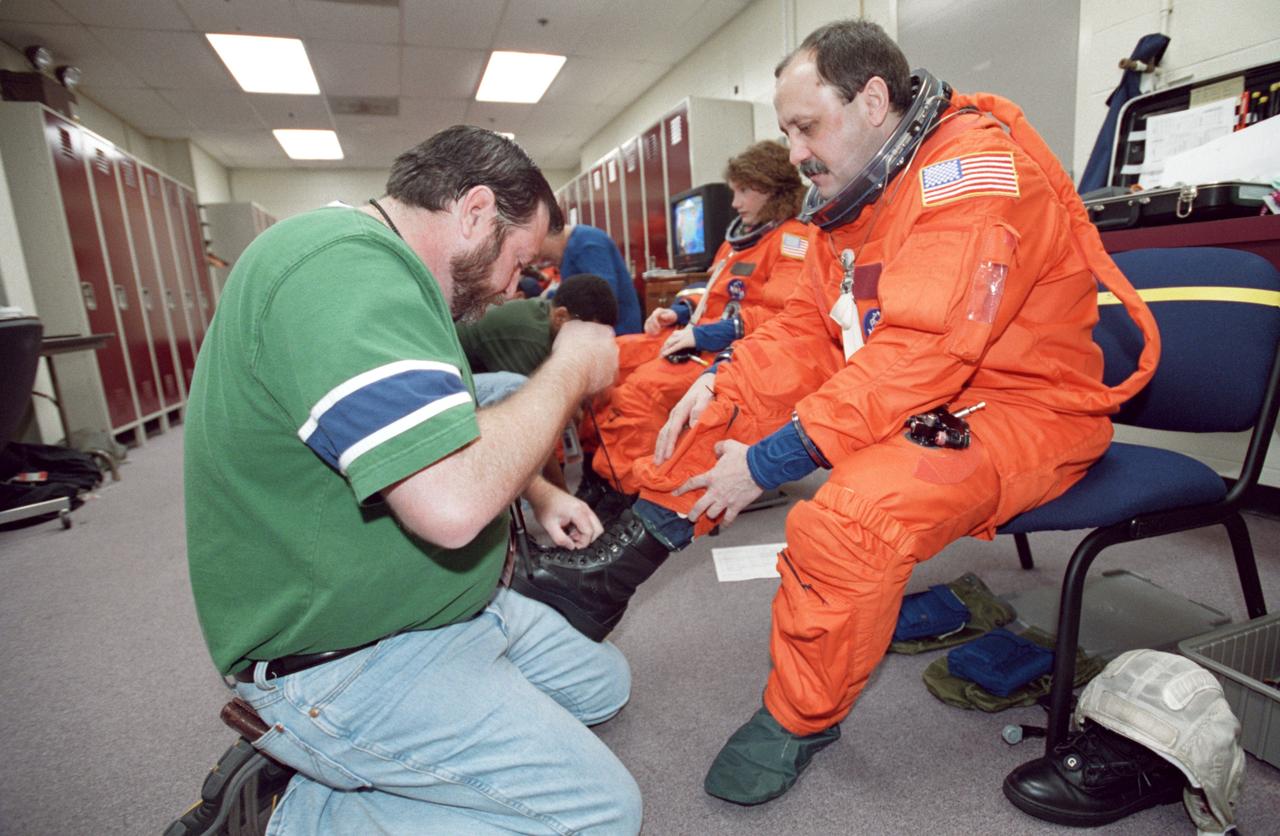
JSC2000-07446 (6 December 2000) --- Suit technician Steve Clendenin helps cosmonaut Yury V. Usachev with his boot straps during an STS-102 training session in the Systems Integration Facility at the Johnson Space Center (JSC). The Expedition Two commander, along with two astronauts on his crew and the four STS-102 crew members, later simulated procedures for a nominal countdown in the crew compartment trainer (CCT-2) in the high bay area of this facility.
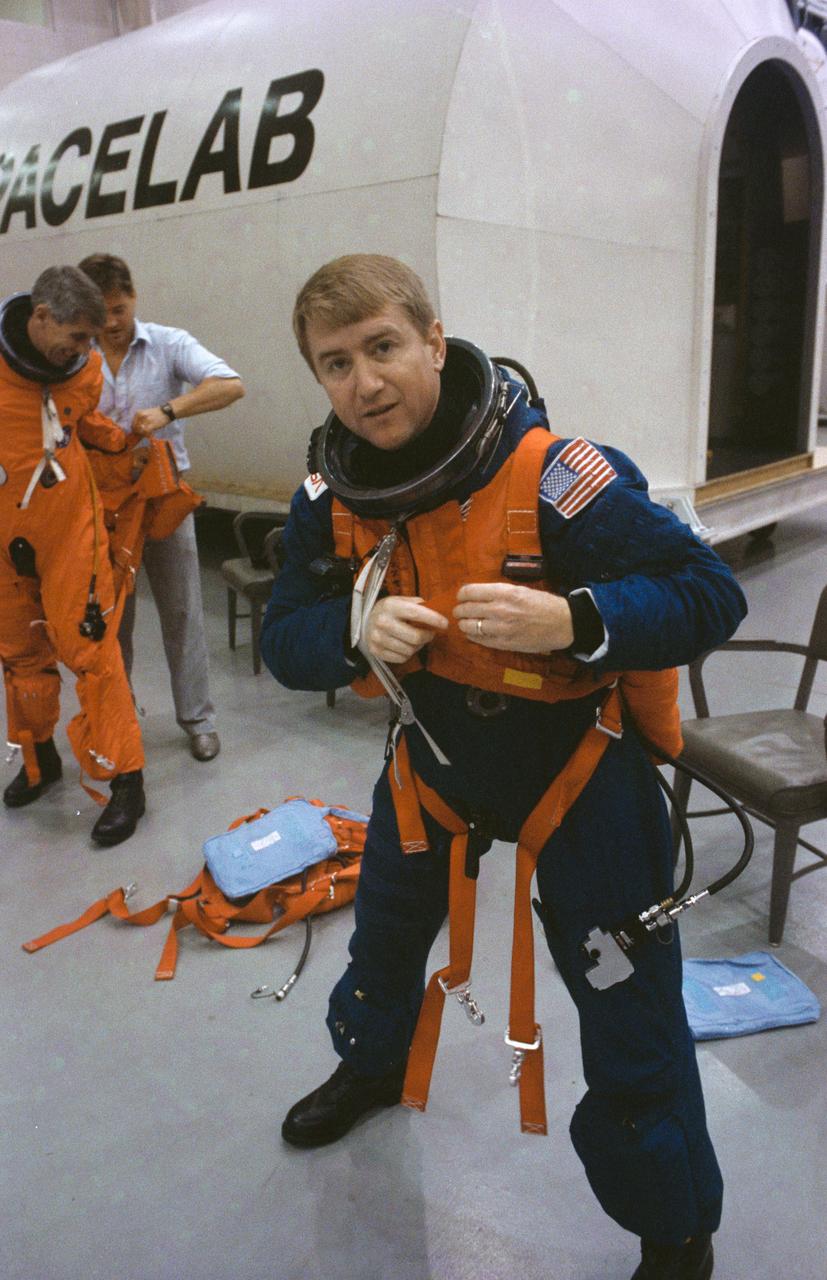
STS-38 crewmembers don launch and entry suit (LES) equipment prior to emergency egress training in JSC's Mockup and Integration Laboratory (MAIL) Bldg 9A. Pilot Frank L. Culbertson, wearing navy blue LES, fastens parachute strap and Mission Specialist (MS) Robert C. Springer, wearing orange LES, dons parachute pack with a technician's assistance in front of a Spacelab module mockup.

KENNEDY SPACE CENTER, FLA. -- In Hangar M on Cape Canaveral Air Force Station, workers secure straps to an overhead crane around the Delta II rocket's first stage. It will be lifted and placed onto a transporter for its move to the launch pad. Dawn's mission is to explore two of the asteroid belt's most intriguing and dissimilar occupants: asteroid Vesta and the dwarf planet Ceres. Dawn is scheduled to launch June 30 from Launch Complex 17-B. Photo credit: NASA/Jack Pfaller
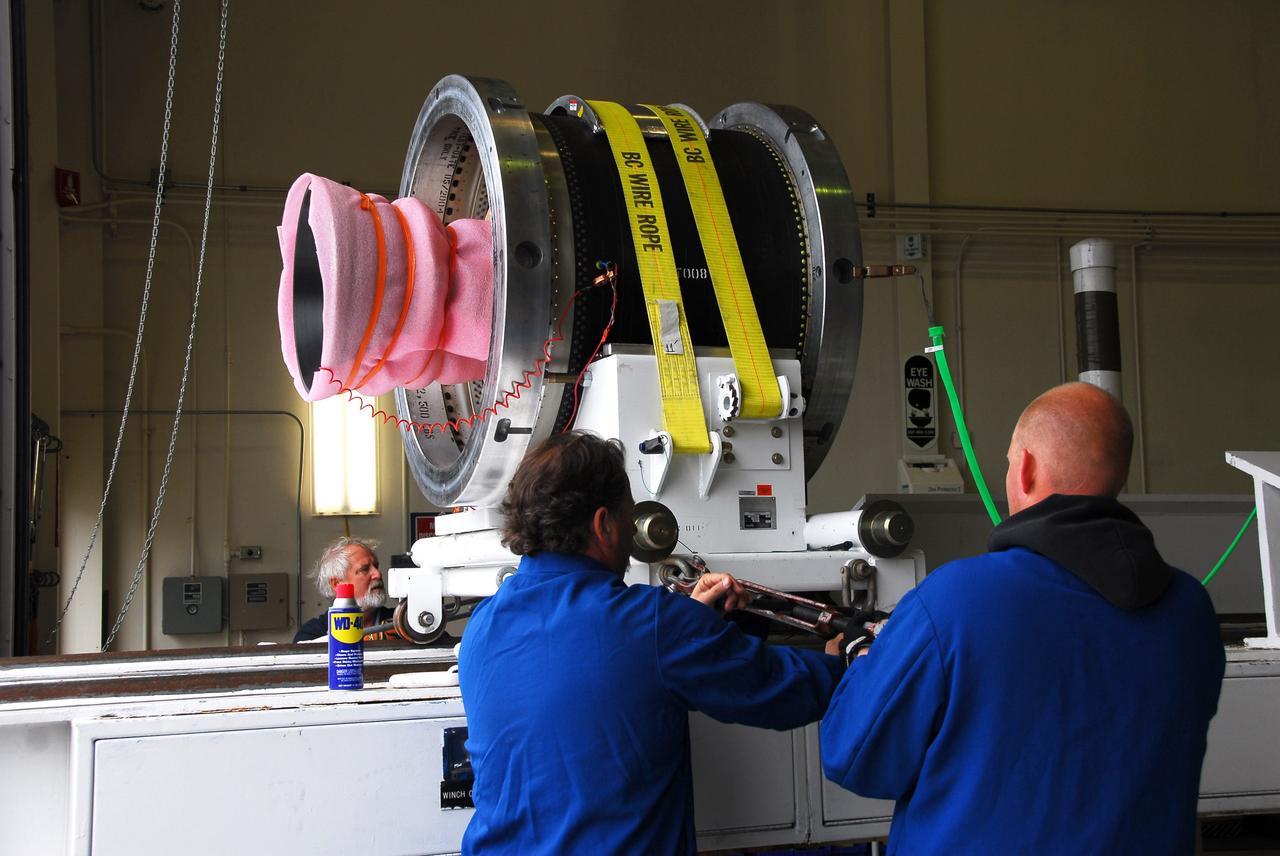
VANDENBERG AIR FORCE BASE, Calif. -- In Building 1555's west bay at Vandenberg AFB, workers secure the strapping holding the third stage of the Taurus rocket on the assembly integration trailer. The Taurus will launch the Orbiting Carbon Observatory, or OCO, in 2009. The OCO is a new Earth-orbiting mission sponsored by NASA's Earth System Science Pathfinder Program. Photo credit: NASA/Randy Beaudoin
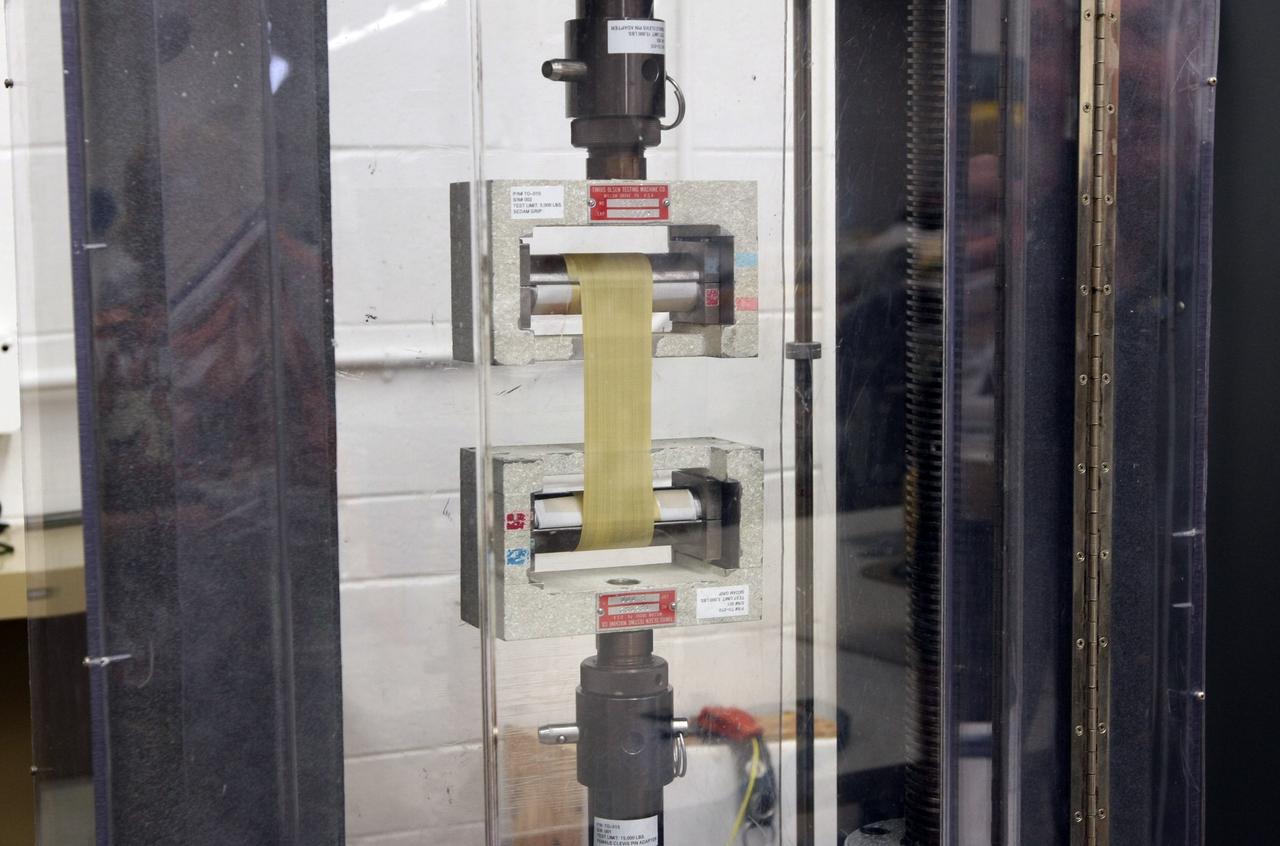
CAPE CANAVERAL, Fla. – A look at strapping equipment used on parachutes in the Parachute Refurbishment Facility at NASA's Kennedy Space Center. Ares I is an in-line, two-stage rocket that will transport the Orion crew exploration vehicle to low-Earth orbit. The Ares I first stage will be a five-segment solid rocket booster based on the four-segment design used for the shuttle. As with the shuttle, this booster will fall away when spent, lowered by parachute into the Atlantic Ocean where it can be retrieved for re-use. Photo credit: NASA/Dimitri Gerondidakis
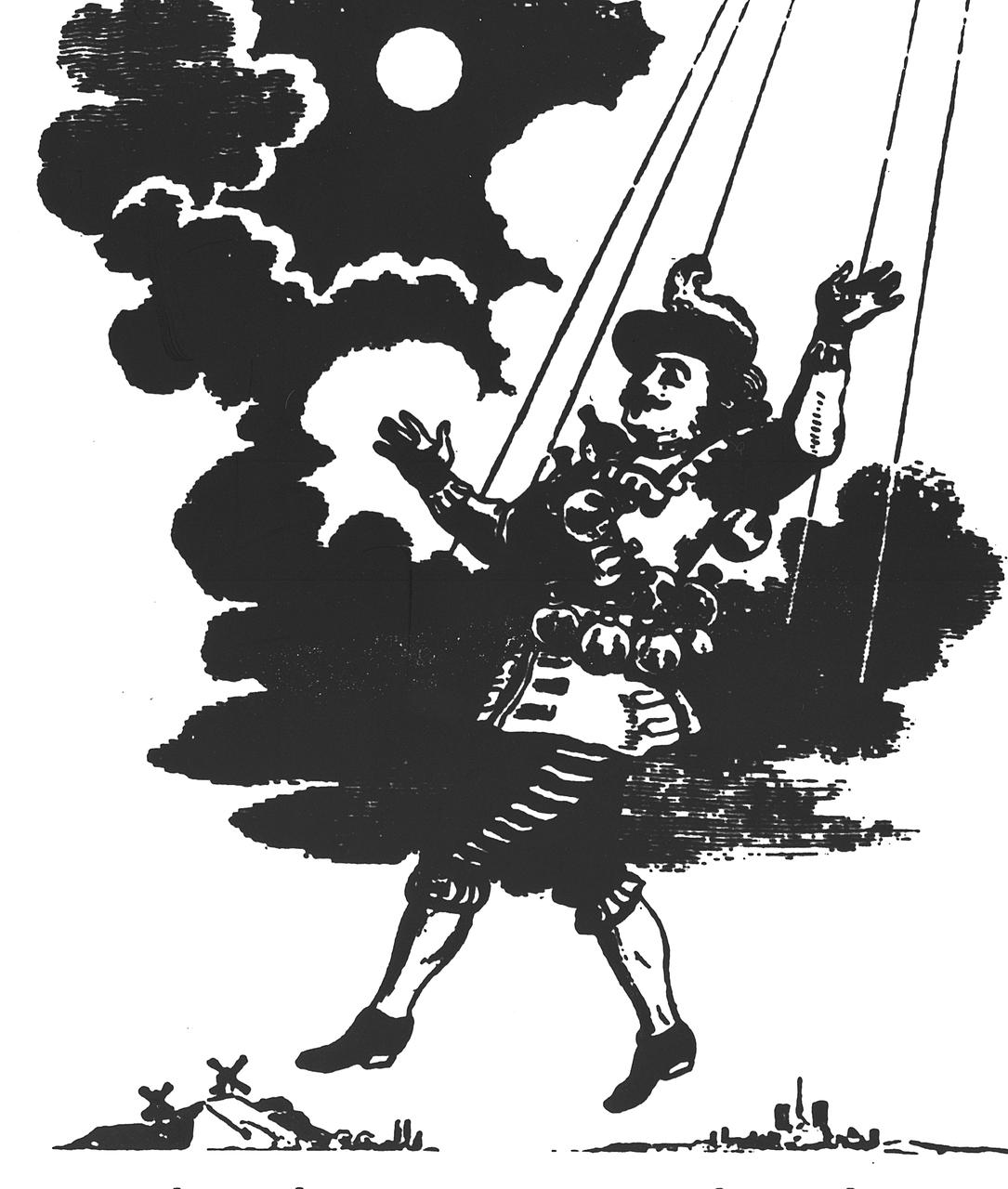
Less interested in the scientific fundamentals of rocketry, many writers of popular literature and science fiction discovered one of the most vital elements in the formula for space travel, a fertile imagination. Under the impression that the sun "draws up" dewdrops, Cyrano de Bergerac suggested fancifully that one might fly by trapping dew in bottles, strapping the bottles to oneself, and standing in sunlight.
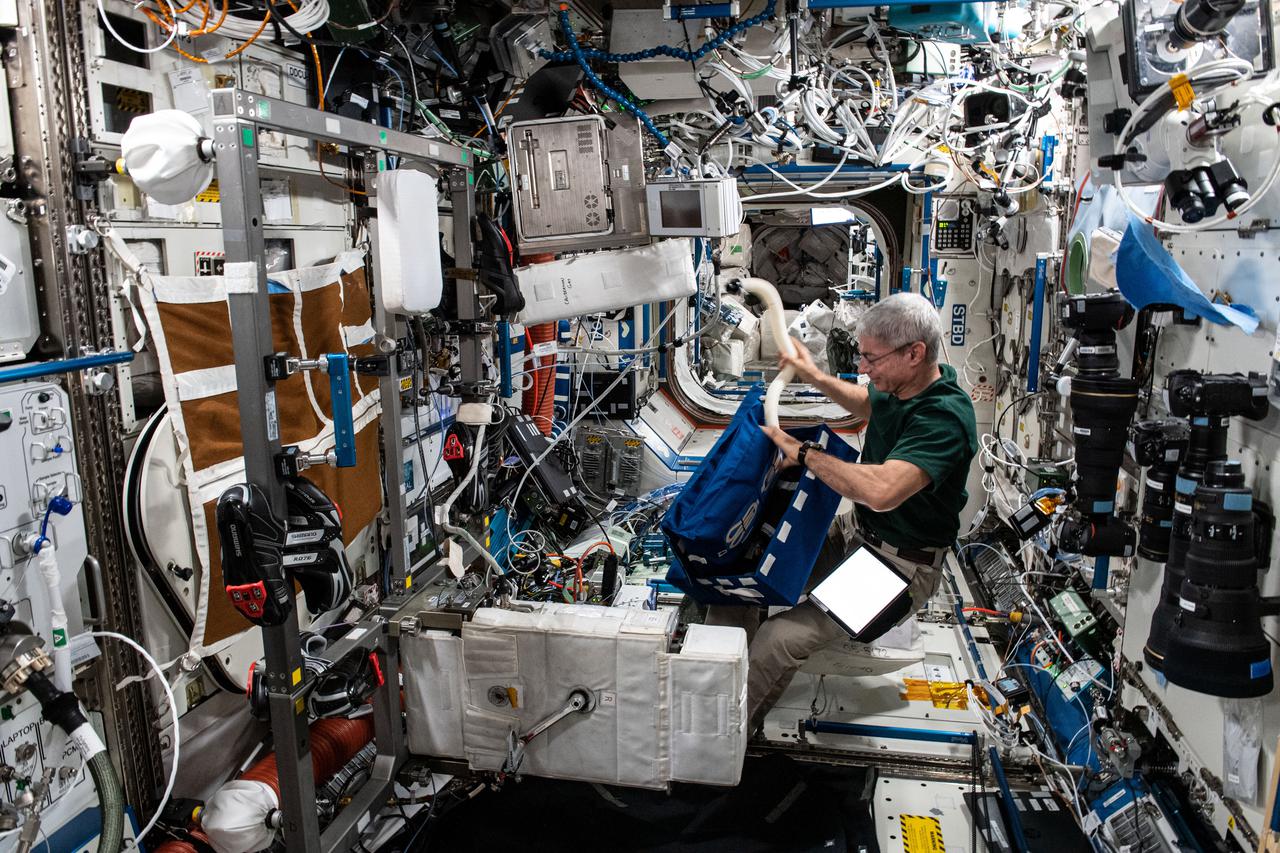
iss065e144326 (June 22, 2021) --- NASA astronaut and Expedition 65 Flight Engineer Mark Vande Hei sets up the International Space Station's exercise bicycle, also known as the Cycle Ergometer with Vibration Isolation and Stabilization (CEVIS), inside the U.S. Destiny laboratory module. Vande Hei later strapped himself on the CEVIS and attached sensors to himself for a workout study measuring aerobic capacity in space.
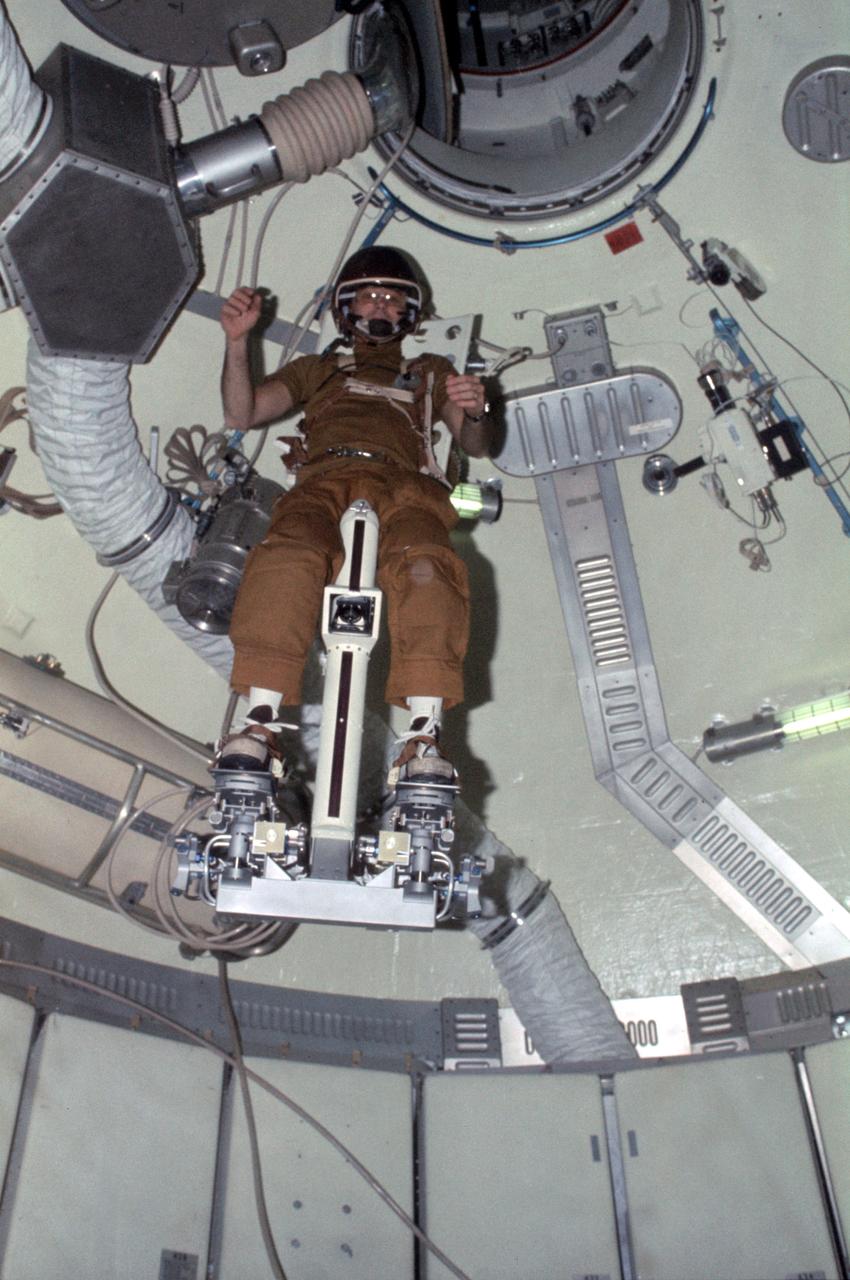
SL3-108-1304 (July-September 1973) --- Astronaut Alan L. Bean, Skylab 3 commander, flies the M509 Astronaut Maneuvering Equipment in the forward dome area of the Orbital Workshop (OWS) on the space station cluster in Earth orbit. Bean is strapped in to the back-mounted, hand-controlled Automatically Stabilized Maneuvering Unit (ASMU). This ASMU experiment is being done in shirt sleeves. The dome area where the experiment is conducted is about 22 feet in diameter and 19 feet from top to bottom. Photo credit: NASA
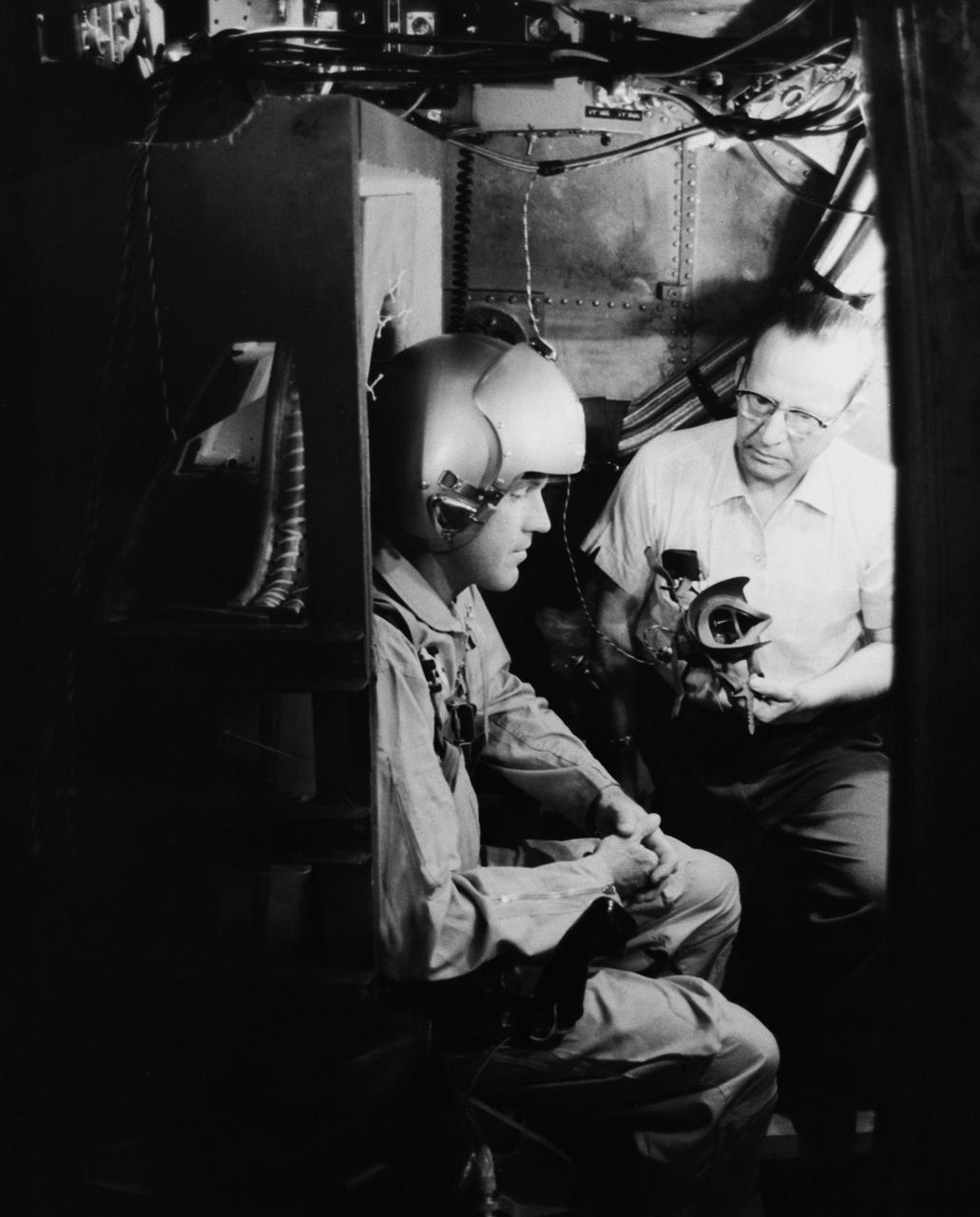
S63-03978 (1963) --- Astronaut L. Gordon Cooper Jr., prime pilot for the Mercury-Atlas 9 (MA-9) mission, is strapped into the gondola while undergoing tests in the centrifuge at the Naval Air Development Center, Johnsville, Pennsylvania. The centrifuge is used to investigate by simulation the pilot's capability to control the vehicle during the actual flight in its booster and reentry profile. Photo credit: NASA
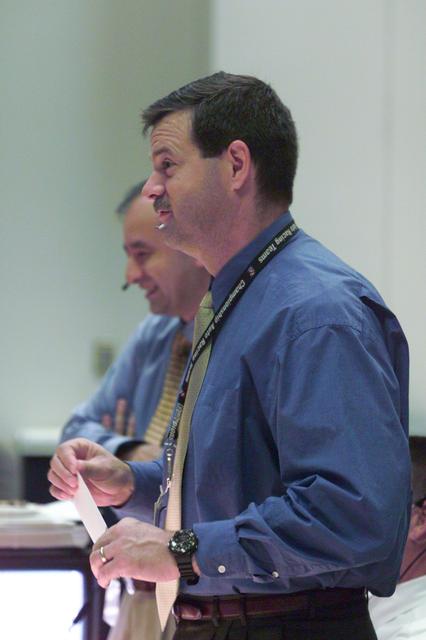
JSC2001-E-12122 (19 April 2001) --- Astronaut Scott D. Altman (foreground), STS-100 ascent spacecraft communicator (CAPCOM), stays on top of pre-launch activities at his console in the shuttle flight control room of Houston's Mission Control Center (MCC). Astronaut Mark L. Polansky stands beside Altman. Six astronauts and a cosmonaut, meanwhile, were strapped into their seats in the crew cabin of the Space Shuttle Endeavour several hundred miles away in Florida.
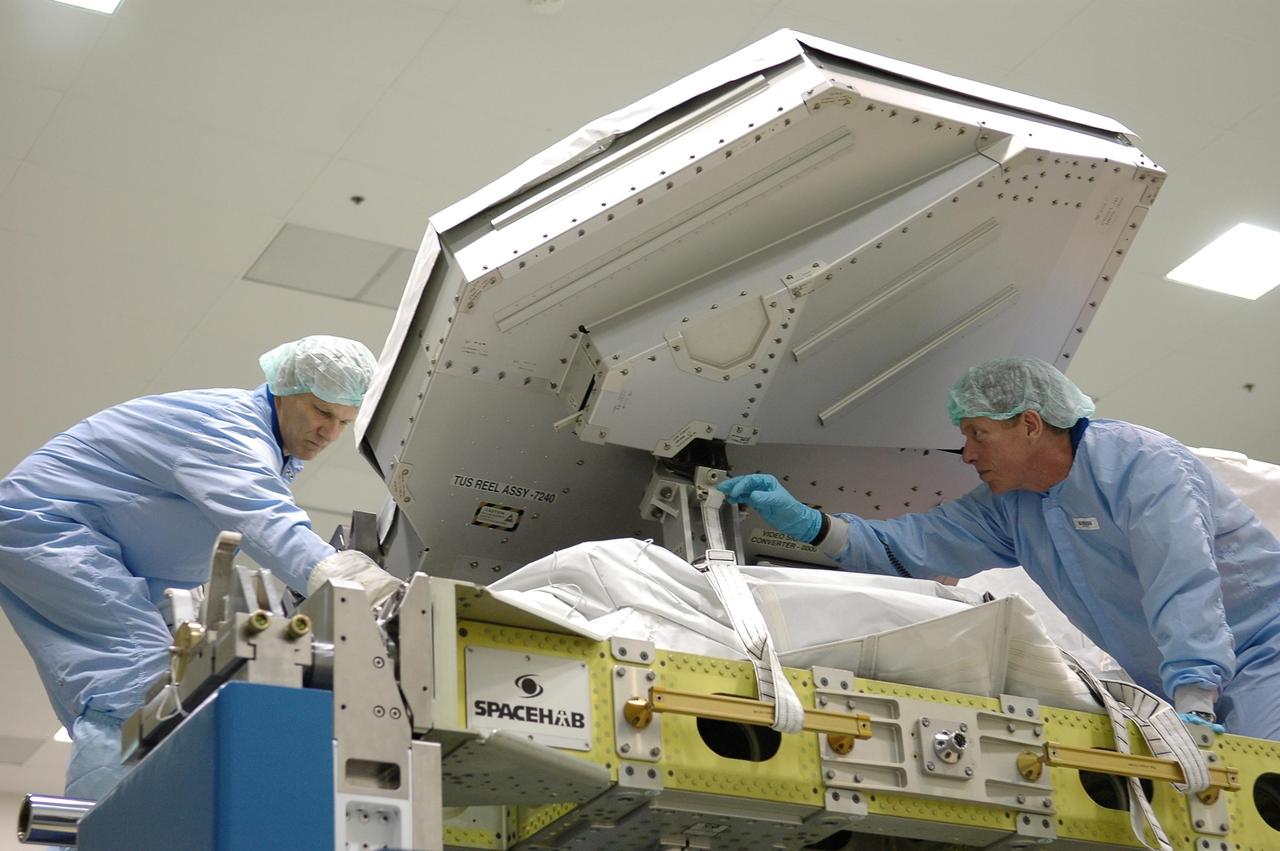
KENNEDY SPACE CENTER, FLA. - STS-121 Mission Specialist Piers Sellers (left) and Commander Steven Lindsey (right) are practicing removing the cover and strap on the trailing umbilical assembly at the SPACEHAB facility in Cape Canaveral during a Crew Equipment Interface Test. This test allows the astronauts to become familiar with equipment they will be using on their upcoming mission. STS-121 is scheduled to launch in July aboard Space Shuttle Discovery. Photo credit: NASA/Kim Shiflett
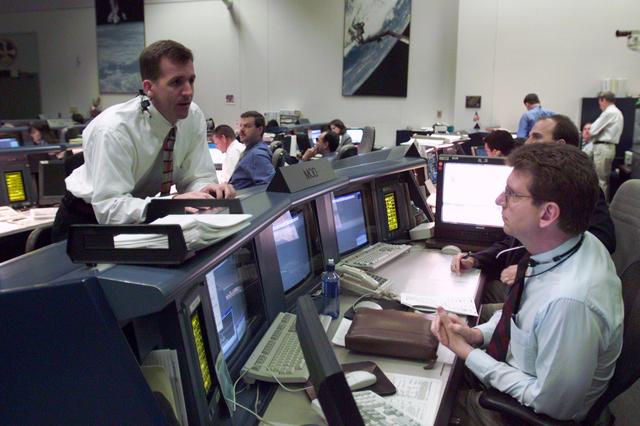
JSC2001-E-12120 (19 April 2001) --- STS-100 ascent flight director LeRoy Cain (left) leans over the Mission Operations Directorate (MOD) console for a word with Jeffrey Bantle in the shuttle flight control room of Houston's Mission Control Center (MCC). Six astronauts and a cosmonaut, meanwhile, were strapped into their seats in the crew cabin of the Space Shuttle Endeavour several hundred miles away in Florida.
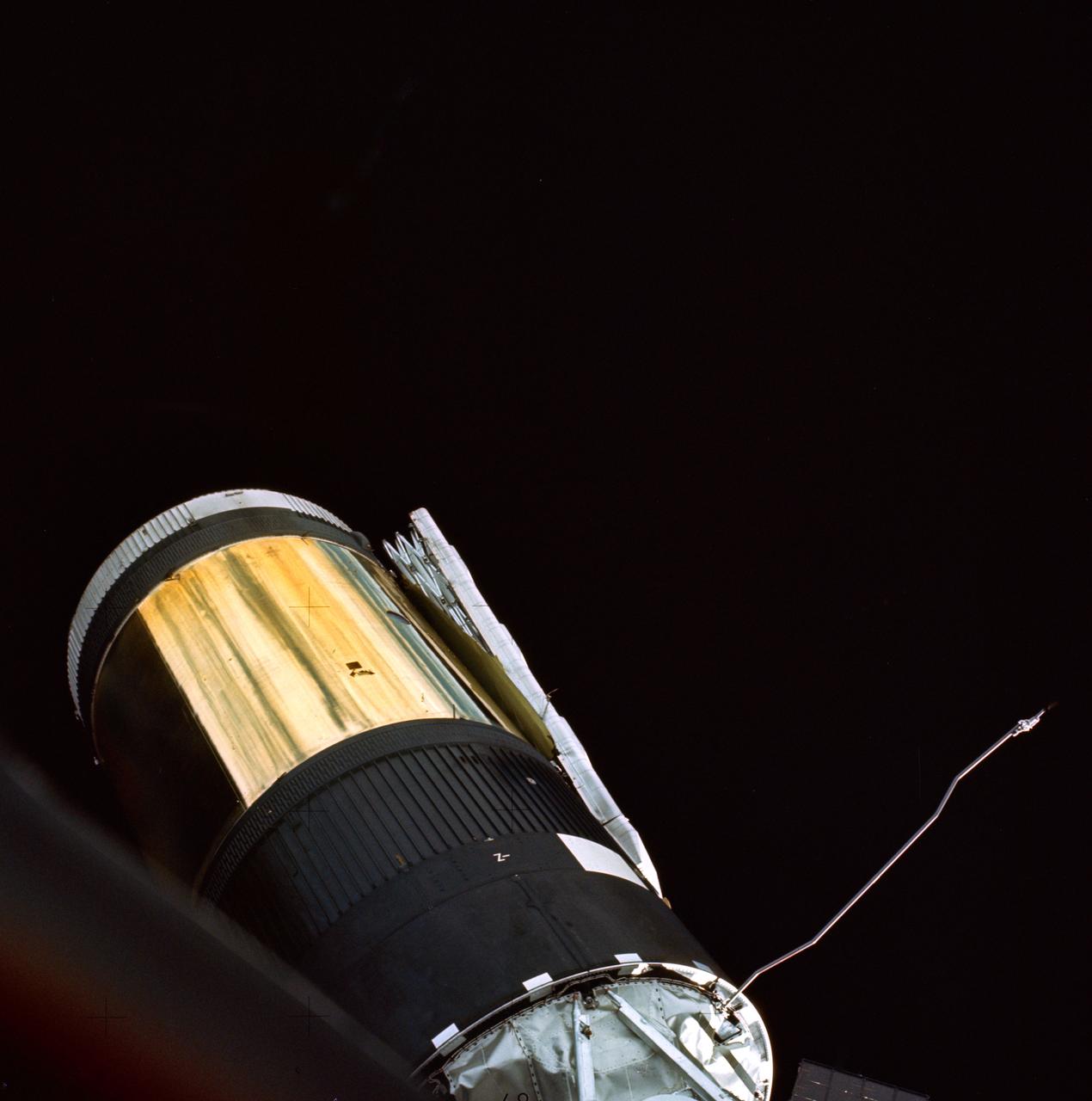
This view of the Skylab Orbital Space Station was taken from the Skylab 2 Command/Service Module during it's initial fly around inspection. The micrometeoroid shield can be seen to be missing and a parasol solar shield was later fitted in its place. The damaged and partially deployed solar array, in the center of the scene, can be seen to be restrained by a strap that was later cut during an early EVA, allowing the panel to fully deploy.
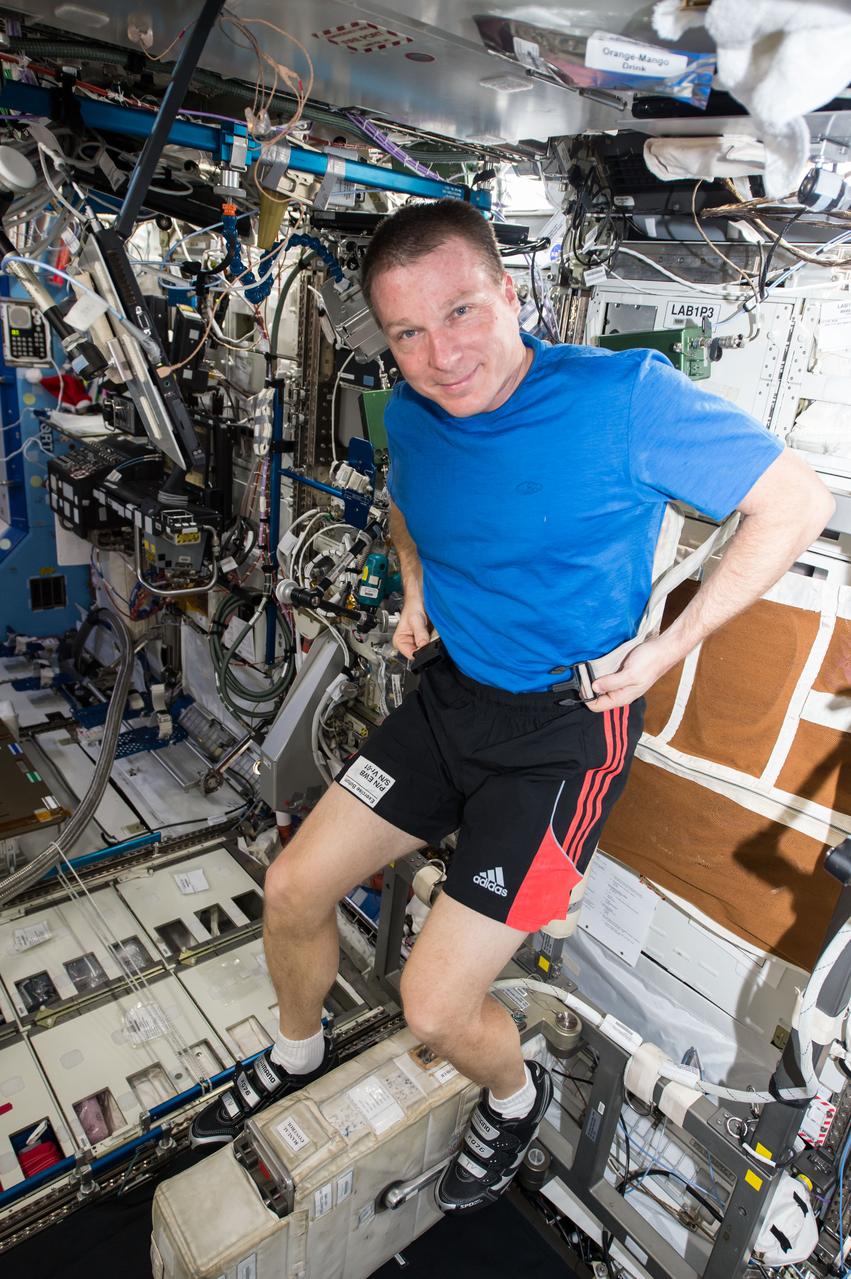
ISS042E082884 (12/27/2014) --- Expedition 42 Flight Engineer Terry Virts of NASA straps into the station’s stationary exercise bicycle known as the Cycle Ergometer with Vibration Isolation System (CEVIS). Each crew member spends an average of 2.5 hours a day exercising to combat the negative effects of prolonged weightlessness by maintaining bone and muscle mass and cardiovascular health.
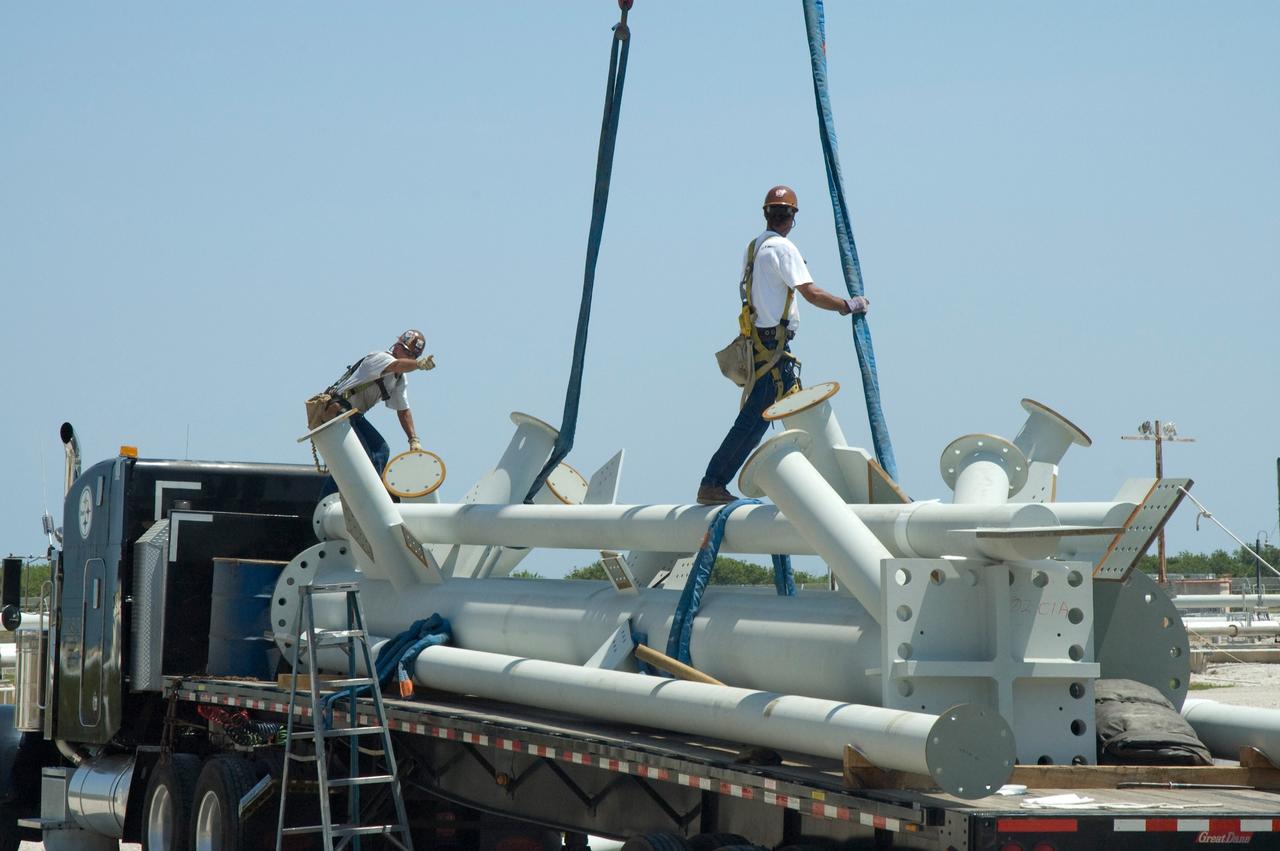
CAPE CANAVERAL, Fla. -- On Launch Pad 39B at NASA's Kennedy Space Center, workers secure straps around the lightning mast to be erected on towers being built for the Constellation Program and Ares/Orion launches. Pad B will be the site of the first Ares vehicle launch, including Ares I-X which is scheduled for April 2009. Photo credit: NASA/Jim Grossmann
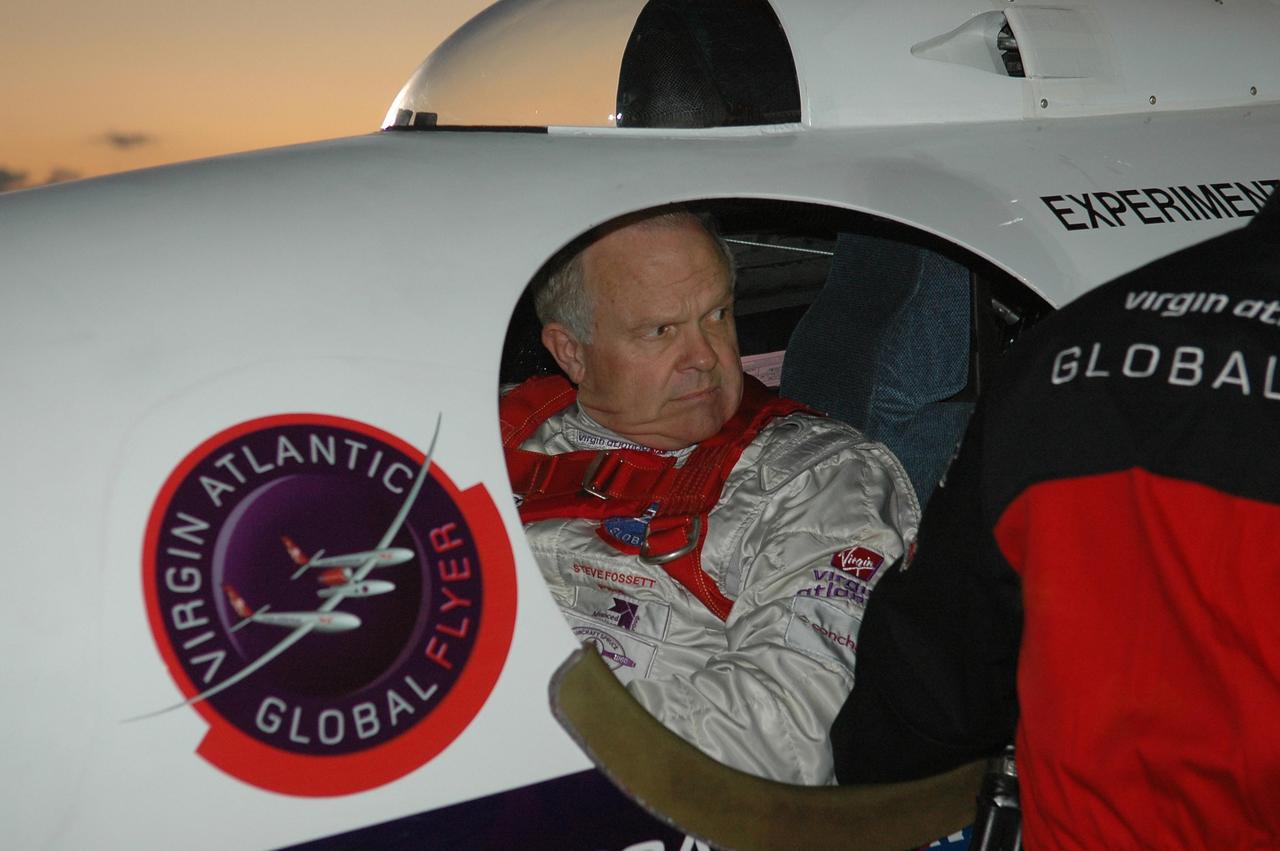
KENNEDY SPACE CENTER, FLA. - At NASA Kennedy Space Center’s Shuttle Landing Facility, Steve Fossett is strapped into the cockpit of the Virgin Atlantic GlobalFlyer waiting for takeoff. Fossett will pilot the GlobalFlyer on a record-breaking attempt by flying solo, non-stop without refueling, to surpass the current record for the longest flight of any aircraft. This is the second attempt in two days after a fuel leak was detected Feb. 7. The expected time of takeoff is 7 a.m. Photo credit: NASA/Kim Shiflett
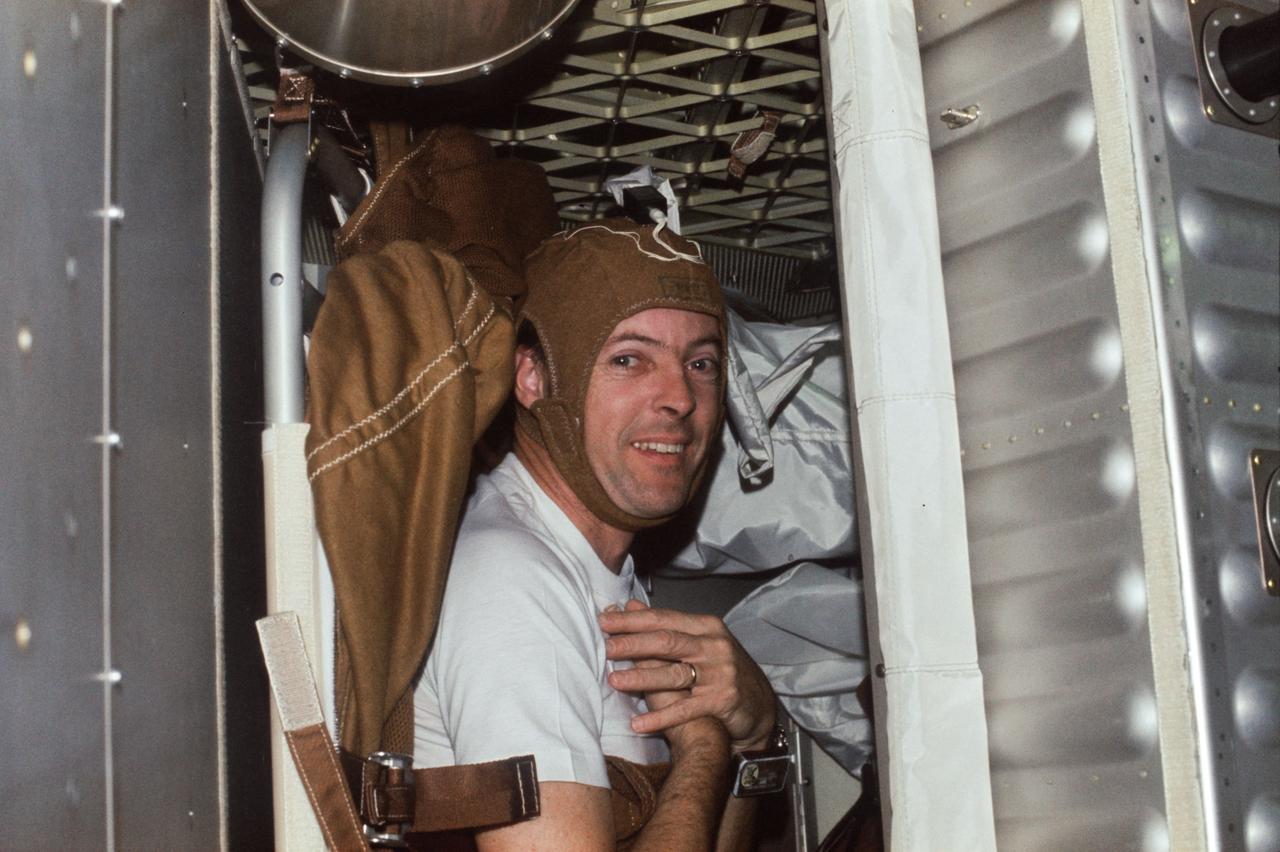
SL2-X3-205 (June 1973) --- Scientist-astronaut Joseph P. Kerwin, Skylab 2 science pilot, is photographed strapped into the sleep restraint in the crew quarters of the Orbital Workshop of the Skylab 1 & 2 space station cluster in Earth orbit. Kerwin is wearing the special cap which contains biomedical instrumentation for the M133 Sleep Monitoring Experiment. The purpose of the M133 experiment is to evaluate quantity and quality of sleep during prolonged space flight by the analysis of electroencephalographic (EEG) and electrooculographic (EOG) activity. Photo credit: NASA
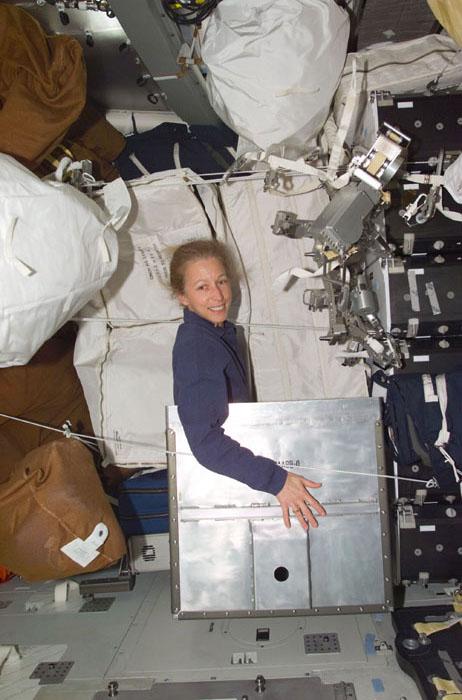
STS098-E-5272 (15 February 2001) --- Astronaut Marsha S. Ivins, STS-98 mission specialist, is photographed with the casing of the Vozdukh as it is strapped in storage position on the mid deck of the Space Shuttle Atlantis. Vozdukh is the Russian system in the Zvezda Service Module, which removes carbon dioxide from the ISS atmosphere. The scene was recorded with a digital still camera by one of the STS-98 astronauts aboard the shuttle.
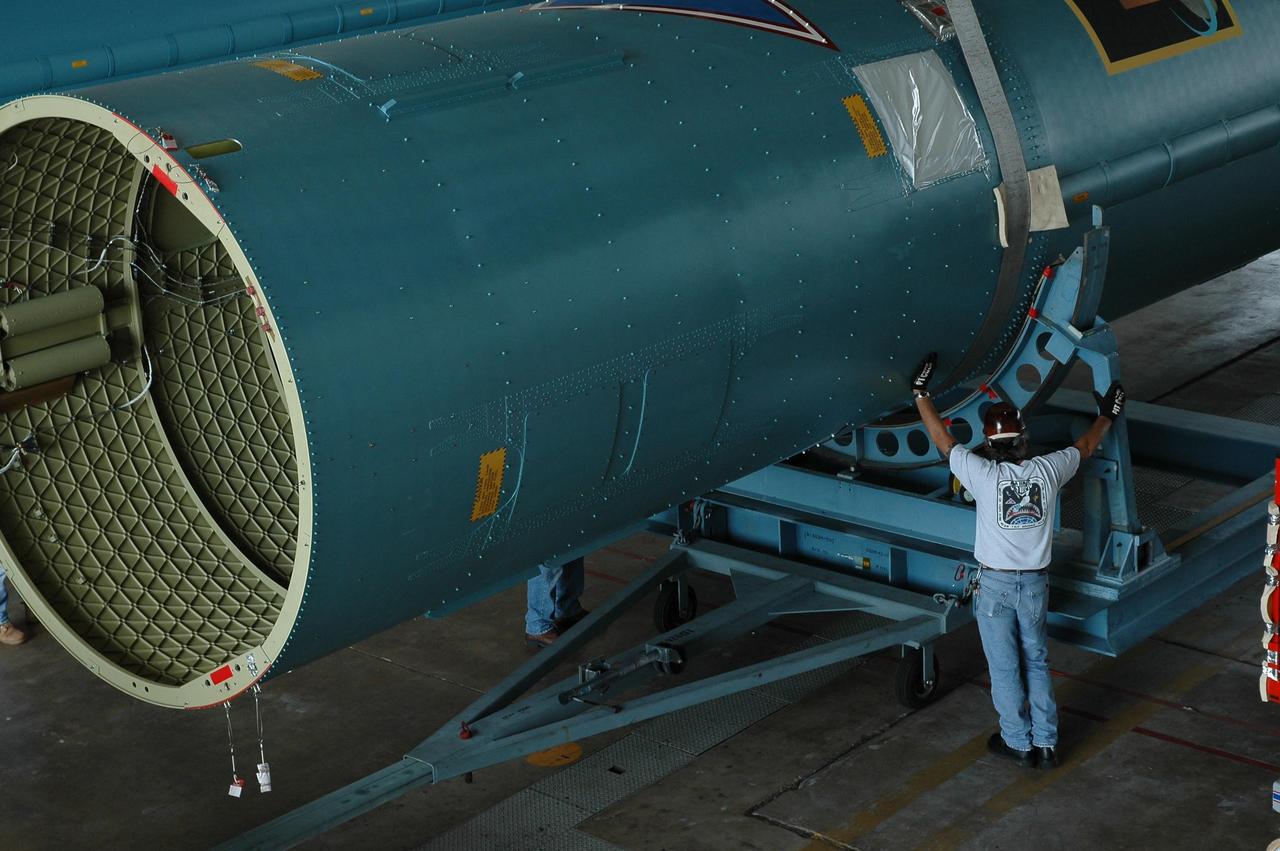
KENNEDY SPACE CENTER, FLA. -- In Hangar M on Cape Canaveral Air Force Station, workers secure straps to an overhead crane around the Delta II rocket's first stage. It will be lifted and placed onto a transporter for its move to the launch pad. Dawn's mission is to explore two of the asteroid belt's most intriguing and dissimilar occupants: asteroid Vesta and the dwarf planet Ceres. Dawn is scheduled to launch June 30 from Launch Complex 17-B. Photo credit: NASA/Jack Pfaller
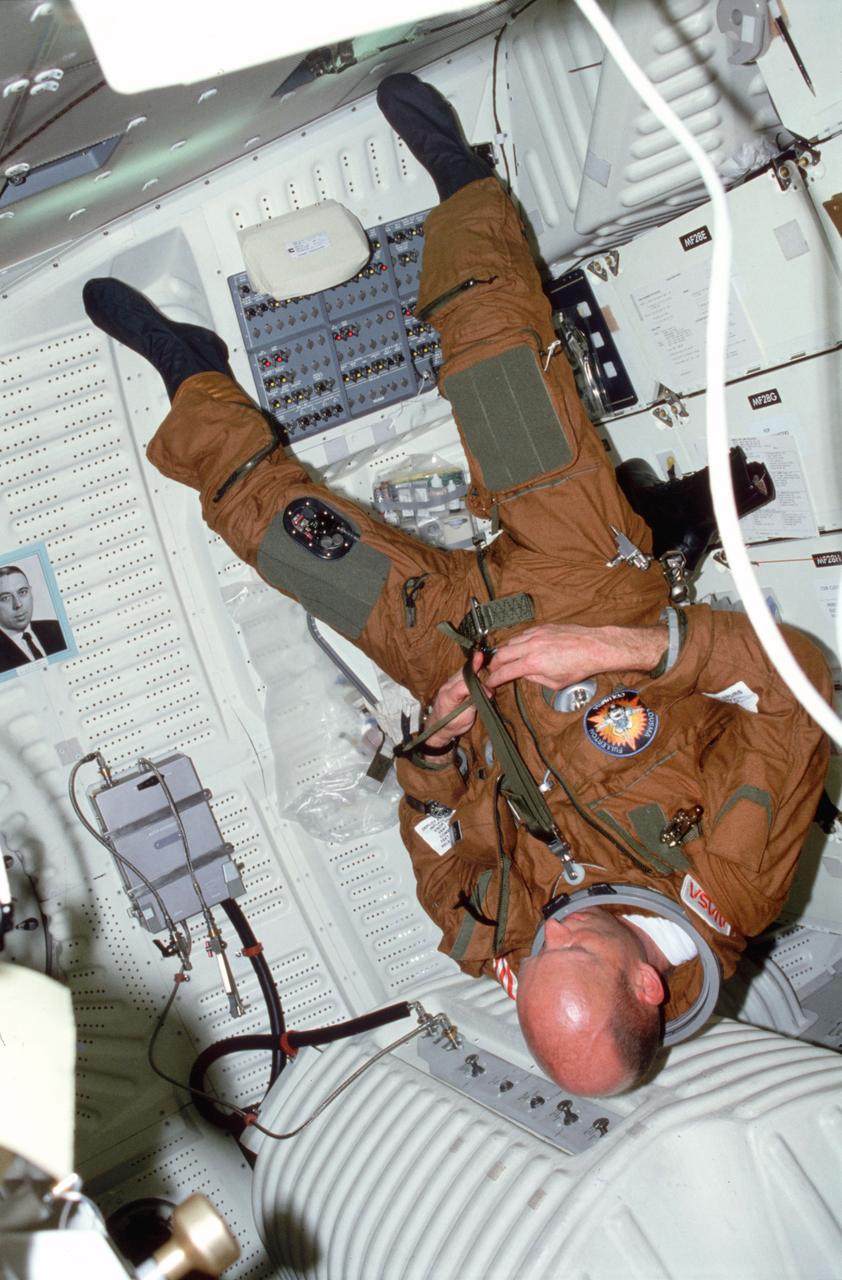
STS003-23-165 (22-30 March 1982) --- Astronaut Gordon Fullerton, STS-3 pilot, dons ejection escape suit (EES) (high altitude pressure garment) life preserver unit (LPU) on forward port side of middeck above potable water tank. Fullerton also adjusts lapbelt fitting and helmet holddown strap. Photo credit: NASA
S89-26392 (Jan 1989) --- Astronaut Robert C. Springer, strapped into a chair, participates in entry phase rehearsals for his upcoming STS-29 flight. The mission specialist will join three crewmembers on the flight deck for launch, but will move to the mid deck for entry, swapping positions with fellow crewmember, Astronaut James P. Bagian, also a mission specialist. The rehearsals took place in the crew compartment trainer in JSC's Shuttle mockup and integration laboratory. Photo was made by Bill Bowers of the Johnson Space Center.
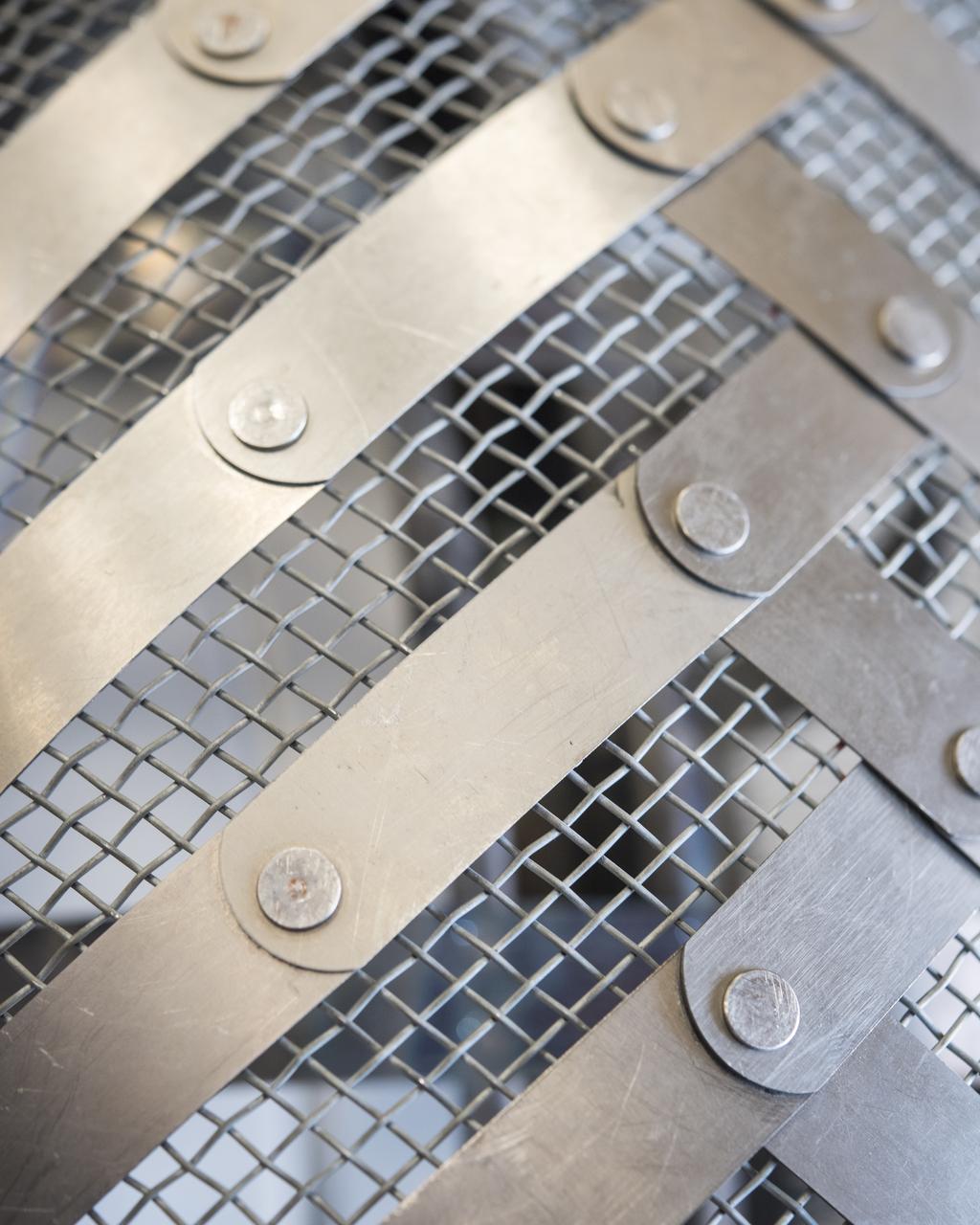
This is a close-up of an exact replica of the Apollo-era Lunar Roving Vehicle Wheel, of which twelve originals still rest on the surface of the Moon. The tire was designed to flex under load, without air, and was formed from a mesh of plated piano wire. Metal straps were hand riveted onto the mesh to reduce sinking into loose lunar soils. These replica wheels were tested in NASA Glenn's SLOPE Lab to establish a baseline for future improvements.
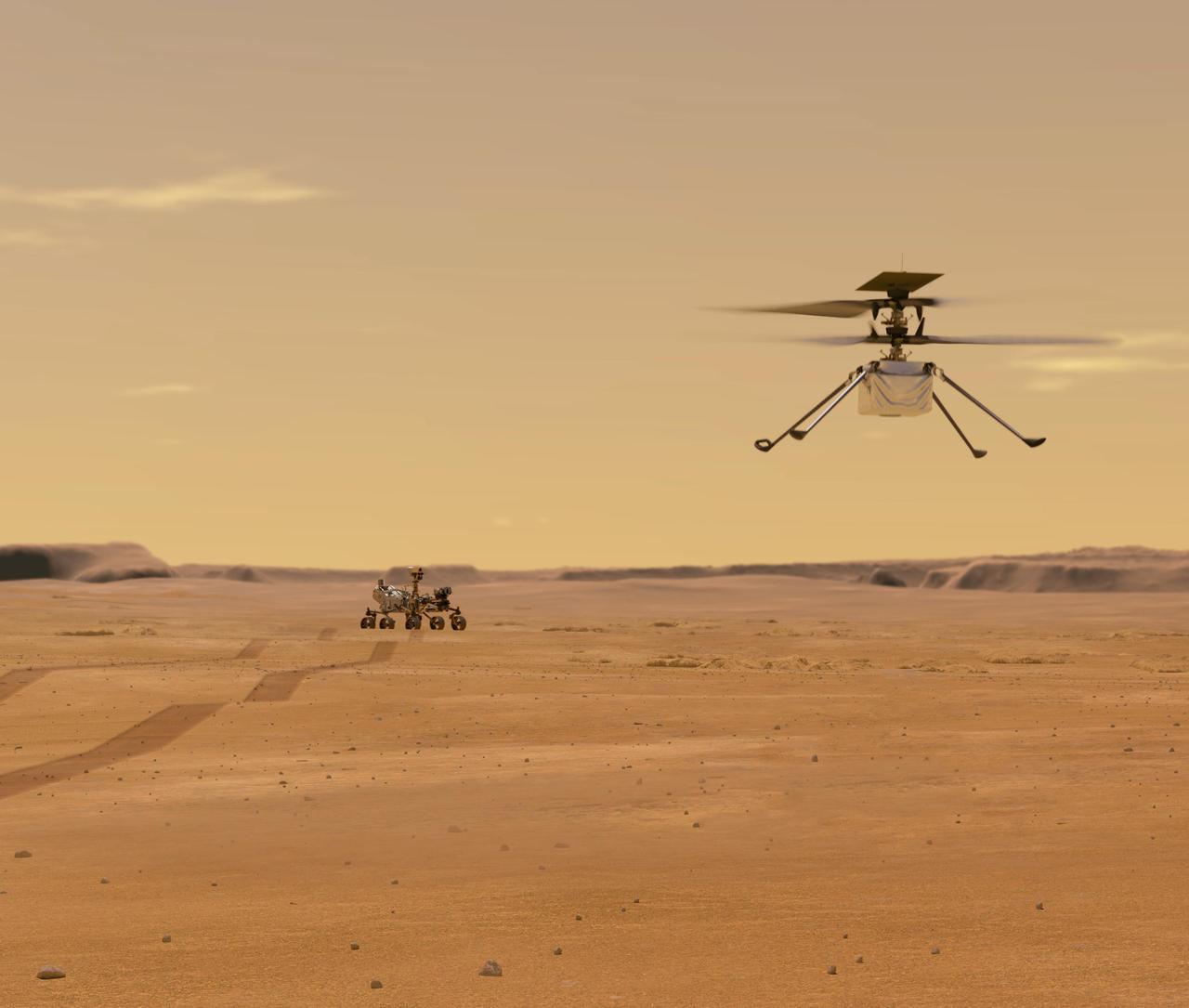
This illustration depicts Mars Helicopter Ingenuity during a test flight on Mars. Ingenuity was taken to the Red Planet strapped to the belly of the Perseverance rover (seen in the background). Ingenuity, a technology experiment, will be the first aircraft to attempt controlled flight on another planet. It will arrive on Mars on Feb. 18, 2021, attached to the belly of NASA's Mars 2020 Perseverance rover. Ingenuity is expected to attempt its first flight test in spring 2021. https://photojournal.jpl.nasa.gov/catalog/PIA24127
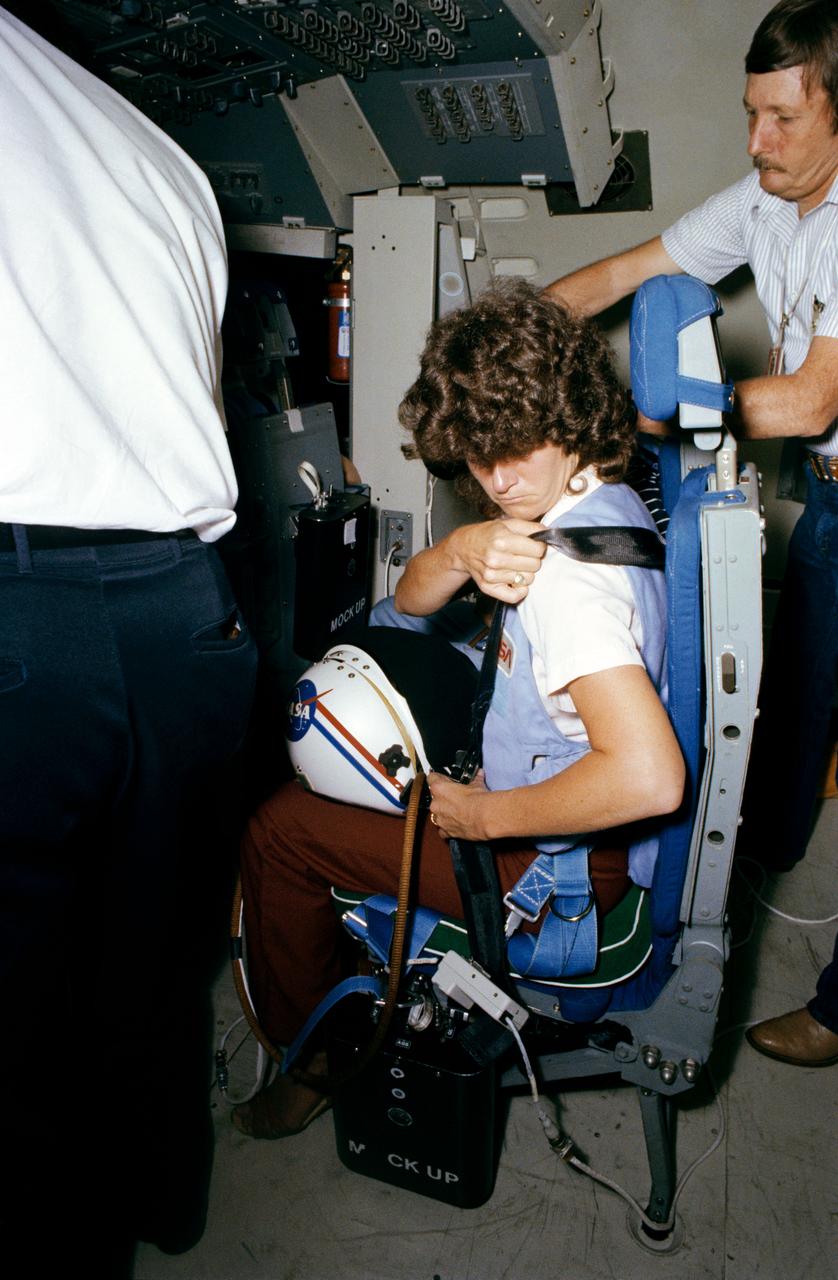
S83-32568 (23 May 1983) --- Astronaut Sally K. Ride, STS-7 mission specialist, straps herself into a seat in the Shuttle Mission Simulator (SMS) in Johnson Space Center?s Mission Simulation and Training Facility. Dr. Ride and the other STS-7 crew members continue their simulations in the motion base simulator in preparation for their flight in the space shuttle Challenger. Launch is scheduled for June 18. Troy Stewart, suit technician, assisted Dr. Ride. Photo credit: NASA
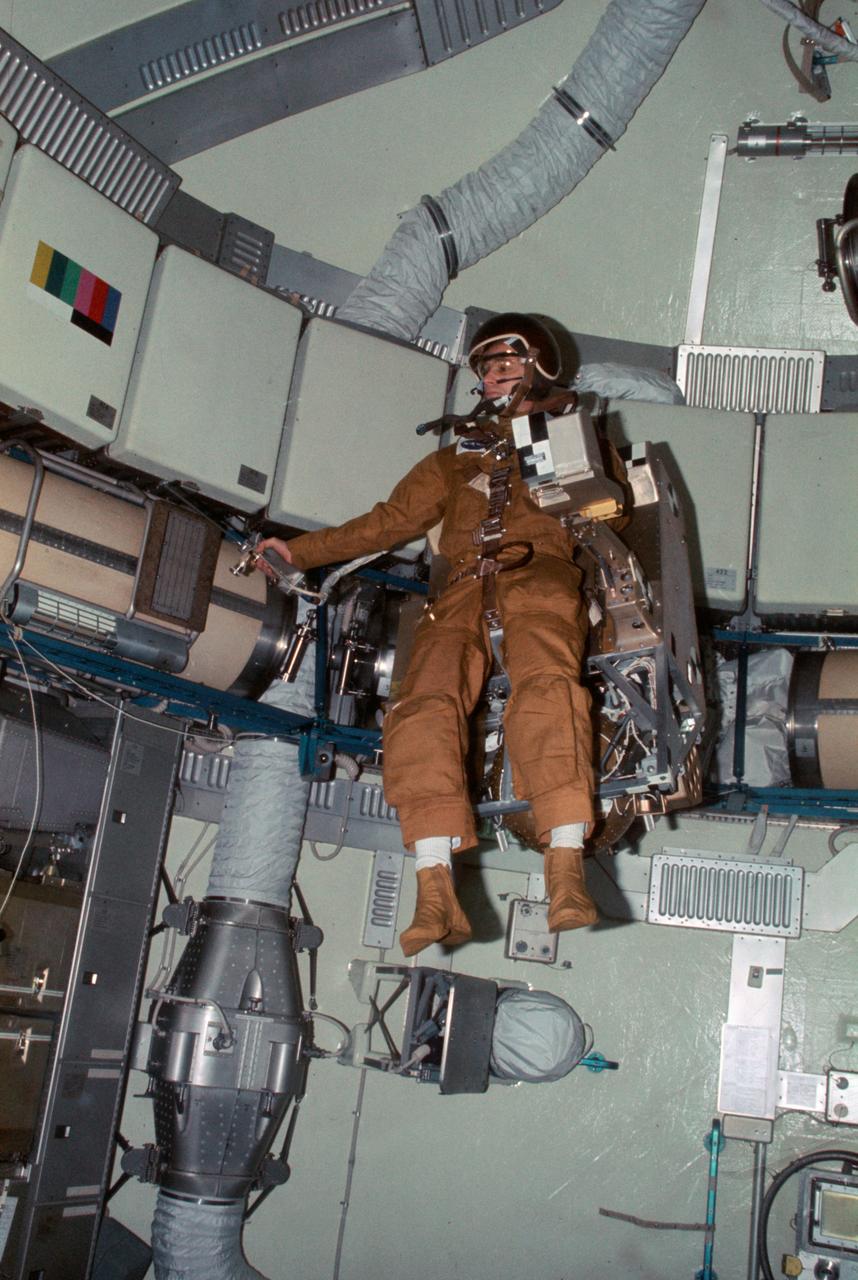
SL3-107-1215 (27 Aug. 1973) --- Astronaut Alan L. Bean, Skylab 3 commander, flies the M509 Astronaut Maneuvering Equipment in the forward dome area of the Orbital Workshop (OWS) on the space station cluster in Earth orbit. One of his fellow crewmen took this photograph with a 35mm Nikon camera. Bean is strapped into the back mounted, hand-controlled Automatically Stabilized Maneuvering Unit (ASMU). The dome area is about 22 feet in diameter and 19 feet from top to bottom. Photo credit: NASA
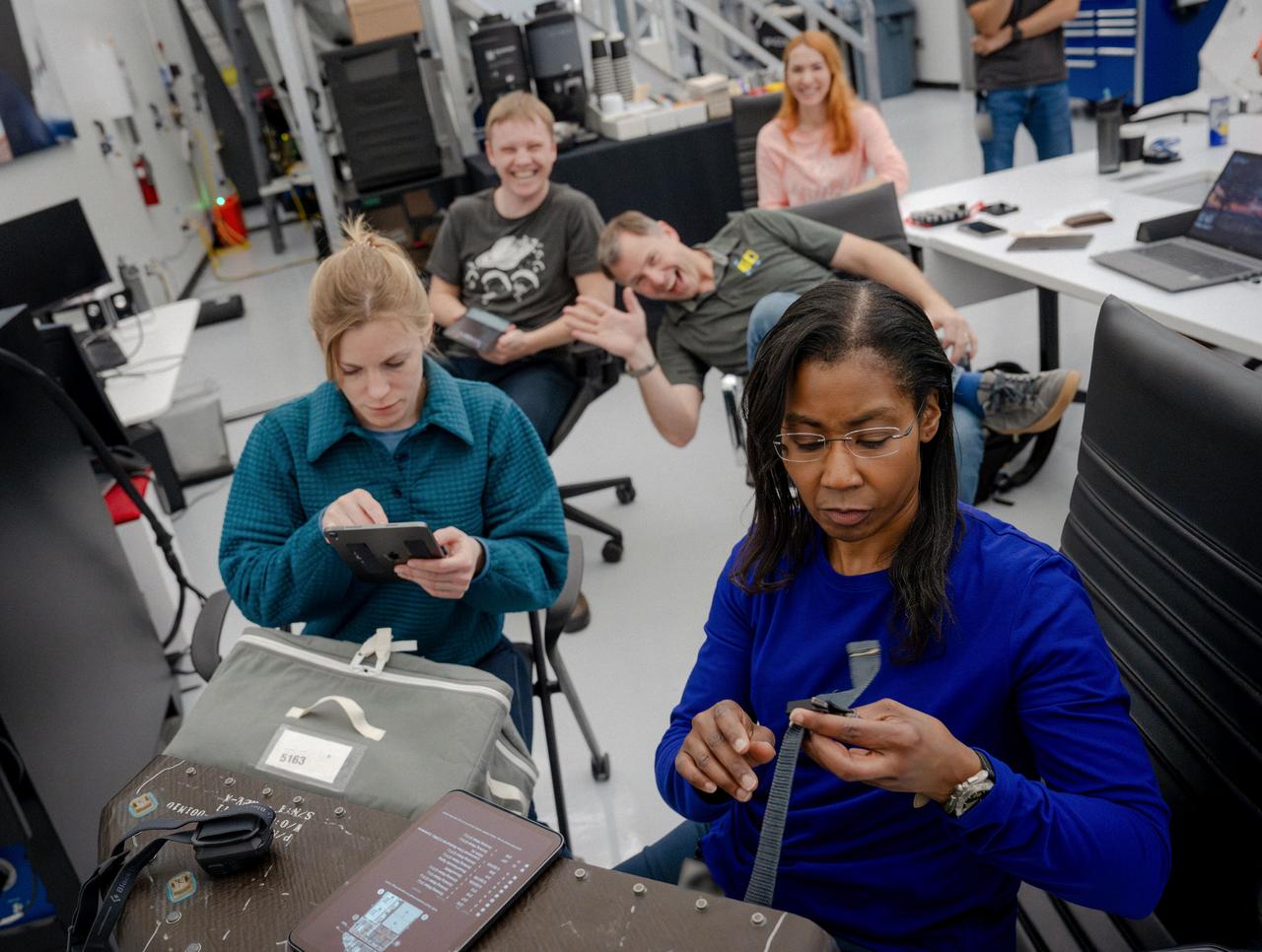
jsc2024e024939 (March 1, 2024) --- NASA’s SpaceX Crew-9 members Mission Specialist Aleksandr Gorbunov and Pilot Nick Hague smile big for the camera while Commander Zena Cardman and Mission Specialist Stephanie Wilson train on how to route straps and buckles around various bags that need to be stored in the Dragon spacecraft. Credit: SpaceX

S73-27508 (6 June 1973) --- An artist's concept showing astronaut Charles Conrad Jr., Skylab 2 commander, attempting to free the solar array system wing on the Orbital Workshop during extravehicular activity at the Skylab 1 & 2 space station cluster in Earth orbit. The astronaut in the background is Joseph P. Kerwin, Skylab 2 science pilot. Here, Conrad is pushing up on the Beam Erection Tether (BET) to raise the stuck solar panel. The solar wing is only partially deployed; an aluminum strap is believed to be holding it down. Note the cut aluminum angle. Attach points for the BET are on the vent module of the solar array beam. The other end of the BET is attached to the "A" frame supporting the Apollo Telescope Mount (ATM) which is out of view. The aluminum strapping is to be out first, freeing the solar array beam. Then, if the beam does not automatically deploy, Conrad will attempt to help by pulling on the BET. The automatic openers may have become too cold to open without assistance. A deployed solar panel of the ATM is at upper left. The EVA is scheduled for Thursday, June 7th. This concept is by artist Paul Fjeld. Photo credit: NASA
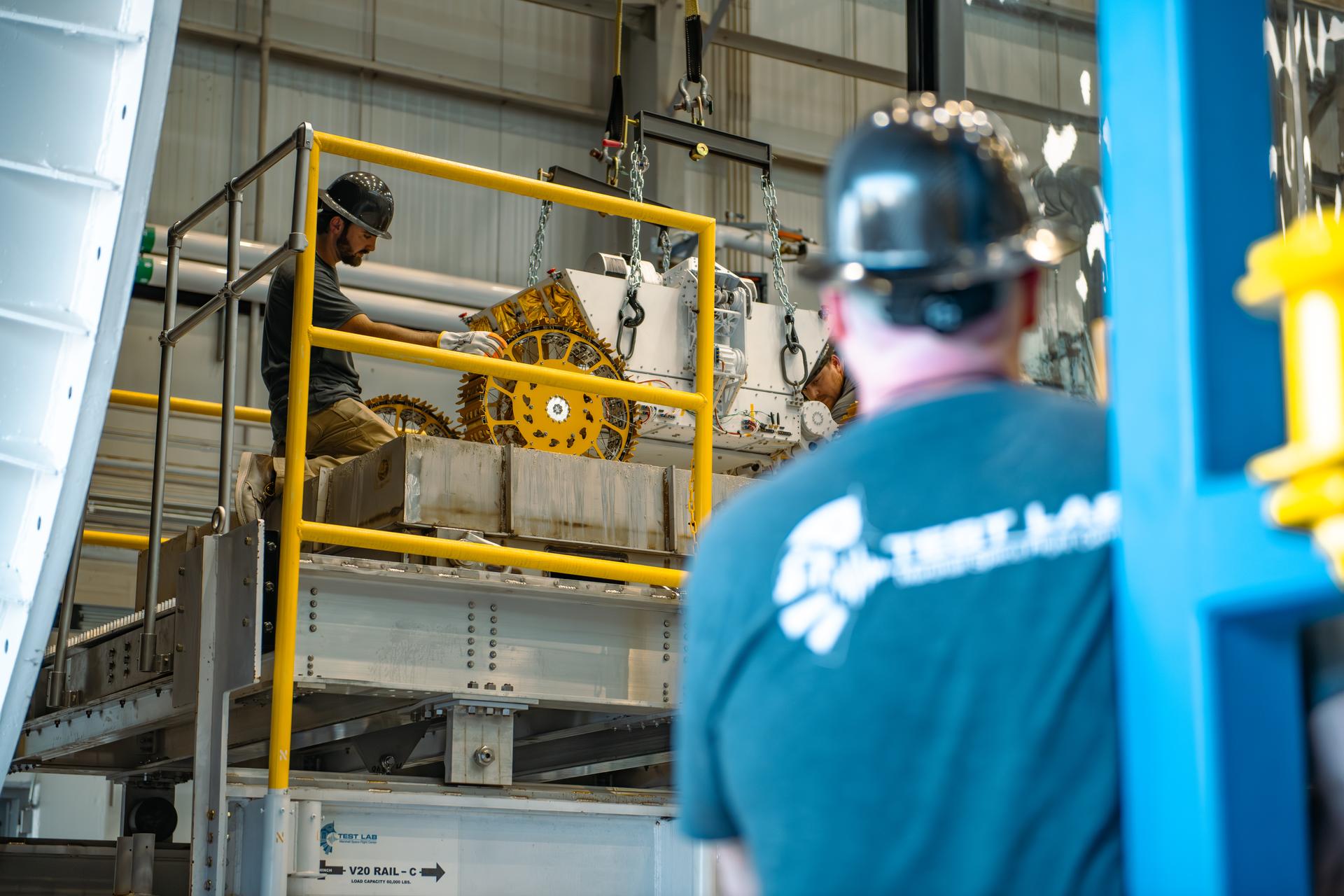
NASA test engineers with the Environmental Test Facility at NASA’s Marshall Space Flight Center situate the rover over the concrete slab that it will operate on before removing the suspension straps that lifted it onto the platform. The technology startup headquartered in Hawthorne, California, won second place overall at the agency’s Break the Ice Lunar Challenge’s live demonstration and finale in June 2024. This competition, one of NASA’s Centennial Challenges, tasked competitors to design, build, and demonstrate robotic technologies that could excavate and transport the icy, rocky dirt – otherwise known as regolith – found on the Moon. Starpath’s visit to NASA Marshall was part of their prize opportunity to test their upgraded lunar regolith excavation and transportation rover in the center’s 20-foot thermal vacuum chamber. For more information, contact NASA Marshall’s Office of Communications at 256-544-0034.
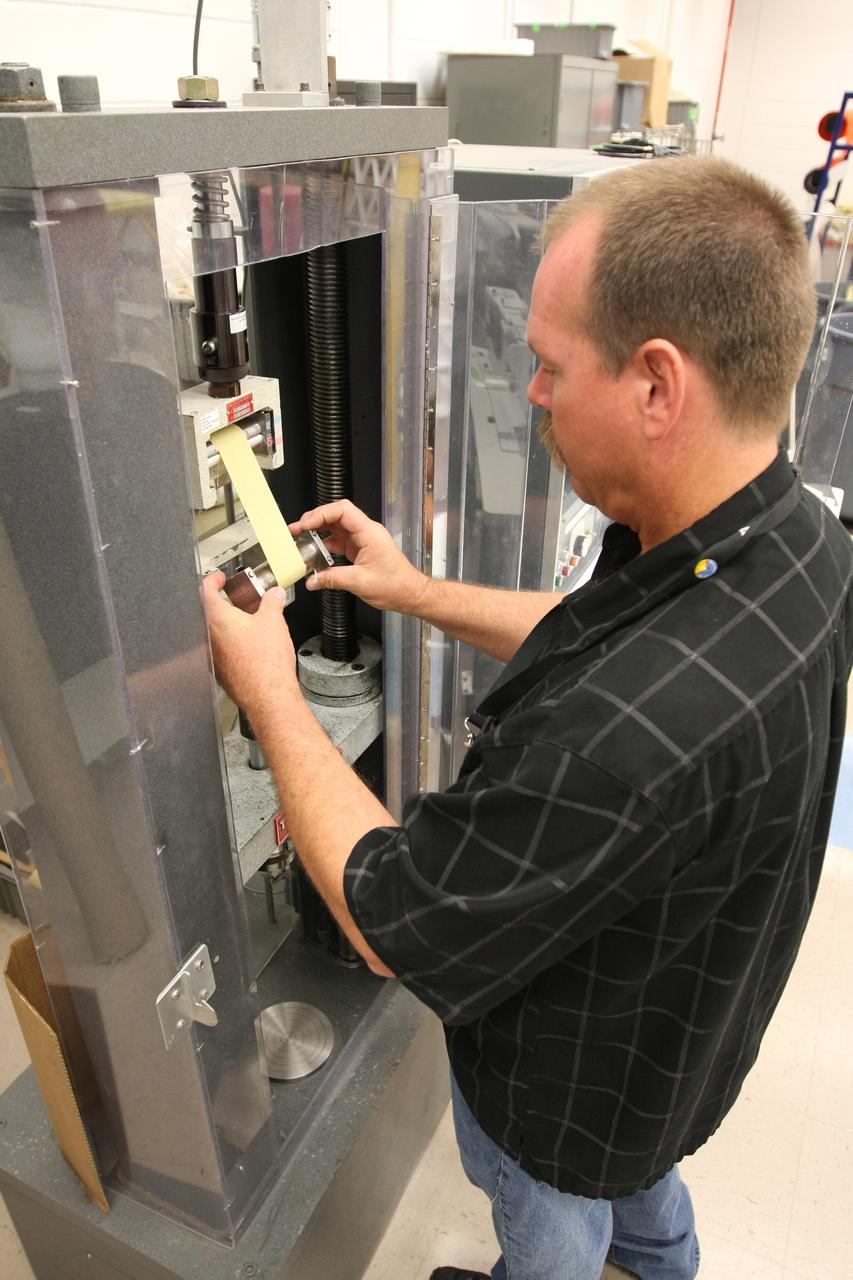
CAPE CANAVERAL, Fla. – In the Parachute Refurbishment Facility at NASA's Kennedy Space Center, Dave Hillebrandt checks strapping equipment used on Ares-I parachutes. Ares I is an in-line, two-stage rocket that will transport the Orion crew exploration vehicle to low-Earth orbit. The Ares I first stage will be a five-segment solid rocket booster based on the four-segment design used for the shuttle. As with the shuttle, this booster will fall away when spent, lowered by parachute into the Atlantic Ocean where it can be retrieved for re-use. Photo credit: NASA/Dimitri Gerondidakis
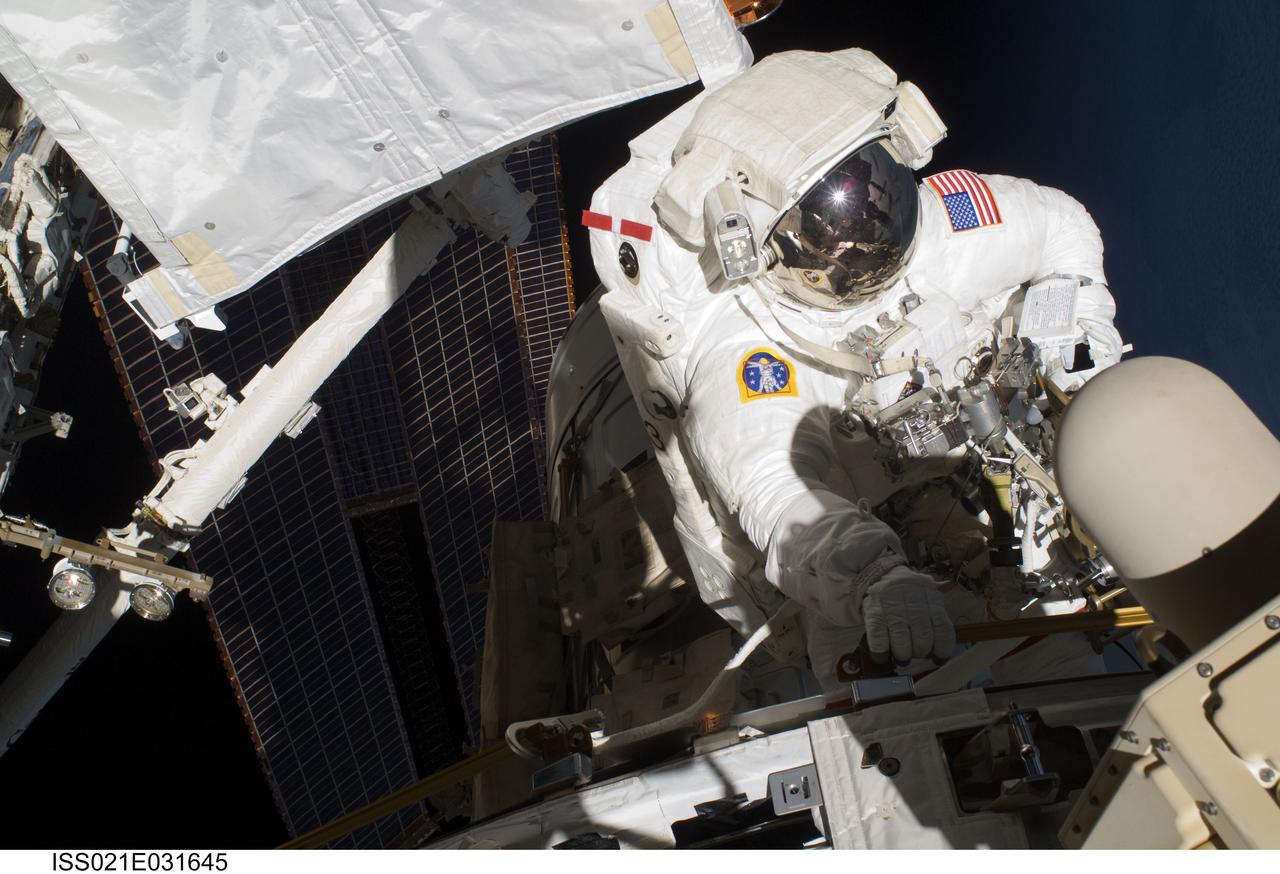
ISS021-E-031645 (23 Nov. 2009) --- Astronaut Randy Bresnik, STS-129 mission specialist, participates in the mission's third and final session of extravehicular activity (EVA) as construction and maintenance continue on the International Space Station. During the five-hour, 42-minute spacewalk, Bresnik and Robert L. Satcher Jr. (out of frame), mission specialist, removed a pair of micrometeoroid and orbital debris shields from the Quest airlock and strapped them to the External Stowage Platform #2, then moved an articulating foot restraint to the airlock, and released a bolt on a starboard truss ammonia tank assembly (ATA) in preparation for an STS-131 spacewalk that will replace the ATA.
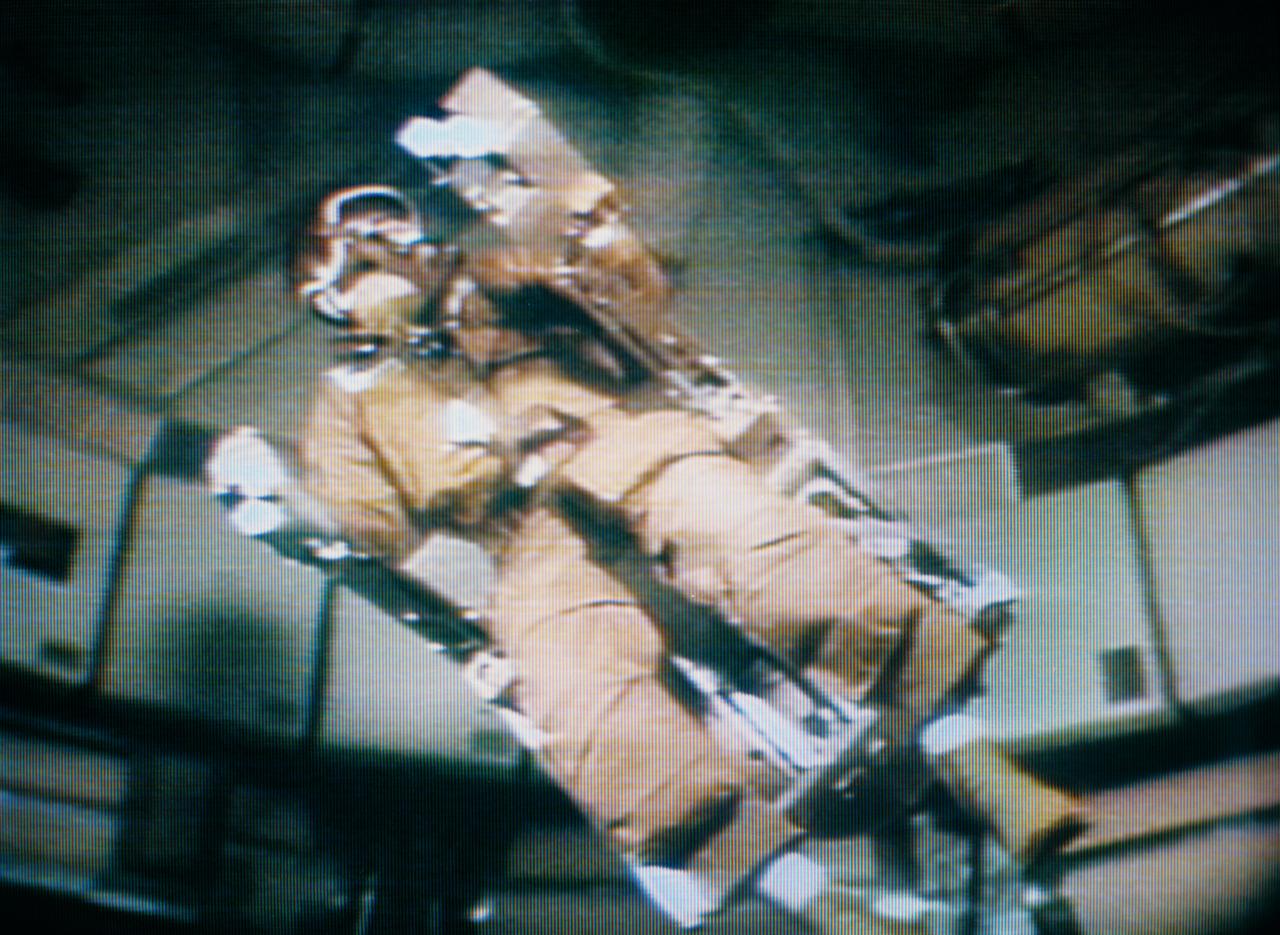
S73-34207 (28 Aug. 1973) --- Astronaut Alan L. Bean, Skylab 3 commander, flies the M509 astronaut Maneuvering Equipment, as seen in this photographic reproduction taken from a television transmission made by a color television camera in the Orbital Workshop (OWS) of the Skylab space station in Earth orbit. Bean is strapped into the back-mounted, hand-controlled Automatically Stabilized Maneuvering Unit (ASMU). The M509 exercise was in the forward dome area of the OWS. The dome area is about 22 feet in diameter and 19 feet from top to bottom. Photo credit: NASA
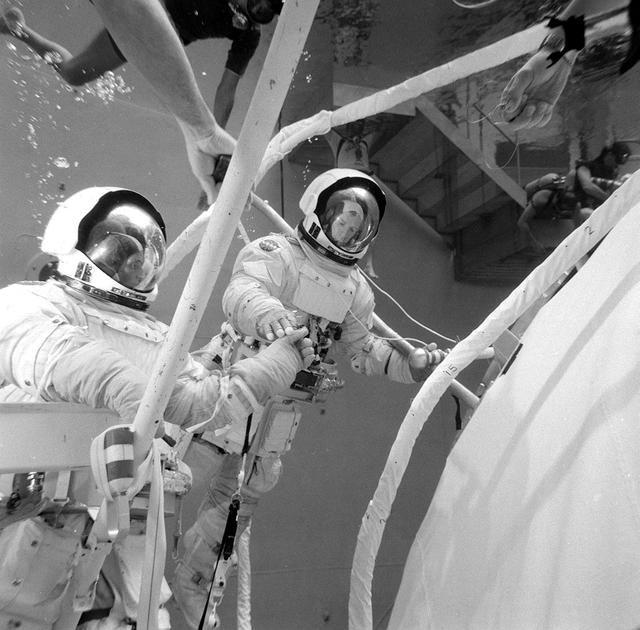
This photograph was taken during testing of an emergency procedure to free jammed solar array panels on the Skylab workshop. A metal strap became tangled over one of the folded solar array panels when Skylab lost its micrometeoroid shield during the launch. This photograph shows astronauts Schweickart and Gibson in the Marshall Space Flight Center (MSFC) Neutral Buoyancy Simulator (NBS) using various cutting tools and methods developed by the MSFC to free the jammed solar wing. Extensive testing and many hours of practice in simulators such as the NBS tank helped prepare the Skylab crewmen for extravehicular performance in the weightless environment. This huge water tank simulated the weightless environment that the astronauts would encounter in space.
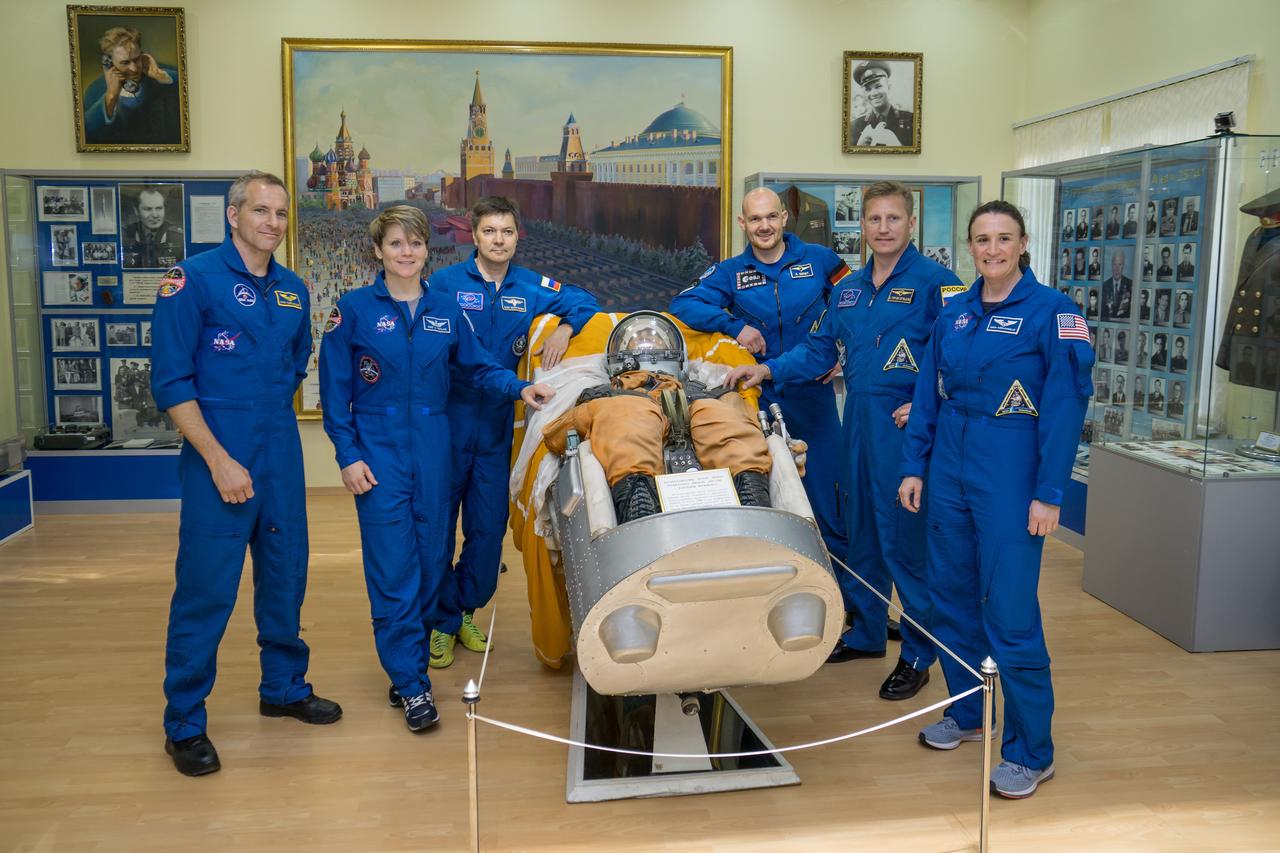
jsc2018e051932 - In the Korolev Museum at the Baikonur Cosmodrome in Kazakhstan, the Expedition 56 prime and backup crews pose for pictures May 31 flanking a model of a Soyuz crewmember strapped in their seat. From left to right are the backup crewmembers, David Saint-Jacques of the Canadian Space Agency, Anne McClain of NASA and Oleg Kononenko of Roscosmos and the prime crew. Alexander Gerst of the European Space Agency, Sergey Prokopyev of Roscosmos and Serena Aunon-Chancellor of NASA. Aunon-Chancellor, Prokopyev and Gerst will launch June 6 in the Soyuz MS-09 spacecraft for a six-month mission on the International Space Station. ..NASA/Victor Zelentsov.
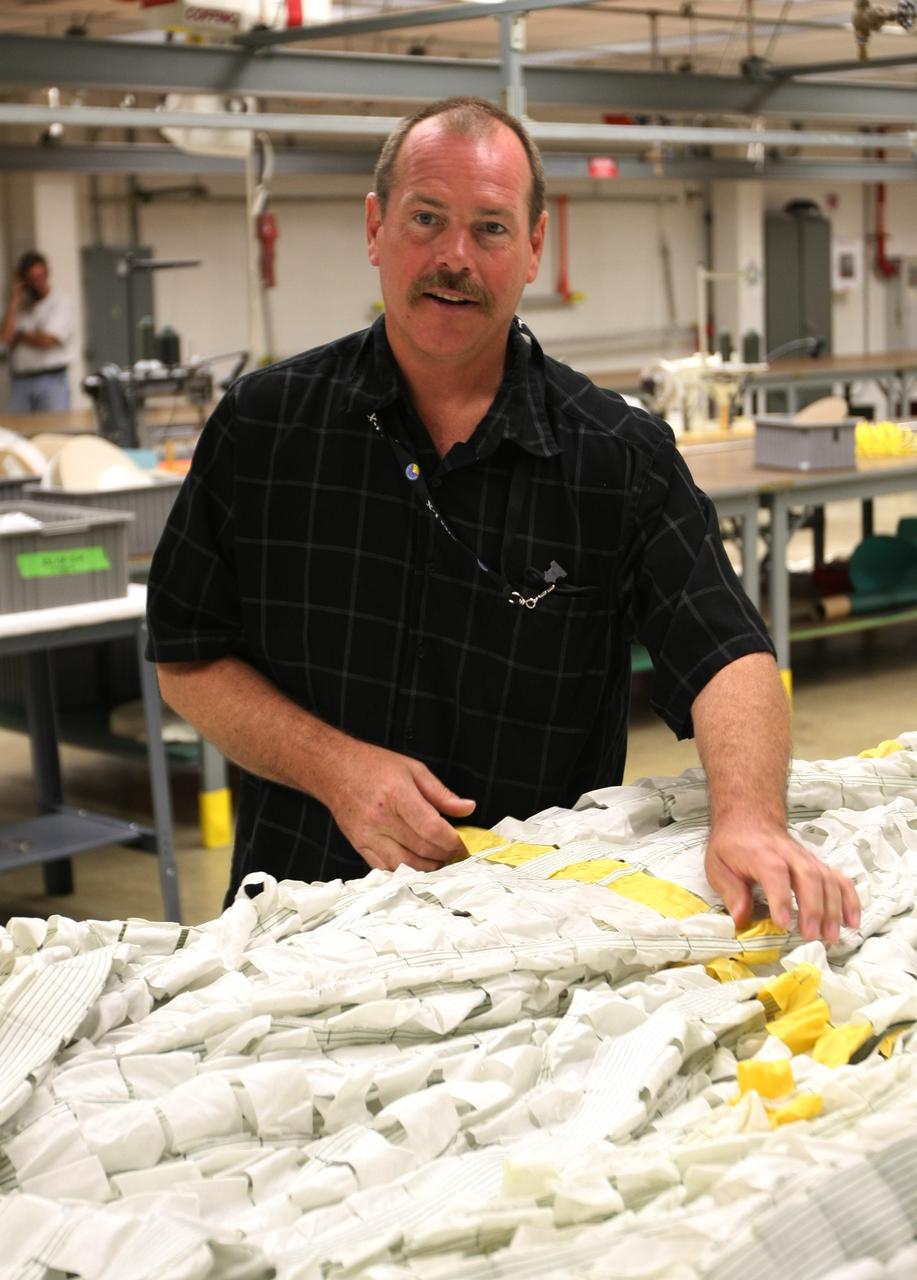
CAPE CANAVERAL, Fla. – In the Parachute Refurbishment Facility at NASA's Kennedy Space Center, Dave Hillebrandt checks strapping on an Ares-I parachute. Ares I is an in-line, two-stage rocket that will transport the Orion crew exploration vehicle to low-Earth orbit. The Ares I first stage will be a five-segment solid rocket booster based on the four-segment design used for the shuttle. As with the shuttle, this booster will fall away when spent, lowered by parachute into the Atlantic Ocean where it can be retrieved for re-use. Photo credit: NASA/Dimitri Gerondidakis
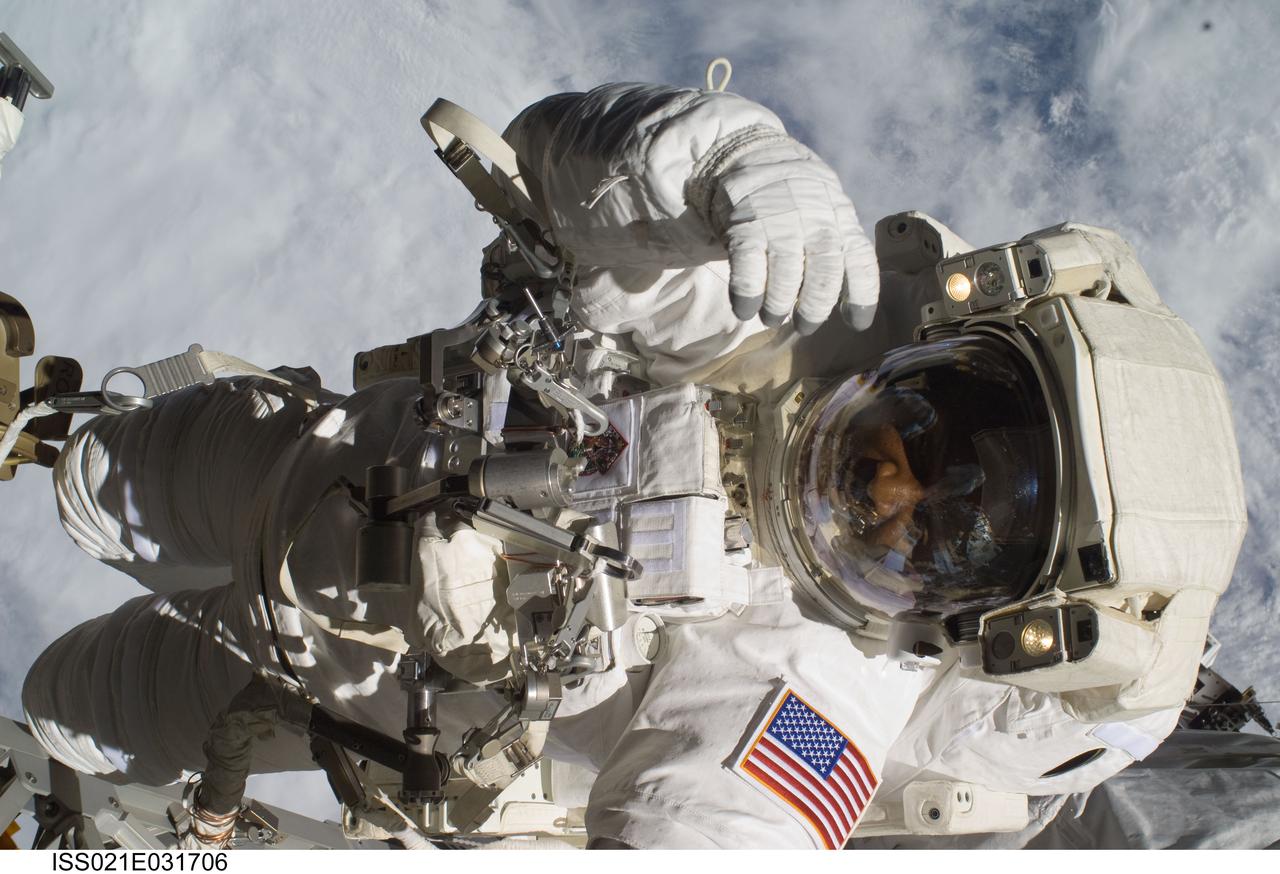
ISS021-E-031706 (23 Nov. 2009) --- Astronaut Robert L. Satcher Jr., STS-129 mission specialist, participates in the mission's third and final session of extravehicular activity (EVA) as construction and maintenance continue on the International Space Station. During the five-hour, 42-minute spacewalk, Satcher and astronaut Randy Bresnik (out of frame), mission specialist, removed a pair of micrometeoroid and orbital debris shields from the Quest airlock and strapped them to the External Stowage Platform #2, then moved an articulating foot restraint to the airlock, and released a bolt on a starboard truss ammonia tank assembly (ATA) in preparation for an STS-131 spacewalk that will replace the ATA.
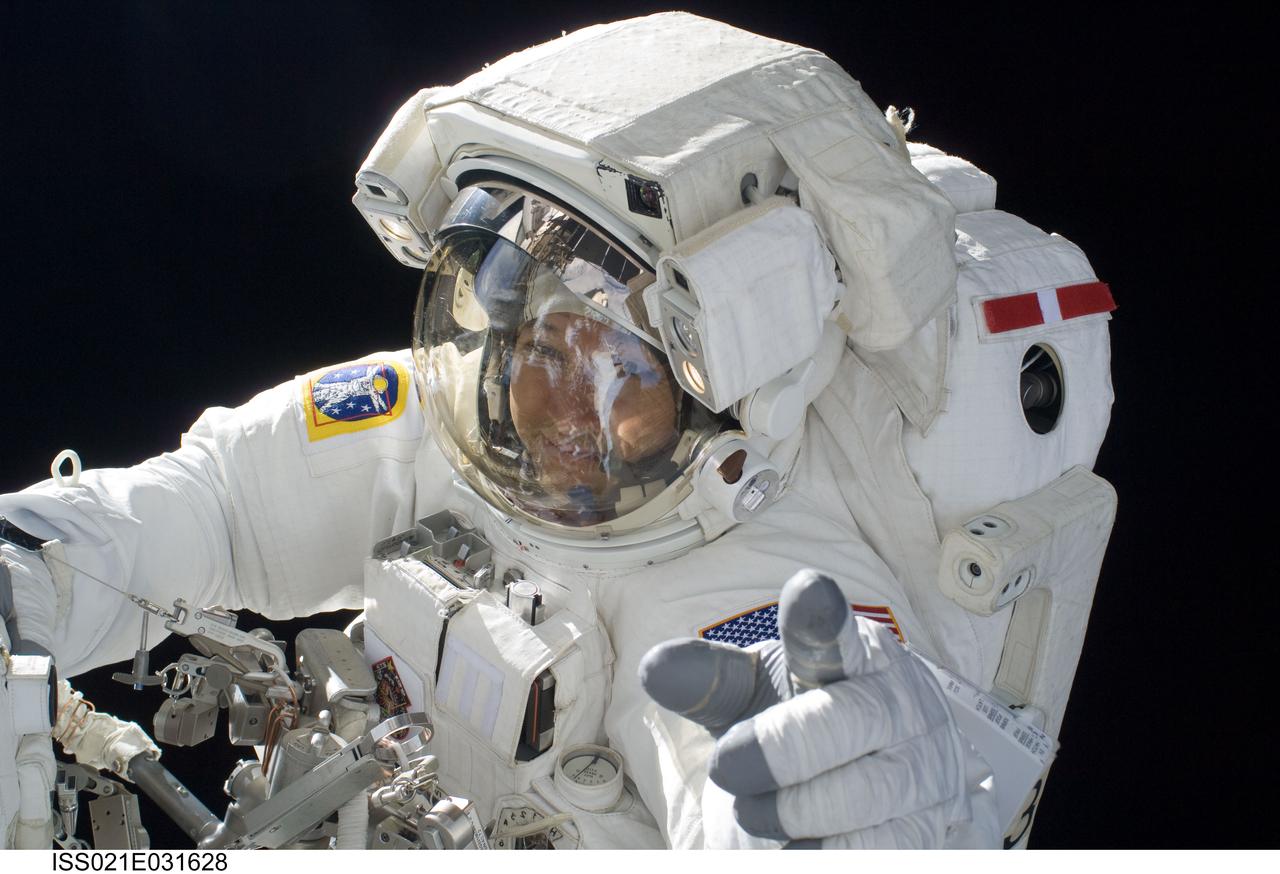
ISS021-E-031628 (23 Nov. 2009) --- Astronaut Randy Bresnik, STS-129 mission specialist, participates in the mission's third and final session of extravehicular activity (EVA) as construction and maintenance continue on the International Space Station. During the five-hour, 42-minute spacewalk, Bresnik and Robert L. Satcher Jr. (out of frame), mission specialist, removed a pair of micrometeoroid and orbital debris shields from the Quest airlock and strapped them to the External Stowage Platform #2, then moved an articulating foot restraint to the airlock, and released a bolt on a starboard truss ammonia tank assembly (ATA) in preparation for an STS-131 spacewalk that will replace the ATA.
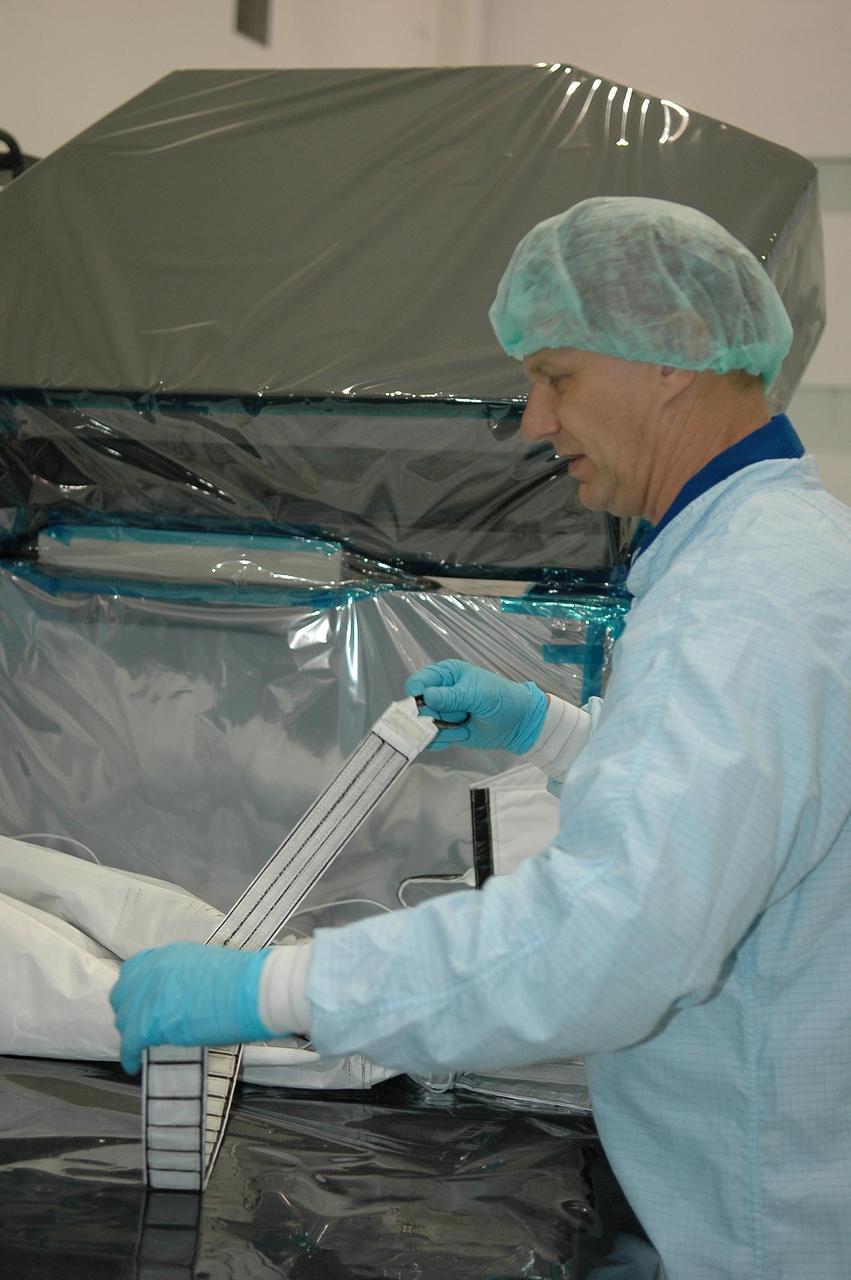
KENNEDY SPACE CENTER, FLA. - During a Crew Equipment Interface Test (CEIT) inside the Space Station Processing Facility at NASA's Kennedy Space Center, STS-121 Mission Specialist Piers Sellers works with a strap on the trailing umbilical system reel assembly that will be installed on the International Space Station during their mission. A CEIT provides hands-on experiences with equipment used on-orbit. Mission STS-121 is the second in the Return to Flight sequence and will carry on improvements that debuted during last year's STS-114 mission and build upon those tests. Launch is scheduled in July. Photo credit: NASA/Kim Shiflett
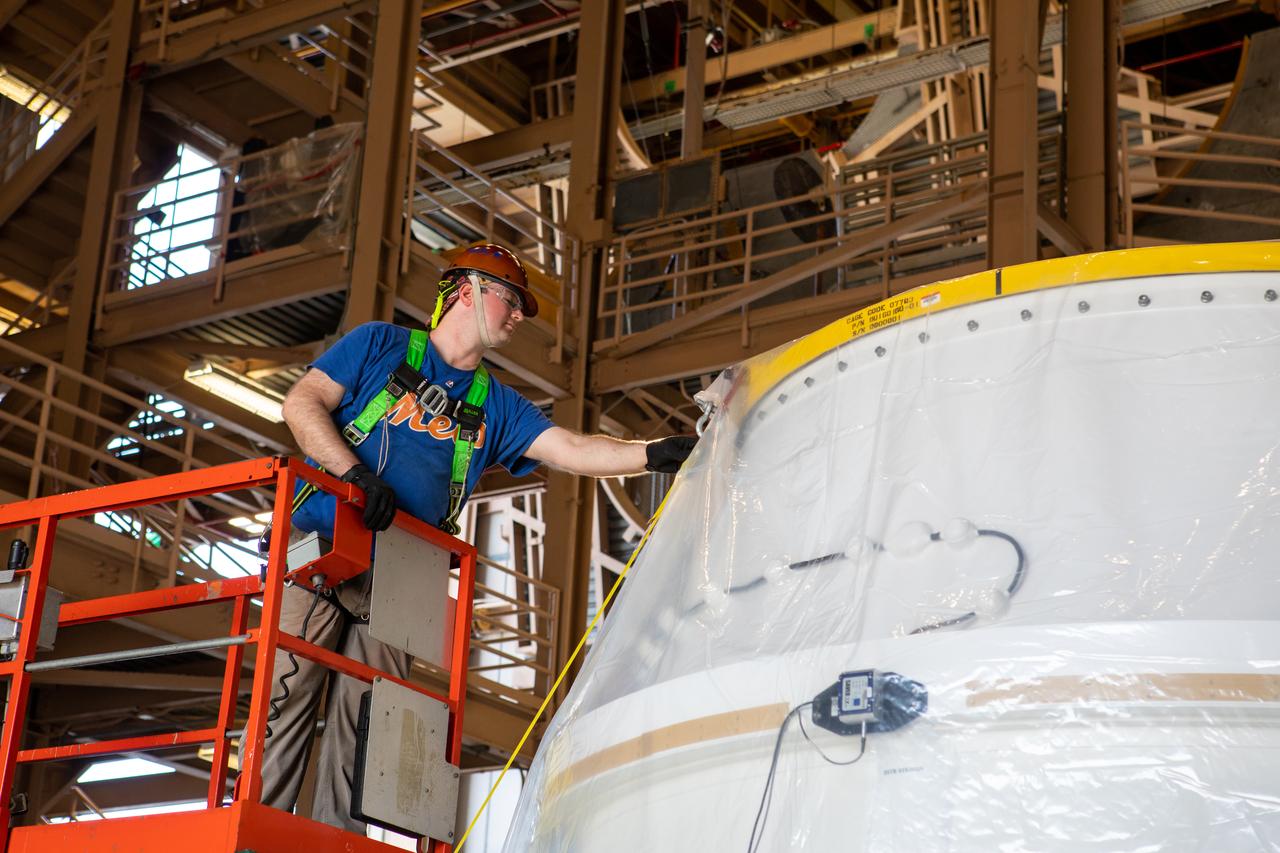
A worker removes one of the securing straps from the second of two Northrop Grumman-manufactured aft exit cones to arrive for the Space Launch System’s solid rocket boosters inside the Rotation, Processing and Surge Facility at NASA’s Kennedy Space Center in Florida on Dec. 9, 2019. The right aft exit cone was shipped from Promontory, Utah. It will be checked out and prepared for the Artemis I uncrewed test flight. The aft exit cones sit at the bottommost part of the twin boosters. The cones help provide added thrust for the boosters, while protecting the aft skirts from the thermal environment during launch.
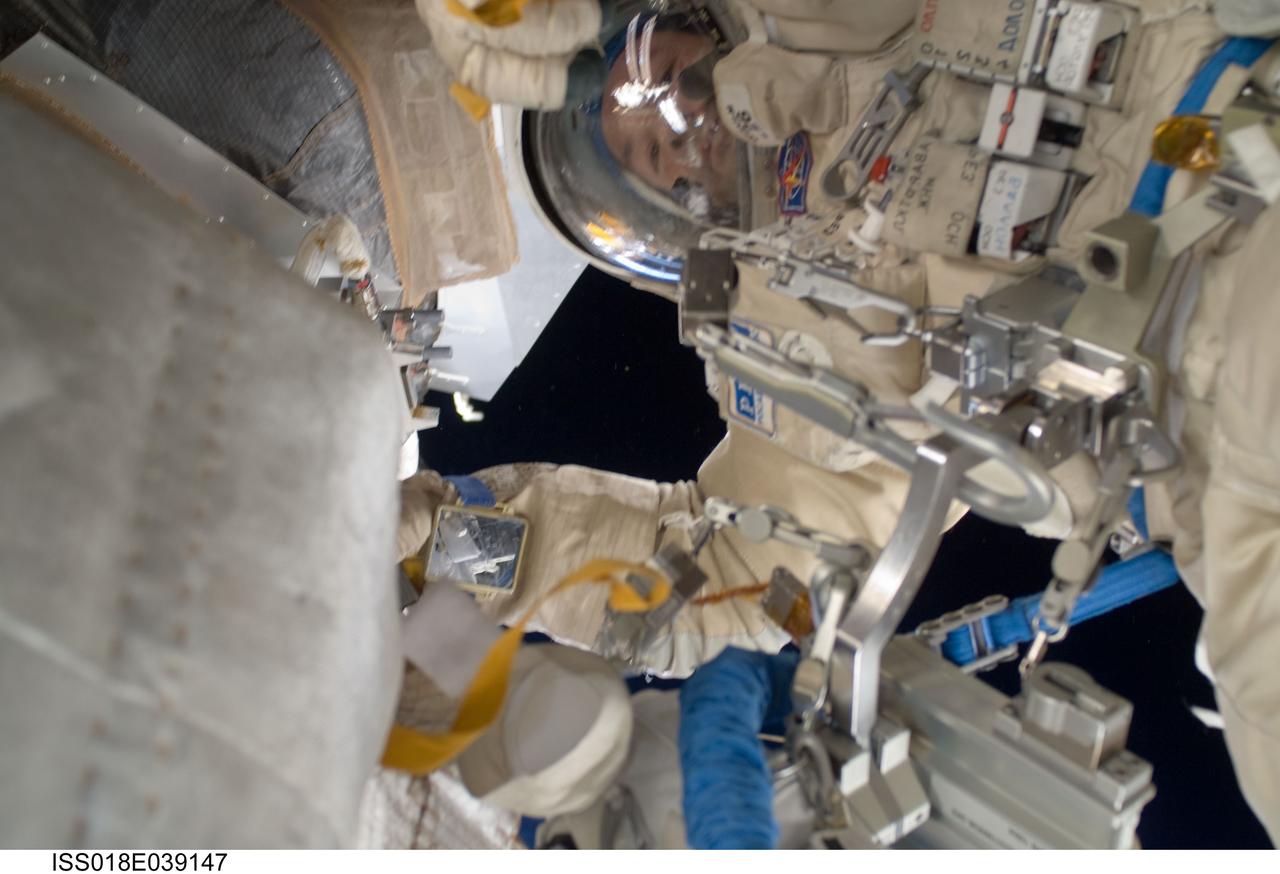
ISS018-E-039147 (10 March 2009) --- Cosmonaut Yury Lonchakov, Expedition 18 flight engineer, participates in a session of extravehicular activity (EVA) to perform maintenance on the International Space Station. During the 4-hour, 49-minute spacewalk, Lonchakov and astronaut Michael Fincke (out of frame), commander, reinstalled the Exposing Specimens of Organic and Biological Materials to Open Space (Expose-R) experiment on the universal science platform mounted to the exterior of the Zvezda Service Module. The spacewalkers also removed straps, or tape, from the area of the docking target on the Pirs airlock and docking compartment. The tape was removed to ensure it does not get in the way during the arrival of visiting Soyuz or Progress spacecraft.
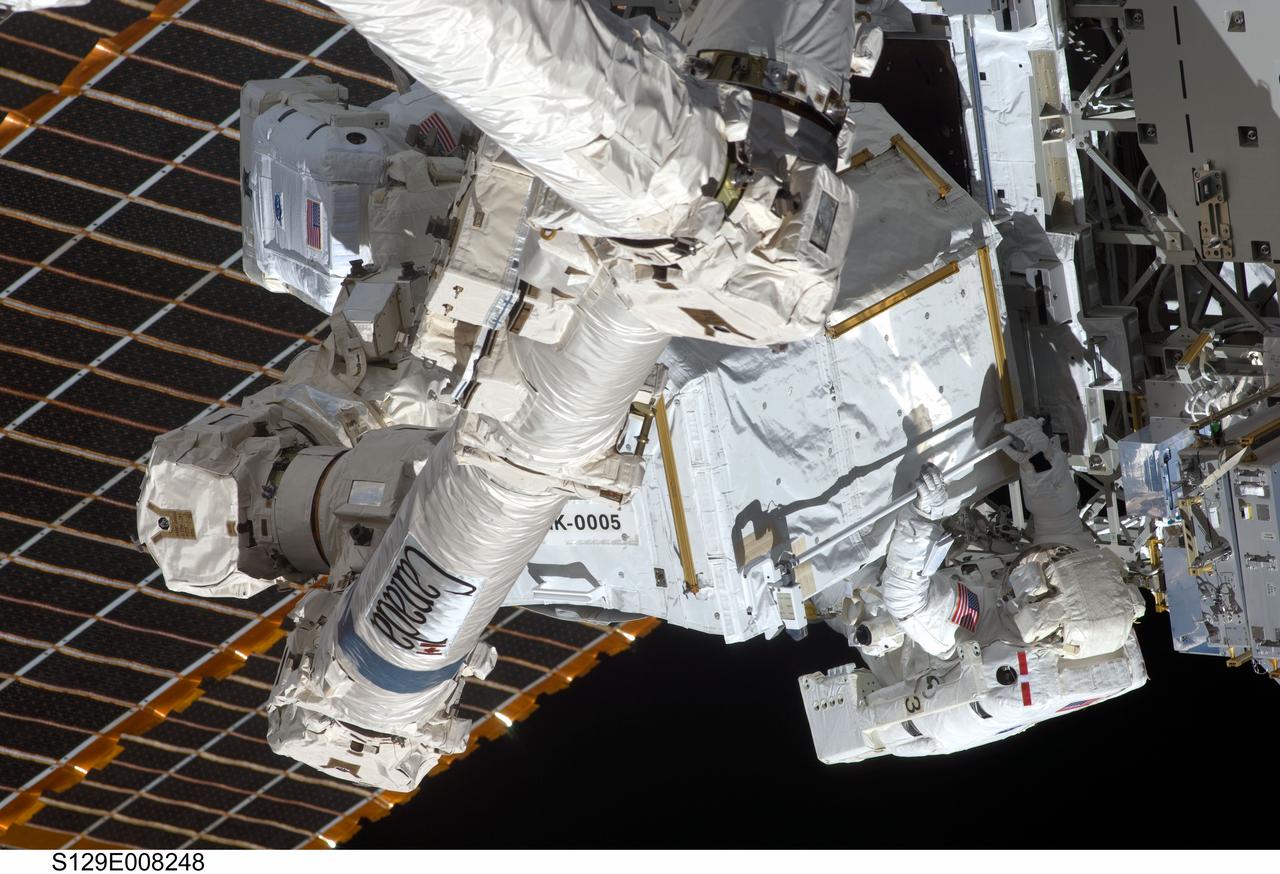
S129-E-008248 (23 Nov. 2009) --- Astronauts Randy Bresnik (right) and Robert L. Satcher Jr. (top left), both STS-129 mission specialists, participate in the mission's third and final session of extravehicular activity (EVA) as construction and maintenance continue on the International Space Station. During the five-hour, 42-minute spacewalk, Bresnik and Satcher removed a pair of micrometeoroid and orbital debris shields from the Quest airlock and strapped them to the External Stowage Platform #2, then moved an articulating foot restraint to the airlock, and released a bolt on a starboard truss ammonia tank assembly (ATA) in preparation for an STS-131 spacewalk that will replace the ATA.
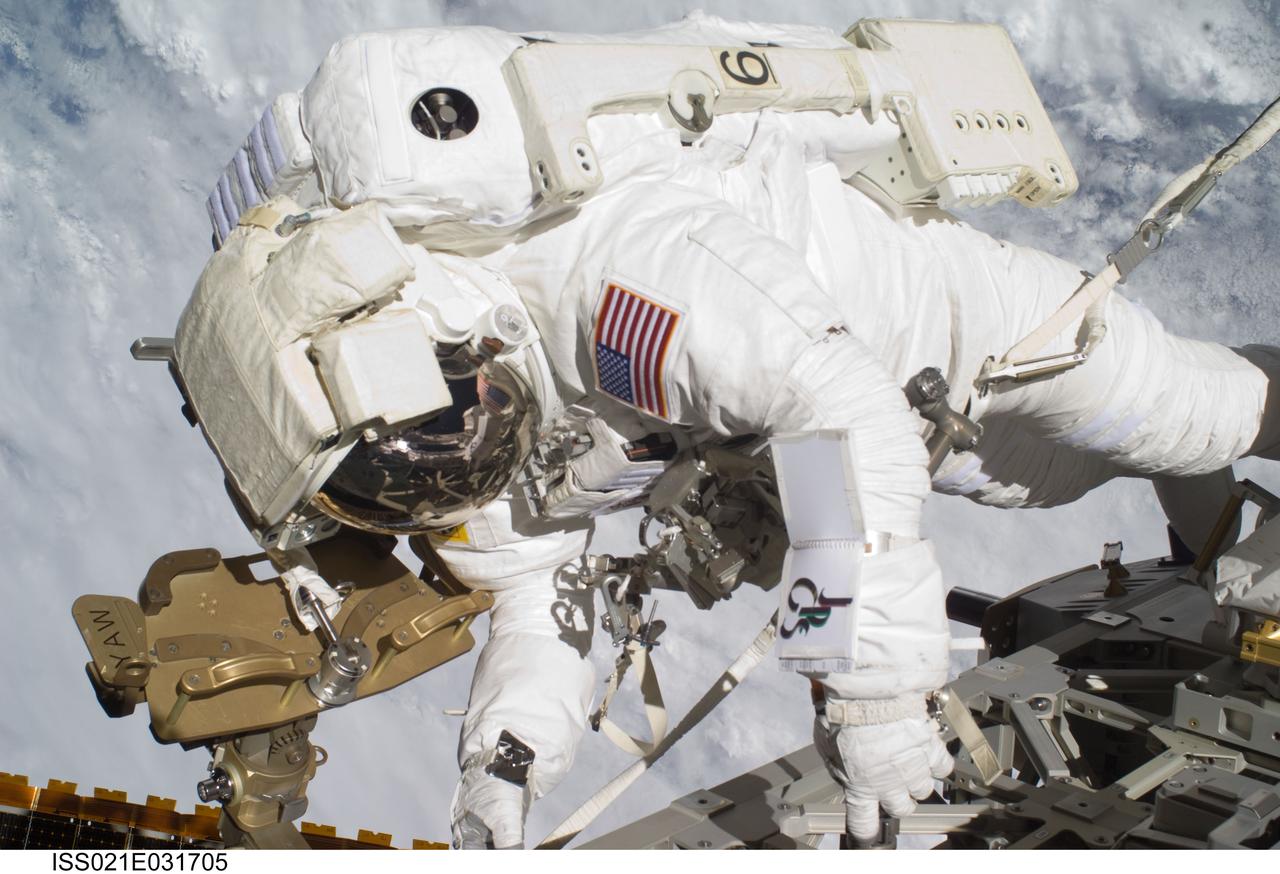
ISS021-E-031705 (23 Nov. 2009) --- Astronaut Robert L. Satcher Jr., STS-129 mission specialist, participates in the mission's third and final session of extravehicular activity (EVA) as construction and maintenance continue on the International Space Station. During the five-hour, 42-minute spacewalk, Satcher and astronaut Randy Bresnik (out of frame), mission specialist, removed a pair of micrometeoroid and orbital debris shields from the Quest airlock and strapped them to the External Stowage Platform #2, then moved an articulating foot restraint to the airlock, and released a bolt on a starboard truss ammonia tank assembly (ATA) in preparation for an STS-131 spacewalk that will replace the ATA.
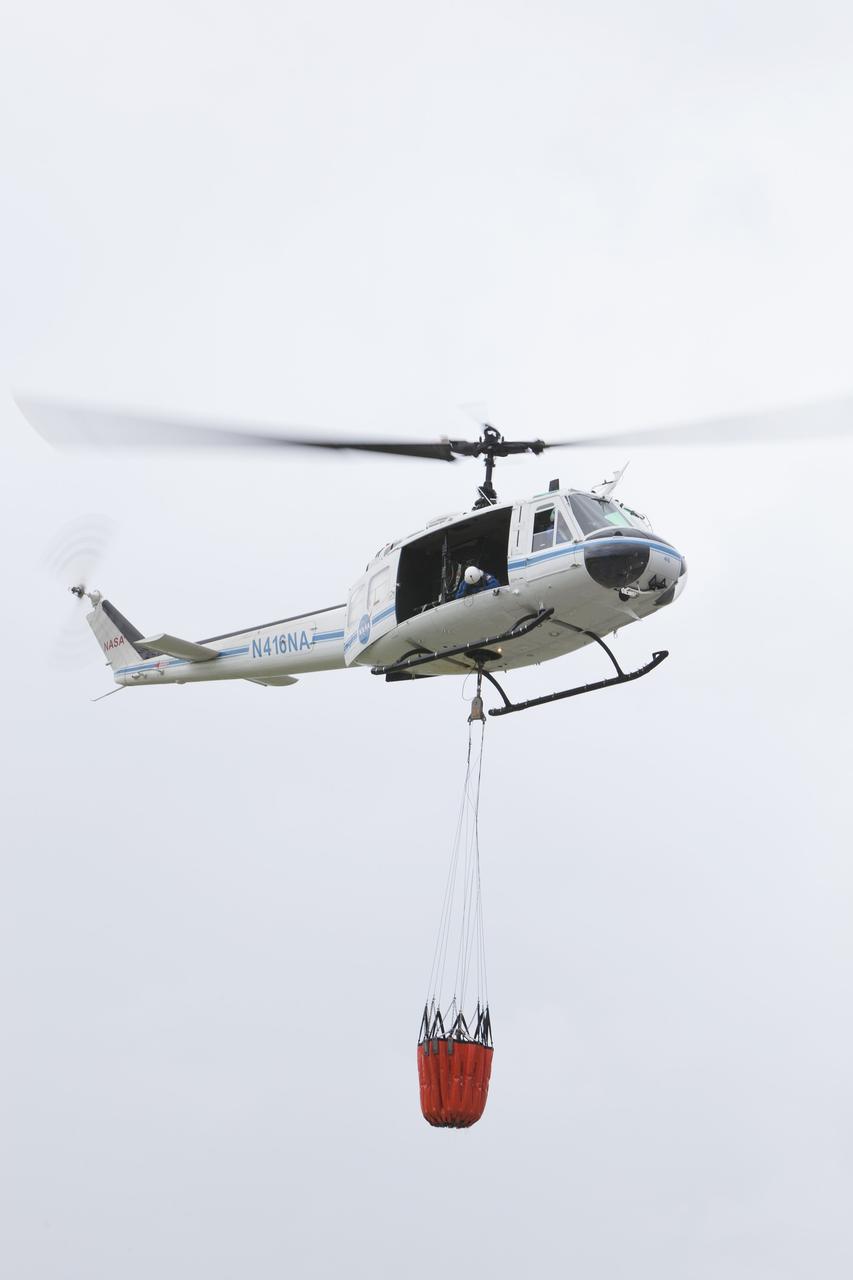
CAPE CANAVERAL, Fla. -- At NASA's Kennedy Space Center in Florida, crew chief Mark Smith of URS looks out the side door down at the Bambi Bucket. Securely strapped to the helicopter floor, his position allows him to tell the pilot precisely when to release the water over the target. Firefighters respond to wildfires with teams on the ground and in the air. The most up-to-date tools include helicopters that use Bambi Buckets large quantities of water. NASA Flight Operations teams are training to perfect the skills needed to ensure they are ready to use tools, such as the Bambi Bucket, in the event of an out-of-control blaze at the spaceport. Photo credit: NASA/Frankie Martin
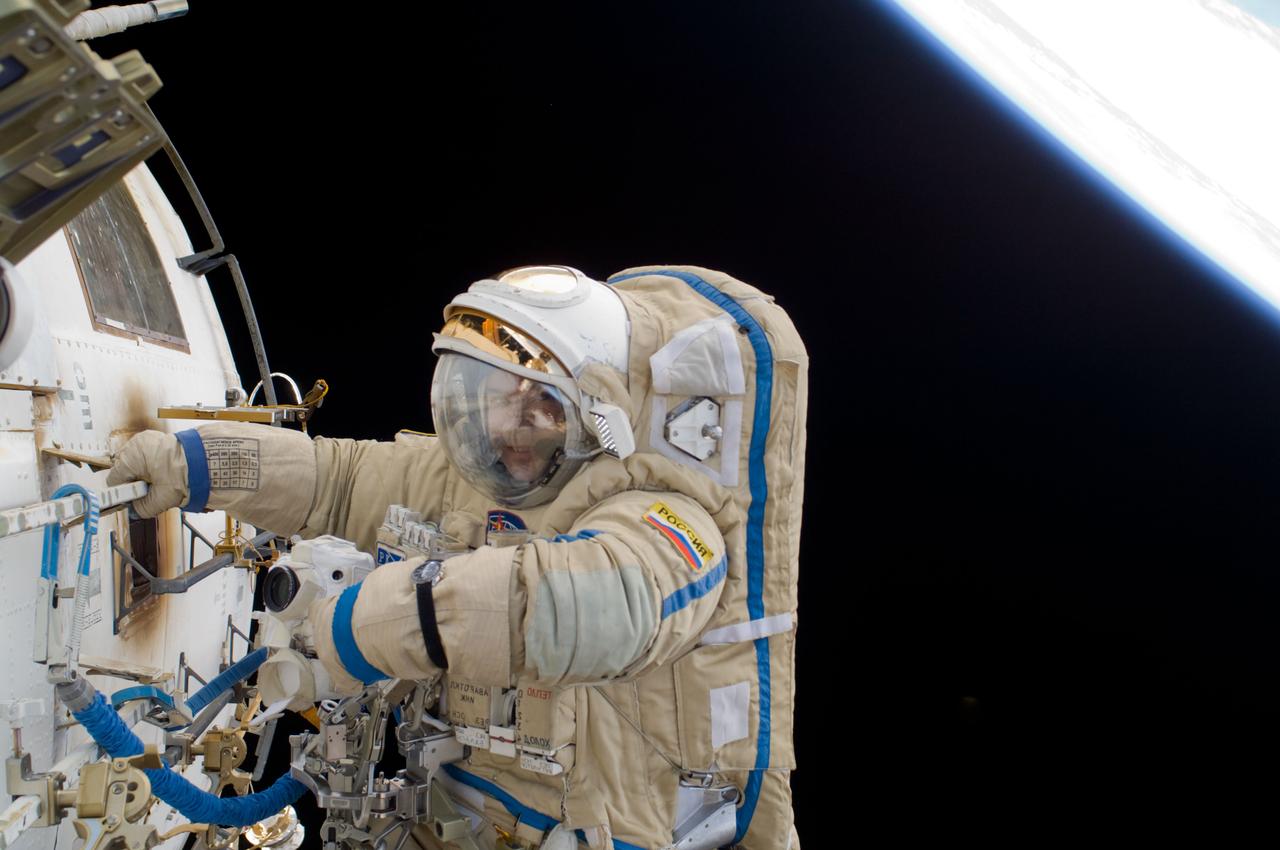
ISS018-E-039241 (10 March 2009) --- Cosmonaut Yury Lonchakov, Expedition 18 flight engineer, participates in a session of extravehicular activity (EVA) to perform maintenance on the International Space Station. During the 4-hour, 49-minute spacewalk, Lonchakov and astronaut Michael Fincke (out of frame), commander, reinstalled the Exposing Specimens of Organic and Biological Materials to Open Space (Expose-R) experiment on the universal science platform mounted to the exterior of the Zvezda Service Module. The spacewalkers also removed straps, or tape, from the area of the docking target on the Pirs airlock and docking compartment. The tape was removed to ensure it does not get in the way during the arrival of visiting Soyuz or Progress spacecraft.

art002e026067 (April 7, 2026) - NASA astronaut Christina Koch focused on the task at hand as she works with storage straps inside the Orion spacecraft. For the ARCHeR study, participating crew members will wear movement and sleep monitors, called actigraphy devices, before, during, and after the mission, like the one seen here. The monitors will enable crew members and flight controllers in mission control to study real-time health and behavioral information for crew safety, and help scientists study how crew members’ sleep and activity patterns affect overall health and performance. Other data related to cognition, behavior, and team dynamics will also be gathered before and after the mission.
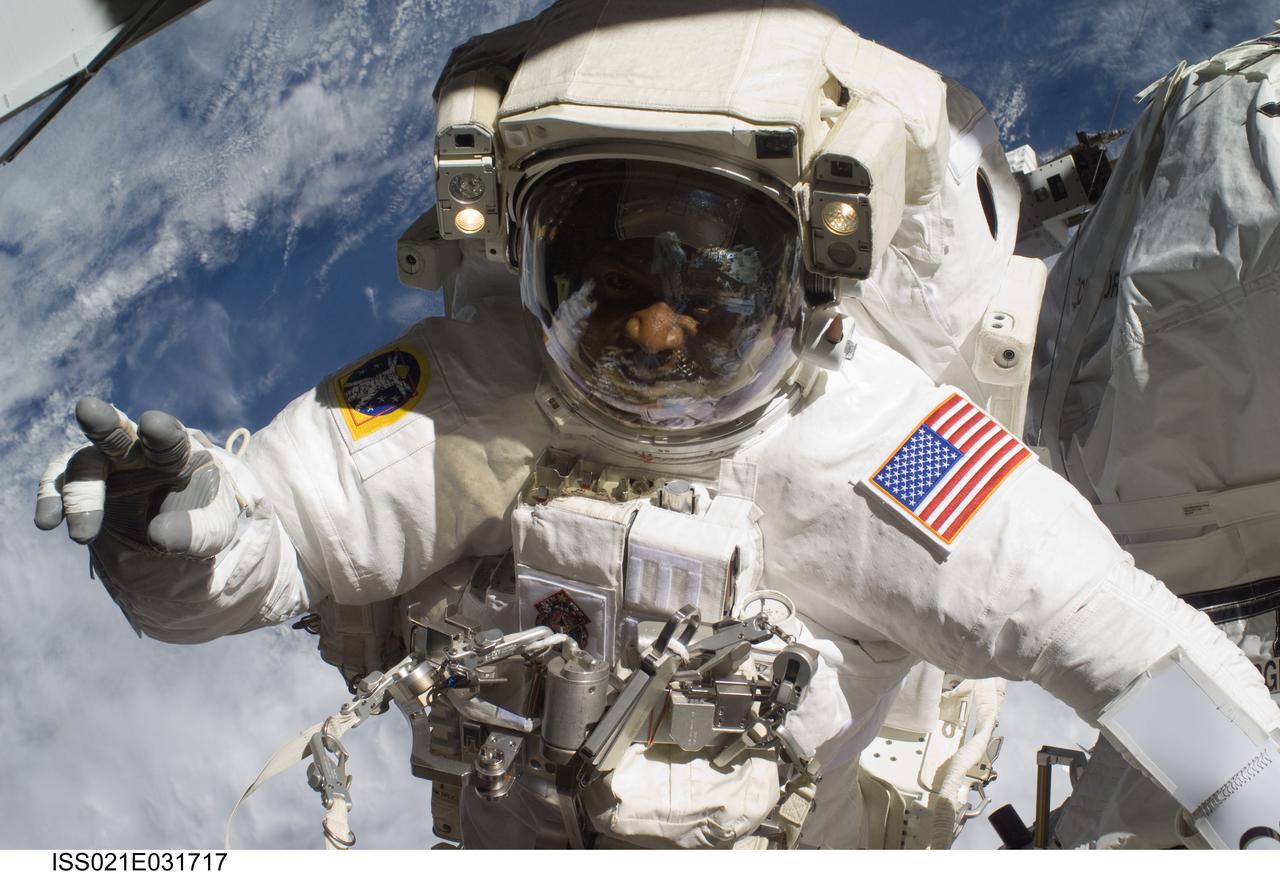
ISS021-E-031717 (23 Nov. 2009) --- Astronaut Robert L. Satcher Jr., STS-129 mission specialist, participates in the mission's third and final session of extravehicular activity (EVA) as construction and maintenance continue on the International Space Station. During the five-hour, 42-minute spacewalk, Satcher and astronaut Randy Bresnik (out of frame), mission specialist, removed a pair of micrometeoroid and orbital debris shields from the Quest airlock and strapped them to the External Stowage Platform #2, then moved an articulating foot restraint to the airlock, and released a bolt on a starboard truss ammonia tank assembly (ATA) in preparation for an STS-131 spacewalk that will replace the ATA.
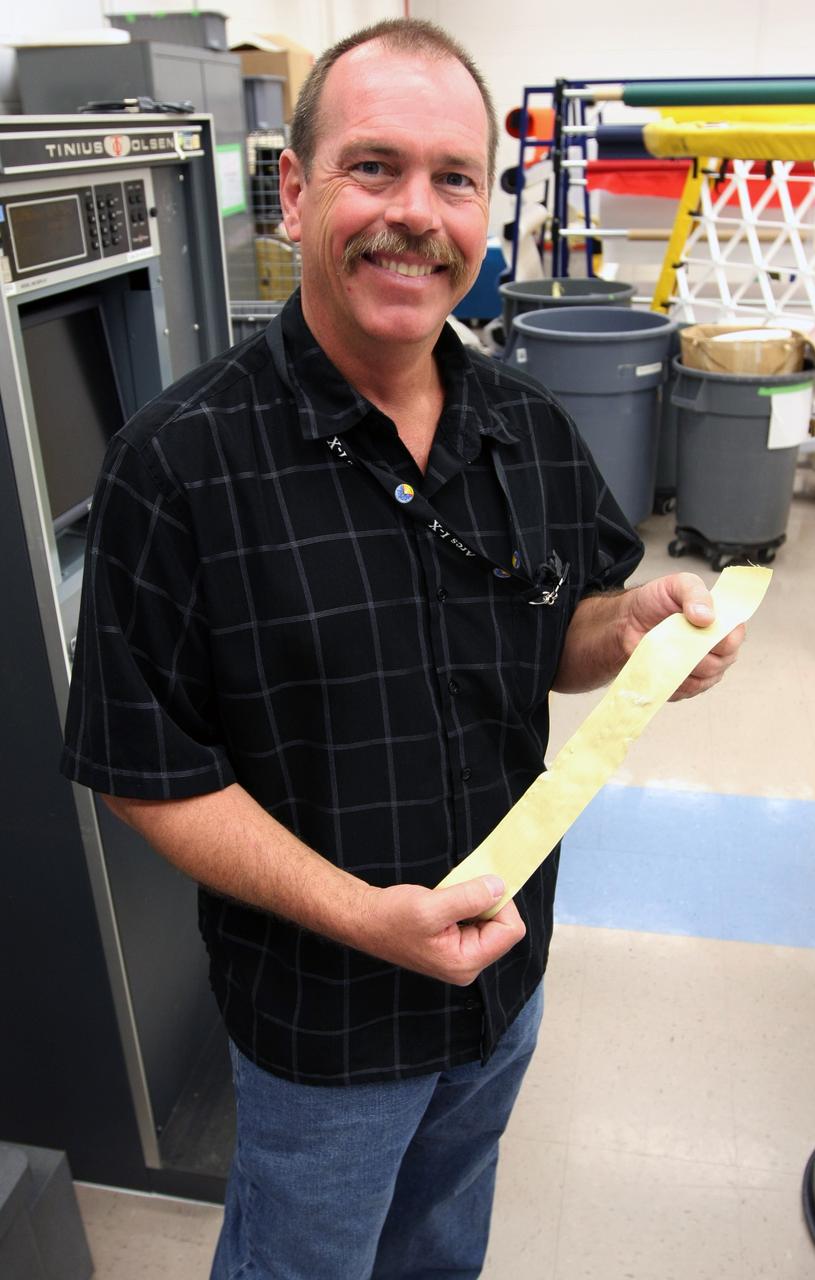
CAPE CANAVERAL, Fla. – In the Parachute Refurbishment Facility at NASA's Kennedy Space Center, Dave Hillebrandt checks strapping used on Ares-I parachutes. Ares I is an in-line, two-stage rocket that will transport the Orion crew exploration vehicle to low-Earth orbit. The Ares I first stage will be a five-segment solid rocket booster based on the four-segment design used for the shuttle. As with the shuttle, this booster will fall away when spent, lowered by parachute into the Atlantic Ocean where it can be retrieved for re-use. Photo credit: NASA/Dimitri Gerondidakis
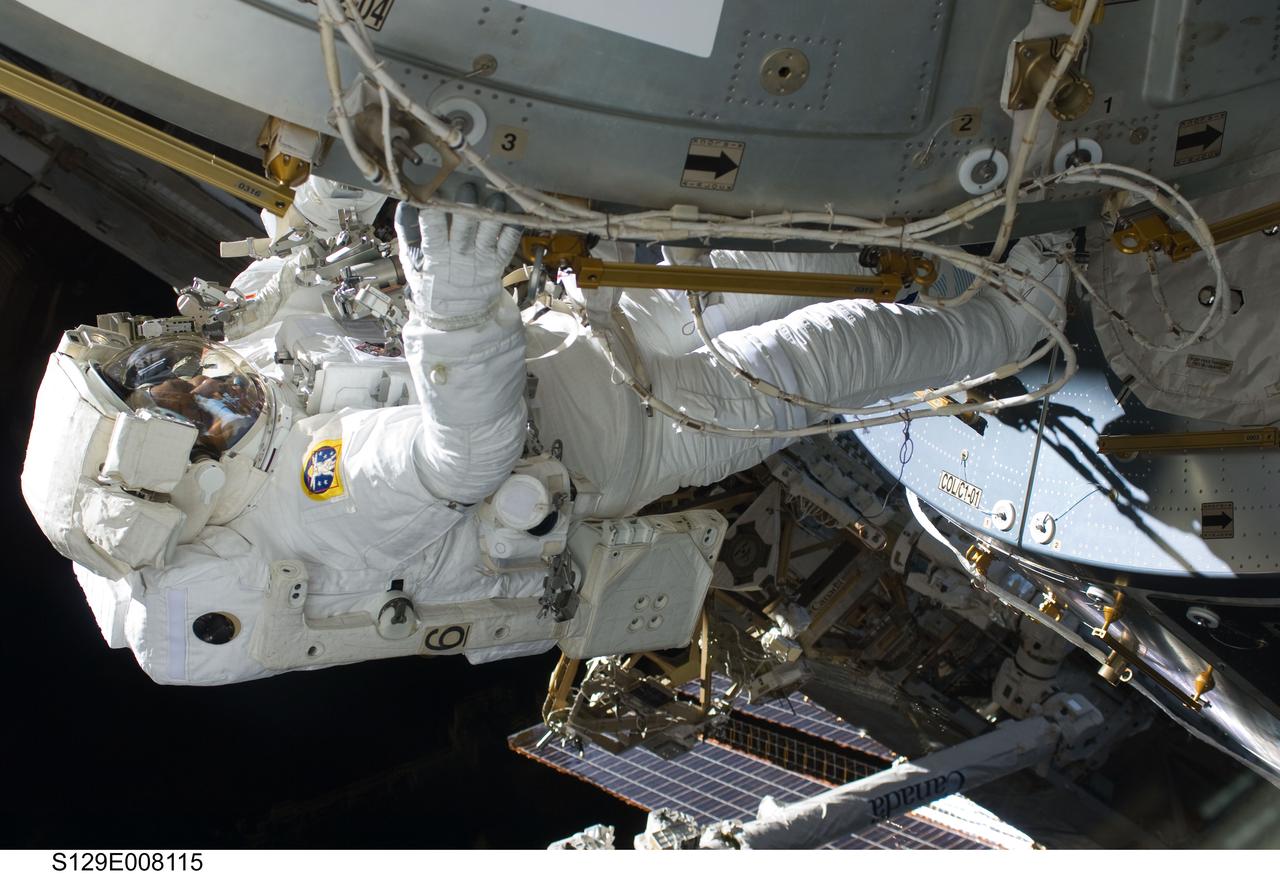
S129-E-008115 (23 Nov. 2009) --- Astronaut Robert L. Satcher Jr., STS-129 mission specialist, participates in the mission's third and final session of extravehicular activity (EVA) as construction and maintenance continue on the International Space Station. During the five-hour, 42-minute spacewalk, Satcher and astronaut Randy Bresnik (out of frame), mission specialist, removed a pair of micrometeoroid and orbital debris shields from the Quest airlock and strapped them to the External Stowage Platform #2, then moved an articulating foot restraint to the airlock, and released a bolt on a starboard truss ammonia tank assembly (ATA) in preparation for an STS-131 spacewalk that will replace the ATA.
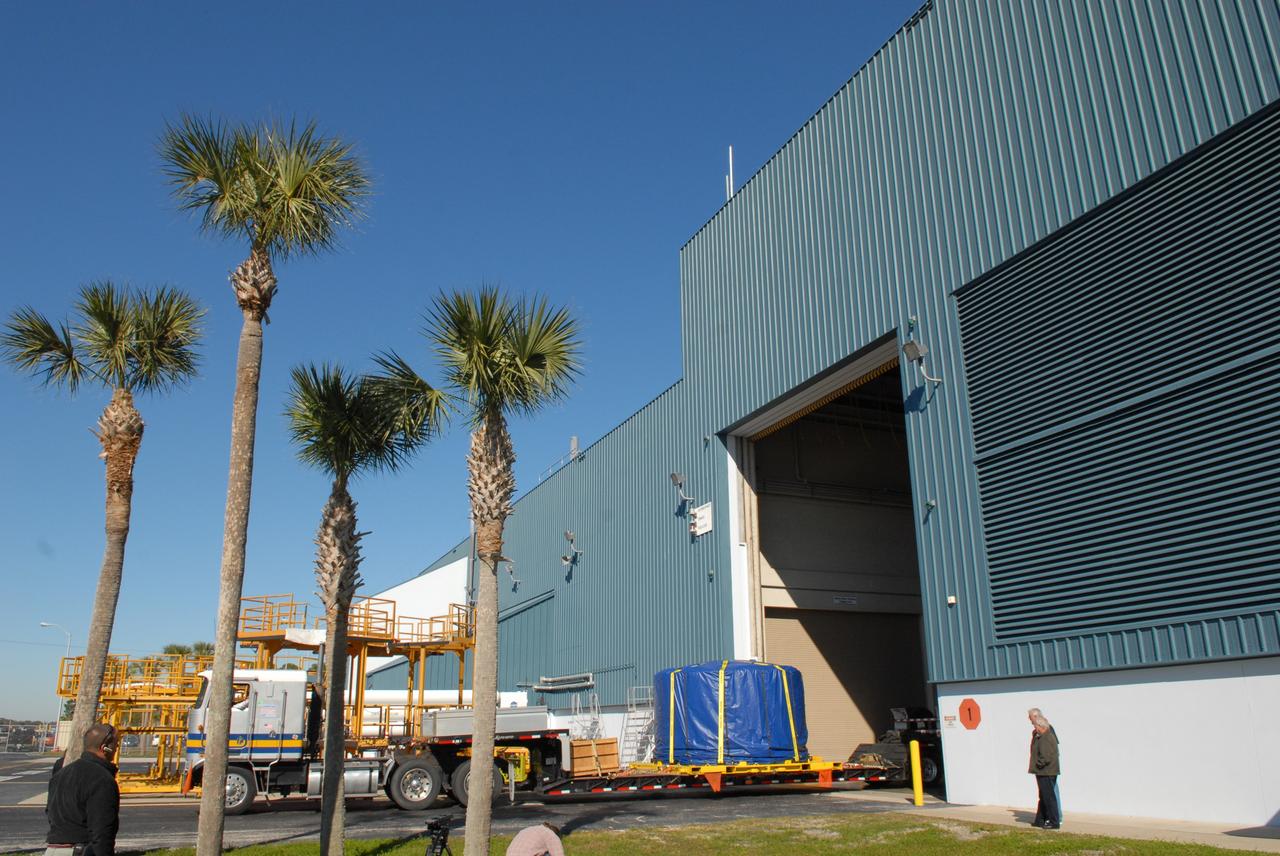
CAPE CANAVERAL, Fla. – Wrapped and strapped, the Ares I-X forward skirt arrives at the Assembly and Refurbishment Facility, or ARF, at NASA's Kennedy Space Center in Florida. The forward skirt is the initial piece of first-stage hardware in preparation for the July 2009 test flight of the agency's next-generation spacecraft and launch vehicle system. Built entirely of armored steel, the 14,000-pound segment is seven feet tall and 12-1/4 feet wide. United Space Alliance, under a subcontract to ATK, will complete the integration and assembly of the forward skirt components in the ARF. It will then be moved to the Vehicle Assembly Building high bay 3 for stacking operations. Photo credit: NASA/Tim Jacobs
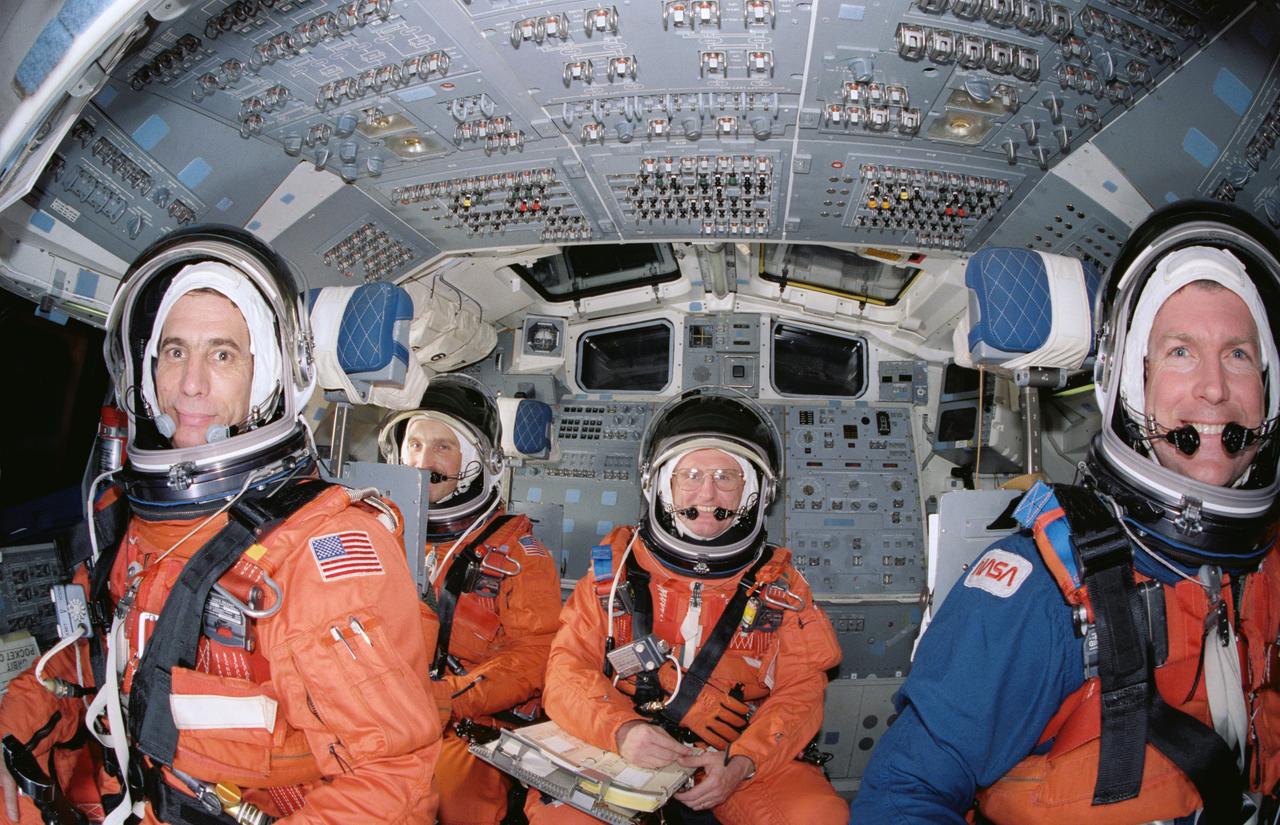
S89-26389 (Jan 1989) --- Four of five crewmembers for STS-29 pause during launch and entry phase rehearsals in the crew compartment trainer at the Johnson Space Center. The astronauts are in their entry positions, while the fifth (out of frame) remains strapped into a chair on the mid deck. In front are John E. Blaha (left), pilot, and Michael L. Coats, mission commander. Behind them are James P. Bagian (left), and James F. Buchli, both mission specialists. Robert C. Springer, the third mission specialist, is on the mid deck. He will occupy Discovery's middeck for entry phase, while Bagian will occupy that post for launch. Photo was made by Bill Bowers of the Johnson Space Center.
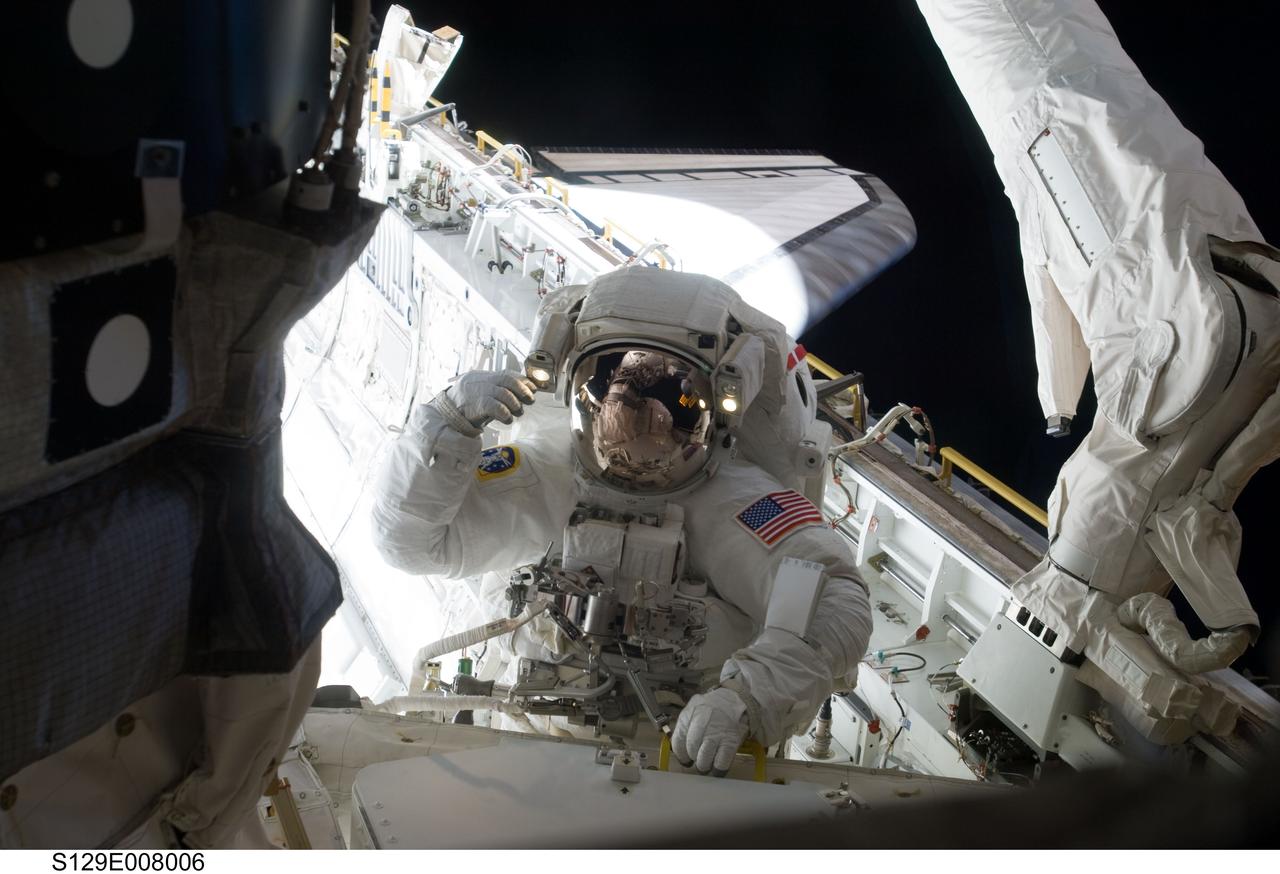
S129-E-008006 (23 Nov. 2009) --- Astronaut Randy Bresnik, STS-129 mission specialist, participates in the mission's third and final session of extravehicular activity (EVA) as construction and maintenance continue on the International Space Station. During the five-hour, 42-minute spacewalk, Bresnik and astronaut Robert L. Satcher Jr. (out of frame), mission specialist, removed a pair of micrometeoroid and orbital debris shields from the Quest airlock and strapped them to the External Stowage Platform #2, then moved an articulating foot restraint to the airlock, and released a bolt on a starboard truss ammonia tank assembly (ATA) in preparation for an STS-131 spacewalk that will replace the ATA.
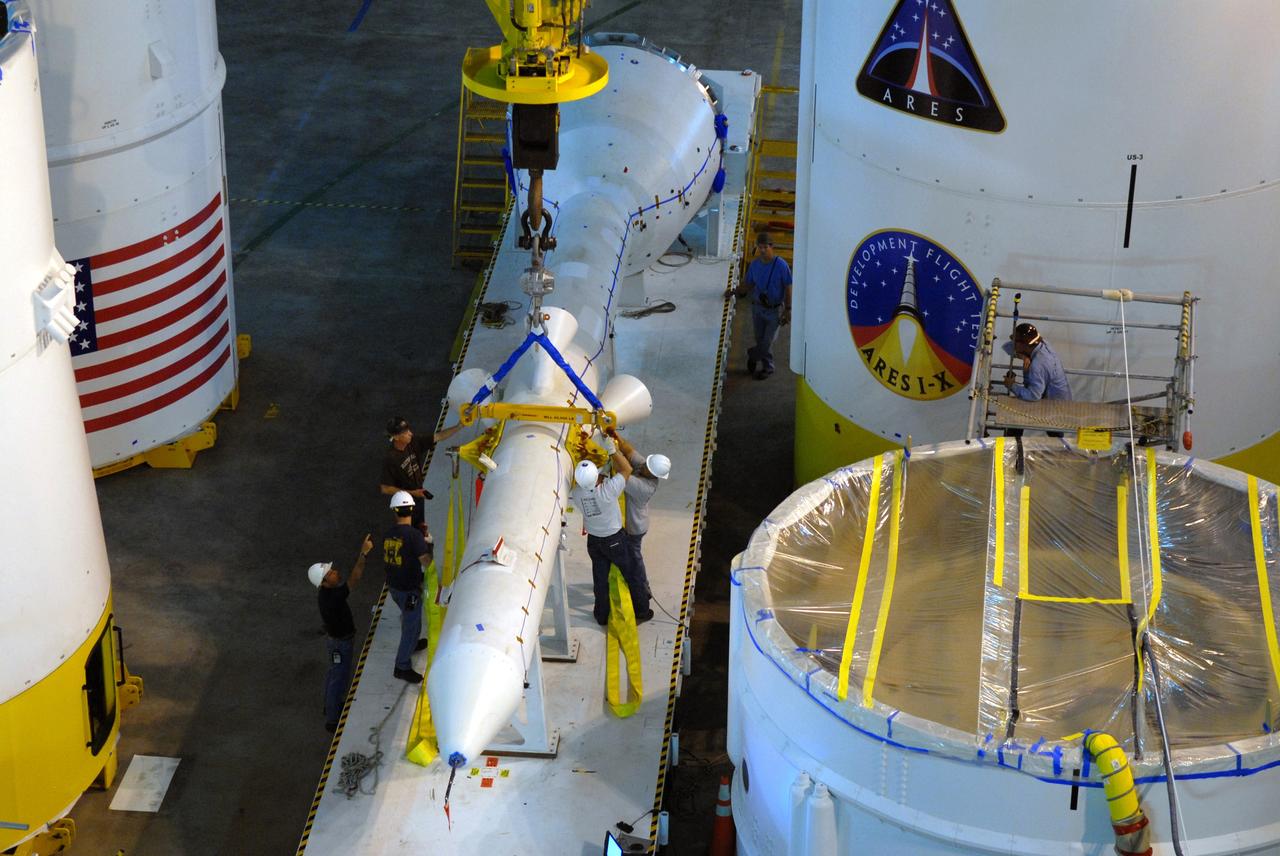
CAPE CANAVERAL, Fla. – In high bay 4 of the Vehicle Assembly Building at NASA's Kennedy Space Center in Florida, workers place a crane and straps on the Ares I-X simulated launch abort system to lift and rotate it for assembly with the crew module simulator. Ares I-X is the flight test vehicle for the Ares I, which is part of the Constellation Program to return men to the moon and beyond. Ares I is the essential core of a safe, reliable, cost-effective space transportation system that eventually will carry crewed missions back to the moon, on to Mars and out into the solar system. Ares I-X is targeted for launch in July 2009. Photo credit: NASA/Jack Pfaller
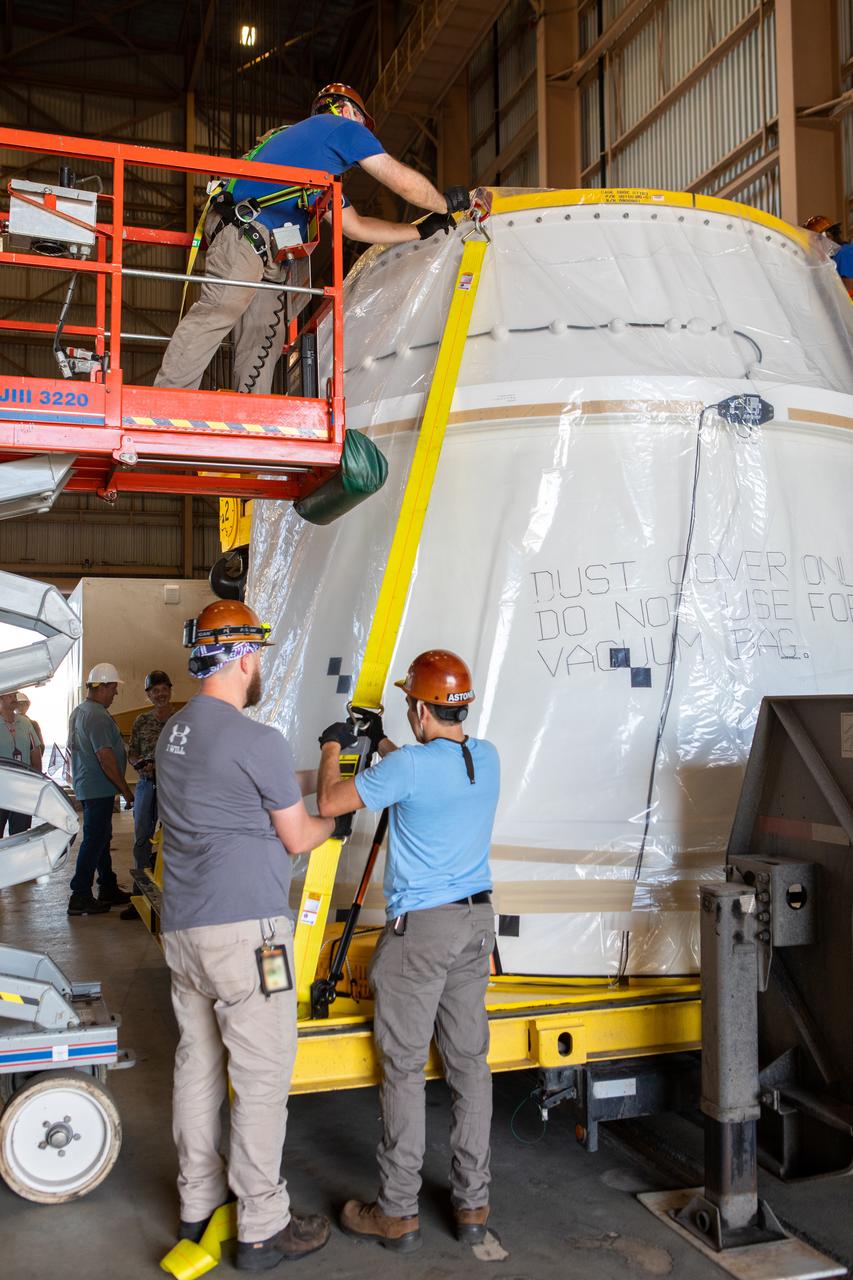
Workers remove the securing straps from the second of two Northrop Grumman-manufactured aft exit cones to arrive for the Space Launch System’s solid rocket boosters inside the Rotation, Processing and Surge Facility at NASA’s Kennedy Space Center in Florida on Dec. 9, 2019. The right aft exit cone was shipped from Promontory, Utah. It will be checked out and prepared for the Artemis I uncrewed test flight. The aft exit cones sit at the bottommost part of the twin boosters. The cones help provide added thrust for the boosters, while protecting the aft skirts from the thermal environment during launch.
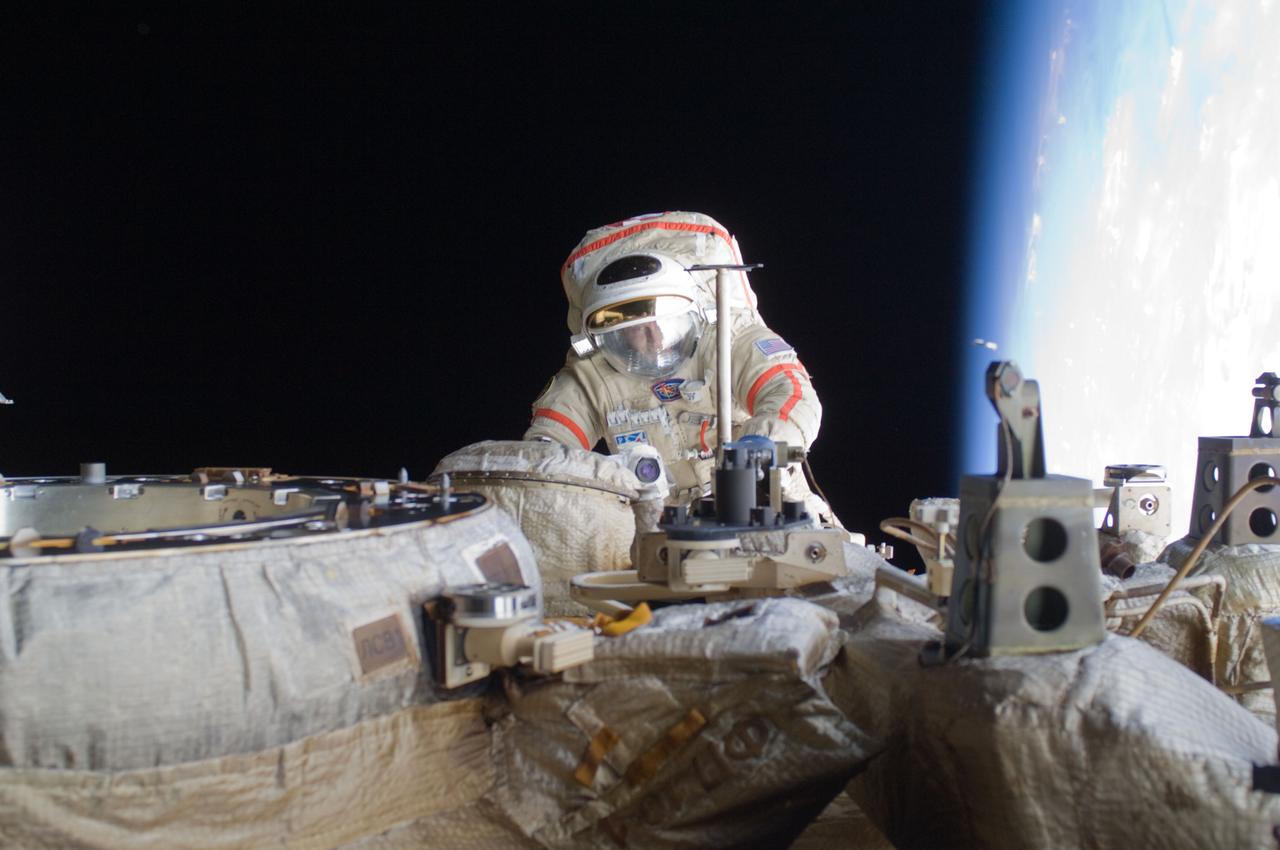
ISS018-E-039022 (10 March 2009) --- Astronaut Michael Fincke, Expedition 18 commander, participates in a session of extravehicular activity (EVA) to perform maintenance on the International Space Station. During the 4-hour, 49-minute spacewalk, Fincke and cosmonaut Yury Lonchakov (out of frame) reinstalled the Exposing Specimens of Organic and Biological Materials to Open Space (Expose-R) experiment on the universal science platform mounted to the exterior of the Zvezda Service Module. The spacewalkers also removed straps, or tape, from the area of the docking target on the Pirs airlock and docking compartment. The tape was removed to ensure it does not get in the way during the arrival of visiting Soyuz or Progress spacecraft.
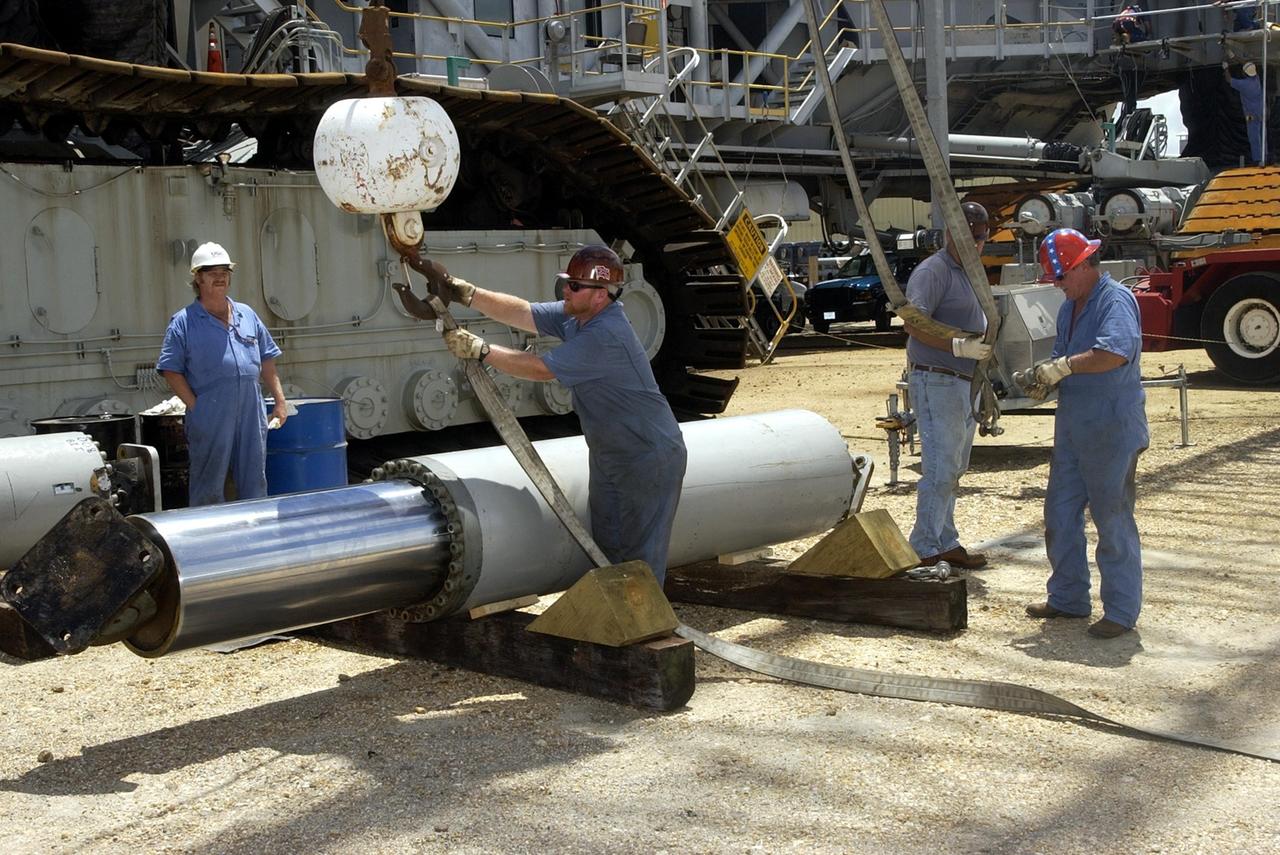
KENNEDY SPACE CENTER, FLA. -- Technicians remove the crane straps from a jacking, equalization and leveling (JEL) cylinder and bearing from Crawler-Transporter No. 2 after it is lowered by a crane to a resting position on the ground. During routine maintenance inspections last week, technicians removed two of the 16 JEL cylinders on the crawler to gain access to the bearings and found three of the four bearings cracked. Further eddy current inspections indicated that cracks are present on 15 of the bearings. There are 16 cylinders and 32 bearings per crawler. Engineers are evaluating the situation to determine the cause of the cracks and an appropriate solution to the problem.
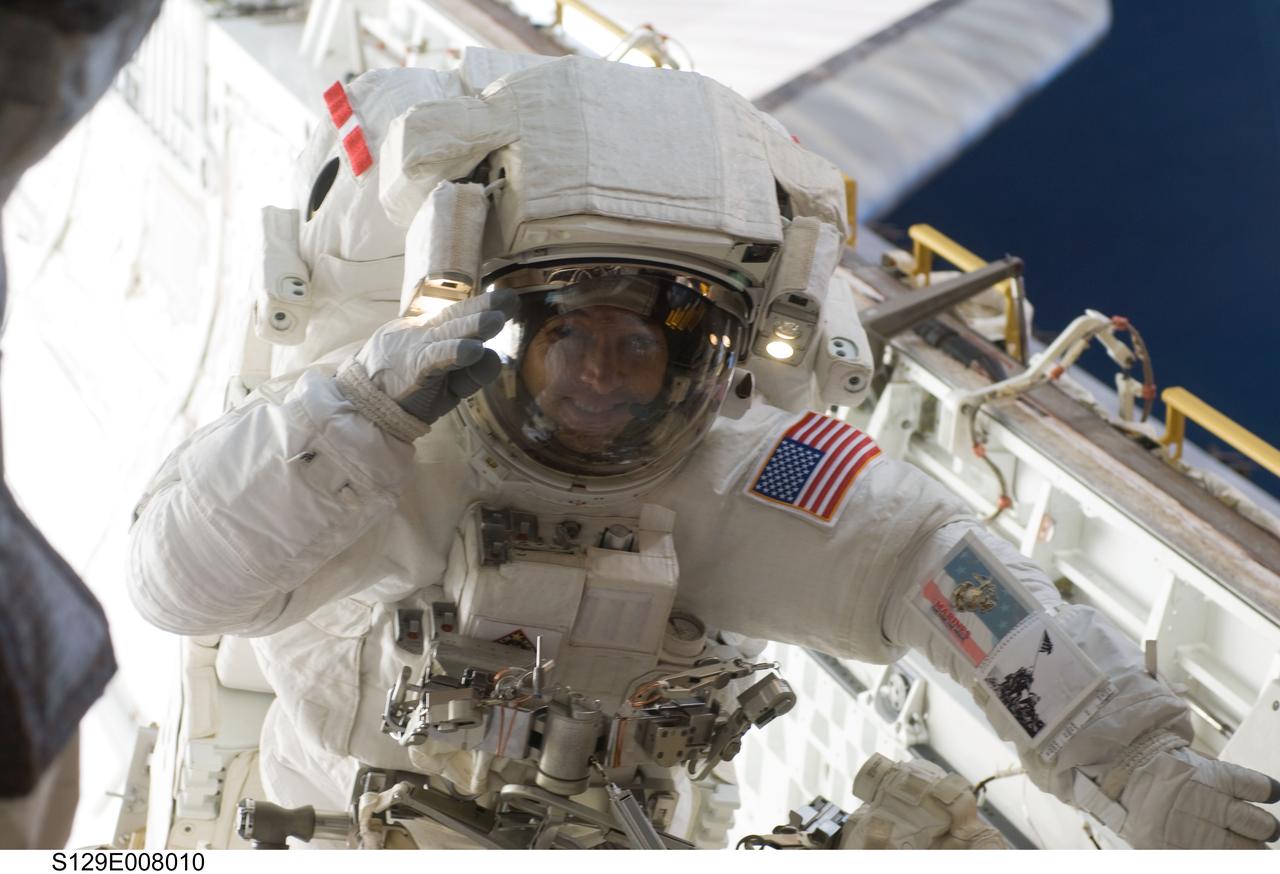
S129-E-008010 (23 Nov. 2009) --- Astronaut Randy Bresnik, STS-129 mission specialist, participates in the mission's third and final session of extravehicular activity (EVA) as construction and maintenance continue on the International Space Station. During the five-hour, 42-minute spacewalk, Bresnik and astronaut Robert L. Satcher Jr. (out of frame), mission specialist, removed a pair of micrometeoroid and orbital debris shields from the Quest airlock and strapped them to the External Stowage Platform #2, then moved an articulating foot restraint to the airlock, and released a bolt on a starboard truss ammonia tank assembly (ATA) in preparation for an STS-131 spacewalk that will replace the ATA.

KENNEDY SPACE CENTER, FLA. -- STS-114 Mission Specialist Wendy Lawrence examines one of the seats in the Rubber Room. Located under the launch pad, the steel dome Rubber Room floats on rubber isolators. It was the escape area used during the Apollo launches and it could not be removed when the pad was modified for the Shuttle. In case of an emergency on the pad, the astronauts would slide down the long vertical tube to the Rubber Room, strap themselves into the seats and wait for the danger to clear. The STS-114 mission is Logistics Flight 1, which is scheduled to deliver supplies and equipment plus the external stowage platform to the International Space Station.
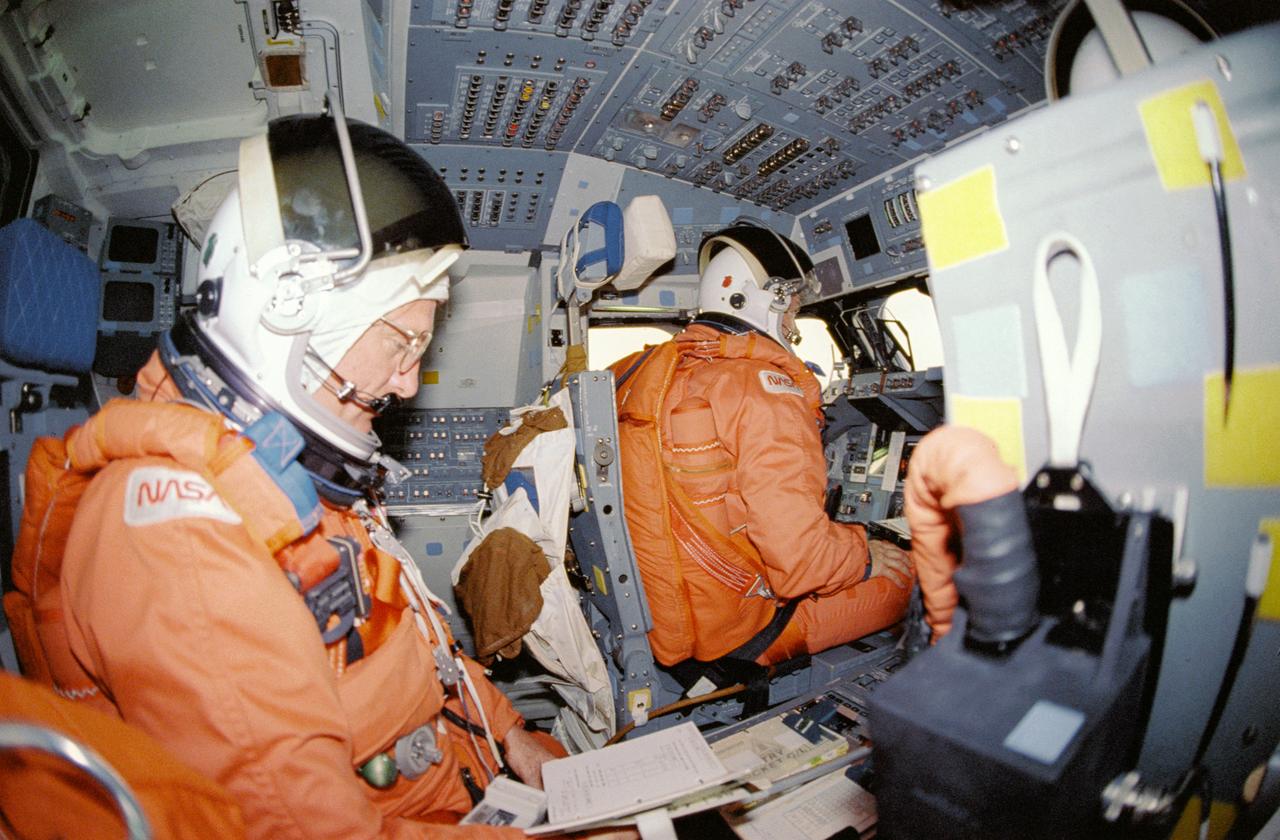
STS029-24-004 (18 March 1989) --- STS-29 crewmembers, wearing launch and entry suits (LESs) and launch and entry helmets (LEHs), review checklists on Discovery, Orbiter Vehicle (OV) 103, flight deck. Commander Michael L. Coats is seated at the forward flight deck commanders station with Mission Specialist (MS) James F. Buchli on aft flight deck strapped in mission specialist seat. OV-103 makes its return after five days in space. Note color in forward windows W1, W2, W3 caused by friction of entry through the Earth's atmosphere. Personal Egress Air Pack (PEAP) is visible on pilots seat back.
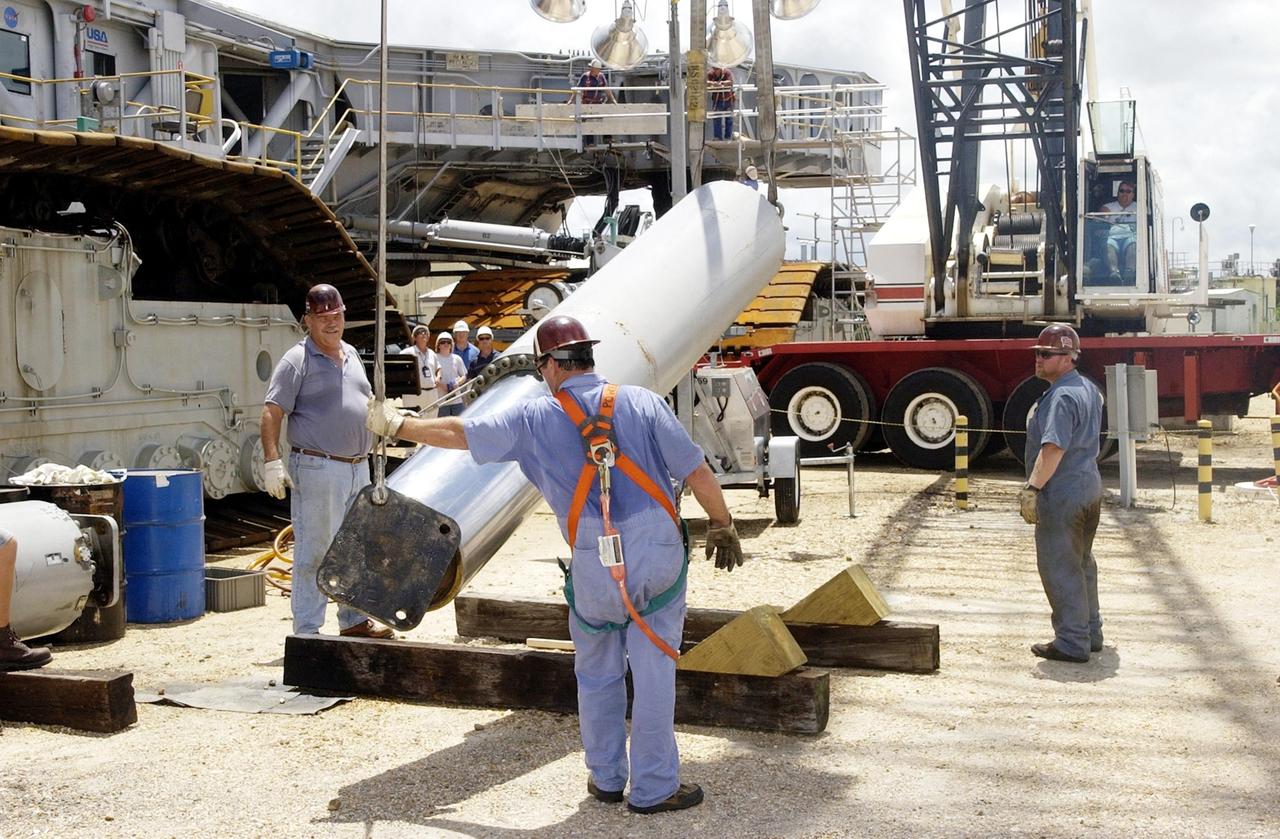
KENNEDY SPACE CENTER, FLA. -- A technician holds a crane strap to steady and guide a jacking, equalization and leveling (JEL) cylinder and bearing from Crawler-Transporter No. 2 as it is lowered by a crane to a resting position on the ground. During routine maintenance inspections last week, technicians removed two of the 16 JEL cylinders on the crawler to gain access to the bearings and found three of the four bearings cracked. Further eddy current inspections indicated that cracks are present on 15 of the bearings. There are 16 cylinders and 32 bearings per crawler. Engineers are evaluating the situation to determine the cause of the cracks and an appropriate solution to the problem.