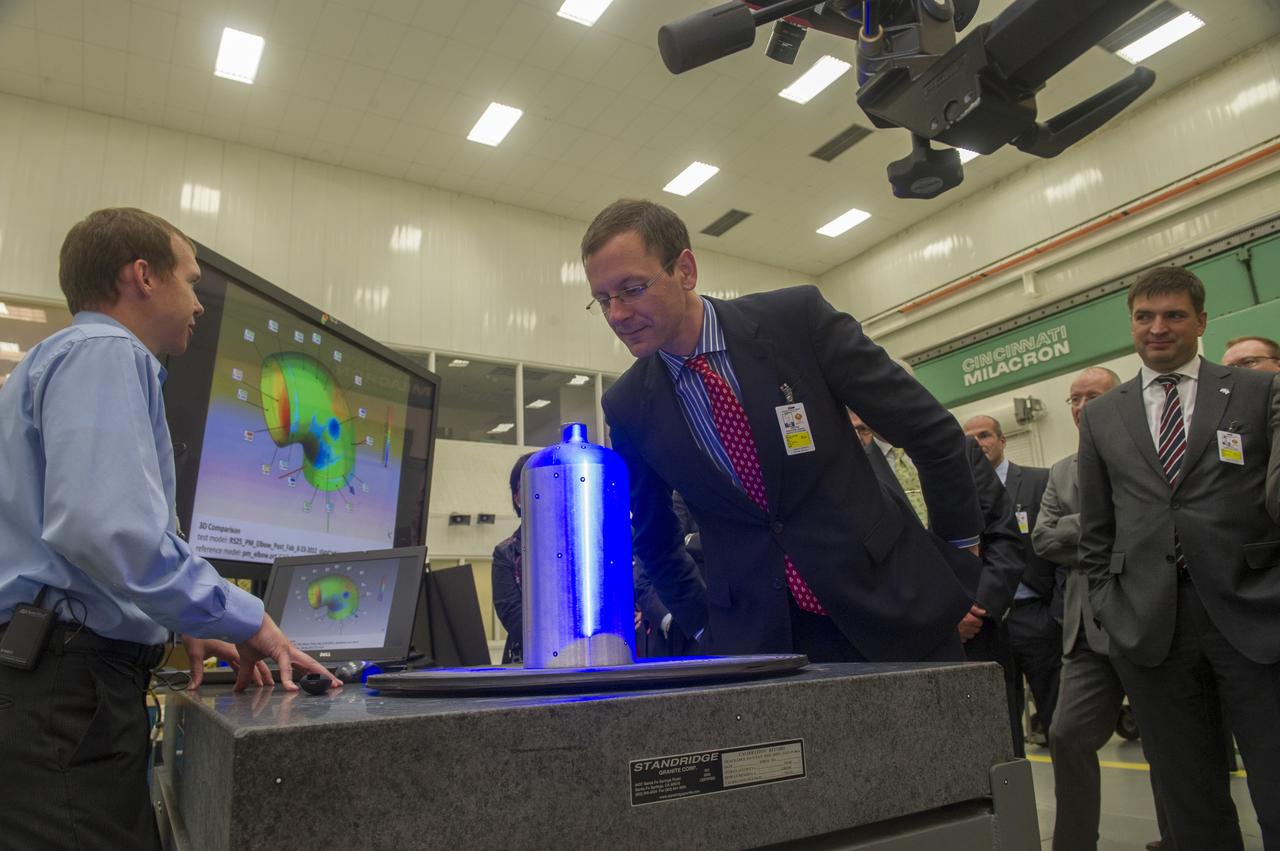
MSFC MECHANICAL ENGINEER BRIAN WEST, (L), DEMONSTRATES STRUCTURED LIGHT SCANNING PROCESS TO MEMBERS OF THE BREMEN, GERMANY, BUSINESS DELEGATION WHO VISITED MARSHALL RECENTLY. SENATOR MARTIN GÜNTHNER, MINISTRY OF ECONOMIC AFFAIRS, LABOUR AND PORTS (CENTER) VIEWS THE PRESSURE VESSEL BEING SCANNED. AT RIGHT IS BERND SCHMELING, SENIOR MANAGER PROCUREMENT, AIRBUS OPERATIONS GMBH
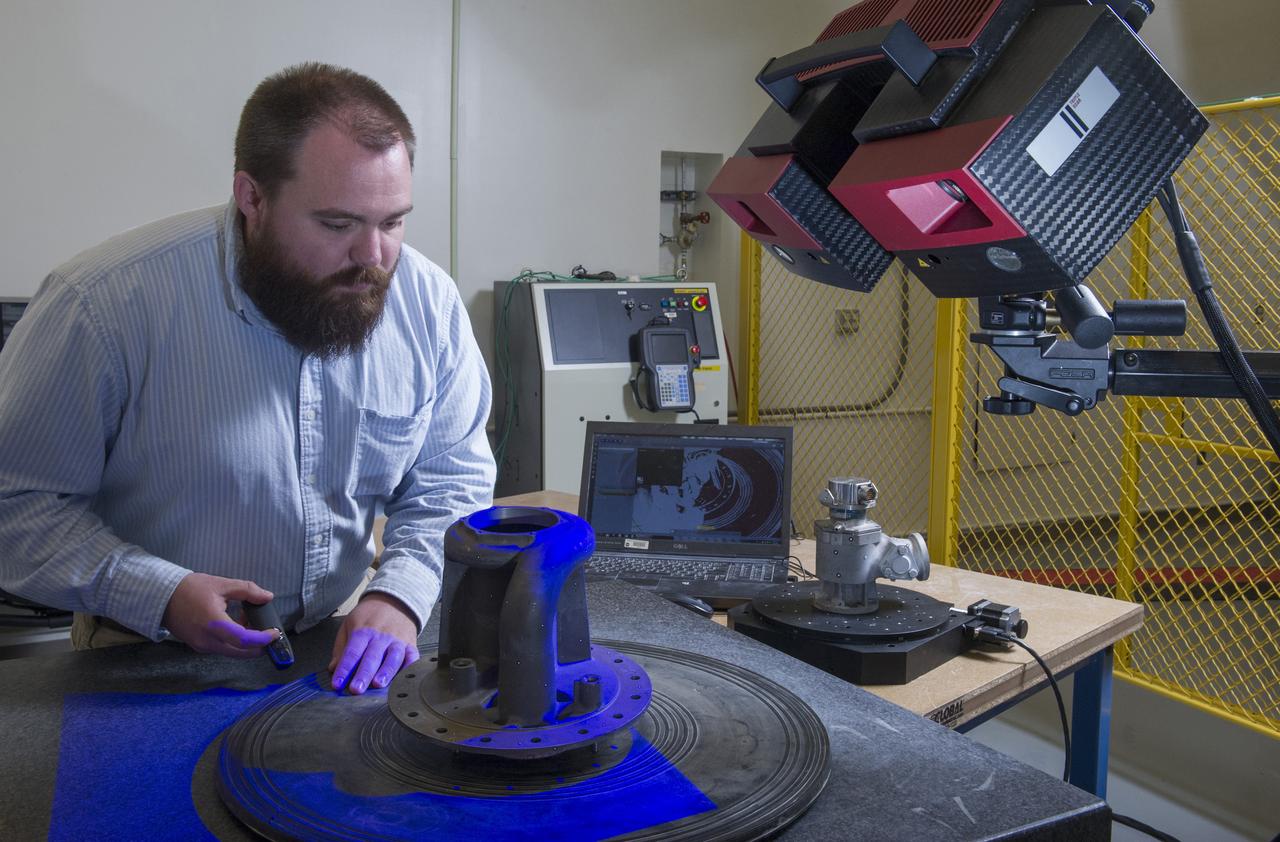
JOHN IVESTER PERFORMING STRUCTURED LIGHT SCANNING OF HERITAGE HARDWARE TO CAPTURE THE AS-BUILT GEOMETRY.

BRENT COLE, EM 42 STRUCTURED LIGHT SCANNING LEAD IN MSFC 3D PRINTING FACILITY
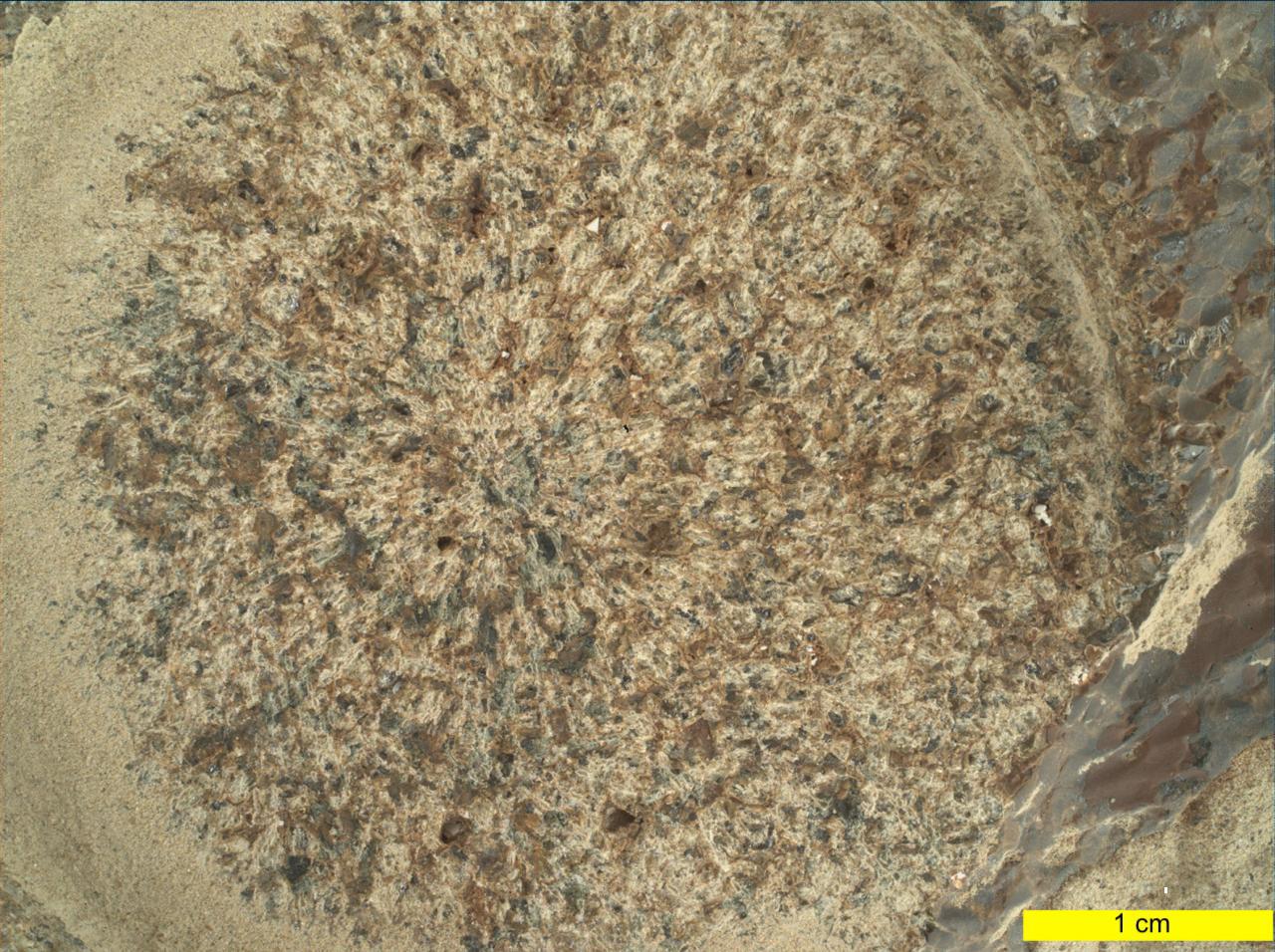
This close-up view of a rock target named "Dourbes" was provided by the WATSON (Wide Angle Topographic Sensor for Operations and eNgineering) camera on the end of the robotic arm aboard NASA's Perseverance Mars rover. WATSON took a series of eight fully-shadowed images on Nov. 5, 2021, the 253rd Martian day, or sol, of the mission, and the images were subsequently merged to create this view. Before drilling rocks, the rover abrades the rock surface using a tool on its robotic arm to clear away dust and weathering rinds, allowing other instruments to study the rocks in detail. The abraded patch is 2 inches (5 centimeters) in diameter. Perseverance subsequently acquired two rock core samples from this outcrop, called "Brac," which forms part of the "South Séítah" geologic unit of Jezero Crater. The WATSON image shows that the abrasion patch is dominated by discrete areas of light-toned material, with subordinate brown, dark-toned interstitial areas. The chemistry and mineralogy of the abrasion patch was analysed by a series of co-registered observations using the SuperCam, Mastcam-Z, PIXL (Planetary Instrument for X-ray Lithochemistry), and SHERLOC (Scanning Habitable Environments with Raman & Luminescence for Organics & Chemicals) instruments. A subsystem of an instrument called SHERLOC (Scanning Habitable Environments with Raman & Luminescence for Organics & Chemicals), WATSON can document the structure and texture within a drilled or abraded target, and its data can be used to derive depth measurements. WATSON was built by Malin Space Science Systems (MSSS) in San Diego and is operated jointly by MSSS and JPL. A key objective for Perseverance's mission on Mars is astrobiology, including the search for signs of ancient microbial life. The rover will characterize the planet's geology and past climate, pave the way for human exploration of the Red Planet, and be the first mission to collect and cache Martian rock and regolith (broken rock and dust). Subsequent NASA missions, in cooperation with ESA (European Space Agency), would send spacecraft to Mars to collect these sealed samples from the surface and return them to Earth for in-depth analysis. The Mars 2020 Perseverance mission is part of NASA's Moon to Mars exploration approach, which includes Artemis missions to the Moon that will help prepare for human exploration of the Red Planet. https://photojournal.jpl.nasa.gov/catalog/PIA24940
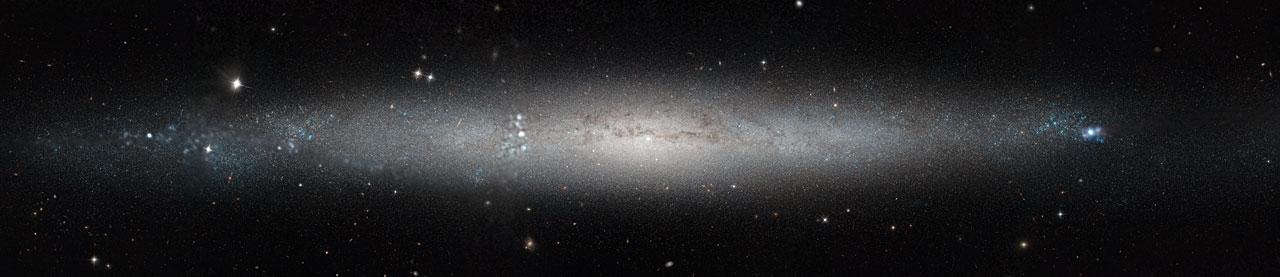
This stunning new image from the NASA/ESA Hubble Space Telescope shows part of the sky in the constellation of Canes Venatici (The Hunting Dogs). Although this region of the sky is not home to any stellar heavyweights, being mostly filled with stars of average brightness, it does contain five Messier objects and numerous intriguing galaxies — including NGC 5195, a small barred spiral galaxy considered to be one of the most beautiful galaxies visible, and its nearby interacting partner the Whirlpool Galaxy (heic0506a). The quirky Sunflower Galaxy is another notable galaxy in this constellation, and is one of the largest and brightest edge-on galaxies in our skies. Joining this host of characters is spiral galaxy NGC 4244, nicknamed the Silver Needle Galaxy, shown in this new image from Hubble. This galaxy spans some 65,000 light-years and lies around 13.5 million light-years away. It appears as a wafer-thin streak across the sky, with loosely wound spiral arms hidden from view as we observe the galaxy from the side. It is part of a group of galaxies known as the M94 Group. Numerous bright clumps of gas can be seen scattered across its length, along with dark dust lanes surrounding the galaxy’s core. NGC 4244 also has a bright star cluster at its center. Although we can make out the galaxy’s bright central region and star-spattered arms, we cannot see any more intricate structure due to the galaxy’s position; from Earth, we see it stretched out as a flattened streak across the sky. A number of different observations were pieced together to form this mosaic, and gaps in Hubble’s coverage have been filled in using ground-based data. The Hubble observations were taken as part of the Galaxy Halos, Outer disks, Substructure, Thick disks and Star clusters (GHOSTS) survey, which is scanning nearby galaxies to explore how they and their stars formed to get a more complete view of the history of the Universe. European Space Agency Credit: NASA & ESA, Acknowledgement: Roelof de Jong <b><a href="http://www.nasa.gov/audience/formedia/features/MP_Photo_Guidelines.html" rel="nofollow">NASA image use policy.</a></b> <b><a href="http://www.nasa.gov/centers/goddard/home/index.html" rel="nofollow">NASA Goddard Space Flight Center</a></b> enables NASA’s mission through four scientific endeavors: Earth Science, Heliophysics, Solar System Exploration, and Astrophysics. Goddard plays a leading role in NASA’s accomplishments by contributing compelling scientific knowledge to advance the Agency’s mission. <b>Follow us on <a href="http://twitter.com/NASAGoddardPix" rel="nofollow">Twitter</a></b> <b>Like us on <a href="http://www.facebook.com/pages/Greenbelt-MD/NASA-Goddard/395013845897?ref=tsd" rel="nofollow">Facebook</a></b> <b>Find us on <a href="http://instagram.com/nasagoddard?vm=grid" rel="nofollow">Instagram</a></b>