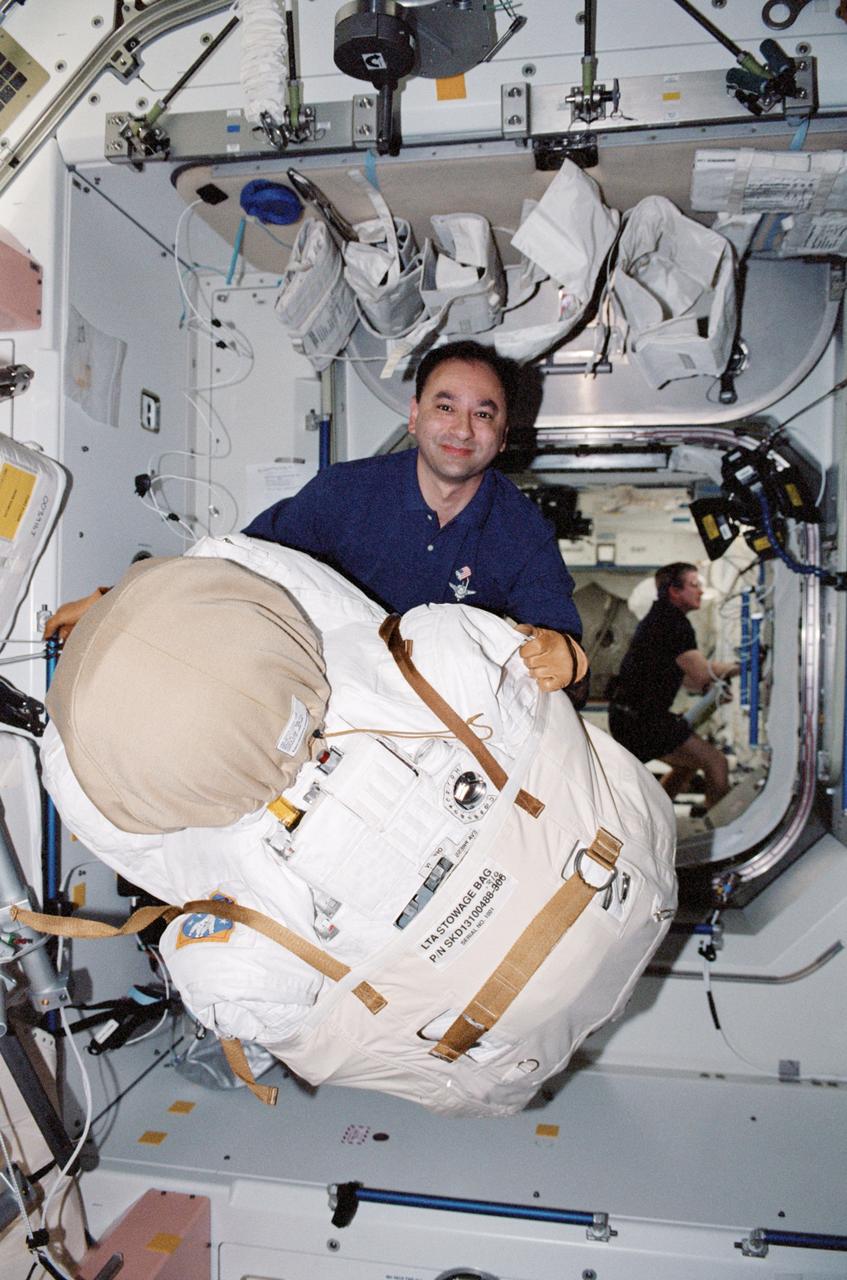
STS098-361-016 (7-20 February 2001) --- Astronaut Mark L. Polansky, STS-98 pilot, moves one of the Extravehicular Mobility Unit (EMU) space suits in its storage bag onboard the International Space Station (ISS). William M. (Bill) Shepherd, Expedition One mission commander, can be seen as he works in the background.
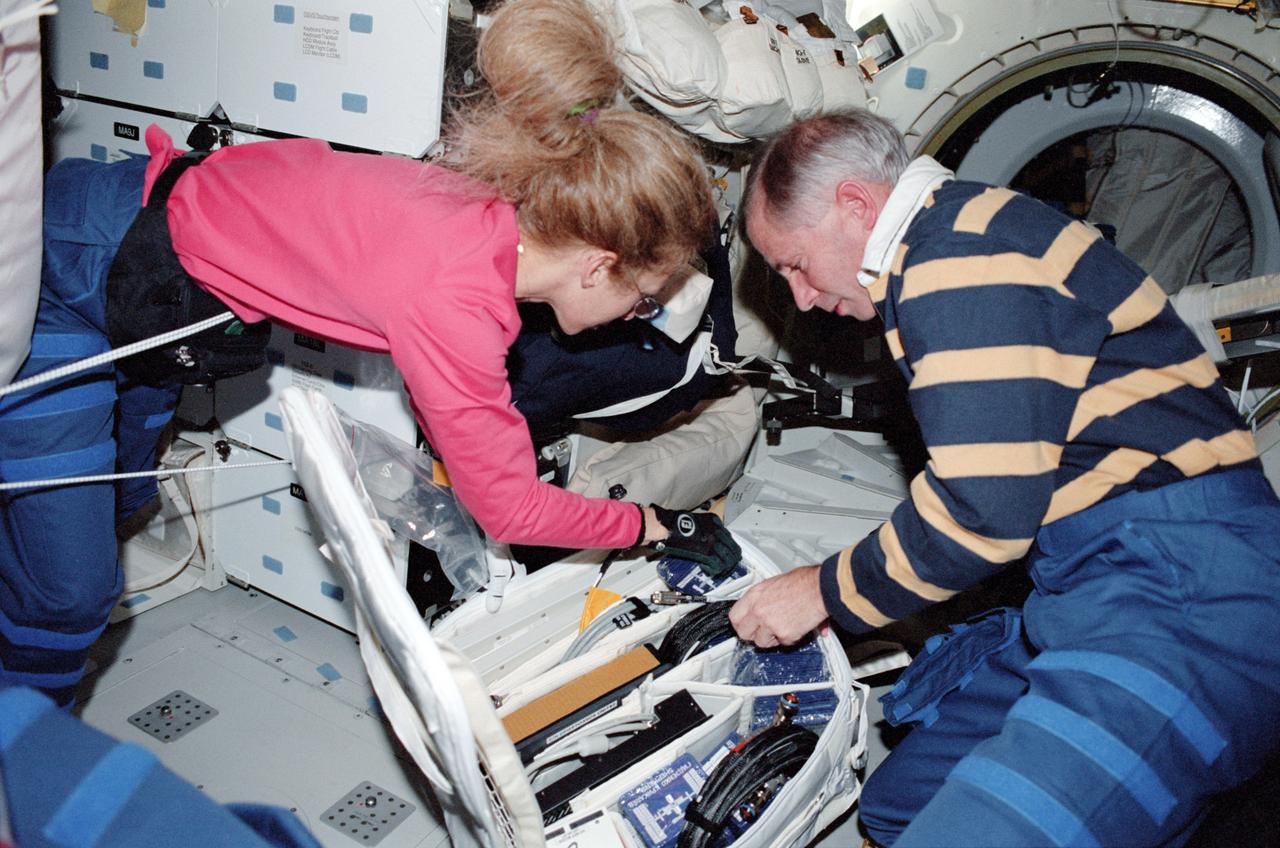
STS098-348-030 (7-20 February 2001) --- Astronauts Marsha S. Ivins (left), mission specialist, and Kenneth D. Cockrell, mission commander, prepare to transfer cables and miscellaneous equipment from the mid deck of the Space Shuttle Atlantis to the International Space Station (ISS).
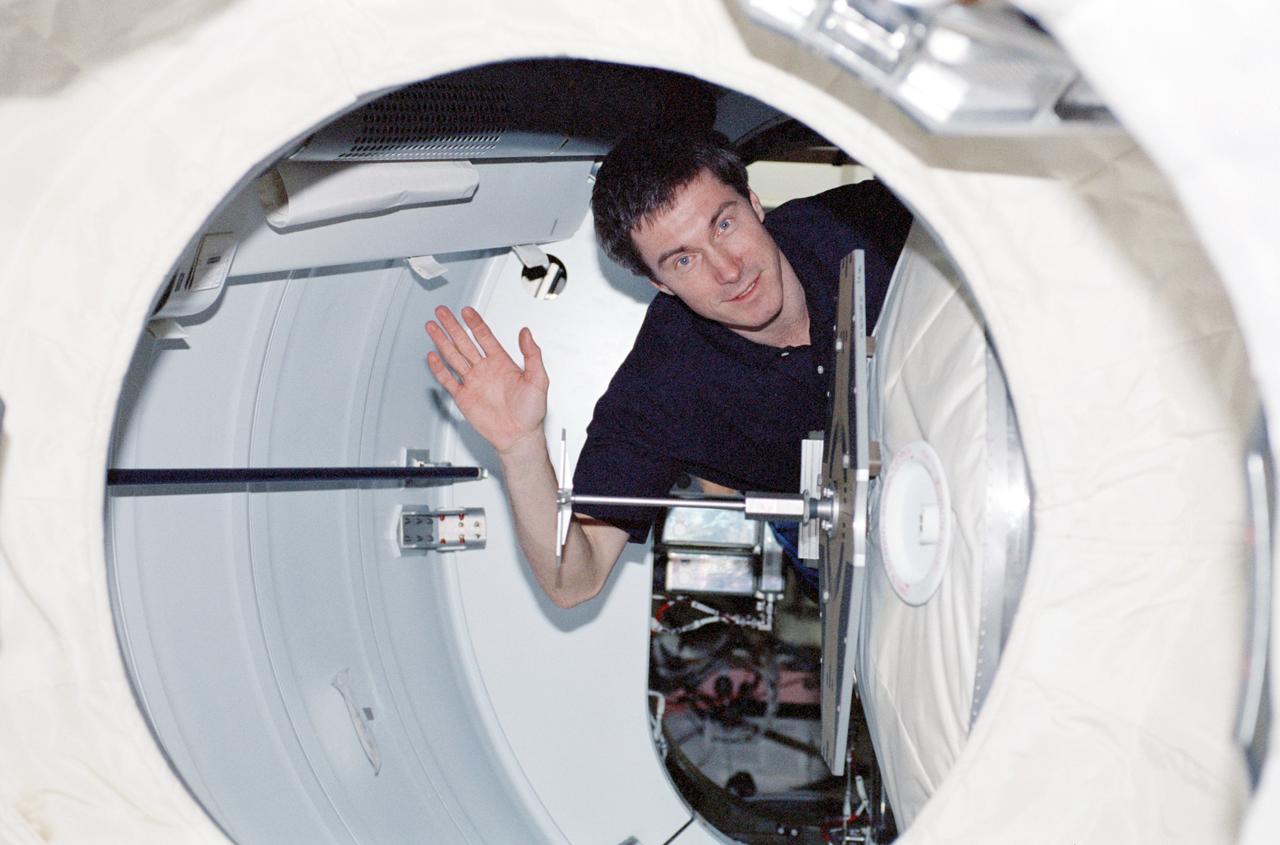
STS098-355-017 (7-20 February 2001) --- Cosmonaut Sergei K. Krikalev, Expedition One flight engineer, waves as he moves the hatch of the Pressurized Mating Adapter (PMA) leading to the Space Shuttle Atlantis. Krikalev represents Rosaviakosmos.
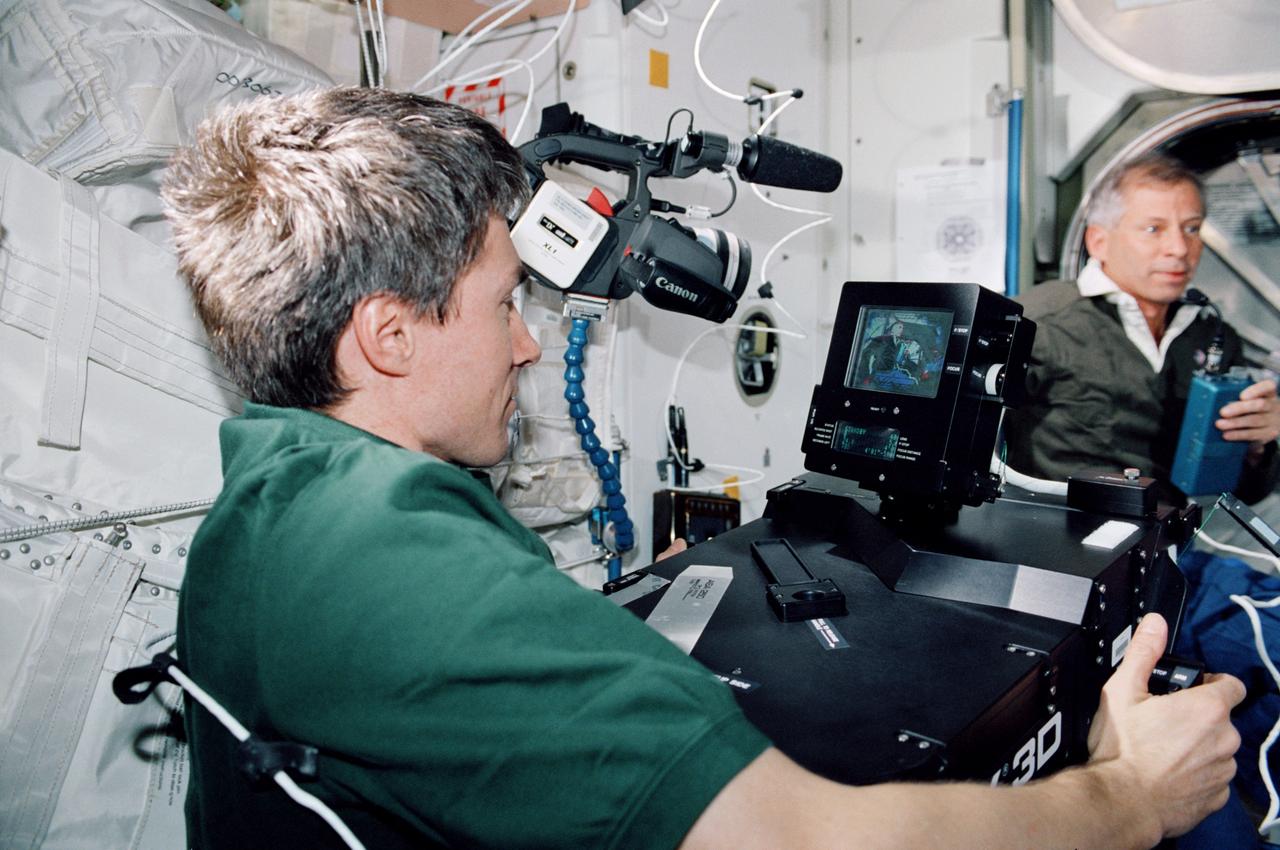
STS098-352-021 (7-20 February 2001) --- Cosmonaut Sergei K. Krikalev, Expedition One flight engineer, photographs astronaut Kenneth D. Cockrell, STS-98 mission commander, using an IMAX camera aboard the newly-attached Destiny laboratory on the International Space Station (ISS). Krikalev represents Rosaviakosmos.
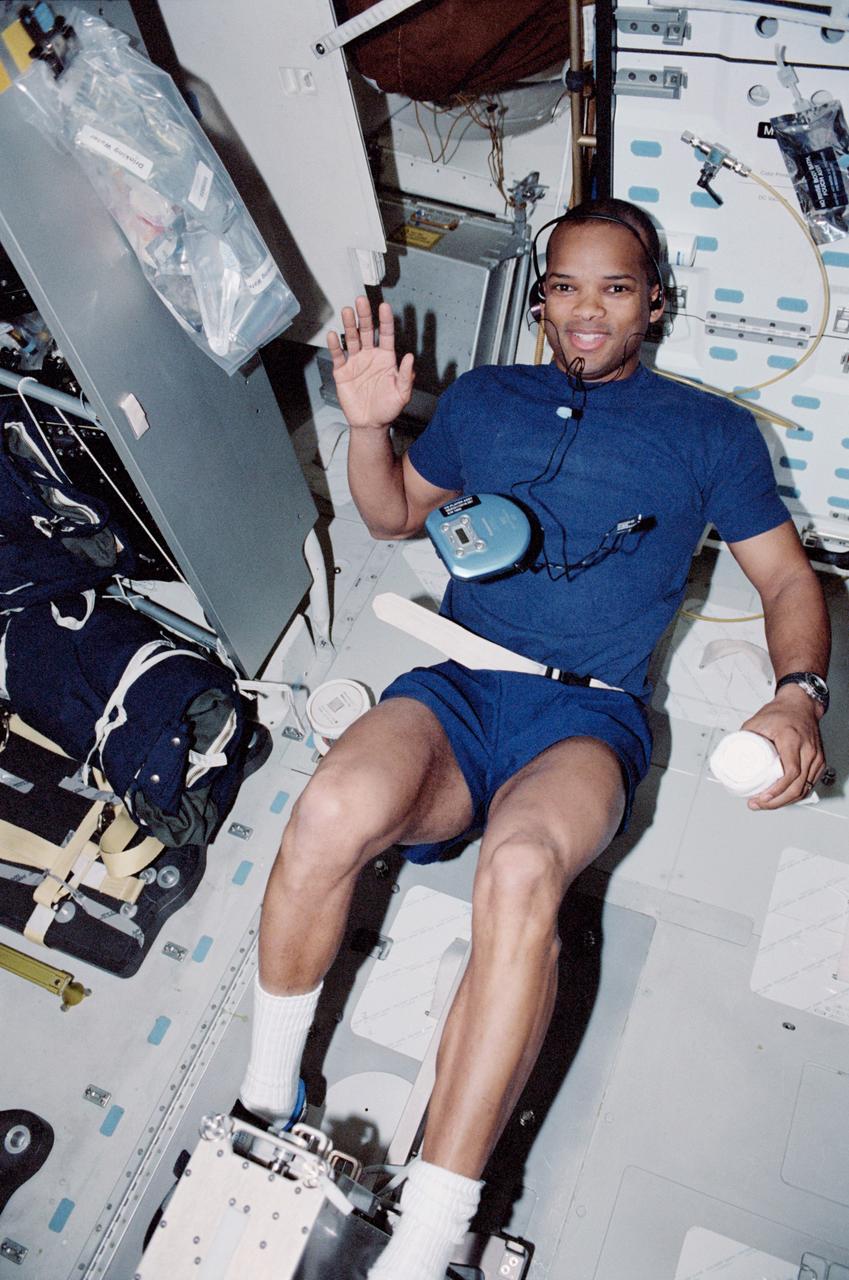
STS098-355-0034 (7-20 February 2001) --- Astronaut Robert L. Curbeam, mission specialist, works out on the ergometer device on the mid deck of the Earth-orbiting Space Shuttle Atlantis.
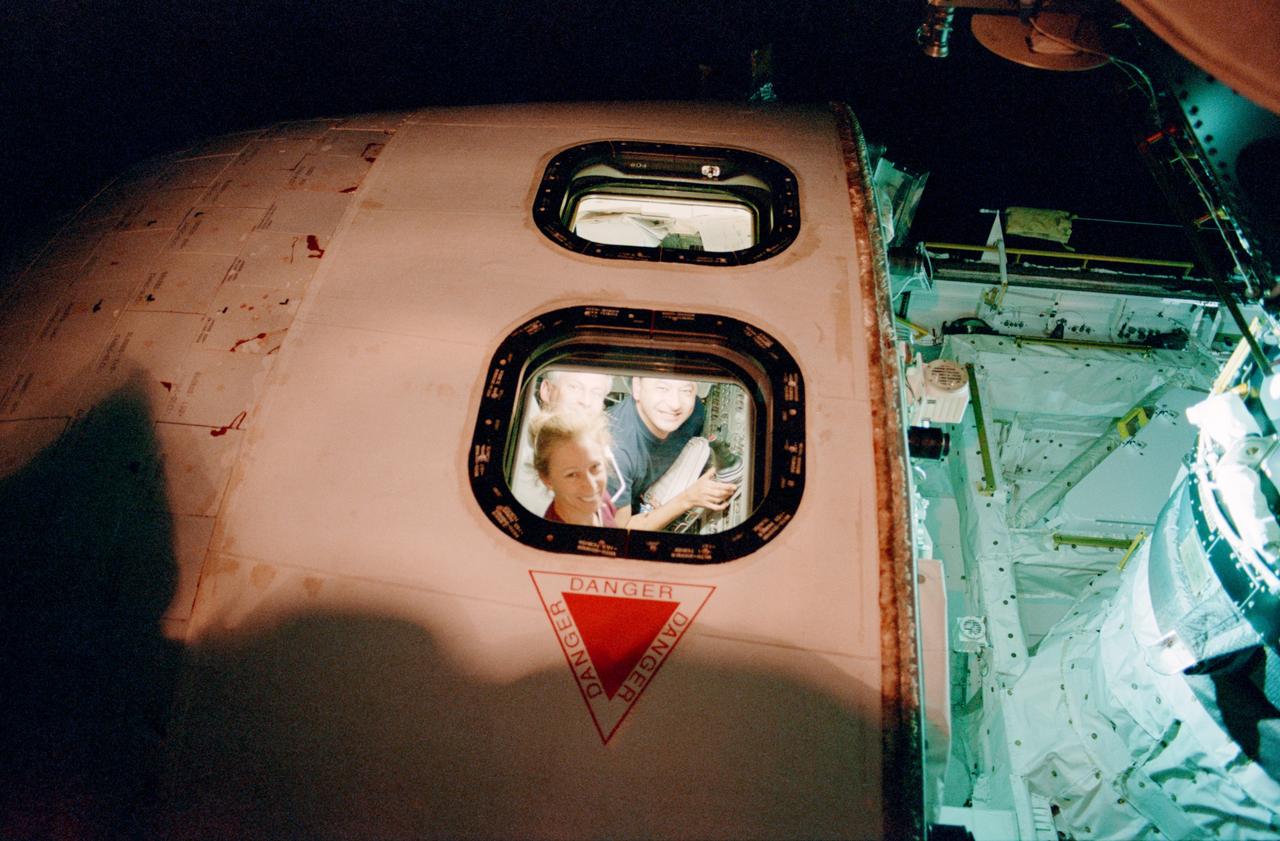
STS098-335-0028 (7-20 February 2001) --- From the aft flight deck of the Space Shuttle Atlantis, astronaut Marsha S. Ivins, STS-98 mission specialist, looks through an overhead window toward her space walking colleagues, who exposed this 35mm frame. Also visible in the window are astronauts Kenneth D. Cockrell and Mark L. Polansky, commander and pilot for the STS-98/5a mission.
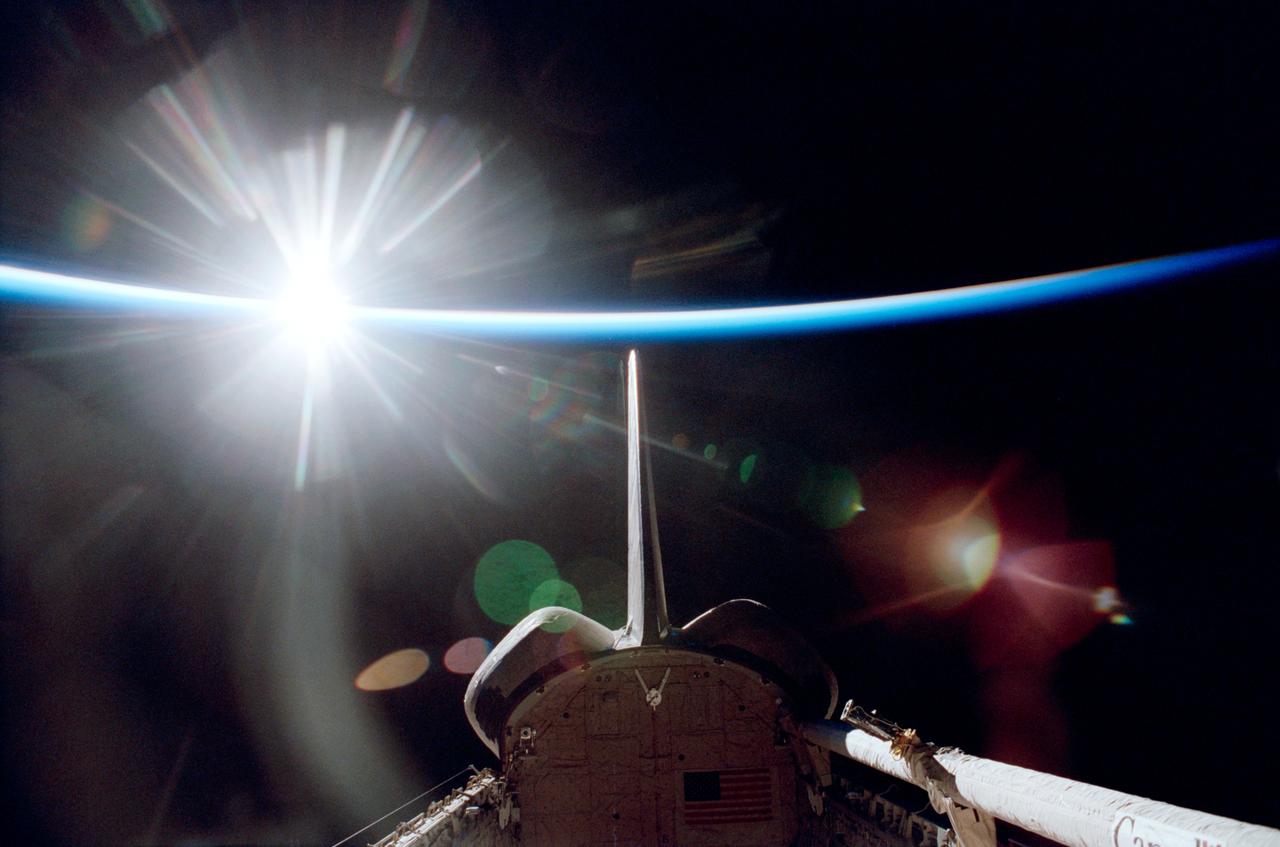
STS098-333-0007 (7-20 February 2001) --- A "sunburst" at Earth's limb caught the attention of one of the STS-98 astronauts who was standing on the aft flight deck of the Space Shuttle Atlantis at the time. Various colors are reflected at different points in the 35mm frame.
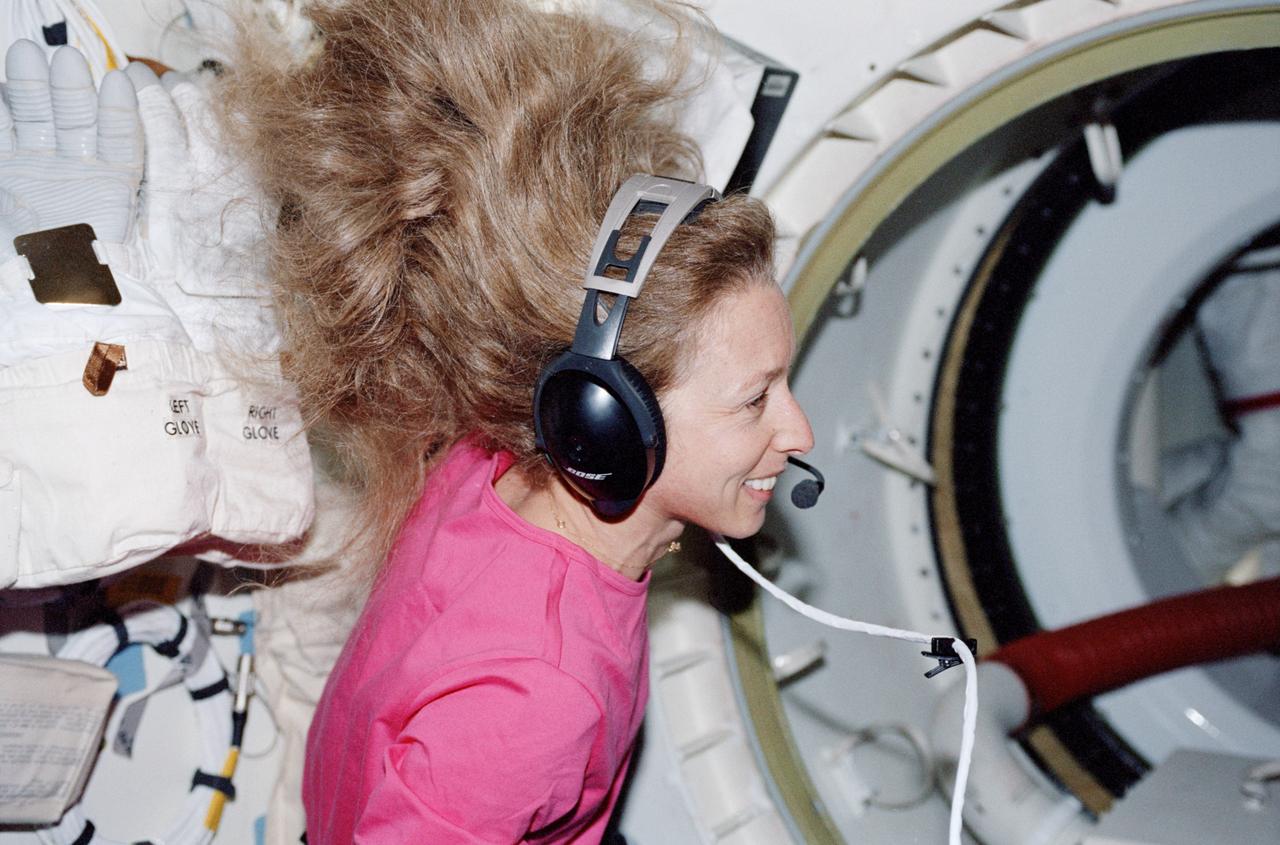
STS098-345-001 (7-20 February 2001) --- Astronaut Marsha S. Ivins, STS-98 mission specialist, places a phone call to Houston’s Mission Control Center (MCC) with the “virtual phone.” This test is designed to demonstrate communications capability of a new upgrade utilizing the existing Shuttle Orbiter Communications Adapter (OCA) infrastructure.
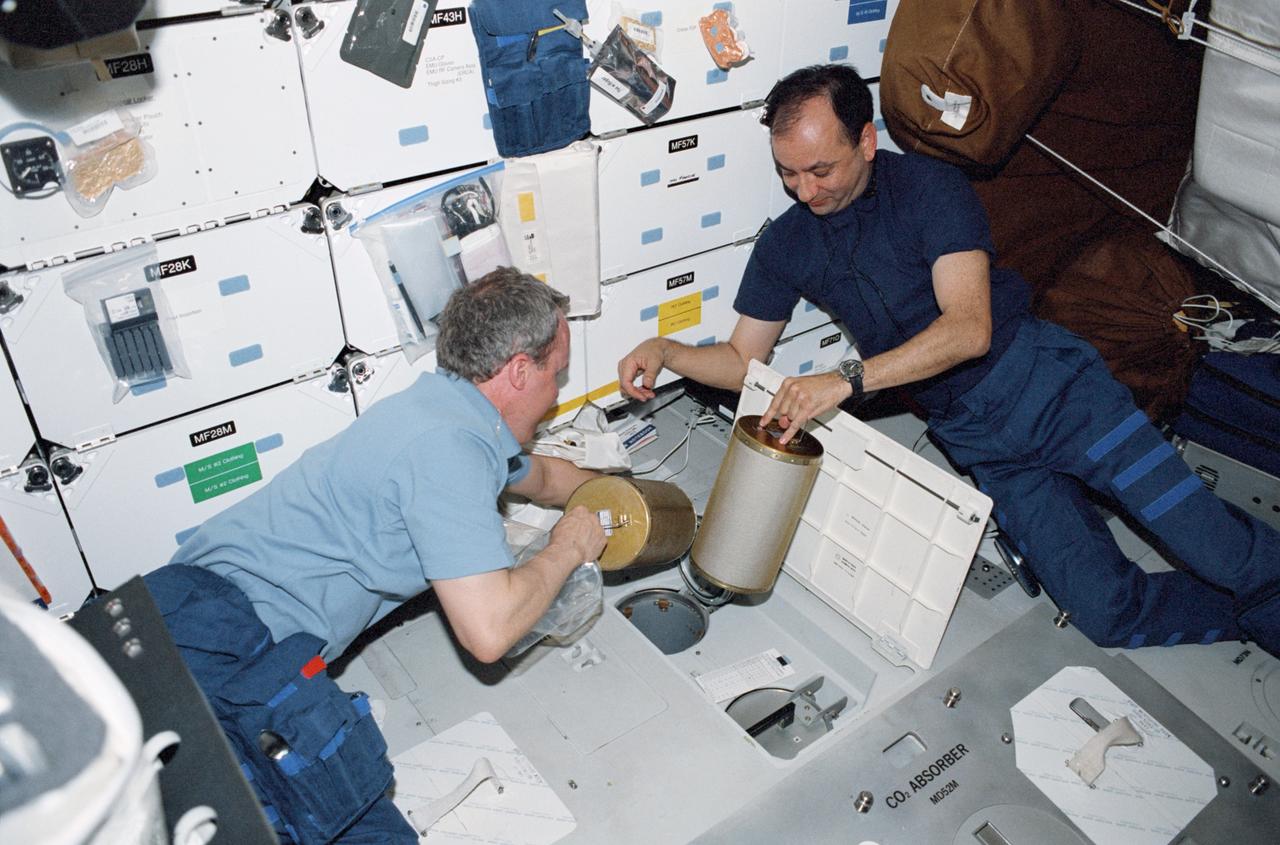
STS098-345-028 (7-20 February 2001) --- Astronauts Thomas D. Jones, mission specialist, and Mark L. Polansky, pilot, change out lithium hydroxide canisters on the mid deck of the Earth-orbiting Space Shuttle Atlantis.
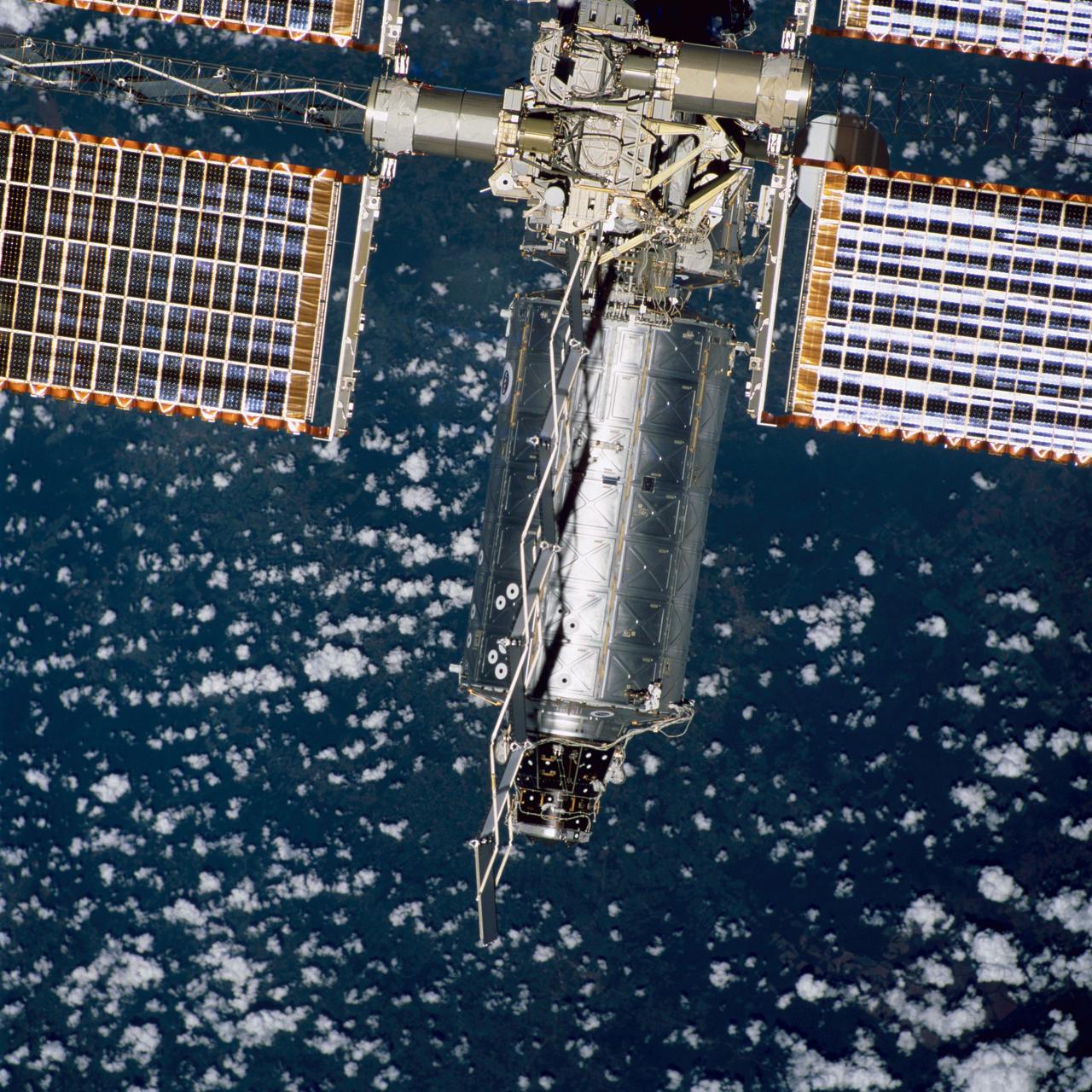
STS098-706-026 (7-20 February 2001) --- Backdropped by Earth dotted with clouds, this close-up view of the newly-attached Destiny laboratory on the International Space Station (ISS) was photographed by one of the astronauts onboard Atlantis. As the primary payload for the STS-98 mission, Destiny is the centerpiece of the ISS, where unprecedented science experiments will be performed in space. The shuttle and the station parted company at 8:06 a.m. (CST), Feb. 16, as Polansky flew the shuttle halfway around the outpost and its new Destiny laboratory before moving off.
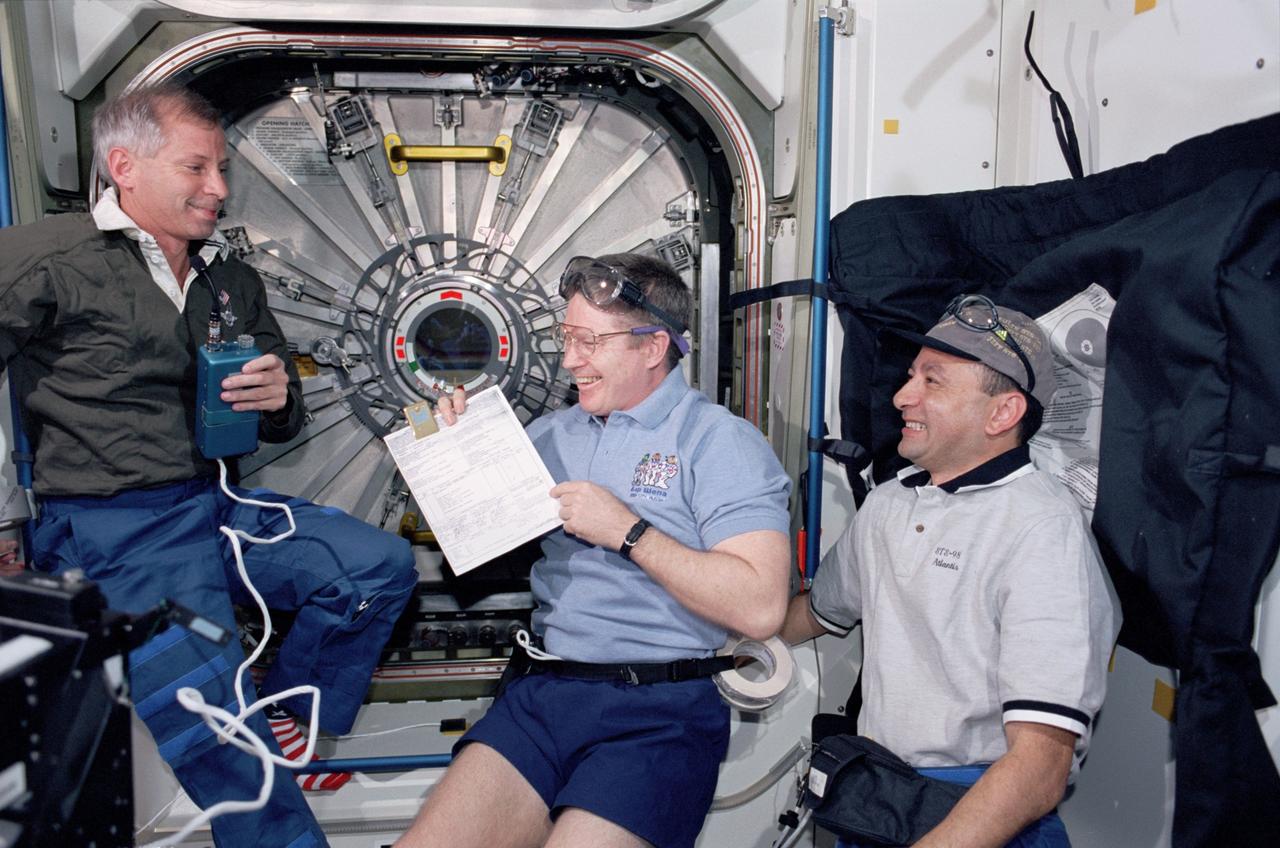
STS098-352-0019 (11 February 2001) --- Inside the Unity node, astronaut William M. (Bill) Shepherd (center), Expedition One commander, holds a document of receipt of the U.S. laboratory, called Destiny, as part of the International Space Station (ISS). Looking on are astronauts Kenneth D. Cockrell (left) and Mark L. Polansky, commander and pilot, respectively, for STS-98. The hatch to Destiny, not yet opened, is in the background.
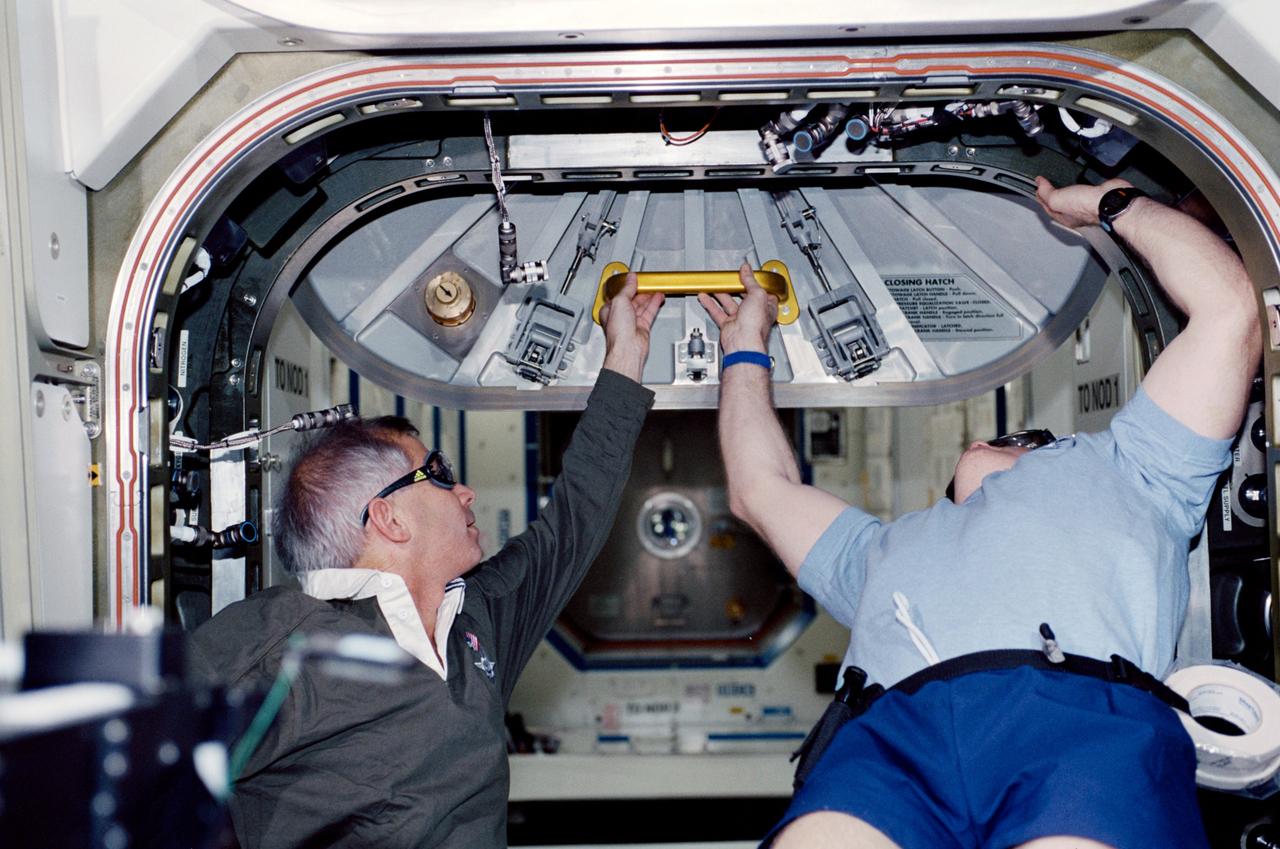
STS098-352-0025 (11 February 2001) --- STS-98 mission commander Kenneth D. Cockrell (left) assists as Expedition One commander William M. (Bill) Shepherd opens the hatch to the newly attached Destiny laboratory. The crews of Atlantis and the International Space Station entered the laboratory shortly after this photo was made on February 11; and the astronauts and cosmonauts spent the first full day of what are planned to be years of work ahead inside the orbiting science and command center. Members of both crews went to work quickly inside the new module, activating air systems, fire extinguishers, alarm systems, computers and internal communications. The crew also continued equipment transfers from the shuttle to the station.
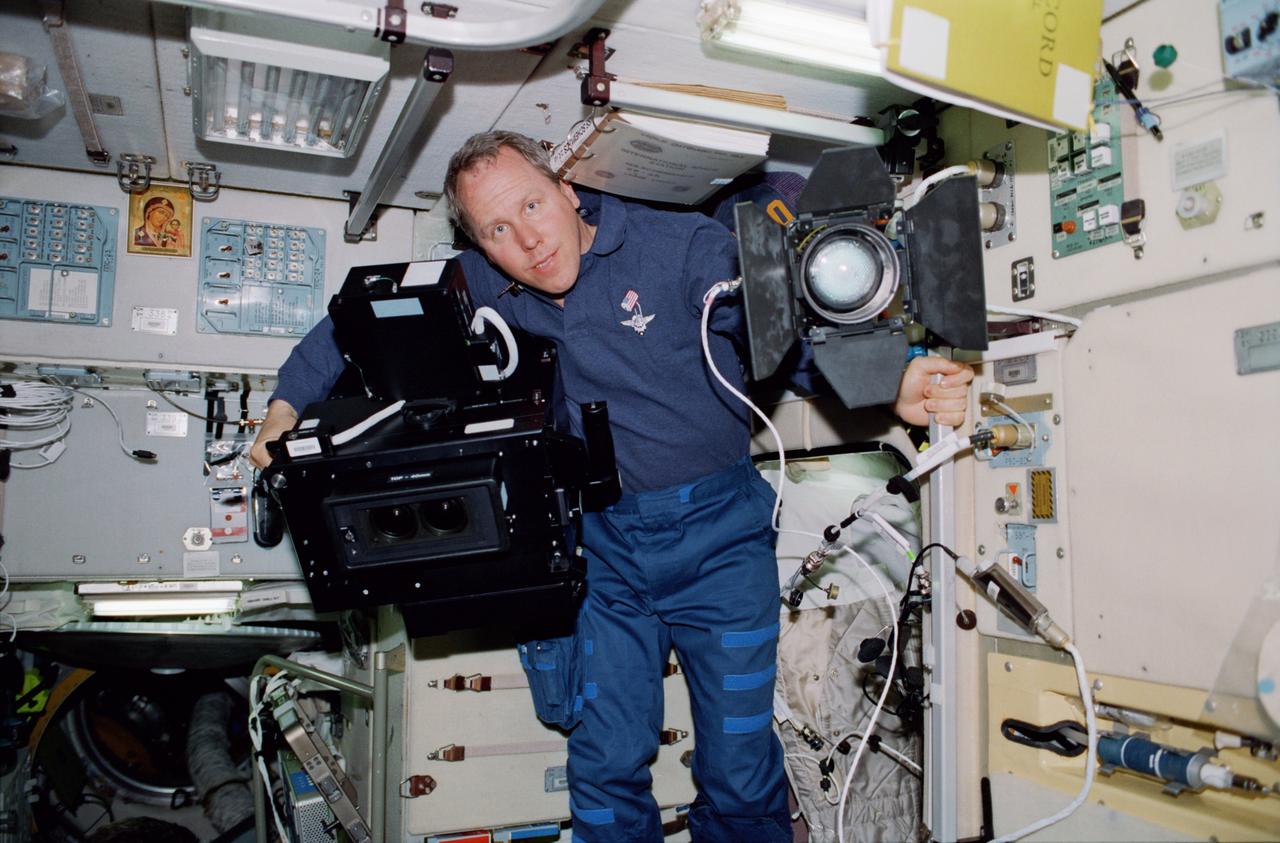
STS098-337-0026 (7-20 February 2001) --- Astronaut Thomas D. Jones, mission specialist, is seen with IMAX camera gear in the Zvezda service module of the International Space Station (ISS).
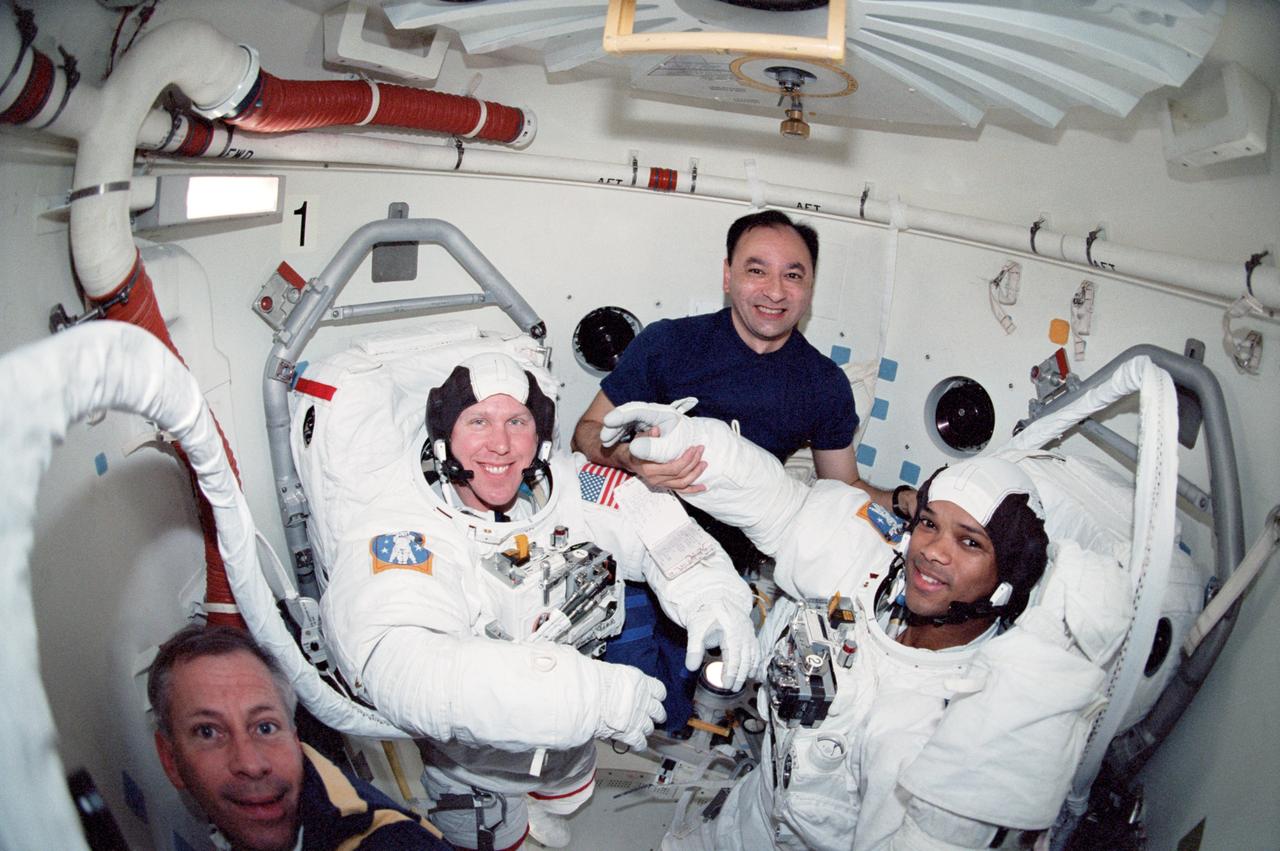
STS098-349-004 (7-20 February 2001) --- Astronauts Thomas D. Jones (second left) and Robert L. Curbeam, both mission specialists, prepare for one of the three STS-98 sessions of extravehicular activity (EVA). Astronauts Kenneth D. Cockrell (lower left), mission commander, and Mark L. Polansky, mission specialist, assist Jones and Curbeam as they don their Extravehicular Mobility Unit (EMU) space suits in the airlock of the Space Shuttle Atlantis.
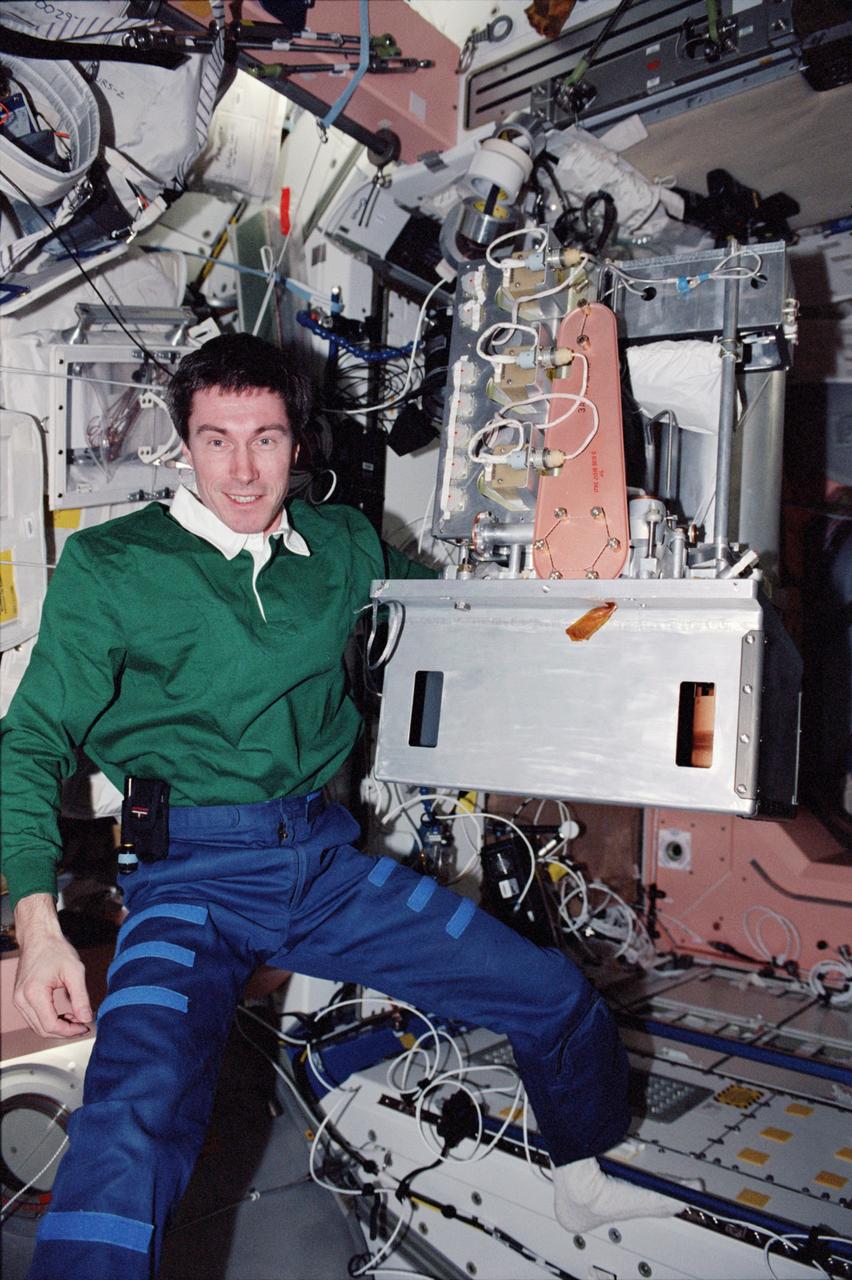
STS098-346-0032 (7-20 February 2001) --- Cosmonaut Sergei K. Krikalev, Expedition One flight engineer representing the Russian Aviation and Space Agency, carries the Vozdukh in the Unity node. Vozdukh is designed to maintain the partial pressure of carbon dioxide in the cabin air within the medically permissible range for long-duration exposure. It provides the primary means of removing CO2 from the outpost's atmosphere, and its operation is based on the use of regenerated adsorbers of CO2.
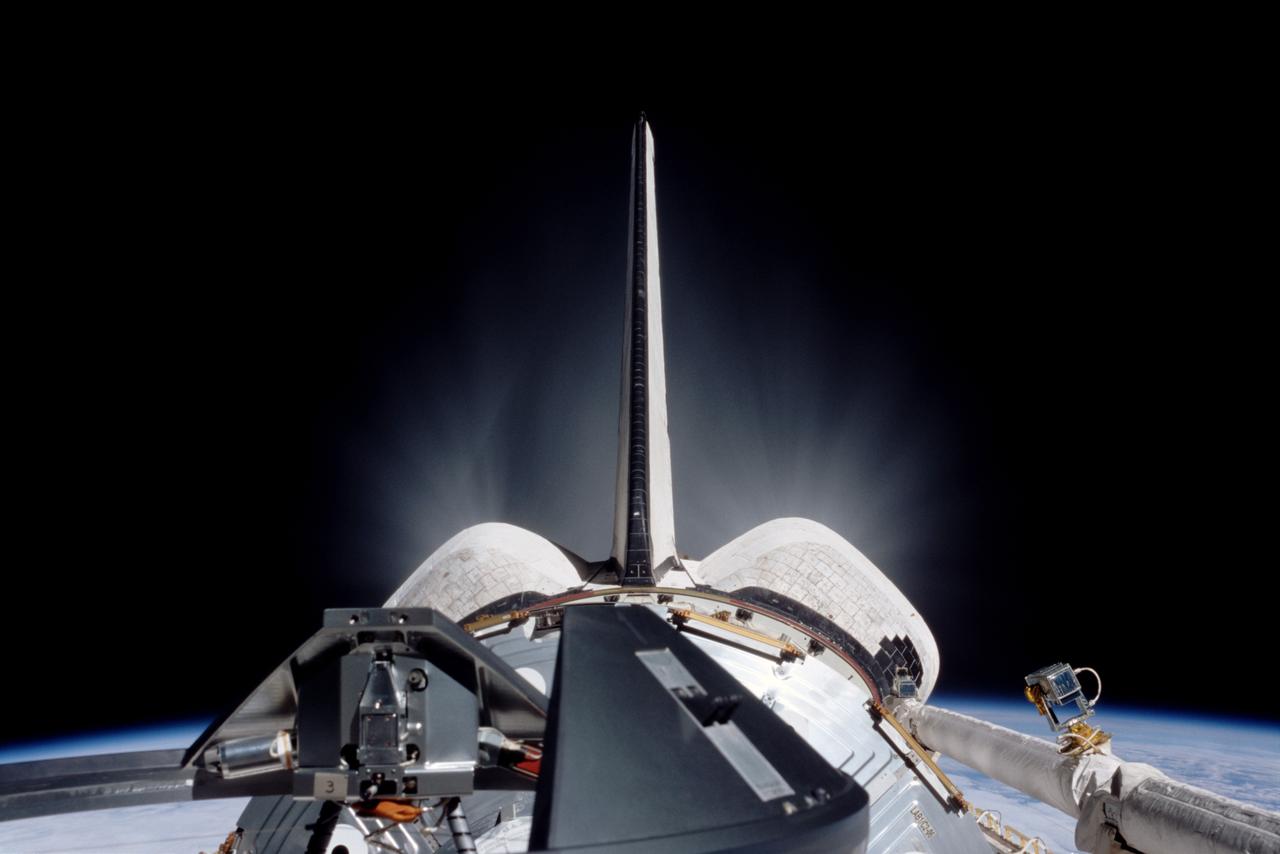
STS098-324-0004 (7-20 February 2001) --- One of the astronauts on the aft flight deck of the Space Shuttle Atlantis used a 35mm camera to record this image of a thruster firing. Part of Earth's limb can be seen on either side of the orbital maneuvering system (OMS) pods below frame center.
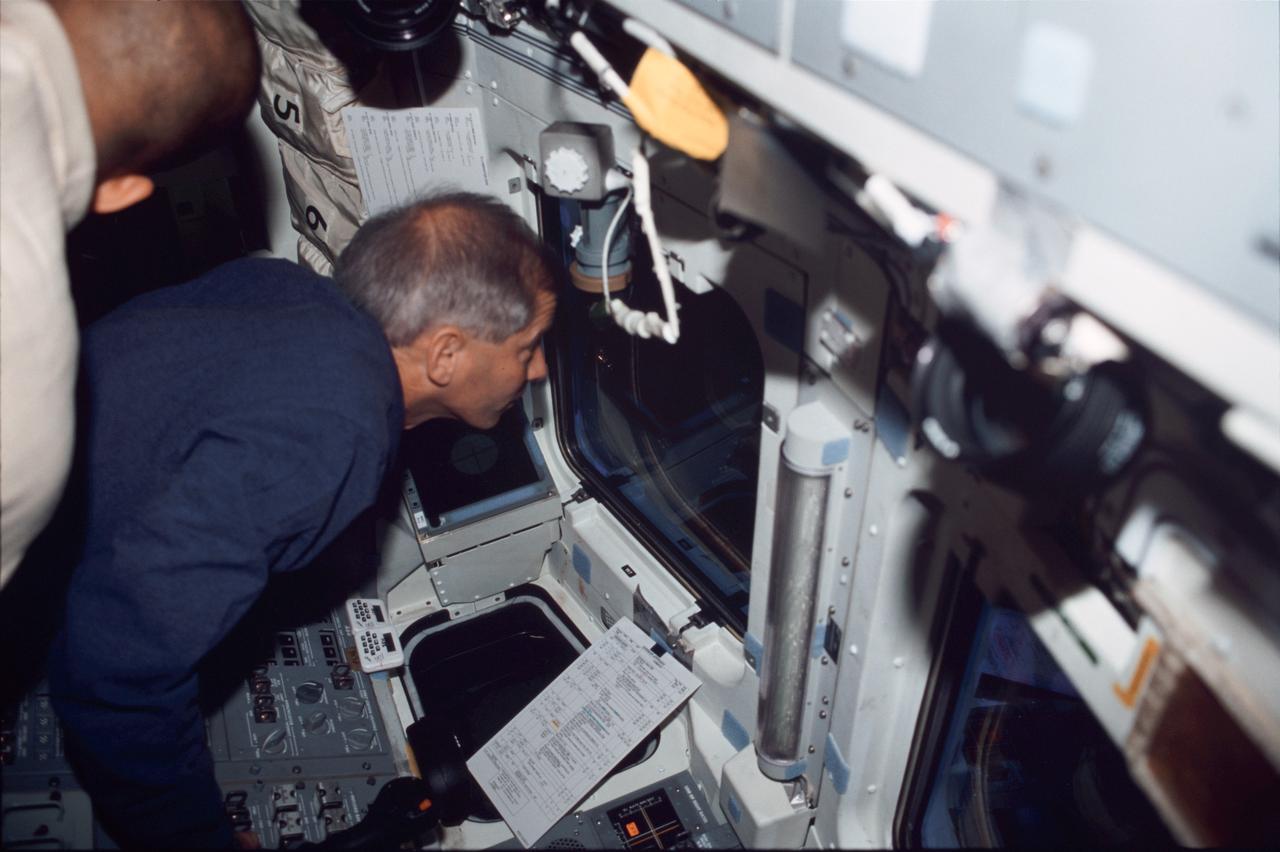
STS098-326-023 (7-20 February 2001) --- Astronaut Kenneth D. Cockrell, mission commander, controls the intricate maneuvers of the shuttle during docking procedures with the International Space Station (ISS) from the aft flight deck of the Space Shuttle Atlantis. Robert L. Curbeam (partially out of frame), mission specialist, can also be seen in this image.
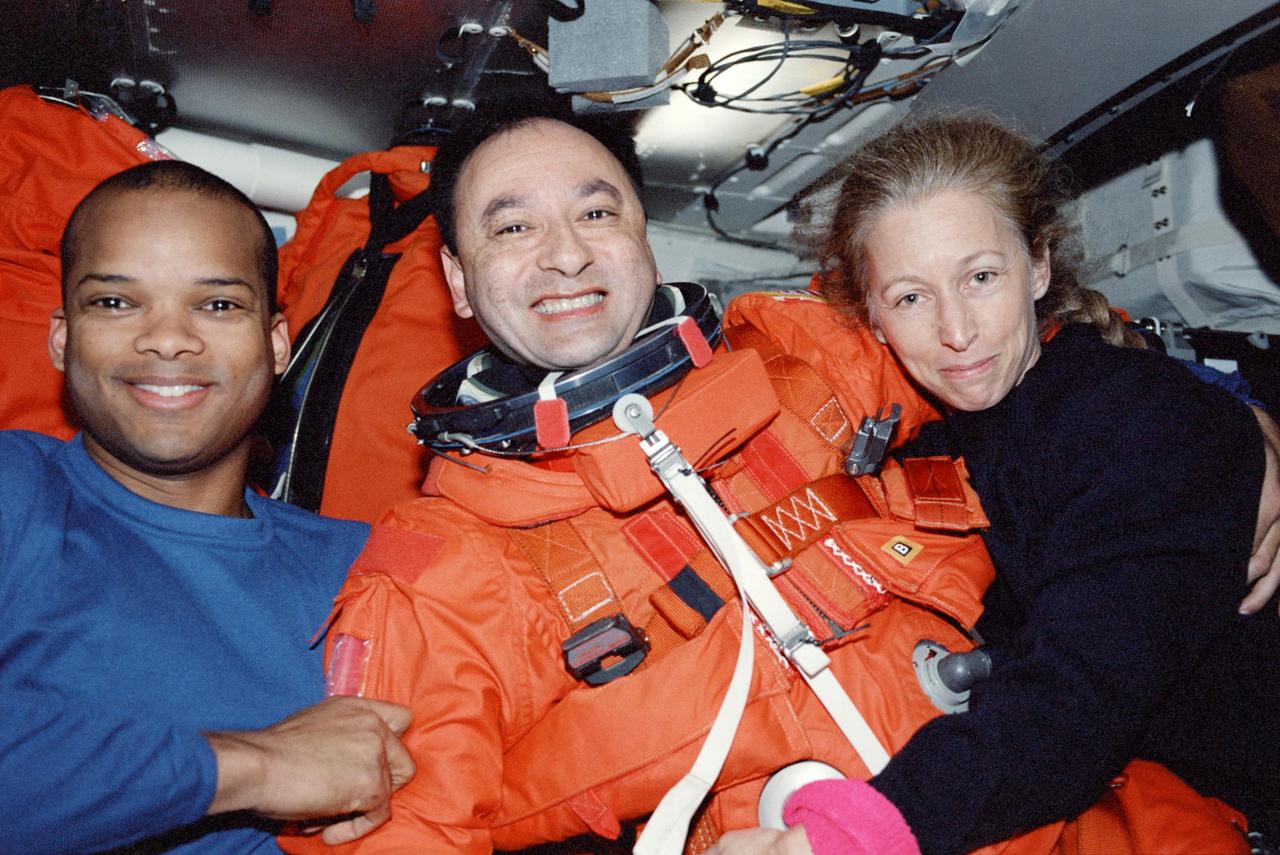
STS098-358-005 (7-20 February 2001) --- Astronauts Mark L. Polansky (center), pilot, Robert L. Curbeam, and Marsha S. Ivins, both mission specialists, paused for this photograph as they prepared to suit up in their full-pressure launch and entry suits on the mid deck of the Space Shuttle Atlantis during de-orbit preparations.
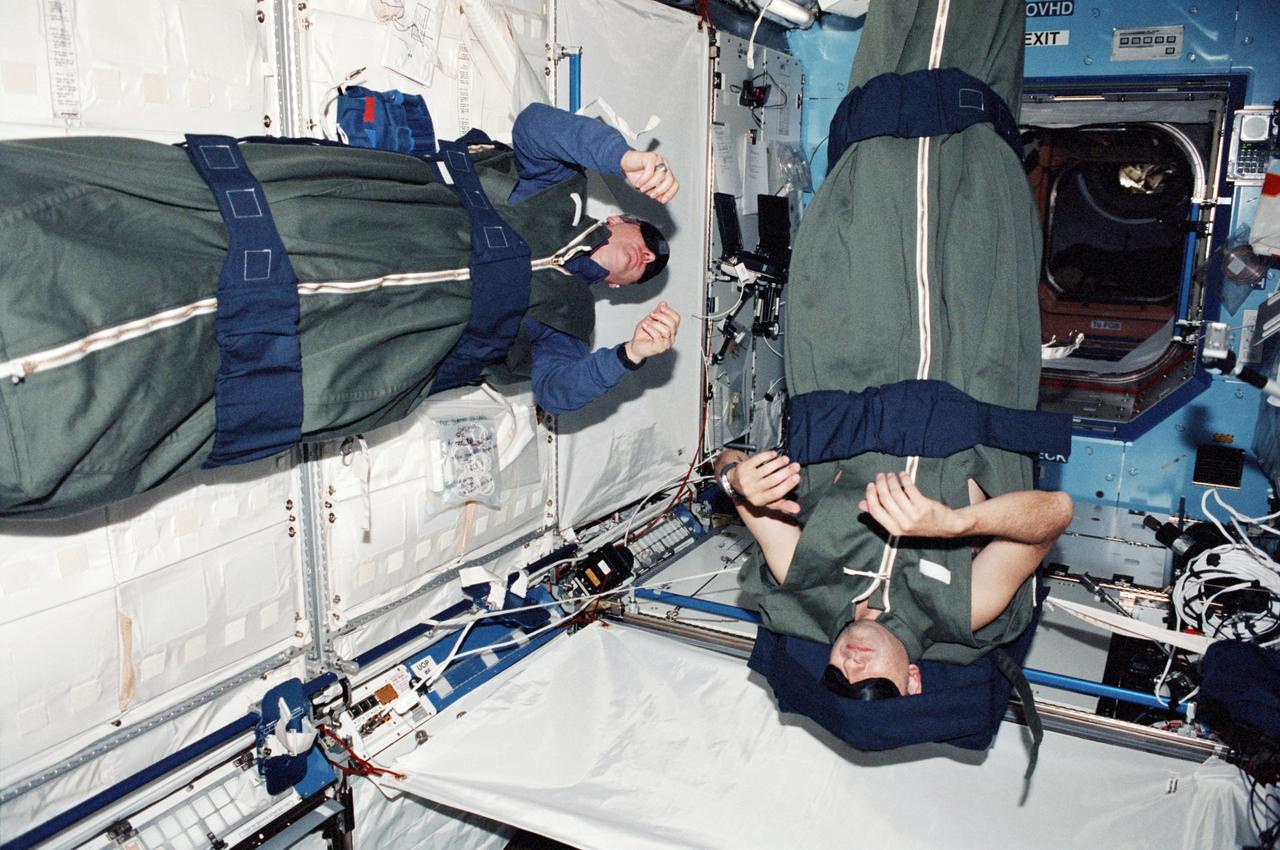
STS098-355-001 (7-20 February 2001) --- Astronauts Thomas D. Jones and Mark L. Polansky, STS-98 mission specialists, are photographed during their sleep shift in the newly-attached Destiny laboratory on the International Space Station (ISS).
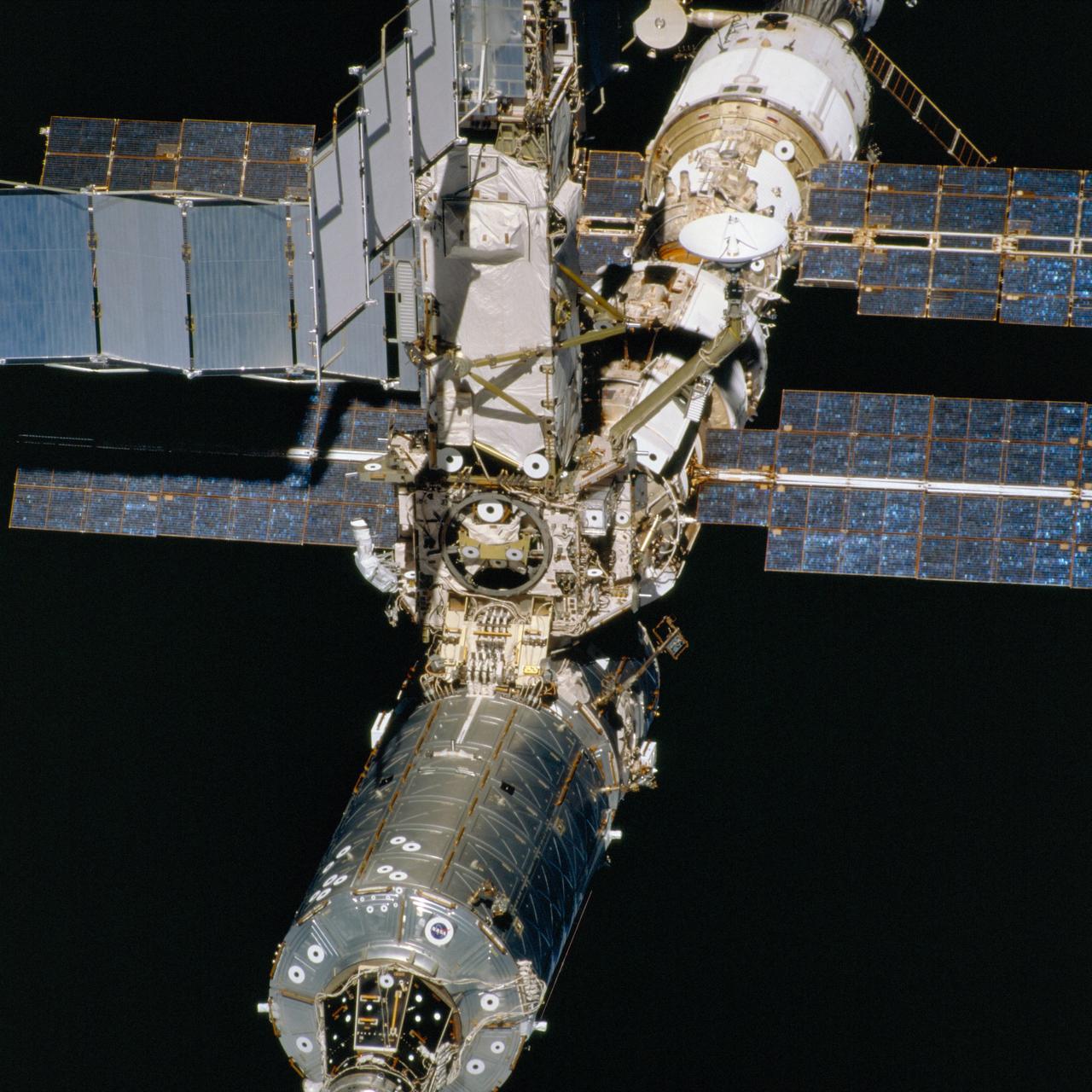
STS098-706-004 (16 February 2001) --- The International Space Station (ISS)is backdropped against the blackness of space in this medium-distance, 70mm frame, as photographed from the departing Space Shuttle Atlantis. The newly installed Destiny laboratory is in the left foreground. The crews of the Space Shuttle Atlantis and the International Space Station parted company at 8:06 a.m. (CST), Febraury 16, as astronaut Mark L. Polansky, pilot, flew the shuttle halfway around the station and its new Destiny laboratory before moving off.
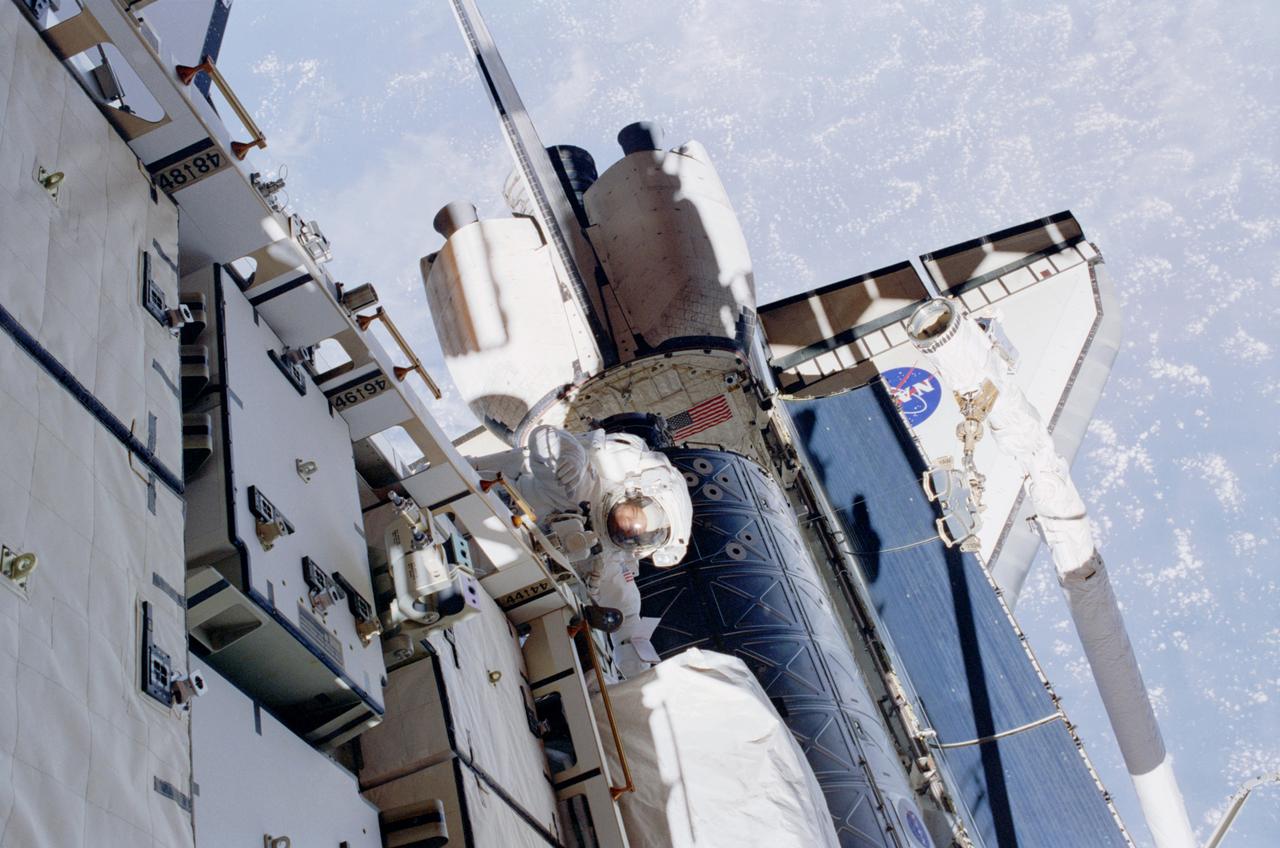
STS098-336-008 (7-20 February 2001) --- Astronaut Robert L. Curbeam, mission specialist, is photographed by fellow space walker Thomas D. Jones, during one of the three STS-98 sessions of extravehicular activity (EVA).
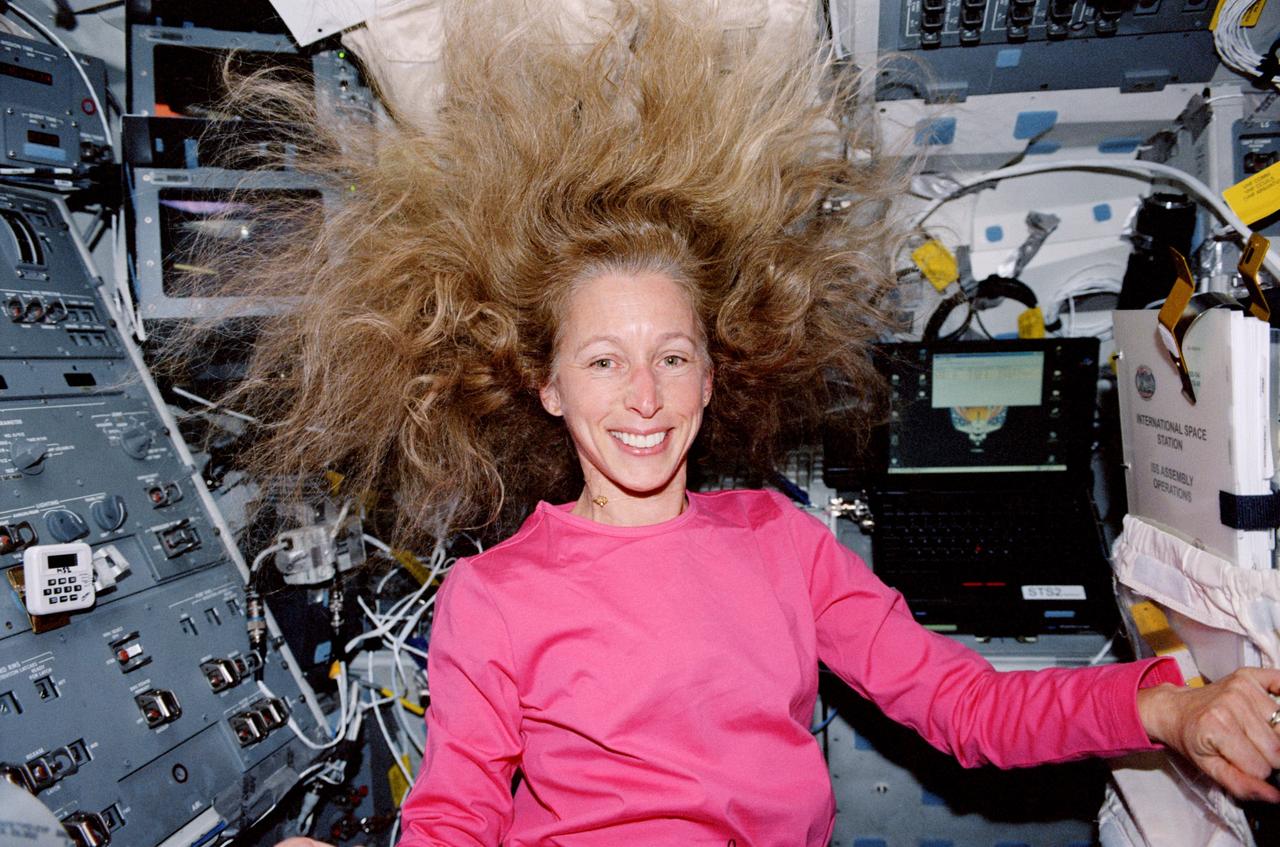
STS098-348-015 (7-20 February 2001) --- Astronaut Marsha S. Ivins, STS-98 mission specialist, is photographed on the mid deck of the Earth-orbiting Space Shuttle Atlantis.
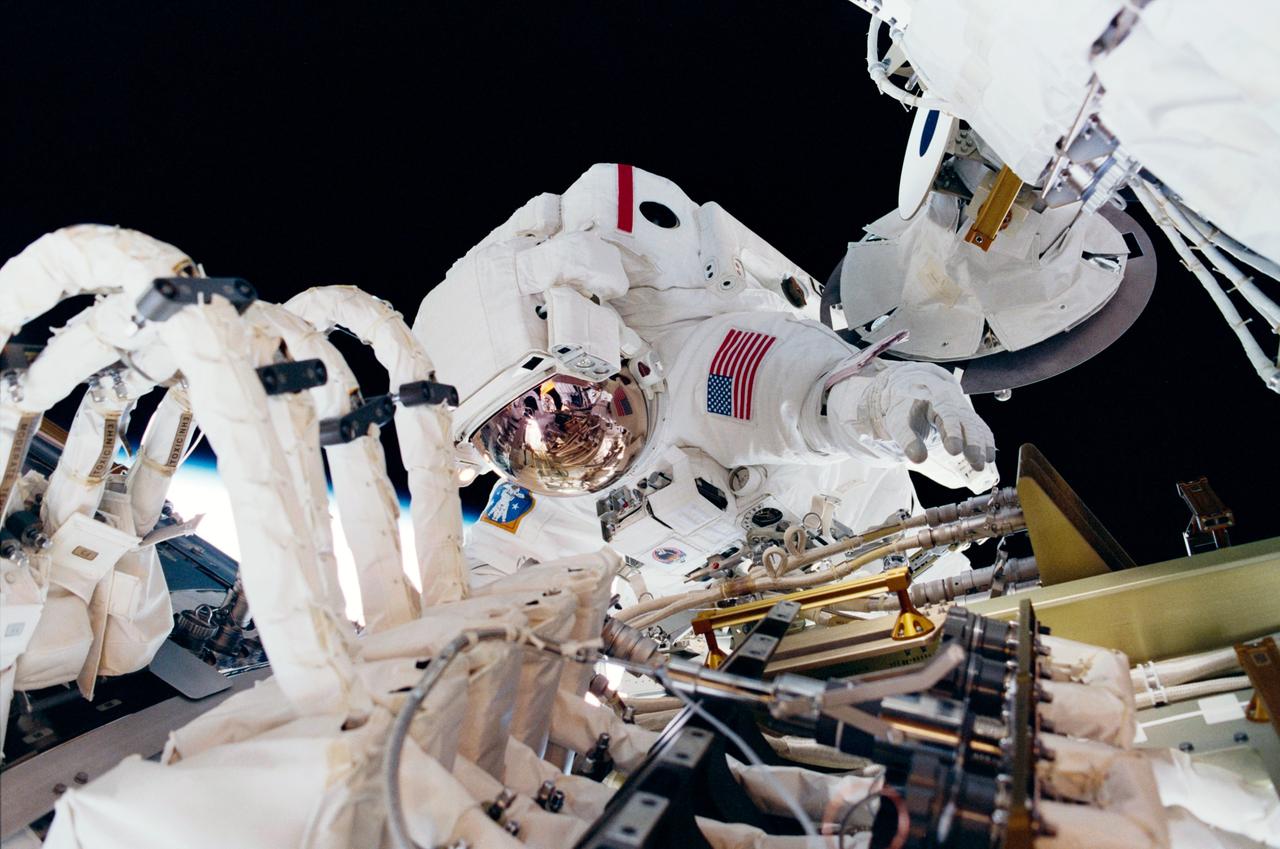
STS098-330-007 (7-20 February 2001) --- Astronaut Thomas D. Jones, mission specialist, works near the International Space Station (ISS) during one of the three STS-98 sessions of extravehicular activity (EVA).
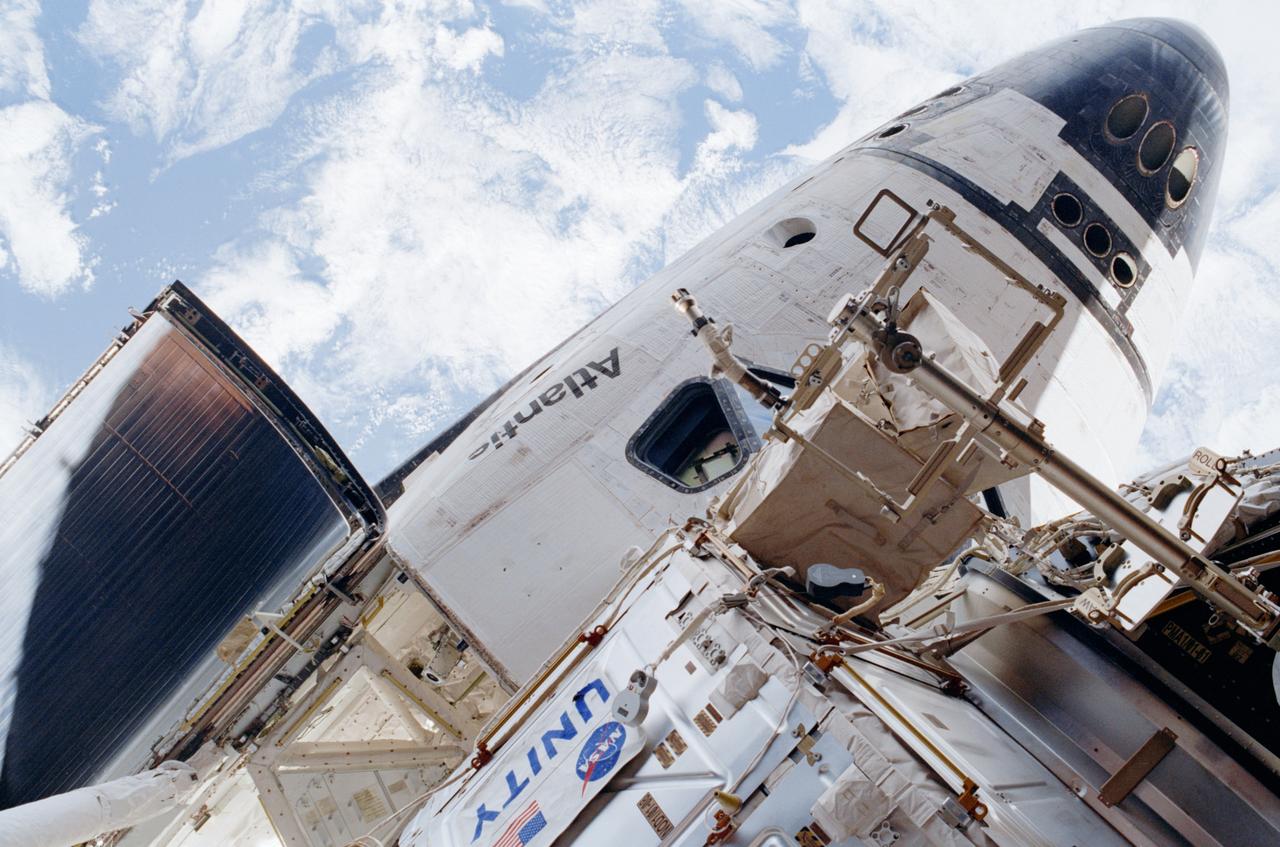
STS098-340-004 (7-20 February 2001) --- During one of the three STS-98 sessions of extravehicular activity (EVA), one of the astronauts took this photograph of the nose of the Space Shuttle Atlantis as it was docked to the International Space Station (ISS).
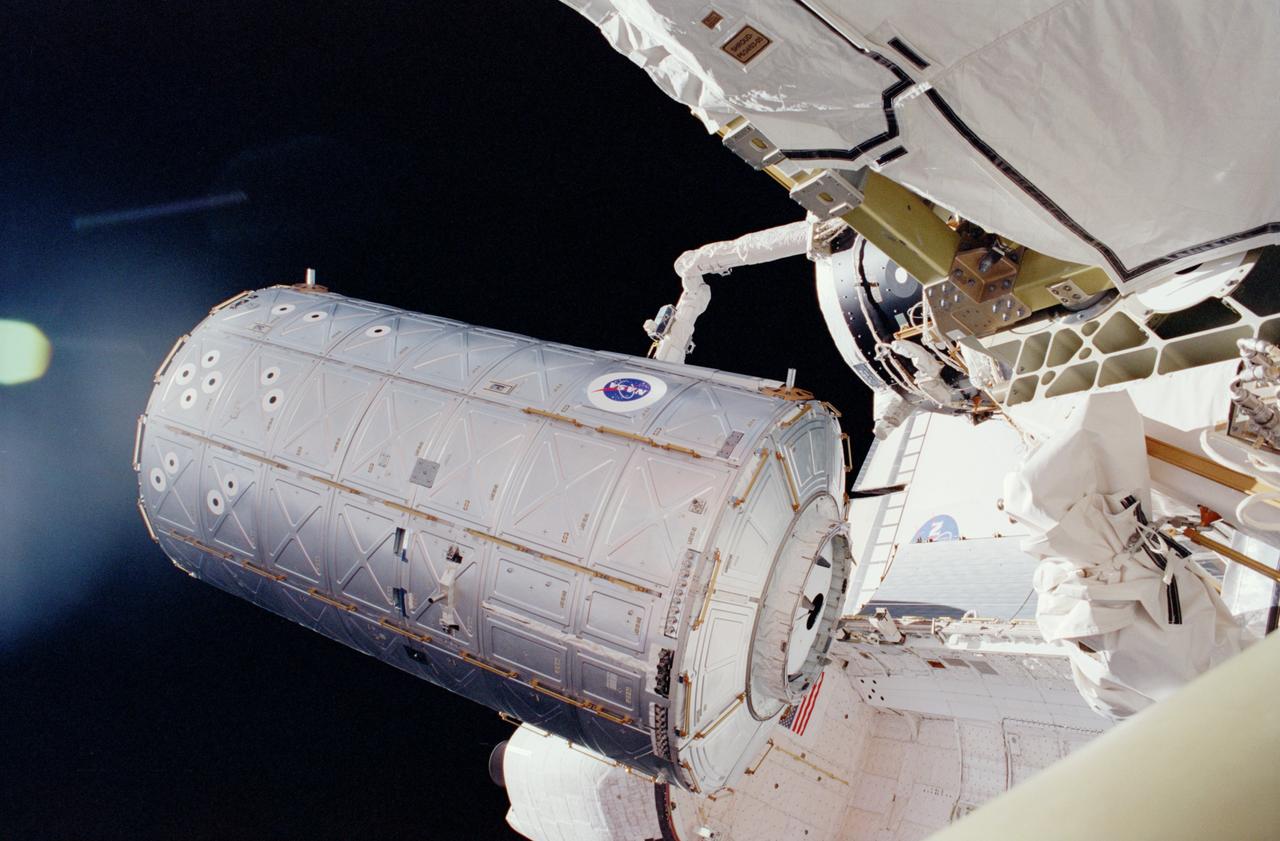
STS098-331-0017 (7-20 February 2001) --- In the grasp of the shuttle's remote manipulator system (RMS) robot arm, the Destiny laboratory is moved from its stowage position in the cargo bay of the Space Shuttle Atlantis. The photo was taken by astronaut Thomas D. Jones, who was participating in one of three STS-98/5a space walks at the time. Astronaut Robert L. Curbeam (out of frame) also made the three space walks.
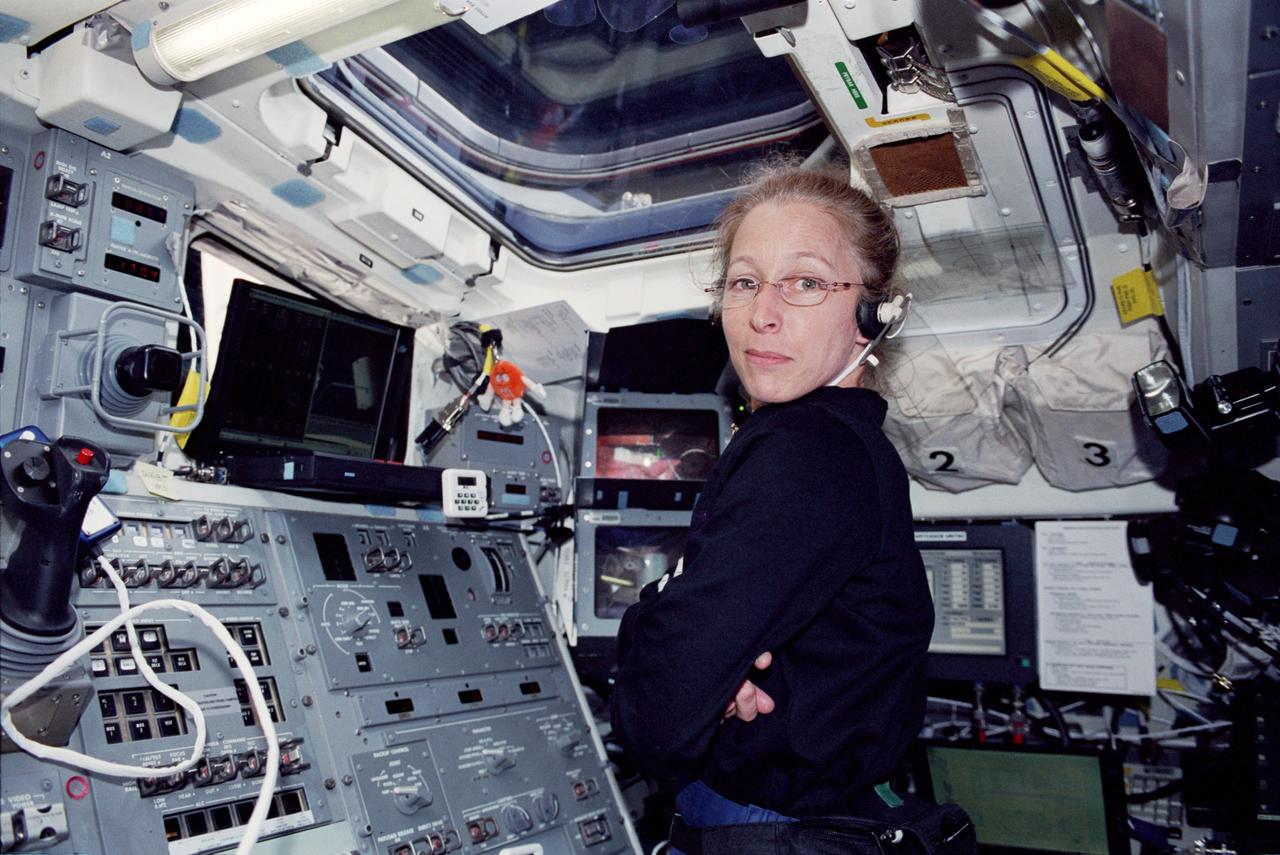
STS098-351-0013 (7-20 February 2001) --- Astronaut Marsha S. Ivins, mission specialist, spent a great deal of time on the aft flight deck of the Space Shuttle Atlantis during space walks and other important activities of the STS-98/5a mission.
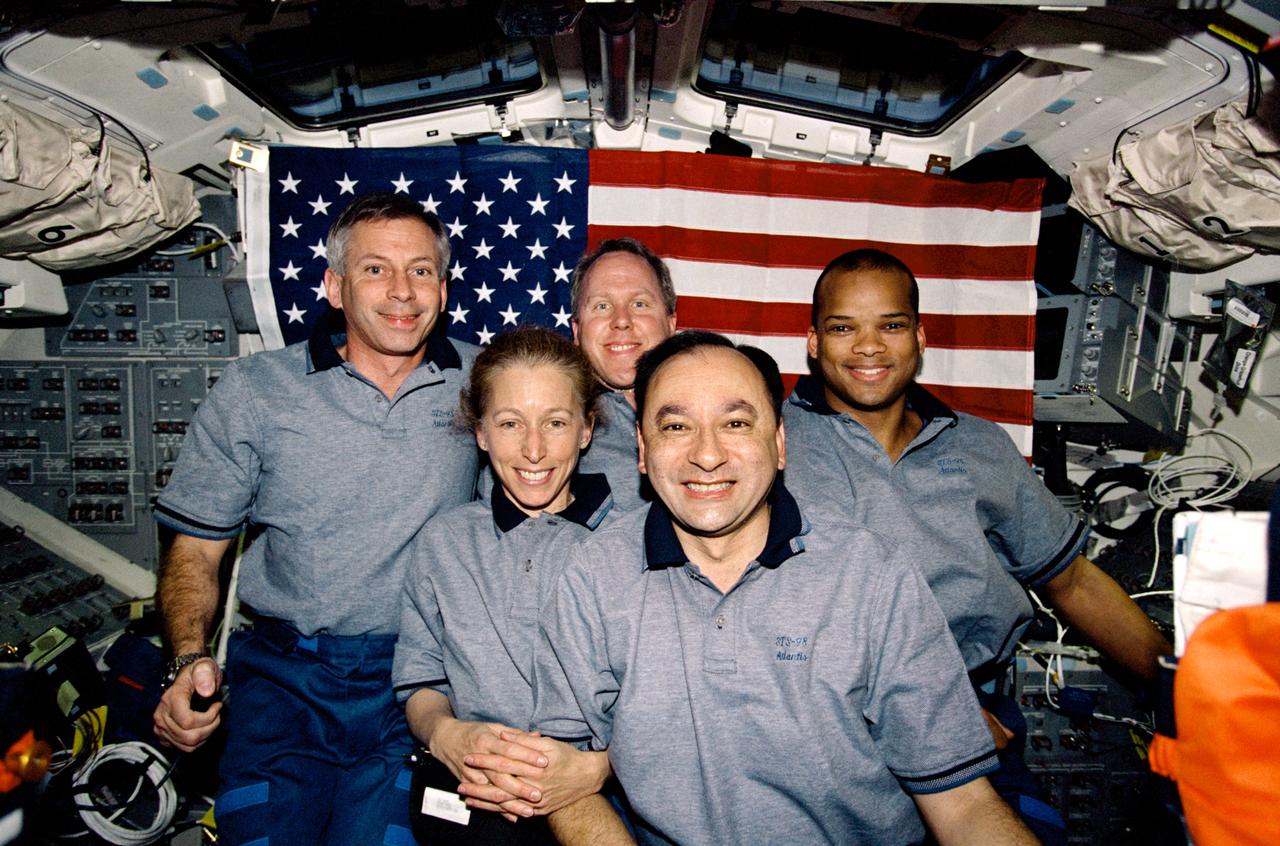
STS098-365-0034 (7-20 February 2001) --- The crew of the STS-98 mission poses for the traditional inflight portrait on the flight deck of the Space Shuttle Atlantis. From left are astronauts Kenneth D. Cockrell, mission commander; Marsha S. Ivins, mission specialist; Thomas D. Jones, mission specialist; Mark L. Polansky, pilot; and Robert L. Curbeam, mission specialist.
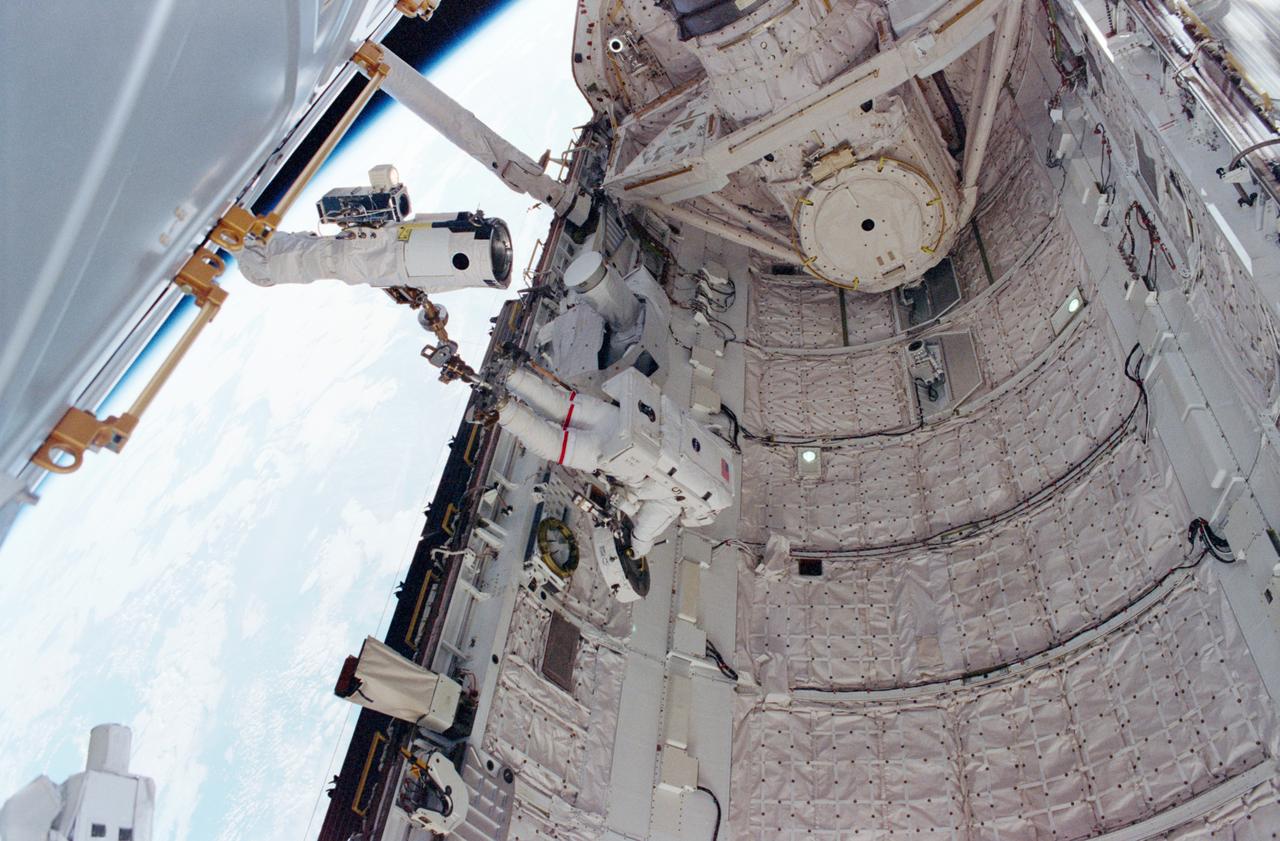
STS098-339-008 (7-20 February 2001) --- Anchored to a restraint device on the end of the shuttle’s remote manipulator system (RMS) robot arm, astronaut Thomas D. Jones, mission specialist, works with the Power and Data Grapple Fixture (PDGF) in the cargo bay of the Space Shuttle Atlantis.
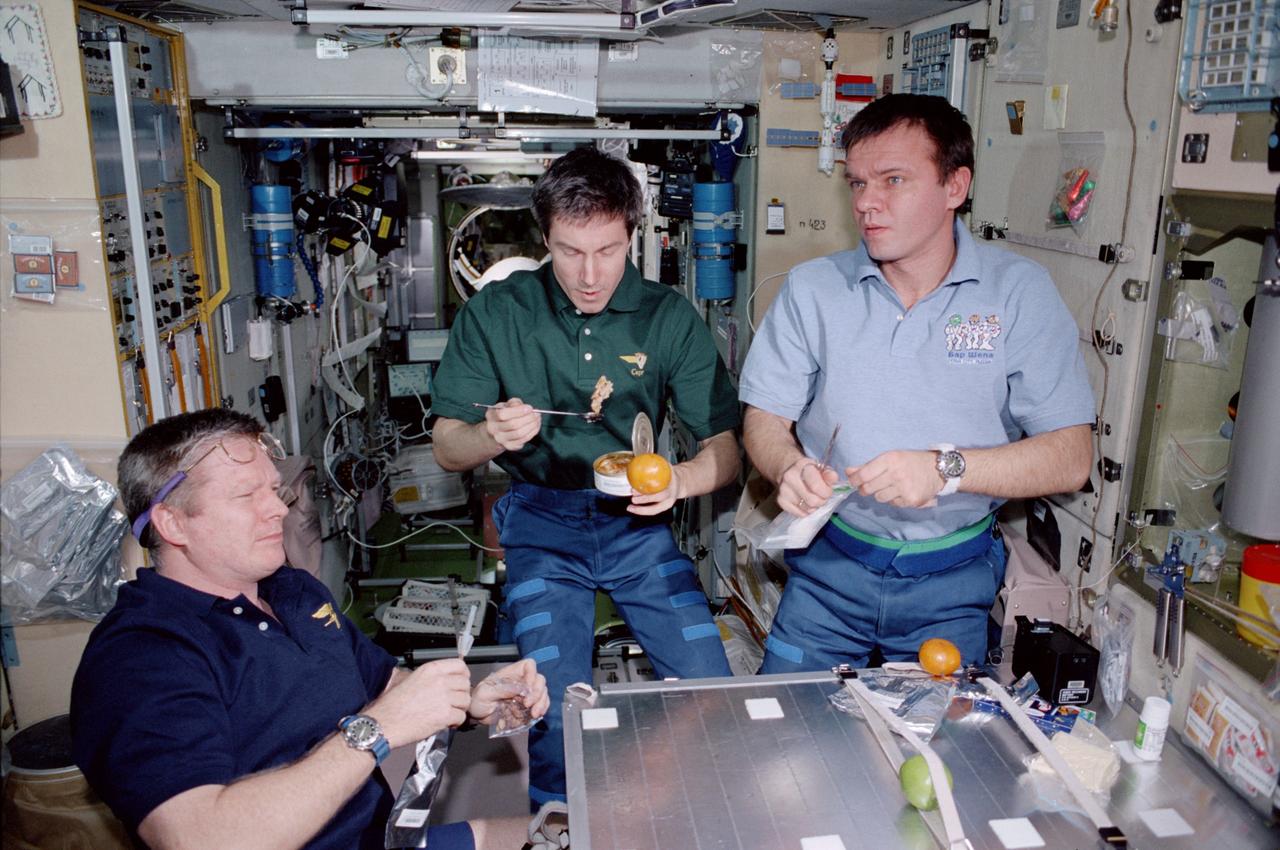
STS098-353-0006 (7-20 February 2001) --- The Expedition One crew enjoys a snack on the ward room table of the Zvezda service module onboard the International Space Station (ISS). The photograph was taken by one of the visiting STS-98 crew members.
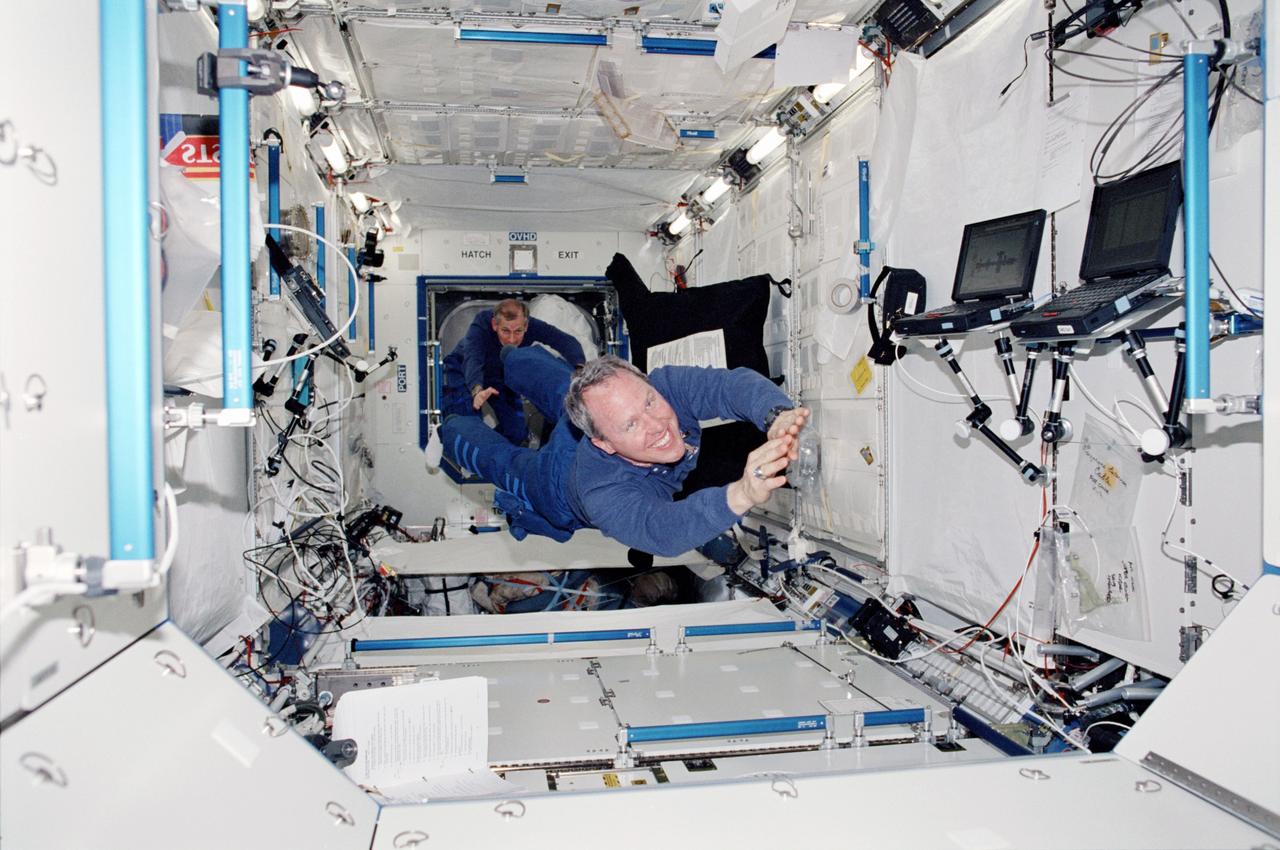
STS098-356-0026 (11 February 2001) --- Astronauts Thomas D. Jones (foreground), mission specialist; and Kenneth D. Cockrell, mission commander, float in the newly installed Destiny laboratory aboard the International Space Station.
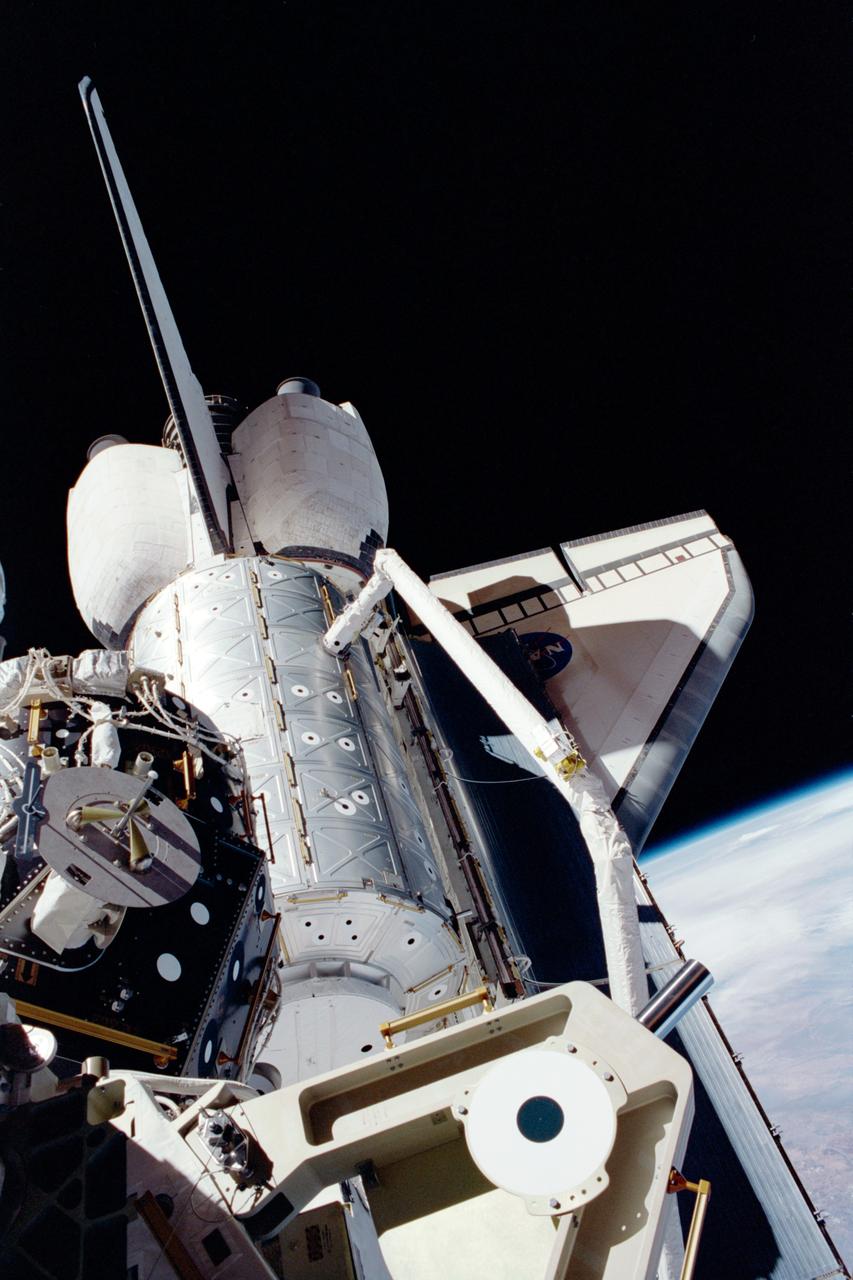
STS098-331-005 (7-20 February 2001) --- In the grasp of the shuttle’s remote manipulator system (RMS) robot arm, the Destiny laboratory is moved from its stowage position in the cargo bay of the Space Shuttle Atlantis. The photo was taken by astronaut Thomas D. Jones, who was participating in one of three STS-98/5a spacewalks at the time. Astronaut Robert L. Curbeam (out of frame) also made the three spacewalks.
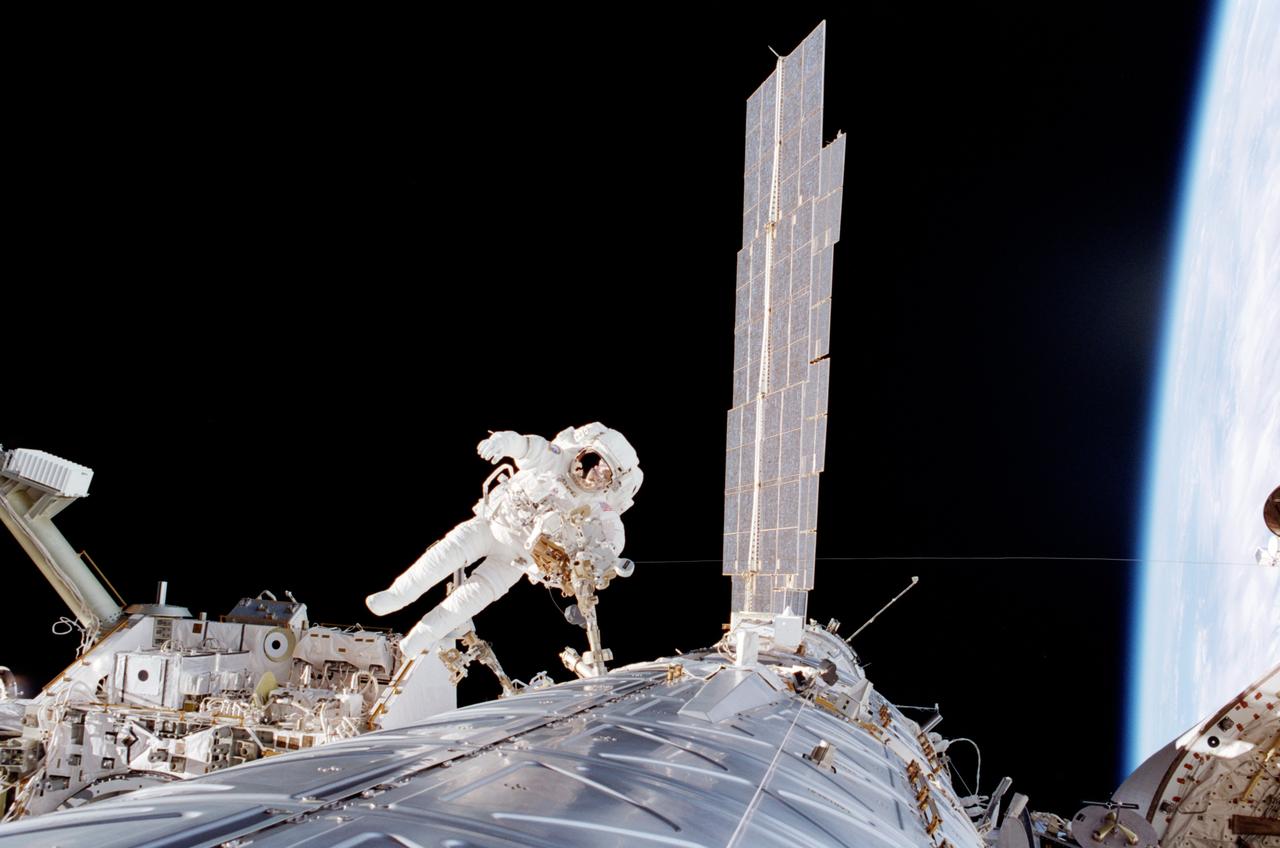
STS098-336-0026 (12 February 2001) --- Astronaut Robert L. Curbeam, mission specialist, participates in the second of three STS-98 sessions of extravehicular activity (EVA). He was joined on all three space walks by astronaut Thomas D. Jones.
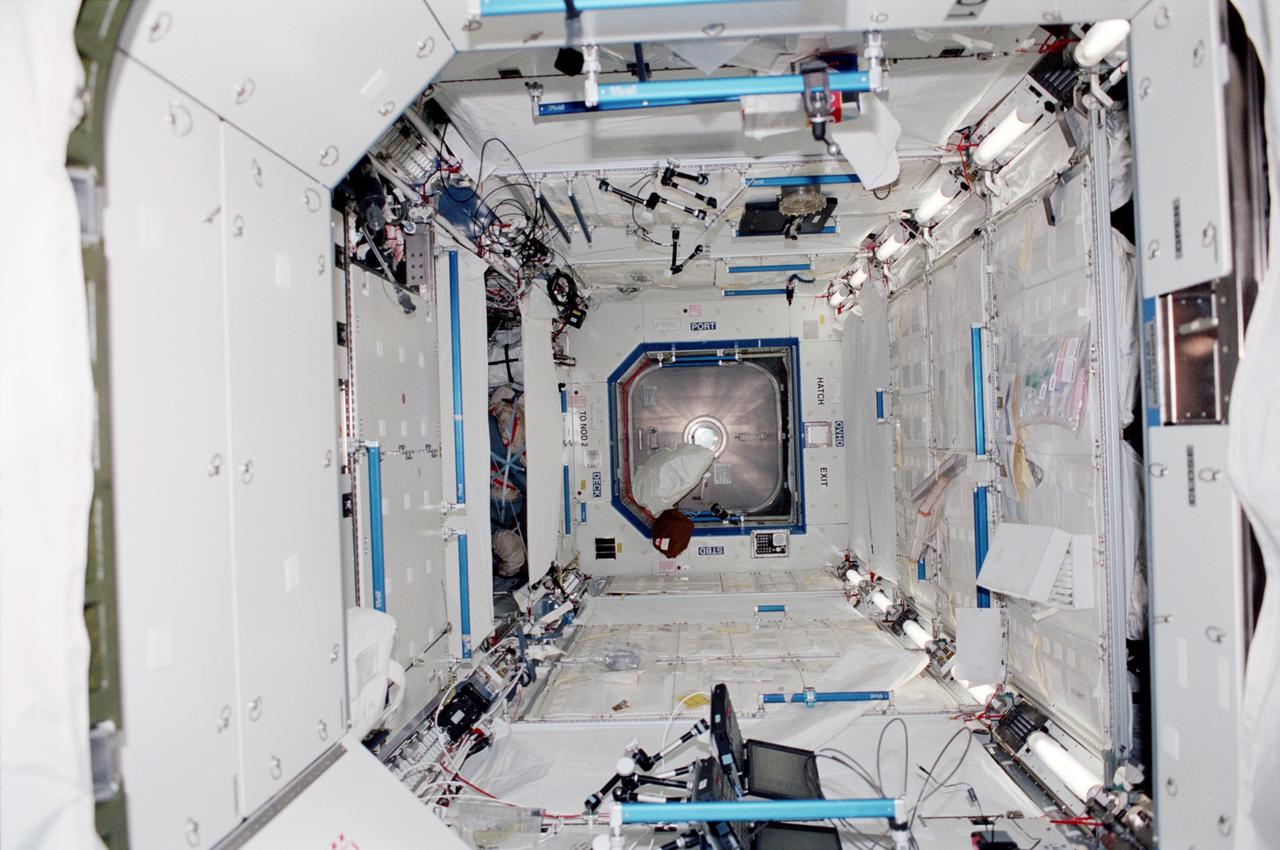
STS098-355-0008 (7-20 February 2001) --- An overall shot of the newly attached Destiny laboratory was recorded with a 35mm camera during the early occupancy by astronauts and cosmonauts from the Expedition One and STS-98 crews.
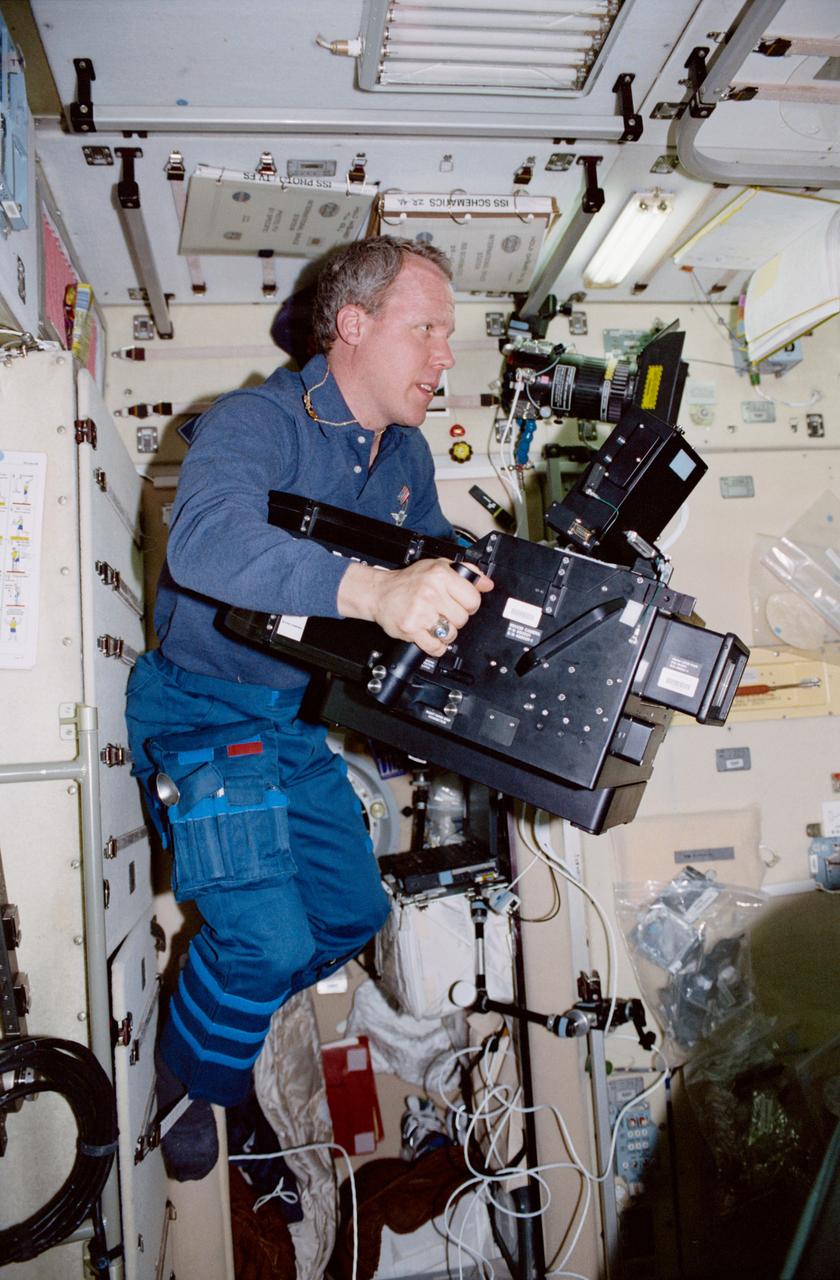
STS098-337-034 (7-20 February 2001) --- Astronaut Thomas D. Jones, mission specialist, is seen with an IMAX camera in the Zvezda service module of the International Space Station (ISS).
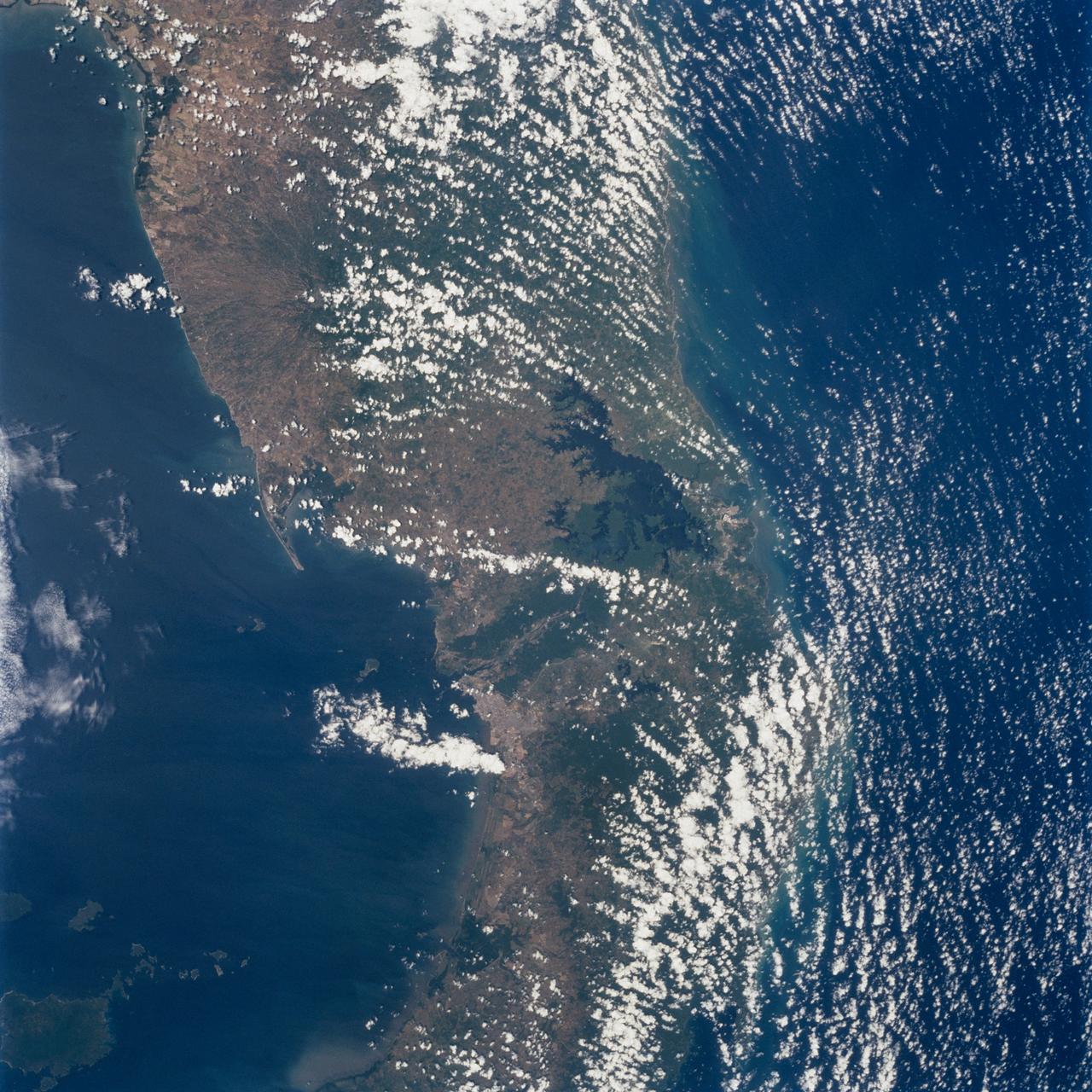
STS098-712-091 (7-20 February 2001) --- The forested area of the Panama Canal Zone can be seen near the center of this north-looking image, photographed with a 70mm handheld camera from the Earth-orbiting Space Shuttle Atlantis. (NOTE: The image should be oriented with Panama running horizontally and the majority of the clouds at the top). The Panama Canal Zone extends 5 miles (8 kilometers) on either side of the Panama Canal. The forested zone acts as a buffer for the canal to help prevent erosion and sediment from clogging the canal. Most of the countryside on both sides of the Canal Zone has been deforested to make way for large ranches and the raising of cattle. Though some sedimentation is occurring, dredging of the canal keeps the passage clear. The Panama Canal is 40 miles (64 kilometers) long including dredged approach channels at each end. With the Caribbean Sea covering the upper portion of the image and the Pacific Ocean covering the lower portion of the image, the canal traverses the Isthmus of Panama in a northwest to southeast direction. Gatun Lake, one of the largest artificial lakes in the world, is visible at the north end of the Canal Zone. Panama City (light-colored grayish area) is discernible to the right of the canal at its southern entrance from the Pacific Ocean. In 1996, 15,000 ships traveled through the canal, an average of 42 ships per day. Passage through the canal requires 7 to 8 hours.
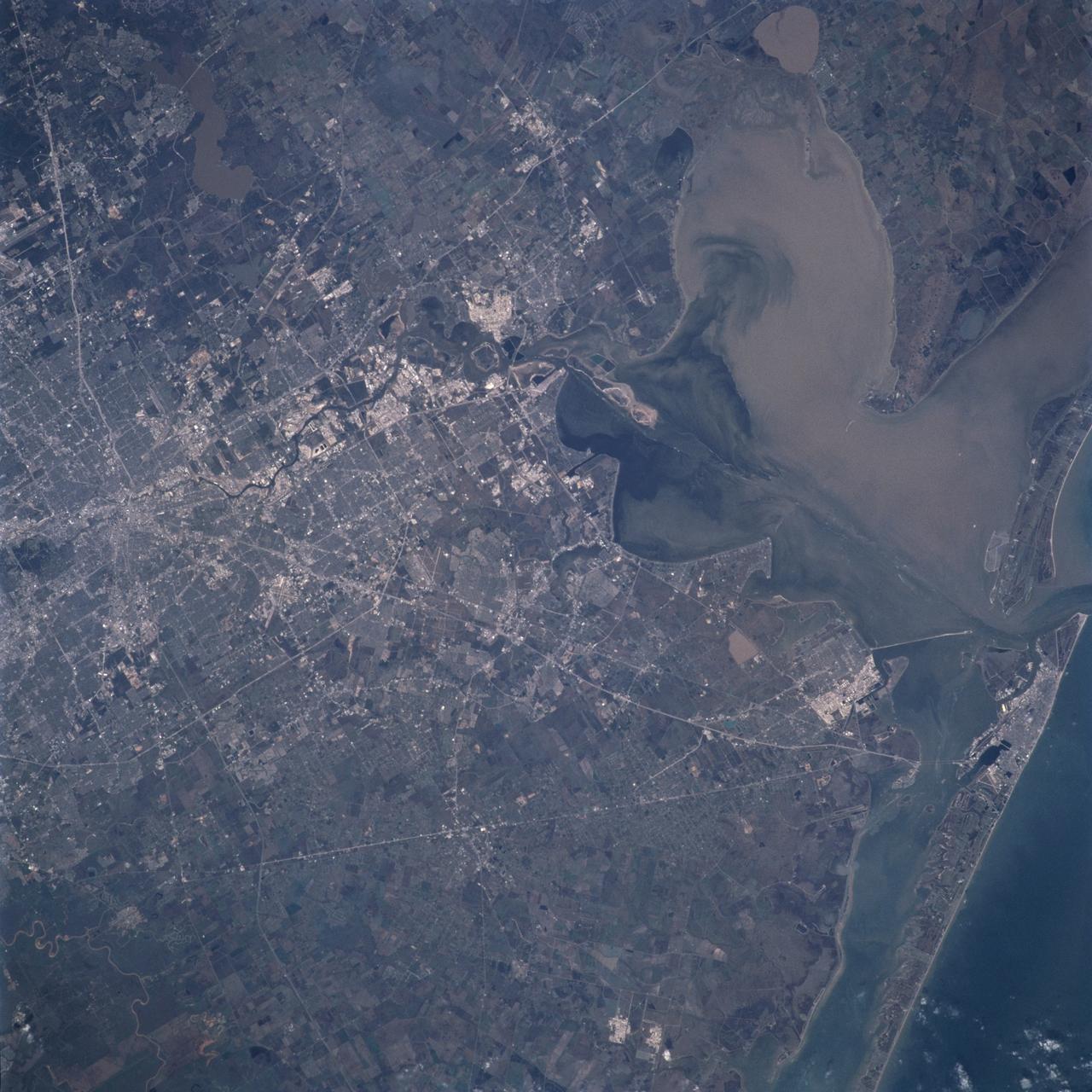
STS098-819-038 (17 February 2001) --- Much of Metropolitan Houston appears in this nearly vertical image photographed with a handheld 70mm camera onboard the Earth-orbiting Space Shuttle Atlantis. Interstate 45 and Highways 146 and 6 can be traced from lower right in Galveston County as they head into different directions toward a wide range of points in the city and its suburbs. NASA's Johnson Space Center can be easily pin-pointed just above the center point in the frame. Other points of interest in the area can be located by tracking over the various U.S., state and interstate highways---10, 51, 610 loop, Beltway 8 and others. Downtown Houston is at left center, but the so-called Uptown area is just out of frame at left. Galveston Bay takes up most of the upper right quadrant. Lake Houston is at upper left. A small piece of the Gulf of Mexico is in lower right.

STS098-714A-020 (7-20 February 2001) ---One of the STS-98 astronauts aboard the Earth-orbiting Space Shuttle Atlantis used a 70mm handheld camera to record this image of Southern California. Snow blanketing the higher elevations in the Los Padres National Forest (center of the image) and that covering the Angeles National Forest (right middle) help to accentuate and separate three major landform regions in southern California. The northern Los Angeles Basin that includes the San Fernando Valley and the Santa Monica Mountains is visible in the lower right quadrant of the image. The western end of the Mojave Desert (upper right) shows the two distinctive mountain boundaries along the southwest and northwest edge of the desert. The San Andreas Fault and the Garlock Fault converge (snow covered in this scene) at the western end of the desert. The intensively irrigated and cultivated southern end of the San Joaquin Valley that includes Bakersfield is visible (upper left) north of the snow-covered, northeast-southwest trending Tehachapi Mountains. The island off of the California coast (bottom left) is Santa Cruz Island.
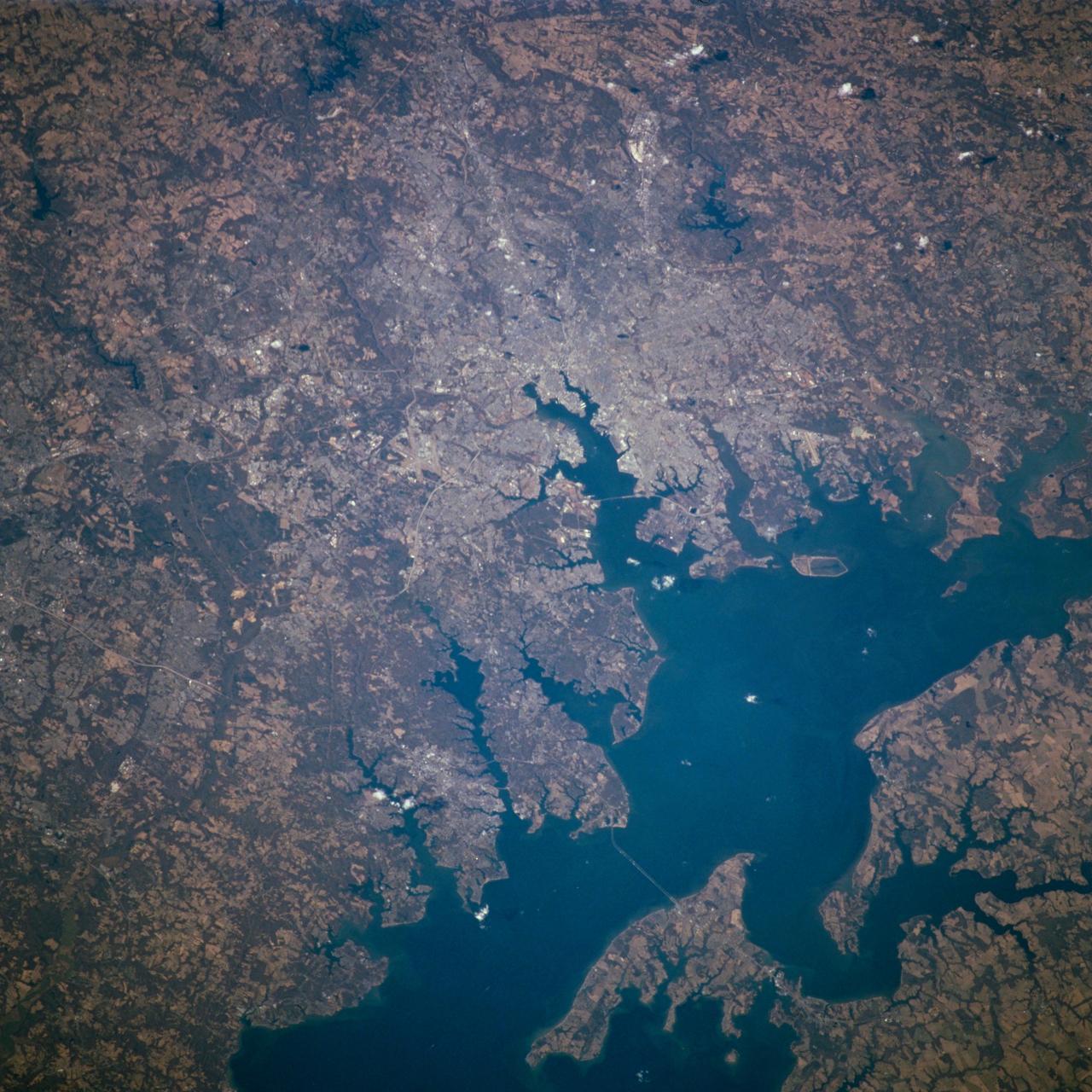
STS098-716-057 (7-20 February 2001) --- Baltimore, Maryland can be identified in this northwest-looking view, photographed with a 70mm handheld camera from the Space Shuttle Atlantis, which shows the western shore of Chesapeake Bay. Numerous drowned river valleys provide excellent natural harbors along the periphery of the bay. Baltimore’s harbor has been developed along one of these drowned valleys, the Patapsco River. With a population of over 2.5 million people, the greater Baltimore urban area is part of the northeastern U.S. Megalopolis that extends from the Boston (MA) area to Richmond (VA). Specific features that can be seen in the image include a short segment of Interstate Highway 95 that connects southwest Baltimore with northeast Washington, D.C.; the intersecting runways of Baltimore-Washington International Airport south of downtown Baltimore; Francis Scott Key Bridge that skirts around the southeast side of Baltimore; the Chesapeake Bay Bridge that spans the bay and connects the Baltimore area with the eastern shore of Maryland; and the central business district of Baltimore where the two arms of the inner harbor terminate. The darker-looking vegetation cover is mixed hardwood forests (notice that many wooded areas are located along streambeds and floodplains of small river valleys), while lighter-looking land parcels in the rural countryside is used for crops or pasturelands.
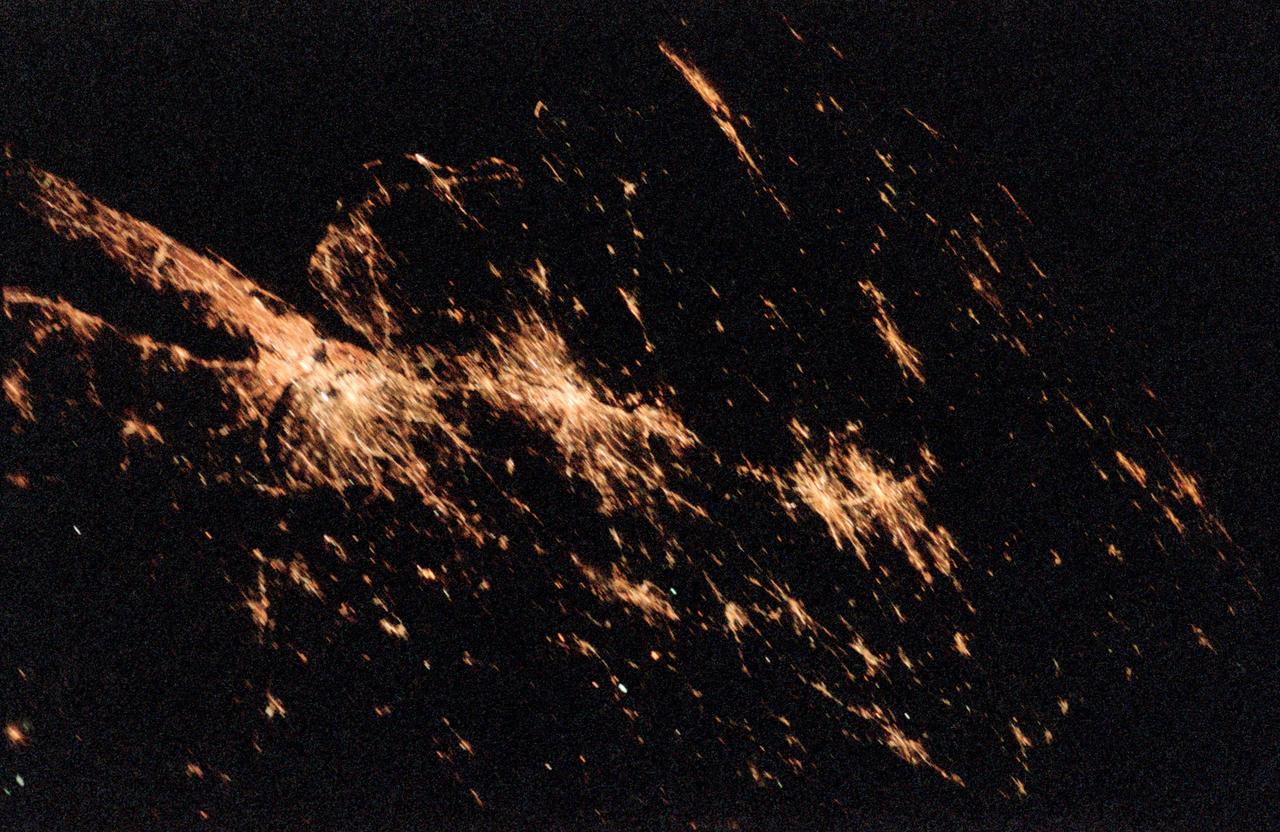
STS098-382-0014 (7-20 February 2001) City Lights of the Northeastern Seaboard of the U.S. were captured with a 35mm camera by one of the STS-98 astronauts aboard the Space Shuttle Atlantis. The nighttime scene shows the bright lights of several major cities that span a distance from Connecticut (left middle) to states south of Virginia (right middle). Lights from both very large urban areas as well as smaller towns and cities are visible. The largest cluster of brightness emanates from the greater New York metropolitan area (left center) and then a series of bright spots progress southwesterly to include Philadelphia (PA), Baltimore (MD), Washington (D.C.), Richmond (VA), and finally ending with the Newport News/ Norfolk (VA) lights (top center). Many of the major ground transportation arteries can be seen as radial, linear features that radiate outward from the central business districts of the cities. Even the lights of smaller cities such as Allentown, Reading, Lancaster, York, and Harrisburg (PA) are visible (bottom center).
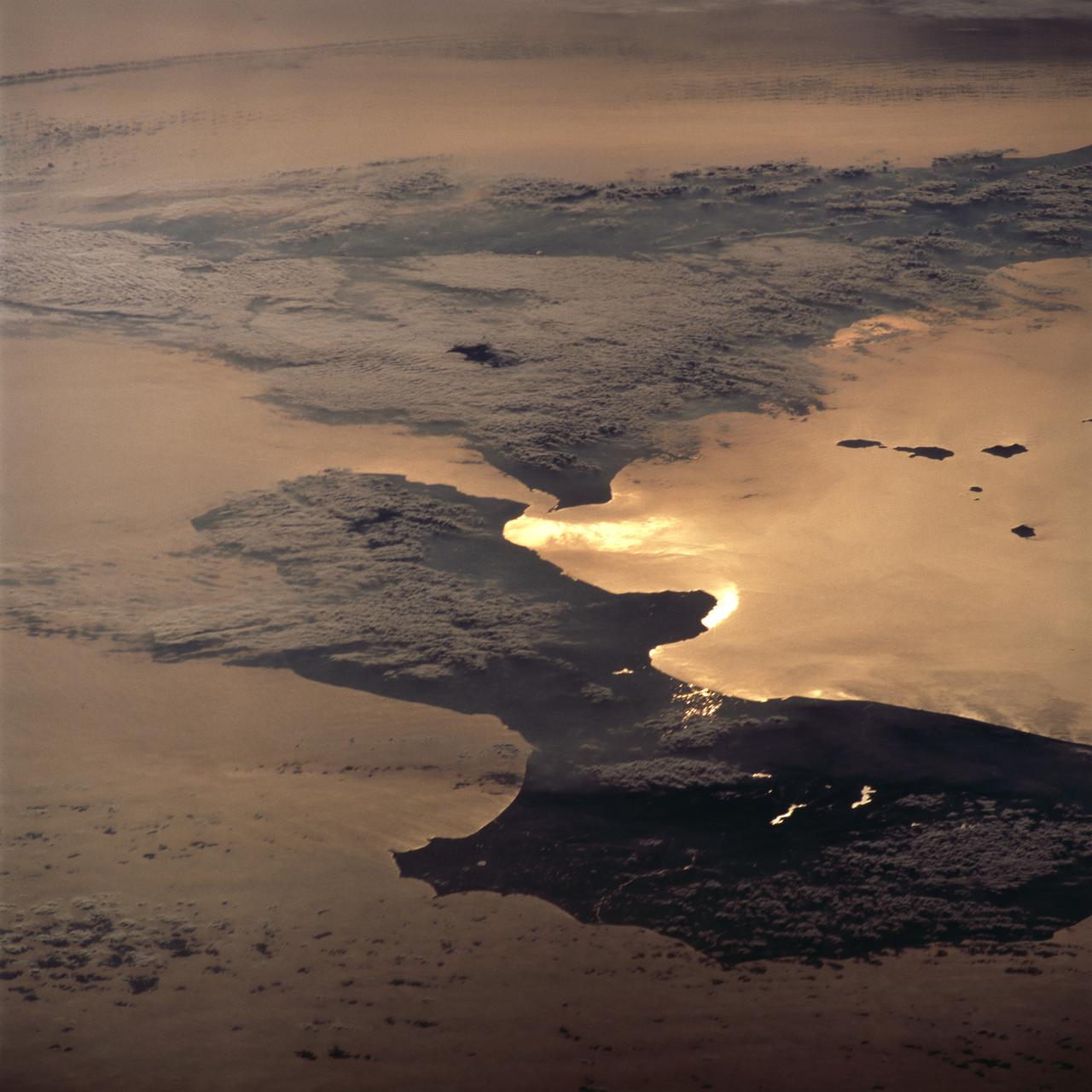
STS098-713-011 (15 February 2001) --- An oblique, westerly-looking view over the Strait of Messini (center), which runs between Italy's "foot" part of the so-called "boot" (bottom) and the heavily cloud-covered Sicily (top). The image was recorded with a handheld 70mm camera by one of the STS-98 crew members aboard the Earth-orbiting Space Shuttle Atlantis. Parts of the Tyrrhenian Sea (right center), Ionian Sea (lower right) and the Mediterranean Sea (left) are covered in the picture.
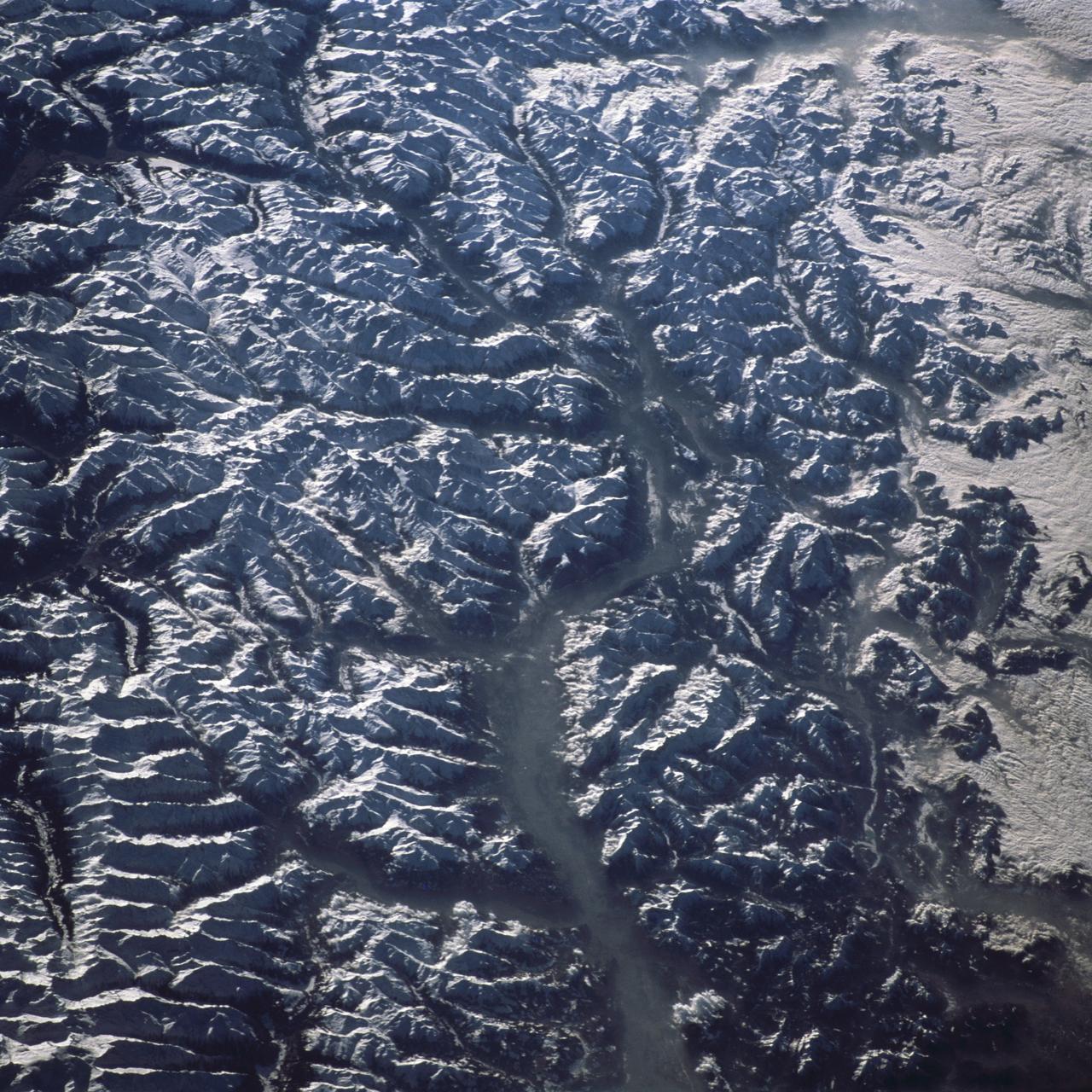
STS098-716-034 (18 February 2001) --- This east-to-west orbital view of the Inn River Valley of southern Austria was photographed by one the crew members of Atlantis during Space Shuttle Mission STS-98 on February 18, 2001, as the spacecraft orbited Earth at an altitude of 173 nautical miles (320 kilometers). Despite the heavy ground fog in the lower valleys, this 70mm handheld camera's photo provides a strikingly detailed view of the Italian, Swiss and Austrian Alps of central Europe. For example, the famous Brenner Pass, an historic gateway connecting Italy to the rest of Europe, can be seen in the left central foreground. The Austrian city of Innsbruck on the Inn River, scene of the 1964 and 1976 Winter Olympics, and normally visible in great detail, is completely masked by heavy ground fog. Center coordinates of the pictured area are located at 47.5 degrees north latitude and 12.5 degrees east longitude.

STS098-714A-049 (16 February 2001) --- Demonstrating the power of water erosion, this orbital view photographed by the crew of Atlantis during STS-98 on February 16, 2001, as the spacecraft orbited the earth at an altitude of 173 nautical miles (320 kilometers), shows Lake Powell at the headwaters of the Colorado River in southwestern Utah. The river over eons has carved out Arizona's mile deep and 270 mile long Grand Canyon. Prominent in this scene is the Kaibab Plateau at the head of the canyon where the big bend of the Colorado River has eroded the plateau into a peninsula. This plateau, directly across the canyon from the South Rim Visitor's Center, is at the widest part of the canyon, about 12 miles. The Kaibab Indian Reservation and the Kaibab National Forest are visible in the picture.
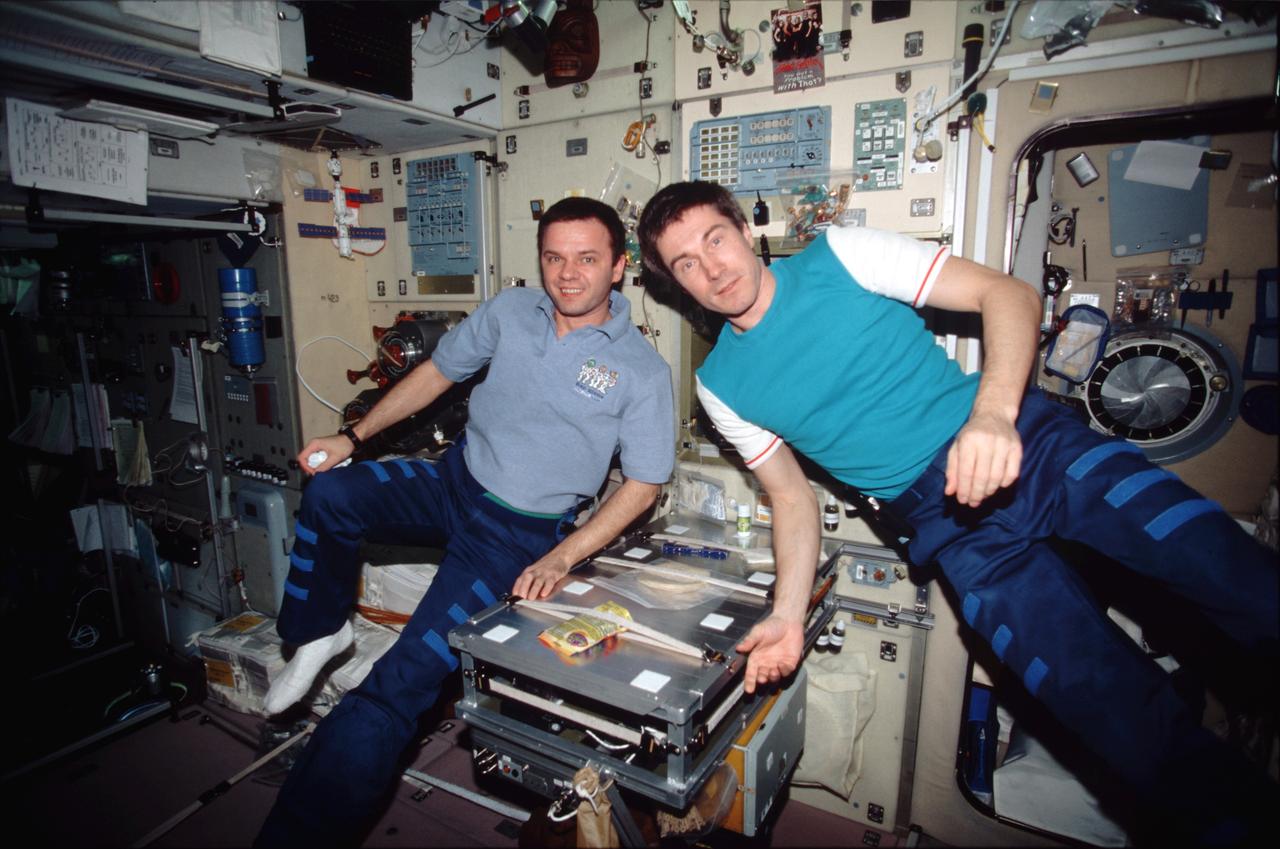
STS098-314-0017 (7-20 February 2001) --- Cosmonauts Yuri P. Gidzenko (left), Expedition One Soyuz commander; and Sergei K. Krikalev, flight engineer, are pictured in the Zvezda service module while hosting the STS-98 crew on the International Space Station (ISS). The two, who represent the Russian Aviation and Space Agency, along with astronaut William M. (Bill) Shepherd (out of frame), mission commander, have been on the outpost since early November 2000.
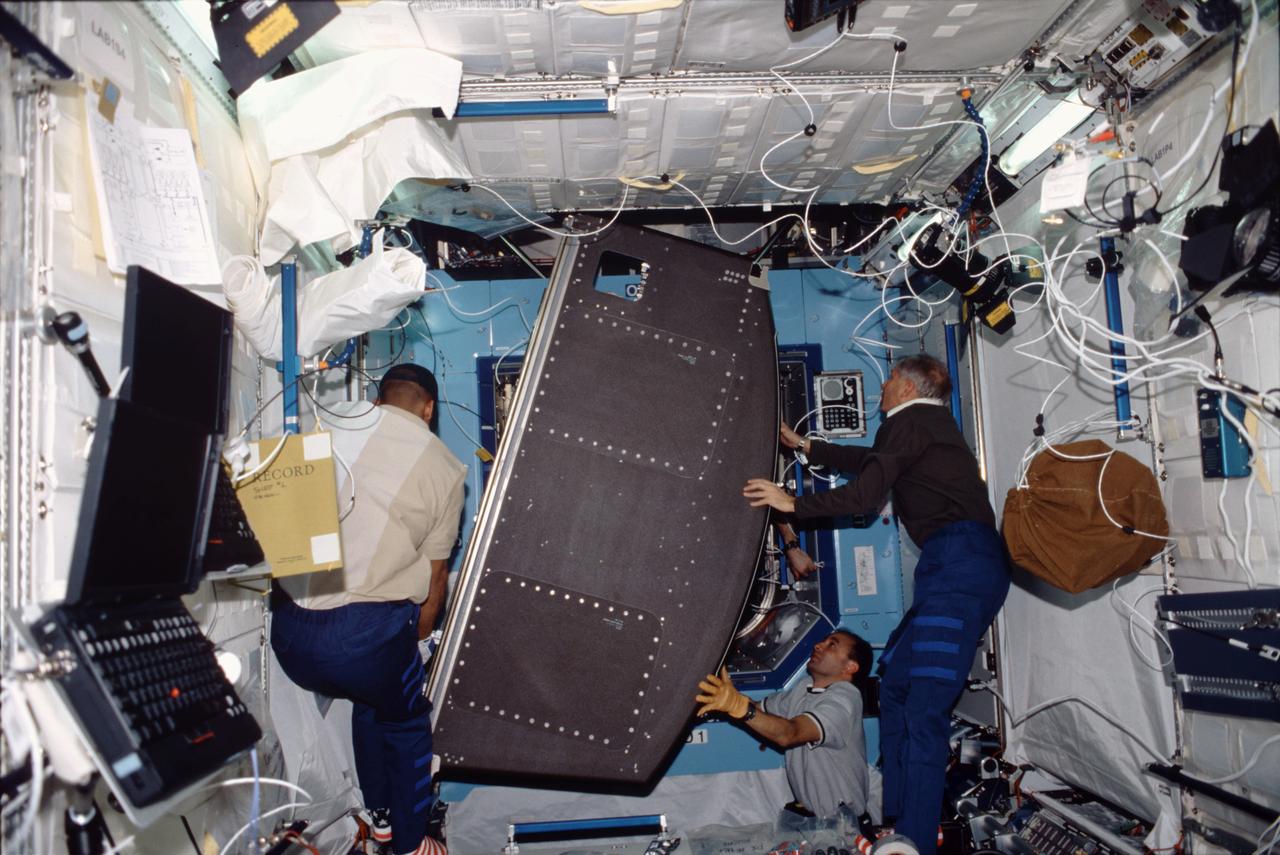
STS098-322-0001 (7-20 February 2001) --- Three STS-98 astronauts move a rack into position aboard the newly attached Destiny laboratory. From the left to right are astronauts Robert L. Curbeam, mission specialist; Mark L. Polansky, pilot; and Kenneth D. Cockrell, mission commander.
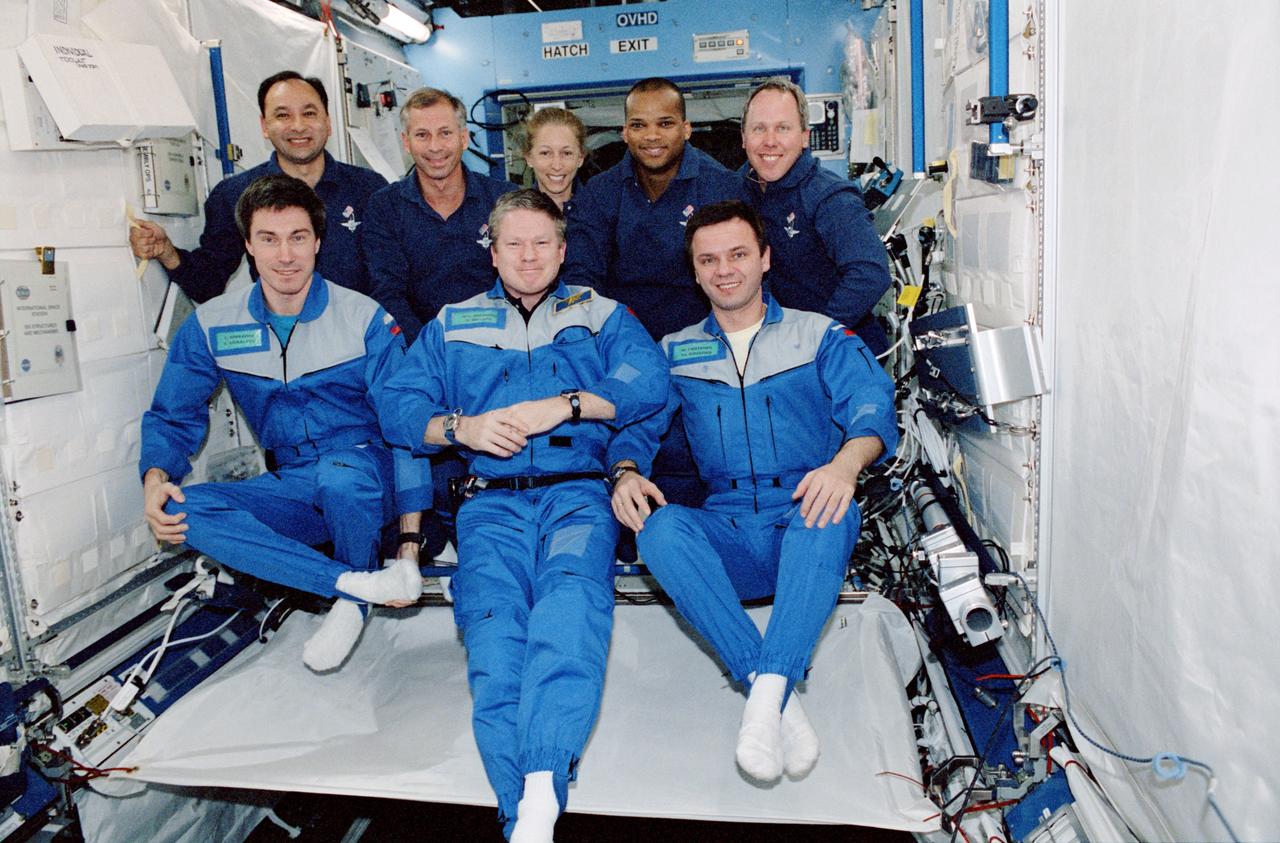
STS098-371-0019 (7-20 February 2001) --- The crews of the Space Shuttle Atlantis and International Space Station (ISS) interrupt work aboard the newly installed Destiny laboratory to pose for an in-flight joint group portrait. In front are (from the left) cosmonaut Sergei K. Krikalev, Expedition One flight engineer; astronaut William M. (Bill) Shepherd, Expedition One mission commander; and Yuri P. Gidzenko, Soyuz commander. The shuttle crew is made up of (from the left) astronauts Mark L. Polansky, pilot; Kenneth D. Cockrell, mission commander; and Marsha S. Ivins, Robert L. Curbeam and Thomas D. Jones, all mission specialists. Krikalev and Gidzenko represent the Russian Aviation and Space Agency.
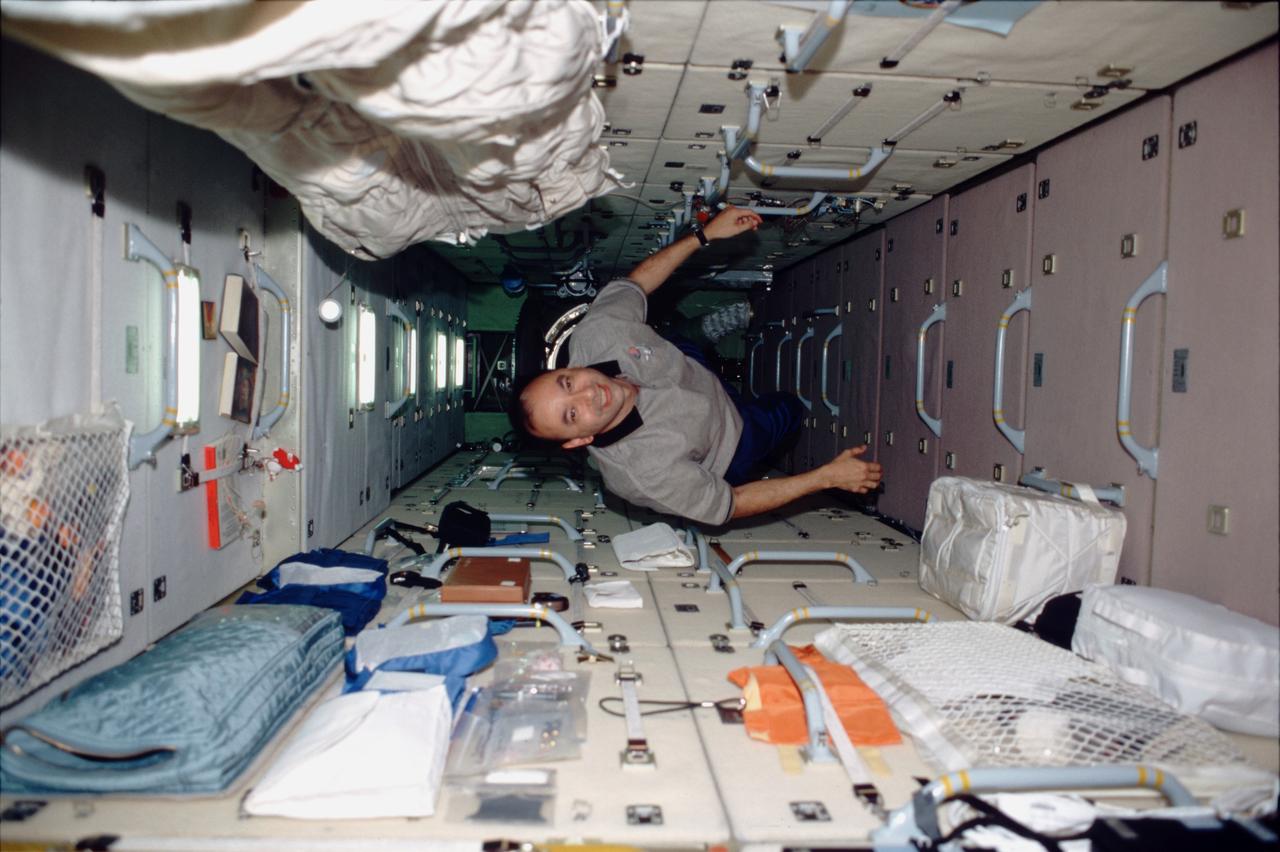
STS098-320-008 (7-20 February 2001) --- Astronaut Mark L. Polansky, STS-98 pilot, translates through the Zarya functional cargo block (FGB) while visiting and working aboard the International Space Station (ISS).
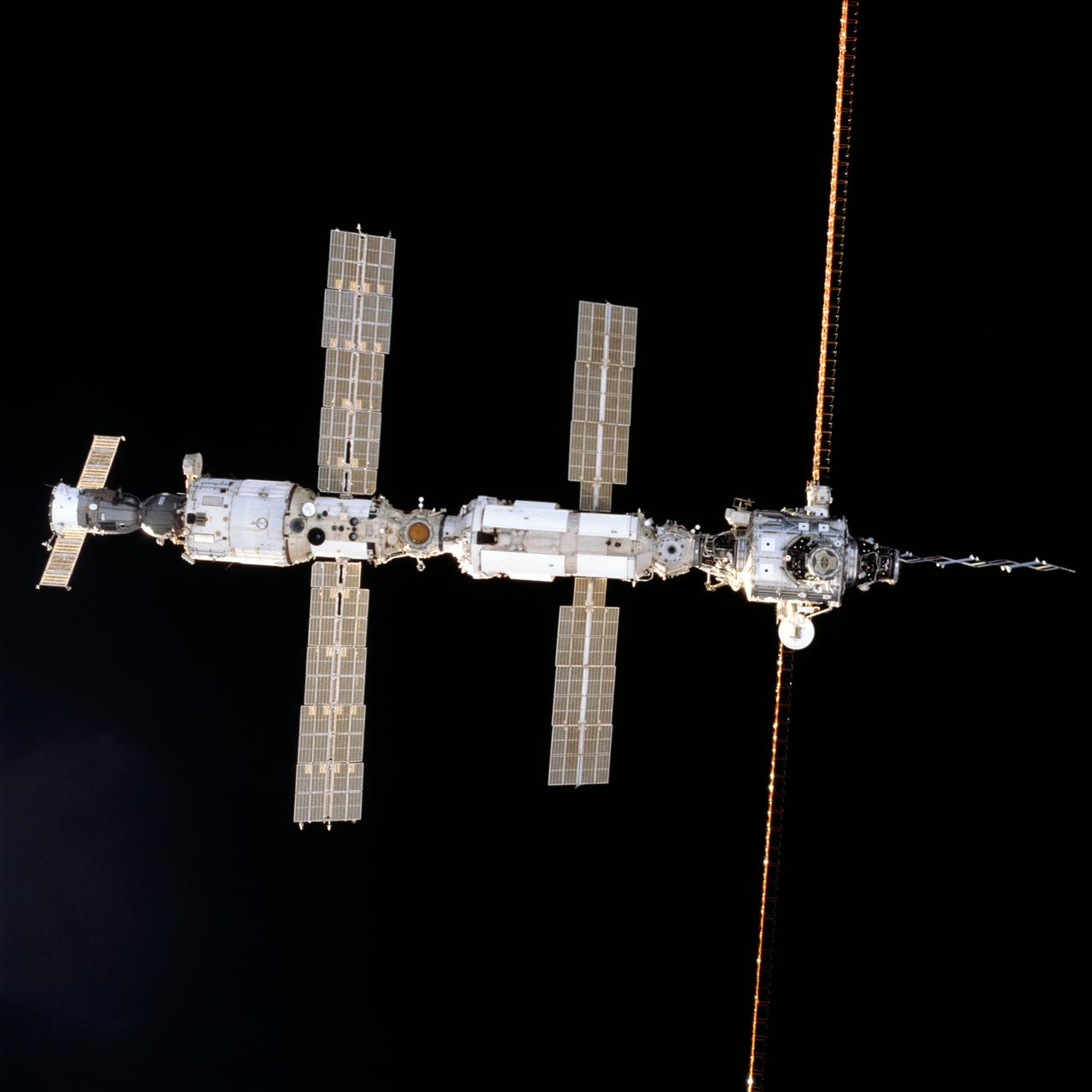
STS098-707-019 (9 February 2001) --- This close view of the International Space Station (ISS), backdropped against the blackness of space, was photographed by one of the astronauts onboard the Space Shuttle Atlantis as it approached the station for docking on Feb. 9, at 10:51 a.m. (CST).
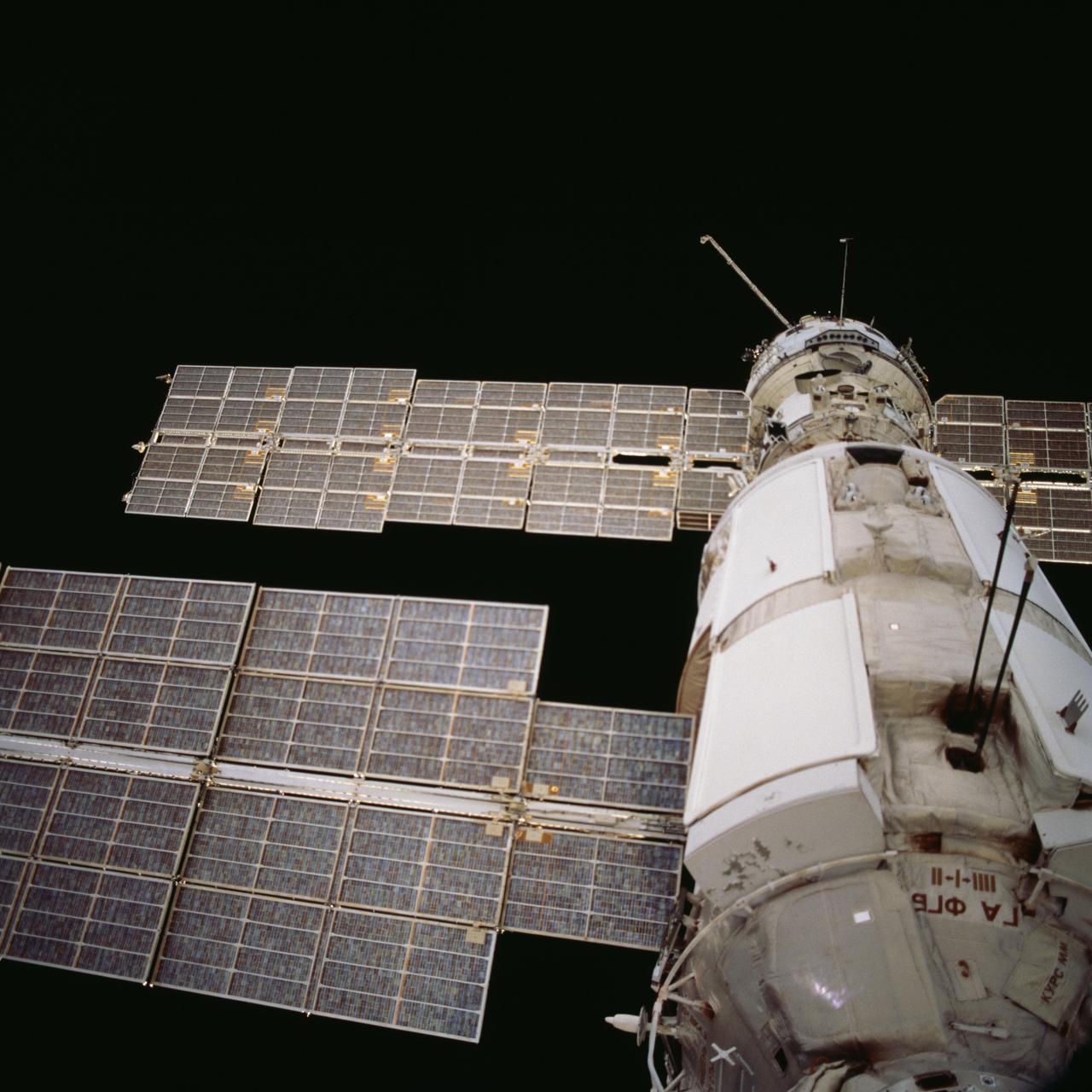
STS098-707-062 (9 February 2001) --- This close-up view of the Zvezda Service Module on the International Space Station (ISS), backdropped against the blackness of space, was photographed by one of the astronauts onboard the Space Shuttle Atlantis at it approached the station for docking on Feb. 9, at 10:51 a.m. (CST).
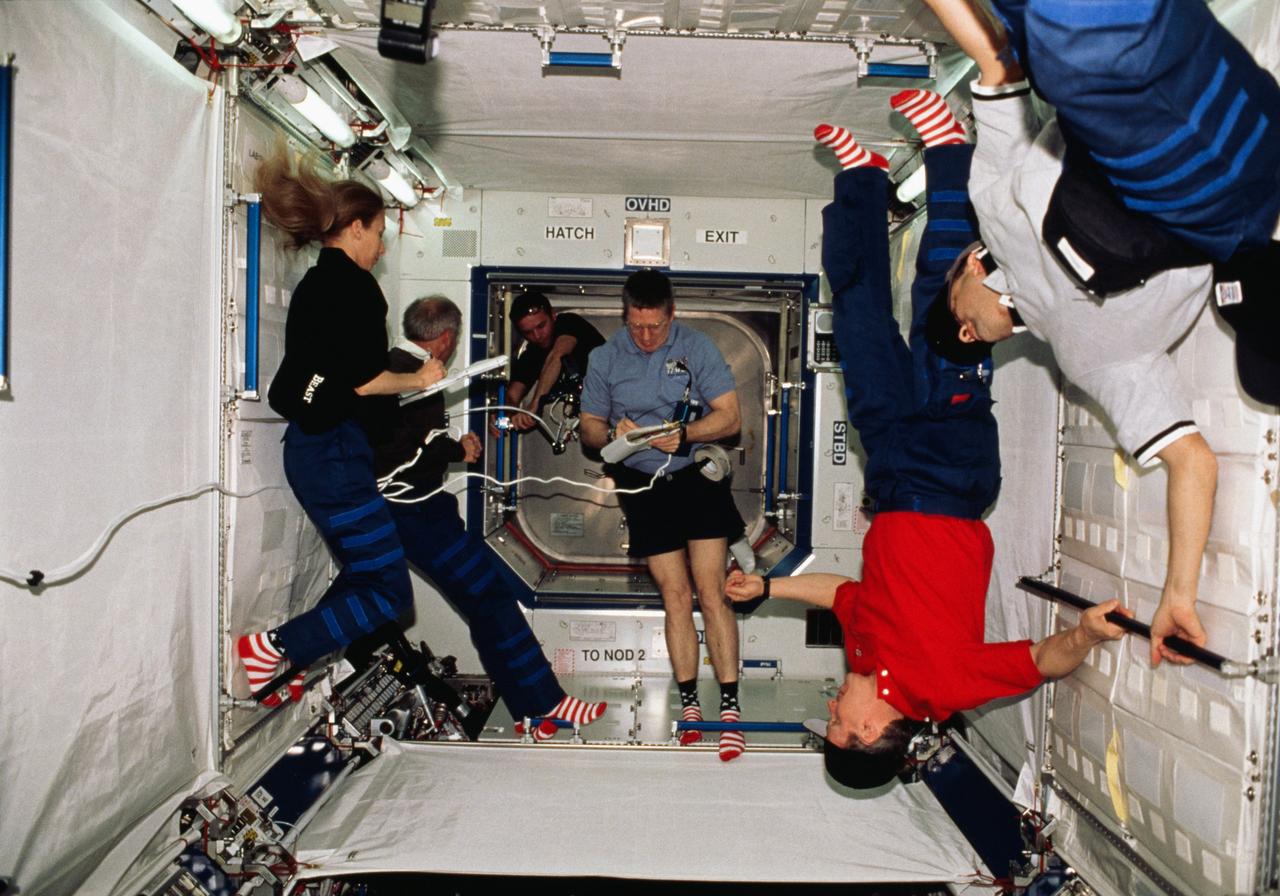
STS098-323-015 (7-20 February 2001) --- Astronauts and cosmonauts from the Expedition One and STS-98 crews are photographed in the newly-attached Destiny laboratory on the International Space Station (ISS). From the left are Marsha S. Ivins, mission specialist; Kenneth D. Cockrell, mission commander; Yuri P. Gidzenko, Expedition One Soyuz commander; William M. (Bill) Shepherd, Expedition One mission commander; Thomas D. Jones, mission specialist; and Mark L. Polansky, pilot. Out of view are Robert L. Curbeam, mission specialist, and Sergei K. Krikalev, Expedition One flight engineer. Gidzenko and Krikalev represent Rosaviakosmos.
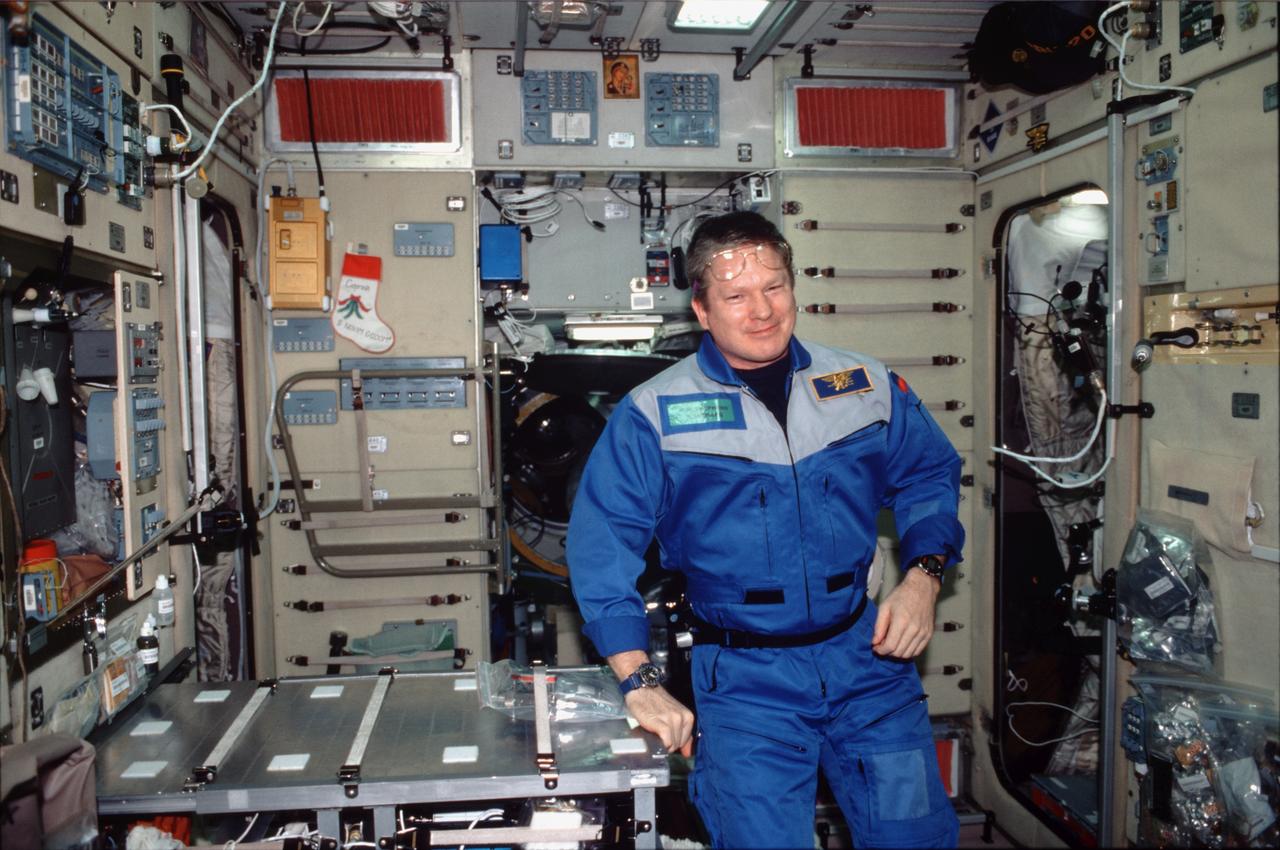
STS098-320-0017 (7-20 February 2001) --- Astronaut William M. (Bill) Shepherd, Expedition One commander, poses for a a photo at the ward room table while hosting members of the STS-98 crew (out of frame) onboard the International Space Station (ISS). Shepherd and two cosmonauts, onboard the outpost since early November 2000, will return to Earth with their third set of visitors (the STS-102 crew) in March of this year.
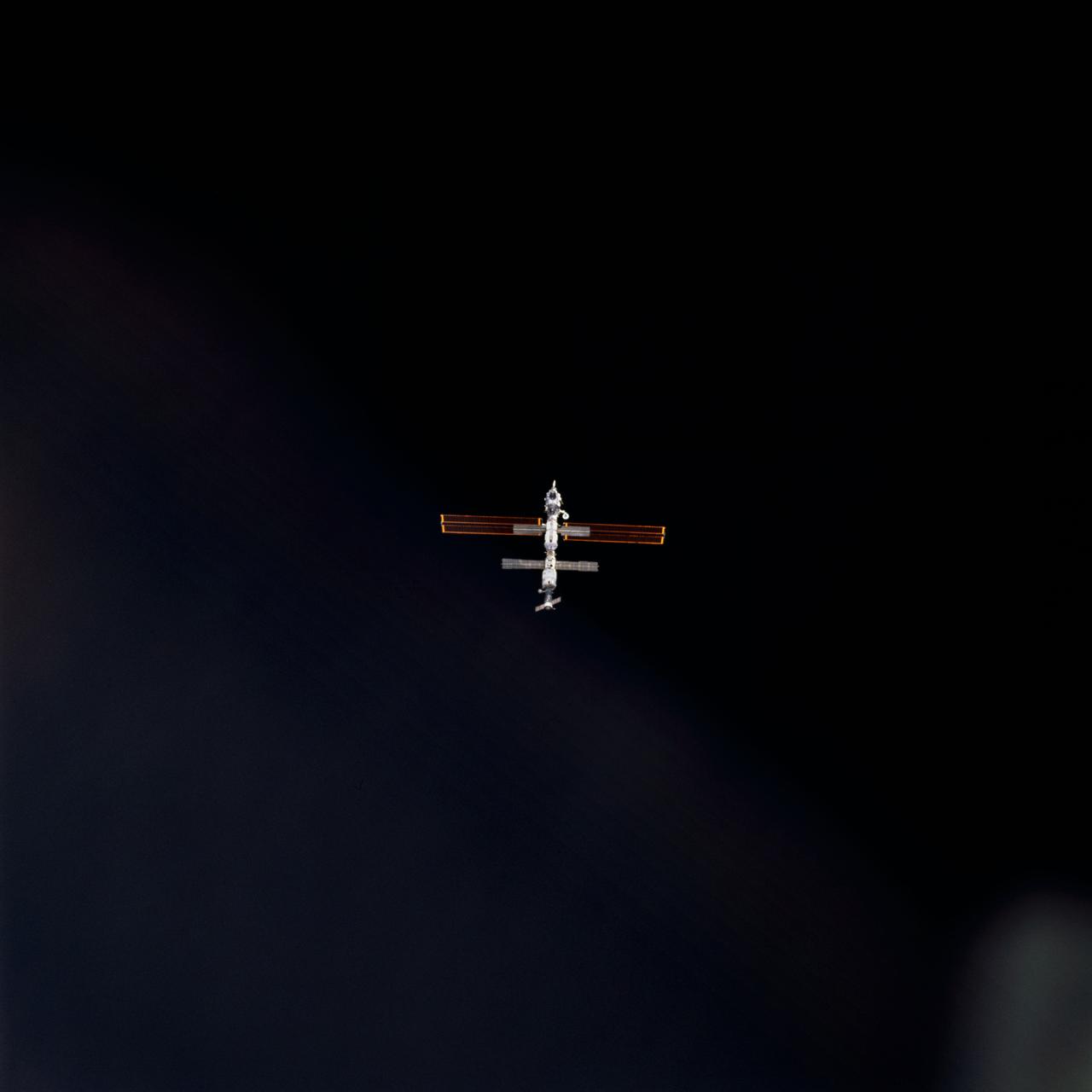
STS098-707-008 (9 February 2001) --- This picture of the distant International Space Station (ISS), backdropped against the blackness of space, was photographed by one of the astronauts onboard the Space Shuttle Atlantis at it approached the station for docking on Feb. 9, at 10:51 a.m. (CST).
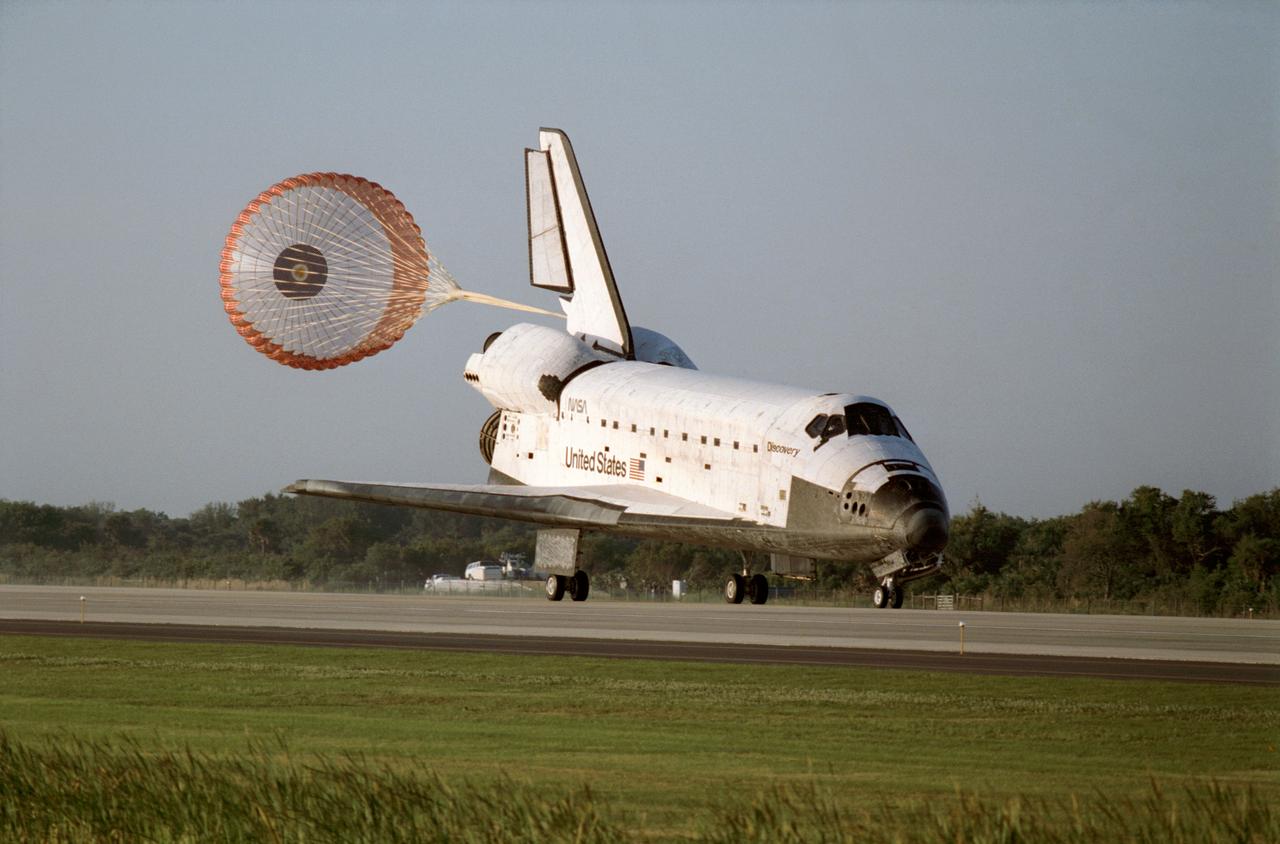
STS056-S-098 (17 April 1993) --- The drag chute is deployed following landing of the Space Shuttle Discovery on the Shuttle landing facility at the Kennedy Space Center to complete the STS-56\Atlas 2 mission. Touchdown occurred at 7:37 a.m. (EDT). Onboard the spacecraft were astronauts Kenneth D. Cameron, commander; Stephen S. Oswald, pilot; and C. Michael Foale, Ellen Ochoa and Kenneth D. Cockrell, mission specialists.
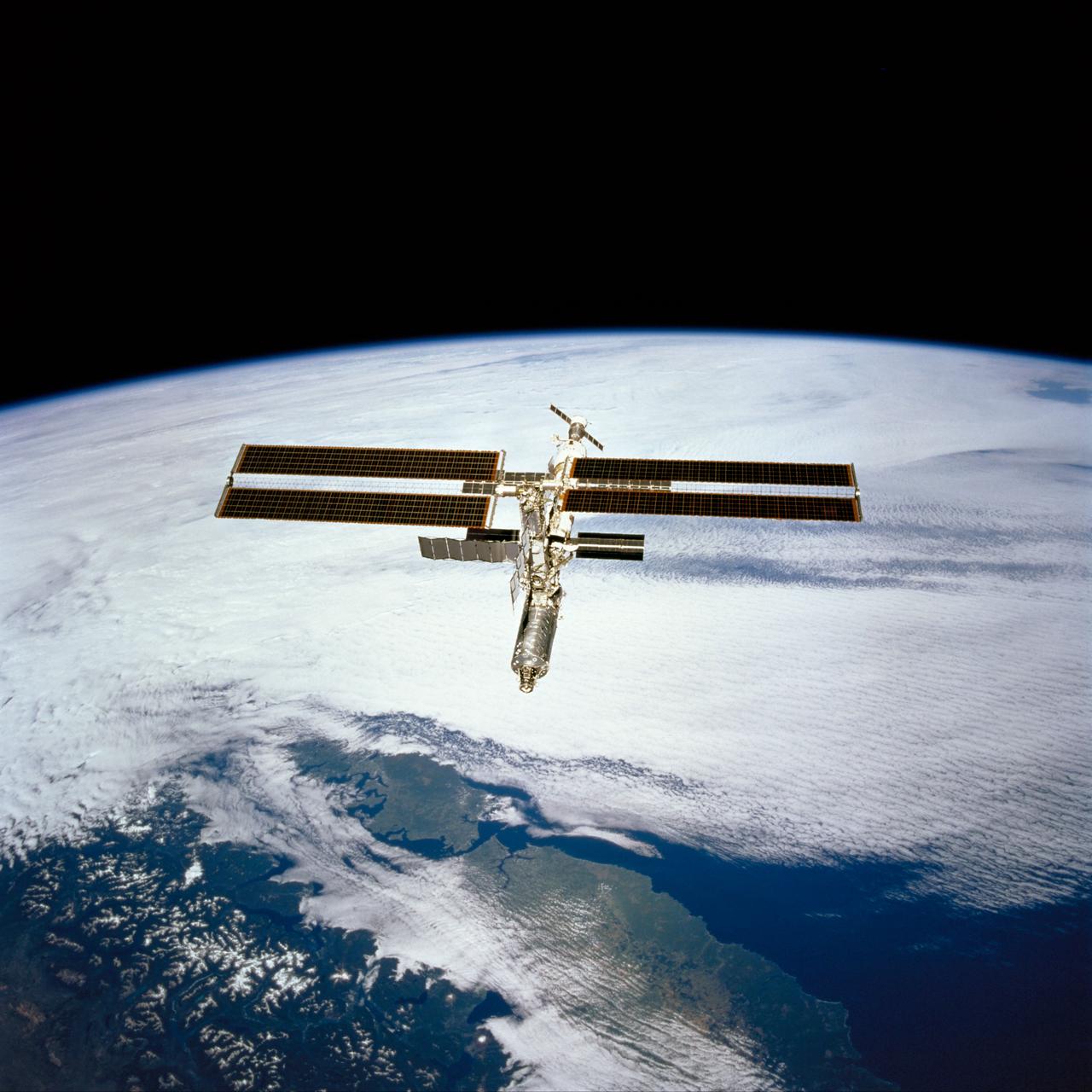
STS098-713a-016 (16 February 2001) --- The International Space Station is backdropped over clouds, water and land in South America. South central Chile shows up at bottom of the frame. Just below the Destiny laboratory, the Chacao Channel separates the large island of Chiloe from the mainland and connects the Gulf of Coronados on the Pacific side with the Gulf of Ancud southwest of the city of Puerto Montt. The crews of the Space Shuttle Atlantis and the International Space Station parted company at 8:06 a.m. (CST), February 16, as astronaut Mark L. Polansky, pilot, flew the shuttle halfway around the station and its new Destiny laboratory before moving off.
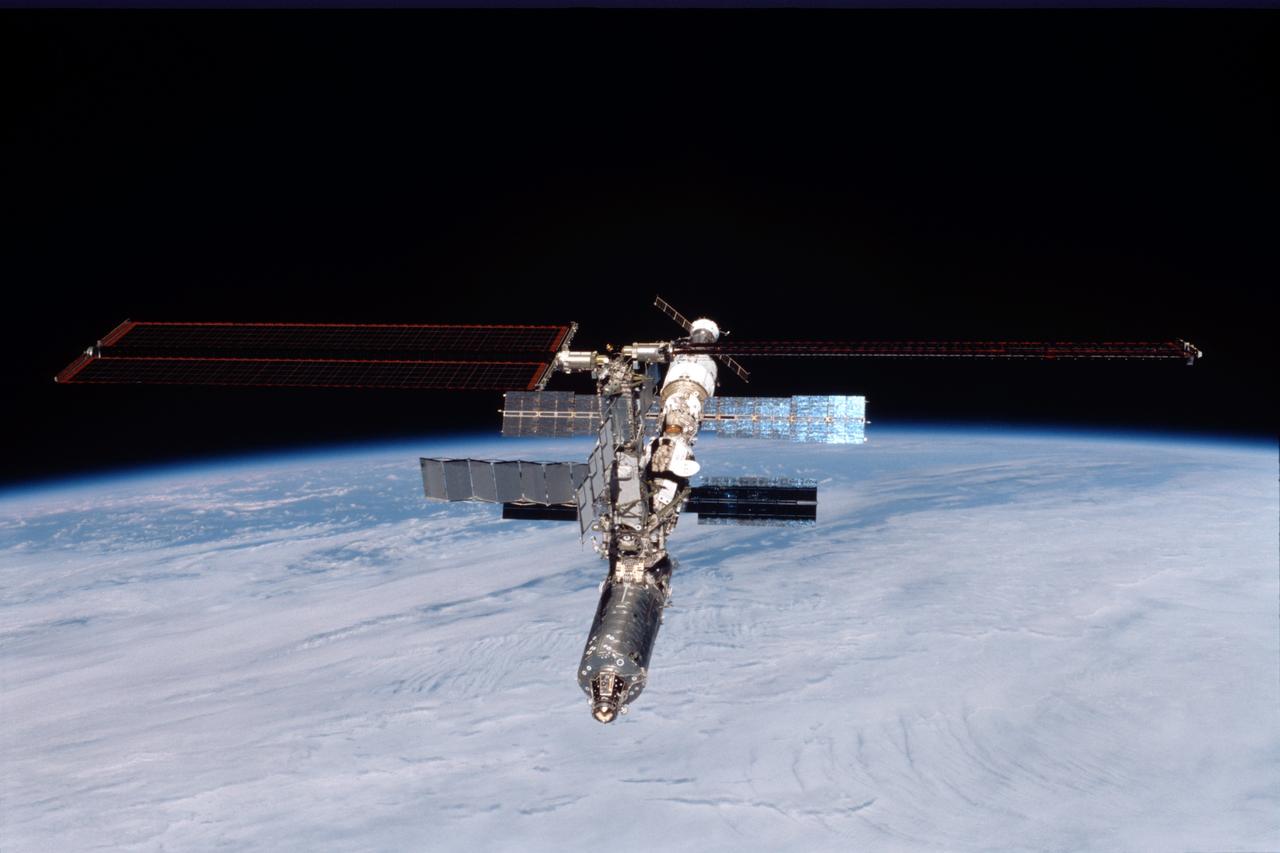
STS098-312-0025 (16 February 2001) --- Backdropped against heavy cloud cover, the International Space Station (ISS) was photographed with a 35mm camera by one of the astronauts onboard Atlantis. The crew of the station, onboard the outpost since early November 2000, is made up of astronaut William M. (Bill) Shepherd, mission commander; Yuri P. Gidzenko, Soyuz commander; and Sergei K. Krikalev, flight engineer. Krikalev and Gidzenko represent the Russian Aviation and Space Agency. On Atlantis were astronauts Kenneth D. Cockrell, mission commander; Mark L. Polansky, pilot; and Marsha S. Ivins, Robert L. Curbeam and Thomas D. Jones, all mission specialists. The shuttle and the station parted company at 8:06 a.m. (CST), Feb. 16, as Polansky flew the shuttle halfway around the outpost and its new Destiny laboratory before moving off.
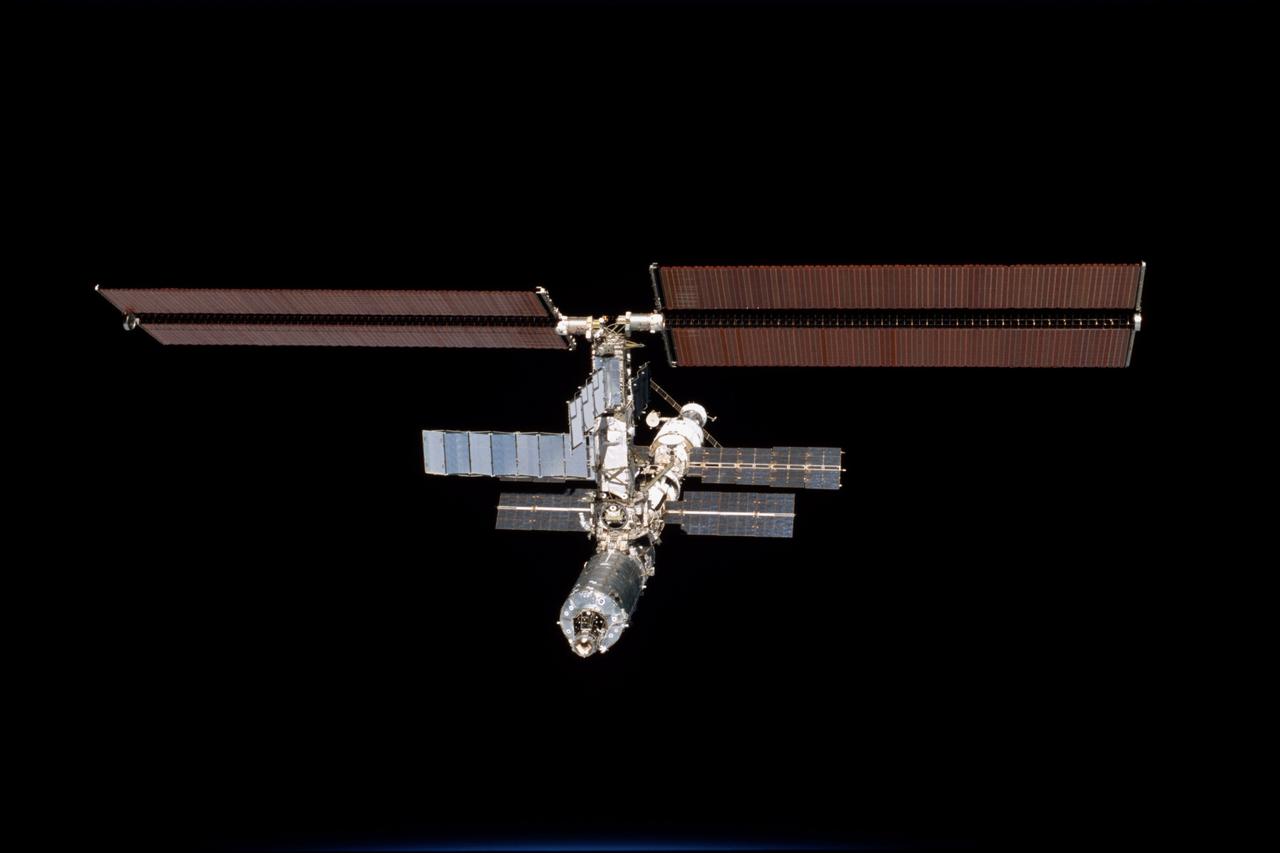
STS098-312-0020 (16 February 2001) --- Backdropped against the blackness of space, the International Space Station (ISS)was photographed with a 35mm camera by one of the astronauts onboard Atlantis. The crew of the station, onboard the outpost since early November 2000, is made up of astronaut William M. (Bill) Shepherd, mission commander; Yuri P. Gidzenko, Soyuz commander; and Sergei K. Krikalev, flight engineer. Krikalev and Gidzenko represent the Russian Aviation and Space Agency. On Atlantis were astronauts Kenneth D. Cockrell, mission commander; Mark L. Polansky, pilot; and Marsha S. Ivins, Robert L. Curbeam and Thomas D. Jones, all mission specialists. The shuttle and the station parted company at 8:06 a.m. (CST), Feb. 16, as Polansky flew the shuttle halfway around the outpost and its new Destiny laboratory before moving off.
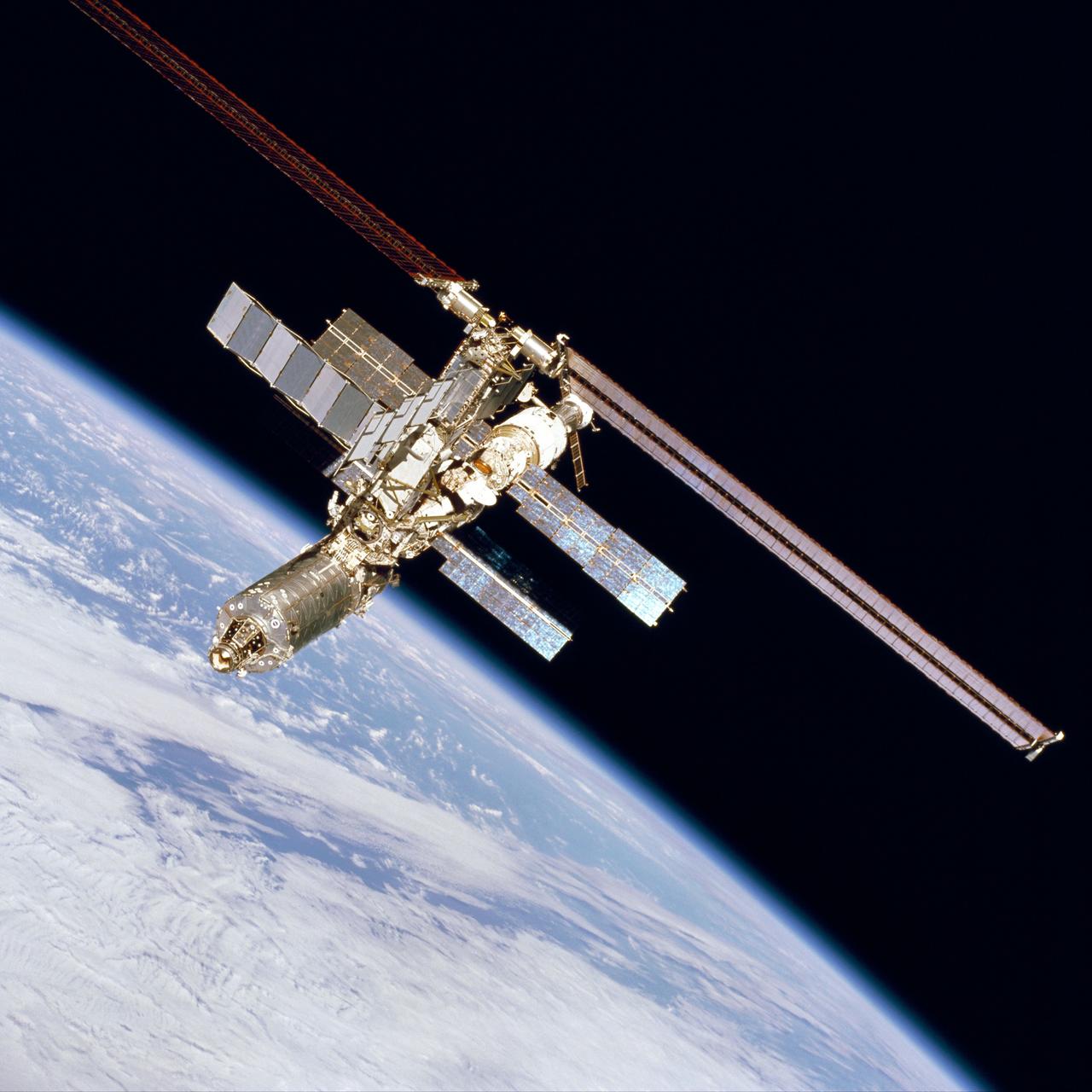
STS09-713a-004 (16 February 2001) --- With its new Destiny laboratory contrasted over a blue and white Earth, the International Space Station (ISS) was photographed by one of the STS-98 crew members aboard Atlantis following separation of the shuttle and the outpost at the end of several days of joint activities. The crews of Atlantis and the station parted company at 8:06 a.m. (CST), Feb. 16, as astronaut Mark L. Polansky, pilot, flew the shuttle halfway around the outpost and its new Destiny laboratory before moving off.
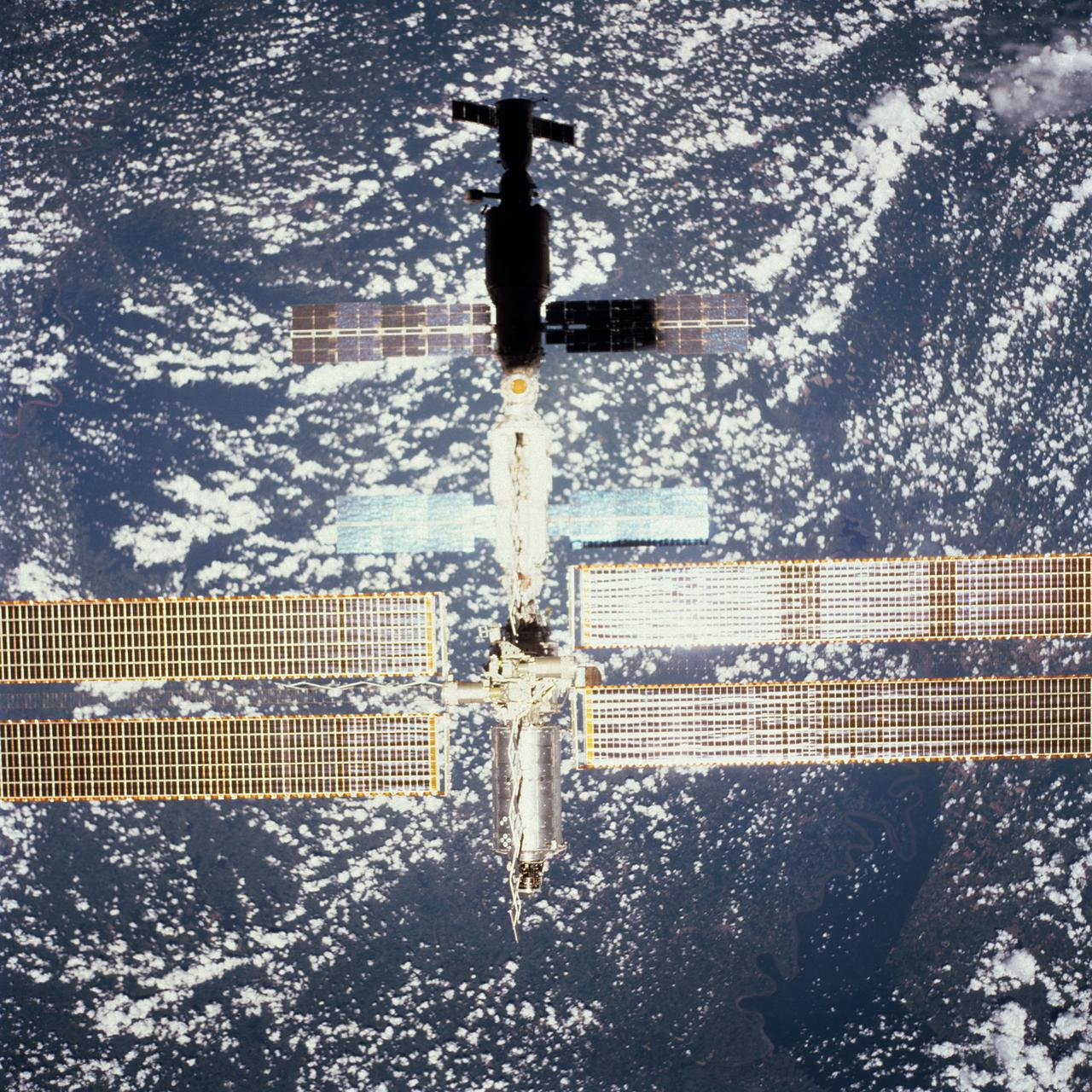
STS098-713A-075 (16 February 2001) --- Backdropped by Earth dotted with clouds, this close-up view of the International Space Station (ISS) with the newly-attached Destiny laboratory, was photographed by one of the astronauts onboard Atlantis. As the primary payload for the STS-98 mission, Destiny is the centerpiece of the ISS, where unprecedented science experiments will be performed in space. The shuttle and the station parted company at 8:06 a.m. (CST), Feb. 16, as Polansky flew the shuttle halfway around the outpost and its new Destiny laboratory before moving off.
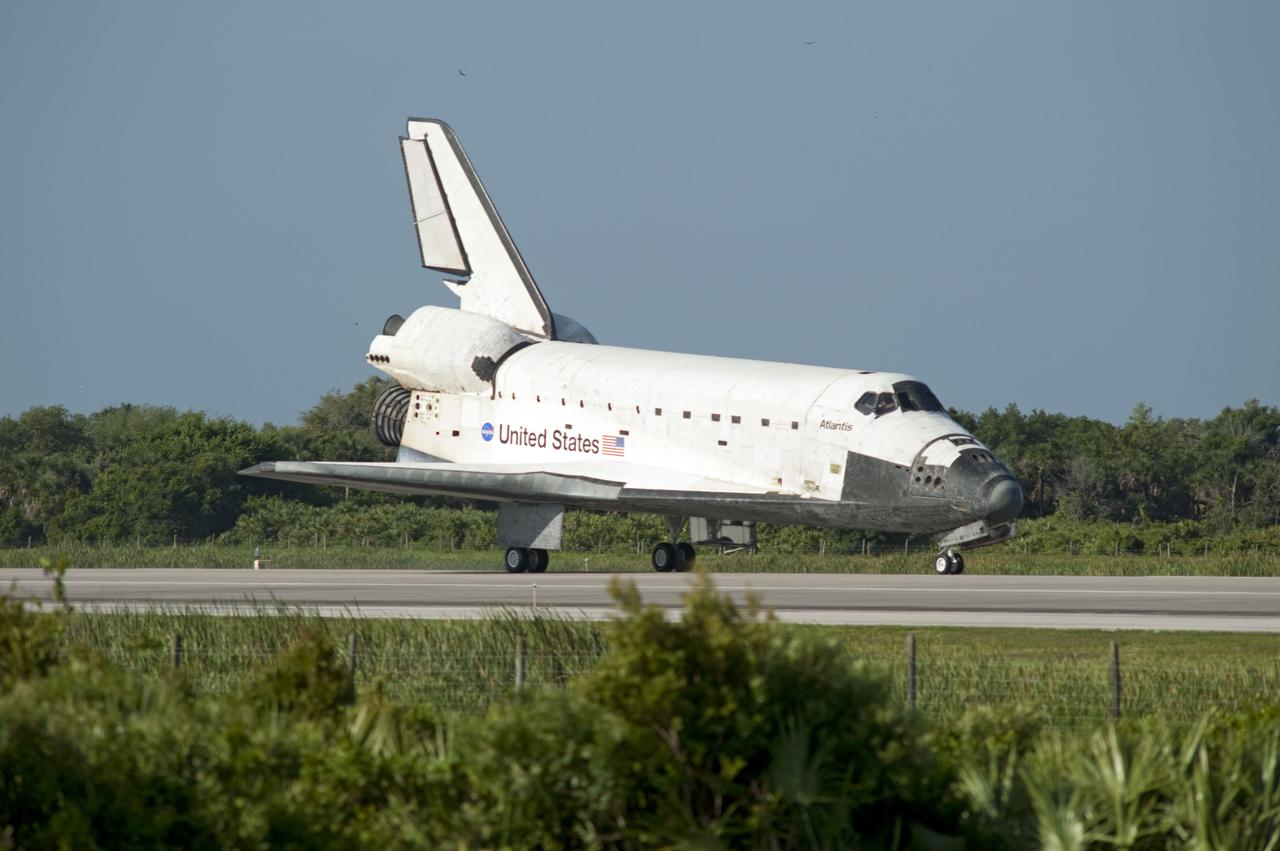
STS132-S-098 (26 May 2010) --- Space shuttle Atlantis rolls to a stop on Runway 33 at the Shuttle Landing Facility at NASA's Kennedy Space Center in Florida. Landing was at 8:48 a.m. (EDT) on May 26, 2010, completing the 12-day STS-132 mission to the International Space Station. Main gear touchdown was at 8:48:11 a.m., followed by nose gear touchdown at 8:48:21 a.m. and wheelstop at 8:49:18 a.m. Onboard are NASA astronauts Ken Ham, commander; Tony Antonelli, pilot; Garrett Reisman, Michael Good, Steve Bowen and Piers Sellers, all mission specialists. The six-member STS-132 crew carried the Russian-built Mini Research Module 1 (MRM1) to the orbital complex. STS-132 is the 34th shuttle mission to the station, the 132nd shuttle mission overall and the last planned flight for Atlantis.
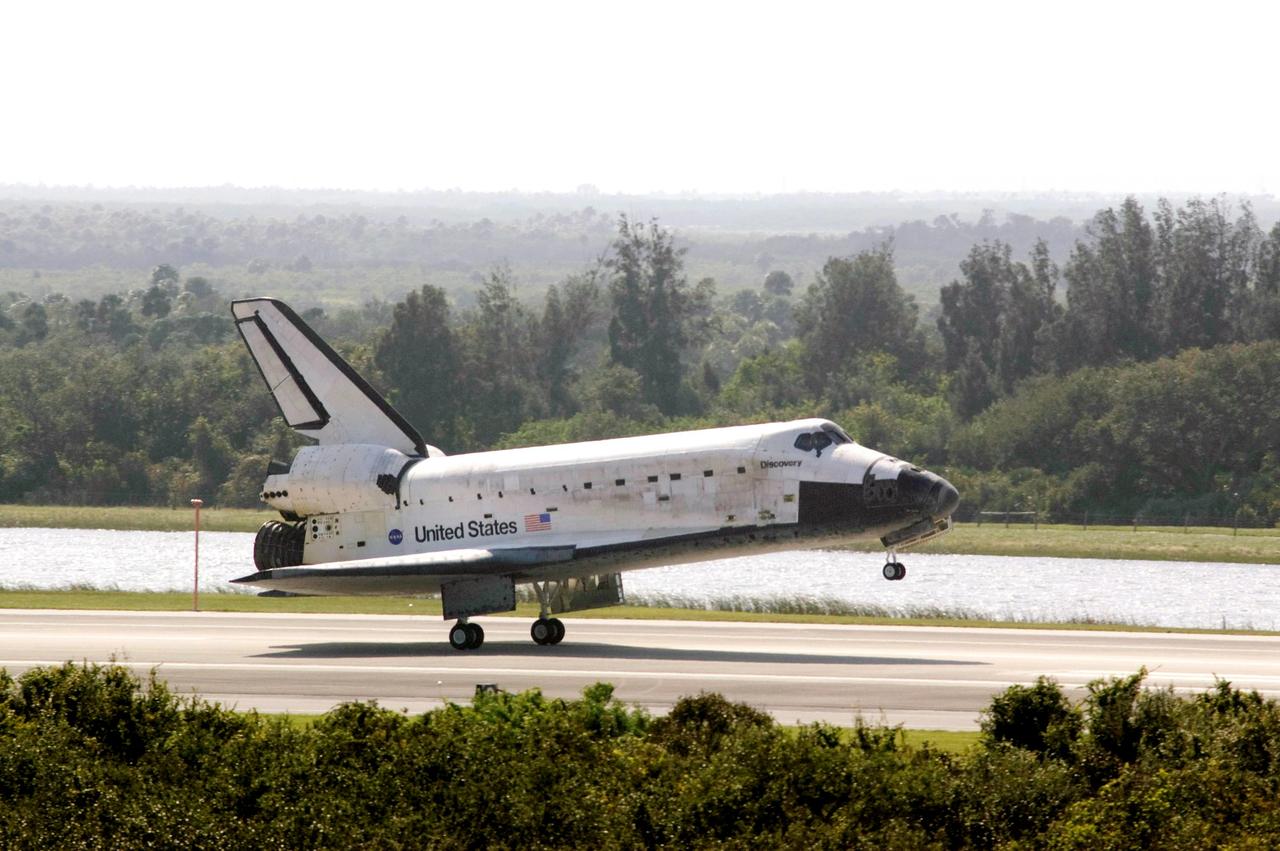
STS120-S-098 (7 Nov. 2007) --- Space Shuttle Discovery touches down on runway 33 of the Shuttle Landing Facility at NASA's Kennedy Space Center, concluding the 15-day STS-120 mission to the International Space Station. Onboard are astronauts Pam Melroy, commander; George Zamka, pilot; Scott Parazynski, Stephanie Wilson, Doug Wheelock, Clay Anderson and European Space Agency's (ESA) Paolo Nespoli, all mission specialists. Main gear touchdown was 1:01:16 p.m. (EST) on Nov. 7, 2007. Wheel stop was at 1:02:07 p.m. Mission elapsed time was 15 days, 2 hours, 24 minutes and 2 seconds. The STS-120 crew continued the construction of the station with the installation of the Harmony Node 2 module and the relocation of the P6 truss.
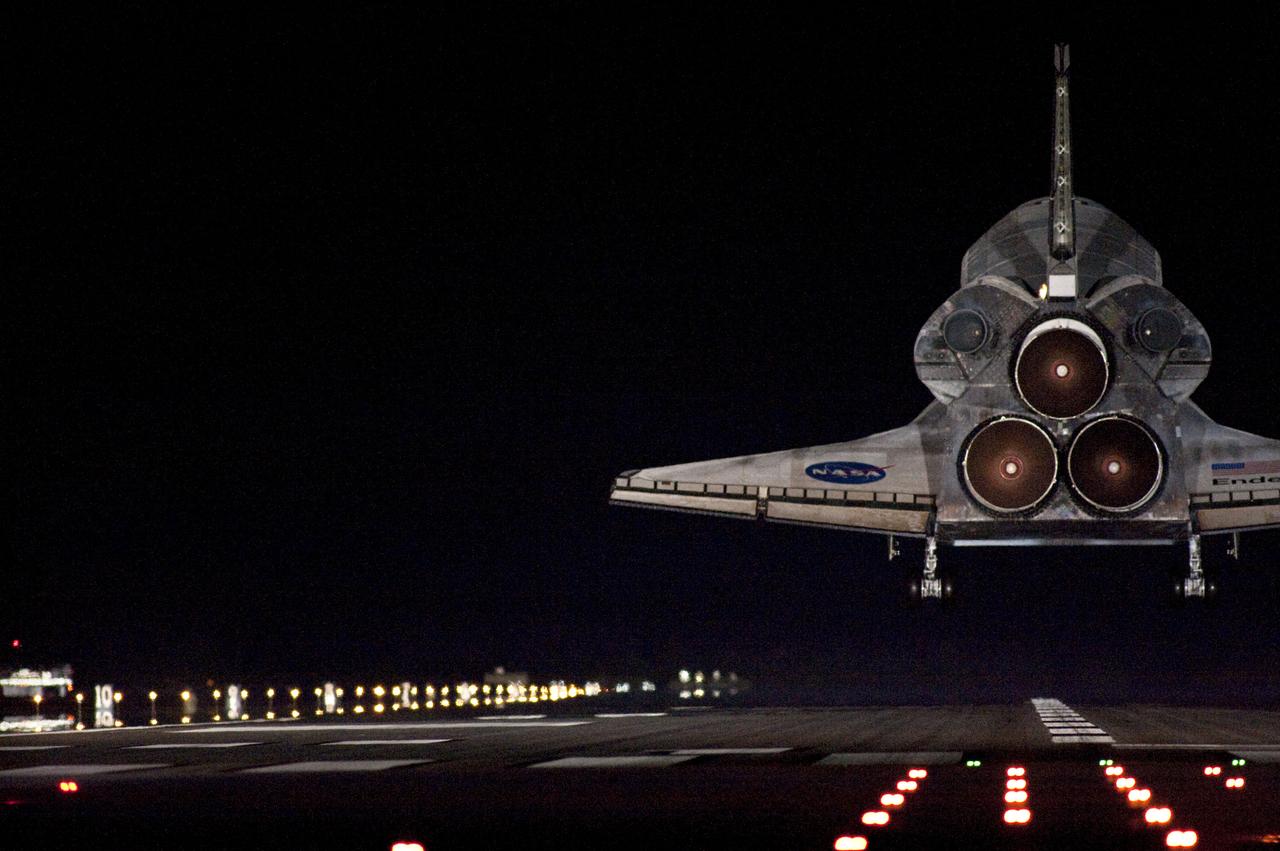
STS130-S-098 (21 Feb. 2010) --- With landing gear down, space shuttle Endeavour approaches Runway 15 at the Shuttle Landing Facility at NASA's Kennedy Space Center in Florida after 14 days in space, completing the 5.7-million-mile STS-130 mission on orbit 217. Main gear touchdown was at 10:20:31 p.m. (EST) on Feb. 21, 2010; followed by nose gear touchdown at 10:20:39 p.m. and wheels stop at 10:22:10 p.m. It was the 23rd night landing in shuttle history and the 17th at Kennedy. Aboard are NASA astronauts George Zamka, commander; Terry Virts, pilot; Robert Behnken, Nicholas Patrick, Kathryn Hire and Stephen Robinson, all mission specialists. During Endeavour's STS-130 mission, astronauts installed the Tranquility node, a module that provides additional room for crew members and many of the station's life support and environmental control systems. Attached to Tranquility is a Cupola with seven windows that provide a panoramic view of Earth, celestial objects and visiting spacecraft. The module was built in Turin, Italy, by Thales Alenia Space for the European Space Agency. The orbiting laboratory is approximately 90 percent complete now in terms of mass. STS-130 was the 24th flight for Endeavour, the 32nd shuttle mission devoted to ISS assembly and maintenance, and the 130th shuttle mission to date.
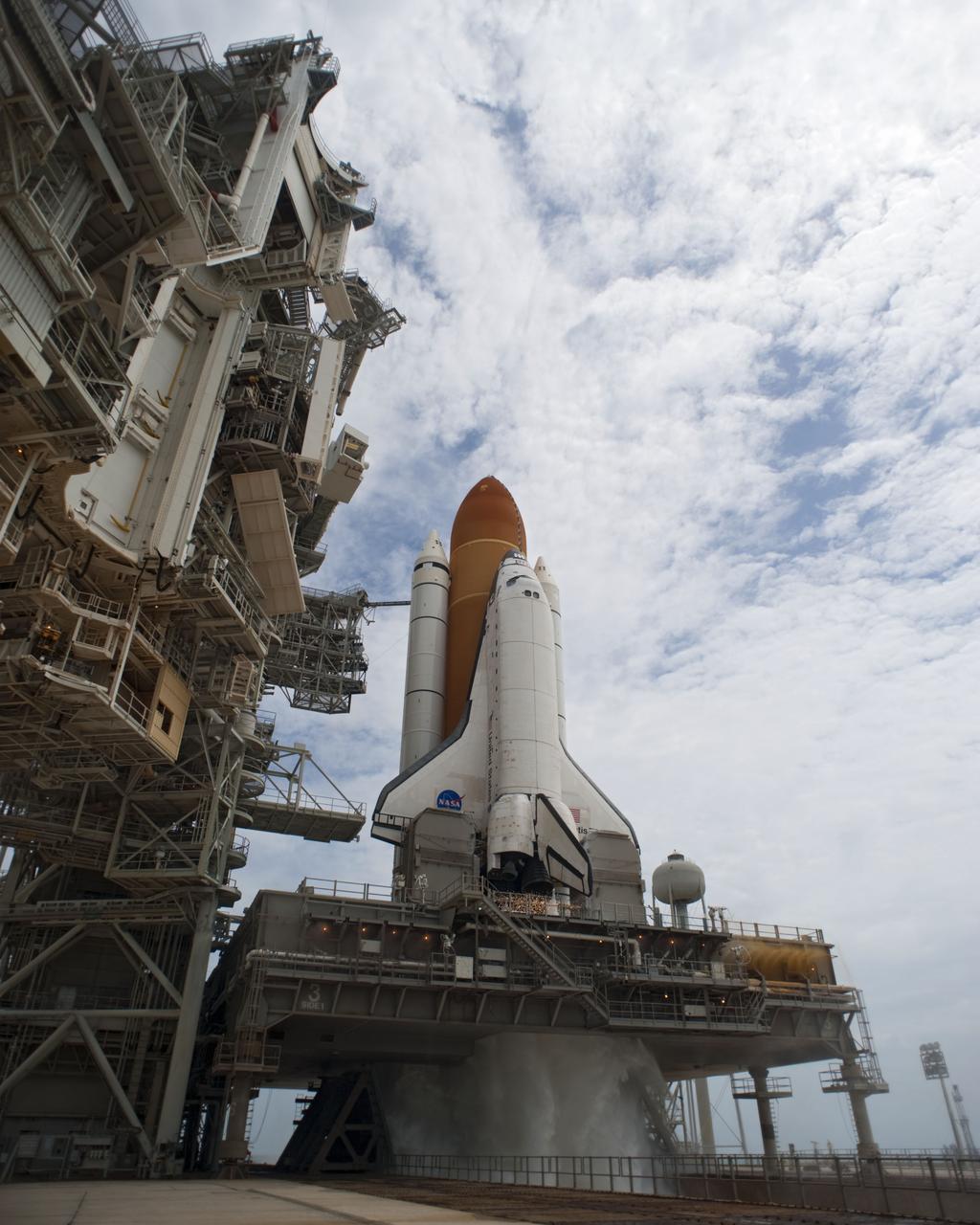
STS135-S-098 (8 July 2011) --- Space shuttle Atlantis' main engines are ignited for liftoff at Launch Pad 39A at NASA's Kennedy Space Center in Florida as it begins its STS-135 mission to the International Space Station. Liftoff was at 11:29 a.m. (EDT) on July 8, 2011. Onboard are NASA astronauts Chris Ferguson, commander; Doug Hurley, pilot; Sandy Magnus and Rex Walheim, both mission specialists. STS-135 will deliver the Raffaello multi-purpose logistics module packed with supplies and spare parts for the space station. Atlantis also carries the Robotic Refueling Mission experiment that will investigate the potential for robotically refueling existing satellites in orbit. In addition, Atlantis will return with a failed ammonia pump module to help NASA better understand the failure mechanism and improve pump designs for future systems. STS-135 will be the 33rd flight of Atlantis, the 37th shuttle mission to the space station, and the 135th and final mission of NASA's Space Shuttle Program. Photo credit: NASA
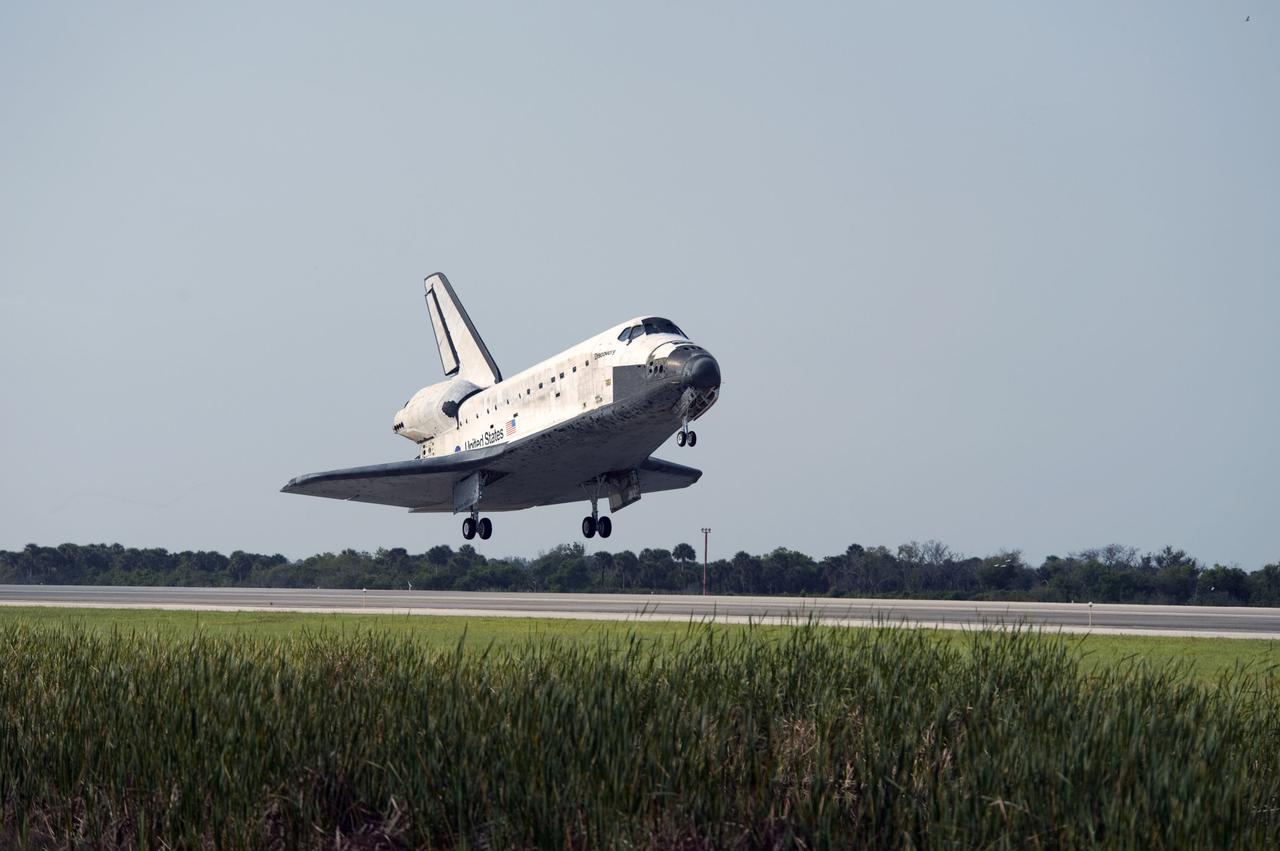
STS131-S-098 (20 April 2010) --- Space shuttle Discovery lands on Runway 33 at the Shuttle Landing Facility at NASA's Kennedy Space Center in Florida at 9:08 a.m. (EDT) on April 20, 2010, completing the 15-day STS-131 mission to the International Space Station. Main gear touchdown was at 9:08:35 a.m. followed by nose gear touchdown at 9:08:47 a.m. and wheels stop at 9:09:33 a.m. Aboard are NASA astronauts Alan Poindexter, commander; James P. Dutton Jr., pilot; Dorothy Metcalf-Lindenburger, Rick Mastracchio, Stephanie Wilson, Clayton Anderson and Japanese astronaut Naoko Yamazaki, all mission specialists. The seven-member STS-131 crew carried the Leonardo Multi-Purpose Logistics Module, filled with supplies, a new crew sleeping quarters and science racks that were transferred to the station's laboratories. The crew also switched out a gyroscope on the station?s truss, installed a spare ammonia storage tank and retrieved a Japanese experiment from the station?s exterior. STS-131 is the 33rd shuttle mission to the station and the 131st shuttle mission overall.