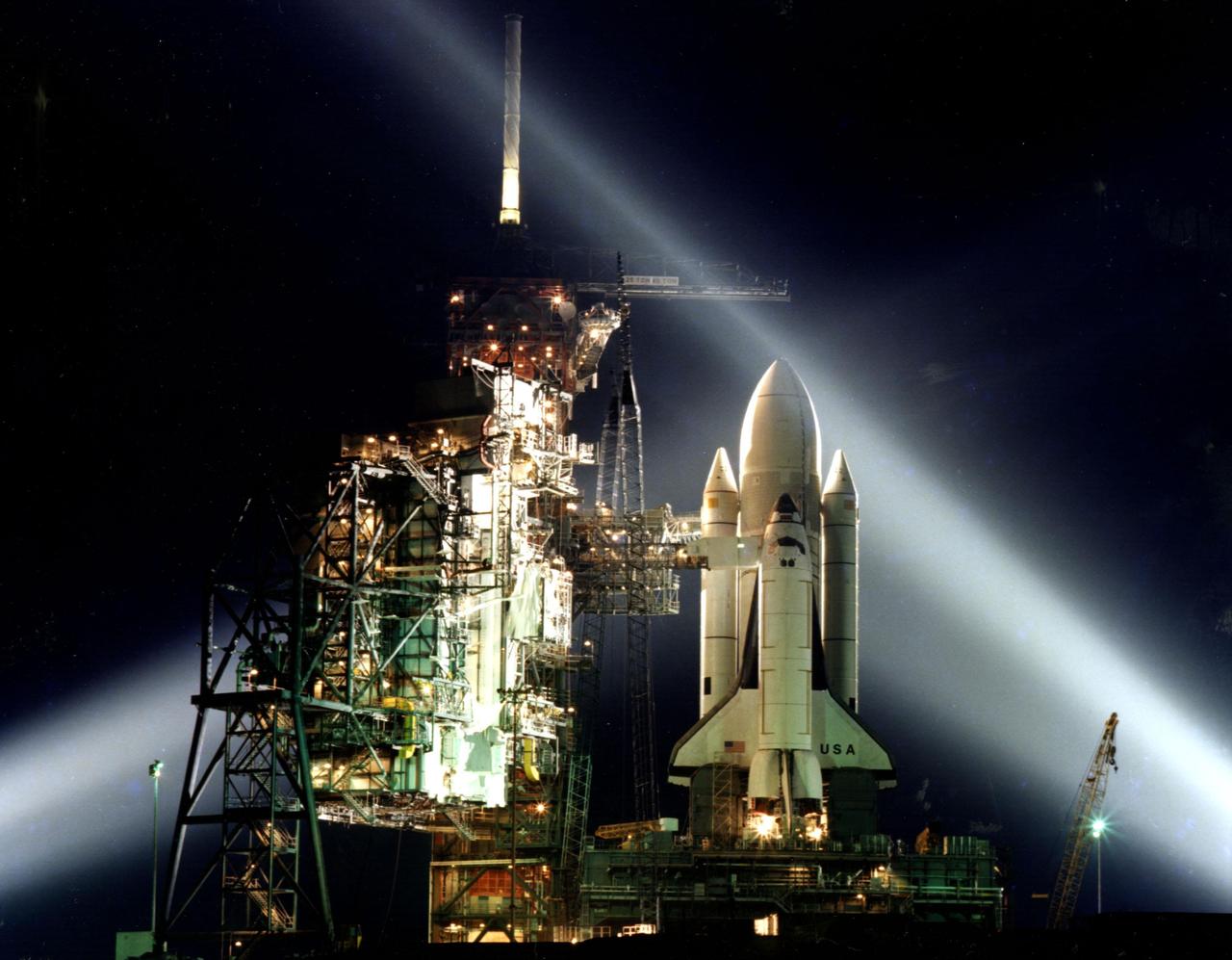
A timed exposure of the first Space Shuttle, STS-1, at Launch Pad A, Complex 39, turns the space vehicle and support facilities into a night-time fantasy of light. To the left of the Shuttle are the fixed and the rotating service structures.
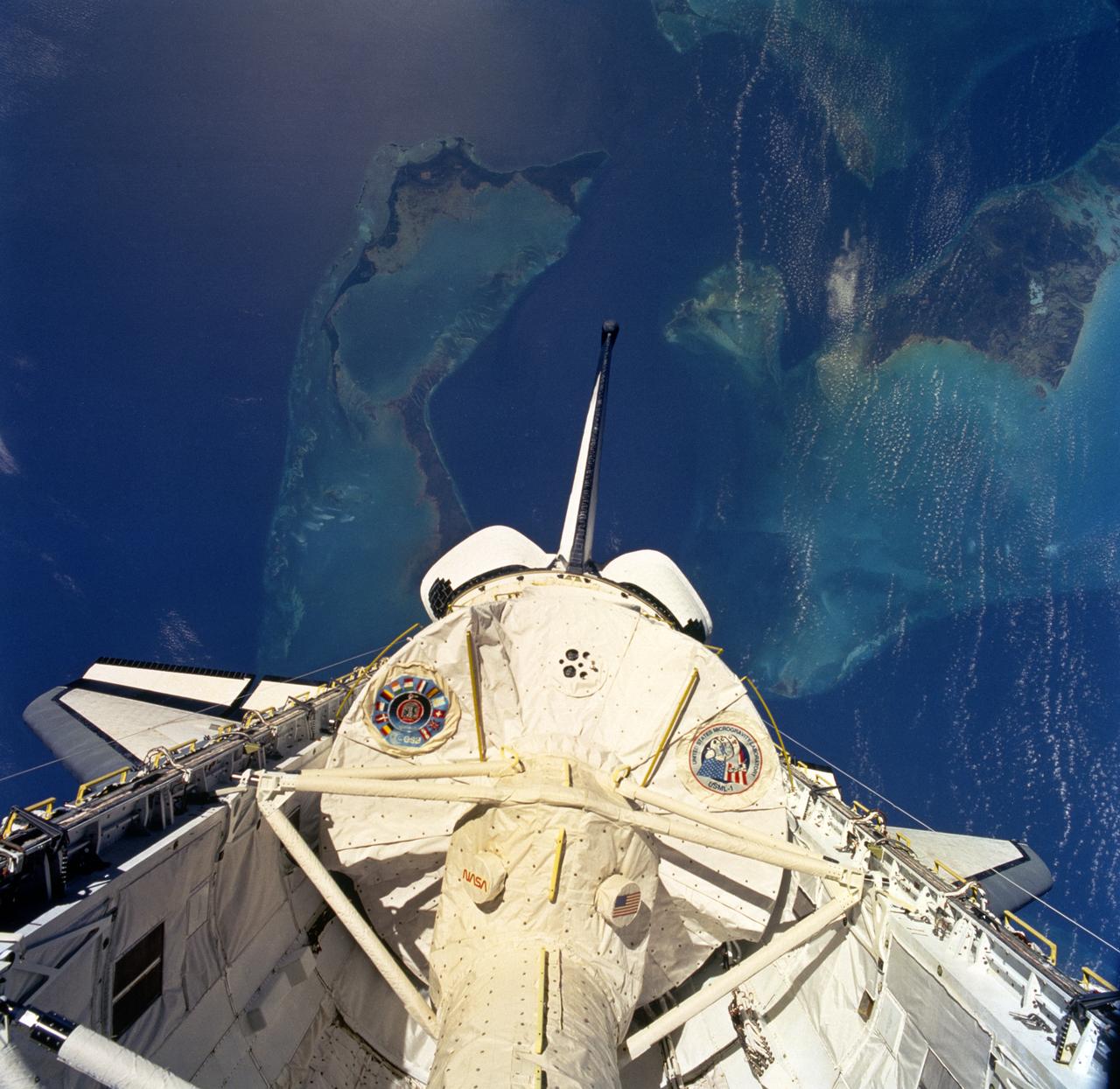
STS-50, USML-1, Spacelab module in cargo bay with earth in background
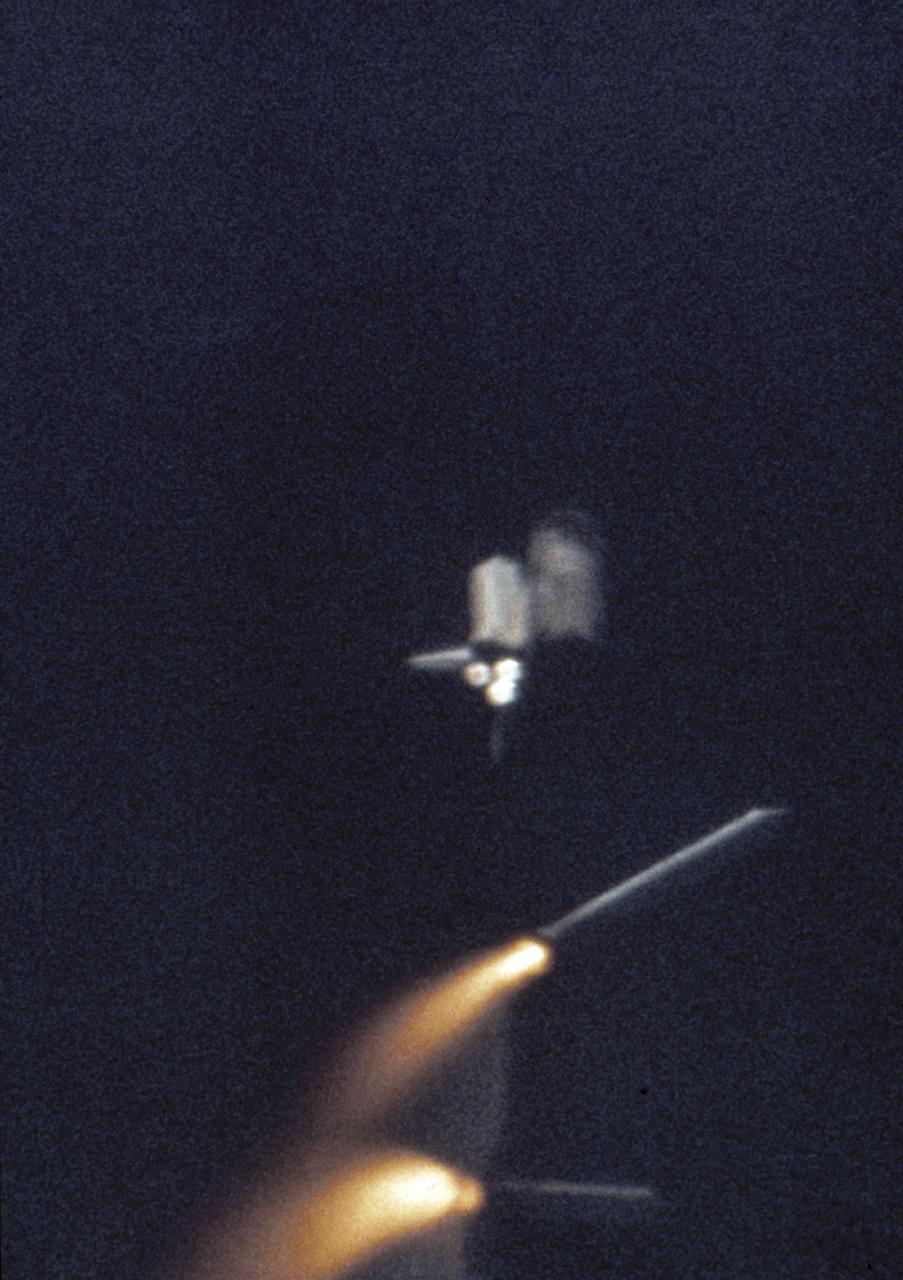
S81-33179 (12 April 1981) --- Though their STS-1 task has been performed, the two solid rocket boosters (SRB) still glow following their jettisoning from the space shuttle Columbia on its way to many firsts. Among the history recorded by the spacecraft is the marking of a mission in a reusable spacecraft. STS-1 is NASA's first manned mission since the Apollo-Soyuz Test Project in 1975. Inside the cabin of the climbing spacecraft are astronauts John W. Young and Robert L. Crippen. Photo credit: NASA
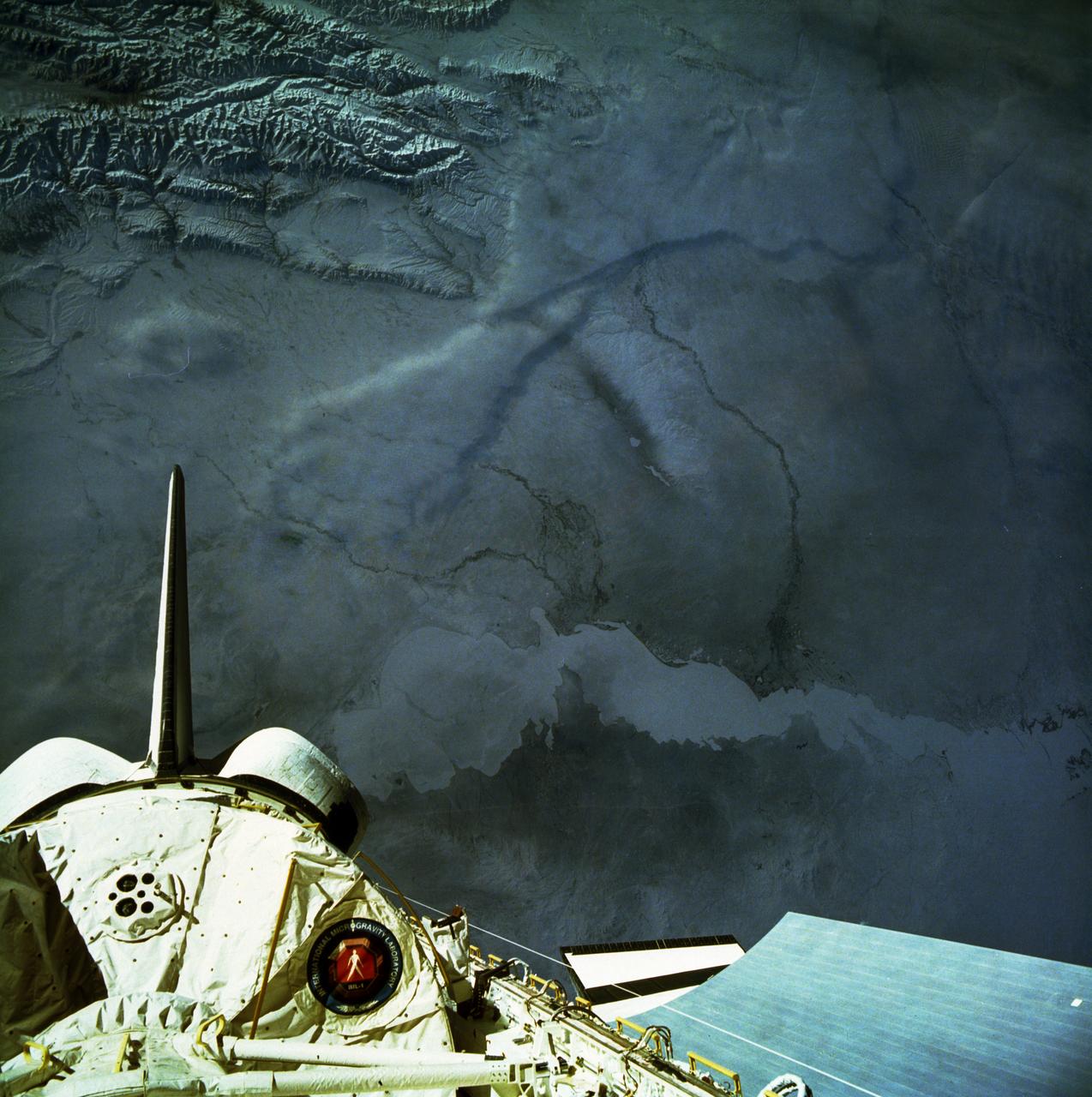
STS-42, Viewing earth with lots of snow, partial view of IML-1 (International Microgravity Laboratory) in cargo bay.
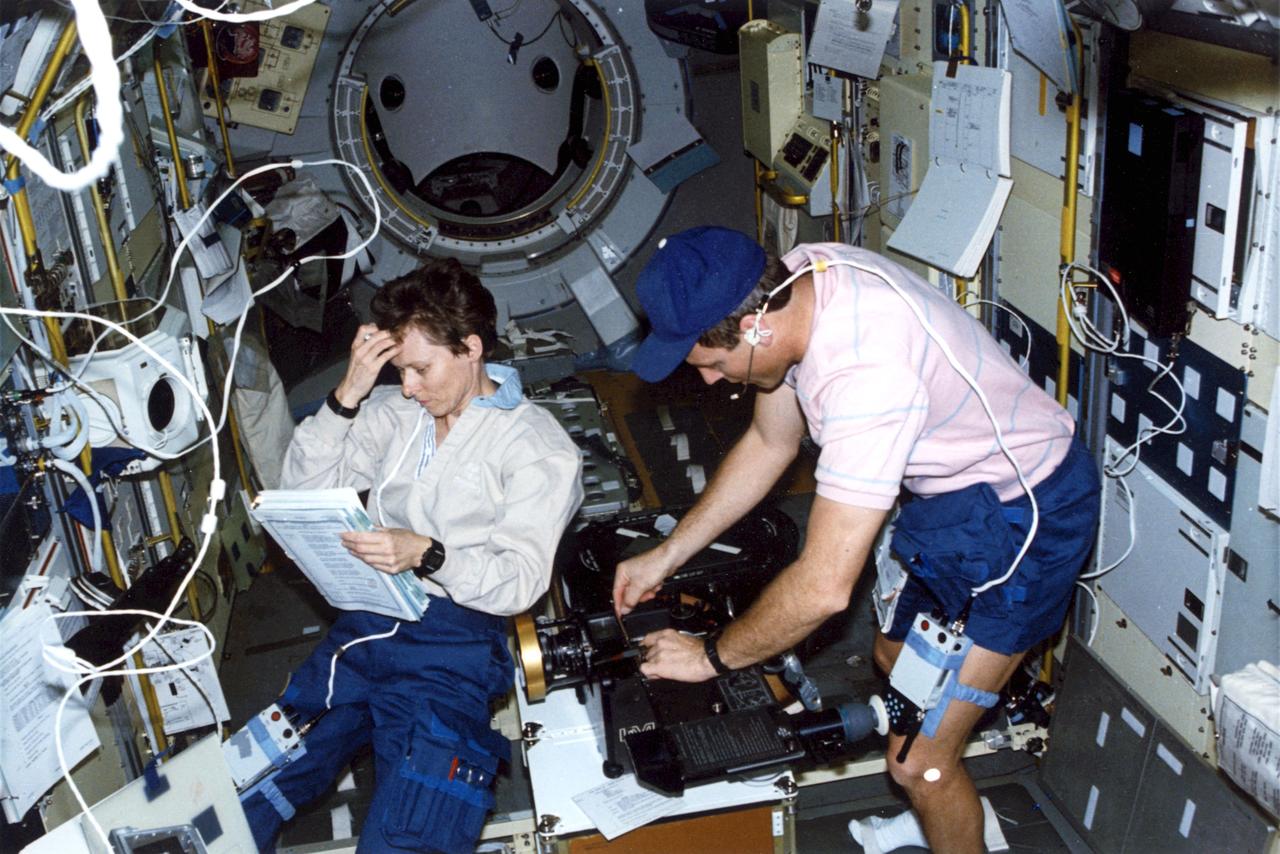
STS-42, Astronauts Steve Oswald and Canadian Roberta Bondar working in IML-1 (International Microgravity Laboratory).
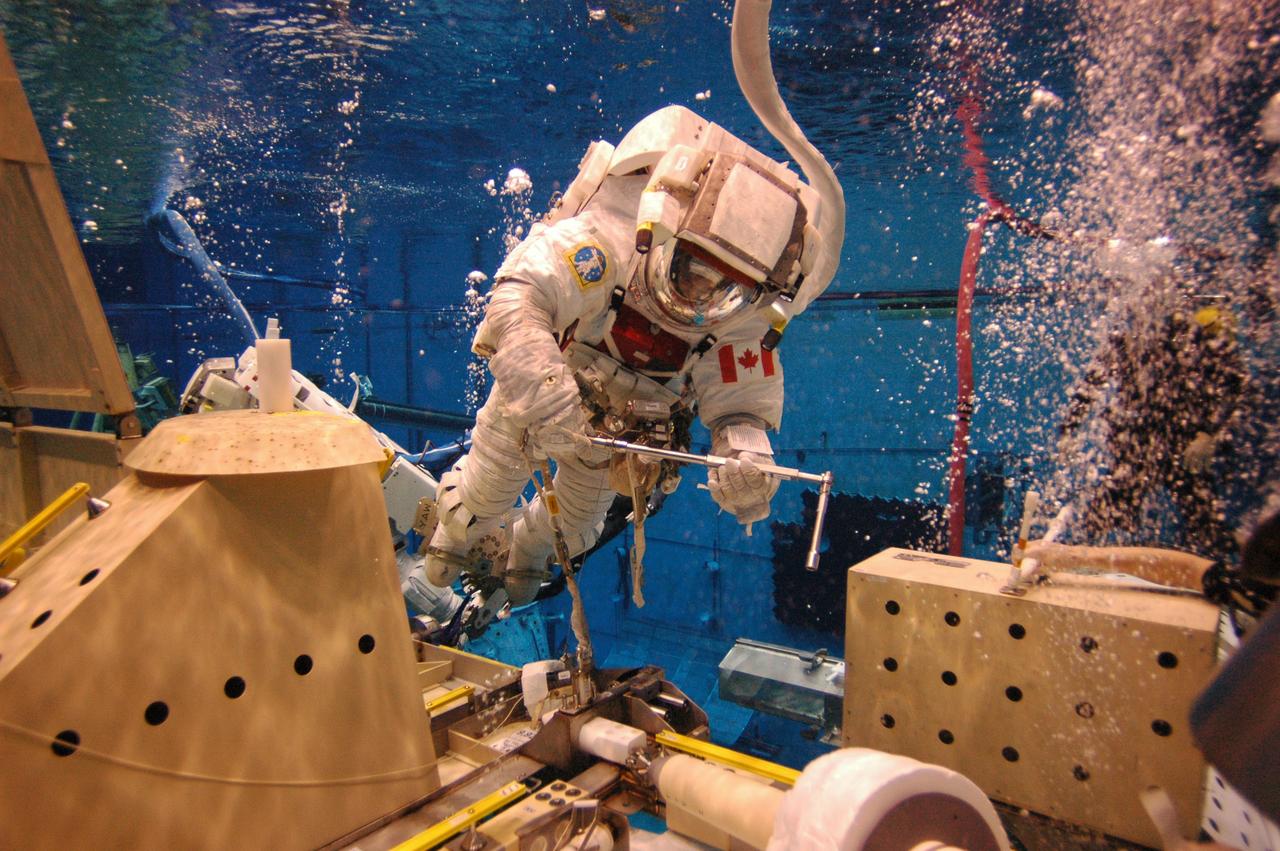
• Event (Mission for flight / Class for training): STS-118 (13A.1) • Title: STS-118 EVA 1 NBL • Date: 4-18-07 • Location: NBL • Key words: 118, 13A.1, S5, NBL • Description: NBL underwater photos of STS-118 EVA 1 S5 install.
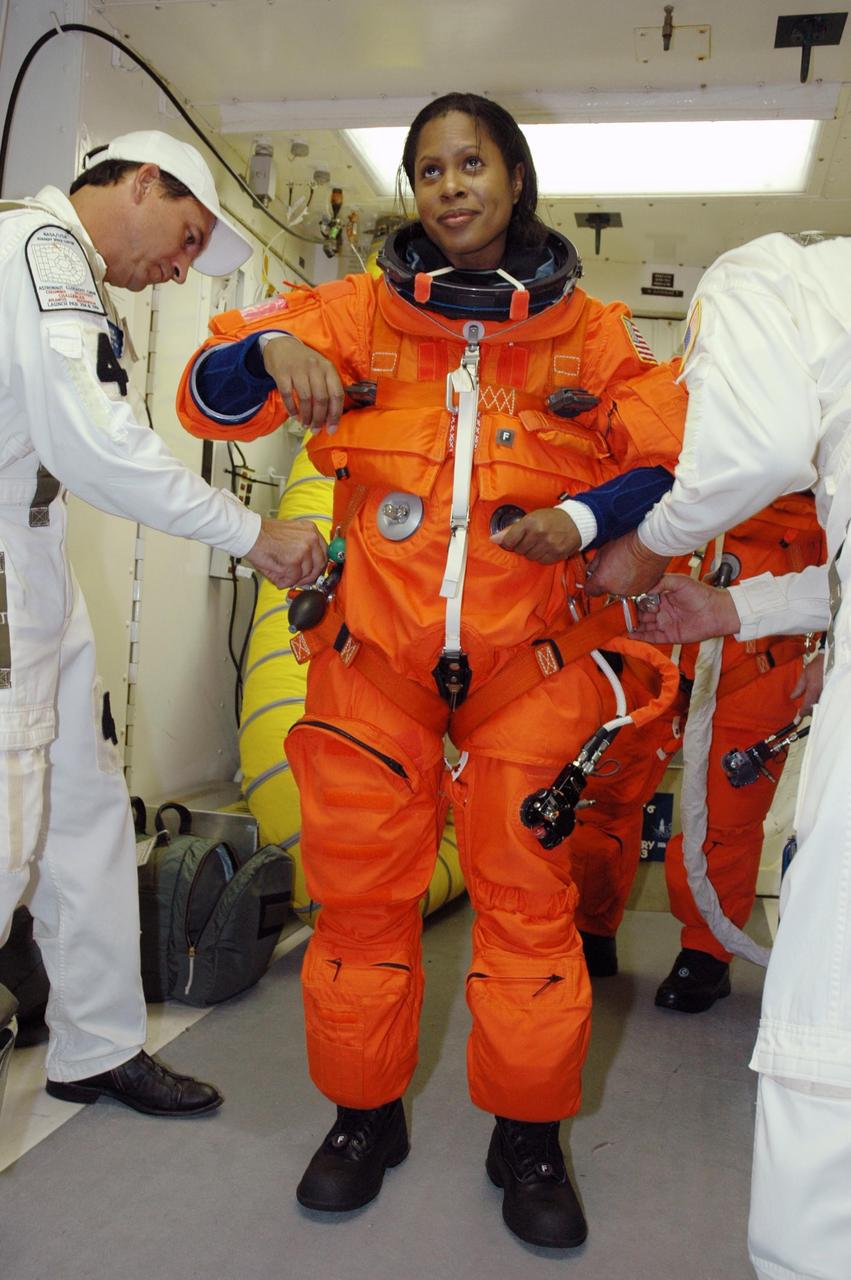
KENNEDY SPACE CENTER, FLA. -- In the white room on Launch Pad 39B, STS-116 Mission Specialist Joan Higginbotham is helped with her gear before entering Space Shuttle Discovery. The mission crew is taking part in a simulated launch countdown, part of the terminal countdown demonstration test that includes prelaunch preparations. The STS-116 mission is No. 20 to the International Space Station and construction flight 12A.1. The mission payload is the SPACEHAB module, the P5 integrated truss structure and other key components. Launch is scheduled for no earlier than Dec. 7. Photo credit: NASA/Amanda Diller
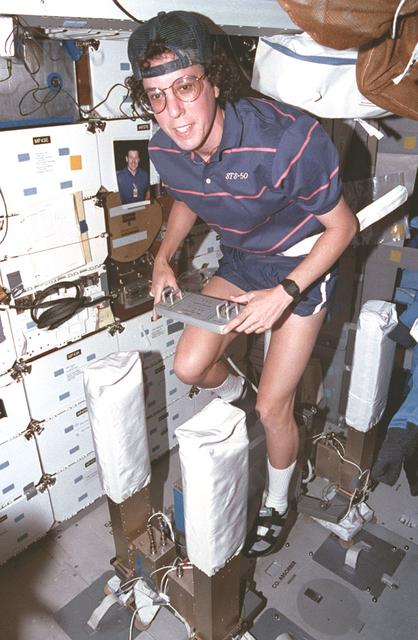
Onboard Space Shuttle Columbia (STS-50) in the United States Microgravity Laboratory (USML-1) mission specialist Ellen S. Baker is hard at work.
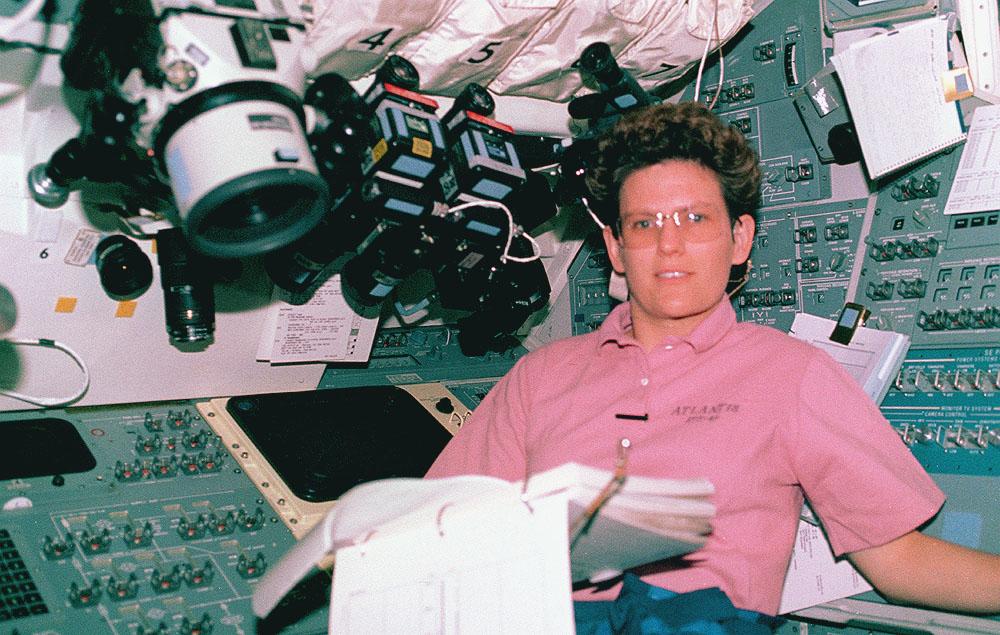
Space Shuttle Atlantis (STS-45) onboard photo of Mission Specialist Kathryn Sullivan working in the Atmospheric Laboratory for Applications and Science (Atlas-1) module. Atlas-1 flew in a series of Spacelab flights that measured long term variability in the total energy radiated by the Sun and determined the variability in the solar spectrum.
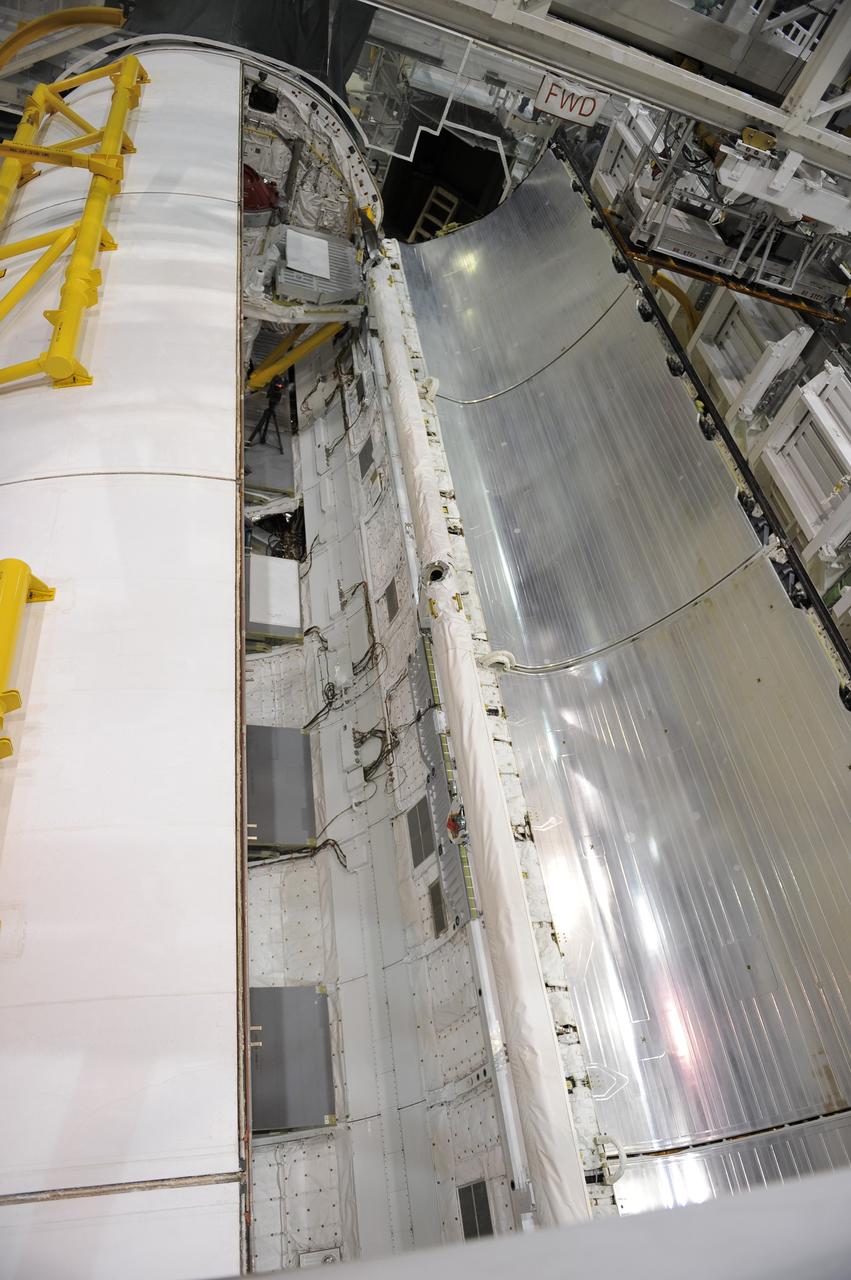
CAPE CANAVERAL, Fla. -- In Orbiter Processing Facility-1 at NASA's Kennedy Space Center in Florida, shuttle Atlantis' payload bay doors close prior to the holidays. Atlantis is being prepared for the "launch on need," or potential rescue mission, for the final planned shuttle flight, Endeavour's STS-134 mission. For more information, visit www.nasa.gov/shuttle. Photo credit: NASA/Kim Shiflett

CAPE CANAVERAL, Fla. -- In Orbiter Processing Facility-1 at NASA's Kennedy Space Center in Florida, technicians close shuttle Atlantis' payload bay doors prior to the holidays. Atlantis is being prepared for the "launch on need," or potential rescue mission, for the final planned shuttle flight, Endeavour's STS-134 mission. For more information, visit www.nasa.gov/shuttle. Photo credit: NASA/Kim Shiflett
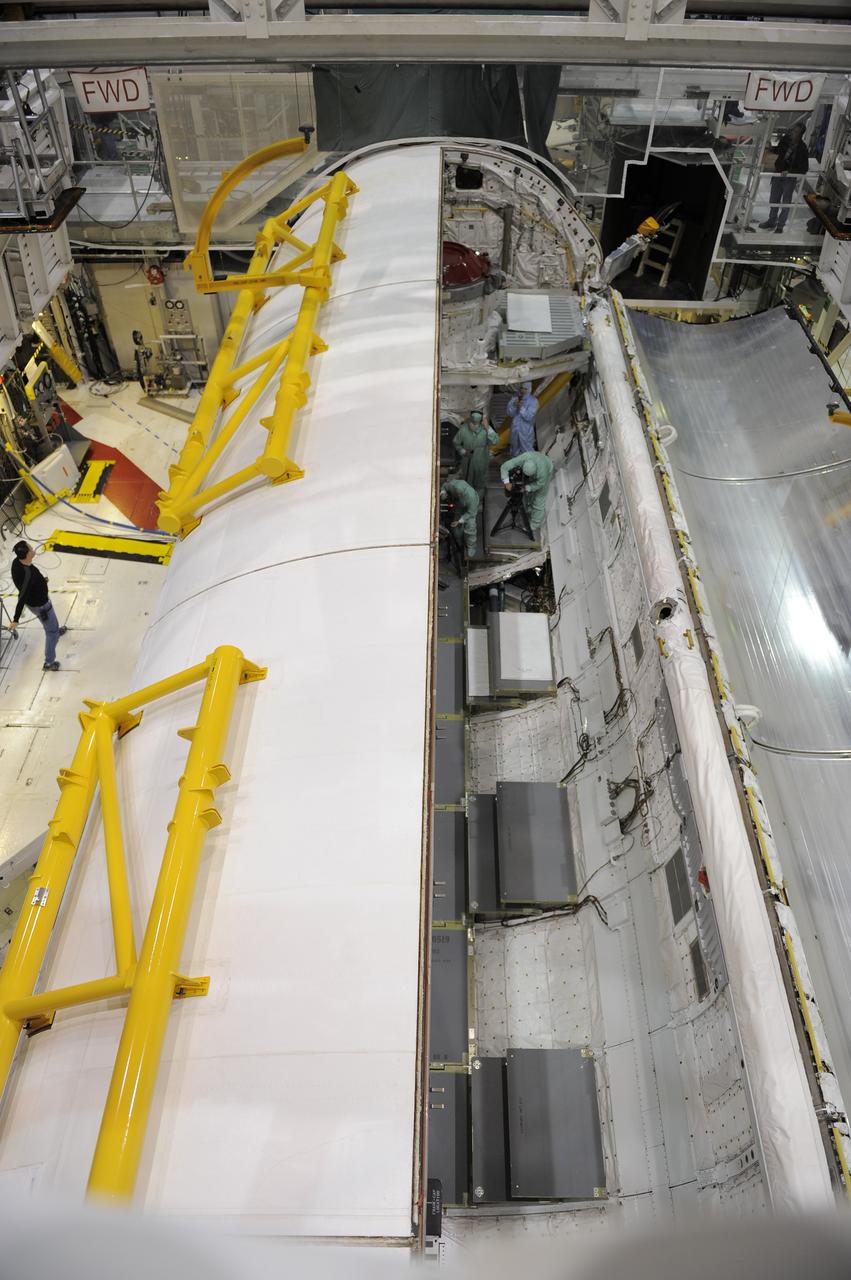
CAPE CANAVERAL, Fla. -- In Orbiter Processing Facility-1 at NASA's Kennedy Space Center in Florida, technicians close shuttle Atlantis' payload bay doors prior to the holidays. Atlantis is being prepared for the "launch on need," or potential rescue mission, for the final planned shuttle flight, Endeavour's STS-134 mission. For more information, visit www.nasa.gov/shuttle. Photo credit: NASA/Kim Shiflett
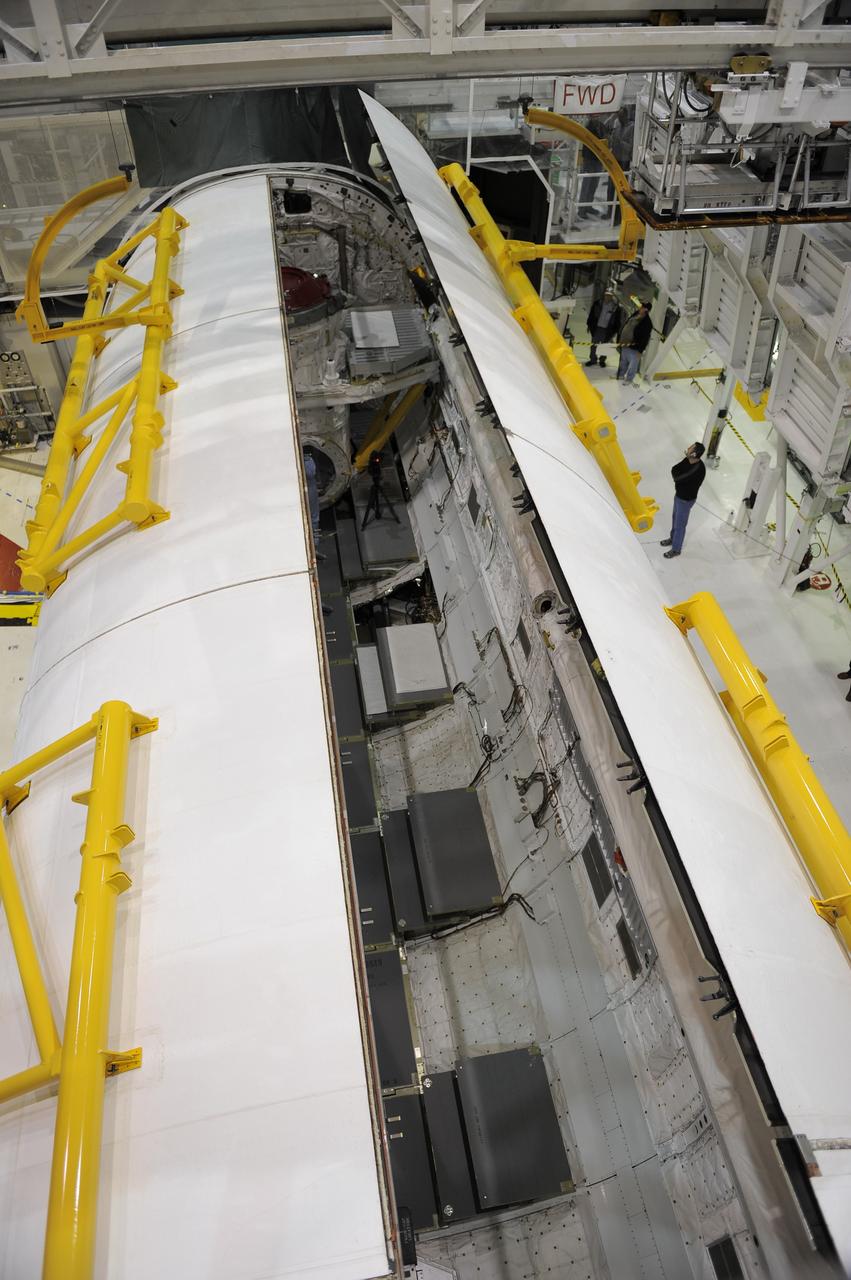
CAPE CANAVERAL, Fla. -- In Orbiter Processing Facility-1 at NASA's Kennedy Space Center in Florida, shuttle Atlantis' payload bay doors close prior to the holidays. Atlantis is being prepared for the "launch on need," or potential rescue mission, for the final planned shuttle flight, Endeavour's STS-134 mission. For more information, visit www.nasa.gov/shuttle. Photo credit: NASA/Kim Shiflett
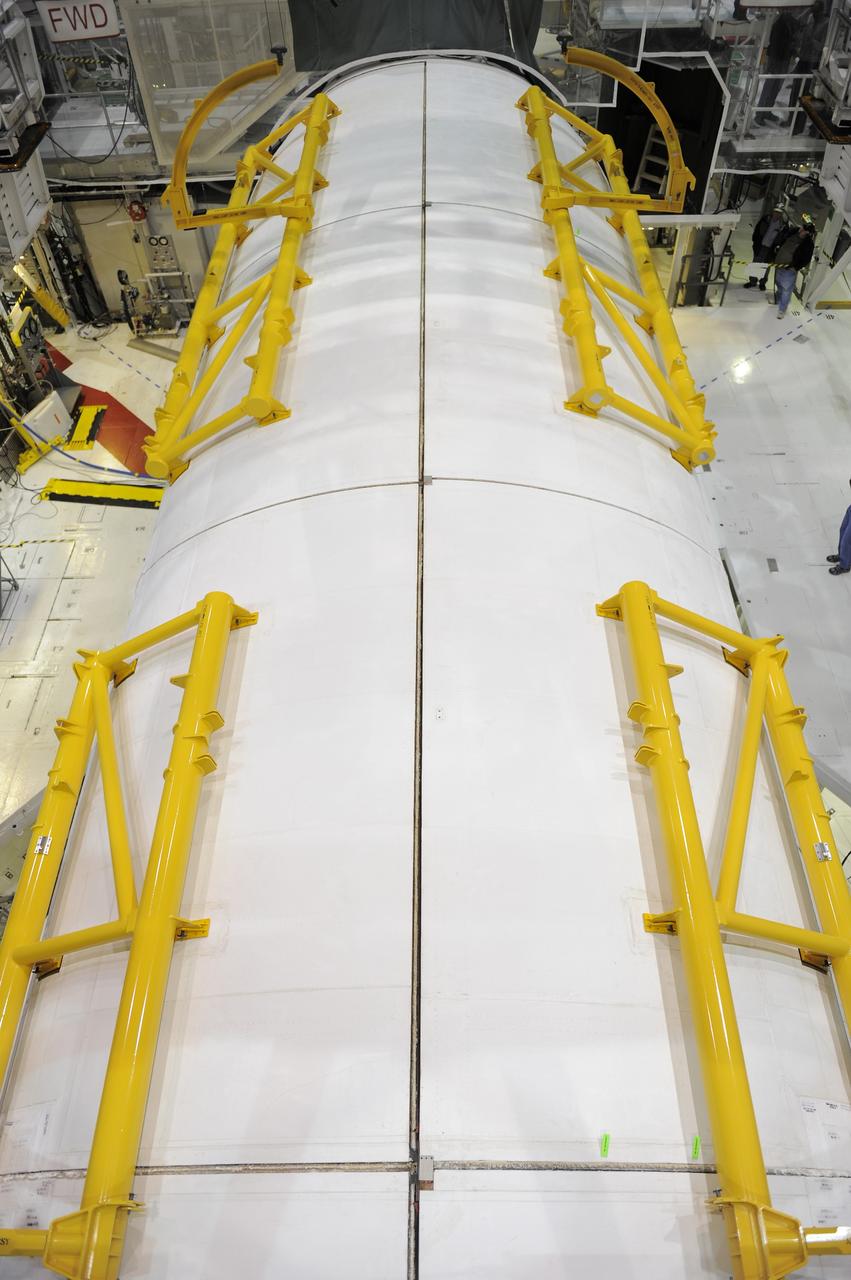
CAPE CANAVERAL, Fla. -- In Orbiter Processing Facility-1 at NASA's Kennedy Space Center in Florida, shuttle Atlantis' payload bay doors are closed prior to the holidays. Atlantis is being prepared for the "launch on need," or potential rescue mission, for the final planned shuttle flight, Endeavour's STS-134 mission. For more information, visit www.nasa.gov/shuttle. Photo credit: NASA/Kim Shiflett
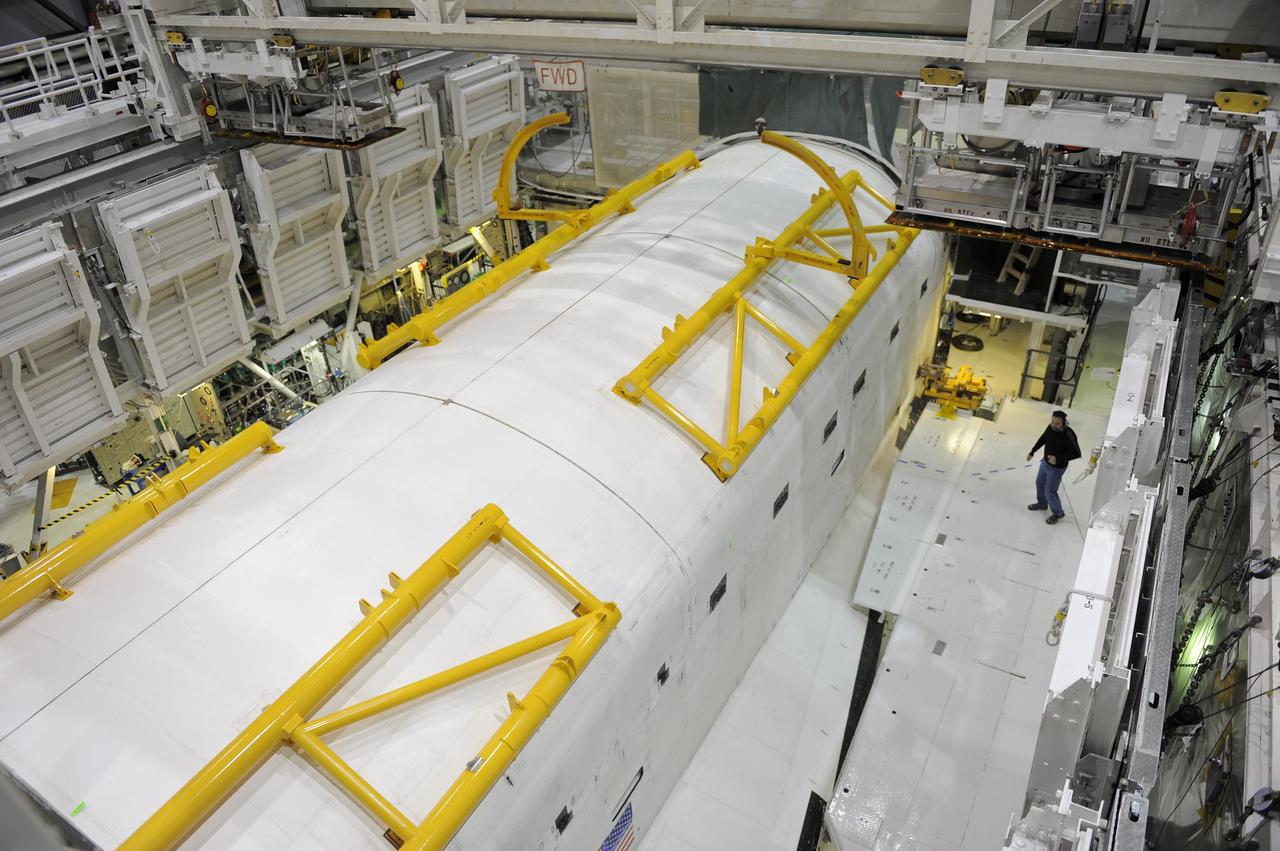
CAPE CANAVERAL, Fla. -- In Orbiter Processing Facility-1 at NASA's Kennedy Space Center in Florida, shuttle Atlantis' payload bay doors are closed prior to the holidays. Atlantis is being prepared for the "launch on need," or potential rescue mission, for the final planned shuttle flight, Endeavour's STS-134 mission. For more information, visit www.nasa.gov/shuttle. Photo credit: NASA/Kim Shiflett
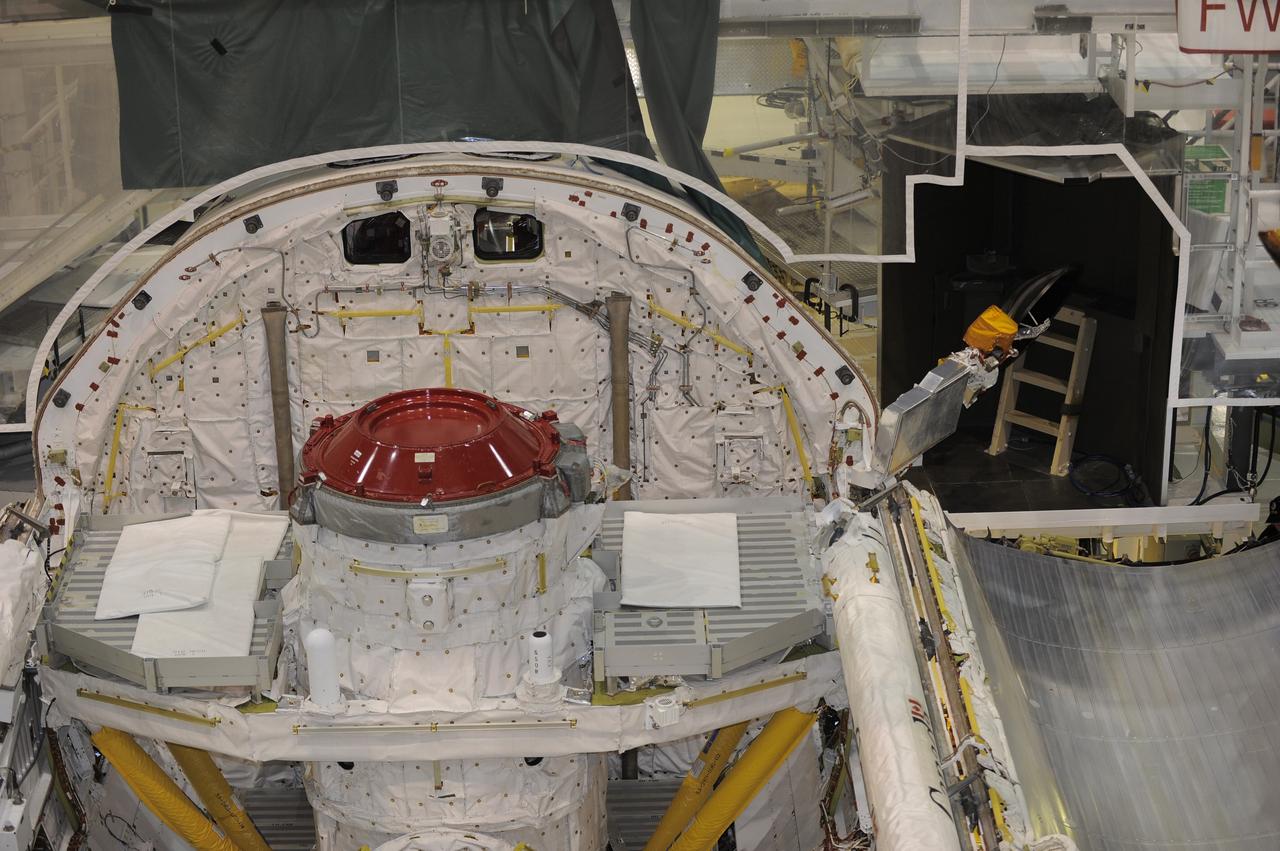
CAPE CANAVERAL, Fla. -- In Orbiter Processing Facility-1 at NASA's Kennedy Space Center in Florida, shuttle Atlantis' payload bay doors will be closed prior to the holidays. Atlantis is being prepared for the "launch on need," or potential rescue mission, for the final planned shuttle flight, Endeavour's STS-134 mission. For more information, visit www.nasa.gov/shuttle. Photo credit: NASA/Kim Shiflett
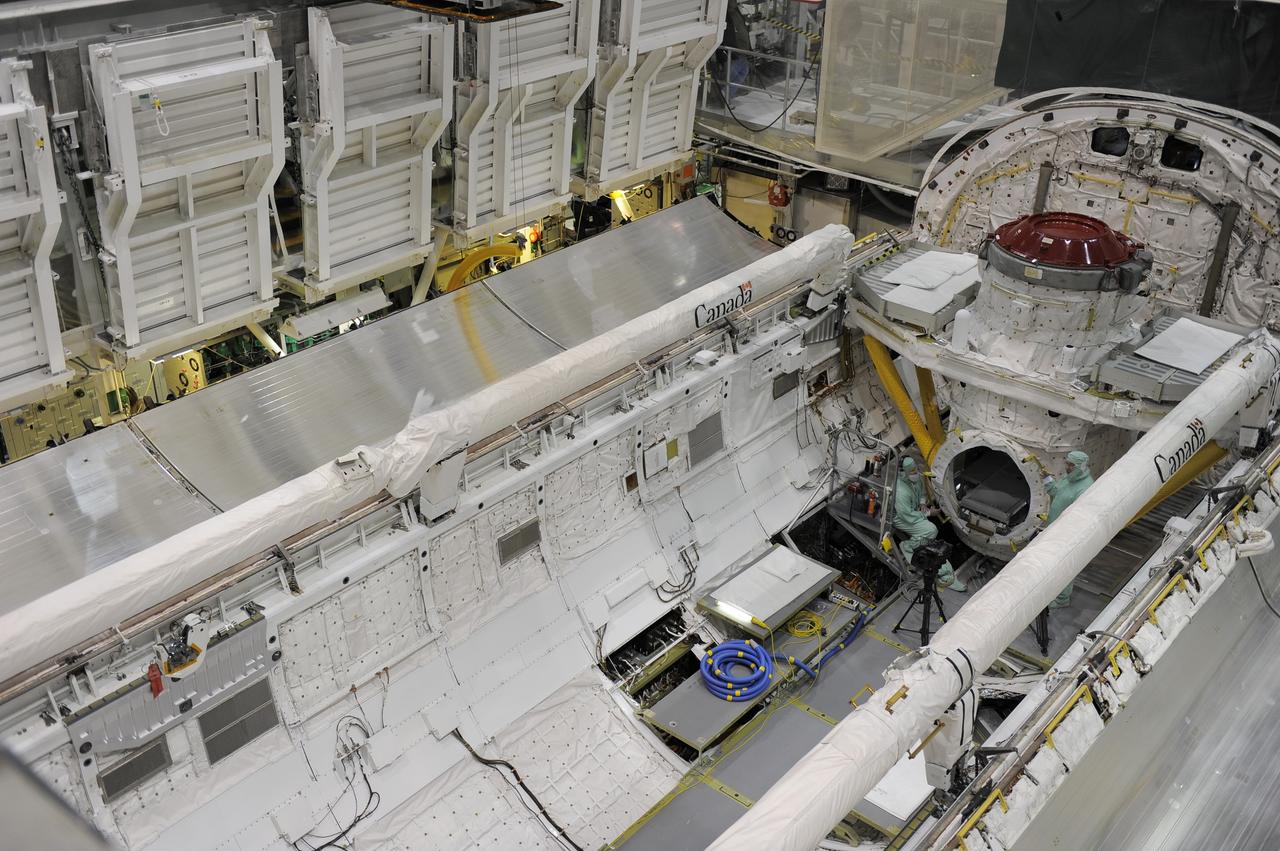
CAPE CANAVERAL, Fla. -- In Orbiter Processing Facility-1 at NASA's Kennedy Space Center in Florida, shuttle Atlantis' payload bay doors will be closed prior to the holidays. Atlantis is being prepared for the "launch on need," or potential rescue mission, for the final planned shuttle flight, Endeavour's STS-134 mission. For more information, visit www.nasa.gov/shuttle. Photo credit: NASA/Kim Shiflett

S81-30479 (April 1981) --- Astronauts John W. Young, second from left, and Robert L. Crippen, left, discuss photography from their recent STS-1 mission with astronauts Joe H. Engle, right, and Richard H. Truly during a post-mission debriefing session. Engle and Truly were backup crewmen for STS-1 and they have been named as prime crew members for STS-2, scheduled for a Sept. 30, 1981 liftoff. Photo credit: NASA
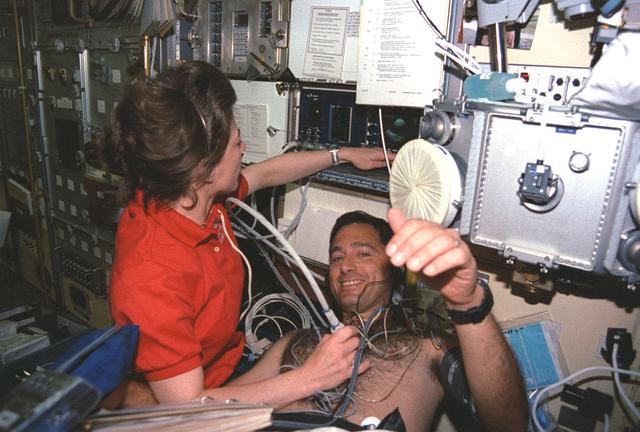
Onboard Space Shuttle Columbia (STS-50) payload commander Bornie Dunbar performs life science experiments on crewmember payload specialist Lawrence Delucas in the United States Microgravity Laboratory (USML-1) science module.
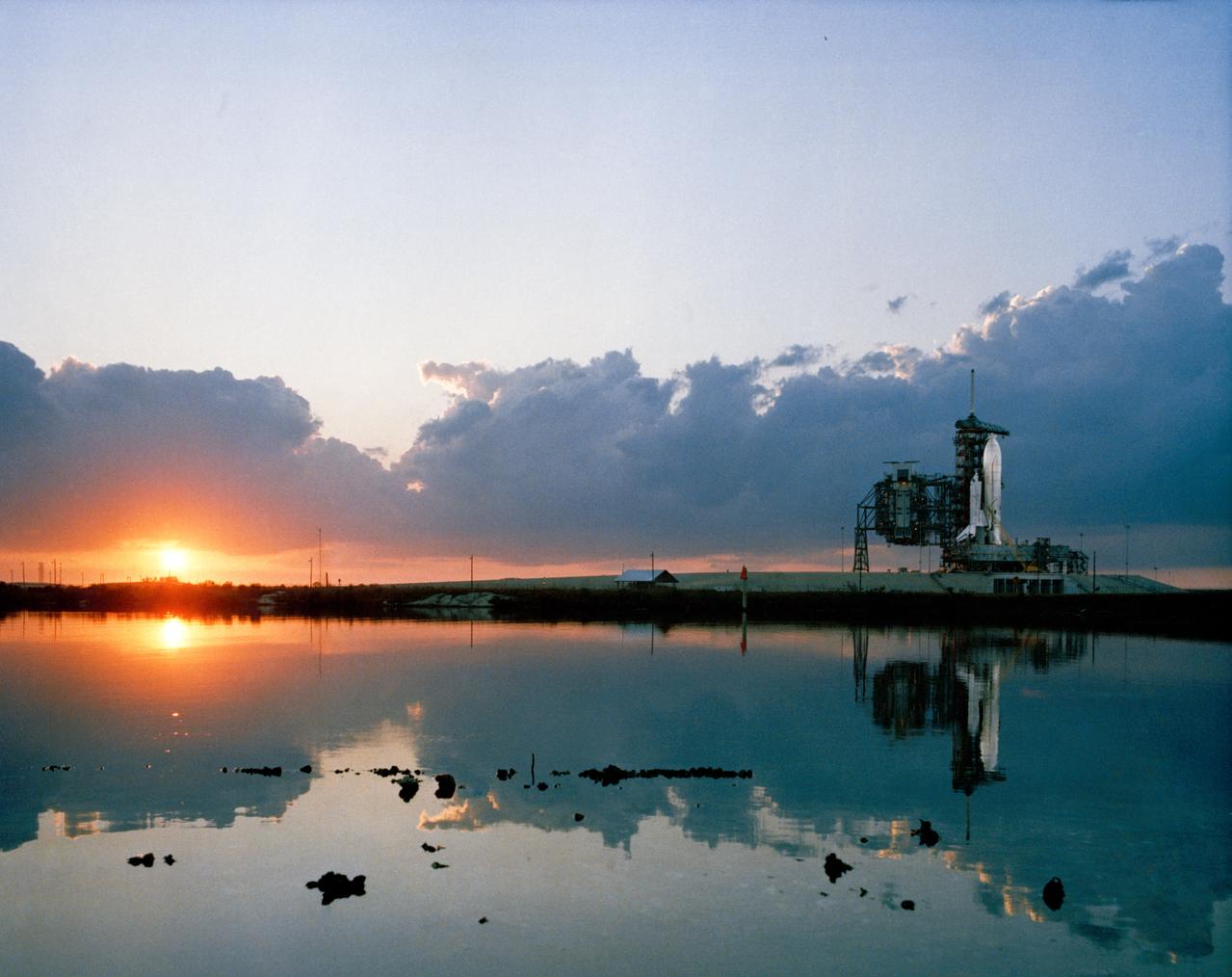
S81-28974 (March 1981) --- An early morning scene at the Kennedy Space Center's Launch Complex 39, with the space shuttle Columbia in position on Pad A at right. Launch for the STS-1 mission is set for April 10th with astronauts John W. Young and Robert L. Crippen aboard. Photo credit: NASA
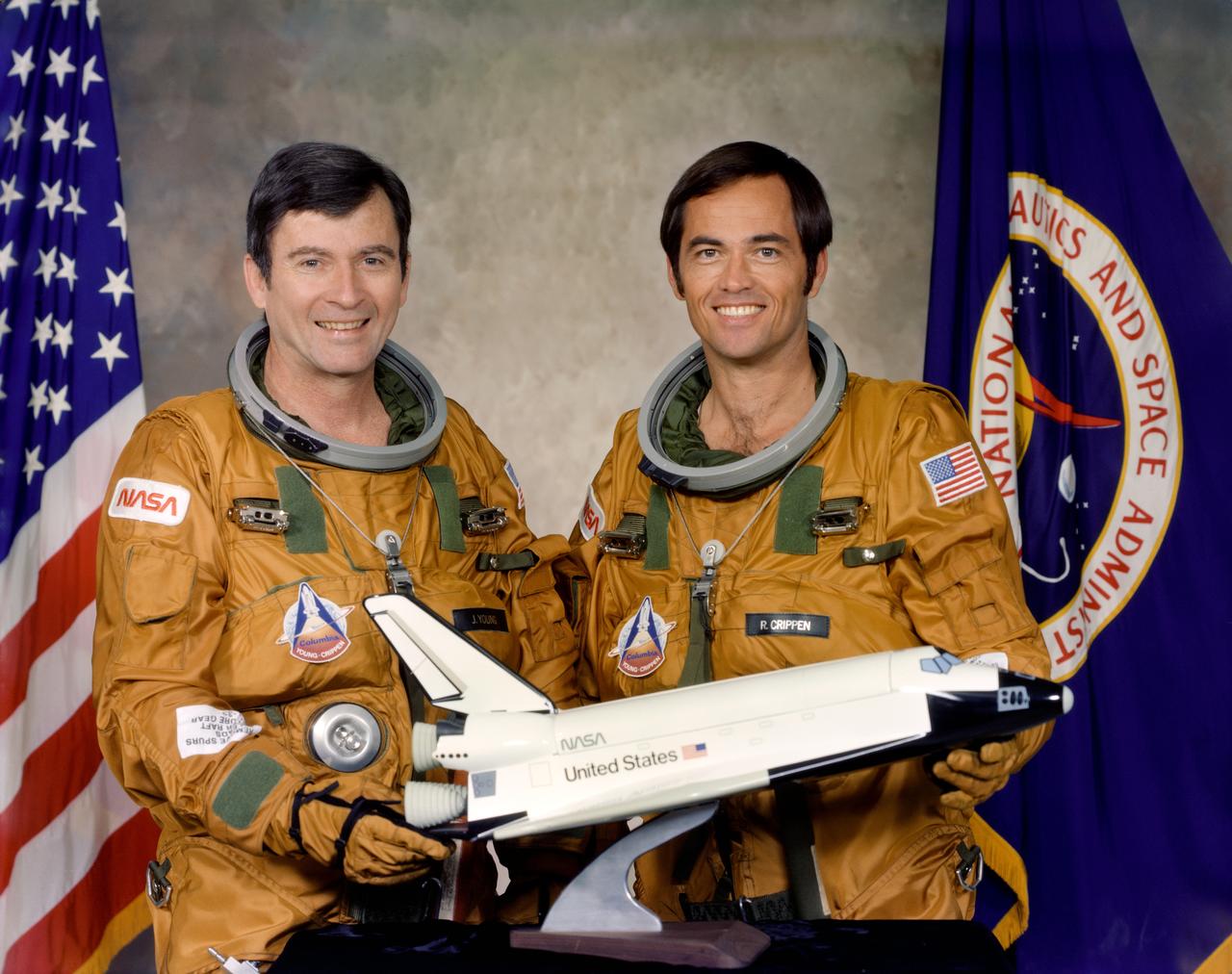
S79-31775 (29 April 1979) --- These two astronauts are the prime crewmen for the first flight in the Space Transportation System (STS-1) program. Astronauts John W. Young, left, commander, and Robert L. Crippen, pilot, will man the space shuttle orbiter 102 Columbia for the first orbital flight test. Photo credit: NASA
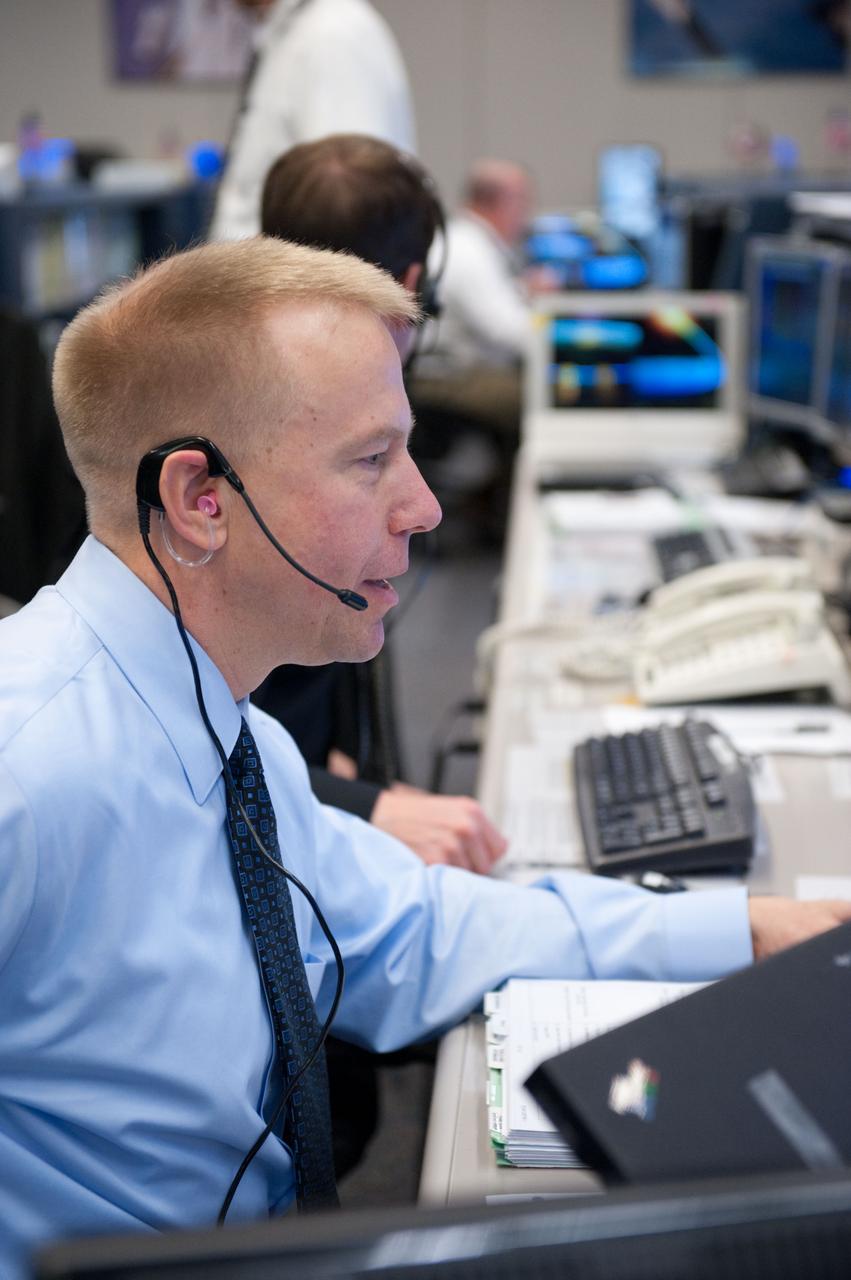
PHOTO DATE: 2-28-11 LOCATION: Bldg. 30 south - FCR-1 & Backrooms SUBJECT: STS-133/ULF5 flight controllers on console during EVA 1 with Orbit 1 Shuttle Flight Director Bryan Lunney and Orbit 2 ISS Flight Director Royce Renfrew PHOTOGRAPHER: Lauren Harnett
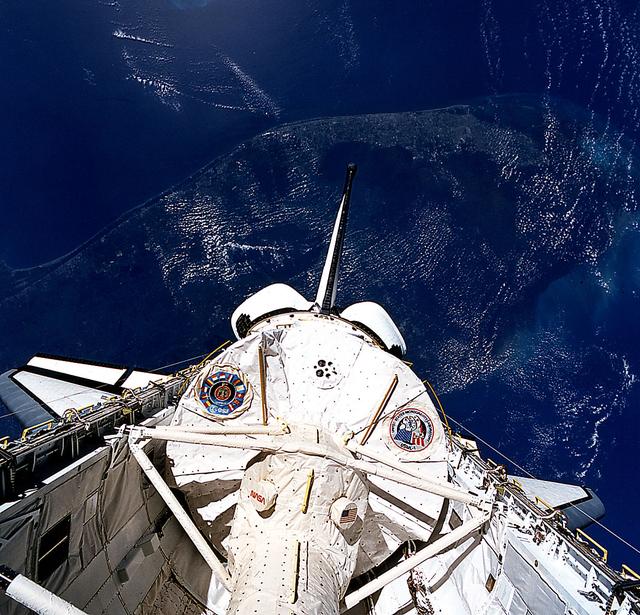
Space Shuttle Columbia (STS-50) onboard photo of the United States Microgravity Laboratory (USML-1) module in payload bay in this scene over the southern two-thirds of the Florida peninsula. Kennedy Space Center (KSC) can be seen just above Columbia's starboard wing.
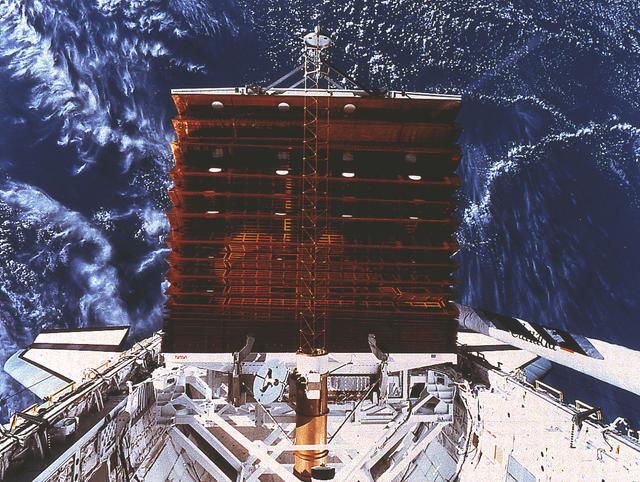
An STS-41D onboard photo shows the Solar Array Experiment (SAE) panel deployment for the Office of Aeronautics and space Technology-1 (OAST-1). OAST-1 is several advanced space technology experiments utilizing a common data system and is mounted on a platform in the Shuttle cargo bay.
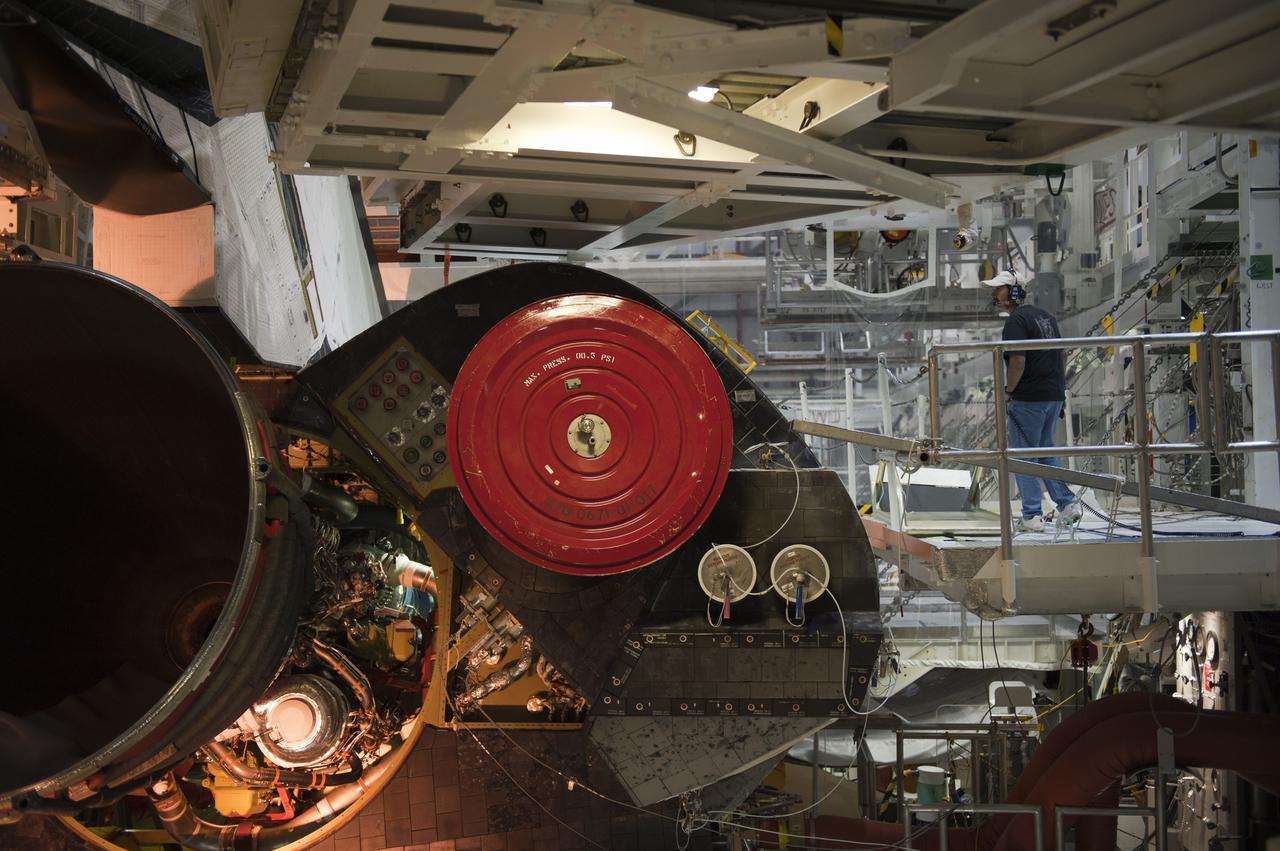
CAPE CANAVERAL, Fla. -- In Orbiter Processing Facility-1 at NASA's Kennedy Space Center in Florida, technicians move an aft access platform into place behind shuttle Atlantis, following the installation of the spacecraft's three main engines. Atlantis is being prepared for the "launch on need," or potential rescue mission, for the final planned shuttle flight, Endeavour's STS-134 mission. For more information, visit www.nasa.gov/shuttle. Photo credit: NASA/Kim Shiflett
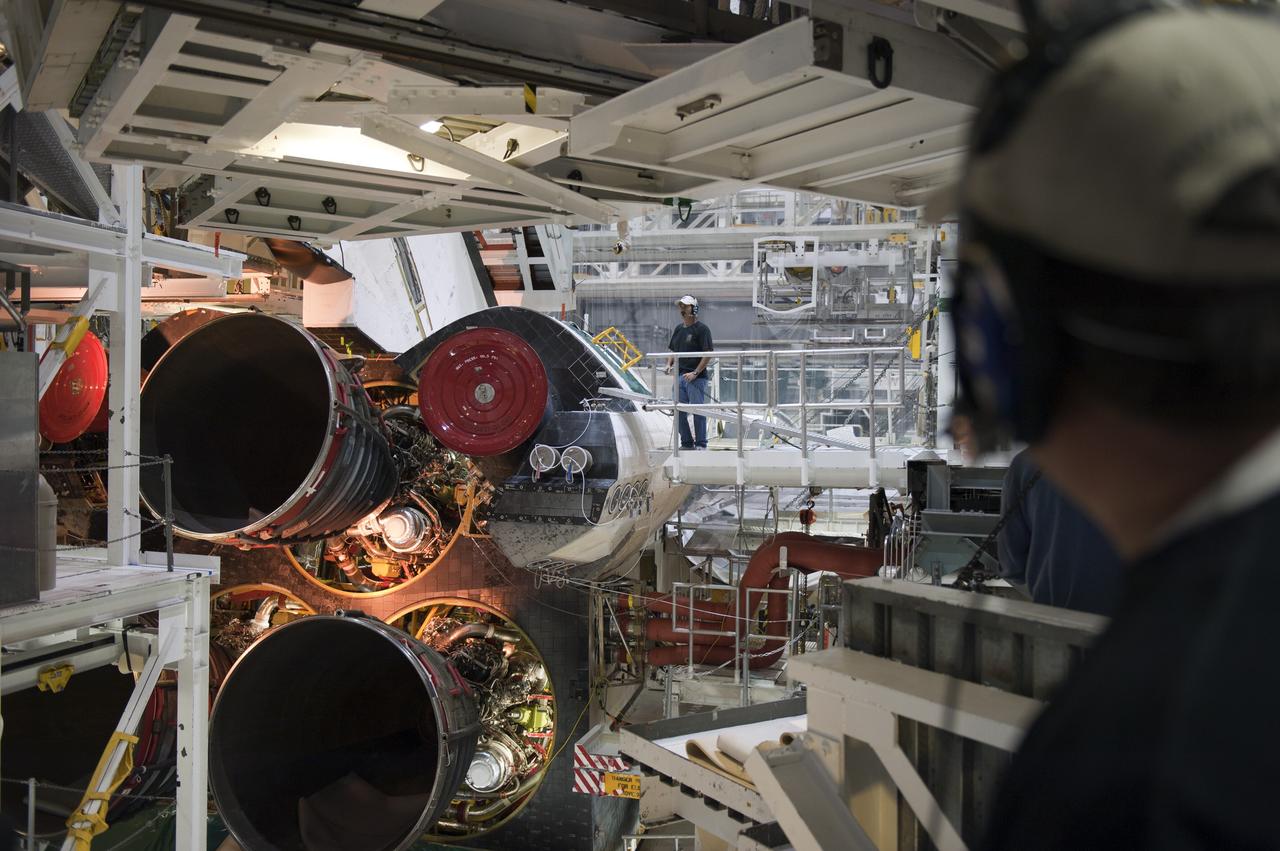
CAPE CANAVERAL, Fla. -- In Orbiter Processing Facility-1 at NASA's Kennedy Space Center in Florida, technicians move an aft access platform into place behind shuttle Atlantis, following the installation of the spacecraft's three main engines. Atlantis is being prepared for the "launch on need," or potential rescue mission, for the final planned shuttle flight, Endeavour's STS-134 mission. For more information, visit www.nasa.gov/shuttle. Photo credit: NASA/Kim Shiflett
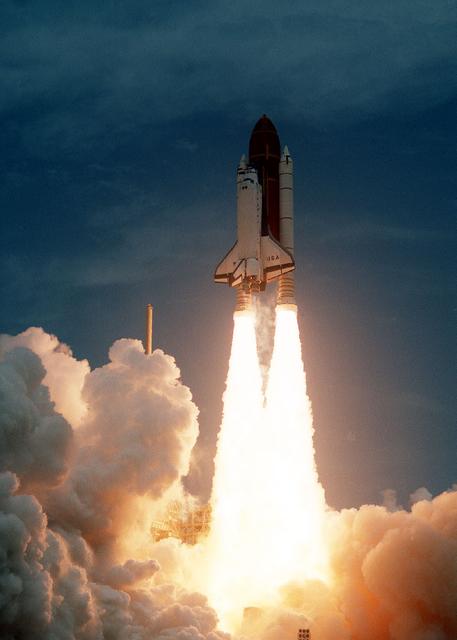
Space Shuttle Columbia (STS-50) launched into history carrying crew of seven and its payload was comprised of the US Microgravity Laboratory 1 (USML-1).The USML-1 was one of NASA's missions dedicated to scientific investigations in a microgravity environment inside the Spacelab module. Investigations aboard the USML-1 included: materials science, fluid dynamics, biotechnology (crystal growth), and combustion science. Managed by Marshall Space Flight Center, the STS-50 mission was plarned for a 13-day duration, the mission ended with 14 days in space, the longest Shuttle mission to date.

SPACE SHUTTLE STS-71 (MIR 18) SLM-1, FLIGHT FIXATIVE BAGS (FLOWN ONBOARD) QUAIL EGGS

SPACE SHUTTLE STS-71 (MIR 18) SLM-1, FLIGHT FIXATIVE BAGS (FLOWN ONBOARD) QUAIL EGGS
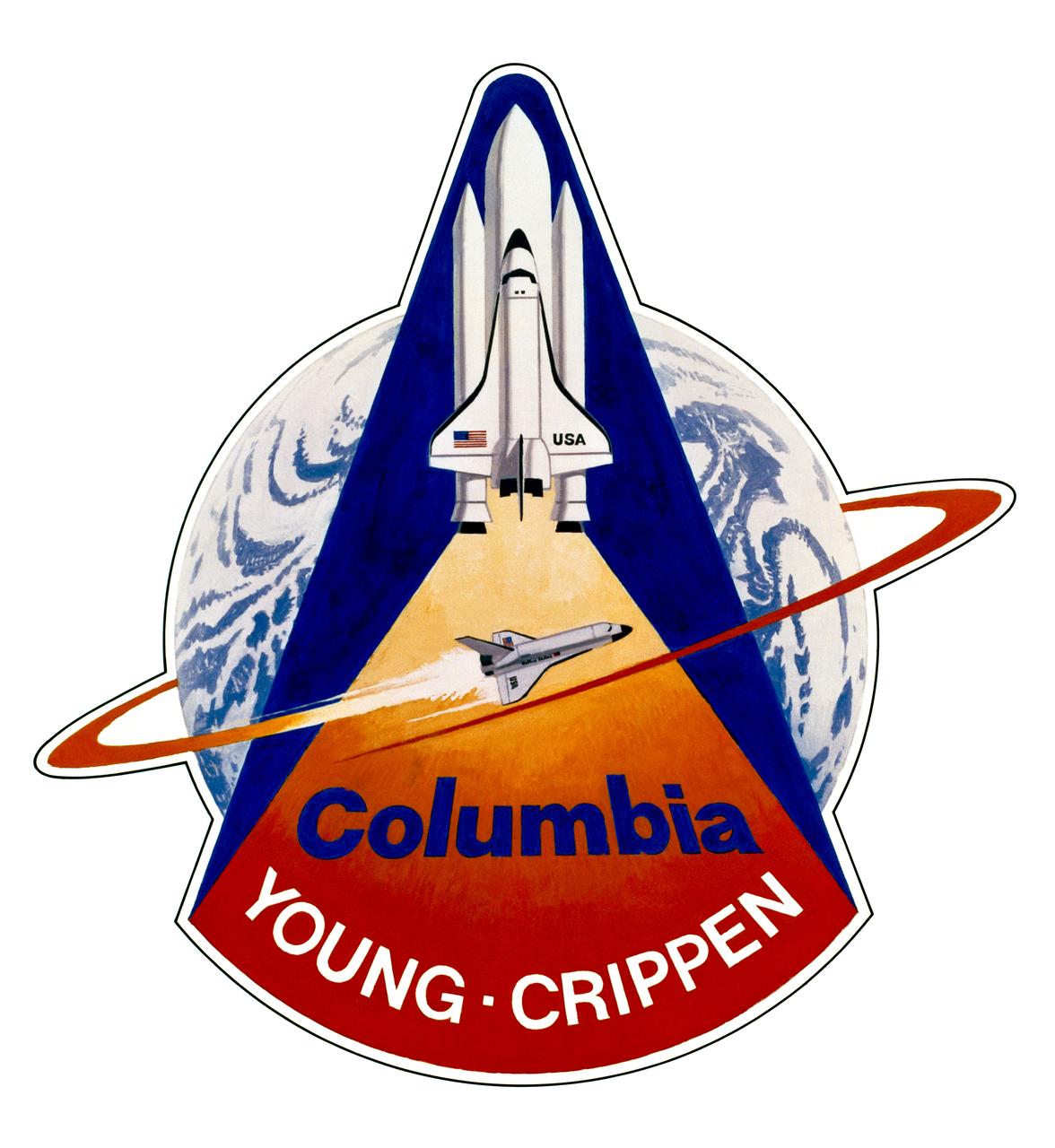
S79-30685 (10 March 1979) --- This is the official insignia for the first space shuttle orbital flight test (STS-1). Crew of the 102 Columbia on STS-1 will be astronauts John W. Young, commander, and Robert L. Crippen, pilot. The artwork was done by artist Robert McCall. The NASA insignia design for space shuttle flights is reserved for use by the astronauts and for other official use as the NASA Administrator may authorize. Public availability has been approved only in the forms of illustrations by the various news media. When and if there is any change in this policy, which is not anticipated, the change will be publicly announced. Photo credit: NASA
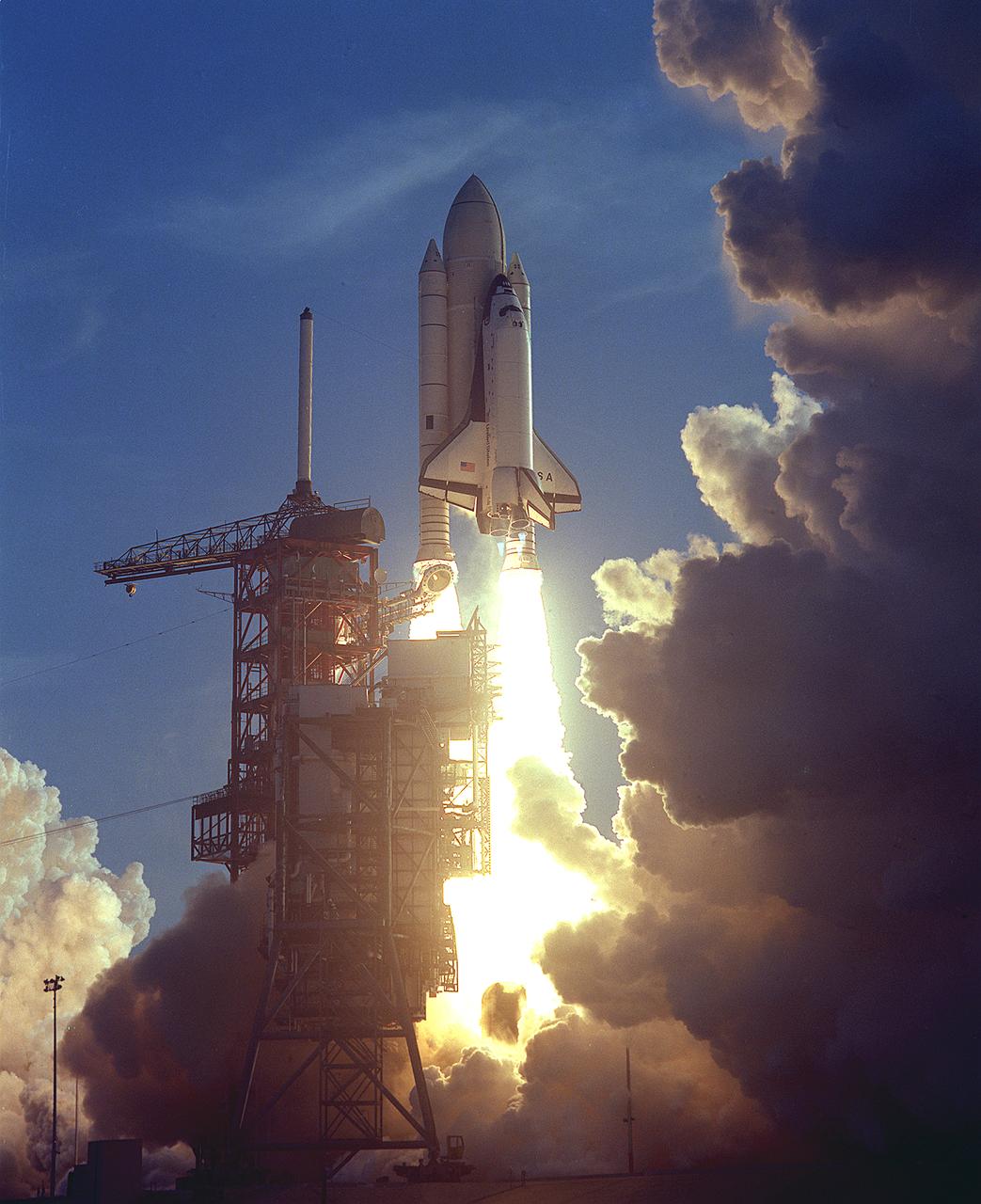
The new era in space flight began on April 12, 1981. That is when the first Space Shuttle mission (STS-1) was launched. The Marshall Space Flight Center developed the propulsion system for the Space Shuttle. This photograph depicts the launch of the Space Shuttle Orbiter Columbia marned with two astronauts, John Young and Robert Crippen.
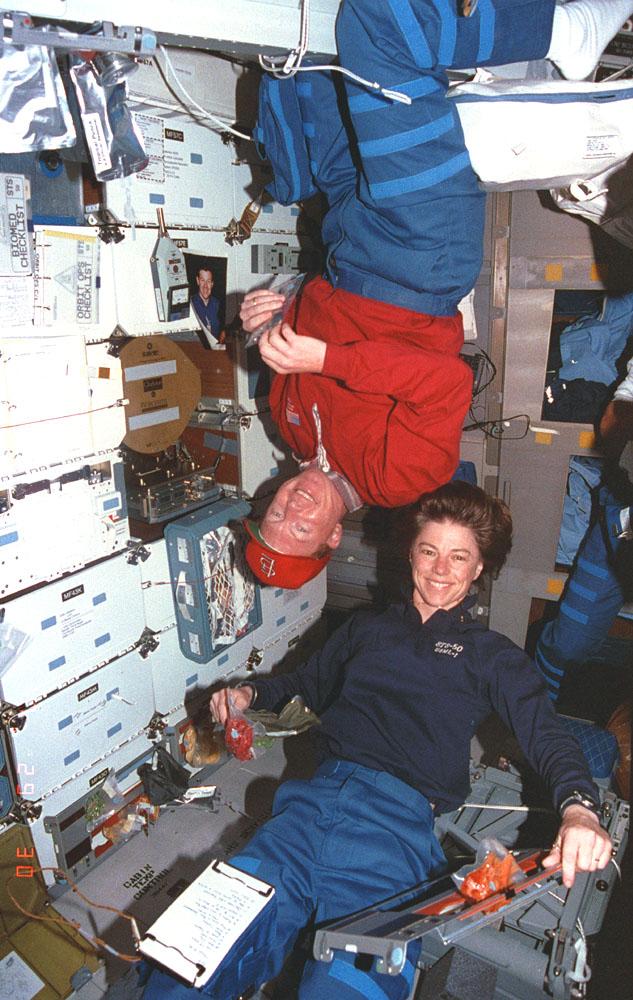
Onboard Space Shuttle Columbia (STS-50) all work and no play make commander Richard (Dick) Richards and payload commander Bornie Dunbar take a break from their work in the United States Microgravity Laboratory (USML-1) responsibilities.
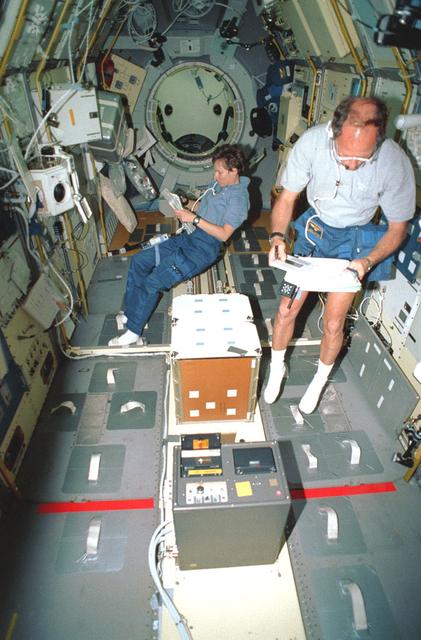
Onboard Space Shuttle Discovery (STS-42) Astronaut Norman E. Thagard, payload commander, and Canadian payload specialist Roberta L. Bondar are busily engaged with experiments in the International Microgravity Laboratory (IML-1) science module. Bondar reads a checklist near the Biorack while Thagard performs a VCR tape change-out. The two, along with four other NASA astronauts and a second IML-1 payload specialist spent more than eight days conducting experiments in Earth orbit. Part of the Space Acceleration Measurement System is in center foreground.
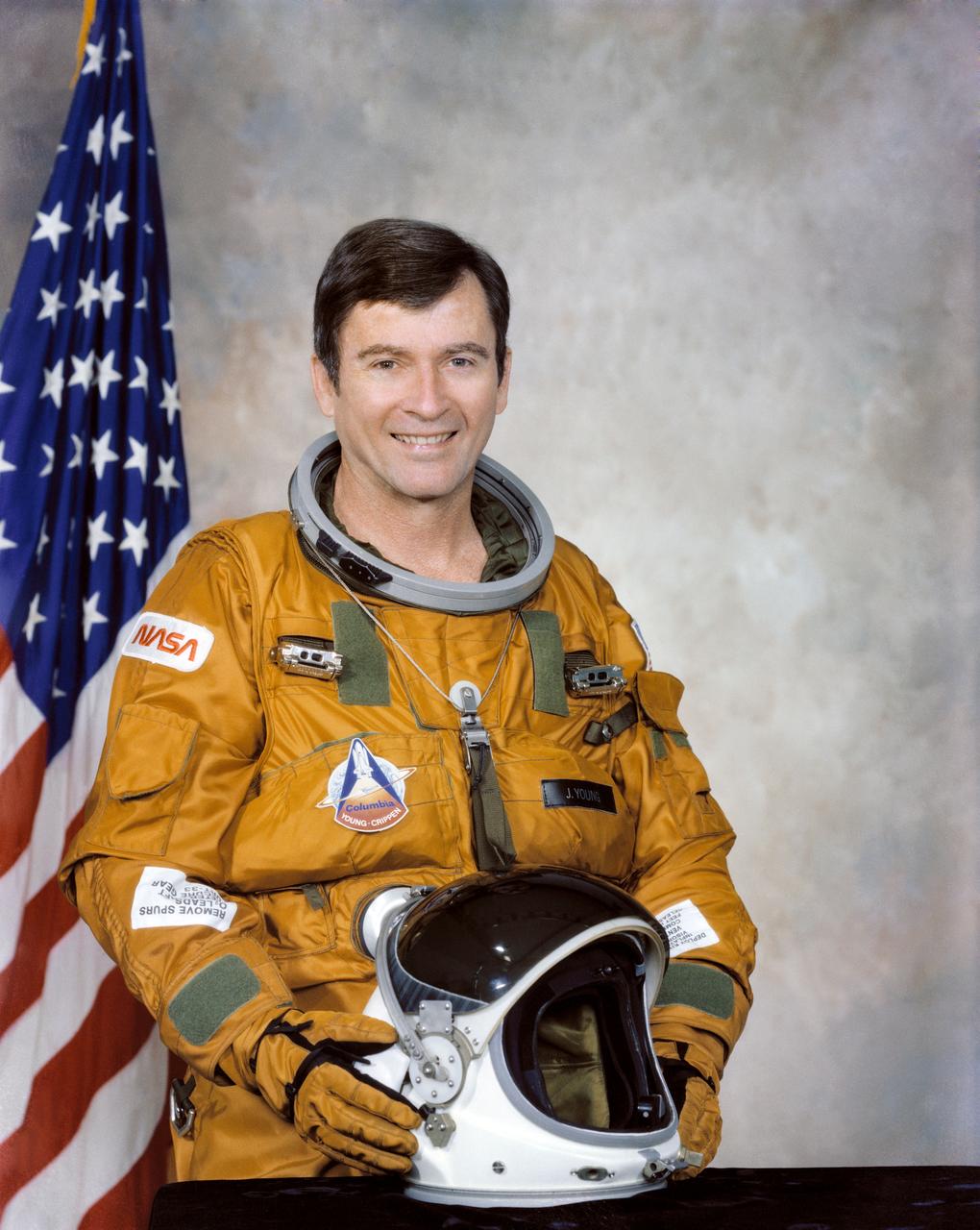
S79-31776 (29 April 1979) - Astronaut John W. Young, STS-1 Commander.
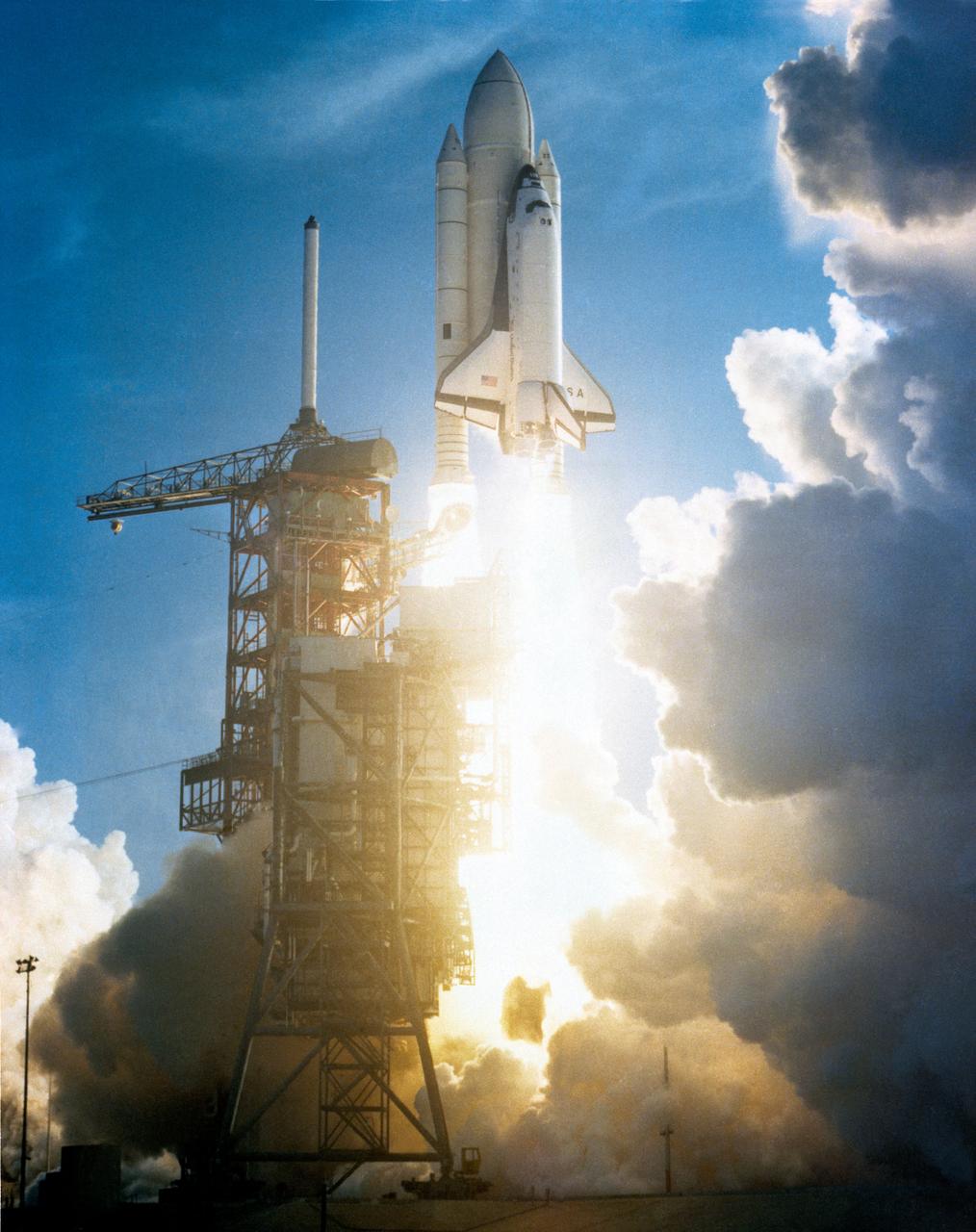
The Space Shuttle Columbia begins a new era of space transportation when it lifts off from NASA Kennedy Space Center (KSC). The reusable Orbiter, its two (2) fuel tanks and two (2) Solid Rocket Boosters (SRB) has just cleared the launch tower. Aboard the spacecraft are Astronauts John W. Young, Commander, and Robert L. Crippen, Pilot . 1. STS-I - LAUNCH KSC, FL KSC, FL Also available in 4x5 BW
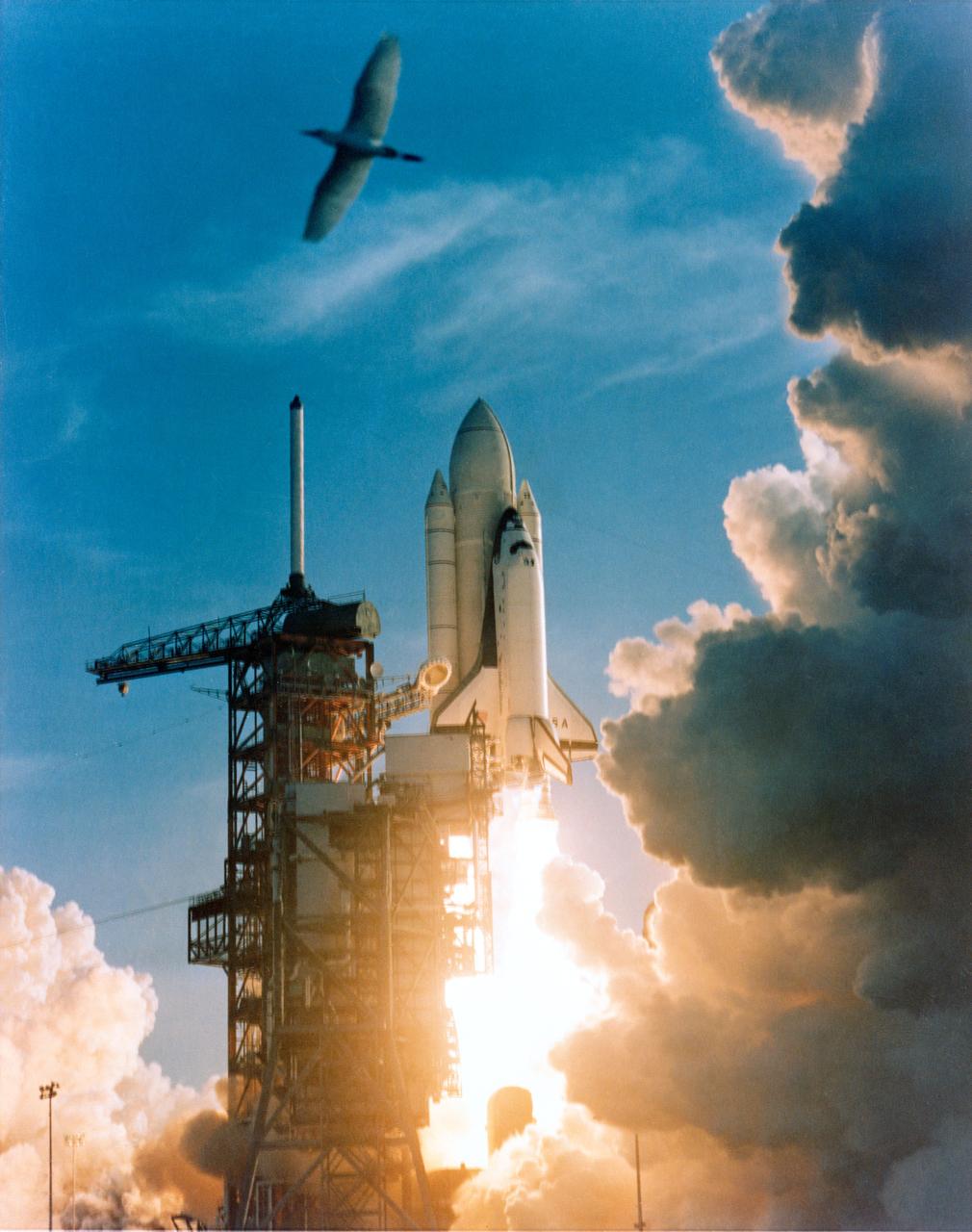
The Space Shuttle Columbia begins a new era of space transportation when it lifts off from NASA Kennedy Space Center (KSC). The reusable Orbiter, its two (2) fuel tanks and two (2) Solid Rocket Boosters (SRB) has just cleared the launch tower. Aboard the spacecraft are Astronauts John W. Young, Commander, and Robert L. Crippen, Pilot . 1. STS-I - LAUNCH KSC, FL KSC, FL Also available in 4x5 BW
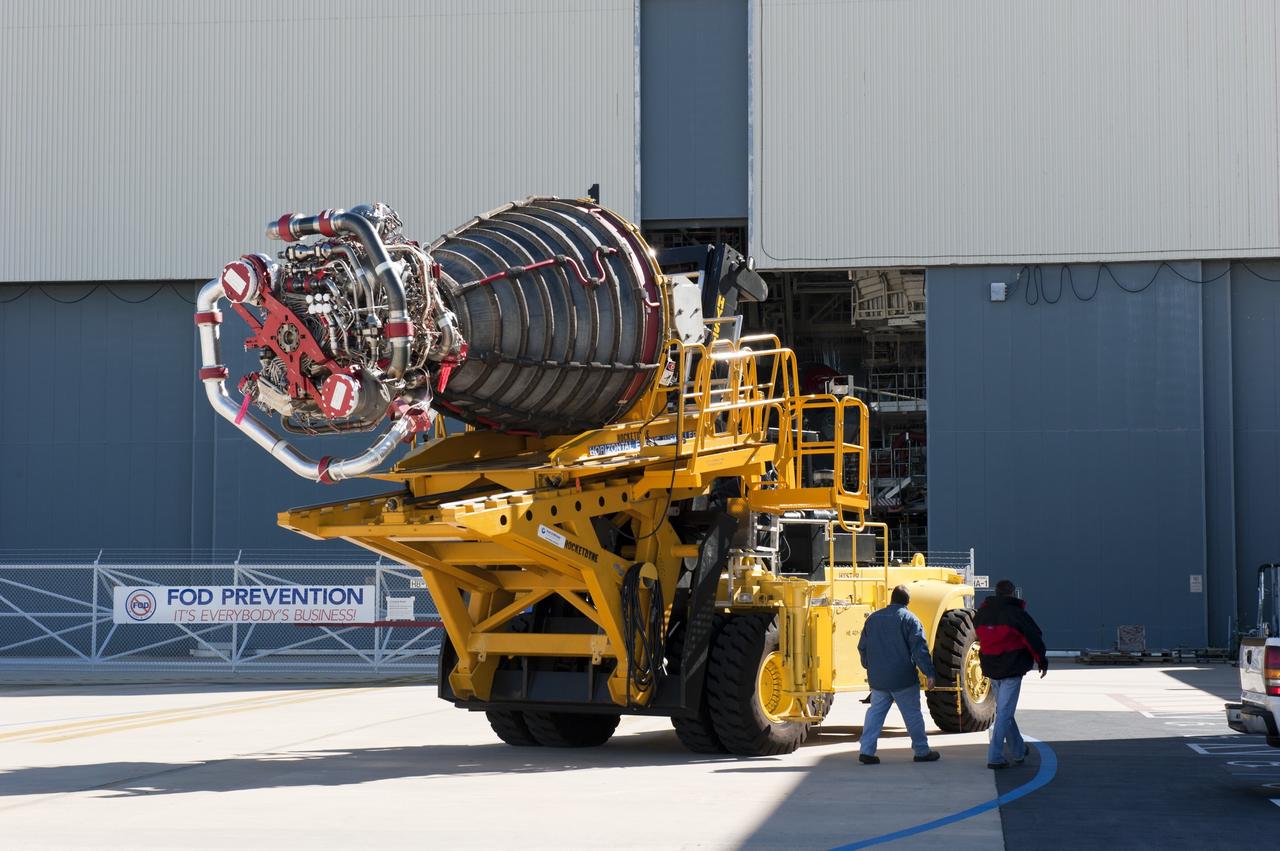
CAPE CANAVERAL, Fla. -- A Hyster forklift transports the second of shuttle Atlantis' three main engines from the Space Shuttle Main Engine (SSME) Shop to Orbiter Processing Facility-1 at NASA's Kennedy Space Center in Florida. Once inside the processing facility, the engine will be installed in the shuttle. Each engine is 14 feet long, weighs about 6,700 pounds, and is 7.5 feet in diameter at the end of the nozzle. This is the final planned engine installation for the Space Shuttle Program. Atlantis is being prepared for the "launch on need," or potential rescue mission, for the final planned shuttle flight, Endeavour's STS-134 mission. For more information, visit www.nasa.gov/shuttle. Photo credit: NASA/Kim Shiflett
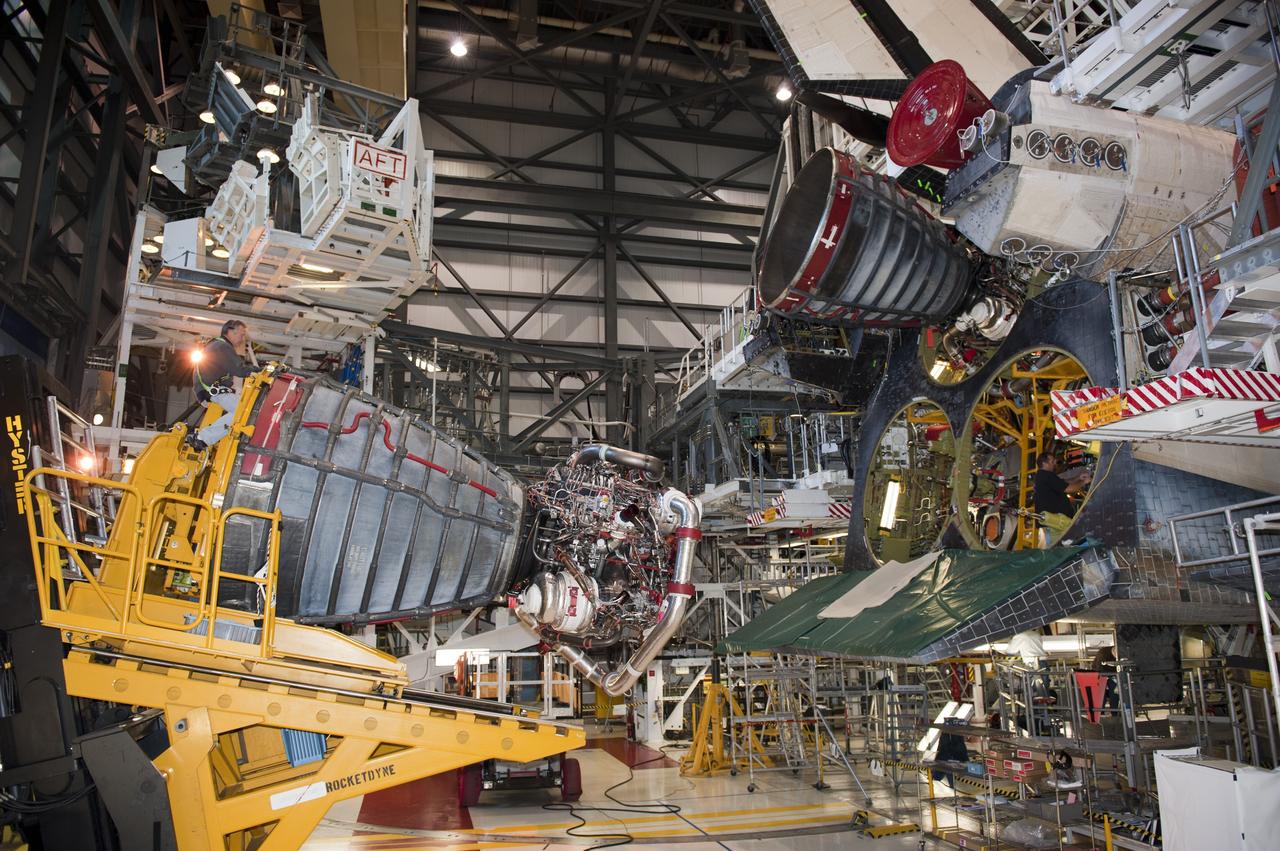
CAPE CANAVERAL, Fla. -- In Orbiter Processing Facility-1 at NASA's Kennedy Space Center in Florida, a Hyster forklift moves the second of three space shuttle main engines closer to shuttle Atlantis for installation. Each engine is 14 feet long, weighs about 6,700 pounds, and is 7.5 feet in diameter at the end of the nozzle. This is the final planned engine installation for the Space Shuttle Program. Atlantis is being prepared for the "launch on need," or potential rescue mission, for the final planned shuttle flight, Endeavour's STS-134 mission. For more information, visit www.nasa.gov/shuttle. Photo credit: NASA/Kim Shiflett
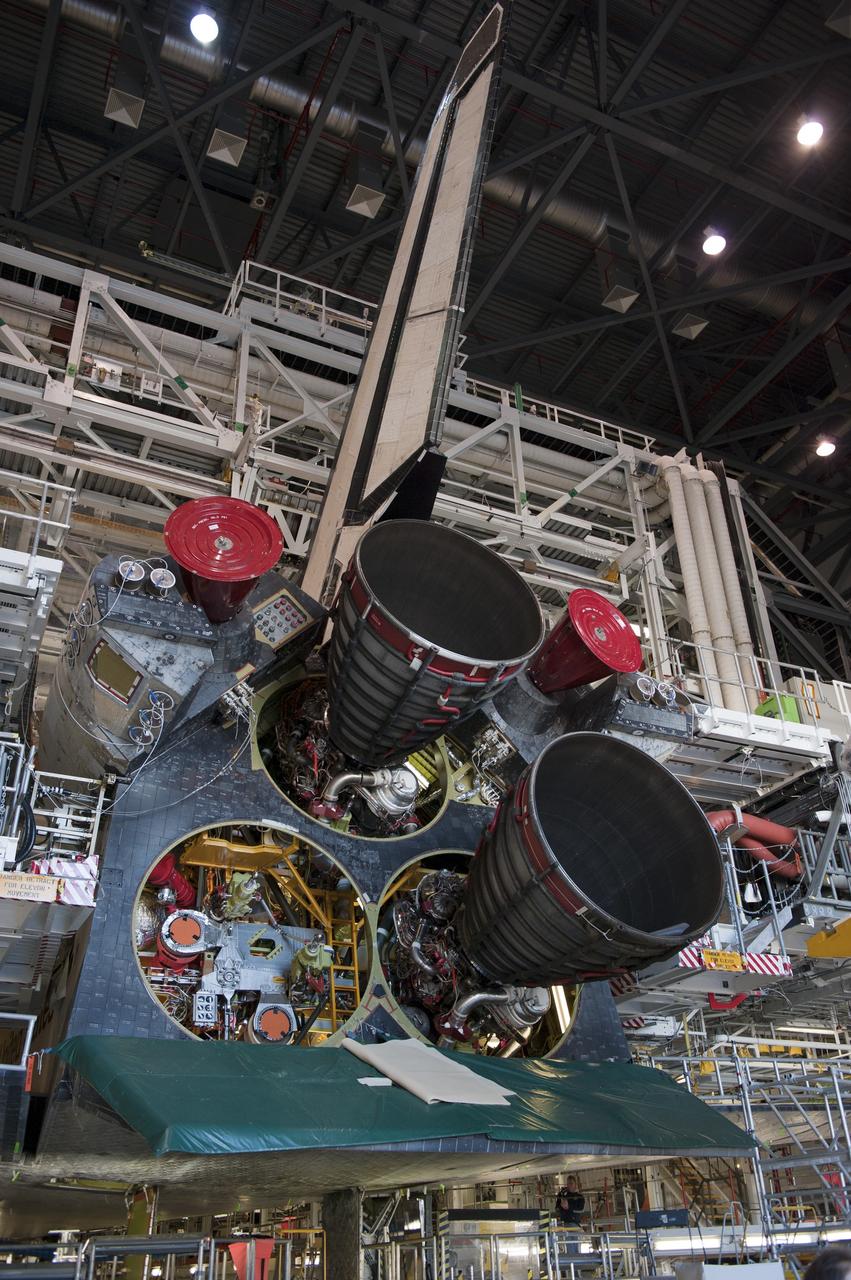
CAPE CANAVERAL, Fla. -- In Orbiter Processing Facility-1 at NASA's Kennedy Space Center in Florida, the second of three space shuttle main engines is installed in shuttle Atlantis. Each engine is 14 feet long, weighs about 6,700 pounds, and is 7.5 feet in diameter at the end of the nozzle. This is the final planned engine installation for the Space Shuttle Program. Atlantis is being prepared for the "launch on need," or potential rescue mission, for the final planned shuttle flight, Endeavour's STS-134 mission. For more information, visit www.nasa.gov/shuttle. Photo credit: NASA/Kim Shiflett
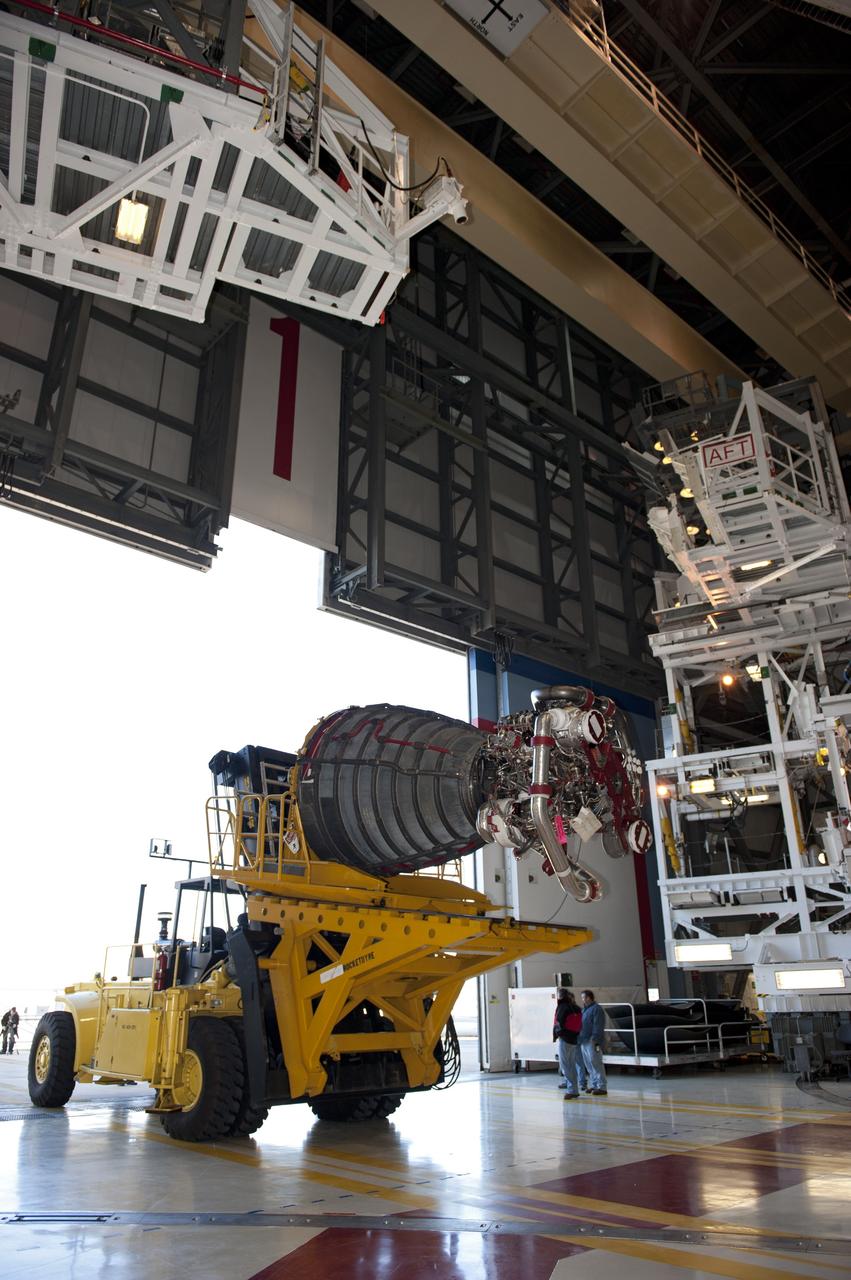
CAPE CANAVERAL, Fla. -- A Hyster forklift transporting the second of shuttle Atlantis' three main engines arrives at Orbiter Processing Facility-1 from the Space Shuttle Main Engine (SSME) Shop at NASA's Kennedy Space Center in Florida. There, the engine will be installed in the shuttle. Each engine is 14 feet long, weighs about 6,700 pounds, and is 7.5 feet in diameter at the end of the nozzle. This is the final planned engine installation for the Space Shuttle Program. Atlantis is being prepared for the "launch on need," or potential rescue mission, for the final planned shuttle flight, Endeavour's STS-134 mission. For more information, visit www.nasa.gov/shuttle. Photo credit: NASA/Kim Shiflett
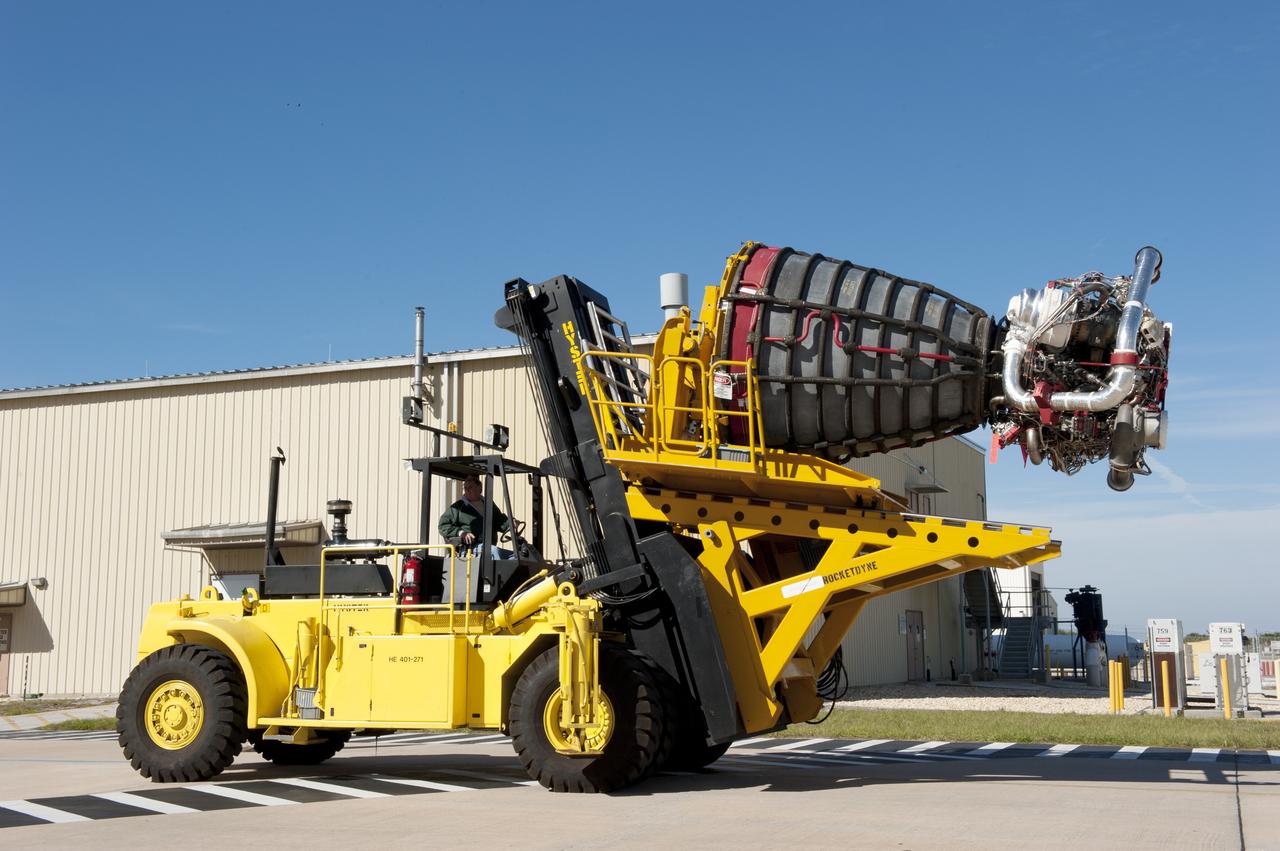
CAPE CANAVERAL, Fla. -- A Hyster forklift transports engine #2, the last of shuttle Atlantis' three main engines, from the Space Shuttle Main Engine (SSME) Shop to Orbiter Processing Facility-1 at NASA's Kennedy Space Center in Florida. Inside the processing facility, the engine will be installed in the shuttle. Each engine is 14 feet long, weighs about 6,700 pounds, and is 7.5 feet in diameter at the end of the nozzle. This is the final planned engine installation for the Space Shuttle Program. Atlantis is being prepared for the "launch on need," or potential rescue mission, for the final planned shuttle flight, Endeavour's STS-134 mission. For more information, visit www.nasa.gov/shuttle. Photo credit: NASA/Kim Shiflett
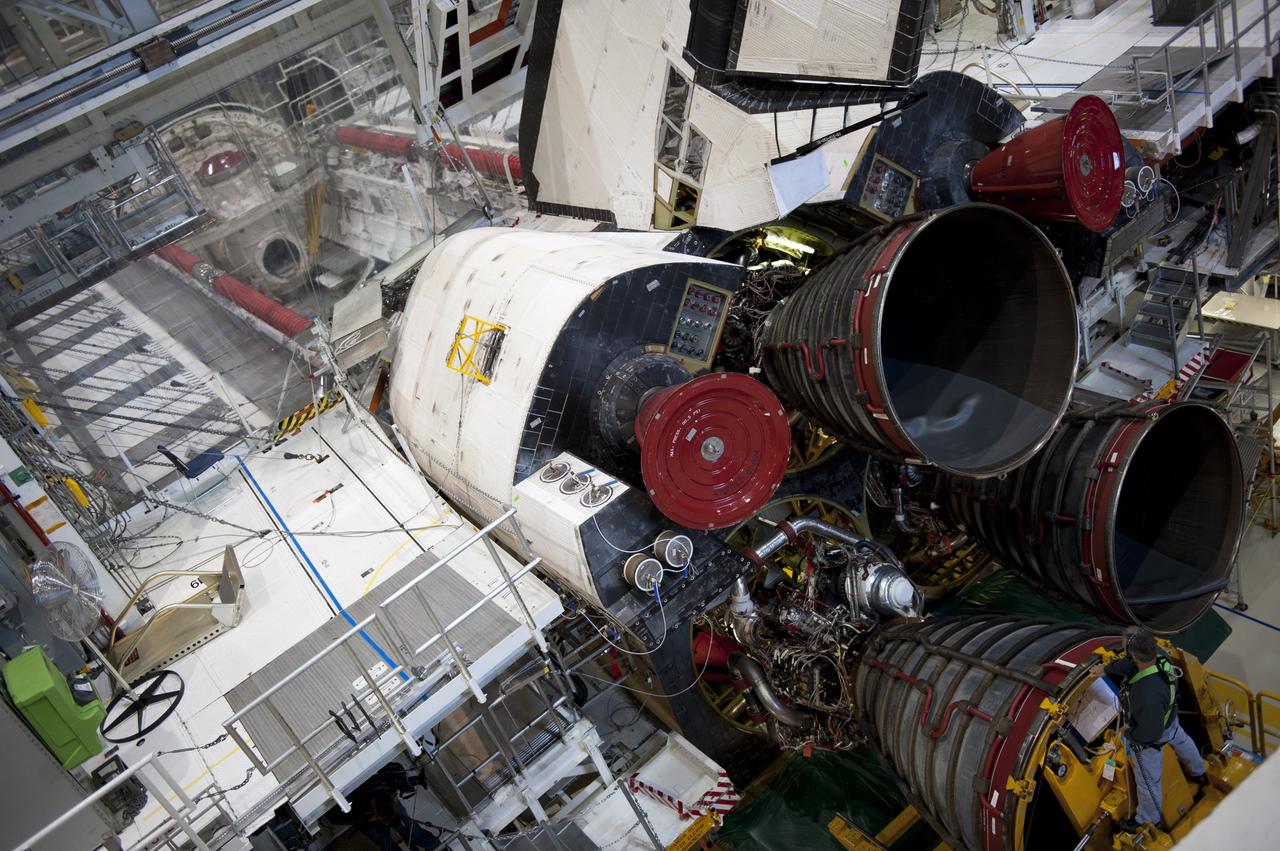
CAPE CANAVERAL, Fla. -- In Orbiter Processing Facility-1 at NASA's Kennedy Space Center in Florida, engine #2, the last of three space shuttle main engines is installed in shuttle Atlantis. Each engine is 14 feet long, weighs about 6,700 pounds, and is 7.5 feet in diameter at the end of the nozzle. This is the final planned engine installation for the Space Shuttle Program. Atlantis is being prepared for the "launch on need," or potential rescue mission, for the final planned shuttle flight, Endeavour's STS-134 mission. For more information, visit www.nasa.gov/shuttle. Photo credit: NASA/Kim Shiflett
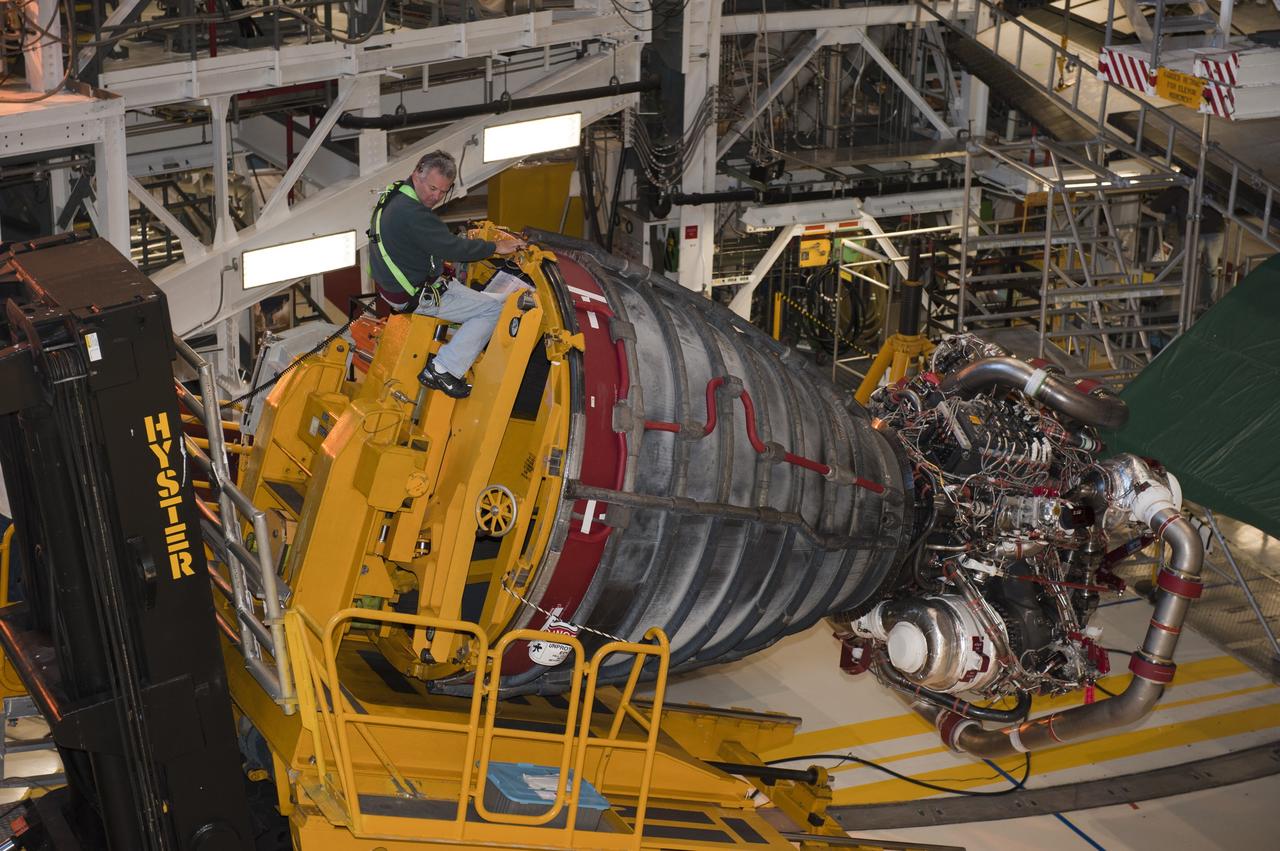
CAPE CANAVERAL, Fla. -- In Orbiter Processing Facility-1 at NASA's Kennedy Space Center in Florida, a Hyster forklift moves the first of three space shuttle main engines closer to space shuttle Atlantis for installation. Each engine is 14 feet long, weighs about 6,700 pounds, and is 7.5 feet in diameter at the end of the nozzle. This is the final planned engine installation for the Space Shuttle Program. Atlantis is being prepared for the "launch on need," or potential rescue mission, for the final planned shuttle flight, Endeavour's STS-134 mission. For more information, visit www.nasa.gov/shuttle. Photo credit: NASA/Kim Shiflett
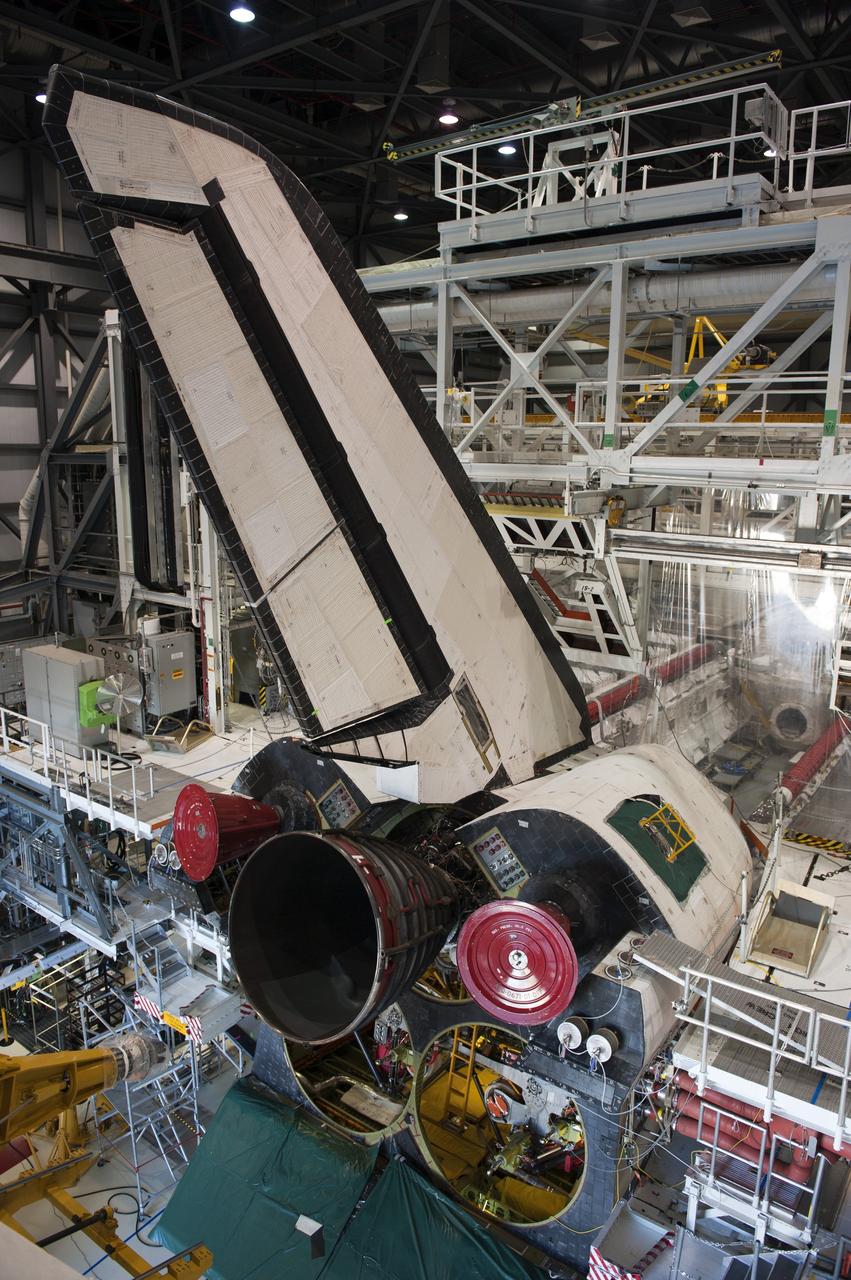
CAPE CANAVERAL, Fla. -- In Orbiter Processing Facility-1 at NASA's Kennedy Space Center in Florida, the first of three space shuttle main engines is installed in space shuttle Atlantis. Each engine is 14 feet long, weighs about 6,700 pounds, and is 7.5 feet in diameter at the end of the nozzle. This is the final planned engine installation for the Space Shuttle Program. Atlantis is being prepared for the "launch on need," or potential rescue mission, for the final planned shuttle flight, Endeavour's STS-134 mission. For more information, visit www.nasa.gov/shuttle. Photo credit: NASA/Kim Shiflett
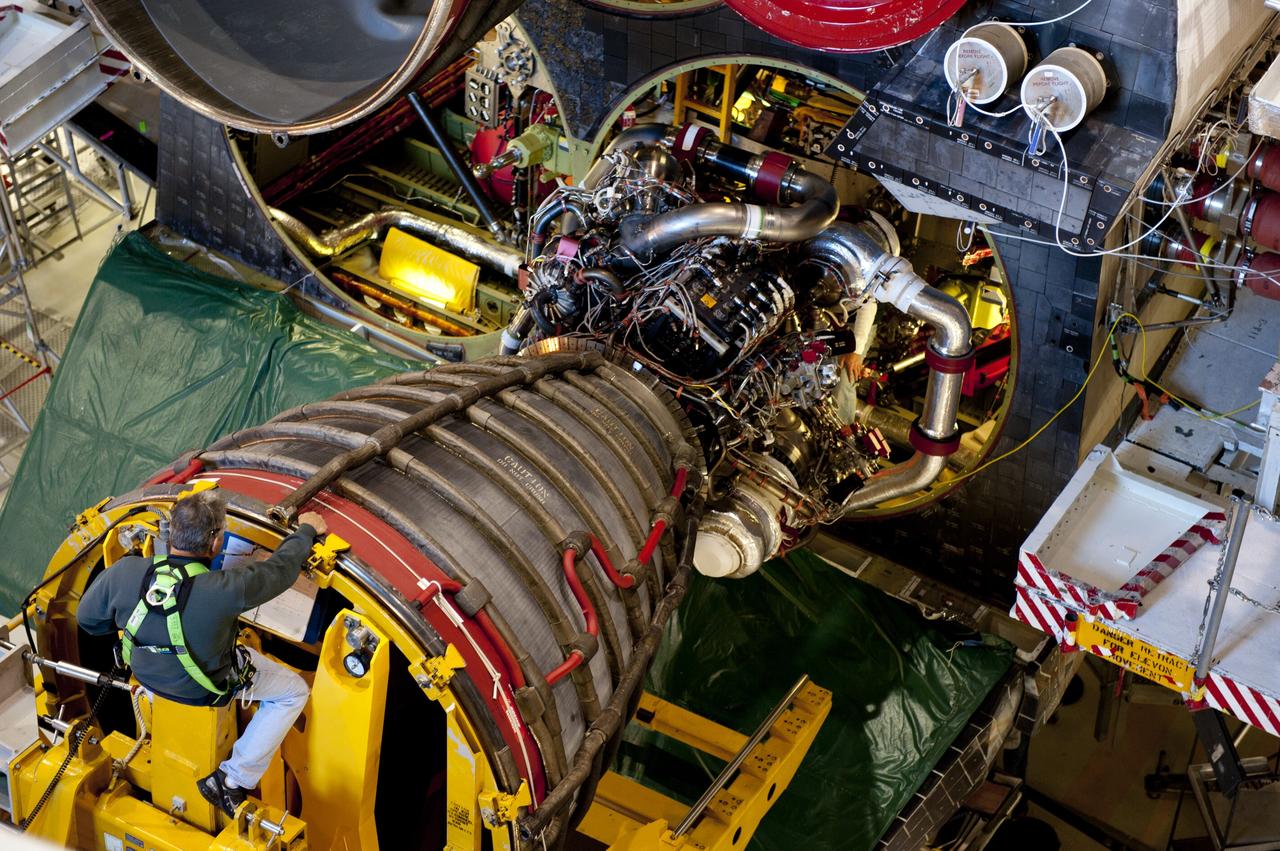
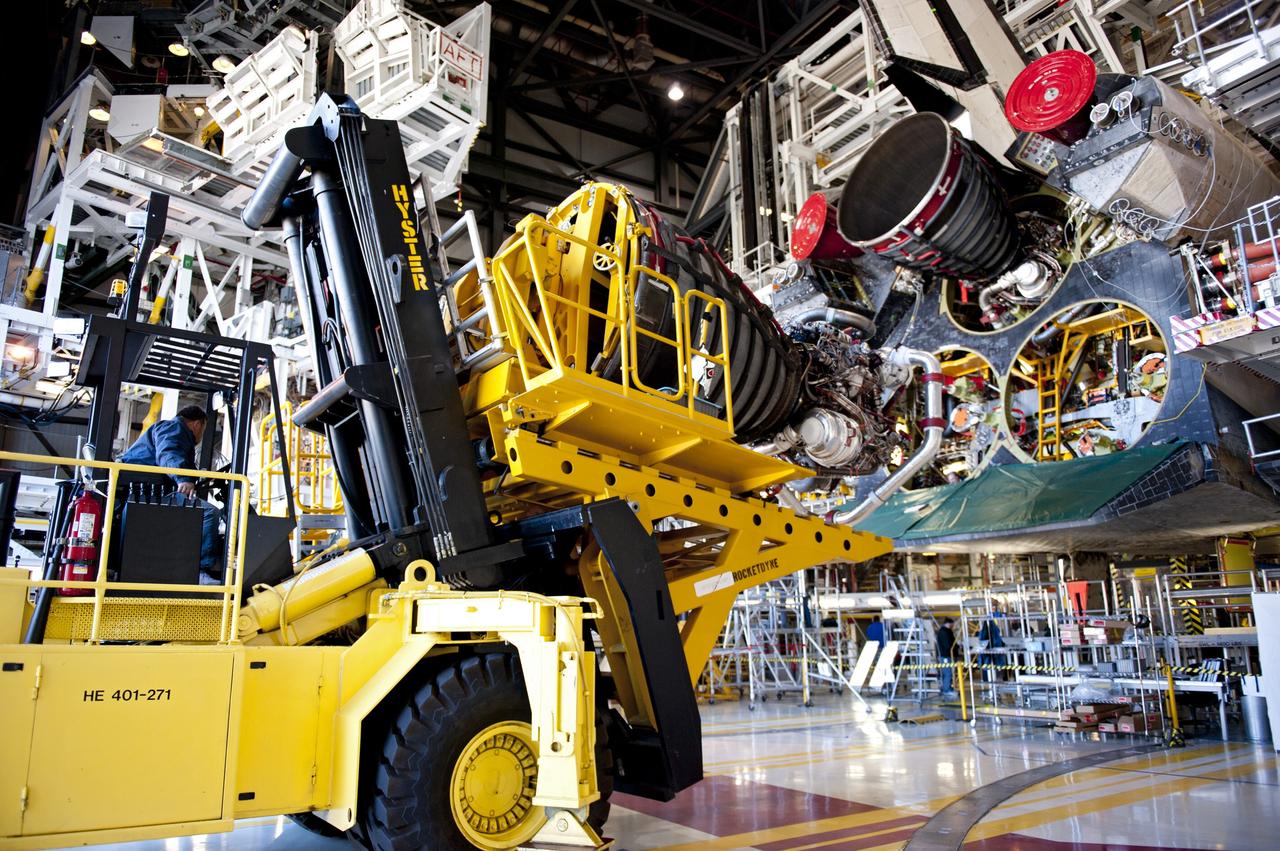
CAPE CANAVERAL, Fla. -- In Orbiter Processing Facility-1 at NASA's Kennedy Space Center in Florida, a Hyster forklift moves the second of three space shuttle main engines closer to shuttle Atlantis for installation. Each engine is 14 feet long, weighs about 6,700 pounds, and is 7.5 feet in diameter at the end of the nozzle. This is the final planned engine installation for the Space Shuttle Program. Atlantis is being prepared for the "launch on need," or potential rescue mission, for the final planned shuttle flight, Endeavour's STS-134 mission. For more information, visit www.nasa.gov/shuttle. Photo credit: NASA/Kim Shiflett
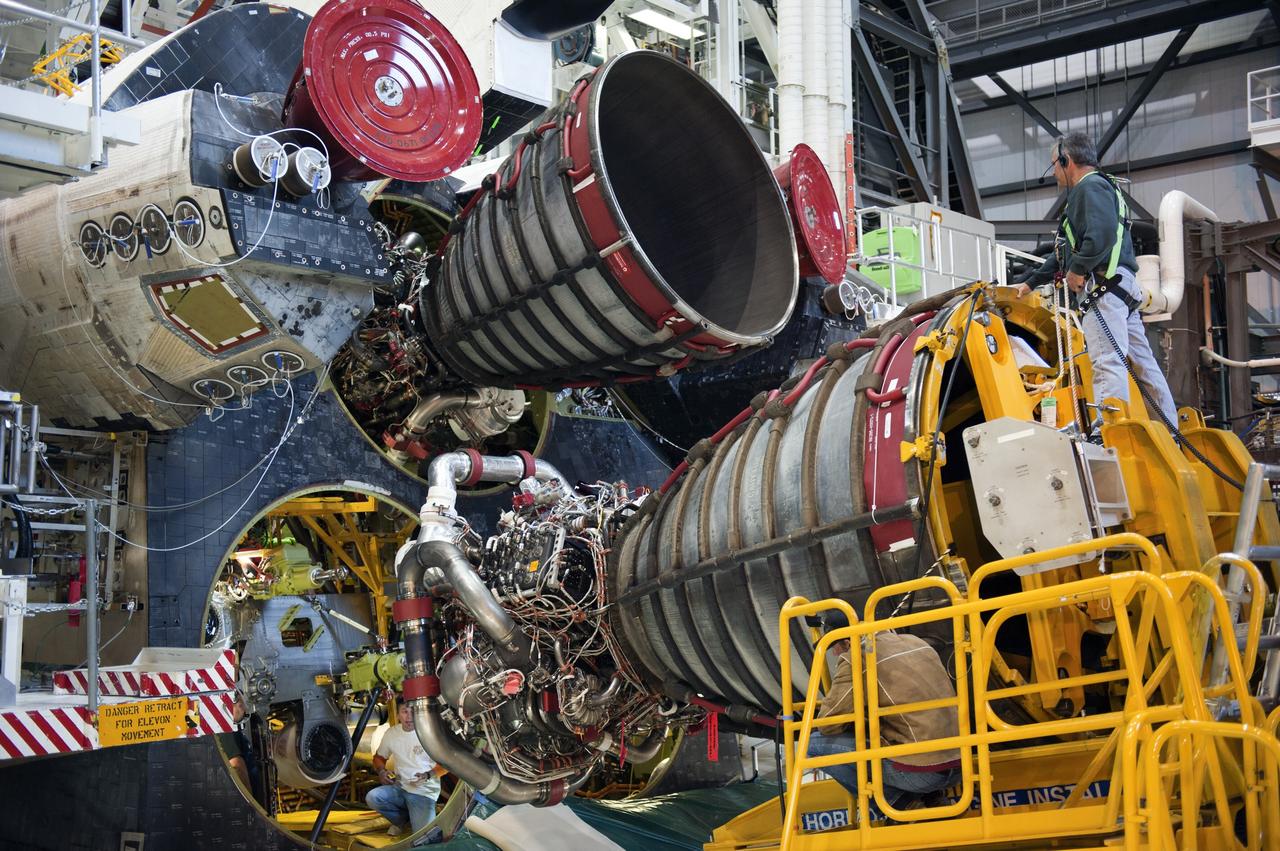
CAPE CANAVERAL, Fla. -- In Orbiter Processing Facility-1 at NASA's Kennedy Space Center in Florida, a Hyster forklift moves engine #2, the last of three space shuttle main engines, into position for installation on shuttle Atlantis. Each engine is 14 feet long, weighs about 6,700 pounds, and is 7.5 feet in diameter at the end of the nozzle. This is the final planned engine installation for the Space Shuttle Program. Atlantis is being prepared for the "launch on need," or potential rescue mission, for the final planned shuttle flight, Endeavour's STS-134 mission. For more information, visit www.nasa.gov/shuttle. Photo credit: NASA/Kim Shiflett
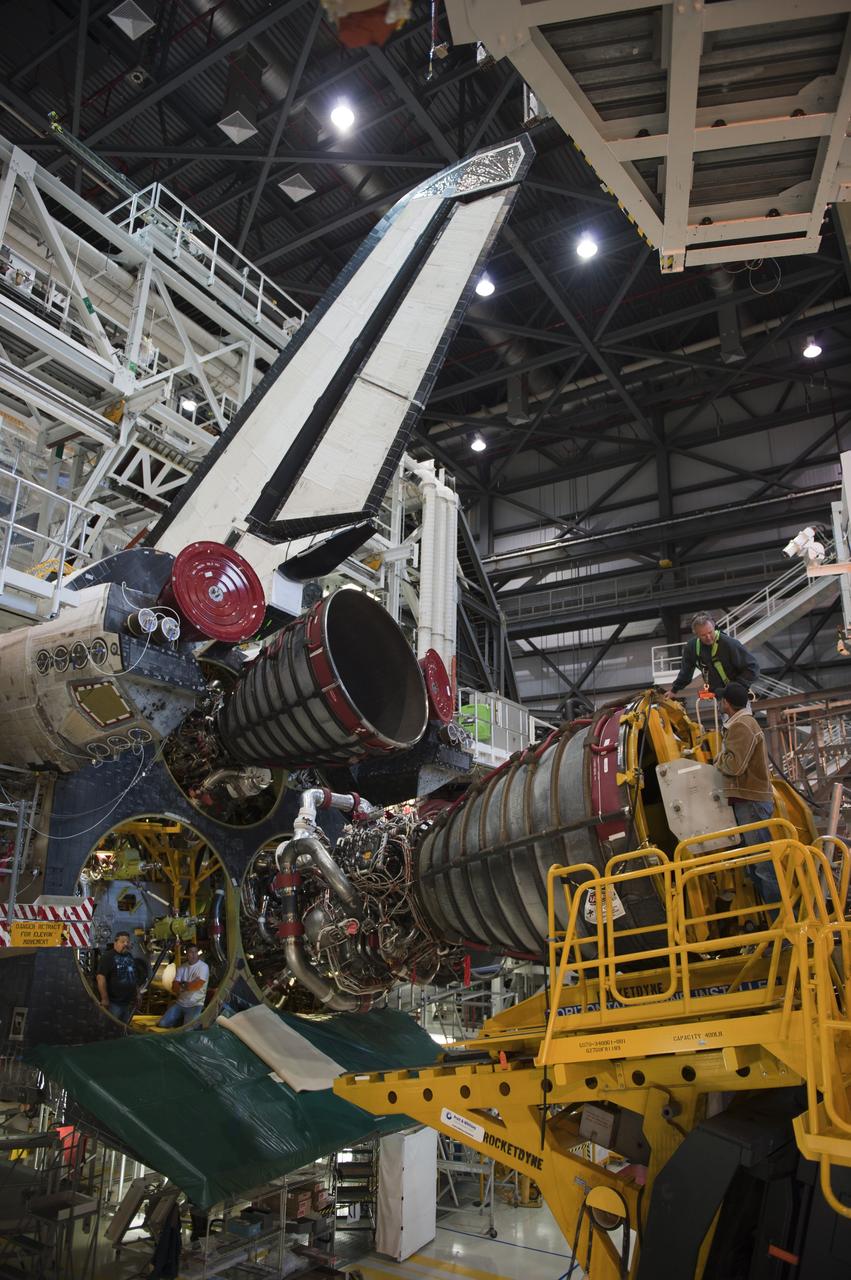
CAPE CANAVERAL, Fla. -- In Orbiter Processing Facility-1 at NASA's Kennedy Space Center in Florida, a Hyster forklift moves engine #2, the last of three space shuttle main engines, into position for installation on shuttle Atlantis. Each engine is 14 feet long, weighs about 6,700 pounds, and is 7.5 feet in diameter at the end of the nozzle. This is the final planned engine installation for the Space Shuttle Program. Atlantis is being prepared for the "launch on need," or potential rescue mission, for the final planned shuttle flight, Endeavour's STS-134 mission. For more information, visit www.nasa.gov/shuttle. Photo credit: NASA/Kim Shiflett
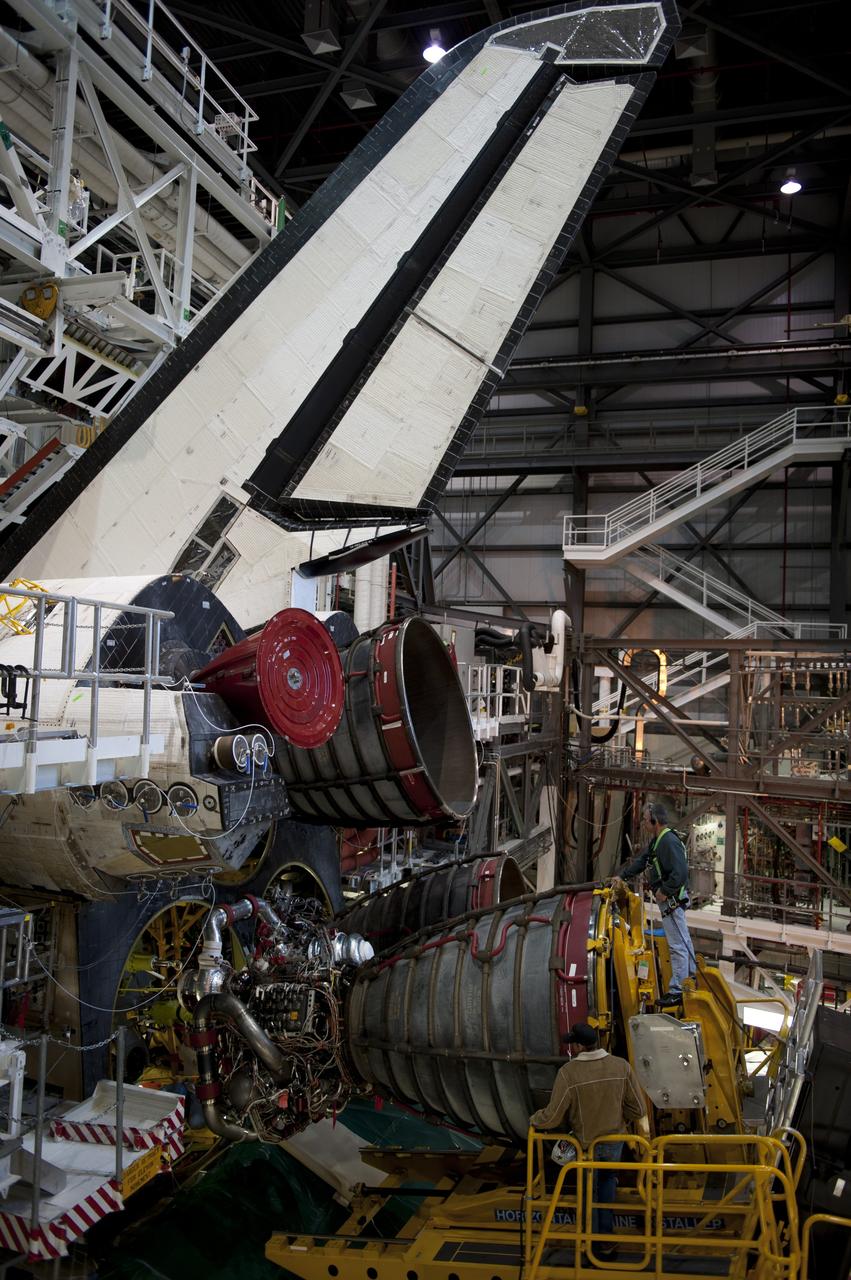
CAPE CANAVERAL, Fla. -- In Orbiter Processing Facility-1 at NASA's Kennedy Space Center in Florida, a Hyster forklift moves engine #2, the last of three space shuttle main engines, into position for installation on shuttle Atlantis. Each engine is 14 feet long, weighs about 6,700 pounds, and is 7.5 feet in diameter at the end of the nozzle. This is the final planned engine installation for the Space Shuttle Program. Atlantis is being prepared for the "launch on need," or potential rescue mission, for the final planned shuttle flight, Endeavour's STS-134 mission. For more information, visit www.nasa.gov/shuttle. Photo credit: NASA/Kim Shiflett
CAPE CANAVERAL, Fla. -- A Hyster forklift transporting the second of shuttle Atlantis' three main engines arrives at Orbiter Processing Facility-1 from the Space Shuttle Main Engine (SSME) Shop at NASA's Kennedy Space Center in Florida. There, the engine will be installed in the shuttle. Each engine is 14 feet long, weighs about 6,700 pounds, and is 7.5 feet in diameter at the end of the nozzle. This is the final planned engine installation for the Space Shuttle Program. Atlantis is being prepared for the "launch on need," or potential rescue mission, for the final planned shuttle flight, Endeavour's STS-134 mission. For more information, visit www.nasa.gov/shuttle. Photo credit: NASA/Kim Shiflett
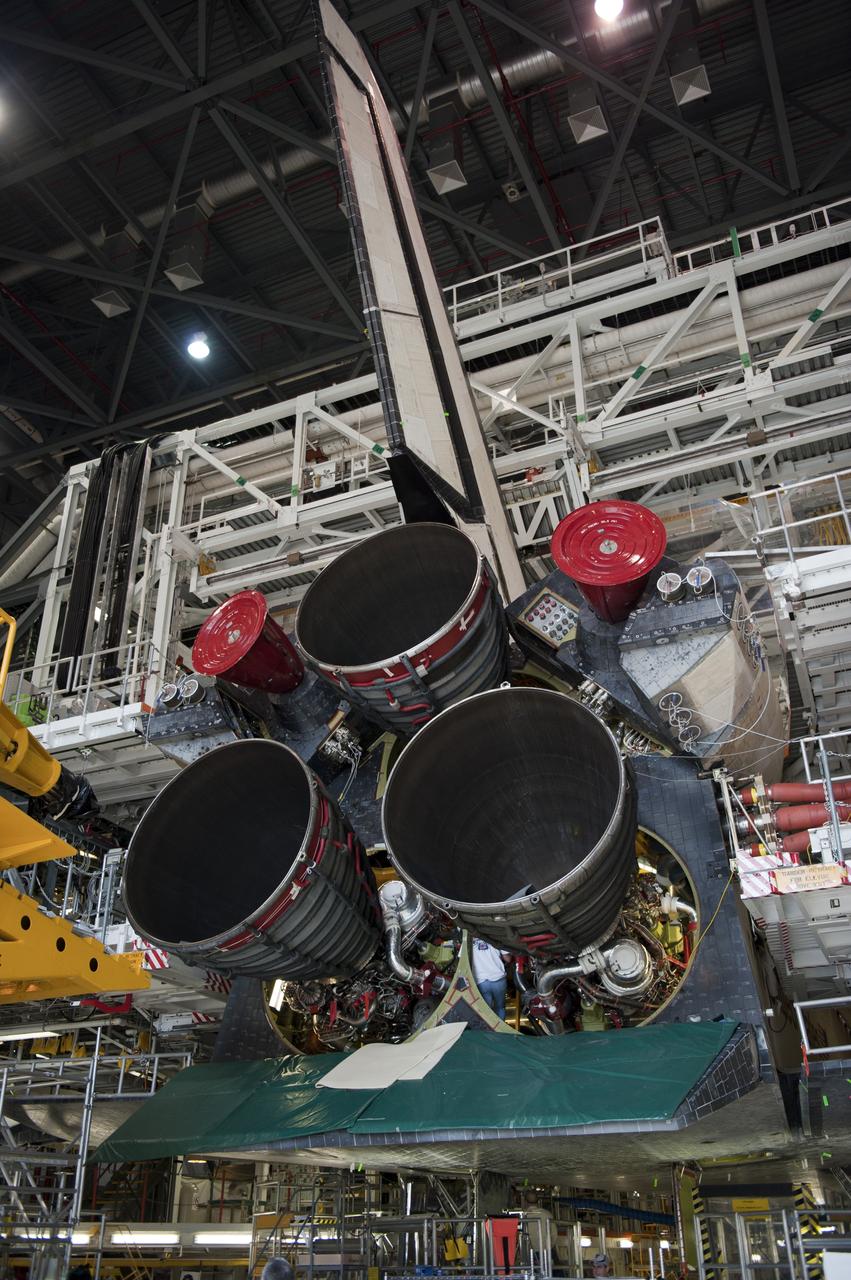
CAPE CANAVERAL, Fla. -- In Orbiter Processing Facility-1 at NASA's Kennedy Space Center in Florida, engine #2, the last of three space shuttle main engines is installed in shuttle Atlantis. Each engine is 14 feet long, weighs about 6,700 pounds, and is 7.5 feet in diameter at the end of the nozzle. This is the final planned engine installation for the Space Shuttle Program. Atlantis is being prepared for the "launch on need," or potential rescue mission, for the final planned shuttle flight, Endeavour's STS-134 mission. For more information, visit www.nasa.gov/shuttle. Photo credit: NASA/Kim Shiflett
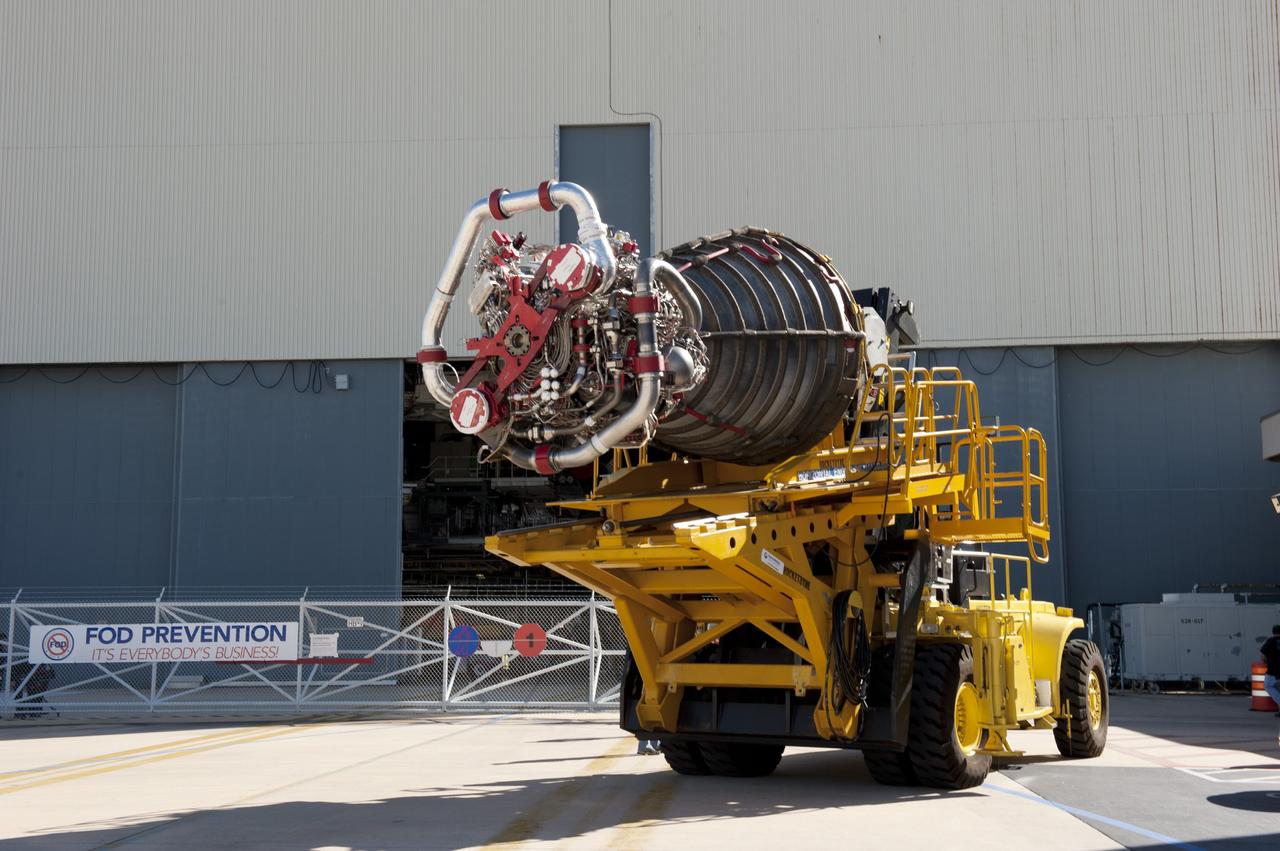
CAPE CANAVERAL, Fla. -- A Hyster forklift transports engine #2, the last of shuttle Atlantis' three main engines, from the Space Shuttle Main Engine (SSME) Shop to Orbiter Processing Facility-1 at NASA's Kennedy Space Center in Florida. Inside the processing facility, the engine will be installed in the shuttle. Each engine is 14 feet long, weighs about 6,700 pounds, and is 7.5 feet in diameter at the end of the nozzle. This is the final planned engine installation for the Space Shuttle Program. Atlantis is being prepared for the "launch on need," or potential rescue mission, for the final planned shuttle flight, Endeavour's STS-134 mission. For more information, visit www.nasa.gov/shuttle. Photo credit: NASA/Kim Shiflett
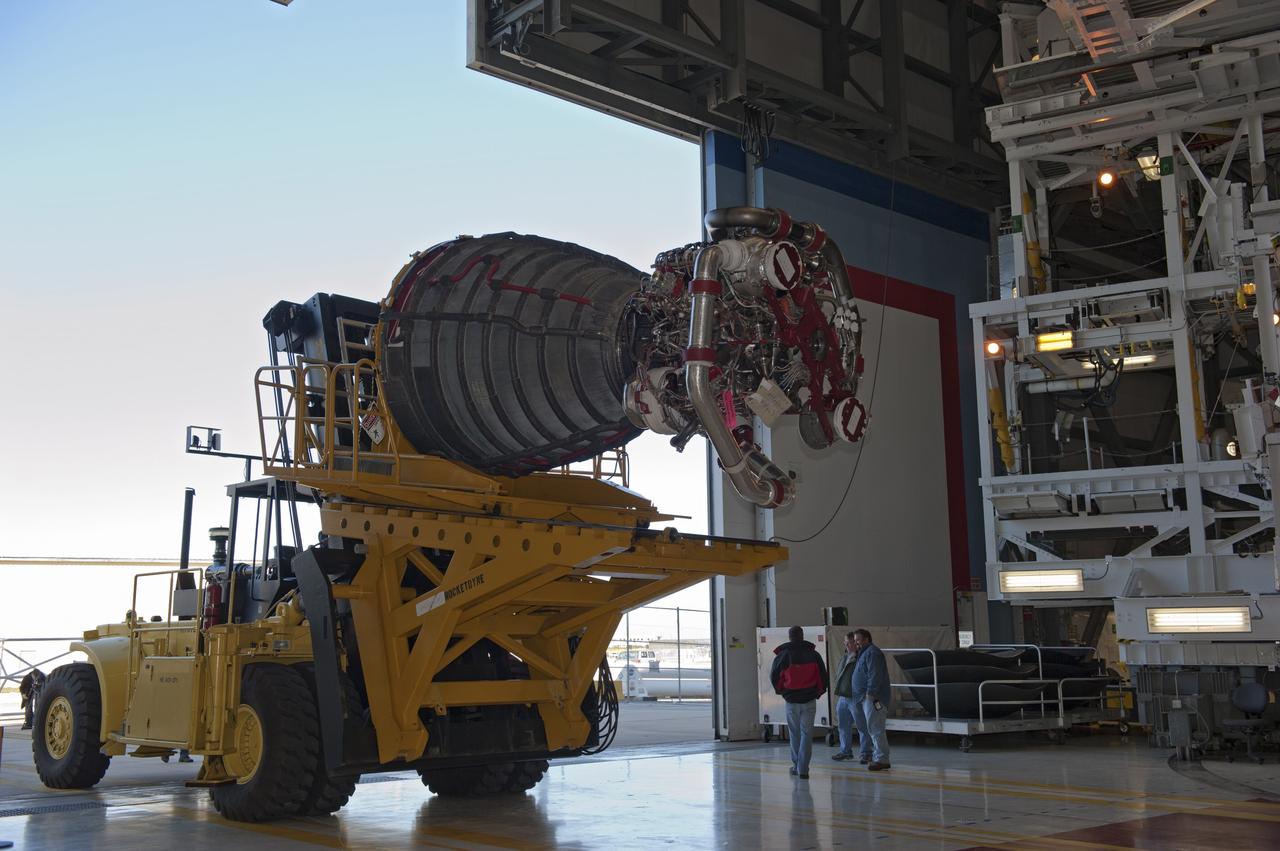
CAPE CANAVERAL, Fla. -- A Hyster forklift transporting the second of shuttle Atlantis' three main engines arrives at Orbiter Processing Facility-1 from the Space Shuttle Main Engine (SSME) Shop at NASA's Kennedy Space Center in Florida. There, the engine will be installed in the shuttle. Each engine is 14 feet long, weighs about 6,700 pounds, and is 7.5 feet in diameter at the end of the nozzle. This is the final planned engine installation for the Space Shuttle Program. Atlantis is being prepared for the "launch on need," or potential rescue mission, for the final planned shuttle flight, Endeavour's STS-134 mission. For more information, visit www.nasa.gov/shuttle. Photo credit: NASA/Kim Shiflett
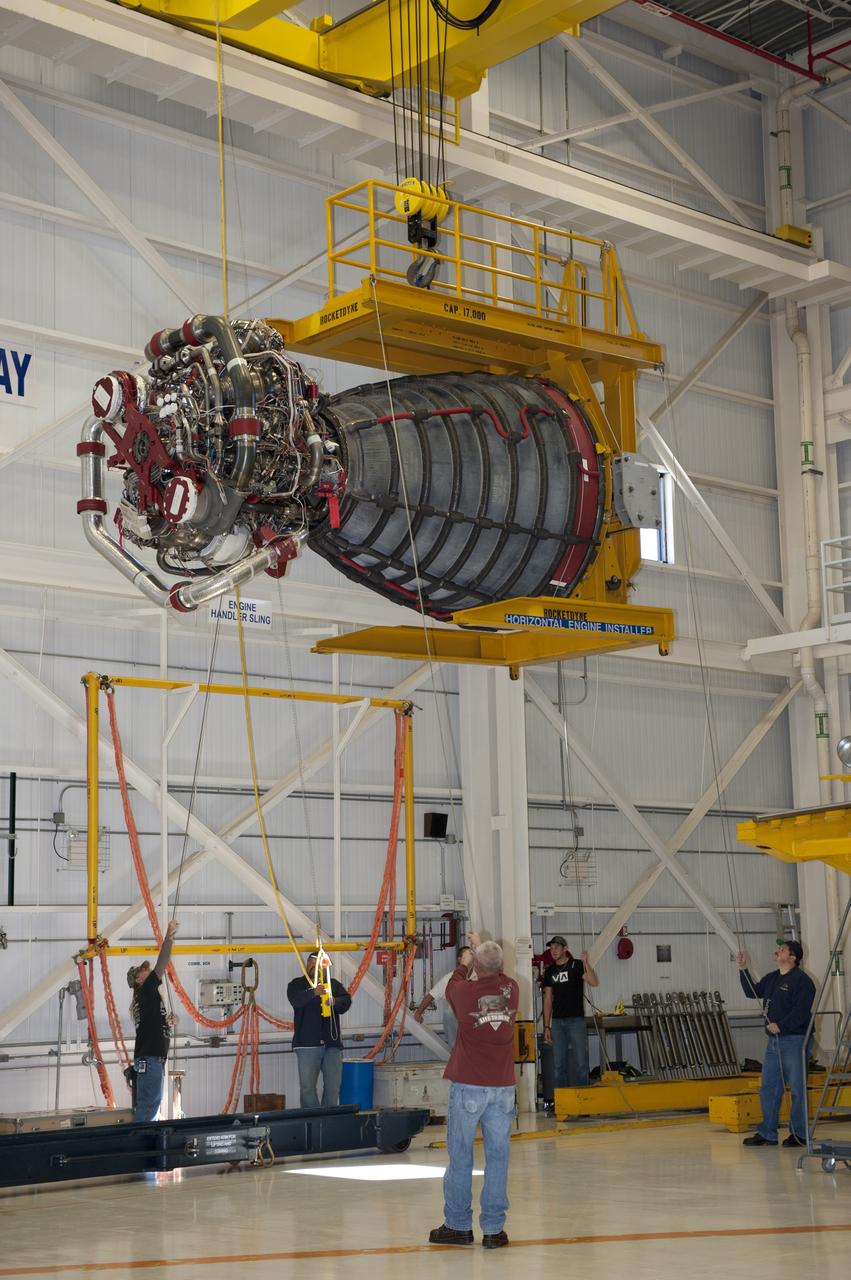
CAPE CANAVERAL, Fla. -- Workers in the Space Shuttle Main Engine (SSME) Shop at NASA's Kennedy Space Center in Florida raise the second of shuttle Atlantis' three main engines so it can be attached to a Hyster forklift. Then, the engine will be transported to Orbiter Processing Facility-1 where it will be installed in the shuttle. Each engine is 14 feet long, weighs about 6,700 pounds, and is 7.5 feet in diameter at the end of the nozzle. This is the final planned engine installation for the Space Shuttle Program. Atlantis is being prepared for the "launch on need," or potential rescue mission, for the final planned shuttle flight, Endeavour's STS-134 mission. For more information, visit www.nasa.gov/shuttle. Photo credit: NASA/Kim Shiflett
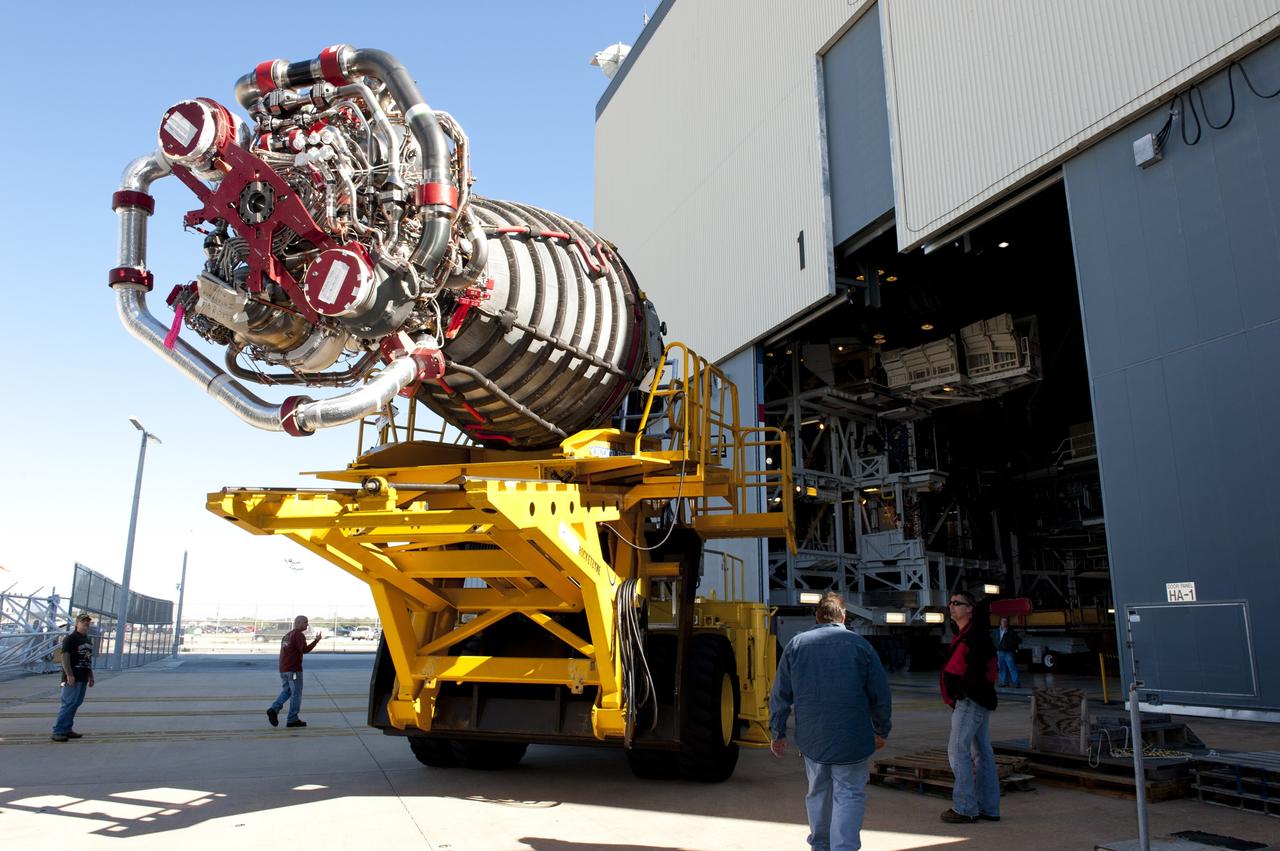
CAPE CANAVERAL, Fla. -- A Hyster forklift transports the second of shuttle Atlantis' three main engines from the Space Shuttle Main Engine (SSME) Shop to Orbiter Processing Facility-1 at NASA's Kennedy Space Center in Florida. Once inside the processing facility, the engine will be installed in the shuttle. Each engine is 14 feet long, weighs about 6,700 pounds, and is 7.5 feet in diameter at the end of the nozzle. This is the final planned engine installation for the Space Shuttle Program. Atlantis is being prepared for the "launch on need," or potential rescue mission, for the final planned shuttle flight, Endeavour's STS-134 mission. For more information, visit www.nasa.gov/shuttle. Photo credit: NASA/Kim Shiflett
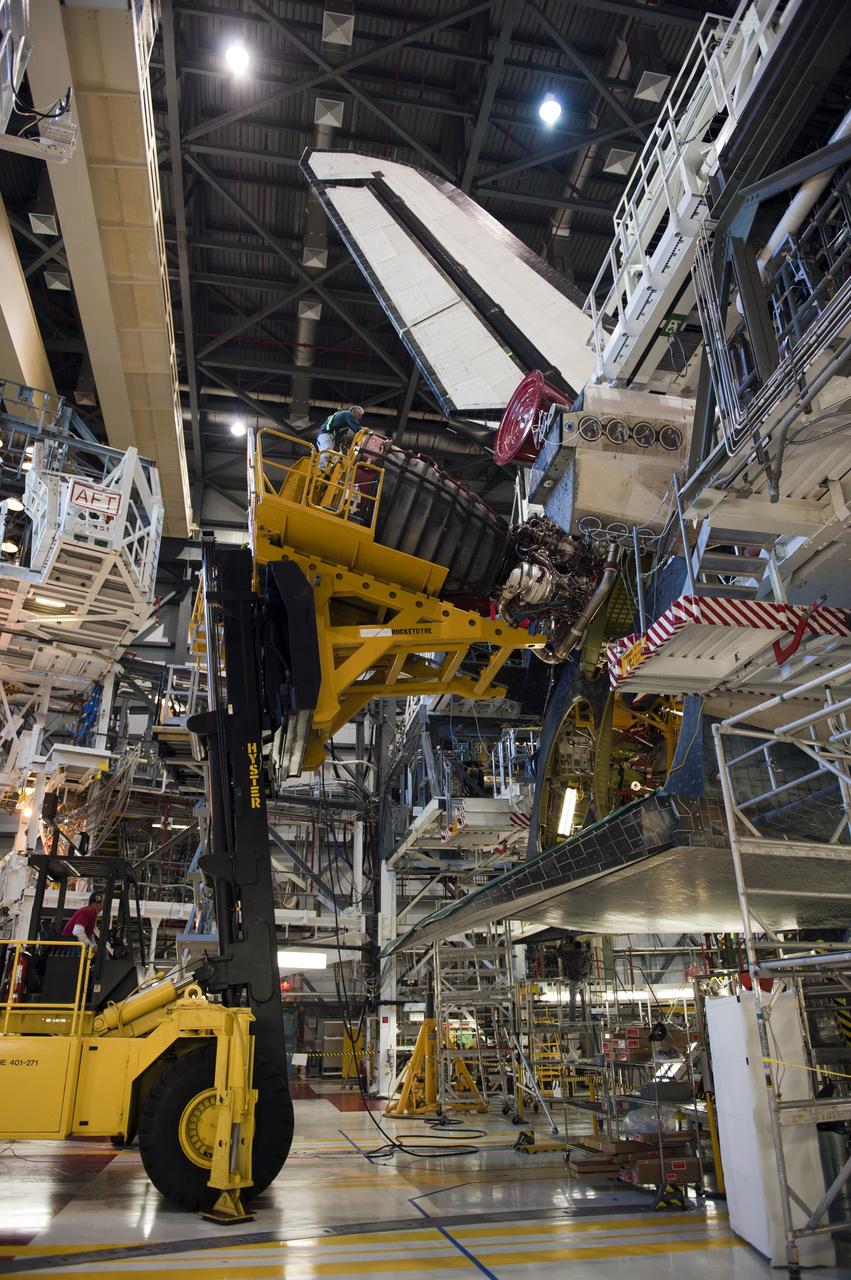
CAPE CANAVERAL, Fla. -- In Orbiter Processing Facility-1 at NASA's Kennedy Space Center in Florida, a Hyster forklift moves the first of three space shuttle main engines closer to space shuttle Atlantis for installation. Each engine is 14 feet long, weighs about 6,700 pounds, and is 7.5 feet in diameter at the end of the nozzle. This is the final planned engine installation for the Space Shuttle Program. Atlantis is being prepared for the "launch on need," or potential rescue mission, for the final planned shuttle flight, Endeavour's STS-134 mission. For more information, visit www.nasa.gov/shuttle. Photo credit: NASA/Kim Shiflett
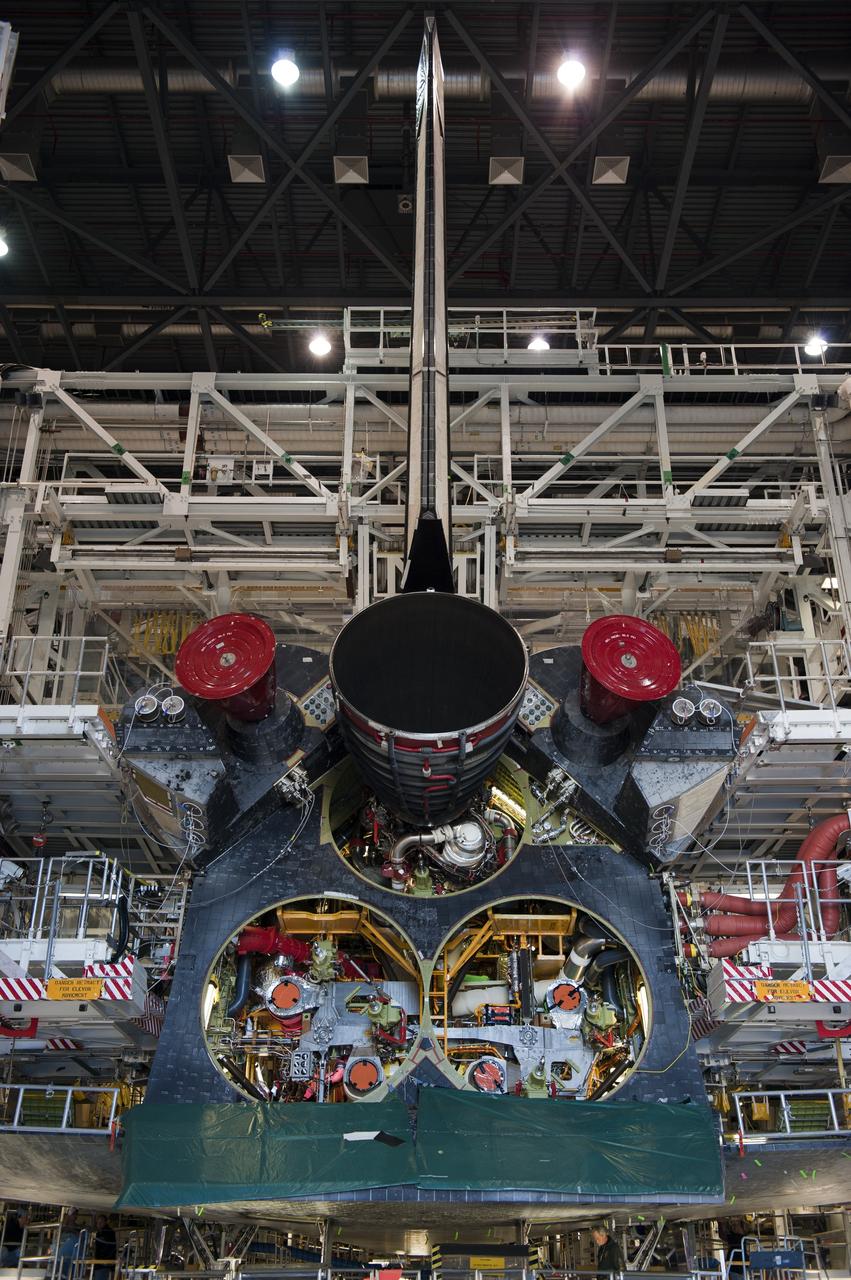
CAPE CANAVERAL, Fla. -- In Orbiter Processing Facility-1 at NASA's Kennedy Space Center in Florida, the first of three space shuttle main engines is installed in space shuttle Atlantis. Each engine is 14 feet long, weighs about 6,700 pounds, and is 7.5 feet in diameter at the end of the nozzle. This is the final planned engine installation for the Space Shuttle Program. Atlantis is being prepared for the "launch on need," or potential rescue mission, for the final planned shuttle flight, Endeavour's STS-134 mission. For more information, visit www.nasa.gov/shuttle. Photo credit: NASA/Kim Shiflett
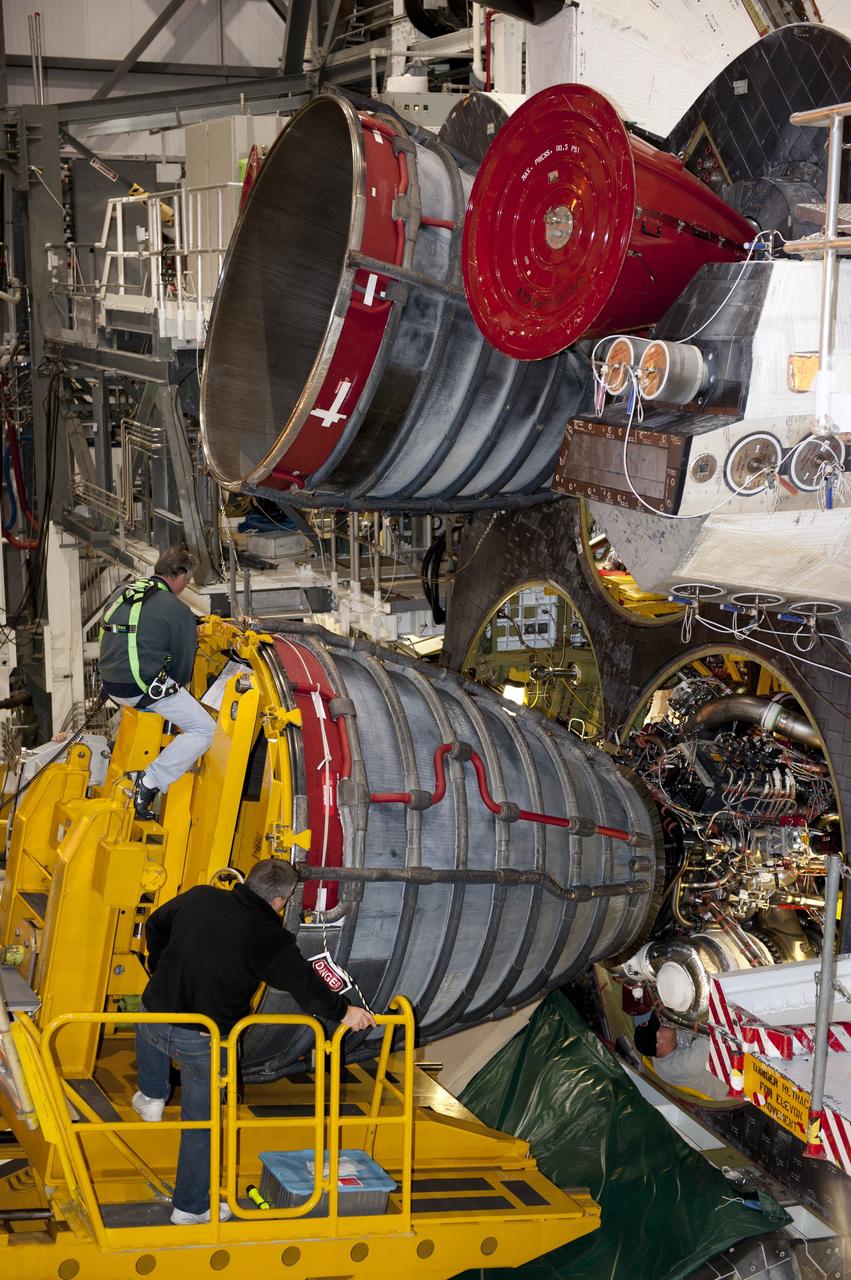
CAPE CANAVERAL, Fla. -- In Orbiter Processing Facility-1 at NASA's Kennedy Space Center in Florida, a Hyster forklift moves the second of three space shuttle main engines closer to shuttle Atlantis for installation. Each engine is 14 feet long, weighs about 6,700 pounds, and is 7.5 feet in diameter at the end of the nozzle. This is the final planned engine installation for the Space Shuttle Program. Atlantis is being prepared for the "launch on need," or potential rescue mission, for the final planned shuttle flight, Endeavour's STS-134 mission. For more information, visit www.nasa.gov/shuttle. Photo credit: NASA/Kim Shiflett
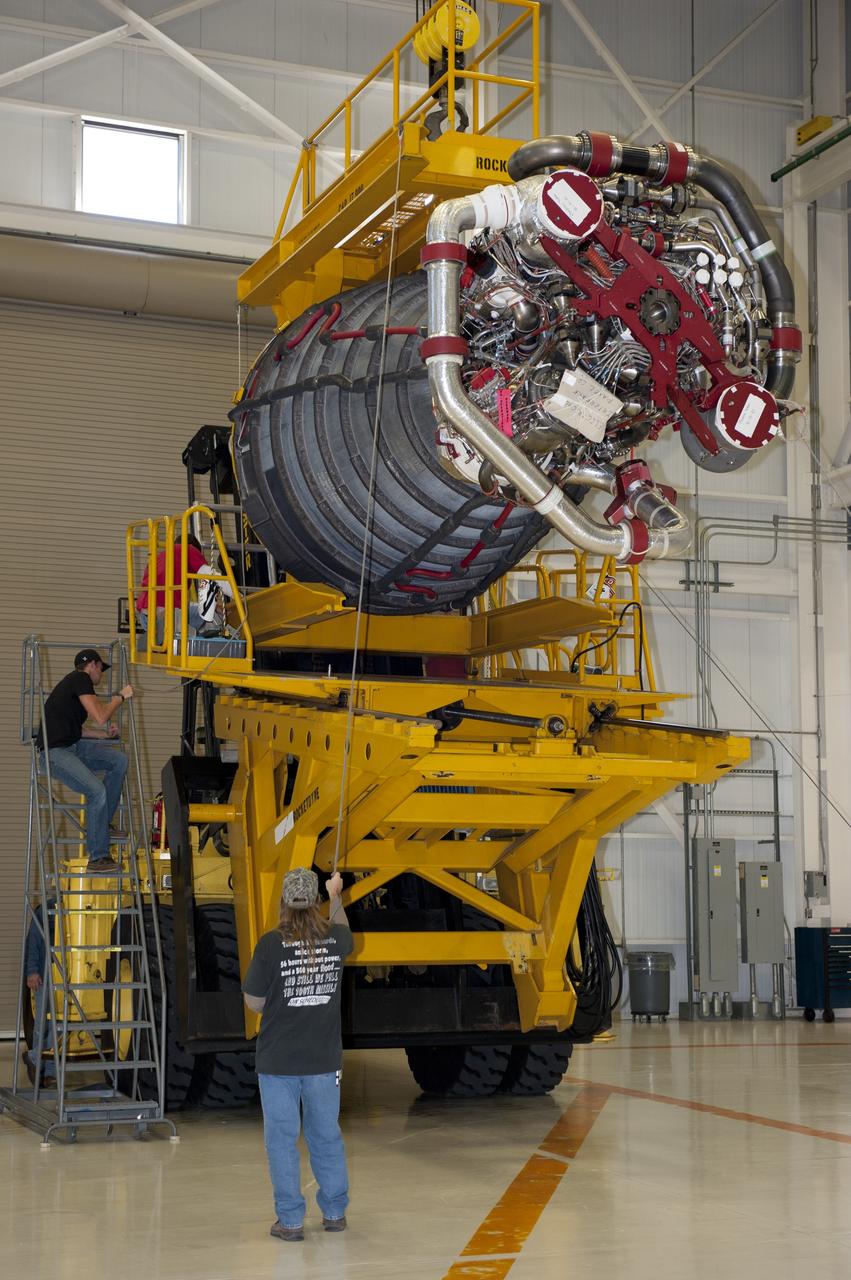
CAPE CANAVERAL, Fla. -- Workers in the Space Shuttle Main Engine (SSME) Shop at NASA's Kennedy Space Center in Florida attached the second of shuttle Atlantis' three main engines to a Hyster forklift. Next, the engine will be transported to Orbiter Processing Facility-1 where it will be installed in the shuttle. Each engine is 14 feet long, weighs about 6,700 pounds, and is 7.5 feet in diameter at the end of the nozzle. This is the final planned engine installation for the Space Shuttle Program. Atlantis is being prepared for the "launch on need," or potential rescue mission, for the final planned shuttle flight, Endeavour's STS-134 mission. For more information, visit www.nasa.gov/shuttle. Photo credit: NASA/Kim Shiflett
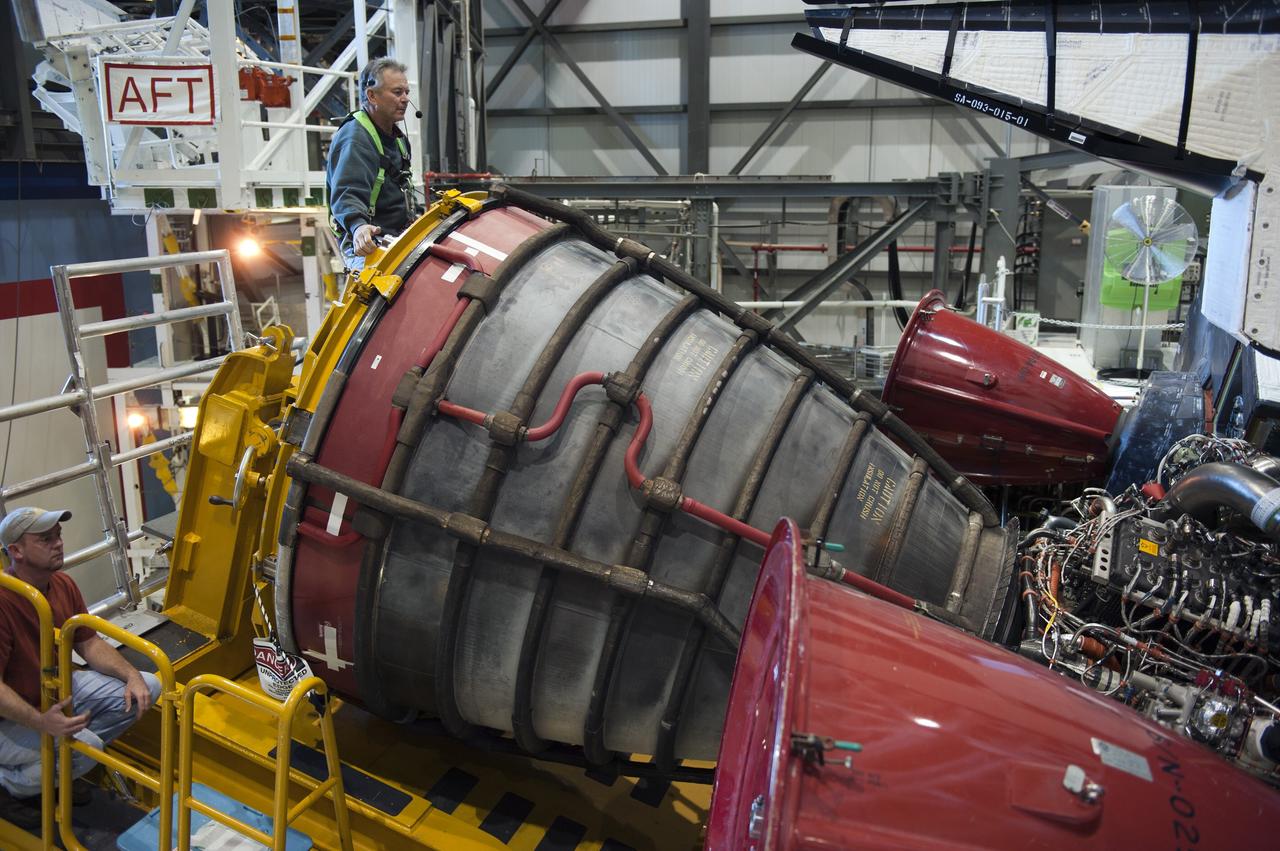
CAPE CANAVERAL, Fla. -- In Orbiter Processing Facility-1 at NASA's Kennedy Space Center in Florida, a Hyster forklift moves the first of three space shuttle main engines closer to space shuttle Atlantis for installation. Each engine is 14 feet long, weighs about 6,700 pounds, and is 7.5 feet in diameter at the end of the nozzle. This is the final planned engine installation for the Space Shuttle Program. Atlantis is being prepared for the "launch on need," or potential rescue mission, for the final planned shuttle flight, Endeavour's STS-134 mission. For more information, visit www.nasa.gov/shuttle. Photo credit: NASA/Kim Shiflett
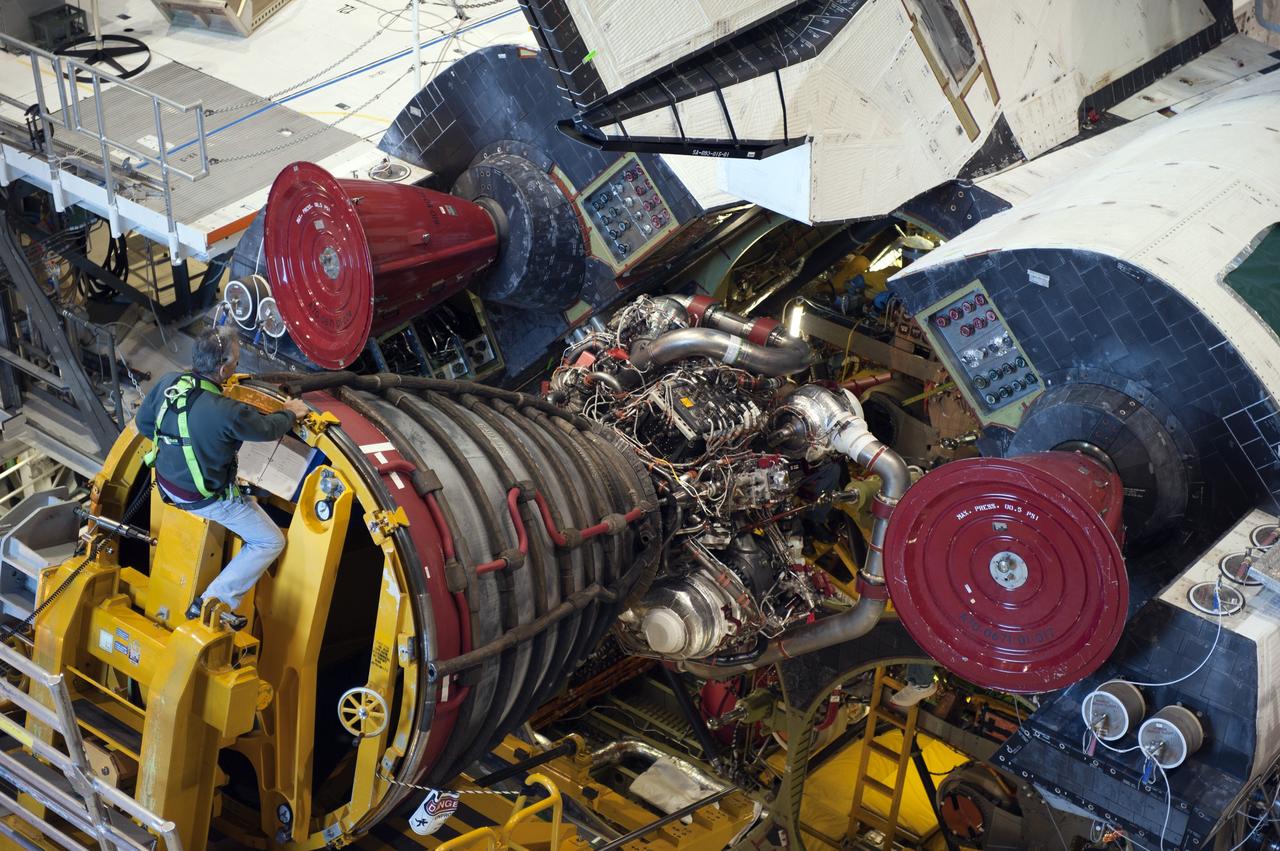
CAPE CANAVERAL, Fla. -- In Orbiter Processing Facility-1 at NASA's Kennedy Space Center in Florida, a Hyster forklift moves the first of three space shuttle main engines closer to space shuttle Atlantis for installation. Each engine is 14 feet long, weighs about 6,700 pounds, and is 7.5 feet in diameter at the end of the nozzle. This is the final planned engine installation for the Space Shuttle Program. Atlantis is being prepared for the "launch on need," or potential rescue mission, for the final planned shuttle flight, Endeavour's STS-134 mission. For more information, visit www.nasa.gov/shuttle. Photo credit: NASA/Kim Shiflett
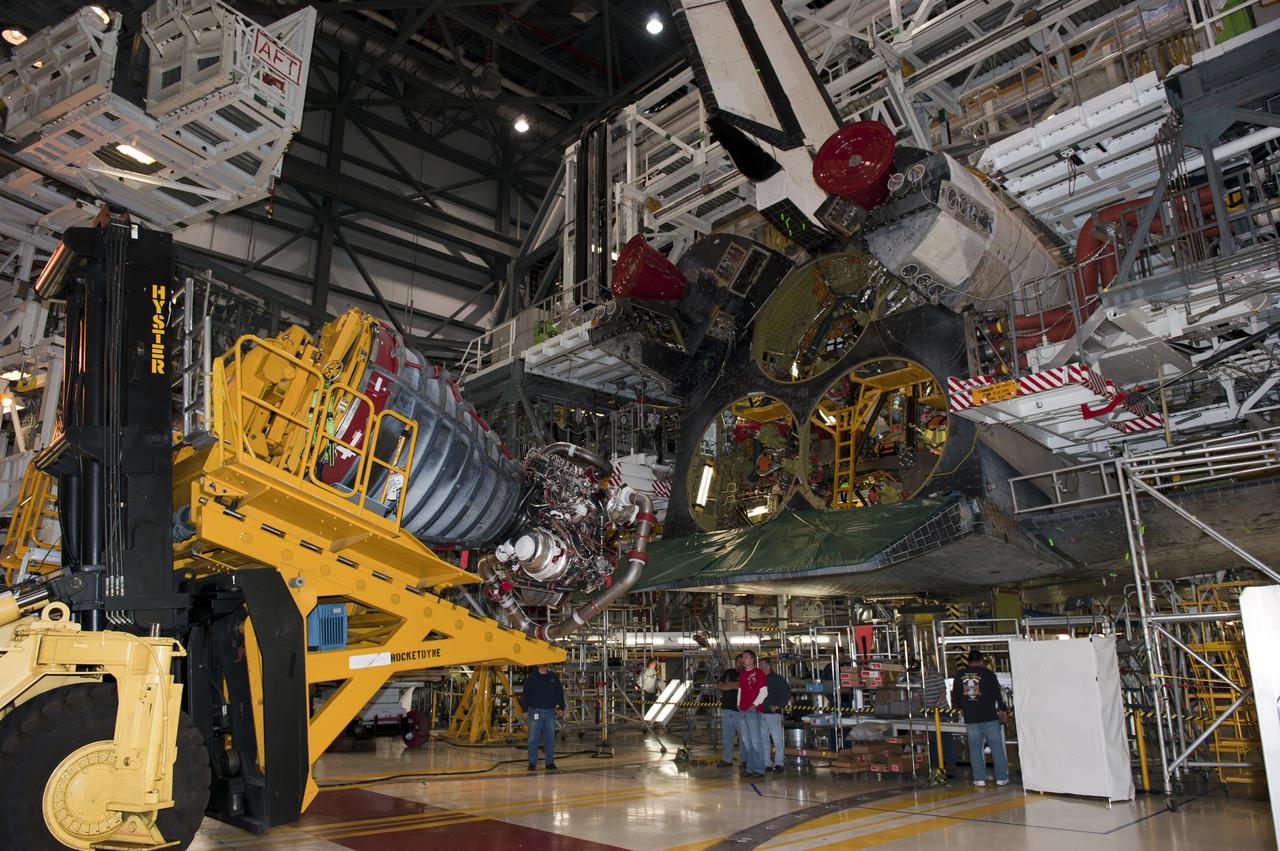
CAPE CANAVERAL, Fla. -- In Orbiter Processing Facility-1 at NASA's Kennedy Space Center in Florida, a Hyster forklift moves the first of three space shuttle main engines closer to space shuttle Atlantis for installation. Each engine is 14 feet long, weighs about 6,700 pounds, and is 7.5 feet in diameter at the end of the nozzle. This is the final planned engine installation for the Space Shuttle Program. Atlantis is being prepared for the "launch on need," or potential rescue mission, for the final planned shuttle flight, Endeavour's STS-134 mission. For more information, visit www.nasa.gov/shuttle. Photo credit: NASA/Kim Shiflett
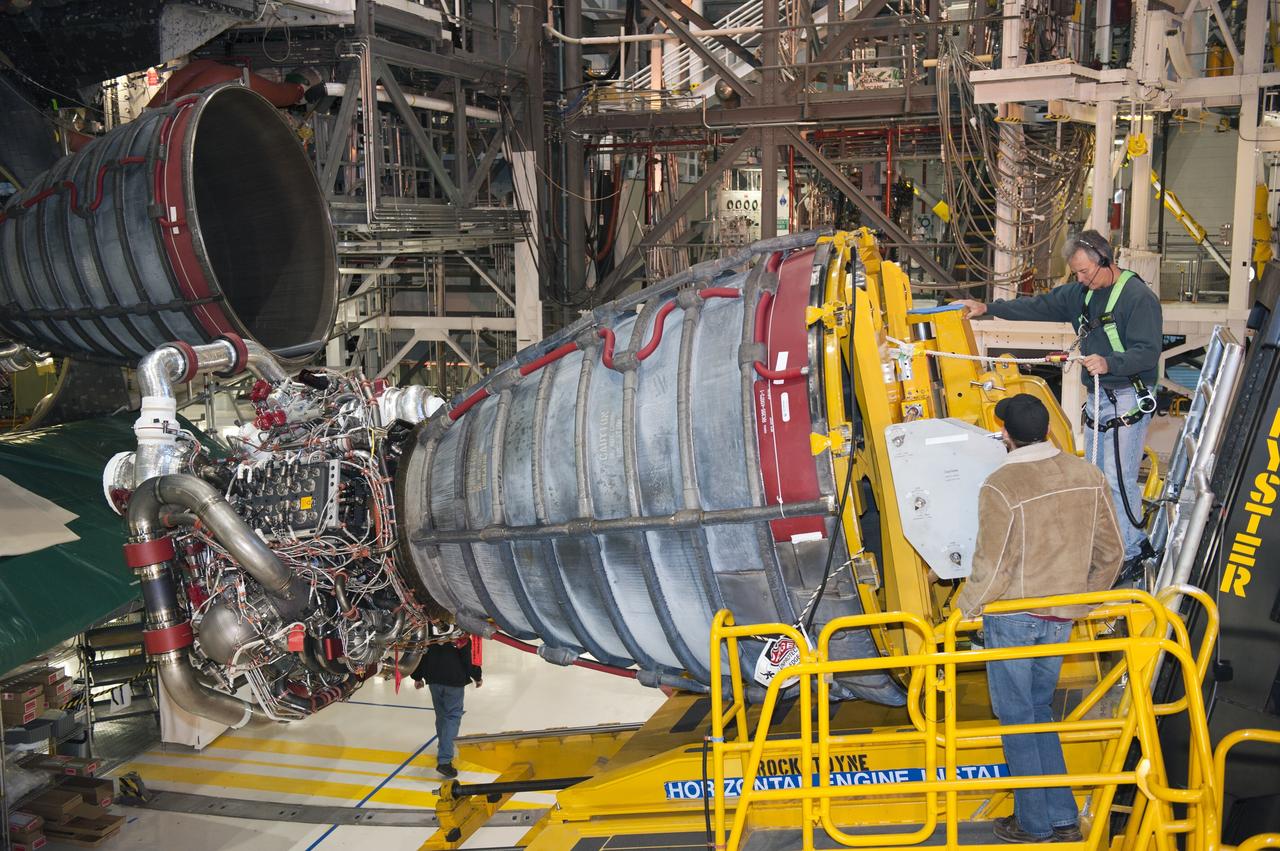
CAPE CANAVERAL, Fla. -- In Orbiter Processing Facility-1 at NASA's Kennedy Space Center in Florida, a Hyster forklift moves engine #2, the last of three space shuttle main engines, closer to shuttle Atlantis for installation. Each engine is 14 feet long, weighs about 6,700 pounds, and is 7.5 feet in diameter at the end of the nozzle. This is the final planned engine installation for the Space Shuttle Program. Atlantis is being prepared for the "launch on need," or potential rescue mission, for the final planned shuttle flight, Endeavour's STS-134 mission. For more information, visit www.nasa.gov/shuttle. Photo credit: NASA/Kim Shiflett
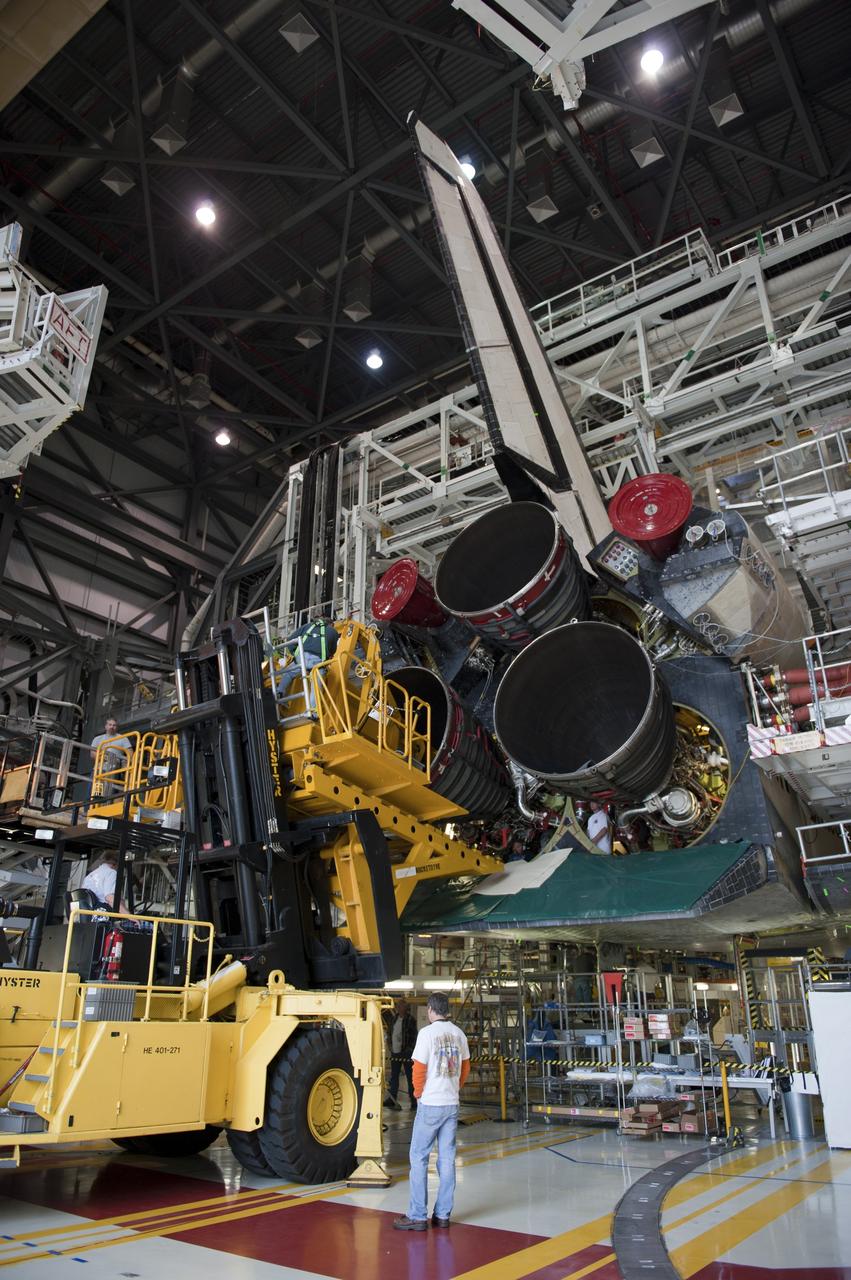
CAPE CANAVERAL, Fla. -- In Orbiter Processing Facility-1 at NASA's Kennedy Space Center in Florida, engine #2, the last of three space shuttle main engines is being installed in shuttle Atlantis. Each engine is 14 feet long, weighs about 6,700 pounds, and is 7.5 feet in diameter at the end of the nozzle. This is the final planned engine installation for the Space Shuttle Program. Atlantis is being prepared for the "launch on need," or potential rescue mission, for the final planned shuttle flight, Endeavour's STS-134 mission. For more information, visit www.nasa.gov/shuttle. Photo credit: NASA/Kim Shiflett
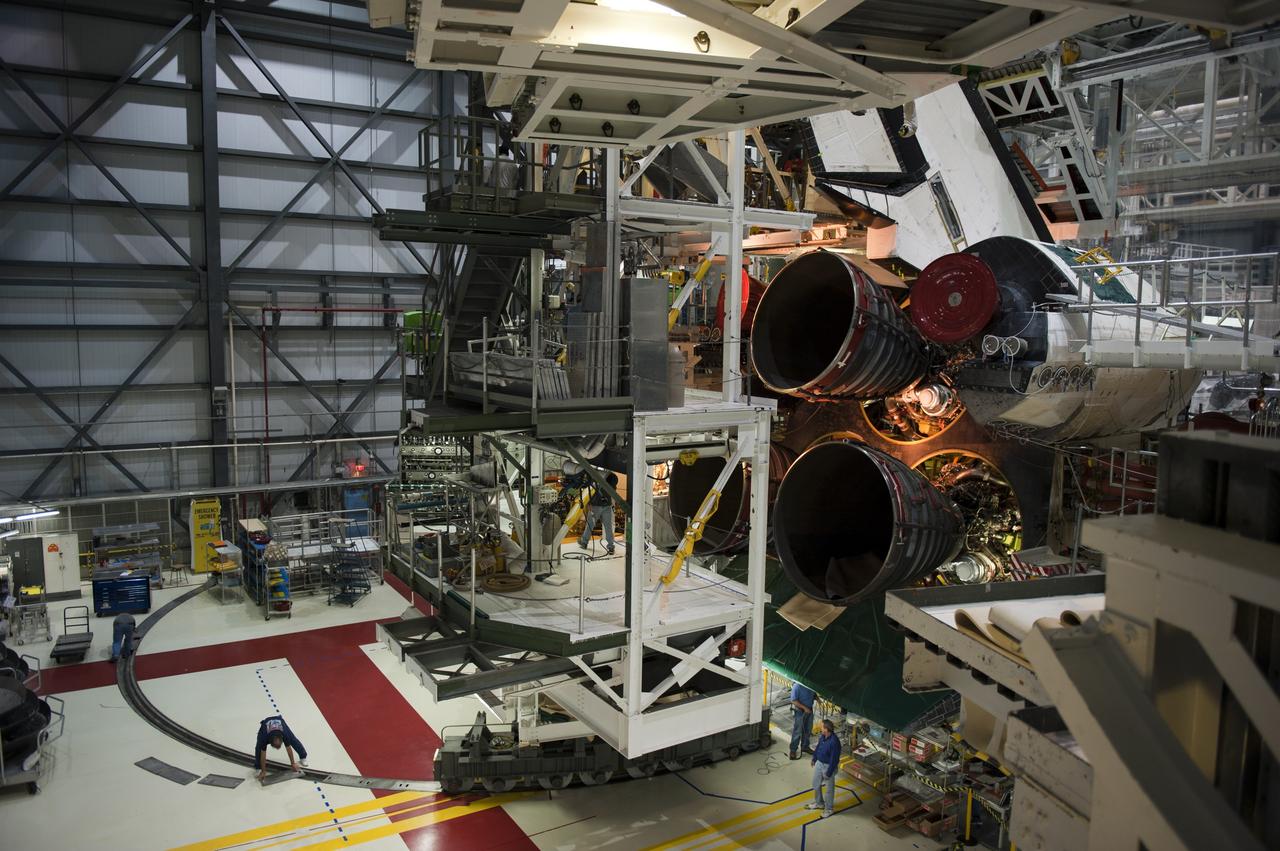
CAPE CANAVERAL, Fla. -- In Orbiter Processing Facility-1 at NASA's Kennedy Space Center in Florida, technicians prepare to move an aft access platform into place behind shuttle Atlantis, following the installation of the spacecraft's three main engines. Shown is the right-hand orbital maneuvering system (OMS) pod and engine taken from the right-hand access arm. Atlantis is being prepared for the "launch on need," or potential rescue mission, for the final planned shuttle flight, Endeavour's STS-134 mission. For more information, visit www.nasa.gov/shuttle. Photo credit: NASA/Kim Shiflett
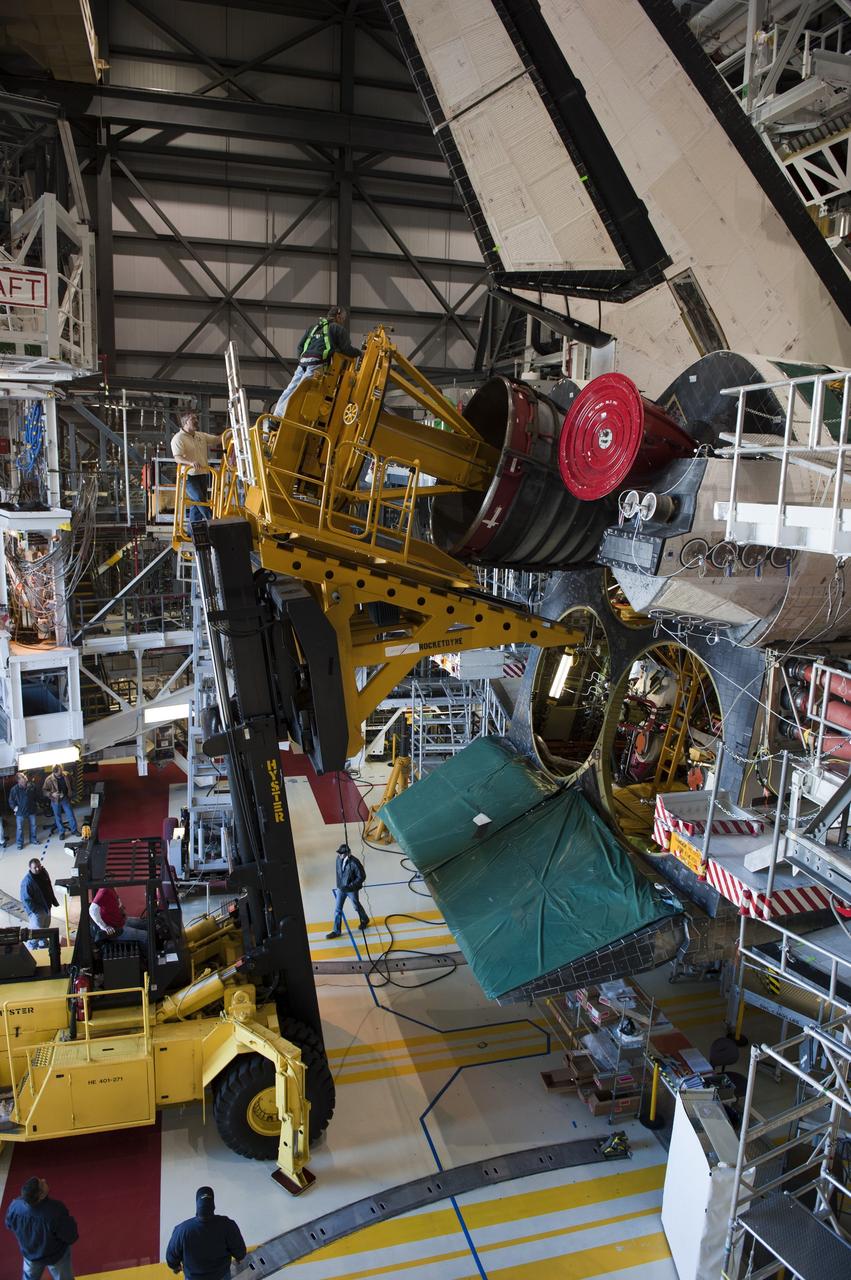
CAPE CANAVERAL, Fla. -- In Orbiter Processing Facility-1 at NASA's Kennedy Space Center in Florida, a Hyster forklift moves the first of three space shuttle main engines closer to space shuttle Atlantis for installation. Each engine is 14 feet long, weighs about 6,700 pounds, and is 7.5 feet in diameter at the end of the nozzle. This is the final planned engine installation for the Space Shuttle Program. Atlantis is being prepared for the "launch on need," or potential rescue mission, for the final planned shuttle flight, Endeavour's STS-134 mission. For more information, visit www.nasa.gov/shuttle. Photo credit: NASA/Kim Shiflett
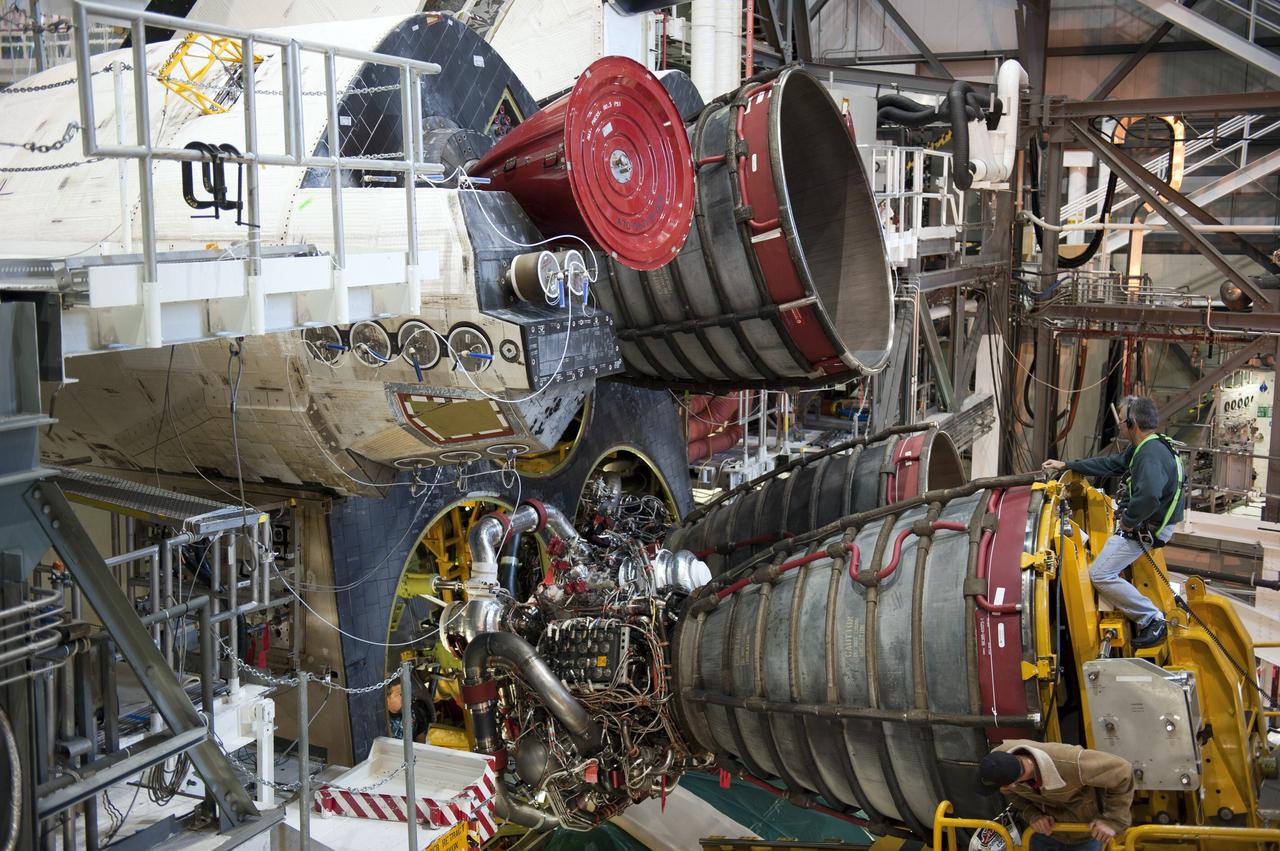
CAPE CANAVERAL, Fla. -- In Orbiter Processing Facility-1 at NASA's Kennedy Space Center in Florida, engine #2, the last of three space shuttle main engines is being installed in shuttle Atlantis. Each engine is 14 feet long, weighs about 6,700 pounds, and is 7.5 feet in diameter at the end of the nozzle. This is the final planned engine installation for the Space Shuttle Program. Atlantis is being prepared for the "launch on need," or potential rescue mission, for the final planned shuttle flight, Endeavour's STS-134 mission. For more information, visit www.nasa.gov/shuttle. Photo credit: NASA/Kim Shiflett
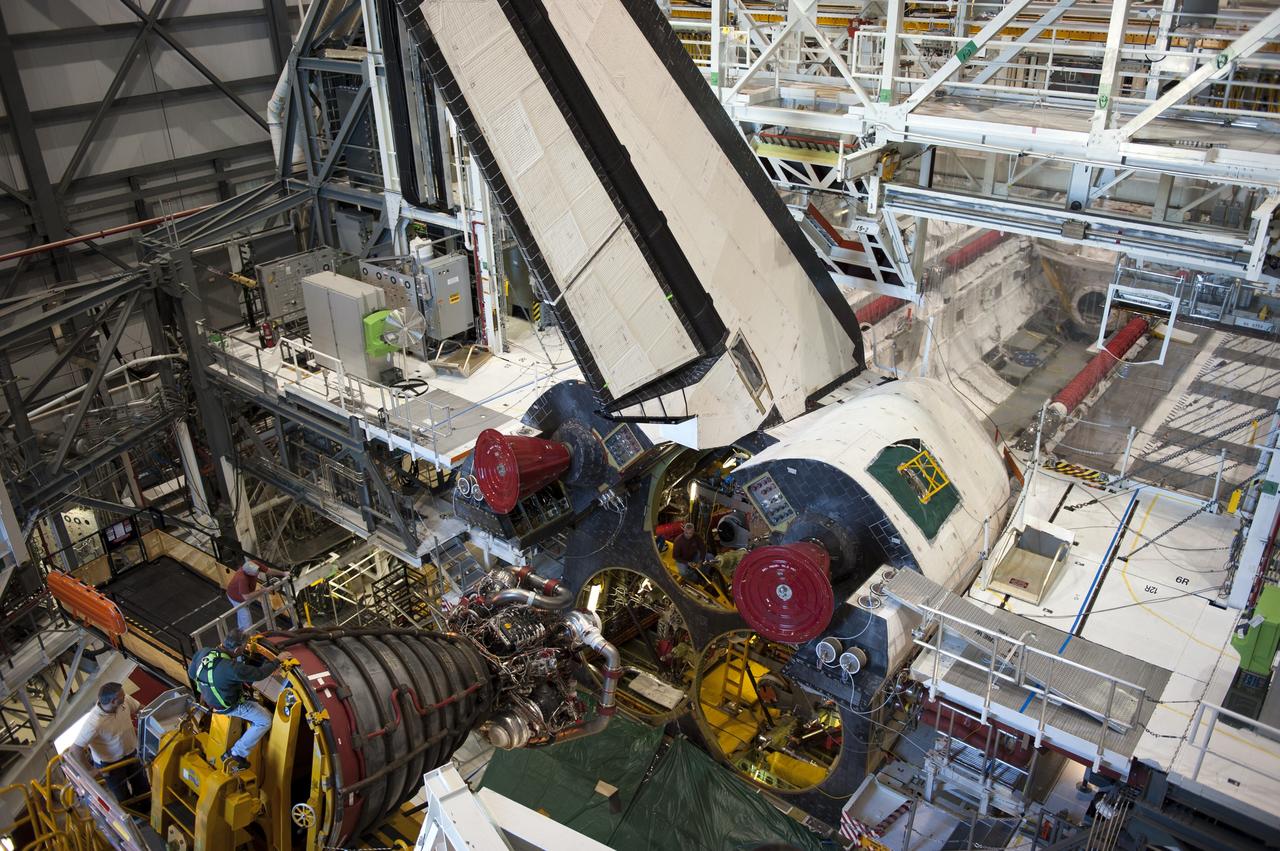
CAPE CANAVERAL, Fla. -- In Orbiter Processing Facility-1 at NASA's Kennedy Space Center in Florida, a Hyster forklift moves the first of three space shuttle main engines closer to space shuttle Atlantis for installation. Each engine is 14 feet long, weighs about 6,700 pounds, and is 7.5 feet in diameter at the end of the nozzle. This is the final planned engine installation for the Space Shuttle Program. Atlantis is being prepared for the "launch on need," or potential rescue mission, for the final planned shuttle flight, Endeavour's STS-134 mission. For more information, visit www.nasa.gov/shuttle. Photo credit: NASA/Kim Shiflett
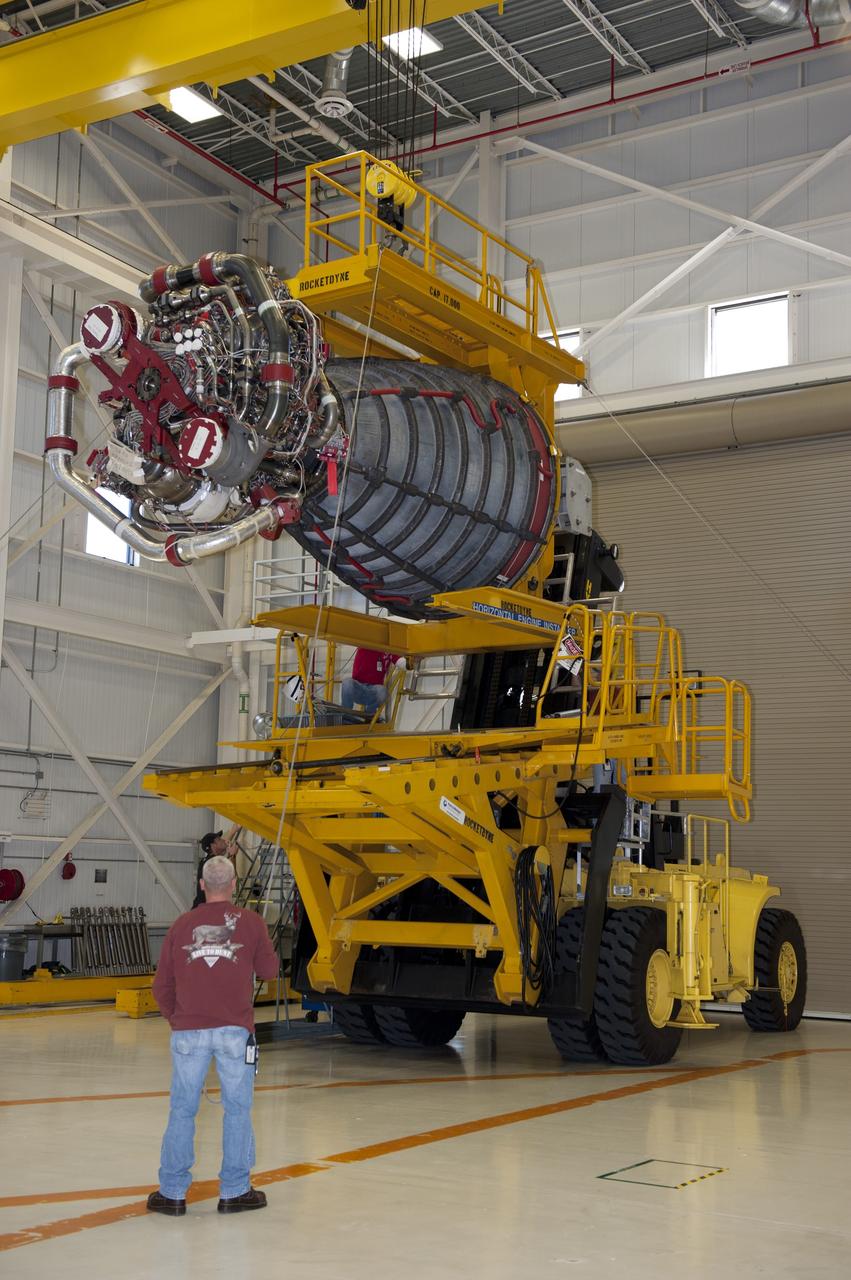
CAPE CANAVERAL, Fla. -- Workers in the Space Shuttle Main Engine (SSME) Shop at NASA's Kennedy Space Center in Florida attached the second of shuttle Atlantis' three main engines to a Hyster forklift. Next, the engine will be transported to Orbiter Processing Facility-1 where it will be installed in the shuttle. Each engine is 14 feet long, weighs about 6,700 pounds, and is 7.5 feet in diameter at the end of the nozzle. This is the final planned engine installation for the Space Shuttle Program. Atlantis is being prepared for the "launch on need," or potential rescue mission, for the final planned shuttle flight, Endeavour's STS-134 mission. For more information, visit www.nasa.gov/shuttle. Photo credit: NASA/Kim Shiflett
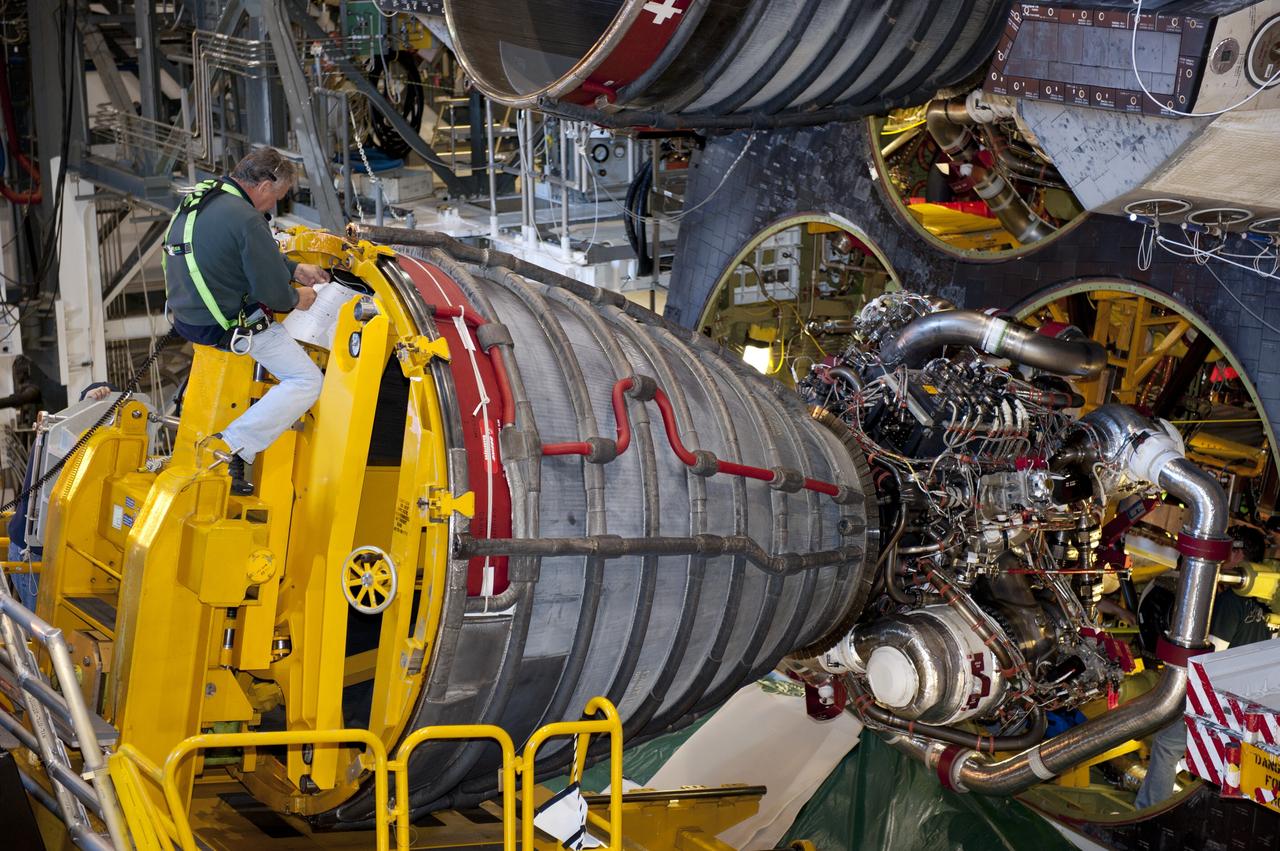
CAPE CANAVERAL, Fla. -- In Orbiter Processing Facility-1 at NASA's Kennedy Space Center in Florida, a Hyster forklift moves the second of three space shuttle main engines closer to shuttle Atlantis for installation. Each engine is 14 feet long, weighs about 6,700 pounds, and is 7.5 feet in diameter at the end of the nozzle. This is the final planned engine installation for the Space Shuttle Program. Atlantis is being prepared for the "launch on need," or potential rescue mission, for the final planned shuttle flight, Endeavour's STS-134 mission. For more information, visit www.nasa.gov/shuttle. Photo credit: NASA/Kim Shiflett
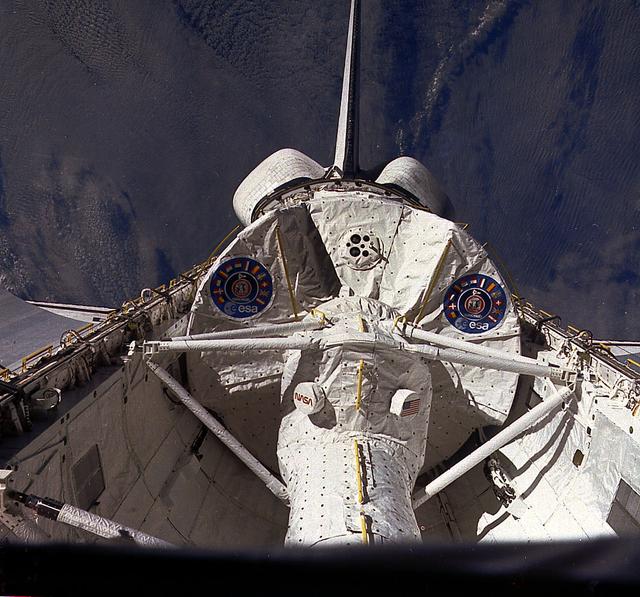
A Space Shuttle mission STS-9 onboard view show's Spacelab-1 (SL-1) module in orbiter Columbia's payload bay. Spacelab-1 was a cooperative venture of NASA and the European Space Agency. Scientists from eleven European nations plus Canada, Japan and the U.S. provided instruments and experimental procedures for over 70 different investigations in five research areas of disciplines: astronomy and solar physics, space plasma physics, atmospheric physics and Earth observations, life sciences and materials science.
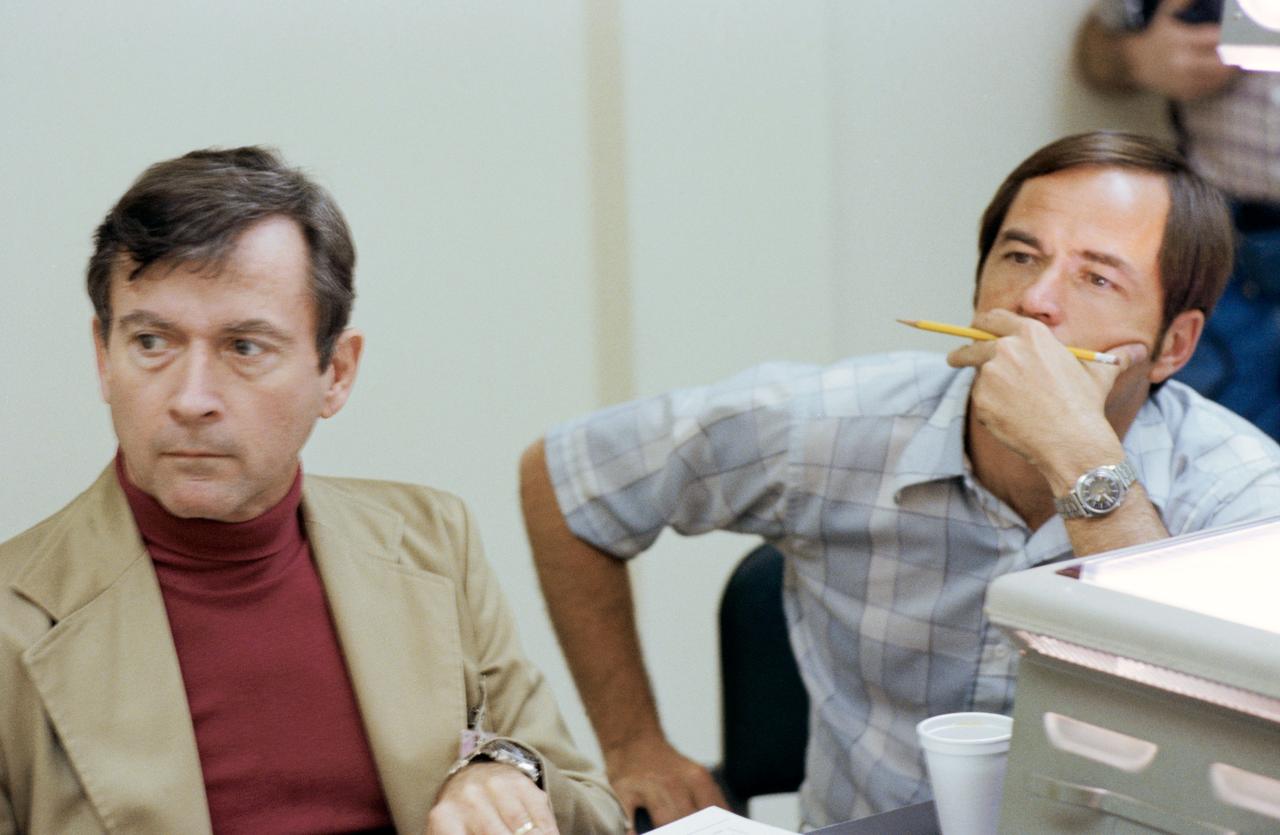
S81-29619 (6 April 1981) --- STS-1 astronauts John W. Young, left, and Robert L. Crippen direct their attention to a chart on a screen in a small briefing room at NASA's Johnson Space Center (JSC). They are taking part in a three-way telephone conference call, which involved engineers at JSC and at the Rockwell International facility in California. Later this week the two will man the space shuttle orbiter Columbia for STS-1. Photo credit: NASA
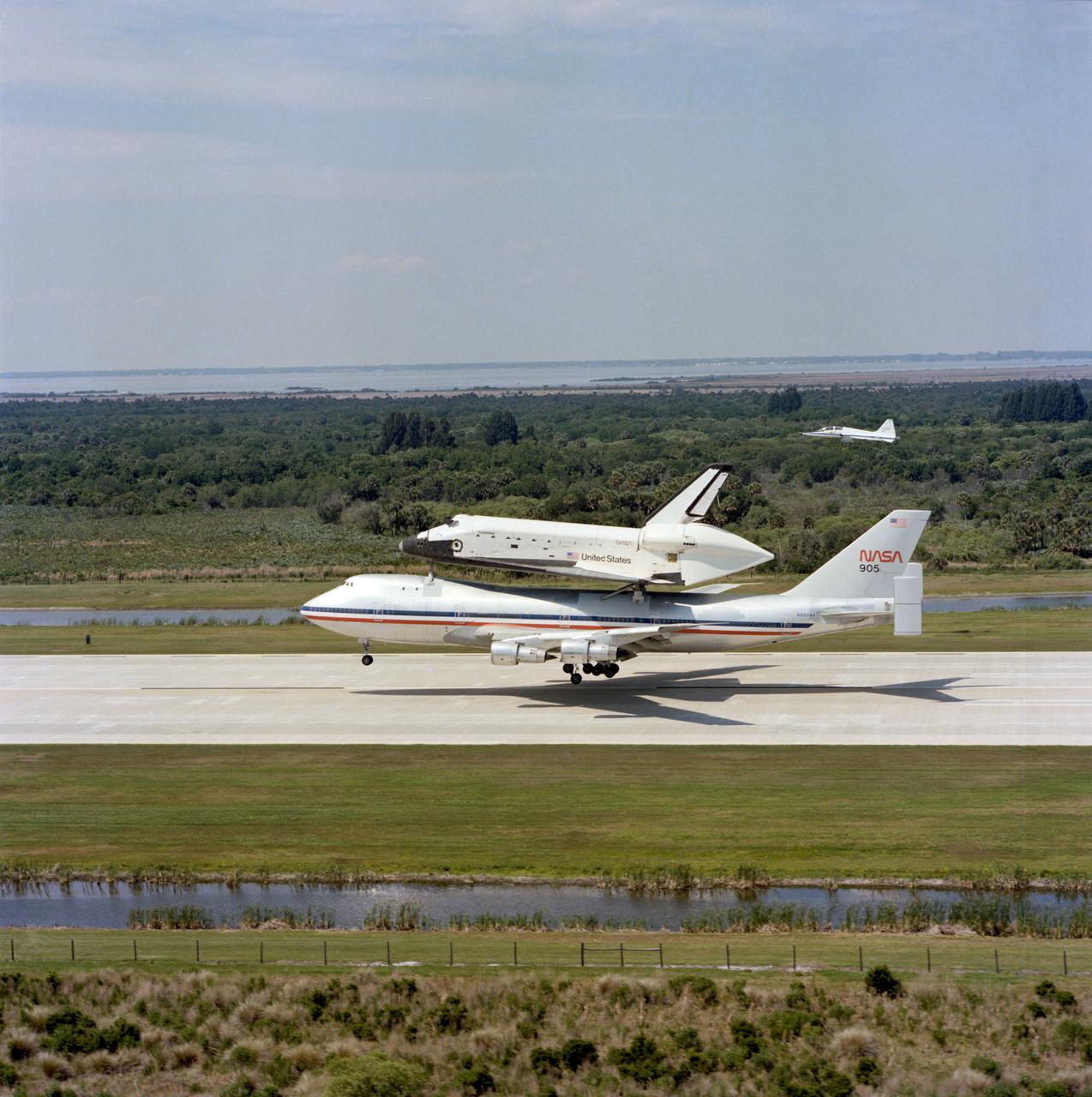
S81-32625 (April 1981) --- This scene represents the end of NASA's STS-1 mission and the beginning of STS-2 in that the orbiter Columbia is arriving at Kennedy Space Center in Florida to begin the lengthy process of preparing it for STS-2. The vehicle landed at Dryden Flight Research Center on April 14 after an historic 2 1/3 day flight in Earth orbit. It was mated to this 747 aircraft, titled NASA 905, and flown over the USA to its Florida destination. It was later removed from atop NASA 905 and moved to the orbiter processing facility for the beginning of refurbishment. Photo credit: NASA
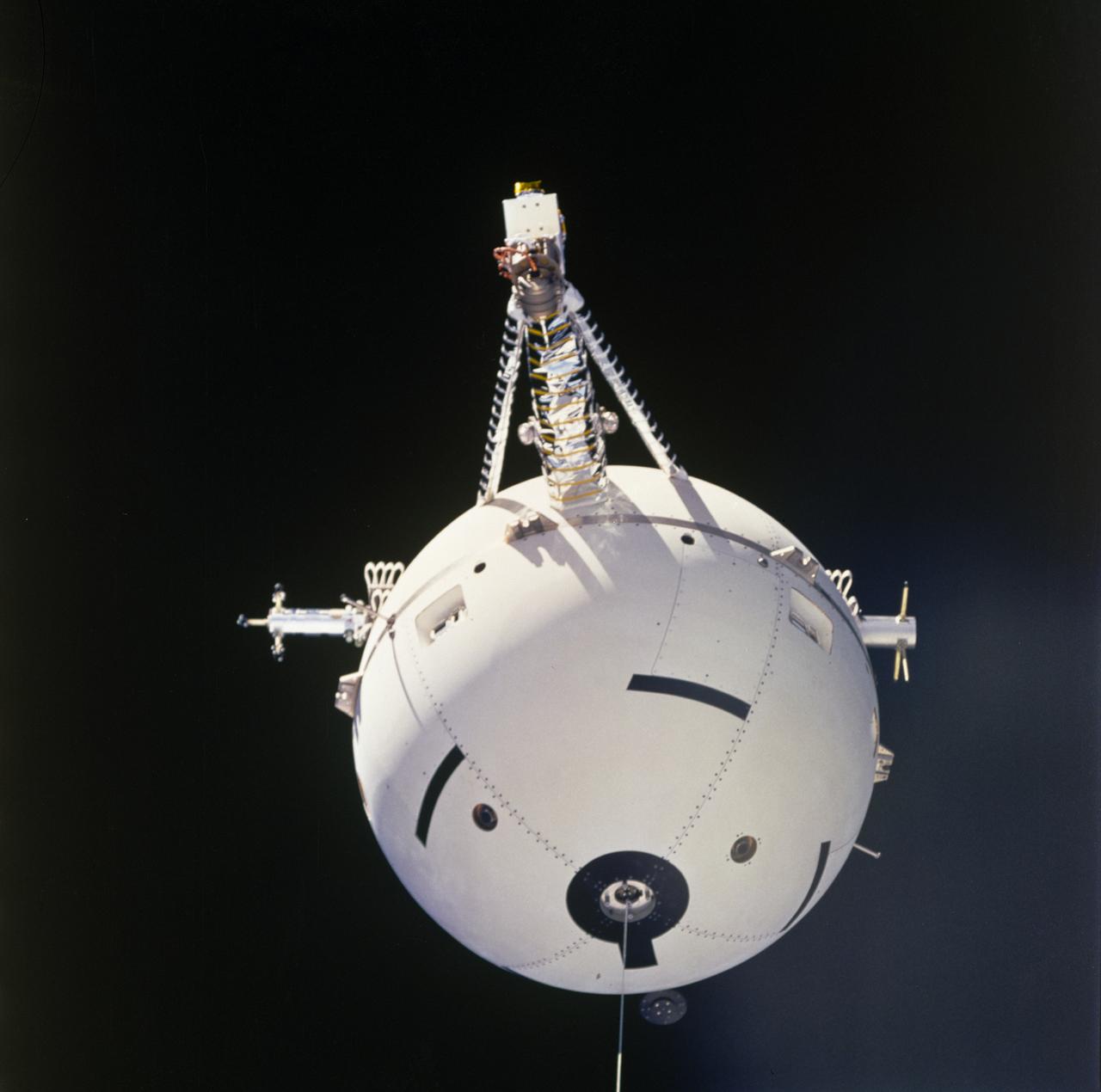
This Space Shuttle Orbiter Atlantis (STS-46) onboard photo is a close-up view of the Tethered Satellite System (TSS-1) in orbit above the Shuttle. A cooperative development effort by the Italian Space Agency (ASI) and NASA, the Tethered Satellite System (TSS) made capable the deployment and retrieval of a satellite which is attached by a wire tether from distances up to 100 km from the Orbiter. These free-flying satellites are used as observation platforms outside of the Orbiter.
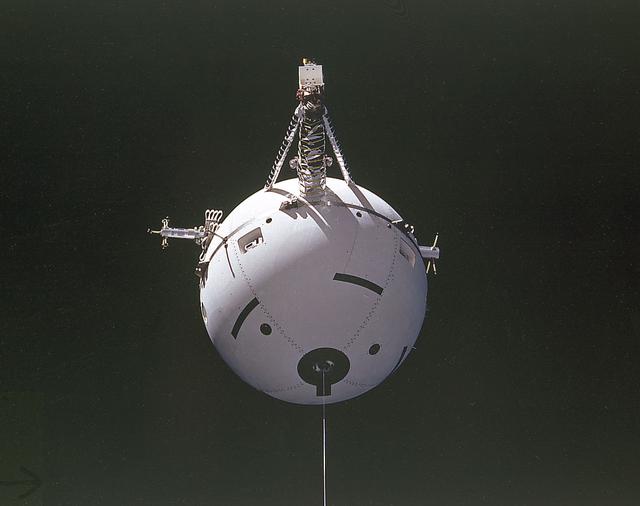
Space Shuttle Atlantis (STS-46) onboard photo of the Tethered Satellite System (TSS-1) deployment. A cooperative development effort by the Italian Space Agency (ASI) and NASA, the Tethered Satellite System (TSS) made capable the deployment and retrieval of a satellite which is attached by a wire tether from distances up to 100 km from the Orbiter. These free-flying satellites are used as observation platforms outside of the Orbiter.
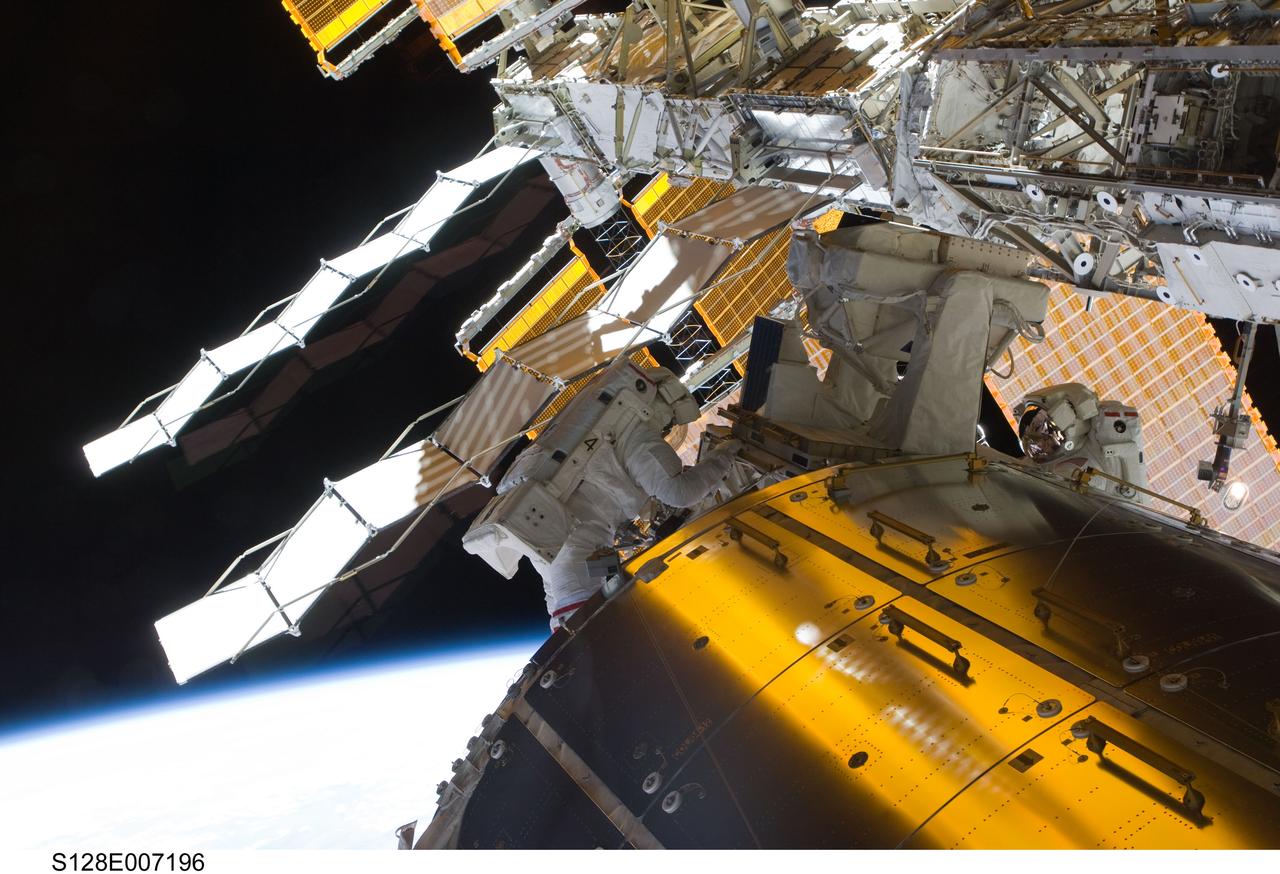
S128-E-007196 (1 Sept. 2009) --- Astronauts John “Danny” Olivas and Nicole Stott (right), both STS-128 mission specialists, participate in the mission's first session of extravehicular activity (EVA) as construction and maintenance continue on the International Space Station. During the six-hour, 35-minute spacewalk, Olivas and Stott removed an empty ammonia tank from the station’s truss and temporarily stowed it on the station’s robotic arm. Olivas and Stott also retrieved the European Technology Exposure Facility (EuTEF) and Materials International Space Station Experiment (MISSE) from the Columbus laboratory module and installed them on Discovery’s payload bay for return.
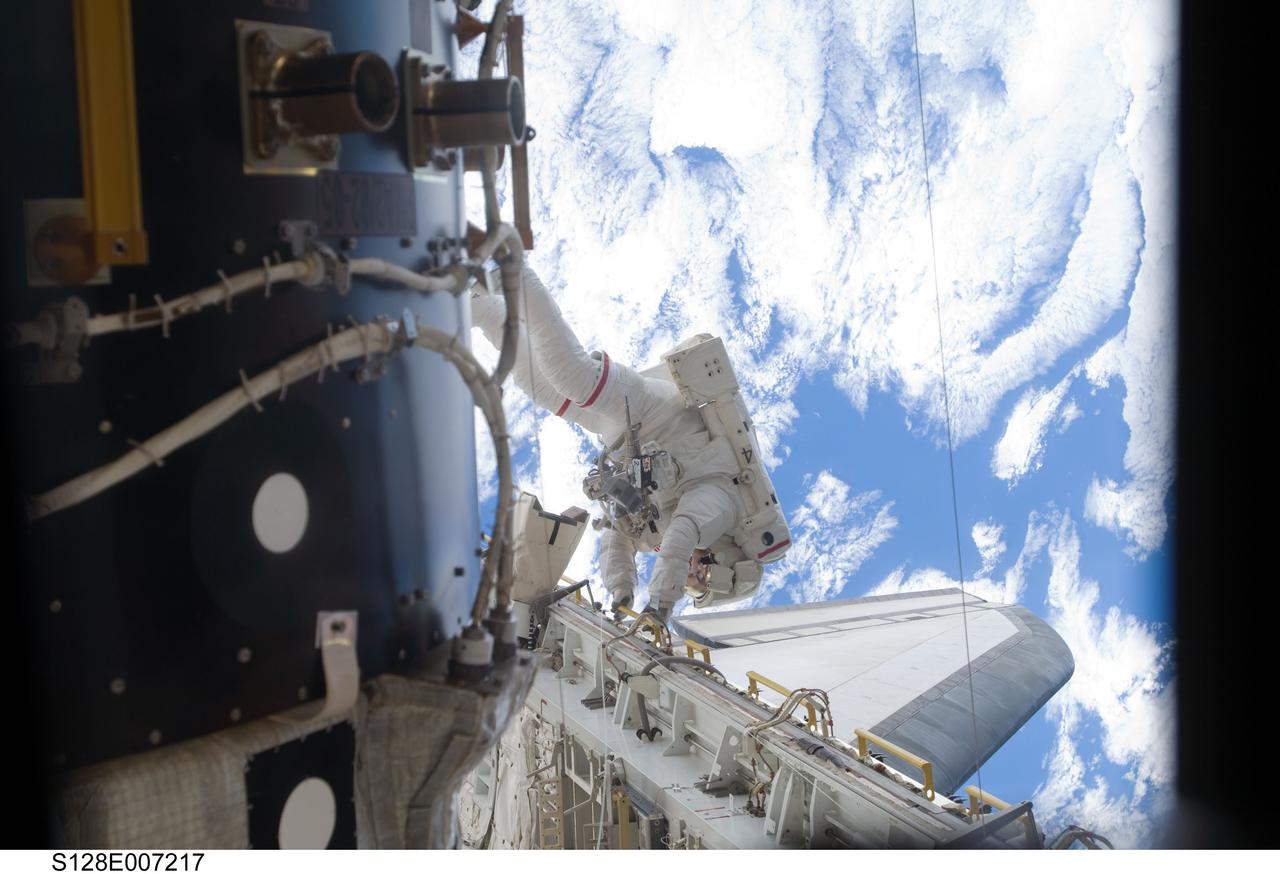
S128-E-007217 (1 Sept. 2009) --- Astronaut John “Danny” Olivas, STS-128 mission specialist, participates in the mission's first session of extravehicular activity (EVA) as construction and maintenance continue on the International Space Station. During the six-hour, 35-minute spacewalk, Olivas and astronaut Nicole Stott (out of frame), mission specialist, removed an empty ammonia tank from the station’s truss and temporarily stowed it on the station’s robotic arm. Olivas and Stott also retrieved the European Technology Exposure Facility (EuTEF) and Materials International Space Station Experiment (MISSE) from the Columbus laboratory module and installed them on Discovery’s payload bay for return.
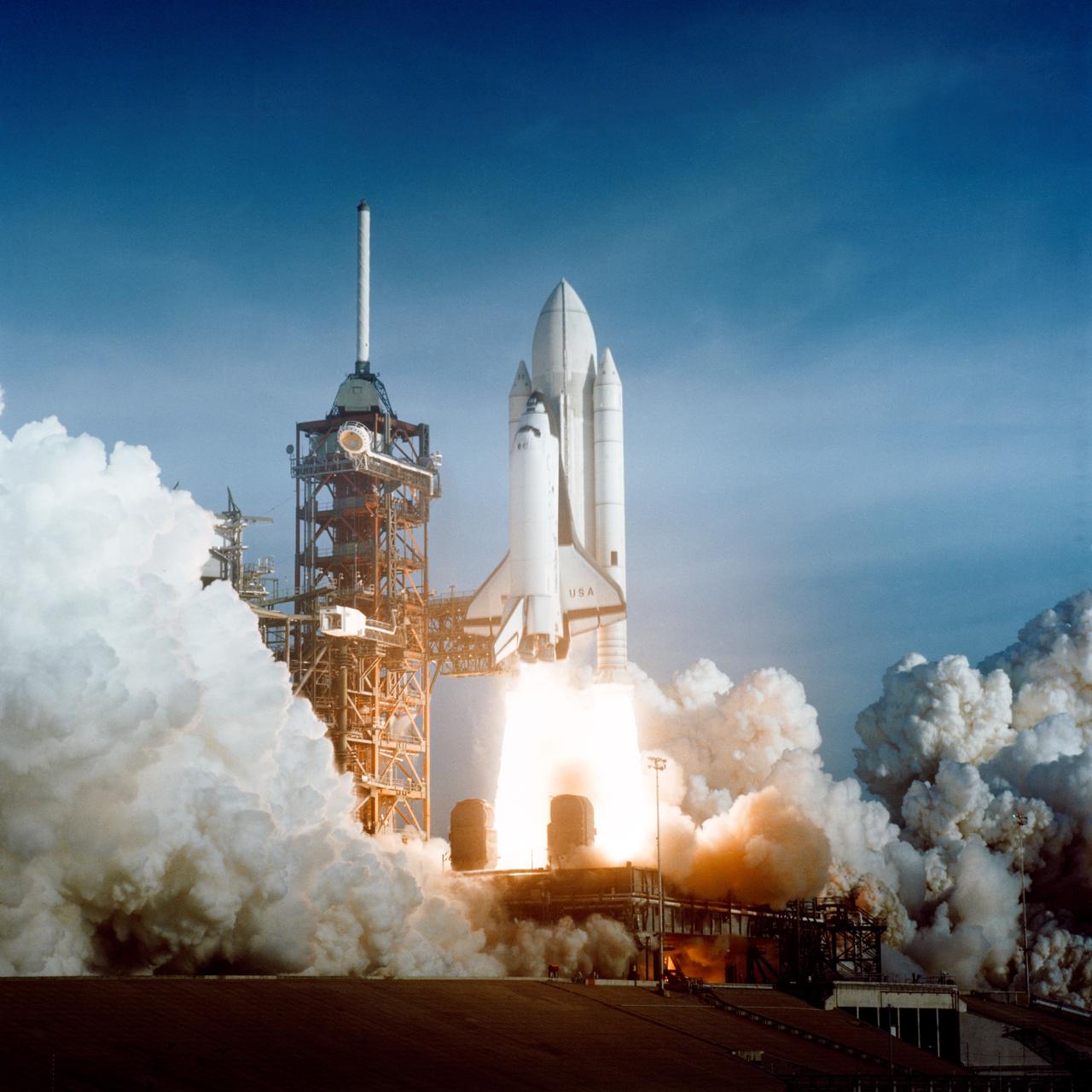
S81-30498 (12 April 1981) --- After six years of silence, the thunder of manned spaceflight is heard again, as the successful launch of the first space shuttle ushers in a new concept in utilization of space. The April 12, 1981 launch, at Pad 39A, just seconds past 7 a.m., carries astronaut John Young and Robert Crippen into an Earth-orbital mission scheduled to last for 54 hours, ending with unpowered landing at Edwards Air Force Base in California. STS-1, the first in a series of shuttle vehicles planned for the Space Transportation System, utilizes reusable launch and return components. Photo credit: NASA or National Aeronautics and Space Administration
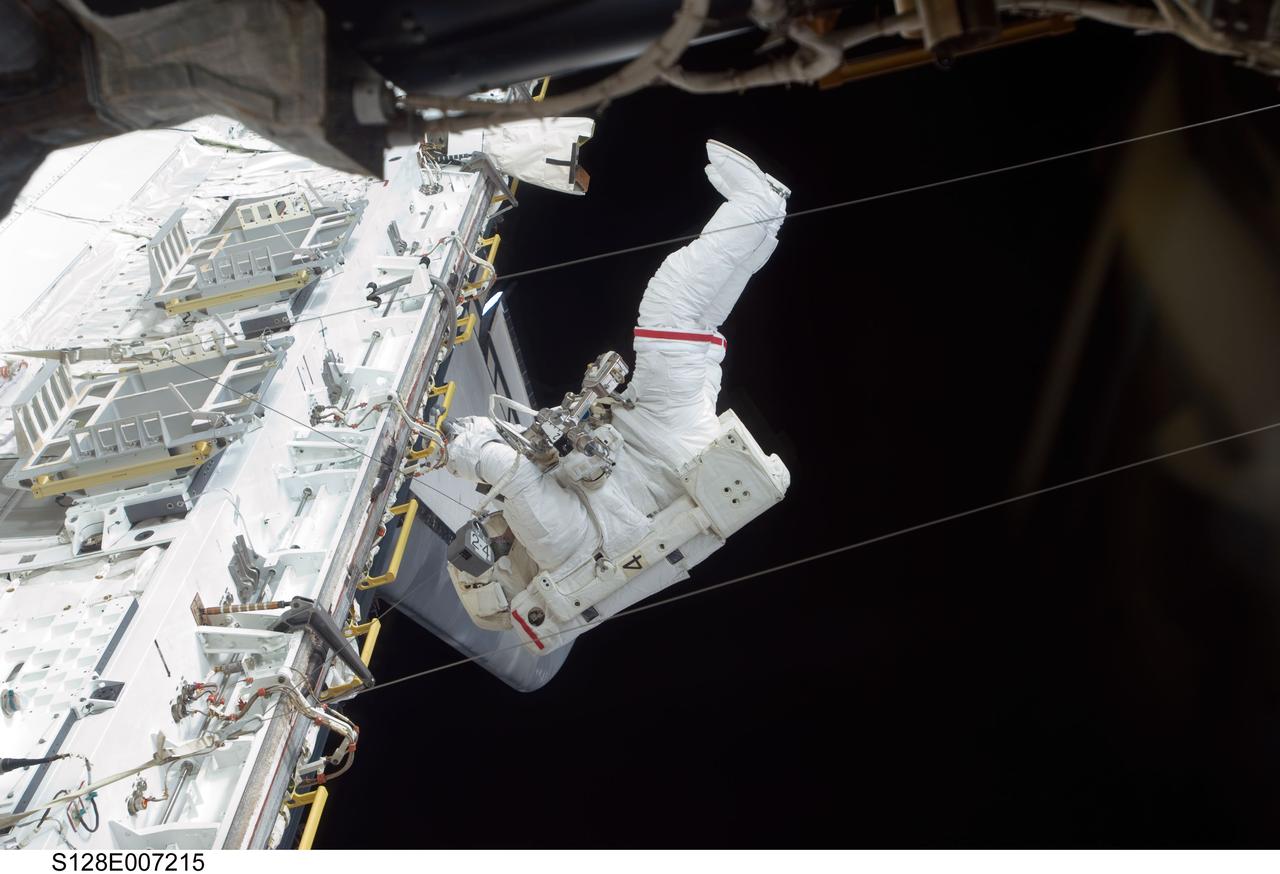
S128-E-007215 (1 Sept. 2009) --- Astronaut John “Danny” Olivas, STS-128 mission specialist, participates in the mission's first session of extravehicular activity (EVA) as construction and maintenance continue on the International Space Station. During the six-hour, 35-minute spacewalk, Olivas and astronaut Nicole Stott (out of frame), mission specialist, removed an empty ammonia tank from the station’s truss and temporarily stowed it on the station’s robotic arm. Olivas and Stott also retrieved the European Technology Exposure Facility (EuTEF) and Materials International Space Station Experiment (MISSE) from the Columbus laboratory module and installed them on Discovery’s payload bay for return.
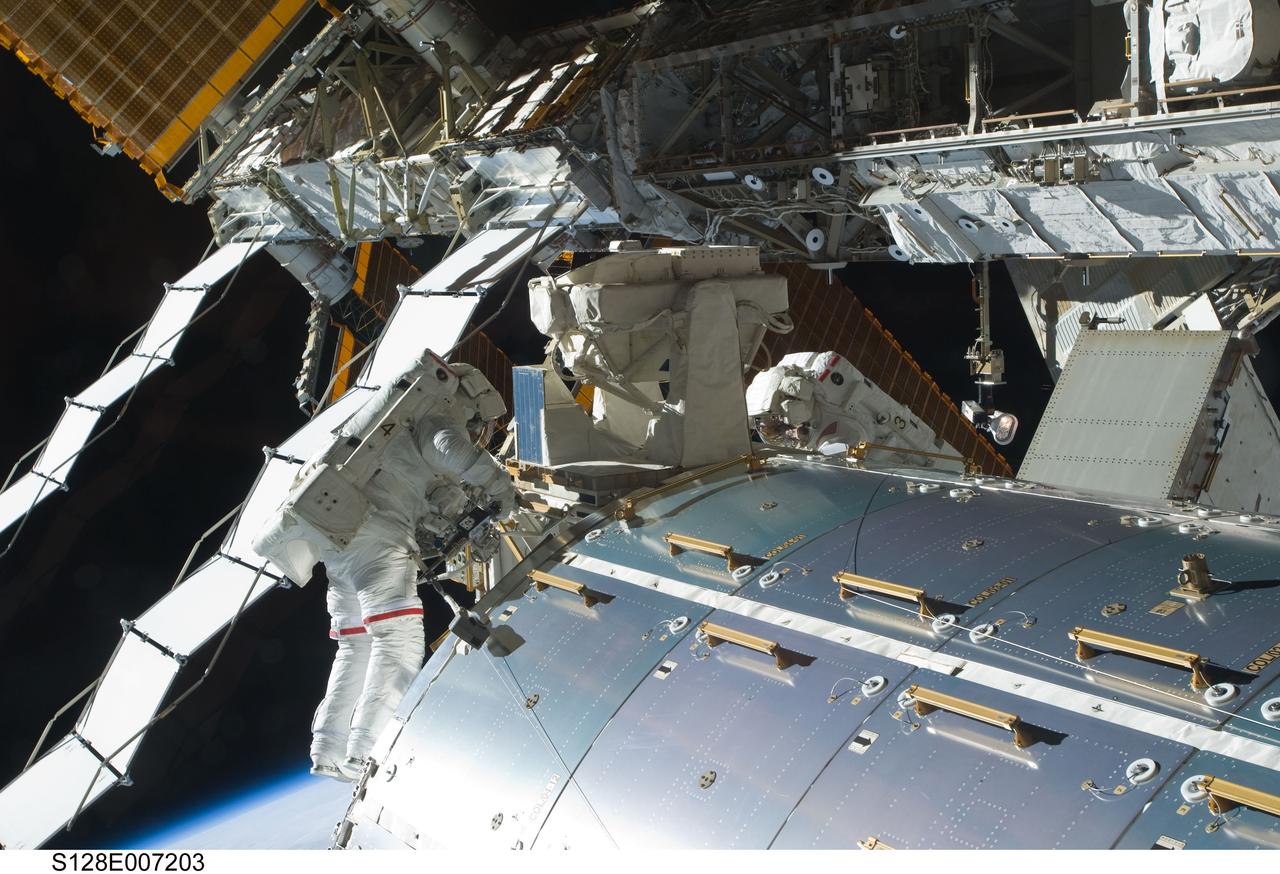
S128-E-007203 (1 Sept. 2009) --- Astronauts John “Danny” Olivas and Nicole Stott (right), both STS-128 mission specialists, participate in the mission's first session of extravehicular activity (EVA) as construction and maintenance continue on the International Space Station. During the six-hour, 35-minute spacewalk, Olivas and Stott removed an empty ammonia tank from the station’s truss and temporarily stowed it on the station’s robotic arm. Olivas and Stott also retrieved the European Technology Exposure Facility (EuTEF) and Materials International Space Station Experiment (MISSE) from the Columbus laboratory module and installed them on Discovery’s payload bay for return.
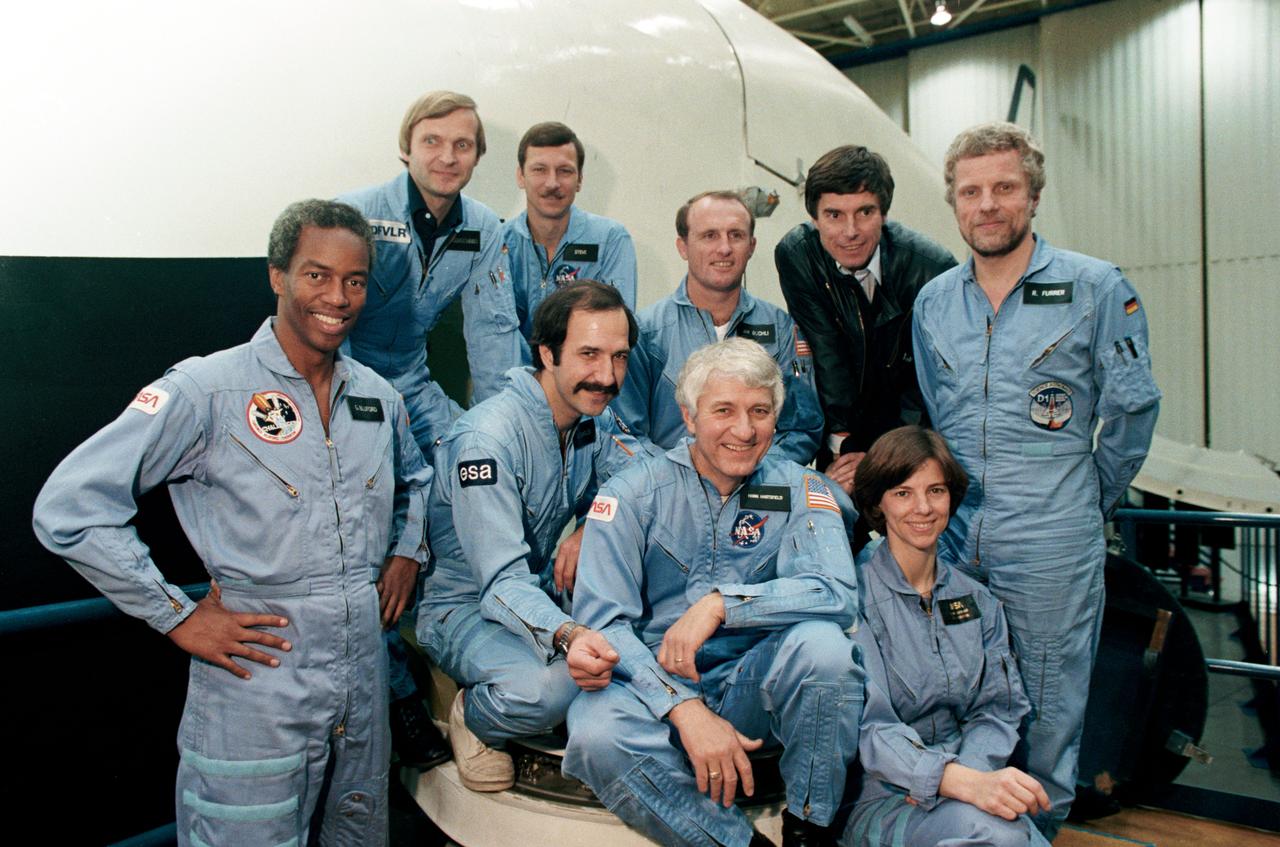
Unofficial group photo of the STS-61A Crew and Ulf Merbold, Bldg. 9A; and, 1-G Trainer Cockpit. JSC, HOUSTON, TX Also available in 4x5 BW

CAPE CANAVERAL, Fla. -- A Hyster forklift transporting engine #2, the last of shuttle Atlantis' three main engines from the Space Shuttle Main Engine (SSME) Shop, enters Orbiter Processing Facility-1 at NASA's Kennedy Space Center in Florida. Inside the processing facility, the engine will be installed in the shuttle. Each engine is 14 feet long, weighs about 6,700 pounds, and is 7.5 feet in diameter at the end of the nozzle. This is the final planned engine installation for the Space Shuttle Program. Atlantis is being prepared for the "launch on need," or potential rescue mission, for the final planned shuttle flight, Endeavour's STS-134 mission. For more information, visit www.nasa.gov/shuttle. Photo credit: NASA/Kim Shiflett
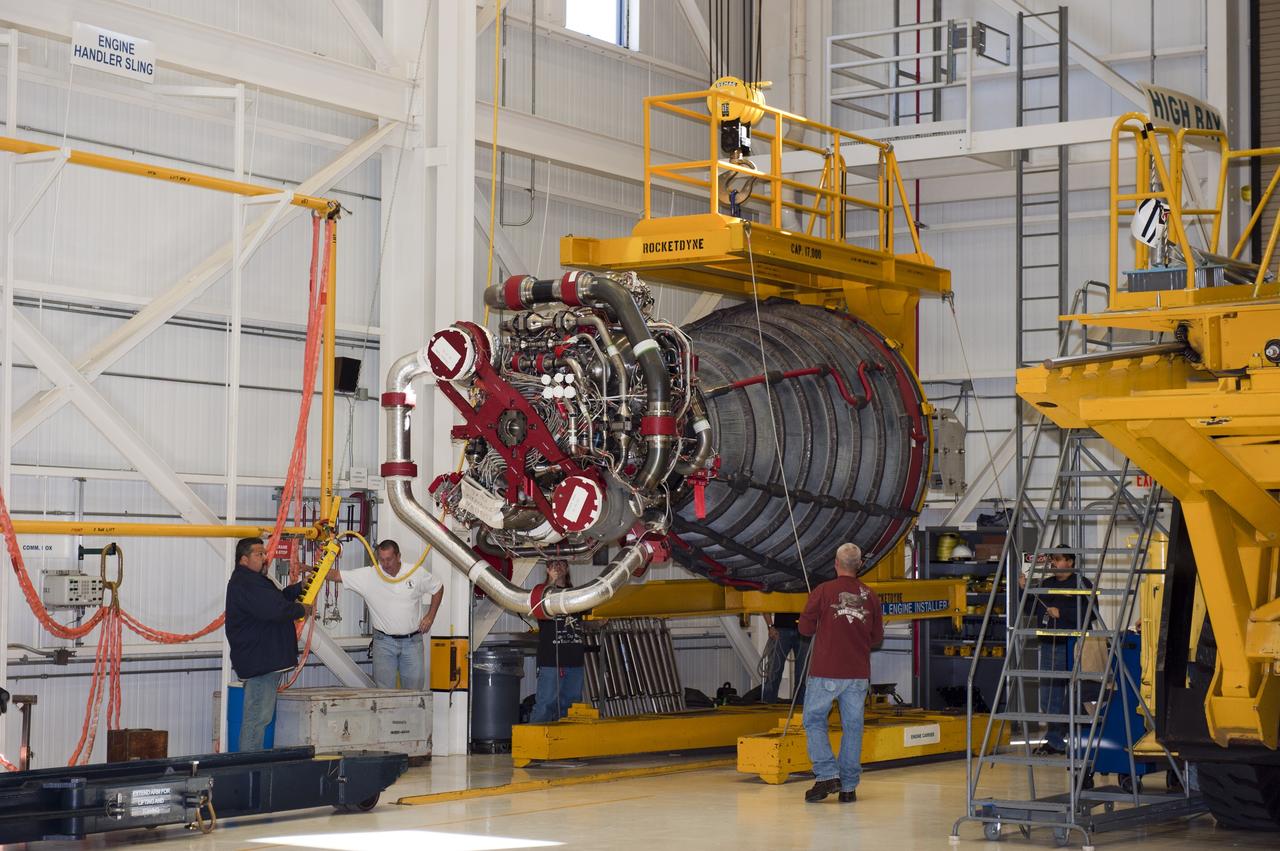
CAPE CANAVERAL, Fla. -- Workers in the Space Shuttle Main Engine (SSME) Shop at NASA's Kennedy Space Center in Florida get ready to raise the second of shuttle Atlantis' three main engines so it can be attached to a Hyster forklift. Then, the engine will be transported to Orbiter Processing Facility-1 where it will be installed in the shuttle. Each engine is 14 feet long, weighs about 6,700 pounds, and is 7.5 feet in diameter at the end of the nozzle. This is the final planned engine installation for the Space Shuttle Program. Atlantis is being prepared for the "launch on need," or potential rescue mission, for the final planned shuttle flight, Endeavour's STS-134 mission. For more information, visit www.nasa.gov/shuttle. Photo credit: NASA/Kim Shiflett
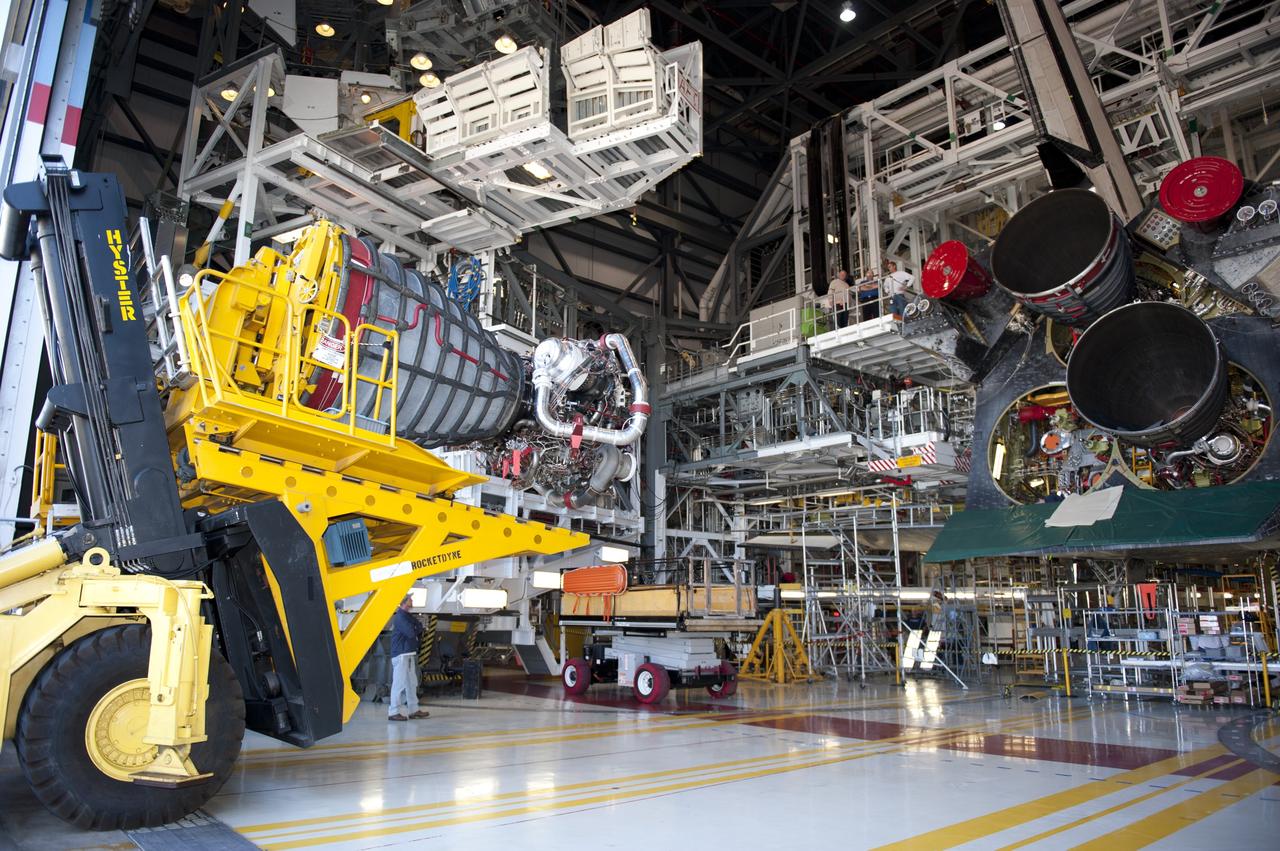
CAPE CANAVERAL, Fla. -- A Hyster forklift transporting engine #2, the last of shuttle Atlantis' three main engines from the Space Shuttle Main Engine (SSME) Shop, enters Orbiter Processing Facility-1 at NASA's Kennedy Space Center in Florida. Inside the processing facility, the engine will be installed in the shuttle. Each engine is 14 feet long, weighs about 6,700 pounds, and is 7.5 feet in diameter at the end of the nozzle. This is the final planned engine installation for the Space Shuttle Program. Atlantis is being prepared for the "launch on need," or potential rescue mission, for the final planned shuttle flight, Endeavour's STS-134 mission. For more information, visit www.nasa.gov/shuttle. Photo credit: NASA/Kim Shiflett
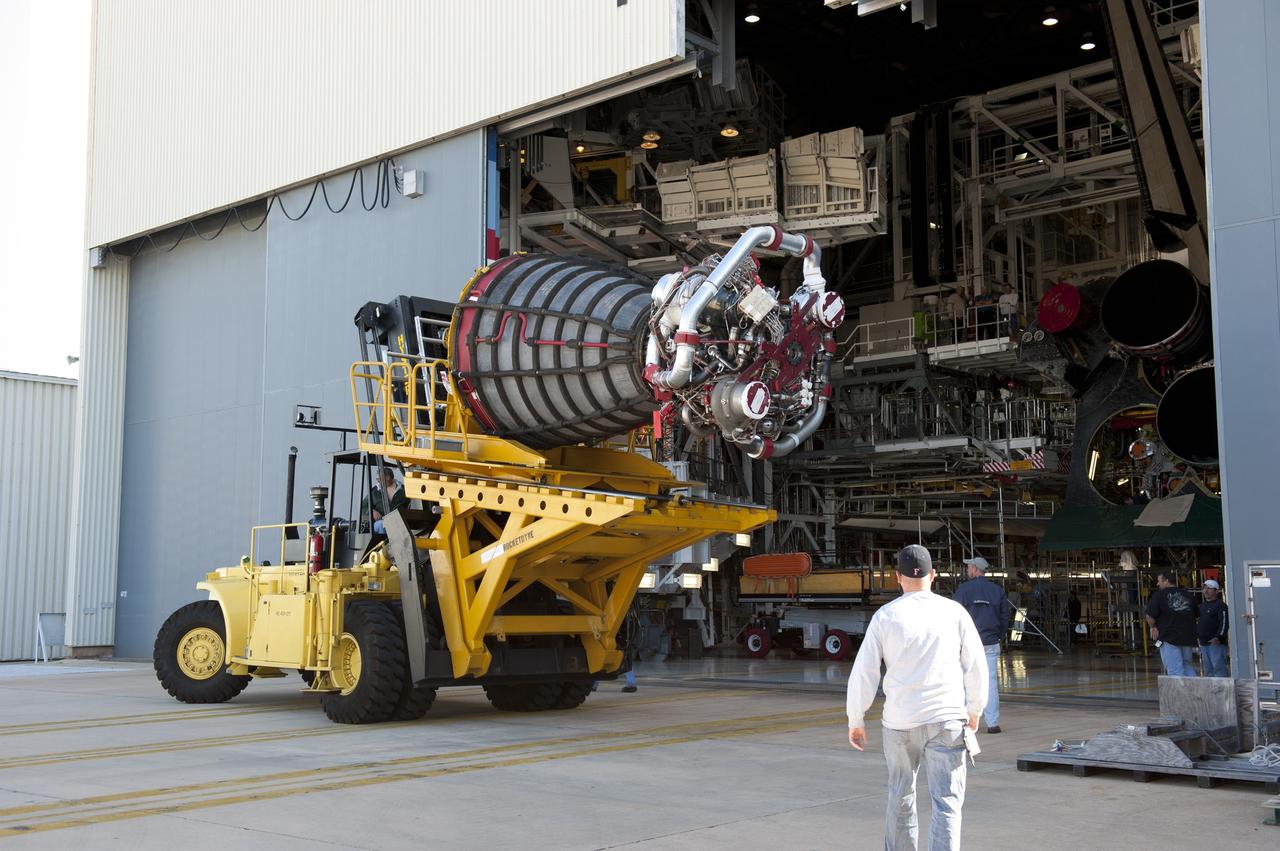
CAPE CANAVERAL, Fla. -- A Hyster forklift transporting engine #2, the last of shuttle Atlantis' three main engines from the Space Shuttle Main Engine (SSME) Shop, arrives at Orbiter Processing Facility-1 at NASA's Kennedy Space Center in Florida. Inside the processing facility, the engine will be installed in the shuttle. Each engine is 14 feet long, weighs about 6,700 pounds, and is 7.5 feet in diameter at the end of the nozzle. This is the final planned engine installation for the Space Shuttle Program. Atlantis is being prepared for the "launch on need," or potential rescue mission, for the final planned shuttle flight, Endeavour's STS-134 mission. For more information, visit www.nasa.gov/shuttle. Photo credit: NASA/Kim Shiflett
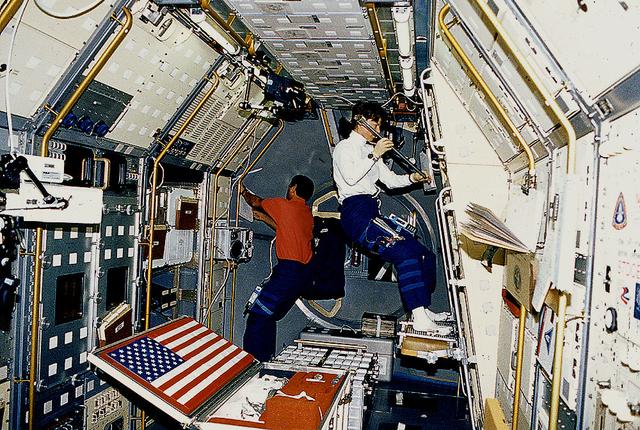
Space Shuttle Columbia (STS-50) onboard photo of astronauts working in United States Microgravity Laboratory (USML-1). USML-1 will fly in orbit for extended periods of time attached to the Shuttle, providing greater opportunities for research in materials science, fluid dynamics, biotechnology, and combustion science. The scientific data gained from the USML-1 missions will constitute a landmark in space science, pioneering investigations into the role of gravity in a wide array of important processes and phenomena. In addition, the missions will also provide much of the experience in performing research in space and in the design of instruments needed for Space Station Freedom and the programs to follow in the 21st Century.
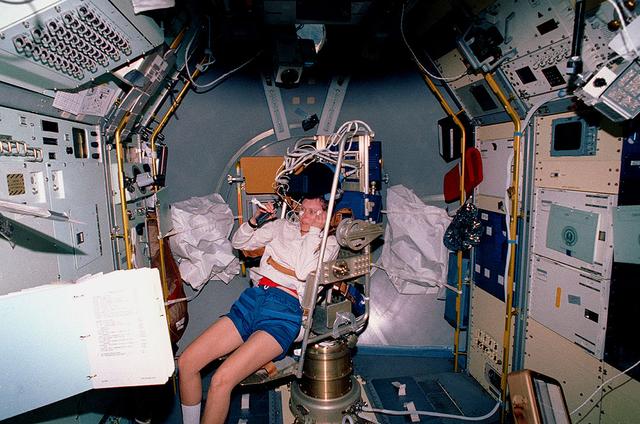
This Space Shuttle Orbiter Discovery (STS-42) onboard photo shows Canadian Payload Specialist Roberta Bondar getting into the Microgravity Vestibular Investigation (MVI) chair to begin an experiment in the International Microgravity Lab-1 (IML-1) Science Module. The (MVI) chair was designed to test the crew member's visual and vestibular responses to head and body movements.
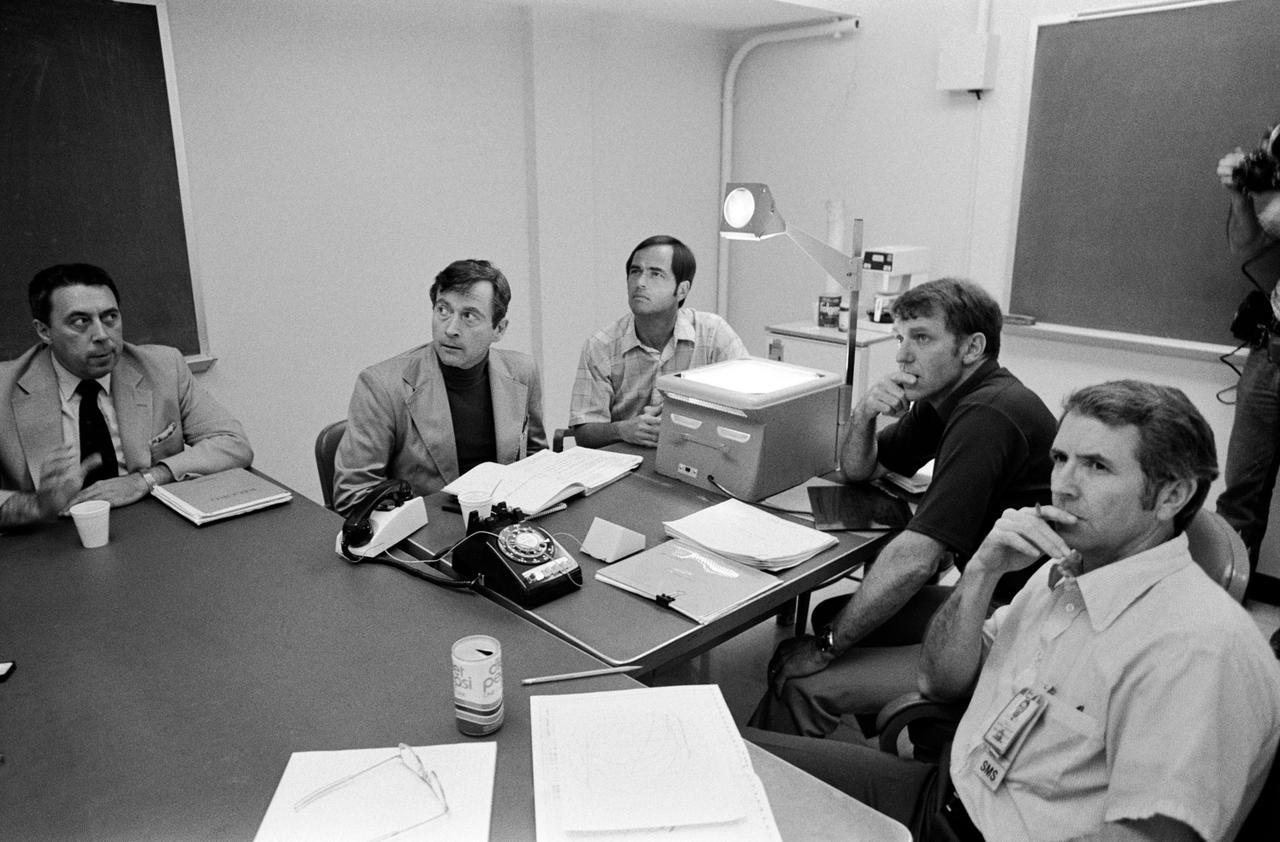
S81-29618 (6 April 1981) --- STS-1 prime and backup astronaut crew members look at visuals during a coordinated teleconference with engineers. Seated at the table in a briefing room at NASA's Johnson Space Center are, clockwise from the left, George W.S. Abbey, Director of Flight Operations, John W. Young, Robert L. Crippen, Joe H. Engle and Richard H. Truly. Young and Crippen are prime crewmen preparing to man the Columbia later this week for the flight of STS-1. Rockwell International engineers in California as well as JSC engineers participated in this telecon. Photo credit: NASA
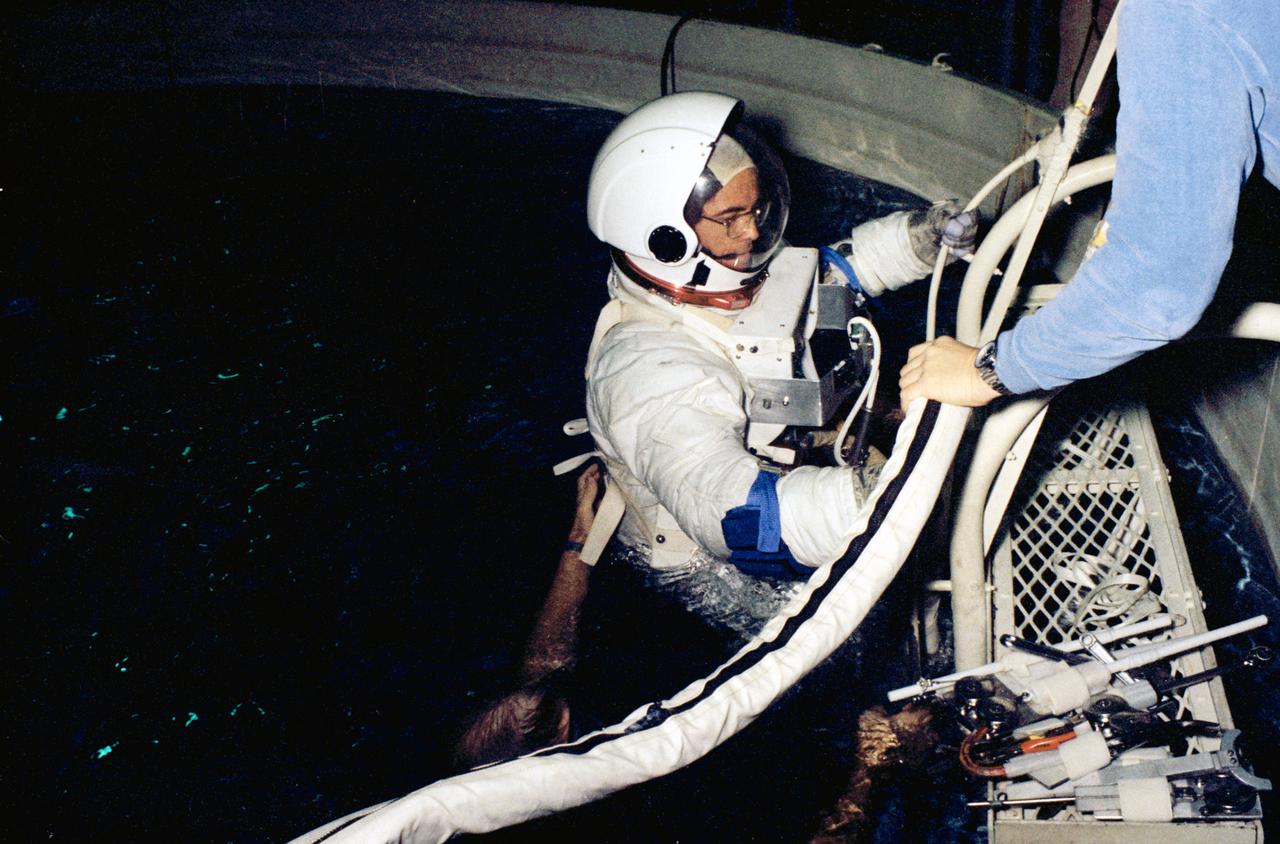
S79-25014 (13 Dec. 1978) --- Astronaut Robert L. Crippen, pilot of the first space shuttle orbital flight test (STS-1), eases into a water immersion facility (WIF) during a training session in the Johnson Space Center?s training and test facility (Bldg. 260). The WIF affords one of two ways to simulate the feeling of weightlessness experienced during space extravehicular activity (EVA), the other being inside aircraft flying a parabolic curve. Crippen will be joined by astronaut John W. Young, commander for the STS-1 flight. Photo credit: NASA
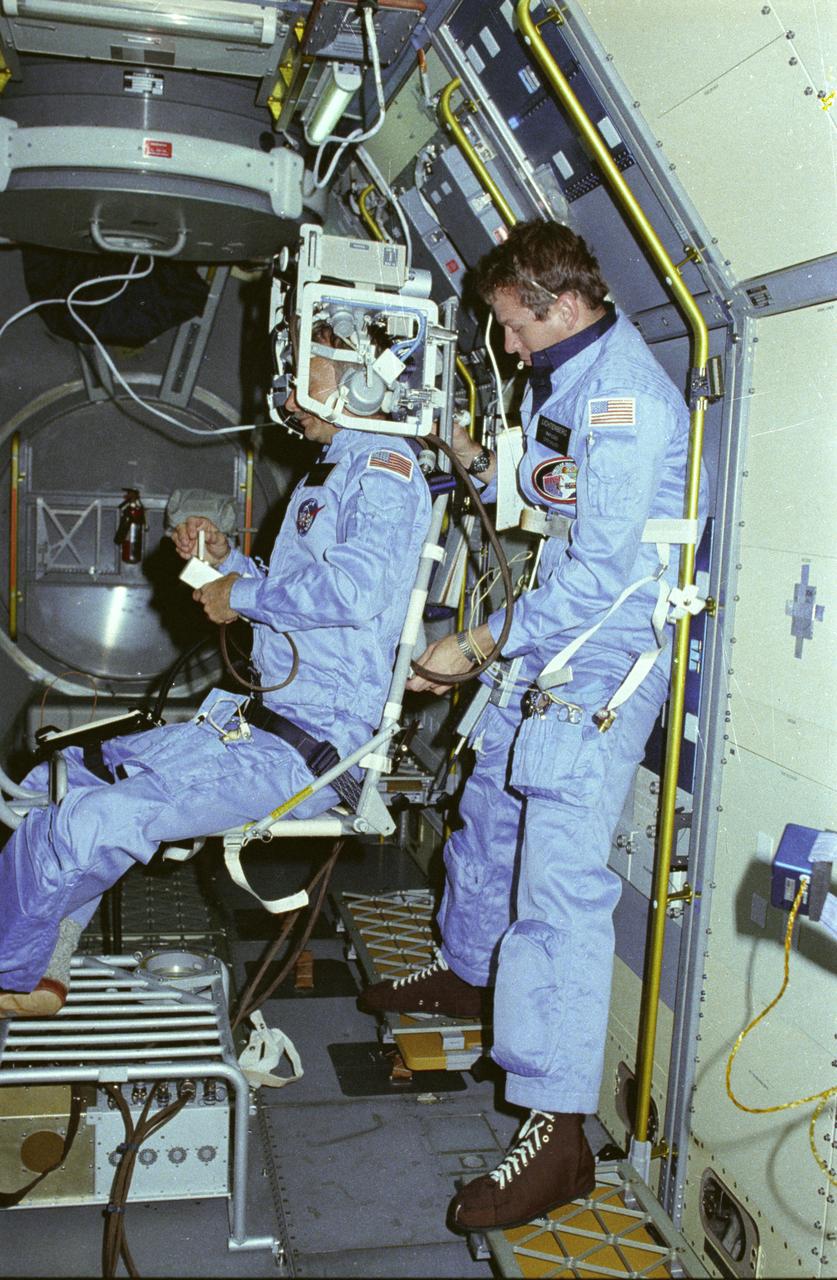
In this photograph, astronauts Owen Garriott on the body restriant system and Byron Lichtenberg prepare for a Vestibular Experiment during the Spacelab-1 mission. The Vestibular Experiments in Space were the study of the interaction among the otoliths, semicircular canals, vision, and spinal reflexes in humans. The main objective was to determine how the body, which receives redundant information for several sensory sources, interprets this information in microgravity. Another objective was to record and characterize the symptoms of space sickness experienced by crewmembers. The body restraint system was a rotating chair with a harness to hold the test subject in place. The crewmember wore an accelerometer and electrodes to record head motion and horizontal and vertical eye movement as the body rotated. The first Spacelab mission, Spacelab-1, sponsored jointly and shared equally by NASA and the European Space Agency, was a multidisciplinary mission; that is, investigations were performed in several different fields of scientific research. The overall goal of the mission was to verify Spacelab performance through a variety of scientific experiments. The Spacelab-1 was launched aboard the Space Shuttle Orbiter Columbia for the STS-9 mission on November 28, 1983. The Marshall Space Flight Center had management responsibilities for the mission.
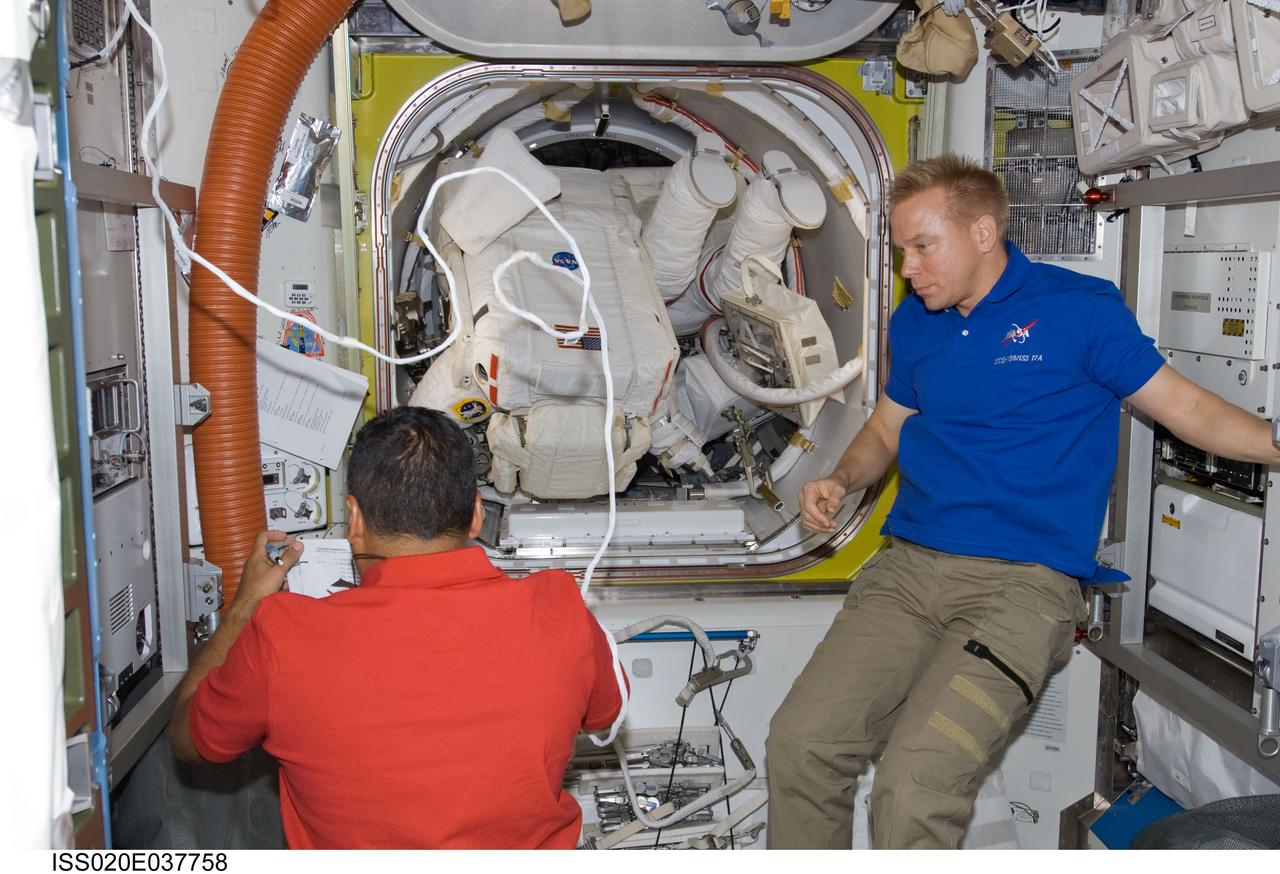
ISS020-E-037758 (1 Sept. 2009) --- Astronauts Jose Hernandez (left) and Tim Kopra, both STS-128 mission specialists, are pictured in the Quest airlock of the International Space Station as astronauts John “Danny” Olivas, mission specialist; and Nicole Stott, Expedition 20 flight engineer, prepare to exit the airlock to begin the mission’s first session of extravehicular activity.
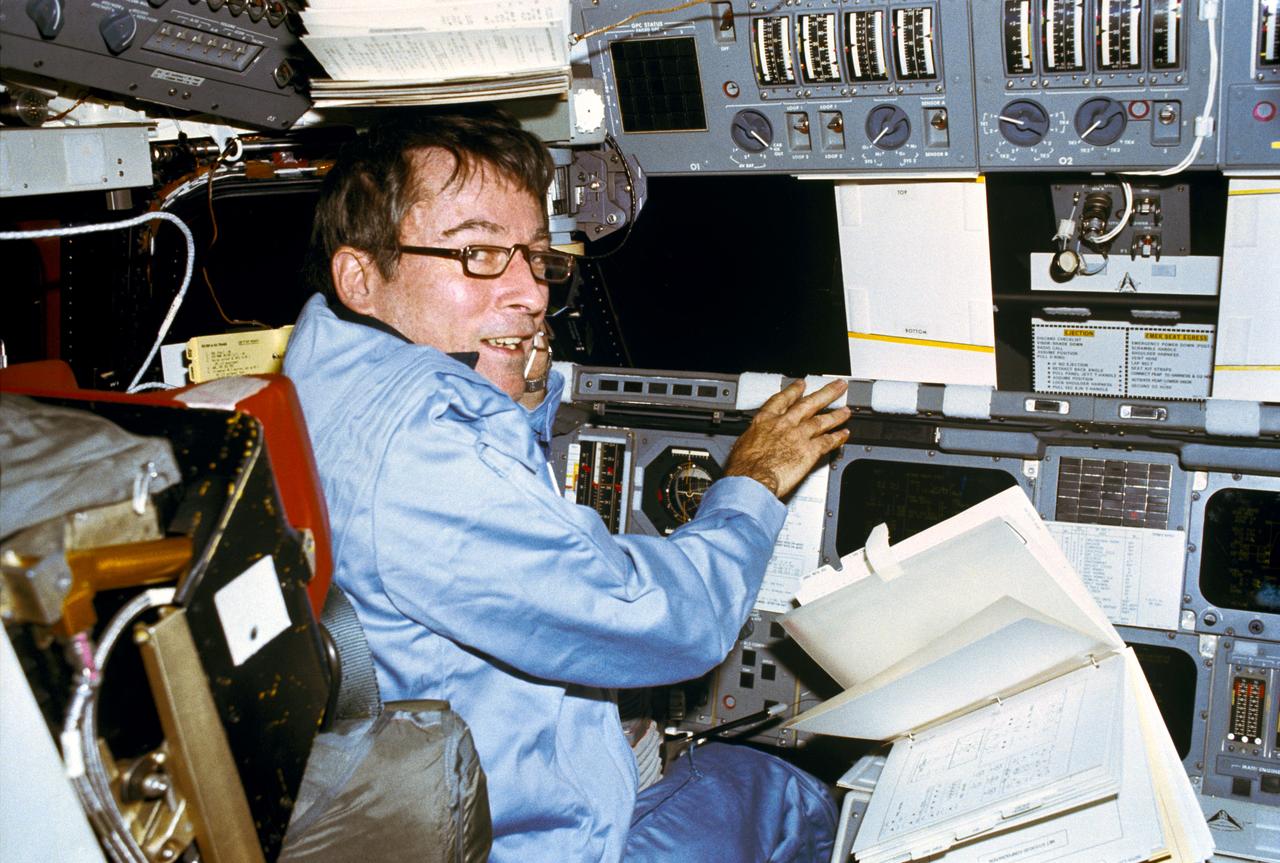
S81-30419 (12-14 April 1981) --- Astronaut John W. Young, mans the commander?s station in the Columbia during the 36-orbit STS-1 flight. A loose leaf notebook with flight activities data floats in the weightless environment. Young is wearing a three-piece constant wear flight suit. This 35mm frame was exposed by astronaut Robert L. Crippen. Photo credit: NASA
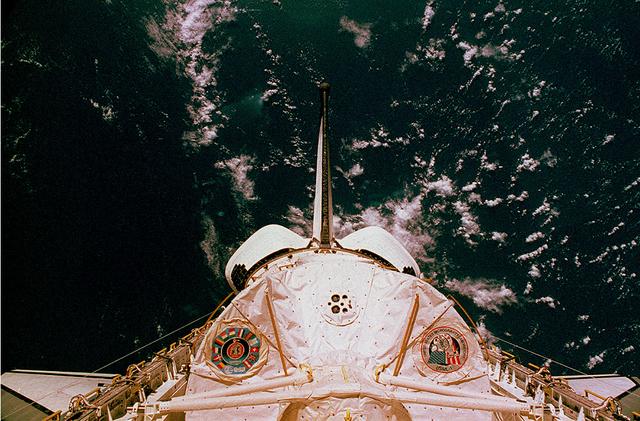
This is a photograph of the Spacelab module for the first United States Microgravity Laboratory (USML-1) mission, showing logos of the Spacelab mission on the left and the USML-1 mission on the right. The USML-1 was one part of a science and technology program that opened NASA's next great era of discovery and established the United States' leadership in space. From investigations designed to gather fundamental knowledge in a variety of areas to demonstrations of new equipment, USML-1 forged the way for future USML missions and helped prepare for advanced microgravity research and processing aboard the Space Station. Thirty-one investigations comprised the payload of the first USML-1 mission. The experiments aboard USML-1 covered five basic areas: fluid dynamics, the study of how liquids and gases respond to the application or absence of differing forces; crystal growth, the production of inorganic and organic crystals; combustion science, the study of the processes and phenomena of burning; biological science, the study of plant and animal life; and technology demonstrations. The USML-1 was managed by the Marshall Space Flight Center and launched aboard the Space Shuttle Orbiter Columbia (STS-50) on June 25, 1992.
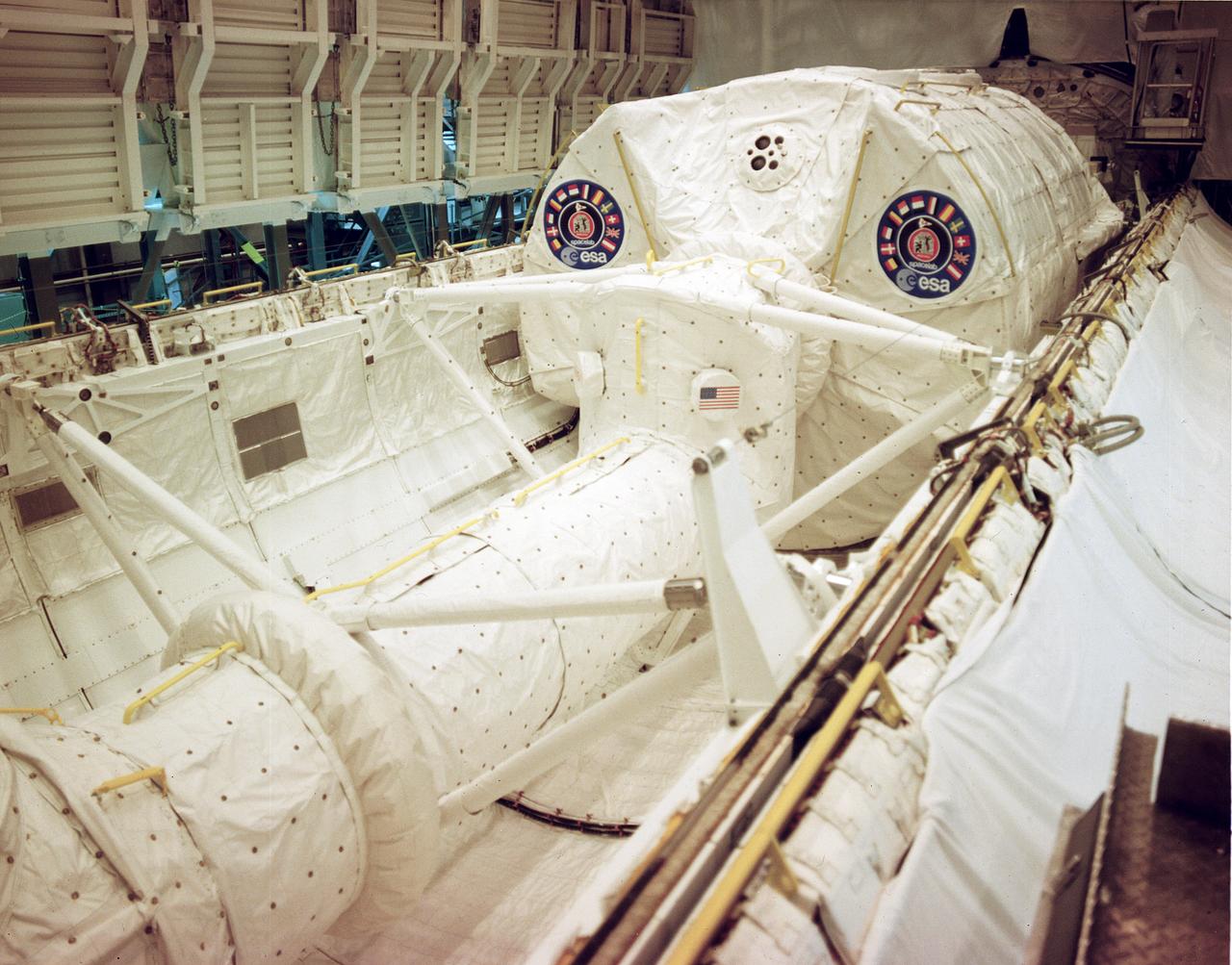
This photograph shows the Spacelab-1 module and Spacelab access turnel being installed in the cargo bay of orbiter Columbia for the STS-9 mission. The oribiting laboratory, built by the European Space Agency, is capable of supporting many types of scientific research that can best be performed in space. The Spacelab access tunnel, the only major piece of Spacelab hardware made in the U.S., connects the module with the mid-deck level of the orbiter cabin. The first Spacelab mission, Spacelab-1, sponsored jointly and shared equally by NASA and the European Space Agency, was a multidisciplinary mission; that is, investigations were performed in several different fields of scientific research. The overall goal of the mission was to verify Spacelab performance through a variety of scientific experiments. The disciplines represented by these experiments were: astronomy and solar physics, earth observations, space plasma physics, materials sciences, atmospheric physics, and life sciences. International in nature, Spacelab-1 conducted experiments from the United States, Japan, the Netherlands, United Kingdom, Beluga, France, Germany, Italy, and Switzerland. Spacelab-1, was launched from the Kennedy Space Center on November 28, 1983 aboard the orbiter Columbia (STS-9). The Marshall Space Flight Center was responsible for managing the Spacelab missions.
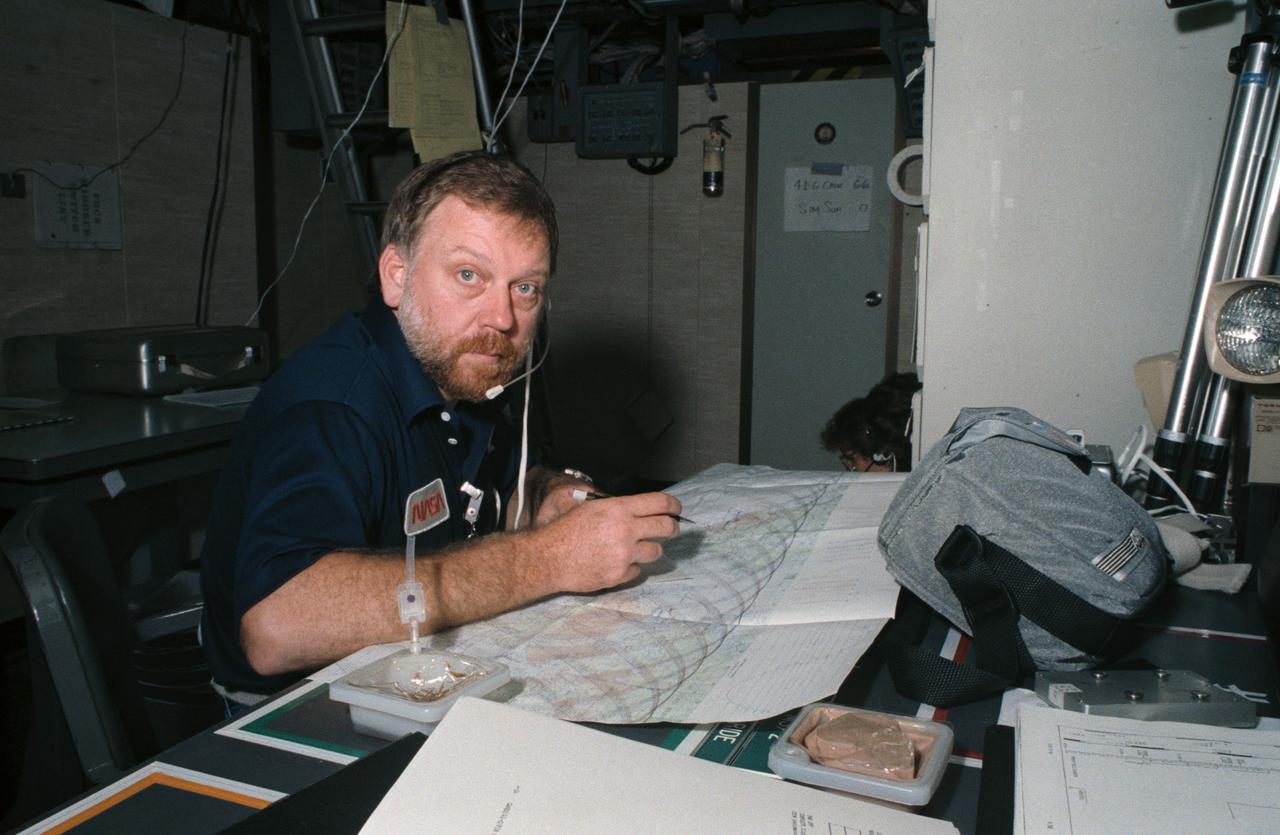
Views of STS-41G Crew member Paul Sculley-Powers during mission experiment training, Fixed Base Simulator, Bldg. 5, 09/09/1984. 1. SHUTTLE - SIMUALTOR (1-G) JSC, HOUSTON, TX
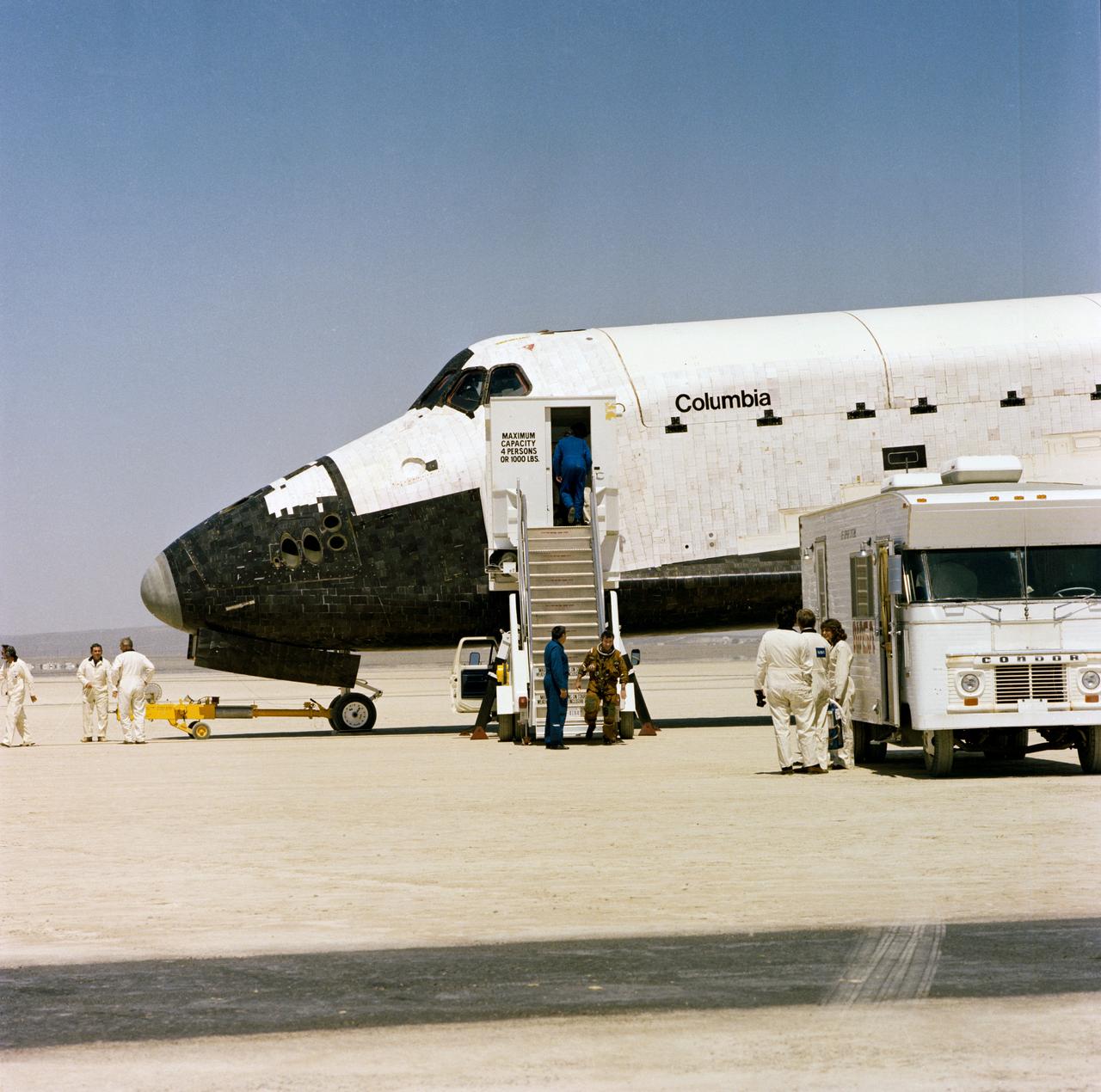
S81-30846 (14 April 1981) --- Astronaut John W. Young (near center of photo), STS-1 commander, egresses the space shuttle Columbia upon the completion of checklist activities following the successful landing of the spacecraft used on STS-1 space mission. George W.S. Abbey, director of flight operations at the Johnson Space Center (JSC), greets him at the bottom of the steps. Astronaut Robert L. Crippen, STS-1 pilot, is still inside Columbia. Dr. Craig L. Fischer, chief of the medical operations branch in the medical sciences division at JSC, ingresses the spacecraft at top of stairs. Photo credit: NASA
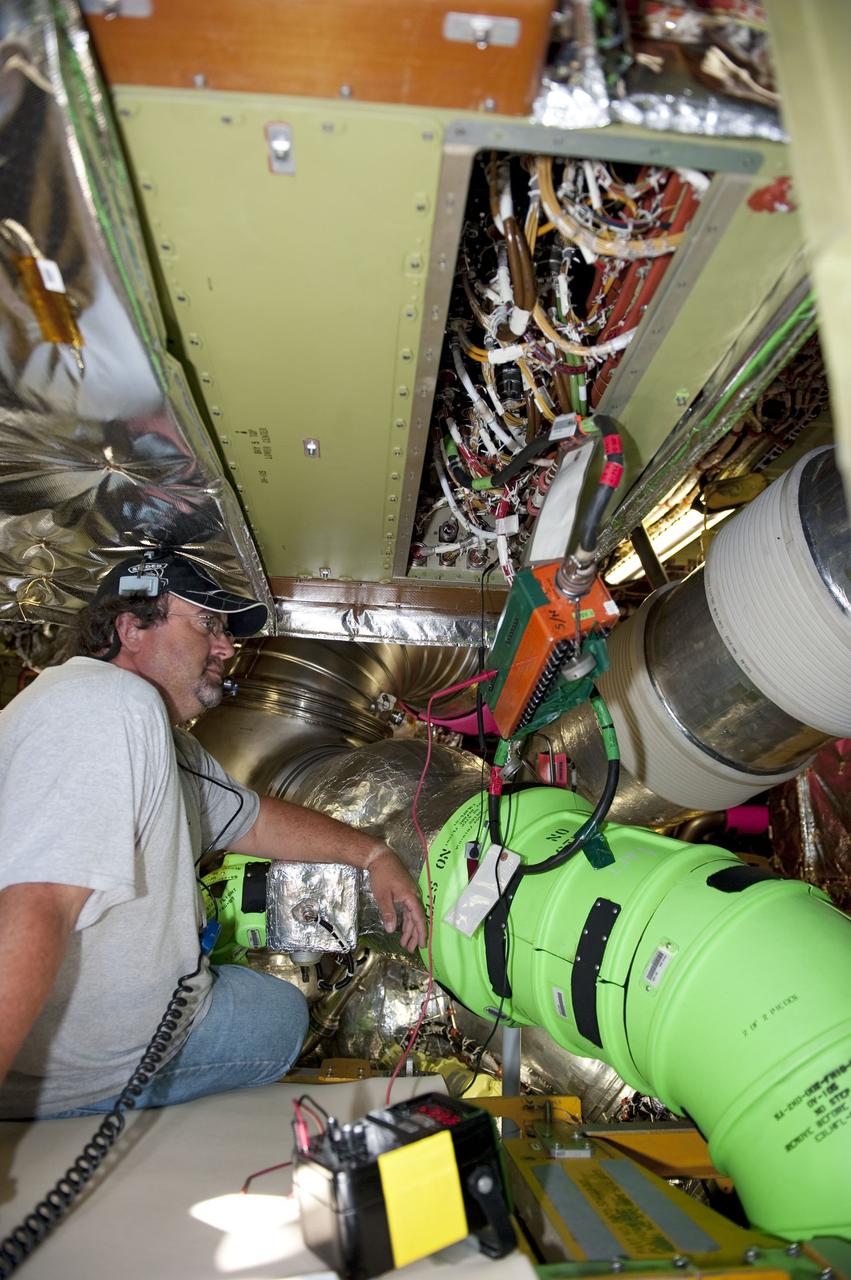
CAPE CANAVERAL, Fla. -- At NASA Kennedy Space Center's Launch Pad 39A, technicians inside space shuttle Endeavour's aft section test the Load Control Assembly-2 (LCA-2). Located in the orbiter's aft avionics bay 5, the LCA-2 assembly, which feeds power to the fuel line heaters, is believed to have caused the heaters for Endeavour's auxiliary power unit-1 (APU-1) to fail April 29 during the first launch attempt for the STS-134 mission. STS-134 will deliver the Express Logistics Carrier-3, Alpha Magnetic Spectrometer-2 (AMS), a high-pressure gas tank and additional spare parts for the Dextre robotic helper to the International Space Station. The mission also will be the final spaceflight for Endeavour. For more information, visit www.nasa.gov/mission_pages/shuttle/shuttlemissions/sts134/index.html. Photo credit: NASA/Kim Shiflett.

CAPE CANAVERAL, Fla. -- At NASA Kennedy Space Center's Launch Pad 39A, a worker inside space shuttle Endeavour's aft section removes a cover to provide access for the removal and replacement of the Load Control Assembly-2 (LCA-2). Located in the orbiter's aft avionics bay 5, the LCA-2 assembly, which feeds power to the fuel line heaters, is believed to have caused the heaters for Endeavour's auxiliary power unit-1 (APU-1) to fail April 29 during the first launch attempt for the STS-134 mission. STS-134 will deliver the Express Logistics Carrier-3, Alpha Magnetic Spectrometer-2 (AMS), a high-pressure gas tank and additional spare parts for the Dextre robotic helper to the International Space Station. The mission also will be the final spaceflight for Endeavour. For more information, visit www.nasa.gov/mission_pages/shuttle/shuttlemissions/sts134/index.html. Photo credit: NASA/Kim Shiflett.
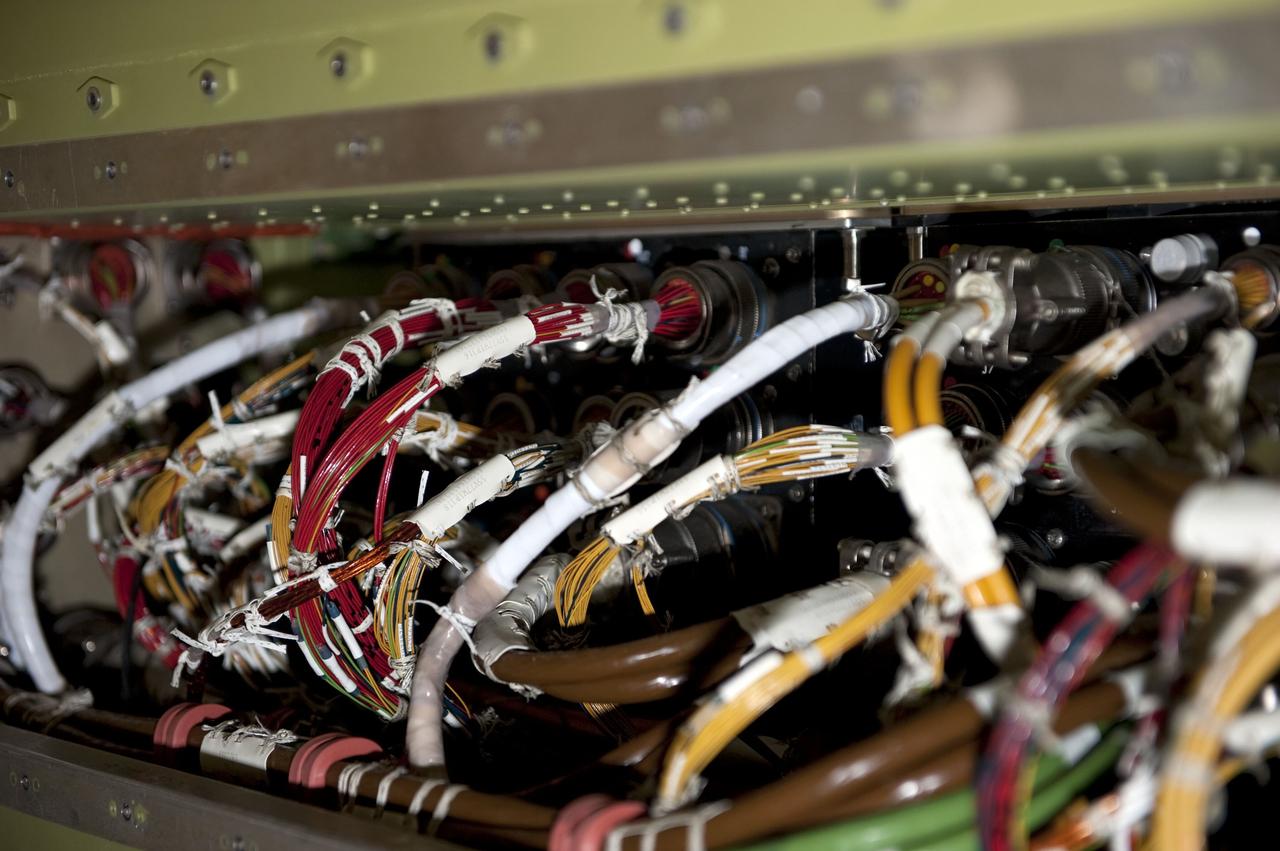
CAPE CANAVERAL, Fla. -- At NASA Kennedy Space Center's Launch Pad 39A, a worker inside space shuttle Endeavour's aft section removed a cover to provide access for the removal and replacement of the Load Control Assembly-2 (LCA-2). Located in the orbiter's aft avionics bay 5, the LCA-2 assembly, which feeds power to the fuel line heaters, is believed to have caused the heaters for Endeavour's auxiliary power unit-1 (APU-1) to fail April 29 during the first launch attempt for the STS-134 mission. STS-134 will deliver the Express Logistics Carrier-3, Alpha Magnetic Spectrometer-2 (AMS), a high-pressure gas tank and additional spare parts for the Dextre robotic helper to the International Space Station. The mission also will be the final spaceflight for Endeavour. For more information, visit www.nasa.gov/mission_pages/shuttle/shuttlemissions/sts134/index.html. Photo credit: NASA/Kim Shiflett.
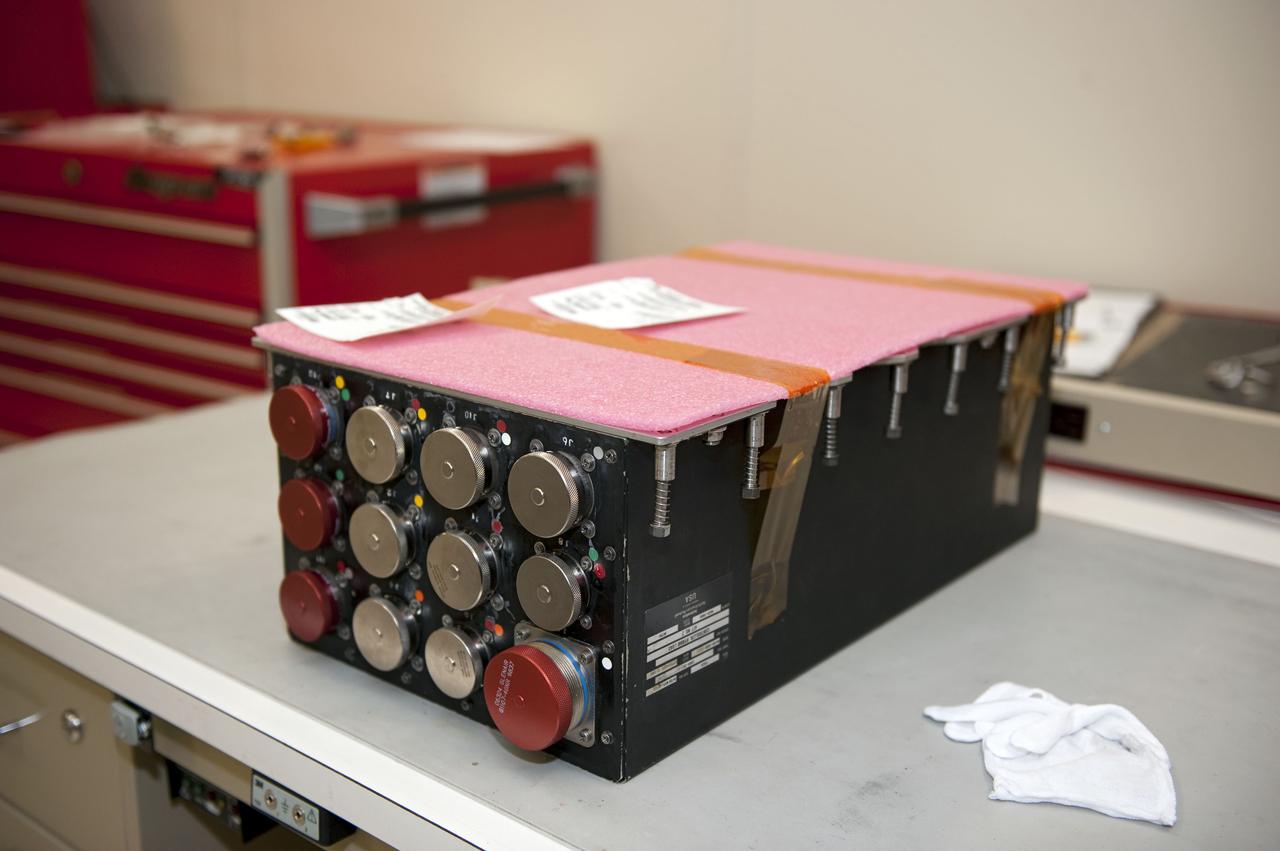
CAPE CANAVERAL, Fla. -- At NASA Kennedy Space Center's Launch Pad 39A work station, a replacement Load Control Assembly-2 (LCA-2) is being prepared for installation into Endeavour's aft section. Located in the orbiter's aft avionics bay 5, the LCA-2 assembly, which feeds power to the fuel line heaters, is believed to have caused the heaters for Endeavour's auxiliary power unit-1 (APU-1) to fail April 29 during the first launch attempt for the STS-134 mission. STS-134 will deliver the Express Logistics Carrier-3, Alpha Magnetic Spectrometer-2 (AMS), a high-pressure gas tank and additional spare parts for the Dextre robotic helper to the International Space Station. The mission also will be the final spaceflight for Endeavour. For more information, visit www.nasa.gov/mission_pages/shuttle/shuttlemissions/sts134/index.html. Photo credit: NASA/Kim Shiflett.
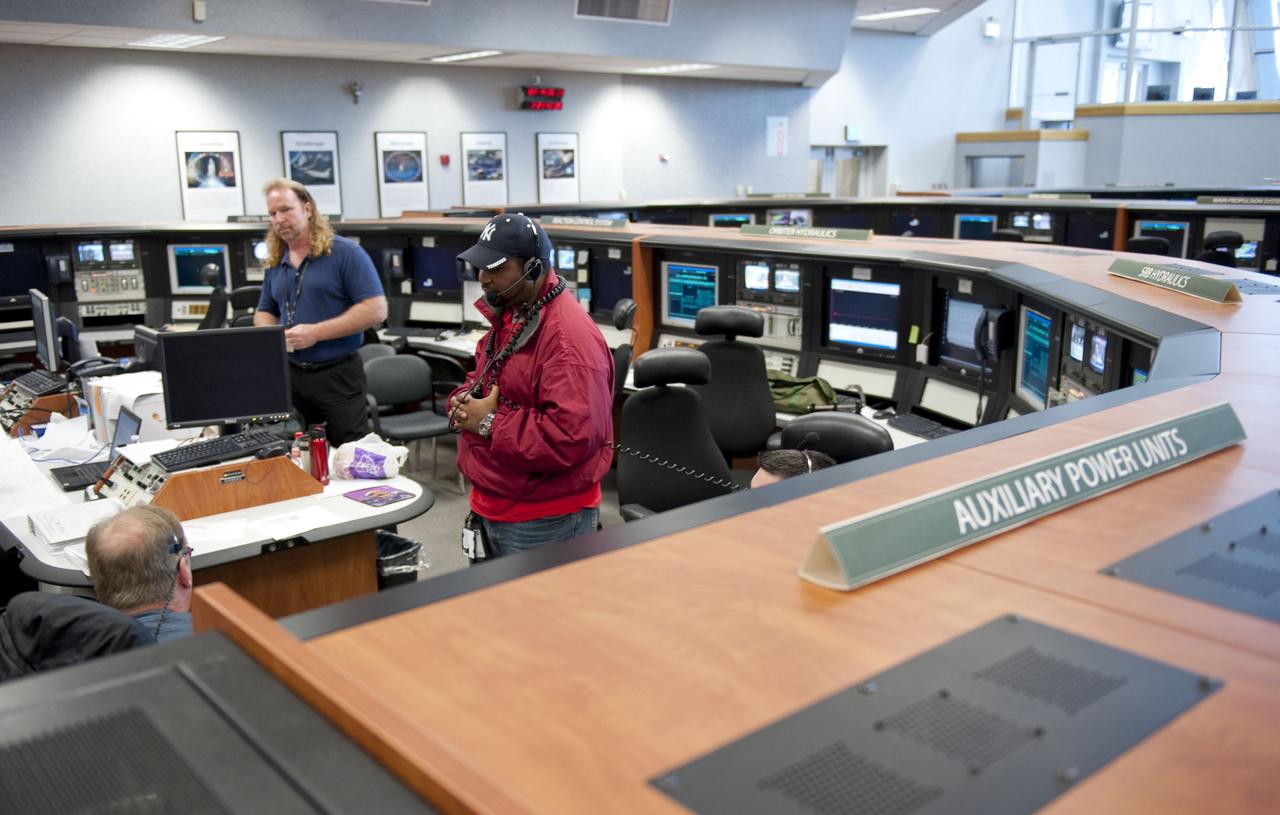
CAPE CANAVERAL, Fla. -- At NASA Kennedy Space Center's Launch Control Center, teams monitor the testing of the Load Control Assembly-2 (LCA-2) located in space shuttle Endeavour's aft section. Located in the orbiter's aft avionics bay 5, the LCA-2 assembly, which feeds power to the fuel line heaters, is believed to have caused the heaters for Endeavour's auxiliary power unit-1 (APU-1) to fail April 29 during the first launch attempt for the STS-134 mission. STS-134 will deliver the Express Logistics Carrier-3, Alpha Magnetic Spectrometer-2 (AMS), a high-pressure gas tank and additional spare parts for the Dextre robotic helper to the International Space Station. The mission also will be the final spaceflight for Endeavour. For more information, visit www.nasa.gov/mission_pages/shuttle/shuttlemissions/sts134/index.html. Photo credit: NASA/Kim Shiflett.