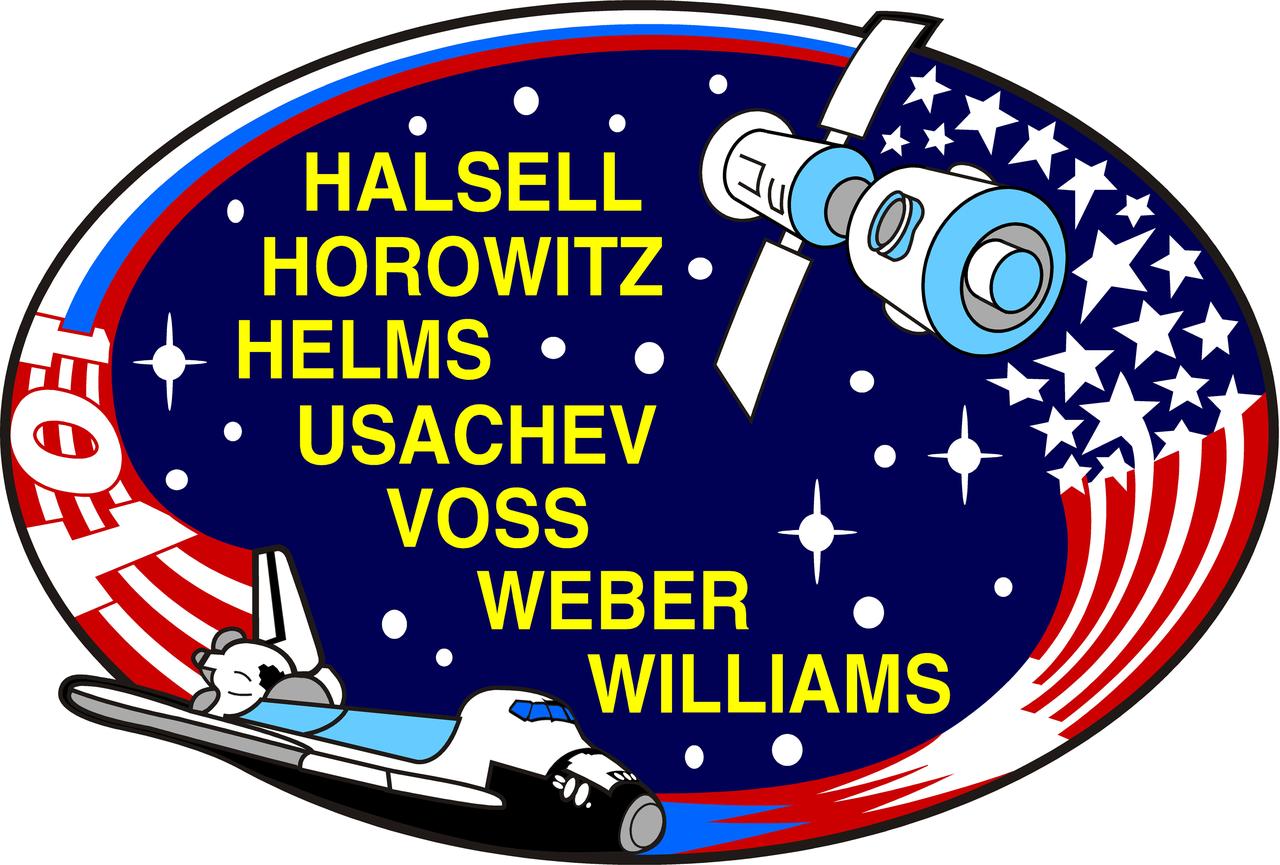
The STS-101 mission patch commemorates the third Space Shuttle flight supporting the assembly of the International Space Station (ISS). This flight's primary tasks were to outfit the ISS and extend its lifetime, to conduct a space walk to install external components in preparation for the docking of the Russian Service Module, Zvezda, and the arrival of the first ISS crew. The Space Shuttle is depicted in an orbit configuration prior to docking with the ISS. The ISS is depicted in the stage of assembly completed for the STS-101 mission, which consists of the United States built Unity module and the Russian-built Zarya module. The three large stars represent the third ISS mission in the assembly sequence. The elements and colors of the border reflect the flags of the nations represented by the STS-101 crew members, the United States, and Russia.

JSC2000-04608 (30 May 2000) --- Astronaut James D. Halsell, Jr., mission commander, speaks to a crowd at the crew-welcoming ceremony at Ellington Field on the day following the completion of the STS-101 mission.
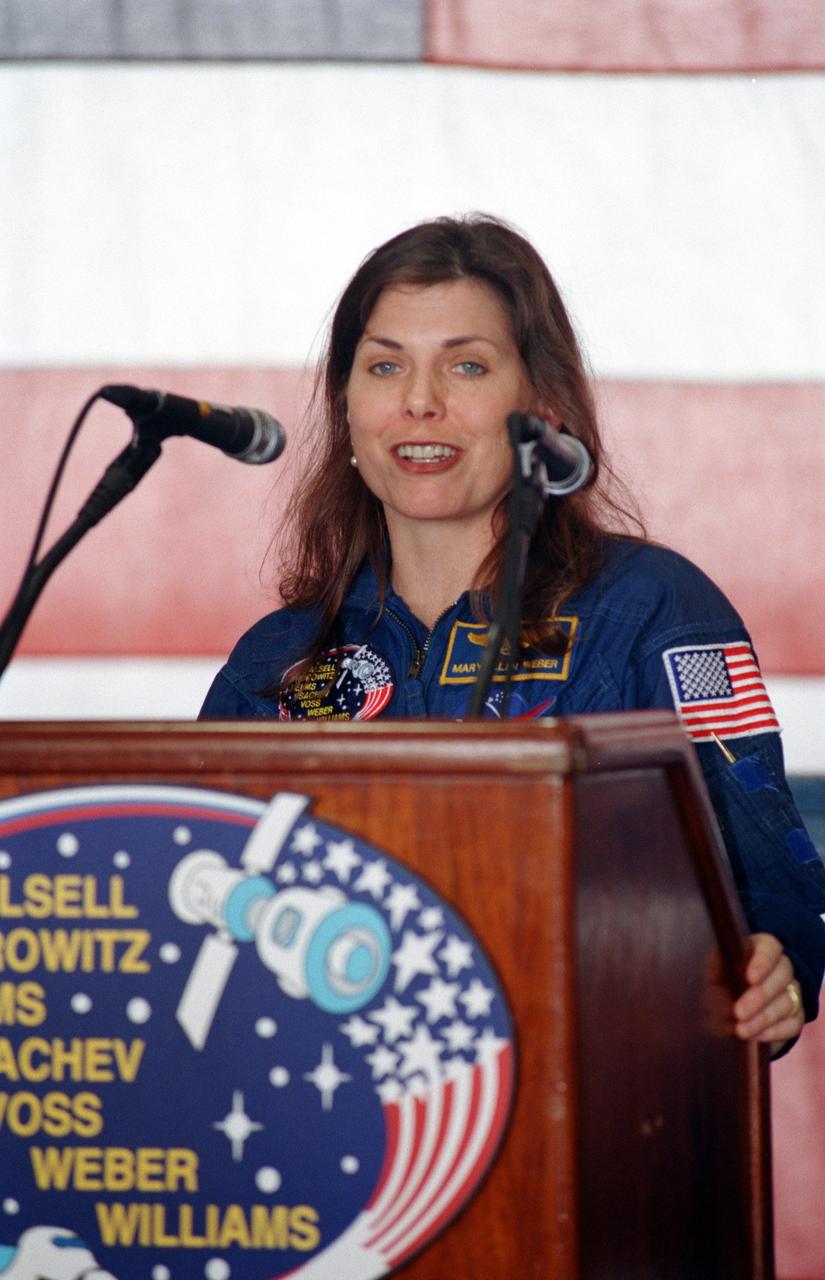
JSC2000-04605 (30 May 2000) --- Astronaut Mary Ellen Weber, mission specialist, speaks to a crowd at the crew-welcoming ceremony at Ellington Field on the day following the completion of the STS-101 mission.
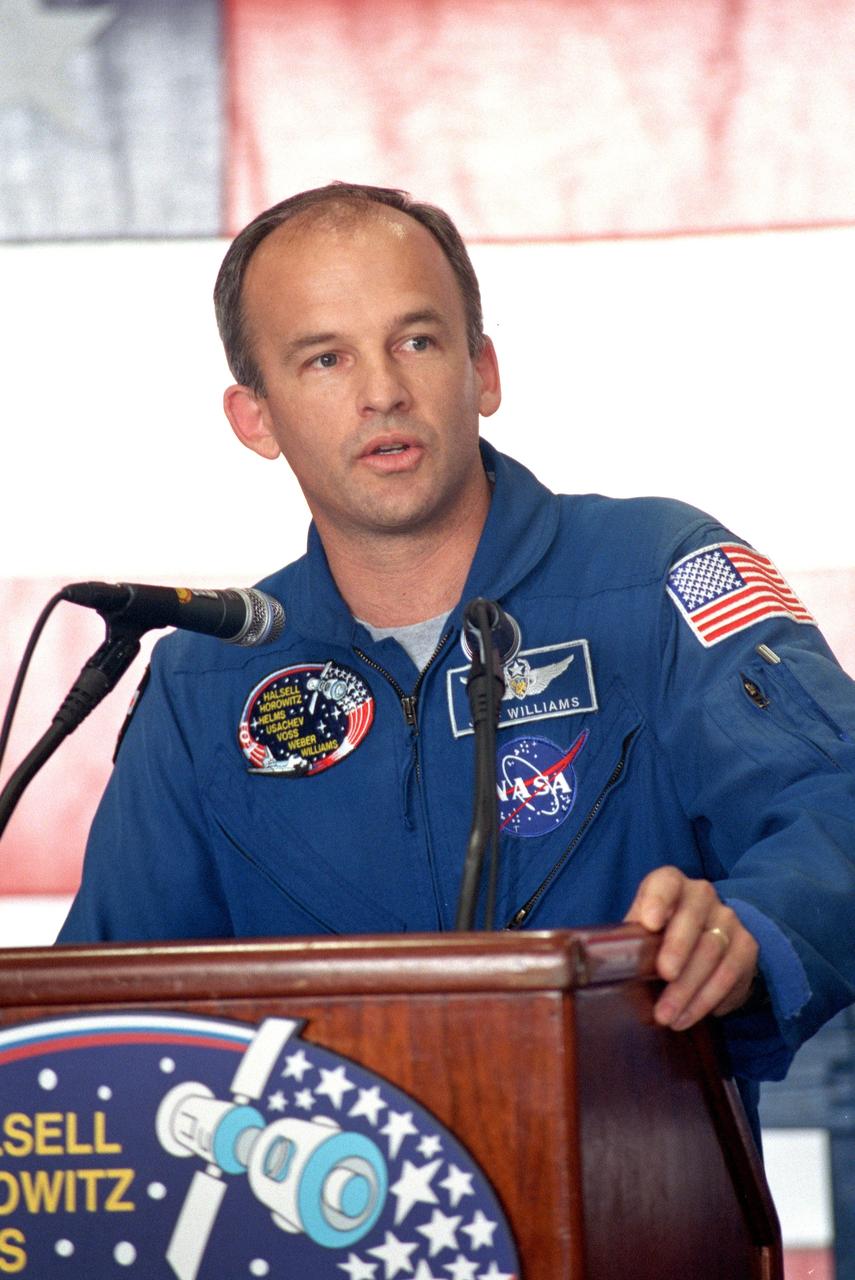
JSC2000-04604 (30 May 2000) --- Astronaut Jeffrey N.Williams, mission specialist, speaks to a crowd at the crew-welcoming ceremony at Ellington Field on the day following the completion of the STS-101 mission.
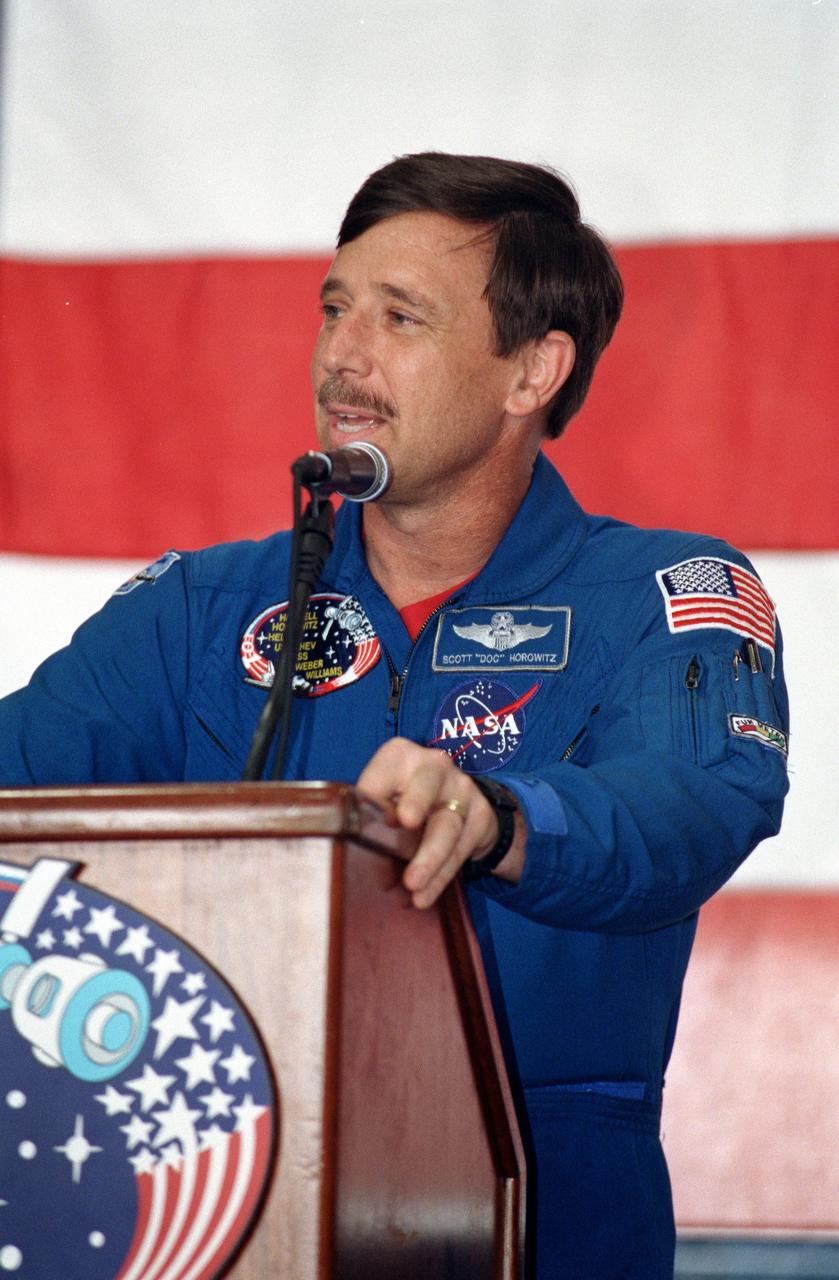
JSC2000-04606 (30 May 2000) --- Astronaut Scott J. Horowitz, pilot, speaks to a crowd at the crew-welcoming ceremony at Ellington Field on the day following the completion of the STS-101 mission.

JSC2000-04610 (30 May 2000) --- Cosmonaut Yury V. Usachev, mission specialist representing the Russian Aviation and Space Agency, speaks to a crowd at the crew-welcoming ceremonies at Ellington Field. The seven-member crew returned to Houston after spending its first night in Florida following the completion of the STS-101 mission.

JSC2000-04612 (30 May 2000) --- Astronaut Susan J. Helms, mission specialist, speaks to a crowd at the crew-welcoming ceremonies at Ellington Field. The seven-member crew returned to Houston after spending its first night in Florida following the completion of the STS-101 mission.
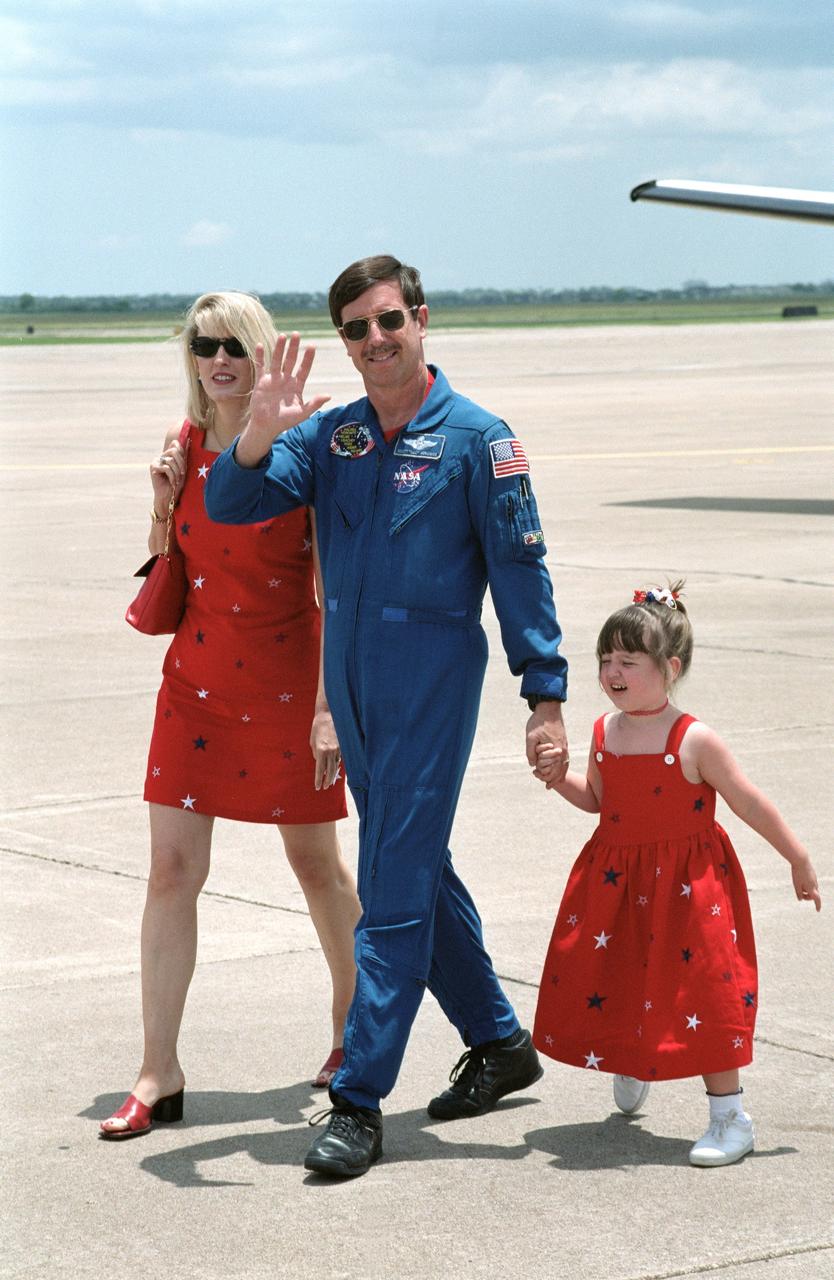
JSC2000-04594 (30 May 2000) --- Astronaut Scott J. Horowitz, pilot, reunites with wife Lisa Marie and young daughter following the STS-101 crew return. A welcome-home ceremony followed the arrival of the six astronauts and one cosmonaut at Ellington Field on the day after the landing of the Space Shuttle Atlantis in Florida.
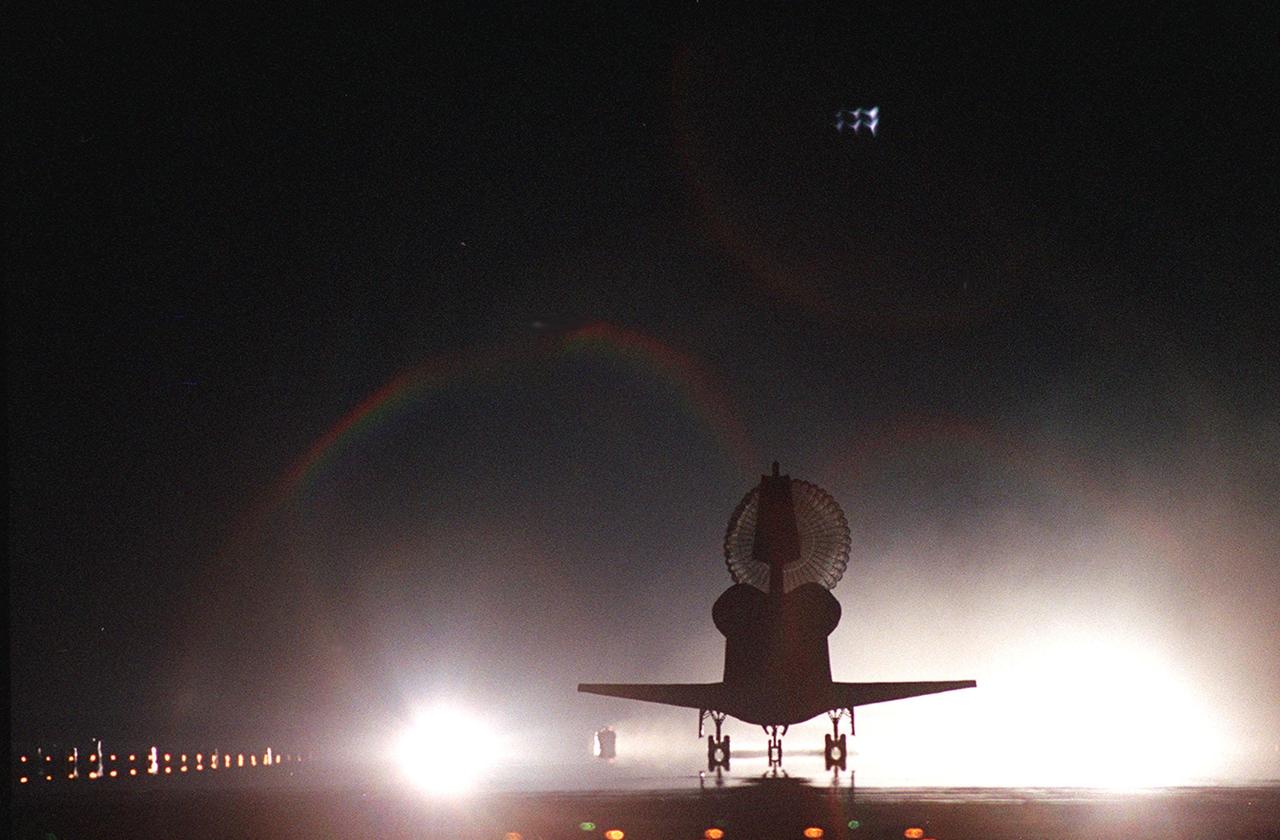
With its drag chute billowing behind, Space Shuttle Atlantis is silhouetted against the bright lights on Runway 15, Shuttle Landing Facility, as it rolls to a stop. Two rainbows appear above the lights. The landing of Atlantis completed the 9-day, 20-hour, 9-minute-long STS-101 mission. At the controls are Commander James D. Halsell Jr. and Pilot Scott 'Doc' Horowitz. Also onboard the orbiter are Mission Specialists Mary Ellen Weber, James S. Voss, Jeffrey N. Williams, Susan J. Helms and Yury Usachev of Russia. Main gear touchdown was at 2:20:17 a.m. EDT, landing on orbit 155 of the mission. Nose gear touchdown was at 2:20:30 a.m. EDT, and wheel stop at 2:21:19 a.m. EDT. The crew is returning from the third flight to the International Space Station. This was the 98th flight in the Space Shuttle program and the 21st for Atlantis, also marking the 51st landing at KSC, the 22nd consecutive landing at KSC, the 14th nighttime landing in Shuttle history and the 29th in the last 30 Shuttle flights.
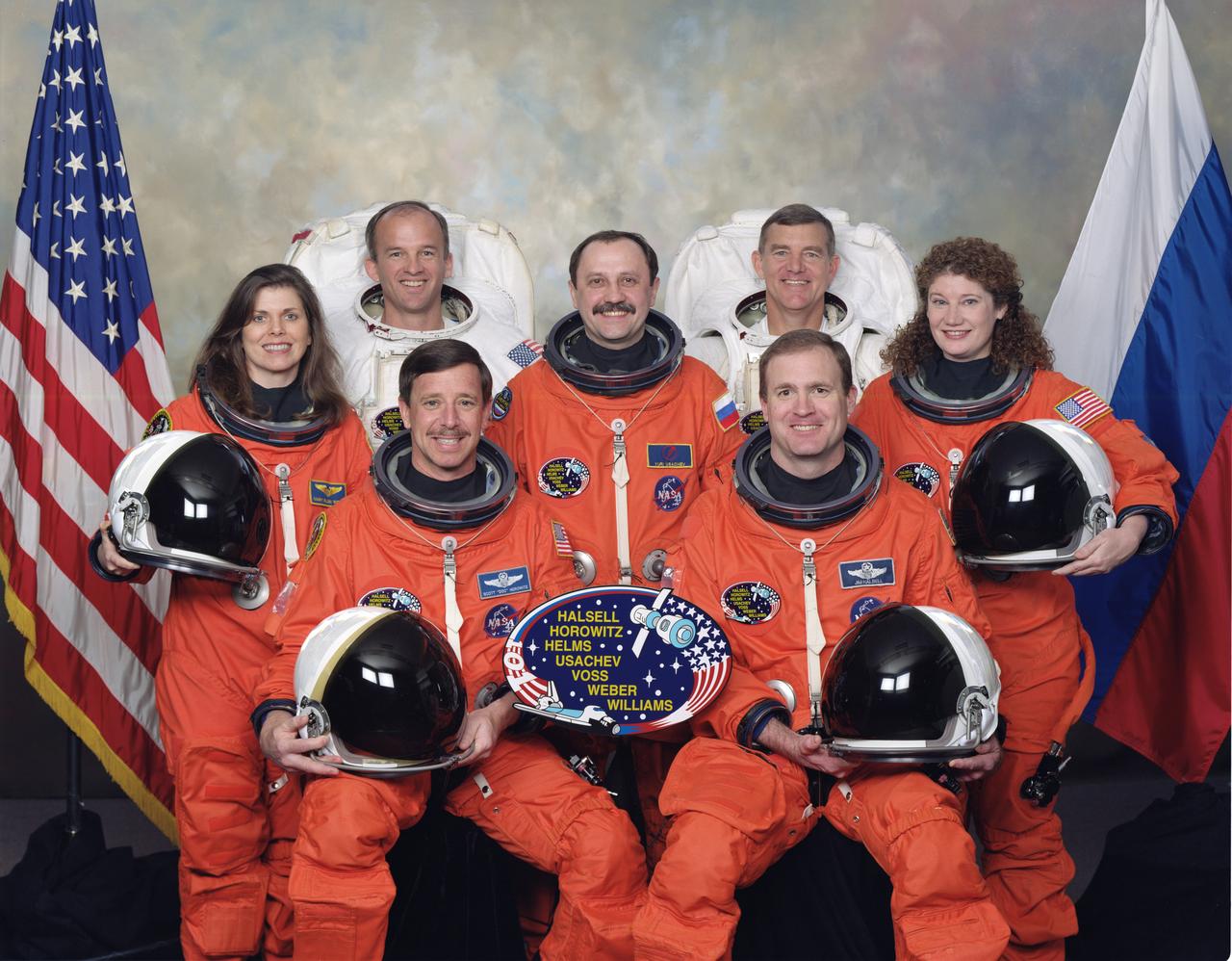
Six astronauts and a Russian cosmonaut comprised the STS-101 mission that launched aboard the Space Shuttle Atlantis on May 19, 2000 at 5:11 am (CDT). Seated in front are astronauts James D. Halsell (right), mission commander; and Scott J. Horowitz, pilot. Others, from the left, are Mary Ellen Weber, Jeffrey N. Williams, Yury V. Usachev, James S. Voss and Susan J. Helms, all mission specialists. Usachev represents the Russian Space Agency (RSA). The crew of the STS- 101 mission refurbished and replaced components in both the Zarya and Unity modules, with top priority being the Zarya module.
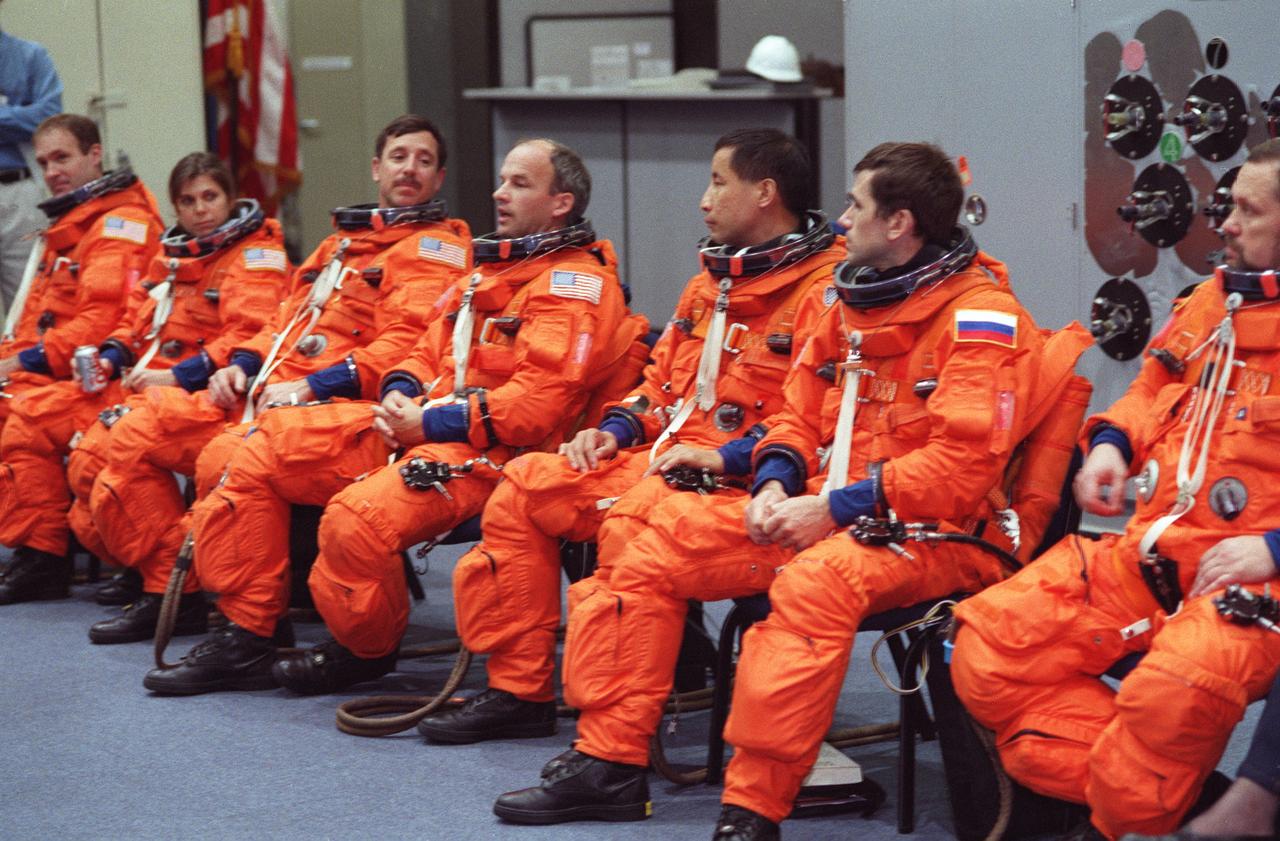
S99-14209 (15 November 1999) --- The seven crew members for STS-101 are seated during a briefing regarding emergency egress procedures. From the left are astronauts James D. Halsell, Jr., Mary Ellen Weber, Scott J. Horowitz, Jeffrey N. Williams and Edward T. Lu, along with cosmonauts Yuri I. Malenchenko and Boris V. Morukov. Malenchenko and Morukov represent the Russian Space Agency (RSA). Editor's Note: Since this photograph was taken, changes in crew personnel have been made. Cosmonauts Yuri I. Malenchenko and Boris V. Morukov, along with astronaut Edward T. Lu were moved to STS-106. Astronauts James S. Voss and Susan J. Helms, and cosmonaut Yury V. Usachev were added to the STS-101 crew. Malenchenko, Morukov and Usachev all represent the Russian Space Agency (RSA).
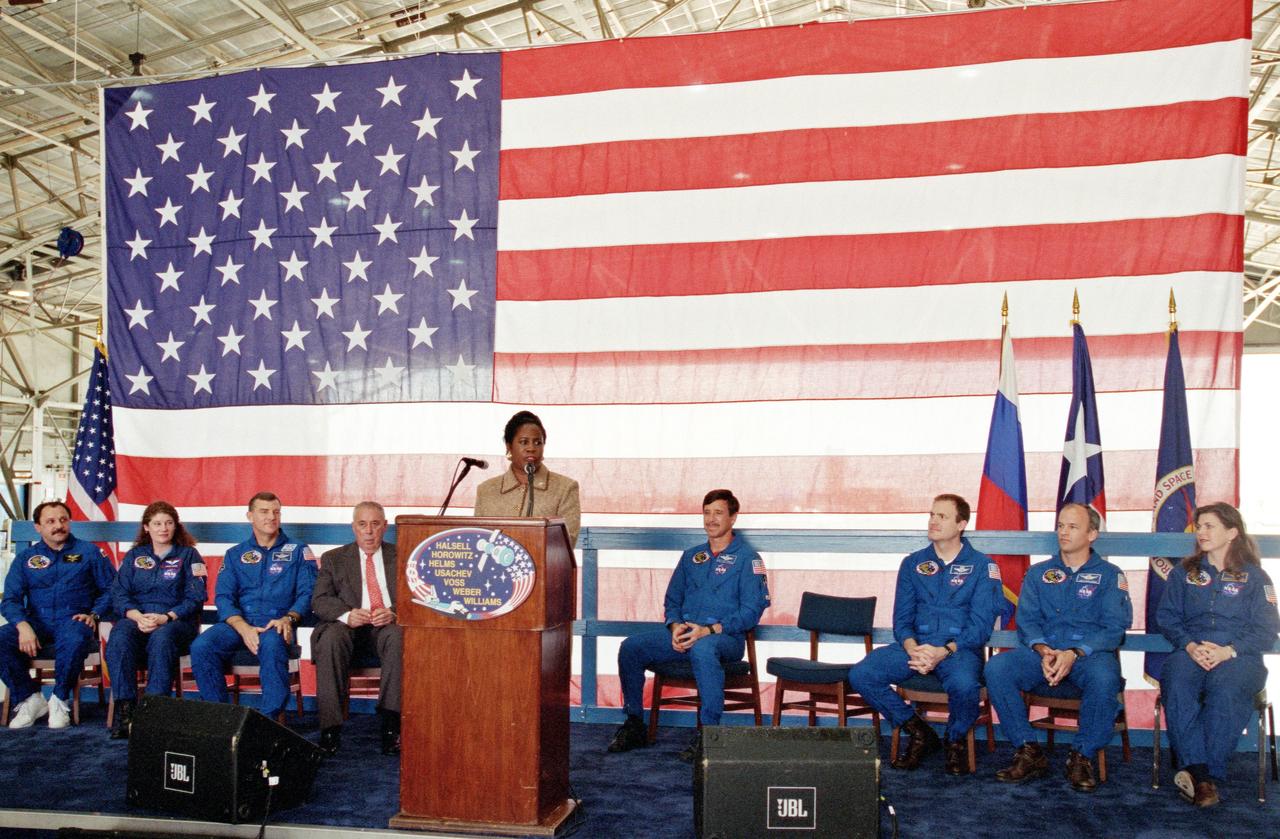
JSC2000-04603 (30 May 2000) --- U.S. Congresswoman Sheila Jackson Lee (D.-Houston) speaks to a crowd at the crew-welcoming ceremony at Ellington Field on the day following the completion of the STS-101 mission. Other speakers, seated behind the lecturn, are (from the left) cosmonaut Yury V. Usachev, representing the Russian Aviation and Space Agency; Susan J. Helms and James S. Voss, all mission specialists; JSC Director George W.S. Abbey; astronaut Scott J. Horowitz, pilot; along with astronauts James D. Halsell, Jr., mission commander; and Jeffrey N. Williams and Mary Ellen Weber, both mission specialists.
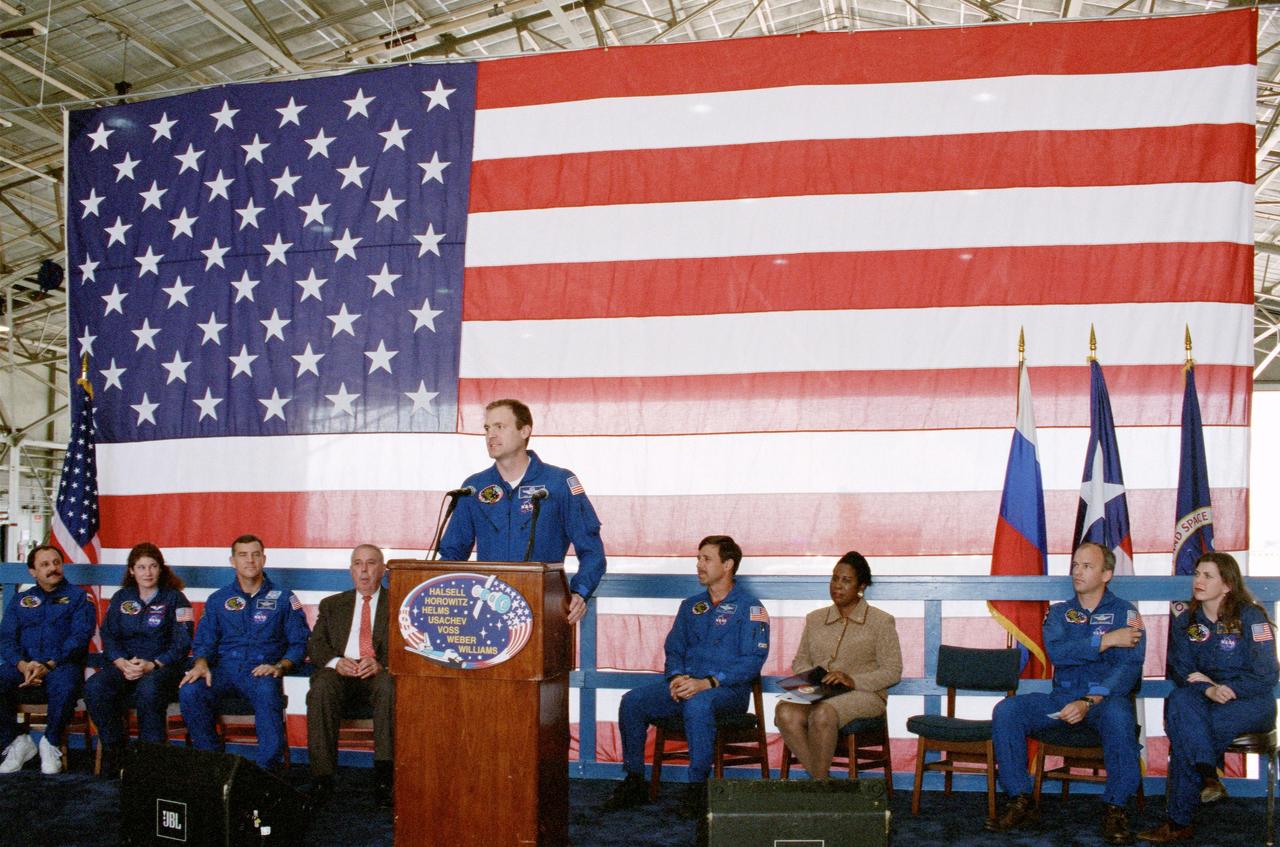
JSC2000-04607 (30 May 2000) --- Astronaut James D. Halsell, Jr., mission commander, speaks to a crowd at the crew-welcoming ceremony at Ellington Field on the day following the completion of the STS-101 mission. Other speakers, seated behind the lecturn, are (from the left) cosmonaut Yury V. Usachev, representing the Russian Aviation and Space Agency; Susan J. Helms and James S. Voss, all mission specialists; JSC Director George W.S. Abbey; astronaut Scott J. Horowitz, pilot; U.S. Congresswoman Sheila Jackson Lee (D.-Houston); along with astronauts Jeffrey N. Williams and Mary Ellen Weber, both mission specialists.

JSC2006-E-43479 (May 2000) --- Computer-generated artist's rendering of the International Space Station after flight STS-101/2A.2a. The STS-101 crew readied the station for the arrival of the Zvezda Service Module.
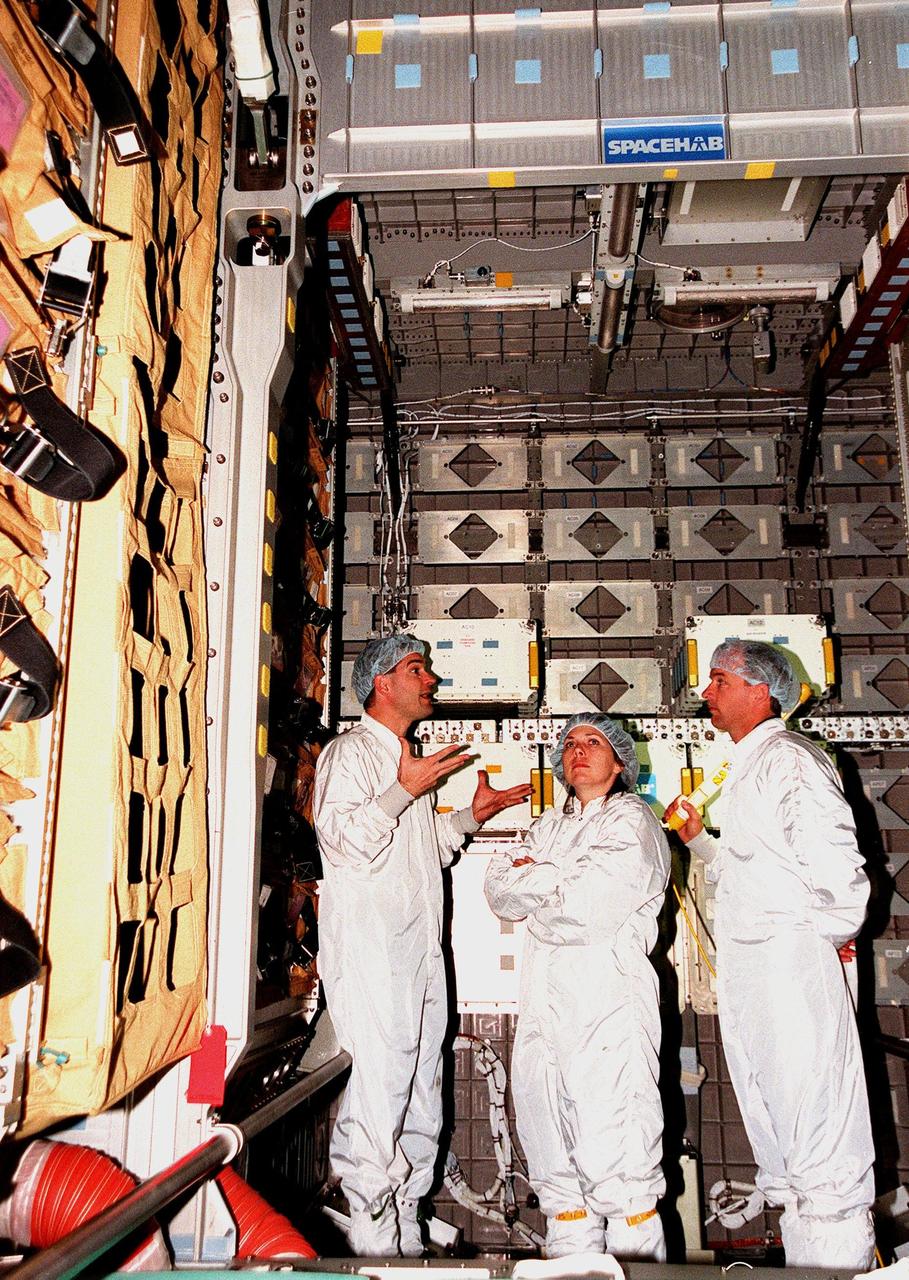
KENNEDY SPACE CENTER, FLA. -- Chris Jaskoika (left), with Boeing SPACEHAB, discusses the use of the SPACEHAB module with STS-101 Mission Specialists Mary Ellen Weber (center) and Jeffrey N. Williams (right). Part of the STS-101 crew are at SPACEHAB for familiarization activities. Mission STS-101 is the third flight in construction of the International Space Station. The 11-day mission is targeted for launch on December 2, 1999, at Launch Pad 39A
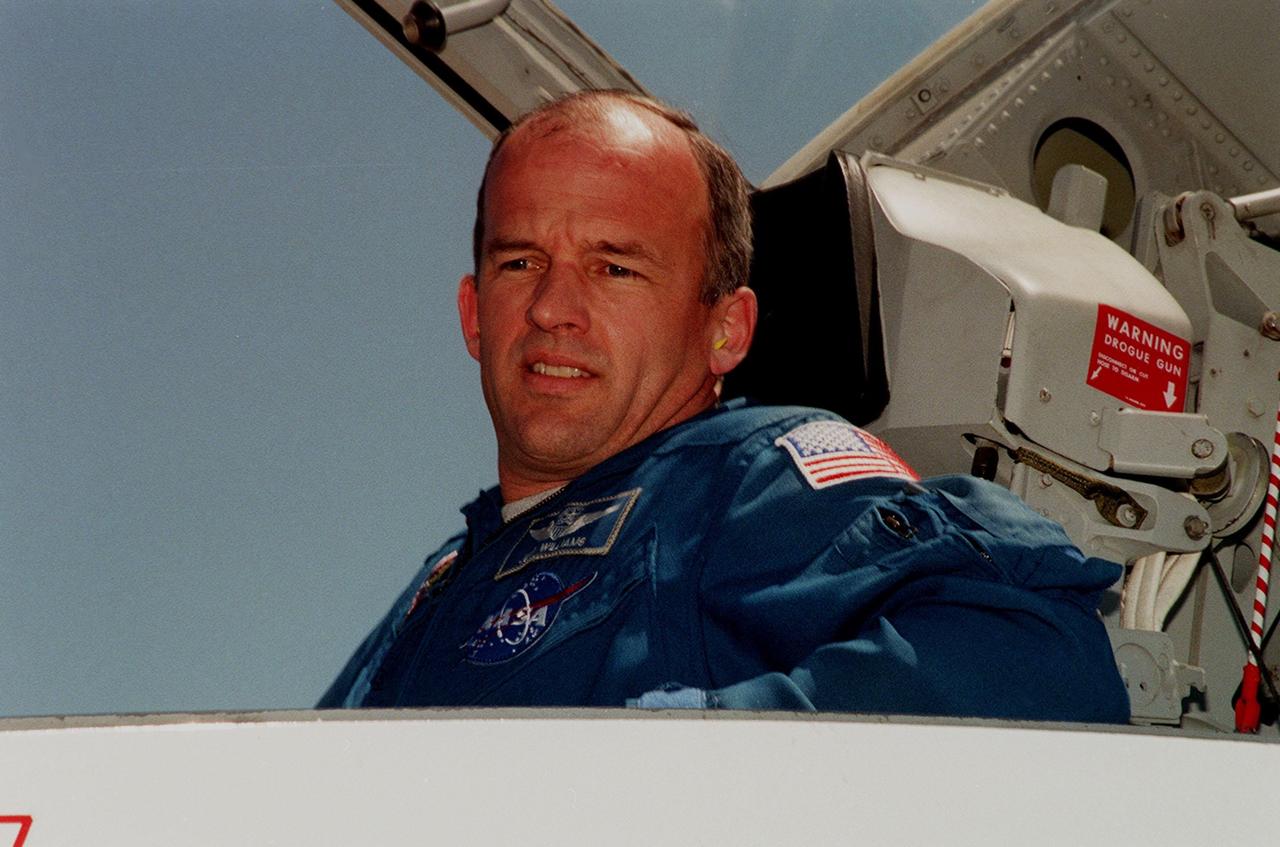
STS-101 Mission Specialist Jeffrey Williams arrives at KSC's Shuttle Landing Facility aboard a T-38 jet aircraft flown by STS-101 Pilot Scott Horowitz. They and the rest of the crew are at KSC to take part in Terminal Countdown Demonstration Test (TCDT) activities that include emergency egress training and a dress rehearsal for launch. The other crew members are Commander James Halsell and Mission Specialists Mary Ellen Weber, James Voss, Susan Helms and Yury Usachev. During their mission to the International Space Station, the STS-101 crew will be delivering logistics and supplies, plus preparing the Station for the arrival of the Zvezda Service Module, expected to be launched by Russia in July 2000. Also, the crew will conduct one space walk to perform maintenance on the Space Station. This will be the third assembly flight for the Space Station. STS-101 is scheduled to launch April 24 at 4:15 p.m. from Launch Pad 39A
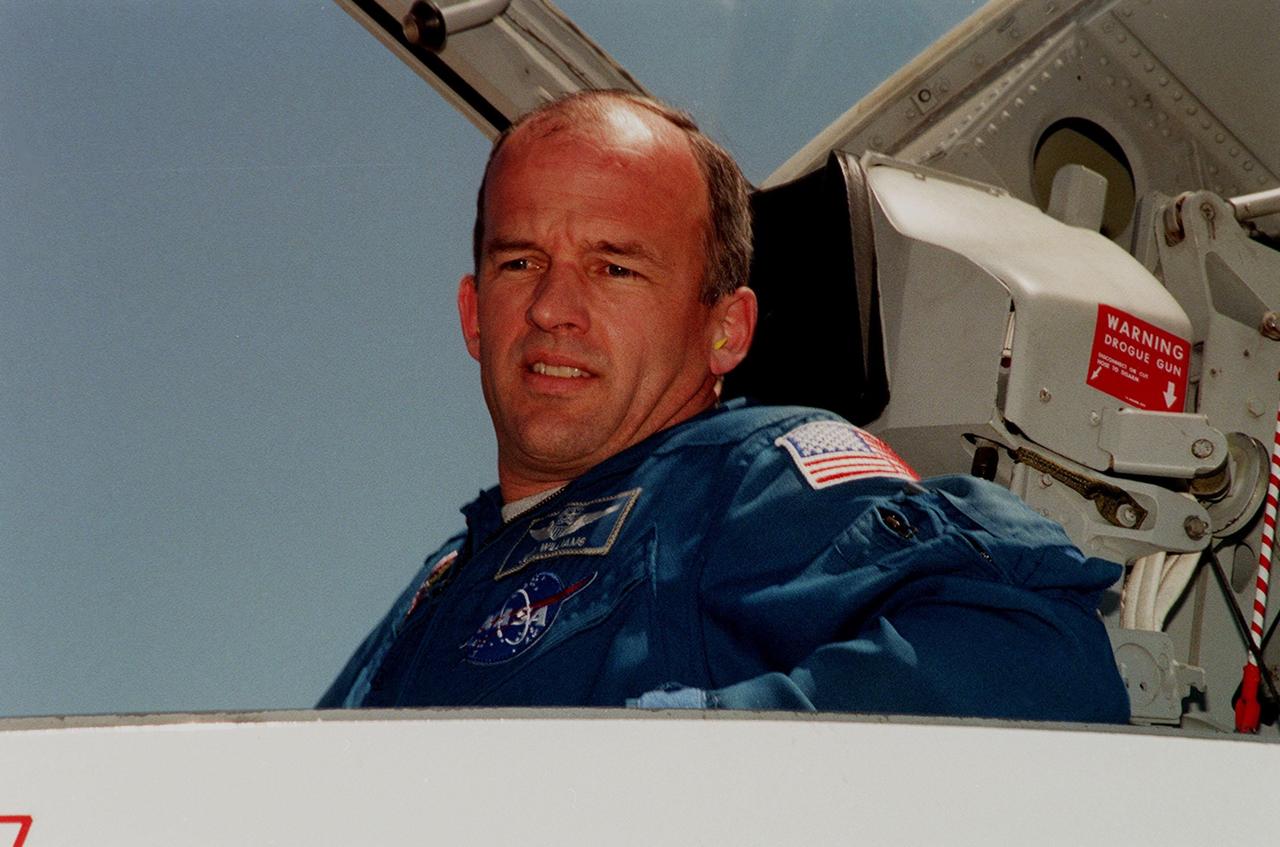
STS-101 Mission Specialist Jeffrey Williams arrives at KSC's Shuttle Landing Facility aboard a T-38 jet aircraft flown by STS-101 Pilot Scott Horowitz. They and the rest of the crew are at KSC to take part in Terminal Countdown Demonstration Test (TCDT) activities that include emergency egress training and a dress rehearsal for launch. The other crew members are Commander James Halsell and Mission Specialists Mary Ellen Weber, James Voss, Susan Helms and Yury Usachev. During their mission to the International Space Station, the STS-101 crew will be delivering logistics and supplies, plus preparing the Station for the arrival of the Zvezda Service Module, expected to be launched by Russia in July 2000. Also, the crew will conduct one space walk to perform maintenance on the Space Station. This will be the third assembly flight for the Space Station. STS-101 is scheduled to launch April 24 at 4:15 p.m. from Launch Pad 39A
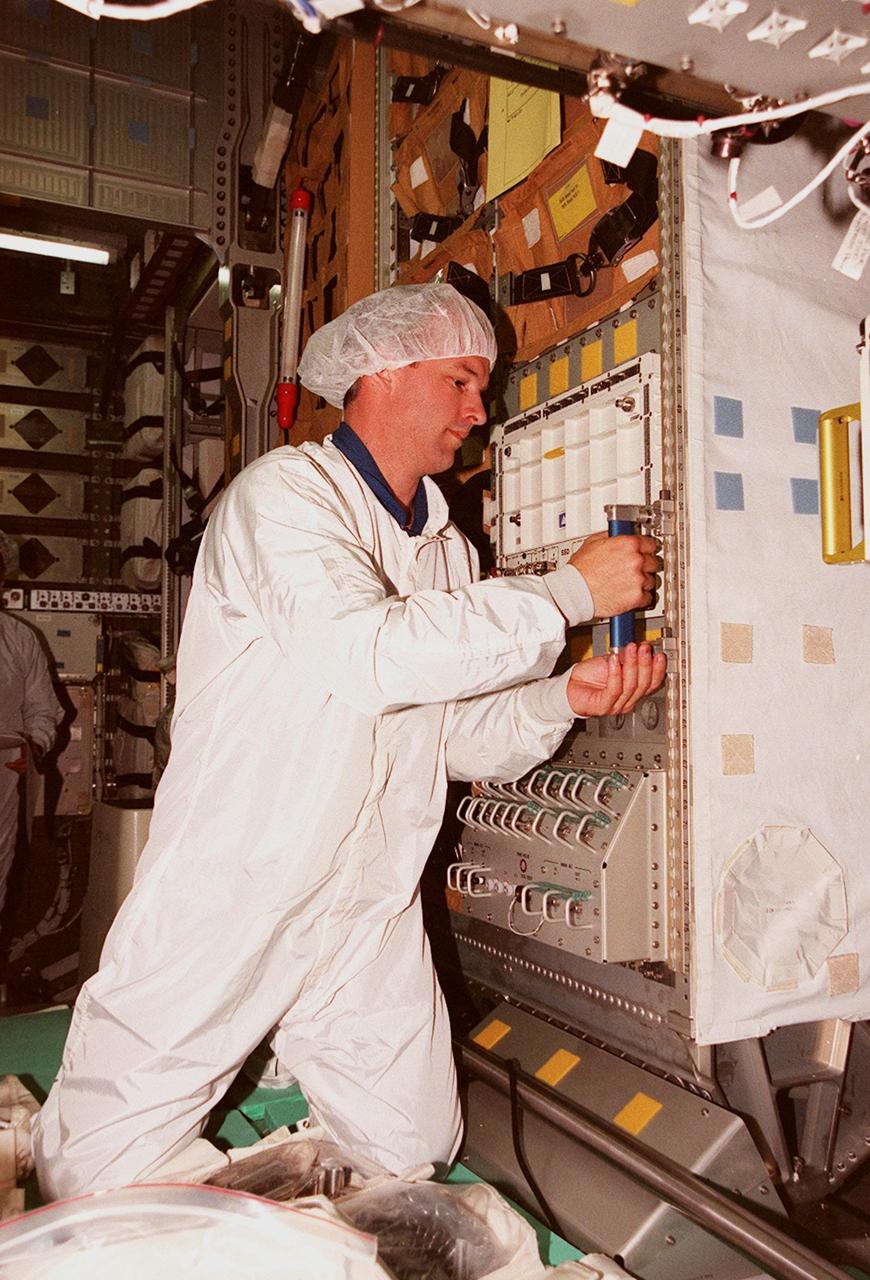
STS-101 Mission Specialist Jeffrey Williams gets hands-on experience with equipment inside the SPACEHAB double module, part of the cargo on the STS-101 mission to the International Space Station. Williams and the rest of the crew are taking part in Crew Equipment Interface Test (CEIT) activities to become familiar with equipment for their mission. The crew will be responsible for preparing the Space Station for the arrival of the Zvezda Service Module, expected to be launched by Russia in July 2000. Also, the crew will conduct one space walk to perform maintenance on the Space Station and deliver logistics and supplies. This will be the third assembly flight for the Space Station. STS-101 is scheduled to launch no earlier than April 13 from Launch Pad 39A
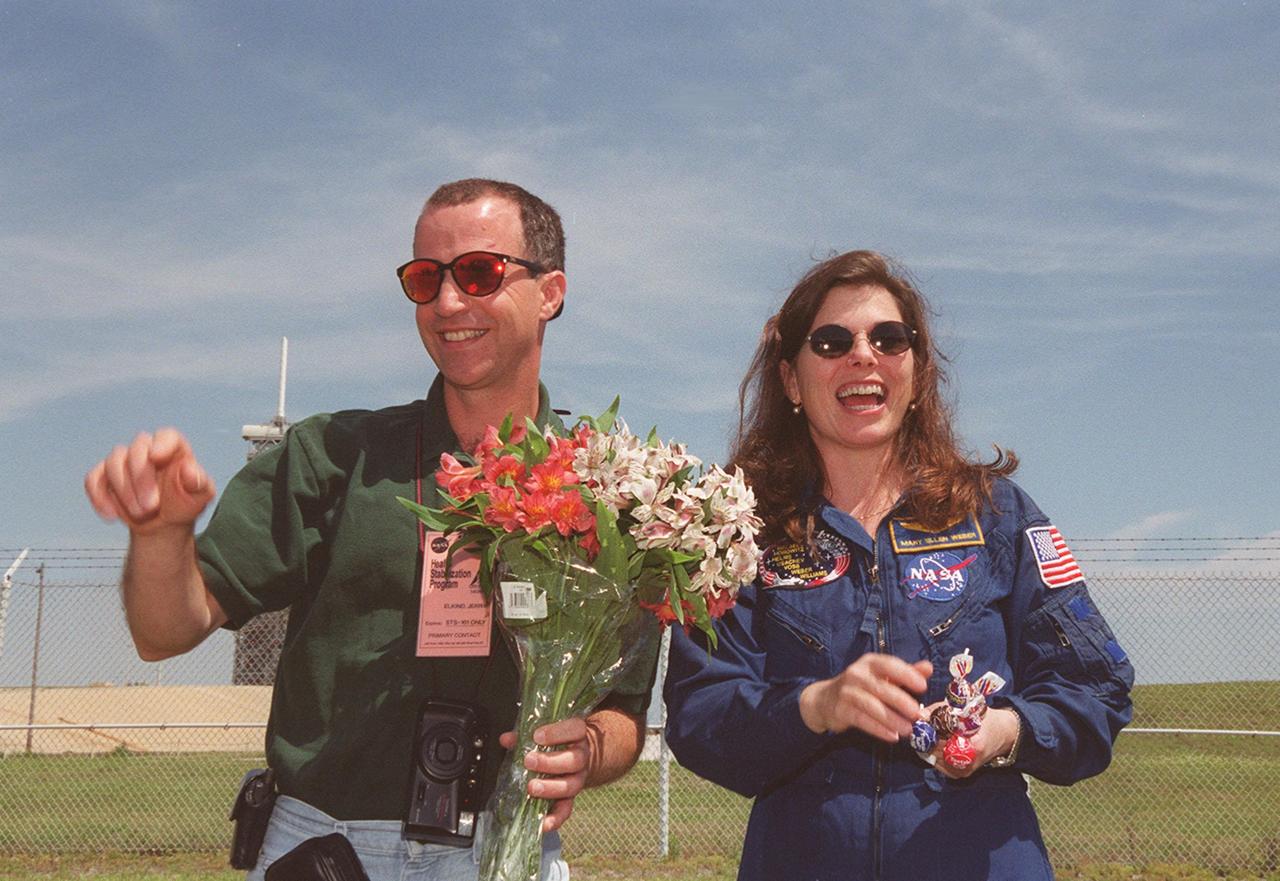
STS-101 Mission Specialist Mary Ellen Weber and her husband Jerome Elkind during a meeting of the STS-101 crew with family and friends at Launch Pad 39A. Mission STS-101 will take the crew to the International Space Station to deliver logistics and supplies, plus prepare the Station for the arrival of the Zvezda Service Module, expected to be launched by Russia in July 2000. The crew will conduct one space walk to perform maintenance on the Space Station as well. This will be the third assembly flight for the Space Station. Launch is targeted for April 24 at about 4:15 p.m. EDT from Launch Pad 39A

STS-101 Mission Specialist Yuri Vladimirovich Usachev, a Russian cosmonaut, and his wife Vera Sergeevna Usacheva during a meeting of the STS-101 crew with family and friends at Launch Pad 39A. Mission STS-101 will take the crew to the International Space Station to deliver logistics and supplies, plus prepare the Station for the arrival of the Zvezda Service Module, expected to be launched by Russia in July 2000. The crew will conduct one space walk to perform maintenance on the Space Station as well. This will be the third assembly flight for the Space Station. Launch is targeted for April 24 at about 4:15 p.m. EDT from Launch Pad 39A
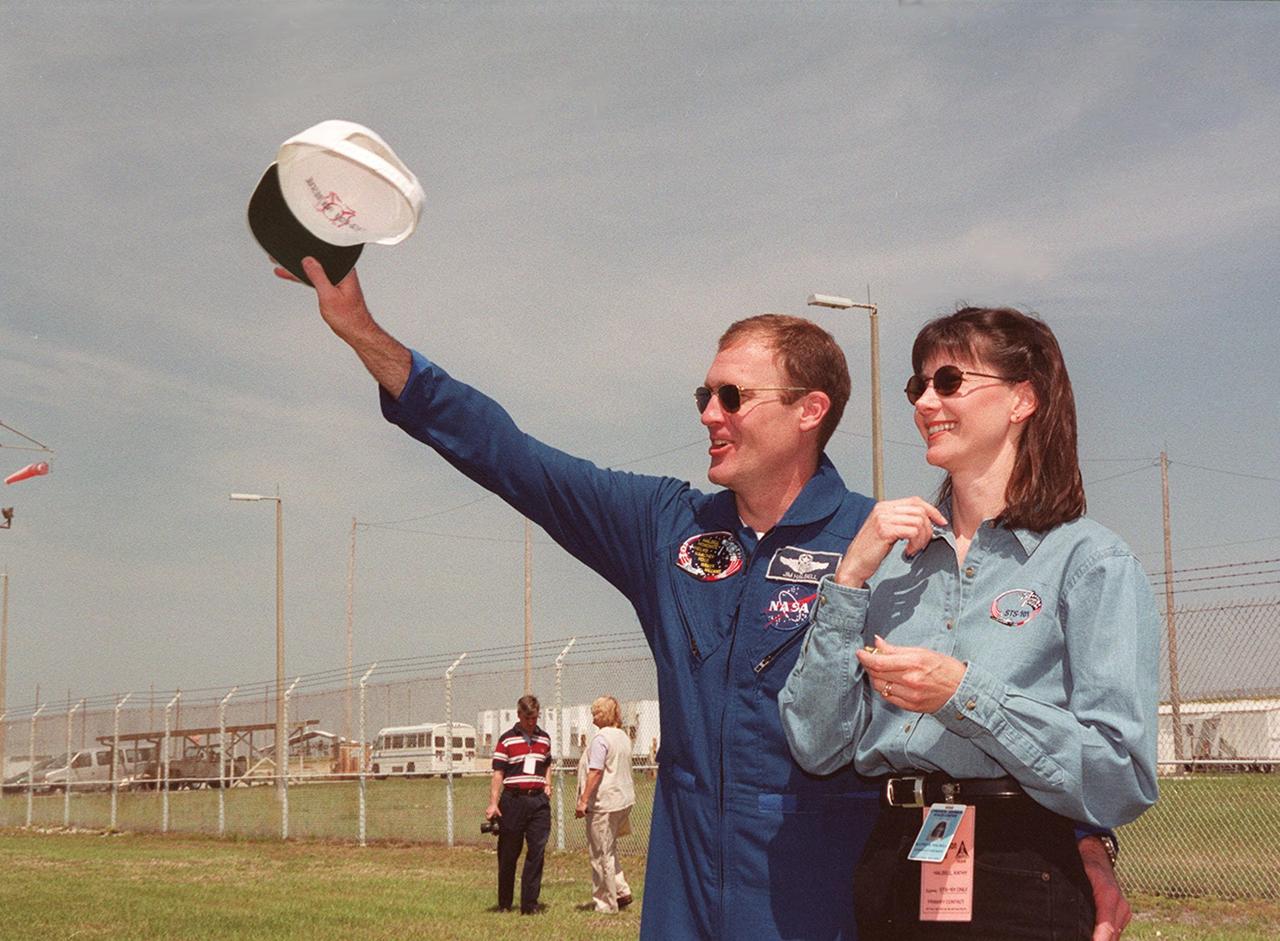
STS-101 Commander James D. Halsell Jr. waves as he stands with his wife Kathy during a meeting of the STS-101 crew with family and friends at Launch Pad 39A. Mission STS-101 will take the crew to the International Space Station to deliver logistics and supplies, plus prepare the Station for the arrival of the Zvezda Service Module, expected to be launched by Russia in July 2000. The crew will conduct one space walk to perform maintenance on the Space Station as well. This will be the third assembly flight for the Space Station. Launch is targeted for April 24 at about 4:15 p.m. EDT from Launch Pad 39A
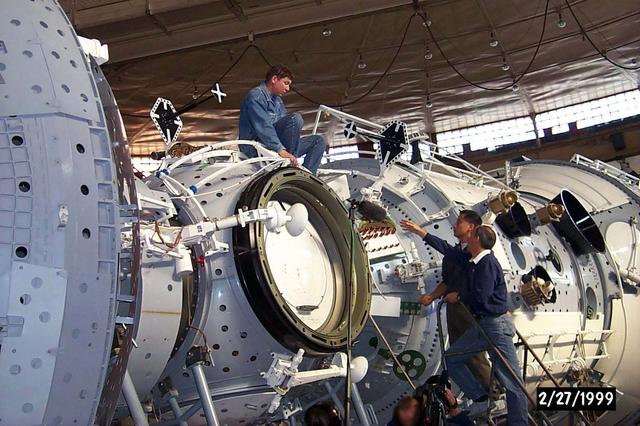
99-E-14665 (27 February 1999) --- Astronauts Edward T. Lu (left) and Jeffrey N. Williams check out full-scale training hardware for the International Space Station (ISS) in the Hydrolab facility at Star City, Russia. The two mission specialists, along with other members of the STS-101 crew, are currently in training at the Gagarin Cosmonaut Training Center for next year's STS-101 mission to the International Space Station (ISS). Editor's Note: Since this photograph was taken, changes in crew personnel have been made. Cosmonauts Yuri I. Malenchenko and Boris V. Morukov, along with astronaut Edward T. Lu were moved to STS-106. Astronauts James S. Voss and Susan J. Helms, and cosmonaut Yury V. Usachev were added to the STS-101 crew. Malenchenko, Morukov and Usachev all represent the Russian Space Agency (RSA).
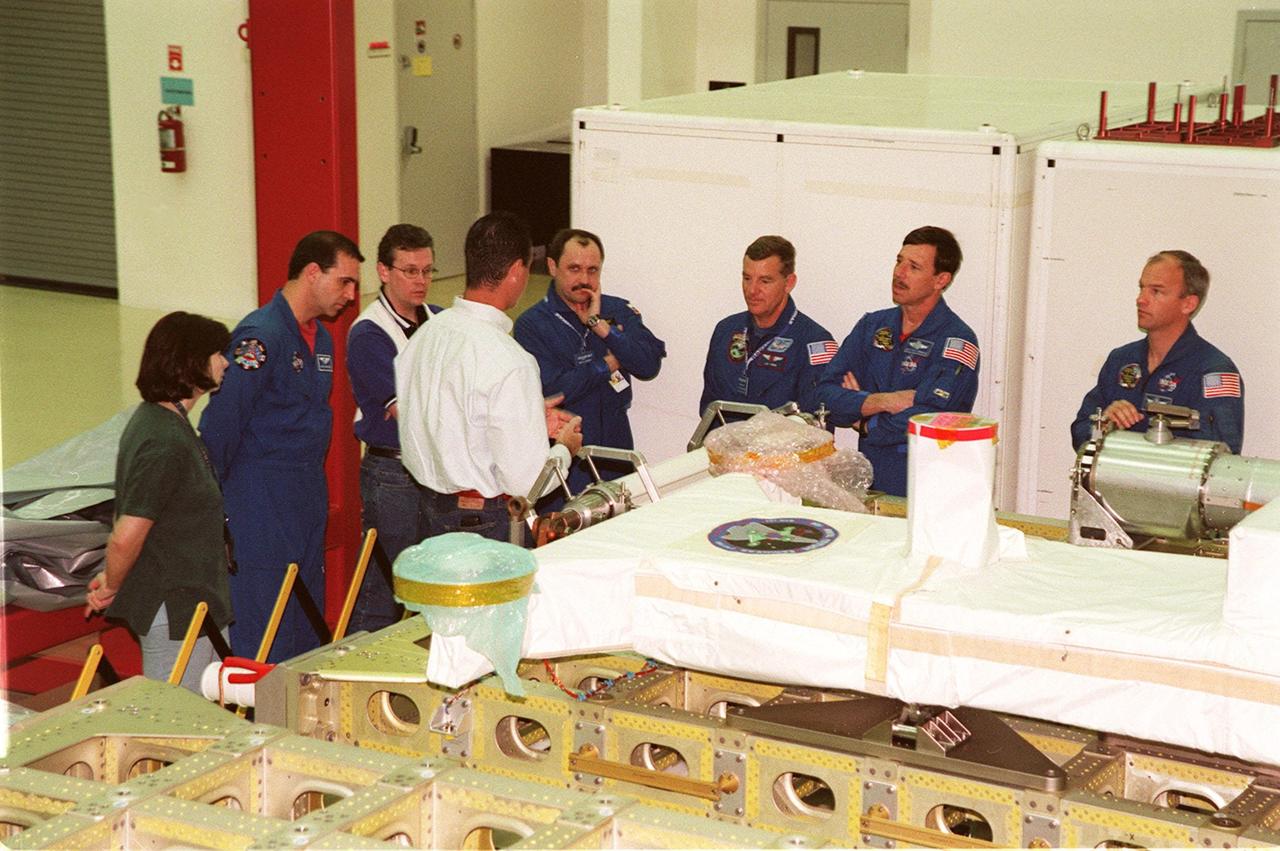
KENNEDY SPACE CENTER, FLA. -- At SPACEHAB, in Cape Canaveral, Fla., members of the STS-101 crew and STS-106 crew take part in Crew Equipment Interface Test activities, learning from technicians in the facility about some of the equipment they will be working with on their mission to the International Space Station. From left are Claudia Melchiorre, who is with DASA, Daimler-Chrysler Aerospace; STS-106 Mission Specialist Richard Mastracchio; a SPACEHAB worker; Marty McLellan, director of ground operations; Mission Specialists Yuri Usachev of Russia and James Voss; Pilot Scott Horowitz; and Mission Specialist Jeffrey Williams. Other members of the STS-101 crew (not shown) are Mission Specialists Mary Ellen Weber and Susan Helms. The ST-101 crew will be responsible for preparing the Space Station for the arrival of the Zvezda Service Module, expected to be launched by Russia in July 2000. Also, the crew will conduct one space walk to perform maintenance on the Space Station and deliver logistics and supplies. This will be the third assembly flight for the Space Station. STS-101 is scheduled to launch no earlier than April 13 from Launch Pad 39A
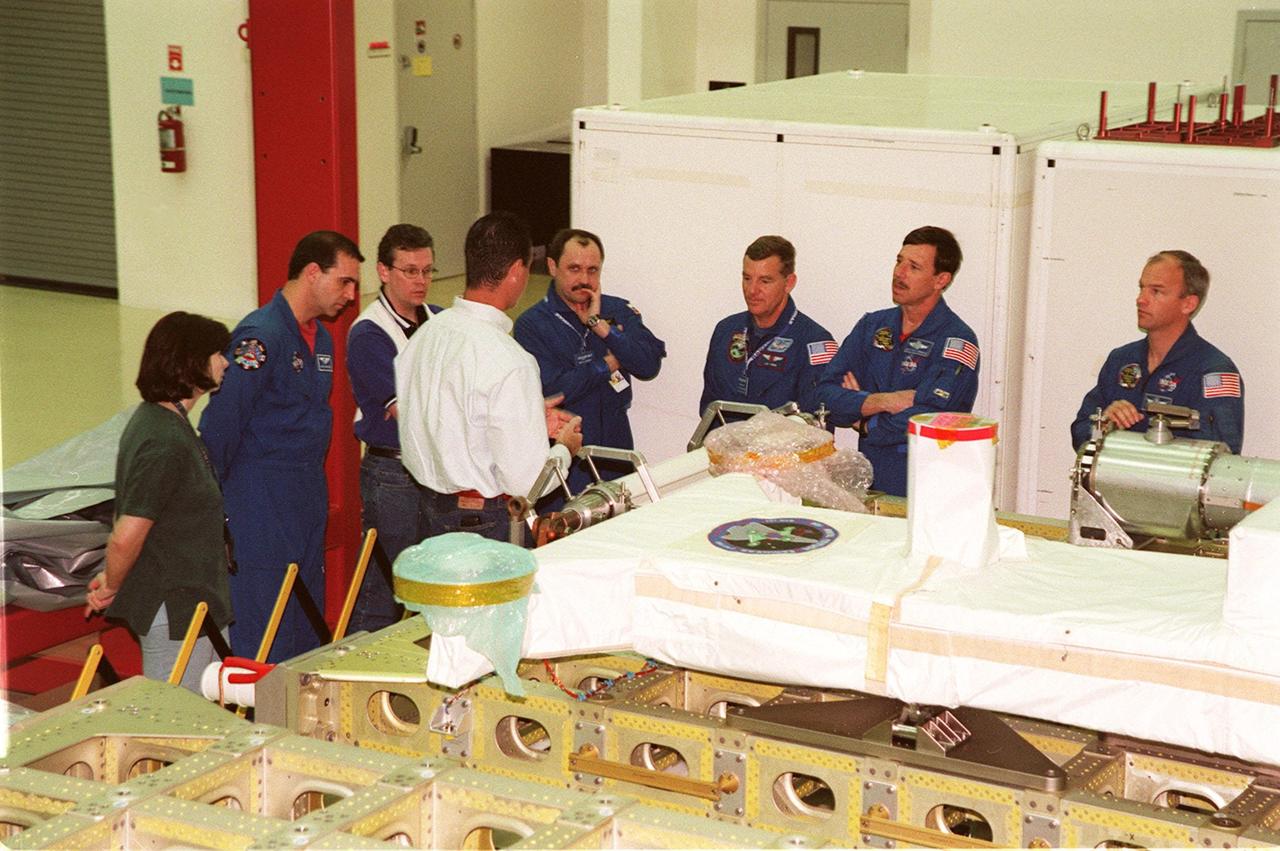
KENNEDY SPACE CENTER, FLA. -- At SPACEHAB, in Cape Canaveral, Fla., members of the STS-101 crew and STS-106 crew take part in Crew Equipment Interface Test activities, learning from technicians in the facility about some of the equipment they will be working with on their mission to the International Space Station. From left are Claudia Melchiorre, who is with DASA, Daimler-Chrysler Aerospace; STS-106 Mission Specialist Richard Mastracchio; a SPACEHAB worker; Marty McLellan, director of ground operations; Mission Specialists Yuri Usachev of Russia and James Voss; Pilot Scott Horowitz; and Mission Specialist Jeffrey Williams. Other members of the STS-101 crew (not shown) are Mission Specialists Mary Ellen Weber and Susan Helms. The ST-101 crew will be responsible for preparing the Space Station for the arrival of the Zvezda Service Module, expected to be launched by Russia in July 2000. Also, the crew will conduct one space walk to perform maintenance on the Space Station and deliver logistics and supplies. This will be the third assembly flight for the Space Station. STS-101 is scheduled to launch no earlier than April 13 from Launch Pad 39A
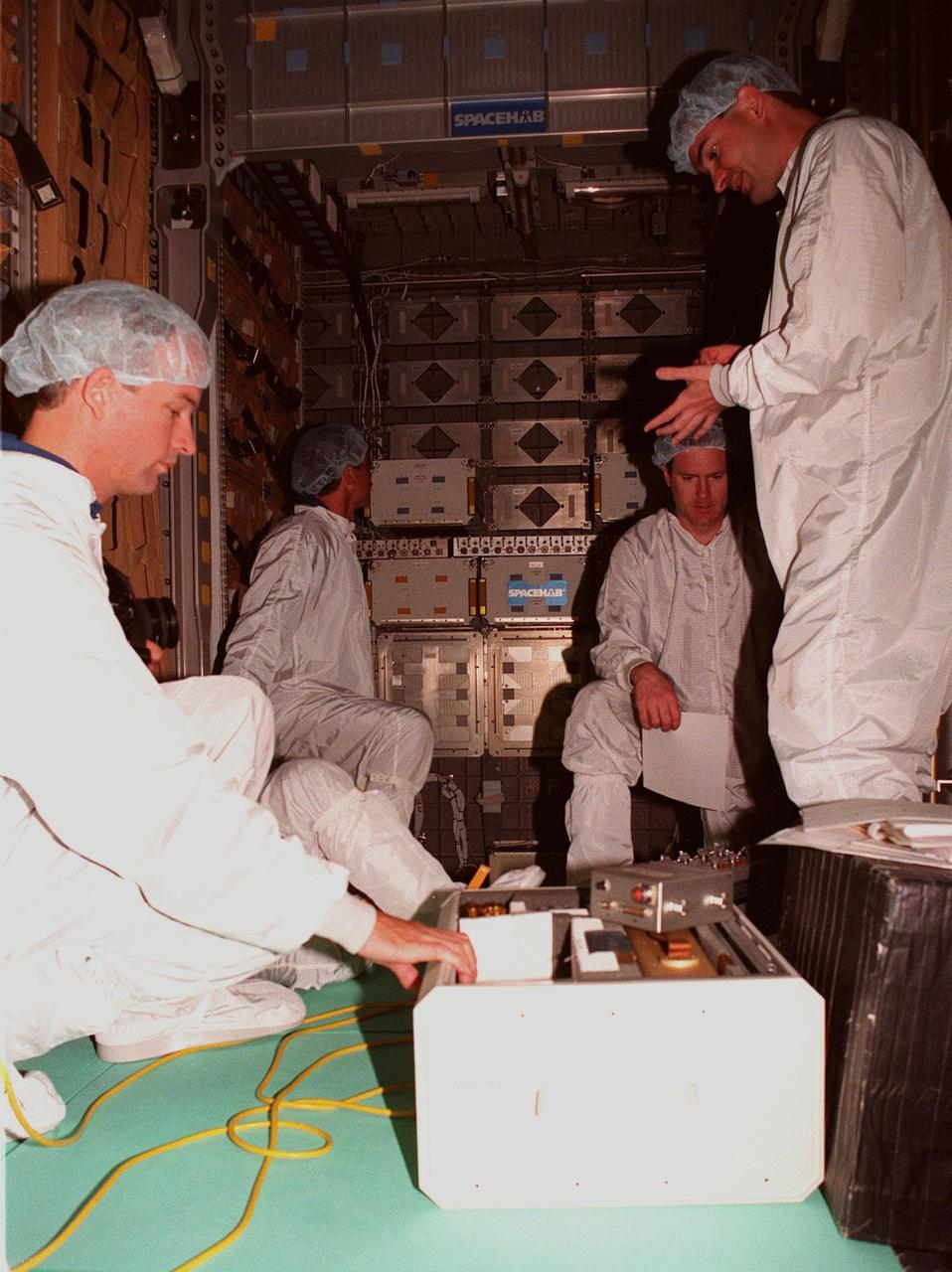
KENNEDY SPACE CENTER, FLA. -- Inside the SPACEHAB module, members of the STS-101 crew look at equipment during familiarization activities. From left are Mission Specialist Jeffrey N. Williams , Pilot Scott J. "Doc" Horowitz (Ph.D.), and Commander James Donald Halsell Jr., with Chris Jaskoika, of Boeing SPACEHAB. Mission STS-101 is the third flight in construction of the International Space Station. The 11-day mission is targeted for launch on December 2, 1999, at Launch Pad 39A
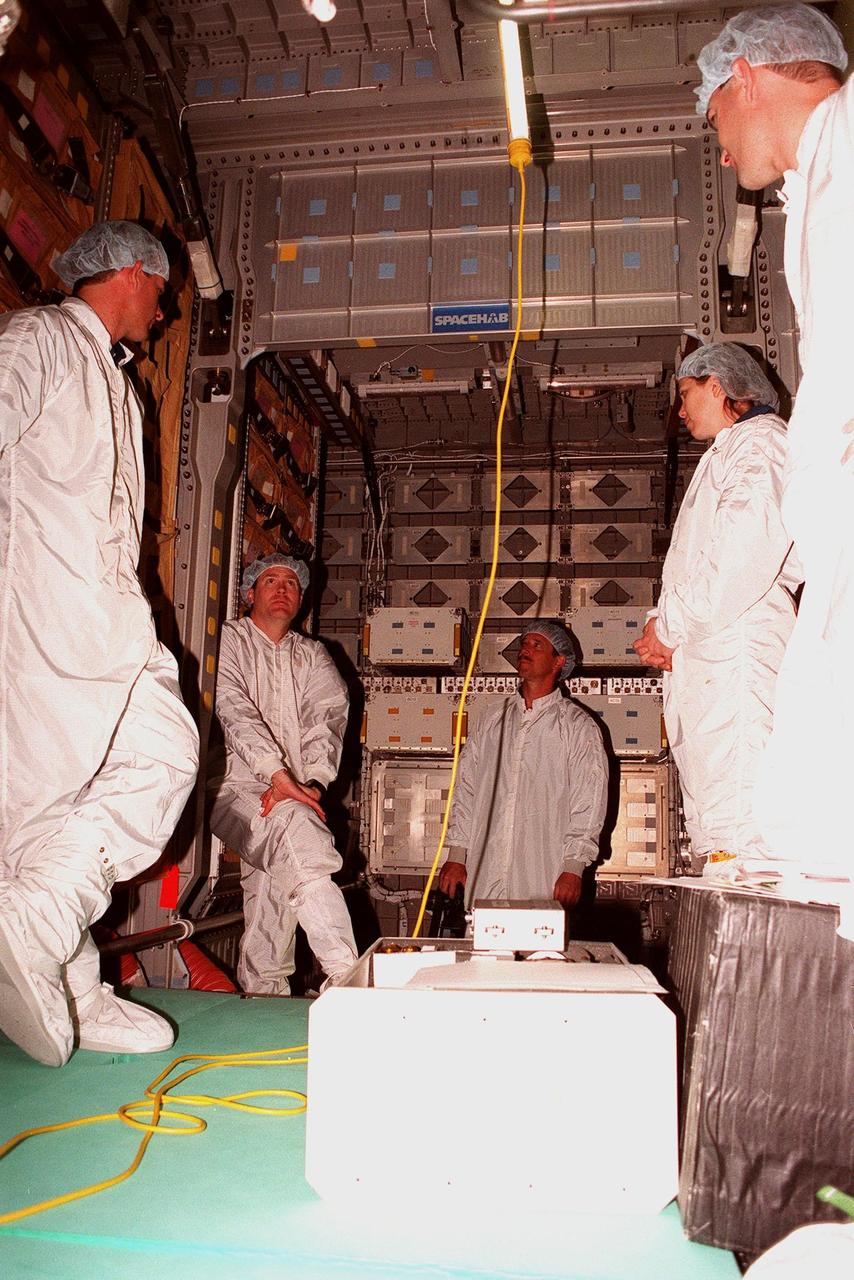
KENNEDY SPACE CENTER, FLA. -- Inside the SPACEHAB module, Chris Jaskoika (left), with Boeing SPACEHAB, works with members of the STS-101 crew during familiarization activities. Next to him are (left to right) Commander James Donald Halsell Jr., Pilot Scott "Doc" Horowitz (Ph.D.), and Mission Specialists Mary Ellen Weber (Ph.D.) and Jeffrey N. Williams. Mission STS-101 is the third flight in construction of the International Space Station. The 11-day mission is targeted for launch on December 2, 1999, at Launch Pad 39A
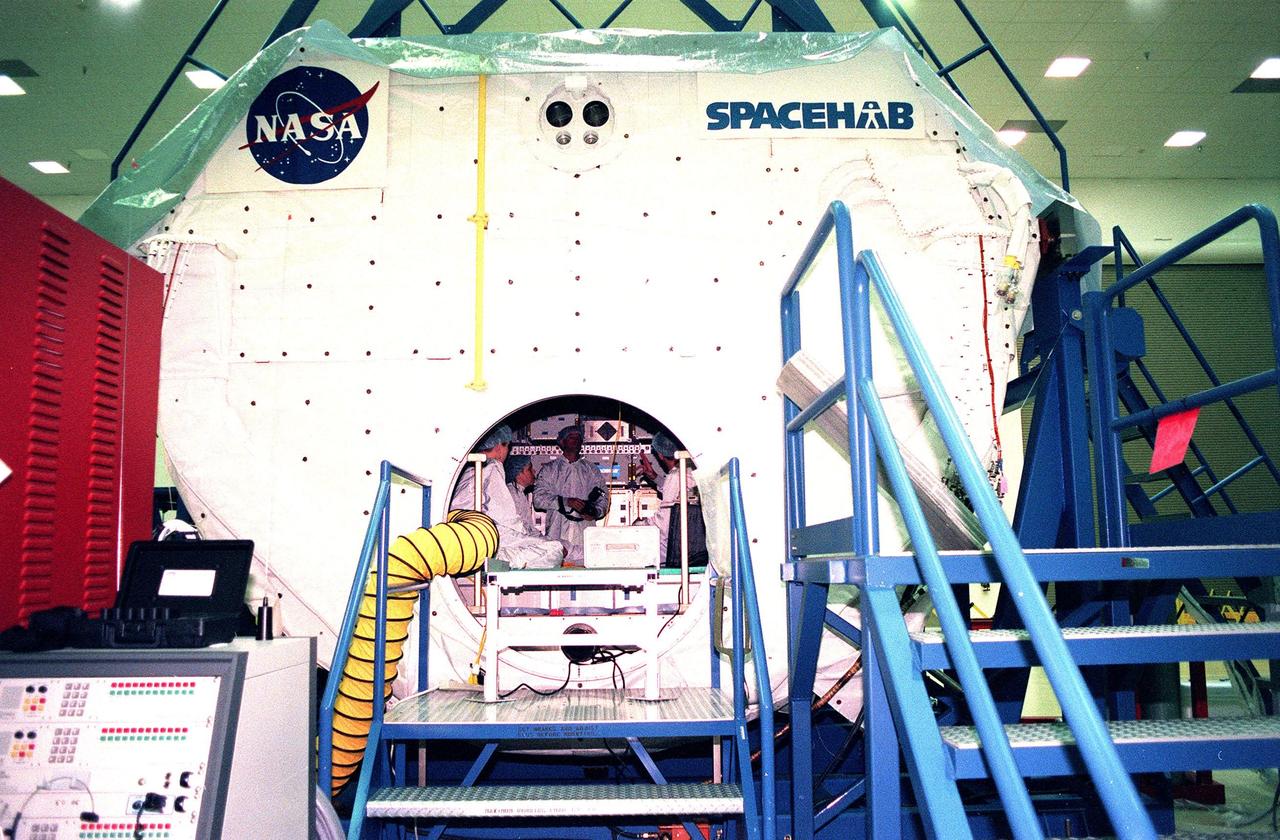
KENNEDY SPACE CENTER, FLA. -- Just inside the open hatch of the SPACEHAB module are (left to right) STS-101 crew members Mission Specialists Jeffrey N. Williams and Mary Ellen Weber (Ph.D.), Commander James Donald Halsell Jr., and Pilot Scott "Doc" Horowitz (Ph.D.). The crew is taking part in familiarization activities at the SPACEHAB facility. Mission STS-101 is the third flight in construction of the International Space Station. The 11-day mission is targeted for launch on December 2, 1999, at Launch Pad 39A

KENNEDY SPACE CENTER, FLA. -- At SPACEHAB, in Cape Canaveral, members of the STS-101 crew are taking part in a Crew Equipment Interface Test, which gives them an opportunity to look over equipment and payloads that will fly on the mission. At center are Mission Specialists Edward Tsang Lu and Mary Ellen Weber (Ph.D.). Space Shuttle Atlantis will be carrying the SPACEHAB Double Module, which carries internal logistics and resupply cargo for station outfitting. Launch of Atlantis on mission STS-101 is scheduled no earlier than April 13, 2000

KENNEDY SPACE CENTER, FLA. -- At SPACEHAB, in Cape Canaveral, members of the STS-101 crew are taking part in a Crew Equipment Interface Test, which gives them an opportunity to look over equipment and payloads that will fly on the mission. At center are Mission Specialists Edward Tsang Lu and Mary Ellen Weber (Ph.D.). Space Shuttle Atlantis will be carrying the SPACEHAB Double Module, which carries internal logistics and resupply cargo for station outfitting. Launch of Atlantis on mission STS-101 is scheduled no earlier than April 13, 2000
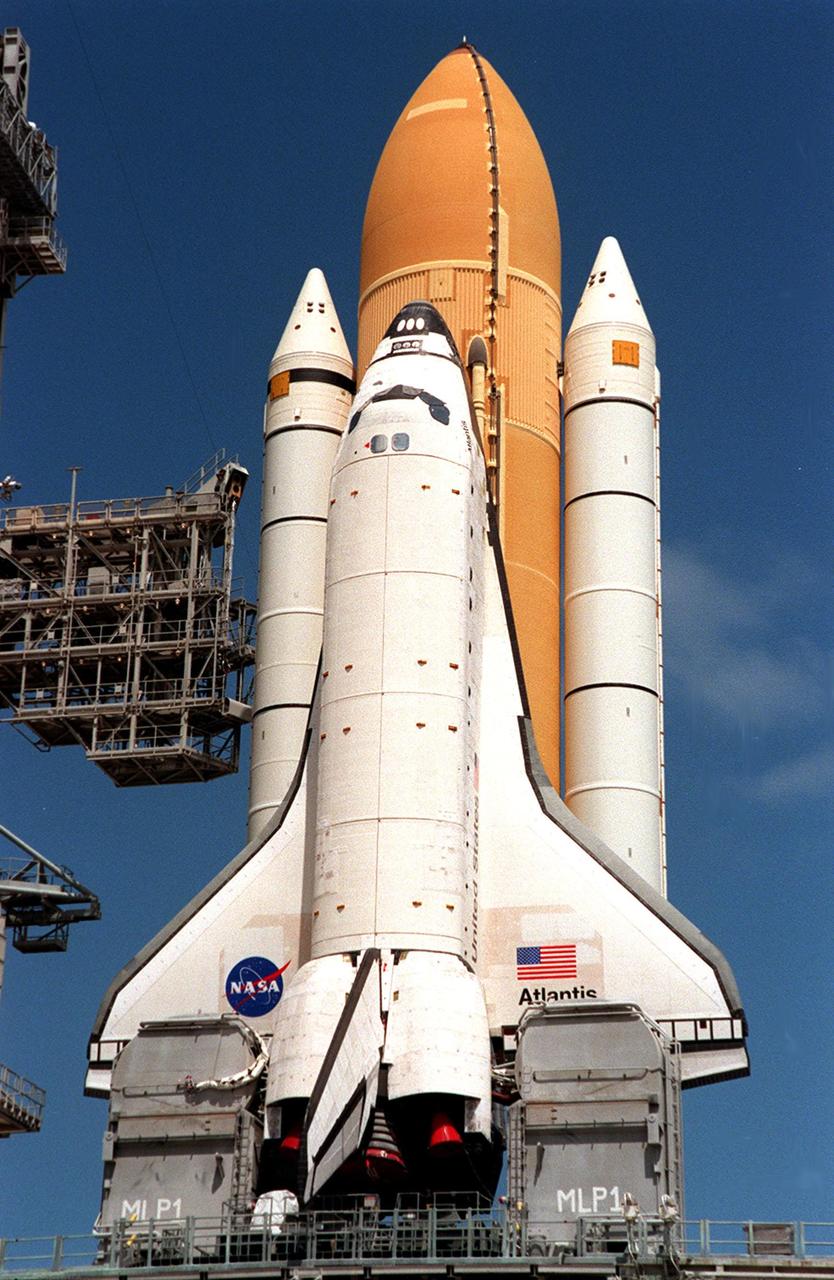
KENNEDY SPACE CENTER, FLA. -- Space Shuttle Atlantis sits on launch Pad 39A waiting for the rotating service structure to be moved into place for final launch preparations. A small section of the fixed service structure is seen on the left. Liftoff of Atlantis on mission STS-101 is scheduled for April 17 at 7:03 p.m. EDT. STS-101 is a logistics and resupply mission for the International Space Station, to restore full redundancy to the International Space Station power system in preparation for the arrival of the next pressurized module, the Russian-built Zvezda
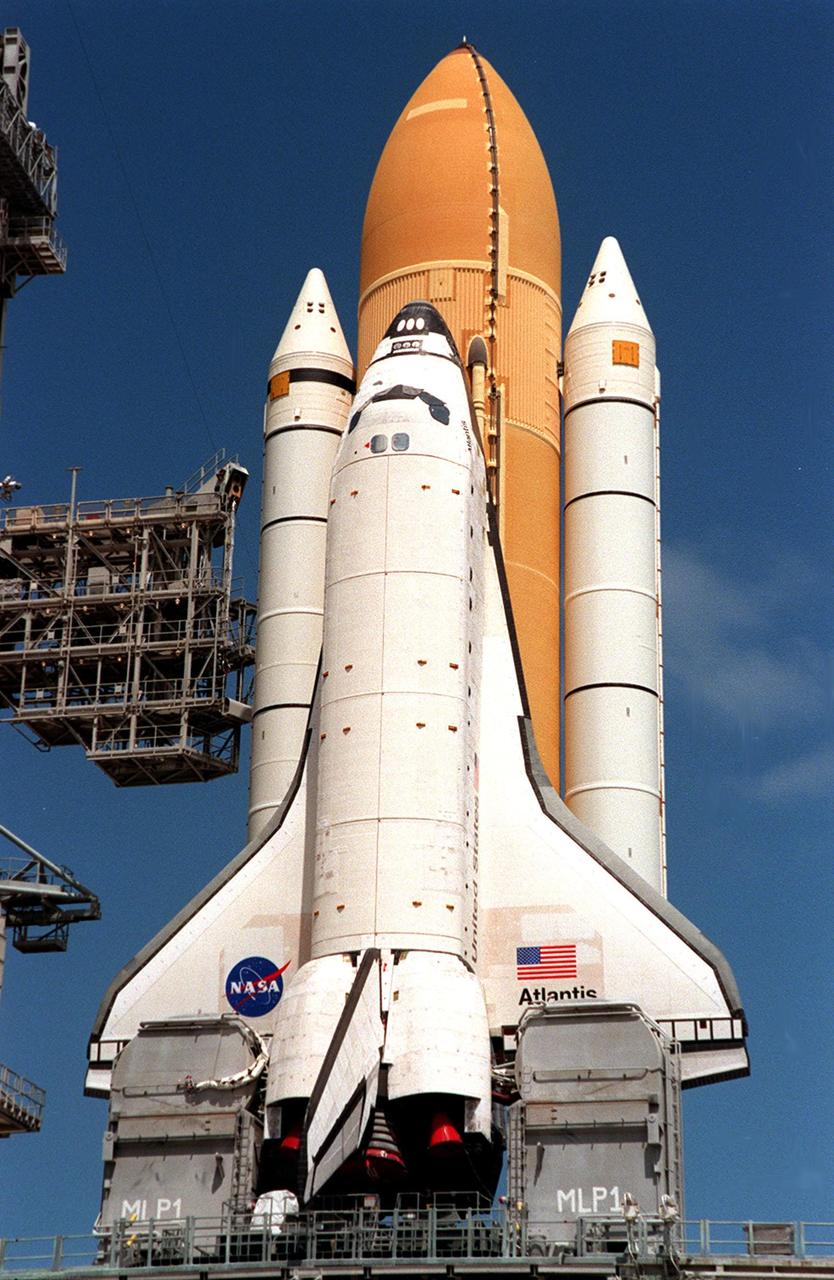
KENNEDY SPACE CENTER, FLA. -- Space Shuttle Atlantis sits on launch Pad 39A waiting for the rotating service structure to be moved into place for final launch preparations. A small section of the fixed service structure is seen on the left. Liftoff of Atlantis on mission STS-101 is scheduled for April 17 at 7:03 p.m. EDT. STS-101 is a logistics and resupply mission for the International Space Station, to restore full redundancy to the International Space Station power system in preparation for the arrival of the next pressurized module, the Russian-built Zvezda
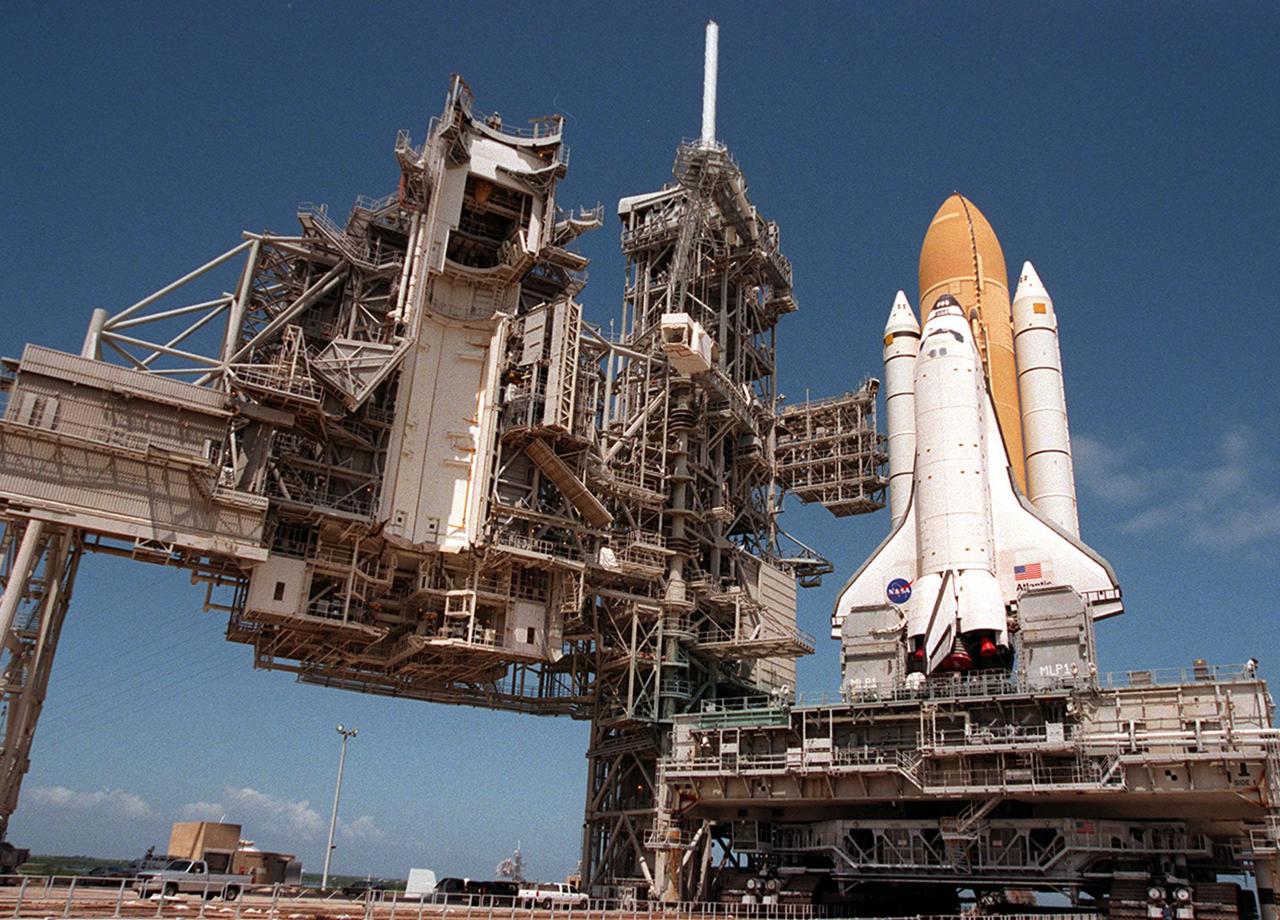
KENNEDY SPACE CENTER, FLA. -- Space Shuttle Atlantis sits on launch Pad 39A waiting for the rotating service structure, pictured at left, to be moved into place for final launch preparations. Liftoff of Atlantis on mission STS-101 is scheduled for April 17 at 7:03 p.m. EDT. STS-101 is a logistics and resupply mission for the International Space Station, to restore full redundancy to the International Space Station power system in preparation for the arrival of the next pressurized module, the Russian-built Zvezda
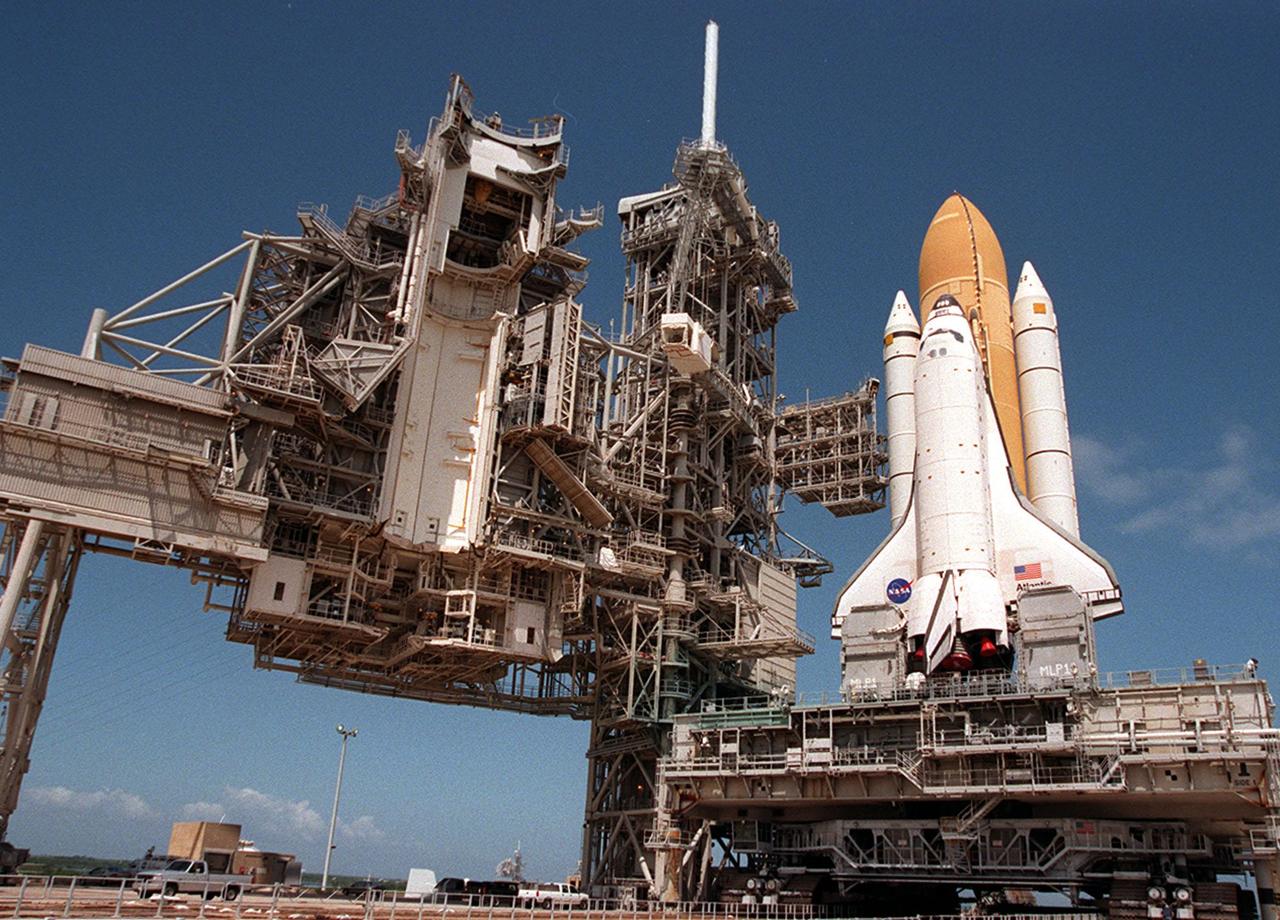
KENNEDY SPACE CENTER, FLA. -- Space Shuttle Atlantis sits on launch Pad 39A waiting for the rotating service structure, pictured at left, to be moved into place for final launch preparations. Liftoff of Atlantis on mission STS-101 is scheduled for April 17 at 7:03 p.m. EDT. STS-101 is a logistics and resupply mission for the International Space Station, to restore full redundancy to the International Space Station power system in preparation for the arrival of the next pressurized module, the Russian-built Zvezda
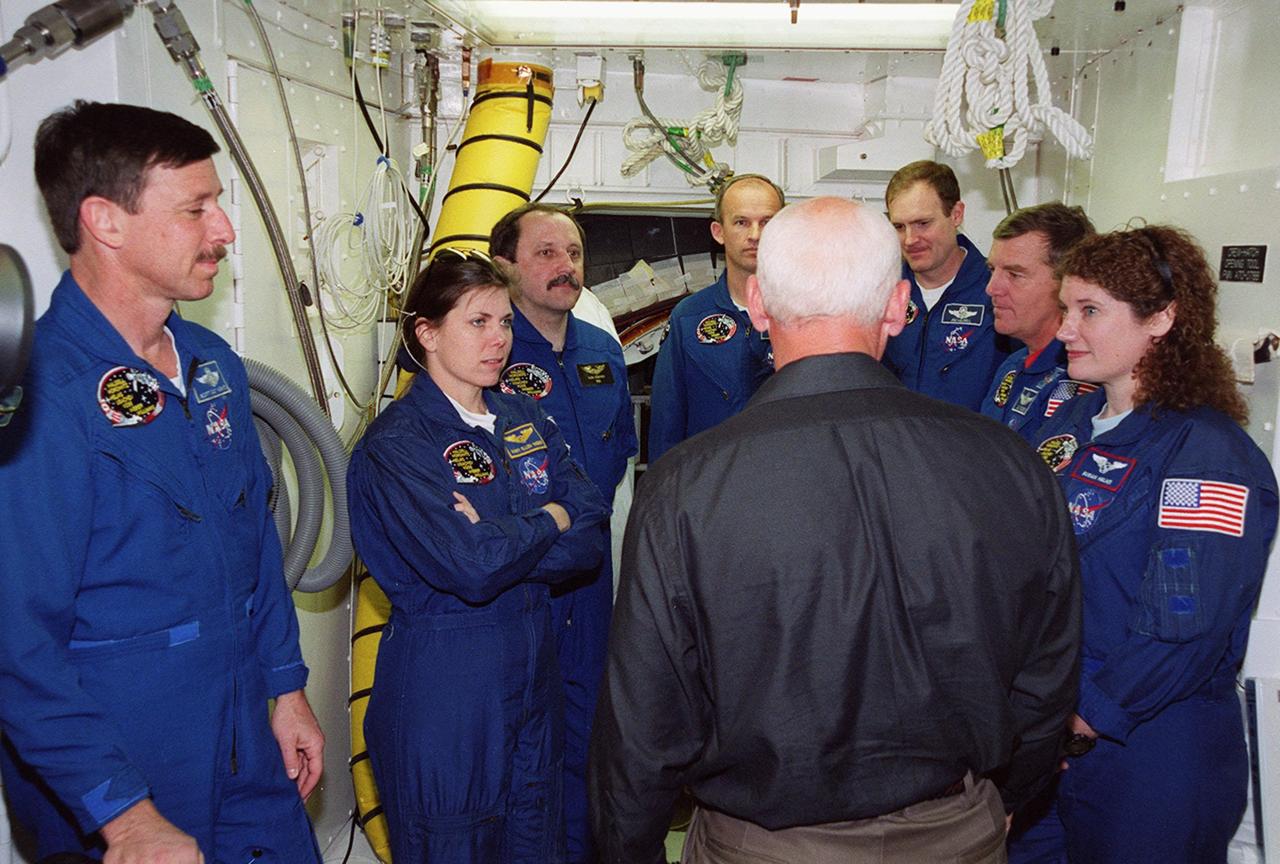
Inside the White Room at Launch Pad 39A, the STS-101 crew take part in training during a Terminal Countdown Demonstration Test (TCDT). Activities during TCDT include emergency egress from the orbiter and a dress rehearsal for launch. Standing left to right are Pilot Scott Horowitz, Mission Specialists Mary Ellen Weber, Yury Usachev and Jeffrey Williams, Commander James Halsell, and Mission Specialists James Voss and Susan Helms. During their mission to the International Space Station, the STS-101 crew will be delivering logistics and supplies, plus preparing the Station for the arrival of the Zvezda Service Module, expected to be launched by Russia in July 2000. Also, the crew will conduct one space walk to perform maintenance on the Space Station. This will be the third assembly flight for the Space Station. STS-101 is scheduled to launch April 24 at 4:15 p.m. from Launch Pad 39A
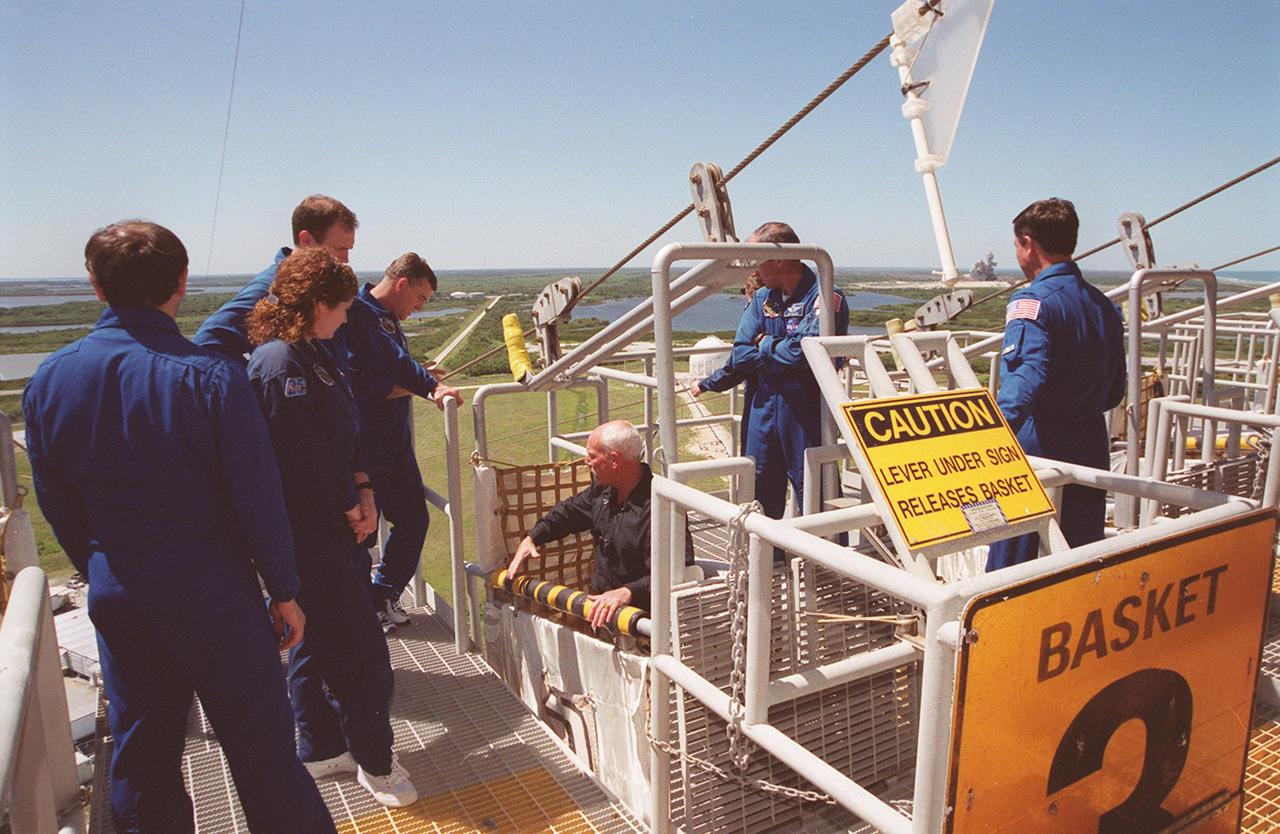
KENNEDY SPACE CENTER, Fla. -- At the 195-foot level of the Fixed Service Structure on Launch Pad 39A, the STS-101 crew get instruction in emergency egress in a slidewire basket during a Terminal Countdown Demonstration Test (TCDT). From left are Mission Specialist Yury Usachev and Susan Helms; Commander James Halsell; Mission Specialists James Voss, Mary Ellen Weber standing behind Jeffrey Williams; and Pilot Scott Horowitz. During their mission to the International Space Station, the STS-101 crew will be delivering logistics and supplies, plus preparing the Station for the arrival of the Zvezda Service Module, expected to be launched by Russia in July 2000. Also, the crew will conduct one space walk to perform maintenance on the Space Station. This will be the third assembly flight for the Space Station. STS-101 is scheduled to launch April 24 at 4:15 p.m. from Launch Pad 39A
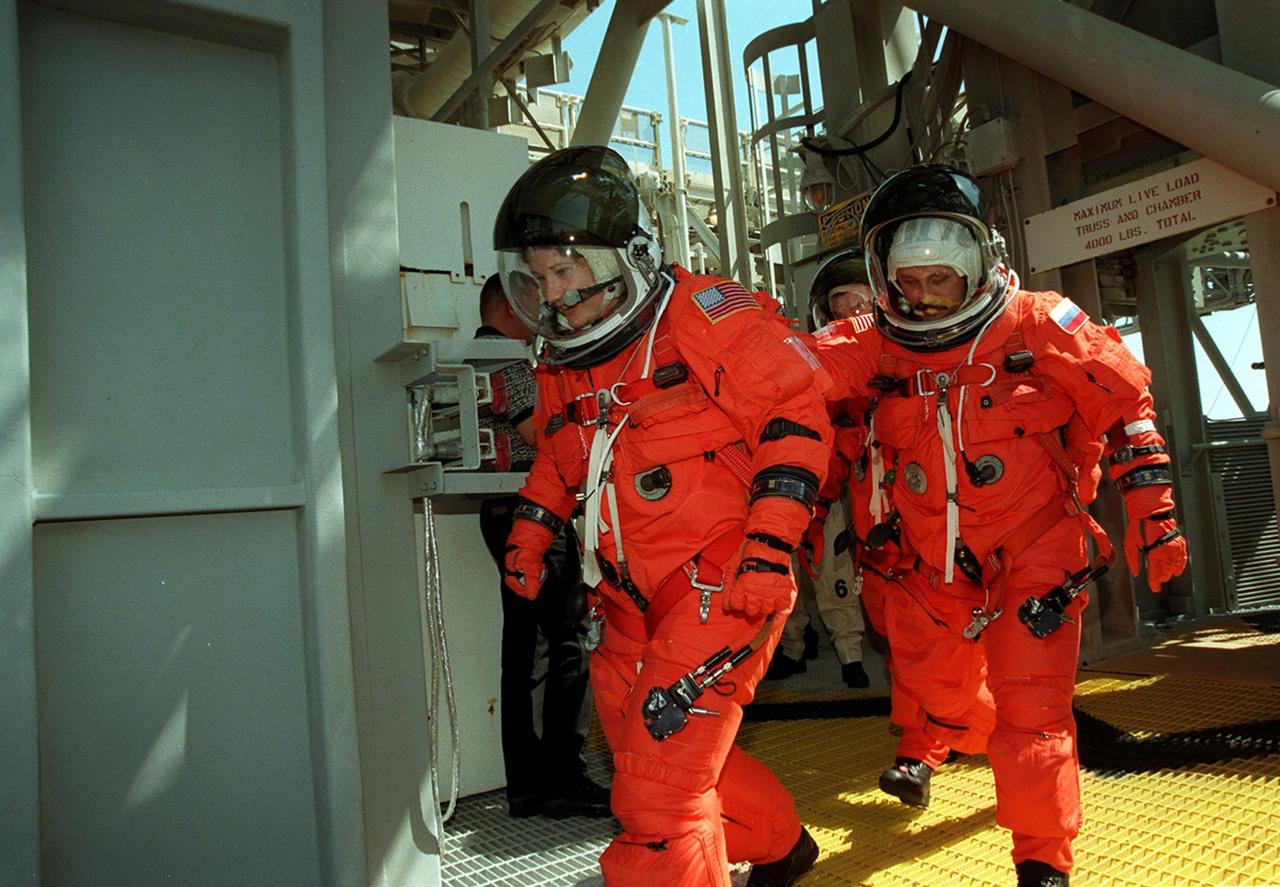
KENNEDY SPACE CENTER, FLA. -- As part of Terminal Countdown Demonstration (TCDT) activities, the STS-101 crew practices emergency egress from the orbiter at the 195-foot level of the Fixed Service Structure. Shown heading down the easily identified exit path, known as the "yellow brick road," are Mission Specialists Susan J. Helms (leading), Yury Usachev of Russia and James Voss. The TCDT also includes a simulated launch countdown and familiarization with the payload. During their mission to the International Space Station, the STS-101 crew will be delivering logistics and supplies, plus preparing the Station for the arrival of the Zvezda Service Module, expected to be launched by Russia in July 2000. Also, the crew will conduct one space walk to perform maintenance on the Space Station. This will be the third assembly flight to the Space Station. STS-101 is scheduled to launch April 24 at 4:15 p.m. from Launch Pad 39A
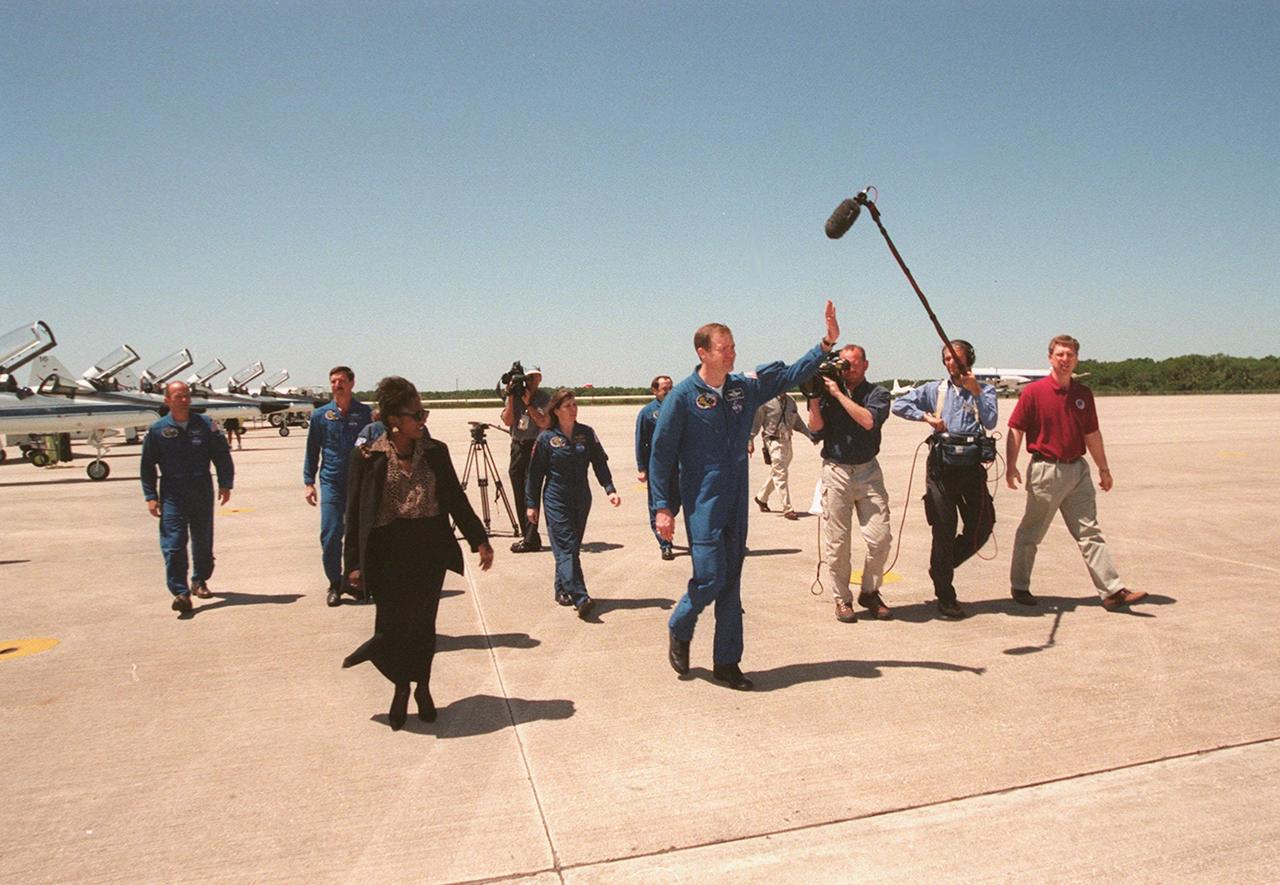
KENNEDY SPACE CENTER, FLA. -- At the Shuttle Landing Facility, STS-101 Commander James Halsell waves to the media as he and other crew members cross the tarmac to a waiting bus. At right is a film crew; in the foreground at left is Delores Green, flight crew support specialist lead for the astronaut crew quarters. Other crew members in the background are Mission Specialist Jeffrey Williams, Pilot Scott Horowitz, and Mission Specialists Mary Ellen Weber and Yury Usachev. Not visible in the photo is Mission Specialist Susan Helms. During their mission to the International Space Station, the STS-101 crew will be delivering logistics and supplies, plus preparing the Station for the arrival of the Zvezda Service Module, expected to be launched by Russia in July 2000. Also, the crew will conduct one space walk to perform maintenance on the Space Station. This will be the third assembly flight for the Space Station. STS-101 is scheduled to launch April 24 at 4:15 p.m. from Launch Pad 39A
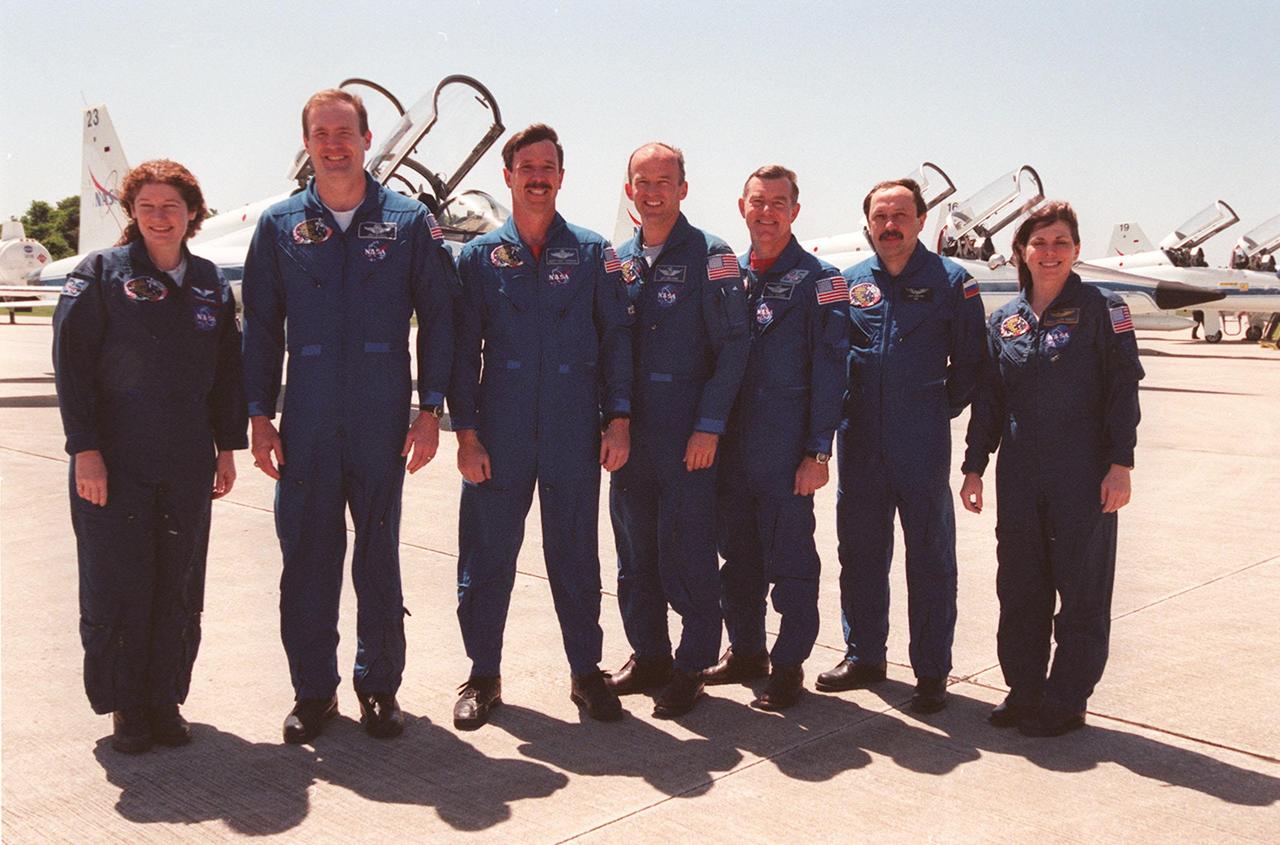
KENNEDY SPACE CENTER, FLA. -- The STS-101 crew poses on the tarmac at the Shuttle Landing Facility after arriving to take part in a Terminal Countdown Demonstration Test (TCDT). The two days of activities include emergency egress training and a dress rehearsal for launch. Standing left to right are Mission Specialist Susan Helms, Commander James Halsell, Pilot Scott Horowitz, and Mission Speciaists Jeffrey Williams, James Voss, Yury Usachev and Mary Ellen Weber. During their mission to the International Space Station, the STS-101 crew will be delivering logistics and supplies, plus preparing the Station for the arrival of the Zvezda Service Module, expected to be launched by Russia in July 2000. Also, the crew will conduct one space walk to perform maintenance on the Space Station. This will be the third assembly flight for the Space Station. STS-101 is scheduled to launch April 24 at 4:15 p.m. from Launch Pad 39A
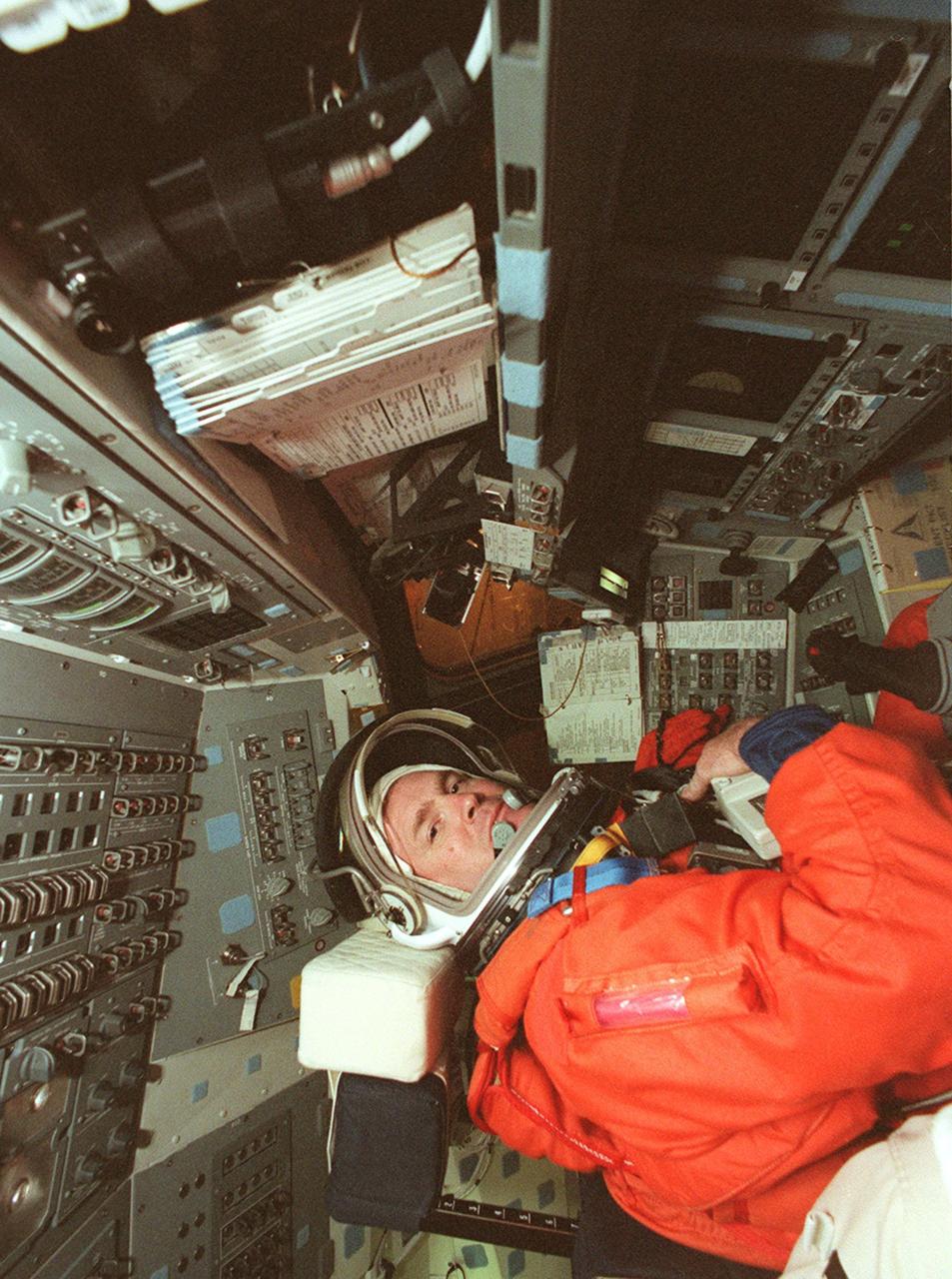
KENNEDY SPACE CENTER, FLA. -- STS-101 Commander James D. Halsell Jr. takes his seat inside Space Shuttle Atlantis for a simulated launch countdown. The countdown is part of Terminal Countdown Demonstration Test (TCDT) activities that also include emergency egress training and familiarization with the payload. Other crew members taking part are Pilot Scott J. "Doc" Horowitz and Mission Specialists Mary Ellen Weber, James Voss, Jeffrey N. Williams, Susan Helms, and Yury Usachev of Russia. During their mission to the International Space Station, the STS-101 crew will be delivering logistics and supplies, plus preparing the Station for the arrival of the Zvezda Service Module, expected to be launched by Russia in July 2000. Also, the crew will conduct one space walk to perform maintenance on the Space Station. This will be the third assembly flight for the Space Station. STS-101 is scheduled to launch April 24 at 4:15 p.m. from Launch Pad 39A
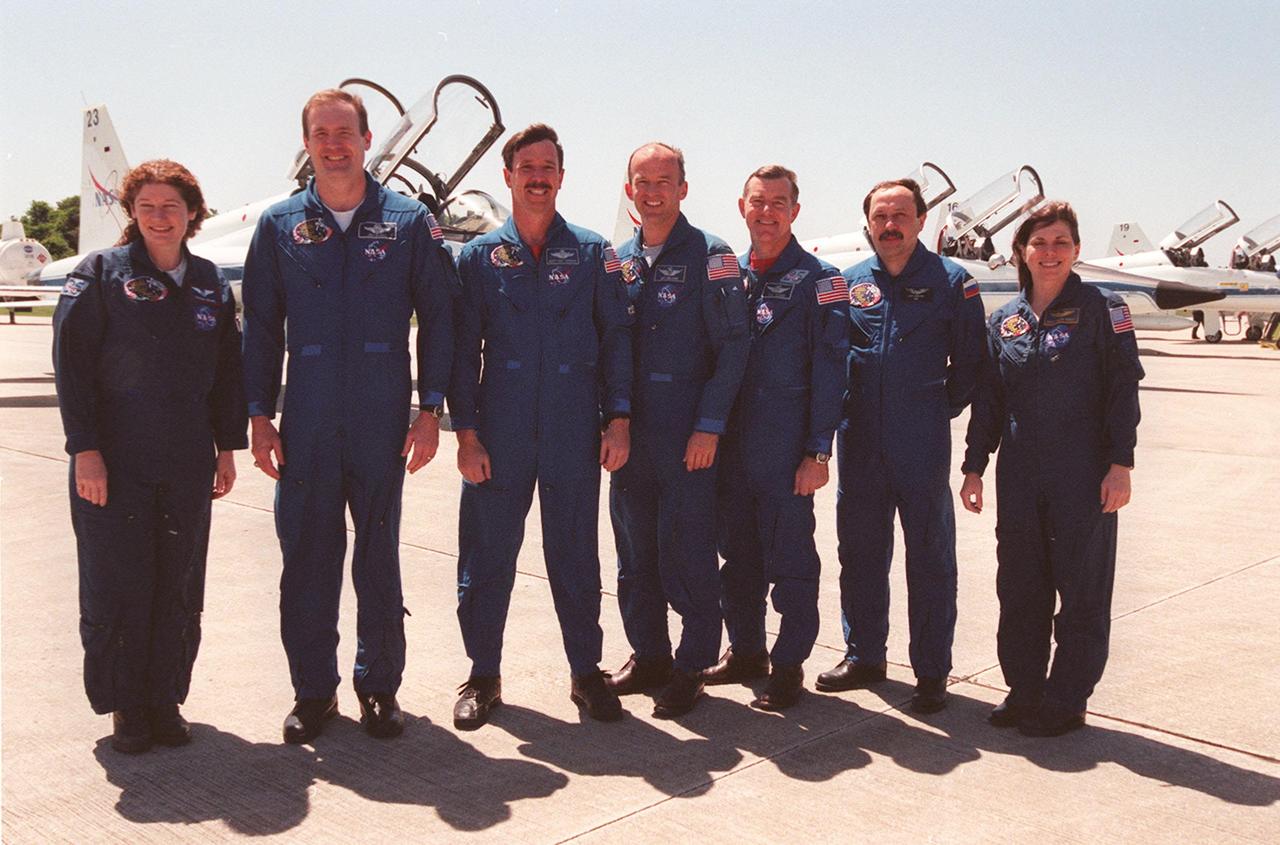
KENNEDY SPACE CENTER, FLA. -- The STS-101 crew poses on the tarmac at the Shuttle Landing Facility after arriving to take part in a Terminal Countdown Demonstration Test (TCDT). The two days of activities include emergency egress training and a dress rehearsal for launch. Standing left to right are Mission Specialist Susan Helms, Commander James Halsell, Pilot Scott Horowitz, and Mission Speciaists Jeffrey Williams, James Voss, Yury Usachev and Mary Ellen Weber. During their mission to the International Space Station, the STS-101 crew will be delivering logistics and supplies, plus preparing the Station for the arrival of the Zvezda Service Module, expected to be launched by Russia in July 2000. Also, the crew will conduct one space walk to perform maintenance on the Space Station. This will be the third assembly flight for the Space Station. STS-101 is scheduled to launch April 24 at 4:15 p.m. from Launch Pad 39A
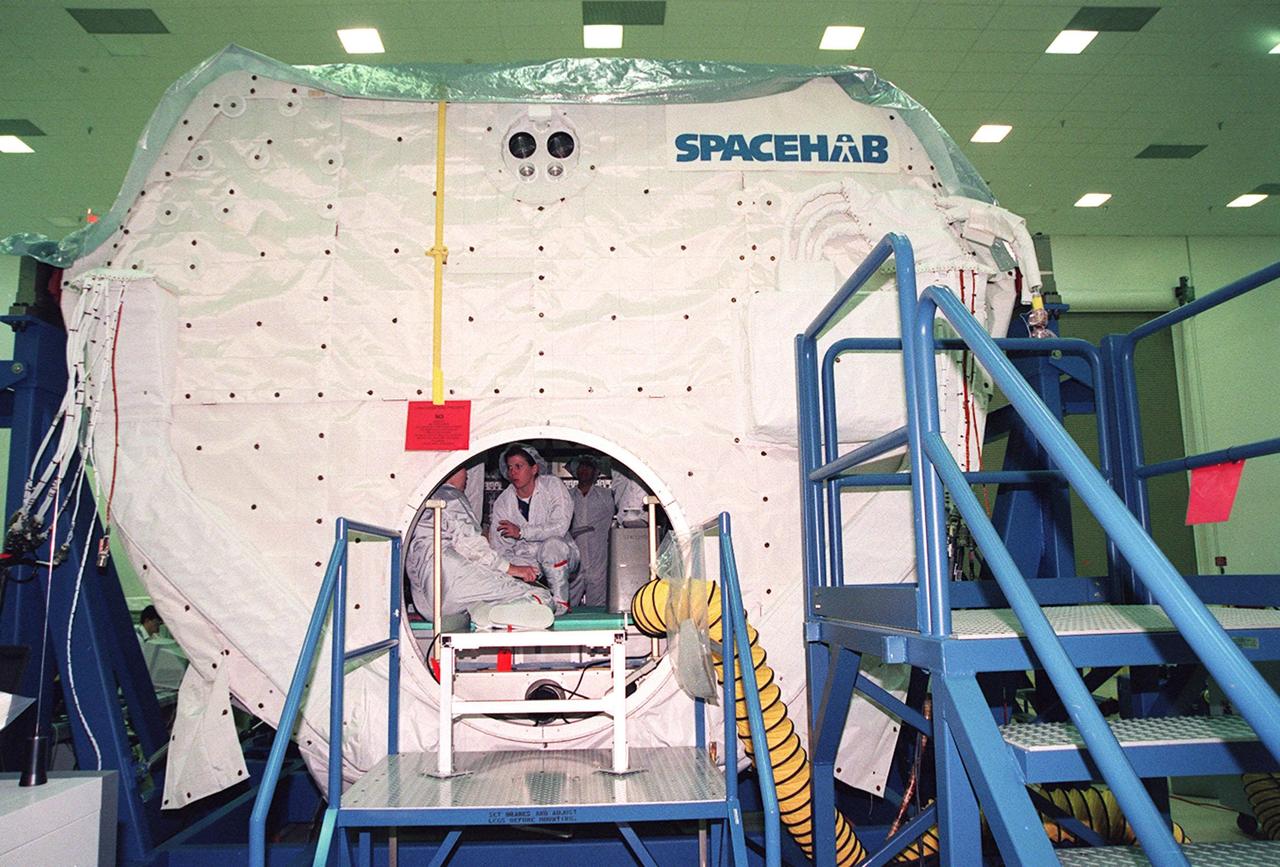
KENNEDY SPACE CENTER, FLA. -- As part of Crew Equipment Interface Test (CEIT) activities at SPACEHAB, in Cape Canaveral, Fla., members of the STS-101 crew spend time inside the SPACEHAB double module to become familiar with equipment for their mission to the International Space Station. The crew of seven comprises Commander James Halsell, Pilot Scott Horowitz, and Mission Specialists Mary Ellen Weber, James Voss, Jeffrey Williams, Susan Helms and Yuri Usachev. The STS-101 crew will be responsible for preparing the Space Station for the arrival of the Zvezda Service Module, expected to be launched by Russia in July 2000. Also, the crew will conduct one space walk to perform maintenance on the Space Station and deliver logistics and supplies. This will be the third assembly flight for the Space Station. STS-101 is scheduled to launch no earlier than April 13 from Launch Pad 39A

KENNEDY SPACE CENTER, Fla. -- After Terminal Countdown Demonstration Test (TCDT) activities at Launch Pad 39A, the STS-101 crew talk to the media. At the microphone is Commander James D. Halsell Jr. Next to him, standing left to right, are Pilot Scott J. "Doc" Horowitz and Mission Specialists Mary Ellen Weber, Jeffrey N. Williams, James Voss, Susan J. Helms and Yury Usachev of Russia. The TCDT includes emergency egress training and a simulated launch countdown. During their mission to the International Space Station, the STS-101 crew will be delivering logistics and supplies, plus preparing the Station for the arrival of the Zvezda Service Module, expected to be launched by Russia in July 2000. Also, the crew will conduct one space walk to perform maintenance on the Space Station. This will be the third assembly flight for the Space Station. STS-101 is scheduled to launch April 24 at 4:15 p.m. from Launch Pad 39A
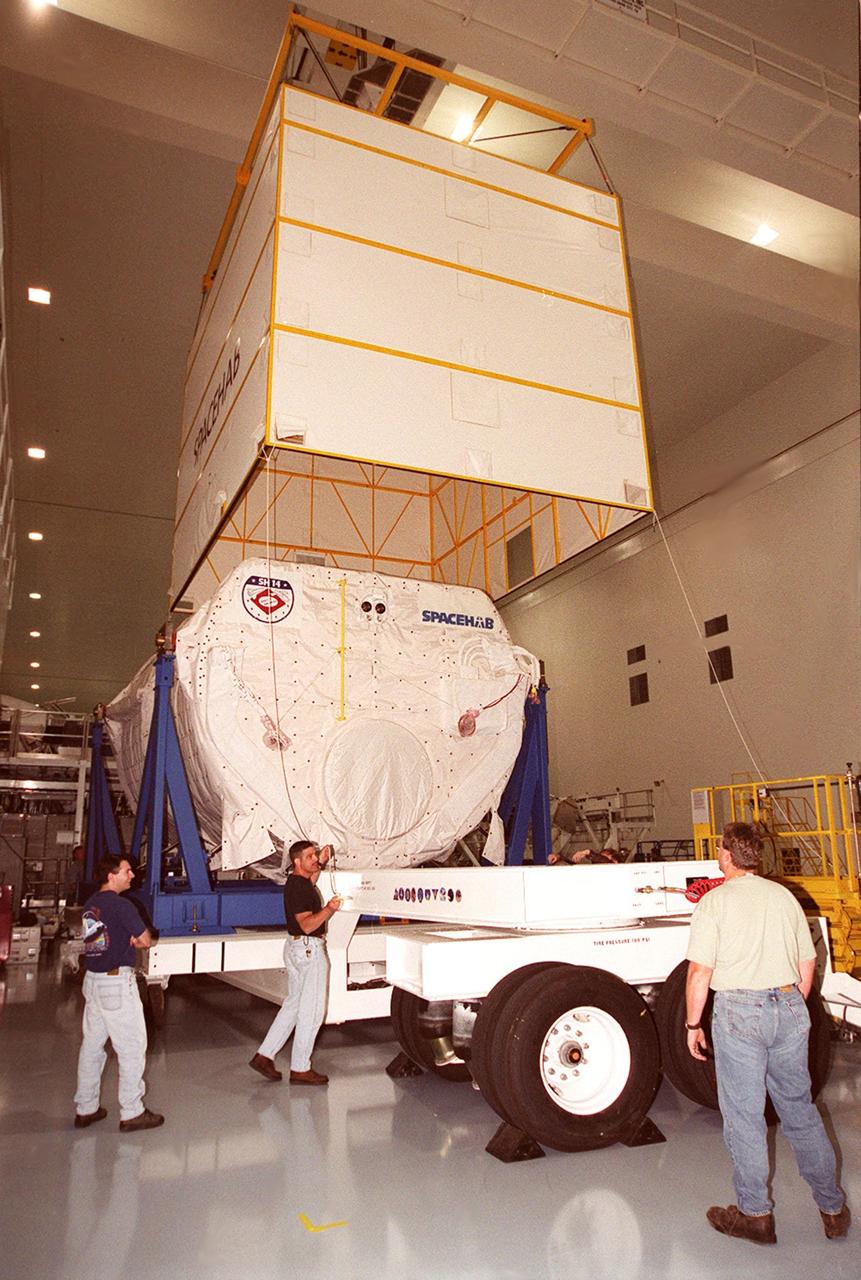
KENNEDY SPACE CENTER, FLA. -- The SPACEHAB Double Module is uncovered in the Space Station Processing Facility for transfer to a payload canister that will take it to Launch Pad 39A. There it will be installed in the Shuttle Atlantis' payload bay for mission STS-101. The module carries internal logistics and resupply cargo for restoring full redundancy to the International Space Station power system in preparation for the arrival of the next pressurized module, the Russian-built Zvezda. The STS-101 crew of seven comprises Commander James D. Halsell Jr., Pilot Scott J. "Doc" Horowitz (Ph.D.) and Mission Specialists Mary Ellen Weber (Ph.D.), James S. Voss, Jeffrey N. Williams, Susan J. Helms and Yuri Vladimirovich Usachev, cosmonaut. Launch of Atlantis on mission STS-101 is scheduled no earlier than April 17, 2000
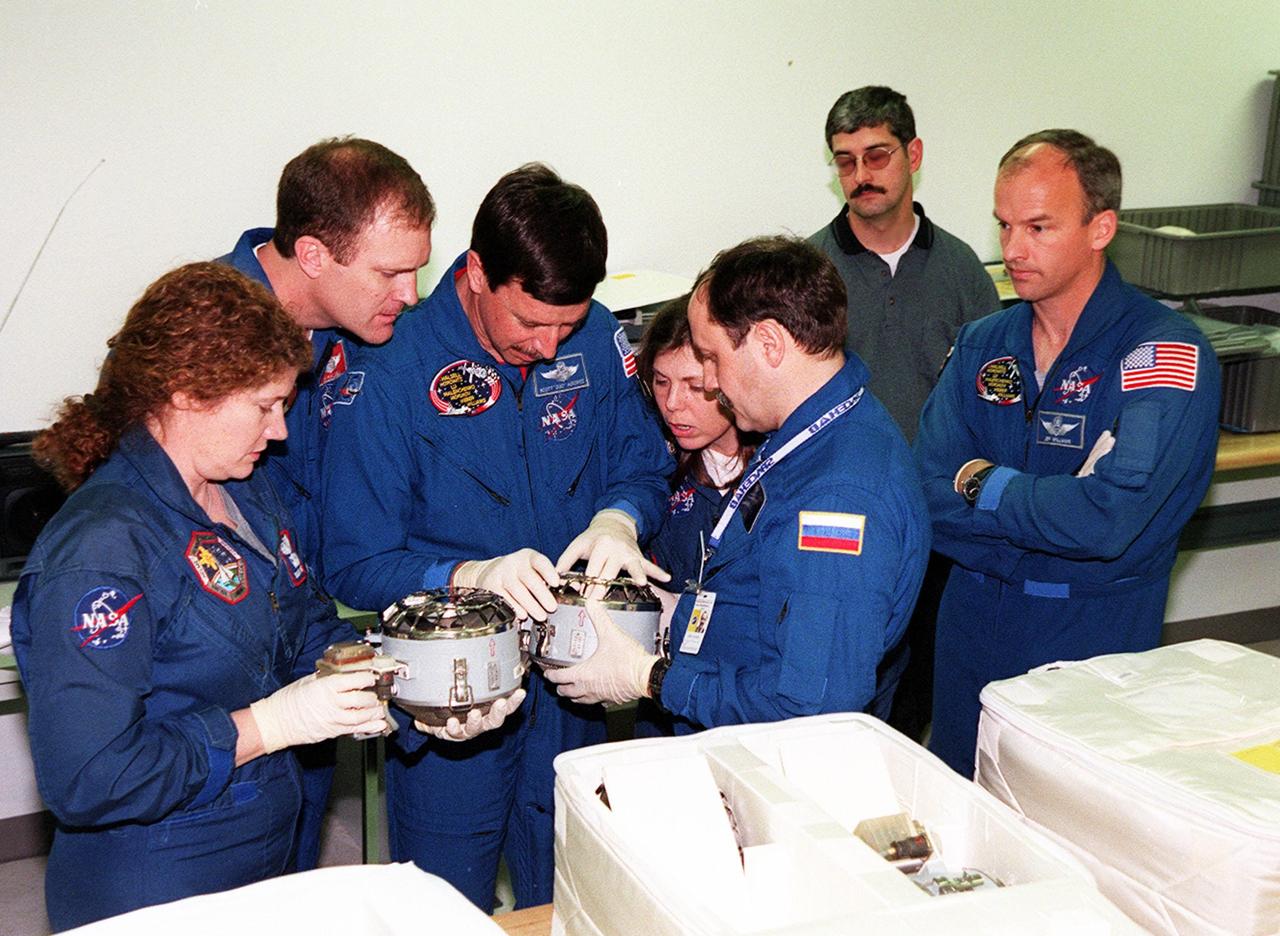
KENNEDY SPACE CENTER, FLA. -- Members of the STS-101 crew take part in Crew Equipment Interface Test (CEIT) activities at SPACEHAB, in Cape Canaveral, Fla., where they are learning about some of the equipment they will be working with on their mission to the International Space Station. Looking over two of the components are (left to right) Mission Specialist Susan Helms, Commander James Halsell, Pilot Scott Horowitz, and Mission Specialists Mary Ellen Weber, Yuri Usachev and Jeffrey Williams. Not shown is Mission Specialist James Voss. The STS-101 crew will be responsible for preparing the Space Station for the arrival of the Zvezda Service Module, expected to be launched by Russia in July 2000. Also, the crew will conduct one space walk to perform maintenance on the Space Station and deliver logistics and supplies. This will be the third assembly flight for the Space Station. STS-101 is scheduled to launch no earlier than April 13 from Launch Pad 39A
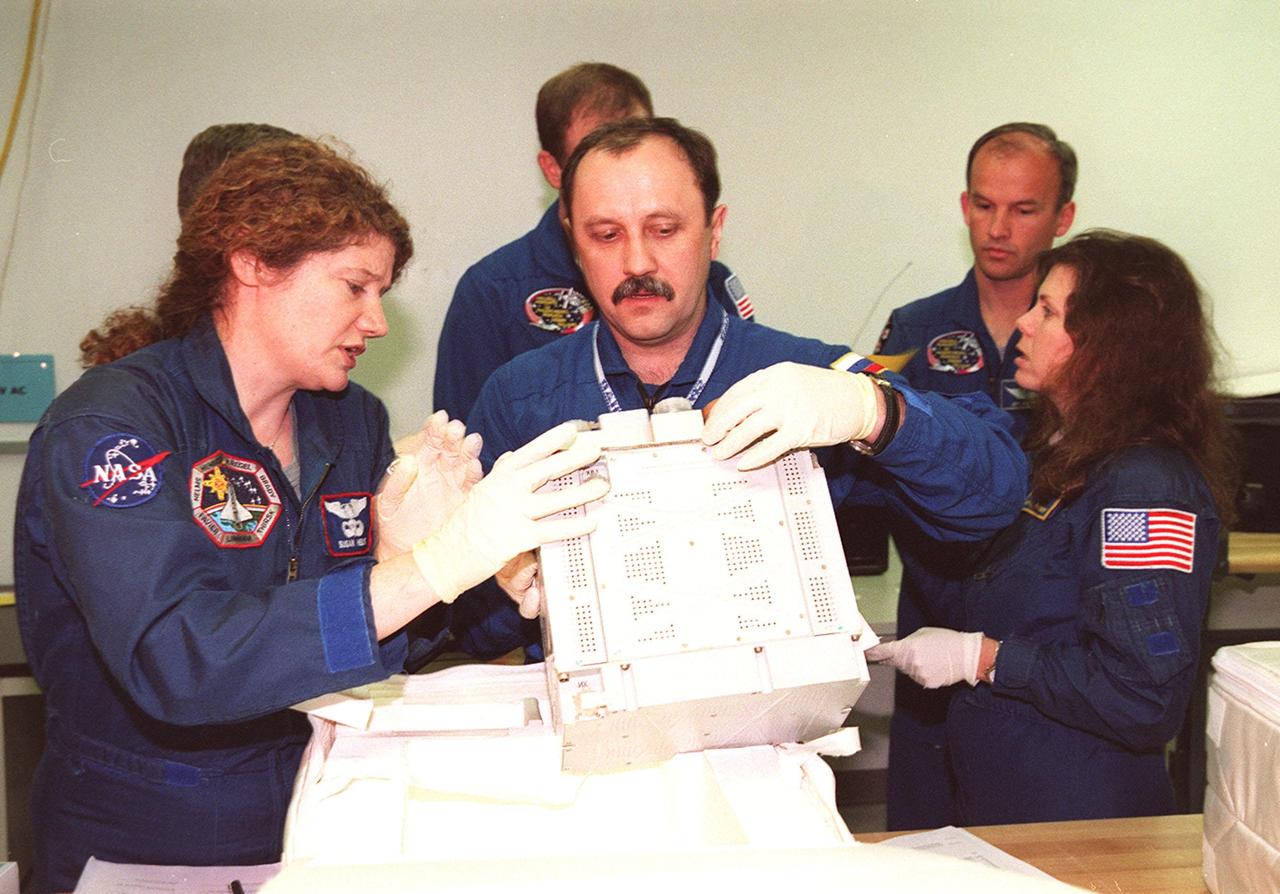
KENNEDY SPACE CENTER, FLA. -- At SPACEHAB, in Cape Canaveral, Fla., members of the STS-101 crew take part in Crew Equipment Interface Test (CEIT) activities, learning about some of the equipment they will be working with on their mission to the International Space Station. Looking over one of the elements are Mission Specialists Susan Helms and Yuri Usachev. Behind them are Mission Specialist James Voss, Commander James Halsell, and Mission Specialists Jeffrey Williams and Mary Ellen Weber. Also taking part in the CEIT is Pilot Scott Horowitz (not shown). The STS-101 crew will be responsible for preparing the Space Station for the arrival of the Zvezda Service Module, expected to be launched by Russia in July 2000. Also, the crew will conduct one space walk to perform maintenance on the Space Station and deliver logistics and supplies. This will be the third assembly flight for the Space Station. STS-101 is scheduled to launch no earlier than April 13 from Launch Pad 39A
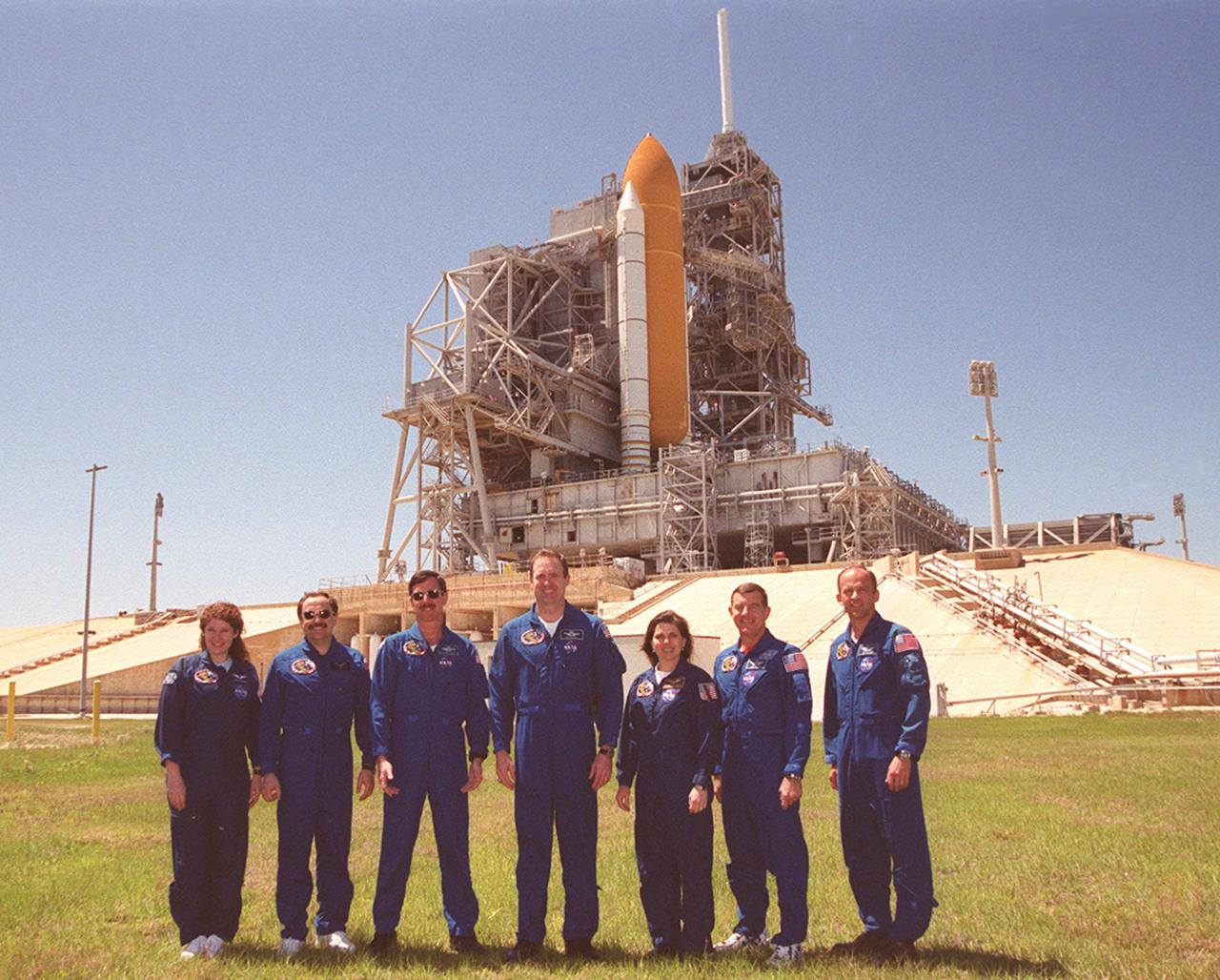
KENNEDY SPACE CENTER, Fla. -- During a break in their Terminal Countdown Demonstration Test (TCDT), the STS-101 crew poses in front of Space Shuttle Atlantis at Launch Pad 39A. Standing, left to right, are Mission Specialists Susan J. Helms and Yury Usachev of Russia; Pilot Scott J. "Doc" Horowitz; Commander James D. Halsell Jr.; and Mission Specialists Mary Ellen Weber, James Voss and Jeffrey N. Williams. The TCDT includes emergency egress training and a simulated launch countdown. During their mission to the International Space Station, the STS-101 crew will be delivering logistics and supplies, plus preparing the Station for the arrival of the Zvezda Service Module, expected to be launched by Russia in July 2000. Also, the crew will conduct one space walk to perform maintenance on the Space Station. This will be the third assembly flight for the Space Station. STS-101 is scheduled to launch April 24 at 4:15 p.m. from Launch Pad 39A
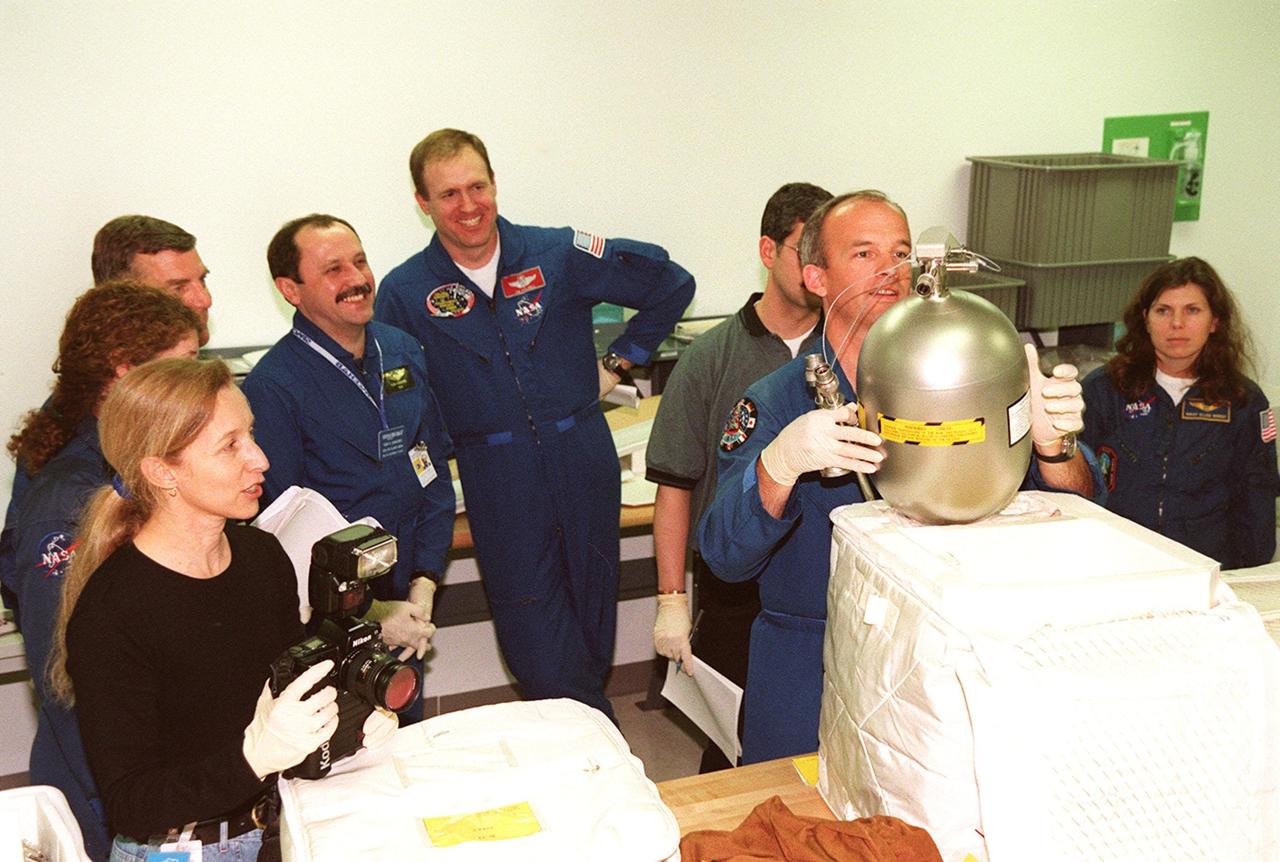
KENNEDY SPACE CENTER, FLA. -- Members of the STS-101 crew share a light moment during Crew Equipment Interface Test (CEIT) activities at SPACEHAB, in Cape Canaveral, Fla. Documenting the occasion is astronaut Marsha Ivins (far left, with camera). Standing behind her (left to right) are Mission Specialists Susan Helms, James Voss and Yuri Usachev; Commander James Halsell; and Mission Specialists Jeffrey Williams (holding tank) and Mary Ellen Weber. During a CEIT, a Shuttle crew becomes familiar with some of the equipment they will be working with on their mission. The STS-101 crew will be responsible for preparing the Space Station for the arrival of the Zvezda Service Module, expected to be launched by Russia in July 2000. Also, the crew will conduct one space walk to perform maintenance on the Space Station and deliver logistics and supplies. This will be the third assembly flight for the Space Station. STS-101 is scheduled to launch no earlier than April 13 from Launch Pad 39A
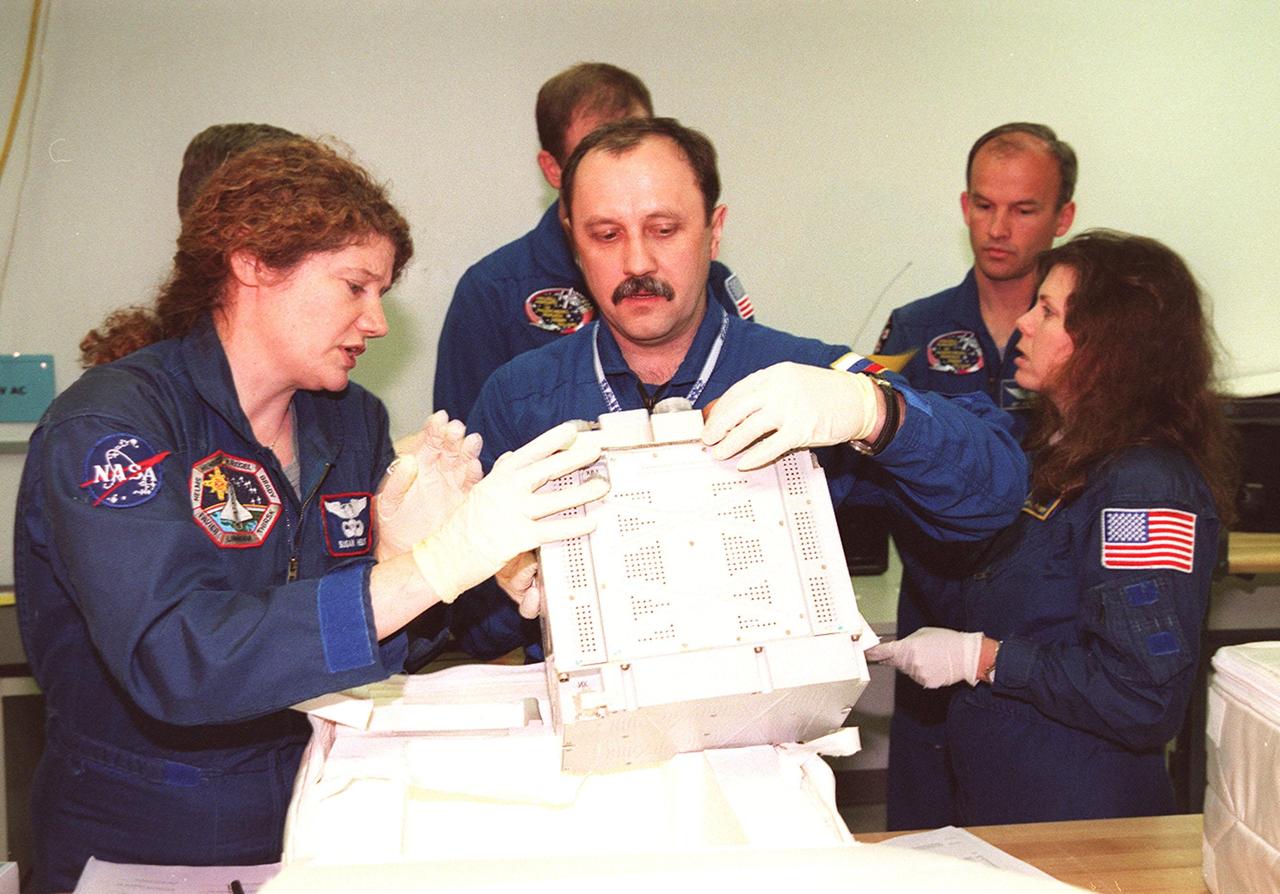
KENNEDY SPACE CENTER, FLA. -- At SPACEHAB, in Cape Canaveral, Fla., members of the STS-101 crew take part in Crew Equipment Interface Test (CEIT) activities, learning about some of the equipment they will be working with on their mission to the International Space Station. Looking over one of the elements are Mission Specialists Susan Helms and Yuri Usachev. Behind them are Mission Specialist James Voss, Commander James Halsell, and Mission Specialists Jeffrey Williams and Mary Ellen Weber. Also taking part in the CEIT is Pilot Scott Horowitz (not shown). The STS-101 crew will be responsible for preparing the Space Station for the arrival of the Zvezda Service Module, expected to be launched by Russia in July 2000. Also, the crew will conduct one space walk to perform maintenance on the Space Station and deliver logistics and supplies. This will be the third assembly flight for the Space Station. STS-101 is scheduled to launch no earlier than April 13 from Launch Pad 39A
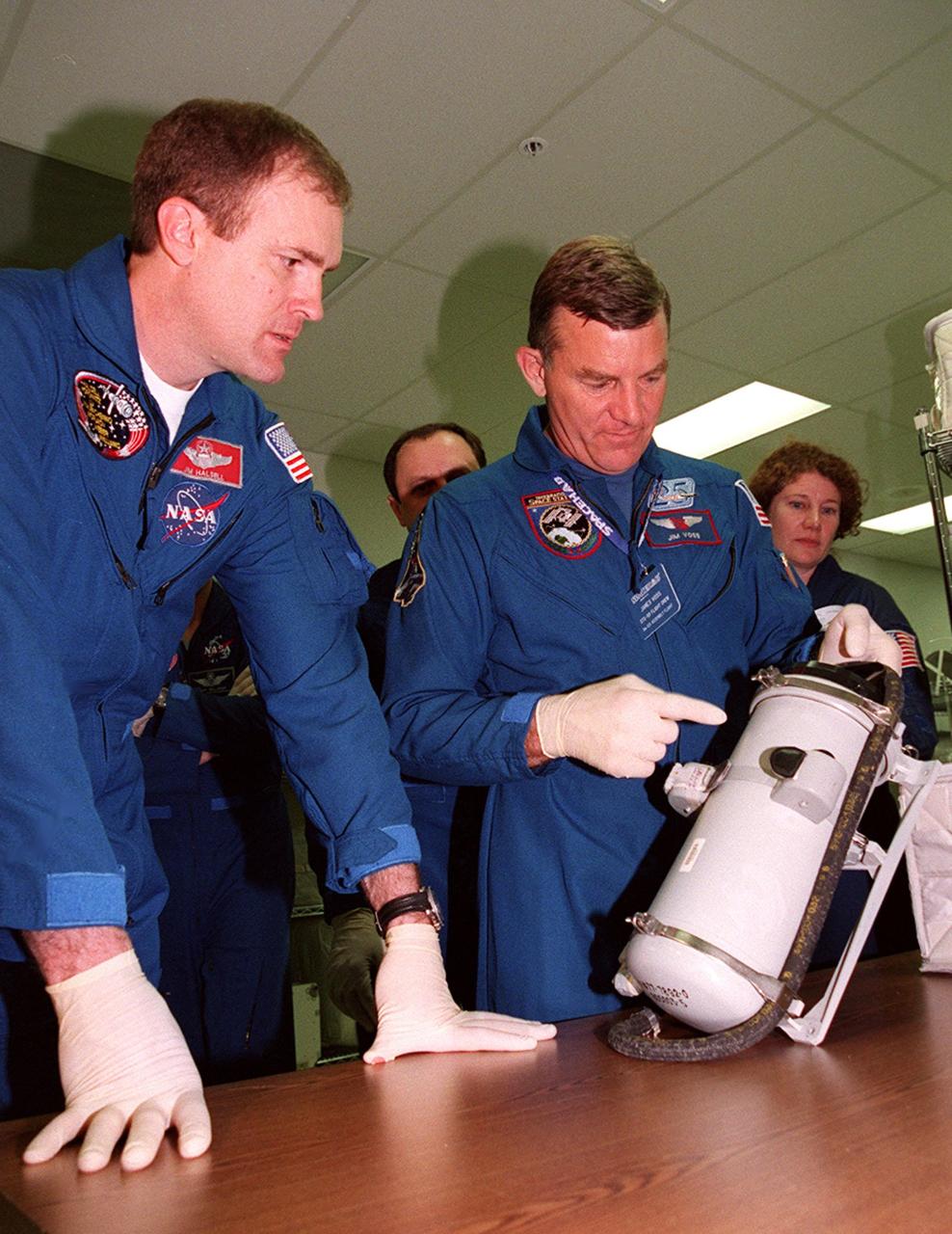
KENNEDY SPACE CENTER, FLA. -- As part of Crew Equipment Interface Test (CEIT) activities at SPACEHAB, in Cape Canaveral, Fla., STS-101 Commander James Halsell (left) and Mission Specialist James Voss (right) look over a piece of equipment for their mission to the International Space Station. Behnd them are Mission Specialists Yuri Usachev and Susan Helms. Other members of the crew taking part in the CEIT are Pilot Scott Horowitz, and Mission Specialists Mary Ellen Weber and Jeffrey Williams. The STS-101 crew will be responsible for preparing the Space Station for the arrival of the Zvezda Service Module, expected to be launched by Russia in July 2000. Also, the crew will conduct one space walk to perform maintenance on the Space Station and deliver logistics and supplies. This will be the third assembly flight for the Space Station. STS-101 is scheduled to launch no earlier than April 13 from Launch Pad 39A
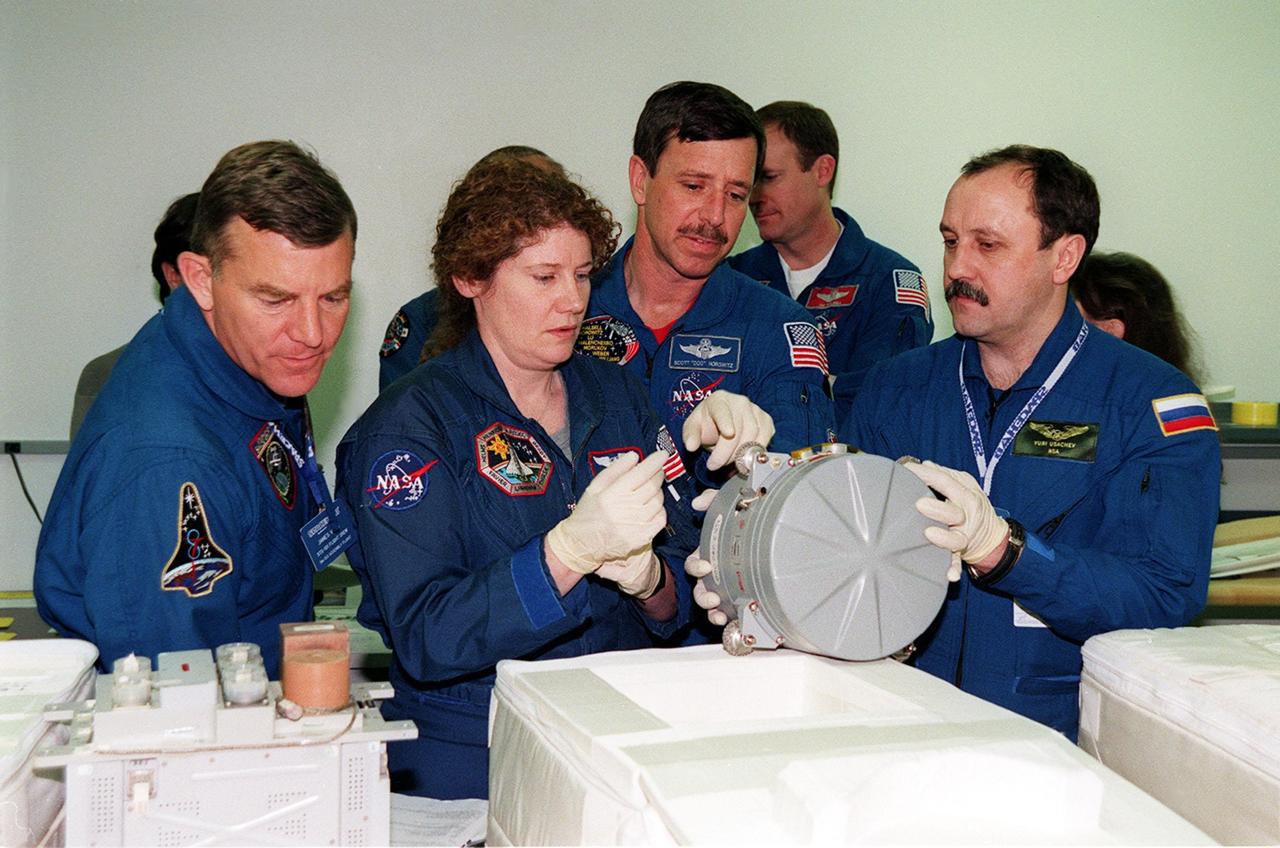
KENNEDY SPACE CENTER, FLA. -- At SPACEHAB, in Cape Canaveral, Fla., members of the STS-101 crew take part in Crew Equipment Interface Test (CEIT) activities, learning about some of the equipment they will be working with on their mission to the International Space Station. Looking over one of the elements are (left to right) Mission Specialists James Voss and Susan Helms, Pilot Scott Horowitz, and Mission Specialist Yuri Usachev of Russia. Seen behind Horowitz is Commander James Halsell. Also taking part in the CEIT are Mission Specialists Mary Ellen Weber and Jeffrey Williams. The STS-101 crew will be responsible for preparing the Space Station for the arrival of the Zvezda Service Module, expected to be launched by Russia in July 2000. Also, the crew will conduct one space walk to perform maintenance on the Space Station and deliver logistics and supplies. This will be the third assembly flight for the Space Station. STS-101 is scheduled to launch no earlier than April 13 from Launch Pad 39A
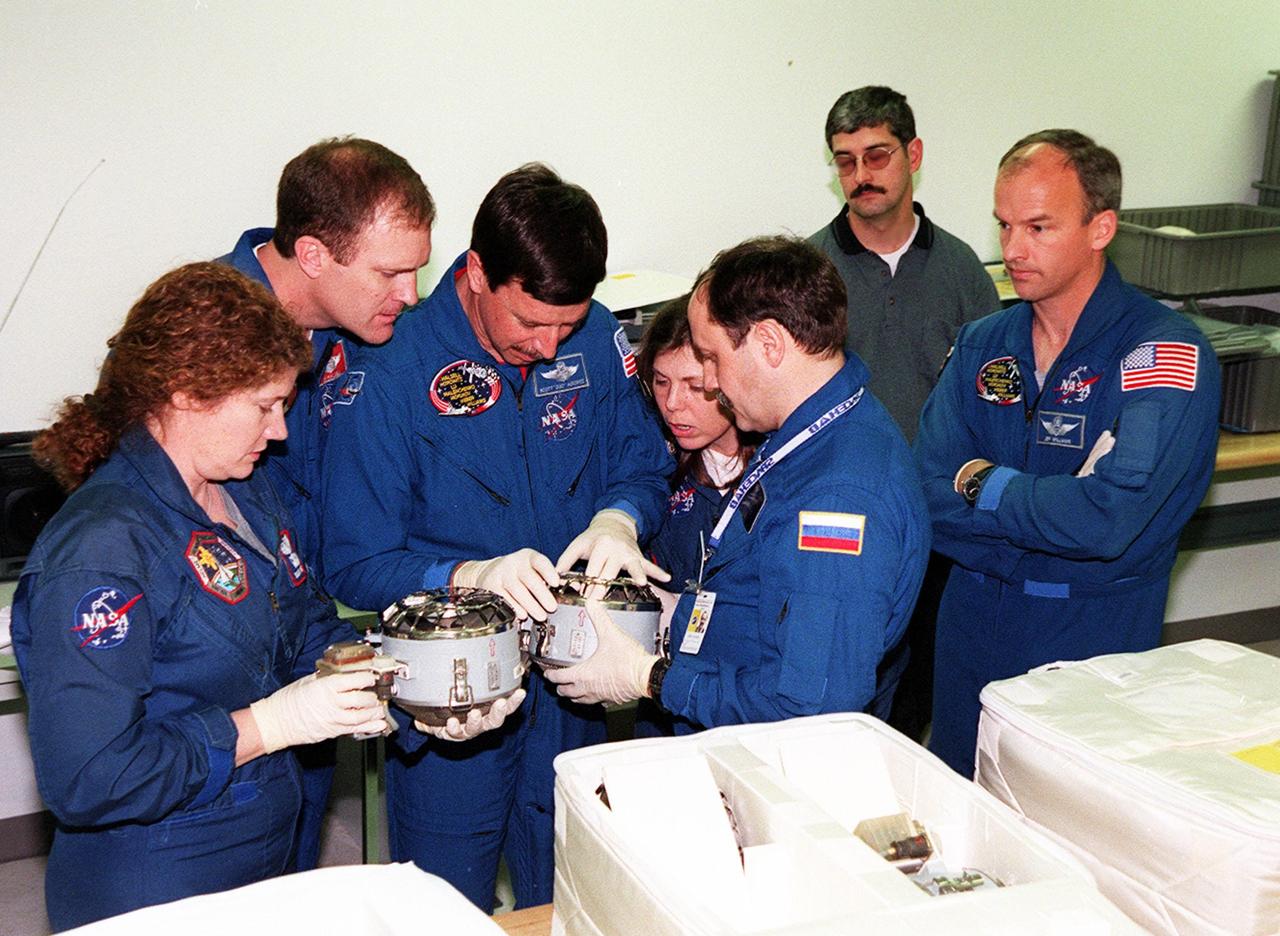
KENNEDY SPACE CENTER, FLA. -- Members of the STS-101 crew take part in Crew Equipment Interface Test (CEIT) activities at SPACEHAB, in Cape Canaveral, Fla., where they are learning about some of the equipment they will be working with on their mission to the International Space Station. Looking over two of the components are (left to right) Mission Specialist Susan Helms, Commander James Halsell, Pilot Scott Horowitz, and Mission Specialists Mary Ellen Weber, Yuri Usachev and Jeffrey Williams. Not shown is Mission Specialist James Voss. The STS-101 crew will be responsible for preparing the Space Station for the arrival of the Zvezda Service Module, expected to be launched by Russia in July 2000. Also, the crew will conduct one space walk to perform maintenance on the Space Station and deliver logistics and supplies. This will be the third assembly flight for the Space Station. STS-101 is scheduled to launch no earlier than April 13 from Launch Pad 39A
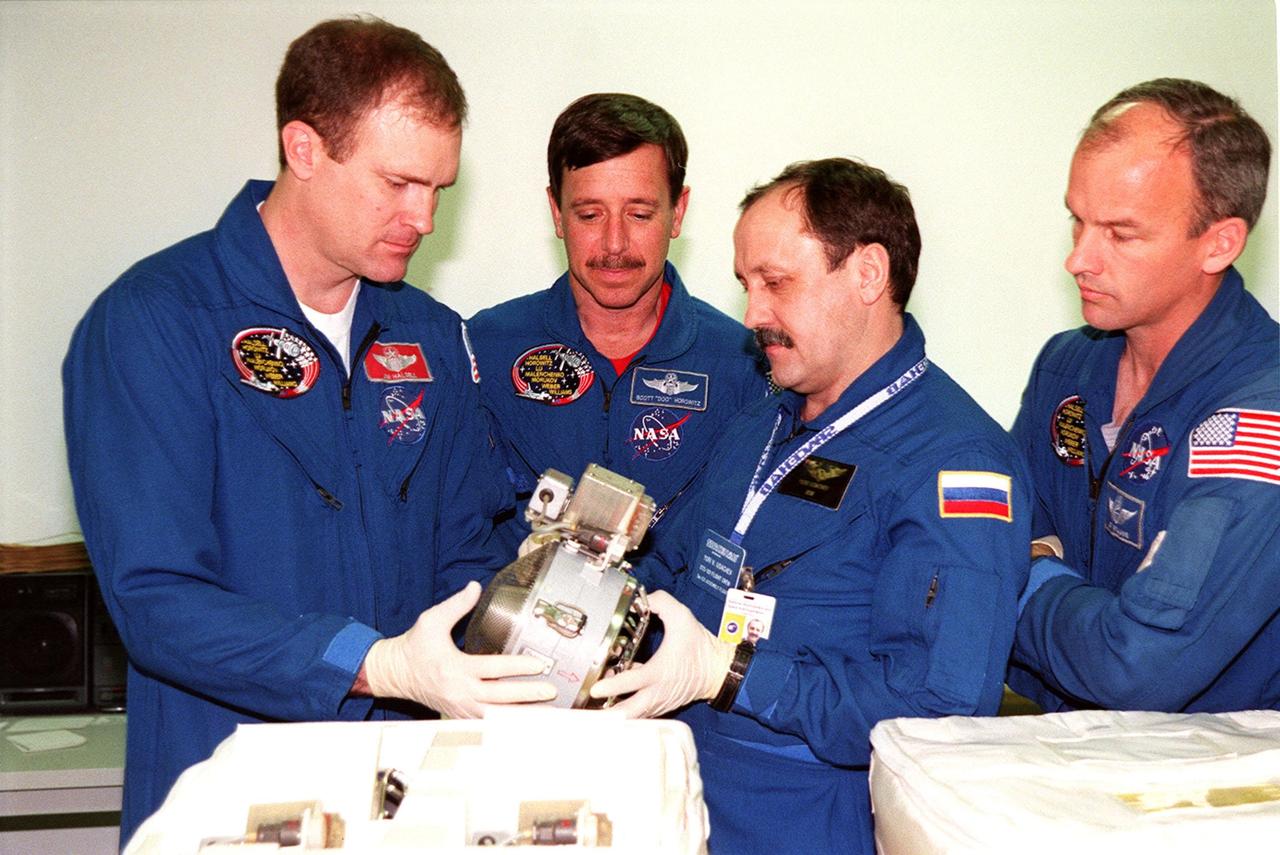
KENNEDY SPACE CENTER, FLA. -- Members of the STS-101 crew take part in Crew Equipment Interface Test (CEIT) activities at SPACEHAB, in Cape Canaveral, Fla., where they are learning about some of the equipment they will be working with on their mission to the International Space Station. Commander James Halsell, Pilot Scott Horowitz, and Mission Specialists Yuri Usachev and Jeffrey Williams look over one of the components. Other crew members taking part in the CEIT are Mission Specialists Mary Ellen Weber, James Voss and Susan Helms. The STS-101 crew will be responsible for preparing the Space Station for the arrival of the Zvezda Service Module, expected to be launched by Russia in July 2000. Also, the crew will conduct one space walk to perform maintenance on the Space Station and deliver logistics and supplies. This will be the third assembly flight for the Space Station. STS-101 is scheduled to launch no earlier than April 13 from Launch Pad 39A

KENNEDY SPACE CENTER, Fla. -- After Terminal Countdown Demonstration Test (TCDT) activities at Launch Pad 39A, the STS-101 crew talk to the media. At the microphone is Commander James D. Halsell Jr. Next to him, standing left to right, are Pilot Scott J. "Doc" Horowitz and Mission Specialists Mary Ellen Weber, Jeffrey N. Williams, James Voss, Susan J. Helms and Yury Usachev of Russia. The TCDT includes emergency egress training and a simulated launch countdown. During their mission to the International Space Station, the STS-101 crew will be delivering logistics and supplies, plus preparing the Station for the arrival of the Zvezda Service Module, expected to be launched by Russia in July 2000. Also, the crew will conduct one space walk to perform maintenance on the Space Station. This will be the third assembly flight for the Space Station. STS-101 is scheduled to launch April 24 at 4:15 p.m. from Launch Pad 39A
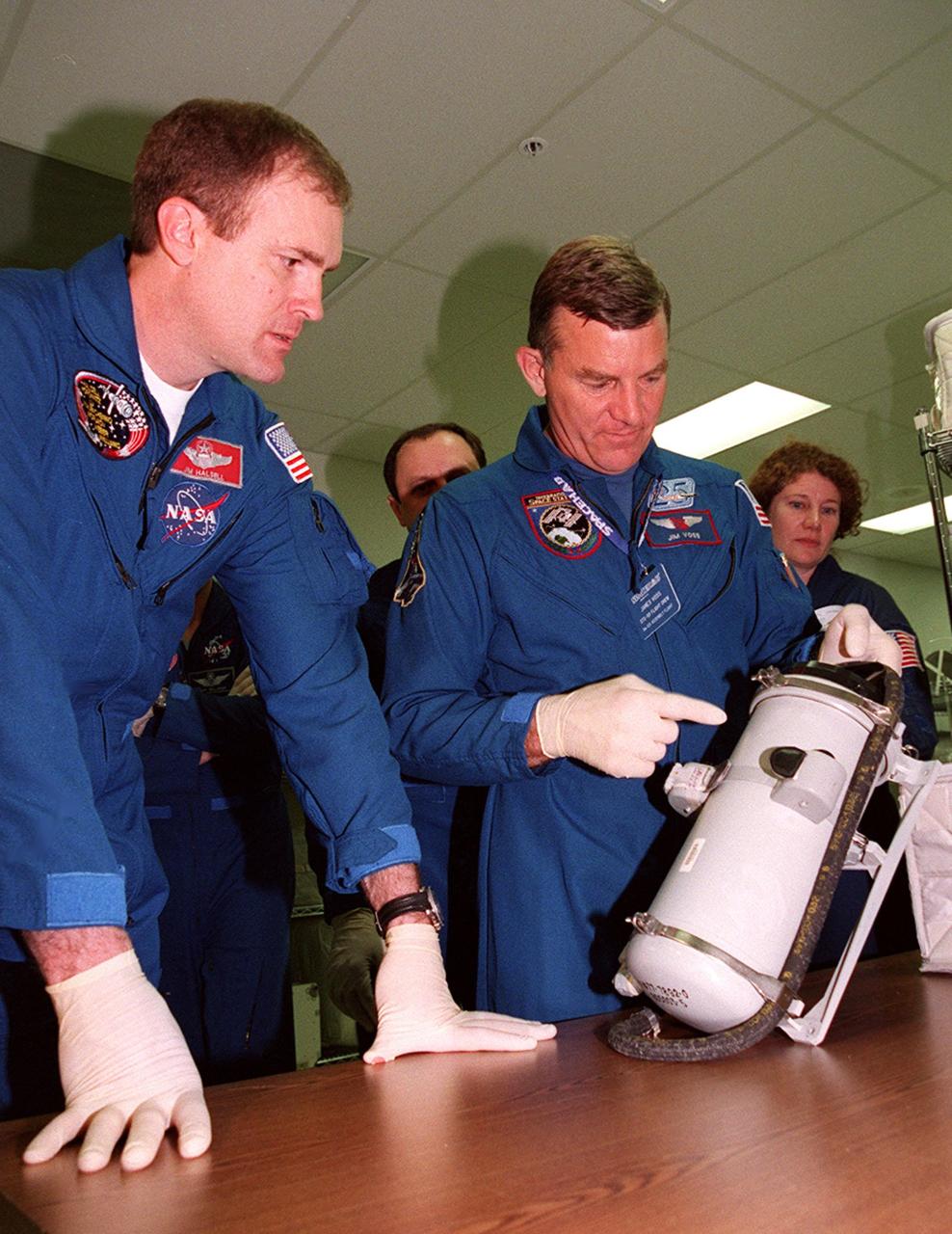
KENNEDY SPACE CENTER, FLA. -- As part of Crew Equipment Interface Test (CEIT) activities at SPACEHAB, in Cape Canaveral, Fla., STS-101 Commander James Halsell (left) and Mission Specialist James Voss (right) look over a piece of equipment for their mission to the International Space Station. Behnd them are Mission Specialists Yuri Usachev and Susan Helms. Other members of the crew taking part in the CEIT are Pilot Scott Horowitz, and Mission Specialists Mary Ellen Weber and Jeffrey Williams. The STS-101 crew will be responsible for preparing the Space Station for the arrival of the Zvezda Service Module, expected to be launched by Russia in July 2000. Also, the crew will conduct one space walk to perform maintenance on the Space Station and deliver logistics and supplies. This will be the third assembly flight for the Space Station. STS-101 is scheduled to launch no earlier than April 13 from Launch Pad 39A
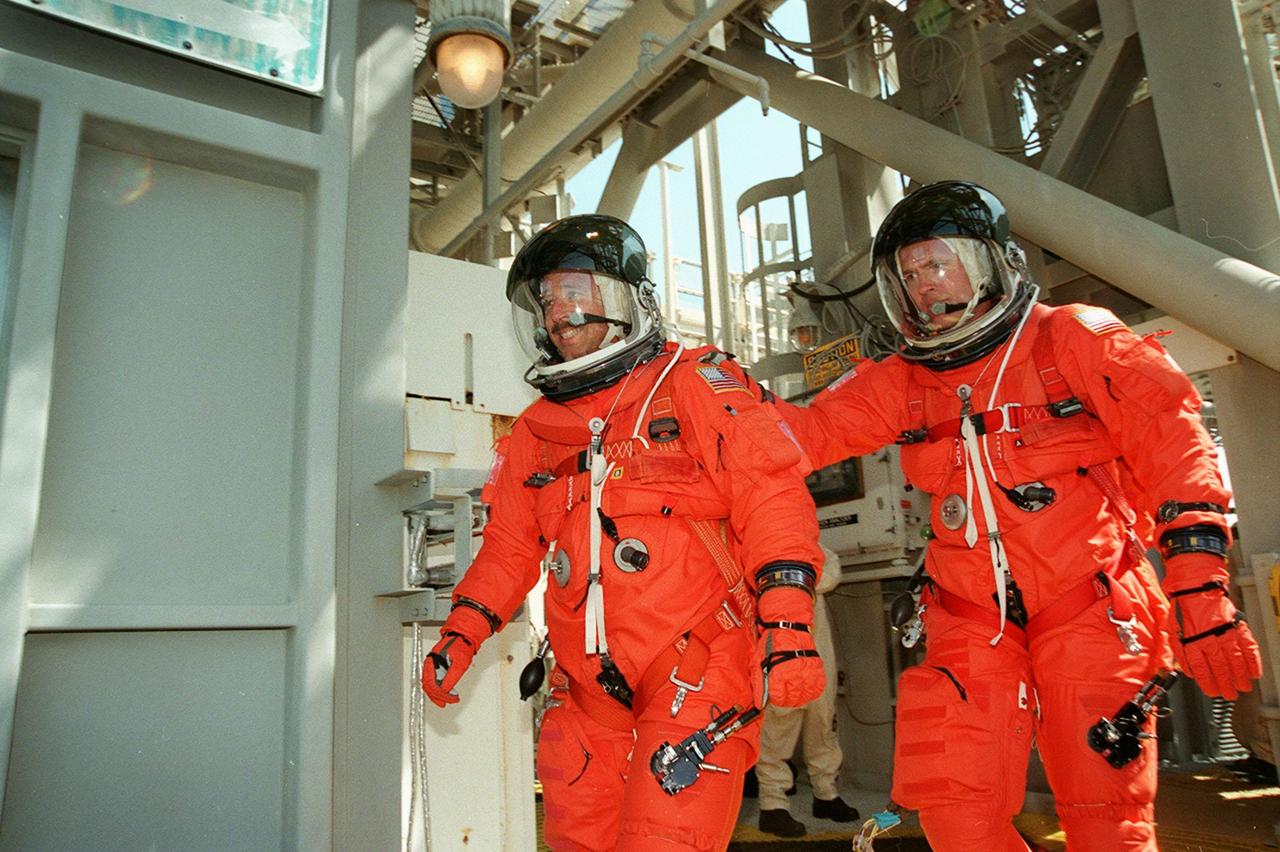
KENNEDY SPACE CENTER, FLA. -- As part of Terminal Countdown Demonstration (TCDT) activities, the STS-101 crew practices emergency egress from the orbiter at the 195-foot level of the Fixed Service Structure. Shown heading for the slidewire baskets are Pilot Scott J. "Doc" Horowitz (left) and Commander James D. Halsell Jr. The TCDT also includes a simulated launch countdown and familiarization with the payload. During their mission to the International Space Station, the STS-101 crew will be delivering logistics and supplies, plus preparing the Station for the arrival of the Zvezda Service Module, expected to be launched by Russia in July 2000. Also, the crew will conduct one space walk to perform maintenance on the Space Station. This will be the third assembly flight to the Space Station. STS-101 is scheduled to launch April 24 at 4:15 p.m. from Launch Pad 39A
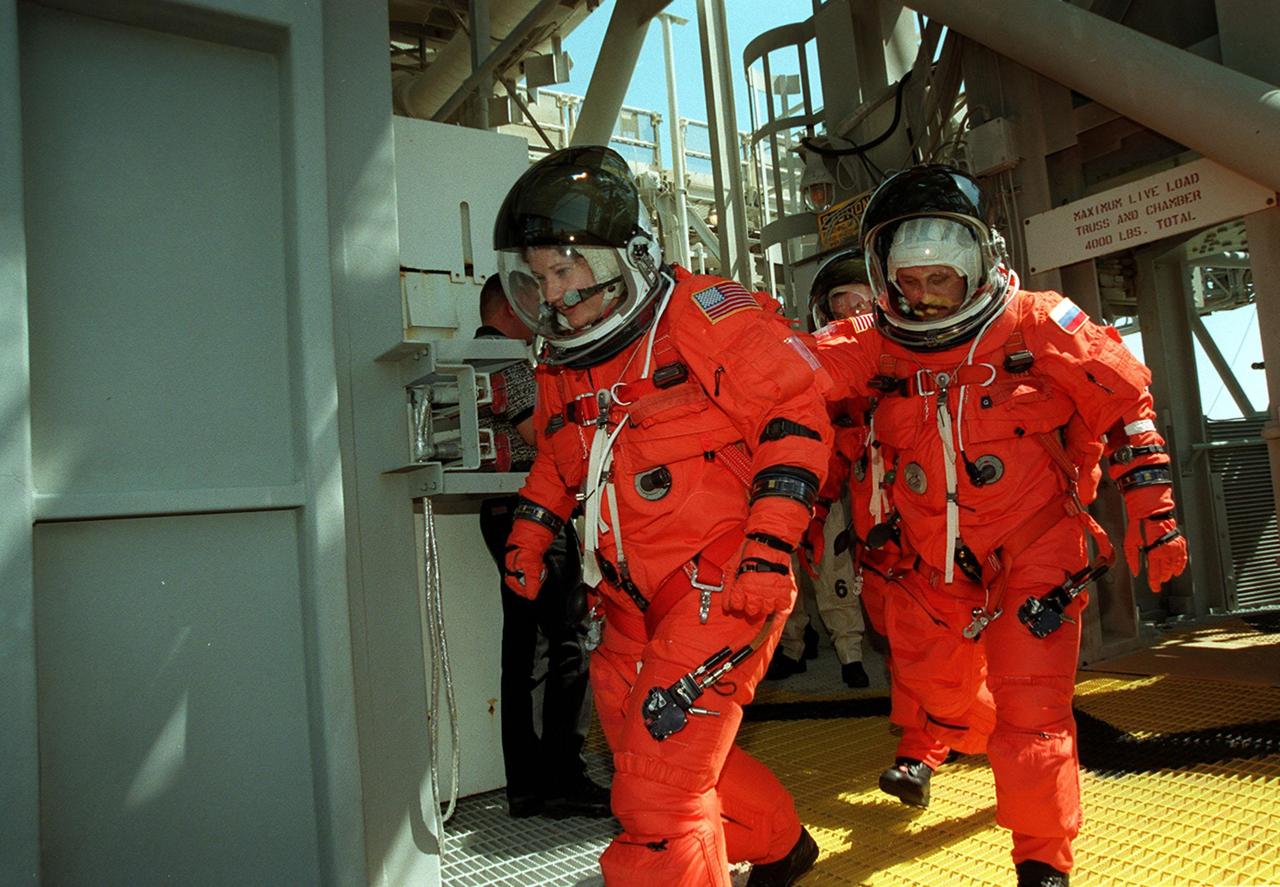
KENNEDY SPACE CENTER, FLA. -- As part of Terminal Countdown Demonstration (TCDT) activities, the STS-101 crew practices emergency egress from the orbiter at the 195-foot level of the Fixed Service Structure. Shown heading down the easily identified exit path, known as the "yellow brick road," are Mission Specialists Susan J. Helms (leading), Yury Usachev of Russia and James Voss. The TCDT also includes a simulated launch countdown and familiarization with the payload. During their mission to the International Space Station, the STS-101 crew will be delivering logistics and supplies, plus preparing the Station for the arrival of the Zvezda Service Module, expected to be launched by Russia in July 2000. Also, the crew will conduct one space walk to perform maintenance on the Space Station. This will be the third assembly flight to the Space Station. STS-101 is scheduled to launch April 24 at 4:15 p.m. from Launch Pad 39A
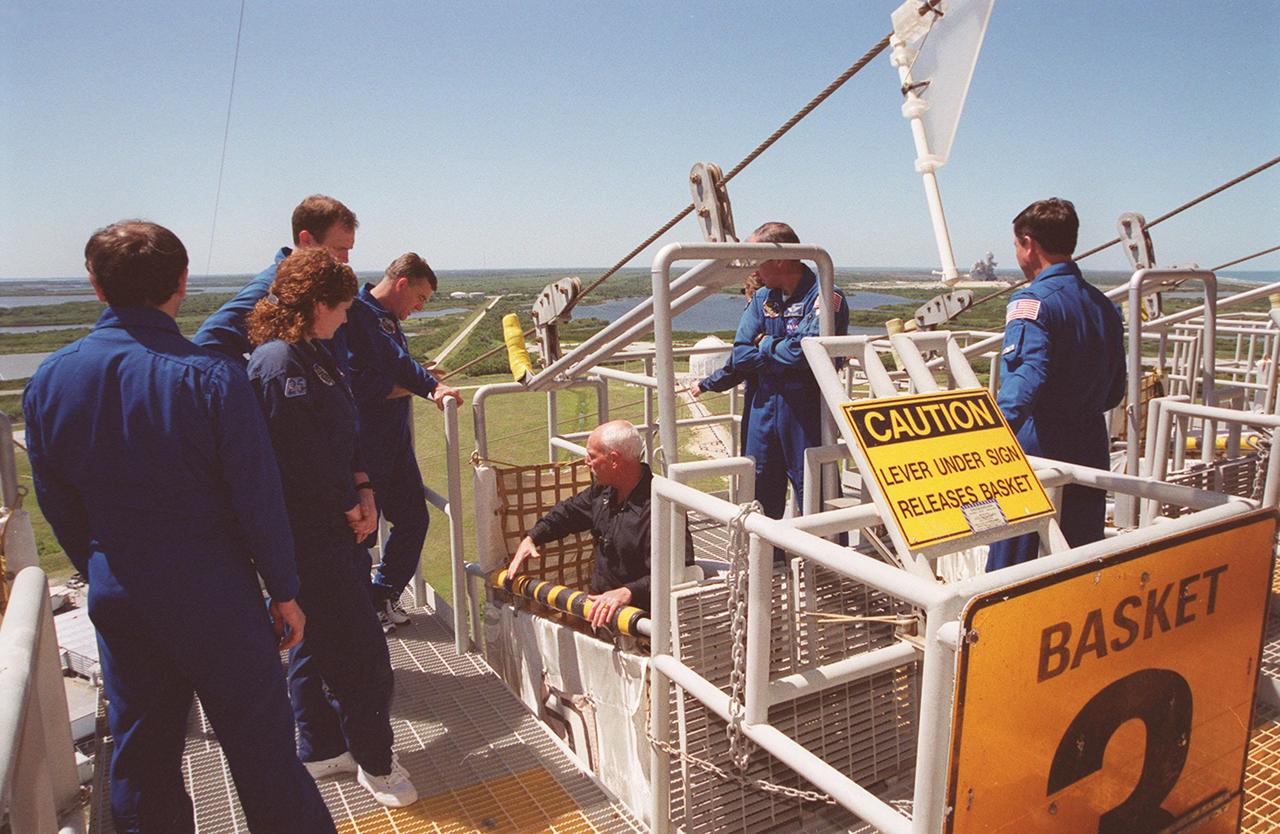
KENNEDY SPACE CENTER, Fla. -- At the 195-foot level of the Fixed Service Structure on Launch Pad 39A, the STS-101 crew get instruction in emergency egress in a slidewire basket during a Terminal Countdown Demonstration Test (TCDT). From left are Mission Specialist Yury Usachev and Susan Helms; Commander James Halsell; Mission Specialists James Voss, Mary Ellen Weber standing behind Jeffrey Williams; and Pilot Scott Horowitz. During their mission to the International Space Station, the STS-101 crew will be delivering logistics and supplies, plus preparing the Station for the arrival of the Zvezda Service Module, expected to be launched by Russia in July 2000. Also, the crew will conduct one space walk to perform maintenance on the Space Station. This will be the third assembly flight for the Space Station. STS-101 is scheduled to launch April 24 at 4:15 p.m. from Launch Pad 39A
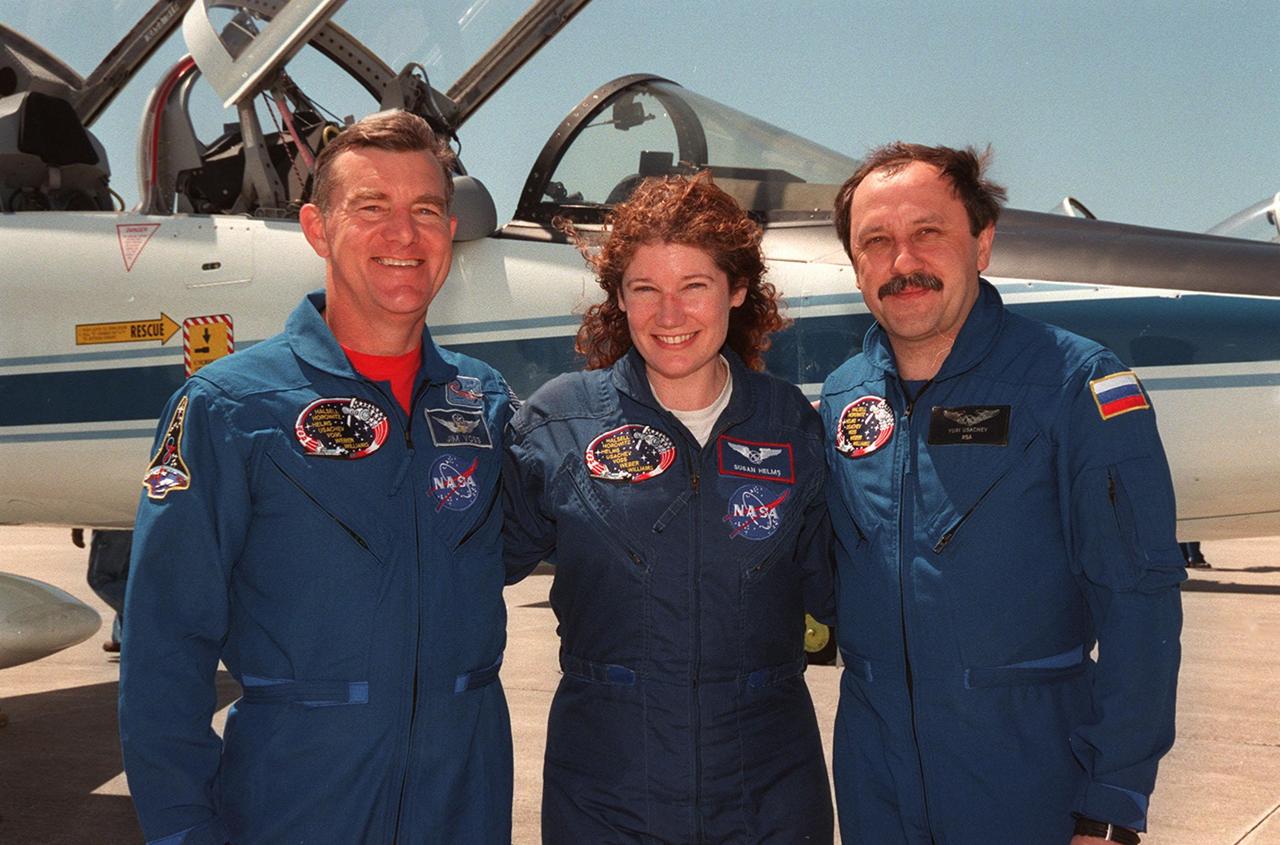
KENNEDY SPACE CENTER, FLA. -- Posing on the tarmac at the Shuttle Landing Facility after their arrival aboard T-38 jets (in the background) are STS-101 Mission Specialists James Voss, Susan Helms and Yury Usachev. They and the rest of the crew are at KSC to take part in Terminal Countdown Demonstration Test (TCDT) activities that include emergency egress training and a dress rehearsal for launch. The other crew members are Commander James Halsell, Pilot Scott Horowitz, and Mission Specialists Mary Ellen Weber and Jeffrey Williams. During their mission to the International Space Station, the STS-101 crew will be delivering logistics and supplies, plus preparing the Station for the arrival of the Zvezda Service Module, expected to be launched by Russia in July 2000. Also, the crew will conduct one space walk to perform maintenance on the Space Station. This will be the third assembly flight for the Space Station. STS-101 is scheduled to launch April 24 at 4:15 p.m. from Launch Pad 39A

KENNEDY SPACE CENTER, FLA. -- Members of the STS-101 crew take part in Crew Equipment Interface Test (CEIT) activities at SPACEHAB, in Cape Canaveral, Fla., where they are learning about some of the equipment they will be working with on their mission to the International Space Station. Looking over one of the elements are (left to right) Mission Specialists James Voss, Yuri Usachev of Russia, and Susan Helms. Behind them is seen Commander James Halsell. Also taking part in the CEIT are Pilot Scott Horowitz, Mission Specialists Mary Ellen Weber and Jeffrey Williams. The STS-101 crew will be responsible for preparing the Space Station for the arrival of the Zvezda Service Module, expected to be launched by Russia in July 2000. Also, the crew will conduct one space walk to perform maintenance on the Space Station and deliver logistics and supplies. This will be the third assembly flight for the Space Station. STS-101 is scheduled to launch no earlier than April 13 from Launch Pad 39A
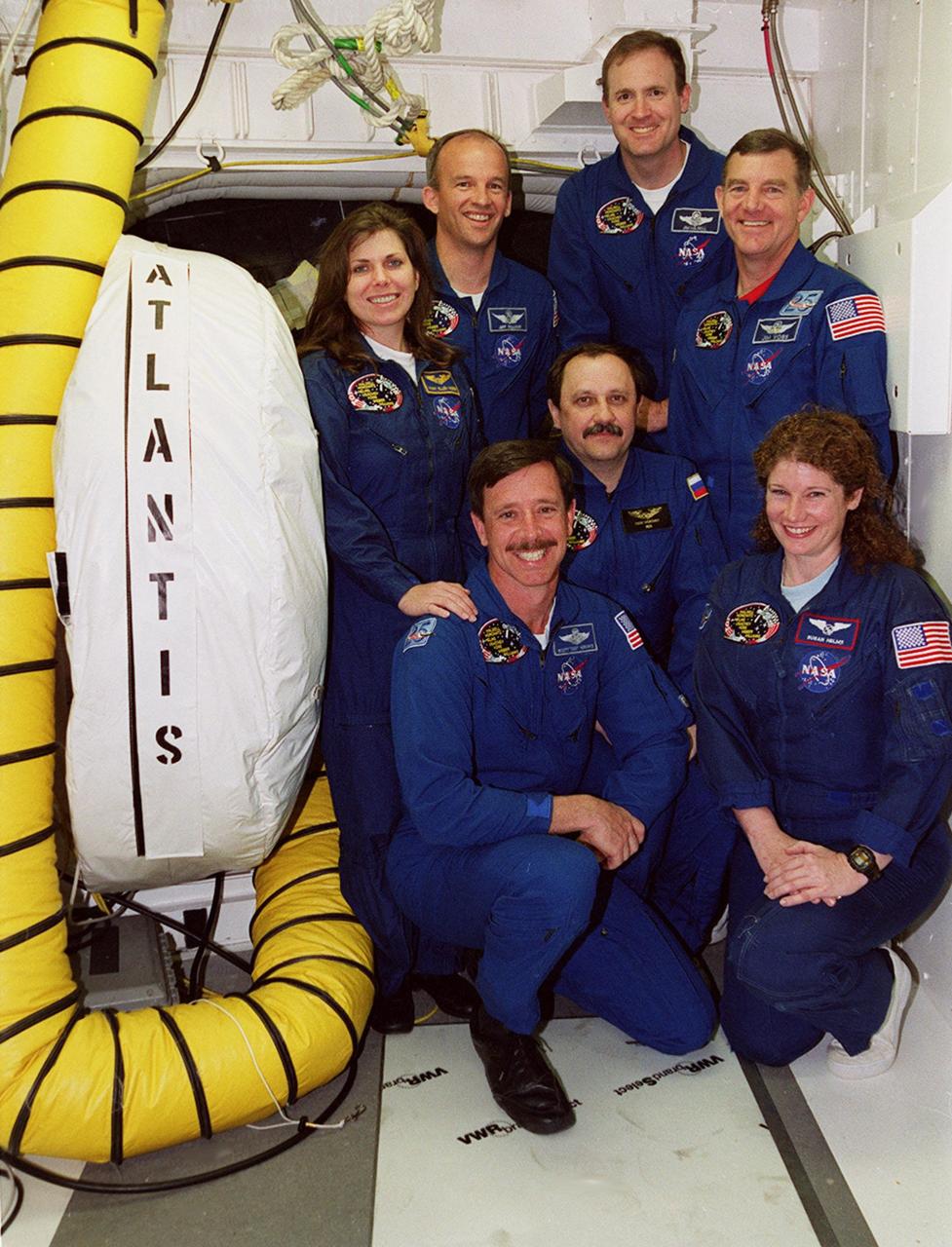
The STS-101 crew pose in the White Room outside Space Shuttle Atlantis behind them. In the front row are Pilot Scott Horowitz and Mission Specialists Yury Usachev and Susan Helms. In the back row are Mission Specialists Mary Ellen Weber and Jeffrey Williams, Commander James Halsell, and Mission Specialist James Voss. The crew are at KSC to take part in Terminal Countdown Demonstration Test (TCDT) activities that include emergency egress training from the orbiter and a dress rehearsal for launch. During their mission to the International Space Station, the STS-101 crew will be delivering logistics and supplies, plus preparing the Station for the arrival of the Zvezda Service Module, expected to be launched by Russia in July 2000. Also, the crew will conduct one space walk to perform maintenance on the Space Station. This will be the third assembly flight for the Space Station. STS-101 is scheduled to launch April 24 at 4:15 p.m. from Launch Pad 39A
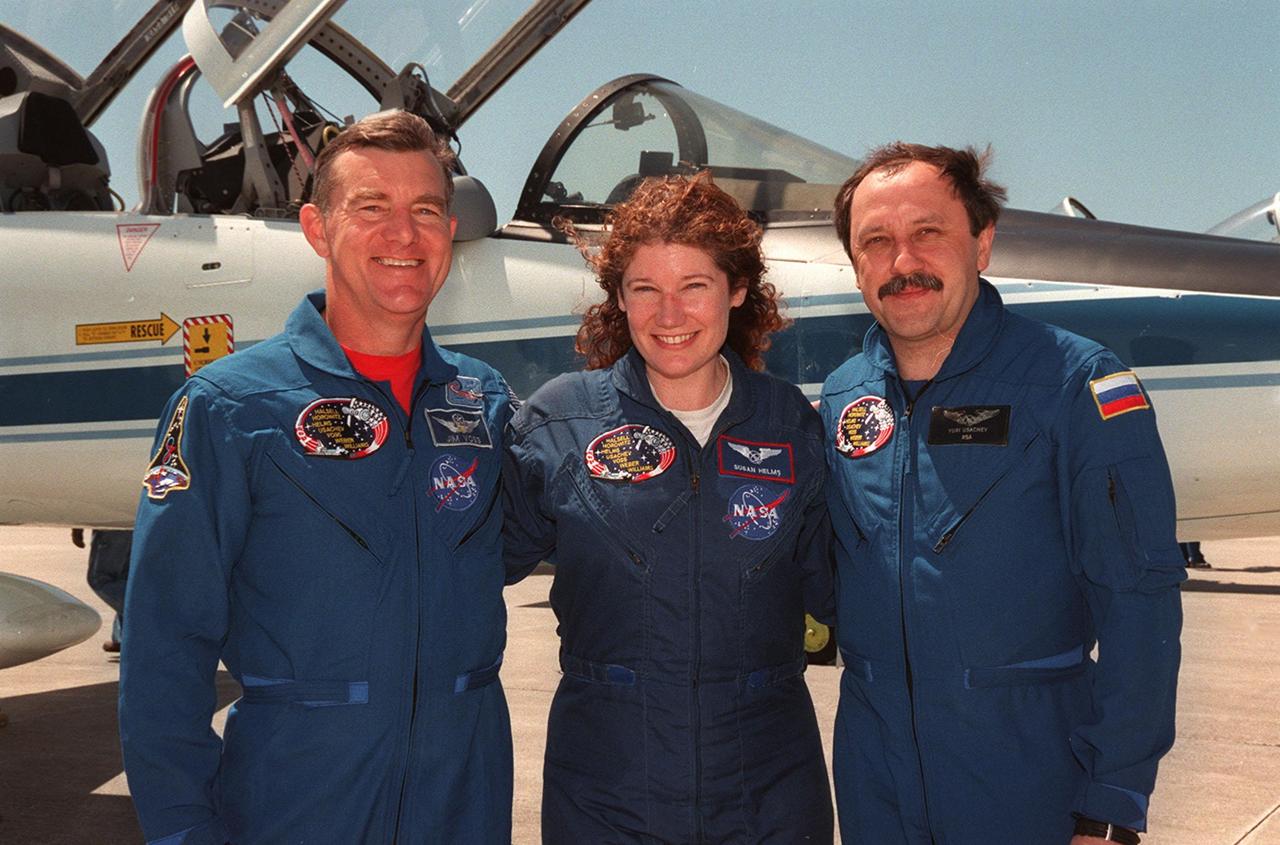
KENNEDY SPACE CENTER, FLA. -- Posing on the tarmac at the Shuttle Landing Facility after their arrival aboard T-38 jets (in the background) are STS-101 Mission Specialists James Voss, Susan Helms and Yury Usachev. They and the rest of the crew are at KSC to take part in Terminal Countdown Demonstration Test (TCDT) activities that include emergency egress training and a dress rehearsal for launch. The other crew members are Commander James Halsell, Pilot Scott Horowitz, and Mission Specialists Mary Ellen Weber and Jeffrey Williams. During their mission to the International Space Station, the STS-101 crew will be delivering logistics and supplies, plus preparing the Station for the arrival of the Zvezda Service Module, expected to be launched by Russia in July 2000. Also, the crew will conduct one space walk to perform maintenance on the Space Station. This will be the third assembly flight for the Space Station. STS-101 is scheduled to launch April 24 at 4:15 p.m. from Launch Pad 39A
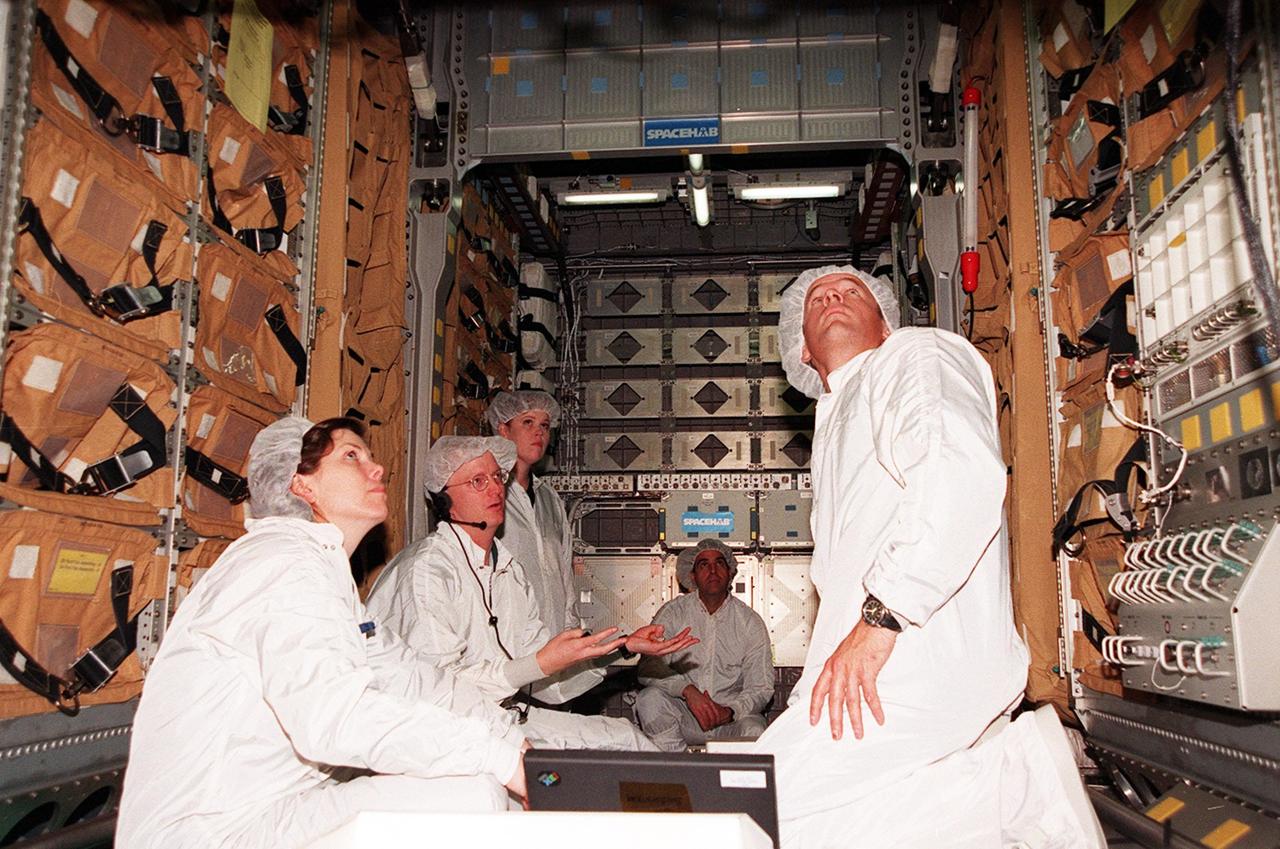
Members of the STS-101 crew look over equipment inside the SPACEHAB double module, part of the cargo on their mission. At left is Mission Specialist Mary Ellen Weber and at right is Mission Specialist Jeffrey Williams. They are taking part in Crew Equipment Interface Test (CEIT) activities to become familiar with equipment for their mission to the International Space Station. Other crew members not shown are Commander James Halsell, Pilot Scott Horowitz, and Mission Specialists James Voss, Susan Helms and Yuri Usachev. The STS-101 crew will be responsible for preparing the Space Station for the arrival of the Zvezda Service Module, expected to be launched by Russia in July 2000. Also, the crew will conduct one space walk to perform maintenance on the Space Station and deliver logistics and supplies. This will be the third assembly flight for the Space Station. STS-101 is scheduled to launch no earlier than April 13 from Launch Pad 39A
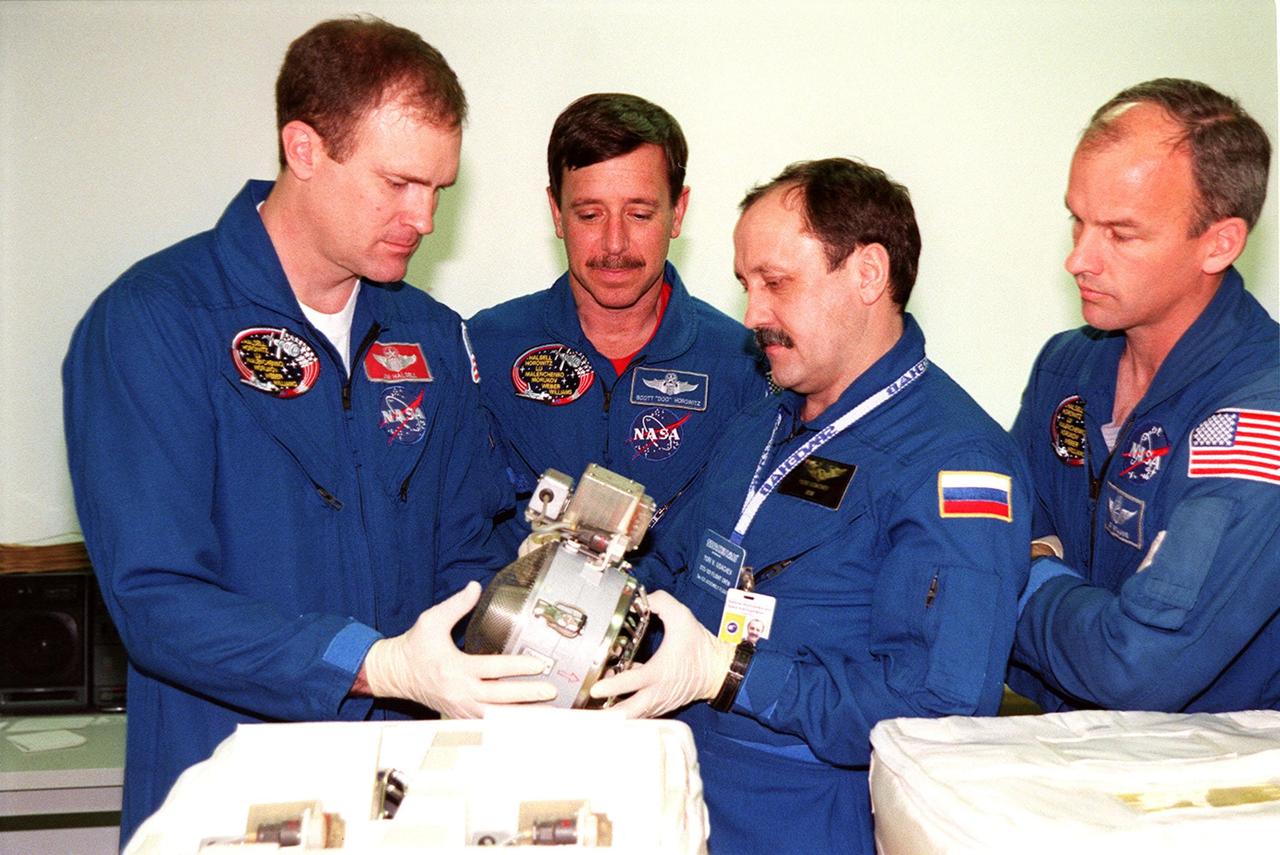
KENNEDY SPACE CENTER, FLA. -- Members of the STS-101 crew take part in Crew Equipment Interface Test (CEIT) activities at SPACEHAB, in Cape Canaveral, Fla., where they are learning about some of the equipment they will be working with on their mission to the International Space Station. Commander James Halsell, Pilot Scott Horowitz, and Mission Specialists Yuri Usachev and Jeffrey Williams look over one of the components. Other crew members taking part in the CEIT are Mission Specialists Mary Ellen Weber, James Voss and Susan Helms. The STS-101 crew will be responsible for preparing the Space Station for the arrival of the Zvezda Service Module, expected to be launched by Russia in July 2000. Also, the crew will conduct one space walk to perform maintenance on the Space Station and deliver logistics and supplies. This will be the third assembly flight for the Space Station. STS-101 is scheduled to launch no earlier than April 13 from Launch Pad 39A
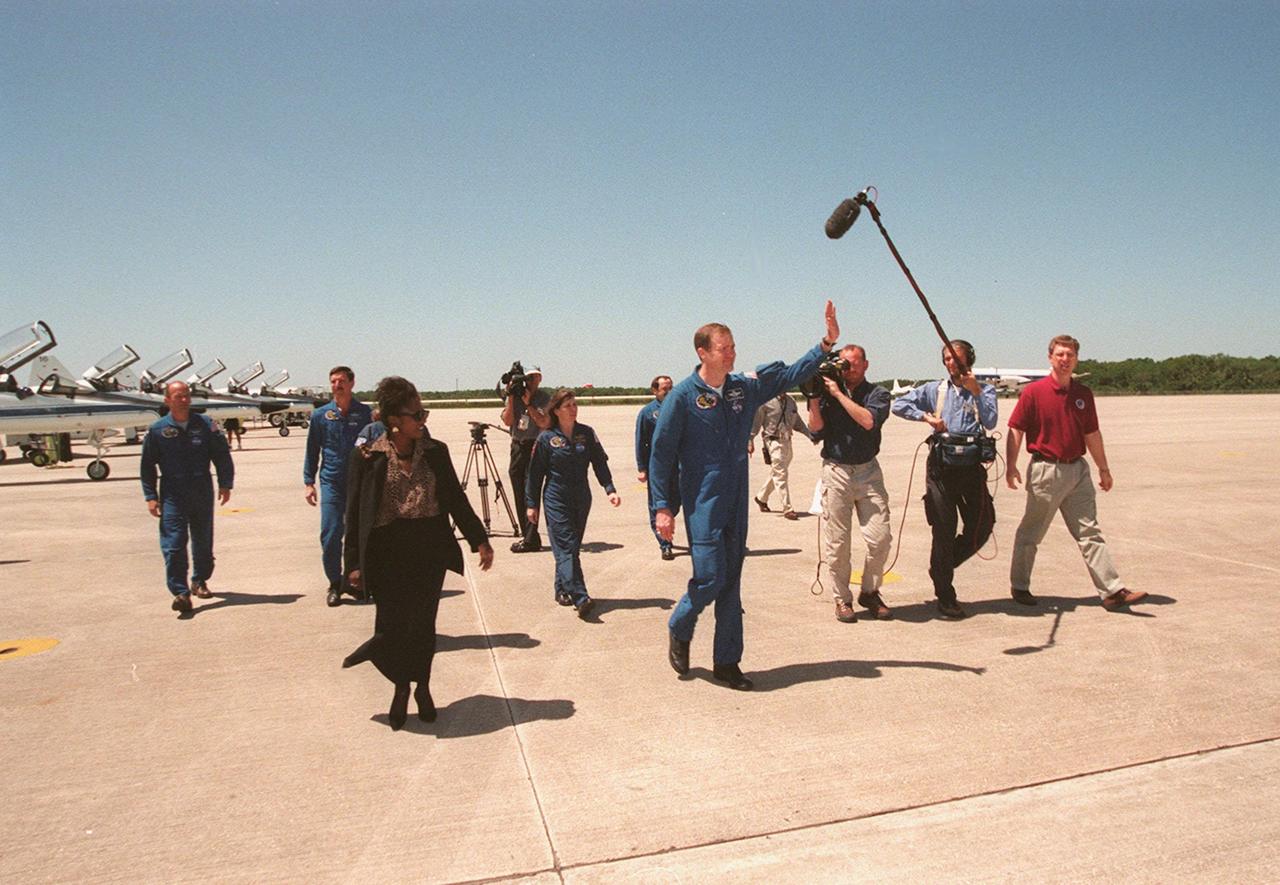
KENNEDY SPACE CENTER, FLA. -- At the Shuttle Landing Facility, STS-101 Commander James Halsell waves to the media as he and other crew members cross the tarmac to a waiting bus. At right is a film crew; in the foreground at left is Delores Green, flight crew support specialist lead for the astronaut crew quarters. Other crew members in the background are Mission Specialist Jeffrey Williams, Pilot Scott Horowitz, and Mission Specialists Mary Ellen Weber and Yury Usachev. Not visible in the photo is Mission Specialist Susan Helms. During their mission to the International Space Station, the STS-101 crew will be delivering logistics and supplies, plus preparing the Station for the arrival of the Zvezda Service Module, expected to be launched by Russia in July 2000. Also, the crew will conduct one space walk to perform maintenance on the Space Station. This will be the third assembly flight for the Space Station. STS-101 is scheduled to launch April 24 at 4:15 p.m. from Launch Pad 39A
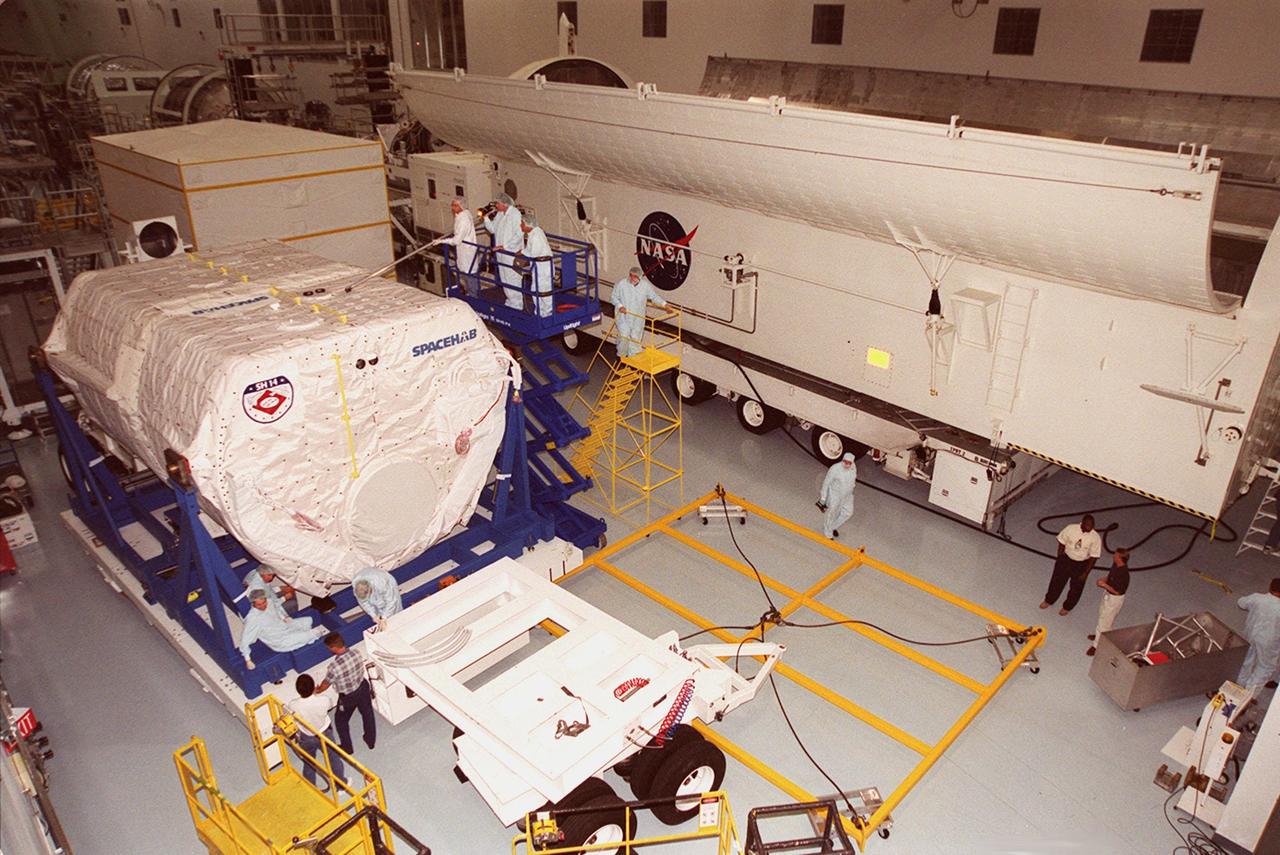
KENNEDY SPACE CENTER, FLA. -- After being uncrated in the Space Station Processing Facility, the SPACEHAB Double Module (left) waits for transfer to the payload canister (right) that will take it to Launch Pad 39A. There it will be installed in the Shuttle Atlantis' payload bay for mission STS-101. The module carries internal logistics and resupply cargo for restoring full redundancy to the International Space Station power system in preparation for the arrival of the next pressurized module, the Russian-built Zvezda. The STS-101 crew of seven comprises Commander James D. Halsell Jr., Pilot Scott J. "Doc" Horowitz (Ph.D.) and Mission Specialists Mary Ellen Weber (Ph.D.), James S. Voss, Jeffrey N. Williams, Susan J. Helms and Yuri Vladimirovich Usachev, cosmonaut. Launch of Atlantis on mission STS-101 is scheduled no earlier than April 17, 2000
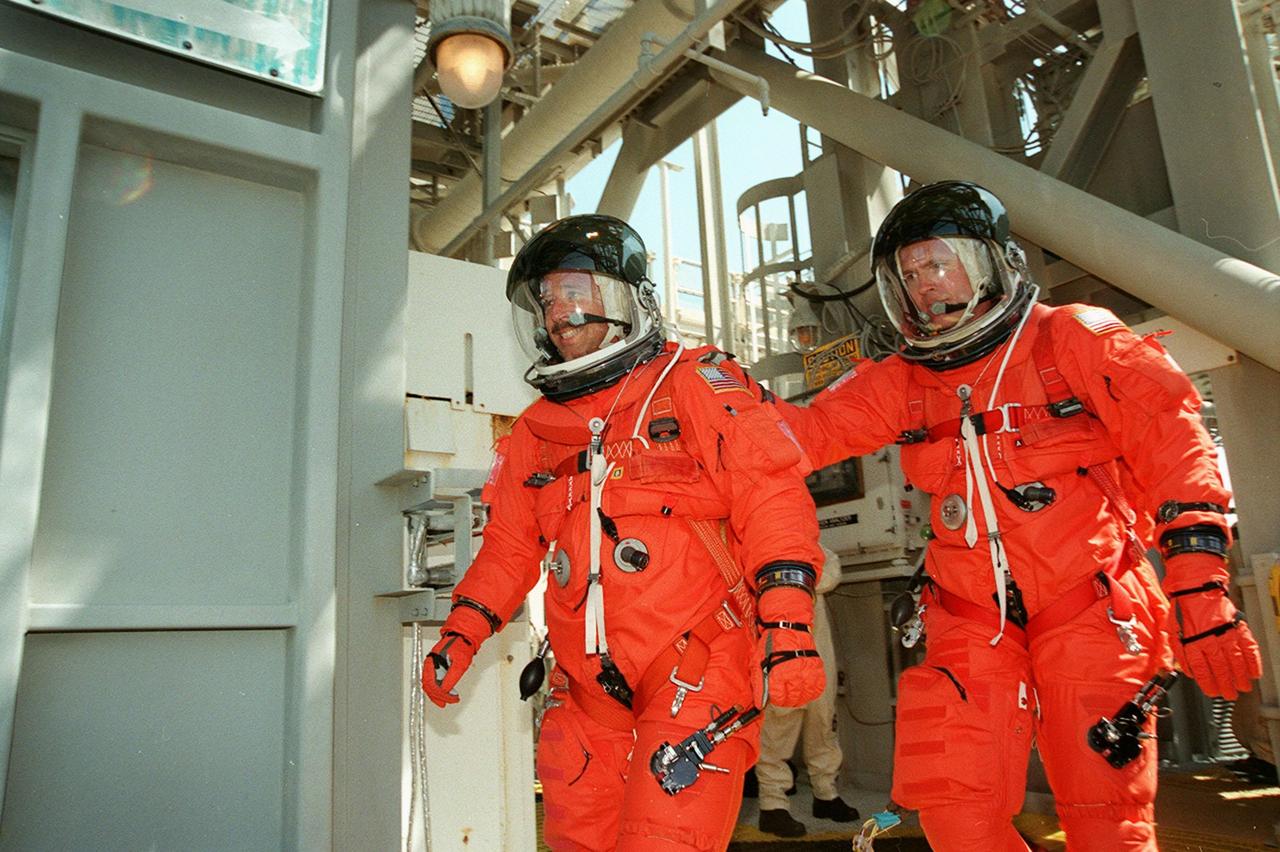
KENNEDY SPACE CENTER, FLA. -- As part of Terminal Countdown Demonstration (TCDT) activities, the STS-101 crew practices emergency egress from the orbiter at the 195-foot level of the Fixed Service Structure. Shown heading for the slidewire baskets are Pilot Scott J. "Doc" Horowitz (left) and Commander James D. Halsell Jr. The TCDT also includes a simulated launch countdown and familiarization with the payload. During their mission to the International Space Station, the STS-101 crew will be delivering logistics and supplies, plus preparing the Station for the arrival of the Zvezda Service Module, expected to be launched by Russia in July 2000. Also, the crew will conduct one space walk to perform maintenance on the Space Station. This will be the third assembly flight to the Space Station. STS-101 is scheduled to launch April 24 at 4:15 p.m. from Launch Pad 39A
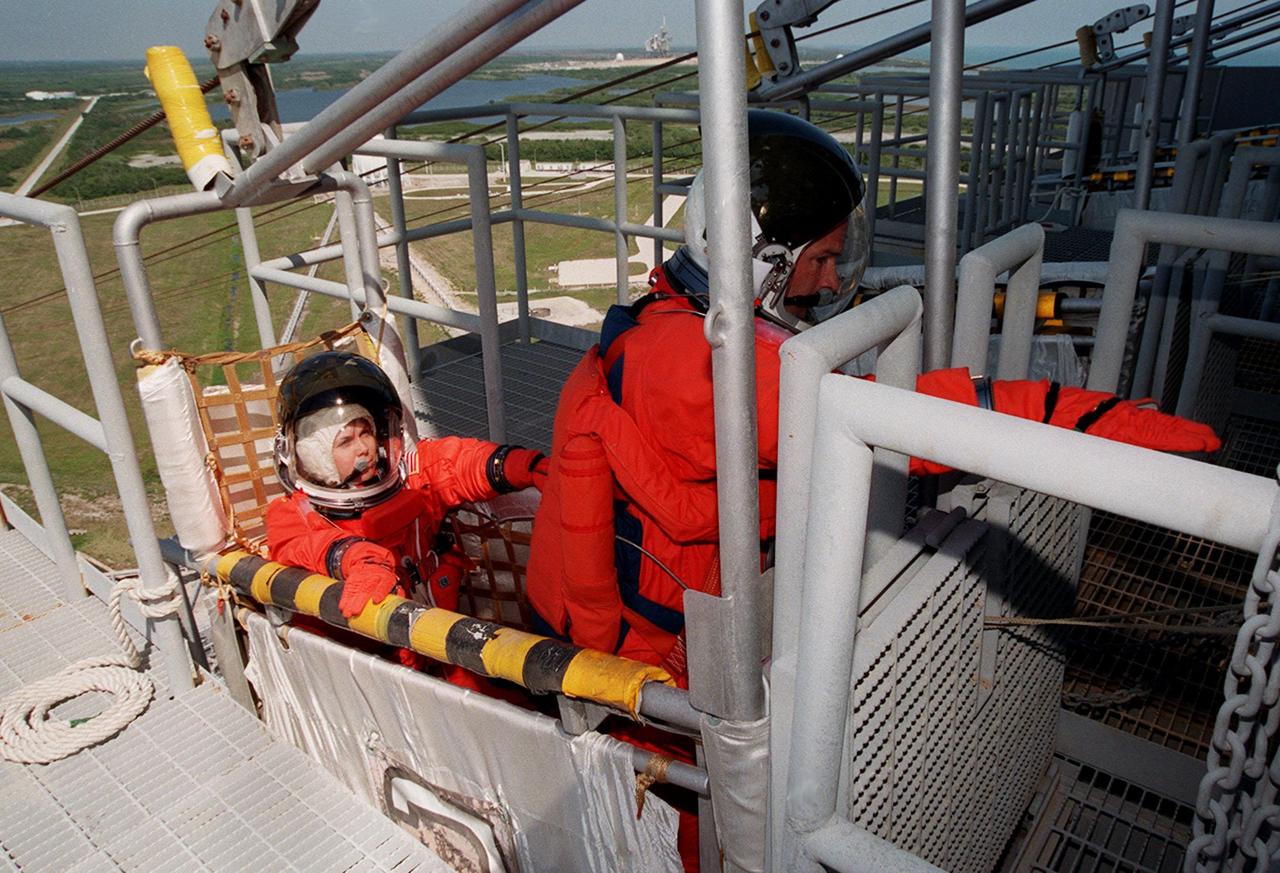
KENNEDY SPACE CENTER, FLA. -- Seated in a slidewire basket at the 195-foot level of the Fixed Service Structure, Launch Pad 39A, are (left to right) STS-101 Mission Specialists Mary Ellen Weber and Jeffrey N. Williams, who is reaching for the release lever. The release of the basket will send it shooting down the 1,200-foot slidewire to a bunker west of the launch pad. The crew is practicing emergency egress from the orbiter as part of Terminal Countdown Demonstration (TCDT) activities that include a simulated launch countdown and familiarization with the payload. During their mission to the International Space Station, the STS-101 crew will be delivering logistics and supplies, plus preparing the Station for the arrival of the Zvezda Service Module, expected to be launched by Russia in July 2000. Also, the crew will conduct one space walk to perform maintenance on the Space Station. This will be the third assembly flight to the Space Station. STS-101 is scheduled to launch April 24 at 4:15 p.m. from Launch Pad 39A
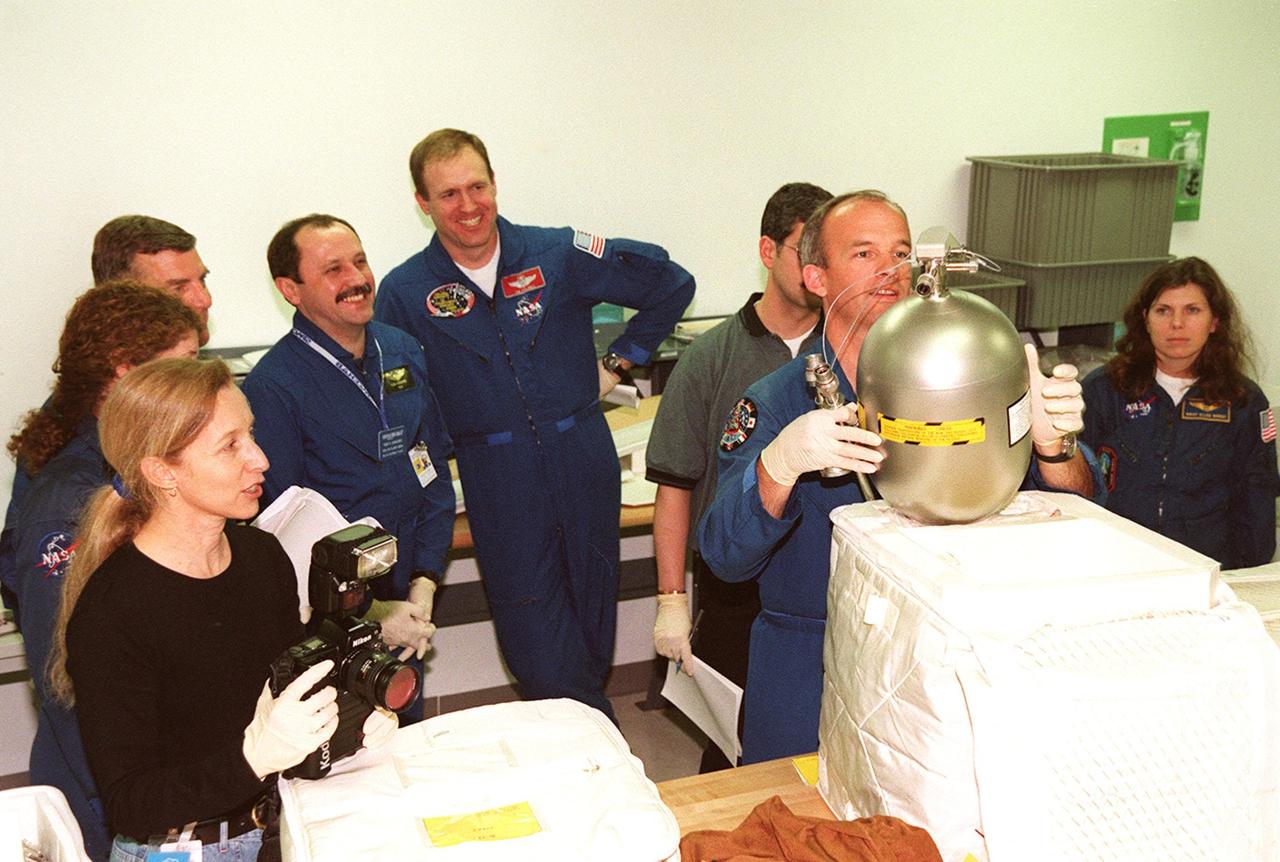
KENNEDY SPACE CENTER, FLA. -- Members of the STS-101 crew share a light moment during Crew Equipment Interface Test (CEIT) activities at SPACEHAB, in Cape Canaveral, Fla. Documenting the occasion is astronaut Marsha Ivins (far left, with camera). Standing behind her (left to right) are Mission Specialists Susan Helms, James Voss and Yuri Usachev; Commander James Halsell; and Mission Specialists Jeffrey Williams (holding tank) and Mary Ellen Weber. During a CEIT, a Shuttle crew becomes familiar with some of the equipment they will be working with on their mission. The STS-101 crew will be responsible for preparing the Space Station for the arrival of the Zvezda Service Module, expected to be launched by Russia in July 2000. Also, the crew will conduct one space walk to perform maintenance on the Space Station and deliver logistics and supplies. This will be the third assembly flight for the Space Station. STS-101 is scheduled to launch no earlier than April 13 from Launch Pad 39A
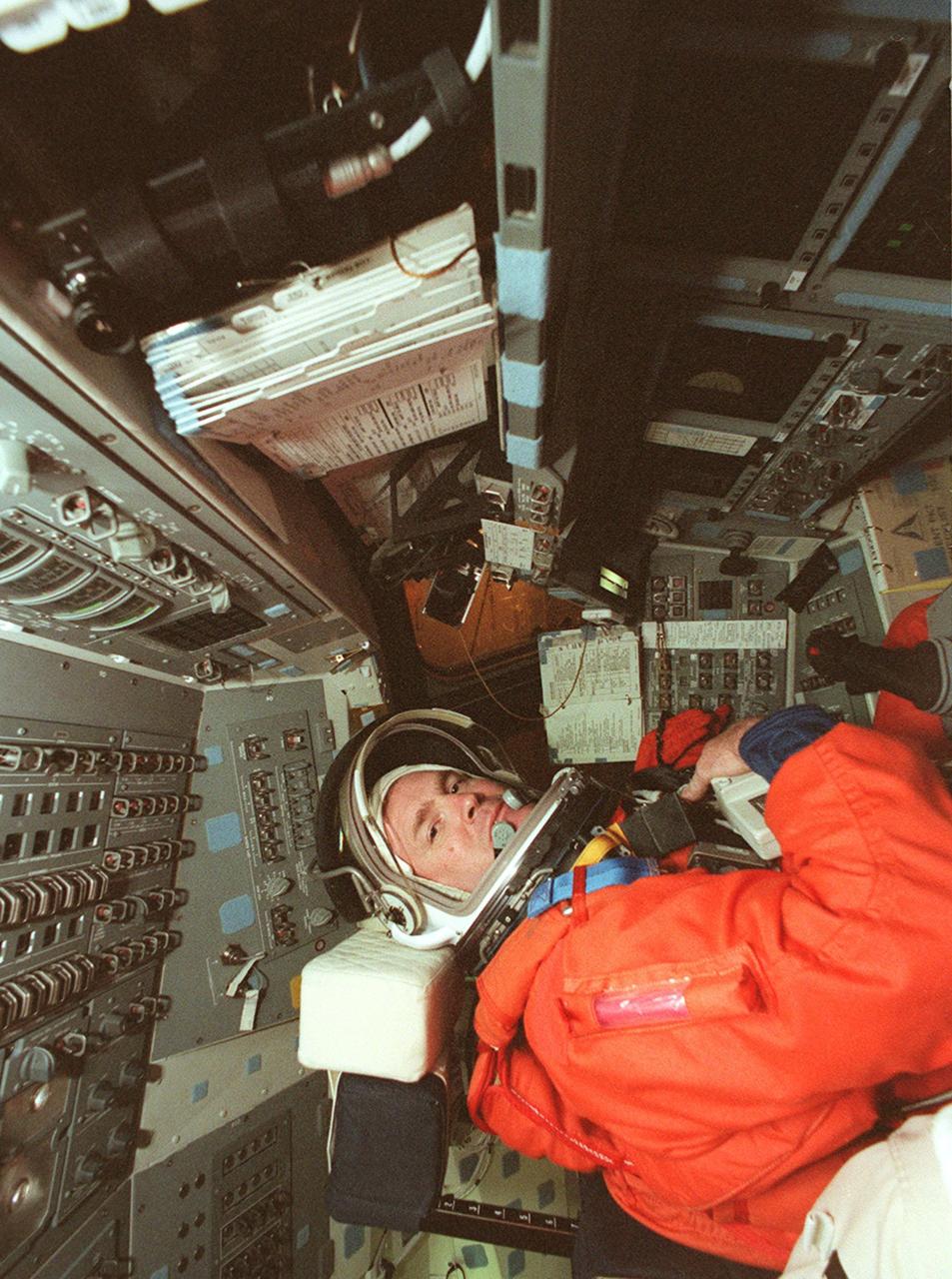
KENNEDY SPACE CENTER, FLA. -- STS-101 Commander James D. Halsell Jr. takes his seat inside Space Shuttle Atlantis for a simulated launch countdown. The countdown is part of Terminal Countdown Demonstration Test (TCDT) activities that also include emergency egress training and familiarization with the payload. Other crew members taking part are Pilot Scott J. "Doc" Horowitz and Mission Specialists Mary Ellen Weber, James Voss, Jeffrey N. Williams, Susan Helms, and Yury Usachev of Russia. During their mission to the International Space Station, the STS-101 crew will be delivering logistics and supplies, plus preparing the Station for the arrival of the Zvezda Service Module, expected to be launched by Russia in July 2000. Also, the crew will conduct one space walk to perform maintenance on the Space Station. This will be the third assembly flight for the Space Station. STS-101 is scheduled to launch April 24 at 4:15 p.m. from Launch Pad 39A
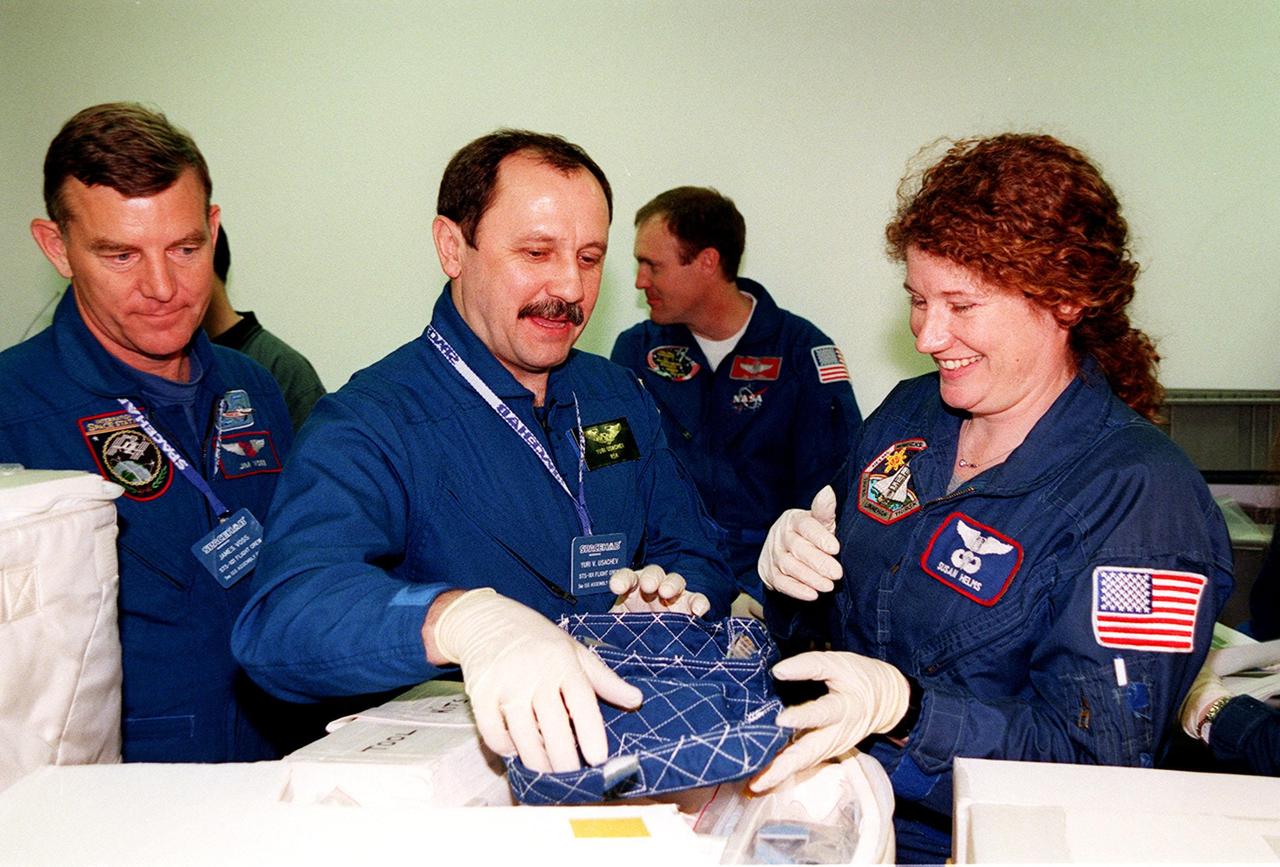
KENNEDY SPACE CENTER, FLA. -- Members of the STS-101 crew take part in Crew Equipment Interface Test (CEIT) activities at SPACEHAB, in Cape Canaveral, Fla., where they are learning about some of the equipment they will be working with on their mission to the International Space Station. Looking over one of the elements are (left to right) Mission Specialists James Voss, Yuri Usachev of Russia, and Susan Helms. Behind them is seen Commander James Halsell. Also taking part in the CEIT are Pilot Scott Horowitz, Mission Specialists Mary Ellen Weber and Jeffrey Williams. The STS-101 crew will be responsible for preparing the Space Station for the arrival of the Zvezda Service Module, expected to be launched by Russia in July 2000. Also, the crew will conduct one space walk to perform maintenance on the Space Station and deliver logistics and supplies. This will be the third assembly flight for the Space Station. STS-101 is scheduled to launch no earlier than April 13 from Launch Pad 39A

KENNEDY SPACE CENTER, FLA. -- At SPACEHAB, in Cape Canaveral, Fla., members of the STS-101 crew take part in Crew Equipment Interface Test (CEIT) activities, learning about some of the equipment they will be working with on their mission to the International Space Station. Looking over one of the elements are (left to right) Mission Specialists James Voss and Susan Helms, Pilot Scott Horowitz, and Mission Specialist Yuri Usachev of Russia. Seen behind Horowitz is Commander James Halsell. Also taking part in the CEIT are Mission Specialists Mary Ellen Weber and Jeffrey Williams. The STS-101 crew will be responsible for preparing the Space Station for the arrival of the Zvezda Service Module, expected to be launched by Russia in July 2000. Also, the crew will conduct one space walk to perform maintenance on the Space Station and deliver logistics and supplies. This will be the third assembly flight for the Space Station. STS-101 is scheduled to launch no earlier than April 13 from Launch Pad 39A
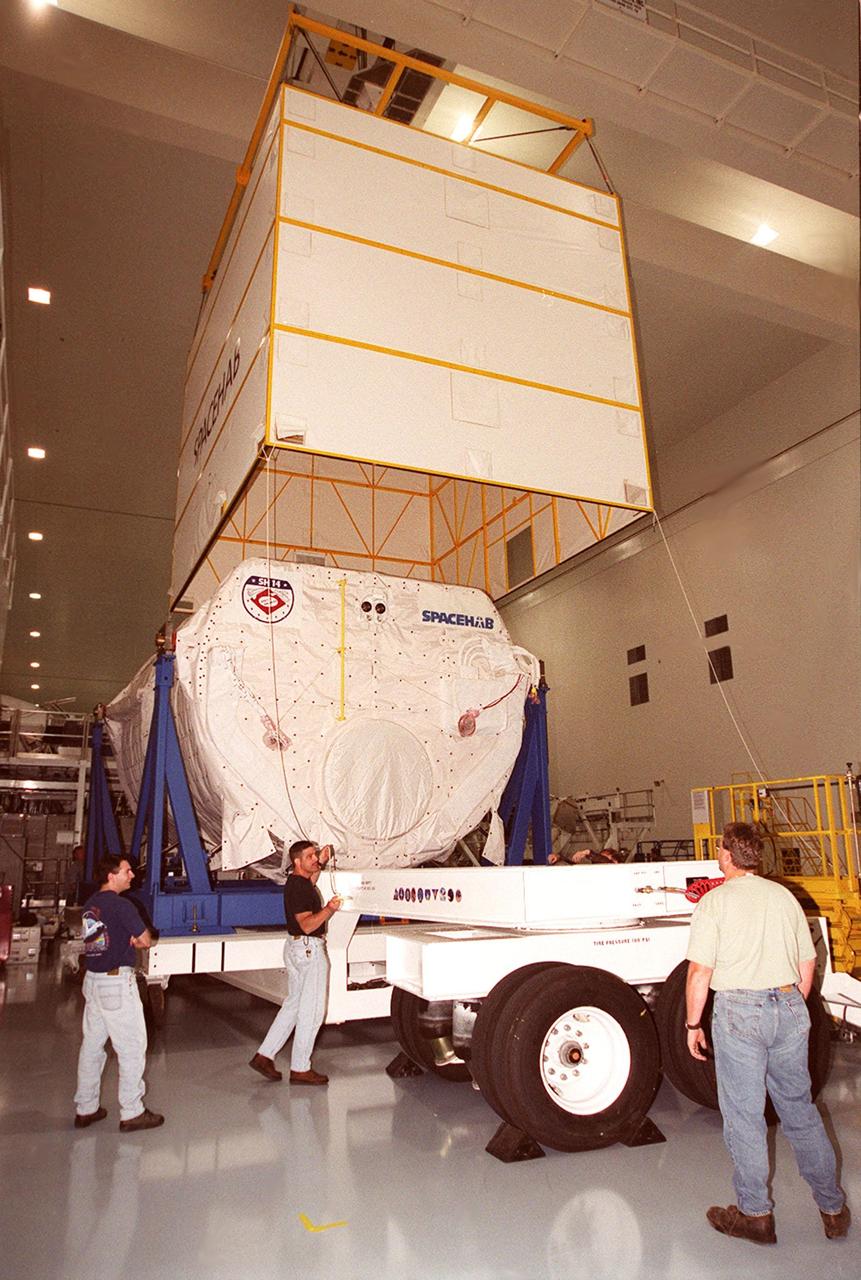
KENNEDY SPACE CENTER, FLA. -- The SPACEHAB Double Module is uncovered in the Space Station Processing Facility for transfer to a payload canister that will take it to Launch Pad 39A. There it will be installed in the Shuttle Atlantis' payload bay for mission STS-101. The module carries internal logistics and resupply cargo for restoring full redundancy to the International Space Station power system in preparation for the arrival of the next pressurized module, the Russian-built Zvezda. The STS-101 crew of seven comprises Commander James D. Halsell Jr., Pilot Scott J. "Doc" Horowitz (Ph.D.) and Mission Specialists Mary Ellen Weber (Ph.D.), James S. Voss, Jeffrey N. Williams, Susan J. Helms and Yuri Vladimirovich Usachev, cosmonaut. Launch of Atlantis on mission STS-101 is scheduled no earlier than April 17, 2000
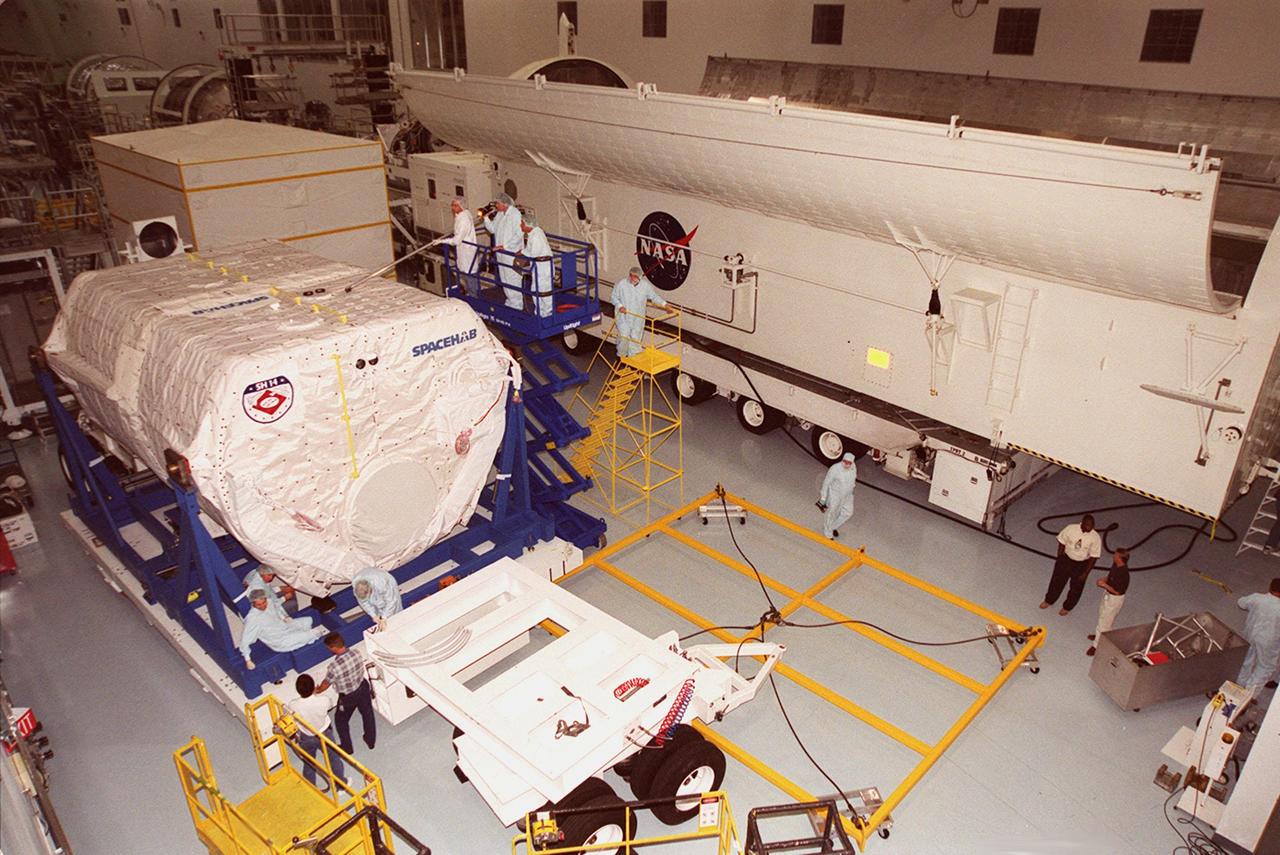
KENNEDY SPACE CENTER, FLA. -- After being uncrated in the Space Station Processing Facility, the SPACEHAB Double Module (left) waits for transfer to the payload canister (right) that will take it to Launch Pad 39A. There it will be installed in the Shuttle Atlantis' payload bay for mission STS-101. The module carries internal logistics and resupply cargo for restoring full redundancy to the International Space Station power system in preparation for the arrival of the next pressurized module, the Russian-built Zvezda. The STS-101 crew of seven comprises Commander James D. Halsell Jr., Pilot Scott J. "Doc" Horowitz (Ph.D.) and Mission Specialists Mary Ellen Weber (Ph.D.), James S. Voss, Jeffrey N. Williams, Susan J. Helms and Yuri Vladimirovich Usachev, cosmonaut. Launch of Atlantis on mission STS-101 is scheduled no earlier than April 17, 2000

KENNEDY SPACE CENTER, Fla. -- During a break in their Terminal Countdown Demonstration Test (TCDT), the STS-101 crew poses in front of Space Shuttle Atlantis at Launch Pad 39A. Standing, left to right, are Mission Specialists Susan J. Helms and Yury Usachev of Russia; Pilot Scott J. "Doc" Horowitz; Commander James D. Halsell Jr.; and Mission Specialists Mary Ellen Weber, James Voss and Jeffrey N. Williams. The TCDT includes emergency egress training and a simulated launch countdown. During their mission to the International Space Station, the STS-101 crew will be delivering logistics and supplies, plus preparing the Station for the arrival of the Zvezda Service Module, expected to be launched by Russia in July 2000. Also, the crew will conduct one space walk to perform maintenance on the Space Station. This will be the third assembly flight for the Space Station. STS-101 is scheduled to launch April 24 at 4:15 p.m. from Launch Pad 39A
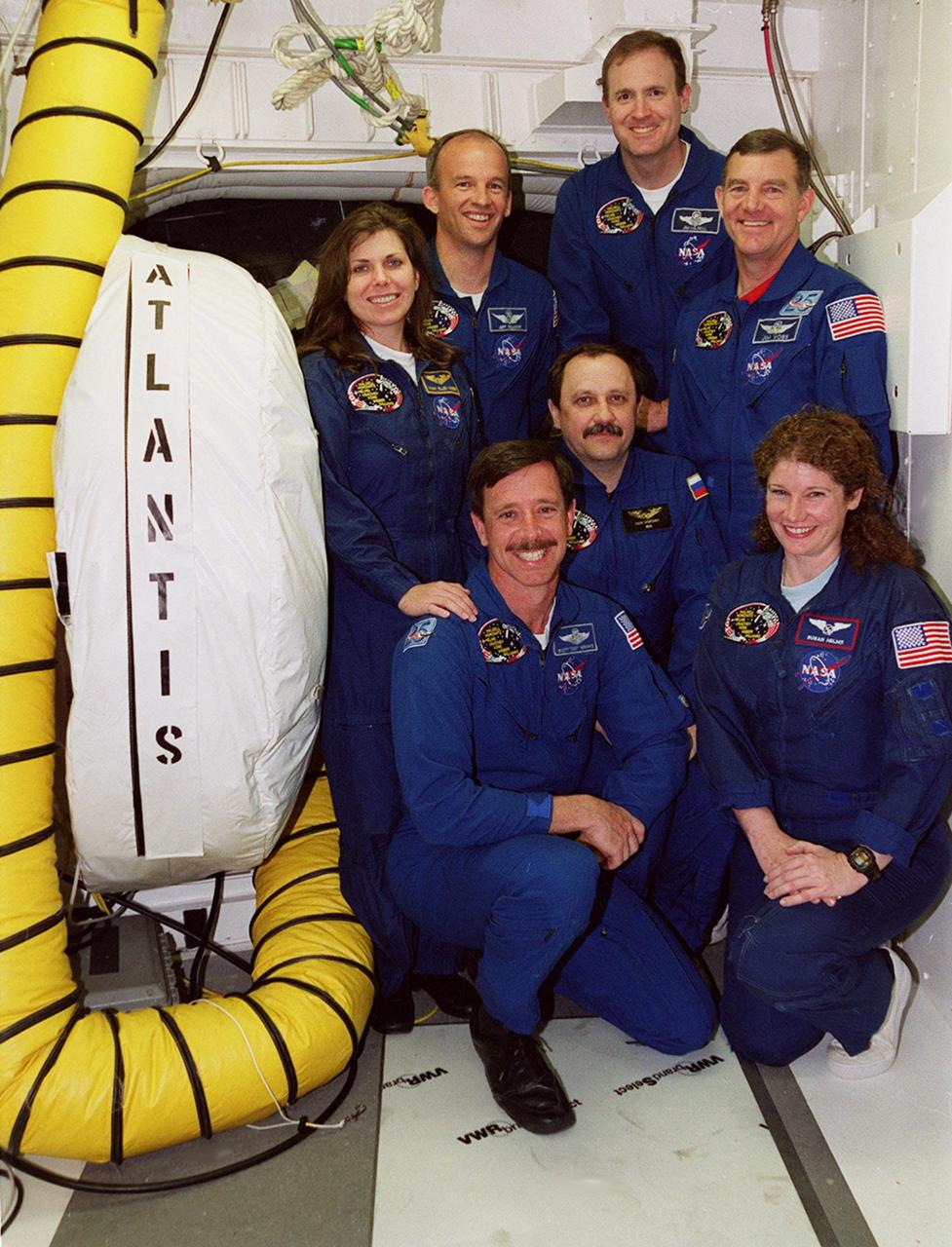
The STS-101 crew pose in the White Room outside Space Shuttle Atlantis behind them. In the front row are Pilot Scott Horowitz and Mission Specialists Yury Usachev and Susan Helms. In the back row are Mission Specialists Mary Ellen Weber and Jeffrey Williams, Commander James Halsell, and Mission Specialist James Voss. The crew are at KSC to take part in Terminal Countdown Demonstration Test (TCDT) activities that include emergency egress training from the orbiter and a dress rehearsal for launch. During their mission to the International Space Station, the STS-101 crew will be delivering logistics and supplies, plus preparing the Station for the arrival of the Zvezda Service Module, expected to be launched by Russia in July 2000. Also, the crew will conduct one space walk to perform maintenance on the Space Station. This will be the third assembly flight for the Space Station. STS-101 is scheduled to launch April 24 at 4:15 p.m. from Launch Pad 39A
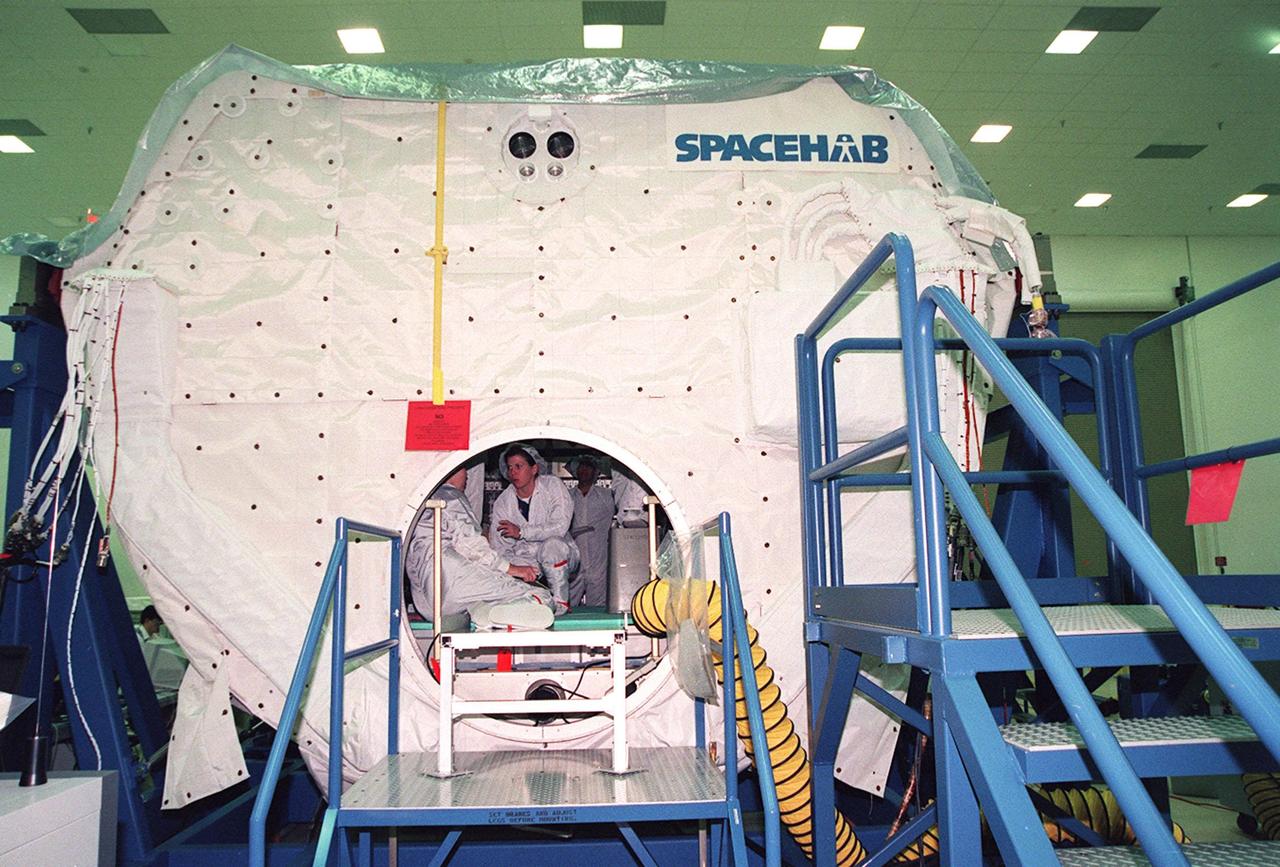
KENNEDY SPACE CENTER, FLA. -- As part of Crew Equipment Interface Test (CEIT) activities at SPACEHAB, in Cape Canaveral, Fla., members of the STS-101 crew spend time inside the SPACEHAB double module to become familiar with equipment for their mission to the International Space Station. The crew of seven comprises Commander James Halsell, Pilot Scott Horowitz, and Mission Specialists Mary Ellen Weber, James Voss, Jeffrey Williams, Susan Helms and Yuri Usachev. The STS-101 crew will be responsible for preparing the Space Station for the arrival of the Zvezda Service Module, expected to be launched by Russia in July 2000. Also, the crew will conduct one space walk to perform maintenance on the Space Station and deliver logistics and supplies. This will be the third assembly flight for the Space Station. STS-101 is scheduled to launch no earlier than April 13 from Launch Pad 39A

KENNEDY SPACE CENTER, FLA. -- As part of Crew Equipment Interface Test (CEIT) activities at SPACEHAB, in Cape Canaveral, Fla., STS-101 Mission Specialists Susan Helms and Yuri Usachev of Russia look over some of the equipment for their mission to the International Space Station. Other members of the crew taking part in the CEIT are Commander James Halsell, Pilot Scott Horowitz, and Mission Specialists Mary Ellen Weber, James Voss, and Jeffrey Williams. The STS-101 crew will be responsible for preparing the Space Station for the arrival of the Zvezda Service Module, expected to be launched by Russia in July 2000. Also, the crew will conduct one space walk to perform maintenance on the Space Station and deliver logistics and supplies. This will be the third assembly flight for the Space Station. STS-101 is scheduled to launch no earlier than April 13 from Launch Pad 39A
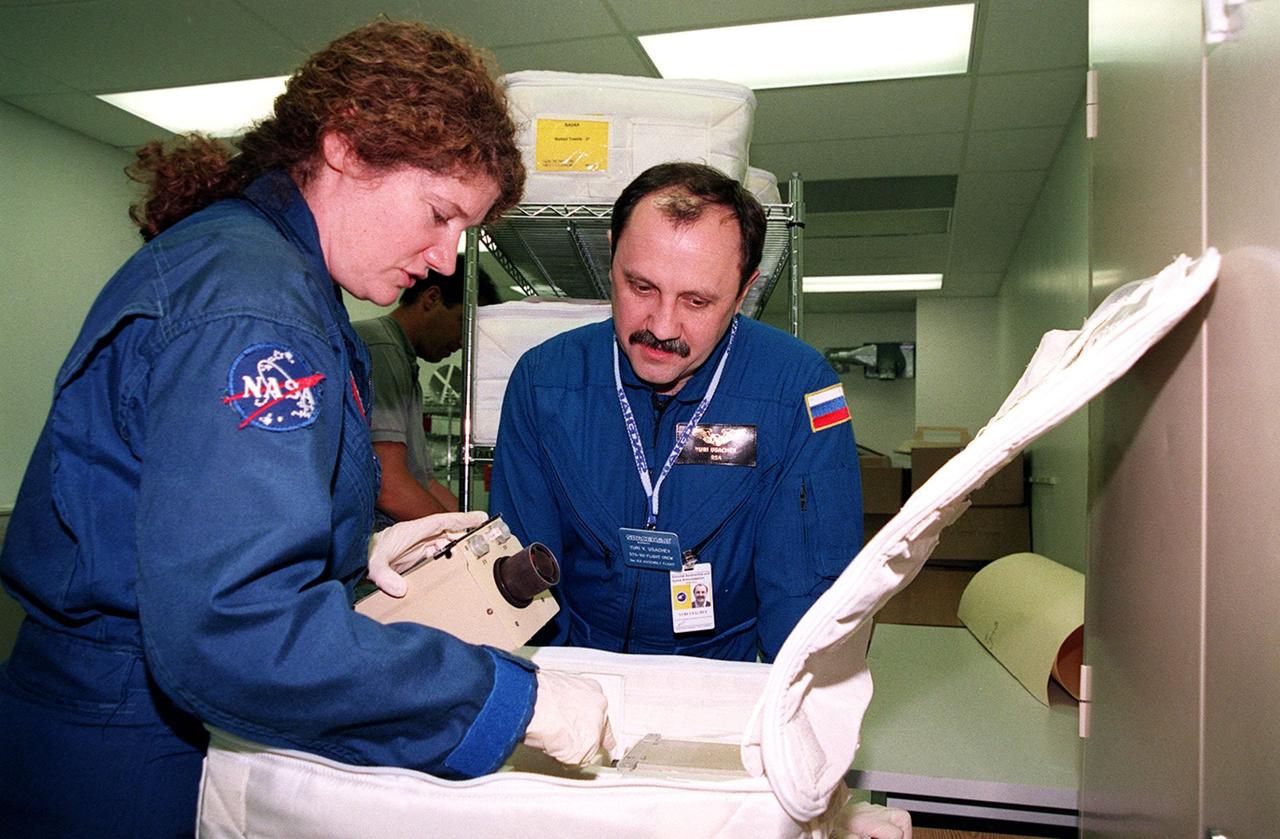
KENNEDY SPACE CENTER, FLA. -- As part of Crew Equipment Interface Test (CEIT) activities at SPACEHAB, in Cape Canaveral, Fla., STS-101 Mission Specialists Susan Helms and Yuri Usachev of Russia look over some of the equipment for their mission to the International Space Station. Other members of the crew taking part in the CEIT are Commander James Halsell, Pilot Scott Horowitz, and Mission Specialists Mary Ellen Weber, James Voss, and Jeffrey Williams. The STS-101 crew will be responsible for preparing the Space Station for the arrival of the Zvezda Service Module, expected to be launched by Russia in July 2000. Also, the crew will conduct one space walk to perform maintenance on the Space Station and deliver logistics and supplies. This will be the third assembly flight for the Space Station. STS-101 is scheduled to launch no earlier than April 13 from Launch Pad 39A
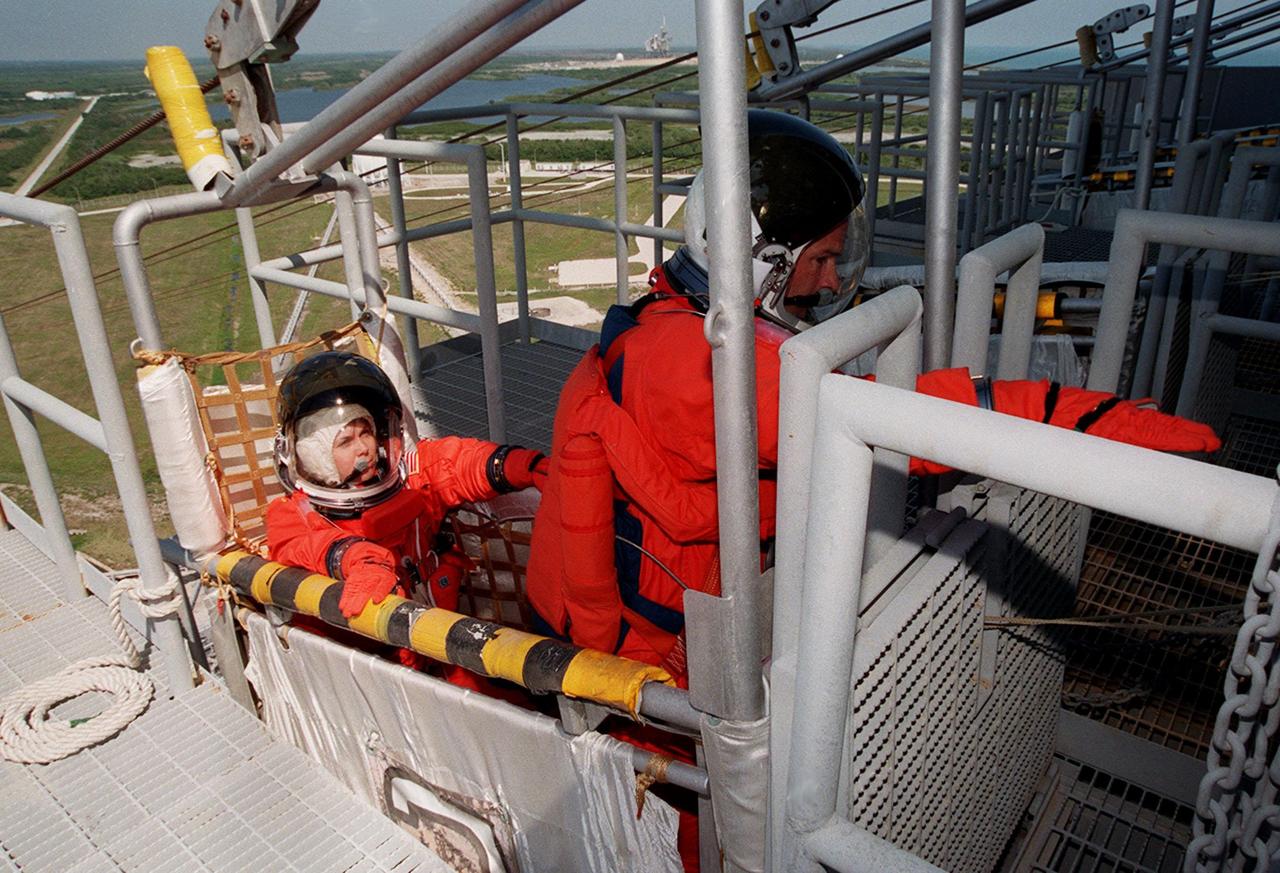
KENNEDY SPACE CENTER, FLA. -- Seated in a slidewire basket at the 195-foot level of the Fixed Service Structure, Launch Pad 39A, are (left to right) STS-101 Mission Specialists Mary Ellen Weber and Jeffrey N. Williams, who is reaching for the release lever. The release of the basket will send it shooting down the 1,200-foot slidewire to a bunker west of the launch pad. The crew is practicing emergency egress from the orbiter as part of Terminal Countdown Demonstration (TCDT) activities that include a simulated launch countdown and familiarization with the payload. During their mission to the International Space Station, the STS-101 crew will be delivering logistics and supplies, plus preparing the Station for the arrival of the Zvezda Service Module, expected to be launched by Russia in July 2000. Also, the crew will conduct one space walk to perform maintenance on the Space Station. This will be the third assembly flight to the Space Station. STS-101 is scheduled to launch April 24 at 4:15 p.m. from Launch Pad 39A
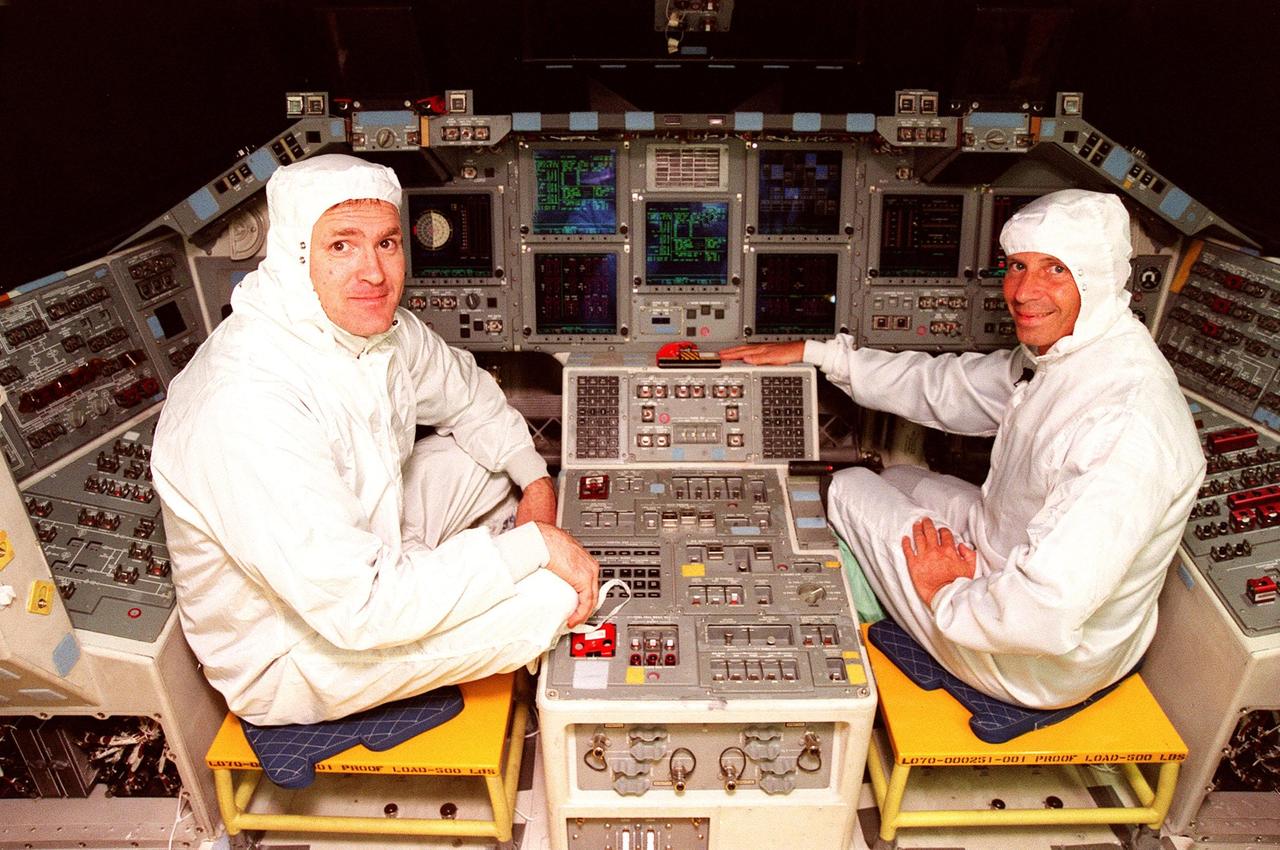
STS-101 Commander James Halsell (left) and STS-98 Commander Ken Cockrell (right) pause for a photo while looking over the recently installed Multifunction Electronic Display Subsystem (MEDS) in the cockpit of the orbiter Atlantis. The new full-color, flat panel MEDS improves crew/orbiter interaction with easy-to-read, graphic portrayals of key flight indicators like attitude display and mach speed. The installation makes Atlantis the most modern orbiter in the fleet and equals the systems on current commercial jet airliners and military aircraft. The first flight of the upgraded Atlantis is STS-101, scheduled for launch in December 1999; the second flight, STS-98, is scheduled for launch in April 2000
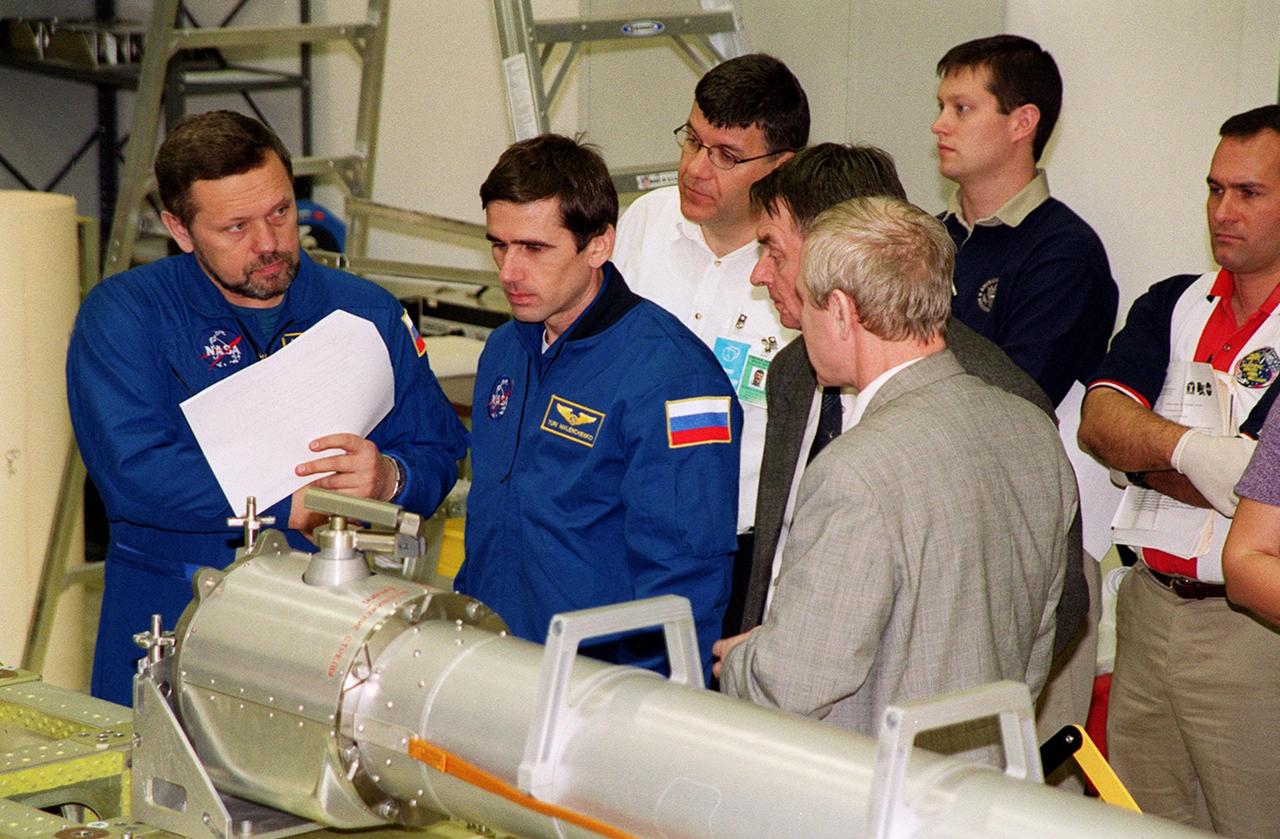
During a Crew Equipment Interface Test (CEIT), members of the STS-101 crew learn about some of the cargo that will be on their mission from workers at SPACEHAB, in Cape Canaveral, Fla. At left are Mission Specialists Boris W. Morukov and Yuri Malenchenko, who are with the Russian Space Agency. Other crew members are Commander James Donald Halsell Jr., Pilot Scott Horowitz, and Mission Specialists Mary Ellen Weber (Ph.D.), Edward Lu, and Jeffrey N. Williams, The primary objective of the STS-101 mission is to complete the initial outfitting of the International Space Station, making it fully ready for the first long-term crew. The seven-member crew will transfer almost two tons of equipment and supplies from SPACEHAB's Logistics Double Module. Additionally, they will unpack a shipment of supplies delivered earlier by a Russian Progress space tug and begin outfitting the newly arrived Zvezda Service Module. Three astronauts will perform two space walks to transfer and install parts of the Russian Strela cargo boom that are attached to SPACEHAB's Integrated Cargo Container, connect utility cables between Zarya and Zvezda, and install a magnetometer/pole assembly on the Service Module. Additional activities for the STS-101 astronauts include working with the Space Experiment Module (SEM-06) and the Mission to America's Remarkable Schools (MARS), two educational initiatives. STS-101 is scheduled for launch no earlier than March 16, 2000
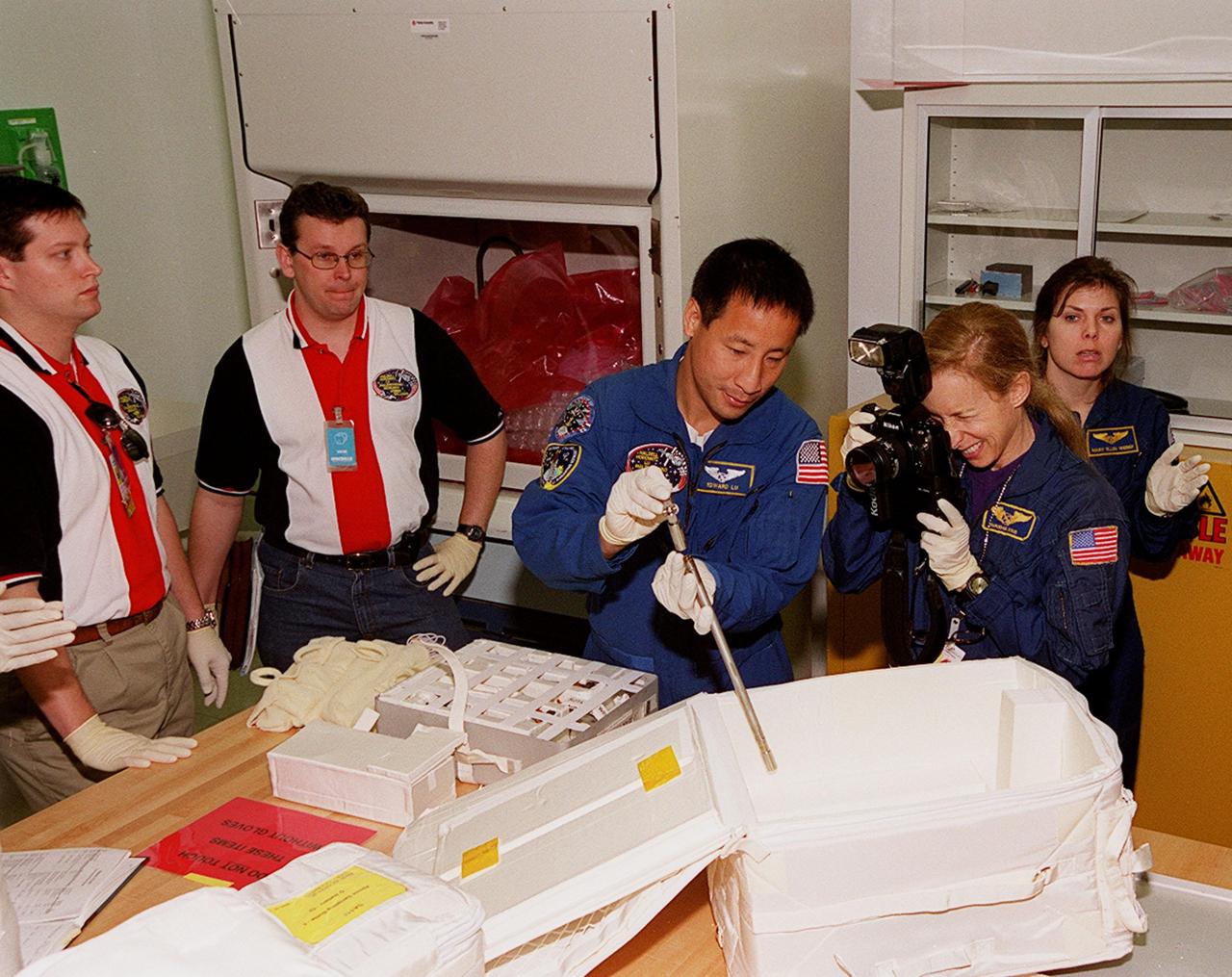
KENNEDY SPACE CENTER, FLA. -- At SPACEHAB, in Cape Canaveral, members of the STS-101 crew are taking part in a Crew Equipment Interface Test, which gives them an opportunity to look over equipment and payloads that will fly on the mission. At center is Mission Specialist Edward Tsang Lu; at right is Mission Specialist Mary Ellen Weber (Ph.D.). Between the, holding the camera, is astronaut Marsha Ivins, who is assigned to mission STS-98. On mission STS-101, Space Shuttle Atlantis will be carrying the SPACEHAB Double Module, which carries internal logistics and resupply cargo for station outfitting. Launch of Atlantis is scheduled no earlier than April 13, 2000

KENNEDY SPACE CENTER, FLA. -- At SPACEHAB, in Cape Canaveral, members of the STS-101 crew are taking part in a Crew Equipment Interface Test, which gives them an opportunity to look over equipment and payloads that will fly on the mission. At center is Mission Specialist Edward Tsang Lu; at right is Mission Specialist Mary Ellen Weber (Ph.D.). Between the, holding the camera, is astronaut Marsha Ivins, who is assigned to mission STS-98. On mission STS-101, Space Shuttle Atlantis will be carrying the SPACEHAB Double Module, which carries internal logistics and resupply cargo for station outfitting. Launch of Atlantis is scheduled no earlier than April 13, 2000
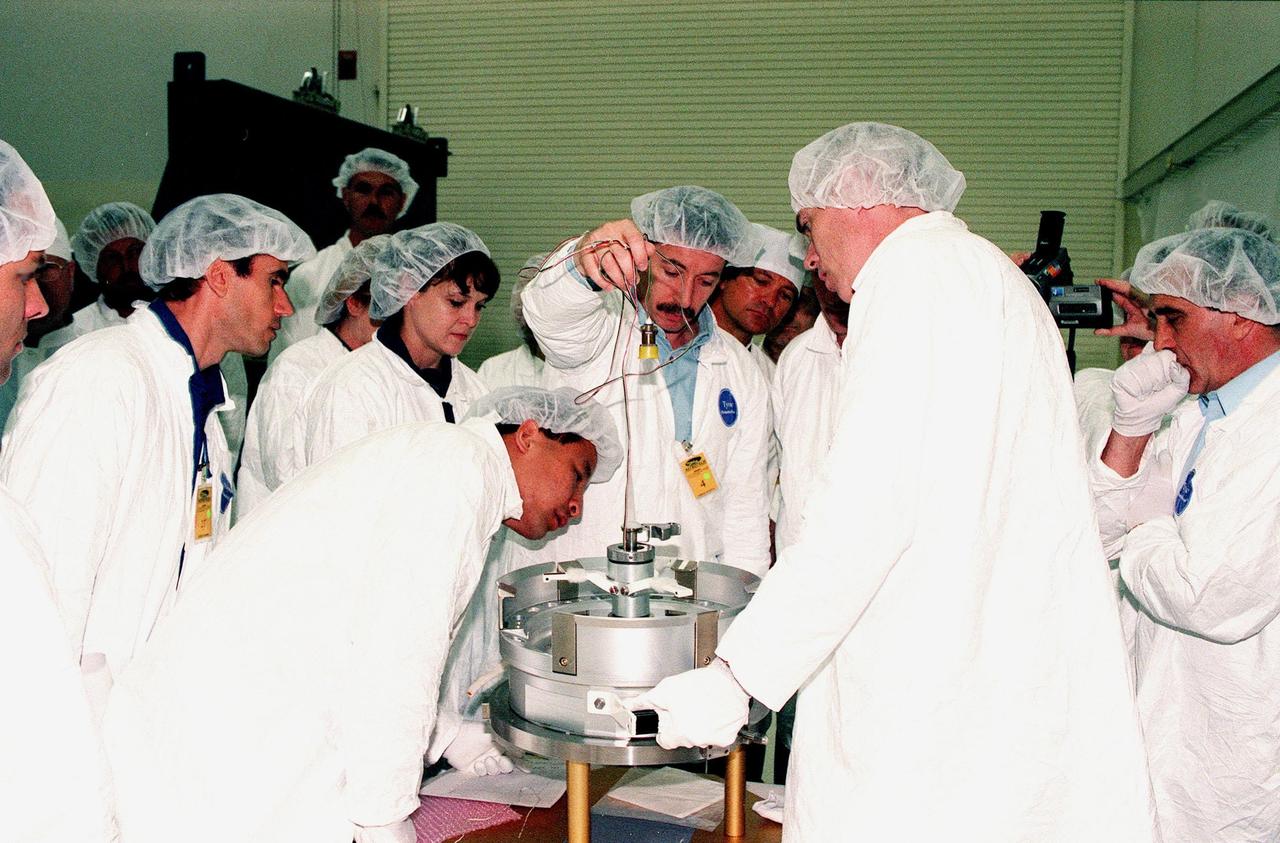
Two Shuttle crews take part in familiarization activities at Astrotech in Titusville, Fla. From left are STS-101 Mission Specialist Jeffrey N. Williams and Yuri Ivanovich Malenchenko, with the Russian Space Agency; STS-96 Mission Specialist Tamara E. Jernigan; STS-101 Mission Specialist Edward Tsang Lu (leaning over); a technician with RSC Energia of Korolev, Russia; Manfred Nordhoff, with DaimlerChrysler Aerospace; STS-96 Mission Specialist Daniel T. Barry; and another technician with RSC Energia. They are looking at components of the Russian cargo crane, Strela, to be mounted to the exterior of the Russian station segment on the International Space Station (ISS). Both missions include the SPACEHAB Double Module, carrying internal and resupply cargo for Station outfitting. For the first time, STS-96 will include an Integrated Cargo Carrier (ICC) that will carry the Strela; the SPACEHAB Oceaneering Space System Box (SHOSS), which is a logistics items carrier; and a U.S.-built crane (ORU Transfer Device, or OTD) that will be stowed on the station for use during future ISS assembly missions. The ICC can carry up to 6,000 lb of unpressurized payload. It was built for SPACEHAB by DaimlerChrysler Aerospace of Bremen and RSC Energia of Korolev, Russia. STS-96 is targeted for launch on May 24 from Launch Pad 39B. STS-101 is scheduled to launch in early December 1999
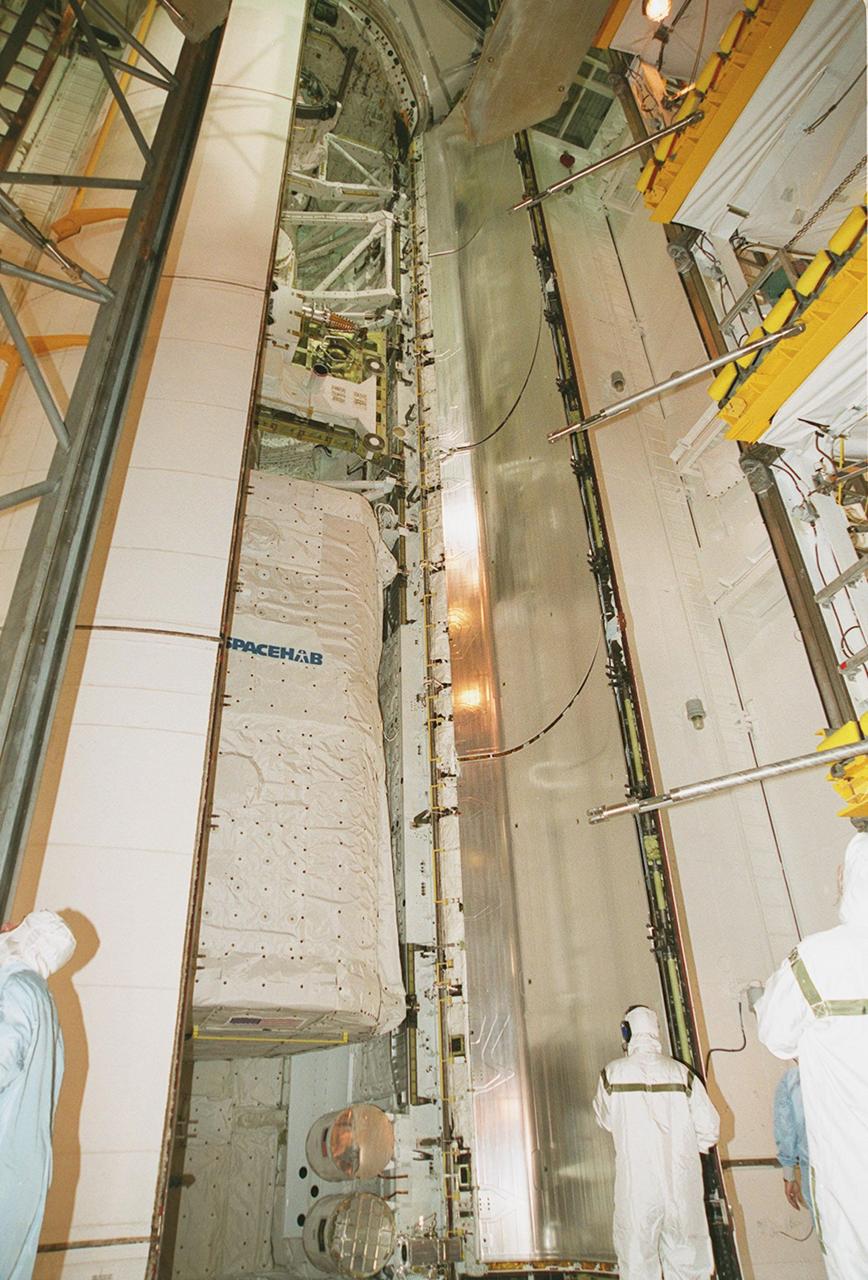
KENNEDY SPACE CENTER, FLA. -- Works at Launch Pad 39A begin closing the payload bay doors on Space Shuttle Atlantis. The payload includes the SPACEHAB Double Module (center) and two GetAway Special (GAS) canisters containing student experiments, known as MARS and SEM-06. The primary mission of STS-101 is to deliver logistics and supplies to the International Space Station, plus prepare the Station for the arrival of the Zvezda Service Module, expected to be launched by Russia in July 2000. The crew will conduct one space walk to perform maintenance on the Space Station. This will be the third assembly flight for the Space Station. STS-101 is scheduled to launch April 24 at 4:15 p.m. from Launch Pad 39A
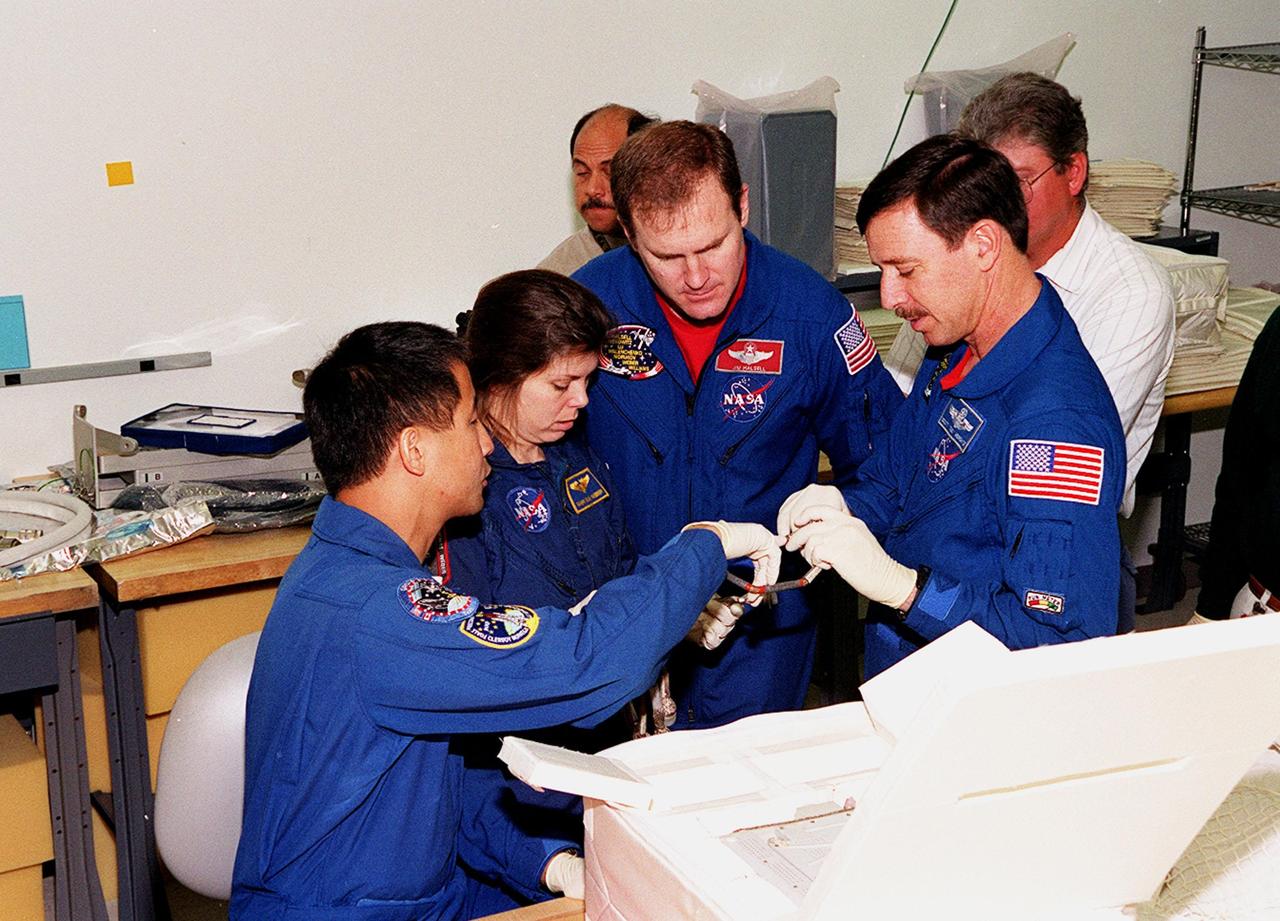
KENNEDY SPACE CENTER, FLA. -- At SPACEHAB, in Cape Canaveral, the STS-101 crew inspect equipment and payload for their mission. From left to right are Mission Specialist Edward Tsang Lu, Mary Ellen Weber (Ph.D.), Commander James D. Halsell Jr. and Pilot Scott J. "Doc" Horowitz (Ph.D). are taking part in a Crew Equipment Interface Test, which gives them an opportunity to look over equipment and payloads that will fly on the mission. Space Shuttle Atlantis will be carrying the SPACEHAB Double Module, which carries internal logistics and resupply cargo for station outfitting. Launch of Atlantis on mission STS-101 is scheduled no earlier than April 13, 2000
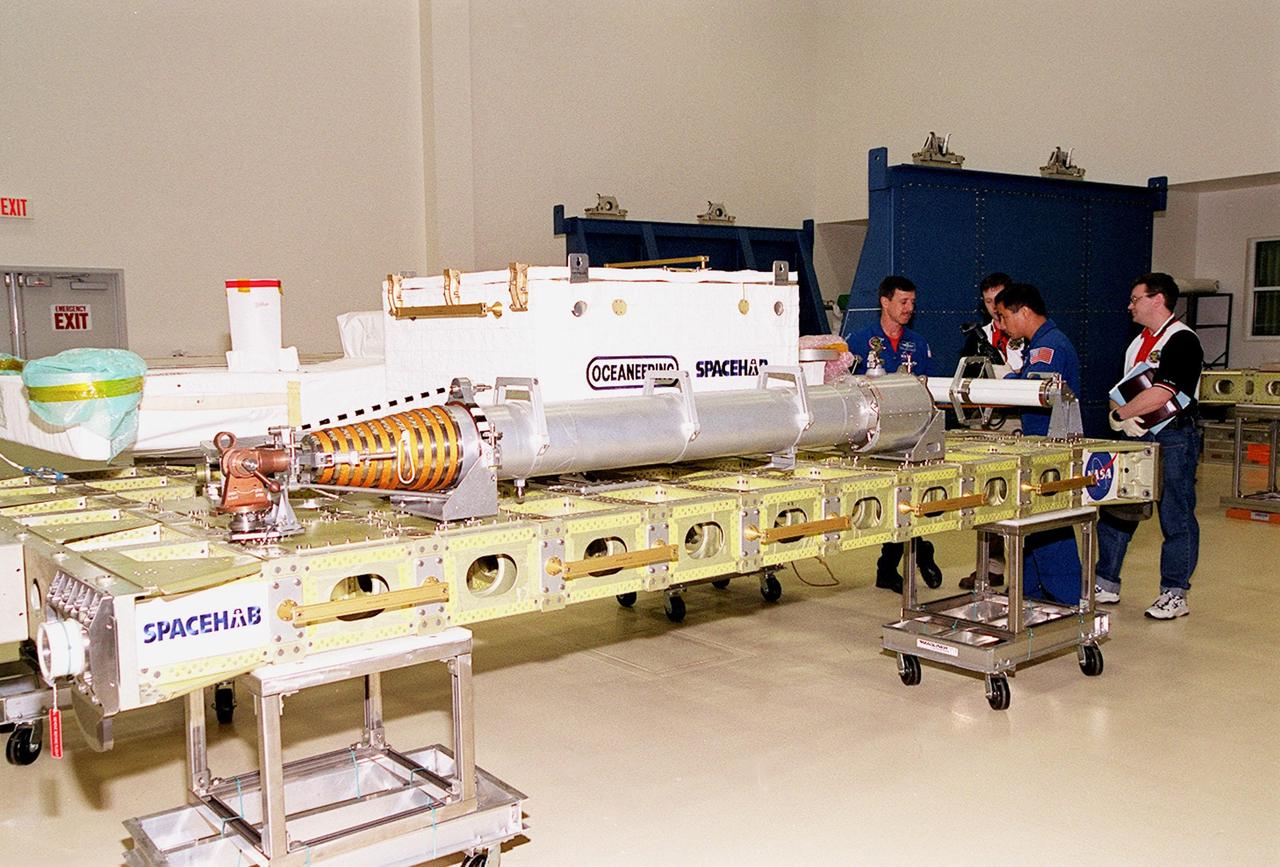
KENNEDY SPACE CENTER, FLA. -- At SPACEHAB, in Cape Canaveral, looking over equipment for their mission are (far left) STS-101 Pilot Scott J. "Doc" Horowitz (Ph.D). and (second from right) Mission Specialist Edward Tsang Lu. Horowitz, Lu and other members of the crew are taking part in a Crew Equipment Interface Test, which gives them an opportunity to look over equipment and payloads that will fly on the mission. Space Shuttle Atlantis will be carrying the SPACEHAB Double Module, which carries internal logistics and resupply cargo for station outfitting. Launch of Atlantis on mission STS-101 is scheduled no earlier than April 13, 2000
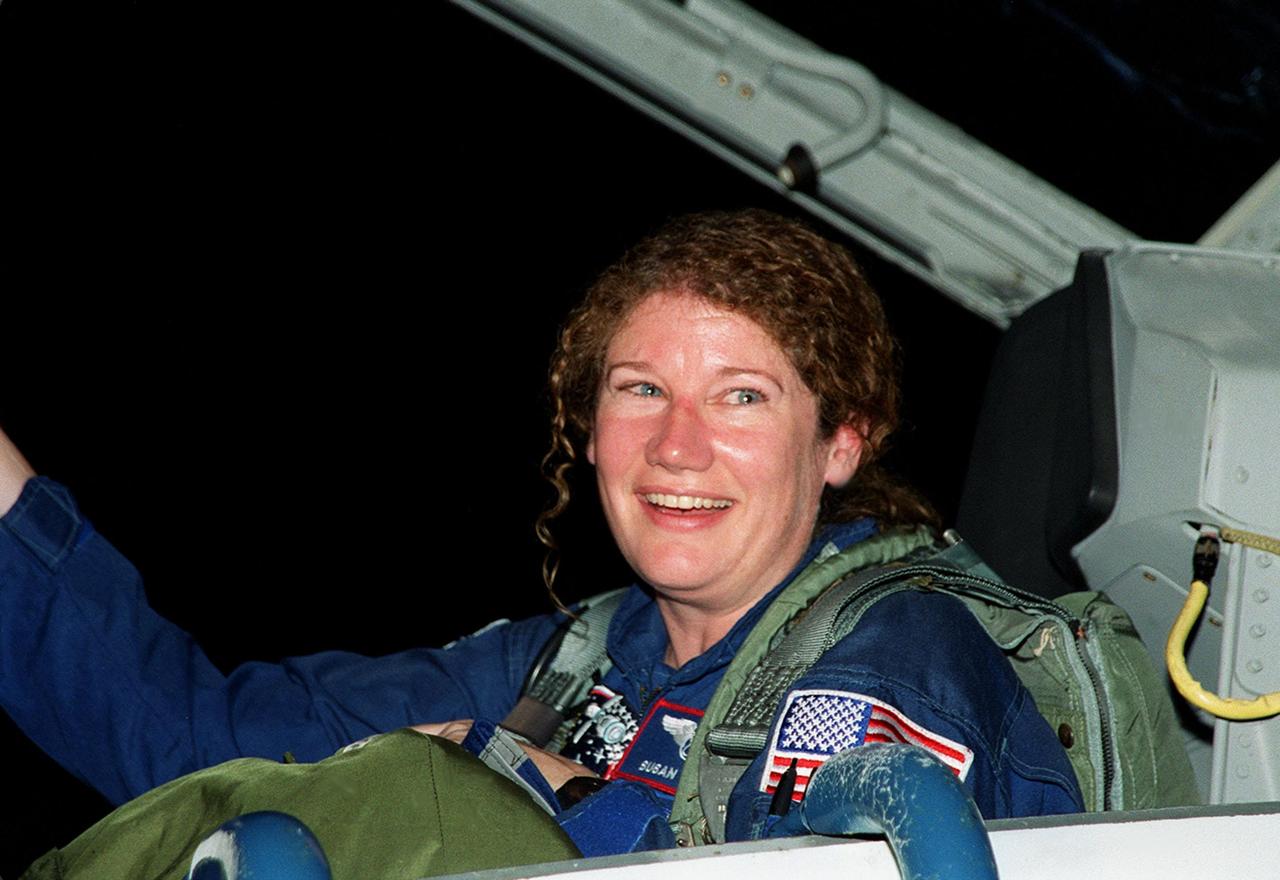
KENNEDY SPACE CENTR, FLA. -- STS-101 Mission Specialist Susan Helms arrives at KSC's Shuttle Landing Facility aboard a T-38 jet aircraft. The last to arrive, she and the rest of the crew will be preparing for the launch on May 18. The mission will take the crew of seven to the International Space Station, delivering logistics and supplies, plus preparing the Station for the arrival of the Zvezda Service Module, expected to be launched by Russia in July 2000. Also, the crew will conduct one space walk to perform maintenance on the Space Station. This will be the third assembly flight for the Space Station. STS-101 is targeted for liftoff at 6:38 a.m. EDT from Launch Pad 39A
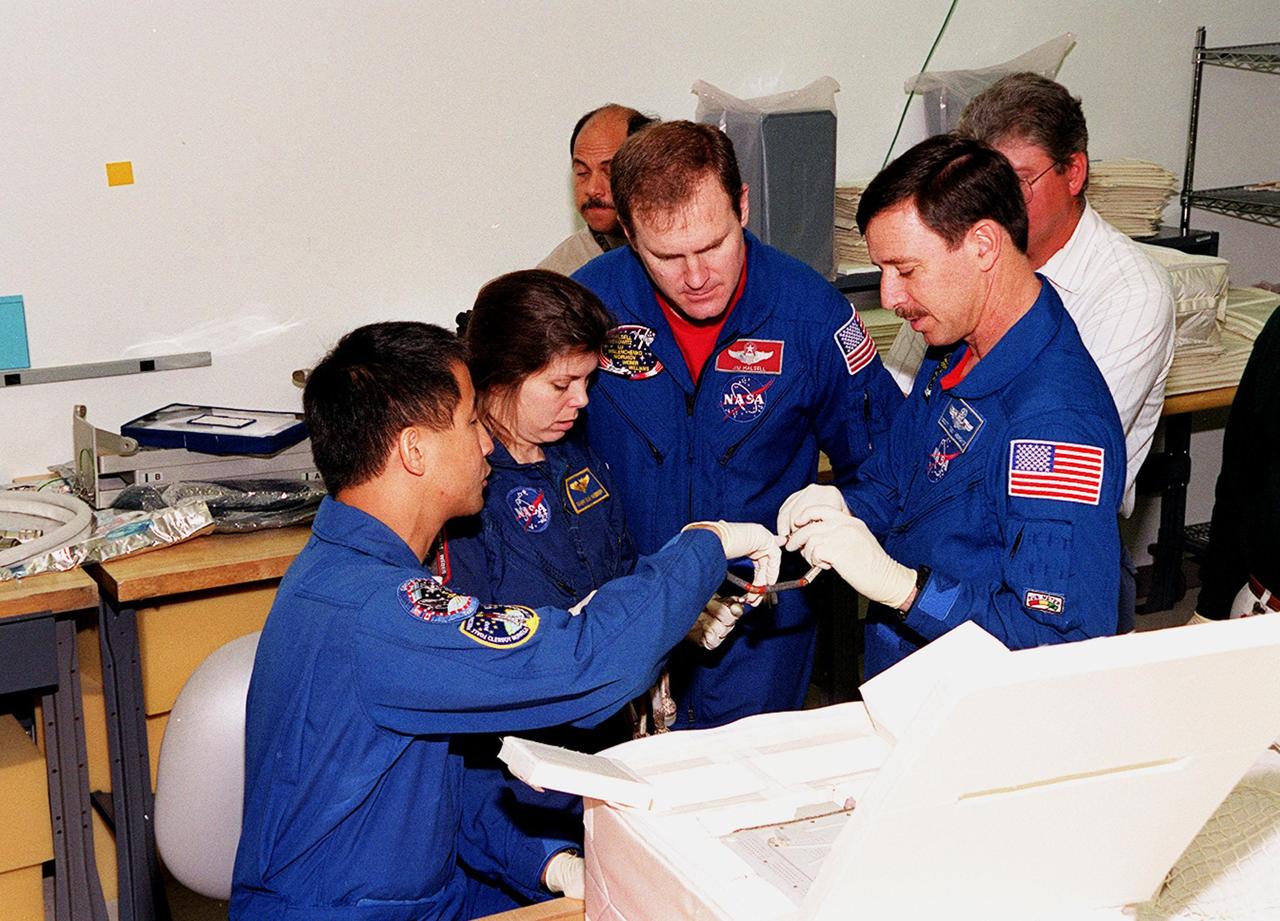
KENNEDY SPACE CENTER, FLA. -- At SPACEHAB, in Cape Canaveral, the STS-101 crew inspect equipment and payload for their mission. From left to right are Mission Specialist Edward Tsang Lu, Mary Ellen Weber (Ph.D.), Commander James D. Halsell Jr. and Pilot Scott J. "Doc" Horowitz (Ph.D). are taking part in a Crew Equipment Interface Test, which gives them an opportunity to look over equipment and payloads that will fly on the mission. Space Shuttle Atlantis will be carrying the SPACEHAB Double Module, which carries internal logistics and resupply cargo for station outfitting. Launch of Atlantis on mission STS-101 is scheduled no earlier than April 13, 2000
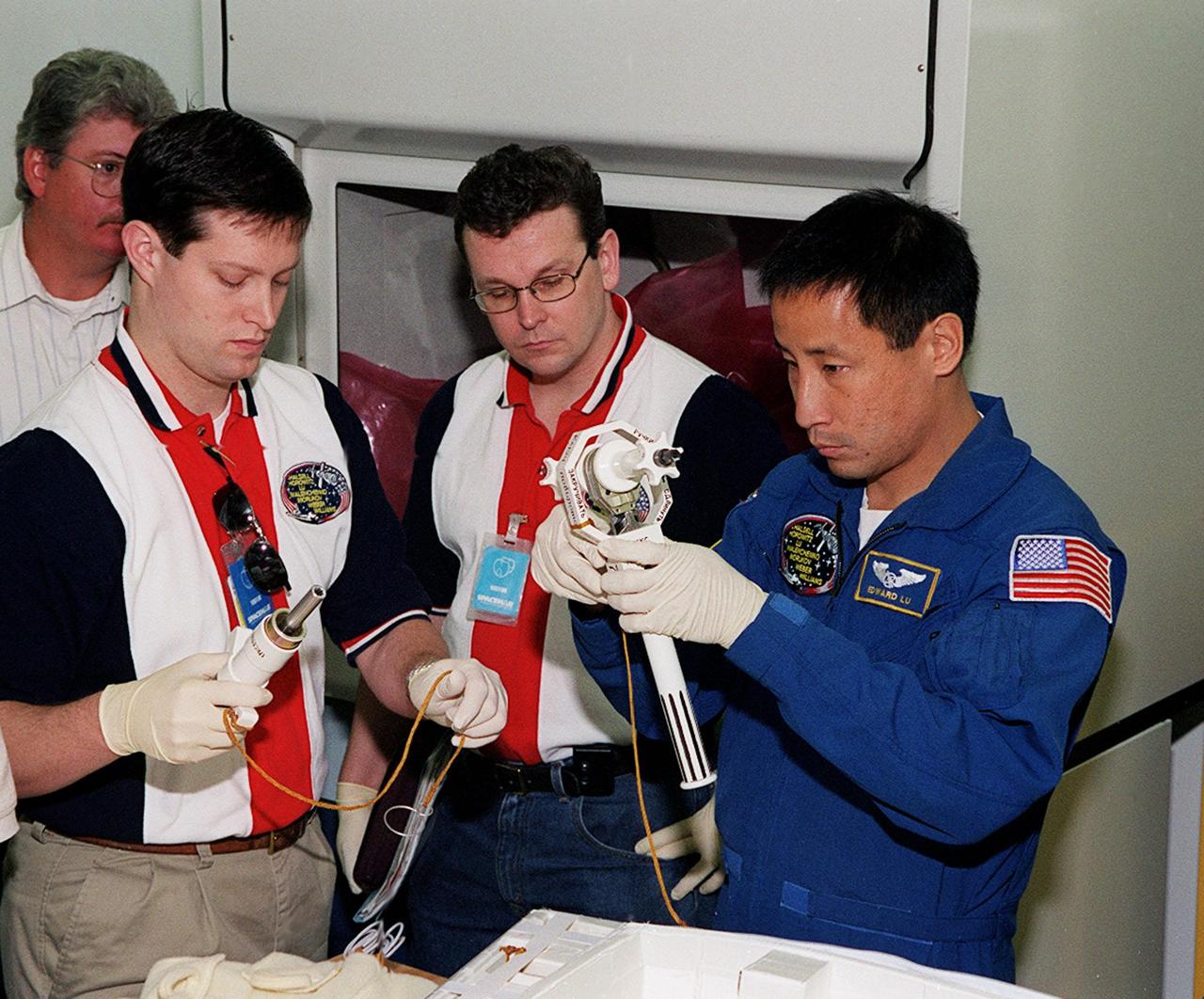
KENNEDY SPACE CENTER, FLA. -- At SPACEHAB, in Cape Canaveral, technicians help STS-101 Mission Specialist Edward Tsang Lu become familiar with equipment for the mission. Lu and other members of the crew are taking part in a Crew Equipment Interface Test, which gives them an opportunity to look over equipment and payloads that will fly on the mission. Space Shuttle Atlantis will be carrying the SPACEHAB Double Module, which carries internal logistics and resupply cargo for station outfitting. Launch of Atlantis on mission STS-101 is scheduled no earlier than April 13, 2000
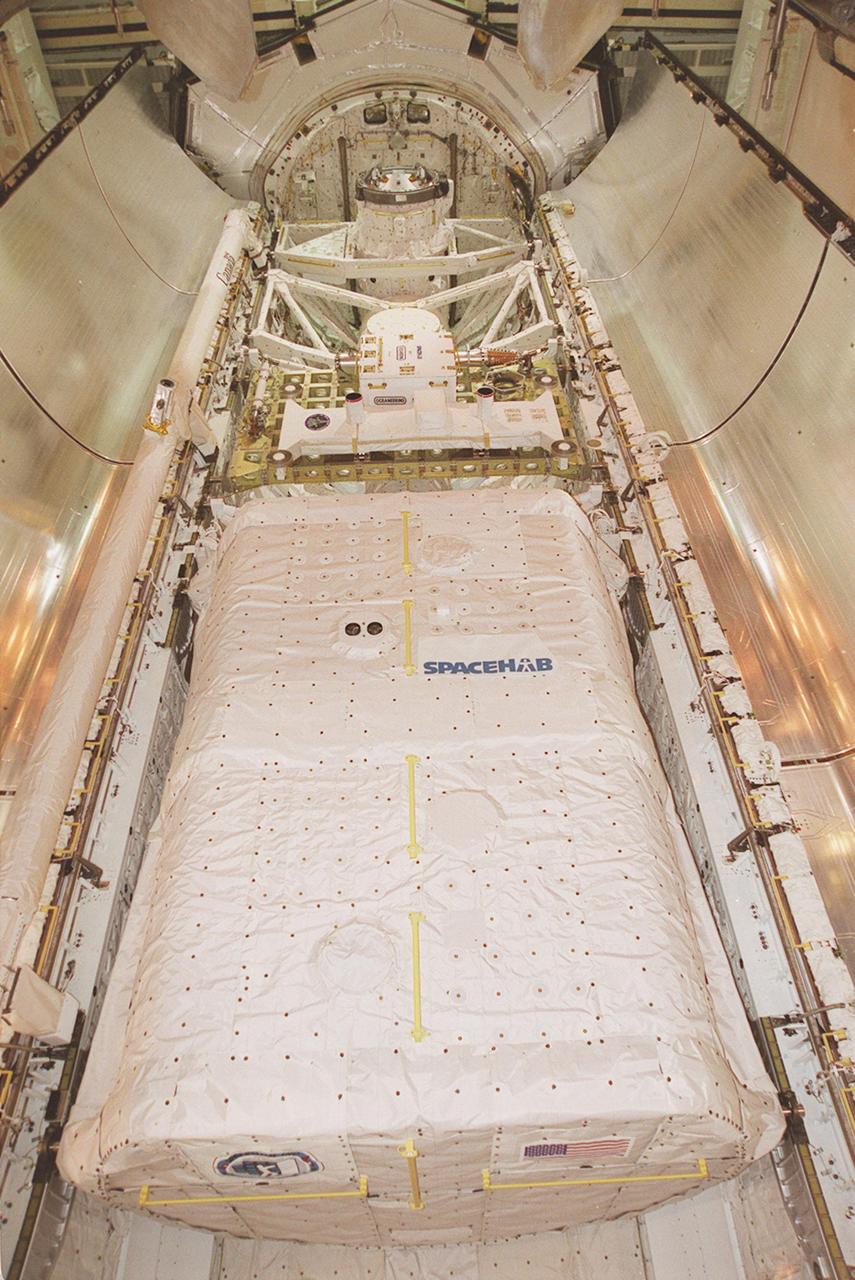
KENNEDY SPACE CENTER, FLA. -- The payload on mission STS-101 is secure in the payload bay of Space Shuttle Atlantis prior to door closure. On the lower end is the SPACEHAB double module. The mission will deliver logistics and supplies to the International Space Station, plus prepare the Station for the arrival of the Zvezda Service Module, expected to be launched by Russia in July 2000. The crew will conduct one spacewalk to perform maintenance on the Space Station. This will be the third assembly flight for the Space Station. STS-101 is scheduled to launch April 24 at 4:15 p.m. from Launch Pad 39A.
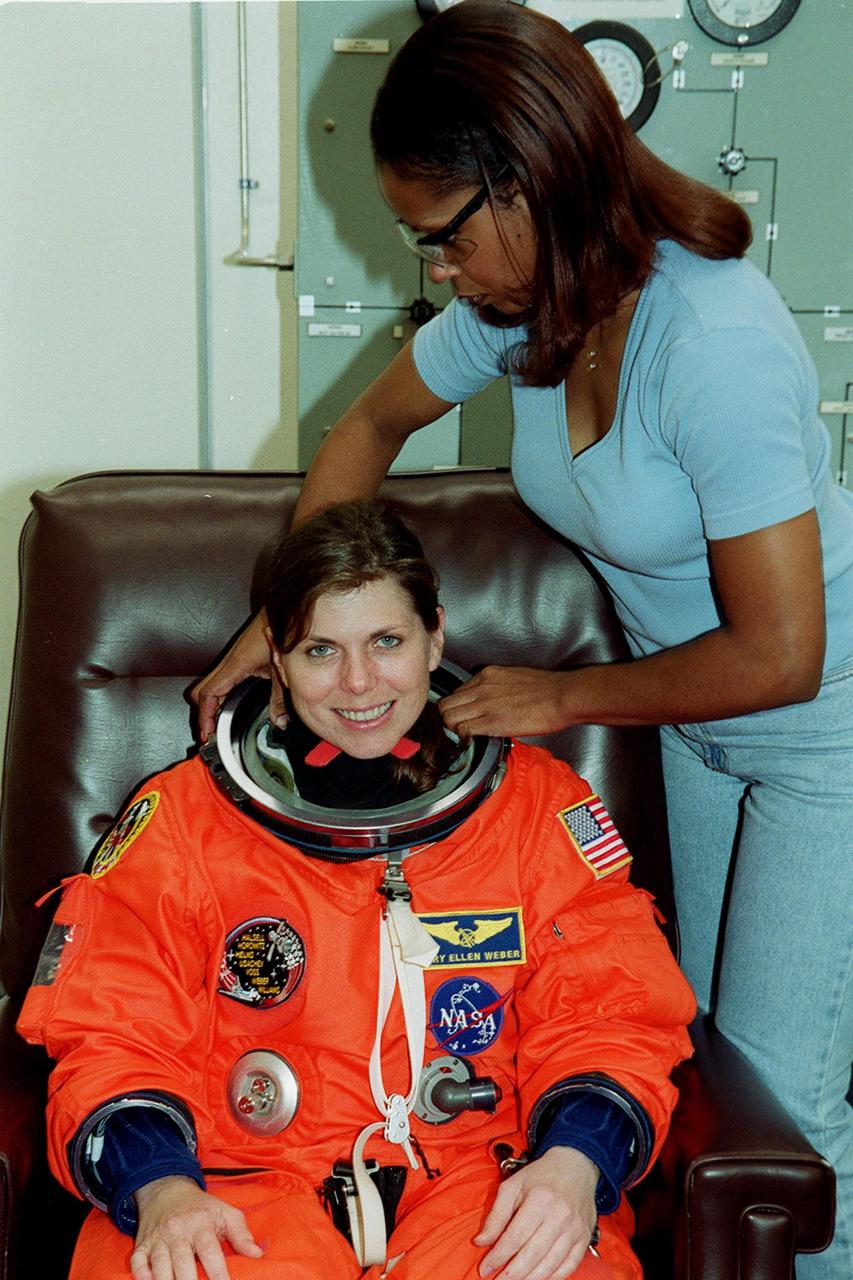
During pre-launch preparations in the Operations and Checkout Building, STS-101 Mission Specialist Mary Ellen Weber has her launch and entry suit checked by a technician. Mission STS-101 will take the crew to the International Space Station to deliver logistics and supplies, plus prepare the Station for the arrival of the Zvezda Service Module, expected to be launched by Russia in July 2000. The crew will conduct one space walk to perform maintenance on the Space Station as well. This will be the third assembly flight for the Space Station. Launch is targeted for April 24 at about 4:15 p.m. EDT from Launch Pad 39A
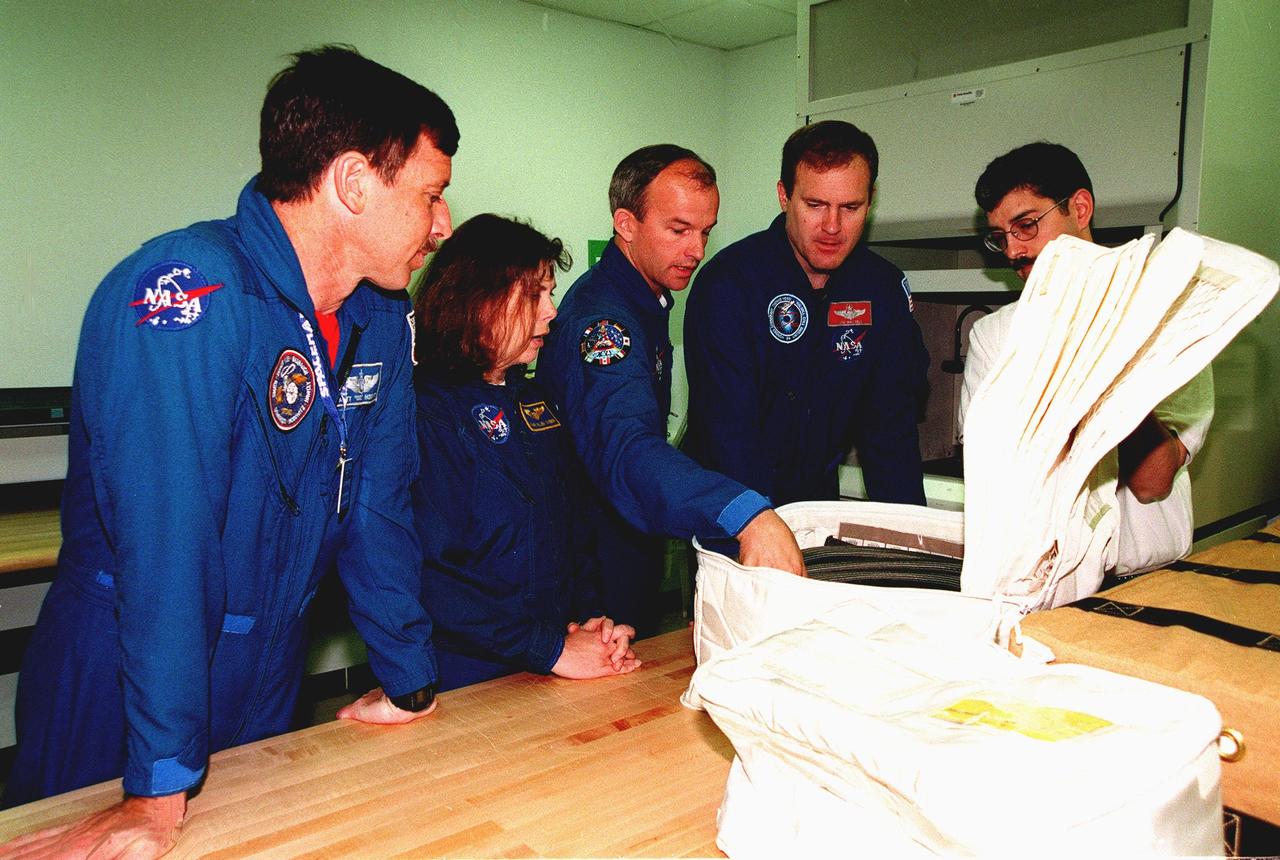
KENNEDY SPACE CENTER, FLA. -- At the SPACEHAB Facility, members of the STS-101 crew look over equipment during familiarization activities. From left are Pilot Scott J. "Doc" Horowitz (Ph.D.), Mission Specialists Mary Ellen Weber (Ph.D.) and Jeffrey N. Williams, and Commander James Donald Halsell Jr., plus Sean Hicks, with Boeing in Huntsville, Ala. Other crew members are Mission Specialists Edward Tsang Lu (Ph.D.), and Yuri Ivanovich Malenchenko and Boris Morukov, who represent the Russian Space Agency. Mission STS-101 is the third flight in construction of the International Space Station. The 11-day mission is targeted for launch on December 2, 1999, at Launch Pad 39A
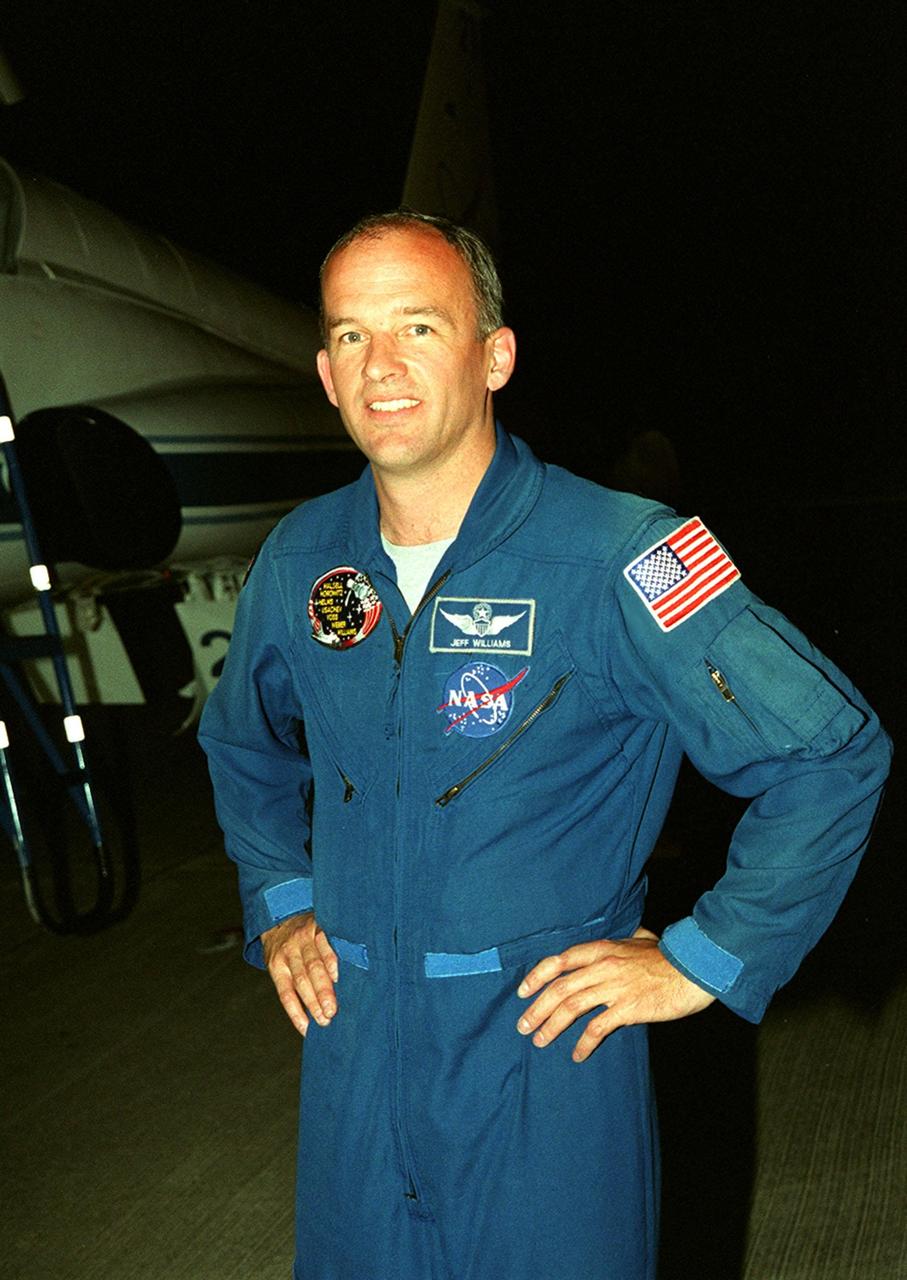
STS-101 Mission Specialist Jeffrey N. Williams stands ready to begin preparations for the launch on May 18 after arriving at KSC's Shuttle Landing Facility aboard a T-38 jet aircraft. The mission will take the crew of seven to the International Space Station, delivering logistics and supplies, plus preparing the Station for the arrival of the Zvezda Service Module, expected to be launched by Russia in July 2000. Also, the crew will conduct one space walk to perform maintenance on the Space Station. This will be the third assembly flight for the Space Station. STS-101 is targeted for liftoff at 6:38 a.m. EDT from Launch Pad 39A
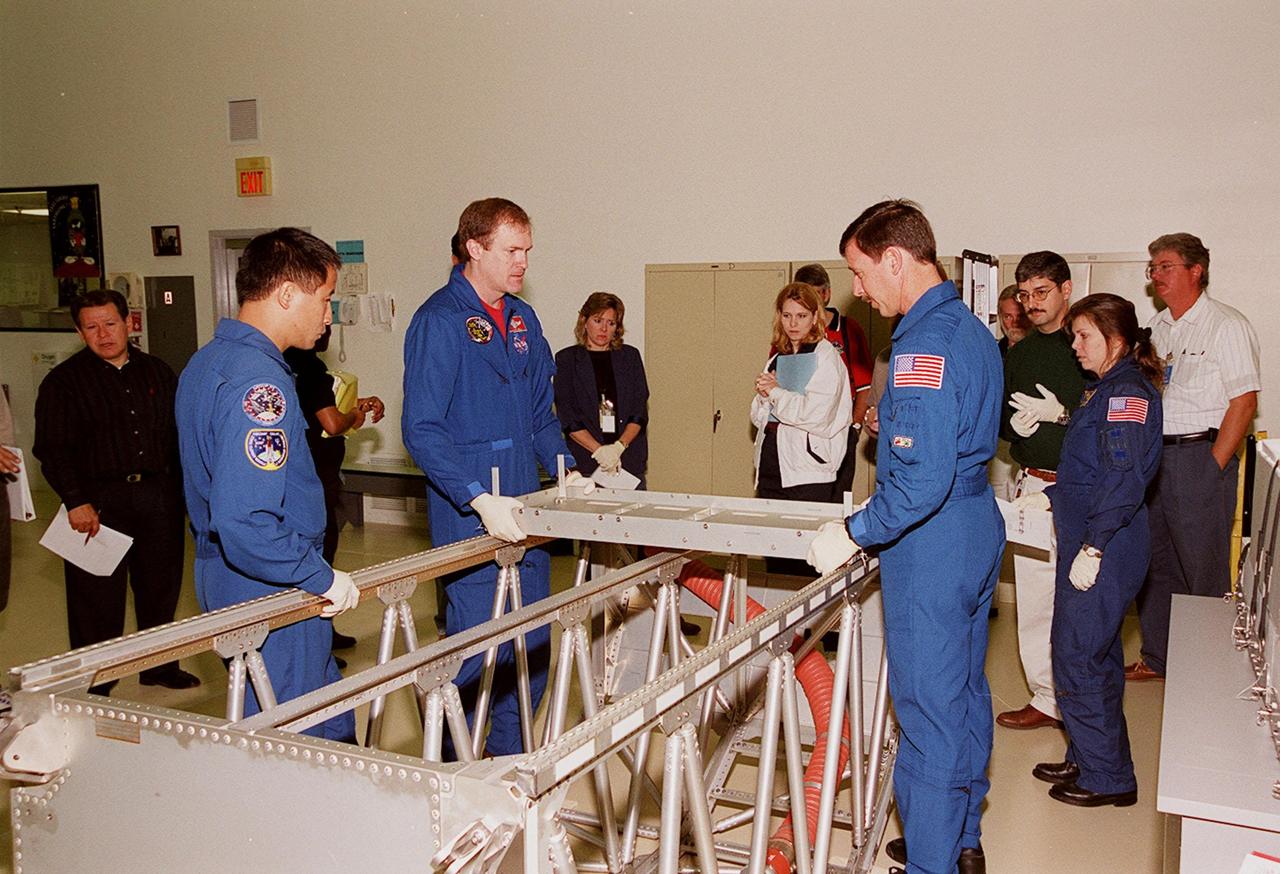
KENNEDY SPACE CENTER, FLA. -- At SPACEHAB, in Cape Canaveral, members of the STS-101 crew inspect equipment and payload for their mission. From left to right (in uniform) are Mission Specialist Edward Tsang Lu, Commander James D. Halsell Jr., Pilot Scott J. "Doc" Horowitz (Ph.D) and Mission Specialist Mary Ellen Weber (Ph.D.). They are taking part in a Crew Equipment Interface Test, which gives them an opportunity to look over equipment and payloads that will fly on the mission. Space Shuttle Atlantis will be carrying the SPACEHAB Double Module, which carries internal logistics and resupply cargo for station outfitting. Launch of Atlantis on mission STS-101 is scheduled no earlier than April 13, 2000

STS-101 Pilot Scott J. Horowitz climbs out of a T-38 jet aircraft after arriving at KSC's Shuttle Landing Facility. He and the rest of the crew will begin preparing for the launch on May 18. The mission will take the crew of seven to the International Space Station, delivering logistics and supplies, plus preparing the Station for the arrival of the Zvezda Service Module, expected to be launched by Russia in July 2000. Also, the crew will conduct one space walk to perform maintenance on the Space Station. This will be the third assembly flight for the Space Station. STS-101 is targeted for liftoff at 6:38 a.m. EDT from Launch Pad 39A
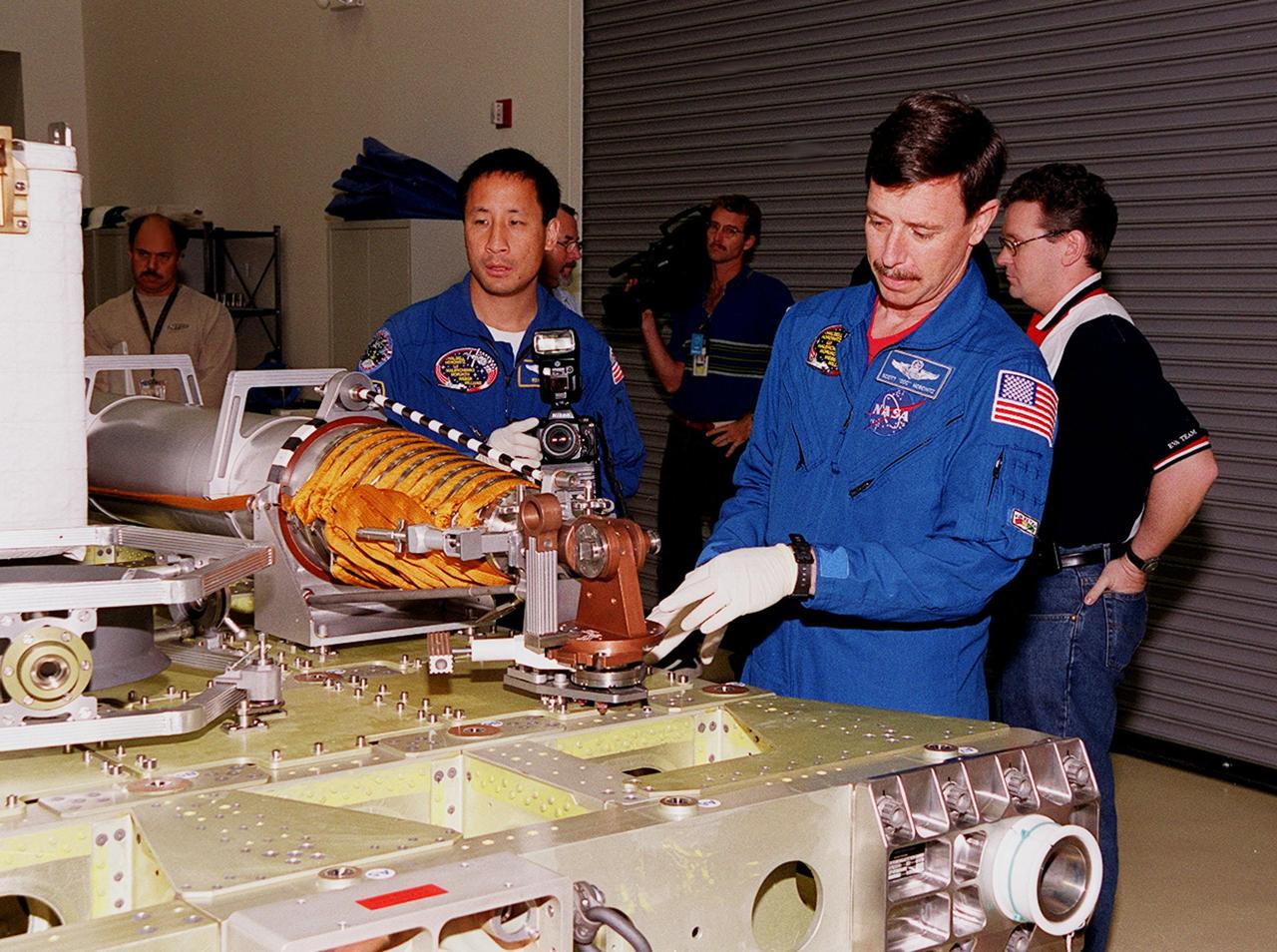
KENNEDY SPACE CENTER, FLA. -- At SPACEHAB, in Cape Canaveral, looking over the Russian crane, Strela, are STS-101 Mission Specialist Edward Tsang Lu (left) and Pilot Scott J. "Doc" Horowitz (Ph.D). Lu, Horowitz and other members of the crew are taking part in a Crew Equipment Interface Test, which gives them an opportunity to look over equipment and payloads that will fly on the mission. Space Shuttle Atlantis will be carrying the SPACEHAB Double Module, which carries internal logistics and resupply cargo for station outfitting. Launch of Atlantis on mission STS-101 is scheduled no earlier than April 13, 2000
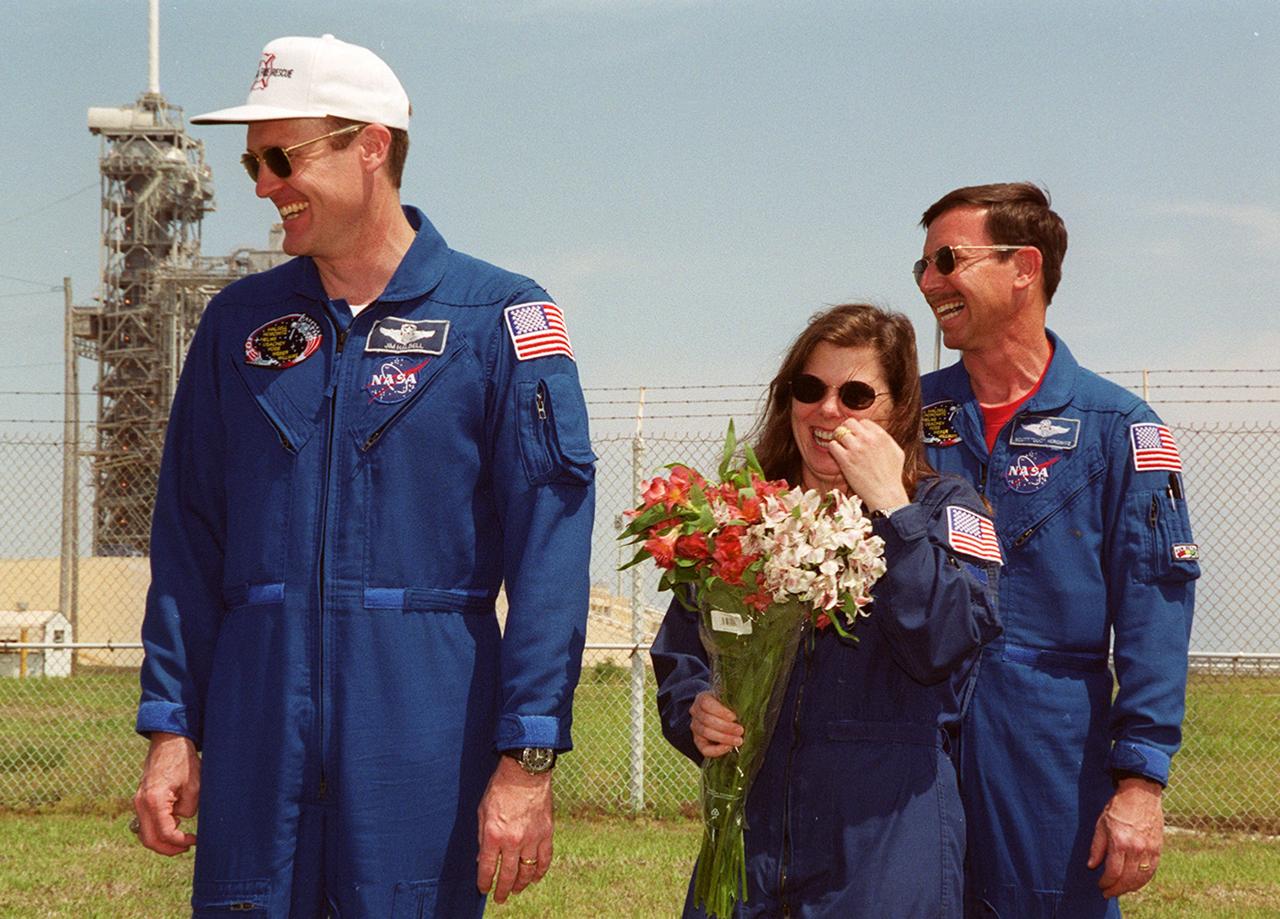
KENNEDY SPACE CENTER, FLA. -- A light-hearted moment during a meeting of the STS-101 crew with family and friends at Launch Pad 39A. From left are Commander James D. Halsell Jr., Mission Specialist Mary Ellen Weber and Pilot Scott J. Horowitz. Mission STS-101 will take the crew to the International Space Station to deliver logistics and supplies, plus prepare the Station for the arrival of the Zvezda Service Module, expected to be launched by Russia in July 2000. The crew will conduct one spacewalk to perform maintenance on the Space Station as well. This will be the third assembly flight for the Space Station. Launch is targeted for April 24 at about 4:15 p.m. EDT from Launch Pad 39A.

KENNEDY SPACE CENTER, FLA. -- At SPACEHAB, in Cape Canaveral, technicians help STS-101 Mission Specialist Edward Tsang Lu become familiar with equipment for the mission. Lu and other members of the crew are taking part in a Crew Equipment Interface Test, which gives them an opportunity to look over equipment and payloads that will fly on the mission. Space Shuttle Atlantis will be carrying the SPACEHAB Double Module, which carries internal logistics and resupply cargo for station outfitting. Launch of Atlantis on mission STS-101 is scheduled no earlier than April 13, 2000
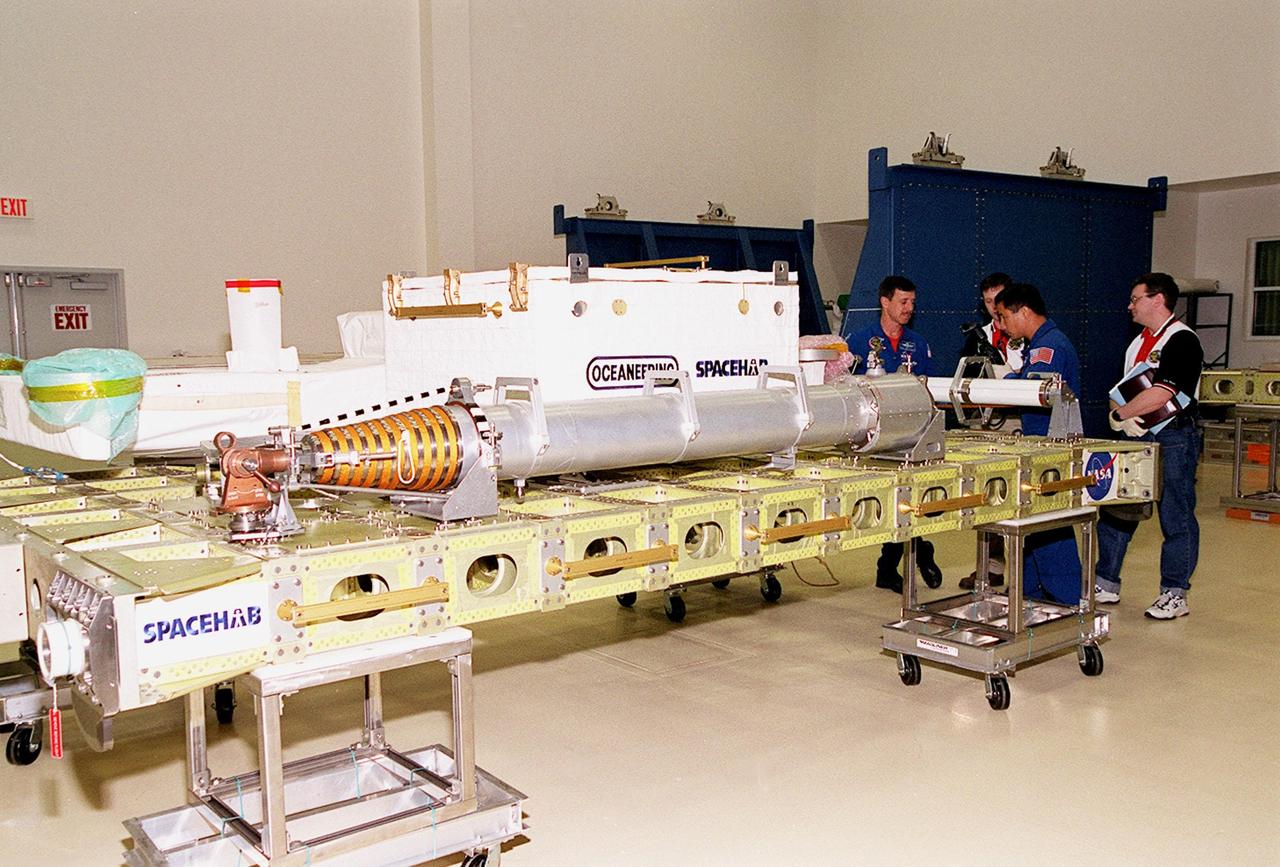
KENNEDY SPACE CENTER, FLA. -- At SPACEHAB, in Cape Canaveral, looking over equipment for their mission are (far left) STS-101 Pilot Scott J. "Doc" Horowitz (Ph.D). and (second from right) Mission Specialist Edward Tsang Lu. Horowitz, Lu and other members of the crew are taking part in a Crew Equipment Interface Test, which gives them an opportunity to look over equipment and payloads that will fly on the mission. Space Shuttle Atlantis will be carrying the SPACEHAB Double Module, which carries internal logistics and resupply cargo for station outfitting. Launch of Atlantis on mission STS-101 is scheduled no earlier than April 13, 2000